Samacheer Kalvi 12th Chemistry Guide Chapter 1 Metallurgy

Tamilnadu State Board New Syllabus Samacheer Kalvi 12th Chemistry Guide Pdf Chapter 1 Metallurgy Text Book Back Questions and Answers, Notes.

Tamilnadu Samacheer Kalvi 12th Chemistry Solutions Chapter 1 Metallurgy

12th Chemistry Guide Metallurgy Text Book Questions and Answers

I. Choose the correct answer

1. Bauxite has the composition
a) Al2O3
b) Al2O3.nH2O
c) Fe2O3.2H2O
d) None of these
Answer:
b) Al2O3.nH2O

2. Roasting of sulphide ore gives the gas (A). (A) is a colorless gas. An aqueous solution of (A) is acidic. The gas (A) is
a) CO2
b) SO3
c) SO2
d)H2S
Answer:
c) SO2

3. Which one of the following reaction represents calcinations?
a) 2Zn + O2 → 2ZnO
b) 2ZnS + 3O2 → 2ZnO + 2SO2
c) MgCO3 → MgO + CO2
d) Both (a) and (c)
Answer:
c) MgCOa → MgO + CO2

Samacheer Kalvi 9th English Guide Prose Chapter 2 I Can’t Climb Trees Anymore

4. The metal oxide which cannot be reduced to metal by carbon is
a) PbO
b) Al2O3
c) ZnO
d) FeO
Answer:
b) Al2O3

5. Which of the metal is extracted by Hall – Heroult process?
a) Al
b) Ni
c) Cu
d) Zn
Answer:
a) Al

6. Which of the following statements, about the advantage of roasting of sulphide ore before the reduction is not true?
a) ΔG°f of sulphide is greater than those for CS2 and H2S
b) ΔG°r is negative for roasting of sulphide ore to oxide
c) Roasting of the sulphide to its oxide is thermodynamically feasible.
d) Carbon and hydrogen are suitable reducing agents for metal sulphides.
Answer:
d) Carbon and hydrogen are suitable reducing agents for metal sulphides.

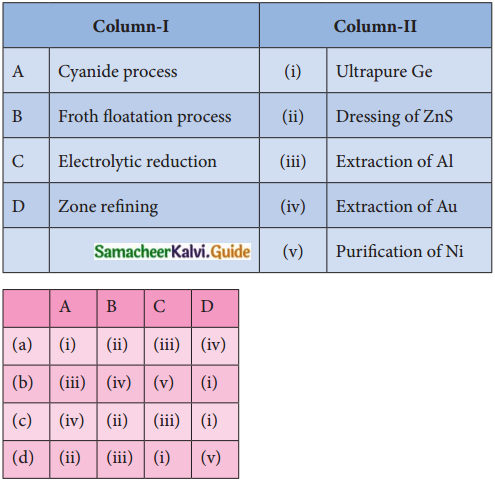
7. Match items in Column I – with the items of Column – II and assign the correct code.
Samacheer Kalvi 12th Chemistry Guide Chapter 1 Metallurgy 1
Answer:
c) (iv) (ii) (iii) (i)

8. Wolframite ore is separated from tinstone by the process of
a) Smelting
b) Calcination
c) Roasting
d) Electromagnetic separation
Answer:
d) Electromagnetic separation

Samacheer Kalvi 9th English Guide Prose Chapter 2 I Can’t Climb Trees Anymore

9. Which one of the following is not feasible
a) Zn(S) + Cu2+(aq) → Cu(s) + Zn2+(aq)
b) Cu(S) + Zn2+(aq) → Zn(s) + Cu2+(aq)
c) Cu(S) + 2Ag+(aq) → Ag(s) + Cu2+(aq)
d) Fe(S) + Cu2+(aq) → Cu(s) + Fe2+(aq)
Answer:
b) Cu(S) + Zn2+(aq) → Zn(s) + Cu2+(aq)

10. Electrochemical process is used to extract
a) Iron
b) Lead
c) Sodium
d) Silver
Answer:
c) Sodium

11. Flux is a substance which is used to convert
a) Mineral’into silicate
b) Infusible impurities to soluble impurities
c) Soluble impurities to infusible impurities
d) All of these
Answer:
b) Infusible impurities to soluble impurities

12. Which one of the following ores is best concentrated by froth floatation method?
a) Magnetite
b) Heamatite
c) Galena
d) Cassiterite
Answer:
c) Galena

Samacheer Kalvi 9th English Guide Prose Chapter 2 I Can’t Climb Trees Anymore

13. In the extraction of aluminium from alumina by electrolysis, cryolite is added to
a) Lower the melting point of alumina
b) Remove impurities from alumina
c) Decrease the electrical conductivity
d) Increase the rate of reduction
Answer:
a) Lower the melting point of alumina

14. Zinc is obtained from ZnO by
a) Carbon reduction
b) Reduction using silver
c) Electrochemical process
d) Acid leaching
Answer:
a) Carbon reduction

15. Extraction of gold and silver involves leaching with cyanide ion. silver is later recovered by (NEET – 2017)
a) Distillation
b) Zone refining
c) Displacement with zinc
d) liquation
Answer:
c) Displacement with zinc

16. Considering the Ellingham diagram, which of the following metals can be used to reduce alumina? (NEET – 2018)
a) Fe
b) Cu
c) Mg
d) Zn
Answer:
c) Mg

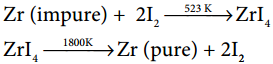
17. The following set of reactions are used in refining Zirconium
Samacheer Kalvi 12th Chemistry Guide Chapter 1 Metallurgy 2
This method is known as
a) Liquation
b) Van Arkel process
c) Zone refining
d) Mond’s process
Answer:
b) Van Arkel process

Samacheer Kalvi 9th English Guide Prose Chapter 2 I Can’t Climb Trees Anymore

18. Which of the following is used for concentrating ore in metallurgy?
a) Leaching
b) Roasting
c) Froth floatation
d) Both (a) and (c)
Answer:
d) Both (a) and (c)

19. The incorrect statement among the following is
a) Nickel is refined by Mond’s process
b) Titanium is refined by Van Arkel’s process
c) Zinc blende is concentrated by froth floatation
d) In the metallurgy of gold, the metal is leached with a dilute sodium chloride solution
Answer:
d) In the metallurgy of gold, the metal is leached with a dilute sodium chloride solution

20. In the electrolytic refining of copper, which one of the following is used as anode?
a) Pure copper
b) Impure copper
c) Carbon rod
d) Platinum electrode
Answer:
b) Impure copper

Samacheer Kalvi 9th English Guide Prose Chapter 2 I Can’t Climb Trees Anymore

21. Which of the following plot gives Ellingham diagram
a) ΔS VsT
b) ΔG° VsT
c) ΔG° Vs1/T
d) ΔG° VsT²
Answer:
b) ΔG°VsT

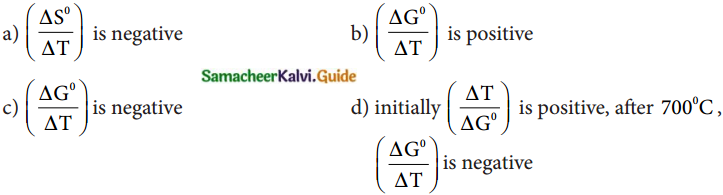
22. In the Ellingham diagram, for the formation of carbon monoxide
Samacheer Kalvi 12th Chemistry Guide Chapter 1 Metallurgy 3
Answer:
c) \(\left(\frac{\Delta \mathrm{G}^{0}}{\Delta \mathrm{T}}\right)\) is negative

23. Which of the following reduction is not thermodynamically feasible?
a) Cr2O3 + 2Al → Al2O3 + 2Cr
b) Al2O3 + 2Cr → Cr2O3 + 2Al
c) 3TiO2 + 4Al → 2Al2O3 + 3Ti
d) None of these
Answer:
b) Al2O3 + 2Cr → Cr2O3 + 2Al

24. Which of the following is not true with respect to the Ellingham diagram?
a) Free energy changes follow a straight line. The deviation occurs when there is a phase change.
b) The graph for the formation of CO2is a straight line almost parallel to the free energy axis.
c) Negative slope of CO shows that it becomes more stable with an increase in temperature.
d) Positive slope of metal oxides shows that their stabilities decrease with an increase in temperature.
Answer:
b) The graph for the formation of CO2 is a straight line almost parallel to the free energy axis.

II. Answer the following questions

Question 1.
What is the difference between minerals and ores?
Answer:
Minerals:

  1. Minerals contain a low percentage of metal.
  2. Metal cannot be extracted easily from minerals.
  3. Clay Al2O3. SiO2. 2H2O is the mineral of aluminium.

Ores:

  1. Ores contain a large percentage of metal.
  2. Ores can be used for the extraction of metals on a large scale readily and economically.
  3. Bauxite Al2O3. 2H2O is the ore of aluminium.

Samacheer Kalvi 9th English Guide Prose Chapter 2 I Can’t Climb Trees Anymore

Question 2.
What are the various steps involved in the extraction of pure metals from their ores?
Answer:
Steps involved in the extraction of pure metals from their ores are

  1. Concentration of the ore
  2. Extraction of the crude metal.
  3. Refining of the crude metal.

Question 3.
What is the role of Limestone in the extraction of iron from its oxide Fe2O3?
Answer:

  • Limestone (CaO) is used as a flux in the extraction of iron from its oxide Fe2O3.
  • Flux is a chemical substance that forms an easily fusible slag with gangue.
  • Oxide of iron can be reduced by carbon monoxide as follows
    Fe2O3(s) + 3CO(g) → 2Fe(s) + 3CO2(g)
  • In this extraction, a basic flux quick lime (or) lime (CaO) reacts with acidic gangue silica to form the slag calcium silicate.

    Samacheer Kalvi 12th Chemistry Guide Chapter 1 Metallurgy 4

Question 4.
Which type of ores can be concentrated by froth floatation method? Give two examples for such ores.
Answer:
Sulphide ores can be concentrated by the froth floatation method.
e.g.,

  1. Copper pyrites (CuFeS2H2)
  2. Zinc blende (ZnS)
  3. Galena (PbS)

Question 5.
Describe a method for refining nickel Mond process for refining nickel: (PTA – 3)
Answer:

  • Impure nickel is heated in a stream of carbon monoxide at around 350K. Nickel reacts with CO to form a highly volatile nickel tetracarbonyl. The solid impurities are left behind.
    Ni(S) + 4CO(g) → Ni(Co)4(g)
  • On heating nickel tetra carbonyl around 460K, the complex decomposes to give a pure nickel.
    Ni(CO)4(g) → Ni(S)+ 4CO(g)

Question 6.
Explain the zone refining process with an example. (PTA – 6 MARCH 2020)
Answer:
1. Zone Refining method is based on the principles of fractional crystallisation. When an impure metal is melted and allowed to solidify, the impurities will prefer to be in the molten region, i.e. impurities are more soluble in the melt than in the solid-state metal.

2. In this process, the impure metal is taken in the form of a rod. One end of the rod is heated using a mobile induction heater which results in the melting of the metal on that portion of the rod.

3. When the heater is slowly moved to the other end the pure metal crystallises while the impurities will move on to the adjacent molten zone formed due to the movement of the heater. As the heater moves further away, the molten zone containing impurities also moves along with it.

4. The process is repeated several times by moving the heater in the same direction again and again to achieve the desired purity level.

5. This process is carried out in an inert gas atmosphere to prevent the oxidation of metals.

6. Elements such as germanium (Ge), silicon (Si) and gallium (Ga) that are used as semiconductors are refined using this process.

Samacheer Kalvi 9th English Guide Prose Chapter 2 I Can’t Climb Trees Anymore

Question 7.
Using the Ellingham diagram
(A) Predict the conditions under which
i) Aluminium might be expected to reduce magnesia.
ii) Magnesium could reduce alumina.
B) It is possible to reduce Fe2O3 by coke at a temperature around 1200K
Answer:
A) i) Ellingham diagram for the formation of Al2O3 and MgO intersects around 1600K. Above this temperature aluminium line lies below the magnesium line. Hence we can use aluminium to reduce magnesia above 1600K.

ii) In Ellingham diagram below 1600K magnesium line lies below aluminium line. Hence below 1600K magnesium can reduce alumina.

B) In Ellingham diagram above 1000K carbon line lies below the iron line. Hence it is possible to reduce Fe2O3 by coke at a temperature around 1200K.

Question 8.
Give the uses of zinc. (PTA – 4)
Answer:

  • Metallic zinc is used in galvanisation to protect iron and steel structures from rusting and corrosion.
  • Zinc is used to produce die – castings in the automobile, electrical and hardware industries.
  • Zinc oxide is used in the manufacture of paints, rubber, cosmetics, pharmaceuticals, plastics, inks, batteries, textiles and electrical equipment.
  • Zinc sulphide is used in making luminous paints, fluorescent lights and x-ray screens.
  • Brass an alloy of zinc which is highly resistant to corrosion is used in water valves and communication equipment.

Question 9.
Explain the electrometallurgy of aluminium.
Answer:
Hall – Heroult Process
Cathode: Iron tanked lined with carbon
Anode: Carbon blocks
Electrolyte: 20% solution of alumina obtained from bauxite + Molten Cryolite +10 % calcium chloride (lowers the melting point of the mixture)
Temperature: Above 1270K
Ionisation of Alumina Al2O3 → +2Al3+ + 3O2-
Reaction at cathode: Al3+ (melt) + 3e → All
Reaction at anode : 2O2- (melt) → O2 (melt) + 4e
Since carbon acts as anode the following reaction also takes place on it.
C(s) + O2 (melt) → CO + 2e
C(s) + 2O2 (melt) → CO2 + 4e
During electrolysis, anodes are slowly consumed due to the above two reactions. Pure aluminium is formed at the cathode and settles at the bottom.
Net electrolysis reaction is
4Al3+ (melt) + 6O2- (melt) + 3C(s) → 4Al(l) + 3CO2(g)

Question 10.
Explain the following terms with suitable examples, i) Gangue ii) Slag (PAT – 2)
Answer:
i) Gangue:
The non-metallic impurities, rocky materials and siliceous matter present in the ores are called gangue.
(eg): SiO2 is the gangue present in the iron ore Fe2O3.

ii) Slag:
Slag is a fusible chemical substance formed by the reaction of gangue with a flux.
Samacheer Kalvi 12th Chemistry Guide Chapter 1 Metallurgy 4

Question 11.
Give the basic requirement for vapour phase refining.
Answer:

  • The metal is treated with a suitable reagent to form a volatile compound.
  • Then the volatile compound is decomposed to give the pure metal.

Question 12.
Describe the role of the following in the process mentioned.
i) Silica in the extraction of copper.
ii) Cryolite in the extraction of aluminium.
iii) Iodine in the refining of Zirconium.
iv) Sodium cyanide in froth floatation.
Answer:
i) In the extraction of copper silica acts as an acidic flux to remove FeO as slag FeSiO3.

Samacheer Kalvi 12th Chemistry Guide Chapter 1 Metallurgy 5

ii) As Al2O2 is a poor conductor cryolite improves the electrical conductivity.
In addition, crvolite serves as an added impurity and lowers the melting point of the electrolyte.

iii) First Iodine forms a Volatile tetraiodide with impure metal, which decomposes to give pure metal. Impure zirconium metal is heated in an evacuated vessel with iodine to form the volatile zirconium tetraiodide (Zrl4). The impurities are left behind, as they do not react with iodine.
Zr(S) + 2I2(S) → Zrl4(Vapour)

On passing volatile zirconium tetraiodide vapour over a tungsten filament, it is decomposed to give pure zirconium.
Zrl4(Vapour) → Zrl(S) + 2I2(S)

iv) Sodium cyanide acts as a depressing agent in froth floatation process. It prevent other metal sulphides from coming to the froth.
eg: NaCN depresses the floatation property ZnS present in Galena (PbS) by forming a layer of Zinc complex Na2[Zn(CN)4] on the surface of Zinc sulphide.

Samacheer Kalvi 9th English Guide Prose Chapter 2 I Can’t Climb Trees Anymore

Question 13.
Explain the principle of electrolytic refining with an example. (PTA – 5)
Answer:

  • Crude metal is refined by electrolysis carried out in an electrolytic cell.
  • Cathode: Thin strips of pure metal.
    Anode: Impure metal to be refined.
    Electrolyte: Aqueous solution of the salt of the metal with dilute acid.
  • As the current is passed, the metal of interest dissolves from the anode and passes into the electrolytic solution.
  • At the same time, same amount of metal ions from the electrolytic solution will be deposited at the cathode.
  • Less electro positive impurities in the anode settle down as anode mud.
  • eg: Electrorefining of silver:
    Cathode: Pure silver Anode: Impure silver rods.
    Electrolyte: Acidified aqueous solution of silver nitrate.
  • On passing current the following reactions will take place.
    Reaction at anode: Ag(s) → Ag+(aq) + e
    Reaction at cathode: Ag+(aq) + e → Ag(s)
  • At anode silver atoms lose electrons and enter the solution. From the solution silver ions migrate towards the cathode. At cathode silver ions get discharged by gaining electrons and deposited on the cathode.

Question 14.
The selection of reducing agent depends on the thermodynamic factor: Explain with an example.
Answer:

  • A suitable reducing agent is selected based on the thermodynamic considerations.
  • For a spontaneous reaction AG should be negative.
  • Thermodynamically, the reduction of metal oxide with a given reducing agent can occur if AG for the coupled reaction is negative.
  • Hence the reducing agent is selected in such a way that it provides a large negative value for the coupled reaction.
  • Ellingham diagram is used to predict thermodynamic feasibility of reduction of oxides of one metal by another metal.
  • Any metal can reduce the oxides of other metals that are located above it in the diagram.
  • Ellingham diagram for the formation of FeO and CO intersects around 1000K. Below this temperature the carbon line lies above the iron line.
  • Hence FeO is more stable than CO and the reduction is not thermodynamically feasible.
  • However above 1000K carbon line lies below the iron line. Hence at this condition, FeO is less stable than CO and the reduction is thermodynamically feasible. So coke can be used as a reducing agent above this temperature.
  • Following free energy calculation also confirm that the reduction is thermo¬dynamically favoured.
  • From theEllingham diagram at 1500K
    2Fe(s) + O2(g) → 2FeO(g) = 350 KJmol-1 …………….. 1
    2C(s) + 022(g) → 2CO(g) = 480 KJmol-1 ……………… 2
    Reverse the reaction 1
    2FeO(s) → 2Fe(s) + O2(g) = 350 KJmol-1 ……………… 3
    Couple the reactions 2 and 3
    2FeO(s) + 2C(s) → 2Fe(s)+ 2CO(g) = 130 KJmol-1 ……………… 4
  • The standard tree energy change for the reduction of one mole of FeO is = \(\frac{\Delta \mathrm{G}_{3}}{2}\) = -65 KJmol-1

Question 15.
Give the limitations of Ellingham diagram.
Answer:

  • Ellingham diagram is constructed based only on thermodynamic considerations.
  • It gives information about the thermodynamic feasibility of a reaction.
  • It does not tell anything about the rate of the reaction.
  • Moreover, it does not: give an idea about the possibility of other reactions that might be taking place.
  • The interpreparation of G is based on the assumption that the reactants are in equilibrium with the product which is not always true.

Question 16.
Write a short note on electrochemical principles of metallurgy.
Answer:

  • Reduction of oxides of active metals such as sodium, potassium etc. by carbon is thermodynamically not feasible.
  • Such metals are extracted from their ores by using electrochemical methods.
  • In this method the metal salts are taken infused form or in solution form.
  • The metal ion present can be reduced by treating the solution with a suitable reducing agent or by electrolysis.
  • Gibbs free energy change for the electrolysis is ∆G° = nFE°
    n = number of electrons involved in the reduction
    F = Faraday = 96500 coulombs
    E° = electrode potential of the redox couple.
  • If E° is positive, is negative and the reduction is spontaneous.
  • Hence a redox reaction is planned in such a way that the e.mi of the net redox reaction is positive.
    A more reactive metal displaces a less reactive metal from its salt solution.
    eg;Cu2+(aq) + Zn(s) → Cu(s) + Zn2+(aq)
  • Zinc is more reactive than copper and displaces copper from its salt solution.

III. Evaluate yourself

Question 1.
Write the equation for the extraction of silver by leaching with sodium cyanide and show that the leaching process is a redox reaction.
Answer:
Ag → Ag+ (O.N increases from 0 to +1, hence oxidation)
O2 OH (O.N decreases from 0 to -2, hence reduction)
The leaching of silver is a redox reaction.

Question 2.
Magnesite (Magnesium carbonate) is calcined to obtain magnesia, which is used to make refractory bricks. Write the decomposition reaction
Answer:
MgCO3\(\underrightarrow { \triangle } \) MgO + CO2

Samacheer Kalvi 9th English Guide Prose Chapter 2 I Can’t Climb Trees Anymore

Question 3.
Using the Ellingham diagram (fig 1.4) indicates the lowest temperature at which ZnO can be reduced to Zinc metal by carbon. Write the overall reduction reaction at this temperature
Answer:
Ellingham diagram for the formation of ZnO and CO intersects around 1200K Below this temperature, Carbon line lies above Zinc line. Hence ZnO is more stable than CO so the reduction is thermodynamically not feasible at this temperature range. However above 1200K carbon line lies below the zinc line, hence carbon can be used as a reducing agent above 1200K.
2Zn + O2 → 2ZnO ………………….. 1
2C + O2 → 2CO ………………….. 2
Reversing 1 and adding with equation 2
2ZnO → 2Zn + O2
2C + O2 → 2CO
2ZnO +2C → 2Zn + 2CO

Question 4.
Metallic Sodium is extracted by the electrolysis of brine (aq.NaCl). After electrolysis, the electrolytic solution becomes basic in nature. Write the possible electrode reactions.
Answer:
2NaCl(aq) → 2Na+(aq) + 2Cl(aq)
Anode: 2Cl(aq) → Cl2(g) + 2e
Cathode: 2H2O(l) + 2e → H2(g) + 2OH(aq)
Nothing happens to sodium ion but it is still important. Na+ ions are spectator ions and combine with OH ions to form NaOH
Three products are H2, Cl2 and NaOH
Over all equation is
2NaCl(aq) + 2H2O → H2(g) + Cl2(g) + 2NaOH(aq)
Ionic equation is
2H2O(l) + 2Cl(aq) + 2Na(aq) → 2Na+(aq) + 2OH(aq) + H2(g) + Cl2(g)
(or)
2H2O(l) + 2Cl(aq) → 2OH(aq) + H2(g) + Cl2(g)

12th Chemistry Guide Metallurgy Additional Questions and Answers

Part – II – Additional Questions one mark

I. Match the following
1.

Ore Formula
1. Magnetite a) ZnCO3
2. Cuprite b) PbCO3
3. Calamine c) Fe3O4
4. Cerrusite d) SnO2
5. Cassiterite e) Cu2O

Answer:

Ore Formula
1. Magnetite c) Fe3O4
2. Cuprite e) Cu2O
3. Calamine a) ZnCO3
4. Cerrusite b) PbCO3
5. Cassiterite d) SnO2

2.

Ore of metal Name
1. Ore of copper a) Diaspore
2. Ore of aluminium b) Chlorargyrite
3. Ore of iron c) Malachite
4. Ore of lead d) Limonite
5. Ore of silver e) Anglesite

Answer:

Ore of metal Name
1. Ore of copper c) Malachite
2. Ore of aluminium a) Diaspore
3. Ore of iron d) Limonite
4. Ore of lead e) Anglesite
5. Ore of silver b) Chlorargyrite

3.

Concentration Ore
Gravity separation a) Pyrolusite
Froth floatation b) Alumina
Cyanide leaching c) Zinc blende
Alkali leaching d) Tinstone
Magnetic separation e) Gold

Answer:

Concentration Ore
Gravity separation d) Tinstone
Froth floatation c) Zinc blende
Cyanide leaching e) Gold
Alkali leaching b) Alumina
Magnetic separation a) Pyrolusite

4.

Purification Metal
1. Distillation a) Silicon
2. Liquation b) Zinc
3. Electrolytic refining c) Nickel
4. Zone refining d) Tin
5. Mond process e) Silver

Answer:

Purification Metal
1. Distillation b) Zinc
2. Liquation d) Tin
3. Electrolytic refining e) Silver
4. Zone refining a) Silicon
5. Mond process c) Nickel

II. Fill in the blanks

1. The metal which shows high resistance to corrosion and used in the design of Chemical reactors is ___________ .
Answer:
Aluminium

2. ___________ are used for increasing the efficiency of the solar cells.
Answer:
Gold nanoparticles

3. The removal of gangue from ores is called as ___________ .
Answer:
Concentration of ores

4. ___________ is the process in which concentrated ore is strongly heated in the absence of air.
Answer:
Calcination

III. Find the odd man out.

1. a) Sphalerite b) Galena c) Azurite d) Iron pyrite
Answer:
c) Azurite. This is a basic carbonate ore others are sulphide ores.

2. a) Malachite b) Limonite c) Siderite d) Haematite
Answer:
a) Malachite. This is the ore of copper, others are ores of iron.

IV. Choose the incorrect pair.

1. a) Malachite, Azurite b) Ruby silver, Horn silver c) Zincite, Cuprite d) Anglesite, Cerrusite
Answer:
c) Zincite, Cuprite. They are ores of Zinc and copper

Samacheer Kalvi 9th English Guide Prose Chapter 2 I Can’t Climb Trees Anymore

2. a) Kaolinite, Aluminium b) Stefinite, Silver c) Galena, Lead d) Prousitite, Tin
Answer:
d) Prousitite, Tin. Correct pair is prousitite, silver.

V. Choose the correct pair.

1. Choose the correct pair.
a) Cerrusite, Cassiterite b) Siderite, Limonite c) Anglesite, Zincite d) Azurite, Kaolinite
Answer:
b) Siderite, Limonite. Both are ores of irons.

2. a) Diaspore, Copper b) Galena, Tin c) Stefinite, Silver d) Malachite, Aluminium
Answer:
c) Stefinite, Silver. Stefinite is the ore of silver

VI. Assertion and Reason

1. Assertion (A): Tinstone ore is concentrated by magnetic separation.
Reason (R) : Wolframite impurities are magnetic
i) A and R are correct, R explains A.
ii) A is correct, R is wrong
iii) A is wrong, R is correct
iv) A and R are correct but R does not explain A.
Answer:
i) A and R are correct, R explains A. 2

2. Correct Assertion (A): Aluminium can be commercially extracted from china clay which is a profitable one
Reason (R): China clay is a mineral of aluminium.
i) A and R are correct, R explains A.
ii) A is correct, R is wrong
iii) A is wrong, R is correct
iv) A and R are correct but R does not explain A.
Answer:
iii) A is wrong, R is correct
Correct Assertion: Aluminium can be commercially extracted from bauxite which is a profitable ore

Samacheer Kalvi 9th English Guide Prose Chapter 2 I Can’t Climb Trees Anymore

3. Assertion (A): Zinc blend can be concentrated by the froth floatation method.
Reason (R) : Metallic ore particles are preferentially wetted by water and settle at the bottom.
A and R are correct, R explains A.
A is correct, R is wrong A is wrong, R is correct A and R are correct but R does not explain A.
Answer:
ii) A is correct, R is wrong
Correct (R) : Metallic particles are preferentially wetted by oil and rise to the surface.

4. Assertion (A) : Cr2O3 is reduced into chromium by aluminothermic process.
Reason (R): Aluminium acts as the reducing agent.
i) A and R are correct, R explains A.
ii) A is correct, R is wrong
iii) A is wrong, R is correct
iv) A and R are correct but R does not explain A.
Answer:
i) A and R are correct, R explains A.

VII. Choose the correct statement

1. a) Metals having more chemical reactivity occur as native elements.
b) Removal of gangue from ores is called refining.
c) Tin stone ore is concentrated by gravity separation.
d) Silver glance is a carbonate ore.
Answer:
c) Tin stone ore is concentrated by gravity separation.

2. a) In froth floatation sodium ethyl xanthate acts as a collector.
b) In leaching the ore is converted into insoluble salt or complex and the gangue remains in the solution.
c) Ammonia leaching is suitable for gold and silver.
d) Bauxite ore is subjected to acid leaching.
Answer:
a) In froth floatation sodium ethyl xanthate acts as a collector.

Samacheer Kalvi 9th English Guide Prose Chapter 2 I Can’t Climb Trees Anymore

3. a) Calcination is the process in which concentrated ore is strongly heated in the presence of air.
b) Flux is a chemical substance that forms an easily fusible slag with gangue.
c) In aluminothermic process the ignition mixture used is magnesium peroxide and barium.
d) Any metal can reduce the oxides of other metals that are located below it in Ellingham diagram.
Answer:
b) Flux is a chemical substance that forms an easily fusible slag with gangue.

4. a) In electrorefining pure metal is taken as anode and impure metal is taken as cathode.
b) Distillation is employed for high boiling nonvolatile metals.
c) Zone refining is based on the principle of fractional crystallisation.
d) Mond’s process is used for refining titanium.
Answer:
c) Zone refining is based on the principle of fractional crystallisation.

VIII. Choose the incorrect statement

1. i) In cyanide leaching gold is converted into an insoluble cyanide complex.
ii) In ammonia leaching nickel forms a soluble complex.
iii) In alkali leaching aluminum forms an insoluble complex,
a) i & ii
b) i & iii
c) ii & iii
d) i, ii, iii
Answer:
D) i,ii & iii

2. i) In the Ellingham diagram for most of the metal oxide forming the slope is negative.
ii) Oxygen gas is consumed during the formation of metal oxides resulting in the increase of randomness.
iii) As temperature increases value for the formation of the metal oxide become more negative
a) i & ii
b) i & iii
c) ii & iii
d) i, ii, & iii
Answer:
c) ii & iii

3. i) The reduction of oxides of active metals such as sodium, potassium, etc. by carbon is thermodynamically feasible
ii) When a more reactive metal is added to the solution containing less reactive metal, the less reactive metal will go into the solution.
iii) Copper displaces zinc from zinc salt
solution.
a) i & ii
b) i & iii
c) ii & iii
d) i, ii, iii
Answer:
d) i, ii & iii

Samacheer Kalvi 9th English Guide Prose Chapter 2 I Can’t Climb Trees Anymore

4. i) When an impure metal is melted and allowed to solidify, the impurities will prefer to be in the solid region.
ii) Zone refining is carried out in an inert gas atmosphere to prevent the reduction of metals.
iii) Elements such as germanium, silicon, and gallium are refined by zone refining.
a) i & ii
b) i & iii
c) ii & iii
d) i, ii, iii
Answer:
a) i & ii

IX. Choose the best answer.

1. Which of the following is not an oxide ore?
a) Cuprite
b) Siderite
c) Cassiterite
d) Zincite
Answer:
b) Siderite

2. Which of the following is an oxide ore?
a) Sphalerite
b) Calamine
c) Cassiterite
d) Stefinite
Answer:
c) Cassiterite

3. The process of converting hydrated alumina into anhydrous alumina is called
a) Roasting
b) Smelting
c) Auto-reduction
d) Calcination
Answer:
d) Calcination

4. Which of the following is a sulphide ore?
a) Pyrargyrite
b) Malachite
c) Limonite
d) Kaolinite
Answer:
a) Pyrargyrite

Samacheer Kalvi 9th English Guide Prose Chapter 2 I Can’t Climb Trees Anymore

5. Which of the following is not a carbonate ore?
a) Siderite
b) Calamine
c) Cerrusite
d) Cassiterite
Answer:
d) Cassiterite

6. Which of the following is a carbonate ore?
a) Limonite
b) Siderite
c) Magnetite
d) Haematite
Answer:
b) Siderite

7. Which of the following is the ore of iron?
a) Limonite
b) Azurite
c) Stefinite
d) Cerrusite
Answer:
a) Limonite

8. Which of the following is not an ore of iron?
a) Haematite
b) Magnetite
c) Siderite
d) Anglesite
Answer:
d) Anglesite

9. Which of the following is an ore of silver?
a) Azurite
b) Prousitite
c) Cerrusite
d) Limonite
Answer:
b) Prousitite

10. Which of the following is a sulphate ore?
a) Galena
b) Zinc blende
c) Cerrusite
d) Anglesite
Answer:
d) Anglesite

11. Non-metallic impurities, rocky materials, and siliceous matter which are associated with ores are called as.
a) Slag
b) Flux
c) Gangue
d) residue
Answer:
c) Gangue

Samacheer Kalvi 9th English Guide Prose Chapter 2 I Can’t Climb Trees Anymore

12. Gravity separation is suitable for
a) Oxide ore
b) Sulphide ore
c) Carbonate ore
d) Sulphate ore
Answer:
a) Oxide ore

13. Froth floatation is suitable for
a) Oxide ore
b) Sulphide ore
c) Carbonate ore
d) Sulphate ore
Answer:
b) Sulphide ore

14. In froth floatation, pine oil is used as a
a) Collector
b) depressing agent
c) Frothing agent
d) Flux
Answer:
c) Frothing agent

15. In froth floatation sodium ethyl Xanthate is used as a
a) Collector
b) depressing agent
c) frothing agent
d) Flux
Answer:
a) Collector

16. In froth floatation sodium cyanide is used as a
a) Collector
b) depressing agent
c) frothing agent
d) Flux
Answer:
b) depressing agent

17. The floatation property of the impurity ZnS present in galena is depressed by adding
a) Pure oil
b) Eucalyptus oil
c) Sodium cyanide
d) Sodium ethyl Xanthate
Answer:
c) Sodium cyanide

18. Which method of purification represented by the equation?
Ti(Impure) + 2I2 \(\underrightarrow { 550K } \) Til4 \(\underrightarrow { 1800K } \) Ti(pure) + 2I2
a) Cupellation
b) Zone refining
c) Van-Arkel method
d) Mond’s process
Answer:
c) Van-Arkel method

Samacheer Kalvi 9th English Guide Prose Chapter 2 I Can’t Climb Trees Anymore

19. Concentration of gold ore is done by
a) Cyanide leaching
b) Ammonia leaching
c) Alkali leaching
d) Acid leaching
Answer:
a) Cyanide leaching

20. Ammonia leaching is done for the concentration of the ore of
a) Silver
b) Copper
c) Aluminium
d) Zinc
Answer:
b) Copper

21. During roasting sulphide ores are converted into their
a) Metals
b) Oxides
c) Carbonates
d) nitrates
Answer:
b) Oxides

22. During the calcination of carbonate ore the expelled gas is
a) Carbon monoxide
b) Carbon dioxide
c) Sulphur dioxide
d) Nitrogen dioxide
Answer:
b) Carbon dioxide

23. Sulphite ores of metals are usually concentrated by froth floatation process. Which one of the following sulphide ore offers an exception and is concentrated by chemical leaching.
a) Argentite
b) galena
c) Copper pyrites
d) Sphalerite
Answer:
a) Argentite

24. Cinnabar is converted into mercury by
a) Reduction by metal
b) Reduction by hydrogen
c) Reduction by carbon
d) Auto reduction
Answer:
d) Auto reduction

25. Thermodynamically the reduction of metal oxide with a given reducing agent can occur if the free energy change for the coupled reaction is
a) Positive
b) Negative
c) One
d) Zero
Answer:
b) Negative

26. For the reduction of metal oxide into metal a reducing agent is selected in such a way that for the coupled reaction it provides a
a) Large positive G value
b) Small positive G value
c) Large negative G value
d) Small negative G value
Answer:
c) Large negative G value

27. For the formation of various metal oxides Ellingham diagram is a graphical representation between
a) G° & S
b) G° & H
c) G° & T
d) H & S
Answer:
c) G° & T

28. In the Ellingham diagram, for most of the metal oxide formation the slope is
a) Positive
b) Negative
c) Zero
d) One
Answer:
a) Positive

29. Elements like Silicon and Germanium to be used as a semiconductor is purified by (PTA – 1)
a) heating under Vaccum
b) Van-Arkel method
c) Zone refining
d) Electrolysis
Answer:
c)Zone refining

30. If the e.m.f of the net redox reaction is positive, its G is
a) Positive
b) Negative
c) Zero
d) One
Answer:
b) Negative

31. Which of the following metal is refined by distillation?
a) Tin
b) Lead
c) Zinc
d) Bismuth
Answer:
c) Zinc

32. Which of the following is not refined by zone refining?
a) Germanium
b) Zirconium
c) Silicon
d) Gallium
Answer:
b) Zirconium

Samacheer Kalvi 9th English Guide Prose Chapter 2 I Can’t Climb Trees Anymore

33. Which of the following is refined by the Mond process?
a) Silicon
b) Copper
c) Nickel
d) Zinc
Answer:
c) Nickel

34. Which of the following is defined by Van
Arkel method?
a) Gallium
b) Titanium
c) Germanium
d) Silicon
Answer:
b) Titanium

35. Which of the following metal is used in galvanization?
a) Copper
b) Aluminium
c) Zinc
d) Gold
Answer:
c) Zinc

36. Which is used in making luminous paints, fluorescent lights, and x-ray screens?
a) Brass
b) Zinc sulphide
c) Cast iron
d) Gold nanoparticles
Answer:
b) Zinc sulphide

37. Which is used for increasing the efficiency of solar cells?
a) Brass
b) Zinc sulphide
c) Cast iron
d) Gold nanoparticles
Answer:
d) Gold nanoparticles

38. Which is not refined by liquation?
a) Tin
b) Zinc
c) Lead
d) Bismuth
Answer:
b) Zinc. Zinc is refined by distillation.

39. Which is not refined by zone refining?
a) Silicon
b) Gallium
c) Zirconium
d) Germanium
Answer:
c) Zirconium. Zirconium is refined by Van Arkel method

X. Two Mark Questions

Question 1.
What is a mineral?
Answer:
A naturally occurring substance obtained by mining, which contains the metal in a free state or in the form of compounds like oxides, sulphides, etc; is called a mineral.

Question 2.
What is an ore?
Answer:
A mineral which contains high percentage of metal, from which it can be extracted conveniently and economically is called an ore.

Samacheer Kalvi 9th English Guide Prose Chapter 2 I Can’t Climb Trees Anymore

Question 3.
What is a concentration of ores?
Answer:
The removal of non metallic impurities, rocky materials and siliceous matter (called as gangue) from the ores is known as concentration of ores.

Question 4.
What is leaching?
Answer:
The process of dissolving metal present in an ore in a suitable solvent to form a soluble metal salt or complex leaving the gangue undissolved is called leaching.

Question 5.
What is the reaction of Ammonia with Iron and copper salts? (PTA – 4)
Answer:
Ammonia reacts with metallic salts to give metal hydroxides (in case of Fe) or forming complexes (in case of Cu)
Fe3+ + 3NH+4 → Fe(OH)3 + 3NH+4
Cu2+ + 4NH3 → [Cu(NH3)4 ]2+
Tetra ammine copper (II) ion

Question 6.
What is acid leaching?
Answer:

  • Sulphide ores ZnS, PbS can be leached with hot aqueous sulphuric acid.
  • In this process, the insoluble sulphide is converted into soluble sulphate and elemental sulphur.
    2ZnS(s) + 2H2SO4(aq) + O2(g) → 2ZnSO4(aq) + 2S(s) + 2H2O

Question 7.
What is the role of the depressing agent In the froth flotation process? (PTA – 1)
Answer:
When impurities such as ZnS is present in galena (PbS), sodium cyanide (NaCN) is added to depresses the flotation property of ZnS by forming a layer of zinc complex Na2[Zn(CN)4] on the surface of zinc sulphide.

Samacheer Kalvi 9th English Guide Prose Chapter 2 I Can’t Climb Trees Anymore

Question 8.
In the extraction of metal, the ore is first converted into metal oxide before reduction into metal, why?
Answer:

  • In the concentrated ore, the metal exists in a positive oxidation state and hence it is to be reduced to an elemental state.
  • From the principles of thermodynamics, the reduction of oxide is easier compared to the reduction of other compounds of metal.
  • Hence before reduction, the ore is first converted into metal oxide.

Question 9.
Write about roasting.
Answer:

  • Roasting is applied for the conversion of sulphide ores into their oxides.
  • Concentrated ore is oxidised by heating with excess of oxygen below the melting point of the metal in a suitable furnace.
    2PbS + 3O2 → 2PbO+ 2SO2
  • Roasting also removes impurities like aresenic, sulphur, phosphorous into their volatile oxides.
    4As + 3O2 → 2AS2O3

Question 10.
Write about the extraction of metal by the process of reduction by carbon.
Answer:

  • In this method oxide ore of the metal is mixed with coal (coke) and heated strongly in a blast furnace.
  • This method can be applied to metals which do not form carbides with carbon at the reduction temperature.
    ZnO(s) + C → Zn(s) + CO(g)

Question 11.
Write about the extraction of metal by the process of reduction by hydrogen.
Answer:

  •  This method can be applied to the oxides of the metals (Fe, Pb, Cu) which are less electropositive than hydrogen.
    Ag2O(s) + H2(g) 2Ag(s) + H2O(l)
  • Nickel oxide is reduced to nickel by a mixture of hydrogen and carbon monoxide (water gas)
    2NiO(s) + CO(g) + H2(g) → 2Ni(s) + CO2(g) + H2O(l)

Question 12.
Write about the extraction of metal by the process of reduction by metal.
Answer:

  • In this process a metal oxide is reduced to metal by some active metals, like sodium, potassium and calcium.
    Rb2O3 + 3Mg → 2Rb + 3MgO
    TiO2 + 2Mg → Ti + 2MgO
    ThO2 + 2Ca \(\underrightarrow { 1260K } \) Th + 2CaO
  • Alumino thermite process is also an example of reduction by metal.

Question 13.
How Cr2O3 is reduced to Cr by Al powder? (PTA – 6)
Answer:

  • In this method a metal oxide is reduced to metal by aluminium.
  • It is an exothermic process where heat is liberated.
  • Cr2O3 is mixed with aluminium powder in a fire clay crucible.
  • Ignition mixture is magnesium and barium peroxide.
    BBaO2 + Mg —> BaO + MgO
  • Temperature = 2400°C Heat liberated = 852KJmol-1 This heat helps the reduction of Cr2O3 by Al.
    Cr2O3 + 2Al \(\underrightarrow { \triangle } \) 2Cr + Al2O3

Question 14.
What is auto reduction of metallic ores?
Answer:

  • Simple roasting of some of the metallic ores give the crude metal.
  • Use of reducing agent is not necessary.
  • (eg) Cinnabar is roasted to give mercury.
    HgS(s) + O2(g) → Hg(l) + SO2(g)

Question 15.
What is the role of graphite rods in the electrometallurgy of Aluminium? (PTA – 1)
Answer:
Electrolysis is carried in an iron tank lined with carbon which acts as a cathode. The carbon blocks immersed in the electrolyte acts as a anode.

Samacheer Kalvi 9th English Guide Prose Chapter 2 I Can’t Climb Trees Anymore

Question 16.
Write about the distillation process of refining a metal?
Answer:
In this method, impure metal is heated to evaporate and the vapours are condensed to get pure metal.

This method is used for low boiling volatile metals like zinc and mercury.

Question 17.
Write about the liquation process of refining a metal?
Answer:

  • This method is used to remove the impurities with high melting points from metals having relatively low melting points,
    (eg) Tin, lead, mercury, bismuth.
  • Crude metal is heated to form a fusible liquid and allowed to flow on a sloping surface.
  • Impure metal is placed on the sloping hearth of a reverberatory furnace.
  • Impure metal is heated just above the melting point of the metal in the absence of air.
  • The molten pure metal flows down. Impurities are left behind.
  • Molten metal is collected and solidified.

Question 18.
Write the applications or uses of copper.
Answer:

  • Copper is the first metal used by humans and extended use of its alloy bronze resulted in a new era, ‘Bronze age’.
  • Used for making coins and ornaments along with gold and other metals.
  • Copper and its alloys are used for making wires, water pipes and other electrical parts.

Question 19.
Write the applications or uses of gold.
Answer:

  • Gold is one of the expensive and precious metals.
  • Used for coinage and has been used as standard for monetary systems in some countries.
  • Extensively used in jewellery in its alloy form with copper.
  • Used in electroplating to cover other metals with a thin layer of gold in watches, artificial limb joints, cheap jewelry, dental fillings and electrical connectors.
  • Gold nanoparticles are used for increasing the efficiency of solar cells.
  • Used as catalyst.

Question 20.
Describe the underlying principle of froth floation process. (PTA – 3)
Answer:
This method is commonly used to concentrate sulphide ores such as galena (pbs) Zinc blende (Zns)

In this method, the metalic ore particles which are preferentially wetted by oil can be separated from gangue.

XI. Three Mark Questions

Question 1.
Write about gravity separation or hydraulic wash?
Answer:

  • Ore with high specific gravity is separated from gangue with low specific gravity by simply washing with running water.
  • The finely powdered ore is treated with rapidly flowing current of water.
  • Lighter gangue particles are washed away by the running water.
  • This method is used for concentrating native ore such as gold and oxide ores such as haematite, tinstone.

Question 2.
What is cyanide leaching?
Answer:

  • Crushed ore of gold is leached with aerated dilute solution of sodium cyanide.
  • Gold is converted into a soluble cyanide complex.
  • The gangue alumino silicate remains insoluble.
    4Au(s) + 8CN(aq) + O2(g)+ 2H2O(l) → 4[Au(CN)2](aq) + 4OH(aq)
  • Gold can be recovered by reacting the deoxygenated leached solution with Zinc. Gold is reduced to its elemental state (zero oxidation state.)
  • This process is called cementation.
    Zn(s) + 2[Au(CN)2](aq) → [Zn(CN)4]2-(aq) + 2Au(s)

Question 3.
Write about alkali leaching?
Answer:

  • In this method, the ore is heated with aqueous alkali to form a soluble complex.
  • Bauxite is heated with a solution of sodium hydroxide or sodium carbonate at 470K – 520K and 35 atm to form soluble sodium meta aluminate.
  • The impurities iron oxide and titanium oxide are left behind.
    Al2O3(s) + 2NaOH(aq) + 3H2O(l) → 2Na [Al(OH)4](aq)
  • The hot solution is decanted, cooled and diluted.
  • This solution is neutralised by passing CO2 gas to form a hydrated Al2O3 precipitate.
    2Na[AZ(0H)4](aq)4CO2(g) → Al2O3.XH2O(s) + 2NaHCO3(aq)
  • The precipitate is filtered off and heated around 1670K to get pure Alumina Al2O3.

Question 4.
Write about magnetic separation.
Answer:

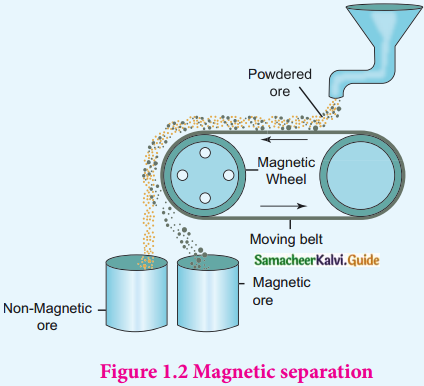
  • This method is applicable to ferromagnetic ores.
  • It is based on the difference in the magnetic properties of the ore and the impurities.
  • Non-magnetic tin stone can be separated from the magnetic impurities wolframite.
  • Similarly magnetic ores chromite, pyrolusite can be removed from non-magnetic siliceous impurities.
    Samacheer Kalvi 12th Chemistry Guide Chapter 1 Metallurgy 6
  • Crushed ore is poured on to an electromagnetic separator with a belt moving over two rollers of which one is magnetic.
  • The magnetic part of the ore is attracted towards the magnet and falls as a heap close to the magnetic region.
  • The non-magnetic part falls away from it.

Question 5.
Write about calcination. (PTA – 4)
Answer:

  • Calcination is the process in which the concentrated ore is strongly heated in the absence of air.
  • During this process water of crystallisation present in the hydrated oxide escapes as moisture.
  • Any organic matter present also get expelled leaving the ore porous.
  • This method can also be carried out with a limited supply of air.
  • During the calcination of carbonate ore, carbon dioxide is liberated.
    PbCO3 \(\underrightarrow { \triangle } \) PbO + CO2
    CaCO3 \(\underrightarrow { \triangle } \) CaO + CO2
    Al2O3. 2H2O \(\underrightarrow { \triangle } \) Al2O3(s) + 2H2O(g)

Samacheer Kalvi 9th English Guide Prose Chapter 2 I Can’t Climb Trees Anymore

Question 6.
Write about smelting.
Answer:

  • Smelting is a process in which the concentrated ore is mixed with a mixture of a flux and reducing agent in a smelting furnace.
  • Flux is a chemical substance which forms an easily fusible slag with gangue.
  • Carbon, carbon monoxide, and aluminium are used as reducing agents.
  • Iron oxide can be reduced by carbon monoxide.
    Fe2O3(s) + 3CO(g) → 2Fe(s) + 3CO2(g)
  • Silica gangue present m the ore is acidic, hence a basic flux lime combines with it forming slag calcium silicate.

    Samacheer Kalvi 12th Chemistry Guide Chapter 1 Metallurgy 7

Question 7.
Write about the Ellingham diagram.
Answer:

  • The graphical representation of the variation of the standard Gibbs free energy for the formation of various metal oxides with temperature is called the Ellingham diagram.
  • Change in Gibbs free energy ∆G is given as ∆G = ∆H – T∆S
    ∆H = Enthalpy change T = Temperature in Kelvin S = Entropy change.
  • For an equilibrium, ∆G° can be calculated using the equilibrium constant by the equation.
    ∆G° = -RT In Kp
  • By treating the reduction of metal oxides as an equilibrium process Harold Ellingham used the above relationship to calculate ∆G° values at various temperatures.
  • Fie Plotted T in the x-axis and ∆G° for the formation of metal oxides in the y axis.
  • He obtained a straight line graph with ∆S as slope and ∆H as the y-intercept.

Question 8.
Write the observations from the Ellingham diagram.
Answer:

  • For most of the metal oxide forming the slope is positive. This can be explained as follows. Oxygen gas is consumed during the formation of metal oxides resulting in the decrease of randomness. Hence ∆S becomes negative, T∆S is positive in the straight line equation.
  • For the formation of carbon monoxide the graph is a straight line with a negative slope. In this case ∆S is positive because 2 moles of CO. gas is formed by consuming 1 mole of oxygen gas. This shows CO is more stable at higher temperature.
  • As temperature increases ∆G for the formation of metal oxide becomes less negative and becomes zero at a particular temperature. Below this temperature is negative and the oxide is stable. Above this temperature ∆G is positive and the oxide is less stable. Metal oxides become less stable at higher temperature and their decomposition becomes easier.
  • Due to phase transition (melting or evaporation) there is a sudden change in the slope at a particular temperature for some metal oxides like MgO, HgO.

Question 9.
Write about Van – Arkel method for refining zirconium/titanium?
Answer:

  • This method is based on the thermal decomposition of metal compounds to metals.
    (eg) Titanium and Zirconium.
  • Impure titanium is heated in an evacuated vessel with iodine at 550K to form volatile titanium tetraiodide.
  • The impurities do not react with iodine.
    Ti(s) + 2I2(s) → Til4(vapour)
  • Volatile titanium tetraiodide is passed over a tungsten filament at 1800K.
  • Titanium tetraiodide is decomposed to pure titanium which is deposited over the filament.
  • Iodine is reused. TiI4(vapour) → Ti(s) + 2I2(s)

Question 10.
Write the applications or uses of aluminium.
Answer:

  • For making heat exchangers/ sinks.
  • For making our day to day vessels.
  • For making aluminium foils for packing, food items.
  • Alloys of aluminium with copper, manganese, magnesium, silicon are lightweight and strong hence used in design of aeroplanes and other forms of transport.
  • Due to its high resistance to corrosion, it is used in the design of chemical reactors, medical equipments, refrigeration units and gas pipelines.
  • It is a good electrical conductor and cheap, hence used in electrical overhead cables with a steel core for strength.

Samacheer Kalvi 9th English Guide Prose Chapter 2 I Can’t Climb Trees Anymore

Question 11.
Write the applications or uses of iron.
Answer:

  • Iron is one the most useful metals and its alloys are used everywhere including bridges, electricity pylons, bicycle chains, cutting tools and rifle barrels.
  • Cast iron is used to make pipes, valves and pumps stoves etc.
  • Magnets can be made of iron and its alloys and compounds.
  • An important alloy of iron is stainless steel which is very resistant to corrosion.
  • It is used in architecture, bearings, cutlery, surgical instruments and jewellery.
  • Nickel steel is used for making cables, automobiles, and aeroplane parts.
  • Chrome steels are used for manufacturing cutting tools and crushing machines.

Question 12.
Out of coke and CO, which is a better reducing agent for the reduction of ZnO? why? (PTA – 2)
Answer:

  • Out of coke and CO, coke is a better reducing agent than CO for the reduction of ZnO.
  • Reduction by carbon can be applied to zinc which does not form carbide with carbon at the reduction temperature.
    ZnO(s) + C → Zn(s) + CO(g)
  • ZnO lies above CO in the Ellingham diagram meaning that CO is more stable than ZnO. Hence carbon can be used as a reducing agent for the reduction of ZnO. During reduction oxygen from ZnO combines with carbon used for reduction.

XII. Five Mark Questions

Question 1.
Explain the froth floatation method.
Answer:

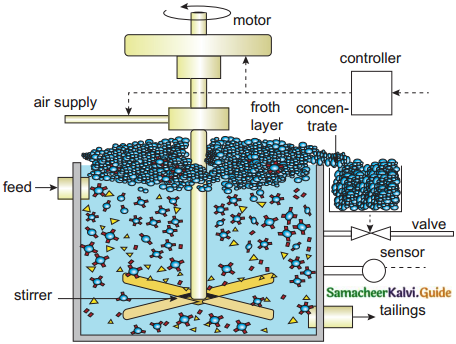
  • This is used to concentrate sulphide ores such as galena (PbS) Zinc blende (ZnS) etc.
  • Metallic ore particles preferentially wetted by oil can be separated from gangue.
  • Crushed ore is mixed with water and a frothing agent like pine oil or eucalyptus oil.
  • A small amount of sodium ethyl xanthate is added as a collector.
  • A froth is formed by blowing air through the mixture.
  • The collector molecules attach to the ore particles and make them water repellent.
  • As a result ore particles wetted by the oil rise to the surface along with the froth.
  • The froth is skimmed off and dried to recover the concentrated ore.
  • Gangue particles preferentially wetted by water settle at the bottom.
  • If the sulphide ore contains other metal sulphides as impurities, they are selectively prevented from coming to the froth by using depressing agents like sodium cyanide, sodium carbonate, etc.
    Samacheer Kalvi 12th Chemistry Guide Chapter 1 Metallurgy 9
  • Sodium cyanide depresses the floatation property of the impurity ZnS present in galena (PbS) by forming a layer of zinc complex Na2[Zn(CN)4] on the surface of ZnS.

Question 2.
How is copper extracted from its ore. (PTA – 5)
Answer:

  • Principle ore: Copper pyrites.
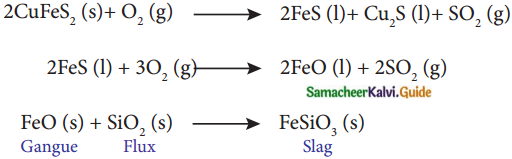
  • Concentration: Froth floatation Concentrated ore is heated in a reverberatory furnace with an acidic flux silica.
  • The basic ferrous oxide formed reacts with silica to form the slag ferrous silicate.
  • Mutually soluble metal sulphides Cu2S and FeS known as copper matte is formed.
    Samacheer Kalvi 12th Chemistry Guide Chapter 1 Metallurgy 8
  • Matte is removed from the slag and fed to the converting furnace.
  • FeS present in the matte is first converted to FeO.
  • FeO is removed as slag with silica.
  • The remaining copper sulfide is oxidised to cuprous oxide.
  • Cuprous oxide and copper sulphide react to form metallic copper. :
    2Cu2S(l,s) + 3O2(g) 2Cu2O(l,s) + 2SO2(g)
    2Cu2O(l) 6Cu(l) + SO2(g)
  • SO2 is liberated through molten copper and on solidification it has blistered appearance. This copper is called blister copper.

Electrorefining:
Cathode: Thin pure sheet of copper.
Anode: Impure Copper
Electrolyte: CuSO4 solution + dil H2SO4
On passing, current pure copper is deposited at the cathode.

Samacheer Kalvi 9th English Guide Prose Chapter 2 I Can’t Climb Trees Anymore

Question 3.
Explain the thermodynamic principle of metallurgy.
Answer:

  • Extraction of metals can be carried out by using different reducing agents.
  • Consider the reduction of a metal oxide Mx Oy
    \(\frac{2}{Y}\) MxOy(s) → \(\frac{2}{Y}\)M(s) + O2(g) ……………….. 1
  • Above reduction may be carried out with carbon.
  • In this case the reducing agent carbon may be oxidised to CO or CO2
    C + O2 → CO2(g) …………….. 2
    2C + O2 → 2CO(g) ……………………… 3
  • If carbon monoxide is used as a reducing agent, it is oxidised to CO2
    2CO + O2 → 2CO2 ……………………… 4
  • A suitable reducing agent is selected based on thermodynamic considerations.
  • For a spontaneous reaction, the change in free energy ∆G should be negative.
  • Thermodynamically the reduction of metal oxide [equation (1)] with a given reducing agent [equation 2,3, or 4] can occur if the free energy change for the coupled reaction [equation 1&2, 1&3 or 1&4] is negative.
  • Hence the reducing agent which gives large negative ∆G value for the coupled reaction is selected.

Question 4.
Write the applications of Eliingham diagram.
Answer:

  • Eliingham diagram helps us to select a suitable reducing agent and appropriate temperature range for reduction.
  • Reduction of metal oxide to metal is considered as a competition between the element used for reduction and the metal to combine with oxygen.
  • If metal oxide is more stable, oxygen remains with the metal.
  • If oxide of the element used for reduction is more stable, oxygen from metal oxide combines with the element used for reduction.
  • From Eliingham diagram the relative stablility of different metal oxides at a given temperature can be inferred.
  • Eliingham diagram for the formation of Ag2O and HgO is at the upper part and their decomposition temperatures are 600 and 700K respectively. This shows that these oxides are unstable at moderate temperatures and will decompose on heating even in the absence of a reducing agent.
  • Eliingham diagram is used to predict the thermodynamic feasibility of reduction of oxides of one metal by another metal.
  • For example, in the Eliingham diagram, the line for the formation chromium oxide ties above that of aluminium, meaning that Al2O3 is more stable than Cr2O3. Hence aluminium can be used as a reducing agent for the reduction of chromic oxide.
  • However, aluminium can not be used to reduce the oxides of magnesium and calcium since they occupy lower position than aluminium oxide in the Eliingham diagram.
  • Any metal can reduce the oxides of other metals that are located above it in the diagram.
  • Carbon line cuts across the lines of many metal oxides and hence it can reduce all these metal oxides at sufficently high temperature.
Tamil Nadu 12th Biology Model Question Papers 2020-2021 English Tamil Medium

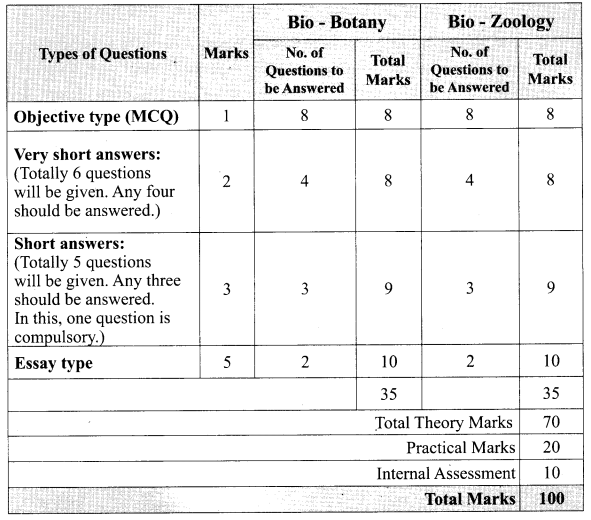
Subject Matter Experts at SamacheerKalvi.Guide have created Samacheer Kalvi Tamil Nadu State Board Syllabus New Paper Pattern 12th Biology Model Question Papers 2020-2021 with Answers Pdf Free Download in English Medium and Tamil Medium of TN 12th Standard Biology (Bio Botany Bio Zoology) Public Exam Question Papers Answer Key, New Paper Pattern of HSC 12th Class Biology Previous Year Question Papers, Plus Two +2 Biology Model Sample Papers are part of Tamil Nadu 12th Model Question Papers.

Let us look at these Government of Tamil Nadu State Board 12th Biology Model Question Papers Tamil Medium with Answers 2020-21 Pdf. Students can view or download the Class 12th Biology New Model Question Papers 2021 Tamil Nadu English Medium Pdf for their upcoming Tamil Nadu HSC Board Exams. Students can also read Tamilnadu Samcheer Kalvi 12th Biology Guide.

TN State Board 12th Biology Model Question Papers 2020 2021 English Tamil Medium

Tamil Nadu 12th Biology Model Question Papers English Medium 2020-2021

Tamil Nadu 12th Biology Model Question Papers Tamil Medium 2020-2021

  • Tamil Nadu 12th Biology Model Question Paper 1 Tamil Medium
  • Tamil Nadu 12th Biology Model Question Paper 2 Tamil Medium
  • Tamil Nadu 12th Biology Model Question Paper 3 Tamil Medium
  • Tamil Nadu 12th Biology Model Question Paper 4 Tamil Medium
  • Tamil Nadu 12th Biology Model Question Paper 5 Tamil Medium

12th Biology Model Question Paper Design 2020-2021 Tamil Nadu

Tamil Nadu 12th Biology Model Question Papers English Tamil Medium

Tamil Nadu 12th Biology Model Question Paper Weightage of Marks

Purpose Weightage
1. Knowledge 30%
2. Understanding 40%
3. Application 20%
4. Skill/Creativity 10%

It is necessary that students will understand the new pattern and style of Model Question Papers of 12th Standard Biology Tamilnadu State Board Syllabus (Bio Botany Bio Zoology) according to the latest exam pattern. These Tamil Nadu Plus Two 12th Biology Model Question Papers State Board Tamil Medium and English Medium are useful to understand the pattern of questions asked in the board exam. Know about the important concepts to be prepared for TN HSLC Board Exams and Score More marks.

We hope the given Samacheer Kalvi Tamil Nadu State Board Syllabus New Paper Pattern Class 12th Biology Model Question Papers 2020 2021 with Answers Pdf Free Download in English Medium and Tamil Medium will help you get through your subjective questions in the exam.

Let us know if you have any concerns regarding the Tamil Nadu Government 12th Biology State Board Model Question Papers with Answers 2020 21 (Bio Botany Bio Zoology), TN 12th Std Biology Public Exam Question Papers with Answer Key, New Paper Pattern of HSC Class 12th Biology Previous Year Question Papers, Plus Two +2 Biology Model Sample Papers, drop a comment below and we will get back to you as soon as possible.

Samacheer Kalvi 6th English Guide Term 2 Supplementary Chapter 2 Gulliver’s Travel

Tamilnadu State Board New Syllabus Samacheer Kalvi 6th English Guide Pdf Term 2 Supplementary Chapter 2 Gulliver’s Travel Text Book Back Questions and Answers, Summary, Notes.

Tamilnadu Samacheer Kalvi 6th English Solutions Term 2 Supplementary Chapter 2 Gulliver’s Travel

6th English Guide Gulliver’s Travel Text Book Back Questions and Answers

Textual Exercises (Text Book Page No. 134)

Read and Understand (Text Book Page No. 134)

A. Read the following statements. Say True or False.

1. Gulliver was the captain of the ship.
Answer:
False

2. One of the Lilliputians gave a ten minutes talk in Gulliver’s language.
Answer:
False

Samacheer Kalvi 9th English Guide Prose Chapter 2 I Can’t Climb Trees Anymore

3. Gulliver took the small creatures in his hand and crushed them.
Answer:
False

4. The horses were four and a half inches tall.
Answer:
True

5. The war between the two kingdoms ended in peace.
Answer:
True

B. Identify the speaker/character.

1. He felt something moving along his body almost up to his chin.
Answer:
Gulliver

2. They somehow managed to put him on the platform.
Answer:
The Lilliputians

Samacheer Kalvi 9th English Guide Prose Chapter 2 I Can’t Climb Trees Anymore

3. “Don’t let us down now, Gulliver; we need your help”.
Answer:
The Emperor

C. Choose the right answer. (Text Book Page No. 135)

1. Gulliver managed to reach the land as he was
a) A doctor
b) One of the crews
c) a swimmer
d) the captain
Answer:
c) a swimmer

2. Gulliver was set free because the emperor
a) was afraid of him
b) confirmed that he was not harmful.
c) was a kind hearted person.
d) wanted to get something from him.
Answer:
b) confirmed that he was not harmful

Samacheer Kalvi 9th English Guide Prose Chapter 2 I Can’t Climb Trees Anymore

3. Gulliver was hailed as a hero because he
a) made the army of Blefuscu giddy
b) fought with the army of Blefuscu.
c) drowned the army of Blefuscu in the water.
d) defeated the emperor of Blefuscu.
Answer:
d) defeated the emperor of Blefuscu

D. Discuss in groups. Retell the story in your own words. Each one should say one sentence.

You can begin like this:
Gulliver was travelling in a ship. One stormy night, the ship was wrecked ………

Gulliver was travelling in a ship. One stormy night, the ship was wrecked. Gulliver was a good swimmer. So, he reached the land by swimming. The land appeared strange and lonely. He saw no human beings, he was hungry and tired. He fell on a patch of grass and slept. When he woke up he found his hands and legs tied down. There were a number of creatures not more than six inches high. He later learned they were Lilliputians. He was taken to the Emperor. He received Gulliver. He set him free with a condition that he would do no harm to them. Once, the neighbouring kingdom, declared war on Lilliput. The Emperor needed Gulliver’s help.

Gulliver walked into a sea and tied with a long rope all the ships of the enemy together he pulled the ships going round and round the whole day. They were not in a position to fight. So, the enemy king begged for peace between the two countries. Gulliver was hailed as a hero.

E. Think and answer.

1. How did Gulliver overcome the adversity?
Answer:
Gulliver’s ship was wrecked. He reached a land where the Lilliputians lived. They were not more than six inches high. Gulliver was taken to the emperor with his hands and legs tied. The emperor received him. Gulliver was given food and drink. He was lodged in an old and amused temple. Gulliver overcame his adversity by helping the Emperor and his people in many ways. Once the neighbouring kingdom declared war on Lilliput. It was Gulliver who defeated the enemy king made peace with the Emperor. Thus Gulliver overcame his adversity by being kind, helping, and wise.

2. How should one react to adversity?
Answer:
When Gulliver faced adversity he remained patient. He was kind to all the Lilliputians and the Emperor. Once the neighbouring country declared war on Lilliput. Then it was Gulliver who saved Lilliput and earned the respect and love of the Emperor and the people.

Samacheer Kalvi 9th English Guide Prose Chapter 2 I Can’t Climb Trees Anymore

3. Describe Gulliver’s encounter with the army of Blefuscu?
Answer:
The king of Blefuscu once declared war on Lilliput. The Emperor needed help from Gulliver. Gulliver walked into the sea and tied with a long rope all the hundred ships of the enemy together. He dragged them in the water and pulled the ships, the whole day going round and round. The army of Blefuscu was giddy and was not in a position to fight. The king surrendered to the Emperor and made peace with him. It was Gulliver who brought victory to the Emperor.

Project

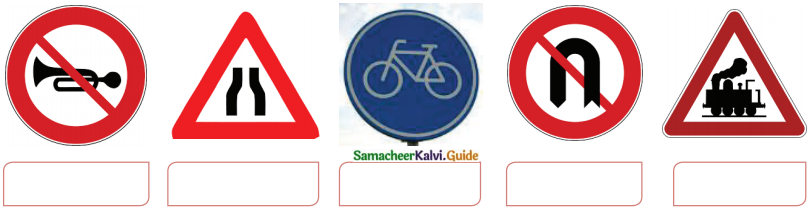
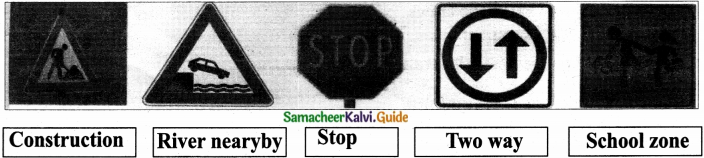
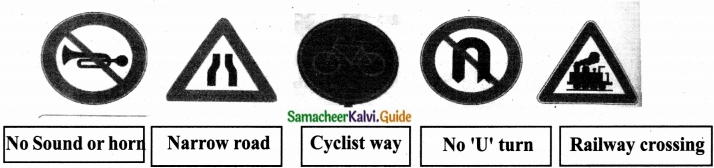
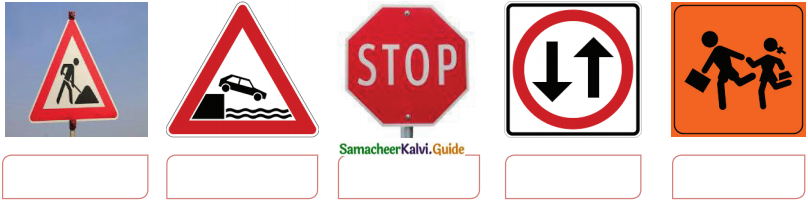
F. Look at the traffic signals and write down the traffic rule against each signal.
Samacheer Kalvi 6th English Guide Term 2 Supplementary Chapter 2 Gulliver’s Travels 1 Samacheer Kalvi 6th English Guide Term 2 Supplementary Chapter 2 Gulliver’s Travels 2
Answer:
Samacheer Kalvi 6th English Guide Term 2 Supplementary Chapter 2 Gulliver’s Travels 3 Samacheer Kalvi 6th English Guide Term 2 Supplementary Chapter 2 Gulliver’s Travels 4

Connecting to Self

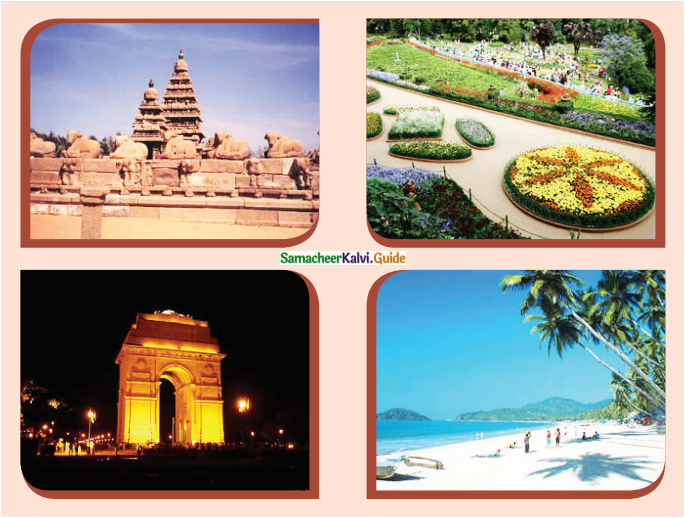
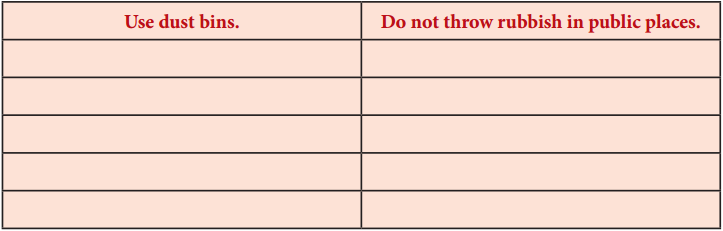
G. Look at these pictures. Think of how you must behave when you visit these places. Discuss with your partner and complete the table.
Samacheer Kalvi 6th English Guide Term 2 Supplementary Chapter 2 Gulliver’s Travels 5 Samacheer Kalvi 6th English Guide Term 2 Supplementary Chapter 2 Gulliver’s Travels 6
Answer:

Use dust bins Do not throw rubbish in public places
Put waste into dustbins Don’t throw down uneaten food.
Use toilet Don’t spit on the road.
Keep the coast clean Don’t pass urine on the way.
Keep the environment clear Don’t walk the meadow.
Dust-free Don’t pluck flowers.

Step to Success

e.g. 1. Leaves 2. Fruit 3. Seed 4. Flowers 5. Root
a) 2,4,5,1,3
b) 3,5,1,4,2
c) 1,2,3,4,5
d) 5,3,1,2,4
Answer:
b) 3, 5,1, 4, 2

1. 1. Drive 2. Get in 3. Arrive 4. Park 5. Open door
a) 2,1,3,5,4
b) 5,2,1,3,4
c) 3,4,5,1,2
d) 3,5,1,2,4
Answer:
b) 5, 2,1,3, 4

Samacheer Kalvi 9th English Guide Prose Chapter 2 I Can’t Climb Trees Anymore

2. 1. Travel 2. Book 3. Plan 4. Confirm 5. Enjoy
a) 3,2,4,1,5
b) 4,5,3,2,1
c) 1,2,3,4,5
d) 5,4,2,3,1
Answer:
a) 3, 2, 4,1, 5

3. 1. Rest 2. Return 3. Supper 4. Go out 5. Visit
a) 1,2,3,4,5
b) 4,5,1,2,3
c) 4,5,2,3,1
d) 5,4,3,2,1
Answer:
c) 4, 5, 2,3,1

4. 1. Check out 2. Pack 3. Pay bill 4. Vacate 5. Drive
a) 3,4,5,2,1
b) 1,2,3,4,5
c) 5,4,3,2,1
d) 2,4,3,1,5
Answer:
d) 2, 4, 3,1, 5

5. 1. Wait 2. Slow 3. Go 4. Stop 5. Get ready
a) 2,4,1,5,3
b) 1,2,3,4,5
c) 5,4,3,2,1
d) 3,4,2,1,5
Answer:
a) 2,4,1, 5,3

Gulliver’s Travel Summary in English

While Gulliver was going, on a long voyage, his ship sank in a violent storm. However, he managed to escape and reached the island by nearing. He was hungry and exhausted so he fell to a patch of grass. When he woke he was tied down by dwarf (six inches) people who called themselves Lilliputians. He was taken to the capital of the Island. The Emperor received him. He was set free on condition. He was happy there. The neighbouring king of Blefuscu declared war on Lilliput. The Emperor needed Gulliver’s help. Gulliver pulled the all shipping the whole day. The king of Blefuicu begged for peace. The Emperor agreed. Gulliver was hailed as a hero by Lilliputians.

Gulliver’s Travel Summary in Tamil

கலிபா நீண்ட பயணத்தில் செல்லும்போது, அவரது கப்பல் கடுமையான புயலில் மூழ்கியது. இருப்பினும், அவர் தப்பித்து அருகிலுள்ள தீவை அடைந்தார். அவர் பசியில் களைப்பும் அடைந்ததார். அதனால், அவர் புல்லின் மீது விழுந்தார். அவர் எழுந்தபோது லில்லிபுத்தியர்கள் என்று அழைத்த குள்ளர்கள் (ஆறு அங்குல) மக்களால் அவர் கட்டப்ட்டார். அவர் தீவின் தலைநகருக்கு கொண்டு செல்லப்ட்டார். சக்கரவர்த்தி அவரை வரவேற்றார். அவர் அங்கு மகிழ்ச்சியாக இருந்தார். பக்கத்து மன்னர் பிலிபியூஸ்க்கு லில்லிபுட்டின்மீது போரை அறிவித்தார். மன்னர் கலிபரின் உதவியை வேண்டினார். கலிபர் அனைத்து கப்பல்களையும் கட்டி நாள்முழுவதும் இழுத்தார். பிலியூயூஸ்க்கு அரசன் சமாதானத்தை கெஞ்சிக் கேட்டார். ஒப்புக்கொண்டார். கலிபர் தலைவர் என புகழப்பட்டார்.

Samacheer Kalvi 6th English Guide Term 2 Supplementary Chapter 1 Think to Win

Tamilnadu State Board New Syllabus Samacheer Kalvi 6th English Guide Pdf Term 2 Supplementary Chapter 1 Think to Win Text Book Back Questions and Answers, Summary, Notes.

Tamilnadu Samacheer Kalvi 6th English Solutions Term 2 Supplementary Chapter 1 Think to Win

6th English Guide Think to Win Text Book Back Questions and Answers

Textual Exercises (Text Book Page No. 105)

A. Choose the correct answer.

1. “Girls you are a good team.”
Which team do the girls belong to?
a) Badminton
b) Hockey
c) Relay
d) Volleyball
Answer:
c) Relay

2. Springfields is the name of a …………………….. .
a) team
b) house
c) company
d) school
Answer:
d) school

3. The inter-school sports meet refers to competitions among the …………………….. .
a) teams of the same school
b) schools in the locality
c) schools in neighborhood
d) schools from other districts
Answer:
b) schools in the locality

Samacheer Kalvi 9th English Guide Prose Chapter 2 I Can’t Climb Trees Anymore

4. Seema is Rucha’s …………………….. .
a) friend
b) teammate
c) younger sister
d) opponent
Answer:
c) younger sister

5. Order the names of the members in Team B relay event. Shabnam was followed by
a) Neelam, Aruna, Rucha
b) Arana, Rucha, Neelam
c) Neelam, Rucha, Arana
d) Arana, Neelam, Rucha
Answer:
a) Neelam, Aruna, Rucha

B. Answer the following:

1. How does Rucha differ from her sister?
Answer:
Rucha is overprotective of herself. She never did things rashly. Even in running ‘ and playing, she would be conscious of her movements. But Seema, her younger sister was bold and was ready to take any risks.

2. ‘Springfields has a runner and they call her P.T. Usha.’ Why did they call her so?
Answer:
The runner of Springfields ran as fast as RT. Usha. So she was called P. T. Usha.

3. Describe the qualities of the new P.T. Instructor Mr. Prakash.
Answer:
The new P.T. Instructor was very enthusiastic about sports and drove the children hard – praising them, scolding and correcting them. But most of the time, he encourages and advises them a lot.

Samacheer Kalvi 9th English Guide Prose Chapter 2 I Can’t Climb Trees Anymore

4. What words were ringing in Rucha’s ears when she was running in the relay?
Answer:
The words “Think to win” were running in ‘Rucha’s ears when she was running in the relay.

5. What did Rucha finally realise about herself?
Answer:
She realized that she had overcome her hesitations and denials. She could win, whenever she chose to do so.

C. Read the given lines and answer the questions : (Text Book Page No. 106)

1. His voice came from some distance away and,
Rucha realized that he was not holding the bicycle anymore.
“I will fall / will fall” she wailed.
a) What was she afraid of?
Answer:
She was afraid of falling off the bicycle.

b) Was the boy closely following her?
Answer:
No, the boy was not closely following her.

2. For the past two weeks he had been teaching her to ride.
a) Who was teaching whom? ‘
Answer:
Vishnu was teaching Rucha to ride the bicycle.

b) What was he teaching?
Answer:
He was teaching me how to ride a bicycle.

Samacheer Kalvi 9th English Guide Prose Chapter 2 I Can’t Climb Trees Anymore

3. Even ‘P. T. Usha’came to shake her hand.
“I thought I was fast, but you were simply superb!”
she shook hands with her.
a) Who does the word ‘you’ refer to?
Answer:
The word ‘you’ refers to Rucha.

b) What quality of the speaker is revealed?
Answer:
The true spirit of a sportsperson is revealed here

D. Think and answer.

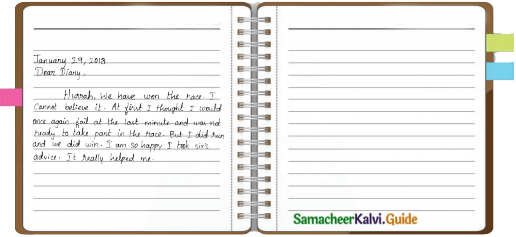
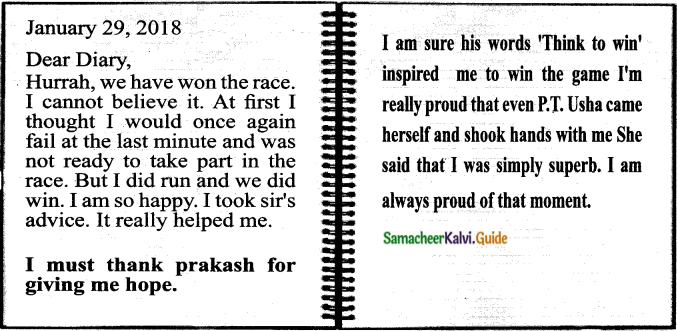
Imagine you are Rucha and make a diary entry on your feelings about the day’s happenings and your victory. The start is given. Complete the diary.
Samacheer Kalvi 6th English Guide Term 2 Supplementary Chapter 1 Think to Win 1
Answer:
Samacheer Kalvi 6th English Guide Term 2 Supplementary Chapter 1 Think to Win 2

E. Discuss in class

How did Rucha overcome her self-doubts? How can shyness and fear be overcome?
Answer:
Rucha overcame her self-doubts. She was always thinking of Prakash Sir’s words “Think to A win’. Then he said that he wanted her to have a positive attitude. These words of Prakash sir made Rucha overcome her self-doubts.

We can overcome shyness and fear only by forgetting ourselves while playing the game.

Step to Success (Text Book Page No. 108)

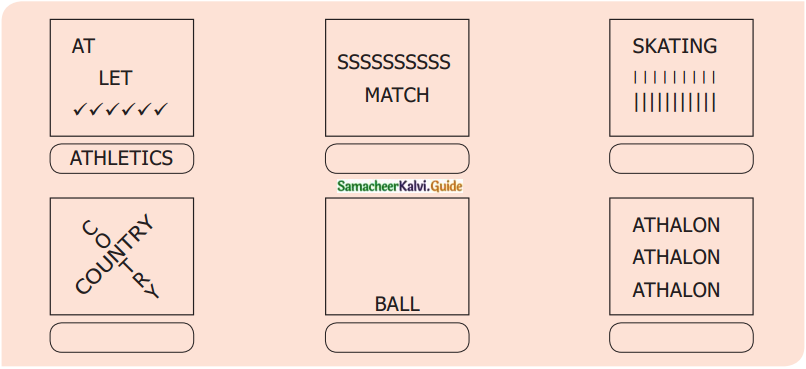
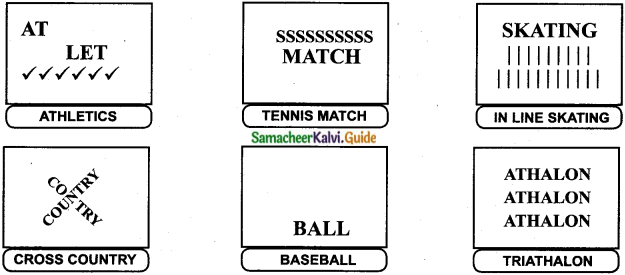
Identify the sport name from the given wuzzles. One is done for you.
Samacheer Kalvi 6th English Guide Term 2 Supplementary Chapter 1 Think to Win 3
Answer:
Samacheer Kalvi 6th English Guide Term 2 Supplementary Chapter 1 Think to Win 4

Find the odd one out:

eg. Weight lifting, Boxing, Silambam, Fencing
Answer:
Weight lifting

1. Hide and Seek, Kho-Kho, Tennikoit, Kabaddi
Answer:
Tennikoit

2. Badminton, Cycling, Tennis, Squash
Answer:
Cycling

Samacheer Kalvi 9th English Guide Prose Chapter 2 I Can’t Climb Trees Anymore

3. Trapeze, Throw Ball, Bowling, Goalball
Answer:
Trapeze

4. Snooker, Polo, Five Pins, Carrom Board
Answer:
Polo

5. Cricket, Base Ball, Hockey, Basket Ball
Answer:
Base Ball

Think to Win Summary in English

Rucha was a ten years old girl, she learned to ride a bicycle. When she was riding the bicycle, she was wobbled and fell down. Even in running and playing, she would be conscious of her movements. Inter-house badminton matches will start in her school next week. Rucha was on the senior team. She lost the game by just two points. She became gloomy and despair. She would train with the rest of them for relay matches under the new PT instructor, Prakash Sir. The new P.T instructor Prakash Sir encouraged her during the relay match by saying that only ‘Think to Win’. At last, She won the relay match.

Think to Win Summary in Tamil

ருச்சா ஒரு பத்துவயது பெண். அவள் சைக்கிள் ஓட்டக் கற்றுக்கொண்டாள். அவள் சைக்கிள் ஓட்டும்போது அவள் தள்ளாடி கீழே விழுந்தாள். ஓடுவதிலும் விளையாடுவதிலும் கூட அவள் எச்சரிக்கை விழிப்புணர்வுடன் இருப்பாள். இண்டர்ஹவுஸ் பூப்பந்து போட்டிகள் அவரது பள்ளியில் அடுத்த வாரத்தில் தொடங்கும். ருச்சா இளையோர் அணியில் இருந்தாள். அவன் இரண்டு புள்ளிகளால் ஆட்டத்தை இழந்தாள். அதனால் அவள் விரக்தியடைந்தாள். பிரகாஷ் ஐயா என்ற புதிய பயிற்சியாளரின் அறிவுறுத்தலின் கீழ் தொடர் ஓட்டப்போட்டிக்காக அவள் மற்றவர்களுடன் பயிற்சி பெறுவாள். புதிய பயிற்சியாளர் பிரகாஷ் சார் வெற்றி பெற யோசி மட்டுமே என்று ருச்சாவை தொடர் ஓட்டப் போட்தொடர் ஓட்டப்போட்டியின் போது அவளுக்கு அறிவுரை கூறி ஊக்குவித்தார். கடைசியாக அவள் தொடர் ஓட்டப் போட்டியில் வென்றாள்.

Think to Win About the Author in English

The author of this entry Mrs.Lata Bilaney Kaku, known as Lata Kaku’ is one of the famous freelance writers in India. She was bom in 1969 and completed her schooling in Presentation Convent, Delhi. She has attained the Honours degree for Zoology at the University of Delhi.

Think to Win About the Author in Tamil

லதா காக்கு என அறியப்படுகிற இந்தக் கதையின் ஆசிரியரான லதா பிலானி காக்கு இந்தியாவின் பத்திரிக்கை சாராத புகழ்பெற்ற பொது எழுத்தாளர்களில் ஒருவர் ஆவார். 1969இல் பிறந்த இவர், டெல்லியில் உள்ள ப்ரசண்டேஷன் கான்வென்ட்டில் தன்னுடைய பள்ளிப்படிபை முடித்தார். டெல்லி பல்கலைக் கழகத்தில் விலங்கியல் துறையில் இவர் கௌரவப் பட்டம் பெற்றுள்ளார்.

Samacheer Kalvi 6th English Guide Term 3 Supplementary Chapter 2 Brought to Book

Tamilnadu State Board New Syllabus Samacheer Kalvi 6th English Guide Pdf Term 3 Supplementary Chapter 2 Brought to Book Text Book Back Questions and Answers, Summary, Notes.

Tamilnadu Samacheer Kalvi 6th English Solutions Term 3 Supplementary Chapter 2 Brought to Book

6th English Guide Brought to Book Text Book Back Questions and Answers

Textual Exercises (Text Book Page No. 112)

A. Read the story again and fill in the table with the present condition of the characters given below:
Samacheer Kalvi 6th English Guide Term 3 Supplementary Chapter 2 Brought to Book 1
Answers:

Ms. English Her dress was unrecognizable. She looked a wreck.
Mr. School Bag The school bag complained about his negligence.
The young Master Note book When Mahesh failed to solve a problem, he vented his anger.
Mr. Pencil Box Pencil Box looked at Mahesh looked in terrible anger.
Mr. Geography All my fellow brothes laugh at him whenever Mahesh pulls him out of his bag.

B. Answer the questions.

Question 1.
Why was Mahesh brought to court?
Answer:
Mahesh was brought to court because he ill-treated the books, notebooks, school bags and the pencil box.

Question 2.
Was Mahesh punished for the ill-treatment of his belongings? Why?
Answer:
Mahesh was not punished for the ill-treatment of his belongings because Ms. English supported him and asked everyone to give him a second chance. She said that he deserved a little consideration.

Samacheer Kalvi 9th English Guide Prose Chapter 2 I Can’t Climb Trees Anymore

Question 3.
Why did the fellow brothers of Mr. Geography laugh at him?
Answer:
The fellow brothers of Mr. Geography laughed at him seeing his worst condition.

Question 4.
What made Justice Mathematics turn red with anger?
Answer:
Mahesh threw the little Notebook against the wall in his anger. This made Justice Mathematics turn red with anger.

Question 5.
How was the court different from other courts?
Answer:
The punishment there is decided by the victims and they decide by the majority if the verdicts are more than one.

Question 6.
Why did they decide to forgive him? Who initiated the suggestion?
Answer:
This was Mahesh’s first offense. So he deserved a second consideration. They decided to give Mahesh a second chance. Ms. English initiated the suggestion.

Samacheer Kalvi 9th English Guide Prose Chapter 2 I Can’t Climb Trees Anymore

Question 7.
Was it real or a dream? How could you say?
Answer:
It was a dream, we know this at the end when Mahesh’s mother shakes him up to get up, as it was late for school.

C. Read the lines and answer the questions:

1. “You have to undo what you have done. Do you understand?”
a) Who said these words to whom?
Answer:
Justice Mathematics said these words to Mahesh.

b) What was the asked to undo?
Answer:
He was asked to keep. Ms. English carefully and neatly.

Samacheer Kalvi 9th English Guide Prose Chapter 2 I Can’t Climb Trees Anymore

2. I especially envy my brother who belongs to Shobitha.
a) Who is envious of whom?
Answer:
Mr. Geography is envious of his brother.

b) Why does he envy his brother?
Answer:
His brother was covered neatly. He ever looked new.

3. “I don’t mean to interrupt, Your Honour, it is just that I feel that everyone deserves a second chance and, after all, this is Mahesh s first offense, he deserves a little consideration.”

a) What do these lines tell about the speaker?
Answer:
The speaker has a soft heart. She does not want to punish Mahesh.

Samacheer Kalvi 9th English Guide Prose Chapter 2 I Can’t Climb Trees Anymore

b) Who does the word ‘I’ refer to?
Answer:
The word T refers to Ms. English.

D. Think and answer:

1. If you were Ms. English, would you do the same? Why or Why not? Justify your answer.
Answer:
If I were Ms. English, I would do the same. First, there is no one who does not do any offence. Here it is Mahesh’s first offence. If he is punished, there is a possibility for him to continue doing offence further. But forgiveness will change his life, to be honest. In the case of Mahesh, by forgiving him, we really give him a real chance to feel sorry for what he has done and to change his life.

E. Works in groups:

1. Prepare a chart with do’s and don’ts of books and classwork maintenance. Use your creativity in presenting your ideas. Use short sentences and phrases.
Answer:

S.No Do’s Don’ts
1. Handle the book gently. Don’t use books roughly.
2. Cover the books with brown sheets. Don’t keep any book without a cover.
3. Put the books into the school bag carefully. Don’t tear off pages from the copies.
4. Arrange your books and keep them in your bag before going to bed. Don’t cram the book into the school bag.
5. Keep a notebook to record all your classwork. Don’t throw away a book or Notebook.

Project (Text Book Page No. 113)

F. Collect any three pictures of your favourite cartoon characters and get them pasted in your classwork. Write a few lines about them.
Samacheer Kalvi 6th English Guide Term 3 Supplementary Chapter 2 Brought to Book 2

Tom – a cat, in pursuit of a clever mouse.
Jerry – a mouse, It always escapes from the cat. (Tom)
Donald Duck – It is a white duck with a yellow-orange bill, legs, and feet.
He typically wears a sailor shirt and cap with a bow tie.

Connecting to Self

Read the following and have a discussion on which of these are fair and ethical to laugh at and which are not. Why?

Samacheer Kalvi 6th English Guide Term 3 Supplementary Chapter 2 Brought to Book 3
Accidental or embarrassing situations:
It is not fair and ethical to laugh at them. Because they involve physical and mention aspects of a person. They may be beyond his control at the moment.

Weird behaviour of animals and kids:
We can laugh at them. Because we don’t harm them physically or mentally.

Culture and religion:
It is not fair and ethical to laugh at other’s cultural values and religious beliefs. We must respect them. We must appreciate diversity for unity.

Funny pantomimes and stand up comedies:
We can laugh at them. They create fun. We don’t hurt them mentally by simply laughing.

Physical appearance:
It is not fair and ethical to laugh at the strange or abnormal physical appearance of a person. We must empathize and not laugh. We harm mentally by laughing at physical appearance.

Language and dialect:
It is not fair to laugh at the way a language or dialect is spoken. It is an identity. There is nothing to laugh at.

Humorous movies:
We can laugh watching humourous movies. There are funny dialogues or situations that create laughter. This kind of laughter is harmless.

Friendly imitation and mimicry:
We can laugh at them only if we ensure that it does not hurt one’s sentiments or beliefs.

Step to Success

In a certain code extremely is written as XKDLDQSWD. Figure out the code and rewrite the following words in the same code.
Answer:
Decoding:
y – X
l – K
e – D
m – L
e – D
r – Q
t – S
x – W
e – D

The preceding letters (in capitals) are taken for the small letters in the reverse order.
Samacheer Kalvi 6th English Guide Term 3 Supplementary Chapter 2 Brought to Book 5
Samacheer Kalvi 6th English Guide Term 3 Supplementary Chapter 2 Brought to Book 4
Answer:

Somewhere DQDGVDLNR
mercilessly XKRRDKHBQDL
yesterday XZCQDSRDX
seldom LNCKDR
often MDSEN

Brought to Book Summary in English

A case was brought against Mahesh in the court. Mathematics was the judge. Ms. English, came to the witness box pointed out to Maheswaran that he did not cover me properly with the nice brown paper. Mahesh mumbles an apology. Next came Mr. Geography, He had no cover. His content page was hanging on its treads. The maps had been filled with all colors. Then the school bag complained about Mahesh’s negligence. The next pencil box said that Mahesh never cleaned it. The next notebook said that he threw against the wall. Ms. English said that it was his first offence so given him a second chance. To our surprise, all this was only Mahesh’s dream.

Brought to Book Summary in Tamil

மகேஷ் மீது நீதிமன்றத்தில் வழக்கு தொடரப்பட்டது. கணிதமே நீதிபதியாக இருந்தது. செல்வி ஆங்கிலம் சாட்சிப் பெட்டியில் வந்து மகேஸ்வரன் என்னை நல்ல பழுப்பு நிற காகிதத்துடன் சரியாக மறைக்கவில்லை என்று சுட்டிக் காட்டினார். மகேஷ் மன்னிப்பு கேட்கிறார். அடுத்து திரு. புவியியல் வந்தது. அவருக்கு கவர் “இல்லை. அவரது உள்ளடக்கப் பக்கம் அதன் மேல்பரப்பில் தொங்கிக் கொண்டிருந்தது. வரைபடங்கள் எல்லா வண்ணங்களிலும் நிரப்பப்ட்டிருந்தது. பின்னர் பள்ளி பை மகேஷின் அலட்சியம் குறித்து புகார் கூறினார். அடுத்த பென்சில் பெட்டி மகேஷ் எப்பொழுது அதை சுத்தம் செய்ததாகக் கூறினார். அடுத்த குறிப்பு புத்தகம் அவர் சுவருக்கு எதிராக எறிந்ததாக கூறினார். திருமதி. ஆங்கிலம் இது அவரது முதல் குற்றம் என்று கூறினார். எனவே அவருக்கு இரண்டாவது வாய்ப்பு கிடைத்தது. ஆச்சர்யம் என்னவென்றால் இது எல்லாம் மகேஷின் கனவு மட்டுமே.

Brought to Book About the Author in English

Madhumidha Gupta is an English teacher, freelance writer, and administrator. Her passion is to write for children and she has written for many children’s magazines. Her works have appeared in many newspapers and magazines in India and in some publications in the Vs. Some of her fiction has found a place in anthologies by children’s book trust and National Book trust. Now she is working as a lecturer.

Brought to Book About the Author in Tamil

மதுமிதா குப்தா ஓர் ஆங்கில ஆசிரியர். பத்திரிக்கையாளர் எழுத்தாளர் மற்றும் நிர்வாகி. குழந்தைகளுக்காக எழுதுவதில் பேரார்வம் கொண்டமையால் குழந்தைகளுக்காக பலவற்றை குழந்தைகள் பத்திரிக்கையில் எழுதியுள்ளார். அவருடைய படைப்புகளும் எழுத்துக்களும் இந்திய நாளிதழ்களிலும் பத்திரிக்கையிலும் வெளியாகியுள்ளன. குழந்தைகள் புத்தக அறக்கட்டளை மற்றும் தேசிய புத்தக அறக்கட்டளைகளின் சிறப்பு தொகுப்புகளில் இவருடைய சில நாவல்கள் வெளிவந்துள்ளன. தற்போது இவர் கல்லூரி விரிவுரையாளராக பணியாற்றி வருகிறார்.

Samacheer Kalvi 6th English Guide Term 3 Supplementary Chapter 1 A Childhood in Malabar: A Memoir

Tamilnadu State Board New Syllabus Samacheer Kalvi 6th English Guide Pdf Term 3 Supplementary Chapter 1 A Childhood in Malabar: A Memoir Text Book Back Questions and Answers, Summary, Notes.

Tamilnadu Samacheer Kalvi 6th English Solutions Term 3 Supplementary Chapter 1 A Childhood in Malabar: A Memoir

6th English Guide A Childhood in Malabar: A Memoir Text Book Back Questions and Answers

Textual Exercises (Text Book Page No. 87)

A. Identify the character/ speaker.

1. “Why isn’t the snake coming?”.
Answer:
“The author (Kamala Das)

2. “I wonder whether it’s a cyclone.”
Answer:
Ammamma

3. “I want to see kutti oppu.”
Answer:
Malathikutty

Samacheer Kalvi 9th English Guide Prose Chapter 2 I Can’t Climb Trees Anymore

4. “Will the housing collapse?”
Answer:
Muthassi

5. ”Is she crazy?”
Answer:
Muthassi

B. Write True or False:

1. Droplets of rain glimmered on Ammamma’s face.
Answer:
True

2. Malathi kutty wanted to see kutti oppu.
Answer:
True

3. Ammayi comforted Malathi kutty when she sobbed
Answer:
False

Samacheer Kalvi 9th English Guide Prose Chapter 2 I Can’t Climb Trees Anymore

4. The coconut palm crashed down due to heavy rain.
Answer:
True

C. Choose the correct answer and write it in the blank:

1. Meenakshi Edathi was a ……………………….. relative of the Ambazhathel family.
a) close
b) distant
c) real
Answer:
b) distant

2. We suddenly heard the sound of the rain from the ……………………….. like a roar.
a) southeast
b) southwest
c) northeast
Answer:
b) southwest

3. The ……………………….. with four pillars began to overflow.
a) central hall
b) southern room
c) courtyard
Answer:
a) central hall

4. ……………………….. arrived drenched to the skin.
a)Ammaman
b) Cheriamma
c) Ammayi
Answer:
c) Ammayi

Samacheer Kalvi 9th English Guide Prose Chapter 2 I Can’t Climb Trees Anymore

5. There was knee-deep water in the …………………………
a) courtyard
b) cowshed
c) Kitchen
Answer:
a) courtyard

D. Rearrange the following jumbled sentences in the correct order: (Text Book Page No. 87)

  • The dry leaves that had collected around the pond swirled upwards.
  • Branches shook and the seat of the swing fell down from the ilanji tree.
  • The wind tore through the coconut palms in the southern compound.
  • Meenakshi Edathi was a dark-skinned and middle-aged woman.
  • Without Meenakshi Edathi Ambazhathel family could not have existed happily for a single day.

Answer:

  • Meenakshi Edathi was a dark-skinned and middle-aged woman.
  • Without Meenakshi Edathi Ambazhathel family could not have existed happily for a single day.
  • The wind tore through the coconut palms in the southern compound.
  • The dry leaves that had collected around the pond swirled upwards.
  • Branches shook and the seat of the swing fell down from the ilanji tree.

E. Find answers for the questions given below, identify the person and write A a character sketch about her: (Text Book Page No. 88)

1. Who was the important person in the Ambazhathel family?
Answer:
Meenakshi Edathi was an important person in the Ambazhathel family.

2. Why was she considered an important person?
Answer:
She considered an important person because the family of Ambazhathel could not have existed happily even for a single day without Meenakshi Edathi.

Samacheer Kalvi 9th English Guide Prose Chapter 2 I Can’t Climb Trees Anymore

3. How did she spend her time?
Answer:
She spent her time rushing around the house and compound, never stopping to rest. Her face constantly wore an expression that asked for forgiveness. She had certain trivial duties to perform.

4. Describe her appearance and qualities.
Answer:
Meenakshi Edathi was a dark-skinned and middle-aged woman. She was poor. So she was dependent on their generosity. But she was ever busy and never stopped.

5. How would the days be without her?
Answer:
The family of Ambazhathel could not have existed happily for a single day without Meenakshi Edathi.

F. Think and answer. (Text Book Page No. 88)

1. Imagine that you are caught on a stormy day. How will you manage the situation?
Answer:
One day, I was in school. At about 2 p.m., the school gave over, as there was a weather forecast expecting a storm in the evening after 5 p.m. The students were allowed to go home, only after their parents came to pick them up. My mother, due to some problem, came to pick me up only after 4.30 p.m. It was a long way to go to our home. We travelled halfway by bus and then got down to take another bus. By then, the storm had started. The wind blew hard on us. We had to take shelter in a bus terminus. It rained heavily. We couldn’t step out of the bus terminus for nearly two hours. Then we came out. It was still raining. There was water upto our knees. My mother gave a call to my father asking him to come there. He hired a car and picked us up. We reached home safely at 8 p.m.

Project (Text Book Page No. 88)

G. Make a fact file on how do we use these resources in our day-to-day life:

  • Solar energy – To help power your home or business. .
  • Wind energy – It is used for grinding grain or pumping water.
  • Hydro energy – Used for all purposes. .

Connecting to Self

H. Fill in the table given below:
Samacheer Kalvi 6th English Guide Term 3 Supplementary Chapter 1 A Childhood in Malabar A Memoir 1
Answer:
Samacheer Kalvi 6th English Guide Term 3 Supplementary Chapter 1 A Childhood in Malabar A Memoir 2

I. During the winter season many of us fall sick and suffer from cold, cough, and fever. Put a (✓)) for the things you will do to keep fit. (Text Book Page No. 89)

  1. Drink cold water. (✗)
  2. Eat home-cooked food. (✓)
  3. I will visit the doctor. (✓)
  4. Never wash my hands. (✗)
  5. I will take medicine and rest. (✓)

J. Tick the correct word for the given icon (Text Book Page No. 89)
Samacheer Kalvi 6th English Guide Term 3 Supplementary Chapter 1 A Childhood in Malabar A Memoir 3
Answer:
Samacheer Kalvi 6th English Guide Term 3 Supplementary Chapter 1 A Childhood in Malabar A Memoir 4

Step to Success

K. Relate the sentences with weather/climate/season and write the suitable word in the blanks:

1. ……………………. forecast is useful for farmers, fishermen, and navigators.
Answer:
weather

2. The ……………………. of a place is permanent in nature.
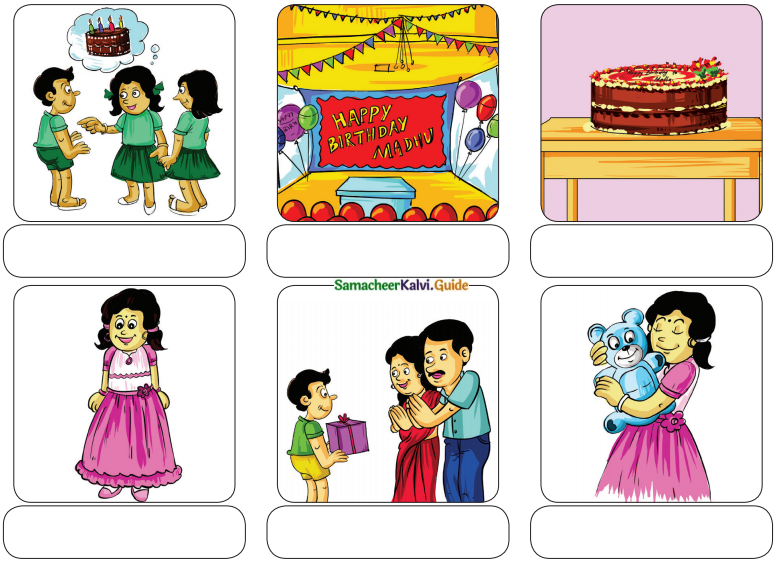
Answer:
climate

3. India has a tropical monsoon ……………………. .
Answer:
season

Samacheer Kalvi 9th English Guide Prose Chapter 2 I Can’t Climb Trees Anymore

4. Spring, Summer, autumn and winter are the four ……………………..
Answer:
season

5. Global warming is a change in the worlds……………………..
Answer:
weather

6. Satellite photographs help us to predict tomorrows……………………..
Answer:
climate

7. Spring is my favourite ……………………..
Answer:
season

A Childhood in Malabar: A Memoir Summary in English

“A Childhood in Malabar” in memoir is an autobiography. It’s a childhood experience of Kamaladas. Someone’s Birthday of Ambazhathel that day there was a cyclone. Malathikutty took me and my brother to the serpent temple. Meenakshi: Malathi was a distant relative of the Ambazhathel family. She did all the household works in the home. After returning from the temple, the Author began to feel sleepy after launch. The heavy wind tore the coconut branches. It scared Ammamma. She asked all of them to sit down in the middle room. They heard a coconut palm tree crashing down. The house was flooded. Cheriamma recited Ammamma said she could not remember a single couplet. There’s knee-deep water in the yard. In the morning rain stopped. But they found dead goats floating everywhere. The author immediately asked for murukkus and dates.

A Childhood in Malabar: A Memoir Summary in Tamil

“மலபாரில் ஒரு குழந்தைப் பருவம்” ஒரு நினைவு என்பது ஒரு சுயசரிதை. இது கமலாதாஸின் குழந்தைப்பருவ அனுபவம் ஆகும். யாரோ ஒருவர் பிறந்தநாள் அம்பலத்தில், அங்கு ஒரு சூறாவளி இருந்தது. மாலதிக்குட்டி என்னையும் என் சகோதரனையும் சர்ப்பக் கோவிலுக்கு அழைத்துச் சென்றார். மீனாட்சி: மாலதி அம்பலத்தில் குடும்பத்தின் தொலைதூர உறவினர். அவள் வீட்டில் உள்ள வீட்டு வேலைகள் அனைத்தையும் செய்வாள். கோவிலில் இருந்து திரும்பிய பிறகு மதிய உணவிற்குப் பிறகு தூக்கத்தை உணர ஆரம்பத்தாள் மாலதிகுட்டி பியான். பலத்த காற்று தென்னை கிளைகளை கிழித்து எறிந்தது. அது அம்மம்மாவை பயமுறுத்தியது. அவர்கள் அனைவரையும் நடுத்தர அறையில் உட்காரச் சொன்னார். ஒரு தென்னைமரம் கீழே சாய்ந்து விழுவதை கேட்டார்கள். வீடு வெள்ளத்தில் மூழ்கியது. சிறியன்னை பாடினாள். தனக்கு இரண்டு வரிகள் கூட ஞாபகமில்லை என்று அம்மம்மா கூறினாள். முற்றத்தில் முழங்கால் ஆழம் நீர் இருந்தது. காலையில் மழை நின்றது. ஆனால் இறந்த ஆடுகள் எல்லா இடங்களிலும் மிதப்பதைக் கண்டார்கள். ஆசிரியர் உடனே முறுக்குகள் அல்லது பேரிச்சை கேட்டார்.

A Childhood in Malabar: A Memoir About the Author in English

Kamala Das (31 March 1934 – 31 May 2009), one of the outstanding poets of India and a writer in English and Malayalam, was bom in Malabar, Kerala State. She wrote under the pen name Madhavi Kutty and received many National and International awards for her literary contribution. Though she was bom to a prominent Hindu family, she converted to Islam and changed her name to Kamala Suraiya.

A Childhood in Malabar: A Memoir About the Author in Tamil

இந்தியாவின் மிக முதன்மையான கவிஞர்களில் ஒருவரும், ஆங்கில மற்றும் மலையாள எழுத்தாளருமான கமலா தாஸ் (31 மார்ச் 1934 – 31 மே 2009) கேரள மாநிலம் மலபாரில் பிறந்தவர் ஆவார். மாதவி குட்டி என்ற புனைப் பெயரில் எழுதிய அவர், எழுத்துலகிற்கு ஆற்றிய பங்களிப்பிற்காக பல தேசிய மற்றும் சர்வ தேச விருதுகளைப் பெற்றார். ஒரு பாரம்பரிய இந்துக் குடும்பத்தில் பிறந்திருந்தாலும், அவர் இஸ்லாம் மதத்தைத் தழுவி, தன்னுடைய பெயரை கமலா சுரையா என மாற்றிக் கொண்டார்.

Samacheer Kalvi 6th English Guide Play Chapter 1 The Jungle Book

Tamilnadu State Board New Syllabus Samacheer Kalvi 6th English Guide Pdf Play Chapter 1 The Jungle Book Text Book Back Questions and Answers, Summary, Notes.

Tamilnadu Samacheer Kalvi 6th English Solutions Play Chapter 1 The Jungle Book

6th English The Jungle Book Text Book Back Questions and Answers

Warm Up 

Look at the pictures given below and talk about their habitat (living place, food, family, etc.

A. It is a small family. They have one boy and one daughter. They are sitting at the table. They are found counting the coins.
Samacheer Kalvi 6th English Guide Term 3 Play Chapter 1 The Jungle Book 1

B. We find a mother tiger and her cub. The cub are lying very close to its mother in her warmth. The mother is seriously looking somewhere.

We find a Gorilla with her cub. The mother is caring her cub very much.
Samacheer Kalvi 6th English Guide Term 3 Play Chapter 1 The Jungle Book 2

Listening

Listen to your teacher read a description of the character from the story. Identify the character based on your understanding and write the name in the space provided. Number the characters in sequence as they appear in the story.

Samacheer Kalvi 6th English Guide Term 3 Play Chapter 1 The Jungle Book 3
Mother wolf – Mother wolf is the protector of the man-cub and raises him as her own – ready to die in an order to protect him. She is strong and brave.

Samacheer Kalvi 6th English Guide Term 3 Play Chapter 1 The Jungle Book 4
Shaerekan Jungri – He is violent and intensive predator, disrespectful to the jungle laws. He is the main villian of the story.

Samacheer Kalvi 6th English Guide Term 3 Play Chapter 1 The Jungle Book 5
Man-cub – Man cub is taken by the tiger. Fortunately, he escapes and runs into a cave, and joins a wolf family. Mother wolf looks after him as her own baby. She named him as Mowgli.

Samacheer Kalvi 6th English Guide Term 3 Play Chapter 1 The Jungle Book 6
Father-wolf – He looked on amazed. He knew that mother-wolf save man-cub anyhow.

Samacheer Kalvi 6th English Guide Term 3 Play Chapter 1 The Jungle Book 7
Tabaqui – He is the only friend of Sherekhan. He acts a spy and messenger to Sherekhan. He always feeds on the crumbs left by the wolf or the tiger.

Speaking (Text Book Page No. 124)

Imagine you are Mowgli. Which animal would you befriend? What kind of adventure would you like in the forest? Make use of the hints below to talk about it.
Samacheer Kalvi 6th English Guide Term 3 Play Chapter 1 The Jungle Book 8

Answer:

  • Hi, I’m Mowgli. The only human being living in the jungle.
  • I have been raised by a pack of wolves, in an Indian forest.
  • I go and hunt with my friends for food.
  • My close buddy is a girl.
  • His/Her name is Bagheera.
  • He/She guides and accompanies me in adventurous trips.
  • We enjoy loitering in the jungle by right.
  • The jungle where we live is a place for wild animals.
  • On the whole, I am a lover of the Jungle.

Reading

Read scene I of the play carefully and answer the questions below.

1. List the characters that appear in the scene. What human characteristics do they exhibit?
Answer:
The characters that appear in the scene are Tabaqui, (the Jackal), Mother Wolf, and Father Wolf. The human characteristics exhibited by these characters are :

  1. Father Wolf – responsible
  2. Mother Wolf – protective of her cubs
  3. Tabaqui – spiteful and cunning

2. The scene is set inside a thick forest and it is nearing dusk. Relate this time frame with the behaviour of the animals in the forest.
Answer:
Animals sleep during day time usually. They get up in the dark evening. By that time they are naturally hungry. So they set out for hunting other animals. They must kill other animals to live in.

3. Did Tabaqui receive a warm welcome from the pack of wolves? How do you know?
Answer:
No. Tabaqui did not receive a warm welcome from the pack of wolves, as they were uncomfortable.

4. Tabaqui acts as ………………….. to the pack of wolves.
a) a guard
b) a friend
c) a messenger
d) an enemy
Answer:
c) a messenger

5. Whom does Mother Wolf talk about? How does she describe him?
Answer:
Mother Wolf talked about Shere Khan. She said that Shere Khan’s mother called him Lungri (the Lame One), as he had been lame in one foot from his birth. That is why he had only killed cattle. As the villagers of Waingunga were angry with him, he had come to Seeonee Hills to make their villagers angry.

6. Who is about to go on a hunt? Do the wolves panic on his arrival? Explain.
Answer:
Shere Khan is about to go on a hunt. The wolves did not panic on his arrival, and they were brave enough to confront him and set him on fire.

7. Match the following.
Samacheer Kalvi 6th English Guide Term 3 Play Chapter 1 The Jungle Book 9
Answer:
Samacheer Kalvi 6th English Guide Term 3 Play Chapter 1 The Jungle Book 10

Use Grammar

Let’s Recall

I. Read the situation given. Write the response of the subject in a sentence. Tick the correct box to identify the kind of sentences.
Samacheer Kalvi 6th English Guide Term 3 Play Chapter 1 The Jungle Book 11
Answer:
Samacheer Kalvi 6th English Guide Term 3 Play Chapter 1 The Jungle Book 12 Samacheer Kalvi 6th English Guide Term 3 Play Chapter 1 The Jungle Book 13

II. Look at the pictures given below. Arrange the jumbled words into a sentence. Write the sequence of the sentences according to the pictures in the blanks given. Pick the adjectives from the sentences and write them below the picture.
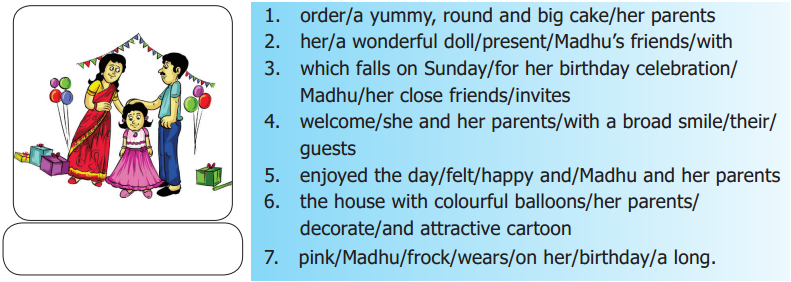
Samacheer Kalvi 6th English Guide Term 3 Play Chapter 1 The Jungle Book 14 Samacheer Kalvi 6th English Guide Term 3 Play Chapter 1 The Jungle Book 15

  1. Her parents order a yummy, round, and big cake.
  2. Madhu invites her close friends for her birthday which falls on Sunday.
  3. Madhu’s friends present her with a wonderful doll.
  4. She and her parents welcome their guests with a broad smile.
  5. Madhu and her parents enjoyed the day and felt happy.
  6. Her parents decorate the house with colourful balloons and attractive cartoon.
  7. Madhu wears a long pink frock on her birthday.

III. Frame as many sentences as possible from the substitution table given below.

Samacheer Kalvi 6th English Guide Term 3 Play Chapter 1 The Jungle Book 16
Example: I enjoy playing badminton and carrom daily.

  1. I hate playing cricket generally.
  2. We often enjoy watching chess.
  3. You like playing hockey occasionally.
  4. They prefer playing Kabaddi usually.
  5. Samritha often enjoys watching tennis.
  6. Kavish likes playing carrom daily.
  7. Samritha hates watching volleyball generally.
  8. I like coaching cricket daily.
  9. We love watching Kho-kho sometimes.
  10. Samritha prefers watching football generally.
  11. Kavish enjoys playing tennis usually.
  12. Kavish likes coaching volleyball usually.
  13. I dislike watching fencing generally.
  14. We wish watching basketball sometimes.
  15. They dislike playing cricket usually.
  16. Samritha enjoys hockey often.
  17. We prefers playing squeash rarely.
  18. They wish playing table tennis every day.
  19. You like playing badminton usually.
  20. Kavish likes watching hockey sometimes.

IV. Read the sentences, insert appropriate articles in the blanks and circle the noun phrases.
Samacheer Kalvi 6th English Guide Term 3 Play Chapter 1 The Jungle Book 17

V. Complete the dialogue by using suitable adjectives in the blanks.
Sinduja: Hi! Venkat. Hope you received the message about our school’s sports day. Hmmm…!
Venkat: Yes… I was the last one to enroll my name in the events.
Sinduja: So, tell me how many events have you enrolled?
Venkat: I have enrolled myself only in some events.
Sinduja: What are they?
Venkat: As I am tall, I have given my name for long jump and running events.
Sinduja: That’s good to hear.
Venkat : What about you, Sinduja?
Sinduja: I have decided to participate in all the events.
Venkat: Hey!! That’s good. Expecting the best from you.
Sinduja: Thank you so much, Venkat. Wish you the same. Let’s rock.

Project (Text Book Page No. 128)
Read the story given below and follow the instructions to convert it into a play.
For the story see (Text Book page No. 128)
Answer:
Title: Goldilocks and the three bears.
Characters:

  1. A little girl named Goldilocks
  2. Papa bear
  3. Mama bear
  4. Baby bear
  5. Narrator

SCENE – I

Narrator: A little girl named Goldilocks went for a walk in the forest. On her way, she came upon a house. She knocked at the door, but no one answered. So she walked right in. She found three bowls of porridge in the kitchen.
Goldilocks: I’m very hungry. Let me taste this porridge from the first bowl.
Narrator: She tasted the porridge from the first bowl.
Goldilocks: ‘Ouch! This porridge is too hot!’
Narrator: She tasted the porridge from the second bowl.
Goldilocks: This porridge is too cold.
Narrator: She tasted the last bowl of porridge.
Goldilocks: Ahhh, this porridge is just right.
Narrator: She ate it all up happily. She was feeling a little tired. So she walked into the living room where she saw three chairs. She sat in the first chair to rest her feet.
Goldilocks: This chair is too big.
Narrator: She sat in the second chair.
Goldilocks: This chair is too big too!
Narrator: She whined and tried the last smallest chair.
Goldilocks: Ahhh, this chair is just right.
Narrator: But just as she settled down into the chair to rest, it broke into pieces.

SCENE – II

Narrator: Goldilocks was very tired by this time. So she went upstairs to the bedroom. She tried all the beds and as the two beds were hard, she chooses the smaller bed, which was soft. She laid down on it and at last, she fell asleep. As she was sleeping, the three bears, who lived in that house, came home.
Papa Bear: Someone’s been eating my porridge.
Mama bear: Yes, someone had tasted my porridge.
Baby bear: Someone had eaten all my porridge.
Papa Bear: Someone’s been sitting in my chair.
Mama bear: Someone’s been sitting in my chair too.
Babay bear: Someone’s been sitting in my chair and they’ve broken it all to pieces.
Narrator: They decided to look around some more and when they got upstairs to the bedroom, Papa bear growled.
Papa bear: Someone has been sleeping in my bed.
Mama bear: Someone has been sleeping in my bed too.
Babay bear: Someone is still sleeping on my bed.
Narrator: Just then Goldilocks woke up and saw the three bears. She screamed.
Goldilocks: Help! Help!
She jumped up and ran out of the room. She ran down the stairs, opened the door, and ran away into the forest. And she never returned to the home of the three bears.

The Jungle Book Summary in English

Father wolf gets ready to hunt and the mother wolf takes protective measures by dropping the cubs into the mouth of the cave. Jackal means everyone about Shere Khan (tiger) who is going to hunt. Father wolf gets angry on hearing about Sherekhan and his hunt among the hills. They see that the man-cub had gone into the mouth of the cave. Sherekhan asked the man-cub but Father wolf sternly says that the man-cub belonged to us. Mother wolf came to forward-facing Sherekhan bravely. So, Sherekhan backs out growling. Little frog Mowgli, said that the man-cub will hunt Sherekhan one day.

The Jungle Book Summary in Tamil

தந்தை ஓநாய் வேட்டையாடத் தயாராகிறது மற்றும் தாய் ஓநாய் குட்டிகளை குகையின் வாசலில் இறக்கி பாதுகாப்பு நடவடிக்கைகளை எடுக்கிறது. ஜாக்கல் என்றால் வேட்டையாடப்போகும் ஷோர்கான் 4வி என்று பொருள் தர ஓநாய் ஷேர்கான் மற்றும் மலைகள் மத்தியில் அவரது வேட்டைப் பற்றி கேள்விப்பட்டதும் கோவப்படுகிறார். மனித குட்டி குகையின் வாய்க்குள் சென்றதை அவர்கள் காண்கிறார்கள். ஷேர்கான் அந்த மனிதக் குழந்தையைக் கேட்டார். ஆனால், தந்தை ஓநாய் மனிதக்குழந்தை எங்களுக்கு சொந்தமானது என்று உறுதியாகக் கூறுகிறார். தாய் ஓநாய் ஷேர்கானை தைரியமாக எதிர்கொள்ள முன் வந்தது. எனவே ஷேர்கான் கூச்சலிட்டுக்கொண்டு ஆதரிக்கிறார். சிறிய தவளை மனித குழந்தை ஒரு நாள் ஷேர்கானை வேட்டையாடும் என்று கூறினார்.

Samacheer Kalvi 6th English Guide Term 3 Prose Chapter 2 That Sunday Morning

Tamilnadu State Board New Syllabus Samacheer Kalvi 6th English Guide Pdf Term 3 Prose Chapter 2 That Sunday Morning Text Book Back Questions and Answers, Summary, Notes.

Tamilnadu Samacheer Kalvi 6th English Solutions Term 3 Prose Chapter 2 That Sunday Morning

6th English Guide That Sunday Morning Text Book Back Questions and Answers

Spin A Yarn

Samacheer Kalvi 6th English Guide Term 3 Prose 2 That Sunday Morning 1
The starting of a story is given. Develop it into a humorous story.

Once there lived a boy who bragged endlessly about himself. One day, the boy and his friend went to the party. A rich man said that my room echoed my name 10 times. Everyone in the party, looked him suprisingly. Suddenly the boy bragged that my room echoed my name 20 times repeatedly. Everyone in the party looked him surprisingly. People- in the party said that we came to your house to see the room. Even though there was fear in his mind somehow he wanted to show out. He invited the people next evening. The boy planned with his friend Piero to cheat people. The friend (Piero) called his name Jack who hided in the room echoed Jack 20 times people was wondered. By chance of the people was named Piero. One of the people called out Piero where were you? This time instead of echo, answer came, Yes, I was here’ coming.

People now knew that they have been tricked and thrashed the boy. The boy stopped the bragging.

Section – I

Textual Questions

Answer in one or two sentences. (Text Book Page No. 93)

1. Why did the family move to Patna?
Answer:
The family moved to Patna because father was posted.

2. Who was challenged for a race?
Answer:
The author was challenged for a race.

Samacheer Kalvi 9th English Guide Prose Chapter 2 I Can’t Climb Trees Anymore

3. Is the brother boastful? What makes you think so?
Answer:
Yes, the brother is boastful. He had always beaten his sister.

4. Why did the trees become a green blur?
Answer:
The trees became a green blur because she pedalled very fast.

5. Which line tells you that the girl was faster than the boy?
Answer:
The line ‘soon I drew level with my brother and then gradually I moved ahead’ tells that the girl is faster than the boy.

Section – II

Textual Exercises (Text Book Page No. 96)

Read the events of the story. They are in the wrong order. Put them in the correct order.

And it charged straight at the cavalry officers on horseback. (6)
And so she flew onto the back of the cow. (4)
So everybody panicked and made a general rush to saftey. (7)
The startled cow charged off in fear. (5)
She applied the brakes, but was thrown off the cycle. (3)
Just then she saw a lone cow in the middle of the road. (2)
Finally the cow fell in to a ditch and dislodged the girl. (8)
The girl cried out in delight as she overtook her brother on her cycle. (1)

Section – III

Textual Exercises

Based on your reading, put a (✓) for the correct and (✗) for the incorrect statements: (Text Book Page No. 97)

  1. The man didn’t want to get up because he was tired as he was thrown into the ditch. (✗)
  2. The boy was rather unsympathetic to his sister. (✗)
  3. The girl was badly hurt. (✗)
  4. The boy and the girl were taken by the cavalry officers to explain their actions. (✓)
  5. They rode back home quickly. (✗)
  6. The girl admitted to her brother that she was badly frightened. (✗)

Read and Understand

A. Answer the following questions. (Text Book Page No. 98)

1. How does Patna differ from Delhi?
Answer:
There were no impressive buildings or monuments as there are in Delhi.

2. What was the girl determined to do? why?
Answer:
The girl was determined to win the race at that time because her brother had always beaten her.

Samacheer Kalvi 9th English Guide Prose Chapter 2 I Can’t Climb Trees Anymore

3. How did the cavalry officers look? What happened to them finally?
Answer:
The cavalry officers looked brilliant in appearance. The horses panicked and scattered. The horses and the officers were to be seen.

4. Why did the girl reply haughtily?
Answer:
The girl was not hurt and so she replied haughtily.

5. Were the girl and her brother friendly with each other?
Answer:
Yes, the girl and her brother were friendly with each other.

6. “I think it would be nice if we moved quickly from her.”
a) Who does T refer to?
Answer:
T refers to the girl.

b) Why did they want to move quickly from there?
Answer:
The brother saw one of the horse riders coming towards them with a scowl on his face. So they wanted to move quickly from there.

B. Think and answer: (Text Book Page No. 98)

1. Work in groups. Discuss and have a Debate on life in bustling cities and life in calm towns.
Answer:
(1) Group A talks about a bustling city:
A bustling city is always busy from dawn to dusk. The population is high. People from different places come and settle in the city. The reason is the availability of jobs. So they get big or small jobs and settle in the city. You have everything you need, certain people think that city is heaven.

(2) Group B
Life is calm towns is peaceful and joyful. We get plenty of water and pure air. There is no hurry among the people. The town is less crowded. But at the same time, people get everything they need as the people get in cities. They get healthy and spacious to live in. Everything will be cheaper in small towns. So people can manage their life even with small incomes.

Samacheer Kalvi 9th English Guide Prose Chapter 2 I Can’t Climb Trees Anymore

2. Imagine you are the girl and give a different ending to the story.
Answer:
I won’t run away soon after we saw the horse rider and the owner of the cow. We would hide behind something and would wait patiently and silently. Only after the horse rider and the owner with his cow had left the place, we would come out. We would take our bikes and go home without any panic or fear.

Vocabulary (Text Book Page No. 98)

C. Match the phrases with their meanings:
Samacheer Kalvi 6th English Guide Term 3 Prose 2 That Sunday Morning 2
Answer:

Phrase: Phrases are groups of two or more words that work together to perform a single grammatical function in a sentence. Phrases do not contain a subject or a predicate. Answer
1. drew level with ran very quickly in a panic 5
2. whoop with glee to leave a place quickly 6
3. jammed on the brakes as if one’s life depends on it 4
4. clung for dear life tried to stop the motion immediately 3
5. charged up the road rose to an equal level 1
6. beat a hasty retreat shout with enthusiasm and happiness 2

D. Refer to a dictionary and find out the meaning of the words given below.

beam –
Answer:
ray of light

smile –
Answer:
a pleasant expression of the face

guffaw –
Answer:
loud, harsh, burst of laughter

laugh –
Answer:
to express amusement satisfaction

giggle –
Answer:
to laugh in a high pitched silly manner

E. Read the sentences given below. Fill in the blanks with the correct form of the appropriate laughter words from the exercise above. (Text Book Page No. 99)

  1. Kavitha’s face beamed with joy as she arrived in India.
  2. The show was enjoyed by all the audience and they guffawed out loudly all the while.
  3. When I tickle Nishanth. he always makes a loud giggle.
  4. Bharani didn’t mean any harm, he just did it for laugh.
  5. Things will calm down, you just keep a smile.

F. Pick the word from the text that is similar to the words or phrases given below. (Text Book Page No. 99)

  1. threatening and an extremely angry scowl.
  2. A heavy blow or hit thump.
  3. Happening gently and slowly gradually.
  4. Any building of a past age, regarded as a historically important place monument.
  5. Bad luck unfortunate.

G. Match each word with its antonyms: (Text Book Page No. 99)
Samacheer Kalvi 6th English Guide Term 3 Prose 2 That Sunday Morning 3
Answer:

1. shady misery 3
2. bored calm 4
3. glee interested 2
4. panic slow 5
5. hasty sunny 1

Make sentences of your own for any five words from the above. (Text Book Page No. 99)

  1. The man leads a life of misery.
  2. He remained calm even in his sufferings.
  3. It is a shady place to take a rest.
  4. The students are in glee.
  5. When a bomb exploded, the crowd ran in panic.

Listening (Text Book Page No. 100)

H. Here is a humorous story. But there are some words missing. Listen to your teacher and fill in the blanks to complete the story. Then give a title and a moral to the story. (Listening text is on page -130)

Once there lived three friends Vani, Kavi, and Sumi. They always played pranks on one another. One day Vani bought some delicious herries and she decided to share them with her friends.

Kavi and Sumi were delighted to see the berries. The three of them sat and started eating the berries. Suddenly Sumi decided to play a trick on Kavi. When she looked under her chair she saw a small heap of berry seeds. She stealthily pushed the heap of seeds under Kavi’s chair.

Then Sumi’s said “What is this Kavi? You are so greedy! You alone have eaten so many berries.” Kavi felt bad and didn’t know what to say.

Vani looked here and there. When she looked under Sumi’s chair there were no seeds. So, she replied, “Sumi, Kavi was at least greedy, but see yourself you have eaten all the berries including its seeds.” Then Kavi understood that her friend had just played a trick on her and then all three of them laughed heartily.

Title: Three friends
Moral: No Cunningness among Friends

Speaking (Text Book Page No. 100)

I. Each person or group chooses an item from the class and takes two minutes to prepare. He/she must promote and sell the same item in the most humorous way to convince the classmates to buy the product. You can choose items such as an eraser, pencil, school bag, book, etc.
It can go like this.
e.g.
Here I have a magical eraser for you. You can do whatever you want to do with this. You can rub anything that you don’t like. Just rub it against somebody’s hair and it will be gone forever. If you want to see somebody without hair, here you go. Buy this eraser and have fun with your friends.

I have a miracle pencil. It performs wonders you need not use your fingers to write. The pencil will write off its own whatever you think. You need not whatever, sharpen. It won’t become shortened. So I feel very proud of having one such miracle pencil.

Use Grammar

J. Look at the picture and fill in the blanks with suitable words. (Text Book Page No. 101)

1. The car was moving too _______.
Samacheer Kalvi 6th English Guide Term 3 Prose 2 That Sunday Morning 4
Answer:
fast

2. The lift is moving _______ .
Samacheer Kalvi 6th English Guide Term 3 Prose 2 That Sunday Morning 5
Answer:
slowly

3. Joanna did her classwork _______
Samacheer Kalvi 6th English Guide Term 3 Prose 2 That Sunday Morning 6
Answer:
neatly

4. Keerthi Vasan arrived _______
Samacheer Kalvi 6th English Guide Term 3 Prose 2 That Sunday Morning 7
Answer:
late

5. Paul _______ plays cricket with his friends.
Samacheer Kalvi 6th English Guide Term 3 Prose 2 That Sunday Morning 8
Answer:
always

6. Suguna _______ helps her mother at home.
Samacheer Kalvi 6th English Guide Term 3 Prose 2 That Sunday Morning 9
Answer:
often

K. Read the sentences and put the adverbs in the correct boxes. Give two more examples of your own in each box.

  1. Anand has decided to submit his project tomorrow.
  2. The cat ran behind.
  3. Paraman sang in the choir happily.
  4. We never come late to the office.
  5. The stray elephant was set free in the forest yesterday.
  6. Arun and Vimala usually complete their homework on time.
  7. Raghav looked at his sister affectionately.
  8. I prepare to leave early.

Samacheer Kalvi 6th English Guide Term 3 Prose 2 That Sunday Morning 10
Answer:
Samacheer Kalvi 6th English Guide Term 3 Prose 2 That Sunday Morning 13
Samacheer Kalvi 6th English Guide Term 3 Prose 2 That Sunday Morning 14

L. Put the words in the correct order to make sentences. Use a different colour to write the adverbs.

Question 1.
Was / somebody / there / nearby / standing.
Answer:
There was somebody standing nearby.

Question 2.
Came / Anand / to / school / early.
Answer:
Anand came to school early.

Question 3.
Softly / Murali / speaks.
Answer:
Murali speaks softly.

Samacheer Kalvi 9th English Guide Prose Chapter 2 I Can’t Climb Trees Anymore

Question 4.
Beautifully / the house / have / they / decorated.
Answer:
They have decorated the house beautifully.

Question 5.
English / classes / during / always / we / English / speak.
Answer:
We always speak English during English classes.

M. Pick the words from the box and put them in the appropriate column:
Samacheer Kalvi 6th English Guide Term 3 Prose 2 That Sunday Morning 11
Answer:

Adverb Adjective
kindly soft
everywhere sweet
constantly bright
then few
loudly huge

Writing

N. Work in groups and write a paragraph on “Laughter is the best medicine.”
Laughter is the Best Medicine
A good laugh heals a lot of hurts. It is a mighty good thing that sets everything straight. It is a powerful antidote to stress, pain, and conflict. Nothing works faster to bring your mind and body back into balance than a good laugh. Humour lightens your burden, inspires hope, connects you to others, and keeps you grounded, focussed, and alert. A good hearty laugh relieves physical tension and stress leaving your muscles relaxed for up to 45 minutes after. It improves the function of blood and increases blood flow, which can help protect you against heart attack and other vascular diseases. Shared laughter is one of the most effective tools. When laughter is shared, it binds people together and increases happiness and intimacy. Therefore, one should always maintain positive attitude in life and keep laughing to stay healthy and happy.

Creative Writing

O. Look at the cartoon strips. Create your own humorous story.

Write a sentence or two for each frame of the comic strip in the space given.
Samacheer Kalvi 6th English Guide Term 3 Prose 2 That Sunday Morning 12
Answer:
Two friends were walking up in the land. They fell into a depression. There was a coconut tree. The coconut fall on their heads. They had lumps on their heads however they were happy to drink the coconut water.

That Sunday Morning Summary in English

Section – I
On Sunday the author and her brother decided to go a little exploring on their bikes. They decided to race each other. The author decided to win the race. She pedalled as fast as she could. Her legs ached. Her skirt flashed out. The hair blew behind her. Anyway, the author soon drew level with her brother, and then gradually she moved ahead.

Section – II
A cow stood on the road When the author was riding on the bicycle, applied a sudden brake. She was thrown on the back of the cow. The cow started running with the author on her back. In the meantime, the author was freed from the cow. She landed on the soft earth bordering the ditch.

Section – III
The horses were still out of control. The man on the horse fell into a ditch. The horse tried to attack him. He scrambled out of the ditch. The author and his brother quickly move away, once they spotted the horse rider coming towards them.

That Sunday Morning Summary in Tamil

பிரிவு – I: ஞாயிற்றுக்கிழமை ஆசிரியரும் அவரது சகோதரரும் தங்கள் வண்டியில் கொஞ்சம் ஏதோ தேட முடிவு செய்தோம். அவர்கள் ஒருவருக்கொருவர் பந்தயத்தில் ஈடுபட முடிவு செய்கிறார்கள். ஆசிரியர் பந்தயத்தை வெல்ல முடிவு செய்தார். அவள் தன்னால் முடிந்தவரை வேகமாக மிதித்தாள். அவள் கால்கள் வலித்தன. அவளது துணி முகத்தில் அடித்தது. முடி அவளுக்குப் பின்னால் வீசியது. அப்படி இருந்தாலும் ஆசிரியர் விரைவில் நிலைக்கு வந்தார். பின்னர் படிப்படியாக அவள் முன்னேறினாள்.

பிரிவு -II: சாலையில் ஒரு மாடு நின்றுகொண்டிருந்தது. ஆசிரியர் வண்டியில் சவாரி செய்தபோது திடீரென்று பிரேக் பயன்படுத்தினாள். அவள் பசுவின் பின்புறத்தில் வீசப்பட்டாள். பசு முதுகில் அவளுடன் ஓடத் துவங்கியது. அந்த நேத்தில் அவள் பசுவிடமிருந்து வீசப்பட்டாள். அவள் மென்மையான தரையில் பள்ளத்தின் ஓரத்தில் விழுந்தாள்.

பிரிவு -III: குதிரை சவாரி தங்களை நோக்கி வருவதைக் கண்டதும் ஆசிரியரும் அவரது சகோதரரும் விரைவாக விலகிச் செல்கிறார்கள். குதிரைகள் இல்லை கட்டுப்பாட்டுக்குள் வரவில்லை. குதிரையில் இருந்தவர் பள்ளத்தில் விழுந்தார். குதிரை அவரைத் தாக்க முயன்றது. அவர் பள்ளத்திலிருந்து வெளியேறினர்.

Samacheer Kalvi 6th English Guide Term 3 Prose Chapter 1 Who Owns the Water?

Tamilnadu State Board New Syllabus Samacheer Kalvi 6th English Guide Pdf Term 3 Prose Chapter 1 Who Owns the Water? Text Book Back Questions and Answers, Summary, Notes.

Tamilnadu Samacheer Kalvi 6th English Solutions Term 3 Prose Chapter 1 Who Owns the Water?

6th English Who Owns the Water? Text Book Back Questions and Answers

Warm Up (Text Book Page No. 72)

Look at the pictures, discuss in pairs, share your answers with the class.

Samacheer Kalvi 6th English Guide Term 3 Prose 1 Who Owns the Water 1
1. During which season do you see a peacock dance?
Answer:
During Rainy season.

Samacheer Kalvi 6th English Guide Term 3 Prose 1 Who Owns the Water 2
2. In which season can you see trees without leaves? Name the country where your can find this season.
Answer:
In Autumn, In Canada.

Samacheer Kalvi 6th English Guide Term 3 Prose 1 Who Owns the Water 3
3. Which season is shown in this picture? What are the people doing?
Answer:
Winter season. The people are warming themselves by lighting a fire.

Samacheer Kalvi 6th English Guide Term 3 Prose 1 Who Owns the Water 4
4. Which season is shown in this picture? How do you know?
Answer:
Summer season is shown in this picture. On seeing the hot Sun, people who drink the tender coconut water and a man who takes ice cream under his umbrella, I know this.
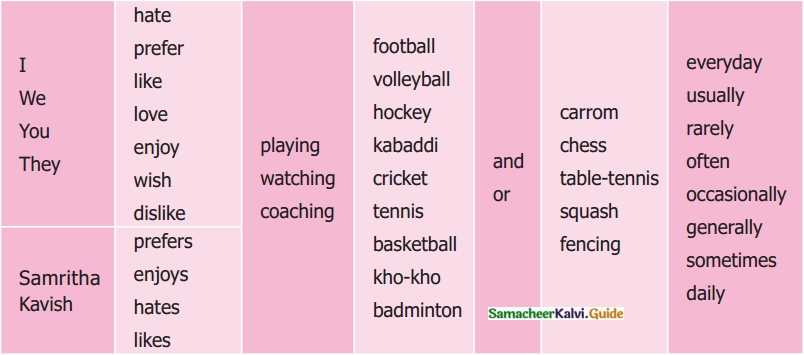
Section – I

Textual Exercise (Text Book Page No. 74)

Put a (✓) for the correct and (✗) for the incorrect statements:

  1. A tiny bird looked for a place to lay her eggs. (✓)
  2. The land was wet and green. (✗)
  3. The little bird found a shallow hollow in the ground. (✓)
  4. The eggs hatched and the babies flew away. (✓)
  5. The pit was comfortable for the wild boar to sleep in. (✗)
  6. The wild boar got up from its day bed because it was disturbed by another boar. (✗)

Section – II

Textual Exercise

Complete the sentences given below with words/phrases. (Text Book Page No. 75)

1. The wild dogs came to the spot to catch ………………….
Answer:
wild boar

2. The rain came and poured ………………….
Answer:
for the three days and three nights

3. The whole earth smelled ………………… and ………………….
Answer:
wet and fresh

4. The hole in the ground was filled ………………….
Answer:
with rainwater

5. The buffalo ………………… in the hole.
Answer:
wallowed

6. The hole became ………………… and ………………….
Answer:
widened and little watering hole

Section – III

Textual Questions

Answer the following questions in one or two sentences: (Text Book Page No. 76)

1. Why did the farmer have to travel far?
Answer:
The father had to travel far to get water for his thirsty crops.

2. What sight made the farmer thankful?
Answer:
The sight of the verdant bowl made the farmer thankful.

3. Name the tools the farmer brought out. What did he do with them?
Answer:
The tools the farmer brought out were pickaxe and spade. He dug the earth with them.

4. Why did the crowd gather by the side of the pond?
Answer:
The crowd gathered by the side of the pond to see the priest furrow his brow and chant.

5. When did the richest farmer get upset why?
Answer:
The richest farmer got upset when things took place that he was not invited to see it. He came there to claim the pond his own.

Read and Understand

A. Choose the correct answer and write it in the blank. (Text Book Page No. 77)

1. The little bird broadened the hole with her
a) beak
b) claws
Answer:
b) claws

2. The wild boar settled down scraping the hole into a to have a good sleep.
a) pit
b) hollow
Answer:
b) hollow

3. The poor farmer’s crop was
a) meagre
b) surplus
Answer:
a) meagre

B. Tick the correct answer.

1. The boar slept until the fading sun told him it was time to get up. What does the phrase until the fading sun mean?
a) until evening (✓)
b) until sun fades in colour ()
Answer:
a) until evening

2. The farmer was thankful at the sight of the verdant bowl because
a) it was a pond of water (✓)
b) he wanted green grass ()
Answer:
a) it was a pond of water

3. They all stood around the little jewel of blue means
a) They stood around the pond (✓)
b) They stood around the jewel which was blue ()
Answer:
a) they stood around the pond

4. The dry earth soaked up the moisture as a hungry puppy laps UP milk. It means
a) The puppy was very hungry ()
b) The dry earth absorbed the water very quicky (✓)
Answer:
b) the dry earth absorbed the water very quicky

C. Answer the following questions:

1. Pick out the line which tells you about seasons (in Sec II). Which seasons are mentioned?
Answer:
Both rainy and summer seasons are mentioned.

2. What happened to the hole in the ground after the rain?
Answer:
The hole collected the rain water and around its edges there grew green grass.

3. Identify a sentence and a phrase which tells us that the story took place in summer.
Answer:
The dry earth soaked up the moisture.
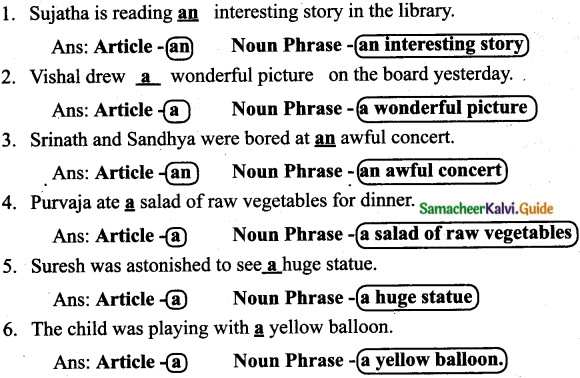
Vocabulary (Text Book Page No. 78)

D. Fill in the blanks with words given in the box to make compound words.
Samacheer Kalvi 6th English Guide Term 3 Prose 1 Who Owns the Water 7

1 . We use rain ………………. on a rainy day.
Answer:
raincoat

2. The toy ………………. boat danced on the
Answer:
sailboat

3. We must drink tender ………………. water in summer.
Answer:
tender coconut

4. We can see a ………………. bow after summer showers.
Answer:
rainbow

5. Clean the ashes out of the ………………. place
Answer:
fireplace

E. Complete the following using their group names.

1 . A ………………. of wolves went hunting in the forest.
Answer:
pack

2. She bought a new ………………. of shoes for her birthday.
Answer:
pair

3. A ………………. of fish swam past our boat.
Answer:
shoal

4. A ………………. of bees had settled on a mango tree.

Answer:
swam

5. I ate a ………………. of grapes.
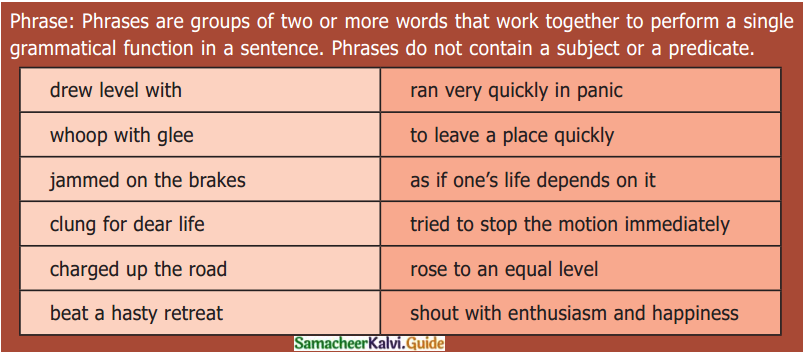
Answer:
bunch

Listening (Text Book Page No. 79)

F. Listen to the weather report. Read the questions given below, then listen to the weather report again and fill in the blanks. (Listening text is on page -130)

1. Which season does the weather report show?
Answer:
Spring

2. What kind of a day is it?
Answer:
It is a clear day with blue skies

3. What is the temperature stated in the report?
Answer:
15° C

4. Tomorrow it may probably
Answer:
rain

5. The weather report suggests using
Answer:
umbrella

Speaking

G. Imagine that you and your friend have decided to spend a day together in your house. You have planned your schedule from morning till night. Discuss in pairs and speak about it in the class. You can start like this.
I like to go for a walk but my friend wants to work out in the gym.

A Day spent by two friends

I like to go for a walk but my friend wants to go swimming. Finally, we went for swimming. It was very pleasant to swim in the cold water. We felt fresh throughout the day. After finishing our breakfast we went to the cricket field and stayed there watching the match till 1 p.m. Again we returned home and finished lunch. We took rest for one hour. In the evening we went to the beach and enjoyed the scene happily. We were very happy throughout the day. We will never forget the day.

Use Grammar (Text Book Page No. 80)

H. Fill in the blanks with suitable linking words or conjunctions.

1. Our team played well ……………….. won the game, (but, because, and)
Answer:
and

2. She slipped badly ……………….. she did not hurt herself, (but, and, or)
Answer:
but

3. The box .was heavy ……………….. he could not lift it. (so, because, and)
Answer:
so

4. Rani was late to school ……………….. she missed the bus. (because,so,and)
Answer:
because

5. You can use a pen ……………….. a pencil for writing, (but, and, or)
Answer:
or

I. Join the sentence of Column A with B using the words given in the box.
Samacheer Kalvi 6th English Guide Term 3 Prose 1 Who Owns the Water 5
Answer:

  1. The clouds moved away and the sun came out.
  2. Velu thanked his friend because he helped Velu in time.
  3. It rained heavily but the match continued.
  4. Eat slowly or you will get choked.

Writing

J. Write a short paragraph on ‘summer’ using the hints given.

You can begin like this
Samacheer Kalvi 6th English Guide Term 3 Prose 1 Who Owns the Water 6
I live in Chennai. The weather is ………………

I live in Chennai. Usually, the weather in Chennai is hot in the day and the night will be cool because of the sea breeze. But anyway the summer is hot. We cannot go out during the day. We will often feel thirsty. We have to take some kind of drink to quench our thrist and prevent dehydration. During summer we must wear cotton clothes. We must avoid eating non-vegetarian food. In the evening we can spend our evenings on the beach. Our body will lose heat and we will have to get sleep comfortably.

Creative Writing

K. Trees can help you recognize seasons. How do the trees look different in each season? Write a short paragraph with the clues given below.

  • Summer – Trees stretch their leafy branches towards the sun.
  • Spring – Branches are full of new green leaves.
  • Rain – Trees absorb water and look green.
  • Autumn – Trees shed their leaves.

During the summer season, most of the trees stretch their leafy branches towards the sun but spring comes after summer. So branches are full of new green leaves and they are followed by sweet-smelling flowers. During the rainy season, the trees get wet and absorb rainwater and look green. Autumn season is an empty season. It means that no leaves are seen in the trees. Trees shed their leaves and wait to welcome the summer.

Who Owns the Water? Summary in English

A tiny bird looked for a nesting place in the outskirts of a village. She finds a shallow depression. She decided to lay her eggs in the depression. She broadened the hole by using her claws. A wild boar who happened to pass by the hole decided to rest for a while in it. He scraped and dug making the hole wider for accomodating his body. After taking a rest, the boar left the place. A pack of wild dogs dug at the small hole where wild boar rested. Many buffaloes trampling the soil and made the place a little watering hole. One day a farmer found the water so close to his land. People gathered there The richest farmer in the village announced the watering hole was his own. A germ of an idea is to dig and make bigger, you can get water.

Who Owns the Water? Summary in Tamil

ஒரு சிறிய பறவை ஒரு கிராமத்தின் வெளிப்புறங்களில் கூடுகட்டும் இடத்தை தேடியது. அவள் ஒரு ஆழமற்ற பள்ளத்தை காண்கிறாள். அவள் பள்ளத்தை முட்டையிட முடிவு செய்தாள். அவள் நகங்களைப் பயன்படுத்தி துளையை அகலப்படுத்தினாள். துளை வழியாகச் சென்ற ஒரு காட்டுப்பன்றி அதில் சிறிது ஓய்வெடுக்க முடிவு செய்தது. அவர் தனது உடலை தக்கவைத்துக் கொள்வதற்காக துளையிட்டார். ஓய்வெடுத்த பிறகு பன்றி அந்த இடத்தை விட்டு வெளியேறியது. காட்டுப்பன்றி ஓய்வெடுத்த சிறிய துளைக்குள் ஒரு காட்டு நாய்கள் கூட்டம் துளையை தோண்டின. பல எருமைகள் மண்ணை மிதித்து அந்த இடத்தை ஒரு சிறிய நீர்ப்பாசன துளையாக மாற்றின. ஒருநாள் ஒரு விவசாயி தனது நிலத்திற்கு அருகில் தண்ணீ ரைக் கண்டார். மக்கள் அங்கு கூடினர். கிராமத்தின் பணக்கார விவசாயி நீர்ப்பாசன துளை தனக்குச் சொந்தம் என்று அறிவித்தார். துளையை தோண்டி துழாவி பெரிசாக்கும் யோசனையில் நீங்கள் தண்ணீரைப் பெறலாம். துளையை தோண்டி அதனை அகலப்படுத்தியது.

Samacheer Kalvi 6th English Guide Term 3 Poem 1 Indian Seasons

Tamilnadu State Board New Syllabus Samacheer Kalvi 6th English Guide Pdf Term 3 Poem 1 Indian Seasons Text Book Back Questions and Answers, Summary, Notes.

Tamilnadu Samacheer Kalvi 6th English Solutions Term 3 Poem 1 Indian Seasons

6th English Indian Seasons Text Book Back Questions and Answers

Warm Up (Text Book Page No. 81)

Discuss in pairs, pick out the words related to seasons from the grid and write them in the blanks.
Samacheer Kalvi 6th English Guide Term 3 Poem 1 Indian Seasons 1
Answer:
Snow, sky
Monsoon, sunny
dry, leaves
Rainwind Thunder, sun

Samacheer Kalvi 6th English Guide Term 3 Poem 1 Indian Seasons 2 Samacheer Kalvi 6th English Guide Term 3 Poem 1 Indian Seasons 3
What day is it?

  1. We feel thirsty on a …………………..
  2. We use an umbrella on a …………………..
  3. We sail paper boats on a …………………..
  4. We fly kites on a …………………..

Answer:

  1. hot day
  2. rainy day
  3. beginning day of the harvest season
  4. windy day

Textual Exercises (Text Book Page No. 82)

B. Which season am I? Read the poem, understand and solve the riddle.

1. I make the feet dusty.
Answer:
summer

2. Frogs and toads will visit when I am there.
Answer:
rainy season

3. I am pretty short and sweet.
Answer:
spring

Samacheer Kalvi 9th English Guide Prose Chapter 2 I Can’t Climb Trees Anymore

4. I make your garden smell sweet.
Answer:
spring

5. Leaves will wither because of me.
Answer:
Autumn

Read and Understand

C. Read the lines and answer the questions given below:

1. Summer comes
in a blaze of heat with
sunny smiles
and dusty feet

a. Does the poet welcome the summer? How do you know?
Answer:
The poet does not welcome the summer because it comes with flame or fire.

b. Which line tells you that there is no rain in summer?
Answer:
The line “sunny smiles and dusty feet” tells us that there is no rain in summer.

Samacheer Kalvi 9th English Guide Prose Chapter 2 I Can’t Climb Trees Anymore

2. Spring is pretty
but short and sweet
when you can smell the grass
from your garden seat

a. How does the poet describe the spring season?
Answer:
The poet describes the spring season as short and sweet.

b. Which line tells you that the garden is fresh?
Answer:
When you can smell the grass” tell us that the garden is fresh.

c. Who does ‘you’ refers to?
Answer:
You refer to the viewer.

3. Autumn is English.
in red, yellow and brown
Autumn is Indian
Whenever leaves fell down
a. How is autumn in India?
Answer:
In India, no one can distinguish the Autumn season.

b. Compare the English autumn with the Indian autumn.
Answer:
It is Indian autumn whenever the leaves fall down. In English autumn leaves become red, yellow, and brown before they fall down.

D. Pick out the rhyming words from the poem and write them in the table.
Samacheer Kalvi 6th English Guide Term 3 Poem 1 Indian Seasons 4
Answer:

Stanza -1 Stanza – 2 Stanza – 3
comes

smiles

roads

toads

sweet

seat

E. Find examples of alliteration and write them in the blanks.

1. in ablaze of heat –
with sunny smiles
Answer:
sunny, smiles

2. to muddy roads monsoons and mangoes
Answer:
muddy, monsoons, mangoes

Samacheer Kalvi 9th English Guide Prose Chapter 2 I Can’t Climb Trees Anymore

3. Spring is pretty
but short and sweet
Answer:
spring, short, sweet

F. Work in pairs, find answers for the questions, and share in the class.

1. Name the seasons mentioned in the poem?
Answer:
The seasons mentioned in the poem are summer, rainy, spring, and autumn.

2. What does the summer bring?
Answer:
The summer brings heat and dust.

3. Which word refers to ‘rain’?
Answer:
The word ‘Monsoon’ refers to ‘rain’.

4. Why does the poet say the ‘Spring is pretty’?
Answer:
The spring is pretty because we find trees with green leaves and sweet-smelling grass all over.

Samacheer Kalvi 9th English Guide Prose Chapter 2 I Can’t Climb Trees Anymore

5. When is it autumn in India? Why does the poet say this? Is there an autumn season in India?
Answer:
When the leaves fall down, it is autumn in India. The poet says this because in India, leaves rarely change colours. Only when the trees shed their leaves, we know that it is autumn in India. Yes, there is an autumn season in India during the months of September, October, and November.

G. How does the poet describe the Indian seasons? Write in your own words in about 50 words.

In India, the summer is very hot. The sun shines brightly from the morning to the evening. The road is full of dust. In the rainy season we find muddy roads we see frogs jump up and food. Spring is very beautiful but it is short and sweet. During the autumn season, the leaves turn red, yellow, and brown. But whenever leaves fall down it is Indian autumn.

6th English Guide Indian Seasons Additional Appreciation Questions

Poem Comprehension and poetic devices:
1. Then seasons change
to muddy roads
monsoons and mangoes
leapfrogs and toads
a) What is the season mentioned here?
Answer:
The rainy season is mentioned here.

b) Why are roads muddy?
Answer:
The roads become muddy because of heavy rains.

Samacheer Kalvi 9th English Guide Prose Chapter 2 I Can’t Climb Trees Anymore

c) What do you mean by the word ‘leap’?
Answer:
‘Leap’ means ‘Jump’.

d) Pick out the alliterated words in the third line.
Answer:
‘monsoons and mangoes’ are alliterated words.

Indian Seasons Summary in English

Summer comes in a flame with hot and dust. Then seasons change to rainy season so roads become muddy. Frogs and toads leap into rainwater. Spring is graceful but it is short in period and has sweet weather conditions. At the time of spring, you can smell the grass from your garden seat. Red, yellow and brown colours of leaves show the Autumn in England. Whenever leaves fall down, it shows the Autumn in India.

Indian Seasons Summary in Tamil

கோடை வெப்பம் மற்றும் தூசியுடன் ஒரு சுடரில் வருகிறது. பின்னர் பருவங்கள் மழைக்காலங்களாக மாறுகின்றன. எனவே வாசிப்புகள் சேரும் சகதியுமாக மாறும். தவளை மற்றும் தேரை மழைநீரில் பாய்கின்றன. வசந்தகாலம் அழகாக இருக்கின்றது. ஆனால் இது குறுகிய காலம் ஆகும். மேலும் இனிமையான வானிலையைக் கொண்டுள்ளது. வசந்தகாலத்தில், உங்கள் தோட்ட இருக்கையில் இருந்து புல் வாசனை வரலாம். இலைகளின் சிகப்பு, மஞ்சள் மற்றும் பழுப்புநிறம் இங்கிலாந்தில் இலையுதிர்க் காலத்தைக் காட்டுகிறது. இலைகள் எப்பொழுது கீழே விழுகின்றனவோ அப்போது இந்தியாவின் இலையுதிர்க் காலத்தைக் காட்டுகிறது.