Samacheer Kalvi 12th Physics Guide Chapter 8 Atomic and Nuclear Physics

Tamilnadu State Board New Syllabus Samacheer Kalvi 12th Physics Guide Pdf Chapter 7 Dual Nature of Radiation and Matter Text Book Back Questions and Answers, Notes.

Tamilnadu Samacheer Kalvi 12th Physics Solutions Chapter 8 Atomic and Nuclear Physics

12th Physics Guide Atomic and Nuclear Physics Text Book Back Questions and Answers

Part – I:

Text Book Evaluation:

I. Multiple Choice Questions:

Question 1.
Suppose an alpha particle accelerated by a potential of V volt is allowed to collide with a nucleus whose atomic number is Z, then the distance of closest approach of alpha particle to the nucleus is
a) 14.4 \(\frac{Z}{V}\) Å
b) 14.4 \(\frac{\mathrm{V}}{\mathrm{Z}}\) Å
c) 1.44 \(\frac{Z}{V}\) Å
d) 1.44 \(\frac{\mathrm{V}}{\mathrm{Z}}\) Å
Answer:
c) 1.44 \(\frac{Z}{V}\) Å
Solution:
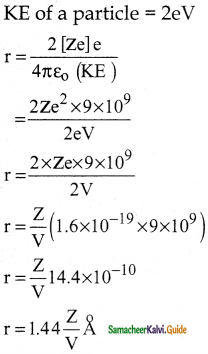
Samacheer Kalvi 12th Physics Guide Chapter 8 Atomic and Nuclear Physics 1

Question 2.
In a hydrogen atom, the electron revolving in the fourth orbit, has angular momentum equal to
a) h
b) \(\frac{\mathrm{h}}{\pi}\)
c) \(\frac{4 h}{\pi}\)
d) \(\frac{2 \mathrm{~h}}{\pi}\)
Answer:
d) \(\frac{2 \mathrm{~h}}{\pi}\)
Solution:
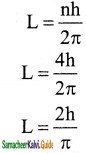
Samacheer Kalvi 12th Physics Guide Chapter 8 Atomic and Nuclear Physics 2

Question 3.
Atomic number of H – like atom with ionization potential 122.4 V for n = 1 is
a) 1
b) 2
c) 3
d) 4
Answer:
c) 3
Solution:
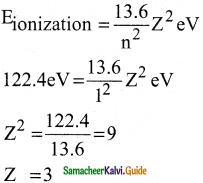
Samacheer Kalvi 12th Physics Guide Chapter 8 Atomic and Nuclear Physics 3

Question 4.
The ratio between the first three orbits of hydrogen atom is
a) 1 : 2 : 3
b) 2 : 4 : 6
c) 1 : 4 : 9
d) 1 : 3 : 5
Answer:
c) 1 : 4 : 9
Solution:
rn α n2
r1 : r2 : r3 = 1 : 4 : 9

Question 5.
The charge of cathode rays is
a) positive
b) negative
c) neutral
d) not defined
Answer:
b) negative
(They are negatively charged particles)

Samacheer Kalvi 12th Physics Guide Chapter 8 Atomic and Nuclear Physics

Question 6.
In J.J. Thomson e/m experiment, a beam of the electron is replaced by that of muons (particle with same charge as that of electrons but mass 208 times that of electrons). No deflection condition is achieved only if
(a) B is increased by 208 times
(b) B is decreased by 208 times
(c) B is increased by 14.4 times
(d) B is decreased by 14.4 times
Answer:
(c) B is increased by 14.4 times
Hint:
In the condition of no deflection \(\frac { e }{ m }\) = \(\frac {{ E }^{2}}{{ 2vB }^{2}}\)
If m is increased by 208 times then B should be increased \(\sqrt { 208 } \) = 14.4 time

Question 7.
The ratio of the wavelengths for the transition from n = 2 to n = 1 in Li++, He+ and H is
a) 1 : 2 : 3
b) 1 : 4 : 9
c) 3 : 2 : 1
d) 4 : 9 : 36
Answer:
d) 4 : 9 : 36
Solution:
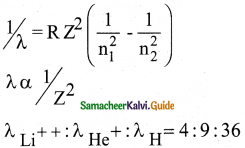
Samacheer Kalvi 12th Physics Guide Chapter 8 Atomic and Nuclear Physics 4

Question 8.
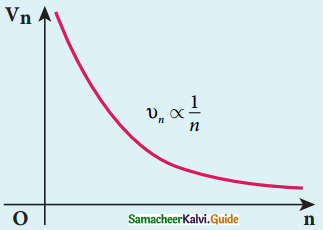
The electric potential between a proton and an electron is given by V = V0 ln \(\left(\frac{\mathbf{r}}{\mathbf{r}_{0}}\right)\) where r0 is a constant. Assume that Bohr atom model is applicable to potential, then variation of radius nth orbit rn with the principal quantum number n is
a) rn α \(\frac{1}{\mathrm{n}}\)
b) rn α n
c) rn α \(\frac{1}{n^{2}}\)
d) rn α n2
Answer:
b) rn α n
Solution:
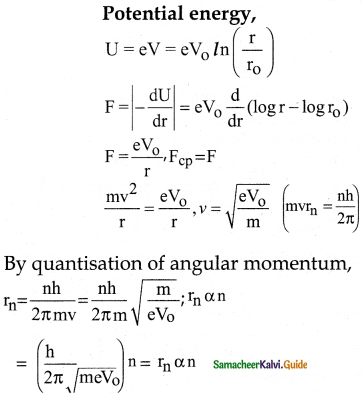
Samacheer Kalvi 12th Physics Guide Chapter 8 Atomic and Nuclear Physics 5

Question 9.
If the nuclear radius of 27 Al is 3.6 fermi, the approximate unclear radius of64 Cu is
(a) 2.4
(b) 1.2
(c) 4.8
(d) 3.6
Answer:
(c) 4.8
Hint:
\(\frac {{ R }_{Al}}{{ R }_{Cu}}\) = \(\frac{(27)^{1 / 3}}{(64)^{1 / 3}}\) = \(\frac { 3 }{ 4}\)
Rcu = \(\frac { 4 }{ 3}\) RAl = \(\frac { 4 }{ 3}\) x 3.6 fermi
Rcu = 4.8 fermi

Question 10.
The nucleus is approximately spherical in shape. Then the surface area of the nucleus having mass number A varies as
a) A2/3
b) A4/3
c) A1/3
d) A5/3
Answer:
a) A2/3
Solution:
Surface area = 4πR²
Surface area α R²
R α A1/3
Surface area α (A1/3)2
Surface area α A2/3
Samacheer Kalvi 12th Physics Guide Chapter 8 Atomic and Nuclear Physics

Question 11.
The mass of a \({ }_{3}^{7} \mathbf{L i}\) nucleus is 0.042 u less than the sum of the masses of all its nucleons. The binding energy per nucleon of \({ }_{3}^{7} \mathbf{L i}\) nucleus is nearly
a) 46 MeV
b) 5.6 MeV
c) 3.9 MeV
d) 23 MeV
Answer:
b) 5.6 MeV
Solution:
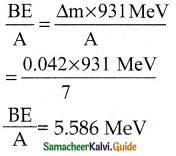
Samacheer Kalvi 12th Physics Guide Chapter 8 Atomic and Nuclear Physics 6

Question 12.
Mp denotes the mass of the proton and Mn denotes the mass of a neutron. A given nucleus of binding energy B, contains Z protons and N neutrons. The mass M (N, Z) of the nucleus is given by(where c is the speed of light)
(a) M (N, Z) = NMn + ZMp – Bc2
(b) M (N, Z) = NMn + ZMp + Bc2
(c) M (N, Z) = NMn + ZMp – B / c2
(d) M (N, Z) = NMn + ZMp + B / c2
Answer:
(c) M (N, Z) = NMn + ZMp – B / c2
Hint:
Binding energy, B = [ZMp + NMn – M (N, Z)] C2
M(N,Z) = ZMp + NMn – \(\frac { B }{{ C }^{ 2 }}\)

Question 13.
A radioactive nucleus (initial mass number A and atomic number Z) emits 2α and 2 positrons. The ratio of number of neutrons to that of proton in the final nucleus will be
a) \(\frac{A-Z-4}{Z-2}\)

b) \(\frac{A-Z-2}{Z-6}\)

c) \(\frac{A-Z-4}{Z-6}\)

d) \(\frac{A-Z-12}{Z-4}\)
Answer:
b) \(\frac{A-Z-2}{Z-6}\)

Question 14.
The half-life period of radioactive element A is same as the mean lifetime of another radioactive element B. Initially both have the same number of atoms. Then.
a) A and B have the same decay rate initially
b) A and B decay at the same rate always
c) B will decay at faster rate than A
d) A will decay at faster rate than B.
Answer:
c) B will decay at faster rate than A
Solution:
(t1/2)A = (tmean)B
\(\frac{0.693}{\lambda_{\mathrm{A}}}\) = \(\frac{1}{\lambda_{\mathrm{B}}}\)
λA = 0.693λB
λA < λB
rate decay = λN
Intially no. of atoms (N) of both are equal but since λB > λA, B will decay at a faster
rate than A.

Question 15.
A system consists of N0 nucleus at t = 0. The number of nuclei remaining after half of a half – life (that is, at time t = \(\frac{1}{2}\)T1/2)
a) \(\frac{\mathrm{N}_{0}}{2}\)

b) \(\frac{N_{0}}{\sqrt{2}}\)

c) \(\frac{\mathrm{N}_{0}}{4}\)

d) \(\frac{\mathrm{N}_{0}}{8}\)
Answer:
(b) \(\frac{N_{0}}{\sqrt{2}}\)) N0
Solution:
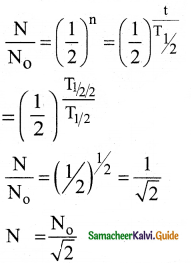
Samacheer Kalvi 12th Physics Guide Chapter 8 Atomic and Nuclear Physics 7

Samacheer Kalvi 12th Physics Guide Chapter 8 Atomic and Nuclear Physics

II. Short answer questions:

Question 1.
What are cathode rays?
Answer:
A cathode ray is a stream of electrons that are seen in vaccum tubes. It is called a “cathode ray” because the electrons are being emitted from the negative charged element in the vaccum tube called the cathode.

Question 2.
Write the properties of cathode rays.
Answer:
Properties of cathode rays:

  1. Cathode rays possess energy and momentum and travel in a straight line with high speed of the order of 107 ms-1. It can be deflected by the application of electric and magnetic fields. The direction of deflection indicates that they are negatively charged particles.
  2. When the cathode rays are allowed to fall of matter, they produce heat. They affect the photographic plates and also produce fluorescence when they fall on certain crystals and minerals.
  3. When the cathode rays fall on a material of high atomic weight, x-rays are produced.
  4. Cathode rays ionize the gas through which they pass.
  5. The speed of rys is upto \(\left(\frac{1}{10}\right)^{\text {th }}\) of the speed of light.

Question 3.
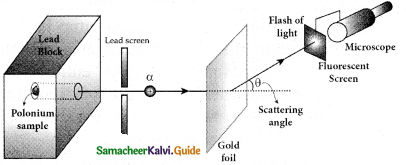
Give the results of Rutherford alpha scattering experiment.
Answer:

  1. Most of the alpha particles are un¬deflected through the gold foil and went straight.
  2. Some of the alpha particles are deflected through a small angle.
  3. A few alpha particles (one in thousand) are deflected through an angle more than 90°

Question 4.
Write down the postulates of Bohr atom model.
Answer:
1. The electron in an atom moves around nucleus in circular orbits under the influence of Coulomb electrostatic force of attraction. This Coulomb force gives necessary centripetal force for the electron to undergo circular motion.
2. Electrons in an atom revolve around the nucleus only in certain discrete orbits called stationary orbits where it does not radiate electromagnetic energy. Only those discrete orbits allowed are stable orbits.
3. The angular momentum of the electrons in these stationary orbits are quantized that is, it can be written as integer or integral multiple of \(\frac{\mathrm{h}}{2 \mathrm{~h}}\) called as reduced Planck’s constant – that is, h (read it as h-bar) and the integer n is called as principal quantum number of the orbit.
l = nh;
L = \(\frac{\mathrm{nh}}{2 \pi}\);
mvr = \(\frac{\mathrm{nh}}{2 \pi}\) where h = \(\frac{\mathrm{h}}{2 \pi}\)

This condition is known as angular momentum quantization condition.
4. An electron can jump from one orbit to another orbit by absorbing or emitting a photon whose energy is equal to the difference in energy (∆E) between the two orbital levels.
energy quantization condition
∆E = Efinal – Einitial = hν = \(\frac{\mathrm{hc}}{\lambda}\)
λ – Wavelength or radiation
C – Speed of light
ν – Frequency of the radiation

Samacheer Kalvi 12th Physics Guide Chapter 8 Atomic and Nuclear Physics

Question 5.
What is meant by excitation energy?
Answer:
Excitation energy and excitation potential:
The energy required to excite an electron from lower energy state to any higher energy state is known as excitation energy.

Question 6.
Define the ionization ionization potential.
Answer:
The minimum energy required to remove an electron from an atom in the ground state is known as binding energy or ionization energy.
Eionization = E – En
= 0 – (-\(\frac{13.6}{\mathrm{n}^{2}}\) Z2eV)
= \(\frac{13.6}{\mathrm{n}^{2}}\) Z2eV
Ionization potential is defined as ionization energy per unit charge.
Vionization = \(\frac{1}{\mathrm{e}}\) Eionization = \(\frac{13.6}{\mathrm{n}^{2}}\) Z2V

Question 7.
Write down the drawbacks of Bohr atom model.
Answer:
Limitations of Bohr atom model:
The following are the drawbacks of Bohr atom model:

  1. Bohr atom model is valid only for hydrogen atom or hydrogen like-atoms but not for complex atoms.
  2. When the spectral lines are closely examined, individual lines of hydrogen spectrum is accompanied by a number of faint lines. These are often called fine structure. This is not explained by Bohr atom model.
  3. Bohr atom model fails to explain the intensity variations in the spectral lines.
  4. The distribution of electrons in atoms is not completely explained by Bohr atom model.

Question 8.
What is distance of closest approach?
Answer:
The minimum distance between the centre of the nucleus and the alpha particle just before it gets reflected back through 180° is defined as the distance of closest approach r0 (also known as contact distance).
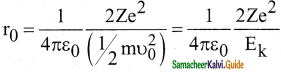
Samacheer Kalvi 12th Physics Guide Chapter 8 Atomic and Nuclear Physics 8

Question 9.
Define impact parameter.
Answer:
The impact parameter is defined as the perpendicular distance between the centre of the gold nucleus and the direction of velocity vector of alpha particle when it is at a large distance.

Question 10.
Write a general notation of the nucleus of element X. What each term denotes?
Answer:
General notation of nucleus of element X.
ZaX
where x is the chemical symbol of the element
A is the mass number and Z is the atomic number.
For example \(7^{\mathrm{N}^{15}}\)
Z = 7, N = (A – Z) = (15 – 7) = 8

Samacheer Kalvi 12th Physics Guide Chapter 8 Atomic and Nuclear Physics

Question 11.
What is isotope? Give an example.
Answer:
Isotopes are atoms of the same element having same atomic number Z, but different mass number A. For example, hydrogen has three isotopes and they are represented as \({ }_{1}^{1} \mathrm{H}\) {H (hydrogen), \({ }_{1}^{2} \mathrm{H}\) (deuterium), and \({ }_{1}^{3} \mathrm{H}\) (tritium). Note that all the three nuclei have one proton and, hydrogen has no neutron, deuterium has 1 neutron and tritium has 2 neutrons.

Question 12.
What is isotone? Give an example.
Answer:
Isotones are the atoms of different elements having same number of neutrons. \(_{ 5 }^{ 12 }B\) and \(_{ 6 }^{ 13 }B\) are examples of isotones which 7 neutrons.

Question 13.
What is isobar? Give an example.
Answer:
Isobars are the atoms of different elements having the same mass number A, but different atomic number Z.
For example \({ }_{16}^{40} \mathrm{~S}, \stackrel{40}{17} \mathrm{Cl}, \stackrel{40}{18} \mathrm{Ar}, \underset{19}{40} \mathrm{~K}\) and \({ }_{20}^{40} \mathrm{Ca}\) are isobars having same mass number 40 and different atomic number. In other words, isobars are the atoms of different chemical element which has same number of nucleon.

Question 14.
Define atomic mass unit u.
Answer:
One atomic mass unit (u) is defined as the 1/12th of the mass of the isotope of carbon \(_{ 6 }^{ 12 }C\).

Question 15.
Show that nuclear density is almost constant for nuclei with Z > 10.
Answer:
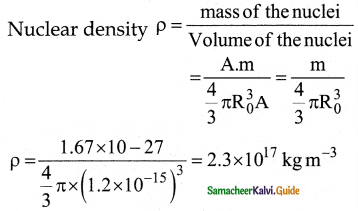
Samacheer Kalvi 12th Physics Guide Chapter 8 Atomic and Nuclear Physics 9
The nuclear density is independent of the mass number A. The nuclear density is almost constant for all the nuclei (Z > 10) irrespective of its size.

Samacheer Kalvi 12th Physics Guide Chapter 8 Atomic and Nuclear Physics

Question 16.
What is mass defect?
Answer:
In general, if M, mp and m are mass of the nucleus (\({ }_{Z}^{A} \mathrm{X}\)), the mass of proton and the mass of neutron respectively
mass defect ∆m = (Zmp + Nmn ) — M difference in mass ∆m is called mass defect.
The mass of any nucleus is always less than the sum of the mass of its indivitual constituents. The difference in mass ∆m is called mass defect.

Question 17.
What is binding energy of a nucleus? Give its expression.
Answer:
when Z protons and N neutrons combine to form a nucleus, mass equal to mass defect disappears and the corresponding energy is released. This is called the binding energy of the nucleus (BE) and is equal to (∆m) c2.
BE = (Zmp + Nmn – M ) c2

Question 18.
Calculate the energy equivalent of 1 atomic mass unit.
Answer:
Using Einstein’s mass-energy equivalence, the energy equivalent of one atomic mass unit
1u = 1.66 × 10-27 × (3 × 108)2
= 14.94 × 10⁻¹¹ J ≈ 931 MeV

Question 19.
Give the physical meaning of binding energy per nucleon.
Answer:
The average binding energy per nucleon is the energy required to separate single nucleon from the particular nucleus.
\(\overline{\mathrm{BE}}\) = \(\frac{\left[\mathrm{Zm}_{\mathrm{H}}+\mathrm{Nm}_{\mathrm{n}}-\mathrm{M}_{\mathrm{A}}\right] \mathrm{C}^{2}}{\mathrm{~A}}\)

Question 20.
What is meant by radioactivity?
Answer:
The phenomenon of spontaneous emission of highly penetrating radiations such as α, β and γ rays by an element is called radioactivity.

Samacheer Kalvi 12th Physics Guide Chapter 8 Atomic and Nuclear Physics

Question 21.
Give the symbolic representation of alpha decay, beta decay and gamma decay.
Answer:
Alpha decay:
\({ }_{Z}^{A} \mathrm{X}\) → \(\begin{array}{l}
\mathrm{A}-4 \\
\mathrm{Z}-2
\end{array} \mathrm{Y}\) + \({ }_{2}^{4} \mathrm{He}\)
Here X is called the parent nucleus and Y is called the daughter nucleus.

β decay:
\({ }_{Z}^{A} \mathrm{X}\) → \(\begin{array}{c}
\mathrm{A} \\
\mathrm{Z}+1
\end{array} \mathrm{Y}\) + e + \(\bar{v}\)
It implies that the element X becomes Y by giving out an electron and antineutrino \(\bar{V}\)

β+ decay:
\({ }_{Z}^{A} \mathrm{X}\) → \(\begin{array}{c}
\mathrm{A} \\
\mathrm{Z}-1
\end{array} \mathrm{Y}\) + e+ + ν
It implies that the element X becomes Y by giving out an positron and neutrino (v).

Gamma decay:
\({ }_{Z}^{A} \mathrm{X*}\) → \({ }_{Z}^{A} \mathrm{Y}\) + gamma (γ) rays
Here the asterisk (*) means excited state nucleus. In gamma decay, there is no change in the mass number or atomic number of the nucleus.

Question 22.
In alpha decay, why the unstable nucleus emits \({ }_{2}^{4} \mathrm{He}\) nucleus? Why it does not emit four separate nucleons?
Answer:
After all \({ }_{2}^{4} \mathrm{He}\) consists of two protons and two neutrons. For example, if \({ }_{92}^{238} \mathrm{U}\) nucleus decays into \({ }_{90}^{234} \mathrm{Th}\) by emitting four separate nucleons (two protons and two neutrons), then the disintegration energy Q for this process turns out to be negative. It implies that the total mass of products is greater than that of parent \({ }_{92}^{238} \mathrm{U}\) nucleus. This kind of process cannot occur in nature because it would Violate conservation of energy. In any decay process, the conservation of energy, conservation of linear momentum and conservation of angular momentum must be obeyed.

Question 23.
What is mean life of nucleus? Give the expression.
Answer:
The mean lifetime of the nucleus is the ratio of sum or integration of life times of all nuclei to the total number nuclei present initially. The expression for mean life time, τ = \(\frac { 1 }{ λ }\).
τ = \(\frac{1}{\lambda}\)

Question 24.
What is half – life of nucleus? Give the expression.
Answer:
The half – life T1/2 is the time required for the number of atoms initally present to reduce to one half of the initial amount.
T1/2 = \(\frac{\ln 2}{\lambda}\) = \(\frac{0.6931}{\lambda}\)

Samacheer Kalvi 12th Physics Guide Chapter 8 Atomic and Nuclear Physics

Question 25.
What is meant by activity (or) decay rate? Give its unit.
Answer:
Activity (R) or decay rate which is the number of nuclei decayed per second and it is denoted as
R \(=\left|\frac{\mathrm{dN}}{\mathrm{dt}}\right|\).

R = \(\left|\frac{\mathrm{dN}}{\mathrm{dt}}\right|\) = λN0e-λt

R = R0e-λt
The SI unit of activity R is Becquerel and one Becquerel (Bq) is equal to one decay per second. There is also another standard unit for the activity called Curie (Ci).
1 Curie = 1 Ci = 3.7 × 10¹⁰ decays per second
1 Ci = 3.7 × 10¹⁰ Bq

Question 26.
Define curie.
Answer:
One curie was defined as number of decays per second in 1 g of radium and it is equal to 3.7 x 10¹⁰ decays/s.

Question 27.
What are the constituent particles of neutron and proton?
Answer:
According to quark model, proton is made up of two up quarks and one down quark and neutron is made up of one up quark and two down quark.

Samacheer Kalvi 12th Physics Guide Chapter 8 Atomic and Nuclear Physics

III. Long answer questions:

Question 1.
Explain the J.J. Thomson experiment to determine the specific charge of electron.
Answer:
1. In 1887, J.J. Thomson, measured the specific charge (e/m) of electron.
2. The specific charge is defined as the charge per unit mass of particle.
Principle:
3. In the presence of electric and magnetic fields, the cathode rays are deflected.
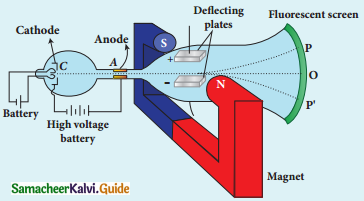
Samacheer Kalvi 12th Physics Guide Chapter 8 Atomic and Nuclear Physics 10
Arrangement of J.J. Thomson experiment to determine the specific charge of an electron

4. A highly evacuated discharge tube is used and cathode rays (electron beam) produced at cathode are attracted towards anode disc A.
5. Anode disc is made with pin hole in order to allow only a narrow beam of cathode rays.
6. These cathode rays are now allowed to pass through the parallel metal plates, maintained at high voltage.
7. Further, this gas discharge tube is kept in between pole pieces of magnet such that both electric and magnetic fields are perpendicular to eacth other.
8. When the cathode rays strike the screen, they produce scintillation and hence bright spot is observed.
9. This is achieved by coating the screen with zinc sulphide.

(i) Determination of velocity of cathode rays :
1. For a fixed electric field between the plates, the magnetic field is adjusted such that the cathode rays (electron beam) strike at the original position O
2. i.e magnitude of electric force is balanced by the magnitude of force due to magnetic field.
eE = eBν
=>ν = \(\frac{E}{B}\) ………………(1)
e- charge of the cathode rays
3. Electric force balancing the magnetic force – the path of electron beam is a straight line.

ii) Determination of specific charge:
1. Since the cathode rays (electron beam) are accelerated from cathode to anode, the potential energy of the electron beam at the cathode is converted into kinetic energy of the electron beam at the anode.
2. Let V be the potential difference between anode and cathode, then the potential energy is eV.
3. Then from law of conservation of energy.
e V = \(\frac{1}{2}\) mν2
⇒ \(\frac{e}{m}=\frac{1}{2 V}\) ν2
4. Substituting the value of velocity from equation (1), we get
\(\frac{\mathrm{e}}{\mathrm{m}}=\frac{1}{2 \mathrm{~V}} \frac{\mathrm{E}^{2}}{\mathrm{~B}^{2}}\)
5. Substituting the values of E, B and V, the specific charge can be determined as
\(\frac{\mathrm{e}}{\mathrm{m}}\) = 1.7 × 10¹¹ C kg-1

Samacheer Kalvi 12th Physics Guide Chapter 8 Atomic and Nuclear Physics

Question 2.
Discuss the Millikan’s oil drop experiment to determine the charge of an electron.
Answer:
The Millikan’s experiment is used to determine one of the fundamental constants of nature known as charge of an electron.

Principle:
1. This method is based on the study of the motion of uncharged oil drop under free fall due to gravity and charged oil drop in a uniform electric field.
2. By adjusting electric field suitably, the motion of oil drop inside the chamber can be controlled – that is, it can be made to move up or down or even kept balanced in the field of view for sufficiently long time.

Experimental arrangement:
1. The apparatus consists of two horizontal circular metal plates A and B each with diameter around 20 cm and are separated by a small distance 1.5 cm.
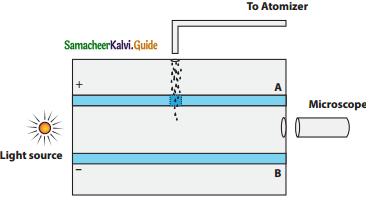
Samacheer Kalvi 12th Physics Guide Chapter 8 Atomic and Nuclear Physics 11
Millkan’s Experiment

2. These two parallel plates are enclosed in a chamber with glass walls. Further, plates A and B are given a high potential difference around 10 kV such that electric field acts vertically downward.
3. A small hole is made at the centre of the upper plate A and atomizer is kept exactly above the hole to spray the liquid.
4. When a fine droplet of highly viscous liquid (like glycerine) is sprayed using atomizer, it falls freely downward through the hole of the top plate only under the influence of gravity.
5. Few oil drops in the chamber can acquire electric charge (negative charge) because of friction with air or passage of x – rays in between the parallel plates.
6. Further the chamber is illuminated by light which is passed horizontally and oil drops can be seen clearly using microscope placed perpendicular to the light beam. These drops can move either upwards or downward.

(a) Determination of radius of the droplet:
Fg = gravitational force
Fb = buoyant force
Fv = viscous force
viscous force and buoyant force balance the gravitational force.
7. When the electric field is switched off, the oil drop accelerates downwards. Due to the presence of air drag forces, the oil drops easily attain its terminal velocity and moves with constant velocity.
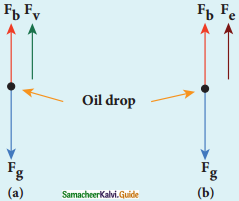
Samacheer Kalvi 12th Physics Guide Chapter 8 Atomic and Nuclear Physics 12
(a) Free body diagram of the oil drop without electric field
(b) Free body diagram of the oil drop with electric field

8. Let the gravitational force acting on the oil drop (downward) be Fb = mg, m = mass of the oil drop g = Acceleration due to gravity.
9. Let ρ be the density of the oil drop, and r be the radius of the oil drop, then the mass of the oil drop can be expressed in terms of its density as
ρ = \(\frac{\mathrm{m}}{\mathrm{V}}\)
m = ρ(\(\frac{4}{3}\) πr3) (volume of the sphere, V = \(\frac{4}{3}\) πr3)
10. The gravitational force can be written in terms of density as
Fg = mg
=>Fg = ρ(\(\frac{4}{3}\)) πr3
11. Let σ be the density of the air, the upthrust force experienced by the oil drop due to displaced air is
Fb = σ(\(\frac{4}{3}\) πr3)g
12. From Stokes law, the viscous force on the oil drop is.
Fv = 6πrυη
The force balancing equation is
Fg = Fb + Fv
ρ(\(\frac{4}{3}\) πr3)g = σ(\(\frac{4}{3}\) πr3)g + 6πrυη
\(\frac{4}{3}\) πr3(ρ – σ) = 6πrυη

\(\frac{2}{3}\) πr3(ρ – σ) = 3πrυη

r = \(\left[\frac{9 \eta v}{2(\rho-\sigma) g}\right]^{\frac{1}{2}}\) …………….(1)
Thus, equation (1) gives the radius of the oil drop.

(b) Determination of electric charge:
(a) Fe = qE
(c) buoyant force Fb
13. When the electric field is switched on, charged oil drops experience an upward electric force (qE).
14. Among many drops, one particulars drop can be chosen in the field of view of microscope and strength of the electric field is adjusted to make that particular drop to be stationary.
15. Under these circumstances, there will be no viscous force acting on the oil drop. Force acting on the oil droplet is
Fe + Fb = Fg
⇒ qE + \(\frac{4}{3}\) πr3 σg = \(\frac{4}{3}\) πr3 ρg
⇒ qE = \(\frac{4}{3}\) πr3 (ρ – σ)g
⇒ q = \(\frac{4}{3 \mathrm{E}}\) πr3 (ρ – σ)g …………..(2)

Substituting equation (1) in equation (2), we get
q = \(\frac{18 \pi}{\mathrm{E}}\left(\frac{\eta^{3} v^{3}}{2(\rho-\sigma) \mathrm{g}}\right)^{\frac{1}{2}}\)
16. Millikan repeated this experiment several times and computed the charges on oil drops. He found that the charge of any oil drop can be written as integral multiple of a basic value, (e = 1.6 × 10⁻¹⁹ C), which is nothing but the charge of an electron.

Samacheer Kalvi 12th Physics Guide Chapter 8 Atomic and Nuclear Physics

Question 3.
Derive the energy expression for hydrogen atom using Bohr atom model.
Answer:
Energy of a Hydrogen atom:
Bohr postulates is find the allowed energies of the atom for different allowed orbits of the electron.
(a) The electron in an atom moves around nucleus in circular orbits under the influence of coulomb electrostatic force of attraction.
(b) Electrons in an atom revolve around the nucleus only in certain discrete orbits called stationary orbits where it does not radiate electromagnetic energy.
Angular momentum quantization condition,
L = n\(\hbar\) = \(\frac{\mathrm{nh}}{2 \pi}\)
h – planck’s constant
n – principal quantum number of the orbit.
c) An electron can jump from one orbit to another orbit by absorbing or emitting a photon whose energy is equal to the difference in energy (∆E) between the two orbital levels.
energy quantization condition
∆E = Efinal – Einitial = hυ = \(\frac{\mathrm{hc}}{\lambda}\)
λ – wavelength of the radiation
c – speed of light
υ – frequency of the radiation

Radius of the orbit of the electron:
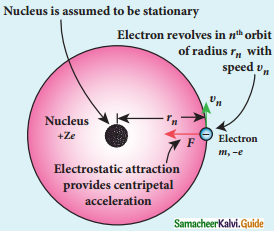
Samacheer Kalvi 12th Physics Guide Chapter 8 Atomic and Nuclear Physics 13
Electron revolving around the nucleus

1. The nucleus has a positive charge +Ze.
2. Let z be the atomic number of the atom.
3. Let -e be the charge of the electron.
4. The nucleus at rest and an electron revolving around the nucleus in a circular orbit of radius rn with a constant speed υn
Coulomb’s law, the force of attraction between the nucleus and the electron is
\(\overrightarrow{\mathrm{F}}_{\text {coulomb }}\) = \(\frac{1}{4 \pi \varepsilon_{0}} \frac{(+\mathrm{Ze})(-\mathrm{e})}{\mathrm{r}_{\mathrm{n}}^{2}} \hat{\mathrm{r}}\)

= –\(\frac{1}{4 \pi \varepsilon_{0}} \frac{Z \mathrm{e}^{2}}{\mathrm{r}_{\mathrm{n}}^{2}} \hat{\mathrm{r}}\)

5. This force provides necessary centripetal force.
\(\overrightarrow{\mathrm{F}}_{\text {centripetal }}=\frac{m v_{n}^{2}}{r_{n}} \hat{r}\)

where m be the mass of the electron that moves with a velocity υn in a circular orbit.
Therfore,
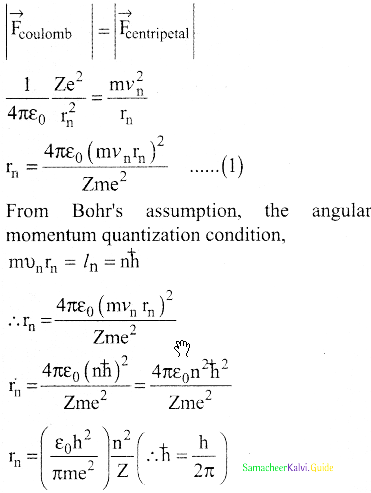
Samacheer Kalvi 12th Physics Guide Chapter 8 Atomic and Nuclear Physics 14
Where n∈N ε0, n, e and π → are constant
radius of the orbit,
rn = a0 \(\frac{n^{2}}{Z}\)

Bohr radius a0 = \(\frac{\varepsilon_{0} h^{2}}{\pi m e^{2}}\)
a0 = 0.529 Å
Bohr radius is also used as unit of length called Bohr
1 Bohr = 0.53 Å
For hydrogen atom Z = 1
rn = a0 n2
rn α n2
For the first orbit (ground sate)
r1 = a0
r2 = 4a0 = 4r1
r3 = 9a0 = 9r1
r4 = 16a0 = 16r1

The energy of an electron in the nth orbit:
Since the electrostatic force is a conservative force, the potential energy for the nth orbit is
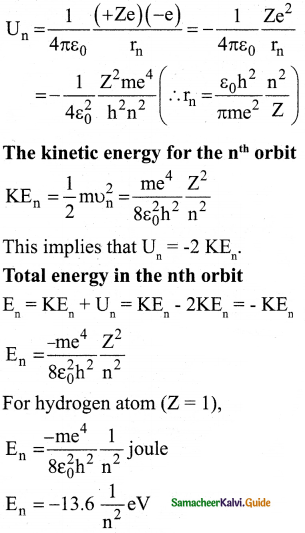
Samacheer Kalvi 12th Physics Guide Chapter 8 Atomic and Nuclear Physics 15
6. The negative sign in the equation indicates that the electron is bound to the nucleus
7. where n stands for a principal quantum number.
8. The energies of the excited states come closer and closer together when the principal quantum number n takes higher values.
9. The ground state energy of hydrogen (-13.6 eV) is used as a unit of energy called Rydberg (lRydberg = -13.6eV).
10. For the first orbit (ground state), the total energy of electron is E1 = -13.6 eV.
11. For the second orbit (first excited state), the total energy of electron is E2 = – 3.4eV.
12. For the third orbit (second excited state), the total energy of electron ie E3 = -1.51 eV and so on.
13. When the electron is taken away to an infinite distance (very far distance) from nucleus, both the potential energy and kinetic energy terms vanish and hence the total energy also vanishes.

Samacheer Kalvi 12th Physics Guide Chapter 8 Atomic and Nuclear Physics

Question 4.
Discuss the spectral series of hydrogen atom.
Answer:
Spectral series of hydrogen atom:
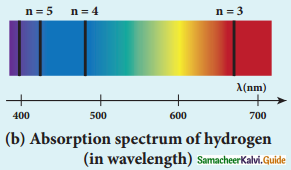
1. As electron in excited states have very small lifetime, these electrons jump back to ground state through spontaneous emission in a short duration of time (approximately 10) by emitting the radiation with same wavelength (or frequency) corresponding to the colours is absorbed. This is called emission spectroscopy.
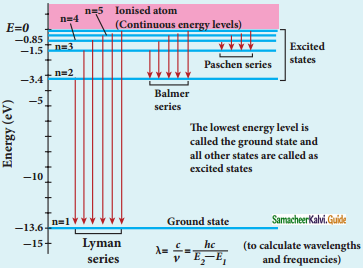
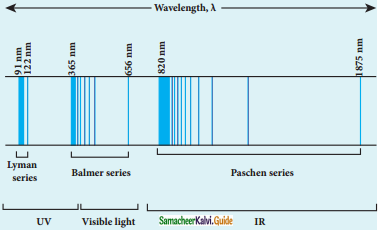
Samacheer Kalvi 12th Physics Guide Chapter 8 Atomic and Nuclear Physics 16

Samacheer Kalvi 12th Physics Guide Chapter 8 Atomic and Nuclear Physics 17
Spectral series – Lyman, Balmer, Paschen series

2. In each series, the distance of separation between the consecutive wavelengths decreases from higher wavelength to the lower wavelength, and also wavelength in each series approach a limiting value known as the series limit.
3. The wavelengths of these spectral lines perfectly agree with the equaion derived from Bohr atom model.
\(\frac{1}{\lambda}=\mathrm{R}\left(\frac{1}{\mathrm{n}^{2}}-\frac{1}{\mathrm{~m}^{2}}\right)=\overline{\mathrm{v}}\) …………..(1)

where \(\bar{v}\) is known as wave number which is inverse of wavelength, R is known as Rydberg
constant whose value is 1.09737 × 10⁷ m-1 and m and n are positive integers such that m > n.
The various spectral series are discussed below:
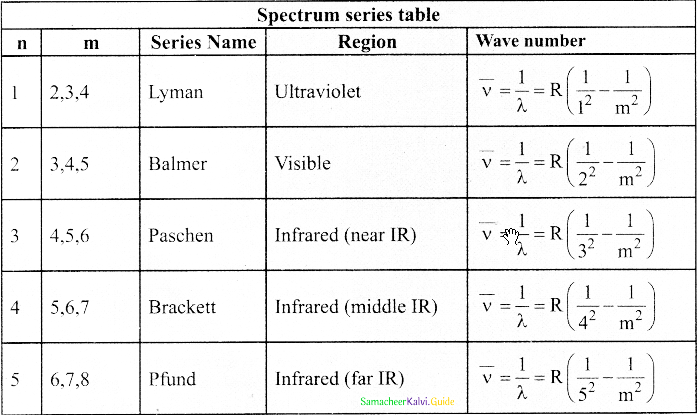
Samacheer Kalvi 12th Physics Guide Chapter 8 Atomic and Nuclear Physics 18

Question 5.
Explain the variation of average binding energy with the mass number by graph and discuss its features.
Answer:
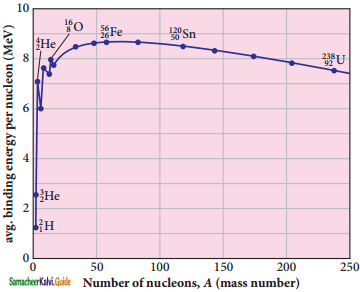
Binding energy curve :
1. \(\overline{\mathrm{BE}}\) is plotted against A of all known nuclei.
2. It gives a curve as seen in Figure.
3. average binding energy per nucleon \(\overline{\mathrm{BE}}\).
It is given by,
\(\overline{\mathrm{BE}}=\frac{\left[\mathrm{Zm}_{\mathrm{H}}+\mathrm{Nm}_{\mathrm{n}}-\mathrm{M}_{\mathrm{A}}\right] \mathrm{c}^{2}}{\mathrm{~A}}\)

Samacheer Kalvi 12th Physics Guide Chapter 8 Atomic and Nuclear Physics 19
Avg. binding energy of the nucleus

4. The average binding energy per nucleon is the energy required to separate single nucleon from the particular nucleus.

Important inferences from of the average binding energy curve:
1. The value of \(\overline{\mathrm{BE}}\) rises as the mass number increases until it reaches a maximum value of 8.8 MeV for A = 56 (iron) and then it slowly decreases.
2. The average binding energy per nucleon is about 8.5 MeV for nuclei having mass number between A = 40 and 120. These elements are comparatively more stable and not radioactive.
3. For higher mass numbers, the curve reduces slowly and \(\overline{\mathrm{BE}}\) for uranium is about 7.6 MeV. They are unstable and radioactive.
From Figure if two light nuclei with A < 28 combine with a nucleus with A < 56, the binding energy per nucleon is more for final nucleus than initial nuclei. Thus, if the lighter elements combine to produce a nucleus of medium value A, a large amount of energy will be released. This is the basis of nuclear fusion and is the principle of the hydrogen bomb.
4. If a nucleus of heavy element is split (fission) into two or more nuclei of medium value A, the energy released would again be large. The atom bomb is based on this principle and huge energy of atom bombs comes from this fission when it is uncontrolled.

Samacheer Kalvi 12th Physics Guide Chapter 8 Atomic and Nuclear Physics

Question 6.
Explain in detail the nuclear force.
Answer:
1. Nucleus contains protons and neutrons. From electrostatics, like charges repel each other.
2. In the nucleus, the protons are separated by a distance of about a few Fermi (10-15 m), they must exert on each other a very strong repulsive force. For example,
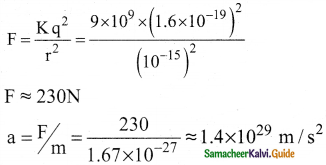
Samacheer Kalvi 12th Physics Guide Chapter 8 Atomic and Nuclear Physics 20

3. This is nearly 1028 times greater than the acceleration due to gravity.
4. From this observation, it was concluded that there must be a strong attractive force between protons to overcome the repulsive Coulomb’s force.
5. This attractive force which holds the nucleus together is called strong nuclear force.
6. A few properties of strong nuclear force are the strong nuclear force is of very short range, acting only up to a distance of a few Fermi.
7. But inside the nucleus, the repulsive Coulomb force or attractive gravitational forces between two protons are much weaker than the strong nuclear force between two protons.
8. Similarly, the gravitational force between two neutrons is also much weaker than strong nuclear force between the neutrons. So nuclear force is the strongest force in nature.
9. The strong nuclear force is attractive and acts with an equal strength between proton-proton, proton-neutron. and neutron – neutron.
10. Strong nuclear force does not act on the electrons. So it does not alter the chemical properties of the atom.

Question 7.
Discuss the alpha decay process with an example.
Answer:
Alpha decay:
1. When unstable nuclei decay by emitting an a – particle (\({ }_{2}^{4} \mathrm{He}\) nucleus), it loses two protons and two neutrons. As a result, its atomic number Z decreases by 2, the mass number decreases by 4. The alpha decay process symbolically represented as.
\({ }_{Z}^{A} \mathrm{X}\) → \({ }_{Z-2}^{A-4} \mathrm{Y}\) + \({ }_{2}^{4} \mathrm{He}\)

2. Here X is called the parent nucleus and Y is called the daughter nucleus.
3. Example:
Decay of Uranium \({ }_{92}^{238} \mathrm{U}\) to thorium \({ }_{90}^{234} \mathrm{Th}\) with the emission of \({ }_{2}^{4} \mathrm{He}\) nucleus (α – particle)

\({ }_{92}^{238} \mathrm{U}\) → \({ }_{90}^{234} \mathrm{Th}\) + \({ }_{2}^{4} \mathrm{He}\)

4. As already mentioned, the total mass of the daughter nucleus and \({ }_{2}^{4} \mathrm{He}\) nucleus is always
5. less than that of the parent nucleus. The difference in mass (∆m = mx – my -mα ) is released as energy called disintegration energy Q and is given by
Q = (mx – my – mα) c2
6. For spontaneous decay (natural radioactivity) Q > 0. In alpha decay process, the disintegration energy is certainly positive (Q > 0).
7. In fact, the disintegration energy Q is also the net kinetic energy gained in the decay process or if the parent nucleus is at rest, Q is the total kinetic energy of daughter nucleus and the \({ }_{2}^{4} \mathrm{He}\) nucleus.
8. Suppose Q < 0, then the decay process cannot occur spontaneously and energy must be supplied to induce the decay.

Samacheer Kalvi 12th Physics Guide Chapter 8 Atomic and Nuclear Physics

Question 8.
Discuss the beta decay process with examples.
Answer:

In beta decay, a radioactive nucleus emits either electron or positron. If electron (e) is emitted, it is called β decay and if positron (e+) is emitted, it is called p+ decay. The positron is an anti-particle of an electron whose mass is same as that of electron and charge is opposite to that of electron – that is, +e. Both positron and electron are referred to as beta particles.

1. β decay:
In β decay, the atomic number of the nucleus increases by one but mass number remains the same. This decay is represented by
\(_{ Z }^{ A }{ X }\) → \(_{ Z+12 }^{ A }{ Y}\) + e + \(\bar { v } \) …(1)
It implies that the element X becomes Y by giving out an electron and antineutrino (\(\bar { v } \)). In otherwords, in each β decay, one neutron in the nucleus of X is converted into a proton by emitting an electron (e) and antineutrino. It is given by
n → p + e + \(\bar { v } \)
Where p -proton, \(\bar { v } \) -antineutrino. Example: Carbon (\(_{ 6 }^{ 14 }{ C }\)) is converted into nitrogen (\(_{ 7 }^{ 14 }{ N }\)) through β- decay.
\(_{ 6 }^{ 14 }{ C }\) → \(_{ 7 }^{ 14 }{ N }\) + e + \(\bar { v } \)

2. β+ decay:
In p+ decay, the atomic number is decreased by one and the mass number remains the same. This decay is represented by
\(_{ Z }^{ A }{ X }\) → \(_{ Z-12 }^{ A }{ Y}\) + e+ + v
It implies that the element X becomes Y by giving out a positron and neutrino (v). In other words, for each β+ decay, a proton in the nucleus of X is converted into a neutron by emitting a positron (e+) and a neutrino. It is given by
p → n + e+ + v

However, a single proton (not inside any nucleus) cannot have β+ decay due to energy conservation, because neutron mass is larger than proton mass. But a single neutron (not inside any nucleus) can have β decay.
Example: Sodium (\(_{ 11 }^{ 23 }{ Na }\)) is converted into neon (\(_{ 10 }^{ 22 }{ Ne }\)) decay.
\(_{ 11 }^{ 23 }{ Na }\) → \(_{ 10 }^{ 22 }{ Ne }\) + e+ + v

Beta-decay:
In beta decay, a radioactive nucleus emits either electron or positron. If electron (e) is emitted, it is called β decay and if positron (e+) is emitted, it is called β+ decay. The positron is an anti – particle of an electron whose mass is same as that of electron and charge is opposite to that of electron – that is, +e. Both positron and electron are referred to as beta particles.

Question 9.
Discuss the gamma decay process with example.
Answer:
Gamma decay :
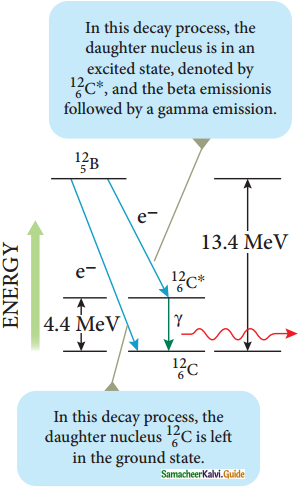
1. In α and β decay, the daughter nucleus is in the excited state most of the time. The typical life time of excited state is approximately 10-11 s. So this excited state nucleus immediately returns to the ground state or lower energy state by emitting highly energetic photons called γ rays. In fact, when the atom is in the excited state, it returns to the ground state by emitting photons of energy in the order of few eV. But when the excited state nucleus returns to its ground state, it emits a highly energetic photon (y rays) of energy in the order of MeV. The gamma decay is given by

Samacheer Kalvi 12th Physics Guide Chapter 8 Atomic and Nuclear Physics 22

Samacheer Kalvi 12th Physics Guide Chapter 8 Atomic and Nuclear Physics 21
Gamma decay

2. Here the asterisk (*) means excited state nucleus. In gamma decay, there is no change in the mass number or atomic number of the nucleus.
3. Boron (\({ }_{5}^{12} \mathrm{~B}\)) has two beta decay modes as shown in figure.
4. It undergoes beta decay directly into ground state carbon \({ }_{6}^{12} \mathrm{C}\) by emitting an electron of maximum of energy 13.4 MeV.
5. It undergoes beta decay to an excited state \({ }_{6}^{12} \mathrm{C}^{*}\) by emitting an electron of maximum energy 9.0 MeV followed by gamma decay to ground state by emitting a photon of energy 4.4 MeV.
It is represented by
\({ }_{6}^{12} \mathrm{~B} \rightarrow{ }_{6}^{12} \mathrm{C}+\mathrm{e}^{-}+\overline{\mathrm{v}}\)

\({ }_{6}^{12} \mathrm{C}^{*} \rightarrow{ }_{6}^{12} \mathrm{C}+\gamma\)

Samacheer Kalvi 12th Physics Guide Chapter 8 Atomic and Nuclear Physics

Question 10.
Obtain the law of radioactivity.
Answer:
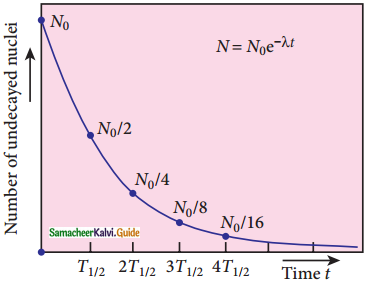
Law of radioactive decay:
Radioactive law of disintegration:
1. At any instant t, the number of decays per unit time, called rate of decay \(\left(\frac{d N}{d t}\right)\) is proportional to the number of nuclei (N) at the same instant.
\(\frac{d N}{d t}\) α N
\(\frac{d N}{d t}\) = -λN ………………(1)
2. Here proportionality constant λ is called decay constant which is different for different radioactive sample the negative sign in the equaion implies that the N is decreasing with time.
By rewriting the equation (1) we get
dN = -λNdt …………….(2)
3. Here dN represents the number of nuclei decaying in the time interval dt.
4. Let us assume that at time t = 0 s, the number of nuclei present in the radioactive sample is N0
\(\frac{d N}{N}\) = -λdt ……………..(3)
5. By integrating the equaion (3)
6. We can calculate the number of undecayed nuclei N at any time t.
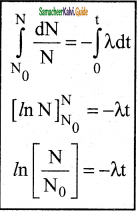
Samacheer Kalvi 12th Physics Guide Chapter 8 Atomic and Nuclear Physics 23
Samacheer Kalvi 12th Physics Guide Chapter 8 Atomic and Nuclear Physics 24
Law of radioactive decay

7. Taking exponentials on both sides, we get
8. N = N0 e-λt …………..(4) (Note: elnx = ey = x = ey)
9. Equation (4) is called the law of radioactive decay.
10. N0 denotes the number of nuclei at initial time t = 0.
11. N denotes the number of undecayed nuclei present at any time t
12. Note that the number of atoms is decreasing exponentially over the time.
13. This implies that the time taken for all the radioactive nuclei to decay will be infinite.

Activity (R):
Activity or decay rate which is the number of nuclei decayed per second. It is denoted as R. R is a positive quantity.
R = \(\left|\frac{\mathrm{d} \mathrm{N}}{\mathrm{dt}}\right|\)
N = N0 e-λt
R = λN0e-λt,
R = R0 eλ ………………(5)
Where R0 = λN0
eqn (1) is also equivalent to radioactive law of decay.
Here,
R0 is the activity of the sample at t = 0
R is the activity of the sample at any time t. Activity also shows exponential decay behavior.
The activity R also canbe expressed interms of number of undecayed atoms present at any time t.
R = λN …………..(3)
λ – decay constant
N – Number of undecayed nuclei at the same time t.
Since N decreases over time, R also decreases.
SI unit: Becquerel (Bq)

Question 11.
Discuss the properties of neutrino and its role in beta decay.
Answer:
Neutrino:
Initially, it was thought that during beta decay, a neutron in the parent nucleus is converted to the daughter nuclei by emitting only electron as given by
\(_{ Z }^{ A }{ X }\) → \(_{ Z+1 }^{ A }{ X}\) Y+e

1. But the kinetic energy of electron coming out of the nucleus did not match with the experimental results. In alpha decay, the alpha particle takes only certain allowed discrete energies whereas in beta decay, it was found that the beta particle (i.e, electron) have a continuous range of energies.

2. But the conservation of energy and momentum gives specific single values for electron energy and the recoiling nucleus Y. It seems that the conservation of energy, momentum are violated and could not be explained why energy of beta particle have continuous range of values. So beta decay remained as a puzzle for several years.

3. After a detailed theoretical and experimental study, in 1931 W. Pauli proposed a third particle which must be present in beta decay to carry away missing energy and momentum. Fermi later named this particle the neutrino (little neutral one) since it has no charge, have very little mass.

4. For many years, the neutrino (symbol v , Greek nu) was hypothetical and could not be verified experimentally. Finally, the neutrino was detected experimentally in 1956 by Fredrick Reines and Clyde Cowan. Later Reines received Nobel prize in physics in the year 1995 for his discovery.
The neutrino has the following properties

  • It has zero charge
  • It has an antiparticle called anti-neutrino.
  • Recent experiments showed that the neutrino has very tiny mass.
  • It interacts very weakly with the matter. Therefore, it is very difficult to detect. In fact, in every second, trillions of neutrinos coming from the sun are passing through our body without any interaction.

Samacheer Kalvi 12th Physics Guide Chapter 8 Atomic and Nuclear Physics

Question 12.
Explain the idea of carbon dating.
Answer:
1. The interesting application of beta decay is radioactive dating or carbon dating.
2. Using this technique, the age of an ancient object can be calculated.
3. All living organisms absorb crabon dioxide (Co2) from air to synthesize organic molecules.
In this absorbed Co2, the major part is \({ }_{6}^{12} \mathrm{C}\) and very small fraction (1.3 × 10⁻¹²) is radioactive \({ }_{6}^{14} \mathrm{C}\) whose half life is 5730 years.
4. Carbon 14 in the atmosphere is always decaying but at the same time, cosmic rays from outer space are continuously bombarding the atoms in the atmosphere which produces \({ }_{6}^{14} \mathrm{C}\)
5. So the continuous production and decay of \({ }_{6}^{14} \mathrm{C}\) in the atmosphere keep the ratio of \({ }_{6}^{14} \mathrm{C}\) to \({ }_{6}^{12} \mathrm{C}\) always constant.
6. Since our human body, tree or any living organism continuously absorb Co2 from the atmosphere, the ratio of \({ }_{6}^{14} \mathrm{C}\) to \({ }_{6}^{12} \mathrm{C}\) in the living organism is also nearly constnt.
7. But when the organism dies, it stops absorbing Co2
8. Since \({ }_{6}^{14} \mathrm{C}\) starts to decay, the ratio of \({ }_{6}^{14} \mathrm{C}\) to \({ }_{6}^{12} \mathrm{C}\) in a dead organism or specimen decreases over the years.
9. Suppose the ratio of \({ }_{6}^{14} \mathrm{C}\) to \({ }_{6}^{12} \mathrm{C}\) in the ancient tree pieces excavated is known, then the age of the tree pieces can be calculated.

Question 13.
Discuss the process of nuclear fission and its properties.
Answer:
Nuclear Fission :
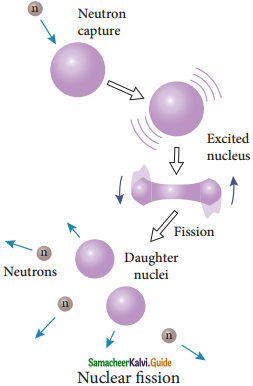
1. The process of breaking up of the nucleus of a heavier atom into two smaller nuclei with the release of a large amount of energy is called nuclear fission.
2. In 1939, German scientists Otto Hahn and F. Strassman discovered that when uranium nucleus is bombarded with a neutron, it breaks up into two smaller nuclei of comparable masses with the release of energy.
3. Uranium undergoes fission reaction in 90 different ways.
4. The most common fission reactions of \({ }_{92}^{234} \mathrm{U}\) nuclei are shown here.
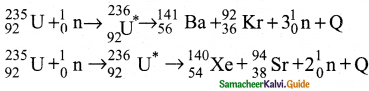
Samacheer Kalvi 12th Physics Guide Chapter 8 Atomic and Nuclear Physics 25
Samacheer Kalvi 12th Physics Guide Chapter 8 Atomic and Nuclear Physics 26

5. Here Q is energy released during the decay of each uranium nuclei.
6. When the slow neutron is absorbed by the uranium nuclei, the mass number increases by one and goes to an excited state \({ }_{92}^{234} \mathrm{U}^{*}\)
7. But this excited state does not last longer than 10-12s and decay into two daughter nuclei along with 2 or 3 neutrons.
8. From each reaction, on an average, 2.5 neutrons are emitted.

Energy released in fission:
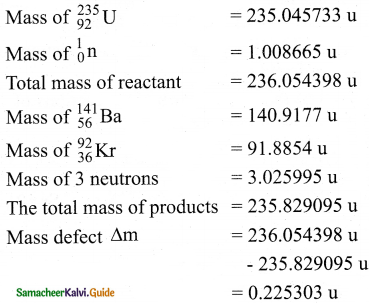
1. We can calculate the energy (Q) released in each uranium fission reaction

Samacheer Kalvi 12th Physics Guide Chapter 8 Atomic and Nuclear Physics 27

Samacheer Kalvi 12th Physics Guide Chapter 8 Atomic and Nuclear Physics 28
2. So the energy released in each fission = 0.225303 × 931 MeV ≈ 200 MeV
3. This energy first appears as kinetic energy of daughter nuclei and neutrons.
4. But later, this kinetic energy is transferred to the surrounding matter as heat.

Samacheer Kalvi 12th Physics Guide Chapter 8 Atomic and Nuclear Physics

Question 14.
Discuss the process of nuclear fusion and how energy is generated in stars?
Answer:

Nuclear Fusion:
1. When two or more light nuclei (A < 20) combine to form a heavier nucleus, then it is called nuclear fusion.

2. In the nuclear fusion, the mass of the resultant nucleus is less than the sum of the masses of original light nuclei. The mass difference appears as energy. The nuclear fusion never occurs at room temperature unlike nuclear fission. It is because when two light nuclei come closer to combine, it is strongly repelled by the coulomb repulsive force.

3. To overcome this repulsion, the two light nuclei must have enough kinetic energy to move closer to each other such that the nuclear force becomes effective. This can be achieved if the temperature is very much greater than the value 107 K. When the surrounding temperature reaches around 107 K, lighter nuclei start fusing to form heavier nuclei and this resulting reaction is called thermonuclear fusion reaction.

Energy generation in stars:
1. The natural place where nuclear fusion occurs is the core of the stars, since its temperature is of the order of 107 K. In fact, the energy generation in every star is only through thermonuclear fusion. Most of the stars including our Sun fuse hydrogen into helium and some stars even fuse helium into heavier elements.

2. The early stage of a star is in the form of cloud and dust. Due to their own gravitational pull, these clouds fall inward. As a result, its gravitational potential energy is converted to kinetic energy and finally into heat.

3. When the temperature is high enough to initiate the thermonuclear fusion, they start to release enormous energy which tends to stabilize the star and prevents it from further collapse.

4. The sun’s interior temperature is around 1.5 x 10⁷ K. The sun is converting 6 x 10¹¹ kg hydrogen into helium every second and it has enough hydrogen such that these fusion lasts for another 5 billion years.

5. When the hydrogen is burnt out, the sun will enter into new phase called red giant where helium will fuse to become carbon. During this stage, sun will expand greatly in size and all its planets will be engulfed in it.

6. According to Hans Bethe, the sun is powered by proton-proton cycle of fusion reaction. This cycle consists of three steps and the first two steps are as follows:
\(_{ 1 }^{ 1 }{ H }\) + \(_{ 1 }^{ 1 }{ H }\) → \(_{ 1 }^{ 2 }{ H }\) + e+ + v …… (1)
\(_{ 1 }^{ 1 }{ H }\) + \(_{ 1 }^{ 2 }{ H }\) → \(_{ 2 }^{ 3 }{ H }\) + γ …… (2)
A number of reactions are possible in the third step. But the dominant one is
\(_{ 2 }^{ 3 }{ H }\) + \(_{ 12}^{ 3 }{ H }\) → \(_{ 2 }^{ 4}{ H }\) + \(_{ 1 }^{ 1 }{ H }\) + \(_{ 1 }^{ 1 }{ H }\)…… (3)
The overall energy production in the above reactions is about 27 MeV. The radiation energy we received from the sun is due to these fusion reactions.

Question 15.
Describe the working of nuclear reactor with a block diagram.
Answer:
Nuclear Reactor:
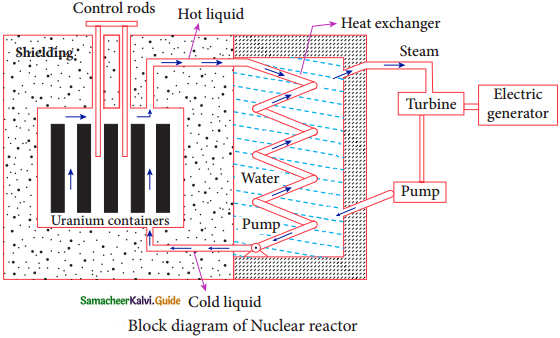
1. Nuclear Reactor is a system in which the nuclear fission takes place in a self sustained controlled manner and the energy produced is used either for research purpose or for power generation.
2. The first nuclear reactor was built in the year 1942 at Chicago, USA by physicist Enrico Fermi.
3. The main parts of a nuclear reactor are fuel, moderator and control rods.
4. In addition to this, there is a cooling system which is connected with power generation set up.
Samacheer Kalvi 12th Physics Guide Chapter 8 Atomic and Nuclear Physics 29

Fuel:
The fuel is fissionable material, usually uranium or plutonium. Naturally occurring uranium contains only 0.7% of \({ }_{92}^{235} \mathrm{U}\) and 99.3% are only \({ }_{92}^{238} \mathrm{U}\). So the \({ }_{92}^{238} \mathrm{U}\) must be enriched such that it contains at least 2 to 4% 0f \({ }_{92}^{235} \mathrm{U}\).

Neutron Source :
1. In addition to this, a neutron soruce is required to initiate the chain reaction for the first time.
2. A mixture of beryllium with plutonium or polonium is used as the neutron source. During fission of \({ }_{92}^{235} \mathrm{U}\), only fast neutrons are emitted but the probability of initiating fission by it in another nucleus is very low. Therefore, slow neutrons are preferred for sustained nuclear reactions.

Moderators:
1. The moderator is a material used to convert fast neutrons into slow neutrons.
2. Usually the moderators are chosen in such a way that it must be very light nucleus having mass comparable to that of neutrons. Hence, these light nuclei undergo collision with the neutrons and the speed of the neutron is reduced.
3. Most of the reactors use water, heavy water (D20) and graphite as moderators.
4. A billiard ball striking a stationary billiard ball of equal mass would itself be stopped but the same billiard ball bounces off almost with same speed when it strikes a heavier mass. This is the reason for using lighter nuclei as moderators.

Control rods:
1. The control rods are used to adjust the reaction rate. During each fission, on an average 2.5 neutrons are emitted and in order to have the controlled chain reactions, only one neutron is allowed to cause another fission and the remaining neutrons are absorbed by the control rods.
2. Usually cadmium or boron acts are control rod material and these rods are inserted into the uranium blocks.
3. Depending on the insertion depth of control rod into the uranium, the average number of neutrons produced per fission is set to be equal to one or greater than one.
4. If the average number of neutrons produced per fission is equal to one, then reactor is said to be in critical state.
5. In fact, all the nuclear reactors are maintained in critical state by suitable adjustment of control rods.
6. If it is greater than once, then reactor is said to be in super – critical and it may explode sooner or may cause massive destruction.

Shielding:
For protection against harmful radiations, the nuclear reactor is surrounded by a concrete wall of thickness of about 2 to 2.5 m.

Cooling System:
1. The cooling system removes the heat generated in the reactor core.
2. Ordinary water, heavy water and liquid sodium are used as coolant since they have very high specific heat capacity and have large boiling point under high pressure.
3. This coolant passes through the fuel block and carries away the heat to the steam generator through heat exchanger.
4. The steam runs the turbines which produce electricity in power reactors.

Samacheer Kalvi 12th Physics Guide Chapter 8 Atomic and Nuclear Physics

Question 16.
Explain in detail the four fundamental forces.
Answer:
Fundamental forces of nature:

  1. It is known that there exists gravitational force between two masses and it is universal in nature. Our planets are bound to the sun through the gravitational force of the sun.
  2. The force between two charges there exists electromagnetic force and it plays major role in most of our day-to-day events.
  3. The force between two nucleons, there exists a strong nuclear force and this force is responsible for the stability of the nucleus.
  4. In addition to these three forces, there exists another fundamental force of nature called the weak force. This weak force is even shorter in range than nuclear force. This force plays an important role in beta decay and energy production of stars.
  5. During the fusion of hydrogen into helium in sun, neutrinos and enormous radiations are produced through weak force.
  6. Gravitational, electromagnetic, strong and weak forces are called fundamental forces of nature.

Question 17.
Briefly explain the elementary particles of nature.
Answer:
1. An atom has a nucleus surrounded by electrons and nuclei is made up of protons and neutrons.
2. Tikl 1960s, it was thought that protons, neutrons and electrons are fundamental building blocks of matter.
3. In 1964, physicist Murray Geliman and George Zweig theoretically proposed that protons and neutrons are not fundamental particles; in fact they are made up of quarks.
4. These quarks are now considered as elementary particles of nature.
5. Electrons are fundamental or elementary particles because they arc not made up of anything.
6. In the year 1968, the quarks were discovered experimentally by Stan ford Linear Accelerator Center (SLAC), USA.
7. There are six quarks namely, up, down, charm, strange, top and bottom and their antiparticles.
8. All these quarks have fractional charges.
9. Charge of up quarks is +\(\frac{2}{3}\)e
10. Charge of down quark is –\(\frac{1}{3}\)e
According to the quark model:
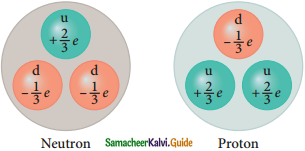
Samacheer Kalvi 12th Physics Guide Chapter 8 Atomic and Nuclear Physics 30
Constituents of Nucleons

Proton is made up of two up quarks and one down quark Neutron is made up of one up quark and two down quarks

11. The study of elementary particles is called particle physics.
12. To date, more than 20 Nobel prizes have been awarded in the field of particle physics.

Samacheer Kalvi 12th Physics Guide Chapter 8 Atomic and Nuclear Physics

IV. Exercises:

Question 1.
Consider two hydrogen atoms HA and HB ground state. Assume that hydrogen atom HA is at rest and hydrogen atom HB is moving with a speed and make head-on collide on the stationary hydrogen atom HA. After the strike, both of them move together. What is the minimum value of the kinetic energy of the moving hydrogen atom HB, such that any one of the hydrogen atoms reaches one of the excitation states?
Answer:
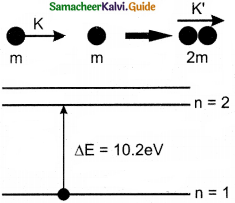
Samacheer Kalvi 12th Physics Guide Chapter 8 Atomic and Nuclear Physics 31
From conservation of linear momentum, p = p’
\(\sqrt{2 \mathrm{~km}}=\sqrt{2 \mathrm{k}^{\prime}(2 \mathrm{~m})}\)
(or) K = 2K’ …………….(1)
From conservation of energy
K = K’ + ∆E …………….(2)
Solving Eqs (1) and (2), we get
∆E = K/2
Now minimum value of E for hydrogen atom is 10.2 eV
∆E ≥ 10.2 eV
K/2 ≥ 10.2
K ≥ 20.4 eV

Question 2.
In the Bohr atom model, the frequency of transitions is given by the following expression ν = Rc\(\left(\frac{1}{n^{2}}-\frac{1}{m^{2}}\right)\) where n < m, Consider the following transition:

Transitions M → n
1 3 → 2
2 2 → 1
3 3 → 1

Show that the frequency of these transitions obey the sum rule (which is known as the Ritz combination principle)
Answer:
Data:
ν = Rc\(\left(\frac{1}{n^{2}}-\frac{1}{m^{2}}\right)\) where n < m
The principle states that the spectral lines of any element included frequencies that are either the sum or the difference of the frequencies of two other lines.
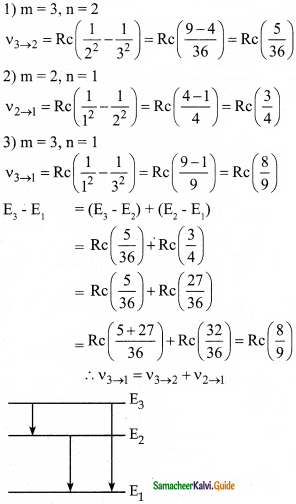
Samacheer Kalvi 12th Physics Guide Chapter 8 Atomic and Nuclear Physics 32

Question 3.
(a) A hydrogen atom is excited by radiation of wavelength 97.5 nm. Find the principal quantum number of the excited state.
(b) Show that the total number of lines in emission spectrum is \(\frac{\mathrm{n}(\mathrm{n}-1)}{2}\) and compute the total number of possible lines in emission spectrum.
Answer:
Data :
λ = 97.5 nm = 97.5 × 10⁻⁹ m = 975 × 10-10 m
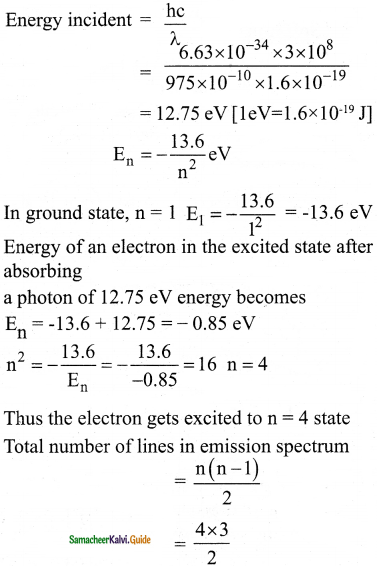
Samacheer Kalvi 12th Physics Guide Chapter 8 Atomic and Nuclear Physics 33

Question 4.
Calculate the radius of the earth if the density of the earth is equal to the density of the nucleus, (mass of earth 5.97 × 1024 kg].
Answer:
Data:
mass of earth = 5.97 × 1024 kg
Nuclear density = 2.3 × 10¹⁷ kg/m3
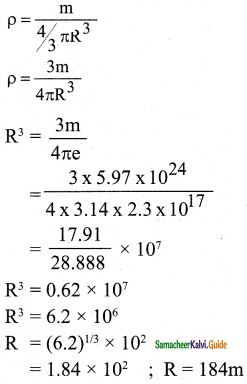
Samacheer Kalvi 12th Physics Guide Chapter 8 Atomic and Nuclear Physics 34

Question 5.
Calculate the mass defect and the binding energy per nucleon of the \(\text { }_{47}^{108} \mathrm{Ag}\) nucleus. (atomic mass of Ag = 107.905949)
Answer:
The \(\text { }_{47}^{108} \mathrm{Ag}\) nucleus contains 47 protons and 61 neutrons
mass of 47 protons = 47 × 1.007825 = 47.367775 u
mass of 61 neutrons =61 × 1.008665 = 61.528565 u
Total mass = 47.367775 + 61.528565 = 108.89634 u
Mass defect, ∆M = 108.89634 – 107.905949
∆M = 0.990391 u
BE = 0.990391 u × c2
BE = 0.990391 × 931 MeV
\(\frac{\mathrm{BE}}{\mathrm{A}}\) = \(\frac{0.990391 \times 931}{108}\) Mev
\(\frac{\mathrm{BE}}{\mathrm{A}}\) = 8.5 MeV/A.

Samacheer Kalvi 12th Physics Guide Chapter 8 Atomic and Nuclear Physics

Question 6.
Half-lives of two radioactive elements A and B are 20 minutes and 40 minutes respectively. Initially, the samples have equal number of nuclei. Calculate the ratio of decayed numbers of A and B nuclei after 80 minutes.
Ans:
Data:
(T1/2)A = 20 minutes
(T1/2)B = 40 minutes
t = 80 minutes
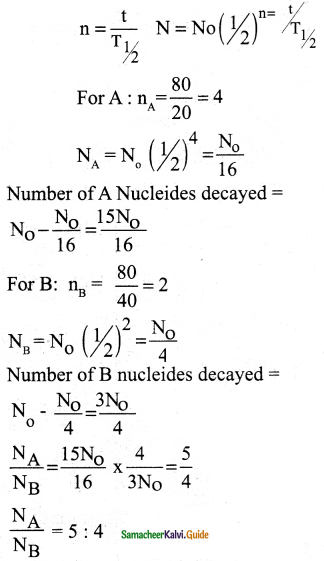
Samacheer Kalvi 12th Physics Guide Chapter 8 Atomic and Nuclear Physics 35

Question 7.
On your birthday, you measure the activity of the sample 210 Bi which has a half – life of 5.01 days. The initial activity that you measure is 1 µCi.
(a) What is the approximate activity of the sample on your next birthday? Calculate
(b) the decay constant
(c) the mean life
(d) an initial number of atoms.
Answer:
Data:
T1/2 = 5.01 days
1 ci = 3.7 × 10¹⁰ decays/s
R0 = 1 µci
t = one year = 365 days
n = \(\frac{t}{T_{1 / 2}}\)
= \(\frac{365}{5.01}\) ≈ 73 half lives

(a) R = (1/2)n R0
R = (1/2)73 (1 µci)
R = 10-22 µci

(b) λ = \(\frac{0.6931}{\mathrm{~T}_{1 / 2}}\) (1 day = 86400S)

λ = \(\frac{0.6931}{5.01 \times 86400}\)
λ = 1.6 × 10⁻⁶ S

(c) τ = \(\frac{1}{\lambda}\)

τ = \(\frac{\mathrm{T}_{1 / 2}}{0.6931}\)

= \(\frac{5.01}{0.6931}\)
τ = 7.24 days

(d) R0 = N0 λ
N0 = \(\frac{R_{0}}{\lambda}\)

= \(\frac{1 \times 10^{-6} \times 3.7 \times 10^{10}}{1.6 \times 10^{-6}}\)
N0 = 2.31 × 10¹⁰

Question 8.
Calculate the time required for 60% of a sample of radon to undergo decay. Given T1/2 of radon = 3.8 days.
Answer:
Data:
Half life of radon = 3.8 days
Amount of sample disintegrated = 60%
Time required =?
λ = \(\frac{0.6931}{3.8}\) per day
Amount of sample disintegrated = 60%
Amount of sample present = 40%
Let N0 be the original amount of the sample present.
From law of disintegration,
N = N0 e-λt
Substituting N = 40% of N0,
\(\left(\frac{40}{100}\right)\) N0 = N0 e-λt
e-λt = \(\left(\frac{40}{100}\right)\)
e-λt = \(\frac{40}{100}\)
e-λt = \(\left(\frac{100}{40}\right)\) = 2.5
Log e 2.5 = λ × t
t = \(\frac{\log _{10} 2.5 \times 2.3026 \times 3.8}{0.6931}\)
t = 5.022 days

Question 9.
Assuming that energy released by the fission of a single \({ }_{92}^{235} \mathrm{U}\) nucleus is 200 MeV, calculate the number of fissions per second required to produce 1-watt power.
Answer:
Data:
Energy per fission = 200 MeV
Required power = 1 watt = 1 J/s
Number of fissions per second =?
Since the two energies are in different units, we must convert them into the same unit.
Energy released per fission = 200 MeV
= 200 × 106 eV
= 200 × 106 × 1.6 × 10-19 J
= 320 × 10-13 J [ 1 eV = 1.6 × 10⁻¹⁹ J]
Let N be the number of fission per second, producing 1 W
Energy per fission × N = Total energy released per second.
320 × 10-13 × N= 1 J/S
N = \(\frac{1}{320 \times 10^{-13}}\)
= 3.125 × 10¹⁰ fissions
Number of fissions per second to produce the required power is 3.125 × 10¹⁰

Question 10.
Show that the mass of radium with (\({ }_{88}^{226} \mathrm{Ra}\)) an activity of 1 curie is almost a gram. Given T1/2 = 1600 years.
Ans:
Data:
Activity = 1 curie
Half life of Radium = 1600 years
1 curie = 3.7 × 10¹⁰ disintegrations per second
From law of disintegration,
N = \(\frac{3.7 \times 10^{10}}{0.6931}\) × 1600 × 365 × 24 × 60 × 60

= \(\frac{1.8669}{0.6931}\) × 1021
= 2.6936 × 10²¹
According to Avagadro’s principle,
6.023 × 10²³ atoms = 226 gm of radium

\(\frac{\mathrm{d} \mathrm{N}}{\mathrm{dt}}\) = λN

N = \(\frac{\mathrm{d} \mathrm{N}}{\mathrm{dt}}\) \(\frac{1}{\lambda}\)

\(\frac{\mathrm{d} \mathrm{N}}{\mathrm{dt}}\) = 1 Curie
= 3.7 × 10¹⁰ disintegration per second
λ = \(\frac{0.6931}{\mathrm{~T}_{1 / 2}}\) per year

λ = \(\frac{0.6931}{1600 \times 365 \times 24 \times 60 \times 60}\) Per second × 2.6936 × 10²¹ atoms

= \(\frac{226}{6.023 \times 10^{23}}\) × 2.6936 × 1021
= 101.0715 × 10⁻² g
= 1.0107 gram
The activity of 1 curie of 1 gram of radium is approximately 1 gram.

Samacheer Kalvi 12th Physics Guide Chapter 8 Atomic and Nuclear Physics

Question 11.
Characol pieces of tree is found from an archeological site. The carbon-14 content of this characol is only 17.5% that of equivalent sample of carbon from a living tree. What is the age of tree?
Answer:
Data:
activity R = 17.5%
T1/2 = 5730 yr
The activity of the sample R = R0 e-λt
e-λt = R0/R
By taking the algorithm on bothsides, we get
t = \(\frac{1}{\lambda} \ln \left(\frac{\mathrm{R}}{\mathrm{R}_{\mathrm{O}}}\right)\)

T1/2 = \(\frac{1 \mathrm{n} 2}{\lambda}\)
t = \(\frac{\mathrm{T}_{1 / 2}}{\ln 2} \ln \left(\frac{\mathrm{R}}{\mathrm{R}_{\mathrm{O}}}\right)\)

t = \(\frac{5730}{1 \mathrm{n} 2} \ln \left(\frac{1}{0.175}\right)\) = 14,400 yr
t = 1.44 × 10⁴ yr

Part – II:

12th Physics Guide Atomic and Nuclear Physics Additional Questions and Answers

I. Match the following:

Question 1.
In J.J Thomson’s experiment.

Field e/m
1. Electric a.  1/2V E2/B2
2. Magnetic b. 2yE/Cl2B2
3. Electric and magnetic c. E/B2R
4. No d. Not defined

Answer:

  1. b
  2. c
  3. a
  4. d

Question 2.
In Millikan’s oil drop experiment

Force Formula
1. gravitational force (Fg) a. σ (4/3 πr3)g
2. Electric force (Fe) b. ρ(4/3 πr3)g
3. Buoyant force (Fb) c. 6πηrυ
4. Viscous force (FV) d. qE (d)

Answer:

  1. b
  2. d
  3. a
  4. c

Question 3.

I II
1. Electron a. E. Goldstein
2. Proton b. Ruther ford
3. Neutron c. James Chadwick
4. Atomic nucleus d. J.J Thomson

Answer:

  1. d
  2. a
  3. c
  4. b

Question 4.

I II
1. Canal rays consist of Postively charged particles protons a. Ruther ford
2. Electrons are distributed in shells b. J. J. Thomson
3. Centre of an atom is dense c. J. Dalton
4. Atom is indivisble d. Neil Bohr

Answer:

  1. b
  2. d
  3. a
  4. c

Question 5.

I II
1. Deuterium a. Radio carbon Dating
2. Carbon 14 b. Treatment of cancer
3. Isotope of Uranium c. Nuclear reactors
4. Cobalt 60 d. An isotope of hydrogen

Answer:

  1. d
  2. a
  3. c
  4. b

Samacheer Kalvi 12th Physics Guide Chapter 8 Atomic and Nuclear Physics

II. Choose the odd man out:

Question 1.
a) J.J .Thomson
b) Ruther ford
c) Bohr
d) Millikan
Answer:
d) Millikan
Reason:
Milikan – Charge of an electron, others – Atom models

Question 2.
a) \(\frac{E^{2}}{2 V B^{2}}\)

b) \(\frac{2 y E}{C^{2} B^{2}}\)

c) \(\frac{E}{B^{2} R}\)

d) \(\mathrm{E} / \mathrm{B}\)
Answer:
d) \(\mathrm{E} / \mathrm{B}\)
Reason:
\(\mathrm{E} / \mathrm{B}\) – velocity,
others – Specific charge

Question 3.
a) \(\frac{m e^{4} z^{2}}{8 \varepsilon_{0}^{2} h^{2} n^{2}}\)

b) \(\frac{-m e^{4} z^{2}}{8 \varepsilon_{n}^{2} h^{2} n^{2}}\)

c) \(\frac{-m e^{4} z^{2}}{4 \varepsilon_{0}^{2} h^{2} n^{2}}\)

d) \(\frac{n^{4} h^{2} \varepsilon 0}{\pi m e^{2} Z}\)
Answer:
d) \(\frac{n^{4} h^{2} \varepsilon 0}{\pi m e^{2} Z}\)
Reason:
d) \(\frac{n^{4} h^{2} \varepsilon 0}{\pi m e^{2} Z}\) – radius of nth orbit,
others – Energy of an electron in the nth orbit

Question 4.
a) 10.2 eV
b) 12.1 eV
c) 12.75 eV
d) 13.6 eV
Answer:
d) 13.6 eV
Reason:
13.6eV – Ionization energy, Others – Excitation energy

Samacheer Kalvi 12th Physics Guide Chapter 8 Atomic and Nuclear Physics

Question 5.
a) Lyman
b) Paschen
c) Brackett
d) Pfund
Answer:
a) Lyman
Reason:
Lyman – UV region, others – IR region

Question 6.
a) \({ }_{1} \mathrm{H}^{1}{ }_{1} \mathrm{H}^{2}\)

b) \({ }_{1} \mathrm{H}^{1}{ }_{1} \mathrm{H}^{3}\)

c) \({ }_{3}^{6} \mathrm{Li},{ }_{3}^{7} \mathrm{Li}\)

d) \({ }_{1}^{3} \mathrm{H},{ }_{2}^{3} \mathrm{He}\)
Answer:
d) \({ }_{1}^{3} \mathrm{H},{ }_{2}^{3} \mathrm{He}\)
Reason:
Millikan – charge of an electron

Question 7.
a) \({ }_{17}^{37} \mathrm{Cl},{ }_{16}^{37} \mathrm{~S}\)

b) \({ }_{20}^{40} \mathrm{Ca},{ }_{18}^{40} \mathrm{Ar}\)

c) \({ }_{19}^{40} \mathrm{~K},{ }_{20}^{40} \mathrm{Ca}\)

d) \({ }_{19}^{12} \mathrm{~B},{ }_{6}^{13} \mathrm{C}\)
Answer:
d) \({ }_{19}^{12} \mathrm{~B},{ }_{6}^{13} \mathrm{C}\)
Reason:
\({ }_{19}^{12} \mathrm{~B},{ }_{6}^{13} \mathrm{C}\) – Isotones, others – Isobars

Question 8.
a) Water
b) Heavy water
c) graphite
d) Liquid sodium
Answer:
d) Liquid sodium
Reason
liquid sodium – Cooling system, Others – Moderators.

Question 9.
a) Gravitational force
b) Electromagnetic force
c) Centripetal force
d) nuclear force
Answer:
c) Centripetal force
Reason:
Centripetal force – It is not fundamental, Others – Fundamental forces of nature.

Samacheer Kalvi 12th Physics Guide Chapter 8 Atomic and Nuclear Physics

III. Choose the incorrect pair:

Question 1.
a) 110 mm of Hg – No discharge
b) 100mm of Hg – Crackling sound
c) 10 mm of Hg – Cathode rays
d) 0.01mm of Hg – Crooke’s dark space
Answer:
c) 10mm of Hg – Cathode rays
Reason:
10 mm of Hg – Positive column

Question 2.
a) e/m – 1.7 × 10¹¹ C kg-1
b) e – 1.6 × 10⁻¹⁹ C
c) R – 1.09737 × 10⁻⁷ m-1
d) R0 – 6.97 × 10⁻¹⁵ m
Answer:
d) R0 – 6.97 × 10⁻¹⁵ m
Reason:
R0 – 1.2 × 10⁻¹⁵ m (or) 1.2 F

Question 3.
a) \({ }_{5}^{12} \mathrm{~B},{ }_{6}^{13} \mathrm{C}\) – Isotones

b) \({ }_{16}^{40} 5,{ }_{17}^{40} \mathrm{C}\) – Isobars

c) \({ }_{6}^{11} \mathrm{C},{ }_{6}^{12} \mathrm{C}\) – Isotopes

d) \({ }_{6}^{14} \mathrm{C},{ }_{6}^{11} \mathrm{C}\) – Radio isotopes
Answer:
d) \({ }_{6}^{14} \mathrm{C},{ }_{6}^{11} \mathrm{C}\) – Radio isotopes
Reason:
\({ }_{6}^{14} \mathrm{C}\) – Radio isotopes
\({ }_{6}^{11} \mathrm{C}\) – It is not Radio isotopes

Question 4.
a) Nuclear reactor fuel – Plutonium
b) Control rods – Aluminum
c) Cooling system – Ordinary water
d) Moderators – Ordinary water
Answer:
b) Control rods – Aluminum
Reason:
Control rods – Cadmium

Samacheer Kalvi 12th Physics Guide Chapter 8 Atomic and Nuclear Physics

IV. Choose the correct Pair:

Question 1.
a) BE/A of \({ }_{2}^{4} \mathrm{He}\) – 28 MeV
b) BE of \({ }_{2}^{4} \mathrm{He}\) – 7 MeV
c) BE/A of \({ }_{26}^{56} \mathrm{Fe}\) – 8.8 MeV
d) 56 BE of \({ }_{26}^{56} \mathrm{Fe}\) – 470 MeV
Answer:
c) BE/A of \({ }_{26}^{56} \mathrm{Fe}\) – 8.8 MeV
Reason:
c) BE/A of \({ }_{26}^{56} \mathrm{Fe}\) – 8.8 MeV

Question 2.
a) \({ }_{Z}^{\mathrm{A}} \mathrm{X}\) → \(\begin{array}{c}
\mathrm{A}-4 \\
\mathrm{y} \\
\mathrm{Z}-2
\end{array}\) + \({ }_{2}^{4} \mathrm{He}\)

b) \({ }_{Z}^{\mathrm{A}} \mathrm{X}\) → \(\begin{array}{c}
\mathrm{A} \\
\mathrm{y} \\
\mathrm{Z}-1
\end{array}\) + e+ + \(\bar{v}\)

c) \({ }_{Z}^{\mathrm{A}} \mathrm{X}\) → \(\begin{array}{c}
\mathrm{A} \\
\mathrm{Z}+1
\end{array} \mathrm{Y}\) + e + ν

d) \({ }_{Z}^{\mathrm{A}} \mathrm{X}\) → \(\begin{array}{c}
\mathrm{A} \\
\mathrm{Z}+1
\end{array} \mathrm{Y}\) + γ
Answer:
a) \({ }_{Z}^{\mathrm{A}} \mathrm{X}\) → \(\begin{array}{c}
\mathrm{A}-4 \\
\mathrm{y} \\
\mathrm{Z}-2
\end{array}\) + \({ }_{2}^{4} \mathrm{He}\)
Reason:
a) \({ }_{Z}^{\mathrm{A}} \mathrm{X}\) → \(\begin{array}{c}
\mathrm{A}-4 \\
\mathrm{y} \\
\mathrm{Z}-2
\end{array}\) + \({ }_{2}^{4} \mathrm{He}\) – α – decay

Question 3.
a) C – 14 – 5730 years
b) Neutron – 14 Minutes
c) Phosphorous – 4 minutes
d) Nitrogen – 10.7 minutes
Answer:
a) C – 14 – 5730 years
Reason:
C – 14 – 5730 years (Half life period)

Question 4.
a) 60Co – Thyroid gland
b) 24Na – Treatment of cancer
c) 56Fe – Diagnose anaemia
d) 32p – Locate brain tumors
Ans :
c) 56Fe – diagnose anaemia
Reason:
56Fe – diagnose anaemia.

Samacheer Kalvi 12th Physics Guide Chapter 8 Atomic and Nuclear Physics

V. Assertion and Reason:

Question 1.
Assertion:
Density of all the the nuclei is same.
Reason:
Radius of nucleus is directly proportional to the cube root of mass number.
a) If both assertion and reason are true and the reason is the correct explanation of the reason.
b) If both assertion and reason are true but reason is not the correct explanation of the assertion.
c) If assertion is true but reason is false.
d) If both assertion and reason are false
Answer:
a) If both assertion and reason are true and the reason is the correct explanation of the reason
Solution:
R = Ro A1/3 R α A1/3

Question 2.
Assertion:
For the scattering of a α particles at a large angles, only the nucleus of the atom is responsible.
Reason:
Nucleus is very heavy in comparison to electrons.
a) If both assertion and reason are true and the reason is the correct explanation of the reason.
b) If both assertion and reason are true but reason is not the correct explanation of the assertion.
c) If assertion is true but reason is false.
d) If both assertion and reason are false
Answer:
a) If both assertion and reason are true and the reason is the correct explanation of the reason
Solution:
We know that an electron is very light particle as compared to an a particle. Hence electron cannot scatter, the α particles scatters at large angles, according to law of conservation of energy.

Question 3.
Assertion:
Bohr had to postulate that the electrons in stationary orbits around the nucleus do not radiate.
Reason:
According to classical physics all moving electrons radiate.
a) If both assertion and reason are true and the reason is the correct explanation of the reason.
b) If both assertion and reason are true but reason is not the correct explanation of the assertion.
e) If assertion is true but reason is false.
d) If both assertion and reason are false
Answer:
b) If both assertion and reason are true but reason is not the correct explanation of the assertion.
Solution:
An atom radiates energy, only when electron jumps from a stationary orbit of higher energy to an orbit of lower energy.

Question 4.
Assertion:
Radioactive nuclei emit β-1 particles.
Reason:
Electrons exist inside the nucleus
a) If both assertion and reason are true and the reason is the correct explanation of the reason.
b) If both assertion and reason are true but reason is not the correct explanation of the assertion.
c) If assertion is true but reason is false.
d) If both assertion and reason are false
Answer:
c) If assertion is true but reason is false.
Solution:
So electrons do not exist in the nucleus, [n—> p + e-1 + \(\bar{v}\)]

Samacheer Kalvi 12th Physics Guide Chapter 8 Atomic and Nuclear Physics

VI. Choose the correct statement:

Question 1.
Which of the following statements is correct for cathode rays?
a) They are not deflected by electric and magnetic fields.
b) Cathode rays possess energy and momentum
c) When the cathode rays are allowed to fall on matter, they does not produce heat.
d) The speed of cathode rays is up to \(\left(\frac{1}{20}\right) \mathrm{th}\) of the speed of light
Answer:
b) Cathode rays possess energy and momentum
Solution:
It can be deflected by application of electric and magnetic fields. They produce heat. The \(\left(\frac{1}{10}\right) \mathrm{th}\) of the speed of light

Question 2.
Which of the following statement is correct for isotopes.
a) Same number of neutrons
b) Same number of mass number
c) Same atomic number
d) Same number of electrons
Answer:
c) Same atomic number
Solution:
Same number of protons, same atomic number, different number of neutrons different mass number.

Question 3.
Which of the following statement is correct for an alpha decay.
a) When stable nuclei decay by emitting an α particle
b) It gains two electrons and two neutrons
c) \({ }_{88}^{226} \mathrm{Ra}\) → \({ }_{86}^{222} \mathrm{Ra}\) + \({ }_{2}^{4} \mathrm{He}\)
d) It does not emit four seperate nucleons.
Answer:
c) \({ }_{88}^{226} \mathrm{Ra}\) → \({ }_{86}^{222} \mathrm{Ra}\) + \({ }_{2}^{4} \mathrm{He}\)
Solution:
Unstable nuclei, it loses two protons and two neutrons, and It does not emit four separate nucleons.

Question 4.
Which of the following statement is correct for neutrons.
a) Neutrons are unstable inside the nucleus
b) Neutrons are stable outside the nucleus
c) Those radiations are electromagnetic waves
d) \({ }_{4}^{9} \mathrm{Be}+{ }_{2}^{4} \mathrm{He} \rightarrow{ }_{6}^{12} \mathrm{C}+{ }_{0}^{1} \mathrm{n}\)
Answer:
d) \({ }_{4}^{9} \mathrm{Be}+{ }_{2}^{4} \mathrm{He} \rightarrow{ }_{6}^{12} \mathrm{C}+{ }_{0}^{1} \mathrm{n}\)
Solution:
Neutrons are stable inside the nucleus. But outside the nucleus they are unstable. Those radiations are not em waves but they are particles.

Samacheer Kalvi 12th Physics Guide Chapter 8 Atomic and Nuclear Physics

VII. Choose the incorrect statements:

Question 1.
Which of the following statements are incorrect for fine structure constant α
a) α = Velocity of an electron in the first orbit / The speed of light
b) α = e2/2ε0 hc
c) \(\frac{\mathrm{V}_{1}}{\mathrm{C}}=\frac{1}{137}\)
d) α is dimension number
Answer:
d) α is dimension number
Solution:
α is a dimensionless number

Question 2.
Which of the following statements are incorrect for Bohr atom model.
a) Bohr atom model is valid only for hydrogen atom.
b) Fine structure is explained by Bohr atom model.
c) Bohr atom model fails to explain the intensity variations in the spectral lines.
d) The distribution of electrons in atoms is not completely explained by Bohr atom model.
Answer:
b) Fine structure is explained by Bohr atom model.
Solution:
Fine structure is not explained by Bohr atom model.

Question 3.
Which of the following statements are incorrect for decay.
a) α – decay: atomic number z decreases by 2, mass number decreases by 4.
b) β – decay: atomic number z increases by one and the mass number remains the same.
c) γ – decay: no change in the mass number or atomic number of the nucleus.
d) Both α and β particles are emitted during a single decay.
Answer:
d) Both α and β particles are emitted during a single decay.
Solution:
Both α and β particles are not emitted during a single decay.

Question 4.
Which of the following statements are incorrect for elementary particles.
a) The study of elementary particles is called particle physics.
b) Electrons are not elementary particles.
c) Charge of up quark is + 2/3e
d) Charge of down quark is -1/3e
Answer:
b) Electrons are not elementary particles.
Solution:
Electrons are fundamental particles because they are not made up of anything.

Samacheer Kalvi 12th Physics Guide Chapter 8 Atomic and Nuclear Physics

VIII. Choose the best answer:

Question 1.
The potential difference applied to an X-ray tube is 5 kV and the current through it is 3.2 mA. Then the number of electrons striking the target per second is
(a) 2 x 10¹⁶
(b) 5 x 10¹⁸
(c) 1 x 10¹⁷
(d) 4 x 10⁵
Answer:
(a) 2 x 10¹⁶
Hint:
n = \(\frac { It }{ e }\) = \(\frac{3.2 \times 10^{-3} \times 1}{1.6 \times 10^{-19}}\) = 2 x 10¹⁶.

Question 2.
Proton Carries _______.
a) a positive charge
b) a negative charge
c) No charge
d) None of these
Answer:
a) a positive charge

Question 3.
The radioisotope used for locating brain tumours is ________.
a) Phosphor
b) Potassium
c) Iodine
d) Sodium
Answer:
c) Iodine

Question 4.
The speed of the particle, that can take discrete values is proportional to
(a) n-3/2
(b) n-1
(c) n1/2
(d) n
Answer:
(d) n
Hint:
P = mv = \(\frac { nh }{ 2a }\) ; V ∝ n.

Question 5.
Which of these four elements are essential for the construction of nuclear reactors?
a) Cobalt
b) Nickel
c) Zirconium
d) Tungsten
Answer:
C) Zirconium

Samacheer Kalvi 12th Physics Guide Chapter 8 Atomic and Nuclear Physics

Question 6.
The nuclei have mass numbers in the ratio 1 : 8. find the ratio of their nuclei radii.
a) 1 : 8
b) 1 : 2
c) 2 : 1
d) 8 : 1
Answer:
b)1 : 2

Question 7.
The source of the sun’s energy is _______.
a) Fission
b) Radioactivity
c) Fusion
d) Ionization
Answer:
c) Fusion

Question 8.
Energy required for the electron excitation in Li++ from the first to the third Bohr orbit is
(a) 12.1 eV
(b) 36.3 eV
(b) 36.3 eV
(c) 108.8 eV
Answer:
(c) 108.8 eV
Hint:
En = – 13.6 \(\frac { { Z }^{ 2 } }{ { n }^{ 2 } } \)
∆E = E3 – E2 = 13.6 (3)2 \(\left[ \frac { 1 }{ { 1 }^{ 2 } } -\frac { 1 }{ { 3 }^{ 2 } } \right] \)
= \(\frac { 13.6×9×8 }{ 9 } \) = 108.8 eV.

Question 9.
Which of the following transition will have the highest emission wavelength.
a) n = 2 to n = 1
b) n = 4 to n = 1
c) n = 6 to n = 2
d) n = 5 to n = 2
Answer:
d) n = 5 to n = 2

Question 10.
One atomic mass unit (u) =
a) 1.660 × 10⁻²⁷ kg
b) 1.660 × 10⁻²⁰ kg
e) 1.660 × 10⁻²⁴ kg
d) 1.660 × 10⁻²² kg
Answer:
a) 1.660 × 10⁻²⁷ kg

Samacheer Kalvi 12th Physics Guide Chapter 8 Atomic and Nuclear Physics

Question 11.
\(\frac{12}{5} \mathrm{~B} \rightarrow \frac{12}{6} \mathrm{C}+\ldots \ldots \bar{v}\)
a) e
b) e+
c) γ
d) None of these
Answer:
a) e

Question 12.
For an electron in the second orbit of hydrogen, what is the moment of momentum as per Bohr’s model?
(a) 2πh
(b) πh
(c) h / π
(d) 2h / π
Answer:
(c) h / π
Hint:
In second orbit of hydrogen, L = 2 \(\left( \frac { h }{ 2\pi } \right) \) = \(\frac { h }{ π }\).

Question 13.
1 curie = ________ Bq
a) 3.7 × 10¹⁰
b) 3.7 × 10⁻¹⁰
c) 3.8 × 10⁻¹⁰
d) 3.8 × 10¹⁰
Answer:
a) 3.7 × 10¹⁰

Question 14.
The mean life of \({ }_{0}^{1} \mathrm{n}\) is
a) 18.75 minutes
b) 8.11 minutes
c) 13 minutes
d) 10 minutes
Answer:
a) 18.75 minutes

Question 15.
A beam of cathode rays is subjected to crossed Electric (E) and magnetic fields. (B). This fields are adjusted such that the beam is not deflected. The specific charge of the cathode rays is given by
a) \(\mathrm{E}^{2} / 2 \mathrm{VB}^{2}\)

b) \(\mathrm{B}^{2} / 2 \mathrm{VE}^{2}\)

c) \(\frac{2 \mathrm{VB}^{2}}{\mathrm{E}^{2}}\)

d) \(\frac{2 V E^{2}}{B^{2}}\)
Answer:
a) \(\mathrm{E}^{2} / 2 \mathrm{VB}^{2}\)
Solution:
eV = 1/2 mv2
e/m = \(\frac{v^{2}}{2 V}\)
∴ V = E/B
\(\frac{e}{m}=\frac{E^{2}}{2 V B^{2}}\)

Samacheer Kalvi 12th Physics Guide Chapter 8 Atomic and Nuclear Physics

Question 16.
The specific charge of an electron is ________.
a) 1.6 × 10⁻¹⁹ C/kg
b) 4.8 × 10⁻¹⁰ C/kg
c) 1.76 × 10¹¹ C/kg
d) 1.76 × 10⁻¹¹ C/kg
Answer:
c) 1.76 × 10¹¹ C/kg
Solution:

Samacheer Kalvi 12th Physics Guide Chapter 8 Atomic and Nuclear Physics 36

Question 17.
The ratio of specific charge of an α – particle to that of a proton is
a) 2 : 1
b) 1 : 1
c) 1 : 2
d) 1 : 3
Answer:
c) 1 : 2
Solution:
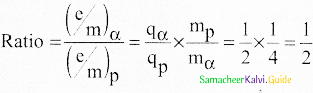
Samacheer Kalvi 12th Physics Guide Chapter 8 Atomic and Nuclear Physics 37

Question 18.
A narrow electron beam passes undeviated through an electric field E = 3 × 10⁴ v/m and an overlapping magnetic field B = 2 × 10⁻³ wb/m2. The electron motion, electric field and magnetic field are mutually perpendicular. The speed of the electron is _______.
a) 60 m/s
b) 10.3 × 10⁷ m/s
c) 1.5 × 10⁷ m/s
d) 0.67 × 10⁻⁷ m/s
Answer:
c) 1.5 × 10⁷ m/s
Solution:
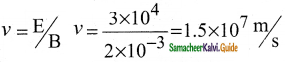
Samacheer Kalvi 12th Physics Guide Chapter 8 Atomic and Nuclear Physics 38

Question 19.
In Bohr’s model of hydrogen atom, the radius of the first electron orbit is 0.53 Å. What will be the radius of the third orbit?
(a) 4.77 Å
(b) 47.7 Å
(c) 9 Å
(d) 0.09 Å
Answer:
(a) 4.77 Å
Hint:
r3 = (3)2 r1 = 9 x 0.53 = 4.77 Å.

Question 20.
In millikan’s oil drop experiment, an oil drop of mass 16 × 10-6 Kg is balanced by an electric field of 106 v/m. The charge in coulomb on the drop, assuming g = 10 m/s2 is
a) 6.2 × 10⁻¹¹
b) 16 × 10-19
c) 16 × 10-11
d) 16 × 10-13
Answer:
c) 16 × 10-11
Solution:
eE = mg
e = mg/E
= \(\frac{16 \times 10^{-6} \times 10}{10^{6}}\)
= 16 × 10-11 C

Samacheer Kalvi 12th Physics Guide Chapter 8 Atomic and Nuclear Physics

Question 21.
An alpha nucleus of energy 1/2 mv2 bombards a heavy target of charge Ze. Then, the distance of closest approach for the alpha nucleus will be proportional to
a) V2
b) 1/m
c) 1/V4
d) 1/Ze
Answer:
b) 1/m
Solution:
r0 = \(\frac{1}{4 \pi \varepsilon_{\mathrm{o}}} \frac{2 \mathrm{ze}^{2}}{1 / 2 \mathrm{mv}^{2}}\)
i.e, r α \(\frac{1}{\mathrm{~m}}\)

Question 22.
An α – particle is projected with an energy of 4 MeV directly towards gold nucleus. Calculate the distance of its closest approach, (gold z = 79)
a) 5.688 × 10⁻¹⁴ m
b) 7.699 × 10⁻¹⁴ m
c) 5.688 × 10⁻¹⁴m
d) 7.699 × 10⁻¹⁴ m
Answer:
a) 5.688 × 10⁻¹⁴ m
Solution :
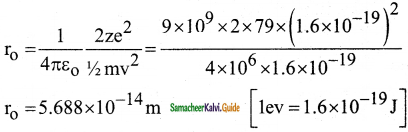
Samacheer Kalvi 12th Physics Guide Chapter 8 Atomic and Nuclear Physics 39

Question 23.
In terms of Bohr radius a0, the radius of the second Bohr orbit of a hydrogen atom is given by
(a) 4a0
(b) 8a0
(c) √2a0
(d) 2a0
Answer:
(a) 4a0
Hint:
rn = r1 n2
r2 = a0 (2)2 =4a0

Question 24.
The hydrogen atom in the ground state is excited by monochromatic radiation of a wavelength of λ = 975 Å. The number of spectral lines in the resulting spectrum emitted will be:
a) 10
b) 6
c) 3
d) 2
Answer:
b) 6

Question 25.
One femtometre is equivalent to
(a) 1015 m
(b) 10-15 m
(c) 10-12 m
(d) 1011 m
Answer:
(b) 10-15 m

Samacheer Kalvi 12th Physics Guide Chapter 8 Atomic and Nuclear Physics

Question 26.
The ratio of the kinetic energy to the total energy of an electron in a Bohr orbit of the hydrogen
a) 1 : -2
b) 1 : -1
c) 1 : 1
d) 2 : 1
Answer:
b) 1 : -1
Solution :
KE = – (TE);
KE/TE = -1

Question 27.
In the spectrum of hydrogen, the ratio of the longest wavelength in the lyman series to the longest wavelength in Balmer series is
a) 9/4
b) 27/5
c) 5/27
d) 4/9
Answer:
c) 5/27
Solution:
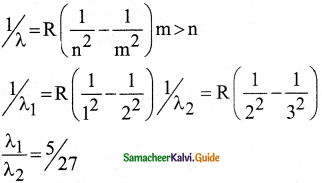
Samacheer Kalvi 12th Physics Guide Chapter 8 Atomic and Nuclear Physics 40

Question 28.
The radius of the 5th orbit of a hydrogen atom is 13.25. Calculate the wavelength of the electron in the 5th orbit.
a) λ = 16.64 Å
b) λ = 26.5O Å
c) λ = 13.25 Å
d) λ = 13.64 Å
Answer:
a) λ = 16.64 Å

Question 29.
What would be the radius of the second orbit of He+ ions?
(a) 1.058 Å
(b) 3.023 Å
(c) 2.068 Å
(d) 4.458 Å
Answer:
1.058 Å
Hint:
rn = \(\frac {{ n }^{2}}{ Z }\) r1
For He+ ion, n = 2, Z = 2
∴ r2 = \(\frac {4}{ 2 }\) x 0.59 Å = 1.058 Å.

Question 30.
The first excitation potential to a given atom is 10.2 V. Then ionisation potential must be
a) 20.4 V
b) 13.6 V
e) 30.6 V
d) 40.8 V
Answer:
b) 13.6V
Solution:
First excitation potential energy E2 – E1 = 10.2eV
E1 = -13.6 eV
Ionisation potential energy,
E – E1 = 0 + 13.6 = 13.6 eV
Ionisation potential = 1/e
Eionization = 13.6 V

Samacheer Kalvi 12th Physics Guide Chapter 8 Atomic and Nuclear Physics

Question 31.
Hydrogen atom excites energy level from fundamental state to n = 3. Number of spectral lines according to Bohr is _______.
a) 4
b) 3
c) 1
d) 2
Answer:
b) 3
Solution:
\(\frac{\mathrm{n}(\mathrm{n}-1)}{2}\) = \(\frac{3(3-1)}{2}\) = 3

Question 32.
What would be the radius of second orbit of He+ ion?
a) 1.058 Å
b) 3.023 Å
e) 2.068 Å
d) 4.458 Å
Answer:
a) 1.058 Å
Solution :
rn = a0 \(\frac{n^{2}}{z}\) for He+ ion
Z = 2, n = 2, a0 = 0.529 Å
r2 = 0.529 Å (4/2) = 1.058 Å

Question 33.
The size of an atom is proportional to
(a) A
(b) A1/3
(c) A2/3
(d) A-1/3
Answer:
(b) A1/3

Question 34.
Energy levels A, B, C of a certain atom correspond to increasing values of energy. (j.c) EA < EB < Ec. ?2 )3 arc in the wavelengths C to B, B to A, and C to A respectively, which of the following statements is correct.
a) λ3 = λ1 + λ2
b) λ3 = \(\frac{\lambda_{1} \lambda_{2}}{\lambda_{1}+\lambda_{2}}\)
c) λ1 = λ2 + λ3
d) λ32 = λ12 + λ22
Answer:
b) λ3 = \(\frac{\lambda_{1} \lambda_{2}}{\lambda_{1}+\lambda_{2}}\)
Solution:
(EC – EA) = (EC – EB) + (EB – EA)
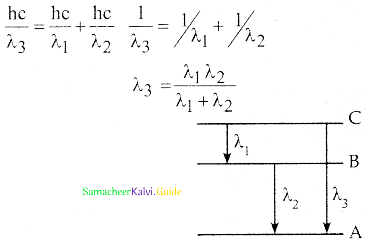
Samacheer Kalvi 12th Physics Guide Chapter 8 Atomic and Nuclear Physics 41

Question 35.
If in nuclear fusion process, the masses of the fusing nuclei be m1 and m2 and the mass of the resultant is m1, then
a) m3 = m1 + m2
b) m3 = m1 – m2
c) m3 < m1 + m2
d) m3 > m1 + m2
Answer:
c) m3 < m1 + m2

Samacheer Kalvi 12th Physics Guide Chapter 8 Atomic and Nuclear Physics

Question 36.
The nuclear radius of \(\begin{array}{l}
8 \\
4
\end{array} \text { Be }\) nucleus is
a) 1.3 × 10⁻¹⁵ m
b) 2.4 × 10⁻¹⁵ m
c) 1.3 × 10⁻¹³ m
d) 2.4 × 10⁻¹⁰ m
Answer:
b) 2.4 × 10⁻¹⁵ m
Solution:
R = R0 A1/3
R = 1.2 × 10-15 × 81/3
R = 1.2 × 10-15 × (23)1/3
R = 2.4 × 10⁻¹⁵ e

Question 37.
The mass defect of a \({ }_{3}^{7} \mathrm{Li}\) is 0.042u. Its binding energy per nucleon is
a) 23 MeV
b) 46 MeV
c) 5.6 MeV
d) 3.9 MeV
Answer:
c) 5.6 MeV
Solution:
\(\frac{\mathrm{BE}}{\mathrm{A}}\) = \(\frac{0.042 \times 931 \mathrm{MeV}}{7}\) = 5.6 MeV

Question 38.
The mass defect of a certain nucleus is found to be 0.03u. Its binding energy is _______.
a) 27.93 eV
b) 27.93 KeV
e) 27.93 MeV
d) 27.93 GeV
Answer:
c) 27.93 MeV
Solution:
BE = 0.03 × 931 MeV = 27.93 MeV

Question 39.
The SI unit of radioactivity is _______.
a) Roentgen
b) Rutherford
c) Curie
d) Becquerel
Answer:
d) Becquerel

Samacheer Kalvi 12th Physics Guide Chapter 8 Atomic and Nuclear Physics

Question 40.
Radioactive material A has decay constant 8λ and material B has decay constant λ. Initially they have same number of nuclei. After what time, the ratio of number of nuclei of material B to that A will be 1/e
a) 1/λ
b) 1/7λ
c) 1/8λ
d) 1/9λ
Answer:
b) 1/7λ
Solution:
NA = N0 e-8λt,
NB = N0 e-λt
\(\frac{\mathrm{N}_{\mathrm{A}}}{\mathrm{N}_{\mathrm{B}}}\) = \(\frac{\mathrm{e}^{-8 \lambda t}}{\mathrm{e}^{-\lambda \mathrm{t}}}\) \(\frac{1}{\mathrm{e}}\)
= e-7λt e-1 = e-λt
= 7λt = 1
t = 1/7λ

Question 41.
If a radioactive substance to 1/16 of its original mass in 40 days, what is its half life
a) 10 days
b) 20 days
c) 40 days
d) None of these
Answer:
a) 10 days
Solution:
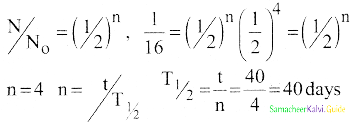
Samacheer Kalvi 12th Physics Guide Chapter 8 Atomic and Nuclear Physics 42

Question 42.
The explosion of atom bomb is based on the principle of _______.
a) uncontrolled fission reaction
b) controlled fission reaction
e) fusion reaction
d) Thermonuclear reaction
Answer:
a) uncontrolled fission reaction

Question 43.
The average energy released per fission is _______.
a) 200 eV
b) 200 MeV
c) 200 GeV
d) 200 MeV
Answer:
b)200 MeV
Solution:
Energy released in fission = 200 MeV

Question 44.
In Bohr Atom model when the principal quantum number (n) increases the velocity of electron ________.
a) increases and then decreases
b) increases
c) decreases
d) remains constant
Answer:
c) decreases

Samacheer Kalvi 12th Physics Guide Chapter 8 Atomic and Nuclear Physics

IX. Two Marks Questions:

Question 1.
Define excitation potential.
Answer:
Excitation potential is defined as excitation energy per unit charge.

Question 2.
Why gas is a poor conductor of electricity?
Answer:
Gases at normal atmospheric pressure are poor conductors of electricity because they do not have free electrons for conduction.

Question 3.
What phenomenon occurs at a pressure of 100mm of Hg in the discharge tube?
Answer:

  1. When the pressure is kept near 100mm of Hg, the discharge of electricity through the tube takes place.
  2. Consequently, irregular streaks of light appear and also crackling sound is produced. 10. State Earnshaw’s theorem.

Question 4.
What is known as positive column?
Answer:
When the pressure is reduced to the order of 10mm of Hg, a luminous column known as positive column is formed from anode to cathode.

Question 5.
What is called crooke’s dark space?
Answer:
When the pressure reaches to around 0.01 mm of Hg, positive column disappears. At this time, a dark space is formed between anode and cathode which is often called crooke’s dark space.

Samacheer Kalvi 12th Physics Guide Chapter 8 Atomic and Nuclear Physics

Question 6.
Write the principle of JJ Thomson’s experiment?
Answer:
In the presence of electric and magnetic fields, the cathode rays are deflected.

Question 7.
The e/m ratio of cathode does not depend on?
Answer:
The specific charge is independent of

  • gas used
  • nature of the electrodes.

Question 6.
Write down the properties of the neutrino.
Answer:
The neutrino has the following properties:

  1. It has zero charge
  2. It has an antiparticle called anti-neutrino.
  3. Recent experiments showed that the neutrino has a very tiny mass.
  4. It interacts very weakly with the matter. Therefore, it is very difficult to detect.
  5. In fact, in every second, trillions of neutrinos coming from the sun are passing through our bodies without any interaction.

Question 9.
Why Thomson’s model of the atom is known as a watermelon model?
Answer:
This is because in Thomson’s model the electrons are assumed to be uniformly embedded in a sphere of positively charged matter like seeds in watermelon.

Question 10.
State Earnshaw’s theorem.
Answer:
From classical electrodynamics, no stable equilibrium points exist in electrostatic configuration.

Samacheer Kalvi 12th Physics Guide Chapter 8 Atomic and Nuclear Physics

Question 11.
What is Thomson’s atom model?
Answer:

  1. It this model, the atoms are visualized as homogeneous spheres which contain uniform distribution of positively charged particles. The negatively charged patticles known as electrons are embedded in it like seeds in water melon.
  2. The atoms are electrically neutral, this implies that the total positive charge in an atom is equal to the total negative charge.

Question 12.
What are the drawbacks of Thomson atom model?
Answer:
It fails to explain the origin of spectral lines observed in the spectrum of hydrogen atom and other atoms.

Question 13.
The large angle scattering is possible only due to nucleus. Why?
Answer:
α particles can be scattered through large angles only if they collide against a positively charged heavy particle such as a nucleus.

Question 14.
What is the value of impact parameter for scattering through 180°?
Answer:
b = K cot(θ/2)
θ is called scattering angle, b = K cot 90° = 0
It can be proved that impact parameter is zero, for θ = 180°

Question 15.
State Bohr’s angular momentum quantization condition.
Answer:
The angular momentum of the electron in stationary orbits are quantized that is it can be written as integer or integral multiple of h/2π
l = nh/2π (or) mvr = nh/2π
where
n = principal quantum number of the orbit.
h/2π = reduced plank’s constant.

Samacheer Kalvi 12th Physics Guide Chapter 8 Atomic and Nuclear Physics

Question 16.
State Bohr’s energy quantization condition.
Answer:
An electron can jump from one orbit to another orbit by absorbing or emitting a photon whose energy is equal between the two orbital levels.
∆E = Efinal – Einitial = hν = hc/λ
C = speed of light, λ = wavelength of the radiation, ν = frequency of the radiation

Question 17.
Define wave number of radiation. Give its unit
Answer:
\(\bar{v}=\frac{1}{\lambda}\)
where \(\bar{v}\) is known as wave number which is inverse of wavelength.
unit: m-1

Question 18.
What are stationary orbits?
Answer:

  1. Electrons in an atom revolve around the nucleus only in certain discrete orbits called stationary orbits where it does not radiate electromagnetic energy.
  2. Only those discrete orbits allowed are stable orbits.

Question 19.
What is a velocity selector?
Answer:

  1. The velocity selector allows the long of a particular velocity to come out of it, by the combined action of electric and a magnetic field. “
  2. Force due to electric field = Force due to magnetic field
    eE = eBV
    V = E/B

Question 20.
How much is the energy possessed by an electron for n = ∞?
Answer:
For n = ∞,
En = –\(\frac{13.6}{\mathrm{n}^{2}}\) ev = 0

Samacheer Kalvi 12th Physics Guide Chapter 8 Atomic and Nuclear Physics

Question 21.
What is atomic mass unit (u)?
Answer:
One atomic mass unit (u) is defined as the 1/12 th of the mass of the isotope of carbon \({ }_{6}^{12} \mathrm{C}\)
1u = \(\frac{\text { mass of }_{6}^{12} \text { Catom }}{12}\)
= \(\frac{1.992 \times 10^{-26}}{12}\)
lu = 1.660 × 10⁻²⁷ kg

Question 22.
State empirical formula related to the radius of nucleus and its mass number.
Answer:
The nuclei are found to be approximately spherical in shape. It is experimentally found that the radius of nuclei for Z > 10, satisfies the following empirical formula.
R = R0 A1/3
A = mass number of the nucleus
R0 = 1.2 F

Question 23.
Give the nature of α, β, and γ – radiations.
Answer:
α rays are in fact \({ }_{2}^{4} \mathrm{He}\) nuclei and β rays are electrons or positrons. Certainly, they are not electromagnetic radiation. The γ ray alone is electromagnetic radiation.

Question 24.
What is an α particle?
Answer:
An α particle is a helium nucleus consisting of two protons and two neutrons. It carrier two units of positive charge.

Question 25.
Define decay constant (λ).
Answer:
It is defined as the reciprocal of mean life λ = 1/τ

Samacheer Kalvi 12th Physics Guide Chapter 8 Atomic and Nuclear Physics

Question 26.
What is the half-life of nucleus? Give the expression.
Answer:
The half (T1/2) is defined as the time required for the number of atoms initially present to reduce to one half of the initial amount, T1/2 = 0.6931 τ

Question 27.
Nuclear fusion reactions are also known as thermonuclear reactions. Why?
Answer:
When the surrounding temperature reaches around 107K, lighter nuclei start fusing to form heavier nuclei and this resulting reaction is called thermonuclear fusion reaction.

Question 28.
What is nuclear fission?
Answer:
If a heavier nucleus decays into lighter nuclei, it is called nuclear fission.

Question 29.
What are nuclear fusion?
Answer:
If two lighter nuclei fuse to heavier nuclei, it is called nuclear fusion.

Question 30.
Why is nuclear fusion not possible in a laboratory?
Answer:
Nuclear fusion requires very high temperature of 107 K. So nuclear fusion is not possible in a laboratory.

Samacheer Kalvi 12th Physics Guide Chapter 8 Atomic and Nuclear Physics

X. Three Marks Questions:

Question 1.
What were Rutherford’s conclusions on the atom?
Answer:
1. From the experimental observations, Rutherford proposed that an atom has a lot of empty space and contains a tiny matter known as nucleus whose size is of the order of 10-14 m. The nucleus is positively charged and most of the mass of the atom is concentrated in nucleus.
2. The nucleus is surrounded by negatively charged electrons. Since static charge distribution cannot be in a stable equilibrium, he suggested that the electrons are not at rest and they revolve around the nucleus in circular orbits like planets revolving around the sun.
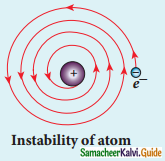
Samacheer Kalvi 12th Physics Guide Chapter 8 Atomic and Nuclear Physics 43
Instability of atom
Spiral in motion of an electron around the nucleus.

Question 2.
Write down the drawbacks of the Rutherford model.
Answer:
Drawbacks of Rutherford model:
1. Rutherford atom model helps in the calculation of the diameter of the nucleus and also the size of the atom but has the following limitations.
2. This model fails to explain the distribution of electrons around the nucleus and also the stability of the atom.
3. According to classical electrodynamics, any accelerated charge emits electromagnetic radiations. Due to emission of radiations, it loses its energy. Hence, it can no longer sustain the circular motion. The radius of the orbit, therefore, becomes smaller and smaller (undergoes spiral motion) and finally the electron should fall into the nucleus and the atoms should disintegrate. But this does not happen.
4. Hence, Rutherford model could not account for the stability of atoms.
5. According to this model, emission of radiation must be continuous and must give a continuous emission spectrum but experimentally we observe only line (discrete) emission spectrum for atoms.

Question 3.
Obtain the expression for the distance of closest approach based on Rutherford atom model.
Answer:
Distance of closest approach :
1. When an alpha particle moves straight towards the nucleus, it reaches a point where it comes to rest momentarily and returns back.
2. The minimum distance between the centre of the nucleus and the alpha particle just before it gets reflected back through 180° is defined as the distance of closest approach rQ (also known as contact distance).
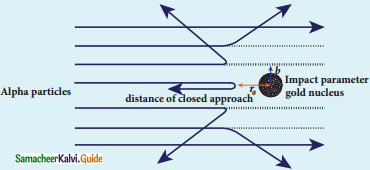
Samacheer Kalvi 12th Physics Guide Chapter 8 Atomic and Nuclear Physics 44
Distance of closest approach and impact parameter

3. At this distance, all the kinetic energy of the alpha particle will be converted into electrostatic potential energy
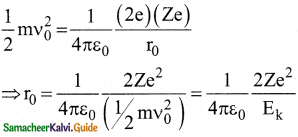
Samacheer Kalvi 12th Physics Guide Chapter 8 Atomic and Nuclear Physics 45
where Ek is the kinetic energy of the alpha particle.
4. This is used to estimate the size of the nucleus but the size of the nucleus is always lesser than the distance of the closest approach.
5. Further, Rutherford calculated the radius of the nucleus for different nuclei and found that it ranges from 10-14 m to 10-15 m.

Samacheer Kalvi 12th Physics Guide Chapter 8 Atomic and Nuclear Physics

Question 4.
Obtain the expression for the impact parameter based on Rutherford atom model.
Answer:
Impact parameter:
1. The impact parameter is defined as the perpendicular distance between the centre of the gold nucleus and the direction of velocity vector of alpha particle when it is at a large distance.
2. The relation between impact parameter and scattering angle can be shown as
b ∝ cot(\(\frac{\theta}{2}\)) ⇒ b = K cot(\(\frac{\theta}{2}\)) …………(1)
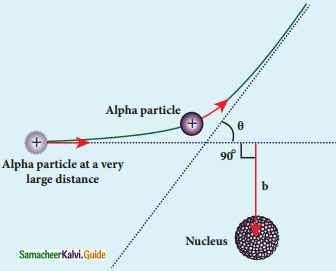
Samacheer Kalvi 12th Physics Guide Chapter 8 Atomic and Nuclear Physics 46
Impact parameter

where K = \(\frac{1}{4 \pi \varepsilon_{0}} \frac{2 \mathrm{Ze}^{2}}{\mathrm{mv}_{0}^{2}}\) and θ is called scattering angle.
3. Equation (1) implies that when impact parameter increases, the scattering angle decreases. Smaller the impact parameter, larger will be the deflection of alpha particles.

Question 5.
Obtain the expression for the velocity of electron in nth orbit.
Answer:
1. Bohr’s angular momentum quantization condition leads to
nrn = nh/2π

Samacheer Kalvi 12th Physics Guide Chapter 8 Atomic and Nuclear Physics 47
Variation of velocity of the electron in the orbit with principal quantum number.

For hydrogen atom ( z = 1), the radius of nth orbit is
rn = a0 n2
na0n2 = nh/2π
υn = (\(\frac{\mathrm{hz}}{2 \pi \mathrm{ma}_{\mathrm{o}}}\)) \(\frac{1}{n}\)

υn ∝ \(\frac{1}{n}\)
2. The velocity of electron decreases as the principal quantum number increases.
3. This curve is the rectangular hyperbola.
4. This implies that the velocity of electron in ground state is maximum when compared to excited states.
5. Variation of velocity of the electron in the orbit with principal quantum number.

Question 6.
Sketch the energy levels for the hydrogen atoms.
Answer:
1. Horizontal linear are drawn which represent the energy levels of the hydrogen atom.
2. The energy of the electron in the nth orbit of the hydrogen atom is given by, En = –\(\frac{13.6}{\mathrm{n}^{2}}\) eV
3. For the first orbit (ground state), the total energy of electron is E1 = -13.6 eV
4. For the second orbit (first excited state), the total energy of electron is E2 = -3.4 eV
5. For the third orbit (second excited state), the total energy of electron is E3 = -1.51 eV
6. For the fourth orbit (third excited state), the total energy of electron is E4 = -0.85 eV
7. For the fifth orbit (fourth excited state), the total energy of electron is E5 = -0.54 eV and so on.
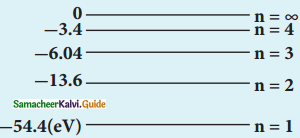
Samacheer Kalvi 12th Physics Guide Chapter 8 Atomic and Nuclear Physics 48

Samacheer Kalvi 12th Physics Guide Chapter 8 Atomic and Nuclear Physics

Question 7.
What is the significance of the negative energy of electron in the orbit?
Answer:
1. This signifies that the electron is bound to the nucleus.
2. Due to electrostatic attraction between electron and nucleus, the potential energy (PE) is negative and is greater than kinetic energy (KE) of electron.
3.Total energy (TE) of electron is negative. It cannot escape from the atom.
4. Potential energy
Un = –\(\frac{1}{4 \varepsilon_{0}^{2}} \frac{Z^{2} m e^{4}}{h^{2} n^{2}}\) ………….(1)

5. Kinetic energy
KEn = –\(\frac{1}{8 \varepsilon_{\mathrm{o}}^{2}} \frac{\mathrm{Z}^{2} \mathrm{me}^{4}}{\mathrm{~h}^{2} \mathrm{n}^{2}}\) ………..(2)

6. Total energy
En = \(\frac{1}{8 \varepsilon_{0}^{2}} \frac{Z^{2} e^{4} m}{h^{2} n^{2}}\) …………(3)
The negative sign in equation (3) indicates that the electron is bound to the nucleus.

Question 8.
Obtain Bohr’s quantisation condition on the basis of the wave picture of an electron.
Answer:
1. The circumference of an electron’s orbit of radius r must be an integral multiple of de Broglie wavelength – that is,
2πr = n(\(\frac{\mathrm{h}}{\mathrm{mv}}\)) …………(1)
But the de Broglie wavelength (λ) for an electron of mass m moving with velocity ν is
λ = \(\frac{\mathrm{h}}{\mathrm{mv}}\) where h is called Planck’s constant.
Thus from equation (1)
2πr = n(\(\frac{\mathrm{h}}{\mathrm{mv}}\))

mvr = \(\frac{\mathrm{nh}}{27}\)
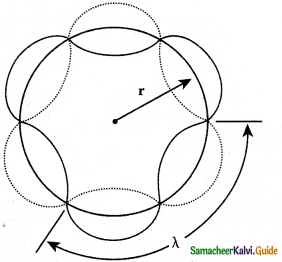
Samacheer Kalvi 12th Physics Guide Chapter 8 Atomic and Nuclear Physics 49

2. For any particle of mass m undergoing circular motion with radius r and velocity v, the magnitude of angular momentum / is given by l = r (mv)
mvr = l = nh
This is the famous Bohr’s quantisation condition for angular momentum.

Question 9.
What is the value of charge of a neutrino? Although trillions of neutrinos coining from the sun pass throught our body every second, it is very difficult to detect them. Why?
Answer:
1. The neutrino has zero charge.
2. Neutrino interacts very weakly with the matter. In every second, trillions of neutrinos coming from the sun are passing through our body without any interaction.

Question 10.
Is the nuclear density same for all elements?
Answer:
Yes.
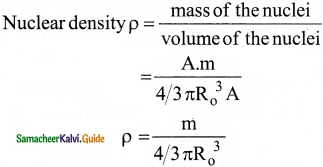
Samacheer Kalvi 12th Physics Guide Chapter 8 Atomic and Nuclear Physics 50
1. The above expression shows that the nuclear density is independent of the mass number A.
2. In other words, all the nuclei (Z > 10) have the same density and it is an important characteristic of the nuclei.

Samacheer Kalvi 12th Physics Guide Chapter 8 Atomic and Nuclear Physics

Question 11.
Why is the mass of a nucleus always less than the sum of the masses of its constituents, neutrons, and protons?
Answer:

  1. When nucleons approach each other to form a nucleus, they strongly attract each other. Their potential energy decreases and becomes negative.
  2. It is this potential energy which holds the nucleons together in the nucleus.
  3. The decrease in potential energy results in a decrease in the mass of the nucleons inside the nucleus.

Question 12.
What do you mean by the charge independent character of nuclear forces?
Answer:

  1. The strong nuclear force is attractive and acts with an equal strength between proton-proton, proton – neutron, and neutron – neutron
  2. This shows that nuclear force is not electrostatic in nature. So nuclear force is charge independent.

Question 13.
How are β – rays emitted from a nucleus, when it does not contain electrons?
Answer:

  1. A neutron of a nucleus decays into a proton, an electron and an antineutrino.
  2. It is this electron which is emitted as β – particle.
    \({ }_{0} \mathrm{n}^{1} \rightarrow{ }_{1} \mathrm{p}^{1}+{ }_{-1} \mathrm{e}^{0}+\overline{\mathrm{v}}\)

Question 14.
Which is more dangerous: radioactive material with a short half-life, or a long half-life?
Answer:
One should not think that shorter half-life material is safer than longer half-life material because it will not last long. The shorter half-life sample will have higher activity and it is more radioactive which is more harmful.

Question 15.
What is radiocarbon dating?
Answer:

  1. Radiocarbon dating is a method of estimating the age of a dead specimen by calculation the amount C present in the specimen having the half-life of C as 5730 years.
  2. Since our human body, tree or any living organism continuously absorb CO2 from the atmosphere, the ratio of \({ }_{6}^{14} \mathrm{C}\) to \({ }_{6}^{12} \mathrm{C}\) in the living organism is also nearly constant. But when the organism dies, it stops absorbing CO2.
  3. Since \({ }_{6}^{14} \mathrm{C}\) starts to decay, the ratio of \({ }_{6}^{14} \mathrm{C}\) to \({ }_{6}^{12} \mathrm{C}\) in a dead specimen decreases over the years.
  4. Suppose the ratio of \({ }_{6}^{14} \mathrm{C}\) to \({ }_{6}^{12} \mathrm{C}\) in the ancient tree pieces excavated is known, then the age of the tree pieces can be calculated.

Samacheer Kalvi 12th Physics Guide Chapter 8 Atomic and Nuclear Physics

Question 16.
How do you classify the neutrons in terms of their kinetic energy?
Answer:

  1. Neutrons are classified according to their kinetic energy as
    • Slow neutrons – 0 to 1000 eV
    • Fast neutrons – 0.5 MeV to 10 MeV
  2. The neutrons with an average energy of about 0.025 eV in thermal equilibrium are called thermal neutrons because at 298K, the thermal energy KT ~ 0.025 eV. slow and fast neutrons play a vital role in nuclear reactors.
  3. In nuclear reactors, fast neutrons are converted into slow neutrons using moderators.

Question 17.
What is a chain reaction?
Answer:
Chain reaction:

  1. When one \({ }_{92}^{235} \mathrm{U}\) nucleus undergoes fission, the energy released might be small.
  2. But from each fission reaction, three neutrons are released.
  3.  These three neutrons cause further fission in another three \({ }_{92}^{235} \mathrm{U}\) nuclei which in turn produce nine neutrons.
  4.  These nine neutrons initiate fission in another 27 \({ }_{92}^{235} \mathrm{U}\) nuclei and so on.
  5.  This is called a chain reaction and the number of neutrons goes on increasing almost in geometric progression.

Question 18.
What is a controlled and uncontrolled chain reaction?
Answer:

  1. There are two kinds of chain reactions:
    • Uncontrolled chain reaction.
    • Controlled chain reaction.
  2. In an uncontrolled chain reaction, the number of neutrons multiplies indefinitely, and the entire amount of energy released in a fraction of a second.
  3. The atom bomb is an example of nuclear fission in which an uncontrolled chain reaction occurs.
  4. In nuclear reactors, the controlled chain reaction is achieved.

Question 19.
What is a nuclear reactor? Mention the uses of nuclear reactors.
Answer:
Nuclear reactor: Nuclear reactor is a system in which nuclear fission takes place in a self-sustained controlled manner.
Uses of nuclear reactors:

  • A nuclear reactor is used for power generation.
  • A nuclear reactor is used for research purposes.
  • A nuclear reactor is useful to produce radioisotopes.

Question 20.
How many nuclear reactors are there in India?
Answer:
India has 22 nuclear reactors in operation. Nuclear reactors are constructed in two places in Tamilnadu, Kalpakkam and Kudankulam. Even though nuclear reactors are aimed to cater to our energy need, in practice nuclear reactors now are able to provide only 2% of energy requirement of India.

Samacheer Kalvi 12th Physics Guide Chapter 8 Atomic and Nuclear Physics

Question 21.
What is the difference between critical and super-critical state?
Answer:

  1. If the average number of neutrons produced per fission is equal to one, then the reactor is said to be in a critical state.
  2. In fact, all the nuclear reactors are maintained in a critical state by suitable adjustment of control rods.
  3. If it is greater than one, then the reactor is said to be supercritical and it may explode sooner or may cause massive destruction to cause another fission and the remaining neutrons are absorbed by the control rods.
  4. Usually, cadmium or boron acts as control rod material and these rods are inserted into the uranium blocks.

Question 22.
What is the role of control rods in a nuclear reactor?
Answer:

  1. The control rods are used to adjust the reaction rate.
  2. During each fission, on average 2.5 neutrons are emitted and in order to have the controlled chain reactions, only one neutron is allowed to cause another fission and the remaining neutrons are absorbed by the control rods.
  3. Usually cadmium or boron are used as control rod material and these rods are inserted into the uranium blocks.

XI. Five Marks Questions:

Question 1.
How are cathode rays produced in a discharge tube?
Answer:
1. It consists of a long-closed glass tube (of length nearly 50 cm and diameter of 4 cm) inside of which the gas in pure form is filled usually.
2. The small opening in the tube is connected to a high vacuum pump and a low-pressure gauge.
3. This tube is fitted with two metallic plates known as electrodes which are connected to a secondary of an induction coil.
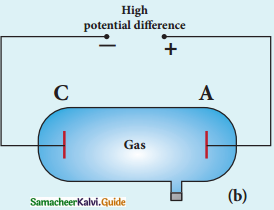
Samacheer Kalvi 12th Physics Guide Chapter 8 Atomic and Nuclear Physics 51

4. The electrode connected to positive of secondary is known as anode and the electrode to the negative of the secondary is cathode.
5. The potential of secondary is maintained at about 50 kV.
6. Suppose the pressure of the gas in discharge tube is reduced to around 110mm of Hg using vaccum pump, it is observed that no discharge takes place.
7. When the pressure is kept near 100 mm of Hg, the discharge of electricity through the tube takes place. Consequently, irregular streaks of light appear and also crackling sound is produced.
8. When the pressure is reduced to the order of 10mm of Hg, a luminous column known as positive column is formed from anode to cathode.
9. When the pressure reaches to around 0.01 mm of Hg, positive column disappears. At this time, a dark space is formed between anode and cathode which is often called Crooke’s dark space and the walls of the tube appear with green colour.
10. At this stage, some invisible rays emanate from cathode called cathode rays, which are later found be a beam of electrons.

Question 2.
Determination of the specific charge of the electron (e/m) from the path of an electron beam. When the magnetic field is switched off.
Answer:
When the magnetic field is turned off, the deflection is only due to the electric field.
The deflection in the vertical direction is due to the electric force.
Fe = eE …………….(1)
m – mass of the electron
According to Newton’s second law of motion,
Fe = mae ……………(2)
from eqn (1) and (2)
eE = mae
ae = (\(\frac{\mathrm{e}}{\mathrm{m}}\) E)
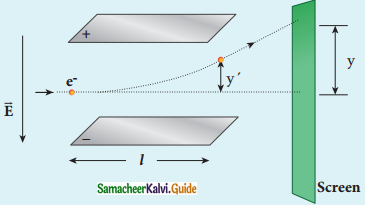
Samacheer Kalvi 12th Physics Guide Chapter 8 Atomic and Nuclear Physics 52
Deviation of path by applying uniform electric field

Let
y – deflection on the screen
u – initial upward velocity
l – length of one of the plates
t – time
The time taken by the cathode rays to travel in electric field t = (l/v)
Note:
u = 0, ae = e/m
S = ut + 1/2 at2
y’ = ut + 1/2 aet2
y’ = 1/2 \(\left(\frac{e}{m} E\right)\left(\frac{l}{V}\right)^{2}\)
V = E/B
y’ = \(1 / 2(\mathrm{e} / \mathrm{m}) \frac{l^{2} \mathrm{~B}^{2}}{\mathrm{E}}\)
y ∝ y’
y’ = cy’
C – proportionality constant which depends on the geometry of the discharge tube
y = c \(\left(\frac{1}{2}(\mathrm{e} / \mathrm{m}) \frac{l^{2} \mathrm{~B}^{2}}{\mathrm{E}}\right)\)

e/m = \(\frac{2 \mathrm{yE}}{\mathrm{c} l^{2} \mathrm{~B}^{2}}\)

Substituting the values on RHS, e/m = 1.7 × 10¹¹ Ckg-1

Samacheer Kalvi 12th Physics Guide Chapter 8 Atomic and Nuclear Physics

Question 3.
Determination of the specific charge of the electron (e/m) from the path of an electron beam when the electric field is switched off.
Answer:
1. Suppose that the electric field is switched off and only the magnetic field is switched on. Now the deflection occurs only due to the magnetic field.
2. The force experienced by the electron in a uniform magnetic field applied perpendicular to its path is
Fm = BeV …………..(1)
3. Since this force provides the centripetal force, the electron beam undergoes a semi-circular path.
F = \(\frac{m v^{2}}{R}\) ………….(2)
from eqn (1) and (2)
Bev = \(\frac{m v^{2}}{R}\)
e/m = V/BR ……………(3)
V = E/B
e/m = E/B2R ………………(4)
Substituting the values on RHS,
e/m = 1.7 × 10¹¹ Ckg-1

Question 4.
Explain the results of Rutherford a particle scattering experiment.
Answer:
1. A source of alpha particles (radioactive material, for example, polonium) is kept inside a thick lead box with a fine hole.
2. The explain particles coming through the fine hole of the lead box pass through another fine hole made on the lead screen.
3. These particles are now allowed to fall on the thin gold foil and it is observed that the alpha particles passing through gold foil are scattered through different angles.
4. A movable screen (from 0° to 180°) which is made up of zinc sulphide (ZnS) is kept on the other side of the gold foil to collect the alpha particles.
5. Whenever alpha particles strike the screen, a flash of light is observed which can be seen through a microscope.
6. Rutherford proposed an atom model based on the results of the alpha scattering experiment.
7. In this experiment, alpha particles (positively charged particles) are allowed to fall on the atoms of a metallic gold foil.
8. The results of this experiment are given below but the experiment showed the model.

  • Most of the alpha particles are undeflected through the gold foil and went straight.
  • Some of the alpha particles are deflected through a small angle.
  • A few alpha particles (one in a thousand) are deflected through an angle more than 90°
  • Very few alpha particles returned back (backscattered) that is, deflected back by 180°
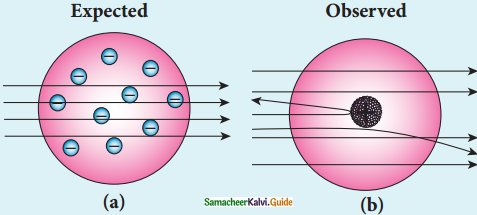
Samacheer Kalvi 12th Physics Guide Chapter 8 Atomic and Nuclear Physics 53

Samacheer Kalvi 12th Physics Guide Chapter 8 Atomic and Nuclear Physics 54
Schematic diagram for scattering of alpha particles experiments by Rutherford.

Question 5.
Explain the spectrum of Hydrogen.
Answer:
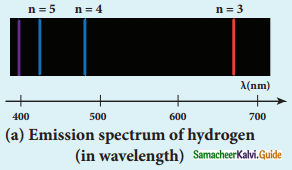
Samacheer Kalvi 12th Physics Guide Chapter 8 Atomic and Nuclear Physics 55

Samacheer Kalvi 12th Physics Guide Chapter 8 Atomic and Nuclear Physics 56

Emission spectrum of hydrogen:
When the hydrogen gas enclosed in a tube is heated up, it emits electromagnetic radiations of a certain sharply defined characteristic wavelength (line spectrum), called hydrogen emission spectrum.

The absorption spectrum of hydrogen:
1. When any gas is heated up, the thermal energy is supplied to excite the electrons. Similarly, by passing light on the atoms, electrons can be excited by absorbing photons.
2. Once the electrons get sufficient energy as given by Bohr’s postulate (c), it absorbs energy with particular wavelength (or frequency) and jumps from its stationary state (original state) to higher energy state. Those wavelengths (or frequencies) for which the colours are not observed are seen as dark lines in the absorption spectrum.
3. Since electrons in excited states have a very small lifetime, those electrons jump back to the ground state through spontaneous emission in a short duration (≈10-8 s) by emitting the radiation with the same wavelength (or) frequency corresponding to the colours it absorbed. This is called emission spectroscopy.
4. The following are the spectral series in hydrogen atom:

  • Lyman series
  • Balmer series
  • Paschen series
  • Brockett series
  • Pfund series.

Samacheer Kalvi 12th Physics Guide Chapter 8 Atomic and Nuclear Physics

Question 6.
How does a smoke detector work?
Answer:
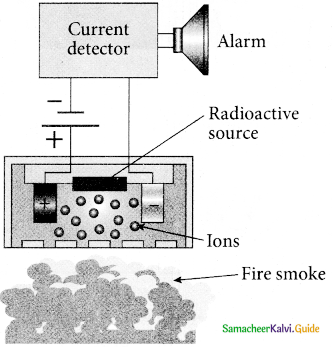
Samacheer Kalvi 12th Physics Guide Chapter 8 Atomic and Nuclear Physics 57
1. A very interesting application of alpha decay is in smoke detectors which prevent us from any hazardous fire.
2. The smoke detector uses around 0.2 mg of man made weak radioactive isotope called americium \({ }_{95}^{241} \mathrm{Am}\).
3. This radioactive source is placed between two oppositely charged metal plates and radiations from \({ }_{95}^{241} \mathrm{Am}\) continuously ionize the nitrogen, oxygen molecules in the air space between the plates.
4. As a result, there will be a continuous flow of small steady current in the circuit. If smoke enters, the radiation is being absorbed by the smoke particles rather than air molecules. As a result, the ionization and along with it the current is reduced.
5. This drop-in current is detected by the circuit and the alarm starts
6. The radiation dosage emitted by americium is very much less than the safe level, so it can be considered harmless.

Question 7.
Obtain an expression for half-life.
Answer:
1. We can define the half-life T1/2 as the time required for the number of atoms initially present to reduce to one-half of the initial amount.
2. The half-life is the important characteristic of every radioactive sample. Some radioactive nuclei are known to have half-life as long as 1014 years and some nucleus have a very shorter lifetime (10-14 S).
3. We can express half-life in terms of the decay constant. At t = T1/2, the number of undecayed
nuclei N = \(\frac{\mathrm{N}_{0}}{2}\)
4. By substituting this value into the equation, we get
\(\frac{\mathrm{N}_{0}}{2}\) = N0 e-λT1/2
1/2 = e-λT1/2 (or) e+λT1/2 = 2
Taking logarithm on both sides and rearranging the terms.
T1/2 = \(\frac{\ln 2}{\lambda}\) = \(\frac{0.6931}{\lambda}\) ……………(1)

5. If the number of atoms present at t = 0 is N0, then \(\frac{N_{0}}{2}\) atoms remain undecayed in first half life and \(\frac{N_{0}}{4}\) atoms remain undecayed after second half life and so on.
6. In general, after n half – lives, the number of nuclei remaining undecayed is given by
N = \(\left(\frac{1}{2}\right)^{\mathrm{n}}\) N0 …………..(2)
where n can be integer or non integer. Since the activity of radioactive sample also obeys the exponential decay law, we can also write an equation for an acitivity similar to equation,
[R = λN0 e-λt]
After n half lives, the activity or decay rate of any radiosample is
R = \(\left(\frac{1}{2}\right)^{\mathrm{n}}\) R0

Question 8.
Obtain an expression for mean life.
Answer:
1. The mean life time of the nucleus is the ratio of sum or integration of life times of all nuclei to the total number nuclei present initially.
2. The total number of nuclei decaying in the time interval for t to t + ∆t is equal to
R ∆t = λNe-λt ∆t.
3. It implies that until the time t, this R ∆t number of nuclei lived. So the life time of these R ∆t nuclei is equal to be tR∆t. In the limit ∆t = 0 the total life time of all the nuclei would be the integration of tRdt from the limit t = 0 to t = ∞
Mean life
τ = \(\frac{\int_{0}^{\infty} t[\mathrm{Rdt}]}{\mathrm{N}_{0}}\)
= \(\frac{\int_{0}^{\infty} t\left[\lambda N_{0} e^{-\lambda t} d t\right]}{N_{0}}\) ……………………(1)
After a few integration (refer box item), the expression for mean life time,
τ = 1/λ ………….(2)
mean life and decay constant is inversely proportional to each other. Using mean life, the half life can be rewritten as
T1/2 = τln2 = 0.6391 τ ………….(3)

Question 9.
Describe the discovery of neutrons. Discovery of Neutrons.
Answer:

  1. In 1930, two German physicists Both and Becker found that when beryllium was bombarded with a particles, highly penetrating radiation was emitted. This radiation was capable of penetrating the thick layer of lead and was unaffected by the electric and magnetic fields. Initially, It was thought aY radiation.
  2. But in the year 1932, James Chadwick discovered that those radiations are not EM waves but they are particles of mass little greater than the mass of the proton and had no charge. He called them as neutrons.
  3. The above reaction can be written as
    \({ }_{4}^{9} \mathrm{Be}+{ }_{2}^{4} \mathrm{He} \rightarrow{ }_{6}^{12} \mathrm{C}+{ }_{0}^{1} \mathrm{n}\)
    where \({ }_{0}^{1} \mathrm{n}\) denotes neutron

Samacheer Kalvi 12th Physics Guide Chapter 8 Atomic and Nuclear Physics

Question 10.
List the properties of neutrons.
Answer:

  1. Neutrons are the constituent particles of all nuclei, except hydrogen.
  2. Neutrons are neutral particles with no charge and mass slightly greater than protons.
  3. Neutrons are not deflected by electric and magnetic fields.
  4. Neutrons are stable inside the nucleus. But outside the nucleus they are unstable. If the neutron comes out of the nucleus (free neutron), it decays with the emission of proton, electron, and antineutrino with a half-life of 13 minutes.
  5. Neutrons are classified according to their kinetic as
    • slow neutrons (0 to 1000 eV)
    • fast neutrons (0.5 MeV to 10 MeV)
  6. The neutrons with an average energy of about 0.025 eV in thermal equilibrium are called a thermal neutron because at 298K, the thermal energy KT – 0.025eV. Slow and fast neutrons play a vital role in nuclear reactors.
  7. As neutrons are neutral, they can easily penetrate any nucleus.

Question 11.
What are the applications of radioisotopes?
Answer:
I) Medical applications:

  1. In the Medical applications field, radioisotopes are used both in diagnosis and therapy.
  2. Radio Cobalt [60C] – Treatment of cancer
  3. Radio – Sodium [24Na] – detect the presence of blocks in blood vessels.
  4. Radioiodine [131I] – detection of the nature of thyroid gland and also for the treatment.
  5. Radio [56Fe] – diagnose anaemia
  6. Radio [32P] – treatment of skin diseases.

II) Agriculture:
Radio – phosphorous [32P] – Increase the crop yields.

III) Industry:
In Industry, the lubricating oil containing radioisotopes is used to study the wear and tear of the machinery.

IV) Molecular biology:
In molecular biology, radioisotopes are used in sterilising pharmaceutical, and surgical instruments.

V) Radiocarbon dating:
Radio-carbon dating is a method of estimating the age of a dead specimen by calculating the amount of 14C present in the specimen having the half-life of 14C as 5730 years.

Question 12.
Explain chain reaction in nuclear fission.
Answer:
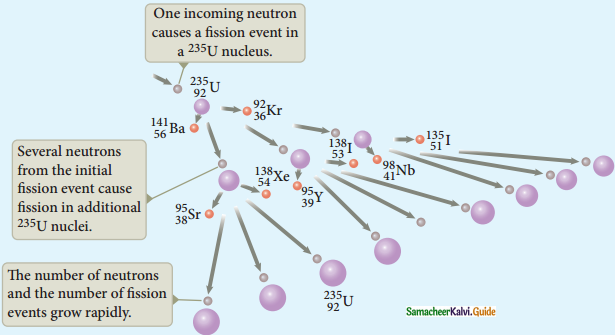
Samacheer Kalvi 12th Physics Guide Chapter 8 Atomic and Nuclear Physics 58
Nuclear chain reaction

1. When one \({ }_{92}^{235} \mathrm{U}\) nucleus undergoes fission, the energy released might be small. But from each fission reaction, three neutrons are released.
2. These three neutrons cause further fission in another three nuclei \({ }_{92}^{235} \mathrm{U}\) which in turn produce nine neutrons.
3. These nine neutrons initiate fission in another 27 \({ }_{92}^{235} \mathrm{U}\) nuclei and so on. This is called a chain reaction and the number of neutrons goes on increasing almost in a geometric progress
4. There are two kinds of chain reactions:
(i) uncontrolled chain reaction
(ii) controlled chain reaction.
5. In an uncontrolled chain reaction, the number of neutrons multiply indefinitely and the entire amount of energy released in a fraction of second.
6. The atom bomb is an example of nuclear fission in which an uncontrolled chain reaction occurs. Atom bombs produce massive destruction for mankind.
7. It is possible to calculate the typical energy released in a chain reaction.
8. In the 100th step, the number of nuclei that undergoes fission is around 2.5 x 1040
9. The total energy released after 100th step is 2.5 × 1040 × 200 MeV = 8 × 1029 J.
10. If the chain reaction is controllable, then we can harvest an enormous amount of energy for our needs.
11. It is achieved in a controlled chain reaction.
12. In the controlled chain reaction, the average number of neutron released in each stage is kept as one such that it is possible to store the released energy.
13. In nuclear reactors, the controlled chain reaction is achieved and the produced energy is used for power generation or for research purpose.

Question 13.
Calculate the average energy released per fission.
Answer:
Energy released in fission :
We can calculate the energy (Q) released in each uranium fission reaction. We choose the most
favorable fission which is given in the equation
\({ }_{92}^{235} \mathrm{U}+{ }_{0}^{1} \mathrm{n} \rightarrow{ }_{92}^{236} \mathrm{U}^{*} \rightarrow{ }_{56}^{141} \mathrm{Ba}+{ }_{36}^{92} \mathrm{Kr}+3{ }_{0}^{1} \mathrm{n}+\mathrm{Q}\)

Mass of \({ }_{92}^{235} \mathrm{U}\) = 235.045733 u
Mass of \({ }_{0}^{1} \mathrm{n}\) = 1.008665 u
Total mass of reactant = 236.054938 u
Mass of \({ }_{56}^{141} \mathrm{Ba}\) = 140.9177 u
Mass of \({ }_{36}^{92} \mathrm{Kr}\)= 91.8854 u
Mass of 3 neutrons = 3.025995 u
The total mass of products = 235.829095 u
Mass defect ∆m = 236.054398 u – 235.829095 u = 0.225303 u
So the energy released in each fission = 0.225303 × 931 MeV ≈ 200 MeV
This energy first appears as kinetic energy of daughter nuclei and neutrons. But later, this kinetic energy is transferred to the surrounding matter as heat.

Samacheer Kalvi 12th Physics Guide Chapter 8 Atomic and Nuclear Physics

XII. Additional Problems – (2 Marks):

Question 1.
The radius of the 5th orbit of hydrogen atom is 13.25 Å. Calculate the wavelength of the electron in the 5th orbit.
Solution:
2πr = nλ
2 × 3.14 × 13.25 Å = 5 × λ
λ = 16.64 Å

Question 2.
Calculate the radius of \({ }_{79}^{197} \mathrm{Au}\) nucleus.
Solution:
According to the equation
R = R0 A1/3,
R = 12 × 10-15 × (197)1/3
= 697 × 10-15 m
Or R = 6.97 F

Question 3.
Compute the binding energy per nucleon of \({ }_{2}^{4} \mathrm{He}\) nucleus.
Solution:
We found that the BE of \({ }_{2}^{4} \mathrm{He}\) = 28 Mev
Binding energy per nucleon = \(\overline{\mathrm{BE}}\) =28 MeV/4 = 7 MeV.

Question 4.
Calculate the mass of an electron from the known values of specific charge and charge of electron.
Solution:
Data:
e = 1.602 × 10⁻¹⁹ C
e/m = 1.759 × 10¹¹ C Kg-1
m = e/m = \(\frac{1.602 \times 10^{-19}}{1.759 \times 10^{11}}\)
m = 9.1 × 10⁻³¹ kg

Question 5.
The radius of the 4th orbit of hydrogen atom is 2.12 A°. Calculate the wavelength of the electron in the 4th orbit.
Solution:
Data: r4 = 2.12 A°
2πr = nλ
λ4 = \(\frac{2 \pi r_{4}}{4}\)
= \(\frac{2 \times 3.14 \times 2.12 \mathrm{~A}^{0}}{4}\)
λ4 = 13.313 Å

Samacheer Kalvi 12th Physics Guide Chapter 8 Atomic and Nuclear Physics

Question 6.
The ground state energy of hydrogen atom is -13.6 eV. If an electron makes a transition from an energy level -0.85 eV to -1.51 eV, Calculate the wavelenth of the spectral line emitted. To which series of hydrogen spectrum does this wavelenth belong?
Solution:
Here ∆E = E2 – E1 = -0.85-(-1.51).
= 0.66 eV
∆E = 0.66 x 1.6 x 10-19 J
λ = \(\frac { hc }{ ∆E }\) = \(\frac{6.63 \times 10^{-34} \times 3 \times 10^{8}}{0.66 \times 1.6 \times 10^{-19}}\)
= 18.84 x 10⁻⁷
λ = 18840 Å
This wavelength belongs to the Pachen series of the hydrogen spectrum.

Question 7.
The half-life of radon is 3.8 days. Calculate its mean life.
Solution:
Data:
T1/2 = 3.8 days
τ = \(\frac{\mathrm{T}_{1 / 2}}{0.6931}\)
τ = T1/2 × 1.44
τ = 3.8 × 1.44
τ = 5.472 days

Question 8.
The isotope \({ }_{92}^{238} \mathrm{U}\) successively under goes three α- decays and two β – decays what is the resulting isotope?
Solution:
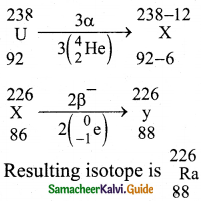
Samacheer Kalvi 12th Physics Guide Chapter 8 Atomic and Nuclear Physics 59

Question 9.
A radioactive isotope of silver has half life of 20 minutues. What fraction of the original mass would remain after one hour?
Solution:
Data:
T1/2 = 20 minutes
t = 1 hour = 60 minutes
n = \(\frac{t}{T_{1 / 2}}=\frac{60}{20}\) =3
\(\frac{\mathrm{N}}{\mathrm{N}_{\mathrm{o}}}\) = (1/2)n
= (1/2)3 = 1/8

Question 10.
How long will a radioactive isotope, whose half life is T years, take for its activity to reduce to 1/8 th of its initial value?
Solution:
Data:
R/R0 = 1/8
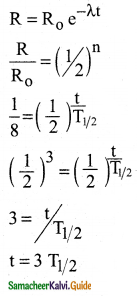
Samacheer Kalvi 12th Physics Guide Chapter 8 Atomic and Nuclear Physics 60

Samacheer Kalvi 12th Physics Guide Chapter 8 Atomic and Nuclear Physics

XIII. Additional Problems (3 Marks):

Question 1.
Express one atomic mass unit in energy units, first in Joules and then in MeV. Using this, express the mass defect of \(_{ 8 }^{ 16 }{ O }\) in MeV.
Solution:
We have, m = 1 amu = 1.66 x 10⁻²⁷ kg, c = 3 x 10⁸ ms-1
E = mc2 = 1.66 x 10-27 x (3 x 108)2
= 14.94 x10⁻¹¹ J
= \(\frac{1.494 \times 10^{-10}}{1.6 \times 10^{-13}} \mathrm{MeV}\) [ 1 MeV = 1.6 x 10⁻¹³]
= 931.5 MeV
The \(_{ 8 }^{ 16 }{ O }\) nucleus contains 8 protons and 8 neutrons
Mass of 8 protons = 8 x 1.00727 = 8. 05816 amu
Mass of 8 neutrons = 8 x 1.00866 = 8. 06928 amu
Total Mass = 16.12744 amu
Mass of \(_{ 8 }^{ 16 }{ O }\) nucleus = 15.99053 amu
Mass defect = 0.13691 amu
∆Eb = 0.13691 x 931.5 Mev
∆Eb = 127.5 Mev

Question 2.
Forthe p fund series, calculatethe wavelength of the first member. Given Rydberg constant R = 1.09737 × 10⁷ m-1
Solution:
Data:
R = 1.09737 × 10⁷ m-1
For longest wavelength of paschen
n1 = 5, n2 = 6
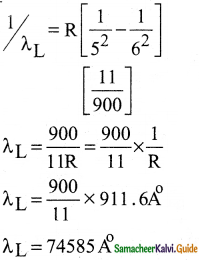
Samacheer Kalvi 12th Physics Guide Chapter 8 Atomic and Nuclear Physics 61

Question 3.
The wavelength of the second line of the Balmer series in the hydrogen spectrum is 4861 A° calculate the wavelength of the first line.
Solution:
Data:
λ2 = 4861 A°
n1 = 2, n2 = 3
1/λ1 = R[latex]\frac{1}{2^{2}}-\frac{1}{3^{2}}[/latex] = \(\frac{5 \mathrm{R}}{36}\)
n1 = 2, n2 = 4
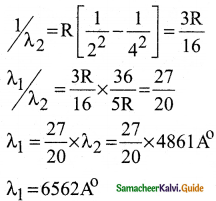
Samacheer Kalvi 12th Physics Guide Chapter 8 Atomic and Nuclear Physics 62

Question 4.
Calculate the value of fine structure constant.
Solution:
Data:
e = 1.6 × 10⁻¹⁹ C
ε0 = 8.854 × 10⁻¹² C2 N-1 m2
h = 6.6 × 10⁻³⁴ Nms
c = 3 × 10⁸ m/s
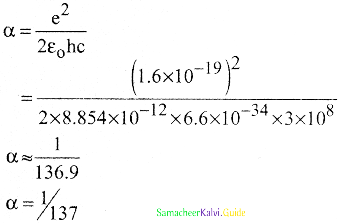
Samacheer Kalvi 12th Physics Guide Chapter 8 Atomic and Nuclear Physics 63

Question 5.
Determine the speed of electron in n = 3 orbit of He+ ion.
Solution:
Data:
n =3, z =2
νn = \(\frac{\alpha c Z}{n}\)

νn = \(\frac{C}{137} \frac{Z}{n}\) [∴ α = 1/137]

ν = \(\frac{3 \times 10^{8} \times 2}{137 \times 3}\)

ν = \(\frac{6}{411}\) × 108
= 0.0146 × 10⁸
ν = 1.46 × 10⁶ m/s

Samacheer Kalvi 12th Physics Guide Chapter 8 Atomic and Nuclear Physics

Question 6.
Calculate the distance of closest appraoch of a particles to the copper nucleus when a particles of 5 MeV are scattered back by a thin sheet of copper [Z for copper = 29]
Solution:
Data:
KE =1/2 mv2 = 5MeV
= 5 × 106 × 1.6 × 10-19 J
= 8 × 10⁻³ J[ 1 eV = 1.6 × 10⁻¹⁹ J]
Z = 29 r0 =?
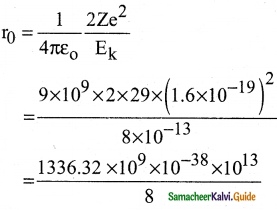
Samacheer Kalvi 12th Physics Guide Chapter 8 Atomic and Nuclear Physics 64
r0 = 167.04 × 10⁻¹⁶ m
r0 = 1.6704 × 10⁻¹⁴ m

Question 7.
If 200 MeV energy is released in the fission of a single nucleus of \(_{ 92 }^{ 235 }{ U }\), how many fissions must occur to produce a power of 1 kW?
Solution:
Let the number of fissions per second be n.
Then, Energy released per second = n x 200 MeV
= n x 200 x 1.6 x 10-13 J
Energy required per second = Power x Time
= 1kW x 1 s = 1000 J
Energy released = Energy required
n x 200 x 1.6 x 10-13 = 1000
n = 3.125 x 10⁻¹³

Question 8.
The half-life period of a radioactive element A is the same as the mean life of another radioactive element B. Initially both of them have the same number of atoms. The radioactive element B decays faster than A.Explain, why?
Solution:
element A decay constant λ
element B decay constant λ
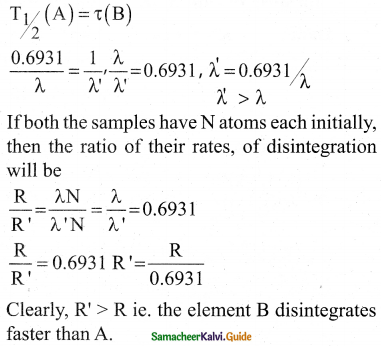
Samacheer Kalvi 12th Physics Guide Chapter 8 Atomic and Nuclear Physics 65

Question 9.
Find the (i) angular momentum (ii) velocity of the electron in the 5th orbit of hydrogen atom.
(h = 6.6 × 10⁻³⁴ Js, m = 9.1 × 10⁻³¹ kg)
Solution:
(i) Angular momentum is given by l = n\(\hbar\)
= \(\frac{\mathrm{nh}}{2 \pi}\)
l = \(\frac{5 \times 6.6 \times 10^{-34}}{2 \times 3.14}\)
= 5.25 × 10⁻³⁴ kgm2s-1

(ii) Velocity is given by
Velocity υ = \(\frac{l}{m r}\)
= Samacheer Kalvi 12th Physics Guide Chapter 8 Atomic and Nuclear Physics 66
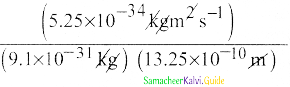
υ = 4.4 × 10⁵ ms-1

Question 10.
Calculate the number of nuclei of carbon 14 undecayed after 22,920 years if the initial number of carbon – 14 atoms is 10,000. The half- life of carbon 14 is 5730 years.
Solution:
To get the time interval in terms of half- life,
n = \(\frac{t}{\mathrm{~T}_{1 / 2}}\)
= \(\frac{22,920 \mathrm{yr}}{5730 \mathrm{yr}}\) = 4
The number of nuclei remaining undecayed after 22,920 years,
N = (\(\frac{1}{2}\))n N0
= (\(\frac{1}{2}\))4 × 10,000
N = 625

Question 11.
An electron in Bohr’s hydrogen atom has an energy of – 3.4ev. what is the angular momentum of the electron?
Solution:
Given:
En = -3.4 eV
We know that, En = -13.6\(\frac{1}{n^{2}}\) eV
i.e. -3.4eV = -13.6\(\frac{e V}{n^{2}}\) (or)
n2 = \(\frac{13.6}{3.4}\) = 4
∴ n = 2

Angular momentum,
L = \(\frac{n h}{2 \pi}\)
L = \(\frac{2 \times\left(6.6 \times 10^{-34}\right)}{2 \times 3.14}\)
= 2.1 × 10⁻³⁴ kgm2 s-1

Samacheer Kalvi 12th Physics Guide Chapter 8 Atomic and Nuclear Physics

XIV. Additional Problems (5 Marks):

Question 1.
A radioactive sample has 2.6 µg of pure which has a half life of 10 minutes. How many nuclei are present initially. Also find its initial activity.
Solution:
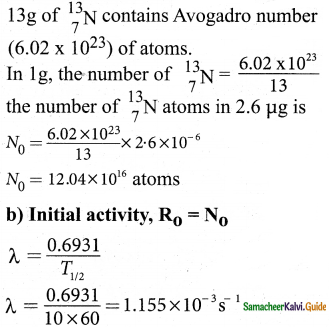
Samacheer Kalvi 12th Physics Guide Chapter 8 Atomic and Nuclear Physics 67
R0 = λN0
= 1.155 × 10-3 × 12.04 × 10-16
= 13.90 × 10¹³ decay/second
R0 = 13.90 × 10¹³ Bq
In terms of curie
R0 = \(\frac{13.90 \times 10^{13}}{3.7 \times 10^{10}}\)
= 3.75 × 10³ [1 Ci = 3.7 × 10¹⁰ Bq]

Question 2.
The Bohr atom model is derived with the assumption that the nucleus of the atom is stationary and only electrons revolve around the nucleus. Suppose the nucleus is also in motion, then calculate the energy of this new system.
Solution:
1. Let the mass of the electron be m and mass of the nucleus be M. Since there is no external force acting on the system, the centre of mass of hydrogen atom remains at rest. Hence, both nucleus and electron move about the centre of mass as shown in figure.
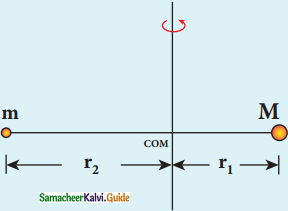
Samacheer Kalvi 12th Physics Guide Chapter 8 Atomic and Nuclear Physics 68

2. Let v be the velocity of the nuclear motion and υ be the velocity of electron motion. Since the total linear momentum of the system is zero,
-mυ + Mυ = 0 or
Mυ = mυ = p
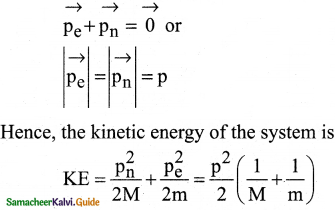
Samacheer Kalvi 12th Physics Guide Chapter 8 Atomic and Nuclear Physics 69
Samacheer Kalvi 12th Physics Guide Chapter 8 Atomic and Nuclear Physics 70
3 .Since the potential energy of the system is same, the total energy of the hydrogen can be expressed by replacing mass by reduced mass, which is
En = \(\frac{\mu_{\mathrm{m}} \mathrm{e}^{4}}{8 \varepsilon_{0}^{2} \mathrm{~h}^{2}} \frac{1}{\mathrm{n}^{2}}\)
4. Since the nucleus is very heavy compared to the electron, the reduced mass is closer to the mass of the electron.

Excition energy and excitation potential:
1. The energy required to excite an electron from lower energy state to any higher energy state is known as excitation energy.
2. The excitation energy for an electron from ground state (n = 1) to first excited state (n = 2) is called first
excitation enegy, which is
EI = E2 – E1 = -3.4 eV – (-13.6eV) = 10.2 eV
3. Similarly, the excitation energy for an electron from ground state (n = 1) to second excited state (n = 3) is
called second exciation energy, which is
EII = E3 – E1 = -1.51 eV – (-13.6eV) = 12.1 eV and so on.

4. Excitation potential is defined as excitation energy per unit charge:
E1 = eV1
⇒ V1 = \(\frac{1}{\mathrm{e}}\) E1 = 10.2 volt
5. Second excitation potential is,
EII = evII
=> VII = \(\frac{1}{\mathrm{e}}\)EII = 12.1 volt and so on.

Ionization energy and ionization potential:
An atom is said to be ionized when an electron is completely removed from the atom that is, it reaches the state with energy The minimum energy required to remove an electron from an atom in the ground state is known as binding energy or ionization energy.
Eionisation = E – E1
= 0 – (-13.6 eV)
= 13.6 eV
When an electron is in nth state of an atom, the energy spent to remove an electron from that state – that is, its ionization energy is
Eionisation = E – En
= 0 – (-\(\frac{13.6}{\mathrm{n}^{2}}\) Z2 eV)
= \(\frac{13.6}{\mathrm{n}^{2}}\) Z2 eV

At normal room temperature, the electron in a hydrogen atom (Z = 1) spends most of its time in the ground state. The amount of energy spent to remove an electron from the ground state of an atom (E = 0 for n—>∞) is known as first ionization energy (13.6 eV). Then, the hydrogen atom is said to be in ionized state or simply called as hydrogen ion, denoted by H+. If we supply more energy than the ionization energy, the excess energy will be the kinetic energy of the free electron.
Ionization potential is defined as ionization energy per unit charge.
Vionisation = \(\frac{1}{\mathrm{e}}\) Eionisation
= \(\frac{13.6}{\mathrm{n}^{2}}\) Z2 eV
Thus, for a hydrogen atom (Z = 1), the ionization potential is
V = \(\frac{13.6}{\mathrm{n}^{2}}\) volt
The radius, velocity and total energy in ground state, first excited state and second excited state is listed.

Samacheer Kalvi 12th Physics Guide Chapter 8 Atomic and Nuclear Physics

Question 3.
Suppose the energy of a hydrogen like atom is given as En = –\(\frac{54.4}{n^{2}}\) eV where n∈N. Calculate the following :
a) Sketch the energy levels for this atom and compute its atomic number.
b) If the atom is in ground state, compute its first excitation potential and also its ionization potential.
c) When a photon with energy 42eV and another photon with energy 56 eV are made to collide with this atom, does this atom absorb these photons?
d) Determine the radius of its first Bohr orbit
e) Calculate the kinetic and potential energies in the ground state.
Solution:
a) Given that En = –\(\frac{54.4}{n^{2}}\) eV
For n = 1, the ground state energy E1 = -54.4 eV and for n = 2, E2 = -13.6 eV.
Similarly E3 = -6.04 eV, E4 = -3.4 eV and so on.
For large value of principal quantum number – that is , n = ∞, we get E = 0 eV
Samacheer Kalvi 12th Physics Guide Chapter 8 Atomic and Nuclear Physics 71

b) For a hydrogen like atom, ground state energy is
E1 = –\(\frac{13.6}{\mathrm{n}^{2}}\) Z2 eV
When Z is the atomic number. Hence, comparing this energy with given energy, we get,
-13.6 Z2 = -54.4 ⇒ Z = +2. Since, atomic number cannot be negative number Z = 2.

(c) The first excitation energy is
E1 = E2 – E1 = -13.6eV – (-54.4eV) = 40.8 eV
Hence, the first excitation potential is
V1 = \(\frac{1}{\mathrm{e}}\) E1 = \(\frac{(40.8 \mathrm{eV})}{\mathrm{e}}\) = 40.8 volt
The first ionization energy is
Eionisation = E – E1 = 0 – (-54.4 eV) = 54.4 eV
Hence, the first ionization potential is
Vionisation = \(\frac{1}{\mathrm{e}}\) Eionisation
= \(\frac{(54.4 \mathrm{eV})}{\mathrm{e}}\)
= 54.4 volt

d) Consider two photons to be A and B.
Given that photon A with energy 42 eV and photon B with energy 51 eV.
From Bohr assumption, difference in energy levels is equal to photon energy, then atom will absorb energy, otherwise, not.

E2 – E1 = -13.6 eV – (-54.4 eV)
= 40.8 eV ≈ 41 eV
Similarly,
E3 – E1 = -6.04 eV – (-54.4 eV)
= 48.36 eV
E4 – E1 = -3.4 eV – (-54.4 eV)
= 51 eV
E3 – E2 = -6.04 eV -(-13.6 eV)
= 7.56 eV
and so on
But note that,
E2 – E1 ≠ 42 eV, E3 – E1 ≠ 42 eV,
E4 – E1 ≠42 eV and E3 – E2 ≠ 42 eV
For all possibilities, no difference in energy is an integer multiple of photon energy. Hence, photon A is not absorbed by this atom. But for Photon B, E4 – E1 = 51 eV, which means, photon B can be absorbed by this atom.

e) Since total energy is equal to negative of kinetic energy in Bohr atom model, we get
KEn = -En = -(-\(\frac{54.4}{n^{2}}\) eV)
= \(\frac{54.4}{n^{2}}\) eV
Potential energy is negative of twice the kinetic energy, which means,
Un = -2KEn = -2(\(\frac{54.4}{n^{2}}\) eV)
= \(\frac{108.8}{n^{2}}\) eV
For a ground state, put n = 1
Kinetic energy is KE1 = 54.4 eV and Potential energy is U1 = -108.8 eV

Question 4.
Compute the binding energy of \({ }_{2}^{4} \mathrm{He}\) nucleus using the following data : Atomic mass of Helium atom, M4 (He) = 4.00260 u and that of hydrogen atom, mH = 1.00785 u
Solution:
Binding energy BE [ZmH + Nmn – MA] c2
For helium nucleus, Z = 2, N = A – Z =4 – 2 = 2
Mass defect
∆m =[(2 × 1.00785 u) + (2 × 1 .008665u) – 4.00260u]∆m = 0.03038 u
B.E = 0.03038u × c2
B.E = 0.03038 × 931 MeV=28 MeV
[∴ 1 uc2 =931 MeV]
The binding energy of the \({ }_{2}^{4} \mathrm{He}\) nucleus is 28 MeV.

Samacheer Kalvi 12th Physics Guide Chapter 8 Atomic and Nuclear Physics

Question 5.
To determine the age of Keezhadi, the charcol of 200g sent for carbon dating. The activity of \(6 \mathrm{C}^{14}\) is found to be 38 decays/s. Calculate the age of charcoal. (Half life of \({ }_{6}^{14} \mathrm{C}\) = 5730 years)
Solution:
The activity R of the sample R = R0 eλ – t …………..(1)
eλ – t = \(\frac{R_{0}}{R}\)
t = \(\frac{1}{\lambda} \ln \left(\frac{R_{0}}{R}\right)\) …………..(2)
Here R = 38 decays/sec = 38 Bq
To find decay constant, we use the equation
λ = \(\frac{0.6931}{\mathrm{~T}_{1 / 2}}\)

= \(\frac{0.6931}{5730 \mathrm{yr} \times 3.156 \times 10^{7} \mathrm{~S} / \mathrm{yr}}\)
[ 1 yr = 365.25 × 24 × 60 × 60S = 3.156 × 10⁷]
λ = 3.83 × 10⁻¹² S-1
The mass of the charcoal is 200g
In 12g of carbon, there are 6.02 × 10²³ carbon atoms
So 200g contains,
\(\frac{6.02 \times 10^{23} \text { atoms } / \mathrm{mol}}{12 \mathrm{~g} / \mathrm{mol}}\) × 200 ≈ 1 × 1025 atoms
The total number of carbon -14 atoms is given by
N0 = 1 × 1025 × 1.3 × 10-12 = 1.3 × 10¹³ atoms
The initial activity
R0 = 3.83 × 10-12 × 1.3 × 1012 = 50 decays/sec
R0 = 50 Bq
Substituting R0 in equation (2) we get
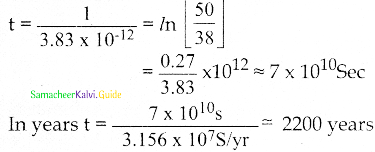
Samacheer Kalvi 12th Physics Guide Chapter 8 Atomic and Nuclear Physics 72

Samacheer Kalvi 12th Computer Applications Guide Chapter 12 DNS (Domain Name System)

Tamilnadu State Board New Syllabus Samacheer Kalvi 12th Computer Applications Guide Pdf Chapter 12 DNS (Domain Name System) Text Book Back Questions and Answers, Notes.

Tamilnadu Samacheer Kalvi 12th Computer Applications Solutions Chapter 12 DNS (Domain Name System)

12th Computer Applications Guide DNS (Domain Name System) Text Book Questions and Answers

Part I

Choose The Correct Answers
Question 1.
Which of the following is used to maintain all the directory of domain names?
a) Domain name system
b) Domain name space
c) Name space
d) IP address
Answer:
a) Domain name system

Question 2.
Which of the following notation is used to denote IPv4 addresses?
a) Binary
b) Dotted-decimal
c) Hexadecimal
d) a and b
Answer:
d) a and b

Samacheer Kalvi 12th Computer Applications Guide Chapter 12 DNS (Domain Name System)

Question 3.
How many bits are used in the IPv addresses?
a) 32
b) 64
c) 128
d) 16
Answer:
c) 128

Question 4.
Expansion of URL is
a) Uniform Resource Location
b) Universal Resource Location
c) Uniform Resource Locator
d) Universal Resource Locator
Answer:
c) Uniform Resource Locator

Samacheer Kalvi 12th Computer Applications Guide Chapter 12 DNS (Domain Name System)

Question 5.
How many types are available in Relative URL?
a) 2
b) 3
c) 4
d) 5
Answer:
a) 2

Question 6.
Maximum characters used in the label of a node?
a) 255
b) 128
c) 63
d) 32
Answer:
c) 63

Question 7.
In domain name, sequence of labels are separated by
a) ;
b) .(dot)
c) :
d) NULL
Answer:
b) .(dot)

Samacheer Kalvi 12th Computer Applications Guide Chapter 12 DNS (Domain Name System)

Question 8.
Pick the odd one out from the following.
a) node
b) label
c) domain
d) server
Answer:
d) server

Question 9.
Which of the following initiates the mapping of the domain name to IP address?
a) Zone
b) Domain
c) Resolver
d) Name servers
Answer:
b) Domain

Question 10.
Which is the contiguous area up to which the server has access?
a) Zone
b) Domain
c) Resolver
d) Name servers
Answer:
a) Zone

Samacheer Kalvi 12th Computer Applications Guide Chapter 12 DNS (Domain Name System)

Question 11.
ISP stands for
a) International Service provider
b) Internet Service Provider
c) Internet service Protocol
d) Index service provider
Answer:
b) Internet Service Provider

Question 12.
TLD stands for
a) Top Level Data
b) Top Logical Domain
c) Term Level Data
d) Top Level Domain
Answer:
d) Top Level Domain

Samacheer Kalvi 12th Computer Applications Guide Chapter 12 DNS (Domain Name System)

Question 13.
Which of the following statements are true?
i) Domains name is a part of URL.
ii) URL made up of four parts
iii) The relative URL is a part of the Absolute URL
iv) URL doesn’t contain any protocol
a) i & ii
b) ii
c) i, ii & iii
d) i, ii & iv
Answer:
b) ii

Question 14.
Assertion (A): The number of addresses used in the IPv6 addressing method is 128.
Reason (R): IPv6 address is a 128-bit unique address.
a) A is true and R is false.
b) A is false and R is true.
c) Both A and R are correct and R is the correct explanation of A.
d) Both A and R are correct and R is not the correct explanation of A.
Answer:
b) A is false and R is true.

Samacheer Kalvi 12th Computer Applications Guide Chapter 12 DNS (Domain Name System)

Question 15.
Match the following
a. domain – 1. The progress that initiates translation
b. zone – 2. contains a database of domain names
c. name server 3. single node
d. resolver 4. contiguous nodes
a. 1432
b. 3421
c. 3214
d. 3412
Answer:
a. 1432

Part II

Short Answers

Question 1.
List any four domain names.
Answer:
Domain Name:

  1. com
  2. edu
  3. gov
  4. mil

Meaning:

  1. Commercial Organisation
  2. Educational Institution
  3. Government (US)
  4. Military groups

Samacheer Kalvi 12th Computer Applications Guide Chapter 12 DNS (Domain Name System)

Question 2.
What is an IP address?
Answer:

  • Internet Protocol (IP) address is simply the logical address in the network layer.
  • Like how the door number/flat number is used to 10. differentiate individual house from others in the same apartment
  • IP address is also used to find the host system in the whole network.

Question 3.
What are the types of IP address?
Answer:

  1. IPv4 Address
  2. IPv6 Address

Question 4.
What is an URL?
Answer:

  • URL (Uniform Resource Locator) is the address of a document on the Internet.
  • URL is made up four parts-protocols, hostname, folder name and file name.

Samacheer Kalvi 12th Computer Applications Guide Chapter 12 DNS (Domain Name System)

Question 5.
List out four URLs you know.
Answer:
URL:

  1. http: //www. example.com/index, html
  2. http://www.computer.com
  3. http://www.ibm.com
  4. https://www.hellotravel.com

Question 6.
What are the types of URLs?
Answer:
Depending on the location of the document the URL is divided into 2 types

    1. Absolute URL
    2. Relative URL

Question 7.
What is a domain?
Answer:

  • A domain is a single node of the Domain Namespace.
  • In the domain name space (DNS) tree structure domain is a sub structure tree. The domain can be further divided into sub domains.

Samacheer Kalvi 12th Computer Applications Guide Chapter 12 DNS (Domain Name System)

Question 8.
What is a zone?
Answer:

  • Zone is the contiguous part up to which the server has access.
  • The domain assigned for the server does not divide into further subdomains the zone is the same as the domain.

Question 9.
What is a resolver?
Answer:

  • Resolver is a program which is responsible for initiating the translation of a domain name into an IP address.
  • A host system need to map domain name to IP address or vice versa according to the call and that work is done by resolver.

Question 10.
What are the categories available in domain name space?
Answer:
There are 3 important components in the Domain Name System. They are Namespace, Name server and Zone.

Samacheer Kalvi 12th Computer Applications Guide Chapter 12 DNS (Domain Name System)

Question 11.
Write any four generic Top-Level Domain.
Answer:

Domain Name Meaning
com Commercial Organisation
edu Education Institutions
gov Government (US)
mil Military groups

Part III

Explain In Brief Answer

Question 1.
Write a note on DNS.
Answer:

  • Domain name space was designed to achieve a hierarchical namespace.
  • In this, the names are represented as a tree-like structure with a root element on the top and this tree can have a maximum of 128 levels starting from the root element taking the level 0 to level 127.

Question 2.
Differentiate IPv4 and IPv6.
Answer:

IPv4

IPv6

It has a 32-bit address length It has a 128-bit address length
It Supports Manual and DHCP address configuration It supports Auto and renumbering address configuration
In IPv4 end to end, connection integrity is Unachievable In IPv6, end to end connection integrity is Achievable
It can generate 4.29×10⁹ address space Address space of IPv6 is quite large it can produce 3.4×1038 address space

Samacheer Kalvi 12th Computer Applications Guide Chapter 12 DNS (Domain Name System)

Question 3.
Differentiate Domain name and URL
Answer:

URL

DOMAIN NAME

URL is a full web address used to locate a webpage. A domain name is the translated and simpler form of a computer’s IP address (Logical address).
Complete web address containing domain name also. Part of the URL defines an organization or entity.
The method, hostname (domain name), port, and path. Based on subdomains (top-level, intermediate level, low level)

Question 4.
What are the differences between Absolute URL and Relative URL?
Answer:

Absolute URL

Relative URL

Absolute URL is the complete address of a document on the Inter­net. Relative URL is the par­tial address of a docu­ment on the Internet.
Absolute URL contains all the information that are required to find the files on the Internet. Relative URL contains only file name or file name with folder name.
If any of the four parts is missing then the browser would not able to link to the specific file We can use this type of URL when the file is on the same server related to the original document.

Samacheer Kalvi 12th Computer Applications Guide Chapter 12 DNS (Domain Name System)

Question 5.
Write a note on the domain name.
Answer:

  1. Domain name is the sequence of labels. In domain name the sequence of labels are separated ‘ by dot (.).
  2. The domain name is always read from the lower level to higher level i.e., from the leaf node to root node.
  3. Since the root node always represents NULL string, all the domain name ending with dot.

Question 6.
Differentiate web address and URL
Answer:

WEB ADDRESS

URL

A Web Address more commonly defines a unique name that helps people remember a URL. A URL is the address of a particular website, an audio stream, or document available on the Web.
It is like a memorable street address, can help people find you online. It is the Internet address of a particu­lar site or document available via the World Wide Web.

Samacheer Kalvi 12th Computer Applications Guide Chapter 12 DNS (Domain Name System)

Part IV

Explain In Detail

Question 1.
Explain briefly the components of DNS.
Answer:

DNS Components:
There are three important components in the Domain Name System. They are:

  1. Namespace
  2. Name server
  3. Zone

1. Name Space:

  • The domain names must be very unique and appropriate. The names should be selected from a namespace.
  • The name space can be organized in two ways
  • Flat name space
  • Hierarchical name space
  • Flat name space is where the name is assigned to the IP address. They do not have any specific structure.
  • Hierarchical name space is where the name is made up of several parts. The first part may represent the nature of organization, the second part may represent the name of organization, and third part may represent the department of the organization.
  • Domain name space was designed to achieve hierarchical name space.

2. Name Servers:

  • The information which needs to be stored in Domain name space is quite large. Single system would be inefficient to store such a huge amount as responding to requests from all over the world. It also becomes unreliable because in case of any failure the data becomes inaccessible.
  • Name Server is a main part in the Domain Name System (DNS). It trAnswer:late the domain names to IP addresses.
  • Name server contains the DNS database which consists of domain names and their corresponding IP addresses.
  • There is a need to store large number of domain names for the world wide usage, so plenty of servers are used in the hierarchical manner.
  • Name servers do the important task of searching the domain names. While you searching a website, Local Name server (provided by ISP) asks the different name servers until one of them find out your Answer. At last, it returns IP address for that domain name.

3. Zone:

  • The entire namespace is divided into many different zones. It is the area up to which the server has access.
  • Zone is defined as a group of contiguous domains and sub-domains. If the zone has a single domain, then the zone and domain are the same.
  • Every zone has a server which contains a database called a zone file. Using the zone file, the DNS server replies the queries about hosts in its zone. There are two copies of zone files available, Master file and slave file.

Samacheer Kalvi 12th Computer Applications Guide Chapter 12 DNS (Domain Name System)

Question 2.
Classify and Explain the IP address.
Answer:

  • Internet Protocol (IP) address is simply the logical address in the network layer.
  • Like how the door number/flat number is used to differentiate an individual house from others in the same apartment.
  • An IP address is also used to find the host system in the whole network.
  • Due to increase in the number of system in a network, there is a need of more addresses which lead to two addressing methods i.e., IPv4 and IPv6.

IPv4 Address

  • It IPv4 address is a 32-bit unique address given to a computer system.
  • No two systems can have same IP address.
  • If the network has p connections then ‘ip’ addresses should be there.
  • An address space is the total number of address¬es that can be made by that protocol.
  • It is determined by the number of bits that the protocol used.
  • If the protocol uses ‘n’ bits then the address space of that protocol would be ‘2n’ addresses can be formed. So, the number of addresses that can be formed in IPv4 is 232,
  • There are two ways to represent the IP address
    • Binary notation
    • Dotted-decimal notation
  • In binary notation the address is expressed as 32-bit binary values.
    • For E.g. 00111001 10001001 111000 00000111
  • In dotted-decimal notation the address is written in decimal format separated by dots(.). For e.g. 128.143.137.144

IPv6 Address

  • IPv6 address is a 128-bit unique address given to a computer system.
  • The number of addresses that can be formed in IPv6 is 2128. In IPv6 address, the 128 bits are divided into eight 16-bits blocks.
  • Each block is then changed into 4-dig¬it Hexadecimal numbers separated by colon symbols.
  • E.g. 2001:0000:32313:DFE1:0063:0000:0000:F EFB.a

Samacheer Kalvi 12th Computer Applications Guide Chapter 12 DNS (Domain Name System)

Question 3.
Explain about the name server?
Answer:
Name Servers:
1. The information which needs to be stored in the Domain namespace is quite large. A single system would be inefficient and insufficient to store such a huge amount as responding to requests from all over the world. It also becomes unreliable because in case of any failure the data becomes inaccessible.

2. The solution to this problem is to distribute the information among many computers. The best way to do that is to divide the entire space into many domains and subdomains

3. DNS also allows domains to be further divided into subdomains. By this, the solution to the problem is obtained and the hierarchy of servers is also maintained.

4. Name servers store the data and provide it to clients when queried by them. Name Servers are programs that run on a physical system and store all the zone data.

5. Name Server is a main part in the Domain Name System (DNS). It translates the domain names to IP addresses.

6. Name server contains the DNS database which consists of domain names and their corresponding IP addresses.

7. There is a need to store large number of domain names for worldwide usage, so plenty of servers are used in a hierarchical manner.

8. Name servers do the important task of searching the domain names. While you searching a website, the Local Name server (provided by ISP) ask the different name servers until one of them find out your Answer. At last it returns IP address for that domain name.

Types of Name Servers
There are three types of Name Servers which control the entire Domain Name System:
(i) Root Name Server – top-level server which contains entire DNS tree, maintained by ICANN.
There are 13 servers.

(ii) Primary/Master Name Server – contains a zone resource records. These records are updatable by domain name holders such as organizations.

(iii) Secondary/Slave Name Server – contains a copy of primary server files. This server has no authority to update, but reduce the workload of master server by sharing the queries.

Samacheer Kalvi 12th Computer Applications Guide Chapter 12 DNS (Domain Name System)

Question 4.
What is domain name space? Explain.
Answer:

  • Domain name space was designed to achieve hierarchical name space.
  • In this, the names are represented as a tree like structure with root element on the top and this tree can have a maximum of 128 levels starting from root element taking the level 0 to level 127.
  • The domain namespace where the root element is present at the top most level i.e., level 0.
  • The root element always represents the NULL string (empty string).
  • The next level to the root element is node (children of root element). Each node in the tree has a label and a domain name.

Label:

  • It is a string which can have maximum of 63 characters.
  • Each node in that level should have different labels thereby assuring the individuality of the domain name.
  • In other words, Labels are the names given to domains.
  • Domain is a sub tree in domain name space tree structure. The domain can be further divided into sub domains.

Domain name

  • It is the sequence of labels. In domain name the sequence of labels are separated by dot (.).
  • The domain name is always read from the lower level to higher level i.e., from the leaf node to root node.
  • Since the root node always represent NULL string, all the domain name ending with dot.

Basic rules of Domain names

  • Domain can consists of Alphabets a through z, and the digits 0 through 9.
  • Hyphens are allowed, but hyphens cannot be used as first character of a domain name.
  • Spaces are not alloweds
  • Special symbols (such as !, $, &,. not permitted.

Samacheer Kalvi 12th Computer Applications Guide Chapter 12 DNS (Domain Name System)

Question 5.
Explain how the DNS is working.
Answer:

  1. When the user enters the URL (consists of a protocol, domain name, folder name, filename) in the browser, the system fist checks its DNS cache for the corresponding IP address.
  2. If the IP address is found in the cache then the information is retrieved from the cache.
  3. If not, then the system needs to perform a DNS query i.e., the system needs to query the resolver about the IP address from Internet Service Provider (ISP).
  4. Each resolver has its own cache and if it is found in that then that information is retrieved.
  5. If not, then the query is passed to the next domain server i.e., TLD (Top Level Domain) which reviews the request and directs the query to name servers associated with that specific domain.
  6. Until the query is solved it is passed to next level domains. At last, the mapping and the record are returned to the resolver who checks whether the returned value is a record or an error.
  7. Then the resolver returns the record back to the computer browser which is then viewed by the user.

12th Computer Applications Guide DNS (Domain Name System) Additional Important Questions and Answers

Part A

Choose The Correct Answers:

Question 1.
Expand DNS?
(a) Direct Name Server
(b) Domain Name System
(c) Domain Name Security
(d) Direct Name Service
Answer:
(b) Domain Name System

Question 2.
For the communication to takes place, the information should pass through …………… layers
a) six
b) two
c) end to end
d) Seven
Answer:
d) IP addresses

Samacheer Kalvi 12th Computer Applications Guide Chapter 12 DNS (Domain Name System)

Question 3.
While typing a web address, DNS translates it into a machine-friendly IP address.
(a) True
(b) False
Answer:
(a) True

Question 4.
DNS provides the domain name to IP address mapping through ………….
a) IP address
b) Name Servers
c) domain
d) URL
Answer:
b) Name Servers

Question 5.
Paul V. Mockapetris together with ………………. invented the Internet Domain Name System (DNS).
a) Jon Postel
b) Dennis Ritchie
c) James Gostling
d) Carrelli
Answer:
a) Jon Postel

Samacheer Kalvi 12th Computer Applications Guide Chapter 12 DNS (Domain Name System)

Question 6.
IP stands for …………………
(a) Input process
(b) Input
(c) Internet Protocol
(d) Internet Power
Answer:
(c) Internet Protocol

Question 7.
……………….. is available below the root domain.
a) IANA
b) IPv4
c) IPv6
d) TLD
Answer:
d) TLD

Question 8.
How many IP addressing methods are there?
(a) 1
(b) 2
(c) 3
(d) 4
Answer:
(b) 2

Samacheer Kalvi 12th Computer Applications Guide Chapter 12 DNS (Domain Name System)

Question 9.
…………. is a program running on a dedicated machine which handles the queries of www end-user.
a) Webserver
b) Web Host
c) DNS
d) HTML
Answer:
a) Webserver

Question 10.
If the protocol uses ‘n’ bits then the address space of that protocol would be …………………….
(a) n
(b) n2
(c) 2n
(d) 2n
Answer:
(d) 2n

Samacheer Kalvi 12th Computer Applications Guide Chapter 12 DNS (Domain Name System)

Fill in The Blanks.

1. …………… is a logical address used to uniquely identify a computer over the Network.
Answer:
IP address

2. IPv4 address is a …………… unique address given to a computer or a device.
Answer:
32 bit

3. IPv6 address is a ……………. unique address given to a computer or a device.
Answer:
128 bit

4. …………… follows Hexadecimal number notation.
Answer:
IPv6

Samacheer Kalvi 12th Computer Applications Guide Chapter 12 DNS (Domain Name System)

5. ……………. is the address of a document on the Internet.
Answer:
URL (Uniform Resource Locator)

6. ……………… contains only folder name and the file name or just the file name.
Answer:
Relative URL

7. …………….. is a tree-like structure with a root element on the top.
Answer:
Domain namespace.

8. The domain name is always read from the …………….
Answer:
leaf node to root node.

9. In the domain name space (DNS) tree structure …………… is a substructure tree.
Answer:
domain

Samacheer Kalvi 12th Computer Applications Guide Chapter 12 DNS (Domain Name System)

10. …………. are programs that run on a physical system and store all the zone data.
Ans :
Name Servers

11. ……………….. provides to clients when queried by them.
Answer:
Name Servers

12. ……………. non-profit organization which regulates the Internet.
Answer:
ICANN

13. ………….. is an affiliated authority of ICANN.
Answer:
IANA (Internet Assigned Numbers Authority)

14. ……………… is a group of contiguous domains and subdomains in the Domain Name Space.
Answer:
Zone

Samacheer Kalvi 12th Computer Applications Guide Chapter 12 DNS (Domain Name System)

Assertion And Reason

Question 1.
Assertion (A): Domain Name System (DNS) maintains all the directory of domain names and helps us to access the websites using the domain names.
Reason(R): t translates the domain name into an IP address.
a) Both (A) and (R) are correct and (R) is the correct explanation of (A)
b) Both (A) and (R) are correct, but (R) is not the correct explanation of (A)
c) (A) is true and (R) is false
d) (A) is false and (R) is true
Answer:
c) (A) is true and (R) is false

Question 2.
Assertion (A): IPv4 address is a 64-bit unique address.
Reason(R): There are two ways to represent the IP address: Binary notation, Dotted-decimal notation.
a) Both (A) and (R) are correct and (R) is the correct explanation of (A)
b) Both (A) and (R) are correct, but (R) is not the correct explanation of (A)
c) (A) is true and (R) is false
d) (A) is false and (R) is true
Answer:
d) (A) is false and (R) is true

Samacheer Kalvi 12th Computer Applications Guide Chapter 12 DNS (Domain Name System)

Question 3.
Assertion (A): Label is a string
Reason(R): Label can have a maximum of 63 characters
a) Both (A) and (R) are correct and (R) is the correct explanation of (A)
b) Both (A) and (R) are correct, but (R) is not the correct explanation of (A)
c) (A) is true and (R) is false
d) (A) is false and (R) is true
Answer:
a) Both (A) and (R) are correct and (R) is the correct explanation of (A)

Question 4.
Assertion (A): Domain namespace is a tree-like structure with a root element on the top
Reason(R); it can have a maximum of 127 levels starting from the root element
a) Both (A) and (R) are correct and (R) is the correct explanation of (A)
b) Both (A) and (R) are correct, but (R) is not the correct explanation of (A)
c) (A) is true and (R) is false
d) (A) is false and (R) is true
Answer:
c) (A) is true and (R) is false

Samacheer Kalvi 12th Computer Applications Guide Chapter 12 DNS (Domain Name System)

Question 5.
Assertion (A): The Resolver is a service of ICANN
Reason(R): Resolver, a client/ server application, initiates the process of resolving the domain names.
a) Both (A) and (R) are correct and (R) is the correct explanation of (A)
b) Both (A) and (R) are correct, but (R) is not the correct explanation of (A)
c) (A) is true and (R) is false
d) (A) is false and (R) is true
Answer:
d) (A) is false and (R) is true

Question 6.
Assertion (A): URL Stands for Uniform Resource Locator
Reason(R): URL- the address of a specific web page or file on the Internet.
a) Both (A) and (R) are correct and (R) is the correct explanation of (A)
b) Both (A) and (R) are correct, but (R) is not the correct explanation of (A)
c) (A) is true and (R) is false
d) (A) is false and (R) is true
Answer:
a) Both (A) and (R) are correct and (R) is the correct explanation of (A)

Question 7.
Assertion (A): A web server is a program running on a dedicated machine which handles the queries of the www end user.
Reason(R): A web server is a type of Web Host.
a) Both (A) and (R) are correct and (R) is the correct explanation of (A)
b) Both (A) and (R) are correct, but (R) is not the correct explanation of (A)
c) (A) is true and (R) is false
d) (A) is false and (R) is true
Answer:
c) (A) is true and (R) is false

Samacheer Kalvi 12th Computer Applications Guide Chapter 12 DNS (Domain Name System)

Find The Odd One On The Following

1. (a) File Name
(b) Protocol
(c) HTML
(d) Host Name
Answer:
(c) HTML

2. (a) Label
(b) Namespace
(c) Name server
(d) Zone
Answer:
(a) Label

3. (a) Flat Namespace
(b) Domain Namespace
(c) Host Namespace
(d) Hierarchical Namespace
Answer:
(c) Host Namespace

Samacheer Kalvi 12th Computer Applications Guide Chapter 12 DNS (Domain Name System)

4. (a) Tree Like Structure
(b) 128 Levels
(c) NULL string
(d) Flat Namespace
Answer:
(d) Flat Namespace

5. (a) .com
(b) -ta
(c) .gov
(d) .nic
Answer:
(b) -ta

6. (a) com
(b) net
(c) bd
(d) info
Answer:
(c) bd

Samacheer Kalvi 12th Computer Applications Guide Chapter 12 DNS (Domain Name System)

7. (a) India
(b) Malaysia
(c) Singapore
(d) Srilanka
Answer:
(b) Malaysia

8. (a) Name server
(b) DNS Database
(c) IP Address
(d) HTTP
Answer:
(d) HTTP

9. (a) Primary Name Server
(b) Secondary Name Server
(c) Node Name Server
(d) Root Name Server
Answer:
(c) Node Name Server

Samacheer Kalvi 12th Computer Applications Guide Chapter 12 DNS (Domain Name System)

10. (a) Host
(b) Webserver
(c) DNS server
(d) Namespace
Answer:
(d) Namespace

11. (a) Name server
(b) Resolver
(c) ICANN
(d) Zone
Answer:
(c) ICANN

12. (a) 32 bit
(b) Binary Notation
(c) Hexadecimal
(d) Dotted decimal
Answer:
(c) Hexadecimal

Samacheer Kalvi 12th Computer Applications Guide Chapter 12 DNS (Domain Name System)

13. (a) WHOIS
(b) ICANN
(c) IAN
(d) FORTRAN
Answer:
(d) FORTRAN

14. (a) 128bit
(b) 16block
(c) Hexadecimal
(d) Binary notation
Answer:
(d) Binary notation

15. (a) in
(b) cn
(c) gov
(d) pk
Answer:
(c) gov

Samacheer Kalvi 12th Computer Applications Guide Chapter 12 DNS (Domain Name System)

Very Short Answers

Question 1.
What is a domain?
Answer:
A domain is a single node of the Domain Namespace.

Question 2.
What is Zone?
Answer:
A zone is a subset of the Domain namespace generally stored in a file.

Question 3.
What is Domain Name Space?
Answer:
Domain Namespace is an entire collection of Domains, Subdomains, and Zones.

Question 4.
What is a Name Server?
Answer:
Name server manages the database of domain names and corresponding IP addresses.

Samacheer Kalvi 12th Computer Applications Guide Chapter 12 DNS (Domain Name System)

Question 5.
What does the zone contain?
Answer:
A zone can contain more than one subdomain.

Question 6.
What does the server contain?
Answer:
A server can contain more than one zone file (Zones).

Domain Name Meaning

DOMAIN

MEANING

com Commercial Organisation
edu Educational Institutions
gov Government (US)
mil Military groups
org Nonprofit Organization
net Networking organization
info Information service providers

Samacheer Kalvi 12th Computer Applications Guide Chapter 12 DNS (Domain Name System)

Part B

Short Answers

Question 1.
Name the four parts of the URL?
Answer:
URL is made up of four parts-protocols, hostname, folder name, and file name. Each part has its own specific functions. Depending on the applications, additional information can be added to the URL but the common and fundamental URL consists of these four parts.

Question 2.
List the three components of DNS?
Answer:

  1. NameSpace
  2. Name server
  3. Zone

Question 3.
What is a Label?
Answer:

  • The label is a string which can have a maximum of 63 characters.
  • Each node in that level should have different labels thereby assuring the individuality of the domain name.

Samacheer Kalvi 12th Computer Applications Guide Chapter 12 DNS (Domain Name System)

Question 4.
Name the three domain names used in Tamil language?
Answer:
India,
Singapore,
Srilanka.

Question 5.
What is the Inverse domain?
Answer:
Inverse domain performs the opposite task of the normal DNS query. It converts the IP address to the domain name.

Question 6.
What is Zone File?
Answer:
Every zone has a server which contains a database called a zone file.

Question 7.
What are the two copies of the zone file?
Answer:
There are two copies of zone files available, they are

  1. Masterfile
  2. Slave file.

Samacheer Kalvi 12th Computer Applications Guide Chapter 12 DNS (Domain Name System)

Question 7.
Write the demerits of the Flat namespace?
Answer:
The major disadvantage of flat namespaces is that they cannot be used in large systems. Because they need to be accessed and controlled centrally to avoid ambiguity and redundancy.

Part C

Explain In Brief Answer

Question 1.
What are the fundamentals of URL?
Answer:

  • URL is made up of four parts-protocols, hostname, folder name, and file name.
  • Each part has its own specific functions. Depending on the applications, additional information can be added to the URL but the common and fundamental URL consists of these four parts.

Samacheer Kalvi 12th Computer Applications Guide Chapter 12 DNS (Domain Name System) 1

    • Protocol
    • Domain name/Hostname
    • Folders
    • Filename with extension

Question 2.
What is meant by Label?
Answer:
Label:
It is a string which can have a maximum of 63 characters. Each node in that level should have different labels thereby assuring the individuality of the domain name. In other words, Labels are the names given to domains. The domain is a subtree in the domain name space tree structure. The domain can be further divided into subdomains.

Samacheer Kalvi 12th Computer Applications Guide Chapter 12 DNS (Domain Name System)

Question 3.
Write a note on Country top-level domain names.
Answer:

  • Country domain uses 2-character country abbreviation according to country.
  • For e.g., google.in – for INDIA, Google’s for US.Some of the Domain Name and their meaning listed below.
    table

Question 4.
Explain the types of Name servers?
Answer:
Types of Name Servers:
There are three types of Name Servers which control the entire Domain Name System:
Root Name Server – top-level server which contains the entire DNS tree, maintained by ICANN. There are 13 servers.

Primary/Master Name Server- contains zone resource records. These records are updatable by domain name holders such as organizations.

Secondary/Slave Name Server – contains a copy of primary server files. This server has no authority to update but reduces the workload of the master server by sharing the queries.

Samacheer Kalvi 12th Computer Applications Guide Chapter 12 DNS (Domain Name System)

Part IV

Explain In Detail

Question 1.
Explain the Basic rules of Domain names?
Answer:
Basic rules of Domain names:

  1. A domain can consist of Alphabets a through z, and the digits 0 through 9.
  2. Hyphens are allowed, but hyphens can not be used as the first character of a domain name.
  3. Spaces are not allowed.
  4. Special symbols (such as ! $, &, _ and so on) are not permitted, length of 2, and the maximum length of 63 characters.
  5. The entire name may be at most 253 characters long.
  6. Domain names are not case-sensitive.(It may be upper, lower, or mixing of both case letters)

Question 2.
Write a note on the Hierarchical namespace?
Answer:

  • To avoid the major disadvantage of the Flat namespace, the hierarchical namespace is used in large.
  • A hierarchical namespace is where the name is made up of several parts.
    • The first part may represent the nature of the organization,
    • The second part may represent the name of the organization, and
    • Third-party may represent the department of the organization and so on.
  • In this way, the power to control the namespace can be decentralized.
  • The centralized authority can be given to nature and then the name of the organization and so on.
  • To achieve a hierarchical namespace, Domain Name Space was designed.

Samacheer Kalvi 12th Computer Applications Guide Chapter 11 Network Examples and Protocols

Tamilnadu State Board New Syllabus Samacheer Kalvi 12th Computer Applications Guide Pdf Chapter 11 Network Examples and Protocols Text Book Back Questions and Answers, Notes.

Tamilnadu Samacheer Kalvi 12th Computer Applications Solutions Chapter 11 Network Examples and Protocols

12th Computer Applications Guide Network Examples and Protocols Text Book Questions and Answers

Part I

Choose The Correct Answers

Question 1.
The ……………., “the Net,” is a worldwide system of computer networks.
a) Internet
b) mobile
c) communication
d) protocol
Answer:
a) Internet

Samacheer Kalvi 12th Computer Applications Guide Chapter 11 Network Examples and Protocols

Question 2.
Which one of the following will be easy the way to uses Internet technology and the public telecommunication system to securely share business’s information with suppliers, vendors,partners and customers,
a) Extranet
b) Intranet
c) arpanet
d) arcnet
Answer:
a) Extranet

Question 3.
Natch the following and choose the correct answer
i. HTTP -The core protocol of the World Wide Web.
ii. FTP – enables a client to send and receive complete files from a server.
iii. SMTP – Provide e-mail services.
iv. DNS- Refer to other host computers by using names rather than numbers.
a) i, ii, iii, iv
b) ii, iii, iv, I
c) iii, iv, i, ii
d) iv, iii, ii, i
Answer:
a) i, ii, iii, iv

Samacheer Kalvi 12th Computer Applications Guide Chapter 11 Network Examples and Protocols

Question 4.
Communication over…………….. is be made up of voice, data,images and text messages.
a) Social media
b) mobile network
c) whatsapp
d) software
Answer:
b) mobile network

Question 5.
Wi-Fi stands for………………
a) Wireless Fidelity
b) wired fidelity
c) wired optic fibre
d) wireless optic fibre
Answer:
a) Wireless Fidelity

Question 6.
A TCP/IP network with access restricted to members of an organization
a) LAN
b) MAN
c) WAN
d) Intranet
Answer:
d) Intranet

Samacheer Kalvi 12th Computer Applications Guide Chapter 11 Network Examples and Protocols

Question 7.
RFID stands for …………………
a) Radio Free identification
b) real Frequency identity
c) Radio Frequency indicators
d) Radio Frequency Identification.
Answer:
d) Radio Frequency Identification.

Question 8.
If guarantees the sending of data is successful and which checks error on operation at OSI layer is……….
a) Application layer
b) Network layer
c) Transport Layer
d) Physical layer
Answer:
c) Transport Layer

Question 9.
Which one of the following will secure data on transmissions?
a) HTTPS
b) HTTP
c) FTP
d) SMTP
Answer:
a) HTTPS

Question 10.
………………. provides e-mail service
a) DNS
b) TCP
c) FTP
d) SMTP
Answer:
d) SMTP

Question 11.
……………. refer to other host computers by using names rather than numbers.
a) DNS
b) TCP
c) FTP
d) SMTP
Answer:
a) DNS

Samacheer Kalvi 12th Computer Applications Guide Chapter 11 Network Examples and Protocols

Question 12.
TCP/IP is a combination of two protocols:
i. Transmission Control Protocol (TCP)
ii. Internet Protocol (IP)
iii. Selection Protocol (SP)
iv. Captial Protocol (CP)
a) i, ii
b) i, iii
c) iii, iv
d) ii, iii
Answer:
a) i, ii

Part II

Short Answers

Question 1.
Define Intranet
Answer:

  • It is a private network within an enterprise to share company data and computing resources between the employees.
  • It may consist of many interlinked local area networks.

Question 2.
What are the uses of mobile networks?
Answer:

  • Can connect the network without cable
  • Less consumption of power
  • Huge capacity than a large transmitter
  • Covering large area than a single transmitter

Samacheer Kalvi 12th Computer Applications Guide Chapter 11 Network Examples and Protocols

Question 3.
List out the benefits of WiFi
Answer:

  1. It provides mobility.
  2. It provides connection to Internet.
  3. Flexibility of LAN.
  4. Ensures connectivity.
  5. It allows places that are remote to benefit from connectivity.
  6. Low cost, high benefit.

Question 4.
How many types of RFID system available and what are they?
Answer:
Two types of RFID were

  1. Active RFID and
  2. Passive RFID systems.

1. Active RFID system: The tag has its own power source.
2. Passive RFID system: The tag gets power through power from a reader antenna to the tag antenna.

Question 5.
Expand HTTP, HTTPS, FTP
Answer:

  1. HTTP – Hypertext Transfer Protocol
  2. HTTPS – Hypertext Transfer Protocol Secure
  3. FTP – File Transfer Protocol

Part III

Explain in brief answer

Question 1.
Compare Internet, Intranet, and Extranet
Answer:

Type Definition Example
Internet A global network, public TCP/IP network used by over a billion people all over the world Sending an email to a friend
Intranet A TCP/IP network with access restricted to members of an organization Accessing your record in the employee personnel file
Extranet TCP/IP network with restricted access to Members Checking availability of inventory from an outside supplier

Question 2.
List out the components of an RFID enabled system.
Answer:

  • An RFID tag: It has a silicon microchip attached to a small antenna and mounted on a substrate,
  • A Reader: It has a scanner with antennas to trans¬mit and receives signals, used for communication.
  • A Controller: It is the host computer with a Microprocessor which receives the reader input and process the data.

Samacheer Kalvi 12th Computer Applications Guide Chapter 11 Network Examples and Protocols

Question 3.
Write short notes on HTTP, HTTPS, FTP.
Answer:

  1. HTTP – A protocol used between a web client and a webserver to protect non-secure data transmissions. The core protocol of the World Wide Web.
  2. HTTPS – A protocol used between a web client and a web server permits secure data transmissions.
  3. FTP – Used between computers for sending and receiving data. Enables a client to send and receive complete files from a server.

Question 4.
What are the layers available in TCP/IP Reference Model?
Answer:

  1. Application Layer
  2. Transport Layer
  3. Internet Layer
  4. Network Access Layer

Samacheer Kalvi 12th Computer Applications Guide Chapter 11 Network Examples and Protocols

Question 5.
Expand ARP, ICMP, SMTP, and DNS.
Answer:

  1. Address Resolution Protocol (ARP)
  2. Internet Control Message Protocol (ICMP)
  3. Transfer mission Control Protocol (TCP)
  4. Simple Mail Transfer Protocol (SMTP)
  5. Domain Name System (DNS).

Part IV

Explain in detail

Question 1.
Explain about Internet, Intranet and Ex¬tranet.
Answer:
INTERNET:

  • The Internet, “the Net,” is a worldwide system of computer networks
  • It is the network of networks where the users at any one computer can if they have permission, get information from any other computer.
  • The Internet is a network of global connections.
  • It comprises private, public, business, academic, and government networks
  • It linked by guided, wireless, and fiber-optic technologies.
  • The Internet denotes the global communication system, including infrastructure and hard¬ware whereas the web is one of the services interconnected over the Internet.

INTRANET:

  • It is a private network within an enterprise to share company data and computing resources between the employees.
  • It may consist of many interlinked local area networks.
  • It includes connections through one or more gateway (connects two networks using different protocols together known as protocol convertor) computers to the outside Internet.

EXTRANET:
It is a private network that uses Internet technology and the public telecommunication system to securely share business information with suppliers, vendors, partners, customers, or other businesses.

Question 2.
Discuss OSI model with its layers.
Answer:
OSI Model

  • Open System Interconnection (OSI) model was found in the year 1934, a general framework that enables network protocols along with software and systems to be developed based on a general set of guidelines.
  • It describes the standards for the inter-computer communication.

OSI Layers:
1. Physical Layer:

  • It is the 1st layer.
  • It defines the electrical and physical specifications for devices.

2. Data Link Layer:

  • It is the 2nd layer.
  • It guarantees that the data transmitted are free of errors.
  • This layer has simple protocols like “802.3 for Ethernet” and “802.11 for Wi-Fi”.

3. Network Layer:

  • It is the 3rd layer.
  • It is used to determine the path of the data packets.
  • At this layer, routing of data packets is found using IP Addressing.

4. Transport Layer:

  • It is the 4th layer.
  • It guarantees the transportation/sending of data is successful.
  • It includes the error checking operation.

5. Session Layer:

  • It is the 5th layer
  • It is used to identify the established system session between different network entities.
  • It controls dialogues between computers.
  • For instance, while accessing a system remotely, the session is created between your computer and the remote system.

6. Presentation Layer:

  • It is the 6th layer.
  • It does the translation of data to the next layer (Prepare the data to the Application Layer). Encryption and decryption protocols occur in this layer such as Secure Socket Layer (SSL).

7. Application Layer:

  • It is the 7th layer.
  • It acts as the user interface platform comprising software within the system.

Samacheer Kalvi 12th Computer Applications Guide Chapter 11 Network Examples and Protocols

Question 3.
Difference between TCP/IP and OSI Reference Model.
Answer:
Expands To TCP/IP- Transmission Control Protocol/OSI- Open system Interconnect

Basic for comparison TCP/IP model OSI Model
Expands To TCP/IP- Transmission Control Protocol/Internet Protocol OSI- Open system Interconnect
Meaning It is a client-server model used for the transmission of data over the internet. It is a theoretical model which is used for a computing system.
No. Of Layers 4 Layers 7 Layers
Developed by Department of Defense (DoD) ISO (International Standard Organization)
Tangible Yes No
Usage Mostly used Never use

Question 4.
Explain the development, merits, and demerits of Mobile networks.
Answer:

Merits of Mobile Networks:

  1. Higher efficiency.
  2. Increased ability to communicate in and out of the workspace.
  3. Greater access to modem apps and services.
  4. Improved networking capabilities.
  5. Quality and flexibility of services.
  6. Rapid developments in cloud technologies.

Demerits of Mobile Networks:

  1. Cost
  2. Vulnerable to security risks.
  3. Additional training is needed to use new technology.
  4. Cybercrime

Development:
The generations of mobile networks are as follows.

  1. First Generation (1G) 1981 – NMT Launch
  2. Second Generation (2G) 1991 – GSM Launch
  3. Second to Third Generation Bridge (2.5)2000 – GPRS launch
  4. Third Generation (3G) 2003 – first UK 3G launch
  5. Fourth Generation (4G) 2007
  6. Fifth Generation (5G) 2019+

1. First Generation (1G) 1981 – NMT launch:

  • During the initial periods, the mobile systems were based on analog transmission.
  • NMT stands for Nordic Mobile Telephone communication.
  • And a very poor voice quality.

2. Second Generation(2G) 1991-GSM Launch:

  • Later the second generation of mobile systems was placed on digital transmission with GSM.
  • GSM stands for (Global System for Mobile communication) was the most popular standard which is used in the second generation, using 900MHz and 1800MHz for the frequency bands.
  • The transfer mission used as TMDA stands for (Time Division Multiple Access) and CDMA One stands for (Code Division Multiple’Access) method to increase the amount of information transported on the network

3. Second to Third Generation Bridge (2.5)2000 – GPRS launch:

  • GPRS was introduced here GPRS stands for (General Packet Radio Service).
  • GPRS is a data service which enables mobile devices to send and receive messages, picture messages, and e-mails.
  • GSM data transfer mission rates typically reached 9.6kbit/s.

4. Third Generation( 3G) 2003- first UK 3G launch:

  • This generation of mobile systems merges different mobile technology standards and uses higher frequency bands for transfer mission and Code Division Multiple Access to deliver data rates of up to 2Mbit/s supports multimedia services (MMS: voice, video, and data).
  • The data transfer mission used a WCDMA. WCDMA stands for (Wideband Code Division Multiple Access).
  • Few 3G suppliers use ATMs (Asynchronous Transfer Mode) for their ‘over the air’ network within MPLS (Multiprotocol Label Switching) or IP for their backbone network.

5. Fourth Generation (4G) 2007:

  • 4G is at the research stage. 4G was based on an Adhoc networking model where there was no need for a fixed infrastructure operation.
  • Adhoc networking requires global mobility features (e.g. Mobile IP) and connectivity to a global IPv6 network to support an IP address for each mobile device.
  • Logically roaming in assorted IP networks (for example 802.11 WLAN, GPRS and UMTS) were be possible with higher data rates, from 2Mbit/s to 10-100Mbit/s, offering reduced delays and new services.

6. Fifth Generation (5G) 2019+:

  • 5G is the stage that succeeds the 4G (LTE/ WiMAX), 3G(units), and 2G(GSM) systems.
  • 5G targets to performance the high data rate, reduced latency, energy saving, cost reduction, higher system, capacity, and massive device connectivity.
  • The ITU IMT – 2020 provides speeds up to 20 gigabits per second it has been demonstrated with millimeter waves of 15 gigahertz and higher frequency.

Samacheer Kalvi 12th Computer Applications Guide Chapter 11 Network Examples and Protocols

12th Computer Applications Guide Network Examples and Protocols Additional Important Questions and Answers

Part A

Choose the correct answers:

Question 1.
Internet Protocol delivers packets from source to destination through
(a) TCP
(b) datagram
(c) packets header
(d) HTTP
Answer:
(c) packets header

Question 2.
…………….. over the mobile network is being made up of voice, data, images, and text messages,
a) Internet
b) Intranet
c) Extranet
d) Communication
Answer:
d) Communication

Question 3.
IP connectionless datagram service was developed by
(i) Vint cerf
(ii) Bob FrAnswer:ton
(iii) Bob Kahnin
(iv) Dan Bricklin
(a) i, ii
(b) ii, iii
(c) ii, iv
(d) i, iii
Answer:
(d) i, iii

Question 4.
The second generation of the mobile system was based on …………………… transmission.
a) Digital
b) Analog
c) Both (a) and (b)
d) None of these
Answer:
a) Digital

Samacheer Kalvi 12th Computer Applications Guide Chapter 11 Network Examples and Protocols

Question 5.
Which protocols have to do the end-to-end process of secure on time and manage data or communication.
(a) Physical
(b) TCP
(c) Network
(d) ARPC
Answer:
(c) Network

Question 6.
The RFID tag gets power from the reader through the …………… Method.
a) Direct
b) propagation
c) Inductive Coupling
d) Indirect
Answer:
c) Inductive Coupling

Samacheer Kalvi 12th Computer Applications Guide Chapter 11 Network Examples and Protocols

Question 7.
A passive RFID system using …………….. Method.
a) EM wave Propagation
b) Direct
c) Inductive Coupling
d) Indirect
Answer:
a) EM wave Propagation

Question 8.
Find the wrongly matched pair.
(a) Network Communication Protocol – HTTP, TCP/IP
(b) Network Security Protocol – ICMP
(c) Network Management Protocol – SNMP
Answer:
(b) Network Security Protocol – ICMP

Question 9.
………………. mainly deals with financial transactions or transfer User personal data were highly sensitive.
a) HTTP
b) SMTP
c) HTTPS
d) FTTP
Answer:
c) HTTPS

Samacheer Kalvi 12th Computer Applications Guide Chapter 11 Network Examples and Protocols

Question 10.
The ……………………….. is one of the services interconnected over the Internet.
Answer:
web

Abbreviations

  1. ARPA – Advanced Research Projects Agency
  2. NMT – Nordic Mobile Telephone Communication
  3. GSM – Global System For Mobile communication
  4. SIM – Subscriber Identity Module
  5. TMDA – Time Division Multiple Access
  6. CDMA – Code Division Multiple Access
  7. GPRS – General Packet Radio Service
  8. EDGE – Enhanced Data Rates for Global Evolution.
  9. LI FI – light Fidelity
  10. UMTS – Universal Mobile Telecommunication System
  11. WCDMA – Wideband Code Division Multiple Access
  12. ATM – Asynchronous Transfer Mode
  13. MPLS – Multiprotocol Label Switching
  14. ITU – International Telecommunication Union
  15. RFID – Radio Frequency Identification
  16. FTP – File Transfer Protocol
  17. HTTP – HyperText Transfer Protocol
  18. SMTP – Simple Mail Transfer Protocol
  19. ARP – Address Resolution Protocol
  20. ICMP – Internet Control Message Protocol

Assertion and reason

Question 1.
Assertion (A): Internet Protocol (IP) is the principle of the communications protocol. Reason (R): IP is referred to as TCP/IP Transmission Control Protocol/Internet Protocol.
a) Both (A) and (R) are correct and (R) is the correct explanation of (A)
b) Both (A) and (R) are correct, but (R) is not the correct explanation of (A)
c) (A) is true and (R) is false
d) (A) is false and (R) is true
Answer:
a) Both (A) and (R) are correct and (R) is the correct explanation of (A)

Question 2.
Assertion (A): Network protocols Manages Data.
Reason (R): Network protocols do not manage the network communication.
a) Both (A) and (R) are correct and (R) is the correct explanation of (A)
b) Both (A) and (R) are correct, but (R) is not the correct explanation of (A)
c) (A) is true and (R) is false
d) (A) is false and (R) is true
Answer:
c) (A) is true and (R) is false

Samacheer Kalvi 12th Computer Applications Guide Chapter 11 Network Examples and Protocols

Question 3.
Assertion (A): Network communication protocols are that Basic data communication.
Reason (R): Network communication protocols which specific as SMTP
a) Both (A) and (R) are correct and (R) is the correct explanation of (A)
b) Both (A) and (R) are correct, but (R) is not the correct explanation of (A)
c) (A) is true and (R) is false
d) (A) is false and (R) is true
Answer:
c) (A) is true and (R) is false

Question 4.
Assertion (A): Advanced Research Projects Agency (ARPA) of the U.S. government in 1969 and was first recognized as the ARPANet.
Reason (R): The Internet is a network of global connections – comprising private, public, business, academic, and government networks.
a) Both (A) and (R) are correct and (R) is the correct explanation of (A)
b) Both (A) and (R) are correct, but (R) is not the correct explanation of (A)
c) (A) is true and (R) is false
d) (A) is false and (R) is true
Answer:
b) Both (A) and (R) are correct, but (R) is not the correct explanation of (A)

Samacheer Kalvi 12th Computer Applications Guide Chapter 11 Network Examples and Protocols

Question 5.
Assertion (A): The Internet is a global network, public TCP/IP network used by over a billion people all over the world
Reason (R): An example of the internet is that Sending an email to a friend
a) Both (A) and (R) are correct and (R) is the correct explanation of (A)
b) Both (A) and (R) are correct, but (R) is not the correct explanation of (A)
c) (A) is true and (R) is false
d) (A) is false and (R) is true
Answer:
a) Both (A) and (R) are correct and (R) is the correct explanation of (A)

Question 6.
Assertion (A): Intranet a TCP/IP network with access restricted to members of an organization
Reason (R): An example of Intranet is that Checking the availability of inventory from an outside sup¬plier.
a) Both (A) and (R) are correct and (R) is the correct explanation of (A)
b) Both (A) and (R) are correct, but (R) is not the correct explanation of (A)
c) (A) is true and (R) is false
d) (A) is false and (R) is true
Answer:
c) (A) is true and (R) is false

Question 7.
Assertion (A): NMT stands for Nordic Mobile Telephone communication
Reason (R): NMT had a very low traffic density of one call per radio channel and a very poor voice quality.
a) Both (A) and (R) are correct and (R) is the correct explanation of (A)
b) Both (A) and (R) are correct, but (R) is not the correct explanation of (A)
c) (A) is true and (R) is false
d) (A) is false and (R) is true
Answer:
a) Both (A) and (R) are correct and (R) is the correct explanation of (A)

Question 8.
Assertion (A): RFID – Radio Frequency Identification.
Reason (R): RFID uses RF wireless technology to identify.
a) Both (A) and (R) are correct and (R) is the correct explanation of (A)
b) Both (A) and (R) are correct, but (R) is not the correct explanation of (A)
c) (A) is true and (R) is false
d) (A) is false and (R) is true
Answer:
a) Both (A) and (R) are correct and (R) is the correct explanation of (A)

Samacheer Kalvi 12th Computer Applications Guide Chapter 11 Network Examples and Protocols

Question 9.
Assertion (A): Physical Layer defines the electrical and physical specifications for devices.
Reason (R) Physical layer has simple protocols like “802.3 for Ethernet” and “802.11 for WiFi”.
a) Both (A) and (R) are correct and (R) is the correct explanation of (A)
b) Both (A) and (R) are correct, but (R) is not the correct explanation of (A)
c) (A) is true and (R) is false
d) (A) is false and (R) is true
Answer:
c) (A) is true and (R) is false

Question 10.
Assertion (A): Network Layer is the 3rd layer determining the path of the data Packets.
Reason (R): Network Layer helps in routing of data, packets is found using IP Addressing
a) Both (A) and (R) are correct and (R) is the correct explanation of (A)
b) Both (A) and (R) are correct, but (R) is not the correct explanation of (A)
c) (A) is true and (R) is false
d) (A) is false and (R) is true
Answer:
a) Both (A) and (R) are correct and (R) is the correct explanation of (A)

Question 11.
Assertion (A): TCP/IP is a set of protocols that governs communications among all computers on the Internet
Reason (R): TCP/IP protocol tells how informa-tion should be packaged, sent, and received, as well as how to get to its destination.
a) Both (A) and (R) are correct and (R) is the correct explanation of (A)
b) Both (A) and (R) are correct, but (R) is not the correct explanation of (A)
c) (A) is true and (R) is false
d) (A) is false and (R) is true
Answer:
a) Both (A) and (R) are correct and (R) is the correct explanation of (A)

Samacheer Kalvi 12th Computer Applications Guide Chapter 11 Network Examples and Protocols

Question 12.
Assertion (A): Routable protocol which uses IP addresses to deliver packets
Reason (R): It is a reliable protocol and guarantees the delivery of information
a) Both (A) and (R) are correct and (R) is the correct explanation of (A)
b) Both (A) and (R) are correct, but (R) is not the correct explanation of (A)
c) (A) is true and (R) is false
d) (A) is false and (R) is true
Answer:
c) (A) is true and (R) is false

Find the odd one on the following

1. (a) Routers
(b) Servers
(c) Computers
(d) URLs
Answer:
(d) URLs

2. (a) HTTP
(b) TCP/IP
(c) SFTP
(d) SSL
Answer:
(b) TCP/IP

Samacheer Kalvi 12th Computer Applications Guide Chapter 11 Network Examples and Protocols

3. (a) Suppliers
(b) Vendors
(c) Customers
(d) Employee
Answer:
(d) Employee

4. (a) Social Media
(b) E-mail
(c) Chatting
(d) Claims
Answer:
(d) Claims

5. (a) Voice
(b) Video
(c) Data
(d) Images
Answer:
(b) Video

6. (a) 1G-1984
(b) 2G-1991
(c) 3G-2003
(d) 4G-2007
Answer:
(b) 2G-1991

Samacheer Kalvi 12th Computer Applications Guide Chapter 11 Network Examples and Protocols

7. (a) TMDA
(b) GSM
(c) MMT
(d) CDMA
Answer:
(c) MMT

8. (a) UMTS
(b) WCDMA
(c) 1900-2200
(d) 900-180QMhz
Answer:
(d) 900-180QMhz

9, (a) 802.11
(b) CDMA
(c) UMTS
(d) WLAN
Answer:
(b) CDMA

10. (a) Reader
(b) Chip
(c) Antenna Coil
(d) Substrate
Answer:
(a) Reader

Samacheer Kalvi 12th Computer Applications Guide Chapter 11 Network Examples and Protocols

11. (a) Network Layer
(b) DataLink Layer
(c) Session Layer
(d) Presentation Layer
Answer:
(b) DataLink Layer

12. (a) Bytes
(b) Bits
(c) Packet
(d) Segments
Answer:
(a) Bytes

13. (a) IP
(b) SFTP
(c) ICMP
(d) ARP
Answer:
(b) SFTP

Samacheer Kalvi 12th Computer Applications Guide Chapter 11 Network Examples and Protocols

14. (a) HTTP
(b) SMTP
(c)TCP
(d) FTP
Answer:
(c)TCP

15. (a) X.25
(b) Ethernet
(c) Frame
(d) Relay
Answer:
(b) Ethernet

Match the following;

Question 1.
HTTP – Host Computers
ICMP – Network Communication Protocol
SFTP – Network Management Protocol
DNS – Network Security Protocol
a) 1234
b) 4321
c) 4123
d) 2134
Answer:
c) 4123

Samacheer Kalvi 12th Computer Applications Guide Chapter 11 Network Examples and Protocols

Question 2.
Internet – Claims
Intranet – Median Access Control
Extranet – Global Network
ARP – Submission of Reports
a) 3412
b) 1234
c) 2143
d) 3421
Answer:
a) 3412

Question 3.
E-Commerce – Facebook
Access Employee Database – Internet
Online Discussion – Extranet
Social Media – Intranet
a) 1234
b) 3412
c) 4312
d) 4132
Answer:
d) 4132

Samacheer Kalvi 12th Computer Applications Guide Chapter 11 Network Examples and Protocols

Question 4.
First Generation – GSM Launch
Second Generation – NMT Launch
Third Generation – 2007
Fourth Generation – UK 3G Launch
a) 3412
b) 1234
c) 2143
d) 3421
Answer:
c) 2143

Question 5.
First Layer – Data Link Layer
Second Layer – Transport Layer
Third Layer – Physical Layer
Fourth Layer – Session Layer
a) 1234
b) 3412
c) 4312
d) 4132
Answer:
b) 3412

Samacheer Kalvi 12th Computer Applications Guide Chapter 11 Network Examples and Protocols

Question 6.
Application Layer – ARP
Network Layer – FDDI
Presentation Layer – SNMP
Data Link Layer – TSL
a) 3412
b)1234
c)2143
d) 2413
Answer:
d) 2413

Important years to remember;

1974 IP connectionless datagram service was in the transmission control program
1969 (ARPA) of the U.S. government was first recognized as the ARPANet.
1981 First Generation
1991 Second Generation
2000 Second to Third Generation Bridge
2003 Third Generation
2007 Fourth Generation
2019+ Fifth Generation
1934 Open System Interconnection(OSI)

Protocols and Their usage

PROTOCOLS USAGE
TCP/IP set of protocols permitting communications among all computers on the Internet.
HTTP A protocol used between a web client and a web server protects nonsecure data transmissions
HTTPS A protocol used between a web client and a web server permits secure data transmissions.
FTP It is Used between computers for sending and receiving data. Enables a client to send and receive complete files from a server.
Internet Protocol (IP). It is a routable protocol which uses IP addresses to deliver packets
Address Resolution Protocol (ARP) It Resolves IP addresses to MAC (Medium Access Control) addresses.
Internet Control Mes­sage Protocol (ICMP) It is used by network devices to send error messages and operational information.
Transmission Control Protocol (TCP). It Provides reliable connection-oriented transmission between two hosts. It guarantees the delivery of packets between the hosts.
Simple Mail Transfer Protocol (SMTP) It Provides e-mail services

Part B

Short Answer Questions

Question 1.
Write a note on Extranet?
Answer:
EXTRANET:
It is a private network that uses Internet technology and the public telecommunication system to securely share business information with suppliers, vendors, partners, customers, or other businesses.

Question 2.
What is mean Network Protocol?
Answer:
Network protocols are that the usual procedures, rules, formal standards, and policies comprised of formats which allocate communication between more than one device connected to the network.

Samacheer Kalvi 12th Computer Applications Guide Chapter 11 Network Examples and Protocols

Question 3.
What is meant by Li-Fi?
Answer:
Li-Fi is a wireless technology which uses light-emitting diodes (LEDs) for data transmission Li-Fi is the short form of Light Fidelity.

Question 4.
What is mean by cell?
Answer:

  • A mobile network or cellular network is made up of a large number of signal areas called cells.
  • These cells join to form a large coverage area. Users can cross into different cells without losing their connection.

Question 5.
Write a note on Network protocols?
Answer:
Network protocols are that the usual procedures, rules, formal standards, and policies comprised of formats which allocate communication between more than one device connected to the network.

Question 6.
What is the use of Address Resolution Protocol?
Answer:

  • It Resolves IP addresses to MAC (Medium Access Control) addresses.
  • A MAC address is a hardware identification num¬ber that uniquely identifies each device on a network.

Question 7.
What is mean by DNS?
Answer:

  • DNS-Domain Name System
  • A method of referring to other host computers by using names rather than numbers.

Samacheer Kalvi 12th Computer Applications Guide Chapter 11 Network Examples and Protocols

Part C

Explain in detail

Question 1.
Explain the types of Networking protocols?
Answer:
The broad types of networking protocols, including:

  1. Network communication protocols are that the Basic data communication protocols specific to HTTP and TCP/IP.
  2. Network security protocols is that implement security over network communications and include HTTP, SFTP, and SSL.
  3. Network management protocols will Provide network governance and maintenance and include ICMP and SNMP.

Question 2.
List some applications of the Internet.
Answer:

  • Download programs and files
  • Social media
  • E-Mail
  • E-Banking
  • Audio and Video Conferencing
  • E-Commerce
  • File Sharing
  • E-Governance
  • Information browsing
  • Search the web addresses for access through a search engine
  • Chatting

Question 3.
Write about Mobile Networks?
Answer:
Mobile Networks:
A mobile network or cellular network is made up of a large number of signal areas called cells. These cells join to form a large coverage area. Communication over the mobile networks is being made up of voice, data, images, and text messages.

Samacheer Kalvi 12th Computer Applications Guide Chapter 11 Network Examples and Protocols

Question 4.
List some Applications of the Extranet.
Answer:

  • Customer communications
  • Online education/ training
  • Account status enquiry
  • Inventory enquiry
  • Online discussion
  • Supply – chain management
  • Order status enquiry
  • Warranty registration
  • Claims
  • Distributor promotions

Question 5.
Write a note on Network protocols?
Answer:
Network protocols are that the usual procedures, rules, formal standards, and policies comprised of formats which allocate communication between more than one device connected to the network.

Question 6.
Explain the working process of TCP
Answer:

  • TCP/IP is a combination of two protocols: Transmission Control Protocol (TCP) and Internet Protocol (IP).
  • The Internet Protocol typically specifies the logistics of the packets that are sent out over networks; it specifies the packets which have to go, where to go, and how to get there.
  • The Transmission Contra Protocol is accountable for guaranteeing the trustworthy transmission of data. It seems that the packets for errors and submits the requests for re-transmissions in case any of them are missing.

Samacheer Kalvi 12th Computer Applications Guide Chapter 11 Network Examples and Protocols

Question 6.
Write the disadvantages of the First Generation of Mobile Networks?
Answer:

  • They had a very low traffic density of one call per radio channel, A very poor voice quality.
  • They used unsure and unencrypted transmission, which leads to the spoofing of its identities.

Question 7.
Write short notes on Second to Third Generation Bridge of Mobile Networks
Answer:

  • GPRS was introduced here, it is seen as an excess period of mobile networking development, between 2G and 3G.
  • GPRS is a data service which enables mobile devices to send and receive messages, picture messages, and e-mails.
  • It allows the most popular operating speeds of up to 115kbit/s, latterly maximum of 384kbit/s by using EDGE.

Question 8.
Write short notes on Wi-Fi.
Answer:

  • Wi-Fi stands for Wireless Fidelity.
  • It is a wireless network technology that permits computers and alternative devices to be connected to every alternative into a local area network and to the net without wires and cables.
  • Wi-Fi is additionally stated as a wireless local area network that stands for wireless local area network, and 802.11, that is that the technical code for the protocol.

Part D

Detailed Answers

Question 1.
Explain in detail about Second Generation of Mobile Networks.
Answer:

  • The second generation of mobile systems was placed on digital transmission with GSM.
  • GSM stands for (Global System for Mobile communication)was the most popular standard which is used in the second generation, using 900MHz and 1800MHz for the frequency bands.-
  • GSM mobile systems have grown digital transmission using SIM. SIM stands for (Subscriber Identity Module) technology to authenticate a user for identification and billing purposes and to encrypt the data to prevent listen without permission (eavesdropping).
  • The transmission used as TDMA. TMDA stands for (Time Division Multiple Access) and CDMA One stands for (Code Division MultipleAccess ) method to increase the amount of information transported on the network.
  • Mobility is supported at layer 2, which stops seamless roaming across assorted access networks and routing domains. This means each operator must cover the entire area or have agreements in place to permit roaming.

Question 2.
Explain the important protocols present in

  1. Network layer
  2. Transport Layer

Answer:

1. Network Layer:
It is the layer where data is addressed, packaged, and routed among networks.
The important Internet protocols that operate at the Network layer are:

  • Internet Protocol (IP): A routable protocol which uses IP addresses to deliver packets. It is an unreliable protocol, does not guarantee the delivery of information.
  • Address Resolution Protocol (ARP): Resolves IP addresses to MAC (Medium Access Control) addresses. (A MAC address is a hardware identification number that uniquely identifies each device on a network.)i.e., to map IP network addresses to the hardware addresses.
  • Internet Control Message Protocol (ICMP): Used by network devices to send error messages and operational information. Example: A host or router might not be reached or requested service is not presented.
  • Internet Group Management Protocol (IGMP): It is a communication protocol used by hosts and routers to send Multicast (group Communication) messages to multiple IP addresses at once.

2. Transport Layer: The sessions are recognized and data packets are swapped between hosts in this layer.
Two main protocols established at this layer are:

  • Mission Control Protocol (TCP): Provides reliable connection-oriented Transmission between two hosts. It ensures the delivery of packets between the hosts.
  • User Datagram Protocol (UDP): Provides connectionless, unreliable, one-to-one, or one-to-many delivery.

Samacheer Kalvi 12th Computer Applications Guide Chapter 11 Network Examples and Protocols

Question 3.
Write short notes on Fourth Generation of Mobile Networks
Answer:

  • 4G is at the research stage. 4G was based on an Adhoc networking model where there was no need for a fixed infrastructure operation.
  • Adhoc networking requires global mobility features (e.g. Mobile IP) and connectivity to a global IPv6 network to support an IP address for each mobile device. Logically roaming in assorted IP networks (for example 802.11 WLAN,
  • GPRS and UMTS) were possible with higher data rates, from 2Mbit/s to 10-100Mbit/s, offering reduced delays and new services.
  • Mobile devices will not expect on a fixed infrastructure, they will require enhanced intelligence to self-configure in ad-hoc networks and having routing capabilities to route over packets switched network.

Question 4.
Explain about Fifth Generation of Mobile Networks
Answer:

  • 5G is the stage that succeeds the 4G (LTE/WiMAX), 3G(UMTS), and 2G(GSM) systems.
  • 5G targets to performance the high data rate, reduced latency, energy saving, cost reduction, higher system, capacity, and massive device connectivity.
  • The two phases of 5G, First one will be Release-15 complete by March 2019, Second one Release- 16is expected to complete in March 2020, for submission to the ITU (International Telecommunication Union) as a candidate IMT- 2020 technology.
  • The ITU IMT – 2020 provides speeds up to 20 gigabits per second it has been demonstrated with millimeter waves of 15 gigahertz and higher frequency. 3 GPP standards include any network using the New Radio software. 5G New Radio can access at lower frequencies from 600 MHz to 6 GHz.
  • Speed in the lower frequencies is only modestly higher than 4G systems, estimated at 15% to 50% faster.

Samacheer Kalvi 12th Computer Applications Guide Chapter 13 Network Cabling

Tamilnadu State Board New Syllabus Samacheer Kalvi 12th Computer Applications Guide Pdf Chapter 13 Network Cabling Text Book Back Questions and Answers, Notes.

Tamilnadu Samacheer Kalvi 12th Computer Applications Solutions Chapter 13 Network Cabling

12th Computer Applications Guide Network Cabling Text Book Questions and Answers

Part I

Choose The Correct Answers

Question 1.
ARPANET stands for
a) American Research Project Agency Network
b) Advanced Research Project Area Network
c) Advanced Research Project Agency Network
d) American Research Programs And Network
Answer:
c) Advanced Research Project Agency Network

Question 2.
WWW was invented by
a) Tim Berners Lee
b) Charles Babbage
c) Blaise Pascal
d) John Napier
Answer:
a) Tim Berners Lee

Samacheer Kalvi 12th Computer Applications Guide Chapter 13 Network Cabling

Question 3.
Which cable is used in cable TV to connect with setup box?
a) UTP cable
b) Fibre optics
c) Coaxial cable
d) USB cable
Answer:
c) Coaxial cable

Question 4.
Expansion of UTP is
a) Uninterrupted Twisted Pair
b) Uninterrupted Twisted Protocol
c) Unshielded Twisted Pair
d) Universal Twisted Protocol
Answer:
c) Unshielded Twisted Pair

Question 5.
Which medium is used in the optical fibre cables to transmit data?
a) Microwave
b) infra red
c) light
d) sound
Answer:
c) light

Samacheer Kalvi 12th Computer Applications Guide Chapter 13 Network Cabling

Question 6.
Which of the following is a small peripheral device with a sim slot to connect the computers to Internet?
a) USB
b) Dongles
c) Memory card
d) Mobiles
Answer:
a) USB

Question 7.
Which connector is used in the Ethernet cables?
a) RJ11
b) RJ21
c) RJ61
d) RJ45
Answer:
d) RJ45

Question 8.
Which of the following connector is called as champ connector?
a) RJ11
b) RJ21
c) RJ61
d) RJ45
Answer:
b) RJ21

Samacheer Kalvi 12th Computer Applications Guide Chapter 13 Network Cabling

Question 9.
How many pins are used in RJ45 cables?
a) 8
b) 6
c) 50
d) 25
Answer:
a) 8

Question 10.
Which wiring standard is used for connecting two computers directly?
a) straight Through wiring
b) Cross Over wiring
c) Rollover wiring
d) None
Answer:
b) Cross Over wiring

Question 11.
Pick the odd one out from the following cables
a) roll over
b) cross over
c) null modem
d) straight through
Answer:
c) null modem

Samacheer Kalvi 12th Computer Applications Guide Chapter 13 Network Cabling

Question 12.
Match the following
1. Ethernet – Port
2. RJ45 connector – Ethernet
3. RJ45 jack – Plug
4. RJ45 cable – 802.3
a) 1, 2, 4, 3
b) 4, 1, 3, 2
c) 4, 3, 1, 2
d) 4, 2, 1, 3
Answer:
d) 4, 2, 1, 3

Part II

Short Answers

Question 1.
Write a note on twisted pair cable?
Answer:

  • Twisted Pair Cables is a type of cable with two or more insulated wires twisted together.
  • It started with the speed of 10 Mbps (10BASE-T cable is used).
  • It started with the speed of 10 Mbps (10BA.SE-T cable is used).
  • Then the cable is improved and the speed was higher and went to 100 Mbps and the cable was renamed 100BASE-TX.

Question 2.
What are the uses of USB cables?
Answer:

  • The Universal Serial Bus is used to connect the keyboard, mouse, and other peripheral devices.
  • Micro USB is a miniaturized version of the USB used for connecting mobile devices such as smartphones, GPS devices, and digital cameras.

Samacheer Kalvi 12th Computer Applications Guide Chapter 13 Network Cabling

Question 3.
Write a note on the types of RJ45 connectors?
Answer:

  1. Wiring schemes specify how the wires to be connected with the RJ45 connector.
  2. There are two wiring schemes available to terminate the twisted-pair cable on each end, which are
    • T-568A
    • T-568B.

Question 4.
What is an Ethernet port?
Answer:

  • The Ethernet port is the jack where the Ethernet cable is to be connected.
  • This port will be there In both the computers and the LAN port.

Question 5.
What is the use of the Crimping tool?
Answer:
A crimping tool is a physical tool which is used to connect the patch wire and the Ethernet connector. The tool will puncture the connector and makes the wire set in the connector.

Samacheer Kalvi 12th Computer Applications Guide Chapter 13 Network Cabling

Question 6.
What are the types of twisted pair cables?
Answer:
There are two types of twisted pair cables, Unshielded Twisted Pair (UTP) and Shielded Twisted pair (STP). The UTP is used nowadays as modem cables for the Internet and they are lower in cost and installation and maintenance is easy compared to the coaxial cables.

Question 7.
What is meant by champ connector?
Answer:
The RJ-21 connector has 50 pins with 25 pins at one end and 25 pins at the other end. It is also called a champ connector or Amphenol connector. The Amphenol is a connector manufacturer. The RJ-21 interface is typically used for data communication trucking applications.

Part III

Explain In Brief Answer

Question 1.
Write a note on crossover cables.
Answer:

  • If you require a cable to connect two computers or Ethernet devices directly together without a hub, then you will need to use a Crossover cable instead.
  • The easiest way to make a crossover cable is to make one end to T568A colour coding and the other end to T568B.
  • Another way to make the cable is to remember the colour coding used in this type. Here Green set of wires at one end are connected with the Orange set of wires at another end and vice versa.

Question 2.
Write a short note on RJ45 connector?
Answer:
RJ45 Connector:

  1. The RJ45 connector is a small plastic cup which will be used to connect the wire inside the connector and ready to connect to the Internet.
  2. The RJ45 connector looks similar to a telephone jack but it looks slightly wider. The Ethernet cables are sometimes called RJ45 cables.
  3. In RJ45 the “RJ” stands for the Registered Jack and the “45” simply refers to the number of interface standards in the cable.

Samacheer Kalvi 12th Computer Applications Guide Chapter 13 Network Cabling

Question 3.
What are the differences between serial and parallel ports?
Answer:

Subject

Serial Port

parallel port

Pins 9 pins 25 pins
Type of port Male port Female Port
Color Usually Purple in color Usually Green in color
Data Transfer Rate Slower than Parallel Port Faster than Serial Port
Moving Bits Serial move bits inline, one at a time. Parallel moves bits next to each other
Usage of Wire Serial ports are only used 2 wires for transmitting and receiving data Parallel Port used 8 or more wire for trans­mitting and receiving data.

Question 4.
What is meant by a null modem cable?
Answer:
RS-232 cable is also used for interconnecting two computers without a modem. So it is also a null-modem cable. A cable interconnecting two devices directly are known as a null-modem cable.

Samacheer Kalvi 12th Computer Applications Guide Chapter 13 Network Cabling

Question 5.
What are the components involved in Ethernet cabling?
Answer:
The three main components are used in the Ethernet cabling components are

  1. Patch Cable (Twisted pair)
  2. RJ45 Connector
  3. Ethernet Ports
  4. Crimping Tool

Question 6.
What are the types of Fibre optic cables?
Answer:
There are two types of fiber optic cables available.

  1. One is single-mode (100BaseBx)
  2. Multimode (lOOBaseSX).
    • Single-mode cables are used for long-distance transmission and at a high cost
    • Multimode cables are used for short-distance transmission at a very low cost.

Samacheer Kalvi 12th Computer Applications Guide Chapter 13 Network Cabling

Part IV

Explain In Detail

Question 1.
What is meant by Registered Jack? Explain briefly the types of Jacks.
Answer:
Registered Jacks:

  • A Registered Jack commonly known as RJ is a network interface used for network cabling, wiring, and jack construction.
  • The primary function of the registered jack is to connect different data equipment and telecommunication devices.
  • The commonly known registered jacks are RJ-11, RJ-45, RJ-21, and RJ-28.
  • The registered jack refers to the male physical connector (Plug), a female physical connector (Jack) and it’s the wiring.

RJ-11:

  • It is the most popular modern form of the registered jack.
  • It is found in the home and office.
  • This registered jack is mainly used in telephone and landlines.
  • There are 6 pins where
    • The two pins give the transmission configuration,
    • The two pins give the receiver configuration and
    • The other two pins will be kept for reserved.
    • The two pin will have the positive terminal and the negative terminal.

RJ-14 and RJ-61:

  • The RJ-14 is the same as RJ-11 which will be used for telephone lines where same it as 6 pins whereas the RJ-61 will have 8 pins.
  • This RJ-61 will use the twisted pair cable with a modular connection.

RJ-21:

  • The RJ-21 connector has 50 pins with 25 pins at one end and 25 pins at the other end.
  • It is also called as champ connector or Amphenol connector.
  • The Amphenol is a connector manufacturer.
  • The RJ-21 interface is typically used for data communication trucking applications.

Samacheer Kalvi 12th Computer Applications Guide Chapter 13 Network Cabling

Question 2.
Explain wiring techniques used in Ethernet cabling.
Answer:

  • There are three types of wiring techniques to construct the Ethernet cable.
  • It is also known as color coding techniques. They are
    • Straight-Through Wiring
    • Cross-over Wiring
    • Roll-over Wiring

Straight-Through Wiring

  • In general, the Ethernet cables used for Ethernet connections are “straight through cables”.
  • These cable wires are in the same sequence at both ends of the cable, which means that pin 1 of the plug on one end is connected to pin 1 of the plug on the other end (for both standard – T568A & T568B).
  • The straight through wiring cables are mostly used for connecting PC / NIC card to a hub.
  • This is a simple physical connection used in printers, computers and other network interfaces.

Cross-over Wiring

  • Crossover cable is used to to connect two com¬puters or Ethernet devices directly together without a hub.
  • The pairs(Tx and Rx lines) will be crossed which means pin 1 & 2 of the plug on one end are connected with pin 3 & 6 of the plug on other end, and vice versa (3 & 6 to pin 1 & 2).
  • The Null modem Cables are the example of the crossover cables.

Roll-over Wiring

  • Rollover cable is a type of null-modem cable that is often used to connect a device console port to make programming changes to the device.
  • The rollover wiring have opposite pin arrangements, all the cables are rolled over to different arrangements.
  • In the rollover cable, the colored wires are reversed on other end i.e. the pins on one end are connected with other end in reverse order.
  • Rollover cable is also known as Yost cable or Console cable. It is typically flat (and light blue color) to distinguish it from other types of network cabling.

Samacheer Kalvi 12th Computer Applications Guide Chapter 13 Network Cabling

Question 3.
Explain about RJ45 connector.
Answer:

  • The RJ45 connector is a small plastic cup which will be used to connect the wire inside the connector and ready to connect the Internet.
  • The RJ45 connector looks similar like a telephone jack but it looks a slightly wider.
  • The Ethernet cables are sometime called as RJ45 cables.
  • In RJ45 the “RJ” stands for the Registered Jack and the “45” simply refers to the number of interface standard in the cable.
  • Each RJ45 connector has eight pins and connected to each end of the Ethernet cable, since it has 8-position, 8-contact (8P8C) modular plug,
  • It is also known as 8P8C connector. These plugs (connector) are then inserted into Ethernet port of the network card.

Wiring schemes and color codes of the connector

  • The RJ45 connector has eight small jack inside to connect eight small wires of the patch cable.
  • The eight cables are in eight different colors. Let’s discuss that eight colors and where does that eight colors connect to the RJ45 connector.
  • Wiring schemes specifies how the wires to be connected with RJ45 connector. There are two wiring schemes available to terminate the twisted-pair cable on each end, which are T-568A and T-568B.
  • Although four pairs of wires are available in the cable, Ethernet uses only two pairs: Orange and Green. The other two colors (blue and brown) can be used ISDN or phone connections.

Samacheer Kalvi 12th Computer Applications Guide Chapter 13 Network Cabling

Question 4.
Explain the components used in Ethernet cabling.
Answer:

The main components are used in the Ethernet cabling are

  1. Patch Cable (Twisted pair)
  2. RJ45 Connector
  3. Ethernet Ports
  4. Crimping Tool

1. Patch Cable (Twisted Pair):
1. These Cables are generally made up of 8 wires in different colors.

2. Four of them are solid colours, and the others are striped.
3. The eight colors are white green, green, white orange, blue, white blue, orange, white brown and brown. The following figure 13.8 shows the patch cable.
Ethernet cables are normally manufactured in several industrial standards such as Cat 3, Cat 5, Cat 6, Cat 6e and cat 7. “Cat” simply stands for “Category,”. Increasing the size of the cable also lead to slower transmission speed.

4. The cables together with male connectors (RJ45) on each end are commonly referred as Ethernet cables. It is also called as RJ45 cables, since Ethernet cable uses RJ45 connectors.

2. RJ45 Connector:

  • The RJ45 connector is a small plastic cup which will be used to connect the wire inside the connector and ready to connect the Internet.
  • The RJ45 connector looks similar like a telephone jack but it looks a slightly wider.
  • The Ethernet cables are sometime called as RJ45 cables.
  • In RJ45 the “RJ” stands for the Registered Jack and the “45” simply refers to the number of interface standard in the cable.
  • Each RJ45 connector has eight pins and connected to each end of the Ethernet cable.
  • Since it has 8-position, 8-contact (8P8C) modular plug, It is also known as 8P8C connector. Th£se plugs (connector) are then inserted into Ethernet port of the network card.

3. Ethernet card and Port:

  • Ethernet card is a Network Interface Card (NIC) that allows computers to connect and transmit data to the devices on the network. It may be an expansion card or built-in type.
  • Expansion card is a separate circuit board also called as PCI Ethernet card which is inserted into PCI slot on motherboard of a computer.
  • Now a days most of the computers come with built-in Ethernet cards which resides on motherboard.
  • Wireless Ethernet cards are also available, which uses radio waves to transmit data.
  • Ethernet port is an opening which is a part of an Ethernet card. It accepts RJ45 connector with Ethernet cable. It is also called as RJ45 jack. It is found on personal computers, laptops, routers, switches, hubs and modems.
  • In these days, most of the computers and laptops have a built-in Ethernet port for connecting the device to a wired network.

4. Crimping Tool:

  • Crimping is the process of joining two or more pieces of metal or wire by deforming one or both of them to hold each other.
  • A crimping tool is a physical tool which is used to connect the patch wire and the Ethernet connector.
  • The tool will puncture the connector and makes the wire set in the connector.

Samacheer Kalvi 12th Computer Applications Guide Chapter 13 Network Cabling

Question 5.
Explain the type of Network cables?
Answer:
There are many types of cables available in networking. Here we discuss six different cables.
1. Coaxial Cables:

  • This cable is used to connect the television sets to home antennas and transfer the information in 10 Mbps,
  • It is divided into thinnet and thicknet cables.
  • These cables have a copper wire inside and insulation Is covered on the top of the copper wire to provide protection to the cable.
  • These cables are very difficult to install and maintain because they are too big to carry and replace.
  • The coaxial cable got its name by the word “coax”. Nowadays coaxial cables are also used for dish TV where the setup box and the television is connected using the coaxial cable only.
  • Some of the cable names are Media Bridge 50-feet Coaxial cable, Amazon basics CL2- Rated Coaxial cables, etc.

Twisted Pair Cables:

  • It is type of cable with two or more insulated wires twisted together.
  • It started with the speed of 10 Mbps (10BASE-T cable is used).
  • Then the cable is improved and the speed was higher and went to 100 Mbps and the cable was renamed 100BASE-TX.
  • Then finally the cable improved more made to 10 Gbps and named as 10GBASE-T.
  • This twisted cable has 8 wires which are twisted to ignore electromagnetic interference.
  • Also, the eight wires cannot be placed in a single unit there could be a difficulty in spacious, so it is twisted to make as one wire.
  • There are two types of twisted pair cables, Unshielded Twisted Pair (UTP) and Shielded Twisted pair (STP).
  • The UTP is used nowadays as modern cables for the Internet and they are lower in cost and installation and maintenance is easy compared to the coaxial cables.
  • STP is similar to UTP, but it is covered by an additional jacket to protect the wires from External interference.

Fiber Optics:

  • This cable is different from the other two cables.
  • The other two cables had an insulating material on the outside and the conducting material like copper inside.
  • But in this cable it is of strands of glass and pulse of light is used to send the information.
  • They are mainly used in Wide Area Network (WAN)/The WAN Is a network that extends to the very large distance to connect the computers,

Ethernet Cables:

  • Ethernet cable is the most common type of network cable mainly used for connecting the computers or devices at home or office.
  • This cable connects wired devices within the local area network (LAN) for sharing the resources and accessing the Internet.

Samacheer Kalvi 12th Computer Applications Guide Chapter 13 Network Cabling

12th Computer Applications Guide Network Cabling Additional Important Questions and Answers

Part A

Choose The Correct Answers:

Question 1.
Which year were the co-axial cables invented?
(a) 1880
(b) 1890
(c) 1990
(d) 2000
Answer:
(a) 1880

Question 2.
The latest version of USB is ………………
a) 2.0
b) 4.0
c) 5.0
d) 3.0
Answer:
d) 3.0

Question 3.
Co-axial cables transfer the information in …………………………
(a) 10 kbps
(b) 10 Mbps
(c) 10 GBPS
(d) 10 TBPS
Answer:
(b) 10 Mbps

Samacheer Kalvi 12th Computer Applications Guide Chapter 13 Network Cabling

Question 4.
……………….. cable connects wired devices within the local area network for sharing the resources and accessing the Internet.
a) wireless Cable
b) Ethernet cable
c) Coaxial Cable
d) Twisted Wire
Answer:
d) Twisted Wire

Question 5.
Co-axial cables are made up of ……………………..
(a) Steel
(b) Iron
(c) Copper
(d) Aluminium
Answer:
(c) Copper

Question 6.
………….. are used for connecting the television with the setup box.
a) UTP
b) STP
c) Twisted Cable
d) Coaxial cables
Answer:
d) Coaxial cables

Samacheer Kalvi 12th Computer Applications Guide Chapter 13 Network Cabling

Question 7.
…………………….. is a type of cable with two or more insulated wires twisted together.
Answer:
Twisted pair cables

Question 8.
The ……………. uses light to transmit the information from one place to another.
a) Fibre cable
b) Network cable
c) optic cable
d) None of these
Answer:
c) optic cable

Question 9.
Assertion (A): 8 wires of the twisted cable are twisted
Reason (R): To ignore electromagnetic interference.
(a) A is true R is the reason
(b) A, R both false
(c) A is false R is true
(d) A is true, R is not the reason
Answer:
(a) A is true R is the reason

Samacheer Kalvi 12th Computer Applications Guide Chapter 13 Network Cabling

Question 10.
…………….. are used for long-distance transmission and at a high cost.
a) optic cable
b) Network cable
c) Multimode cable
d) Single-mode cables
Answer:
b) Network cable

Question 11.
STP stands for ………………………
(a) Shielded Turn paper
(b) Shielded Twisted pair
(c) Soft Turn Photo
(d) Short Time processing
Answer:
(b) Shielded Twisted pair

Question 12.
The serial port will send ………….. at one time.
a) 2 bit
b) Null
c) 1 bit
d) 5 bit
Answer:
c) 1 bit

Samacheer Kalvi 12th Computer Applications Guide Chapter 13 Network Cabling

Question 13.
Find the wrongly matched pair.
(a) coaxial cables – TV
(b) Twisted pair cables – ATP, UTP
(c) Fiber optic cables – Single-mode, Multimode
Answer:
(b) Twisted pair cables – ATP, UTP

Question 14.
The Null modem Cables are an example of the crossover cables.
a) coaxial
b) crossover cables
c) parallel cables
d) Serial cable
Answer:
b) crossover cables

Question 15.
The ……………. is the basic component of the Local Area Network(LAN)
a) parallel cables
b) Serial cable
c) coaxial
d) Ethernet cable
Answer:
d) Ethernet cable

Samacheer Kalvi 12th Computer Applications Guide Chapter 13 Network Cabling

Question 16.
The two types of fiber optic cables are ……………………… and ………………………..
Answer:
Single-mode, Multi-mode

Fill In The Blanks

1. The …………… is a small plastic cup which will be used to connect the wire inside the connector and ready to use to connect the Internet.
Answer:
RJ45 Ethernet connector

2. The ………….. has eight small pins inside to connect eight small wires in the patch cable. The eight cables have eight different colours.
Answer:
RJ45 connector

3. The …………….. is the jack where the Ethernet cable is to be connected.
Answer:
Ethernet port

Samacheer Kalvi 12th Computer Applications Guide Chapter 13 Network Cabling

4. …………….. port will be there in both the computers and the LAN port.
Answer:
Ethernet port

5. The …………… is a physical tool which is used to connect the patch wire and the Ethernet connector(RJ45).
Answer:
crimping tool

6. A ……………. is a network interface used for connecting different data equipment and telecommunication devices.
Answer:
Registered Jack (RJ)

7. ……………… jack is mainly used in telephone and landlines.
Answer:
RJ11

8. ……………… cable is used to transfer the information in 10 Mbps.
Answer:
Coaxial

Samacheer Kalvi 12th Computer Applications Guide Chapter 13 Network Cabling

Very Short Answers

Question 1.
What is the purpose of network cables?
Answer:
The Network cables are used to transfer the data and information to another computer.

Question 2.
What is the use of coaxial cable?
Answer:
Coaxial cables are used for connecting the television with the setup box.

Question 3.
How many wires are there in the twisted cable? Why?
Answer:
Twisted cable has 13 wires which are twisted to ignore electromagnetic interference

Question 4.
What are the two types of twisted pair cables?
Answer:
Unshielded Twisted Pair (UTP) and Shielded Twisted pair (STP).

Samacheer Kalvi 12th Computer Applications Guide Chapter 13 Network Cabling

Question 5.
Expand ARPANET.
Answer:
Advanced Research Project Agency Network

Question 6.
What is ARPANET?
Answer:
It is the predecessor of the modern Internet.

Question 7.
What is the use of USB cables?
Answer:
USB cables are used to connect keyboard, mouse, and other peripheral devices

Question 8.
What is the use of parallel cables?
Answer:
The parallel cables are used to connect to the printer and other disk drivers.

Question 9.
What are the two types of fiber-optic cable?
Answer:
Single-mode ((100 Base Bx)) and Multimode ((100 Base SX))

Samacheer Kalvi 12th Computer Applications Guide Chapter 13 Network Cabling

Question 10.
How serial port and parallel port differ?
Answer:
It will send 1 bit at one time whereas the parallel port will send 13 bit at one time.

Question 11.
What is the use of serial and parallel interface?
Answer:
The Serial and Parallel interface cables are used to connect the Internet to the system.

Question 12.
What is the purpose of cross-over cable?
Answer:
Cross over cable is used to join two network devices of the same type

Samacheer Kalvi 12th Computer Applications Guide Chapter 13 Network Cabling

Question 13.
What is RJ Network?
Answer:
A Registered Jack (RJ) is a network interface

Question 14.
Where is the RJ11 cable used?
Answer:
RJ11 jack is mainly used in telephone and landlines

Question 15.
What is the use of a crimping tool?
Answer:
The crimping tool is used to connect the patch wire and the Ethernet connector.

Question 16.
What is an Ethernet port?
Answer:
The Ethernet port is the jack where the Ethernet cable is to be connected.

Samacheer Kalvi 12th Computer Applications Guide Chapter 13 Network Cabling

Question 17.
What is an Ethernet cable?
Answer:
The Ethernet cable is the basic component of the Local Area Network

Question 18.
What is the purpose of using Fiber optic cable?
Answer:
Fiber optic cables are used in Wide Area Network (WAN).

Question 19.
What is a dongle?
Answer:
The dongle is a small peripheral device which has compatible with mobile broadband.

Question 20.
How the internet is connected through a dongle?
Answer:
A sim slot in it and connects the Internet and acts as a modem to the computer.

Samacheer Kalvi 12th Computer Applications Guide Chapter 13 Network Cabling

Abbreviation:

  1. ARPANET – Advanced Research Project Agency Network
  2. WWW – World Wide Web
  3. W3C – World Wide Web Consortium
  4. LAN – Local Area Network
  5. WAN – Wide Area Network
  6. UTP – Unshielded Twisted Pair
  7. STP – Shielded Twisted pair
  8. NIC – Network Interface Card
  9. USB – Universal Serial Bus
  10. RJ – Registered Jack
  11. 8P8C – 8-position, 8-contact

Find The Odd One On The Following

l. (a) Media Bridge
(b) 50feet coaxial cable
(c) 10BASE-T
(d) CL2
Answer:
(c) 10BASE-T

2. (a) 100BaseBX
(b) 100BaseSX
(c) WAN
(d) 10 Base T
Answer:
(d) 10 Base T

Samacheer Kalvi 12th Computer Applications Guide Chapter 13 Network Cabling

3. (a) Keyboard
(b) Monitor
(c) Mouse
(d) peripheral devices
Answer:
(b) Monitor

4. (a) Smartphones
(b) GPS devices
(c) Digital cameras
(d) Mouse
Answer:
(d) Mouse

5. (a) Speakers
(b) Infra Red
(c) Blue tooth
(d) WiFi
Answer:
(a) Speakers

Samacheer Kalvi 12th Computer Applications Guide Chapter 13 Network Cabling

6. (a) RJ45Connector
(b) UTP Cable
(c) coaxial cable
(d) plastic covering
Answer:
(c) coaxial cable

7. (a) USB cable
(b) RJ45 Connector
(c) Ethernet Ports
(d) Crimping Tools
Answer:
(a) USB cable

8. (a) White Green
(b) White Red
(c) White Orange
(d) White brown
Answer:
(b) White Red

9. (a) Cat 5
(b) Cat 6e
(c) Cat 7
(d) Cat 5e
Answer:
(d) Cat 5e

Samacheer Kalvi 12th Computer Applications Guide Chapter 13 Network Cabling

10. (a) RJ-11
(b) RJ-21
(c) RJ-08
(d) RJ-45
Answer:
(c) RJ-08

11. (a) Registered Jack
(b) Mobile
(c) 6pin
(d) Landlines
Answer:
(b) Mobile

12. (a) ChampConnector
(b) Amphenol Connector
(c) Wireless Connector
(d) RJ21
Answer:
(c) Wireless Connector

Samacheer Kalvi 12th Computer Applications Guide Chapter 13 Network Cabling

13. (a) Champ over
(b) Cross Over
(c) Straight Through
(d) Roll Over
Answer:
(a) Champ over

14. (a) T568A
(b) T568B
(c) Tx, Rx lines
(d) RJ-28
Answer:
(d) RJ-28

15. (a) Twisted pair
(b) UTP
(c) FTP
(d) STP
Answer:
(c) FTP

Samacheer Kalvi 12th Computer Applications Guide Chapter 13 Network Cabling

Choose The Incorrect Pair:

1. a) Media Bridge 50-feet Coaxial cable, Amazon basicsCL2-Rated Coaxial cables.
b) Unshielded Twisted Pair and Shielded Twisted pair.
c) USB cables and Parallel cables
d) Single-Mode and Multimode
Answer:
c) USB cables and Parallel cables

2. a) Serial and Parallel cables
b) Patch Cable, RJ45 Connector
c) Ethernet Ports, Crimping Tool
d) Coaxial cable, Serial Port
Answer:
d) Coaxial cable, Serial Port

3. a) Ethernet cable and serial cable
b) RJ45 plug, Ethernet connector.
c) Rj45 jack, Ethernet Port
d) RJ45, 802.3
Answer:
a) Ethernet cable and serial cable

Samacheer Kalvi 12th Computer Applications Guide Chapter 13 Network Cabling

4. a) RJ-11, RJ-45
b) RJ-45 and RJ47
c) RJ-14 and RJ-61
d) RJ-21, RJ-28
Answer:
b) RJ-45 and RJ47

5. a) USB cables, Peripheral devices
b) Coaxial cables, 10 Mbps
c) Ethernet port, LAN port
d) Parallel port, 100BaseSX
Answer:
d) Parallel port, 100BaseSX

Samacheer Kalvi 12th Computer Applications Guide Chapter 13 Network Cabling

Match The Following:

Question 1.
A) Tim Berners Lee -1) WAN
B) Coaxial cables – 2) WWW
C) Twisted pair – 3) CL2 Related coaxial
D) Fiber optics cable – 4) STP
a) 1 2 3 4
b) 2 31 4
c) 4 3 2 1
d) 2 3 4 1
Answer:
d) 2 3 4 1

Question 2.
A) Coaxial cables – 10gbps
B) Twisted pair – 100 BASE-BX
C) Fiber optics cable – 100 GBASE-T
D) Ethernet Cable -10 Mbps
a) 1 2 3 4
b) 2 31 4
c) 4 3 2 1
d) 2 3 4 1
Answer:
c) 4 3 2 1

Samacheer Kalvi 12th Computer Applications Guide Chapter 13 Network Cabling

Question 3.
A) RJ45 connector -1) Crimping Tool
B) Ethernet -2) Small 8 jack inside
C) Expansion card -3) NIC
D) RJ45 Cable -4) Ethernet cable
a) 1234
b) 2 31 4
c) 4 3 2 1
d) 2 3 4 1
Answer:
d) 2 3 4 1

Question 4.
A) Ethernet Technology – RJ45, 802.3
B) RJ45 Connector(male) – RJ45 plug, Ethernet connector, 8P8C connector
C) RJ45 socket (female) – Rj45 jack, Ethernet Port
D) RJ45 Cable – Ethernet cable
a) 1 2 3 4
b) 2 31 4
c) 4 3 2 1
d) 2 3 4 1
Answer:
a) 1 2 3 4

Question 5.
A) RJ11 Jack – Peripheral devices
B) RJ45 Connector – Telephones and landlines
C) USB Cables – Crimping Tool
D) Cross over cable – Null modem Cables
a) 1 2 3 4
b) 2 31 4
c) 4 3 2 1
d) 2 3 4 1
Answer:
b) 2 31 4

Samacheer Kalvi 12th Computer Applications Guide Chapter 13 Network Cabling

Part B

Short Answers

Question 1.
Write a note on coaxial cables?
Answer:
Coaxial Cables:
This cable was invented in the late 1880s, which is used to connect television sets to home antennas. This cable is used to transfer the information in 10 Mbps.

Question 2.
What is mean by Expansion card?
Answer:

  • The expansion card is a separate circuit board also called PCI.
  • Ethernet card is inserted into a PCI slot on the motherboard of a computer.

Question 3.
Mention the different types of cables used to connect the computer on Network?
Answer:
Computers can be connected on the network with the help of wired media (Unshielded Twisted pair, shielded Twisted pair, Co-axial cables, and Optical fiber) or wireless media (Infra Red, Bluetooth, WiFi)

Samacheer Kalvi 12th Computer Applications Guide Chapter 13 Network Cabling

Question 4.
List the type of Network cables
Answer:

  1. Coaxial Cables
  2. Twisted Pair Cables
  3. Fiber Optics
  4. USB Cables
  5. Serial and Parallel cables
  6. Ethernet Cables

Question 5.
Give the Pin details of RJ-11?
Answer:
Pin details of the RJ-11, there is 6 pin where the two pins give the transmission configuration, the two pins give the receiver configuration and the other two pins will be kept for reserved. The two-pin will have the positive terminal and the negative terminal.

Question 6.
What are the two types of twisted-pair cables?
Answer:
There are two types of twisted pair cables,

  1. Unshielded Twisted Pair (UTP) and
  2. Shielded Twisted pair (STP).

Samacheer Kalvi 12th Computer Applications Guide Chapter 13 Network Cabling

Question 7.
What is the use of UTP?
Answer:

  • The UTP is used nowadays as modern cables for the Internet and they are lower in cost and installation and maintenance is easy compared to the coaxial cables.
  • STP is similar to UTP, but it is covered by an additional jacket to protect the wires from External interference.

Question 8.
Write about Fiber Optics
Answer:

  • Fiber Optics cable is different from the other two cables.
  • The other two cables had an insulating material at the outside and the conducting material like copper inside.
  • But in this cable it is of strands of glass and pulse of light is used to send the information.

Question 9.
What are the two types of fiber optic cables available,
Answer:
There are two types of fiber optic cables available

  1. Single-mode (100BaseBx) another
  2. Multimode (100BaseSX).

Samacheer Kalvi 12th Computer Applications Guide Chapter 13 Network Cabling

Question 10.
What is the use of a Single-mode Cable?
Answer:
Single-mode cables are used for long-distance transmission and at a high cost.

Question 11.
What is the use of Multi-Mode Cable?
Answer:

  • Multimode cables are used for short-distance transmission at a very low cost.
  • The optic cables are easy to maintain and install.

Question 12.
What is the use of Micro USB?
Answer:
Micro USB is a miniaturized version of the USB used for connecting mobile devices such as smartphones, GPS devices, and digital cameras.

Question 13.
What is the use of cross-over Cable?
Answer:
Cross over cable is used to join two network devices of the same type for example two PCs or two network devices.

Samacheer Kalvi 12th Computer Applications Guide Chapter 13 Network Cabling

Part C

Explain In Brief Answer

Question 1.
Compare UTP and STP?
Answer:
UTP: The UTP is used nowadays as modem cables for the Internet and they are lower in cost and installation and maintenance is easy compared to the coaxial cables.

STP: STP is similar to UTP, but it is covered by an additional jacket to protect the wires from External interference.

Question 2.
How to determine the type of Ethernet Cable?
Answer:

  1. Straight-through: The coloured wires are in the same sequence at both ends of the cable.
  2. Cross-over: The first coloured wire at one end of the cable is the third coloured wire at the other end of the cable.
  3. Poll-over: The coloured wires are in the opposite sequence at either end of the cable.

Samacheer Kalvi 12th Computer Applications Guide Chapter 13 Network Cabling

Part D

Explain In Detail

Question 1.
Explain the Crimping process to make Ethernet cables?
Answer:
Crimping process for making Ethernet cables

  1. Cut the cable with the desired length
  2. Strip the insulation sheath about 1 inch from both ends of the cable and expose the Twisted pair of wires
  3. After stripping the wire, untwist the smaller wires and arrange them into the proper wiring scheme, T568B preferred generally.
  4. Bring the wires tighter together and cut them down so that they all have the same length ( Vi inch).
  5. Insert all 8 coloured wires into the eight grooves in the connector. The wires should be, inserted until the plastic sheath is also inside the connector.
  6. Use the crimping tool to lock the RJ45 connector on the cable. It should be strong enough to handle manual traction. Now it is ready for data transmission.
  7. Use a cable tester to verify the proper connectivity of the cable, if need.

Samacheer Kalvi 12th Computer Applications Guide Chapter 10 Introduction to Computer Networks

Tamilnadu State Board New Syllabus Samacheer Kalvi 12th Computer Applications Guide Pdf Chapter 10 Introduction to Computer Networks Text Book Back Questions and Answers, Notes.

Tamilnadu Samacheer Kalvi 12th Computer Applications Solutions Chapter 10 Introduction to Computer Networks

12th Computer Applications Guide Introduction to Computer Networks Text Book Questions and Answers

Part I

Choose The Correct Answers

Question 1.
A set of computers connecting together is caiied as ……………..
a) Network
b) Server
c) Hub
d) Node
Answer:
a) Network

Samacheer Kalvi 12th Computer Applications Guide Chapter 10 Introduction to Computer Networks

Question 2.
Computer network devices that originates route and terminate the data were called as
a) Hub
b) Resource
c) Node
d) Cable
Answer:
c) Node

Question 3.
Match the period and methods available on the history of computer networking on the Internet
a) 1950 – X.25 TCP/IP
b) 1966 – SAGE
c) 1976 – WAN
d) 1972 – ARCNET

a) 4321
b) 3421
c) 1234
d) 2341
e) 4123
Answer:
e) 4123

Samacheer Kalvi 12th Computer Applications Guide Chapter 10 Introduction to Computer Networks

Question 4.
Western Electric introduced the first widely used……………… that implemented true
computer control.
a) Packet switch
b) Arpanet
c) Host
d) Telephone switch
Answer:
d) Telephone switch

Question 5.
Wi-Fi is short name for
a) Wireless Fidelity
b) Wired fidelity
c) Wired fiber optic
d) Wireless fiber optic
Answer:
a) Wireless Fidelity

Question 6.
People everywhere can express and publish their ideas and opinions via
a) Tele-medicine
b) blogging
c) Server
d) Node
Answer:
b) blogging

Question 7.
Which one of the following periods, the speed capacity supported towards gigabit on a computer network?
a) SABRE
b) SAGE
c) NEW FIBRE OPTICS
d) ARCNET
Answer:
c) NEW FIBRE OPTICS

Samacheer Kalvi 12th Computer Applications Guide Chapter 10 Introduction to Computer Networks

Question 8.
One among them was challenging to the business people on computer networking
a) Hacking
b) Viruses
c) Both a & b
d) none of this above
Answer:
c) Both a & b

Question 9.
……………. able to predict, manage, and protect the computer network at Internet
a) Artificial intelligence
b) Broadband provider
c) Cloud computing
d) Transceivers
Answer:
a) Artificial intelligence

Question 10.
……………….. use less power compared with single transmitter or satellite often cell towers nearer
a) Mobile devices
b) Transistors
c) WIFI
d) Communication
Answer:
a) Mobile devices

Samacheer Kalvi 12th Computer Applications Guide Chapter 10 Introduction to Computer Networks

Question 11.
People nowadays getting relaxed via
a) Business
b) Corporate company
c) Newspapers
d) Social media
Answer:
d) Social media

Question 12.
Which one of the following is not the social media
a) Gmail
b) Facebook
c) Twitter
d) Linkedin
Answer:
a) Gmail

Question 13.
Facebook was created at ………………………….year
a) 2002
b) 2004
c) 2013
d) 2010
Answer:
b) 2004

Samacheer Kalvi 12th Computer Applications Guide Chapter 10 Introduction to Computer Networks

Question 14.
In a mobile network, land areas for network coverage were distributed as
a) Firmware
b) cells
c) Range
d) Service
Answer:
b) cells

Question 15.
Which one was harmful to the computer
a) Bloggers
b) Browser
c) Hackers
d) Twitter
Answer:
c) Hackers

Question 16.
Which innovation made people use the Internet?
a) Social web
b) Mobile technology
c) Mobile App
d) Both a & b.
Answer:
d) Both a & b.

Samacheer Kalvi 12th Computer Applications Guide Chapter 10 Introduction to Computer Networks

Part II

Short Answers

Question 1.
Define Computer Network.
Answer:

  1. A set of computers connected together for the purpose of sharing resources is called a computer networks.
  2. At present, the Internet is the most common resource shared everywhere.

Question 2.
Define Internet
Answer:
The Internet is a network of global connections – ‘ comprising private, public, business, academic and government networks – linked by guided, wireless and fiber-optic technologies.

Question 3.
What are the common uses of Computer Network?
Answer:
The common uses of computer network are

  1. Communication
  2. Resource sharing
  3. Data (or) software sharing
  4. Money-saving

Samacheer Kalvi 12th Computer Applications Guide Chapter 10 Introduction to Computer Networks

Question 4.
List out some feature of Mobile Network.
Answer:

  • Less consumption of power
  • Huge capacity than a large transmitter, at single frequency
  • Covering large area than a single transmitter

Question 5.
Difference between wired and wireless networks.
Answer:

Wired Network Wireless Network
A Wired network system connected with network cable. A Wireless network is connecting Devices without cables
Example: speakers, CCTV, printers, outdoors, and scanners, etc., with cables. Example: Tablets(tab), indoor cameras and E-readers, etc., without cables (WiFi).

Part III

Explain in brief answer

Question 1.
Define ARPANET.
Answer:
First In 1969, four nodes of ARPANET were connected between four universities namely the University of California at Los Angeles, at Santa Barbara, the Stanford Research Institute and the university of Utah using the 50 Kbit/s circuits.

Packet-switched networks was the theoretical work to model was performed by Leonard Kleinrock, ARPANET was which underpinned the development of it and his theoretical work on hierarchical routing in late 1970 s with his student Farouk Kamoun remains critical to the operation of the Internet today.

Samacheer Kalvi 12th Computer Applications Guide Chapter 10 Introduction to Computer Networks

Question 2.
What is the use of cloud storage and cloud computing?
Answer:
Cloud storage

  • It is just storage of data on online, access in different area no geographical limits was in need.
  • Cloud storage provides users with immediate access to a broad range of resources.

Cloud computing:

  • It is the on demand availability of computer sys-tem resources.
  • Especially data storage and computing power, without direct active management by the user

Question 3.
What is mean by Artificial Intelligence?
Answer:

  1. Artificial intelligence able to be better predict traffic as it collects and analyzes data in real-time,
  2. some of the network managers were better prepared for big events such as the World cup, Olympics, Valentine’s Day, which often put on the Internet under pressure.
  3. Now the networks were monitored by an algorithm that enables for anomalous build-ups of traffic and activity which may be the result of nasty activities such as (DDoS) Distributed Denial-of-Service attacks and attempted hacks.
  4. This Artificial Network powering algorithms will become the most intelligent; it might find faster and reliable methods of anticipating threats and cleaning networks.

Samacheer Kalvi 12th Computer Applications Guide Chapter 10 Introduction to Computer Networks

Question 4.
List out some usefulness of Social Network.
Answer:

  • Group information sharing over long distances.
  • Broadcast announcements,
  • Fostering diversity of thought.

Question 5.
How Computer Networks save money saving?
Answer:
Money-saving:
Using computer networking, it’s an important financial aspect for the organization because it saves money. It reduces the paperwork, manpower and saves time.

Part IV

Explain in detail

Question 1.
Define computer networking and Internet. Explain different developments on computer network and Internet.
Answer:
Computer networking:
Computer networking is a technique of digital telecommunications network one that permits nodes to share its resources.

This computer networking exchanges the data with each other through wired or wireless connections between different terminals called nodes.

Internet
The Internet is a network of global connections – comprising private, public, business, academic and government networks – linked by guided, wireless and fiber-optic technologies.

Computer networks and its development

Sno Period Method History
1 Late
1950
SAGE (Semi – Automatic Ground Environment) It was used at U.S Military Radar system.
2 1960 SABRE(Semi Automatic Business Research Envi­ronment) At Commercial Airline Reservation system online connected with two main frame computers.
Packet switching Packet switching was developed by Paul Baran and Donald De­vices
NPL network (National Physical Laboratory ) at united kingdom local area network (LAN) using line speed of 768kbit/s
3 1963 Intergalactic Computer network The intergalactic Computer network was sent by J.C.RLicklider
4 1965 Telephone switch At first widely used Telephone switch was introduced by Western Electric
5 1966 Wide Area Network(WAN) An experimental paper on has been published by Thomas Marill Lawrence G.Roberts published in the area of time sharing
6 1969­
1970
ARPANET First In 1969, four nodes of ARPANET were connected between four universities
7 1972 X.25 TCP/IP Using X.25 as commercial services were deployed then was using an infrastructure for expanding TCP/IP networks.
8 1973 Hosts CYCLADES was the first for making hosts which is responsible for reliable delivery of data
9 1973­
1979
Ethernet A memo at Xerox PARC was written by Robert Metcalfe describing Ethernet in 1973.
Aloha based networking system which was developed in the 1960s
In July 1976 the paper published “Ethernet: Distributed Packet Switching for Local Computer Networks” by Robert Metcalfe and David Boggs.
Collaborated on many patients received in 1977 and 1978.
Robert Metcalfe pursued making on the open standard in 1979.
10 1976 ARCNET ARCNET was created by John Murphy of Datapoint corporation in 1976
11 1995 NEW FIBRE OPTIC CA­BLES The speed capacity of transmission for Ethernet was slightly elevated from 10 Mbit/s to lOOMbit/sat 1995.
Frequently, the highest speeds up to 100 Gbit/s were appended (still 2016).

Question 2.
Explain the growth of computer networking,
Answer:
Growth on the popularity of cloud storage and cloud computing. On behalf of buying physical copies of games, music, and movies, increasingly downloading (or streaming) and buy digital licenses their need via Internet.

3G and 4G:
Developments on mobile network infrastructure- both deployments of 4Gand 3G networks (older) that have allow the people in their developed areas who can allow it to their smart mobile phones as video broadcasting system and as mobile television.

4G LTE
Even though 4G LTE mobile network was not reached by many parts of world, the industry of telecommunication has been hard working on the development of their next generation

5G:

  • It is a cellular communication Technology. This 5G intense to boost up the speed the mobile connections dramatically. Exactly how much customers was in need of this 5G connection and to go.
  • It might be tested on laboratory on by prototype versions of some elements then it may be standard 5G consumers were also interested on the promise of signal coverage with 5G.

Artificial intelligence

  • It will help to maintain, manage, and protect it.
  • It is also able to be a better predict traffic as it collects and analyzes data in real-time, some of network managers were better prepared for big events such as the World cup, Olympics, Valentine’s Day, which often put on the Internet under pressure.

Samacheer Kalvi 12th Computer Applications Guide Chapter 10 Introduction to Computer Networks

Question 3.
Mention some uses of the network at business, home, mobile, social applications.
Answer:
(i) Networks in Business:

  1. In the twenty-first century, communications are necessary for successful business operations and technology for business interaction.
  2. Computer networks were faster, the Internet became full strength and wireless communications have been formed the way business performed.
  3. By the usage of latest technologies, such as cloud computing, are being used to allow globally without scarifying security or limiting user access.
  4. Internet conversations happen faster, Quick Decision making saves a lot of time, we all know that “time is money” in business.
  5. Through e-banking we can pay or receive money from or to the customer may be easily done via gateways or by online payments were much easier on this method.
  6. Here any type of business it might large or small scale B2C, B2B, B2G,C2B, C2C, C2G, G2B,G2C, G2G or commercial that transfer of information across the Internet can be done here.

(ii) Networks at Home:
Network at home is a group of devices such as computers, mobile, speakers, cameras, game systems, and printers that connect via the network with each other. Networks at home were connected in two ways they are

  1. Wired network
  2. Wireless network

A Wired network system connected with a network cable. For example speakers, CCTV, printers, outdoors, and scanners etc., with cables.
A Wireless network is connecting devices like tablets(.tab), indoor cameras and E-readers, etc., without cables (WiFi).
Network at home plays the main role to access all such as e-banking, e-leaming, e-governance, e-health, telemedicine, call centers, video conferencing, digitalization of memories, can easy to access and use by avoiding a lot of time and stacked at the queue.
From the home we ordered delicious food from various hotels and restaurants at a time without delay can be bought via the Internet.

(iii) Mobile Networks:
A mobile network is a network connecting devices without cable (wireless). Mobile computers, such as laptops, tablets, and handheld computers, were the fastest-growing segments.

(iv) Social Application:
The very fast and easiest way to cover all the people, who are connected to in social network media. For example WhatsApp, Facebook, Twitter, blogs, Pinterest, Linkedln, classmates, and so on. Through the above social media, we share our thoughts in different formats and the different size of files.

Samacheer Kalvi 12th Computer Applications Guide Chapter 10 Introduction to Computer Networks

12th Computer Applications Guide Introduction to Computer Networks Additional Important Questions and Answers

Part A

Choose the correct answers:

Question 1.
……………….. Method was used at the U.S Military Radar system.
a)SABRE
b)ARPANET
c) SAGE
d) Networking
Answer:
c) SAGE

Question 2.
Which one of the following resources cannot be shared?
(a) printer
(b) scanner
(c) speakers
(d) monitor
Answer:
(d) monitor

Question 3.
Packet Switching was invented in the year………………..
a)1964
b) 1958
c)1988
d)1991
Answer:
a)1964

Samacheer Kalvi 12th Computer Applications Guide Chapter 10 Introduction to Computer Networks

Question 4.
……………….. helps in sending and receiving money via payment gateway.
a) e-banking
b) online payment
c) e-governance
d) credit/debit card
Answer:
b) online payment

Question 5.
In networking, nodes are identified by their…………………………….
(a) Protocol
(b) Layer
(c) IP address
(d) TCL address
Answer:
(c) IP address

Question 6.
The initial name of the host is known as ………………..
a) TCP/IP
b) switch
c) nodes
d) CYCLADES
Answer:
d) CYCLADES

Samacheer Kalvi 12th Computer Applications Guide Chapter 10 Introduction to Computer Networks

Question 7.
In 1966……………….. was introduced for time-sharing.
a) WAN
b) MAN
c)LAN
d) Networking
Answer:
a) WAN

Question 8.
Expand SAGE
(a) Semi-Automatic Ground Environment
(b) Self – Auto General Engine
(c) Super – Automatic General Engine
(d) Super – Auto Ground Environment
Answer:
(a) Semi-Automatic Ground Environment

Question 9.
WWW was created in the year ………………..
a) 1965
b) 1993
c)1988
d)1989
Answer:
d)1989

Samacheer Kalvi 12th Computer Applications Guide Chapter 10 Introduction to Computer Networks

Question 10.
Network of network is called ………………..
a) Internet
c) Exnet
b) Intranet
d) Network
Answer:
a) Internet

Abbreviation

1. WWW – World Wide Web
2. IP – Internet protoco!
3. SAGE – Semi Automatic Ground environment
4. SABRE – Semi Automatic Business Research Environment
5. LAN – Locai Area Network
6. NPL – National Physical Laboratory
7. WAN – Wide Area Network
8. ARPANET – Advanced Research Projects Agency Network
9. TCP – Transmission Control Protoco!
10. ARCNET – Attached Resource Computer NETwork
11. LTE – Long Term Evolution
12. DDos – Distributed Denial of Service attacks.

Samacheer Kalvi 12th Computer Applications Guide Chapter 10 Introduction to Computer Networks

Very short answers

Question 1.
What is the use of Packet switching?
Answer:
It used to transfer the information between computers and network,

Question 2.
Who use SAGE first? When?
Answer:
U.S Military Radar system used SAGE (Semi – Automatic Ground Environment) at late 1950

Question 3.
What do you mean by hosting?
Answer:
The service provider that leases this infrastructure, which is known as hosting.

Samacheer Kalvi 12th Computer Applications Guide Chapter 10 Introduction to Computer Networks

Question 4.
What Is a Telephone switch?
Answer:
It is the first widely used to implemented true computer control.

Assertion and reason

Question 1.
Assertion (A): A set of computers connected together for the purpose of sharing resources is called as computer networks
Reason(R): Multimedia means that multiple forms of media are combined to gather and provide services
a) Both (A) and (R) are correct and (R) is the correct explanation of (A)
b) Both (A) and (R) are correct, but (R) is not the correct explanation of (A)
c) (A) is true and (R) is false
d) (A) is false and (R) is true
Answer:
b) Both (A) and (R) are correct, but (R) is not the correct explanation of (A)

Question 2.
Assertion (A): Networks of the network is called the Internet.
Reason(R): Computer which is connected to a network called as Intranet
a) Both (A) and (R) are correct and (R) is the correct explanation of (A)
b) Both (A) and (R) are correct, but (R) is not the correct explanation of (A)
c) (A) is true and (R) is false
d) (A) is false and (R) is true
Answer:
c) (A) is true and (R) is false

Samacheer Kalvi 12th Computer Applications Guide Chapter 10 Introduction to Computer Networks

Question 3.
Assertion (A): The data that originates and terminates at these particular nodes is called a source and destination.
Reason(R): Connecting more than one device is called a network.
a) Both (A) and (R) are correct and (R) is the correct explanation of (A)
b) Both (A) and (R) are correct, but (R) is not the correct explanation of (A)
c) (A) is true and (R) is false
d) (A) is false and (R) is true
Answer:
a) Both (A) and (R) are correct and (R) is the correct explanation of (A)

Question 4.
Assertion (A): Packet switching was developed by Paul Baranand Donald Devices to transfer the information between computers and network.
Reason(R): NPL network (National Physical Laboratory) at UK local area network
(LAN) using line speed of 1068kbit/s was implemented by Nicholas Dech.
a) Both (A) and (R) are correct and (R) is the correct explanation of (A)
b) Both (A) and (R) are correct, but (R) is not the correct explanation of (A)
c) (A) is true and (R) is false
d) (A) is false and (R) is true
Answer:
c) (A) is true and (R) is false

Samacheer Kalvi 12th Computer Applications Guide Chapter 10 Introduction to Computer Networks

Question 5.
Assertion (A): INTERNET Stands for INTERnational NETwork (Technology, telecom, intelligence)
Reason(R): INTERNET Stands for INTER connected computer NETwork (Science, space and environment)
a) Both (A) and (R) are correct and (R) is the correct explanation of (A)
b) Both (A) and (R) are correct, but (R) is not the correct explanation of (A)
c) (A) is true and (R) is false
d) (A) is false and (R) is true
Answer:
a) Both (A) and (R) are correct and (R) is the correct explanation of (A)

Question 6.
Assertion (A): Mobile network is the network connecting devices without cable (wireless).
Reason(R): Mobile computers, such as laptop, tablet, and handheld computers, were the fastest-growing segments.
a) Both (A) and (R) are correct and (R) is the correct explanation of (A)
b) Both (A) and (R) are correct, but (R) is not the correct explanation of (A)
c) (A) is true and (R) is false
d) (A) is false and (R) is true
Answer:
a) Both (A) and (R) are correct and (R) is the correct explanation of (A)

Samacheer Kalvi 12th Computer Applications Guide Chapter 10 Introduction to Computer Networks

Question 7.
Assertion (A): 5G intense to boost up the speed of the mobile connections dramatically.
Reason(R): Artificial Network power algorithms will become most intelligent;
a) Both (A) and (R) are correct and (R) is the correct explanation of (A)
b) Both (A) and (R) are correct, but (R) is not the correct explanation of (A)
c) (A) is true and (R) is false
d) (A) is false and (R) is true
Answer:
b) Both (A) and (R) are correct, but (R) is not the correct explanation of (A)

Question 8.
Assertion (A): Covering a large area than a single transmitter, we can add more towers indefinitely and cannot be limited by any horizon limits.
Reason(R): Digital intelligence will help to maintain, manage, and protect it.
a) Both (A) and (R) are correct and (R) is the correct explanation of (A)
b) Both (A) and (R) are correct, but (R) is not the correct explanation of (A)
c) (A) is true and (R) is false
d) (A) is false and (R) is true
Answer:
c) (A) is true and (R) is false

Question 9.
Assertion (A): computer networks were faster, the Internet became full strength and wireless communications has been transformed the way business performed.
Reason(R): The usage of latest technologies, such as cloud computing, are being used to allow globally without scarifying security or limiting user access.
a) Both (A) and (R) are correct and (R) is the correct explanation of (A)
b) Both (A) and (R) are correct, but (R) is not the correct explanation of (A)
c) (A) is true and (R) is false
d) (A) is false and (R) is true
Answer:
a) Both (A) and (R) are correct and (R) is the correct explanation of (A)

Samacheer Kalvi 12th Computer Applications Guide Chapter 10 Introduction to Computer Networks

Question 10.
Assertion (A): Resource sharing means one device accessed by many systems.
Reason(R); Resource sharing is sharing such as printers, scanner, PDA, fax machine, and modems
a) Both (A) and (R) are correct and (R) is the correct explanation of (A)
b) Both (A) and (R) are correct, but (R) is not the correct explanation of (A)
c) (A) is true and (R) is false
d) (A) is false and (R) is true
Answer:
a) Both (A) and (R) are correct and (R) is the correct explanation of (A)

Find the odd one on the following

1. (a) File server
(b) Web camera
(c) Speakers
(d) Websites
Answer:
(d) Websites

2. (a) WWW
(b) Digital Audio
(c) URL
(d) Digital Video
Answer:
(c) URL

Samacheer Kalvi 12th Computer Applications Guide Chapter 10 Introduction to Computer Networks

3. (a) Mouse
(b) Storage Servers
(c) Applications
(d) Softwares
Answer:
(a) Mouse

4. (a) Source
(b) Destination
(c) Node
(d) WWW
Answer:
(d) WWW

5. (a) servers
(b) Mobile Phones
(c) Tabs
(d) Monitors
Answer:
(d) Monitors

6. (a) SAGE
(b) ARCNET
(c) ARPANET
(d) URL
Answer:
(c) ARPANET

Samacheer Kalvi 12th Computer Applications Guide Chapter 10 Introduction to Computer Networks

7. (a) JohnMurphy
(b) PaulBoran
(c) James Gostling
(d) Leonard kliemock
Answer:
(c) James Gostling

8. (a) Technology
(b) Electronic
(c) Telecom
(d) Intelligence
Answer:
(b) Electronic

9. (a) Flipkart
(b) Amazon
(c) IOB
(d) E-bay
Answer:
(c) IOB

10. (a) YAHOO
(b) BING
(c) GOOGLE
(d) E-Banking
Answer:
(d) E-Banking

Samacheer Kalvi 12th Computer Applications Guide Chapter 10 Introduction to Computer Networks

11. (a) Whatsapp
(b) Gmail
(c) Facebook
(d) Twitter
Answer:
(b) Gmail

12. (a) lG:2.4kb/s
(b) 2G:64kb/s
(c) 4G :100mb/s
(d) 3G:lMb/s
Answer:
(d) 3G:lMb/s

13. (a) SMS
(b) MMS
(c) video conferencing
(d) Farm ware
Answer:
(d) Farm ware

Samacheer Kalvi 12th Computer Applications Guide Chapter 10 Introduction to Computer Networks

14. (a) printer
(b) Scanner
(c) Fax Machine
(d) Networking
Answer:
(d) Networking

15. (a) G2A
(b) B2C
(c) B2G
(d) G2G
Answer:
(a) G2A

16. (a) Speakers
(b) CCTV
(c) Scanner
(d) E-Readers
Answer:
(d) E-Readers

17. (a) Indoor Cameras
(b) Tablets
(c) Wi-fi
(d) printers
Answer:
(d) printers

Samacheer Kalvi 12th Computer Applications Guide Chapter 10 Introduction to Computer Networks

18. (a) SAGE: 1950
(b) SABRE: 1960
(c) TCP/IP: 1975
(d) E-Readers
Answer:
(c) TCP/IP: 1975

19. (a) Hosts
(b) Ethernet
(c) F-Cables
(d) Modems
Answer:
(d) Modems

20. (a) Communication
(b) Money Saving
(c)-Learning
(d) Software Sharing
Answer:
(c)-Learning

Samacheer Kalvi 12th Computer Applications Guide Chapter 10 Introduction to Computer Networks

Matching the following

Question 1.
SABRE – 1995
Fibre Optic cables – 1960
Hosts – 1965
Telephone Switch -. 1973
a) 1234
b) 2341
c) 2143
d) 3124
Answer:
c) 2143

Question 2.
Resource Sharing – paper Work
Communication – Software
Money-Saving – PDA
Data Sharing – Groupware
a) 2341
b) 3412
c) 4312
d) 4321
Answer:
b) 3412

Samacheer Kalvi 12th Computer Applications Guide Chapter 10 Introduction to Computer Networks

Question 3.
Amazon – Social Media
Blog – Online Shopping
Gmail – Mobile Networks
3G/4G – E-mail
a) 1234
b) 2341
c) 2143
d) 3124
Answer:
c) 2143

Question 4.
Wired Network System – Bank Account
Wireless Network system – HandHeldComputres
Mobile Networks – indoor Cameras
Private Networks – CCTV
a) 1234
b) 4321
c) 2143
d) 3124
Answer:
b) 4321

Samacheer Kalvi 12th Computer Applications Guide Chapter 10 Introduction to Computer Networks

Question 5.
Cloud storage -Internet Computing
Cloud computing – Access in different Area
Flame Ware – abusive Messages
Hackers – skilled experts
a) 1234
b)4321
c) 2143
d) 2134
Answer:
a) 1234

Important years to remember:

1950 U.S Military Radar system used SAGE in late 1950
1960 SABRE for Commercial Airline Reservation system online connected with two mainframe computers.
1965 Telephone switch at first widely used telephone switch was introduced by Western Electric
1966 WAN (WIDE AREA NETWORK)was introduced for time-sharing.
1969­

1970

ARPANET was which underpinned the development
1973 TCP/IP Using X.25 as commercial services were deployed
1995 Speed capacity of transmission of the Ethernet technology was slightly increased from 10 Mbit/s to 100Mbit.
1998 Ethernet supported transmission speed capacity towards gigabit.
2004 Facebook was created

Part B

Short Answers

Question 1.
What are the disadvantages of the Internet?
Answer:
Disadvantages of the Internet:

  1. Simply wasting precious time on the Internet by surfing, searching for unwanted things.
  2. A lot of unnecessary information is also there, why because anyone can post anything on their webpage, blogs.
  3. Hackers and viruses can easily theft our more valuable information available on the Internet. There a lot of security issues are there in E-banking.

Samacheer Kalvi 12th Computer Applications Guide Chapter 10 Introduction to Computer Networks

Question 2.
What is a node?
Answer:
The computer is connected to a network called nodes. The data that originates and terminates at these particular nodes is called a source and destination.

Question 3.
What is the use of E-Governance?
Answer:
E-Governance made it easier to collect their certificates online, in the early days a person spends more time collecting the certificates and he has to directly many more difficulties. To avoid this bribery at office e-governance via the Internet let a new path on all for the ordinary man.

Question 4.
Write a note on Software or data sharing?
Answer:

  1. Using a computer network, application or other software will be stored at a central computer or server.
  2. We can share one software from one to another. It provides a high reliable source of data.
  3. For example, all files can not be taken a backup or duplicate on more than one computer.
  4. So if one is not unavailable due to hardware failure or any other reason, the copies can be used.

Question 5.
What is Virus?
Answer:
Malware threats or computer warms that replicates it On its own is called a virus.

Question 6.
What are the innovations changed people lifestyle to use the Internet?
Answer:
Mobile Technology and Social Web are the two innovations have been changed the people lifestyle to use the Internet.

Samacheer Kalvi 12th Computer Applications Guide Chapter 10 Introduction to Computer Networks

Question 7.
List some social media applications used on the Internet.
Answer:
WhatsApp, Facebook, Twitter, blogs, Pinterest, Linkedln, classmates.

Question 8.
What is the use of packet switching?
Answer:
Packet switching is used to transfer the information between computers and network

Question 9.
What are the two types of Networks at home?
Answer:
Networks at home were connected in two ways they are

  1. Wired network
  2. Wireless network

Question 10.
Define Flame Wars.
Answer:
Flame wars are nothing a lengthy exchange of angry or abusive messages between users of an online forum or another discussion area.

Samacheer Kalvi 12th Computer Applications Guide Chapter 10 Introduction to Computer Networks

Question 11.
Who are Hackers?
Answer:
Hackers were skilled computer experts, some who with their technical knowledge access our accounts.

Question 12.
Define E-Readers.
Answer:
E-Readers is similarly called an e-book reader these were designed for the purpose of reading via mobile electronic device to read digital e-books and periodically.

Question 13.
What is the various Generation of Mobile Networks with their coverage?
Answer:
1G – 2.4 Kb/s
2G – 64 Kb/s
3G – 2 Mb/s
4G – lOOMb/s
5G – More than 1 Gb/s

Samacheer Kalvi 12th Computer Applications Guide Chapter 10 Introduction to Computer Networks

Question 14.
What is mean by Mobile Networks?
Answer:
A mobile network is a network connecting devices without cable (wireless). Mobile computers, such as laptops, tablets, and handheld computers, were the fastest-growing segments.

Part C

Explain in brief answer

Question 1.
Define Computer networking.
Answer:

  • Computer networking is a technique of digital telecommunications network one that permits nodes to share their resources from one to another.
  • This computer networking exchanges the data as the main element.
  • These links were transferred over cable media like optic cables or wire or wireless media such as Bluetooth and WIFI.

Question 2.
Write a short note on E-Banking?
Answer:

  • E-Banking plays an important role in our day-to-day life, via Internet it can be accessed anytime, anywhere 24/7.
  • The speed and efficiency were very much better than that of done by the counter at the bank.
  • Now a day’s online payments were done via the Internet to avoid standing in the queue at the office to paybiils with very low transaction fees.

Samacheer Kalvi 12th Computer Applications Guide Chapter 10 Introduction to Computer Networks

Question 3.
What are the disadvantages of Using the Internet?
Answer:

  • Simply wasting precious time on the Internet by surfing, searching for unwanted things.
  • A lot of unnecessary’ information is also there, why because anyone can post anything on their webpage, blogs.
  • Hackers and viruses can easily theft our more valuable information available on the Internet, There a lot of security issues are there in E-banking.

Question 4.
How computer Networks helps in communication?
Answer:

  • Using computer networks, we can interact with different people from each other all over the world.
  • It provides powerful communication among widely separated employees, team, sections.
  • They can easily communicate at a very low cost via mobile, social media, telephone, e-mail, chatting, video telephone, video conferencing, SMS, MMS, groupware, etc…

Question 5.
What is Resource Sharing?
Answer:

  • Resource sharing means one device accessed by many systems.
  • It allows all kind of programs, equipment’s and available data to anyone via network to irrespective of the physical location of the resource of them.
  • Simply resource sharing is sharing such as printers, scanner, PDA, fax machine, and modems. For example, many computers can access one printer if it is in networks.

Samacheer Kalvi 12th Computer Applications Guide Chapter 10 Introduction to Computer Networks

Question 6.
What is Data sharing?
Answer:

  • Using a computer network, application or other software will be stored at a central computer or server and share one software from one to another is called Data Sharing.
  • For example; All files cannot be taken a backup or duplicate on more than one computer. So if one is not unavailable due to hardware failure or any other reason, the copies can be used.

Part D 

Explain in detail

Question 1.
Explain how Social Networks are useful to Individuals and the community?
Answer:
The usefulness of Social Networks:
Besides being a fun place to meet and relax with people, social networking leads us some extremely useful benefits to their individuals and communities:

1. Group information sharing over long distances:
Although friends and family members can keep in contact via mobile phone calls or by text messages, social nets suggest a much richer environment for staying connected.

Too many scenarios such as sharing photo albums videos or convey their wishes someone, work better these networks because an entire group can participate together with one. Overall, group discussions became more convenient as not everyone needs to be online at the exact same moment to post comments.

2. Broadcast announcements:

  1. Cities can more comfortable to spread word of emergencies and natural calamities.
  2. Venues and local shops can advertise upcoming events on social networks.
  3. Businesses able market their products to customers (and retrieve some direct feedback).

3. Fostering diversity of thought:

  1. Some critics of social networks point out that online communities attract people by similar interests and backgrounds.
  2. Indeed, when the people with different opinions do get together on online, many discussions seem to degenerate into personal attacks and so-called “flame wars.”
  3. It can be argued, by online debates are healthy in the long run.
  4. Although individuals may begin with more extreme views, over time their thinking gets influenced may begin with more extreme views, over time their thinking gets influenced by the comments of others at least to some extent.
  5. For people who stuck with a busy schedule can have some relaxation and known current affairs, news via these social networks can easier to wish someone and keep in touch their follower, loveable person.

Samacheer Kalvi 12th Computer Applications Guide Chapter 10 Introduction to Computer Networks

Question 2.
Write in detail about The Internet Explosion.
Answer:
The Internet Explosion

  • Internet is simply defined as the Worldwide Web connection of individual networks operated by academic, industry, government, and private parties.
  • The Internet served to interconnect with laboratories engaged in government research, and from 1994 it is expanded to serve millions of users and multiple purposes in all parts of this universe.
  • In few years, the Internet built itself as a highly powerful platform that changed their way we do business and the way we communicate. The Internet promotes as the universal source of information for billions of people, at work, at home, at school. The Internet gave high communication medium, has given an international, “Globalised” at all dimension of the world.
  • Internet is growing all the time. By two things, have marked its evolution nowadays the mobile technology and the social web. These two innovations have been changed people’s lifestyles to use the Internet. We may find many communities on the social web. Facebook was created in 2004 but gowned into the worldwide networks all over more than 2,230 million active users.
  • Mobile technology on hand made it possible to great reach the Internet and increase the Internet user all over the world.
  • The Internet allows all to be democratic in mass media. Anyone can have a webpage in
  • Internet with very low investment. Similarly, any business can reach a very large market directly, economically, and fast, no matter of location or size of their business. Almost anyone who can read and write can have access and a presence in the World Wide Web with very low investment. People everywhere can express and publish their ideas and opinions via blogging.

Samacheer Kalvi 12th Computer Applications Guide Chapter 9 Connecting PHP and MYSQL

Tamilnadu State Board New Syllabus Samacheer Kalvi 12th Computer Applications Guide Pdf Chapter 9 Connecting PHP and MYSQL Text Book Back Questions and Answers, Notes.

Tamilnadu Samacheer Kalvi 12th Computer Applications Solutions Chapter 9 Connecting PHP and MYSQL

12th Computer Applications Guide Connecting PHP and MYSQL Text Book Questions and Answers

Part I

Choose The Correct Answers

Question 1.
Which one of the following statements
instantiates the mysqil class?
a)mysqli = new mysqli()
b) $mysqli = new mysqli()
c) $mysqfl->new.mysq!i()
d) mysqli->new.mysqli()
Answer:
b) $mysqli = new mysqli()

Samacheer Kalvi 12th Computer Applications Guide Chapter 9 Connecting PHP and MYSQL

Question 2.
Which one is correct way, we can retrieve the data in the result set of MySQL using PHP?
a) mysql_fetch_row.
b) mysql_fetch_array
c) mysql_fetch_object
d) All the above
Answer:
d) All the above

Question 3.
How Can we Create a Database Using PHP and MySQL?
a) mysqli_create_db(“Database Name”)
b) mysqli_create_ db(” Data”)
c) create_db(“Database Name”)
d) create_db(“Data”)
Answer:
a) mysqli_create_db(“Database Name”)

Question 4.
Which is the correct function to execute the SQL queries in PHP ?
a) mysqli_query(“Connection Object’/’SQL Query”)
b) query(“Connection Object”,”SQL Query”)
c) mysql_query(”Connection Object”,”SQL Query”)
d) mysql_query(“SQL Query”)
Answer:
a) mysqli_query(“Connection Object’/’SQL Query”)

Question 5.
Which is the correct function Closing Connection in PHP ?
a) mysqli_close(“Connection Object”);
b) close(“Connection Object”);
c) mysql_close(“Connection Object”);
d) mysqli_close(“Database Object”);
Answer:
c) mysql_close(“Connection Object”);

Samacheer Kalvi 12th Computer Applications Guide Chapter 9 Connecting PHP and MYSQL

Question 6.
Which is the correct function to establish Connection in PHP ?
a) mysqli_connect(“Server Name “,” ‘User Name “,”- Password “,” DB Name”);
b) connect(“‘Server Name “,” User Name”,”Pass-word”,”DB Name”);
c) mysql_connect(“Server Name “,” User Name “,” Password “,” DB Name”);
d) mysqli_connect (“Database Object'”‘);
Answer:
c) mysql_connect(“Server Name “,” User Name “,” Password “,” DB Name”);

Question 7.
Which is the not a correct MySQL Function in PHP ?
a) Mysqli_connect() Function
b) Mysqli_close() Function
c) mysqli_select_data() Function
d) mysqli_affected_rows() Function
Answer:
c) mysqli_select_data() Function

Question 8.
How many parameter are required for MYSQLi connect function in PHP ?
a) 2
b) 3
c) 4
d) 5
Answer:
c) 4

Question 9.
How many parameter are required for MYSQLI query function in PHP ?
a) 2
b) 3
c) 4
d) 5
Answer:
a) 2

Samacheer Kalvi 12th Computer Applications Guide Chapter 9 Connecting PHP and MYSQL

Question 10.
How many parameter are required for MYSQLI Close function in PHP ?
a) 1
b) 2
c) 3
d) 5
Answer:
a) 1

Question 11.
Which version of PHP supports MySQLi fuctions?
a) Version 2.0
b) Version 3.0
c) Version 4.0
d) Version 5.0
Answer:
d) Version 5.0

Part II

Short Answers

Question 1.
What are the MySQLi function available PHP?
Answer:

  1. Mysqli_connect( ) Function
  2. Mysqli_close( ) Function
  3. mysqli_select_db( ) Function
  4. mysqli_affected_rows( ) Function
  5. mysqli_connect_error( ) Function
  6. mysqlifetchassoc( ) Function

Samacheer Kalvi 12th Computer Applications Guide Chapter 9 Connecting PHP and MYSQL

Question 2.
What is the MySQLi function?
Answer:

  • MySQLi is an extension in PHP scripting language which gives access to the MYSQL database.
  • MySQLi extension was Introduced in version 5.0.0.

Question 3.
What are the types MySQLi function available PHP?
Answer:
Types of MySQL Functions in PHP:

  1. Database connections
  2. Managing Database connections
  3. Performing Queries
  4. Closing connection

Question 4.
Difference between the Connection and Close function?
Answer:

Connection function Close function
This function is used to connect the Database Server machine via PHP scripting language This function is used to close an existing opened database connection between PHP scripting and MySQL Database Server.
This function requires four parameters to con­nect to the database server. This function requires only one parameter to connect to the database server.

Question 5.
Give few examples of MySQLi Queries.
Answer:

  • mysqli_query($con “SELECT FROM Persons”);
  • mysqli_query($con,’INSERT INTO Persons
    (FirstName,LastName,Age)      VALUES
    OGIenn’,’Quagmire’,33)”);

Samacheer Kalvi 12th Computer Applications Guide Chapter 9 Connecting PHP and MYSQL

Question 6.
What is the connection string?
Answer:
The variables are used to connect to the database server. They are

  1. $servername → Database Server IP address
  2. $usemame → Database Server User Name
  3. $password → Database Server Password
  4. $DB_Name → Database Name

The mysqli connect function uses these variables and connect Database server from PHP scripting. If the connection gets fail, output will be printed with MySQL error code. Otherwise, the connection is a success.

Question 7.
What is a web Database?
Answer:

  • A Web database is a database application de¬signed to be managed and accessed through the Internet.
  • In other words, the light databases that support the web applications are also known as Web Databases.

Question 8.
What is mysqli_fetch_assoc() Function?
Answer:
mysqli_fetch_assoc( );
Fetches a result row as an associative array.
Syntax:
mysqli_fetch_assoc(result);

Samacheer Kalvi 12th Computer Applications Guide Chapter 9 Connecting PHP and MYSQL

Question 9.
Define mysqli_connect_error() Function.
Answer:
The mysqli_connect_error() function returns the error description from the last connection error, if any.

Syntax
mysqli_connect_error();

Question 10.
Define mysqIi_affected_rows() Function.
Answer:
my sqli_affected_rows( ):
mysqli_affected_rows( ) returns the number of affected rows in the previous MYSQL operation.

Syntax:
mysqli_affected_rows(connection)

Part III

Explain in brief answers

Question 1.
Write the Syntax for MySQLi Queries.
Answer:
Syntax:
mysqli_query(“Connection Object”,”SQL Query”)

Parameter Description
connection Required. Specifies the MySQL connection to use
query Required. Specifies the query string
resultmode Optional. A constant. Either: MYSQLI_USE_RESULT (Use this if we have to retrieve large amount of data)
MYSQLI_STORE_RESULT (This is default)

Question 2.
Write is the purpose of MySQLi function available.
Answer:

  • MySQLi is extension in PHP scripting language which gives access to the MYSQL database.
  • The mysqli functions are designed to communicate with MySQL
  • The mysqli_query() function performs a query against the database.

Samacheer Kalvi 12th Computer Applications Guide Chapter 9 Connecting PHP and MYSQL

Question 3.
Differentiate mysq I i_jaffected_ rows()
Function and mysqli_fetch_assoc() Function.
Answer:

mysqli_affected_ rows() mysqli_fetch_assoc()
It returns the number of affected rows in the pre­vious SELECT, INSERT, UPDATE, REPLACE, or DELETE query. It fetches a result row as an associative ar­ray.
Specifies the MySQL connection to use Specifies a result set identifier returned by mysqli_queryO, mysq-li_store_result()      or mysqli_use_result()
Syntax:
mysqli_affected_rows (connection);
Syntax:
mysqli_fetch_as-soc(result);

Question 4.
Write MySQL Connection Syntax with example.
Answer:
Syntax:
mysqli_eonnect(“Server Name”, “User Name”, “password”, “DB Name”);
Example:
<?php
Sservername = “localhost”;
Susername = “username”;
Spassword = “password”;
$DB_name = “SchooLDB”;
// Create connection
$conn = mysqli_connect($servemame, Susername, Spassword,$DB_name);

Question 5.
Write a note PHP MySQL database connection.
Answer:

  • The combination of PHP and MySQL has become very popular server-side web scripting language in the Internet.
  • MySQL and PHP scripting language connectivity, which covers Database connection establishment, Database Selection, SQL statement execution, and Connection termination.

Samacheer Kalvi 12th Computer Applications Guide Chapter 9 Connecting PHP and MYSQL

Part IV

Explain in detail

Question 1.
Discuss in detail MySQL functions for example.
Answer:

  • In PHP Scripting language many functions are available for MySQL Database connectivity and executing SQL queries.
  • MySQLi is extension in PHP scripting language which gives access to the MYSQL database.
  • MySQLi extension was introduced version 5.0.0.
  • Some of the MySQL functions are following
  • MySQL COUNT Function The MySQL COUNT aggregate function is used to count the number of rows in a database table.
    Example: mysql>SELECT COUNT(*) FROM employee_tbl;
  • MySQL MAX Function The MySQL MAX aggregate function allows us to select the highest (maximum) value for a certain column.
    Example: mysql > SELECT MAX(daily_typing_ pages)-> FROM employee_tbl;
  • MySQL MIN Function The MySQL MIN aggregate . function allows us to select the lowest (minimum)
    value for a certain column.
    Example: MySQL > SELECT MIN(daily_typing_ pages)-> FROM employee_tbl;
  • MySQL AVG Function The MySQL AVG aggregate function selects the average value for certain table column.
    Example: MySQL > SELECT AVG(daily_typing_ pages)-> FROM employee_tbl;
  • MySQL SUM Function The MySQL SUM aggregate function allows selecting the total for a numeric column.
    Example: mysql> SELECT SUM(daily_typing_ pages)-> FROM employee_tbl;

Question 2.
Explain the Database error handling and management process in PHP?
Answer:

  • When an error occurs, depending on your config- j □ration settings, PHP displays the error message in the web browser with information relating to the error that occurred.
  • PHP offers a number of ways to handle errors.
  • We are going to look at three commonly used methods;

Die statements;

  • • The die function combines the echo and exit function in one.
  • • It is very useful when we want to output a message and stop the script execution when | an error occurs.

Custom error handlers: These are user-defined functions that are called whenever an error occurs.

PHP error reporting:

  • The error message depending on your PHP error reporting settings.
  • This method is very useful in development: environment when you have no idea what; caused the error.
  • The information displayed can help you debug your application

Samacheer Kalvi 12th Computer Applications Guide Chapter 9 Connecting PHP and MYSQL

Question 3.
Explain in details types of MySQL connection method in PHP.
Answer:
Open a Connection to MySQL
There are several methods for connecting to a MySQL database using PHP:

  • MySQL Improved (mysqli) extension
  • PDO (PHP Data Objects)
  • Legacy MySQL (mysql_) functions
  • Connecting to a remote MySQL database using PHP

Connecting to MySQL using the MySQL Improved extension
The MySQL Improved extension uses the mysqli class, which replaces the set of legacy MySQL functions.

Connecting to MySQL using PDO (PHP Data Objects)

  • The MySQL Improved extension can only be used with MySQL databases.
  • PDO, on the other hand, abstracts database access and enables you to create code that can handle different types of databases.

Connecting to MySQL using the legacy MySQL functions

  • The original PHP MySQL functions (whose names begin with mysql_) are deprecated in PHP 5.5, and will eventually be removed from PHP.
  • Therefore, you should only use these functions when absolutely necessary for backward compatibility.
  • If possible, use the MySQL Improved extension or PDO instead.

Connecting to a remote MySQL database using PHP

  • The previous examples all assume that the PHP script runs on the same server where the MySQL database is located.
  • But what if you want to use PHP to connect to a MySQL database from a remote location.
  • For example, you may want to connect to your A2 Hosting database from a home computer or from another web server.

Samacheer Kalvi 12th Computer Applications Guide Chapter 9 Connecting PHP and MYSQL

Question 4.
Explain MySQLi Queries with examples.
Answer:
Performing Queries:
The main goal of MySQL and PHP connectivity is to retrieve and manipulate the data from MySQL database server. The SQL query statements are helping with PHP MySQL extension ^to achieve the objective of MySQL and PHP connection. “mysqli_query” is a function, helps to execute the SQL query statements in PHP scripting language.

Syntax:
mysqli_query(“Connection Object” “SQL Query”)
Example:
$con=mysqli_connect(“localhost”,“my_user”,“my_password”,“Student_DB”); $sql=“SELECT student_name,student_age FROM student”;mysqli_query($con,$sql);

Closing Connection:
mysqli_close( ) Function is used to close an existing opened database connection between. PHP scripting and MySQL Database Server.

Syntax:
mysqli_close(“Connection Object”);
<?php
$con=mysqli_connect(“localhost”,“$user”,“$password”,“SCHOOLDB”);
// ….some PHP code… mysqli_close($con);
?>

Example of PHP and MySQL Program:
<?php .
$servemame = “localhost”;
$usemame = “username”;
$password = “password”;
$dbname = “schoolDB”;
$connection = mysqli_connect(“$servemame”, “$usemame”, “$password” “$dbname”);
if (mysqli_connect_error ( ))
{
echo “Failed to connect to MySQL:”
mysqli_connect_error( );
}
sql stmt = “SELECT * FROM mycontacts”; //SQL select query
$result = mysqli_query($connection,$sql_stmt);//execute SQL statement$rows =
mysqli__num_r°ws($result);// get number of rows returned
if($rows) {
while ($row = mysqli_fetch_array($result)) {
echo ‘ID:’. $row[‘id’]. ‘<br>’;

12th Computer Applications Guide Connecting PHP and MYSQL Additional Important Questions and Answers

Part A

Choose the correct answers:

Question 1.
The combination of PHP and MYSQL has become very popular …………………………. web scripting language on the internet.
Answer:
Server-side

Samacheer Kalvi 12th Computer Applications Guide Chapter 9 Connecting PHP and MYSQL

Question 2.
Which of the following is not an RDBMS?
a) Oracle
b) IBM DB2
c) Microsoft SQLSERVER
d) None of these
Answer:
d) None of these

Question 3.
Which is used to convert PHP code into C++?
(a) LPLP
(b) HPHP
(c) BPBP
(d) APAP
Answer:
(b) HPHP

Question 4.
…………… is a function, helps to execute the SQL query statements in PHP scripting language.
a) mysqli_close()
b) mysqli_connect_error()
c) mysqli_query()
d) mysqli_connect()
Answer:
c) mysqli_query()

Samacheer Kalvi 12th Computer Applications Guide Chapter 9 Connecting PHP and MYSQL

Question 5.
Which of the following has written an alternative version of PHP?
(a) Facebook
(b) Twitter
(c) Instagram
(d) Whatsapp
Answer:
(a) Facebook

Fill in the blanks:

1. RDMS stands ……………….
Answer:
Relational Database Management System

2. SQL stands ……………….
Answer:
Structure query language

3. MySQLi extension was introduced version……………….
Answer:
5.0.0

Samacheer Kalvi 12th Computer Applications Guide Chapter 9 Connecting PHP and MYSQL

4. ……………….is an extension in PHP scripting language which gives access to the MYSQL database.
Answer:
MySQLi

5. Connect function requires ………………. a number of parameters to connect to database server.
Answer:
four

Choose the incorrect statements:

1. a) PHP is an Open source & Community support scripting language
b) PHP is a server-side scripting language designed for Web development.
c) Only twenty Percentage of Website has been built by PHP and MySQL
d) Data is important to all computer and Internet-related applications.
Answer:
c) Only twenty Percentage of Website has been built by PHP and MySQL

2. a) mysqli_connect() function requires two parameters to connect to the database server.
b) Major of the web servers can support PHP scripting language
c) PHP can embed easily with HTML and client-side scripting language
d) PHP has a built-in function which is easily connected to the MySQL database
Answer:
a) mysqli_connect() function requires two parameters to connect to database server.

Samacheer Kalvi 12th Computer Applications Guide Chapter 9 Connecting PHP and MYSQL

3. a) PHP scripting language has been supported by many Software frameworks
b) MySQLi is extension in HTML.
c) MySQLi gives access to the MYSQL database.
d) MySQLi extension was introduced in version 5.0.0.
Answer:
b) MySQLi is extension in HTML.

4. a) mysqli_connect() function is used to connect to
database server
b) If the connection gets fails, the output will be printed with MySQL error code.
c) If the connection gets true, there is no output to display.
d) The main goal of HTML and PHP connectivity is to retrieve and manipulate the data
Answer:
c) If the connection gets true, there is no output to display.

5. a) The SQL query statements are helping with PHP
MySQL extension
b) mysqli_connect() function, helps to execute the SQL query statements in PHP scripting language
c) MySQL is an open-source relational database management system.
d) mysqli_close() function requires two parameters to close an existing opened database connection
Answer:
d) mysqli_close() function requires two parameters to close an existing opened database connection

Samacheer Kalvi 12th Computer Applications Guide Chapter 9 Connecting PHP and MYSQL

Short Answers

Question 1.
Mention Some RDBMS Softwares?
Answer:
Relational Database Management System (RDMS) softwares are MySQL, Oracle, IBM DB2, and Microsoft SQLSERVER etc.

Question 2.
What is MySQLi?
Answer:
MySQLi is an extension in PHP scripting language which gives access to the MYSQL database.

Question 3.
What are the major operations of the database?
Answer:
INSERT, SELECT, UPDATE and DELETE

Question 4.
How many parameters to connect to the database server in Mysqli_connect() Function?
Answer:
This function requires four parameters to connect to database server

Samacheer Kalvi 12th Computer Applications Guide Chapter 9 Connecting PHP and MYSQL

Question 5.
What is the mash goal of MySQL and PHP connectivity?
Answer:
To retrieve and manipulate the data from the MySQL database server.

Find the odd one on the following

Question 1.
a) MySQL
b) Java
c) DB2
d) Oracle
Answer:
b) Java

Question 2.
a) TRUNCATE
c) UPDATE
b) SELECT
d) INSERT
Answer:
a) TRUNCATE

Samacheer Kalvi 12th Computer Applications Guide Chapter 9 Connecting PHP and MYSQL

Question 3.
a) $servername
b) $client name
c) $username
d) $password
Answer:
c) $username

Question 4.
a) Mysqli_connect() Function
b) Mysqli_close() Function
c) Mysqli_create_db() Function
d) Mysqli_select_db() Function
Answer:
c) Mysqli_create_db() Function

Question 5.
a) MysqlLaffected_rows() Function
b) Mysqli_connect_error() Function
c) Mysqli_fetch_assoc() Function
d) Mysqli_delete_db() Function
Answer:
d) Mysqli_delete_db() Function

Samacheer Kalvi 12th Computer Applications Guide Chapter 9 Connecting PHP and MYSQL

Match the following

Question 1.
A) DB2 – 1) Connect database server
B) INSERT – 2) RDBMS
C) Mysqli_close() Function – 3) One of the major operation
D) Mysqli_connect() Function – 4) Close an existing opened database
a) 1 2 3 4
b) 4 3 2 1
c) 2 3 4 1
d) 2 4 3 1
Answer:
c) 2 3 4 1

Question 2.
A) DB2 -1) Open source
B) SQLSERVER – 2) IBM
C) MySQL – 3) Microsoft
D) Oracle – 4) Oracle Corporation
a) 2 3 1 4
b) 4 3 2 1
c) 2 3 4 1
d) 2 4 3 1
Answer:
a) 2 3 1 4

Question 3.
A) Mysqli_close() Function -1) Four parameters
B) Mysqli_connect() Function -2) Two parameters
C) mysqli_queryO Function -3) No parameters
D) mysqli_connect_errno() -4) One Parameter
a) 2 3 1 4
b) 4 3 2 1
c) 2 3 4 1
d) 4 1 2 3
Answer:
d) 4 1 2 3

Samacheer Kalvi 12th Computer Applications Guide Chapter 9 Connecting PHP and MYSQL

Question 4.
A) Mysqli_close() Function -1) Fetches a result row
B) Mysqli_connect() Function -2) To execute the SQL query
C) mysqli_query() Function -3) To connect to database server
D) mysqli_fetch_assoc() -4) To close an existing opened database
a) 2 3 1 4
b) 4 3 2 1
c) 2 3 4 1
d) 4 1 2 3
Answer:
b) 4 3 2 1

Question 5.
A) mysqli_affected_rows()Returns the number of affected rows
B) mysqli_connect_error() – Returns the error description
C) MySQL MAX Function – Select the highest value for a certain column.
D) MySQL MIN Function- – Select the lowest value for a certain column.
a) 2 3 1 4
b) 1 2 3 4
c) 2 3 4 1
d) 4 1 2 3
Answer:
b) 1 2 3 4

Samacheer Kalvi 12th Computer Applications Guide Chapter 9 Connecting PHP and MYSQL

SYNTAX:

1. Closing Connection:
mysqli_close(“Connection Object”);

2. Performing Queries
mysqli_query(“Connection Object”,”SQL Query”)

3. Database Connections:
mysqli_connect(“Server Name Password””DB Name”);

Part B

Short Answers

Question 1.
What is MySQL?
Answer:

  • MySQL is the most popular Open Source Relational SQL Database Management System.
  • MySQL is one of the best RDBMS being used for developing various web-based software, applications.

Question 2.
Write a Snippet code to check database connection?
Answer:
// Check connection
if(!$conn){
die(“Connection failed: “ . mysqli_connect_error( ));
}
echo “Connected successfully”;
?>

Question 3.
What is the use of SQL statements in PHP?
Answer:
The SQL query statements are helping with PHP MySQL extension to achieve the objective of MySQL and PHP connection.

Samacheer Kalvi 12th Computer Applications Guide Chapter 9 Connecting PHP and MYSQL

Question 4.
How the connection will get success in the mysqli_connect() function?
Answer:

  • The MySQL connect function uses these variables and connects the Database server from PHP scripting.
  • If the connection gets fail, the output will be printed with MySQL error code. Otherwise, the connection is a success.

Part C

Brief Answers

Question 1.
Write any 3 special features of PHP?
Answer:

  1. PHP can embed easily with HTML and client-side scripting language
  2. PHP has a built-in function that is easily connected to the MySQL database
  3. PHP scripting language has been supported by many Software frameworks

Samacheer Kalvi 12th Computer Applications Guide Chapter 14 Open Source Concepts

Tamilnadu State Board New Syllabus Samacheer Kalvi 12th Computer Applications Guide Pdf Chapter 14 Open Source Concepts Text Book Back Questions and Answers, Notes.

Tamilnadu Samacheer Kalvi 12th Computer Applications Solutions Chapter 14 Open Source Concepts

12th Computer Applications Guide Open Source Concepts Text Book Questions and Answers

Part I

Choose The Correct Answers

Question 1.
If the source code of a software is freely accessible by the public, then it is known as
a) freeware
b) Firmware
c) Open source
d) Public source
Answer:
c) Open source

Question 2.
Which of the following is a software pro¬gram that replicates the functioning of a computer network?
a) Network software
b) Network simulation
c) Network testing
d) Network calculator
Answer:
b) Network simulation

Samacheer Kalvi 12th Computer Applications Guide Chapter 14 Open Source Concepts

Question 3.
Which of the following can document every incident that happened in the simulation and are used for examination?
a) Net Exam
b) Network hardware
c) Trace file
d) Net document
Answer:
c) Trace file

Question 4.
Which is an example of network simulator?
a) simulator
b) TCL
c) Ns2
d) C++
Answer:
c) Ns2

Question 5.
Fill in the blanks: NS2 comprises of key languages?
a) 13
b) 3
c) 2
d) 4
Answer:
c) 2

Samacheer Kalvi 12th Computer Applications Guide Chapter 14 Open Source Concepts

Question 6.
Choose the Correct Pair from the following to build NS2
a) UNIX & TCL
b) UNIX & C++
c) C++ & OTCL
d) C++ & NS2
Answer:
c) C++ & OTCL

Question 7.
Which of the following is not a network simulation software?
a) Ns2
b) OPNET
c) SSFNet
d) C++
Answer:
a) Ns2

Question 8.
Which of the following is a open source network monitoring software?
a) C++
b) OPNET
c) Open NMS
d) OMNet++
Answer:
c) Open NMS

Samacheer Kalvi 12th Computer Applications Guide Chapter 14 Open Source Concepts

Question 9.
Open NMS was released in
a) 1999
b) 2000
c) 2003
d) 2004
Answer:
d) 2004

Question 10.
OpenNMS Group was created by
a) Balog
b) Matt Brozowski
c) David Flustace
d) All of them.
Answer:
d) All of them.

Samacheer Kalvi 12th Computer Applications Guide Chapter 14 Open Source Concepts

Part II

Short Answers

Question 1.
Explain the History of open-source software.
Answer:
History of open source software:

  1. In the early day of computing, programmers and developers shared software in order to learn from each other
  2. Eventually, it moved to the wayside of commercialization of software in 1970-1980
  3. The Netscape communication corporation released their popular Netscape Communicator Internet suite as free software. This made others look into how to bring the free software ideas.
  4. The Open Source Initiative was founded in Feb 1998 to encourage the use of the new term open-source.

Question 2.
What is meant by a network simulator?
Answer:

  • A network simulator is a software program that replicates the functioning of a computer network.
  • In simulators, the computer network is typically demonstrated with devices, traffic etc. and the performance is evaluated.

Samacheer Kalvi 12th Computer Applications Guide Chapter 14 Open Source Concepts

Question 3.
What is a trace file?
Answer:
A significant output of the simulation is the trace files. Trace files can document every incident that happened in the simulation and are used for examination.
C++ and Object-oriented Tool Command Language (OTCL) and network monitoring.

Question 4.
Write short notes on NS2.
Answer:
NS2 is the abbreviation of NETWORK SIMULA-TOR version 2. NS2 has C++ and Object-oriented Tool Command Language (OTcl) of languages 2. It is one the open-source application software

Question 5.
Explain NRCFOSS.
Answer:
NRCFOSS: National Resource Centre for Free and Open Source Software an Institution of Government of India. To help in the development of FOSS in India.

Samacheer Kalvi 12th Computer Applications Guide Chapter 14 Open Source Concepts

Question 6.
Write a short note on Open NMS?
Answer:
There are two types in this Meridian and Horizon.

  • Meridian: When we need stability and long-term support choose Meridian which is best for Enterprises as well as businesses.
  • Horizon: Horizon used where innovation occurs frequently. It is Best for IT-ecosystem, new technologies monitoring.

Part III

Explain In Brief Answer

Question 1.
What are the uses of Open source Network Software?
Answer:

  • There are many opensource softwares, so, we can select and use any software that suits our needs.
  • The software can be used without any cost and restrictions.
  • We can share our ideas with the team.
  • We can learn many ideas and make our program writing skills more efficient.
  • We can add the most required features to the software User friendly.

Question 2.
Explain Free software.
Answer:
Free software a concept developed in the 1980s by an MIT computer science researcher, Richard Stallman is defined by four conditions, as outlined by the nonprofit Free Software Foundation.

Samacheer Kalvi 12th Computer Applications Guide Chapter 14 Open Source Concepts

Question 3.
List out the Popular open-source software.
Answer:

  • NS2 , OPEN NMS, Ubuntu , MySQL, PDF Creator, Open Office, 7zip, GnuCash, GIMP, BLENDER,
  • AUDACITY, VLC, MOZILAi FIREFOX, MAGENTO, ANDROID, PHP

Question 4.
Write note on open source hardware.
Answer:
In this period of increased competition and cyber crimes, the computers used by indivudals or business organisations may have spy hardwares of rivals. Open source hardware technology helps in such threats. In this technique we get the components of the hardware and its circuit diagram, so that we can remove suspicious spyware if found.

Question 5.
What are the main functional areas of Open NMS?
Answer:

  1. Service monitoring, where a number of monitor modules can govern if network-based services (ICMP, HTTP, DNS, etc.) are accessible.
  2. Data Gathering by using SNMP and JMX.
  3. Event management and notifications, which comprises alarm reduction and a robust announcement system with accelerations and duty schedules.

Samacheer Kalvi 12th Computer Applications Guide Chapter 14 Open Source Concepts

Question 6.
Explain Types of Organizations related to Open Source.
Answer:

  1. Organizations related to Open Source
  2. Apache Software Foundation
  3. The Document Foundation The Eclipse Foundation
  4. Free Software Foundation
  5. Linux Foundation
  6. OpenCourseWare Consortium
  7. Open Source Initiative

Part IV

Explain In Detail

Question 1.
Differentiate Proprietary and open-source software.
Answer:

                      Open Source Software

Proprietary Software

It is developed and tested through open collaboration It is owned by the indi­vidual or the organiza­tion that developed if
Anyone with the aca­demic knowledge can access, inspect, modi­fy and redistribute the source code. Only the owner or pub­lisher who holds the legal property rights of the source code can ac­cess it.
The project is managed by an open-source community of develop­ers and programmers The project is managed by a dosed group of in­dividuals or a team that developed it
They are not aimed at unskilled users outside of the programming community There are focused on a limited market of both skilled and unskilled end users
It Provides better flex­ibility which means more freedom which encourages innovation There is a very limit­ed scope of innovation with the restrictions and all
Example; Android, Firefox etc Example: Windows, macOS

Samacheer Kalvi 12th Computer Applications Guide Chapter 14 Open Source Concepts

Question 2.
List out the Benefits of Open Source Software.
Answer:
There are many open source softwares, so, we can select and use any software that suits our needs.

  • The complete options of the software can be used without any cost and restrictions.
  • We can share our ideas with the team, write the required code and share it with many.
  • As we can identify the programming techniques of group members, we can learn many ideas and make our program writing skills more efficient.
  • The coding in open source softwares is being groomed by many enthusiastic members of the group. So if we report problems that we have in the program they are quickly mended by the group’s effort.
  • As we can make changes to the open-source softwares, we can add the most required features in the software.
  • Much open-source software is very user friendly.

Question 3.
Explain various Open Source Licenses.
Answer:
Types of open source license

  1. Apache License 2.0
  2. BSD 3-Clause “New” or “Revised” license
  3. BSD 2-Clause “Simplified” or “FreeBSD” license
  4. GNU General Public License (GPL)
  5. GNU Library or “Lesser” Genera! Public License (LGPL)
  6. MIT license
  7. Mozilla Public License 2.0
  8. Common Development and Distribution License
  9. Eclipse Public License
  10. When you change the source code. OSS requires the inclusion, of what you altered as well as your methods.
  11. The software created after code modifications may or may not be made available for free.

Samacheer Kalvi 12th Computer Applications Guide Chapter 14 Open Source Concepts

12th Computer Applications Guide Open Source Concepts Additional Important Questions and Answers

Part A

Choose The Correct Answers:

Question 1.
…………… software has been developed by a variety of programmers.
a) Open source
b) Free Software
c) Proprietary’ Software
d) All of these
Answer:
a) Open source

Question 2.
Proprietary Software is owned by an …………………………
(a) Organization
(b) Individual
(c) both a and b
(d) none of these
Answer:
(c) both a and b

Samacheer Kalvi 12th Computer Applications Guide Chapter 14 Open Source Concepts

Question 3.
Which of the following organization is not related to Open Source?
a) Apache Software Foundation
b) The Document Foundation
c) The Eclipse Foundation
d) Initiative Foundation.
Answer:
d) Initiative Foundation.

Question 4.
The free software concept is developed in ……………
a) 1980s
b) 1970s
c) 1990s
d) None of the above
Answer:
a) 1980s

Samacheer Kalvi 12th Computer Applications Guide Chapter 14 Open Source Concepts

Question 5.
Pick the odd one out
(a) Apache Software Foundation
(b) The document Foundation
(c) The Eclipse Foundation
(d) The round Foundation
Answer:
(d) The round Foundation

Question 6.
Which of the following is not an open-source application?
a) AUDACITY
b) VLC
c) Mozilla Firefox
d) MS Office
Answer:
d) MS Office

Question 7.
BOSS developed by ……………………..
(a) A-DAC
(b) M-DAC
(c) D-MAC
(d) C-DAC
Answer:
(d) C-DAC

Samacheer Kalvi 12th Computer Applications Guide Chapter 14 Open Source Concepts

Question 8.
…………… a pure event base software tool with super simulation design
a) OpenNMS
b) API
c) NS2
d) OTCL
Answer:
b) API

Question 9.
How many Indian Languages are supported by BOSS?
(a) 15
(b) 10
(c) 5
(d) many
Answer:
(d) many

Samacheer Kalvi 12th Computer Applications Guide Chapter 14 Open Source Concepts

Question 10.
In OpenNMS, Data are Gathering by using ……………..
a) SNMP
b) JMX
c) Both a and b
d) None of these
Answer:
c) Both a and b

Question 11.
Which of the following is a network-based service?
a) ICMP
b) HTTP
c) DNS
d) All of the above
Answer:
d) All of the above

Question 12.
The free software was developed in the year …………………….
(a) 1972
(b) 1978
(c) 1980
(d) 2003
Answer:
(c) 1980

Samacheer Kalvi 12th Computer Applications Guide Chapter 14 Open Source Concepts

Abbreviation

  1. NRCFOSS- National Resource Centre for Free and Open Source Software
  2. BOSS – Bharat Operating System Solutions
  3. C-DAC – Centre for Development of Advanced Computing
  4. GNU – General Public License
  5. FCAPS – Fault, configuration, accounting, performance, security
  6. NMS – Network Management System)
  7. OTCL – Object-oriented Tool Command Language
  8. SSFNet – Scalable Simulation Framework Net Models
  9. API – Application Program Interface
  10. SOURCE CODE – Set of Instructions that decide, how the software should work
  11. NS2 – Network Simulation 2
  12. OpenNMS – Open Source Network Management Software

Samacheer Kalvi 12th Computer Applications Guide Chapter 14 Open Source Concepts

Assertion And Reason

Question 1.
Assertion (A): In a computer network, network simulation is a method whereby a software program models the activities of a network by calculating the communication between the different network objects such as(routers, nodes, switches, access points, links etc.).
Reason(R): A network simulator is a software program that replicates the functioning of a computer network.
a) Both (A) and (R) are correct and (R) is the correct explanation of (A)
b) Both (A) and (R) are correct, but (R) is not the correct explanation of (A)
c) (A) is true and (R) is false
d) (A) is false and (R) is true
Answer:

Question 2.
Assertion (A): There is much Open Source software. So, we can select and use any software that suits our needs.
Reason(R): The complete options of the software can be used without any cost and restrictions.
a) Both (A) and (R) are correct and (R) is the correct explanation of (A)
b) Both (A) and (R) are correct, but (R) is not the correct explanation of (A)
c) (A) is true and (R) is false
d) (A) is false and (R) is true
Answer:
b) Both (A) and (R) are correct, but (R) is not the correct explanation of (A)

Samacheer Kalvi 12th Computer Applications Guide Chapter 14 Open Source Concepts

Question 3.
Assertion (A): Open NMS (Network Management System) is a free and open-source initiative grade network monitoring and management platform.
Reason(R); It is established and maintained by a community of users, developers and by the Open NMS Group, it offering services, training and support.
a) Both (A) and (R) are correct and (R) is the correct explanation of (A)
b) Both (A) and (R) are correct, but (R) is not the correct explanation of (A)
c) (A) is true and (R) is false
d) (A) is false and (R) is true
Answer:
b) Both (A) and (R) are correct, but (R) is not the correct explanation of (A)

Question 4.
Assertion (A); Service monitoring, where a number of monitor modules can govern if network-based services (ICMP, HTTP, DNS, etc.) are accessible.
Reason(R): Data Gathering by using HTML and JSP.
a) Both (A) and (R) are correct and (R) is the correct explanation of (A)
b) Both (A) and (R) are correct, but (R) is not the correct explanation of (A)
c) (A) is true and (R) is false
d) (A) is false and (R) is true
Answer:
c) (A) is true and (R) is false

Question 5.
Assertion (A): AJAX has C++and Object-oriented Tool Command Language (OTCL) of languages
Reason(R): NS2 link together for C++ and the OTCL using TCLCL.
a) Both (A) and (R) are correct and (R) is the correct explanation of (A)
b) Both (A) and (R) are correct, but (R) is not the correct explanation of (A)
c) (A) is true and (R) is false
d) (A) is false and (R) is true
Answer:
d) (A) is false and (R) is true

Samacheer Kalvi 12th Computer Applications Guide Chapter 14 Open Source Concepts

Match The Following:
1. Richard Stallman – Software Program
2. BOSS – Open-source Application software
3. BSD 2-Clause – LGPL
4. BSD 3-Clause – Free software concept
5. GNU Library – Data Gathering
6. NS2 – Revised license
7. Open NMS – C++, OTCL
8. Network Simulation – FCAPS
9. BLENDER – Free BSD license
10. SNMP – C-DAC
Answers
1. Free software a concept
2. C-DAC
3. FreeBSD license
4. Revised license
5. LGPL
6. C++, OTCL
7. FCAPS
8. Software Program
9. Open source Application software
10. Data Gathering

Samacheer Kalvi 12th Computer Applications Guide Chapter 14 Open Source Concepts

Very Short Answers

Question 1.
What is a trace file?
Answer:
Trace file is a document file, consists of every incident that happens in a simulation.

Question 2.
What is the use of Network monitoring software notifications?
Answer:
It is used to help the user or administrator for fixed errors.

Question 3.
Mention some large enterprise management products?
Answer:
HP Open View, IBM Micro muse or IBM Tivoli.

Samacheer Kalvi 12th Computer Applications Guide Chapter 14 Open Source Concepts

Question 4.
How NS2 links C++ and OTCL?
Answer:
It links together for C++ and the OTCL using TCLCL.

Question 5.
What is the use of trace files?
Answer:
Trace files can document every incident that happened in the simulation and are used for examination.

Question 6.
What does open-source denote?
Answer:
Open Source denotes some program whose I source code is made available for usage

Samacheer Kalvi 12th Computer Applications Guide Chapter 14 Open Source Concepts

Find The Odd One On The Following

1. (a) Support
(b) Training
(c) Edit Source By User
(d) Security
Answer:
(c) Edit Source By User

2. (a) Apache
(b) Microsoft
(c) Linux
(d) Document
Answer:
(b) Microsoft

3. (a) GUI
(b) GPL
(c) LG PL
(d) MIT
Answer:
(a) GUI

Samacheer Kalvi 12th Computer Applications Guide Chapter 14 Open Source Concepts

4. (a) Routers
(b) Nodes
(c) OpenSource
(d) Access points
Answer:
(c) OpenSource

5. (a) Openoffice
(b) VLC
(c) Microsoft word
(d) NS2
Answer:
(c) Microsoft word

6. (a) Fault
(b) Communication
(c) Accounting
(d) Performance
Answer:
(b) Communication

Samacheer Kalvi 12th Computer Applications Guide Chapter 14 Open Source Concepts

7. (a) Event Management
(b) Service Monitoring
(c) Data Collection
(d) MAGENTO
Answer:
(d) MAGENTO

8. (a) ICMP
(b) HTTP
(c) JMX
(d) DNS
Answer:
(c) JMX

9. (a) Mozilla Firefox
(b) Chrome
(c) Internet Explorer
(d) Android
Answer:
(d) Android

10. (a) Bjarne Stroustrup
(b) Steve Giles
(c) Brian Weaver
(d) LukeRindfuss.
Answer:
(a) Bjarne Stroustrup

Samacheer Kalvi 12th Computer Applications Guide Chapter 14 Open Source Concepts

Important Years To Remember:

1980 Free software concept developed
1999 Open NMS was released by Steve Giles, Brian Weaver, and Luke Rindfuss
2004 OpenNMS Group was created by Balog, Matt Brozowski, and David Hustace

Part B

Short Answers

Question 1.
Write a short note on open source software and developers?
Answer:
Open-Source Software and Developers:
OSS projects are collaboration opportunities that improve skills and build connections in the field. Domains that developers can contribute to the open-source community include:

  1. Communication tools.
  2. Distributed revision control systems.
  3. Bug trackers and task lists.
  4. Testing and debugging tools.

Question 2.
What is the network simulator?
Answer:

  • A network simulator is a software program that replicates the functioning of a computer network.
  • In simulators, the computer network is typically demonstrated with devices, traffic etc. and the performance is evaluated.

Samacheer Kalvi 12th Computer Applications Guide Chapter 14 Open Source Concepts

Question 3.
Write a short note on BOSS.
Answer:

  • BOSS (Bharat Operating System Solutions) Operating System Developed in India by C-DAC (Centre for Development of Advanced Computing) Help to prompt the use of open-source software in India.
  • It Supports many Indian languages.

Part C

Explain In Brief Answer

Question 1.
Write some Organizations related to Open Source.
Answer:

  • Apache Software Foundation
  • The Document Foundation
  • The Eclipse Foundation
  • Free Software Foundation
  • Linux Foundation
  • Open Courseware Consortium
  • Open Source Initiative

Samacheer Kalvi 12th Computer Applications Guide Chapter 14 Open Source Concepts

Question 2.
List the various types of open NMS?
Answer:
There are two types in this Meridian and Horizon.

  • Meridian: When we need stability and long-term support choose Meridian which is best for Enterprises as well as businesses.
  • Horizon: Horizon used where innovation occurs frequently. It is Best for IT-ecosystem, new technologies monitoring.

Question 3.
Write a short note on Open-Source Software and Developers
Answer:

  • OSS projects are collaboration opportunities that improve skills and build connections in the field.
  • Domains that developers can contribute to the open-source community include:
    • Communication tools.
    • Distributed revision control systems.
    • Bug trackers and task lists.
    • Testing and debugging tools.

Samacheer Kalvi 12th Computer Applications Guide Chapter 14 Open Source Concepts

Part D

Explain In Detail

Question 1.
Differentiate Open Source Software with free software?
Answer:
Open-Source Software vs. Free Software:
Although the terms are often used interchangeably, OSS is slightly different from free software. Both deal with the ability to download and modify software without restriction or charge.

However, free software a concept developed in the 1980s by an MIT computer science researcher, Richard Stallman is defined by four conditions, as outlined by the nonprofit Free Software Foundation. These “four freedoms” emphasize the ability of users to use and enjoy software as they see fit.

In contrast, the OSS criteria, which the Open Source Initiative developed a decade later, place more emphasis on the modification of software, and the consequences of altering source code, licensing, and distribution.

Obviously, the two overlap; some would say the differences between OSS and free software are more philosophical than practical. However, neither should be confused with freeware. Freeware usually refers to proprietary software that users can download at no cost, but whose source code cannot be changed.

Samacheer Kalvi 12th Computer Applications Guide Chapter 14 Open Source Concepts

Question 2.
Explain in detail about Open NMS.
Answer:

  • Open NMS (Network Management System) is a free and open-source initiative-grade network monitoring and management platform.
  • It is established and maintained by a community of users, developers, and the Open NMS Group.
  • It offering services, training, and support.

The goal is for Open NMS

  • The goal is for Open NMS to be an actually distributed, scalable management application platform for all features of the FCAPS (Fault, Configuration, Accounting, Performance, Security) network management model.
  • Presently the emphasis is on Fault and Performance Management.
  • It was intended to cope with tens of thousands of devices from a single server as well as achieve unlimited devices using a cluster of servers.

Features:

  • OpenNMS comprises a discovery engine to routinely configure and manage network devices without operator intervention. It is written in Java and is issued under the GNU (General Public License.)
  • OpenNMS is the World’s first software for Network monitor and management with open-source options.

OpenNMS- Types:
There are two types in this Meridian and Horizon.
Meridian: When we need stability and long-term support choose Meridian which is best for Enterprises as well as businesses.
Horizon:

  • It is used where innovation occurs frequently.
  • It is Best for IT-ecosystem, new technology monitoring.

History:

  • OpenNMS was Released in 1999 by Steve Giles, Brian Weaver, and Luke Rindfuss.
  • In 2004 OpenNMS Group was created by Balog, Matt Brozovvski, and David Hustace.
  • It is written in Java and can run on all type of platform,
  • It gives us Event management & Notification, Discovery & Provisioning, service monitoring, and Data Collection.
  • Won lot of awards for best of open-source software.

Samacheer Kalvi 12th Computer Applications Guide Chapter 14 Open Source Concepts

Question 3.
Explain in Detail Open NMS?
Answer:
Open NMS

  • Open NMS (Network Management System)is a free and open-source initiative-grade network monitoring and management platform.
  • It is established and maintained by a community of users, developers, and by the Open NMS
    Group, it offering services, training, and support.
  • The goal is for Open NMS to be an actually distributed, scalable management application platform for all features of the FCAPS (Fault, configuration, accounting, performance,
    security) network management model.
  • Presently the emphasis is on Fault and Performance Management.
    It was intended to cope with tens of thousands of devices from a single server as well as achieve unlimited devices using a cluster of servers.
  • Open NMS comprises a discovery engine to routinely configure and manage network devices without operator intervention.
  • It is written in Java and is issued under the GNU (General Public License.)
  • Open NMS is the Worlds first software for Network monitor and management with open source options. There are two types in this Meridian and Horizon.
  • When we need stability and long-term support choose Meridian which is best for Enterprises as well as businesses, for Horizon used where innovation occurs frequently. It is Best for IT-ecosystem, new technologies monitoring.

Open Source Hardware:

  1. Remix
  2. Remake
  3. Remanufacture
  4. Redistribute
  5. Resell
  6. Study and Learn

Samacheer Kalvi 12th Computer Applications Guide Chapter 8 Forms and Files

Tamilnadu State Board New Syllabus Samacheer Kalvi 12th Computer Applications Guide Pdf Chapter 8 Forms and Files Text Book Back Questions and Answers, Notes.

Tamilnadu Samacheer Kalvi 12th Computer Applications Solutions Chapter 8 Forms and Files

12th Computer Applications Guide Forms and Files Text Book Questions and Answers

Part I

Choose The Correct Answers

Question 1.
When you use the $_GET variable to collect data, the data is visible to.
a) none
b) only you
c) everyone
d) selected few
Answer:
c) everyone

Samacheer Kalvi 12th Computer Applications Guide Chapter 8 Forms and Files

Question 2.
Which one of the following should not be used while sending passwords or other sensitive information?
a) GET
b) POST
c) REQUEST
d) NEXT
Answer:
a) GET

Question 3.
Which directive determines whether PHP scripts on the server can accept file up¬loads?
a) file_uploads
b) file_upload
c) file_input
d) fiie_intake
Answer:
a) file_uploads

Question 4.
In HTML form cinput type=”text”> is used for
a) One line text
b) Block of text
c) One paragraph
d) None
Answer:
a) One line text

Samacheer Kalvi 12th Computer Applications Guide Chapter 8 Forms and Files

Question 5.
HTML classes that are already defined and allow us to apply styles on it are called as
a) Pseudo classes
b) Css classes
c) Javascript classes
d) None
Answer:
b) Css classes

Question 6.
If you would like to read a file character by character which function do you use?
a) fopen ()
b) fread ()
c) fgetc ()
d) file ()
Answer:
c) fgetc ()

Question 7.
PHP is a ……………… typed language.
a) User
b) Loosely
c) Server
d) System
Answer:
b) Loosely

Question 8.
What does fopen() function do in PHP?
a) It used to open files in PHP
b) It used to open Remote Server
c) It used to open folders in PHP
d) It used to open Remote Computer
Answer:
a) It used to open files in PHP

Samacheer Kalvi 12th Computer Applications Guide Chapter 8 Forms and Files

Question 9.
How PHP files can be accessed?
a) Through Web Browser
b) Through HTML files
c) Through Web Server
d) All of Above
Answer:
a) Through Web Browser

Question 10.
Which of the following functions reads the entire contents of a file?
a) fgets()
b) file_get_contents()
c) fread()
d) readfile()
Answer:
b) file_get_contents()

Part II

Short answers

Question 1.
Define HTML form controls.
Answer:

  • Text inputs contain textbox and text area controls,
  • Buttons may contain Submit button, Reset but-ton and Cancel Button,
  • Checkbox is the important feature which selects more than one value from the HTML form,
  • Radio box is simiiar to checkbox but one value can be chosen at a time,
  • File select is the best feature to select one file from the local machine to server machine at a time.
  • Form tag is used to mention a method (POST or GET) and control the entire form controls in the HTML document.

Question 2.
Define for Form Handling method in PHP.
Answer:

  • Form tag is used to mention a method (POST or GET) and control the entire form controls in the HTML document.
  • All input values are synchronized and sent to the server via the POST or GET method.

Samacheer Kalvi 12th Computer Applications Guide Chapter 8 Forms and Files

Question 3.
What is Form Validation In RHP?
Answer:

  • Validation is a process of checking the input data submitted by the user from the client machine.
  • There are two types of validation available in PHP. They are as follows, Client-Side Validation, Server Side Validation.

Question 4.
List out HTML control to support PHP language.
Answer:

  • Text inputs
  • Buttons
  • Checkbox
  • Radio box
  • File Select
  • Form Tag

Question 5.
Write Syntax of Text box in HTML,
Answer:

Type Description
<input type=”text”> Defines a one-line text input field

Samacheer Kalvi 12th Computer Applications Guide Chapter 8 Forms and Files

Question 6.
Define File handling in PHP.
Answer:
Files: File handling is an important activity of all web application development process.
Files are processed for different tasks using the following events:

  1. PHP Open a File
  2. PHP Read a File
  3. PHP Close a File
  4. PHP Write a File
  5. PHP Appending a File and
  6. PHP uploading a File.

Question 7.
Define Browse button in HTML.
Answer:

  • It is one of the types of button, which is used to upload a single file or multiple files.
  • The <input type=”file”> defines a file-select field and a “Browse” button for file uploads.
  • To define a file-select field that allows multiple files to be selected, add the “multiple” attribute.

Question 8.
Write Syntax of Browse button in HTML.
Answer:
Syntax:
cinput type=”file” name=”myFile”>

Question 9.
Compare Text box and Text area
Answer:

Text box Text Area
They are generally used for collecting information such as names, email ad­dresses, URLs, etc. These are larger versions of the TEXT BOX. They give more room for visi­tors input. TEXTAREAs are generally used to gather feedback or comments.
The <input> tag specifies an input field where the user can enter data. The <textarea> tag defines a multi-line text input control.

Samacheer Kalvi 12th Computer Applications Guide Chapter 8 Forms and Files

Question 10.
Usage of File open function.
Answer:

  1. fopen( ) is a system function available in PHP.
  2. This function helps to open a file in the server.
  3. It contains two parameters one for the file and the other one specifies in which mode the file should be opened (Read/Write).

Part III

Explain in brief answer

Question 1.
Write the features Form Handling.
Answer:

  • HTML Forms are required, when you want to collect some data from the site visitor.
  • A form will take input from the site visitor and then will post it to a back-end application such as CGI, ASP Script or PHP script etc.
  • The back-end application will perform required processing on the passed data based on defined business logic inside the application.

Question 2.
Write the purpose Get method and Post method.
Answer:
All input values are synchronized and sent to the server via POST method or GET method. Method is an attribute form tag in HTML. Once the data reaches the server, two PHP variables such as $_POST and $_GET collects the data and prepares the response accordingly.

Post Method:
The input data sent to the server with POST method is stored in the request body of the client’s HTTP request.

Get Method:
The input data sent to the server with POST method via URL address is known as query string. All input data are visible by user after they clicks the submit button.

Question 3.
Differentiate Get and Post Method
Answer:

Get Method

Post method

It is designed to get data from server It is designed to send data to the server
It is suitable to carry limited data It can carry unlimited of data
Faster to send the re­quest It is little slow compare to get method

Samacheer Kalvi 12th Computer Applications Guide Chapter 8 Forms and Files

Question 4.
Write short notes on File handling.
Answer:

  • File handling is an important activity of all web application development process.
  • It is needed for any application. For some tasks to be done file needs to be processed.
  • File handling in PHP is similar as file handling is done by using any programming language.

Question 5.
Write short notes on File handling functions.
Answer:

  1. fopen( ) – PHP Open a File
  2. fread( ) – PHP Read a File,
  3. fclose( ) – PHP Close a File,
  4. fwrite( ) – PHP Write a File,
  5. file_put_contents( ) – PHP Appending a File

Samacheer Kalvi 12th Computer Applications Guide Chapter 8 Forms and Files

Part IV

Explain in detail

Question 1.
Explain Form handling methods.
Answer:
PHP Basic Form Handling

  • When the user keying the input data in HTML controls and clicks the submit button the request will be generated and reaches a PHP file which is mentioned in the FORM tag under the Action attribute.
  • All input values are synchronized and sent to the server via POST method or GET method.
  • Method is an attribute form tag in HTML. Once the data reaches the server, two PHP variables such as $_POST and $_GET collects the data and prepares the response accordingly.

Post Method:

  • The input data sent to the server with POST method is stored in the request body of the client’s HTTP request.

Get Method:

  • The input data sent to the server with POST method via URL address is known as query string.
  • All input data are visible by user after they clicks the submit button.

Question 2.
Discuss in detail about HTML form controls.
Answer:

Value of type attribute Description
Text Create a Text Box.
The element used to get all kind of text input such as name, address etc.,
Password Similar as Text box.

But, while entering data, the characters are appearing as coded symbois such as asterisk.

Checkbox Check box is an element appearing like a small square box. When the user dick on the square a tiny tick mark will appear inside the square.
This element is used to select multiple options.
Radio Button Radio button is used to select any one of the multiple options from the list.
This element locks like a small circle, when the user select an item, a tiny dot will appear within the circle.
If the user selects another option, previously selected option will be deselected. This means, user can select any one of the given option form a group.
Reset It is a special command button used to dear ail the entries made in the form.
Submit It is also a special command button used to submit all the entries made in the form to the backend server.
Button This is a standard graphical button on the form used to call functions on click.

Samacheer Kalvi 12th Computer Applications Guide Chapter 8 Forms and Files

Question 3.
Explain the process File handling.
Answer:

  • File handling is an important part of any web ap¬plication. You often need to open and process a file for different tasks.
  • File handling is needed for any application. For some tasks to be done file needs to be processed.
  • File handling in RHP is similar as file handling is done by using any programming language like C.

Five major operations can he performed on file are:

  • Creation of a new file.
  • Opening an existing file.
  • Reading data from a file.
  • Writing data in a file.
  • Closing a file.

Steps for Processing a Fite

  • Declare a file pointer variable.
  • Open a file using open() function.
  • Process the file using the suitable function.
  • Close the file using fclose() function.

Question 4.
Explain concepts of HTTP Uploading process.
Answer:
File Upload:

  1. File upload is the best feature to select one file from the local machine to server machine. Form tag is used to mention a method as POST or GET and encrypt attribute mentioned as “multipart/form-data”.
  2. In the <Input> tag mention type=”file” attribute shows the input field as a file-select control, with a “Browse” button next to the input control.
  3. The form above sends data to a file called “Student_photo_upload.php”.
  4. First, ensure that PHP is configured to allow file uploads.
  5. In Server machine “php.ini” file, search for the file_uploads directive, and set it to On: “file_upIoads = On”
  6. After submitting the upload button the request reaches to Student_photo_upload.php file. In the file $_FILES variable collects all uploaded file information such as the name of the file, size of the file and extension of the file etc.
  7. All the details are checked thoroughly and the errors are saved in an array variable.
  8. The file finally moves under the image directory if the array error variable is empty.

Samacheer Kalvi 12th Computer Applications Guide Chapter 8 Forms and Files

Question 5.
Explain in detail of File handling functions.
Answer:

  • PHP Manipulating Files: PHP has several functions for creating, reading, uploading, and editing files.
  • PHP readfile() Function: The readfile() function reads a file and writes it to the output buffer.
  • PHP Open File – fopen(): A better method to open files is with the fopen() function.
    This function gives you more options than the readfile() function.
  • PHP Read File – read(): The fread() function reads from an open file.
  • PHP Close File – close(): The fclose() function is used to close an open file.
  • PHP Create File – fopen(): The fopen() function is also used to create a file.
  • Maybe a little confusing, but in PHP. a file is created using the same function used to open files.
  • PHP Write to File – write(): The fwrite() function is used to write to a file.

12th Computer Applications Guide Forms and Files Additional Important Questions and Answers

Part A

Choose the correct answers:

Question 1.
The main objective of PHP and HTML form controls are …………..
a) To collect data from users.
b) To create data from users.
c) To delete data from users.
d) to manipulate data from users.
Answer:
a) To collect data from users.

Samacheer Kalvi 12th Computer Applications Guide Chapter 8 Forms and Files

Question 2.
Pick the odd one out.
(a) Submit
(b) Reset
(c) File
(d) Cancel
Answer:
(c) File

Question 3.
Match the following:
(A) Check box – (1) Query String
(B) Email – (2) Client’s Request
(C) POST – (3) Should require @ and .strings
(D) GET – (4) Must be checkable minimum one value
Samacheer Kalvi 12th Computer Applications Guide Chapter 8 Forms and Files 1
Answer:
(D) GET – (4) Must be checkable minimum one value

Samacheer Kalvi 12th Computer Applications Guide Chapter 8 Forms and Files

Question 4.
…………………………. is used to select one value can be chosen at a time.
(a) Checkbox
(b) Radio box
(c) Textbox
(d) File
Answer:
(b) Radio box

Question 5.
…………….. and ……………. are the most important concepts that the PHP web development processes.
a) Forms and files
b) Tables and Links
c) Both a and b
d) None of these
Answer:
a) Forms and files

Question 6.
……………. is a process of checking the input data submitted by the user from the client machine.
a) File
b) Form
c) Validation
d) All of these
Answer:
c) Validation

Samacheer Kalvi 12th Computer Applications Guide Chapter 8 Forms and Files

Question 7.
Which tag is used to mention POST or GET method?
(a) Frame
(b) Form
(c) File
(d) Input
Answer:
(b) Form

Question 8.
Which of the following is a back-end application?
a) CGI
b) ASP Script
c) PHP Script
d) All of these
Answer:
d) All of these

Question 9.
……………….. is the best feature to select one file from the local machine to server machine,
a) File upload
b) Files
c) Forms
d) All of these
Answer:
a) File upload

Samacheer Kalvi 12th Computer Applications Guide Chapter 8 Forms and Files

Question 10.
………………………. is a process of checking the input data submitted by the user from the client machine.
(a) collection
(b) verification
(c) validation
(d) Report
Answer:
(c) validation

Choose odd man out:

1. a) Submit
b) Cancel
c) File select
d) Reset
Answer:
c) File select

2. a) file_put_contents()
b) fopen ()
c) fread ()
d) fgetc ()
Answer:
d) fgetc ()

Samacheer Kalvi 12th Computer Applications Guide Chapter 8 Forms and Files

3. a) Append
b) Frame
c) File select
d) Form Tag
Answer:
a) Append

4. a) File
b) Data
c) Mode
d) Action
Answer:
d) Action

5. a) PHP
b) AJAX
c) JSP
d) ASP
Answer:
b) AJAX

Samacheer Kalvi 12th Computer Applications Guide Chapter 8 Forms and Files

Very Short Answers

Question 1.
Give the syntax for fopen( ) function?
Answer:
Syntax:
$file_Object= fopen(“FileName”, “ReadAVriteMode”) or die(“Error Message!”);

Question 2.
What is the main objective of PHP and HTML?
Answer:
The main objective of PHP and HTML form controls is to collect data from users.

Question 3.
What is fopen() function?
fopen() is a system function available in PHP.

Question 4.
What is the purpose of fopen() function?
Answer:
fopen function helps to open a file in the server.

Samacheer Kalvi 12th Computer Applications Guide Chapter 8 Forms and Files

Question 5.
How many parameters are there in fopen() function?
Answer:
There are two parameters in fopen() function.

Question 6.
What is the purpose of fread() function?
Answer:
The fread() function reads from an open file.

Question 7.
How files are uploaded to the server?
Answer:
A PHP script can be used with an HTML form to allow users to upload files to the server.

Question 8.
What is file handling?
Answer:
File handling is used to open and process a file for different tasks.

Samacheer Kalvi 12th Computer Applications Guide Chapter 8 Forms and Files

Question 9.
What is the purpose of form validation?
Answer:
To protect your form from hackers and spammers!

Question 10.
What is HTML?
Answer:
HTML is the standard markup language for creating web pages and web applications.

Question 11.
Expand HTML.
Answer:
HTML stands Hypertext Markup Language.

Question 12.
What are the methods to be used to upload data?
Answer:
GET and POST methods are used to upload the data most frequently.

Question 13.
What is the purpose of encrypting attribute?
Answer:
This attribute is used to specify, how the browser encodes the data before it sends it to the server.

Samacheer Kalvi 12th Computer Applications Guide Chapter 8 Forms and Files

Question 14.
Expand AJAX.
Answer:
Asynchronous JavaScript And XML.

Question 15.
IS AJAX, a programming language?
Answer:
AJAX is not a programming language.

Match the following:

1. Text – More than one value
2. Buttons – Only one value
3. Checkbox – Post and Get
4. Radio box – Select file
5. File Select – Submit Reset and Cancel.
6. Form – Textbox and text area
7. URL address – _blank, _se!f, __parent
8. Target window – Query string
9. file_put_contents() – php.ini
10. Server machine – Append
Answer:
1. Textbox and text area
2. Submit, Reset and Cancel.
3. More than one value
4. Only one value
5. Select file
6. Post and Get
7. Query string
8. _blank, _self, _parent
9. Append
10. php.ini

Samacheer Kalvi 12th Computer Applications Guide Chapter 8 Forms and Files

Syntax

1. fopen():
$file_Object= fopen(“FileName”, “Read/Write-Mode”) or die(“Error Message!”);

2. fread():
fread($file_Object,filesize(“FileName”));

3. fcloseQ:
fclose($file_Object);

4. fwriteQ:
fwrite($myfile, $txt);

Additional programs using forms:

1. Sample’PHP program to open and dosing a file:
i) Text(Notepad) file:
AJAX = Asynchronous JavaScript and XML CSS = Cascading Style Sheets HTML = Hyper Text Markup Language PHP = PHP Hypertext Preprocessor SQL = Structured Query Language SVG = Scalable Vector Graphics XML = Extensible Markup Language

ii) PHP File:
<?php
$myfile = fopen(“webdictionary.txt”, “r”) or dieC’Unable to open file!”); echo fread($myfile,filesize(“webdictionary. txt”)); fclose($myfile);
?>

Samacheer Kalvi 12th Computer Applications Guide Chapter 8 Forms and Files

iii) OUTPUT
AJAX = Asynchronous JavaScript and XML CSS = Cascading Style Sheets HTML = Hyper Text Markup Language PHP = PHP Hypertext Preprocessor SQL = Structured Query Language SVG = Scalable Vector Graphics XML = Extensible Markup Language

2. An HTML code to demonstrate Form and Form controls (Login form)
<html>
<head>
<title> Login Form </title>
<body>
<h3 align=center> TamilNadu State Council of Educational Research and Training, Chennai </h3>
<Form Action = “mailto:abcd.xyz@com” method=post >
<p> User Name:
<Input type = text name=”user_name” size = 20 maxlength = 15> </p>
<p> Password:
clnputtype = password name=”pass”size = 20 maxlength = 15> </p>
<Input type = reset value = “Clear”>
<Input type = submit value = “Login”> </Form>
</body>
</html>
Output:
Samacheer Kalvi 12th Computer Applications Guide Chapter 8 Forms and Files 2

Samacheer Kalvi 12th Computer Applications Guide Chapter 8 Forms and Files

Part B 

Short Answers

Question 1.
Write a note on client-side validation?
Answer:
Client-Side Validation: The input data validations are performed on the client machine’s web browsers using client-side scripts like Javascript or adding “required” attributes in HTML input tags.

Question 2.
What is the process of Server Side Validation:
Answer:
After the submission of data, validations are performed on the server-side using programming like PHP, ASP, or JSP, etc. available in the server machine.

Samacheer Kalvi 12th Computer Applications Guide Chapter 8 Forms and Files

Brief Answers

Question 1.
Write the Validation rules for HTML input fields.
Answer:
Validation rules for HTML input field
Name (Text Input) : Should require letters and white-spaces
Email (Text Input) : Should require @ and .strings
Website (Text Input) : Should require a valid URL
Radio: Must be selectable minimum one value
Check Box: Must be checkable minimum one value
Drop-Down Menu: Must be selectable minimum one value

Samacheer Kalvi 12th Computer Applications Guide Chapter 8 Forms and Files

Question 2.
Explain briefly about fopen() function.
Answer:
PHP Open a File

  • fopen() is a system function available in PHP.
  • This function helps to open a file in the server.
  • It contains two parameters one for the file and the other one specifies in which mode the file should be opened (Read/Write).

Syntax:
$file_Object= fopen(“FileName” “Read/WriteMode”) or dieC’Error Message!”);
Example:
<?php
$myfile = fopen(“Student.txt”, “r”) or
die(“Unable to open file!”);
?>

Samacheer Kalvi 12th Computer Applications Guide Chapter 8 Forms and Files

Question 3.
Explain briefly about fread() function.
Answer:
PHP Read a File:
The fread() function reads from an open file. The file object comes from fopen function.

Syntax:
fread($file_Object,filesize(“FileName”));

Example:
<?php
fread($myfile,filesize(“Student.txt”));
?>

Question 4.
Explain briefly about fclose() function.
Answer:
PHP Close a File:
The fclose() function is used to close an opened file.
The file object comes from fopen function.

Syntax:
fclose($file_Object);

Example:
<?php
$myfile = fopenC’student.txt”, “r”);
// some code to be executed….
fclose($myfile);
?>

Samacheer Kalvi 12th Computer Applications Guide Chapter 8 Forms and Files

Question 5.
Explain briefly about fwrite() function.
Answer:
PHP write a File:
The fwrite() function is used to write to a file.

Syntax:
fwrite($myfile, $txt);

Example:
<?php
$myfile = fopen(“new_schooL_file.txt”, “w”)
or dieC’Unable to open file!”);
$txt = “School Name\n”;
fwrite($myfile, $txt);
$txt = “Student Name\n”;
fwrite($myfile, $txt);
fclose($myfile);
?>

Question 6.
Write a short note on Appending a File
Answer:
The file_put_contents() function is used to Ap-
pend to a file.

Syntax:
file_put_contents(file,data,mode,context)

Example:
<?php
$txt = “Student id “;
$myfile = file_put_contentsClogs.txt’, $txt.
PHP_EOL , FILE_APPEND | LOCK_EX);
?>

Samacheer Kalvi 12th Computer Applications Guide Chapter 8 Forms and Files

Part D

Detailed Answers

Question 1.
Explain the file uploading method in PHP.
Answer:

  • File upload is the best feature to select one file from the local machine to the server machine.
  • The form tag is used to mention a method as POST or GET and encrypt attribute mentioned as “multipart/form-data”.
  • In the <Input> tag mention type=”file” attribute shows the input field as a file-select control, with a “Browse” button next to the input control.
  • The form above sends data to a file.
  • In Server machine “php.ini” file, search for the file_uploads directive, and set it to On: “file_up- loads = On”
  • After submitting the upload button the request reaches the file.
  • In the file $_FILES variable collects all uploaded file information such as the name of the file, size of the file and extension of the file, etc.
  • All the details are checked thoroughly and the errors are saved in an array variable.
  • The file finally moves under the image directory if the array error variable is empty.

Samacheer Kalvi 12th Computer Applications Guide Chapter 15 E-Commerce

Tamilnadu State Board New Syllabus Samacheer Kalvi 12th Computer Applications Guide Pdf Chapter 15 E-Commerce Text Book Back Questions and Answers, Notes.

Tamilnadu Samacheer Kalvi 12th Computer Applications Solutions Chapter 15 E-Commerce

12th Computer Applications Guide E-Commerce Text Book Questions and Answers

Part I

Choose The Correct Answers

Question 1.
A company can be called E-Business if
a) it has many branches across the world.
b) it conduct business electronically over the Internet.
c) it sells commodities to a foreign country.
d) it has many employees.
Answer:
b) it conduct business electronically over the Internet.

Question 2.
Which of the following is not a tangible good?
a) Mobile
b) Mobile Apps
c) Medicine
d) Flower bouquet
Answer:
b) Mobile Apps

Samacheer Kalvi 12th Computer Applications Guide Chapter 15 E-Commerce

Question 3.
SME stands for
a) Small and medium sized enterprises
b) Simple and medium enterprises
c) Sound messaging enterprises
d) Short messaging enterprises
Answer:
a) Small and medium sized enterprises

Question 4.
The dotcom phenomenon deals with
a) Textile industries
b) Mobile phone companies
c) Internet based companies
d) All the above
Answer:
c) Internet based companies

Samacheer Kalvi 12th Computer Applications Guide Chapter 15 E-Commerce

Question 5.
Which of the following is not correctly matched
a) The First Wave of Electronic Commerce: 1985 -1990
b) The Second Wave of Electronic Commerce: 2004 -2009
c) The Third Wave of Electronic Commerce: 2010 – Present
d) Dotcom burst: 2000 – 2002
Answer:
a) The First Wave of Electronic Commerce: 1985 -1990

Question 6.
Assertion (A): The websites of first wave dot.com companies were only in En-glish
Reason (R The dot com companies of first wave are mostly American companies.
a) Both (A) and (R) are correct and (R) is the correct explanation of (A)
b) Both (A) and (R) are correct, but (R) is not the correct explanation of (A)
c) (A) is true and (R) is false
d) (A) is false and (R) is true
Answer:
a) Both (A) and (R) are correct and (R) is the correct explanation of (A)

Question 7.
Off-shoring means
a) Work outsourced to a branch of its own company
b) Work outsourced to new employees
c) Work outsourced to a third party locally
d) Work outsourced to a third party outside its own country
Answer:
d) Work outsourced to a third party outside its own country

Samacheer Kalvi 12th Computer Applications Guide Chapter 15 E-Commerce

Question 8.
G2G systems are classified into
a) Internal facing and external facing
b) Internet facing and Extranet facing
c) Internal flag and external flag
d) Internet flag and Extranet flag
Answer:
a) Internal facing and external facing

Question 9.
host the e-books on their websites.
a) Bulk-buying sites
b) Community sites
c) Digital publishing sites
d) Licensing sites
Answer:
c) Digital publishing sites

Question 10.
Which of the following is not a characteristics of E-Commerce
a) Products cannot be inspected physically before purchase.
b) Goods are delivered instantly.
c) Resource focus supply side
d) Scope of business is global.
Answer:
d) Scope of business is global.

Samacheer Kalvi 12th Computer Applications Guide Chapter 15 E-Commerce

Part II

Short Answers

Question 1.
Define E-Commerce.
Answer:
E-Commerce can be described as the process of buying or selling products, services, or information via computer networks.

Question 2.
Distinguish between E-Business and E-Commerce
Answer:

E-Commerce

E-business

1. E-commerce in­volves commercial transactions done over the internet. 1. E-business is the conduct of business processes on the internet
2. E-commerce is a subset of E-business. 2. E-business is a superset of E-business.
3. E-commerce usu­ally requires the use of just a website. 3. E-business involves the use of CRM’S, ERP that connect different business processes.
4. E-commerce just involves buying and selling of products and services. 4. E-business includes all kind of pre-sale and post-sale efforts.

Samacheer Kalvi 12th Computer Applications Guide Chapter 15 E-Commerce

Question 3.
Differentiate tangible goods and electronic goods with an example of your own.
Answer:

Tangible goods

Electronic goods

A physical item that can be perceived by the sense of touch. Components for controlling the flow of electrical currents for the purpose of informa­tion processing and system control.
Example:  cars,  food items, com­puters, Example: Goods with tran­sistors and diodes.

Question 4.
What are dotcom bubble and dotcom burst?
Answer:
Dotcom Bubble:

  1. The Dotcom Bubble was a historic excessive growth (excessive assumption) of the economy that occurred roughly between 1995 and 2000.
  2. During the dotcom bubble, the value of equity markets grew exponentially with the NASDAQ composite index of US stock market rising from under 1000 points to more than 5000 points.

Dotcom Burst:

  1. The Nasdaq-Composite stock market index fell from 5046.86 to 1114.11. This is infamous, known as the Dotcom Crash or Dotcom Burst.
  2. This began on March 11, 2000, and lasted until October 9, 2002. During the crash, thousands of online shopping companies, like Pets.com failed and shut down.

Samacheer Kalvi 12th Computer Applications Guide Chapter 15 E-Commerce

Question 5.
Write a short note on out-sourcing.
Answer:
Out-sourcing is generally associated with B2B E-Commerce. If a company’s work is hired by another company, it would be termed as out-sourcing.

Part III

Explain In Brief Answer

Question 1.
Describe how E-Commerce is related to socio-technological changes.
Answer:

  • The growth of E-Commerce is also related to socio-technological changes.
  • The more, the medium becomes deep-rooted, the more, are the users drawn towards it.
  • An increase of users increases the markets.
  • As the markets expand, more business organizations are attracted.
  • The more businesses accumulate it creates competition.
  • The competition leads to innovation.
  • Innovation in turn drives the development of technology.
  • Technology facilitates E-Commerce’s growth.

Question 2.
Write a short note on the third wave of E-Commerce.
Answer:
The Third Wave of Electronic Commerce: 2010 – Present

  1. The third wave is brought on by mobile technologies. It connects users via mobile devices for real-time and on-demand transactions, mobile technologies.
  2. It connects users via mobile devices for real-time and on-demand transactions.
  3. Not only the information is filtered by time, but also the geographic coordinates are used to screen the specific location-tailored information properly.
  4. The term Web 3.0, summarizes the various characteristics of the future Internet which include Artificial Intelligence, Semantic Web, Generic Database, etc.

Samacheer Kalvi 12th Computer Applications Guide Chapter 15 E-Commerce

Question 3.
Explain B2B module in E-Commerce.
Answer:

  • In B2B E-Commerce, commercial, transactions take place between different business organizations, through the Internet.
  • For example, a cycle company may buy tyres from another company for their cycles.
  • When compared to other models, the value per transaction in B2B transactions is high, because of bulk purchases.
  • The company also might get the advantage of discounts on bulk purchases.

Question 4.
Write a note on name-your-price websites.
Answer:
Name-your-price sites are just like normal retail sites. In contrast, the buyer negotiates with the retailer for a particular product or service, https://in.hotels.com/

Question 5.
Write a note on the physical product dispute of E-Commerce.
Answer:

  • Physical product disputes are a major disadvantage in E-Commerce.
  • E-Commerce purchases are often made on trust.
  • This is because; we do not have physical access to the product.
  • Though the Internet is an effective channel for visual and auditory information it does not allow full scope for our senses.
  • We can see pictures of the perfumes, but could not smell their fragrance; we can see pictures of a cloth, but not its quality.
  • If we want to inspect something, we choose what we look at and how we look at it. But in online shopping, we would see only the pictures the seller had chosen for us.
  • People are often much more comfortable in buying generic goods (that they have seen or experienced before and in which there is little ambiguity) rather than unique or complex things via the Internet.

Samacheer Kalvi 12th Computer Applications Guide Chapter 15 E-Commerce

Part IV

Explain in Detail

Question 1.
Write about the development and growth of Electronic Commerce.
Answer:
The Development and Growth of Electronic Commerce:
Economists describe four distinct waves (or phases) that occurred in the Industrial Revolution. In each wave, different business strategies were successful. Electronic commerce and the information revolution brought about by the Internet likely go through such a series of waves.

The First Wave of Electronic Commerce: 1995 -2003

  • The Dotcom companies of the first wave are mostly American companies. Thereby their websites were only in English. The Dotcom bubble had attracted huge investments to first wave companies.
  • As the Internet was a mere read-only web (web 1.0) and network technology was in its beginning stage, the bandwidth and network security were very low.
  • Only EDI and unstructured E-mail remained as a mode of information exchange between businesses.
  • But the first wave companies enjoyed the first-move advantage and customers had left with no options.

The Second Wave of Electronic Commerce: 2004 – 2009

  • The second wave is the rebirth of E-Commerce after the dot-com bust. The second wave is considered as the global wave, with sellers doing business in many countries and in many languages.
  • Language translation and currency conversion were focused on the second wave websites.
    The second wave companies used their own internal funds and gradually expanded their E-Commerce opportunities.
  • As a result, E-Commerce grows more steadily, though more slowly. The rapid development of network technologies and interactive web (web 2.0, a period of social media) offered the consumers more choices of buying. The increased web users nourished E-Commerce companies (mostly B2C companies) during the second wave.

The Third Wave of Electronic Commerce: 2010 – Present

  • The third wave is brought on by mobile technologies. It connects users via mobile devices for real-time and on-demand transactions, mobile technologies.
  • It connects users via mobile devices for real-time and on-demand transactions. Not only the information is filtered by time, but also the geographic coordinates are used to screen the specific location-tailored information properly.
  • The term Web 3.0, summarize the various characteristics of the future Internet which include Artificial Intelligence, Semantic Web. Generic Database etc.

Samacheer Kalvi 12th Computer Applications Guide Chapter 15 E-Commerce

Question 2.
List all the E-Commerce business models and explain any four briefly.
Answer:
The various E-Commerce business models are

  1. Business to Business (B2B)
  2. Business to Consumer (B2C)
  3. Business to Government (B2G)
  4. Consumer to Business (C2B)
  5. Consumer to Consumer (C2C)
  6. Consumer to Government (C2G)
  7. Government to Business (G2B)
  8. Government to Consumer (G2C)
  9. Government to Government (G2G)

1. Business to Business (B2B)

  • In B2B E-Commerce, commercial transactions take place between different business organizations, through the Internet.
  • For example, a cycle company may buy tyres from another company for their cycles.
  • B2B transaction is high, because of bulk purchases.

2. Business to Consumer (B2C)

  • In B2C E-Commerce, commercial transactions take place between business firms and their consumers.
  • It is the direct trade between companies and end-consumers via the Internet.
  • Example: A book company selling books to customers. This mode is intended to benefit the consumer and can say B2C E-Commerce works as a ‘retail store’ over the Internet.

3. Consumer to Consumer (C2C)
C2C in E-Commerce provides an opportunity for trading products or services among consumers who are connected through the Internet.

4. Consumer to Government (C2G)

  • Citizens as Consumers and Government engage in C2G E-Commerce.
  • Here an individual consumer interacts with the Government.
  • C2G models usually include income tax or house tax payments, fees for issuance of certificates or other documents. People paying for renewal of license online may also fall under this category.

Samacheer Kalvi 12th Computer Applications Guide Chapter 15 E-Commerce

Question 3.
Explain any five E-Commerce revenue models.
Answer:

  • Apart from the regular selling of commodities, today there are many other ways by which companies can make money from the Internet.
  • The other forms of E-Commerce activities are:

1. Affiliate site

  • It is a form of third-party marketing in which the site owner gets paid based on the performance.
  • This site may be a price comparison service or shopping directories or review sites or blogs that contain a link to a normal retailing site and are paid when a customer makes a purchase through it.
  • The affiliate site usually attracts visitors by offering more information and tutorials on some specific product or a topic.

2. Auction site:
It is a kind of website, that auctions items on the Internet and levies some commission from the sales, e.g. https://www.ebay.com/

3. Banner advertisement site:
It displays advertisements of other companies in its websites and thereby earns revenue.

4. Bulk-buying sites:
It collects a number of users together all of who want to buy similar items; the site negotiates a discount with the supplier and takes a commission. e.g. https://www.alibaba.com/

5. Digital publishing sites:

  • It effectively hosts e-books or magazines on the web.
  • They make profits in a number of ways such as advertising, selling, etc., https://wordpress. org/

Samacheer Kalvi 12th Computer Applications Guide Chapter 15 E-Commerce

Question 4.
How would you differentiate traditional commerce and E-Commerce?
Answer:

Traditional Commerce

E-Commerce

Traditional commerce is buying or selling of products and services physically. E-Commerce carries out commercial transactions electronically on the Internet.
Customers can easily identify, authenticate and talk to the merchant. Neither customer nor merchant sees the other.
Physical stores are not feasible to be open all the time. It is always available at all times and all days of the year.                                                                     ‘
Products can be inspected physically before purchase. Products can’t be inspected physically before pur­chase.
Scope of business is limited to a particular area. The scope of business is global. Vendors can expand their business Worldwide.
The resource focuses Supply side. The resource focuses Demand side.
Business Relationship is Linear. Business Relationship is End-to-end.
Marketing is one-way marketing. One-to-one marketing.
Payment is made by cash, cheque, cards, etc. The payment system is mostly credit card and through fund transfer.
Most goods are delivered instantly. It takes time to transport goods.

Samacheer Kalvi 12th Computer Applications Guide Chapter 15 E-Commerce

Question 5.
What are the advantages and disadvantages of E-Commerce to a consumer?
Answer:
The pros and cons of E-Commerce affect three major stakeholders: consumers business organisations, and society.
The following are the advantages and disadvantages of E-Commerce for a consumer.

Advantages:
1. E-Commerce system is operated on all days and all the day. It is able to conduct business 24 × 7. Neither consumers nor suppliers need a physical stores to be opened to do business electronically. People can interact with businesses at the time of their convenience.

2. Speed is a major advantage in E-Commerce. Advanced Electronic communications systems allow messages to reach across the world instantaneously. There is no need to wait days for a catalogue to arrive by post. Communication delay is not a part of the Internet or E-Commerce world.

3. The Internet is too easy to ‘shop around’ for products and services that may be more cheaper and effective than left o buy only in a Brick and Mortar shop. It provides an opportunity to buy at reduced costs. It is possible to, explore the Internet, identify original manufacturers, thereby bypass wholesalers and achieve a cheaper price.

4. The whole world becomes a shop for today’s customers. They can have a wide choice by comparing and evaluating the same product at different websites before making a purchase decision.

5. Customers can shop from home or anywhere at their convenience. They don’t need a long wait to talk to a salesman. They can read the details regarding model numbers, prices, features, etc. of the product from the website and buy at their own convenience. Payments can also be made online.

Disadvantages:
1. E-Commerce is often used to buy goods that are not available locally but from businesses all over the world. Physical goods need to be transported, which takes time and costs money. In traditional commerce, when we walk out of a shop with an item, it’s ours; we have it; we know what it is, where it is, and how it looks. But in E-Commerce, we should wait between placing the order and having the product in hand. Some E-Commerce companies handle this by engaging their customers in updating the status of their shipments.

2. Unlike returning goods to a traditional shop returning goods online is believed to be an area of difficulty. The doubts about the period of returning, will the returned goods reach the source in time, refunds, exchange, and postage make one tiresome.

3. Privacy issues are serious in E-Commerce. In E-Commerce generating consumer information is inevitable. Not all companies use the personal information they obtained to improve services to consumers. Many companies misuse the information and make money out of it. It is true that privacy concerns are a critical reason why people get cold feet about online shopping.

4. Physical product disputes are a major disadvantage in E-Commerce. E-Commerce purchases are often made on trust. This is because we do not have physical access to the product. Though the Internet is an effective channel for visual and auditory information it does not allow full scope for our senses. We can see pictures of the perfumes, but could not smell their fragrance; we can see pictures of a cloth, but not it’s quality.

If we want to inspect something, we choose what we look at and how we look at it. But in online shopping, we would see only the pictures the seller had chosen for us. People are often much more comfortable in buying generic goods (that they have seen or experienced before and in which there is little ambiguity) rather than unique or complex things via the Internet.

5. We couldn’t think of ordering single ice cream or a coffee from a shop in Paris. Though specialized and refrigerated transport can be used, goods bought and sold via the Internet need to survive the trip from the supplier to the consumer. This makes the customers turn back towards traditional supply chain arrangements for perishable and non-durable goods.

6. Delivery ambiguity. Since supplying businesses can be conducted across the world, it can be uncertain whether they are indeed genuine businesses or just going to take our money. It is pretty hard to knock on their door to complain or seek legal recourse. Further, even if the item is sent, it is easy to start bothering whether or not it will ever arrive on time.
The following are some of the advantages and disadvantages of E-Commerce for a Business organisation.

The benefit of E-Commerce to a business organisation
Access to Global Market:
The Internet spans the world of E-Commerce, and it is possible to trade with any business or a person who is connected with the Internet. It helps to access the global marketplace. Simple local businesses such as herbal product stores are able to market and sell their products internationally using E-Commerce. Thus, the whole world becomes a potential market for an E-Commerce company.

Samacheer Kalvi 12th Computer Applications Guide Chapter 15 E-Commerce

12th Computer Applications Guide E-Commerce Additional Important Questions and Answers

Part A

Choose The Correct Answers:

Question 1.
The term E-Business was coined by ……………………….
(a) Apple
(b) IBM
(c) Microsoft
(d) Sun Microsystems
Answer:
(b) IBM

Question 2.
The first online-only shop opens on ……………
a) 1991
b) 2000
c) 2005
d) 1999
Answer:
d) 1999

Question 3.
Find the wrong statement from the following.
(a) E-commerce is a subset of E-Business
(b) E-Business is a subset of E-Commerce
Answer:
(b) E-Business is a subset of E-Commerce

Samacheer Kalvi 12th Computer Applications Guide Chapter 15 E-Commerce

Question 4.
The nascent stage is a ……………. of growth.
a) Initial stage
b) Secondary stage
c) final stage
d) None of these
Answer:
a) Initial stage

Question 5.
…………… is a platform for advertising products to targeted consumers.
a) Television
b) Radio
c) Mobile phones
d) social Media
Answer:
d) social Media

Question 6.
E-Commerce first emerged on private networks in ……………………….
(a) 1965
(b) 1967
(c) 1970
(d) 1972
Answer:
(c) 1970

Samacheer Kalvi 12th Computer Applications Guide Chapter 15 E-Commerce

Question 7.
The First business to a business transaction from …………….
a) Amazon
b) e-bay
c)Thompson Holidays
d) reddiffshop
Answer:
c)Thompson Holidays

Question 8.
The First business to the business transaction was established in the year …………..
a) 1995
b) 1981
c) 1985
d)1987
Answer:
b) 1981

Question 9.
Who invented Teleputer?
(a) Michael Aldrich
(b) Sting’s
(c) Bob Frankston
(d) Dan Bricklin
Answer:
(a) Michael Aldrich

Samacheer Kalvi 12th Computer Applications Guide Chapter 15 E-Commerce

Question 10.
The second wave of electronic commerce was …………..
a) 1995-2003
b) 1992-2003
c) 1993-2004
d) 2004-2009
Answer:
d) 2004-2009

Assertion And Reason

Question 1.
Assertion (A): E-Commerce can be described as the process of buying or selling products, services or information via computer networks
Reason(R): E-Commerce is not a completely new type of commerce
a) Both (A) and (R) are correct and (R) is the correct explanation of (A)
b) Both (A) and (R) are correct, but (R) is not the correct explanation of (A)
c) (A) is true and (R) is false
d) (A) is false and (R) is true
Answer:
b) Both (A) and (R) are correct, but (R) is not the correct explanation of (A)

Question 2.
Assertion (A): The growth of E-Commerce is also related to socio-technological changes.
Reason(R): Electronic commerce and the information revolution brought about by the Internet likely go through such a series of waves.
a) Both (A) and (R) are correct and (R) is the correct explanation of (A)
b) Both (A) and (R) are correct, but (R) is not the correct explanation of (A)
c) (A) is true and (R) is false
d) (A) is false and (R) is true
Answer:
a) Both (A) and (R) are correct and (R) is the correct explanation of (A)

Samacheer Kalvi 12th Computer Applications Guide Chapter 15 E-Commerce

Question 3.
Assertion (A): The Dotcom Bubble was a historic excessive growth (excessive assumption) of economy
Reason(R): Dotcom Bubble occurred roughly between 1990 and 2000.
a) Both (A) and (R) are correct and (R) is the correct explanation of (A)
b) Both (A) and (R) are correct, but (R) is not the correct explanation of (A)
c) (A) is true and (R) is false
d) (A) is false and (R) is true
Answer:
c) (A) is true and (R) is false

Question 4.
Assertion (A): if a company’s work is hired to another company, it would be termed as out-sourcing.
Reason(R): If the work is outsourced to a company, which is outside of its own country, is termed off-shoring.
a) Both (A) and (R) are correct and (R) is the correct explanation of (A)
b) Both (A) and (R) are correct, but (R) is not the correct explanation of (A)
c) (A) is true and (R) is false
d) (A) is false and (R) is true
Answer:
b) Both (A) and (R) are correct, but (R) is not the correct explanation of (A)

Samacheer Kalvi 12th Computer Applications Guide Chapter 15 E-Commerce

Question 5.
Assertion (A): Traditional commerce is buying or selling of products and services Physically.
Reason(R): Scope of business is Unlimited to a particular area.
a) Both (A) and (R) are correct and (R) is the correct explanation of (A)
b) Both (A) and (R) are correct, but (R) is not the correct explanation of (A)
c) (A) is true and (R) is false
d) (A) is false and (R) is true
Answer:
c) (A) is true and (R) is false

Question 6.
Assertion (A): In E-Commerce Payment system is mostly credit card and through fund transfer
Reason(R): Licensing sites allow other websites to make use of their software.
a) Both (A) and (R) are correct and (R) is the correct explanation of (A)
b) Both (A) and (R) are correct, but (R) is not the correct explanation of (A)
c) (A) is true and (R) is false
d) (A) is false and (R) is true
Answer:
b) Both (A) and (R) are correct, but (R) is not the correct explanation of (A)

Question 7.
Assertion (A): Speed is a major disadvantage in E-Commerce.
Reason(R): The pros and cons of E-Commerce affect three major stakeholders: consumer’s business organizations, and society.
a) Both (A) and (R) are correct and (R) is the correct explanation of (A)
b) Both (A) and (R) are correct, but (R) is not the correct explanation of (A)
c) (A) is true and (R) is false
d) (A) is false and (R) is true
Answer:
d) (A) is false and (R) is true

Samacheer Kalvi 12th Computer Applications Guide Chapter 15 E-Commerce

Question 8.
Assertion (A): FinTech Financial technology is a collective term for technologically advanced financial innovations
Reason(R): Fintech is a new financial industry that uses technology to improve financial activity.
a) Both (A) and (R) are correct and (R) is the correct explanation of (A)
b) Both (A) and (R) are correct, but (R) is not the correct explanation of (A)
c) (A) is true and (R) is false
d) (A) is false and (R) is true
Answer:
a) Both (A) and (R) are correct and (R) is the correct explanation of (A)

Question 9.
Assertion (A): Web 2,0 (Web of Communication) If 7 is a read-write web that allowed users to interact with each other.
Reason(R): The dot-com bubble was a rapid rise in the U.S, equity market of Internet-based companies during the 1990s.
a) Both (A) and (R) are correct and (R) is the correct explanation of (A)
b) Both (A) and (R) are correct, but (R) is not the correct explanation of (A)
c) (A) is true and (R) is false
d) (A) is false and (R) is true
Answer:
b) Both (A) and (R) are correct, but (R) is not the correct explanation of (A)

Question 10.
Assertion (A): Marketing plays a significant role in any business.
Reason(R): Marketing could be started as early as it could be,
a) Both (A) and (R) are correct and (R) is the correct explanation of (A)
b) Both (A) and (R) are correct, but (R) is not the correct explanation of (A)
c) (A) is true and (R) is false
d) (A) is false and (R) is true
Answer:
a) Both (A) and (R) are correct and (R) is the correct explanation of (A)

Samacheer Kalvi 12th Computer Applications Guide Chapter 15 E-Commerce

Find The Odd One On The Following

1. (a) Marketing
(b) Finance
(c) Negotiation
(d) Gateways
Answer:
(d) Gateways

2. (a) Internet
(b) Ethernet
(c) Extranet
(d) Intranet
Answer:
(b) Ethernet

3. (a) EDI
(b) email
(c) HTML
(d) http
Answer:
(c) HTML

Samacheer Kalvi 12th Computer Applications Guide Chapter 15 E-Commerce

4. (a) Online Transaction
(b) Electronic Payment
(c) SCM
(d) Inventory Management Systems
Answer:
(d) Inventory Management Systems

5. (a) Network Infrastructure
(b) Messaging
(c) Multimedia Content
(d) Globalization
Answer:
(d) Globalization

6. (a) Scientific Journals
(b) Dotcoms
(c) Fintech
(d) Startups
Answer:
(a) Scientific Journals

Samacheer Kalvi 12th Computer Applications Guide Chapter 15 E-Commerce

7.(a) B2B – 1981
(b) E-mail – 1985
(c) Zappo’s – 1999
(d) Groupon – 2008
Answer:
(b) E-mail-1985

8.(a) 24×7 Working
(b) Low Cost
(c) platform dependent
(d) low transaction cost
Answer:
(c) platform dependent

9. (a) dynamic application
(b) Interactive Services
(c) Machine to Machine Interaction
(d) Hyperlinks
Answer:
(d) Hyperlinks

Samacheer Kalvi 12th Computer Applications Guide Chapter 15 E-Commerce

10. (a) Television
(b) Computer
(c) Telecom
(d) Modem
Answer:
(d) Modem

11. (a) Web 1.0 : Content
(b) Web2,0: Communication
(c) Web 3,0 : Contex
(d) Web4,0 : 4G :Tech
Answer:
(d) Web4,0 : 4G :Tech

12. (a) Facebook
(b) Whatsapp
(c) twitter
(d) eBay
Answer:
(d) eBay

Samacheer Kalvi 12th Computer Applications Guide Chapter 15 E-Commerce

Important Years To Remember:

1960 Electronic data interchange allows companies to carry out electronic transactions-a precursor to online Shopping
1979 English inventor Michael Aldrich connected a TV set to a computer with a phone line and created “teleshopping”
1981 The first business-to-business transaction from Thompson holidays
1984 The ‘Electronic mail’ is launched by CompuServe
1991 The National Science Foundation allows the internet to be used for commercial purposes
Aug 1994 Online retailer Net Market makes the ‘first secure retail transaction on the web’
Oct 1994 Joe McCambiey ran the first-ever online banner ad. It went like on Hot Wired.com and promoted 7 art museums.
July 1995 Amazon sold its first item – a science textbook
Sep 1995 eBay sold its first item – a broken laser pointer
1999 The first online-only shoe, Zappo’s, opens
2005 Social commerce (people using social me­dia in their buying decisions) is born thanks to networks like Facebook India
2008 Group on is launched
2009 India’s Total E-Commerce sale is3,9 billion American Dollar 1991 Oct 19
2018 With mobile commerce, it is expected to hike 265% up and will be $ 850 billion American Dollar

PERIOD

DEVELOPMENT AND GROWTH OF ELECTRONIC COMMERCE

1995 -2003 The First Wave of Electronic Commerce
2004 – 2009 The Second Wave of Electronic Commerce
2010- Present The Third Wave of Electronic Commerce

Samacheer Kalvi 12th Computer Applications Guide Chapter 15 E-Commerce

Abbreviation:
1. B2B – Business to Business
2. B2C – Business to Consumer
3. B2G – Business to Government
4. C2B – Consumer to Business
5. C2C – Consumer to Consumer
6. C2G – Consumer to Government
7. G2B – Government to Business
8. G2C – Government to Consumer
9. G2G – Government to Government
10. SMEs – Small Medium-sized Enterprises
11. SCM – Supply Chain Management

Match The Following:
1. Business to Business – House tax payments
2. Business to Consumer – Bulk purchases
3. Business to Government – Similar to C2G
4. Consumer to Business – Advertisement Website
5. Consumer to Consumer – Retail store
6. Consumer to Government – Web of Context
7. Government to Business – Reduce burdens on business
8. Government to Consumer – Services by Government
9. Government to Government – Non-Commercial
10. Web 1.0 – Web of Content
11. Web 2.0 – Web of Communication
12. Web 3,0 – Travel Website
Answers
1. Bulk purchases
2. Retail store
3. Services by Government
4. Travel Website
5. Advertisement Website
6. House tax payments
7. Reduce burdens on business
8. Similar to C2G
9. Non Commercial
10. Web of Content
11. Web of Communication
12. Web of Context

Samacheer Kalvi 12th Computer Applications Guide Chapter 15 E-Commerce

Very Short Answers

Question 1.
When a company is called an E-Business?
Answer:
A company can be called E-Business if and only if-

  1. It has the ability to conduct business electronically over the Internet.
  2. It manages payment transactions through the Internet.
  3. It has a platform for selling products & services via the Internet.

Question 2.
Expand FinTEch.
Answer:
Financial technology

Question 3.
What is FinTech?
Answer:
Fintech is a new finance industry technology to improve financial activity.

Samacheer Kalvi 12th Computer Applications Guide Chapter 15 E-Commerce

Question 4.
What do you mean by dot-com bubble?
Answer:
The dotcom bubble was a rapid rise in U.S. equity market of Internet-based companies during 1990s.

Question 5.
What is Traditional commerce?
Answer:
It is buying or selling of products and services physically.

Question 6.
What is E-Commerce?
Answer:
It carries out commercial transactions electronically on the Internet.

Samacheer Kalvi 12th Computer Applications Guide Chapter 15 E-Commerce

Question 7.
What is another name of C2B?
Answer:
C2B is also called as reverse auction model,

Question 8.
Expand C2BC.
Answer:
Consumer to Business to Consumer

Question 9.
Mention the two types of G2G systems.
Answer:
Internal facing,
External facing.

Samacheer Kalvi 12th Computer Applications Guide Chapter 15 E-Commerce

Question 10.
What is the objective of G2B?
Answer:
The objective of G2B is to reduce burdens on business.

Part B

Short Answers

Question 1.
What is mean by Brick and mortar?
Answer:
Brick and mortar is the term that refers to a business that has a physical store; the opposite of online store.

Question 2.
What is mean by Mobile Commerce?
Answer:
Mobile commerce Businesses that are conducted through the Internet using mobile phones or other wireless hand-held devices.

Question 3.
Write a note on Business to Consumer?
Answer:
Business to Consumer (B2C):
In B2C E-Commerce, commercial transactions take place between business firms and their consumers. It is the direct trade between companies and end-consumers via the Internet. B2C companies sell goods, information, or services to customers online in a more personalized dynamic environment and are considered as real competitor for a traditional storekeeper. An example of a B2C transaction is a book company selling books to customers. This mode is intended to benefit the consumer and can say B2C E-Commerce works as a retail store’ over the Internet.

Samacheer Kalvi 12th Computer Applications Guide Chapter 15 E-Commerce

Part C

Explain In Brief Answer

Question 1.
Write short notes on web1.0, web2.0, web3.0.
Answer:

  • Web 1.0 (Web of Content) ¡s the early web that contained text, images, and hyperlinks and allowed users only to search for information and read it. There was very little in the way of user interaction or content generation.
  • Web 2.0 (Web of Communication) ¡s a read-write web that allowed users to interact with each other.
  • Web 3.0 (Web of Context) is termed as the semantic web or executable web with dynamic applications, interactive services, and “machine-to-machine” interaction.

Question 2.
Write a note on E-business building block elements.
Answer:

  • E-Business is grounded on technologies such as Network Infrastructures (like the Internet, Intranet, Extranet)
  • Multimedia content &network publishing infrastructures (like HTML, Online Marketing)
  • Messaging and information distribution infrastructures (like EDI, e-mail, http,
    Computerized Inventory Management Systems) and
  • Other Common business service infrastructures (like electronic payments gateways, globalized Supply Chain Management (SCM), Online Transaction Processing).

Samacheer Kalvi 12th Computer Applications Guide Chapter 15 E-Commerce

Question 3.
When a company is can be called E-business?
Answer:
A company can be called E-Business if and only if

  • It has the ability to conduct business electronically over the Internet.
  • It manages payment transactions through the Internet.
  • It has a platform for selling products &services via the Internet.

Part D

Explain In Detail

Question 1.
Explain the Benefits of E-commerce to a business organisation?
Answer:
The benefit of E-Commerce to a business organisation.

1. Access to Global Market:
The Internet spans the world of E-Commerce, and it is possible to trade with any business or a person who is connected with the Internet. It helps to access the global marketplace. Simple local businesses such as herbal product stores are able to market and sell their products internationally using E-Commerce. Thus, the whole world becomes a potential market for an E-Commerce company.

2. Lower Transaction Cost:
E-Commerce reduces the cost of business transactions substantially. For instance, a significant number of customer service representatives in a bank can be reduced by using net banking. Since these interactions are initiated by customers, the customers provide a lot of data for the transactions that may otherwise need to be entered by employees. This means that some of the work and costs are effectively shifted to customers; this is referred as customer outsourcing’.

3. 24×7 working:
A website is open all 24 hours, 7 days a week. As an E-Commerce firm can provide information about its products and services to customers around the clock, it can thus, take
orders, keep an eye on delivery of goods and receive payments at any time.

4. Low cost of entry:
Though E-Commerce was fist emerged in private networks it did not remain the same. The Internet has changed the face of E-Commerce. The Internet is all about democratization. Internet is a place where the small guy can effectively fight against the giants and hope to win. Days, when E-Commerce was only for affordable large national chains, are gone.
Today, it is common for retailers to move their traditional store to online with very little add-on only for building a good website.

5. Computer platform-independent:
Most computers have the ability to communicate via the Internet, irrespective of operating systems and hardware. Consumers need not have to upgrade their computers or network to participate in E-Commerce. They are not limited by existing hardware or software.

Also, the E-Commerce company need not worry about fast changes in computer network technology. E-Commerce applications can be more efficiently developed and distributed because they are platform-independent. Internet’s altruism helps E-Commerce.

6. Snapping middleman:
E-Commerce enjoys the benefit of bypassing middlemen and reaching the end customer directly through the Internet. In B2C E-Commerce business firms establish direct contact with their customers by eliminating middlemen. It helps to increase the sales of the organization without any interventions. This results in cheaper prices for consumers and higher
profit margins for the companies.

Samacheer Kalvi 12th Computer Applications Guide Chapter 15 E-Commerce

Question 2.
Explain various limitations of Ecommerce for a business organisation?
Answer:
1. People won’t buy all products online:
There are certain products like high price jewels, clothes or furnishings which people might not like to buy online. They might want to, inspect it, feel the texture of the fabric, etc. which are not possible in E-Commerce. As online shopping does not allow physical inspection, customers have to rely on electronic images of the products.

E-Commerce is an effective means for buying known and established services, that is, things that are being used every day. Example booking tickets, buying books, music CDs and software. It is not suitable for dealing with the new or unexpected. Traditional commerce always takes advantage when it is perishables and touches and feel products.

2. Competition and Corporate vulnerability:
Access to Global Market is beneficial on one hand but it also comes with competition. The open Internet has paved way for all business firms to operate in the global market. Many businesses have been already facing international competition from web-enabled business opponents.

The competitors may access product details, catalogs, and other information about a business through its website and make it vulnerable. They might then indulge in web harvesting. Web harvesting is the illegal activity of extracting business intelligence from a competitor’s web pages.

3. Security:
Security remains to be a problem for E-Commerce. Customers might be reluctant to give their credit card numbers to the website. As a lot of cyber frauds take place in E-Commerce transactions, people generally afraid to provide their personal information. Legal issues arise when the customer’s data falls into the hands of strangers. Fraudulent activities in traditional commerce is comparatively less as there is the personal interaction between the buyer and the seller.

4. Customer loyalty:
Businesses cannot survive long without loyal customers. The customers would like to buy from a website where they are able to get the best deal. They cannot be loyal to a particular seller. In traditional commerce, the shopkeeper would interact with the consumer “face-to-face” and gain their loyalty too.

In E-Commerce, the interaction between the business and the consumer is “screen-to-face”. The customers would feel that they do not have received sufficient personal attention. Since there is no personal touch in E-Business, companies could not win over their loyalty easily.

5. Shortage of skilled employees:
Though most of the process in E-Commerce is automated, some sectors like packaging and delivery need manual interventions. There could be problems related to shipping delays which would need technically qualified staff with an aptitude to resolve.

E-Commerce has difficulty in recruiting, training and retaining talented people. There is a great shortage of skilled employees. Traditional organizational structures and poor work cultures in some places inhibit the growth of E-Commerce.

6. Size and value of transactions:
The delivery cost of a pen surpasses the cost of the pen itself. E-Commerce is most often conducted using credit cards for payments, and as a result, very small and very large transactions tend not to be conducted online.

Samacheer Kalvi 12th Computer Applications Guide Chapter 7 Looping Structure

Tamilnadu State Board New Syllabus Samacheer Kalvi 12th Computer Applications Guide Pdf Chapter 7 Looping Structure Text Book Back Questions and Answers, Notes.

Tamilnadu Samacheer Kalvi 12th Computer Applications Solutions Chapter 7 Looping Structure

12th Computer Applications Guide Looping Structure Text Book Questions and Answers

Part I

Choose The Correct Answers

Question 1.
Most complicated looping structure is
a) While
b) Do While
c) For
d) None of them
Answer:
c) For

Samacheer Kalvi 12th Computer Applications Guide Chapter 7 Looping Structure

Question 2.
Loops that iterate for fixed number of times is called
a) Unbounded loops
b) Bounded loops
c) While loops
d) For loops
Answer:
b) Bounded loops

Question 3.
Which loop evaluates condition expression as Boolean, if it is true, it cutes statements and when it is false it will terminate?
a) For loop
b) For each loop
c) While loop
d) All of them
Answer:
d) All of them

Question 4.
Which loop evaluates condition expression as Boolean, if it is true, it executes statements and when it is false it will ter-minate?
a) For loop
b) For each loop
c) While loop
d) All of them
Answer:
d) All of them

Samacheer Kalvi 12th Computer Applications Guide Chapter 7 Looping Structure

Question 5.
What will be displayed in a browser when the following PHP code is executed;
<?php
for ($counter = 20; $counter < 10;$counter++)
{
echo “Welcome to Tamilnadu “;
}
echo “Counter is: $counter”;
?>
a) Welcome to Tamilnadu
b) Counter is: 20
c) Welcome to Tamilnadu counter is: 22
d) Welcome to Tamilnadu Welcome to Tamilnadu Counter is: 22
e) Infinite loop
Answer:
e) Infinite loop

Question 6.
What will be displayed in a browser when the following PHP code is executed;
<?php
for ($counter = 10; $counter < 10; $counter = $counter + 5){ echo “Hello”;
>
?>
a) Hello Hello Hello Hello Hello
b) Hello Hello Hello
c) Hello
d) None of the above
Answer:
d) None of the above

Samacheer Kalvi 12th Computer Applications Guide Chapter 7 Looping Structure

Question 7.
PHP supports four types of looping techniques;
a) for loop
b) while loop
c) foreach loop
d) all the above
Answer:
d) all the above

Question 8.
Consider the following code
<? php
$count=12;
do{
printf(“%d squared=%d<br/>”,$count,
pow($count,2));
} while($count<4);
?>
What will be the output of the code.

a) 12 squared 141
b) 12 squared=141
c) “12 squared=141
d) Execution error
Answer:
d) Execution error

Question 9.
What will be the output of the following PHP code ?
<?php
for ($x = 1; $x < 10;++$x)
{
print “*\t”;
}
?>
a) **********
b) *********
c) ***********
d) infinite l00p
Answer:
b) *********

Samacheer Kalvi 12th Computer Applications Guide Chapter 7 Looping Structure

Question 10.
What will be the output of the following PH P code?
<?php
for ($x = -1; $x < 10;–$x)
{
print $x;
}
?>
a)123456713910412
b)123456713910
c) 1234567139104
d) Infinite loop
Answer:
d) Infinite loop

Part II

Short Answers

Question 1.
Define Looping Structure in PHP.
Answer:

  1. Looping Structures are useful for writing iteration logics.
  2. It is the most important feature of many programming languages, including PHP.
  3. They are implemented using the following categories,
    • for Loop
    • While Loop
    • foreach Loop
    • Do While Loop

Question 2.
Define for loop in PHP.
Answer:
For loop is an important functional looping system which is used for iteration logics when the programmer know in advance how many times the loop should run.

Samacheer Kalvi 12th Computer Applications Guide Chapter 7 Looping Structure

Question 3.
What is For each loop in PHP?
Answer:

  • foreach loop is exclusively available in PHP.
  • It works only with arrays. The loop iteration deepens on each KEY Value pair in the Array.
  • For each, loop iteration the value of the current array element is assigned to $value variable and the array pointer is shifted by one, until it reaches the end of the array element.

Question 4.
List out Looping Structure in PHP.
Answer:

  • for Loop
  • foreach Loop
  • While Loop
  • Do While Loop

Samacheer Kalvi 12th Computer Applications Guide Chapter 7 Looping Structure

Question 5.
Write Syntax of For loop in PHP.
Answer:
for (init counter; test counter; increment counter)
{
code to be executed;
}

Question 6.
Write Syntax of For each loop in PHP.
Answer:
for each ($array as $value)
{
code to be executed;
}

Question 7.
Write Syntax of while loop in PHP.
Answer:
while (condition is true)
{
code to be executed;
}

Question 8.
Write Syntax of Do while loop in PHP.
Answer:
do
{
code to be executed;
} while (condition is true);

Samacheer Kalvi 12th Computer Applications Guide Chapter 7 Looping Structure

Question 9.
Compare for loop and for each loop.
Answer:

for loop for each loop
loops through a block of code until the counter reaches a specified number. loops through a block of code for each element in an array.
for (init counter; test count­er; increment counter)
{
code to be executed;
}
for each ($array as $value)
{
code to be executed;
}

Question 10.
Usage for each loop in PHP
Answer:

  1. The foreach loop works only on arrays,
  2. It is used to loop through each key/value pair in an array.

Part III

Explain in brief answer

Question 1.
Write the features Looping Structure.
Answer:
Looping Structures are useful for writing iteration logics.
It is the most important feature of many programming languages, including PHP.
They are implemented using the following categories.

  • for loop
  • while loop
  • do-while loop
  • for each loop

Samacheer Kalvi 12th Computer Applications Guide Chapter 7 Looping Structure

Question 2.
Write the purpose of Looping Structure in PHP
Answer:

  • In programming it is often necessary to repeat the same block of code a given number of times, or until a certain condition is met.
  • This can be accomplished using looping statements

Question 3.
Differentiate For each and While loop.
Answer:

While loop For Each loop
Working principle The while statement will execute a block of code If and as Song as a test ex­pression, is true. The foreach statement is used to loop through arrays.
Working principle If the test expression is true then the code block will be executed. After the code has executed the test expression will again be evaluated and the loop will continue until the test expression is found to be false. For each pass, the value of the current array element is assigned to $value and the array pointer is moved by one and in the next pass, the next element will be processed.
Syntax while(condition)
{
code to be executed;
}
for each ($array as $value)
{
code to be executed;
}

Question 4.
Write short notes on Do while Loop.
Answer:

  • Do while loop always run the statement inside of the loop block at the first time execution.
  • Then it is checking the condition whether true or false.
  • It executes the loop if the specified condition ¡s true.

Question 5.
Differentiate While and Do while loops.
Answer:

While loop Do while loop
The while state­ment will execute a block of code if and as long as a test expression is true. Do while loop always run the statement inside of the loop block at the first time execution.
If the test expres­sion is true then the code block will be executed. After the code has executed the test expression will again be evaluated and the loop will continue until the test expression is found to be false. Then it is checking the condition whether true or false. It executes the loop if the specified condition is true.
while(condition)
{
code to be execut­ed;
}
do
{
code to be executed;
}
while (condition is true);

Part IV

Explain in detail

Question 1.
Explain Looping Structure in PHP.
Answer:

  • Looping Structures are useful for writing iteration logics.
  • It is the most important feature of many programming languages, including PHP.
  • They are implemented using the following categories.
    for Loop
  • For loops execute a block of code a specified number of times.
    foreach Loop

The foreach construct provides an easy way to iterate over arrays

While Loop PHP
While loops execute a block of code while the specified condition is true.

Do While Loop
Do whileloop always run the statement inside of the loop block at the first time execution?

Samacheer Kalvi 12th Computer Applications Guide Chapter 7 Looping Structure

Question 2.
Discuss in detail about Foreach loop.
Answer:

  • The foreach statement is used to loop through arrays.
  • For each pass the value of the current array element is assigned to $value and the array pointer is moved by one and in the next pass next element will be processed.

Samacheer Kalvi 12th Computer Applications Guide Chapter 7 Looping Structure 1

Syntax
for each ($array as $value)
{
code to be executed;
}

Example:
<?php
$Student_name = a rrayÇ’MagiIan’ “Iniyan’
“NiIani’ “Sibi’ “Shini”);
foreach ($Student_name as $value) {
echo “$value <br>”;
}
?>

Question 3.
Explain the process Do while loop.
Answer:

  • Do while loop always run the statement ¡nside of the loop block at the first time execution.
  • Then it is checking the condition whether true or false. It executes the loop if the specified condition is true.

Syntax:
do
{
code to be executed;
} while (condition is true);

Example
<?php
$Student_count = 10;
$student_number= 1;
do
{
echo “The student number is: $student_num- ber<br>”;
$student_number++;
}
while($student_number<= $Student_count);
?>
Samacheer Kalvi 12th Computer Applications Guide Chapter 7 Looping Structure 2

Samacheer Kalvi 12th Computer Applications Guide Chapter 7 Looping Structure

Question 4.
Explain concepts of for loop with example.
Answer:
For loop is an important functional looping system which is used for iteration logic when the programmer knows in advance how many times the loop should run.
Samacheer Kalvi 12th Computer Applications Guide Chapter 7 Looping Structure 3
Syntax
for (init counter; test counter; increment counter)
{
code to be executed;
>

Example:
<?php
for ($i = 0; $i<= 10; $i++)
{
echo “The number is: $i<br>”;
}
?>

Question 5.
Explain array concepts in Looping Structure.
Answer:
Using For each loop:

  • The for each statement is used to loop through arrays.
  • For each pass, the value of the current array element is assigned to $value and the array pointer is moved by one and in the next pass, the next element will be processed.

Example:
<?php
$Student_name = arrayO’Magilan”, “Iniyan”, “Nilani” “Sibi” “Shini”); foreach ($Student_name as $value) { echo “$value <br>”;
}
?>

Using For Loop:
To loop through and print all the values of an indexed array.

Example:
<?php$cars = arrayC’Volvo”, “BMW”, “Toyota”);
$arrlength = count(cars);
for($x = 0; $x < $arrlength; $x++){
echo $cars[$x];
echo “<br>”;
}
?>

Samacheer Kalvi 12th Computer Applications Guide Chapter 7 Looping Structure

12th Computer Applications Guide Looping Structure Additional Important Questions and Answers

Part A

Choose The Correct Answers:

Question 1.
The ……………… construct provides an easy way to iterate over arrays
a) for each
b) for
c) while
d) do..while
Answer:
a) for each

Question 2.
Which loop is used if you know in advance how many times the loop should run?
(a) For
(b) For each
(c) While
(d) Do-while
Answer:
(a) For

Samacheer Kalvi 12th Computer Applications Guide Chapter 7 Looping Structure

Question 3.
Which of the following is an entry check loop?
a) foreach
b) for
c) while
d) All of these
Answer:
d) All of these

Question 4.
Which counter decides whether the loop should continue or ends?
(a) Init
(b) Test
(c) Increment
(d) Decrement
Answer:
(b) Test

Samacheer Kalvi 12th Computer Applications Guide Chapter 7 Looping Structure

Question 5.
What will be displayed in a browser when the following PHP code is executed;
<?php
for ($i=1;$i<=5; $i++)
{
echo “$i”;
}
?>
a) 12345
b) 1234
c) 123
d) None of the above
Answer:
a) 12345

Fill in the blanks:

1. There are…………….types of loops in PHP.
Answer:
4

2. ………………… Structures are useful for writing iteration logics.
Answer:
Looping

3. …………….. loop works only with arrays.
Answer:
For each

Samacheer Kalvi 12th Computer Applications Guide Chapter 7 Looping Structure

4. …………….. loop always run the statement inside of the loop block at the first time execution and then it is checking the condition whether true or false.
Answer:
Do while

5. The loop iteration deepens on each…………… in the Array.
Answer:
KEY Value pair

Very Short Answers

Question 1.
How “for loop” will execute?
Answer:
For loops execute a block of code a specified number of times.

Question 2.
What is Wils provide for each” loop in PHP?
Answer:
The foreach construct provides an easy way to iterate over arrays

Question 3.
How “while loop” will execute?
Answer:
PHP while loops execute a block of code while the specified condition is true.

Samacheer Kalvi 12th Computer Applications Guide Chapter 7 Looping Structure

Question 4.
How do,.while loop differs from other loops?
Answer:
do…while – loops through a block of code once, and then repeats the loop as long as the specified condition is true

Question 5.
Why looping structure is necessary in programming languages?
Answer:
To repeat the same block of code a given number of times, or until a certain condition is met. This can be accomplished using looping statements

Match the following:

1. For loop – Exit check loop
2. While loop – Works only with an array
3. For Each loop – Complicated looping structure
4. do-while loop – Simple iteration logics
Answer:
1. Complicated looping structure
2. Simple iteration Logics
3. Works only with array
4. Exit check loop

Syntax:

1. For loop
for (init counter; test counter; increment counter)
{
code to be executed;
}

2. While loop
while (condition is true)
{
code to be executed;
}

3. For Each loop
for each ($array as $value)
{
code to be executed;
}

4. Do… while loop:
do
{
code to be executed;
} while (condition is true);

Samacheer Kalvi 12th Computer Applications Guide Chapter 7 Looping Structure

Additional programs:

Question 1.
Write a php program to display I to 10 numbers using while loop.
Answer:
<?php
$x = 1;
while($x <= 10)
{
echo $x;
$x++;
}
?>

Question 2.
Write a php program to display the string I “Hello World” 5 times using “for loop”.
Answer:
<?php
for ($x = 0; $x <= 5; $x++)
{
echo “Hello World <br>”;
}
?>

Question 3.
Write a PHP program to display color names using “foreach” loop
Answer:
<?php
$colors = arrayC’red”, “green”, “blue”, “yellow”);
foreach ($colors as $value)
{
echo “$value <br>”;
}
?>

Samacheer Kalvi 12th Computer Applications Guide Chapter 7 Looping Structure

Question 4.
Write a PHP program to display the following
The number is: 1
The number is:2
The number is:3
The number is:4
The number is:5
Program;
<?php
$x = 1;
do {
echo “The number is: $x <br>”;
$x++;
} while ($x <= 5);
?>

Part B

Very Short Answers

Question 1.
Write the working principle of loop parameters.
Answer:

  • init counter: Initialize the loop initial counter value
  • Test counter: Evaluated for every iteration of the loop.
  • If it evaluates to TRUE, the loop continues. If it evaluates to FALSE, the loop ends.
  • Increment counter: Increases the loop counter value.

Samacheer Kalvi 12th Computer Applications Guide Chapter 7 Looping Structure

Part C

Short Answers

Question 1.
Draw the For loop Structure and Flow chart
Samacheer Kalvi 12th Computer Applications Guide Chapter 7 Looping Structure 4

Question 2.
Explain the parameters in the for loop?
Answer:
Parameters:

  1. init counter: Initialize the loop initial counter value
  2. Test counter: Evaluated for every iteration of the loop.
  3. If it evaluates to TRUE, the loop continues. If it evaluates to FALSE, the loop ends.
  4. Increment counter: Increases the loop counter value.