Samacheer Kalvi 6th Maths Guide Term 2 Chapter 4 Geometry Ex 4.2

Students can download Maths Chapter 4 Geometry Ex 4.2 Questions and Answers, Notes, Samacheer Kalvi 6th Maths Guide Pdf helps you to revise the complete Tamilnadu State Board New Syllabus, helps students complete homework assignments and to score high marks in board exams.

Tamilnadu Samacheer Kalvi 6th Maths Solutions Term 2 Chapter 4 Geometry Ex 4.2

Question 1.
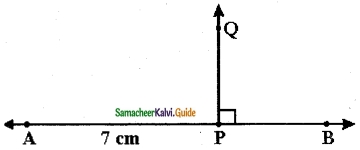
Draw a line segment AB = 7 cm and mark a point P on it. Draw a line perpendicular to the given line segment at P.
Solution:
Samacheer Kalvi 6th Maths Guide Term 2 Chapter 4 Geometry Ex 4.2 1
Step 1 : Draw a line AB = 7 cm and take a point P anywhere on the line.
Step 2 : Place the set square on the line in such a way that the vertex which forms right angle coincides with P and one arm of the right angle coincides with the line AB.
Step 3 : Draw a line PQ through P along the other arm of the right angle of the set square.
Step 4 : The line PQ is perpendicular to the line AB at P. That is, PQ ⊥ AB
∠APQ = ∠BPQ = 90°

Samacheer Kalvi 6th Maths Guide Term 2 Chapter 4 Geometry Ex 4.2

Question 2.
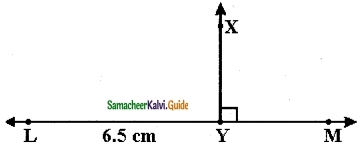
Draw a line segment LM = 6.5 cm and mark a point X not lying on it. Using a set square construct a line perpendicular to LM through X.
Solution:
Samacheer Kalvi 6th Maths Guide Term 2 Chapter 4 Geometry Ex 4.2 2
Step 1 : Draw a line LM = 6.5 cm and take a point X anywhere above the line LM.
Step 2 : Place one of the arms of the right angle of a set square along the line LM and the other arm of its right angle touches the point X.
Step 3 : Draw a line through the point X meeting LM at Y.
Step 4 : The line XY is perpendicular to the line LM at Y. That is, LM ⊥ XY.

Samacheer Kalvi 6th Maths Guide Term 2 Chapter 4 Geometry Ex 4.2

Question 3.
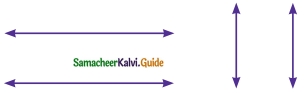
Find the distance between the given lines using a set square at two different points on each of the pairs of lines and check whether they are parallel.
Samacheer Kalvi 6th Maths Guide Term 2 Chapter 4 Geometry Ex 4.2 3
Solution:
They are parallel

Samacheer Kalvi 6th Maths Guide Term 2 Chapter 4 Geometry Ex 4.2

Question 4.
Draw a line segment measuring 7.8 cm. Mark a point B above it at a distance of 5 cm. Through B draw a line parallel to the given segment.
Solution:
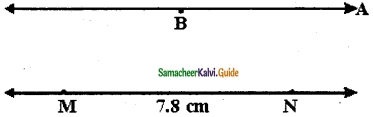
Samacheer Kalvi 6th Maths Guide Term 2 Chapter 4 Geometry Ex 4.2 4
Step 1 : Draw a line. Mark two points M and N on the line such that MN = 7.8 cm. Mark a point B any where above the line.
Step 2 : Place the set square below B in such a way that one of the edges that form a right angle lies along MN Place the scale along the other edge of the set square.
Step 3 : Holding the scale firmly, Slide the set square along the edge of the scale until the other edge of the set square reaches the point B. Through B draw a line.
Step 4 : The line MN is parallel to AB. That is, MN || AB.

Samacheer Kalvi 6th Maths Guide Term 2 Chapter 4 Geometry Ex 4.2

Question 5.
Draw a line and mark a point R above it at a distance of 5.4 cm Through R draw a line parallel to the given line.
Solution:
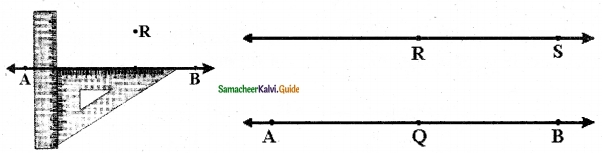
Samacheer Kalvi 6th Maths Guide Term 2 Chapter 4 Geometry Ex 4.2 5
Step 1 : Using a scale draw a line AB and mark a point Q on the line.
Step 2 : Place the set square in such a way that the vertex of the right angle coincides with Q and one of the edges of right angle lies along AB. Mark the point R such that QR = 5.4 cm
Step 3 : Place the scale and the set square as shown in the figure.
Step 4 : Hold the scale firmly and slide the set square along the edge of the scale until the other edge touches the point R. Draw a line RS through R.
Step 5 : The line RS is parallel to AB. That is, RS || AB.

Samacheer Kalvi 6th Maths Guide Term 2 Chapter 4 Geometry Ex 4.2

Samacheer Kalvi 6th Maths Guide Term 3 Chapter 2 Integers Ex 2.2

Students can download Maths Chapter 2 Integers Ex 2.2 Questions and Answers, Notes, Samacheer Kalvi 6th Maths Guide Pdf helps you to revise the complete Tamilnadu State Board New Syllabus, helps students complete homework assignments and to score high marks in board exams.

Tamilnadu Samacheer Kalvi 6th Maths Solutions Term 3 Chapter 2 Integers Ex 2.2

Miscellaneous Practice Problems

Question 1.
Write two different real-life situations that represent the integer -3.
Solution:
(i) A sapling planted at a depth of 3m
(ii) Sheela lost ₹ 3 on selling an apple.

Samacheer Kalvi 6th Maths Guide Term 3 Chapter 2 Integers Ex 2.2

Question 2.
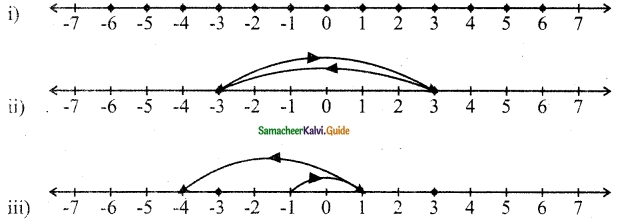
Mark the following numbers on a number line.
(i) All integers which are greater than -7 but less than 7.
(ii) The opposite of 3.
(iii) 5 units to the left of -1.
Solution:
Samacheer Kalvi 6th Maths Guide Term 3 Chapter 2 Integers Ex 2.2 1

Question 3.
Construct a number line that shows the depth of 10 feet from the ground level and its opposite.
Solution:
Samacheer Kalvi 6th Maths Guide Term 3 Chapter 2 Integers Ex 2.2 2

Question 4.
identify the integers and mark on the number line that are at a distance of 8 units from – 6.
Solution:
Samacheer Kalvi 6th Maths Guide Term 3 Chapter 2 Integers Ex 2.2 3

Samacheer Kalvi 6th Maths Guide Term 3 Chapter 2 Integers Ex 2.2

Question 5.
Answer the following questions from the number line given below.
Samacheer Kalvi 6th Maths Guide Term 3 Chapter 2 Integers Ex 2.2 4
(i) Which integer is greater: G or K? Why?
(ii) Find the integer that represents C
(iii) How many integers are there between G and H?
(iv) Find the pairs of letters which are opposite of a number,
(v) Say True or False: 6 units to the left of D is -6.
Solution:
(i) K is greater. K represents -1 and G represents -3. Because it is to the right of G in the negative side of the number line.
(ii) C represents -4
(iii) G represents -3 and H represents 4.
∴ -2, -1, 0, 1, 2, 3 are the 6 numbers between G and H.
(iv) (C, H) and (E, J) are opposite pairs.
(v) False. 6 units to the left of D is 0. Because D represents +6 on the number line

Question 6.
If G is 3 and C is -1, what numbers are A and K on the number line?
Samacheer Kalvi 6th Maths Guide Term 3 Chapter 2 Integers Ex 2.2 5
Solution:
A (-3), K (7)

Samacheer Kalvi 6th Maths Guide Term 3 Chapter 2 Integers Ex 2.2

Question 7.
Find the integers that are 4 units to the left of 0 and 2 units to the right of -3?
Solution:
-4, -1

Challenge Problems

Question 8.
Is there the smallest and the largest number in the set of integers? Give reason.
Solution:
No, we cannot find the smallest (-) and largest (+) number in the set of integers, as the numbers on the number line extend on both sides without an end.

Question 9.
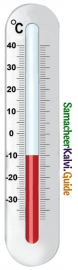
Look at the Celsius Thermometer and answer the following questions.
Samacheer Kalvi 6th Maths Guide Term 3 Chapter 2 Integers Ex 2.2 6
(i) What is the temperature that is shown in the Thermometer?
(ii) Where will you mark the temperature 5°C below 0° C in the Thermometer?
(iii) What will be the temperature, if 10° C is reduced from the temperature shown in the Thermometer?
(iv) Mark the opposite of 15° C in the Thermometer.
Solution:
(i) – 10°C
(ii) – 5°C
(iii) -20°C
(iv) -15°C

Samacheer Kalvi 6th Maths Guide Term 3 Chapter 2 Integers Ex 2.2

Question 10.
P, Q, R, and S are four different integers on a number line. From the following clues, find these integers and write them in ascending order.
(i) S is the least of the given integers.
(ii) R is the smallest positive integer.
(iii) The integers P and S are at the same distance from 0.
(iv) Q is 2 units to the left of integer R.
Solution:
S < Q < 0 < R < P

Question 11.
Assuming that the home to be the starting point, mark the following places in order on the number line as per instruction given below and write their corresponding integers.
Samacheer Kalvi 6th Maths Guide Term 3 Chapter 2 Integers Ex 2.2 7
Places: Home, School, library, Playground, Park, Departmental Store, Bus stand, Railway Station, Post Office, Electricity Board.
Instructions:

  1. The bus stand is 3 units to the right of the Home.
  2. The library is 2 units to the left of Home.
  3. Departmental Store is 6 units to the left of Home.
  4. The post office is 1 unit to the right of the Library.
  5. Park is 1 unit right of Departmental Store.
  6. Railway Station is 3 units left of Post Office.
  7. Bus Stand is 8 units to the right of Railway Station.
  8. School is next to the right of the Bus Stand.
  9. Playground and Library are opposite to each other.
  10. Electricity Board and Departmental Store are at equal distance from Home.

Solution:

  1. 3
  2. -2
  3. -6
  4. -1
  5. -5
  6. -4
  7. 4
  8. 4
  9. 5
  10. 2

Samacheer Kalvi 6th Maths Guide Term 3 Chapter 2 Integers Ex 2.2

Question 12.
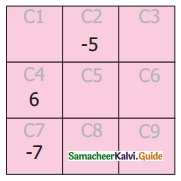
Complete the table using the following hints.
Samacheer Kalvi 6th Maths Guide Term 3 Chapter 2 Integers Ex 2.2 8
(i) C1 : the first non-negative integer.
(ii) C3 : the opposite to the second negative integer.
(iii) C5 : the additive identity in whole numbers.
(iv) C6 : the successor of the integer in C2.
(v) C8 : the predecessor of the integer in C7.
(vi) C9 : the opposite to the integer in C5.
Solution:
(i) C1 : (0)
(ii) C3 : (2)
(iii) C5 : (0)
(iv) C6 : (-4)
(v) C8 : (-8)
(vi) C9 : (0)

Samacheer Kalvi 6th Maths Guide Term 3 Chapter 2 Integers Ex 2.2

Question 13.
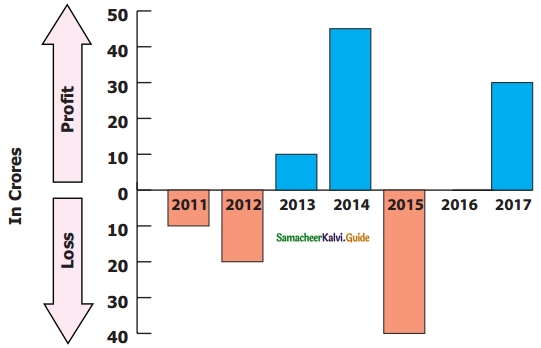
The following bar graph shows the profit (+) and loss (-) of a small scale company (in crores) between the year 2011 to 2017.
Samacheer Kalvi 6th Maths Guide Term 3 Chapter 2 Integers Ex 2.2 9
(i) Write the integer that represents a profit or a loss for the company in 2014?
(ii) Denote by an integer on the profit or loss in 2016.
(iii) Denote by integers on the loss for the company in 2011 and 2012.
(iv) Say True or False: The loss is minimum in 2012.
(v) Fill in: The amount of loss in 2011 is _____ as profit in 2013.
Solution:
(i) Profit ₹ 45 crores. ∴ Ans : + 45
(ii) In 2016 neither profit nor loss happened. ∴ Ans : 0
(iii) In 2011 loss is 10 crores and in 2012 loss is 20 crores.
∴ -10 and-20.
(iv) False. In 2011 the company’s loss is minimum.
(v) The same. Because in 2013 the profit is 10 crores and in 2011 the loss is 10 crores.

Samacheer Kalvi 6th Maths Guide Term 3 Chapter 5 Information Processing Ex 5.2

Students can download Maths Chapter 5 Information Processing Ex 5.2 Questions and Answers, Notes, Samacheer Kalvi 6th Maths Guide Pdf helps you to revise the complete Tamilnadu State Board New Syllabus, helps students complete homework assignments and to score high marks in board exams.

Tamilnadu Samacheer Kalvi 6th Maths Solutions Term 3 Chapter 5 Information Processing Ex 5.2

Miscellaneous Practice Questions 

Question 1.
Find HCF of 188 and 230 by Euclid’s game.
Solution:
By Euclid’s game HCF (a, b) = HCF (a, a – b) if a > b.
Here HCF (188, 230) = HCF (230, – 188) because 230 > 188
= HCF (188, 42) = HCF (146, 42)
= HCF (104, 42) = HCF (62, 42)
= HCF (42, 20) = HCF (22, 20)
= HCF (20,2) = HCF (18, 2) = 2
∴ HCF (230, 188) = 2

Samacheer Kalvi 6th Maths Guide Term 3 Chapter 5 Information Processing Ex 5.2

Question 2.
Write the numbers from 1 to 50. From that find the following.
i) The numbers which are neither divisible by 2 nor 7.
ii) The prime numbers between 25 and 40
iii) All square numbers upto 50.
Solution:
1, 2, 3, 4, 5, 6, 7, 8, 9, 10, 11, 12, 13, 14, 15, 16, 17, 18, 19, 20, 21, 22, 23, 24, 25, 26, 27, 28, 29, 30, 31, 32, 33, 34, 35, 36, 37, 38, 39, 40, 41, 42, 43, 44, 45, 46, 47, 48, 49, 50.
i) The numbers neither divisible by 2 nor 7 are 9, 11, 13, 15, 17, 19, 23, 25, 27, 29, 31, 33, 37, 39, 41, 43, 45, 47.
ii) The prime numbers between 25 and 40 are 29, 31, 37.
iii) Square numbers upto 50 are 1, 4, 9, 16, 25, 36, 49

Question 3.
Complete the following pattern.
(i) 1 + 2 + 3 + 4 = 10
2 + 3 + 4 + 5 = 14
___ + 4 + 5 + 6 = ___
4 + 5 + 6 + ___ = ___

(ii) 1 + 3 + 5 + 7 = 16
___ + 5 + 7 + 9 = 24
5 + 7 + 9 + ___ = ___
7 + 9 + ___ + 13 = ___

(iii) AB, DEF, HIJK, ___ , STUVWX
(vi) 20, 19, 17, ___ , 10, 5
Solution:
(i) 3, 18; 7, 22
(ii) 3; 11, 32; 11, 40
(iii) MNOPQ
(iv) 14

Samacheer Kalvi 6th Maths Guide Term 3 Chapter 5 Information Processing Ex 5.2

Question 4.
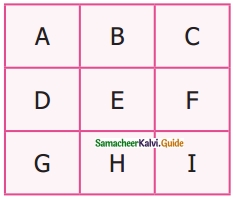
Complete the table by using the following instructions.
Samacheer Kalvi 6th Maths Guide Term 3 Chapter 5 Information Processing Ex 5.2 1
A : It is the 6th term in the Fibonacci sequence.
B : The predecessor of 2.
C : LCM of 2 and 3.
D : HCF of 6 and 20.
E : The reciprocal of 1/5.
F : The opposite number of -7.
G : The first composite number.
H : Area of a square of side 3 cm.
I : The number of lines of symmetry of an equilateral triangle.
After completing the table, what do you observe? Discuss.
Solution:
A – 8, B – 1, C – 6, D – 2, E – 5, F – 7, G – 4, H – 9, I – 3

Samacheer Kalvi 6th Maths Guide Term 3 Chapter 5 Information Processing Ex 5.2

Question 5.
Assign the number for English alphabets as 1 for A, 2 for B upto 26 for Z. Find the meaning of
Samacheer Kalvi 6th Maths Guide Term 3 Chapter 5 Information Processing Ex 5.2 2
Solution:
GOOD MORNING

Question 6.
Replace the letter with symbols as + for A, – for B, × for C, and ÷ for D. Find the answer for the pattern 4B3C5A30D2 by doing the given operations.
Solution:
Given the symbols + for A; – for B; × for C; + for D .
∴ 4B3C5A30D2 becomes
4 – 3 × 5 + 30 ÷ 2 Using BIDMAS rule
4 – 3 × 5 + 30 ÷ 2 = 4 – 3 × 5 + 15[× done first]
= 4 – 15 + 15 [+ done second]
= 4 – 0 [+ done third]
= 4 [- done last]

Question 7.
Observe the pattern and find the word by hiding the Numbers 1 H 2 0 3 W, 4 A 5 R 6 E, 7 Y 8 0 9 U.
Solution:
HOW ARE YOU

Samacheer Kalvi 6th Maths Guide Term 3 Chapter 5 Information Processing Ex 5.2

Question 8.
Arrange the following from the eldest to the youngest. What do you get?
Samacheer Kalvi 6th Maths Guide Term 3 Chapter 5 Information Processing Ex 5.2 3
Solution:
Arranging from eldest to the youngest we get
F – refers to grandparents
A – refers to parents
M – refers to an uncle
I – refers to elder sister
L – refers to me
Y – refers to the younger brother
So we get FAMILY

Challenge Problems

Question 9.
Prepare a daily time schedule for evening study at home.
Solution:
5.00 pm to 6.00 pm – Mathematics
6.0 pm to 7.00 pm – Science
7.0 pm to 8.00 pm – Social Science
8. pm to 9.00 pm – Dinner & Recreation
9. pm to 10.00 pm – Tamil and English

Samacheer Kalvi 6th Maths Guide Term 3 Chapter 5 Information Processing Ex 5.2

Question 10.
Observe the geometrical pattern and answer the following questions.
Samacheer Kalvi 6th Maths Guide Term 3 Chapter 5 Information Processing Ex 5.2 4
(i) Write down the number of sticks used in each iterative pattern,
(ii) Draw the next figure in the pattern also find the total number of sticks used in it.
Solution:
(i) 3, 9, 18
Samacheer Kalvi 6th Maths Guide Term 3 Chapter 5 Information Processing Ex 5.2 5

Samacheer Kalvi 6th Maths Guide Term 3 Chapter 5 Information Processing Ex 5.2

Question 11.
Find the HCF of 28, 35, 42 by Euclid’s game.
Solution:
HCF of 28, 35, 42
HCF of (28, 35 – 28, 42 – 28)
28 = 2 × 2 × 7
7 = 1 × 7
14 = 2 × 7
HCF of (28, 7, 14) = 7

Question 12.
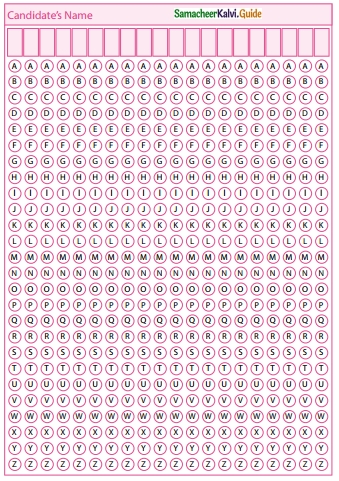
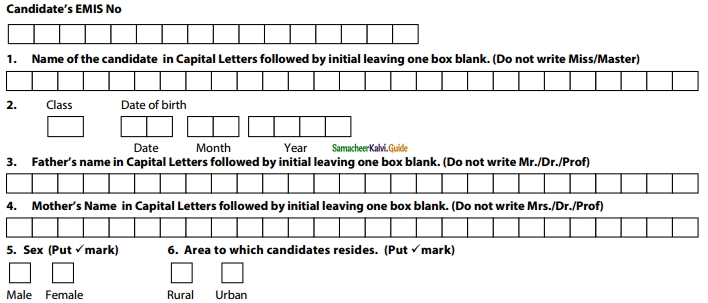
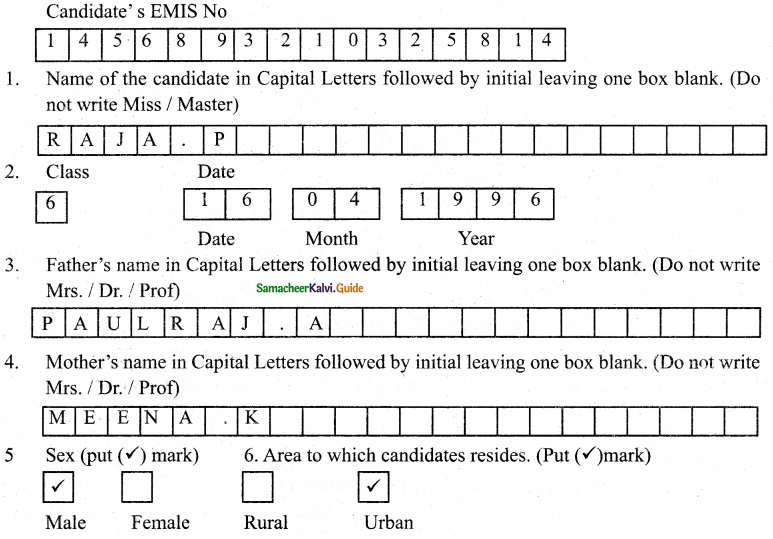
Follow the given instructions to fill your name in the OMR sheet.
1. The name should be written in capital letters from left to right.
2. One alphabet is to be entered in each box.
3. If any empty boxes are there at the end they should be left blank.
4. Ballpoint pen is to be used for shading the bubbles for the corresponding alphabets.
Samacheer Kalvi 6th Maths Guide Term 3 Chapter 5 Information Processing Ex 5.2 6
Solution:
Do your self.

Samacheer Kalvi 6th Maths Guide Term 3 Chapter 5 Information Processing Ex 5.2

Question 13.
Consider the Postal index number (PIN) written on the letters as follows: 604506; 604516; 604560; 604506; 604516; 604516; 604560; 604516; 604505; 604470; 604515; 604520; 604303; 604509; 604470. How the letters can be sorted as per Postal Index Numbers?
Solution:
604 is common for all postal index numbers. Compare the remaining 3 digits, 303, 470, 505, 506 (two) 509, 510. 515, 516 (Four), 520, 560 (two).

Samacheer Kalvi 6th Maths Guide Term 3 Chapter 5 Information Processing Ex 5.1

Students can download Maths Chapter 5 Information Processing Ex 5.1 Questions and Answers, Notes, Samacheer Kalvi 6th Maths Guide Pdf helps you to revise the complete Tamilnadu State Board New Syllabus, helps students complete homework assignments and to score high marks in board exams.

Tamilnadu Samacheer Kalvi 6th Maths Solutions Term 3 Chapter 5 Information Processing Ex 5.1

Question 1.
Study and complete the following pattern.
(i) 1 × 1 = 1
11 × 11 = 121
111 × 111 = 12321
1111 × 1111 = ?
11111 × 11111 = ?
Samacheer Kalvi 6th Maths Guide Term 3 Chapter 5 Information Processing Ex 5.1 1
Solution:
(i) 1234321, 123454321
(ii) 144, 60, 84, 36, 48, 15, 27

Samacheer Kalvi 6th Maths Guide Term 3 Chapter 5 Information Processing Ex 5.1

Question 2.
Find next three numbers in the following number patterns.
(i) 50, 51, 53, 56, 60……
(ii) 77, 69, 61, 53, ……
(iii) 10, 20, 40, 80,…
(iv) \(\frac{21}{33}\), \(\frac{321}{444}\), \(\frac{4321}{555}\)
Solution:

i) The pattern generating these numbers is
50, 50 + 1, 51 + 2, 53 + 3, 56 + 4, 60 + 5, 65 + 6, 71 + 7,
∴ 50, 51, 53, 56, 60, 65, 71, 78, ……
∴ The next three numbers will be 65, 71, 78

ii) The pattern generating these numbers is
77, 77 – 8, 69 – 8, 61 – 8, 53 – 8, 45 – 8, 37 – 8, 29
77, 69, 61, 53, 45, 37, 29, 21,
∴ The next three numbers will be 45, 37, 29.

iii) The pattern generating these numbers is
10, 10 + 10, 20 + 20, 40 + 40, 80 + 80, 160 + 160, 320 + 320,….
10, 20, 40, 80, 160, 320, 640,….
∴ The next three numbers will be 160, 320, 640.

(iv) \(\frac{54321}{66666}\), \(\frac{654321}{777777}\), \(\frac{7654321}{8888888}\)

Question 3.
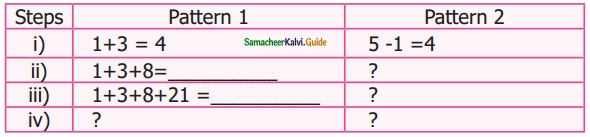
Consider the Fibonacci sequence 1, 1, 2, 3, 5, 8, 13, 21, 34, 55,…. Observe and complete the following table by understanding the number patterns? followed. After filling the table discuss the pattern followed in addition and subtraction, of the numbers of the sequence?
Samacheer Kalvi 6th Maths Guide Term 3 Chapter 5 Information Processing Ex 5.1 2
Solution:
(i) 12, 13 – 1 = 12
(ii) 33, 34 – 1 = 33
(iii) 1 + 3 + 8 + 21 + 55 = 88, 89 – 1 = 88

Samacheer Kalvi 6th Maths Guide Term 3 Chapter 5 Information Processing Ex 5.1

Question 4.
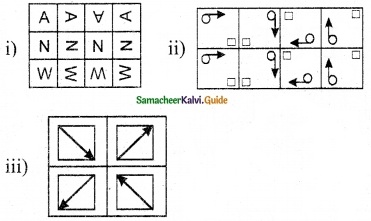
Complete the following patterns.
Samacheer Kalvi 6th Maths Guide Term 3 Chapter 5 Information Processing Ex 5.1 3
Solution:
Samacheer Kalvi 6th Maths Guide Term 3 Chapter 5 Information Processing Ex 5.1 4

Question 5.
Find the HCF of the following pair of numbers by Euclid’s game
(i) 25 and 35
(ii) 36 and 12
(iii) 15 and 29
Solution:
(i) HCF of (25, 35 – 25)
25 = 5 × 5
10 = 2 × 5
HCF of (25, 10) = 5

(ii) HCF of (36, 36 – 12)
36 = 2 × 2 × 3 × 3
24 = 2 × 2 × 2 × 3
HCF of (36, 24) = 2 × 2 × 3 = 12

(iii) HCF of (15, 29 -15)
15 = 3 × 5 × 1
14 = 2 × 7 × 1
HCF of (15, 14) = 1

Samacheer Kalvi 6th Maths Guide Term 3 Chapter 5 Information Processing Ex 5.1

Question 6.
Find HCF of 48 and 28. Also find the HCF of 48 and the number obtained by finding their difference.
Solution:
HCF of 48 and 28
48 = 2 × 2 × 2 × 2 × 3
28 = 2 × 2 × 7
HCF of (48, 28) = 2 × 2 = 4
HCF of (48, 48 – 28)
48 = 2 × 2 × 2 × 2 × 3
20 = 2 × 2 × 5
HCF of (48, 20) = 4

Question 7.
Give instructions to fill in a bank withdrawal form issued in a bank.
Solution:

  • The name should be written in capital letters from left to right.
  • Write the date of withdrawal on the right top comer of the form.
  • Write the amount (in words) to be withdrawn in the space provided.
  • Write the amount (in figures) to be withdrawn in the box provided.
  • Put your signature at the right bottom above the ‘signature of the depositor’.

Samacheer Kalvi 6th Maths Guide Term 3 Chapter 5 Information Processing Ex 5.1

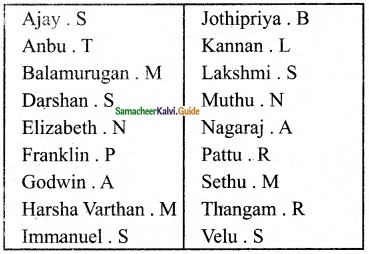
Question 8.
Arrange the name of your classmates alphabetically.
Solution:
Samacheer Kalvi 6th Maths Guide Term 3 Chapter 5 Information Processing Ex 5.1 5

Question 9.
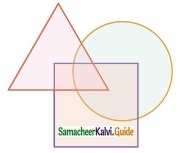
Follow and execute the instructions given below.
Samacheer Kalvi 6th Maths Guide Term 3 Chapter 5 Information Processing Ex 5.1 6
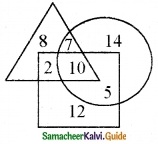
(i) Write the number 10 in the place common to the three figures
(ii) Write the number 5 in the place common for square and circle only.
(iii) Write the number 7 in the place common for triangle and circle only.
(iv) Write the number 2 in the place common for triangle and square only.
(v) Write the numbers 12, 14, and 8 only in square, circle, and triangle respectively.
Solution:
Samacheer Kalvi 6th Maths Guide Term 3 Chapter 5 Information Processing Ex 5.1 7

Samacheer Kalvi 6th Maths Guide Term 3 Chapter 5 Information Processing Ex 5.1

Question 10.
Fill in the following information
Samacheer Kalvi 6th Maths Guide Term 3 Chapter 5 Information Processing Ex 5.1 8
Solution:
Samacheer Kalvi 6th Maths Guide Term 3 Chapter 5 Information Processing Ex 5.1 9

Objective Type Questions

Question 11.
The next term in the sequence 15, 17, 20, 22, 25, … is
(a) 28
(b) 29
(c) 27
Hint:
Add 2 and 3 alternatively
Solution:
(c) 27

Samacheer Kalvi 6th Maths Guide Term 3 Chapter 5 Information Processing Ex 5.1

Question 12.
What will be the 25th letter in the pattern? ABCAABBCCAAABBBCCC,…
(a) B
(b) C
(c) D
(d) A
Solution:
(a) B

Question 13.
The difference between 6th term add 5th term in the Fibonacci sequence is ___.
(a) 6
(b) 8
(c) 5
(d) 3
Solution:
(d) 3

Samacheer Kalvi 6th Maths Guide Term 3 Chapter 5 Information Processing Ex 5.1

Question 14.
The 11th term in the Lucas sequence 1, 3, 4, 7, is
(a) 199
(b) 76
(c) 123
(d) 47
Solution:
(a) 199

Question 15.
If the Highest Common Factor of 26 and 54 is 2, then HCF of 54 and 28 is .
(a) 26
(b) 2
(c) 54
(d) 1
Hint: HCF (54, 28) = HCF (28, 26) = 2
Solution:
(b) 2

Samacheer Kalvi 6th Maths Guide Term 3 Chapter 4 Symmetry Ex 4.2

Students can download Maths Chapter 4 Symmetry Ex 4.2 Questions and Answers, Notes, Samacheer Kalvi 6th Maths Guide Pdf helps you to revise the complete Tamilnadu State Board New Syllabus, helps students complete homework assignments and to score high marks in board exams.

Tamilnadu Samacheer Kalvi 6th Maths Solutions Term 3 Chapter 4 Symmetry Ex 4.2

Miscellaneous Practice Problems

Question 1.
Draw and answer the following.
(i) A triangle which has no line of symmetry.
(ii) A triangle which has only one line of symmetry
(iii) A triangle which has three lines of symmetry.
Solution:
(i) Scalene triangle
(ii) Isosceles triangle
(iii) Equilateral triangle

Samacheer Kalvi 6th Maths Guide Term 3 Chapter 4 Symmetry Ex 4.2

Question 2.
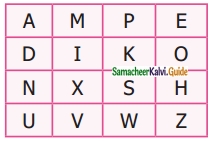
Find the alphabets in the box which have
Samacheer Kalvi 6th Maths Guide Term 3 Chapter 4 Symmetry Ex 4.2 1
(i) No line of symmetry
(ii) Rotational symmetry
(iii) Reflection symmetry
(iv) Reflection and rotational symmetry.
Solution:
i) The alphabets which have no line of symmetry are P, N, S, Z
ii) The alphabets which have Rotational symmetry are I, O, N, X, S, H, Z
iii) The alphabets which have reflection symmetry are A, M, E, D, I, K, O, X, H, U, V, W.
iv) The alphabets which has reflection and rotational symmetry are I, O, X, H.

Samacheer Kalvi 6th Maths Guide Term 3 Chapter 4 Symmetry Ex 4.2

Question 3.
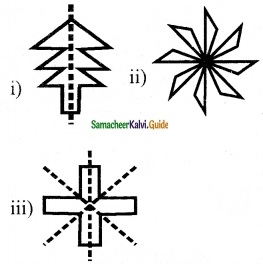
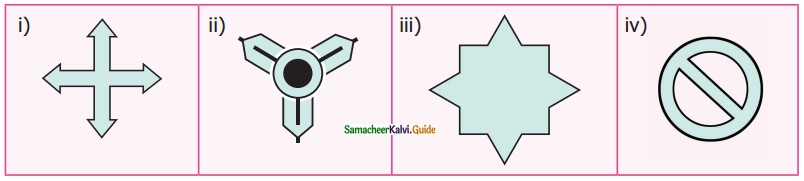
For the following pictures, find the number of lines of symmetry and also find the order of rotation.
Samacheer Kalvi 6th Maths Guide Term 3 Chapter 4 Symmetry Ex 4.2 2
Solution:
(i) 0, 2
(ii) 1, 0
(iii) 2, 2
(iv) 8, 8
(v) 1, 0

Samacheer Kalvi 6th Maths Guide Term 3 Chapter 4 Symmetry Ex 4.2

Question 4.
The three-digit number 101 has rotational and reflection symmetry. Give five more examples of three-digit numbers that have both rotational and reflection symmetry
Solution:
The digits 0, 1, 8 have rotational and reflection symmetry.
∴ The three digits numbers 181, 111, 808, 818, 888 have both rotational and reflection symmetry.

Question 5.
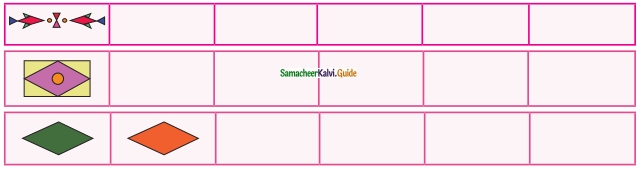
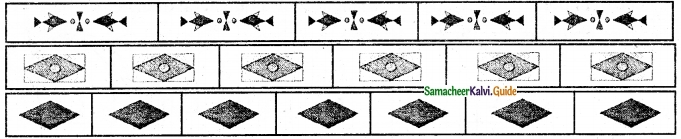
Translate the given pattern and complete the design in a rectangular strips?
Samacheer Kalvi 6th Maths Guide Term 3 Chapter 4 Symmetry Ex 4.2 3
Solution:
Samacheer Kalvi 6th Maths Guide Term 3 Chapter 4 Symmetry Ex 4.2 4

Samacheer Kalvi 6th Maths Guide Term 3 Chapter 4 Symmetry Ex 4.2

Challenge Problems

Question 6.
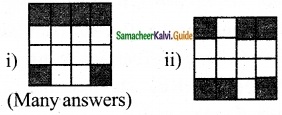
Shade one square so that it possesses
Samacheer Kalvi 6th Maths Guide Term 3 Chapter 4 Symmetry Ex 4.2 5
(i) One line of symmetry
(ii) Rotational symmetry of order 2
Solution:
Samacheer Kalvi 6th Maths Guide Term 3 Chapter 4 Symmetry Ex 4.2 6

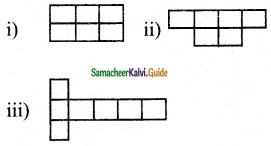
Question 7.
Join six identical squares so that atleast one side of a square fits exactly with any other side of the square and has reflection symmetry (any three ways).
Solution:
Samacheer Kalvi 6th Maths Guide Term 3 Chapter 4 Symmetry Ex 4.2 7

Samacheer Kalvi 6th Maths Guide Term 3 Chapter 4 Symmetry Ex 4.2

Question 8.
Draw the following
(i) A figure which has reflection symmetry but no rotational symmetry.
(ii) A figure which has rotational symmetry but no reflection symmetry.
(iii) A figure which has both reflection and rotational symmetry.
Solution:
Samacheer Kalvi 6th Maths Guide Term 3 Chapter 4 Symmetry Ex 4.2 8

Question 9.
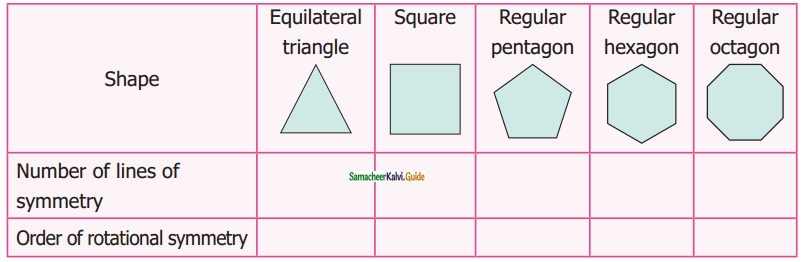
Find the line of symmetry and the order of rotational symmetry’ of the given regular polygons and complete the following table and answer the questions given below.
Samacheer Kalvi 6th Maths Guide Term 3 Chapter 4 Symmetry Ex 4.2 9
i) A regular polygon of 10 sides will have ______ lines of symmetry.
ii) If a regular polygon has 10 lines of symmetry then its order of rotational symmetry is ______
iii) A regular polygon of ‘n’ sides has lines of symmetry and the order of rotational symmetry is ______
Solution:
(i) 10
(ii) 10
(iii) n, n

Samacheer Kalvi 6th Maths Guide Term 3 Chapter 4 Symmetry Ex 4.2

Question 10.
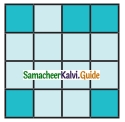
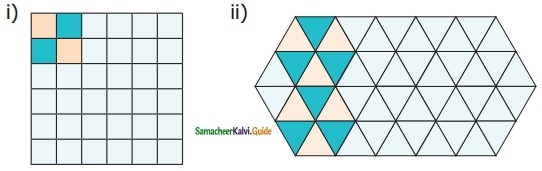
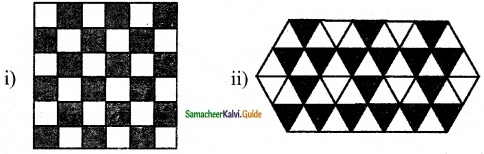
Colour the boxes in such a way that it possesses translation symmetry.
Samacheer Kalvi 6th Maths Guide Term 3 Chapter 4 Symmetry Ex 4.2 10
Solution:
Samacheer Kalvi 6th Maths Guide Term 3 Chapter 4 Symmetry Ex 4.2 11

Samacheer Kalvi 6th Maths Guide Term 3 Chapter 4 Symmetry Ex 4.1

Students can download Maths Chapter 4 Symmetry Ex 4.1 Questions and Answers, Notes, Samacheer Kalvi 6th Maths Guide Pdf helps you to revise the complete Tamilnadu State Board New Syllabus, helps students complete homework assignments and to score high marks in board exams.

Tamilnadu Samacheer Kalvi 6th Maths Solutions Term 3 Chapter 4 Symmetry Ex 4.1

Question 1.
Fill in the blanks
(i) The reflected image of the letter ‘q’ is …….
(ii) A rhombus has ………… lines of symmetry.
(iii) The order of rotational symmetry of the letter ‘Z’ is ……….
(iv) A figure is said to have rotational symmetry, if the order of rotation is atleast ……….
(v) ……… symmetry occurs when an object slides to new position.
Solution:
(i) P
(ii) two
(iii) 2
(iv) two
(v) Translation

Samacheer Kalvi 6th Maths Guide Term 3 Chapter 4 Symmetry Ex 4.1

Question 2.
Say True or False
(i) A rectangle has four lines of symmetry.
(ii) A shape has reflection symmetry if it has a line of symmetry.
(iii) The reflection of the name RANI is INAЯ.
(iv) Order of rotation of a circle is infinite.
(v) The number 191 has rotational symmetry.
Solution:
(i) False
(ii) True
(iii) False
(iv) True
(v) False

Question 3.
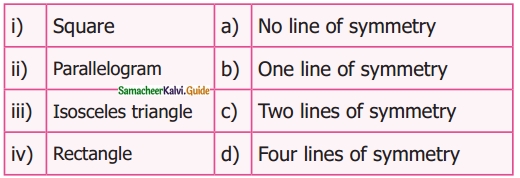
Match the following shapes with their number of lines of symmetry.
Samacheer Kalvi 6th Maths Guide Term 3 Chapter 4 Symmetry Ex 4.1 1
Solution:
(i) d
(ii) a
(iii) b
(iv) c

Samacheer Kalvi 6th Maths Guide Term 3 Chapter 4 Symmetry Ex 4.1

Question 4.
Draw the lines of symmetry of the following.
Samacheer Kalvi 6th Maths Guide Term 3 Chapter 4 Symmetry Ex 4.1 2
Solution:
Samacheer Kalvi 6th Maths Guide Term 3 Chapter 4 Symmetry Ex 4.1 3

Question 5.
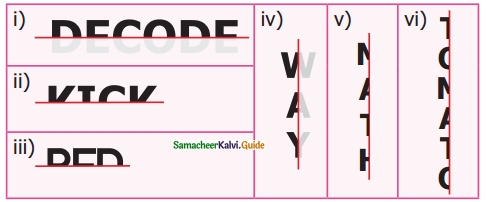
Using the given horizontal line/ vertical line as a line of symmetry, complete each alphabet to discover the hidden word.
Samacheer Kalvi 6th Maths Guide Term 3 Chapter 4 Symmetry Ex 4.1 4
Solution:
(i) DECODE
(ii) KICK
(iii) BED
(iv) WAY
(v) MATY
(vi) TOMATO

Samacheer Kalvi 6th Maths Guide Term 3 Chapter 4 Symmetry Ex 4.1

Question 6.
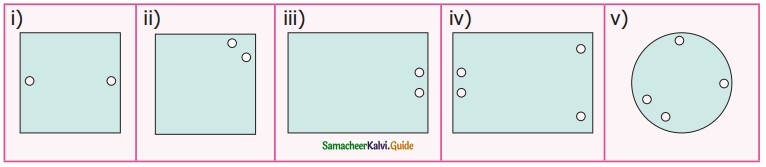
Draw a line of symmetry of the given figures such that one hole coincides with the other hole(s) to make pairs.
Samacheer Kalvi 6th Maths Guide Term 3 Chapter 4 Symmetry Ex 4.1 5
Solution:
Samacheer Kalvi 6th Maths Guide Term 3 Chapter 4 Symmetry Ex 4.1 6

Question 7.
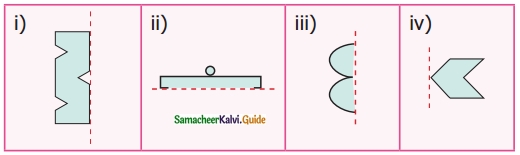
Complete the other half of the following figures such that the dotted line is the line of symmetry.
Samacheer Kalvi 6th Maths Guide Term 3 Chapter 4 Symmetry Ex 4.1 7
Solution:
Samacheer Kalvi 6th Maths Guide Term 3 Chapter 4 Symmetry Ex 4.1 8

Samacheer Kalvi 6th Maths Guide Term 3 Chapter 4 Symmetry Ex 4.1

Question 8.
Find the order of rotation for each of the following.
Samacheer Kalvi 6th Maths Guide Term 3 Chapter 4 Symmetry Ex 4.1 9
Solution:
(i) 2
(ii) 2
(iii) 4
(iv) 8
(v) 2

Question 9.
A standard die has six faces which are shown below. Find the order of rotational symmetry of each face of a die?
Samacheer Kalvi 6th Maths Guide Term 3 Chapter 4 Symmetry Ex 4.1 10
Solution:
(i) 4
(ii) 2
(iii) 2
(iv) 4
(v) 4
(vi) 2

Samacheer Kalvi 6th Maths Guide Term 3 Chapter 4 Symmetry Ex 4.1

Question 10.
What pattern is translated in the given border kolams?
Samacheer Kalvi 6th Maths Guide Term 3 Chapter 4 Symmetry Ex 4.1 11
Solution:
Samacheer Kalvi 6th Maths Guide Term 3 Chapter 4 Symmetry Ex 4.1 12

Objective Type Questions

Question 11.
Which of the following letter does not have a line of symmetry?
(a) A
(b) P
(c) T
(d) U
Hint: A, T, U have one line of symmetry
Solution:
(b) P

Samacheer Kalvi 6th Maths Guide Term 3 Chapter 4 Symmetry Ex 4.1

Question 12.
Which of the following is a symmetrical figure?
Samacheer Kalvi 6th Maths Guide Term 3 Chapter 4 Symmetry Ex 4.1 13
Solution:
(c)

Question 13.
Which word has a vertical line of symmetry?
(a) DAD
(b) NUN
(c) MAM
(d) EVE
Hint: D, N, E have no vertical line of symmetry
Solution:
D, N, E have no vertical line of symmetry

Question 14.
The order of rotational symmetry of 818 is ………
(a) 1
(b) 2
(c) 3
(d) 4
Solution:
(b) 2

Samacheer Kalvi 6th Maths Guide Term 3 Chapter 4 Symmetry Ex 4.1

Question 15.
The order of rotational symmetry ★ is ___
(a) 5
(b) 6
(c) 7
(d) 8
Solution:
(a) 5

Samacheer Kalvi 6th Maths Guide Term 3 Chapter 3 Perimeter and Area Ex 3.2

Students can download Maths Chapter 3 Perimeter and Area Ex 3.2 Questions and Answers, Notes, Samacheer Kalvi 6th Maths Guide Pdf helps you to revise the complete Tamilnadu State Board New Syllabus, helps students complete homework assignments and to score high marks in board exams.

Tamilnadu Samacheer Kalvi 6th Maths Solutions Term 3 Chapter 3 Perimeter and Area Ex 3.2

Miscellaneous Practice Problems

Question 1.
A piece of wire is 36 cm long. What will be the length of each side if we form
(i) a square
(ii) an equilateral triangle
Solution:

Given the length of the wire = 36 cm
i) When a square is formed out of it
The perimeter of the square = 36 cm
4 × side = 36
side = \(\frac{36}{4}\) = 9 cm
Side of the square

ii) When an equilateral triangle is formed out of it, its perimeter = 36 cm
i.e., side + side + side = 36 cm .
3 × side = 36 cm
side = \(\frac{36}{3}\) = 12 cm
One side of an equilateral triangle = 12 cm

Samacheer Kalvi 6th Maths Guide Term 3 Chapter 3 Perimeter and Area Ex 3.2

Question 2.
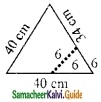
From one vertex of an equilateral triangle with a side of 40 cm, an equilateral triangle with 6 cm side is removed. What is the perimeter of the remaining portion? The perimeter of the remaining portion
Solution:
Samacheer Kalvi 6th Maths Guide Term 3 Chapter 3 Perimeter and Area Ex 3.2 1
= (40 + 34 + 6 + 34) cm
= 114 cm

Question 3.
Rahim and Peter go for a morning walk, Rahim walks around a. square path of side 50 m and Peter walks around a rectangular path with a length of 40 m and a breadth of 30 m. If both of them walk 2 rounds each, who covers more distance and by how much?
Solution:
Distance covered by Rahim
= 50 × 4 m
= 200 m
If he walks 2 rounds, distance covered = 2 × 200 m
= 400 m
Distance covered by peter
= 2 (40 + 30) m
= 2(70)m
= 140 m
If he walks 2 rounds, distance covered = 2 × 140 m
= 280 m
∴ Rahim covers more distance by (400 – 280) = 120 m

Samacheer Kalvi 6th Maths Guide Term 3 Chapter 3 Perimeter and Area Ex 3.2

Question 4.
The length of a rectangular park is 14 m more than its breadth. If the perimeter of the park is 200 m, what is its length? Find the area of the park.
Solution:
Let the length be b + 14 m
breadth = b
perimeter = 200
2 (l + b) = 200
2 (b + 14 + b) = 200
2 (2b + 14) = 200
28 + 4b = 200
4b = 200 – 28
4b = 172 m
b = \(\frac{172}{4}\)
b = 43 m
Length = b + 14
= 43 + 14
Length l = 57 m
Area = l × b units
= 57 × 43 m²
= 2451 m²

Samacheer Kalvi 6th Maths Guide Term 3 Chapter 3 Perimeter and Area Ex 3.2

Question 5.
Your garden is in the shape of a square of side 5 m. Each side is to be fenced with 2 rows of wire. Find how much amount is needed to fence the garden at ₹ 10 per metre.
Solution:
a = 5 m
The perimeter of the garden
= 4 a units
= 4 × 5 m
= 20 m
For 1 row
Amount needed to fence l m= Rs 10
Amount needed to fence 20 m
= Rs 10 × 20
= Rs 200
For 2 rows
Total amount needed = 2 × Rs 200 = Rs 400

Samacheer Kalvi 6th Maths Guide Term 3 Chapter 3 Perimeter and Area Ex 3.2

Challenge Problems

Question 6.
A closed shape has 20 equal sides and one of its sides is 3 cm. Find its perimeter.
Solution:
Number of equal sides in the shape = 20
One of its side = 3 cm
Perimeter = length of one side × Number of equal sides
∴ Perimeter = (3 × 20) cm = 60 cm
∴ Perimeter = 60 cm

Question 7.
A rectangle has length 40 cm and breadth 20 cm. How many squares with side 10 cm can be formed from it.
Solution:
Area of rectangle = (length × breadth) units2
Length = 40 cm
Breadth = 20 cm
∴ Area = (40 × 20) cm2 = 800 cm2
Area of rectangle = 800 cm2
Area of square = (side × side) units2
side = 10 cm
∴ Area of square = (10 × 10) cm2 = 100 cm2
Required number of squares = \(\frac{\text { Area of Rectangle }}{\text { Area of } 1 \text { square }}=\frac{800 \mathrm{cm}^{2}}{100 \mathrm{cm}^{2}}\) = 8
8 squares can be formed.

Samacheer Kalvi 6th Maths Guide Term 3 Chapter 3 Perimeter and Area Ex 3.2

Question 8.
The length of a rectangle is three times its breadth. If its perimeter is 64 cm, find the sides of the rectangle.
Solution:
Given perimeter of a rectangle = 64 cm
Also given length is three times its breadth.
Let the breadth of the rectangle = b cm
∴ Length = 3 × b cm
Perimeter = 64 m
i.e., 2 × (l + b) = 64 m
2 × (3b + b) = 64 m
2 × 4b = 64m
4b = \(\frac{64}{2}\) = 32 m
b = \(\frac{32}{4}\) = 8 m
l = 3 × b = 3 × 8 = 24 m
∴ Breadth of the rectangle = 8 m
Length of the rectangle = 24 m

Question 9.
How many different rectangles can be made with a 48 cm long string? Find the possible pairs of length and breadth of the rectangles.
Solution:
Length of the string to be made into rectangle = 48 cm
∴ Perimeter of the rectangle = 48 cm
2 × (l + b) = 48 cm
l + b = \(\frac{48}{2}\)
l + b = 24 cm
Possible pairs of length and breadth are (1, 23), (2, 22) (3, 21), (4, 20), (5, 19),
(6, 18), (7, 17), (8, 16), (9, 15), (10, 14), (11, 13), (12, 12)
Number of different rectangles = 12.

Samacheer Kalvi 6th Maths Guide Term 3 Chapter 3 Perimeter and Area Ex 3.2

Question 10.
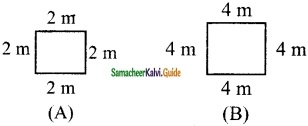
Draw a square B whose side is twice of the square A. Calculate the perimeters of the squares A and B.

Solution:
Samacheer Kalvi 6th Maths Guide Term 3 Chapter 3 Perimeter and Area Ex 3.2 2
Perimeter of A = s + s + s + s units = 4 s units
Perimeter of B = (2s + 2s + 2s + 2s) units
= 8s units = 2 (4s) units.
∴ The perimeter of B is twice the perimeter of A

Question 11.
What will be the area of a new square formed if the side of a square is made one – fourth?
Solution:
Let the side of square is s units then area = (s × s) units2
If the side of the new square is made one fourth then side = \(\left(\frac{1 \times s}{4}\right)\) units
Then area = \(\left(\frac{1 \times s}{4} \times \frac{1 \times s}{4}\right)\) units2 = \(\frac{s \times s}{16}=\frac{1}{16}\) (s × s) units2
Area of the new square is reduced to \(\frac{1}{16}\) times to that of original area.

Question 12.
Two plots have the same perimeter. One . is a square of side 10 m and another is a rectangle of breadth 8 m. Which plot has the greater area and by how much?
Solution:
a = 10 m, b = 8 m
Perimeter of the square plot
= 4 a units
= 4 × 10 m
= 40 m
Perimeter of the rectangular plot
40 = 2 (l + b) units
40 = 2 (l + 8) m
40 = 2 l + 16
2 l = 40 – 16
2 l = 24
l = \(\frac{24}{2}\)
l = 12 m
Area of the square plot
= a × a sq units
= 10 × 10 m²
= 100 m²
Area of the rectangular plot
= l × b sq units
= 8 × 12 m²
= 96 m²
Square plot has the greater area by 100 m² – 96 m² – 4 m²

Samacheer Kalvi 6th Maths Guide Term 3 Chapter 3 Perimeter and Area Ex 3.2

Question 13.
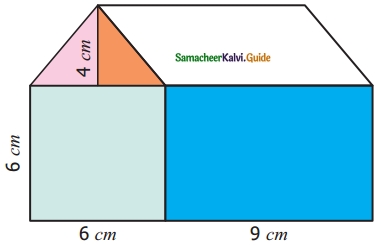
Look at the picture of the house given and find the total area of the shaded portion.
Samacheer Kalvi 6th Maths Guide Term 3 Chapter 3 Perimeter and Area Ex 3.2 3
Solution:
Total area of the shaded region = Area of a right triangle + Area of a rectangle
= (\(\frac{1}{2}\) × b × h) + (l × b) cm2
= [(\(\frac{1}{2}\) × 3 × 4) + (9 × 6)] cm2
= (6 + 54) cm2 = 60 cm2

Samacheer Kalvi 6th Maths Guide Term 3 Chapter 3 Perimeter and Area Ex 3.2

Question 14.
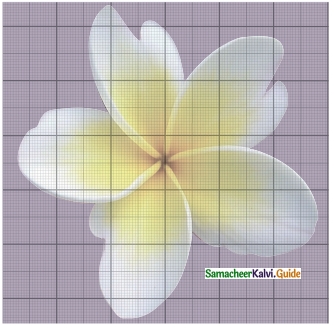
Find the approximate area of the flower in the given square grid.
Samacheer Kalvi 6th Maths Guide Term 3 Chapter 3 Perimeter and Area Ex 3.2 4
Solution:
No of full squares = 11
No of half squares = 9
Area of 11 full squares
= 11 x 1 cm²
= 11 cm²
Area of 9 half squares
= 9 × \(\frac{1}{2}\) cm²
= 4.5 cm²
Area of the flower = (11 + 4.5) cm²
= 15.5 cm²

Samacheer Kalvi 6th Maths Guide Term 3 Chapter 3 Perimeter and Area Ex 3.1

Students can download Maths Chapter 3 Perimeter and Area Ex 3.1 Questions and Answers, Notes, Samacheer Kalvi 6th Maths Guide Pdf helps you to revise the complete Tamilnadu State Board New Syllabus, helps students complete homework assignments and to score high marks in board exams.

Tamilnadu Samacheer Kalvi 6th Maths Solutions Term 3 Chapter 3 Perimeter and Area Ex 3.1

Question 1.
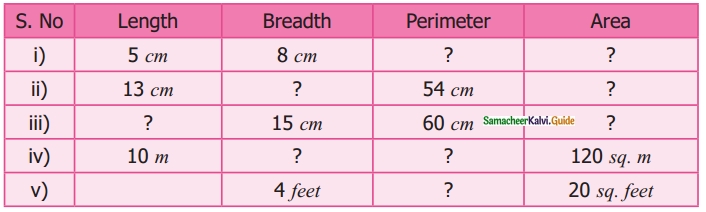
The table given below contains some measures of the rectangle. Find the unknown values.
Samacheer Kalvi 6th Maths Guide Term 3 Chapter 3 Perimeter and Area Ex 3.1 1
Solution:

(i) Area of the rectangle = (length × breadth) sq unit.
Perimeter of a rectangle = 2(1 + b) units.
l = 5 cm
b = 8 cm
∴ p = 2 (l + b) cm = 2 (5 + 8) cm = 2 × 13 cm
p = 26 cm
Area = (l × b) cm2 = (5 × 8) cm2
A = 40 cm2

(ii) l = 13 cm
p = 54 cm
Perimeter = 2 (l + b) units
54 = 2 (13 + b) cm
\(\frac{54}{2}\) = 13 + b
27 = 13 + b
b = 27 – 13
b = 14 cm
Area = l × b sq. unit = 13 × 14 cm2
A = 182 cm2

(iii) b = 15 cm
p = 60 cm
p = 2 (l + b) units
60 = 2 (l + 15) cm
\(\frac{60}{2}\) = l + 15
30 = l + 15
l = 30 – 15 .
l = 15 cm
Area = l × b unit2 = 15 × 15 cm2 = 225 cm2
A = 225 cm2

(iv) l = 10 m
Area = 120 sq metre
Area = l × b sq.m
120 = 10 × 6
b = \(\frac{120}{10}\)
b = 12 m
Perimeter =2 (l + b) units = 2(10 + 12) units = 2 × 22 m
A = 44 m

(v) b = 4 feet.
Area = 20 sq. feet
Area = l × b sq .feet
20 = l × 4
l = \(\frac{20}{4}\) feet
l = 5 feet
Perimeter = 2 (l + b) units.
p = 2 (5 + 4) feet = 2 × 9
p = 18 feet

Question 2.
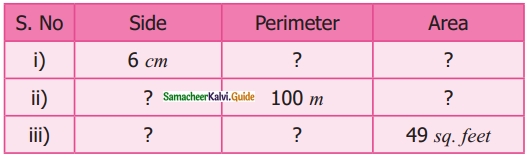
The table given below contains some measures of the square. Find the unknown values.
Samacheer Kalvi 6th Maths Guide Term 3 Chapter 3 Perimeter and Area Ex 3.1 2
Solution:
(i) 24 cm, 36 cm²
(ii) 25 m, 625 m²
(iii) 7 feet, 28 feet

Samacheer Kalvi 6th Maths Guide Term 3 Chapter 3 Perimeter and Area Ex 3.1

Question 3.
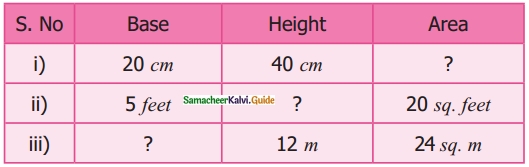
The table given below contains some measures of the right angled triangle. Find the unknown values.
Samacheer Kalvi 6th Maths Guide Term 3 Chapter 3 Perimeter and Area Ex 3.1 3
Solution:

Area of the right triangle = \(\frac{1}{2}\) × (base × height) unit2
(i) b = 20 cm
h = 40 cm
Area = \(\frac{1}{2}\) (b × h) cm2 = \(\frac{1}{2}\) × 20 × 40 = 400 cm2
A = 400 cm2

(ii) b = 5 feet
Area = \(\frac{1}{2}\) × b × h unit2
= 20 = \(\frac{1}{2}\) × 5 × h sq. feet
\(\frac{20 \times 2}{5}\) = h
h = 8 feet

(iii) Area = \(\frac{1}{2}\) × (base × height) unit2
24 = \(\frac{1}{2}\) × b × 12 m2
base = \(\frac{24 \times 2}{12}\) m = 4 m
Base = 4m

Question 4.
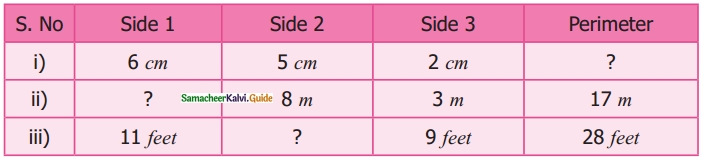
The table given below contains some measures of the triangle. Find the unknown values.
Samacheer Kalvi 6th Maths Guide Term 3 Chapter 3 Perimeter and Area Ex 3.1 4
Solution:
(i) 13 cm
(ii) 6 m
(iii) 8 feet

Question 5.
Fill in the blanks.
(i) 5 cm² = ______ mm²
(ii) 26 m² = ______ cm²
(iii) 8 km² = ______ m²
Solution:
(i) 500
(ii) 260000
(iii) 8000000

Samacheer Kalvi 6th Maths Guide Term 3 Chapter 3 Perimeter and Area Ex 3.1

Question 6.
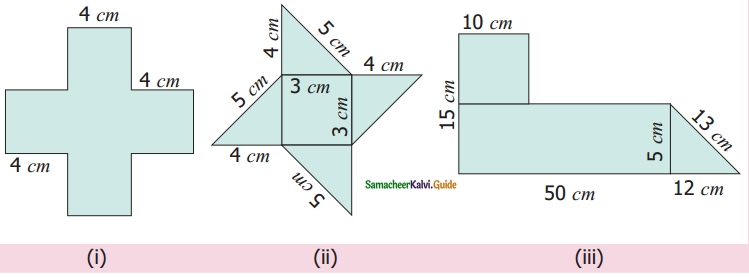
Find the perimeter and area of the following shapes.
Samacheer Kalvi 6th Maths Guide Term 3 Chapter 3 Perimeter and Area Ex 3.1 5
Solution:
(i) Perimeter = (4 + 4 + 4 + 4 + 4 + 4 + 4 + 4 + 4 + 4 + 4 + 4)
= 48 cm
a = 4 cm
Area of 1 square = 4 × 4 cm²
= 16 cm²
Area of 5 squares = 5 × 16 cm²
= 80 cm²

(ii) Perimeter = (4 + 5 + 4 + 5 + 4 + 5 + 4 + 5)
= 36 cm
Area of 1 triangle = \(\frac{1}{2}\) × b × h sq units
= \(\frac{1}{2}\) × 4 × 5 cm²
= 10 cm²
Area of 4 triangles= 4 × 10 cm²
= 40 cm²
Area of the square = 3 × 3 cm²
= 9 cm²
Total area = (40 + 9) cm²
= 49 cm²

Samacheer Kalvi 6th Maths Guide Term 3 Chapter 3 Perimeter and Area Ex 3.1

(iii) Perimeter = (15 + 50 + 12 + 13 + 10 + 10 + 40)
= 150 cm
Area of the square = 10 × 10 cm²
= 100 cm²
= 250 cm²
Area of the triangle = \(\frac{1}{2}\) × 12 × 5 cm²
= \(\frac{1}{2}\) × 126 x 5 cm²
= 30 cm²
Total area = (100 + 250 + 30) cm²
= 380 cm²

Question 7.
Find the perimeter and the area of the rectangle whose length is 6 m and breadth is 4m?
Solution:
l = 6 m, b = 4 m Perimeter of the rectangle
= 2 (l + b) units
= 2 (6 + 4) m
= 2 (10) m
= 20 m
Area of the rectangle = l × b sq units
= 4 × 6 m²
= 24 m²

Samacheer Kalvi 6th Maths Guide Term 3 Chapter 3 Perimeter and Area Ex 3.1

Question 8.
Find the perimeter and area of a square whose side is 8 cm.
Solution:
a = 8 cm
The perimeter of a square
= 4a units
= 4 × 8 cm
= 32 cm
Area of the square = a × a sq units
= 8 × 8 cm²
= 64 cm²

Question 9.
Find the perimeter and the area of right angled triangle whose sides are 6 feet, 8 feet and 10 feet.
Solution:
Perimeter of the triangle
= (a + b + c) units
= (6 + 8 + 10) feet
= 24 feet
Area of the triangle = \(\frac{1}{2}\) × b × h sq units
\(\frac{1}{2}\) × 6³× 8 feet square = 24 sq. feet

Samacheer Kalvi 6th Maths Guide Term 3 Chapter 3 Perimeter and Area Ex 3.1

Question 10.
Find the perimeter of
(i) A scalene triangle with sides 7 m, 8 m, 10 m.
(ii) An isosceles triangle with equal sides 10 cm each and third side is 7 cm.
(iii) An equilateral triangle with a side of 6 cm.
Solution:
(i) Perimeter of the triangle
= (a + b + c) units
= (7 + 8 + 10) m
= 25

(ii) Perimeter of the triangle
= (10 + 10 + 7) cm
= 27 cm

(iii) Perimeter of the triangle
= (6 + 6 + 6) cm
= 18 cm

Samacheer Kalvi 6th Maths Guide Term 3 Chapter 3 Perimeter and Area Ex 3.1

Question 11.
The area of a rectangular shaped photo is 820 sq. cm. and its width is 20 cm. What is its length? Also find its perimeter.
Solution:
Given Area = 820 cm²
Width = 20 cm
Area of the rectangle
= l × b sq. units
820 = l × 20
\(\frac{820}{20}\) = l
41 = l
length l = 41 cm
Perimeter = 2(l + b) units
= 2(41 + 20) cm
= 2(61) cm
= 122 cm

Question 12.
A square park has 40 m as its perimeter. What is the length of its side? Also find its area.
Solution:
perimeter = 40 m
4a = 40 m
a = \(\frac{40}{4}\)
Side a = 10 m
Area = a × a sq units
= 10 × 10 m²
= 100 m²

Samacheer Kalvi 6th Maths Guide Term 3 Chapter 3 Perimeter and Area Ex 3.1

Question 13.
The scalene triangle has 40 cm as its perimeter and whose two sides are 13 cm and 15 cm, find the third side.
Solution:
Let the third side be C
perimeter = (a + b + c) units
40 = 13 + 15 + C
40 = 28 + C
C = 40 – 28
C = 12 units
C = 12 cm

Question 14.
A field is in the shape of a right angled triangle whose base is 25 m and height 20 m. Find the cost of levelling the field at the rate of Rs 45/- per sq.m²
Solution:
b = 25 m, h = 20 m
Area of the triangle = \(\frac{1}{2}\) × bh sq.units
= \(\frac{1}{2}\) × 25 × 20 m²
= 250 m²
Cost of levelling 1 m² = Rs 45
Cost of levelling 250 m² = Rs 45 × 250
= Rs. 11250

Question 15.
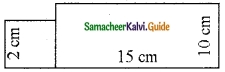
A square of side 2 cm is joined with a rectangle of length 15 cm and breadth 10 cm. Find the perimeter of the combined shape.
Solution:
Samacheer Kalvi 6th Maths Guide Term 3 Chapter 3 Perimeter and Area Ex 3.1 6
Perimeter of the combined shape = Lengths of the outer boundaries
= (15 + 10 + 2 + 2 + 2 + 13 + 10) cm = 54 cm
Perimeter = 54 cm

Samacheer Kalvi 6th Maths Guide Term 3 Chapter 3 Perimeter and Area Ex 3.1

Objective Type Questions

Question 16.
The following figures are of equal area. Which figure has the least perimeter?
Samacheer Kalvi 6th Maths Guide Term 3 Chapter 3 Perimeter and Area Ex 3.1 7
Solution:
(b)

Question 17.
If two identical rectangles of perimeter 30 cm are joined together, then the perimeter of the new shape will be
(a) equal to 60 cm
(b) less than 60 cm
(c) greater than 60 cm
(d) equal to 45 cm
Solution:
(b) less than 60 cm

Samacheer Kalvi 6th Maths Guide Term 3 Chapter 3 Perimeter and Area Ex 3.1

Question 18.
If every side of a rectangle is doubled, then its area becomes _____ times
(a) 2
(b) 3
(c) 4
(d) 6
Solution:
(c) 4
2l × 2b = 4l × b

Question 19.
The side of the square is 10 cm. If its side is tripled, then by how many times will its perimeter increase?
(a) 2 times
(b) 4 times
(c) 6 times
(d) 3 times
Solution:
(d) 3 times

Samacheer Kalvi 6th Maths Guide Term 3 Chapter 3 Perimeter and Area Ex 3.1

Question 20.
The length and breadth of a rectangular sheet of paper are 15 cm and 12 cm respectively. A rectangular piece is cut from one of its corners. Which of the following statement is correct for the remaining sheet?
(a) Perimeter remains the same but the area changes
(b) Area remains the same but the perimeter changes
(c) There will be a change in both area and perimeter
(d) Both the area and perimeter remains the same.
Solution:
(a) Perimeter remains the same but the area changes

Samacheer Kalvi 6th Maths Guide Term 1 Chapter 5 Statistics Ex 5.4

Students can download Maths Chapter 5 Statistics Ex 5.4 Questions and Answers, Notes, Samacheer Kalvi 6th Maths Guide Pdf helps you to revise the complete Tamilnadu State Board New Syllabus, helps students complete homework assignments and to score high marks in board exams.

Tamilnadu Samacheer Kalvi 6th Maths Solutions Term 1 Chapter 5 Statistics Ex 5.4

Miscellaneous Practice Problems

Question 1.
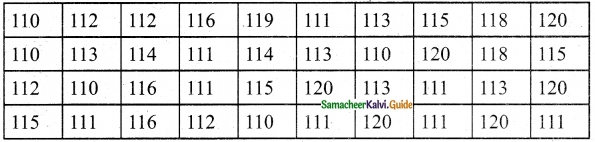
The heights (in centimeters) of 40 children are.
Samacheer Kalvi 6th Maths Guide Term 1 Chapter 5 Statistics Ex 5.4 1
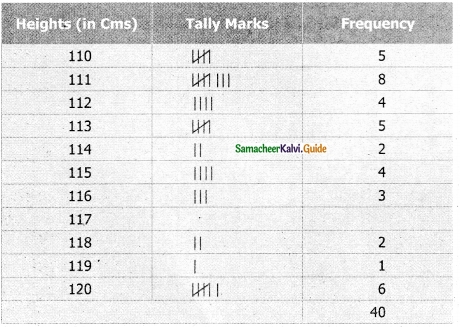
Prepare a tally marks table.
Solution:
Samacheer Kalvi 6th Maths Guide Term 1 Chapter 5 Statistics Ex 5.4 2

Samacheer Kalvi 6th Maths Guide Term 1 Chapter 5 Statistics Ex 5.4

Question 2.
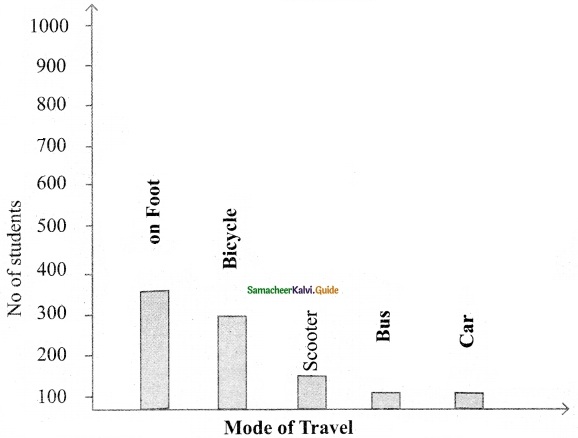
There are 1000 students in a school. Data regarding the mode of transport of the students is given below. Draw a pictograph to represent the data.
Samacheer Kalvi 6th Maths Guide Term 1 Chapter 5 Statistics Ex 5.4 3
Solution:
Mode of transport of the students
Scale: 1 Unit=100 Students
Samacheer Kalvi 6th Maths Guide Term 1 Chapter 5 Statistics Ex 5.4 4

Samacheer Kalvi 6th Maths Guide Term 1 Chapter 5 Statistics Ex 5.4

Question 3.
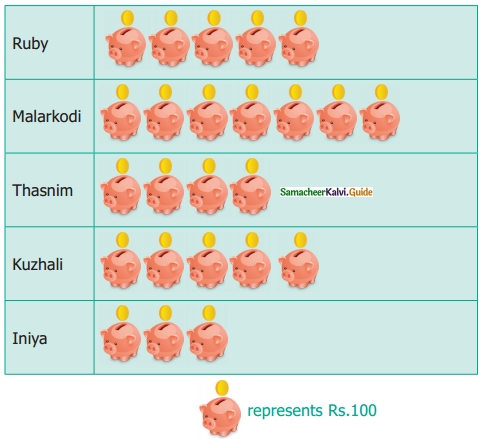
The following pictograph shows the total savings of a group of friends in a year. Each .picture represents a saving of Rs.100. Answer the following questions.
Samacheer Kalvi 6th Maths Guide Term 1 Chapter 5 Statistics Ex 5.4 5
(i) What is the Ratio of Ruby’s saving to that of Thasnim’s?
(ii) What is the ratio of Kuzhali’s savings to that of others?
(iii) How much is Iniya’s savings?
(iv) Find the total amount of savings of all the friends?
(v) Ruby and Kuzhali save the same amount. Say True or False.
Solution:
(i) Ratio of Ruby’s saving to that of Thasnim’s
\(=\frac{\text { Ruby’s saving }}{\text { Thasnim’s saving }}=\frac{5 \times 100}{4 \times 100}=\frac{5}{4}=5: 4\)
Ratio of Ruby’s saving to that of Thasnims = 5 : 4
(ii) Ratio of Kuzhali’s savings to that of others
\(=\frac{\text { kuzhali’s saving }}{\text { others saving }}=\frac{5 \times 100}{19 \times 100}=\frac{5}{19}=5: 19\)
Ratio of Kuzhali’s saving to that of others = 5 : 19
(iii) Iniya’s saving = 3 × 100 = ₹ 300
(iv) Saving of all the friends = (5 + 7 + 4 + 5 + 3) × 100 = 24 × 100 = ₹ 2400.
Total savings = ₹ 2400
(v) True.

Samacheer Kalvi 6th Maths Guide Term 1 Chapter 5 Statistics Ex 5.4

Challenging Problems

Question 4.
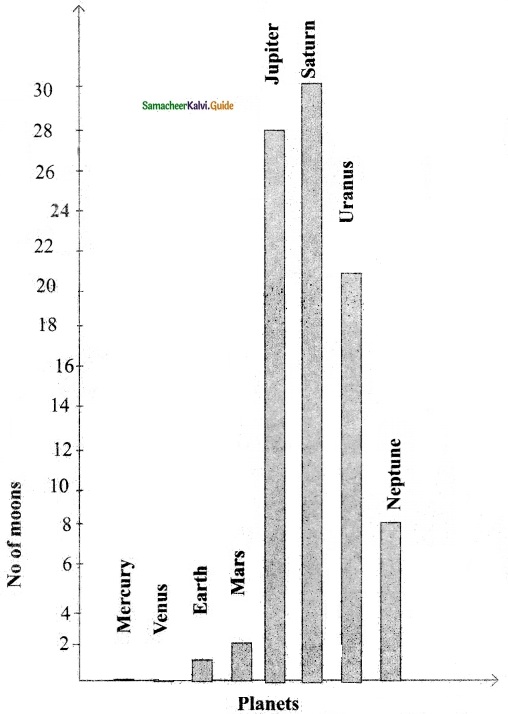
The table shows the numbers of moons that orbit each of the planets in oar solar system.
Samacheer Kalvi 6th Maths Guide Term 1 Chapter 5 Statistics Ex 5.4 6
Make a Bar graph for the above data.
Solution:
Number of moons that orbit each of the planets in our solar system
Scale: 1 Unit = 2 moons
Samacheer Kalvi 6th Maths Guide Term 1 Chapter 5 Statistics Ex 5.4 7

Samacheer Kalvi 6th Maths Guide Term 1 Chapter 5 Statistics Ex 5.4

Question 5.
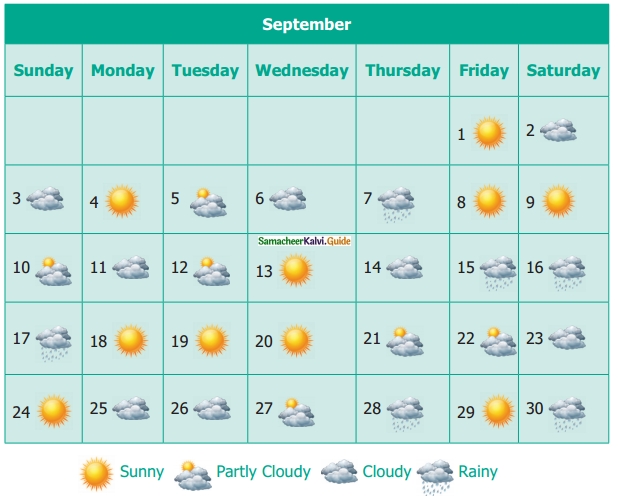
The prediction of the weather in the month of September is given below.
Samacheer Kalvi 6th Maths Guide Term 1 Chapter 5 Statistics Ex 5.4 8
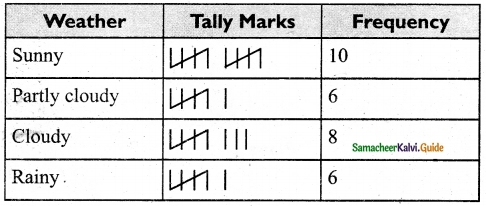
(i) Make a frequency table of the types of weather by reading the calendar.
(ii) How many days are either cloudy or partly cloudy?
(iii) How many days do not have rain? Give two ways to find the answer?
(iv) Find the ratio of the number of Sunny days to Rainy days.
Solution:
(i) Samacheer Kalvi 6th Maths Guide Term 1 Chapter 5 Statistics Ex 5.4 9
(ii) 14 days
(iii) 24 days (30 – 6 = 24 days)
(iv) 10 : 6

Samacheer Kalvi 6th Maths Guide Term 1 Chapter 5 Statistics Ex 5.4

Question 6.
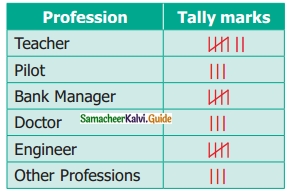
26 students were interviewed to find out what they want they to become in future. Their responses are given in the following table.
Samacheer Kalvi 6th Maths Guide Term 1 Chapter 5 Statistics Ex 5.4 10
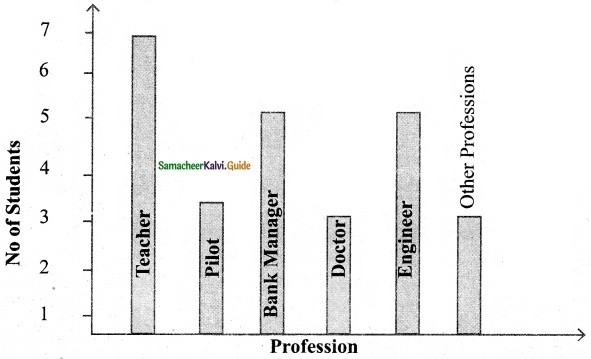
Represent this data using pictograph.
Solution:
Students responses in an interview about their future profession
Scale: 1 Unit = 1 student
Samacheer Kalvi 6th Maths Guide Term 1 Chapter 5 Statistics Ex 5.4 11

Question 7.
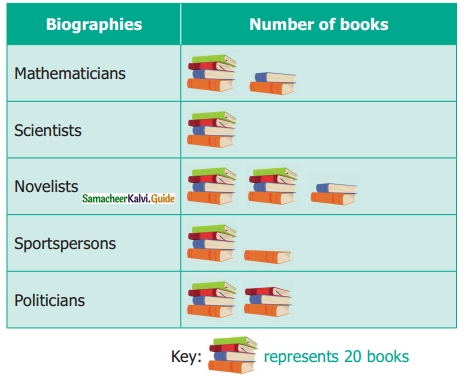
Yasmin of class VI was given a task to count the number of books which are biographies, in her school library. The information collected by her is represented as follows.
Samacheer Kalvi 6th Maths Guide Term 1 Chapter 5 Statistics Ex 5.4 12
Observe the pictograph and answer the following questions.
(i) Which title has the maximum number of biographies?
(ii) Which title has the minimum number of biographies?
(iii) Which title has exactly half the number of biographies as Novelists?
(iv) How many biographies are there on the title of sportspersons?
(v) What is the total number of biographies in the library?
Solution:
(i) ‘The title Novelists’ have the maximum number of biographies
(ii) ‘The title Scientists’ have a minimum number of biographies.
(iii) ‘Sportspersons’ title has exactly half the number of biographies as Novelist.
(iv) \((1 \times 20)+\frac{20}{4}=20+5=25\) biographies are there in the title sportsperson.
(v) 8 × 20 = 160 biographies are there in the library.

Samacheer Kalvi 6th Maths Guide Term 1 Chapter 5 Statistics Ex 5.4

Question 8.
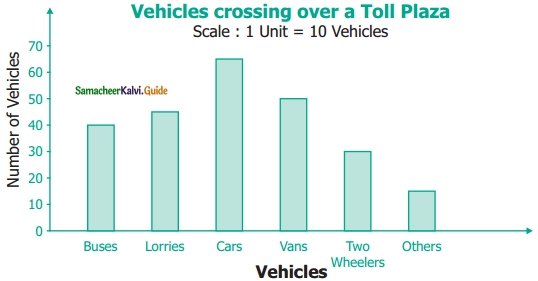
The bar graph illustrates the results of a survey conducted on vehicles crossing over a Toll Plaza in one hour.
Samacheer Kalvi 6th Maths Guide Term 1 Chapter 5 Statistics Ex 5.4 13
Observe the bar graph carefully and fill up the following table.
Samacheer Kalvi 6th Maths Guide Term 1 Chapter 5 Statistics Ex 5.4 14
Solution:
Vans = 50; Buses = 40; Cars = 65; Others = 15
Total Vehicles = 245

Samacheer Kalvi 6th Maths Guide Term 1 Chapter 5 Statistics Ex 5.4

Question 9.
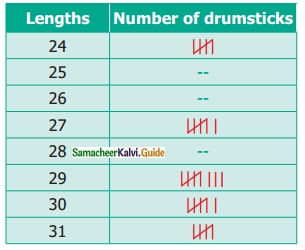
The lengths (in the nearest centimeter) of 30 drumsticks are given as follows.
Samacheer Kalvi 6th Maths Guide Term 1 Chapter 5 Statistics Ex 5.4 15
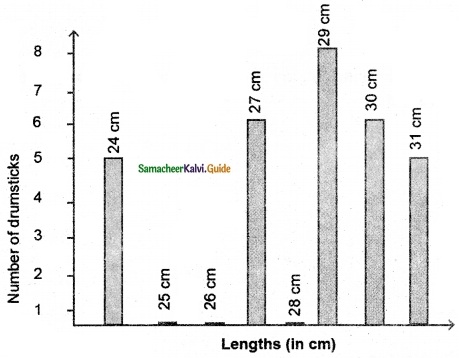
Draw the bar graph showing the same information.
Solution:
The lengths (in nearest cm) of drumsticks
Scale : 1 Unit = 1 drumstick
Samacheer Kalvi 6th Maths Guide Term 1 Chapter 5 Statistics Ex 5.4 16

Samacheer Kalvi 6th Maths Guide Term 1 Chapter 6 Information Processing Ex 6.3

Students can download Maths Chapter 6 Information Processing Ex 6.3 Questions and Answers, Notes, Samacheer Kalvi 6th Maths Guide Pdf helps you to revise the complete Tamilnadu State Board New Syllabus, helps students complete homework assignments and to score high marks in board exams.

Tamilnadu Samacheer Kalvi 6th Maths Solutions Term 1 Chapter 6 Information Processing Ex 6.3

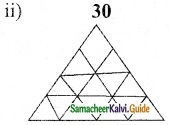
Question 1.
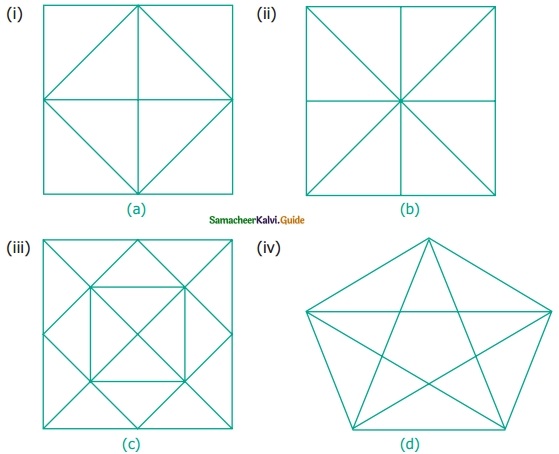
How many Triangles are there in each of the following figures?
Samacheer Kalvi 6th Maths Guide Term 1 Chapter 6 Information Processing Ex 6.3 1
Solution:
(i) 12 triangles
(ii) 16 triangles
(iii) 32 triangles
(iv) 35 triangles

Samacheer Kalvi 6th Maths Guide Term 1 Chapter 6 Information Processing Ex 6.3

Question 2.
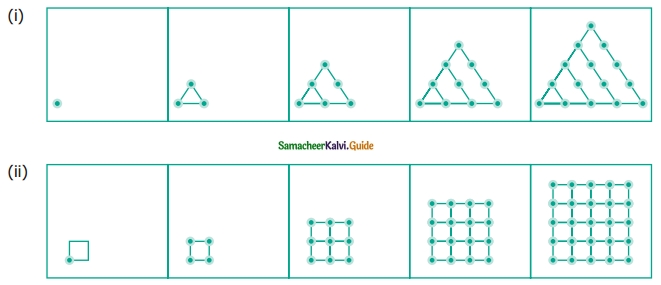
Find the number of dots in the tenth figure of the following patterns.
Samacheer Kalvi 6th Maths Guide Term 1 Chapter 6 Information Processing Ex 6.3 2
Solution:
(i) 55
(ii) 100

Samacheer Kalvi 6th Maths Guide Term 1 Chapter 6 Information Processing Ex 6.3

Question 3.
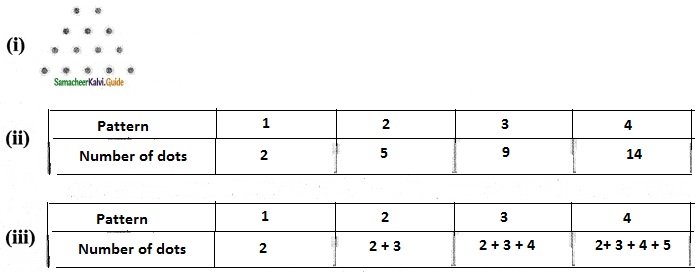
Samacheer Kalvi 6th Maths Guide Term 1 Chapter 6 Information Processing Ex 6.3 3
(i) Draw the next pattern.
(ii) Prepare a table for the number of dots used for each pattern.
(iii) Explain the pattern.
(iv) Find the number of dots in the 25th pattern.
Solution:
Samacheer Kalvi 6th Maths Guide Term 1 Chapter 6 Information Processing Ex 6.3 4
(iv) 350

Samacheer Kalvi 6th Maths Guide Term 1 Chapter 6 Information Processing Ex 6.3

Question 4.
Samacheer Kalvi 6th Maths Guide Term 1 Chapter 6 Information Processing Ex 6.3 5
Solution:
(i) 20 squares
(ii) 10 squares

Samacheer Kalvi 6th Maths Guide Term 1 Chapter 6 Information Processing Ex 6.3

Question 5.
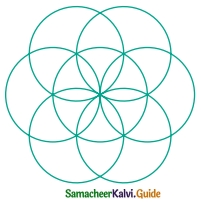
How many circles are there in the following figure?
Samacheer Kalvi 6th Maths Guide Term 1 Chapter 6 Information Processing Ex 6.3 6
Solution:
7 circles

Samacheer Kalvi 6th Maths Guide Term 1 Chapter 6 Information Processing Ex 6.3

Question 6.
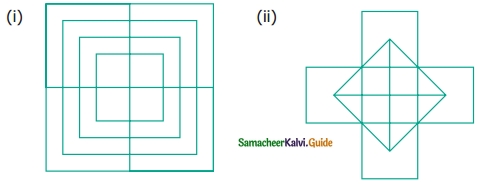
Find the minimum number of straight lines used in forming the following figures.
Samacheer Kalvi 6th Maths Guide Term 1 Chapter 6 Information Processing Ex 6.3 7
Solution:
(i) 10
(ii) 12