Samacheer Kalvi 6th Maths Guide Term 1 Chapter 1 Numbers Ex 1.3

Students can download Maths Chapter 1 Numbers Ex 1.3 Questions and Answers, Notes, Samacheer Kalvi 6th Maths Guide Pdf helps you to revise the complete Tamilnadu State Board New Syllabus, helps students complete homework assignments and to score high marks in board exams.

Tamilnadu Samacheer Kalvi 6th Maths Solutions Term 1 Chapter 1 Numbers Ex 1.3

Question 1.
Fill in the blanks.

  1. If Arulmozhi saves ₹ 12 per day then she saves ₹ ____ in 30 days.
  2. If a person ‘A’ earns ₹ 1800 in 12 days, then he earns ₹ ____ in a day.
  3. 45 ÷ (7 + 8) – 2 = _____

Solution:

  1. 12 × 30 = ₹ 360
  2. \(\frac{1800}{12}=150\)
  3. 45 ÷ 15 – 2 = 3 – 2 = 1

 Samacheer Kalvi 6th Maths Guide Term 1 Chapter 1 Set Language Ex 1.3

Question 2.
Say True or False

  1. 3 + 9 × 8 = 96
  2. 7 × 20 – 4 = 136
  3. 40 + (56 – 6) ÷ 2 = 45

Solution:

  1. False
    Hint: 3 + 9 × 8 = 3 + 72 = 75
  2. True
    Hint: 7 × 20 – 4 = 140 – 4 = 136
  3. False
    Hint: 40 + 50 ÷ 2 = 40 + 25 = 65

Question 3.
The number of people who visited the Public Library for the past 5 months was 1200, 2000, 2450, 3060 and 3200 respectively. How many people visited the library in the last 5 months.
Solution:
People visited the library for past 5 months = 1200 + 2000 + 2450 + 3060 + 3200 = 11910
Total people visited = 11910

 Samacheer Kalvi 6th Maths Guide Term 1 Chapter 1 Set Language Ex 1.3

Question 4.
Cheran had a bank savings of ₹ 7,50,250. He withdrew ₹ 5,34,500 for educational purposes. Find the balance amount in his account.
Solution:
Bank Savings of Cheran = ₹ 7,50,250
Withdrew Amount = ₹ 5,34,500
Balance Amount = ₹ 2,15,750

Question 5.
In a cycle factory, 1560 bicycles were manufactured every day. Find the number of bicycles manufactured in 25 days.
Solution:
Bicycles manufactured in one day = 1560
Bicycles manufactured in 25 days = 1560 × 25
= 39,000 bicycles

 Samacheer Kalvi 6th Maths Guide Term 1 Chapter 1 Set Language Ex 1.3

Question 6.
₹ 62,500 was equally distributed as a New Year bonus for 25 employees of a company. How much did each receive?
Solution:
Total amount = Rs 62500
Total number of employees = 25
Bonus amount received by each employee = Rs 62500 ÷ 25
= RS \(\frac{62500}{25}\)
= Rs 2500

Question 7.
Simplify the following numerical expressions:
(i) (10 + 17) ÷ 3
(ii) 12 – [3 – {6 – (5 – 1)}]
(iii) 100 + 8 ÷ 2 + {(3 × 2) -6 ÷ 2}
Solution:
(i) (10 + 17) ÷ 3
= 27 ÷ 3
= 9

 Samacheer Kalvi 6th Maths Guide Term 1 Chapter 1 Set Language Ex 1.3

(ii) 12 – [3 – {6 – (5 – 1)}]
= 12 – [3 – (6 – 4)]
= 12 – [3 – 2]
= 12 – 1
= 11

(iii) 100 + 8 ÷ 2 + {(3 × 2) – 6 ÷ 2}
= 100 + 8 ÷ 2 + {6 – 3}
= 100 + 8 ÷ 2 + 3
= 100 + 4 + 3
= 107

 Samacheer Kalvi 6th Maths Guide Term 1 Chapter 1 Set Language Ex 1.3

Objective Type Questions

Question 8.
The value of 3 + 5 – 7 × 1 is _____
(a) 5
(b) 7
(c) 8
(d) 1
Answer:
(d) 1
3 + 5 – 7 × 1 = 3 + 5 – 7 = 8 – 7 = 1

Question 9.
The value of 24 ÷ {8 – (3 × 2)} is ______
(a) 0
(b) 12
(c) 3
(d) 4
Answer:
(b) 12
24 ÷ {8 – 3 × 2} = 24 ÷ {8 – 6} = 24 ÷ 2 = 12

 Samacheer Kalvi 6th Maths Guide Term 1 Chapter 1 Set Language Ex 1.3

Question 10.
Use BIDMAS and put the correct operator in the box.
2 ….. 6 – 12 ÷ (4 + 2) = 10
(a) +
(b) –
(c) ×
(d) ÷
Answer:
(c) ×
2 ….. 6 – 12 ÷ 6 = 10
⇒ 2 ….. 6 – 2 = 10
⇒ 2 × 6 – 2 = 10

Samacheer Kalvi 6th Maths Guide Term 1 Chapter 1 Numbers Ex 1.2

Students can download Maths Chapter 1 Numbers Ex 1.2 Questions and Answers, Notes, Samacheer Kalvi 6th Maths Guide Pdf helps you to revise the complete Tamilnadu State Board New Syllabus, helps students complete homework assignments and to score high marks in board exams.

Tamilnadu Samacheer Kalvi 6th Maths Solutions Term 1 Chapter 1 Numbers Ex 1.2

Question 1.
Fill in the blanks with > or < or =.

  1. 48792 ………. 48972
  2. 1248654 ……… 1246854
  3. 658794 ……… 658794

Solution:

  1. <
  2. >
  3. =

 Samacheer Kalvi 6th Maths Guide Term 1 Chapter 1 Set Language Ex 1.2

Question 2.
Say True or False.

  1. The difference between the smallest number of seven digits and the largest number of six digits is 10.
  2. The largest 4 digit number formed by the digits 8, 6, 0, 9 using each digit only once is 9086
  3. The total number of 4 digit number is 9000

Solution:

  1. False
    Hint: 1000000 – 999999 = 1
  2. False
    Hint: 9999 – 999 = 9000
  3. True

Question 3.
Of the numbers 1386787215, 137698890, 86720560, which one is the largest? Which one is the smallest?
Solution:
We know that the number with more digits is greater.
The greatest number is 1386787215
The smallest number is 86720560

 Samacheer Kalvi 6th Maths Guide Term 1 Chapter 1 Set Language Ex 1.2

Question 4.
Arrange the following numbers in the descending order:
128435, 10835, 21354, 6348, 25840
Solution:
128435 > 25840 > 21354 > 10835 > 6348

Question 5.
Write any eight-digit number with 6 in ten lakhs place and 9 in ten-thousandth place.
Solution:
76594231
86493725

Question 6.
Rajan writes a 3-digit number, using the digits 4, 7, and 9. What are the possible numbers he can write?
Solution:
974, 947, 479, 497, 749, 794

 Samacheer Kalvi 6th Maths Guide Term 1 Chapter 1 Set Language Ex 1.2

Question 7.
The password to access my ATM card includes the digits 9, 4, 6, and 8. It is the smallest 4 digit even number. Find the password of my ATM card.
Solution:
Given digits are 9, 4, 6, and 8.
The smallest number with these digits is 4689 Given that it is an even number.
It may be 4698.
So password of the ATM card is 4698.

Question 8.
Postal Index Number consists of six digits. The first three digits are 6, 3, and 1. Make the largest and the smallest Postal Index Number by using the digits 0, 3, and 6 each only once.
Solution:
Largest Postal Index Number = 631603
Smallest Postal Index Number = 631036

 Samacheer Kalvi 6th Maths Guide Term 1 Chapter 1 Set Language Ex 1.2

Question 9.
The heights (in meters) of the mountains in Tamil Nadu are as follows:
Samacheer Kalvi 6th Maths Guide Term 1 Chapter 1 Set Language Ex 1.2 1
(i) Which is the highest mountain listed above?
(ii) Order the mountains from the highest to the lowest.
(iii) What is the difference between the heights of the mountains Anaimudi and Mahendragiri?
Solution:
(i) Anaimudi (2695 m)
(ii) Anaimudi, Doddabetta, Velliangiri, Mahendragiri
(iii) 2695 m – 1647 m = 1048 m

Objective Type Questions

Question 10.
Which list of numbers is in order from the smallest to the largest?
(a) 1468, 1486, 1484
(b) 2345, 2435, 2235
(c) 134205, 134208, 154203
(d) 383553, 383548, 383642
Solution:
(c) 134205, 134208, 154203

 Samacheer Kalvi 6th Maths Guide Term 1 Chapter 1 Set Language Ex 1.2

Question 11.
The Arabian Sea has an area of 1491000 square miles. This area lies between which two numbers?
(a) 1489000 and 1492540
(b) 1489000 and 1490540
(c) 1490000 and 1490100
(d) 1480000 and 1490000
Solution:
(a) 1489000 and 1492540

Question 12.
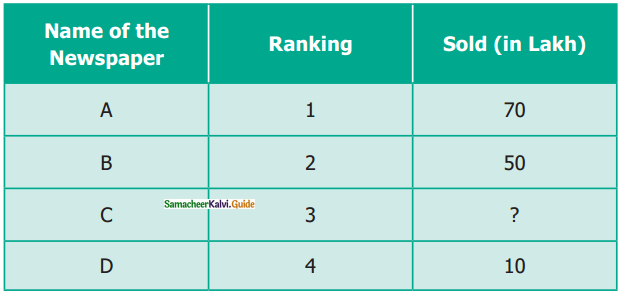
The chart below shows the number of newspapers sold as per the Indian Readership Survey in 2018. Which could be the missing number in the table?
Samacheer Kalvi 6th Maths Guide Term 1 Chapter 1 Set Language Ex 1.2 2
(a) 8
(b) 52
(c) 77
(d) 26
Solution:
(d) 26

 Samacheer Kalvi 6th Maths Guide Term 1 Chapter 1 Set Language Ex 1.2

Samacheer Kalvi 6th Maths Guide Term 1 Chapter 1 Numbers Ex 1.1

Students can download Maths Chapter 1 Numbers Ex 1.1 Questions and Answers, Notes, Samacheer Kalvi 6th Maths Guide Pdf helps you to revise the complete Tamilnadu State Board New Syllabus, helps students complete homework assignments and to score high marks in board exams.

Tamilnadu Samacheer Kalvi 6th Maths Solutions Term 1 Chapter 1 Numbers Ex 1.1

Question 1.
Fill in the blanks.

  1. The smallest 7 digit number is _______
  2. The largest 8 digit number is _______
  3. The place value of 5 in 7005380 is ________
  4. The expanded form of the number 76,70,905 is _______

Solution:

  1. 10,00,000
  2. 9,99,99,999
  3. 5 × 1000 = 5000
  4. 7 × 10,00,000 + 6 × 1,00,000 + 7 × 10,000 + 0 + 9 × 100 + 0 + 5 × 1
    (or)
    70,00,000 + 6,00,000 + 70,000 + 900 + 5

 Samacheer Kalvi 6th Maths Guide Term 1 Chapter 1 Set Language Ex 1.1

Question 2.
Say True or False.

  1. In the Indian System of Numeration, the number 67999037 is written as 6,79,99,037
  2. The successor of a one-digit number is always a one-digit number 9 + 1 = 10

  3. The predecessor of a 3-digit number is always a 3 or 4 digit number 100 – 1 = 99
  4. 88888 = 8 × 10000 + 8 × 100 + 8 × 10 + 8 × 1

Solution:

  1. True
  2. False
  3. False
  4. False

Question 3.
Complete the given order.
Ten crores, crore, ten lakh, ………, ……….., ……….., ………, …….., ……..
Solution:
Ten crores, Crore, Ten lakh, Lakh, Ten Thousand, Thousand, Hundred, Ten, One

 Samacheer Kalvi 6th Maths Guide Term 1 Chapter 1 Set Language Ex 1.1

Question 4.
How many ten thousands are there in the smallest 6 digit number?
Solution:
Smallest 6 digit number = 1,00,000
= \(\frac{100000}{10000}\) = 10

1 Lakh = 10 Ten Thousands
Question 5.
Using the digits 5, 2, 0, 7, 3 forms the largest 5 digit number and the smallest 5 digit number.
Solution:
Given digits = 5, 2, 0, 7, 3
Largest 5 digit number – 75320
Smallest 5 digit number – 20357

Question 6.
Observe the commas and write down the place value of 7.
(i) 56,74,56,345
(ii) 567,456,345
Solution:
(i) 70,00,000
(ii) 7,000,000

 Samacheer Kalvi 6th Maths Guide Term 1 Chapter 1 Set Language Ex 1.1

Question 7.
Write the following numbers in the International System by using commas.

  1. 347056
  2. 7345671
  3. 634567105
  4. 1234567890

Solution:

  1. 347,056
  2. 7,345,671
  3. 634,567,105
  4. 1,234,567,890

Question 8.
Write the largest six-digit number and put commas in the Indian and the International Systems.
Solution:
Largest 6 digit number = 9,99,999
Indian System: 9,99,999 (Nine Lakh Ninety-Nine Thousand Nine Hundred Ninety-Nine)
International System: 999,999 (Nine Hundred Ninety-Nine Thousand, Nine Hundred Ninety-Nine)

 Samacheer Kalvi 6th Maths Guide Term 1 Chapter 1 Set Language Ex 1.1

Question 9.
Write the number names of the following numerals in the Indian System.
(i) 75,32,105
(ii) 9,75,63,453
Solution:
(i) Seventy-five lakh thirty-two thousand one hundred five.
(ii) Nine crore seventy-five lakh sixty-three thousand four hundred fifty-three.

Question 10.
Write the number of names in words using the International System.

  1. 345,678
  2. 8,343,710

  3. 103,456,789

Solution:

  1. Three hundred forty-five thousand six hundred seventy-eight.
  2. Eight million three hundred forty-three thousand seven hundred ten.
  3. One hundred three million four hundred fifty-six thousand seven hundred eighty-nine.

 Samacheer Kalvi 6th Maths Guide Term 1 Chapter 1 Set Language Ex 1.1

Question 11.
Write the number name in numerals.

  1. Two crores thirty lakhs fifty-one thousand nine hundred eighty.
  2. Sixty-six million three hundred forty-five thousand twenty-seven.
  3. Seven hundred eighty-nine million, two hundred thirteen thousand four hundred fifty-six.

Solution:

  1. 2,30,51,980
  2. 66,345,027
  3. 789,213,456

Question 12.
Tamil Nadu has about twenty-six thousand three hundred forty-five square kilometres of Forest land. Write the number mentioned in the statement in the Indian System.
Solution:
26,345

Question 13.
The number of employees in the Indian Railways is about 10 lakh. Write this in the International System of numeration.
Solution:
1,000,000 (One Million)

 Samacheer Kalvi 6th Maths Guide Term 1 Chapter 1 Set Language Ex 1.1

Objective Type Questions

Question 14.
1 billion is equal to
(a) 100 crore
(b) 100 million
(c) 100 lakh
(d) 10000 lakh
Solution:
(a) 100 crore

Question 15.
The successor of 10 million is
(a) 1000001
(b) 10000001
(c) 9999999
(d) 100001
Solution:
(b) 10000001

Question 16.
The difference between successor and predecessor of 99999 is
(a) 90000
(b) 1
(c) 2
(d) 99001
Solution:
(c) 2

 Samacheer Kalvi 6th Maths Guide Term 1 Chapter 1 Set Language Ex 1.1

Question 17.
The expanded form of the number 6,70,905 is
(a) 6 × 10000 + 7 × 1000 + 9 × 100 + 5 × 1
(b) 6 × 10000 + 7 × 1000 + 0 × 100 + 9 × 100 + 0 × 10 + 5 × 1
(c) 6 × 1000000 + 7 × 10000 + 0 × 1000 + 9 × 100 + 0 × 10 + 5 × 1
(d) 6 × 100000 + 7 × 10000 + 0 × 1000 + 9 × 100 + 0 × 10 + 5 × 1
Solution:
(d) 6 × 100000 + 7 × 10000 + 0 × 1000 + 9 × 100 + 0 × 10 + 5 × 1

Samacheer Kalvi 6th Maths Guide Term 1 Chapter 3 Ratio and Proportion Ex 3.3

Students can download Maths Chapter 3 Ratio and Proportion Ex 3.3 Questions and Answers, Notes, Samacheer Kalvi 6th Maths Guide Pdf helps you to revise the complete Tamilnadu State Board New Syllabus, helps students complete homework assignments and to score high marks in board exams.

Tamilnadu Samacheer Kalvi 6th Maths Solutions Term 1 Chapter 3 Ratio and Proportion Ex 3.3

Question 1.
Fill in the blanks.
(i) 3 : 5 :: …….. : 20
(ii) ……… : 24 :: 3 : 8
(iii) 5 : …….. :: 10 : 8 :: 15 : ………
(iv) 12 : ……… :: ………. :: 4 = 8 : 16
Solution:
(i) 12
Hint:
5x = 3 × 20 ⇒ x = 12
(ii) 9
8x = 24 × 3 ⇒ x = 9
(iii) 4, 12
Hint:
10x = 8 × 5 = 40 ⇒ x = 4
10y = 8 × 15 = 120 ⇒ y = 12
(iv) 24, 2
Hint:
16y = 8 × 4 ⇒ y = 2
12 × 4 = 2x ⇒ x = 24

Samacheer Kalvi 6th Maths Guide Term 1 Chapter 3 Ratio and Proportion Ex 3.3

Question 2.
Say True or False.
(i) 2 : 7 : : 14 : 4
(ii) 7 Persons are to 49 Persons as 11 kg is to 88 kg
(iii) 10 books are to 15 books as 3 books are to 15 books.
Solution:
(i) False
Hint:
7 × 14 ≠ 4 × 2
98 ≠ 8
(ii) False
Hint:
7 : 49 :: 11 : 48
49 × 11 ≠ 7 × 48
539 ≠ 336
(iii) False
Hint:
10 : 15 :: 3 : 5
\(\frac{10}{15}=\frac{5 \times 2}{5 \times 3}=\frac{2}{3} \Rightarrow \frac{3}{5}=\frac{3}{5}\)

Question 3.
Using the numbers 3, 9, 4, 12 write two ratios that are in proportion.
Solution:
(i) 3, 9, 4, 12
Here product of extremes = 3 × 12 = 36
Product of means = 9 × 4 = 36
3 : 9 : : 4 : 12

(ii) Also if we take 9, 3, 12, 4
Product of extremes = 9 × 4 = 36
Product of means = 3 × 12 = 36
9 : 3 : : 12 : 4

Samacheer Kalvi 6th Maths Guide Term 1 Chapter 3 Ratio and Proportion Ex 3.3

Question 4.
Find whether 12, 24,18, 36 are in order that can be expressed as two ratios that are in proportion.
Solution:
Yes, 12 : 24 : : 18 : 36
Because product of extremes 12 × 36 = 432
Product of means = 24 × 18 = 432
12 : 24 :: 18 : 36.

Samacheer Kalvi 6th Maths Guide Term 1 Chapter 3 Ratio and Proportion Ex 3.3

Question 5.
Write the mean and extreme terms in the following ratios and check whether they are in proportion.
(i) 78 liters is to 130 liters and 12 bottles are to 20 bottles
(ii) 400 gm is to 50 gm and 25 rupees is to 625 rupees
Solution:
(i) 78 : 130 :: 12 : 20
Extreme terms are 78 and 20.
Mean terms are 130 and 12.
Product of Extremes = 78 × 20 = 1560
Product of Means = 130 × 12 = 1560
Product of Extremes = Product of means
It is in proportion.

(ii) 400 : 50 : : 25 : 625
Product of extremes = 400 × 625 = 2,50,000
Product of means = 50 × 25 = 1250
Here product of extremes ≠ product of means
400 : 50 and 25 : 625 are not in proportion.

Samacheer Kalvi 6th Maths Guide Term 1 Chapter 3 Ratio and Proportion Ex 3.3

Question 6.
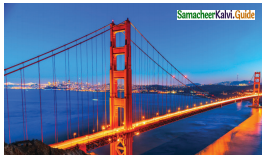
America’s famous Golden Gate bridge is 6480 ft long with 756 ft tall towers. A model of this bridge exhibited in a fair is 60 ft long with 7 ft tall towers. Is the model in proportion to the original bridge?
Samacheer Kalvi 6th Maths Guide Term 1 Chapter 3 Ratio and Proportion Ex 3.3 1
Solution:
6480 : 756, 60 : 7
Product of the means = 756 × 60 = 45360
Product of the extremes = 6480 × 7 = 45360
ad = bc
∴ They are in proportion

Samacheer Kalvi 6th Maths Guide Term 1 Chapter 3 Ratio and Proportion Ex 3.3

Objective Type Questions

Question 7.
Which of the following ratios are in proportion?
(a) 3 : 5, 6 : 11
(b) 2 : 3, 9 : 6
(c) 2 : 5, 10 : 25
(d) 3 : 1, 1 : 3
Solution:
(c) 2 : 5, 10 : 25
Hint:
2 × 25 = 5 × 10
⇒ 50 = 50

Question 8.
If the ratios formed using the numbers 2, 5, x, 20 in the same order are in proportion, then ‘x’ is
(a) 50
(b) 4
(c) 10
(d) 8
Solution:
(d) 8
5x = 2 × 20 ⇒ x = 8

Samacheer Kalvi 6th Maths Guide Term 1 Chapter 3 Ratio and Proportion Ex 3.3

Question 9.
If 7 : 5 is in proportion to x : 25, then ‘x’ is
(a) 27
(b) 49
(c) 35
(d) 14
Solution:
(c) 35
Hint:
5x = 7 × 25 ⇒ x = 35

Samacheer Kalvi 6th Maths Guide Term 1 Chapter 3 Ratio and Proportion Ex 3.1

Students can download Maths Chapter 3 Ratio and Proportion Ex 3.1 Questions and Answers, Notes, Samacheer Kalvi 6th Maths Guide Pdf helps you to revise the complete Tamilnadu State Board New Syllabus, helps students complete homework assignments and to score high marks in board exams.

Tamilnadu Samacheer Kalvi 6th Maths Solutions Term 1 Chapter 3 Ratio and Proportion Ex 3.1

Question 1.
Fill in the blanks.
(i) Ratio of ₹ 3 to ₹ 5 = ____
(ii) Ratio of 3 m to 200 cm = ______
(iii) Ratio of 5 km 400 m to 6 km = ____
(iv) Ratio of 75 paise to ₹ 2 = ____
Solution:
(i) 3 : 5
(ii) 3 : 2
Hint: 3m = 300 cm
(iii) 9 : 10
Hint: 5km 400 m = 5400m and 6 km = 6000 m
(iv) 3 : 8
Hint: ₹ 2 = 200 paise

Samacheer Kalvi 6th Maths Guide Term 1 Chapter 3 Ratio and Proportion Ex 3.1

Question 2.
Say whether the following statements are True or False.
(i) The ratio of 130 cm to 1 m is 13 : 10
(ii) One of the terms in a ratio cannot be 1
Solution:
(i) True
Hint: 1m = 100 cm
(ii) False

Question 3.
Find the simplified form of the following ratios.
(i) 15 : 20
(ii) 32 : 24
(iii) 7 : 15
(iv) 12 : 27
(v) 75 : 100
Solution:
(i) 15 : 20
= \(\frac{15}{20}\)
= \(\frac{3}{4}\)
= 3 : 4

Samacheer Kalvi 6th Maths Guide Term 1 Chapter 3 Ratio and Proportion Ex 3.1

(ii) 32 : 24
= \(\frac{32}{24}\)
= \(\frac{4}{3}\)
= 4 : 3

(iii) 7 : 15

(iv) 12 : 27
= \(\frac{12}{27}\)
= \(\frac{4}{9}\)
= 4 : 9

(v) 75 : 100
= \(\frac{75}{100}\)
= \(\frac{3}{4}\)
= 3 : 4

Samacheer Kalvi 6th Maths Guide Term 1 Chapter 3 Ratio and Proportion Ex 3.1

Question 4.
Akilan walks 10 km in an hour while Selvi walks 6 km in an hour. Find the simplest ratio of the distance covered by Akilan to that of Selvi.
Solution:
Ratio of the distance covered by Akilan to that of Selvi = 10 km : 6 km
= \(\frac{10}{6}\)
= \(\frac{5}{3}\)
= 5 : 3

Question 5.
The cost of parking a bicycle is Rs 5 and the cost of parking a scooter is Rs 15. Find the simplest ratio of the parking cost of a bicycle to that of a scooter.
Solution:
Ratio of the parking cost of a bicycle to that of a scooter = Rs 5 : Rs 15
= \(\frac{5}{15}\)
= \(\frac{1}{3}\)
= 1 : 3

Samacheer Kalvi 6th Maths Guide Term 1 Chapter 3 Ratio and Proportion Ex 3.1

Question 6.
Out of 50 students in a class, 30 are boys. Find the ratio of
(i) number of boys to the number of girls.
(ii) the number of girls to the total number of students.
(iii) the number of boys to the total number of students.
Solution:
Total no of students = 50
No of boys = 30
No of girls = 50 – 30 = 20
(i) Ratio of boys to girls = 30 : 20
= \(\frac{30}{20}\)
= \(\frac{3}{2}\)
= 3 : 2

(ii) Ratio of girls to the total number of students = 20 : 50
= \(\frac{20}{50}\)
= \(\frac{2}{5}\)
= 2 : 5

(iii) Ratio of boys to the total no of students = 30 : 50
= \(\frac{30}{50}\)
= \(\frac{3}{5}\)
= 3 : 5

Samacheer Kalvi 6th Maths Guide Term 1 Chapter 3 Ratio and Proportion Ex 3.1

Objective Type Questions

Question 7.
The ratio of ₹ 1 to 20 paise is _____
(a) 1 : 5
(b) 1 : 2
(c) 2 : 1
(d) 5 : 1
Solution:
(d) 5 : 1
Hint: ₹ 1 = 100 paise

Question 8.
The ratio of 1 m to 50 cm is
(a) 1 : 50
(b) 50 : 1
(c) 2 : 1
(d) 1 : 2
Solution:
(c) 2 : 1

Samacheer Kalvi 6th Maths Guide Term 1 Chapter 3 Ratio and Proportion Ex 3.1

Question 9.
The length and breadth of a window are 1 m and 70 cm respectively. The ratio of the length to the breadth is
a) 1 : 7
(b) 7 : 1
(c) 7 : 10
(d) 10 : 7
Solution:
(d) 10 : 7

Question 10.
The ratio of the number of sides of a triangle to the number of sides of a rectangle is
(a) 4 : 3
(b) 3 : 4
(c) 3 : 5
(d) 3 : 2
Solution:
(b) 3 : 4

Samacheer Kalvi 6th Maths Guide Term 1 Chapter 3 Ratio and Proportion Ex 3.1

Question 11.
If Azhagan is 50 years old and his son is 10 years old then the simplest ratio between the age of Azhagan to his son is
(a) 10 : 50
(b) 50 : 10
(c) 5 : 1
(d) 1 : 5
Solution:
(c) 5 : 1

Samacheer Kalvi 6th Maths Guide Term 1 Chapter 2 Introduction to Algebra Ex 2.3

Students can download Maths Chapter 2 Introduction to Algebra Ex 2.3 Questions and Answers, Notes, Samacheer Kalvi 6th Maths Guide Pdf helps you to revise the complete Tamilnadu State Board New Syllabus, helps students complete homework assignments and to score high marks in board exams.

Tamilnadu Samacheer Kalvi 6th Maths Solutions Term 1 Chapter 2 Introduction to Algebra Ex 2.3

Miscellaneous Practice Problems

Question 1.
Complete the following pattern.
9 – 1 =
98 – 21 =
987 – 321 =
9876 – 4321 =
98765 – 54321 =
What comes next?
Solution:
9 – 1 = 8
98 – 21 = 77
987 – 321 = 666
9876 – 4321 = 5555
98765 – 54321 = 44444
Next will be 987654 – 654321 = 333333

Samacheer Kalvi 6th Maths Guide Term 1 Chapter 2 Introduction to Algebra Ex 2.3

Question 2.
A piece of wire is ‘12s’ cm long. What will be the length of the side if it is formed as
(i) an equilateral triangle.
(ii) a square?
Solution:
(i) An equilateral triangle has 3 equal sides.
Length of the wire = ‘12s’ cm
Length of each side = \(\frac{12 s}{3}\) cm.
Length of each side of the triangle = 4s cm
(ii) A square has four equal sides.
Length of each side \(\frac{12 s}{4}\) cm
Length of each side of the square 3s cm

Samacheer Kalvi 6th Maths Guide Term 1 Chapter 2 Introduction to Algebra Ex 2.3

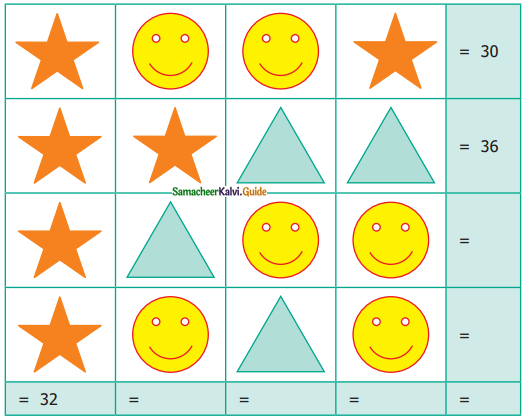
Question 3.
Identify the value of the shapes and figures in the table given below and verify their addition horizontally and vertically.
Samacheer Kalvi 6th Maths Guide Term 1 Chapter 2 Introduction to Algebra Ex 2.3 1
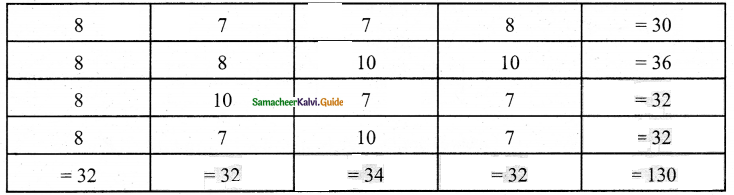
Solution:
Samacheer Kalvi 6th Maths Guide Term 1 Chapter 2 Introduction to Algebra Ex 2.3 2

Samacheer Kalvi 6th Maths Guide Term 1 Chapter 2 Introduction to Algebra Ex 2.3

Question 4.
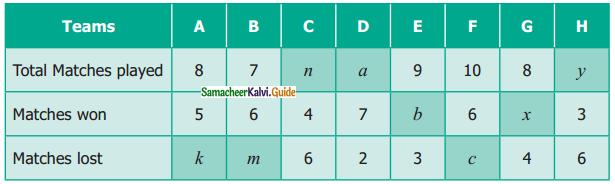
The table given below shows the results of the matches played by 8 teams in a kabaddi championship tournament.
Samacheer Kalvi 6th Maths Guide Term 1 Chapter 2 Introduction to Algebra Ex 2.3 3
Find the value of all the variables in the table given above.
Solution:
k = 3, m = 1, n = 10, a = 9, b = 6, c = 4, x = 4, y = 9

Samacheer Kalvi 6th Maths Guide Term 1 Chapter 2 Introduction to Algebra Ex 2.3

Challenging Problems

Question 5.
Gopal is 8 years younger than Karnan. If the sum of their ages is 30, how old is Karnan?
Solution:
Let the age of Kaman be x years
Gopal’s age = x – 8
Ace to the problem, x + x – 8 = 30
2x – 8 = 30
2x = 30 + 8
2x = 38
x = \(\frac{38}{2}\)
x = 19
Age of Kaman = 19 years

Samacheer Kalvi 6th Maths Guide Term 1 Chapter 2 Introduction to Algebra Ex 2.3

Question 6.
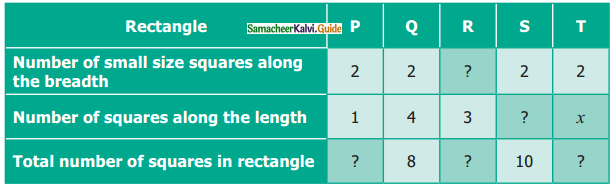
The rectangles made of identical square blocks with varying lengths but having only two square blocks as width are give below
Samacheer Kalvi 6th Maths Guide Term 1 Chapter 2 Introduction to Algebra Ex 2.3 4
(i) How many small size squares are there in each of the rectangles P,Q, R and S?
(ii) Fill in the boxes.
Samacheer Kalvi 6th Maths Guide Term 1 Chapter 2 Introduction to Algebra Ex 2.3 5
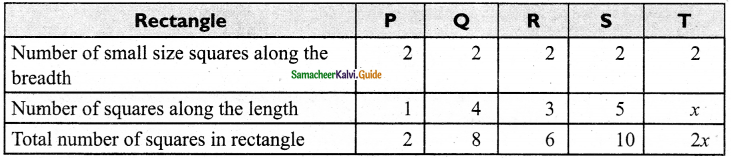
Solution:
(i) P = 2; Q = 8; R = 6; S = 10
Samacheer Kalvi 6th Maths Guide Term 1 Chapter 2 Introduction to Algebra Ex 2.3 6

Samacheer Kalvi 6th Maths Guide Term 1 Chapter 2 Introduction to Algebra Ex 2.3

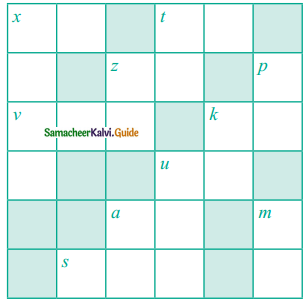
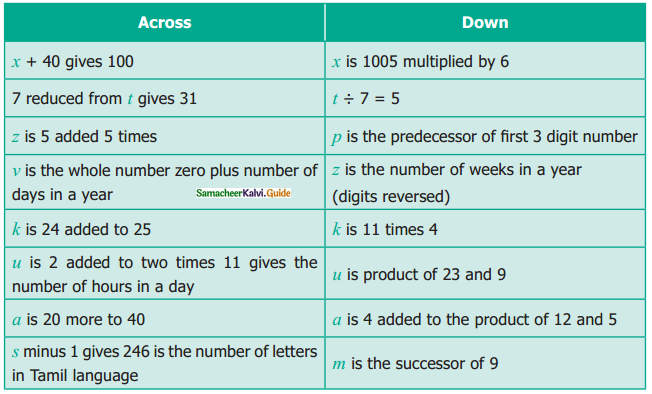
Question 7.
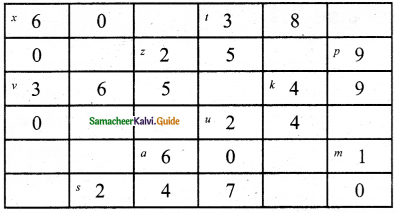
Find the variables from the clues given below and solve the crossword puzzle.
Samacheer Kalvi 6th Maths Guide Term 1 Chapter 2 Introduction to Algebra Ex 2.3 7
Samacheer Kalvi 6th Maths Guide Term 1 Chapter 2 Introduction to Algebra Ex 2.3 8
Solution:
Samacheer Kalvi 6th Maths Guide Term 1 Chapter 2 Introduction to Algebra Ex 2.3 9

Samacheer Kalvi 6th Maths Guide Term 1 Chapter 5 Statistics Ex 5.3

Students can download Maths Chapter 5 Statistics Ex 5.3 Questions and Answers, Notes, Samacheer Kalvi 6th Maths Guide Pdf helps you to revise the complete Tamilnadu State Board New Syllabus, helps students complete homework assignments and to score high marks in board exams.

Tamilnadu Samacheer Kalvi 6th Maths Solutions Term 1 Chapter 5 Statistics Ex 5.3

Question 1.
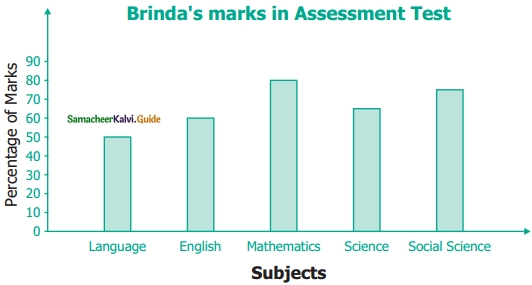
Read the given Bar Graph which shows the percentage of marks obtained by Brinda in different subjects in an assessment test.
Samacheer Kalvi 6th Maths Guide Term 1 Chapter 5 Statistics Ex 5.3 1
Observe the Bar Graph and answer the following questions.
(i) 1 Unit = ………… % of marks on vertical line.
(ii) Brinda has scored maximum marks in …….. subject.
(iii) Brinda has scored minimum marks in …….. subject.
(iv) The percentage of marks scored by Brinda in Science is ……..
(v) Brinda scored 60 % marks in the subject ……..
(vi) Brinda scored 20% more in …….. subject than ……… subject.
Solution:
(i) 10
(ii) Mathematics
(iii) Language
(iv) 65%
(v) English
(vi) Mathematics, Science

Samacheer Kalvi 6th Maths Guide Term 1 Chapter 5 Statistics Ex 5.3

Question 2.
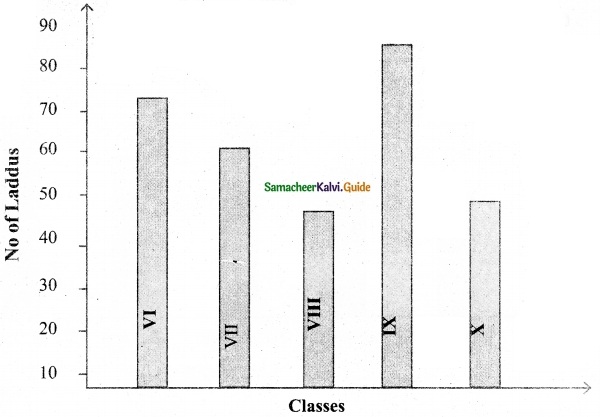
Chitra has to buv Laddus in order to distribute to her friends as follows:
Samacheer Kalvi 6th Maths Guide Term 1 Chapter 5 Statistics Ex 5.3 2
Draw a Bar Graph for this data.
Solution:
Distribution of Laddus by Chitra to her friends
Scale : 1 unit = 10 Laddus
Samacheer Kalvi 6th Maths Guide Term 1 Chapter 5 Statistics Ex 5.3 3
Samacheer Kalvi 6th Maths Guide Term 1 Chapter 5 Statistics Ex 5.3

Question 3.
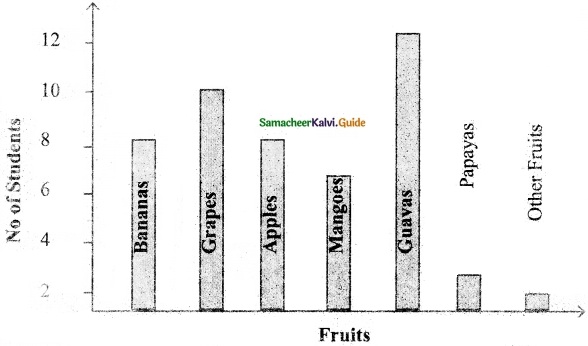
The fruits liked by the students of a class are as follows:
Samacheer Kalvi 6th Maths Guide Term 1 Chapter 5 Statistics Ex 5.3 4
Solution:
Draw a bar graph for data this data
Scale 1 unit = 2 fruits
Samacheer Kalvi 6th Maths Guide Term 1 Chapter 5 Statistics Ex 5.3 5

Samacheer Kalvi 6th Maths Guide Term 1 Chapter 5 Statistics Ex 5.3

Question 4.
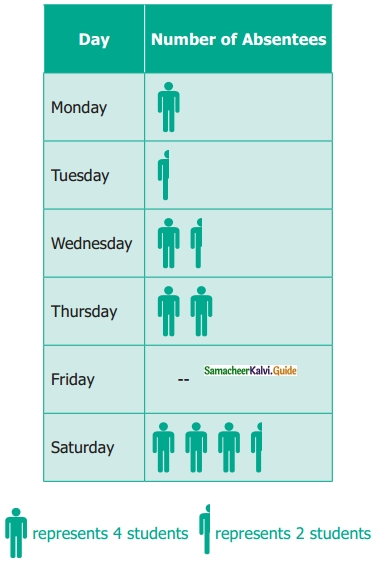
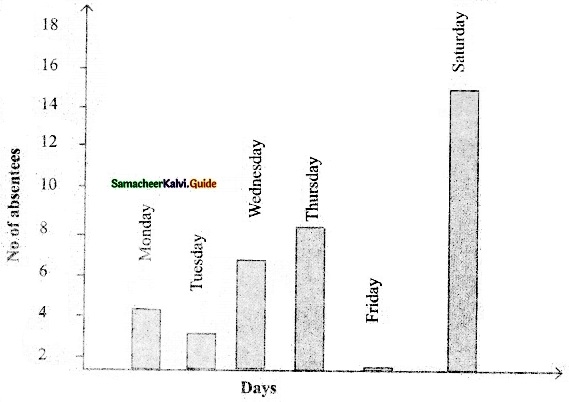
The pictograph below gives the number of absentees on different days of the week in class six. Draw the Bar graph for the same.
Samacheer Kalvi 6th Maths Guide Term 1 Chapter 5 Statistics Ex 5.3 6
Solution:
No of absentees on different days of the week in a class
Scale 1 unit = 2 students
Samacheer Kalvi 6th Maths Guide Term 1 Chapter 5 Statistics Ex 5.3 7

Samacheer Kalvi 6th Maths Guide Term 1 Chapter 5 Statistics Ex 5.3

Objective Type Questions

Question 5.
A bar graph can be drawn using
(a) Horizontal bars only
(b) Vertical bars only
(c) Both horizontal bars and Vertical bars
(d) Either horizontal bars or vertical bars
Solution:
(d) Either horizontal bars or vertical bars

Samacheer Kalvi 6th Maths Guide Term 1 Chapter 5 Statistics Ex 5.3

Question 6.
The spaces between any two bars in a bar graph
(a) can be different
(b) are the same
(c) are not the same
(d) all of these
Solution:
(b) are the same

Samacheer Kalvi 6th Maths Guide Term 1 Chapter 5 Statistics Ex 5.3

Samacheer Kalvi 6th Maths Guide Term 1 Chapter 5 Statistics Ex 5.2

Students can download Maths Chapter 5 Statistics Ex 5.2 Questions and Answers, Notes, Samacheer Kalvi 6th Maths Guide Pdf helps you to revise the complete Tamilnadu State Board New Syllabus, helps students complete homework assignments and to score high marks in board exams.

Tamilnadu Samacheer Kalvi 6th Maths Solutions Term 1 Chapter 5 Statistics Ex 5.2

Question 1.
Fill in the blanks.
Samacheer Kalvi 6th Maths Guide Term 1 Chapter 5 Statistics Ex 5.2 1
(iii) Representation of data by using pictures is known as ………
Solution:
(i) 150
(ii) Samacheer Kalvi 6th Maths Guide Term 1 Chapter 5 Statistics Ex 5.2 2
(iii) Pictograph

Samacheer Kalvi 6th Maths Guide Term 1 Chapter 5 Statistics Ex 5.2

Question 2.
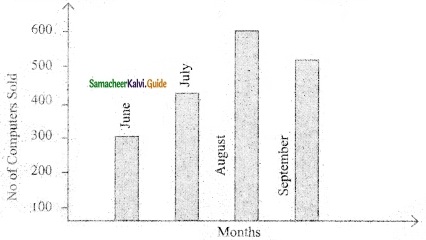
Draw a pictograph for the given data.
Samacheer Kalvi 6th Maths Guide Term 1 Chapter 5 Statistics Ex 5.2 3
(Choose your own suitable scale)
Solution:
Number of computers sold
Scale : 1 Unit = 100 computers
Samacheer Kalvi 6th Maths Guide Term 1 Chapter 5 Statistics Ex 5.2 4

Samacheer Kalvi 6th Maths Guide Term 1 Chapter 5 Statistics Ex 5.2

Question 3.
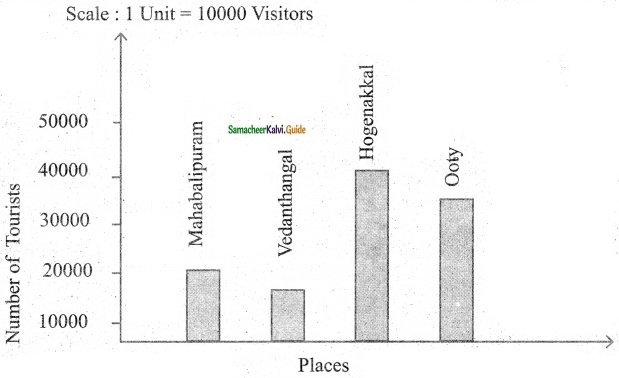
The following table shows the number of tourists who visited the places in the month of May. Draw a pictograph
Samacheer Kalvi 6th Maths Guide Term 1 Chapter 5 Statistics Ex 5.2 5
(Choose your own suitable scale)
Solution:
Number of Tourists who visited the places in the month of May.
Samacheer Kalvi 6th Maths Guide Term 1 Chapter 5 Statistics Ex 5.2 6

Samacheer Kalvi 6th Maths Guide Term 1 Chapter 5 Statistics Ex 5.2

Question 4.
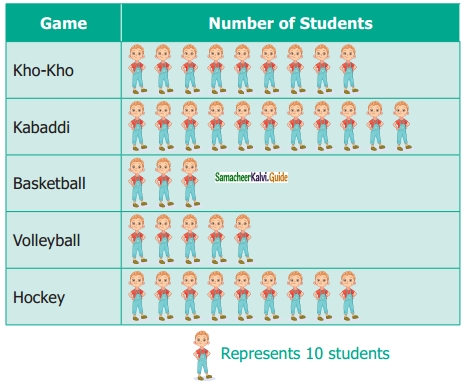
The following pictograph shows the number of students playing different games in a school.
Samacheer Kalvi 6th Maths Guide Term 1 Chapter 5 Statistics Ex 5.2 7
Answer the following questions.
(i) Which is the most popular game among the students?
(ii) Find the number of students playing Kabaddi.
(iii) Which two games are played by an equal number of students?
(iv) What is the difference between the number of students playing Kho-Kho and Hockey?
(v) Which is the least popular game among the students?
Solution:
(i) Kabaddi is the most popular game among students.
(ii) There are 11 × 10 = 110 students playing kabaddi.
(iii) Kho-Kho and Hockey are played by an equal number of students.
(iv) Difference is 90 – 90 = 0.
(v) Basketball is the least popular game among students.

Samacheer Kalvi 6th Maths Guide Term 1 Chapter 5 Statistics Ex 5.2

Objective Type Questions

Question 5.
The pictorial representation for a phrase is a ____
(a) Picto
(b) Tally mark
(c) Frequency
(d) Data
Solution:
(d) Data

Question 6.
A pictograph is also known as
a) Pictoword
(b) Pictogram
(c) Pictophrase
(d) Pictograph
Solution:
(b) Pictogram

Samacheer Kalvi 6th Maths Guide Term 1 Chapter 5 Statistics Ex 5.2

Samacheer Kalvi 6th Maths Guide Term 1 Chapter 5 Statistics Ex 5.1

Students can download Maths Chapter 5 Statistics Ex 5.1 Questions and Answers, Notes, Samacheer Kalvi 6th Maths Guide Pdf helps you to revise the complete Tamilnadu State Board New Syllabus, helps students complete homework assignments and to score high marks in board exams.

Tamilnadu Samacheer Kalvi 6th Maths Solutions Term 1 Chapter 5 Statistics Ex 5.1

Question 1.
Fill in the blanks.

  1. The collected information is called ……..
  2. An example of Primary data is ………
  3. An example of Secondary Data is ……….
  4. The tally marks for number 8 in standard form is ………

Solution:

  1. Data
  2. List of absentees in a class
  3. Cricket scores gathered from a website
  4. Samacheer Kalvi 6th Maths Guide Term 1 Chapter 5 Statistics Ex 5.1 11

Samacheer Kalvi 6th Maths Guide Term 1 Chapter 5 Statistics Ex 5.1

Question 2.
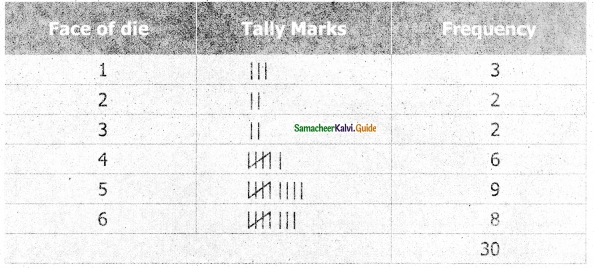
Viji threw a die 30 times and noted down the result each time as follows. Prepare a table on the numbers shown using Tally Marks.
1, 4, 3, 5, 5, 6, 6, 4, 3, 5, 4, 5, 6, 5, 2, 4, 2, 6, 5, 5, 6, 6, 4, 5, 6, 6, 5, 4, 1, 1
Solution:
Samacheer Kalvi 6th Maths Guide Term 1 Chapter 5 Statistics Ex 5.1 1

Question 3.
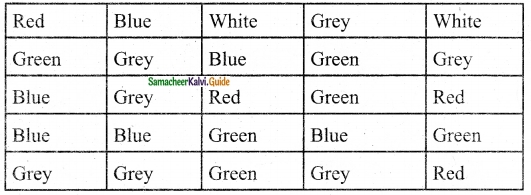
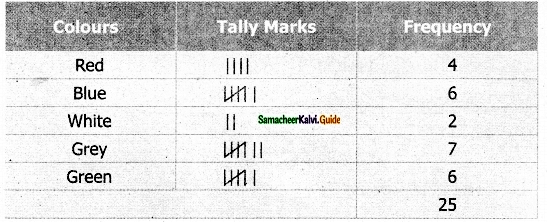
The following list tells colours liked by 25 students. Prepare a table using Tally Marks.
Samacheer Kalvi 6th Maths Guide Term 1 Chapter 5 Statistics Ex 5.1 2
Solution:
Samacheer Kalvi 6th Maths Guide Term 1 Chapter 5 Statistics Ex 5.1 3

Samacheer Kalvi 6th Maths Guide Term 1 Chapter 5 Statistics Ex 5.1

Question 4.
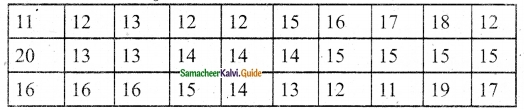
The following are the marks obtained by 30 students in a class test out of 20 in Mathematics subject.
Samacheer Kalvi 6th Maths Guide Term 1 Chapter 5 Statistics Ex 5.1 4
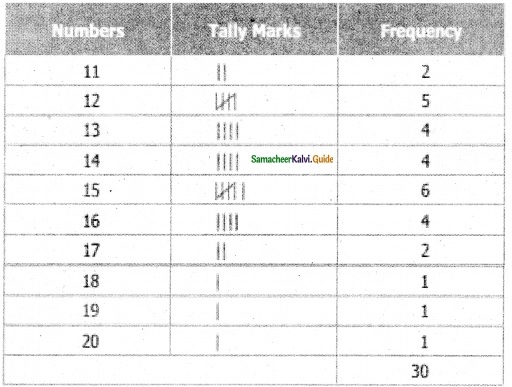
Prepare a table using Tally Marks.
Samacheer Kalvi 6th Maths Guide Term 1 Chapter 5 Statistics Ex 5.1 5

Samacheer Kalvi 6th Maths Guide Term 1 Chapter 5 Statistics Ex 5.1

Question 5.
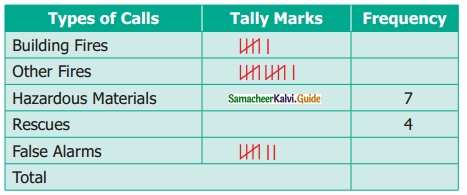
The table shows the number of calls recorded by a Fire Service Station in one year.
Samacheer Kalvi 6th Maths Guide Term 1 Chapter 5 Statistics Ex 5.1 6
Complete the table and answer the following questions.
(i) Which type of call was recorded the most?
(ii) Which type of call was recorded the least?
(iii) How many calls were recorded in all?
(iv How many calls were recorded as False Alarms?
Solution:
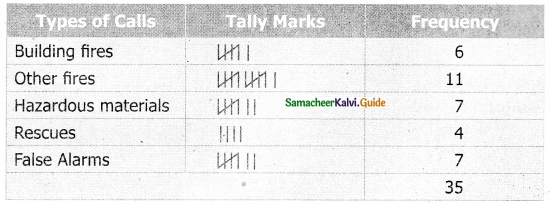
Samacheer Kalvi 6th Maths Guide Term 1 Chapter 5 Statistics Ex 5.1 7
(i) The call for “Other Fires” was recorded the most
(ii) The call for “Rescues” was recorded the least
(iii) The total of 35 calls was recorded
(iv) There are 7 calls were recorded as False alarm.

Samacheer Kalvi 6th Maths Guide Term 1 Chapter 5 Statistics Ex 5.1

Objective Type Questions

Question 6.
The tally marks for the number 7 in standard form is ………
Samacheer Kalvi 6th Maths Guide Term 1 Chapter 5 Statistics Ex 5.1 8
Solution:
(b)Samacheer Kalvi 6th Maths Guide Term 1 Chapter 5 Statistics Ex 5.1 9

Question 7.
Samacheer Kalvi 6th Maths Guide Term 1 Chapter 5 Statistics Ex 5.1 10
(a) 5
(b) 8
(c) 9
(d) 10
Solution:
(c) 9

Samacheer Kalvi 6th Maths Guide Term 1 Chapter 5 Statistics Ex 5.1

Question 8.
The plural form of ‘datum’ is ____
(a) datum
(b) datums
(c) data
(d) dates
Solution:
(c) data

Samacheer Kalvi 6th Maths Guide Term 1 Chapter 3 Ratio and Proportion Ex 3.5

Students can download Maths Chapter 3 Ratio and Proportion Ex 3.5 Questions and Answers, Notes, Samacheer Kalvi 6th Maths Guide Pdf helps you to revise the complete Tamilnadu State Board New Syllabus, helps students complete homework assignments and to score high marks in board exams.

Tamilnadu Samacheer Kalvi 6th Maths Solutions Term 1 Chapter 3 Ratio and Proportion Ex 3.5

Miscellaneous Practice Problems

Question 1.
The maximum speed of some of the animals are given below:
the Elephant = 20 km/h; the
Lion = 80 km/h;
the Cheetah =100 km/h
Find the following ratios of their speeds in simplified form and find which ratio is the least?
(i) the Elephant and the Lion
(ii) the Lion and the Cheetah
(iii) the Elephant and the Cheetah
Solution:
(i) The Elephant: the Lion
= 20 : 80 = \(\frac{20}{80}\) = \(\frac{1}{4}\) = 1 : 4

(ii) the Lion : the Cheetah
= 80 : 100 = \(\frac{80}{100}\) = \(\frac{4}{5}\) = 4 : 5

(iii) the Elephant: the Cheetah
= 20 : 100 = \(\frac{20}{100}\) = \(\frac{1}{5}\) = 1 : 5
The ratio of Elephant to Cheetah is the least.

Samacheer Kalvi 6th Maths Guide Term 1 Chapter 3 Ratio and Proportion Ex 3.5

Question 2.
A particular high school has 1500 students 50 teachers and 5 administrators. If the school grows to 1800 students and the ratios are maintained, then find the number of teachers and administrators.
Solution:
Administrators : teachers : students = 5 : 50 : 1500 = 1 : 10 : 300
If the school grows to 1800 students then 10 parts = teachers
1 part = administrators
300 parts = 1800
1 part = \(\frac{1800}{300}\) = 6
10 parts = 6 × 10 = 60
So, if the school grows to 1800 students the new ratio is administrators : teachers: students
6 : 60 : 1800

Samacheer Kalvi 6th Maths Guide Term 1 Chapter 3 Ratio and Proportion Ex 3.5

Question 3.
I have a box which has 3 green, 9 blue, 4 yellow, 8 orange coloured cubes in it.
(a) What is the ratio of orange to yellow cubes?
(b) What is the ratio of green to blue cubes?
(c) How many different ratios can be formed, when you compare each colour to any one of the other colours?
Solution:
Number of green cubes = 3
Number of blue cubes = 9
Number of yellow cubes = 4
Number of orange cubes = 8
(a) Ratio of orange to yellow cubes \(\frac{\text { Number of orange cubes }}{\text { Number of yellow cubes }}=\frac{8}{4}=\frac{2}{1}=2: 1\)
Ratio of orange to yellow cubes = 2 : 1
(b) \(\frac{\text { Number of green cubes }}{\text { Number of blue cubes }}=\frac{3}{9}=\frac{1}{3}\)
Ratio of green to blue cubes = 1 : 3
(c) The ratios can be Orange : Yellow, Orange: blue, Orange : green, Yellow : Orange, yellow : blue, yellow : green, blue : green, blue : orange, blue : yellow, green : orange, green : yellow, green : blue. Thus 12 ratios can be formed.

Samacheer Kalvi 6th Maths Guide Term 1 Chapter 3 Ratio and Proportion Ex 3.5

Question 4.
A gets double of what B gets and B gets double of what C gets. Find A : B and B : C and verify whether the result is in proportion or not.
Solution:
Let x be the part owned by C then A : B : C = 2(2x) : 2x : x = 4x : 2x : x
A : B = 4x : 2x = 2 : 1
B : C = 2x : x = 2 : 1
A : B : : B : C. i.e, They are in proportion.

Question 5.
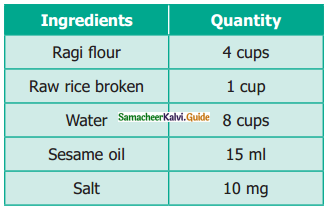
The ingredients required for the preparation of Ragi Kali, a healthy dish of Tamilnadu is given below.
Samacheer Kalvi 6th Maths Guide Term 1 Chapter 3 Ratio and Proportion Ex 3.5 1
(a) If one cup of ragi flour is used then, what would be the amount of raw rice required?
(b) If 16 cups of water are used, then how much ragi flour should be used?
(c) Which of these ingredients cannot be expressed as a ratio? Why?
Solution:
(i) \(\frac{1}{4}\) cup
(ii) 8 cups
(iii) Ragi flour, Raw rice, and water are in one unit. Sesame oil and salt are in different units. These different units cannot be compared and cannot be expressed as a ratio because the two quantities of a ratio should be in the same unit.

Samacheer Kalvi 6th Maths Guide Term 1 Chapter 3 Ratio and Proportion Ex 3.5

Question 6.
Antony brushes his teeth in the morning and night on all days of the week. Shabeen brushes her teeth only in the morning. What is the ratio of the number of times they brush their teeth in a week?
Solution:
Number of times Antony brushes a day = 2
Number of times Antony brushes a week = 2 × 7 = 14
Number of times Shabeen brushes a day = 1
Number of times Shabeen brushes a week = 1 × 7 = 7
Number of times Antony brushes : Number of times Antony brushes = 14 : 7 = 2 : 1
The required ratio = 2 : 1

Question 7.
Thirumagal’s mother wears a bracelet made of 35 red beads and 30 blue beads. Thirumagal wants to make smaller bracelets using the same two coloured beads in the same ratio. In how many different ways can she make the bracelets?
Samacheer Kalvi 6th Maths Guide Term 1 Chapter 3 Ratio and Proportion Ex 3.5 2
Solution:
Red : blue = 35 : 30 = 7 : 6
Different ways (i) 7 : 6
(ii) 14 : 12;
(iii) 21 : 18;
(iv) 28 : 24

Samacheer Kalvi 6th Maths Guide Term 1 Chapter 3 Ratio and Proportion Ex 3.5

Question 8.
Team A wins 26 matches out of 52 matches. Team B wins three fourth of 52 matches played. Which team has a better winning record?
Solution:
Team A = \(\frac{26}{52}\) = \(\frac{1}{2}\)
Team B = \(\frac{3}{4}\) × 52 = 39
Team B has a better winning record.

Question 9.
In a school excursion, 6 teachers and 12 students from 6th standard and 9 teachers and 27 students from 7th standard, 4 teachers and 16 students from 8th standard took part. Which class has the least teacher to student ratio?
Solution:
Std VI – teachers: students = 6 : 12 = 1 : 2
Std VII – teachers : students = 9 : 27 = 1 : 3
Std VIII – teachers : students = 4 : 16 = 1 : 4
Std VIII has the least ratio.

Samacheer Kalvi 6th Maths Guide Term 1 Chapter 3 Ratio and Proportion Ex 3.5

Question 10.
Fill the boxes using any set of suitable numbers 6 : ___ : : ___ : 15
Solution:
6 : ……. = …….. : 15
Product of the extremes = 6 × 15 = 90
Set of suitable numbers
1 and 90, 2 and 45, 3 and 30, 5 and 18, 6 and 15

Question 11.
From your school diary, write the ratio of the number of holidays to the number of working days in the current academic year.
Solution:
Number of holidays = 145
Number of working days = 220
Holidays : working days = 145 : 220
= \(\frac{145}{220}\)
= \(\frac{29}{44}\)
= 29 : 44

Samacheer Kalvi 6th Maths Guide Term 1 Chapter 3 Ratio and Proportion Ex 3.5

Question 12.
If the ratio of Green, Yellow and Black balls in a bag is 4 : 3 : 5, then
(a) Which is the most likely ball that you can choose from the bag?
(b) How many balls in total are there in the bag if you have 40 black balls in it?
(c) Find the number of green and yellow balls in the bag.
Solution:
Green : Yellow : Black = 4 : 3 : 5
(i) Blackballs;
(ii) 96 balls (32 + 24 + 40);
(iii) green balls = 32
yellow balls = 24