Samacheer Kalvi 12th Commerce Guide Chapter 22 The Negotiable Instruments Act, 1881

Tamilnadu State Board New Syllabus Samacheer Kalvi 12th Commerce Guide Pdf Chapter 22 The Negotiable Instruments Act, 1881 Text Book Back Questions and Answers, Notes.

Tamilnadu Samacheer Kalvi 12th Commerce Solutions Chapter 22 The Negotiable Instruments Act, 1881

12th Commerce Guide The Negotiable Instruments Act, 1881 Text Book Back Questions and Answers

I. Choose the Correct Answers

Question 1.
Negotiable Instrument Act was passed in the year …………..
a) 1981
b) 1881
c) 1994
d) 1818
Answer:
b) 1881

Question 2.
Negotiable Instrument is freely transferable by delivery if it is a …………..  instrument.
a) Order
b) Bearer
c) both a & b
d) None of the above
Answer:
b) Bearer

Samacheer Kalvi 12th Commerce Guide Chapter 22 The Negotiable Instruments Act, 1881

Question 3.
The transferee of a Negotiable Instrument is the one ……………………
a) Who transfer the instrument
b) On whose name it is transferred
c) Who enchases it
d) None of the above
Answer:
b) On whose name it is transferred

Question 4.
The number of parties in a bill of exchange is
a) 2
b) 6
c) 3
d) 4
Answer:
c) 3

Samacheer Kalvi 12th Commerce Guide Chapter 22 The Negotiable Instruments Act, 1881

Question 5.
Section 6 of the Negotiable Instruments Act 1881 deals with
a) Promissory Note
b) Bills of exchange
c) Cheque
d) None of the above
Answer:
c) Cheque

Question 6.
………………..  cannot be a bearer instrument.
a) Cheque
b) Promissory Note
c) Bills of exchange
d) None of the above
Answer:
a) Cheque

Samacheer Kalvi 12th Commerce Guide Chapter 22 The Negotiable Instruments Act, 1881

Question 7.
When crossing restrict further negotiation
a) Not negotiable crossing
b) General Crossing
c) A/c payee crossing
d) Special crossing
Answer:
a) Not negotiable crossing

Question 8.
Which endorsement relieves the endorser from incurring liability in the event of dishonor
a) Restrictive
b) Facultative
c) Sans recourse
d) Conditional
Answer:
b) Facultative

Samacheer Kalvi 12th Commerce Guide Chapter 22 The Negotiable Instruments Act, 1881

Question 9.
A cheque will become stale after …………. months of its date
a) 3
b) 4
c) 5
d) 1
Answer:
a) 3

Question 10.
Document of title to the goods excludes
a) Lorry receipt
b) Railway receipt
c) Airway bill
d) Invoice
Answer:
d) Invoice

II. Very Short Answer Questions

Question 1.
What is meant by Negotiable Instrument?
Answer:
A negotiable instrument is a document which entitles a person to a certain sum of money and which is transferable from one person to another by mere delivery or by endorsement and delivery.

Question 2.
Define Bill of Exchange.
Answer:

  • “A Bill of Exchange is an instrument in writing containing an unconditional order, signed by the maker, directing a certain person to pay a certain sum of money only to or to the order of a certain person or to the bearer of the instrument”.
  • Negotiable Instrument Act -1881, Sec – 5.

Samacheer Kalvi 12th Commerce Guide Chapter 22 The Negotiable Instruments Act, 1881

Question 3.
List three characteristics of a Promissory Note.
Answer:
Characteristics of a Promissory Note:

  1. A promissory note must be in writing.
  2. The promise to pay must be unconditional.
  3. It must be signed by the maker.

Question 4.
Define Cheque.
Answer:

  • A cheque is a printed instrument issued by Commercial Banks to its customers for making and receiving payments. [To withdraw self and to pay others]
  • The person who draws a cheque is called – “Drawer”.
  • The Bank on whom the cheque is drawn is called – “Drawee”.
  • The person who receives payment on the cheque is called – “Payee”.

Question 5.
Define Endorsement.
Answer:
“When the maker or holder of a negotiable instrument signs the name, otherwise that as such maker for the purpose of negotiation, on the back or face thereof, or on a slip of paper annexed thereto.”

Samacheer Kalvi 12th Commerce Guide Chapter 22 The Negotiable Instruments Act, 1881

III. Short Answer Questions

Question 1.
Explain the Characteristics of Negotiable Instrument.
Answer:
A negotiable instrument is transferable from one person to another without any formality, such as affixing stamp, registration, etc. When the instrument is held by the holder in due course in the process of negotiation, it is cured of all defects in the instrument with respect to ownership. Though a bill, a promissory note, or a cheque represents a debt, the transferee is entitled to sue on the instrument in his own name in case of dishonour, without giving notice to the debtor that he has become its holder.

Samacheer Kalvi 12th Commerce Guide Chapter 22 The Negotiable Instruments Act, 1881

Question 2.
Distinguish between Negotiability and Assignability. (NON)
Answer:

No. Basis of Difference

Negotiability Assignability

1. Nature of title

In case of negotiation, the transferee can get a better title than that of transfer or provided he takes the instrument for bonafide and for value. In the case of an assignment, the assignee [Transferee] cannot get a better title than that of the assignor. [Transferor].
       2. Ownership In case it is payable to Bearer – mere delivery.
In case it is payable in order – Endorsement and delivery and easy to transfer.
The transfer of legal title takes place by means of a separate document and after complying with the necessary legal formalities.
      3. Notice Notice is not necessary for the holder to claim the payment from debtors. The assignee must give notice to the debtors.

Question 3.
What are the characteristics of a Bill of Exchange?
Answer:
Characteristics of a Bill of Exchange:

  1. A bill of exchange is a document in writing.
  2. The document must contain an order to pay.
  3. The order must be unconditional.
  4. The instrument must be signed by the person who draws it.
  5. The name of the person on whom the bill is drawn must be specified in the bill itself.

Samacheer Kalvi 12th Commerce Guide Chapter 22 The Negotiable Instruments Act, 1881

Question 4.
Distinguish between Bill of Exchange and Promissory Note. (UNDI)
Answer:

No. Basis of Difference

Bill of Exchange

Promissory Note

1. Undertaking It contains an unconditional order. It contains an unconditional undertaking.
2. Number of Parties There are three parties:

  • Drawer [maker]
  • Drawee
  • Payee
There are two parties:

  • Maker
  • Payee
3. Drawer of the instrument A creditor draws a Bill on the debtor. A debtor executes a promotion in favour of a creditor.
4. Identify the parties Both Drawer and payee can be one and the same person. The maker himself can not be the payee because the same person cannot be both the promisor and promisee.

Question 5.
Discuss the two different types of the crossing.
Answer:
General Crossing:
According to section 123 of the Negotiable Instruments Act, 1881,
“Where a cheque bears across its face an addition of the words “and company” or any abbreviation thereof between two transverse parallel lines simply, either with or without the words “not negotiable” that addition shall be deemed a crossing and the cheque shall be deemed to be crossed generally”.

Special Crossing:
According to section 124 of the Negotiable Instruments Act, 1881
“Where a cheque bears across its face an addition of the name of a banker with or without the word “not negotiable” that addition shall deem a crossing and the cheque shall be deemed to be crossed specially”.

Samacheer Kalvi 12th Commerce Guide Chapter 22 The Negotiable Instruments Act, 1881

IV. Long Answer Questions

Question 1.
Mention the presumptions of Negotiable Instruments.
Answer:
Presumptions of Negotiable Instrument:

  1. Every negotiable instrument is presumed to have been drawn and accepted for consideration.
  2. Every negotiable instrument bearing, a date is presumed to have been made or drawn on such a date.
  3. It is presumed to have been accepted within a reasonable time after the date and before its maturity.
  4. The transfer of a negotiable instrument is presumed to have been made before maturity.
  5. When a negotiable instrument has been lost, it is presumed to have been duly stamped.
  6. The holder of a negotiable instrument is presumed to be a holder in due course.

Question 2.
Distinguish between cheque and Bill of Exchange. (DOGS AND VP)
Answer:

No. Basis of Difference

Bill of Exchange

Cheque

1. Drawn A Bill of Exchange can be drawn on any person including Banker. A Cheque can be drawn from a specified Banker.
2. On dishonour On dishonour there is a practice of Noting and protesting. No such things on dishonour.
3. Grace days 3 grace days are allowed to calculate the maturity date. Grace days are not allowed.
4. Stamping Sufficiently stamped. Need not be stamped.
5. Acceptance Acceptance by the drawee is necessary. Does not require any acceptance.
6. Notice Notice of dishonour is necessary. Notice of dishonour is not necessary.
7. Discounting It can be discounted. It cannot be discounted.
8. Validity A Bill made payable to the bearer on demand is void. A Cheque drawn payable to the bearer on demand is valid.
9. Payability It is payable on demand It is payable after a specified period.

Samacheer Kalvi 12th Commerce Guide Chapter 22 The Negotiable Instruments Act, 1881

Question 3.
Discuss in detail the features of a cheque. (SAUDI PP)
Answer:
A cheque is a negotiable instrument drawn on a particular banker.
Features:
(i) Instrument in Writings:
A cheque or a bill or a promissory note must be an instrument in writing. Though the law does not prohibit a cheque from being written in pencil, bankers never accept it because of risks involved. Alternation is quite easy but detection is impossible in such cases.

(ii) Unconditional Orders:
The instrument must contain an order to pay money. It is not necessary that the word ‘order’ or its equivalent must be used to make the document a cheque. It does not cease to be a cheque just because the world ‘please’ is used before the word pay. Further, the order must be unconditional.

(iii) Drawn on a Specified Banker Only:
The cheque is always drawn on a specified banker. A cheque vitally differs from a bill in this respect as latter can be drawn on any person including a banker. The customer of a banker can draw the cheque only on the particular branch of the bank where he has an account.

(v) A Certain Sum of Money Only:
The order must be for payment of only money. If the banker is asked to deliver securities, the document cannot be called a cheque. Further, the sum of money must be certain.

(v) Payee to be Certain:
The cheque must be made payable to a certain person or to the order of a certain person or to the bearer of the instrument. The word, a person includes corporate bodies, local authorities, associations, holders of the office of an institution etc.

(vi) Signed by the Drawer:
The cheque is to be signed by the drawer. Further, it should tally with the specimen signature furnished to the bank at the time of opening the account.

Samacheer Kalvi 12th Commerce Guide Chapter 22 The Negotiable Instruments Act, 1881

Question 4.
What are the requisites for a valid endorsement? (BAD NEWS D)
Answer:
If an endorsement is to be valid, it must possess the following requisites:

  1. The endorsement is to be made on the face of the instrument or on its back.
  2. When there is no space for making further endorsements a piece of paper can be attached
  3. Endorsement for only a part of the amount of the instrument is invalid.
  4. The endorsement is complete only when delivery of the instrument is made.
  5. Signing in block letters does not constitute a regular endorsement.
  6. If the payee is an illiterate person, he can endorse it by affixing his thumb impression on the instrument.

Samacheer Kalvi 12th Commerce Guide Chapter 22 The Negotiable Instruments Act, 1881

Question 5.
Explain the different kinds of endorsement.
Answer:
1. Blank or General Endorsement:
Without writing anything on the backside of the instrument, the endorser affixing his sign only.
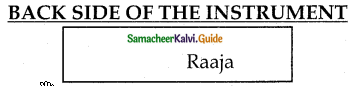
Samacheer Kalvi 12th Commerce Guide Chapter 22 The Negotiable Instruments Act, 1881 1

Question 2.
Full or special Endorsement:
Answer:
If the Endorser adds a direction to pay the amount mentioned, to or to the order of a specified person.
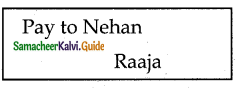
Other forms:

  • Raaja in favour of Nehan.
  • Nehan or order of Raaja.
  • Please exchange Nehan – Raaja.

Samacheer Kalvi 12th Commerce Guide Chapter 22 The Negotiable Instruments Act, 1881

Question 3.
Conditional or Qualified Endorsement:
Answer:
The endorsee’s right to receive money is subject to the fulfilment of a particular event (condition).
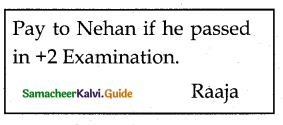
Samacheer Kalvi 12th Commerce Guide Chapter 22 The Negotiable Instruments Act, 1881 3
Other forms:

  • Pay to Preetha if she marries Yashwanth.
  • Pay to Hasan on completion of the house building.

Question 4.
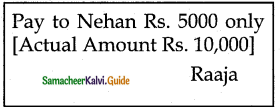
Restrictive Endorsement:
Answer:
When endorsement restricts or prohibits further negotiability of the instrument, by added the word “ONLY” after the endorsee’s name.
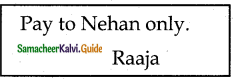
Samacheer Kalvi 12th Commerce Guide Chapter 22 The Negotiable Instruments Act, 1881 4
Other forms:
Raaja in favour of Nehan.

Samacheer Kalvi 12th Commerce Guide Chapter 22 The Negotiable Instruments Act, 1881

Question 5.
Sans recourse Endorsement:
Answer:

  • It is an Endorsement which limits the liability of the endorser.
  • The effect of this endorsement is, to render the endorser free from all liability to any subsequent holder.
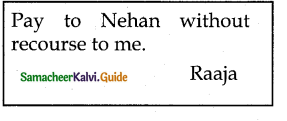
    Samacheer Kalvi 12th Commerce Guide Chapter 22 The Negotiable Instruments Act, 1881 5

Other forms:
Pay to Nehan sans recourse.

Question 6.
Sans Frais Endorsement:
Answer:

  • ‘Sans Frais’ means without expense to me. [Noting charges]
  • The Endorser does not want any expenses to be incurred in his account on the instrument.
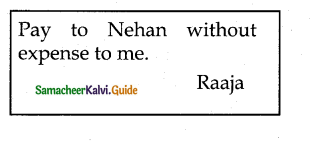
Samacheer Kalvi 12th Commerce Guide Chapter 22 The Negotiable Instruments Act, 1881 6

Question 7.
Facultative Endorsement:
Answer:
It is an Endorsement, whereby, the Endorser waives some of his rights on the instrument.
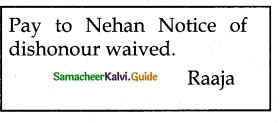
Samacheer Kalvi 12th Commerce Guide Chapter 22 The Negotiable Instruments Act, 1881 7

Question 8.
Partial Endorsement:
Answer:

  • It is an Endorsement that seeks to transfer only a part of the payments under the instrument.
  • It is not valid.

Samacheer Kalvi 12th Commerce Guide Chapter 22 The Negotiable Instruments Act, 1881 8

Samacheer Kalvi 12th Commerce Guide Chapter 22 The Negotiable Instruments Act, 1881

12th Commerce Guide The Negotiable Instruments Act, 1881 Additional Important Questions and Answers

I. Choose the Correct Answers
Question 1.
Number of parties to a cheque is………………..
a) 2
b) 3
c) 4
d) 6
Answer:
b) 3

Question 2.
Number of parties to a Promissory Note are …………….
a) 5
b) 3
c) 1
d) 2
Answer:
d) 2

Samacheer Kalvi 12th Commerce Guide Chapter 22 The Negotiable Instruments Act, 1881

Question 3.
A bill of exchange drawn on a specified banker is
(a) promissory note
(b) cheque
(c) hundi
(d) share
Answer:
(b) cheque

Question 4.
Section ……….. defined a Bill of Exchange.
a) 1
b) 3
c) 5
d) 7
Answer:
c) 5

Samacheer Kalvi 12th Commerce Guide Chapter 22 The Negotiable Instruments Act, 1881

Question 5.
Section …………. defined a cheque.
a) 4
b) 5
c) 6
d) 7
Answer:
c) 6

Question 6.
……………….. days will be given to Bill of Exchange as Grace Days.
a) 3
b) 4
c) 8
d) 9
Answer:
a) 3

Samacheer Kalvi 12th Commerce Guide Chapter 22 The Negotiable Instruments Act, 1881

Question 7.
A person who wants to transfer the instrument has to sign on the back is called …………..
a) Endorsee
b) Endorser
c) Indorseum
d) Indorsee
Answer:
b) Endorser

Question 8.
A piece of paper that can be attached to an instrument to sign is called ……………
a) Allonge
b) Stamp
c) Sticker
d) All of these
Answer:
a) Allonge

Samacheer Kalvi 12th Commerce Guide Chapter 22 The Negotiable Instruments Act, 1881

Question 9.
Pay to Nehan, if he got 595 marks in +2 Exam is an example for ……………. endorsement.
a) Blank
b) Full or Special
c) Condition
d) Restrictive
Answer:
c) Condition

Question 10.
Pay to Noohu or Bearer is an example for ……………… instrument
a) Bearer
b) Order
c) Inland
d) Foreign
Answer:
a) Bearer

Samacheer Kalvi 12th Commerce Guide Chapter 22 The Negotiable Instruments Act, 1881

Question 11.
Pay to Nathifa or order is an example for ………………. instrument.
a) Order
b) Bearer
c) Foreign
d) Inland
Answer:
a) Order

Question 12.
Two transverse parallel lines are not essential in …………………… crossing.
a) General
b) Special
c) Double
d) All of these
Answer:
b) Special

Samacheer Kalvi 12th Commerce Guide Chapter 22 The Negotiable Instruments Act, 1881

Question 13.
IFSC is a ………….. character code.
a) 10
b) 11
c) 12
d) 13
Answer:
b) 11

Question 14.
Pick the odd one out.
a) RTGS
b) NEFT
c) IFSC
d) MNC
Answer:
d) MNC

Question 15.
Pick the odd one out.
a) Promissory Note
b) Bills of Exchange
c) Commodity Exchange
d) Cheque
Answer:
c) Commodity Exchange

Samacheer Kalvi 12th Commerce Guide Chapter 22 The Negotiable Instruments Act, 1881

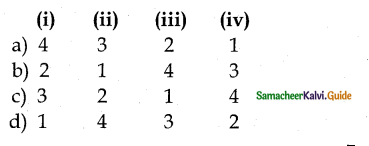
II. Match the following.

Question 1.

List – I

List – II

i. General Endorsement 1. Pay to Nusrath only
ii. Full Endorsement 2. Pay Noman if he returns in 3 months
iii. Conditional Endorsement 3. Pay Nehan
iv. Restrictive Endorsement 4. Nathifa – simply signed

Answer :
a) (i) 4, (ii) 3, (iii) 2, (iv) 1

III. Very Short Answer Questions

Question 1.
Define Cheque.
Answer:
“Cheque is a bill of exchange, drawn on a specified banker and not expressed to be payable otherwise than on-demand”. – NEGOTIABLE INSTRUMENT ACT -1881, SEC – 6.

Question 2.
Define Promissory Note. [Pronote]
Answer:
“A Promissory Note is an instrument in writing, containing an unconditional promise or undertaking, signed by the maker to pay a certain sum of money only to or to the order of a certain person, or to the bearer of the instrument”. -NEGOTIABLE INSTRUMENT ACT-1881, SEC-4.

Samacheer Kalvi 12th Commerce Guide Chapter 22 The Negotiable Instruments Act, 1881

Question 3.
Give a Specimen of Cheque.
Answer:
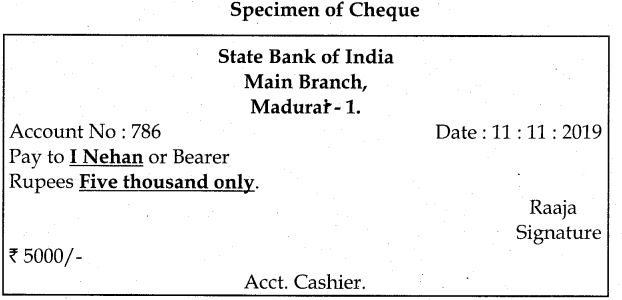
Samacheer Kalvi 12th Commerce Guide Chapter 22 The Negotiable Instruments Act, 1881 10

Question 4.
Draw a specimen of the Bill of Exchange.
Answer:
Specimen of a Bill of Exchange
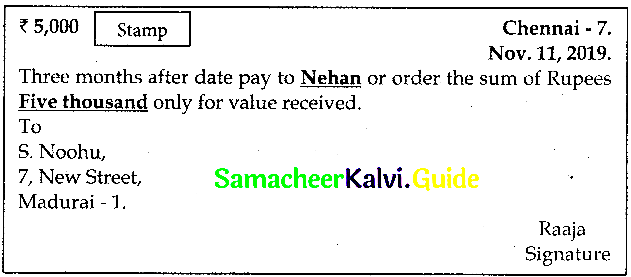
Samacheer Kalvi 12th Commerce Guide Chapter 22 The Negotiable Instruments Act, 1881 11

Question 5.
Show a Specimen of a Promissory Note. [Pronote]
Answer:
Specimen of a Promissory Note
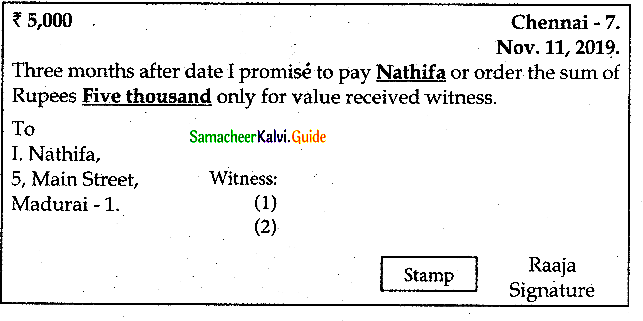
Samacheer Kalvi 12th Commerce Guide Chapter 22 The Negotiable Instruments Act, 1881 12

Question 6.
What is Endorsement?
Answer:

  • A person who wants to transfer his Negotiable Instrument has to put his signature on the backside of the instrument is called “Endorsement”.
  • A person who signs on the backside of the instrument is called “Endorser”.
  • A person to whom the instrument is endorsed is called “Endorsee”.

Samacheer Kalvi 12th Commerce Guide Chapter 22 The Negotiable Instruments Act, 1881

Question 7.
What is crossing and what are its types?
Answer:

  • Drawing two parallel transverse lines on the left top corner of a cheque is called “Crossing”.
  • Types:
    • General Crossing
    • Special crossing

Question 8.
Do you think that drawing following the two lines is crossing? If No, Why?

Samacheer Kalvi 12th Commerce Guide Chapter 22 The Negotiable Instruments Act, 1881 13

  • No. the above drawing two lines are not crossing.
  • Because drawing two transverse parallel lines is crossing.

Samacheer Kalvi 12th Commerce Guide Chapter 22 The Negotiable Instruments Act, 1881

IV. Short Answer Questions

Question 1.
What is the significance of crossing?
Answer:

  • A crossed cheque should not be paid across the counter.
  • If a crossed cheque has been stolen and collected for the party not entitled to it, the person for whom it has been collected can be easily traced.
  • Crossing ensures the safety and prevents payment into the wrong hands.

Question 2.
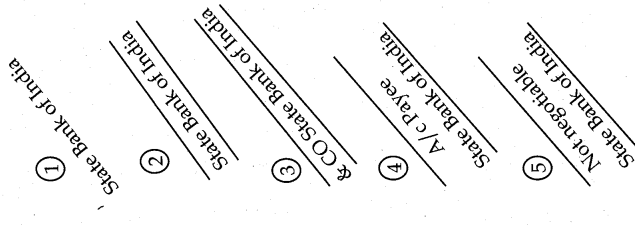
Give Specimens of General Crossing and Special Crossing.
Answer:
Specimen of General Crossing:
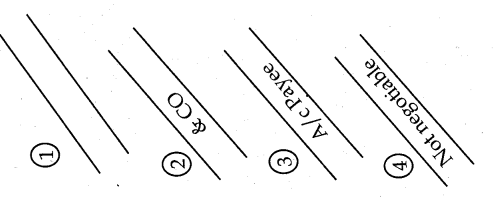
Samacheer Kalvi 12th Commerce Guide Chapter 22 The Negotiable Instruments Act, 1881 14

Specimen of Special Crossing :
Samacheer Kalvi 12th Commerce Guide Chapter 22 The Negotiable Instruments Act, 1881 15

Question 3.
Why emergency holidays are declared under the Negotiable – Instruments Act?
Answer:

  • Where the maturity date of the negotiable instrument falls on a notified public holiday, it is to be paid on a preceding day.
  • Where emergency holidays are declared for reasons like the Death of a leader in power, natural calamities, strike, election day etc., day should be made an emergency holiday.
  • So, the negotiable instruments maturing on the emergency holiday can be paid on the next working day.

Samacheer Kalvi 12th Commerce Guide Chapter 22 The Negotiable Instruments Act, 1881

Question 4.
What is ‘MICR’ Cheque?
Answer:

  • Magnetic Ink Character Recognition – MICR – code is character recognition technology used mainly by the banking industry to ease processing and clearance of cheques and other documents.
  • It is found at the bottom of the cheque.
  • It includes Bank code, Bank Account Number, Amount and a control indicator.
  • It prevents the crime of printing counterfeit cheques or documents using technology.
  • The Magnetic Ink will help to discover fake documents.

Question 5.
What is the IFSC code?
Answer:

  • Indian Financial System Code – IFSC code is an – alphanumeric code which facilitates EFT in India.
  • This code uniquely identifies each bank branch participating in the two main Payment and settlement systems in India.

Samacheer Kalvi 12th Commerce Guide Chapter 22 The Negotiable Instruments Act, 1881

Question 6.
When there is no space in negotiable Instrument for making further endorsement) how can it be endorsed?
Answer:
When there is no space for making further endorsements a piece of paper can be attached to the negotiable instrument for this purpose, is This piece of paper is called’Allonge’.

Question 7.
If the payee is illiterate, how can he endorse a negotiable instrument?
Answer:

  • If the payee is an illiterate person, he can endorse it by affixing his thumb impression on the instrument.
  • But it must be duly attested by somebody who should give his full address thereon.

Samacheer Kalvi 12th Commerce Guide Chapter 22 The Negotiable Instruments Act, 1881

V. Long Answer Questions

Question 1.
Explain the various types of Negotiable Instruments.
Answer:
Bearer Instrument:
Cheque or Bill of Exchange or Promissory Note is payable to bearer is called “Bearer Instrument”.
(e.g) Pay to Nathifa or Bearer.

Order Instrument:
Cheque or Bill of Exchange or Promissory Note is payable to order is called “Order Instrument”.
(e.g) Pay to Nathifa or order
(or)
Pay to the order of Nathifa.

Ambiguous Instrument:

  • The written document is not clearly mentioned whether it is Bills of Exchange or Promissory Note. It is called “Ambiguous Instrument”.
  • (e.g) ‘A’ draws a Bill on ‘B’ who is a fictitious (imaginary) person and transfer it to ‘C’. Time Instrument:
  •  It is payable sometime in the future.
  • (e.g) After three months pay to Nathifa.

Inland Instrument:
A cheque or Bill of Exchange or Promissory Note is an inland instrument subject to the following conditions.
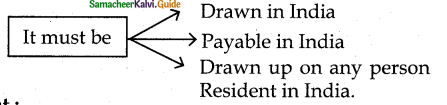
Samacheer Kalvi 12th Commerce Guide Chapter 22 The Negotiable Instruments Act, 1881 16

Foreign Instrument:
An instrument which is not an inland instrument is called a “Foreign Instrument”.
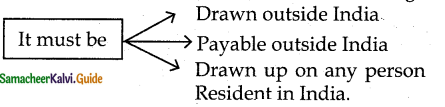
Samacheer Kalvi 12th Commerce Guide Chapter 22 The Negotiable Instruments Act, 1881 16

Samacheer Kalvi 12th Commerce Guide Chapter 22 The Negotiable Instruments Act, 1881

Question 2.
Find out the type of Instrument and the reason?
Answer:
(a) Bill drew payable to Nathifa or Bearer:

  • It is Bearer Instrument.
  • Reason it is payable to Nathifa or Bearer.

(b) Bill drew in London upon a merchant in Chennai and accepted and payable in Bangalore:

  • It is a Foreign Instrument.
  • Reason it is drawn in London.

(c) Bill drawn in Delhi upon a merchant in London and accepted and payable in London:

  • It is a Foreign Instrument.
  • Reason it is accepted and payable in London.

(d) Bill drawn in London on a merchant in Agra and endorsed in Delhi:

  • It is a Foreign Instrument.
  • It is drawn in London.

(e) A Bill was drawn by Bajaj Auto Agent on Bajaj Auto Ltd :

  • It is an Inland Instrument.
  • It is drawn in India.

(f) Bill drawn by Noohu on Nehan (an imaginary person) and endorsed to Nathifa:

  • It is an Ambiguous Instrument.
  • Reason it is drawn on a fictitious (imaginary) person.

(g) Raja gives a blank cheque to Stephen or gives an updated cheque to Stephen:
It is an Inchoate Instrument.

(h) Maran signs stamped and blank promissory Note and keep it locked in his drawer:

  • It is an Inchoate Instrument.
  • Reason it is blank and not presented.

(i) Satheesh promise to pay Ashwin ₹ 5000 after 3 months :

  • It is a Time Instrument.
  • Reason it is payable after 3 months (future).

(j) Shruthika who needs funds, draws a Bill on Nusrath who accepted and discounted the bill with her banker and on due date remits the requisite amount to Nusrath :

  • It is an Accommodation Instrument.
  • Reason it is drawn, accepted without consideration.

(k) No document is attached to the title of goods :
It is clean Bill. Reason no document is attached to the title of goods.

Samacheer Kalvi 12th Commerce Guide Chapter 22 The Negotiable Instruments Act, 1881

Question 3.
Classify the following endorsement with reasons.
Answer:
(i) No other words except Sycd’s signature :

  • It is Blank or General Endorsement.
  • Reason No other words except Syed’s signature.

(ii) Pay Shahul.
(iii) Pay to Shahul or order.
(iv) Pay to Shahul or order for the account of Siva.

  • It is Full or Special Endorsement.
  • Reason directions to pay to or to the order of a specified person.

(v) Pay to Hameed only :

  • It is Restrictive Endorsement.
  • Reason it is restricted to transfer.

(vi) Pay to Justin order being the unpaid residue of the bill.
(vii) Pay to Sam or order on safe receipt of goods :

  • It is conditional or Qualified Endorsement.
  • Reason it is subject to fulfilment of a particular event, [condition]

(viii) Pay to Navitha Sans Recourse, (without recourse to me)

  • 11 is Sans Recourse Endorsement.
  • Reason – it limits the liability of the endorser.

(ix) Pay to Athivya notice of dishonour dispensed with.

  • It is Faculative Endorsement.
  • Reason notice of dishonour is waived.

Samacheer Kalvi 12th Commerce Guide Chapter 22 The Negotiable Instruments Act, 1881

Question 4.
Distinguish between Cheque and Promissory Note. OPS CD CD
Answer:

No.Basis of Difference

Cheque

Promissory Note

1.Order A cheque contains an order to pay the money. A promissory Note contains an undertaking (promise) to pay the money.
2.Parties There are three parties to a cheque
i) Drawerii) Draweeiii) Payee
Only two parties.
(i) Maker(ii) Payee
3.Stamping It need not be stamped. It must be stamped.
4.Crossed A cheque can be crossed. It cannot be crossed.
5.Discounting It cannot be discounted. It can be discounted with a banker.
6.Creditor The Drawer of a cheque is a creditor. The maker of a pronote is a Debtor.
7.Days of Grace No Grace days allowed. Three grace days allowed.

Samacheer Kalvi 12th History Guide Chapter 4 காந்தியடிகள் தேசியத் தலைவராக உருவெடுத்து மக்களை ஒன்றிணைத்தல்

Tamilnadu State Board New Syllabus Samacheer Kalvi 12th History Guide Pdf Chapter 4 காந்தியடிகள் தேசியத் தலைவராக உருவெடுத்து மக்களை ஒன்றிணைத்தல் Text Book Back Questions and Answers, Notes.

Tamilnadu Samacheer Kalvi 12th History Solutions Chapter 4 காந்தியடிகள் தேசியத் தலைவராக உருவெடுத்து மக்களை ஒன்றிணைத்தல்

12th History Guide காந்தியடிகள் தேசியத் தலைவராக உருவெடுத்து மக்களை ஒன்றிணைத்தல் Text Book Questions and Answers

I. சரியான விடையைத் தேர்ந்தெடுக்கவும்

Question 1.
காந்தியடிகளின் அரசியல் குரு யார்?
அ) திலகர்
ஆ) கோகலே
இ) W.C. பானர்ஜி
ஈ) M.G. ரானடே
Answer:
ஆ) கோகலே

Samacheer Kalvi 12th History Guide Chapter 4 காந்தியடிகள் தேசியத் தலைவராக உருவெடுத்து மக்களை ஒன்றிணைத்தல்

Question 2.
தென்னாப்பிரிக்காவிலிருந்து திரும்பிய காந்தியடிகள் தனது வெற்றிகரமான முதலாவது சத்தியாகிரகப் போராட்டத்தைத் தொடங்கிய இடம்
அ) கேதா
ஆ) தண்டி
இ) சம்பரான்
ஈ) பர்தோலி
Answer:
இ) சம்பரான்

Question 3.
சைமன் கமிஷன் காங்கிரஸால் ஏன் புறக்கணிக்கப்பட்டது?
அ) சைமன் குழு அறிக்கையில் இந்தியாவிற்கு டொமினியன் அந்தஸ்து வழங்குவது குறித்த பரிந்துரை இல்லை
ஆ) சிறுபான்மையினருக்குப் பாதுகாப்பு அளிக்கவில்லை.
இ) அக்குழுவில் இந்தியர்கள் இடம்பெறவில்லை
ஈ) அது முழுச் சுதந்திரத்திற்கான வாக்குறுதியைக் கொண்டிருக்கவில்லை.
Answer:
இ) அக்குழுவில் இந்தியர்கள் இடம்பெறவில்லை.

Question 4.
இந்தியாவின் மூவர்ணக்கொடி எப்போது ஏற்றப்பட்டது?
அ) டிசம்பர் 31, 1929
ஆ) மார்ச் 12, 1930
இ) ஜனவரி 26, 1930
ஈ) ஜனவரி 26, 1931
Answer:
அ) டிசம்பர் 31, 1929

Samacheer Kalvi 12th History Guide Chapter 4 காந்தியடிகள் தேசியத் தலைவராக உருவெடுத்து மக்களை ஒன்றிணைத்தல்

Question 5.
1923இல் மோதிலால் நேரு மற்றும் சி.ஆர். தாஸ்-ஆல் தோற்றுவிக்கப்பட்ட கட்சியின் பெயர் என்ன?
அ) சுயராஜ்யக் கட்சி
ஆ) கதார் கட்சி
இ) சுதந்திராக் கட்சி
ஈ) கம்யூனிஸ்ட் கட்சி
Answer:
அ) சுயராஜ்யக் கட்சி

Question 6.
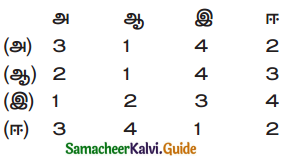
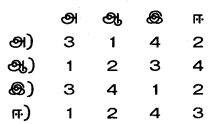
பின்வருவனவற்றைப் பொருத்தி சரியான விடையைத் தேர்வு செய்க.
அ. நாமசூத்ரா இயக்கம் – 1. வடமேற்கு இந்தியா
ஆ. ஆதிதர்ம இயக்கம் – 2 (தென்னிந்தியா
இ. சத்யசோதக் இயக்கம் – 3. கிழக்கிந்தியா
ஈ. திராவிட இயக்கம் – 4 மேற்கு இந்தியா
Samacheer Kalvi 12th History Guide Chapter 4 காந்தியடிகள் தேசியத் தலைவராக உருவெடுத்து மக்களை ஒன்றிணைத்தல் 1
Answer:
அ) 3 1 4 2

Question 7.
ஒத்துழையாமை இயக்கத்தின் பல்வேறு நிலைகளைக் கால வரிசைப்படுத்துக.

  1. அமிர்தசரஸ் நகரில் பிரிட்டிஷ் படையால் ஆயுதம் ஏந்தாத மக்கள் மீது கொடிய தாக்குதல் நடத்தப்பட்டது.
  2. நீதிமன்ற விசாரணை இன்றி எவரையும் சிறையில் அடைக்க ரௌலட் சட்டம் கொண்டு வரப்பட்டது.
  3. சௌரி சௌரா வன்முறைச் சம்பவம் காந்தியடிகள் ஒத்துழையாமை இயக்கத்தை விலக்கிக் கொள்ள வழிவகுத்தது.
  4. கல்கத்தாவில் நடைபெற்ற சிறப்புக் கூட்டத்தில் பிரிட்டிஷ் அரசாங்கத்துடன் ஒத்துழையாமை என்ற காந்தியடிகளின் முன்மொழிவை ஏற்றுக் கொண்டது.

அ) 2 1 4 3
ஆ) 1,3,2,4
இ) 2,4,1,3
ஈ) 3,2,4,1
Answer:
அ) 2 1 4 3

Samacheer Kalvi 12th History Guide Chapter 4 காந்தியடிகள் தேசியத் தலைவராக உருவெடுத்து மக்களை ஒன்றிணைத்தல்

Question 8.
பின்வரும் எந்த ஒன்று சரியாகப் பொருந்தவில்லை ?
அ) பஞ்சாப் துணை ஆளுநர் – 1. ரெஜினால்டு டையர்
ஆ) தலித் – பகுஜன் இயக்கம் – 2. டாக்டர். அம்பேத்கர்
இ) சுயமரியாதை இயக்கம் – 3. ஈ.வெ.ரா. பெரியார்
ஈ) சத்தியாகிரக சபை – 4. ரௌலட் சட்டம்
Answer:
ஈ) சத்தியாகிரக சபை – 4. ரௌலட் சட்டம்

Question 9.
பின்வரும் நிகழ்வுகளைச் சரியான காலவரிசைப்படி அமைத்து கொடுக்கப்பட்டுள்ள விடைகளிலிருந்து சரியானதைத் தேர்ந்தெடுக்கவும்.
i) கேதா சத்தியாகிரகம்
ii) சம்பரான் இயக்கம்
iii) பிராமணரல்லாதார் இயக்கம்
iv) வேதாரண்யம் உப்புச் சத்தியாகிரகம்
அ) ii, iii, i, iv
ஆ) iii, ii, i, iv
இ) ii, i, iv, iii
ஈ) ii, i, iii, iv
Answer:
ஈ) ii, i, iii, iv

Question 10.
பின்வருவனவற்றுள் எது, எவை சரியானவை அல்ல.
i) காந்தியடிகள் அகமதாபாத்தில் சபர்மதி ஆசிரமத்தை நிறுவினார்.
ii) வல்லபாய் படேல் ஒரு வழக்கறிஞர்.
iii) சைமன் குழுவினை முஸ்லீம் லீக் வரவேற்றது.
iv) இரண்டாவது வட்ட மேஜை மாநாட்டில் காந்தியடிகள் கலந்து கொண்டார்.
அ) iமட்டும்
ஆ) 1 மற்றும் iv|
இ) ii மற்றும் iii
ஈ) iii மட்டும்
Answer:
ஈ) iii மட்டும்

Question 11.
ஒத்துழையாமை இயக்கம் உள்ளடக்கியவை.
அ) பள்ளி மற்றும் கல்லூரிகளைப் புறக்கணித்தல்
ஆ) அரசு வழங்கிய பட்டங்களைத் திருப்பியளித்தல்
இ) உண்ணாவிரதங்கள் கடைப்பிடிப்பதை எதிர்த்தல்
ஈ) அரசுக்கு எதிரான சதிவேலைகளில் ஈடுபடுதல்
அ) அ மற்றும் ஆ
ஆ) ஆ மற்றும் இ
இ) அ மற்றும் ஈ ‘
ஈ) இ மற்றும் ஈ
Answer:
அ) அ மற்றும் ஆ

Samacheer Kalvi 12th History Guide Chapter 4 காந்தியடிகள் தேசியத் தலைவராக உருவெடுத்து மக்களை ஒன்றிணைத்தல்

Question 12.
கூற்று : பி.ஆர். அம்பேத்கர் மஹத் சத்தியாகிரகத்தைத் தொடங்கினார்.
காரணம் : அவர் இந்துக்கள் மற்றும் முஸ்லீம்களை ஒருங்கிணைக்க முயன்றார்.
அ) கூற்று சரி. காரணம் கூற்றை விளக்குகிறது.
ஆ) கூற்று சரி. காரணம் கூற்றை வளக்கவில்லை
இ) கூற்று சரி, காரணம் தவறு.
ஈ) கூற்று தவறு, காரணம் சரி.
Answer:
இ) கூ சரி, காரணம் தவறு.

Question 13.
கூற்று : 1919இல் இந்தியக் கவுன்சில் சட்டம் மற்றும் ரௌலட் சட்டம் நிறைவேற்றப்பட்டது.
காரணம் : இது மிதவாத தேசியவாதிகளை அரவணைத்து தீவிர தேசியவாதிகளைத் தனிமைப்படுத்தும் பிரிட்டிஷாரின் கொள்கையின் ஒரு பகுதியாகும்.
அ) கூற்று மற்றும் காரணம் சரி. காரணம் கூற்றை விளக்குகிறது.
ஆ) கூற்று மற்றும் காரணம் சரி. ஆனால் காரணம் கூற்றை விளக்கவில்லை .
இ) கூற்று சரி, காரணம் தவறு.
ஈ) கூற்று தவறு. காரணம் சரி.
Answer:
இ) கூற்று சரி, காரணம் தவறு

Question 14.
கீழே குறிப்பிடப்பட்டுள்ள தலைவர்களில் சுயராஜ்ய கட்சியுடன் தொடர்பில்லாத தலைவர் யார்?
அ) ராஜாஜி
ஆ) சித்தரஞ்சன் தாஸ்
இ) மோதிலால் நேரு
ஈ) சத்யமூர்த்தி
Answer:
அ) ராஜாஜி

Question 15.
காந்தியடிகளின் தண்டி யாத்திரை பயணம் சென்றடைந்த ஆண்டு
அ) ஏப்ரல் 6, 1930
ஆ) மார்ச் 6, 1930
இ ) ஏப்ரல் 4, 1939
ஈ) மார்ச் 4, 1930
Answer:
அ) ஏப்ரல் 6, 1930

Samacheer Kalvi 12th History Guide Chapter 4 காந்தியடிகள் தேசியத் தலைவராக உருவெடுத்து மக்களை ஒன்றிணைத்தல்

II. சுருக்கமான விடையளிக்கவும்

Question 1.
இந்தியா வந்த வேல்ஸ் இளவரசர் எவ்வாறு வரவேற்கப்பட்டார்?
Answer:

  • இந்தியாவின் பல நகரங்களுக்கு 1921இல் வேல்ஸ் இளவரசர் மேற்கொண்ட பயணமும் புறக்கணிக்கப்பட்டது.
  • இந்திய மக்களின் விசுவாச உணர்வை வேல்ஸ் இளவரசரின் பயணம் தூண்டும் என்று எதிர்பார்த்த காலனி ஆதிக்க அரசின் கணக்கு தவறாகப் போனது.

Question 2.
காந்தியடிகளின் சம்பரான் சத்தியாகிரகத்தின் போது உடன் சென்ற உள்ளூர் தலைவர்கள் யாவர்?
Answer:
ராஜேந்திர பிரசாத், மஜாருல் ஹக், ஆச்சார்ய கிருபாளினி, மஹாதேவ தேசாய் போன்ற உள்ளூர் தலைவர்களுடன் காந்தியடிகள் விரிவான விசாரணை மேற்கொண்டார்.

Question 3.
இந்தியப் பணியாளர் சங்கம் ஏன் தோற்றுவிக்கப்பட்டது?
Answer:

  • பல்வேறு சாதி, பிரதேசங்கள், மதங்கள் ஆகியவற்றைச் சேர்ந்த இந்தியர்களுக்கு நலப்பணிகளில் பயிற்சி வழங்க “இந்திய பணியாளர் சங்கத்தை” 1905ல் கோபால கிருஷ்ண கோகலே நிறுவினார்.
  • நிவாரணப்பணி, கல்வி அறிவூட்டல் மற்றும் இதர சமூகக் கடமைகளில் உறுப்பினர்கள் தங்களை ஈடுபடுத்திக் கொண்டனர்.

Question 4.
பகிஷ்கிரித் ஹிதகர்னி சபா குறித்து எழுதுக. (மார்ச் 2020)
Answer:
பகிஷ்கிரித் ஹிதகர்னி :

  • டாக்டர் பி.ஆர். அம்பேத்கார் அவர்களால் இவ்வமைப்பு உருவாக்கப்பட்டது. நம்
  • இது தனித்துவிடப்பட்டவர்களின் நலனுக்கான அமைப்பாகும்.
  • இதன் மூலம் தீண்டாமை கொடுமைக்கு உள்ளாக்கப்பட்ட மக்களின் மீது விதிக்கப்பட்ட திறன் ஆ குறைபாடுகளைக் களைவதற்காக அயராது பாடுபட்டார்.

Question 5.
தேசியவாதிகளால் ரௌலட் சட்டம் ஏன் எதிர்க்கப்பட்டது?
Answer:

  • மத்திய சட்டப் பேரவையின் ஒவ்வொரு உறுப்பினரும் மசோதாவை எதிர்த்த நிலையில் 1919 ஆம் ஆண்டு மார்ச் மாதம் ரௌலட் சட்டத்தை அரசு நிறைவேற்றியது.
  • இச்சட்டம் “எந்தவித நீதிமன்ற விசாரணையுமின்றி எவரையும் சிறையில் அடைக்க அரசுக்கு அதிகாரம் அளித்தது”.
  • இதனை காந்தியடிகளும் மற்ற தேசியவாதிகள் அனைவரும் எதிர்த்தனர்.

Question 6.
பி.ஆர். அம்பேத்கரால் வழி நடத்தப்பட்ட மஹத் சத்தியாகிரகம் பற்றி அறிவது என்ன?
Answer:
மஹத் சத்தியாக்கிரகம்:

  • ஊருணிகள் மற்றும் கிணறுகளில் தீண்டாமை கொடுமைக்கு உள்ளாக்கப்பட்ட மக்களுக்கு தர வேண்டிய அடிப்படை உரிமைகளை மீட்டுத் தர மஹத் சத்தியாகிரகம் என்ற அமைப்பைத் தொடங்கினார்.
  • அம்பேத்கரின் அறிவாற்றல் மற்றும் பொது நடவடிக்கைகள் அனைவரின் கவனத்தையும் ஈர்த்தன.

Samacheer Kalvi 12th History Guide Chapter 4 காந்தியடிகள் தேசியத் தலைவராக உருவெடுத்து மக்களை ஒன்றிணைத்தல்

Question 7.
காந்தி – இர்வின் ஒப்பந்தத்தில் ஏற்றுக்கொள்ளப்பட்டது எது?
Answer:
1931 ஆம் ஆண்டு ஜனவரி மாதம் காந்தி விடுதலை செய்யப்பட்டவுடன் ஆங்கில அரசப் பிரதிநிதி இர்வின், காந்திஜியை அழைத்துப் பேசினார். இதன் விளைவாக காந்தி – இர்வின் ஒப்பந்தம் ஏற்பட்டது. சத்தியாகிரகம் கைவிடப்பட்டது. அரசியல் கைதிகளை விடுதலை செய்ய அரசு இசைந்தது.

III. குறுகிய விடையளிக்கவும்

Question 1.
ஜாலியன் வாலாபாக் படுகொலை குறித்து குறிப்பு எழுதுக.
Answer:

  • 1919 ஏப்ரல் 13-இல். அமிர்தசரஸ் நகரில் ஜாலியன் வாலாபாக் பகுதியில் நிராயுதபாணிகளான மக்கள் திரள் மீது மிகக் கொடுமையான அரசியல் குற்றங்கள் இழைக்கப்பட்டன.
  • சத்தியபால், சாய்புதீன் கிச்லு ஆகியோரைக் கைது செய்ததற்கு எதிர்ப்புத் தெரிவித்து அமைதியான வகையில் ஆர்ப்பாட்டம் நடத்துவதற்காக இரண்டாயிரத்துக்கும் அதிகமான மக்கள் போராட்டக்களத்தில் குழுமியிருந்தனர்.
  • பஞ்சாபின் துணை நிலை ஆளுநராக மைக்கேல் ஓ டையரும், ராணுவக் கமாண்டராக ஜெனரல் ரெஜினால்டு டையரும் பதவி வகித்தனர்.
  • ஆர்ப்பாட்டக்காரர்கள் கூடியிருந்த இடத்திற்கு ஒரே ஒரு குறுகிய வாயில் மட்டுமே இருந்தது. அங்கு சிக்கிக் கொண்ட மக்களைக் குறி வைத்து எந்திரத் துப்பாக்கிகளில் குண்டுகள் தீரும் வரை சுடுமாறு ஜெனரல் டையர் உத்தரவிட்டார்.
  • அரசு தகவல்களின்படி உயிரிழப்புகள் 379 என்ற எண்ணிக்கையில் இருந்த போதிலும் உண்மையில் ஆயிரத்திற்கும் மேற்பட்டோர் இறந்திருக்கக்கூடும்.
  • ராணுவச் சட்டம் பஞ்சாப் முழுவதும் அமல்படுத்தப்பட்ட நிலையில் மக்கள் சொல்ல முடியாத அளவுக்கு துயரங்களை சந்தித்தனர்.

Question 2.
மாகாணங்களில் இரட்டையாட்சி முறை பற்றி எழுதுக.
Answer:

  • 1919 ஆம் ஆண்டு மாண்டேகு – செம்ஸ்போர்டு சீர்திருத்தம் அரசின் ஒவ்வொரு துறையிலும் அதிக இந்தியர்களைச் சேர்த்தது.
  • படிப்படியாக பொறுப்பாட்சி வழங்கும் நோக்கத்துடன் மாநிலங்களில் இரட்டை ஆட்சியை ஏற்படுத்தியது.
  • மாநில அதிகாரங்கள் மாற்றப்பட்ட துறைகள், ஒதுக்கப்பட்ட துறைகள் எனப் பிரிக்கப்பட்டன.

Samacheer Kalvi 12th History Guide Chapter 4 காந்தியடிகள் தேசியத் தலைவராக உருவெடுத்து மக்களை ஒன்றிணைத்தல்

Question 3.
பூனா ஒப்பந்தத்தின் முக்கியத்துவம் யாது? (மார்ச் 2020 )
Answer:

  • 1932 செப்டம்பரில் தாழ்த்தப்பட்ட இனத் தலைவரான டாக்டர் அம்பேத்காரும், காந்திஜியும் பூனாவில் ஓர் உடன்படிக்கை செய்து கொண்டனர். இதுவே பூனா ஒப்பந்தம் எனப்படுகிறது.
  • இதன்படி இந்துக்கள் அனைவரும் இணைந்து தேர்தலில் போட்டியிட ஒப்புக் கொண்டனர். ஆங்கிலேயரின் பிரித்தாளும் சூழ்ச்சி முறியடிக்கப்பட்டது.

Question 4.
பிராமணரல்லாதார் இயக்க தலைவர்கள் காலனி அரசாங்கத்தைக் கையாள்வதில் தொடக்ககால தேசியவாதிகள் கடைப்பிடித்த அதே யுக்தியினை கையாண்டனர். விவரி.
Answer:

  • இந்தியாவின் கீழ்த்தட்டு மக்கள் விழிப்புணர்வு பெற்ற தேசியவாதிகளால் கூறிய தாராளமய ஜனநாயக கருத்துக்களை அறிந்து கொள்ள முடியவில்லை.
  • சுயமரியாதை இயக்கம், சமூகநீதி சார்ந்து அடிப்படை மாற்றம் கோரும் இயக்கங்கள், பகுஜன் இயக்கம் செயல்பட்டன.
  • இதனை தீவிர தன்மையுடன் அடிப்படை மாற்றம் விழைவோர் இந்த இயக்கங்களை எதிர்த்தனர்.
  • பிரிட்டிஷார், தேசவிரோத சக்திகள் போன்றவற்றிற்கு கைத்தடிகள் என்று இந்த இயக்கங்களைச் சிலர் குறிப்பிட்டனர்.
  • காலனி அரசுக்கு எதிராகப் பூர்வாங்க தேசியவாதத் தலைவர்கள் எந்த மாதிரியான உத்தியைப் பயன்படுத்தினார்களோ அதே மாதிரியான உத்தியைப் பிராமணர் அல்லாத இயக்கத்தின் பூர்வாங்கத் தலைவர்களும் பின்பற்றத் தொடங்கினர்.

Question 5.
மாற்றத்தை விரும்புவர்கள் – மாற்றத்தை விரும்பாதவர்கள் – வேறுபடுத்துக.
Answer:
மாற்றத்தை விரும்புபவர்கள் :

  • சித்தரஞ்சன் தாஸ், மோதிலால் நேரு ஆகியோர் தீவிர அரசியலுக்கு திரும்ப வேண்டும் என்றும், தேர்தல் அரசியலில் ஈடுபடுவது என்றும் விரும்பினார்கள்.
  • சீர்த்திருத்தம் பெற்ற சட்டப்பேரவையைக் கைப்பற்றி தேசியவாத உணர்வூட்டி அதன் செயல்பாடுகளை முடக்கும் ஆற்றலைத் தேசியவாதிகள் வெளிப்படுத்தினர்.
  • இக்குழு சுயராஜ்யம் வேண்டுவோர் மற்றும் மாற்றம் வேண்டுவோர் என அழைக்கப்பட்டது. இதில் தமிழ்நாட்டில் சத்தியமூர்த்தியும் இணைந்தார்.

மாற்றத்தை விரும்பாதவர்கள் :

  • சட்டப்பேரவை நுழைவை எதிர்த்த மற்றொரு குழு காந்திய வழியை பின்பற்றி மக்களை ஒன்று திரட்டும் பணிகளில் ஆர்வம் காட்டியது.
  • இந்த குழுவுக்கு இராஜகோபாலாச்சாரி, வல்லபாய் படேல், இராசேந்திர பிரசாத் ஆகியோர் தலைமை ஏற்றனர். எந்த மாற்றா கா என்று இந்த அணி வலியுறுத்தியது.

Samacheer Kalvi 12th History Guide Chapter 4 காந்தியடிகள் தேசியத் தலைவராக உருவெடுத்து மக்களை ஒன்றிணைத்தல்

Question 6.
பிரதம அமைச்சர் ராம்சே மக்டோனால்டின் வகுப்புவாத அறிக்கையைப் பற்றி எழுதுக.
Answer:

  • இரண்டாம் வட்டமேசை மாநாட்டின் போது காந்தியடிகள் மற்றும் அம்பேத்கார் இடையே தனித் தொகுதிகள் பற்றிய கருத்தில் நடந்த பேச்சுக்கள் தோல்வி அடைந்தன.
  • பிரிட்டிஷ் பிரதமர் ராம்சே மெக்டொனால்டு இதில் தலையிட்டு முடிவெடுக்க, 1932 ஆகஸ்டில் வகுப்பு வாரித் 1 தொகுதி ஒதுக்கீடுகள் குறித்து பிரிட்டிஷ் அரசு அறிவித்தது. அம்பேத்காரின் கோரிக்கைகள் ஏற்கப்பட்டன.

Question 7.
மூன்று வட்டமேசை மாநாடுகளின் முடிவின் தோல்விக்குப்பிறகு ஏன் காங்கிரஸ் தடை செய்யப்பட்டது?
Answer:

  • வட்டமேசை மாநாடுகளுக்குப் பிற பல போராட்டங்கள் நடைபெற்றன. 1940 காங்கிரஸ் தனிநபர் அறப்போரை அறிவித்தது.
  • 1942ல் இந்திய ராணுவ வீரர்களின் ஆதரவை பெரும்பொருட்டு கிரிப்ஸ் தூதுக்குழு ஒன்று வந்தன.
  • கிரிப்ஸ் தூதுக்குழு அறிக்கையில் டொமினியன் அந்தஸ்து மற்றும் பாகிஸ்தான் பற்றிய செய்தி இடம் பெறாததால் காங்கிரசும், முஸ்லீம் லீக்கும் கிரிப்ஸ் தூதுக்குழு அறிக்கையை ஏற்கவில்லை.
  • 1942 காங்கிரஸ் “வெள்ளையனே வெளியேறு” இயக்கம் துவங்கியது.
  • காந்தியினுடைய கோரிக்கையை ஏற்று நாடு முழுவதும் ஆங்கிலேயருக்கு எதிராக “வெள்ளையனே வெளியேறு” ஆர்ப்பாட்டங்கள் நடந்தன.
  • காந்திஜியும் பிறதலைவர்களும் கைது செய்யப்பட்டனர். காங்கிரஸ் சட்ட விரோதமான இயக்கம் என்று தடை செய்யப்பட்டது.

IV. விரிவான விடையளிக்கவும்

Question 1.
ஒத்துழையாமை இயக்கத்தை நடைமுறைப்படுத்தும் சூழலையும் அதன் விளைவுகளையும் விவரி. (மார்ச் 2020)
Answer:

  • கிலாபத் மாநாட்டில், காந்தியடிகளின் வற்புறுத்தலின் பேரில் 1920 ஆகஸ்டு 31 முதல் ஒத்துழையாமை இயக்கத்தைத் தொடங்க முடிவு செய்யப்பட்டது.
  • 1920 ஆம் ஆண்டு செப்டம்பர் மாதம் கல்கத்தாவில் நடந்த காங்கிரஸ் சிறப்பு அமர்வில் காலனி ஆதிக்க அரசுடன் ஒத்துழையாமையைக் கடைபிடிப்பது என்ற காந்தியடிகளின் யோசனைகளை ஏற்றுக்கொள்ளும் தீர்மானம் நிறைவேற்றப்பட்டது.
  • கிலாபத் மற்றும் பஞ்சாப் குறைகள் சரிசெய்யப்பட்டு தன்னாட்சி அரசு நிறுவப்படும் வரை இந்த ஒத்துழையாமையைக் கடைபிடிக்க உறுதி ஏற்கப்பட்டது.
  • பள்ளிகள், கல்லூரிகள், நீதிமன்றங்கள், அரசு அலுவலகங்கள், சட்டப்பேரவைகள், அந்நியப் பொருட்களைப் புறக்கணித்தல், அரசு வழங்கிய பட்டங்களையும் விருதுகளையும் திரும்ப ஒப்படைப்பது ஆகியன ஒத்துழையாமை இயக்கத்தில் சேர்க்கப்பட்டன.
  • தேசியப்பள்ளிகள், பஞ்சாயத்துகள் ஆகியன அமைக்கப்பட்டு சுதேசிப் பொருட்கள் உற்பத்தி செய்யப்பட்டு பயன்படுத்தப்படும்.
  • வரிகொடா இயக்கம், சட்டமறுப்பு இயக்கம் போன்ற பல இயக்கங்களை இந்தப் போராட்டத்தில் இணைக்க முடிவு செய்யப்பட்டது.
  • மொழி சார்ந்த மாகாண காங்கிரஸ் கமிட்டிகளை அங்கீகரித்து அமைப்பதற்கு ஒரு முக்கியத் தீர்மானம் நாக்பூர் மாநாட்டில் நிறைவேற்றப்பட்டது.
  • இதனால் பெரும் எண்ணிக்கையிலானப் பணியாளர்கள் இந்த இயக்கத்தில் சேர்ந்தனர்.

Samacheer Kalvi 12th History Guide Chapter 4 காந்தியடிகள் தேசியத் தலைவராக உருவெடுத்து மக்களை ஒன்றிணைத்தல்

Question 2.
ஒத்துழையாமை இயக்கத்திலிருந்து சட்டமறுப்பு இயக்கம் எவ்வழிகளில் மாறுபட்டிருந்தது?
Answer:
ஒத்துழையாமை இயக்கம்:

  • 1920 ஆம் ஆண்டு சாத்வீக முறையில் ஒத்துழையாமை இயக்கத்தை காந்திஜி தொடங்கினார். இதன்படி மக்கள் பதவிகளை துறக்க வேண்டும்.
  • வழக்கறிஞர்கள் நீதிமன்றங்களைப் புறக்கணிக்க வேண்டும். மாணவர்கள் பள்ளிகளை தவிர்க்க வேண்டும்.
  • பட்டதாரிகள் பட்டங்களை துறக்க வேண்டும் என முடிவு செய்யப்பட்டது.

ஒத்துழையாமை இயக்கத்தின் செயலாக்கம்:

  • அயல் நாட்டு துணிகள் எரிக்கப்பட்டன.
  • நாடு முழுவதும் வேலை நிறுத்தம் மேற்கொள்ளப்பட்டன.
  • ஆங்கில அரசால் வழங்கப்பட்ட பட்டங்களையும் கௌரவப் விருதுகளையும் மக்கள் தூக்கி எறிந்தனர்.

சட்டமறுப்பு இயக்கம் :

  • ஒத்துழையாமை இயக்கத்திலிருந்து இது மாறுபட்டதாக இருந்தது.
  • சட்டத்தின் மூலம் மக்களின் அடிப்படை உரிமைகளைப் பறிக்க ஆங்கிலேய ஆட்சியாளர் முடிவு செய்தனர்.
  • இதனை எதிர்த்து சட்டமறுப்பு போராட்டத்தை காந்திஜி தொடங்கினார். எ.கா. உப்பு வரி, இயற்கையாக கிடைக்கும் கடல் நீரை காய்ச்சி எடுக்கும் உப்பு உற்பத்தியில் ஆங்கிலேய அரசின் ஏகபோக உரிமை மற்றும் உப்பின் மீது விதித்த வரி ஆகியவற்றை காந்தி எதிர்த்தார்.
  • அரசின் கொள்கைகளை எதிர்க்க சட்டமறுப்பியக்கம் மேற்கொள்ளப்பட்டது.
  • இதன்படி 1930, ஏப்ரல் மாதத்தில் காந்திஜி தலைமையில் தண்டியாத்திரையும் தமிழ்நாட்டில் ராஜாஜியின் தலைமையில் வேதாரண்யம் யாத்திரையும் அடைந்து ஆங்கிலேய உப்பு வரி சட்டத்தை மீறினர்.

Question 3.
இந்திய விடுதலைப் போரில் மகாத்மா காந்தியடிகளின் பங்கினை மதிப்பிடுக.
Answer:
காந்தியின் பங்கு :
இந்திய விடுதலைப் போரில் மூன்றாவது கட்டம் பொருத்தமாகக் காந்தி ஊழி அல்லது சகாபதம் என அழைக்கப்படுகிறது.

மக்கள் இயக்கமாக மாற்றுதல் :

  • மகாத்மா காந்தி தேசிய இயக்கத்தை ஒரு மக்கள் இயக்கமாக மாற்றினார்.
  • அவர் எளிய மனிதர். அவருடைய செயலாற்றும் முறை நடைமுறை வாழ்க்கையில் மற்ற மக்களைத் தன்னைப் பின்பற்றும்படிச் செய்தார்.

இந்து – முஸ்லீம் ஒற்றுமைக்கும் பாடுபடுதல் :

  • இந்து முஸ்லீம் ஒற்றுமைக்குப் பாடுபட்ட அவர் கிலாபத் இயக்கத்தை ஆதரித்தார்.
  • இவை இரண்டையுைம் நம் நாட்டுக்கே உரித்தாக்கினார்.
  • காந்திஜி தன்னுடைய குறிக்கோள்கள் வெற்றியடையப் பட்டினி அறப்போரைக் கடைப்பிடித்த வரியா வெற்றிகளை அடைந்தார்.

அறப்போர் மூலம் வெற்றி:

  • மக்கள் பயன்படுத்தும் மிகச் சாதாரணமான பொருளாகிய உப்புக் கூட அவருக்கு வலியைப் அரசியல் ஆயுதமாயிற்று.
  • அவருடைய உப்பு அறப்போரின் மூலம் அவர் உலகத்திற்கு ஓர் உண்மையை நிரூபித்தார்.

மக்களின் உண்மையான பிரதிநிதி:

  • காந்தி – இர்வின் ஒப்பந்தம் இந்திய வரலாற்றில் இந்திய தேசிய இயக்கத்தில் மற்ற ஆகும் இந்தியப் பாமர மக்களின் உண்மையான பிரதிநிதி என்று அவர் கருதப்பட்டார்.
  • சர்ச்சில் அவரை அரை ஆடை அணிந்த பக்கிரி’ என்று செய்த கேலி எடுபடவில்லை.

சமுதாயச் சீர்திருத்தம் :
உலகின் எந்த வல்லமைச் சக்தியும் எவ்வளவு முறை சிறையில் வைத்தும் அவருடைய தீர்க்கமான முடிவுகளை அசைக்க முடியவில்லை. அவர் இந்தியப் பெண்களின் விடுதலைக்காகவும் பாடுபட்டார். தீண்டாமையை ஒழிக்க அரும்பாடுப்பட்டார்.

Samacheer Kalvi 12th History Guide Chapter 4 காந்தியடிகள் தேசியத் தலைவராக உருவெடுத்து மக்களை ஒன்றிணைத்தல்

Question 4.
டாக்டர். அம்பேத்கரின் கல்விப் பணி குறித்து, குறிப்பாக ஒடுக்கப்பட்ட மக்களின் சமூக நீதிக்காக அவரின் செயலூக்கத்தை முதன்மைப்படுத்தி விளக்குக.
Answer:
ஆரம்ப கல்வி :

  • எல்பின்ஸ்டன் கல்லூரியில் சேர்ந்த அம்பேத்கர் கல்வி உதவித்தொகை பெற்று 1912-இல் பட்டதாரி ஆனார்.
  • பரோடா அரசரின் கல்வி உதவித்தொகை பெற்ற அவர் அமெரிக்கா சென்று பட்ட மேற்படிப்புப் பட்டத்தையும், கொலம்பியா பல்கலைக்கழகத்தில் முனைவர் பட்டத்தையும் பெற்றார்.
  • சட்டம் மற்றும் பொருளாதார படிப்புக்களுக்காக அவர் லண்டன் சென்றார்.
  • 1916இல் மானுடவியல் தொடர்பான சர்வதேச மாநாட்டில் கலந்து கொண்டு  இந்தியாவின் சாதிகள் என்ற தலைப்பில் ஆராய்ச்சிக் கட்டுரையைச் சமர்ப்பித்தார்.
  • இந்திய வாக்காளர்களுக்கு வாக்குரிமை பெற வயது மற்றும் தகுதி பற்றி தகவல் சேகரித்து வந்த சவுத்பொரோ குழுவுடன் கலந்துரையாட வருமாறு அவருக்கு அழைப்பு விடுத்தது.’
  • தீண்டாமை கொடுமைக்கு உள்ளாக்கப்பட்ட மக்களுக்கு தனித்தொகுதிகள் மற்றும் இடங்கள் ஒதுக்கீடு செய்ய வேண்டும் என்று வாதிட்டார்.
  • இடஒதுக்கீடு பெறப்பட்ட இடங்களில் தீண்டாமை கொடுமைக்கு உள்ளாக்கப்பட்ட வாக்காளர்கள் மட்டுமே வாக்களித்தால் அவர்கள் தங்களின் உண்மையான பிரதிநிதிகளைத் தேர்ந்தெடுக்க முடியும்.
  • வாய் பேச முடியாதவர்களின் தலைவர் (மூக் நாயக்) என்ற பத்திரிக்கை தனது கருத்துகளை வெளிப்படுத்துவதற்காகவும், தனித்துவிடப்பட்டவர்களின் நலனுக்கான அமைப்பு (பஹிஷ்கிரித் ஹிடாகரினி சபை) என்ற அமைப்பைத் தனது செயல்பாடுகளுக்காகவும் அவர் தொடங்கினார்.
  • ஊருணிகள் மற்றும் கிணறுகளில் தீண்டாமை கொடுமைக்கு உள்ளாக்கப்பட்ட மக்களுக்கு தரவேண்டிய அடிப்படை உரிமைகளை மீட்டுத்தர “மஹத் சத்தியாகிரகம்” என்ற அமைப்பைத் தொடங்கினார். அம்பேத்கரின் அறிவாற்றல் மற்றும் பொது நடவடிக்கைகள் அனைவரின் கவனத்தையும் ஈர்த்தன.

V. செயல்பாடு (மாணவர்களுக்கானது)

Question 1.
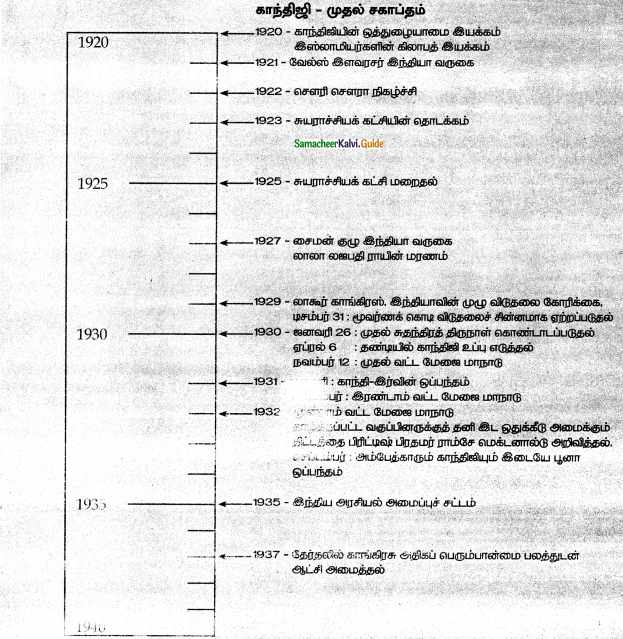
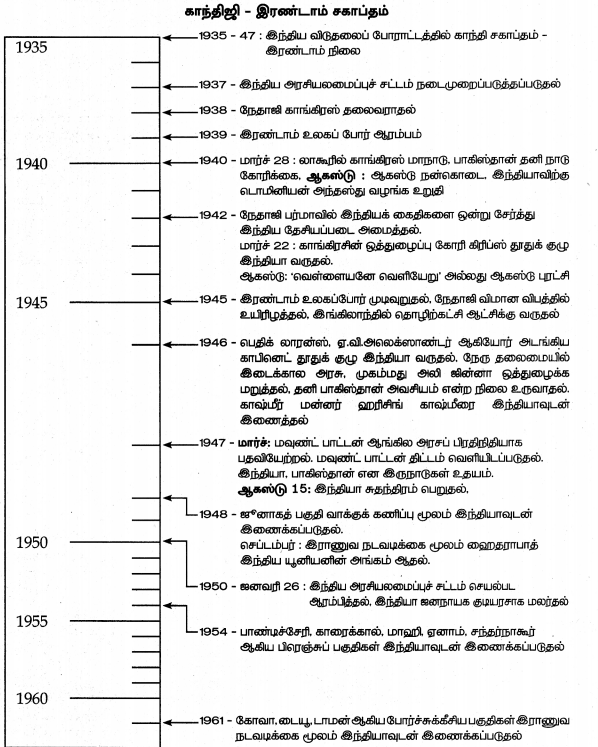
காந்தியடிகளின் சகாப்தம் குறித்த நிகழ்வுகளின் காலக்கோடு ஒன்றை உருவாக்கவும்.
Answer:
Samacheer Kalvi 12th History Guide Chapter 4 காந்தியடிகள் தேசியத் தலைவராக உருவெடுத்து மக்களை ஒன்றிணைத்தல் 2
Samacheer Kalvi 12th History Guide Chapter 4 காந்தியடிகள் தேசியத் தலைவராக உருவெடுத்து மக்களை ஒன்றிணைத்தல் 3

Samacheer Kalvi 12th History Guide Chapter 4 காந்தியடிகள் தேசியத் தலைவராக உருவெடுத்து மக்களை ஒன்றிணைத்தல்

2. தற்போதைய சமூக அரசியல் மற்றும் பொருளாதார சூழலில் காந்தியடிகளின் இணக்கத்தை விவாதம் செய்.

12th History Guide காந்தியடிகள் தேசியத் தலைவராக உருவெடுத்து மக்களை ஒன்றிணைத்தல் Additional Questions and Answers

I. சரியான விடையைத் தேர்வு செய்யவும்

Question 1.
இந்திய பணியாளர் சங்கத்தை நிறுவியவர் …………..
அ) திலகர்
ஆ) தாகூர்
இ)கோபாலகிருஷ்ண கோகலே
ஈ) மகாத்மா காந்தி
Answer:
ஆ) தாகூர்

Question 2.
இந்திய பணியாளர் சங்கம் நிறுவப்பட்ட ஆண்டு ……………..
அ) 1902
ஆ) 1905
இ) 1908
ஈ) 1907
Answer:
ஆ) 1905

Samacheer Kalvi 12th History Guide Chapter 4 காந்தியடிகள் தேசியத் தலைவராக உருவெடுத்து மக்களை ஒன்றிணைத்தல்

Question 3.
அரசின் பஞ்சகால விதியின் படி, பயிர்சாகுபடி சராசரியாக – சதவீதத்திற்கு குறைவாக இருந்தால் பயிரிடுவோர் முழுநிலவரி ரத்துக்கு தகுதி பெறுவர்.
அ) 15 சதவீதம்
ஆ) 25 சதவீதம்
இ) 35 சதவீதம்
ஈ) 20 சதவீதம்
Answer:
ஆ) 25 சதவீதம்

Question 4.
‘சத்ய ஜோதக் சமாஜ்’ இயக்கத்தை தோற்றுவித்தவர்……………………
அ) கந்து கூரி
ஆ) ஜோதிபா பூலே
இ) ஈ.வே. ராமசாமி
ஈ) B.R. அம்பேத்கார்
Answer:
ஆ) ஜோதிபா பூலே

Question 5.
‘குலாம்கிரி’ என்ற தலைப்பில் புத்தகம் வெளியிட்டவர் ……………………
அ) கோபாலகிருஷ்ண கோகலே
ஆ) பாலகங்காதர திலகர்
இ) இராஜாராம் மோகன்ராய்
ஈ) ஜோதிபா பூலே
Answer:
ஈ) ஜோதிபா பூலே

Question 6.
1929 லாகூர் காங்கிரஸ் மாநாட்டிற்கு தலைமை தாங்கியவர் ……………………
அ) மோதிலால் நேரு
ஆ) ஜவஹர்லால் நேரு
இ) லால்பகதூர் சாஸ்திரி
ஈ) தாகூர்
Answer:
ஆ) ஜவஹர்லால் நேரு

Samacheer Kalvi 12th History Guide Chapter 4 காந்தியடிகள் தேசியத் தலைவராக உருவெடுத்து மக்களை ஒன்றிணைத்தல்

Question 7.
வேதாரண்யம் உப்பு சத்தியாகிரகம் தொடங்கி நாள்………………….
அ) 1930 ஏப்ரல் 13
ஆ) 1930 ஏப்ரல் 31
இ)1930 மார்ச் 28
ஈ) 1930 ஏப்ரல் 28
Answer:
அ) 1930 ஏப்ரல் 13

Question 8.
காந்தி – இர்வின் ஒப்பந்தம் கையெழுத்தான நாள்………………………..
அ) 1931 பிப்ரவரி 5
ஆ) 1931 மார்ச் 5
இ) 1931 பிப்ரவரி 28
ஈ) 1931 ஏப்ரல் 5
Answer:
ஆ) 1931 மார்ச் 5

Question 9.
எது – எவை சரியாக பொருந்தியுள்ளது?
அ. அம்பேத்கார் – கொலம்பியா பல்கலைகழகத்தில் முனைவர் பட்டம்
ஆ. 2வது வட்டமேசை மாநாடு – அம்பேத்கார்
இ. ராஜாஜி – வேதாரண்யம் உப்பு சத்தியாகிரகம்
ஈ. 1931 மார்ச் 15 – காந்தி – இர்வின் ஒப்பந்தம்

அ) அ மற்றும் ஆ
ஆ ) ஆ மற்றும் இ
இ) அ மற்றும் ஈ
ஈ) அ மற்றும் இ
Answer:
ஈ) அ மற்றும் இ

Question 10.
மீரட் சதி வழக்கு பதியப்பட்ட ஆண்டு……………………
அ) 1929
ஆ) 1930
இ) 1932
ஈ) 1933
Answer:
இ) 1932

Samacheer Kalvi 12th History Guide Chapter 4 காந்தியடிகள் தேசியத் தலைவராக உருவெடுத்து மக்களை ஒன்றிணைத்தல்

II. சுருக்கமான விடையளிக்கவும்

Question 1.
“சத்யாகிரகி” வரையறு.
Answer:

  • ஒரு சத்யாகிரகி தனது மனதில் அமைதியை நிலைநிறுத்த வேண்டும்.
  • தவறு செய்தவரை வெறுக்கக்கூடாது.
  • எதிர்ப்பின் பாதையில் ஒரு சத்யாகிரகி சிரமங்களை ஏற்றுக் கொள்வார்.
  • அவரது நடவடிக்கையில் வெறுப்புணர்வுக்கு இடமில்லை .
  • அஹிம்சையும் உண்மையும் அச்சமற்றவர்களின் ஆயுதங்களாக விளங்கும்.

Question 2.
சம்பரான் இயக்கம் பற்றி கூறுக.
Answer:

  • சம்பரானில் இருந்த விவசாயிகளின் வேண்டுகோளை ஏற்று இந்திய மக்களை ஒருங்கிணைக்கும் முதல் முயற்சியை காந்தியடிகள் மேற்கொண்டார்.
  • பீகாரின் சம்பரான் மாவட்ட விவசாயிகள் நீலச்சாயத்தை கட்டாயம் பயிரிட வேண்டும் என்றும் அதனை வர்த்தகர்கள் கூறும் விலைக்கே விற்க வேண்டும் எனவும் கூறப்பட்டனர்.
  • இது விவசாயிகளை வறுமையின் பிடியில் சிக்க வைத்தது.
  • காந்தியடிகளையும் உறுப்பினராகக் கொண்ட ஒரு குழு விசாரித்து அறிக்கை சமர்ப்பித்தது.
  • ஐரோப்பிய வர்த்தகர்களின் கட்டுப்பாட்டிலிருந்து சம்பரான் விவசாயிகள் மீட்கப்பட்டனர். வர்த்தகர்கள் படிப்படியாக சம்பரானைவிட்டே வெளியேறிவிட்டனர்.

Question 3.
“லாகூர் காங்கிரஸ்” மாநாட்டின் முக்கியத்துவம் பற்றி கூறுக.
Answer:

  • முழுமையான சுதந்திரம் அடைவது என்பதை குறிக்கோளாகக் கொண்டு
  • 1929ல் லாகூர் காங்கிரஸ் மாநாடு ஜவஹர்லால் நேரு தலைமையில் கூட்டப்பட்டது. * 1929 டிசம்பர் 31ல் லாகூரில் மூவர்ணக் கொடி ஏற்றப்பட்டது.
  • ஒவ்வொரு ஆண்டும் ஜனவரி 26 ஆம் நாளை விடுதலை நாளாகக் கொண்டாடவும் முடிவு செய்யப்பட்டது.
  • சட்டமறுப்பு இயக்கம் காந்தியடிகளின் தலைமையில் தொடங்கப்படும் என்றும் அறிவிக்கப்பட்டது.

Samacheer Kalvi 12th History Guide Chapter 4 காந்தியடிகள் தேசியத் தலைவராக உருவெடுத்து மக்களை ஒன்றிணைத்தல்

Question 4.
வேதாரண்யம் உப்பு சத்தியாகிரகம் – குறிப்பு தருக.
Answer:

  • தமிழ்நாட்டில் ராஜாஜி தலைமையில் உப்பு சத்தியாகிரக யாத்திரை வேதாரண்யம் நோக்கி நடந்தது.
  • திருச்சிராப்பள்ளியில் தொடங்கி 150 மைல்கள் தொலைவில் உள்ள தஞ்சாவூர் மாவட்டத்தின் கரையோர கிராமமான வேதாரண்யம் வரை இந்த நடைபயணம் மேற்கொள்ளப்பட்டது.
  • 1930 ஏப்ரல் 13ல் இருந்தே ஆரம்பித்த இந்த நடைபயணம் ஏப்ரல் 28ல் முடிவடைந்தது.
  • வேதாரண்யம் இயக்கம் உண்மையில் தென்னிந்திய மக்களைத் தட்டியெழுப்பிக் காலனி ஆதிக்க ஆட்சிக்கு எதிராக போராட்டத்தில் பங்கேற்கத் தூண்டியது.

Question 5.
சௌரி சௌரா நிகழ்ச்சி பற்றி கூறுக.
Answer:

  • உத்தரபிரதேசத்தில் உள்ள கோரக்பூர் மாவட்டத்தில் அமைந்த சௌரி சௌரா கிராமத்தில். சுமார் 3000 விவசாயிகள் காவல் துறையினரின் துப்பாக்கிச் சூட்டிற்கு ஆளாயினர்.
  • இதனால் கோபமுற்ற மக்கள் அவ்வூர் காவல் நிலையத்தை தாக்கி தீக்கிரையாக்கினர். இச்சம்பவத்தில் சுமார் 22 காவல் துறையினர் உயிரிழந்தனர்.

இதுவே சௌரி சௌரா நிகழ்ச்சி எனப்படுகிறது.’

III. குறுகிய விடையளிக்கவும்

Question 1.
“தண்டியாத்திரை” என்பது என்ன?
Answer:

  • லாகூர் காங்கிரஸ் மாநாட்டில் அரசின் உப்பு வரியை எதிர்க்க – பாகர் படத்த முடிவு செய்யப்பட்டது.
  • அதன்படி காந்திஜி தலைமையில் சபர்மதி ஆசிரமத்திலிருந்து குஜராத் கடற்காை ஓரம் உள்ள 375 கி.மீ. தொலைவில் உள்ள தண்டி கடற்கரைக்கு பாத யாத்திரையாக சென் உப்பகாய்ச்ச முடிவு செய்யப்பட்டது.
  • வந்தே மாதரம் என்ற உணர்வோடு 25 நாட்கள். 78 தொண்டர்களுடன் பார பாதிரையாக சென்று 1930 ஏப்ரல் 6ஆம் நாள் கையளவு உப்பு எடுக்கார் உட்பக்கு வரி செலுத்தும் பட்டால் விரி, பாமயாக்கினார். இதுவே “தண்டியாத்திரை” எனப்படும்.

Samacheer Kalvi 12th History Guide Chapter 4 காந்தியடிகள் தேசியத் தலைவராக உருவெடுத்து மக்களை ஒன்றிணைத்தல்

Question 2.
அம்பேத்காரின் கட்சி அரசியலைப் பற்றி விவரி.
Answer:

  • சுதந்திர தொழிலாளர் கட்சியை 1937லும், பட்டியல் இனத்தவர் கூட்டம் 1942 ம் அம்பேத்கார் துவங்கினார்.
  • இவரது போராட்டங்களை அங்கீகரித்த காலனி அரசு தனது ஆதரவை சமன்படுத்த அம்பேத்காரின் சேவைகளை பயன்படுத்தியது.
  • 1942ல் பாதுகாப்புத் துறை ஆலோசனைக் குழு உறுப்பினராகவும், பிறகு அரசப்பிரதிநிதியின் அமைச்சராகவும் இடம் பிடித்தார்.
  • சுதந்திர இந்தியாவின் அரசியல் சாசன வரைவுக் குழு தலைவராகி அம்பேத்கார் தேர்ந்தெடுக்கப்பட்டார்.
  • சுதந்திரம் பெற்ற பிறகு நேரு அமைச்சரவையில் அவர் அமைச்சராக இடம் பெற அழைக்கப்பட்டார்.

IV. விரிவான விடையளிக்கவும்

Question 1.
வட்ட மேசை மாநாடுகள் பற்றி விவரிக்க.
Answer:
அ) முதல் வட்டமேசை மாநாடு:

  • தொழிற்கட்சி இங்கிலாந்தில் ஆட்சிக்கு வந்ததும் அதன் முயற்சியால் 1930 ஆம் ஆண்டு நவம்பர் 12ம் நாள் முதல் வட்ட மேசை மாநாடு இலண்டனில் நடைபெற்றது.
  • டொமினியன் அந்தஸ்து வழங்க உறுதி அளிக்கப்படாததால் காங்கிரஸ் முதல் வட்ட மேசை மாநாட்டில் பங்கேற்கவில்லை.
  • இம்மாநாட்டில் படிப்படியாக சுயஆட்சி இந்தியாவிற்கு வழங்கலாம் என பிரிட்டிஷ் பிரதம மந்திரி அறிக்கை விடுத்தார்.

ஆ) இரண்டாம் வட்டமேசை மாநாடு:

  • 1931 ஆம் ஆண்டு செப்டம்பர் மாதம் இரண்டாம் வட்டமேசை மாநாடு நடைபெற்றது.
  • காந்திஜி காங்கிரசின் பிரதிநிதியாக சென்றார்.
  • சுயாட்சி பற்றி ஏதும் கூறப்படாததால் இம்மாநாடு தோல்வியுற்றது.
  • மீண்டும் சட்ட மறுப்பு இயக்கம் தொடங்கப்பட்டது. பல தலைவர்கள் கைது செய்யப்பட்டனர்.

இ) மூன்றாம் வட்டமேசை மாநாடு:

  • 1932ல் மூன்றாம் வட்டமேசை மாநாடு நடைபெற்றது.
  • இந்திய பிரதிநிதிகள் யாரும் கலந்து கொள்ளாததால் இம்மாநாடு தோல்வியில் முடிந்தது.

Samacheer Kalvi 12th History Guide Chapter 4 காந்தியடிகள் தேசியத் தலைவராக உருவெடுத்து மக்களை ஒன்றிணைத்தல்

Question 2.
சுயராஜ்ஜியக் கட்சி மற்றும் அதன் செயல்பாடுகளை விவரி.
Answer:
சுயராஜ்ஜியக் கட்சியின் தோற்றம்:

  • சௌரி சௌரா நிகழ்ச்சியில் 22 காவல் துறையினர் உயிர் துறந்ததைக் கண்டு வருத்தமுற்ற காந்திஜி, ஒத்துழையாமை இயக்கத்தை கைவிட்டார். நாடெங்கிலும் குழப்பநிலை ஏற்பட்டது.
  • காந்திஜியும் மற்ற தலைவர்களும் சிறையில் அடைக்கப்பட்டனர். மக்கள் எழுச்சி தடைப்பட்டது.
  • மக்கள் எழுச்சியை ஊக்குவிக்கும் நோக்குடன் அலிப்பூர் சிறையில் இருந்த சி.ஆர்.தாஸ் மற்றும் மோதிலால் நேரு ஆகியோர் முயற்சியில் சுயராஜ்ஜிய கட்சி உருவாயிற்று.

சுயராஜ்ஜியக் கட்சியின் நோக்கம்:

  • தேர்தலில் போட்டியிட்டு வென்று, சட்டமன்றத்தில் இந்தியர்களும் இடம் பெற வேண்டும். –
  • ஆங்கில அரசின் நடவடிக்கைகளுக்கு இடையூறு செய்ய வேண்டும் என்பதே சுயராஜ்ஜியக் கட்சியின் நோக்கமாகும்.

செயல்பாடு:

  • மத்திய சட்ட பேரவை தேர்தலில் 101 இடங்களில் 42 இடங்களில் வெற்றி பெற்றது.
  • காலனி ஆதிக்க ஆட்சியில் கொண்டுவரப்பட்ட மக்கள் விரோதச் சட்டங்களைத் தீவிரமாக எதிர்ப்பதிலும் வெற்றி கண்டனர்.
  • காலம் செல்ல செல்ல அவர்களுடைய முயற்சிகளும் ஊக்கமும் குறைந்தது. –
  • பிரிவினைவாத சிந்தனைபோக்கு அவர்களை ஆட்டிப்படைத்தது. வகுப்புக் கலவரங்கள் நடந்தன. சுயராஜ்ஜியக் கட்சியும் பிரிவினைவாதத்தால் பாதிப்படைந்தது. 1925ல் சி.ஆர்.தாஸ் இறந்தவுடன் சுயராஜ்ஜியக் கட்சியும் மறைந்தது.

Samacheer Kalvi 12th History Guide Chapter 3 இந்திய விடுதலைப்போரில் முதல் உலகப்போரின் தாக்கம்

Tamilnadu State Board New Syllabus Samacheer Kalvi 12th History Guide Pdf Chapter 3 இந்திய விடுதலைப்போரில் முதல் உலகப்போரின் தாக்கம் Text Book Back Questions and Answers, Notes.

Tamilnadu Samacheer Kalvi 12th History Solutions Chapter 3 இந்திய விடுதலைப்போரில் முதல் உலகப்போரின் தாக்கம்

12th History Guide இந்திய விடுதலைப்போரில் முதல் உலகப்போரின் தாக்கம் Text Book Questions and Answers

I. சரியான விடையைத் தேர்ந்தெடுக்கவும்

Question 1.
தென்னிந்தியாவில் தன்னாட்சி இயக்கம் யாரால் துவக்கப்பட்டது? (மார்ச் 2020)
அ) திலகர்
ஆ) அன்னிபெசன்ட்
இ) பி.பி. வாடியா
ஈ) எச்.எஸ். ஆல்காட்
Answer:
ஆ) அன்னிபெசன்ட்

Samacheer Kalvi 12th History Guide Chapter 3 இந்திய விடுதலைப்போரில் முதல் உலகப்போரின் தாக்கம்

Question 2.
பின்வருவனவற்றுள் அன்னிபெசன்ட் பற்றிய சரியான கூற்று எது?
1. கர்னல் எச்.எஸ். ஆல்காட்டிற்குப் பிறகு பிரம்மஞான சபையின் உலகளாவிய தலைவராக அன்னிபெசன்ட்
தேர்ந்தெடுக்கப்பட்டார்.
2. 1914இல் அவர் காமன்வீல் என்ற வாராந்திரியை தொடங்கினார்.
3. 1915ஆம் ஆண்டு “How India Wrought for Freedom” என்ற தலைப்பிலான புத்தகத்தைப் பதிப்பித்தார்.

அ) 1 மற்றும் 2
ஆ) 2 மற்றும் 3
இ) 1 மற்றும் 3
ஈ) 1, 2 மற்றும் 3
Answer:
அ) 1 மற்றும் 2

Question 3.
கூற்று : ஜின்னாவை இந்து-முஸ்லீம் ஒற்றுமையின் தூதர் என்று சரோஜினி அம்மையார் அழைத்தார்.
காரணம் : லக்னோ ஒப்பந்தத்தின் தலைமைச் சிற்பி ஜின்னா ஆவார்.
அ) கூற்று சரி. காரணம் கூற்றிற்கான விளக்கமல்ல.
ஆ) கூற்று சரி. காரணம் கூற்றிற்கான விளக்கம்.
இ) கூற்று தவறு. காரணம் சரி
ஈ) கூற்று மற்றும் காரணம் இரண்டும் தவறு.
Answer:
ஆ) கூற்று சரி. காரணம் கூற்றிற்கான விளக்கம்

Question 4.
பனாரஸ் இந்துப் பல்கலைக்கழகம் யாரால் நிறுவப்பட்டது?
அ) மகாத்மா காந்தியடிகள்
ஆ) மதன்மோகன் மாளவியா
இ) திலகர்
ஈ) பி.பி. வாடியா
Answer:
ஆ) மதன்மோகன் மாளவியா

Samacheer Kalvi 12th History Guide Chapter 3 இந்திய விடுதலைப்போரில் முதல் உலகப்போரின் தாக்கம்

Question 5.
1916ஆம் ஆண்டு லக்னோ மாநாட்டின் முக்கியத்துவம் (மார்ச் 2020 )
அ) முஸ்லீம் லீக் எழுச்சி
ஆ) காங்கிரஸ் மற்றும் முஸ்லீம் லீக் தற்காலிக இணைப்பு
இ) முஸ்லீம் லீக்கின் தனித்தொகுதி கோரிக்கையை காங்கிரஸ் ஏற்றுக் கொண்டது
ஈ) காங்கிரஸ் மற்றும் முஸ்லீம் லீக்கின் கூட்டமர்வில் ஜின்னாவின் எதிர்மறை போக்கு
Answer:
ஆ) காங்கிரஸ் மற்றும் முஸ்லீம் லீக் தற்காலிக இணைப்பு

Question 6.
பின்வருவனவற்றைக் கீழே கொடுக்கப்பட்டுள்ள குறியீடுகள் உதவியுடன் பொருத்துக .
அ கதார் கட்சி – i. 1916
ஆ நியூ இந்தியா – ii .1913
இ |தன்னாட்சி இயக்கம் – iii. 1909
ஈ |மிண்டோ -மார்லி சீர்திருத்தம் iv. 1915
அ) ii, iv, i, iii
ஆ) iv, i, ii, iii
இ) i, iv, iii, ii
ஈ) ii, iii, iv. i
Answer:
அ) ii, iv, i, iii

Question 7.
“Indian Unrest” என்ற புத்தகத்தின் ஆசிரியர்
அ) லாலா லஜபதிராய்
ஆ) வேலண்டைன் சிரோலி
இ) திலகர்
ஈ) அன்னிபெசண்ட்
Answer:
ஆ) வேலண்டைன் சிரோலி

Samacheer Kalvi 12th History Guide Chapter 3 இந்திய விடுதலைப்போரில் முதல் உலகப்போரின் தாக்கம்

Question 8.
கதார் கட்சி யாரால் நிறுவப்பட்டது?
அ) லாலா லஜபதிராய்
ஆ) ஏ.சி. மஜும்தார்
இ) லாலா ஹர்தயாள்
ஈ) சங்கர்லால் பாங்கர்
Answer:
இ) லாலா ஹர்தயாள்

Question 9.
அகில இந்திய தொழிற்சங்க காங்கிரஸின் முதல் தலைவர் யார்?
அ) பி.பி. வாடியா
ஆ) ஜவஹர்லால் நேரு
இ) லாலா லஜபதிராய்
ஈ) சி.ஆர். தாஸ்
Answer:
இ) லாலா லஜபதிராய்

II. சுருக்கமான விடையளிக்கவும்

Question 1.
1903 – 1914 ஆகிய கால கட்டங்களில் தேசிய இயக்கம் வளர்ந்து வருவதைக் கட்டுப்படுத்த ஆங்கில அரசு மேற்கொண்ட அடக்குமுறை நடவடிக்கைகள் என்ன?
Answer:

  • தேசியவாதிகளின் நடவடிக்கைகள் பற்றியத் தகவல்களை இரகசியமாகச் சேகரிப்பதற்காக 1903இல் கர்சன் பிரபு குற்ற உளவுத்துறையை உருவாக்கினார்.
  • பத்திரிக்கைகள் (குற்றங்களுக்குத் தூண்டும்) சட்டம் (1908)
  • வெடி பொருட்கள் சட்டம் (1908)
  • இந்திய பத்திரிகைகள் சட்டம் (1910)
  • தேசத்துரோக கூட்டங்கள் தடுப்புச்சட்டம் (1911) ஆகிய சட்டங்கள் இயற்றப்பட்டன.
  • வெளிநாடுகளில் இருந்த சில புரட்சியாளர்களின் நுழைவுக்கு கட்டுப்பாடுகளை விதிக்கும் வெளிநாட்டினர் அவசரச்சட்டம் 1914இல் இயற்றப்பட்டது.
  • கூட்டங்கள், தேசத் துரோக பிரசுரங்களைப் பிரச்சாரத்துக்காக அச்சிடுவது
  • சுற்றுக்கு விடுவது ஆகியவற்றைத் தடுப்பது, சந்தேகத்துக்கிடமானவர்களைக் கைது செய்வது என காலனி ஆதிக்க அரசு நடவடிக்கைகளை மேற்கொண்டது.

Samacheer Kalvi 12th History Guide Chapter 3 இந்திய விடுதலைப்போரில் முதல் உலகப்போரின் தாக்கம்

Question 2.
கிலாஃபத் இயக்கம் துவங்குவதற்கான பின்னணி என்னவாக இருந்தது?
Answer:

  • கலீபா மற்றும் இசுலாமிய புனிதத் தலங்களின் பொறுப்பாளராகத் துருக்கிய சுல்தான் விளங்கினார்.
  • போருக்குப் பிறகு துருக்கியின் நிலையைப் பலவீனப்படுத்த முடிவு செய்த பிரிட்டன் செவ்ரெஸ் ஒப்பந்தத்தில் கையெழுத்திட்டது.
  • கலீபாவின் ஆளுமையை முடிவுக்குக் கொண்டு வர கலீபாவின் அதிகாரத்தைத் துண்டாடுவது இசுலாம் மீதான பெரும் தாக்குதலாகக் கருதப்பட்டது.
  • உலகம் முழுவதும் உள்ள முஸ்லீம்கள் கலீபாமீது அனுதாபம் கொண்டார்கள் அதனால் இந்நடவடிக்கையை எதிர்க்க முடிவு செய்தனர்.
  • மௌலானா முகமது அலி, மெளலானா சௌஹத் அலி என்ற முஸ்லீம் சகோதரர்கள் கிலாபத் இயக்கத்தைத் தொடங்கினர்.

Question 3.
அன்னிபெசண்ட் அம்மையாரால் வெளியிடப்பட்ட புத்தகம் மற்றும் வாராந்திரப் பத்திரிக்கைகளின் , பெயர்களைக் கூறுக.
Answer:

  • அன்னிபெசண்ட் அம்மையார் 1914இல் “தி காமன்வீல்” என்ற வாரந்திரியை தொடங்கினார்.
  • 1915இல் “இந்தியா எவ்வாறு விடுதலைப் போரை முன்னெடுத்துச் சென்றது” என்ற தலைப்பிலான புத்தகத்தைப் பதிப்பித்தார்.
  • 1915 ஜூலை 14இல் “நியூ இந்தியா” என்ற தினசரியைத் தொடங்கினார்.
  • “தன்னாட்சி என்பது நாட்டில் மக்களால் தேர்ந்தெடுக்கப்பட்ட உறுப்பினர்களைக் கொண்ட சபைகள் மூலமாகவும் அவர்கள் சபைக்கு கடமைப்பட்டவர்களாகவும் விளங்க நடைபெறும் ஆட்சியாகும்”.

Question 4.
1915ஆம் ஆண்டு இந்தியப் பாதுகாப்புக்கான சட்டம் பற்றி விவரிக்கவும்.
Answer:
இந்திய பாதுகாப்புச் சட்டம்:

  • முதல் உலகப்போரின் போது தேசியவாத மற்றும் புரட்சிகர நடவடிக்கைகளைக் கட்டுப்படுத்த இச்சட்டம் கொண்டுவரப்பட்டது.
  • இது இந்தியப் பாதுகாப்பு ஒழுங்குமுறைகள் சட்டம் என்று குறிப்பிடப்பட்டது. இதில் மூன்று ஆணையர்கள் கொண்ட சிறப்புத்தீர்ப்பாயம்
  • சந்தேகத்துக்கு இடமானவர்கள் மீது வழக்குத் தொடர இச்சட்டம் அனுமதி அளித்தது.
  • இச்சட்டத்தை மீறுவோருக்கு மரண தண்டனை விதிப்பது, வாழ்நாள் முழுவதற்கும் நாடு கடத்துவது. 10 ஆண்டுகள் வரையிலான சிறைத் தண்டனை விதிக்க தீர்ப்பாயத்துக்கு இச்சட்டம் அதிகாரமளித்தது.
  • வழக்கு விசாரணை காமிரா மூலம் பதிவு செய்யப்பட்டு முடிவுகள் மேல்முறையீட்டுக்குத் தகுதி இல்லாததாகவும் இருந்தன.

Samacheer Kalvi 12th History Guide Chapter 3 இந்திய விடுதலைப்போரில் முதல் உலகப்போரின் தாக்கம்

III. குறுகிய விடையளிக்கவும்

Question 1.
தன்னாட்சி இயக்கத்தின் இரட்டைக் குறிக்கோள்களை பற்றி விவாதிக்கவும்.
Answer:
தன்னாட்சி இயக்கத்தின் இரட்டைக் குறிக்கோள்கள்: ஒன்று திலகர் தலைமையிலும் மற்றொன்று பெசன்ட் அம்மையார் தலைமையிலும் என 1916இல் நாட்டில் இரண்டு தன்னாட்சி இயக்கங்கள் ஆரம்பிக்கப்பட்டன.

  • பிரிட்டிஷ் ஆட்சியில் இந்தியாவில் தன்னாட்சியை ஏற்படுத்துவது
  • தாய்நாடு பற்றிய பெருமையுணர்வை இந்திய மக்களிடையே ஏற்படுத்துவது ஆகியன அந்த இரண்டு குறிக்கோள்களாகும்.

Question 2.
இந்திய சுதந்திரப் போராட்டத்தின் ஒரு அத்தியாயமாக கதார் இயக்கம் கருதப்படுவது ஏன்?
Answer:

  • இந்தியாவில் புரட்சிகர தேசிய செயல்பாட்டுக்கு உகந்த நிலைமைகளை முதல் உலகப்போர் உருவாக்கியது காதர் இயக்கம் அவற்றின் வெளிப்பாடுகளில் ஒன்றாகும்.
  • 1916 அக்டோபரில் இம்பீரியல் சட்டப் பேரவைக்குத் தேர்ந்தெடுக்கப்பட்ட இந்து மற்றும் முஸ்லீம் உறுப்பினர்கள்லாலாஹர்தயாள் 1913இல் நிறுவினார். இந்த அமைப்புகாதர்கட்சி என்று அழைக்கப்பட்டது.
  • இந்திய சுதந்திரப் போராட்டத்தில் காதர் இயக்கம் மிக முக்கிய அத்தியாயமாகும்.
  • கோமகடமரு என்று பெயரிடப்பட்ட கப்பல் இந்தியாவில் இருந்து குடியேறியவர்களுடன் கனடாவில்
  • இருந்து திரும்பியது. * இந்தியா திரும்பியவுடன் பிரிட்டிஷ் போலீசாருடன் ஏற்பட்ட மோதலில் அந்தக் கப்பலில் இருந்த பல் பயணிகள் கொல்லப்பட்டனர் அல்லது கைது செய்யப்பட்டனர்.
  • இந்த நிகழ்வு இந்திய தேசிய இயக்கத்திற்கு ஆழமான வடுவை ஏற்படுத்தியது.

Question 3.
1920 மார்ச்சில் நடைபெற்ற பாரிஸ் அமைதி மாநாட்டில் கிலாஃபத் இயக்கத்தின் சார்பாக முன் வைக்கப்பட்ட கோரிக்கைகள் என்ன?
Answer:
1920 மார்ச் மாதம் பாரீசில் முகமது அலி கிலாபத் இயக்கத்தின் கோரிக்கைகளைத் தூதாண்மை அதிகாரிகளிடையே சமர்ப்பித்தார்.

  • துருக்கியின் சுல்தான் கலீபாவாக இடையூறின்றித் தொடர வேண்டும். *
  • இசுலாமியப் புனிதத் தலங்கள் சுல்தானிடம் ஒப்படைக்கப்பட்டு அவர் அதனைக் கட்டுப்படுத்த வேண்டும்.
  • சுல்தானிடம் போதுமானப் பகுதிகள் தரப்பட்டு இசுலாமிய மதத்தைப் பாதுகாக்க வழிவகை செய்யப்பட வேண்டும்.
  • ஜாசிரத்-உல்-அரப் (அராபியா, சிரியா, ஈராக், பாலஸ்தீனம்) ஆகியன இவரின் இறையாண்மையின் கீழிருக்க வேண்டும்.

Samacheer Kalvi 12th History Guide Chapter 3 இந்திய விடுதலைப்போரில் முதல் உலகப்போரின் தாக்கம்

Question 4.
சென்னை தொழிற்சங்கத்தின் தாக்கம் மற்றும் முக்கியத்துவம் என்ன?
Answer:

  • 1917ஆம் ஆண்டின் போல்ஷ்விக் புரட்சியின் வெற்றி இந்திய தொழிலாளர்களின் மீது தாக்க, ஏற்படுத்தியது.
  • இந்தியாவில் 1918இல் முதன்முறையாக பி.பி.வாடியா அவர்களால் மதராஸ் தொழில் ட நிறுவப்பட்டது.
  • பக்கிங்ஹாம், பெரம்பூர் கர்நாடிக் மில் ஆகியவற்றின் தொழிலாளர்கள் மோசமாக நடத்தப்பட்டதன் காரணமாக இந்தத் தொழிற்சங்கம் முக்கியமாக ஏற்பட்டது.
  • மதிய உணவுக்கு குறுகிய கால இடைவெளி, தொழிலாளர்கள் மீது ஐரோப்பிய உதவியாளர்கள் அடிக்கடி நடத்தியத் தாக்குதல்கள், போதுமான ஊதியம் வழங்காதது ஆகியன இந்தத் தொழிற்சங்கம் அமையக் காரணமாக அமைந்தன.
  • ஒட்டுமொத்தமாக பேரம் பேசுவதைப் பின்பற்றி வகுப்புப் போராட்டத்துக்குத் தொழிற்சங்கம் சார்ந்த கொள்கைகளை ஒரு ஆயுதமாக பயன்படுத்தத் தொழிற்சங்கம் முனைந்தது.
  • கல்கத்தா மற்றும் பம்பாயில் இந்தியக் கடற்படை வீரர்கள் சங்கம், பஞ்சாப் பத்திரிகை ஊழியர்கள் சங்கம்,
    பம்பாய் ரயில்வே பணியாளர்கள் சங்கம், எம்.எஸ்.எம். ரயில்வே ஊழியர் சங்கம், அஞ்சல் பணியாளர்கள் சங்கம், துறைமுகப் பொறுப்புக் கழக ஊழியர் சங்கம், ஜாம்ஷெட்பூர் தொழிலாளர் சங்கம், ஜாரியாவில் இந்திய
    நிலக்கரிச் சுரங்க ஊழியர்கள் சங்கம் என பல்வேறு ரயில்வேக்களின் ஊழியர் சங்கங்கள் உருவாக்கப்பட்டன.
  • 1920 அக்டோபர் 30இல் 1,40,854 உறுப்பினர்களைக் கொண்ட 64 தொழிற்சங்கங்களை பம்பாயில் சந்தித்து லாலா லஜபதி ராயின் தலைமையில் அகில இந்தியத் தொழிற்சங்க காங்கிரஸை (AITUC) நிறுவினர்.

IV. விரிவான விடையளிக்கவும்

Question 1.
லக்னோ ஒப்பந்தத்தின் முக்கிய அம்சங்களை முன்னிலைப்படுத்துக.
Answer:
(மார்ச் 2020 ) லக்னோ ஒப்பந்தம் அல்லது காங்கிரஸ் லீக் ஒப்பந்தம் என்று பிரபலமாக அழைக்கப்பட்ட ஒப்பந்தத்தின் கீழ் காங்கிரஸ் மற்றும் முஸ்லீம் லீக்-ஐ ஒன்றிணைப்பதில் அன்னிபெசன்ட் அம்மையாரும் திலகரும் முக்கியப் பங்காற்றினார்கள்.

  • நிர்வாகம் மற்றும் நிதி விஷயங்களில் மத்திய கட்டுப்பாட்டில் இருந்து மாகாணங்கள் சுதந்திரமாகச் செயல்பட வேண்டும்.
  • மத்திய மற்றும் மாகாண சட்டமேலவைகளின் உறுப்பினர்களில் 4/5 பங்கு நபர்கள் தேர்ந்தெடுக்கப்பட வேண்டும், 1/5 பங்கு நபர்கள் நியமனம் செய்யப்பட வேண்டும்.
  • மாகாண மற்றும் மத்திய சட்டப் பேரவைகளின் 4/5 உறுப்பினர்கள் பரந்துபட்ட வாக்குப்பதிவின் மூலம் தேர்ந்தெடுக்கப்பட வேண்டும்.
  • மத்திய நிர்வாக சபை உட்பட நிர்வாக சபை உறுப்பினர்களில் 1/2 பங்கு நபர்கள் அந்தந்த சபைகளின் மூலமாகத் தேர்ந்தெடுக்கப்பட்ட இந்தியர்களாக இருக்க வேண்டும்.

மாகாண சபைத் தேர்தல்களில் முஸ்லீம்களுக்கு தனித்தொகுதிகள் வழங்க காங்கிரசும் ஒப்புக்கொண்டது. இந்து மற்றும் சீக்கிய சிறுபான்மையினருக்கு சில இடங்கள் வழங்கப்பட்ட பஞ்சாப் மற்றும் வங்காளம் தவிர அனைத்து மாகாணங்களிலும் அவர்களுக்கு சாதகமாக முன்னுரிமைகளை வழங்கவும் காங்கிரஸ் ஒப்புக்கொண்டது. கிலாபத் இயக்கம் மற்றும் காந்தியடிகளின் ஒத்துழையாமை இயக்கம் ஆகியவற்றில் இந்து-முஸ்லீம் ஒத்துழைப்புக்கு இந்த ஒப்பந்தம் வழியமைத்தது.

தங்களது சபைகள் நிறைவேற்றிய தீர்மானங்களுக்கு ஏற்ப மாகாண மற்றும் மத்திய அரசுகள் நடக்க கடமைப்பட்டுள்ளன. கவர்னர் ஜெனரல் அல்லது சபைகளின் ஆளுநர்கள் வீட்டோ அதிகாரம் பெறும் பட்சத்தில் அந்தத் தீர்மானம் ஓராண்டுக்கும் குறைவான இடைவெளியில் மீண்டும் நிறைவேற்றப்படும் பட்சத்தில் அது செயல்பாட்டுக்கு வரும்.

இந்திய அரசுக்கும் வெளியுறவு அமைச்சருக்கும் உள்ள உறவுகளும் தன்னாட்சி (டொமினியன்) தகுதியுடைய பகுதியின் காலனி செயலருக்கும், இந்தியாவுக்கும் உள்ள உறவுகளும் ஒத்திருக்கவேண்டும். ஏகாதிபத்திய அரசு அலுவல்களுடன் தொடர்புடைய எவரும் சமநிலை பெற்றிருக்க வேண்டும். இந்து-முஸ்லீம் ஒற்றுமைக்கும் விடுதலை இயக்கத்துக்கும் லக்னோ ஒப்பந்தம் வழிவகுத்தது.

Samacheer Kalvi 12th History Guide Chapter 3 இந்திய விடுதலைப்போரில் முதல் உலகப்போரின் தாக்கம்

Question 2.
திலகர் மற்றும் அன்னிபெசன்ட் ஆகியோரின் கீழ் துவக்கப்பட்ட தன்னாட்சி இயக்கங்களின்
செயல்பாடுகளை விளக்குக.
Answer:
(அ) திலகரின் தன்னாட்சி இயக்கம்:

  • 1916 ஏப்ரலில் பெல்காமில் நடந்த பம்பாய் மாகாண மாநாட்டில் இது நிறுவப்பட்டது. பம்பாய் நகரம் உட்பட மகாராஷ்டிரா, கர்நாடகா, மத்திய மாகாணங்கள், பெரார் ஆகிய பகுதிகளில் திலகரின் தன்னாட்சி இயக்கம் செயல்படும்.
  • திலகரின் இயக்கத்துக்கு ஆறு கிளைகள் ஒதுக்கப்பட்டன. அன்னிபெசன்ட் அம்மையாரின் இயக்கத்துக்கு இந்தியாவின் எஞ்சிய அனைத்துப் பகுதிகளும் ஒதுக்கப்பட்டன.
  • தன்னாட்சி குறித்த கோரிக்கைகளை தமது உரைகள் மூலம் திலகர் பிரபலப்படுத்தினார்.
  • மகாராஷ்டிரா மற்றும் கர்நாடகாவில் பிரபலமடைந்திருந்த அவரது இயக்கம், 1917 ஏப்ரலில் 14 ஆயிரம் உறுப்பினர்களில் இருந்து 1918இன் தொடக்கத்தில் 32 ஆயிரம் உறுப்பினர்களாக அதிகரித்தது.
  • தன்னாட்சி பற்றிய கொள்கைகளை பரப்பியதற்காக 1916 ஜூலை 23 தமது அறுபதாவது பிறந்த நாளில் திலகர் கைது செய்யப்பட்டார்.

(ஆ) பெசன்ட் அம்மையாரின் தன்னாட்சி இயக்கம்:

  • காங்கிரஸ் கட்சியிடமிருந்து எந்த அறிகுறியும் தென்படாத காரணத்தால் 1916ஆம் ஆண்டு செப்டம்பர் மாதம் மதராஸில் தன்னாட்சி இயக்கத்தை அன்னிபெசன்ட் தொடங்கினார்.
  • கான்பூர், அலாகாபாத், பனாரஸ் (வாரணாசி), மதுரா, காலிகட், அகமதுநகர் ஆகிய இடங்களில் இந்த இயக்கத்தின் கிளைகள் அமைந்தன. இந்தியா முழுவதும் தீவிரப் பயணம் மேற்கொண்டு தன்னாட்சி குறித்த கருத்தை அவர் பரவச் செய்தார்.
  • இந்தியாவின் விசுவாசத்தின் விலை இந்தியாவின் விடுதலை என்று அவர் அறிவித்தார். காங்கிரஸ் கட்சியின் செயல்படாத நிலை குறித்து அதிருப்தி அடைந்த மிதவாத காங்கிரசார் தன்னாட்சி இயக்கத்தில் இணைந்தனர்.
  • ஜவஹர்லால் நேரு, முகம்மது அலி ஜின்னா, பி. சக்கரவர்த்தி, ஜிதேந்திரலால் பானர்ஜி, சத்யமூர்த்தி, கலிக்குஸ்மான் ஆகியோர் இந்த இயக்கத்தில் உறுப்பினர்களாகத் தங்களை இணைத்துக் கொண்டதிலிருந்து இந்த இயக்கத்தின் பிரபலத்தை அறிய முடியும்.

Question 3.
மலபார் மாப்பிள்ளை கிளர்ச்சியின் காரணங்கள் மற்றும் துயர விளைவுகளைப் பற்றி விவாதிக்கவும்.
Answer:
மலபார் மாப்பிள்ளை :

  • கிலாபத் விஷயம் பல பிரிவினராலும் பலவாறாக எடுத்துரைக்கப்பட்டது.
  • உத்தரப்பிரதேசத்தில் இருந்த முஸ்லீம்கள் கிலாப் (எதிர்ப்பு) என்ற அர்த்தமுடைய உருது மொழி வார்த்தையை நிர்வாகத்திற்கு எதிரான பொதுக் கிளர்ச்சியின் அடையாளமாகப் பயன்படுத்தினார்கள்.
  • இவ்வாறே மலபாரைச் சேர்ந்த மாப்பிள்ளைகள் இதனை நிலப்பிரபுக்களுக்கு எதிரான கிளர்ச்சியாக உருமாற்றம் செய்தனர். ‘
  • தொழிலாளர்கள் இயக்கத்தை அடக்கும் நோக்கத்தோடு பணமுதலாளிகளின் துணையோடு அரசு தொழிலாளர்களைக் கீழ்நிலையில் வைத்திருக்க அனைத்து வழிகளிலும் முயன்றது.
  • வேலைநிறுத்தத்தில் ஈடுபட்டோரைக் கைது செய்தனர், அவர்களின் வீடுகளைத் தீயிட்டுக் கொளுத்தினர்.

Samacheer Kalvi 12th History Guide Chapter 3 இந்திய விடுதலைப்போரில் முதல் உலகப்போரின் தாக்கம்

V. செயல்பாடு (மாணவர்களுக்கானது)

1. தற்கால சமூகப் பிரிவுகள் ஒழுங்கமைக்கப்படுவதற்குத் தொழிற்சங்கங்கள் ஏன் முக்கியமானவை என விவாதம் செய்தல்.
2. குழுச் செயல்பாடு: முக்கிய கூட்டமைப்பு மற்றும் தொழில் சங்கங்களை அடையாளங்கண்டு அவைகளின் நடவடிக்கைகளைப் பதிவு செய்தல்.

12th History Guide இந்திய விடுதலைப்போரில் முதல் உலகப்போரின் தாக்கம் Additional Questions and Answers

I. சரியான விடையைத் தேர்வு செய்யவும்

Question 1.
சரியான விடையைத் தேர்ந்தெடுக்கவும் 1916ல் இந்துக்கள் மற்றும் முஸ்லீம்களுக்கிடையே கையெழுத்தான ஒப்பந்தம் அ) லக்னோ ஒப்பந்தம்
ஆ) லாகூர் ஒப்பந்தம்
இ) செவ்ரேஸ் ஒப்பந்தம்
ஈ) தன்னாட்சி இயக்கம்
Answer:
அ) லக்னோ ஒப்பந்தம்

Question 2.
1915ல் ‘நியூ இந்தியா’ பத்திரிக்கையை ஆரம்பித்தவர்.
அ) பாரதியார்
ஆ) வ.உ.சி.
இ) அன்னிபெசன்ட் அம்மையார்
ஈ) திலகர்
Answer:
இ) அன்னிபெசன்ட் அம்மையார்

Question 3.
‘இந்தியக் கிளர்ச்சி’ என்ற புத்தகத்தின் ஆசிரியர்.
அ) R.C. மஜும்தார்
ஆ) லாலா லஜபதிராய்
இ) ரவீந்தரநாத் தாகூர்
ஈ) வேலண்டைன் சிரோலி
Answer:
ஈ) வேலண்டைன் சிரோலி

Samacheer Kalvi 12th History Guide Chapter 3 இந்திய விடுதலைப்போரில் முதல் உலகப்போரின் தாக்கம்

Question 4.
மிண்டோ -மார்லி சீர்த்திருத்தங்கள் நிறைவேற்றப்பட்ட ஆண்டு
அ) 1909
ஆ) 1919
இ) 1929
ஈ) 1939
Answer:
ஈ) 1939

Question 5.
வெளிநாட்டினர் அவசரச் சட்டம் இயற்றப்பட்ட ஆண்டு
அ) 1912
ஆ) 1914
இ) 1916
ஈ) 1918
Answer:
ஆ) 1914

Question 6.
…… தலைமையில் அகில இந்திய தொழிற்சங்க காங்கிரசை (AITUC) உருவாக்கப்பட்டது.
அ) பாலகங்காதர திலகர்
ஆ) லாலா லஜபதிராய்
இ) பிபின் சந்திரபால்
ஈ) அன்னிபெசன்ட்
Answer:
ஆ) லாலா லஜபதிராய்

Samacheer Kalvi 12th History Guide Chapter 3 இந்திய விடுதலைப்போரில் முதல் உலகப்போரின் தாக்கம்

Question 7.
ரௌலட் சட்டம் இயற்றப்பட்ட ஆண்டு
அ) 1917
ஆ) 1918
இ) 1919
ஈ) 1920
Answer:
இ) 1919

Question 8.
பின்வருவனவற்றை கீழே கொடுக்கப்பட்டுள்ள குறியீடுகள் உதவியுடன் பொருத்துக.
i. ரௌலட் சட்டம் – 1920
ii. AITUC – 1908
iii. போல்ஷ்விக் புரட்சி – 1919
iv. வெடிப்பொருட்கள் சட்டம் – 1917
அ) ii, i, iv, iii
ஆ) iii, i, ii, iv
இ) ii, iv, i, iii
ஈ) iv, ii, i, iii
Answer:
இ) ii, iv, i, iii

Samacheer Kalvi 12th History Guide Chapter 3 இந்திய விடுதலைப்போரில் முதல் உலகப்போரின் தாக்கம்

Question 9.
1903ல் CID (குற்ற உளவுத்துறை)யை உருவாக்கியவர்
அ) கானிங் பிரபு
ஆ) கர்சன் பிரபு
இ) மவுண்ட்பேட்டன்
ஈ) வெல்லிங்டன் பிரபு
Answer:
ஆ) கர்சன் பிரபு

Question 10.
“இந்து-மூஸ்லீம் ஒற்றுமையின் தூதர்” என்று சரோஜினியால் அழைக்கப்பட்டவர் .
அ) சவுகத் அலி
ஆ) திலகர்
இ) மகாத்மா காந்தி
ஈ) முகமது ஜின்னா
Answer:
ஈ) முகமது ஜின்னா

II. சுருக்கமாக விடையளிக்கவும்

Question 1.
தன்னாட்சி இயக்கத்தின் வீழ்ச்சியைப் பற்றி கூறுக.
Answer:

  • “இந்திய கிளர்ச்சி” என்ற புத்தகத்தின் ஆசிரியர் வேலன்டைன் சிரோலிக்கு எதிராக தாம் தொடுத்த
    அவதூறு வழக்கை நடத்துவதற்காக 1918 செப்டம்பரில் திலகர் பிரிட்டனுக்குச் சென்றார்.
  • உத்தேசிக்கப்பட்ட மாண்டேகு செம்ஸ்ஃபோர்டு சீர்திருத்தங்களை பெசன்ட் ஏற்றுக் கொண்டார்.
  • இதன்பிறகு தன்னாட்சி இயக்கம் வீழ்ச்சி கண்டது.

Samacheer Kalvi 12th History Guide Chapter 3 இந்திய விடுதலைப்போரில் முதல் உலகப்போரின் தாக்கம்

Question 2.
மகாத்மா காந்தி தனது பொது நல சேவைக்காக பெற்ற பதக்கங்கள் யாவை?
Answer:

  • தென்னாப்பிரிக்காவில் ஆற்றிய மனிதாபிமானப் பணிகளுக்காக காந்தியடிகளுக்கு கெய்சர்-இ-ஹிந்த் தங்கப் பதக்கம் வழங்கப்பட்டது.
  • 1906ல் ஆம்புலன்ஸ் படையில் ஒரு அதிகாரியாக அவரது சேவையைப் பாராட்ட ஜூலு போர் வெள்ளி பதக்கம் வழங்கப்பட்டது.
  • 1899-1900ல் போயர் போரின் போது தூக்குப்படுக்கை கொண்டு செல்வோர் படையில் இந்திய ஆர்வலர்களின் துணைக் கண்காணிப்பாளராக சேவைபுரிந்தமைக்காக போயர் போர் வெள்ளிப் பதக்கம் அவருக்கு வழங்கப்பட்டது.

Question 3.
மகாத்மா காந்தி தான் பெற்ற பதக்கங்களை திருப்பி கொடுத்ததற்காக அவர் கூறிய காரணங்கள் யாவை?
Answer:

  • கடந்த ஒரு மாதகாலமாக நடந்த நிகழ்வுகளை பார்க்கும் போது கிலாபத் இயக்க விஷயத்தில் ஏகாதி மத்திய அரசு,
  • நேர்மையற்ற, நியாயமற்ற வகையிலும் மற்றும் கிரிமினல் போலவும் நடந்து
  • தங்கள் நேர்மையற்றத் தன்மையைப் பாதுகாக்கத் தவறுக்கு மேல் தவறு செய்தன.
  • இத்தகைய அரசு மீதான மதிப்பையோ அல்லது அன்பையோ என்னால் இருப்பு வைக்க இயலவில்லை.
  • ஆதலால் அனைத்து பதக்கங்களையும் திருப்பி ஒப்படைக்கிறேன் என கூறினார்.

III. குறுகிய விடையளிக்கவும்

Question 1.
தன்னாட்சி இயக்கத்தின் முக்கியத்துவம் யாது?
Answer:

  • காந்தியடிகளின் சத்தியாகிரக இயக்கங்கள் தொடங்கப்படுவதற்கு வழிவகுக்கும் வகையில் மக்களை ஒன்று திரட்ட தன்னாட்சி இயக்கங்கள் களம் அமைத்தன.
  • காந்தியடிகளின் சத்தியாக்கிரகப் போராட்டங்களில் ஈடுபட்டோர் பலர் தன்னாட்சி இயக்க உறுப்பினர்கள்.
  • இந்த இயக்கத்தின் மூலமாக அமைக்கப்பட்ட கட்டமைப்புகளைக் காந்திய போராட்டங்களைப் பரப்புவதற்கு அவர்கள் பயன்படுத்தினர்.
  • அனைத்துவித பிரிவுகளையும் தாண்டி காங்கிரஸ், முஸ்லீம் லீக், பிரம்ம ஞான சபையாளர்கள், தொழிலாளர் அமைப்பினர் என பலதரப்பட்ட உறுப்பினர்களைக் கொண்ட முதல் இந்திய அரசியல் இயக்கமாக தன்னாட்சி இயக்கம் விளங்கியது.

Samacheer Kalvi 12th History Guide Chapter 3 இந்திய விடுதலைப்போரில் முதல் உலகப்போரின் தாக்கம்

Question 2.
லக்னோ ஒப்பந்தத்தின் முக்கியத்துவம் யாது?
Answer:

  • இந்து முஸ்லீம் ஒற்றுமைக்கும், விடுதலை இயக்கத்துக்கும் லக்னோ ஒப்பந்தம் வழிவகுத்தது.
  • லக்னோ ஒப்பந்தத்தின் தலைமை சிற்பியான ஜின்னாவை “இந்து-முஸ்லீம் ஒற்றுமையின் தூதர்” என்று சரோஜினி அம்மையார் அழைத்தார்.
  • லக்னோ உடன்படிக்கையானது காங்கிரஸ் மற்றும் முஸ்லீம் லீக்கில் இருந்த படித்த வகுப்பினர் ஒரு பொதுவான குறிக்கோளுடன் இணைந்து செயல்பட முடியும் என்பதை நிரூபித்தது.

IV. விரிவான விடையளிக்கவும்

Question 1.
தொழிலாளர் இயக்கத்தின் எழுச்சியினை விவரி.
Answer:
இயந்திரங்களின் அறிமுகம்:
இயந்திரங்களின் அறிமுகம், உற்பத்திக்கான புதிய முறைகள், சில பெரிய மாநகரங்களில் தொழிற்சாலைகளின் பெருக்கம் ஆகியவை காரணமாக ஊதியம் ஈட்டுவோர் “தொழிற்சாலை பணியாளர்” என்ற புதிய வர்க்கம் தோன்றின.

பணியாளர்களின் பணிவு:
இந்தியாவில் பெரும்பாலும் கிராமங்களை சேர்ந்த தொழிற்சாலைப் பணியாளர்கள் முடிவில் மிக பணிவுடனும் முறைசாராமலும் இருந்தனர்.

பணியாளர்கள் நலன் காக்க குரல் எழுப்புதல் :
பம்பாயின் சோரப்ஜி, ஷபூர்ஜி மற்றும் என்.எம். லோக்காண்டே வங்காளத்தின் சசிபாத பானர்ஜி ஆகியோர் தொழிற்சாலை பணியாளர்களின் நலன்களை பாதுகாப்பதற்காக தங்களின் குரல்களை எழுப்பினர்.

தொழிலாளர் பிரச்சனை:
தொழிலாளர்கள் தங்களுக்குள் சண்டையிட ஆரம்பித்ததால் தொழிலாளர்களின் நலன் காக்க தொழிற்சங்கங்கள் உருவாக்கப்பட்டன.

விழிப்புணர்வு:
ரஷ்ய போல்ஷ்விக் கட்சி புரட்சியின் வெற்றி, வகுப்பு பேதம் பற்றிய விழிப்புணர்வும், அறிவார்ந்த சிந்தனையும் இந்திய தொழிலாளர்களின் மத்தியில் பெரிய மாற்றங்களை ஏற்படுத்தின.

உலகப்போரின் தாக்கம்:
போரால் ஏற்பட்ட பொருளாதார சிரமங்கள் காரணமாக ஏற்பட்ட தொழில் வீழ்ச்சி, வேலை கொடுப்போர் மற்றும் வேலை செய்வோருக்கிடையே பெரிய இடைவெளி, பல்வேறு நாடுகள் பங்கேற்புடன் சர்வதேச தொழிலாளர் அமைப்பு ஆகியன இந்திய தொழிலாளர்களிடையே பெரிய எழுச்சியை ஏற்படுத்தியது.

Samacheer Kalvi 12th History Guide Chapter 2 தீவிர தேசியவாதத்தின் எழுச்சியும் சுதேசி இயக்கமும்

Tamilnadu State Board New Syllabus Samacheer Kalvi 12th History Guide Pdf Chapter 2 தீவிர தேசியவாதத்தின் எழுச்சியும் சுதேசி இயக்கமும் Text Book Back Questions and Answers, Notes.

Tamilnadu Samacheer Kalvi 12th History Solutions Chapter 2 தீவிர தேசியவாதத்தின் எழுச்சியும் சுதேசி இயக்கமும்

12th History Guide தீவிர தேசியவாதத்தின் எழுச்சியும் சுதேசி இயக்கமும் Text Book Questions and Answers

I. சரியான விடையைத் தேர்ந்தெடுக்கவும்

Question 1.
சூரத்தில் நடைபெறவிருந்த காங்கிரஸ் மாநாட்டிற்கு காங்கிரஸின் அடுத்த தலைவராக தேர்ந்தெடுக்கப்படுவதற்கு யாருடைய பெயர் தீவிர தேசியவாதிகளால் முன்மொழியப்பட்டது?
அ) அரவிந்த கோஷ்
ஆ) தாதாபாய் நௌரோஜி
இ) ஃபெரோஸ் ஷா மேத்தா
ஈ) லாலா லஜபதி ராய்
Answer:
ஈ) லாலா லஜபதி ராய்

Samacheer Kalvi 12th History Guide Chapter 2 தீவிர தேசியவாதத்தின் எழுச்சியும் சுதேசி இயக்கமும்

Question 2.
பின்வரும் கூற்றுக்களைக் காண்க.
(i) 1905இல் மேற்கொள்ளப்பட்ட வங்கப் பிரிவினை ஆங்கிலேயரின் பிரித்தாளும் கொள்கைக்கு மிகச் சிறந்த உதாரணமாகும்.
(ii) 1905இல் நடைபெற்ற கல்கத்தா மாநாட்டில் சுரேந்திரநாத் பானர்ஜி பிரிட்டிஷ் பொருட்களையும் நிறுவனங்களையும் புறக்கணிக்க அழைப்பு விடுத்தார்.
(iii) 1905 ஆகஸ்ட் 7இல் கல்கத்தா நகர அரங்கில் (Town Hall) நடைபெற்ற கூட்டத்தில் சுதேசி இயக்கம் குறித்த முறையான அறிவிப்பு வழங்கப்பட்டது.

மேற்கண்ட கூற்றுக்களில் எது-எவை சரியானவை.
அ) (i) மட்டும்
ஆ) (i) மற்றும் (iii) மட்டும்
இ) (i) மற்றும் (ii) மட்டும்
ஈ) மேற்கண்ட அனைத்தும்
Answer:
அ) (i) மட்டும்

Question 3.
பின்வருவனவற்றைப் பொருத்தி சரியான விடையைத் தேர்க.

அ இந்தியப் பத்திரிகைச் சட்டம், 1910 1 சுய ஆட்சி ஆ
விடிவெள்ளிக் கழகம் 2 சார்ந்திருக்கும் நிலைக்கு எதிரான புரட்சி
சுயராஜ்யம் 3 தேசிய அளவிலான செயல்பாடுகளை நசுக்கியது | சுதேசி
சுதேசி 4 கல்விக்கான தேசியக் கழகம்

Samacheer Kalvi 12th History Guide Chapter 2 தீவிர தேசியவாதத்தின் எழுச்சியும் சுதேசி இயக்கமும் 1
Answer:
இ) 3 4 1 2

Samacheer Kalvi 12th History Guide Chapter 2 தீவிர தேசியவாதத்தின் எழுச்சியும் சுதேசி இயக்கமும்

Question 4.
பின்வருவனவற்றுள் எந்த ஒன்று சரியாகப் பொருந்தியுள்ளது? (மார்ச் 2020 )
அ) பங்கிம் சந்திர சாட்டர்ஜி – ஆனந்த மடம்
ஆ) G.சுப்ரமணியம் – விடிவெள்ளிக் கழகம்
இ) மிண்டோபிரபு – பல்கலைக்கழகச் சட்டம், 1904
ஈ) தீவிர தேசியவாத மையம் – சென்னை
Answer:
அ) பங்கிம் சந்திர சாட்டர்ஜி – ஆனந்த மடம்

Question 5.
கல்கத்தாவில் அனுசிலன் சமிதியை நிறுவியவர் (மார்ச் 2020 )
அ) புலின் பிஹாரி தாஸ்
ஆ) ஹேமச்சந்திர கானுங்கோ
இ) ஜதிந்தரநாத் பானர்ஜி மற்றும் பரிந்தர் குமார் கோஷ்
ஈ) குதிரம் போஷ் மற்றும் பிரஃபுல்லா சாக்கி
Answer:
அ) புலின் பிஹாரி தாஸ்

Question 6.
கூற்று : 1905 அக்டோபர் 16 துக்கநாளாக அனுசரிக்கப்பட்டது.
காரணம் : மேற்படி நாளில் வங்காளம் முறைப்படி இரண்டு மாகாணங்களாகப் பிரிக்கப்பட்டது.
அ) கூற்று மற்றும் காரணம் சரி. காரணம் கூற்றை விளக்குகிறது.
ஆ) கூற்று மற்றும் காரணம் சரி. ஆனால் காரணம் கூற்றை விளக்கவில்லை
இ) கூற்று சரி. காரணம் தவறு.
ஈ) கூற்று தவறு. காரணம் சரி.
Answer::
ஈ) கூற்று தவறு. காரணம் சரி.

Samacheer Kalvi 12th History Guide Chapter 2 தீவிர தேசியவாதத்தின் எழுச்சியும் சுதேசி இயக்கமும்

Question 7.
கூற்று : வ. உ. சிதம்பரம் சுதேசி கப்பல் நிறுவனத்தைத் தொடங்கினார்.
காரணம் : இந்தியக் கடற்கரைகளில் ஆங்கிலேயர்களின் முற்றுரிமையினை அவர் எதிர்த்தார்.
அ) கூற்று மற்றும் காரணம் சரி. காரணம் கூற்றை விளக்குகிறது.
ஆ) கூற்று மற்றும் காரணம் சரி. ஆனால், காரணம் கூற்றை விளக்கவில்லை .
இ) கூற்று சரி காரணம் தவறு.
ஈ) கூற்று தவறு காரணம் சரி.
Answer:
அ) கூற்று மற்றும் காரணம் சரி. காரணம் கூற்றை விளக்குகிறது.

Question 8.
சுப்ரமணிய பாரதி குறித்த பின்வரும் எந்த கூற்று தவறானது?
அ) பாரதி சுதேசமித்திரன் இதழின் துணை ஆசிரியராக இருந்தார்.
ஆ) பாரதி திலகரின் “Tenets of New Party” என்ற நூலை தமிழில் மொழி பெயர்த்தார்.
இ) பாரதியின் குருமணி (ஆசிரியர்) சுவாமி விவேகானந்தராவார்.
ஈ) பாரதி பெண்களுக்கான “சக்ரவர்த்தினி” என்ற இதழின் ஆசிரியராக இருந்தார்.
Answer:
இ) பாரதியின் குருமணி (ஆசிரியர்) சுவாமி விவேகானந்தராவார்.

II. சுருக்கமான விடையளிக்கவும்

Question 1.
மிதவாத தேசியவாதிகளின் இறைஞ்சுதல் கொள்கை ‘ (The Medicant Policy) என்றால் என்ன? (_மார்ச் 2020)
Answer:

  • பத்தொன்பதாம் நூற்றாண்டின் இறுதிப் பத்தாண்டுகளில் இந்திய தேசிய காங்கிரசுக்குள்ளே மிதவாத அரசியலுக்கு எதிராக வெளிப்படையான வெறுப்பு நிலவியது.
  • மிதவாதிகளின்கவனமான அணுகுமுறை, ஆங்கிலேயரிடம் மன்றாடுதல், மனுச் சமர்ப்பித்தல் போன்றவை என்று பெயர்.
  • இறைஞ்சுதல் கொள்கையை கடுமையாக விமர்சித்தனர்.

Samacheer Kalvi 12th History Guide Chapter 2 தீவிர தேசியவாதத்தின் எழுச்சியும் சுதேசி இயக்கமும்

Question 2.
மகாதேவ் கோவிந்த் ரானடே சுதேசிக் கொள்கையினை எவ்வாறு விளக்குகிறார்?
Answer:

  • சுதேசி’ என்பதன் பொருள் ஒருவரது சொந்த நாடு’ என்பதாகும்.
  • ரானடேயின் கருத்துப்படி ஒருவரது சொந்த நாட்டில் உற்பத்தி செய்யப்படும் பொருட்களுக்கு அப்பொருட்களின் பயன்பாடு குறைவான மனநிறைவைக் கொடுத்த போதிலும் முன்னுரிமை வழங்கப்படல் வேண்டும்.

Question 3.
பிரிட்டிஷ் இந்தியாவில் தீவிர தேசியவாதிகளின் மையமாக விளங்கிய தலைவர்களைக் கண்டறிக.
Answer:

  • பாலகங்காதர திலகர்
  • பிபின் சந்திரபால்
  • சுப்பிரமணிய சிவா
  • பாரதி
  • லாலா லஜ்பதி ராய்
  • அரவிந்த கோஷ்
  • வ.உ.சி.

Question 4.
தீவிர தேசியவாதம் 1908க்குப் பின்னர் ஏன் குறைந்தது?
Answer:

  • தீவிர தேசியவாதிகள் இல்லாத புதிய காங்கிரஸ் ‘மேத்தா காங்கிரஸ்’ என அழைக்கப்பட்டது.
  • 1908இல் நடைபெற்ற காங்கிரஸ் மாநாட்டில் மிதவாத தேசியவாதிகள் மட்டுமே கலந்து கொண்டனர்.
  • ஆங்கில ஆட்சிக்கு சவாலாக இருக்கும் எண்ணமில்லாத காங்கிரஸ் ஓர் வலுவற்ற அரசியல் சார்ந்த  அமைப்பாயிற்று.
  • தீவிர தேசியவாதிகளினால் அதுபோன்ற அரசியல் சார்ந்த அமைப்பை உருவாக்க இயலவில்லை.
  • முக்கியத் தலைவர்கள் அனைவரையும் கைது செய்து சிறையில் அடைத்த அரசின் அடக்கு முறையே அதற்கான முக்கியக் காரணமாகும்.

Question 5.
தேசிய இயக்கத்தை ஒடுக்க காலனிய அரசு மேற்கொண்ட அடக்குமுறைகள் யாவை?
Answer:
ஆங்கிலேயரின் அடக்குமுறை:

  • 1908 டிசம்பரில் மிண்டோ -மார்லி அரசியல் அமைப்புச் சீர்திருத்தங்கள் அறிவிக்கப்பட்டன. –
  • இது வகுப்புவாரிப் பிரதிநிதித்துவத்தை நிறுவனப்படுத்தி இந்து முஸ்லீம்களைப் பிரித்தது. –
  • 1908 செய்தித்தாள் சட்டம் ஆட்சேபனைக்குரிய வகையிலான செய்திகளை வெளியிடும் அச்சகங்களின் சொத்துகளைப் பறிமுதல் செய்யும் அதிகாரத்தை நீதிபதிகளுக்கு வழங்கியது.
  • 1910 இந்தியப் பத்திரிக்கைச் சட்டம் அச்சக உரிமையாளர்களும் வெளியீட்டாளர்களும் பிணைத்தொகை மாக்கியது.
  • மேந்தியக் குற்றவயல் சட்டத்தில் மேற்கொள்ளப்பட்ட சீர்திருத்தம் விசாரணையின்றி முடிவுகளை மேற்கொள்ள அனுமதித்தது. மேலும் பொது அமைதிக்கு ஆபத்தான அமைப்புகளைத் தடை செய்தது.

III. குறுகிய விடையளிக்கவும்.

Question 1.
காங்கிரஸ் இரண்டாகப் பிளவுபடக் காரணமான சூரத் மாநாட்டின் செயல்முறைகள் குறித்து எழுதுக.
Answer:

  • 1907ல் நடைபெற்ற சூரத் காங்கிரஸில் தீவிரவாதிகளுக்கும் மிதவாதிகளுக்கும் இடையே மோதல் ஏற்பட்டது.
  • தலைமை பதவிக்கு மிதவாதிகள் இராஷ்பீகாரி கோஷினை தேர்வு செய்தனர்.
  • தீவிரவாதிகள் லாலா லஜபதிராயை தங்கள் வேட்பாளராக நிறுத்தினர்.
  • மிதவாதிகள் வெற்றி பெறத் தீவிரவாதிகள் காங்கிரஸிலிருந்து வெளியேறினர்.
  • மிதவாதிகளுக்கு தலைமையேற்றவர்கள் சுரேந்திரநாத் பானர்ஜி, பிரோஷா மேத்தா, கோபால கிருஷ்ண கோகலே ஆகியோராவர்.

Samacheer Kalvi 12th History Guide Chapter 2 தீவிர தேசியவாதத்தின் எழுச்சியும் சுதேசி இயக்கமும்

Question 2.
சுதேசி இயக்கத்தின் போது அதிகரித்த தனி நபர் வன்முறைகளுக்கான காரணங்களை எழுதுக.
Answer:

  • சுதேசி இயக்கத்தின் போது தனிநபர் வன்முறை எழுச்சி பெறுவதற்கு மூன்று காரணிகள். அவையாவன.
  • அந்நிய அடக்குமுறை ஆட்சியின் கீழ் வெகுவாகப் பாறுமை இழந்து கொண்டிருந்த இளைஞர்கள் அரசியலற்ற ஆக்கசார் செயல்பாடுகளை ஓரளவே ஏற்றுக் கொண்டனர்.
  • இளம் வயது மக்களுக்குத் தலைமையேற்று அவர்களை ஒரு நீண்டகால வெகுஜனப் போராட்டத்தில் ஈடுபடுத்துவதில் தீவிரவாத தேசியவாதிகள் தோல்வியடைந்தது. தனிநபர் செயல்பாடுகள் வளர்வதற்குக் காரணமாயிற்று.
  • புரட்சிகர செயல்பாடானது இந்திய தறுகாண்மையை மீட்டெடுக்கும் குறியீட்டு முயற்சியின் ஒரு பகுதியாகவும் கருதப்பட்டது. அத்தன்மையை ஆங்கிலேயர் அடிக்கடி எதிர்ப்பதாயும் இகழ்வதாயும் புரட்சிவாதிகள் நம்பினர்.

Question 3.
பெருவாரியான மக்களை ஒன்று திரட்ட சமிதிகளால் பயன்படுத்தப்பட்ட பணிகளின் சிறப்பம்சங்கள் யாவை?
Answer:

  • பெருவாரியான மக்களை ஒன்று திரட்ட மேற்கொள்ளப்பட்ட சமிதிகள் (தொண்டர் படைகள் ) எனும் அமைப்புகள் உருவாக்கப்பட்டமையாகும்.
  • உறுப்பினர்களுக்கு உடற்பயிற்சி அளித்தல், அறநெறிகளைக் கற்றுக் கொடுத்தல், பஞ்சங்களின் போதும் நோய்களின் தாக்கத்தின் போதும் சேவையாற்றுதல்.
  • விழாக்காலங்களில் சுதேசி செய்தியைப் பரப்புரை செய்தல், உள்ளூரளவில் பள்ளிகளையும் நடுவர் நீதிமன்றங்களையும் உருவாக்குதல் போன்ற பல பணிகளில் இச்சமிதிகள் ஈடுபடுத்தப்பட்டன.
  • தனது இயல்பான அமைதிவழிப் போராட்டத்தின் மூலம் ஆங்கில அரசு நிர்வாகத்திற்கு ஒத்துழைப்புத் தராமல் இருப்பதே அதன் நோக்கம்.
  • சமிதிகளின் தொண்டர்களில் பெரும்பாலோர் கற்றறிந்த மத்தியதர வர்க்கத்திலிருந்தும் இந்து உயர்ஜாதி வகுப்பாரிடையே இருந்தும் அணி திரட்டப்பட்டிருந்தனர்.

Samacheer Kalvi 12th History Guide Chapter 2 தீவிர தேசியவாதத்தின் எழுச்சியும் சுதேசி இயக்கமும்

Question 4.
1908இல் நடைபெற்ற கோரல் நூற்பாலை வேலைநிறுத்தம் பற்றி நீவீர் அறிவது யாது?
Answer:

  • சூரத் மாநாட்டில் பங்கேற்ற பின்னர் ஊர் திரும்பியவ.உ.சி. ஓர் அரசியல் அமைப்பைத் தொடங்குவதற்கானப் பணிகளைச் செய்யத் திட்டமிட்டார்.
  • சுதேசி இயக்கத்தைப் போதித்து வந்த சுப்ரமணிய சிவாவைச் சந்தித்தார்.
  • மக்களுக்குச் சுதேசி குறித்தும், புறக்கணித்தல் பற்றியும் கற்றுக் கொடுத்தனர்.
  • 1908இல் கோரல்மில் தொழிலாளர்களின் படுமோசமான வேலை, வாழ்க்கைச் சூழல்கள், வ.உ.சி., சிவா ஆகியோரின் கவனத்தைக் கவர்ந்தது.
  • அவ்வுரைகளால் தூண்டப்பெற்று நூற்பாலைத் தொழிலாளர்கள் 1908 மார்ச்சில் வேலை நிறுத்தத்தில் ஈடுபட்டனர்.
  • தேசிய செய்திப் பத்திரிகைகள் நூற்பாலைத் தொழிலாளர்களின் வேலை நிறுத்தத்தை முழுமையாக ஆதரித்தன. இருந்தபோதிலும் ஆலை உரிமையாளர்கள் அசைந்து கொடுக்கவில்லை.
  • தொழிலாளர்களுக்கு நெருக்கடி கொடுக்கும் வகையில் தலைவர்கள் தூத்துக்குடி நகரினுள் கூட்டங்கள் நடத்தத் தடை விதிக்கப்பட்டது.
  • தொழிலாளர்களின் வெற்றியை வங்காளத்துச் செய்திப் பத்திரிகைகள் வாழ்த்தின.
  • கற்றறிந்த மக்களுக்கும் பொதுமக்களுக்குமிடையே ஒரு இணைப்பை உருவாக்கியுள்ளது.

Question 5.
அலிப்பூர் வெடிகுண்டு வழக்கின் முக்கியத்துவம் குறித்து எழுதுக.(மார்ச் 2020)
Answer:

  • சுதேசி போராட்டக்காரர்களை கொடூரமாக நடத்திய டக்ளஸ் கிங்ஸ்போர்டு எனும் ஆங்கில அதிகாரியை கொல்வதற்கான திட்டமும் தீட்டப்பட்டது.
  • கொலை செய்யும் பொறுப்பு இளம் சித்தரஞ்சன்தாஸ் இவ்வழக்கில் புரட்சியாளர்களுக்காக வாதாடினார்.
  • இதுவே அலிப்பூர் குண்டுவெடிப்பு வழக்கு எனப்படுகிறது.
  • ஒரு வருட காலம் நடைபெற்ற அலிப்பூர் வெடிகுண்டு வழக்கு மிகப் பெரும் தாக்கத்தை ஏற்படுத்தியது.

Question 6.
பிபின் சந்திரபாலின் விடுதலை தினத்தை திருநெல்வேலியில் சுயராஜ்ய தினமாக சுதேசி இயக்கத் தலைவர்கள் கொண்டாட திட்டமிட்டதின் விளைவு யாது?
Answer:

  • ஆறுமாதகாலச்சிறைதண்டனைக்கு பின்னர் பிபின்சந்திரபால்1907 மார்ச் 9 இல் விடுதலை செய்யப்பட்டார். அந்நாளை தமிழ்நாட்டுச் சுதேசி இயக்கத் தலைவர்கள் சுதேசி தினமாக திருநெல்வேலியில் கொண்டாட
    முடிவு செய்தனர்.
  • அரசு நிர்வாகம் அனுமதி மறுத்ததையும் மீறி வ.உ.சி., சுப்ரமணிய சிவா, பத்மநாபர் ஆகியோர் செயல்பட்டனர்.
  • அவர்கள் 1908 மார்ச் 12இல் தேச துரோகக் குற்றத்திற்காகக் கைது செய்யப்பட்டனர்.
  • முக்கியமான சுதேசி இயக்கத் தலைவர்கள் கைது செய்யப்பட்டதால் சினம் கொண்ட உள்ளூர் மக்கள் எதிர்வினையாக வன்முறை நடவடிக்கைகளில் ஈடுபட்டனர்.
  • திருநெல்வேலியில் நகரசபைக் கட்டடமும் காவல் நிலையமும் தீ வைக்கப்பட்டன.
  • 1908 ஜூலை 7இல் வ.உ.சி.யும், சுப்ரமணிய சிவாவும் குற்றம் செய்தனர் என அறிவிக்கப்பட்டு தேச துரோகக் குற்றத்தின் கீழ் சிறையிலடைக்கப்பட்டனர்.
  • அரசுக்கு எதிராகப் பேசிய குற்றத்திற்காகச் சிவாவுக்கு 10 ஆண்டுகள் நாடு கடத்துதல் தண்டனையும் அவருக்கு உடந்தையாக இருந்ததற்காக வ.உ.சி.க்கு ஆயுள் தண்டனையும் (20 ஆண்டுகள்) விதிக்கப் பெற்றது.
  • வ.உ.சி அரசை எதிர்த்துப் பேசிய குற்றத்திற்காக மேலும் ஒரு ஆயுள் தண்டனை விதிக்கப்பெற்றார்.
  • திருநெல்வேலியில் போராட்டங்களை எந்த அளவிற்கு அரசு தீவிரத்துடன் நோக்கியது என்பதை இக்கொடூரமான தண்டனைகள் உணர்த்துகின்றன.

Samacheer Kalvi 12th History Guide Chapter 2 தீவிர தேசியவாதத்தின் எழுச்சியும் சுதேசி இயக்கமும்

Question 7.
வ.உ.சிதம்பரத்தின் சுதேசி இயக்க முயற்சிகள் குறித்து எழுதுக.
Answer:

  • 1906இல் வ.உ.சி. சுதேசி நீராவிக் கப்பல் கம்பெனி எனும் கூட்டுப்பங்கு நிறுவனத்தைப் பதிவு செய்தார்.
  • வ.உ.சி. S.S.கலியா, S.S.லாவோ என்னும் இரண்டு நீராவிக் கப்பல்களை வாங்கினார்.
  • சுதேசி நீராவிக் கப்பல் கம்பெனியை உருவாக்குவது என்ற எண்ணம் உண்மையில் கண்ணையும் கருத்தையும் கவர்வதாக அமைந்தது.
  • வ.உ.சி. அப்பகுதியின் வளமான வரலாற்றையும் இந்தியாவின் பண்டையகாலக் கடற்பயணப் பெருமைகளையும் துணையாகக் கொண்டார்.
  • வ.உ.சி.யின் சுதேசி இயக்க முன்னெடுப்பு தேசியத் தலைவர்களால் பாராட்டப் பெற்றது.
  • சுதேசி கப்பல் நிறுவனத்தின் வெற்றி குறித்து லோகமான்ய திலகர் தன்னுடைய கேசரி, மராட்டா பத்திரிகைகளில் எழுதினார்.
  • அரவிந்த கோஷீம் சுதேசி முயற்சிகளைப் பாராட்டி கம்பெனியின் பங்குகள் விற்பனையாவதற்கு உதவினார்.

Question 8.
கலெக்டர் ஆஷ் ஏன் வாஞ்சிநாதனால் கொல்லப்பட்டார்?
Answer:

  • சுதேசி இயக்கத் தலைவர்கள் கைது செய்யப்பட்டு அவமானப்படுத்தப்பட்டது இளைஞர்களிடையே பெரும் கோபத்தை உருவாக்கின.
  • திருநெல்வேலி நிகழ்வுக்குப் பழி வாங்குவதற்காக ஒரு சதித்திட்டம் தீட்டப்பட்டது.
  • திருநெல்வேலி மாவட்ட ஆட்சியர் ராபர்ட் ஆஷ், ஜூன் 1911 இல் மணியாச்சி ரயில் நிலையத்தில் வாஞ்சிநாதனால் சுட்டுக் கொல்லப்பட்டார்.
  • ‘பாரத மாதா என்ற புரட்சிவாதக் குழுவில் அவரும் ஒரு உறுப்பினராவார்.

IV. விரிவான விடையளிக்கவும்.

Question 1.
இந்திய தேசிய இயக்கத்தில் லால் – பால் – பால் ஆகிய மூவரின் பங்களிப்பினை மதிப்பிடுக.
Answer:

  • பால கங்காதர திலகர், பிபின் சந்திரபால், லாலா லஜபதி ராய் ஆகிய முப்பெரும் தலைவர்களின் இயக்க நடவடிக்கைகளின் விளைவாக மகாராஷ்டிரம், வங்காளம், பஞ்சாப் ஆகிய மூன்றும் சுதேசி இயக்கத் தீவிர தேசியவாதத்தின் மையப்புள்ளிகளாகத் திகழ்ந்தன.
  • தீவிர தேசியவாதத் தலைவர்களில் மற்றுமொரு செல்வாக்கு பெற்ற ஆளுமையாக இருந்தவர் அரவிந்த் கோஷ் ஆவார்.
  • தொடக்க கால இந்திய தேசியவாதத்துடன் ஒப்பிடுகையில் இவ்வகைப்பட்ட தேசியவாதம் மிகவும் உறுதியுடையதாய் இருந்தது.

சுயராஜ்யம் அல்லது அரசியல் சுதந்திரம்:

  • தீவிர தேசியவாதத் தலைவர்களில் பொதுவான குறிக்கோள்களில் ஒன்று
  • சுயராஜ்யம் அல்லது சுயாட்சி என்பதாகும்.
  • சுயராஜ்யத்தின் பொருள் குறித்து தலைவர்கள் வேறுபட்டனர்.
  • திலகரின் கருத்து, சுயராஜ்ஜியம் என்பது நிர்வாகத்தின் மீதான இந்தியர்களின் கட்டுப்பாடு அல்லது சொந்த மக்களின் நிர்வாகம் என்பது மட்டுமே. இங்கிலாந்துடனான உறவுகள் அனைத்தையும் துண்டித்துக் கொள்வதல்ல.
  • பிபின் சந்திரபாலின் கருத்துப்படி ‘சுயராஜ்ஜியம் என்பது அந்நியர் ஆட்சியிலிருந்து முற்றிலுமாக விடுதலை அடைதல் என்பதாகும்.
  • இவர்கள் மக்களின் தேசபற்று உணர்வுகளை மதத்தின் அடையாளங்களைப் பயன்படுத்தித் தூண்டினர்.

Question 2.
தமிழ்நாட்டில் சுதேசி இயக்கத்தின் செயல்பாடுகள் குறித்து எழுதுக.
AnsweR:
தமிழ்நாட்டில் குறிப்பாக திருநெல்வேலி மாவட்டத்தில் நடைபெற்ற சுதேசி இயக்கம் பெரும் கவனத்தையும் ஆதரவையும் பெற்றது. ஆங்கில ஆட்சிக்கு எதிராக ஒன்று திரண்ட கோபத்தைப் பொதுச் சரடாகக் கொண்டு தமிழ் நடைபெற்ற சுதேசி இயக்கம் அனைத்திந்திய பண்புகளை பெற்றிருந்தது.

தமிழகத்தில் சுதேசி இயக்கம் (பிபின் சந்திரபால் உரை):

  • தமிழகத்தில் மெரினா கடற்கரை மற்றும் மூர்மார்கெட் வளாகம் ஆகிய பகுதிகளில் சுதேசிக் கூட்டங்கள் நடைபெறும்.
  • 1907ல் சென்னை வந்த பிபின் சந்திரபாலின் எழுச்சி உரை தமிழக மக்களை உத்வேகப்படுத்தியது.

வ.உ.சி.யும் நீராவிக் கப்பலும்:

  • 1906ல் வ.உ.சி. சுதேசி நீராவி கப்பல் கம்பெனி எனும் கூட்டுப்பங்கு நிறுவனத்தை பதிவு செய்தார்.
  • இரண்டு கப்பல்களை வாங்கி இந்திய மக்களுக்காக செயல்படுத்தினார்.
  • சுதேசி இயக்கத்திலும் விடுதலை போராட்டத்திலும் தீவிரமாக கலந்து கொண்டதால் வ.உ.சிதம்பரமும், சுப்ரமணிய சிவாவும் கைது செய்யப்பட்டு சிறையிலடைக்கப்பட்டனர்.
  • சுதேசி கப்பலை சிதைக்க ஆங்கில நிர்வாகம் வேற்றுமை உணர்வுடன் நடந்து கொண்டது.

கோரல் நூற்பாலை கிளர்ச்சி: த –

  • 1908ல் கோரல் நூற்பாலை தொழிலாளர்கள் படுமோசமான நிலையில் இருந்தனர்.
  • தொழிலாளர்கள் வேலை நிறுத்தத்தில் ஈடுபட்டு வெற்றியும் பெறச் செய்தனர்.
    சுதேசி இயக்கத்தின் வலிமை மட்டுமின்றி தேசிய இயக்காதை மேலும் ஊக்குவித்ர

சுப்ரமணிய பாரதியார்:

  • சி. சுப்ரமணிய பாரதியார் சிறந்த பத்திரிக்கை ஆசிரியராக, கவிஞராக இருந்து தமிழகத்தின் சுதேசி இயக்கத்திற்கு பாடுபட்டவராவார்.
  • மாத காலம் சிறைவாசம் சென்று வெளிவந்த பிபின் சந்திரபாலின் விடுதலை நாளை “சுதேசி நாளாக” கொண்டாட (திருநெல்வேலியில்) முடிவு செய்தனர்.

வ.உ.சி., சிவா கைது:

  • வ.உ.சி.. சுப்ரமணிய சிவா. பத்மநாபர் ஆகியோரை தேச துரோக குற்றம் சாட்டி கடுமையான தண்டனைக்குட்பட்டனர்.
  • இதனால் தொழிலாளர் வேலை நிறுத்தம் செய்தனர். நால்வர் துப்பாக்கிச் சூட்டிற்கு பலியாயினர்.

தூத்துக்குடி:

  • தூத்துக்குடியில் சுதேசி முயற்சி அடக்கப்பட்டது. தலைவர்கள் கைது செய்யப்பட்டது இளைஞர்களிடையே பெரும் கோபத்தை உண்டு பண்ணியது.

வாஞ்சிநாதன்:

  • 1911ல் திருநெல்வேலி கலெக்டர் ஆஷ் துரையை வ.வே. சுப்ரமணியம் என்பவரால் பயிற்சியளிக்கப்பட்ட வாஞ்சிநாதன் மணியாச்சி ரயில் நிலையத்தில் சுட்டுக் கொன்றான்.
  • வாஞ்சிநாதன் “பாரத மாதா” என்னும் புரட்சிவாத குழுவில் இவரும் ஒரு உறுப்பினர். இன்னும் எண்ணற்ற தமிழக புரட்சிகர இளைஞர்கள், தலைவர்கள், பெண்கள் என இந்திய சுதேச இயக்கத்தில் பங்கு பெற்றார்கள்.

Samacheer Kalvi 12th History Guide Chapter 2 தீவிர தேசியவாதத்தின் எழுச்சியும் சுதேசி இயக்கமும்

V. செயல்பாடுகள் (மாணவர்களுக்கானது)

Question 1.
சுப்ரமணிய பாரதியின் தொலைநோக்கு குறித்து சொற்பொழிவு ஒன்றை நடத்துக.
2. கப்பலோட்டிய தமிழன் என்ற திரைப்படத்தை திரையிட்டு காட்டுக.

12th History Guide தீவிர தேசியவாதத்தின் எழுச்சியும் சுதேசி இயக்கமும் Additional Questions and Answers

I. சரியான விடையைத் தேர்வு செய்யவும்

Question 1.
ஆங்கிலேயரின் பிரித்தாளும் கொள்கைக்கு முதன்மையான எடுத்துக்காட்டு
அ) சூரத் காங்கிரஸ் பிளவு
ஆ) சுயராஜ்ய கட்சி தோற்றம்
இ) வங்கப்பிரிவினை
ஈ) முஸ்லீம் லீக் தோற்றம்
Answer:
இ) வங்கப்பிரிவினை

Question 2.
இந்தியப் பத்திரிக்கைச் சட்டம்
அ) 1910
ஆ) 1909
இ) 1908
ஈ) 1907
Answer:
அ) 1910

Question 3.
வங்கப்பிரிவினை அதிகாரபூர்வமாக அறிவிக்கப்பட்ட நாள்
அ) 1905 ஜூலை 19
ஆ) 1905 டிசம்பர் 16
இ) 1905 ஜூலை 16
ஈ) 1906 டிசம்பர் 19
Answer:
அ) 1905 ஜூலை 19

Samacheer Kalvi 12th History Guide Chapter 2 தீவிர தேசியவாதத்தின் எழுச்சியும் சுதேசி இயக்கமும்

Question 4.
அதிகாரப்பூர்வமாக வங்காளம் பிரிக்கப்பட்ட நாள் ………………….
அ) 1905 ஜூலை 19
ஆ) 1905 ஜூலை 5
இ) 1905 டிசம்பர் 16
ஈ) 1906 டிசம்பர் 16
Answer:
இ) 1905 டிசம்பர் 16

Question 5.
பின்வருவனவற்றுள் எந்த ஒன்று பொருந்தியுள்ளது?
அ) 1905-முஸ்லீம் லீக் தோற்றம்
ஆ) 1906-வங்கப்பிரிவினை
இ) 1907-விடிவெள்ளிக்கழகம் நிறுவப்பட்டது
ஈ) 1904-பல்கலைக்கழகச் சட்டம்
Answer:
ஈ) 1904 – பல்கலைக்கழகச் சட்டம்

Question 6.
திலகரின் “புதிய கட்சியின் சித்தாந்தங்கள்” எனும் நூலை தமிழில் மொழியாக்கம் செய்தவர். ………………
அ) ராஜகோபாலாச்சாரி
ஆ) வ.உ.சிதம்பரம் பிள்ளை
இ) பாரதியார்
ஈ) பாரதிதாசன்
Answer:
இ) பாரதியார்

Question 7.
கூற்று : தொழிலாளர்களின் வெற்றி “கற்றறிந்த மக்களுக்கும் பொதுமக்களுக்கும் இடையே ஒரு
இணைப்பை உருவாக்கியுள்ளது”
காரணம் : இந்திய தொழிலாளியின் ஒவ்வொரு வெற்றியும் நாட்டிற்குக் கிடைத்த வெற்றி.

i) கூற்றும் காரணமும் சரி, காரணம் கூற்றை விளக்குகிறது
ii) கூற்று சரி, காரணம் தவறு
iii) கூற்றும் காரணமும் சரி. காரணம் கூற்றை விளக்கவில்லை
iv) கூற்று தவறு, காரணம் சரி
Answer:
i) கூற்றும் காரணமும் சரி, காரணம் கூற்றை விளக்குகிறது

Samacheer Kalvi 12th History Guide Chapter 2 தீவிர தேசியவாதத்தின் எழுச்சியும் சுதேசி இயக்கமும்

Question 8.
வ.உ.சி. குறித்த பின்வரும் எந்த செய்தி தவறானது?
i) 1908 மார்ச் 12ல் தேச துரோகம் குற்றம் சாட்டி வ.உ.சி. கைது செய்யப்பட்டார்.
ii) வ.உ.சி.க்கு 10 ஆண்டுகள் கடுங்காவல் தண்டனை வழங்கப்பட்டது
iii) செக்கிழுத்த செம்மல் என போற்றப்பட்டார்
iv) சுதேசி கப்பலை வணிகத்திற்காக வாங்கினார்.
Answer:
ii) வ.உ.சி.க்கு 10 ஆண்டுகள் கடுங்காவல் தண்டனை வழங்கப்பட்டது

II. சுருக்கமான விடையளிக்கவும்

Question 1.
வங்கப்பிரிவினையில் கர்சன் பிரபுவின் நோக்கம் யாது?
Answer:

  • இந்து முஸ்லீம்களை பிரிக்கும் நோக்கம்.
  • ஆங்கிலேய ஆட்சிக்கு எதிராக வங்காளத்தில் நடைபெறும் அரசியல் நடவடிக்கைகளை அடக்கி இந்து
    முஸ்லீம் மக்களிடையே பிரிவினையை உருவாக்குவது.

Question 2.
“ஆக்கபூர்வமான சுதேசி திட்டம்” என்பதை வரையறு.
Answer:

  • ஆக்கபூர்வமான சுதேசித் திட்டம் பெருமளவு சுயஉதவிக்கு முக்கியத்துவம் கொடுத்தது.
  • அது ஆங்கிலேயரின் கட்டுப்பாட்டிலிருந்து முழுவதுமாக விடுதலை பெற்ற சுயாட்சிக்கான மாற்று – நிறுவனங்களைக் கட்டமைப்பதில் கவனம் செலுத்தியது.
  • மக்கள் தங்களைச் சுயவலிமை உள்ளவர்களாக ஆக்கிக் கொள்ள வேண்டிய தேவைக்கு முக்கியத்துவம் வழங்கியது.

Question 3.
திருநெல்வேலி கலெக்டர் ஆஷ் படுகொலையின் பின் விளைவுகள் யாவை?
Answer:

  • விசாரணையின் போது ஆஷ் கொலையில் குற்றம் சாட்டப்பட்டவர்களுடன் பாண்டிச்சேரியில் தலைமறைவால் இருக்கும் வ.வே. சுப்ரமணியரும், மற்றவர்களும் நெருக்கமாக இருந்து செயல்பட்டனர் என்பது மெய்ப்பிக்கப்பட்டது.
  • இத்தகையோர் சூழ்நிலை தேசியவாதக் கருத்துக்களை பரப்புரை செய்ய இயலாத நிலையை ஏற்படுத்தியது
  • இக்கொலையின் பின்விளைவாக காலனியரசு மேற்கொண்ட அடக்குமுறை, தமிழ்நாட்டில் தேசிய இயக்கம் செயல் வேகம் குறைந்த, மந்தமான காலகட்டத்தை எதிர் நோக்கியது.

Samacheer Kalvi 12th History Guide Chapter 2 தீவிர தேசியவாதத்தின் எழுச்சியும் சுதேசி இயக்கமும்

III. குறுகிய விடையளிக்கவும்

Question 1.
வங்கப் பிரிவினையைப் பற்றி அறிவது யாது?
Answer:

  • ஆங்கிலேய ஆட்சிக்கு எதிராக வங்காளத்தில் நடைபெறும் அரசியல் நடவடிக்கைகளை அடக்கி, இந்து-மூஸ்லீம் மக்களிடையே பிரிவினையை உருவாக்க கர்சன்பிரபு திட்டம் தீட்டினார்.
  • 1905ல் நிர்வாக வசதிக்காக எனக் கூறி வங்காளத்தை இரண்டாகப் பிரித்தார் கர்சன் பிரபு.
  • ஆனால் இதனை மூஸ்லீம்களையும் இந்துக்களையும் பிரித்தாளும் சூழ்ச்சி என இந்தியர்கள் கருதினர்.
  • வங்கப்பிரிவினை வங்காள மக்களை மதத்தின் அடிப்படையில் பிரிப்பதற்கு பதிலாக அவர்களை ஒன்றுபடுத்தியது.
  • கோபால கிருஷ்ண கோகலேயின் கருத்துப்படி வங்காளப்பிரிவினை மக்களை நாடு முழுவதும் தேசிய உணர்ச்சி கொண்டு கிளர்ச்சி எழச் செய்தது.
  • பொது மக்களின் எதிர்ப்பு உணர்ச்சி உச்ச நிலையை அடைந்தது.

Question 2.
புரட்சி தேசியவாதம் – ஆய்க
Answer:

  • 1908ல் தீவிரவாத தேசியவாதம் சரிவுற்று புரட்சிகர செயல்பாடுகள் மேலெழுந்தன.
  • வன்முறை சாராத நடவடிக்கையிலிருந்து வன்முறையை நோக்கி, எனும் மாற்றத்தை சுட்டிக் காட்டியது..
  • ஆங்கில ஆட்சிக்கு உயர்மட்டத்தைச் சார்ந்தோரின் எதிர்ப்பு என்ற மாற்றத்தை அது உணர்த்தியது.
  • 1870ல் விவேகானந்தர் விளக்கியவாறு எஃகிலான உடலையும் நரம்புகளையும் வளர்ப்பதற்காக பல்வேறு இடங்களில் அக்காரா எனப்படும் உடற்பயிற்சி நிலையங்கள் நிறுவப்பட்டன.
  • பங்கிம் சந்திர சட்டர்ஜியின் “ஆனந்த்மத்” (ஆனந்தமடம்) என்னும் நாவல் வங்காளத்து புரட்சிவாதிகளால் பின்பற்றப்பட்டது. இதில் உள்ள “வந்தே மாதரம்” பாடல் சுதேச இயக்கத்தின் கீதமாயிற்று.

Question 3.
வட்டாரமொழி சொற்பொழிவு கலையின் வளர்ச்சியைப் பற்றி கூறுக.
Answer:

  • வங்கப்பிரிவினைக்கு எதிராக கூட்டங்கள் வழக்கமாக நடைபெற்றன.
  • இக்கூட்டங்களில் தலைவர்கள், மாணவர்கள், வழக்கறிஞர்கள், தொழிலாளர்கள் என அச்சமயம் கூடியிருப்போரிடம் வட்டார மொழியில் சொற்பொழிவாற்றினர்.
  • ஆங்கிலத்தில் சொற்பொழிவு என்பதிலிருந்து வட்டார மொழியில் சொற்பொழிவு நிகழ்த்துவது என்பது இக்காலத்தில் குறிப்பிட்ட மாற்றமாகும். வளர்ச்சியாகும்.
  • இது தமிழ்நாட்டின் வெகுஜன அரசியலின் பெரும் தாக்கத்தை ஏற்படுத்தியது.
  • தமிழ்நாட்டில் மெரினா கடற்கரை, மூர் மார்க்கெட் வளாகம் பகுதிகளில் சுதேசிக் கூட்டங்கள் நடைபெறுவது வழக்கம்.
  • 1907ல் சென்னைக்கு வருகை தந்த பிபின் சந்திரபால் சென்னை கடற்கரையில் ஆற்றிய உரை மக்களை உத்வேகப்படுத்தியது.
  • தமிழில் ஆற்றப்பட்ட பொது சொற்பொழிவுகள் தமிழ்நாட்டின் அரசியல் செயல்பாடுகள் தொடங்கிய காலத்தில் காணப்படாத புதிய பார்வையாளர்களை உருவாக்கியது.

Samacheer Kalvi 12th History Guide Chapter 2 தீவிர தேசியவாதத்தின் எழுச்சியும் சுதேசி இயக்கமும்

IV. விரிவான விடையளிக்கவும்

Question 1.
இந்திய விடுதலை போராட்டத்தில் பத்திரிகை ஆசிரியராக பாரதியாரின் பங்கினை விவரி.
Answer:

  • ஆங்கிலத்திலும் தமிழிலும் வெளியான செய்தி பத்திரிக்கைகளின் வளர்ச்சி தமிழகத்தில் சுதேசி இயக்கத்திற்குத் துணை நின்றது.
  • C. சுப்ரமணியம் அவர்கள் தமிழில் முதலாவதாக “சுதேசமித்திரன்” என்ற தினசரி இதழைத் தொடங்கினார்.

பத்திரிகை ஆசிரியராக :

  • 1904ல் சுப்ரமணிய பாரதி சுதேச மித்திரன் பத்திரிகையின் துணையாசிரியராக பணி அமர்த்தப்பட்டார்.
  • பாரதி “சக்ரவர்த்தினி” எனும் மாத இதழின் ஆசிரியராகவும் பணியாற்றினார்.
  • அயர்லாந்து நாட்டு பெண்மணியும் விவேகானந்தரின் சீடருமான நிவேதிதா பாரதியாரின் தேசியவாத சிந்தனைகளுக்கு ஊக்கமளித்தார். –
  • ஆங்கில ஆட்சியை புதிய அணுகுமுறையில் எதிர்கொள்ளப்பட வேண்டும் என நினைத்த பாரதியாருக்கு தீவிர தேசியவாதிகளின் வழிமுறைகள் ஏற்புடையதாய் இருந்தன.
  • காங்கிரசின் சூரத் மாநாட்டிற்குப் பின்னர் திலகர் மீது ஆர்வமும் பற்றும் அதிகமாகியது. ‘
  • திலகரின் “புதிய கட்சியின் சித்தாந்தங்கள்” எனும் நூலை பாரதி தமிழில் மொழியாக்கம் செய்தார்.
  • 1907ல் “சூரத் சென்று வந்த பயணம் சென்னை மாகாண தீவிர தேசியவாதிகள் குறித்து” எனும் சிறு புத்தகம் ஒன்றை வெளியிட்டார். ‘
  • பாரதி ஆசிரியராகப் பணியாற்றிய “இந்தியா” என்ற வார இதழ் தீவிர தேசிய வாதிகளின் குரலாக மாறியது.

Samacheer Kalvi 12th Commerce Guide Chapter 21 The Sale of Goods Act, 1930

Tamilnadu State Board New Syllabus Samacheer Kalvi 12th Commerce Guide Pdf Chapter 21 The Sale of Goods Act, 1930 Text Book Back Questions and Answers, Notes.

Tamilnadu Samacheer Kalvi 12th Commerce Solutions Chapter 21 The Sale of Goods Act, 1930

12th Commerce Guide The Sale of Goods Act, 1930 Text Book Back Questions and Answers

I. Choose the Correct Answers

Question 1.
Sale of Goods Act was passed in the year
a) 1940
b) 1997
c) 1930
d) 1960
Answer:
c) 1930

Question 2.
Which of the below constitutes the essential element of contract of sale?
a) Two parties
b) Transfer of property
c) Price
d) All of the above
Answer:
d)All of the above

Samacheer Kalvi 12th Commerce Guide Chapter 21 The Sale of Goods Act, 1930

Question 3.
Which of the below is not good?
a) Stocks
b) Dividend due
c) Crops
d) Water
Answer:
b) Dividend due

Question 4.
In case of the sale, the ……………. has the right to sell
a) Buyer
b) Seller
c) Hirer
d) Consignee
Answer:
b) Seller

Samacheer Kalvi 12th Commerce Guide Chapter 21 The Sale of Goods Act, 1930

Question 5.
The property in the goods means the
a) Possession of goods
c) Ownership of goods
b) Custody of goods
d) Both (a) and (b)
Answer:
c) Ownership of goods

Question 6.
Specific goods denote goods identified upon the time of …………… of sale
a) Agreement
b) Contract
c) Order
d) Obligation
Answer:
b) Contract

Samacheer Kalvi 12th Commerce Guide Chapter 21 The Sale of Goods Act, 1930

Question 7.
In which of the following types, the ownership is immediately transferred to the buyer?
a) When goods are ascertained
b) When goods are, appropriate
c) Delivery to the carrier
d) Sale or return basis
Answer:
c)Delivery to the carrier

Question 8.
…………………….. is a stipulation which is collateral to the main purpose of the contract.
a) Warranty
b) Condition
c) Right
d) Agreement
Answer:
a) Warranty

Samacheer Kalvi 12th Commerce Guide Chapter 21 The Sale of Goods Act, 1930

Question 9.
The unpaid seller can exercise his right of lien over the goods, where he is in possession of the goods as
a) Owner of goods
b) Agent of buyer
c) Bailee for buyer
d) All of these
Answer:
d) All of these

Question 10.
The unpaid seller can exercise his right of stoppage of goods in transit where the buyer
a) Becomes insolvent
b) Refuses to pay the price
c) Payment of the price
d) Both (b) and (c)
Answer:
a) Becomes insolvent

Samacheer Kalvi 12th Commerce Guide Chapter 21 The Sale of Goods Act, 1930

II. Very Short Answer Question

Question 1.
What is a contract of sale of goods?
Answer:
A contract of sale of goods is a contract whereby the seller transfers or agrees to transfer the property (ownership) of the goods to the buyer for a price.

Question 2.
List down the essential elements of a contract of sale.
Answer:

  • Two parties
  • Goods
  • Price
  • Transfer [ownership] of property [Goods]
  • Includes both ‘Sale’ and ‘Agreement to sell’.

Samacheer Kalvi 12th Commerce Guide Chapter 21 The Sale of Goods Act, 1930

Question 3.
What is meant by Goods?
Answer:
The term goods mean every kind of movable property other than actionable claim and money.

Question 4.
What are contingent goods?
Answer:

  • Contingent goods are a part of future goods.
  • It is sold by the seller to the buyer, depends upon an event (contingency) which may happen or not happen.
  • (e.g) Britto agrees to sell a TAB to Senthuran, provided if he gets from Nallathambi.
  • In this TAB is “contingent Goods”.

Question 5.
What do you understand by Warranty?
Answer:
Warranty represents a stipulation which is collateral to the main purpose of the contract. It is of secondary importance to the contract.

Samacheer Kalvi 12th Commerce Guide Chapter 21 The Sale of Goods Act, 1930

III. Short Answer Questions

Question 1.
Explain the meaning of the Agreement to sell.
Answer:

  • The property (ownership or title) in the goods has to pass (transfer) at a future time
    (or)
  • After the fulfillment of certain conditions mentioned in the contract is called “Agreement to sell”.
  • It is an executory contract. [Yet to be performed]

Question 2.
Discuss in detail about the Existing Goods.
Answer:
Existing goods are those owned or possessed by the seller at the time of contract of sale. Goods possessed even refer to sale by agents or by pledgers. Existing goods may be either:

  1. Specific Goods
  2. Ascertained Goods
  3. Generic or Unascertained Goods

Samacheer Kalvi 12th Commerce Guide Chapter 21 The Sale of Goods Act, 1930

Question 3.
Discuss the implied conditions and warranties in the sale of goods contract.
Answer:
In every contract of sale, there are certainly expressed and implied conditions and warranties. The term implied conditions means conditions which can be inferred from or guessed from the context of the contract.
Following are the implied conditions:

  1. Conditions as to Title
  2. Conditions as to Description
  3. Sale by Sample
  4. Conditions as to Quality or Fitness
  5. Conditions as to Merchantability
  6. Condition as to Wholesomeness
  7. Condition Implied by Trade Usage

Following are the implied warranties:

  1. Quiet Possession
  2. Free from Any Encumbrances
  3. Warranty in the case of Dangerous Goods

Samacheer Kalvi 12th Commerce Guide Chapter 21 The Sale of Goods Act, 1930

IV. Long Answer Questions

Question 1.
Explain in detail the elements of the contract of sale. [TTGPI]
Answer:
The sale means selling the ownership of the goods to the buyer for a price. Similarly, the purchase means buying the ownership of the goods from the seller for a price. Following essential elements are necessary for a contract of sale:

  1. Two Parties: A contract of sale involves two parties – the seller and the buyer. The buyer and the seller should be two different persons.
  2. Transfer of Property: To constitute a sale, the seller must transfer or agree to transfer the ownership of the goods to the buyer.
  3. Goods: The subject matter of the contract of sale must be goods. It excludes money, actionable claims, and immovable property.
  4. Price: The monetary consideration for the goods sold is called price

Samacheer Kalvi 12th Commerce Guide Chapter 21 The Sale of Goods Act, 1930

Question 2.
Distinguish between Sale and Agreement to Sell. [IRONIC]
Answer:

No Basis of difference

Sale

Agreement to Sale

1. Insolvency of the Buyer In a sale, if a buyer becomes insolvent before he pays the price of the goods even though sold under the possession of the seller, he has to return the goods to the official receiver or Assignee as ownership of goods has already been transferred to the Buyer. If the buyer becomes insolvent before he pays the price of the goods, the seller can retain the goods if they are under his possession or even he can repossess the goods even if it is transferred to the buyer
2. Risk of Loss If the goods sold are destroyed, the loss falls on the buyer, as the owner already transferred to him If the goods are destroyed, the loss falls on the seller, as the owner is still vested with him even the possessîon of goods with the buyer
3. Ownership  Transference The ownership of goods transferred from the seller to the buyer immediately. The ownership of goods transferred from the seller to the buyer not immediately [in Future date]
4. Nature of contract It is an Executed [completed] contract It is an Executory [Yet to be performance contract].
5. Insolvency of the Seller


If the seller becomes insolvent before delivering the goods to the buyer, the buyer can claim the delivery of the goods from the seller, the owner is already transferred The Buyer cannot do so if h has paid the price or made any advance of the goods he can claim for cash paid and not the goods.
6. Consequence of violation Where the buyer fails to pay the price, the seller can not seize the goods. He can file a suit. Where the Buyer violates the contract the seller can seize the goods and can file a suit for damages for violation.

Samacheer Kalvi 12th Commerce Guide Chapter 21 The Sale of Goods Act, 1930

Question 3.
Classify the goods under the Sale of Goods Act.
Answer:
The term goods mean every kind of movable property other than actionable claim and money. The goods are classified as follows:

  1. Existing Goods- These goods are owned or possessed by the seller at the time of contract of sale. Existing goods may again be divided as:
    • Specific Goods- It denotes goods identified and agreed upon at the time of contract of sale.
    • Ascertained Goods- The term ‘ascertained goods’ is also used as similar in meaning to specific goods.
    • Unascertained Goods- These are goods which are not identified and agreed upon at the time of contract of sale.
  2. Future Goods- These are goods which a seller does not possess at the time of contract of sale, but which will be manufactured or produced or acquired by him after entering into the contract.
  3. Contingent Goods- These are the goods, the acquisition of which by the seller depends upon a contingency (an event which may or may not happen).

Samacheer Kalvi 12th Commerce Guide Chapter 21 The Sale of Goods Act, 1930

Question 4.
Distinguish between Conditions and Warranty. [STORM]
Answer:

Basis of difference

Conditions

Warranty

1. Significance The violation of conditions will revoke the contract. It is too essential The violations of the Warranty will not revoke the contract. It is a subsidiary.
2. Treatment Breach of condition may be treated as a breach of warranty Breach of warranty cannot be treated as a breach of conditions.
3. Ownership Ownership cannot be transferred without fulfilling the conditions Ownership can be transferred without fulfilling the warranty
4. Remedy The affected party can cancel the contract and claim damages The affected party cannot cancel the contract but can claim damages
5. Meaning It is a stipulation which is essential to the main purpose of the contract of sale It is a stipulation which is collateral to the main purpose of the contract.

12th Commerce Guide The Sale of Goods Act, 1930 Additional Important Questions and Answers

I. Choose the Correct Answers

Question 1.
A contract of sale involves ……………………. parties
a) 2
b) 3
c) 4
d) 5
Answer:
a) 2

Question 2.
The transferred property takes place at a future date or on fulfillment of certain conditions, it is called.
a) Sale
b) Purchase
c) Agreement
d) All of these
Answer:
c) Agreement

Samacheer Kalvi 12th Commerce Guide Chapter 21 The Sale of Goods Act, 1930

Question 3.
………………………. mean every kind of movable property other than actionable claim and money.
a) Goods
b) Cash
c) LIC policy
d) Buildings
Answer:
a) Goods

Question 4.
………………….. Goods owned and possessed by the seller at the time of contract of sale.
a) Existing
b) Future
c) Un ascertained
d) All of these
Answer:
a) Existing

Samacheer Kalvi 12th Commerce Guide Chapter 21 The Sale of Goods Act, 1930

Question 5.
…………………….. goods denote goods identified and agreed upon at the time of contract of sale
a) Future
b) Specific
c) Generic
d) NOTA
Answer:
b) Specific

Question 6.
Which of the following excluded from goods?
a) Crops
b) Money
c) Claims
d) Stocks and Share
Answer:
b) money

Samacheer Kalvi 12th Commerce Guide Chapter 21 The Sale of Goods Act, 1930

Question 7.
…………………… contract is Sale under Sale of Goods Act:
a) Executed
b) Executory
c) Executable
d) NOTA
Answer:
a) Executed

Question 8.
……………….. represents a stipulation which is collateral to the main purpose of the contract
a) Warranty
b) Condition
c) Valid
d) None of the above
Answer:
a) Warranty

Samacheer Kalvi 12th Commerce Guide Chapter 21 The Sale of Goods Act, 1930

Question 9.
Monetary consideration for the goods sold is called ……………………
a) Price
b) Product
c) Goodwill
d) Sales
Answer:
a) Price

Question 10.
Choose the correct statement:
i) Condition is a stipulation is essential to the main purpose of the contract of sale.
ii) Warranty is a stipulation is a collateral to the main purpose of the contract of sale.
iii) There must be three parties to a contract of sale.
a) All the three are correct
b) All the three are incorrect
c) (i) and (ii) are correct
d) (i) and (iii) are correct
Answer:
c) (i) and (ii) are correct

Samacheer Kalvi 12th Commerce Guide Chapter 21 The Sale of Goods Act, 1930

II. Match

Question 1.

List-I

List – II

i. Ascertained Goods 1. After agreement
ii. Un ascertained Goods 2. Depends upon a contingency
iii. Contingent Goods 3. Not ascertained
iv. Future Goods 4. Similar to specific goods

a) (i) – 4 (ii) – 3 (iii) – 2 (iv) – 1
b) (i) – 4 (ii) – 2 (iii) – 3 (iv) – 1
c) (i) – 4 (ii) – 3 (iii) – 1 (iv) – 2
d) (i) – 3 (ii) – 4 . (iii) – 2 (iv) – 1
Answer:
a) (i) – 4 (ii) – 3 (iii) – 2 (iv) – 1

III. Assertion and Reason

Question 1.
Assertion (A) : A contract of sale involves two parties. The seller and the Buyer,
Reason (R) : The Buyer and seller should be two different persons.
a) (A) and (R) are true. (R) is the correct explanation of (A)
b) (A) and (R) are False.
c) (A) and (R) are true. (R) is not the correct explanation of (A)
d) (A) is true and (R) is false.
Answer:
a) (A) and (R) are true. (R) is the correct explanation of (A)

Samacheer Kalvi 12th Commerce Guide Chapter 21 The Sale of Goods Act, 1930

IV. Short Answer Questions.

Question 1.
Discuss in detail the right of an unpaid seller against the Buyer personally.
Answer:
i) Suit for price:
The seller can sue against the buyer for the price when the ownership of goods has passed to the buyer and he refuses to pay for the goods.

ii) Suit for damages for non-acceptance:
Where the buyer willfully refuses to accept the goods, the seller can sue him for damages for non-acceptance of the goods.

iii) Suit for cancellation of contract: [Before Due Date]
The seller can sue against the buyer when the buyer cancels the contract before the date of delivery (Due date).

Samacheer Kalvi 12th Commerce Guide Chapter 21 The Sale of Goods Act, 1930

V. Long Answer Questions.

Question 1.
Discuss in detail the rights of an unpaid seller against the goods.
Answer:
Right to Lien:

  • He must be in possession of goods.
  • The goods must have been sold on credit [No stipulation]
  • It must be remembered that the right of lien depends on the actual possession.

Circumstances under which the right of lien is lost:

  • When the seller delivers the goods to a carrier or other bailee for the purpose of transmission to the buyer without reserving the right of disposal.
  • The buyer took delivery from the carrier. (Booking office)
  • When the seller waives his right of lien.

Right to Stoppage in Transit:

  • Goods are delivered to carrier or bailee for the purpose of transmission to the buyer, but the buyer has not acquired them, the seller can stop the goods and regain the possession.

Termination of Right of stoppage:

  • The right to stop the goods comes to an end when goods are delivered to the buyer or his agent of the carrier intimates that he is holding the goods on his behalf.

Right to Resale:

  • The unpaid seller can resell the goods.
  • Where they are of perishable nature.
  • The seller has reserved the right to resale in the contract.

Samacheer Kalvi 12th Commerce Guide Chapter 20 Liberalization, Privatization and Globalization

Tamilnadu State Board New Syllabus Samacheer Kalvi 12th Commerce Guide Pdf Chapter 20 Liberalization, Privatization and Globalization Text Book Back Questions and Answers, Notes.

Tamilnadu Samacheer Kalvi 12th Commerce Solutions Chapter 20 Liberalization, Privatization and Globalization

12th Commerce Guide Liberalization, Privatization and Globalization Text Book Back Questions and Answers

I. Choose the Correct Answers
Question 1.
……………………….. is the result of New Industrial Policy which abolished the ‘License System’
a) Globalisation
b) Privatisation
c) Liberalisation
d) None of these
Answer:
c) Liberalisation

Question 2.
………….. means permitting the private sector to setup industries which were previously reserved for public sector.
a) Liberalization
b) Privatization
c) Globalization
d) Public enterprise
Answer:
b) Privatization

Samacheer Kalvi 12th Commerce Guide Chapter 20 Liberalization, Privatization and Globalization

Question 3.
…………….. Ownership makes bold management decisions due to their strong foundation in the international level.
a) Private
b) Public
c) Corporate
d) MNCS
Answer:
a) Private

Question 4.
………….. results from the removal of barriers between national economies to encourage the flow of goods, services, capital and labour.
a) Privatization
b) Liberalization
c) Globalization
d) Foreign trade
Answer:
c) Globalization

Samacheer Kalvi 12th Commerce Guide Chapter 20 Liberalization, Privatization and Globalization

Question 5.
New Economic Policy was introduced in the year ……….
a) 1980
b) 1991
c) 2013
d) 2015
Answer:
b) 1991

II. Very Short Answer Questions

Question 1.
State the branches of new Economic policy
Answer:
There are three dimensions of New Economic Policy.
They are explained as:

  1. Liberalization
  2. Privatization
  3. Globalization

Question 2.
What is privatization?
Answer:

  • Public sector units sold to the private sector
  • Privatization means permitting the private sector to set up industries which already run by the government.

Samacheer Kalvi 12th Commerce Guide Chapter 20 Liberalization, Privatization and Globalization

Question 3.
Mention any two disadvantages of liberalization. [ILU]
Answer:
Disadvantages of Liberalisation:

  1. Increase in unemployment
  2. Loss to domestic units
  3. Increased dependence on foreign nations
  4. Unbalanced development

Question 4.
Name the industries which are reserved for the public sector. [AMMA]
Answer:

  • Arms and ammunition
  • Mineral oils
  • Mining ore
  • Atomic energy

Samacheer Kalvi 12th Commerce Guide Chapter 20 Liberalization, Privatization and Globalization

Question 5.
Give any two advantages of globalization. [TIERI]
Answer:

  • Increase in foreign collaboration
  • Expansion of market
  • Technological development
  • Reduction in brain drain

III. Short Answer Questions

Question 1.
What do you mean by liberalisation?
Answer:

  • Liberalisation means the laws and rules liberalized or relaxed by the Government
  • It means relaxation of various Government restrictions in the areas of social and economic policies in order to make the economics free to enter the market and establish their venture [Business] in the country.

Question 2.
What is meant by Public Sector Units (PSUs)?
Answer:

  • A public sector undertaking known as PSU is a company in which the majority of the state is owned by the Government.
  • Depending upon where it is owned by Central Government or State Government we call them as central PSU or State PSU.

Samacheer Kalvi 12th Commerce Guide Chapter 20 Liberalization, Privatization and Globalization

Question 3.
State any three impacts on globalization. [MGR]
Answer:
Impact of Globalization:

  1. Corporations got a competitive advantage from lower operating costs and access to new raw materials and additional markets.
  2. Multinational corporations (MNCs) can manufacture, buy and sell goods worldwide.
  3. Globalisation has led to a boom in the consumer products market.

Question 4.
Write a short note on New Economic Policy.
Answer:

  • India agreed on the conditions of IBRD [World bank] and IMF and announced New Economic Policy [NEP] Which consists of a wide range of economic reforms.
  • This new set of economic reforms is commonly known as LPG.
  • Liberalization – Relaxation of laws and rules by the Government
  • Privatization – PSUs sold to the private sector.
  • Globalization – Integration of domestic economy with the world economy.

Samacheer Kalvi 12th Commerce Guide Chapter 20 Liberalization, Privatization and Globalization

IV. Long Answer Questions

Question 1.
Explain the Advantages and Disadvantages of Liberalization.
Answer:
Advantages:
Control over price: ’[he removal of Tariff Barriers can lead to lower prices for consumers and benefit
Reduction in external borrowing: It reduces the dependence on external – Commercial borrowings by attracting more FDls.
Increase in Consumption: It increases the number of goods available for consumption within a country due to an increase in production.

Disadvantages (ILU)
Increased dependence on Foreign Countries:

  • It will face greater competition from abroad.
  • When completion is not automatically enhanced, it can lead to domination by big institutions that has market controlling powers.

Loss to domestic units:
Because of liberalisation more foreign companies entered the market, its threats and make loss to the domestic units.

Unemployment (Increased):

  • It leads to shifts in the balance of an economy.
  • Some industries grow, some decline.
  • Because of declining of some industries creates unemployment.

Samacheer Kalvi 12th Commerce Guide Chapter 20 Liberalization, Privatization and Globalization

Question 2.
Explain the Impact of LPG on the Indian Economy.
Answer:
Impact of Liberalisation:

  1. Liberalization has opened up new business opportunities abroad and increased foreign direct investment.
  2. Newmarket for various goods came into existence and resulted not only in urban but also in rural development.
  3. It became very easy to obtain loans from banks for business expansion.

Impact of Privatisation:

  1. Privatization has a positive impact on financial growth by decreasing deficits and debts.
  2. Increase in the efficiency of government undertakings.
  3. Provide better goods and services to the consumers.

Impact of Globalization:

  1. Multinational corporations can manufacture, buy and sell goods worldwide.
  2. Globalization has led to a boom in the consumer products market.
  3. The advent of foreign companies and growth in the economy has led to job creation.

Samacheer Kalvi 12th Commerce Guide Chapter 20 Liberalization, Privatization and Globalization

12th Commerce Guide Liberalization, Privatization and Globalization Additional Important Questions and Answers

I. Choose the Correct Answers

Question 1.
It is a situation in which a country loses its most educated and talented workers to other countries is known as
(a) Liberalisation
(b) Foreign trade
(c) Brain Drain
(d) Nationalisation
Answer:
(c) Brain Drain

Question 2.
………………….. is the incidence or process of transferring ownership of a business enterprise from the Government to the private sector.
a) Nationalization
b) Globalization
c) Liberalization
d) Privatization
Answer:
d) Privatization

Samacheer Kalvi 12th Commerce Guide Chapter 20 Liberalization, Privatization and Globalization

Question 3.
refers to laws or rules being liberalised or relaxed by a government.
(a) Liberalisation
(b) Privatisation
(c) Nationalisation
(d) Foreign Collaboration
Answer:
(a) Liberalisation

Question 4.
………………… Considered as the architect of Indian Economic Reforms.
a) Dr. Manmohan Singh
b) Dr. Ambedkar
c) Dr. MGR
d) Dr.Munshi
Answer:
a) Dr. Manmohan singh

Samacheer Kalvi 12th Commerce Guide Chapter 20 Liberalization, Privatization and Globalization

Question 5.
Which one of the following is not correctly matched:
a) FDI – Foreign direct investment
b) TRIPS – Trade-related intellectual property rights
c) GATS – General agreement on trade-in service
d) PSU – Public state units
Answer:
d) PSU – Public state units

Question 6.
Pick the odd one out:
a) BALCO
b) IPCL
c) MFIL
d) CDP
Answer:
d) CDP

Samacheer Kalvi 12th Commerce Guide Chapter 20 Liberalization, Privatization and Globalization

Question 7.
Pick out the correct statements.
i. India agreed to the conditions of IBRD and IMF and announced the NEP which consists of a wide range of economic reforms
ii. Privatization has a positive impact on financial growth by decreasing deficits and debts.
iii. Globalization has led to a boom in the consumer products market
a) (i) is correct
b) (ii) is correct
c) (iii) is correct
d) (i) (ii) (iii) are correct
Answer:
d) (i) (ii) (iii) are correct

Samacheer Kalvi 12th Commerce Guide Chapter 20 Liberalization, Privatization and Globalization

II. Match the following.

Question 1.

List -I

List –II

i Globalization 1 Relaxation
ii Privatization 2 Private to Government
iii Nationalization 3 Government to private
iv Liberalization 4 Nations economy to world economy

a) i-4, ii-3, iii-2, iv-1
b) i-4, ii-3 iii-1, iv-2
c) i-4, ii-1, iii-2, iv-3
d) i-4, ii-2, iii-1, iv-3
Answer:
a) i-4, ii-3, iii-2, iv

III. Assertion and Reason

Question 1.
Assertion (A): Many PSU were sold to the private sector
Reason (R): Due to PSU was running in losses.
a) (A) and (R) are correct (R) is the correct explanation of (A)
b) (A) and (R) are incorrect (R) is the correct explanation of (A)
c) (A) and (R) are correct (R) is not the correct explanation of (A)
d) (A) and (R) are not correct (R) is not the correct explanation of (A)
Answer:
(A) and (R) are correct (R) is the correct explanation of (A)

Samacheer Kalvi 12th Commerce Guide Chapter 20 Liberalization, Privatization and Globalization

IV. Very short answer questions

Question 1.
What do you mean by Globalisation?
Answer:
Globalisation means the interaction and integration of the domestic economy with the rest of the world with regard to foreign investment, trade, and production.

Question 2.
Forms of privatization (MSC):
Answer:
Memorandum of Understanding (MOU)

  • It was introduced in 1991 to raise the productivity and performance of PSUs.
  • The main work of MOU is to judge the PSUs and level their performance.

Sale of PSU shares to private sector:

  • Indian Government started selling of shares of PSUs to private sector.
  • The private sector share increased from 45% to 55% in the year 2011

Contraction of PSUs:
The number of industries reserved for PSU was reduced from 17 to only 8 industries.

Question 3.
Forms of Globalisation (FREE)
Answer:
Foreign Trade policy:
India has signed in many agreements to expand Indian trade worldwide and such agreements are TRIPS – GATS etc.

Reduction in tariffs:
To attract Global investors, tariffs imposed on imports and exports are reduced.

Export promotion:
Globalization promotes Export by reducing tariffs and simplifying trade procedures.

Encouraging open competition:
Domestic companies start their operations at the international level and therefore there is an open competition.

Samacheer Kalvi 12th Commerce Guide Chapter 20 Liberalization, Privatization and Globalization

V. Short Answer Questions

Question 1.
What are the Highlights? LPG? (SOFI) [MD]
Answer:

  • Steps to regulate inflation.
  • Opportunities for overseas trade
  • Foreign Investments (FDI & FII)
  • Introduction of Foreign Trade Agreement
  • MRTP Act 1969 (Amended)
  • Deregulation

Samacheer Kalvi 12th Commerce Guide Chapter 20 Liberalization, Privatization and Globalization

Question 2.
What are the Advantage and Disadvantages of Privatisation?
Answer:
Advantages: (RIP)

  • Reduction in the economic burden of Government: Ownership of PSUs transferred to the private sector reduces the burden of the Government.
  • Increase in efficiency: Privatisation is associated with improved efficiency due to the profit incentive.
  • Professional Management: Private ownership makes bold management decisions due to its strong foundation at the international level.

Disadvantages: (LIP)

  • Lack of welfare: Private concern’s main motive is profit and they do not give importance to public welfare.
  • Ignores weaker sections: It ignores the public services to weaker sections.
  • Political pressure: When it fails to deliver, the public has no right to intervene and Government does not always have the time or expertise to force them to keep its promises.

Question 3.
Explain the highlights of LPG policy.
Answer:
The salient highlights of the Liberalisation, Privatisation, and Globalisation Policy in India:

  1. Introduction of New Foreign Trade Agreements
  2. Foreign Investment (FDI and FII)
  3. MRTP Act, 1969 (Amended)
  4. Deregulation
  5. Opportunities for overseas trade
  6. Tax reforms
  7. Abolition of License

Samacheer Kalvi 12th Commerce Guide Chapter 20 Liberalization, Privatization and Globalization

Question 4.
Explain the concept of Privatization.
Answer:

  • Privatization is the incidence or process of transferring ownership of a business enterprise, Agency, PSU from the Government to the private sector.
  • PSU sold to the private sector. [HZL-IPCL- MUL]
  • The main reason for privatization was that PSUs were running in losses due to mismanagement and political interference.

Question 5.
What are the advantages of disinvestment?
Answer:

  • To achieve a greater inflow of private capital
  • To sell PSUs which had been running in loss
  • To force the companies to become more efficient and survive.
  • To increase the overall economic activity.

Samacheer Kalvi 12th Commerce Guide Chapter 19 Environmental Factors

Tamilnadu State Board New Syllabus Samacheer Kalvi 12th Commerce Guide Pdf Chapter 19 Environmental Factors Text Book Back Questions and Answers, Notes.

Tamilnadu Samacheer Kalvi 12th Commerce Solutions Chapter 19 Environmental Factors

12th Commerce Guide Environmental Factors Text Book Back Questions and Answers

I. Choose the Correct Answers

Question 1.
VUCA Stands for ………….
a) Volatility, Uncertainty, Complexity and Ambiguity
b) Value, Unavoidable, Company and Authority
c) Volatility, Uncontrollable, Company and Auction.
d) All of the above
Answer:
a) Volatility, Uncertainty, Complexity and Ambiguity

Question 2.
GST stands for ………..
a) Goods and social tax
b) Goods and service tax
c) Goods and sales tax
d) Goods and salary tax
Answer:
b) Goods and service tax

Samacheer Kalvi 12th Commerce Guide Chapter 19 Environmental Factors

Question 3.
Factors within an organization constitutes ………… environment.
a) Internal Thinker
b) External Thinker
c) Fellow human beings
d) All of the above
Answer:
a) Internal Thinker

Question 4.
The two major types of business environment are and …………
a) Positive and Negative
b) Internal and External
c) Good and Bad
d) Allowable and Un allowable
Answer:
b) Internal & External

Samacheer Kalvi 12th Commerce Guide Chapter 19 Environmental Factors

Question 5.
…………….. Environment includes weather and climatic conditions.
a) Micro
b) Macro
c) Minimum
d) Maximum
Answer:
b) Macro

II. Very Short Answer Questions

Question 1.
Define Business environment.
Answer:
According to Bayard O Wheeler, the Business environment is “the total of all things external to firms and industries which affect their organisation and operations”.

Question 2.
What is Internal Environment?
Answer:

  • Internal Environment refers to those factors within an organization
  • (eg) Policies- organizational structure- Programmes – Employees [POPE]
  • It can be controlled and changed
  • It is known as controllable factors.

Samacheer Kalvi 12th Commerce Guide Chapter 19 Environmental Factors

Question 3.
Give the meaning of corporate governance.
Answer:
Corporate governance is a set of rules and policies which govern a company. It provides a framework for managing a company and achieving its objectives.

Question 4.
What is GST?
Answer:

  • Goods and services tax [GST] is an indirect tax levied on goods and services across the country.
  • It is a comprehensive, multi-stage destination-based tax that is levied on every value addition.
    • Uncertainty
    • Complexity
    • Ambiguity

Samacheer Kalvi 12th Commerce Guide Chapter 19 Environmental Factors

III. Short Answer Questions

Question 1.
What are the political environment factors?
Answer:

  •  Framework for running a business is given by the political and legal environment
  •  The legislative, executive and judiciary are the three political institutions which direct and influence a business
  • Political stability is reflected by the following parameters like election system, law and order situations, military, police force, civil war etc.
  • The image of the leader and the country in the international area.
  • Legal framework of business and their degree of flexibility
  • The constitution of the nation

Question 2.
Write about any three internal environmental factors of business?
Answer:
Values system:

  •  The values of the owner (founder) of the business, percolates down to the entire organization.
  •  External associates like suppliers and distributors consider the value system practiced by an organization with a strong culture of ethical standards and values.

Vision and objectives:
The vision and objectives of a business guide its operations and strategic decisions.

Management structure and nature:
The structure of management (Board) and their style of functioning, the professionalism of management, the composition of the board are the various factors which affects the decision making.

Human resource:
The success of an enterprise is solely dependent on the quality, skill competency, right attitude and commitment of its human resources.

Question 3.
State the framework of Corporate Governance in India.
Answer:
The Indian Corporate Governance framework requires listed companies:

  1. to have independent directors on the board. At least one-third of the directors have to be independent directors.
  2. to have at least one independent woman director.
  3. to disclose all deals and payments to related parties.
  4. to disclose details of managerial compensation.

Samacheer Kalvi 12th Commerce Guide Chapter 19 Environmental Factors

Question 4.
What are the functions of the GST council?
Answer:

  • The tax cases and surcharges levied by the union, the state, and local bodies may be subsumed in the GST.
  • The goods and services that may be subjected to, or exempted from the GST.
  • The threshold limit of turnover below which goods and services may be exempted from the GST.
  • The rates including floor rates with bands of the GST.
  • Any special rates for a specified period, to raise additional resources during any natural calamity or disaster.
  • Any other matters relating to the GST, as the council may decide.

Question 5.
What do you know about the technological environment?
Answer:
The development in IT and telecommunications has created a global market. Technology is widely used in conducting market research for understanding the special needs of the customer. This dynamic environment also includes the following:

  1. the level of technology available within the country
  2. rate of change in technology
  3. the technology adopted by competitors
  4. technological obsolescence

Samacheer Kalvi 12th Commerce Guide Chapter 19 Environmental Factors

IV. Long Answer Questions

Question 1.
Discuss the role of the macro Environment of Business.
Answer:
This is the general or overall environment in which the business operates. The success of a business is dependent on its ability to adapt to the macro environment.
Role of Macro-environment:

  1. Business is an integral part of the economic system prevalent in a nation.
  2. Business is a part of society. Social environment refers to the sum total of factors of the society in which the business is located.
  3. The success of a business lies in its ability to adapt and sustain political and legal changes.
  4. The legislative, executive, and judiciary are the three political institutions which direct, and influence a business.
  5. The natural, geographical and ecological factors have a bearing on the business.

Samacheer Kalvi 12th Commerce Guide Chapter 19 Environmental Factors

Question 2.
Describe the economic environment of business.
Answer:
Economic Environment:
Business is an integral part of the economic system prevalent in a country
The multiple variables in the macro-environment system which has a bearing on business include:

  • The nature of the economy based on the stage of development and categorized on the basis of growth and per capita income as a developed country (USA) Developing country (India) and underdeveloped country, (Somalia)
  • The nature of economic systems can be classified as a capitalistic, socialistic and mixed economy.
  • Monetary policy, fiscal policy, industrial policy, trade policy, export-import policy etc. are the economic environment.
  • The economic indices like GDP.GNP, National income, per capita income etc are an important part of it.
  • The organization and development of the monkey market, capital market securities market and, the banking system have a greater impact.
  • The Economic structure includes capital formation, investment pattern, the composition of the trade balance, occupational distribution of the workforce, and the structure of the national output.

Question 3.
Explain the micro Environmental factors of the business.
Answer:
Microenvironmental factors are those, which are in the immediate environment of a business affecting its performance. These include the following:

  1. Suppliers: In any organisation the suppliers of raw materials and other inputs play a vital role. Timely procurement of materials from suppliers enables continuity in production and reduces the cost of production.
  2. Customers: The aim of any business is to satisfy the needs of its customers. The customer is the king of the business.
  3. Competitors: All organisations face competition at all levels local, national and global. Competitors maybe for the same product or for similar products.
  4. Financiers: The financiers of a business includes the debenture holders and financial
    institutions.
  5. Marketing Channel members: The marketing intermediaries serve as a connecting link between the business and its customers. The middlemen like dealers, wholesalers, and retailers ensure the transfer of products to customers.

Samacheer Kalvi 12th Commerce Guide Chapter 19 Environmental Factors

12th Commerce Guide Environmental Factors Additional Important Questions and Answers

I. Choose the Correct Answers

Question 1.
…………………… Environment refers to those factors within an organization.
a) External
b) Internal
c) Micro
d) Macro
Answer:
b) Internal

Question 2.
…………………. Environment refers to those factors outside the business
a) Internal
b) External
c) Technological
d) Geophysical
Answer:
b) External

Samacheer Kalvi 12th Commerce Guide Chapter 19 Environmental Factors

Question 3.
Suppliers, customers, Competitors, financiers, channel members and the public are ………………. Environmental factors.
a) Macro
b) Micro
c) Social
d) logical
Answer:
b) Micro

Question 4.
Economic, Socio-cultural, political and legal, Geophysical Ecological, Technological and global are …………… Environmental factors
a) Micro
b) Minimum
c) Macro
d) Maximum
Answer:
c) Macro

Samacheer Kalvi 12th Commerce Guide Chapter 19 Environmental Factors

Question 5.
Pick the odd one out.
a) Economical factor
b) Ecological factor
c) Political factor
d) Suppliers
Answer:
d) Suppliers

Question 6.
Pick the odd one out.
a) customers
b) Competitors
c) financiers
d) Socio-cultural
Answer:
d) Socio-cultural

Samacheer Kalvi 12th Commerce Guide Chapter 19 Environmental Factors

Question 7.
Which one of the following is not correctly matched:
a) V – Volatility
b) C – Complexity
c) A – Ambiguity
d) U – Uncontrollability
Answer:
d) U – Uncontrollability

Question 8.
The size and composition of the population is part of …………. environment.
a) Socio-cultural
b) Economical
c) Ecological
d) Natural
Answer:
a) Socio-cultural

Samacheer Kalvi 12th Commerce Guide Chapter 19 Environmental Factors

Question 9.
GST is a.
a) Direct Tax
b) Indirect Tax
c) Income Tax
d) Local Tax
Answer:
b) Indirect Tax

Question 10.
Export-Import policy is related to which business environment?
a) Economic environment
b) Socio-cultural environment
c) Political – legal environment
d) Technological environment
Answer:
a) Economic environment

Samacheer Kalvi 12th Commerce Guide Chapter 19 Environmental Factors

II. Match the following.
Question 1.

List-I

List-II

i. Internal Environment 1. IT Communication
ii. External Environment 2. Human resources
iii. Micro Environment 3. Uncontrollable
iv. Macro Environment 4. Controllable

a) i-4, ii-3, iii-2, iv-1
b) i-4, ii-2 iii-3, iv-1
c) i-4, ii-1, iii-2, iv-3
d) i-4, ii-2, iii-1, iv-3
Answer:
a) i-4, ii-3, iii-2, iv-1

Samacheer Kalvi 12th Commerce Guide Chapter 19 Environmental Factors
Question 2.

List -I

List-II

i. Values system 1. Raising finance
ii. VisIon and objectives 2. Board
iii. Management structure 3. Liberate farmers
iv. Company image 4. Founde-owner

a) i-4, ii-3, iii-2, iv-1
b) i-1, ii-2 iii-3, iv-4
c) i-1, ii-2, iii-4, iv-3
d) i-2, ii-1, iii-3, iv-4
Answer:
a) i-4, ii-3, iii-2, iv-1

III. Assertion and Reason
Question 1.
Assertion (A) : All organizations face competition at all levels local, national and global.
Reason (R) : The business has to understand its competition and modify its business.
a) (A) and (R) are correct (R) is the correct explanation of (A)
b) (A) is correct (R) is the correct explanation of (A)
c) (A) and (R) are incorrect
d) (A) correct and (R) incorrect
Answer:
a) (A) and (R) are correct (R) is the correct explanation of (A)

Samacheer Kalvi 12th Commerce Guide Chapter 19 Environmental Factors

IV. Very Short Answer Questions

Question 1.
What is Social – Cultural environment?
Answer:
Business is a part of society. Social environment refers to the sum total of factors of the society in which the business is located. It affects the business.

Samacheer Kalvi 12th Commerce Guide Chapter 19 Environmental Factors

Question 2.
What is environmental scanning?
Answer:

  • Environment scanning is the gathering of information from an organization.
  • Internal and external environments and careful monitoring of these environments to identify future threats and opportunities.

Question 3.
What is a mixed economy?
Answer:

  • The mixed economy is a combination of both public sector and private sector ownership
  • It is a combination of both capitalism and socialism.

Samacheer Kalvi 12th Commerce Guide Chapter 19 Environmental Factors

V. Short Answer Questions

Question 1.
Explain the kinds of GST:
Answer:
Central goods and services tax: [CGST]

It is collected by the central government on an intra- nation sale.
[eg] Transactions happening in any states within India.

State goods and services tax: [SGST]
It is collected by the State government on an intra-state sale, [eg] Transactions happening within Tamilnadu.

Integrated goods and services tax: [IGST]
It is collected by the central government on an inter-state sale, [eg] Transactions happening between TamilNadu and Kerala

Union territory goods and services tax: [UGST]
It is collected by the Union territories [eg] Transactions happening within Pondichery

Samacheer Kalvi 12th Commerce Guide Chapter 19 Environmental Factors

Question 2.
What are the microenvironment factors?
Answer:
Microenvironment factors refer to those factors which are in the immediate environment of a business affecting its performance.
It includes:

  • Suppliers
  • Customers
  • Competitors
  • Financiers
  • Marketing Channel members
  • Public

Question 3.
Write a note on the future environment of business.
Answer:

  • The future environment of business in this age of rapid technological advancement has been captured in VUCA
  • Volatility, Uncertainty, Complexity, and Ambiguity
  • It is now important for every business to meet the challenges posed by the environment in order to remain competitive.
  • The uncertain conditions and situations require a firm to be prepared to face the volatility by planning
  • In a VUCA environment, a firm has to be forward-looking anticipating the change, adaptability will remain essential for the success of business in an ambiguous, uncertain environment.

Samacheer Kalvi 12th Commerce Guide Chapter 19 Environmental Factors

VI. Long Answer Questions.

Question 1.
Discuss the significance of understanding the business environment and the internal factors affecting business.
Answer:
Significance:

  • Helps in formulating strategy and future planning
  • Enables to identify the opportunities available
  • Environmental scanning
  • Business aids
  • Public image

Internal factors affecting business:

  • Values system
  • Vision and objectives
  • Management structure and nature
  • Internal power relations [human resource]
  • Company image
  • Other factors- structure- network- physical -resources.

Samacheer Kalvi 12th Commerce Guide Chapter 18 Grievance Redressal Mechanism

Tamilnadu State Board New Syllabus Samacheer Kalvi 12th Commerce Guide Pdf Chapter 18 Grievance Redressal Mechanism Text Book Back Questions and Answers, Notes.

Tamilnadu Samacheer Kalvi 12th Commerce Solutions Chapter 18 Grievance Redressal Mechanism

12th Commerce Guide Grievance Redressal Mechanism Text Book Back Questions and Answers

I. Choose the Correct Answers

Question 1.
The Chairman of the National Consumer Disputes Redressal Council is ……….
a) Serving or retired judge of the supreme court of India.
b) Prime Minister
c) President of India
d) None of the above
Answer:
a) Serving or Retired Judge of the Supreme Court of India

Question 2.
The chairman of the state consumer protection council is ……….
a) Judge of a high court
b) Chief minister
c) Finance minister
d) None of the above
Answer:
a) Judge of a high court

Samacheer Kalvi 12th Commerce Guide Chapter 18 Grievance Redressal Mechanism

Question 4.
The state commission can entertain complaints where the value of the goods or services and the compensation if any claimed exceed
a) X 2 Lakhs but does not exceed X 5 Lakhs
b) X 20 Lakhs but does not exceed X 1 crore
c) X 3 Lakhs but does not exceed X 5 Lakhs
d) X 4 Lakhs but does not exceed X 20 Lakhs
Answer:
b) X 20 Lakhs but does not exceed X 1 crore

Question 5.
The National Consumer Disputes Redressal Commission has jurisdiction to entertain complaints where the value of goods services complained against and the compensation if any claimed is
a) Exceeding X 1 crore
b) Exceeding X 10 lakhs
c) Exceeding X 5 lakhs
d) Exceeding X 12 lakhs
Answer:
a) Exceeding X 1 crore

Samacheer Kalvi 12th Commerce Guide Chapter 18 Grievance Redressal Mechanism

Question 6.
The district forum can entertain complaints where the value of goods or services and the compensation, if any, claimed is less than
a) Below X 10,00,000
b) Below X 20,00,000
c) Below X 40,00,000
d) Below X 50,00,000
Answer:
b) Below X 20,00,000

Question 7.
The International Organization of Consumers Unions (IOCU) was first established in
a) 1960
b) 1965
c) 1967
d) 1987
Answer:
a) 1960

Samacheer Kalvi 12th Commerce Guide Chapter 18 Grievance Redressal Mechanism

Question 8.
Consumer awareness covers the following:
a) Consumer awareness about Maximum Retail Price (MRP)
b) Consumer awareness about Fair Price Shop
c) Consumer awareness about price, quality, and expiry date of the product
d) All of the above
Answer:
d) All of the above

Question 9.
Complaints can also be filed by the
a) Central Government
b) State Government
c) A group of consumers
d) All of the above
Answer:
d) All of the above

Samacheer Kalvi 12th Commerce Guide Chapter 18 Grievance Redressal Mechanism

Question 10.
A consumer has to be protected against
a) Defects of product
b)Deficiencies of product
c) Unfair and restrictive trade practices
d)All of the above
Answer:
d) All of the above

II. Very Short Answer Questions

Question 1.
What do you mean by the Redressal mechanism?
Answer:
Exploitation is common where consumers are unaware of their rights and privileges. The government has also taken necessary steps to save the Consumers. It is in this context grievance redressal mechanism becomes important.

Samacheer Kalvi 12th Commerce Guide Chapter 18 Grievance Redressal Mechanism

Question 2.
What do you know about the National Commission?
Answer:

  • The National Consumer Dispute Redressal commission [NCDRC] is a quasi-judicial commission in India which was set up in the year 1988.
  • Its head office is in New Delhi
  • It is headed by a serving or retired judge of the supreme court of India
  • It is also called as National commission.

Question 3.
State the meaning of the term State Commission.
Answer:
The State Commission is to be appointed by the State Government in consultation with the Centre. The State Consumer Protection Council is also called State Commission.

Question 4.
What is the term district forum?
Answer:

  • The district forum is appointed by State Government in each district
  • It is headed by a district judge or a person who is qualified to be a judge.
  • The District Consumer Disputes Redressal forum is also called as district forum

Question 5.
How to register the complaints?
Answer:
A complaint can be filed by a complainant against the seller, manufacturer, or dealer of goods which are defective or against the provider of services.

III. Short Answer Questions

Question 1.
Is consumer protection necessary? Why?
Answer:

  • Yes. consumer protection is necessary Because
  • The consumers are often exploited through duplication, Adulteration, Substandard, etc.
  • They are ignorant and illiterate and do not know their rights.
  • So that, the consumer must be protected.

Samacheer Kalvi 12th Commerce Guide Chapter 18 Grievance Redressal Mechanism

Question 2.
Who are the members of the national commission?
Answer:

  • It consists of 5 members [1+4]
  • 1 President- Judge or retired judge of the supreme court.
  • 4 Members -who shall be the persons of Integrity- Ability-Standing [one shall be a woman] – They shall have knowledge in the fields of [PALACE] Public affairs-Administration-Law- Accountancy-Commerce-Economics.

Question 3.
What is the pecuniary jurisdiction of the state commission?
Answer:
The Jurisdiction of the State Commission is as follows:

  1. The State Commission can entertain complaints within the territory of the entire state and the compensation if any claimed exceed Rs. 20 lakhs and below Rupees One Crore.
  2. The State Commission also has the jurisdiction to entertain appeals against the orders of any District Forum within the State.

Samacheer Kalvi 12th Commerce Guide Chapter 18 Grievance Redressal Mechanism

Question 4.
Who are the members of the state commission?
Answer:
i) A person who is or has been a Judge of a High Court appointed by the State Government as its president
ii) Two other members who shall be persons of ability, integrity, and standing and have adequate knowledge or experience of or have shown capacity in dealing with problems relating to economics, law, commerce, industry, public affairs or administration of them, one shall be a woman.

Question 5.
Write a note on the voluntary consumer organizations [VCO]
Answer:
Voluntary consumer organisations refer to the organisation formed voluntarily by the consumers to protect their rights and interests.

IV. Long Answer Questions

Question 1.
Explain the overall performance of the National Commission.
Answer:

No.

Headings

National Consumer Disputes Redressal Commission (NCDRC) National Commission

1. Level of functioning National Level (Apex Body)
2. Members 4+1 = 5 One – President Four – Members (One shall be a woman)
3. Who is the president? The judge or retired judge of the supreme court
4. President Appointed by Central Government
5. Members Eminence in the field of Public Affairs Public Administration
Law – Accountancy – Commerce – Economics having Ability and Integrity
6. Jurisdiction Compensation – claims.
Above 1 crore.
To entertain Appeal from State Commission
7. Powers
  • Can entertain appeals from the state commission.
  • Can pass orders (Revise) in any consumer disputes pending of District forum and state commission.
  • Can keep Books and Documents (Call for) from the District forum and state commission under its custody to pass appropriate orders.
8. Appellate forum.
  • The National Commission may reverse or confirm the orders by the District forum and state commission.
  • The aggrieved party can prefer an appeal against the National Commission (orders to the Supreme Court within 30 days)

Samacheer Kalvi 12th Commerce Guide Chapter 18 Grievance Redressal Mechanism

Question 2.
Explain the overall performance of the State Commission.
Answer:

No

Headings

State Consumer Disputes Redressal Commission (SCDRC) State Commission

1. Level of functioning State Level (Middle level)
2. Members 2+1 = 3 One – President Two – Members (One shall be a woman)
3. Who is the president? The judge or retired judge of High Court
4. President Appointed by State Government
5. Members Eminence in the field of Public Affairs – Public Administration – Law – Accountancy – Commerce – Economics having Ability and Integrity
6. Jurisdiction Compensation – claims More than –  20 lakhs Less than –  1 crore
To entertain Appeal from District forum.
7. Powers
  • Can entertain appeals from the District forum.
  • Can pass orders in any consumer disputes pending of District forum.
  • Can keep Books and Documents under their custody to pass appropriate orders.

Question 3.
Who can make a complaint?
Answer:
There are certain persons eligible to make a complaint.
They are as follows:

  1. A consumer as defined under Consumer Protection Act, 1986.
  2. A registered Voluntary Consumer Association.
  3. Central Government.
  4. State Govemment / Union Territory.
  5. Consumers having a common problem.

12th Commerce Guide Grievance Redressal Mechanism Additional Important Questions and Answers

I. Choose the Correct Answers

Question 1.
The number of members in district forum, state commission, and national commission is
a) 3, 3, 5
b) 5, 3, 3
c) 3, 5, 3
d) 3, 3, 7
Answer:
a) 3, 3, 5

Question 2.
The chairman of the national commission is
a) Judge or retired judge of the supreme court
b) Judge or retired judge of the high court
c) the District judge
d) All the above
Answer:
a) Judge or retired judge of the supreme court

Samacheer Kalvi 12th Commerce Guide Chapter 18 Grievance Redressal Mechanism

Question 3.
The president of the District forum is
a) District judge
b) District judge or qualified to be a District judge
c) retired District Judge
d) All of these
Answer:
b) District judge or qualified to be a District judge

Question 4.
Pick the odd one out.
a) State consumer Disputes Redressal commission
b) National consumer Dispute Redressal commission
c) District forum
d) International Organization of Consumers Union
Answer:
d) International Organization of Consumers Union

Samacheer Kalvi 12th Commerce Guide Chapter 18 Grievance Redressal Mechanism

Question 5.
Choose the correct statement.
i) A customer is the most important on our premises
ii) He is not dependent on us we are dependent on him.
iii) He is not an outsider of our business. He is a part of it
a) (i) is correct
b) (ii) is correct
c) (iii) is correct
d) (i) (ii) and (iii) are correct
Answer:
d) (i) (ii) and (iii) are correct

Question 6.
NCDRC at the apex is situated at
a) New Delhi
b) Mumbai
c) Kolkata
d) Chennai
Answer:
a) New Delhi

Samacheer Kalvi 12th Commerce Guide Chapter 18 Grievance Redressal Mechanism

Question 7.
Consumer welfare fund is operated by
a) Department of consumer affairs
b) District forum
c) State Government
d) Central Government
Answer:
a) Department of consumer affairs

Question 8.
Who is the chairman of the state commission?
a) Chief minister
b) Governor
c) Judge or retired judge of High court
d) NOTA
Answer:
c) Judge or retired judge of High court

Samacheer Kalvi 12th Commerce Guide Chapter 18 Grievance Redressal Mechanism

Question 9.
The main objective of all business enterprises is
a) Providing service
b) providing a better standard of life
c) Providing, necessaries to the society
d) Earn profit
Answer:
d) Earn profit

Question 10.
Document of title to the goods excludes…………
a) Lorry Receipt
b) Railway Receipt
c) Airway Bill
d) Invoice
Answer:
d) Invoice

Samacheer Kalvi 12th Commerce Guide Chapter 18 Grievance Redressal Mechanism

II. Match the following.

Question 1.

List-I

List- II

(i) SCDRC 1. national commission
(ii) NCDRC 2. state commission
(iii) Redressai mechanism 3. Voluntary Organization
(iv) IOCU 4. Quasi judiciary

a) i-2, ii-1, iii-4, iv-3
b) i-2, ii-4 iii-1, iv-3
c) i-4, ii-2, iii-3, iv-1
d) i-3, ii-4, iii-2, iv-1
Answer:
a) i-2, ii-1, iii-4, iv-3

Question 2.

List -I

List-II

i. District forum 1.Supreme court
ii. State commission 2. Exceeds ₹ 1 crore
iii. National commission 3.Exceeds ₹ 20 lakhs
iv. Appellate forum 4.Up to ₹ 20 lakhs

a) i-4, ii-3, iii-2, iv-1
b) i-3, ii-2 iii-1, iv-4
c) i-2, ii-1, iii-4, iv-3
d) i-1, ii-4, iii-3, iv-2
Answer:
a) i-4, ii-3, iii-2, iv-1

Samacheer Kalvi 12th Commerce Guide Chapter 18 Grievance Redressal Mechanism

III. Assertion and Reason
Question 1.
Assertion (A): The state commissions jurisdiction may be original appellate or revision
Reason (R): It may reverse or confirm the orders passed by the district forum
a) (A) and (R) are correct (R) is the correct explanation of (A)
b) (A) and (R) are not correct (R) is the correct explanation of (A)
c) (A) and (R) are trued) (A) is false (R) is not correct
Answer:
a) (A) and (R) are correct (R) is the correct explanation of (A)

IV. Very Short Answer Questions

Question 1.
When the complaints can be made?
Answer:

  • Loss or damages is caused to the consumer due to the unfair trade practice of a trader.
  • If the articles purchased by a consumer are defective.
  • If the services availed by a consumer suffer from any deficiency.
  • When the price paid by a consumer is in excess of the price displayed on the goods.
  • Goods which will be hazardous and dangerous to life and safety when used will be affected.

Samacheer Kalvi 12th Commerce Guide Chapter 18 Grievance Redressal Mechanism

Question 2.
Who can make complaints?
Answer:

  • An aggrieved consumer or by his authorized agent. VCO
  • State Government or Central Government
  • Group of consumers having the same interest.

V. Short Answer Questions

Question 1.
(How can) Steps involving in filing complaint?
Answer:

  • The consumer has to collect and keep ready all the evidence needed.
  • The mere allegation is not proof.
  • Some documentary evidence or witness is needed.
  • Details like the name and address of the consumer and the seller
  • Action expected from the company
  • A written complaint containing the details referred should be kept ready.

Question 2.
What are the particulars that should be furnished along with the complaint?
Answer:

  • Name and address of the complainant
  • Name and address of the opposite party
  • The facts relating to complaint and when (date) and where (place) it arose.
  • Amount paid for the goods or services
  • The relief which the complainant claims
  • All the relevant documents such as invoice, cash receipt, delivery note, guarantee card etc. should be exhibited in the forum.

Samacheer Kalvi 12th Commerce Guide Chapter 18 Grievance Redressal Mechanism

Question 3.
What is the relief can a consumer claim?
Answer:

  • To rectify the goods
  • To refund the amount received
  • To stop unfair trade practice.

Question 4.
What did Mahatma Gandhi say about the customer?
Answer:

  • A customer is the most important visitor on our premises.
  • He is not dependent on us. We are dependent on him.
  • He is not an interruption of our work. He is the purpose of it.
  • He is not an outsider of our business. He is a part of it.
  • We are not doing him a favour by serving him. He is doing us a favour by giving us an opportunity to do so.

Samacheer Kalvi 12th Commerce Guide Chapter 18 Grievance Redressal Mechanism

Question 5.
Does the district forum exceed the claim limit of 20 lakhs? Explain the condition.
Answer:

  • No. The district forum does not exceed the claim limit of 20 lakhs.
  • It can entertain the claim limit of below 20 lakhs.
  • If it exceeds the limit, it should be sent to the state commission.

VI. Long Answer Questions

Question 1.
Explain the term District Forum and explain the functions of District Forum.
Answer:

No Headings District Forum.
1. Level of functioning District Level (lower Level)
2. Members 2 + 1 = 3
One – President.
Two – Members
(One shall be a woman)
3. Who is the president? District Judge (or) Qualified to be District Judge
4. President Appointed by Stale Government
5. Members Eminence in the field of (PALACE)
Public Affairs – Public Administration – Law – Accountancy – Commerce – Economics having Ability and integrity
6. Jurisdiction Compensation – claims less than 20 lakhs
7. Powers According to Sections 193 & 228 of the IPC and the forum shall be deemed to be Civil Court.
8. Appellate forum The aggrieved party can prefer to appeal against the District forum (orders) to the state commission within 30 days.

Samacheer Kalvi 12th Commerce Guide Chapter 18 Grievance Redressal Mechanism

Question 2.
How to create consumer awareness?
Answer:

  • Create consumer awareness through periodicals Exhibitions, Meetings, Demonstrations through radio and TV.
  • To arrange conferences and seminars and workshops.
  • To provide special consumer education to women.
  • To educate consumers to help themselves.
  • Organizing protests against Adulteration.
  • Promoting network of consumer Association.
  • Extending support to the government.
  • Advice the educational institutions on the way to prepare courses of study about consumer education.

Samacheer Kalvi 12th Chemistry Guide Chapter 12 Carbonyl Compounds and Carboxylic Acids

Tamilnadu State Board New Syllabus Samacheer Kalvi 12th Chemistry Guide Pdf Chapter 12 Carbonyl Compounds and Carboxylic Acids Text Book Back Questions and Answers, Notes.

Tamilnadu Samacheer Kalvi 12th Chemistry Solutions Chapter 12 Carbonyl Compounds and Carboxylic Acids

12th Chemistry Guide Carbonyl Compounds and Carboxylic Acids Text Book Back Questions and Answers

Part – I Text Book Evaluation

I. Choose the Correct Answer

Question 1.
The correct structure of the product tAt formed in the reaction (NEET)
Samacheer Kalvi 12th Chemistry Guide Chapter 12 Carbonyl Compounds and Carboxylic Acids 1
Samacheer Kalvi 12th Chemistry Guide Chapter 12 Carbonyl Compounds and Carboxylic Acids 2
Answer:
Samacheer Kalvi 12th Chemistry Guide Chapter 12 Carbonyl Compounds and Carboxylic Acids 3

Question 2.
The formation of cyanohydrin from acetone is an example of
a) nucleophilic substitution
b) electrophilic substitution
c) electrophilic addition
d) Nucleophilic addition
Answer:
d) Nucleophilic addition

 Samacheer Kalvi 12th Chemistry Guide Chapter 12 Carbonyl Compounds and Carboxylic Acids

Question 3.
Reaction of acetone with one of the following reagents involves nucleophilic
addition followed by elimination of water. The reagent is
a) Grignard reagent
b) Sn / Hcl
c) hvdrazine in presence of slightly acidic solution
d) hvdrocvanic acid
Answer:
c) hydrazine in presence of slightly acidic solution

Question 4.
In the following reaction,
Samacheer Kalvi 12th Chemistry Guide Chapter 12 Carbonyl Compounds and Carboxylic Acids 4
a) Tollens test
b) Victor meyer test
c) lodoform test
d) Fehiing solution test
Answer:
b) Victor meyer test
Samacheer Kalvi 12th Chemistry Guide Chapter 12 Carbonyl Compounds and Carboxylic Acids 5
(X) reduces Tollens reagent and Fehling solution and it also answers iodoform test.

 Samacheer Kalvi 12th Chemistry Guide Chapter 12 Carbonyl Compounds and Carboxylic Acids

Question 5.
Samacheer Kalvi 12th Chemistry Guide Chapter 12 Carbonyl Compounds and Carboxylic Acids 6
a) Formaldelyde
b) di acetone ammonia
c) hexamethvlene tetraamine
d) oxime
Answer:
c) hexamethylene tetraarnine
X – HCHO Y — (CH2)6 N4

Question 6.
Predict the product Z in the following series of reactions
Samacheer Kalvi 12th Chemistry Guide Chapter 12 Carbonyl Compounds and Carboxylic Acids 7
a) (CH3)2C(OH)C6H5
b) CH3CH(OH)C6H5
c) CH3CH(OH)CH2-CH3
Samacheer Kalvi 12th Chemistry Guide Chapter 12 Carbonyl Compounds and Carboxylic Acids 8
Answer:
a) (CH3)2C(OH)C6H5
Samacheer Kalvi 12th Chemistry Guide Chapter 12 Carbonyl Compounds and Carboxylic Acids 9

Question 7.
Assertion: 2,2 – dimethyl propanoic acid does not give HVZ reaction.
Reason: 2 – 2, dimethyl propanoic acid does not have a – hydrogen atom
a) if both assertion and reason are true and reason is the correct explanation of assertion.
b) if both assertion and reason are true but reason is not the correct explanation of assertion.
c) assertion is true but reason is false
d) both assertion and reason are false.
Answer:
a) if both assertion and reason are true and reason is the correct explanation of assertion
Samacheer Kalvi 12th Chemistry Guide Chapter 12 Carbonyl Compounds and Carboxylic Acids 10

 Samacheer Kalvi 12th Chemistry Guide Chapter 12 Carbonyl Compounds and Carboxylic Acids

Question 8.
Which of the following represents the correct order of acidity in the given compounds
a) FCH2COOH > CH3COOH> BrCH2COOH> ClCH2COOH
b) FCH2COOH > ClCH2COOH> BrCH2COOH > CH3COOH
c) CH3COOH > C1CH2COOH > FCH2COOH> Br-CH2COOH
d) ClCH2COOH > CH3COOH > BrCH2COOH> ICH2COOH
Answer:
a) FCH2COOH > CH3COOH> BrCH2COOH> ClCH2COOH
Solution:
I effect increases the acidity. If electronegativity is high, – I effect is also high.

Question 9.
Benzoic acid Samacheer Kalvi 12th Chemistry Guide Chapter 12 Carbonyl Compounds and Carboxylic Acids 11
a) anilinium chloride
b) 0- nitro aniline
c) benzene diazonium chloride
d) m – nitro ben.zoic acid
Answer:
c) benzene diazonium chloride
Solution:
Samacheer Kalvi 12th Chemistry Guide Chapter 12 Carbonyl Compounds and Carboxylic Acids 12

Question 10.
Ethanoic acid Samacheer Kalvi 12th Chemistry Guide Chapter 12 Carbonyl Compounds and Carboxylic Acids 13 2 – bromoethanoic acid. This reaction is called


a) Finkeistein reaction
b) Haloform reaction
c) Hell – Volhard – Zelinsky reaction
d) none of these
Answer:
c) Hell – Volhard – Zelinsky reaction

 Samacheer Kalvi 12th Chemistry Guide Chapter 12 Carbonyl Compounds and Carboxylic Acids

Question 11.
Samacheer Kalvi 12th Chemistry Guide Chapter 12 Carbonyl Compounds and Carboxylic Acids 14
a) acetyichioride
b) chioro acetic acid
c) α- chiorocyano ethanoic acid
d) none of these
Answer:
a) acetyichioride
Solution:
Samacheer Kalvi 12th Chemistry Guide Chapter 12 Carbonyl Compounds and Carboxylic Acids 15

Question 12.
Which one of the following reduces Tollens reagent
a) formic acid
b) acetic acid
c) benzophenone
d) none of these
Answer:
a) formic acid
Samacheer Kalvi 12th Chemistry Guide Chapter 12 Carbonyl Compounds and Carboxylic Acids 16

Question 13.
Samacheer Kalvi 12th Chemistry Guide Chapter 12 Carbonyl Compounds and Carboxylic Acids 17
Samacheer Kalvi 12th Chemistry Guide Chapter 12 Carbonyl Compounds and Carboxylic Acids 18
Answer:
Samacheer Kalvi 12th Chemistry Guide Chapter 12 Carbonyl Compounds and Carboxylic Acids 19
Solution:
Samacheer Kalvi 12th Chemistry Guide Chapter 12 Carbonyl Compounds and Carboxylic Acids 20

Question 14.
The IUPAC name of Samacheer Kalvi 12th Chemistry Guide Chapter 12 Carbonyl Compounds and Carboxylic Acids 21
a) buy- 3- enoicacid
b) but – 1- ene-4-oicacid
c) hut – 2- ene-1-oic acid
d) but -3-ene-1-oicacicf
Answer:
a) but – 3- enoicacid
Solution:
Samacheer Kalvi 12th Chemistry Guide Chapter 12 Carbonyl Compounds and Carboxylic Acids 22

Question 15.
Identify the product formed in the reaction
Samacheer Kalvi 12th Chemistry Guide Chapter 12 Carbonyl Compounds and Carboxylic Acids 23
Samacheer Kalvi 12th Chemistry Guide Chapter 12 Carbonyl Compounds and Carboxylic Acids 24Answer:
Samacheer Kalvi 12th Chemistry Guide Chapter 12 Carbonyl Compounds and Carboxylic Acids 25
Solution:
Samacheer Kalvi 12th Chemistry Guide Chapter 12 Carbonyl Compounds and Carboxylic Acids 26
group is reduced to CH2 – (Wolff – kishner reduction)

 Samacheer Kalvi 12th Chemistry Guide Chapter 12 Carbonyl Compounds and Carboxylic Acids

Question 16.
In which case chiral carbon is not generated by reaction with HCN
Samacheer Kalvi 12th Chemistry Guide Chapter 12 Carbonyl Compounds and Carboxylic Acids 27
Answer:
Samacheer Kalvi 12th Chemistry Guide Chapter 12 Carbonyl Compounds and Carboxylic Acids 28
Solution:
Samacheer Kalvi 12th Chemistry Guide Chapter 12 Carbonyl Compounds and Carboxylic Acids 29

Question 17.
Assertion : p – N, N – dimethyl aminobenzaldehyde undergoes benzoin condensation
Reason : The aldehydic (-CHO) group is meta directing
a) if both assertion and reason are true and reason is the correct explanation of assertion.
b) if both assertion and reason are true but reason is not the correct explanation of assertion.
c) assertion is true but reason is false
d) both assertion and reason are false.
Answer:
b) if both assertion and reason are true but reason is not the correct explanation of assertion.
Solution:
Samacheer Kalvi 12th Chemistry Guide Chapter 12 Carbonyl Compounds and Carboxylic Acids 30

Question 18.
Which one of the following reaction is an example of disproportionation reaction
a) Aldol condensation
b) cannizaro reaction
c) Benzoin condensation
d) none of these
Answer:
b) cannizaro reaction
Solution:
Samacheer Kalvi 12th Chemistry Guide Chapter 12 Carbonyl Compounds and Carboxylic Acids 31

Question 19.
Which one of the following undergoes reaction with 50% sodium hydroxide solution to give the corresponding alcohol and acid
a) Phenylmethanal
b) ethanal
c) ethanol
d) methanol
Answer:
a) Phenylmethanal

 Samacheer Kalvi 12th Chemistry Guide Chapter 12 Carbonyl Compounds and Carboxylic Acids

Question 20.
The reagent used to distinguish between acetaldehyde and benzaldehyde is
a) Tollens reagent
b) Fehling’s solution
c) 2,4 – dinitrophenyl hydrazine
d) semicarbazide
Answer:
b) Fehling’s solution

Question 21.
Phenyl methanal is reacted with concentrated NaOH to give two products X and Y. X reacts with metallic sodium to liberate hydrogen X and Y are
a) sodiumbenzoate and phenol
b) Sodium benzoate and phenyl methanol
c) phenyl methanol and sodium benzoate
d) none of these
Answer:
c) phenyl methanol and sodium benzoate
Solution:
Samacheer Kalvi 12th Chemistry Guide Chapter 12 Carbonyl Compounds and Carboxylic Acids 32

Question 22.
In which of the following reactions new carbon – carbon bond is not formed?
a) Aldol condensation
b) Friedel craft reaction
c) Kolbe’s reaction
d) Wolf kishner reduction
Answer:
d) Wolf kishner reduction

 Samacheer Kalvi 12th Chemistry Guide Chapter 12 Carbonyl Compounds and Carboxylic Acids

Question 23.
Alkene “A” on reaction with O3 and Zn – H2O gives propanone and ethanal in equimolar ratio. Addition of HCl to alkene “A” gives “B” as the major product. The structure of product “B” is
Samacheer Kalvi 12th Chemistry Guide Chapter 12 Carbonyl Compounds and Carboxylic Acids 33
Answer:
Samacheer Kalvi 12th Chemistry Guide Chapter 12 Carbonyl Compounds and Carboxylic Acids 34
Solution:
Samacheer Kalvi 12th Chemistry Guide Chapter 12 Carbonyl Compounds and Carboxylic Acids 35

Question 24.
Carboxylic acids have higher boiling points than aldehydes, ketones and even alcohols of comparable molecular mass. It is due to their (NEET)
a) more extensive association of carboxylic acid via van der Waals force of attraction
b) formation of carboxylate ion
c) formation of intramolecular H-bonding
d) formation of intermolecular H – bonding
Answer:
d) formation of intermolecular H – bonding

 Samacheer Kalvi 12th Chemistry Guide Chapter 12 Carbonyl Compounds and Carboxylic Acids

Question 25.
Of the following, which is the product formed when cyclohexanone undergoes aldol condensation followed by heating?
Samacheer Kalvi 12th Chemistry Guide Chapter 12 Carbonyl Compounds and Carboxylic Acids 36
Answer:
Samacheer Kalvi 12th Chemistry Guide Chapter 12 Carbonyl Compounds and Carboxylic Acids 37
Solution:
Samacheer Kalvi 12th Chemistry Guide Chapter 12 Carbonyl Compounds and Carboxylic Acids 38

II. Short Answer

Question 1.
How is propanoic acid is prepared starting from
a) an alcohol
b) an alkylhalide
c) an alkene
Answer:
Samacheer Kalvi 12th Chemistry Guide Chapter 12 Carbonyl Compounds and Carboxylic Acids 39
Samacheer Kalvi 12th Chemistry Guide Chapter 12 Carbonyl Compounds and Carboxylic Acids 40

Question 2.
A Compound (A) with molecular formula C2H3N on acid hydrolysis gives(B) which reacts with thionyichioride to give compound(C). Benzene reacts with compound (C) in presence of anhydrous AlCl3 to give cornpound(D). Compound (C) on reduction with gives (E). Identify (A), (B), (C), (D) and (E) . Write the equations.
Samacheer Kalvi 12th Chemistry Guide Chapter 12 Carbonyl Compounds and Carboxylic Acids 41
Samacheer Kalvi 12th Chemistry Guide Chapter 12 Carbonyl Compounds and Carboxylic Acids 42
Answer:

Compound Name
A Methylcyanide .
B Acetic acid
C Acetyl chloride
D Acetophenone
E Ethyl alcohol

 Samacheer Kalvi 12th Chemistry Guide Chapter 12 Carbonyl Compounds and Carboxylic Acids

Question 3.
Identify X and Y
Answer:
Samacheer Kalvi 12th Chemistry Guide Chapter 12 Carbonyl Compounds and Carboxylic Acids 43
Samacheer Kalvi 12th Chemistry Guide Chapter 12 Carbonyl Compounds and Carboxylic Acids 44

Question 4.
Identify A, B and C
Samacheer Kalvi 12th Chemistry Guide Chapter 12 Carbonyl Compounds and Carboxylic Acids 45Answer:

Compound Name
A Benzoyl Chloride
B Benzophenone
C Ethylbenzoate

Samacheer Kalvi 12th Chemistry Guide Chapter 12 Carbonyl Compounds and Carboxylic Acids 46

 Samacheer Kalvi 12th Chemistry Guide Chapter 12 Carbonyl Compounds and Carboxylic Acids

Question 5.
A hydrocarbon A(molecular formula C8H10) on ozonolysis gives B(C4H6O2) only. Compound C(C3H5Br) on treatment with magnesium in dry ether gives (D) which on treatment with CO2 followed by acidification gives (C). Identify A, B and C.
Solution:
Samacheer Kalvi 12th Chemistry Guide Chapter 12 Carbonyl Compounds and Carboxylic Acids 47
Samacheer Kalvi 12th Chemistry Guide Chapter 12 Carbonyl Compounds and Carboxylic Acids 48

Question 6.
Identify A, B, C and D
Samacheer Kalvi 12th Chemistry Guide Chapter 12 Carbonyl Compounds and Carboxylic Acids 49
Answer:

Compound Name
A Acetylchloride
B Acetaldehyde
C 3- hydroxy butanal
D Crotonaldehyde

 Samacheer Kalvi 12th Chemistry Guide Chapter 12 Carbonyl Compounds and Carboxylic Acids

Question 7.
An alkene (A) on ozonolysis gives propanone and aldehyde (B), When (B) is oxidised (C) isobtained. (C) is treated with Br2/ P gives (D) which on hydrolysis gives (E). When propanone is treated with HCN followed by hydrolysis gives (E). Identify A, B, C, D and E.
Answer:
i) Compound (A) is the combination of propanone and (B)
∴ Structure of (A) is
Samacheer Kalvi 12th Chemistry Guide Chapter 12 Carbonyl Compounds and Carboxylic Acids 50

Question 8.
How will you convert benzaldehyde into the following compounds?
(i) benzophenone
(ii) benzoic acid
(iii) a – hydroxyphenylaceticacid
Answer:
Samacheer Kalvi 12th Chemistry Guide Chapter 12 Carbonyl Compounds and Carboxylic Acids 51

Question 9.
What is the action of HCN on
(i) propanone
(ii) 2, 4 – dichlorobenzaldehyde
(iii) ethanal
Answer:
Samacheer Kalvi 12th Chemistry Guide Chapter 12 Carbonyl Compounds and Carboxylic Acids 52

 Samacheer Kalvi 12th Chemistry Guide Chapter 12 Carbonyl Compounds and Carboxylic Acids

Question 10.
A carbonyl compound A having molecular formula C5H10O forms crystalline predpitate
with sodium bisulphite and gives positive Iodoform test. A does not reduce Fehiing
Solution: Identify A.
Answer:
Samacheer Kalvi 12th Chemistry Guide Chapter 12 Carbonyl Compounds and Carboxylic Acids 53

Question 11.
Write the structure of the major product of the aldol condensation of benzaldehyde with acetone
Answer:
Samacheer Kalvi 12th Chemistry Guide Chapter 12 Carbonyl Compounds and Carboxylic Acids 54

 Samacheer Kalvi 12th Chemistry Guide Chapter 12 Carbonyl Compounds and Carboxylic Acids

Question 12.
How are the following conversions effected
(a) propanal into butanone
(b) Hex – 3 – yne into hexan – 3 – one
(c) phenylmethanal into benzoic acid
(d) phenylmethanal into benzoin
Answer:
Samacheer Kalvi 12th Chemistry Guide Chapter 12 Carbonyl Compounds and Carboxylic Acids 55
Samacheer Kalvi 12th Chemistry Guide Chapter 12 Carbonyl Compounds and Carboxylic Acids 56

Question 13.
Complete the following reaction
Samacheer Kalvi 12th Chemistry Guide Chapter 12 Carbonyl Compounds and Carboxylic Acids 57
Answer:
Samacheer Kalvi 12th Chemistry Guide Chapter 12 Carbonyl Compounds and Carboxylic Acids 58

Question 14.
Identify A, B and C Benzyl bromide A C NaCN
Samacheer Kalvi 12th Chemistry Guide Chapter 12 Carbonyl Compounds and Carboxylic Acids 59
Answer:
Samacheer Kalvi 12th Chemistry Guide Chapter 12 Carbonyl Compounds and Carboxylic Acids 60

Compound Name Formula
A Benzyl cyanide C6H5CH2CN
B Benzyl  magnesium bromide C6H5CH2MgBr
C Phenyl  Acetic acid C6H5CH2COOH

 Samacheer Kalvi 12th Chemistry Guide Chapter 12 Carbonyl Compounds and Carboxylic Acids

Question 15.
Oxidation of ketones involves carbon – carbon bond clevage. Name the product (s) is / are formed on oxidising 2, 5 dimethylhexan – 2 – one using strong oxidising agent.
Answer:
Samacheer Kalvi 12th Chemistry Guide Chapter 12 Carbonyl Compounds and Carboxylic Acids 61

  • The reaction proceeds according to Popoff’s rule.
  • Popoff’s rule states that during the oxidation of an unsymmetrical ketone, the (C-CO) bonds cleaved in such a way that the keto group stays with the smaller alkyl group.

Question 16.
How will you prepare
i) Acetic anhydride from acetic acid
ii) Ethyl acetate from methyl acetate
iii) Acetamide from methylcyanide
iv) Lactic acid from ethanol
v) Acetophenone from acetylchloride
vi) Ethane from sodium acetate
vii) Benzoic acid from toluene 13
viii) Malachite green from benzaldehyde
ix) Cinnamic acid from benzaldehyde
x) Acetaldehyde from ethyne
Answer:
Samacheer Kalvi 12th Chemistry Guide Chapter 12 Carbonyl Compounds and Carboxylic Acids 62
Samacheer Kalvi 12th Chemistry Guide Chapter 12 Carbonyl Compounds and Carboxylic Acids 63
Samacheer Kalvi 12th Chemistry Guide Chapter 12 Carbonyl Compounds and Carboxylic Acids 64
The reaction proceeds according to Popoff’s rule.
Popoff’s rule states that during the oxidation of an unsymmetrical ketone, the (C-CO) bonds cleaved in such a way that the keto group stays with the smaller alkyl group.
Samacheer Kalvi 12th Chemistry Guide Chapter 12 Carbonyl Compounds and Carboxylic Acids 65

 Samacheer Kalvi 12th Chemistry Guide Chapter 12 Carbonyl Compounds and Carboxylic Acids

III. Evaluate Yourself

Question 1.
Write the IUPAC name for the following compound
Answer:
Samacheer Kalvi 12th Chemistry Guide Chapter 12 Carbonyl Compounds and Carboxylic Acids 66

Question 2.
Write all possible structural isomers and position isomers for the ketone represented by the molecular formula C5H10O
Answer:
Samacheer Kalvi 12th Chemistry Guide Chapter 12 Carbonyl Compounds and Carboxylic Acids 67

 Samacheer Kalvi 12th Chemistry Guide Chapter 12 Carbonyl Compounds and Carboxylic Acids

Question 3.
What happens when the following alkenes are subjected to reductive ozonolysis
1) Propene
2) 1-butene
3) Isobutylene
Samacheer Kalvi 12th Chemistry Guide Chapter 12 Carbonyl Compounds and Carboxylic Acids 68
Samacheer Kalvi 12th Chemistry Guide Chapter 12 Carbonyl Compounds and Carboxylic Acids 69

Question 4.
1) What happens when n-propyl benzene is oxidised using H+ / KMnO4 ?
2) How will you prepare benzoic acid using Grignard reagent.
Answer:
Samacheer Kalvi 12th Chemistry Guide Chapter 12 Carbonyl Compounds and Carboxylic Acids 70

 Samacheer Kalvi 12th Chemistry Guide Chapter 12 Carbonyl Compounds and Carboxylic Acids

Question 5.
Why acid anhydrides are preferred to acyl chlorides for carrying out acylation reactions?
Answer:
Acid anhydride are preferred to acyl chloride for carrying out acylation reactions. Because

  1. Easily available
  2. Cheap
  3. Easy to prepare
  4. Easily undergo acylation without irritating odours

12th Chemistry Guide Carbonyl Compounds and Carboxylic Acids Additional Questions and Answers

Part – II – Additional Questions
I. Choose the correct answer

Question 1.
The aldehyde derived from vitamin B, which functions as a co-enzyme is
a) retinal
b) pyridoxal
c) cynacobalamin
d) calciferol
Answer:
b) pyridoxal

Question 2.
The IUPAC name of acrolein is
a) ethanal
b) but – 2 – enal
c) prop – 2 – enal
d) but – 1 – enal
Answer:
c) prop – 2 – enal

Question 3.
The IUPAC name of crotonaldehyde is
a) ethanal
b) but – 2 – enal
c) prop – 2 – enal
d) but – 1 enal
Answer:
b) but -2- enal

 Samacheer Kalvi 12th Chemistry Guide Chapter 12 Carbonyl Compounds and Carboxylic Acids

Question 4.
The IUPAC name of
Samacheer Kalvi 12th Chemistry Guide Chapter 12 Carbonyl Compounds and Carboxylic Acids 71
a) 3-oxopentan – 5- al
b) 3 – oxopentanal
c) 1 – hydroxy – 3 – pentanone
d) 1 – ethylpropanone
Answer:
b) 3 – oxopentanal

Question 5.
The carbon atom of carbonyl group is ……………… hybridised
a) sp
b) sp2
c) sp3
d) dsp2
Answer:
b) sp2

Question 6.
2 – methyl but -2 – ene on ozonolysis gives
a) ethanal
b) propanone
c) both (a) & (b)
d) none of the above
Answer:
c) both (a) & (b)

 Samacheer Kalvi 12th Chemistry Guide Chapter 12 Carbonyl Compounds and Carboxylic Acids

Question 7.
Which among the following on ozonlysis give only ethanal as the product?
a) 1 – butene
b) 2- butene
c) propene
d) ethene
Answer:
b) 2- butene

Question 8.
Which among the following on ozonlysis give only methanal as the product?
a) 1 – butene
b) 2- butene
c) propene
d) ethene
Answer:
d) ethene

Question 9.
Which among the following on ozonlysis give ethanal and methanal as products?
a) 1 – butene
b) 2- butene
c) propene
d) ethene
Answer:
c) propene

 Samacheer Kalvi 12th Chemistry Guide Chapter 12 Carbonyl Compounds and Carboxylic Acids

Question 10.
Which among the following on ozonolysis give propanal and methanal as products
a) 1 – butene
b) 2- butene
c) propene
d) ethene
Answer:
a) 1 – butene

Question 11.
The role of barium sulphate in Rosenmund reduction is
a) catalyst
b) reducing agent
c) catalytic poison
d) promoter
Answer:
c) catalytic poison

Question 12.
Which among the following can not be prepared by Rosenmund reduction
a) HCHO
b) CH3CHO
c) C2H5CHO
d) C6H5CHO
Answer:
a) HCHO

 Samacheer Kalvi 12th Chemistry Guide Chapter 12 Carbonyl Compounds and Carboxylic Acids

Question 13.
The catalyst used in Stephen’s reaction is
a) Sn/HCl
b) ConcHCl/ anhy.ZnC2
c) SnCl2 HCl
d) Zn/ Hg / HCl
Answer:
c) SnCl2 HCl

Question 14.
Acetyl chloride is converted into acetone by treatment with
a) Pd/BaSO 4
b) (CH 3) 2Cd
c) SnCl 2/HCl
d) Sn/HCl
Answer:
b) (CH 3) 2Cd

Question 15.
Arrange the following compounds in decreasing order of reactivity for hydrolysis reaction.
(1) C6H5COCl
Samacheer Kalvi 12th Chemistry Guide Chapter 12 Carbonyl Compounds and Carboxylic Acids 72
Samacheer Kalvi 12th Chemistry Guide Chapter 12 Carbonyl Compounds and Carboxylic Acids 73
a) 2 > 4 > 1 > 3
b 2 > 4 > 1 > 1
c) 1 > 2 > 3 > 4
d) 4 > 3 > 2 > 1
Answer:
a) 2 > 4 > 1 > 3

 Samacheer Kalvi 12th Chemistry Guide Chapter 12 Carbonyl Compounds and Carboxylic Acids

Question 16.
The correct order of solubility in water is
a) HCHO < CH3CHO < CH3CH2CHO
b) HCHO > CH3CHO > CH3CH2CHO
c) HCHO < CH3CHO > CH3CH2CHO
d) HCHO > CH3CHO < CH3CH2CHO
Answer:
b) HCHO > CH3CHO > CH3CH2CHO
Hint: Solubility decreases with increase in the length of alkyl chain.

Question 17.
In nucleophilic addition reactions, the hybridisation of carbonyl carbon changes from
a) sp to sp2
b) sp to sp3
c) sp2 to sp3
d) sp3 to sp2
Answer:
c) sp2 to sp3

Question 18.
Samacheer Kalvi 12th Chemistry Guide Chapter 12 Carbonyl Compounds and Carboxylic Acids 74
A and B are respectively
a) 2-hydroxy propanenitrile, 2-hydroxv propanoic acid
b) 2- hydroxy propane nitrile, 2- hydroxy – 1- amino propane
c) 2 – hydroxy propane nitrile, lactic acid
d) acetaldehyde cyano hydrin, lactic acid
Answer:
b) 2- hydroxy propane nitrile, 2- hydroxy -1- amino propane

 Samacheer Kalvi 12th Chemistry Guide Chapter 12 Carbonyl Compounds and Carboxylic Acids

Question 19.
Carbonyl compounds can be easily separated and purified by reaction with
a) HCN
b) NH2 – NH2
c) NaHSO3
d) NH2OH
Answer:
c) NaHSO3

Question 20.
When acetaldehyde is treated with 2 equivalent of methanol in presence of HC1, the product obtained is
a) 1-methoxy ethane
b) 2-methoxy ethane
c) 1,1 – dimethoxy ethane
d) 1, 2 – dimethoxy ethane
Answer:
c) 1,1 – dimethoxy ethane

Question 21.
When hydroxyl amine is added to a carbonyl compound, the product obtained is
a) hydrazone
b) semi carbazone
c) carboxylic acid
d) oxime
Answer:
d) oxime

 Samacheer Kalvi 12th Chemistry Guide Chapter 12 Carbonyl Compounds and Carboxylic Acids

Question 22.
Aliphatic aldehyde which does not form an aldimine with an ethereal solution of ammonia is
a) methanal
b) ethanal
c) propanal
d) butanal
Answer:
a) methanal

Question 23.
Formaldehyde reacts with ammonia to form
a) aldimine
b) diacetone amine
c) hexamethylene tetramine
d) formaldehyde ammonia
Answer:
c) hexamethylene tetramine

Question 24.
Hexamethylene tetramine is also known as
a) Aldimine
b) Urotropine
c) Cyclonite
d) RDX
Answer:
b) Urotropine

 Samacheer Kalvi 12th Chemistry Guide Chapter 12 Carbonyl Compounds and Carboxylic Acids

Question 25.
Benzaldehyde reacts with ammonia to form
a) benzamide
b) hydrobenzamide
c) urotropine
d) aldimine
Answer:
b) hydrobenzamide

Question 26.
Acetone on oxidation with cone. HNO3 gives
a) formic acid
b) acetic acid
c) both (a) & (b)
d) none of the above
Answer:
c) both (a) & (b)

Question 27.
The general order of reactivity of carbonyl compounds towards nucleophilic addition reaction is
a) HCHO > RCHO > C6H5CHO > R2CO > (C6H5)2
b) HCHO > CH3CHO > C6H5CHO > CH3COCH3 > C6H5COCH3
c) C6H5COC6H5 > CH3COCH3 > C6H5CHO > CH3CHO > HCHO
d) HCHO > CH3COCH3 > C6H5 COC6H5 > CH3CHO > C6H5CHO
Answer:
b) HCHO > CH3CHO > C6H5CHO > CH3COCH3 > C6H5COCH3

 Samacheer Kalvi 12th Chemistry Guide Chapter 12 Carbonyl Compounds and Carboxylic Acids

Question 28.
Samacheer Kalvi 12th Chemistry Guide Chapter 12 Carbonyl Compounds and Carboxylic Acids 75
a) Pt
b) Pd
c) Ni
d) LiAlH4
Answer:
d) LiAlH4

Question 29.
Samacheer Kalvi 12th Chemistry Guide Chapter 12 Carbonyl Compounds and Carboxylic Acids 76 The reducing agent used in this reaction is

a) H2/Ni
b) Zn-Hg/HCl
c) NH2 – NH2/C2H5ONa
d) both (b) & (c)
Answer:
d) both (b) & (c)

Question 30.
The reducing agent used in clemmenson reduction is
a) H2/Ni
b) Zn-Hg/HC/
c) NH2 – NH2/ C2H5ONa
d) both (b) & (c)
Answer:
b) Zn-Hg/ HCl

 Samacheer Kalvi 12th Chemistry Guide Chapter 12 Carbonyl Compounds and Carboxylic Acids

Question 31.
The reducing agent used in Wolff kishner reduction is
a) H2/Ni
b) Zn-Hg/HC/
c) NH2 – NH2/ C2H5ONa
d) both (b) & (c)
Answer:
c) NH2 – NH2/ C2H5ONa

Question 32.
Acetone on reduction with magnesium amalgam and w ater gives
Samacheer Kalvi 12th Chemistry Guide Chapter 12 Carbonyl Compounds and Carboxylic Acids 77
Answer:
Samacheer Kalvi 12th Chemistry Guide Chapter 12 Carbonyl Compounds and Carboxylic Acids 78

Question 33.
Which among the following will undergo haloform reaction?
a) CH3CHO
b) CH3COCH3
c) CH3COC6H5
d) all the above
Answer:
d) all the above

 Samacheer Kalvi 12th Chemistry Guide Chapter 12 Carbonyl Compounds and Carboxylic Acids

Question 34.
Aldehydes and ketones which contain ……………….. group undergo haloform reaction
Samacheer Kalvi 12th Chemistry Guide Chapter 12 Carbonyl Compounds and Carboxylic Acids 79
Answer:
Samacheer Kalvi 12th Chemistry Guide Chapter 12 Carbonyl Compounds and Carboxylic Acids 80

Question 35.
Which of the following will not undergo aldol condensation?
a) HCHO
b) C6H5CHO
c) (CH3)3CCHO
d) all the above
Answer:
d) all the above
Hint: Aldehydes with no ci-hydrogen atom will not undergo aldol condensation

Question 36.
Which among the following will undergo aldol condensation
a) HCHO
b) C6H5CHO
c) (CH3)2CHCHO
d) (CH3)3CCHO
Answer:
c) (CH3)2CHCHO
Hint: Aldehydes that contain cr-hydrogen atom will undergo aldol condensation

 Samacheer Kalvi 12th Chemistry Guide Chapter 12 Carbonyl Compounds and Carboxylic Acids

Question 37.
Acetaldehyde when warmed with dil NaOH followed by dehydration gives
a) 3 – hydroxv butanal
b) but – 2 – enal
c) 2 – hydroxy butanal
d) but – 3 – enal
Answer:
b) but – 2 – enal

Question 38.
When two molecules of an aldehyde or ketone having a – hydrogen atom react with dilute NaOH or KOH, the product formed is
i) α – hydroxy al4ehyde
ii) α -hydroxy ketone
iii) β – hydroxy aidehyde
iv) β – hydroxy ketone
a) (i) & (ii)
b) (i) & (iii)
c) (iii) & (iv)
d) (ii) & (iv)
Answer:
c) (iii) & (iv)

Question 39.
Aldehydes with no α-hydrogen atom when reacted with concentrated aqueous alkali undergo
a) aldol condensation
b) Claisen – schmidt condensation
c) Cannizaro reaction
d) Benzoin condensation
Answer:
c) Cannizaro reaction

 Samacheer Kalvi 12th Chemistry Guide Chapter 12 Carbonyl Compounds and Carboxylic Acids

Question 40.
The product obtained when formaldehyde reacts with acetaldehyde in presence of dilute NaOH is
a) 3-hvdroxy propanol
b) 3-hydroxy propanal
c) 2-hvdroxy propanol
d) 2-hydroxy propanal
Answer:
b) 3-hydroxy propanal

Question 41.
Which one of the following pairs is not correctly matched?

Reducing agent Name of the reaction
a) Zn / Hg / Con HCl Clemension reduction
b) LiAlH4 WoIf-Kishner’s reductior
c) Pd/ BaSO4 Rosenmund’s reduction
d) SnCl2/ Con HCl Stephen’s reduction

Answer:
b) LiAlH4– Wolf-Kishner’s reduction

Question 42.
Which among the following will undergo Cannizaro reaction?
a) HCHO
b) C6H5CHO
c) (CH3)3CCHO
d) all the above
Answer:
d) all the above
Hint: Aldehydes with no -hydrogen atom when reacted with concentrated aqueous alkali undergo cannizaro reaction.

 Samacheer Kalvi 12th Chemistry Guide Chapter 12 Carbonyl Compounds and Carboxylic Acids

Question 43.
Cannizaro reaction is an example of
a) oxidation
b) reduction
c) disporportionation
d) hydrolysis
Answer:
c) disporportionation

Question 44.
In crossed cannizaro reaction between benzaldehyde and formaldehyde, the aldehyde which gets oxidised is
a) benzaldehyde
b) formaldehyde
c) both (a) & (b)
d) none of the above
Answer:
b) formaldehyde

Question 45.
Benzaldehyde can be converted into cinnamic acid by
a) Perkin’s reaction
b) Knoevenagal reaction
c) Claisen reaction
d) both (a) & (b)
Answer:
d) both (a) & (b)

 Samacheer Kalvi 12th Chemistry Guide Chapter 12 Carbonyl Compounds and Carboxylic Acids

Question 46.
Aldehyde reduce Tollens reagent to
a) Ag+
b) [Ag(NH3)2]+
c) Ag
d) AgNO3
Answer:
c) Ag

Question 47.
Tollens reagent is
a) acidified AgNO3
b) ammoniacal AgNO3
c) aqueous AgNO3
d) Solid AgNO3
Answer:
b) ammoniacal AgNO3

Question 48.
When an aldehyde is treated with Fehlings solution the colour change is
a) red to blue
b) blue to red
c) colourless to pink
d) pink to colourless
Answer:
b) blue to red

 Samacheer Kalvi 12th Chemistry Guide Chapter 12 Carbonyl Compounds and Carboxylic Acids

Question 49.
Cyclotrimethylenetrinitramine is known as
a) urotropine
b) bakelite
c) RDX
d) formalin
Answer:
c) RDX

Question 50.
The compound used in leather tanning is
a) CH3 CHO
b) HCHO
c) CH3 COCH3
d) C6 H5 CHO
Answer:
b) HCHO

Question 51.
The IUPAC name of malonic acid is
a) Ethane dioic acid
b) Propane dioic acid
c) Butane dioc acid
d) Pentane dioic acid
Answer:
b) Propane dioic acid

 Samacheer Kalvi 12th Chemistry Guide Chapter 12 Carbonyl Compounds and Carboxylic Acids

Question 52.
In carboxylic acids, the carbon atom and two oxygen atoms of carboxyl group are in …………….. hybridisation respectively
a) sp3, sp2 , sp
b) sp3, sp, sp2
c) sp2, sp2, sp2
d) sp2, sp3, sp
Answer:
c) sp2, sp2, sp2

Question 53.
One sp2 hybridised orbital of carboxyl carbon overlaps with ……………. hybridised orbital of alkyl cabron in carboxylic acid.
a) sp
b) sp2
c) sp3
d) dsp2
Answer:
c) sp3

Question 54.
Ethyl Cyanide on acid hydrolysis gives
a) acetic acid
b) propionic acid
c) formic acid
d) butvric acid
Answer:
b) propionic acid

 Samacheer Kalvi 12th Chemistry Guide Chapter 12 Carbonyl Compounds and Carboxylic Acids

Question 55.
The acid that cannot be prepared by using Grignard reagent is
a) HCOOH
b) CH3COOH
c) C6H5COOH
d) CH3CH2COOH
Answer:
a) HCOOH

Question 56.
Methyl magnesium bromide is converted into acetic acid by reacting with
a) CH3CHO
b) HCHO
c) CO2
d) CH3COCH3
Answer:
c) CO2

Question 57.
Samacheer Kalvi 12th Chemistry Guide Chapter 12 Carbonyl Compounds and Carboxylic Acids 81 methyl propanoic acid compound A is

a) methyl magnesium bromide
b) isopropyl magnesium bromide
c) n-propyl magnesium bromide
d) butyl magnesium bromide
Answer:
b) iso propyl magnesium bromide

 Samacheer Kalvi 12th Chemistry Guide Chapter 12 Carbonyl Compounds and Carboxylic Acids

Question 58.
Which among the following is not oxidised to benzoic acid by alkaline KMnO4
a) Toluene
b) ethyl benzene
c) cumene
d) t-butyl benzene
Answer:
d) t-butyl benzene
Hint: compounds with benzylic hydrogen undergo oxidation forming benzoic acid. In t-butyl benzene there is no benzylic hydrogen, hence it does not undergo oxidation.

Question 59.
When acetic acid reacts with sodium carbonate. The brisk effervescence is due to the liberation of
a) H2
b) CO
c) CO2
d) Na2O
Answer:
c) CO2

Question 60.
Carboxylic acids turn the colour of litmus paper from
a) Yellow to orange
b) red to blue
c) blue to red
d) red to colourless
Answer:
c) blue to red

 Samacheer Kalvi 12th Chemistry Guide Chapter 12 Carbonyl Compounds and Carboxylic Acids

Question 61.
Acetic acid is converted into ethane by
a) LiAlH4
b) HI/Red P
c) NaBH4
d) H2/Ni
Answer:
b) HI / Red P

Question 62.
When sodium salicylate is treated with sodalime, the product obtained is
a) salicylic acid
b) benzoic acid
c) phenol
d) benzene
Answer:
c) phenol

Question 63.
Aqueous solution of sodium acetate is electrolysed to give
a) methane
b) ethane
c) ethene
d) ethyne
Answer:
b) ethane

 Samacheer Kalvi 12th Chemistry Guide Chapter 12 Carbonyl Compounds and Carboxylic Acids

Question 64.
The acid which reduces Tollen’s reagent is
a) HCOOH
b) CH3 COOH
c) C6 H5 COOH
d) C2H5COOH
Answer:
a) HCOOH

Question 65.
The correct order of acids with decreasing acid strength is
a) HCOOH < CH3 COOH < CH3 CH2COOH
b) HCOOH > CH3 COOH > CH3 CH2COOH
e) HCOOH < CH3 COOH > CH3 CH2COOH
d) HCOOH > CH3 COOH < CH3 CH2COOH
Answer:
b) HCOOH > CH3 COOH > CH3 CH2COOH

Question 66.
The correct order of incresing acid strength is
a) CH3COOH < ClCH2COOH < Cl2CHCOOH < CCl3COOH
b) CH3COOH < CCl3COOH < Cl2CHCOOH < ClCH2COOH
c) CCl3COOH < Cl2CHCOOH < ClCH2COOH < CH3COOH
d) ClCH2COOH > CCl3COOH < Cl2CHCOOH < CH3COOH
Answer:
a) CH3COOH < ClCH2COOH < Cl2CHCOOH < CCl3COOH

 Samacheer Kalvi 12th Chemistry Guide Chapter 12 Carbonyl Compounds and Carboxylic Acids

Question 66.
Which one of the following is incorrectly matched?
a) Tollen’s Reagent – AgNO3 + NH4OH
b) Fehlings solution – CuSO4 + Rochelle salt
c) Benedict’s solution – CuSO4 + Sodium Citrate + NaOH
d) Baeyer’s Reagent – Con. HCl + anhydrous ZnCl2
Answer:
d) Baeyer’s Reagent – Con. HCl + anhydrous ZnCl2

Question 68.
The correct order of acidic nature is
a) C2H5OH > H2O > C6H5OH > HCOOH
b) C6H5OH > H2O > C2H5OH > HCOOH
c) HCOOH > C6H5OH > H2O > C2H5OH
d) HCOOH > C2H5OH > C6H5OH > H2O
Answer:
c) HCOOH > C6H5OH > H2O > C2H5OH

Question 69.
The correct order of reactivity of acid derivates is
a) acid chloride < acid anhydride < ester < amide b) acid chloride > acid anhydride > ester > amide
c) acid anhydride > add chloride > amide > ester
d) acid anhydride > amide > ester > acid chloride
Answer:
b) acid chloride > acid anhydride > ester > amide

 Samacheer Kalvi 12th Chemistry Guide Chapter 12 Carbonyl Compounds and Carboxylic Acids

Question 70.
The IUPAC name of CH3COOC6H5 is
a) phenyl acetate
b) methyl benzoate
c) phenyl ethanoate
d) phenyl methanoate
Answer:
c) phenyl ethanoate

Question 71.
Ethanoyl chloride reacts with ethanol to form
a) methyl ethanoate
b) ethyl ethanoate
c) methyl acetate
d) ethyl propionate
Answer:
b) ethyl ethanoate

Question 72.
Which among the following does not react with acetyl chloride?
a) methyl amine
b) dimethyl amine
c) trimethyl amine
d) isobutyl amine
Answer:
c) trimethyl amine
Hint: Tertiary amine does not react with acid chloride

 Samacheer Kalvi 12th Chemistry Guide Chapter 12 Carbonyl Compounds and Carboxylic Acids

Question 73.
Name the product obtained when acetyl chloride is reacted with sodium acetate?
a) Methyl ethanoate
b) ethanoic anhydride
c) ethanamide
d) ethyl methanoate
Answer:
b) ethanoic anhydride

Question 74.
When ethanoic anhydride reacts with ethanol, the product obtained is
a) ethyl ethanoate
b) ethanoic acid
c) both (a) & (b)
d) none of the above
Answer:
c) both (a) & (b)

Question 75.
Ethylethanoate on reaction with ammonia gives
a) ethanamide & ethanol
b) methanamide & ethanol
c) ethanamide & methanol
d) methanamide & methanol
Answer:
a) ethanamide & ethanol

 Samacheer Kalvi 12th Chemistry Guide Chapter 12 Carbonyl Compounds and Carboxylic Acids

Question 76.
Amides are
a) acidic
b) basic
c) amphoteric
d) neutral
Answer:
c) amphoteric

Question 77.
Acetamide on heating with P2O5 gives
a) methyl amine
b) methyl cyanide
c) acetic acid
d) methyl amide
Answer:
b) methyl cyanide

Question 78.
Samacheer Kalvi 12th Chemistry Guide Chapter 12 Carbonyl Compounds and Carboxylic Acids 82
A and B are respectively
a) ethyl amine, ethanamide
b) methylamine, ethanamide
c) ethylamine, methylamine
d) methylamine, ethylamine
Answer:
c) ethylamine, methylamine

 Samacheer Kalvi 12th Chemistry Guide Chapter 12 Carbonyl Compounds and Carboxylic Acids

Question 79.
Which is used in medicine for treatment of gout?
a) formic acid
b) acetic acid
c) benzoic acid
d) acetyl chloride
Answer:
a) formic acid

Question 80.
Which is used in medicine as an urinary antiseptic?
a) formic acid
b) acetic acid
c) benzoic acid
d) acetyl chloride
Answer:
c) benzoic acid

 Samacheer Kalvi 12th Chemistry Guide Chapter 12 Carbonyl Compounds and Carboxylic Acids

II. Assertion and Reason

Question 1.
Assertion (A): The boiling point of aldehydes and ketones are much lower than those of corresponding alcohols and carboxylic acids.
Reason (R): The dipole – dipole interactions of carbonyl group is stronger than intermolecular hydrogen bonding.
a) Both A and R are correct, R explains A.
b) Both A and R are correct, R does not explain A
c) A is correct but R is wrong
d) A is wrong but R is correct
Answer:
c) A is correct but R is wrong
Correct Reason (R): The dipole – dipole interactions of carbonyl group is weaker than intermolecular hydrogen bonding.

Question 2.
Assertion (A): Aldol condensation between two different aldehydes or ketones is not very useful.
Reason (R): In crossed aldol condensation the product is usually a mixture of all possible condensation products and cannot be separated easily.
a) Both A and R are correct, R explains A.
b) Both A and R are correct, R does not explain A
c) A is correct but R is wrong
d) A is wrong but R is correct
Answer:
a) Both A and R are correct, R explains A

 Samacheer Kalvi 12th Chemistry Guide Chapter 12 Carbonyl Compounds and Carboxylic Acids

Question 3.
Assertion (A) : Carboxylic acid do not give the characteristic reaction of carbonyl group.
Reason (R) : Carboxylic acid molecules are associated through intermolecular hydrogen bonding.
a) Both A and R are correct, R explains A.
b) Both A and R are correct, R does not explain A
c) A is correct but R is wrong
d) A is wrong but R is correct
Answer:
b) Both A and R are correct, R does not explain A
Correct Reason (R): Carbonyl group of carboxylic acid is involved in resonance.

III. Pick out the correct statements

Question 1.
(i) All the three sigma bonds around the carbonyl carbon lie on the same plane.
(ii) In carbonyl group, oxygen atom attracts the shared pair of electron between the carbon and oxygen towards itself and hence the bond is polar
(iii) Terminal olefins on ozonolysis give acetaldehyde as one of the product
(iv) Ethyne on hydration gives ethanal which isomerises to give an enol.
a) (i) & (ii)
b) (ii) & (iii)
c) (iii) & (iv)
d) (i) & (iv)
Answer:
a) (i) & (ii)
Correct statements :
(iii) Terminal olefins on ozonolysis give formaldehyde as one of the product.
(iv) Ethyne on hydration gives an enol which isomerises to give ethanal

 Samacheer Kalvi 12th Chemistry Guide Chapter 12 Carbonyl Compounds and Carboxylic Acids

Question 2.
(i) In Gattermann – Koch reaction an intermediate is formed which reacts like acetyl chloride.
(ii) Gattermann – Koch reaction is a variant of Friedel crafts acylation reaction.
(iii) Side chain chlorination of toluene gives benzyl chloride which on hydrolysis gives benzaldehyde
(iv) Friedel crafts acylation is a best method for preparing alkyl aryl ketones or diaryl ketones.
a) (i) & (ii)
b) (ii) & (iii)
c) (ii) & (iv)
d) (i) & (iv)
Answer:
c) (ii) & (iv)
Correct statements :
(i) In Gattermann – Koch reaction an intermediate is formed which reacts like formyl chloride.
(iii) Side chain chlorination of toluene gives benzal chloride which on hydrolysis gives benzaldehyde.

Question 3.
(i) Ketones restore the red colour of Schiff’s reagent.
(ii) In Fehling’s solution test aldehydes convert CU2O into Cu2+ ions.
(iii) Aldehydes reduce Tollens reagent to metallic silver.
(iv) Benedict’s solution is a mixture of CUSO4 + sodium citrate + NaOH
a) (i) & (ii)
b) (ii) & (iii)
c) (iii) & (iv)
d) (i) & (iv)
Answer:
c) (iii) & (iv)
Correct statements :
(i) Aldehydes restore the red colour of Schiff’s reagent.
(ii) In Fehling’s solution test aldehydes convert Cu2+ ions into CU2O

 Samacheer Kalvi 12th Chemistry Guide Chapter 12 Carbonyl Compounds and Carboxylic Acids

Question 4.
(i) Esterification reaction is reversible
(ii) Sodium borohyride reduce carboxylic acids to primary alcohols
(iii) Soda lime is a mixture of Na2O and Ca(OH)2 in the ratio 3:1 ,
(iv) When treated with HI and red phosphorous, carboxylic acid undergoes complete reduction to give
alkanes.
a) (i) & (ii)
b) (ii) & (iii)
c) (iii) & (iv)
d) (i) & (iv)
Answer:
d) (i) & (iv)
Correct statements :
(ii) Sodium borohydride does not reduce carboxylic acids to primary alcohols,
(iii) Soda lime is a mixture of NaOH and CaO in the ratio 3:1.

IV. Pick out the incorrect statements

Question 1.
(i) By Rosenmund reduction formaldehyde and ketones cannot be prepared.
(ii) If BaS04 is not used in Rosenmund reduction the product will be an alcohol.
(iii) In Stephen’s reaction alkyl cyanides are reduced to amines which on hydrolysis give corresponding aldehydes.
(iv) In Etard’s reaction chromyl chloride is used as a reducing agent.
a) (i) & (ii)
b) (ii) & (iii)
c) (iii) & (iv)
d) (i) & (iv)
Answer:
c) (iii) & (iv)
Correct statements:
(iii) In Stephen’s reaction alkyl cyanides are reduced to imines which on hydrolysis give corresponding aldehydes.
(iv) In Etard’s reaction chromyl chloride is used as an oxidising agent.

 Samacheer Kalvi 12th Chemistry Guide Chapter 12 Carbonyl Compounds and Carboxylic Acids

Question 2.
(i) Aldehydes and ketones have low boiling point as compared to hydrocarbons and ethers of comparable molecular mass.
(ii) There is strong molecular association in aldehydes and ketones arising out of dipole – dipole interactions.
(iii) Formaldehyde is a gas and acetaldehyde is a volatile liquid at room temperature.
(iv) Lower members of aldehydes and ketones are miscible with water because they form hydrogen bond with water
a) (i) & (ii)
b) (ii) & (iii)
c) (iii) & (iv)
d) (i) & (iv)
Answer:
a) (i) & (ii)
Correct statements:
(i) Aldehydes and ketones have high boiling point as compared to hydrocarbons and ethers of comparable molecular mass.
(iv) There is weak molecular association in aldehydes and ketones arising out of dipole – dipole interactions.

Question 3.
(i) Nitriles on hydrolysis with an acid or alkali give carboxylic acids.
(ii) The carboxylic carbon is more nucleophilic than carbonyl carbon because of the possible resonance structure.
(iii) In – COOH group, the centre carbon atom and both the oxygen atoms are in sp3 hybridisation.
(iv) Aromatic carboxylic acids can be prepared by vigourous oxidation of alkyl benzene with chromic acid
a) (i) & (ii)
b) (ii) & (iii)
c) (iii) & (iv)
d) (i) & (iv)
Answer:
b) (ii) & (iii)
Correct statements :
(ii) The carboxylic carbon is less nucleophilic than carbonyl carbon because of the possible resonance structure.
(iii) In – COOH group, the centre carbon atom and both the oxygen atoms are in sp2 hybridisation.

Question 4.
(i) Benzoic acid undergoes Friedel crafts reaction at meta position.
(ii) Carboxyl group is deactivating and aromatic carboxylic acids undergo electrophilic substitution at meta position,
(iii) Formic acid contains both aldehyde as well as an acid group.
(iv) A stronger acid will have lower Ka value but higher pKa value.
a) (i) & (ii)
b) (ii) & (iii)
c) (iii) & (iv)
d) (i) & (iv)
Answer:
d) (i) & (iv)
Correct statements :
(i) Benzoic acid does not undergo Friedel Crafts reaction.
(iv) A stronger acid will have higher Ka value but lower pKa value.

 Samacheer Kalvi 12th Chemistry Guide Chapter 12 Carbonyl Compounds and Carboxylic Acids

V. Match the Following

Question 1.

Dry distillation of Product
i. Calcium formate a. Ethanal
ii. Calcium ethanoate b. Benzophenone
iii. Calcium benzoate c. Acetophenone
iv. Calcium ethanoate and calcium methanoate d. Methanal
v. Calcium ethanoate and calcium benzoate e. Propanone

Answers:
i. – d. Methanal
ii. – e. Propanone
iii. – b. Benzophenone
iv. – a. Ethanal
v. – c. Acetophenone

 Samacheer Kalvi 12th Chemistry Guide Chapter 12 Carbonyl Compounds and Carboxylic Acids

Question 2.

Reaction of Carbonyl compound with Product
i. Hydroxylamine a. Semi carbazone
ii. Hydrazine b. PhemThyrazone
iii. Calca Phenylhydrazineium benzoate c. Hydrazone
iv. Semi Carbazide d. Oxime

Answers:
i. – d. Oxime
ii. – c. Hydrazone
iii. – b. Phenyl hydrazone
iv. – a. Semi Carbazone

Question 3.

Compound Uses
i. Formalin a. Hypnotic
ii. Urotropine b. Perspex
iii. Paraldehyde c. Hypnone
iv. Acetone d. Benzhydrol
v. Acetophenone e. Biological specimens
vi. Benzophenone f. Urinary infection

Answers
i. – e. Biological specimen
ii. – f. Urinary infection
iii. – a. Hypnotic
iv. – b. Perspex
v. – c. Hypnone
vi. – d. Benzhydrol

 Samacheer Kalvi 12th Chemistry Guide Chapter 12 Carbonyl Compounds and Carboxylic Acids

Question 4.

Compound Uses
i. Formic acid a. Preparation of aspirin
ii. Benzoic acid b. Artificial fruit essences
iii. Acetamide c. Food Preservative
iv. Acetic anhydride d. Preparation of Primary amines
v. Ethyl acetate e. Coagulating agent for rubber latex

Answers
i. – e. Coagulating agent for rubber latex
ii. – c. Food preservative
iii. – d. Preparation of primary amines
iv. – a. Preparation of aspirin
v. – b. Artificial fruit essences

VI. Two Marks Questions

Question 1.
Write a note on Rosenmund reduction
Answer:

  • Reactant – Acid chloride
  • Catalyst – Palladium
  • BaSO4 stops further reduction of aldehyde into alcohol.
  • Formaldehyde and Ketones cannot he prepared by this method.
  • Product – Aldehyde
  • Catalytic Poison – BaSO4

Samacheer Kalvi 12th Chemistry Guide Chapter 12 Carbonyl Compounds and Carboxylic Acids 83

 Samacheer Kalvi 12th Chemistry Guide Chapter 12 Carbonyl Compounds and Carboxylic Acids

Question 2.
Write about Stephen’s reaction
Answer:
Alkyl cyanides are reduced using SnCl2 / HCl into imines which on hydrolysis gives corresponding aldehydes.
Samacheer Kalvi 12th Chemistry Guide Chapter 12 Carbonyl Compounds and Carboxylic Acids 84

Question 3.
Write a note on Etard reaction
Answer:

  • When toluene is oxidised by chromyl chloride benzaldehyde is obtained
  • Acetic anhydride and Cr03can, also be used.
  • This reaction is called Etard reaction

Samacheer Kalvi 12th Chemistry Guide Chapter 12 Carbonyl Compounds and Carboxylic Acids 85

Question 4.
Convert hex -4- ennitrile into hex -4 – enal
Answer:
Di-isobutyl aluminium hydride (DIBAL – H) selectively reduces alkyl cyanides to form imines which on hydrolysis gives aldehydes.
Samacheer Kalvi 12th Chemistry Guide Chapter 12 Carbonyl Compounds and Carboxylic Acids 86

 Samacheer Kalvi 12th Chemistry Guide Chapter 12 Carbonyl Compounds and Carboxylic Acids

Question 5.
Write about Gattermann – Koch reaction
Answer:

  • Gattermann – Koch reaction is a variant of Friedel – Crafts acvlation reaction.
  • In this method, reaction of CO and HCl generate an intermediate which reacts like formyl chloride.

Samacheer Kalvi 12th Chemistry Guide Chapter 12 Carbonyl Compounds and Carboxylic Acids 87

Question 6.
Write about the nucleophilic addition of acetaldehyde with HCN
Answer:
Attack of nucleophile CN- on carbonyl carbon followed by protonation gives cyanohydrins.
Samacheer Kalvi 12th Chemistry Guide Chapter 12 Carbonyl Compounds and Carboxylic Acids 88

Question 7.
Illustrate Popoff’s rule
Answer:

  • Oxidation of unsymmetrical ketones is governed by Popoffs rule.
  • It states that during the oxidation of an unsymmetrical ketone, a (C – CO) bond is cleaved in such a
    way that the keto group stays with the smaller alkvl group.

Samacheer Kalvi 12th Chemistry Guide Chapter 12 Carbonyl Compounds and Carboxylic Acids 89

 Samacheer Kalvi 12th Chemistry Guide Chapter 12 Carbonyl Compounds and Carboxylic Acids

Question 8.
Write briefly about halofom reaction
Answer:
Samacheer Kalvi 12th Chemistry Guide Chapter 12 Carbonyl Compounds and Carboxylic Acids 90

Question 9.
What is Cannizaro reaction?
Answer:
In the presence of concentrated aqueous or alcoholic alkali, aldehydes with no a- hydrogen atom undergo self oxidation and reduction, (dispropotination) to give a mixture of a salt of carboxylic acid and and alcohol.
Samacheer Kalvi 12th Chemistry Guide Chapter 12 Carbonyl Compounds and Carboxylic Acids 91

Question 10.
What is Crossed Cannizaro reaction?
Answer:

  • When Cannizaro reaction takes place between two different aldehydes with no a- hydrogen atom it is called crossed cannizaro reaction.

Samacheer Kalvi 12th Chemistry Guide Chapter 12 Carbonyl Compounds and Carboxylic Acids 92

  • In crossed Cannizaro reaction more reactive aldehyde is oxidised and less reactive aldehyde is reduced.

 Samacheer Kalvi 12th Chemistry Guide Chapter 12 Carbonyl Compounds and Carboxylic Acids

Question 11.
What is Benzoin Condensation?
Answer:
When two molecules of benzaldehyde condenses in presence of alcoholic KCN to give a hydroxy ketone benzoin, the reaction is called Benzoin condensation
Samacheer Kalvi 12th Chemistry Guide Chapter 12 Carbonyl Compounds and Carboxylic Acids 93

Question 12.
Write about Perkin’s reaction?
Answer:

  • When an aromatic aldehyde is heated with an aliphatic acid anhydride in presence of the sodium salt of the corresponding acid, condensation takes place to form an α β – unsaturated acid.
  • This reaction is known as Perkin’s reaction.

Samacheer Kalvi 12th Chemistry Guide Chapter 12 Carbonyl Compounds and Carboxylic Acids 94

Question 13.
What is Knoevenagal reaction?
Answer:
Benzaldehyde condenses with malonic acid in presence of pyridine to form cinnamic acid. This is
known as Knoevenagal reaction.
Samacheer Kalvi 12th Chemistry Guide Chapter 12 Carbonyl Compounds and Carboxylic Acids 95

 Samacheer Kalvi 12th Chemistry Guide Chapter 12 Carbonyl Compounds and Carboxylic Acids

Question 14.
Mention the uses of formaldehyde
Answer:

  • 40% aqueous solution of formaldehyde is known as formalin and used as a preservative for biological specimens
  • Formalin has hardening effect, hence used for tanning.
  • Formaldehyde reacts with phenol forming thermosetting plastic known as bakelite.

Question 15.
Write the uses of acetone
Answer:

  • As a solvent
  • Manufacture of smokeless powder (cordite).
  • Nail polish remover
  • In the preparation of suiphonal, a hypontic
  • Manufacture of thermosetting plastic perspex.

Question 16.
Write the uses of benzaldehyde
Answer:

  • As a flavouring agent
  • In perfumes
  • In dye intermediates
  • Starting material for cinnamaldehyde, cinnamic acid benzoyl chloride etc.,

 Samacheer Kalvi 12th Chemistry Guide Chapter 12 Carbonyl Compounds and Carboxylic Acids

Question 17.
Mention some uses of aromatic ketones
Answer:

  • Acetophenone is used in perfumery
  • Acetophenone is used as a hypnotic under the name hypnone.
  • Benzophenone is used in perfumery
  • Benzophenone is used in the preparation of benzhydrol drop .

Question 18.
How are the following conversion effected?
Answer:
Samacheer Kalvi 12th Chemistry Guide Chapter 12 Carbonyl Compounds and Carboxylic Acids 96

Question 19.
What is esterification?
Answer:

  • When Carboxylic acids are heated with alcohols in the presence of Conc. H2SO4or dry HCl gas, esters are formed
  • This is known as esterfication. .
  • This reaction is reversible

Samacheer Kalvi 12th Chemistry Guide Chapter 12 Carbonyl Compounds and Carboxylic Acids 97

 Samacheer Kalvi 12th Chemistry Guide Chapter 12 Carbonyl Compounds and Carboxylic Acids

Question 20.
What is decarboxylation?
Answer:

  • When sodium salt of a carboxylic acid is heated with soda lime (NaOH & CaO in the ratio 3 : 1) the carboxylic acid group is removed as CO2.
  • This is known as decarhoxylation.

Samacheer Kalvi 12th Chemistry Guide Chapter 12 Carbonyl Compounds and Carboxylic Acids 98

Question 21.
Write about Kolbe’s electrolytic decarboxylation
Answer:

  • Aqueous solutions of sodium or potassium salts of carboxylic acid on electrolysis gives alkanes at anode.
  • This is known as Kolbe’s electrolysis.

Samacheer Kalvi 12th Chemistry Guide Chapter 12 Carbonyl Compounds and Carboxylic Acids 99

Question 22.
Write notes on Hell – Voihard – Zelinsky reaction (HVZ reaction)
Answer:

  • Carhoxylic acids containing α – hydrogen atoms are halogenated at the α – position when treated
    with chlorine or bromine in the presence of small amount of red phosphorous to form a – halo carhoxylic acids.
  • This is known as HVZ reaction.

Samacheer Kalvi 12th Chemistry Guide Chapter 12 Carbonyl Compounds and Carboxylic Acids 100

 Samacheer Kalvi 12th Chemistry Guide Chapter 12 Carbonyl Compounds and Carboxylic Acids

Question 23.
Mention the tests for carboxylic acids
Answer:

  • Turn blue litmus to red.
  • Gives brisk effervescence with sodium bi carbonate due to the evolution of CO2
  • When warmed with alcohol and Conc. H2S04, gives a fruity odour due to the formation of an ester.

Question 24.
What is transesterification
Answer:

  • Esters of an alcohol can react with another alcohol in the presence of a mineral acid to give the ester of second alcohol.
  • This interchange of alcohol portions of the esters is termed transesterification.

Samacheer Kalvi 12th Chemistry Guide Chapter 12 Carbonyl Compounds and Carboxylic Acids 101

Question 25.
Write about Claisen condensation
Answer:

  • Esters containing at least one a – hydrogen atom undergo self condensation in the presence of a strong base such as sodium ethoxide to form -keto ester.
  • This is known as Claisen ester condensation.

Samacheer Kalvi 12th Chemistry Guide Chapter 12 Carbonyl Compounds and Carboxylic Acids 102

 Samacheer Kalvi 12th Chemistry Guide Chapter 12 Carbonyl Compounds and Carboxylic Acids

Question 26.
Write the IUPAC name of the following compounos.
Samacheer Kalvi 12th Chemistry Guide Chapter 12 Carbonyl Compounds and Carboxylic Acids 103
(ii) CH2 = CH – CH2 – CH2OH
(iii) Neopentyl alcohol
(iv) Glycerol
Answer:

  • 2-Methyl-1-phenoxv propane
  • But – 3- en-1-ol
  • 2,2 – dimethyl propan-1-ol
  • propane – 1,2,3-triol

Question 27.
Naine the ester which has the following flavour?
1. Banana
2. Orange
3. Pineapple
4. Apricot
Answer:
1, Amyl acetate
2. Octyl acetate
3. Ethyl butyrate
4.. Amyl butyrate

 Samacheer Kalvi 12th Chemistry Guide Chapter 12 Carbonyl Compounds and Carboxylic Acids

VII. Three Mark Questions

Question 1.
What notes on Friedel crafts acylation and benzoylation
Answer:

  • It is a best method for preparing alkyl aryl ketones or diaryl ketones.
  • This reaction succeeds only with benzene and activated benzene derivatives.

i) Acylation:

Samacheer Kalvi 12th Chemistry Guide Chapter 12 Carbonyl Compounds and Carboxylic Acids 104
ii) Benzoylation:
Samacheer Kalvi 12th Chemistry Guide Chapter 12 Carbonyl Compounds and Carboxylic Acids 105

Question 2.
Convert acetaldehyde ito
(i) lactic acid
(ii) 1-amino-2.-hydroxy propane
Answer:
Samacheer Kalvi 12th Chemistry Guide Chapter 12 Carbonyl Compounds and Carboxylic Acids 106

 Samacheer Kalvi 12th Chemistry Guide Chapter 12 Carbonyl Compounds and Carboxylic Acids

Question 3.
What is Urotropine? How is it prepared? Mention its uses.
Answer:

  • Hexamethylene tetramine is called urotropine.
  • It is prepared by reacting formaldehyde with ammonia.
  • 6HCHO + 4NH3 (CH2)6N4 + 6H20

Structure :

Samacheer Kalvi 12th Chemistry Guide Chapter 12 Carbonyl Compounds and Carboxylic Acids 107

Uses :

  • Urinary anteseptic
  • Nitration of urotopine under controlled condition gives an explosive RDX also called cyclonite or cyclotrimethylene trinitramine.

Question 4.
Write notes on
(i) Clemmenson reduction
(ii) Wolff – Kishner reduction
Samacheer Kalvi 12th Chemistry Guide Chapter 12 Carbonyl Compounds and Carboxylic Acids 108

 Samacheer Kalvi 12th Chemistry Guide Chapter 12 Carbonyl Compounds and Carboxylic Acids

Question 5.
Explain crossed aldol condensation
Answer:

  • If aldol condensation takes place between two different aldehydes or ketones or between one aldehyde and one ketone, it is known as crossed (or) mixed aldol condensation.
  • This reaction is not very useful as the product is usually a mixture of all possible condensation products and cannot be separated easily.

Samacheer Kalvi 12th Chemistry Guide Chapter 12 Carbonyl Compounds and Carboxylic Acids 109

Question 6.
Write about Claisen – Schmidt condensation
Answer:
Benzaldehyde condenses with aliphatic aldehyde or methyl ketone in the presence of dil. alkali at room temperature to form unsaturated aldehyde or ketone.
Samacheer Kalvi 12th Chemistry Guide Chapter 12 Carbonyl Compounds and Carboxylic Acids 110

 Samacheer Kalvi 12th Chemistry Guide Chapter 12 Carbonyl Compounds and Carboxylic Acids

Question 7.
Write about the reduction of carboxylic acids
Answer:
(i) partial reduction to alcohols
Carboxylic acids are reduced to primary alcohols b’ LiAlH4 or hydrogen in the presence of copper
chromite as catalyst, sodium borohydride does not reduce – COOH group.
Samacheer Kalvi 12th Chemistry Guide Chapter 12 Carbonyl Compounds and Carboxylic Acids 111
(ii) Complete reduction to alkanes
Carboxylic acids are completely reduced to alkanes with same number of carbon atoms by HI and red phosphorous.
Samacheer Kalvi 12th Chemistry Guide Chapter 12 Carbonyl Compounds and Carboxylic Acids 112

Question 8.
Explain the reducing nature of formic acid
Answer:

  • Formic acid contains both an aldehyde as well as an acid group.
  • Hence formic acid can be easily oxidised.
  • Therfore formic acid acts as a strong reducing agent.

Samacheer Kalvi 12th Chemistry Guide Chapter 12 Carbonyl Compounds and Carboxylic Acids 113

  • Formic acid reduces Fehlings solution into red coloured cuprous oxide

Samacheer Kalvi 12th Chemistry Guide Chapter 12 Carbonyl Compounds and Carboxylic Acids 114

  • Formic acid reduces Tollen’s reagent to metallic silver.

Samacheer Kalvi 12th Chemistry Guide Chapter 12 Carbonyl Compounds and Carboxylic Acids 115

 Samacheer Kalvi 12th Chemistry Guide Chapter 12 Carbonyl Compounds and Carboxylic Acids

Question 9.
Write briefly about the acidic nature of carboxylic acids
Answer:

  • Carboxylic acids dissociate to give W ions and carboxylate ions in aqueous solution.
  • Carboxylate ion is resonance stabilished.
  • Hence carboxylic acids readily donate H +ions which makes them acidic

Samacheer Kalvi 12th Chemistry Guide Chapter 12 Carbonyl Compounds and Carboxylic Acids 116

  • The dissociation constant Ka is called acidity constant PKa= – log Ka
  • For a stronger acid Ka value is larger but PKa value is smaller.

Question 10.
Write about the effect of substituents on the acidic natue of carboxylic acids.
Answer:
(i) Electron releasing alkyl groups decreases the acidic nature.

  • Electron releasing groups (+ I groups) increase the negative charge on the carboxylate ion and destabilise it.
  • Hence the loss of proton becomes difficult
  • As the length of alkyl groups increases, the acidic nature decreases
    ∴ HCOOH > CH3COOH > CH3-CH2-COOH

(ii) Electron withdrawing groups increases the acidic nature.

  • Electron withdrawing groups (-I groups) decrease the negative charge on the carboxylate ion and stabilise it.
  • Hence the loss of proton becomes relatively easy.
  • Acidic nature increases with increase in electronegativity of substituents
    ∴ F-CH2COOH > Cl-CH2COOH > Br – CH2COOH > I – CH2COOH
  • Acidic nature increases with increase in the number of electron withdrawing groups present in a – carbon.
    ∴ CCl3COOH > CHCl2COOH > CH2ClCOOH > CH3COOH

 Samacheer Kalvi 12th Chemistry Guide Chapter 12 Carbonyl Compounds and Carboxylic Acids

Question 11.
An organic compound C3H4 (A) on hydration with Hg2+/H2 S04 gives compound (B) which gives positive iodoform test. Compound (B) heated with NH2 – NH2 / C2 H5 ONa to give hydrocarbon (C). (B) also treated with HCHO in the presence of dil NaOH gives compound (D). Identify A, B, C and D. Write the chemical reactions involved.
Answer:
An organic compound C3H4 (A) is Propyne on hydration to give Compound (B) is Acetone it is undergoes positive iodoform test.
Hydration of alkynes, other than acetylene gives ketones.
Compound (A)
Samacheer Kalvi 12th Chemistry Guide Chapter 12 Carbonyl Compounds and Carboxylic Acids 117

Compound Name
A Prop-1-yne
B Acetone
C Propane
D 4-Hydroxy butan-2-one

 Samacheer Kalvi 12th Chemistry Guide Chapter 12 Carbonyl Compounds and Carboxylic Acids

Question 12.
Convert acetamide into
(i) methyl amine
(ii) ethyl amine
Answer:
i) Hoffmans degradation
Samacheer Kalvi 12th Chemistry Guide Chapter 12 Carbonyl Compounds and Carboxylic Acids 118
Amides undergo Hoffman’s degradation to give amines with one carbon less than the parent amide.
ii) Reduction
Samacheer Kalvi 12th Chemistry Guide Chapter 12 Carbonyl Compounds and Carboxylic Acids 119
Amides undergo reduction with LiAlH4 or Na/alcohol to form amines with same number
of carbon as parent amide.

Question 13.
How will you prepare acetyichioride from CH3COOH
Answer:
Samacheer Kalvi 12th Chemistry Guide Chapter 12 Carbonyl Compounds and Carboxylic Acids 120

VIII. Five Mark Questions

Question 1.
Write the mechanism of addition of alcohol to acetaldehyde Addition of alcohol
Answer:
When aldehydes / ketones is treated with 2 equivalents of an alcohol in the presence of an acid catalyst acetals are formed.
For example
When acetaldehyde is treated with 2 equivalent of methanol in presence of HCl, 1,1, – dimethoxy ethane is obtained.
Samacheer Kalvi 12th Chemistry Guide Chapter 12 Carbonyl Compounds and Carboxylic Acids 121
Samacheer Kalvi 12th Chemistry Guide Chapter 12 Carbonyl Compounds and Carboxylic Acids 122

 Samacheer Kalvi 12th Chemistry Guide Chapter 12 Carbonyl Compounds and Carboxylic Acids

Question 2.
Explain the addition of ammonia derivatives to carbonyl compounds
Answer:
i) Reaction with hydroxyl amine
Aldehyde and ketones react with hydroxylamine to form oxime.
Example:
Samacheer Kalvi 12th Chemistry Guide Chapter 12 Carbonyl Compounds and Carboxylic Acids 123
ii) Reaction with hydrazine
Aldehydes and ketones react with hydrazine to form hydrazone.
Example:
Samacheer Kalvi 12th Chemistry Guide Chapter 12 Carbonyl Compounds and Carboxylic Acids 124
iii) Reaction with phenyl hydrazine
Aldehydes and ketones react with phenyl hydrazine to form phenyl hydrazone
Samacheer Kalvi 12th Chemistry Guide Chapter 12 Carbonyl Compounds and Carboxylic Acids 125

Question 3.
What is the action of ammonia on
(Iacetaldehyde (ii) acetone (iii) Benzaldehyde
Answer:
Samacheer Kalvi 12th Chemistry Guide Chapter 12 Carbonyl Compounds and Carboxylic Acids 126
Samacheer Kalvi 12th Chemistry Guide Chapter 12 Carbonyl Compounds and Carboxylic Acids 127

 Samacheer Kalvi 12th Chemistry Guide Chapter 12 Carbonyl Compounds and Carboxylic Acids

Question 4.
Explain the mechanism of aldol condensation
Answer:

In presence of dilute NaOH or KOH, two molecules of an aldehyde or ketone having α- hydrogen atoms add together to give β- hydroxy aldehyde (aldol) or β- hydroxy ketone (ketol)
This is known as aldol condensation
Aldol or ketol readily loses water to form α, β – unsaturated aldehyde or ketone.
Mechanism
The mechanism of aldol condensation of acetaldehyde takes place in three steps.
Step 1:
The carbanion is formed as the α – hydrogen atom is removed as a proton by the base.
Samacheer Kalvi 12th Chemistry Guide Chapter 12 Carbonyl Compounds and Carboxylic Acids 128
Step 2:
The carbanion attacks the carbonyl carbon of another unionized aldehyde to form an alkoxide ion.
Samacheer Kalvi 12th Chemistry Guide Chapter 12 Carbonyl Compounds and Carboxylic Acids 129
Step 3 :
The alkoxide ion formed is protonated by water to form aldol.
Samacheer Kalvi 12th Chemistry Guide Chapter 12 Carbonyl Compounds and Carboxylic Acids 130
The aldol rapidly undergoes dehydration on heating with acid to form O – R unsaturated aldehyde.
Samacheer Kalvi 12th Chemistry Guide Chapter 12 Carbonyl Compounds and Carboxylic Acids 131

Question 5.
Explain the mechanism of cannizaro reaction
Answer:

  • Reactant – Two molecules of aldehyde with no o – hydrogen atom.
  • Reagent – Concentrated aqueous or alcoholic alkali
  • Reaction – Self oxidation and reduction (disproportionation)
  • Products – Salt of carboxylic acid and an alcohol

Samacheer Kalvi 12th Chemistry Guide Chapter 12 Carbonyl Compounds and Carboxylic Acids 132
Samacheer Kalvi 12th Chemistry Guide Chapter 12 Carbonyl Compounds and Carboxylic Acids 133
Cannizaro reaction is a characteristic of aldehyde having no a hydrogen.

 Samacheer Kalvi 12th Chemistry Guide Chapter 12 Carbonyl Compounds and Carboxylic Acids

Question 6.
Convert benzaldehyde into
(i) Schiff’s base,
(ii) Malachite green dye
Answer:
i) Benzaldehyde reacts with primary amines (aliphatic or aromatic) in presence of an acid to form schiff’s base.
Samacheer Kalvi 12th Chemistry Guide Chapter 12 Carbonyl Compounds and Carboxylic Acids 134
ii) Benzaldehyde condenses with tertiary aromatic amines like N, N – dimethyl aniline in the presence of strong acids to form triphenyl methane dye.
Samacheer Kalvi 12th Chemistry Guide Chapter 12 Carbonyl Compounds and Carboxylic Acids 135

Question 7.
How can you identify aldehydes
Answer:
i) Tollens reagent test:

  • Tollens reagent is ammonical silver nitrate.
  • When an aldehyde is warmed with Tollens reagent, a bright silver mirror is produced due to the formation of silver metal.
  • This is also known as silver mirror test.

Samacheer Kalvi 12th Chemistry Guide Chapter 12 Carbonyl Compounds and Carboxylic Acids 136
ii) Fehlings Solution test:

  • Fehlings Solution A – aqueous copper sulphate
  • Fehlings Solution B – alkaline solution of sodium potassium tartarate (Rochelle salt)
  • When an aldehyde is warmed with a mixture of Fehlings A & B solutions deep blue colour solution is changed to red precipitate of cuprous oxide.

Samacheer Kalvi 12th Chemistry Guide Chapter 12 Carbonyl Compounds and Carboxylic Acids 137
iii) Benedict’s solution test:

  • Benedict’s solution is a mixture of CUSO4+ sodium citrate + NaOH.
  • An aldehyde reduces Cu2+ ion into red precipitate of cuprous oxide.

Samacheer Kalvi 12th Chemistry Guide Chapter 12 Carbonyl Compounds and Carboxylic Acids 138
iv)

  • Schiff’s reagent is Rosaniline hydrochloride dissolved in water and its red colour is decolourised by passing SO2.
  • Aldehydes restore the red colour of Schiff’s reagent.

 Samacheer Kalvi 12th Chemistry Guide Chapter 12 Carbonyl Compounds and Carboxylic Acids

Question 8.
What happens when ethanoic acid reacts with ethanol in the presence of con.H2SO4. Give its complete mechanism,
Answer:
Samacheer Kalvi 12th Chemistry Guide Chapter 12 Carbonyl Compounds and Carboxylic Acids 139

Question 9.
An Organic compound (A) C2H4O reduce Tollen’s and Fehling’s solution. (A) react with methanol and HCl to give compound (B) C4H10O2 (A) on reaction with Methanal in the presence of dilute NaOH to give compound (C) C3H6O2. Identify compounds A, B, C with necessary reactions.
Answer:
Compound (A) is Acetaldehyde (CH3-CHO)
When acetaldehyde is treated with 2 equivalent of methanol in presence of HCl, 1,1-dimethoxy ethane is obtained.
Samacheer Kalvi 12th Chemistry Guide Chapter 12 Carbonyl Compounds and Carboxylic Acids 140

Compound Name
A CH3-CHO
B CH3 – CH(OCH3)2
C HO-CH2 -CH2-CHO

Samacheer Kalvi 12th History Guide Chapter 1 இந்தியாவில் தேசியத்தின் எழுச்சி

Tamilnadu State Board New Syllabus Samacheer Kalvi 12th History Guide Pdf Chapter 1 இந்தியாவில் தேசியத்தின் எழுச்சி Text Book Back Questions and Answers, Notes.

Tamilnadu Samacheer Kalvi 12th History Solutions Chapter 1 இந்தியாவில் தேசியத்தின் எழுச்சி

12th History Guide இந்தியாவில் தேசியத்தின் எழுச்சி Text Book Questions and Answers

I. சரியான விடையைத் தேர்ந்தெடுக்கவும்

Question 1.
காந்தியடிகள் தென்னாப்பிரிக்காவிலிருந்து எந்த ஆண்டு இந்தியா திரும்பினார்?
அ) 1915
ஆ) 1916
இ) 1917
ஈ) 1918
Answer:
அ) 1915

Samacheer Kalvi 12th History Guide Chapter 1 இந்தியாவில் தேசியத்தின் எழுச்சி

Question 2.
இந்தியாவில் ஆங்கிலக் கல்வி எந்த ஆண்டு அறிமுகப்படுத்தப்பட்டது? (மார்ச் 2020 )
அ) 1825
ஆ) 1835
இ) 1845
ஈ) 1855
Answer:
ஆ) 1835

Question 3.
மாறுபட்ட ஒன்றைத் தேர்வு செய்க.
அ) வில்லியம் ஜோன்ஸ்
ஆ) சார்லஸ் வில்கின்ஸ்
இ) மாக்ஸ் முல்லர்
ஈ) அரவிந்த கோஷ்
Answer:
ஈ) அரவிந்த கோஷ்

Question 4.
“சுயராஜ்யம் எனது பிறப்புரிமை, அதை அடைந்தே தீருவேன்” – எனக் கூறியவர்.
அ) பாலகங்காதர திலகர்
ஆ) தாதாபாய் நௌரோஜி
இ) சுபாஷ் சந்திர போஸ்
ஈ) பாரதியார்
Answer:
அ) பாலகங்காதர திலகர்

Samacheer Kalvi 12th History Guide Chapter 1 இந்தியாவில் தேசியத்தின் எழுச்சி

Question 5.
பின்வருவனவற்றை பொருத்தி சரியான விடையைத் தேர்வு செய்க.

அ) பாலகங்காதர திலகர் – 1 இந்தியாவின் குரல்
ஆ) தாதாபாய் நௌரோஜி – 2. மெட்ராஸ் டைம்ஸ்
இ) மெக்காலே – 3. கேசரி
ஈ) வில்லியம் டிக்பை – 4 இந்தியக் கல்விக் குறித்த குறிப்புகள்

அ) 2, 4, 1, 3
ஆ) 3, 1, 4, 2
இ) 1, 3, 2, 4
ஈ) 4, 2, 3,1
Answer:
ஆ) 3, 1, 4, 2

Question 6.
பின்வரும் எது ஒன்று சரியாகப் பொருந்தியுள்ளது?
அ)  ஆங்கிலக் கல்விச் சட்டம் – 1843
ஆ)  அடிமைமுறை ஒழிப்பு – 1859
இ) சென்னைவாசிகள் சங்கம் – 1852
ஈ) இண்டிகோ கலகம் –  1835
Answer:
இ) சென்னைவாசிகள் சங்கம் – 1852

Question 7.
பின்வரும் அமைப்புகள் தொடங்கப்பட்ட சரியான கால வரிசையைத் தேர்வு செய்க.
(i) கிழக்கிந்தியக் கழகம்
(ii) மெட்ராஸ் மகாஜன சங்கம்
(iii) சென்னைவாசிகள் சங்கம்
(iv) இந்தியச் சங்கம்
அ) ii, i, iii, iv
ஆ) ii, iii, i, iv
இ) iii, iv, i, ii
ஈ) iii, iv, ii, i
Answer:
இ) iii, iv,i,ii

Question 8.
இந்திய தேசிய காங்கிரஸை நிறுவியவர் –
அ) சுபாஷ் சந்திர போஸ்
ஆ) காந்தியடிகள்
இ) A.O.ஹியூம்
ஈ) பாலகங்காதர திலகர்
Answer:
இ) A.O.ஹியூம்

Samacheer Kalvi 12th History Guide Chapter 1 இந்தியாவில் தேசியத்தின் எழுச்சி

Question 9.
இந்திய தேசிய காங்கிரஸின் முதல் தலைவர் (மார்ச் 2020 )
அ) சுரேந்திரநாத் பானர்ஜி
ஆ) பத்ருதீன் தியாப்ஜி
இ) A.O.ஹியூம்
ஈ) W.C.பானர்ஜி
Answer:
ஈ) W.C.பானர்ஜி

Question 10.
“இந்தியாவின் முதுபெரும் மனிதர் ” என அழைக்கப்படுபவர்
அ) பாலகங்காதர திலகர்
ஆ) M.K.காந்தி
இ) தாதாபாய் நௌரோஜி
ஈ) சுபாஷ் சந்திர போஸ்
Answer:
இ) தாதாபாய் நௌரோஜி

Question 11.
“வறுமையும் பிரிட்டனுக்கொவ்வாத இந்திய ஆட்சியும் ” (Povertyand Un-British Rule in India) என்ற நூலை எழுதியவர்
அ) பால கங்காதர திலகர்
ஆ) கோபால கிருஷ்ண கோகலே
இ) தாதாபாய் நௌரோஜி
ஈ) எம்.ஜி.ரானடே
Answer:
இ) தாதாபாய் நௌரோஜி

Question 12.
கூற்று : ஆங்கில அரசாங்கம் தடையற்ற வணிகக் கொள்கையைப் பின்பற்றியது. –
காரணம்: இங்கிலாந்தின் தடையற்ற வணிகக் கொள்கையினால் இந்தியா நன்மையைப் பெற்றது.
அ) கூற்று சரி, ஆனால் காரணம் கூற்றை விளக்கவில்லை .
ஆ) கூற்று சரி, காரணம் கூற்றை விளக்குகிறது.
இ) கூற்று சரி; காரணம் தவறு
ஈ) கூற்று காரணம் இரண்டும் தவறு
Answer:
இ) கூற்று சரி; காரணம் தவறு

Samacheer Kalvi 12th History Guide Chapter 1 இந்தியாவில் தேசியத்தின் எழுச்சி

Question 13.
ஒரிசா பஞ்சம் குறித்த பின்வரும் கூற்றுக்களில் சரியானவை எவை/எது?

கூற்று 1: 1866 ஆம் ஆண்டில் ஒன்றரை மில்லியன் மக்கள் ஓரிசாவில் பட்டினியால் இறந்தனர்.
கூற்று 2: பஞ்ச காலத்தில் 200 மில்லியன் பவுண்ட் அரிசியை பிரிட்டனுக்கு ஆங்கில அரசு ஏற்றுமதி செய்தது.
கூற்று 3: ஓரிசா பஞ்சமானது தாதாபாய் நௌரோஜியை இந்திய வறுமை குறித்து வாழ்நாள் ஆய்வை மேற்கொள்ள தூண்டியது.

அ) 1, 2
ஆ) 1, 3
இ) இவற்றுள் எதுவுமில்லை
ஈ) இவை அனைத்தும்
Answer:
ஈ) இவை அனைத்தும்

Question 14.
கூற்று : தாதாபாய் நௌரோஜி இந்திய தேசிய காங்கிரஸின் தலைவராக மூன்று முறை தேர்வு செய்யப்பட்டார்.
காரணம் : 1905 ஆம் ஆண்டு வரையில் இந்திய விடுதலை இயக்கம் அரசமைப்;பஸவாதிகளின்
கட்டுபாட்டிலிருந்தது.
அ) கூற்று காரணம் இரண்டும் சரி, காரணம் கூற்றை விளக்குகிறது
ஆ) கூற்று காரணம் இரண்டும் சரி, ஆனால் காரணம் கூற்றை விளக்கவில்லை
இ) கூற்று சரி ஆனால் காரணம் தவறு
ஈ) கூற்று தவறு ஆனால் காரணம் சரி
Answer:
இ) கூற்று சரி ஆனால் காரணம் தவறு

II. சுருக்கமான விடையளிக்கவும்

Question 1.
தேசியம் என்றால் என்ன?
Answer:

  • தேசியம் என்பது ஒரு நாட்டிற்கு விசுவாசமாகவும், பக்தியோடும் இருத்தல் எனப்பொருள்.
  • தனது நாட்டை ஏனைய நாடுகளைக் காட்டிலும் உயர்வான இடத்தில் வைத்து பார்ப்பது அல்லது
  • ஏனைய நாடுகளுக்கு போட்டியாக தனது நாட்டின் பண்பாடு மற்றும் விருப்பங்களின் வளர்ச்சியில் சிறப்பு கவனம் செலுத்தும் ஒரு தேசிய உணர்வு ஆகும்.

Question 2.
புதிய நிலவுடைமை உரிமைகளால் ஏற்பட்ட பாதிப்புகளை எழுதுக?
Answer:

  • இந்தியாவின் மரபு சார்ந்த நிலவுடைமை முறையை ஆங்கிலேயர் சிதைத்தனர்.
  • நிலத்தை விற்பனை பொருளாக்குவது, இந்தியாவில் வேளாண்மையை வணிகமயமாக்குவது ஆகியவற்றால் விவசாயிகளின் வாழ்க்கை நிலையில் எந்த ஒரு முன்னேற்றத்தையும் ஏற்படுத்தவில்லை.
  • ஒரு புதுவகையான நிலபிரபுக்கள் வர்க்கம் உருவானது.
  • விவசாயிகளிடையே மன நிறைவின்மையை ஏற்படுத்தி அமைதி இழந்தவர்களாகவும், கட்டுப்பாடுகளை மீறுபவர்களாகவும் ஆக்கியது.

Samacheer Kalvi 12th History Guide Chapter 1 இந்தியாவில் தேசியத்தின் எழுச்சி

Question 3.
” அவுரி கலகம்” குறித்து குறிப்பு வரைக.
Answer:

  • 1859-60ல் நடைபெற்ற இண்டிகோ புரட்சியே அவுரி புரட்சியாகும்.
  • ஐரோப்பியர்களுக்குச் சொந்தமான நிலங்களில் இந்திய குத்தகை விவசாயிகள் அவுரியை பயிரிட கட்டாயப்படுத்தப்பட்டனர்.
  • சிறிய தொகையை முன்பணமாக பெற்றுக் கொண்டு, சாதகமற்ற ஒப்பந்தங்களை ஏற்றுக் கொள்ள விவசாயிகள் கட்டாயப்படுத்தப்பட்டனர்.
  • அவரிபண்ணையார் விவசாயிகளுக்கு சந்தை விலையை விட குறைவாக கொடுத்தனர். இது நிலங்களுக்கான வரி பாக்கியை கூட விவசாயிகளால் செலுத்த முடியவில்லை .
  • ஆட்சியாளர்கள் தங்களது குறைகளை நிவர்த்தி செய்வார்கள் என பலமுறை மனுக்கள் எழுதுவதன் மூலம் தங்களது எதிர்ப்புகளை தெரிவித்தனர்.
  • அமைதியான முறையில் போராடி பயனற்று போனதால் முன் பணம் பெறவும், புது ஒப்பந்தக் போடவும் மறுத்து கலகத்தில் இறங்கினர்.
  • இப்புரட்சியின் மூலம் விவசாயிகள் பண்ணையார்களை வடக்கு வங்காளத்திலிருந்து விரட்டினர்

Question 4.
இல்பர்ட் மசோதாவின் முக்கியத்துவத்தை விவாதி?
Answer:

  • 1833ல் இல்பர்ட் மசோதாவிற்கு ஆதரவாக 1883ல் கிளர்ச்சிகள் நடைபெற்றன.
  • இப்போராட்டங்களும் கிளர்ச்சிகளும் ஒருங்கிணைக்கப்படாமல் அங்கொன்றும் இங்கொன்றுமாகவே நடைபெற்றன.
  • தேசிய அளவிலான ஒரு அரசியல் சார் அமைப்பு உருவாக்கப்படாத நிலையில் ஆட்சியாளர் மீது தாக்கத்தை ஏற்படுத்தாது என கிளர்ச்சியாளர்கள் உணர்ந்தனர்.
  • இந்த உணர்வில் இருந்து உதித்ததே இந்திய தேசிய காங்கிரஸ் இந்தியா ஒரே நாடு என்னும் கருத்து இவ்மைப்பின் பெயரில் உதித்தது.

Question 5.
நவீன கல்வியில் சமயப்பரப்புக் குழுக்களின் பங்கினை விளக்குக?
Answer:

  • இந்திய மக்களிடையே நவீனக் கல்வியைக் கற்றுக் கொடுக்க கிறித்துவ சமய பரப்பு நிறுவனங்களால் முன்னெடுக்கப்பட்டது.
  • நவீன மதமாற்ற கல்வியின் மூலமாக கிறித்துவத்தை போதிப்பது என்பதை சமய பரப்புக்குழுக்கள் கையாண்டன.
  • மரபு சார்ந்த கல்வி முறையில், கல்வி கற்பதற்கான உரிமைகள் மறுக்கப்பட்ட அடித்தட்டு மக்களும் விளிம்பு நிலை மக்களும் கல்வி பெறுவதற்கான வாய்ப்பை இவை வழங்கின.

Samacheer Kalvi 12th History Guide Chapter 1 இந்தியாவில் தேசியத்தின் எழுச்சி

Question 6.
ஆங்கிலப் பாராளுமன்றத்திற்குச் சென்னைவாசிகள் சங்கத்தினர் அளித்த கோரிக்கைகள் என்ன?
Answer:

  • 1852 பிப்ரவரி 26ல் சென்னைவாசிகள் சங்கம்’ என்னும் அமைப்பு உருவாக்கப்பட்டது.
  • இவ்வமைப்பு தனது குறைகளை இங்கிலாந்து பாராளுமன்றத்தின் முன் வைத்தது.
  • 1852 டிசம்பரில் சமர்ப்பித்த மனுவில் ரயத்துவரி, ஜமீன்தாரி முறைகள் வேளாண் வர்க்கத்தினரை கடும் துன்பங்களுக்கு உள்ளாக்கியதை சுட்டிக் காட்டியது.
  • பண்டைய கிராமமுறையை மீட்டெடுக்கப்பட வேண்டும் என வற்புறுத்தியது.
  • வட்டார மொழிகளில் திறமையின்மையினால் நீதிபதிகளின் தாமத செயல்பாடு பற்றியும், நீதித்துறையின் – திறமை பாதிக்கப்படுவதையும் சுட்டிக் காட்டியது.

Question 7.
இந்திய தேசிய காங்கிரசுக்கு முன்னர் தொடங்கப்பட்ட அமைப்புகளின் பட்டியலைத் தயார் செய்க.
Answer:

  • 1852 பிப்ரவரி 26 – சென்னைவாசிகள் சங்கம்
  • சென்னை மகாஜன சங்கம் – 1884
  • இந்திய சீர்திருத்த கழகம்
  • கிழக்கிந்தியக் கழகம் – 1866
  • லண்டனில் இந்திய சங்கம்’ – 1865

ஆகிய அமைப்புகள் இந்திய தேசிய காங்கிரசுக்கு முன்னர் தொடங்கப்பட்டவைகளாகும்.

Question 8.
தொடக்க கால முக்கிய தேசியவாதிகளைக் கண்டறிக?
Answer:

  • தாதாபாய் நௌரோஜி
  • கோபாலகிருஷ்ண கோகலே
  • பிபின்சந்திரபால்
  • லாலாலஜபதிராய்
  • பால கங்காதரதிலகர்
  • சுரேந்திர நாத்பானர்ஜி
  • பெரோஷா மேத்தா ஆகியோர் தொடக்ககால தேசிய வாதிகள் ஆவர்.

III. குறுகிய விடையளிக்கவும்

Question 1.
மெக்காலேயின் ‘இந்தியக் கல்வி’ குறித்த குறிப்புகளை ஆய்க.
Answer:

  • 1835ல் தனது புகழ் பெற்ற “இந்திய கல்வி குறித்த குறிப்புகள்” என்பதை வெளியிட்டார்.
  • இக்குறிப்பு, “ஆங்கில வழியில் மேற்கத்தியக் கல்வி கற்பிக்கப்பட வேண்டும்.
  • ரத்தத்திலும் நிறத்திலும் இந்தியராகவும் விருப்பத்தில், கருத்தில் ,  ஒழுக்கநெறிகளில், அறிவில் ஆங்கிலேயராய் இருக்கும் ஒருமக்கள் பிரிவினரை இந்தியாவிற்குள்ளேயே உருவாக்கவேண்டும். எனகுறிப்பிடப்பட்டுள்ளது.

Question 2.
1853ல் இந்தியச் சீர்திருத்தக் கழக தலைவரின் சென்னை வருகையைக் குறித்து நீ அறிந்தது என்ன?
Answer:

  • சென்னைவந்த இந்திய சீர்திருத்தக் கழக தலைவரான H.D செய்மோர் குண்டூர், கடலூர், திருச்சிராப்பள்ளி, சேலம், திருநெல்வேலி ஆகிய இடங்களை பார்வையிட்டார்.
  • 1853 ஆம் ஆண்டு பட்டயச்சட்டம் ஆங்கில கிழக்கிந்திய கம்பெனியின் ஆட்சி தொடர அனுமதி வழங்கியது.
  • இதனை இக்கழகம் எதிர்த்தது. இந்தியாவில் உள்ள ஆங்கிலேயருக்குசொந்தமான பகுதிகள் மகாராணியாரின் நேரடிகட்டுப்பாட்டில் வரவேண்டும் என போராடியது.
  • இந்தியாவில் கம்பெனியின் ஆட்சி ஒழிக்கப்படவேண்டும் என கோரியது.

Question 3.
பிரிட்டிஷ் இந்தியாவில் தேசிய உணர்வினை உருவாக்கியதில் பத்திரிக்கைகளின் பங்கினை எழுதுக. (மார்ச் 2020 )
Answer:

  • பத்திரிக்கைகள் நாட்டினை பாதிக்கும் பல்வேறு பிரச்சனைகள் மற்றும் அரசியல் குறித்து மக்களிடம் பேசின.
  • ராஜாராம் மோகன்ராயின் சம்வத் கௌமுதி, மிராத்-உல்-அக்பர் ஆகியவை மக்கள் நலன் காக்க முற்போக்காக செயல்பட்டன.
  • மக்கள் கருத்தை உருவாக்க எண்ணற்ற தேசிய, பிராந்திய மொழி பத்திரிக்கைகள் தொடங்கப்பட்டன.
  • தேசிய உணர்வைப் பேணுவதில் அவை மிகப்பெருந்தொண்டாற்றின.
  • அவைகளுள் அமிர்தபஜார்பத்திரிகா, தி பாம்பே கிரானிக்கல், திட்ரிப்யூன், தி இண்டியன் மிர்ரர், தி இந்து, சுதேசமித்திரன் ஆகியவை முக்கியமானவையாகும்.

Question 4.
பிரிட்டிஷ் இந்தியாவில் ஒப்பந்தக் கூலி தொழிலாளர் முறை எவ்வழியில் ஏற்படுத்தப்பட்டது?
Answer:

  • ஆங்கிலேயப் பேரரசின் காலணிநாடுகளில் பெரும் தோட்டப்பயிர்களான காபி, தேயிலை. கரும்பு, ஆகியனஅறிமுகமானபோது பணி செய்ய அதிக தொழிலாளர்கள் தேவைப்பட்டனர்.
  • உழைப்புடன் கூடிய கடுங்காவல் தண்டனை போன்ற இவ்வொப்பந்தக் கூலித்தொழிலாளர் முறையின் கீழ் தொழிலாளர்கள் 5 வருட காலத்திற்கு ஒப்பந்தம் செய்யப்பட்டனர்.
  • வறுமையில் உழன்றபல விவசாயிகளும் நெசவாளர்களும் ஓரளவுப்பணம் சம்பாதிக்கும் நம்பிக்கையுடன் சென்றனர். ஆனால் அது அடிமைத் தொழிலைவிடவும் மோசமாக அமைந்தது.

Question 5.
மே 1884இல் நடைபெற்ற சென்னை மகாஜன சங்கத்தின் தொடக்கவிழாவில் பங்கேற்ற முக்கியத் தலைவர்களின் பெயர்களை எழுதுக.
Answer:

  • 1884 மே 16ல் நடைபெற்ற சென்னை மகாஜனசங்கம் தொடக்கவிழாவில் பங்கேற்ற முக்கிய தலைவர்கள்,
  • G.சுப்பிரமணியம், விஜயராகவாச்சாரி. அனந்தாசார்லு. ரங்கையா, பாலாஜிராவ், சேலம் ராமசாமி ஆகியோராவர்.

Question 6.
தொடக்க காலத்தில் இலங்கைக்குத் தொழிலாளர்களை அனுப்பிவைக்கப்பட்டது குறித்து எழுதுக.
Answer:

  • ஆங்கிலேயப் பேரரசின் காலனி நாடான இலங்கையில் காபி, தேயிலை, கரும்பு ஆகிய தோட்டப்பகுதிக்கு பணியாளர்கள் தேவைப்பட்டனர்.
  • 1815ல் சிலோன் ஆளுநர் சென்னை மாகான ஆளுநருக்கு எழுதிய கடிதத்தில் பெருந்தோட்டங்களில் வேலைசெய்யக் கூலிகளை” அனுப்பிவைக்கக் கேட்டுக்கொண்டார்.
  • ஒப்பந்த கூலித் தொழிலாளர் முறையின் கீழ் இலங்கையின் காபி, தேயிலை தோட்டங்களில் இந்தியர்கள் கூலிகளாக வேலை செய்யச் சென்றனர்.
  • 1843ல் பிரிட்டிஷ் இந்தியாவில் அடிமை முறை ஒழிக்கப்பட்டதால் பேரரசின் காலணிகளுக்கு குடிபெயரும்
    செயல்பாடுகள் ஊக்கம் பெற்றனர்.
  • 1873ல் தமிழகத்திலிருந்து இலங்கைக்கு கூலித் தொழிலாளியாக சென்றவர்கள் 10,000 பேர். 1846ல் 80,000 பேர், 1855ல் 1,28,000 பேர், 1877ல் 3,80,000 பேர், இலங்கையில் கூலித் தொழிலாளர்களாக அமர்த்தப்பட்டனர்.

Samacheer Kalvi 12th History Guide Chapter 1 இந்தியாவில் தேசியத்தின் எழுச்சி

Question 7.
இந்திய நிர்வாகச் செலவின விவரங்களைக் கூறுக.
Answer:
எந்த நாடாக இருந்தாலும் வசூலிக்கப்பட்ட வரியை அந்நாட்டு மக்களின் நல்வாழ்விற்காகவே செலவழிக்கவேண்டும். ஆனால் பிரிட்டிஷ் இந்தியாவில் ஆங்கிலேயர் வசூலிக்கும் வரி இங்கிலாந்தின் நலனுக்காகச் செலவு செய்யப்பட்டது.

1835 முதல் 1872 முடிய ஒவ்வொரு ஆண்டும் சராசரியாக 13 மில்லியன் பவுண்டுகள் மதிப்புடையப் பொருட்கள் இங்கிலாந்திற்கு ஏற்றுமதி செய்யப்பட்டதாகவும் ஆனால் அந்த அளவிற்கானப் பணம் இந்தியா வந்து சேரவில்லை.

லண்டனில் வாழும் கம்பெனியின் பங்குதாரர்களுக்கு லாபத்தில் வழங்கப்பட வேண்டிய பங்கு, இருப்புப்பாதைத் துறையில் (Railways) முதலீடு செய்தவர்களுக்கு உத்திரவாதம் அளிக்கப்பட்டவாறு தரப்பட வேண்டிய வட்டி, பணி நிறைவு பெற்றுவிட்ட அதிகாரிகளுக்கும் தளபதிகளுக்கும் வழங்கப்பட வேண்டிய ஓய்வூதியம் இந்தியாவிலும் இந்தியாவிற்கு வெளியிலும் நாடுகளைக் கைப்பற்ற மேற்கொள்ளப்பட்டப் போர்களுக்காக இங்கிலாந்திடமிருந்து பெற்ற கடனுக்கு செலுத்த வேண்டிய வட்டி ஆகிய இவையனைத்துக்கும் பதிலாகவே அப்பொருட்கள் ஏற்றுமதி செய்யப்பட்டது.

இவையனைத்தும் தாயகக் கட்டணம் (Home Charges) எனும் பெயரில் ஆண்டொன்றுக்கு 30 மில்லியன் பவுண்டுகள் நஷ்டம் ஏற்படுத்துவதாக நௌரோஜி உறுதிபடக் கூறினார்.

IV. விரிவான விடையளிக்கவும்

Question 1.
இந்திய நடுத்தர வர்க்கத்தில் மேற்கத்தியக் கல்வியின் தாக்கத்தையும், பின்னர் அது இந்திய சமூகத்தைச் சீர்திருத்தவும் மற்றும் மீட்டுருவாக்கம் செய்திட ஆற்றிய பங்கினை விவாதிக்கவும்.
Answer:

  • மேற்கத்திய கல்வியின் வளர்ச்சி ஒரு நவீன இந்திய கற்றறிந்தோம் பிரிவை உருவாக்கியது.
  • இந்த நவீன சமூக வர்க்கம் “இந்தியாவின் வணிக வர்த்தக சமூகங்கள், நிலபிரபுக்கள், பேவாதேவி செய்யவும்,
    ஆங்கிலம் பயின்ற ஏகாதிபத்திய அரசில் நிர்வாகப்பிரிவில் பணி
  • அமர்த்தப்பட்டோர், மருத்துவர்கள், வழக்கறிஞர்கள் ஆகியோரை உள்ளடக்கியதால் இருந்தது.
  • ஆரம்பகாலத்தில் இவர்கள் ஆங்கிலேய நிர்வாகத்தோடு இனக்கமான அணுகுமுறையை கொண்டிருந்தனர்.
  • மக்களிடையே நாட்டுப்பற்றை வளர்ப்பதில் சிறப்பாக பங்காற்றினர்.
  • நவீன இந்திய கற்றறிந்தோம் பிரிவைச்சார்ந்த ராஜாராம் மோகன்ராய். ஈஸ்வரசந்திர வித்யாசாகர் சுவாமி விவேகானந்தர், அரவிந்தகோஷ், கோபாலகிருஷ்ண கோகலே. பிபிபாய் நௌரோஜி, பெரோஷா மேத்தா, சுரேந்திரநாத்பானர்ஜி ஆகியோரும் மற்றோரும் இந்திய அரசியல். சமுதாய மத இயக்கங்களுக்கு தலைமையேற்றனர்.
  • மேலைநாட்டு அறிஞர்களான ஜான்லாக், ஜேம்ஸ் ஸ்டுவர்ட்மில், மாஜினி, கரிபால்டி, ரூசோ, தாமஸ்பெயின், மார்க்ஸ் ஆகியோராளும் மற்றவர்களாலும் கூறப்பட்ட தேசியம், மக்களாட்சி, சோசலிசம் போன்ற தத்துவக் கருத்துக்களைக் கற்றறிந்த இந்தியர்கள் அறிந்து கொண்டனர்.
  • சுதந்திரமான பத்திரிகை உரிமை, பொதுக்கூட்டங்களில் சுதந்திரமாய் பேசும் உரிமை, சுதந்திரமாக ஒன்று கூடும் உரிமை ஆகிய இயக்கையான உரிமைகளை கற்றறிந்த இந்தியரின் ஐரோப்பியக் கூட்டாளிகள் தங்கள் நெஞ்சுக்கு நெருக்கமாக வைத்து கடைபிடிக்கவிரும்பினர்.
  • அதற்கு பல அமைப்புகள் உருவாக்கப்பட்டன.
  • இச்செயல் போக்குவரத்து வசதியின் மிகப்பெரும் விரிவாக்கம்.
  • இந்தியாமுழுவதும் நிறுவப்பட்ட அஞ்சல், தந்தி சேவைகள் ஆகியன இதுபோன்ற விவசாயங்களை சாத்தியமாக்கின.

Samacheer Kalvi 12th History Guide Chapter 1 இந்தியாவில் தேசியத்தின் எழுச்சி

Question 2.
பிரிட்டிஷ் இந்தியாவில் தேசிய உணர்வு தோன்ற காரணமான சமூகப் பொருளாதார காரணிகளை ஆய்க.
Answer:
சமூகம்:

  • அரசியல் செயல்பாடுகளில் மக்களை ஈடுபடுத்தும் முன்னர் சமூகத்தை சீர்திருத்த வேண்டியதை ஆங்கிலக் கல்வியை கற்றறிந்தோம் உணர்ந்தனர்.
  • 19ஆம் நூற்றாண்டை சேர்ந்த சீர்திருத்தவாதிகள் மூலம் தூண்டப்பட்ட சிந்தனையின் விளைவே இந்திய – தேசிய உணர்வு உதயமானது.
  • காலப்போக்கில் அரசியல் தன்மை கொண்ட அமைப்புகளும் கழகங்களும் பிரிட்டிஷ் இந்தியாவின் பல 1 பகுதிகளில் தோன்றி மக்களின் குறைகளைப் பேசத் தொடங்கினர்.

பொருதாதாரக் காரணங்கள்:

  • ஆங்கிலேயர் இந்தியாவிலிருந்து கச்சாப் பொருள்களை மிகக்குறைந்த விலையில் பெற்றனர் இவை செய்பொருளாக மாற்றப்பட்டு இந்தியாவில் மீண்டும் அதிக விலைக்கு விற்கப்பட்டன
  • இறக்குமதி பொருள்களுக்கு சுங்கவரி விதிக்கப்படவில்லை. ஆனால் இந்தியாவிலிருந்து ஏற்றுமதி செய்யப்படும் பொருளுக்கு அதிக சுங்கவரி விதிக்கப்பட்டது.
  • இந்தியாவில் ஆங்கிலேயர் பின்பற்றிய நிலவரித்திட்டம் இந்திய விவசாயிகளை பெரிதும் பாதித்தது.
  • புதிய நிலவுடமை உரிமைகளால் ஏற்பட்ட பாதிப்புகள்
  • ஆங்கில அரசு கட்டுபாடுகளற்ற சுதந்திர வணிகத்தை பின்பற்றியது.
  • இங்கிலாந்தின் தொழிற்சாலைகளுக்குத் தேவையான தொழிற்சாலை பயிர்களான அவரி மற்றும் ஏனைய பயிர்களை உற்பத்தி செய்ய விவசாயிகள் வற்புறுத்தப்பட்டனர். இதன் விளைவாக இந்தியர்களிடையே பொருளாதாரம் பாதிக்கப்பட்டது.
    இது பிரிட்டிஷ் இந்திய பகுதியில் தேசிய உணர்வை ஏற்படுத்தியது.

Question 3.
இந்தியாவில் தேசிய விழிப்புணர்வுக்குப் பிரிட்டிஷாரின் அடக்குமுறை மற்றும் இனவெறிக் கொள்கைகள், எந்த அளவிற்குக் காரணமாக இருந்தன? (மார்ச் 2020 )
Answer:
அ) இந்தியர்களுக்கு எதிரான அடக்குமுறை:

  • அரசுக்கு எதிரான வெறுப்புணர்வைத் தூண்டும் முயற்சிகளை மேற்கொள்வோரை தண்டனைக்குள்ளாக்கும் இந்திய தண்டனைச் சட்டம் (1870) பிரிவு 124A அடக்கு முறைச் சட்டம்
  • பத்திரிகைகளைத் தணிக்கைக்கு உட்படுத்திய பிராந்திய மொழிச் சட்டம் (1878) ஆகியன எதிர்ப்புகளைத் தூண்டின.
  • இங்கிலாந்திலிருந்து இறக்குமதி செய்யப்படும் பருத்தியிழைத் துணிகளின் மீதான சுங்கவரி குறைக்க பட்டதும், இந்தியாவில் உற்பத்தி செய்யப்படும் பருத்தியிழைத் துணிகள் மீதான உள்நாட்டுத் தீர்வை உயர்த்தப்பட்டதும் நாடுமுழுவதும் மனநிறைவின்மையை ஏற்படுத்தியது.

Samacheer Kalvi 12th History Guide Chapter 1 இந்தியாவில் தேசியத்தின் எழுச்சி

ஆ) இனவெறிக் கொள்கைகள்:

  • ஆங்கிலேயர் இனப்பாகுபாட்டுக் கொள்கையைப் பின்பற்றினர்.
  • அரசு உயர்பதவிகளில் இந்தியர்களைப் பணியமர்த்தாமல் திட்டமிட்டு விலக்கி வைக்கப்பட்டதை மக்கள் இந்திய எதிர்ப்புக் கொள்கையின் நடவடிக்கையாக கருதினர்.
  • இதன் விளைவாக இந்திய உயர் வகுப்பாரிடையே ஏற்பட்ட வெறுப்பு ஆங்கிலேயர் ஆட்சிக்கு எதிராக
    இந்தியர்கள் புரட்சி செய்ய இட்டுச் சென்றது.
  • குடிமைப் பணிக்காணத் தேர்வுகள் அறிமுகமானபோது இந்தியர்கள் அத்தேர்வுகள் அதிகம் பேர் வெற்றிபெற்றனர்.
  • இதனைத்தடுக்கும் விதமாக வயது வரம்பு 21லிருந்து 19 ஆகக் குறைந்தது.
  • இதைப்போலவே குடிமைப் பணித்தேர்வுகளை ஒரே நேரத்தில் இந்தியாவிலும் நடத்த வேண்டுமேன இந்தியாவின் கற்றறிந்த நடுத்தர வர்க்கம் வைத்த வேண்டுகோளை ஆங்கில அரசு ஏற்றுக் கொள்ள மறுத்தது.

Question 4.
இந்திய தேசிய காங்கிரசின் நோக்கங்களையும் பிரிட்டிஷ் ஆட்சியிலிருந்து விடுதலை பெறுவதற்கு ஆரம்ப கால தேசியவாதிகள் அளித்த பங்கினையும் விளக்குக.
Answer:
இந்திய தேசிய காங்கிரஸின் நோக்கங்கள்:

  • நாடெங்குமுள்ள தேசிய உணர்வுள்ள தொண்டர்களை இணைத்து நட்புறவை வளர்த்தல்.
  • இனம், மதம் மற்றும் வாழுமிடம் ஆகிய வேறுபாடு இல்லாது தேசிய உணர்வை பெருக்குதல் மற்று ஒருமைபாட்டுணர்வை வளர்த்தல்.
  • திட்டங்களை முறையுடன் வகுத்து மக்களின் தேவைகளை அரசு அறியும்படி செய்தல்.
  • நீதித்துறையையும், நிர்வாகத்துறையையும் தனித்தனியாகப்பிரித்தல் .
  • இந்திய மாகாணங்களில் பிரதிநிதித்துவ சட்டசபை நிறுவி சுயாட்சி வளர்த்தல்.
  • இராணுவ செலவினங்களைக் குறைத்தல், பத்திரிக்கைகளுக்குச் சுதந்திரம் வழங்குதல்.
  • சட்ட சபைகளை விரிவுபடுத்துதல், ஆகியனவாகும்.

தொடக்ககால தேசியவாதிகளின் பங்களிப்பு:

  • நாம் ஒரே நாடாக என்ற கருத்து வடிவம் பெற உதவியவர்கள் இத்தொடக்ககால தேசியவாதிகளே.
  • அவர்கள் உண்மையாகவே இம்மண்சார்ந்த காலணிய எதிர்ப்புச் சித்தாந்தத்தையும் தாங்களாகவே தங்களுக்கென ஒரு செயல்திட்டத்தையும் உருவாக்கி கொண்டனர்.
  • பிபின் சந்திரபால், பாலகங்காதரதிலகர், லாலா லஜபதிராய் போன்ற தலைவர்கள் தீவரமான அணுகுமுறைகளை பரிந்துரைந்தனர். இவர்கள் தீவிரதேசியவாதிகள்’ என்று அழைக்கப்பட்டனர்.
  • “சுயராஜ்ஜியம் எனது பிறப்புரிமை அதை அடைந்தே தீருவேன்” என திலகர் முழங்கினார்.
  • 1905 இல் வங்கப்பரிவினையை ஆவேசமாக எதிர்த்தனர். சுதேசியக்கம் ஆங்கிலேய ஆட்சியை நேரடியாக எதிர்த்ததோடு, சுதேசித்தொழில்கள், தேசியக்கல்வி, சுய உதவி, இந்திய மொழிகளை பயன்படுத்துதல் ஆகிய கருத்துகளை ஊக்குவித்தது.
  • மித தேசியவாதிகள், தீவிர தேசியவாதிகள் ஆகிய இருதரப்பினரும் அவர்கள் வழிகாட்டிகளாகப் பொறுப்புவகித்து பத்திரிக்கைகள் முதலான பல்வேறு வகைகளில் தேசிய உணர்வை ஊட்டினர்.

Samacheer Kalvi 12th History Guide Chapter 1 இந்தியாவில் தேசியத்தின் எழுச்சி

V. செயல்பாடுகள் (மாணவர்களுக்கானது)

1. இந்தியாவில் மேற்கத்தியக் கல்வி அறிமுகப்படுத்தப்படாமலிருந்தால் என்ன நடந்திருக்கும் என்பதை விவரிக்கவும்.
2. தமிழ்நாட்டிலிருந்த ஆரம்ப கால தேசியவாதிகளின் வாழ்க்கை வரலாறு மற்றும் உருவப் படங்களைத் தொகுக்கவும்.

VI. வரைபடம்

Question 1.
இந்திய தேசிய காங்கிரஸ் மாநாடுகள் நடைபெற்ற பின்வரும் இடங்களை இந்திய வரைபடத்தில் குறிக்கவும்.
1. பம்பாய் 2. கல்கத்தா 3. சென்னை |4. அகமதாபாத் 5. லக்னோ 6. கான்பூர் 7. சூரத் 8. லாகூர் 9. பூனா 10. அலகாபாத்
Answer:
Samacheer Kalvi 12th History Guide Chapter 1 இந்தியாவில் தேசியத்தின் எழுச்சி 1

Samacheer Kalvi 12th History Guide Chapter 1 இந்தியாவில் தேசியத்தின் எழுச்சி

12th History Guide இந்தியாவில் தேசியத்தின் எழுச்ச Additional Questions and Answers

1. சரியான விடையைத் தேர்ந்தெடுக்கவும்

Question 1.
“இந்தியாவின் குரல் என்ற பத்திரிக்கையின் ஆசிரியர் ………..
அ) சுரேந்திர நாத் பானர்ஜி
ஆ) அன்னி பெசன்ட் அம்மையார்
இ)தாதாபாய் நௌரோஜி
ஈ) லோகமான்ய திலகர்
Answer:
இ) தாதாபாய் நௌரோஜி

Question 2.
இந்திய தேசிய காங்கிரஸ் உருவாக்கப்பட்டது …………….
அ) 1885 டிசம்பர் 28
ஆ) 1885 நவம்பர் 28
இ)1885 அக்டோபர் 28
ஈ) 1884 டிசம்பர் 26
Answer:
அ) 1885 டிசம்பர் 28

Samacheer Kalvi 12th History Guide Chapter 1 இந்தியாவில் தேசியத்தின் எழுச்சி

Question 3.
மாறுபட்ட ஒன்றை தேர்வு செய்க.
அ) டல்ஹௌசி பிரபு
ஆ) கானிங் பிரபு
இ)வாரன் ஹேஸ்டிங்ஸ்
ஈ) சுப்பிரமணிய பாரதியார்
Answer:
ஈ) சுப்பிரமணிய பாரதியார்

Question 4.
பாலகங்காதர திலகர் வெளியிட்ட பத்திரிக்கை …………
அ) இந்தியாவின் குரல்
ஆ) பெங்காலி
இ)ஆனந்தமடம்
ஈ) மராட்டா
Answer:
ஈ) மராட்டா

Question 5.
பின்வருவன பொருத்தி சரியான விடையைத் தேர்வு செய்க …….
அ) சூரத்பிளவு – 1878
ஆ) வங்கப் பரிவினை – 1852
இ)  வட்டார மொழி பத்திரிக்கை சட்டம் – 1907
ஈ) சென்னை வாசிகள் சங்கம் – 1905
அ) 3,2,1,4
ஆ) 3,4,1,2
இ) 4,3,1,2
ஈ) 4,1,3,2
Answer:
ஆ) 3,4,1,2

Question 6.
பின்வரும் எது ஒன்று சரியாகப் பொருந்தியுள்ளது?

அ) சென்னை மகாஜன சங்கம் – 1852
ஆ) இந்திய தேசிய காங்கிரஸ் – 1884
இ) திலகர் கைது – 1897
ஈ) இலபர் மசோதா கிளர்ச்சி – 1885
Answer:
இ) திலகர் கைது – 1897

Samacheer Kalvi 12th History Guide Chapter 1 இந்தியாவில் தேசியத்தின் எழுச்சி

Question 7.
பின்வரும் அமைப்புகள் தொடங்கப்பட்ட சரியான காலவரிசையை தேர்வு செய்க.
அ) இன்டிகோ புரட்சி
ஆ) பிரிட்டிஷ் இந்தியா அடிமை முறை ஒழிப்பு
இ) சென்னை பல்கலைக்கழகம்
ஈ) இந்திய தேசிய காங்கிரஸ்
அ) iv, ii, iii, i
ஆ) iv, iii, ii, i
இ) ii, iii, i, iv
ஈ) i, iii, ii, iv
Answer:
இ) ii, iii, i, iv

Question 8.
இராஜாராம் மோகன்ராயின் வங்க மொழி பத்திரிக்கை
அ) மிராத்-உல்- அக்பர்
ஆ) சம்வத்கௌமதி
இ)மராத்தா
ஈ) சுதேசமித்திரன்
Answer:
ஆ) சம்வத்கௌமதி

Question 9.
‘மெட்ராஸ் டைம்ஸ்’ பத்திரிக்கையின் ஆசிரியர்
அ) T.B மெக்காலே
ஆ) பாரதியார்
இ) கேசவசந்திரசென்
ஈ) வில்ப்பா டிக்பை
Answer:
ஈ) வில்லியம் டிக்பை

Question 10.
‘பெங்காலி’ என்னும் நூலின் ஆசிரியர் ……………
அ) தாதாபாய் நௌரோஜி
ஆ) சுரேந்திரநாத் பானர்ஜி
இ)W.C. பானர்ஜி
ஈ) திலகர்
Answer:
ஆ) சுரேந்திரநாத் பானர்ஜி

Samacheer Kalvi 12th History Guide Chapter 1 இந்தியாவில் தேசியத்தின் எழுச்சி

Question 11.
1835ல் புகழ்பெற்ற இந்தியக் கல்வி குறித்த குறிப்புகள்” எனும் குறிப்புகளை வெளியிட்டவர் …….
அ) சார்லஸ் உட்ஸ்
ஆ) வில்லியம் டிக்பை
இ)T.B. மெக்காலே
ஈ) எல்பின்ஸ்ட ன்
Answer:
இ) T.B.மெக்காலே

Question 12.
1856-57ல் கல்கத்தாவிலிருந்து டிரினிடாட் சென்ற கப்பலில் பயணம் செய்தவர்கள் குறித்த
பின்வரும் கூற்றுகளில் சரியானவை எவை/எது?
கூற்று 1 : நீண்ட கடல் பயணத்தில் தொழிலாளர்கள் பலர் வழியிலேயே இறந்தனர்.
கூற்று 2 : ஆண்கள் 12.3 விழுக்காட்டினரும், பெண்களில் 18.5 விழுக்காட்டினரும் இறந்துவிட்டனர்.
கூற்று 3 : சிறுவர்கள், சிறுமிகள், குழந்தைகள் 40 விழுக்காட்டினர் இறந்துவிட்டனர்.
அ) 1,2
ஆ) 1,3
இ) 2,3
ஈ) இவை அனைத்தும்
Answer:
அ) 1,2

Question 13.
கூற்று : இல்பர்ட் மசோதாவிற்கு ஆதரவாக 1883ல் கிளர்ச்சிகள் நடைபெற்றன.
காரணம் : ஆனால் இப்போராட்டங்களும் கிளாச்சிகளும் ஒருங்கிணைக்கப்படாமல் அங்கொன்றும்
இங்கொன்றுமாகவே நடைபெற்றன.
அ) கூற்று காரணம் இரண்டும் சரி. காரணம் கூற்றை விளக்குகிறது. ஆ)கூற்று காரணம் இரண்டும் சரி. ஆனால் காரணம் கூற்றை விளக்கவில்லை.
இ) கூற்று சரி. காரணம் தவறு
ஈ) கூற்று தவறு ஆனால் காரணம் சரி
Answer:
ஆ) கூற்று காரணம் இரண்டும் சரி. ஆனால் காரணம் கூற்றை விளக்கவில்லை

II. சுருக்கமான விடையளிக்கவும்

Question 1.
இந்திய தேசிய இயக்கம் மிகப்பெரும் மக்கள் இயக்கமாக எப்போது மாறியது?
Answer:
1915ல் மோகன்தாஸ் கரம்சந் காந்தி தென்னாப்பிரிக்காவிலிருந்து இந்தியா திரும்பி தலைமையேற்றதிலிருந்து இந்திய தேசியம் மிகப்பெரும் மக்கள் இயக்கமாக மாறியது.

Samacheer Kalvi 12th History Guide Chapter 1 இந்தியாவில் தேசியத்தின் எழுச்சி

Question 2.
1857ல் ஆங்கிலப் படைகளால் டெல்லி முற்றுகை குறித்து பம்பாய் மாகாண முன்னாள் ஆளுநர் எல்பின்ஸ்டனின் கூற்றுகளை ஆய்க.
Answer:

  • 1857 ஜூன் – செப்டம்பர் மாதங்களில் ஆங்கிலப்படைகளால் டெல்லி முற்றுகையிடப்பட்டது.
  • இதனைகுறித்து பம்பாய் மாகாணத்தின் முன்னாள் ஆளுநர் எல்பின்ஸ்டன் அப்போதைய இந்தியாவின் எதிர்கால வைஸ்ராய் சார்ஜான் லாரன்சுக்கு கீழ்க்கண்டவாறு எழுதியிருக்கிறார்.
  • நண்பன் பகைவன் என்று வேறுபாடின்றி முழுவீச்சிலான பழிவாங்குதல் மேற்கொள்ளப்பட்டுள்ளது.
  • கொள்ளையடிப்பதைப் பொறுத்தமட்டில் நாம் உண்மையாகவே நாதிர்ஷாவை மிஞ்சிவிட்டோம்” என – கூறியுள்ளார்.

Question 3.
இந்தியாவின் பழம் பெருமையை வணங்குதல் – ஆய்க.
Answer:
வில்லியம் ஜோன்ஸ் சார்லஸ் வில்கின்ஸ், மேக்ஸ்முல்லம் போன்ற கீழையுலக அறிஞர்கள் ஆய்வுகளை மேற்கொண்டு அராபிய, பாரசீக சமஸ்கிருத மொழிகளிலிருந்து மத வரலாற்று இலக்கிய நூல்களை ஆங்கிலத்தில் மொழிபெயர்த்தனர்.

இந்தியாவின் மரபு, புலமை ஆகியவற்றின் செழுமையால் கவரப்பட்ட பல தொடக்க கால தேசியவாதிகள்
இந்தியாவின் பண்டையப் பெருமையை மீட்டெடுக்க ஆர்வத்துடன் வேண்டினர்.

“தேசியத்தின் குறிக்கோளானது இந்தியச் சிந்தனையை, இந்திய குறைநலன்களை, இந்திய உணர்வுகளை, இந்திய ஆற்றலை, இந்தியாவின் உன்னதத்தை மீட்டெடுப்பதாகும்.

மேலும் உலகைத் தடுமாறச் செய்யும் பிரச்சனைகளை இந்திய மனப்பாங்குடன் இந்திய நிலைப்பாட்டில் தீர்த்து வைப்பதாகும்” என அரவிந்கோஷ் எழுதியுள்ளார்.

III. குறுகிய விடையளிக்கவும்

Question 1.
ஆங்கிலேயருக்கு முந்தைய இந்தியாவில் கல்வியின் நிலை எவ்வாறு இருந்தது?
Answer:

  • காலனிய காலத்திற்கு முந்திய இந்தியாவில் கல்வியானது சாதி, மத அடிப்படையில் இருந்தது.
  • இந்துக்களிடையே பிராமணர்கள் உயர்நிலை சார்ந்த சமய, தத்துவ அறிவினைப்பெறும் தனி உரிமை பெற்றிருந்தனர்.
  • புனிதமான மொழி என கருதப்பட்ட சமஸ்கிருத மொழி வழியில் கல்விகற்றனர்.
  • கட்டடக்கலை – உலோகவியல் சார்ந்த அறிவுத்திறன் பரம்பரை ஆக்கப்பட்டது.
  • பெண்களும் ஒடுக்கப்பட்டோரும் ஏனைய ஏழை மக்களும் கல்வி கற்க தடை இருந்தது.

Question 2.
பாலகங்காதர திலகரின் ஆங்கிலேய ஏகாதிபத்திய எதிர்ப்பு பற்றி கூறுக.
Answer:

  • தேசிய இயக்கத்தில் மத்தியதர வகுப்பினரும் விவசாயிகளும், கைவினைஞர்களும் தொழிலாளர்களும் ப மிக முக்கியமான பங்கினை வகிக்கமுடியும் என பாலகங்காதரதிலகர் உறுதியாக நம்பினார்.
  • இந்தியாவில் ஆங்கிலேயரின் ஏகாதிபத்திய ஆட்சிக்கு எதிராக தேசந்தழுவிய எதிர்ப்புக்கு அவர் அழைப்பு விடுத்தார்.
  • “சுயராஜ்ஜியம் எனது பிறப்புரிமை அதை அடைந்தே தீருவேன்” என முழங்கினார்.
  • 1897 ஜூலை 27ல் திலகர் கைது செய்யப்பட்டு இந்திய தண்டனைச் சட்டம் பிரிவு 124A யின் கீழ் குற்றம் சாட்டப்பட்டார்.
  • திலகர் தீவிர காங்கிரஸ் தேசவாதியாக இருந்தாலும் இவர் கைது செய்யப்பட்டதை அனைவரும் எதிர்த்தனர்.
  • கருத்துச் சுதந்திரம், பத்திரிக்கைச் சுதந்திரம் ஆகிய இரு உரிமைகளும் இந்திய விடுதலைப்போராட்டத்தின் முக்கிய கூறுகளாய் விளங்கின.

Samacheer Kalvi 12th History Guide Chapter 1 இந்தியாவில் தேசியத்தின் எழுச்சி

Question 3.
சமூக, சமய சீர்திருத்த இயக்கங்களின் வகைகளை கூறுக.
Answer:
1. சீர்திருத்த இயக்கங்கள் :

  1. ராஜாராம் மோகன்ராயால் நிறுவப்பட்ட பிரம்ம சமாஜம்,
  2. டாக்டர் ஆத்மராம் பாண்டுரங் உருவாக்கிய பிரார்த்தனை சமாஜம்
  3. சர் சையத் அகமது கானால் பிரதிநிதித்துவம் பட்ட அலிகார் இயக்கம் ஆகியவை சீர் திருத்த இயக்கங்கள் ஆகும்.

II. மீட்பு இயக்கங்கள் :

  1. ஆரியசமாஜம்
  2. ராமகிருஷ்ண இயக்கங்கள்
  3. தியோபந்த் இயக்கங்கள்

III. சமூக இயக்கங்கள் :

  1. புனேயில் ஜோதிபா பூலே,
  2. கேரளாவில் நாராயணகுரு, அய்யன்காளி
  3. தமிழ்நாட்டில் இராமலிங்க அடிகள், வைகுண்டசாமிகள்
  4. அயோத்திதாசர்

Samacheer Kalvi 12th History Guide Chapter 1 இந்தியாவில் தேசியத்தின் எழுச்சி

IV. விரிவான விடையளிக்கவும்

Question 1.
“தாதாபாய் ” நௌரோஜியும் அவர் முன்வைத்த சுரண்டல் கோட்பாடும் பற்றி விவரி?
Answer:
முதுபெரும் தலைவர்:

  • இந்திய தேசியத்தின் முதுபெரும் தலைவர் என அறியப்படும் தாதாபாய் நௌரோஜி தொடக்க கால
  • தேசிய இயக்கத்தின் முக்கியத் தலைவர்களில் ஒருவர் ஆவார்.
  • 1870 இல் பம்பாய் நகராட்சி கழகத்திற்கும், நகரசபைக்கும் தேர்ந்தெடுக்கப்பட்டார்.
  • 1892 ல் இங்கிலாந்து பாராளுமன்றத்திற்கு தேர்ந்தெடுக்கப்பட்ட நிலையில் அவர் லண்டனில் ‘இந்தியச்சங்கம்’ (1865), ‘கிழக்கிந்திய கழகம்’ (1866) எனும் அமைப்புகளை உருவாக்கினார்.
  • மூன்று முறை இந்திய தேசிய காங்கிரஸின் தலைவராக தேர்ந்தெடுக்கப்பட்டார்.

செல்வச்சுரண்டல் கோட்பாடு:

  • 1901ல் “வறுமையும் பிரிட்டனுக்கொவ்வாத இந்திய ஆட்சியும்” என்னும் புத்தகமே இந்திய
    போராட்டத்திற்கு அவர் செய்த முக்கிய பங்களிப்பு ஆகும்.
  • இதில் செல்யச் சுரண்டல் எனும் கோட்பாட்டை முன் வைத்தார்.
  • வசூலிக்கப்பட்டவரியை அந்நாட்டு மக்களின் நல்வாழ்விற்கே செலவழிக்கவேண்டும் ஆனால் பிரிட்டிஷ் இந்தியாவில் வசூலிக்கப்பட்டவரி இங்கிலாந்தின் நலனுக்காகச் செலவு செய்யப்படுகிறது என்றார்.
  • 1835 முதல் 1872 முடிய ஒவ்வொரு ஆண்டும் சராசரியாக 13 மில்லியன் பவுண்டுகள் மதிப்புடையப்
    பொருட்கள் இங்கிலாந்திற்கு ஏற்றுமதி செய்யப்பட்டது.
  • ஆனால் அந்த அளவிற்கு பணம் இந்தியா வந்து சேரவில்லை எனவும் கூறினார்.
  • லாபத்தில் வழங்கப்பட வேண்டியபங்கு இருப்பு பாதைத் துறையில் முதலீடு செய்தவர்களுக்கு உத்திரவாதம் அளிக்கப்பட்டவாறு தரப்படவில்லை .
  • பணிநிறைவு பெற்றுவிட்ட அதிகாரிகளுக்குள் தளபதிகளுக்கும் வழங்கப்பட வேண்டிய ஓய்வூதியம், இந்தியாவிலும் இந்தியாவிற்கு வெளியிலும் நாடுகளைக் கைப்பற்ற நடைபெற்ற போர்களுக்காக இங்கிலாந்திடம் செலுத்த வேண்டிய வட்டி எல்லாவற்றிற்கும் பதிலாகவே பொருட்கள் ஏற்றுமதி
    செய்யப்பட்டதாக கூறினார்.
  • தாயகக்கட்டணம் என்னும் பெயரில் ஆண்டொன்றுக்கு 30 மில்லியன் பவுண்டுகள் நஷ்டம் ஏற்படுத்துவதாக நௌரோஜி உறுதிபடக் கூறினார்.
  • தாதாபாய் நௌரோஜியால் முன்வைக்கப்பட்ட செல்வச் சுரண்டல் கோட்பாடு இந்தியாவின் செல்வவளத்தை ஆங்கிலேயர் கொள்ளையடிப்பதை வெட்ட வெளிச்சமாக்கியது.