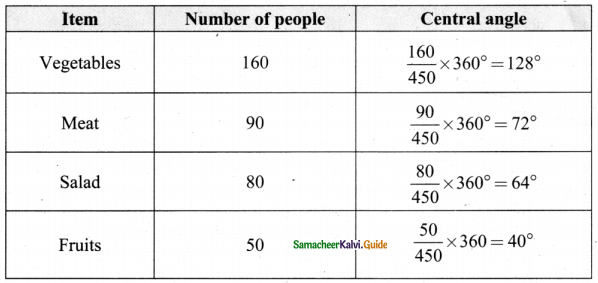
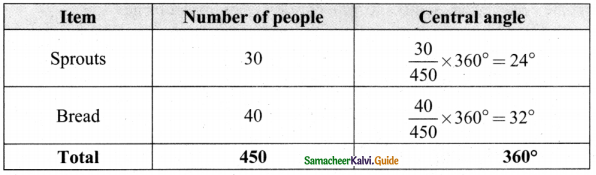
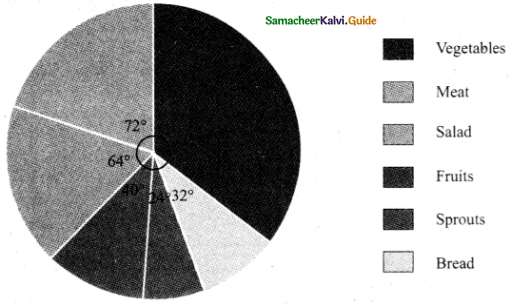
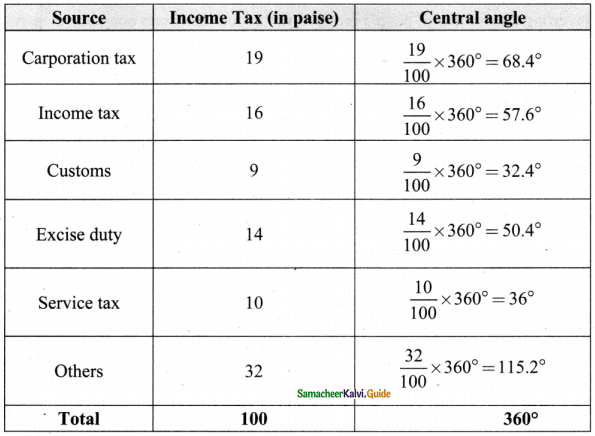
Samacheer Kalvi 8th Social Science Guide Geography Chapter 1 Rocks and Soil

Tamilnadu State Board New Syllabus Samacheer Kalvi 8th Social Science Guide Pdf Geography Chapter 1 Rocks and Soil Text Book Back Questions and Answers, Important Questions, Notes.

Tamilnadu Samacheer Kalvi 8th Social Science Solutions Geography Chapter 1 Rocks and Soil

Samacheer Kalvi 8th Social Science Rocks and Soil Text Book Back Questions and Answers

I. Choose the correct answer:

1. Which of the following is known as sphere of rocks
a) Atmosphere
b) Biosphere
c) Lithosphere
d) Hydrosphere
Answer:
(c) Lithosphere

2. World soil day is observed on
a) 15th August
b) 12th January
c) 15th October
d) 5th December
Answer:
(d) 5th Decembe

3. Fossils are found in
a) Sedimentary rocks
b) Igneous rocks
c) Metamorphic rocks
d) Plutonic rocks
Answer:
(a) Sedimentary rocks

Samacheer Kalvi 9th Social Science Guide Geography Chapter 2 Lithosphere – II Exogenetic Processes

4. The top layer of soil is called as
a) organic layer or humas
b) topsoil
c) subsoil
d) bedrock
Answer:
(b) topsoil

5. Ideal soil for growing cotton is
a) Red soil
b) Black soil
c) Alluvial soil
d) Mountain soil
Answer:
(b) Black soil

6. The major components of soil is
a) Rocks
b) Minerals
c) Water
d) All the above
Answer:
(b) Minerals

7. Which one of the following is the most widespread most and productive category of soil
a) Alluvial soil
b) Black soil
c) Red soil
d) Mountain soil
Answer:
(a) Alluvial Soil

II. Fill in the blanks.

1. Scientific study of rocks is called …………….
Answer:
Petrology

2. ……………. soil is highly suitable for millets cultivation.
Answer:
Black

3. The “Skin of earth” is
Answer:
Soil

4. ……………. is the kind of metamorphic rock using which Taj Mahal was built.
Answer:
White marble

5. ……………. is known as the primary rocks.
Answer:
Igneous rock

True or False:

1. Igneous rocks are called primary rocks.
Answer:
True

2. Slate is formed from shale.
Answer:
True

3. Red soil is formed by the process of leaching.
Answer:
False

4. M-sand is used as alternative for natural sand in construction.
Answer:
True

5. Volcanic mountains are covered with sedimentary rocks.
Answer:
True

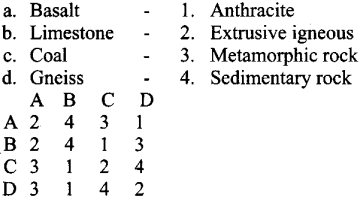
IV. Match the following:
1.
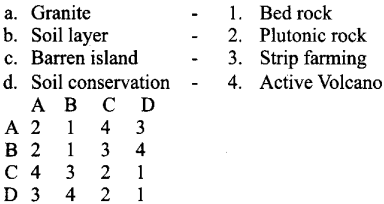
Samacheer Kalvi 9th Social Science Guide Geography Chapter 1 Advent of the Europeans 1
Answer:
A) 2 14 3
Samacheer Kalvi 9th Social Science Guide Geography Chapter 2 Lithosphere – II Exogenetic Processes

2.
Samacheer Kalvi 9th Social Science Guide Geography Chapter 1 Advent of the Europeans 2
Ans: D) 3, 1, 4, 2

V. Choose the incorrect statement from the following:

1. a) Igneous rocks are called the primary rocks.
b) Soil is the product of weathering of rocks.
c) Sedimentary rocks are the hardest ones.
d) Deccan plateau is the region of Igneous rocks.
Answer:
d) Deccan plateau is the region of Igneous rocks.

2. a) Soil erosion decreases its fertility.
b) Dynamic metamorphism is caused by high temperature.
c) Soil is a renewable source.
d) Humus is a part of the top layer of soil.
Answer:
c) Soil is a renewable source.

VI. Consider the. following statements and choose the right option from the given ones:
Statement (1): Sedimentary rocks consist of many layers.
Statement (2) : Sedimentary rocks are formed by the sediments deposited at different points of time.
(a) 1 and 2 are correct and 2 explains 1
(b) 1 and 2 are correct but, 2 does not explain 1
(c) 1 is correct but, 2 is incorrect
(d) 2 is correct but, 1 is incorrect.
Answer:
(a) 1 and 2 are correct and 2 explains 1

VII. Give reasons for the following:

1. Chemical sedimentary rocks are found in the beds of reservoirs.
Answer:
Chemical Sedimentary rocks are formed by the precipitating minerals from water. It is formed usually through the evaporation of chemical-rich solutions.

2. Igneous rocks are found in the regions of volcanoes
Answer:
The formation of igneous rocks takes place when there is an outflow of molten magma.

VIII. Distinguish the following:
1. Metamorphic rock and sedimentary rock.

Metamorphic rocks Sedimentary rocks
i) A rock formed by the alteration of igneous and sedimentary rocks subject to the high temperature and pressure is called metamorphic rocks. Due to high temperature and pressure, the undisturbed sediments of long period is cemented to form sedimentary rocks.
ii) Metamorphism is of two types:
a) Thermal Metamorphism and
b) Dynamic Metamorphism.
Sedimentary rocks are of three types:
a) Organic Sedimentary rocks,
b) Mechanical Sedimentary rocks and
c) Chemical Sedimentary rocks.

2. Soil conservation and Soil erosion.

Soil conservation Soil erosion
i) The process of protecting the soil from erosion to maintain its fertility. The removal or destructive of the top layer of soil by natural forces and human activities.
ii) Practised for the conservation of afforestation, controlled grazing, construction of dams, crop rotation, wind break, etc. Reduces the fertility of soil which leads to the reduction in the agricultural productivity.

IX. Give short answers
1. How are igneous rocks formed?
Answer:
The igneous rocks are formed by the solidification of molten magma.

2. Describe about the composition of soil.
Answer:

  • The basic components of soil are mineral, organic matter, water and air.
  • It consists of about 45% mineral, 5% organic matter, 25% of water, and 25% air.
  • The composition of soil varies from place to place and from time to time.

Samacheer Kalvi 9th Social Science Guide Geography Chapter 2 Lithosphere – II Exogenetic Processes

3. Define ‘rock’.
Answer:

  1. The rocks are the solid mineral materials forming a part of the surface of the earth and other similar planets.
  2. A rock is an aggregate of one or more minerals. Rock is an important natural resource and is found in solid-state.
  3. It may be hard or soft in nature.

4. State the types of soils.
Answer:

  • Alluvial soil
  • Black soil
  • Red soil
  • Laterites soil
  • Mountain soil
  • Desert soil

5. What is soil conservation?
Answer:
Soil conservation is the process of protecting the soil from erosion to maintain its fertility.

X. Give a detailed answer for the following:
1. Explain the process of soil formation.
Answer:
Soil and its Formation:
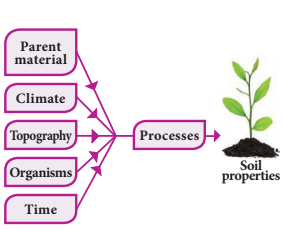
Samacheer Kalvi 9th Social Science Guide Geography Chapter 1 Advent of the Europeans 3

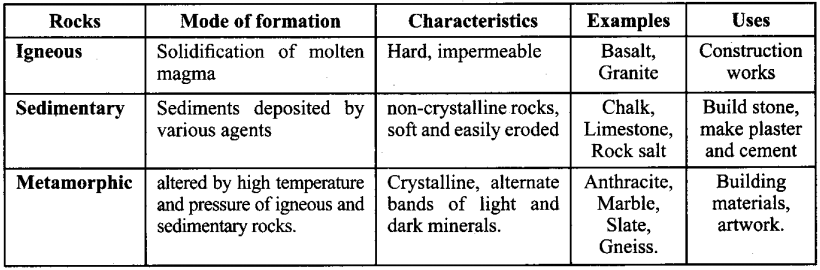
Igneous:
(i) The igneous rocks are formed by the solidification of molten magma. Also called Primary or Parent Rocks.
(ii) Types:

  • Extrusive Igneous Rocks.
  • Intrusive Igneous Rocks

1. Extrusive Igneous Rocks:
Molten magma which comes out from the interior of the earth’s surface gets solidified and forms such rocks. Fine-grained and glassy in nature. Eg., Basalt, found in northwestern peninsular India.

2. Intrusive Igneous rocks:
Molten magma cools down deep inside the earth’s crust, becomes solid and forms such rocks. Form large grains. Deep seated rocks are plutonic rock and ones at shallow depths – Hypabysal rocks. Example Granite, Diorite.

Sedimentary:
(i) Formed by the sediments derived and deposited by various agents. Also called stratified rocks.
(ii) Types:

  • Organic sedimentary rocks
  • Mechanical sedimentary rocks,
  • Chemical sedimentary rocks

1. Organic sedimentary rocks:
Formed due to decomposition of dead Plants and Animals. Contains fossils. Example Chalk, Talc

2. Mechanical sedimentary rocks:
Formed from the disintegration of Igneous and metamorphic rocks. Get deposited due to erosion by natural agents. Get cemented after a long time to form rocks. Example Sandstone, Shale.

3. Chemical sedimentary rocks: Formed by precipitating of minerals from water. Formed due to evaporation of chemical rich solution. Example Rock Salt.

Metamorphic:
(i) Formed when Igneous and sedimentary rocks are subjected to high temperature and pressure.
(ii) Types:

  • Thermal
  • Dynamic

1. Thermal Metamorphic:
If the change in rocks is caused by high temperature.

2. Dynamic Metamorphic:
If the change in rock is caused by high pressure. Formed from Igneous rocks. Eg., Granite into gneiss
Formed from Sedimentary rocks. Eg., Shale into Slate

Samacheer Kalvi 9th Social Science Guide Geography Chapter 2 Lithosphere – II Exogenetic Processes

3. Give an account of different layers of soil.
Layers of soil:
O – Horizon or humus:
This layer is dominated by organic material eg: leaves
A – Horizon or Topsoil:
It is a part of topsoil composed of organic matter mixed with mineral matter.
E – Horizon or Elevated layer:
E – stands for the elevated layer. This layer is significantly leached of clay, iron and aluminium oxides, which leaves a concentration of ore.
B – Horizontal or subsoil:
This layer reflects the chemical or physical alternation or parent material. Thus iron, clay, aluminium and organic compounds are found accumulated in the Horizon.
C – Horizon or Parent Rock:
Partially weathered parent material accumulates in this layer.
R – Horizon or Parent Rock:
This layer consists of an unweathered part of the bedrock.

4. Classify and explain the soil?
Answer:
Definition: Soil is a mixture of Organic matter, minerals, gases, liquids, and organisms that together support life.

Classification of soils:
Soils are classified on the basis of their formation, colour, physical and chemical properties. Based on these, soil is classified into six major types. They are Alluvial soil, Black soil, Red soil, Laterite soil, Mountain soil, Desert soil.

Alluvial soil:

  • Found in the regions of river valleys, flood plains, and coastal regions.
  • Formed by the deposition of silt by the running water.
  • Most productive of all soils.
  • Suitable for the cultivation of sugarcane, jute, rice, wheat.

Black soils:

  • Formed by weathering of igneous rocks.
  • Clayey in nature.
  • Retains moisture.
  • Ideal for growing cotton.

Red Soils:

  • Formed by weathering of metamorphic rocks and crystalline rocks.
  • Found in semi-arid regions.
  • Not a fertile.
  • Is soil brown-red in colour due to the presence of iron oxide
  • Suitable for millet cultivation.

Laterite soils:

  • Formed by the process of leaching.
  • Found in trophical regions, which experienced the alternate wet and dry conditions.
  • Infertile soil.
  • Suitable for plantation of tea and coffee.

Mountain soils:

  • Found in slopes of mountains.
  • Thin and acidic in nature.
  • The nature of soil differs based on the altitude.

Desert soils:

  • Found in the hot desert region.
  • Porous and saline in nature.
  • Infertile in nature.
  • Agriculture is not successful.

XI. Activity Corner.

1. Complete the following table with the help of an internet source.
Samacheer Kalvi 9th Social Science Guide Geography Chapter 1 Advent of the Europeans 5

Samacheer Kalvi 8th Social Science Rocks and Soil Additional Important Questions and Answers

I. Choose the Correct answer.
1. Petrology is derived from the ………….. word.
a) English
b) Latin
c) Greek
d) French
Answer:
(c) Greek

2. The soils found in the desert regions are …………..
a) Mountain Soils
b) Desert Soils
c) Black Soil
d) Red Soil
Answer:
(b) Desert Soils

3. Which Soils are formed by the weathering of metamorphic rocks?
a) Red Soils
b) Rock Soils
c) Laterite Soils
d) Mountain Soils
Answer:
(a) Red Soils

4. …………….. is a part composed of organic matter mixed with mineral matter.
a) Humus
b) Top Soil
c) Elevated layer
d) Sub-soil
Answer:
(b) Top Soil

5. The time to form one cm of soil is
a) 100 years
b) 200 years
c) 500 years
d) 1000 years
Answer:
(b) 200 years

6. …………….is known as the zone of accumulation.
a) Humus
b) Top Soil
c) Elevated layer
d) Sub-soil
Answer:
(d) Sub-soil

7. In the soil composition ………….. are minerals.
a) 5%
b) 10%
c) 25%
d) 45%
Answer:
(d) 45%

8. In the soil composition is air.
a) 5%
b) 10%
c) 25%
d) 40%.
Answer:
(c) 25%

9. ……………. soils are formed by the deposition of silt by the running water.
a) Black
b) Red
c) Alluvial
d) Desert
Answer:
(c) Alluvial

10. the Soil composition is organic matter.
a) 5%
b) 10%
c) 25%
d) 45%
Answer:
(a) 5%

II. Fill in the blanks:
1. A rock is an aggregate of ………….. or more minerals.
Answer:
one

2. There are ………….. different types of minerals found on the earth Surface.
Answer:
2000

Samacheer Kalvi 9th Social Science Guide Geography Chapter 2 Lithosphere – II Exogenetic Processes

3. Rocks are classified in to ………….. types.
Answer:
three

4. The two types of Intrusive Igneous rocks are ………….., …………..
Answer:
Plutonic rocks, Hypabysal rocks

5. Igneous Rocks are ………….. rocks
Answer:
Primary

6. ……………. into slate caused by thermal metamorphism.
Answer:
Basalt

7. Soil is a basic requirement for the growth of ………….. and …………..
Answer:
Plants, animals

8. To become a well-matured soil, it takes about ………….. years.
Answer:
3000

9. Parent Rock is converted to loose Rock by ……………
Answer:
soil

10. Laterite soil is suitable for plantation crops like ………….., …………..
Answer:
tea, coffee

III. State whether the following statements are true or false:

1. To become a well-matured soil, it taken about 2000 years.
Answer:
False

2. Lava comes out from a volcano.
Answer:
True

3. The word Ignis means rock.
Answer:
False

4. Oldest Sedimentary rocks of the world has been identified in Green land.
Answer:
True

5. Soil supports ecosystem and play an important role in land management.
Answer:
True

IV. Match the following:
1.
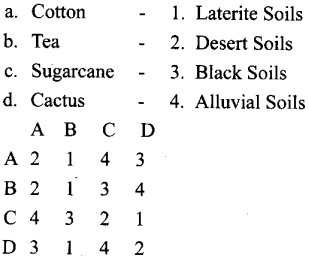
Samacheer Kalvi 9th Social Science Guide Geography Chapter 1 Advent of the Europeans 4
Answer:
D) 3 1 4 2

V. Choose the incorrect statement from the following:
1. a) Basalt into slate caused by thermal metamorphism.
b) Chemical Sedimentary rocks are also called evaporates.
c) Taj Mahal in India was built with white marbles of Sedimentary rocks.
d) Rocks have been used by mankind throughout history.
Answer:
c) Taj Mahal in India was built with white marbles of Sedimentary rocks.

VI. Consider the following statements and choose the right option from the given ones:
1. Statement (1): Petrology is a branch of geology.
Statement (2): It deals with the Study of water researches.
a) 1 and 2 are correct and 2 explains 1
b) 1 and 2 are correct but, 2 does not explain 1
c) 1 is correct but, 2 is incorrect
d) 2 is correct but, 1 is incorrect.
Answer:
c) 1 is correct but, 2 is incorrect

VII. Give reasons for the following:
1. Why soil is known as ‘Skin of the earth’?

  • Soil minerals form the basis of soil.
  • It forms on the surface of the earth.
  • so It is known as the ‘Skin of the earth’:

VIII. Distinguish the following:
1. Black Soil and Red Soil.

Black Soil Red Soil
1. These Soils are formed by the weathering of igneous rocks. These soils are formed by the weathering of metamorphic rocks and crystalline rocks.
2. It is retentive of moisture. Iron Oxide is present.
3. It is ideal for growing cotton. It is Suitable for millet cultivation.

IX. Give short answers:
1. Explain about Petrology.

  • Petrology is a branch of geology which deals with the study of rocks.
  • ‘Petrology’ is derived from the Greek word “Petrus” refers to rock and “Logos” refers to study

2. Name the layer in the Earth.
The layer found in the Earth are namely

  • Lithosphere
  • Hydrosphere
  • Atmosphere
  • Biosphere.

Samacheer Kalvi 9th Social Science Guide Geography Chapter 2 Lithosphere – II Exogenetic Processes

3. Explain the type of Igneous Rocks.

  • Extrusive Igneous Rocks
  • Intrusive Igneous Rocks.

X. Give a detailed answer for the following:
1. What are the uses of soil?
Answer:
Soil is one of the important natural resources. It is a basic requirement for plant growth and supports various life forms on the earth.

  • The minerals present in the soil enhance and nourishes the crops and plants.
  • It is used in the making of ceramics or pottery.
  • It is a source of material for construction and handicraft works.
  • It acts as a natural filter of water and purifies it.
  • Soil supports the ecosystem and plays an important role in land management.
Samacheer Kalvi 8th Maths Guide Chapter 7 Information processing InText Questions

Tamilnadu State Board New Syllabus Samacheer Kalvi 8th Maths Guide Pdf Chapter 7 Information processing InText Questions Text Book Back Questions and Answers, Notes.

Tamilnadu Samacheer Kalvi 8th Maths Solutions Chapter 7 Information processing InText Questions

Recap (Text Book Page No. 232 & 233)

Question 1.
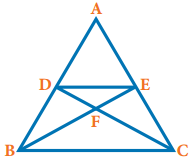
Find the number of all possible triangles that can be formed from the triangle given below.
Samacheer Kalvi 8th Maths Guide Chapter 7 Information Processing InText Questions 1Answer:
Single Triangles ⇒ 5
Combination of 2 ⇒ 4
Combination of 3 ⇒ 2
Big triangle ⇒ 1
= 12

Samacheer Kalvi 8th Maths Guide Chapter 7 Information processing InText Questions

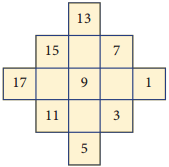
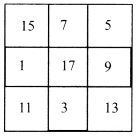
Question 2.
Use the numbers given in the figure to form a 3 × 3 magic square.
Samacheer Kalvi 8th Maths Guide Chapter 7 Information Processing InText Questions 2
Answer:
Samacheer Kalvi 8th Maths Guide Chapter 7 Information Processing InText Questions 3

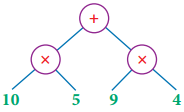
Question 3.
Convert the tree diagram into a numeric expression.
Samacheer Kalvi 8th Maths Guide Chapter 7 Information Processing InText Questions 4
Answer:
(10 × 5) + (9 × 4)
= 50 + 36
= 86

Samacheer Kalvi 8th Maths Guide Chapter 7 Information processing InText Questions

Question 4.
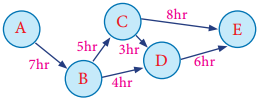
(i) Find the total time taken by the bus to reach from A to E via B , C and D.
(ii) Find which is the shortest route from A to E.
Samacheer Kalvi 8th Maths Guide Chapter 7 Information Processing InText Questions 5
Answer:
(i) Route ⇒ A → B → C → D → E
Time taken ⇒ (7 + 5 + 3 + 6) hrs = 21 hrs

(ii)

Available roots Time taken
(a) A → B → C → D → E 7 + 5 + 3 + 6 = 21 hrs
(b) A → B → D → E 7 + 4 + 6  = 17 hrs
(c) A → B → C → E 7 + 5 + 8 = 20 hrs

Shortest route ⇒ A → B → D → E

Samacheer Kalvi 8th Maths Guide Chapter 7 Information processing InText Questions

Question 5.
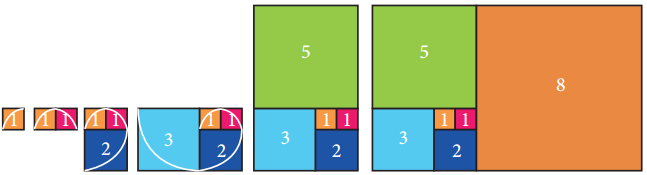
Connect the Fibonacci squares through diagonals by curve from corner to corner across each square to draw a Golden Spiral.
Samacheer Kalvi 8th Maths Guide Chapter 7 Information Processing InText Questions 6
Fibonacci Squares

Question 6.
When you plan to buy a shirt, one shop offers a discount of ₹ 200 on MRP ₹ 1000 and another shop offers 15% discount on the same MRP. Where would you buy?
Answer:

Price in 1st shop = ₹ 1000 – ₹ 200 = ₹800
Samacheer Kalvi 8th Maths Guide Chapter 7 Information Processing InText Questions 7
In shop 1.

Samacheer Kalvi 8th Maths Guide Chapter 7 Information processing InText Questions

Question 7.
Amazing park is offers a package deal of 5 entrance passes for ₹ 130. If one entrance pass normally costs ₹ 30, how much will you save by taking advantage of this special deal?
Answer:
Cost of one entrance pass = ₹ 30
∴ Cost of 5 entrance passes = ₹ 5 × 30
= ₹ 150
But special deal price = ₹ 130
Amount of saving = 150 – 130 = ₹ 20

Activity (Text Book Page No. 237)

Question 1.
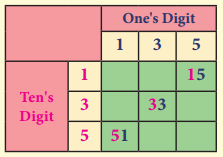
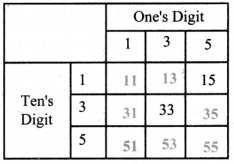
Determine the number of two digit numbers that can be formed using the digits 1, 3 and 5 with repetition of digits allowed.
The activity consists of two parts
(i) Choose a one’s digit.
(ii) Choose a ten’s digit.
Complete the table given beside
Samacheer Kalvi 8th Maths Guide Chapter 7 Information Processing InText Questions 8
Answer:

Samacheer Kalvi 8th Maths Guide Chapter 7 Information Processing InText Questions 9

Samacheer Kalvi 8th Maths Guide Chapter 7 Information processing InText Questions

Question 2.
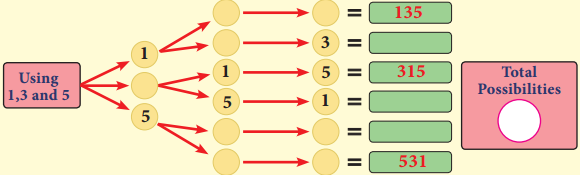
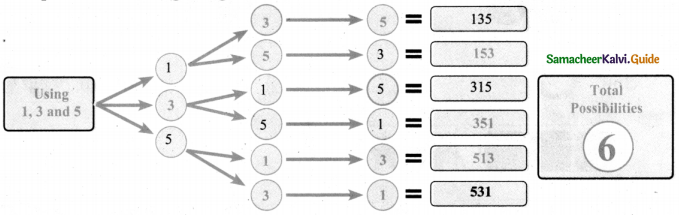
Find the three digit numbers that can be formed using the digits 1, 3 and 5 without repetition of digits.
Complete the tree diagram given below to the numbers
Samacheer Kalvi 8th Maths Guide Chapter 7 Information Processing InText Questions 10
Answer:

Samacheer Kalvi 8th Maths Guide Chapter 7 Information Processing InText Questions 11

Samacheer Kalvi 8th Maths Guide Chapter 7 Information processing InText Questions

Activity (Text Book Page No. 242)

Question 1.
Samacheer Kalvi 8th Maths Guide Chapter 7 Information Processing InText Questions 12
(i)
Samacheer Kalvi 8th Maths Guide Chapter 7 Information Processing InText Questions 13
(ii)
Samacheer Kalvi 8th Maths Guide Chapter 7 Information Processing InText Questions 14
(iii)
Samacheer Kalvi 8th Maths Guide Chapter 7 Information Processing InText Questions 15
Answer:

Samacheer Kalvi 8th Maths Guide Chapter 7 Information Processing InText Questions 15

Samacheer Kalvi 8th Maths Guide Chapter 7 Information processing InText Questions

Question 2.
Samacheer Kalvi 8th Maths Guide Chapter 7 Information Processing InText Questions 17
Answer:
(i)
Samacheer Kalvi 8th Maths Guide Chapter 7 Information Processing InText Questions 16
(ii)
Samacheer Kalvi 8th Maths Guide Chapter 7 Information Processing InText Questions 18
(iii)
Samacheer Kalvi 8th Maths Guide Chapter 7 Information Processing InText Questions 19
Answer:
Samacheer Kalvi 8th Maths Guide Chapter 7 Information Processing InText Questions 18

Samacheer Kalvi 8th Maths Guide Chapter 7 Information processing InText Questions

Question 3.
Samacheer Kalvi 8th Maths Guide Chapter 7 Information Processing InText Questions 20
(i)
Samacheer Kalvi 8th Maths Guide Chapter 7 Information Processing InText Questions 21
(ii)
Samacheer Kalvi 8th Maths Guide Chapter 7 Information Processing InText Questions 22
(iii)
Samacheer Kalvi 8th Maths Guide Chapter 7
Answer:

Samacheer Kalvi 8th Maths Guide Chapter 7 Information Processing InText Questions 22

Samacheer Kalvi 8th Maths Guide Chapter 7 Information processing InText Questions

Question 4.
Samacheer Kalvi 8th Maths Guide Chapter 7 Information Processing InText Questions 24
(i)
Samacheer Kalvi 8th Maths Guide Chapter 7 Information Processing InText Questions 25
(ii)
Samacheer Kalvi 8th Maths Guide Chapter 7 Information Processing InText Questions 26
(iii)
Samacheer Kalvi 8th Maths Guide Chapter 7 Information Processing InText Questions 27
Answer:

Samacheer Kalvi 8th Maths Guide Chapter 7 Information Processing InText Questions 25

Samacheer Kalvi 8th Maths Guide Chapter 7 Information processing InText Questions

Question 5.
Samacheer Kalvi 8th Maths Guide Chapter 7 Information Processing InText Questions 28
(i)
Samacheer Kalvi 8th Maths Guide Chapter 7 Information Processing InText Questions 29
(ii)
Samacheer Kalvi 8th Maths Guide Chapter 7 Information Processing InText Questions 30
(iii)
Samacheer Kalvi 8th Maths Guide Chapter 7 Information Processing InText Questions 31
Answer:

Samacheer Kalvi 8th Maths Guide Chapter 7 Information Processing InText Questions 30

Samacheer Kalvi 8th Maths Guide Chapter 7 Information processing InText Questions

Try These (Text Book Page No. 243)

Question 1.
Find any five SETs among these set of cards (repetition of cards allowed).
a.
Samacheer Kalvi 8th Maths Guide Chapter 7 Information Processing InText Questions 32

b.
Samacheer Kalvi 8th Maths Guide Chapter 7 Information Processing InText Questions 33

c.
Samacheer Kalvi 8th Maths Guide Chapter 7 Information Processing InText Questions 34

d.
Samacheer Kalvi 8th Maths Guide Chapter 7 Information Processing InText Questions 35

e.
Samacheer Kalvi 8th Maths Guide Chapter 7 Information Processing InText Questions 36

f.
Samacheer Kalvi 8th Maths Guide Chapter 7 Information Processing InText Questions 37

g.
Samacheer Kalvi 8th Maths Guide Chapter 7 Information Processing InText Questions 38

h.
Samacheer Kalvi 8th Maths Guide Chapter 7 Information Processing InText Questions 39

i.
Samacheer Kalvi 8th Maths Guide Chapter 7 Information Processing InText Questions 40

j.
Samacheer Kalvi 8th Maths Guide Chapter 7 Information Processing InText Questions 41
Answer:
(i) (a), (c), (h)
(ii) (e), (g), (j)
(iii) (a), (b), (d)
(iv) (f), (i), (j)
(v) (f), (i), (h)

Samacheer Kalvi 8th Maths Guide Chapter 7 Information processing InText Questions

Question 2.
This is an example for a magic square in SETs. Can you make another two?
Samacheer Kalvi 8th Maths Guide Chapter 7 Information Processing InText Questions 42
Answer:

Repeat one square with every thing 2 another square with everything 3.

Activity (Text Book Page No. 250)

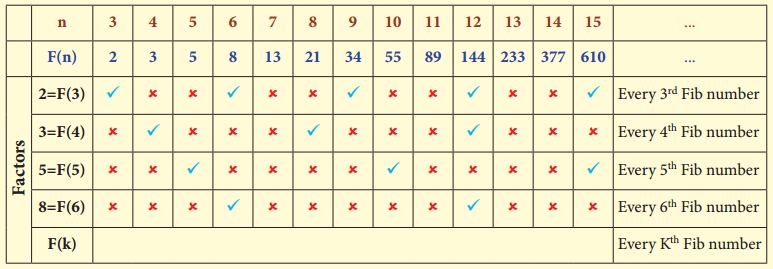
Using the given Table I, find the pattern, answer the following questions and colour the values in the given Table Il. One is done for you.
Table – 1
Samacheer Kalvi 8th Maths Guide Chapter 7 Information Processing InText Questions 43
Question 1.
Where are the even Fibonacci Numbers?
Colour both the term n and where F(n) is even in yellow.
Do you find any pattern?
Every Third Fibonacci number is a multiple of 2(even).
Answer:

i.e., a multiple of F(3) or 2 = F(3)

Samacheer Kalvi 8th Maths Guide Chapter 7 Information processing InText Questions

Question 2.
Where there are Fibonacci numbers which are multiple of 3?
Colour both the term n and where F(n) is multiple of 3 in red.
Write down the pattern you find
Every 4th Fibonacci number is a multiple of 3.
Answer:
i.e., a multiple of F(4) or 3 = F(4)

Question 3.
What about the multiple of 5?
Colour both the term n and where F(n) is multiple of 5 in blue. ‘
Write down the pattern you find.
Every …………………………… i.e ………………………………
Answer:
Every 5th Fibonacci number i.e a multiple of F(5) or 5 = F(5)

Question 4.
What about the multiple of 8?
Colour both the term n where F(n) is multiple of 8 in green.
Write down the pattern you find.
Every …………………………… i.e ………………………………
Answer:
Every 6th Fibonacci number i.e a multiple of F(6) or 8 = F(6)

Samacheer Kalvi 8th Maths Guide Chapter 7 Information processing InText Questions

Table 2.
Samacheer Kalvi 8th Maths Guide Chapter 7 Information Processing InText Questions 44
From the above activity, we conclude that
Every Fibonacci number is a factor of (a term number of) Fibonacci numbers in multiples
Samacheer Kalvi 8th Maths Guide Chapter 7 Information Processing InText Questions 45
From the above table, we get a general rule as Every kth Fibonacci number is a multiple of F(k).
Answer:
Table 2.
Samacheer Kalvi 8th Maths Guide Chapter 7 Information Processing InText Questions 46
R – Red
Y – Yellow
B – Blue
G – Green

Samacheer Kalvi 8th Maths Guide Chapter 7 Information processing InText Questions

Activity (Text Book Page No. 258)

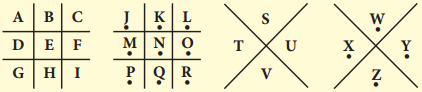
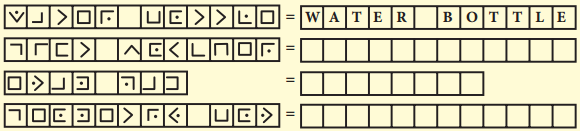
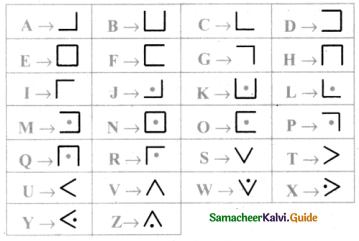
Code 1: Pigpen

I. Fill in the blank boxes and decode
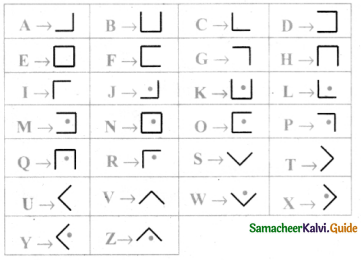
The Pigpen code looks like meaningless writing, but it is quite easy to catch on to. Each letter is represented by the part of the “Pigpen” that surrounds it.
The first code uses the following key. To complete the code, you need to work out how to use the key to decode the message.
Samacheer Kalvi 8th Maths Guide Chapter 7 Information Processing InText Questions 47

Samacheer Kalvi 8th Maths Guide Chapter 7 Information Processing InText Questions 48
Answer:
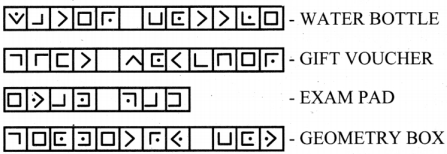
Samacheer Kalvi 8th Maths Guide Chapter 7 Information Processing InText Questions 49
To decode
Samacheer Kalvi 8th Maths Guide Chapter 7 Information Processing InText Questions 50

Samacheer Kalvi 8th Maths Guide Chapter 7 Information processing InText Questions

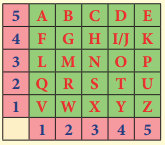
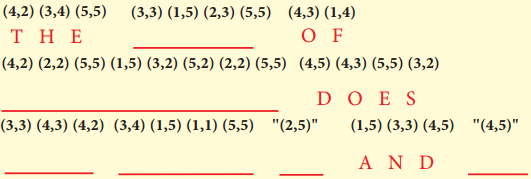
Code 2: Polybius Square Cipher

II. Fill in the blanks
A Polybius Square is a table that allows someone to convert letters into numbers. Use the Polybius square rows and column values to find the code
Samacheer Kalvi 8th Maths Guide Chapter 7 Information Processing InText Questions 51

Samacheer Kalvi 8th Maths Guide Chapter 7 Information Processing InText Questions 52
Answer:
Using this a set of numbers can be used to denote a letter and vise versa
(4, 2) represent T, (3, 4) represent H, (5, 5) represent E
Likewise, when we solve for the remaining. we get
THE NAME OF TREASURE DOES NOT HAVE BAND D .
Since clue 2 gives that the treasure item does not have the letters b & d, therefore “exam pad” & “geometry box” cannot be the treasure item.
Hence, the treasure item is “gift voucher”

Samacheer Kalvi 8th Maths Guide Chapter 7 Information processing InText Questions

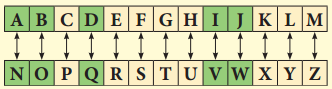
Code 3: Atbash Cipher
III. Find the code using the key as shown in given figure:
Atbash cipher is a substitution cipher with just one specific key where all the letters are reversed that is A to Z and Z to A.

Samacheer Kalvi 8th Maths Guide Chapter 7 Information Processing InText Questions 54
Answer:
The given Cipher is:
GSV ILLN MFNYVI RH Z NFOGRKOV LU ULFI ZMW HVEVM
Decoded Message:
THE ROOM NUMBER IS A MULTIPLE OF FOUR AND SEVEN
Since room number is a multiple of 4 & 7,
The room number is 4 × 7 = 28.

Samacheer Kalvi 8th Maths Guide Chapter 7 Information processing InText Questions

Code 4: Using a Key – Reflection Table
IV Use the reflection table which is given below and find the correct word by using a reflected alphabet.
Samacheer Kalvi 8th Maths Guide Chapter 7 Information Processing InText Questions 55
J V A Q B J – _______
P B Z C H G R E G N O Y R – _______
P U N V E – ________
P H O O B N E Q – ________
Answer:
J V A Q B J – WINDOW
P B Z C H G R E G N O Y R – COMPUTER TABLE
P U N V E – CHAIR
P H O O B N E Q – CUPBOARD

After finding the codes, the teacher then asks students to rearrange the clues one by one
CLUES
1. ————————————————-
2. ————————————————-
3. ————————————————-
4. ————————————————-
Answer:
The 4 clues are:
1. Water bottle, Gift voucher, Exam pad, Geometry box
2. The name of the treasure does not have b’ & ‘d’
3. The room is a multiple of four and seven – 28
4. Window, Computer table, Chair, Cupboard

RESULT
(i) The room in which the treasure took place = ________ .
(ii) The place of the treasure = ________ .
(iii) The identity of the treasure = ________ .
(Hint:- If you answered the question number 6 in Exercise 4.3, you can compare and verify your results) The gift voucher contains (20 full marks awarded).
Answer:
The room in which the treasure took place = 28
The place of treasure = Chair
Identity of treasure = Gift voucher.

Samacheer Kalvi 8th Maths Guide Chapter 7 Information processing InText Questions

Try These (Text Book Page No. 260)

Question 1.
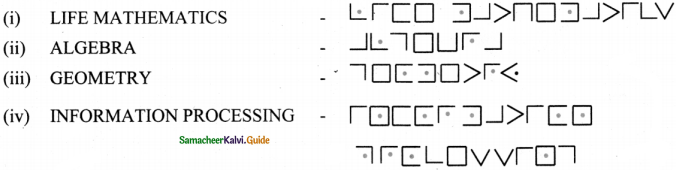
Use Pigpen Cipher code and write the code for your name _______ and your chapter names
(i) LIFE MATHEMATICS
(ii) ALGEBRA
(iii) GEOMETRY
(iv) INFORMATION PROCESSING
Answer:
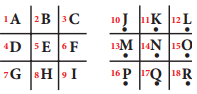
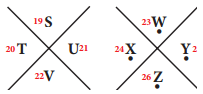
For Pigpen, we should first construct the Criss Cross pattern & then fill with alphabets.
Step 1:
Samacheer Kalvi 8th Maths Guide Chapter 7 Information Processing InText Questions 56

Step 2: Fill the above with all the alphabets from A to Z.
Samacheer Kalvi 8th Maths Guide Chapter 7 Information Processing InText Questions 57

Step 3: So, the secret code is got by the outline of each letter in the above patterns.
Samacheer Kalvi 8th Maths Guide Chapter 7 Information Processing InText Questions 58
similarly for all the others. Therefore pigpen code is
Samacheer Kalvi 8th Maths Guide Chapter 7 Information Processing InText Questions 60

Let us now write the given words with Pigpen code.
Samacheer Kalvi 8th Maths Guide Chapter 7 Information Processing InText Questions 61

Samacheer Kalvi 8th Maths Guide Chapter 7 Information processing InText Questions

Question 2.
Decode the following Shifting and Substitutmg secret codes given below. Which one is easier for you?
(i) Shifting method:- M N S G H M F HR H L O N R R H A K D
Samacheer Kalvi 8th Maths Guide Chapter 7 Information Processing InText Questions 62
Answer:
Decode using shifting method. Let us shift & see by trial & error method.
Let us substitute ‘b’ for ‘a’, ‘e’ for ‘b’ & so on
Samacheer Kalvi 8th Maths Guide Chapter 7 Information Processing InText Questions 63
Message : M N S G H M F H R H L O N R R H A K D
Decoded text : NOTHING IS IMPOSSIBLE
Samacheer Kalvi 8th Maths Guide Chapter 7 Information Processing InText Questions 64
We find that Pigpen code has been used, by substituting for the symbols from the table that we constructed earlier, we go the message.
NOTHING IS IMPOSSIBLE

Samacheer Kalvi 8th Maths Guide Chapter 7 Information processing InText Questions

Question 3.
Write a short message to a friend and get them to decipher it.(Use any one shifting and substituting code method)
Answer:
Student can choose and tr on their own.

Activity (Text Book Page No. 264)

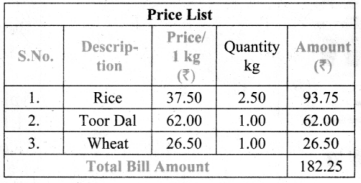
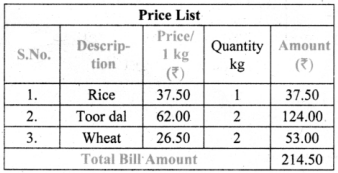
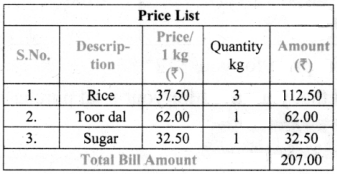
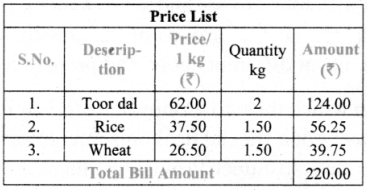
Consider that you are going to a store with your total budget of ₹ 220 to buy things without changing the quantity of the items given in the list below with the following conditions.
Samacheer Kalvi 8th Maths Guide Chapter 7 Information Processing InText Questions 65
Conditions:
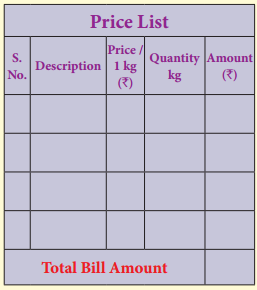
(i) First you have to complete the price list given.
(ii) You have to buy three items as per the given price list but within your budget ₹ 220.
(iii) You wont carry exceeding 5kg because you have to walk home carrying them, so they cannot be bulky.

Now, answer the following questions:
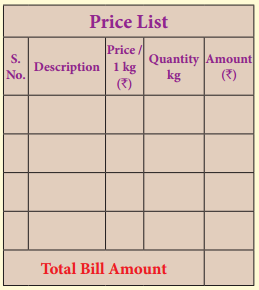
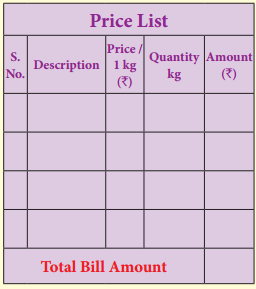
1. In how many ways can you buy your items? Complete the price lists given below. One is done for you.
2. Which one is the best purchase price list and why?

Samacheer Kalvi 8th Maths Guide Chapter 7 Information Processing InText Questions 66
Answer:
Samacheer Kalvi 8th Maths Guide Chapter 7 Information Processing InText Questions 67

Samacheer Kalvi 8th Maths Guide Chapter 7 Information processing InText Questions

Samacheer Kalvi 8th Maths Guide Chapter 7 Information Processing InText Questions 68
Answer:
Samacheer Kalvi 8th Maths Guide Chapter 7 Information Processing InText Questions 69

Samacheer Kalvi 8th Maths Guide Chapter 7 Information Processing InText Questions 70
Answer:
Samacheer Kalvi 8th Maths Guide Chapter 7 Information Processing InText Questions 71

Samacheer Kalvi 8th Maths Guide Chapter 7 Information processing InText Questions

Samacheer Kalvi 8th Maths Guide Chapter 7 Information Processing InText Questions 72
Answer:
Samacheer Kalvi 8th Maths Guide Chapter 7 Information Processing InText Questions 73

Samacheer Kalvi 8th Maths Guide Chapter 7 Information processing InText Questions

Samacheer Kalvi 8th Maths Guide Chapter 7 Information Processing InText Questions 74
Answer:
Samacheer Kalvi 8th Maths Guide Chapter 7 Information Processing InText Questions 75

Samacheer Kalvi 8th Maths Guide Chapter 7 Information processing InText Questions

Activity (Text Book Page No. 265)

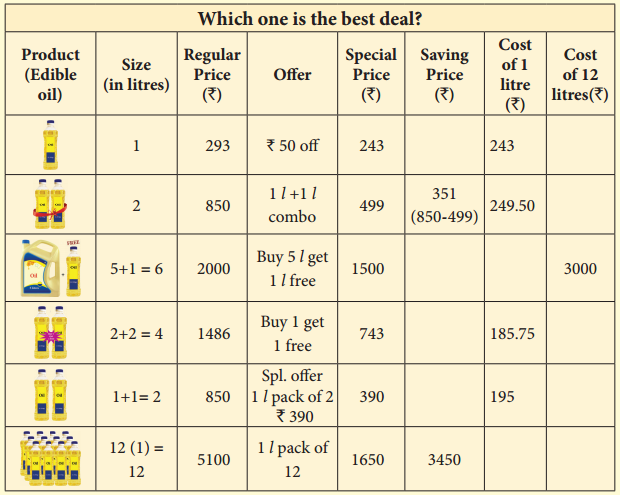
Consider that you want to buy 12 litres of the same quality of edible oil at your budget price of ₹ 250 per litre. In a supermarket, there are a lot of offers on various oil brands. Some of the offers are given below. Complete the table and find which one is the best offer for you and how much you will save for your total purchase.
Samacheer Kalvi 8th Maths Guide Chapter 7 Information Processing InText Questions 76
Best offer price for you ___________
Amount that you saved for your total purchase ___________
Answer:
Best offer price for you ₹ 137.50
Amount that you saved for your total purchase ₹ 1350

Samacheer Kalvi 8th Maths Guide Chapter 7 Information processing InText Questions

Try These (Text Book Page No. 266)

The teacher divides the class into four groups and setup a mock market in the class room and ask the students to involve in role play as Iwo groups of businessmen and two groups of consumers. Consumers have to buy products at different shops and prepare a price list.

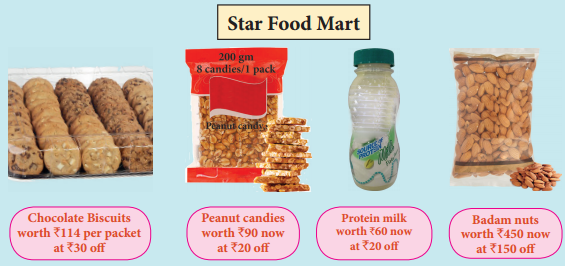
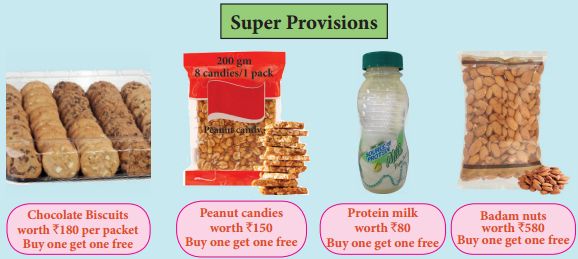
The Iwo supermarkets iii which the two groups buy are Star Food Mart and Super Provisions. Th is week they each have got a special deal on some products. At Star Food Mart. you can buy items at discount prices. At Super Provisions, there are some “BUY ONE GET ONE” deals. Have a look at their deal:
Samacheer Kalvi 8th Maths Guide Chapter 7 Information Processing InText Questions 77

Samacheer Kalvi 8th Maths Guide Chapter 7 Information Processing InText Questions 78

Now answer the following questions.
I. Here is your shopping list:
4 bottles of Protein Milk (200 ml size) 2 packets of Peanut candies(200 gm), 1 packet of Chocolate biscuits, 1 packet of Badam nuts (500 gm)
Answer:
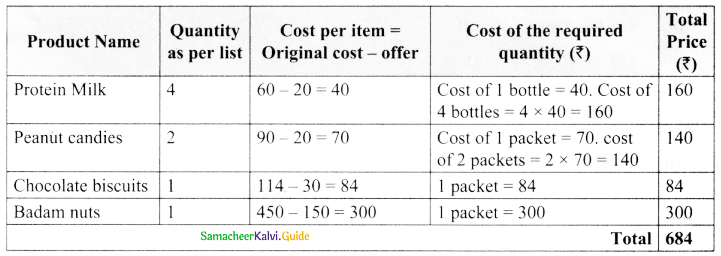
price of Star Food Mart
Samacheer Kalvi 8th Maths Guide Chapter 7 Information Processing InText Questions 80

(i) If you buy all the items in one shop, where will you get the best price?
Answer:
In star Food Mart

(ii) If you buy the items from the two shops, how will you do it to spend the least amount of money?
Answer:
Badam nuts from super provisions and other items from Star Food Mart.

Samacheer Kalvi 8th Maths Guide Chapter 7 Information processing InText Questions

II. You have H 000/- to spend to buy the following shopping list:
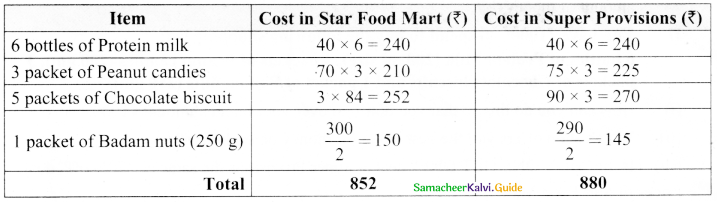
6 bottles of Protein Milk (200 ml size), 3 packets of Peanut candies(200 gm), 3 packets of Chocolate biscuits, 1 packet of Badam nuts (250 gm).
Answer:
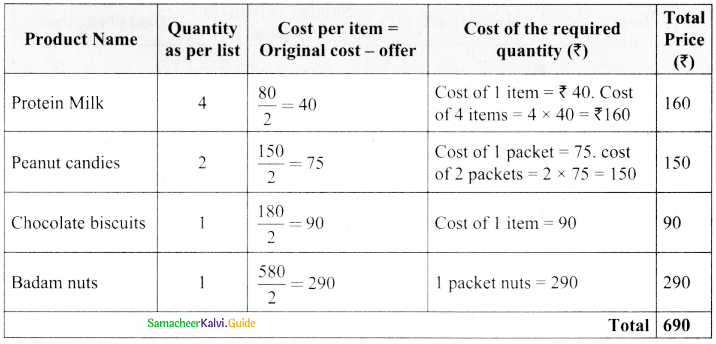
Comparing two stores
Samacheer Kalvi 8th Maths Guide Chapter 7 Information Processing InText Questions 81

(i) How can you do this so that you dont go over your budget amount ₹ 1000?
Answer:
We can buy them from any one shop.

(ii) Which shop offers you the best value for money on each item?
Answer:
Star Food Mart

Samacheer Kalvi 8th Maths Guide Chapter 7 Information processing InText Questions

(iii) Is the “BUY ONE GET ONE” deal at Super Provisions the same as “50% off” deal?
Answer:
Yes

Samacheer Kalvi 8th Maths Guide Chapter 7 Information processing Ex 7.4

Tamilnadu State Board New Syllabus Samacheer Kalvi 8th Maths Guide Pdf Chapter 7 Information processing Ex 7.4 Text Book Back Questions and Answers, Notes.

Tamilnadu Samacheer Kalvi 8th Maths Solutions Chapter 7 Information processing Ex 7.4

Question 1.
Find the best buy of the following purchases:
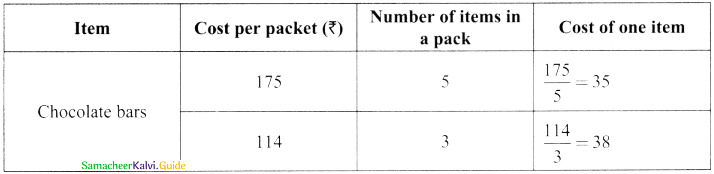
(i) A pack of 5 chocolate bars for ₹ 175 or 3 chocolate bars for ₹ 114?
Answer:
Samacheer Kalvi 8th Maths Guide Answers Chapter 7 Information Processing Ex 7.4 1
Best buy is a packet of 5 chocolate bars for ₹ 175

Samacheer Kalvi 8th Maths Guide Chapter 7 Information processing Ex 7.4

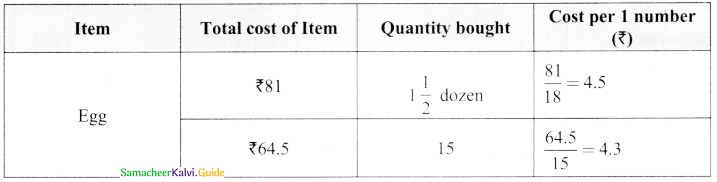
(ii) Basker buy 1\(\frac { 1 }{ 2 }\) dozen of eggs for 81 and Aruna buy 15 eggs for ₹ 64.50?
Answer:
Samacheer Kalvi 8th Maths Guide Answers Chapter 7 Information Processing Ex 7.4 2
Best buy is 15 eggs for ₹ 64.5

Question 2.
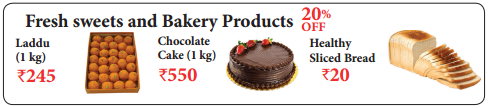
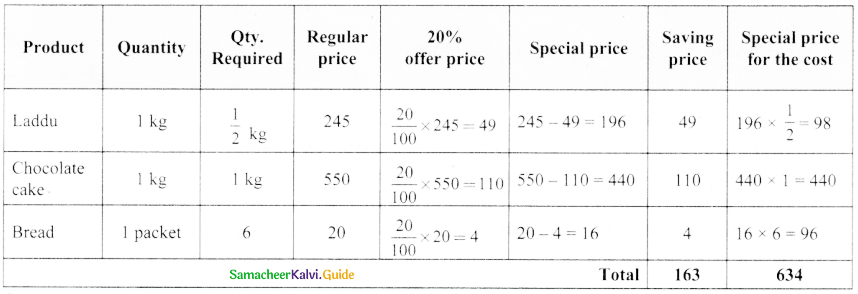
Using the given picture find the total special offer price of fresh sweets and bakery products to buy \(\frac { 1 }{ 2 }\) kg laddu, 1 kg cake, 6 pockets of bread.
Samacheer Kalvi 8th Maths Guide Answers Chapter 7 Information Processing Ex 7.4 3
Answer:
Samacheer Kalvi 8th Maths Guide Answers Chapter 7 Information Processing Ex 7.4 4

Samacheer Kalvi 8th Maths Guide Chapter 7 Information processing Ex 7.4

Question 3.
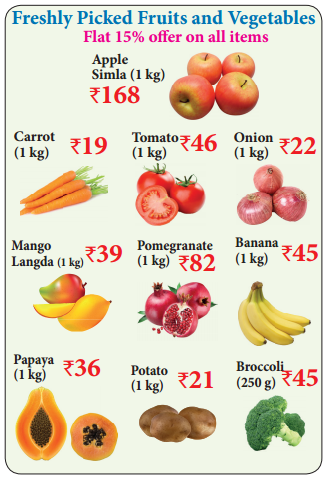
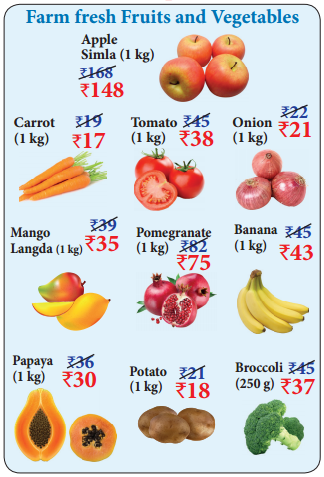
Using the given picture prepare a price list.
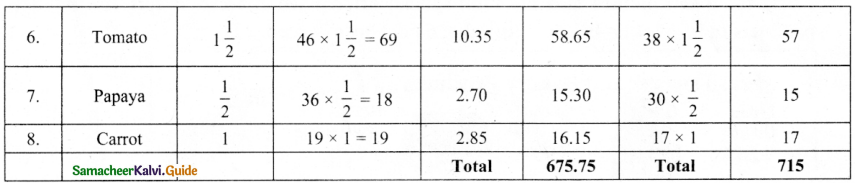
Suppose you planto buy 1\(\frac { 1 }{ 2 }\) kg of apple, 2 kg of pomegranate, 2 kg of banana, 3 kg of mango, \(\frac { 1 }{ 2 }\) kg of papaya, 3 kg of onion, \(\frac { 1 }{ 2 }\) kg of tomato, and 1 kg of carrot in shop 1, how much will you save compared to shop 2.
Shop 1
Samacheer Kalvi 8th Maths Guide Answers Chapter 7 Information Processing Ex 7.4 5

Shop 2
Samacheer Kalvi 8th Maths Guide Answers Chapter 7 Information Processing Ex 7.4 6
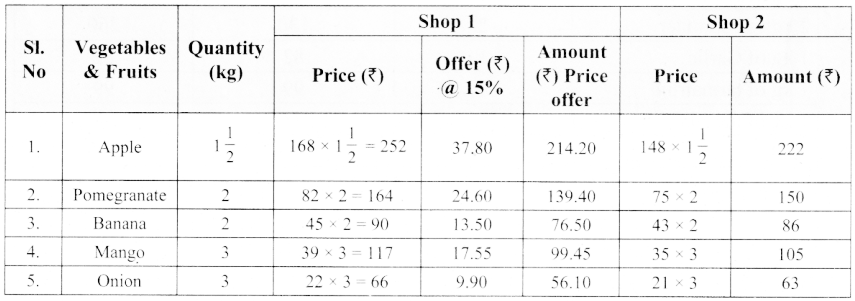
Answer:
Samacheer Kalvi 8th Maths Guide Answers Chapter 7 Information Processing Ex 7.4 7
Samacheer Kalvi 8th Maths Guide Answers Chapter 7 Information Processing Ex 7.4 8
Price in shop 2 – Shop 1 = 715 – 675.75
= ₹ 39.25
We can save ₹ 39.25 in shop 1 compared to shop 2.

Samacheer Kalvi 8th Maths Guide Chapter 7 Information processing Ex 7.4

Question 4.
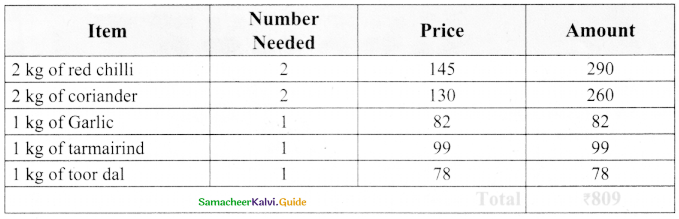
You want to buy some grocery items as per your shopping list that are given in the picture with their price. Also you have a bag that capacity of carrying 7 kg. Using weight ratio approach tabulate to find the total price and how much can
you buy more grocery items within your budget of ₹ 1000 and not exceeding 7 kg.
Shopping list
1. 2kg of red chili
2. 2 kg of coriander
3. 1 kg of garlic
4. 1 kg of tamarind
5. 2 kg of toor dal

Red chilli
Samacheer Kalvi 8th Maths Guide Answers Chapter 7 Information Processing Ex 7.4 9
₹ 141/1 kg

Coriander
Samacheer Kalvi 8th Maths Guide Answers Chapter 7 Information Processing Ex 7.4 10
₹ 130/1 kg

Garlic
Samacheer Kalvi 8th Maths Guide Answers Chapter 7 Information Processing Ex 7.4 11
₹ 82/1 kg

Tamarind
Samacheer Kalvi 8th Maths Guide Answers Chapter 7 Information Processing Ex 7.4 12
₹ 99/1 kg

Toor dal
Samacheer Kalvi 8th Maths Guide Answers Chapter 7 Information Processing Ex 7.4 13
₹ 78/1 kg
Answer:
Samacheer Kalvi 8th Maths Guide Answers Chapter 7 Information Processing Ex 7.4 14

Samacheer Kalvi 8th Maths Guide Chapter 7 Information processing Ex 7.4

Objective Type Questions

Question 5.
Online or television advertisements influence people on spending decisions by
(a) using special music
(b) making them think that they need the item
(c) using attractive pictures
(d) all the above
Answer:
(d) all the above

Question 6.
When I go shopping, I will buy
(a) something that looks attractive
(b) something my friend has
(c) something that I need to purchase
(d) the first thing I see in the store
Answer:
(c) something that I need to purchase

Samacheer Kalvi 8th Maths Guide Chapter 7 Information processing Ex 7.4

Question 7.
The best shopping choice is to
(a) shop at brand name stores always buy
(b) compare the choices before buying
(c) the same thing my friends bought
(d) buy at a regular shop always
Answer:
(b) compare the choices before buying

Samacheer Kalvi 8th Maths Guide Chapter 7 Information processing Ex 7.3

Tamilnadu State Board New Syllabus Samacheer Kalvi 8th Maths Guide Pdf Chapter 7 Information processing Ex 7.3 Text Book Back Questions and Answers, Notes.

Tamilnadu Samacheer Kalvi 8th Maths Solutions Chapter 7 Information processing Ex 7.3

Question 1.
Fill in the blanks (Use Atbash Cipher that is given in code 3)
Hint:
For this question, we need to use Atbash cipher. For Atbash cipher, first we write the alphabets from A to Z and then in reverse from Z to A below that.
A B C D E F G H I J K L M N O P Q R S T U V W X Y Z
Z Y X W V U T S R Q P O N M L K J I H G F E D C B A

Samacheer Kalvi 8th Maths Guide Chapter 7 Information processing Ex 7.3

(i) G Z N R O = _________
Answer:
TAMIL
Hint:
Now to solve, we look up the corresponding letter from the table to replace in code to get the actual word.
So, for G Z N R O, from table,
for G, it is T
for Z, it i sA
for N, it is M
for R, it is i
for 0, it is L
So, the actual word is TAMIL

(ii) V M T O R H S = ________
Answer:
ENGLISH

Hint:
VMTORHS
To solve, we look up the corresponding letter from table to replace in code to get the actual word.
For V, it is E
for M, it is N
for T, it is G
for O, it is L
for R, it is I,
for H, it is S
for S, it is H
Therefore we get E N G L I S H = ENGLISH

Samacheer Kalvi 8th Maths Guide Chapter 7 Information processing Ex 7.3

(iii) N Z G S V N Z G R X H _________
Answer:
MATHEMATICS
Hint:
Similarly as above for
Samacheer Kalvi 8th Maths Guide Answers Chapter 7 Information Processing Ex 7.3 1

(iv) H X R V M X V __________
Answer:
SCIENCE
Hint:
For
Samacheer Kalvi 8th Maths Guide Answers Chapter 7 Information Processing Ex 7.3 2

(v) H L X R Z O H X R V M X V = __________
Answer:
SOCIAL SCIENCE
Hint:
Samacheer Kalvi 8th Maths Guide Answers Chapter 7 Information Processing Ex 7.3 3

Samacheer Kalvi 8th Maths Guide Chapter 7 Information processing Ex 7.3

Question 2.
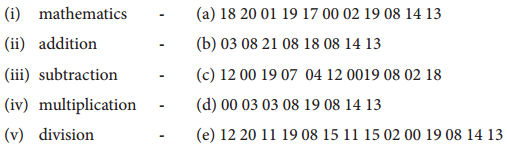
Match the following (a = 00 ………… Z = 25).
Samacheer Kalvi 8th Maths Guide Answers Chapter 7 Information Processing Ex 7.3 4
Answer:
(i) – c
(ii) – d
(iii) – a
(iv) – e
(v) – b
Hint:
(i) Mathematics is
Samacheer Kalvi 8th Maths Guide Answers Chapter 7 Information Processing Ex 7.3 5
So matching option is c

(ii) addition is
Samacheer Kalvi 8th Maths Guide Answers Chapter 7 Information Processing Ex 7.3 6
Matching option is d

Samacheer Kalvi 8th Maths Guide Chapter 7 Information processing Ex 7.3

(iii) Subtraction is
Samacheer Kalvi 8th Maths Guide Answers Chapter 7 Information Processing Ex 7.3 7
multiplication is a

(iv) multiplication is
Samacheer Kalvi 8th Maths Guide Answers Chapter 7 Information Processing Ex 7.3 8
Matching option is e
however instead of 25, it should be 08

(v) division is
Samacheer Kalvi 8th Maths Guide Answers Chapter 7 Information Processing Ex 7.3 9
Matching option is b

Question 3.
Frame Additive cipher table (key = 4).
Answer:
Step 1 : write all alphabets
Step 2 : Assign numbers to each alphabet starting from 00 till 25.
Step 3 : add key value (here it is 4) to the numbers assigned in step 2 to form cipher table
Samacheer Kalvi 8th Maths Guide Answers Chapter 7 Information Processing Ex 7.3 10

Samacheer Kalvi 8th Maths Guide Chapter 7 Information processing Ex 7.3

Question 4.
A message like “Good Morning” written in reverse would instead be “Doog Gninrom” In the same way decode the sentence given below:
“Ot dnatsrednu taht scitamehtam nac eb decneirepxe erehwreve ni erutan dna laer efil”
Answer:
Given that good morning written in reverse is doog gninrom.
We have to decode the below by reversing, so,
Ot dnatsrednu taht scitamehtam nac eh decneirepxe erehwreve ni erutan dna laer efil.

Ans: to understand that mathematics can be experienced everywhere in nature and real life.

Question 5.
Decode the given Pigpen Cipher text and compare your answer to get result.

Samacheer Kalvi 8th Maths Guide Answers Chapter 7 Information Processing Ex 7.3 12
I. The room number in which the treasure took place

Answer:
The room in which the treasure took place = 28

II. Place of the treasure

Answer:
The place of treasure = Chair

III. The name of the treasure
Samacheer Kalvi 8th Maths Guide Answers Chapter 7 Information Processing Ex 7.3 15
Answer:
Identity of treasure = Gift voucher.

Samacheer Kalvi 8th Maths Guide Chapter 7 Information processing Ex 7.3

Question 6.
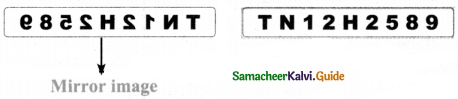
Praveen recently got the registration number for his new two-wheeler. Here, the number is given in the form of mirror-image. Encode the image and find the correct registration number of praveen’s two-wheeler.
T N 1 2 H 2 5 8 9
(a)
Samacheer Kalvi 8th Maths Guide Answers Chapter 7 Information Processing Ex 7.3 16
(b)
Samacheer Kalvi 8th Maths Guide Answers Chapter 7 Information Processing Ex 7.3 17
(c)
Samacheer Kalvi 8th Maths Guide Answers Chapter 7 Information Processing Ex 7.3 18
(d)
Samacheer Kalvi 8th Maths Guide Answers Chapter 7 Information Processing Ex 7.3 19
Answer:
The mirror image is
Samacheer Kalvi 8th Maths Guide Answers Chapter 7 Information Processing Ex 7.3 18
When we place an imaginary mirror & visualize the image seen in the mirror, we will get the below.
Samacheer Kalvi 8th Maths Guide Answers Chapter 7 Information Processing Ex 7.3 20
∴ The answer option c

Samacheer Kalvi 8th Maths Guide Chapter 7 Information processing Ex 7.3

Objective Type Questions

Question 7.
In questions (i) and (ii), there are four groups of letters in each set. Three of these sets are alike in some way while one is different. Find the one which is different.
(i).(A) C R D T
(B) A P B Q
(C) E U F V
(D) G W H X
Answer:
(i) (A) C R D T
Hint:
The four groups of letters are
CRDT APBQ EUFV GWHX
The above can be written as
Samacheer Kalvi 8th Maths Guide Answers Chapter 7 Information Processing Ex 7.3 21
We find that when we take 1st & 3rd letter & 2nd & 4th letter as 2 pairs, the 3 letter is the next letter alphabetically to the 1st letter.
Similarly the 4th letter is alphabetically the next letter of the 2nd letter.
i.e CD, AB, EF, GH & PQ, UV, WX
Only in CRDT, we have T instead of ‘S’
So, Ans: in CRDT ⇒ Option (a)

Samacheer Kalvi 8th Maths Guide Chapter 7 Information processing Ex 7.3

(ii). (A) H K N Q
(B) I L O R
(C) J M P S
(D) A D G J
Answer:
(D) A D G J
Hint:
The four groups of letters are
HKNQ ILOR IMPS ADGI
If we notice, we find that 2 letters are missing in the sequence. le.
HIJ KLI NOP Q
IJK LMN OPQ R
JKL MNO PQR S
ABC DEF GH I
We find that only in ADGI, the difference is only one letter between G & I.
Hence it is the odd one out.

Samacheer Kalvi 8th Maths Guide Chapter 7 Information processing Ex 7.3

Question 8.
A group of letters are given. A numerical code has been given to each letter. These letters have to be unscrambled into a meaningful word. Find out the code for the word so formed from the 4 answers given.
Samacheer Kalvi 8th Maths Guide Answers Chapter 7 Information Processing Ex 7.3 22
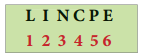
(A) 2 3 4 1 5 6
(B) 5 6 3 4 2 1
(C) 6 1 3 5 2 4
(D) 4 2 1 3 5 6
Answer:
(B) 5 6 3 4 2 1

Hint:
Given code is
Samacheer Kalvi 8th Maths Guide Answers Chapter 7 Information Processing Ex 7.3 22
Option (a) is 234156. When we substitute number for each letter from code, we get,
Samacheer Kalvi 8th Maths Guide Answers Chapter 7 Information Processing Ex 7.3 23

Option (b) is 563421, similarly, we get
Samacheer Kalvi 8th Maths Guide Answers Chapter 7 Information Processing Ex 7.3 24

Option (c) is
Samacheer Kalvi 8th Maths Guide Answers Chapter 7 Information Processing Ex 7.3 25

Option d) is
Samacheer Kalvi 8th Maths Guide Answers Chapter 7 Information Processing Ex 7.3 26

So, only in option b, we get a meaningful word, i.e PENCIL.
Hence, answer is Option b.

Samacheer Kalvi 8th Maths Guide Chapter 7 Information processing Ex 7.3

Question 9.
Questions (iii) and (iv) are based on code language. Find the correct answer from the four alternatives given.
(iii)Inacertain code, ‘M E D I C I N E’ is coded as ‘E O J D J E F M’,then how is ‘C O M P U T E R’ written in the same code?
(A) C N P R V U F Q
(B) C M N Q T U D R
(C) R F I J V Q N P C
(D) R N V F T U D Q
Answer:
(C) R F I J V Q N P C
Hint:
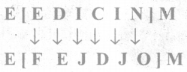
lt is given that in a certain code MEDlClNE is coded as E O J D J E F M
When we observe the word & the code, we find that, there is a pattern.
Samacheer Kalvi 8th Maths Guide Answers Chapter 7 Information Processing Ex 7.3 27
[to understand, see the matching shapes]
To get the code from the word, we follow the below steps

1.
Samacheer Kalvi 8th Maths Guide Answers Chapter 7 Information Processing Ex 7.3 28
E [E D I C I N] M

2. For the middle letters, replace the letters with their alphabetically next letters, so we get
Samacheer Kalvi 8th Maths Guide Answers Chapter 7 Information Processing Ex 7.3 29

3. Now we have to reverse the order of the middle letters in the bracket, so we get
E [O J D J E F] M = E O J D J E F M
Thus we get the code
So similarly, we have to follow the 3 steps to get code, therefore:
Samacheer Kalvi 8th Maths Guide Answers Chapter 7 Information Processing Ex 7.3 30
Step 1: Swap 1st & last letters, so we get
R [O M P U T E] C

Step 2: For the middle letters, replace the letters with alphabetically next letters, so we get
R [P N Q V L F] C

Step 3: Reverse the word of letters in the bracket to we get
R [F U V Q N P] C
∴ Ans is R F U V Q N P C ⇒ option c

Samacheer Kalvi 8th Maths Guide Chapter 7 Information processing Ex 7.3

(iv) lf the word ’P H O N E’ is coded as ’S K R Q H’, how will ’R A D I O’ be coded?
(A) S C G N H
(B) V R G N G
(C) U D G L R
(D) S D H K Q
Answer:
(C) U D G L R
Hint:
If PHONE is coded as S K R Q H
Find that code for R A D I O

We find that we get the code, by 3 letter alphabetically so. from P. skipping Q & R. we get S
Samacheer Kalvi 8th Maths Guide Answers Chapter 7 Information Processing Ex 7.3 31
Similarly, from H, skipping I & J, we get K
Like wise for R A D I O. skipping the 2 alphabets,
From R skip S & T → U
From A skip B & C → D
From D skip E & F → G
From l skip J & K → L
From O skip P & Q → R
Samacheer Kalvi 8th Maths Guide Answers Chapter 7 Information Processing Ex 7.3 32
∴ Ans is UDGLR ⇒ option c

Samacheer Kalvi 8th Maths Guide Chapter 7 Information processing Ex 7.2

Tamilnadu State Board New Syllabus Samacheer Kalvi 8th Maths Guide Pdf Chapter 7 Information processing Ex 7.2 Text Book Back Questions and Answers, Notes.

Tamilnadu Samacheer Kalvi 8th Maths Solutions Chapter 7 Information processing Ex 7.2

Question 1.
Using repeated division method, find the HCF of the following:
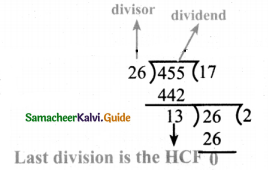
(i) 455 and 26
Answer:
Samacheer Kalvi 8th Maths Guide Answers Chapter 7 Information Processing Ex 7.2 1
Step 1: The larger number should be dividend 455 & smaller number should be divisor = 26
Step 2: After 1st division, the remainder becomes new divisor & the previous divisor becomes next dividend.
Step 3: This is done till remainder is zero.
Step 4: The last divisor is the HCF L.
∴ Ans: HCF is 13.

Samacheer Kalvi 8th Maths Guide Chapter 7 Information processing Ex 7.2

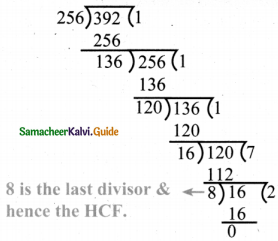
(ii) 392 and 256
Answer:
256 is smaller, so it is the 1st divisor
Samacheer Kalvi 8th Maths Guide Answers Chapter 7 Information Processing Ex 7.2 2
∴ HCF = 8

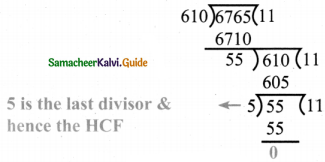
(iii) 6765 and 610
Answer:
Samacheer Kalvi 8th Maths Guide Answers Chapter 7 Information Processing Ex 7.2 3
∴ HCF = 5

Samacheer Kalvi 8th Maths Guide Chapter 7 Information processing Ex 7.2

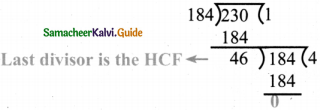
(iv) 184, 230 and 276
Answer:
First let us take 184 & 230
Samacheer Kalvi 8th Maths Guide Answers Chapter 7 Information Processing Ex 7.2 4
∴ 46 is the HCF of 184 and 230
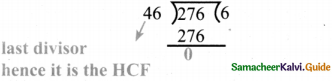
Now the HCF of the first two numbers is the dividend for the third number.
Samacheer Kalvi 8th Maths Guide Answers Chapter 7 Information Processing Ex 7.2 5
∴ Ans: HCF of 184, 230 & 276 is 46

Question 2.
Using repeated subtraction method, find the HCF of the following:
(i) 42 and 70
Answer:
Let number be m & n m > n
We do, m – n & the result of subtraction becomes new ‘m’. if m becomes less than n,
we do n – m and then assign the result as n. We should do this till m n. When m = n then ‘m’ is the HCF.
42 and 70
m = 70 n = 42
70 – 42 = 28

now m = 42, n = 28
42 – 28 = 14.

now m = 28, n = 14
28 – 14 = 14.

now m = 14. n = 14;
we stop here as m = n
∴ HCF of 42 & 70 is 14

Samacheer Kalvi 8th Maths Guide Chapter 7 Information processing Ex 7.2

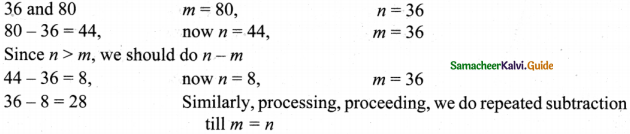
(ii) 36 and 80
Answer:
Samacheer Kalvi 8th Maths Guide Answers Chapter 7 Information Processing Ex 7.2 8
28 – 8 = 20
20 – 8 = 12
12 – 8 = 4
8 = 4 = 4
now m = n = 4
∴ HCF is 4

(iii) 280 and 420
Answer:
Let m = 420, n = 280
m – n = 420 – 280 = 140
now m = 280, n = 140
m – n = 280 – 140 = 140
now m = n = 140
∴ HCF is 140

Samacheer Kalvi 8th Maths Guide Chapter 7 Information processing Ex 7.2

(iv) 1014 and 654
Answer:
Let m = 1014, n = 654
m – n = 1014 – 654 = 360
now m = 654, n = 360
m – n = 654 – 360 = 294
now m = 360, n = 294
m – n = 360 – 294 = 66
now m = 294 n = 66
m – n = 294 – 66 = 228
now m = 66, n = 228
n – m = 228 – 66 = 162
now m = 162, n = 66
= 162 – 66 = 96
n – m = 96 – 66 = 30
Similarly, 66 – 30 = 36
36 – 30 = 6
30 – 6 = 24
24 – 6 = 18
18 – 6 = 12
12 – 6 = 6 now m = n
∴ HCF of 1014 and 654 is 6

Samacheer Kalvi 8th Maths Guide Chapter 7 Information processing Ex 7.2

Question 3.
Do the given problems by repeated subtraction method and verify the result.
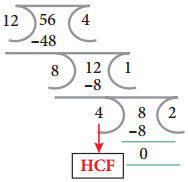
(i) 56 and 12
Samacheer Kalvi 8th Maths Guide Answers Chapter 7 Information Processing Ex 7.2 9
Answer:
Let n = 56 & n = 12
m – n = 56 – 12 = 44
now m = 44, n = 12
m – n = 44 – 12 = 32
m – n = 32 – 12 = 20
m – n = 20 – 12 = 8
n – m = 12 – 84
m – n = 8 – 4 = 4. now m = n
∴ HCF of 56 & 12 is 4

Samacheer Kalvi 8th Maths Guide Chapter 7 Information processing Ex 7.2

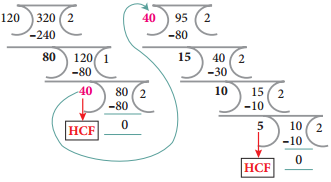
(ii) 320, 120 and 95
Samacheer Kalvi 8th Maths Guide Answers Chapter 7 Information Processing Ex 7.2 10
Answer:
Let us take 320 & 120 first m = 320, n = 120
m – n = 320 – 120 = 200
m = 200, n = 120
∴ m – n = 200 – 120 = 80
120 – 80 = 40
80 – 40 = 40
∴ m = n = 40 → HCF of 320, 120
Now let us find HCF of 40 & 95
m = 95, n = 40
∴ m – n = 95 – 40 = 55
55 – 40 = 15
40 – 15 = 25
25 – 15 = 10
15 – 10 = 5
HCF of 40 & 95 is 5
10 – 5 = 5
∴ HCF of 320 120 & 95 is 5

Samacheer Kalvi 8th Maths Guide Chapter 7 Information processing Ex 7.2

Question 4.
Kalai wants to cut identical squares as big as she can, from a piece of paper measuring 168mm and by 196mm. What is the length of the side of the biggest square? (To find HCF using repeated subtraction method)
Answer:
Sides are 168 & 196
To find HCF of 168 & 196, we are to use repeated subtraction method.
∴ m = 196, n = 168
m – n = 196 – 168 = 28

now n = 28, m = 168
m – n = 168 – 28 = 140

now m = 140, n = 28
m – n = 140 – 28 = 112

now m = 112, n = 28
m – n = 112 – 28 = 84

now m = 84, n = 28
m – n = 84 – 28 = 56

now m = 56, n = 28
m – n = 56 – 28 = 28
∴ HCF is 28
∴ Length of biggest square is 28

Samacheer Kalvi 8th Maths Guide Chapter 7 Information processing Ex 7.2

Objective Type Questions

Question 5.
What is the eleventh Fibonacci number?
(a) 55
(b) 77
(c) 89
(d) 144
Answer:
(c) 89
Hint:
Samacheer Kalvi 8th Maths Guide Answers Chapter 7 Information Processing Ex 7.2 11
∴ 11th Fibonacci number is 89

Question 6.
If F(n) is a Fibonacci number and n = 8, which of the following is true?
(a) F(8) = F(9) + F( 10)
(b) F(8) = F(7) + F(6)
(c) F(8) = F(10) × F(9)
(d) F(8) = F(7) – F(6)
Answer:
(b) F(8) = F(7) + F(6)
Hint:
Given F(n) is a Fibonacci number & n = 8
∴ F(8) = F(7) + F (6) as any term in Fibonacci series is the sum of preceding 2 terms

Samacheer Kalvi 8th Maths Guide Chapter 7 Information processing Ex 7.2

Question 7.
Every 3rd number of the Fibonacci sequence is a multiple of_______
(a) 2
(b) 3
(c) 5
(d) 8
Answer:
(a) 2
Hint:
Every 3rd number in Fibonacci sequence is a multiple of 2

Question 8.
Every _____ number of the Fibonacci sequence is a multiple of 8
(a) 2th
(b) 4th
(c) 6th
(d) 8th
Answer:
(c) 6th

Samacheer Kalvi 8th Maths Guide Chapter 7 Information processing Ex 7.2

Question 9.
The difference between the 18th and 17th Fibonacci number is
(a) 233
(b) 377
(c) 610
(d) 987
Answer:
(d) 987
Hint:
F(18) = F(17) + F(16)
F(18) – F(17) = F(16) = F(15) + F(14)
= 610 + 377 = 987

Question 10.
Common prime factors of 30 and 250 are
(a) 2 × 5
(b) 3 × 5
(c) 2 × 3 × 5
(d) 5 × 5
Answer:
(a) 2 × 5
Prime factors of 30 are 2 × 3 × 5
Prime factors of 250 are 5 × 5 × 5 × 2
∴ Common prime factors are 2 × 5

Samacheer Kalvi 8th Maths Guide Chapter 7 Information processing Ex 7.2

Question 11.
Common prime factors of 36,60 and 72 are
(a) 2 × 2
(b) 2 × 3
(c) 3 × 3
(d) 3 × 2 × 2
Answer:
(d) 3 × 2 × 2
Hint:
Prime factors of 36 are 2 × 2 × 3 × 3
Prime factors of 60 are 2 × 2 × 3 × 5
Prime factors of 72 are 2 × 2 × 2 × 3 × 3
∴ Common prime factors are 2 × 2 × 3

Question 12.
Two numbers are said to be co-prime numbers if their HCF is
(a) 2
(b) 3
(c) 0
(d) 1
Answer:
(d) 11

Samacheer Kalvi 8th Maths Guide Chapter 7 Information processing Ex 7.1

Tamilnadu State Board New Syllabus Samacheer Kalvi 8th Maths Guide Pdf Chapter 7 Information processing Ex 7.1 Text Book Back Questions and Answers, Notes.

Tamilnadu Samacheer Kalvi 8th Maths Solutions Chapter 7 Information processing Ex 7.1

Question 1.
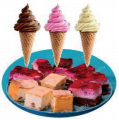
You want to have an ice cream or a cake. There are three flavours (chocolate, strawberry and vanilla) in ice creams, and two flavours (orange and red velvet) in the cakes. In how many possible ways can you choose an ice cream or a cake?
Samacheer Kalvi 8th Maths Guide Answers Chapter 7 Information Processing Ex 7.1 1
Answer:
We are going to have either a ice cream or a cake.
Ice cream can be selected from 3 flavors and cake from two flavors. Both the events cannot
occur simultaneously selecting ice cream and cake.
∴ Number of possible ways = 3 + 2
= 5 ways

Samacheer Kalvi 8th Maths Guide Chapter 7 Information processing Ex 7.1

Question 2.
Shanthi has 5 chudithar sets and 4 frocks. In how many possible ways, can she wear either a chudithar or a frock?
Answer:
Shanthi her 5 chudidhar sets and 4 frocks.
She wear either chudidhar or a frock.
∴ Total possible ways = 5 + 4 = 9 ways

Question 3.
In a Higher Secondary School, the following groups are available in XI standard
I. Science Group:
(i) Physics, Chemistry, Biology and Mathematics
(ii) Physics, Chemistry, Mathematics and Computer Science.
(iii) Physics, Chemistry, Biology and Home Science

Il. Arts Group:
(i) Accountancy, Commerce, Economics and Business Maths
(ii) Accountancy, Commerce, Economics and Computer Science
(iii) History, Geography, Economics and Commerce

III. Vocational Group:
(i) Biology, Nursing Theory, Nursing Practical I and Nursing Practical II
(ii) Home Science, Textiles and Dress Designing Theory, Textiles and Dress
Designing Practical I and Textiles and Dress Designing Practical Il
In how many possible ways, can a student choose a group?
Answer:
The student either select any one of science group in 3 ways or any of the arts group in 3
ways or any of the vocational group in 2 ways.
∴ Total possible ways = 3 + 3 + 2 = 8 ways

Samacheer Kalvi 8th Maths Guide Chapter 7 Information processing Ex 7.1

Question 4.
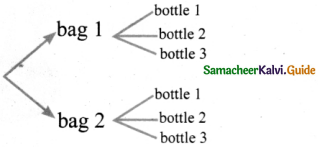
If you have 2 school bags and 3 water bottles then, in how many different ways can you choose each one of them, while going to school?
Answer:
We can select one school bag from 2 and one bottle from 3 as follows.
Samacheer Kalvi 8th Maths Guide Answers Chapter 7 Information Processing Ex 7.1 2
∴ A bag and a water bottle can be selected in 2 × 3 = 6 ways.

Question 5.
Roll numbers are created with a letter followed by 3 digits in it, from the letters A, B, C, D and E and any 3 digits from 0 to 9. In how many possible ways can the roll numbers be generated? (except A000, B000, C000, D000 and E000)
Answer:
We have a letter followed by 3 digits in the roll number.
The letter is selected from the five letters A, B, C, D, E.
For these 5 letters we have to select a 3 digit number using the digits O to 9.
Ones place can be formed using any one of the 10 number 0 to 9 in 10 ways.
Tens place can be formed in I O ways.
∴ A two digit number can be formed in 10 × 10 = 100 ways.
Thousands place can be formed in lo ways
∴ A 3 digit number can be formed in 10 × 10 × 10 = 1000 ways.
∴ 5 letters can be attached in 5 × 1000 = 5000 ways.
∴ The roll number can be formed in 5000 – 5 = 4995 ways.

Samacheer Kalvi 8th Maths Guide Chapter 7 Information processing Ex 7.1

Question 6.
A safety locker in a jewel shop requires a 4 digit unique code. The code has the digits from 0 to 9. How many unique codes are possible?
Samacheer Kalvi 8th Maths Guide Answers Chapter 7 Information Processing Ex 7.1 3
Answer:
The unique code has 4 digits.
Each digit is formed using any of the 10 numbers from 0 to 9.
∴ Single digit number can be formed in 10 ways.
A double digit number can be formed in 10 × 10 ways.
A three digit number can be formed in 10 × 10 × 10 ways.
A four digit number can be formed in 10 × 10 × 10 × 10 ways. = 10,000 ways

Samacheer Kalvi 8th Maths Guide Chapter 7 Information processing Ex 7.1

Question 7.
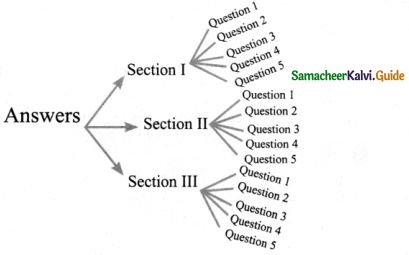
An examination paper has 3 sections, each with five questions and students are instructed to answer one question from each section. In how many different ways of can the questions be answered?
Answer:
The tree diagram for this may be
Samacheer Kalvi 8th Maths Guide Answers Chapter 7 Information Processing Ex 7.1 4
∴ Number of possible ways to select one questions from each of 3 sections is 3 × 5 = 15 ways

Samacheer Kalvi 8th Maths Guide Chapter 7 Information processing Ex 7.1

Question 8.
The given spinner is spun twice and the two numbers got are used to form a 2 digit number. How many different 2 digits numbers are possible?
Samacheer Kalvi 8th Maths Guide Answers Chapter 7 Information Processing Ex 7.1 5
Answer:
On the first spin we get any of the five numbers to form ones place then insecond spin the number got will fill 10’s place.
∴ Number of ways = 5 × 5 = 25 ways.
Removing the repetitions (11, 22, 33, 44, 55) once we get 25 – 5 = 20 ways.
20 different two digit numbers are possible

Question 9.
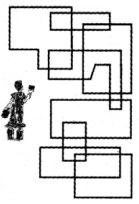
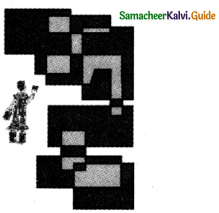
Ramya wants to paint a pattern in her living room wall with minimum budget. Help her to colour the pattern with 2 colours but make sure that no two q adjacent boxes are the same colour. The pattern is shown in the picture.
Samacheer Kalvi 8th Maths Guide Answers Chapter 7 Information Processing Ex 7.1 6
Answer:
Samacheer Kalvi 8th Maths Guide Answers Chapter 7 Information Processing Ex 7.1 7

Samacheer Kalvi 8th Maths Guide Chapter 7 Information processing Ex 7.1

Question 10.
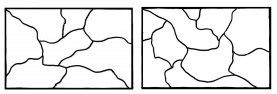
Colour the regions in the maps with few colours as possible but make sure that no two adjacent countries are of the same colour.
Samacheer Kalvi 8th Maths Guide Answers Chapter 7 Information Processing Ex 7.1 8
Answer:
Samacheer Kalvi 8th Maths Guide Answers Chapter 7 Information Processing Ex 7.1 9

Objective Type Questions

Question 11.
In a class there are 26 boys and 15 girls. The teacher wants to select a boy or a girl to represent a quiz competition. In how many ways can the teacher make this selection?
(A) 41
(B) 26
(C) 15
(D) 390
Answer:
41

Question 12.
How many outcomes can you get when you toss three coins once?
(A) 6
(B) 8
(C) 3
(D) 2
Answer:
8

Samacheer Kalvi 8th Maths Guide Chapter 7 Information processing Ex 7.1

Question 13.
In how many ways can you answer 3 multiple choice questions, with the choices A,B,C and D?
(A) 4
(B) 3
(C) 12
(D) 64
Answer:
64

Question 14.
How many 2 digit numbers contain the number 7?
(A) 10
(B) 18
(C) 19
(D) 20
Answer:
18

Samacheer Kalvi 8th Maths Guide Chapter 6 Statistics InText Questions

Tamilnadu State Board New Syllabus Samacheer Kalvi 8th Maths Guide Pdf Chapter 6 Statistics InText Questions Text Book Back Questions and Answers, Notes.

Tamilnadu Samacheer Kalvi 8th Maths Solutions Chapter 6 Statistics InText Questions

Try These (Text Book page No. 212)

Question 1.
Arrange the given data in ascending and descending order: 9, 34, 4, 13, 42, 10, 25, 7, 31, 4, 40
Answer:
Ascending order: 4, 4, 7, 9, 10, 13, 25, 31, 34, 40, 42.
Descending order: 42, 40, 34, 31, 25, 13, 10, 9, 7, 4, 4

Samacheer Kalvi 8th Maths Guide Chapter 6 Statistics InText Questions

Question 2.
Find the_range of the given data: 53, 42,61, 9, 39, 63, 14, 20,06, 26, 31, 4, 57
Answer:
Ascending order of the given data:
4, 6, 9, 14, 20, 26, 31, 39, 42, 53, 57, 61, 63
Here largest value = 63
Smallest value = 4
∴ Range = Largest value – smallest value
= 63 – 4 = 59

Try These (Text Book page No. 217)

Question 1.
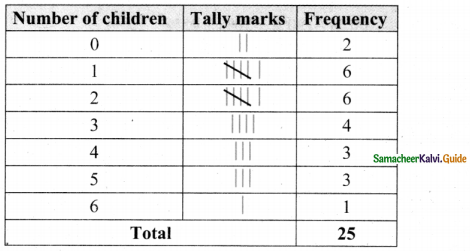
Prepare a frequency table for the data:
3, 4, 2, 4, 5, 6, 1, 3, 2, 1, 5, 3, 6, 2, 1, 3, 2, 4
Answer:
Ascending order of the given data.
1, 1, 1, 2, 2, 2, 2, 3, 3, 3, 3, 4, 4, 4, 5, 5, 6, 6
The distribution table:

Data Tally marks Frequency
1 ||| 3
2 |||| 4
3 |||| 4
4 ||| 3
5 || 2
6 || 2

∴ Frequency Table:
Samacheer Kalvi 8th Maths Guide Answers Chapter 6 Statistics InText Questions 1

Samacheer Kalvi 8th Maths Guide Chapter 6 Statistics InText Questions

Question 2.
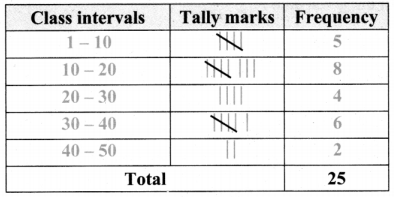
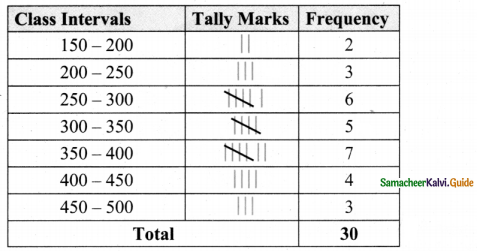
Prepare a grouped frequency table for the data:
10, 9, 3, 29, 17, 34, 23, 20, 39, 42, 5, 12, 19, 47, 18, 19, 27, 7, 13, 40, 38, 24,34,15,40
Answer:
Largest value = 47
Smallest value = 3
Range = Largest value – Smallest value
= 47 – 3 = 44
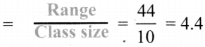
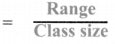
Suppose we take class size as 10, then Number of class intervals possible
Samacheer Kalvi 8th Maths Guide Answers Chapter 6 Statistics InText Questions 2
Apppbcnmxdfsmadnksa 5
Samacheer Kalvi 8th Maths Guide Answers Chapter 6 Statistics InText Questions 3

Samacheer Kalvi 8th Maths Guide Chapter 6 Statistics Ex 6.3

Tamilnadu State Board New Syllabus Samacheer Kalvi 8th Maths Guide Pdf Chapter 6 Statistics Ex 6.3 Text Book Back Questions and Answers, Notes.

Tamilnadu Samacheer Kalvi 8th Maths Solutions Chapter 6 Statistics Ex 6.3

Miscellaneous Practice Problems

Question 1.
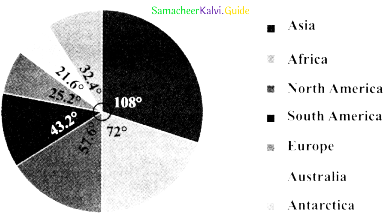
Draw a pie chart for the given table.
Samacheer Kalvi 8th Maths Guide Answers Chapter 6 Statistics Ex 6.3 1
Answer:
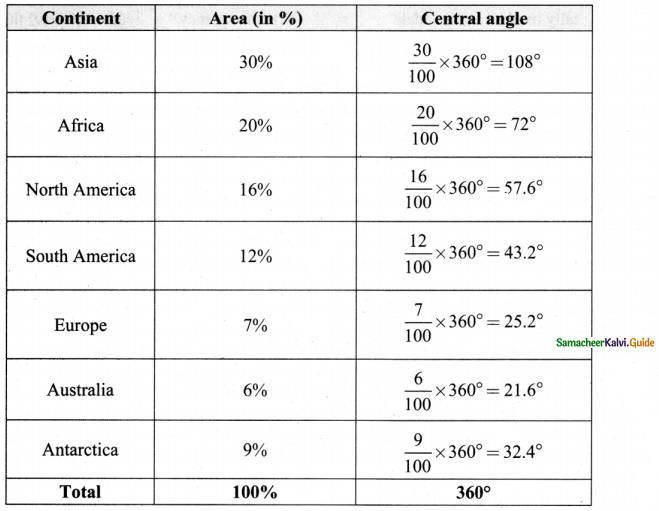
Converting the area in percentage into components parts of 360°. we have.
Samacheer Kalvi 8th Maths Guide Answers Chapter 6 Statistics Ex 6.3 2
Continental Area.
Samacheer Kalvi 8th Maths Guide Answers Chapter 6 Statistics Ex 6.3 3

Samacheer Kalvi 8th Maths Guide Chapter 6 Statistics Ex 6.3

Question 2.
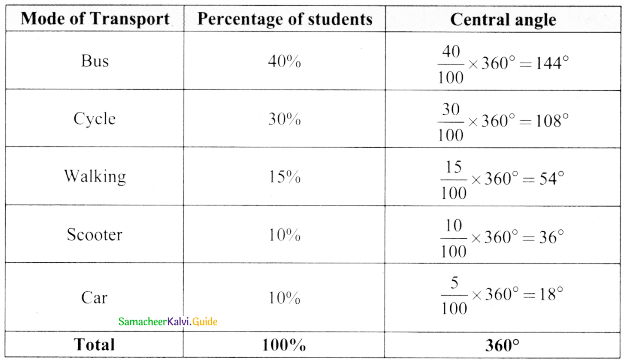
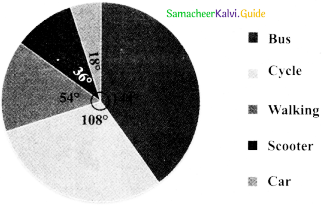
The data on modes of transport used by the students to come to school are given below. Draw a pie chart for the data.
Samacheer Kalvi 8th Maths Guide Answers Chapter 6 Statistics Ex 6.3 4
Answer:
Converting the percentage into components parts of 360°. we have
Samacheer Kalvi 8th Maths Guide Answers Chapter 6 Statistics Ex 6.3 5
Mode of Transport by students.
Samacheer Kalvi 8th Maths Guide Answers Chapter 6 Statistics Ex 6.3 6

Samacheer Kalvi 8th Maths Guide Chapter 6 Statistics Ex 6.3

Question 3.
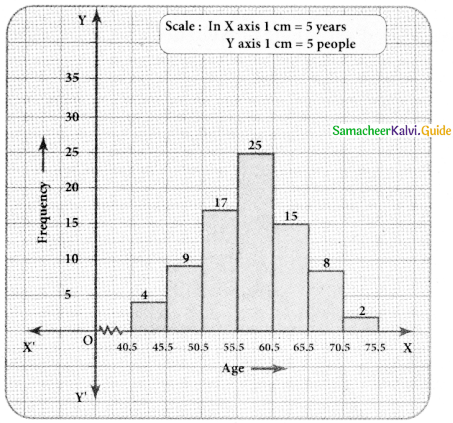
Draw a histogram for the given frequency distribution.
Samacheer Kalvi 8th Maths Guide Answers Chapter 6 Statistics Ex 6.3 7
Answer:
The given distribution is discontinuous.
Lower boundary = lower limit – \(\frac { 1 }{ 2 }\) (gap between the adjacent class interval)
= 41 – \(\frac { 1 }{ 2 }\)(1) = 40.5
Upper boundary = Upper limit + \(\frac { 1 }{ 2 }\) (gap between the adjacent class interval)
= 45 + \(\frac { 1 }{ 2 }\)(1) = 45.5
Now continuous frequency table is as below
Samacheer Kalvi 8th Maths Guide Answers Chapter 6 Statistics Ex 6.3 8
Samacheer Kalvi 8th Maths Guide Answers Chapter 6 Statistics Ex 6.3 9

Samacheer Kalvi 8th Maths Guide Chapter 6 Statistics Ex 6.3

Question 4.
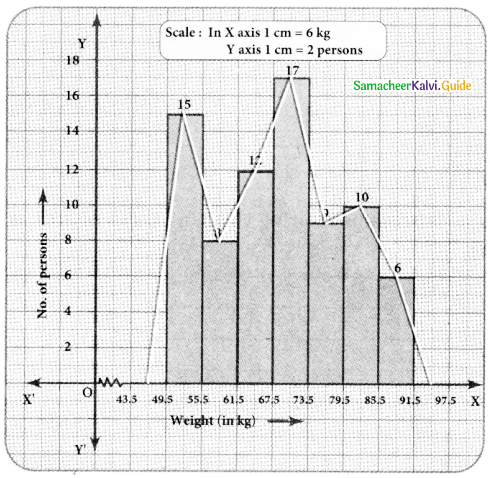
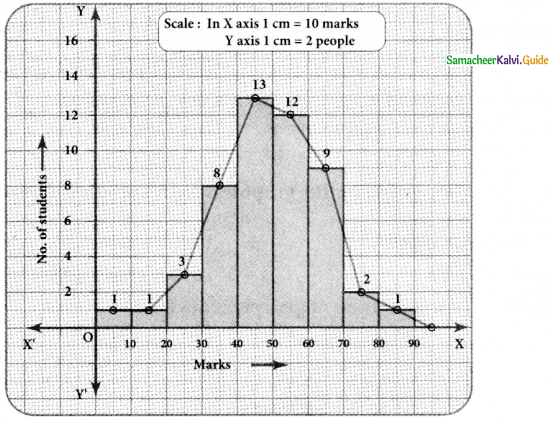
Draw a histogram and the frequency polygon in the same diagram to represent the following data.
Samacheer Kalvi 8th Maths Guide Answers Chapter 6 Statistics Ex 6.3 10
Answer:
The given distribution is discontinuous.
Lower boundary = lower limit – \(\frac { 1 }{ 2 }\) (gap between the adjacent class interval)
= 50 – \(\frac { 1 }{ 2 }\)(1) = 49.5
Upper boundary = Upper limit + \(\frac { 1 }{ 2 }\)(gap between the adjacent class interval)
= 55 + \(\frac { 1 }{ 2 }\)(1) = 55.5
∴ The continuous frequency table is as below.
Samacheer Kalvi 8th Maths Guide Answers Chapter 6 Statistics Ex 6.3 11
Samacheer Kalvi 8th Maths Guide Answers Chapter 6 Statistics Ex 6.3 12

Samacheer Kalvi 8th Maths Guide Chapter 6 Statistics Ex 6.3

Challenging problems

Question 5.
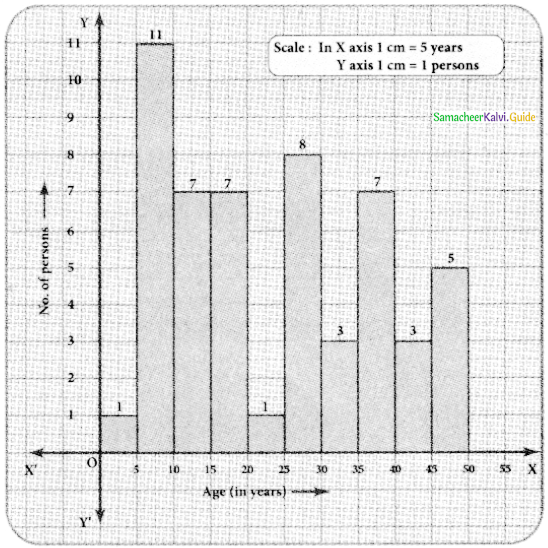
Form a continuous frequency distribution table and draw histogram from the following data.

Age (in years) No of persons
Under 5 1
Under 10 12
Under 15 19
Under 20 26
Under 25 27
Under 30 35
Under 35 38
Under 40 45
Under 45 48
Under 50 53

Answer:
Converting into continuous distribution we have

Class interval No. of persons
0 – 5 1
5 – 10 11
10 – 15 7
15 – 20 7
20 – 25 1
25 – 30 8
30 – 35 3
35 – 40 7
40 – 45 3
45 – 50 5
Total 53

Samacheer Kalvi 8th Maths Guide Answers Chapter 6 Statistics Ex 6.3 13

Samacheer Kalvi 8th Maths Guide Chapter 6 Statistics Ex 6.3

Question 6.
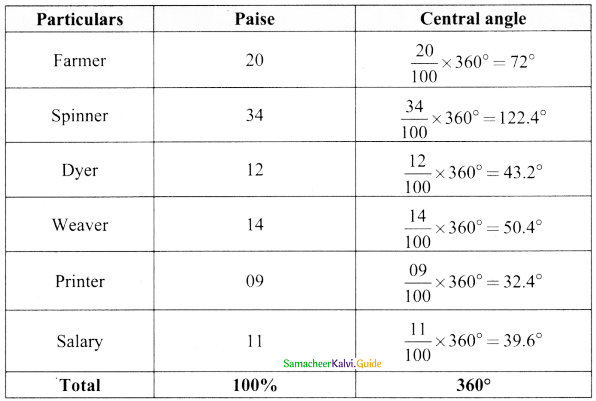
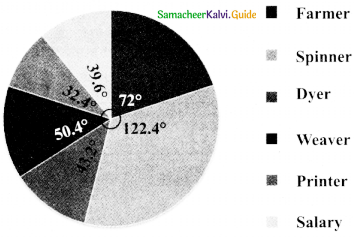
A rupee spent in a cloth manufacturing company is distributed as follows. Represent this in a pie chart.

Particulars Paise
Farmer 20
Spinner 35
Dyer 15
Weaver 15
Printer 05
Salary 10

Answer:
1 Rupee = 100 paise.
Samacheer Kalvi 8th Maths Guide Answers Chapter 6 Statistics Ex 6.3 14
Expenditure of a cloth manufacturing company.
Samacheer Kalvi 8th Maths Guide Answers Chapter 6 Statistics Ex 6.3 15

Samacheer Kalvi 8th Maths Guide Chapter 6 Statistics Ex 6.3

Question 7.
Draw a histogram for the following data.
Samacheer Kalvi 8th Maths Guide Answers Chapter 6 Statistics Ex 6.3 16
Answer:
Since mid values are given, the given distributors is discontinuous.
Lower boundary lower limit – \(\frac { 1 }{ 2 }\)(gap between the adjacent class interval)
= 15 – \(\frac { 1 }{ 2 }\)(10) = 10
Upper boundary = Upper limit + (gap between the adjacent class interval)
= 15 + \(\frac { 1 }{ 2 }\)(10) = 20
The continuous distribution will he as folIows.
Samacheer Kalvi 8th Maths Guide Answers Chapter 6 Statistics Ex 6.3 17
Samacheer Kalvi 8th Maths Guide Answers Chapter 6 Statistics Ex 6.3 18

Samacheer Kalvi 8th Maths Guide Chapter 6 Statistics Ex 6.2

Tamilnadu State Board New Syllabus Samacheer Kalvi 8th Maths Guide Pdf Chapter 6 Statistics Ex 6.2 Text Book Back Questions and Answers, Notes.

Tamilnadu Samacheer Kalvi 8th Maths Solutions Chapter 6 Statistics Ex 6.2

Question 1.
Which of the following data can be represented in a histogram?
(i) The number of mountain climbers in the age group 20 to 60 in TamilNadu.
Answer:
Yes

(ii) Production of cycles in different years.
Answer:
No

Samacheer Kalvi 8th Maths Guide Chapter 6 Statistics Ex 6.2

(iii) The number of students in each class of a school.
Answer:
No

(iv) The number votes polled from 7 am to 6 pm in an election.
Answer:
Yes

(v) The wickets fallen from 1 over to 50th over in a one day cricket match.
Answer:
Yes

Samacheer Kalvi 8th Maths Guide Chapter 6 Statistics Ex 6.2

Question 2.
Fill in the blanks:
(i) The total area of the histogram is _________ to the total frequency of the given data.
Answer:
proportional

(ii) A graph that displays data that changes continuously over the periods of time is _________ .
Answer:
Histogram

(iii) Histogram is a graphical representation of_________ data.
Answer:
grouped

Samacheer Kalvi 8th Maths Guide Chapter 6 Statistics Ex 6.2

Question 3.
In a village, there are 570 people who have cell phones. An NGO survey their cell phone usage. Based on this survey a histogram is drawn. Answer the following questions.
Samacheer Kalvi 8th Maths Guide Answers Chapter 6 Statistics Ex 6.2 1

(i) How many people use the cell phone for less than 3 hours?
Answer:
330 people (110 + 220)

(ii) How many of them use the cell phone for more than 5 hours?
Answer:
150 of them (100 + 50)

(iii) Are people using cell phone for less than 1 hour?
Answer:
No

Samacheer Kalvi 8th Maths Guide Chapter 6 Statistics Ex 6.2

Question 4.
Draw a histogram for the following data.
Samacheer Kalvi 8th Maths Guide Answers Chapter 6 Statistics Ex 6.2 2
Answer:
The given (tata IS continuous frequency distribution taking class intervals on X axis and No. of students on Y-axis, the histogram is given below.
Samacheer Kalvi 8th Maths Guide Answers Chapter 6 Statistics Ex 6.2 3

Samacheer Kalvi 8th Maths Guide Chapter 6 Statistics Ex 6.2

Question 5.
Construct a histogram from the following distribution of total marks of 40 students in a class.
Samacheer Kalvi 8th Maths Guide Answers Chapter 6 Statistics Ex 6.2 4
Answer:
The given distribution is continuous taking marks on X axis and No. of students on Y-axis the histogram is constructed.
Samacheer Kalvi 8th Maths Guide Answers Chapter 6 Statistics Ex 6.2 5

Samacheer Kalvi 8th Maths Guide Chapter 6 Statistics Ex 6.2

Question 6.
The distribution of heights (in cm ) of loo people is given below. Construct a histogram and the frequency polygon imposed on it.
Samacheer Kalvi 8th Maths Guide Answers Chapter 6 Statistics Ex 6.2 6
Answer:
The given distribution is discontinuous.
Converting into continuous distribution we have
Lower boundary = lower limit – \(\frac { 1 }{ 2 }\) (gap between adjacent class interval)
= 125 – \(\frac { 1 }{ 2 }\) (1) = 124.5
Upper boundary = Upper limit + \(\frac { 1 }{ 2 }\) (gap between the adjacent class interval)
= 135 + \(\frac { 1 }{ 2 }\) = 135.5
∴ The new frequency table is
Samacheer Kalvi 8th Maths Guide Answers Chapter 6 Statistics Ex 6.2 7
Samacheer Kalvi 8th Maths Guide Answers Chapter 6 Statistics Ex 6.2 8

Samacheer Kalvi 8th Maths Guide Chapter 6 Statistics Ex 6.2

Question 7.
In a study of dental problem, the following data were obtained.
Samacheer Kalvi 8th Maths Guide Answers Chapter 6 Statistics Ex 6.2 9
Represent the above data by a frequency polygon.
Answer:
Finding the midpoints of the class interval we get.

Ages Mid point (x) No. of patients
0 – 10 5 5
10 – 20 15 13
20 – 30 25 25
30 – 40 35 14
40 – 50 45 30
50 – 60 55 35
60 – 70 65 43
70 – 80 75 50

The points tobe plotted are A(5,5), B(15, 13), C(25, 25), D(35, 14), E(45, 30), G(65, 43.), H(75, 50) to obtain the frequency polygon ZABCDEFGHI.
Where I imagined class between 80 and 90.
Samacheer Kalvi 8th Maths Guide Answers Chapter 6 Statistics Ex 6.2 10

Samacheer Kalvi 8th Maths Guide Chapter 6 Statistics Ex 6.2

Question 8.
The marks obtained by 50 students in Mathematics are given below (j) Make a frequency distribution table taking a class size of 10 marks (ii) Draw a histogram and a frequency polygon.
Samacheer Kalvi 8th Maths Guide Answers Chapter 6 Statistics Ex 6.2 11
Answer:
Maximum marks obtained = 89
Minimum marks obtained = 08
Range = Maximum marks – Minimim marks
= 89 – 08
= 81
Taking the class size = 10, then
Samacheer Kalvi 8th Maths Guide Answers Chapter 6 Statistics Ex 6.2 12
= \(\frac{81}{10}\) = 8.1 = 9
Samacheer Kalvi 8th Maths Guide Answers Chapter 6 Statistics Ex 6.2 13
Now we have the continuous frequency table.
Samacheer Kalvi 8th Maths Guide Answers Chapter 6 Statistics Ex 6.2 14
We will draw the histogram taking class interval in x-axis and frequency in y-axis as follows.
Samacheer Kalvi 8th Maths Guide Answers Chapter 6 Statistics Ex 6.2 15

Samacheer Kalvi 8th Maths Guide Chapter 6 Statistics Ex 6.2

Objective Type Questions

Question 9.
Data is a collection of _________
(A) numbers
(B) words
(C) measurements
(D) all the three
Answer:
(D) all the three

Question 10.
The number of times an observation occurs in the given data is called _________
(A) tally marks
(B) data
(C) frequency
(D) none of these
Answer:
(C) frequency

Samacheer Kalvi 8th Maths Guide Chapter 6 Statistics Ex 6.2

Question 11.
The difference between the largest value and the smallest value of the given data is ________
(A) range
(B) frequency
(C) variable
(D) none of these
Answer:
(A) range

Question 12.
The data that can take values between a certain range is called_________
(A) ungrouped
(B) grouped
(C) frequency
(D) none of these
Answer:
(B) grouped

Samacheer Kalvi 8th Maths Guide Chapter 6 Statistics Ex 6.2

Question 13.
Inclusive series is a _________series.
(A) continuous
(B) discontinuous
(C) both
(D) none of these
Answer:
(B) discontinuous

Question 14.
In a class interval the upper limit of one class is the lower limit of the other class. This is _________ series.
(A) Inclusive
(B) exclusive
(C) ungrouped
(D) none of these
Answer:
(B) exclusive

Samacheer Kalvi 8th Maths Guide Chapter 6 Statistics Ex 6.2

Question 15.
The graphical representation of ungrouped data is ________
(A) histogram
(B) frequency polygon
(C) pie chart
(D) all the three
Answer:
(C) pie chart

Question 16.
Histogram is a graph of a ________ frequency distribution.
(A) continuous
(B) discontinuous
(C) discrete
(D) none of these
Answer:
(A) continuous

Samacheer Kalvi 8th Maths Guide Chapter 6 Statistics Ex 6.2

Question 17.
A _________ is a line graph for the graphical representation of the continuous frequency
distribution.
(A) frequency polygon
(B) histogram
(C) pie chart
(D) bar graph
Answer:
(A) frequency polygon

Question 18.
The graphical representation of grouped data is _________
(A) bar graph
(B) pictograph
(C) pie chart
(D) histogram
Answer:
(D) histogram

Samacheer Kalvi 8th Maths Guide Chapter 6 Statistics Ex 6.1

Tamilnadu State Board New Syllabus Samacheer Kalvi 8th Maths Guide Pdf Chapter 6 Statistics Ex 6.1 Text Book Back Questions and Answers, Notes.

Tamilnadu Samacheer Kalvi 8th Maths Solutions Chapter 6 Statistics Ex 6.1

Question 1.
Fill in the blanks:
(i) Data has already been collected by some other person is ________ data.
Answer:
Secondary

Samacheer Kalvi 8th Maths Guide Chapter 6 Statistics Ex 6.1

(ii) The upper limit of the class interval (25-35) is ________ .
Answer:
35

(iii) The range of the data 200, 15, 20, 103, 3, 196, is ________ .
Answer:
197

(iv) If a class size is 10 and range is 80 then the number of classes are ________ .
Answer:
8

(v) Pie chart is a ________ graph.
Answer:
circular

Samacheer Kalvi 8th Maths Guide Chapter 6 Statistics Ex 6.1

Question 2.
Say True or False:
(i) Inclusive series is a continuous series.
Answer:
False

(ii) Comparison of parts of a whole may be done by a pie chart.
Answer:
True

(iii) Media and business people use pie charts.
Answer:
True

(iv) A pie diagram is a circle broken down into component sectors.
Answer:
True

Samacheer Kalvi 8th Maths Guide Chapter 6 Statistics Ex 6.1

Question 3.
Represent the following data in ungrouped frequency table which gives the number of children in 25 families.
1, 3, 0, 2, 5, 2, 3, 4, 1, 0, 5, 4, 3, 1, 3, 2, 5, 2, 1, 1, 2, 6, 2, 1, 4
Answer:
The data given is raw data.
Ascending order : 0, 1, 2, 3, 4, 5, 6
Samacheer Kalvi 8th Maths Guide Answers Chapter 6 Statistics Ex 6.1 1
∴ Tabulating in frequency distribution table we get
Samacheer Kalvi 8th Maths Guide Answers Chapter 6 Statistics Ex 6.1 2

Samacheer Kalvi 8th Maths Guide Chapter 6 Statistics Ex 6.1

Question 4.
Form a continuous frequency distribution table for the marks obtained by 30 students in a X std public examination.
328, 470, 405, 375, 298, 326, 276, 362, 410, 255, 391, 370, 455, 229, 300, 183, 283, 366, 400, 495, 215, 157, 374, 306, 280, 409, 321, 269, 398, 200.
Answer:
Maximum mark obtained = 495
Minimum marks obtained = 157
Range = Maximum value – Minimum value
Range = 495 – 157
= 338

If we take the class size as 50 then the number of class intervals possible
Samacheer Kalvi 8th Maths Guide Answers Chapter 6 Statistics Ex 6.1 3
= \(\frac{338}{50}\) = 6.76
≅ 7

Samacheer Kalvi 8th Maths Guide Chapter 6 Statistics Ex 6.1

Question 5.
A paint company asked a group of students about their favourite colours and made a pie chart of their findings. Use the information to answer the following questions.
(i) What percentage of the students like red colour?
(ii) How many students liked green colour?
(iii) What fraction of the students liked blue?
(iv) How many students did not like red colour?
(v) How many students liked pink or blue?
(vi) How many students were asked about their favourite colours?
Samacheer Kalvi 8th Maths Guide Answers Chapter 6 Statistics Ex 6.1 5
Answer:
Total percentage of students = 100 %
∴ 50students = 100% – (30% + 20% + 25% + 15%)
= 100% – 90%
50 students = 10%
10% of total students = 50
∴ \(\frac { 10 }{ 100 }\) (Total students) = 50
Total students = \(\frac{50 \times 100}{10}\) = 500.
Total students = 500.

(i) 20% of the students like red colour.

(ii) 15% of the students liked green colour.
\(\frac{15}{100}\) × 500 = 75 students liked green colour.

Samacheer Kalvi 8th Maths Guide Chapter 6 Statistics Ex 6.1

(iii) 25% students liked blue students liked blue.
⇒ \(\frac{25}{100}\) students liked blue.
⇒ \(\frac{1}{4}\) students liked blue.

(iv) Percentage of students liked red colour
= 20%
Percentage of students did not like red colour
= 100% – 20%
= 80%
∴ Number of students did not like red colour
= 80% of 500
= \(\frac{80}{100}\) × 500 = 400
400 students did not like red colour.

(v) Students liked pink or blue = students liked pink + students liked blue.
= 30% of 500 + 25% of 500
= \(\frac{30}{100}\) × 500 + \(\frac{25}{100}\) × 500
= 150 + 125
= 275

Samacheer Kalvi 8th Maths Guide Chapter 6 Statistics Ex 6.1

(vi) Total number of students = 500
500 students were asked about their favourite colour.
Samacheer Kalvi 8th Maths Guide Answers Chapter 6 Statistics Ex 6.1 6

Question 6.
A survey gives the following information of food items preferred by people. Draw a Pie chart.
Samacheer Kalvi 8th Maths Guide Answers Chapter 6 Statistics Ex 6.1 7
Answer:
Total number of people = 160 + 90 + 80 + 50 + 30 + 40 = 450
Converting the number of people prefer various food items into components part of 360°
Samacheer Kalvi 8th Maths Guide Answers Chapter 6 Statistics Ex 6.1 8Samacheer Kalvi 8th Maths Guide Answers Chapter 6 Statistics Ex 6.1 9
Food items are preferred by people.
Samacheer Kalvi 8th Maths Guide Answers Chapter 6 Statistics Ex 6.1 10

Samacheer Kalvi 8th Maths Guide Chapter 6 Statistics Ex 6.1

Question 7.
Income from various sources for Government of India from a rupee is given below. raw a pie chart.
Samacheer Kalvi 8th Maths Guide Answers Chapter 6 Statistics Ex 6.1 11
Answer:
Samacheer Kalvi 8th Maths Guide Answers Chapter 6 Statistics Ex 6.1 12
Income from various sources for Government of India in a rupee.
Samacheer Kalvi 8th Maths Guide Answers Chapter 6 Statistics Ex 6.1 13

Samacheer Kalvi 8th Maths Guide Chapter 6 Statistics Ex 6.1

Question 8.
Monthly expenditure of Kumaran’s family is given below. Draw a suitable Pie chart.
Samacheer Kalvi 8th Maths Guide Answers Chapter 6 Statistics Ex 6.1 14
Also
1. Find the amount spent for education if Kumaran spends ₹ 6000 for Rent.
2. What is the total salary of Kumaran?
3. How much did he spend more for food than education?
Answer:
Samacheer Kalvi 8th Maths Guide Answers Chapter 6 Statistics Ex 6.1 15
Monthly expenditure of kumaran’s family.
Samacheer Kalvi 8th Maths Guide Answers Chapter 6 Statistics Ex 6.1 16

1. Given Kumaran spends ₹ 6000 for Rent.
∴ 15% of’ total expenditure = 6000
\(\frac{15}{100}\) (Total Expenditure) = 6000
Total Expenditure = \(\frac{6000 \times 100}{15}\)
Total Expenditure = ₹ 40,000
Amount spend l’or education = 20% of total expenditure.
\(\frac{20}{100}\) × 40,000
= ₹ 8000

Samacheer Kalvi 8th Maths Guide Chapter 6 Statistics Ex 6.1

2. Total salary of Kumaran = ₹ 40,000

3. Amount spend for food = 50% of (40,000)
Amount spend for the food than education
= 20,000 – 8,000
= ₹ 12,000