Samacheer Kalvi 9th Science Guide Chapter 16 Applied Chemistry

Tamilnadu State Board New Syllabus Samacheer Kalvi 9th Science Guide Pdf Chapter 16 Applied Chemistry Text Book Back Questions and Answers, Notes.

Samacheer Kalvi 9th Science Solutions Chapter 16 Applied Chemistry

9th Science Guide Applied Chemistry Text Book Back Questions and Answers

I. Choose the correct answer :

Question 1
One Nanometre is
(a) 107metre
(b) 10-8 metre
(c) 10-6 metre
(d) 10-9metre
Answer:
(d) 10-9 metre
Hint: 1 nanometre is also called one billionth of a metre

 Samacheer Kalvi 9th Science Guide Chapter 16 Applied Chemistry

Question 2.
The antibiotic Penicillin is obtained from……………….
(a) plant
(b) microorganism ,
(c) animal
(d) sunlight
Answer:
(b) microorganism

Question 3.
1% solution of Iodoform is used as
(a) antipyretic
(b) antimalarial
(c) antiseptic
(d) antacid
Answer:
(c) antiseptic

Question 4.
The cathode of an electrochemical reaction involves ………………….
(a) oxidation
(b) reduction
(c) neutralisation
(d) catenation
Answer:
(b) reduction
Hint : It involves gain of electrons

 Samacheer Kalvi 9th Science Guide Chapter 16 Applied Chemistry

Question 5.
The age of a dead animal can be determined by using an isotope of …………………
(a) carbon
(b) iodine
(c) phosphorous
(d) oxygen
Answer:
(a) carbon
Hint : C614 isotope is used

Question 6.
Which of the following does not contain natural dyes?
(a) Potato
(b) Beetroot.
(c) Carrot
(d) Turmeric
Answer:
(a) Potato

 Samacheer Kalvi 9th Science Guide Chapter 16 Applied Chemistry

Question 7.
This type of food protect us from deficiency diseases.
(a) Carbohydrates
(b) Vitamins
(c) Proteins
(d) Fats
Answer:
(b) vitamins

Question 8.
Radiochemistry deals with
(a) oxidants
(b) batteries
(c) isotopes
(d) nanoparticles
Answer:
(e) isotopes

 Samacheer Kalvi 9th Science Guide Chapter 16 Applied Chemistry

Question 9.
The groups responsible for the colour of an organic compound is called
(a) isotopes
(b) auxochrome
(e) chromogen
(d) chromophore
Answer:
(d) chromophore

Question 10.
Chlorinated hydrocarbons are used as
(a) fertilizers ,
(b) pesticides
(c) food colourants
(d) preservatives
Answer:
b) pesticides

 Samacheer Kalvi 9th Science Guide Chapter 16 Applied Chemistry

II. Fill In the blanks:

1. ………….. is an electrochemical cell which converts electrical energy into chemical change
(Reaction).
Answer:
Electrolytic cell

2. Painkiller drugs are called ………………..
Answer:
Analgesics

3. Indigo is a …………… dye.
Answer:
Vat

4. ……………and……………..are macronutrients required for plant growth.
Answer:
Nitrogen, Phosphorous, and Potassium

 Samacheer Kalvi 9th Science Guide Chapter 16 Applied Chemistry

5. _____ is a chemical used in fingerprint analysis.
Answer:
Ninhydrin

III. Match the following:

Question1.

Column I Column II
Antipyretics Large surface area
Corrosion  prevention Iodine – 131
Hyperthyroidism Fever
Nanoparticle Bodybuilding
Proteins Electroplating

Answer:

Column I Column II
Antipyretics Fever
Corrosion  prevention Electroplating
Hyperthyroidism Iodine – 131
Nanoparticle Large surface area
Proteins Bodybuilding

IV. Answer briefly :

Question 1.
What is Radio Carbon Dating?
Answer:
Radiocarbon dating is a method by which the age of fossil wood or animal is determined using the C-14 isotope.

Question 2.
What are called Anaesthetics? How are they classified?
Answer:
The drugs which cause loss of sensation are called Anaesthetics.
Types of Anaesthetics

General anesthetics: They are the agents, which bring about loss of all modalities of sensation, particularly pain along with ‘reversible’ loss of consciousness.
Local anesthetics: They prevent the pain sensation in localised areas without affecting the degree of consciousness.

 Samacheer Kalvi 9th Science Guide Chapter 16 Applied Chemistry

Question 3.
What is the need for chemical fertilizers in crop fields?
Answer:
The need for chemical fertilizers In crop fields is to supply essential micro and macronutrients required for crop growth.

Question 4.
What is Forensic chemistry related to?
Answer:
Forensic chemistry applies scientific principles, techniques, and methods to the investigation of crime.

 Samacheer Kalvi 9th Science Guide Chapter 16 Applied Chemistry

V. Answer in detail :

Question 1.
Explain the types of dyes based on their method of application.
Answer:
Dyes are classified in two ways, one, based on the method of application and others on their parent structure.
Based on the method of application:

  • Acid dyes: These are acidic in nature and used for dyeing animal fibres and synthetic fibres. These can be used for protein fibre such as wool and silk. E.g. Picric acid, Naphthol yellow-s
  • Basic dyes: These are basic dyes containing basic group (- NH2,- NHR, – NR2). They are used for dyeing animal fibres and plant fibres.
  • Mordant dyes or Indirect dyes: These dyes have a poor affinity for cotton fabrics and hence do not dye directly. They require pretreatment of the fibre with a mordant. Mordant (latin: mordere = to bite) is a substance which can be fixed to the fibre and then can be combined with the dye to form an insoluble complex called lake. Aluminium, chromium, and iron salts are widely used as mordants. E.g. alizarin.
  • Direct dyes: They have high affinity for cotton, rayon and other cellulose fibre. So they are applied directly as they fix firmly on the fabric. E.g. Congo red
  • Vat dyes: It can be used only on cotton and, not on silk and wool. This dyeing is a continuous process and is carried out in a large vessel called vat. So it is called as vat dye. E.g. Indigo

Question 2.
Name various food additives and explain their functions.
Answer:
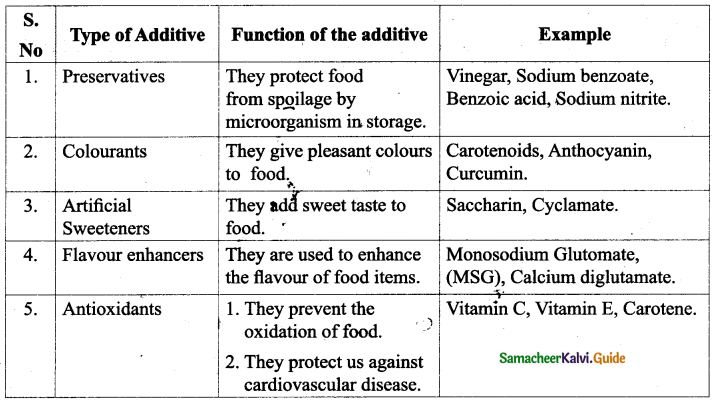
Samacheer Kalvi 9th Science Guide Chapter 16 Applied Chemistry 1

VI. Higher Order Thinking Skills :

Question 1.
Batteries that are used in mobile phone can be recharged. Likewise, can you recharge the batteries used in watches? justify your answer.
Answer:
The type of batteries used in watches is Primary cell. (Mercury-Oxide battery)
The type of batteries are used in mobile phone is Secondary cell. (Lithium -ion polymer battery)
The differences between primary and secondary cell are as follow:

Primary Cell Secondary cell
1. The chemical reaction of primary cell is irreversible. The chemical reaction is reversible.
2. Hence it can not be recharged. Hence it can be recharged.

Question 2.
Sudha met with a fire accident. What kind of drug(s), she must take?
Answer:
Analgesics are to be administered to reduce the pain followed by antibiotics to prevent infection by microbes.

 Samacheer Kalvi 9th Science Guide Chapter 16 Applied Chemistry

Question 3.
The soil pH of cropland is 5. What kind of fertilizers should be used in that land?
Answer:

  • pH of 5 indicates the soil is Acidic.
  • So alkaline fertilizers should be used.
    (e.g.,) Potash fertilizers, Nitrogen fertilizers.

Intext Activities

ACTIVITY – 1

With the help of your teacher, construct the galvanic cell using lemon and potato. Identify their anode, cathode and electrolyte.
Aim: To construct a galvanic cell using lemon (or) potato
Materials required :

  1. A large fresh juicy lemon,
  2. Zinc coated nail,
  3. Small copper coin,
  4. LED light,
  5. Connecting wires

Procedure :

  1. Insert the copper coin into the lemon.
  2. Push a zinc-coated nail into the other side of the lemon.
  3. The copper coin and zinc-coated nail are connected to a low voltage LED bulb.
  4. Now observe the results, (happenings).

Observation:

  1. Copper coin acts as the cathode, zinc-coated nail acts as Anode. Lemon juice acts as an electrolyte.
  2. We observe glow of LED light, which confirms the electricity to flow through the lemon.

Conclusion: Galvanic cell usifi^lpmon is constructed.

 Samacheer Kalvi 9th Science Guide Chapter 16 Applied Chemistry

9th Science Guide Applied Chemistry Additional Important Questions and Answers

I. Choose the correct answer :

Question 1.
Nanoparticles are unstable when they come in contact with ………………..
(a) air
(b) Hydrogen
(c) Oxygen
(d) all the above
Answer:
(c) Oxygen

Question 2.
Which is the incorrect statement in the following?
(a) The structure of nano material is in between an atom and bulk material.
(b) Nanomaterials exist in the corresponding bulk materials.
(c) Nanomaterials have the extremely large surface area to volume ratio.
(d) SEM is used analyse the surface properties of a nanoparticle with high resolution.
Answer:
(b) Nanomaterials exist in the corresponding bulk materials

 Samacheer Kalvi 9th Science Guide Chapter 16 Applied Chemistry

Question 3.
Which anesthetic forms a toxic carbonyl chloride?
(a) Nitrous oxide
(b) Ether
(c) Chloroform
(d) Iodoform
Answer:
(c) Chloroform

Question 4.
Paracetamol is a …………….
(a) Analgesic
(b) Antiseptic
(c) Antimalarial
(d) Antipyretic
Answer:
(c) Antipyretic

Question 5.
The antiseptic used for cleansing the wounds is ………………..
(a) Phenol
(b) Iodoform
(C) Ether
(d) Hydrogen peroxide
Answer:
(d) Hydrogen peroxide

 Samacheer Kalvi 9th Science Guide Chapter 16 Applied Chemistry

Question 6.
Antimalarial drug obtained from Cinchona bark is ……………………
(a) Quinine
(b) Morphine.
(e) Primaquine
(d) Pyrimethamine
Answer:
(a) Quinine

Question 7.
The drug that ¡s known as “Miracle drug” is ………………….
(a) Chloroquinine
(b) Penicillin
(C) Aspirin. .
(d) Paràcetamol
Answer:
(b) Penicillin

 Samacheer Kalvi 9th Science Guide Chapter 16 Applied Chemistry

Question 8.
In Daniel cell, saturated solution of potassium chloride (KCl) acts as ……………..
(a) Anode
(b) Cathode
(c) Salt bridge
(d) Electrolyte
Answer:
(c) Salt bridge

Question 9.
The process of purifying metals by electrolysis ¡s known as ……………..
(a) Electroplating
(b) Electrorefining
(e) Electromanufacturing
(d) None of these
Answer:
(b) Electrorefining

Question 10.
Which one among the following statements is correct?
(a) Galvanic cell converts electrical energy into chemical energy.
(b) Reduction takes place at the anode.
(c) Oxidation reaction takes place at the cathode.
(d) None of these
Answer:
(d) None of these

 Samacheer Kalvi 9th Science Guide Chapter 16 Applied Chemistry

Question 11.
Isotopes are atoms with different number of ………………………
(a) protons
(b) neutrons
(c) electrons
(d) None of these
Answer:
(b) neutrons

Question 12.
The radioisotope used for location of blood clot and circulation disorders is …………………..
(a) Na – 24
(b) I – 131
(c) Fe – 59
(d) Co – 60
Answer:
(a) Na – 24

 Samacheer Kalvi 9th Science Guide Chapter 16 Applied Chemistry

Question 13.
The dye that can only be used on cotton is …………………….
(a) Mordant dye
(b) Vat dye
(c) Direct dye
(d) Basic dye
Answer:
(b) Vat dye

Question 14.
Which one of the following is a flavour enhancer?
(a) Sodium nitrite
(b) Sodium benzoate
(c) Cyclamate
(d) Monosodium Glutamate
Answer:
(d) Monosodium Glutamate

Question 15.
The compound that gets redUced ¡n the alcohol test is ……………………
(a) Silver nitrate
(b) Sulphuric acid
(C) Water
(d) Potassium dichromate
Answer:
(d) Potassium dichromate

 Samacheer Kalvi 9th Science Guide Chapter 16 Applied Chemistry

II. Fill in the blanks:

1. Nanotechnology deals with materials which are smaller than …………………..
Answer:
100 nanometres

2. The metallic nanoparticles can be used as ………………….
Answer:
Very active catalysts

3. Nanoparticle substances are incorporated in fabrics to prevent …………………..
Answer:
the growth of bacteria

 Samacheer Kalvi 9th Science Guide Chapter 16 Applied Chemistry

4. The word “drug” is derived from the French word “droque” which means a ………………..
Answer:
dry herb

5. …………… is the safest of the anesthetic drugs.
Answer:
Nitrus oxide

6. The Analgesics are also called as …………………
Answer:
Pain killer (or) Pain relievers

 Samacheer Kalvi 9th Science Guide Chapter 16 Applied Chemistry

7. ………………. produce sleep and unconsciousness.
Answer:
Narcotics

8. Antiseptics are used internally to treat infections of the …………… and ……………..
Answer:
Intestine, Bladder

9. Malaria is a ……………… borne disease.
Answer:
vector

10. ………………. is used as an additive with other antimalarial drugs.
Answer:
Chloroquine

 Samacheer Kalvi 9th Science Guide Chapter 16 Applied Chemistry

11. ……………. is extensively used for rheumatic fever, narrowing of the heart wall, bronchitis, and pneumonia.
Answer:
Penicillin

12. …………… is due to an imbalance in the acidity in the stomach.
Answer:
Burning sensation

13. The solution having ions is called ………………..
Answer:
Electrolyte

14. …………….. is the loss of electrons.
Answer:
Oxidation

 Samacheer Kalvi 9th Science Guide Chapter 16 Applied Chemistry

15. The process of depositing a thin layer of one metal over another metal by the process of electrolysis is called …………………….
Answer:
Electroplating

16. When metals of a very high degree of purity are required,………………… is done.
Answer:
Electrorefining

17. The isotope used in Radiocarbon dating is …………………..
Answer:
C-14

 Samacheer Kalvi 9th Science Guide Chapter 16 Applied Chemistry

18. The chromophore and auxochrome theory was proposed by ……………………
Answer:
Otto Witt

19. ……………… is one of the main criteria to be considered for the selection of crop (or) remediation of soil.
Answer:
Soil pH

20. Vitamin C is also powerful ……………….. that prevents food from oxidising.
Answer:
Antioxidant

21. ……………. is one of the most important evidence in crime investigation.
Answer:
Fingerprint

 Samacheer Kalvi 9th Science Guide Chapter 16 Applied Chemistry

III. Match the following:

Question 1.

Name of the Drug Purpose Example
1. Antipyretics Kills the microorganism Chloroform
2. Anaesthetics Pain reliever Novalgin
3. Antiseptics Reduction of fever paracetamol
4. Analgesics Cure for malaria Quinine
5. Antimalarial Loss of sensation Hydrogen peroxide

Answer:

Name of the Drug purpose Example
1. Antipyretics Reduction of fever paracetamol
2. Anaesthetics Loss of sensation Chloroform
3. Antiseptics Kills the microorganism Hydrogen peroxide
4. Analgesics Pain reliever Novalgin
5. Antimalarial Cure for malaria Quinine

Question 2.

Column I Column II
Cathodic electrolyte Potassium chlorate (KClO3)
Anodic electrolyte Potassium chloride (KCl)
Salt bridge sulphate CuSO4
Electro manufacturing Zinc sulphate(ZnSO4)

Answer:

Column I Column II
Cathodic electrolyte Copper sulphate CuSO4
Anodic electrolyte Zinc sulphate(ZnSO4)
Salt bridge Potassium chloride (KCl)
Electro manufacturing Potassium chlorate (KClO3)

 Samacheer Kalvi 9th Science Guide Chapter 16 Applied Chemistry

Question 3.

Column I Column II
Phosphorous-30 Cancer
Iodine-131 Pregnancy disorder
Cobalt-60 Hyperthyroidism
Iron-59 Blood disorder
Sodium-24 Circulation disorder

Answer:

Column I Column II
Phosphorous-30 Blood disorder
Iodine-131 Hyperthyroidism
Cobalt-60 Cancer
Iron-59 Pregnancy disorder
Sodium-24 Circulation disorder

Question 4.

Column I Column II
Indirect dyes Congo red
Direct dyes Alizarin
Vat dyes Methylene blue
Basic dyes Picric acid
Acid dyes Indigo

Answer:

Column I Column II
Indirect dyes Alizarin
Direct dyes Congo red
Vat dyes Indigo
Basic dyes Methylene blue
Acid dyes Picric acid

 Samacheer Kalvi 9th Science Guide Chapter 16 Applied Chemistry

IV. State whether true or false. If false, correct the statement:

1. Nanoparticles are easy to synthesis, isolate, and apply.
Answer:
False,
Correct statement: Nanoparticles are difficult to synthesis, isolate, and apply.

2. When cancer occurs, cells are reproduced in a controlled manner.
Answer:
False.
Correct statement: When cancer occurs, cells are reproduced in an uncontrolled manner.

3. General anaesthetics cause pain along with ‘reversible’ loss of consciousness
Answer:
False.
Correct statement: General anaesthetics relieve pain along with reversible loss of consciousness.

 Samacheer Kalvi 9th Science Guide Chapter 16 Applied Chemistry

4. Malaria decreases body temperature.
Answer:
False.
Correct statement: Malaria increases the body temperature

5. High concentration of antibiotics is needed for Effective action.
Answer:
False. .
Correct statement: Low concentration of antibiotics is needed for effective action.

6. Antacids provide relief from burning sensation in the stomach.
Answer:
True,

 Samacheer Kalvi 9th Science Guide Chapter 16 Applied Chemistry

7. In Daniel’s cell, Zinc metal acts as the cathode, and Copper metal acts as Anode.
Answer:
False.
Correct statement: In Daniel’s cell, Zinc metal acts as Anode, and Copper metal acts as Cathode.

8. Radioisotopes can be easily detected and estimated quantitatively.
Answer:
True.

9. Dyes are aromatic compounds originated from plants and insects.
Answer:
True.

 Samacheer Kalvi 9th Science Guide Chapter 16 Applied Chemistry

10. Dye should be fast to light.
Answer:
True.

11. Vinegar is used as an antioxidant.
Answer:
False.
Correct statement: Vinegar is used as a preservative.

12. Reduction of alcohol results in oxidation of dichromate to chromic ion.
Answer:
False.
Correct statement: Oxidation of alcohol results in a reduction of dichromate to chromic ion

 Samacheer Kalvi 9th Science Guide Chapter 16 Applied Chemistry

V. Assertion and Reason type:

Mark the correct choice as:
(a) If both assertion and reason are true and Reason is the correct explanation of Assertion.
(b) If both assertion and reason are true but reason is not the correct explanation of assertion.
(c) If assertion is true but reason is false.
(d) If assertion is false but reason is true.

Question 1.
Assertion (A) : Nanoparticles interact with impurities.
Reason (R) : Nanoparticles are less reactive.
Answer:
(c) Assertion is true but the reason is false
Reason (R) : Nanoparticles are highly reactive.

Question 2.
Assertion (A) : Antiseptic is a substance that prevents infections caused by disease-causing pathogens.
Reason (R) : Antiseptics either kill the microorganism or prevent their growth.
Answer:
(a) Both assertion and reason are true and Reason is the correct explanation of Assertion

 Samacheer Kalvi 9th Science Guide Chapter 16 Applied Chemistry

Question 3.
Assertion (A) : After eating fruits (or) vegetables, one may feel uncomfortable due to a burning sensation.
Reason (R) : Burning sensation is due to an imbalance in the acidity of the stomach.
Answer:
(d) Assertion is false but the reason is true
Assertion (A) : After eating oily and spicy foods, one may feel uncomfortable due to a burning sensation.

Question 4.
Assertion (A) : Metals like iron are electroplated with chromium.
Reason (R) : Electroplating is done to protect chromium from rusting.
Answer:
(c) Assertion is true but reason is false
Reason (R) : Electroplating is done to protect iron from rusting.

Question 5.
Assertion (A) : It is possible to detect alcohol drunken drivers.
Detection is done through the electrochemical redox reaction of alcohol.
Answer:
(a) Both assertion and reason are true and Reason is the correct explanation of Assertion

 Samacheer Kalvi 9th Science Guide Chapter 16 Applied Chemistry

Question 6.
Assertion (A) : Our retinal print can be forged.
Reason (R) : Our retinal print is unique.
Answer:
(d) Assertion is false but reason is true
Assertion ( A) : Our retinal print cannot be forged.

VI. Very short answer type :

Question 1.
What are the specific qualities of nanoparticles?
Answer:

  • Larger surface area
  • High surface energy.
  • Spatial confinement
  • Reduced imperfections.

Question 2.
List out the instruments used to analyse nanoparticles.
Answer:

  • Scanning Electron Microscope (SEM)
  • Tunneling Electron Microscope (TEM).
  • Atomic Force Microscope (AFM).

 Samacheer Kalvi 9th Science Guide Chapter 16 Applied Chemistry

Question 3.
What is antipyretics?
Answer:
Antipyretics are the compounds used to reduce fever, (i.e.) lowering the body temperature to normal.

Question 4.
How are antiseptics used?
Answer:
External use: To cleanse wounds.
Internal use: To treat infections of the intestine and bladder.

Question 5.
Mention the uses of Penicillin.
Answer:
Penicillin is used for

  • Rheumatic fever,
  • Narrowing of the heart wall.
  • Bronchitis,
  • Pneumonia.

 Samacheer Kalvi 9th Science Guide Chapter 16 Applied Chemistry

Question 6.
What are the main sources of Antibiotics?
Answer:
Main sources of Antibiotics are

  • Bacteria
  • Fungi and
  • Actinomycetes.

Question 7.
Name any five natural antibiotics.
Answer:

  • Honey
  • Garlic
  • Ginger
  • Neem
  • Turmeric.

Question 8.
What is an Electrochemical cell?
Answer:
A device that makes use of a chemical change to produce electricity (or) electricity to produce chemical change is called an Electrochemical cell.

 Samacheer Kalvi 9th Science Guide Chapter 16 Applied Chemistry

Question 9.
What is a Daniel cell?
Answer:
Daniel cell is a type of galvanic cell in which zinc metal acts as anode and copper metal as cathode.

Question 10.
What is radioactive decay?
Answer:

  • The unstable isotopes of elements lose their energy in the form of radiation to become stable.
  • This phenomenon is called radioactive decay.

Question 11.
What is Vermicompost?
Answer:
Vermicompost is one of the natural fertilizers produced from domestic wastes.

 Samacheer Kalvi 9th Science Guide Chapter 16 Applied Chemistry

Question 12.
What is a balanced diet?
Answer:
A diet that contains all the three foods such as (i) Bodybuilding foods, (ii) Energy giving foods, and (iii) Protective foods in the right proportion are called a Balanced diet.

Question 13.
Mention the use of a Biometric system.
Answer:
The biometric system compares the body prints to the specimen data stored in the system to verify the identity of a person.

VII. Answer briefly :

Question 1.
What is called as Applied Chemistry?
Answer:
Application of chemical principles and theories to various fields in order to achieve specific results or to solve real-world problems is called applied chemistry.

 Samacheer Kalvi 9th Science Guide Chapter 16 Applied Chemistry

Question 2.
Write short notes on nanochemistry.
Answer:

  • Nanochemistry is a branch of nanoscience, that deals with the chemical applications of nanomaterials in nanotechnology.
  • It involves the synthesis and manipulation of materials at the atomic and molecular level.

Question 3.
Mention medical applications of Nanorobotics.
Answer:

  • Nanorobotics is used in medicine and space technology.
  • It plays important role in Bio-medicine in the treatment of cancer.

Question 4.
Define Drug.
Answer:
According to the World Health Organisation (WHO),
Drug is a substance or product that is used or intended to be used to modify or explore physiological systems or pathological states for the benefits of the recipient.

 Samacheer Kalvi 9th Science Guide Chapter 16 Applied Chemistry

Question 5.
What is an Analgesics? How is it useful?
Answer:

  • Analgesics are compounds which relieve all sorts of pains without the loss of consciousness.
  • It is useful to treat
    (a) Headaches
    (b) Myalgia and
    (c) arthralgia.

Question 6.
What is known is Antibiotics?
Answer:
Many microorganisms (bacteria, fungi, and molds) produce certain chemicals which inhibit the growth (or) metabolism of some other disease-causing microorganism. Such chemical compounds are known as Antibiotics.

Question 7.
Write brief notes on processes involved in cell reactions.
Answer:
An electrochemical cell involves two reactions simultaneously.

  • Oxidation : Oxidation is the loss of electrons, that takes place at the anode.
    Metal → Metal ion + electron(s)
  • Reduction: Reduction is the gain of electrons, that takes place at the cathode.
    Metal ion + electron(s) → Metal.

 Samacheer Kalvi 9th Science Guide Chapter 16 Applied Chemistry

Question 8.
How does a galvanic cell produce electricity?
Answer:

  • At the anode, oxidation takes place which releases electrons.
  • These electrons are attracted by the cathode.
  • Thus electrons flowing from anode to cathode produce electricity.

Question 9.
Mention the applications of electroplating with an example.
Answer:
Applications of Electroplating :

  • Electroplating is done to protect the metal from corrosion, (e.g) chrome -plating.
  • Electroplating is done to beautify the surface of a metal, (e.g) Gold plating.
  • Broken parts of machinery require electrodeposition of metal between broken parts.

Question 10.
List out the characteristics of Dye.
Answer:
Characteristics of Dye:

  • Dye should have a suitable colour.
  • Dye should be able to fix itself.
  • Dye should be fast to light,
  • Dye should be resistant to the action of water, dilute acids, and alkalies.

 Samacheer Kalvi 9th Science Guide Chapter 16 Applied Chemistry

Question 11.
Define Pesticides.
Answer:
According to the World Health Organisation (WHO),
Pesticides are chemical compounds that are used to kill pests including insects, rodents, fungi, and unwanted plants (weeds).

Question 12.
How can Fingerprints be identified?
Answer:

  • Fingerprints on smooth surfaces can be identified by the application of light or dark powder.
  • Occult (hidden) Fingerprints are made visible by the use of Ninhydrin, which turns purple.
  • Fingerprints can be made visible by high powered laser light.

Question 13.
How is alcohol consumption detected?
Answer:

  • The person being tested blows through a tube, which bubbles the breath through a solution containing Sulphuric acid, Potassium dichromate, water and silver nitrate.
  • Oxidation of alcohol results in the reduction of dichromate to chromatic ions with a change in color from orange to green.

 Samacheer Kalvi 9th Science Guide Chapter 16 Applied Chemistry

Question 14.
What is Chemotherapy?
Answer:
Treatment of certain diseases by destroying the invading organism without damaging the cells of the host, by the use of certain organic compounds is known as chemotherapy. It is widely used for treating cancer.

VIII. Answer in detail :

Question 1.
Draw the cell diagram of Daniel cell. Give its reactions.
Answer:
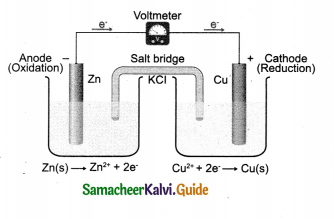
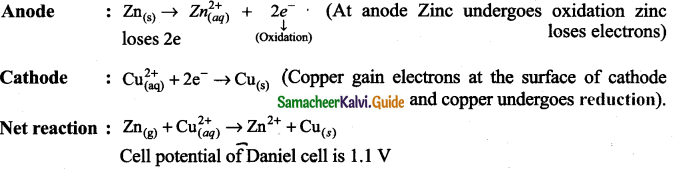
Samacheer Kalvi 9th Science Guide Chapter 16 Applied Chemistry 2

Question 2.
Daniel cell
Answer:
Samacheer Kalvi 9th Science Guide Chapter 16 Applied Chemistry 3

Question 3.
List the applications of Nanochemistry.
Answer:
Applications of Nanochemistry :

  • The metallic nanoparticles can be used as very active catalysts.
  • Chemical sensors form nanoparticles and nanowires enhance the sensitivity and sensor selectivity.
  • Nanocoatings and nanocomposites are found useful in making a variety of products such as sports equipment, bicycles, and automobiles etc.
  • Nanotechnology is being applied in the die production of synthetic skin and implant surgery.
  • Nanomaterials that conduct electricity are being used in electronics as minute conductors to produce circuits for microchips.
  • Nanomaterials are used in the preparation of cosmetics, deodorants, and sunscreen lotion. They are used to improve moisturizers, without making them too oily.
  • Nanoparticle substances are incorporated in fabrics to prevent the growth of bacteria.

 Samacheer Kalvi 9th Science Guide Chapter 16 Applied Chemistry

Question 4.
Mention the drawbacks of Nanomaterials in chemistry.
Answer:
Drawbacks of nanomaterials in chemistry :

  • Nanoparticles are unstable when reacting with oxygen.
  • Their exothermic combustion with oxygen can easily cause an explosion.
  • Because nanoparticles are highly reactive, they inherently interact with impurities as well.
  • Nanomaterials are usually considered biologically harmful and toxic.
  • It is difficult to synthesis, isolate and apply them.
  • There are no hard-and-fast safe disposal policies for nanomaterials.

Question 5.
Account the role of Radioactive isotopes in Diagnosis and treatment in the Medical field?
Answer:
Radioisotopes are very useful to diagnose and treat many diseases. . Some of them are given below:
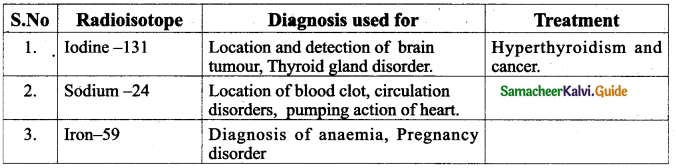
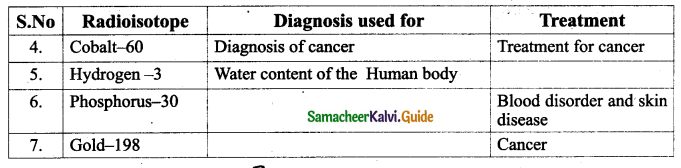
Samacheer Kalvi 9th Science Guide Chapter 16 Applied Chemistry 4

Samacheer Kalvi 9th Science Guide Chapter 16 Applied Chemistry 5

Question 6.
Give a comparative account of various drugs with their application and examples.
Answer:
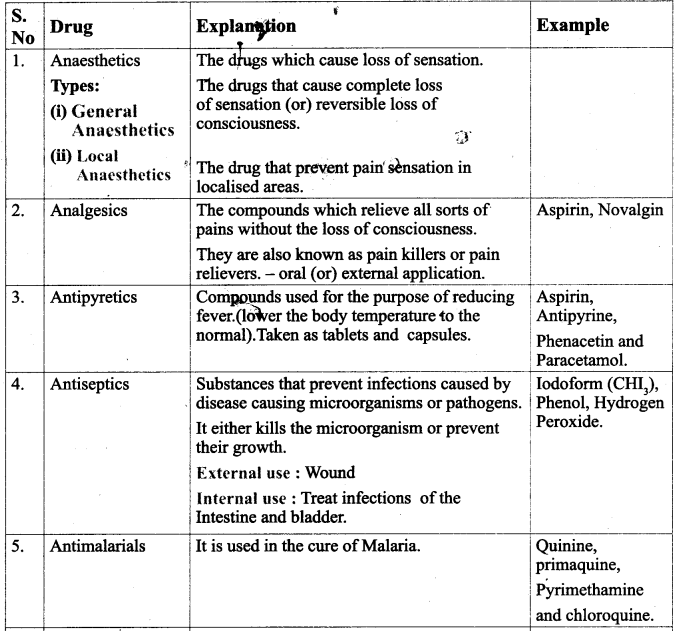
Samacheer Kalvi 9th Science Guide Chapter 16 Applied Chemistry 6

Samacheer Kalvi 9th Science Guide Chapter 16 Applied Chemistry 7

 Samacheer Kalvi 9th Science Guide Chapter 16 Applied Chemistry

Question 7.
What are the applications of electrochemistry?
Answer:
Applications of electrochemistry :

  • It has been used to discover important technical processes for the production and purification of non-ferrous metals, and for the electro- synthesis of organic compounds.
  • Electrochemistry has been used to predict whether a particular reaction will occur or not.
  • The detection of alcohol in drunken drivers is possible through the electrochemical redox reaction of ethanol.
  • Production of metals like aluminum and titanium from their ores involves electrochemical reactions.
  • Diabetes blood sugar meters measure the amount of glucose in the blood through its redox potential.
  • Lead-acid batteries, lithium-ion batteries, and fuel cells are based on electrochemical cells.
  • A fuel cell is used to bring about the direct conversion of chemical energy into electrical energy.

Question 8.
Explain very briefly about various fields of Applied Chemistry.
Answer:
Various Fields of Applied Chemistry:

  • Nanochemistry: It is a branch of nanoscience that deals with the chemical applications of nanomaterials in nanotechnology.
  • Nanometre = 1/1,000,000,000 metre.
  • Pharmaceutical chemistry: It deals with the preparation of drugs and the study of the chemical composition, nature, behaviour, structure, and influence of the drug in an organism.
  • Electrochemistry: It deals with the relation between electrical energy and chemical change.
  • Radiochemistry: It is the study of the chemistry of radioactive and non-radioactive isotopes.
  • Dye chemistry: It is the study of dyes.
  • Agricultural chemistry: It deals application of chemical and biochemical knowledge to agricultural production, the processing of raw products into foods and beverages, and environmental monitoring and remediation.
  • Food chemistry: It involves the analysis, processing, packaging, and utilization of materials.
  • Forensic chemistry: It applies scientific principles, techniques, and methods to the investigation of crime.
Samacheer Kalvi 9th Science Guide Chapter 22 World of Microbes

Tamilnadu State Board New Syllabus Samacheer Kalvi 9th Science Guide Pdf Chapter 22 World of Microbes Text Book Back Questions and Answers, Notes.

Tamilnadu Samacheer Kalvi 9th Science Solutions Chapter 22 World of Microbes

9th Science Guide World of Microbes Text Book Back Questions and Answers

Samacheer Kalvi 9th Science Guide Chapter 22 World of Microbes

I. Choose the correct answer :

Question 1.
Which of the following is transmitted through air?
(a) Tuberculosis
(b) Meningitis
(c) Typhoid
(d) Cholera
Answer:
(a) Tuberculosis

Question 2.
One of the means of indirect transmission of a disease is
(a) sneezing
(b) coughing
(c) vectors
(d) droplet infection
Answer:
(c) vectors

Samacheer Kalvi 9th Science Guide Chapter 22 World of Microbes

Question 3.
Diptheria affects the
(a) lungs
(b) throat
(c) blood
(d) liver
Answer:
(b) Throat

Question 4.
The primary organ infected during tuberculosis is
(a) bone marrow
(b) intestine
(c) spleen
(d) lungs
Answer:
(d) lungs

Samacheer Kalvi 9th Science Guide Chapter 22 World of Microbes

Question 5.
Microbes that generally enter the body through nose are likely to affect
(a) gut
(b) lungs
(c) liver
(d) lymph nodes
Answer:
(b) lungs

Question 6.
The organ affected by jaundice is
(a) liver
(b) lungs
(c) kidney
(d) brain
Answer:
(a) liver

Samacheer Kalvi 9th Science Guide Chapter 22 World of Microbes

Question 7.
Poliomyelitis virus enters the body through
(a) skin
(b) mouth and nose
(c) ears
(d) eye
Answer:
(b) mouth and nose

II. Fill in the blanks:

1. …………….. break down organic matter and animal waste into ammonia.
Answer:
Decomposers

2. Typhoid fever is caused by ………………
Answer:
salmonella typhi

Samacheer Kalvi 9th Science Guide Chapter 22 World of Microbes

3. H1N1 virus causes……………..
Answer:
swine flu

4. …………….. is a vector of viral disease dengue.
Answer:
Aedes aegypti mosquito

5. …………….. vaccine gives considerable protection against tuberculosis.
Answer:
BCG

Samacheer Kalvi 9th Science Guide Chapter 22 World of Microbes

6. Cholera is caused by…………….. and malaria is caused by………………
Answer:
bacteria (Vibrio cholera), protozoa (plasmodium)

III. Expand the following:

  1. ORS – Oral Rehydration Solution.
  2. HIV – Human Immunodeficiency Virus.
  3. DPT – Diphtheria Pertussis Tetanus.
  4. WHO – World Health Organisation.
  5. BCG – Bacillus Calmette Guerin.

IV. Pick out the odd one :

  1. AIDS, Retrovirus, Lymphocytes, BCG, – BCG.
  2. A bacterial disease, Rabies, Cholera, Common cold, and Influenza – Cholera.

V. State whether True or False. If false, correct the statement:

1. Rhizobium, associated with root nodules of leguminous plants fixes atmospheric nitrogen.
Answer:
True.

Samacheer Kalvi 9th Science Guide Chapter 22 World of Microbes

2. Non-infectious diseases remain confined to the person who develops the disease and do not spread to others.
Answer:
True.

3. The process of vaccination was developed by Jenner.
Answer:
True.

4. Hepatitis B is more dangerous than Hepatitis A.
Answer:
True.

Samacheer Kalvi 9th Science Guide Chapter 22 World of Microbes

VI. Match the following :

Swine flu Human Papilloma vims Influeuza vims HINl
Genital warts Human Immunodeficiency Vims
AIDS Mycobacterium
Tuberculosis Influenza vims HINl

Answer:

Swine flu Influenza vims HINl
Genital warts Human Papilloma vims
AIDS Human Immunodeficiency Vims
Tuberculosis Mycobacterium

VII. Define the following:

1. Pathogen
2. Bacteriophages
3. Vaccines
4. Prions
Answer:
1. Pathogen – A pathogen is a biological agent that causes disease due to its host E.g. Bacteria, Virus, etc.,
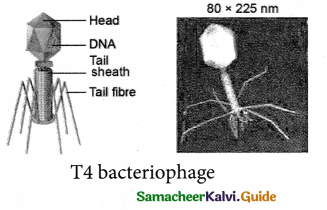
2. Bacteriophages – Virus that infect bacterial cells E.g. T4 bacteriophage.
3. Vaccines – Preparation of antigenic proteins of pathogens (weakened or killed) which on inoculation into a healthy person provides temporary / permanent immunity against a particular disease.
4. Prions – Prions are viral particles which contain only proteins. They do not contain nucleic acid.

Samacheer Kalvi 9th Science Guide Chapter 22 World of Microbes

VIII. Answer very briefly :

Question 1.
Distinguish between Virion and Viroid.
Answer:
Virion

  1. Simple vims particle.
  2. Grow and multiply in living cells.

Viriod

  1. The protein-free pathogenic RNA of vims.
  2. Found in plant cells and causes disease in plants.

Question 2.
Name the vector of the malarial parasite. Mention the species of malarial parasite which cause malignant and fatal malaria.
Answer:
The vector of the malarial parasite is the female Anopheles mosquito.
Malaria caused by Plasmodium falciparum is malignant and fatal.

Samacheer Kalvi 9th Science Guide Chapter 22 World of Microbes

Question 3.
What is triple antigen? Mention the disease which can be prevented by using the antigen.
Answer:
Triple antigen : It is combination of three vaccines (DPT).
Preventable diseases : Diptheria, Pertussis (Whooping cough) and Tetanus.

Question 4.
Name the chronic diseases associated with respiratory system.
Answer:
Chronic diseases associated with the respiratory system are; Diptheria, Whooping Cough, Tuberculosis.

Question 5.
Name the organism causing diarrhoeal disease and give one precaution against it.
Answer:

  1. Rotavirus.
  2. Precaution : Proper sanitation and hygiene.

Samacheer Kalvi 9th Science Guide Chapter 22 World of Microbes

Question 6.
Name two common mosquitoes and the diseases they transmit.
Answer:
Anopheles mosquito and Aedes aegypti mosquito are common mosquitoes that transmit malaria, Chikungunya and Dengue.

IX. Answer briefly :

Question 1.
Give an account of classification, of bacteria based on the shape.
Answer:
Bacteria are microscopic, single-celled prokaryotic organisms without a nucleus and other cell organelles. Although the majority of bacterial species exist as single-celled forms, some appear to be filaments of loosely joined cells. The size varies from less than 1 to 10 µm in length and 0.2 to 1 µm micrometer in width.
Based on the shapes, bacteria are grouped as:

  1. Spherical shaped bacteria called cocci (or coccus for a single cell).
  2. Rod-shaped bacteria called bacilli (or bacillus for a single cell).
  3. Spiral shaped bacteria called spirilla (or spirillum for single cell)

Question 2.
Describe the role of microbes in agriculture and industries.
Answer:
Microbes in Agriculture :
Microbes play an important role in agricultrue as biocontrol agents and biofertilizers.
(i) Biocontrol agents :
Microorganisms used for controlling harmful or pathogenic organisms and pests of plants are called as biocontrol agents Biopesticides.
(E.g) Bacillus Thuringiensis.(Bt) is a species of bacteria that produces a protein called as ‘cry’ protein.

(ii) Biofertilizers:

  • Microorganisms which enrich the soil with nutrients are called as biofertilizers.
  • Bacteria, cyanobacteria and fungi are the main sources of biofertilizers .
  • Atomspheric nitrogen has to be converted to available form of nitrogen.
    Example: Azotobacter, Nostoc (free living), Symbiotic microbes like Rhizobium, Frankia.

Microbes in Industries
Microorganisms play an important role in the production of wide variety of valuable products for the welfare of human beings.

Production of fermented beverages: Beverages like wine are produced by fermentation of grape fruits by Saccharomyces cerevisiae.

Curing of coffee beans, tea leaves and tobacco leaves : Beans of coffee and cocoa, leaves of tea and tobacco are fermented by the bacteria Bacillus megaterium. This gives the special aroma.

Production of curd : Lactobacillus sp. converts milk to curd.

Production of organic acids, enzymes and vitamins : Oxalic acid, acetic acid and citric acid are produced by fungus Aspergillus niger. Enzymes like lipases, invertase, proteases, and glucose oxidase are derived from microbes. Yeasts are rich source of vitamin-B complex.

Samacheer Kalvi 9th Science Guide Chapter 22 World of Microbes

Question 3.
Explain the various types of viruses with examples.
Answer:
Viruses are categorised as :
1. Plant virus : Virus that infect plants.
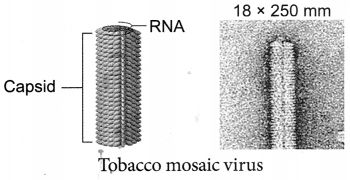
E.g. Tobacco mosaic vims, Potato vims, Cauliflower mosaic virus.
Samacheer Kalvi 9th Science Guide Chapter 22 World of Microbes 1

2. Animal virus : Vims that infect animals.
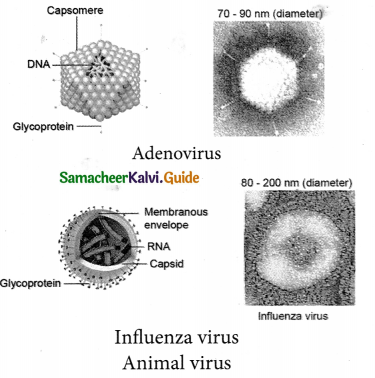
E.g. Adenovims, Retrovims (HIV), Influenza vims, Polio vims.
Samacheer Kalvi 9th Science Guide Chapter 22 World of Microbes 2

3. Bacteriophages : Vims that infect bacterial cells.
E.g.T4 bacteriophage.
Samacheer Kalvi 9th Science Guide Chapter 22 World of Microbes 3

Samacheer Kalvi 9th Science Guide Chapter 22 World of Microbes

Question 4.
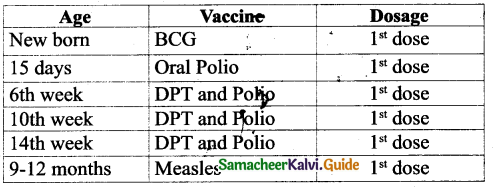
Suggest the immunization schedule for a new born baby till 12 months of age. Why it is necessary to follow the schedule?
Answer:
The immunization schedule must be followed so that the vaccines administered will protect the children in the future from infectious and life-threatening diseases.

Immunization Schedule for Children
Samacheer Kalvi 9th Science Guide Chapter 22 World of Microbes 4

X. Assertion and Reason :

Mark the correct statement as:
(a) If both A and R are true and R is correct explanation of A.
(b) If both A and R are true but R is not the correct explanation of A.
(c) If A is true but R is false.
(d) If both A and R are false.

Question 1.
Assertion : Chicken pox is a disease indicated by scars and marks in the body.
Reason : Chicken pox cenlses rashes on face and further spreads throughout the body.
Answer:
(a) Both A and R are true and R is correct explanation of A

Samacheer Kalvi 9th Science Guide Chapter 22 World of Microbes

Question 2.
Assertion: Dengue can be treated by intake of antibiotics.
Reason : Antibiotics blocks the multiplication of viruses.
Answer:
(d) Both A and R are false

XI. Higher Order Thinking Skills :

Question 1.
Suggest precautionary measures you can take in your school to reduce the incidence of infectious disease.
Answer:

  • Clean and hygienic environment should be maintained inside and outside the school.
  • Enough first aid medicines should be kept in the school.
  • Proper awareness about healthy diet and health instructions should be instructed to the students.
  • If a student is identified with disease, it must be properly communicated to the students and nearby health authorities.
  • The infected student / person must be kept away from other students in order to avoid the spread of infection.

Question 2.
Tejas suffered from typhoid while, Sachin suffered from tuberculosis. Which disease could have caused more damage and why?
Answer:
Tuberculosis is more dangerous than typhoid.
Reason : Tuberculosis (TB) primarily affects lungs and also affect intestines, bones, and joints and other tissues of body. Severe cases may lead to death.

Samacheer Kalvi 9th Science Guide Chapter 22 World of Microbes

Intext Activities

ACTIVITY – 1

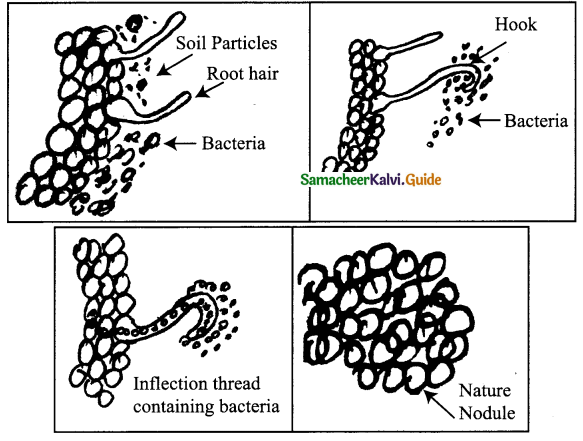
Take the root nodules of any pulse or leguminous plant available in your locality. Wash it thoroughly with water. Crush the nodules on a clean glass slide. Add a drop of distilled water to the crushed material on the glass slide. Observe the preparation under compound microscope.

Observation of Symbiotic microbes.

Aim : To observe symbiotic bacteria shape on a clean glass plate.

Materials Required :
1. Root nodules of leguminous plant, Clean glass slides, Water, Distilled water.

Procedure :

  1. Take the root nodules of the leguminous plant.
  2. Wash it thoroughly with water.
  3. Crush the nodules on a clean glass slide.
  4. Add a drop of distilled water to the crushed material on the glass slide.

Observation:

Conclusion :
The structure of symbiotic bacteria is observed in a clean glass plate.
[End of the activity]

Samacheer Kalvi 9th Science Guide Chapter 22 World of Microbes

ACTIVITY – 2

Observe the mosquitoes that are active during the day time. Catch them using an insect net and observe their body and legs. What do you observe? Why are cases of Dengue reported in large numbers during post-monsoon season?
Observation :
Body and legs of Aedes aegypti :
We can find black and white stripes on the bodies and leg.
The white marking in the leg is in the form of a lyre.

High Dengue cases during post-monsoon

  1. Due to the rainy season, conditions like stagnant water favours the mosquitoes to grow in large number.
  2. Thus, a sharp rise in dengue cases are reported. [End of the activity]

Samacheer Kalvi 9th Science Guide Chapter 22 World of Microbes

9th Science Guide World of Microbes Additional Important Questions and Answers

I. Choose the correct answer :

Question 1.
Which one of the following is a symbiotic bacteria?
(a) Azospirillum
(b) Azotobacter
(c) Rhizobium
(d) None of these
Answer:
(c) Rhizobium

Question 2.
The shape of Vibrio cholerae is
(a) Spherical
(b) Spiral
(c) Rod
(d) None of these
Answer:
(b) Spiral

Samacheer Kalvi 9th Science Guide Chapter 22 World of Microbes

Question 3.
……………are the site of protein synthesis in bacteria.
(a) Ribosomes
(b) Chromosomes
(c) Plasmid
(d) Nucleus
Answer:
(a) Ribosomes

Question 4.
Fungi reproduce through …………..
(a) binary fission
(b) budding
(c) spore formation
(d) all of these
Answer:
(d) all of these

Samacheer Kalvi 9th Science Guide Chapter 22 World of Microbes

Question 5.
Which one of the following is not an antibiotic derived from Bacteria?
(a) Cephalosporin
(b) Erythromycin
(c) Bacitracin
(d) Streptomycin
Answer:
(a) Cephalosporin

Question 6.
AIDS is’ a …………… disease.
(a) Endemic
(b) Epidermic
(c) Pandemic
(d) Sporadic
Answer:
(c) Pandemic

Samacheer Kalvi 9th Science Guide Chapter 22 World of Microbes

Question 7.
Fever, sore throat, and choking of air passage are symptoms of ……………
(a) influenza
(b) diphtheria
(c) whooping cough
(d) typhoid
Answer:
(a) influenza

Question 8.
Myxovirus is the causative agent for …………… disease.
(a) common cold
(b) measles
(c) influenza
(d) diarrhoea
Answer:
(c) influenza

Samacheer Kalvi 9th Science Guide Chapter 22 World of Microbes

Question 9.
The symptoms of measles is ……………
(a) eruption of small rashes in skin
(b) redness of eye
(c) pneumonia
(d) all the above
Answer:
(d) all the above

Question 10.
The stages of malarial parasite are developed in the …………… of mosquito
(a) respiratory tract
(b) gastrointestinal tract
(c) intestinal tract
(d) none of these
Answer:
(b) gastrointestinal tract

Samacheer Kalvi 9th Science Guide Chapter 22 World of Microbes

Question 11.
Incubation period of the virus for chikungunya is usually . ……………
(a) 2-12 days
(b) 2-7 days
(c) 4-8 days
(d) 3-9 days
Answer:
(a) 2-12 days

Samacheer Kalvi 9th Science Guide Chapter 22 World of Microbes

Question 12.
The disease that displays Nocturnal periodicity ……………
(a) swine flu
(b) dengue
(c) filaria
(d) influenza
Answer:
(c) filaria

Question 13.
Nasal spray vaccine can be administered to ……………patients.
(a) chikungunya
(b) dengue
(c) influenza
(d) swine flu
Answer:
(d) swine flu

Question 14.
Human Immuno deficiency Virus (HIV) was first isolated by …………..
(a) Robert Koch
(b) Robert Gallo
(c) Ronald Ross
(d) Louis Pasteur
Answer:
(b) Robert Gallo

Samacheer Kalvi 9th Science Guide Chapter 22 World of Microbes

Question 15.
The disease that is eliminated totally by the vaccination process is …………….
(a) chicken pox
(b) Filaria
(c) smallpox
(d) None of these
Answer:
(c) small pox

Question 16.
Among the following, which is belongs to water-borne diseases?
(a) Hepatitis A
(b) Hepatitis B
(c) Influenza
(d) Dengue
Answer:
(a) Hepatitis A

Samacheer Kalvi 9th Science Guide Chapter 22 World of Microbes

Question 17.
Measles vaccine can be administered to the child at the age of ……………
(a) 18-24 months
(b) 15-18 months
(c) 9-12 months
(d) 14th week
Answer:
(c) 9 – 12 months

Question 18.
Mycology is the branch of biology that deals with the study of ……………
(a) algae
(b) virus
(c) bacteria
(d) fungi
Answer:
(d) fungi

Question 19.
The major constituent of vinegar is ……………
(a) citric acid
(b) acetic acid
(c) oxalic acid
(d) hydrochloric acid
Answer:
(b) acetic acid

Samacheer Kalvi 9th Science Guide Chapter 22 World of Microbes

Question 20.
Bacteria involved in curd formation is ……………
(a) Lactobacillus acidophilus
(b) Nitrosomonas
(c) Bacillus ramous
(d) none of the above
Answer:
(a) Lactobacillus acidophilus

Question 21.
The most fetal form of malaria is caused by ……………..
(a) Plasmodium ovale
(b) Plasmodium falciparum
(c) Plasmodium malariae
(d) Plasmodium vivax
Answer:
(b) Plasmodium falciparum

Question 22.
Syphilis is caused by ………………….
(a) Treponema pallidum
(b) Leptospira
(c) Pasteurella
(d) Vibrio cholerae
Answer:
(a) Treponema pallidum

Samacheer Kalvi 9th Science Guide Chapter 22 World of Microbes

Question 23.
Mosquito-borne viral diseases are …………………
(a) malaria and yellow fever
(b) dengue and chikungunya
(c) filariasis and typhus
(d) kala-azar and diphtheria
Answer:
(b) dengue and chikungunya

Question 24.
Which one of the following is a pair of viral disease?
(a) Filariasis, AIDS
(b) Common cold, AIDS
(c) Dysentery, Common cold
(d) Typhoid, Tuberculosis
Answer:
(b) Common cold, AIDS

Samacheer Kalvi 9th Science Guide Chapter 22 World of Microbes

Question 25.
Which of the following disease is spread by animal bite?
(a) Pneumonia
(b) Tuberculosis
(c) Cholera
(d) Rabies
Answer:
(d) Rabies

II. Fill in the blanks :

1. Bacterial cell was covered by a strong cell wall made up of ……………
Answer:
peptidoglycan

2. In bacteria, a small extra chromosomal circular DNA called ………….. is found in the cytoplasm.
Answer:
plasmid

Samacheer Kalvi 9th Science Guide Chapter 22 World of Microbes

3. ………………bacteria live on dead organic matter.
Answer:
Saprophytic

4. Viruses are non-cellular, …………………… parasites.
Answer:
self-replicating

5. Adenovirus is………………….virus.
Answer:
animal

Samacheer Kalvi 9th Science Guide Chapter 22 World of Microbes

6. The cell wall of fungi is made up of ……………… and …………….
Answer:
cellulose, hemicellulose

7. Prions do not contain …………………..
Answer:
Nucleic acid

8. ‘Cry’ protein is produced by the bacteria………………….
Answer:
Bacillus Thuringiensis

9. Yeasts are rich source of …………………..
Answer:
vitamin – B complex

Samacheer Kalvi 9th Science Guide Chapter 22 World of Microbes

10. Vaccines stimulate the body to produce …………………. against the …………………. in the microbes.
Answer:
antibodies, antigen

11. Cholera is a ………… disease
Answer:

12. The interval between infection and first appearance of the diseases is called …………………..period.
Answer:
incubation

13. …………. is the Father of Bacteriology
Answer:
Robert Koch

14. The causative agent (bacteria) of whooping cough is ………….
Answer:
Bordetalla pertussis

Samacheer Kalvi 9th Science Guide Chapter 22 World of Microbes

15. Inflammation of nasal mucosa and pharynx are the symptoms of ………….
Answer:
influenza

16. The most vulnerable age of polio is between ………… years
Answer:
3 – 6

17. Use of ………… drugs kills the stages of malaria parasite.
Answer:
Quinine

Samacheer Kalvi 9th Science Guide Chapter 22 World of Microbes

18. Dengue is known as ………… fever.
Answer:
Break bone

19. Nilavembu kudineer is known to increase…………
Answer:
blood platelet count

20. The process of vaccination was introduced by ……………….
Answer:
Edward Jenner

Samacheer Kalvi 9th Science Guide Chapter 22 World of Microbes

21. The hyphae with branches form a complex network called ……………
Answer:
mycelium

22. First antibiotic …………… was developed by ……………
Answer:
penicillin, Alexander Fleming

23. Baker’s yeast is …………….
Answer:
the yeast used in baking bread

24. The two non-symbiotic nitrogen fixing bacteria are ……………and ……………
Answer:
cyanobacteria, Azotobacter

III. Match the following :

I.

1. World Anti-Tuberculosis day a) 7th April
2. World Malaria day b) 1st December
3. World Health day c) 24th March
4. World AIDS day d) 25th April

Answer:
1 – c, 2 – d, 3 – a, 4 – b II.

Samacheer Kalvi 9th Science Guide Chapter 22 World of Microbes

II.

1. Rhizobium a) Phosphorus
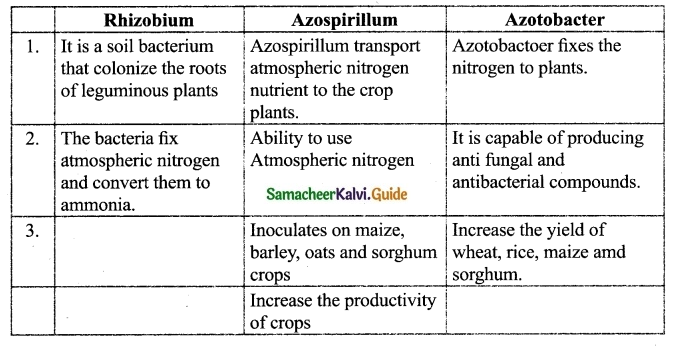
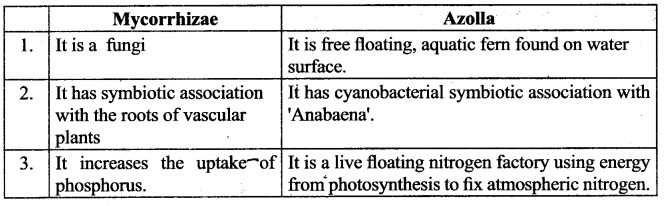
2. Azotobacter b) Soil bacterium
3. Mycorrhizae c) Anabaena
4. Azolla d) Antifungal compounds

Answer:
1 – b, 2 – d, 3 – a, 4 – c

III.

1. Saccharomyces cerevisiae a) Biofertilizers
2. Mycorrhizae b) Organic acids
3. Aspergillus Niger c) Fermented beverages
4. Bacillus Megaterium d) Curing of tobacco leaves

Answer:
1 – c, 2 – a, 3 – b, 4- d

IV.

Diseases Incubation Period
1. Dengue a) 2-12 days
2. Chikungunya b) 5-6 days
3. Filaria c) 4 2-7 days
4. Avian Influenza d) 8-16 months

Answer:
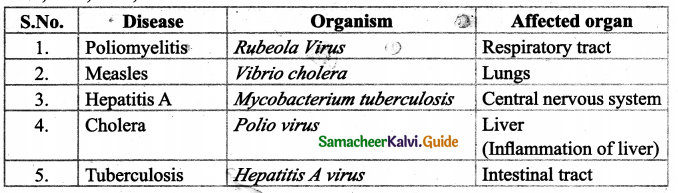
1 – b, 2 – a, 3 – d, 4- c

Samacheer Kalvi 9th Science Guide Chapter 22 World of Microbes

V.
Samacheer Kalvi 9th Science Guide Chapter 22 World of Microbes 6
Answer:
Samacheer Kalvi 9th Science Guide Chapter 22 World of Microbes 7

IV. State whether True or False. If false write the correct statement

1. Virions are the smallest among the infective agents.
Answer:
True.

2. Viruses are devoid of cellular organelles like ribosomes^ mitochondria, etc.
Answer:
True.

3. Prions are found in neurons and are cone-shaped.
Answer:
False.
Correct statement: Prions are found in neurons and are rod-shaped.

Samacheer Kalvi 9th Science Guide Chapter 22 World of Microbes

4. In human beings, antibodies are used to cure infectious diseases like cholera, typhoid, etc.
Answer:
False.
Correct statement: In human beings, antibodies are used to control infectious diseases like cholera, typhoid, etc.

5. An infection develops when these pathogens enter the human body.
Answer:
True.

6. Airborne diseases are caused by fungi.
Answer:
False.
Correct statement: Airborne diseases are caused by bacteria and viruses.

7. Influenza commonly occurs during adult age.
Answer:
False.
Correct statement: Influenza commonly occurs during childhood.

Samacheer Kalvi 9th Science Guide Chapter 22 World of Microbes

8. Malaria is caused by the fungal parasite plasmodium.
Answer:
False.
Correct statement: Malaria is caused by the protozoan parasite Plasmodium.

9. Filaria is transmitted by the bite of an infected Culex mosquito.
Answer:
True.

10. Swine flu spreads through the air by an acute respiratory virus.
Answer:
True.

11. Hepatitis A causes cirrhosis of the liver.
Answer:
False.
Correct statement: Hepatitis B causes cirrhosis of the liver.

Samacheer Kalvi 9th Science Guide Chapter 22 World of Microbes

12. Oral polio vaccine is a killed vaccine.
Answer:
False
Correct statement: Oral polio vaccine is a Live vaccine.

13. Glycogen and oil globules are stored forms of food in fungi.
Answer:
True.

14. One of the differences between virus and viroid is the presence of protein coat in viroid and its absence in the virus.
Answer:
False.
Correct statement: One of the differences between virus and viroid is the presence of protein coat in vim:: and its absence in viroid.

Samacheer Kalvi 9th Science Guide Chapter 22 World of Microbes

V. Assertion and Reason :

Mark the correct answer :
(a) If both Assertion and Reason are true and Reason is the correct explanation of Assertion.
(b) If both Assertion and Reason are true but the reason is not the correct explanation of assertion.
(c) If Assertion is true but Reason is false.
(d) If Assertion is false but Reason is true.

Question 1.
Assertion: Some bacteria may be non-motile.
Reason: Bacteria have a special structure called flagella which are found on cell surfaces.
Answer:
(d) Assertion is false but Reason is true

Question 2.
Assertion : Bacillus Thuringiensis is a biocontrol agent.
Reason : It produces a protein called ‘cry protein’ which kills insect larva.
Answer:
(a) Both assertion and reason are true and Reason is the correct explanation of Assertion

Samacheer Kalvi 9th Science Guide Chapter 22 World of Microbes

Question 3.
Assertion : Cancer is a non-infectious disease.
Reason : Cancer is caused by external factors like pathogens invading the body.
Answer:
(c) Assertion is true but Reason is false
Reason : Cancer is caused by internal factors like the malfunctioning of organs.

Question 4.
Assertion : An infection develops when pathogens enter the human body.
Pathogen enters the human body through contaminated air, water, food, soil, physical contact etc.
Answer:
(a) Both assertion and reason are true and Reason is the correct explanation of Assertion

Question 5.
Assertion : Chikungunya is transmitted in humans by the bite of infected Aedes aegypti mosquito during the day time.
Reason : Chikungunya is caused by Rotavirus.
Answer:
(c) Assertion is true but Reason is false]
Reason : Chikungunya is caused by a single-stranded RNA virus.

Samacheer Kalvi 9th Science Guide Chapter 22 World of Microbes

VI. Expand the following :

  1. CJD
  2. TT
  3. OPV
  4. HAY
  5. AIDS
  6. MMR

Answer:

  1. CJD – Creutzfeldt -Jakob Disease
  2. TT – Tetanus Toxoid
  3. OPV – Oral Polio Vaccine
  4. HAV – Hepatitis A Virus
  5. AIDS – Acquired Immuno Deficiency Syndrome
  6. MMR – Mumps, Measles, Rubella

Samacheer Kalvi 9th Science Guide Chapter 22 World of Microbes

VII. Define the following :

1. Disease, 2. Infection, 3. Antibiotics, 4. Toxin, 5. Vector
Answer:
1. Disease:
The disease can be defined as an impairment or malfunctioning of the normal state of the living organism that disturbs or modifies the performance of vital functions of the body.

2. Infection:
Infection is the entry, development, or multiplication of an infectious agent in the human body or animals.

3. Antibiotics:
Antibiotics are metabolic products of microorganisms whose very low concentrations are inhibitory or detrimental to other microbes.

4. Toxin :
The poisonous substances secreted by pathogens that cause diseases are called toxins.

5. Vector:
Vector is an agent that acts as an intermediate carrier of the pathogen.

Samacheer Kalvi 9th Science Guide Chapter 22 World of Microbes

VIII. Answer in one or two sentences :

Question 1.
What is bacteria?
Answer:
Bacteria are microscopic, single-celled prokaryotic organisms without a nucleus and other cell organelles. >

Question 2.
Differentiate Parasites and Saprophytes.
Answer:
Parasites :
Fungi living on living hosts.

Saprophytes :
Fungi living on dead organic matter.

Samacheer Kalvi 9th Science Guide Chapter 22 World of Microbes

Question 3.
What is the incubation period?
Answer:
1. The interval between infection and the first appearance of the diseases is called the incubation period.
2. It may vary from few hours to several days.

Question 4.
Differentiate Exotoxins and Endotoxins.
Answer:
Exotoxins :
There are directly secreted by the pathogens.

Endotoxins :
There are released by the disintegration of pathogens.

Question 5.
Why is dengue also known as break-bone fever?
Answer:
The name break bone fever was given because contortions caused intense joint and muscle pain.

Samacheer Kalvi 9th Science Guide Chapter 22 World of Microbes

Question 6.
What is an immunization?
Answer:
Immunization is a process of developing resistance to infections by administration of antigens (or) antibodies. .

Question 7.
What is TAB?
Answer:
TAB is a combined vaccine for Typhoid, Paratyphi A and Paratyphi B.

Question 8.
Name two diseases transmitted by Aedes aegypti mosquito?
Answer:

  1. Chikungunya,
  2. Dengue.
Question 9.
What is known as reservior of infection? Give two example.
Answer:
Reservoir of infection are breeding ground for pathogens. E.g. Water, soil.

Samacheer Kalvi 9th Science Guide Chapter 22 World of Microbes

Question 10.
Differentiate signs and symptoms of disease.
Answer:
Signs :
Signs of disease provide information about particular disease.

Symptoms :
Symptoms are recognizable signs of infectious disease.

Question 11.
Name one disease that is transmitted by houseflies. Mention their causative pathogen.
Answer:
Cholera – Vibrio cholerae (pathogen)

Question 12.
Name the scientist who first discovered penicillin antibiotic. Can you name any other known antibiotic?
Answer:

  1. Penicillin was discovered by Alexander Fleming.
  2. Other known Antibiotic – Tetracycline.

Samacheer Kalvi 9th Science Guide Chapter 22 World of Microbes

Question 13.
A baby is suffering from diarrhoea, while other babies in the same locality do not.
Mention the possible causes that you think. What would be the possible solutions for this? »
Answer:

  1. Cause for Diarrhoea: Contaminated food (or) water.
  2. Possible solutions: Hygienic sanitary condition, Use of Oral Rehydration Solution (ORS).

Question 14.
Sanjay had an attack of chickenpox and has just recovered. The health officer of his locality says that the disease would not occur again for him. What would be the reason for this?
Answer:
While Chicken Pox attacks the first time, it develops immunity for the rest of life.

IX. Short answer questions :

Question 1.
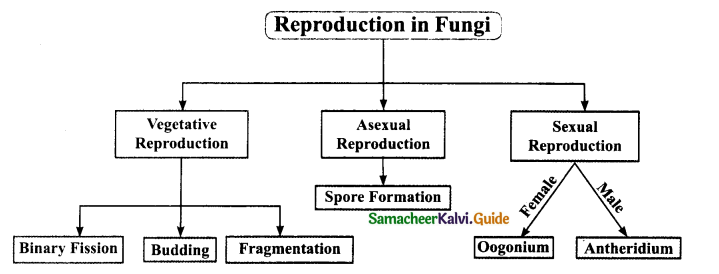
Briefly explain the reproduction of fungi using a flow chart.
Answer:
Samacheer Kalvi 9th Science Guide Chapter 22 World of Microbes 8

Samacheer Kalvi 9th Science Guide Chapter 22 World of Microbes

Question 2.
What is an epidemic disease?
Answer:
Epidemic disease is a disease that breaks out and affects large number of people in a particular geographical region and spreads at the same time. E.g. Influenza.

Question 3.
Differentiate between Infectious and Non-Infectious disease.
Answer:
Infections Disease

  1. They are communicable diseases. .
  2. They are caused by external factors. Invading of pathogens such as bacteria, virus, vectors, parasites etc.
    E.g. Cholera, Malaria, Chickenpox.

Non-infectious disease

  1. They are non-communicable diseases
  2. They are caused by internal factors.
    • Malfunctioning of organs,
    • Genetic causes,
    • Hormonal imbalance and
    • Defective Immune system
      E.g. Cancer, Diabetes.

Samacheer Kalvi 9th Science Guide Chapter 22 World of Microbes

Question 4.
What causes illness?
Answer:
An illness is casual due to a specific infectious agent, capable of being directly or indirectly transmit infection from person to person, animal to animal or from the environment (air, water & food) and insects.

Question 5.
How are respiratory tract infections acquired?
Answer:
Respiratory tract infections are acquired by inhaling air containing the pathogen that is transmitted through droplets caused by cough (or) sneeze, dust, spores, etc.

Question 6.
Name the different species of protozoa plasmodium.
Answer:
The different species of plasmodium are –

  1. Plasmodium vivax
  2. Plasmodium malariae
  3. Plasmodium falciparum
  4. Plasmodium ovale.

Samacheer Kalvi 9th Science Guide Chapter 22 World of Microbes

Question 7.
List the precautionary measures to avoid Avian Influenza.
Answer:
Prevention and Control:

  • Avoid open-air markets where infected birds are sold.
  • Avoid contact and consumption of infected birds.
  • Proper cleaning and cooking of poultry.

Question 8.
Mention the symptoms of poliomyelitis.
Answer:
Symptoms of poliomyelitis :

  • Paralysis of limbs and muscles.
  • Difficulty in walking.

Question 9.
When Malar, who is suffering from high fever, muscle, and joint pain, undergoes a blood test, it was found that her blood platelet was decreased.
a. What disease is Malar infected with?
b. How is the disease transmitted?
c. How can it be treated?
Answer:
a. Dengue fever.
b. Dengue was caused by a virus which is transmitted by the Aedes aegypti mosquito.
c. Treatment:

  • Administer paracetamol to reduce fever and body ache.
  • Increase intake of fluid to increase immunity.
  • Complete rest for rehabilitation.

Samacheer Kalvi 9th Science Guide Chapter 22 World of Microbes

Question 10.
How is typhoid prevented and treated?
Answer:
Prevention:

  • Contaminated food by flies-and dust should be prevented.
  • Basic sanitation and hygienic practices should be improved.

Treatment:
Typhoid should be treated with antibiotic drugs.

Question 11.
We are advised to take bland and nutritious food when we are sick. What is the reason?
Answer:

  • Bland and nutritious food are soft, less spicy and low in fibre.
  • They are easy digestable and energy giving food. . . .
    Thus, sick person can restore his immunity through bland and nutritious food.

Question 12.
How will you differentiate Hepatitis A from Hepatitis B?
Answer:

Hepatitis A Hepatitis B
1. Caused by Hepatitis A virus (HAV) 1. Caused by Hepatitis B virus
2. Transmitted through

  1. Contaminated water
  2. Food
  3. Oral route
2. Transmitted through contact (from infected person to a healthy person)

  1. Sexual.
  2. Blood contact.
  3. By surgical equipment (infected needles and syringes).
  4. Material (foetal transmission from infected mother to the foetus).
3. Liver is affected in Jaundice (Yellow fever) 3. Cirrhosis of liver.

Samacheer Kalvi 9th Science Guide Chapter 22 World of Microbes

X. Long Answer question : 

Question 1.
Enumerate the living and non-living characters of virus.
Answer:
1. Living characters of viruses:

  • They have nucleic acid DNA or RNA i.e., the genetic material that can replicate.
  • They can multiply in the living cells of the host.
  • They can attack specific hosts.

2. Non-living characters of viruses:

  • Viruses remain as inert material outside their hosts.
  • They are devoid of the cell membrane and cell wall.
  • They are devoid of cellular organelles like ribosomes, mitochondria, etc.
  • They can be crystallised.

Question 2.
Discuss how diseases are categorised.
Answer:
Disease can be catagorized on the basis of:

(i) Extent of occurrence
(ii) Infectious nature
(iii) Type of pathogen
(iv) Transmitting Agent

(i) Extent of occurrence :

  • Endemic diseases – Found in the certain geographical area affects the fewer number of people, E.g. Goitre in sub = Himalayan region.
  • Epidemic diseases – Disease which breaks out and affects a large number of people in a particular geographical region and spreads at the same time. E.g. Influenza.
  • Pandemic disease – Widely distributed on a global scale. E.g. AIDS.
  • Sporadic disease – Occasional occurrence of a disease. E.g. Cholera and malaria.

(ii) Infectious nature:

1. Infectious disease are communicable diseases. Caused by external factors pathogenic organisms. E.g. Chickenpox and malaria.

2. Non-Infectious disease:

  • Non-communicable diseases.
  • Caused by internal factors like :
  • Malfunctioning of organs and genetic causes. Hormonal imbalance and immune system defect. E.g. Diabetes, coronary heart diseases, obesity, cancer, goitre etc.

(iii) Types of pathogen :

  • Bacterial diseases
  • Viral diseases
  • Fungal diseases
  • Protozoan diseases

(iv) Transmitting agent:

  • Airborne diseases: Due to continuous inhalation of contaminated air.
    E.g. Tuberculosis.
  • Waterborne diseases: Microbes present in the contaminated water cause various infectious diseases.
    E.g. Cholera, typhoid, etc.
  • Vector-borne diseases: Vector is an agent that acts as an intermediate carrier of the pathogen.
    E.g. Malaria, filaria, chikungunya.

Samacheer Kalvi 9th Science Guide Chapter 22 World of Microbes

Question 3.
Discuss the strategies to adopt to prevent diseases transmitted through mosquitoes.
Answer:

  • Prevention of mosquito bites by using mosquito nets mosquito screens, mosquito repellents, and ointments.
  • Providing adequate sanitation, underground wastewater disposable system, and drainage of stagnant water to eliminate the breeding places.
  • Avoid the collection of water in any uncovered container such as water tanks, pots, flowers, discarded tyres, etc.
  • Spraying oil on stagnated water bodies to control mosquito larvae.
  • Adult mosquitoes can be killed by spraying insecticides.
  • Application of citronella oil (or) eucalyptus oil on the exposed skin.

Question 4.
Amal, a thirteen-year-old boy is suffering from fever, headache, body pain, vomiting, and diarrhoea. He finds it difficult to breathe.

  1. Diagnose the disease.
  2. What is the causative agent?
  3. What prevention and control measures can be taken?

Answer:

  1. Diagnosed Disease: Swine flu.
  2. Causative agent: InfluerKa virus H1N1
  3. Prevention and control:
    • Administration of nasal spray vaccine.
    • Avoiding close contact with a person suffering from the flu.
    • Intake of water and fruit juices will help prevent dehydration.
    • Plenty of rest will help the body fight infection.
    • Always wash hands regularly and practice good hygiene.

Question 5.
Name the causative agent of typhoid in humans. How does the pathogen gain entry into the human body? Write the diagnostic symptoms and mention the organ that is affected in severe cases.
Answer:

  • Causative agent of typhoid: Salmonella Typhi (Bacteria)
  • The entry of Pathogen: Food and water contaminated by the faeces of an infected person through houseflies.
  • Diagnostic symptoms: Fever, weakness, and vomiting.
  • Affected organ: Small Intestine.

Samacheer Kalvi 9th Science Guide Chapter 22 World of Microbes

Question 6.
Some human diseases are transmitted only when the blood of a patient comes in close contact with the blood of a healthy person. In one such disease, there is a progressive decrease in WBC of the patient.

  1. Name the disease and its causative agent.
  2. Name the type of WBC affected during infection.
  3. How does the blood of a patient come in contact with the blood of a healthy patient?
  4. Suggest three methods that help in preventing such infection.

Answer:

  1. Disease Name Causative agent: AIDS (Acquired Immuno Deficiency Syndrome).
  2. Affected WBC type: Human Immunodeficiency Virus (HIV)
  3. Contact of blood: Lymphocytes (T-lymphocytes)
  4. Prevention methods: Transfusion of unscreened blood (blood contact).
    • Usage of disposable syringes and needles.
    • Screening of blood before blood transfusion.
    • Avoid sharing shaving blades/razors.

Samacheer Kalvi 9th Science Guide Chapter 24 Environmental Science

Tamilnadu State Board New Syllabus Samacheer Kalvi 9th Science Guide Pdf Chapter 24 Environmental Science Text Book Back Questions and Answers, Notes.

Tamilnadu Samacheer Kalvi 9th Science Solutions Chapter 24 Environmental Science

9th Science Guide Environmental Science Text Book Back Questions and Answers

Samacheer Kalvi 9th Science Guide Chapter 11 Atomic Structure

I. Choose the correct answer:

Question 1.
All the factors of biosphere which affect the ability of organisms to survive and reproduce are called as ………………
(a) biological factors
(b) abiotic factors
(c) biotic factors
(d) physical factors
Answer:
(c) biotic factors

Question 2.
The ice sheets from the north and south poles and the icecaps on the mountains, get converted into water vapour through the process of ………………..
(a) evaporation
(b) condensalion
(c) sublimation
(d) infiltration
Answer:
(c) sublimation

Samacheer Kalvi 9th Science Guide Chapter 11 Atomic Structure

Question 3.
The atmospheric carbon dioxide enters into the plants through the process of ………………..
(a) photosynthesis
(b) assimilation
(c) respiration
(d) decomposition
Answer:
(a) photosynthesis

Question 4.
Increased amount of ……………….. in the atmosphere, results in greenhouse effect and global warming.
(a) carbon monoxide
(b) sulphur dioxide
(c) nitrogen dioxide
(d) carbon dioxide
Answer:
(d) carbon dioxide

Samacheer Kalvi 9th Science Guide Chapter 11 Atomic Structure

II. Match the following:

Question 1.

Microorganism Role played
Nitrosomonas Nitrogen fixation
Azotobacter Ammonification
Pseudomonas species Nitrification
Putrefying bacteria Denitrification

Answer:

Microorganism Role played
Nitrosomonas Nitrification
Azotobacter Nitrogen fixation
Pseudomonas species Denitrification
Putrefying bacteria Ammonification

Samacheer Kalvi 9th Science Guide Chapter 11 Atomic Structure

III. Say true or false. Correct the false statements :

1. Nitrogen is a greenhouse gas.
Answer:
False.
Correct statement: Carbon dioxide is a greenhouse gas.

2. Poorly developed root is an adaptation of mesophytes.
Answer:
False,
Correct statement: Poorly developed root is an adaptation of Hydrophtes.

3. Bats are the only mammals that can fly.
Answer:
True

Samacheer Kalvi 9th Science Guide Chapter 11 Atomic Structure

4. Earthworms use the remarkable high frequency system called echoes.
Answer:
False.
Correct statement: Buts use the remarkable high frequency system called echoes.

5. Aestivation is an adaptation to overcome cold condition.
Answer:
False.
Correct statement: Aestivation is an adaptation to overcome condition.

Samacheer Kalvi 9th Science Guide Chapter 11 Atomic Structure

IV. Give reason for the following.

Question 1.
Roots grow very deep and reach the layers where water is available. Which type of plants develop the above adaptation? Why?
Answer:
Xerophytes have well developed roots.
Reason: They grow in dry habitat where water is scarcely available.

Question 2.
Why steamlined bodies and presence of setae is considered as adaptations of earthworm?
Answer:

  • Streamlined bodies of earthworm helps to live in narrow burrows underground and for easy penetration into the soil.
  • Seine helps earthworm to move through the soil and provide anchor in the burrows.

Samacheer Kalvi 9th Science Guide Chapter 11 Atomic Structure

Question 3.
Why is it impossible for all farmers to construct farm ponds it in their fields?
Answer:

  • Farm ponds reduce water flow to other tanks and ponds situated in lower-lying areas.
  • Ponds occupy a large portion of farmer’s lands.

V. Answer briefly:

Question 1.
What are the two factors of biosphere?
Answer:
The biosphere is the part of the earth where life exists. All resources of the biosphere can be grouped into two major categories namely:

  1. Biotic or living factors which include plants, animals and all other living organisms.
  2. Abiotic or non-living factors which include all factors like temperature, pressure, water, soil, air and sunlight which affect the ability of organisms to survive and reproduce.

Question 2.
How do human activities affect nitrogen cycle?
Answer:
Human activities,

  • alters the biodiversity
  • changes the food web structure
  • destroys the general habitat.

Samacheer Kalvi 9th Science Guide Chapter 11 Atomic Structure

Question 3.
What is adaptation?
Answer:
Any feature of an organism or its part that enables it to exist under conditions of its habitat is called adaptation.

Question 4.
What are the challenges faced by hydrophytes in their habitat?
Answer:
Challenges faced by hydrophtes:

  • More water availability than needed.
  • Damaging of water body by water current.
  • Regular change of water level.
  • Maintenance of buoyancy in water.

Question 5.
Why is it important to conserve water?
Answer:
Importance of water conservation:

  • It creates a more efficient use of water resources.
  • It ensures that we have enough usable water.
  • It helps in decreasing water pollution.
  • It helps in increasing energy saving.

Samacheer Kalvi 9th Science Guide Chapter 11 Atomic Structure

Question 6.
List some of the ways in which you could save water in your home and school?
Answer:
We could save water by

  • Using low flow taps.
  • Using recycled water for lawns.
  • Repairing the leaks in the taps.
  • Recycling (or) reusing water wherever it is possible.

Question 7.
What are the uses of recycled water?
Answer:
Uses for recycled water:
Agriculture, Landscape, Public parks, Golf course irrigation, Cooling water for power plants and oil refineries, Toilet flushing, Dust control, and Construction activities.

Question 8.
What is IUCN? What is the vision of IUCN?
Answer:
IUCN: International Union for Conservation of Nature and Natural Resources.
VISION: A just world that values and conserves nature.

Samacheer Kalvi 9th Science Guide Chapter 11 Atomic Structure

VI. Answer in detail:

Question 1.
Describe the processes involved in the water cycle.
Answer:
Water cycle or hydrological cycle is the continuous movement of water on earth. In this process, water moves from one reservoir to another, from river to ocean or from ocean to the atmosphere by processes such as evaporation, sublimation, transpiration, condensation, precipitation, surface runoff and infiltration, during which water converts itself to various forms like liquid, solid and vapour.

  • Evaporation: Water evaporates from the surface of the earth and water bodies such as the oceans, seas, lakes, ponds and rivers turn into water vapour.
  • Sublimation: Ice sheets and ice caps from north and south poles, and icecaps on mountains get converted into water vapour directly, without converting into liquid.
  • Transpiration: Transpiration is the process by which plants release water vapour to atmosphere through small pores in leaves and stems.
  • Condensation: At higher altitudes, the temperature is low. The water vapour present there condenses to form very tiny particles of water droplets. These particles come close together to form clouds and fog.
  • Precipitation: Due to change in wind or temperature, clouds combine to make bigger droplets, and pour down as precipitation(rain). Precipitation includes drizzle, rain, snow and hail.
  • Runoff: As the water pours down, it runs over the surface of earth. Runoff water combines to form channels, rivers, lakes and ends up into seas and oceans.
  • Infiltration: Some of the precipitated water moves deep into the soil. Then it moves down and increases the groundwater level.
  • Percolation: Some of the precipitated water flows through soil and porous or fractured rock. Infiltration and percolation are two related but different processes describing the movement of water through soil.

Samacheer Kalvi 9th Science Guide Chapter 11 Atomic Structure

Question 2.
Explain carbon cycle with the help of a flow chart.
Answer:
Samacheer Kalvi 9th Science Guide Chapter 24 Environmental Science-1

Question 3.
List out the adapatations of xerophytes.
Answer:
The conditions that lead to adaptation of plants in a dry habitat are;

  1. To absorb as much water as they can get from their surroundings.
  2. To retain water in their organs for a very long time.
  3. To reduce the transpiration rate.
  4. To reduce the consumption of water.

Adaptations of xerophytes:

  1. They have well-developed roots. Roots grow very deep and reach the layers where water is available as in Calotropis.
  2. They store water in succulent water-storing parenchymatous tissues, e.g. Opuntia, Aloe vera.
  3. They have small-sized leaves with a waxy coating, e.g. Acacia. In some plants, leaves are modified into spines, e.g. Opuntia.
  4. Some of the xerophytes complete their life cycle within a very short period when sufficient moisture is available.

Samacheer Kalvi 9th Science Guide Chapter 11 Atomic Structure

Question 4.
How does a bat adapt itself to its habitat?
Answer:
Adaptations of BAT:

  • Mostly, bats live in caves, which provide protection during the day from most predators and maintain a stable temperature.
  • Bats are active at night. This, is a useful adaptation for them, as flight requires a lot of energy during day.
  • By Hibernation, bats reduce body temperature with lowered metabolic rate during winter.
  • Bats let their internal temperature reduce during rest.
  • Bats use echolocation (High frequency ultrasonic sound waves) to identify and locate the prey.

Question 5.
What is water recycling? Explain the conventional wastewater recycling treatment?
Answer:
Water Recycling: Water recycling is reusing treated wastewater for beneficial purposes
such as agricultural and land irrigation, industrial processes, etc.
Conventional wastewater recycling treatment : Conventional wastewater treatment consists of combination of physical, chemical and biological processes involving the following stages.
Samacheer Kalvi 9th Science Guide Chapter 24 Environmental Science-2

Samacheer Kalvi 9th Science Guide Chapter 11 Atomic Structure

Intext Activities

ACTIVITY – 1

Create your own water cycle.

Take a small container and place it in the middle of the large bowl. Fill water in the large container and cover it with plastic wrap. Fasten the plastic wrap around the rim of the large container with the rubber band. Place a stone on the top of the plastic wrap. Keep this under sun for few hours. Record your observation.

Aim :
To understand utilisation and recycling of water.

Materials:
A large transparent bowl, plastic wrap, a stone, a smaller container and a rubber band. Procedure:

  1. The small container is placed in the middle of the large bowl. Water is filled in the large container and it is covered with plastic wrap.
  2. The plastic wrap is fastened around the rim of the large container with the rubber band.
  3. The stone is placed on the top of the plastic wrap.
    This is placed under the sun for few hours.

Observation :

  1. When we have a close look at the plastic wrap, water droplets would be formed in the surface of plastic wrap. Thus, can conclude there is condensation process.
  2. The level of the water in bowl is reduced. It suggests that a part of water is evaporated.
  3. After sometime, the droplets on the plastic wrap drip into the bowl which indicates the phenonmenon of Precipitation.

Conclusion :
In this activity, the processes such as condensation, evaporation and precipitation have been demonstrated.
[End of the activity]

Samacheer Kalvi 9th Science Guide Chapter 11 Atomic Structure

9th Science Guide Environmental Science Additional Important Questions and Answers

I. Choose the correct answer :

Question 1.
Which of the following is not an adaptation of hydrophytes?
(a) poorly developed root system
(b) reduced plant body
(c) water storing parenchymatous tissues
(d) finely divided submerged leaves
Answer:
(c) water storing parenchymatous tissues

Question 2.
In some xerophytes, leaves are modified into spines as an adaptation ……………..
(a) to reduce transpiration rate
(b) to store water
(c) to reduce consumption of water
(d) all of the above
Answer:
(d) all of the above

Samacheer Kalvi 9th Science Guide Chapter 11 Atomic Structure

Question 3.
Identify the incorrect statement with respect to adaptations of earthworm.
(a) Earthworm has a steam lined body with no antennae or fins.
(b) Each segment of earthworm has setae.
(c) Many earthworms become inactive in a process called hibernation, during winter season.
(d) Earthworms remain in its burrow during day time, to avoid sunlight.
Answer:
(c) Many earthworms become inactive in a process called hibernation during, winter season

Question 4.
Which of the following is one of the strategies to conserve water?
(a) Water recycling %
(b) Using large overhead watSr tanks
(c) Increasing the number of bore wells
(d) Watering the plants using hose.
Answer:
(a) Water recycling

Question 5.
Specific constituents such as nitrogen, phosphorus, suspended solids and heavy metals found in the wastewaer are removed during …………….. treatment of water recycling process.
(a) primary
(b) secondary
(c) tertiary
(d) none of the above
Answer:
(c) tertiary

Samacheer Kalvi 9th Science Guide Chapter 11 Atomic Structure

Question 6.
Free-living soil bacteria such as Pseudomonas sp. are responsible for the ……………..process in the nitrogen cycle.
(a) ammonification
(b) nitrogen fixation
(c) nitrification
(d) denitrification
Answer:
(d) denitrification

Question 7.
Environmental science provides holistic knowledge about ……………..
(a) Natural processes
(b) Effects of human interventions
(b) Solutions to environmental issues
(d) All the above
Answer:
(d) All the above

Question 8.
Which one the following is not an abiotic factor?
(a) water
(b) air
(c) soil
(d) None of these
Answer:
(d) None of these

Samacheer Kalvi 9th Science Guide Chapter 11 Atomic Structure

Question 9.
The process of water cycle that related with the plants is called …………………
(a) Percolation
(b) Evaporation
(c) Transpiration
(d) Precipitation
Answer:
(c) Transpiration

Question 10.
Rain is due to the process of ………………..
(a) Condensation
(b) Precipitation
(b) Sublimation
(d) Run off
Answer:
(b) Precipitation

Question 11.
…………… is the primary nutrient, important for survival of all living organisms.
(a) Nitrogen
(b) Carbon
(c) Hydrogen
(d) Oxygen
Answer:
(a) Nitrogen

Samacheer Kalvi 9th Science Guide Chapter 11 Atomic Structure

Question 12.
The bacteria present in the root nodules of leguminous plants is .
(a) Nitrobacter
(b) Rhizobium
(c) Pseudomonas sp
(d) Nitrosomonas
Answer:
(b) Rhizobium

Question 13.
In the Nitrification process, the ammonium compounds are oxidised to soluble……………………….
(a) Ammonia
(b) Urea
(c) Nitrites
(d) Nitrates
Answer:
(d) Nitrates

Samacheer Kalvi 9th Science Guide Chapter 11 Atomic Structure

Question 14.
The atmospheric carbon dioxide enters into the plants through the process of
photosynthesis to form
(a) Proteins
(b) Carbohydrates
(c) Water
(d) Carbon monoxide
Answer:
(b) Carbohydrates

Question 15.
Carbon dioxide is also returned to atmosphere through ……………………..
(a) Decomposition of dead organic matter
(b) Burning fossil fuels
(c) Volcanic activities
(d) All the above
Answer:
(d) All the above

Question 16.
The plants that has air chambers is ……………..
(a) Wolffia
(b) Opuntia
(c) Eichhomia
(d) Acacia
Answer:
(c) Eichhornia

Samacheer Kalvi 9th Science Guide Chapter 11 Atomic Structure

Question 17.
Which plant is called as “Cindrella of the plant kingdom”?
(a) Hydrilla
(b) Water hyacinth
(c) Calotropis
(d) Aloevera
Answer:
(b) Water hyacinth

Question 18.
Root caps is a characteristic adaptation of ………………….
(a) Xerophytes
(b) Hydrophytes
(c) Mesophytes
(d) All the above
Answer:
(c) Mesophytes

Question 19.
The presence of ………….. in leaves traps the moisture and lessens water loss inMesophytes.
(a) Waxy Cuticle
(b) stomata
(c) stalk
(d) None of these
Answer:
(a) Waxy Cuticle

Samacheer Kalvi 9th Science Guide Chapter 11 Atomic Structure

Question 20.
…………………. supports and controls movements during flight of a bat.
(a) Forelimbs
(b) Hind limbs
(c) Tail
(d) Muscles
Answer:
(c) Tail

Question 21.
Find the incorrect statement
(a) Vermicompost is prepared by using earthworms
(b) Vermicompost decomposes the plant and animal waste
(c) Vermicompost is an inorganic compound
(d) Vermicompost contains water soluble nutrients.
Answer:
(c) Vermicompost is an inorganic compound

Question 22.
World Water Day is celebrated on …………………..
(a) 22nd February
(b) 22nd March
(c) 5th June
(d) 03rd December
Answer:
(b) 22nd March

Samacheer Kalvi 9th Science Guide Chapter 11 Atomic Structure

Question 23.
Which one of the following is not an advantage of farm ponds?
(a) Reduce soil erosion
(b) Recharge ground water
(c) Reduce water flow to other parts
(d) Improve drainage
Answer:
(c) Reduce water flow to other parts

Question 24.
Biological oxidation is the method is used in ……………….
(a) Primary Treatment
(b) Secondary Treatment.
(c) Tertiary Treatment
(d) None of these
Answer:
(b) Secondary Treatment

Samacheer Kalvi 9th Science Guide Chapter 11 Atomic Structure

Question 25.
The wastes removed in tertiary treatment are ………………
(a) Suspended solids
(b) Biodegradable organic matter
(c) Inorganic substances
(d) All of these
Answer:
(c) Inorganic substances

Question 26.
India accounts for …………………% of all recorded species.
(a) 2-4%
(b) 5-6%
(c) 6-7%
(d) 7-8%
Answer:
(d) 7 – 8%

Samacheer Kalvi 9th Science Guide Chapter 11 Atomic Structure

II. Fill in the blanks :

1. …………………is the study of patterns, processes in the natural world and their modifications
by human activities.
Answer:
Environmental Science

2. Biosphere is a …………………. and …………………and system.
Answer:
dynamic, stable

3. Cyclic flow of nutrients between non-living and living factors of the environment are termed as ……………. cycle.
Answer:
Biogeochemical

Samacheer Kalvi 9th Science Guide Chapter 11 Atomic Structure

4. …………………is the reverse of vapourisation.
Answer:
Condensation

5. Atmosphere is a rich source of ………………….
Answer:
Nitrogen

6. The blue-green algae that take part in nitrogen fixation is also called ………………..
Answer:
Cyanobacteria

Samacheer Kalvi 9th Science Guide Chapter 11 Atomic Structure

7. …………………….. animals convert plant proteins into animal proteins.
Answer:
Herbivorous

8. Carnivorous animals synthesize …………………….. from their food.
Answer:
Protein

9. Charcoal, diamond and graphite are …………………….. forms of carbon.
Answer:
Elemental

Samacheer Kalvi 9th Science Guide Chapter 11 Atomic Structure

10. All living organisms are made up of carbon-containing molecules like …………………….. and ………………………
Answer:
Proteins, nucleic acids

11. Floating leaves have long …………………….. to enable the leaves move up and down in response to changes in water level.
Answer:
Leaf stalks

12. …………………….. is the plant in which leaves are modified into spines.
Answer:
Opuntia

13. The function of stomata in leaves of mesophytes is to prevent ………………………
Answer:
Transpiration

14. In bats, the excessive heat absorption dining the day is caused by ……………………..
Answer:
Patagium

Samacheer Kalvi 9th Science Guide Chapter 11 Atomic Structure

15. In bats modified forelimbs serve as ……………..
Answer:
Wings

16. …………………….. of hind limbs in bat provides a tight grasp when the animals are suspended upside down.
Answer:
Tendons

17. Bats are …………………….. blooded animals
Answer:
warm

18. Earthworm belongs to Phylum . ……………………..
Answer:
Annelida

19. Moist skin in earthworm helps in …………………….. of blood.
Answer:
Oxygenation

Samacheer Kalvi 9th Science Guide Chapter 11 Atomic Structure

20. The theme for World Water Qay 2018 is ………………………
Answer:
Nature for water

21. The microorganism used in file secondary treatment must be separated from treated wastewater by ……………………..
Answer:
Sedimentation

22. There are …………………….. globally identified biodiversity hotspots in India.
Answer:
Four

23. IUCN was founded on …………………….. at Gland, Switzerland.
Answer:
5th October 1948

Samacheer Kalvi 9th Science Guide Chapter 11 Atomic Structure

III. Match the following :

Question 1.

Water cycle Application of fertilizers
Nitrogen cycle Sunlight
Carbon cycle Deforestation
Abiotic factor Volcanic activities

Answer:

Water cycle Deforestation
Nitrogen cycle Application of fertilizers
Carbon cycle Volcanic activities
Abiotic factor Sunlight

Question 2.

XeroLyïtes Broad and thin leaves
Mesophytes Reducedjplant body
Hydrophytes Water hyacinth
Green manure Small sized leaves

Answer:

XeroLyïtes Small sized leaves
Mesophytes Broad and thin leaves
Hydrophytes Reducedjplant body
Green manure Water hyacinth

Question 3.

Aestivation Heat absorption
Echolocation Fall in body temperature
Hibernation Ultrasonic sounds
patagium low metabolism

Answer:

Aestivation low metabolism
Echolocation Ultrasonic sounds
Hibernation Fall in body temperature
patagium Heat absorption

Question 4.

Secondary Treatment Disinfection
Grey water Floatation
Primary Treatment Reusuable waste water
Tertiary Treatment Sedimentation

Answer:

Secondary Treatment Sedimentation
Grey water Reusable waste water
Primary Treatment Floatation
Tertiary Treatment Disinfection

IV. Say true or false. Correct the false statements :

1. Sublimation is conversion of solid into liquid.
Answer:
False.
Correct statement: Sublimation is conversion of solid into Gas.

2. Nitrogen is an essential component of protein, DNA and chlorophyll.
Answer:
True.

Samacheer Kalvi 9th Science Guide Chapter 11 Atomic Structure

3. Plant proteins are excreted in theTorm of urea, uric acid or ammonia.
Answer:
False.
Correct statement : Animal proteins are excreted in the form of urea, uric acid or ammonia %

4. During respiration, plants and animals release carbon into the atmosphere in the form of carbon monoxide.
Answer:
False.
Correct statement : During respiration, plants and animals release carbon into the atmosphere in the form of Carbon dioxide

5. Bats are not blind.
Answer:
True.

Samacheer Kalvi 9th Science Guide Chapter 11 Atomic Structure

6. Earthworm come out of their burrow during summer season.
Answer:
False.
Correct statement: Earthworm come out of their burrow during rainy season.

7. Earthworm reacts positively to brighter light.
Answer:
False.
Correct statement: Earthworm reacts negatively to brighter light.

8. Clean and Fresh water is essential for every human activity.
Answer:
True.

9. Nicobar island is one of the biodiversity hotspots in India.
Answer:
True.

Samacheer Kalvi 9th Science Guide Chapter 11 Atomic Structure

V. Assertion and Reason type questions :

Mark the correct choice as :
(a) If both Assertion and Reason are true and Reason is the correct explanation of Assertion.
(b) If both assertion and reason are true but reason is not the correct explanation of assertion.
(c) If assertion is true but reason is false.
(d) If assertion is false but reason is true.

Question 1.
Assertion (A) : Biosphere is a dynamic and stable system.
Reason (R) : There is a constant interaction between biotic and abiotic components in the biosphere.
Answer:
(a) Both Assertion and Reason are true and Reason is the correct explanation of Assertion

Question 2.
Assertion (A) : Infiltration and Percolation are two related but different processes.
Reason (R) : They describe the movement of water through atmosphere.
Answer:
(c) Assertion is true but reason is false
Reason (R): They describe the movement of water through Soil.

Question 3.
Assertion (A) : Plants and animals can utilize atmospheric nitrogen.
Reason (R) : Atmosphere is a rich source of nitrogen.
Answer:
(d) Assertion is false but reason is true
Assertion (A) : Plants and animals cannot utilise atmospheric nitrogen.

Samacheer Kalvi 9th Science Guide Chapter 11 Atomic Structure

Question 4.
Assertion (A) : By increasing the amount of carbon dioxide, earth becomes warmer.
Reason (R) : Carbon dioxide is a green house gas.
Answer:
(a) Both Assertion and Reason are true and Reason is the correct explanation of Assertion

Question 5.
Assertion (A) : The moist skin in earthworm helps in oxygenation of blood.
Reason (R) : The slippery skin of earthworm is kept moist.
Answer:
(b) Both assertion and reason are true but reason is not the correct explanation of assertion
Reason (R) : The slippery skin of earthworm is kept moist as it respires through the skin. Moist skin helps in oxygenation of blood.

Samacheer Kalvi 9th Science Guide Chapter 11 Atomic Structure

VI. Very Short Answer Questions

Question 1.
Name three Biogeochemical cycles.
Answer:
Some of the important Biogeochemical cycles are :

  1. Water cycle
  2. Nitrogen cycle
  3. Carbon cycle.

Question 2.
List the forms of Precipitation.
Answer:
Precipitation includes

  • Drizzle
  • Rain
  • Snow
  • Hail.

Samacheer Kalvi 9th Science Guide Chapter 11 Atomic Structure

Question 3.
Mention the excretory forms of Animal proteins.
Answer:

  • Urea
  • Uric acid
  • Ammonia

Question 4.
What are the effects of carbon dioxide in the atmosphere?
Answer:

  • Green house effect
  • Global warming.

Question 5.
How are plants classified on the basis of water availability?
Answer:
On the Basis of water availability, plants have been classified as:

  • Hydrophytes
  • Xerophytes
  • Mesophytes.

Samacheer Kalvi 9th Science Guide Chapter 11 Atomic Structure

Question 6.
How are bats important to humans?
Answer:

  • Bats reduce insect population.
  • They help to pollinate plants.

Question 7.
What is the Ideal temperature range of earthworm?
Answer:
The Ideal temperatures range is 60-80°F.

VII. Answer briefly :

Question 1.
Define : Environmental Science.
Answer:
Environmental science is defined as the study of patterns, processes in the natural world and their modifications by human activities.

Samacheer Kalvi 9th Science Guide Chapter 11 Atomic Structure

Question 2.
What is biogeochemical cycle?
Answer:
The cyclic flow of nutrients between non-living and living factors of the environment are termed as Biogeochemical cycles.

Question 3.
How are clouds and fogs formed?
Answer:

  • At higher altitudes, the temperature is low. The water vapour present there condenses to form very tiny particles of water droplets.
  • These particles come close together to form clouds and fog.

Question 4.
How is carbon dioxide returned to atmosphere? :
Answer:
Carbon dioxide is returned to the atmosphere through

  • decomposition of dead organic matter,
  • burning fossil fuels
  • volcanic activities.

Samacheer Kalvi 9th Science Guide Chapter 11 Atomic Structure

Question 5.
Explain briefly the role of earth-worm in soil atmosphere, (or) soil health?
Answer:

  • Earthworm facilitates aeration, water infiltration.
  • It produces organic matter to increase crop growth.

Question 6.
What is worm castings? How is it useful?
Answer:

  • The faecal wastes of earthworm are called worm castings.
  • They are rich in nitrogenous content which adds fertility to the soil.

Question 7.
Point out the importance of water conservation.
Answer:

  • Water conservation creates more efficient use of the water resources.
  • It ensures enough usable water.
  • It helps to decrease water pollution.
  • It helps in increasing energy saving.

Samacheer Kalvi 9th Science Guide Chapter 11 Atomic Structure

Question 8.
According to you, which process of water cycle is adversely affected by human activities?
Answer:
Transpiration by which plants release water vapour through small pores in leaves and stems.
Reason : Human activities such as Deforestation, urbanisation.

Question 9.
Identify the given plant. How does it adapt itself to its habitat?
Samacheer Kalvi 9th Science Guide Chapter 24 Environmental Science-3
Answer:
Hydrilla:

  • Poorly developed Root.
  • Narrow (or) finely divided submerged leaves.

Samacheer Kalvi 9th Science Guide Chapter 11 Atomic Structure

Question 10.
What is grey water? %
Answer:
Grey water is reusable waste water from residential, commercial and industrial bathroom sinks, bath tub, shower drains and washing of clothes.

VIII. Answer in detail :

Question 1.
Draw a neat flow chart of Nitrogen cycle. Briefly explain the various processes involved in nitrogen cycle.
Answer:
Samacheer Kalvi 9th Science Guide Chapter 24 Environmental Science-4
Process involved in nitrogen cycle are explained below :

1. Nitrogen Fixation:
Process : Conversion of atmospheric Nitrogen (inert) into reactive compounds.
Agents : Bacteria and Bluegreen algae (cyanobacteria), (microorganism), Rhizobium.
Occurrence : Root nodules of leguminous plants peas, beans, etc.

2. Nitrogen Assimilation:
Process : Plants absorb nitrate ions and made into organic matter like proteins and nucleic acids.
Agents : Plants, animals.

3. Ammonification :
Process: Decomposition of nitrogenous waste into ammonium compounds.
Micro organism : Putrefying Bacteria, and fungi.
End Products : Urea, Uric acid (or) Ammonia.

4. Nitrification
Process: Ammonium compounds are oxidised to soluble nitrates.
Bacteria : Nitrification is caused by nitrifying bacteria.

5. Denitrification:
Process: Reduction of nitrate ions of soil into gaseous nitrogen which enters into the atmosphere.
Bacteria : Pseudomonas sp.

Samacheer Kalvi 9th Science Guide Chapter 11 Atomic Structure

Question 2.
Write the adaptations of mesophytes.
Answer:

  • The roots of mesophytes are well developed with root caps.
  • They have straight as well as branched stems.
  • Broad and thin leaves with waxy cuticles.
  • Waxy cuticles traps the moisture and lessens water loss.
  • Leaves have stomata which close in extreme heat and wind to prevent transpiration.

Samacheer Kalvi 9th Science Guide Chapter 11 Atomic Structure

Question 3.
Discuss the adaptations of earthworm with its applications.
Answer:
adaption : of Earthworm :
1. Stream-lined body:
Adaptation : Earthworm has cylindrical, elongated and segmented body.
Application : 1. To live in burrows, 2. Easy penetration into soil.

2. Skin: .
Adaptation : Mucus covers skin, 2. slippery moist skin.
Application : 1. It does not allow soil particle to stick on the skin.
2. Respiration through skin and oxygenation of blood.

3. Burrowing:
Adaptation : 1. Circular and longitudinal muscles in body.
2. Each segment of the lower surface of the body has number of bristles called setae.
Application: 1. Movement and subsoil burrowing.
2. To move through the soil and provide anchor in the burrows.

4. Aestivation
Adaptation : 1. During dry (or) hot condition, Earthworms moves deep into the soil and become inactive.
2. It secrets mucus and lowers metabolic rate.
Application: To reduce water loss.

5. Nocturnality:
Adaptation : Earthworm sense light through light-sensitive cells in the skin.
Remains in burrow during day.
Application : To detect light and changes in light intensity.

Samacheer Kalvi 9th Science Guide Chapter 11 Atomic Structure

Question 4.
Describe layout of a Farm pond.
Answer:
1. Farm pond is a dugout structure with definite shape and size.
2. They have proper inlet and outlet structures for collecting the surface run off flowing from the farm area.
3. The size and depth of the pond depend upon

  • The amount of land available.
  • The type of soil
  • Water requirement of farmers
  • The cost of excavation

4. The stored water is used forinigation.

Question 5.
What are all the strategies used to support water conservation?
Answer:
Water conservation strategies

  • Rain water harvesting.
  • Improved Irrigation techniques.
  • Use of traditional water harvesting structures.
  • Minimising domestic water consumption.
  • Awareness on water conservation.
  • Construction of farm ponds.
  • Recycling of water.

Samacheer Kalvi 9th Science Guide Chapter 11 Atomic Structure

Question 6.
List out any five advantages of Farm ponds.
Answer:
The advantages of farm ponds are-

  • They provide water to growing crops, without waiting for rainfall.
  • They reduce soil erosion.
  • They recharge ground water.
  • They improve drainage.
  • The excavated soil can be used to enrich soil in fields and levelling lands.
  • They promote fish rearing.
  • They provide water for domestic purposes and livestock.

Samacheer Kalvi 9th Science Guide Chapter 23 Economic Biology

Tamilnadu State Board New Syllabus Samacheer Kalvi 9th Science Guide Pdf Chapter 23 Economic Biology Text Book Back Questions and Answers, Notes.

Tamilnadu Samacheer Kalvi 9th Science Solutions Chapter 23 Economic Biology

9th Science Guide Economic Biology Text Book Back Questions and Answers

Samacheer Kalvi 9th Science Guide Chapter 23 Economic Biology

I. Choose the correct answer :

Question 1.
The production and management of fish is called
(a) Pisciculture
(b) Sericulture
(c) Aquaculture
(d) Monoculture
Answer:
(a) Pisciculture

Question 2.
Which one of the following is not an exotic breed of cow?
(a) Jersey
(b) Holstein-Friesan
(c) Sahiwal
(d) Brown Swiss
Answer:
(c) Sahiwal

Samacheer Kalvi 9th Science Guide Chapter 23 Economic Biology

Question 3.
Which one of the following is an Italian species of honey bee?
(a) Apis mellifera
(b) Apis dorsata
(c) Apis florae
(d) Apis cerana
Answer:
(a) Apis mellifera

Question 4.
Which one of the following is not an Indian major carp?
(a) Rohu
(b) Catla
(c) Mrigal
(d) Singhara
Answer:
(d) Singhara

Samacheer Kalvi 9th Science Guide Chapter 23 Economic Biology

Question 5.
Drones in the honey bee colony are formed from
(a) unfertilized egg
(b) fertilized egg
(c) parthenogenesis
(d) both b and c
Answer:
(a) unfertilized egg

Question 6.
Which of the following is an high milk yielding variety of cow?
(a) Holstein-Friesan
(b) Dorset
(c) Sahiwal
(d) Red Sindhi
Answer:
(a) Holstein-Friesan

Samacheer Kalvi 9th Science Guide Chapter 23 Economic Biology

Question 7.
Which Indian variety of honeybee is commonly used for apiculture?
(a) Apis dorsata
(b) Apis florea
(c) Apis niellifera
(d) Apisindica
Answer:
(d) Apis indica

Question 8.
…………….. is the method of grafting plants without soil.
(a) Horticulture
(b) Hydroponics
(c) Pomology
(d) None of these
Answer:
(b) Hydroponics

Question 9.
The symbiotic association of fungi and vascular plants is
(a) Lichen
(b) Rhizobium
(c) Mycorrhizae
(d) Azotobacter
Answer:
(c) Mycorrhizae

Samacheer Kalvi 9th Science Guide Chapter 23 Economic Biology

Question 10.
The plant body of mushroom is
(a) Spawn
(b) Mycelium
(c) Leaf
(d) All of these
Answer:
(b) Mycelium

II. Fill in the blanks :

1. Quinine drug is obtained from …………………
Answer:
Cinchona (cinjona maram)

2. Carica papaya leaf can cure disease.
Answer:
Dengue

3. Vermicompost is a type of soil made by …………… and microorganisms.
Answer:
Earthworm

Samacheer Kalvi 9th Science Guide Chapter 23 Economic Biology

4. …………… refers to the culture of prawns, pearl and edible oysters.
Answer:
Aquaculture

5. The largest member in a honey bee hive is is the ……………
Answer:
Queen Bee

6. …………… is a preservative in honey.
Answer:
Formic acid

7. …………… is the method of culturing different variety of fish in a water body.
Answer:
Polyculture

III. Say true or false. If false, correct Hie statement:

1. Mycorrhiza is an algae.
Answer:
Correct statement: Mycorrhiza is a tumgi

2. Milch animals are used in agriculture and transport.
Answer:
False
Correct statement: Milch animals are used in milk production

Samacheer Kalvi 9th Science Guide Chapter 23 Economic Biology

3. Apis florea is a rock bee.
Answer:
False
Correct statement: Apis florea is a rock bee.

4. Ongole is an exotic breed of cattle.
Answer:
False.
Correct statement: Ongole is an Indian breed of cattle.

5. Sheep manure contains high nutrients than farm yard manure.
Answer:
True.

IV. Differentiate the following :

(a) Exotic breed and Indigenous breed.
Answer:

Exotic Breed Indigenous Breed
The exotic breeds are imported from foreign countries. Indigenous Breeds are native of India.
They include Jersey, Brown Swiss, Holstein – Friesian. They include Sahiwal, Red Sindhi, Deoni and Gir.

Samacheer Kalvi 9th Science Guide Chapter 23 Economic Biology

(b) Pollen and Nectar
Answer:

Pollen Nectar
It is fine powder of microscopic particles from the male flower. It is a‘sweet sdbstance, produced by plants to attract pollinators such as bee, butterfly.
Pollen is produced by anther, male reproductive organ. Nectar is converted into Honey.

(c) Shrimp and Prawn
Answer:

Shrimp Prawn
Marine inhibited prawns are called Shrimps, which breed in deep sea. Prawn are crustaceans inhibited in fresh water, marine water, estuaries, etc

(d) Farmyard manure and Sheep manure
Answer:

Farmyard manure Sheep manure
It is a mixture of cattle dung, urine, litter material, and other dairy wastes. This is the manure of sheep or Goat
0.5% Nitrogen, 0.2% Phosphate, 0.5% potash. 3% Nitrogen, 1% phosphorus pentoxide 2% potassium oxide.
Less compared to sheep manure High nutrients.

V. Match the following :

Column A Column B
1. Lobsters Marine fish
2. Catla Pearl
3. Sea bass Shell fish
4. Oysters Paddy
5. Pokkali Fin fish
6. Pleurotus sps Psoriosis
7. Sarpagandha Oyster mushroom
8. Olericulture Reserpine
9. Wrighta tinctoria Vegetable farming

Answer:

Column A Column B
1. Lobsters Shell fish
2. Catla Fin fish Pearl
3. Sea bass Marine fish
4. Oysters Pearl
5. Pokkali Paddy
6. Pleurotus sps Oyster mushroom
7. Sarpagandha Reserpine
8. Olericulture Vegetable farming
9. Wrighta tinctoria Psoriosis

Samacheer Kalvi 9th Science Guide Chapter 23 Economic Biology

VI. Answer briefly :

Question 1.
What are the secondary metabolites?
Answer:
Most medicines are obtained either directly or indirectly from plants. All the major system of medicines such as Ayurveda, Yoga, Unani, Siddha, Homeopathy (AYUSH) use drugs obtained from plants and animals. These drugs from medicinal plants are called secondary metabolites.

Question 2.
What are the types of vegetable gardens?
Answer:
Types of vegetable gardens are

  1. Kitchen or Nutrition gardening
  2. Commercial gardening
  3. Vegetable forcing
  4. Greenhouse (or) Poly House
  5. Organic Vegetable Gardening.

Samacheer Kalvi 9th Science Guide Chapter 23 Economic Biology

Question 3.
Mention any two mushroom preservation methods.
Answer:
Drying and Vacuum Cooling are some methods used to preserve mushrooms.

Question 4.
Enumerate the advantages of vermicompost over chemical fertilizer.
Answer:

  • Vermicompost is free from pathogens and toxic elements.
  • It enhances the decomposition of organic matter in soil.
  • It is rich in beneficial microflora.
  • It contains valuable vitamins, enzymes and growth regulator substances.

Question 5.
What are the species of earthworm used for vermiculture?
Answer:
Among the vast community of earthworms, only very few species can be used for vermicompost production. They are Perionyx excavatus (Indian blue worm), Eisenia fetida (Red worms), Eudrilus eugeniae (African nightcrawler).

Samacheer Kalvi 9th Science Guide Chapter 23 Economic Biology

Question 6.
List the medicinal importance, of honey.
Answer:

  • Honey has an antiseptic and antibacterial property.
  • It is a blood purifier.
  • It helps in building up hemoglobin content in the blood.
  • It prevents cough, cold, fever, and relieves sore throat.
  • It is a remedy for ulcers of the tongue, stomach, and intestine.
  • It enhances digestion and appetite.

VII. Answer in detail :

Question 1.
Enumerate the advantage of hydroponics.
Answer:
Hydroponics was demonstrated by a German Botanist Julius Von Sachs in 1980.
Advantages:

  • Crops can be grown in places where the land is limited, doesn’t exist, or is heavily contaminated.
  • The climate – temperature, humidity, light intensification, the composition of the air can be monitored.
  • Conservation of water and nutrients.
  • Controlled plant growth.
  • No intrusion by weeds.
  • Fewer pests & diseases
  • Minimal use of insecticide or herbicides
  • In deserts and Arctic regions hydroponics can be an effective alternative method.
  • Hydroponics is successfully employed for the commercial production of seedless cucumber and tomato.

Question 2.
Define Mushroom culture. Explain the mushroom cultivation methods.
Answer:
Mushroom is a fungus belonging to basidiomycetes. It is rich in proteins, fibres, vitamins and minerals. Mushroom culture is the process of producing food, medicine, and other products by the cultivation of mushrooms.
Mushrooms can be cultivated either on paddy straw or on the wood log.
Major stages of mushroom cultivation are;

  • Composting: Compost is prepared by mixing paddy straw with a number of organic materials like cow dung and inorganic fertilizers. It is kept at about 50°C for one week.
  • Spawning: Spawn is the mushroom seed. It is prepared by growing fungal mycelium in grains under sterile conditions. Spawn is sown on the compost.
  • Casing: Compost is covered with a thin layer of soil. It gives support to the growing mushroom, provides humidity, and helps regulate the temperature.
  • Pinning: Mycelium starts to form a little bud, which will develop into mushrooms. Those little white buds are called pins.
  • Harvesting: Mushroom grows better in 15°C – 23°C. They grow 3 cm in a week which is the normal size for harvesting. In the third week, the first flush mushroom can be harvested.

Samacheer Kalvi 9th Science Guide Chapter 23 Economic Biology

Question 3.
What are the sources of organic resources for vermicomposting?
Answer:
Biologically degradable organic wastes are used as potential organic resources for vermicomposting.
They are :

  • Agricultural wastes (Crop residue, Vegetable waste, Sugarcane trash).
  • Crop residues (rice straw, tea wastes, cereal and pulse residues, rice husk, tobacco wastes, coir wastes).
  • Leaf litter.
  • Fruit and vegetable wastes.
  • Animal wastes (cattle dung, poultry droppings, pig slurry, goat and sheep droppings).
  • Biogas slurry.

Question 4.
Give an account of different types of fish ponds used for rearing fishes.
Answer:
Types of ponds for fish culture
The fish farm requires different types of the pond for the various developmental stages of fish growth. They are:

  1. Breeding pond: Healthy and sexually mature male and female fishes are collected and introduced in this pond for breeding. The eggs released by the female are fertilized by the sperm and fertilized eggs float in water as frothy mass.
  2. Hatchling pits: The fertilized eggs are transferred to hatching pits for hatching. Two types of hatching pits are hatcheries and hatching hapas.
  3. Nursery ponds: The hatchlings are transferred from hatching pits after 2 to 7 days. The hatchlings grow into fry and are cultured in these ponds for about 60 days with proper feeding till they reach 2 -2.5 cm in length.
  4. Rearing ponds: Rearing ponds are used to culture the fry. The fish fry are transferred from nursery pond to rearing ponds and are maintained for about three months till they reach 10 to 15 cm in length. In these rearing ponds the fry develops into fingerlings.
  5. Stocking pond: The stocking pond is also called a culture pond or production pond. These ponds are used to rear fingerlings upto the marketable size. Before releasing the fingerlings, the pond is manured with organic manure and inorganic fertilizers.

Samacheer Kalvi 9th Science Guide Chapter 23 Economic Biology

Question 5.
Classify the different breeds of the cattle with suitable examples.
Answer:
Samacheer Kalvi 9th Science Guide Chapter 23 Economic Biology-1

VIII. Higher Order Thinking Skills :

Question 1.
Biomanuring plays an important role in agriculture. Justify.
Answer:

  • Biomanuring reduces soil pollution, water pollution and air pollution, etc.
  • It protects soil health and promotes soil fertility.
  • It provides healthy production of vegetables, fruits etc.
  • It makes the soil fertile by adding nutrients like nitrogen.

Question 2.
Each bee hive consists of hexagonal cells. Name the material in which the cell is formed and mention the significance of the hexagonal cells.
Answer:

  • The comb of the bees is formed mainly by the secretion of the wax glands present in the abdomen of the worker bee.
  • A comb is a vertical sheet of wax with double layer of hexagonal / cells.
  • Hexagonal cells serve as storage vessels for honey as well as homes to raise the young bees.

Samacheer Kalvi 9th Science Guide Chapter 23 Economic Biology

9th Science Guide Economic Biology Additional Important Questions and Answers

I. Choose the correct answer :

Question 1.
Olericulture refers to the farming of ………………..
(a) Vegetable
(b) Flowers
(c) Fruits
(d) All of these
Answer:
a) Vegetable

Question 2.
India is the ………………..largest producer of vegetables next to China.
(a) First
(b) Second
(c) Third
(d) Fourth
Answer:
(b) Second

Samacheer Kalvi 9th Science Guide Chapter 23 Economic Biology

Question 3.
Tuber rose is cultivated from ………………..
(a) Madurai zone
(b) Hill area zone
(c) Coimbatore zone
(d) Hosurzone
Answer:
(c) Coimbatore zone

Question 4.
Green manure also helps in reclamation of ……………….. soils.
(a) Acidic
(b) Alkaline
(c) neutral
(d) None of these
Answer:
(b) Alkaline

Samacheer Kalvi 9th Science Guide Chapter 23 Economic Biology

Question 5.
Azolla having a cyanobacterial symbiotic association with ………………..
(a) Azotobacter
(b) Azospirillum
(c) Mycorrhizae
(d) Anabaena
Answer:
(d) Anabaena

Question 6.
Quinine is a best drug for treatment of ………………..
(a) Dengue
(b) Psoriasis
(c) Malaria
(d) Leukemia
Answer:
(c) Malaria

Question 7.
Nilavembu kashayam is givep to patients/people to protect from . ………………..
(a) Dengue
(b) Chikungunya
(c) Diabetes
(d) All of these
Ans :
(d) All of these

Samacheer Kalvi 9th Science Guide Chapter 23 Economic Biology

Question 8.
Reserpine is derived from ………………
(a) Cathyranthusroseus
(b) Rauwolfia serpentina
(c) Hemidesmus indicus
(d) Aloe vera
Answer:
(b) Rauwolfia serpentina

Question 9.
Casing is done on the mushroom to ………………..
(a) support the growth of mushroom
(b) provide humidity to mushroom
(c) regulate the temperature
(d) All the above
Answer:
(d) All the above

Question 10.
The growth medium of Aeroponics is
(a) Nutrients
(b) Water
(c) air
(d) soil
Answer:
(c) air

Samacheer Kalvi 9th Science Guide Chapter 23 Economic Biology

Question 11.
The Indigenous Draught breed from Thanjavur district is ………………..
(a) Pulikulam
(b) Bargur
(c) Ongole
(d) Umblachery
Answer:
(d) Umblachery

Question 12.
………………..are low in fibre and contain a high level of carbohydrates, protein, and other
nutrients.
(a) Silage
(b) Concentrates
(c) Roughage
(d) None of these
Answer:
(b) Concentrates

Samacheer Kalvi 9th Science Guide Chapter 23 Economic Biology

Question 13.
Operation Flood is the programme for ………………..development.
(a) Dairy
(b) Cattle
(c) Marine
(d) Agriculture
Answer:
(a) Dairy

Question 14.
Air-breathing fishes are cultured in ………. water.
(a) Brackish
(b) Fresh
(c) Marine
(d) All of these
Answer:
(b) Fresh

Question 15.
Central Marine Fisheries Research Institute (CMFRI) is situated at …………………
(a) Chennai
(b) Mumbai
(c) Cochin
(d) Vizag
Answer:
(c) Cochin

Samacheer Kalvi 9th Science Guide Chapter 23 Economic Biology

Question 16.
Culture of fishes along with Agricultural crops is known as ………………..
(a) Polyculture
(b) Extensive culture
(c) Integrated culture
(d) Intensive culture
Answer:
(c) Integrated culture

Question 17.
The longest marine water prawn is
(a) Penaeus Indicus
(b) Penaeus monodon
(c) Macro brachium rosenbergii
(d) Macro brachium malcoumsonii
Answer:
(b) Penaeus monodon

Samacheer Kalvi 9th Science Guide Chapter 23 Economic Biology

Question 18.
Earthworms are sacred – This statement was made by ………………..
(a) Aristotle
(b) Darwin
(c) Plato
(d) Cleopatra
Answer:
(d) Cleopatra

Question 19.
Vermicompost is similar to ……………….. in colour and appearance.
(a) sheep manure
(b) Farmyard manure
(c) Green manure
(d) All of these
Answer:
(b) Farmyard manure

Question 20.
………………..is an enzyme present in Honey
(a) Sucrose
(b) Dextrose
(c) Invertase
(d) Maltase
Answer:
(c) Invertase

Samacheer Kalvi 9th Science Guide Chapter 23 Economic Biology

Question 21.
Fastest growing sector in Agriculture is ………………..
(a) Vegetable forcing
(b) Hydroponics
(c) Greenhouse
(d) Aqua ponies
Answer:
(c) Greenhouse

Question 22.
Which of the following are Indian cattle?
(i) Bos indicus
(ii) Bos domesticus
(iii) Bos bubalis
(iv) Bos vulgaris
(a) (i) and (ii)
(b) (i) and (iii)
(c) (ii) and (iii)
(d) (iii) and (iv)
Answer:
(b) (i) and (iii)

Samacheer Kalvi 9th Science Guide Chapter 23 Economic Biology

Question 23.
Which one of the following is referred as red worms?
(a) Eudrilus fetida
(b) Eudrilus eugieniae
(c) Eisenia fetida
(d) Lampito mauritii
Answer:
(c) Eisenia fetida

Question 24.
Mehsana is a breed of
(a) Cow
(b) Buffalo
(c) Goat
(d) Sheep
Answer:
(b) Buffalo

Samacheer Kalvi 9th Science Guide Chapter 23 Economic Biology

Question 25.
Binomial name of Nilavemubu is ………………..
(a) Leucas Aspera
(b) Andrographis paniculata
(c) Crotalaria juncea
(d) Cassia fistula
Answer:
(b) Andrographis paniculata

II. Fill in the blanks:

1. ………….. is the most intensive type of vegetable growing.
Answer:
Vegetable forcing

2. India stands first in the world in the production of…………………… and …………………….
Answer:
Potato, Lady’s finger

Samacheer Kalvi 9th Science Guide Chapter 23 Economic Biology

3. Compost is a …………………… as well as a fertilizer, which is rich in nutrients.
Answer:
Soil conditioner

4. Earthworms eat …………………… and excrete it in a digested form.
Answer:
biomass

5. Green manure is obtained from undecomposed green material derived from …………………… plants.
Answer:
Leguminous

6. …………………… is a type of Bio-fertilizers that are capable of producing antifungal and antibacterial compounds.
Answer:
Azotobacter

Samacheer Kalvi 9th Science Guide Chapter 23 Economic Biology

7. Mycorrhizae increase the uptake of …………………….
Answer:
Phosphorous

8. …………………… is the study of chemical substances derived from plants .
Answer:
Phytochemistry

9. …………………… is used as an antidote for snake bite.
Answer:
Chivan Amalpodi (Sarpagandha)

Samacheer Kalvi 9th Science Guide Chapter 23 Economic Biology

10. Alkaloids, Terpenoids, flavonoids etc are called …………………… metabolites.
Answer:
Secondary

11. India’s first anti-diabetic ayurvedic drug is …………………….
Answer:
BGR-34

12. Mushroom is a fungi belonging to …………………….
Answer:
Basidiomycetes

Samacheer Kalvi 9th Science Guide Chapter 23 Economic Biology

13. Hydroponics was first demonstrated by German botanist …………………….
Answer:
Julius Von Sachs

14. Milk production in cattle depends upon the duration of ……………………
Answer:
Lactation

15. Jallikattu madu belongs to …………………… breed.
Answer:
Indigenous Draught

16. Young female calf is called as……………………
Answer:
Heifer

Samacheer Kalvi 9th Science Guide Chapter 23 Economic Biology

17. Dr.Verghese Kurien is the Father of …………………….
Answer:
White revolution

18. Panchagavya is an…………………… Fertilizer .
Answer:
organic liquid

19. The Central Institute of Brackish Water Aquaculture (CIBA) was established in …………………….
Answer:
1987

20. India holds …………………… position in Marine fish production in the world.
Answer:
10th

Samacheer Kalvi 9th Science Guide Chapter 23 Economic Biology

21. The eggs released by the female fish are fertilized by the sperm and fertilized eggs float in water as …………………….
Answer:
frothy mass

22. Hatching period in Hatchling pits is …………………….
Answer:
2-7days

Samacheer Kalvi 9th Science Guide Chapter 23 Economic Biology

23. PUFA stands for ……………………
Answer:
Poly Unsaturated Fatty Acid

24. ………………….. culture is the oldest and traditional method of prawn culture practiced in Kerala.
Answer:
Pokkali

25. The nutrient rich materials that are excreted by earthworms knows as …………………….
Answer:
worm castings

26. The …………………… cells contain honey and pollen.
Answer:
Storage

Samacheer Kalvi 9th Science Guide Chapter 23 Economic Biology

27. …………………… and…………………… give sweet taste to the honey.
Answer:
Dextrose, Sucrose

28. One kilogram of honey contains …………………… calories.
Answer:
3200

29. …………………… is widely used in cosmetic and pharmaceutical industries.
Answer:
Bee wax

Samacheer Kalvi 9th Science Guide Chapter 23 Economic Biology

30. …………………… is a nodulating type of microorganism associating symbiotically with the root of legume plants.
Answer:
Rhizobium

31. …………………… is the maintenance of bee colonies in modem hives.
Answer:
Beekeeping

III. Match the following:

I.

(1) Homeopathy a) Hippocrates
(2) Siddha b) Patanjali
(3) Unani c) Charaka Samhita
(4) Ayurveda d) Agasthya
(5) Yoga e) Samuel Hahnemann

Answer:
1-e, 2-d,3 -a,4-c,5-b

Samacheer Kalvi 9th Science Guide Chapter 23 Economic Biology

II.

(1) Rhizobium a) Crop plants
(2) Azolla b) Antifungal and antibacterial compounds
(3) Azotobacter c) vascular plants
(4) Mycorrhizae d) leguminous plants
(5) Azospirillum e) Floating nitrogen factory

Answer:
1-d, 2-e, 3-b, 4-c, 5-a

III.

(1) Paddy straw Mushroom a) Volvariella volvacea
(2) Lingzhi Mushroom b) Agaricus bisporus
(3) Oyster Mushroom c) Pieurotussps
(4) Button Mushroom d) Ganoderma lucidum

Answer:
1-a, 2-d, 3-c, 4-b

Samacheer Kalvi 9th Science Guide Chapter 23 Economic Biology

IV.

(1) Bargur a) Indigenous dairy breeds
(2) Tharparkar b) Buffalo breeds
(3) Murrah c) Indigenous Draft breeds
(4) Gir d) Dual-purpose breeds

Answer:
1 – c, 2d, 3 – b, 4 – a

IV. Say true or false. If false, correct the statement:

1. Edible mushrooms are valuable source of supplementary lipids.
Answer:
False.
Correct statement: Edible mushrooms are valuable source of supplementary proteins.

2. The yield of greenhouse is very high compared to outdoor cultivation.
Answer:
True.

Samacheer Kalvi 9th Science Guide Chapter 23 Economic Biology

3. Rhizobium fix atmospheric nitrogen and convert them to nitrates.
Answer:
False.
Correct statement: Rhizobium fix atmospheric nitrogen and convert them to ammonia.

4. The roots in hydroponic plant absorb water and nutrients but do not perform the anchoring function.
Answer:
True.

5. Spawn is prepared by growing fungal mycelium in grains under fertile conditions.
Answer:
False.
Correct statement: Spawn is prepared by growing fungal mycelium in grains under sterile conditions.

6. Local breed animals show excellent resistance to diseases.
Answer:
True

Samacheer Kalvi 9th Science Guide Chapter 23 Economic Biology

7. Milk production of Buffaloes are less than that of cow.
Answer:
False.
Correct statement: Milk production of Buffaloes are more than that of cow.

8. The salinity of brackish water ranges from 30-35 ppt.
Answer:
False.
Correct statement: The salinity of brackish water ranges from 1-32 ppt.

9. Fish meal is used as a feed for cattle and poultry farming animals.
Answer:
True.

10. Earthworm feeds on inorganic wastes and excrete it in digested form known as castings.
Answer:
False.
Correct statement: Earthworm feeds organic wastes and excrete it in a digested form known as castings.

Samacheer Kalvi 9th Science Guide Chapter 23 Economic Biology

11. Medicinal plants contain compounds that can be used for therapeutic purposes.
Answer:
True.

12. Anthraquinones is obtained from Ocimum sanctum.
Answer:
False.
Correct statement: Anthraquinones is obtained from Aloevera.

13. Aquaponics is a technique of growing plants with their root supplied with moisture present in the air.
Answer:
False.
Correct statement: Aeroponics is a technique of growing plants with their root supplied with moisture present in the air.

Samacheer Kalvi 9th Science Guide Chapter 23 Economic Biology

V. Assertion and Reason :

(a) Direction: In each of the following questions, a statement of Assertion is given and a corresponding statement of Reason is given just below it. Of statements, given below, mark the correct answer as
a. If both Assertion and Reason are true and Reason is the correct explanation of Assertion.
b. If both Assertion and Reason are true that Reason is not the correct explanation of Assertion.
c. If Assertion is true but Reason is false.
d. If Assertion is false but Reason is true.

Question 1.
Assertion : Apiculture, vermiculture are gaining more importance.
Reason : They have economical and commercial values.
Answer:
(a) Both Assertion and Reason are true and Reason is the correct explanation of Assertion

Samacheer Kalvi 9th Science Guide Chapter 23 Economic Biology

Question 2.
Assertion : Foreign dairy breeds are preferred over local breeds.
Reason: The foreign breeds have shorter lactation periods.
Answer:
(c) Assertion is true but Reason is false
Reason : The foreign breeds have longer lactation periods.

Question 3.
Assertion : Bullocks are good draft animals in draft breeds.
Reason : Cows are poor milk yielders in draft (or) Draught breeds.
Answer:
(b) Both Assertion and Reason are true that Reason is not the correct explanation of Assertion

Question 4.
Assertion : Porous soil permits both aeration and quick absorption of water.
Reason : The burrowing and soil feeding habits of earthworm make the soil
porous.
Answer:
(a) Both Assertion and Reason are true and Reason is the correct explanation of Assertion

Samacheer Kalvi 9th Science Guide Chapter 23 Economic Biology

Question 5.
Assertion : Hydroponics can be defined as a soilless growing system in which plants grow in water.
Reason : If a plant is provided with water, minerals and required nutrients, it will grow well and yield more even in the absence of soil.
Answer:
(a) Both Assertion and Reason are true and Reason is the correct explanation of Assertion

Question 6.
Assertion : Fish and other varieties of aquatic animals are used as food.
Reason : Fish and other varieties of sea food constitute good source of nutrition
Answer:
(a) Both Assertion and Reason are true and Reason is the correct explanation of Assertion

Question 7.
Assertion : The production of food from animal sources has increased greatly in the last few decades.
Reason : Operation flood and blue revolution production has increased in recent years.
Answer:
(b) Both Assertion and Reason are true and Reason is not the correct explanation of Assertion

Blue revolution is the concept of rapid increase in the production of fish and marine product.

Samacheer Kalvi 9th Science Guide Chapter 23 Economic Biology

VI. Define the following.

a. Pisciculture
Answer:
Pisciculture or Fish culture is the process of breeding and rearing of fishes in ponds, reservoirs (dams), lakes, rivers, and paddy fields.

b. Apiculture
Answer:
Apiculture is the rearing of honey bee for honey. It is called Beekeeping

Samacheer Kalvi 9th Science Guide Chapter 23 Economic Biology

c. Vermiculture
Answer:
Vermiculture involves the artificial rearing or cultivation of earthworms and using them for the production of compost from natural organic wastes.

d. Maricuiture (or) Marine water aquaculture
Answer:
The cultivation of aquatic organisms in seawater is referred as Mariculture (or) Sea farming.

e. Floriculture (or) Flower Farming
Answer:
Floriculture is the art of cultivation of flowering and ornamental plants in garden for beauty or floristry.

f. Compost
Answer:
Compost is a soil conditioner as well as a fertilizer, which is rich in nutrients.

Samacheer Kalvi 9th Science Guide Chapter 23 Economic Biology

g. Pomiculture
Answer:
Pomiculture is cultivation, development, entrancement of Fruits.

h. Pinning
Answer:
Pinning is the development of little white buds from mycelium.

VII. Very Short Answer questions :

Question 1.
Name the main classes of Horticulture.
Answer:
They are four main classes of Horticulture

  1. Pomology (fruit farming),
  2. Olericulture (vegetable farming),
  3. Floriculture (flowers farming),
  4. Landscape gardening.

Samacheer Kalvi 9th Science Guide Chapter 23 Economic Biology

Question 2.
What is Floriculture?
Answer:
Floriculture is the art of cultivation of flowering and ornamental plants in garden for beauty (or) floristry.

Question 3.
What is spawning?
Answer:
Spawn is the mushroom seed. It is prepared by growing fungal mycelium in grains under sterile conditions. Spawning is the sowing or planting of spawn on the compost.

Samacheer Kalvi 9th Science Guide Chapter 23 Economic Biology

Question 4.
What is Vermicompost?
Answer:
Vermicompost is a method of making compost with the use of earthworms, which ^ generally live in soil.

Question 5.
List the leguminous plants providing green manure.
Answer:

  • Sunhemp (Crotolariajuncea)
  • Dhaincha (Sesbania aculeata)
  • Sesbania (Sesbania speciosa)

Question 6.
Define: phytochemistry.
Answer:
Phytochemistry is the study of phytochemicals which are chemical substances derived from various parts of the plant.

Samacheer Kalvi 9th Science Guide Chapter 23 Economic Biology

Question 7.
Name any three edible mushrooms.
Answer:

  1. Button mushroom (Agaricus bisporus)
  2. Oyster mushroom (Pleurotus sps),
  3. Paddy straw mushroom (Volvariella volvacea).

Question 8.
Mention the main problems of harvesting mushrooms.
Answer:

  1. Discolouration
  2. Weight and flavour loss.

Samacheer Kalvi 9th Science Guide Chapter 23 Economic Biology

Question 9.
Name any three methods to increase mushroom life.
Answer:

  1. Freezing
  2. Vacuum Cooling
  3. Gamma radiation and storing at 15°C.

Question 10.
Write classification of cattle breeds.
Answer:
Cattle breeds are classified into three types:

  1. Dairy breeds
  2. Drought (or) Draft breeds
  3. Dual-purpose breeds.

Question 11.
How is the Fish Meal prepared?
Answer:
Fish meal is prepared from the wastes of fish oil (or) from whole fish.

Question 12.
List the methods employed in Prawn Culture,
Answer:

  1. Seed collection and hatchery method.
  2. Paddy cum prawn culture method.

Question 13.
What is Bee wax?
Answer:
Bee wax is the natural by-product secreted by the wax glands of worker bee to construct the combs of a beehive.

Samacheer Kalvi 9th Science Guide Chapter 23 Economic Biology

Question 14.
Mention the aim of operation Flood.
Answer:
Operation Flood is based on dairy commodity aid to increase milk supply in urban y areas.

Question 15.
What does NDDB stand for?
Answer:
NDDB – National Dairy Development Board.

VIII. Short Answer questions :

Question 1.
How is compost prepared?
Answer:
Compost is produced by the decomposition of organic matter such as crop residues,
animal wastes, food wastes, industrial and municipal wastes by microorganisms under controlled conditions.

Question 2.
Mention the advantages of Green Manure.
Answer:

  • Green Manure improves soil structure.
  • It increases water holding capacity and decreases soil loss by erosion.
  • It also helps in reclamation of alkaline soils and reduces weed proliferation.

Samacheer Kalvi 9th Science Guide Chapter 23 Economic Biology

Question 3.
Write short notes on Mushrooms;
Answer:

  • Mushroom is a fungi belonging to basidiomycetes.
  • It is rich in proteins, fibres, vitamins and minerals.
  • Cultivation of Mushroom takes one to three months.

Question 4.
Explain briefly about Aquaponics.
Answer:

  • Aquaponics is a system of a combination of conventional aquaculture with hydroponics in a symbiotic environment.
  • Two main parts are (i) Aquaculture – for raising aquatic animals like fish (ii) hydroponics – for raising plants.

Question 5.
Write short notes on Intensive Cattle Development Programme.
Answer:

  • Intensive Cattle Development Programme is based on cross-breeding of indigenous cows with exotic European breeds to increase milk production.
  • New methods and modem equipments are made available for machine – milking of cows.

Samacheer Kalvi 9th Science Guide Chapter 23 Economic Biology

Question 6.
Differentiate Extensive and Intensive Fish culture.
Answer:
Extensive Fish culture

  1. Culture of fishes in large areas.
  2. Low stocking density
  3. Natural feeding

Intensive Fish culture

  1. Culture of fishes in small areas.
  2. High stocking density
  3. Artificial feeding

Question 7.
What is green manure? How is it beneficial?
Answer:
Green manure is obtained by collection and decomposition of green leaves, twigs of trees, shrubs, and herbs growing in wastelands, field bunds etc. Green manure improves soil structure, increases water-holding capacity, and decreases soil loss by erosion. It also helps in the reclamation of alkaline soils and reduces weed proliferation. It is manure obtained from undecomposed green material derived from leguminous plants e.g. Sunhemp, Dhaincha, etc.

Samacheer Kalvi 9th Science Guide Chapter 23 Economic Biology

Question 8.
Enumerate the nutritional values of prawns.
Answer:

  • Prawns are a rich nutritive source of protein, vitamin A & D, Glycogen and Amino acids.
  • They contain less amount of fat.
  • Cultured prawns provide Poly Unsaturated Fatty Acid (PUFA).

Question 9.
List the important methods of vermicomposting.
Answer:

  • Bin or Container method.
  • Vermicomposting of organic wastes in field pits.
  • Vermicomposting of organic wastes on ground heaps.

Samacheer Kalvi 9th Science Guide Chapter 23 Economic Biology

Question 10.
What do you know about AYUSH?
Answer:

  • AYUSH is the ministry of Government of India for Indian (or) Alternative Medicine. ‘
  • AYUSH refers to Ayurveda, Yoga, Unani, Siddha and Homeopathy.

Question 11.
Why do we call Haryana and Kankrej breed of cattle as dual-purpose breeds?
Answer:
Haryana, Kankraj breeds

  • provide milk ,
  • also useful for farm work.
    So, they are called Dual-purpose breeds.

Question 12.
How is the division of labour observed in honey bees?
Answer:
Division of labour by Honey bees :
Queen Bee: Responsible for laying eggs in a colony.
Drones: They fertilize the eggs, produced by Queen Bee.
Worker Bee :
Functions

  • Collect Honey
  • Look after the young ones
  • Clean the comb
  • Defend the hive
  • Maintain the temperature of beehive.

Samacheer Kalvi 9th Science Guide Chapter 23 Economic Biology

Question 13.
What is the nutritional importance of fish liver oils? Name any two marine fishes which yield these oils.
Answer:
Nutritional Importance of Fish liver oil:

  • Great medicinal value
  • They are rich in Vitamin A, D, and E.

Two marine fishes: Shark, Tuna.

IX. Long Answer questions :

Question 1.
Compare types of Bio fertilisers with their functions.
Answer:
Samacheer Kalvi 9th Science Guide Chapter 23 Economic Biology-2
Samacheer Kalvi 9th Science Guide Chapter 23 Economic Biology-3

Samacheer Kalvi 9th Science Guide Chapter 23 Economic Biology

Question 2.
What are the types of honey bees found in a colony?
Answer:
There are three types of individuals in a colony namely the Queen bee, the drones and the worker bees.

  1. Queen Bee: The queen is the largest member and the fertile female of the colony. They are formed from fertile eggs. The queen is responsible for laying eggs in a colony. The life span of the queen bee is 3-4 years.
  2. Drones: They are fertile males. They develop from unfertilized eggs. They are larger than the workers and smaller than the queens. Their main function is to fertilize the eggs produced by the queen.
  3. Worker Bees: They are sterile female bees and are the smallest members of the colony. Their function is to collect honey, look after the young ones, clean the comb, defend the hive and maintain the temperature of the beehive.

Question 3.
Discuss various types of Honey bees with their functions.
Answer:
Samacheer Kalvi 9th Science Guide Chapter 23 Economic Biology-4

Samacheer Kalvi 9th Science Guide Chapter 23 Economic Biology

Question 4.
Explain the structure of Honey Bee Comb.
Answer:
The comb of the bees is formed mainly by the secretion of the wax glands present in the abdomen of the worker bee.
Comb : It is a vertical sheet of wax with double layer of hexagonal cells.

Types of Cells:
(i) Storage cell:

  • They are built in the margin and at the top of the comb.
  • It contains honey and pollen.

(ii) Brood cells : They are built in the centre and the lower part of the comb. They
are dividecf into three cells such as

  • Worker chamber
  • Drone chamber
  • Queen chamber

Where the larvae developing into worker, drone and queen aye reared.

Question 5.
How is honey formed?
Answer:

  • The honey bees suck the nectar from various flowers.
  • The nectar passes to the honey sac, where sucrose mixes with nectar.
  • By enzymatic action, Nector along with sucrose is converted into Honey.
  • Honey is stored in the special chambers of the hive.

Samacheer Kalvi 9th Science Guide Chapter 23 Economic Biology

Question 6.
Discuss the various nutrients present in Honey.
Answer:
Honey is a sweet viscous, edible natural food product. ‘

  • Sweet taste : Dextrose and sucrose give sweet taste to the honey.
  • Honey contains protein, free amino acids, vitamins like ascorbic acid etc.
  • Acids such as citric acid, gluconic acid and formic acid are found in honey.
  • Minerals such as calcium, Iron, Phosphorous and manganese are present.
  • Invertase is the enzyme present in honey.

Question 7.
Give an account on medicinal plants.
Answer:

(1) Katralai (Aloe vera)
It is herbal leaves.
The drug derived from it, is Anthraquinones.
This is best treatment for skin problems and cancer. It heal wounds.

(2) Tulsi (Octimum sanctum)
It is an important herb.
Leaves have medicinal value.

Uses :

  • Best medicine for cold and fever.
  • It is also useful for cardiac diseases, gynecological disorder.
  • Skin disorders and respiratory problems can also be treated.
    Sura’s o Science – 9th Std o Unit 23 o Economic Biology

(3) Nilavembu (Andrograhis paniculata)
It is a herbal plant with roots and leaves have medicinal values.
Uses :

  • It is the best tonic for dengue fever.
  • It is also used to treat diabetes and malaria.
  • It is best remedy for ulcer, Influenza, Chikungunya etc.,

(4) Vepalai (Neem) – (Wrightia tinctoria)
It is a medicinal plant with eVtry part has medicinal values.
Uses:

  • It has antipyretic, antibacterial and antitumour.
  • It gives best immunity power.
  • It is used to treat 4rin infections (or) diseases such as Psoriasis.
  • It is also good for respiratory disorders, diarrhoea and Swellings.

(5) Pappali (Carica papaya)
Like neem, every part of papaya has medicinal benefits.
Uses:

  • Best medicine for Dengue.
  • It reduces risk of heart diseases, diabetes arid cancer.
  • It lowers blood pressure and heals wounds.

Samacheer Kalvi 9th Science Guide Chapter 23 Economic Biology

Question 8.
What are biofertilisers? Give examples. Why are biofertilisers better than other fertilisers?
Answer:
Biofertilisers are substances that contain living microorganisms, when applied to plant promote growth by increasing primary nutrients to host plant.
Examples: (1) Rhizobium (2) Azospirillum (3) Azotobacter (4) Mycorrhizae (5) Azolla

Advantages of Biofertiser over chemical fertilisers :

  • Biofertilizers are environmental friendly fertilizers.
  • They enrich the nutrient quality of soil.
  • They sustain soil health.
  • They improve texture, structure and water-holding capacity of soil.
  • No adverse effect on plant growth and soil fertility.

Question 9.
Write short notes on
a) Importance of greenhouses
b) Uzahavan mobile Application
c) Major floriculture zones
d) Azospirillum
Answer:
(a) Importance of Greenhouses

  • Continuous production of disease-free plants.
  • Very less water requirement and less pesticide usage.
  • Very high yield and protection from uncertain weather.

(b) Uzhavan App:

  • Launched by the Government of Tamilnadu.
  • It provides information to farmers about subsidies, crop insurance, and stock of seeds and fertilizer.

(c) Major Floriculture zones :

  • Hosurzone
  • Chennai zone
  • Madurai zone
  • Trichy zone
  • Coimbatore zone
  • Kanyakumari zone
  • Hill area zone

(d) Azospirillum :

  •  It has the ability to use Atmospheric Nitrogen and transport to this nutrient crop plants
  •  It increases grain productivity, (e.g.) cereals 5-20%, millets 30% and Fodders 50%.

Samacheer Kalvi 9th Science Guide Chapter 23 Economic Biology

Question 10.
Explain the feeding management of dairy cattle.
Answer:

  1. Dairy cattle need balanced rations containing all nutrients in a proportional amount.
  2. Food additives should contain minerals, vitamins, antibiotics and hormones to
    promote the growth of animals, good yield of milk, and protect from diseases.
  3. The daily average feed ratio of milking cow is:
    • 15 – 25 kg of roughage (dry grass and green fodder)
    •  4 – 5 kg of green mixture.
    • 100- 150 litres of water.

X. Thinking Skills.

Question 1.
Arun and Akash were given fertilisers and earthworm compost both to be used in the fields. Akash preferred to use earthworm compost. Why did not select the fertilizers?
Answer:

  • Inorganic fertilizers pollute the soil.
  • Inorganic fertilizers contain chemicals that are toxic in nature and will result in health problems.

Samacheer Kalvi 9th Science Guide Chapter 23 Economic Biology

Question 2.
What is pasturage and how is it related to honey production?
Answer:

  • Pasturage is land with herbaceous vegetation cover used for unregulated livestock ; as a part of farms in arid regions.
  • Better pasturage provides better habitat for honey bee and honey production.

Samacheer Kalvi 9th Science Guide Chapter 15 Carbon and its Compounds

Tamilnadu State Board New Syllabus Samacheer Kalvi 9th Science Guide Pdf Chapter 15 Carbon and its Compounds Text Book Back Questions and Answers, Notes.

Samacheer Kalvi 9th Science Solutions Chapter 15 Carbon and its Compounds

9th Science Guide Carbon and its Compounds Text Book Back Questions and Answers

 Samacheer Kalvi 9th Science Guide Chapter 15 Carbon and its Compounds

I. Choose the correct answer :

Question 1.
A phenomenon in which an element exists in different modification in same physical state is called
(a) isomerism
(b) allotropy
(c) catenation
(d) crystallinity
Answer:
(b) allotropy

Question 2
Carbon forms large number of organic compounds due to
(a) Allotropy
(b) Isomerism
(c) Tetravalency
(d) Catenation
Answer:
(d) Catenation

 Samacheer Kalvi 9th Science Guide Chapter 15 Carbon and its Compounds

Question 3.
Nandhini brings her lunch every day to school in a plastic container which has resin code number 5. The container is made of
(a) Polystyrene
(b) PVC
(c) Polypropylene
(d) LDPE
Answer:
(c) Polypropylene

Question 4.
Plastics made of Polycarbonate (PC) and Acrylonitrile Butadiene Styrene (ABS) . are made of resin code …………………
(a) 2
(b) 5
(c) 6
(d) 7
Answer:
(a) 7

 Samacheer Kalvi 9th Science Guide Chapter 15 Carbon and its Compounds

Question 5.
Graphene is one atom thick layer of carbon obtained from
(a) diamond
(b) fiillerene
(c) graphite
(d) gas carbon
Answer:
(c) graphite

 Samacheer Kalvi 9th Science Guide Chapter 15 Carbon and its Compounds

Question 6.
The legal measures to prevent plastic pollution come under the Protection …………….. Act 1988.
(a) Forest
(b) Wildlife
(c) Environment
(d) Human rights
Answer:
(c) Environment

II. Fill in the blanks :

1. ………………. named carbon.
Answer:
Antoine Lavoisier

2. Buckminster Fullerene contains ………………… carbon atoms.
Answer:
60

3. Compounds with same molecular formula and different structural formula are known as ………………….. .
Answer:
Isomers

 Samacheer Kalvi 9th Science Guide Chapter 15 Carbon and its Compounds

4. …………….. is a suitable solven for Sulphur.
Answer:
Allotropy

5. There are ……………. plastic resin codes.
Answer:
seven

III. Match the following :

Alkyne Bucky Ball
Andre Geim Oxidation
C60 Graphene
Thermocol Triple bond
Combution Polystyrene

Answer:

Alkyne Triple bond
Andre Geim Graphene
C60 Bucky Ball
Thermocol Polystyrene
Combution Oxidation

 Samacheer Kalvi 9th Science Guide Chapter 15 Carbon and its Compounds

IV. Answer in briefly :

Question 1.
Differentiate graphite and diamond.
Answer:

Graphite Diamond
Each carbon atom has three covalent bonds. Each carbon atom has four covalent bonds.
Soft, slippery to touch and opaque Hard, heavy and transparent
It has planar layers of hexagon units. It has tetrahedral units linked in three dimension
It is conductor of heat and electricity. It is non-conductor of heat and electricity

Question 2.
Write all possible isomers of C4H10
Answer:
Samacheer Kalvi 9th Science Guide Chapter 15 Carbon and its Compounds 1

Question 3.
Carbon forms only covalent compounds. Why?
Answer:
Carbon forms only covalent compounds because it has 4 electrons, in its.

 Samacheer Kalvi 9th Science Guide Chapter 15 Carbon and its Compounds

Question 4.
Define Allotrophy.
Answer:
Allotrophy is a property by which are element can exist in more than one form that are physically different and chemically similar.

Samacheer Kalvi 9th Science Guide Chapter 15 Carbon and its Compounds 1

Question 5.
Why are one-time use and throwaway plastics harmful?
Answer:

  1. Use and throwaway plastics cause short and long-term environmental damage.
  2. Half of all the plastic made today is used for throwaway plastic items. These block drains and pollute water bodies.
  3. One-time use plastic causes health problems for humans, plants and animals.
  4. Some examples are plastic carry bags, cups, plates, straws, water pouches, cutlery and plastic sheets used for food wrapping.

 Samacheer Kalvi 9th Science Guide Chapter 15 Carbon and its Compounds

V. Answer in detail :

Question 1.
What is catenation? How does carbon form catenated compounds?
Answer:
Catenation is binding of an element to itself or with other elements through covalent bonds to form open chain or closed chain compounds.

  • Carbon is the most common element which undergoes catenation and long chain compounds.
  • Carbon atom links repeatedly to itself through covalent bond to form linear branched chain (or) ring structure

Samacheer Kalvi 9th Science Guide Chapter 15 Carbon and its Compounds 2

  • This property of carbon itself is the reason for the presence of large number of organic carbon compounds.
  • So organic chemistry essentially deals with catenated carbon compounds.
  • Example: Starch and cellulose contain chains of hundreds of carbon atoms.

Question 2.
What are the chemical reactions of carbon?
Answer:
Elemental carbon undergoes no reaction at room temperature.
Oxidation : Carbon combines with oxygen to form its oxides such as carbon monoxide (CO) and carbon dioxide (CO2), with evolution of heat. Organic carbon compounds like hydrocarbon also undergo oxidation to form oxides and steam with evolution of heat and flame.

This reaction is also called ‘Combustion’.
Samacheer Kalvi 9th Science Guide Chapter 15 Carbon and its Compounds 3

Reaction with Steam : Carbon reacts with steam to form carbon monoxide hydrogen. This mixture is called water gas.
C(S) + H2O(g) → CO(g) + H2(g)

Reaction with Sulphur: With sulphur, carbon forms its disuiphide at high temperature.
C(S) + S(g) → CS2(g)

Reaction with Metals : At elevated temperatures, carbon reacts with some metals like iron, tungsten, titanium, etc., to form their carbides
W(S)+C(g) → WC(S)

 Samacheer Kalvi 9th Science Guide Chapter 15 Carbon and its Compounds
Question 3.
Name the three safer resin codes of plastics and describe their features.
Answer:
Samacheer Kalvi 9th Science Guide Chapter 15 Carbon and its Compounds 4

VI. Higher Order Thinking Skills:

Question 1.
Why do carbon exist mostly in combined state?
Answer:
Carbon is an element that can form many different compounds, as each carbon atom can form 4 chemical bonds with other atoms and because the carbon atom is just the right size to fit in comfortably as parts of very large molecules.

 Samacheer Kalvi 9th Science Guide Chapter 15 Carbon and its Compounds

Question 2.
When a carbon fuel burns in less aerated room, it is dangerous to stay there. Why?
Answer:

  • When a carbon fuel bums in less aerated room, the fuel may undergo incomplete combustion.
  • It results in the formation of carbon monoxide.
  • When exposed to carbon monoxide (CO) it enters human body, through breathing, affects the function of haemoglobin.
  • Sometimes, it will lead to death.

Question 3.
Explain how dioxins are formed? Which plastic-type they are linked to and why they are harmful to humans?
Answer:
Dioxin formation:

  • Dioxin compounds are not created intentionally but are formed inadvertently by a number of human and natural activities.
  • These activities include combustion and incineration, forest fires, chlorine bleaching of pulp and paper, certain types of chemical manufacturing and processing, and other industrial processes.
  • Cigarette smoke, some home-heating systems, and exhaust from vehicles using leaded and unleaded petrol as well as diesel fuels also produce small amounts of dioxins.
  • Burning materials that may contain chlorine such as plastics, wood treated with pentachlorophenol (PCP), pesticide-treated wastes, other chemicals such as polychlorinated biphenols (PCBs), and even bleached paper can produce dioxins.

Their link with plastic :

  • Dioxins are linked with PVC (Polyvinyl Chloride plastics).
  • The most dangerous emissions can be caused by burning PVC, as it releases dioxins.

Harmful effects of Dioxins to humans :

  • Dioxins are the most toxic to human organisms.
  • Dioxins can cause cancer, disrupt the endocrine system, alteration in pituitary and thyroid gland functions, immune suppression, neurobehavioral effects and cause reproductive and developmental effects.
  • They are carcinogenic and a hormone disruptor and persistent, and they accumulate in our body-fat and thus mothers give it directly to their babies via the placenta.

 Samacheer Kalvi 9th Science Guide Chapter 15 Carbon and its Compounds

Question 4.
Yugaa wants to buy a plastic water bottle. She goes to the shop and sees four different kinds of plastic bottles with resin codes 1, 3, 5, and 7. Which one should she buy? Why?
Answer:

  • Yugaa should buy a plastic water bottle with Resin Code No.5, which is considered as one of the safer plastics. It is light and hard.

Reasons to avoid resin codes 1,3,7

  • Bottle with Resin Code 1 is to be used only once. This plastic can release a chemical additive called antimony, which is not good for health.
  • Bottle with Resin Code 3 is the most toxic plastic. It will have a smell of a new shoe. It should be avoided.
  • Bottle with Resin Code 7 has the plastic types PC and ABS which are unsafe and toxic.

Intext Activities

ACTIVITY -1
With the help of your teacher, try to classify the following as organic and inorganic compounds.
HCN, CO2, Propane, PVC, CO Kerosene, LPG, Coconut oil, Wood, Perfume, Alcohol, Na2CO3, CaCO3. MgO, Cotton, Petrol.
Solution:

Inorganic Organic
CO2 Propane
CO Wood, kerosene, coconut oil
MgO Parfume
HCN Alcohol
Na2CO3 Cotton
PVC Petrol
LPG

[End of the activity]

 Samacheer Kalvi 9th Science Guide Chapter 15 Carbon and its Compounds

ACTIVITY – 2

Take a football since it resembles Buckminsterfullerene. Count how many hexagonal and pentagonal panels are in it very comer is considered as one carbon. Compare your observation with fullerene and discuss with your friends.
Aim:
To compare the structure of fullerene with football.
Materials required:
Football

Procedure:

  1. Take football.
  2. Count the hexagonal and pentagonal rings shapes in football.

Observation:

Shapes Fullerene (C60) Football
Pentagon 12 Pentagonal rings 12 Black pentagons
Hexagon 20 Hexagonal rings 20 White hexagons
Structure Closed cage-like structure Polyhedron Structure

Conclusion :
The structure of football is compared with fullerene.

9th Science Guide Carbon and its Compounds Additional Important Questions and Answers

I. Choose the correct answer :

Question 1.
Carbon is one of the most important ………………….element.
(a) Metallic
(b) Non-metallic
(c) Metalloid _
(d) None of these
Answer:
(b) Non-metallic

Question 2.
The most recently discovered allotrope of carbon is ……………….
(a) Graphite
(b) Fullerene
(c) Graphene ‘
(d) Gas carbon
Answer:
(c) Graphene

 Samacheer Kalvi 9th Science Guide Chapter 15 Carbon and its Compounds

Question 3.
……………. is the first organic compound synthesized in the laboratory.
(a) Urea
(b) Acetic acid
(c) Methane
(d) Ethanol
Answer:
(a) Urea

Question 4.
The main component of water gas is …………….
(a) Carbon dioxide
(b) Carbon monoxide
(c) Calcium carbide
(d) Methane
Answer:
(b) Carbon monoxide

 Samacheer Kalvi 9th Science Guide Chapter 15 Carbon and its Compounds

Question 5.
The ability of carbon to form …………… is the main reason for the formation of various classes of carbon compounds.
(a) Tetravalency
(b) Catenation
(c) Isomerism
(d) Multiple bonds
Answer:
(d) Multiple bonds

Question 6.
Arrangement of atoms in diamond is …………………
(a) Hexagonal
(b) Trigonal
(c) Tetrahedral
(d) Pentagonal
Answer:
(c) Tetrahedral

 Samacheer Kalvi 9th Science Guide Chapter 15 Carbon and its Compounds

Question 7.
The amorphous allotropic carbon used for making electrodes in dry cell
(a) Coke
(b) Charcoal
(c) Lampblack
(d) Gas carbon
Answer:
(d) Gas carbon

Question 8.
Elemental carbon undergoes …………. reaction at room temperature.
(a) Oxidation
(b) Reduction
(c) Free radical
(d) no.
Answer:
(d) no

 Samacheer Kalvi 9th Science Guide Chapter 15 Carbon and its Compounds

Question 9.
Amorphous forms of carbon and graphite are almost …………… in colour.
(a) Grey
(b) brownish
(c) black
(d) dirty white
Answer:
(c) black

Question 10.
Carbon monoxide displaces ………………. from hemoglobin.
(a) nitrogen
(b) oxygen
(c) hydrogen
(d) carbon dioxide
Answer:
(b) oxygen

 Samacheer Kalvi 9th Science Guide Chapter 15 Carbon and its Compounds

Question 11.
Burning of PVC releases
(a) Dioxins
(b) Carbon monoxide
(c) Sulphur dioxide
(d) Chlorine
Answer:
(a) Dioxins

Question 12.
Which among the following plastics release antimony when we reuse.
(a) PVC
(b) HDPE
(c) PP
(d) PET
Answer:
(d) PET

Question 13.
According to the Octet rule, carbon requires ……………. electrons to attain the nearest noble gas.
(a) One
(b) two
(c) Three
(d) Four
Answer:
(d) Four

 Samacheer Kalvi 9th Science Guide Chapter 15 Carbon and its Compounds

Question 14.
Most one-time use plates are made from ……………
(a) Polypropylene
(b) Polystyrene
(c) Polyethylene
(d) Polyvinylchloride
Answer:
(b) Polystyrene

Question 15.
Which among the following compound is soluble in water?
(a) Methane
(b) Ethylene
(c) Ethanol
(d) Phenol
Answer:
(c) Ethanol

 Samacheer Kalvi 9th Science Guide Chapter 15 Carbon and its Compounds

Question 16.
The number of free electrons in each carbon of diamond is
(a) Zero
(b) One
(c) Two
(d) None of these
Answer:
(a) zero

Question 17.
The carbon atoms in Graphene are arranged in
(a) Hexagon
(b) Pentagon
(c) octagon
(d) Tetragon
Answer:
(a) Hexagon

 Samacheer Kalvi 9th Science Guide Chapter 15 Carbon and its Compounds

Question 18.
Resin Code” represents the type of …………….. used to make the plastic.
(a) Polymer
(b) Rubber
(c) monomer
(d) Polymerisation
Answer:
a) Polymer

Question 19.
Diamond is not a good conductor of electricity because
(a) it is very hard
(b) it has no free electron
(c) its structure is uniform
(d) it is insoluble in water
Answer:
(b) it has no free electron
Hint: Diamond contains no free electron and it behaves as an insulator

 Samacheer Kalvi 9th Science Guide Chapter 15 Carbon and its Compounds

Question 20.
Which of the following is highly toxic?
(a) Carbon dioxide
(b) Carbon monoxide
(c) Calcium carbonate
(d) Sodium bicarbonate
Answer:
(b) Carbon monoxide
Hint: CO easily binds with Haemoglobin and then causes death

Question 21.
Which of the following plastic items are banned by the Government of Tamil Nadu as of 1st January 2019?
(a) Plastic sheets
(b) Plastic teacups
(c) Plastic water packet
(d) All the above
Answer:
(d) All the above

 Samacheer Kalvi 9th Science Guide Chapter 15 Carbon and its Compounds

Question 22.
Graphite is used as a lubricant in machines because
(a) it is a good conductor of electricity
(b) it is made of slippery layers and  has a high melting point
(c) it has a high density
(d) it is strong and soft
Answer:
(b) it is made of slippery layers and has a high melting point

Question 23.
Plastic resin codes are shown as three chasing arrows in a ………………. with a number in the middle or letters (an acronym of that plastic type).
(a) Logo
(b) Recycling Symbol
(c) Square
(d) Triangle
Answer:
(d) Triangle

 Samacheer Kalvi 9th Science Guide Chapter 15 Carbon and its Compounds

II. Fill in the blanks :

1. …………… is the main constituent of coal.
Answer:
Carbon

2. Carbon chemistry is also called as ……………..
Answer:
Living chemistry

3. Graphene has a thickness of just …………… atom.
Answer:
One

 Samacheer Kalvi 9th Science Guide Chapter 15 Carbon and its Compounds

4. ……………. is the Father of Modem Organic Chemistry
Answer:
Friedrich Wohler

5. The inorganic carbon compound that takes past in photosynthesis is …………………….
Answer:
Carbon dioxide

6. The carbon cycle is the …………….. cycle.
Answer:
Biogeochemical

 Samacheer Kalvi 9th Science Guide Chapter 15 Carbon and its Compounds

7. ……………….. structure accountable for hardness and rigidity of diamond.
Answer:
Three dimensional

8. Hexagonal layers in Graphite are held together by ……………………
Answer:
weak VanderWaals forces

9. Pet name for Buckminster Fullerene is ………………….
Answer:
Bucky ball

 Samacheer Kalvi 9th Science Guide Chapter 15 Carbon and its Compounds

10. A large family of fullerene exists, starting at ………………… and reaching upto .
Answer:
C20, C540

11. Graphene is ………………. shaped hexagonal ring
Answer:
Honeycomb

12. Cigarette smoking is a source of ……………….
Answer:
Carbon Monoxide

 Samacheer Kalvi 9th Science Guide Chapter 15 Carbon and its Compounds

13. Carbon monoxide enters into human body through …………………
Answer:
breathing

14. Do not use _______ for school projects.
Answer:
Thermocol

15. Polycarbonate (PC) plastic contains ……………..
Answer:
Bisphenol A

 Samacheer Kalvi 9th Science Guide Chapter 15 Carbon and its Compounds

III. Match the following :
(I)

1. Graphite a) Honeycomb
2. Fullerene b) Tetrahedral
3. Graphene c) Hexagonal
4. Diamond d) Dome-shaped

Answer:
1 – c, 2 – d, 3 – a, 4 – b

(II)
Samacheer Kalvi 9th Science Guide Chapter 15 Carbon and its Compounds 5
Answer:
1-b,2-c,3-a,4-d

(III)
Samacheer Kalvi 9th Science Guide Chapter 15 Carbon and its Compounds 6
Answer:
1-c, 2 -a, 3-b, 4-c

IV. True or False :

1. About 18% of the weight of the human body is carbon.
Answer:
True.

2. There is more abundance of carbon in the earth
Answer:
False.
Correct statement: There is less abundance of carbon in the earth.

 Samacheer Kalvi 9th Science Guide Chapter 15 Carbon and its Compounds

3. Carbon has the tendency to lose its four electrons with that of other atoms to complete its octet.
Answer:
False.
Correct statement: Carbon has the tendency to share its four electrons with that of other atoms to complete its octet

4. All the allotropic forms of carbon are solids.
Answer:
True.

5. Carbon’s amorphous forms have high melting and boiling poult compared to crystalline forms.
Answer:
False.
Correct statement: Carbon’s amorphous forms have low melting and boiling point compared to crystalline forms.

 Samacheer Kalvi 9th Science Guide Chapter 15 Carbon and its Compounds

6. Used plate is easy to recycle.
Answer:
False.
Correct statement: Used plate difficult to recycle.

7. Do not eat hot food items in plastic containers.
Answer:
True.

V. Assertion and Reason type questions :

Mark the correct choice as:
(a) If both Assertion and Reason are true and Reason is the correct explanation of Assertion.
(b) If both assertion and reason are true but the reason is not the correct explanation of assertion.
(c) If Assertion is true but the reason is false.
(d) Both assertion and reason are false.

Question 1.
Assertion (A) : The number of carbon compounds alone is more than the number of compounds of all the elements taken together.
Reason (R) : Carbon has some unique properties such as
1) Catenation, 2) Tetravalency, 3) Multiple bonds, 4) Allotropy, 5) Isomerism.
Answer:
(a) Both Assertion and Reason are true and Reason is the correct explanation for Assertion

 Samacheer Kalvi 9th Science Guide Chapter 15 Carbon and its Compounds

Question 2.
Assertion (A) : There are various classes of carbon compounds formed.
Reason (R) : The property of Isomerism is the main reason.
Answer:
(c) Assertion is true but reason is false
Reason : The ability to form multiple bonds is the main reason.

Question 3.
Assertion (A) : Carbon monoxide is a toxic gas of carbon.
Reason (R): smoking is a source of carbon monoxide.
Answer:
(b) Both assertion and reason are true but reason is not the correct explanation for assertion

Question 4.
Assertion (A): PVC is an unsafe plastic.
Reason (R)Burning PVC releases dioxins, a most toxic chemical.
Answer:
(a) Both Assertion and Reason are true and Reason is the correct explanation for Assertion

 Samacheer Kalvi 9th Science Guide Chapter 15 Carbon and its Compounds

VI. Answer the following by rearranging the jumbled letters :

Question 1.
It is the hardest allotrope of carbon
mnodaid
Answer:
Diamond

Question 2.
Organic compounds having a double bond between carbon atoms are
knelaes
Answer:
Alkenes

 Samacheer Kalvi 9th Science Guide Chapter 15 Carbon and its Compounds

Question 3.
Reaction of carbon with oxygen gives
osdiex
Answer:
Oxides

Question 4.
In this molecule, carbon is attached to four hydrõgen atoms.
emathen
Answer:
Methane

 Samacheer Kalvi 9th Science Guide Chapter 15 Carbon and its Compounds

Question 5.
Carbon combines with other elements through the _______ bond.
lnaocvet
Answer:
Covalent

Question 6.
Plastics made of________ are represented by resin code #6.
sytlopynere
Answer:
Polystyrene

Question 7.
One-time use plastics are also known as ______ plastics.
áwyrhotwa
Answer:
throwaway

 Samacheer Kalvi 9th Science Guide Chapter 15 Carbon and its Compounds

Question 8.
One-time use plastics cause ________ damage.
trnvomenialne
Answer:
Environmental

Question 9.
Expanded polystyrene is commercially known as
mthreolco
Answer:
Thermocol

 Samacheer Kalvi 9th Science Guide Chapter 15 Carbon and its Compounds

VII. Very Short Answer questions :

Question 1.
How can graphite be transformed to diamond?
Answer:
Graphite could be transformed to the diamond at high temperature and high pressure.

Question 2.
How did the ancients obtain charcoal?
Answer:
Ancients manufactured charcoal by burning organic compounds.

Question 3.
Which theory was challenged by the synthetic preparation of Urea?
Answer:
Vital force theory.

 Samacheer Kalvi 9th Science Guide Chapter 15 Carbon and its Compounds

Question 4.
Name two inorganic carbon compounds which are used as an antacid?
Answer:
Calcium carbonate (CaCO3), Sodium bicarbonate (NaHCO3)

Question 5.
What is tetravalency?
Answer:
Carbon has the tendency to share~its four electrons with other atoms to complete its octet. This is called Tetravalency.

Question 6.
Name the primary factor that determines the physical and chemical properties of compounds.
Answer:
Nature of bonding in a compound.

 Samacheer Kalvi 9th Science Guide Chapter 15 Carbon and its Compounds

Question 7.
Why do elements show allotropy?
Answer:
It’s a method of formation or preparation.

Question 8.
Why is graphite softer than a diamond?
Answer:
The hexagonal layers in graphite are held together by weak Vander Waals forces of attraction.

Question 9.
What are Polymer resins?
Answer:
Plastics, made from long-chain organic compounds, are called “Polymer resins”.

 Samacheer Kalvi 9th Science Guide Chapter 15 Carbon and its Compounds

Question 10.
List the three unsafe plastics.
Answer:

  1. Polyvinyl chloride (PVC)
  2. Polystyrene (Thermocol)
  3. Polycarbonates (PC).

Question 11.
How many valence electrons are there in carbon?
Answer:
There are 4 valence electrons in carbon, out of 6 total electrons.

Question 12.
Who is called ‘Father of Modern Organic Chemistry’?
Answer:
Friedrich Wohler is called the ‘Father of Modern Organic Chemistry’.

 Samacheer Kalvi 9th Science Guide Chapter 15 Carbon and its Compounds

Question 13.
Which three resin codes are unsafe?
Answer:
Resin Code Nos. 3, 6, and 7 unsafe.

VIII. Short Answer questions:

Question 1.
Prove that a diamond is a pure form of carbon?
Answer:

  • When an equal weight of charcoal and diamond were burned, they produced the same amount of carbon dioxide.
  • So like charcoal, diamond is also a pure form of carbon.

Question 2.
Write the classification of carbon compounds.
Answer:

1. Organic Carbon Compound 2. Inorganic Carbon Compounds
These are the compounds of carbon obtained from living organisms such as plants and animals.
(e.g) Cellulose, Ethanol, Starch.
These are the compounds containing carbon but obtained from non-living matter.
(e.g) Calcium carbonate, Carbon dioxide, Carbon monoxide

Question 3.
Write short notes on the carbon cycle.
Answer:

  1. The carbon cycle is the biogeochemical cycle.
  2. Carbon is exchanged among the biosphere, geosphere, hydrosphere, and atmosphere of the Earth.
  3. Carbon is the main component of biological compounds as well as a major component of many minerals such as limestone.

 Samacheer Kalvi 9th Science Guide Chapter 15 Carbon and its Compounds

Question 4.
Define: (i) Allotropy (ii) Allotrope
Answer:
(i) Allotropy: It is a property by which an element can exist in more than one form that is physically different and chemically similar.
(ii) Allotrope: The different forms of an element.

Question 5.
Differentiate crystalline and amorphous forms of allotropes of carbon.
Answer:

Crystalline allotropes of carbon Amorphous allotropes of carbon
1. Diamond 1. Charcoal
2. Graphite 2. Lampblack
3. Fullerene 3. Coke
4. Graphene 4. Gas Carbon

Question 6.
Why is carbon monoxide harmful to health? (or) What happens when we breath Carbon monoxide?
Answer:

  • On exposition, carbon monoxide (CO) enters the human body through breathing.
  • It affects the function of hemoglobin by displacing oxygen from hemoglobin.
  • It will lead to death.

 Samacheer Kalvi 9th Science Guide Chapter 15 Carbon and its Compounds

Question 7.
Why. do we remove plastics safely? How can it be done?
Answer:

  • Plastics are non-biogradable.
  • Plastics can be recycled (or) disposed safely without harming environment.

Question 8.
Mention two reasons for the harmful nature of plastics.
Answer:

  1. Plastics contain chemicals that are harmful to our health.
  2. Most of the plastics are one-time use (or) throwaway in nature and pollutes the environment.

Question 9.
Give some examples of one-time-use plastic.
Answer:

  • Plastic carry bags,
  • Cups,
  • Plastic plates,
  • Straws,
  • Water pouches, 6. Plastic sheets.

 Samacheer Kalvi 9th Science Guide Chapter 15 Carbon and its Compounds

Question 10.
What we can do to prevent plastic pollution?
Answer:

  • Share scientific knowledge on plastics and their effects with our family, friends, and relatives.
  • Create awareness to avoid harmful plastics by educating about the resin codes.
  • Educate about the new rules to stop one-time use of plastics.

IX. Long Answer questions

Question 1.
Draw a timeline of carbon chemistry depicting the contribution by scientists.
Answer:

Year Scientist Contribution
1772 Antoine Lavoisier (France) Diamond and charcoal are carbon allotropes
1779  Carl Scheele (Sweden) Graphite is another form of carbon
1796 Smithson Tennant Diamond is a pure carbon like charcoal.
1855 Benjamin Brodie (England) Pure graphite from carbon, proving graphite is a form of carbon
1955 Francis Bundy (USA) Transformed graphite into diamond.
1985 Robert Curl, Harry Kroto and Richard Smalley Discovered a new form of carbon called fullerenes.
2004 KostyaNovoselov Andre Geim Graphene – lightest carbon

 Samacheer Kalvi 9th Science Guide Chapter 15 Carbon and its Compounds

Question 2.
Give an account of (I) Isomerism (II) Isomers with an illustration.
Answer:
(1) Isomerism: The Phenomenon in which an element has the same molecular formula may exhibit different structural arrangement is called Isomerism.
(II) Isomers: Compounds that have the same molecular formula but different structural formula are called isomers.
Illustration: Molecular formula: C2H6O, is having two kinds of the arrangement of atoms as shown below.

Samacheer Kalvi 9th Science Guide Chapter 15 Carbon and its Compounds 7

In the above illustration, the molecular formula C2H6O has two different structural formulae
(a) Alcohol (CH3CH2OH) [Oxygen at the end of Chain
(b) Ether (CH3OCH3) [Oxygen at the middle
Both structural formulae will show different physical and chemical properties.

Question 3.
Write the salient features of Graphene.
Answer:

  • Graphene is the most recently produced allotrope of carbon.
  • It is honey comb-shaped hexagonal rings repeatedly arranged in a plane.
  • It is the thinnest compound known to man at one atom thick.
  • It is the lightest material known and the strongest compound discovered.
  • Layers of graphene are stacked to form graphite by Vander Waals forces.

Question 4.
Briefly note the harmful effects of any four plastics.
Answer:
Samacheer Kalvi 9th Science Guide Chapter 15 Carbon and its Compounds 8

 Samacheer Kalvi 9th Science Guide Chapter 15 Carbon and its Compounds

Question 5.
How can you minimise plastic pollution by your daily practices?
Answer:

  • Don’t litter the environment by throwing plastic items.
  • Don’t burn plastics since it causes the evolution of highly toxic gases.
  • Avoid one-time use (or) throw away plastics like plastic bags, teacups, carry bags, plastic plates, etc.
  • Don’t eat hot (or) spicy food items in plastic containers. ‘
  • Segregate the plastic wastes and hand this over to the municipal authorities so that it can be recycled.
  • Know about the resin codes and avoid unsafe plastics.
  • Don’t use thermocol for school projects.

Samacheer Kalvi 9th Science Guide Chapter 25 Computer – An Introduction

Tamilnadu State Board New Syllabus Samacheer Kalvi 9th Science Guide Pdf Chapter 25 Computer – An Introduction Text Book Back Questions and Answers, Notes.

Tamilnadu Samacheer Kalvi 9th Science Solutions Chapter 25 Computer – An Introduction

9th Science Guide Computer – An Introduction Text Book Back Questions and Answers

Samacheer Kalvi 9th Science Guide Chapter 25 Computer - An Introduction

I. Choose the correct answer.

Question 1.
………………. is an electronic device which stores data and information.
(a) Telescope
(b) Television
(c) Computer
(d) Radio
Answer:
(c) Computer

Question 2.
………………. belongs to the generation IV of the computer
(a) Microprocessor
(b) Artificial Intelligence
(c) Transistor
(d) Vaccum Tubes
Answer:
(a) Microprocessor

Samacheer Kalvi 9th Science Guide Chapter 25 Computer - An Introduction

Question 3.
Data processing involves……………….steps.
(a) seven
(b) four
(c) six
(d) eight
Answer:
(c) six

II. Match the following:

III generation computer Integrated circuit
Text, Information
Transistor Father of computer
Directly used Data
Charles Babbage II generation

Answer:

III generation computer Integrated circuit
Text, number Data
Transistor II generation
Directly used Information
Charles Babbage Father of computer

Samacheer Kalvi 9th Science Guide Chapter 25 Computer - An Introduction

III. Answer briefly :

Question 1.
Define computer.
Answer:
A computer is an electronic device, which manipulates and stores data and information through commands or program codes.

Question 2.
Differentiate data and information.
Answer:
Data
Data is the set of values of qualitative and quantitative variables. The data that is fed to the computer can be text, numbers, or statistics. These data stored in computer memory cannot be used directly. It has to be processed.

Information
The information we get or obtain or receive using the data from the computer can be used directly.

Samacheer Kalvi 9th Science Guide Chapter 25 Computer - An Introduction

Question 3.
What is data processing?
Answer:
The data processing in a computer is collecting data and converting it into information according to our needs and requirements.

IV. Answer in detail :

Question 1.
What are the different steps involved in data processing?
Answer:
Data processing has six steps. They are,

  • Data collection
  • Data storage
  • Data sorting
  • The data processing
  • Data analysis
  • Data presentation and conclusions

Samacheer Kalvi 9th Science Guide Chapter 25 Computer - An Introduction

Question 2.
List out the generations of computers.
Answer:
The history of computers has been classified into many stages. The main difference between the generations is the speed and efficiency of the computer. On the basis of performance and speed, the generations of the computer was categorised as follows.

Generations of Computer:

Period Generation

Digital devices

1940-1956 I Generation Vacuum tubes
1956-1963 II Generation Transistor
1964-1971 III Generation Integrated circuits
1972-2010 IV Generation Microprocessors
After 2010 V Generation Artificial Intelligence

Samacheer Kalvi 9th Science Guide Chapter 25 Computer - An Introduction

9th Science Guide Computer – An Introduction Additional Important Questions and Answers

I. Choose the correct answers :

Question 1.
The people of China used ……………….
(a) abacus
(b) transistor
(c) vacuum tubes
(d) microprocessors
Answer:
(a) abacus

Samacheer Kalvi 9th Science Guide Chapter 25 Computer - An Introduction

Question 2.
ENIAC computer had approximately ………………. vacuum tubes.
(a) 16,000
(b) 14,000
(c) 18, 000
(d) 12,000
Answer:
(c) 18,000

Question 3.
ATM machine works with the help of …………… only.
(a) calculator
(b) mobile
(c) transistor
(d) computer
Answer:
(d) computer

Question 4.
How many generations of computers are there?
(a) 2
(b) 5
(c) 3
(d) 6
Answer:
(b) 5

Samacheer Kalvi 9th Science Guide Chapter 25 Computer - An Introduction

Question 5.
………………. was used by the American Military.
(a) ENIAC
(b) Computer
(c) Transistor
(d) Calculator
Answer:
(a) ENIAC

Question 6.
The main difference between the generations is the ………… and …………….. of the computer.
(a) size, shape
(b) hardware, software
(c) speed, efficiency
(d) shape, performance
Answer:
(c) speed, efficiency

Question 7.
………….. is one of the steps in the data processing.
(a) Data management
(b) Data storage
(c) Data calculation
(d) Data transformation
Answer:
(b) Data storage

Samacheer Kalvi 9th Science Guide Chapter 25 Computer - An Introduction

Question 8.
………………….. stored in computer memory cannot be used directly.
Information
a) Information
(b) Words
(c) Data
(d) Numbers
Answer:
(c) Data

Question 9.
Which of the following is the period of the first generation of computers?
(a) 1956- 1963
(b) 1964- 1971
(c) 1940- 1956
(d) 1972-2010
Answer:
(c) 1940 – 1956

Samacheer Kalvi 9th Science Guide Chapter 25 Computer - An Introduction

Question 10.
(i) The computer operates by the exchange of commands between hardware and
software.
(ii) Lady Augusta Ada Lovelace gave the first programming to do arithmetic operations.
(a) Both the statements are Wrong
(b) Statement (i) is correct but’ statement (ii) is wrong
(c) Statement (i) is wrong but statement (ii) is correct
(d) Both the statements are correct
Answer:
(d) Both the statements are correct

Samacheer Kalvi 9th Science Guide Chapter 25 Computer - An Introduction

II. Match the following :

ATM set of values
Lady Augusta Ada Lovelace step in the data processing
Data analysis withdraw money
Data general-purpose computer
ENIAC 1956 – 1963
II Generation 1972 – 2010
IV Generation First programmer

Answer:

ATM withdraw money
Lady Augusta Ada Lovelace First programmer
Data analysis step in the data processing
Data set of values
ENIAC general-purpose computer
II Generation 1956 – 1963
IV Generation 1972 – 2010

Samacheer Kalvi 9th Science Guide Chapter 25 Computer - An Introduction

III. Answer briefly:

Question 1.
Define ENIAC.
Answer:

  • ENIAC (Electronic Numerical Integrator And Computer) was designed in the year 1946 was equivalent to the size of a huge classroom.
  • ENIAC had approximately 18,000 vacuum tubes.
  • ENIAC, which was used by the American Military in 1946 to predict the trajectory of artillery shells, recognized as the world’s first general-purpose computer.

Question 2.
What is meant by hardware and software?
Answer:

  • The computer operates by the exchange of commands between the hardware and software.
  • Hardware can be touched and felt.
  • The software cannot be touched and felt.

Samacheer Kalvi 9th Science Guide Chapter 25 Computer - An Introduction

Question 3.
Name the fields where computers are used.
Answer:
The fields where computers are used are:

  • Banks
  • Hospitals
  • Post offices
  • Transport
  • Market
  • Media
  • Defense sector
  • Education and space research

IV. Answer in detail :

Question 1.
Explain the history of computers.
Answer:

  • Around 2000 years ago, the people of China used Abacus.
  • This was considered as the most basic model of a computer.
  • Nineteenth century was considered as the birth of the computer when Charles Babbage designed the basic construction of a computer.
  • ENLAC, which was used by the American Military in 1946 to predict the trajectory of artillery shells, recognized as the world’s first general-purpose computer.
  • ENIAC had approximately 18,000 vacuum tubes.
  • The size occupied by the ENIAC could be equivalent to a classroom.
  • Lady Augusta Ada Lovelace was honored as the first programmer as she gave the first programming to do arithmetic operations.

Samacheer Kalvi 9th Science Guide Chapter 25 Computer - An Introduction

Question 2.
Write the history of computers.
Answer:

  • Around 2000 years ago, the people of China used Abacus. This was considered as the most basic model of a computer.
  • Nineteenth-century was considered as the birth of the computer when Charles Babbage designed the basic construction of a computer.
  • ENIAC, which was used by the American Military in 1946 to predict the trajectory of artillery shells was recognized as the world’s first general-purpose computer.
  • Lady Augusta Ada Lovelace was honored as the first programmer as she gave the first programming to do arithmetic operations.

Question 3.
Explain in detail about data and data processing.
Answer:
Data:

  • Data is the set of values of qualitative and quantitative variables.
  • The data that is fed to the computer can be text, numbers or statistics.
  • These data stored in computer memory cannot be used directly.
  • It has to be processed.

Samacheer Kalvi 9th Science Guide Chapter 25 Computer - An Introduction

Data Processing:
The data processing in a computer is collecting data and converting it into information according to our needs and requirements.

Steps in data processing:
Data processing has six steps. They are:

  • Data collection
  • Data storage
  • Data sorting
  • Data processing
  • Data analysis
  • Data presentation and conclusions

Samacheer Kalvi 9th Science Guide Chapter 25 Computer - An Introduction

Question 4.
What are the different generations of computers?
Answer:

  • The main difference between the generations is the speed and efficiency of the computer.
  • On the basis of performance and speed, the generations of the computer were categorised.

Generations of Computer:

Period Generation Digital devices
1940-1956 I Generation Vacuum tubes
1956-1963 II Generation Transistor
1964-1971 III Generation Integrated circuits
1972-2010 IV Generation Microprocessors
After 2010 V Generation Artificial Intelligence

Samacheer Kalvi 9th Science Guide Chapter 26 Parts of Computer

Tamilnadu State Board New Syllabus Samacheer Kalvi 9th Science Guide Pdf Chapter 26 Parts of Computer Text Book Back Questions and Answers, Notes.

Tamilnadu Samacheer Kalvi 9th Science Solutions Chapter 26 Parts of Computer

9th Science Guide Parts of Computer Text Book Back Questions and Answers

Samacheer Kalvi 9th Science Guide Chapter 26 Parts of Computer

I. Choose the correct answer:

Question 1.
Which one of the following is an output device?
(a) Mouse
(b) Keyboard
(c) Speaker
(d) Pendrive
Answer:
(c) Speaker

Question 2.
Name the cable that connects CPU to the Monitor.
(a) Ethernet
(b) VGA
(c) HDMI
(d) USB
Answer:
(b) VGA

Samacheer Kalvi 9th Science Guide Chapter 26 Parts of Computer

Question 3.
Which one of the following is an input device?
(a) Speaker
(b) Mouse
(c) Monitor
(d) Printer
Answer:
(b) Mouse

Question 4.
Which one of the following is an example for wireless connections?.
(a) Wi-Fi
(b) Electric wires
(c) VGA
(d) USB
Answer:
(a) Wi-Fi

Samacheer Kalvi 9th Science Guide Chapter 26 Parts of Computer

Question 5.
Pen drive is a/an ………….. device.
(a) output
(b) input
(c) storage
(d) connecting cable
Ans :
(c) storage

II. Match the following:

Question 1.

VGA Input device
Bluetooth Connecting cable
Printer LDMI
Keyboard Wireless connection
HDMI Output device

Answer:

VGA Input device
Bluetooth Wireless connection
Printer Output device
Keyboard LDMI
HDMI Connecting cable

III. Answer briefly :

Question 1.
Name the parts of a computer.
Answer:
Three parts of the computer are:

  1. Input Unit
  2. Central Processing Unit (CPU)
  3. Output Unit.

Samacheer Kalvi 9th Science Guide Chapter 26 Parts of Computer

Question 2.
Bring out any two differences between input and output devices.
Answer:
Input devices

  1. The Input units help to send the data and commands for the processing.
  2. Input devices only allow for the input of data to a computer.

Output devices

  1. The Output units convert the command received by the computer in the form of binary signals into easily understandable characters.
  2. Output devices only receive the output of data from another device.

9th Science Guide Parts of Computer Additional Important Questions and Answers

I. Choose the correct answer:

Question 1.
………………… plays an important role in a computer as an input device.
(a) Keyboard
(b) Scanner
(c) Printer
(d) Mouse
Answer:
(a) Keyboard

Samacheer Kalvi 9th Science Guide Chapter 26 Parts of Computer

Question 2.
………………….. is an essential part of the computer.
(a) Keyboard
(b) CPU
(c) Mouse
(d) Wi-Fi
Answer:
(c) Mouse

Question 3.
A bit has a single binary value either ……………….. or ………………..
(a) 1,-1
(b) 0,1
(c) 1,2
(d) 2,0
Answer:
(b) 0,1

Samacheer Kalvi 9th Science Guide Chapter 26 Parts of Computer

Question 4.
The personal computer comes under the ……………….. computer.
(a) mainframe
(b) mini
(c) micro
(d) super
Answer:
(c) micro

Question 5.
………………..cable transmits high quality and high bandwidth streams of audio and video.
(a) VGA
(b) USB
(c) Data
(d) HDMI
Answer:
(d) HDMI

Samacheer Kalvi 9th Science Guide Chapter 26 Parts of Computer

Question 6.
………………..is used to connect the speaker to the computer.
(a) Audio jack
(b) Power card
(c) Data cable
(d) USB cable
Answer:
(a) Audio jack

Question 7.
………………..cable helps to establish internet connectivity.
(a) Power card
(b) Audio jack
(c) Ethernet
(d) USB
Answer:
(c) Ethernet

Samacheer Kalvi 9th Science Guide Chapter 26 Parts of Computer

II. Answer the following :

Question 1.
What are the input devices?
Answer:
The input unit helps to send the data and commands for processing. The devices that are used to enter data are called injfut devices.

Question 2.
Write some examples of input and output devices of a computer system.
Answer:
Input devices:
Keyboard, Mouse, Scanner, Barcode reader, Microphone, Web camera, Light pen are some of the input devices.

Output devices:
Monitor, Printer, Speaker, Scanner, are some of the output devices.

Question 3.
What is Keyboard?
Answer:

  • The keyboard plays an important role in a computer as an input device.
  • Numbers and alphabet play a role of data in the computer.
  • The keyboard helps to enter data.;
  • Keyboard has two types of keys, namely number keys and alphabet keys.
  • The keys with numbers are called number keys and the keys with letters are called alphabet keys.

Question 4.
Explain CPU.
Answer:
CPU (Central Processing Unit)

(i) Memory Unit
(ii) Arithmetic Logic Unit (ALU)
(iii) Control Unit

(i) Memory Unit: The memory unit in the computer saves all data and information temporarily. The data is measured in units which is called as Bit. A Bit has a single binary value either 0 or 1. We can classify memory unit into two types namely primary and secondary memory. Memory can be expanded externally with the help of Compact Disk (CD), Pendrive, etc.

(ii) Arithmetic Logic Unit : Arithmetic and Logic unit performs all arithmetic computations like addition, subtraction, multiplication and division.

(iii) Control Unit: The control unit controls the functions of all parts of the computer.

Samacheer Kalvi 9th Science Guide Chapter 26 Parts of Computer

Question 5.
What is Bit?
Answer:
The memory unit in the computer saves all data and information temporarily. The data is measured in units which is called as Bit.

Question 6.
What are the types of monitors?
Answer:
There are two types of monitors namely.

  1. Cathode Ray Tube monitors (CRT)
  2. Thin Film Transistor Monitors (TFT)

Question 7.
What is the classification of the computer?
Answer:
The computers can be classified as follows based on their design, shape, speed, efficiency, working of the memory unit, and their applications.

  • Mainframe Computer
  • Mini Computer
  • Micro or personal compute
  • Supercomputer

Samacheer Kalvi 9th Science Guide Chapter 26 Parts of Computer

Question 8.
Explain the types of cables.
Answer:
Video Graphics Array (VGA), High Definition Multimedia Interface (HDMI), Universal Serial Bus (USB), Data cable, Power Cord, Mic cable, Ethernet cable.

  • VGA Cable: It is used to connect the computer monitor with the CPU.
  • USB cable /cord: Devices like Printer, Pendrive, Scanner, Mouse, Keyboard, web camera, and Mobile phone devices are connected with the computer using a USB cord or cable.
  • HDMI Cable: HDMI cable transmits high quality and high bandwidth streams of audio and video. It connects the monitor, projector with the computer.
  • Data Cable: Data cable transmits data and it is used to connect a tablet, mobile phone to the CPU for data transfer.
  • Audio jack: The audio jack is used to connect the speaker to the computer.
  • Power cord: Power cord temporarily connects an appliance to the main electricity supply.
  • Mic cable: To connect the Mic (Microphone) to the CPU, Mic wire/cord is used.

Samacheer Kalvi 9th Science Guide Chapter 26 Parts of Computer

Question 9.
Explain wireless connections.
Answer:
Bluetooth, Wi-Fi is used to connect to the internet without using any connecting cables/devices.

  • Bluetooth: Mouse, Keyboard can be connected to the computer using Bluetooth. Using Bluetooth the data can be shared with nearby devices.
  • Wi-Fi: Net connectivity can be obtained using Wi-Fi without any connecting cables. Any data from anywhere can be shared using Wi-Fi.

Samacheer Kalvi 9th Science Guide Chapter 27 Hardware and Software

Tamilnadu State Board New Syllabus Samacheer Kalvi 9th Science Guide Pdf Chapter 27 Hardware and Software Text Book Back Questions and Answers, Notes.

Tamilnadu Samacheer Kalvi 9th Science Solutions Chapter 27 Hardware and Software

9th Science Guide Hardware and Software Text Book Back Questions and Answers

Samacheer Kalvi 9th Science Guide Chapter 27 Hardware and Software

I. Choose the correct answer :

Question 1.
Find out the part which is not found in CPU?
(a) Mother Board
(b) SMPS
(c) RAM
(d) Mouse
Answer:
(d) Mouse

Question 2.
Which of the following is correct?
(a) Free and Open source
(b) Free and Traditional software
(c) Passive and Open source
(d) Passive and Traditional source
Answer:
(a) Free and Open source

Samacheer Kalvi 9th Science Guide Chapter 27 Hardware and Software

Question 3.
LINUX is a
(a) Paid Software
(b) Licensed Software
(c) Free and Proprietary software
(d) Free and Open source software
Answer:
(d) Free and Open source software

Question 4.
Find out the Paid and Proprietary software from the given list
(a) Windows
(b) MAC OS
(c) Adobe photoshop
(d) All the above
Answer:
(d) All the above

Samacheer Kalvi 9th Science Guide Chapter 27 Hardware and Software

Question 5.
……………… is an Operating system.
(a) Android
(b) Chrome
(c) Internet
(d) Pendrive
Answer:
(a) Android

II. Match the following :

MAC OS Free and Open source Software
Software Paid and Proprietary Software
Hardware Input Device
Keyboard RAM
LINUX Geogebra

Answer:

MAC OS Paid and Proprietary Software
Software Geogebra
Hardware RAM
Keyboard Input Device
LINUX Free and Open-source Software

Samacheer Kalvi 9th Science Guide Chapter 27 Hardware and Software

III. Answer in brief:

Question 1.
What are Hardware and Software?
Answer:
Hardware is the parts of a computer which we can touch and feel. Hardware includes Input and Output devices, Cabinet, Hard Disk, Mother Board, SMPS, CPU, RAM, CD Drive, and Graphics Card.

Software is programmed and coded applications to process the input information. The software processes the data by converting the input information into coding or programmed language.

Question 2.
What do you mean by Operating System? How does it work?
Answer:
Operating System (System software): Operating system is software that makes the 1 hardware devices process the data fed by the user.
Working of Operating system: It works by displaying the results on the output devices ‘ like Monitor.

Samacheer Kalvi 9th Science Guide Chapter 27 Hardware and Software

Question 3.
What is Free and Open Source Software? Give any two examples.
Answer:
Free and open software is available free of cost and can be shared with many end-users. Free software is editable and customizable by the user and this leads to the update or development of new software. Examples of Free and Open source software are LINUX, Open office, Geogebra, etc.

9th Science Guide Hardware and Software Additional Important Questions and Answers

I. Choose the correct answer :

Question 1.
The Software gives …………… in the monitor.
(a) input
(b) output
(c) a & b
(d) None of these
Answer:
(b) output

Samacheer Kalvi 9th Science Guide Chapter 27 Hardware and Software

Question 2.
Word Processing Software is ………………
(a) Application Software
(b) System Software
(c) Hardware
(d) None of these
Answer:
(a) Application software

Question 3.
Windows is ……………..
(i) Application Software
(ii) Operating System
(iii) Free and Open-source Software
(iv) Paid and Proprietary Software
(a) i and ii
(b) (ii) and (iii)
(c) (i) and (iv)
(d) (ii) and (iv)
Answer:
(d) (ii) and (iv)

Samacheer Kalvi 9th Science Guide Chapter 27 Hardware and Software

Question 4.
Which one of the following is an Application Software?
(a) Mac
(b) Chrome
(c) Windows
(d) Android
Answer:
(b) Chrome

II. Fill in the blanks :

1. Graphic Card is a …………….
Answer:
Hardware

Samacheer Kalvi 9th Science Guide Chapter 27 Hardware and Software

2. The Software processes the data by converting the input information into coding (or) programming ……………..
Answer:
Language

3. Free software is…………….. and …………….. by the user.
Answer:
editable, customizable

4. The application programmes can be installed in the …………….. for usage on a particular computer.
Answer:
Hard Disk

Samacheer Kalvi 9th Science Guide Chapter 27 Hardware and Software

III. State whether true or false. If false, correct the statement:

1. The functions of Hardware and Software are separate.
Answer:
False.
Correct statement: The functions of Hardware and Software combine together.

2. We cannot see the functions of Software.
Answer:
False.
Correct statement: We can see the functions of the software in the form of output.

Samacheer Kalvi 9th Science Guide Chapter 27 Hardware and Software

3. Application Software completes more than one work of the end-user.
Answer:
True.

4. The end users can legally use the pirated version of the paid and proprietary software.
Answer:
False.
Correct statement: The end users are legally prohibited to use the pirated versions of the paid and proprietary software.

Samacheer Kalvi 9th Science Guide Chapter 27 Hardware and Software

IV. Assertion and Reason type questions : 

Mark the correct choice as :
(a) If both assertion and reason are hue and Reason is the correct explanation of Assertion.
(b) If both assertion and reason are true but the reason is not the correct explanation of assertion.
(c) If the assertion is true but the reason is false.
(d) If the assertion is false but the reason is true.

Question 1.
Assertion (A) : The functions of hardware and software combine together to make the computer functional.
Reason (R) : A computer is a device comprising both hardware and software.
Answer:
(a) Both assertion and reason are true and Reason is the correct explanation of Assertion

Question 2.
Assertion (A) : The free and open-source software cannot be updated (or) developed to new software.
Reason (R) : Free software is editable and customizable by the user.
Answer:
(d) Assertion is false but the reason is true
Assertion (A) : The free and open-source can be updated (or) developed to new software.

Samacheer Kalvi 9th Science Guide Chapter 27 Hardware and Software

V. Answer very briefly :

Question 1.
How are parts of a computer compared to humans?
Answer:
A computer is like a human body, where the human body is the hardware and the soul is the Software.

Question 2.
What are the two forms of the operating system and application software?
Answer:
The Operating system and application software are available in two forms.
They are:

  • Free and Open-source.
  • Paid and Proprietary Software.

Samacheer Kalvi 9th Science Guide Chapter 27 Hardware and Software

Question 3.
WhatisOSI?
Answer:
The Open Source Initiative (OSI), is an organization dedicated to promoting Open Source Software.

VI. Answer in detail :

Question 1.
What is Application software? How is it utilised?
Answer:
Application software is a program (or) a group of programs designed for the benefit of the end-user to work on a computer.

UTILISATION:

  • The application programs can be installed on the hard disk for usage on a particular computer.
  • This type of application program completes one or more than one works of the end-user.
    The following are examples of the application program:
    (e.g) Drawing tools, Editing software, Word Processing Software, Video player, Audio player, etc.

Samacheer Kalvi 9th Science Guide Chapter 27 Hardware and Software

Question 2.
Write the conditions in the use of Paid and Proprietary Software.
Answer:
Conditions of Paid and Proprietary Software :

  • The software needs a license to use it.
  • We have to pay to use the software permanently (or) temporarily.
  • The end-user is legally prohibited to steal the software program.
  • The end-user is also prohibited to use the pirated versions of the software.
    (e.g.) Windows, Microsoft Office, Adobe Photoshop.

Samacheer Kalvi 9th Science Guide Chapter 14 Acids, Bases and Salts

Tamilnadu State Board New Syllabus Samacheer Kalvi 9th Science Guide Pdf Chapter 14 Acids, Bases and Salts Text Book Back Questions and Answers, Notes.

Samacheer Kalvi 9th Science Solutions Chapter 14 Acids, Bases and Salts

9th Science Guide Acids, Bases and Salts Text Book Back Questions and Answers

I. Choose the correct answer :
 Samacheer Kalvi 9th Science Guide Chapter 14 Acids, Bases and Salts
Question 1.
Zn + 2HCl → ZnCl2 + ….↑ (H2, O2, CO2)
Answer:
H2

Question 2.
Apple contains malic acid. Orange contains …………………(citric acid, ascorbic acid).
Answer:
ascorbic acid

Question 3.
Acids in plants and animals are organic acids. Whereas Acids in rocks and minerals are …………………. (Inorganic acids, Weak acids).
Answer:
Inorganic acids

 Samacheer Kalvi 9th Science Guide Chapter 14 Acids, Bases and Salts

Question 4.
Acids turn blue litmus paper to …………….. (green, red, orange).
Answer:
Red

Question 5.
Since metal carbonate and metal bicarbonate are basic, they react with acids to give salt and water with the liberation of ……………….. (NO2, SO2, CO2).
Answer:
CO2

Question 6.
The hydrated salt of copper sulphate has …………….colour (red, white, blue).
Answer:
Blue

 Samacheer Kalvi 9th Science Guide Chapter 14 Acids, Bases and Salts

II. Answer in briefly :

Question 1.
Classify the various types of Acids based on their sources.
Answer:
The acids are classified based on their sources and organic and inorganic acids.
Organic acids – acids present in plants and animals.
Inorganic acids – acids prepared from rocks and minerals.

Question 2.
Write any four uses of acids.
Answer:

  • Sulphuric acid is called King of Chemicals because it is used in the preparation of many other compounds. It is used in car batteries also.
  • Hydrochloric acid is used as a cleansing agent in toilets.
  • Citric acid is used in the preparation of effervescent salts and as a food preservative.
  • Nitric acid is used in the manufacture of fertilizers, dyes, paints and drugs.
  • Oxalic acid is used to clean iron and manganese deposits from quartz crystals. It is also used as bleach for wood and removing black stains.
  • Carbonic acid is used in aerated drinks.
  • Tartaric acid is a constituent of baking powder.

 Samacheer Kalvi 9th Science Guide Chapter 14 Acids, Bases and Salts

Question 3.
Give the significance of pH of .soil in agriculture.
Answer:
In agriculture, the pH of soil is very important. Citrus fruits require slightly alkaline soil, while rice requires acidic soil and sugarcane requires neutral soil.

Question 4.
What are the various uses of Aquaregia.
Answer:

  • It is used chiefly to dissolve metals such as gold and platinum.
  • It is used for cleaning and refining gold.

 Samacheer Kalvi 9th Science Guide Chapter 14 Acids, Bases and Salts

Question 5.
What are the uses of Plaster of Paris?
Answer:

  • It is used for plastering bones.
  • It is used for making casts for statues.

Question 6.
Two acids ‘A’ and ‘B’ are given. Acid A gives one hydrogen ion per molecule of the acid in solution. Acid B gives two hydrogen ions per molecule of the acid in solution.
(i) Find out acid A and acid B.
(ii) Which acid is called the King of Chemicals?
Answer:
(i) Acid A – HCl – Hydrochloric acid. Acid B – H2SO4 – Sulphuric acid.
(ii)Sulphuric acid – H2SO4.

 Samacheer Kalvi 9th Science Guide Chapter 14 Acids, Bases and Salts

Question 7.
Define aquaregia.
Answer:
It is the mixture of hydrochloric acid and nitric acid prepared optimally in a molar ratio of 3 : 1.

Question 8.
Correct the mistakes :
(a) Washing soda is used for making cakes and bread soft, spongy.
(b) Calcium sulphate hemihydrate is used in textile industry.
Answer:
(a) Baking soda (Sodium bicarbonate – NaHCO3) is used for making cakes and bread soft spongy, (or) Washing soda is used for softening hard water.
(b) Calcium sulphate hemihydrate (CaSO4, 1/2 H2O)is used for plastering bones (or) Bleaching powder (Calcium oxy Chloride – CaOC12) is used in textile industry.

 Samacheer Kalvi 9th Science Guide Chapter 14 Acids, Bases and Salts

Question 9.
What is neutralization reaction? Give an example.
Answer:
Neutralization reaction is a reaction in which an acid reacts with a base to form salt and water and H+ ion and OH ion combines to generate water. The neutralization of a strong acid and strong base has a pHequal 7.
Samacheer Kalvi 9th Science Guide Chapter 14 Acids, Bases and Salts 1

III. Answer in detail :

Question 1.
Differentiate hydrate and anhydrous salts with examples.
Answer:

Hydrated Anhydrous
1. Hydrons is a term used to explain a substance that contains water as a constituent Anhydrous is a term used to explain a substance that does not contain water as a constituent.
2. Composed of water molecules. Not composed of water molecules.
3. These are known as hydrates. Known as anhydrates
4. Hydroscopic compounds can form hydrous compounds by Absorption of water from the air. Anhydrous compounds can absorb water from the air.
Ex : CuSO4 5H2O – Blue vitrol. Ex: NaCl

 Samacheer Kalvi 9th Science Guide Chapter 14 Acids, Bases and Salts

Question 2.
Give the tests to identify Acids and Bases.
Answer:

  • Acids turn blue litmus. Red bases turn red litmus blue.
  • In acid phenolphthalein is colourless. In base Phenolphthalein is pink in colour.
  • In acid methyl orange is pink. In bases methyl orange is yellow

Question 3.
Write any four uses of bases.
Answer:

  • Sodium hydroxide is used in the manufacture of soap.
  • Calcium hydroxide is used in the whitewashing of buildings.
  • Magnesium hydroxide is used as a medicine for a stomach disorder.
  • Ammonium hydroxide is used to remove grease stains from cloth.

 Samacheer Kalvi 9th Science Guide Chapter 14 Acids, Bases and Salts

Question 4.
Write any five uses of salts.
Answer:
Common Salt (NaCl) :
It is used in our daily food and used as a preservative
Washing Soda (Sodium Carbonate – Na2CO3) :

  • It is used in softening hard water.
  • It is used in glass, soap and paper industries.

Baking Soda (Sodium bicarbonate -NaHCO3):

  • It is used in making of baking powder which is a mixture of baking soda and tartaric acid.
  • It is used in soda-acid fire extinguishers.
  • Baking powder is used to make cakes and bread, soft and spongy.
  • It neutralizes excess acid in the stomach and provides relief.

Bleaching powder (Calcium Oxychloride – CaOCl2):

  • It is used as a disinfectant.
  • It is used in textile industry for bleaching cotton and linen.

Plaster of Paris (Calcium Sulphate Hemihydrate – CaSO4 .1/2 H2O):

  • It is used for plastering bones
  • It is used for making casts for statues.

 Samacheer Kalvi 9th Science Guide Chapter 14 Acids, Bases and Salts

Question 5.
Sulphuric acid is called King of Chemicals. Why is it called so?
Answer:
Sulphuric acid is called King of Chemicals because it is used in the preparation of many other compounds

Intext Activities

ACTIVITY – 2

Take solutions of hydrochloric acid or sulphuric acid. Fix two nails on a cork and place the cork in a 100 ml beaker.
Connect the nails to the two terminals of a 6 V battery through a bulb and a switch as shown in Figure. Now pour some dilute HCl in the beaker and switch on the current. Repeat the activity with dilute sulphuric acid, glucose and alcohol solutions. What do you observe now? Does the bulb glow in all cases?
Samacheer Kalvi 9th Science Guide Chapter 14 Acids, Bases and Salts 2
Answer:

  • The bulb glows when sulphuric acid and hydrochloric acid are used.
  • The bulb does not glow when the activity is done with alcohol and glucose solution.

 Samacheer Kalvi 9th Science Guide Chapter 14 Acids, Bases and Salts

ACTIVITY – 3

Collect the following samples from the science laboratory – Hydrochloric acid, Sulphuric acid and Nitric acid, Sodium hydroxide, Potassium hydroxide. Take 2 ml of each solution in a test tube and test with a litmus paper and indicators phenolphthalein and Methyl orange. Tabulate your observations.
Samacheer Kalvi 9th Science Guide Chapter 14 Acids, Bases and Salts 3
Answer:
Samacheer Kalvi 9th Science Guide Chapter 14 Acids, Bases and Salts 4

ACTIVITY-4
Samacheer Kalvi 9th Science Guide Chapter 14 Acids, Bases and Salts 5
Answer:
Samacheer Kalvi 9th Science Guide Chapter 14 Acids, Bases and Salts 6

ACTIVITY – 5
Boil about 100 ml of groundwater in a vessel to dryness. After all the water get evaporated observe the inner wall of the vessel. Can you observe any deposits? This is the deposit of dissolved salts present in water.
Answer:
This is the deposit of dissolved salts present in water.

 Samacheer Kalvi 9th Science Guide Chapter 14 Acids, Bases and Salts

9th Science Guide Acids, Bases and Salts Additional Important Questions and Answers

I. Choose the correct answer :

Question 1.
Acid secreted in our stomach is ……………….
(a) hydrochloric acid
(b) sulphuric acid
(c) nitric acid
(d) carbonic acid
Answer:
(a) hydrochloric acid

Question 2.
Hydrochloric Acid reacts with metal bicarbonates to give ……………
(a) metal chloride
(b) water
(c) carbon di – oxide
(d) all the above
Answer:
(d) all the above

 Samacheer Kalvi 9th Science Guide Chapter 14 Acids, Bases and Salts

Question 3.
…………… & ………….. metals do not react with HCl or HNO3.
(a) Gold & Magnesium
(b) Silver & Magnesium
(c) Gold & Silver
(d) Zinc & Silver
Answer:
(c) Gold & Silver

Question 4.
The molar ratio of hydrochloric acid and nitric acid in aquaregia is ………………..
(a) 1 : 3
(b) 6 : 3
(c) 2 : 3
(d) 3 : 1
Answer:
(d) 3 : 1

 Samacheer Kalvi 9th Science Guide Chapter 14 Acids, Bases and Salts

Question 5.
Bases ionise in water to form ……………………. ions.
(a) H+
(b) H3O+
(c) OH
(d) O2-
Answer:
(c) OH

Question 6.
Which of the following pairs are weak base?
(a) NH4OH & NaOH ‘
(b) Ca(OH)2 & KOH
(c) NH4OH & Ca(OH)2
(d) NaOH&KOH
Answer:
(c) NH4OH & Ca(OH)2

 Samacheer Kalvi 9th Science Guide Chapter 14 Acids, Bases and Salts

Question 7.
NaOH & KOH are …………….
(a) strong bases
(b) metal Oxides
(c) weak bases
(d) diacidic bases
Answer:
(a) strong bases

Question 8.
Which of the following solution is soapy to touch?
(a) Acidic
(b) Basic
(c) Salt
(a(d) Aquaregia
Answer:
(b) Basic

 Samacheer Kalvi 9th Science Guide Chapter 14 Acids, Bases and Salts

Question 9.
Which of the following solutions do not conduct electricity?
(a) alcohol
(b) glucose
(c) sulphuric acid
(d) both a & b
Answer:
(d) both a & b

Question 10.
The pH value of neutral solution is ………………
(a) = 7
(b) <7
(c) none of the above
(d) -7
Answer:
(a) = 7

 Samacheer Kalvi 9th Science Guide Chapter 14 Acids, Bases and Salts

Question 11.
The pH of stomach fluid is ……………….
(a) 4
(b) 2
(c) 6
(d) 7
Answer:
(b) 2

Question 12.
A salt which is formed by complete neutralization of an acid and a base is called ………………. salt.
(a) basic
(b) acid
(c) double
(d) normal
Answer:
(d) normal

 Samacheer Kalvi 9th Science Guide Chapter 14 Acids, Bases and Salts

Question 13.
The number of water molecules present in one molecule of copper sulphate is
(a) 2
(b) 3
(c) 4
(d) 5
Answer:
(d) 5

Question 14.
The molecular formula of copper sulphate pentahydrate is ………………..
(a) CuSO4. H2O
(b) CuSO4. 2H2O
(c) CuSO4. 5H2O
(d) CuSO4. 3H2O
Answer:
(c) CuSO4 . 5H2O

 Samacheer Kalvi 9th Science Guide Chapter 14 Acids, Bases and Salts

Question 15.
……………is the gas produced when HCl is added with carbonate salt.
(a) H2
(b) N2
(C) CO2
(d) O2
Answer:
(c)CO2

Question 16.
The formula of bleaching powder is ……………..
(a) CaCl2
(b) CaOCl2
(c) Ca(OH)2
(d) CaO
Answer:
(b) CaOCl2

 Samacheer Kalvi 9th Science Guide Chapter 14 Acids, Bases and Salts

Question 17.
The chemical name of plaster of paris is ……………………..
(a) Calcium sulphate hemihydrate
(b) Calcium sulphate monohydrate
(c) Calcium sulphate dihydrate
(d) Calcium sulphate trihydrate
Answer:
(a) Calcium sulphate hemihydrate

Question 18.
Which of the following metal does not react with sodium hydroxides?
(a) Cu
(b) Ag
(c) Cr
(d) All the above
Answer:
(d) All the above

 Samacheer Kalvi 9th Science Guide Chapter 14 Acids, Bases and Salts

Question 19.
Curd contains …………….acid.
(a) malic ‘
(b) formic
(c) lactic
(d) ascorbic
Answer:
(c) lactic

Question 20.
Which one of the following acids undergoes complete ionisation?.
(a) HCl
(b) CH3COOH
(c) H2SO4
(d) all the above
Answer:
(a) HCl

 Samacheer Kalvi 9th Science Guide Chapter 14 Acids, Bases and Salts

II. Fill in the blanks :

1. Acid reacts with base to form a neutral product called ………………
Answer:
Salt

2. The taste of acid is ………………..
Answer:
Sour

3. …………….. contain one or more replaceable hydrogen atoms.
Answer:
Acids

 Samacheer Kalvi 9th Science Guide Chapter 14 Acids, Bases and Salts

4. ………………..acids have a relatively smaller amount of acids dissolved in a solvent.
Answer:
Dilute

5. Acids react with metallic oxides to produce ……………….
Answer:
salt and water

6. _________ acid is used in aerated drinks.
Answer:
Carbonic acid

 Samacheer Kalvi 9th Science Guide Chapter 14 Acids, Bases and Salts

7. Chemical formula of aquaregia is ________
Answer:
3HCl + HNO3

8. Water soluble bases are called ________
Answer:
alkali

9. Non-metallic oxides are ___________ in nature.
Answer:
acid

 Samacheer Kalvi 9th Science Guide Chapter 14 Acids, Bases and Salts

10. __________ are bitter in taste.
Answer:
Bases

11. __________ alkali has a relatively high percentage of alkali in its aqueous solution.
Answer:
Concentrated

12. Acids turn blue litmus to ………….
Answer:
red

 Samacheer Kalvi 9th Science Guide Chapter 14 Acids, Bases and Salts

13. Phenolphthalein and methyl Orange are ………………
Answer:
indicators

14. pH stands for …………….. in a solution.
Answer:
power of hydrogen ion concentration

15. The pH value of acids are …………….. than 7.
Answer:
lesser

 Samacheer Kalvi 9th Science Guide Chapter 14 Acids, Bases and Salts

16. White enamel coating of our teeth is…………….
Answer:
Calcium phosphate

17. Salt is ………….. in nature.
Answer:
hygroscopic

18. Salt which is formed by the partial replacement of hydrogen ions of an acid by a metal is called ………………………..
Answer:
acid salt

 Samacheer Kalvi 9th Science Guide Chapter 14 Acids, Bases and Salts

19 Salts contaíning water of crystallisation are called …………. salts.
Answer:
hydrated

20. Salts that do not contain water of crystallisation is called …………..
Answer:
anhydrous salt

21. pH value of human blood is ……………..(7.0, 7.4, 7.6).
Answer:
7.4

 Samacheer Kalvi 9th Science Guide Chapter 14 Acids, Bases and Salts

22. The nature of the toothpaste commonly used is ……………. in nature (acidic, basic, neutral)
Answer:
basic

23. You are given pure water to test the pH value using pH paper. It shows colour (White, black, green)
Answer:
green

III. To Match:

Question 1.

Source Acid present
1) Apple ?
2) ? Citric acid
3) ? tartaric acid
4) Tomato ?
5) Vinegar ?

Answer:

Source Acid present
1) Apple Malic acid
2) Lemon Citric acid
3) Grapes tartaric acid
4) Tomato Oxalic acid
5) Vinegar Acetic acid

 Samacheer Kalvi 9th Science Guide Chapter 14 Acids, Bases and Salts

Question 2.
Samacheer Kalvi 9th Science Guide Chapter 14 Acids, Bases and Salts 7

Answer:
Samacheer Kalvi 9th Science Guide Chapter 14 Acids, Bases and Salts 8

Question 3.
Samacheer Kalvi 9th Science Guide Chapter 14 Acids, Bases and Salts 9
Answer:
Samacheer Kalvi 9th Science Guide Chapter 14 Acids, Bases and Salts 10

Question 4.
Samacheer Kalvi 9th Science Guide Chapter 14 Acids, Bases and Salts 11
Answer:
Samacheer Kalvi 9th Science Guide Chapter 14 Acids, Bases and Salts 12

IV. Complete the following equations.

Question 1.
HCl + H2O → ? + ?
Answer:
HCl + H2O → H3O+ + Cl

 Samacheer Kalvi 9th Science Guide Chapter 14 Acids, Bases and Salts

Question 2.
H+ + H2O → ?
Answer:
H+ + H2O → H3O+

Question 3.
Mg+ ? → ? + H2
Answer:
Mg + H2SO4 → MgSO4 + H2

Question 4.
Na2CO3 + 2HCl → ? + ? + CO2
Answer: Na2CO3 + 2HCl → 2NaCl + H2O + CO2

 Samacheer Kalvi 9th Science Guide Chapter 14 Acids, Bases and Salts

Question 5.
ZnO + 2HCl → ? + ?
Answer:
ZnO + 2HCl → ZnCl2 + H2O↑

Question 6.
Zn + ? → Na2ZnO2 + H2
Answer:
Zn + 2NaOH → Na2ZnO2+ H2

Question 7.
CaO + H2SO4 → ? + H2O
Answer:
CaO + H2SO4 → CaSO4 + H2O

 Samacheer Kalvi 9th Science Guide Chapter 14 Acids, Bases and Salts

Question 8.
HCl + ? → NaCl + H2O
Answer:
HCl + NaOH → NaCl + H2O

Question 9.
Ca(OH)2 + ? → ? + H2O
Answer:
Ca(OH)2 + CO2 → CaCO3 + H2O

Question 10.
Samacheer Kalvi 9th Science Guide Chapter 14 Acids, Bases and Salts 13
Answer:
A = NH4Cl, B = NH3
C = HCl
D = NaHSO4,E = H2O

V. Answer in briefly :

Question 1.
What are organic acids? Given examples.
Answer:
Acids present in plants and animals (living things) are organic acids.
Example: HCOOH, CH3COOH

 Samacheer Kalvi 9th Science Guide Chapter 14 Acids, Bases and Salts

Question 2.
How are acids classified based on ionisation? Give examples.
Answer:
Acids get ionise in water (produce H+ ions) completely or partially. Based on the extent of ionisation, acids are classified as follows:
Strong Acids:
These are acids that ionise completely in water.
Example: HCl

Weak Acids :
These are acids that ionise partially in the water.
Example: CH3COOH.

Question 3.
What is Aquaregia? Mention its uses.
Answer:
It is a mixture of hydrochloric acid and nitric acid prepared optimally in a molar ratio of 3:1. It is a yellow-orange fuming liquid. It is a highly corrosive liquid, able to attack gold and other resistant substances.

  • Aquaregia is used tp dissolve noble metals such as gold, platinum, and palladium.
  • It is used Tor cleaning and refining gold.

Question 4.
What does the acidity of base mean?
Answer:
It means the number of replaceable hydroxyl groups present in one molecule of a base.

 Samacheer Kalvi 9th Science Guide Chapter 14 Acids, Bases and Salts

Question 5.
What is Potash alum? Write its formula.
Answer:
Potash alum is a mixture of potassium sulphate and aluminium sulphate. KAl(SO4)2.12H2O.

Question 6.
What are double salts? Give an example?
Answer:
Double salts are the salts formed by the combination of the saturated solution of two simple salts in equimolar ratio followed by crystallization. For example : Potash alum.

Question 7.
What are basic salts? Give suitable reaction for this.
Answer:
Basic salts are the product formed by the partial replacement of hydroxide ions of a diacidic or triacidic base with an acid radical.
Pb(OH)2 + HCl → Pb(OH)Cl + H2O

 Samacheer Kalvi 9th Science Guide Chapter 14 Acids, Bases and Salts

Question 8.
Why are tooth pastes basic?
Answer:
Toothpastes which are generally basic and used for cleaning the teeth can neutralise the excess acid and prevent tooth decay.

Question 9.
What is water of crystallisation?
Answer:
Many salts are found as crystals with water molecules they contain. These water molecules are known as water of crystallisation.

 Samacheer Kalvi 9th Science Guide Chapter 14 Acids, Bases and Salts

Question 10.
Why do blue colour copper sulphate becomes white on heating?
Answer:
On heating, blue colour copper sulphate loses its water molecules and becomes white.

Question 11.
Acidic or basic solutions are good conductors of electricity. Justify your answer.
Answer:
Acidic and basic solutions in water conduct electricity because they produce hydrogen and hydroxide ions respectively.

 Samacheer Kalvi 9th Science Guide Chapter 14 Acids, Bases and Salts

Question 12.
What are hygroscopic substances?
Answer:
Substance which absorbs water from the surroundings are called hygroscopic substances.

Question 13.
Define indicator. Give examples
Answer:
Chemical substances used to find out whether the given solution is acid or base are called indicators. Eg: Phenolphthalein, methyl orange.

 Samacheer Kalvi 9th Science Guide Chapter 14 Acids, Bases and Salts

Question 14.
Define ionisation.
Answer:
Ionisation is the condition of being dissociated into ions by heat or radiation or chemical reactions or electrical discharge.

Question 15.
How is normal salt obtained? Give a suitable reaction.
Answer:
A normal salt is obtained by complete neutralization of an acid by a base.
NaOH + HCl → NaCl + H2O

Question 16.
How are bases classified based on ionisation?
Answer:
Based on Ionisation
(a) Strong Bases :
These are bases which ionise completely in aqueous solution.
Example: NaOH, KOH

(b) Weak Bases:
These are bases that ionise partially in aqueous solution.
Example: NH4OH, Ca(OH)2

 Samacheer Kalvi 9th Science Guide Chapter 14 Acids, Bases and Salts

VI. To Interpret:

Question 1.
CH4 and NH3, are not acids.
Answer:
CH4 and NH3 do not produce hydrogen ion (H+) in its aqueous solution.

Question 2.
Acetic acid (CH3COOH) is a mono basic acid.
Answer:
Though acetic acid contains four hydrogen atoms only one hydrogen can be replaced in its aqueous solution. So CH3COOH is a mono basic acid.
CH3COOH → H++ + CH3COO

 Samacheer Kalvi 9th Science Guide Chapter 14 Acids, Bases and Salts

Question 3.
Al(OH)3 & Zn(OH)2 are not alkalis.
Answer:
Al(OH)3 & Zn(OH)2 are water insoluble bases. So they are bases not alkalies.

Question 4.
NaOH & KOH are strong bases.
Answer:
These are bases which ionise completely in aqueous solution.

Question 5.
NaHSO4 is an acid salt.
Answer:
It is formed by the partial replacement of hydrogen ion of sulphuric acid (H2 SO4 ) by a metal present in sodium hydroxide (NaOH).
NaOH + H2 SO4 → NaHSO4 + H2O

 Samacheer Kalvi 9th Science Guide Chapter 14 Acids, Bases and Salts

Question 6.
Non-metallic oxides are acidic is nature.
Answer:
When non – metallic oxides react with bases, they can form a salt and water similar to the reaction of base with acids. So non-metallic oxides are acidic in nature.
Samacheer Kalvi 9th Science Guide Chapter 14 Acids, Bases and Salts 14

VII. Complete the following table:

Question 1.
Samacheer Kalvi 9th Science Guide Chapter 14 Acids, Bases and Salts 15
Answer:
Samacheer Kalvi 9th Science Guide Chapter 14 Acids, Bases and Salts 16

Question 2.
Samacheer Kalvi 9th Science Guide Chapter 14 Acids, Bases and Salts 17
Answer:
Samacheer Kalvi 9th Science Guide Chapter 14 Acids, Bases and Salts 18

Question 3.

1) Hydrochloric acid a) Fertilizer
2) Citric acid b) Baking powder
3) Nitric acid c) Car batteries
4) Oxalic acid d) Cleansing agent in toilets
5) Sulphuric acid e) Removing black stains
f) Effervescent salts

Answer:
1. – d, 2. – f, 3. – a, 4. – e, 5. – c

Question 4.

1) Hardest substance in our body a) Aluminium phosphate
2) Citrus fruits b) Potash alum
3) Rice plant c) Insoluble in water
4) Double salts d) Acidic soil
5) Silver chloride e) Calcium phophate
f) Alkaline soil

Answer:
l.-e,2.-f,3.-d,4-b,5.-c

VIII. Find odd one out & give reason :

Question 1.
HCl, HNO3, HCOOH, H3PO4
Answer:
H3PO4,
It is a tribasic acid whereas other three are monobasic acids.

Question 2.
Acetic acid, formic acid, tartaric acid, sulphuric acid.
Answer:
Sulphuric acid.
It is a mineral acid whereas other three are organic acids.

 Samacheer Kalvi 9th Science Guide Chapter 14 Acids, Bases and Salts

Question 3.
CaO, Na2O, ZnO, NaOH
Answer:
NaOH.
It is a base containing replaceable hydroxyl ion. whereas other three bases contain replaceable oxide ions.

Question 4.
Bitter taste, soupy to touch, turns red litmus to blue, produce pink colour with methyl orange.
Answer:
Produce pink colour with methyl orange.
It is the property of acids whereas other three are properties of bases.

 Samacheer Kalvi 9th Science Guide Chapter 14 Acids, Bases and Salts

Question 5.
Litmus paper, phenolphthalein, methyl orange, Aquaregia.
Answer:
Aquaregia.
It is a mixture of two acids namely, hydrochloric acid and nitric acid, used to dissolve metals such as gold and platinum whereas other three are indicators used to identify the nature of the solution.

IX. Spot the error / Correct the wrong statement given below :

Question 1.
An acid is the compound which are capable of forming hydroxyl ions (OH ) in aqueous solution. .
Answer:
An acid is the compound which are capable of forming hydrogen ions (H+) in aqueous , solution, (or) A base is the compound which are capable of forming hydroxyl ion (OH-) in aqueous solution.

 Samacheer Kalvi 9th Science Guide Chapter 14 Acids, Bases and Salts

Question 2.
Nitric Acid is a constituent of baking powder.
Answer:
Tartaric acid is a constituent of baking powder.

Question 3.
The pH value of the base in lesser than 7.
Answer:
The pH value of the base is greater than 7. (or) pH value of an acid is lesser than 7.

Question 4.
Ca(OH)2 is a triacidic base.
Answer:
Ca(OH)2 is a diacidic base (or) Al(OH)3 is a triacidic base.

 Samacheer Kalvi 9th Science Guide Chapter 14 Acids, Bases and Salts

Question 5.
Magnesium hydroxide is used in whitewashing of buildings.
Answer:
Magnesium hydroxide is used as an antacid. (or) Calcium hydroxide is used in whitewashing of buildings.

X. Answer in detail :

Question 1.
Explain the classification of acids based on their basicity.
Answer:
Monobasic Acid :
Acid that contain only one replaceable hydrogen atom per molecule is called monobasic acid. It gives one hydrogen ion per molecule of the acid in solutions.
Example: HCl, HNO3
.
Dibasic Acid :
An acid which gives two hydrogen ions per molecule of the acid in solution.
Example : H2SO4, H2CO3

Tribasic Acid :
An acid which gives three hydrogen ions per molecule of the acid in solution.
Example: H3PO4.

 Samacheer Kalvi 9th Science Guide Chapter 14 Acids, Bases and Salts

Question 2.
Write notes on the properties of acids.
Answer:
(a) They have sour taste.
(b) Their aqueous solutions conduct electricity since they contain ions
(c) Acids turns blue litmus red.
(d) Acids react with active metals to give hydrogen gas.
Mg + H2SO4 → MgSO4 + H 2
Zn + 2HCl → ZnCl2 + H2

(e) Acids react with metal carbonate and metal hydrogen carbonate to give carbon dioxide.
Na2CO3 + 2HCl → 2NaCl + H2O + CO2
NaHCO3 + HCl → NaCl + H2O + CO2

(f) Acids react with metallic oxides to give salt and water.
CaO + H2SO4 → CaSO4+ H2O

(g) Acids react with bases to give salt and water.
HCl + NaOH → NaCl + H2O.

Question 3.
Write notes on the properties of bases. .
Answer:
(a) They have bitter taste.
(b) Their aqueous solutions have soapy touch.
(c) They turn red litmus blue.
(d)Their aqueous solutions conduct electricity.
(e) Bases react with metals to form salt with the liberation of hydrogen gas.
Zn + 2 NaOH → Na2ZnO2 + H2

(f) Bases react with non-metallic oxides to produce salt and water. Since this is similar to the reaction between a base and an acid, we can conclude that non-metallic oxides are acidic in nature,
Ca(OH)2 + CO2 → CaCO3+ H2O

(g) Bases react with acids to form salt and water.
KOH + HCl → KCl + H2O
The above reaction between a base and an acid is known as Neutralisation reaction.

(h) On heating with ammonium salts, bases give ammonia gas.
NaOH + NH4Cl → NaCl + H2O+ NH3

 Samacheer Kalvi 9th Science Guide Chapter 14 Acids, Bases and Salts

Question 4.
Describe the classification of bases based on their acidity.
Answer:
(a) Monoacidic Base :
It is a base that ionises in water to give one hydroxide ion per molecule.
Example: NaOH, KOH

(b) Diacidic Base:
It is a base that ionises in water to give two hydroxide ions per molecule.
Example: Ca(OH)2, Mg(OH)2

(c) Triacidic Base :
It is a base that ionises in water to give three hydroxide ions per molecule.
Example: Al(OH)3, Fe(OH)3

Question 5.
Write notes on importance of pH in everyday life.
Answer:
pH in our digestive system :
Hydrochloric acid produced in our stomach helps in the digestion of food without harming the stomach. During indigestion, the stomach produces too much acid and this causes pain and irritation. pH of stomach fluid is approximately 2.0

pH changes is the cause of tooth decay :
White enamel coating of our teeth is calcium phosphate, the hardest substance in our body. Toothpaste which are generally basic and used for cleaning the teeth can neutralise the excess acid and prevent tooth decay.

pH of soil:
In agriculture, the pH of soil is very important. Citrus fruits require slightly alkaline soil, while rice requires acidic soil and sugarcane requires neutral soil.

pH of rain water:
The pH of rainwater is approximately 7 which means that it is neutral and also represents its high purity. If the atmospheric air is polluted with oxides of sulphur and nitrogen, they get dissolved in rainwater and make its pH less than 7. Thus, if the pH of rainwater is less than 7, then it is called acid rain. When acid rain flows into the rivers it lowers the pH of the river water. The survival of aquatic life in such rivers becomes difficult.

 Samacheer Kalvi 9th Science Guide Chapter 14 Acids, Bases and Salts

Question 6.
List the properties of salts.
Answer:

  •  Salts are mostly solids which melt as well as boil at high temperature.
  • Most of the salts are soluble in water.
    For example, chloride salts of potassium and sodium are soluble in water. But silver chloride is insoluble in water.
  • They are odourless, mostly white, cubic crystals or crystalline powder with a salty taste.
  • Salt is hygroscopic in nature.

Samacheer Kalvi 9th Science Guide Chapter 13 Chemical Bonding

Tamilnadu State Board New Syllabus Samacheer Kalvi 9th Science Guide Pdf Chapter 13 Chemical Bonding Text Book Back Questions and Answers, Notes.

Samacheer Kalvi 9th Science Solutions Chapter 13 Chemical Bonding

9th Science Guide Chemical Bonding Text Book Back Questions and Answers

I. Choose the correct answer:

Question 1.
Number of valence electrons in carbon is
(a) 2
(b) 4
(c) 3
(d) 5
Answer:
(b) 4

 Samacheer Kalvi 9th Science Guide Chapter 13 Chemical Bonding

Question 2.
Sodium having atomic number 11, is ready to ______________ electron/electrons to attain the nearest noble gas electronic configuration.
(a) gain one
(b) gain two
(c) lose one
(d) lose two
Answer:
(c) lose one

Question 3.
The element that would form anion by gaining electrons in a chemical reaction is ………………..
(a) potassium
(b) calcium
(e) fluorine
(d) iron
Answer:
(c) fluorine

 Samacheer Kalvi 9th Science Guide Chapter 13 Chemical Bonding

Question 4.
Bond formed between a metal and non metal atom is usually …………………..
(a) ionic bond
(b) covalent bond
(e) co-ordinate bond
Answer:
(a) ionic bond

Question 5.
______________ compounds have high melting and boiling points.
(a) Covalent
(b) Coordinate
(e) Ionic
Answer:
(c) Ionic

 Samacheer Kalvi 9th Science Guide Chapter 13 Chemical Bonding

Question 6.
Covalent bond is formed by …………………
(a) transfer of electrons
(b) sharing of electrons
(c) sharing a pair of electrons
Answer:
(b) sharing of electrons

Question 7.
Oxidising agents are also called as …………………. because they remove eletrons form other substances.
(a) electron donors
(b) electron acceptors
Answer:
(b) electron acceptors

 Samacheer Kalvi 9th Science Guide Chapter 13 Chemical Bonding

Question 8.
Elements with stable electronic configurations have eight electrons in their valence shell. They are ……………….
(a) halogens
(b) metals
(c) nobel gases
(d) non metals
Answer:
(c) noble gases

II. Answer briefly :

Question 1.
How do atoms attain Noble gas electronic configuration?
Answer:
Atoms of all elements, other than inert gases, combine to form molecules because they have incomplete valence shell and tend to attain a stable electronic configuration similar to noble gases. Atoms can combine either by transfer of valence electrons from one atom to another or by sharing of valence electrons in order to achieve the stable outer shell of eight electrons.

 Samacheer Kalvi 9th Science Guide Chapter 13 Chemical Bonding

Question 2.
NaCl is insoluble in carbon tetrachloride but soluble in water. Give reason.
Answer:
NaCl is an ionic compound, it is soluble in polar solvent (water). Whereas CCl4 is a covalent compound. So.it is insoluble in polar solvent (water). But it is soluble in nonpolar solvents.

Question 3.
Explain the Octet rule with an example.
Answer:
The tendency of atoms to have eight electrons in the valence shell is known as the ‘Octet rule’ or the ‘Rule of eight’ For example, Sodium with atomic number 11 will readily loose one electron to attain Neon’s stable electronic configuration. Similarly, chlorine has electronic configuration 2,8,7. To get the nearest noble gas (i.e. Argon) configuration, it needs one more electron. So chlorine readily gains one electron from another atom and obtains stable electronic configuration. Thus elements tend to have stable valence shell (eight electrons) either by losing or gaining electrons.
Samacheer Kalvi 9th Science Guide Chapter 13 Chemical Bonding 1
Samacheer Kalvi 9th Science Guide Chapter 13 Chemical Bonding 2

Question 4.
Write a note on different types of bonds.
Answer:
There are different types of chemical bonding possible between atoms which make the molecules. Depending on the type of bond they show different characteristics or properties.
Samacheer Kalvi 9th Science Guide Chapter 13 Chemical Bonding 3

Question 5.
Correct the wrong statements.
(a) Ionic compounds dissolve in non-polar solvents.
(b) Covalent compounds conduct electricity in molten or solution state.
Answer:
(a) Covalent compounds dissolve in non-polar solvents. (or) Ionic compounds dissolve in polar solvents.
(b) Ionic compounds conduct electricity in molten or solution state.

 Samacheer Kalvi 9th Science Guide Chapter 13 Chemical Bonding

Question 6.
Complete the table given below.
Samacheer Kalvi 9th Science Guide Chapter 13 Chemical Bonding 4

Answer:

Samacheer Kalvi 9th Science Guide Chapter 13 Chemical Bonding 5

Question 7.
Draw the electron distribution diagram for the formation of Carbon dioxide (CO2) molecule.
Answer:
Samacheer Kalvi 9th Science Guide Chapter 13 Chemical Bonding 6

Question 8.
Fill in the following table according to the type of bonds formed in the given molecule.
CaCl2, H2O, CaO, CO, KBr, HCl, CCl4, HF, CO2, Al2Cl6
Samacheer Kalvi 9th Science Guide Chapter 13 Chemical Bonding 7

Answer:

Samacheer Kalvi 9th Science Guide Chapter 13 Chemical Bonding 8

Question 9.
The property which is characteristic of an Ionic compound is that
(a) it often exists as a gas at room temperature.
(b) it is hard and brittle.
(c) it undergoes molecular reactions
(d) it has a low melting point.
Answer:
(b) it is hard and brittle

 Samacheer Kalvi 9th Science Guide Chapter 13 Chemical Bonding

Question 10.
Identify the following reactions as oxidation or reduction.
(a) Na → Na+ + e
(b) Fe3+ + 2 e → Fe+
Answer:
(a) oxidation
(b) reduction

Question 11.
Identify the compounds as Ionic/Covalent/Coordinate based on the given characteristics.
(a) Soluble in non-polar solvents
(b) Undergoes faster/instantaneous reactions
(c) Non-conductors of electricity
(d) Solids at room temperature
Answer:
(a) Co-ordinate Covalent compound.
(b) Ionic compound.
(c) Covalent compound.
(d) Ionic compound.

 Samacheer Kalvi 9th Science Guide Chapter 13 Chemical Bonding

Question 12.
An atom X with atomic number 20 combines with atom Y with atomic number 8. Draw the dot structure for the formation of the molecule XY
Answer:
Samacheer Kalvi 9th Science Guide Chapter 13 Chemical Bonding 9

Question 13.
Considering MgCl2 as ionic compound and CH4 as covalent compound give any two differences between these two compounds.
Answer:

MgCl (ionic compound) CH4(covalent compound)
1. It is formed by the transfer of electrons (2e ) from metal magnesium (Mg) to a non – metal atom chlorine (Cl) It is formed by the sharing of electrons between the non-metal atoms carbon and hydrogen
2. In MgCl2 , strong electrostatic force of attraction exist between magnesium cation (Mg2+) and chlorine atoms (Cl ) In CH4, weak force of attraction exist between the carbon atom and four hydrogen atoms.

 Samacheer Kalvi 9th Science Guide Chapter 13 Chemical Bonding

Question 14.
Why are Noble gases inert in nature?
Answer:
Noble gases are inert in nature due to the completely filled subshells and thus have stable electronic structures which is very difficult to change. The elements Helium, Neon, Argon, Krypton, Xenon and Radon of group 18 in the periodic table are Noble gases.

III. Answer in detail :

Question 1.
List down the differences between Ionic and Covalent compounds.
Answer:

Ionic Compounds Covalent Compounds
Formed by the transfer of electrons from a metal to a non-metal atom Formed by sharing of electrons between non-metal atoms.
The strong electrostatic force of attraction between cations and anions. Mutual sharing of electrons and so weak force of attraction between atoms.
Solids at room temperature. Gases, liquids, and soft solids.
Conducts electricity in molten state or in solutions Non-conductors of electricity.
Have high melting and boiling points. Have low melting and boiling points.
Soluble in polar solvents Soluble in non-polar solvents.
Hard and brittle. Soft and waxy.
Undergo ionic reaction which is fast and instantaneous Undergo molecular reactions which are slow.

 Samacheer Kalvi 9th Science Guide Chapter 13 Chemical Bonding

Question 2.
Give an example for each of the following statements.
(a) A compound in which two Covalent bonds are formed.
(b) A compound in which one ionic bond is formed.
(c) A compound in which two Covalent and one Coordinate bond are formed.
(d) A Compound in which three covalent bonds are formed.
(e) A compound in which a coordinate bond is formed.
Answer:
(a) Oxygen molecule (O2) (O = O)
(b) Sodium’Chloride (NaCl)
(c) Carbon monoxide?
Samacheer Kalvi 9th Science Guide Chapter 13 Chemical Bonding 1i
(d) Nitrogen molecule (N2) (N ≡N)
(e) NH3 → BF3

Question 3.
Identify the incorrect statement and correct them.
(a) Like covalent compounds, coordinate compounds also contain charged particles (ions). So they; are good conductors of electricity.
(b) Ionic bond is a weak bond when compared to Hydrogen bond.
(c) Ionic or electrovalent bonds are formed by the mutual sharing of electrons between atoms.
(d) Loss of electrons is called Oxidation and gain of the electron is called Reduction.
(e) The electrons which are not involved in bonding are called valence electrons.
Answer:
(a) Incorrect statement. Like covalent compounds, co-ordinate compounds also do not contain charged particles (ions), so they are bad conductors of electricity.
(b) Incorrect statement. An ionic bond is a strong bond when compared to a hydrogen bond.
(c) Incorrect statement. Covalent bonds are formed by the mutual sharing of electrons between atoms, (or) Ionic or electrovalent bonds are formed by the transfer of electrons between atoms.
(d) Correct statement
(e) Incorrect statement. The electrons which are not involved in bonding are called lone pair of electrons.

 Samacheer Kalvi 9th Science Guide Chapter 13 Chemical Bonding

Question 4.
Discuss in brief the properties of coordinate covalent compounds.
Answer:
The compounds containing coordinate covalent bonds are called coordinate compounds.
(a) Physical state – These compounds exist as gases, liquids or solids.
(b) Electrical conductivity-Like covalent compounds, co-ordinate compounds also do not contain charged particles (ions), so they are bad conductors of electricity.
(c) Melting point – These compounds have to melt and boiling points higher than those of purely covalent compounds but lower than those of purely ionic compounds.
(d) Solubility – Insoluble in polar solvents like water but are soluble in non-polar solvents like benzene, CCl4, and toluene.
(e) Reactions – Co-ordinate covalent compounds undergo molecular reactions which are slow.

Question 5.
Find the oxidation number of the elements in the following compounds.
(a) C in CO2
(b) Mn in MnSO4
(c) N in HNO3
Answer:
(a) C in CO2
1(C) + 2(0) = 0
1x + 2(-2) = 0
x-4 = 0 ‘
x = +4 .
ON of C in CO2 is +4

(b) Mn in MnSO4
1 (Mn) + 1 (S) + 4(0) = 0
x + 1(+6) + 4(-2) = 0
x + 6 – 8 = 0
x – 2 = 0
x = +2
ON of Mn in MnSO4 is +2,

(c) N in HNO3
1(H) + 1 (N) +3(0) =0
1 (+1) + 1 (x) + 3 (-2) =0
+ 1 + x – 6 =0
x – 5 =0
x = +5
ON of N in HNO3 is + 5.

 Samacheer Kalvi 9th Science Guide Chapter 13 Chemical Bonding

9th Science Guide Chemical Bonding Additional Important Questions and Answers

I. Choose the correct answer:

Question 1.
Which of the following atom can exist independently?
(a) Magnesium
(b) Chlorine
(c) Hydrogen
(d) Neon
Answer:
(d) Neon

Question 2.
Alkali and alkaline earth metals form ………… compound when they react with non-metals.
(a) ionic
(b) covalent
(c) co-ordinate covalent
(d) all the above
Answer:
(a) ionic

 Samacheer Kalvi 9th Science Guide Chapter 13 Chemical Bonding

Question 3.
……………..compounds are highly brittle.
(a) Ionic
(b) Covalent
(c) Co-ordinate covalent
Answer:
(a) Ionic

Question 4.
The bond which is formed by mutual sharing of electrons is called ……………….. bond.
(a) ionic
(b) covalent
(c) co-ordinate covalent bond
(d) all the above
Answer:
(b) covalent

 Samacheer Kalvi 9th Science Guide Chapter 13 Chemical Bonding

Question 5.
………………. is an example of a covalent compound having a high melting point.
(a) Magnesium oxide
(b) Silicon carbide
(c) Ammonia
(d) All the above
Answer:
(b) Silicon carbide

Question 6.
Which of the following compound(s) possesses a high melting point?
(a) NaCl
(b) MgCl2
(c) CCl4
(d) Both a & b
Answer:
(d) Both a & b

 Samacheer Kalvi 9th Science Guide Chapter 13 Chemical Bonding

Question 7.
The element that would form cation due to the loss of electron during the chemical reaction is ………………..
(a) calcium
(b) Fluorine
(c) Chlorine
(d) all the above
Answer:
(a) calcium

Question 8.
Fajan’s rule is formulated by considering …………… the cation and ………………..of the cation and anion.
(a) charge
(b) size
(c) charge & size
(d) none
Answer:
(c) charge & size

 Samacheer Kalvi 9th Science Guide Chapter 13 Chemical Bonding

Question 9.
The formation of brown colour on the freshly unit surface of vegetables and fruits is because ………………. of organic compounds present in them.
(a) oxidation
(b) reduction
(c) both a & b
(d) none
Answer:
(a) oxidation

Question 10.
Which of the following compounds has melting and boiling points higher than covalent compounds but lower than ionic compounds?
(a) NaCl
(b) MgCl2
(c) H2O
(d) NH3→BF3
Answer:
(d) NH3→BF3

 Samacheer Kalvi 9th Science Guide Chapter 13 Chemical Bonding

Question 11.
Atoms having 1,2 or 3 electrons in their valence shell will readily form ……………..
(a) cation
(b) anion
Answer:
(a) cation

II. Fill in the blanks:

1. ……………theory explains the formation of molecules.
Answer:
Kossel – Lewis theory

The valency of noble gases is ……………..
Answer:
zero

 Samacheer Kalvi 9th Science Guide Chapter 13 Chemical Bonding

3. …………….. is the only noble gas which does not have eight electrons in their valence shell.
Answer:
Helium

4. The atom that loses electrons will from a ________
Answer:
cation

5. ______ compounds have high density.
Answer:
Ionic

 Samacheer Kalvi 9th Science Guide Chapter 13 Chemical Bonding

6. In covalent bond formation, the sharing of ………….. electrons takes place in their outermost shell.
Answer:
unpaired

7. Polar solvents contain bond between atoms with ………………
Answer:
different electronegativities

8. ……………….. & ………….. atoms have similar electronegativities.
Answer:
Carbon & hydrogen

 Samacheer Kalvi 9th Science Guide Chapter 13 Chemical Bonding

9. Molecular reactions are ……………… in the covalent compound.
Answer:
slow

10. Ionic compounds are ……………..in nature.
Answer:
solid

11. The tendency of atoms to have eight electrons in the outer shell is known as ……………….
Answer:
Octet rule

 Samacheer Kalvi 9th Science Guide Chapter 13 Chemical Bonding

12. As per Fajan’s rule, A1I3is ……………..
Answer:
covalent

13. Oxidising agents are otherwise called as ………………..
Answer:
electron acceptors

14. The tarnishing of metals is due to the formation of ……………….
Answer:
metal oxide

 Samacheer Kalvi 9th Science Guide Chapter 13 Chemical Bonding

15. The tarnishing of metals is an example of ……………. reaction.
Answer:
oxidation

16. The sum of oxidation number of all atoms in a compound is ………………..
Answer:
Zero

17. The ……………….. is a metal that has a high resistance to corrosion.
Answer:
Gold

 Samacheer Kalvi 9th Science Guide Chapter 13 Chemical Bonding

III. Spot the error / correct the wrong statement:

Question 1.
In the formation of compounds, the inner shell electrons of an atom involved in bonding.
Answer:
In the formation of compounds, the valence electrons of an atom involved in bonding.

Question 2.
The atom that gains electrons will form a cation.
Answer:
The atom that gains electrons will form an anion.

 Samacheer Kalvi 9th Science Guide Chapter 13 Chemical Bonding

Question 3.
Ionic compounds have low melting and boiling point.
Answer:
Ionic compounds have high melting and boiling point, (or) Covalent compounds have low melting and boiling point.

Question 4.
Non-polar solvents contain bonds between atoms with different electronegativities.
Answer:
Non-polar solvents contains bonds between atoms with similar electronegativities.

Question 5.
Covalent compounds are soluble in polar solvents.
Answer:
Covalent compounds are readily soluble in non-polar solvents, (or) Ionic compounds are soluble in polar solvents.

 Samacheer Kalvi 9th Science Guide Chapter 13 Chemical Bonding

Question 6.
Greater the charge of the cation greater will be the ionic character.
Answer:
Greater the charge of the cation greater will be the covalent character.

IV. Match the following :

Question 1.

1) Monoatomic gaseous atom a) Electrovalent bond
2) Octet rule b) Benzene
3) Ionic bond c) Water
4) Non-polar solvent d) Electronic theory of valence
5) Polar solvent e) Noble gases

Answer:
1. – e, 2. – d, 3. – a, 4. – b, 5. – c

Question 2.

1) Atomic bond a) Oxygen and hydrogen
2) Atoms with different electronegativities b) acceptor bond
3) Atom which accepts electron pair c) covalent bond
4) Rusting of iron d) donor atom
5) Atom which provides electron pair e) oxidation
f) ionic bond

Answer:
1. – c, 2. – a, 3. – b, 4. – e, 5, – d.

 Samacheer Kalvi 9th Science Guide Chapter 13 Chemical Bonding

V. Find the odd one out and write the reason:

Question 1.
Water, acetone, benzene, toluene turpentine.
Answer:
Water. It is a polar solvent where a^ others air non-polar solvents.

Question 2.
Addition of oxygen, removal of hydrogen, loss of an electron, gain of electron.
Answer:
Gain of electron. It is a reduction reaction whereas other three are oxidation reactions.

 Samacheer Kalvi 9th Science Guide Chapter 13 Chemical Bonding

Question 3.
Platinum, palladium NaBH4, CrO3.
Answer:
CrO3 It is an oxidising agent whereas the other three are reducing agents.

Question 4.
Ionic bond, metallic bond, Coordinate covalent bond, Hydrogen bond.
Answer:
Hydrogen bond. It is a weak bond whereas the other three are strong bonds.

Question 5.
Soft & waxy, a bad conductor of electricity, low boiling point, solid at room temperature.
Answer:
Solid at room temperature.
It is the property of ionic compounds whereas the other three are the properties of covalent compounds.

 Samacheer Kalvi 9th Science Guide Chapter 13 Chemical Bonding
.
VI. Answer in brief :

Question 1.
What is a chemical bond?
Answer:
A chemical bond may be defined as the force of attraction between the two atoms that bind them together as a unit called a molecule.

Question 2.
Write the basic concept of Kossel – Lewis theory.
Answer:
Kossle – Lewis theory is based on the concept of electronic configuration of noble gases.

 Samacheer Kalvi 9th Science Guide Chapter 13 Chemical Bonding

Question 3.
Define the ionic bond.
Answer:
An ionic bond is a chemical bond formed by the electrostatic attraction between positive and negative ions. The bond is formed between two atoms when one or more electrons are transferred from the valence shell of one atom to the valence shell of the other atom.

Question 4.
The following shows the electronic distribution diagram for the formation of MgCl2 molecule. Based on this answer the following questions.
Samacheer Kalvi 9th Science Guide Chapter 13 Chemical Bonding 10
(a) Which of the above atom loses electrons to form a cation?
(b) Which of the above atom gain electrons to form an anion?
(c) How many electrons are transferred from Mg to Cl?
(d) Write the name of the anion formed.
(e) Which noble gas configuration do these ions resemble?
(f) Write the electronic configuration of Mg2+ & Cl
Answer:
(a) Magnesium atom loses electrons to form a cation.
(b) Chlorine atom gains 1 electron to from anion.
(c) Two electrons are transferred from Mg – atom to 2 Cl – atoms (each Cl – atom gains 1e from Mg – atom).
(d) Chloride anion (Cl )
(e) Mg2+ ion resembles noble gas configuration of Neon Cl ion resembles noble gas configuration of Argon.
(f) Electronic configuration of Mg2+ is 2, 8. and Electronic configuration of Cl is 2, 8, 8.

 Samacheer Kalvi 9th Science Guide Chapter 13 Chemical Bonding

Question 5.
What is covalent bond?
Answer:
Bond which is formed between atoms by the mutual sharing of electrons is known as a covalent bond.

Question 6.
Name of the following:
(a) An element which obtains the noble gas configuration of neon by losing three electrons.
(b) An element which gains two electrons to obtain the noble gas configuration of Neon.
Answer:
(a) Aluminium (Al → Al3+ + 3e)
(b) Oxygen atom (O + 2e → 02-)

Question 7.
Identify the following reactions as oxidation/reduction/redox reaction.
(a) Zn + CuSO4 → Cu + ZnSO4
(b) CuO+H2 → Cu+H2O
(c) 2Mg +O2  → 2MgO
Answer:
(a) Redox reaction
(b) Reduction
(e) Oxidation

 Samacheer Kalvi 9th Science Guide Chapter 13 Chemical Bonding

Question 8.
What are oxidising agents? Give an example.
Answer:
Substances which have the ability to oxidise other substances are called oxidizing agents. These are also called electron acceptors because they remove electrons from other substances. ’
Example:
Samacheer Kalvi 9th Science Guide Chapter 13 Chemical Bonding 11

Question 9.
What are reducing agents? Give examples.
Answer:
Substances which have the ability to reduce other substances are called reducing agents. These are also called electron donors because they donate electrons to other substances.
Example: NaBH4, LiAlH4 and metals like Palladium, Platinum.

Question 10.
What are redox reactions? Give examples.
Answer:
Both the oxidation and reduction occurs in the same reaction simultaneously is known as a redox reaction. If one reactant gets oxidised, the other gets reduced. Such reactions are called oxidation-reduction reactions or redox reactions.
Ex. 1 : 2 PbO + C → 2 Pb + CO2
Ex. 2 : Zn + CuSO → Cu + ZnSO4

 Samacheer Kalvi 9th Science Guide Chapter 13 Chemical Bonding

Question 11.
Define (a) oxidation (b) reduction reactions : Give examples.
Answer:
Samacheer Kalvi 9th Science Guide Chapter 13 Chemical Bonding 12

Samacheer Kalvi 9th Science Guide Chapter 13 Chemical Bonding 13

Question 12.
What is rancidity?
Answer:
The oxidation reaction in food materials that were left open for a long period is responsible for spoiling of food. This is called rancidity.

 Samacheer Kalvi 9th Science Guide Chapter 13 Chemical Bonding

Question 13.
Define oxidation number.
Answer:
Oxidation number of an element is defined as the formal charge which an atom of that element appears to have when electrons are counted.

Question 14.
Identify the type of bond in \(\mathrm{NH}_{4}^{+}\)
E:\jyothi\images\2\Samacheer Kalvi 9th Science Guide Chapter 13 Chemical Bonding 21.png
Answer:
Samacheer Kalvi 9th Science Guide Chapter 13 Chemical Bonding 21

VII. To interpret:

Question 1.
Ionic bond is also called electrostatic bond.
Answer:
In ionic bond formation the bond is formed between the oppositely charged ions and these ions come closer to each other due to electrostatic force of attraction. So ionic bond is also called an electrostatic bond.

Question 2.
Ionic compounds are crystalline solids at room temperature.
Answer:
Ionic compounds are formed because of the strong electrostatic force between cations and anions which are arranged in a well-defined geometrical pattern. Thus ionic compounds are crystalline solids at room temperature.

 Samacheer Kalvi 9th Science Guide Chapter 13 Chemical Bonding

Question 3.
Covalent compounds have a low melting point.
Answer:
In covalent compounds, atoms are held by a weak force of attraction. When heat is applied, the molecules are readily pulled out and get free movement.

VIII. Assertion and Reason type questions :

Question 1.
Statement (A) : Ionic compounds do not conduct electricity in a solid-state.
Reason (B) : The ions in ionic compounds are tightly held together by a strong electrostatic force of attraction and they can not move freely.
(a) B explains A
(b) B does not explain A
(c) B is wrong A
(d) A is right B is wrong
Answer:
(a) B explains A

 Samacheer Kalvi 9th Science Guide Chapter 13 Chemical Bonding

Question 2.
Statement (A) : Covalent compounds are bad conductors of electricity.
Reason (B) : Covalent compounds contain charged particles (ions)
a) B explains A
b) B does not explain A
c) Both A & B are right
d) Both A & B are wrong
Answer:
(b) B does not explain A
Reason: Since covalent compounds do not have charged particles (ions), they are bad conductors of electricity.

IX. Find the oxidation number of the elements in the following compounds.

(1) Zn in ZnSO4
(2) Ca in CaH2
(3) Mg in MgO
(4) N in NH3
(5) A1 in AlCl3
Answer:
(1) ZnSO4
1(Zn) + 1 (S) + 4 (0) = 0
x + 1(+6) + 4(-2) = 0
x + 6 – 8 = 0
x = + 2
Oxidation number of Zn in ZnSO4 is +2

(2) CaH2
1(Ca) + 2 (H) = 0
x + 2 (-1) = 0
x -2 = 0
x = + 2
Oxidation number of Ca in CaH2 is +2

(3) MgO
1(Mg) + 1 (O) = 0
x + 1 (-2) = 0
x -2 = 0
x = + 2
Oxidation number of Mg in MgO is +2

(4) NH3
1(N) + 3 (H) = 0
x + 3 (-1) = 0
x – 3 = 0
x = +3
Oxidation number of N in NH3 is +3
(5) AlCl3
1(Al) + 3(Cl) = 0
x + 3 (-1) = 0
x – 3 = 0
x = + 3
Oxidation number of Al in AlCl3 is +3

 Samacheer Kalvi 9th Science Guide Chapter 13 Chemical Bonding

X. Complete the following table:

Question 1.

Atoms Atomic number Electron distribution
a) O 8
b) N
c) – 17
d) – 2,8,2

Answer:

Atoms Atomic number Electron distribution
a) O 8 2,6
b) N 7 2,5
c) Cl 17 2,8,7
d) Mg 12 2,8,2

 Samacheer Kalvi 9th Science Guide Chapter 13 Chemical Bonding

Question 2.

a) Dativebond
b) CaH2 → Ca+H2
c) – Reduction
d) – Redox reaction

Answer:

a) Dativebond Co-ordinate covalent bond
b) CaH2 → Ca+H2 Oxidation
c) Fe3+ + e →Fe2+ Reduction
d) both Oxidation of Reduction takes place simultaneously Redox reaction

XI. To Match:

Name of compound Type of compound
a) Sodium chloride ?
b) ? co-ordinate covalent compound
c) Methane ?
d) Fluorine molecule ?

Answer:

Name of compound Type of compound
a) Sodium chloride Ionic compound
b) NH3 → BF3 co-ordinate covalent compound
c) Methane Covalent compound
d) Fluorine molecule Covalent compound

 Samacheer Kalvi 9th Science Guide Chapter 13 Chemical Bonding

XII. Answer in detail :

Question 1.
Explain the ionic bond formation in sodium chloride with electron distribution diagram.
Answer:
Formation of Sodium Chloride (NaCl)

(i) The atomic number of Sodium is 11 and its electronic configuration is 2, 8, 1. It has one electron excess to the nearest stable electronic configuration of a noble gas – Neon.

(ii) So sodium has a tendency to lose one electron from its outermost shell and acquire a stable electronic configuration forming sodium cation (Na+).

(iii) The atomic number of chlorine is 17 and its electronic configuration is 2, 8, 7. It has one electron less to The nearest stable electronic configuration of a noble gas – Argon.

(iv) So chlorine has a tendency to gain one electron to acquire a stable electronic
configuration forming chloride anion (Cl)
Samacheer Kalvi 9th Science Guide Chapter 13 Chemical Bonding 15

(v) When an atom of sodium combines with an atom of chlorine, an electron is transferred from the sodium atom to chlorine atom forming sodium chloride molecule. Thus both the atoms achieve stable octet electronic configuration.

Question 2.
Explain the covalent bond formation in the following molecules.
(a) Chlorine
(b) Nitrogen
(c) Hydrogen
(d) Oxygen
Answer:
(a) Chlorine
Chlorine molecule is formed by two chlorine atoms. Each chlorine atom has seven valence electrons (2,8,7). These two atoms achieve a stable completely filled electronic configuration (octet) by sharing a pair of electrons.
Samacheer Kalvi 9th Science Guide Chapter 13 Chemical Bonding 14

(b) Nitrogen
Nitrogen molecule is formed by two nitrogen atoms. Each nitrogen atom has five valence electrons (2, 5). These two atoms achieve a stable completely filled electronic configuration (octet) by sharing three pair of electrons. Hence a triple bond is formed in between the two atoms.

(c)Hydrogen
Hydrogen molecule is formed by two hydrogen atoms. Both hydrogen atoms contributes one electron each to the shared pair and both atoms acquire stable completely filled electronic configuration.
Samacheer Kalvi 9th Science Guide Chapter 13 Chemical Bonding 18

(d) Oxygen
Oxygen molecule is formed by two oxygen atoms. Each oxygen atom has six valence electrons (2,6). These two atoms achieve a stable electronic configuration (octet) by sharing two pair of electrons. Hence a double bond is formed in between
the two atoms.
Samacheer Kalvi 9th Science Guide Chapter 13 Chemical Bonding 19

 Samacheer Kalvi 9th Science Guide Chapter 13 Chemical Bonding

Question 3.
Explain the co-ordinate covalent bond formation in between NH3 → BF3 molecules.
Answer:
The ammonia molecule gives a lone pair of electrons to boron trifluoride (BF3) molecule which is electron deficient. Thus a coordinate covalent bond is formed between NH3 (donor molecule) and BF3 (acceptor molecule) and is represented by
Samacheer Kalvi 9th Science Guide Chapter 13 Chemical Bonding 20

Question 4.
Write notes on the characteristics of covalent compounds.
Answer:
a. Physical state: Depending on the force of attraction between covalent molecules the bond may be weaker or stronger. Thus covalent compounds exist in gaseous, liquid, and solid forms. Eg. Oxygen-gas; Water-liquid: Diamond-solid.

b. Electrical conductivity: Covalent compounds do not contain charged particles (ions), so they are bad conductors of electricity.

c. Melting point: Except few covalent compounds (Diamond, Silicon carbide), they have relatively low melting points compared to Ionic compounds.

d. Solubility: Covalent compounds are readily soluble in non-polar solvents like benzene (C6H6), carbon tetrachloride (CCl4). They are insoluble in polar solvents like water.

e. Hardness and brittleness: Covalent compounds are neither hard nor brittle. But they are soft and waxy.

f. Reactions: Covalent compounds undergo molecular reactions in solutions and these reactions are slow.

 Samacheer Kalvi 9th Science Guide Chapter 13 Chemical Bonding

Question 5.
Write notes on the characteristics of ionic compounds.
Answer:
a. Physical state: These compounds are formed because of the strong electrostatic force between cations and anions which are arranged in a well-defined geometrical pattern. Thus ionic compounds are crystalline solids at room temperature.

b. Electrical conductivity: Ionic compounds are crystalline solids and so their ions are tightly held together. The ions, therefore, cannot move freely, so they do not conduct electricity in a solid-state. However, in a molten state and their aqueous solutions conduct electricity.

c. Melting point: the strong electrostatic force between the cations and anions hold the ions tightly together, so very high energy is required to separate them. Hence ionic compounds have high melting and boiling points.

d. Solubility: Ionic compounds are soluble in polar solvents like water. They are insoluble in non-polar solvents like benzene (C6H6), carbon tetrachloride (CCl4).

e. Density, hardness, and brittleness: Ionic compounds have high density and they are quite hard because of the strong electrostatic force between the ions. But they are highly brittle.

f. Reactions: Ionic compounds undergo ionic reactions which are practically rapid and instantaneous.