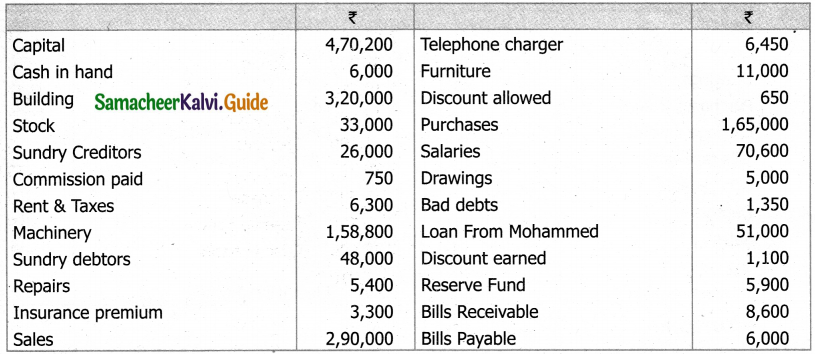
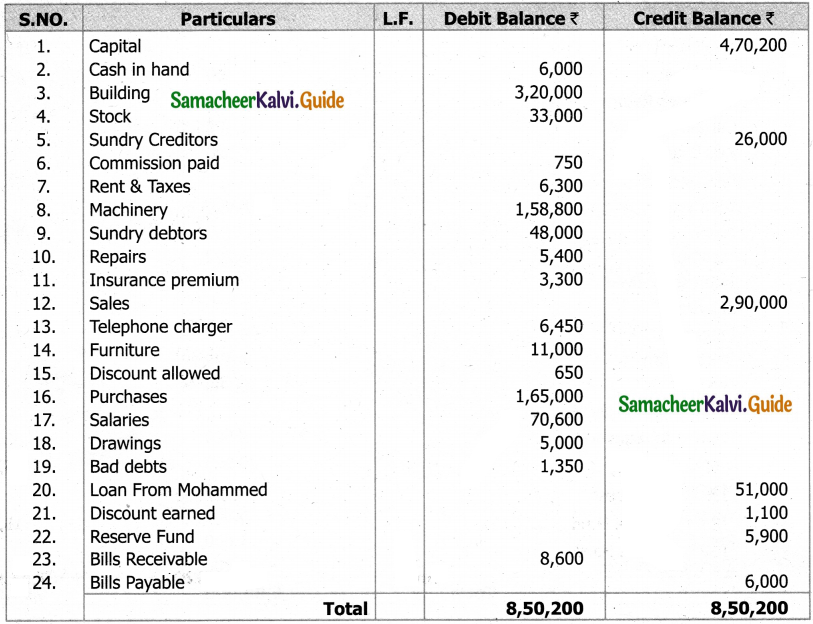
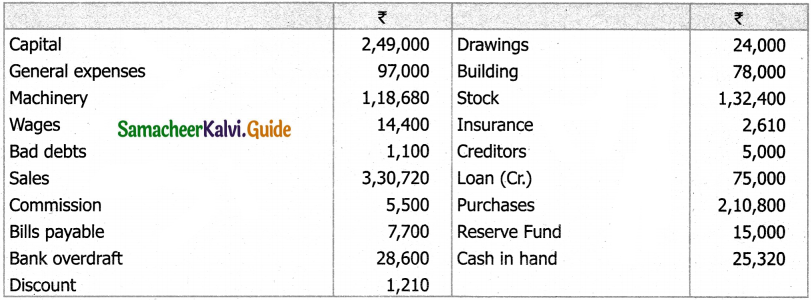
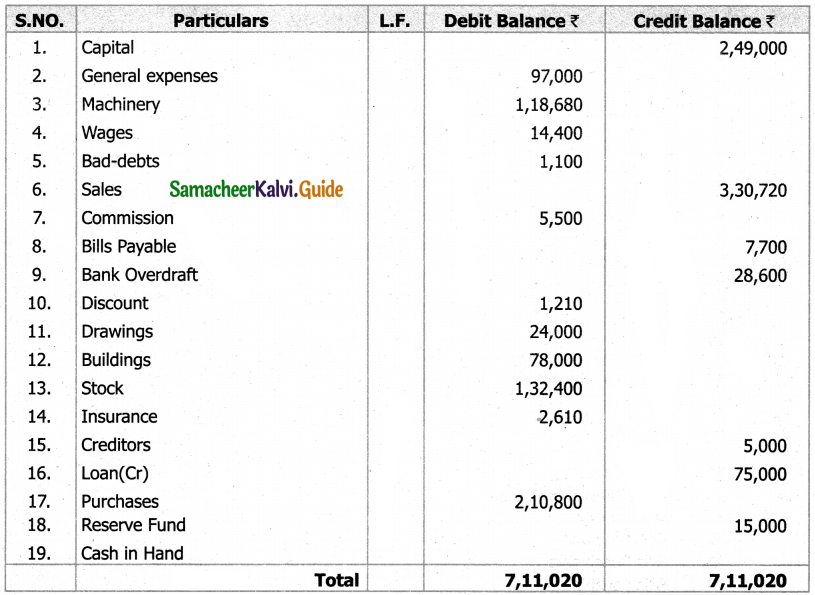
Samacheer Kalvi 11th Accountancy Guide Chapter 6 Subsidiary Books – I

Tamilnadu State Board New Syllabus Samacheer Kalvi 11th Accountancy Guide Pdf Chapter 6 Subsidiary Books – I Text Book Back Questions and Answers, Notes.

Tamilnadu Samacheer Kalvi 11th Accountancy Solutions Chapter 6 Subsidiary Books – I

11th Accountancy Guide Subsidiary Books – I Text Book Back Questions and Answers

Samacheer Kalvi 11th Accountancy Guide Chapter 6 Subsidiary Books – I

I. Multiple Choice Questions

Choose the correct answer.

Question 1.
Purchases book is used to record ________.
a) all purchases of goods
b) all credit purchases of assets
c) all credit purchases of goods
d) all purchases of assets
Answer:
c) all credit purchases of goods

Question 2.
A periodic total of the purchases book is posted to the ________.
a) debit side of the purchases account
b) debit side of the sales account
c) credit side of the purchases account
d) credit side of the sales account
Answer:
a) debit side of the purchases account

Question 3.
Sales book is used to record ________.
a) all sales of goods
b) all credit sales of assets
c) all credit sales of goods
d) all sales of assets and goods
Answer:
c) all credit sales of goods

Question 4.
The total of the sales book is posted periodically to the credit of ________.
a) Sales account
b) Cash account
c) Purchases account
d) Journal proper
Answer:
a) Sales account

Samacheer Kalvi 11th Accountancy Guide Chapter 6 Subsidiary Books – I

Question 5.
Purchase returns book is used to record ________.
a) returns of goods to the supplier for which cash is not received immediately
b) returns of assets to the supplier for which cash is not received immediately
c) returns of assets to the supplier for which cash is received immediately
d) None of the above
Answer:
a) returns of goods to the supplier for which cash is not received immediately

Question 6.
Sales return book is used to record ________.
a) Returns of goods by the customer for which cash is paid immediately
b) Returns of goods by the customer for which cash is not paid immediately
c) Returns of assets by the customer for which cash is not paid immediately
d) Returns of assets by the customer for which cash is paid immediately
Answer:
b) Returns of goods by the customer for which cash is not paid immediately

Question 7.
Purchases of fixed assets on credit basis is recorded in ________.
a) Purchases book
b) Sales book
c) Purchases returns book
d) Journal proper
Answer:
d) Journal proper

Question 8.
The source document or voucher used for recording entries in sales book is ________.
a) Debit note
b) Credit note
c) Invoice
d) Cash receipt
Answer:
c) Invoice

Question 9.
Which of the following statements is not true?
a) Cash discount is recorded in the books of accounts
b) Assets purchased on credit are recorded in journal proper
c) Trade discount is recorded in the books of accounts
d) 3 grace days are added while determining the due date of the bill
Answer:
c) Trade discount is recorded in the books of accounts

Question 10.
Closing entries are recorded in ________.
a) Cash Book
b) Journal Proper
c) Ledger
d) Purchases book
Answer:
c) Ledger

Samacheer Kalvi 11th Accountancy Guide Chapter 6 Subsidiary Books – I

II. Very Short Answer Type Questions

Question 1.
Mention four types of subsidiary books.
Answer:
The following are the four types of subsidiary books.

  1. Cash book
  2. Purchases book
  3. Sales book
  4. Bills receivable book

Question 2.
What is purchases book?
Answer:

  1. Purchases book is a subsidiary book in which only credit purchases of goods are recorded.
  2. While recording transactions in the purchases book, it must be ascertained whether the credit purchase is related to the item in which the firm is dealing.
  3. Purchases of assets and purchase of goods for cash are not entered in purchases book.

Question 3.
What is purchases returns book?
Answer:

  1. Purchases returns book is a subsidiary book in which transactions relating to return of previously purchased goods to the suppliers, for which cash is not immediately received are recorded.
  2. Since goods are going out to the suppliers, they are also known as returns outward and the book is called as ‘returns outward book or returns outward journal’.

Question 4.
What is sales book?
Answer:

  1. Sales book is a subsidiary book maintained to record credit sale of goods. Goods mean the items in which the business is dealing.
  2. These are meant for regular sale.
  3. Cash sale of goods and sale of property and assets whether for cash or on credit are not recorded in the sales book.
  4. This book is also named as sales day book, sold day book, sales journal or sale register.

Question 5.
What is sales returns book?
Answer:

  1. Sales returns book is a subsidiary book, in which, details of return of goods are sold for which cash is not immediately paid are recorded.
  2. This book is not concerned with the return of assets or return of goods for which cash is paid. <$> This book is prepared just like the other day books.

Samacheer Kalvi 11th Accountancy Guide Chapter 6 Subsidiary Books – I

Question 6.
What is debit note?
Answer:

  1. A ‘debit note’ is a document, bill or statement sent to the person to whom goods are returned.
    This statement informs that the supplier’s account is debited to the extent of the value of goods returned.
  2. It contains the description and details of goods returned, name of the party to whom goods are returned and net value of the goods so returned with reason for return.

Question 7.
What is credit note?
Answer:

  1. A credit note is prepared by the seller and sent to the buyer when goods are returned indicating that the buyer’s account is credited in respect of goods returned.
  2. Credit note is a statement prepared by a trader who receives back from his customer the goods sold.
    It contains details such as the description of goods returned by the buyer, quantity returned and also their value.

Question 8.
What is journal proper?
Answer:

  1. Journal proper is a residuary book which contains record of transactions, which do not find a place in the subsidiary books such as cash book, purchases book, and sales book, purchases returns book, sales returns book, bills receivable book and bills payable book.
  2. Journal proper or general journal is a book in which the residual transactions which cannot be entered in any of the sub divisions of journal are entered.

Question 9.
Define bill of exchange.
Answer:
According to the Negotiable Instruments Act, 1881, “Bill of exchange is an instrument in writing containing an unconditional order, signed by the maker, directing a certain person to pay a certain sum of money only to, or to the order of a certain person or to the bearer of the instrument”.

Question 10.
What is an opening entry?
Answer:

  1. At the end of the accounting year, all nominal accounts are closed but the business has to be carried on with previous year’s assets and liabilities.
  2. These accounts are to be brought into the accounts of the current year.
  3. Journal entry made in the beginning of the current year with the balances of assets and liabilities of the previous year is opening journal entry.
  4. In this entry, asset accounts are debited, liabilities and capital accounts are credited.

Samacheer Kalvi 11th Accountancy Guide Chapter 6 Subsidiary Books – I

Question 11.
What Is an invoice?
Answer:

  1. Invoice is a business document or bill or statement, prepared and sent by the seller to the buyer giving the details of goods sold, such as quantity, quality, price, total value, etc.
  2. The invoice is a source document of prime entry both for the buyer and the seller.

III. Short Answer Questions

Question 1.
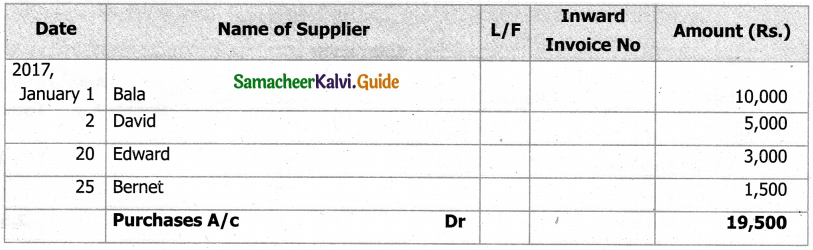
Give the format of purchases book.
Answer:

Samacheer Kalvi 11th Accountancy Guide Chapter 6 Subsidiary Books – I 1

Question 2.
Mention the subsidiary books in which the following transactions are recorded.
Answer:
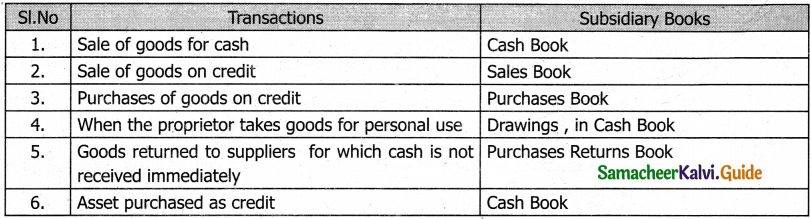
Samacheer Kalvi 11th Accountancy Guide Chapter 6 Subsidiary Books – I 2

Question 3.
What are the advantages of subsidiary books?
Answer:
The advantages of maintaining subsidiary books can be summarised as under : Proper and systematic record of business transactions –

  • All the business transactions are classified and grouped conveniently as cash and non cash ‘ transactions, which are further classified as credit purchases, credit sales, returns, etc.
  • As separate books are used for each type of transactions, individual transactions are properly and systematically recorded in the subsidiary books.

Convenient posting:

  • All the transactions of a particular nature are recorded at one place, i.e., in one of the subsidiary books.
  • For example, all credit purchases of goods are recorded in the purchases book and ail credit sales of goods are recorded in the sales book.
  • It facilitates posting to purchases account, sales account and concerned personal accounts.

Division of work:
As journal is sub-divided, the work will be sub-divided and different persons can work on different books at the same time and the work can be speedily completed.

Efficiency:

  • The sub-division of work gives the advantage of specialisation. When the same work is done by a person repeatedly the person becomes efficient in handling it.
  • Thus, specialisation leads to efficiency in accounting work.

Helpful in decision making:

  • Subsidiary books provide complete details about every type of transactions separately.
  • Hence, the management can use the information as the basis for deciding its future actions.
  • For example, information regarding sales returns from the sales returns book will enable the management to analyse the causes for sales returns and to adopt effective measures to remove deficiencies.

Prevents errors and frauds:

  • Internal check becomes more effective as the work can be divided in such a manner that the work of one person is automatically checked by another person.
  • With the use of internal check, the possibility of occurrence of errors or fraud may be avoided or minimised.

Availability of requisite information at a glance:

  • When all transactions are entered in one journal, it is difficult to locate information about a particular item.
  • When subsidiary books are maintained, details about a particular type of transaction can be obtained from subsidiary books.
  • The maintenance of subsidiary books helps in obtaining the necessary information at a glance.

Detailed Information available : As all transactions relating to a particular item are entered in a subsidiary book, it gives detailed information. It is easy to arrive at monthly or quarterly totals.

Saving in time : As there are many subsidiary books, work of entering can be done simultaneously by many persons. Thus, it saves time and accounting work can be completed quickly.

Labour of posting is reduced : Labour of posting is reduced as posting is made in periodical totals to the impersonal account, for example, Purchases account.

Samacheer Kalvi 11th Accountancy Guide Chapter 6 Subsidiary Books – I

Question 4.
Write short notes on:
Answer:
a) Endorsement of a bill:

  • Endorsement means signing on the face or back of a bill for the purpose of transferring the title of the bill to another person.
  • The person who endorses is called the “Endorser”.
  • The person to whom a bill is endorsed is called the “Endorsee”.
  • The endorsee is entitled to collect the money.

b) Discounting of a bill:

  • When the holder of a bill is in need of money before the due date of a bill, cash can be received by discounting the bill with the banker.
  • This process is referred to as the discounting of bill.
  • The banker deducts a small amount of the bill which is called discount and pays the balance in cash immediately to the holder of the bill.

IV. Exercises

Question 1.
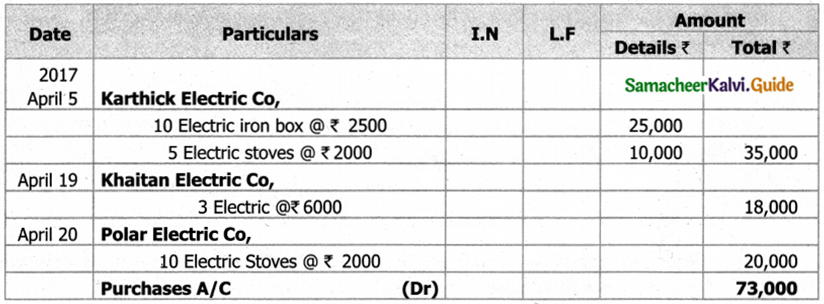
Enter the following transactions in the Purchases book of M/s. Subhashree Electric Co., which deals in electric goods?
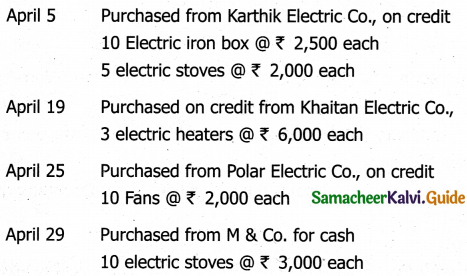
Samacheer Kalvi 11th Accountancy Guide Chapter 6 Subsidiary Books – I 3
Solution:
Samacheer Kalvi 11th Accountancy Guide Chapter 6 Subsidiary Books – I 4

Question 2.
Enter the following credit transactions in the purchases book of Manoharan, a Provisions Merchant.
2017
May 2 – Bought from Vasu 100 bags of rice @ ₹ 800 per bag
May 8 – Bought from Cheyyar Sugar Mills Ltd., 20 bags of sugar @ ₹ 2,600 per bag
May 10 – Bought from Ram Flour Mill, Coimbatore, 10 bags of wheat flour @ ₹ 750 per bag
May 15 – Bought from Nilgiri Tea Co., Nilgiris, 15 cases of tea @ ₹ 900 per case
May 25 – Bought from Sairam Coffee Works Ltd., 100 kgs of Coffee @ ₹ 190 per kg.
May 29 – Bought from X & Co. furniture worth ₹ 2,000
Solution:
In the books of Manoharan Provisional Merchant Purchases as book.
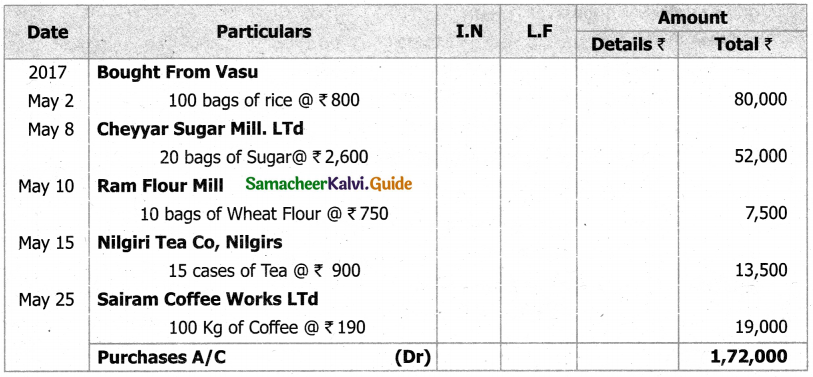
Samacheer Kalvi 11th Accountancy Guide Chapter 6 Subsidiary Books – I 5

Samacheer Kalvi 11th Accountancy Guide Chapter 6 Subsidiary Books – I

Question 3.
From the following transactions write up the Sales day book of M/s. Ram & Co., a stationery. merchant.
2017
Jan. 1 – Sold to Anbu & Co., on credit 20 reams of white paper @ ₹ 150 per ream
Jan. 2 – Sold to Jagadish & Sons on credit 6 dozen pens @ ₹ 360 per dozen
Jan. 10 – Sold old newspapers for cash @ ₹ 620
Jan. 15 – Sold on credit M/s. Elango & Co., 10 drawing boards @ ₹ 170 per piece
Jan. 20 Sold to Kani & Co., 4 writing tables at ₹ 1,520 per table for cash
Solution:
In the books of M/s. Ram & Co. a Stationary Merchant
Sales Book
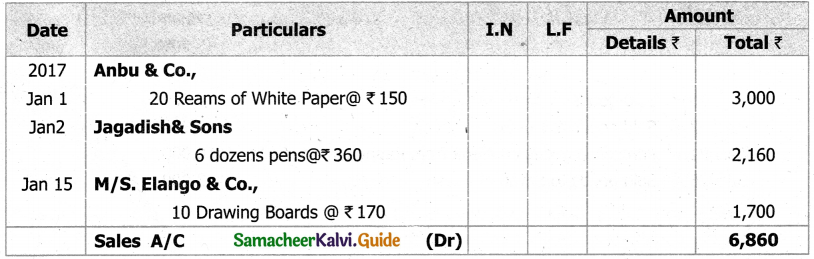
Samacheer Kalvi 11th Accountancy Guide Chapter 6 Subsidiary Books – I 6

Question 4.
Enter the following transactions in the Sales book of Kamala Stores, a furniture shop.
2017
May 2 – Sold to Naveen Stores, Trichy on credit 5 computer tables @ ₹ 1,750 per table
May 9 – Sold to Deepa & Co., Madurai on credit 6 dining tables @ ₹ 1,900 per dining table
May 15 – Sold to Rajesh 10 dressing tables @ ₹ 2,750 each on credit
May 24 – Sold to Anil 5 wooden tables @ ₹ 1,250 per table on credit
May 27 – Sold to Gopi 3 old computers @ ₹ 3,500 each
May 29 – Sold 50 chairs to Anil @ ₹ 275 each for cash
Solution:
In the books of Kamala Stores a Furniture’s Shop
Sales book
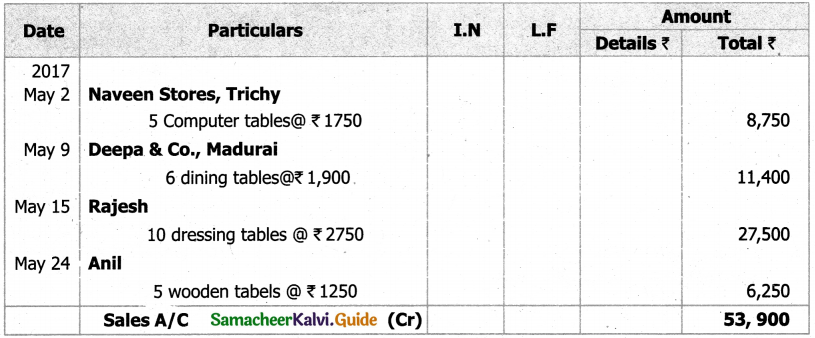
Samacheer Kalvi 11th Accountancy Guide Chapter 6 Subsidiary Books – I 7

Question 5.
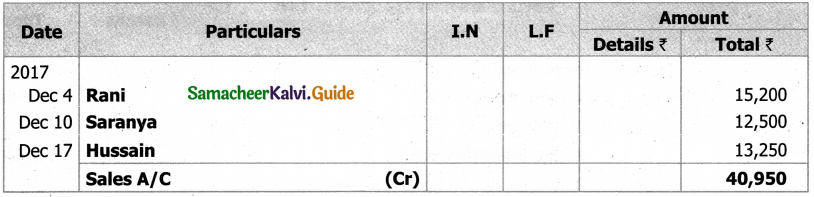
Enter the following transactions in the purchases and sales books of Kannan, an automobile dealer, for the month of December, 2017.
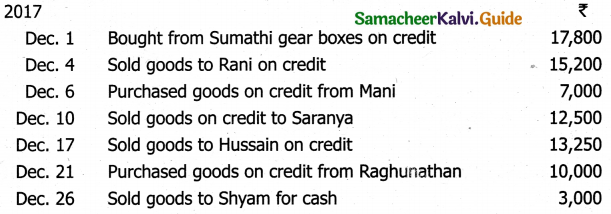
Samacheer Kalvi 11th Accountancy Guide Chapter 6 Subsidiary Books – I 8
Solution:
In the books of Kannan
Purchase book
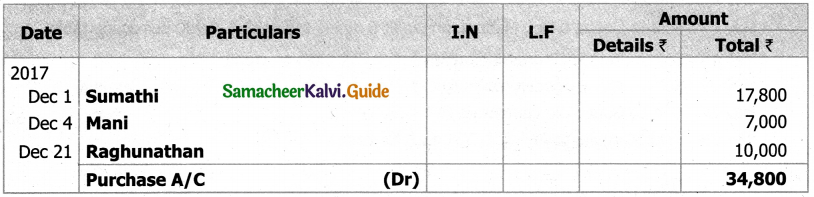
Samacheer Kalvi 11th Accountancy Guide Chapter 6 Subsidiary Books – I 9
In the books of Kannan
Sales book
Samacheer Kalvi 11th Accountancy Guide Chapter 6 Subsidiary Books – I 10

Question 6.
Prepare Purchases book and Sales book in the books of Santhosh Textiles Ltd., from the following transactions given for April, 2017.
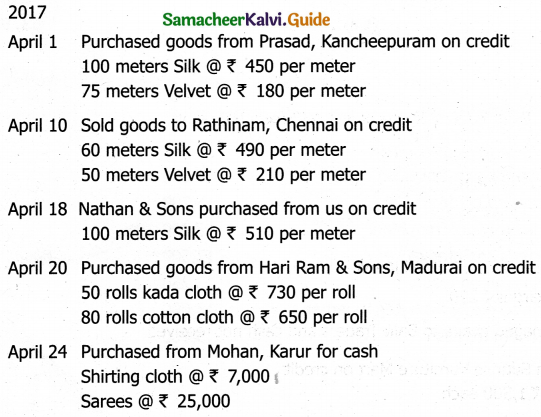
Samacheer Kalvi 11th Accountancy Guide Chapter 6 Subsidiary Books – I 11
Solution:
In the books of Santhosh Textile Ltd,
Purchase Book
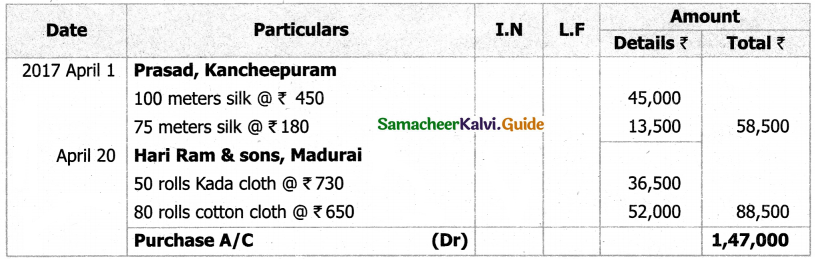
Samacheer Kalvi 11th Accountancy Guide Chapter 6 Subsidiary Books – I 12
In the books of Santhosh Textile Ltd,
Sales Book
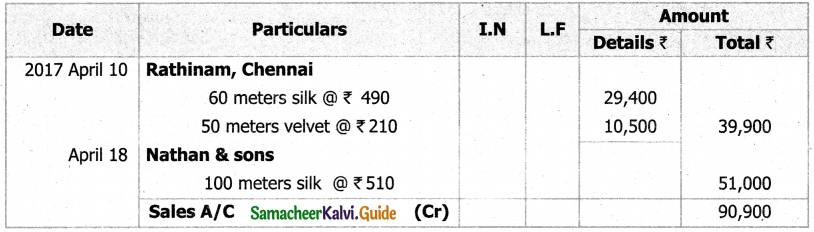
Samacheer Kalvi 11th Accountancy Guide Chapter 6 Subsidiary Books – I 13

Question 7.
From the following information, prepare purchase day book and purchases returns book for the month of June, 2017 and post them into ledger accounts in the books of Robert Furniture Mart.
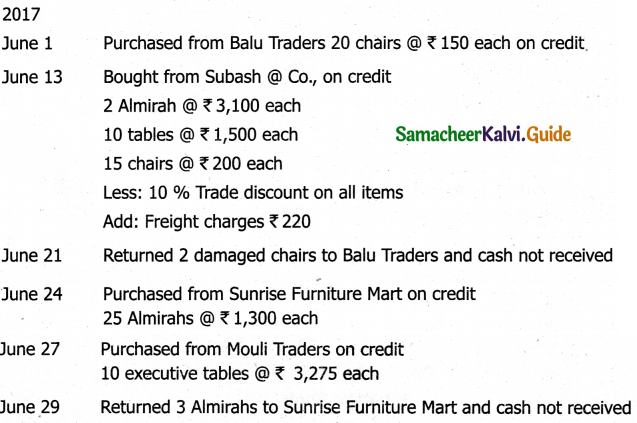
Samacheer Kalvi 11th Accountancy Guide Chapter 6 Subsidiary Books – I 14
Solution:
In the books of Robert Furniture Mart.
Purchases Book
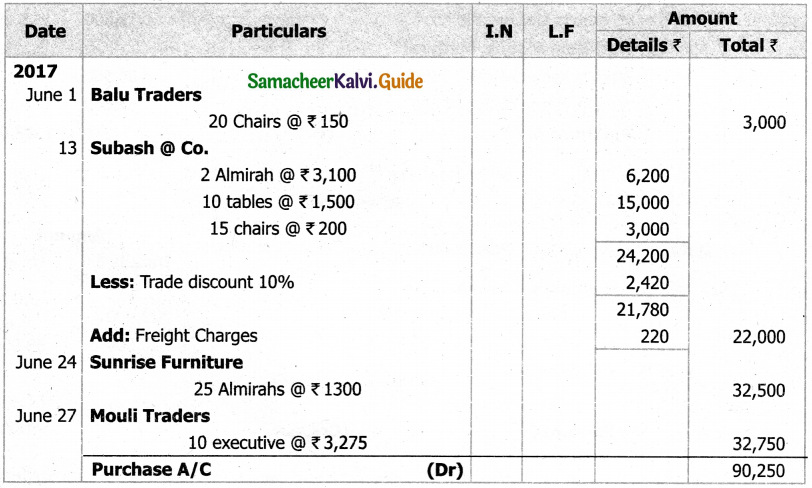
Samacheer Kalvi 11th Accountancy Guide Chapter 6 Subsidiary Books – I 15
In the books of Robert Furniture Mart.
Purchase return A/C
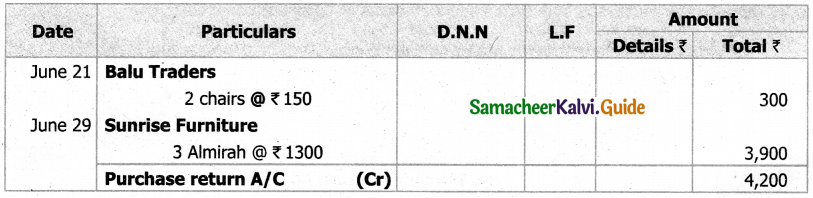
Samacheer Kalvi 11th Accountancy Guide Chapter 6 Subsidiary Books – I 16
Ledger Account
Purchases Account
Samacheer Kalvi 11th Accountancy Guide Chapter 6 Subsidiary Books – I 17
Balu Traders
Samacheer Kalvi 11th Accountancy Guide Chapter 6 Subsidiary Books – I 18
Subash & Co.
Samacheer Kalvi 11th Accountancy Guide Chapter 6 Subsidiary Books – I 19
Sunrise Furniture
 Samacheer Kalvi 11th Accountancy Guide Chapter 6 Subsidiary Books – I 20
Mouli Traders
Samacheer Kalvi 11th Accountancy Guide Chapter 6 Subsidiary Books – I 21
Purchase Return Account
Samacheer Kalvi 11th Accountancy Guide Chapter 6 Subsidiary Books – I 22

Samacheer Kalvi 11th Accountancy Guide Chapter 6 Subsidiary Books – I

Question 8.
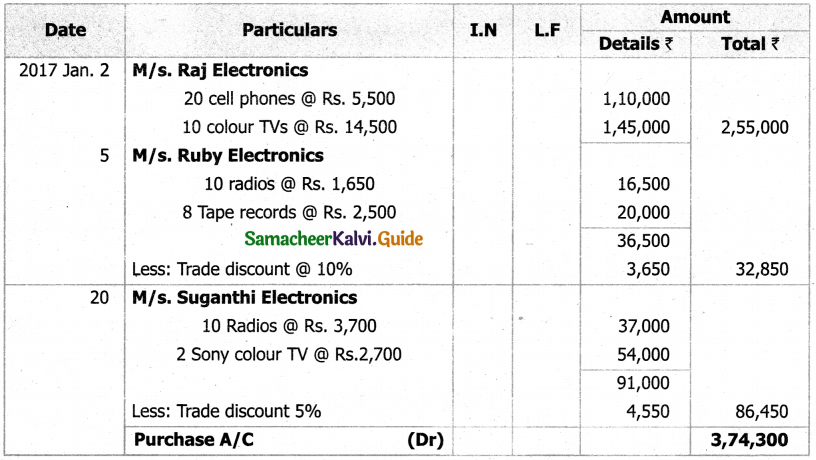
Enter the following transactions in the proper subsidiary books of Suman who is dealing in electronic goods for the month of January, 2017.
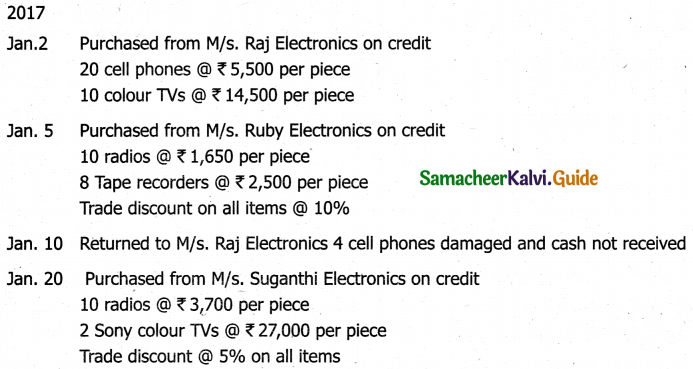
Samacheer Kalvi 11th Accountancy Guide Chapter 6 Subsidiary Books – I 23
Solution:
In the books of Suman
Samacheer Kalvi 11th Accountancy Guide Chapter 6 Subsidiary Books – I 24
In the books of Suman
Purchase Returns Book

Samacheer Kalvi 11th Accountancy Guide Chapter 6 Subsidiary Books – I 25

Question 9.
Enter the following transactions in the sales book and saies returns book of M/s. Guhan & Sons, who is a textile dealer.
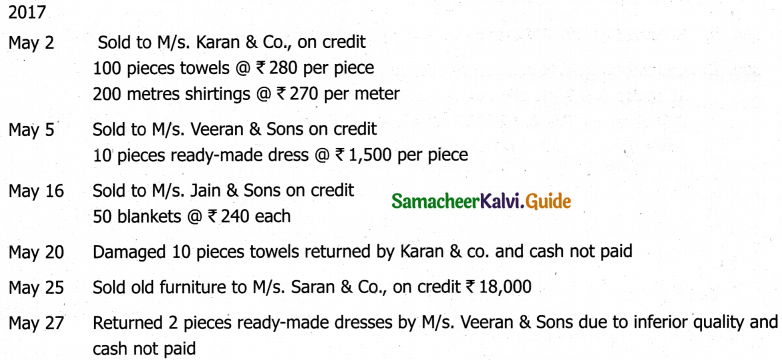
Samacheer Kalvi 11th Accountancy Guide Chapter 6 Subsidiary Books – I 26
Solution:
In the books of Guhan & Sons
Sales Books
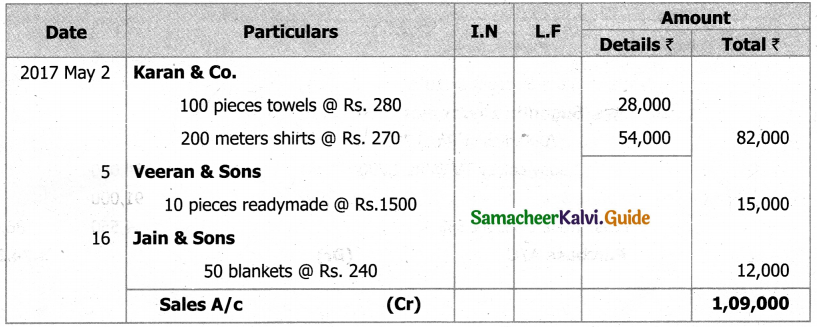
Samacheer Kalvi 11th Accountancy Guide Chapter 6 Subsidiary Books – I 27
In the books of Guhan & Sons
Sales Return Book
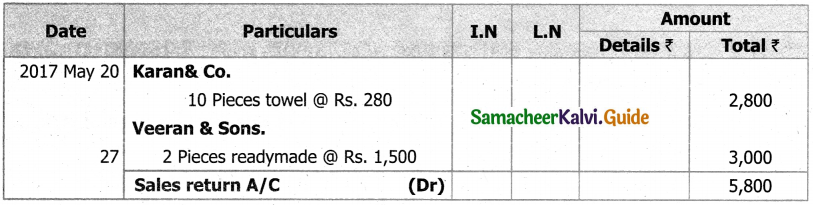
Samacheer Kalvi 11th Accountancy Guide Chapter 6 Subsidiary Books – I 28

Question 10.
Record the following transactions in the sales book and sales returns book of M/s. Ponni & Co., and post them to ledger.
2017
Aug 1 – Sold goods to Senthii as per Invoice No. 68 for ₹ 20,500 on credit
Aug 4 – Sold goods to Madhavan as per Invoice No. 74 for ₹ 12,800 on credit
Aug 7 – Sold goods to Kanagasabai as per Invoice No. 78 for 17,500 on credit
Aug 15 – Returns inward by Senthii as per Credit Note no. 7 for ₹ 1,500 for which cash is not paid
Aug 20 – Sold goods to Selvarn for ₹ 13,300 for cash
Aug 25 – Sales returns of 11,800 by Madhavan as per Credit Note No. 11 for which cash is not paid
Solution:
In the books of Ponni & Co
Sales Book
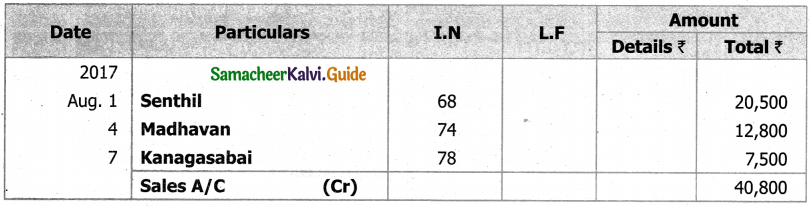
Samacheer Kalvi 11th Accountancy Guide Chapter 6 Subsidiary Books – I 29
In the books of Ponni & Co.
Sales Return Book
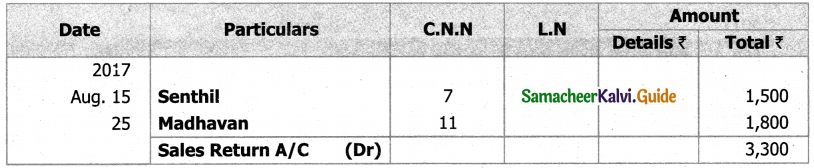
Samacheer Kalvi 11th Accountancy Guide Chapter 6 Subsidiary Books – I 30
Ledger A/C
Sales Account
Samacheer Kalvi 11th Accountancy Guide Chapter 6 Subsidiary Books – I 31
Senthil Account
Samacheer Kalvi 11th Accountancy Guide Chapter 6 Subsidiary Books – I 32
Madhavan Account
Samacheer Kalvi 11th Accountancy Guide Chapter 6 Subsidiary Books – I 33Kanagasabai Account
Samacheer Kalvi 11th Accountancy Guide Chapter 6 Subsidiary Books – I 34
Sales Return Account
Samacheer Kalvi 11th Accountancy Guide Chapter 6 Subsidiary Books – I 35

Question 11.
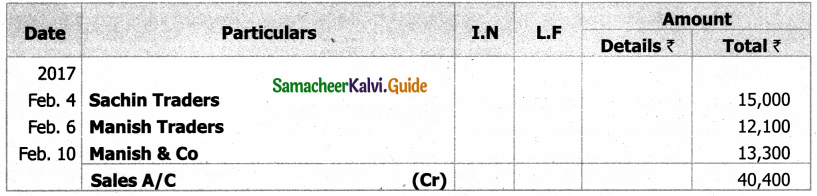
Prepare necessary subsidiary books in the books of Niranjan and aiso Sachin account and Mukil account from the following transactions for the month of February, 2017.
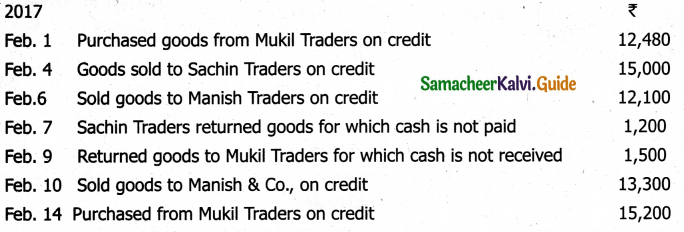
Samacheer Kalvi 11th Accountancy Guide Chapter 6 Subsidiary Books – I 36
Solution:
In the books of Sachin account and Mukil account.
Purchase Book (Mukil Account)
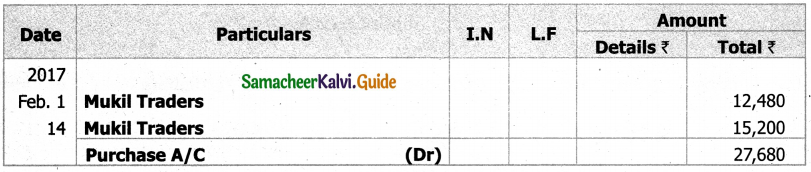
Samacheer Kalvi 11th Accountancy Guide Chapter 6 Subsidiary Books – I 37
Sales Book
Samacheer Kalvi 11th Accountancy Guide Chapter 6 Subsidiary Books – I 38
Purchase Return Book
Samacheer Kalvi 11th Accountancy Guide Chapter 6 Subsidiary Books – I 39
Sales return Book
Samacheer Kalvi 11th Accountancy Guide Chapter 6 Subsidiary Books – I 40
Ledger
Sachin Account
Samacheer Kalvi 11th Accountancy Guide Chapter 6 Subsidiary Books – I 41
Mukil Account
Samacheer Kalvi 11th Accountancy Guide Chapter 6 Subsidiary Books – I 42

Question 12.
From the following information, prepare the necessary subsidiary books for Nalanda Book Stores.
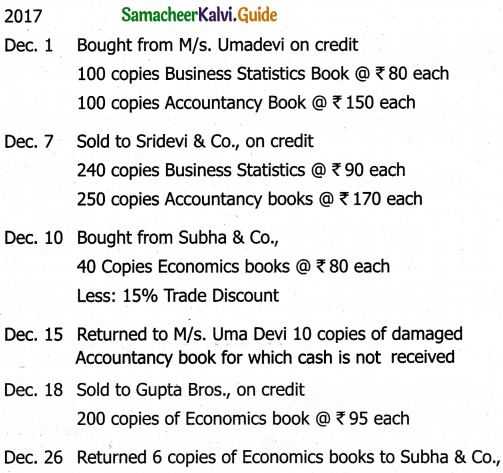
Samacheer Kalvi 11th Accountancy Guide Chapter 6 Subsidiary Books – I 43
Solution:
In the books of Naianda Book Stores
Purchase Book
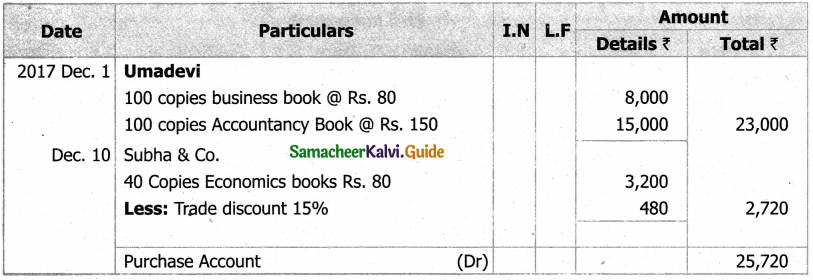
Samacheer Kalvi 11th Accountancy Guide Chapter 6 Subsidiary Books – I 44
In the books of Naianda Book Stores
Sales Book
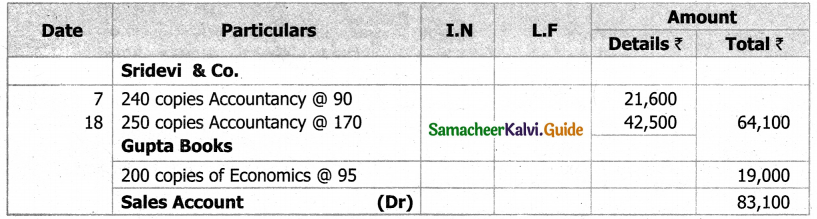
Samacheer Kalvi 11th Accountancy Guide Chapter 6 Subsidiary Books – I 45
Purchase return books
Samacheer Kalvi 11th Accountancy Guide Chapter 6 Subsidiary Books – I 46

Samacheer Kalvi 11th Accountancy Guide Chapter 6 Subsidiary Books – I

11th Accountancy Guide Subsidiary Books – I Additional Important Questions and Answers

I. Choose the correct answer

Question 1.
If goods are sold but not delivered to the customer, they will be included in _______.
a) Closing Inventory
b) Goods in transit
c) Sales
d) Sales in returns
Answer:
b) Goods in transit

Question 2.
Goods Of Rs.800 (sales price) sent on sale on approval basis were included In the sales book. The profit included in the sales was 25% on cost. Inventory with the party will increase our closing inventory by _______.
a) Rs. 600
b) Rs. 640
c) Rs. 680
d) Rs. 700
Answer:
b) Rs. 640

Question 3.
List price of the goods purchased is Rs. 60,000 cash paid is Rs. 45,000 (After receiving a cash discount of Rs. 9,000) the trade discount will be?
a) 10 %
b) 7.5 %
c) 15 %
d) 25 %
Answer:
a) 10 %

Question 4.
A trader purchased goods for Rs. 4,000 at a discount of 5%. As he paid the amount immediately, a cash discount of Rs.100 was also allowed. In this case, Purchases A/c is debited by:
a) Rs. 4,000
b) Rs. 3,800
c) Rs. 3,700
d) Rs. 3,900
Answer:
b) Rs. 3,800

Samacheer Kalvi 11th Accountancy Guide Chapter 6 Subsidiary Books – I

Question 5.
The periodical total of the Sales Return Book is posted to the _______.
a) Debit side of Sales Account
b) Debit side of Sales Return Account
c) Credit side of Sales Return Account
d) Debit side of Debtors Return Account
Answer:
b) Debit side of Sales Return Account

Question 6.
Debit notes issued are used to prepare _______.
a) Sales returns book
b) Puchases returns book
c) Journal proper
d) Puchases book
Answer:
b) Puchases returns book

Question 7.
Trade discount allowed at the time of sale of goods is _______.
a) Recorded in Sales Book
b) Recorded in Cash Book
c) Recorded in Journal
d) Not recorded in Books of Accounts
Answer:
d) Not recorded in Books of Accounts

Question 8.
Subsidiary books are maintained in _______.
a) Big business concerns
b) Small business concerns
c) Banks
d) None of the above
Answer:
a) Big business concerns

Question 9.
Journal Proper is used to record _______.
a) Ail cash and credit transaction
b) cash and credit sales
c) Cash and credit purchases
d) adjusting and closing entries
Answer:
d) adjusting and closing entries

Question 10.
Cash discount is recorded in the _______.
a) Cash book
b) Sales Book
c) Purchases book
d) Journal
Answer:
a) Cash book

Question 11.
The cash discount allowed to a debtor should b e credited to _______.
a) Discount Account
b) Customer’s Account
c) Sales account
d) None of the above
Answer:
b) Customer’s Account

Question 12.
Which of the following books should be used to record purchase of furniture on credit?
a) Petty Cash Book
b) Journal Proper
c) Cash Book
d) None of the above
Answer:
b) Journal Proper

Samacheer Kalvi 11th Accountancy Guide Chapter 6 Subsidiary Books – I

Question 13.
The return of goods to a supplier should be credited to _______.
a) Supplier Account
b) Goods Account
c) Purchase Return Account
d) None of the above
Answer:
c) Purchase Return Account

Question 14.
The other name of Sales Returns book is _______.
a) Returns Inwards Book
b) Sales Returns Journal
c) both (a) & (b)
d) None of the above
Answer:
c) both (a) & (b)

Question 15.
The statement sent to the suppliers on account of return of goods is known as _______.
a) Debit Note
b) Credit Note
c) Journal Proper
d) None of the above
Answer:
a) Debit Note

Question 16.
On 1st January 2918, pugazh draws a bill on Sundar for 3 months, Its due date is _______.
a) 31st March 2018
b) 1st April 2018
c) 4th April 2018
d) 4th April 2018
Answer:
c) 4th April 2018

Question 17.
Goods returned by customers are recorded in _______.
a) Sales book
b) sales return book
c) Purchases book
d) purchases return book
Answer:
b) sales return book

Question 18.
Goods returned by suppliers are recorded in _______.
a) Sales book
b) sales return book
c) Purchases book
d) purchases return book
Answer:
d) purchases return book

Question 19.
Days of grace are _______ in number.
a) one
b) two
c) three
d) four
Answer:
c) three

Question 20.
The person who prepares a bill is called the _______.
a) Drawer
b) Drawee
c) Payee
d) All of these
Answer:
a) Drawer

Question 21.
The person who has to make the payment or who accepts to make the payment is called _______.
a) Drawer
b) Drawee
c) Payee
d) All of these
Answer:
b) Drawee

Samacheer Kalvi 11th Accountancy Guide Chapter 6 Subsidiary Books – I

Question 22.
The person who receives the payment is payee _______.
a) Drawer
b) Drawee
c) Payee
d) All of these
Answer:
d) All of these

Question 23.
_______ means signing on the face or back of a bill for the purpose of transferring the title of the bill to another person.
a) Endorsement
b) Discounting
c) Retiring of bill
d) Renewal
Answer:
a) Endorsement

Question 24.
_______ is the statement prepared by the seller of goods.
a) Voucher
b) Receipt
c) Invoice
d) Ledger
Answer:
c) Invoice

Question 25.
Puchases book does not keep record of purchases of _______.
a) Purchases book
b) sales book
c) Purchases returns book
d) sales returns book
Answer:
a) Purchases book

II. Very Short Answer Type Questions

Question 1.
Prepare Sales Book of M/S A :
i. 2016, Feb, 1 – Sold goods to prince Rs. 2,500
i. 2016, Feb 10 – Sold to Kannan 100 shirts @ Rs. 55 per shirt, Trade discount 10%
ii. 2016, Feb 26 – Sold old furniture to Rasi & sons Rs. 2,400 on credit.
Solution:
Sales Book
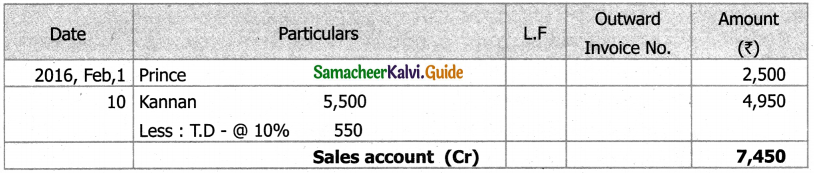
Samacheer Kalvi 11th Accountancy Guide Chapter 6 Subsidiary Books – I 47

Question 2.
Record the following transactions in the returns inwards book of Mr. A.
1. Dharani returned goods worth Rs. 700
2. Malaini returned goods worth Rs. 800
Answer:
Sales Returns Book
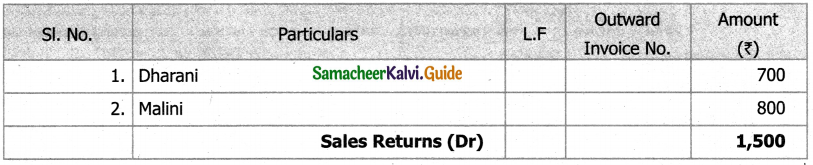
Samacheer Kalvi 11th Accountancy Guide Chapter 6 Subsidiary Books – I 48

Samacheer Kalvi 11th Accountancy Guide Chapter 6 Subsidiary Books – I

III. Short Answer Questions

Question 1.
What is trade discount?
Answer:
Trade discount is a deduction given by the supplier to the buyer on the list price or catalogue price of the goods. It is given as a trade practice or when goods are purchased in large quantities. It is shown as a deduction in the invoice. Trade discount is not recorded in the books of accounts. Only the net amount is recorded.

Example : Suppose the sale of goods for ₹ 10,000 was made and 10% was allowed as trade discount, the entry regarding sales will be made for Rs 9,000 (10,000 – 10 per cent of 10,000). In the same way, purchaser of goods will also record purchases as Rs 9,000).

Question 2.
Write notes on parties involved in a bill of exchange.
Answer:
There are three parties to a bill of exchange as under:

  1. Drawer : The person who prepares the bill is called the drawer, i.e., a creditor.
  2. Drawee : The person who has to make the payment or who accepts to make the payment is called the drawee, i.e., a debtor.
  3. Payee : The person who receives the payment is payee. He may be a third party or the drawer of the bill.

Question 3.
What are the features of bills of exchange?
Answer:

  1. It is a written document.
  2. It is an unconditional order.
  3. It is an order to pay a certain sum of money.
  4. It is signed by the drawer.
  5. It bears stamp or it is drafted on a stamp paper.
  6. It is to be accepted by the acceptor.

Question 4.
What is Due date?
Answer:
When a bill is drawn payable after a specified period, the date on which the payment should be made is called ‘Due date’.

Question 5.
What is Days of grace?
Answer:
In the calculation of the due date, three extra days are added to the specified period of the bills called ‘Days of grace’. If the date of maturity falls on a holiday, the bill will be due for payment on the preceding day.

Question 6.
Write notes on retiring of a bill.
Answer:
An acceptor may make the payment of a bill before its due date and may discharge the liability on the bill. It is called as retirement of a bill. Usually, the holder of the bill allows a concession called rebate to the drawee for the unexpired period of the bill.

Samacheer Kalvi 11th Accountancy Guide Chapter 6 Subsidiary Books – I

Question 7.
Write notes on renewal of a bill of exchange.
Answer:
When the acceptor of a bill knows in advance that he/she will not be able to meet the bill on its due date, he/she may request the drawer for extension of time for payment. The drawer of the bill may agree to cancel the original bill and draw a new bill for the amount due with interest thereon. This is referred to as renewal.

Question 8.
Write notes on closing entries.
Answer:
At the end of the accounting period, all the ledger accounts relating to purchases, sales, purchases returns, sales returns, stock and other accounts concerning expenses, losses, incomes and gains are closed by transfer to trading and profit and loss account so that financial statements can be prepared. It should be noted that closing entries are made for nominal accounts only.

Question 9.
Write notes on rectifying entries.
Answer:
Rectifying entries are passed for rectifying errors which are committed in the books of accounts.

Example : Purchase of furniture by a stationery dealer for Rs 10,000 was debited to purchases account. Pass rectifying entry on December 31, 2017.
Rectifying Entry

Samacheer Kalvi 11th Accountancy Guide Chapter 6 Subsidiary Books – I 49

Question 10.
What is Endorsement?
Answer:
Endorsement means signing on the face or back of a bill for the purpose of transferring the title of the bill to another person. The person who endorses is called the “Endorser”. The person to whom a bill is endorsed is called the “Endorsee”. The endorsee is entitled to collect the money.

Question 11.
What is discounting?
Answer:
When the holder of a bill is in need of money before the due date of a bill, cash can be received by discounting the bill with the banker. This process is referred to as the discounting of bill. The banker deducts a small amount of the bill which is called discount and pays the balance in cash immediately to the holder of the bill.

Question 12.
State the reasons for returning of the goods?
Answer:

  1. not according to the order placed.
  2. not upto the samples which were already shown.
  3. due to damage condition.
  4. due to price difference.
  5. undue delay in the delivery of the goods.

Question 13.
What are the kinds of returns books?
Answer:

  1. Purchases Return or Returns outward book.
  2. Sales Return or Returns inward book.

Samacheer Kalvi 11th Accountancy Guide Chapter 6 Subsidiary Books – I

Question 14.
What is Bills payable book?
Answer:
Details recorded in the bills payable book are the names of the parties whose bills are accepted, date of the bills payable, due date, amount, etc. The individual accounts of the parties whose bills are accepted will be debited with the corresponding amount in the bills payable book.

Question 15.
What is Bills receivable book?
Answer:
Bills receivable refers to bills drawn, the payment for which has to be received. In case of credit sales of goods, the entity may draw a bill on the buyer (debtor), for a certain period. This is called bills receivable for the business entity and bills payable for the debtor who has accepted the bill.

IV. Exercises

Question 1.
From the following transactions of Ram Home appliances for July, 2017 prepare pui books and ledger accounts connected with his book.
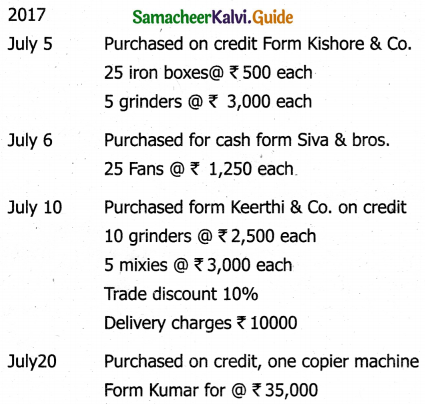
Samacheer Kalvi 11th Accountancy Guide Chapter 6 Subsidiary Books – I 50
Solution:
In the books of ram home appliances
Purchase book
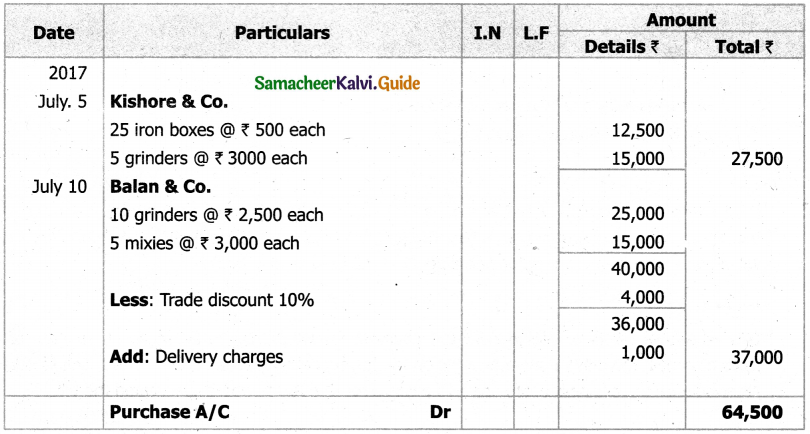
Samacheer Kalvi 11th Accountancy Guide Chapter 6 Subsidiary Books – I 51

Question 2.
Enter the following transactions in the purchases returns book of Hair who lealing in auto mobiles and post them into the 2017
2017
Jan 5 – Returned to Anand 10 dutch plates @ ₹ 200 each not in accordance with order.
Jan 14 – Returned to Chardran 5 brake shoes @ ₹ 200 each and 20 rear view Mirrors @ ₹ 350, each due to inferior quality
Solution:
In the books of Hari
Purchases Return book
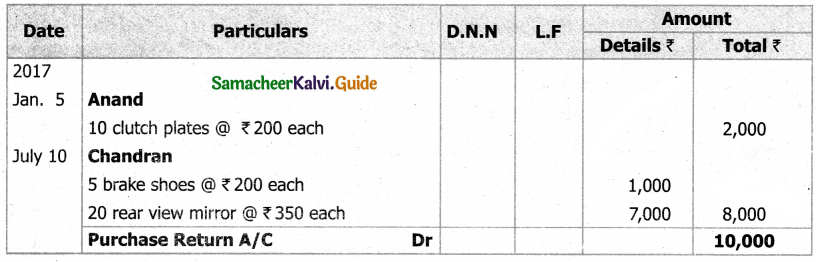
Samacheer Kalvi 11th Accountancy Guide Chapter 6 Subsidiary Books – I 52

Question 3.
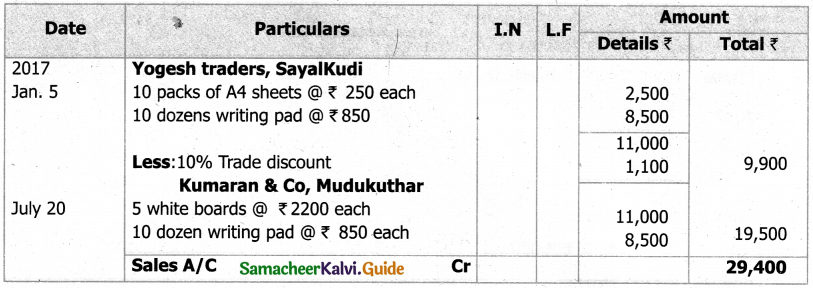
From the transactions given below, Prepare the sales book of Kumar Stationery of July 2017,
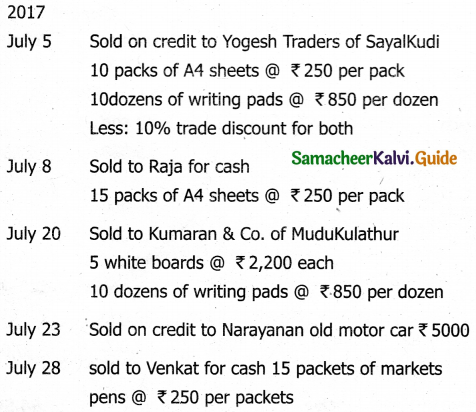
Samacheer Kalvi 11th Accountancy Guide Chapter 6 Subsidiary Books – I 53
Solution:
Sales account
Samacheer Kalvi 11th Accountancy Guide Chapter 6 Subsidiary Books – I 54
Ledger Accounts
Sales Account
Samacheer Kalvi 11th Accountancy Guide Chapter 6 Subsidiary Books – I 55
Yogesh Traders A/c
Samacheer Kalvi 11th Accountancy Guide Chapter 6 Subsidiary Books – I 56
Kumaran & Co, A/c
Samacheer Kalvi 11th Accountancy Guide Chapter 6 Subsidiary Books – I 57

Question 4.
Enter the following transaction in returns inward book of Magesh a textile dealer.
2017
April 6 – Returned by Naren 40 shirts each costing ₹ 150 due top inferior Quality.
April 8 – Amar Tailors returned 10 T-shirts, each costing ₹ 100 on accounts Of being not in accordance with their order.
April 21 – Prema stars returned 20 salwar sets each costing ₹ 200, being not in Accordance with order.
Solution:
In the books of Magesh
Sales Return book
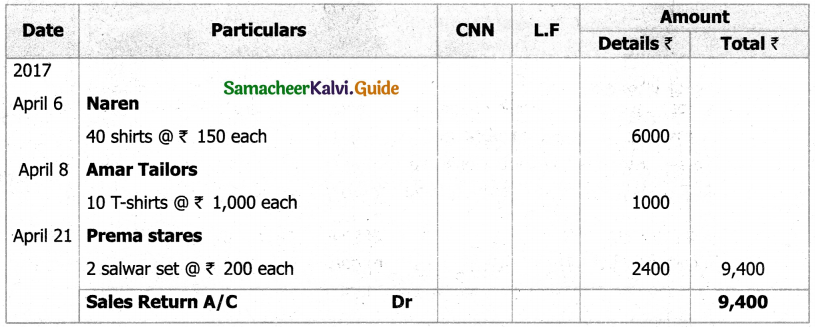
Samacheer Kalvi 11th Accountancy Guide Chapter 6 Subsidiary Books – I 57a

Question 5.
Enter the following transactions in proper subsidiary books.
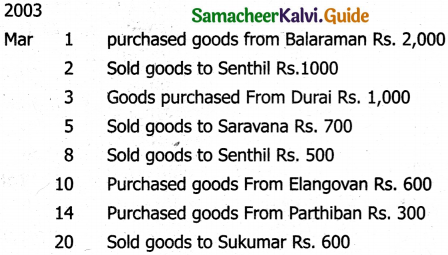
Samacheer Kalvi 11th Accountancy Guide Chapter 6 Subsidiary Books – I 58
Solution:
Purchase Book
Samacheer Kalvi 11th Accountancy Guide Chapter 6 Subsidiary Books – I 59
Sales book
Samacheer Kalvi 11th Accountancy Guide Chapter 6 Subsidiary Books – I 60

Samacheer Kalvi 11th Accountancy Guide Chapter 6 Subsidiary Books – I

Question 6.
Record the following transaction in the proper subsidiary books of M/S Ram & Co.
April
1 – Goods sold to Ramesh Rs. 1000
3 – Sold goods to Kumar Rs. 2,200.
8 – Sold goods to Shankar Rs. 300
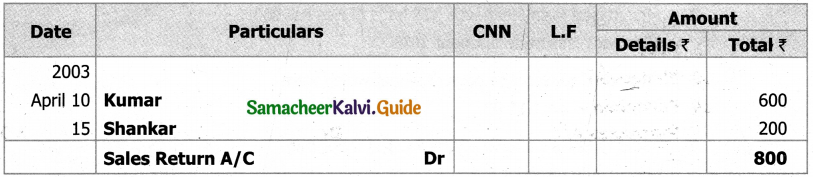
10 – Goods returned by Kumar Rs. 600.
15 – Credit note sent to Shankar For Rs. 200
Solution:
In the books of Ram & Co.
Sales book
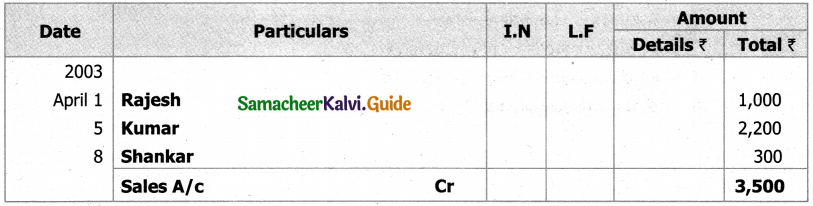
Samacheer Kalvi 11th Accountancy Guide Chapter 6 Subsidiary Books – I 61
Sales Return Book
Samacheer Kalvi 11th Accountancy Guide Chapter 6 Subsidiary Books – I 62

Question 7.
Write the following transaction in proper subsidiary books of Mr. Pugazh.
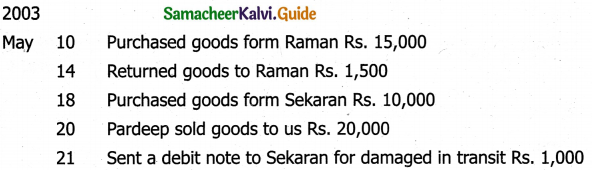
Samacheer Kalvi 11th Accountancy Guide Chapter 6 Subsidiary Books – I 63
In the books of Mr. Pugazh
Purchased book
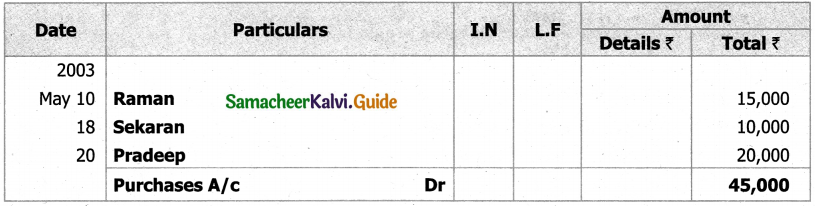
Samacheer Kalvi 11th Accountancy Guide Chapter 6 Subsidiary Books – I 64
In the books of Mr. Pugazh
Purchased return book
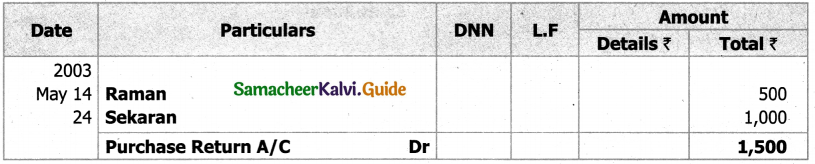
Samacheer Kalvi 11th Accountancy Guide Chapter 6 Subsidiary Books – I 65

Question 8.
Enter the following transaction in the proper subsidiary books of Mr. Somu.
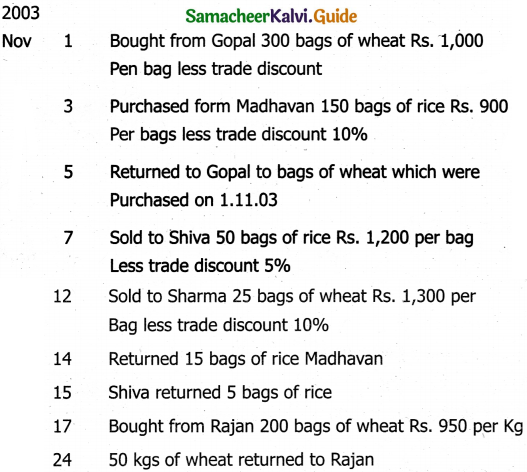
Samacheer Kalvi 11th Accountancy Guide Chapter 6 Subsidiary Books – I 66
Solution:
In the books of Mr. Somu
Purchase book
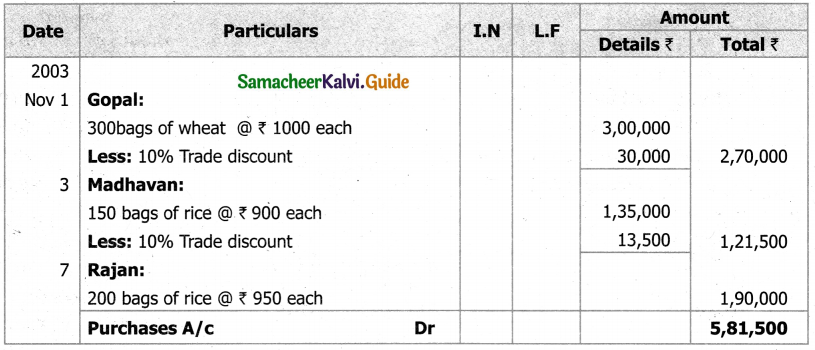
Samacheer Kalvi 11th Accountancy Guide Chapter 6 Subsidiary Books – I 67
In the books of Mr. Somu
Purchased return book
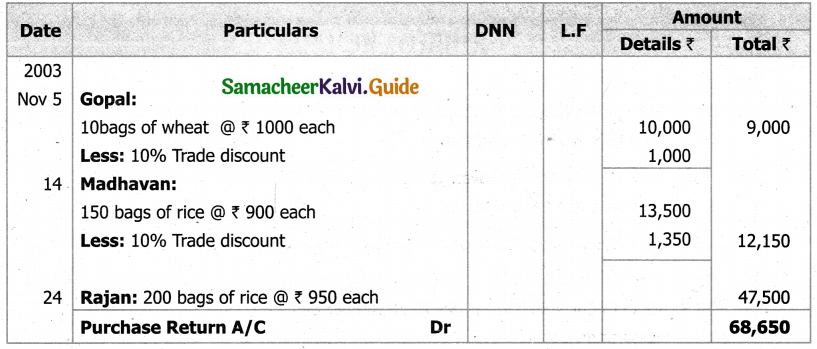
Samacheer Kalvi 11th Accountancy Guide Chapter 6 Subsidiary Books – I 68
In the books of Mr. Somu
Sales book
Samacheer Kalvi 11th Accountancy Guide Chapter 6 Subsidiary Books – I 69
In the books of Mr. Somu
Sales return book
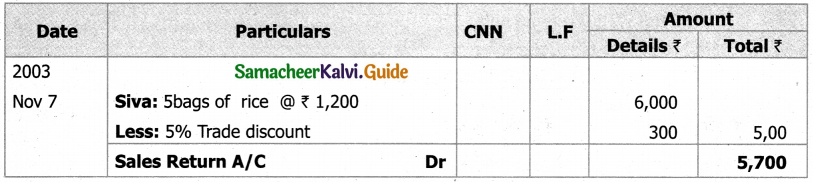
Samacheer Kalvi 11th Accountancy Guide Chapter 6 Subsidiary Books – I 70

Question 9.
Enter the following transactions in the appropriate special M/s Padmini & Co.
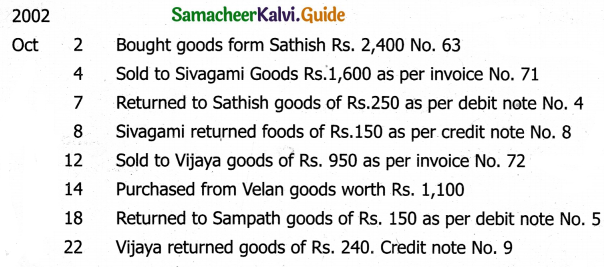
Samacheer Kalvi 11th Accountancy Guide Chapter 6 Subsidiary Books – I 71
Solution:
In the books of M/S Padmini
Purchase book
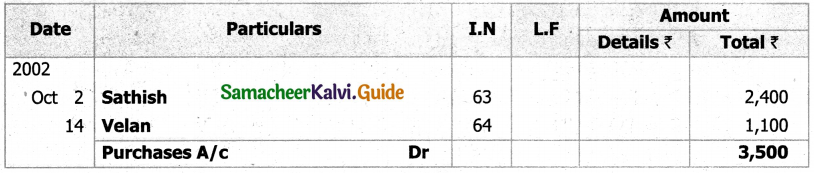
Samacheer Kalvi 11th Accountancy Guide Chapter 6 Subsidiary Books – I 72
In the books of M/S Padmini
Sales book
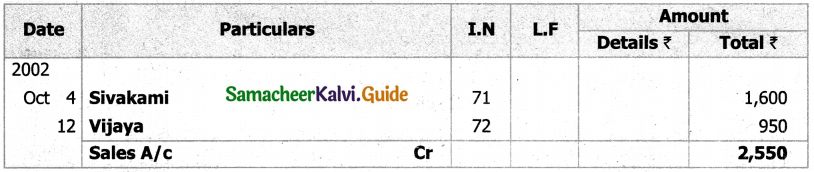
Samacheer Kalvi 11th Accountancy Guide Chapter 6 Subsidiary Books – I 73
In the books of M/S Padmini
Purchase return book
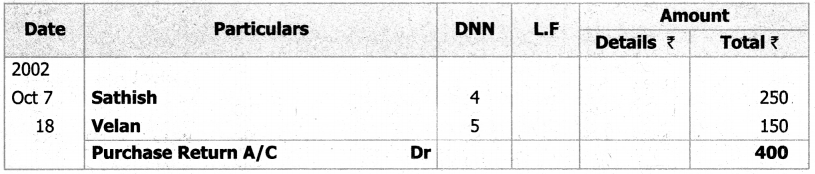
Samacheer Kalvi 11th Accountancy Guide Chapter 6 Subsidiary Books – I 74
In the books of M/S Padmini
Sale return book
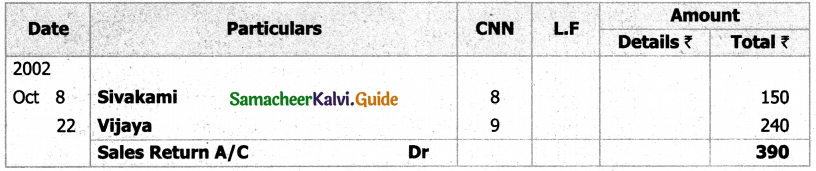
Samacheer Kalvi 11th Accountancy Guide Chapter 6 Subsidiary Books – I 75

Question 10.
Enter the following transactions in the subsidiary books:
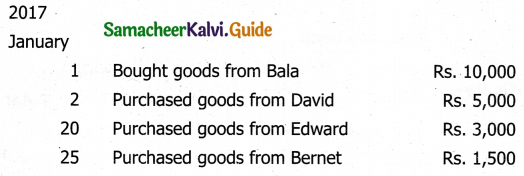
Samacheer Kalvi 11th Accountancy Guide Chapter 6 Subsidiary Books – I 76
Solution:
Purchases Book
Samacheer Kalvi 11th Accountancy Guide Chapter 6 Subsidiary Books – I 77

Question 11.
Enter the following transactions in the purchase book of M/S Arun and post them in the ledger:
2016,
Jan.
9 – Purchased from Joseph stores, 15 boxes of pencil @ Rs.6 per box 15 Purchased for cash 10 Exercise book @ Rs.5 per book
18 – Bought Furniture from Fancy Furniture Mart for Rs.2,000, Trade discount @ 10%
21 – Purchased 25 bags of tea dust from Subam Traders @ Rs.20 per bag, Trade discount 5%
Solution:
Purchases Book
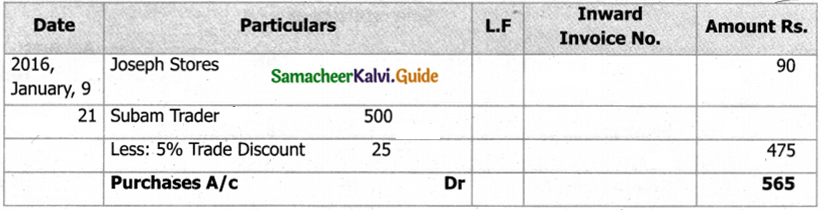
Samacheer Kalvi 11th Accountancy Guide Chapter 6 Subsidiary Books – I 78

Samacheer Kalvi 11th Accountancy Guide Chapter 6 Subsidiary Books – I

Question 12.
From the particulars given below, write up the Purchases Day Book of M/s Hilton Electric Co, which deals in electrical goods:
2017,
Dec.
5 – Purchased on Credit from H Electric Co. – 10 Electric Iron @ Rs. 7,000 each; 5 – Electric Stoves @ Rs. 6,000 each;
16 – Purchased on credit from Khaitan Electric Co – 30 Electric Heater @ Rs. 12,000 each; 20 Electric Kettles @ Rs. 6,000 each;
21 – Purchased from Solar Electric Co. on credit – 10 Toasters @ Rs. 4,000 each; 5 – Electric Heater @ Rs. 12,000 each;
30 – Purchased from Bombay Electric Stores on Credit – 20 Electric Stoves @ Rs. 4,000 each; Electric Fans @ Rs. 3,000 each;
Solution:
Purchases Day Book
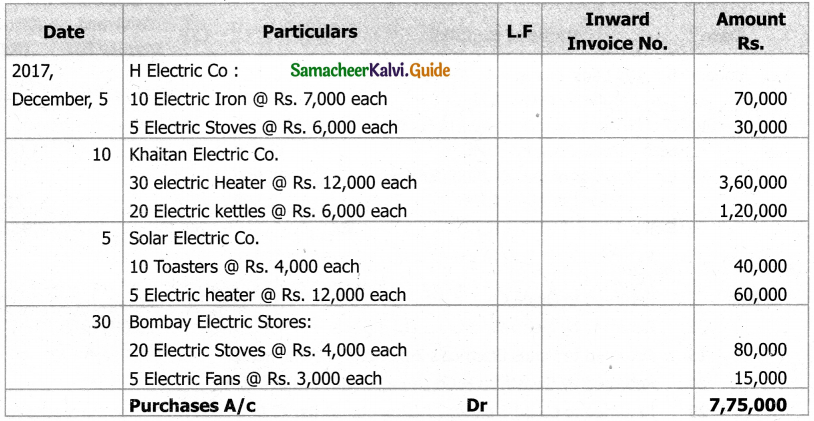
Samacheer Kalvi 11th Accountancy Guide Chapter 6 Subsidiary Books – I 79

Question 13.
Enter the following transactions in the sales book of Arun and post them into ledger.
2016,
Jan.
1 – Sold goods to Prince Rs. 2500
10 – Sold to Kannan 100 Shirts @ Rs. 45 per shirt, Trade discount 10%
21 – Sold old furniture to Kumar & Sons Rs. 1,200 on credit
Solution:
Sales Day Book

Samacheer Kalvi 11th Accountancy Guide Chapter 6 Subsidiary Books – I 80

Question 14.
From the following transactions write up the sales day book of M/s Rajesh & Co.
Jan.
1 – Sold to S 100 bags of sugar @ Rs. 7,000 per bag, less trade discount @ 5%
10 – Sold to D 20 bags of milk powder @ Rs. 6,000 per bag, less trade disc. @ 10%
20 – Sold to F 10 boxes of Tea @ Rs. 2,500 per box, less trade discount @ 10%
29 – Sold old office furniture on credit to Rainbow furniture mart for Rs. 64,000
Solution:
Sales Day Book
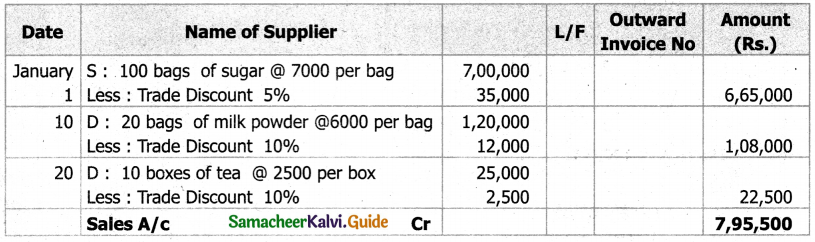
Samacheer Kalvi 11th Accountancy Guide Chapter 6 Subsidiary Books – I 81

Question 15.
Enter the following information in the proper subsidiary books:
Mar.
1 – Returned to Onida Co. Ltd 4 colour TVs @ Rs. 24,000 each
2 – Returned by Metro Electronics Ltd 4 pieces of Fridge costing Rs. 20,000 each
15 – Returned to Venus Electricals 2 pieces of electric heater @ Rs. 6,500 each
24 – Returned by Swasthica & Co , 4 pieces of Speakers costing Rs. 9,000 each
29 – Returned to LG ltd 3 pieces of Computer @ Rs. 40,000 each which was purchased for cash.
Solution:
Purchase Returns Book

Samacheer Kalvi 11th Accountancy Guide Chapter 6 Subsidiary Books – I 82
Sales Return Book
Samacheer Kalvi 11th Accountancy Guide Chapter 6 Subsidiary Books – I 83

Samacheer Kalvi 11th Accountancy Guide Chapter 6 Subsidiary Books – I

Question 16.
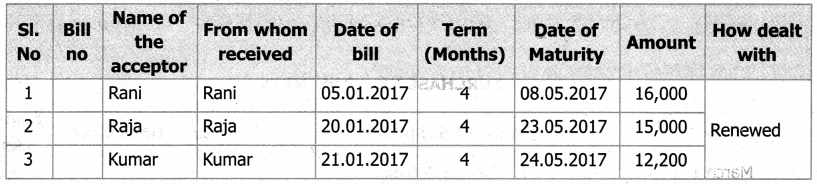
Record the following transactions in the bills receivable and the bills payable books of a trader:
2017
January
1 – Received from Narayan an acceptance of 3 months for Rs. 15,000
5 – Our acceptance to Rani at 4 months for Rs. 16,000
15 – Received from D & Co an acceptance for 2 months for Rs. 12,000
18 – Discount Narayan acceptance for Rs. 9,800
19 – Received from Giri an acceptance for 3 months for Rs. 16,000
20 – Our acceptance to Raja at 4 months for Rs. 15,000
21 – Kumar Renewed our acceptance to Rani by paying him cash Rs. 12,000 and accepted a fresh bill of Rs. 12,200 at 4 months, Rs. 200 has being interest charged
22 – D & Co acceptance endorsed in favour of G in full settlement of a debt of Rs. 2,250
Solution:
Bills Receivable Book
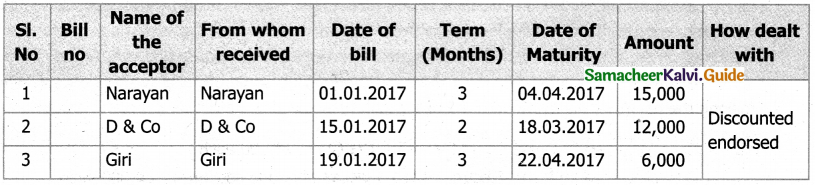
Samacheer Kalvi 11th Accountancy Guide Chapter 6 Subsidiary Books – I 84
Bills Payable Book
Samacheer Kalvi 11th Accountancy Guide Chapter 6 Subsidiary Books – I 85

Samacheer Kalvi 11th Accountancy Guide Chapter 5 Trial Balance

Tamilnadu State Board New Syllabus Samacheer Kalvi 11th Accountancy Guide Pdf Chapter 5 Trial Balance Text Book Back Questions and Answers, Notes.
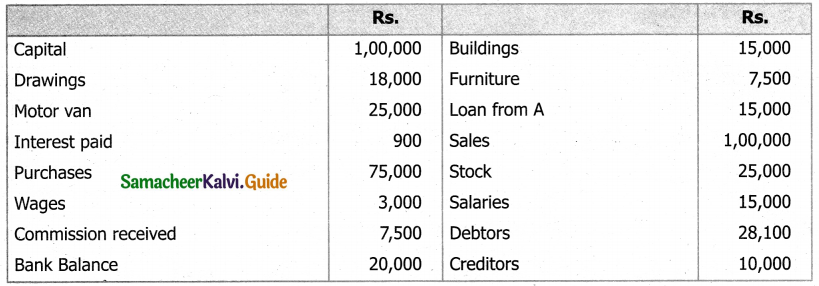
Tamilnadu Samacheer Kalvi 11th Accountancy Solutions Chapter 5 Trial Balance

11th Accountancy Guide Trial Balance Text Book Back Questions and Answers
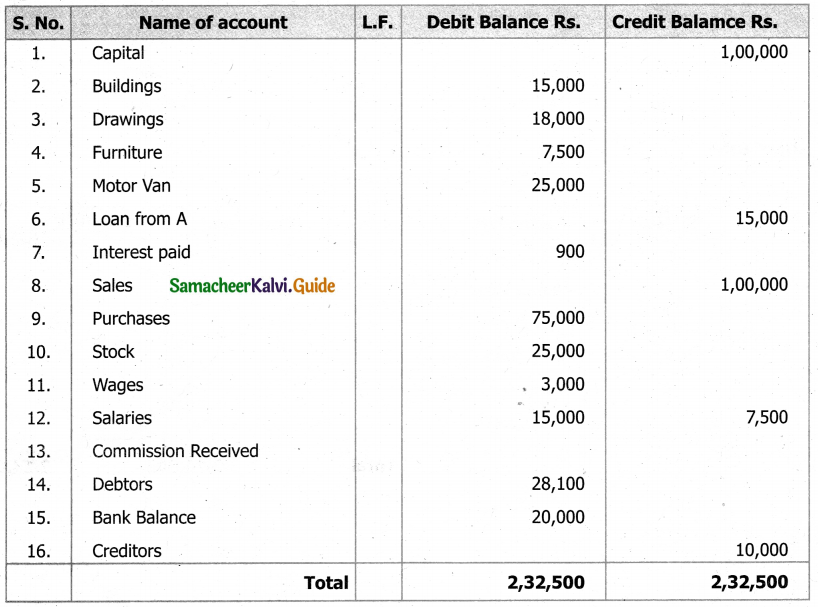
Samacheer Kalvi 11th Accountancy Guide Chapter 5 Trial Balance

I. Multiple Choice Questions

Choose the correct answer.

Question 1.
Trial balance is a _______.
a) Statement
b) Account
c) Ledger
d) Journal
Answer:
a) Statement

Question 2.
After the preparation of ledger, the next step is the preparation of _______.
a) Trading account
b) Trial balance
c) Journal
d) Profit and loss account
Answer:
b) Trial balance

Question 3.
The trial balance contains the balances of _______.
a) Only personal accounts
b) Only real accounts
c) Only nominal accounts
d) All accounts
Answer:
d) All accounts

Question 4.
Which of the following is/are the objective(s) of preparing trial balance?
a) Serving as the summary of all the ledger accounts
b) Helping in the preparation of final accounts
c) Examining arithmetical accuracy of accounts
d) a, b and c
Answer:
d) a, b and c

Samacheer Kalvi 11th Accountancy Guide Chapter 5 Trial Balance

Question 5.
While preparing the trial balance, the accountant finds that the total of the1 credit column is short by Rs. 200. This difference will be _______.
a) Debited to suspense account
b) Credited to suspense account
c) Adjusted to any of the debit balance
d) Adjusted to any of the credit balance
Answer:
b) Credited to suspense account

Question 6.
A list which contains balances of accounts to know whether the debit and credit balances are matched is _______.
a) Journal
b) Day book
c) Trial balance
d) Balance sheet
Answer:
c) Trial balance

Question 7.
Which of the following method(s) can be used for preparing trial balance?
a) Balance method
b) Total method
c) Total and Balance method
d) a, b and c
Answer:
d) a, b and c

Question 8.
The account which has a debit balance and is shown in the debit column of the trial balance is _______.
a) Sundry creditors account
b) Bills payable account
c) Drawings account
d) Capital account
Answer:
c) Drawings account

Question 9.
The difference of totals of both debit and credit side of trial balance is transferred to:
a) Trading account
b) Difference account
c) Suspense account
d) Miscellaneous account
Answer:
c) Suspense account

Samacheer Kalvi 11th Accountancy Guide Chapter 5 Trial Balance

Question 10.
Trial balance is prepared:
a) At the end of the year
b) On a particular date
c) For a year
d) None of the above
Answer:
b) On a particular date

II. Very Short Answer Type Questions

Question 1.
What is trial balance?
Answer:
“A trial balance is a statement, prepared with the debit and credit balances of the ledger accounts to test the arithmetical accuracy of the books”.

Question 2.
Give the format of trial balance.
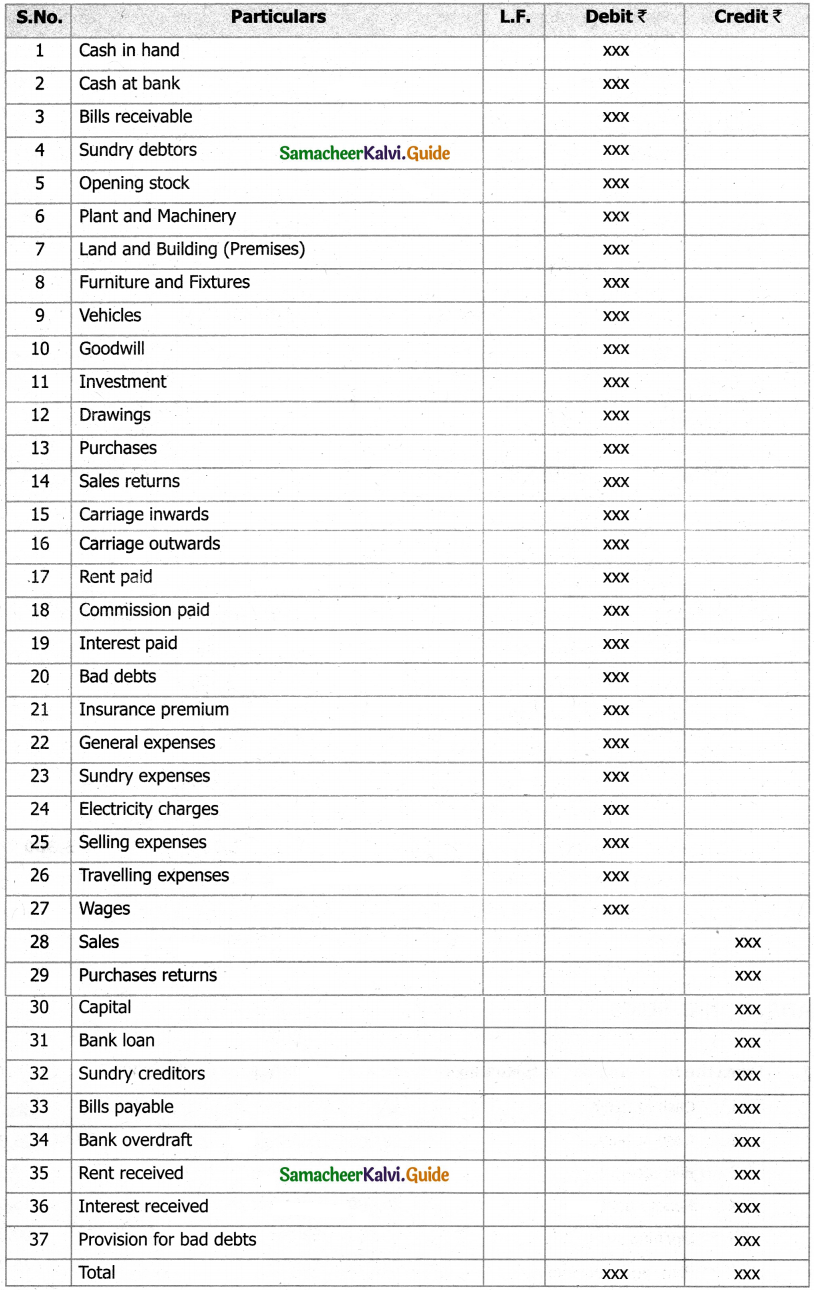
Answer:
Trial balance is prepared in the following format under the balance method:
Samacheer Kalvi 11th Accountancy Guide Chapter 5 Trial Balance 1

Question 3.
What are the methods of preparation of trial balance?
Answer:
Trial Balance is prepared in the following methods:
Balance method : In this method, the balance of every ledger account either debit or credit, as the case may be, is recorded in the trial balance against the respective accounts. The balance method is widely used, as it helps in the preparation of financial statements.

Total method : Under this method, the total amounts on the debit side of the ledger accounts and the total amounts on the credit side of the ledger accounts are ascertained and recorded in the trial balance. This method is not commonly used as it cannot help in the preparation of financial statements.

Total and Balance method : This method is a combination of both total method and balance method. Under this method, four columns are provided, namely,

  • Totals of debit side of the ledger accounts,
  • Totals of the credit side of the ledger accounts
  • Debit balances of ledger accounts and
  • Credit balances of the ledger accounts. This method is not in practice.

Samacheer Kalvi 11th Accountancy Guide Chapter 5 Trial Balance

Question 4.
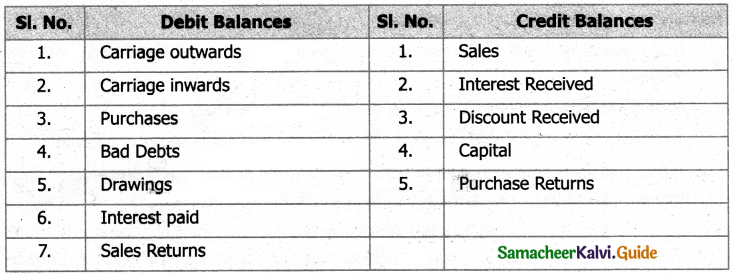
State whether the balance of the following accounts should be placed in the debit or the credit column of the trial balance:
(i) Carriage outwards
(ii) Carriage inwards
(iii) Sales
(iv) Purchases
(v) Bad debts
(vi) Interest paid
(vii) Interest received
(viii) Discount received
(ix) Capital
(x) Drawings
(xi) Sales returns
(xii) Purchase returns
Answer:
 Samacheer Kalvi 11th Accountancy Guide Chapter 5 Trial Balance 2

III. Short Answer Questions

Question 1.
What are the objectives of preparing trial balance?
Answer:
1. Test of arithmetical accuracy:
(i) Trial balance is the means by which the arithmetical accuracy of the book-keeping work is checked.

(ii) When the totals of debit column and credit column in the trial balance are equal, it is assumed that posting from subsidiary books, balancing of ledger accounts, etc. are arithmetically correct.

(iii) There may be some errors which are not disclosed by trial balance.

2. Basis for preparing final accounts : Financial statements, namely, trading and profit and loss account and balance sheet are prepared on the basis of summary of ledger balances obtained from the trial balance.

Location of errors:
(i) When the trial balance does not tally, it is an indication that certain errors have occurred.

(ii) The errors may have occurred at one or more of the stages of accounting process, namely, journalising or recording in subsidiary books, totalling subsidiary books, posting in ledger accounts, balancing the ledger accounts, carrying ledger account balances to the trial balance, totalling the trial balance columns, etc.

(ii) Hence, the errors should be located and rectified before preparing the financial statements.

3. Summarised information of ledger accounts : The summary of ledger accounts is shown in the trial balance. Ledger accounts have to be seen only when details are required in respect of an account.

Samacheer Kalvi 11th Accountancy Guide Chapter 5 Trial Balance

Question 2.
What are the limitations of trial balance?
Answer:
The following are the limitations of trial balance:

  1. It is possible to prepare trial balance of an organisation, only if the double entry system is followed.
  2. Even if some transactions are omitted, the trial balance will tally.
  3. Trial balance may tally even though errors are committed in the books of account.
  4. If trial balance is not prepared in a systematic way, the final accounts prepared on the basis of trial balance may not depict the actual state of affairs of the concern.
  5. Agreement of trial balance is not a conclusive proof of arithmetical accuracy of entries made

Question 3.
‘A trial balance is only a prima facie evidence of the arithmetical accuracy of records’. Do you agree with this statement? Give reasons.
Answer:
1. Yes. Trial Balance helps to check the arithmetical accuracy of the entries made in the accounting records.
In the computerized accounting system, once the transactions are recorded in the journals, all the other records are made simultaneously, i.e. ledger postings, trial balance and final accounts.

2. Hence, arithmetic errors and errors in posting the entries from journal to ledger and further will not occur in computerised accounting.

3. When double entry system is followed, the totals of the debit and the credit columns of the trial balance must be equal. Thus, trial balance helps to check the arithmetical accuracy of entries made in the books of accounts.

IV. Exercises 

Question 1.
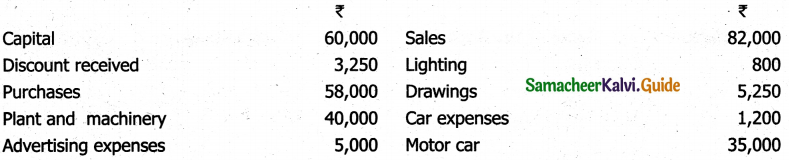
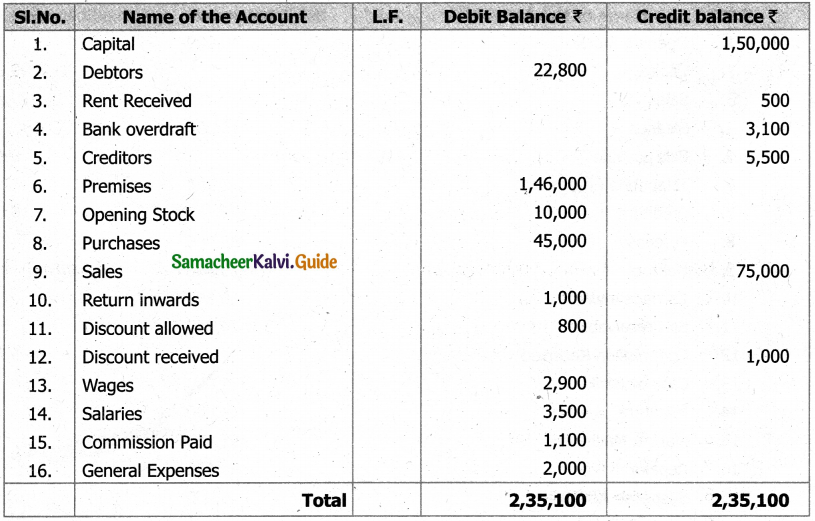
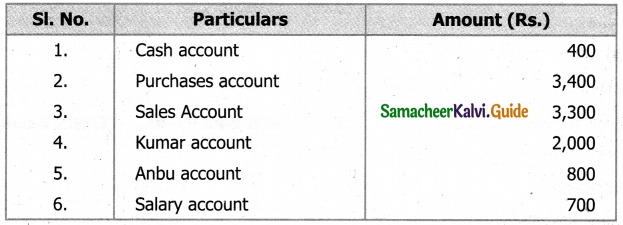
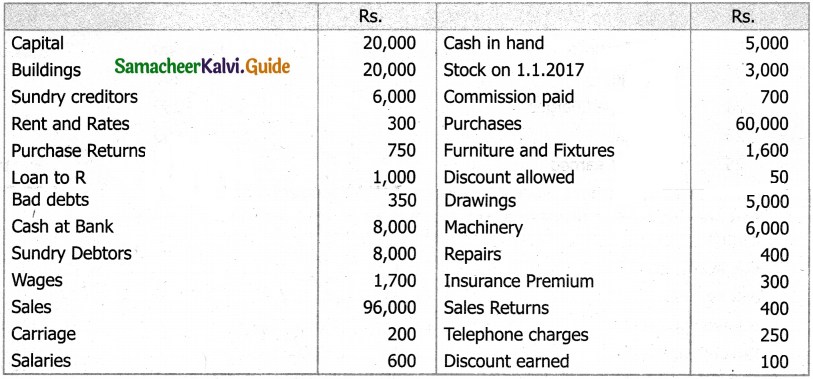
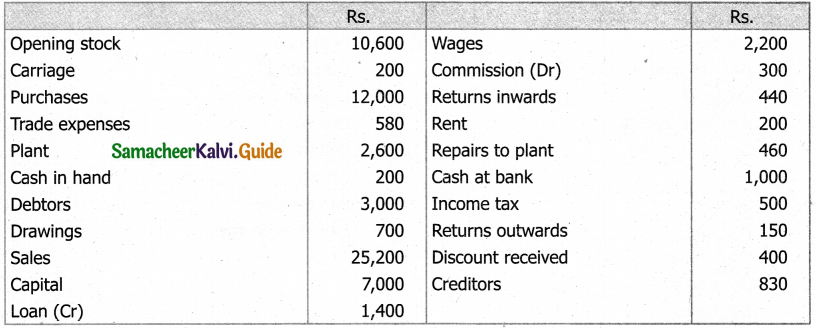
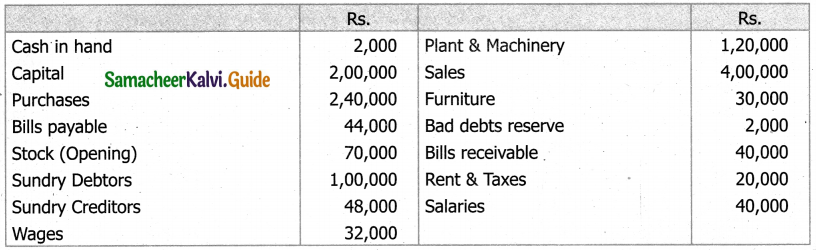
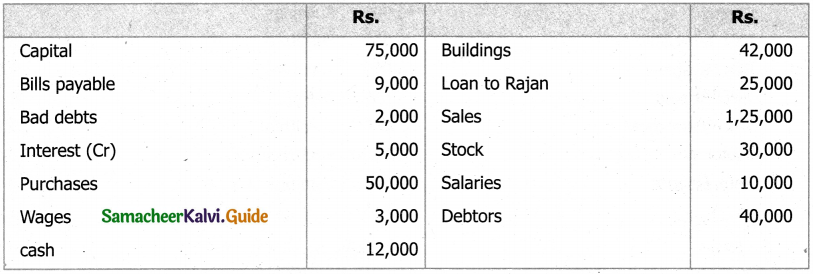
Prepare a trial balance with the following information:
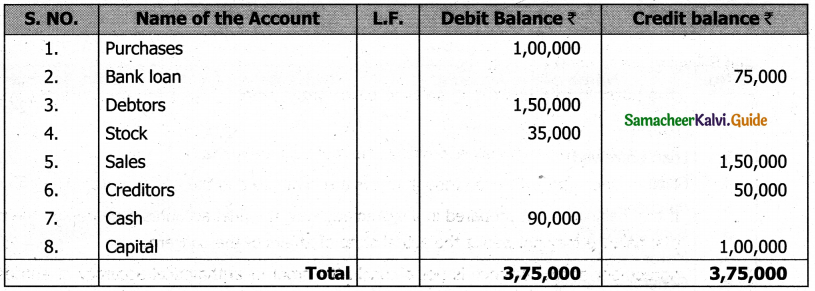
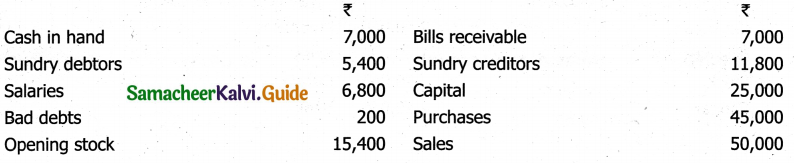
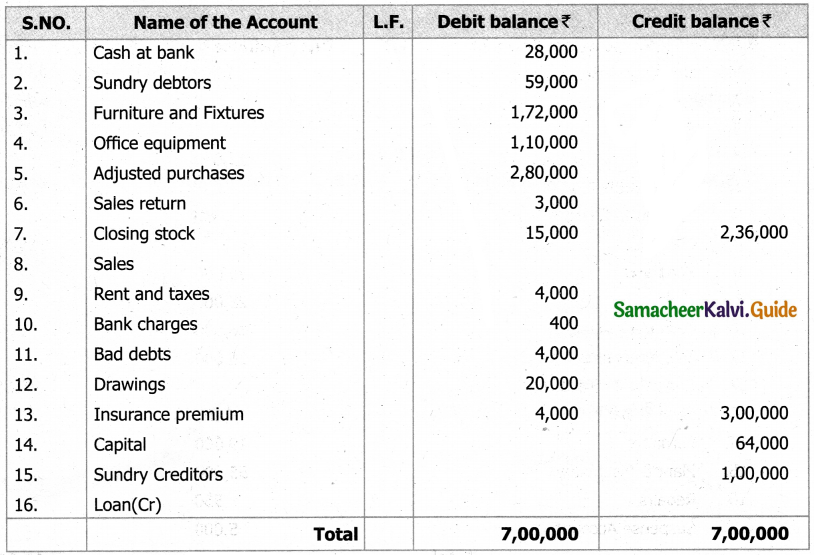
Samacheer Kalvi 11th Accountancy Guide Chapter 5 Trial Balance 3
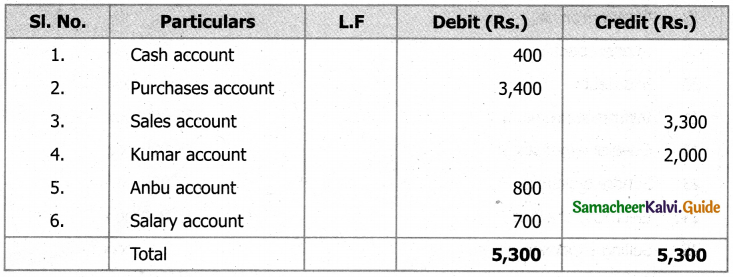
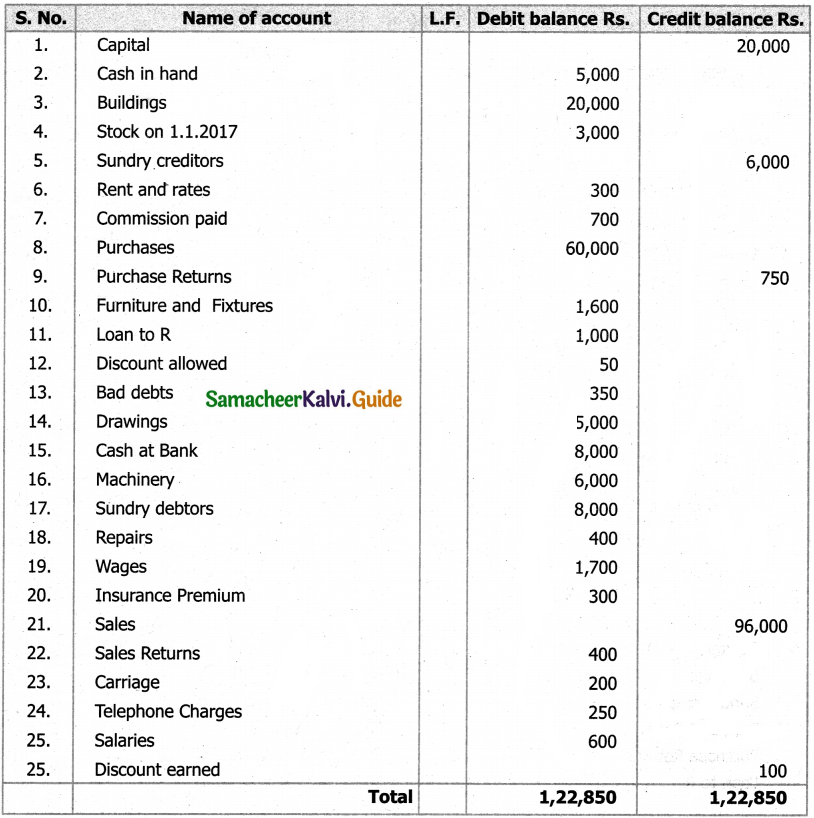
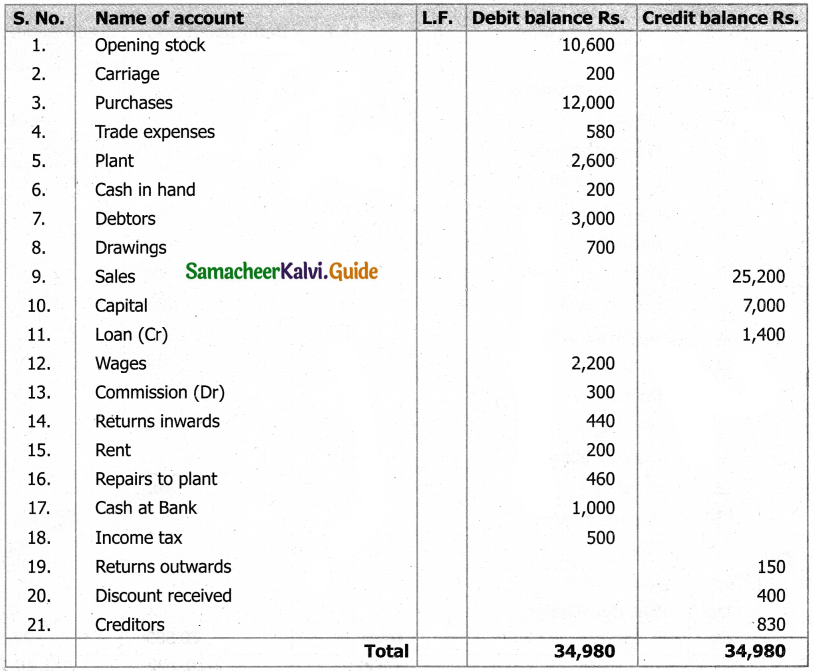
Solution:
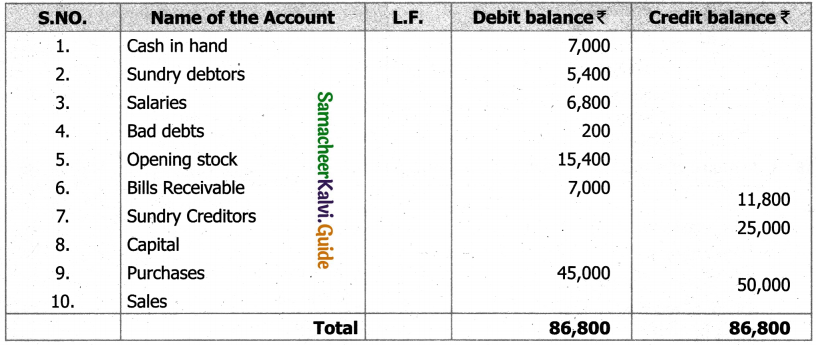
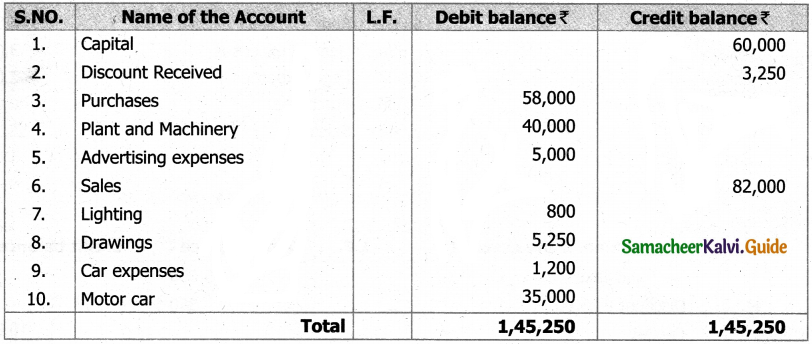
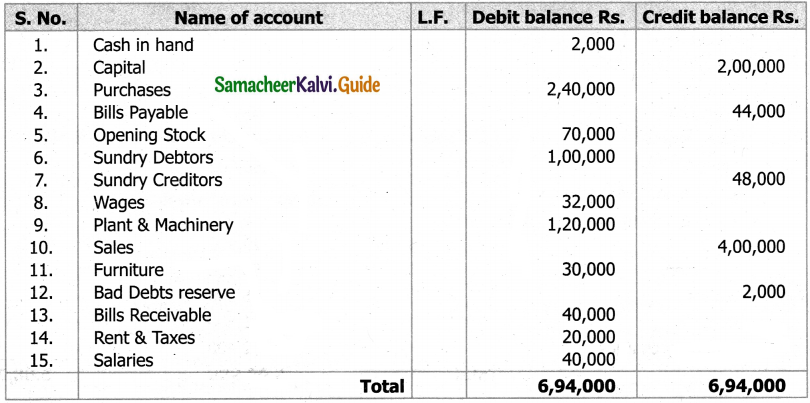
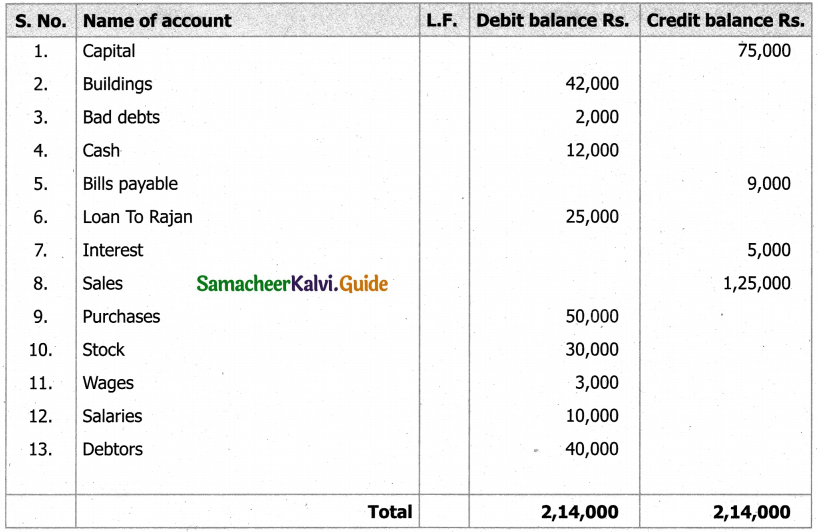
Trial Balance:
Samacheer Kalvi 11th Accountancy Guide Chapter 5 Trial Balance 4

Question 2.
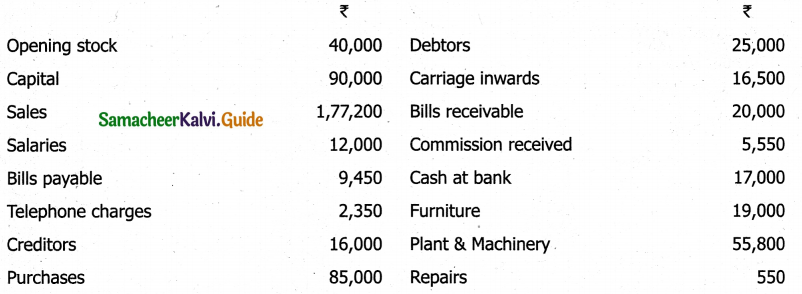
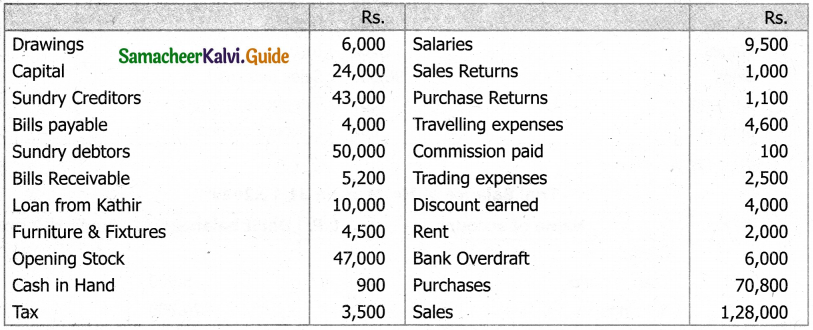
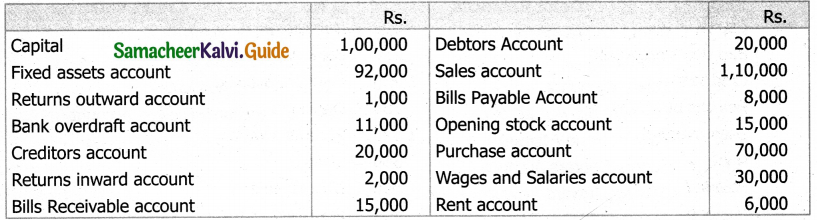
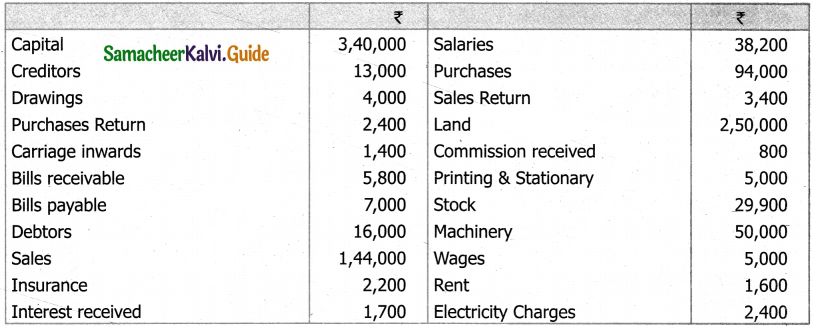
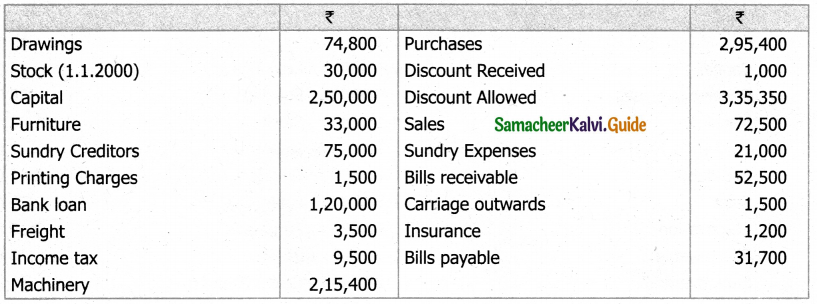
Prepare the trial balance from the following information:
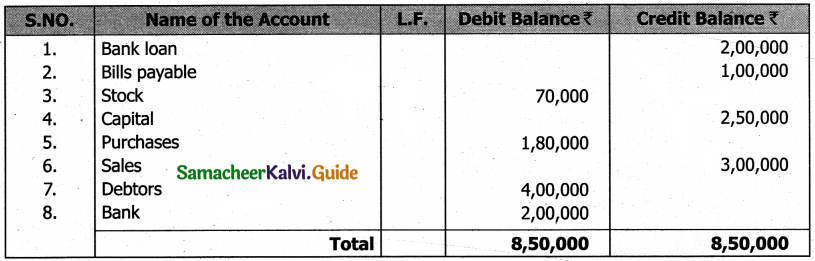
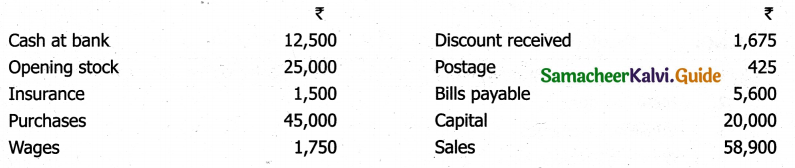
Samacheer Kalvi 11th Accountancy Guide Chapter 5 Trial Balance 5
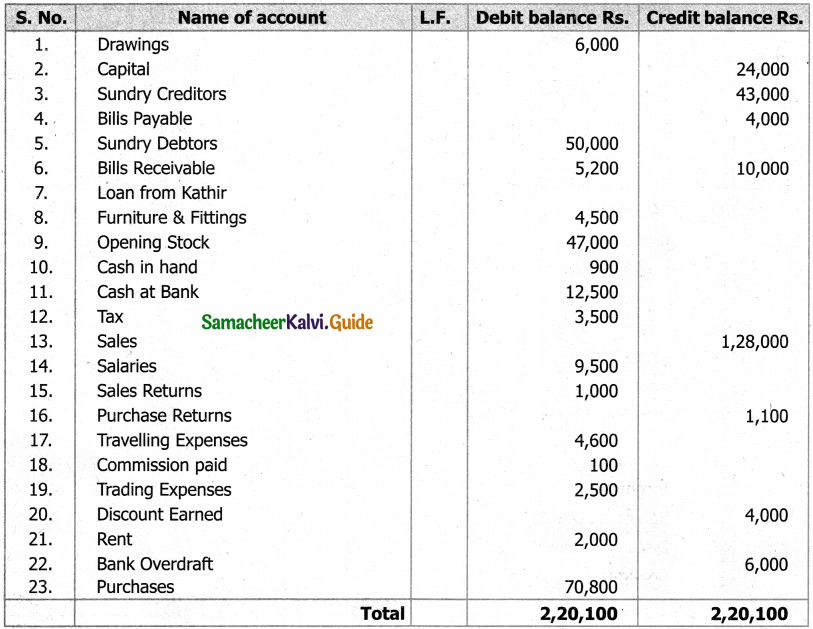
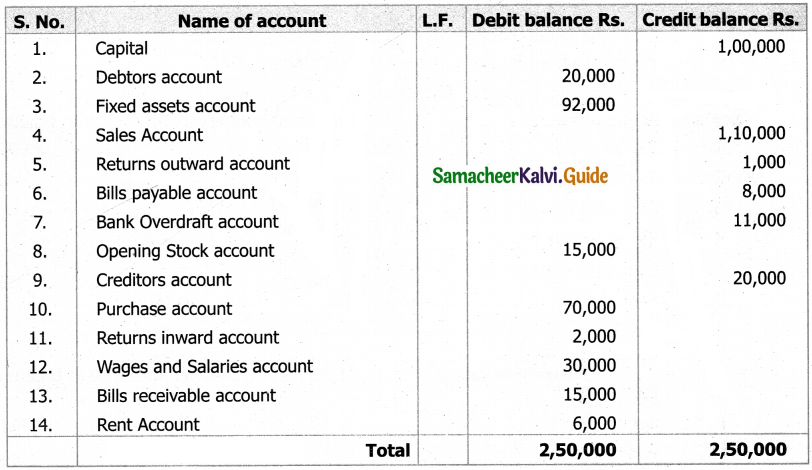
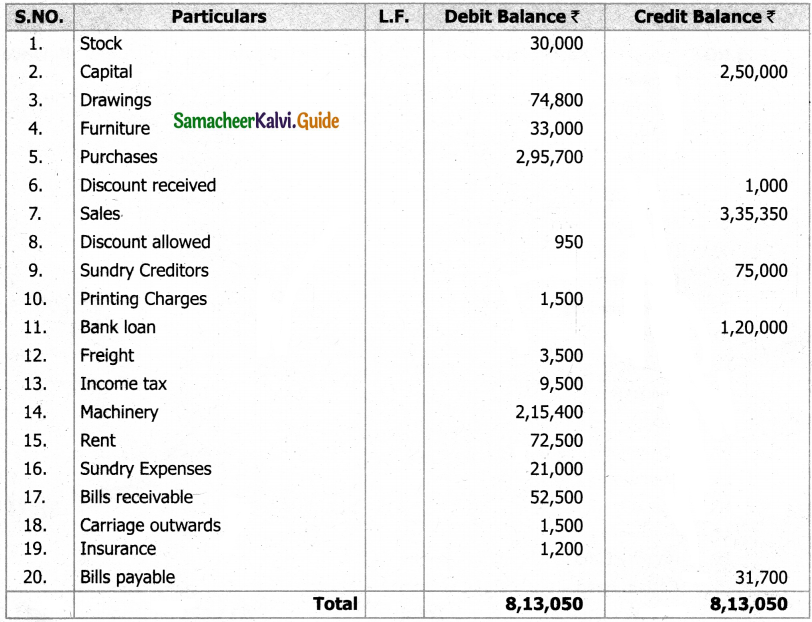
Solution:
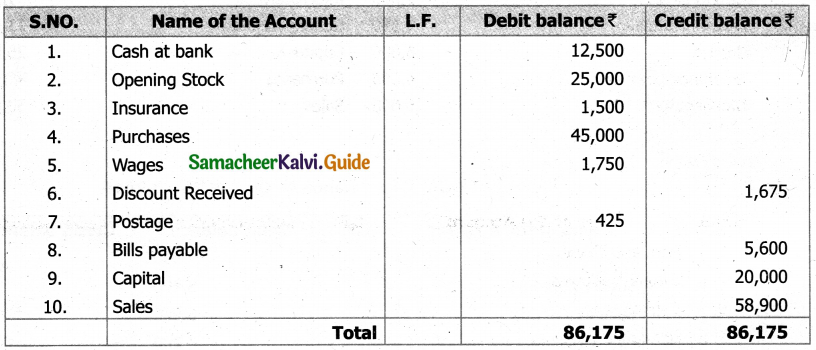
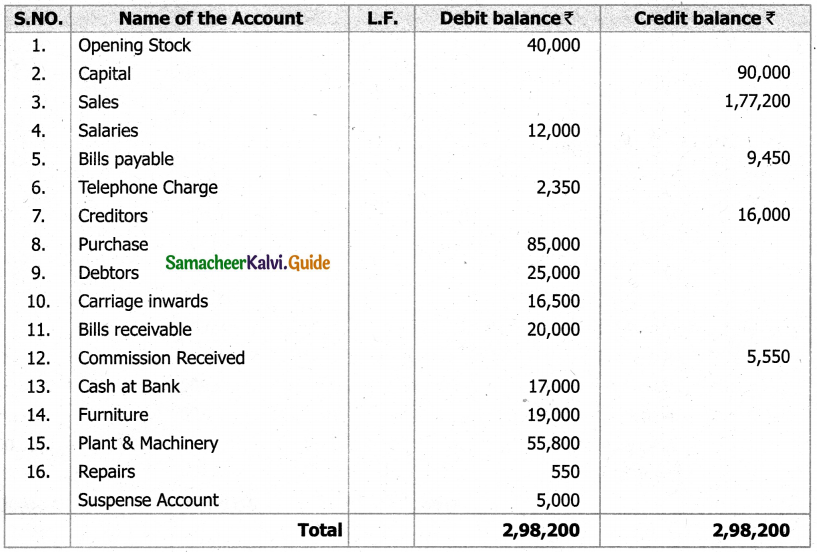
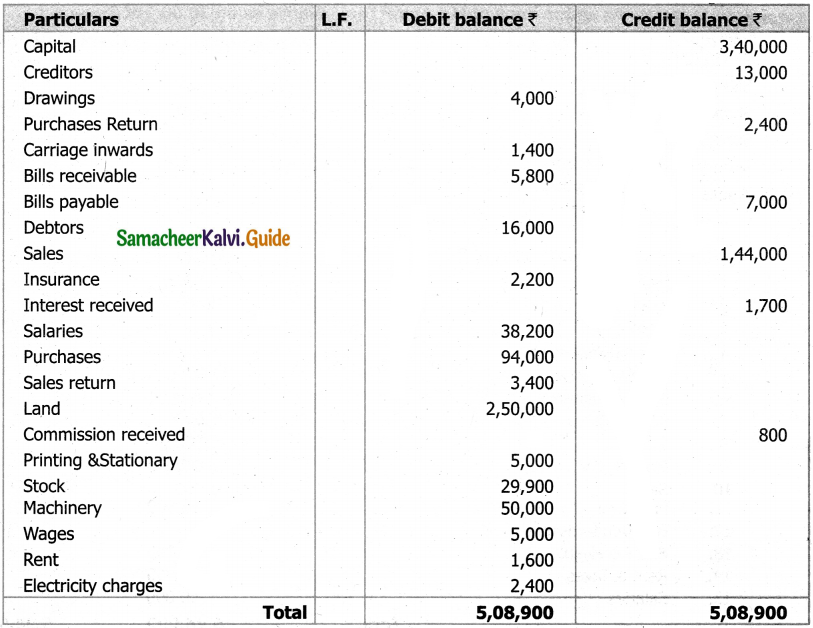
Trial Balance:
Samacheer Kalvi 11th Accountancy Guide Chapter 5 Trial Balance 6

Question 3.
Prepare the trial balance from the following balances of Chandramohan as on 31st March, 2017.
Samacheer Kalvi 11th Accountancy Guide Chapter 5 Trial Balance 7
Solution:
In the books of Chandramohan Trial balance as on 31st March 2017
Samacheer Kalvi 11th Accountancy Guide Chapter 5 Trial Balance 8

Samacheer Kalvi 11th Accountancy Guide Chapter 5 Trial Balance

Question 4.
Prepare the trial balance from the following balances of Babu as on 31st March, 2016.
Samacheer Kalvi 11th Accountancy Guide Chapter 5 Trial Balance 9
Solution:
In The Books of Arjun Trial Balance As On 31st March 2018
Samacheer Kalvi 11th Accountancy Guide Chapter 5 Trial Balance 10

Question 5.
From the following balances of Arjun, prepare the trial balance as on 31st March, 2018.
Samacheer Kalvi 11th Accountancy Guide Chapter 5 Trial Balance 11
Solution:
In The Books of Arjun Trial Balance As On 31st March 2018
Samacheer Kalvi 11th Accountancy Guide Chapter 5 Trial Balance 12

Question 6.
Prepare the trial balance from the following balances of Rajesh as on 31st March, 2017.
Samacheer Kalvi 11th Accountancy Guide Chapter 5 Trial Balance 13
Solution:
In The Books of Rajesh Trial Balance as on 31st March 2017
Samacheer Kalvi 11th Accountancy Guide Chapter 5 Trial Balance 14

Question 7.
Prepare the trial balance from the following balances of Karthik as on 31st March, 2017.
Samacheer Kalvi 11th Accountancy Guide Chapter 5 Trial Balance 15
Solution:
In the books of Karthik Trial Balance as on 31st March 2018
Samacheer Kalvi 11th Accountancy Guide Chapter 5 Trial Balance 16

Question 8.
From the following balances of Rohini, prepare the trial balance as on 31st March, 2016.
Samacheer Kalvi 11th Accountancy Guide Chapter 5 Trial Balance 17
Solution:
In the books of Rohini Trial Balance as on 31st March 2018
Samacheer Kalvi 11th Accountancy Guide Chapter 5 Trial Balance 18

Samacheer Kalvi 11th Accountancy Guide Chapter 5 Trial Balance

Question 9.
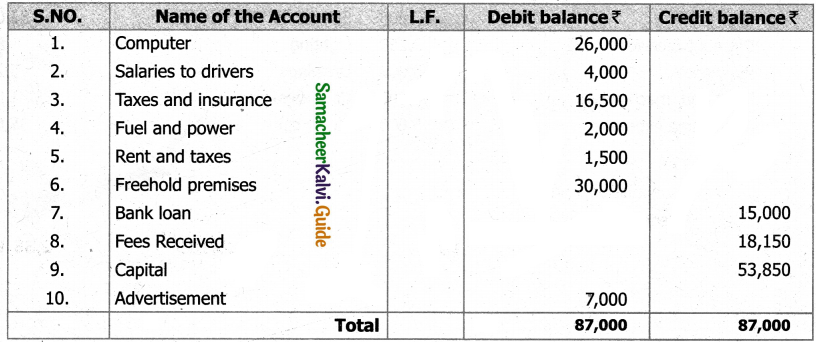
Balan who has a car driving school gives you the following ledger balances. Prepare trial balance as on 31st December, 2016.
Samacheer Kalvi 11th Accountancy Guide Chapter 5 Trial Balance 19
Solution:
In the books of Balan Trial Balance as on 31st December 2016.
Samacheer Kalvi 11th Accountancy Guide Chapter 5 Trial Balance 20

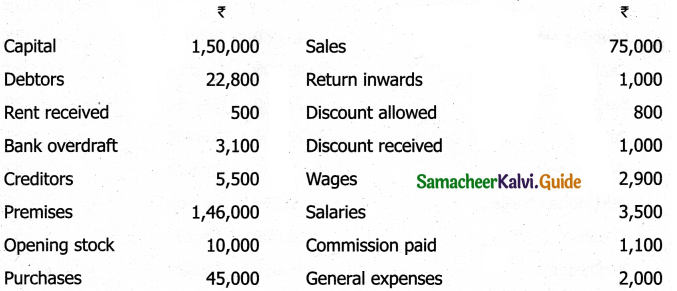
Question 10.
The following balances are extracted from the books of Ravichandran on 31st December, 2016.
Samacheer Kalvi 11th Accountancy Guide Chapter 5 Trial Balance 21
Solution:
In the books of Ravichandran Trial Balance as on 31st December 2016
Samacheer Kalvi 11th Accountancy Guide Chapter 5 Trial Balance 22

Question 11.
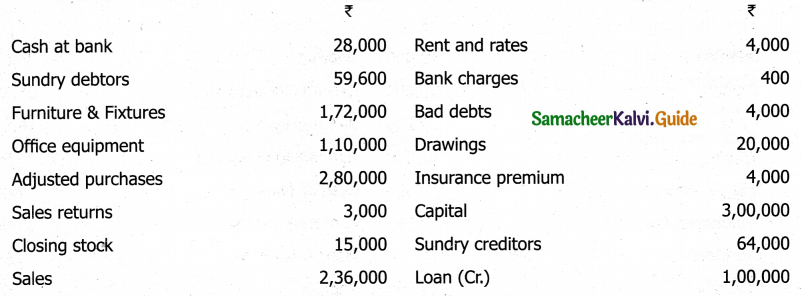
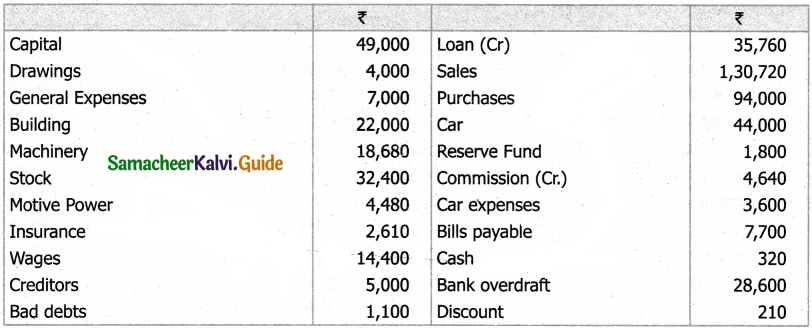
From the following balances, prepare trial balance of Baskar as on 31st March, 2017. Transfer the difference, if any, to suspense account.
Samacheer Kalvi 11th Accountancy Guide Chapter 5 Trial Balance 23
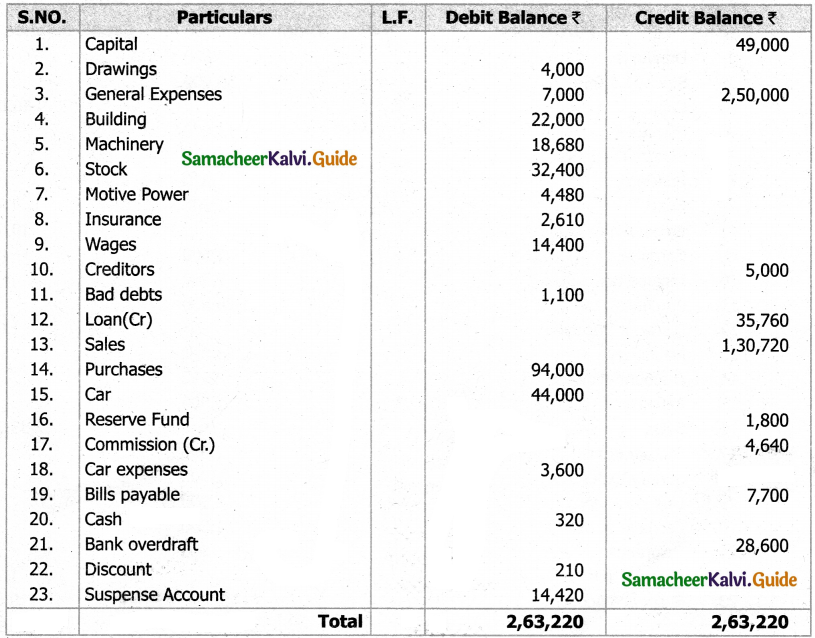
Solution:
In the books of Baskar Trial Balance as on 31st March 2017
Samacheer Kalvi 11th Accountancy Guide Chapter 5 Trial Balance 24

Question 12.
From the following balances extracted from the books of Rajeshwari as on 31st March, 2017, prepare the trial balance.
Samacheer Kalvi 11th Accountancy Guide Chapter 5 Trial Balance 25
Solution:
In the books of Baskar Trial Balance as on 31st March 2017
Samacheer Kalvi 11th Accountancy Guide Chapter 5 Trial Balance 26

Question 13.
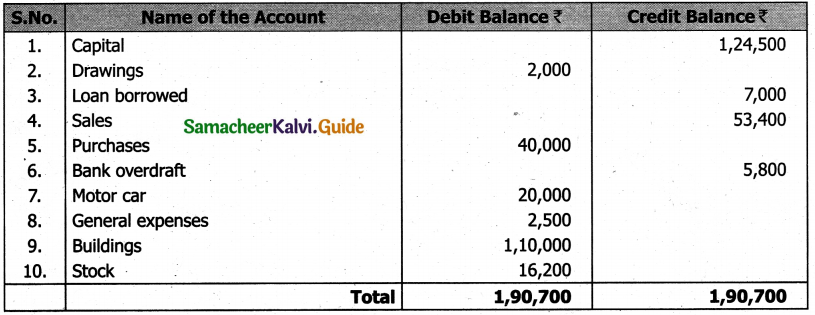
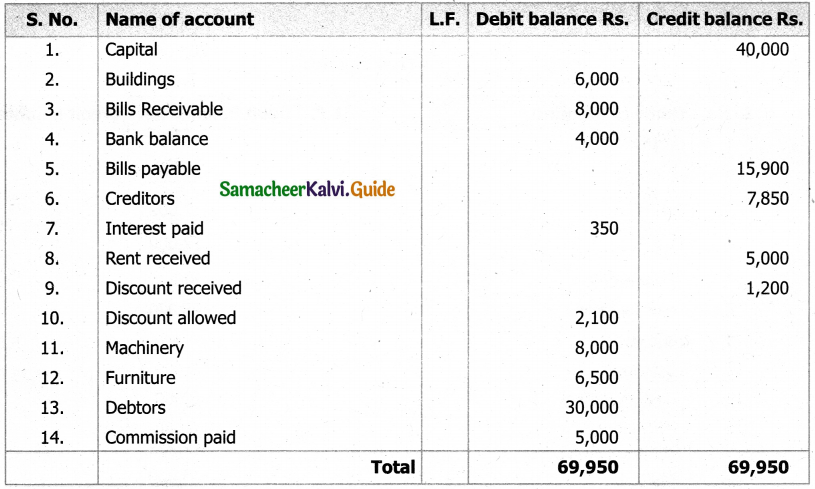
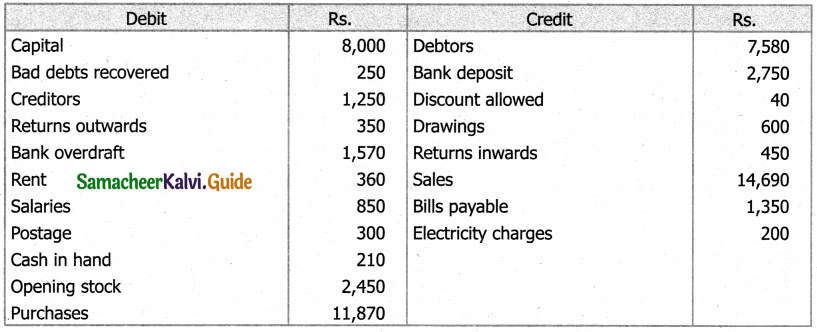
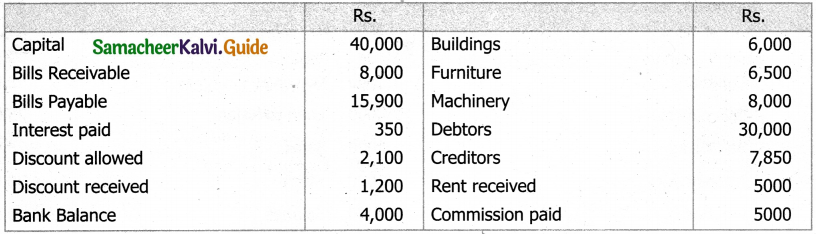
Correct the following trial balance.
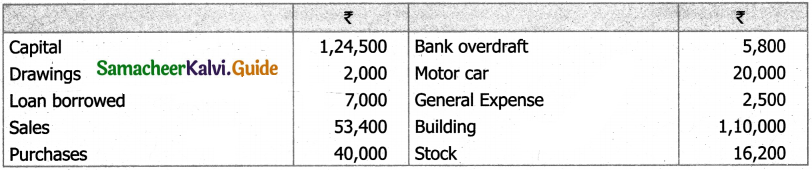
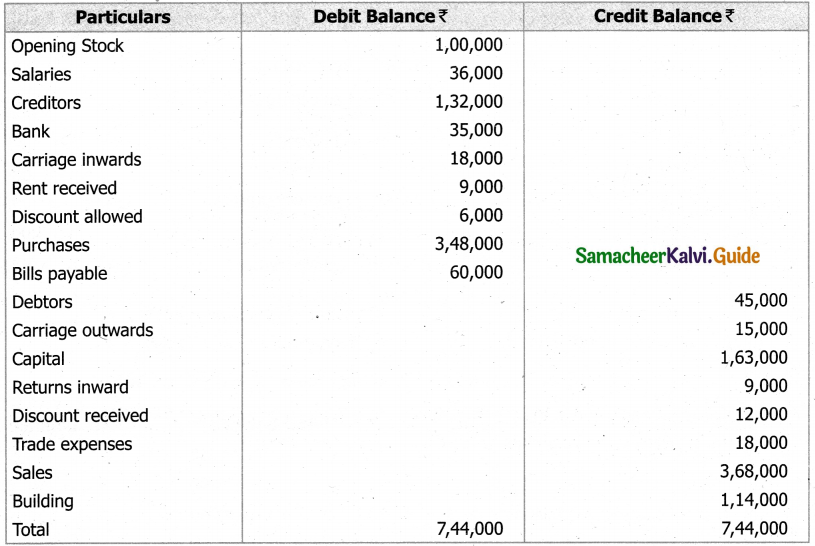
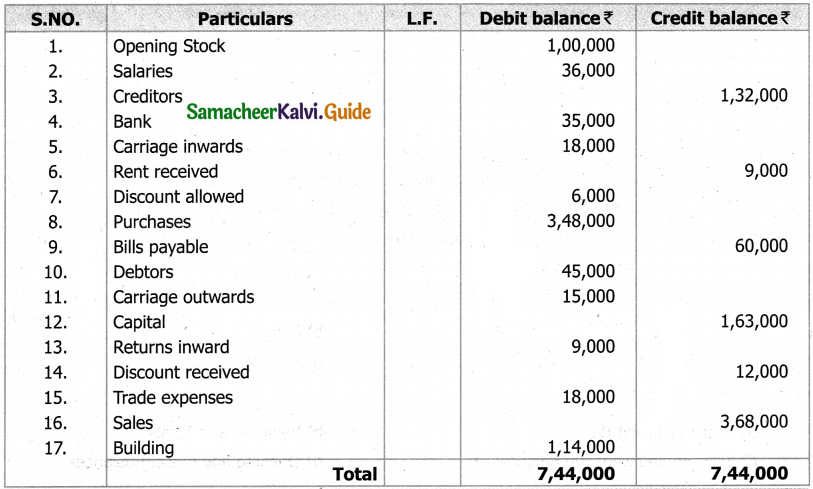
Samacheer Kalvi 11th Accountancy Guide Chapter 5 Trial Balance 27
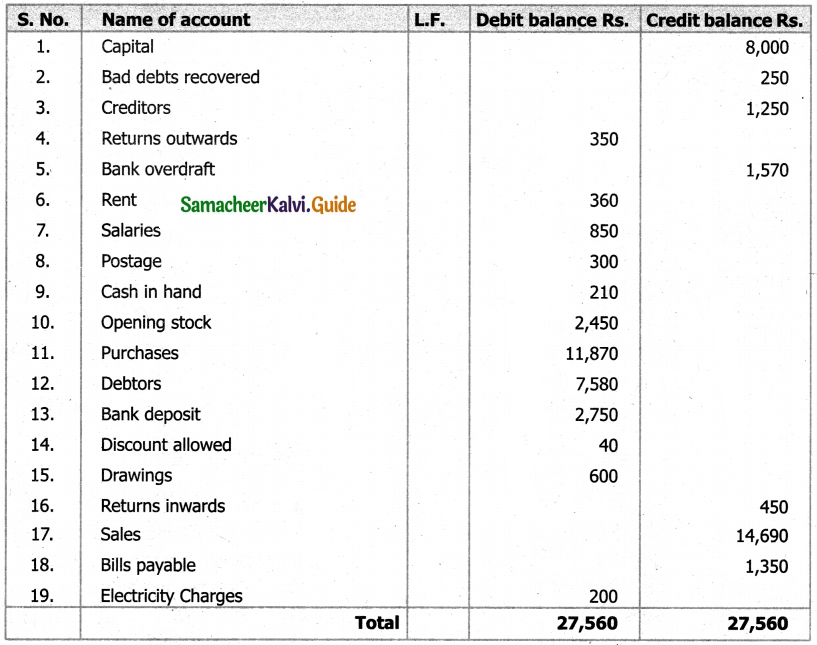
Solution:
Trial Balance:
Samacheer Kalvi 11th Accountancy Guide Chapter 5 Trial Balance 28

Samacheer Kalvi 11th Accountancy Guide Chapter 5 Trial Balance

11th Accountancy Guide Trial Balance Additional Important Questions and Answers

I. Choose the correct answer.

Question 1.
Trial Balance shows arithmetical accuracy of ledger accounts, but it is not a _______ of accuracy.
a) Conclusive
b) Exclusive
c) Submissive
d) Inclusive
Answer:
a) Conclusive

Question 2.
The statement showing balance of all the ledger accounts is known as _______.
a) Trial balance
b) Balance sheet
c) Bank reconciliation statement
d) Profit and loss account
Answer:
a) Trial balance

Question 3.
Which of the following in Trial Balance is contradictory to each other?
a) Inventory and Drawings
b) Sales and Purchases returns
c) Carriage inwards and outward
d) Trade receivable and Liability
Answer:
d) Trade receivable and Liability

Question 4.
Closing stock in the Trial Balance implies that _______.
a) It is already adjusted in the opening stock
b) It is adjusted in sales account
c) It is adjusted in the purchases account
d) None of these
Answer:
c) It is adjusted in the purchases account

Question 5.
The preparation of trial balance is for _______.
a) Locating errors of commission
b) Locating errors of principle
c) Locating clerical errors
d) All of the above
Answer:
d) All of the above

Question 6.
_______ Us Hie most popular method of preparing trial balance.
a) Balance Method
b) Net Asset Method
c) Average Trial Balance method
d) None of the above
Answer:
a) Balance Method

Samacheer Kalvi 11th Accountancy Guide Chapter 5 Trial Balance

Question 7.
When adjusted purchase is shown on the debit column of the trial balance then
a) Both opening and closing stock do not appear in the trial balance
b) Closing stock is shown in the trial balance and not the opening stock
c) Opening stock is shown in the trial balance and not the closing stock
d) Both opening and closing stock appear in the trial balance
Answer:
b) Closing stock is shown in the trial balance and not the opening stock

Question 8.
A suspense account facilitates the preparation of financial statements even when the has not tallied.
a) Cash Book
b) Ledger
c) Trial Balance
d) Journal
Answer:
c) Trial Balance

Question 9.
Trial Balance is a statement which shows _______ of all accounts.
a) Debit or Credit Balances
b) Balances and Totals
c) Positive and Negative Balances
d) Opening and Closing balances
Answer:
a) Debit or Credit Balances

Question 10.
All the following statements are correct except _______.
a) Trial balance is a statement and not an account
b) Trial balance is prepared at the end of the year
c) Trial balance is not a concluding proof of arithmetical accuracy
d) Trial balance is tallied if a transaction posted twice in the ledger
Answer:
c) Trial balance is not a concluding proof of arithmetical accuracy

Question 11.
Trial balance of a trader shows the following balances: Opening Inventory Rs.9600;Purchases less returns Rs.11850; Salaries Rs.3200;Wages Rs.750; Commission on purchases Rs.200; Carriage outwards Rs.300; Sales Rs.24900; Closing Inventory Rs.3500; Carriage on purchases Rs.1000; Gross profit will be .
a) Rs. 5,000
b) Rs. 6,500
c) Rs. 3,250
d) Rs. 3,200
Answer:
a) Rs. 5,000

Question 12.
Trial Balance is a _______.
a) Real account
b) Nominal account
c) Personal account
d) Statement
Answer:
d) Statement

Question 13.
Bank account will show _______ balance.
a) Debit
b) Credit
c) Debit (or) Credit
d) None
Answer:
a) Debit

Question 14.
Which of the following will affect the agreement of a trial balance?
a) Complete omission of a transaction
b) Partial omission of a transaction
c) Error of principle
d) Compensating errors
Answer:
b) Partial omission of a transaction

Question 15.
Trial balance is prepared to find out the _______.
a) Profit
b) loss
c) financial position
d) Arithmetical accuracy of the accounts
Answer:
d) Arithmetical accuracy of the accounts

Samacheer Kalvi 11th Accountancy Guide Chapter 5 Trial Balance

Question 16.
Suspense account in the trial balance is entered in the
a) Trading A/c
b) Profit and loss A/c
c) Balance sheet.
d) None of the above
Answer:
c) Balance sheet.

Question 17.
Suspense account having credit balance will be shown on the _______.
a) Credit side of the profit and loss A/c
b) Liabilities side of the balance sheet
c) Assets side of the balance sheet
d) Debit side of the profit and loss A/c
Answer:
b) Liabilities side of the balance sheet

Question 18.
Suspense account having debit balance will be shown on the _______.
a) Credit side of the profit and loss A/c
b) Liabilities side of the balance sheet
c) Assets side of the balance sheet
d) Debit side of the profit and loss A/c
Answer:
c) Assets side of the balance sheet

Question 19.
While preparing the trial balance, the accountant finds that the total of the debit column is short by Rs. 1,000. This difference will be _______.
a) Debited to suspense account
b) Credited to suspense account
c) Adjusted to any of the debit balance
d) Adjusted to any of the credit balance
Answer:
a) Debited to suspense account

Question 20.
The preparation of trial balance is the step in the accounting process.
a) first
b) second
c) third
d) fourth
Answer:
c) third

Question 21.
When double entry system is followed, the totals of the debit and the Credit columns of the trial balance must be _______.
a) Equal
b) unequal
c) Excess
d) Short
Answer:
a) Equal

Question 22.
The account which has a credit balance and is shown in the debit column of the trial balance is
a) Sundry debtors account
b) Bills receivable account
c) Purchases account
d) Capital account
Answer:
d) Capital account

Question 23.
Which one the following represents correct sequence of accounting cycle _______.
a) Journal > Trial balance > Ledger > Transaction
b) Transaction > Journal > Ledger > Trial balance
c) Purchases > Journal > Ledger > Trial balance
d) None of the above
Answer:
b) Transaction > Journal > Ledger > Trial balance

Samacheer Kalvi 11th Accountancy Guide Chapter 5 Trial Balance

Question 24.
Which one of the following is the most popular method of preparing a trial balance.
a) Total method
b) Balance method
c) Trial and error method
d) Line method
Answer:
b) Balance method

II. Very Short Answer Type Questions

Question 1.
What are the features of Trial Balance?
Answer:

  1. Trial balance contains the balances of all ledger accounts.
  2. It is prepared on a specific date. That is why, the word, “as on…” is used at the top.
  3. When double entry system is followed, the totals of the debit and the credit columns of the trial balance must be equal.
  4. If there is a difference between the totals of debit column and credit column of the trial balance, it is an indication of errors being committed somewhere.
  5. If both the debit column and the credit column of the trial balance have the same total, it does not mean that there is no mistake in accounting, since some errors are not disclosed by the trial balance.

Question 2.
What are the limitations of trial balance?
Answer:
The following are the limitations of trial balance:

  1. It is possible to prepare trial balance of an organisation, only if the double entry system is followed.
    Even if some transactions are omitted, the trial balance will tally.
  2. Trial balance may tally even though errors are committed in the books of account.
  3. If trial balance is not prepared in a systematic way, the final accounts prepared on the basis of trial balance may not depict the actual state of affairs of the concern.
  4. Agreement of trial balance is not a conclusive proof of arithmetical accuracy of entries made in the accounting records.
  5. This is because there are certain errors which are not disclosed by trial balance such as complete omission of a transaction, compensating errors and error of principle.

Question 3.
State whether the balance of the following accounts should be placed in the debit or the credit column of the trial balance:
(i) Opening Stock
(ii) Bank Loan
(iii) Provision for Bad debts
(iv) Good will
Answer:
Samacheer Kalvi 11th Accountancy Guide Chapter 5 Trial Balance 29

Samacheer Kalvi 11th Accountancy Guide Chapter 5 Trial Balance

III. Short Answer Questions

Question 1.
What is a Suspense Account?
Answer:
It is used as a place to hold unclassified or disputed funds and expenses. It is used to carry

Question 2.
What are the steps to be followed to prepare trial balance under Balance method?
Answer:
Step 1 : Calculate the balances of all ledger accounts including the cash book.

Step 2 : Record the names of the accounts in the particulars column and the amounts of debit balances in the debit column and credit balances in the credit column.

Step 3 : Enter the page number of ledger from which the balance is taken in the Ledger Folio column.

Step 4 : Total the debit and credit columns. It must be equal. If not equal, locate the errors and make the trial balance agree.

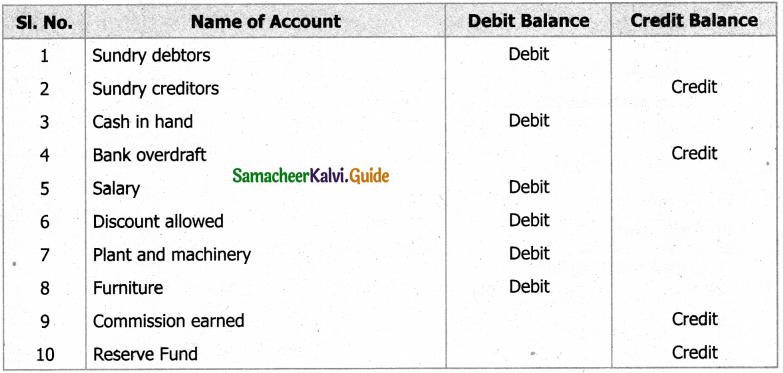
Question 3.
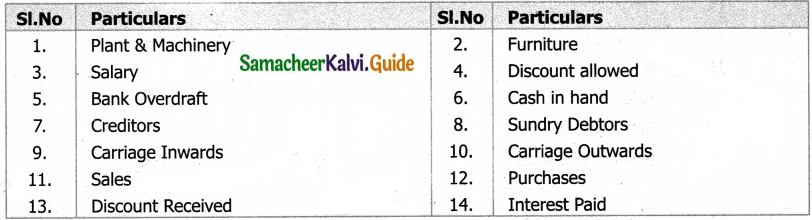
State whether the balance of each of the following accounts should be placed in
The debit or the credit column of the trial balance:
(1) Sundry debtors
(2) Sundry creditors
(3) Cash in hand
(4) Bank overdraft
(5) Salary
(6) Discount allowed
(7) Plant and machinery
(8) Furniture
(9) Commission earned
(10) Reserve Fund
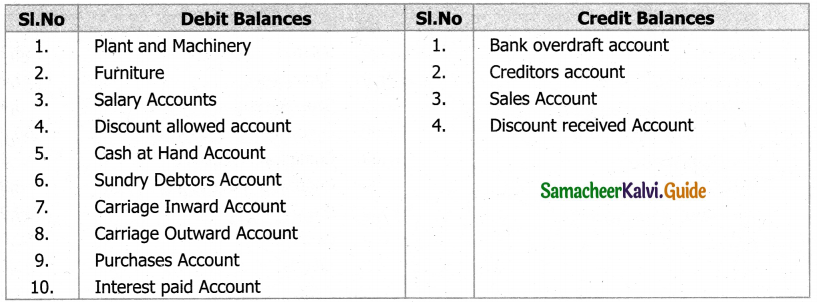
Solution:
Samacheer Kalvi 11th Accountancy Guide Chapter 5 Trial Balance 30

Question 4.
What are the advantages of a Trial Balance?
Answer:

  1. It helps to ascertain the arithmetical accuracy of the book-keeping work done during the period.
  2. It supplies in one place ready reference of all the balances of the ledger accounts.
  3. If any error is found out by preparing a trial balance, the same can be rectified before preparing final accounts.
  4. It is the basis on which final accounts are prepared.

Specimen of Trial Balance
Trial balance of Mr. X as on –
Samacheer Kalvi 11th Accountancy Guide Chapter 5 Trial Balance 31

Question 5.
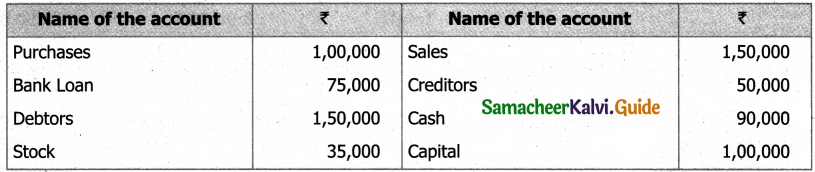
Prepare Trial Balance with the following information’s:
Samacheer Kalvi 11th Accountancy Guide Chapter 5 Trial Balance 32
Solution:
Trial Balance
Samacheer Kalvi 11th Accountancy Guide Chapter 5 Trial Balance 33

Samacheer Kalvi 11th Accountancy Guide Chapter 5 Trial Balance

IV. Exercises

Question 1.
From the following list of balances, prepare a trial balance as on 31.3.2017.
Samacheer Kalvi 11th Accountancy Guide Chapter 5 Trial Balance 34
Solution:
Trial Balance as on 31.3.2017
Samacheer Kalvi 11th Accountancy Guide Chapter 5 Trial Balance 35

Question 2.
Prepare tare trial balance from the following:
Samacheer Kalvi 11th Accountancy Guide Chapter 5 Trial Balance 36
Solution:
Trial Balance
Samacheer Kalvi 11th Accountancy Guide Chapter 5 Trial Balance 37

Question 3.
From the following details prepare Trial Balance:
Samacheer Kalvi 11th Accountancy Guide Chapter 5 Trial Balance 38
Solution:
Trial Balance
Samacheer Kalvi 11th Accountancy Guide Chapter 5 Trial Balance 39

Question 4.
The following are the balances extracted from the books of Mr.M as on 31st December, 2017. Prepare Trial Balance. ,
Samacheer Kalvi 11th Accountancy Guide Chapter 5 Trial Balance 40
Solution:
Trial Balance of Mr.M as on 31.12.2017
Samacheer Kalvi 11th Accountancy Guide Chapter 5 Trial Balance 41

Question 5.
The following balances were extracted from the ledger of Shri Prasad on 31st March 2017. You are required to prepare a trial balance as on that date in proper form.
Solution:
Samacheer Kalvi 11th Accountancy Guide Chapter 5 Trial Balance 42
Trial Balance of Shri Prasad as on 31.3.2017
Samacheer Kalvi 11th Accountancy Guide Chapter 5 Trial Balance 43

Question 6.
Prepare Trail Balance.
Samacheer Kalvi 11th Accountancy Guide Chapter 5 Trial Balance 44
Solution:
Trail Balance
Samacheer Kalvi 11th Accountancy Guide Chapter 5 Trial Balance 45

Samacheer Kalvi 11th Accountancy Guide Chapter 5 Trial Balance

Question 7.
Redraw correctly the trial balance given below:
Samacheer Kalvi 11th Accountancy Guide Chapter 5 Trial Balance 46
Solution:
Corrected Trial Balance
Samacheer Kalvi 11th Accountancy Guide Chapter 5 Trial Balance 47

Question 8.
From the following list of balances, prepare Trial Balance:
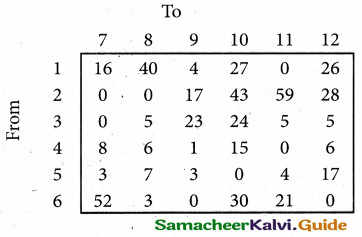
Samacheer Kalvi 11th Accountancy Guide Chapter 5 Trial Balance 48
Solution:
Trial Balance
Samacheer Kalvi 11th Accountancy Guide Chapter 5 Trial Balance 49

Question 9.
State whether the balances of the following accounts should be placed in debit column or credit column of the trial balance.
Samacheer Kalvi 11th Accountancy Guide Chapter 5 Trial Balance 50
Solution:
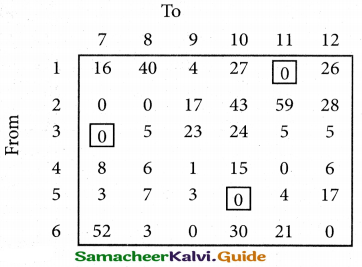
Samacheer Kalvi 11th Accountancy Guide Chapter 5 Trial Balance 51

Question 10.
From the under mentioned balances extracted from the books of a sole trader on 31st December. Prepare a Trial Balance as on 31st December, 2017.
Samacheer Kalvi 11th Accountancy Guide Chapter 5 Trial Balance 52
Solution:
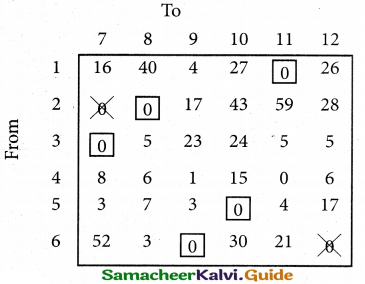
Samacheer Kalvi 11th Accountancy Guide Chapter 5 Trial Balance 53

Question 11.
Prepare trial balance as on 31.12.2000 From the followings balances of Mr. Kishore Kumar
Samacheer Kalvi 11th Accountancy Guide Chapter 5 Trial Balance 54
Solution:
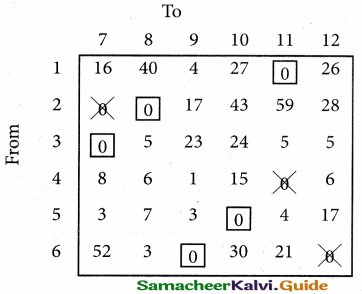
In the book of Mr. Kishore Kumar Trial balance as on 31st December 2000
Samacheer Kalvi 11th Accountancy Guide Chapter 5 Trial Balance 55

Samacheer Kalvi 11th Accountancy Guide Chapter 5 Trial Balance

Question 12.
The following balances are extracted from the books of Mr. Anbu. Prepare trial balance as on 30.6.2004.
Samacheer Kalvi 11th Accountancy Guide Chapter 5 Trial Balance 56Solution:
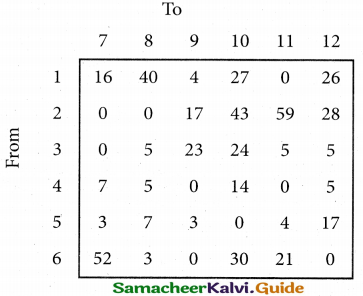
In the book of Mr. Anbu trial balance as on 30.06.2004
Samacheer Kalvi 11th Accountancy Guide Chapter 5 Trial Balance 57

Question 13.
Prepare Trial Balance as on 31.3.2004 From the books of Mr. Praveen
Samacheer Kalvi 11th Accountancy Guide Chapter 5 Trial Balance 58
Solution:
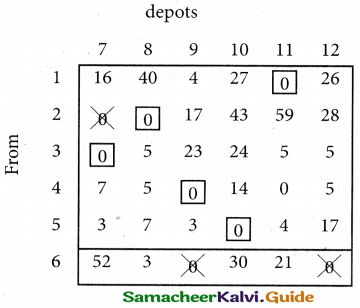
Prepare Trail Balance as 31.03.2004 from the books Mr. Praveen
Samacheer Kalvi 11th Accountancy Guide Chapter 5 Trial Balance 59

Question 14.
Prepare trial balance as on 31.12.2002. From the followings balance of Mr. Ram Prasanth.
Samacheer Kalvi 11th Accountancy Guide Chapter 5 Trial Balance 60
Solution:
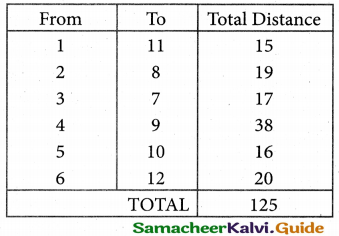
In the books of Mr. Ram Prasanth trial balance as on 31.12.2002
Samacheer Kalvi 11th Accountancy Guide Chapter 5 Trial Balance 61

Question 15.
From the extracats of Mr.Keerthivasan books of accounts prepare Trail balance as on 31.03.94.
Samacheer Kalvi 11th Accountancy Guide Chapter 5 Trial Balance 62
In the books of Mr. Keerthivasan trial balance as on 31.03.1994
Samacheer Kalvi 11th Accountancy Guide Chapter 5 Trial Balance 63

Samacheer Kalvi 11th Accountancy Guide Chapter 5 Trial Balance

Question 16.
The Following details have been extracted from Mr. Kirubakaran books of accounts as on 31.12.98.
Samacheer Kalvi 11th Accountancy Guide Chapter 5 Trial Balance 64
Solution:
In the books of Mr. Kirubakaran trial balance as on 31.12.1998
Samacheer Kalvi 11th Accountancy Guide Chapter 5 Trial Balance 65

Samacheer Kalvi 11th Accountancy Guide Chapter 3 Books of Prime Entry

Tamilnadu State Board New Syllabus Samacheer Kalvi 11th Accountancy Guide Pdf Chapter 3 Books of Prime Entry Text Book Back Questions and Answers, Notes.

Tamilnadu Samacheer Kalvi 11th Accountancy Solutions Chapter 3 Books of Prime Entry

11th Accountancy Guide Books of Prime Entry Text Book Back Questions and Answers

I. Choose the correct answer.

Question 1.
Accounting equation signifies …………….
(a) Capital of a business is equal to assets
(b) Liabilities of a business are equal to assets
(c) Capital of a business is equal to liabilities
(d) Assets of a business are equal to the total of capital and liabilities
Answer:
(d) Assets of a business are equal to the total of capital and liabilities

Samacheer Kalvi 11th Accountancy Guide Chapter 3 Books of Prime Entry

Question 2.
‘Cash withdrawn by the proprietor from the business for his personal use’ causes …………….
(a) Decrease in assets and decrease in owner’s capital
(b) Increase in one asset and decrease in another asset
(c) Increase in one asset and increase in liabilities
(d) Increase in asset and decrease in capital
Answer:
(a) Decrease in assets and decrease in owner’s capital

Question 3.
A firm has assets of Rs. 1,00,000 and the external liabilities of Rs. 60,000. Its capital would be ……………….
(a) Rs. 1,60,000
(b) Rs. 60,000
(c) Rs. 1,00,000
(d) Rs. 40,000
Answer:
(d) Rs. 40,000

Question 4.
The incorrect accounting equation is ………………….
(a) Assets = Liabilities + Capital
(b) Assets = Capital + Liabilities
(c) Liabilities = Assets + Capital
(d) Capital = Assets – Liabilities
Answer:
(c) Liabilities = Assets + Capital

Question 5.
Accounting equation is formed based on the accounting principle of ………………
(a) Dual aspect
(b) Consistency
(c) Going concern
(d) Accrual
Answer:
(a) Dual aspect

Question 6.
Real account deals with ……………..
(a) Individual persons
(b) Expenses and losses
(c) Assets
(d) Incomes and gains
Answer:
(c) Assets

Question 7.
Which one of the following is representative personal account?
(a) Building A/c
(b) Outstanding salary A/c
(c) Mahesh A/c
(d) Balan & Co
Answer:
(b) Outstanding salary A/c

Question 8.
Prepaid rent is a ……………….
(a) Nominal A/c
(b) Personal A/c
(c) Real A/c
(d) Representative personal A/c
Answer:
(d) Representative personal A/c

Samacheer Kalvi 11th Accountancy Guide Chapter 3 Books of Prime Entry

Question 9.
Withdrawal of cash from business by the proprietor should be credited to
(a) Drawings A/c
(b) Cash A/c
(c) Capital A/c
(d) Purchases A/c
Answer:
(b) Cash A/c

Question 10.
In double entry system of book keeping, every business transaction affects
(a) Minimum of two accounts
(b) Same account on two different dates
(c) Two sides of the same account
(d) Minimum three accounts
Answer:
(a) Minimum of two accounts

II. Very Short Answer Type Questions

Question 1.
What are source documents?
Answer:
Source documents are the authentic evidences of financial transactions.
These documents show the nature of transaction, the date, the amount and the parties involved.
Source documents include cash receipt, invoice, debit note, credit note, pay-in-slip, salary bills, wage bills, cheque record slips, etc.
They also serve as legal evidence in case of any legal dispute.

Samacheer Kalvi 11th Accountancy Guide Chapter 3 Books of Prime Entry

Question 2.
What Is accounting equation?
Answer:
The relationship of assets with that of liabilities to outsiders and to owners in the equation form is known as accounting equation.
Accounting equation is a mathematical expression which shows that the total of assets is equal to the total of liabilities and capital.
This is based on the dual aspect concept of accounting.
This means that total claims of outsiders and the proprietor against a business enterprise will always be equal to the total assets of the business enterprise.
Capital + Liabilities = Assets

Question 3.
Write any one transaction which
(a) Decreases the assets and decreases the liabilities:
Answer:
E.g : Outstanding Rent paid by the company Rs. 30,000.
Here Outstanding Rent (Liability) is decreasing, Cash (Asset) is decreasing.

(b) Increases one asset and decreases another asset:
Answer:
E.g: Building purchased for Cash Rs. 50,000.
Here Building (Asset) is increasing and Cash (Asset) is decreasing.

Question 4.
What is meant by journalising?
Answer:
The process of analysing the business transactions under the heads of debit and credit and recording them in the journal is called journalising.

Question 5.
What is real account?
Answer:
A real account is an account that retains and rolls forward its ending balance from period to period. The areas in the balance, sheet in which real accounts are found are assets, liabilities, and equity. Examples of real accounts are: Cash, Accounts receivable, Fixed Assets Accounts payable, Retained earnings.

Question 6.
How are personal accounts classified?
Answer:
Samacheer Kalvi 11th Accountancy Guide Chapter 3 Books of Prime Entry 1

Question 7.
State the accounting rule for nominal account.
Answer:
Samacheer Kalvi 11th Accountancy Guide Chapter 3 Books of Prime Entry 2

Samacheer Kalvi 11th Accountancy Guide Chapter 3 Books of Prime Entry

Question 8.
Give the golden rules of double entry accounting system.
Answer:
Samacheer Kalvi 11th Accountancy Guide Chapter 3 Books of Prime Entry 3

III. Short Answer Questions

Question 1.
Write a brief note on accounting equation approach of recording transactions.
Answer:
The relationship of assets with that of liabilities to outsiders and to owners in the equation form is known as accounting equation.
Accounting equation is a mathematical expression which shows that the total of assets is equal to the total of liabilities and capital.
This is based on the dual aspect concept of accounting.

This means that total claims of outsiders and the proprietor against a business enterprise will always be equal to the total assets of the business enterprise. The equation is given under:
Capital + Liabilities = Assets
Capital can also be called as owner’s equity and liabilities as outsider’s equity.

As the revenues and expenses will affect capital, the expanded equation may be given as under:
Assets = Liabilities + Capital + Revenues – Expenses
Accounts are classified into five categories: (i) Asset account, (ii) Liability account, (iii) Capital account, (iv) Revenue account and (v) Expense account as follows:
Samacheer Kalvi 11th Accountancy Guide Chapter 3 Books of Prime Entry 4

Question 2.
What is an Account? Classify the accounts with suitable examples.
Answer:
Every transaction has two aspects and each aspect affects minimum one account.
An account is the basic unit of identification in accounting.
A ledger account is a summary of relevant transactions at one place relating to a particular head.
Account is the systematic presentation of all material information regarding a particular person or item at one place, under one head.

Classification of Accounts:
Persona! Account;
Accounting relating to persons is called personal account. The personal account may be natural, artificial or representative personal account.
E.g: Malini account, BHEL account, Prepaid Rent account.

Impersonal Account:
All accounts which do not affect persons are called impersonal accounts. These are further classified into Real and Nominal Accounts.
E.g ; Building account, Goodwill, Salaries account.

Question 3.
What are the three different types of persona! accounts?
Answer:
Natural person’s account: Natural person means human beings. Example: Vinoth account, Malini account.

Artificial person’s account: Artificial person refers to the persons other than human beings recognised by law as persons. They include business concerns, charitable institutions, etc. Example: BHEL account, Bank account.

Representative personal accounts: These are the accounts which represent persons natural or artificial or a group of persons. Example: Outstanding salaries account, Prepaid rent account. When expenses are outstanding, it is payable to a person. Hence, it represents a person.

Question 4.
What is the accounting treatment for insurance premium paid on the of the proprietor?
Answer:
The proprietor has to pay an agreed premium on a monthly or annual basis. The amount should be treated as prepayment which is considered as current asset.
The following entry should be made:
Insurance A/c Dr –
To Cash/Bank A/c –
(Being insurance premium paid.)

Samacheer Kalvi 11th Accountancy Guide Chapter 3 Books of Prime Entry

Question 5.
State the principles of double entry system of book keeping.
Answer:
Meaning:
Double entry system of book keeping is a scientific and complete system of recording the financial transactions of an organisation. The two aspects involved is denoted by Debit (Dr.) and Credit(Cr.). The following are the principles of double entry system of book keeping:
In every business transaction, there are two aspects.
The two aspects involved are the benefit or value receiving aspect and benefit or value giving aspect.
These two aspects involve minimum two accounts; at least one debit and at least one credit.
For every debit, there is a corresponding and equivalent credit. If one account is debited the other account must be credited.

Question 6.
Briefly explain about steps in journalising.
Answer:
The process of analysing the business transactions under the heads of debit and credit and recording them in the journal is called journalising. An entry made in the journal is called a journal entry. The following steps are followed in journalising:

Analyse the transactions and identify the accounts (based on aspects) which are involved in the transaction.

Classify the above accounts under Personal account, Real account or Nominal account <•> Apply the rules of debit and credit for the above two accounts.

Find which account is to be debited and which account is to be credited by the application of rules of double entry system. Record the date of transaction in the date column.

Enter the name of the account to be debited in the particulars column very close to the left hand side of the particulars column followed by the abbreviation ‘Dr/ at the end in the same line. Against this, the amount to be debited is entered in the debit amount column in the same line.

Write the name of the account to be credited in the second line starting with the word ‘To’ prefixed a few spaces away from the margin in the particulars column. Against this, the amount to be credited is entered in the credit amount column in the same line.

Write the narration within brackets in the next line in the particulars column.

Question 7.
What is double entry system? State its advantages.
Answer:
“Every business transaction has a two-fold effect and that it affects two accounts in opposite directions and if a complete record is to be made of each such transaction it is necessary to debit one account and credit another account. It is this recording of two fold effect of every transaction that has given rise to the term Double Entry” J.R. Batliboi.

Advantages of double entry system:
Following are the advantages of double entry system:
Accuracy
In this system, the two aspects of each transaction are recorded in the books of accounts. This helps in checking the accuracy in accounting.

Ascertainment of business results
Details regarding expenses, losses, incomes, gains, assets, liabilities, debtors, creditors, etc., are readily available. This helps to ascertain the net profit earned or loss incurred during an accounting period and also to know the financial position as on a particular date.

Comparative study
The business results of the current year can be compared with those of the previous years and also 4 with other business firms. It facilitates business planning for future.

Common acceptance
The business records maintained under this system are accepted by financial institutions, government and others, because it is a systematic and scientific system.

Samacheer Kalvi 11th Accountancy Guide Chapter 3 Books of Prime Entry

IV. Exercises

Question 1.
Complete the accounting equation.
(a) Assets = Capital + Liabilities
1,00,000 = 80,000 + ?
Answer:
(a) Liabilities = Assets – Capital
Liabilities = 1,00,000 – 80,000
Liabilities = 20,000

(b) Assets = Capital + Liabilities
2,00,000 = ? + 40,000
Answer:
Capital = Assets – Liabilities
Capital = 2,00,000 – 40,000
Capital = 1,60,000

(c) Assets = Capital + Liabilities
? = 1,60,000 + 80,000
Answer:
Assets = Capital + Liabilities
Assets = 1,60,000 + 80,000
Assets = 2,40,000

Question 2.
For the following transactions, show the effect on accounting equation.
(a) Raj Started business with cash – 40,000
(b) Opened bank account with a deposit of – 30,000
(c) Bought goods from Hari on credit for – 12,000
(d) Raj withdrew cash for personal use – 1,000
(e) Bought furniture by using debit card for – 10,000
(f) Sold goods to Murugan and cash received – 6,000
(g) Money withdrawn from bank for office use – 1,000
Answer:
(a) Raj started business with cash Rs 40,000
Increasing in capital and increasing in Asset Effects:
Cash comes in → Increase in asset
Capital provided by the owner → Increase in capital of owner
Capital = Asset
Capital = Cash
(+)Rs. 40,000 = (+)Rs. 40,000

(b) Opened bank account with a deposit of Rs 30,000
Decrease in one asset and increase in another asset Effects:
Bank is the receiver → Increases in Assets
Cash goes out → Decrease in Asset
Capital = Asset
Capital = Bank + cash
Capital = (+) Rs. 30,000 + (-) Rs. 30,000

(c) Bought goods from Hari on credit for Rs. 12,000
Increasing Asset and Increase in Liabilities Effects:
Stock comes in → Increase in Asset
Creditors arises → Increase in Liabilities
Asset = Liabilities
Stock = Creditors
(+) Rs. 12,000 = (+) Rs. 12,000

(d) Raj withdrew cash for personal use Rs 1,000
Decrease in Asset and decrease in capital Effects:
Cash goes out → Decrease in cash
Drawings proprietor is the receiver → Decrease in capital
Asset = Capital
Cash = Capital
(-) Rs. 1,000 = (-) Rs. 1,000

(e) Bought furniture by using debit card for Rs 10,000
Decrease in one asset and Increase in another asset Effects:
Furniture comes in → Increase in Furniture
Bank is giver → Decrease in a Bank
Asset = Liabilities
Furniture + Bank = Liabilities
(+) Rs. 10,000 + (-) Rs. 10,000 = Liabilities

(f) Sold goods to Murugan and cash received Rs 6,000
Decrease in one asset and increase in another asset Effects:
Cash comes in → Increase in cash
<$> Stock goes out → Decrease in stock
Asset = Liabilities
Cash + Stock = Liabilities
(+) Rs. 6,000 + (-) Rs. 6,000 = Liabilities

(g) Money withdrawn from bank for office use Rs 1,000
Decrease in one asset and increase in another asset Effects:
Cash comes in → Increase in Cash
Bank is a giver → Decrease in Bank
Asset = Liabilities
Cash + Bank = Liabilities
(+) Rs. 1,000 + (-) Rs. 1,000 = Liabilities

Accounting Equation:
Samacheer Kalvi 11th Accountancy Guide Chapter 3 Books of Prime Entry 5

Samacheer Kalvi 11th Accountancy Guide Chapter 3 Books of Prime Entry

Question 3.
Prepare accounting equation for the following transactions,
(a) Murugan commenced business with cash Rs 80,000
(b) Purchased goods for cash Rs 30,000
(c) Paid salaries by cash Rs 5,000
(d) Bought goods from Kumar for Rs 5,000 and deposited the money in CDM.
(e) Introduced additional capital of Rs 10,000
Answer:
Accounting Equation:
Samacheer Kalvi 11th Accountancy Guide Chapter 3 Books of Prime Entry 6

Question 4.
What will be the effect of the following on the accounting equation?
(a) Sunil started business with Rs 1,40,000 cash and goods worth Rs 60,000
(b) Purchased furniture worth Rs 20,000 by cash
(c) Depredation on furniture Rs 800
(d) Deposited into bank Rs 40,000
(e) Paid electricity charges through net banking Rs 500
(f) Sold goods to Ravi costing Rs 10,000 for Rs 15,000
(g) Goods returned by Ravi Rs 5,000
Answer:
(a) Sunil started business with Rs 1,40,000 cash and goods worth Rs 60,000
Transactions affecting more than two accounts Effects:
Cash comes in → Increase in asset
Stock comes in → Increase in asset
Capital provide by the owner → Increase in capital
Capital = Asset
Capital = Cash + Stock
(+) 2,00,000 = (+) 1,40,000 + (+) 60,000

(b) Purchased furniture worth Rs 20,000 by cash
Decrease in one asset and Increase in Another asset Effects:
Furniture comes in → Increase in asset
Cash goes out → Decrease in asset
Liabilities = Assets
Liabilities = Cash + Furniture
Liabilities = (-) 20,000 + (-) 20,000

(c) Depreciation on furniture Rs 800
Decrease in asset and decrease in capital effects:
Furniture goes out → Decrease in Asset
Capital → Decrease in Capital
Capital = Asset
Capital = Furniture
(-) 800 = (-) 800

(d) Deposited into bank Rs 40,000
Increase in one Asset and decrease in another asset Effects:
Cash goes out → Decrease in asset
Bank is a receiver → Increase in asset
Liability = Asset
Liability = Cash + bank
= (-) 40,000 + (+) 40,000

(e) Paid electricity charges through net banking Rs 500
decrease in Asset and Decrease in capital Effects:
Bank is a given → Decrease in Asset
Capital (Expenses) → Decrease in capital
Capital = Asset
Capital = Bank
(-) 500 = (-) 500

(f) Sold goods to Ravi costing Rs 10,000 for Rs 15,000
Increase in asset and decreases in another asset and Increase in Capital Effects:
Creditors → Increases in Liabilities
Stock goes out → Decreases in asset
Capital (Incom(e) → Increase in capital
Liabilities + Capital = Asset
Creditors + Capital = Stock
(+) 15,000 + (+) 5,000 = (-) 5,000

(g) Goods returned by Ravi Rs 5,000
Increase in asset and decrease in Liabilities Effects:
Stock comes in → Increase in asset
Reducing in creditors → Decreases in Liabilities
Liability = Asset
Creditors = Stock
(-) 5,000 = (+) 5,000
Accounting Equation:
Samacheer Kalvi 11th Accountancy Guide Chapter 3 Books of Prime Entry 7

Samacheer Kalvi 11th Accountancy Guide Chapter 3 Books of Prime Entry

Question 5.
Create an accounting equation on the basis of the following transactions.
(i) Rakesh started business with a capital of Rs 1,50,000
(ii) Deposited money with the bank Rs 80,000
(iii) Purchased goods from Mahesh and paid through credit card Rs 25,000
(iv) Sold goods (costing Rs 10,000) to Mohan for Rs 14,000 who pays through debit card
(v) Commission received by cheque and deposited the same in the bank Rs 2,000
(vi) Paid office rent through ECS Rs 6,000
(vii) Sold goods to Raman for Rs 15,000 of which Rs 5,000 was received at once
Answer:
Accounting Equation:
Samacheer Kalvi 11th Accountancy Guide Chapter 3 Books of Prime Entry 8

Question 6.
Create an accounting equation on the basis of the following transactions.
(i) Started business with cash 80,000 and goods Rs 75,000
(ii) Sold goods to Shanmugam on credit for Rs 50,000
(iii) Received cash from Shanmugam in full settlement Rs 49,000
(iv) Salary outstanding Rs 3,000
(v) Goods costing Rs 1,000 given as charity
(vi) Insurance premium paid Rs 3,000
(vii) Out of insurance premium paid, prepaid is Rs 500
Answer:
Accounting Equation:
Samacheer Kalvi 11th Accountancy Guide Chapter 3 Books of Prime Entry 9

Question 7.
Create accounting equation on the basis of the following transactions:
(i) Opening balance on 1st January, 2018 cash Rs 20,000; stock Rs 50,000 and bank Rs 80,000
(ii) Bought goods from Suresh Rs 10,000 on credit
(iii) Bank charges Rs 500
(iv) Paid Suresh Rs 9,700 through credit card in full settlement.
(v) Goods purchased on credit from Philip for Rs 15,000
(vi) Goods returned to Philip amounting to Rs 4,000
Answer:
Samacheer Kalvi 11th Accountancy Guide Chapter 3 Books of Prime Entry 10

Question 8.
Enter the following transactions in the journal of Manohar who is dealing in textiles. 2018 March
Manohar started business with cash – 60,000
Purchased furniture for cash – 10,000
Bought goods for cash – 25,000
Bought goods from Kamaiesh on credit – 15,000
Sold goods for cash – 28,000
Sold goods to Hari on credit – 10,000
Paid Kamaiesh – 12,000
Paid rent – 500
Received from Hari – 8,000
Withdrew cash for personal use – 4,000
Answer:
journal of Mr. Manohar
Samacheer Kalvi 11th Accountancy Guide Chapter 3 Books of Prime Entry 11

Samacheer Kalvi 11th Accountancy Guide Chapter 3 Books of Prime Entry

Question 9.
Pass journal entries in the books of Sasi Kumar who is dealing in automobiles. 2017 Oct.
1. Commenced business with goods – 40,000
3. Cash introduced in the business – 60,000
4. Purchased goods from Arul on credit – 70,000
6. Returned goods to Arul – 10,000
10. Paid cash to Arul on account – 60,000
15. Sold goods to Chandar on credit – 30,000
18. Chandar returned goods worth – 6,000
20. Received cash from Chandar in full settlement – 23,000
25. Paid salaries through ECS – 2,000
30. Sahil took for personal use goods worth – 10,000
Answer:
journal of Mr. Sasi Kumar:
Samacheer Kalvi 11th Accountancy Guide Chapter 3 Books of Prime Entry 12

Question 10.
Pass Journal entries in the books of Hart who is a deafer in sports items. 2017 Jan.
1. Commenced business with cash 50,000
2. Purchased goods from Subash on credit 20,000
4. Sold goods to Ramu on credit 15,000
8. Ramu paid the amount through cheque
10. Cheque received from Ramu is deposited with the bank
15. Sports items purchased from Gopal on credit 10,000
18. Paid rent for the proprietor’s residence 1,500
20. Paid Gopai in full settlement after deducting 5% discount
25. Paid Subash Rs 4,750 and discount received 250
28. Paid by cash: wages Rs 500; electricity charges Rs 3,000 and trade expenses 1,000
Answer:
journal of Hari:
Samacheer Kalvi 11th Accountancy Guide Chapter 3 Books of Prime Entry 13

Question 11.
Karthick opened a provisions store on 1st April, 2017, Journalise the following transactions in this books:
2017 April?
1. Paid into bank for opening a current account – 2,00,000
3. Goods purchased by cheque – 40,000
5. Investments made in securities – 40,000
6. Goods sold to Radha for Rs 20,000 and cheque received and deposited into bank
7. Amount withdrawn from bank for office use – 15,000
10. Purchased goods from Kamala and cash deposited in CDM – 10,000
12. Sold goods to Vanitha who paid through debit card – 10,000
15. Interest on securities directly received by the bank – 1,000
20. Insurance paid by the bank as per standing instructions – 2,000
25. Sales made to Kunal who made payment through CDM – 6,000
Answer:
journal of karthik:
Samacheer Kalvi 11th Accountancy Guide Chapter 3 Books of Prime Entry 14

Question 12.
Journalise the following transactions in the books of Ramesh who is dealing in computers:
2018, may 1. Ramesh started business with cash Rs 3,00,000, Goods Rs 80,000 and Furniture Rs 27,000.
2. Money deposited into bank Rs 2,00,000
3. Bought furniture from M/s Jayalakshmi Furniture for Rs 28,000 on credit.
4. Purchased goods from Asohan for Rs 5,000 by paying through debit card.
5. Purchased goods from Guna and paid through net banking for cash Rs 10,000
6. Purchased goods from Kannan and paid through credit card Rs 20,000
7. Purchased goods from Shyam on credit for Rs 50,000
8. Bill drawn by Shyam was accepted for Rs 50,000
9. Paid half the amount owed to M/s Jayalakshmi Furniture by cheque
10. Shyam’s bill was paid
Answer:
journal of Mr. Ramesh
Samacheer Kalvi 11th Accountancy Guide Chapter 3 Books of Prime Entry 15

Samacheer Kalvi 11th Accountancy Guide Chapter 3 Books of Prime Entry

Question 13.
Journalise the following transactions in the books of Sundar who is a book seller.
dec 2017. 1. Commenced business with cash – 2,00,000
2. Bought goods from X and Co. on credit – 80,000
4. Opened a bank account with – 50,000
5. Sold goods to Naresh who paid the amount through net banking – 5,000
6. Sold goods to Devi who paid through credit card – 7,000
7. Sold goods to Ashish on credit – 700
8. Money withdrawn from bank through ATM for office use – 1,000
9. Purchased a furniture and paid through debit card – 2,000
10. Salaries paid by cash – 6,000
11. Furniture purchased from Y for Rs 25,000 and advance given – 5,000
Answer:
journal of Mr. Sundar
Samacheer Kalvi 11th Accountancy Guide Chapter 3 Books of Prime Entry 16

Question 14.
Raja has a hotel. The following transactions took place in his business. Journalise them.
Jan. 1. Started business with cash – 3,00,000
2. Purchased goods from Rajiv on credit – 1,00,000
3. Cash deposited with the bank – 2,00,000
20. Borrowed loan from bank – 1,00,000
22. Withdrew from bank for personal us – 800
23. Amount paid to Rajiv in full settlement through NEFT – 99,000
25. Paid club bill of the proprietor by cheque – 200
26. Paid electricity bill of the propHetor’s house through debit card – 2,000
31. Lunch provided at free of cost to a charity – 1,000
31. Bank levied charges for lofcker rent – 1,000
Answer:
journal of Mr. Raja
Samacheer Kalvi 11th Accountancy Guide Chapter 3 Books of Prime Entry 17

Question 15.
From the following transactions of Shyam, a stationery dealer, pass journal entries for the month of August 2017,
Aug 1. Commenced business with cash Rs 4,00,000, Goods Rs 5,00,000
2. Sold goods to A and money received through RTGS 12,50,000
3. Goods sold to Z on credit for Rs 20,000
5. Bill drawn on Z and accepted by him Rs 20,000
8. Bill received from Z is discounted with the bank for 119,000
10. Goods sold to M on credit Rs 12,000
12. Goods distributed as free samples for Rs 2,000
16. Goods taken for office use Rs 5,000
17. M became insolvent and only 0.80 per rupee is received in final settlement
20. Bill of Z discounted with the bank is dishonoured
Answer:
Journal of Mr. Shyam
Samacheer Kalvi 11th Accountancy Guide Chapter 3 Books of Prime Entry 18

Question 16.
Mary is a cement dealer having business for more than 5 years. Pass journal entries in her books for the period of March, 2018,
March 1. Cement bags bought on credit form Sibi – 20,000
2. Electricity charges paid through net banking – 500
3. Returned goods bought form Sibi – 5,000
4. Cement bags taken for personal use – 1,000
5. Advertisement expenses paid – 2,000
6. Goods sold to Mano – 20,000
7. Goods returned by Mano – 5,000
8. Payment received from Mano through NEFT
Answer:
Journal of Mr. Mary
Samacheer Kalvi 11th Accountancy Guide Chapter 3 Books of Prime Entry 19

11th Accountancy Guide Conceptual Framework of Accounting Additional Important Questions and Answers

I. Choose the correct answer.

Question 1.
Journal is a book of ………
(a) Prime Entry
(b) Compound Entry
(c) Closing Entry
(d) Adjustment Entry
Answer:
(a) Prime Entry

Samacheer Kalvi 11th Accountancy Guide Chapter 3 Books of Prime Entry

Question 2.
Journal is a book of ……….
(a) Original Entry
(b) Final Entry
(c) Assets
(d) None of the above
Answer:
(a) Original Entry

Question 3.
Drawings account is …………..
(a) Personal A/c
(b) Real A/c
(c) Nominal A/c
(d) None of the above
Answer:
(c) Nominal A/c

Question 4.
Accounts of persons with whom the business deals is known as ………….
(a) Personal A/c
(b) Real A/c
(c) Nominal A/c
(d) Profit & Loss A/c
Answer:
(a) Personal A/c

Question 5.
Nominal Account relates to …………
(a) Drawings A/c
(b) Impersonal A/c
(c) Capital A/c
(d) Bank A/c
Answer:
(d) Bank A/c

Question 6.
Which one of the following equation is correct?
(a) Owner’s Equity = Liability + Asset
(b) Owner’s Equity = Asset – Liability
(c) Liability = Owner’s Equity + Asset
(d) Asset = Owner’s Equity – Liability
Answer:
(b) Owner’s Equity = Asset – Liability

Question 7.
Decrease in the amount of creditors results in ……………
(a) Increase in cash
(b) Decrease in cash
(c) Increase in assets
(d) No change in assets
Answer:
(b) Decrease in cash

Question 8.
Atul purchased a car for Rs. 5,00,000, by making down payment of Rs. 1,00,000 and signing a Rs. 4,00,000 bill payable due in 60 days. As a result of this transaction
(a) Total assets increase by Rs. 5,00,000
(b) Total liabilities increase by Rs.4,00,000
(c) Total assets increase by Rs. 4,00,000
(d) Total assets increase by Rs. 4,00,000 with a corresponding increase in liabilities by Rs. 4,00,000
Answer:
(d) Total assets increase by Rs. 4,00,000 with a corresponding increase in liabilities by Rs. 4,00,000

Question 9.
Identify the personal accounts from the following
(a) Salary Payable Account
(b) Taxes Paid Account
(c) Investment Account
(d) Trademark Account
Answer:
(a) Salary Payable Account

Question 10.
Amount paid to a supplier is ……….
(a) An event
(b) A Transaction
(c) Both (a) and (b)
(d) Neither (a) Nor (b)
Answer:
(c) Both (a) and (b)

Samacheer Kalvi 11th Accountancy Guide Chapter 3 Books of Prime Entry

Question 11.
Goods worth Rs. 2,000 were distributed as free samples in the market. The journal entry will be
(a) Drawings A/c Dr. 2,000
To Purchases A/c 2,000
(b) Saies A/c Dr. 2,000
To Cash A/c 2,000
(c) Advertisement A/c Dr. 2,000
To Purchases A/c 2,000
(d) No entry
Answer:.
(c) Advertisement A/c Dr. 2,000
To Purchases A/c 2,000

Question 12.
If two or more transactions of the same nature are journalised together, it is known as;
(a) Compound journal entry
(b) Separate journal entry
(c) Posting
(d) None of the above
Answer:
(a) Compound journal entry

Question 13.
An amount of Rs.200 received from A credited to B would affect ………….
(a) Accounts of A and B
(b) A’s Account
(c) Cash Account
(d) B’s Account
Answer:
(a) Accounts of A and B

Question 14.
Contra entries are passed only when …………..
(a) Double Column cash book is prepared
(b) Three-Column Cash book is prepared
(c) Single Cash book is prepared
(d) None of the above
Answer:
(b) Three-Column Cash book is prepared

Question 15.
Which of the following statements is correct?
(a) Accounting profit is the difference between cash receipts and cash paid in a period.
(b) Accounting profit is the total of cash sales in the year iess the expenses for the period.
(c) Accounting profit is the difference between revenue income and expenses for the period.
(d) Accounting profit is the difference between revenue income and cash payment for the period.
Answer:
(c) Accounting profit is the difference between revenue income and expenses for the period.

Question 16.
Direct Expenses are those which can be identified with the particular products. Which of the following items is a direct cost?
(a) The rent of the factory in which products are made
(b) The wages of the production supervisor
(c) A royalty paid to the holder of a patent after each item is produced
(d) The cost of the glue used to attach labels to the products.
Answer:
(c) A royalty paid to the holder of a patent after each item is produced

Samacheer Kalvi 11th Accountancy Guide Chapter 3 Books of Prime Entry

Question 17.
Rent payable to the landlord Rs. 5,00,000 is credited to
(a) Cash Account
(b) Landlord Account
(c) Outstanding Rent Account
(d) None of the above
Answer:
(c) Outstanding Rent Account

Question 18.
Bad debts entry is.passed in …………
(a) Sales Book
(b) Cash Book
(c) journal Book
(d) None of the above
Answer:
(c) journal Book

Question 19.
Return of cash sales is recorded in …………..
(a) Sales Return book
(b) cash book
(c) Journal proper
(d) None of the above
Answer:
(b) cash book

Question 20.
Jhony purchased goods ‘ Rs, 5900 for cash at 20% trade discount and 5% cash discount. Purchase account Is to fee debited by Rs ………….
(a) Rs, 3,800
(b) Rs. 5,000
(c) Rs. 3,750
(d) Rs. 4,000
Answer:
(d) Rs. 4,000

Question 21.
Out of the following Identify the wrong statement.
(a) Real & Personal accounts are transferred to Balance Sheet
(b) Nominal accounts are transfer to profit and loss account
(c) Cash account is not opened separately in the ledger
(d) Rent account is a personal account and outstand rent account is a Nominal Account
Answer:
(a) Real & Personal accounts are transferred to Balance Sheet

Question 22.
Financial position of a business concern is ascertained on the basis of ………….
(a) Records Prepared under book – keeping process
(b) Trial Balance
(c) Accounting reports
(d) None of the above
Answer:
(c) Accounting reports

Question 23.
Salary “payable to an employee Rs.50,000. Which account is to be credited?
(a) Cash Account
(b) Salaries Account
(c) Outstanding Salaries
(d) None
Answer:
(b) Salaries Account

Samacheer Kalvi 11th Accountancy Guide Chapter 3 Books of Prime Entry

Question 24.
Loss on sale of machinery Is credited to …………..
(a) Machinery Account
(b) Purchase Account
(c) Profit and Loss Account
(d) None of the above
Answer:
(a) Machinery Account

Question 25.
The Capital of a sole trader Is affected by ……………..
(a) Purchase of raw material
(b) Commission received
(c) Cash received from trade receivables
(d) Purchase of an asset for cash
Answer:
(b) Commission received

II. Very Short Answer Type Questions

Question 1.
From the following information below journalise its
i. Salary paid Rs. 5,000
ii. Rent paid to house owner Rs. 1,000
iii. Cash sales Rs. 10,000
Answer:
Journal Entries
Samacheer Kalvi 11th Accountancy Guide Chapter 3 Books of Prime Entry 20

Question 2.
Journalise the following transactions:
2017, Jan 11 Purchased goods for Rs. 1,500
13. Bought furniture for cash Rs. 2,000
19. Drew for private use Rs. 500
Answer:
Journal Entries
Samacheer Kalvi 11th Accountancy Guide Chapter 3 Books of Prime Entry 21

Samacheer Kalvi 11th Accountancy Guide Chapter 3 Books of Prime Entry

III. Short Answer Questions

Question 1.
Journalise the following transitions in the books of G.
i. Started business with cash Rs. 9,000
ii. Deposited into Canara Bank Rs, 3,000
iii. Paid Salary Rs, 5,000
iv. Received commission Rs. 200
v. Cash received from Rajan Rs. 400
Answer:
Journal Entries
Samacheer Kalvi 11th Accountancy Guide Chapter 3 Books of Prime Entry 22

IV. Additional Sums

Question 1.
Prepare accounting equation on the basis the following.
1) Ramya started business with cash Rs. 1,20,000
2) She Paid Rent Rs. 4,000
3) She Purchases Furniture Rs. 20,000
4) She Purchased goods on credit from Mr. Parthiban Rs. 60,000
5) She Sold goods (Cost Price Rs. 40,000) for Cash Rs. 50,000
Answer:
Accounting Equation
Samacheer Kalvi 11th Accountancy Guide Chapter 3 Books of Prime Entry 23

Question 2.
Show the Accounting equation the basis of the following transaction.
1. Pailavan Started business with cash Rs. 50,000
2. Purchased goods from Monisha Rs. 40,000
3. Sold goods to Aruna (Costing Rs. 36,000) for Rs. 50,000
4. wan withdraw from business Rs. 10,000
Answer:
Accounting Equation
Samacheer Kalvi 11th Accountancy Guide Chapter 3 Books of Prime Entry 24

Samacheer Kalvi 11th Accountancy Guide Chapter 3 Books of Prime Entry

Question 3.
Journalise the following transaction of Mrs. Padmini
2018 May 1. Received Cash from Siva – 75,000
8. Paid Cash to Sayed – 45,000
11. Bought Goods for cash – 27,000
12. Bought Furniture – 48,000
15. Sold Goods for cash – 70,000
18. Sold Furniture – 50,000
Answer:
Journal of Mrs. Padmini
Samacheer Kalvi 11th Accountancy Guide Chapter 3 Books of Prime Entry 25

Question 4.
Journalise the following transactions of Mr. Dharani. 2018
Jan 1. Mr. Dharani Started Business with Cash – 1,00,000
4. Sold Goods to Mohan – 70,000
10. Purchased goods from Bashyam – 50,000
20. Sold goods for cash from Natarajan – 70,000
25. Paid to Bashyam – 50,000
28. Received from Mohan – 70,000
Answer:
Journal of Mr. Dharani
Samacheer Kalvi 11th Accountancy Guide Chapter 3 Books of Prime Entry 26

Question 5.
Journilise the following transaction of Tmt. Rani
2018 Feb 1. Tmt Rani Started Business With cash – 300000
5. Opening a current account with Indian Overseas Bank – 50000
10. Bought goods from Sumathi – 90000
18. Paid to Sumathi – 90000
20. Sold Goods to Chitra – 126000
28. Chitra Settled her account
Answer:
Journal of Tmt. Rani
Samacheer Kalvi 11th Accountancy Guide Chapter 3 Books of Prime Entry 27

Samacheer Kalvi 11th Accountancy Guide Chapter 3 Books of Prime Entry

Question 6.
Joumalise the following transactions of Mr.Jeevan.
2018 Mar 5. Sold goods to Arun on Credit – 17,500
10. Bought Goods for cash from Ravi – 22,500
12. Met Travelling Expenses – 2,500
18. Received Rs.80000 from Sivakumar as loan
21. Paid wages to workers – 3,000
Answer:
Journal of Mr. Jeevan
Samacheer Kalvi 11th Accountancy Guide Chapter 3 Books of Prime Entry 28

Question 7.
Give Transaction with imaginary figure involving the following
(i) Increase in assets and capital
(ii) Increase and decrease in assets
(iii) Increase in an assets and a liabilities
(iv) Decrease of an asset and owners capital
Answer:
(i) Mr. Raja Commenced Business with Rs. 2,00,000
(ii) Purchased Computer Rs. 15,000
(iii) Purchased goods from Suresh Rs. 80,000
(iv) Drawings Rs. 15,000

Question 8.
Journalise the following transaction of Mrs. Rama
2018 April 1. Mrs. Rama Commenced Business with cash – 30,000
2. Paid into Bank – 21,000
3. Purchases goods and paid through Debit Card – 15,000
7. Drew Cash from Bank for Personal Use – 3,000
15. Purchased goods from Siva – 15,000
20. Cash Sales – 30,000
23. Money Withdrawn from Bank thought ATM for office use – 1,000
25. Paid to Siva – 14,750
Discount Received – 250
31 Paid Rent – 500
Paid Salaries – 2,000
Answer:
Journal of Mrs. Rama
Samacheer Kalvi 11th Accountancy Guide Chapter 3 Books of Prime Entry 29

Question 9.
Record the transactions in the books of Shri. Ganesh & Co.
2012
Jan 1. Ganesh started a business with cash – 90,000
1. Paid into bank – 20,000
2. Purchased goods for cash – 50,000
4. Purchased furniture by issuing cheque – 24,000
5. Sold goods to Siva – 17,000
6. Purchased goods from Anand – 30,000
9. Returned goods to Anand – 3,000
10. Cash received from Siva – 16,000
11. Withdraw cash for personal use – 1,500
18. Purchase of stationary – 500
Answer:
Journal Entries in the Books of Shri. Ganesh & Co.
Samacheer Kalvi 11th Accountancy Guide Chapter 3 Books of Prime Entry 30

Samacheer Kalvi 11th Accountancy Guide Chapter 3 Books of Prime Entry

Question 10.
Record the transactions in the books of XYZ & Co:
2017
may 1. Furniture purchased for Rs. 10,000
2. Old Computer worth Rs. 13,700 sold to Sankar on credit
3. Rent paid Rs. 5,000
6. Depreciation on Machinery Rs. 6,400 paid by cheque
10. Paid Rs. 250 for the installation charges of Machinery
13. Cash taken for personal use Rs. 7,000
Answer:
Journal Entries in the books XYZ & Co.
Samacheer Kalvi 11th Accountancy Guide Chapter 3 Books of Prime Entry 31

Question 11.
Record the transaction in the books of Y.
2017, April 1. Started Business with cash Rs, 9,000
2. Purchased goods for cash Rs. 21,000
3. Sold goods for cash Rs. 8,000
4. Deposited into Canara Bank Rs. 3,000
5. Cash received from Rajan Rs. 4,000
7. Paid salary Rs. 3,000
8. Paid Rent Rs. 4,000
9. Received Commission Rs. 500
10. Withdrew from Canara Bank Rs. 2,700
Answer:
Journal Entries in the books of Y
Samacheer Kalvi 11th Accountancy Guide Chapter 3 Books of Prime Entry 32

Question 12.
Journalize the following transactions:
2016, Dec 1. Purchased goods for cash Rs. 14,000
8. Purchased goods from Anand Stores Rs. 600
12. Sold goods for Rs. 12,500
16. Sold goods to Sridhar Rs. 6,450
18. Bought Machinery for Cash Rs. 1,20,000
20. Goods returned to Anand Stores Rs. 300
22. Sridhar returned goods worth Rs. 450
25. Drew for personal use Rs. 500
25. Electric charges amounted Rs. 1,000
30. Got a loan from Joice Rs. 750
Answer:
Samacheer Kalvi 11th Accountancy Guide Chapter 3 Books of Prime Entry 33

Question 13.
Journalise the following transactions in the books of Z.
2016, july 1. Sold goods for Cash Rs. 2,800
2. Purchased goods for cash Rs, 5,900
5. Purchased goods from K Rs. 3,500
8. Sold goods to P Rs. 6,500
5. Received cash from P Rs. 6,200
9. Paid to K Rs. 3,200
9. Paid Telephone Charges Rs: 1,200
10. Paid Salary Rs. 2,600
10. Received Commission Rs. 3,000
10. Computer purchased from S for Rs. 20,000 and an advance of Rs. 8,000 is given as cash
Answer:
Samacheer Kalvi 11th Accountancy Guide Chapter 3 Books of Prime Entry 34

Samacheer Kalvi 11th Accountancy Guide Chapter 3 Books of Prime Entry

Question 14.
Varna, is a women entrepreneur, dealing in textiles. From the following transactions, pass journal entries for the month of March 2017.
2017,
March, 1. Commenced business with cash Rs. 50,000 & with goods Rs. 45,000
2. Purchased 20 sarees from V & Co on credit Rs. 60,000
3. Cash deposited into bank Rs. 48,000
4. Paid to V & Co through net banking
5. Sold 10 sarees @ Rs. 3,000 each on credit to X & Co.
6. Paid Travelling expenses Rs. 450
8. Bank Charges levied Rs. 150
9. X become insolvent and only Rs. 2,000 per saree received by cash in final settlement.
10. Electricity charges amount to Rs. 1,500
10. Received Commission Rs. 2,000
Answer:
Samacheer Kalvi 11th Accountancy Guide Chapter 3 Books of Prime Entry 35

Question 15.
Journalise the following transactions:
2018, march 1. Salary paid Rs. 8,000
2. Rent paid to the house owner Rs. 7,000
3. Credit purchases from Mr. A Rs. 5,800
8. Cash sales Rs. 10,000
9. Deposited cash into bank Rs. 2,500
10. Purchased furniture Rs. 2,400
Answer:
Samacheer Kalvi 11th Accountancy Guide Chapter 3 Books of Prime Entry 36

Question 16.
Complete the accounting equation.
(a) Assets = Capital + Liabilities
Rs.2,00,000 = Rs. 1,60,000 + ?
Answer:
Rs. 40,000

(b) Assets = Capital + Liabilities
Rs. 1,00,000 = ? + Rs. 20,000
Answer:
Rs. 80,000

(c) Assets = Capital + Liabilities
? = Rs. 1,60,000 + Rs. 80,000
Answer:
Rs. 2,40,000

Question 17.
Journalise the following transactions in the books of S.
2017, march 1. M commenced business with Rs. 20,000
2. Remitted in to bank account Rs. 18,000
3. Paid to K by cheque Rs. 5,000 and discount allowed Rs. 100
10. Cash sales Rs. 4,500
15. Issued a cheque to L for furniture Rs. 2,000
18. Withdrew from bank Rs. 500
25. Cash purchase Rs. 800
31. Paid salaries by cheque Rs. 6,000
Answer:
Samacheer Kalvi 11th Accountancy Guide Chapter 3 Books of Prime Entry 37

Question 18.
Write down the transactions for the following.
Samacheer Kalvi 11th Accountancy Guide Chapter 3 Books of Prime Entry 38
Answer:
1. Sale of building for Rs. 2,50,000
2. Paid Telephone Charges by Cheque Rs. 2,000
3. Withdrew Cash from Bank Rs. 5,000
4. Withdrew cash for personal use Rs. 3,000
5. Purchased good for Rs. 6,400 and paid by cheque.

Samacheer Kalvi 11th Accountancy Guide Chapter 3 Books of Prime Entry

Samacheer Kalvi 11th Accountancy Guide Chapter 2 Conceptual Framework of Accounting

Tamilnadu State Board New Syllabus Samacheer Kalvi 11th Accountancy Guide Pdf Chapter 2 Conceptual Framework of Accounting Text Book Back Questions and Answers, Notes.

Tamilnadu Samacheer Kalvi 11th Accountancy Solutions Chapter 2 Conceptual Framework of Accounting

11th Accountancy Guide Conceptual Framework of Accounting Text Book Back Questions and Answers

I. Multiple Choice Questions

Choose the correct answer.

Question 1.
The business is liable to the proprietor of the business in respect of capital introduced by the person according to ………………
(a) Money measurement concept
(b) Cost concept
(c) Business entity concept
(d) Dual aspect concept
Answer:
(c) Business entity concept

Samacheer Kalvi 11th Accountancy Guide Chapter 2 Conceptual Framework of Accounting

Question 2.
The profounder of double entry system of book-keeping is ……………..
(a) J, R. Batlibai
(b) Luca Pacioli
(c) Old Kesal
(d) Menhar
Answer:
(b) Luca Pacioli

Question 3.
The concept which assumes that a business will last indefinitely is
(a) Business Entity
(b) Going concern
(c) Periodicity
(d) Conservatism
Answer:
(b) Going concern

Question 4.
GAAPs are …………….
(a) Generally Accepted Accounting Policies
(b) Generally Accepted Accounting Principles
(c) Generally Accepted Accounting Provisions
(d) None of these
Answer:
(c) Generally Accepted Accounting Provisions

Question 5.
The rule of stock valuation ‘cost price or realisable value’ whichever is lower is based on the accounting principle of ……………….
(a) Materiality
(b) Money measurement
(c) Conservatism
(d) Accrual
Answer:
(c) Conservatism

Question 6.
In India, Accounting Standards are issued by ……………
(a) Reserve Bank of India
(b) The Cost and Management Accountants of India
(c) Supreme Court of India
(d) The Institute of Chartered Accountants of India
Answer:
(d) The Institute of Chartered Accountants of India

Question 7.
Which of the following does not follow dual aspect concept?
(a) Increase in one asset and decrease in other asset
(b) Increase in both asset and liability
(c) Decrease in one asset and decrease in other asset
(d) Increase in one asset and increase in capital
Answer:
(c) Decrease in one asset and decrease in other asset

II. Very Short Answer Type Questions

Question 1.
Define book-keeping.
Answer:
According to R.N. Carter, “Book-keeping is the science and art of recording correctly in the books of account all those business transactions of money or money’s worth”.

Question 2.
What is meant by accounting concepts?
Answer:
Accounting concepts are the basic assumptions or conditions upon which accounting has be laid. The word concept means a notion or abstraction which is generally accepted. Accounting concepts provide unifying structure to the accounting process and accounting reports.

Question 3.
Briefly explain about revenue recognition concept.
Answer:
According to accrual concept, the effects of the transactions are recognised on mercantile basis, i.e., when they occur and not when cash is paid or received. Revenue is recognised when it is earned and expenses are recognised when they are incurred.

All expenses and revenues related to the accounting period are to be considered irrespective of the fact that whether revenues are received in cash or not and whether expenses are paid in cash or not. For example, i) Credit sale is recognised as sale though the amount has not been received immediately.

Question 4.
What is “Full Disclosure Principle” of accounting?
Answer:
1. It implies that the accounts must be prepared honestly and all material information should be disclosed in the accounting statement.

2. This is important because the management is different from the owners in most of the organizations.

3. The disclosure should be full, fair and adequate so that the users of the financial statements can make correct assessment about the financial position and performance of the business unit.

Samacheer Kalvi 11th Accountancy Guide Chapter 2 Conceptual Framework of Accounting

Question 5.
Write a brief note on ‘Consistency’ assumption.
Answer:
It indicates that the accounting policies must be followed consistently from one accounting period to another.
The results of different years will be comparable only when the same accounting policies are followed from year to year.
The changes in accounting policy can be incorporated when it is comply with the provision of law.
It is comply with the accounting standards issued.
It helps to reflect true and fair view of state of affairs of the business.

III. Short Answer Questions

Question 1.
What is matching concept? Why should a business concern follow this concept?
Answer:
1. According to this concept, revenues during an accounting period are matched with expenses incurred during that period to earn the revenue during that period.
2. This concept is based on accrual concept and periodicity concept.
3. Periodicity concept fixes the time frame for measuring performance and determining financial status.
4. Based on this the adjustments are made for outstanding and prepaid expenses and accrued and unearned revenues.
5. It matches the revenues earned during an accounting period with the expenses incurred during that period to earn the revenues before sharing any profit or loss.

Question 2.
Only monetary transactions are recorded in accounting”. Explain the statement.
Answer:
Money serves as the medium of exchange
The Money Measuring Concept implies that only those transactions, which can be expressed in terms of money.

Transactions which do not involve money will not be recorded in the books of accounts.
E.g : Working conditions in the work place, strike by employees, efficiency of the management etc. will not be recorded in the books, as they cannot be expressed in terms of money.

Samacheer Kalvi 11th Accountancy Guide Chapter 2 Conceptual Framework of Accounting

Question 3.
“Business units last indefinitely”. Mention and explain the concept on which the statement is bused.
Answer:
1. It is based on Going Concern Concept.
2. It influences accounting practices in relation to valuation of assets and liabilities, depreciation of assets, treatment of outstanding and prepaid expenses and accrued and unearned revenues.
3. Business will be continued for a foreseeable future.

Question 4.
Write a brief note on Accounting Standards.
Answer:
1. In India, Standards of Accounting is issued by the Institute of Chartered Accountants of India (ICAI).

2. The Council of the Institute of Chartered Accountants of India constituted Accounting Standards Board (AS(b) on 21st April, 1977 recognising the need for Accounting Standards in India.

3. ASB formulates Accounting Standards so that such standards may be established by the Council of the Institute in India.

4. The ASB will, consider the applicable law, custom, usage, business environment and the International Accounting Standards while framing Accounting Standards (AS) in India.

11th Accountancy Guide Books of Prime Entry Additional Important Questions and Answers

I. Multiple Choice Questions

Question 1.
The practice of transferring closing stock into trading accounting is the ……………
(a) Going Concern Concept
(b) Matching Concept
(c) Money measurement Concept
(d) Revenue Realization Concept
Answer:
(a) Going Concern Concept

Question 2.
Business is distinct from owner. This concept is called …………….
(a) Going Concern Concept
(b) Separate Entity Concept
(c) Money measurement Concept
(d) Revenue Realization Concept
Answer:
(b) Separate Entity Concept

Question 3.
The incomplete system of accounting …………….
(a) Double Entry System
(b) Single Entry System
(c) Double Account system
(d) None of the above
Answer:
(b) Single Entry System

Question 4.
Financial or business transaction is recorded, according to accrual concept of accounting ………………
(a) When cash is received or paid
(b) When transaction occurs
(c) When profit is computed
(d) When balance sheet is prepared
Answer:
(b) When transaction occurs

Samacheer Kalvi 11th Accountancy Guide Chapter 2 Conceptual Framework of Accounting

Question 5.
Matching concept means ………………
(a) Transactions recorded at accrual concept
(b) Anticipate no profit but recognize all losses
(c) Assets = Capital + Liabilities
(d) Expenses = Revenue
Answer:
(d) Expenses = Revenue

Question 6.
Which of the following is not the main objective of accounting?
(a) Systematic recording of transactions
(b) Ascertaining profit or loss
(c) Ascertainment of financial position
(d) Solving tax disputes
Answer:
(d) Solving tax disputes

Question 7.
Which of the following provide frame work and accounting policies so that the financial statements of different enterprises become comparable?
(a) Business Standards
(b) Accounting Standards
(c) Market Standards
(d) None
Answer:
(b) Accounting Standards

Question 8.
Business enterprise, is separate from its owner according to ……………… concept.
(a) Money measurement concept
(b) Matching concept
(c) Entity concept
(d) Dual aspect concept
Answer:
(c) Entity concept

Question 9.
The non-financial transactions are not entered because of …………..
(a) Money measurement concept
(b) Matching concept
(c) Entity concept
(d) Dual aspect concept
Answer:
(a) Money measurement concept

Question 10.
Historical cost concept requires the recording of an asset………..
(a) At its cost
(b) At the market value
(c) both (a) and (b)
(d) None of the above
Answer:
(a) At its cost

Question 11.
The rule ‘every transaction affects two or more ledger accounts’ is based on the concept of …………….
(a) Going concern
(b) Double entry system of book-keeping
(c) Money measurement
(d) Periodicity
Answer:
(b) Double entry system of book-keeping

Question 12.
Which of the following is correct about ‘Accounting Concept’?
(a) Accounting concepts are based on accounting conventions
(b) Accounting concepts are established by common accounting practices
(c) Accounting concepts are methods or procedures accepted by general agreement
(d) Personal judgment has no role in the adoption of accounting concepts.
Answer:
(b) Accounting concepts are established by common accounting practices

Question 13.
Which one of the following is not a fundamental accounting assumption?
(a) Going concern
(b) Consistency
(c) Prudence
(d) Accrual
Answer:
(c) Prudence

Samacheer Kalvi 11th Accountancy Guide Chapter 2 Conceptual Framework of Accounting

Question 14.
A businessman purchased goods for Rs. 25, 00,000 and sold 80% of such goods during the accounting year ended 31st March 2015. The market value of the remaining goods was Rs. 4,00,000. He valued the dosing inventory at cost. He violated the concept of
(a) Money measurement
(b) Conservatism
(c) Cost
(d) Periodicity
Answer:
(b) Conservatism

Question 15.
Total sales during the year amount to Rs.70,000; cash sales Rs.10,000; Balance of trade receivables at the end of the year Rs.25,000. Cash received from customers during the year will be ……
(a) Rs. 35,000
(b) Rs. 30,000
(c) Rs. 37,000
(d) None of the above
Answer:
(a) Rs. 35,000

Question 16.
Selection of accounting policies is based on …………..
(a) Prudence
(b) Substance over form
(c) Materiality
(d) All the above
Answer:
(d) All the above

Question 17.
As per dual aspect concept, every business transaction has ………….
(a) Three aspects
(b) One aspect
(c) Two Aspects
(d) Four Aspects
Answer:
(c) Two Aspects

Question 18.
XCAI stands for ……………….
(a) Institute of Chartered Accountants of India
(b) Institute of Cost Accountants of India
(c) International Chartered Accounts Investigation
(d) None of the above
Answer:
(a) Institute of Chartered Accountants of India

Question 19.
if a land is purchased for Rs. 3,00,000 and its market value is Rs. 5,00,000. At the time of preparing final accounts the land value is recorded only for …………
(a) Rs. 5,00,000
(b) Rs. 3,00,000
(c) Rs. 8,00,000
(d) Rs. 2,00,000
Answer:
(b) Rs. 3,00,000

Question 20.
The direct advantage of accounting does not include ………..
(a) Preparation of financial statements
(b) Competitive advantage
(c) Ascertainment of profit or loss
(d) Information to interested groups
Answer:
(b) Competitive advantage

Question 21.
Going concern assumption tell us the life of the business is ……………..
(a) very short
(b) very long
(c) short
(d) none
Answer:
(b) very long

Samacheer Kalvi 11th Accountancy Guide Chapter 2 Conceptual Framework of Accounting

Question 22.
Cost incurred should be matched with the revenues of the particular Period is based on …………….
(a) matching concept
(b) historical cost concept
(c) full disclosure concept
(d) dual aspect concept
Answer:
(a) matching concept

Question 23.
IFRS are …………………
(a) International Financial Reporting Standards
(b) International Final Reporting Standards
(c) India Financial Reporting Standards
(d) India Final Reporting Standards
Answer:
(a) International Financial Reporting Standards

Question 24.
…………… said “Book-keeping is an art of recording business dealings in a set of books”.
(a) J.R. Batliboi
(b) R.N. Carter
(c) Luca Pacioli
(d) Menhar
Answer:
(b) R.N. Carter

II. Very Short Answer Questions

Question 1.
What are the features of book-keeping?
Answer:
Following are the features of book-keeping:
1. It is the process of recording transactions in the books of accounts
2. Monetary transactions only are recorded in the accounts.
3. Book-keeping is the primary stage in the accounting process.
4. Book-keeping includes journalizing and ledger processing.

Question 2.
What are the limitations of book-keeping?
Answer:
Only monetary transactions are recorded in the books of accounts.
1. Effects of price level changes are not considered.
2. Financial data recorded are historical in nature, i.e., only past data are recorded

Question 3.
Define Accounting Standards.
Answer:
According to Kohler, “Accounting standards are codes of conduct imposed by customs, law or professional bodies for the benefit of public accountants and accountants generally”.

Samacheer Kalvi 11th Accountancy Guide Chapter 2 Conceptual Framework of Accounting

Question 4.
what’is meant by IFRS?
Answer:
1. International Financial Reporting Standards (IFRS) are issued by the International Accounting Standard Board (IASB).

2. IFRS is a set of International Accounting Standards stating how particular types of transactions and other events should be reported in financial statements.

3. IFRS are issued to develop Accounting Standards that would be acceptable worldwide and to improve financial reporting internationally.

III. Short Answer Questions

Question 1.
Explain the Objectives of book-keeping.
Answer:
Following are the objectives of book-keeping:
1. To have a complete and permanent record of all business transactions in chronological order and under appropriate headings.
2. To facilitate ascertainment of the profit or loss of the business during a specific period.
3. To facilitate ascertainment of financial position.
4. To know the progress of the business.
5. To find out the tax liabilities.
6. To fulfill the legal requirements.

Question 2.
What are the advantages of Book-Keeping?
Answer:
Book-keeping has the following advantages:
1. Transactions are recorded systematically in chronological order in the book of accounts. Thus, book-keeping provides a permanent and reliable record for all business transactions.
2. Book-keeping is useful to get the financial information.
3. It helps to have control over various business activities.
4. Records provided by business serve as a legal evidence in case of any dispute.
5. Comparison of financial information over the years is possible. Also comparison of financial information of different business units is facilitated.
6. Book-keeping is useful to find out the tax liability.

Question 3.
Differentiate Book-Keeping with Accounting.
Answer:
Samacheer Kalvi 11th Accountancy Guide Chapter 2 Conceptual Framework of Accounting 1

Samacheer Kalvi 11th Accountancy Guide Chapter 2 Conceptual Framework of Accounting

Question 4.
What is the need for accounting standards?
Answer:
The need for accounting standards is as follows:
1. To promote better understanding of financial statements.
2. To help accountants to follow uniform procedures and practices.
3. To facilitate meaningful comparison of financial statements of two or more entities.
4. To enhance reliability of financial statements.
5. To meet the legal requirements effectively.

IV. Long Answer Questions

Question 1.
Briefly explain the Concepts of Accounting. (Any Five)
Answer:
Business Entity Concept:
1. A business unit is separate from the owner or owners
2. Accounts are prepared from the point of view of the business and not from the owner’s point of view.
3. Only business transactions are recorded.

Money Measurement Concept:
1. Those transactions which can be expressed in terms of money are recorded in the accounts.
2. Money serves as the medium of exchange transactions.
3. Transactions which do not involve money will not be recorded in the books of accounts.

Going Concern Concept:
1. It is the basic assumption that business is a going concern and will continue its operations for a foreseeable future.

2. It influences accounting practices in relation of valuation of assets and liabilities, depreciation of the fixed assets, treatment of outstanding and prepaid expenses and accrued and unearned revenues.

Dual Aspect Concept:
1. Every transaction or event has two aspects
2. This concept recognizes the fact that for every debit, there is a corresponding and equal credit.
3. This the basis of the entire system of double entry book-keeping.
4. This concept arises the basic accounting equation that it:
Capital + Liabilities = Assets.

Realization Concept:
1. Any change in the value of an asset is to be recorded only when the business realizes it.
2. When assets are recorded at historical value, any change in value is to be accounted only when
it realizes.

Samacheer Kalvi 11th Accountancy Guide Chapter 2 Conceptual Framework of Accounting

Samacheer Kalvi 11th Accountancy Guide Chapter 1 Introduction to Accounting

Tamilnadu State Board New Syllabus Samacheer Kalvi 11th Accountancy Guide Pdf Chapter 1 Introduction to Accounting Text Book Back Questions and Answers, Notes.

Tamilnadu Samacheer Kalvi 11th Accountancy Solutions Chapter 1 Introduction to Accounting

11th Accountancy Guide Introduction to Accounting Text Book Back Questions and Answers

I. Multiple Choice Questions

Choose the correct answer.

Question 1.
The root of financial accounting system is
(a) Social accounting
(b) Stewardship accounting
(c) Management accounting
(d) Responsibility accounting
Answer:
(b) Stewardship accounting

Samacheer Kalvi 11th Accountancy Guide Chapter 1 Introduction to Accounting

Question 2.
Which one of the following is not a main objective of accounting?
(a) Systematic recording of transactions
(b) Ascertainment of the profitability of the business
(c) Ascertainment of the financial position of the business
(d) Solving tax disputes with tax authorities
Answer:
(d) Solving tax disputes with tax authorities

Question 3.
Which one of the following is not a branch of accounting?
(a) Financial accounting
(b) Management accounting
(c) Human resources accounting
(d) None of the above
Answer:
(d) None of the above

Question 4.
Financial position of a business is ascertained on the basis of
(a) Journal
(b) Trial balance
(c) Balance Sheet
(d) Ledger
Answer:
(c) Balance Sheet

Question 5.
Who is considered to be the internal user of the financial information?
(a) Creditor
(b) Employee
(c) Customer
(d) Government
Answer:
(b) Employee

II. Very Short Answer Type Questions

Question 1.
Define accounting.
Answer:
According to the American Institute of Certified Public Accountants “Accounting is the art of recording, classifying and summarising in a significant manner and in terms of money, transactions and events which are in part, at least of a financial character and interpreting the results thereof’.

Question 2.
List any two functions of accounting.
Answer:
Measurement:
The main function of accounting is to keep systematic record of transactions, post them to the ledger and ultimately prepare the final accounts.

Comparison:
Accounting helps to compare the actual performance with the planned performance. It is also possible to compare with the accounting policies. Effective measures can be taken to enhance the efficiency of various operations.

Samacheer Kalvi 11th Accountancy Guide Chapter 1 Introduction to Accounting

Question 3.
What are the steps involved in the process of accounting?
Answer:
Samacheer Kalvi 11th Accountancy Guide Chapter 1 Introduction to Accounting 1

Question 4.
Who are the parties interested in accounting information?
Answer:
The following are the parties interested in accounting information
Samacheer Kalvi 11th Accountancy Guide Chapter 1 Introduction to Accounting 2

Question 5.
Name any two bases of recording accounting information.
Answer:
Cash Basis:
The actual amount of cash received and cash paid is recorded in this. Any kind of income received and expenditure paid will be entered in this.

Accrual or Mercantile Basis:
The income which is not received but has been earned or accrued and the expenses incurred, which is paid and not recorded, is known as Accrual or Mercantile Basis.

III. Short Answer Questions

Question 1.
Explain the meaning of accounting.
Answer:
Accounting is the systematic process of identifying, measuring, recording, classifying, summarizing, interpreting and communicating financial information. Accounting gives information on:
1. The resources available.
2. How the available resources have been employed and
3. The results achieved by their use.

Question 2.
Discuss briefly the branches of accounting.
Answer:
Samacheer Kalvi 11th Accountancy Guide Chapter 1 Introduction to Accounting 3
The following are the branches of accounting:
Financial Accounting:
It involves recording of financial transactions and events. It provides financial informations to the users for taking decisions.

Cost Accounting:
It involves the collection, recording, classification and appropriate allocation of expenditure for the determination of the costs of products or services and for the presentation of data for the purposes of cost control and managerial decision making.

Management Accounting:
It is concerned with the presentation of accounting information in such a way as to assist management in decision making and in the day-to-day operations of an enterprise.

Social Responsibility Accounting:
It is concerned with presentation of accounting information by business entities and other organisations from the view point of the society by showing the social costs incurred such as environmental pollution by the enterprise and social benefits such as infrastructure development and employment opportunities created by them.

Human Resources Accounting:
It is concerned with identification, quantification and reporting of investments made in human resources of an enterprise.

Samacheer Kalvi 11th Accountancy Guide Chapter 1 Introduction to Accounting

Question 3.
Discuss in detail the importance of accounting.
Answer:
Samacheer Kalvi 11th Accountancy Guide Chapter 1 Introduction to Accounting 4
Systematic records:
1. All the transactions of an enterprise which are financial in nature are recorded in a systematic way in the books of accounts.
2. The records are classified under common heads and summaries are prepared.

Preparation of financial statement:
1. Results of business operations and the financial position of the concern can be ascertained from accounting periodically through the preparation of financial statements namely, income statement or trading and profit and loss account and balance sheet.

2. This helps in distribution of profits to the owners and to provide funds for future growth of the business.

Assessment of progress:
Analysis and interpretation of financial data can be done to assess the progress made in different areas and to identify the areas of weaknesses.

Aid to decision making:
1. Management of a firm has to make routine and strategic decisions while discharging its functions.
2. Accounting provides the relevant data to make appropriate decisions. Future policies and programmes can be planned by the management based on the accounting data provided.

Satisfies legal requirements:
Various legal requirements like maintenance of Provident Fund (PF) for employees, Employees State Insurance (ESI) contributions, Tax Deducted at Source (TDS), filing of tax returns are properly fulfilled with the help of accounting.

Information to interested groups:
Accounting supplies appropriate information to different interested groups like owners, management, creditors, employees, financial institutions, tax authorities and the government.

Legal evidence:
Accounting records are generally accepted as evidence in courts of law and other legal authorities in the settlement of disputes.

Computation of tax Accounting:
Records are the basic source for computation and settlement of income tax and other taxes.

Settlement during merger:
When two or more business units decide to merger, accounting records provide information for deciding the terms of merger and any compensation payable as a consequence of merger.

Question 4.
Why are the following parties interested in accounting information?
Answer:
Investors:
Investor is a person who is interested in investing their funds in an organization. They are the persons in need of the financial situation of the concern. They are more concerned about future earnings and risk bearing capacity of the organization which will affect the return to the investors.

Government:
The scarce resources of the country are used by business enterprises. Government also administers prices of certain commodities. In such cases, government agencies have to ensure that the guidelines for pricing are followed.

Question 5.
Discuss the role of an accountant in the modern business world:
Answer:
Samacheer Kalvi 11th Accountancy Guide Chapter 1 Introduction to Accounting 5
Record keeper:
The accountant maintains a systematic record of financial transactions. He also prepares the financial statements and other financial reports.

Provider of information to the management:
The accountant assists the management by providing financial information required for decision making and for exercising control.

Protector of business assets:
The accountant maintains records of assets owned by the business which enables the management to protect and exercise control over these assets. He advises the management about insurance of various assets and the maintenance of the same.

Financial advisor:
The accountant analyses financial information and advises the business managers regarding opportunities, strategies for cost savings, capital budgeting, provision for future growth and development, expansion of enterprise, etc.

Tax manager:
The accountant ensures that tax returns are prepared and filed correctly on time and payment of tax is made on time. The accountant can advise the managers regarding tax management, reducing tax burden, availing tax exemptions, etc.

Public relation officer:
The accountant provides accounting information to various interested users for analysis as per their requirements.

11th Accountancy Guide Introduction to Accounting Additional Important Questions and Answers

I. Multiple Choice Questions

Question 1.
The incomplete system of accounting is …………….
(a) Double Entry system
(b) Single Entry system
(c) Double account system
(d) none
Answer:
(b) Single Entry system

Question 2.
Accounts of persons with whom the business deals is known as …………….
(a) Personal Account
(b) Real Account
(c) Nominal Account
(d) Profit & Loss Account
Answer:
(a) Personal Account

Samacheer Kalvi 11th Accountancy Guide Chapter 1 Introduction to Accounting

Question 3.
Business transactions may be classified into …………….
(a) One
(b) Two
(c) Three
(d) Four
Answer:
(b) Two

Question 4.
The main aim of the proprietor is to earn …………….
(a) Profit
(b) Loss
(c) Cash
(d) Capital
Answer:
(a) Profit

Question 5.
Unsold stock lying in a business on a particular date are known as …………….
(a) Sales
(b) Loss
(c) Cash
(d) Stock
Answer:
(d) Stock

Question 6.
Any written or printed document in support of a business transaction is called …………….
(a) Receipt
(b) Credit Note
(c) Debit Note
(d) Voucher
Answer:
(a) Receipt

Question 7.
Withdrawn from the business by the owner for the personal use is called …………..
(a) Capital
(b) Drawings
(c) Purchases
(d) Sales
Answer:
(b) Drawings

Question 8.
……………… involves recording of transaction and events which are financial in nature.
(a) Financial accounting
(b) Management accounting
(c) Human resources accounting
(d) None of the above
Answer:
(a) Financial accounting

Question 9.
An activity which involves transfer of money or money’s worth from one person to another person is called as ……………
(a) Transactions
(b) Assets
(c) Liabilities
(d) Capital
Answer:
(a) Transactions

Question 10.
Good will is an example of …………….
(a) Liabilities
(b) Tangible assets
(c) Intangible assets
(d) Capital
Answer:
(c) Intangible assets

Question 11.
……………… developed double entry book keeping system.
(a) Luca Pacioli
(b) Kautilya
(c) Philip Kotler
(d) None of the above
Answer:
(a) Luca Pacioli

Question 12.
………….. refers to choosing a desirable course of action from alternative courses of actions.
(a) Control
(b) Forecasting
(c) Decision Making
(d) None of the above
Answer:
(c) Decision Making

Samacheer Kalvi 11th Accountancy Guide Chapter 1 Introduction to Accounting

Question 13.
The amount invested by the owner in the business is called …………….
(a) Capital
(b) Drawings
(c) Purchases
(d) Sales
Answer:
(a) Capital

Question 14.
A person who owns a business is called as …………………
(a) Borrower
(b) Landlord
(c) Owner
(d) Sales man
Answer:
(c) Owner

Question 15.
Records of debit and credit were found in ……………
(a) 15th Century
(b) 13th Century
(c) 12th Century
(d) 20th Century
Answer:
(b) 13th Century

Question 16.
……………. is said to be the root of accounting.
(a) Cost Accounting
(b) Stewardship Accounting
(c) Management Accounting
(d) None of the above
Answer:
(b) Stewardship Accounting

II. Very Short Answer Questions

Question 1.
What do you mean by Transaction?
Answer:
A business activity which involves transfer of money or money’s worth (goods, services, ideas) from one person to another person.

Question 2.
What is an Voucher?
Answer:
Any written or printed document in support of a business transaction is called a voucher. Examples: Cash receipt, invoice, cash memo, bank pay-in-slip etc.

Question 3.
What are goods?
Answer:
It includes articles, things or commodities in which a business is dealing with. Examples: Furniture will be goods for those who deal in furniture.

Question 4.
What is mean by solvency?
Answer:
Solvency is the capability of a person or an enterprise to pay the debts.

Question 5.
What do you mean by depreciation?
Answer:
Depreciation refers to the decrease in the value of fixed assets due to usage and passage of time.

Question 6.
What are bad debts?
Answer:
It is a loss to the business arising out of failure of a debtor to pay the dues. It is irrecoverable debt.

Samacheer Kalvi 11th Accountancy Guide Chapter 1 Introduction to Accounting

Question 7.
What do you mean by accounting cycle?
Answer:
An accounting cycle is a complete sequence of accounting process, that begins with the recording of business transactions and ends with the preparation of final accounts.

III. Short Answer Questions

Question 1.
Briefly explain the attributes of account emerge.
Answer:
The following are the main attributes of accounting.
1. Accounting is an art. It requires the expertise and skill of accountants design accounting system and policies, to decide the accounting process in order to suit the requirements of an organization.

2. The transactions or events of a business must be recorded in monetary terms.

3. Accounting process involves recording, classifying and summarizing of transactions and analysis and interpretation of the results.

4. The results of such analysis must be communicated to the persons who are interested in such information.

IV. Long Answer Questions

Question 1.
Explain the steps involved in the process of accounting cycle.
Answer:
Samacheer Kalvi 11th Accountancy Guide Chapter 1 Introduction to Accounting 6
Identifying the transactions and journalizing:
1. The first step in the accounting process is identifying the financial transactions of a business.
2. All the monetary transactions are recorded in the books of original entry called journals.
3. Recording the transactions in the journal is called journalizing.
4. Entries are made in the journals on the basis of source documents in the chronological order, i.e., the order of occurrence of the transactions.

Posting and Balancing:
1. Transferring the entries from the journal to the ledger is called posting.
2. In the ledger, entries are made in each account after classifying them under common heads.
3. Finding the difference between the total of the debit column and credit column of all the ledger accounts is called balancing.

Preparation of trial balance:
1. The list of ledger balances namely trial balance is prepared as the next step.
2. On the basis of ledger balances the financial statements are prepared.

Preparation of trading account:
1. Next step is preparation of trading account for a particular accounting period.
2. All the direct revenues and direct expenses are transferred to trading account.
3. The balance in the trading account is the gross profit or gross loss.

Preparation of profit and loss account:
1. It is prepared next for a particular accounting period. Alt the indirect revenues and indirect expenses along with gross profit or gross loss are transferred to profit and loss account.
2. The balance in the profit and loss account is the net profit or net loss.

Preparation of balance sheet:
1. A statement showing the balances of assets and liabilities namely balance sheet is prepared as the final step in the accounting process.
2. It is prepared on a particular date, normally, on the last day of the accounting period.
3. The closing balances of an accounting year are taken as the opening balances for the next accounting year.
4. The transactions identified and recorded for the next year are followed by posting and other steps.
5. The results are communicated to the users of accounting information for the purpose of analysis and decision making.

Question 2.
Explain the Objectives of Accounting.
Answer:
Following are the objectives of accounting:

  1. To keep a systematic record of financial transactions and events
  2. To ascertain the profit or loss of the business enterprise
  3. To ascertain the financial position or status of the enterprise
  4. To provide information to various stakeholders for their requirement
  5. To protect the properties of an enterprise and
  6. To ascertain the solvency and liquidity position of an enterprise.

Samacheer Kalvi 11th Accountancy Guide Chapter 1 Introduction to Accounting

Question 3.
Explain the Functions of Accounting.
Answer:
The main functions of accounting are as follows:
Measurement:
1. The main function of accounting is to keep systematic record of transactions, post them to the ledger and ultimately prepare the final accounts.

2. Accounting works as a tool for measuring the performance of the business enterprises. It also shows the financial position of the business enterprises.

Forecasting:
With the help of the various tools of accounting, future performance and financial position of the business enterprises can be forecasted.

Comparison:
Accounting helps to compare the actual performance with the planned performance. Through comparison of the actual financial results of the business enterprises with projected figures and standards, effective measures can be taken to enhance the efficiency of various operations.

Decision making:
Accounting provides relevant information to the management for planning, evaluation of performance and control. This will help them to take various decisions concerning cost, price, sales, level of activity, etc.

Control:
As accounting works as a tool of control, the strengths and weaknesses are identified to provide feedback on various measures adopted. It serves as a tool for evaluating compliance of business policies and programmes.

Assistance to government:
Government needs full information on the financial aspects of the business for various purposes such as taxation, grant of subsidy, etc. Accounting provides relevant information about the business to exercise government control on business enterprises.

Question 4.
Write a note on the Evolution of Accounting.
Answer:
1. In the earliest days of civilisation, accounting was done by stewards who managed the properties of wealthy people.

2. The stewardship accounting is said to be the root of accounting.

3. In 1494, Luca Pacioli an Italian developed double-entry book-keeping system.

4. To safeguard the interest of owners and investors, the business establishments required detailed information about business which paved the way for development of comprehensive financial accounting information system.

5. In the 20th century, the need for analysis of financial information for managerial decision making caused emergence of Management Accounting as a separate branch of accounting.

6. Though accounting was individual centric in the initial stage of evolution of accounting, it has gradually developed into Social Responsibility Accounting in the 21st century.

Question 5.
Write a note on Transaction.
Answer:
An activity which involves transfer of money or money’s worth (goods,services, ideas) from one person to another, is known as Transaction. It is of two types, namely.
Cash transaction:
It is a transaction which involves immediate cash receipt or immediate cash payment.

Credit transaction:
It is a transaction in which cash is not received or paid immediately, but will be received or paid later.

Samacheer Kalvi 11th Accountancy Guide Chapter 1 Introduction to Accounting

Question 6.
Who are ail the internal users of Accounting Information?
Answer:
The internal users are owners, management and employees who are within the organization.
Owners:
1. The owners of a business provide capital to be used in the business.

2. They are interested to know whether the business has earned profit or not during a particular period and also its financial position on a particular date.

3. They want accounting reports in order to have an appraisal of performance and also for an assessment of future prospects to ensure that they will get their expected returns from the business and get back their capital.

Management:
1. Accounting data are the basis for most of the decisions made by the management.

2. The trends in sales and purchases, relationship of expenses to the sales, efficiency of employees, comparative profitability of different departments, capital structure and solvency position are some of the vital data required by management for planning and controlling the business operations.

3. Financial statements and other reports prepared under financial accounting provide this information to the management.

Employees:
The employees are interested in the profit earning capacity of the business which will affect their remuneration, working conditions and retirement benefits and stability and growth of the enterprise.

Question 7.
Explain the External Users of Accounting Information.
Answer:
External users are the persons who are in the outside of the organisation but make use of the information for their own purpose. The following are the external users:
Creditors and Financial Institutions:
1. Suppliers of goods and services, commercial banks, public deposit holders and debenture holders are included in this category,
2. They are interested in knowing the liquidity position and repaying capacity of the business to ensure the safety of getting the amount due to them or interest and the principal amount.

Investors:
1. Persons who are interested in investing their funds in an organisation should know about the financial condition of a business unit while making their investment decisions.
2. They are more concerned about future earnings and risk bearing capacity of the organisation.

Customers:
1. Customers who buy and use the products and services of business enterprises are interested in knowing the details of the products and the prices charged to them.
2. They are interested in knowing the stability and profitability of an enterprise to ensure continued supply of the products or services by the enterprise.

Tax authorities and other regulatory bodies:
1. Accounting information helps the tax authorities in computing income tax and taxes on goods and services and other taxes to be collected from business units.
2. Other regulatory bodies also require information about revenues, expenses and other financial aspects of business to ensure that the enterprises comply with statutory requirements.

Government:
The scarce resources of the country are used by business enterprises. Information about performance of business units in different industries helps the government in policy formulation, for development of trade and industry, allocation of scarce resources, grant of subsidy, etc. Government also administers prices of certain commodities.

Researchers:
Researchers to carry out their research can use accounting information and make use of the published financial statements for analysis and evaluation.

General public:
From accounting information, the general public at large can get a view of the earning capacity and stability of the enterprise as well as the social responsibility measures undertaken by the enterprise particularly in its area of operation and also the employment opportunities provided to the local people.

Samacheer Kalvi 11th Accountancy Guide Chapter 1 Introduction to Accounting

Samacheer Kalvi 12th Business Maths Guide Chapter 10 Operations Research Miscellaneous Problems

Tamilnadu State Board New Syllabus Samacheer Kalvi 12th Business Maths Guide Pdf Chapter 10 Operations Research Miscellaneous Problems Text Book Back Questions and Answers, Notes.

Tamilnadu Samacheer Kalvi 12th Business Maths Solutions Chapter 10 Operations Research Miscellaneous Problems

Question 1.
The following table summarizes the supply, demand and cost information for four factors S1, S2, S3, S4 Shipping goods to three warehouses D1, D2, D3.
Samacheer Kalvi 12th Business Maths Guide Chapter 10 Operations Research Miscellaneous Problems 1
Find an initial solution by using north west corner rule. What is the total cost for this solution?
Solution:
The given transportation table is
Samacheer Kalvi 12th Business Maths Guide Chapter 10 Operations Research Miscellaneous Problems 2
Here total supply = 5 + 8 + 7+14 = 34
Total amount =7 + 9 + 18 = 34
(i.e) Total supply = Total demand.
∴ The given problem is balanced transformation problem.
We can find an initial basic feasible solution to the given problem.
First allocation:
Samacheer Kalvi 12th Business Maths Guide Chapter 10 Operations Research Miscellaneous Problems 3
Samacheer Kalvi 12th Business Maths Guide Chapter 10 Operations Research Miscellaneous Problems 4
Samacheer Kalvi 12th Business Maths Guide Chapter 10 Operations Research Miscellaneous Problems 5
Transportation schedule:
S1 → D1; S2 → D1; S2 → D2;
S3 → D2; S3 → D3; S4 → D3
The transportation cost:
= (5 × 2) + (2 × 3) + (6 × 3) + (3 × 4) + (4 × 7) + (14 × 2)
= 10 + 6 + 18 + 12 + 28 + 28
= 102

Samacheer Kalvi 12th Business Maths Guide Chapter 10 Operations Research Miscellaneous Problems

Question 2.
Consider the following transportation problem
Samacheer Kalvi 12th Business Maths Guide Chapter 10 Operations Research Miscellaneous Problems 6
Determine an initial basic feasible solution using (a) Least cost method (b) Vogel’s approximation method.
Solution:
(a) Least cost method
Given transportation table is
Samacheer Kalvi 12th Business Maths Guide Chapter 10 Operations Research Miscellaneous Problems 7
Total Availability = Total Requirement = 100
∴ The given problem is balanced transformation problem.
Hence there exists a feasible solution to the given problem
First allocation:
Samacheer Kalvi 12th Business Maths Guide Chapter 10 Operations Research Miscellaneous Problems 8
Samacheer Kalvi 12th Business Maths Guide Chapter 10 Operations Research Miscellaneous Problems 9
Samacheer Kalvi 12th Business Maths Guide Chapter 10 Operations Research Miscellaneous Problems 10
Here
x12 = 10; x13 = 20; x21 = 30;
x22 = 10; x24 = 10; x32 = 20
Transportation Scheme:
O1 → D2; O1 → D3; O2 → D1;
O2 → D2; O2 → D4; O3 → D2
The transportation cost:
=(10 × 8) + (20 × 3) + (30 × 4) + (10 × 5) + (10 × 4) + (20 × 2)
= 80 + 60 + 120 + 50 + 40 + 40
= 390

(ii) Vogel’s approximation method:
Here Σai = Σbj = 100
∴ The given problem is balanced transformation problem.
Hence there exists a feasible solution to the given problem
First allocation:
Samacheer Kalvi 12th Business Maths Guide Chapter 10 Operations Research Miscellaneous Problems 11
Samacheer Kalvi 12th Business Maths Guide Chapter 10 Operations Research Miscellaneous Problems 12
Samacheer Kalvi 12th Business Maths Guide Chapter 10 Operations Research Miscellaneous Problems 13
Here
x11 = 30; x13 = 20; x22 = 20;
x24 = 10; x32 = 20
Transportation Scheme:
O1 → D1; O2 → D3; O2 → D2;
O2 → D4; O3 → D2;
Total transportation cost:
= (30 × 5) + (20 × 3) + (20 × 5) + (10 × 4) + (20 × 2)
= 150 + 60 + 100 + 40 + 40
= 390

Samacheer Kalvi 12th Business Maths Guide Chapter 10 Operations Research Miscellaneous Problems

Question 3.
Determine an initital basic feasible solution to the following transportation problem by using (i) North West Corner rule (ii) least cost method.
Samacheer Kalvi 12th Business Maths Guide Chapter 10 Operations Research Miscellaneous Problems 14
Solution:
(i) North West Corner rule:
The given transportation table is
Samacheer Kalvi 12th Business Maths Guide Chapter 10 Operations Research Miscellaneous Problems 15
Total supply = 25 + 35 + 40 = 100
Total Requirement = 30 + 25 + 45 + 100
(i.e) Total supply = Total requirement.
∴ The given problem is balanced transformation problem.
Hence there exists a feasible solution to the given problem
First allocation:
Samacheer Kalvi 12th Business Maths Guide Chapter 10 Operations Research Miscellaneous Problems 16
Samacheer Kalvi 12th Business Maths Guide Chapter 10 Operations Research Miscellaneous Problems 17
Transformation schedule:
S1 → D1; S2 → D1; S2 → D2;
S3 → D3; S3 → D3;
The transformation cost:
= (25 × 9) + (5 × 6) + (25 × 8) + (5 × 4) + (40 × 9)
= 225 + 30 + 200 + 20 + 360 = 835

(ii) Least cost method
The given transportation table is
Samacheer Kalvi 12th Business Maths Guide Chapter 10 Operations Research Miscellaneous Problems 18
(i.e) Total supply = Total requirement = 100
∴ The given problem is balanced transformation problem.
Hence there exists a feasible solution to the given problem
First allocation:
Samacheer Kalvi 12th Business Maths Guide Chapter 10 Operations Research Miscellaneous Problems 19
Samacheer Kalvi 12th Business Maths Guide Chapter 10 Operations Research Miscellaneous Problems 20
Transportation schedule:
S1 → D3; S2 → D3; S3 → D1
S3 → D2;
The transportation cost:
= (10 × 5) + (35 × 4) + (15 × 7) + (25 × 6) + (40 × 9)
= 50 + 140 + 105 + 150 + 360 = 805

Samacheer Kalvi 12th Business Maths Guide Chapter 10 Operations Research Miscellaneous Problems

Question 4.
Explain Vogel’s approximation method by obtaining initial basic feasible solution of the following transportation problem.
Samacheer Kalvi 12th Business Maths Guide Chapter 10 Operations Research Miscellaneous Problems 21
Solution:
The given transportation table is
Samacheer Kalvi 12th Business Maths Guide Chapter 10 Operations Research Miscellaneous Problems 22
Here Σai = Σbj =17
(i.e) Total supply = Total Demand
∴ The given problem is balanced transformation problem.
Hence there exists a feasible solution to the given problem
First allocation:
Samacheer Kalvi 12th Business Maths Guide Chapter 10 Operations Research Miscellaneous Problems 23
Samacheer Kalvi 12th Business Maths Guide Chapter 10 Operations Research Miscellaneous Problems 24
Samacheer Kalvi 12th Business Maths Guide Chapter 10 Operations Research Miscellaneous Problems 25
Here
x11 = 1; x12 = 5; x24 = 1;
x31 = 6; x33 = 15;
Transportation schedule:
O1 → D1; O1 → D2; O2 → D4
O3 → D1; O3 → D3
The transportation cost:
=(1 × 2) + (5 × 3) + (1 × 1) + (6 × 5) + (3 × 15) + (1 × 9)
= 2 + 15 + 1 + 30 + 45 + 9
= 102

Samacheer Kalvi 12th Business Maths Guide Chapter 10 Operations Research Miscellaneous Problems

Question 5.
A car hire company has one car at each of five depots a,b,c,d and e. A customer in each of the fine towers A, B, C, D and E requires a car. The distance (in miles) between the depots (origins) and the towers (destinations) where the customers are given the following distance matrix.
Samacheer Kalvi 12th Business Maths Guide Chapter 10 Operations Research Miscellaneous Problems 26
How should the cars be assigned to the customers so as to minimize the distance travelled?
Solution:
Here the number of rows and columns are equal.
∴ The given assignment problem is balanced.
Step 1.
Select the smallest element in each row and subtract this from all the elements in its row.
Samacheer Kalvi 12th Business Maths Guide Chapter 10 Operations Research Miscellaneous Problems 27

Step 2.
Select the smallest element in each column and subtract this from all the elements in its column.
Samacheer Kalvi 12th Business Maths Guide Chapter 10 Operations Research Miscellaneous Problems 28

Step 3. (Assignment)
Examine the rows with exactly one zero, mark the zero by □ mark other zeros, in its column by X
Samacheer Kalvi 12th Business Maths Guide Chapter 10 Operations Research Miscellaneous Problems 29

Step 4.
Now Examine the rows with exactly one zero, mark the zero by □ mark other zeros, in its column by X
Samacheer Kalvi 12th Business Maths Guide Chapter 10 Operations Research Miscellaneous Problems 30

Step 5.
Cover all the zeros of table 4 with three lives. Since three assignments were made please note that check [✓] Row C and E which have no assignment.
Samacheer Kalvi 12th Business Maths Guide Chapter 10 Operations Research Miscellaneous Problems 31

Step 6.
Develop the new revised tableau. Examine those elements that are not covered by a line in Table 5. Take the smallest element in each row and subtract from the uncovered cells, depots
Samacheer Kalvi 12th Business Maths Guide Chapter 10 Operations Research Miscellaneous Problems 32

Step 7.
Go to step 3 and repeat the procedure until you arrive at an optimal assignments.
depots

Step 8.
Determine an assignment
Samacheer Kalvi 12th Business Maths Guide Chapter 10 Operations Research Miscellaneous Problems 33
Here all the five assignments have been made. The optimal assignment schedule and total distance is
Samacheer Kalvi 12th Business Maths Guide Chapter 10 Operations Research Miscellaneous Problems 34
∴ The optimum Distance (minimum) 575 kms

Samacheer Kalvi 12th Business Maths Guide Chapter 10 Operations Research Miscellaneous Problems

Question 6.
A natural truck – rental service has a surplus of one truck in each of the cities 1, 2, 3, 4, 5 and 6 and a deficit of one truck in each of the cities 7, 8, 9, 10, 11 and 12. The distance (in kilometers) between the cities with a surplus and the cities with
Samacheer Kalvi 12th Business Maths Guide Chapter 10 Operations Research Miscellaneous Problems 35
How should the truck be dispersed so as to minimize the total distance travelled?
Solution:
Here the number of rows and columns are equal.
∴ The given assignment problem is balanced.
Step 1.
Select the smallest element in each row and subtract this from all the elements in its row.
Samacheer Kalvi 12th Business Maths Guide Chapter 10 Operations Research Miscellaneous Problems 36

Step 2.
Select the smallest element in each column and subtract this from all the elements in its column.
Samacheer Kalvi 12th Business Maths Guide Chapter 10 Operations Research Miscellaneous Problems 37

Step 3.
Examine the rows with exactly one zero, mark the zero by □ mark other zeros, in its column by X
Samacheer Kalvi 12th Business Maths Guide Chapter 10 Operations Research Miscellaneous Problems 38

Step 4.
Examine the Columns with exactly one zero. If there is exactly one zero, mark that zero by □ mark other zeros in its rows by X
Samacheer Kalvi 12th Business Maths Guide Chapter 10 Operations Research Miscellaneous Problems 39

Step 5.
Cover all the zeros of table 4 with five lines. Since three assignments were made
Samacheer Kalvi 12th Business Maths Guide Chapter 10 Operations Research Miscellaneous Problems 40

Step 6.
Develop the new revised tableau. Examine those elements that are not covered by a line in Table 5. Take the smallest element. This is l(one) in our case. By subtracting 1 from the uncovered cells.
Samacheer Kalvi 12th Business Maths Guide Chapter 10 Operations Research Miscellaneous Problems 41

Step 7.
Go to step 3 and repeat the procedure until you arrive at an optimal assignments.

Step 8.
Determine an assignment
Samacheer Kalvi 12th Business Maths Guide Chapter 10 Operations Research Miscellaneous Problems 42
Here all the six assignments have been made. The optimal assignment schedule and total distance is
Samacheer Kalvi 12th Business Maths Guide Chapter 10 Operations Research Miscellaneous Problems 43
∴The optimum Distance (minimum) = 125 kms

Samacheer Kalvi 12th Business Maths Guide Chapter 10 Operations Research Miscellaneous Problems

Question 7.
A person wants to invest in one of three alternative investment plans: Stock, Bonds and Debentures. It is assumed that the person wishes to invest all of the funds in a plan. The pay – off matrix based on three potential economic conditions is given in the following table
Samacheer Kalvi 12th Business Maths Guide Chapter 10 Operations Research Miscellaneous Problems 44
Solution:
Samacheer Kalvi 12th Business Maths Guide Chapter 10 Operations Research Miscellaneous Problems 45
(i) Maximin
Max (3000, 1000, 6000) = 6000. Since the maximum pay of is 6000, the alternative ‘Debentures’, is selected.

(ii) Minimax
Min (10000, 8000, 6000) = 6000, Since the minimum pay-off is 6000. the alternative ‘Debentures’ is selected.

Samacheer Kalvi 12th Business Maths Guide Chapter 10 Operations Research Miscellaneous Problems

Samacheer Kalvi 12th Business Maths Guide Chapter 10 Operations Research Ex 10.4

Tamilnadu State Board New Syllabus Samacheer Kalvi 12th Business Maths Guide Pdf Chapter 10 Operations Research Ex 10.4 Text Book Back Questions and Answers, Notes.

Tamilnadu Samacheer Kalvi 12th Business Maths Solutions Chapter 10 Operations Research Ex 10.4

Choose the correct answer

Question 1.
The transportation problem is said to be unbalanced if
(a) Total supply ≠ Total demand
(b) Total supply = Total demand
(c) m = n
(d) m + n – 1
Solution:
(a) Total supply ≠ Total demand

Samacheer Kalvi 12th Business Maths Guide Chapter 10 Operations Research Ex 10.4

Question 2.
In a non – degenerate solution number of allocation is
(a) Equal to m + n – 1
(b) Equal to m + n + 1
(c) Not equal to m + n – 1
(d) Not equal to m + n + 1
Solution:
(a) Equal to m + n – 1

Question 3.
In a degenerate solution number of allocations is
(a) Equal to m + n – 1
(b) Not equal to m + n – 1
(c) Less then m + n – 1
(d) Greater then m + n – 1
Solution:
(c) Less then m + n – 1

Question 4.
The Penalty in VAM represents difference between the first
(a) Two largest costs
(b) Largest and Smallest costs
(c) smallest two costs
(d) None of these
Solution:
(c) smallest two costs

Samacheer Kalvi 12th Business Maths Guide Chapter 10 Operations Research Ex 10.4

Question 5.
Number of basic allocation in any row or column in an assignment problem can be
(a) Exactly one
(b) At least one
(c) At most one
(d) None of these
Solution:
(a) Exactly one

Question 6.
North – West Corner refers to
(a) Top left corner
(b) Top right corner
(c) Bottom right corner
(d) Bottom left corner
Solution:
(a) Top left corner

Samacheer Kalvi 12th Business Maths Guide Chapter 10 Operations Research Ex 10.4

Question 7.
Solution for transportation problem using method is nearer to an optimal
(a) NWCM
(b) LCM
(c) VAM
(d) Row Minima
Solution:
(c) VAM

Question 8.
In an assignment problem the value of iedsion variable xij is
(a) 1
(b) 0
(c) 1 or 0
(d) none of them
Solution:
(c) 1 or 0

Samacheer Kalvi 12th Business Maths Guide Chapter 10 Operations Research Ex 10.4

Question 9.
If number of sources is not equal to number of destinations, the assignment problem is called
(a) balanced
(b) unsymmetric
(c) symmetric
(d) unbalanced
Solution:
(d) unbalanced

Question 10.
The purpose of a dummy row or column in an assignment problem is to
(a) prevent a solution from becoming degenerate
(b) balance between total activities and total resources
(c) provide a means of representing a dummy problem
(d) None of the above
Solution:
(b) balance between total activities and total resources

Samacheer Kalvi 12th Business Maths Guide Chapter 10 Operations Research Ex 10.4

Question 11.
The solution for an assignment problem is optimal if
(a) each row and each column has no assignment
(b) each row and each column has atleast one assignment
(c) each row and each column has atmost one assignment
(d) each row and each column has exactly one assignment
Solution:
(d) each row and each column has exactly one assignment

Question 12.
In an assignment problem involving four workers and three jobs, total number of assignments possible are
(a) 4
(b) 3
(c) 7
(d) 12
Solution:
(b) 3

Samacheer Kalvi 12th Business Maths Guide Chapter 10 Operations Research Ex 10.4

Question 13.
Decision theory is concerned with
(a) analysis of information that is available
(b) decision making under certainty
(c) selecting optimal decisions in sequential problem
(d) All of the above
Solution:
(d) All of the above

Question 14.
A type of decision – making environment is
(a) certainty
(b) uncertainty
(c) risk
(d) all of the above
Solution:
(d) all of the above

Samacheer Kalvi 12th Business Maths Guide Chapter 10 Operations Research Ex 10.4

Samacheer Kalvi 12th Business Maths Guide Chapter 10 Operations Research Ex 10.3

Tamilnadu State Board New Syllabus Samacheer Kalvi 12th Business Maths Guide Pdf Chapter 10 Operations Research Ex 10.3 Text Book Back Questions and Answers, Notes.

Tamilnadu Samacheer Kalvi 12th Business Maths Solutions Chapter 10 Operations Research Ex 10.3

Question 1.
Given the following pay – off matrix (in rupees) for three strategies and two states for nature.
Samacheer Kalvi 12th Business Maths Guide Chapter 10 Operations Research Ex 10.3 1
Select a strategy using each of the following rule (i) Maximin (ii) Minimax
Solution:
Samacheer Kalvi 12th Business Maths Guide Chapter 10 Operations Research Ex 10.3 2
(i) Max min
Max ( 40, -20, -40) = 40. Since the maximum pay-off is 40, the alternative S, is selected.

(ii) Minimax
min (60, 10, 150) = 10, Since the minimum payoff is 10. the alternative S2 is selected.

Samacheer Kalvi 12th Business Maths Guide Chapter 10 Operations Research Ex 10.3

Question 2.
A farmer wants to decide which of three crops he should plant on his 100 – acre farm. The profit from each is dependent on the rainfall during the growing season. The farmer has categorized the amount of rainfall as high medium and low. His estimated profit for each is shown in the table.
Samacheer Kalvi 12th Business Maths Guide Chapter 10 Operations Research Ex 10.3 3
In the farmer wishes to plant only crop, decide which should be his best crop using (i) Maximin (ii) Minimax
Solution:
Samacheer Kalvi 12th Business Maths Guide Chapter 10 Operations Research Ex 10.3 4
(i) Maximin
Max ( 3500, 4500, 2000) = 4500. Since the maximum pay-off is 4500, the alternative ‘Medium’, is selected.

(ii) Minimax
min (8000, 5000, 5000) = 5000, Since the minimum pay-off is 5000. the alternatives both ‘Medium’ and ‘Low’ are selected.

Samacheer Kalvi 12th Business Maths Guide Chapter 10 Operations Research Ex 10.3

Question 3.
The research department of Hindustan Ltd. has recommended to pay marketing department to launch a shampoo of three different types. The marketing types of shampoo to be launched under the following T estimated pay-offs for various level of sales.
Samacheer Kalvi 12th Business Maths Guide Chapter 10 Operations Research Ex 10.3 5
What will be the marketing manager’s decision if (i) Maximin and (ii) Minimax principle applied?
Solution:
Samacheer Kalvi 12th Business Maths Guide Chapter 10 Operations Research Ex 10.3 6
(i) Maximin
Max ( 10, 5, 3) = 10. Since the maximum pay of is 10, “Egg Shampoo”, is selected.

(ii) Minimax
min (30, 40, 55) = 30, Since the minimum pay-off is 30. the alternative “Egg Shampoo” is selected

Samacheer Kalvi 12th Business Maths Guide Chapter 10 Operations Research Ex 10.3

Question 4.
Following pay – off matrix, which is the optimal decision under of the following rule (i) maximin (ii) minimax
Samacheer Kalvi 12th Business Maths Guide Chapter 10 Operations Research Ex 10.3 7
Solution:
Samacheer Kalvi 12th Business Maths Guide Chapter 10 Operations Research Ex 10.3 8
(i) Maximin
Max ( 5, 7, 9, 8) = 5. Since the maximum pay-off is 5, the alternative A1 is selected.

(ii) Minimax
min (14, 11, 11, 13) = 11, Since the minimum pay-off is 11. the alternative alternatives A2 and A3 are selected.

Samacheer Kalvi 12th Business Maths Guide Chapter 10 Operations Research Ex 10.3

Samacheer Kalvi 12th Business Maths Guide Chapter 10 Operations Research Ex 10.2

Tamilnadu State Board New Syllabus Samacheer Kalvi 12th Business Maths Guide Pdf Chapter 10 Operations Research Ex 10.2 Text Book Back Questions and Answers, Notes.

Tamilnadu Samacheer Kalvi 12th Business Maths Solutions Chapter 10 Operations Research Ex 10.2

Question 1.
What is the Assignment problem?
Solution:
Suppose that we have ‘m1 jobs to be performed on ‘n’ machines. The cost of assigning each job to each machine is Cij (i = 1, 2, … n and j = 1, 2, … , n). Our objective is to assign the different jobs to the different machines (one job per machine) to minimize the overall cost. This is known as assignment problem.

Samacheer Kalvi 12th Business Maths Guide Chapter 10 Operations Research Ex 10.2

Question 2.
Give mathematical form of assignment problem.
Solution:
Consider the problem of assigning n jobs to n machines (one job to one machine). Let Cij be the cost of assigning ith job to the jth machine and xij represents the assignment of ith job to the jth machine.
Samacheer Kalvi 12th Business Maths Guide Chapter 10 Operations Research Ex 10.2 1
xij is missing in any cell means that no assignment is made between the pair of job and machine.(i.e) xij = 0.
xij is presents in any cell means that an assignment is made their. In such cases xij = 1
The assignment model can written in LPP as follows
Minimize Z = \(\sum_{i=1}^{m}\) \(\sum_{j=1}^{n}\) Cij xij
Subject to the constrains
\(\sum_{i=1}^{n}\) xij = 1, j = 1, 2, …. n
\(\sum_{j=1}^{n}\) xij = 1, i = 1,2,….n and xij =0 (or) 1 for all i, j

Question 3.
What is the difference between Assignment Problem and Transportation Problem?
Solution:
Samacheer Kalvi 12th Business Maths Guide Chapter 10 Operations Research Ex 10.2 2

Samacheer Kalvi 12th Business Maths Guide Chapter 10 Operations Research Ex 10.2

Question 4.
Three jobs A, B and C one to be assigned to three machines U, V and W. The processing cost for each job machine combination is shown in the matrix given below. Determine the allocation that minimizes the overall processing cost.
(cost is in Rs per unit)
Samacheer Kalvi 12th Business Maths Guide Chapter 10 Operations Research Ex 10.2 3
Solution:
Here the number of rows and columns are equal.
∴ The given assignment problem is balanced.
Step 1.
Select the smallest element in each row and subtract this from all the elements in its row.
Samacheer Kalvi 12th Business Maths Guide Chapter 10 Operations Research Ex 10.2 4
Look for atleast one zero in each row and each column.
Here each and every row and columns having exactly one zero No need step 2 go to step 3.

Step 3.
Samacheer Kalvi 12th Business Maths Guide Chapter 10 Operations Research Ex 10.2 5
Mark the zero by □ Mark other zeros in its column by X.
Since each row and each column contains exactly one assignment, all the three machine have been assigned a job.
Samacheer Kalvi 12th Business Maths Guide Chapter 10 Operations Research Ex 10.2 6
The Optimal assignment (minimum) cost = 46

Samacheer Kalvi 12th Business Maths Guide Chapter 10 Operations Research Ex 10.2

Question 5.
A computer centre has got three expert programmers. The centre needs three application programmes to be developed. The head of the computer centre, after studying carefully the programmes to be developed, estimates the computer time in minitues required by the experts to the application programme as follows.
Samacheer Kalvi 12th Business Maths Guide Chapter 10 Operations Research Ex 10.2 7
Assign the programmers to the programme in such a way that the total computer time is least.
Solution:
Here the number of rows and columns are equal.
∴ The given assignment problem is balanced.
Step 1.
Select the smallest element in each row and subtract this from all the elements in its row.
Samacheer Kalvi 12th Business Maths Guide Chapter 10 Operations Research Ex 10.2 8

Step 2.
Select the smallest element in each column and subtract this from all the elements in its column.
Samacheer Kalvi 12th Business Maths Guide Chapter 10 Operations Research Ex 10.2 9

Step 3. (Assignment)
Examine the rows with exactly one zero, mark the zero by □. Mark other zeros in its column by X.
Samacheer Kalvi 12th Business Maths Guide Chapter 10 Operations Research Ex 10.2 10

Step: 4
Now examine the columns with exactly one zero mark the zero by □. Mark other zeros in its row by X.
Samacheer Kalvi 12th Business Maths Guide Chapter 10 Operations Research Ex 10.2 11
Thus all the three assignment have been made. The optimal assignment schedule and total cos is
Samacheer Kalvi 12th Business Maths Guide Chapter 10 Operations Research Ex 10.2 12
The optimal assignment (minimum) cost = Rs 280

Samacheer Kalvi 12th Business Maths Guide Chapter 10 Operations Research Ex 10.2

Question 6.
A departmental head has four subordinates and four tasks to be performed. The subordinates differ in efficiency and the tasks differ in their intrinsic difficulty. His estimates of the time man would take to perform each task is given below.
Samacheer Kalvi 12th Business Maths Guide Chapter 10 Operations Research Ex 10.2 13
How should the tasks to allocated to subordinates so as to minimize the total man-hours?
Solution:
Here the number of rows and columns are equal.
∴ The given assignment problem is balanced.
Step 1.
Select the smallest element in each row and subtract this from all the elements in its row.
Samacheer Kalvi 12th Business Maths Guide Chapter 10 Operations Research Ex 10.2 14

Step 2.
Select the smallest element in each column and subtract this from all the elements in its column.
Samacheer Kalvi 12th Business Maths Guide Chapter 10 Operations Research Ex 10.2 15

Step 3. (Assignment)
Examine the rows with exactly one zero Mark the zero by □. Mark other zeros in its row by X.
Samacheer Kalvi 12th Business Maths Guide Chapter 10 Operations Research Ex 10.2 16

Step 4.
Now examine the columns with exactly one zero. Mark the zero by □ Mark other zeros in its row by X.
Samacheer Kalvi 12th Business Maths Guide Chapter 10 Operations Research Ex 10.2 17

Step 5.
Cover all the zeros of table 4 with three lines, since three assignments were made check (✓) row S since it has no assignment.
Samacheer Kalvi 12th Business Maths Guide Chapter 10 Operations Research Ex 10.2 18

Step 6.
Develop the new revised tableau. Examine those elements that are not covered by a line in table 5. Take the smallest element. This is 1 (one) our case. By subtracting 1 from the uncovered cells.
Samacheer Kalvi 12th Business Maths Guide Chapter 10 Operations Research Ex 10.2 19
[Adding 1 to elements (Q, S, R) that line at the intersection of two lines]

Step 7.
Go to step 3 and repeat the procedure until you arrive at an optimal assignment.

Step 8.
Determine an assignment.
Samacheer Kalvi 12th Business Maths Guide Chapter 10 Operations Research Ex 10.2 20
Thus all the four assignment have been made. The optimal assignment schedule and total time is
Samacheer Kalvi 12th Business Maths Guide Chapter 10 Operations Research Ex 10.2 21
The optimum time (minimum) = 41 Hrs.

Samacheer Kalvi 12th Business Maths Guide Chapter 10 Operations Research Ex 10.2

Question 7.
Find the optimal solution for the assignment problem with the following cost matrix.
Samacheer Kalvi 12th Business Maths Guide Chapter 10 Operations Research Ex 10.2 22
Solution:
Here the number of rows and columns are equal.
∴ The given assignment problem is balanced.
Step 1.
Select the smallest element in each row and subtract this from all the elements in its row.
Samacheer Kalvi 12th Business Maths Guide Chapter 10 Operations Research Ex 10.2 23

Step 2.
Select the smallest element in each column and sub tract this from all the elements in its column.
Samacheer Kalvi 12th Business Maths Guide Chapter 10 Operations Research Ex 10.2 24

Step 3. (Assignment)
Examine the rows with exactly one zero. Mark the zero by □ Mark other zeros in its column by X
Samacheer Kalvi 12th Business Maths Guide Chapter 10 Operations Research Ex 10.2 25
Thus all the four assignments have been made. The optimal assignment schedule and total cost.
Samacheer Kalvi 12th Business Maths Guide Chapter 10 Operations Research Ex 10.2 26
The Optimum cost (minimum) = Rs 37

Samacheer Kalvi 12th Business Maths Guide Chapter 10 Operations Research Ex 10.2

Question 8.
Assign four trucks 1, 2, 3 and 4 to vacant spaces A, B, C, D, E and F so that distance travelled is minimized. The matrix below shows the distance.
Samacheer Kalvi 12th Business Maths Guide Chapter 10 Operations Research Ex 10.2 27
Solution:
Since the number of columns is less than the number of rows, the given assignment problem is unbalanced one. To balance it, introduce two dummy columns with all the entries zeros.
The revised assignment problem is
Samacheer Kalvi 12th Business Maths Guide Chapter 10 Operations Research Ex 10.2 28
Here only 4 tasks can be assigned to 4 vacant spaces.
Step 1.
It is not necessary, since each row contains zero entry. Go to step 2.

Step 2.
Select the smallest element in each column and subtract this from all the elements in its column.
Samacheer Kalvi 12th Business Maths Guide Chapter 10 Operations Research Ex 10.2 29

Step 3. (Assignment)
Since each row contains more than one zeros. Go to step 4.

Step 4.
Examine the columns with exactly one zero, mark the zero by □ Mark other zeros in its rows by X.
Samacheer Kalvi 12th Business Maths Guide Chapter 10 Operations Research Ex 10.2 30

Step 5.
Here all the four assignments have been made we can assign d1 for D then we will get d2 for E.
Samacheer Kalvi 12th Business Maths Guide Chapter 10 Operations Research Ex 10.2 31
The optimal assignment schedule and total distance is
Samacheer Kalvi 12th Business Maths Guide Chapter 10 Operations Research Ex 10.2 32
∴ The Optimum Distant (minimum) = 12 units

Samacheer Kalvi 12th Business Maths Guide Chapter 10 Operations Research Ex 10.2

Samacheer Kalvi 12th Business Maths Guide Chapter 10 Operations Research Ex 10.1

Tamilnadu State Board New Syllabus Samacheer Kalvi 12th Business Maths Guide Pdf Chapter 10 Operations Research Ex 10.1 Text Book Back Questions and Answers, Notes.

Tamilnadu Samacheer Kalvi 12th Business Maths Solutions Chapter 10 Operations Research Ex 10.1

Question 1.
What is transportation problem?
Solution:
The objective of transportation problem is to determine the amount to be transported from each origin to each destinations such that the total transportation cost is minimized.

Samacheer Kalvi 12th Business Maths Guide Chapter 10 Operations Research Ex 10.1

Question 2.
Write mathematical form of transportation problem.
Solution:
Let there be m origins and n destinations. Let the amount of supply at th i th origin is ai. Let the demand at j th destination is bj.
The cost of transporting one unit of an item from origin i to destination j is Cij and is known for all combination (i,j). Quantity transported from origin i to destination j be xij.

The objective is to determine the quantity xij to be transported over all routes (i,j) so as to minimize the total transportation cost. The supply limits at the origins and the demand requirements at the destinations must be satisfied.
The above transportation problem can be written in the following tabular form:
Samacheer Kalvi 12th Business Maths Guide Chapter 10 Operations Research Ex 10.1 1
Now the linear programming model representing the transportation problem is given by
The objective function is Minimize Z = \(\sum_{\mathbf{i}=\mathbf{1}}^{\mathbf{m}}\), \(\sum_{\mathbf{j}=\mathbf{1}}^{\mathbf{n}}\) cij xij
Subject to the constraints
\(\sum_{\mathbf{j}=\mathbf{1}}^{\mathbf{n}}\) = xij = ai, i = 1, 2 …….. m (supply constraints)
\(\sum_{\mathbf{i}=\mathbf{1}}^{\mathbf{m}}\) = xij = bj, i = 1, 2 …….. n (demand constraints)
xij ≥ 0 for all i, j (non- negative restrictions)

Question 3.
What is feasible solution and non degenerate solution in transportation problem?
Solution:
Feasible Solution:
A feasible solution to a transportation problem is a set of non-negative values xij (i = 1, 2, … m, j = 1, 2, … n) that satisfies the constraints.

Non degenerate basic feasible solution:
If a basic feasible solution to a transportation problem contains exactly m + n – 1 allocations in independent positions, it is called a Non degenerate basic feasible solution. Here m is the number of rows and n is the number of columns in a transportation problem.

Question 4.
What do you mean by balanced transportation problem?
Solution:
In a transportation problem if the total supply equals the total demand (Σai = Σbj) then it is said to be balanced transportation problem.

Samacheer Kalvi 12th Business Maths Guide Chapter 10 Operations Research Ex 10.1

Question 5.
Find an intial basic feasible solution of the following problem using north west corner rule.
Samacheer Kalvi 12th Business Maths Guide Chapter 10 Operations Research Ex 10.1 2
Solution:
Here total Supply 19 + 37 + 34 = 90
Total demand = 16 + 18 + 31 + 25 = 90
(i.e) Total supply = Total demand
∴ The given problem is balanced transportation problem
∴ we can final an initial basic feasible solution to due given problem.

From the above table we can choose the cell in the North west corner. Here the cell is (Q1, D1). Allocate as much as possible in this cell so that either the capacity of first row is exhausted or the destination requirement of the first column’s exhausted.
(i.e) x11 = min (19, 16) = 16
Samacheer Kalvi 12th Business Maths Guide Chapter 10 Operations Research Ex 10.1 3
Now the cell in the north west corner is (O1, D2) Allocate as much as possible in the first cell so that either the capacity of second row is exhausted or the destination requirement of the first column is exhausted.
(i.e) x12 = min (3, 18) = 3
Samacheer Kalvi 12th Business Maths Guide Chapter 10 Operations Research Ex 10.1 4
Reduced transportation table is
Samacheer Kalvi 12th Business Maths Guide Chapter 10 Operations Research Ex 10.1 5
Now the cell in the north west corner is (O2, D2)
x22 = min (37, 15) = 15
Samacheer Kalvi 12th Business Maths Guide Chapter 10 Operations Research Ex 10.1 6
Now the cell in the north west corner is (O2, D3)
x23 = min (22, 31) = 9
Samacheer Kalvi 12th Business Maths Guide Chapter 10 Operations Research Ex 10.1 7
Now the cell in the north west corner is (O3, D3)
x33 = min (34, 9) = 9
Samacheer Kalvi 12th Business Maths Guide Chapter 10 Operations Research Ex 10.1 8
Thus we have the following allocations
Samacheer Kalvi 12th Business Maths Guide Chapter 10 Operations Research Ex 10.1 9
Transportation schedule:
O1 → D1, O1, → D2, O2 → D2; O2 → D3 O3 → D3; O3 → D4
= (16 × 5) + (3 × 3) + (15 × 7) + (22 × 9) + (9 × 7) + (25 × 5)
= 80 + 9 + 105 + 198 + 63 + 125
= 580

Samacheer Kalvi 12th Business Maths Guide Chapter 10 Operations Research Ex 10.1

Question 6.
Determine an intial basic feasible solution of the following transportation problem by north west corner method.
Samacheer Kalvi 12th Business Maths Guide Chapter 10 Operations Research Ex 10.1 10
Solution:
Here total capacity (ai) = 30 + 40 + 50 = 120
Total demand (bj) = 35 + 28 + 32 + 25 = 120
(i.e) Total capacity = Total demand
∴ The given problem is balanced transportation.
∴ We can find an initial basic feasible solution to the given problem.
Samacheer Kalvi 12th Business Maths Guide Chapter 10 Operations Research Ex 10.1 11
From the above table we can choose the cell in the North west corner. Here the cell is (chennai, Bangalore)
x11 = min (30, 35) = 30
Reduced transportation table is
Samacheer Kalvi 12th Business Maths Guide Chapter 10 Operations Research Ex 10.1 12
Now the cell in the North west corner is (Madurai, Bangalore)
x21 = min(40, 5) = 5
Samacheer Kalvi 12th Business Maths Guide Chapter 10 Operations Research Ex 10.1 13
From the above table we can choose the cell in the North west corner. Here the cell is (Nasik, Madurai)
x22 = min (35, 28) = 28
Samacheer Kalvi 12th Business Maths Guide Chapter 10 Operations Research Ex 10.1 14
From the above table we can choose the cell in the North west corner. Here the cell is (Bhopal, Madurai)
x22 = min (7, 32) = 7
Samacheer Kalvi 12th Business Maths Guide Chapter 10 Operations Research Ex 10.1 15
From the above table we can choose the cell in the North west corner. Here the cell is (Trichy, Bhopal)
x33 = min (50, 25) = 25
Reduced transportation table is
Samacheer Kalvi 12th Business Maths Guide Chapter 10 Operations Research Ex 10.1 16
x34 = min (25, 25) = 25
Thus we have the following allocations
Samacheer Kalvi 12th Business Maths Guide Chapter 10 Operations Research Ex 10.1 17
Transportation Schedule:
Chennai → Bangalore; Madurai → Bangalore;
Madurai → Naisk; Madurai → Bhopal
Trichy → Bhopal; Trichy → Delhi
The total transportation cost =
(30 × 6) + (5 × 5) + (28 × 11) + (7 × 9) + (25 × 7) + (25 × 13)
= 180 + 25 + 308 + 63 + 175 + 325
= 1076

Samacheer Kalvi 12th Business Maths Guide Chapter 10 Operations Research Ex 10.1

Question 7.
Obtain an initial basic feasible solution to the following transportation problem by using least-cost method.
Samacheer Kalvi 12th Business Maths Guide Chapter 10 Operations Research Ex 10.1 18
Solution:
The given transportation table is
Samacheer Kalvi 12th Business Maths Guide Chapter 10 Operations Research Ex 10.1 19
Total supply = 25 + 35 + 40 = 100
Total demand = 30 + 25 + 45 = 100
(i.e) Total supply = Total demand
∴ The given problem is a balanced transportation problem.
Hence there exists a feasible solution to the given problem.
The least cos is 4 corresponds to the cell (O2, D3)
Allocate min (35, 45) = 35 units to this cell
Samacheer Kalvi 12th Business Maths Guide Chapter 10 Operations Research Ex 10.1 20
The least cost corresponds to the cell (O1, D3)
Allocate min (25, 10) = 10 units to this cell
Samacheer Kalvi 12th Business Maths Guide Chapter 10 Operations Research Ex 10.1 21
The least cost is 6 corresponds to the cell (O3, D2)
Allocate min (40, 25) = 25 units to this cell
Samacheer Kalvi 12th Business Maths Guide Chapter 10 Operations Research Ex 10.1 22
The least cost is 7 corresponds to the cell (O3, D1)
Allocate min (15, 30) = 15
Samacheer Kalvi 12th Business Maths Guide Chapter 10 Operations Research Ex 10.1 23
Thus we have the following allocations
Samacheer Kalvi 12th Business Maths Guide Chapter 10 Operations Research Ex 10.1 24
Transportation Schedule:
O1 → D1; O1, → D3; O2 → D3; O3 → DI; O3 → D2
Total Transportation cost
= (15 × 9) + (10 × 5) + (35 × 4) + (15 × 7) + (25 × 6)
= 135 + 50 + 140 + 105 + 150
= 580

Samacheer Kalvi 12th Business Maths Guide Chapter 10 Operations Research Ex 10.1

Question 8.
Explain vogel’s approximation method by obtaining initial feasible solution of the following transportation problem.
Samacheer Kalvi 12th Business Maths Guide Chapter 10 Operations Research Ex 10.1 25
Solution:
Here Σ ai = 6 + 1 + 10 = 17
Σ bj = 7 + 5 + 3 + 2 = 17
Σ ai = Σ bj
(i.e) Total supply = Total Demand
∴ The given problem is balanced transportation problem
Hence there exists a feasible solution to the given problem.
First let us find the difference (penalty) between the first two smallest costs in each row and column and write them in brackets against the respective rows and columns.
Samacheer Kalvi 12th Business Maths Guide Chapter 10 Operations Research Ex 10.1 26
Choose the largest difference. Here the largest difference is 6 which corresponds to column D4
In this column choose the least cost. Here the least cost corresponds to (O2, D4)
Allocate min (1, 2) = 1 unit to this cell the reduced transportation table is
Samacheer Kalvi 12th Business Maths Guide Chapter 10 Operations Research Ex 10.1 27
choose the largest difference 5 which corresponds to column D2. Here the least cost corresponds to (O1, D2).
Allocate min (6, 5) = 5 units in this cell
Samacheer Kalvi 12th Business Maths Guide Chapter 10 Operations Research Ex 10.1 28
Choose the largest difference 5 which corresponds to row O1. Here the least cost corresponds to (O1, D1)
Allocate min (1, 7) = 1 unit in this cell
Samacheer Kalvi 12th Business Maths Guide Chapter 10 Operations Research Ex 10.1 29
Choose the largest difference 4 which corresponds to row O3. Here least cost corresponds to (10, 6) = 6 units in this cell.
Samacheer Kalvi 12th Business Maths Guide Chapter 10 Operations Research Ex 10.1 30
Choose the largest difference 6 which corresponds to row O3. Here the least cost corresponds to (O3, D4).
Allocate min (4, 1) = 1
Samacheer Kalvi 12th Business Maths Guide Chapter 10 Operations Research Ex 10.1 31
Thus we have the following allocations
Samacheer Kalvi 12th Business Maths Guide Chapter 10 Operations Research Ex 10.1 32
Transportation schedule
O1 → D1; O1 → D2; O2 → D4;
O3 → D1; O3 → D3; O3 → D4
Total transportation cost:
= (1 × 2) + (5 × 3) + (1 × 1) + (6 × 5) + (3 × 15) + (1 × 9)
= 2 + 15 + 1 + 30 + 45 + 9
= 102

Samacheer Kalvi 12th Business Maths Guide Chapter 10 Operations Research Ex 10.1

Question 9.
Consider the following transportation problem.
Samacheer Kalvi 12th Business Maths Guide Chapter 10 Operations Research Ex 10.1 33
Determine initital basic feasible solution by VAM
Solution:
Given Transportation problem is
Samacheer Kalvi 12th Business Maths Guide Chapter 10 Operations Research Ex 10.1 34
Here Σ ai = Σ bj = 100
∴ The given problem is balanced transportation problem.
Hence there exists a feasible solution to the given problem.
First let us find the difference (penalty) between the first two smallest costs in each row and column and write them in brackets against the respective rows and columns
Samacheer Kalvi 12th Business Maths Guide Chapter 10 Operations Research Ex 10.1 35
Choose the largest difference. Here the difference is 3 which corresponds to D2
In this column choose the least cost. Here the least cos corresponds to (O3, D2)
Allocate min (20, 40) = 20 units to this cell
Samacheer Kalvi 12th Business Maths Guide Chapter 10 Operations Research Ex 10.1 36
Choose the largest difference is 4 which corresponds to column D3. In this column choose the least cost. Here the least cost corresponds to (O1, D3).
Allocate min (30, 20) = 20 units to this cell
Samacheer Kalvi 12th Business Maths Guide Chapter 10 Operations Research Ex 10.1 37
Choose the largest different is 3 which corresponds to column D2. In this column choose the least cost. Here the least cost corresponds to (O2, D2)
Allocate min (50, 20) = 20 units to this cell
Samacheer Kalvi 12th Business Maths Guide Chapter 10 Operations Research Ex 10.1 38
Choose the largest difference is 2 which corresponds to column D4. In this column choose the least cost. Here the least cost corresponds to (O2, D4).
Allocate min (30, 10) = 10 units to this cell
Samacheer Kalvi 12th Business Maths Guide Chapter 10 Operations Research Ex 10.1 39
Allocate min (20, 30) = 20 units to this cell
Samacheer Kalvi 12th Business Maths Guide Chapter 10 Operations Research Ex 10.1 40
Here
x11 = 10
x13 = 20
x21 = 20
x22 = 20
x24 = 10
x32 = 20
Transportation schedule
O1 → D1; O1 → D3; O2 → D1;
O2 → D2; O2 → D4; O3 → D2
The transportation cost
= (10 × 5) + (20 × 3) + (20 × 4) + (20 × 5) + (10 × 4) + (20 × 2)
= 50 + 60 + 80 + 100 + 40 + 40
= 370

Samacheer Kalvi 12th Business Maths Guide Chapter 10 Operations Research Ex 10.1

Question 10.
Determine basic feasible solution to the following transportation problem using North west Corner rule.
Samacheer Kalvi 12th Business Maths Guide Chapter 10 Operations Research Ex 10.1 41
Solution:
Here total supply = 4 + 8 + 9 = 21
Total demand = 3 + 3 + 4 + 5+ 6 = 21
(i.e) Total supply = Total demand
∴ The given problem is balanced transportation problem.
∴ we can find an initial basic feasible solution to the given problem.
From the above table we can choose the cell in the North west corner. Here the cell is (P, A)
Allocate as much as possible in this cell so that either the capacity of first row is exhausted or the destination requirement of the first column is exhausted.
Samacheer Kalvi 12th Business Maths Guide Chapter 10 Operations Research Ex 10.1 42
Form the above table we can choose the cell in North west corner. Here the cell is (P,B)
x = min (1, 3) = 1
Samacheer Kalvi 12th Business Maths Guide Chapter 10 Operations Research Ex 10.1 43
From the above table we can choose the cell in north west corner. Here the cell is (Q, B)
x = min (2, 8) = 2
Samacheer Kalvi 12th Business Maths Guide Chapter 10 Operations Research Ex 10.1 44
From the above table, we can choose the cell in North west corner. Here the cell is (Q, C)
Samacheer Kalvi 12th Business Maths Guide Chapter 10 Operations Research Ex 10.1 45
From the above table, we can choose the cell in North west corner. Here the cell is (Q, D)
x = min (2, 5) = 2
Samacheer Kalvi 12th Business Maths Guide Chapter 10 Operations Research Ex 10.1 46
From the above table, we can choose the cell in North west corner. Here the cell is (R, D)
x = min (9, 3) = 3
Samacheer Kalvi 12th Business Maths Guide Chapter 10 Operations Research Ex 10.1 47
Thus we have the following table
Samacheer Kalvi 12th Business Maths Guide Chapter 10 Operations Research Ex 10.1 48
Transportation Schedule:
P → A; P → B; Q → B; Q → C; Q → D R → D; R → E
Total transportation cost:
= (3 × 2) + (1 × 11) + (2 × 4) + (4 × 7) + (2 × 2) + (3 × 8) + (6 × 2)
= 6 + 11 + 8 + 28 + 4 + 24 + 72
= 153

Samacheer Kalvi 12th Business Maths Guide Chapter 10 Operations Research Ex 10.1

Question 11.
Find the initial basic feasible solution of the following transportation problem:
Samacheer Kalvi 12th Business Maths Guide Chapter 10 Operations Research Ex 10.1 49
Using
(i) North West corner tule
(ii) Least Cost method
(iii) Vogel’s approximation method
Solution:
(i) North west corner rule:
Here the total supply = 10 + 10 + 10 = 30
Total demand = 7 + 12 + 11 = 30
(i.e) Total supply = Total demand
The given problem is balanced transportation problem.
∴ we can find an initial basic feasible solution to the given problem.
From the above table we can choose the cell in the North west corner. Here the cell is (A, I)
x11 = min (7, 10) = 7
Samacheer Kalvi 12th Business Maths Guide Chapter 10 Operations Research Ex 10.1 50
From the above table we can choose the cell in the north west corner. Here the cell is (B, I)
x = min (3, 12) = 3
Samacheer Kalvi 12th Business Maths Guide Chapter 10 Operations Research Ex 10.1 51
From the above table we can choose the cell in the North west corner. Here the cell is (B, II)
x = min (9, 10) = 9
Samacheer Kalvi 12th Business Maths Guide Chapter 10 Operations Research Ex 10.1 52
Here the cell in the North west corner is (C, II)
x = min (11, 1) = 1
Samacheer Kalvi 12th Business Maths Guide Chapter 10 Operations Research Ex 10.1 53
Thus we have the following allocations
Samacheer Kalvi 12th Business Maths Guide Chapter 10 Operations Research Ex 10.1 54
Transportation schedule:
A → I; B → I; B → II; C → II; C → III
Total transportation cost:
= (7 × 1) + (3 × 0) + (9 × 4) + (1 × 1) + (10 × 5)
= 7 + 0 + 36 + 1 + 50
= 94

Samacheer Kalvi 12th Business Maths Guide Chapter 10 Operations Research Ex 10.1

(ii) Least cost method:
The given transportation table is
Samacheer Kalvi 12th Business Maths Guide Chapter 10 Operations Research Ex 10.1 55
Here Total supply = Total demand = 30
∴ The given problem is a balanced transportation problem.
Hence there exists a feasible solution to the given problem.
The least cost is 0 corresponds to the cell (B, I)
Allocate min (12, 10) = 10 units to this cell
Samacheer Kalvi 12th Business Maths Guide Chapter 10 Operations Research Ex 10.1 56
The least cost 1 corresponds to the cell (C, II)
Allocate min (11, 10) = 10 units to this cell
Samacheer Kalvi 12th Business Maths Guide Chapter 10 Operations Research Ex 10.1 57
Here the least cost 2 corresponds to the cell (B, III)
Allocate min (2, 10) = 2 units to this cell.
Samacheer Kalvi 12th Business Maths Guide Chapter 10 Operations Research Ex 10.1 58
Here the least cost is 5 corresponds to the cell (C, III)
Samacheer Kalvi 12th Business Maths Guide Chapter 10 Operations Research Ex 10.1 59
Transportation schedule:
A → III; B → I; B → III; C → II; C → III
Total transportation cost:
= (7 × 6) + (10 × 10) + (2 × 2) + (10 × 1) + (1 × 5)
= 42 + 0 + 4 + 10 + 5
= 61

(iii) Vogel’s approximation method:
Here Σ ai = Σ bj = 30
(i.e) Total supply = Total demand
∴ This given problem is balanced transportation problem.
Hence there exists a feasible solution to the given problem.
Samacheer Kalvi 12th Business Maths Guide Chapter 10 Operations Research Ex 10.1 60
Samacheer Kalvi 12th Business Maths Guide Chapter 10 Operations Research Ex 10.1 61
A → I; B → I; B → III; C → I; C → II
Total transportation cost:
= (7 × 1) + (2 × 0) + (10 × 2) + (1 × 3) + (10 × 1)
= 7 + 0 + 20 + 3 + 10
= 40

Samacheer Kalvi 12th Business Maths Guide Chapter 10 Operations Research Ex 10.1

Question 12.
Obtain an initial basic feasible solution to the following transportation problem by north west corner method.
Samacheer Kalvi 12th Business Maths Guide Chapter 10 Operations Research Ex 10.1 62
Solution:
Here the total available = 250 + 300 + 400 = 950
Total Required = 200 + 225 + 275 + 250 = 950
(i.e) Total Available = total required
∴ The given problem is balanced transportation problem.
we can find an initial basic feasible solution to the given problem.
From the above table, we can choose the cell in the North west corner. Here the cell is (A, D).
x11 = min (250, 200) = 200
Samacheer Kalvi 12th Business Maths Guide Chapter 10 Operations Research Ex 10.1 63
From the above table we can choose the cell in North west corner. Here the cell is (A, E)
x = min (50, 225) = 50
Samacheer Kalvi 12th Business Maths Guide Chapter 10 Operations Research Ex 10.1 64
From the above table, the north west corner cell is (B, E)
x = min (300, 175) = 175
Samacheer Kalvi 12th Business Maths Guide Chapter 10 Operations Research Ex 10.1 65
From the above table, the north west corner cell is (B, F)
x = min (125, 275) = 125
Samacheer Kalvi 12th Business Maths Guide Chapter 10 Operations Research Ex 10.1 66
Here the north west corner cell is (C, F)
x = min (400, 150) = 150
Samacheer Kalvi 12th Business Maths Guide Chapter 10 Operations Research Ex 10.1 67
Transportation schedule:
A → D; A → E; B → E; B → F; C → G
Total Transportation cost:
= (200 × 11) + (50 × 13) + (175 × 18) + (125 × 14) + (150 × 13) + (250 × 10)
= 2200 + 650 + 3150 + 1750 + 1950 + 2500
= 12,200

Samacheer Kalvi 12th Business Maths Guide Chapter 10 Operations Research Ex 10.1