Samacheer Kalvi 10th Science Model Question Paper 5 English Medium

Students can Download Samacheer Kalvi 10th Science Model Question Paper 5 English Medium Pdf, Samacheer Kalvi 10th Science Model Question Papers helps you to revise the complete Tamilnadu State Board New Syllabus, helps students complete homework assignments and to score high marks in board exams.

Tamil Nadu Samacheer Kalvi 10th Science Model Question Paper 5 English Medium

General Instructions:

  1. The question paper comprises of four parts
  2. You are to attempt all the questions in each part. An internal choice of questions is provided wherever applicable.
  3. All questions of Part I, II, III and IV are to be attempted separately.
  4. Question numbers 1 to 12 in Part I are Multiple Choice Questions of one mark each.
    These are to be answered by writing the correct answer along with the corresponding option code.
  5. Question numbers 13 to 22 in Part II are of two marks each. Any one question should be answered compulsorily.
  6. Question numbers 23 to 32 in Part III are of four marks each. Any one question should be answered compulsorily.
  7. Question numbers 33 to 35 in Part IV are of seven marks each. Draw diagrams wherever necessary.

Time: 3 Hours
Maximum Marks: 75

Part – I

(i) Answer all the questions. [12 × 1 = 12]
(ii) Choose the most suitable answer and write the code with the corresponding answer.

Question 1.
To produce a displacement _______ is required.
(a) Acceleration
(b) Force
(c) velocity
(d) Momentum
Answer:
(b) Force

Question 2.
Which of the following is correct?
(a) Rate of change of charge is electrical power
(b) Rate of change of charge is current
(c) Rate of change of energy is current
(d) Rate of change of current is charge
Answer:
(b) Rate of change of charge is current

Question 3.
_______ aprons are used to protect us from gamma radiations.
(a) Lead oxide
(b) Iron
(c) Lead
(d) Aluminium
Answer:
(c) Lead

Samacheer Kalvi 10th Science Model Question Paper 5 English Medium

Question 4.
The gram molecular mass of oxygen molecule is _______.
(a) 16 g
(b) 18 g
(c) 32 g
(d) 17 g
Answer:
(d) 17 g

Question 5.
When pressure is increased at constant temperature the solubility of gases in liquid _______.
(a) No change
(b) increases
(c) Decreases
(d) No reaction
Answer:
(b) increases

Question 6.
The normal pH of human blood is _______.
(a) 7.4
(b) 0.74
(c) 7.04
(d) 70.4
answer:
(a) 7.4

Question 7.
Active transport involves _______.
(a) movement of molecules from lower to higher concentration
(b) expenditure of energy
(c) it is an uphill task
(d) All of the above
Answer:
(d) All of the above

Question 8.
Tobacco consumption is known to stimulate secretion of adrenalin. The component causing this could be _______.
(a) Nicotine
(b) Tannic acid
(c) Curcumin
(d) Leptin
Answer:
(a) Nicotine

Samacheer Kalvi 10th Science Model Question Paper 5 English Medium

Question 9.
The segments of leech are known as _______.
(a) Metameres
(b) Proglottids
(c) Strobila
(d) Ganglion
Answer:
(a) Metameres

Question 10.
Vomiting centre is located in _______.
(a) Cerebrum
(b) Cerebellum
(c) Medulla oblongata
(d) Hypothalamus
Answer:
(c) Medulla oblongata

Question 11.
Which one of the following organ in man is not Vestigeal?
(a) Vermiform appendix
(b) Epiglottis
(c) Nictitating membrane
(d) Ear muscles
Answer:
(b) Epiglottis

Samacheer Kalvi 10th Science Model Question Paper 5 English Medium

Question 12.
Pusa Komal is a disease resistant variety of _______.
(a) Cow pea
(b) Sugarcane
(c) Rice
(d) Maize
Answer:
(a) Cow pea

Part – II

Answer any seven questions. (Q.No: 22 is compulsory) [7 × 2 = 14]

Question 13.
Define Raman Scattering.
Answer:
Raman Scattering is defined as “The interaction of light ray with the particles of pure liquids or transparent solids, which leads to a change in wavelength or frequency”.

Question 14.
How does an astronaut float in a space shuttle?
Answer:
An astronaut float in a space shuttle because both are in the state of weightlessness. Both are – experiencing equal acceleration towards earth as free fall bodies. Astronauts are not floating but falling freely.

Samacheer Kalvi 10th Science Model Question Paper 5 English Medium

Question 15.
Differentiate convex lens and concave lens.
Answer:
Convex lens:

  1. The lens which is thicker at the centre that at the edges.
  2. It is called as converging lens.

Concave Lens:

  1. The lens which is thinner at the centre than at the edges.
  2. It is called as diverging lens.

Question 16.
State two condition necessary for rusting of iron.
Answer:

  1. The presence of water and oxygen is essential for the rusting of iron.
  2. Impurities in the iron, the presence of water vapour, acids, salts and carbon dioxide hastens rusting.

Question 17.
Define combination reaction.
Answer:
A chemical reaction in which 2 or more reactants combine to form a single product, the reaction is known as combination reaction.

Question 18.
Which hormone is known as stress hormone in plants ? Why?
Answer:
Abscisic acid (ABA) is a growth inhibitor which regulate abscission and dormancy. It increases tolerance of plants to various kind of stress. Hence, it is called as stress hormone. It is found in the chloroplast of plants.

Question 19.
Distinguish between,
(а) Somatic gene therapy and germ line gene therapy.
(b) Undifferentiated cells and differentiated cells.
Answer:
(a)
Somatic gene therapy:
Somatic gene therapy is the replacement of defective gene in somatic cells.

Germ line gene therapy:
Germ line gene therapy is the replacement of defective gene in germ cell (egg and sperm).

(b)
Undifferentiated cells:
The cells which have not become specialized are called undifferentiated cells.
Eg. Cells in early embryos

Differentiated cells:
The cells which have become specialised for doing certain job.
Eg. Nerve cell

Samacheer Kalvi 10th Science Model Question Paper 5 English Medium

Question 20.
What is Natural selection?
Answer:
During the struggle for existence, the organisms which can overcome the challenging situation, survive and adapt to the surrounding environment. Organism which are unable to face the challenges are unfit to survive and disappear. The process of selection of organisms with favourable variation is called as Natural selection.

Question 21.
What is Heparin?
Answer:
Heparin is an anticoagulating substance produced in leech by its salivary gland.

Question 22.
The refractive index of glass is 1.50, and the speed of light in air is 3 x 10⁸ ms-1. Calculate the speed of light in glass.
Answer:
Samacheer Kalvi 10th Science Model Question Paper 5 English Medium 1

Part – III

Answer any seven questions (Q.No: 32 is compulsory) [7 × 4 = 28]

Question 23.
State the universal law of gravitation and derive its Mathematical expression.
Answer:
Samacheer Kalvi 10th Science Model Question Paper 5 English Medium 2
This law states that every other particle of matter in this universe attracts every other particle with a force. This force is directly proportional to the product of their masses and inversely proportional to the square of the distance between the centres of there masses. The direction of the force acts along the line joining the masses.

Derivation: Let m1 and m2 be the masses of two bodies A and B placed at r metre apart in space.
Force, F ∝ m1 x m2, F ∝ \(\frac{1}{r^{2}}\)
On combining the above two expressions,
Samacheer Kalvi 10th Science Model Question Paper 5 English Medium 3
Where G is the universal gravitational constant. Its value is SI unit is 6.674 × 10⁻¹¹ Nm2 kg-2.

Samacheer Kalvi 10th Science Model Question Paper 5 English Medium

Question 24.
(i) What are the causes of ‘Myopia’?
Answer:

  • Myopia, also known as short sightedness, occurs due to the lengthening of eye ball.
  • Nearby objects can be seen clearly but distant objects Cannot be seen clearly.
  • The focal length of the eye lens is reduced or the distance between eye lens and retina increases.
  • Due to this, the image of distant objects are formed before the retina.

(ii) Draw a ray diagram, a ray is passing parallel to the optic axis of convex lens.
Answer:
Samacheer Kalvi 10th Science Model Question Paper 5 English Medium 4

Question 25.
(i) State Joule’s law of heating:
Answer:
H = I2RT
Joule’s law of heating states that the heat produces in any resistor is:

  • Directly proportional to the square of the current passing through the resistor.
  • Directly proportional to the resistance of he resistor.
  • Directly proportional to the lime for which the current is passing through the resistor.

(ii) An alloy of nickel and chromium is used as the heating element. Why?
Answer:

  • It has high resistivity
  • It has a high melting point
  • It is not easily oxidized.

(iii) What happens to the resistance, as the conductor is made thicker?
Answer:
The resistance decreases as the conductor is made thicker.
Reason: Resistance is inversely proportional to area of cross section A.
(i.e) R ∝ 1/A – here, A = πr²
Where, r is the radius which determines the thickness.

Question 26.
(i) (a) Identify the bond between H and F in HF molecule.
Answer:
The nature of bond in HF molecule is ionic.

(b) What property forms the basis of identification?
Answer:
Electronegativity

(c) How does the property vary in periods and in groups?
Answer:
Along the period, from left to right in the periodic table the electronegativity increases because of the increase in the nuclear charge which in turn attracts the electrons more strongly. On moving down a group, the electronegativity of the elements decreases because of the increased number of energy level.

(d) Name the acid that renders aluminium passive. Why?
Answer:
Dilute or concentrated nitric acid (HNO3) renders aluminium passive. Because nitric acid does not attack aluminium but it renders aluminium passive due to the formation of an oxide film on its surface.

Question 27.
What are the methods preventing corrosion?
Answer:
(i) Alloying: The metals can be alloyed to prevent the process of corrosion. E.g: Stainless Steel.

(ii) Surface Coating: It involves application of a protective coating over the metal. It is the following types:

  • Galvanization: It is the process of coating zinc on iron sheets by using electric current.
  • Electroplating: It is the method of coating one metal over another metal by passing electric current.
  • Anodizing: It is an electrochemical process that converts the metal surface into a decorative, durable and corrosion resistant. Aluminium is widely used for anodizing process.
  • Cathodic Protection: It is the method of controlling corrosion of a metal surface protected is coated with the metal which is easily corrodible. The easily corrodible metal is called Sacrificial metal to act as anode ensuring cathodic protection.

Samacheer Kalvi 10th Science Model Question Paper 5 English Medium

Question 28.
What are the functions of the following?
(a) Thalamus (b) Hypothalamus (c) Cerebellum (d) Pons
Answer:
(a) Thalamus – acts as relay station
(b) Hypothalamus – Temperature control, thirst, hunger, urination, important link between nervous system and endocrine system.
(c) Cerebellum – Maintenance of posture and balance, co-ordinate voluntary, muscle activity
(d) Pons – Role in sleep – awake cycle

Question 29.
(a) Why is euploidy considered to be advantageous to both plants and animals?
Answer:
In euploidy condition, the individual bears more than the usual number of diploid chromosomes.

  1. Triploid plants (3n) and animals are typically sterile.
  2. The tetraploid plants, (4n), often result in increased fruit and flower size.

(b) How are arteries and veins structurally different from one another?
Answer:
Artery:

  1. Distributing vessel.
  2. Arteries carry oxygenated blood except pulmonary artery.
  3. Arteries are made up of thick walls.
  4. Deep location.

Vein:

  1. Collecting vessel.
  2. Veins carries deoxygenated blood except pulmonary vein.
  3. Veins are made up of thin walls.
  4. Superficial in location.

Question 30.
Write a short note on mesophyll.
answer:
The tissue present between the upper and lower epidermis is called mesophyll. It is differentiated into:
(a) Palisade Parenchyma: It is found just below the upper epidermis. The cells are elongated. These cells have more number of chloroplasts. The cells do not have intercellular spaces and they take part in photosynthesis.

(b) Spongy Parenchyma: It is found below the palisade parenchyma tissue. Cells are almost spherical or oval and are irregularly arranged. Cells have intercellular spaces. It helps in gaseous exchange.

Question 31.
(a) Mention the diseases caused by tobacco smoke.
Answer:
Lung cancer, bronchitis, pulmonary tuberculosis, emphysema and hypoxia are some of the diseases caused by tobacco smoke.

(b) Name two make hybrids rich in amino acid lysine.
Answer:
Protina, Shakti and Rathna are lysine rich maize hybrids which are developed in India.

Samacheer Kalvi 10th Science Model Question Paper 5 English Medium

Question 32.
(i) Write the application of echo.
Answer:

  1. Some animals communicate with each other over long distance and also locate object by sending the sound signals and receiving the echo as reflected from targets.
  2. The principle of echo is used in obstetric ultrasonography, which is used to create real-time visual images of the developing embryo or fetus in the mother’s uterus. This is a safe testing tool, as it does not use any harmful radiations.
  3. Echo is used to determine the velocity of sound waves in any medium.

(ii) Write the characteristics of hydrocarbons.
Answer:

  • Lower hydrocarbons are gases at room temperature.
  • Alkanes are least reactive where alkynes are most reactive due to presence triple bond.
  • Alkanes are saturated whereas alkenes and alkynes are unsaturated.
  • They are insoluble in water.

Part – IV

(1) Answer all the questions. [3 × 7 = 21]
(2) Each question carries seven marks.
(3) Draw diagram wherever necessary.

Question 33.
(i) Explain the construction of simple microscope and derive its magnification power.
Answer:
Simple Microscope: Simple microscope is a convex lens of short focal length. It is held near the eye to get enlarged image of small B’ objects.
Samacheer Kalvi 10th Science Model Question Paper 5 English Medium 5
Let an object (AB) of height ‘h’ is placed at a point within the principal focus (u < f ) of the convex lens and the observer’s eye is placed just behind the lens. As per this position the convex lens produces an erect, virtual and enlarged image (A’B’). The image formed in the same side of the object and the distance equal to the least distance of distinct vision (D).

Magnification power (M): Ratio of the height of the image produced by the microscope (h2) to the original height of the object (h1) is called Magnification.
Samacheer Kalvi 10th Science Model Question Paper 5 English Medium 6

Magnification can also be defined as the ratio of the distance of image (v) to the distance of object (u).
Samacheer Kalvi 10th Science Model Question Paper 5 English Medium 7

Since the image is virtual and erect; the magnification (M) is taken as positive,
In simple microscope,
When the image is formed at the near point
M = 1 + \(\frac{D}{f}\)
When the image is formed at infinity
M= \(\frac{D}{f}\)

(ii) Write the uses of simple microscope.
Answer:

  • By watch repairers and jewellers.
  • To read small letters clearly.
  • TO observe parts of flower, insects etc.
  • To observe finger prints in the field of forensic science.

[OR]

(b) Find the final temperature of a copper rod. Whose area of cross section changes from 10 m2 to 11 m2 due to heating. The copper rod is initially kept at 90 K. (Coefficient of superficial expansion is 0.0021 K)
Answer:
Given:
Area of copper rod, A = 10 m2
After expansion A2 = 11 m2
Initial temperature T1 = 90K
Coefficient of superficial expansion αA= 0.0021/K
Final temperature, T2 = ?
Samacheer Kalvi 10th Science Model Question Paper 5 English Medium 8
T2 = \(\frac{1}{0.021}\) + 90 = 47.6 + 90
Final temperature, T2 = 137.6 K

(ii) Calculate the energy consumed by 120 W toaster in 4 hours.
Answer:
Given:
Power of toaster P = 120 W
Time t =4 h
Energy consumed by toaster E = P × t
= 120 × 4
E = 480 Wh

Samacheer Kalvi 10th Science Model Question Paper 5 English Medium

Question 34.
(a) (i) Calculate the number of water molecule present in one drop of water which weighs 0.18 g.
Answer:
Mass of water = 0.18 g
Samacheer Kalvi 10th Science Model Question Paper 5 English Medium 9
Number of molecules = Number of moles × Avogadro number
= 0.01 × 6.023 × 1023
= 0.06023 × 1023
= 6.023 × 10²¹ molecules

(ii) Calculate the number of moles in 1.51 × 10²³ molecules of NH4Cl.
Answer:
Samacheer Kalvi 10th Science Model Question Paper 5 English Medium 10
= 0.25 mole

(iii) Calculate the gram of 5 moles of sulphur molecule, S8.
Answer:
5 moles of sulphur molecule S8
Molecular mass of sulphur molecule = 32 × 8 = 256
Mass = No of moles × molecular mass
= 5 × 256
= 1280 g

[OR]

(b) (i) Explain the classification based on the direction of the reaction.
Answer:
Reversible reaction : A reversible reaction is a reaction that can be reversed, i.e., the products can be converted back to the reactants.

A reversible reaction is represented by a double arrow with their heads in the direction opposite to each other. Thus a reversible reaction can be represent
Samacheer Kalvi 10th Science Model Question Paper 5 English Medium 11

Explanation:
The compound ‘AB’ undergoes decomposition to form the products ‘A’ and ‘B’. It is the forward reaction. As soon as the products are formed, they combine together to form ‘AB’. It is the backward reaction.
PCl5(g) ⇌ PCl3(g) + Cl2(g)

Irreversible Reactions:
The reaction that cannot be reversed is called irreversible reaction. Consider the combustion of coal into carbon-di-oxide and water.
Samacheer Kalvi 10th Science Model Question Paper 5 English Medium 12
In this reaction, solid coal bums with oxygen and gets converted into carbon dioxide gas and water. As the product is a gas, as soon as it is formed it escapes out of the reaction container. It is hard to decompose a gas into a solid. Thus, the backward reaction is not possible in this case. So, it is an irreversible reaction.

(ii) What happens during a chemical change?
Answer:

  • In a chemical reaction, the atoms of the reacting molecules or elements are rearranged to form new molecules.
  • Old chemical bonds between atoms are broken and new chemical bonds are formed.
  • Bond breaking absorbs energy where as bond formation releases energy.

Samacheer Kalvi 10th Science Model Question Paper 5 English Medium

Question 35.
(a) (i) What are the hormones secreted by the posterior lobe of the pituitary gland? Mention the tissues on which they exert their effect.
Answer:
Vasopressin and Oxytocin are the hormones secreted by the posterior lobe of the pituitary gland.
In kidney tubules, the vasopressin hormone increases the reabsorption of water. Its deficiency caused Diabetes insipidus.

Oxytocin helps in the contraction of the smooth muscles of uterus at the time of child birth and milk ejection from the mammary gland after child birth.

(ii) How are e-wastes generated?
Answer:
E-wastes are generally called as electronic wastes, includes the spoiled, outdated, non-repairable electrical and electronic devices.

(iii) Define fertilization?
Answer:
The process of Fusion of male gamete (sperm) and female gamete (ovum) is known as fertilization. It results in the formation of Zyote.

[OR]

(b) (i) Why are leucocytes classified as granulocytes and agranulocytes? Name each cell and mention its functions.
Answer:
White blood corpuscles or Leucocytes:
Based on the presence of granules in the cytoplasm of leucocytes it is classified into two categories,
(i) Granulocytes
(ii) Agranulocytes.

(i) Granulocytes: They contain granules in their cytoplasm. Their nucleus is irregular or lobed. They are classified into three types,

  1. Neutrophils
  2. Eosinophils
  3. Basophils

(1) Neutrophils: Their numbers are increased during infection and inflammation.
(2) Eosinophils: Their number increases during conditions of allergy and parasitic infections. It also brings about detoxification of toxins.
(3) Basophils: They release chemicals during the process of inflammation.

(ii) Agranulocytes: Granules are not found in the cytoplasm of these cells. The agranulocytes are of two types: (a) Lymphocytes (b) Monocytes
(a) Lymphocytes: They produce antibodies during bacterial and viral infections.
(b) Monocytes: They are phagocytic and can engulf bacteria.

(ii) Biofortification may help in removing hidden hunger. How?
Answer:
Biofortification is the scientific process of developing crop plants enriched with high levels of desirable nutrients like vitamins, proteins and minerals.
Example:

  1. Protina, Shakti and Rathna are lysine rich maize hybrids
  2. Atlas 66, a protein rich wheat variety.
  3. Iron rich fortified rice variety.
  4. Vitamin A enriched carrots, pumpkin and spinach.
  5. By this way, Biofortification may help in removing hidden hunger.
Samacheer Kalvi 10th Maths Model Question Paper 3 English Medium

Students can Download Samacheer Kalvi 10th Maths Model Question Paper 3 English Medium Pdf, Samacheer Kalvi 10th Maths Model Question Papers helps you to revise the complete Tamilnadu State Board New Syllabus, helps students complete homework assignments and to score high marks in board exams.

Tamil Nadu Samacheer Kalvi 10th Maths Model Question Paper 3 English Medium

Instructions

  • The question paper comprises of four parts.
  • You are to attempt all the parts. An internal choice of questions is provided wherever applicable.
  • All questions of Part I, II, III and IV are to be attempted separately.
  • Question numbers 1 to 14 in Part I are Multiple Choice Quèstions of one-mark each. These are to be answered by choosing the most suitable answer from the given four alternatives and.writing the option code and the corresponding answer.
  • Question numbers 15 to 28 in Part II àre two-marks questions. These are to be answered in about one or two sentences.
  • Question numbers 29 to 42 in Part III are five-marks questions. These are to be answered in about three to five short sentences.
  • Question numbers 43 to 44 in Part IV are eight-marks questions. These are to be answered in detail. Draw diagrams wherever necessary.

Time: 3 Hours
Maximum Marks: 100

PART – I

I. Choose the correct answer. Answer all the questions. [14 × 1 = 14]

Question 1.
If the ordered pairs (a + 2, 4) and (5, 2a + b) are equal then (a, b) is …………. .
(1) (2,-2)
(2) (5,1)
(3) (2,3)
(4) (3,-2)
Answer:
(4) (3,-2)

Samacheer Kalvi 10th Maths Model Question Paper 3 English Medium

Question 2.
f(x) = (x + 1)3 – (x – 1)3 represents a function which is …………. .
(1) linear
(2) cubic
(3) reciprocal
(4) quadratic
Answer:
(4) quadratic

Question 3.
Using Euclid’s division lemma, if the cube of any positive integer is divided by 9 then the possible remainders are …………. .
(1) 0,1,8
(2) 1,4,8
(3) 0,1,3
(4) 1,3,5
Answer:
(1) 0,1,8

Question 4.
If the sequence t1, t2, t3, are in A.P. then the sequence t6, t12, t18, …….. is …………….
(1) a Geometric progression
(2) an Arithmetic progression
(3) neither an Arithmetic progression nor a Geometric progression
(4) a constant sequence
Answer:
(2) an Arithmetic progression

Question 5.
\(\frac{3 y-3}{y} \div \frac{7 y-7}{3 y^{2}}\) is ………….
(1) \(\frac{9 y}{7}\)
(2) \(\frac{9 y^{3}}{(21 y-21)}\)
(3) \(\frac{21 y^{2}-42 y+21}{3 y^{3}}\)
(4) \(\frac{7\left(y^{2}-2 y+1\right)}{y^{2}}\)
Answer:
\(\frac{9 y}{7}\)

Question 6.
The solution of (2x – 1)2 = 9 is equal to …………. .
(1) -1
(2) 2
(3) -1,2
(4) None of these
Answer:
(3) -1,2

Question 7.
In ∆LMN, ∠L = 60°, ∠M = 50°. If ∆LMN ~ ∆PQR then the value of ∠R is …………. .
(1) 40°
(2) 70°
(3) 30°
(4) 110°
Answer:
(2) 70°

Question 8.
A tower is 60 m height. Its shadow is x metres shorter when the sun’s altitude is 45° than when it has been 30° , then x is equal to…………. .
(1) 41.92 m
(2) 43.92 m
(3) 43 m
(4) 45.6 m
Answer:
(2) 43.92 m

Samacheer Kalvi 10th Maths Model Question Paper 3 English Medium

Question 9.
A shuttle cock used for playing badminton has the shape of the combination of …………. .
(1) a cylinder and a sphere
(2) a hemisphere and a cone
(3) a sphere and a cone
(4) frustum of a cone and a hemisphere
Answer:
(4) frustum of a cone and a hemisphere

Question 10.
Which of the following is not a measure of dispersion?
(1) Range
(2) Standard deviation
(3) Arithmetic mean
(4) Variance
Answer:
(3) Arithmetic mean

Question 11.
Variance of first 20 natural numbers is …………. .
(1) 32.25
(2) 44.25
(3) 33.25
(4) 30
Answer:
(3) 33.25

Question 12.
The equation of a straight line having slope 3 and Y intercept -4 is …………. .
(1) 3x – y + 4 = 0
(2) 3x + y – 4 = 0
(3) 3x – y + 4 = 0
(4) 3x – y – 4 = 0
Answer:
(4) 3x – y – 4 = 0

Question 13.
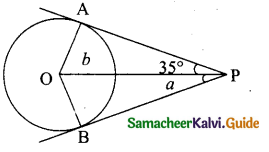
In the given diagram PA and PB are tangents drawn from P to a circle with centre O ∠OPA = 35° then a and b is …………. .
Samacheer Kalvi 10th Maths Model Question Paper 3 English Medium - 1
(1) a = 30°, b = 60°
(2) a = 35°, b = 55°
(3) a = 40°, b = 50°
(4) a = 45°, b = 45°
Answer:
(2) a = 35°, b = 55°

Question 14.
If \(\left[ \begin{matrix} -1 & -2 & 4 \end{matrix} \right] \left[ \begin{matrix} 2 \\ a \\ -3 \end{matrix} \right] = -10\) then the value of “a” is …………. .
(1) 2
(2) -4
(3) 4
(4) -2
Answer:
(4) -2

Samacheer Kalvi 10th Maths Model Question Paper 3 English Medium

PART – II

II. Answer any ten questions. Question No. 28 is compulsory. [10 × 2 = 20]

Question 15.
Show that the function f : N → N defined by f(m) = m2 + m + 3 is one-one function.
Answer:
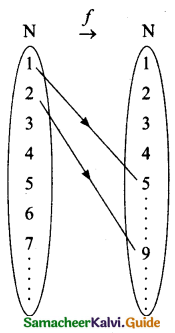
N = {1,2, 3,4, 5,………. }
f(m) = m2 + m + 3
f(1) = 12 + 1 + 3 = 5
f(2) = 22+ 2 + 3 = 9
f(3) = 32 + 3 + 3 = 15
f(4) = 42 + 4 + 3 = 23
f = {(1,5) (2, 9) (3, 15) (4, 23)}
From the diagram we can understand different elements in (N) in domain,
there are different images in (N) co-domain.
∴ The function is one-one function.
Samacheer Kalvi 10th Maths Model Question Paper 3 English Medium - 4

Question 16.
If the ordered pairs (x2 – 3x, y2 + 4y) and (-2, 5) are equal, then find x and y.
Answer:
(x2 – 3x, y2 + 4y) = (-2, 5)
x2 – 3x = -2
x2 – 3x + 2 = 0
Samacheer Kalvi 10th Maths Model Question Paper 3 English Medium - 5
(x – 2)(x – 1) = 0
x – 2 = 0 or x – 1 =0
x = 2 or 1

y2 + 4y = 5
y2 + 4y – 5 = o
Samacheer Kalvi 10th Maths Model Question Paper 3 English Medium - 6
(y + 5)(y – 1) = o
y + 5 = 0 or y – 1 = 0
y = -5 or y = 1

Samacheer Kalvi 10th Maths Model Question Paper 3 English Medium

Question 17.
If x is congruent to 13 modulo 17 then 7x – 3 is congruent to which number modulo 17?
Answer:
Given x ≡ 13 (mod 17) ……. (1)
7x – 3 ≡ a (mod 17) ….(2)
From (1) we get
x – 13 = 17 n(n may be any integer)
x – 13 is a multiple of 17
∴ The least value of x = 30
From (2) we get
7(30) – 3 ≡ a(mod 17)
210 – 3 ≡ a(mod 17)
207 ≡ a(mod 17)
207 ≡ 3(mod 17)
∴ The value of a = 3

Question 18.
How many terms of the series 1 + 4 + 16 + . . . . make the sum 1365?
Answer:
Let n be the number of terms to be added to get the sum 1365
a = 1, r = \(\frac { 4 }{ 1 }\) = 4 > 1
sn = 1365 gives \(\frac{a\left(r^{n}-1\right)}{r-1}\) = 1365
\(\frac{1\left(4^{n}-1\right)}{4-1}\) = 1365 so, (4n – 1) = 4095
4n = 4096 then 4n = 46
n = 6

Question 19.
Find the LCM of x4 – 27a3x, (x – 3a)2 whose GCD is (x – 3a)
Answer:
p(x) = x4 – 27a3x
= x[x3 – 27a3]
= x[x3 – (3a)3]
= x(x – 3a) (x2 + 3ax + 9a2)
g(x) = (x – 3a)2
G.C.D. = x – 3a
L.C.M = \(\frac{p(x) \times g(x)}{\text { G.C.D. }}\)
= \(\frac{x(x-3 a)\left(x^{2}+3 a x+9 a^{2}\right) \times(x-3 a)^{2}}{(x-3 a)}\)
L.C.M = x(x – 3a)2(x2 + 3ax + 9a2)

Question 20.
Reduce the given Rational expression to its lowest form \(\frac{x^{3 a}-8}{x^{2 a}+2 x^{a}+4}\)
Answer:
x3a – 8 = (xa)3 – 23
= (xa – 2) [(xa)2 + xa × 2 + 22]
= (xa – 2) (x2a + 2xa + 4)
Samacheer Kalvi 10th Maths Model Question Paper 3 English Medium - 7

Samacheer Kalvi 10th Maths Model Question Paper 3 English Medium

Question 21.
Find the values of x,y, z if (x y -z z + 3) + (y 4 3) = (4 8 16)
Answer:
[x y – z z + 3] + [y 4 3] = [4 8 16]
x + y = 4 ….(1)
y – z + 4 = 8 ….(2)
z + 3 + 3 = 16
z + 6 = 16
z = 16 – 6 = 10
Sùbstitute the value of z in (2)
(2) ⇒ y – 10 = 4 ⇒ y = 14
Substitute the value of y in (1)
(1) ⇒ x + 14 = 4
x = 4 – 14 = -10
∴ The value of x = -10, y = 14 and z = 10

Question 22.
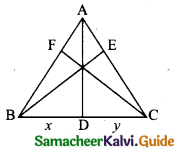
Suppose AB, AC and BC have lengths 13,14 and 15 respectively. If \(\frac{A F}{F B}=\frac{2}{5}\) and \(\frac{C E}{E A}=\frac{5}{8}\) Find BD and DC.
Answer:
Samacheer Kalvi 10th Maths Model Question Paper 3 English Medium - 8
Given that AB = 13, AC = 14 and BC = 15
Let BD = x and DC = y
Using Ceva’s theorem, we have, \(\frac{\mathrm{BD}}{\mathrm{DC}} \times \frac{\mathrm{CE}}{\mathrm{EA}} \times \frac{\mathrm{AF}}{\mathrm{FB}}=1\) ….(1)
Substitute the values of \(\frac{A F}{F B}\) and \(\frac{C E}{E A}\) in (1),
we have \(\frac{B D}{D C} \times \frac{5}{8} \times \frac{2}{5}=1\)
\(\frac{x}{y} \times \frac{10}{40}=1\) we get \(\frac{x}{y} \times \frac{1}{4}=1\). Hence, x = 4y ……. (2)
BC = BD + DC = 15 so, x + y = 15 ……. (3)
From (2), using x = 4y in (3) we get, 4y + y = 15 gives 5y = 15 then y = 3
Substitute y = 3 in (3) we get, x = 12. Hence BD = 12 , DC = 3.

Question 23.
Find the equation of a straight line which has slope \(\frac { -5 }{ 4 }\) and passing through the point (-1,2).
Answer:
Slope of a line (m) = \(\frac{-5}{4}\)
The given point (x1, y1) = (-1, 2)
Equation of a line is y – y1 = m (x – x1)
y – 2 = \(\frac{-5}{4}\)(x + 1)
5(x + 1) = 4(y – 2) ⇒ 5x + 5 = 4y + 8
5x + 4y + 5 – 8 = 0 ⇒ 5x + 4y – 3 = 0
The equation of a line is 5x + 4y – 3 = 0

Samacheer Kalvi 10th Maths Model Question Paper 3 English Medium

Question 24.
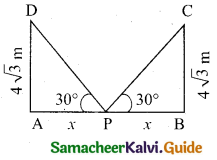
A road is flanked on either side by continuous rows of houses of height 4√3 m with no space in between them. A pedestrian is standing on the median of the road facing a row house. The angle of elevation from the pedestrian to the top of the house is 30° . Find the width of the road.
Answer:
Samacheer Kalvi 10th Maths Model Question Paper 3 English Medium - 9
Let the mid point of the road AB is “P” (PA = PB)
Height of the home = 4 √3 m
Let the distance between the pedestrian and the house be “x”
In the right ∆ APD, tan 30° = \(\frac{\mathrm{AD}}{\mathrm{AP}}\)
\(\frac{1}{\sqrt{3}}=\frac{4 \sqrt{3}}{x}\)
x = 4√3 × √3 = 12 m
∴ Width of the road = PA + PB
= 12 + 12
= 24m

Question 25.
If the standard deviation of a data is 3.6 and each value of the data is divided by 3, then find the new variance and new standard deviation.
Answer:
Standard deviation of the data = 3.6
Each value of the data is divided by 3
New standard deviation = \(\frac{3.6}{3}\) = 1.2
New Variance = (1.2)2 [Variance = (S. D)2]
= 1.44
New standard Deviation = 1.2
New variance = 1.44

Question 26.
If -4 is a root of the equation x2 + px – 4 = 0 and if the equation x2 + px + q = 0 has equal roots, find the values of p and q.
Answer:
Let p(x) = x2 + px – 4
-4 is the root of the equation
p(-4)  = 0
16 – 4p – 4 = 0 ⇒ -4p + 12 = 0
-4p = -12
p = \(\frac { 12 }{ 4 }\) = 3
The equation x2 + px + q = 0 has equal roots x2 + 3x – q = O
Here a = 1,b = 3,c = q
since the roots are real and equal
b2 – 4ac = 0 ⇒ 32 – 4(1) (q) = 0
9 – 4q = 0 ⇒ 94q
q = \(\frac{9}{4}\)
∴ The value of p = 3 and q = \(\frac{9}{4}\)

Samacheer Kalvi 10th Maths Model Question Paper 3 English Medium

Question 27.
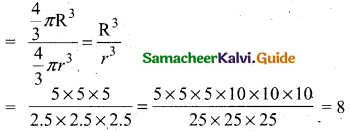
A shopkeeper has one spherical laddoo of radius 5 cm. With the same amount of material how many laddoos of radius 2.5 cm can made?
Answer:
Radius of the larger laddoo (R) = 5 cm
Radius of the smaller laddoo (r) = 2.5 cm
Samacheer Kalvi 10th Maths Model Question Paper 3 English Medium - 10
Samacheer Kalvi 10th Maths Model Question Paper 3 English Medium - 11
∴ 8 laddoos can be made

Question 28.
If P(A) = \(\frac { 1 }{ 2 }\) ; P(B) = \(\frac { 7 }{ 10 }\) , P(A ∪ B) = 1 find P(A’ ∩ B’)
Answer:
Given P(A) = \(\frac { 1 }{ 2 }\), P(B) = \(\frac { 7 }{ 10 }\), P(A ∪ B) = 1
P(A ∪ B) = P(A) + P(B) – P(A ∩ B)
1 = \(\frac{1}{2}+\frac{7}{10}\) – P(A ∩ B)
P(A ∩ B) = \(\frac{1}{2}+\frac{7}{10}-1=\frac{5+7-10}{10}=\frac{2}{10}=\frac{1}{5}\)
P(A’ ∪ B’) = P(A ∩ B)’
= 1 – P(A ∩ B)
= \(1-\frac{1}{5}=\frac{5-1}{5}=\frac{4}{5}\)

PART – III

III. Answer any ten questions. Question No. 42 is compulsory. [10 × 5 = 50]

Question 29.
If X = {-5, 1, 3, 4} and Y = {a, b, c}, then which of the following relations are functions from X to Y?
(i) R1 = {(-5, a), (1, a), (3, b)}
(ii) R2 = {(-5, b), (1, b), (3, a), (4, C)}
(iii) R3 = {(-5, a), (1, a), (3, b), (4, c), (1, b)}

Question 30.
If f(x) = x2, g(x) = 3x and h(x) = x – 2, Prove that (fog)oh = fo(g o h).

Question 31.
The houses of a street are numbered from 1 to 49. Senthil’s house is numbered such that the sum of numbers of the houses prior to Senthil’s house is equal to the sum of numbers of the houses following Senthil’s house. Find Senthil’s house number.

Question 32.
The 104th term and 4th term of an A.P are 125 and 0. Find the sum of first 35 terms.

Question 33.
There are 12 pieces of five, ten and twenty rupee currencies whose total value is ₹105. But when first 2 sorts are interchanged in their numbers its value will be increased by ₹20. Find the number of currencies in each sort.

Question 34.
If 9x4 + 12x3 + 28x2 + ax + b is a perfect square, find the values of a and b.

Question 35.
Find X and Y if X + Y = \(\left( \begin{matrix} 7 & 0 \\ 3 & 5 \end{matrix} \right) \) and X – Y = \(\left( \begin{matrix} 3 & 0 \\ 0 & 4 \end{matrix} \right) \)

Samacheer Kalvi 10th Maths Model Question Paper 3 English Medium

Question 36.
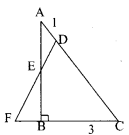
In figure ABC is a triangle with ∠B = 90° , BC = 3 cm and AB = 4 cm. D is point on AC such that AD = 1 cm and E is the midpoint of AB. Join D and E and extend DE to meet CB at F. Find BF.
Samacheer Kalvi 10th Maths Model Question Paper 3 English Medium - 2

Question 37.
Find the equation of a straight line joining the point of intersection of 3x + y + 2 = 0 and x – 2y -4 = 0 to the point of intersection of 7x – 3y = -12 and 2y = x + 3

Question 38.
A man is standing on the deck of a ship, which is 40 m above water level. He observes the angle of elevation of the top of a hill as 60° and the angle of depression of the base of the hill as 30° . Calculate the distance of the hill from the ship and the height of the hill. (√3 = 1.732)

Question 39.
Find the number of coins, 1.5 cm in diameter and 2 mm thick, to be melted to form a right circular cylinder of height 10 cm and diameter 4.5 cm.

Question 40.
The following table gives the number of goals scored by 71 leading players in international football matches. Find the standard deviation of the data.
Samacheer Kalvi 10th Maths Model Question Paper 3 English Medium - 3

Question 41.
A two digit number is such that the product of its digits is 18. When 63 is subtracted from the number, the digits interchange their places. Find the numbers.

Question 42.
The sum of 5th and 9th term of an AP is 72 and the sum of 7th and 12th term is 97. Find the A.P.

Samacheer Kalvi 10th Maths Model Question Paper 3 English Medium

PART – IV

IV. Answer all the questions. [2 × 8 = 16]

Question 43.
(a) Construct a triangle similar to a given triangle LMN with its sides equal to \(\frac { 4 }{ 5 }\) of the corresponding sides of the triangle LMN (scale factor \(\frac { 4 }{ 5 }\)).

[OR]

(b) Draw the two tangents from a point which is 10 cm away from the centre of a circle of radius 5 cm. Also, measure the lengths of the tangents.

Question 44.
(a) Draw the graph of y = x2 – 4 and hence solve x2 – x – 12 = 0.

[OR]

(b) Solve graphically (2x + 1) (x -3) = 0

Samacheer Kalvi 10th Science Guide Chapter 7 Atoms and Molecules

Students can download 10th Science Chapter 7 Atoms and Molecules Questions and Answers, Notes, Samacheer Kalvi 10th Science Guide Pdf helps you to revise the complete Tamilnadu State Board New Syllabus, helps students complete homework assignments and to score high marks in board exams.

Tamilnadu Samacheer Kalvi 10th Science Solutions Chapter 7 Atoms and Molecules

Samacheer Kalvi 10th Science Atoms and Molecules Text Book Back Questions and Answers

I. Choose the best answer:

Question 1.
Which of the following has the smallest mass?
(a) 6.023 × 10²³ atoms of He
(b) 1 atom of He
(c) 2 g of He
(d) 1-mole atoms of He
Answer:
(b) 1 atom of He

Question 2.
Which of the following is a triatomic molecule?
(a) Glucose
(b) Helium
(c) Carbon dioxide
(d) Hydrogen.
Answer:
(c) Carbon dioxide
Hint:
(a) Glucose = C6H12O6 (Polyatomic molecule)
(b) Helium = He (Monoatomic molecule)
(c) Carbon dioxide = CO2 (Triatomic molecule)
(d) Hydrogen = H2 (Diatomic molecule)
So, (c) is the correct answer.

Question 3.
The volume occupied by 4.4 g of CO2 at S.T.P:
(a) 22.4 litre
(b) 2.24 litre
(c) 0.24 litre
(d) 0.1 litre
Answer:
(b) 2.24 litre

Samacheer Kalvi 10th Science Guide Chapter 7 Atoms and Molecules

Question 4.
Mass of 1 mole of Nitrogen atom is _____.
(a) 28 amu
(b) 14 amu
(c) 28 g
(d) 14 g.
Answer:
(b) 14 amu
Hint: Atomic mass of Nitrogen is 14.00674 grams. It is equal to 1 mole of Nitrogen atoms.
So, answer (b) is correct.

Question 5.
Which of the following represents 1 amu?
(a) Mass of a C – 12 atom
(b) Mass of a hydrogen atom
(c) 1/12 th of the mass of a C – 12 atom
(d) Mass of O – 16 atom
Answer:
(c) 1/12 th of the mass of a C – 12 atom

Question 6.
Which of the following statement is incorrect?
(a) One gram of C – 12 contains Avogadro’s number of atoms.
(b) One mole of oxygen gas contains Avogadro’s number of molecules.
(c) One mole of hydrogen gas contains Avogadro’s number of atoms.
(d) One mole of electrons stands for 6.023 × 10²³ electrons.
Answer:
(a) One gram of C – 12 contains Avogadro’s number of atoms.
Hint: 12 g of Carbon contains 6.023 × 10²³ atoms,
1 g of Carbon contain \(\frac{6.023 \times 10^{23}}{12}\) = 5.018 × 10²² atoms and its is not Avogadro’s number of atoms.
So (a) is the incorrect statement.

Question 7.
The volume occupied by 1 mole of a diatomic gas at S.T.P is:
(a) 11.2 litre
(b) 5.6 litre
(c) 22.4 litre
(d) 44.8 litre
Answer:
(c) 22.4 litre

Question 8.
In the nucleus of 20Ca40, there are
(a) 20 protons and 40 neutrons
(b) 20 protons and 20 neutrons
(c) 20 protons and 40 electrons
(d) 40 protons and 20 electrons
Answer:
(b) 20 protons and 20 neutrons

Question 9.
The gram molecular mass of oxygen molecule is_____.
(a) 16 g
(b) 18 g
(c) 32 g
(d) 17 g.
Answer:
(c) 32 g
Hint: By definition, the gram molecular mass of oxygen molecule O2 is 32 g.
So the answer (c) is correct.

Question 10.
1 mole of any substance contains molecules.
(a) 6.023 × 10²³
(b) 6.023 × 10⁻²³
(c) 3.0115 × 10²³
(d) 12.046 × 10²³
Answer:
(a) 6.023 × 10²³

II. Fill in the blanks:

1. Atoms of different elements having ……… mass number, but ………. atomic numbers are called isobars.
2. Atoms of different elements having same number of ………. are called isotones.
3. Atoms of one element can be transmuted into atoms of other element by ………….
4. The sum of the numbers of protons and neutrons of an atom is called its …………
5. Relative atomic mass is otherwise known as …………
6. The average atomic mass of hydrogen is ……….. amu.
7. If a molecule is made of similar kind of atoms, then it is called ……….. atomic molecule.
8. The number of atoms present in a molecule is called its ………….
9. One mole of any gas occupies ………… ml at S.T.P
10. Atomicity of phosphorous is …………
Answer:
1. same, different
2. neutrons
3. artificial transmutation
4. mass number
5. standard atomic weight
6. 1.008
7. homo
8. atomicity
9. 22, 400
10. four

Samacheer Kalvi 10th Science Guide Chapter 7 Atoms and Molecules

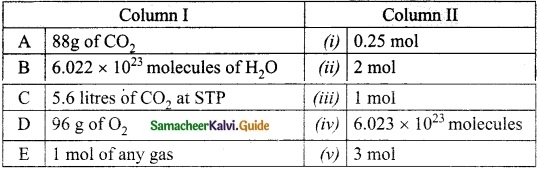
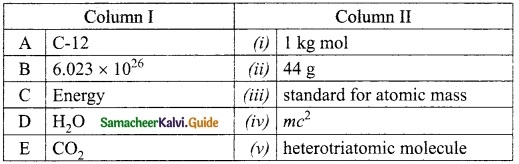
III. Match the following:

Samacheer Kalvi 10th Science Guide Chapter 7 Atoms and Molecules 1
Answer:
A. (ii)
B. (iii)
C. (v)
D. (i)
E. (iv)

IV. True or False: (If false give the correct statement)

  1. Two elements sometimes can form more than one compound.
  2. Nobel gases are diatomic.
  3. The gram atomic mass of an element has no unit.
  4. 1 mole of Gold and Silver contain same number of atoms.
  5. Molar mass of CO2 is 42 g.

Answer:

  1. True
  2. False – Noble gases are Monoatomic.
  3. False – The unit of gram atomic mass of an element is gram.
  4. True
  5. False – Molar mass of CO2 is 44 g.

V. Assertion and Reason:

Answer the following questions using the data given below:
Question 1.
Assertion: Atomic mass of aluminium is 27
Reason: An atom of aluminium is 27 times heavier than 1/12 th of the mass of the C-12 atom.
(a) Assertion and Reason are correct, Reason explains the Assertion.
(b) Assertion is correct, Reason is wrong.
(c) Assertion is wrong, Reason is correct.
(d) Assertion and Reason are correct, Reason doesn’t explains Assertion.
Answer:
(a) Assertion and Reason are correct, Reason explains the Assertion.

Question 2.
Assertion: The Relative Molecular Mass of Chlorine is 35.5 a.m.u.
Reason: The natural abundance of Chlorine isotopes are not equal.
(a) Assertion and Reason are correct, Reason explains the Assertion.
(b) Assertion is correct, Reason is wrong.
(c) Assertion is wrong, Reason is correct.
(d) Assertion and Reason are correct, Reason doesn’t explains Assertion.
Answer:
(c) Assertion is wrong, Reason is correct.

VI. Short answer questions:

Question 1.
Define: Relative atomic mass.
Answer:
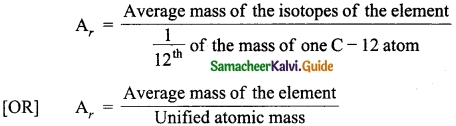
Relative atomic mass of an element is the ratio between the average mass of its isotopes to \(\frac{1}{12^{th}}\)part of the mass of a carbon-12 atom. It is denoted as Ar.
[OR]
Samacheer Kalvi 10th Science Guide Chapter 7 Atoms and Molecules 2

Question 2.
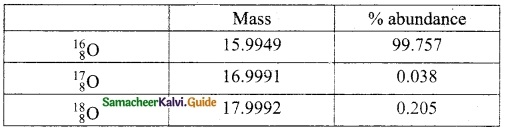
Write the different types of isotopes of oxygen and its percentage abundance.
Answer:
Oxygen has three stable isotopes. They are
Samacheer Kalvi 10th Science Guide Chapter 7 Atoms and Molecules 3

Question 3.
Define Atomicity.
Answer:
The number of atoms present in the molecule is called its ‘Atomicity’.

Question 4.
Give any two examples for heteroatomic molecules.
Answer:
HI, HCl, CO, HBr, HF.

Samacheer Kalvi 10th Science Guide Chapter 7 Atoms and Molecules

Question 5.
What is Molar volume of a gas?
Answer:
One mole of any gas occupies 22.4 litres.
(or)
22400 ml at S.T.R This volume is called as molar volume.

Question 6.
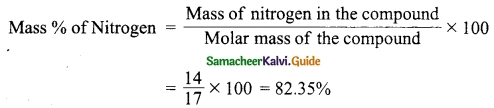
Find the percentage of nitrogen in ammonia.
Answer:
Molar mass of NH3 = 1(14) + 3(1) = 17 g
Samacheer Kalvi 10th Science Guide Chapter 7 Atoms and Molecules 4

VII. Long answer questions:

Question 1.
Calculate the number of water molecule present in one drop of water which weighs 0.18 g.
Answer:
The molecular mass of water (H2O) is 18.
18 g of water molecule = 1 mole.
0. 18 g of water = \(\frac{1}{18} \times 0.18\) = 0.01 mole.
1 mole of water (Avogadro’s number) contains 6.023 × 10²³ water molecules.
0. 01 mole of water contain \(\frac{6.023 \times 10^{23}}{1} \times 0.01\) = 6.023 × 10²¹ molecules.

Question 2.
N2 + 3 H2 → 2 NH3
(The atomic mass of nitrogen is 14, and that of hydrogen is 1)
1 mole of nitrogen (……..g) +
3 moles of hydrogen (………g) →
2 moles of ammonia (………g)
Answer:
1 mole of nitrogen (28 g) +
3 moles of hydrogen (6 g) →
2 moles of ammonia (34 g)

Question 3.
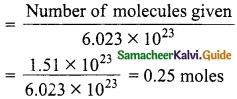
Calculate the number of moles in
(i) 27 g of Al;
(ii) 1.51 × 10²³ molecules of NH4Cl.
Answer:
(i) 27 g of Al
Given mass atomic mass = \(\frac{Given Mass}{Atomic Mass}\) = \(\frac{27}{27}\)
= 1 mole

(ii) 1.51 x 10²³ molecules of NH4Cl
Number of moles
Samacheer Kalvi 10th Science Guide Chapter 7 Atoms and Molecules 5

Question 4.
Give the salient features of “Modern atomic theory”.
Answer:
The salient features of “Modem atomic theory” are,

  1. An atom is no longer indivisible.
  2. Atoms of the same element may have different atomic mass.
  3. Atoms of different elements may have the same atomic masses.
  4. Atoms of one element can be transmuted into atoms of other elements. In other words, an atom is no longer indestructible.
  5. Atoms may not always combine in a simple whole-number ratio.
  6. Atom is the smallest particle that takes part in a chemical reaction.
  7. The mass of an atom can be converted into energy [E = mc2].

Samacheer Kalvi 10th Science Guide Chapter 7 Atoms and Molecules

Question 5.
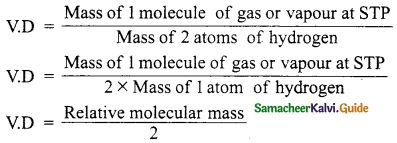
Derive the relationship between Relative molecular mass and Vapour density.
Answer:
Relative molecular mass : The relative molecular mass of a gas or vapour is the ratio between the mass of one molecule of the gas or vapour to mass of one atom of hydrogen.
Vapour density : Vapour density is the ratio of the mass of certain volume of a gas or vapour, to the mass of an equal volume of hydrogen, measured under the same conditions of temperature and pressure.
Samacheer Kalvi 10th Science Guide Chapter 7 Atoms and Molecules 6
According to Avogadro’s law equal volumes of all gases contain equal number of molecules.
Let the number of molecules in one volume = n, then
Samacheer Kalvi 10th Science Guide Chapter 7 Atoms and Molecules 7
When cancelling ‘n’ which is common at STP, we get
Samacheer Kalvi 10th Science Guide Chapter 7 Atoms and Molecules 8
Since hydrogen is diatomic,
Samacheer Kalvi 10th Science Guide Chapter 7 Atoms and Molecules 9
2 × Vapour density = Relative Molecular mass of a gas
[OR]
Relative Molecular Mass = 2 × Vapour density

VIII. HOT Question:

Question 1.
Calcium carbonate is decomposed on heating in the following reaction
CaCO3 → CaO + CO2

  1. How many moles of Calcium carbonate is involved in this reaction?
  2. Calculate the gram molecular mass of calcium carbonate involved in this reaction.
  3. How many moles of CO2 are there in this equation?

Answer:
CaCO3 → CaO + CO2

  1. 1 mole of CaCO3 is involved in this reaction.
  2. Gram molecular mass of calcium carbonate
    CaCO3 = (40 + 12 + 3 × 16) = 52 + 48 = 100 g
  3. 1 mole of CO2 is in this equation.

IX. Solve the following problems:

Question 1.
How many grams are there in the following?
(i) 2 moles of a hydrogen molecule, H2
(ii) 3 moles of chlorine molecule, Cl2
(iii) 5 moles of sulphur molecule, S8
(iv) 4 moles of a phosphorous molecule, P4
Solution:
(i) 2 moles of a hydrogen molecule, H2
Mass of 1 mole of hydrogen molecule = 2 g
Mass of 2 moles of hydrogen molecule = 2 × 2 = 4 g.

(ii) 3 moles of chlorine molecule, Cl2
Mass of 1 mole of chlorine molecule = 71 g
Mass of 3 moles of chlorine molecules = 71 × 3 = 213 g.

(iii) 5 moles of sulphur molecule, S8
Mass of 1 mole of sulphur molecule = 32 g
Mass of 5 moles of sulphur molecules = 32 × 5 = 160 g.

(iv) 4 moles of the phosphorous molecule, P4
Mass of 1 mole of phosphorous molecule = 30.97 g
Mass of 4 moles of phosphorous molecules = 30.97 × 4 = 123.88 g.

Samacheer Kalvi 10th Science Guide Chapter 7 Atoms and Molecules

Question 2.
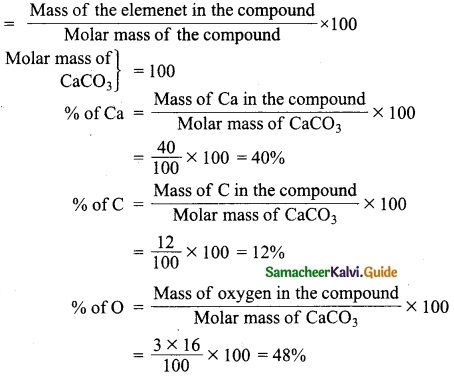
Calculate the % of each element in calcium carbonate. (Atomic mass: C – 12, O – 16, Ca – 40)
Answer:
Formula to find % of each element
Samacheer Kalvi 10th Science Guide Chapter 7 Atoms and Molecules 10

Question 3.
Calculate the % of oxygen in Al2(SO4)3.
(Atomic mass: Al – 27, O – 16, S – 32)
Answer:
Formula:
Samacheer Kalvi 10th Science Guide Chapter 7 Atoms and Molecules 11
Molar mass of Al2(SO4)3 = [2(Atomic mass of Al) + 3(Atomic mass of S) + 12(Atomic mass of O)]
= 2(27) + 3(32) + 12(16) = 342 g
% of Oxygen = \(\frac{12(16)}{342}\) × 100 = 56.14%.

Question 4.
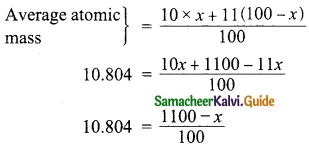
Calculate the % relative abundance of B – 10 and B – 11, if its average atomic mass is 10.804 amu.
Answer:
% of relative abundance can be calculated by the formula.
Average atomic mass of the element
= Atomic mass of 1st isotope × abundance of 1st isotope + Atomic mass of 2nd isotope × abundance of 2nd isotope
∴ Average atomic mass of Boron
= Atomic mass of B – 0 × abundance of B -10 + Atomic mass of B – 11 × abundance of B – 11
Let the abundance of B – 10 be ‘x’ and B – 11 be (1 – x)
So, 10.804 = 10 × x + 11 (1 – x)
10.804 = 10x + 11 – 11x
x = 11 – 10.804
x = 0.196
1 -x = 1 – 0.196 = 0.804
Therefore % abundance of B – 10 is 19.6% and B – 11 is 80.4%
[OR]
Let the % of the isotope B – 10 = x
Then the % of the isotope B – 11 = 100 – x
Samacheer Kalvi 10th Science Guide Chapter 7 Atoms and Molecules 12
1100 – x = 1080.4
x = 19.6
% abundance of B – 10 = 19.6%
% abundance of B – 11 = 80.4%

Samacheer Kalvi 10th Science Atoms and Molecules Additional Important Questions and Answers

I. Choose the correct answer.

Question 1.
The first scientific theory of an atom was proposed by:
(a) Ruther Ford
(b) Newland
(c) John Dalton
(d) Neils Bohr
Answer:
(c) John Dalton

Question 2.
Identify the pair that indicates isobars among the following _____.
(a) \(_{1} \mathrm{H}^{2},_{1} \mathrm{H}^{3}\)
(b) \(_{17} \mathrm{Cl}^{35},_{17} \mathrm{Cl}^{37}\)
(c) \(\text { (c) }_{18} \mathrm{Ar}^{40},_{18} \mathrm{Ca}^{40}\)
(d) \(_{6} \mathrm{C}^{13},_{7} \mathrm{N}^{14}\).
Answer:
(c) \(\text { (c) }_{18} \mathrm{Ar}^{40},_{18} \mathrm{Ca}^{40}\)

Samacheer Kalvi 10th Science Guide Chapter 7 Atoms and Molecules

Question 3.
Which one of the following represents 180 g of water?
(a) 5 moles of water
(b) 90 moles of water
(c) 6.023 × 1024 molecules of water
(d) 6.023 × 10²² molecules of water
Answer:
(c) 6.023 × 1024 molecules of water

Question 4.
The isotope of Carbon-12 contains _____.
(a) 6 protons and 7 electrons
(b) 6 protons and 6 neutrons
(c) 12 protons and no neutrons
(d) 12 neutrons and no protons.
Answer:
(b) 6 protons and 6 neutrons

Question 5.
Which contains the greatest number of moles of oxygen atoms?
(a) 1 mol of water
(b) 1 mole of NaOH
(c) 1 mole of Na2CO3
(d) 1 mole of CO
Answer:
(c) 1 mole of Na2CO3

Question 6.
The mass of proton or neutron is approximately _____.
(a) 1 amu
(b) 1.609 × 10⁻¹⁹ g
(c) 1 g
(d) 6.023 × 10⁻²³ g.
Answer:
(a) 1 amu

Question 7.
The natural abundance of C-12 and C-13 are 98.90% and 1.10% respectively. The average atomic mass of carbon is:
(a) 12 amu
(b) 12.011 amu
(c) 14 amu
(d) 12.90 amu
Answer:
(b) 12.011 amu

Question 8.
The relative atomic mass of magnesium-based on C – 12 scale is _____.
(a) 24 g
(b) 24
(c) 24 amu
(d) 24 kg
Answer:
(b) 24

Question 9.
If 1.5 moles of oxygen combine with Al to form Al2O3, the mass of Al in g (atomic mass of Al = 27) used in the reaction is:
(a) 2.7
(b) 54
(c) 40.5
(d) 81
Answer:
(b) 54

Question 10.
The atomicity of methane is:
(a) 5
(b) 4
(c) 3
(d) 6
Answer:
(a) 5

Question 11.
Find the odd one out _____.
(a) \(_{8} \mathrm{O}^{16}\)
(b) \(_{8} \mathrm{O}^{17}\)
(c) \(_{6} \mathrm{O}^{12}\)
(d) \(_{8} \mathrm{O}^{18}\).
Answer:
(c) \(_{6} \mathrm{O}^{12}\)

Question 12.
The volume occupied by 3 moles of HCl gas at STP is:
(a) 22.4 L
(b) 44.8 L
(c) 2.24 L
(d) 67.2 L
Answer:
(d) 67.2 L

Samacheer Kalvi 10th Science Guide Chapter 7 Atoms and Molecules

Question 13.
The mass percentage of hydrogen in ethane (C2H6) is:
(a) 25%
(b) 75%
(c) 80%
(d) 20%
Answer:
(d) 20%

Question 14.
Which one of the following is a homo diatomic molecule?
(a) H2
(6) CO
(c) NO
(d) O3.
Answer:
(a) H2

Question 15.
The percentage of nitrogen in urea is about:
(a) 38.4
(b) 46.6
(c) 59.1
(d) 61.3
Answer:
(b) 46.6

Question 16.
Out of the following the largest number of atoms are contained in:
(a) 11 g of CO2
(b) 4 g of H2
(C) 5 g of NH3
(d) 8 g of SO2
Answer:
(b) 4 g of H2

Question 17.
Which of the following is an example of a homo triatomic molecule?
(a) Phosphorous
(b) Sulphur
(c) Bromine
(d) Ozone.
Answer:
(d) Ozone.

Question 18.
For the reaction A + 2B → C, 5 moles of A and 8 moles of B will produce:
(a) 5 moles of C
(b) 4 moles of C
(c) 8 moles of C
(d) 13 moles of C
Answer:
(b) 4 moles of C

Question 19.
The vapour density of a gas is 32. Its relative molecular mass will be:
(a) 32
(b) 16
(c) 64
(d) 96
Answer:
(c) 64

Question 20.
Find the odd one out _____.
(a) Silver
(b) Potassium
(c) Iron
(d) Phosphorous.
Answer:
(d) Phosphorous.

II. Fill in the blanks.

  1. The volume occupied by 16 g of oxygen is ………..
  2. One mole of a triatomic gas contains ………… atoms.
  3. Equal volume of all gases under the same conditions of temperature and pressure contain equal number of …………
  4. The mass of an atom can be converted into energy by using the formula …………
  5. The percentage composition is useful to determine the ………… formula and ………… formula.

Answer:

  1. 11.2 L
  2. 3 × 6.023 × 1023
  3. molecules
  4. E = me²
  5. empirical, molecular

Samacheer Kalvi 10th Science Guide Chapter 7 Atoms and Molecules

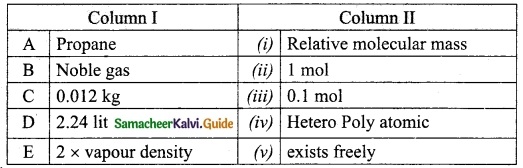
III. Match the following:

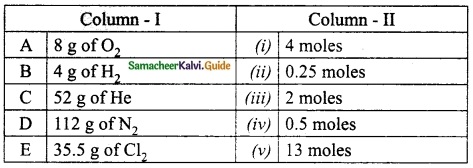
Question 1.
Match the Column I with Column II.
Samacheer Kalvi 10th Science Guide Chapter 7 Atoms and Molecules 13
Answer:
A. (ii)
B. (iii)
C. (i)
D. (v)
E. (iv)

Question 2.
Match the Column I with Column II.
Samacheer Kalvi 10th Science Guide Chapter 7 Atoms and Molecules 14
Answer:
A. (iii)
B. (i)
C. (iv)
D. (v)
E. (ii)

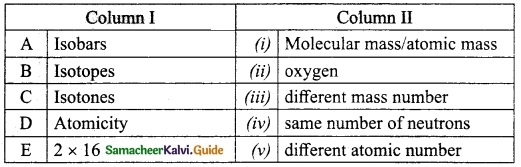
Question 3.
Match the Column I with Column II.
Samacheer Kalvi 10th Science Guide Chapter 7 Atoms and Molecules 15
Answer:
A. (iv)
B. (v)
C. (ii)
D. (iii)
E. (i)

Question 4.
Match the Column I with Column II.
Samacheer Kalvi 10th Science Guide Chapter 7 Atoms and Molecules 16
Answer:
A. (v)
B. (iii)
C. (iv)
D. (i)
E. (ii)

IV. True or False: (If false give the correct statement)

  1. Atoms always combine in a simple whole number ratio.
  2. 2 × RMM = VD
  3. The average atomic mass of Beryllium is 9.012 because of the presence of isotopes.
  4. The noble gases are diatomic.
  5. The number of atoms present in one mole of phosphorus(P4) is 4 × 6.023 × 1023

Answer:

  1. False -Atoms may not combine always in a simple whole number ratio.
  2. False – 2 × VD = RMM
  3. True
  4. False – The noble gases are mono atomic.
  5. True

V. Assertion and Reason:

Answer the following questions using the data given below:
Question 1.
Assertion: The standard unit for expressing mass of atom is amu.
Reason: Atomic mass unit is one-twelth of the mass of a C-12 atom
(a) Assertion and Reason are correct, Reason explains the Assertion.
(b) Assertion is correct, Reason is wrong.
(c) Assertion is wrong, Reason is correct.
(d) Assertion and Reason are correct, Reason doesn’t explains Assertion.
Answer:
(a) Assertion and Reason are correct, Reason explains the Assertion.

Question 2.
Assertion: The volume occupied by 44 g of CO2 is 22.4 L
Reason: The volume occupied by one mole of any gas is 22.4 L
(a) Assertion and Reason are correct, Reason explains the Assertion.
(b) Assertion is correct, Reason is wrong.
(c) Assertion is wrong, Reason is correct.
(d) Assertion and Reason are correct, Reason doesn’t explains Assertion.
Answer:
(a) Assertion and Reason are correct, Reason explains the Assertion.

Samacheer Kalvi 10th Science Guide Chapter 7 Atoms and Molecules

VI. Short answer questions:

Question 1.
Define vapour density.
Answer:
Vapour density is the ratio of the mass of certain volume of a gas or vapour, to the mass of an equal volume of hydrogen measured under the same condition of temperature and pressure.
[OR]
Samacheer Kalvi 10th Science Guide Chapter 7 Atoms and Molecules 17

Question 2.
What are isobars? Give an example.
Answer:
Atoms of different elements that have same atomic masses but different atomic numbers are called isobars.
e.g., \(_{18} \mathrm{Ar}^{40}\), \(_{20} \mathrm{Ca}^{40}\).

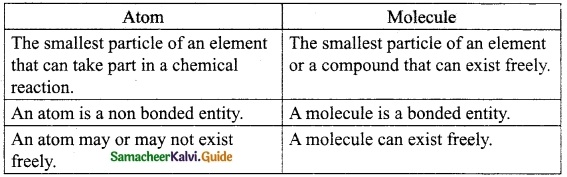
Question 3.
Write the differences between an atom and a molecule.
Answer:
Samacheer Kalvi 10th Science Guide Chapter 7 Atoms and Molecules 18

Question 4.
What is artificial transmutation?
Answer:
Atoms of one element can be transmuted into atoms of other elements. In other words, the atom is no longer indestructible. It is known as artificial transmutation.

Question 5.
Classify the following based on atomicity.
Answer:
(i) Bromine
2 – Diatomic

(ii) Argon
1 – Monoatomic

(iii) Ozone
3 – Triatomic

(iv) Sulphur
8 – Polyatomic

Question 6.
Define atomic mass unit.
Answer:
Atomic mass unit is one-twelfth of the mass of carbon – 12 atom, as an isotope of carbon which contains 6 protons and 6 neutrons. It is amu.

VII. Long answer questions:

Question 1.
Explain how Avogadro hypothesis is used to derive the value of atomicity.
Answer:
(i) The Avogadro’s law states that “equal volumes of all gases under similar conditions of temperature and pressure contain the equal number of molecules”.

(ii) Let us consider the reaction between hydrogen and chlorine to form hydrogen chloride gas.
H2 (g) + Cl2 (g) → 2HCl (g)
⇒ 1 volume + 1 volume → 2 volumes.

(iii) According to Avogadro’s law, 1 volume of any gas is occupied by “n” number of molecules,
“n” molecules + “n” molecules → “2n” molecules
If “n” = 1, then
1 molecule + 1 molecule → 2 molecules.
\(\frac { 1 }{ 2 }\) molecule + \(\frac { 1 }{ 2 }\) molecule → 1 molecule.

(iv) 1 molecule of hydrogen chloride gas is made up of \(\frac { 1 }{ 2 }\) molecule of hydrogen and \(\frac { 1 }{ 2 }\) molecule of chlorine.

(v) \(\frac { 1 }{ 2 }\) molecule of hydrogen contains 1 atom.
So, 1 molecule of hydrogen contains 2 atoms.
So, hydrogen atomicity is 2. Similarly, chlorine atomicity is also 2.
So, H2 and Cl2 are diatomic molecules.

Samacheer Kalvi 10th Science Guide Chapter 7 Atoms and Molecules

Question 2.
Write a note on the following,
(i) Isotopeos
(ii) Isobars
(iii) Relative atomic mass.
Answer:
(i) Isotopes : Atoms of same element with different mass number. Eg: 17Cl35, 17Cl37.
(ii) Isobars : Atoms of different elements with same mass number. Eg: 18Ar40, 20Ca40
(iii) Relative Atomic Mass (RAM) :
Samacheer Kalvi 10th Science Guide Chapter 7 Atoms and Molecules 19

Question 3.
Sodim bicarbonate breaks down on heating as follows:
2NaHCO3 → Na2CO3 + H2O + CO2
(Atomic mass of Na = 23, H = 1, C = 12, O = 16)
(i) How many moles of NaHCO3 are there in the equation?
Answer:
2 moles.

(ii) What is the mass of CO2 produced in the equation?
Answer:
44 g

(iii) How many moles of water molecules are produced in the equation?
Answer:
1 mole.

(iv) What is the mass of NaHCO3 used in this equation?
Answer:
= 2[23 + 1 + 12 + 3(16)]
= 2[84]
= 168 g

(v) What is the volume occupied by CO2 in this equation?
Answer:
22.4 lit.

VIII. Hot Questions

Question 1.
Why do we take an atomic mass of Carbon – 12 as standard?
Answer:
Carbon – 12 is the standard while measuring the atomic masses. Because no other nuclides other than C – 12 have exactly whole-number masses in this scale. This is due to the different mass of neutrons and protons acting to change the total mass in nuclides with proton/neutron ratio other than 1 : 1 ratio of carbon – 12.

Question 2.
The cost of common salt (NaCl) is Rs 18 per kg. Calculate the cost of the salt per mole.
Answer:
Gram molar mass of NaCl = 23 + 35.5
= 58.5 g
1000 g of NaCl costs = Rs 18
∴ 58.5 g of NaCl costs = \(\frac{18}{1000}\) × 58.5
= Rs 1.053
The cost of one mole of NaCl = Rs 1.053

Question 3.
What will be the mass of one \(^{12} \mathbf{C}\) atom in g?
Answer:
1 mol of \(^{12} \mathbf{C}\) atoms = 6.022 × 10²³ atoms = 12 g
Thus, 6.022 × 10²³ atoms of \(^{12} \mathbf{C}\) have mass = 12 g
∴ 1 atom of \(^{12} \mathbf{C}\) will have mass = \(\frac{12}{6.022 \times 10^{23}}\) g = 1.9927 × 10⁻²³ g.

Samacheer Kalvi 10th Science Guide Chapter 7 Atoms and Molecules

IX. Solve the following problems:

Question 1.
Calculate the average atomic mass of carbon, if the natural abundance of C – 12 and C – 13 are 98.90% and 1.10% respectively.
Solution:
Average atomic mass of carbon
\(=\left(12 \times \frac{98.9}{100}\right)+\left(13 \times \frac{1.1}{100}\right)\)
= (12 × 0.989) +(13 × 0.011)
= 11.868 + 0.143
= 12.011 amu.

Question 2.
Find how many moles are there in
(a) 98 g of H2SO4
Answer:
(a) 98 g of H2SO4
GMM of H2SO4 = 2(1) + 32 + 4(16)
= 98 g
Number of moles = \(\frac{Given Mass}{Mol. Mass}\)
= \(\frac{98}{98}\)
= 1 mole

(b) 18.069 × 10²³ atoms of calcium
Answer:
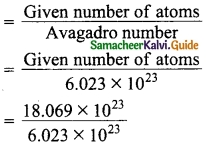
Number of moles
Samacheer Kalvi 10th Science Guide Chapter 7 Atoms and Molecules 20
= 3 moles

(c) 4.48 L of CO2
Answer:
Number of moles
Samacheer Kalvi 10th Science Guide Chapter 7 Atoms and Molecules 21

Question 3.
Calculate the number of moles in
(i) 12.046 × 10²³ atoms of copper
(ii) 27.95 g of iron
(iii) 1.51 × 10²³ molecules of CO2
Answer:
(i) 12.046 × 10²³ atoms of copper
6.023 × 10²³ atoms of copper = 1 mole
12.046 × 10²³ atoms of copper = \(\frac{1 \times 12.046 \times 10^{23}}{6.023 \times 10^{23}}\) = 2 moles of copper

(ii) 27.95 g of iron
55.9 g of iron = 1 mole
27.95 g of iron = \(\frac{1}{55.9}\) × 27.95 = 0.5 mole of iron.

(iii) 1.51 × 10²³ molecules of CO2
No of moles = \(\frac{\text { No. of molecules }}{\text { Avogadro number }}\)
= \(\frac{1.51 \times 10^{23}}{6.023 \times 10^{23}}\)
= 0.25 mole of CO2

Question 4.
Calculate the number of atoms of mercury present in 1 kg of Mercury. [Atomic mass of Hg = 200.6]
Answer:
200.6 g of Hg contains 6.023 × 10²³ Hg atoms
∴ 1 Kg of Hg will contain = \(\frac{6.023×10^{23}}{200.6}\) × 1000
= 30.02 × 10²³ Hg atoms

Question 5.
How many molecules are present in 7 × 10⁻³ m3 of NH3 at STP?
Answer:
Molar volume = 22.4 dm³ = 2.24 × 10⁻²
2.24 × 10⁻² m³ of NH3 at STP contains 6.023 × 10²³ NH3 molecules.
:. 7 × 10⁻³ m³ of NH3 will contain
= \(\frac{6.023×10^{23}}{2.24×10^{-2}}\) × 7 × 10⁻³
18.82 × 10²² NH3 molecule

Question 6.
What is the mass in grams of the following?
(a) 3 moles of NaOH
(b) 6.023 × 10²² atoms of Ca
(c) 224 L of CO2
Answer:
Formula:
Samacheer Kalvi 10th Science Guide Chapter 7 Atoms and Molecules 22
(a) 3 moles of NaOH
Mass of 3 moles of NaOH = 3 × mol. mass of NaOH
GMM of NaOH = 23 + 16 + 1 = 40 g
Mass of 3 moles of NaOH = 3 × 40 = 120 g

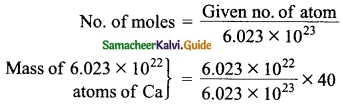
(b) 6.023 × 10²² atoms of Ca = n × atomic mass of ca
Samacheer Kalvi 10th Science Guide Chapter 7 Atoms and Molecules 23
= 4 g

(c) 224 L of CO2
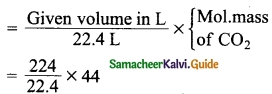
Mass of 224 L of CO2
Samacheer Kalvi 10th Science Guide Chapter 7 Atoms and Molecules 24
= 10 × 44
= 440 g

Samacheer Kalvi 10th Science Guide Chapter 7 Atoms and Molecules

Question 7.
How many grams are therein:
(i) 5 moles of water
(ii) 2 moles of Ammonia
(iii) 2 moles of Glucose
Solution:
(i) 5 moles of water.
Mass of 1 mole of water (H2O) = 18 g (2 + 16)
Mass of 5 moles of H2O = 18 × 5 = 90 g.

(ii) 2 moles of ammonia.
Mass of 1 mole of ammonia (NH3) = 17 g (14 + 3)
Mass of 2 moles of ammonia = 17 × 2 = 34 g.

(iii) 2 moles of glucose.
Mass of 1 mole of glucose (C6H12O6) = 180 g (72 + 12 + 96)
Mass of 2 moles of glucose = 180 × 2 = 360 g.

Question 8.
Calculate tbe molar mass of the following compounds.
(a) Urea (NH2CONH2)
(b) Ethanol(C2H5OH);
(c) Boric acid (H3BO3)
[Atomic mass of N – 14, H – 1, C – 12, B – 11, O – 16]
Answer:
(a) Urea (NH2CONH2) = 2(14) + 4(1) + 1(16) + 1(12)
= 28 + 4 + 16 + 12
= 60 g

(b) Ethanol(C2H5OH) = 2(12) + 6(1) + 1(16)
= 24 + 6 + 16 = 46 g

(c) Boric acid (H2BO3) = 3(1) + 1(11) + 3(16)
= 3 + 11 + 48
= 62 g

Question 9.
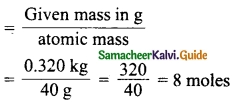
Mass of one atom of an element is 6.645 × 10⁻²³ g. How many moles of element are there in 0.320 kg.
Answer:
Mass of one atom of an element = 6.645 × 10⁻²³ g
∴ Mass of 1 mol of atom = 6.645 × 10-23 × 6.023 × 1023 = 40 g
Number of moles =
Samacheer Kalvi 10th Science Guide Chapter 7 Atoms and Molecules 25

Samacheer Kalvi 10th Social Science Guide Geography Chapter 2 Climate and Natural Vegetation of India

Students can download 10th Social Science Geography Chapter 2 Climate and Natural Vegetation of India Questions and Answers, Notes, Samacheer Kalvi 10th Social Science Guide Pdf helps you to revise the complete Tamilnadu State Board New Syllabus, helps students complete homework assignments and to score high marks in board exams.

Tamilnadu Samacheer Kalvi 10th Social Science Solutions Geography Chapter 2 Climate and Natural Vegetation of India

Samacheer Kalvi 10th Social Science Climate and Natural Vegetation of India Text Book Back Questions and Answers

I. Choose the correct answer

Question 1.
Meteorology is the science of:
(a) Weather
(b) Social
(c) Political
(d) Human
Answer:
(a) Weather

Question 2.
We wear cotton during ……….
(a) Summer
(b) Winter
(c) Rainy
(d) Northeast monsoon
Answer:
(a) Summer

Samacheer Kalvi 10th Social Science Guide Geography Chapter 2 Climate and Natural Vegetation of India

Question 3.
Western disturbances cause rainfall in:
(a) Tamilnadu
(b) Kerala
(c) Punjab
(d) Madhya Pradesh
Answer:
(c) Punjab

Question 4.
………. helps in quick ripening of mangoes along the coast of Kerala and Karnataka.
(a) Loo
(b) Norwester
(c) Mango showers
(d) Jet stream
Answer:
(c) Mango showers

Question 5.
……………. is a line joining the places of equal rainfall.
(a) Isohyets
(b) Isobar
(c) Isotherm
(d) Latitudes
Answer:
(a) Isohyets

Question 6.
The climate of India is labelled as ………
(a) Tropical humid
(b) Equatorial Climate
(c) Tropical Monsoon Climate
(d) Temperate Climate
Answer:
(c) Tropical Monsoon Climate

Question 7.
The monsoon forests are otherwise called as
(a) Tropical evergreen forest
(b) Deciduous forest
(c) Mangrove forest
(d) Mountain forest
Answer:
(b) Deciduous forest

Samacheer Kalvi 10th Social Science Guide Geography Chapter 2 Climate and Natural Vegetation of India

Question 8.
……. forests are found above 2400 m Himalayas.
(a) Deciduous forests
(b) Alpine forests
(c) Mangrove forests
(d) Tidal forests
Answer:
(b) Alpine forests

Question 9.
Sesahachalam hills, a Biosphere reserve is situated in
(a) Tamil Nadu
(b) Andhra Pradesh
(c) Madhya Pradesh
(d) Karnataka
Answer:
(b) Andhra Pradesh

Question 10.
………… is a part of the world network biosphere reserves of UNESCO .
(a) Nilgiri
(b) Agasthiyamalai
(c) Great Nicobar
(d) Kachch
Answer:
(a) Nilgiri

II. Match the following
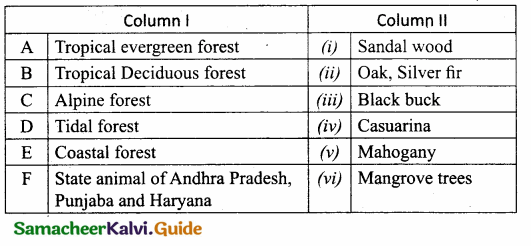
Samacheer Kalvi 10th Social Science Guide Geography Chapter 2 Climate and Natural Vegetation of India 1
Answer:
A. (iv)
B. (v)
C. (ii)
D. (i)
E. (iii)

III. Consider the given statements and choose the correct option from the given below ones.

Question 1.
Assertion(A): Monsoons are a complex meteorological phenomenon. Reason(R): Meteorologists have developed a number of concepts about the origin of monsoons.
(a) Both (A) and (R) are true: R explains A
(b) Both (A) and (R) are true: R does not explain A.
(c) (A) is correct (R) is false
(d) (A) is false (R) is true
Answer:
(a) Both (A) and (R) are true: R explains A

Question 2.
Assertion(A): The Himalayas acts as a climatic barrier.
Reason(R): The Himalayas prevents cold winds from central Asia and keep the Indian Sub-continent warm.(Give option for this questions)
(a) Both (A) and (R) are true: R explains A
(b) Both (A) and (R) are true: R does not explain A.
(c) (A) is correct (R) is false
(d) (A) is false (R) is true
Answer:
(a) Both (A) and (R) are true: R explains A

Samacheer Kalvi 10th Social Science Guide Geography Chapter 2 Climate and Natural Vegetation of India

IV. Choose the inappropriate answer

Question 1.
Tidal forests are found in and around ……..
(a) Desert
(b) The deltas of Ganga and Brahmaputra
(c) The delta of Godavari
(d) The delta of Mahanadhi
Answer:
(a) Desert

Question 2.
Climate of India is affected by:
(a) Latitudinal extent
(b) Altitude
(c) Distance from the sea
(d) Soil
Answer:
(d) Soil

V. Answer briefly

Question 1.
Define ‘Meteorology’.
Answer:
The branch of science concerned with the processes and phenomena of the atmosphere, especially as a means of forecasting the weather.

Question 2.
What is meant by ‘normal lapse rate’?
Answer:
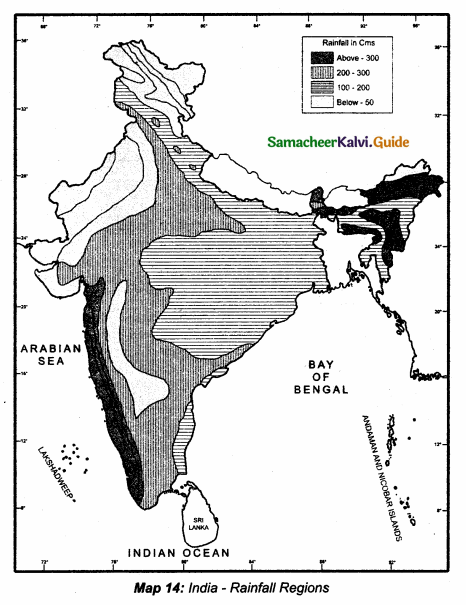
Temperature decreases when the altitude increases .Normal Lapse rate is a phenomenon in which temperature decreases at the rate of 6.5°C for every 1000mts of ascent. Hence places in the mountains are cooler than the places on the plain.

Question 3.
What are ‘jet streams’?
Answer:
In the upper layers of the atmosphere, there are strong westerly winds concentrated in a relatively narrow and shallow stream known as “Jet streams” They cause heavy rainfall in North-west India.

Samacheer Kalvi 10th Social Science Guide Geography Chapter 2 Climate and Natural Vegetation of India

Question 4.
Write a short note on ‘Monsoon wind’.
Answer:

  1. The Word ‘Monsoon’ is derived from the Arabic word “Mausim” which means season.
  2. Monsoons are a complex meteorological phenomenon .
  3. These winds originates due to the seasonal migration of planetary winds and pressure belts following the position of the sun.
  4. During summer they blow from South west to North east ( South West monsoon) June-September and from the North east to South west (North East monsoon) October and November.

Question 5.
Name the four distinct seasons of India.
Answer:

  1. Winter or cold weather season (Jan-Feb)
  2. Pre Monsoon or Summer (March-May)
  3. Southwest Monsoon or rainy season (June-September)
  4. Northeast Monsoon season (October-December)

Question 6.
What is ‘burst of monsoon’?
Answer:

  1. Prior to the onset of the Southwest monsoon the temperature in North India reaches up to 46°C.
  2. The sudden approach of monsoon wind over South India with lightning and thunder is termed as the “break or burst of monsoon”.

Question 7.
Name the areas which receive heavy rainfall.
Answer:

  1. Middle Ganga Valley
  2. Western Ghats
  3. Eastern Maharashtra
  4. Madhya Pradesh and Odisha

Samacheer Kalvi 10th Social Science Guide Geography Chapter 2 Climate and Natural Vegetation of India

Question 8.
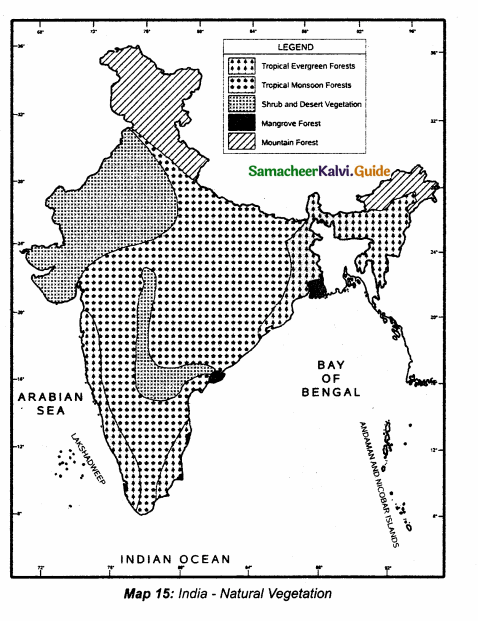
State places of mangrove forest in India.
Answer:

  1. Mangrove forests occur in and around the deltas, estuaries and creeks prone to tidal influences.
  2. In India they are found in deltas of Ganga, Brahmaputra (largest), the deltas of Mahanadi, Godavari and Krishna rivers.

Question 9.
Name the trees of tropical evergreen forest.
Answer:
The most important trees are rubber, mahogany, ebony, rosewood, coconut, bamboo, cinchona, candes, palm, iron wood and cedar.

Question 10.
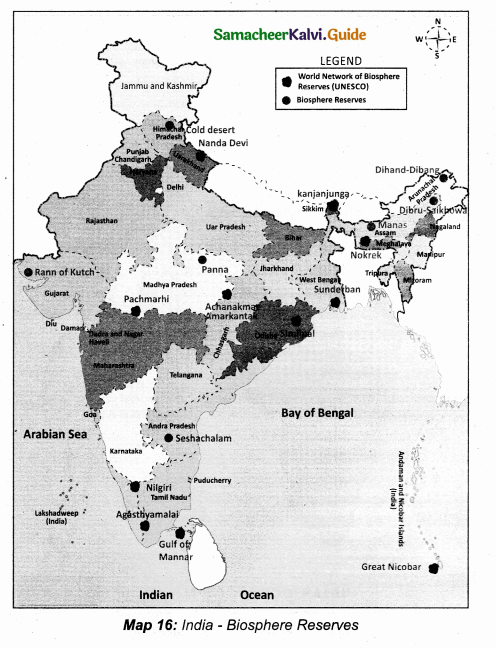
Write any five Biosphere Reserves in India.
Answer:

  1. Biosphere Reserves are the protected areas of land coastal environments where in people are an integral component of the system.
  2. The Indian Government has established 18 Biosphere Reserves. Gulf of Mannar Nilgiris, Agasthiamalai, Kanjanjunga, Great Nicobar etc.

Question 11.
What is ‘Project Tiger’?
Answer:
Project Tiger was launched in April 1973 with the aim to conserve tiger population in specifically constituted “Tiger Reserves” in India. This project is benefited tremendously, with an increase of over 60% – the 1979 consensus put the population at 3,015.

VI. Distinguish between

Question 1.
Weather and Climate.
Answer:
Weather:

  1. State of the atmosphere of a place at a given point of time.
  2. Weather changes occur daily.
  3. Temperature, wind pressure, humidity duration of sunlight and rainfall decides the weather.

Climate:

  1. Accumulation of daily and seasonal weather events of a given location over a period of time.
  2. It is an average of weather condition over a period of 30-35 years.
  3. Climate of a place is determined by Latitude, altitude, distance from the seas, relief features etc.

Question 2.
Tropical Evergreen Forest and Deciduous Forest.
Answer:
Tropical Evergreen forest:

  1. These forests are found in the areas where the annual rainfall is 200 cm and more.
  2. The tress of these forests do not shed their leaves.
  3. Rubber, iron wood, Mahogony are some of the main trees.

Deciduous Forest:

  1. These forests are found in the areas with 100 to 200cm annual rainfall.
  2. The trees of these forests shed their leaves in spring and early summer.
  3. Sandalwood, teak, sal, padak are some of the main trees.

Question 3.
North East Monsoon and South West Monsoon.
Answer:
North East Monsoon:

  1. These monsoon winds blow from North-east to South west.
  2. They blow during the month of October-November.
  3. TamilNadu and Andhra Pradesh gets rainfall from this monsoon.

South West Monsoon:

  1. These monsoon winds blow from South west towards North east.
  2. They blow during the month of June-September.
  3. 75% of India’s rainfall is from this monsoon winds.

Samacheer Kalvi 10th Social Science Guide Geography Chapter 2 Climate and Natural Vegetation of India

VII. Give reasons for the following topics

Question 1.
Western Coastal plain is narrow.
Answer:
It lies between the Western Ghats and Arabian Sea.
It is a narrow plain, which stretches from Gujarat to Kerala with an average width of 50 – 80 km. It is mainly characterised by sandy beaches, coastal sand, dunes, mud flats, lagoons, estuary, laterite platforms and residual hills.

Question 2.
India has a tropical monsoon climate.
Answer:
Latitudinally India lies between 8°4′ N and 37°6’N latitudes. Tropic of Cancer (23° 30’N) divides the country into two equal halves . Most parts of the country’ lie in the Tropical Zone and receives rainfall from monsoon winds which is the dominating climatic factor. Hence India has Tropical monsoon climate.

Question 3.
Mountains are cooler than the plains.
Answer:
When the altitude increases, the temperature decreases. Temperature decreases at the rate of 6.5°C for every 1000 metres of ascent. Hence, places in the mountains are cooler than the places on the plains. That is why the places located at higher altitudes even in South India have cool climate. Ooty and several other hill stations of South India and of the Himalayan ranges like Mussoorie, Shimla, etc., are much cooler than the places located on the Great Plains.

VIII. Write in detail

Question 1.
Write about South West Monsoon.
Answer:

  1. Southwest monsoon season is also known as the rainy season in India.
  2. The onset of Southwest monsoon season takes place over the southern tip of the country’ by the first week of June, advances along the Konkon coast in early June and covers the whole country by 15th July.
  3. Jet stream and ELNino are the two factors that determine the occurrence of Southwest monsoon.
  4. Due to the high temperature over north India creates a low-pressure trough which draws the moisture-laden winds from the Indian Ocean towards the Indian landmass.
  5. The sudden approach of monsoon wind over south India with ‘ lightning and the thunder indicates the onset of south-west monsoon.
    This is also known as “break or burst of monsoon”.
  6. The monsoon winds strike against the southern tip of the Indian landmass and get divided into two branches.
    • (a) Arabian sea branch (of Southwest monsoon)
    • (b) The Bay of Bengal branch (of Southwest monsoon)

(a) Arabian sea branch of South west monsoon:

  • The Arabian sea branch of south west monsoon gives heavy rainfall to the west coast of India as it is located in the wind wards side of the Western Ghats.
  • The other part which advances towards north strikes against the Himalayan mountains results in heavy rainfall in north.

As Aravalli mountains lie parallel to the wind direction. Rajasthan and the western parts do not get much rainfall.

(b) Bay of Bengal branch of south west monsoon:

  • The Wind from Bay of Bengal moves towards north east India and Myanmar.
  • This wind is trapped by Garo, Khasi and Jaintia hills and gives the heaviest rainfall to Meghalaya (at Mawsynram).
  • This wind gets deflected towards west.
  • When the wind moves from east to west rainfall decreases as it looses its moisture.
  • Tamil Nadu receives only a meager rainfall as the state is located on the leeward side.

About 75% of India’s rainfall is from the south west monsoon.

Samacheer Kalvi 10th Social Science Guide Geography Chapter 2 Climate and Natural Vegetation of India

Question 2.
Describe the forests of India.
Answer:
Natural Vegetation refers to a plant community which has grown naturally without human aid
and has been left undisturbed by human for a long time.

Tropical Evergreen Forest:
These forests are found in areas with 200 cm or more annual rainfall.The annual temperature is about more than 22°C and the average annual humidity exceeds 70 percent in this region. Western Ghats in Maharashtra, Karnataka, Kerala, Andaman-Nicobar Islands, Assam, West Bengal, Nagaland, Tripura, Mizoram, Manipur and Meghalaya states have this type of forests. The most important trees are rubber, mahogany, ebony, rosewood, coconut, bamboo, cinchona, candes, palm, iron wood and cedar.

Tropical Deciduous Forest:
It covers a large area of the Peninsula and northern India, where the rainfall is from 100 to 200 m. These trees of the forests shed their leaves for a few weeks in early summer. The main trees are teak, Sandalwood, deodars, sisam, sal and redwood.

Tropical Dry Forest:
These are found in the areas with 50 to 100 cm. annual rainfall.They represent a transitional type of forests. These are found in east Rajasthan, Haryana, Punjab, Western Uttar Pradesh, Madhya Pradesh, Eastern Maharashtra, Telangana, West Karnataka and East Tamilnadu. The important species are mahua, banyan, amaltas, palas, haldu, kikar, bamboo, babool, khair etc.,

Mountain or Montane Forest:
These forests are classified on the basis of altitude and amount of rainfall. Accordingly two different types of forests namely Eastern Himalayas Forests and Western Himalayas Forests. Eastern Himalayan Forest: These are found on the slopes of the mountains in north-east states. They receive rainfall of more than 200 cm. The vegetation is of evergreen type. Sal, oak, laurel, amura, chestnut, cinnamon are the main trees from 1200 to 2400 m altitude oak, birch, silver, fir, fine, spruce and juniper are the major trees from 2400 to 3600 m height. Western Himalayan Forest: The rainfall of this region is moderate. They are found n the states of Jammu and Kashmir, Himachal Pradesh and Uttarakhand. In altitude from 900 to 1800 m, chir tree is the most common tree. The other important trees of this region are sal, semal, dhak, jamun and jujube.

Alpine Forest:
It occurs all along the Himalayas with above 2400 m altitude. These are purely having coniferous trees. Oak, silver fir, pine and juniper are the main trees of these forests. The eastern parts of Himalayas has large extent of these forests.

Tidel Forest:
These forests occur in and around the deltas, estuaries and creeks prone to tidal influences and as such are also known as delta or swamp forests. The delta of the Ganga-Brahmaputra has the largest tidal forest. The deltas of Mahanadi, Godavari and Krishna rivers are also known for tidal forests. These are also known as mangrove forest.

Coastal Forest:
These are littoral forests. Generally, coastal areas have these types of forests. Casurina, palm and coconut are the dominant trees. Both the eastern and western coasts have this type of forests.

Riverine Forest:
These forests are found along the rivers on Khadar areas. These are known for tamarisk and tamarind trees. The rivers of Great Plains are more prominent for this type of natural vegetation.

Samacheer Kalvi 10th Social Science Guide Geography Chapter 2 Climate and Natural Vegetation of India

Question 3.
Write the names of biosphere reserves and their location in India.
Answer:
The Indian Government has established 18 Biosphere Reserves which protect larger areas of natural habitat and often include one or more national parks along with the buffer zones that are open to some economic uses.

Biosphere Reserves State
Achanakmar-Amarkantak Madhya Pradesh, Chhattisgarh
Agasthyamalai Kerala
Dibru Saikhowa Assam
Dihang Dibang Arunachal Pradesh
Great Nicobar Andaman and Nicobar Islands
Gulf of Mannar Tamil Nadu
Kachch Gujarat
Kanchenjunga Sikkim
Manas Assam
Nanda Devi Uttarakhand
The Nilgiris Tamil Nadu
Nokrek Meghalaya
Pachmarhi Madhya Pradesh
Simlipal Odisha
Sundarbans West Bengal
Cold desert Himachal Pradesh
Sesahachalam hills Andhra Pradesh
Panna Madhya Pradesh

IX. Map

Mark the following on the outline map of India.

Question 1.
Direction of South West Monsoon wind.
Answer:
Samacheer Kalvi 10th Social Science Guide Geography Chapter 2 Climate and Natural Vegetation of India 2

Samacheer Kalvi 10th Social Science Guide Geography Chapter 2 Climate and Natural Vegetation of India

Question 2.
Direction of North East Monsoon wind.
Answer:
Samacheer Kalvi 10th Social Science Guide Geography Chapter 2 Climate and Natural Vegetation of India 3

Question 3.
Areas of heavy rainfall.
Answer:
Samacheer Kalvi 10th Social Science Guide Geography Chapter 2 Climate and Natural Vegetation of India 4

Question 4.
Mountain forests.
Answer:
Samacheer Kalvi 10th Social Science Guide Geography Chapter 2 Climate and Natural Vegetation of India 5

Question 5.
Panna biosphere reserve
Answer:
Samacheer Kalvi 10th Social Science Guide Geography Chapter 2 Climate and Natural Vegetation of India 6

Samacheer Kalvi 10th Social Science Guide Geography Chapter 2 Climate and Natural Vegetation of India

Question 6.
Agasthiyamalai biosphere reserve
Answer:
Samacheer Kalvi 10th Social Science Guide Geography Chapter 2 Climate and Natural Vegetation of India 6

TB. PNo: 99
Find Out

Question 1.
Find out the temperature of Ooty (2240m). If it is 35°C in Chennai (6.7 m).
Answer:
For every 1000 mt altitude temperature decreases by 6.5°C . So the temperature of Ooty is nearly 15°C.

TB. PNo: 102
HOTS

Question 1.
Why is Mawsynram, the wettest place in the world?
Answer:
Mawsynram in Meghalaya receives the highest rainfall (1141 cm) in the world. Almost daily it rains. Thus make this place a swampy and the wettest due to very dense vegetation.

Samacheer Kalvi 10th Social Science Guide Geography Chapter 2 Climate and Natural Vegetation of India 2

Samacheer Kalvi 10th Social Science Guide Geography Chapter 2 Climate and Natural Vegetation of India 3

Samacheer Kalvi 10th Social Science Guide Geography Chapter 2 Climate and Natural Vegetation of India 4

Samacheer Kalvi 10th Social Science Guide Geography Chapter 2 Climate and Natural Vegetation of India

Samacheer Kalvi 10th Social Science Guide Geography Chapter 2 Climate and Natural Vegetation of India 5

Samacheer Kalvi 10th Social Science Guide Geography Chapter 2 Climate and Natural Vegetation of India 6

Samacheer Kalvi 10th Social Science Guide Geography Chapter 2 Climate and Natural Vegetation of India 7

Samacheer Kalvi 10th Social Science Guide Geography Chapter 2 Climate and Natural Vegetation of India 8

Samacheer Kalvi 10th Social Science Climate and Natural Vegetation of India Additional Important Questions and Answers

I. Choose the correct answer

Question 1.
The most dominant factor which affects the climate of India is:
(a) Relief
(b) Monsoon winds
(c) Temperature
(d) Soil
Answer:
(b) Monsoon winds

Question 2.
The Local storms in the north eastern part of India during the weather seasons are called
(a) Loo
(b) Norwesters
(c) Mangoshowers
Answer:
(a) Loo

Question 3.
Seventy-five percentage of Indian rainfall is from this wind:
(a) Western Disturbance
(b) North East monsoon
(c) Norwesters
(d) South West monsoon
Answer:
(d) South West monsoon

Question 4.
The mountain which stands parallel to the direction of the south-west monsoon wind ….
(a) Vindhya
(b) Aravalli
(c) Satpura
Answer:
(b) Aravalli

Question 5.
The ……………. forests are found in the region where the rainfall is 200 cm and above.
(a) Tropical evergreen
(b) Tidal
(c) Tropical deciduous
(d) Alpine
Answer:
(a) Tropical evergreen

Samacheer Kalvi 10th Social Science Guide Geography Chapter 2 Climate and Natural Vegetation of India

Question 6.
……… experience continental climate.
(a) Chennai
(b) Mumbai
(c) Delhi
Answer:
(c) Delhi

Question 7.
The term ……………. includes animals of any habitat in nature.
(a) Mammals
(b) Forests
(c) Insects
(d) Wild life
Answer:
(d) Wild life

Question 8.
In India, 85% of the rain is received from the ……….
(a) North-east
(b) South-west
(c) South-east
Answer:
(b) South-west

Question 9.
In the year ……………. United nations Convention on Biological Diversity (CBD) recognizes the sovereign rights of the states to use their own Biological Resources.
(a) 1992
(b) 1982
(c) 1979
(d) 1929
Answer:
(a) 1992

Question 10.
The ……… prevents the cold polar winds blowing from Central Asia.
(a) Aravalli Hills
(b) Bay of Bengal
(c) Himalayas
Answer:
(c) Himalayas

Samacheer Kalvi 10th Social Science Guide Geography Chapter 2 Climate and Natural Vegetation of India

Question 11.
The highest rainfall region in India is located in this state:
(a) Assam
(b) Bihar
(c) Meghalaya
(d) Manipur
Answer:
(c) Meghalaya

Question 12.
There is a peculiar uniformity in the climate of India due to its unique ……..
(a) Geography
(b) Physiography
(c) Demography
Answer:
(b) Physiography

II. Match the following

Question 1.
Match the Column I with Column II.
Samacheer Kalvi 10th Social Science Guide Geography Chapter 2 Climate and Natural Vegetation of India 9
Answer:
A. (iii)
B. (i)
C. (v)
D. (ii)
E. (iv)

Question 2.
Match the Column I with Column II.
Samacheer Kalvi 10th Social Science Guide Geography Chapter 2 Climate and Natural Vegetation of India 10
Answer:
A. (vi)
B. (iii)
C. (v)
D. (ii)
E. (iv)
F. (i)

Samacheer Kalvi 10th Social Science Guide Geography Chapter 2 Climate and Natural Vegetation of India

Question 3.
Match the Column I with Column II.
Samacheer Kalvi 10th Social Science Guide Geography Chapter 2 Climate and Natural Vegetation of India 11
Answer:
A. (v)
B. (i)
C. (ii)
D. (vi)
E. (iv)
F. (iii)

III. Consider the given statements and choose the correct option from the given below ones

Question 1.
Assertion(A): Peninsular India enjoys equable climate.
Reason(R): The peninsular region is surrounded by the seas on three sides, not very far from the sea.
(a) Both (A) and (R) are true: R explains A
(b) Both (A) and (R) are true: R does not explain A
(c) (A) is correct (R) is false
(d) (A) is false (R) is true
Answer:
(c) (A) is correct (R) is false

Question 2.
Assertion(A): Two different types-of mountain forests are in India namely Eastern Himalayan forests and Western Himalayan forests.
Reason(R): Mountain forests are classified on the basis of altitude and amount of Rainfall.
(a) Both (A) and (R) are true: R explains A
(b) Both (A) and (R) are true: R does not explain A
(c) (A) is correct (R) is false
(d) (A) is false (R) is true
Answer:
(b) Both (A) and (R) are true: R does not explain A

Question 3.
Assertion(A): Systematic change in the direction of planetary winds is known as monsoons.
Reason(R): Monsoon winds originates due to the seasonal migration of planetary winds and pressure belts following the position of the Sun.
(a) Both (A) and (R) are true: R explains A
(b) Both (A) and (R) are true: R does not explain A
(c) (A) is correct (R) is false
(d) (A) is false (R) is true
Answer:
(c) (A) is correct (R) is false

Question 4.
Assertion(A): Rajasthan remains as desert.
Reason(R): As Aravalli mountain is located parallel to the Arabian Sea branch South west Monsoon winds the western part (Rajasthan) do not receive much rainfall. To the Bay of Bengal Branch of South west Monsoon wind it is located on the leeward side.
(a) Both (A) and (R) are true: R explains A
(b) Both (A) and (R) are true: R does not explain A
(c) (A) is correct (R) is false
(d) (A) is false (R) is true
Answer:
(a) Both (A) and (R) are true: R explains A

Samacheer Kalvi 10th Social Science Guide Geography Chapter 2 Climate and Natural Vegetation of India

IV. Choose the inappropriate answer

Question 1.
The pre-monsoon showers are known as mango showers in:
(a) Kerala and Karnataka
(b) Punjab and Haryana
(c) Hot weather season
(d) Helps quick ripening of mangoes
Answer:
(b) Punjab and Haryana

Question 2.
Tropical deciduous forests trees are of economic importance:
(a) Have valuable trees like teak, sal.
(b) To make fragnant oil, varnish, perfumes.
(c) Do not shed their leaves.
(d) Found in rainfall areas of 100 to 200 cm.
Answer:
(c) Do not shed their leaves.

Question 3.
Tidal forests are also known as swamp or delta forests.
(a) These forests are not prone to tidal waves.
(b) Known as mangrove forests.
(c) Occur in and around deltas, estuaries.
(d) Prone to tidal influences.
Answer:
(a) These forests are not prone to tidal waves.

Question 4.
Biosphere Reserves are protected areas of coastal and land environment.
(a) Indian Government has established 18 Biosphere Reserves.
(b) Do not protect areas of natural habitat.
(c) People are an integral component of the system.
(d) One or more National parks preserves along with buffer zone.
Answer:
(b) Do not protect areas of natural habitat.

V. Answer briefly

Question 1.
Name the classification of Natural vegetation.
Answer:
Natural Vegetation can be classified as:

  1. Tropical Evergreen forests
  2. Tropical deciduous forests
  3. Tropical dry forests
  4. Desert and semi-desert
  5. Mountain forests
  6. Alpine forests and
  7. Tidal forests

Question 2.
Name the factors affecting the climate of India.
Answer:
Climate of India is affected by the factors of latitude, distance from the seas, Monsoon wind, relief features and jet stream.

Question 3.
The climate and weather conditions in India are governed by the three-atmosphere conditions. Name them.
Answer:

  1. The Pressure and Surface winds.
  2. Upper air Circulation
  3. Western cyclonic disturbances and tropical conditions

Question 4.
What is ElNino? How does it affect the climate of India?
Answer:
ElNino is a complex global phenomena of weather that appears once eveiy five to ten years. It is a cause for the delay of onset of the southwest monsoon in India.

Question 5.
What is the Characteristic features of monsoon rains in India?
Answer:

  1. The Monsoon rains are pulsating in nature
  2. They can cause heavy rainfall in one part and drought in the other.
  3. They are known for their uncertainties.

Question 6.
What is the role of Jet stream regarding the climate of India?
Answer:

  1. The arrival and departure of monsoon winds is determined by Jet stream.
  2. Cause tropical depressions both during South west monsoon and North east monsoon.
  3. Plays a vital role in bringing western disturbances to India there by helping winter wheat cultivation.

Samacheer Kalvi 10th Social Science Guide Geography Chapter 2 Climate and Natural Vegetation of India

Question 7.
What values are associated with the monsoon in India?
Answer:

  • Monsoon acts as unifying bond for India.
  • The unifying influence of the monsoon on the Indian Subcontinent is quite perceptible.
  • The Seasonal alteration of the wind systems and the associated weather conditions provide a rhythmic cycle of seasons.
  • The Indian landscape, its animal and plant life, its entire agricultural calender and the life of the people, including their festivities, revolve around this phenomenon.
  • Year after year, people of India from North to South and from east to west, eagerly await the arrival of the monsoon. These monsoon winds binds the whole country by providing water to set the agricultural activities in motion.
  • The rivers valleys which carry this water also unite as a single river valley unit.

Question 8.
Give a brief note on the Indian Board for Wild life:
Answer:

  1. The Indian Board for wild life was constituted in 1952 to suggest means of protection, conservation and management of wild life to the Government of India.
  2. The Government of India enacted wild life (protection) Act in 1972 with the objective of effectively protecting the wild life.

Question 9.
Explain the steps taken to conserve wildlife.
Answer:
The Wild Life Act Of India protects and conserves this grest heritage of nation. The first weak of October is observed as Wild life Week Of India.

Question 10.
Give the Full form of these abbreviations.

  1. IBWL
  2. CBD
  3. ITCZ

Answer:

  1. IBWL : Indian Board for Wild Life.
  2. CBD: Convention on Biological Diversity.
  3. ITCZ : Inter Tropical Convergence Zone.

Question 11.
Why does the coromandal coast face frequent cyclones?
Answer:
The north east monsoon winds by crossing the Bay of Bengal absorbs moisture and gives heavy rain to the coromandal coast. These are frequent cyclones formed in the Bay of Bengal and they cause heavy damage to life and property along the coromandal coast.

Question 12.
Give a brief description of the Mangrove forests.
Answer:

  • The mangrove tidal forests are found in the areas of coasts influenced by tides. Hence, mangroves are the common varities with roots of the plants submerged under water. The deltas of the Ganga, the Mahanadi, the Krishna, the Godavari and the Kaveri are covered by such vegetation. In the Ganga-Brahmaputra delta sundari trees are found which provides durable hard timber.
  • Palm, coconut, Keora agar also grow in some parts of the delta.
  • Royal Bengal Tiger is the famous animal in these forests. Turtles, crocodiles, gharials and snakes are also found in these forests.

Samacheer Kalvi 10th Social Science Guide Geography Chapter 2 Climate and Natural Vegetation of India

VI. Distinguish between

Question 1.
Winter/Cold weather and Summer/Hot weather season.
Solution:
Winter or Cold weather season:

  1. In India,winter weather period is January-February.
  2. The mean temperature increases from North to South.
  3. Western Disturbances occurs in this season.
  4. Generally fine weather and low tempertaure.

Summer or Hot weather season:

  1. The summer season is from March- May.
  2. The mean tempertaure increases from South to North.
  3. Mango showers, Norwesters or Kalbaisakhi occurs in this season.
  4. Generally hot and dry weather.

Question 2.
Heavy rainfall and less/low rainfall region.
Answer:
Heavy rainfall region:

  1. These areas get annual rainfall of 200 cms and above.
  2. Western coast, Assam, South Meghalaya are heavy rainfall areas.

Less or low rainfall region:

  1. These areas get annual rainfall less than 100 cms.
  2. Rajasthan, Punjab, Haryana, Western and South western parts of Uttar Pradesh, plateau region gets less rainfall.

Question 3.
Windward side and Leeward side.
Answer:
Windward side:

  1. The slope of the mountain that lie on the path of rain bearing winds.
  2. The windward side gets more rainfall.
  3. Western slopes of Western Ghats – West coastal plains.

Leeward side:

  1. The slope of the mountain that do not face the rain bearing winds.
  2. The Leeward side gets less or no rainfall.
  3. Eastern slopes of Western Ghats – Deccan Plateau.

Samacheer Kalvi 10th Social Science Guide Geography Chapter 2 Climate and Natural Vegetation of India

Question 4.
Eastern and Western Himalayan forests.
Answer:
Eastern Himalayan forests:

  1. The vegetation of this forest is’ evergreen as these forests receive more than 200cm rainfall.
  2. Pine, Sal Fir, Oak, Laurel are some of the main trees of these forests.
  3. These forests are found in the North Eastern states.

Western Himlayan forests:

  1. The rainfall of this region is moderate and have varied vegetation regards to altitude.
  2. Upto 900m altitude semi desert vegetation from 900m – 1800m chir tree and sal, at 1800m conifer trees.
  3. These forests are found in the states of Jammu and Kashmir, Himachal Pradesh and UttaraKhand.

VII. Give reasons for the following topics

Question 1.
Kolkatta receives more rainfall than Bikaner in Rajasthan.
Answer:
Air near the coast has more moisture and greater potential to produce precipitation. Due to this fact Kolkatta near the coast receives more rainfall (119cm) than Bikaner (24cm) which is located in the interior part.

Question 2.
In India Conservation and management of Biodiversity is necessary why?
Answer:
Hunting, Poaching, deforestation and encroachments in the natural habitats have caused extinction of some species and many are in the danger of extinction. The role of wild life in maintaining the ecological balance made it necessary for conservation and management of Biodiversity.

Question 3.
Relief of India has a great bearing on climate.
Answer:
The elements of climate such as temperature, atmospheric pressure, direction of winds and the amount of rainfall are affected by the presence of relief features as they act as a climatic barrier like the Himalayas and Western Ghats.

VIII. Write in detail

Question 1.
What are the major determinants of climate of a place? Explain them.
Answer:
The major determinants of climate of a place are,

  1. Latitude
  2. Altitude
  3. Distance from the seas
  4. Monsoon winds
  5. Relief features (Mountains)
  6. Jet Streams

1. Latitude:
Latitudinally, India lies between 8°4’N and 37°6’N latitudes. The Tropic of cancer divides the country into two equal halves. The area located to the south of Tropic of cancer experiences high temperature and no severe cold season throughout the year whereas, the areas to the north of this parallel enjoys subtropical climate. Here, summer temperature may rise above 40°C and it is close to freezing point during winter.

2. Altitude:
As one goes from the surface of the earth to higher altitudes, the atmosphere becomes less dense and temperature decreases. The hills are therefore cooler during summer.

3. Distance from the seas:
Distance from the sea does not cause only temperature and pressure variations but also affects the amount of rainfall. As the distance from the sea increased its moderating influence decreases and the people experience extreme weather conditions. This condition is known as continentality.(i.e.) Very hot during summers and very cold during winter.

4. Monsoon winds:
The most dominant factor which affects the climate of India is the monsoon winds. These are seasonal reversal winds and India remains in the influence of these winds for a considerable part of a year. Though, the sun’s rays are vertical over the central part of India during the mid-June, the summer season ends in India by the end of May. It is because the onset of southwest monsoon brings down the temperature of the entire India and causes moderate to heavy rainfall in many parts of the country. Similarly, the climate of southeast India is also influenced by northeast monsoon.

5. Relief features (Mountains):
Relief of India has a great bearing on major elements of climate such as temperature, atmospheric pressure, direction of winds and the amount of rainfall. High mountains act as barriers for cold or hot winds; they may also cause precipitation if they are high enough and lie in the path of rain-bearing winds. The leeward side of mountains remains dry.

6. Jet Streams:
Jet streams are the fast moving winds blowing in a narrow zone in the upper atmosphere. According to the Jet stream theory, the onset of southwest monsoon is driven by the shift of the sub tropical westerly jet from the plains of India towards the Tibetan plateau. The easterly jet streams cause tropical depressions both during southwest monsoon and retreating monsoon.

Question 2.
Write about the factors that affect the climate of India.
Answer:
Climate of India is affected by the factors of latitude, altitude, distance from the seas, monsoon winds and jet streams.

Latitude:

  1. Latitudinally India is located in the Tropical belt between 8°4’N and 37°6’N latitudes.
  2. The tropic of cancer divides the country into two equal halves.
  3. This enables the places south of Tropic of cancer (23°30’N) to experience high temperature and no severe cold.
  4. The places north of Tropic of cancer enjoy sub tropical climate.

Altitude:

  1. When the altitude increases, temperature decreases as per the phenomena. “Normal Lapse rate”. For every 1000 mts of ascent the temperature decreases at the rate of 6.5°C.
  2. Hence the places in the mountains are cooler than the places on the plains.
  3. Even in South India places at higher altitude have cool climate.

Distance from the sea:

  1. Distance from the sea not only causes temperature and pressure variations but also affects the amount of rainfall.
  2. The entire area of peninsular region as it is surrounded by seas on three sides having the temperature equable throughout the year.
  3. Areas of central and north India experiences much seasonal variation in temperature due to the absence of seas.

Monsoon winds:

  1. The most dominant factor which affects the climate of India is the. monsoon winds.
  2. India is influenced by the South west monsoon and North east monsoon from June to September and October, November respectively.
  3. Indian agriculture is at the mercy of monsoons.
  4. India experiences Tropical monsoon climate.

Relief:

  1. Relief of India has a great bearing on major elements of climate such as temperature, atmospheric pressure direction of wind and amount of rainfall.
  2. The mighty Himalayas in the north act as a climatic barrier preventing the freezing cold winds from central Asia away from India.
  3. The Western ghats act as the barrier for south west monsoon winds causing rainfall to the western slopes, and the eastern slopes remain as rain shadow region.

Jet Stream:

  1. Jet streams are the fast moving winds blowing in the narrow zone of upper layers of atmosphere.
  2. These air currents play a dominant role in bringing the onset of South west monsoon and withdrawal of monsoon winds.
  3. More over they are the main reason in bringing the Western Disturbances to the North Western part of Punjab and Haryana causing rainfall and enable the cultivation of winter wheat.
  4. It causes snow fall in Jammu and Kashmir region.

Thus the Tropical monsoon = climate of India revolve around these factors

Samacheer Kalvi 10th Social Science Guide Geography Chapter 2 Climate and Natural Vegetation of India

IX. Map Work

Mark the following on the outline map of India.

Question 1.
Areas of low rainfall
Answer:
Samacheer Kalvi 10th Social Science Guide Geography Chapter 2 Climate and Natural Vegetation of India 4

Question 2.
Any 4 Biosphere Reserve
Answer:
Samacheer Kalvi 10th Social Science Guide Geography Chapter 2 Climate and Natural Vegetation of India 6

Question 3.
Any 5 National parks
Answer:
Samacheer Kalvi 10th Social Science Guide Geography Chapter 2 Climate and Natural Vegetation of India 7

Samacheer Kalvi 10th Social Science Guide Geography Chapter 2 Climate and Natural Vegetation of India

Question 4.
Any 3 Wild animal sanctuary
Answer:
Samacheer Kalvi 10th Social Science Guide Geography Chapter 2 Climate and Natural Vegetation of India 7

Question 5.
Any 2 Bird Sanctuary
Answer:
Samacheer Kalvi 10th Social Science Guide Geography Chapter 2 Climate and Natural Vegetation of India 7

Question 6.
Top 5 states having maximum forest cover
Answer:
Samacheer Kalvi 10th Social Science Guide Geography Chapter 2 Climate and Natural Vegetation of India 8

Question 7.
Top 5 states where forest cover is decreased
Answer:
Samacheer Kalvi 10th Social Science Guide Geography Chapter 2 Climate and Natural Vegetation of India 8

Samacheer Kalvi 10th Social Science Guide Geography Chapter 1 India: Location, Relief and Drainage

Students can download 10th Social Science Geography Chapter 1 India: Location, Relief and Drainage Questions and Answers, Notes, Samacheer Kalvi 10th Social Science Guide Pdf helps you to revise the complete Tamilnadu State Board New Syllabus, helps students complete homework assignments and to score high marks in board exams.

Tamilnadu Samacheer Kalvi 10th Social Science Solutions Geography Chapter 1 India: Location, Relief and Drainage

Samacheer Kalvi 10th Social Science India: Location, Relief and Drainage Text Book Back Questions and Answers

I. Choose the correct answer

Question 1.
The north-south extent of India is:
(a) 2,500km
(b) 292,933 km
(c) 3,214km
(d) 2,814km
Answer:
(c) 3,214km

Question 2.
The Southern most point of India is ……….
(a) Andaman
(b) Kanyakumari
(c) Indira Point
(d) kavaratti
Answer:
(c) Indira Point

Samacheer Kalvi 10th Social Science Guide Geography Chapter 1 India: Location, Relief and Drainage

Question 3.
The extent of Himalayas in the east-west is about:
(a) 2,500 km
(b) 2,400 km
(c) 800 km
(d) 2,200 km
Answer:
(a) 2,500 km

Question 4.
……… River is known as ‘Sorrow of Bihar’.
(a) Narmada
(b) Godavari
(c) Kosi
(d) Damodar
Answer:
(c) Kosi

Question 5.
Deccan Plateau covers an area of about sq.km.
(a) 8 lakh
(b) 6 lakh
(c) 5 lakh
(d) 7 lakh
Answer:
(d) 7 lakh

Question 6.
A landmass bounded by sea on three sides is referred to as ………
(a) Coast
(b) Island
(c) Peninsula
(d) Strait
Answer:
(c) Peninsula

Samacheer Kalvi 10th Social Science Guide Geography Chapter 1 India: Location, Relief and Drainage

Question 7.
The Palk Strait and Gulf of Mannar separates India from:
(a) Goa
(b) West Bengal
(c) Sri Lanka
(d) Maldives
Answer:
(c) Sri Lanka

Question 8.
The highest peak in South India is …………
(a) Ooty
(b) Kodaikanal
(c) Anaimudi
(d) Jindhagada
Answer:
(c) Anaimudi

Question 9.
Plains are formed by the older alluviums.
(a) Bhabar
(b) Tarai
(c) Bhangar
(d) Khadar
Answer:
(c) Bhangar

Question 10.
Pulicat Lake is located between the states of ………….
(a) West Bengal and Odisha
(b) Karnataka and Kerala
(c) Odisha and Andhra Pradesh
(d) Tamil Nadu and Andhra Pradesh
Answer:
(d) Tamil Nadu and Andhra Pradesh

Samacheer Kalvi 10th Social Science Guide Geography Chapter 1 India: Location, Relief and Drainage

II. Match the following
Samacheer Kalvi 10th Social Science Guide Geography Chapter 1 India Location, Relief and Drainage 1
Answer:
A. (iii)
B. (i)
C. (v)
D. (ii)
E. (iv)

III. Give Reasons

Question 1.
The Himalayas are called young fold mountains.
Answer:
The Himalayas are called young fold mountains. Because they have been formed only few million years ago and also they were formed because of the folding of the Earth crust due to tectonic activity’.
[OR]
High pointed peaks and parallel ranges is the features of young fold mountains. Since the Himalayas have these features they are called young fold mountains.

Question 2.
North Indian Rivers are perennial.
Answer:
Most of the North Indian Rivers are perennial. It means that they have water throughout the year. These rivers receive water from rain as well as from melted snow from the lofty mountains.

Samacheer Kalvi 10th Social Science Guide Geography Chapter 1 India: Location, Relief and Drainage

Question 3.
Chottanagpur Plateau is rich in mineral resources.
Answer:
This region is a part of the ancient Gondwana region. So, Chotanagpur plateau is rich in mineral resources like iron ore and coal.

Question 4.
The great ludian desert ii called Marusthall.
Answer:
The Thar desert, also known as the Great Indian desert is a large arid region in the north
western part of the Indian Subcontinent that covers an area of 2,00,000 Km2 and forms a natural boundary between India and Pakistan.
Marusthali means sand-dune. It covered eastern portion of the Great indian Thar Desert in western Rajasthan. It extends over about 24,000 square miles north of the Luni River.

Question 5.
The Eastern states are called seven sisters.
Answer:
The Eastern states in India are the continuous seven states. Assam, Arunachal Pradesh, Nagaland, Mizoram, Manipur, Tripura and Meghalaya. “A paradise unexplored” named by a journalist Jyothi Prakash Salkia in 1972 during the inaugural foundation of North East states.

Question 6.
The river Godavari is often referred to as Vridha Ganga.
Answer:

  1. The Godavari is India’s second longest river after Ganga.
  2. It rises from the slopes of the Western Ghats in the Nasik district of Maharashtra.
  3. It covers a large number of states as the Ganga does. Because of its large size and extend among the peninsular rivers, the river Godavari is often referred to as Vridha Ganga.

Samacheer Kalvi 10th Social Science Guide Geography Chapter 1 India: Location, Relief and Drainage

IV. Distinguish between the following

Question 1.
Himalayan rivers and Peninsular rivers.
Answer:
Himalayan Rivers:

  1. Originate from the Himalayas.
  2. Perennial in nature.
  3. Long and Wide.
  4. Middle and Lower courses are navigable.
  5. Unsuitable for hydropower generation.

Peninsular Rivers:

  1. Originate from Western ghats.
  2. Non-perennial in nature.
  3. Short and narrow.
  4. Not useful for navigation.
  5. Suitable for hydro-power generation.

Question 2.
Western Ghats and Eastern Ghats.
Answer:
Western ghats:

  1. Western ghats forms the Western edge of the peninsular plateau.
  2. It runs parallel to the Arabian sea coast.
  3. They are continuous range.
  4. Anaimudi is the highest peak.

Eastern ghats:

  1. Eastern ghats form the Eastern edge of the peninsular plateau.
  2. It runs parallel to the Bay of Bengal coast.
  3. They are not continuous dissected by east flowing rivers.
  4. Mahendragiri is the highest peak.

Samacheer Kalvi 10th Social Science Guide Geography Chapter 1 India: Location, Relief and Drainage

Question 3.
Himadri and Himachal.
Answer:
Himadri:

  1. Northern most range of the Himalayas.
  2. Known as the Greater Himalayas.
  3. Lofty peaks like Mt.Everest, Kanchenjunga etc., are located in this range.
  4. Region of permanent snow cover.

Himachal:

  1. Middle range of the Himalayas.
  2. Known as the lesser Himalayas.
  3. Major hill stations like Shimla, Daijeeling etc., are located in this region.
  4. Subjected to extensive erosion.

Question 4.
Western Coastal Plains and Eastern Coastal Plains.
Answer:
Western Coastal plains:

  1. Lies between Western ghats and Arabian Sea.
  2. It extends from Rann of Kutch in the North to Kanyakumari in the South.
  3. Dotted with sandy beaches, lagoons and estuary.
  4. It is known as Konkan plains in the North Kanara in the middle and Malabar in the South.

Eastern Coastal plains:

  1. Lies between Eastern ghats and the Bay of Bengal.
  2. It stretches along the states of West Bengal, Odisha, Andhra Pradesh and Tamil Nadu.
  3. Has regular shoreline and composed of alluvial deposits.
  4. Northern part (Mahanadhi-Krishna) called as Northern circars and Southern part (Krishna-Kaveri) is called Coromandal coast.

Samacheer Kalvi 10th Social Science Guide Geography Chapter 1 India: Location, Relief and Drainage

V. Answer in brief

Question 1.
Name the neighbouring countries of India.
Answer:
The neighbouring countries of India are Pakistan in the West, Afghanistan in the North-West, China, Nepal and Bhutan in the North and Bangladesh and Myanmar in the East and Srilanka in the South.

Question 2.
Give the importance of IST.
Answer:
To avoid the confusion of time in different states of India. One meridian is taken to have a uniform time for a whole country. Therefore 80° 30′ E has been chosen as the Standard Meridian of India which is almost passing from the centre of India.

Question 3.
Write a short note on Deccan Plateau.
Answer:

  1. Deccan plateau is the largest part of the peninsular plateau.
  2. It is roughly triangular in shape.
  3. It covers an area of 7 lakh sq km.
  4. The height ranges from 500 to 1000m above sea level.
  5. It extends from Rajmahal hills on the East to Kanyakumari in the South. Satpura range in the West to Kanyakumari in the South. Bordered by Western Ghats on the West and Eastern ghats on the East.

Question 4.
State the west-flowing rivers of India.
Answer:

  • The Narmada and the Tapi are the west flowing rivers of the Peninsular India.
  • These rivers drain into the Arabian Sea.
  • These rivers form estuaries on the west coast.
  • These rivers are devoid of an large tributary system.
  • Narmada river is the largest among the west flowing rivers of peninsular India. Its principal tributaries are Bushner, Halon, Heran, Banjar, Dudhi, Shakkar, Tawa, Bama and Kolar.
  • Tapti river is one of only the three rivers in peninsular India that run from east to west. The others being the Narmada and the Mahi.
  • The major tributaries are Vaki, Gomai, Arunavati, Aner, Nesu, Buray Panjhra and Bori. It outfall into the Arabian sea through the Gulf of Cambay.

Question 5.
Write a brief note on the island group of Lakshadweep.
Answer:

  1. The Lakshadweep islands of India are located off the West coast of India.
  2. These islands are of coral origin.
  3. It covers an area of 32 sq km and consists of 27 islands.
  4. Kavaratti is the administrative capital of Lakshadweep.
  5. Earlier it had three divisions namely Laccadives, Minicoy and Aminidivi and was named as Lakshadweep in 1973.
  6. “Pitt Island” of this group has a bird sanctuary and it is uninhabited.

Samacheer Kalvi 10th Social Science Guide Geography Chapter 1 India: Location, Relief and Drainage

VI. Answer In a paragraph

Question 1.
Explain the divisions of the Northern Mountains and its importance to India.
Answer:

  • The Himalayas geologically young and structurally fold mountains stretch over the northern borders of India.
  • The Himalayas represent the loftiest and one of the most rugged mountain barriers of the world.
  • The mountain ranges run in a west-east direction from India to the Brahmaputra.

Samacheer Kalvi 10th Social Science Guide Geography Chapter 1 India: Location, Relief and Drainage

Question 2.
Give an account on the major peninsular rivers of India.
Answer:

  1. The rivers in South India are called the Peninsular rivers.
  2. Most of these rivers originate from the Western ghats.
  3. These rivers are seasonal and are mainly fed by rain.
  4. Based on the direction of flow the Peninsular rivers are divided into East flowing rivers and West flowing rivers.

East flowing rivers:

  1. Mahanadi: Originates near Sihawa in Raipur district of Chattisgarh.
    • Flows through Odisha, Jharkand, Chattisgarh (851 km in length)
    • Major tributaries: Seonath, Telen, Sandur and lb.
    • Distributaries: Paika, Birupa, Chitartala, Genguti and Nun.
    • These distributaries forms the Delta of Mahanadhi, one of the largest delta in India.
    • This river flows into Bay of Bengal.

(ii) Godavari:

  • It is the longest river (1,465km) among the peninsular rivers covers 3.13 lakh km2 area.
  • Originates in Nasik district of Maharashtra.
  • Flows through the States of Telangana and Andhra Pradesh ends into Bay of Bengal.
  • Major distributaries: Puma, Penganga, Pranitha, Indravathi, Tal and Salami.
  • Distributaries: Near Rajahmundry divides into two channels. Vasishta and Gautami and form one of the largest delta.
  • Fresh water lake: Kolleru is located in the deltaic region of Godavari.

(iii) Krishna:

  • It is the second longest peninsular river (1400 km) covers 2.58 lakh sq km area.
  • Originates from a spring in Mahabaleshwar in the Western ghats of Maharashtra.
  • Flows through Andhra Pradesh.
  • Major tributaries: Bhima, Peddavagu, Musi, Koyna and Thungabhadra.
  • Joins in Bay of Bengal at Hamasaladevi.

(iv) Kaveri:

  • Originates at Talakaveri – Kudagu hills of Karnataka (800km).
  • It is also known as Dakshin Ganga or Ganga of the South.
  • Main Tributaries: Hemavathi, Kabini, Bhavani, Arkavathy, Amaravathi, Harangi etc.
  • Distributary – Coleroon
  • Sacred lslands made by river Kaveri: Sri ranagpattinam(Kamataka) Srirangam (TamilNadu) Waterfalls – Sivasamudram.
  • Flows through Karnataka and TamilNadu.
  • Enters TamilNadu through Hoghenekkal Falls (Dharmapuri).
  • Drains into Bay of Bengal at Poompuhar.

Samacheer Kalvi 10th Social Science Guide Geography Chapter 1 India: Location, Relief and Drainage

West Flowing Rivers:

(i) Narmadha:

  • Origin: Araarkantak Plateau (Madhya Pradesh)
  • Length: 1312 km covers an area of 98,796 sq km.
  • Largest among the West flowing rivers.
  • Tributaries: Burhner, Halon, Heran, Banjar, Dudhi, Shakkar, Tawa, Bama, Kolar.
  • States benefited: Madhya Pradesh, Maharashtra.
  • Ends into Arabian Sea through the Gulf of Cambay.
  • Forms 27 km long estuary.

(ii) Tapti:

  • Rises near Multani in the Betul district of Madhya Pradesh.
  • Length: 724 km. Covers an area of 65,145 sq km.
  • Tributaries: Vaki, Gomai, Arunnavati, Aner, Nesu, Buray, Panjhra and Bori.
  • Outfalls into the Arabian Sea through Gulf of Cambay.
  • States: Flows through Madhya Pradesh and Maharashtra.
  • Since all these rivers flow in the plateau region they are swift and are useful for hydro power generation.

Question 3.
Give a detailed account on the basin of the Ganga.
Answer:

  • On the basis of deposition of Sediments by various rivers and topographical characteristics, the Northern plains of India is divided into the four major regions. Ganga plains is one among them.
  • It extends from the Yamuna River in the West to Bangladesh in the East.
  • The extensive plain is the largest plain of India covers 3.75 lakh sq. km.
  • It is watered by the River Ganga and its tributaries such as Ghaghra, Gandak, Kosi, Yamuna, Chambal, Betwa etc.
  • It is formed by the sediments of these rivers and is fertile in nature.
  • The general slope of the entire plain is towards East and South-East.
  • Ganga plains covers the states of Uttar Pradesh, Bihar and West Bengal.

Samacheer Kalvi 10th Social Science Guide Geography Chapter 1 India: Location, Relief and Drainage

VII. Map exercises

Mark the following in the outline map of India

Question 1.
Major mountain ranges – Karakoram,Ladakh, Zaskar, Aravaili, Western Ghats,Eastern Ghats.
Answer:
Samacheer Kalvi 10th Social Science Guide Geography Chapter 1 India Location, Relief and Drainage 2

Question2.
Major rivers – Indus, Ganga, Brahmaputra, Narmada, Tapti, Mahanadi, Godavari, Krishna and Kaveri.
Answer:
Samacheer Kalvi 10th Social Science Guide Geography Chapter 1 India Location, Relief and Drainage 4

Samacheer Kalvi 10th Social Science Guide Geography Chapter 1 India: Location, Relief and Drainage

Question 3.
Major plateaus – Malwa, Chotanagpur, Deccan.
Answer:
Samacheer Kalvi 10th Social Science Guide Geography Chapter 1 India Location, Relief and Drainage 2

VIII. Activities

Question 1.
Observe the Peninsular Plateau map of India and mark the major plateau divisions of India.
Answer:
Samacheer Kalvi 10th Social Science Guide Geography Chapter 1 India Location, Relief and Drainage 2

Samacheer Kalvi 10th Social Science Guide Geography Chapter 1 India: Location, Relief and Drainage

Question 2.
Prepare a table showing the major West flowing and East flowing rivers of peninsular India.
Answer:
West flowing rivers:

  1. Narmada, Tapti, Mahi.
  2. Flows into Arabian Sea through Gulf of cambay.
  3. Do not make deltas but form estuary.

East flowing rivers:

  1. Mahanadhi, Godhavari, Krishna and Kaveri.
  2. Flows into Bay of Bengal.
  3. Make deltas at their lower courses.

Question 3.
Assume that you are travelling from West Bengal to Gujarat along the beautiful coasts of India. Find out the states which you would pass through?
Answer:
From West Bengal, if we travel along the East coast we could pass through Odisha, Andhra Pradesh, Tamil Nadu states from North to South and from South to North along the West Coast we would pass through the states of Kerala, Karnataka, Goa, Maharashtra and reach Gujarat.

Question 4.
Find out the states through which the river Ganga flows.
Answer:
River Ganga flows through the States of Uttar Pradesh, Bihar and West Bengal.
Samacheer Kalvi 10th Social Science Guide Geography Chapter 1 India Location, Relief and Drainage 2

Samacheer Kalvi 10th Social Science Guide Geography Chapter 1 India: Location, Relief and Drainage
Samacheer Kalvi 10th Social Science Guide Geography Chapter 1 India Location, Relief and Drainage 3
Samacheer Kalvi 10th Social Science Guide Geography Chapter 1 India Location, Relief and Drainage 44
Samacheer Kalvi 10th Social Science Guide Geography Chapter 1 India Location, Relief and Drainage 5
Samacheer Kalvi 10th Social Science Guide Geography Chapter 1 India Location, Relief and Drainage 45

Question 5.
Prepare a table showing the major rivers in India and findout it’s tributaries, origin, length and area.
Answer:
Samacheer Kalvi 10th Social Science Guide Geography Chapter 1 India Location, Relief and Drainage 6

Samacheer Kalvi 10th Social Science Guide Geography Chapter 1 India: Location, Relief and Drainage

TB. PNo: 83
Find Out

Question 1.
The number of Union Territories along the western coast and eastern coast.
Answer:
Union Territories along the western coast are:

  1. Diu and Daman
  2. Dadra and Nagar Haveli
  3. Mahe and Lakshadweep.

Union Territories along eastern coast are:

  • Pondicherry and Andaman and Nicobar Islands.

Question 2.
Area wise which is the largest and the smallest state?
Answer:

  1. Area wise Rajasthan is the largest state (3,42,239 sq.km).
  2. The smallest state is Goa (3,702 sq km).

Question 3.
The states which do not have an international border or lie on the largest state.
Answer:
Haryana, Madhya Pradesh, Jharkhand, Chattisgarh.

Question 4.
Classify into four groups each having common frontiers with

  1. Pakistan
  2. China
  3. Myanmar
  4. Bangladesh.

Answer:

  1. Pakistan – Jammu and Kashmir, Punjab, Rajasthan, Gujarat.
  2. China – Jammu and Kashmir, Himachal Pradesh, Uttarkhand, Sikkim, Arunachal Pradesh.
  3. Myanmar – Arunachal Pradesh, Nagaland Manipur, Mizoram.
  4. Bangladesh – Meghalaya, Assam, West Bengal, Tripura.

Samacheer Kalvi 10th Social Science Guide Geography Chapter 1 India: Location, Relief and Drainage

TB. PNo: 85
Find Out

Question 5.
Find the Hill stations which are located in the Himalayan Mountains.
Answer:
Major hill stations of the Himalayas are Shimla, Mussoorie, Nainital, Almora, Ranikhet and Darjeeling.

TB. PNo: 95
Find Out

Question 6.
In which river the Gerosappa (jog) fall is found?
Answer:
In the river Sharavathi is the Gerosappa (jog) falls (830m). Second highest waterfalls in India.

Samacheer Kalvi 10th Social Science Guide Geography Chapter 1 India: Location, Relief and Drainage

Samacheer Kalvi 10th Social Science India: Location, Relief and Drainage Additional Important Questions and Answers

I. Choose the correct answer

Question 1.
India is the ………………… largest country in Asia.
(a) first
(b) second
(c) fourth
(d) third
Answer:
(b) second

Question 2.
Along with Hindukush and Karakoram range ……… provide a natural boundary in the
north.
(a) Aravalli
(b) Satpura
(c) Himalayas
Answer:
(c) Himalayas

Question 3.
The ………………… latitude passes through the middle of the country.
(a) 0°
(b) 23°.30’N
(c) 66°.30’N
(d) 23°.30’S
Answer:
(b) 23°.30’N

Question 4.
The coconut bearing coastal plains are on the ………
(a) east
(b) west
(c) south
Answer:
(c) south

Question 5.
The ………………… is known as the “Roof of the World”.
(a) Armenian knot
(b) Anaimudi
(c) Pamirknot
(d) Mt.Everest
Answer:
(c) Pamirknot

Question 6.
The …….. land gets abundance sunshine from the sun.
(a) mediterranean
(b) tropical
(c) equatorial
Answer:
(b) tropical

Question 7.
The Great Northern plains covers an area of over sq.km.
(a) 5 lakh
(b) 6 lakh
(c) 7 lakh
(d) 8 lakh
Answer:
(c) 7 lakh

Question 8.
The …… divides India into two halves.
(a) tropic of Cancer 231/2° N
(b) equator 0°
(c) tropic of Capricorn 231/2° S
Answer:
(a) tropic of Cancer 231/2° N

Samacheer Kalvi 10th Social Science Guide Geography Chapter 1 India: Location, Relief and Drainage

Question 9.
The ………………… desert is the world 9th largest sub tropical desert.
(a) Gobi
(b) Atacama
(c) Kalahari
(d) Thar
Answer:
(d) Thar

Question 10.
India is …….. times bigger than Pakistan.
(a) two
(b) five
(c) four
Answer:
(c) four

II. Match the following

Question 1.
Match the Column I with Column II.
Samacheer Kalvi 10th Social Science Guide Geography Chapter 1 India Location, Relief and Drainage 7
Answer:
A. (iii)
B. (i)
C. (v)
D. (ii)
E. (iv)

Samacheer Kalvi 10th Social Science Guide Geography Chapter 1 India: Location, Relief and Drainage

Question 2.
Match the Column I with Column II.
Samacheer Kalvi 10th Social Science Guide Geography Chapter 1 India Location, Relief and Drainage 8
Answer:
A. (iv)
B. (v)
C. (ii)
D. (iii)
E. (i)

III. Give Reasons

Question 1.
Peninsular Rivers are Non-Perennial.
Answer:
Peninsular rivers originate from the Western Ghats. They have a large seasonal fluctuation in the volume of water as they are solely fed by the rain. So these Rivers are seasonal and non-perennial.

Question 2.
Andaman and Nicobar islands have dense forests.
Answer:
Since these islands lie close to the equator, the climate remains hot and wet throughout the year and has dense forests.

Question 3.
India has close contact with the countries of the West and the East.
Answer:
India’s Southward extension along the Indian ocean and the trans Indian . ocean routes provide a strategic position to India connecting the countries of Europe in the West and the countries of East Asia. Thus, India has close contact with the countries of the West and the East.

Question 4.
India is geographically vibrant and incredible country.
Answer:
The majestic Himalayan peaks in the North, beautiful beaches in the South, the Great Indian desert in the West and the breathtaking natural heritage in the East make India geographically vibrant and an incredible country.

Samacheer Kalvi 10th Social Science Guide Geography Chapter 1 India: Location, Relief and Drainage

IV. Distinguish between the following

Question 1.
Andaman and Nicobar Islands and Lakshadweep Islands.
Answer:
Andaman and Nicobar Islands:

  1. Located in Bay of Bengal.
  2. These islands are of volcanic origin.
  3. Port Blair is the administrative capital.
  4. Consists of nearly 572 islands.

Lakshadweep Islands:

  1. Located in Arabian Sea off the West coast of India.
  2. These islands are mainly coral origin.
  3. Kavaratti is the administrative capital.
  4. Consists of nearly 27 islands.

Question 2.
Bhangar plains and Khadar plains.
Answer:
Bhangar plains:

  1. Upland alluvial tracts of Great plains.
  2. Formed by the older alluvium.
  3. Soil is dark, rich in humus.
  4. Well drained and fit for agriculture.

Khadar plains:

  1. Plains along the courses of the rivers of Great plains.
  2. Formed by the newer alluvium.
  3. Soil is sandy, silt, clay and mud.
  4. Highly fertile.

Question 3.
West flowing rivers and East flowing rivers.
Answer:
West flowing rivers:

  1. Flow into Gulf of Cambay.
  2. Form estuaries
  3. Narmadha, Tapti and Mahi are the major west flowing rivers.

East flowing rivers of Peninsular plateau or South India:

  1. Flow into Bay of Bengal.
  2. Form Deltas
  3. Mahanadhi, Godavari, Krishna and Kaveri are the major east flowing rivers.

Question 4.
Tributary and Distributary.
Answer:
Tributary:

  1. A river or stream that joins with the main river.
  2. Contributes water to the main river.
  3. Eg: Yamuna tributary of river Ganga.

Distributary:

  1. A branch or outlet that leaves the main river.
  2. Carries water to the sea or lake.
  3. Eg: River Coleroon a distributary of river Kaveri.

Samacheer Kalvi 10th Social Science Guide Geography Chapter 1 India: Location, Relief and Drainage

V. Answer in brief

Question 1.
Mention the tributaries of Godavari.
Answer:
Ghatprabha, Malaprabha, Manjira, Penganga and Neingarga.

Question 2.
Name the boundaries of India.
Answer:
India is bounded by Bay of Bengal on the East, Arabian sea on the West, Indian ocean in the South and the lofty Himalayas in the North

Question 3.
Why do we need a Standard Meridian for India?
Answer:
To avoid time gap of two hours between east and west part of India which may create confusion in working, it is essential to have a Standard Meridian.

Question 4.
How India is politically divided?
Answer:
India is politically divided into 29 states and 7 union territories (Delhi being the National Capital territory) for administrative convenience.

Question 5.
Why is India called a Sub-continent? How it is separated?
Answer:

  1. India is called a Sub-continent because it is big landmass, which stands out as a distinct geographical unit from the rest of the continent.
  2. It is separated by natural features like mountains and rivers.
  3. India is also separated from rest of the continent by the mighty Himalayas.

Question 6.
Name the three major divisions of the Northern Mountains.
Answer:
The three major divisions of the Northern mountains are:

  1. The Trans-Himalayas (or) The Western Himalayas
  2. The Himalayas
  3. Eastern Hills or Purvanchal Hills

Question 7.
Why is Northern Plain most productive part of India?
Answer:
With a rich soil cover combined with an adequate water supply and favourable climate Northern plain is agriculturally a very productive part of India.

Question 8.
How has Northern Plain become a fertile Plain?
Answer:
The plain is formed of alluvial soil. The deposition of alluvium in a large basis lying at the foothills of the Himalayan over millions of years make northern plains fertile.

Samacheer Kalvi 10th Social Science Guide Geography Chapter 1 India: Location, Relief and Drainage

VI. Answer in a paragraph

Question 1.
India is a Sub-Continent. Prove it.
Answer:

  1. Physical features
  2. Climate conditions
  3. Natural vegetation
  4. Cultural norms
  5. Ancient ethic and linguistic groups
  6. Huge area

All these distinctive continental characteristic are found in India. Hence we consider India as a Sub-Continent.

Question 2.
Name the old fold mountain in India and write a brief note on it.
Answer:

  1. Aravalli range is the old fold mountain in India.
  2. These mountains are the relies and are reduced into hills due to erosional features.
  3. The Aravalli hills form the North-Western and Western boundary of the Central Highlands a sub division of Peninsular plateau.
  4. These hills extends from Gujarat through Rajasthan to Delhi in the North westerly direction (700km).
  5. The height of these hills is about 1500m in South west and near Delhi hardly 400m.
  6. Gurushikar (1722m) is the highest peak of this range.

Question 3.
Write a note on Purvanchal Hills.
Answer:

  1. They are the eastern off-shoot of Himalayas.
  2. It extended in the north-eastern states of India.
  3. Most of these hills are located along the border of India and Myanmar while others are inside India.
  4. Dafla Hills, Abor Hills, Mishmi Hills, Patkai Bum Hills, Naga Hills, Manipur Hills, Mizo Hills, Tripura Hills, Mikir Hills, Garo Hills, Khasi Hills and Jaintia Hills are the hills which are collectively known as Purvanchal Hills.

Question 4.
Write in general about the structure of the Peninsular plateau.
Answer:

  1. The peninsular plateau lies to the south of the Great Northern plains.
  2. This is the largest physiographic division covers an area of about 16 lakh sq.km.
  3. It is made up of old rocks and consists of series of plateaus and hill ranges interspersed with river valleys.
  4. The average height of a large portion of this plateau is more than 600m.
  5. Anaimudi is the highest point of this place located in Anaimalai.
  6. The plateau slopes towards east and is a part of ancient Gondwana.
  7. River Narmada divides the Plateau region into two. The region lying to the north of Narmada is called Central Highlands and South of Narmada is called Deccan plateau.

Samacheer Kalvi 10th Social Science Guide Geography Chapter 1 India: Location, Relief and Drainage

VII. Map exercises

Question 1.
Mark the following in the outline map of India.

Set 1:

  1. Mark the boundaries of India
  2. Latitudinal Extent
  3. Longitudinal Extent
  4. Tropic of cancer
  5. Lakshadweep Islands
  6. Andaman and Nicobar Islands
    Samacheer Kalvi 10th Social Science Guide Geography Chapter 1 India Location, Relief and Drainage 4
  7. Central Meridian of India
    Samacheer Kalvi 10th Social Science Guide Geography Chapter 1 India Location, Relief and Drainage 5

Set 2:
Peaks: Anaimudi, Mt. Everest, Mt.K2 Mahendragiri, Gurushikhar. NamchaBarwa, Nanga parbat, Kanchenjunga. Dhaulagiri, Makalu. Nandadevi, Dodabetta.

Hill stations: Shimla, Mussourie Ranikhet, Nainital, Almora, Darjeeling.

Hills: Aravalli, Vindhya. Satpura, Naga hills, Mizo hills, Garo hills, Khasi hills, Jaintia hills, Nilgiri hills, Anaimalai hills, Cardomom hills, Raj Mahal hills, Gir hills.

Gulf: Gulf of Mannar, Gulf of Kutch, Rann of Kutch, Palk Strait, Gulf of Cambay.

Samacheer Kalvi 10th Social Science Guide Geography Chapter 1 India Location, Relief and Drainage 2

Samacheer Kalvi 10th Social Science Guide Geography Chapter 1 India: Location, Relief and Drainage

Set 3:
Seven Union Territories:

  1. Delhi
  2. Chandigarh
  3. Diu and Daman
  4. Dadra and Nagar Haveli
  5. Pondicherry
  6. Andaman and Nicobar Islands
  7. Lakshadweep.

Samacheer Kalvi 10th Social Science Guide Geography Chapter 1 India Location, Relief and Drainage 5

Samacheer Kalvi 10th Tamil Model Question Paper 2

Students can Download Samacheer Kalvi 10th Tamil Model Question Paper 2 Pdf, Samacheer Kalvi 10th Tamil Model Question Papers helps you to revise the complete Tamilnadu State Board New Syllabus, helps students complete homework assignments and to score high marks in board exams.

Tamil Nadu Samacheer Kalvi 10th Tamil Model Question Paper 2

நேரம்: 3.00 மணி 
மதிப்பெண்கள் : 100

(குறிப்புகள்:

  • இவ்வினாத்தாள் ஐந்து பகுதிகளைக் கொண்டது. அனைத்து பகுதிகளுக்கும் விடையளிக்க – வேண்டும். தேவையான இடங்களில் உள் தேர்வு வினாக்கள் கொடுக்கப்பட்டுள்ளது. காக
  • பகுதி I, II, III, IV மற்றும் Vல் உள்ள அனைத்து வினாக்களுக்குத் தனித்தனியே விடையளிக்க வேண்டும்.
  • வினா எண். 1 முதல் 15 வரை பகுதி-1ல் தேர்வு செய்யும் வினாக்கள் தரப்பட்டுள்ளன. ஒவ்வொரு வினாவிற்கும் ஒரு மதிப்பெண். சரியான விடையைத் தேர்ந்தெடுத்து குறியீட்டுடன் எழுதவும்.
  • வினா எண் 16 முதல் 28 வரை பகுதி-IIல் இரண்டு மதிப்பெண் வினாக்கள் தரப்பட்டுள்ளன: ஏதேனும் 9 வினாக்களுக்கு மட்டும் விடையளிக்கவும்.
  • வினா எண் 29 முதல் 37 வரை பகுதி-IIIல் மூன்று மதிப்பெண் வினாக்கள் தரப்பட்டுள்ளன. –
    ஏதேனும் 6 வினாக்களுக்கு மட்டும் விடையளிக்கவும்.
  • வினா எண் 38 முதல் 42 வரை பகுதி-IVல் ஐந்து மதிப்பெண் வினாக்கள் தரப்பட்டுள்ளன. ஏதேனும் 5 வினாக்களுக்கு மட்டும் விடையளிக்கவும்.
  • வினா எண் 43 முதல் 45 வரை பகுதி-Vல் எட்டு மதிப்பெண் வினாக்கள் தரப்பட்டுள்ளன. அனைத்து வினாவிற்கும் விடையளிக்கவும்.

பகுதி – 1 (மதிப்பெண்கள்: 15)

(i) அனைத்து வினாக்களுக்கும் விடையளிக்கவும்.
(ii) கொடுக்கப்பட்ட நான்கு விடைகளில் சரியான விடையினைத் தேர்ந்தெடுத்துக் குறியீட்டுடன் விடையினையும் சேர்த்து எழுதுக. [15 x 1 = 15]

(குறிப்பு: விடைகள் தடித்த எழுத்தில் உள்ளன.)

Question 1.
செய்தி 1 – ஒவ்வோர் ஆண்டும் ஜுன் 15 ஐ உலகக் காற்று நாளாகக் கொண்டாடி
வருகிறோம்.
செய்தி 2 – காற்றாலை மின் உற்பத்தியில் இந்தியாவில் தமிழகம் இரண்டாமிடம் என்பது எனக்குப் பெருமையே.
செய்தி 3 – காற்றின் ஆற்றலைப் பயன்படுத்திக் கடல் கடந்து வணிகம் செய்து அதில் வெற்றி கண்டவர்கள் தமிழர்கள்!
(அ) செய்தி 1 மட்டும் சரி
(ஆ) செய்தி 1, 2 ஆகியன சரி
(இ) செய்தி 3 மட்டும் சரி
(ஈ) செய்தி 1, 3 ஆகியன சரி
Answer:
(இ) செய்தி 3 மட்டும் சரி

Question 2.
காசிக்காண்டம் என்பது …………..
(அ) காசி நகரத்தின் வரலாற்றைப் பாடும் நூல்
(ஆ) காசி நகரத்தைக் குறிக்கும் மறுபெயர்
(இ) காசி நகரத்தின் பெருமையைப் பாடும் நூல்
(ஈ) காசி நகரத்திற்கு வழிப்படுத்தும் நூல்
Answer:
(இ) காசி நகரத்தின் பெருமையைப் பாடும் நூல்

Question 3.
‘படித்து வந்தேன், வேலை தேடினேன்’ எனும் தொடரின் வகை …………..
(அ) பெயரெச்சத் தொடர்
(ஆ) வினையெச்சத் தொடர்
(இ) எழுவாய்த் தொடர்
(ஈ) முற்றெச்சத் தொடர்
Answer:
ஆ) வினையெச்சத் தொடர்

Question 4.
மலர்கள் தரையில் நழுவுதல், எப்போது?
(அ) அள்ளி முகர்ந்தால்
(ஆ) தளரப் பிணைத்தால்
(இ) இறுக்கி முடிச்சிட்டால்
(ஈ) காம்பு முறிந்தால்
Answer:
(ஆ) தளரப் பிணைத்தால்

Samacheer Kalvi 10th Tamil Model Question Paper 2

Question 5.
இருநாட்டு அரசர்களும் தும்பைப் பூவைச் சூடிப்போரிடுவதன் காரணம் …………..
(அ) நாட்டைக் கைப்பற்றல்
(ஆ) ஆநிரைக் கவர்தல்
(இ) வலிமையை நிலைநாட்டல்
(ஈ) கோட்டையை முற்றுகையிடல்
Answer:
(இ) வலிமையை நிலைநாட்டல்

Question 6.
சுதந்திர இந்தியாவின் மகத்தான சாதனையும் சவாலுமாக ஜெயகாந்தன் கருதுவது …………..
(அ) அரசின் நலத்திட்டங்களைச் செயல்படுத்தல்
(ஆ). பெற்ற சுதந்திரத்தைப் பேணிக் காத்தல்
(இ) அறிவியல் முன்னேற்றம்
(ஈ) வெளிநாட்டு முதலீடுகள்
Answer:
(ஆ). பெற்ற சுதந்திரத்தைப் பேணிக் காத்தல்

Question 7.
குறிஞ்சித் திணையின் சிறு பொழுது …………..
(அ) யாமம்
(ஆ) மாலை
(இ) எற்பாடு
(ஈ) நண்ப கல்
Answer:
(அ) யாமம்

Question 8.
“உனக்குப் பாட்டுகள் பாடுகிறோம்
உனக்குப் புகழ்ச்சிகள் கூறுகிறோம்” – பாரதியின் இவ்வடிகளில் இடம்பெற்றுள்ள நயங்கள் யாவை?
அ) உருவகம், எதுகை
(ஆ) மோனை, எதுகை
(இ) முரண், இயைபு
(ஈ) உவமை, எதுகை
Answer:
(ஆ) மோனை, எதுகை

Question 9.
பின்பனிக்காலத்தை பெரும் பொழுதாய்க் கொண்ட திணை ………………… ஆகும்.
(அ) முல்லை
(ஆ) மருதம்
(இ) நெய்தல்
(ஈ) பாலை
Answer:
(ஈ) பாலை

Question 10.
இரவு 2 மணி முதல் காலை 6 மணி வரையுள்ள காலம் …………..
(அ) வைகறை
(ஆ) மாலை
(இ) நண்பகல்
(ஈ) எற்பாடு
Answer:
(அ) வைகறை

Samacheer Kalvi 10th Tamil Model Question Paper 2

Question 11.
‘விருந்தினரைப் பேணுவதற்குப் பொருள் தேவைப்பட்டதால், தன் கருங்கோட்டுச் சீறியாழைப் பணையம் வைத்து விருந்தளித்தான் என்கிறது புறநானூறு’. இச்செய்தி உணர்த்தும் விருந்து போற்றிய நிலை …………..
(அ) நிலத்திற்கேற்ற விருந்து
(ஆ) இன்மையிலும் விருந்து
(இ) அல்லிலும் விருந்து
(ஈ) உற்றாரின் விருந்து
Answer:
(ஆ) இன்மையிலும் விருந்து

பாடலைப் படித்துப் பின்வரும் வினாக்களுக்கு (12, 13, 14, 15) விடை தருக.

“அலங்கு கழை நரலும் ஆரிப்படுகர்ச்
சிலம்பு அடைந் திருந்த பாக்கம் எய்தி
நோனாச் செருவின் வலம்படு நோன்தாள்
மான விறல்வேள் வயிரியம் என்னே

Question 12.
பாடலடியில் குறிப்பிடப்படும் மன்னர் …………..
(அ) சோழன்
(ஆ) பாண்டியன்
(இ) நன்னன்
(ஈ) சேரன்
Answer:
(இ) நன்னன்

Question 13.
பாடலின் ஆசிரியர் …………..
(அ) நன்ன ன்
ஆ) கூத்தர்
(இ) பெருங்கௌசிகனார்
(ஈ) பெருங்குன்றூர் கிழார்
Answer:
(இ) பெருங்கௌசிகனார்

Question 14.
வயிரியம் – பொருள் தருக.
(அ) வைரம்
(ஆ) பாணர்
(இ) சோறு
(ஈ) கூத்தர்
Answer:
(ஈ) கூத்தர்

Question 15.
இப்பாடலில் இடம்பெற்றுள்ள மோனைச் சொற்களை எழுதுக.
(அ) சிலம்பு, நரலும்
(ஆ) அலங்கு , அடைந்திருந்த
(இ) மான, நோனா
(ஈ) வயிரியம், நோன்தாள்
Answer:
(ஆ) அலங்கு , அடைந்திருந்த

பகுதி – II (மதிப்பெண்கள்: 18)

பிரிவு – 1

எவையேனும் நான்கு வினாக்களுக்கு மட்டும் குறுகிய விடையளிக்க.
21 ஆவது வினாவிற்குக் கட்டாயமாக விடையளிக்க வேண்டும். [4 x 2 = 8]

Question 16.
விடைக்கேற்ற வினா அமைக்க.
அ) வியாஸர் தர்மார்த்தங்களை உபதேசிக்கவே பாரதத்தை எழுதினார்.
(ஆ) சிலப்பதிகாரத்தையும், மணிமேகலையையும் இரட்டைக் காப்பியங்கள் என
வழங்குவர்.
Answer:
விடை:
அ) வியாஸர் பாரதத்தை எழுதிய நோக்கம் யாது?
ஆ) இரட்டைக் காப்பியங்கள் என வழங்கப்படும் நூல்கள் எவை? 150 5 Swaa20 தமிழ் – X RARE சாக்கமாக அSைents காக்கலை

Samacheer Kalvi 10th Tamil Model Question Paper 2

Question 17.
“மன்னும் சிலம்பே! மணிமே கலைவடிவே!
முன்னும் நினைவால் முடிதாழ வாழ்த்துவமே!” – இவ்வடிகளில் இடம்பெற்றுள்ள ஐம்பெருங் காப்பியங்களைத் தவிர எஞ்சியுள்ள காப்பியங்களின் பெயர்களை எழுதுக.
Answer:

  • சீவகசிந்தாமணி
  • வளையாபதி
  • குண்டலகேசி

Question 18.
வறுமையின் காரணமாக உதவி கேட்டு வருபவரின் தன்மானத்தை எள்ளிநகையாடுவது குறித்துக் குறளின் கருத்து என்ன?
Answer:
இகழ்ந்து ஏளனம் செய்யாமல் பொருள் கொடுப்பவரைக் கண்டால், இரப்பவரின் உள்ளத்தின் உள்ளே மகிழ்ச்சி பொங்கும்.

Question 19.
“நேற்று நான் பார்த்த அருச்சுனன் தபசு என்ற கூத்தில் அழகிய ஒப்பனையையும் சிறந்த நடிப்பையும் இனிய பாடல்களையும் நுகர்ந்து மிக மகிழ்ந்தேன்!” என்று சேகர் என்னிடம் கூறினான். இக்கூற்றை அயற்கூற்றாக எழுதுக.
Answer:
முன்னாள் தான் பார்த்த அருச்சுனன் தபசுக் கூத்தில் அழகிய ஒப்பனையையும் சிறந்த நடிப்பையும் இனிய பாடல்களையும் நுகர்ந்து மகிழ்ந்ததாகச் சேகர் என்னிடம் (அவனிடம்)
கூறினான்.

Question 20.
மொழிபெயர்ப்புக் குறித்து மணவை முஸ்தபா குறிப்பிடுவது யாது?
Answer:
“ஒரு மொழியில் உணர்த்தப்பட்டதை வேறொரு மொழியில் வெளியிடுவது மொழிபெயர்ப்பு ” என்கிறார் மணவை முஸ்தபா.

Question 21.
‘கண்’ என முடியும் குறள் எழுதுக.
Answer:
பண்என்னாம் பாடற் கியைபின்றேல் கண்என்னாம் கண்ணோட்டம் இல்லாத கண்.

பிரிவு – 2

எவையேனும் ஐந்து வினாக்களுக்கு மட்டும் குறுகிய விடையளிக்க. [5 x 2 = 10]

Question 22.
சொற்களை இணைத்துப் புதிய சொற்களை உருவாக்குக.
(தேன், விளக்கு, மழை, விண், மணி, விலங்கு, செய், மேகலை, வான், பொன், பூ) Answer:
விடை:
தேன்மழை, மணிமேகலை, செய்தேன், வான்மழை, பொன்மணி, பொன்விளக்கு,
விளக்கு செய்; விண்மழை, செய்விலங்கு, பூமழை

Question 23.
அடிக்கோடிட்ட சொல்லிற்கு பதிலாகப் பொருள் மாறாமல் வேறு சொல்லை
பயன்படுத்தவும்.
Answer:
உலகில் வாழும் மக்களில் சிலர் கனியிருக்கக் காய் புசித்தலைப் போல இன்சொல் இருக்க வன்சொல் பேசி இன்னற்படுகின்றனர்.
Answer:
விடை:
பூமியில் வாழும் மானிடர்களில் சிலர் பழம் இருக்கக் காய் உண்ணுதலைப் போல இன்சொல் இருக்க வன்சொல் பேசி துன்பப்படுகின்றனர்.

Samacheer Kalvi 10th Tamil Model Question Paper 2

Question 24.
இரு சொற்களைப் பயன்படுத்தி ஒரு தொடர் அமைக்கவும்.
விதி – வீதி
Answer:
விடை:
வீதி தோறும் நூலகம் அமைந்தால் நாட்டின் தலைவிதி மாறிவிடும்.

Question 25.
கலைச்சொற்கள் தருக.
Answer:
(அ) Infrared rays – அகச்சிவப்புக் கதிர்கள்
(ஆ) Cosmic rays – விண்வெளிக் கதிர்கள்

Question 26.
பொருத்தமான இடங்களில் நிறுத்தக் குறியிடுக.
பழங்காலத்திலே பாண்டியன் ஆண்ட பெருமையைக்கூறி சோழன் ஆண்ட சிறப்பைச் சொல்லி சேரன் ஆண்ட மாண்பினைக் காட்டி நம் அருமைத் தமிழ்நாடு ஆங்கிலேயருக்கு அடிமைப்பட்டிருந்த சிறுமையையும் நினைவூட்டி விடுதலைப் போரில் ஈடுபட வருமாறு தமிழர்க்கு அழைப்பு விடுத்திருந்தேன் – ம. பொ. சி.
Answer:
பழங்காலத்திலே, பாண்டியன் ஆண்ட பெருமையைக்கூறி, சோழன் ஆண்ட சிறப்பைச் சொல்லி, சேரன் ஆண்ட மாண்பினைக் காட்டி, நம் அருமைத் தமிழ்நாடு ஆங்கிலேயருக்கு அடிமைப்பட்டிருந்த சிறுமையையும் நினைவூட்டி, விடுதலைப் போரில் ஈடுபட வருமாறு தமிழர்க்கு அழைப்பு விடுத்திருந்தேன் – ம. பொ. சி.

Question 27.
கொச்சைச் சொற்களைத் திருத்தி எழுதுக.
தலைக்கு சீக்கா தேச்சு முழுவனா ஒடம்புக்கு குளிர்ச்சி
Answer:
விடை:
தலைக்குச் சீகைக்காய் தேய்த்து முழுகினால் உடம்பிற்கு குளிர்ச்சி.

Question 28.
கிளர்ந்த, தோன்றி – இலக்கணக்குறிப்பு தருக.
Answer:
விடை :
கிளர்ந்த – பெயரெச்சம்
தோன்றி – வினையெச்சம்

பகுதி – III (மதிப்பெண்கள்: 18)

பிரிவு – 1

எவையேனும் இரண்டு வினாக்களுக்கு மட்டும் சுருக்கமாக விடையளிக்க. [2 x 3 = 6]

Question 29.
கரகாட்டம் விளக்குக.
Answer:

  • பன்னெடுங்காலமாக மக்களால் விரும்பப்படும் உயர்ந்த கலைகளில் ஒன்றே கரகாட்டம்.
  • • கரகம் என்னும் பித்தளைச் செம்பையோ, சிறிய குடத்தையோ தலையில் வைத்துத் தாளத்திற்கு ஏற்ப ஆடுவது, கரகாட்டம்.
  • இந்த நடனம் கரகம், கும்பாட்டம் என்றும் அழைக்கப்படுகிறது.
  • கரகச் செம்பின் அடிப்பாகத்தை உட்புறமாகத் தட்டி, ஆடுபவரின் தலையில் நன்கு படியும்படி செய்கின்றனர். தலையில் செம்பு நிற்கும் அளவு எடையை ஏற்றுவதற்குச் செம்பில் மணலையோ பச்சரிசியையோ நிரப்புகின்றனர்.
  • கண்ணாடியாலும் பூக்களாலும் அழகூட்டிய கரகக் கூட்டின் நடுவில், கிளி பொம்மை பொருத்திய மூங்கில் குச்சியைச் செருகி வைத்து ஆடுகின்றனர்.
  • நையாண்டி மேள இசையும் நாதசுரம், தவில், பம்பை போன்ற இசைக்கருவிகளும் இசைக்கப்படுகின்றன.
  • ஆணும் பெண்ணும் சேர்ந்து நிகழ்த்தும் கரகாட்டத்தில் சில நேரங்களில் ஆண், பெண் வேடமிட்டு ஆடுவதும் உண்டு. கரகாட்டம் நிகழ்த்துதலில் இத்தனை பேர்தான் நிகழ்த்த வேண்டும் என்ற வரையறை இல்லை.
  • சிலப்பதிகாரத்தில் மாதவி ஆடிய பதினொரு வகை ஆடல்களில் குடக்கூத்து என்ற ஆடலும் குறிப்பிடப்படுகிறது.

Question 30.
ம.பொ.சி.பற்றி சிறுகுறிப்பு வரைக.
Answer:
சிலம்புச்செல்வர் என்று போற்றப்படும் ம.பொ.சிவஞானம் (1906 – 1995) விடுதலைப் போராட்ட வீரர்; 1952 முதல் 1954 வரை சட்டமன்ற மேலவை உறுப்பினராகவும் 1972 முதல் 1978 வரை சட்டமன்ற மேலவைத் தலைவராகவும் பதவி வகித்துள்ளார்; தமிழரசுக் கழகத்தைத் தொடங்கியவர். ‘வள்ளலார் கண்ட ஒருமைப்பாடு’ என்னும் இவருடைய நூலுக்காக 1966 ஆம் ஆண்டு சாகித்திய அகாதெமி விருது பெற்றார். தமிழக அரசு திருத்தணியிலும் சென்னை தியாகராய நகரிலும் இவருக்குச் சிலை அமைத்துள்ளது.

Question 31.
உரைப்பத்தியைப் படித்து வினாக்களுக்கு விடை தருக.
Answer:
மார்ஷல் ஏ. நேசமணி
இளம் வயதிலேயே சமூக விடுதலைக்காகப் போராடியவர்; வழக்கறிஞர். நாகர்கோவில் நகர்மன்றத் தலைவராகவும் சட்டமன்ற உறுப்பினராகவும் நாடாளுமன்ற உறுப்பினராகவும் பணியாற்றினார். குமரி மாவட்டப் போராட்டத்தை முன்னெடுத்துச் சென்றவர்; இதனால் மார்ஷல் நேசமணி என்று அழைக்கப்பட்டார். 1956 நவம்பர் 1ஆம் நாள் கன்னியாகுமரி மாவட்டம் தமிழ்நாட்டுடன் இணைந்து, தமிழகத்தின் தென் எல்லையாக மாறியது. இவருடைய நினைவைப் போற்றும் வகையில் தமிழக அரசு இவருக்கு நாகர்கோவிலில் சிலையோடு மணிமண்டபமும் அமைத்துள்ளது.

(அ) இளம் வயதில் சமூக விடுதலைக்காக போராடியவர் யார்?
Answer:
மார்ஷல் ஏ. நேசமணி

(ஆ) 1956 நவம்பர் 1-ல் தமிழ்நாட்டுடன் இணைந்த மாவட்டம் எது?
Answer:
கன்னியாகுமரி

(இ) நேசமணியின் சிறப்பைப் போற்றும் வகையில் தமிழக அரசு செய்தது யாது? Answer:
நாகர்கோவிலில் சிலையோடு மணிமண்டபமும் அமைத்துள்ளது.

பிரிவு – 2

எவையேனும் இரண்டு வினாக்களுக்கு மட்டும் சுருக்கமாக விடையளிக்க.
34 ஆவது வினாவிற்குக் கட்டாயமாக விடையளிக்க வேண்டும்.[ 2 x 3 = 6]

Question 32.
மாற்றம் பற்றி காலக்கணிதத்தில் கண்ணதாசன் கூறுவன யாவை?
Answer:

  • மாற்றம் என்பது தான் மனிதகுலத் தத்துவம் ஆகும்.
  • மாறும் உலகின் மகத்துவத்தை அறிய வேண்டும்.
  • நன்மை தீமை அறிய வேண்டும்.
  • தலைவர் மாறுவர், சபைகளும் மாறும். ஆனால் தத்துவம் மாறாது.
  • கொடுக்க வேண்டியதைக் கொடுக்க வேண்டும்.
  • குறை கூறுபவர்கள் குறை கூறட்டும்.
  • நானே தொடக்கம் நானே முடிவு நானுரைப்பது தான் சட்டம்.

Question 33.
தமிழின் பெருமையை எங்கும் முழங்குவதற்கான காரணங்களாகக் கவிஞர் கூறுவனவற்றை எழுதுக.
Answer:

  • செழிப்பு மிக்க தமிழே ! பழம்பெருமையும் தனக்கெனத் தனிச்சிறப்பும், இலக்கிய வளமும் கொண்ட தமிழே ! வியக்கத்தக்க உன் நீண்ட நிலைத்தன்மையும். வேற்று மொழியார் உன்னைப்பற்றி உரைத்த புகழுரையும் எமக்குள் பற்றுணர்வை எழுப்புகின்றன.
  • செந்தாமரையின் தேனைக் குடித்துச் சிறகசைத்துப் பாடும் வண்டினைப் போன்று நாங்கள் ‘உன்னைச் சுவைத்து உள்ளத்தில் கனல் மூள உன் பெருமையை எங்கும் முழங்குகின்றோம்.

Question 34.
அடிபிறழாமல் எழுதுக.
அ) “மாற்றம் எனது மானிடத் தத்துவம்” எனத் தொடங்கும் காலக்கணிதம்’ பாடலை எழுதுக.
Answer:
மாற்றம் எனது மானிடத் தத்துவம்; மாறும்
உலகின் மகத்துவம் அறிவேன்!
எவ்வெவை தீமை எவ்வெவை நன்மை
என்ப தறிந்து ஏகுமென் சாலை!
தலைவர் மாறுவர்; தர்பார் மாறும்;
தத்துவம் மட்டுமே அட்சய பாத்திரம்!
கொள்வோர் கொள்க; குரைப்போர் குரைக்க!
உள்வாய் வார்த்தை உடம்பு தொடாது;
நானே தொடக்கம்; நானே முடிவு;
நானுரைப் பதுதான் நாட்டின் சட்டம்! (- கண்ணதாசன்)

(அல்லது)

(ஆ) “செம்பொனடிச் சிறு கிங்கிணியோடு ” எனத் தொடங்கும் முத்துக்குமாரசாமி
பிள்ளைத்தமிழ்’ பாடலை எழுதுக.
Answer:
செம்பொ னடிச்சிறு கிங் கிணியோடு சிலம்பு கலந்தாடத்
திருவரை யரைஞா ணரைமணி யொடு மொளி திகழரை வடமாடப் பைம்பொ னசும்பிய தொந்தி யொடுஞ்சிறு பண்டி சரிந்தாடப்
பட்ட நுதற்பொலி பொட்டொடு வட்டச் சுட்டி பதிந்தாடக்
கம்பி விதம்பொதி குண்டல முங்குழை காது மசைந்தாடக்
கட்டிய சூழியு முச்சியு முச்சிக் கதிர்முத் தொடுமாட
வம்பவ ளத்திரு மேனியு மாடிட ஆடுக செங்கீரை .
ஆதி வயித்திய நாத புரிக்குக னாடுக செங்கீரை (- குமரகுருபரர்)

Samacheer Kalvi 10th Tamil Model Question Paper 2

பிரிவு – 3

எவையேனும் இரண்டு வினாக்களுக்கு மட்டும் சுருக்கமாக விடையளிக்க. [2 x 3 = 6]

Question 35.
குறிஞ்சித்திணை, கருப்பொருள் அட்டவணைப்படுத்துக.
Answer:
Samacheer Kalvi 10th Tamil Model Question Paper 2 - 2
Samacheer Kalvi 10th Tamil Model Question Paper 2 - 1

Question 36.
‘இன்பம் ஒருவற்கு இரத்தல் இரந்தவை
துன்பம் உறாஅ வரின்’ – இக்குறட்பாவினை அலகிட்டு வாய்பாடு தருக.
Answer:
Samacheer Kalvi 10th Tamil Model Question Paper 2 - 3

Question 37.
கவிஞர் தாம் கூறவிரும்பும் கருத்திற்கு ஏற்றவாறு தற்குறிப்பேற்ற அணி அமைவதை எடுத்துக்காட்டுக.
Answer:
தற்குறிப்பேற்ற அணி:
இயல்பாய் நிகழும் நிகழ்ச்சியின் மீது கவிஞன் தன் குறிப்பை ஏற்றிக் கூறுவது தற்குறிப்பேற்ற அணி எனப்படும்.

(எ.கா.) போருழந் தெடுத்த ஆரெயில் நெடுங்கொடி
வாரல் என்பனபோல் மறித்துக்கை காட்ட’
பொருள்:
கோட்டை மதில் மேல் இருந்த கொடியானது வரவேண்டாம் எனத் தடுப்பதுபோல, கை காட்டியது என்பது பொருள்.

அணிப்பொருத்தம்:
கோவலனும், கண்ணகியும் மதுரை மாநகருக்குள் சென்ற போது மதிலின் மேலிருந்த கொடிகள் காற்றில் இயற்கையாக அசைந்தன. ஆனால், இளங்கோவடிகள் கோவலன் மதுரையில் கொலை செய்யப்படுவான் எனக்கருதி அக்கொடிகள் கையை அசைத்து, ‘இம்மதுரைக்குள் வரவேண்டா’ என்று தெரிவிப்பது போலக் காற்றில் அசைவதாகத் தம் குறிப்பைக் கொடியின் மீது ஏற்றிக் கூறுகிறார். இவ்வாறு இயல்பாக நிகழும் நிகழ்ச்சியின் மீது கவிஞன் தன் குறிப்பை ஏற்றிக் கூறுவது தற்குறிப்பேற்ற அணி எனப்படும்.

பகுதி – IV (மதிப்பெண்கள்: 25)

அனைத்து வினாக்களுக்கும் விடையளிக்க. [5 x 5 = 25]

Question 38.
அ) கருணையனின் தாய் மறைவுக்கு, வீரமாமுனிவர் தம் பூக்கள் போன்ற உவமைகளாலும் உருவக மலர்களாலும் நிகழ்த்திய கவிதாஞ்சலியை விவரிக்க.
Answer:

  • நான் உயிர்பிழைக்கும் வழி அறியேன்.
  • நினைந்து கண்ட அறிவினுக்குப் பொருந்தியவாறு உறுப்புகள் இயங்குதல் இல்லாத இந்த உடலின் தன்மையை அறியேன்.
  • உடலுக்கு வேண்டிய உணவைத் தேடிக் கொணரும் வழிவகைகளை அறியேன்.
  • காட்டில் செல்வதற்கான வழிகளையும் அறியேன்.
  • என் தாய் தன் கையால் காட்டிய முறைகளை மட்டுமே அறிவேன். என்னைத் தவிக்க
    விட்டுவிட்டு என்தாய் தான் மட்டும் தனியாகப் போய்விட்டாள்.
  • நவமணிகள் பதித்த மணிமாலைகளைப் பிணித்தது போன்று நல்ல அறங்களை எல்லாம் ஒரு கோவையாக இணைத்த தவத்தையே அணிந்த மார்பனாகிய கருணையன், தாயின் பிரிவால் புலம்பிக் கூறினான்.
  • அது கேட்டுப் பல்வேறு இசைகளை இயக்கியது போன்று, தேன்மலர்கள் பூத்த மரங்கள் தோறும் உள்ள மணம் வீசும் மலர்களும் மலர்ந்த சுனை தோறும் உள்ள பறவைகளும் வண்டுகளும் அக்காட்டினிலே அழுவன போன்று கூச்சலிட்டன.

(அல்லது)

ஆ) நம் முன்னோர் அறிவியல் கருத்துகளை இயற்கையுடன் இணைத்துக் கூறுவதாகத் தொடங்குகின்ற பின்வரும் சொற்பொழிவைத் தொடர்ந்து நிறைவு செய்க. . பேரன்பிற்குரிய அவையோர் அனைவருக்கும் வணக்கம் இன்று இயல், இசை, நாடகம் என்னும் முத்தமிழுடன் அறிவியல் நான்காம் தமிழாகக் கூறுகின்றனர். ஆதிகாலந்தொட்டு இயங்கிவரும் தமிழ்மொழியில் அறிவியல் என்பது தமிழர் வாழ்வியலோடு கலந்து கரைந்து வந்துள்ளதை இயக்கியங்கள் மூலம் அறிகிறோம். அண்டத்தை அளந்தும், புவியின் தோற்றத்தை ஊகித்தும் கூறும் அறிவியல் செய்திகள் இலக்கியங்களில் உள்ளன. சங்க இலக்கியமான பரிபாடலில்.
Answer:
விடை: சங்க இலக்கியமான பரிபாடலில் எதுவுமேயில்லாத பெருவெளியில் அண்டத் தோற்றத்துக்குக்
காரணமான கரு (பரமாணு) பேரொலியுடன் தோன்றியது. உருவம் இல்லாத காற்று முதலான பூதங்களின் அணுக்களுடன் வளர்கின்ற வானம் என்னும் முதல் பூதத்தின் ஊழி அது. அந்த அணுக்களின் ஆற்றல் கிளர்ந்து பருப்பொருள்கள் சிதறும்படியாகப் பல ஊழிக் காலங்கள் கடந்து சென்றன. பிறகு நெருப்புப் பந்துபோலப் புவி உருவாகி விளங்கிய ஊழிக்கலாம் தொடர்ந்தது. பின்னர் பூமி குளிரும்படியாகத் தொடர்ந்து மழை பொழிந்து ஊழிக்கலாம் கடந்தது. அவ்வாறு தொடர்ந்து பெய்த மழையால் பூமி வெள்ளத்தில் மூழ்கியது. மீண்டும் மீண்டும் நிறை வெள்ளத்தில் மூழ்குதல் நடந்த இப்பெரிய உலகத்தில் உயிர்கள் உருவாகி வாழ்வதற்கு ஏற்ற சூழல் தோன்றியது. அச்சூழலில் உயிர்கள் தோன்றி நிலைபெறும்படியான ஊழிக்காலம் வந்தது. இவ்வாறு நம் முன்னோர் அறிவியலின் கருத்துகளை இயற்கையுடன் இணைத்துக் கூறுகிறார்கள்.

Question 39.
அ) நாளிதழ் ஒன்றின் பொங்கல் ‘மலரில், உழவுத் தொழிலுக்கு வந்தனை செய்வோம்’ என்ற உங்கள் கட்டுரையை வெளியிட வேண்டி, அந்நாளிதழ் ஆசிரியருக்குக் கடிதம் எழுதுக.
Answer:
மதுரை,
2.4.2019.

அனுப்புநர்:
தெ. தண்டபாணி,
35, மேற்கு மாடவீதி,
மதுரை – 625 001.

பெறுநர்
தினமணி ஆசிரியர்,
தினமணி அலுவலகம்,
எக்ஸ்பிரஸ் எஸ்டேட்,
மதுரை – 625 003.

பொருள்: எனது கட்டுரையை வெளியிட வேண்டி விண்ணப்பம்.

ஐயா,

வணக்கம்.
இந்த ஆண்டு பொங்கல் விழா எங்கள் ஊரில் மிகச்சிறப்பாக நடைப்பெற்றது. நான்கு நாட்கள் நடைபெற்ற அந்நிகழ்வுகள் அனைவரையும் மிகவும் கவர்ந்தன. அதன் தொடர்பாக நான் ” உழவுக்கும் தொழிலுக்கும் வந்தனை செய்வோம்” என்னும் தலைப்பில் ஒரு கட்டுரை எழுதி இருக்கிறேன். அந்தக் கட்டுரையைத் தங்களின் நாளிதழில் வெளியிடுமாறு கேட்டுக் கொள்கிறேன்.

நன்றி,

இடம் : மதுரை
தேதி : 2.04.2019

இங்ஙனம்,
தங்கள் உண்மையுள்ள,
தெ. தண்டபாணி.

குறிப்பு
இத்துடன் கட்டுரை இணைக்கப்பட்டுள்ளது.

உறைமேல் முகவரி
பெறுநர்
தினமணி ஆசிரியர்,
தினமணி அலுவலகம்,
எக்ஸ்பிரஸ் எஸ்டேட்,
மதுரை – 625 003.

(அல்லது)

(ஆ) பழுதுப்பட்ட மின்கம்பிகளைச் சரிசெய்து அறிவிக்கப்படாத மின்வெட்டு, மின்னழுத்த ஏற்ற இறக்கத்தை சரி செய்ய வேண்டி மின்வாரிய அலுவலகத்திற்கு கடிதம் ஒன்று வரைக.
Answer:
அனுப்புநர்
கண்மணி,
புளியங்குடி நகராட்சி,
மதுரை – 625 008.

பெறுநர்
முதன்மை பொறியாளர்,
மின்வாரிய அலுவலகம்,
புளியங்குடி நகராட்சி,
மதுரை – 625 008.

ஐயா,

பொருள்: அறிவிக்கப்படாத மின்வெட்டு மின்னழுத்த ஏற்ற இறக்கத்தைச்
சரி செய்தல் – தொடர்பாக.

வணக்கம், எங்கள் தெரு புளியங்குடி நகராட்சியில் உள்ளது. இங்கு 250க்கும் மேற்பட்ட குடும்பத்தினர் வசித்து வருகின்றனர். குழந்தைகள் முதல் அரசு அலுவலர்கள் வரை, இச்சாலை வழியே தான் நகரின் பிரதான சாலைக்குச் செல்ல வேண்டும். இப்பகுதியில் ஒரு நாளைக்கு நான்கு, ஐந்து முறை மின்வெட்டு ஏற்படுகிறது. மின்னழுத்த ஏற்ற இறக்கமும் ஏற்படுகிறது.

இவ்வீதியில் 28 மின்கம்பங்கள் உள்ளன. பாதிக்கு மேற்பட்ட கம்பங்களில் உள்ள மின்விளக்குகள் பழுதுபட்டு இருக்கின்றன. மின் விளக்குகள் எரியாததால் இரவு நேரங்களில் வீதியில் விபத்துகள் ஏற்படுகின்றன. இருட்டைப் பயன்படுத்தி வழிப்பறி கொள்ளைகளும், திருட்டு நிகழ்வுகளும் அதிகரித்து வருகின்றன.

பலமுறை முறையிட்டும் நகராட்சி நிர்வாகம் போதிய அக்கறை செலுத்தவில்லை. எங்களின் அடிப்படைத் தேவைகளை நிறைவேற்றி மின்விளக்கு வசதி ஏற்படுத்தித் தருமாறு பணிவோடு வேண்டுகிறோம்.

நன்றி,

இடம்: மதுரை,
தேதி: 08.04.2019

இங்ஙனம்,
கண்ம ணி.

உறைமேல் முகவரி
முதன்மை பொறியாளர்,
மின்வாரிய அலுவலகம்,
புளியங்குடி நகராட்சி,
மதுரை – 625 008.

Question 40.
படம் உணர்த்தும் கருத்தை நயமுற எழுதுக.
Answer:
ஒரே நிறத் துணியை முண்டாசுபோலக் கட்டிக்கொண்டு கையில் வைத்துள்ள சிறுதுணியை இசைக்கேற்ப வீசியும் ஒயிலாக ஆடும் ஆட்டமே ஒயிலாட்டம் ஆகும்.
Samacheer Kalvi 10th Tamil Model Question Paper 2 - 4

Samacheer Kalvi 10th Tamil Model Question Paper 2

Question 41.
படிவத்தை நிரப்புக.
Answer:
Samacheer Kalvi 10th Tamil Model Question Paper 2 - 5

Question 42.
(அ) அரசின் பொங்கல் விழாவில் சிற்றூர்க் கலைகளைக் காட்சியாக்கியிருக்கிறார்கள். ஒருபுறம் திரைகட்டித் தோற்பாவைக் கூத்து நிகழ்ந்து கொண்டிருக்கிறது. இன்னொருபுறம் பொம்மலாட்டம் ஆடிக்கொண்டிருந்தனர். சற்று நடந்தால் தாரை தப்பட்டை முழங்க ஒயிலாட்டம் ஆடியவாறு மண்ணின் மக்கள் …. இக்கலைகளை நீங்கள் நண்பர்களுடன் பார்த்தவாறும் சுவைத்தவாறும் செல்கிறீர்கள்.இக்கலைகளைப் பாதுகாக்கவும் வளர்க்கவும் மேன்மேலும் பரவலாக்கவும் நீங்கள் செய்யவிருப்பனவற்றை வரிசைப்படுத்துக.
Answer:

  1. பிறந்த நாள் விழாக்களில் மயிலாட்டம் முதலான கலைகளை நிகழ்த்த முனைவேன்.
  2. எங்கள் குடும்ப விழாக்களில் பொம்மலாட்டம் நிகழ்த்த ஏற்பாடு செய்வேன்.
  3. பள்ளி, கல்லூரி விழாக்களில் இக்கலை நிகழ்ச்சிகளை நாங்களே நடத்துவோம்.
  4. எம் ஊரில் பொம்மலாட்டம் நிகழ்வுக்கு ஏற்பாடு செய்வேன்.
  5. எங்கள் ஊர் மக்கள் இணைந்து ஒயிலாட்டம் ஆடுவோம்.
  6.  எங்கள் ஊரில் நாட்டுப்புறக் கலையை வளர்ப்போம்

(அல்லது)

(ஆ) கீழ்க்காணும் பத்தியை மொழிபெயர்த்து எழுதுக.
Decision making is a process that plays a vital role in our daily lives. Some decisions are not very important whereas other imperative decisions, when cautiously carried out, can change the path of our lives. When faced with a crisis, one of the major issues is deciding the right thing. Decision making can be quite complicated and challenging in some cases. It is hence essential to gather as much information from different sources and assess all possible alternatives to the problem or situation at hand before making a decision. Doing so will permit us to land at the best possible result for the problem. Such decisions can’t be an overnight one. It takes a couple of months to investigate and consult with friends, family and university professors to make a decision. It is imperative that one makes decisions in consultation with parents opinions and check on other surveys and researches to avoid challenges.
Answer:
விடை:
ஒவ்வொருவர் வாழ்க்கையிலும் தீர்மானம் எடுப்பது முக்கியமான ஒன்றாக இருக்கிறது. சில தீர்மானங்கள் முக்கியமானதாக இல்லாமல் இருந்தாலும், சில முக்கிய தீர்மானங்கள் கவனத்துடன் மேற்கொண்டால் நம் வாழ்க்கை பாதையை செம்மையாக மாற்றி அமைக்க முடியும். ஒரு பிரச்சனையை எதிர்கொள்ளும் போது அதற்கு உரிய தீர்வைக் காண்பது கடினமான ஒன்றாகும். தீர்வு எடுப்பது என்பது சில சமயங்களில் சிக்கலானதாகவும் அல்லது சவாலாகவும் இருக்கலாம். ஆதலால் போதிய தகவலைப் பல வட்டாரத்தில் இருந்து சேகரித்து அதற்கு மாறான கருத்துக்களை ஆராய்ந்து தீர்வுக்கு வரவேண்டும். இங்ஙனம் தீர்வெடுப்பது பிரச்சனைக்குரிய தீர்வை துல்லியமாக அடைய உதவும். இது ஒரு நாளில் மட்டும் சிந்தித்து முடிவெடுக்கக் கூடிய தீர்மானமாக இருக்காது. இது நண்பர்கள், குடும்பத்தினர் மற்றும் ஆசிரியர்கள் என இவர்களுடன் கலந்தாலோசிப்பதால் தீர்வுக்கு வருவதற்கு ஓரிரு மாதங்கள் ஆகலாம். பெற்றோர்கள் அறிவுரைக் கேற்ப இருப்பினும் சவால்களைச் சமாளிப்பதற்கு ஏதுவாக பிற ஆலோசனைகள் மற்றும் கருத்துக்களைத் தெரிந்து கொள்ள கலந்தாலோசனை செய்வது நல்லது.

பகுதி – V (மதிப்பெண்கள்: 24)

அனைத்து வினாக்களுக்கும் விரிவாக விடையளிக்க. [3 x 8 = 24]

Question 43.
அ) தமிழின் சொல்வளம் பற்றியும் புதிய சொல்லாக்கத்திற்கான தேவை குறித்தும் தமிழ் மன்றத்தில் பேசுவதற்கான உ.ரைக் குறிப்புகளை எழுதுக.
Answer:
முன்னுரை:
கால வெள்ளத்தில் கரைந்துபோன மொழிகளுக்கிடையில் நீந்தி தன்னை நிலை நிறுத்திக் கொண்டுள்ளது தமிழ் சொல்வளம் இலக்கியச் செம்மொழிகளுக்கெல்லாம் பொது என்றாலும் தமிழ் மட்டுமே அதில் தலை சிறந்ததாகும். தமிழின் சொல் வளத்தை நாம் பலதுறைகளிலும் காணலாம்.

தமிழின் சொல் வளம்:
ஆங்கிலம் போன்ற மொழிகளில் இலையைக் குறிக்க ஒரே ஒரு சொல் மட்டுமே உள்ளது. ஆனால் தமிழ்மக்கள் இலையை அதன் வன்மை, மென்மை, இவற்றைக் கொண்டு இலை, தோகை, ஓலை எனப் பாகுபாடு செய்துள்ளனர். இதுமட்டுமன்றி தாவரங்கள், மணிவகை, இளம்பயிர்வகை, காய்கனி வகை, அடி, கிளை கொழுந்து என அனைத்து உறுப்புகளுக்கும் சொற்களைப் பகுத்து வைத்துள்ளனர்.

பூவின் நிலைகளைக் குறிக்கும் சொற்கள்:
அரும்பு: பூவின் தோற்றநிலை போது, பூ விரியத் தொடங்கும் நிலை மலர், பூவின் மலர்ந்த நிலை, வீ: மரம், செடியிலிருந்து பூ கீழே விழுந்த நிலை செம்மல், பூ வாடின நிலை

தமிழின் பொருள் வளம்:
தமிழ்நாடு எத்துணைப் பொருள் வளமுடையது என்பது அதன் விளைபொருள் வகைகளை நோக்கினாலே விளங்கும். தமிழ் நாட்டு நெல்லில் செந்நெல், வெண்ணெல், கார்நெல் என்றும், சம்பா, மட்டை, கார் என்றும் பல வகைகள் உள்ளன. அவற்றில் சம்பாவில் மட்டும் ஆவிரம் பூச்சம்பா, ஆனைக் கொம்பன் சம்பா, குண்டு சம்பா, குதிரை வாலிச்சம்பா, சிறுமணிச்சம்பா, சீரகச்சம்பா முதலிய அறுபது உள் வகைகள் உள்ளன. இவற்றோடு வரகு, காடைக்கண்ணி குதிரைவாலி முதலிய சிறு கூலங்கள் தமிழ் நாட்டிலன்றி வேறெங்கும் விளைவதில்லை.

முடிவுரை:
பண்டைத் தமிழ் மக்கள் தனிப்பெரும் நாகரிகத்தை உடையவராக இருந்திருக்கின்றனர். ஒரு நாட்டாரின் அல்லது இனத்தாரின் நாகரிகத்தை அளந்தறிவதற்கு உதவுவது மொழியேயாகும். ஆகவே “நாடும் மொழியும் நமதிரு கண்கள்” என்ற கூற்றின்படி பொருட்களைக் கூர்ந்து நோக்கி நுண்பொருட் சொற்களை அமைத்துக் கொள்வது நம் தலையாய கடமையாகும்.

(அல்லது)

(ஆ) நிகழ்கலை வடிவங்கள் – அவை நிகழும் இடங்கள் – அவற்றின் ஒப்பனைகள் – சிறப்பும் பழைமையும் – இத்தகைய மக்கள் கலைகள் அருகிவருவதற்கான காரணங்கள் – அவற்றை வளர்த்தெடுக்க நாம் செய்ய வேண்டுவன – இவை குறித்து நாளிதழுக்கான தலையங்கம் எழுதுக.
Answer:
நிகழ்கலை வடிவங்கள் நிலைக்குமா?! – கண்ணுக்குக் காட்சியையும் சிந்தைக்குக் கருத்தினையும் தருவன. கருத்துடன் கலைத்திறனை நோக்காகக் கொண்டு காலவெள்ளத்தைக் கடந்து நிற்பன. ஆடல், பாடல், இசை, நடிப்பு ஒப்பனை உரையாடல் வழியாக மக்களை மகிழ்வடையச் செய்வன. சமூகப் பண்பாட்டுத்தளத்தின் கருத்துக் கருவூலமாக விளங்குவன. நுட்பமான உணர்வுகளின் உறைவிடமாக இருப்பன. அவை யாவை? அவை தாம் மக்கள் பண்பாட்டின் பதிவுகளான நிகழ்கலைகள்.

சிற்றூர் மக்களின் வாழ்வியல் நிகழ்வுகளில் பிரித்துப் பார்க்க இயலாக் கூறுகளாகத் திகழ்வை நிகழ்கலைகள். இவை மக்களுக்கு மகிழ்ச்சியெனும் கனி கொடுத்துக் கவலையைப் போக்குகின்றன. சமுதாய நிகழ்வுகளின் ஆவணங்களாகவும் செய்திகளைத் தரும் ஊடகங்களாகவும் திகழ்கின்றன. பழந்தமிழ் மக்களின் கலை, அழகியல், புதுமை ஆகியவற்றின் எச்சங்களை அறிவதற்குத் தற்காலத்தில் நிகழ்த்தப்படும் கலைகள் துணை செய்கின்றன.

நிகழ்கலைகள் ஊரக மக்களின் வாழ்வில் இரண்டறக் கலந்திருக்கின்றன. இவை கற்றோராலும் மற்றோராலும் விரும்பப்படும் கலைகளாக உள்ளன. உழைப்பாளிகளின் உணர்வுகளாக உள்ளன. மக்களின் எண்ண வெளிப்பாடாக, வாழ்க்கையைக் காட்டும் கண்ணாடியாக, மக்களின் சமய வழிபாட்டிலும் வாழ்வியல் நிகழ்வுகளிலும் பிரிக்க முடியாத பண்பாட்டுக் கூறுகளாக விளங்குகின்றன.
நிகழ்கலைகளை வளரச் செய்வோம். என்றும் அழியாமல் நிலைக்கச் செய்வோம்.

Question 44.
(அ) அனுமான் ஆட்டத்தை கூறுக.
Answer:

  • திடீரென்று மேளமும் நாதசுரமும் துரித கதியில் ஒலிக்கத் தொடங்கின.
  • எதற்கென்று தெரியாமல் கூட்டம் திகைத்துப் பந்தலை நோக்குகையில் பெருங்குரல் எழுப்பியபடி அனுமார் பந்தல் கால் வழியாகக் கீழே குதித்தார்.
  • அனுமார் வாலில் பெரிய தீப்பந்தம். ஜ்வாலை புகைவிட்டுக் கொண்டு எரிந்தது. கூட்டம் தானாகவே பின்னால் நகர்ந்தது.
  • அனுமார் கால்களைத் தரையில் பதித்து உடம்பை ஒரு குலுக்குக் குலுக்கினார். தீயின் ஜ்வாலை மடிந்து அலை பாய்ந்தது. கைகளைத் தரையில் ஊன்றி அனுமார் கரணமடித்தார்.
  • சுருண்ட வால் இவன் பக்கமாக வந்து விழுந்தது.
  • கூட்டம் அச்சத்தோடு கத்தியபடி அலைக்கழிந்தது.
  • அனுமார் பெரிதாகச் சிரித்துக்கொண்டு நின்றார். அனுமார் நின்றதும் கூட்டம் கொஞ்சம் அமைதியுற்றது.
  • முன்நோக்கி நகர்ந்து வந்தது. அனுமார் நேசப்பான்மையோடு சிரித்து வாலை மேலே தூக்கிச் சுற்றினார்.
  • தீ வட்டமாகச் சுழன்றது. வேகம் கூடக்கூட, கூட்டம் இன்னும் முன்னால் நகர்ந்து வந்தது. இவன் நெருங்கி அனுமார் பக்கம் சென்றான்.
  • அனுமார் இன்னொரு பாய்ச்சல் பாய்ந்து வேகமாக ஆட ஆரம்பித்தார்.
    வர வர ஆட்டம் துரிதகதிக்குச் சென்றது. பதுங்கியும் பாய்ந்தும் ஆடினார்.
  • ஆட ஆட, புழுதி புகை போல எழுந்தது. கழுத்துமணி அறுந்து கீழே விழுந்தது. • ஒன்றையும் பொருட்படுத்தாமல் ஆட்டத்தில் தன்னை இழந்தவராக ஆடினார்.
  • மேளமும் நாதசுரமும் அவர் ஆட்டத்தோடு இணைந்து செல்ல முடியவில்லை,
    தடுமாறிவிட்டது
  • மேல் மூச்சு வாங்க அனுமார் ஆட்டத்தை நிறுத்தினார். மேளமும் நாதசுரமும் நின்றன.
  • அயர்ச்சியோடு மேளக்காரன் தோளிலிருந்து தவுலை இறக்கிக் கீழே வைத்தான். • ஆட்டம் முடிந்தது. தீர்மானமாகியது போல எஞ்சி இருந்த கூட்டமும் அவசர அவசரமாகக் கலைய ஆரம்பித்தது.

(அல்ல து)

(ஆ) அன்னமய்யா என்னும் பெயருக்கும் அவரின் செயலுக்கும் உள்ள
பொருத்தப்பாட்டினைக் கோபல்லபுரத்து மக்கள் கதைப்பகுதி கொண்டு விவரிக்க. Answer:
கதைக்கரு :
கிராமத்து மனிதர்கள் காட்டும் விருந்தோம்பல், பகிர்ந்து கொடுக்கிற நேயம். கதைமாந்தர்கள்:

  • சுப்பையா
  • கிராமத்து மக்கள்
  • அன்னமய்யா
  • மணி

முன்னுரை:
கிராமத்து வெள்ளந்தி மனிதர்கள் காட்டும் விருந்தோம்பல் இயல்பான வரவேற்பும் எளிமையான உணவும் பசித்த வேளையில் வந்தவர்களுக்குத் தம்மிடம் இருப்பதைப் பகிர்ந்து கொடுக்கிற மனித நேயம் ஆகியவற்றை இக்கதைப்பகுதி எடுத்துக்கூறுகிறது.

கிராமத்து காட்சி:
அதிகாலை நேரத்தில் பாச்சல் அருகு எடுத்து முடித்துவிட்டுக் காலைக் கஞ்சியைக் குடிக்க – உட்காரும் வேளையில் அன்னமய்யா யாரோ ஒரு சன்னியாசியைக் கூட்டிக் கொண்டு வருவகை கண்டான் சுப்பையா வரட்டும் வரட்டும். ஒரு வயிற்றுக்குக் கஞ்சி ஊற்றி நாமும் குடிப்போம் என்றார் கொத்தாளி அந்தப் புஞ்சை சாலையோரத்தில் இருந்ததால் தேசாந்திரிகள் வந்து இவர்களிடம் தண்ணீரோ, கஞ்சியோ சாப்பிட்டு விட்டுப் போவது வழக்கம். .

அன்னமய்யா கண்ட காட்சி:
நடக்க முடியாமல் உட்கார்ந்து உட்கார்ந்து எழுந்திருந்து ஆயாசமாக மெதுவாக நடந்து வந்து தாடியும் அழுக்கு ஆடையும் தள்ளாட்டமுமாக நடந்து வந்து கொண்டிருந்தவனைப் பார்க்கும் போது வயோதிகனாகவும் சாமியாரைப்போலவும் எண்ண வைத்தது. தற்செயலாக இவனைக்கண்ட அன்னமய்யா அவன் அருகில் சென்று பார்த்த பிறகுதான் தெரிந்தது அவன் ஒரு வாலிபன் என்று. கால்களை நீட்டி புளிய மரத்தில் சாய்ந்து உட்கார்ந்திருந்த அவனை நெருங்கிப் பார்த்தபோது பசியால் அவன் முகம் வாடிப்போயிருந்தது.

அன்னமய்யாவின் செயல்:
பசியால் வாடிப்போயிருந்த அவன் முகத்தில் தீட்சணியம் தெரிந்தது தன்னைப் பார்த்து ஒரு நேசப்புன்னகை காட்டிய அந்த வாலிப மனிதனைப் பார்த்துக்கொண்டே நின்றான் அன்னமய்யா. குடிக்கக் கொஞ்சம் தண்ணீர் கிடைக்குமா? என்ற அவனைத் தன்னோடு மெதுவாக நடக்க வைத்து அழைத்துச் சென்றான் அன்னமய்யா.

அன்னமய்யாவின் விருந்தோம்பல்:
வேப்பமரத்தின் அடியில் ஏகப்பட்ட மண் கலயங்கள் இருந்தன. அதில் அன்னமய்யா ஒரு கலயத்தின் மேல் வைக்கப்பட்ட கல்லை அகற்றிச் சிரட்டையைத் துடைத்துச் சுத்தப்படுத்தி அந்த கலயத்தில் பதனமான வடித்த நீரை அவனிடம் உறிஞ்சி குடிங்க எனக் கொடுத்தான். உட்கார்ந்து குடிங்க என்று உபசரித்தான். பிறகு கலயத்தைச் சுற்றி ஆட்டியதும் தெளிவு மறைந்து சோற்றின் மகுளி மேலே வந்ததும் வார்த்துக் கொடுத்தான். பிறகு அன்னமய்யா அந்த புது ஆளைச் சுப்பையாவின் வயலுக்கு அழைத்துச் சென்று கம்மஞ்சோற்றைச் சாப்பிட வைத்தான். அந்த வாலிபன் அன்னமய்யா என்ற பெயரை மனசுக்குத் திருப்பித் திருப்பிச் சொல்லிப் பார்த்துக் கொண்டான். எவ்வளவு பொருத்தம் என்று நினைத்துக் கொண்டான்.

முடிவுரை:
வந்தவனுக்கு எப்படி ஒரு நிறைவு ஏற்பட்டதோ அதை விட மேலான ஒரு நிறைவு அன்னமய்யாவுக்கு ஏற்பட்டது. வயிறு நிறைந்ததும் தூங்கிவிடும் குழந்தையைப் பார்ப்பதுபோல அவனை ஒரு பிரியத்தோடு பார்த்துக் கொண்டிருந்தான் அன்னமய்யா

Samacheer Kalvi 10th Tamil Model Question Paper 2

Question 45.
(அ) கர்மவீரர் காமராசர் என்னும் தலைப்பில் கட்டுரை ஒன்று எழுதுக.
Answer:
கர்ம வீரர் காமராசர்
முன்னுரை:
தென்னாட்டு காந்தியாய் தமிழ் மண்ணில் அவதரித்து தமிழகத்தை மலர்ச்சியுறச் செய்த காமராசர், 1903-ஆம் ஆண்டு ஜூலை 15ல் விருதுநகரில் பிறந்தார். இவர் பெற்றோர் குமாரசுவாமி-சிவகாமியம்மாள் என்பவர்கள் ஆவர். தமிழ் மண்ணின் தவப்புதல்வராய் இருந்து ‘என் கடன் பணிசெய்து கிடப்பதே’ எனும் நோக்கில் இம்மண்ணிற்காக வாழ்ந்த திருமகன் இவர் என்றால் மிகையாகாது.

வளர்ச்சி:
நிமிர்ந்த நடையும், நேர்கொண்ட பார்வையும் அஞ்சாமல் கருத்தினை எடுத்து வைப்பவர் திருநாட்டிற்காக திருமணத்தைத் துறந்தவர்.

முயற்சி:
1954-ஆம் ஆண்டு காமராசர் முதல்வராகத் தேர்ந்தெடுக்கப்பட்டார். இவரின் ஆட்சிக் காலத்தினைத் தமிழகத்தின் பொற்காலம் எனக் கூறலாம். மக்களோடு மக்களாய்க் கலந்து மக்கள் படும் துன்பத்தினைத் தீர்த்து வைக்கும் இவர் ‘ஏழைகளின் நண்பன்’ எனப் போற்றப்பட்டார்.

நெகிழ்ச்சி:
கிராமங்கள்தோறும் பள்ளிகள் திறந்திடச் செய்தார். ஏழை மாணவர்களின் அல்லல் கண்டு இலவச மதிய உணவுத் திட்டத்தை’ வகுத்து செயல்படுத்தினார்.
சின்னஞ்சிறுவர்களிடையே வேறுபாடுகளைக் களைந்திட சீருடைத் திட்டத்தினைக் கொண்டு வந்தார். தொழில் துறையில் தம் பார்வையைத் திருப்பி பல்வேறு தொழிலகங்களுக்கு வழிகளை ஏற்படுத்தினார்.

மகிழ்ச்சி :
1963 வரை ஒன்பது ஆண்டு காலம் அரும்பணிகள் ஆற்றிய இவர், காங்கிரஸ் கட்சியை வலுப்படுத்த ஏற்படுத்தப்பட்ட திட்டத்தின் மூலம் மூத்த தலைவர்களை பதவி விலகச் சொல்லி தாமும் தம்முடைய முதல்வர் பதவியிலிருந்து விலகினார்.

முகமலர்ச்சி:
மக்கள் அவரை பல்வேறு பெயர்களாலும், படிக்காத மேதை, ஏழைகள் நண்பன், கரும வீரர், காலாகாந்தி என அழைத்தலால் அனைத்துப் பெயர்களும் காமராசருக்கே உரித்தாயிற்று.

அழற்சி:
காமராசரின் நிலச் சீர்திருத்த உச்சவரம்பு சட்டமும், மும்மொழியாக்கத் திட்டமும் (இந்தியுடன்) பின்னடைவை ஏற்படுத்தின. திராவிடக் கட்சியானது தனது பேச்சு, எழுத்து மூலம் தடுமாற்றம் ஏற்பட வழிவகை செய்தது.

முடிவுரை:
‘காலா காந்தி’ என்ற பெயரினுக்கு ஏற்ப காந்தி பிறந்த தினத்தன்று, 1975 அக்டோபர் 2ல் காமராசர் மறைந்தார். காந்தி பிறந்த தினமானது காமராசரின் நினைவு தினமாக ஆயிற்று. காமராசரின் பிறந்த தினம், இனி ‘தியாகிகள் தின’ மாகக் கொண்டாடப்படுகிறது.

(அல்லது)

(ஆ) குறிப்புகளைப் பயன்படுத்திக் கட்டுரை ஒன்று தருக.
முன்னுரை – முறையான ஒப்பந்தம் – நீர் தேவையை சமாளித்தல் – குறைபாடுகள் – திட்டம் – நன்மைகள் – முடிவுரை.
Answer:
தேசிய நதிநீர் இணைப்புத் திட்டம்
முன்னுரை:
21 ஆம் நூற்றாண்டின் மிகப்பெரிய பிரச்சினையாக உருவெடுப்பது தண்ணீர் பிரச்சினையாகும். இதனைத் தீர்க்க தண்ணீர் பிரச்சினையைச் சமாளிக்க நதிகளை இணைக்க வேண்டும் என்பது. பல்லாண்டுகளாகப் பேசப்பட்டு வருவதொன்றாகும். இதற்கு ஓராண்டில் 56 கோடி ரூபாய் செலவாகும் என்று திட்டமிடப்படுகிறது.

முறையான ஒப்பந்தம்:
ஆயிரம் கிலோ மீட்டர் நீளத்திற்குக் கால்வாய்கள் அமைத்து 30 நதிகளை அடுத்த இரண்டு ஆண்டுகளில் ஒன்றாக இணைக்கலாம். 10 ஆயிரம் மெகா வாட் மின்சாரம் எடுக்க முடியும். 11 ஆயிரம் 164 Super20 தமிழ் கியூசெக்ஸ் நீர் தேவைப்படும். இதற்கு 400 புதிய நீர்நிலைகள் அமைக்கப்பட்டு நதிநீர் இணைப்புத் திட்டத்தைச் செயல்படுத்த எந்த இடத்தின் வழியாகக் கால்வாய் அமைத்தால் பயனுள்ளதாக அமையும் எனத் திட்டமிட வேண்டும். மகாநதி, கோதாவரி ஆகிய நதிகளில் நீர் அதிகம் உள்ளது. ஆனால் வல்லுநர்களிடையே விவாதம் நடத்தி முறையான ஒப்பந்தம் ஏற்படவேண்டும்.

நீர் தேவையை சமாளித்தல்:
மழைக் காலங்களில் வட இந்தியாவில் பாயும் பல நதிகளில் வெள்ள அபாயம் ஏற்படுகிறது. இதைத் தடுக்க வேண்டுமானால், கால்வாய்கள் வெட்டி அந்நீரை ஒருநிலை படுத்தவேண்டும். இதற்காக வெட்டப்படும் கால்வாய்கள் மூலம் ஏராளமான தொழிலாளர்களுக்கு வேலை கிடைப்பதுடன் கூடுதல் வருவாயும் கிடைக்கும். அதிகமாகக் கிடைக்கும் மழைநீரைச் சேமித்து வைக்கத் தேவையான திட்டங்கள் நிறைவேற்றப்படவேண்டும். இந்தியாவில் வறட்சி ஏற்படும் பெரும்பாலான பகுதிகளில் நீர் தேவையை எளிதாகச் சமாளிக்க முடியும்.

குறைபாடுகள்:
தமிழகத்தில் வற்றாத ஜீவநதிகள் இல்லாத காரணத்தால் மழைக்காலங்களில் மட்டுமே இத்திட்டத்தின் மூலம் நீர் பெறமுடியும். காவிரி டெல்டா பகுதியிலுள்ள நிலத்தடி நீர்வளம், குடிநீருக்கு ஆதாரமாக உள்ளது. இதனால் இப்பகுதிகளில் தண்ணீருக்காகக் கிணறுகள் தோண்ட வேண்டிய நிலை உள்ளது. இந்நிலையில் வற்றாத ஜீவநதிகளான கிருஷ்ணா, கோதாவரி, மகாநதி போன்ற தென்னிந்திய நதிகளை தமிழகத்தின் நதிகளோடு இணைத்தால் மட்டுமே ஆண்டு முழுவதும் நீர்வளம் குறையாமல் இருக்கும். இன்றைய நிலையில் பல கடைக்கோடி கிராமங்களில் வசிக்கும் மக்களுக்குச் சராசரி இரண்டு லிட்டர் குடிநீர் கூடக் கிடைப்பதில்லை.

மூன்று நீர்வழித்திட்டம்:
மூன்று நீர்வழிகளைக் கொண்டதாக இத்திட்டம் அமைக்கப்பட்டு ஒன்றன் பின் ஒன்றாக நிறைவேற்றலாம்.
1. இமயமலை நீர்வழி: இது கங்கை பிரம்மபுத்திரா நதிகளை இணைக்கும்.
2. மத்திய நீர்வழி: கங்கை, மகாநதி, தபதி ஆகிய நதிகளை இணைக்கிறது.
3. தென்னக நீர்வழி: இது கோதாவரி, கிருஷ்ணா , காவிரி மற்றும் கேரள நதிகளை இணைக்கும் இந்நீர்நிலைகள் 120 மீட்டர் அகலமும் 10 மீட்டர் ஆழமும். கொண்டதாக இருக்கும். இவை உரிய வழியில் ஒன்றுடன் ஒன்று இணைக்கும். நீர் சேமிப்பு போக்குவரத்து மற்றும் நீரைப் பல்வேறு நதிகளில் பகிர்ந்தளித்தல் போன்ற பல நன்மைகளைக் கொண்டதாக விளங்கும்.

நன்மைகள்:
மழைக்காலங்களில் ஏற்படும் கட்டுப்படுத்த முடியாத வெள்ளத்தை இத்திட்டத்தின் மூலம் கட்டுப்படுத்தலாம். இதனால் அசாம், பீகார், உத்தரப் பிரதேசம், மேற்கு வங்கம் போன்ற மாநிலங்களில் ஏற்படும் அபாய வெள்ள அளவைக் குறைக்கலாம்.
வெள்ளத்தினால் ஏற்படும் பாதிப்பு குறைந்து வெள்ள நிவாரணப் பணிக்கு ஒதுக்கப்படும் தொகையும் வெகுவாகக் குறையும். அனைத்து முக்கிய நகரங்களுக்கும், கிராமங்களுக்கும் போதுமான குடிநீர் வசதியை ஆண்டு முழுவதும் வழங்க முடியும்.

முடிவுரை:
தேவையான அளவு நீர்வள மேலாண்மைத் திட்டங்கள் செயல்படுத்தாத காரணத்தால் கிடைக்கும் மழைநீர் அனைத்தும் கடலில் வீணாகக் கலந்து நாட்டில் நீர்ப் பற்றாக்குறை ஏற்பட்டு உழல்கிறோம். அதனால் தேசிய நதிகளை இணைத்து சிறந்த முறையில் சுற்றுச் சூழலைப் பாதுகாத்து வாழ்வோம்.

Samacheer Kalvi 10th Social Science Guide History Chapter 8 Nationalism: Gandhian Phase

Students can download 10th Social Science History Chapter 8 Nationalism: Gandhian Phase Questions and Answers, Notes, Samacheer Kalvi 10th Social Science Guide Pdf helps you to revise the complete Tamilnadu State Board New Syllabus, helps students complete homework assignments and to score high marks in board exams.

Tamilnadu Samacheer Kalvi 10th Social Science Solutions History Chapter 8 Nationalism: Gandhian Phase

Samacheer Kalvi 10th Social Science Nationalism: Gandhian Phase Text Book Back Questions and Answers

I. Choose the correct answer

Question 1.
Who was arrested during the anti*Rowlatt protests in Amritsar?
(a) Motilal Nehru
(b) Saifuddin Kitchlew
(c) Mohamed Ali
(d) Raj Kumar Shukla
Answer:
(b) Saifuddin Kitchlew

Question 2.
In which session of the Indian National Congress was Non-Cooperation approved?
(a) Bombay
(b) Madras
(c) Lucknow
(d) Nagpur
Answer:
(d) Nagpur

Samacheer Kalvi 10th Social Science Guide History Chapter 8 Nationalism: Gandhian Phase

Question 3.
Which among the following was declared as ‘Independence Day’?
(a) 26th January 1930
(b) 26th December 1929
(c) 16th June 1946
(d) 15th January 1947
Answer:
(a) 26th January 1930

Question 4.
When was the first Forest Act enacted?
(a) 1858
(b) 1911
(c) 1865
(d) 1936
Answer:
(c) 1865

Question 5.
On 8 January 1933 which day was observed
(a) Temple Entry Day
(b) Day of Deliverance
(c) Direct Action Day
(d) Independence Day
Answer:
(a) Temple Entry Day

Question 6.
Which Act introduced Provincial Autonomy?
(a) 1858 Act
(b) Indian Councils Act, 1909
(c) Government of India Act, 1919
(d) Government of India Act, 1935
Answer:
(d) Government of India Act, 1935

Question 7.
Who defeated Pattabhi Sitaramaya, Gandhi’s candidate, and became the President of the Congress in 1939?
(a) Rajendra Prasad
(b) Jawaharlal Nehru
(c) Subhas Chandra Bose
(d) Maulana Abul Kalam Azad
Answer:
(c) Subhas Chandra Bose

Question 8.
Where was Gandhi when India attained independence on 15th August 1947?
(a) New Delhi
(b) Ahmedabad
(c) Wardha
(d) Noakhali
Answer:
(d) Noakhali

II. Fill in the blanks

  1. Gandhi was thrown out of the first class compartment in ………………… station.
  2. Gandhi regarded ………………… as his political guru.
  3. Khilafat Movement was led by …………………
  4. Government of India Act 1919 introduced ………………… in the provinces.
  5. The Civil Disobedience Movement in North West Frontier Province was led by …………………
  6. Ramsay Macdonald announced ………………… which provided separate electorates to the minorities and the depressed classes.
  7. ………………… established Congress Radio underground during the Quit India Movement.
  8. ………………… coined the term ‘Pakistan’.

Answers:

  1. pietermaritzburg
  2. Gopal Krishna Gokhale
  3. Ali brothers
  4. dyarchy
  5. Khan Abdul Ghaffar Khan
  6. Communal award
  7. Ushamehta
  8. RahmatAli

Samacheer Kalvi 10th Social Science Guide History Chapter 8 Nationalism: Gandhian Phase

III. Choose the correct statement

Question 1.
(i) The Communist Party of India was founded in Tashkent in 1920.
(ii) M. Singaravelar was tried in the Kanpur Conspiracy Case.
(iii) The Congress Socialist Party was formed by Jayaprakash Narayah, Acharya Narendra Dev and Mino Masani.
(iv) The Socialists did not participate in the Quit India Movement.
(a) (i) and (ii) are correct
(b) (ii) and (iii) are correct
(c) (iv) is correct
(d) (i), (ii) and (iii) are correct
Answer:
(d) (i), (ii) and (iii) are correct

Question 2.
(i) Hindustan Republican Army was formed in Kanpur in 1924.
(ii) Ram Prasad Bismil was tried in the Kakori Conspiracy Case.
(iii) Hindustan Socialist Republican Association was formed by Surya Sen.
(iv) Chittagong Armoury Raid was carried out by B.K. Dutt.
(a) (i) and (ii) are correct
(b) (i) and (iii) are correct
(c) (iii) is correct
(d) (iii) and (iv) are correct
Answer:
(a) (i) and (ii) are correct

Question 3.
Assertion: The Congress attended the First Round Table Conference. Reason: Gandhi-lrwin Pact enabled the Congress to attend the Second Round Table Conference.
(a) Both A and R are correct but R is not the correct explanation of A.
(b) A is correct but R is wrong.
(c) A is wrong but R is correct.
(d) Both A and R are correct and R is the correct explanation of A.
Answer:
(c) A is wrong but R is correct.

Samacheer Kalvi 10th Social Science Guide History Chapter 8 Nationalism: Gandhian Phase

Question 4.
Assertion: The Congress Ministries resigned in 1939.
Reason: The Colonial government of India entered the war without consulting the elected Congress ministries.
(a) Both A and R are correct but R is not the correct explanation of A.
(b) A is correct but R is wrong.
(c) Both A and R are wrong.
(d) Both A and R are correct and R is the correct explanation of A.
Answer:
(d) Both A and R are correct and R is the correct explanation of A.

IV. Match the following
Samacheer Kalvi 10th Social Science Guide History Chapter 8 Nationalism Gandhian Phase 1
Answer:
A. (v)
B. (i)
C. (ii)
D. (iii)
E. (iv)

V. Answer the following briefly

Question 1.
Describe the Jallianwala Bagh Massacre.
Answer:
On 13 April 1919, a public meeting was organised at Jallianwala Bagh in Amritsar in defiance of the Rowlatt Act. As it happened to be Baisaki Day, thousands of villagers had gathered there to enjoy the day together. General Reginald Dyer, on hearing the assemblage, surrounded the place with his troops and an armoured vehicle. He blocked the only entrance to the park and ordered his troops to fire without any warning. The firing continued for ten minutes in which about 370 were killed and more than thousand injured. However, an unofficial estimates put the death toll at more than thousand. The Jallianwala Bagh massacre is a big scar on the British Indian history.

Question 2.
Write a note on the Khilafat Movement.
Answer:

  1. After the end of first World war in 1918 Caliph the Muslim head in Turkey was ill treated.
  2. A movement was started his support Khilafat movement led by the Ali brothers, Maulana Mohamed Ali and Maulana Shaukat Ali.
  3. It aimed to restore the prestige and power of the Caliphate.
  4. Gandhiji saw Khilafat movement as an opportunity to unite Hindus and Muslims.
  5. On 9th June 1920 the Khilafat committee in Allahabad adopted Gandhi’s non – violent, non – co-operation programme.

Question 3.
Why did Gandhi withdraw the Non-Cooperation Movement?
Answer:
The Non-cooperation Movement started in 1920. It soon became a nation-wide movement because it got support from the people across the country. But in February 1922, a violent incident occurred at Chauri Chaura, a village near Gorakhpur in Uttar Pradesh. In this incident a procession of nationalists provoked by the police turned violent. The police finding themselves outnumbered shut themselves inside the police station. The mob burnt the police station in which 22 policemen lost their lives. The incident hurt Gandhiji too much and he immediately withdrew the movement.

Question 4.
What was the conflict between the Swarajists and no-changers?
Answer:
The pro – changers (Swarajis) led by motilal Nehru and C.R. Das were the congressmen who wanted to contest the elections and enter the legislature.

They argued that the national interest could be promoted by working in the legislative councils under Dyarchy and the colonial Government could be wrecked within.

But on the other hand the followers of Gandhiji (no – changers) like Patel and C. Rajaji wanted to continue Non – Cooperation with the Government.

This was the conflict between the Swarajis and the no – changers.

Question 5.
Why was Simon Commission boycotted?
Answer:
On 8 November 1927, the British Government announced the appointment of the Indian Statutory Commission. It was composed of seven members headed by Sir John Simon which came to be known as the Simon Commission. When the Simon Commission arrived in India in 1928, millions of Indians were infuriated with the idea of an all- British committee writing proposals for Indian constitutional reforms without any member or consultations with the people of India. The Commission was, therefore, boycotted everywhere. Holding black flag in their hands the protesters shouted, “Go back Simon”.

Samacheer Kalvi 10th Social Science Guide History Chapter 8 Nationalism: Gandhian Phase

Question 6.
What is Poorna Swaraj?
Answer:

  1. In the congress session held in Lahore in December 1929 with Jawaharlal Nehru as the president declared “Poorna Swaraj” (complete independence) as the goal.
  2. To attain Poorna Swaraj it was decided to boycott the round Table conference and launch a Civil Disobedience Movement.
  3. 26th January 1930 was declared as Independence Day.
  4. A pledge was taken all over the country to attain ‘Poorna Swaraj’ non – violently.

Question 7.
Write a note on Bhagat Singh.
Answer:
Bhagat Singh was an Indian socialist revolutionary whose two acts of dramatic violence against the British in India and the execution at the age of 23 made him a folk hero of the Indian Independence Movement. Bhagat Singh along with B. K. Dutt threw a smoke bomb inside the Central Legislative Assembly in 1929.

It was not intended to hurt anyone. They threw pamphlets and shouted ‘Inquilab Zindabad’ and ‘Long Live the Proletariat’. He along with Rajguru was arrested and sentenced to death. Bhagat Singh’s daring act fired the imagination of the youth across India and he became popular.

Question 8.
What are the terms of the Poona Pact?
Answer:
An agreement arrived between Gandhiji and Ambedkar came to be known as ‘Poona pact’. It’s main terms were.

  1. Principle of joint electorate was accepted with reservation of seats for the depressed classes.
  2. Number of seats allotted has increased from 71 to 148.
  3. In the central legislature 18% of the seats were reserved for the depressed classes.

VI. Answer all the questions given under each caption

Question 1.
Gandhi and Mass nationalism.
(a) Which incident is considered a turning point in the life of Gandhi?
Answer:
On his journey from Durban to Pretoria, at the Pietermaritzburg railway station, he was physically thrown out of the first-class compartment in which he was travelling despite having a first class ticket. This incident is considered a turning point in the life of Gandhi.

(b) Name the works that influenced Gandhi?
Answer:
Tolstoy’s The Kingdom of God is Within You, Ruskin’s Unto This Last and Thoreau’s Civil Disobedience.

(c) How did Gandhi use satyagraha as a strategy in South Africa?
Answer:
Gandhi developed satyagraha (truth-force) as a strategy, in which campaigners went on peaceful marches and presented themselves for arrest in protest against unjust laws.

(d) What do you know about the Champaran Satyagraha?
Answer:
The Champaran Satyagraha of 1916 was the first satyagraha movement inspired by Gandhi. It was a farmer’s uprising that took place in Champaran district of Bihar, India during the British colonial period.

Question 2.
Constructive Programme of Gandhi

(a) What is constructive programme?
Answer:
After the chauri chaura incident, Gandhiji felt that the volunteers and the people had to be trained for a non – violent struggle, and take up in hand the youth of the country and make them the real soldiers of Swaraj. This is the constructive programme, Gandhiji wanted to implement. More over he focussed on promoting khadhi, Hindu – Muslim unity and the abolition of untouchability.

(b) What did Gandhi exhort the Congressmen to do?
Answer:
He exhorted the congressmen to go throughout their districts and spread the message of Khaddar, Hindu – Muslim unity and anti – untouchability.

(c) How did Gandhi try to bring about Hindu-Muslim unity?
Answer:
Gandhiji undertook a 21 days fast in between 1924 to appeal to the hearts of the Hindus and Muslims involved in communal politics.

(d) What is the contribution of Gandhi towards abolition of untouchability?
Answer:
Gandhiji made his life’s mission to wipe out untouchability. He sought to abolish the pernicious custom of untouchability not the caste system. He undertook an all India tour called the Harijan (Children of God) Tour.

  1. He started the “Harijan Sevak Sangh’ to work for the removal of discrimination.
  2. He worked to promote education, cleanliness and hygiene and giving up of liquour among the depressed class.
  3. He also undertook two fasts in 1933 for this cause.
  4. An important part of his campaign was the ‘Temple Entry Movement”.
  5. He took the message of Nationalism to the grass roots by his work among the depressed classes and tribals.

Question 3.
Subash Chandra Bose and INA

(a) How did Subhas Chandra Bose reach Japan?
Answer:
First he went to Germany, from there he made his way to Japan on a submarine and took control of the Indian National Army.

(b) Who headed the women wing of Indian National Army?
Answer:
Lakshmi Sahgal headed the women wing of the Indian National Army.

(c) How did Subash Chandra Bose reorganize the INA?
Answer:
Bose reorganised the INA into three brigade: Gandhi Brigade, Nehru Brigade and a women’s brigade named after Rani Lakshmi Bai.

(d) Name the slogan provided by Subash Chandra Bose.
Answer:
He gave the slogan ‘Dilli Chalo’.

Samacheer Kalvi 10th Social Science Guide History Chapter 8 Nationalism: Gandhian Phase

VII. Answer in detail

Question 1.
Examine the factors that led to the transformation of Gandhi into a mass leader.
Answer:
The factors that led to the transformation of Gandhiji into a mass leader are given below:
(i) Mahatma Gandhi arrived in India in 1915 from South Africa after fighting for the civil rights of the Indians therefor about twenty years. He brought with him a new impulse to Indian politics.

(ii) He introduced a new instrument Satyagraha, which he had perfected in South Africa, that could be practiced by men and women, young and old. As a person dedicated to the cause of the poorest of the poor, he instantly gained the goodwill of the masses.

(iii) Unlike the constitutionalists who appealed to the British sense of justice and the militants who confronted the repression of the colonial state violently, Gandhiji adopted non-violent methods to mobilize the masses and mount pressure on the British.

(iv His Champaran Satyagraha of 1916 earned immense success. This followed by his fruitful intervention in the Ahmedabad mill strike and the Kheda Satyagraha in 1918. These factors helped Gandhiji establish as a leader of mass struggle.

(v) The people from across the country began to support him whole-heartedly. They found in him all the qualities of a mass leader. So, they loved him and were ready to do what he said. They showed immense faith in him because they were sure Gandhiji would bring freedom for them.

Question 2.
Critically examine the Civil Disobedience Movement as the typical example of Gandhian movement,
Answer:

  1. The congress session held in Lahore in December 1929 declared Pooma Swaraj-was declared as the goal,
  2. Gandhi launched the civil Disobedience movement on 12th March 1930. Defying salt tax was a brilliant tactical’ decision taken by him.
  3. It transformed civil disobedience movement into a mass movement drawing all sections of society including women to the streets.
  4. To break the salt law he undertook a long March from Sabarmathi Ashram to Dandi covered nearly 24 miles in 24 days at the age 61.
  5. He set out from Sabarmathi Ashram with 78 followers.
  6. The procession became larger and larger when hundreds joined them along the March.
  7. Gandhi reached Dandi on 5th April 1930.
  8. He took a lump of salt breaking to salt law.
  9. All over India many prominent leaders led the salt marches at different locations.
  10. It was the biggest mass movement India had never witnessed.

Thus the Civil Disobedience Movement is a typical example of Gandhian Movement.

Question 3.
Discuss the reasons behind the partition of India.
Answer:
While the Indian National Congress was calling for Britain to quit India, in 1943, the Muslim League passed a resolution demanding the British to divide and quit. There were several reasons for the separate Muslim homeland in the sub-continent:
(i) As colonizers, the British had followed a divide-and-rule policy in India. In the census, they categorized people according to religion and viewed and treated them as separate from each other.

(ii) The British based their knowledge of the people of India on religious texts and the intrinsic differences they found in them, instead of examining how people of different religions coexisted.

(iii) As soon as the Muslim League was formed. Muslims were placed on a separate electorate.
Thus, the separateness of Muslims in India was built into the Indian electoral process,

(iv) There was also an ideological divide between the Muslims and the Hindus of India. While there were strong feelings of nationalism in India, by the late 19th century there were also communal conflicts and movements in the country that were based on religious identities rather than class or regional ones.

(v) Both Hindu Mahasabha and Muslim League claimed that the interests of the Hindus and Muslims were different and hostile to each other.

(vi) The British policy of divide and rule, through measures such as Partition of Bengal, Communal Award, had encouraged the vested interests out to exploit the religious differences.

Samacheer Kalvi 10th Social Science Guide History Chapter 8 Nationalism: Gandhian Phase

VIII. Activity

Question 1.
Students can be asked to mark the important places of Gandhian Movement in a map and write a sentence or two about what happened there.
Samacheer Kalvi 10th Social Science Guide History Chapter 8 Nationalism Gandhian Phase 2
Answer:
Map: Indian National Movement (1900 – 1947)

  1. Champaran: A Satyagraha campaign conducted against the oppression of the peasants by the Indigo planters.
  2. Kheda: Gandhi helped to conduct kheda Satyagraha (1918) No – tax provincial struggle by the peasants ended successfully.
  3. Jallianwala Bagh: Massacre of thousands of people. Nation wide Satyagraha and Vigourously Gandhi enter in to the Indian National Movement.
  4. Chauri – Chaura: A preocession was conducted as a part of non – cooperation movement. Gandhi advised the participants not to indulge in violence. Violence brokeout Gandhi immediately suspended the movement.
  5. Calcutta: In a special session the Indian National Congress approved the Non – cooperation movement worked to control Hindu Muslim conflict after the announcement of partition of India, (communal violence)
  6. Nagpur: Non – Cooperation movement was adopted in the congress session chaired by Salem C. Vijayaraghawachariar.
  7. Delhi: Gandhi gave his support or khilafat movement by Ali brothers for the cause of Hindu – Muslim unity.
  8. Allahabad: Khilafat committee adopted Gandhi’s non – violence and non – cooperation programme.
  9. Madras: Gandhi visited more than 20 times. During his Harijan Tour in Madurai he discard his following robes and wear a simple Dhoti.
  10. Poona: Gandhi underwent fasting unconditionally against the separate electorates for the depressed classes, (a campaign against untouchability).
  11. Sabarmathi Ashram: Gandhi set out from Sabarmathi Ashram with 78 followers as a part of Civil Disobedience movement undertook Salt March to defy the levy of tax on salt.
  12. Lahore: In the All India Congress Session authorised Gandhi to launch the civil disobedience movement.
  13. Dandi: Gandhi break the salt law by picking up salt from the coast at Dandi. (Dandi March)
  14. Wardha: Undertook as the Headquarters of Satyagraha. All India villages Industries Association formed Idea of Quit India originated.
  15. Bombay: Quit India Resolution was passed to end the British rule in India.

Samacheer Kalvi 10th Social Science Guide History Chapter 8 Nationalism: Gandhian Phase

Question 2.
Students can be divided into groups and asked to debate the views of Gandhi, Jinnah, B.R. Ambedkar, Revolutionaries and Communists.
Answer:
(A debate for 5 to 7 minutes)
Step1: Class will be divided in to different groups representing the views of

  1. Gandhi
  2. Jinnah
  3. B.R.Ambedkar
  4. Revolutionaries
  5. Communists.

Step 2: From each group one person will be asked to prepare the debate.

Step 3: Debate can be between Gandhi and Jinnah, Gandhi and Ambedkar. Revolutionaries and communists.

Step 4: The students can selects the Character of each (Revolutionary, communist) of their own choice.

Step 5 : The final conclusion on the debate will be compiled and declared by the students as audience.

Step 6: Concluding part can be given by the teacher concerned.

Revolutionaries: Bhaghat singh, Rajguru, Sukhdev, Subhas Chandra Bose, R.K.Dutt.

Communist: Singaravelar, S.A.Dange, P.G. Joshi events for debate points can be taken from Jinnah.

  1. Boycott of Simon commission Nehru’s report and Jinnah’s response.
  2. Resignation of Congress Ministries
  3. Negotiating Independence Simla conference.
  4. Cabinet mission
  5. Direct Action day call
  6. Partition of India.

Gandhi:

  1. Rowlatt Satyagraha
  2. Khilafat movement
  3. Chauri chaura no- tax campaign
  4. Constructive programme
  5. Civil Disobedience movement
  6. Dandi march, left movement in 1930’s
  7. Partition of India
  8. Campaign against untouchability

Ambedkar:

  1. Communal award and poona pact
  2. Campaign against untouchability

Revolutionaries: Revolutionary Activities
Communists: Left movement in 1930’s.

Samacheer Kalvi 10th Social Science Guide History Chapter 8 Nationalism: Gandhian Phase

Samacheer Kalvi 10th Social Science Nationalism: Gandhian Phase Additional Important Questions and Answers

I. Choose the correct answer

Question 1.
Mohandas Karamchand Gandhi was born on:
(a) 30th October 1896
(b) 26th January 1869
(c) 2nd October 1869
(d) 31st December 1869
Answer:
(c) 2nd October 1869

Question 2.
The language of the educated Indian was ……………
(a) French
(b) English
(c) Hindi
Answer:
(b) English

Question 3.
Gandhi’s experiences in London had not prepared him for:
(a) Injustice
(b) Satyagraha
(c) Services
(d) Racial discrimination
Answer:
(d) Racial discrimination

Samacheer Kalvi 10th Social Science Guide History Chapter 8 Nationalism: Gandhian Phase

Question 4.
The Minto-Morley reforms introduced separate electorate for the …………..
(a) Hindus
(b) Muslims
(c) Sikhs
Answer:
(b) Muslims

Question 5.
After the outbreak of the ……………… Gandhi returned to India.
(a) First world war
(b) Russian revolution
(c) Anglo – Mysore war
(d) Second world war
Answer:
(a) First world war

Question 6.
Bengal was partitioned in ……………….
(a) 1917
(b) 1912
(c) 1905
Answer:
(c) 1905

Question 7.
The real power was not transferred to the Indians as promised by ……………… 1919.
(a) tinkathiya system
(b) Government of India Act
(c) Dyarchy system
(d) Indian council act
Answer:
(b) Government of India Act

Question 8.
Bengal was partitioned by …………..
(a) Lord Ripon
(b) Lord Litton
(c) Lord Curzon
Answer:
(c) Lord Curzon

Question 9
………………… incident made Gandhi to withdraw the no – tax campaign Non – co-operation movement at once.
(a) Bardoli
(b) Champaran
(c) Chauri – chaura
(d) Kheda
Answer:
(c) Chauri – chaura

Question 10.
Home Rule League in Chennai was started by …………..
(a) Tilak
(b) Annie Besant
(c) Nehru
Answer:
(b) Annie Besant

Question 11.
Swarajya party was formed by ………………… and motilal Nehru in 1923.
(a) Madan Mohan Malaviya
(b) C. R. Das
(c) Subhas Chandra Bose
(d) C. Rajaji
Answer:
(b) C. R. Das

Question 12.
Dyarchy was introduced by ………….
(a) Montague Chelmsford Reforms Act
(b) The Charter Act of 1833
(c) 1878 – The Indians Arms Act
Answer:
(a) Montague Chelmsford Reforms Act

Question 13.
The Indian Forest Act of ………………… claimed the original ownership of forests was with the state.
(a) 1878
(b) 1865
(c) 1927
(d) 1972
Answer:
(a) 1878

Question 14.
Gandhiji advocated a new technique in our freedom struggle …………….
(a) Satyagraha
(b) Long march
(c) Violence
Answer:
(a) Satyagraha

Samacheer Kalvi 10th Social Science Guide History Chapter 8 Nationalism: Gandhian Phase

Question 15.
Gandhi called the proposals of ………………… as a post dated cheque on a crashing bank.
(a) Simon commission
(b) Cripps mission
(c) Cabinet mission
(d) Mount Batten plan
Answer:
(b) Cripps mission

II. Fill in the blanks

  1. The interim Government was headed by :
  2. ……………….. was sent as viceroy of India with the specific task of transfer of power.
  3. ……………….. joined the interim Government with some hesitation.
  4. The mount batten plan was given effect by the enactment of ……………….. by the British parliament.
  5. ……………….. declared 16th August 1946 as the Direct Action Day.
  6. The worst affected district in Bengal was ……………….. by communal riots in 1946.
  7. The Muslim League representative ……………….. was made as the Finance Minister in the Interim Government cabinet.
  8. According to the mount batten plan boundary commission was set up under ………………..
  9. Prime Minister of Britain ……………….. wanted to transfer power at the earliest.
  10. The British surrender in South East Asia to the ……………….. was a big blow to imperial prestige.
  11. The/British Government arrested the INA officers and put them on trial in the ………………..
  12. ……………….. formed the provisional Government of free India at Singapore.
  13. Azad Hindu Faug was organized by ……………….. with Indian prisoners of war with the support of Japanese in Malaya and Burma.
  14. The Slogan of Quit India Movement given by Gandhiji was ………………..
  15. ……………….. was the first individual to offer Satyagraha when Gandhi declared limited Satyagraha by individuals.
  16. The party ……………….. was started by Subhash Chandra Bose after resigned from congress as president.
  17. In the elections for the provinces in 1937 congress won in ……………….. provinces out of eleven.
  18. Assam valley Muslim party was led by ……………….. with whom congress formed coalition Government.
  19. By the Government of India Act of 1935 ……………….. was separated from India.
  20. In the year ……………….. the ban on the communist party was lifted.
  21. In 1934 ……………….. was formed by Jaya Prakash Narayan.
  22. The sudden withdrawal of ……………….. by Gandhi took to violence.
  23. The communist party established the party in 1928.
  24. Gandhi started the to work for the removal of discrimination of Harijans.
  25. The communists used their party as a platform to expose the ………………..
  26. ……………….. and ……………….. were the leaders of the depressed classes.
  27. The British Prime Minister ……………….. proposed a federal Government with provincial autonomy.
  28. ……………….. was the forest area where the police forest and revenue officials harassed the Rampa tribals.
  29. ……………….. organised the Rampa tribals to fight for their rights.
  30. A special ……………….. team was sent to quell the uprisings of Rampa Adivasis in 1922-24.
  31. The soldiers of ……………….. regiment refused to fire on unarmed Satyagraha.
  32. For defying the salt tax and breaking the salt law Gandhi was arrested at mid night and sent to ……………….. jail.
  33. The ……………….. event united the different political parties in India.
  34. As a part of constructive programme Gandhi focussed on promoting ……………….. and made it compulsory for congress man to wear khaddar.
  35. The prochangers of congress used the ……………….. as a platform for propagation of ………………..

Answers:

  1. Jawaharlal Nehru
  2. Lord Mount batten
  3. The Muslim League
  4. Indian Independence Act
  5. Jinnah
  6. Noakhali
  7. Liaqut Ali Khan
  8. RadclifFe brown
  9. Clement Atlee
  10. Japanese
  11. Redfort
  12. Subhas Chandra Bose
  13. General Mohan Singh
  14. Do or Die in the attempt of free India
  15. Vinobha Bhave
  16. Forward Bloc
  17. seven
  18. Sir Muhammad Sadullah
  19. Burma
  20. 1942
  21. Congress Socialist Party
  22. Non – cooperation movement
  23. All India Worker’s and Peasants
  24. Harijan Sevak Sangh
  25. True colour British rule in India
  26. B.R.Ambedkar and M.C Rajah
  27. Ramsay Macdonald
  28. Many am
  29. Alluri Sitarama Raju
  30. Malabar police
  31. Gharwali
  32. Yeravada
  33. Simon boycott
  34. khadi
  35. Legislature, nationalist idea

Samacheer Kalvi 10th Social Science Guide History Chapter 8 Nationalism: Gandhian Phase

III. Choose the correct statement

Question 1.
(i) Prochangers refused to take charge of transferred subjects.
(ii) They did not want to cooperate with the Government.
(iii) They were the staunch followers of Gandhi.
(iv) Some of the Swaraj party members began to accept Government jobs.
(a) (i) and (ii) are correct
(b) (i),(ii), and (iv) are correct
(c) (i) and (iii) are correct
(d) (iii) is correct
Answer:
(b) (i),(ii), and (iv) are correct

Question 2.
(i) In February 1922 Gandhi announced a non – tax campaign in Bengal.
(ii) The nationalist procession at chauri -chaura was provoked by policemen.
(iii) The young leaders of congress thought that the non – cooperation movement was gaining momentum.
(iv) Gandhi continued to conduct the movement at chauri – chaura.
(a) (i) md (ii) are correct
(b) (iii) and (iv) are correct
(c) (ii) and (iii) are correct
(d) (ii) and (iv) are correct
Answer:
(c) (ii) and (iii) are correct

Question 3.
(i) Public meeting was organised at Jailianwala bagh on Baisaki day.
(ii) The only entrance to the park was opened.
(iii) Martial law was imposed in Amritsar after the incident.
(iv) Leaders renounced their titles and honours.
(a) (i) and (ii) are correct
(b) (ii) and (iii) are correct
(c) (ii) and (iv) are correct
(d) (i), (iii) and (iv) are correct
Answer:
(d) (i), (iii) and (iv) are correct

Question 4.
Assertion (A): India became independent on 15th August 1947.
Reason (R): The British parliament passed Indian Independence Act abolishing the sovereignity of British rule over India.
(a) Both A and R are correct and R is the correct explanation of A.
(b) A is correct but R is wrong.
(c) A is wrong R is correct.
(d) Both A and R are correct but R is not the correct explanation of A.
Answer:
(a) Both A and R are correct and R is the correct explanation of A.

Samacheer Kalvi 10th Social Science Guide History Chapter 8 Nationalism: Gandhian Phase

Question 5.
Assertion (A): Cabinet mission suggested a Federal Government and the provinces were divided in to three major groups.
Reason (R): Transfer of power, to elect a constituent Assembly and an Interim Government with representation from ail communities.
(a) A is correct R is wrong.
(b) R is correct A is wrong.
(c) Both A and R are correct R is the correct explanation of A.
(d) Both A and R are correct R is not the correct explanation of A.
Answer:
(c) Both A and R are correct R is the correct explanation of A.

Question 6.
Assertion (A): The British hegemonic control ceased even in the armed forces.
Reason (R): All the political leaders were released and the ban on congress was lifted.
(a) Both A and R is wrong
(b) A is correct R is not the correct explanation of A.
(c) Both A and R are correct R explains A.
(d) Both A and R are correct.
Answer:
(b) A is correct R is not the correct explanation of A.

IV. Match the following

Question 1.
Match the Column I with Column II.
Samacheer Kalvi 10th Social Science Guide History Chapter 8 Nationalism Gandhian Phase 3
Answer:
A. (iii)
B. (v)
C. (iv)
D. (i)
E. (ii)

Question 2.
Match the colum I with Column II.
Samacheer Kalvi 10th Social Science Guide History Chapter 8 Nationalism Gandhian Phase 4
Answer:
A. (v)
B. (iv)
C. (ii)
D. (i)
E. (iii)

IV. Answer the following briefly

Question 1.
What were the aims of Indian National Congress?
Answer:

  1. Greater representation and expansion of legislative councils.
  2. More facilities for the spread of education.
  3. Freedom of press
  4. Holding of India Civil Service Examination in India
  5. Reduction of military expenditure
  6. Taxation should be made lighter.
  7. More Indians should be employed on higher posts.
  8. Indian council at London should be abolished

Question 2.
What made Gandhi to fight for the rights of the Indians in south Africa?
Answer:

  1. Gandhi was thrown out of the first class compartment physically on his journey from the Durban to Pretoria, at pietermaritzburg railway station in April 1893.
  2. Gandhi faced racial discrimination and understood Indians were treated only as coolies.
  3. He called a meeting of the Indians in Transvaal to form an association to seek redress of their grievances.
  4. He petitioned to the authorities about the injustices in violation of their own laws.
  5. Indians had to pay poll tax except in areas marked for them.
  6. Without permit they could not allowed outdoor after 9 pm.
  7. These unjust laws made him to fought for the rights of Indians in South Africa.

Samacheer Kalvi 10th Social Science Guide History Chapter 8 Nationalism: Gandhian Phase

Question 3.
Mention the importance of Lucknow session of the Indian National Congress
Answer:

  1. The moderates and the extremists joined together.
  2. The Congress and the Muslim League signed a pact agreeing to co-operate with earn “her in order to achieve self government.
  3. It was at this session Jawaharlal Nehru met Gandhiji for the first time.

Question 4.
What were the programmes included in non – cooperation?
Answer:
The non – cooperation included the following programme.

  1. Surrender of all titles of honours and honorary offices.
  2. Non – participation in Government functions.
  3. Boycott of Government schools, colleges legislature, foreign goods.
  4. Spreading the doctrine of Swadeshi.
  5. Suspension of practice by lawyers and settlement of court disputes by private arbitration.
  6. Refusal to accept any civil or military port.
  7. Non – participation in Government parties and after official functions.

Question 5.
What were the aims of the Muslim League?
Answer:
Aims of Muslim league:

  • To protect the rights of the Muslims.
  • To remain loyal to the British Government
  • To make a demand for a separate electorate

Question 6.
What were the provisions of Gandhi – Irwin pact?
Answer:
Provisions of Gandhi – Irwin pact:
Gandhi – Irwin pact was signed on 5th March 1931. According to this.

  1. The British agreed to the demand of all political prisoners not involved in violence.
  2. Return of confiscated land and lenient treatment of Government employees who had resigned.
  3. It also permitted the people of coastal villages to make salt for consumption and non – violent picking.
  4. To suspend the Civil Disobedience movement and attend the second round-table conference.

Samacheer Kalvi 10th Social Science Guide History Chapter 8 Nationalism: Gandhian Phase

Question 7.
What were the changes introduced by the Government of India Act of 1935?
Answer:

  1. It introduced provincial autonomy.
  2. It abolished dyarchy in the provinces.
  3. It established federal government at the centre.
  4. It provided for the establishment of a federal court to decide the conflicts between the provinces and the centre.
  5. It provided for the establishment of a Federal Reserve Bank.

VI. Answer all the question given under each caption

Question 1.
Mount Batten Plan

(a) Who was sent as viceroy to India with what task?
Answer:
Mount batten was sent as viceroy to India with the specific task of transfer of power.

(b) When was Mount batten plan announced?
Answer:
Mount batten plan was announced on 3rd June 1947.

(c) On what basis it was planned to transfer power?
Answer:
It was planned to transfer power on the basis of dominion status to India and Pakistan.

(d) What was set up under Raddiffe Brown?
Answer:
Boundary commission was set up under Radcliffe Brown.

Question 2.
The Indian National Congress

(a) When was the Indian National Congress founded?
Answer:
The Indian National Congress was founded in 1885.

(b) On whose advice was it founded?
Answer:
It was founded on the advice of a retired British Civil Servant Allan Octavian Hume.

Samacheer Kalvi 10th Social Science Guide History Chapter 8 Nationalism: Gandhian Phase

(c) Where was the first session of the congress held? Who was the chairperson?
Answer:

  • The first session of the congress was held at Bombay.
  • W. C. Bannerjee was the chairperson.

(d) Name some of the leaders who attended the first session of the congress.
Answer:

  • G. Subramaniam
  • Dadabai Naoroji
  • Surrendranath Banerjee
  • Madan Mohan
  • M.G. Ranad
  • Gopala Krishna Gokhale

Question 3.
Cabinet Mission

(a) Who sent a Cabinet Mission to India?
Answer:
The British Prime Minister Clement Atlee – (labour party) sent a Cabinet Mission to India.

(b) Who were the members of the Cabinet Mission?
Answer:
Cabinet Mission comprised pethick lawrence, Sir Stafford Cripps and A.V Alexander.

(c) What did the mission reject?
Answer:
The Cabinet mission rejected the demand for Pakistan.

(d) What was the suggested given for transfer of power?
Answer:
It suggested to elect a Constituent Assembly and an Interim Government to be set up with representation for all the communities.

Question 4.
Jallianwala Bagh Tragedy
(a) Who were the prominent leaders Arrested?
Answer:
Dr. Satyapal, and Dr. Saifuddin Kitchlew were arrested.

(b) Where did the people gather?
Answer:
The people gathered in Jallianwala Bagh at Amritsar in Punjab.

Samacheer Kalvi 10th Social Science Guide History Chapter 8 Nationalism: Gandhian Phase

(c) Who was the British military commander of Amirtsar?
Answer:
General Dyer was the British military commander of Amirtsar.

(d) What did Rabindranath Tagore do?
Answer:
Rabindranath Tagore renounced his knighthood.

Question 5.
Congress Ministries and Their Work (1937)

(a) What was the announcement made by the Government of India Act of 1935?
Answer:
The implementation of Government of India Act 1935 announced the elections in 1937.

(b) Who was benefited immensely? How?
Answer:
The congress was benefitted because of the Civil Disobedience movement.

(c) What was the response of congress?
Answer:
The congress called off its programme of boycott of legislature and contested election.

(d) Name some of the measures taken by the congress after forming ministry.
Answer:
Congress ministries responded to the needs of the people. Legislative measures were adopted for reducing the indebtedness of the peasantry and improving the working conditions of the industrial labour.

VII. Answer in detail

Question 1.
Write a paragraph on the Partition of Bengal.
Answer:

  1. Bengal was partitioned by Curzon in 1905.
  2. Bengal was partitioned into two parts as East Bengal and West Bengal.
  3. Curzon made a statement that the partition was purely on administrative grounds.
  4. But the people of India thought that it was to break the unity of the people and to divide the Muslims from the Hindus.
  5. The partition angered both the moderates and the extremists.
  6. They called it as an introduction of the policy of ‘Divide and Rule’ and agitated against it.
  7. Due to violent criticism and agitation, the partition was revoked in 1911.
  8. It paved the way for the birth of the Swadeshi movement, an economic boycott.

Samacheer Kalvi 10th Social Science Guide History Chapter 8 Nationalism: Gandhian Phase

Question 2.
What were the movement led by Gandhi towards the struggle for freedom.
Answer:
Gandhi’s Principles was based on Truth and Non – violence.

  1. He organised the movements adopting the technique of Satyagraha.
  2. A true Satyagraha will have strong determination and won’t giveup his protest in Ahimsa way and ready to sacrifice his life.
  3. Three important movements were led by Gandhiji.
  4. Non – cooperation movement
  5. Civil Disobedience movement
  6. Quit India Movement

Non – Cooperation Movement:
Resolution was passed in the Calcutta session of Indian National Congress on September 1920.

No – tax campaign and boycott of foreign goods and institutions were effective.

  1. At Bardoli in 1922 Gandhi announced no – tax campaign. He made nation – wide tour.
  2. Thousands joined the movement left their Government jobs. Trade unions and workers actively participated.
  3. Peasants enhanced Gandhi as a national leader.
  4. A mass procession was conducted by the peasants at Chauri chaura a village near Gorakhpur (Uttarpradesh) provoked by the police turned in to violence, burnt police station killing 22 policemen.
  5. Gandhi was upset and suspended non – cooperation movement and abstain himself from the activities of congress for two years.

Civil Disobedience Movement:

Pooma Swaraj was declared by Nehru at Lahore session of congress in 1930.

  1. 26th January 1930 was declared as Independence day and pledge was taken to attain Pooma Swaraj Non – violently through Civil Disobedience Movement.
  2. The Indian National Congress authorised Gandhi to launch the movement.
  3. A charter of demands presented to the viceroy Lord Irwin comply by 31 January 1930, One of the demand was Abolition of Salt tax.
  4. The viceroy did not respond to the demands Gandhi launched the ‘Civil Disobedience Movement”.
  5. The inclusion of abolition of salt tax was an tactful brilliant decision.
  6. Tax on salt affected every section of the society.
  7. With 78 of his followers Gandhi left Sabarmathi Ashram on 12th March 1930 to Dandi a coastal town to defy salt law.
  8. Hundreds of people joined the procession .
  9. At the age of 61 Gandhi covered a distance of 241 miles by foot to reach Dandi in 24 days.
  10. Reached Dandi on 5th April 1930 at sunset.
  11. Gandhi took handful of salt from the coast thus breaking the salt law.
  12. This March was famously known as Dandi March. Gandhi was arrested.

Samacheer Kalvi 10th Social Science Guide History Chapter 8 Nationalism: Gandhian Phase

Quit India Movement:

  1. The all India congress committee met at Bombay on 8th April 1942 passed famous ‘Quit India Resolution’
  2. Main reason regarding: transfer of power to Indians failure of cripps mission war* time shortages, price rise,

Gandhi gave a call “Do (or) Die”.

Gandhi said ‘‘We shalTeither .free India or die in the cause attempt: We shall not live to see the perpetuation of our slavery?’.

“Gandhi and other congress leaders were arrested”.

Samacheer Kalvi 10th English Model Question Paper 5

Students can Download Samacheer Kalvi 10th English Model Question Paper 5 Pdf, Samacheer Kalvi 10th English Model Question Papers helps you to revise the complete Tamilnadu State Board New Syllabus, helps students complete homework assignments and to score high marks in board exams.

Tamil Nadu Samacheer Kalvi 10th English Model Question Paper 5

General Instructions:

  1. The question paper comprises of four parts.
  2. You are to attempt all the sections in each part. An internal choice of questions is provided wherever applicable.
  3. All questions of Part I, II, III and IV are to be attempted separately.
  4. Question numbers I to 14 in Part I are Multiple Choice Questions of one mark each. These are to be answered by writing the correct answer along with the corresponding – option code.
  5. Part II has got four sections. The questions are of two marks each. Question numbers 15 to 18 in Section I and Question numbers 19 to 22 in Section II are to be answered in about one or two sentences each. Question numbers 23 to 28 in Section III and IV are to be answered as directed.
  6. Question numbers 29 to 45 in Part III are of five marks each and have been divided in five sections. These are to be answered as directed.
  7.  Question numbers 46 and 47 in Part IV are of eight marks each. Question number 47 has four questions of two marks each. These are to be answered as directed.

Time: 2.30 Hours
Maximum Marks: 100

Part – I

Answer all the questions. [14 x 1= 14]
Choose the most suitable answer and write the code with the corresponding answer.
Choose the appropriate synonyms for the italicised words.

Question 1.
He failed to muster up courage to take that plunge.
(a) dust
(b) gather
(c) strength
(d) marvel
Answer:
(b) gather

Question 2.
‘What’s that?’ snapped Joe.
(a) retorted
(b) smiled
(c) mocked
(d) photographed
Answer:
(a) retorted

Question 3.
Aditya’s ancestors were once the zamindars.
(a) aunties
(b) elders
(c) lineages
(d) destroyers
Answer:
(c) lineages

Samacheer Kalvi 10th English Model Question Paper 5

Choose the appropriate antonym for the italicised words.

Question 4.
So my contention was to go by the rules of circumnavigation.
(a) disagreement
(b) agreement
(c) dispute
(d) deputation
Answer:
(b) agreement

Question 5.
Your refrigerator can directly link to the ecommerce site.
(a) indirectly
(b) unswervingly
(c) openly
(d) strightly
Answer:
(a) indirectly

Question 6.
The birds were chirping in the open field back of the saw mill.
(a) enrolled
(b) built-up
(c) enclosed
(d) vulnerable
Answer:
(c) enclosed

Question 7.
Choose the correct plural form of ‘loss’.
(a) losses
(b) lossess
(c) loses
(d) loss
Answer:
(d) loss

Samacheer Kalvi 10th English Model Question Paper 5

Question 8.
Form a derivative by adding the right suffix to the word – ‘half-year ’.
(a) ion
(b) ly
(c) ness
(d) ment
Answer:
(b) ly

Question 9.
Choose the correct expansion of the abbreviation IVP.
(a) Intravenous Push
(b) Intravenous Pyelogram
(c) International Vehicular Person
(d) Intelligence via Penalty
Answer:
(b) Intravenous Pyelogram

Question 10.
Complete the following sentence with the most appropriate phrasal verb given below:
Teena could not ………….. the meaning of ‘Palindrome’.
(a) make up
(b) make out
(c) make over
(d) make off
Answer:
(b) make out

Question 11.
Choose the suitable option to pair it with the word ‘dining’ to form a compound word.
(a) out
(b) in
(c) room
(d) door
Answer:
(c) room

Question 12.
Fill in the blank with the most appropriate preposition given below:
The wind rushed ……………… his breast feathers.
(a) on
(b) in
(c) with
(d) against
Answer:
(d) against

Samacheer Kalvi 10th English Model Question Paper 5

Question 13.
Complete the following sentence using the most appropriate tense form of the verb given below:
We ……………. Elagiri last summer.
(a) visit
(b) visited
(c) will visit
(d) had visited
Answer:
(b) visited

Question 14.
Choose the most appropriate linker from the given four alternatives.
A leader died and ………… the match was postponed.
(a) so
(b) while
(c) but
(d) when
Answer:
(a) so

Part – II [10 x 2 = 20]
Section – I

Answer any THREE of the following questions in a sentence or two. [3 x 2 = 6]

Question 15.
What devices help David to move from one place to another?
Answer:
David moves from one place to another in his electric chair with head switches. He uses ECO point Eye Gaze system to communicate and access the computer. He also checks Chelsea football team’s performance.

Samacheer Kalvi 10th English Model Question Paper 5

Question 16.
What did Holmes ask Watson to do before leaving his room?
Answer:
Holmes instructed Dr. Watson to keep all half-crowns in his watch pocket and the rest of the coins in his trouser pocket. He must light the gas lamp, but it must be half on only. He must place some letters and paper on his table within his reach. He should place the ivory box on the table. Slide the lid a bit with tongs and place the tongs also on the table.

Question 17.
When did the crew witness the brilliant southern lights from the sea? How did the sky appear there?
Answer:
When the crew was crossing the Tasman Sea, they witnessed the brilliant Southern Lights from sea. It was rare to watch that in those months, that too from sea. The entire sky was lit up in green light. There was bioluminescence, dolphins swimming in the wake of the boat like our neighbours and a variety of sea creatures.

Question 18.
What did Sanyal tell about Aditya Narayan Chowdury?
Answer:
Sanyal said that Aditya Narayan Chowdhury was the spoilt child of affluent parents. He was a fairly good student but could never beat him in studies. He also said that he was extremely jealous of him and used to tell lies.

Section – II

Read the following poetic lines and answer any THREE questions given below. [3 x 2 = 6]

Question 19.
“Not hurrying to, nor turning front the goal;
Not mourning for the things that disappear”

(a) Why do you think the poet is not in a hurry?
Answer:
The poet does not want to do anything in haste as he is determined to work towards reaching his goal.

(b) What should one not mourn for?
Answer:
One should not mourn for the things that disappear.

Samacheer Kalvi 10th English Model Question Paper 5

Question 20.
“Nothing goes right with the folks you meet Down on that gloomy Complaining Street. ”

(a) What is the opinion about the folks you meet down the street?
Answer:
The folks you meet down the street are always in trouble and are complaining.

(b) What does the word ‘gloomy’ mean here?
Answer:
Here‘gloomy’means‘depressing’.

Question 21.
“Beneath all uniforms, a single body breathes Like ours: the land our brothers walk upon Is earth like this, in which we all shall lie.”

(a) What is found beneath all uniforms?
Answer:
Though the outward appearance of people may change because of the difference in their attire, there is an inherent similarity between all human beings. All people live and breathe in a similar fashion. Militaries in the world may don different uniforms but they comprise of human beings who essentially are the same anywhere in the world.

(b) What is same for every one of us?
Answer:
When we die, we all shall meet this same earth in the end where we shall be buried in it the same way.

Question 22.
“I drive past the house almost every day.
The house seems to be a bit brighter.
On this warm summer day in May.
It plays with your mind.”

(а) What plays with your mind?
Answer:
The thought about the house plays with your mind.

(b) How often does the poetess see this house?
Answer:
The poetess sees this house almost every day.

Section – III

Answer any THREE of the following. [3 x 2 = 6]

Question 23.
Rewrite the following sentence to the other voice.
Answer:
Somebody stole my new mobile phone.
My new mobile phone was stolen by someone.

Question 24.
Rewrite using indirect speech.
Answer:
Rohit asked me, ‘Did you see the cricket match on TV last night?’
Rohit asked me if I had seen the cricket match on TV the previous night.

Samacheer Kalvi 10th English Model Question Paper 5

Question 25.
Punctuate the following.
Calm down dear Im leaving for my clinic now
Answer:
Calm down , dear. Im leaving for my clinic now.

Question 26.
Transform the following sentence into a simple sentence.
His father is poor but he is a contended man.
Answer:
His father in spite of being poor is a contended man.

Question 27.
Rearrange the words in the correct order to make meaningful sentences.
(a) the theme/ youtube/ this/ recording/ He is/ for promoting/ a new song/ on/ weekend.
(b) do/1/ not/ Mondays/ like/ especially/ it/ when/ is/ second/ after/ Saturday.
Answer:
(a) He is recording a new song this weekend for promoting the theme on youtube. .
(b) I do not like Mondays especially when it is after second Saturday.

Section – IV

Answer the following. [1 x 2 = 2]

Question 28.
You need to meet your friend at Shansi Chinese restaurant. Help the stranger to reach his/her destination with the help of the given road-map and write down the steps.
Answer:

Samacheer Kalvi 10th English Model Question Paper 5.1

  • Go straight on Sadasivam street and take the right on R.S.K Salai.
  • Proceed further and take the second left on C.V. Road which takes a natural turn to the right.
  • You will find Shansi Restaurant on the right side.

PART – III [10 x 5 = 50]
Section -I

Answer any TWO of the following in utmost 10 lines. [2 x 5 = 10]

Question 29.
“Order from Berlin aroused a particular zeal in the school.” Comment.
Answer:
The order from Berlin brought a sense of shock and surprise in the class. They were all dumbstruck. As per the order, this was the last French class. Alsace and Lorraine had been captured by the Prussians. So only German was to be taught in the schools. Hamel had to leave the next day. Now they all felt passionate about their mother tongue. All the eminent village elders felt guilty for neglecting their mother tongue.

Samacheer Kalvi 10th English Model Question Paper 5

Now they came to the class and showed their love and respect for their mother tongue. They were in awe for their French teacher M. Hamel. The entire school was filled with an air of repentance and guilt. There was complete quietness. The teacher, M. Hamel, was dressed at his best and was full of emotions. Even the students in the class, including little Franz, felt remorse for their indifference to their mother tongue. There was an atmosphere of stillness and quietness in the class.
“Education prepares you for the future.”

Question 30.
Describe the struggles underwent by the young seagull to overcome its fear of flying.
Answer:
The Young Seagull was afraid to fly and was alone on his ledge. He was more frightened than his siblings. His attempts failed. He had taken a little run forward and tried to flap his wings. But that was all he could do. He felt that his wings would not support him. He failed to muster up the courage and fly. His parents taunted, scolded and threatened him to leave him starving at the ledge unless he flew away. But nothing could make him fly. The seagull helplessly watched his parents flying with his brothers and sisters. The whole family went on taunting him for his cowardice.

Only his mother was looking at him. She had picked a piece of fish and was flying across to him with it. He leaned out eagerly. The mother was very near to him with the fish in her beak. Maddened by hunger, he dived at the fish. With a loud scream, he fell outwards and downwards into space. A terror seized him. His heart stood still. His mother swooped past him. He answered her with another scream. He saw his two brothers and sister flying around him.

The seagull completely forgot that he was not able to fly. He let himself free to dive, soar and curve at will. He was shrieking shrilly. He saw a green sea beneath him. He was tired and weak with hunger. His feet sank into the green sea and his belly touched it. He sank no farther. Now, his family was praising him and their beaks were offering him scraps of fish. He had made his first flight.
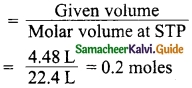
“Flying is learning how to throw yourself to the ground and miss”

Samacheer Kalvi 10th English Model Question Paper 5

Question 31.
Describe the challenge they faced with the weather condition.
Answer:
One day they were hit by a storm – it was scary to see very high waves, around 9-10 metres high surging the boat at a wind speed of 60 to 70 knots. Though they were prepared for the storm, it was quite challenging. Mountainous waves were surging from behind, pushing them forward. They were in the South Pacific. Luckily, they were sailing downwind. They took turns in steering the boat. When three of them were doing the watch at a time the other three rested.

It was so cold that it was difficult to stand outside for more than an hour. They watched enormous waves break over the top of the boat and sweep across the deck. One can imagine that a blast of saltwater soaking them completely. Sometimes the water would have gushed inside their living space, soaking all their clothes in sea water. The place would have been a mess.
“Accept the challenges so that you can feel the exhilaration of victory.”

Question 32.
What is the theme of the story, ‘The Night the Ghost got in’ by James Thurber?
Answer:
The theme of the story, ‘The Night the Ghost got in’ by James Thurber is surely of a supernatural kind. This story asks readers to accept the existence of the ghost mentioned in the title as a believable one. Many a time, ghost stories offer readers a sign for a common explanation for the events that the characters themselves trust are triggered by the bizarre scenario.

Although it seems very unlikely that a real ghost would have generated a commotion in the house, Thurber gives readers distressing indication that the sounds that he heard were undeniably supernatural.

For example, the police thoroughly investigate the house and say that all the doors and windows are locked from inside and nothing in the house is said to have been taken by burglars. The father and brother Roy, who are at first expected do have come home from Indianapolis early, do not feature in the play and are just characters mentioned during conversations.
“The human mind delights in grand conceptions of supernatural beings.”

Section – II

Answer any TWO of the following in utmost 10 lines. [2 x 5 = 10]

Question 33.
From the poem, ‘The Grumble Family’ what kind of behaviour does the poet want the readers to possess?
Answer:
L.M. Montgomery, from the poem, ‘The Grumble Family’ wants the readers to possess optimistic behaviour. The poet wants us to focus on the bright side of life and avoid the negativity around us, She wants us to learn to appreciate the beauty around us and avoid criticism. The poetess wants us to always try our best to be an optimist who sees the good and not the bad. Hence, she opines that it is wise to keep our feet from roaming into the Complaining Street and never growl at anything we do even if we are mistaken to be a complainer. Therefore, the poetess wants us to learn to walk with a smile and a song even when things go against our likes.
“A complainer is just an explainer of problems.”

Samacheer Kalvi 10th English Model Question Paper 5

Question 34.
Describe in your own words how the poem, The Secret of the Machines’ by Rudyard Kipling has an importance to current life.
Answer:
This poem written at the beginning of the twentieth century is about Industrialization. The poet starts by describing how the machines are created, wrought and taken from the ore-bed and mines. The only requirement for the machines is water, coal and oil. Further, Kipling enumerates the various skills of machines, such as pulling, carrying, pushing, lifting, driving, printing, ploughing, weaving, heating, lighting, running, racing, swimming, flying, diving, seeing, hearing, counting, reading and writing. Machines do exactly as it is programmed.

These machines have no feelings and any wrong handling can be dangerous for they are just machines with power invented by humans. The first intention of the poem reveals the progress of machines which is indeed a good thing for mankind. They make many things easier and facilitate the work of the humans.

The second purpose is to express that a machine can never replace a human-being, because a machine is devoid of feelings being the child of human brain. Hence man has full control over it, dependent on humans. By choosing the headline, “The secret of the machines” the poet wants to simplify that machines also have secret flaws where they don’t possess feelings nor identify a lie.

Any slip in handling it means instant death. At the time of mechanization, people gave importance to machines. So Rudyard Kipling wanted to make known the advantages and disadvantages of machines. I have come to the conclusion that the poem by Rudyard Kipling still has a current importance today and that for all advantages there are also disadvantages while using machines. “Industrialisation based on machinery, is a revolution wrought by technology.”

Question 35.
Read the following stanza and answer the questions given below.
“Strong is she in her faith and beliefs.
‘Persistence is the key to everything,’says she.
Despite the sighs and groans and moans She’s strong in her faith, firm in her belief!”
(i) What kind of a faith and belief does the woman portray?
(if) Mention the poetic device employed in the third line.
(iii) Write the rhyme scheme of this stanza.
(iv) Identify the figure of speech employed in the fourth line of the given stanza.
Answer:
(i) The woman portrays a strong faith and firm belief.
(ii) The poetic device employed in the third line is assonance.
(iii) The rhyme scheme of this stanza is ‘abca’.
(iv) Alliteration is the figure of speech in the fourth line of the given stanza.

Question 36.
Paraphrase the following stanza.
A silly young cricket, accustomed to sing
Through the warm, sunny months of gay summer and spring,
Began to complain when he found that, at home,
His cupboard was empty, and winter was come.
Answer:
There was a cricket who loved singing. The poet says the cricket was young and silly because he sang all through summer and spring with no worries in the world. But when winter arrived, he began to complain. He found that his cupboard was empty and not a piece of bread was there to eat.

Section – III

Answer any ONE of the following: [1 x 5 = 5]

Question 37.
Rearrange the following sentences in coherent order.
(i) After that last battle, no one cared anymore that Mulan was a woman.
(ii) He wanted Mulan, to stay with him in the palace and be his fine royal adviser.
(iii) The battle was such a big victory that the enemy gave up, at last.
(iv) The Emperor was so glad that Mulan had ended the long war.
(v) The war was over, and China was saved!
Answer:
Rearranged number sequence: (iii), (v), (i), (iv), (ii)
(iii) The battle was such a big victory that the enemy gave up, at last.
(v) The war was over, and China was saved!
(i) After that last battle, no one cared anymore that Mulan was a woman.
(iv) The Emperor was so glad that Mulan had ended the long war.
(ii) He wanted Mulan, to stay with him in the palace and be his fine royal adviser.

Samacheer Kalvi 10th English Model Question Paper 5

Question 38.
Read the following passage and answer the questions that follow’.
Worst of all, my salary was reduced, and I saw that marriage was out of the question. In my despair I consulted Professor Clinch about my dilemma, and as to some safe way of getting at the rubies. He said that, if my uncle had not lied, there was none that would not ruin the stones, especially the pearls, but that it was a silly tale and altogether incredible.

I offered him the biggest ruby if he wished to test his opinion. He did not desire to do so. Dr. Schaff, my uncle’s doctor, believed the old man’s letter, and added a caution, which was entirely useless, for by this time I was afraid to be in the room with that terrible box. At last the doctor kindly warned me that I was in danger of losing my mind with too much thought about my rubies. In fact, I did nothing else but contrive wild plans to get at them safely. I spent all my spare hours at one of the great libraries reading about dynamite.

Question.
(i) Why was the marriage not possible?
(ii) Who did he contact in his despair?
(iii) What was the offer made to Professor Clinch?
(iv) Who was Dr. Schaff?
(v) What did he do at one of the greatest libraries?
Answer:
(i) The marriage wasn’t possible as his salary was reduced.
(ii) He contacted Professor Clinch about his dilemma.
(iii) He offered the biggest Ruby to Professor Clinch.
(iv) Dr. Schaff was uncle’s doctor.
(v) He spent all his spare hours in the greatest libraries.

Section – IV

Answer any FOUR of the following. [4 x 5 = 20]

Question 39.
You are Sneha/Gopinath of Vivekananda School. Recently you had the honour of having participated as the contingent leader of your school team in the Republic Day parade in Delhi, in which your school was adjudged the best participating team. Write a report in about 100-150 words about the memorable event for publication in your school magazine.
Answer:
Republic Day Honours
[by Sneha/Gopinath, X S]
This year’s Republic Day will ever be cherished as a red letter day by Vivekananda school. On this historic occasion our school team had the good fortune to participate in the Republic Day parade at Vijay Chowk in New Delhi. More than fifty teams representing different parts of India displayed their varied, colourful and romantic items of songs, dances and aerobics.

Their feats made people glued to their feet. The enthusiasm and cheerfulness of the participants was beyond description. The celebrations were also a test of performance of the participating teams. When the name of our school was announced as the best participating team, I felt overjoyed. For a moment, disbelief overpowered me. Then I as contingent leader went forward to receive the shield. I dedicated this award to our Principal and the Physical Instructor who had provided us such an excellent training.

Question 40.
You are Nirmal/Nirmala, a student of Government High School, Dharmapuri. Write an application to the Principal of your school requesting him to allow you full fee concession.
Answer:
Nirmal/Nirmala
VIII-A
Government High School Dharmapuri 14th April, 2020 The Principal
Government High School
Dharmapuri
Sir
Sub: Requesting for full fee concession
Most humbly I beg to say that I am not able to pay my monthly fee to the school. I am a student of class VIII. My father is a clerk in a private firm. His salary is too meagre to support a family of five. Two of my sisters are also studying in school. I am not in a position to pay my monthly fees. This is for your kind information that I have been a good student throughout. I am also in the school hockey team. Therefore, I request you to kindly consider my case and grant me full fee concession. Only then I will be able to continue my studies. I assure you that I will give you good results. I want to study, so please support me.
Thanking you
Yours obediently
Nirmal/Nirmala
Class VIII-A

Address on the envelope
To
The Principal
Government High School
Dharmapuri

Samacheer Kalvi 10th English Model Question Paper 5

Question 41.
As librarian of Unity Public School, Chennai, draft a notice in not more than 50 words asking all students and teachers to return the library books they have borrowed, two days before the commencement of the examination.
Answer:
Unity Public School, Chennai
Notice
Return the Library Books Before Exam
20th Feb., 20XX
The annual examinations for the class VIII will start on 3rd March. So all students and teachers are advised to return the library books that they borrowed to the undersigned latest by the 1st March.
Ranjan
Librarian

Question 42.
Look at the following picture and express your views on it in about five sentences.
Samacheer Kalvi 10th English Model Question Paper 5.2
Answer:
A mother and daughter relationship is something very special. This picture portrays a mother and daughter spending their free time together. The daughter has asked her mother to prepare a special dish. She has the recipe book with her. She explains the procedure for baking some nice biscuits. Her mother joyfully does it for her. Both of them are enjoying their time together. The daughter relishes the smell of the cookie that is going to be baked.

Question 43.
Make notes or write a summary of the following passage.
The epidemic of heart attacks has been attaining alarming proportion in recent times causing grave concern specially to the medical fraternity. To contain and control the increasing death and disability from heart attacks and to focus on public awareness and their involvement at global level, the World Health Organisation (WHO) and the World Heart Federation observed September 24th as the World Heart Day.

What causes heart attacks? Dr H.S. Wasir, Chief Cardiologist and Medical Director, Batra Hospital and Medical Research Centre lists four main habits which adversely affect the heart health. These are lack of physical exercise, wrong eating habits, cigarette smoking and excessive alcohol consumption, and stressful lifestyle. The importance of physical exercise in minimising the incidence of heart attacks cannot be underestimated. “Physical exercise,” says Dr. Wasir, “plays a major role in achieving a long and healthy life in general and prevention of heart attacks in particular.” There are several studies showing that physically active people have higher longevity than those sedentary or physically inactive.
Notes
Title: Having a Healthy Heart

1. World Heart Day: 24 September.
(a) to control death & disability
(b) to increase awareness

2. Causes of Heart Attacks
(a) lack of physical exercise
(b) wrong eating habits
(c) smoking & alcohol
(d) stressful lifestyle

3. Role of Physical Exercise.
(a) prevents heart attacks—longer life
(b) isotonic-beneficial; isometric—harmful
(c) walking: best exercise

  • 30 to 60 meters brisk walk
  • no equipment, money, material or membership of club
  • early morning: ideal for walking.

4. Consult cardiologist before beginning an exercise programme.

Summary

Title: Having a Healthy Heart
Rough Draft
In regent times, heart attack is an epidemic disease that causes grave concern to the medical fratemity . To have control on increasing death and disability due to heart attacks, the World Health Organisation (W.H.O) and World Heart Federation has observed September 24th as the World Heart Day to focus on public awareness. Dr H.S. Wasir, Chief Cardiologist and Medical Director, Batra Hospital and Medical ReseatchCentre lists four main habits which adversely affect the heart health. These are lack of physical exeicise, wrong eating habits, cigarette smoking and excessive alcohol consumption, and stressful lifestyle . The effects of heart attack can be reduced to greater extent with the help of regular exercise like walking.

Fair Draft:
Title: Having a Healthy Heart
In recent times, heart attack is an epidemic disease that causes grave concern to the medical fraternity. To have control on increasing death and disability due to heart attacks, the World Health Organisation (W.H.O) and World Heart Federation has observed September 24th as the World Heart Day to focus on public awareness.

According to health experts, there are four main habits that cause heart attack, these are lack of physical exercise, wrong eating habits, smoking, excessive alcohol consumption and stressful lifestyle. The effects of heart attack can be reduced to greater extent with the help of regular exercise like walking. No. of words in the summary: 100

Samacheer Kalvi 10th English Model Question Paper 5

Question 44.
Identify and correct the errors in the following sentences.
(a) It is high time that we leaved this place.
(b) If I had known it, I will have helped him.
(c) I saw two females.
(d) One of the boys have a car.
(e) Riya persisted to do it in spite of my advice.
Answer:
(a) It is high time that we left this place.
(b) If I had known it, I would have helped him.
(c) I saw two women.
(d) One of the boys has a car.
(e) Riya persisted in doing it in spite of my advice.

Section – V

Quote from memory. [1 x 5 = 5]

Question 45.
Remember, we …………. countries strange.
Answer:
Remember, we who take arms against each other
It is the human earth that we defile.
Our hells of fire and dust outrage the innocence
Of air that is everywhere our own,
Remember, no men are foreign, and no countries strange.

Part-IV

Question 46.
Write a paragraph of about 150 words by developing the following hints. [2 x 8 = 16]
(a) Peter – cakes – his blind friend – dikes – people of Holland – keep the walls strong – safe and dry children know the danger – Peter’s father – mother’s errand – happy to see his friend sun was setting sound of trickling water – the danger realised – thrust his finger – tiny hole – nature protected – eyes closed – not asleep – the brave little hero of Holland.
Answer:
Peter is a little boy who lived in Holland. His father took care of the dikes called sluices so that ships could pass out of Holland’s canals into the sea. On a beautiful day in Autumn, Peter was asked to go and give cakes to his blind friend who lived on the other side of the dike by his mother.

After about an hour he returned home, but the climate had changed. It was raining and the water in the channel was rising. All of a sudden he heard the sound of dribbling water and he wondered from where the sound came, He then saw a small hole in the dike. He knew what that meant and due to the pressure of the water the hole would not stay the same. He feared danger. He climbed onto the dike and put his finger in the hole and hoped for someone to come to his help and cried out aloud. His mother mistook him to have stayed back with his blind friend and retired to bed.

The boy was sure that he had to stay awake the entire night and keep his finger in the hole to arrest the water from flooding Holland. The water in the canal was rising and if he would remove his finger from the hole in the sluice, the water would gush through and make the hole bigger and bigger. The town would obviously flood. When dawn broke, a man going to work heard the sound of Peter groaning and wondered what the little boy was up to. He was shocked at his reply but understood the danger and called for help. People came in with shovel and mended the hole. Peter was carried home and they all hailed him as the brave boy who saved Holland from drowning.

[OR]

(b) Describe the entry of ZigZag and his behaviour thereafter as soon as he entered the residence of Krishnan by developing the given hints.
Krishnan’s residence – tottered ZigZag – Somu’s cook, Visu – tall -crown of shocking pink feathers – plumage – beak – eyes – Ziggy-Zagga-king-of-the-Tonga – talks f rench Poetry – human grumpiness – Arvind’s effort – Bored eyes brightened – picked a walnut – wrinkled eyelid solemn wink – flew clumsily – chandelier fruit transferred – ceiling fan – Visu left – Zigzag slept.
Answer:
Into Krishnan’s residence tottered the strangest, weirdest-looking bird, ZigZag. He was brought in by Somu’s cook, Visu. About a foot and a half tall, its bald head was fringed with a crown of shocking pink feathers while the rest of its plumage was in various shades of the muddiest and sludgiest brown. Its curved beak was sunflower-yellow and its eyes were the colour of cola held to sunlight. Visu introduced ZigZag as Ziggy-Zagga-king-of-the-Tonga and that he talks very beautifully.

He even added that he could recite French Poetry! In spite of all the praise showered on him, he stood cool and unmoved, with an expression of almost human grumpiness in his cola-coloured eyes. Arvind, tried his best to make ZigZag speak. He dashed into the kitchen and brought a plate with juicy fruit slices and some nuts. Bored eyes brightened as Zigzag picked up a walnut.

It refused to speak, dropped one wrinkled eyelid in a solemn wink and flew clumsily to deposit the nut on the enormous chandelier hanging from the ceiling. Silently and slowly, all the fruit on the plate was transferred to the chandelier and the blades of the ceiling fan. As soon as the cook Visu left, Zigzag, still perched on the curtain rod, went off to sleep.

Samacheer Kalvi 10th English Model Question Paper 5

Question 47.
Read the following passage and answer the questions given below:
Housed in an 18th century style Heritage building with wooden panelling running through the thirty seat dining area, “Lean and Lovely” is the latest attraction in Siddhapuram Nagar. Says the owner Chef Virina, “People come to us for the unusual feast that we serve. Fairly ordinary Indian recipes are ignited with a dash of sauce and spiced with colour. There is harmony and balance between taste, lightness and tradition. Wholly organically grown vegetables and flour are used. We use the freshest of ingredients that are cut and cooked so as to display their colour and individual texture.

Questions.
(a) What is special about the vegetables and flour used by “Lean and Lovely”?
(b) Where is “Lean and Lovely” located?
(c) Who is a ‘Chef’?
(d) How do the people in “Lean and Lovely” make the ordinary Indian recipes more attractive?
Answer:
(a) Wholly organically grown vegetables and flour is the speciality of “Lean and Lovely’.
(b) “Lean and Lovely” is located in Siddhapuram Nagar.
(c) A chef is a skilled cook, who prepares a variety of dishes in a restaurant and manages them.
(d) Fairly ordinary Indian recipes are ignited with a dash of sauce and spiced with colour in
“Lean and Lovely”. There is also harmony and balance between taste, lightness and tradition attracting the people.

[OR]

Read the following poem and answer the questions given below:
Rough Boys
My parents kept me from children who were rough
And who threw words like stones and who wore torn clothes.
Their thighs showed through rags; they ran in the street And climbed cliffs and stripped by the country streams.
I feared more than tigers their muscles like iron
And their jerking hands and their knees tight on my arms.
I feared the salt coarse pointing of those boys Who copied my lisp behind me on the road.
They were lithe, they sprang out behind hedges Like dogs to bark at our world. They threw mud And I looked another way, pretending to smile,
I longed to forgive them, yet they never smiled.

Questions.
(a) Why were the children said to be rough?
(b) Describe the appearance of the rough children as portrayed by the poet.
(c) What physical nature of the rough children did the poet fear?
(d) Identify the comparison in the last stanza.
Answer:
(a) The children were said to be rough because they spoke rudely.
(b) The rough children wore tom clothes with their thighs seen through the rags.
(c) The poet feared the muscles in hands and knees of the rough children that appeared like iron.
(d) The rough boys are compared to the dogs that are supple and agile and come out hiding behind the shrubs to attack.

Samacheer Kalvi 10th Science Model Question Paper 2 English Medium

Students can Download Samacheer Kalvi 10th Science Model Question Paper 2 English Medium Pdf, Samacheer Kalvi 10th Science Model Question Papers helps you to revise the complete Tamilnadu State Board New Syllabus, helps students complete homework assignments and to score high marks in board exams.

Tamil Nadu Samacheer Kalvi 10th Science Model Question Paper 2 English Medium

General Instructions:

  1. The question paper comprises of four parts
  2. You are to attempt all the questions in each part. An internal choice of questions is provided wherever applicable.
  3. All questions of Part I, II, III and IV are to be attempted separately.
  4. Question numbers 1 to 12 in Part I are Multiple Choice Questions of one mark each.
    These are to be answered by writing the correct answer along with the corresponding option code.
  5. Question numbers 13 to 22 in Part II are of two marks each. Any one question should be answered compulsorily.
  6. Question numbers 23 to 32 in Part III are of four marks each. Any one question should be answered compulsorily.
  7. Question numbers 33 to 35 in Part IV are of seven marks each. Draw diagrams wherever necessary.

Time: 3 Hours
Maximum Marks: 75

Part – I

(i) Answer all the questions.  [12 × 1 = 12]
(ii) Choose the most suitable answer and write the code with the corresponding answer.

Question 1.
To produce a displacement _________ is required.
(a) Acceleration
(b) Force
(c) Velocity
(d) Momentum
Answer:
(b) Force

Question 2.
The refractive index of a transparent medium is always greater than_________.
(a) two
(b) three
(c) one
(d) four
Answer:
(c) one

Samacheer Kalvi 10th Science Model Question Paper 2 English Medium

Question 3.
Velocity of sound in a gaseous medium is 330 ms-1. If the pressure is increased by 4 times without causing a change in the temperature, the velocity of sound in the gas is _________.
(a) 330 ms-1
(b) 660 ms-1
(c) 156 ms-1
(d) 990 ms-1
Answer:
(a) 330 ms-1

Question 4.
Neon shows zero electron affinity due to _________.
(a) stable arrangement of neutrons
(b) stable configuration of electrons
(c) reduced size
(d) increased density
Answer:
(b) stable configuration of electrons

Question 5.
A solution is a _________ mixture.
(a) homogeneous
(b) homogeneous and heterogeneous
(c) heterogeneous
(d) Non homogeneous
Answer:
(a) homogeneous

Question 6.
Powdered CaCO3 reacts more rapidly than flaky CaCO3 because of _________.
(a) large surface area
(b) high pressure
(c) high concentration
(d) high temperature
Answer:
(a) large surface area

Samacheer Kalvi 10th Science Model Question Paper 2 English Medium

Question 7.
A patient with blood group O was injured in an accident and has blood loss. Which blood group the doctor should effectively use for transfusion in this condition?
(a) A group
(b) B group
(c) O group
(d) AB group
Answer:
(c) O group

Question 8.
_________ is the ATP factory of the cell.
(a) Mitochondria
(b) Nucleus
(c) Ribosomes
(d) Chloroplast
Answer:
(a) Mitochondria

Question 9.
The Anemophilous flowers have _________.
(a) Sessile stigma
(b) Small smooth stigma
(c) Coloured flower
(d) Large feathery stigma
Answer:
(d) Large feathery stigma

Question 10.
A person who met with an accident lost control of body temperature, water balance and hunger. Which of the following part of brain is supposed to be damaged?

(a) Hypothalamus
(b) Pons
(c) Cerebrum
(d) Medulla oblongata
Answer:
(a) Hypothalamus

Question 11.
_________ is the raw material which plays an important role in evolution.
(a) Fossilization
(b) Variation
(c) Preservation
(d) Sedimentation
Answer:
(b) Variation

Samacheer Kalvi 10th Science Model Question Paper 2 English Medium

Question 12.
The centromere is found at the centre of the _________ chromosome.
(a) Telocentric
(b) Metacentric
(c) Sub-metacentric
(d) Acrocentric
Answer:
(b) Metacentric

Part – II

Answer any seven questions. (Q.No: 22 is compulsory) [7 × 2 = 14]

Question 13.
Define dispersion of light.
Answer:
When a beam of white light or composite light is refracted through any transparent media such as glass or water, it is split into its component colours. This phenomenon is called as ‘dispersion of light’.

Question 14.
What is meant by equilibrant?
Answer:
A system can be brought to equilibrium by applying another force, which is equal to the resultant force in magnitude, but opposite in direction. Such force is called as ‘Equilibrant’.

Samacheer Kalvi 10th Science Model Question Paper 2 English Medium

Question 15.
Why does an empty vessel produce more sound than a filled one?
Answer:
The intensity of sound is directly proportional to the square of amplitude of vibration. I ∝ A2 since, the amplitude of vibration of air molecules (empty vessel) is greater than liquid molecules (filled vessel), therefore empty vessel produces louder sound than the filled vessel.

Question 16.
Differentiate ore and mineral.
Answer:

Ore Mineral
1. A mineral from which a metal can be economically extracted. 1. A mineral may be a single compound or complex mixture of various compounds of metals found in the earth.
2. All ores are minerals. 2. All minerals are not ores.
3. Eg. Bauxite is an ore of aluminium. 3. Clay is a mineral.

Question 17.
How do detergents cause water pollution?
Answer:
Some detergents having a branched hydrocarbon chain are not fully biodegradable by micro organisms present in water. So, they cause water pollution.
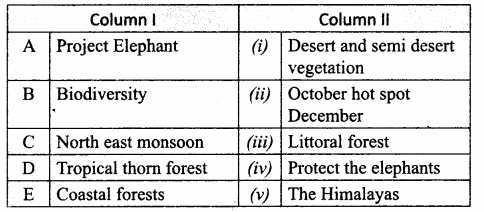
Question 18.
Define reflex arc.
Answer:
The pathway taken by the nerve impulse to accomplish reflex action is called Reflex arc.

Samacheer Kalvi 10th Science Model Question Paper 2 English Medium

Question 19.
The complete events of cardiac cycle last for 0.8 sec. What is the timing for each event?
Answer:
The events during a single cardiac cycle involves

  • Atrial Systole – Contraction of auricles – (0.1 sec)
  • Ventricular Systole – Contraction of ventricles – (0.3 sec)
  • Ventricular diastole – Relaxation of Ventricles – (0.4 sec)

Question 20.
What will you do to prevent leaf fall and fruit drop in plants?
Answer:
Treating plants with auxin will prevent leaf fall and fruit drop. Auxin prevent the formation of abscission layer in plants.

Question 21.
Draw and label the structure of the ovule.
Answer:
Samacheer Kalvi 10th Science Model Question Paper 2 English Medium 1

Question 22.
Calculate the momentum of a toy car of mass 200g moving with a speed of 5 m/s.
Answer:
Mass of the toy car (m) = 200 g = 0.2 kg
Speed (v) = 5 m/s
Momentum (p) = m × v
= 0.2 × 5 = 1 kg m/s

Part – III

Answer any seven questions (Q.No: 32 is compulsory) [7 × 4 = 28]

Question 23.
Explain the process of controlled and uncontrolled chain reactions.
Answer:
Controlled chain reaction:

  • In the controlled chain reaction the number of neutrons released is maintained to be one. This is achieved by absorbing the extra neutrons with a neutron absorber leaving only one neutron to produce further fission.
  • Thus, the reaction is sustained in a controlled manner. The energy released due to a controlled chain reaction can be utilized for constructive purposes.
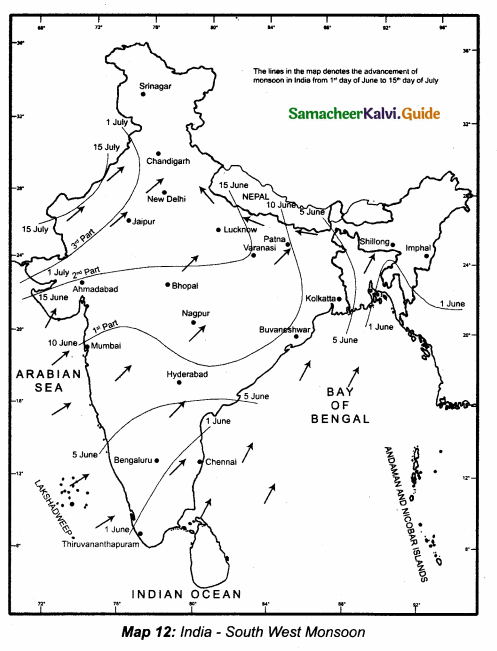
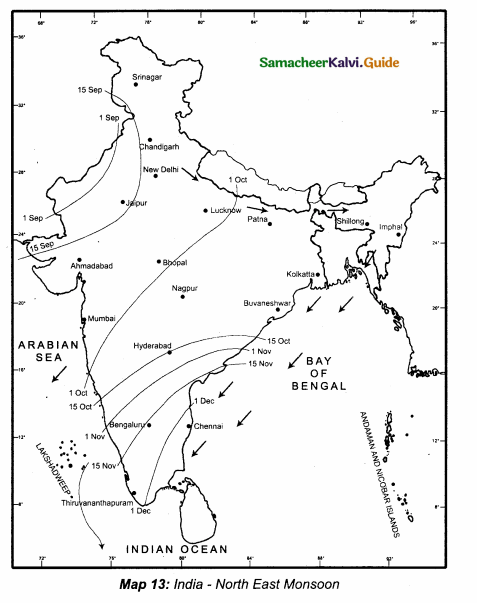
  • Controlled chain reaction is used in a nuclear reactor to produce energy in a sustained and controlled manner.

Uncontrolled chain reaction:

  • In the uncontrolled chain reaction the number of neutrons multiplies indefinitely and causes fission in a large amount of the fissile material.
  • This results in the release of a huge amount of energy within a fraction of a second.
  • This kind of chain reaction is used in the atom bomb to produce an explosion.

Samacheer Kalvi 10th Science Model Question Paper 2 English Medium

Question 24.
What are the factors that affect the speed of sound in gases?
Answer:
Effect of density: The velocity of sound in a gas is inversely proportional to the square root of the density of the gas. Hence, the velocity decreases as the density of the gas increases.
v ∝ \(\sqrt{\frac{1}{d}}\)

Effect of temperature:
(i) The velocity of sound in a gas is directly proportional to the square root of its temperature.
(ii) The velocity of sound in a gas increases with the increase in temperature, v ∝ \(\sqrt{\mathrm{T}}\) Velocity at temperature T is given by the following equation:
vT = (v0 + 0.61 T) ms-1

Here, v0 is the velocity of sound in the gas at 0° C. For air, v0 = 331 ms-1. Hence, the velocity of sound changes by 0.61 ms-1, when the temperature changes by one degree Celsius.

Effect of relative humidity: When humidity increases, the speed of sound increases. That is why we can hear sound from long distance clearly during rainy seasons.

Question 25.
(i) Classify the types of force based on their application.
Answer:
Based on the direction in which the forces act, they can be classified into two types as:

  1. Like parallel forces
  2. Unlike parallel forces.

1. Like parallel forces:
Two or more forces of equal or unequal magnitude acting along the same direction, parallel to each other are called like parallel forces.

2. Unlike parallel forces:
If two or more equal forces or unequal forces act along opposite directions parallel to each other, then they are called unlike parallel forces.

(ii) Which instrument is used to measure the electric current? How should it be connected in a circuit?
Answer:

  • Ammeter is used to measure the current.
  • An Ammeter is connected in series with the circuit.
  • The Ammeter is a low impedance device connecting it in parallel with the circuit would cause a short circuit, damaging the Ammeter or the circuit.

Samacheer Kalvi 10th Science Model Question Paper 2 English Medium

Question 26.
Write the characteristics of organic compounds.
Answer:

  • Organic compounds have a high molecular weight and a complex structure.
  • They are mostly insoluble in water, but soluble in organic solvents such as ether, carbon tetra chloride, toluene etc.
  • They are highly inflammable in nature.
  • Organic compounds are less reactive compared to inorganic compounds. Hence, the reactions involving organic compounds proceed at slower rates.
  • Mostly organic compounds form covalent bonds in nature.
  • They have lower melting point and boiling point, when compared to inorganic compounds
  • They exhibit the phenomenon of isomerism, in which a single molecular formula represents several organic compounds that differ in their physical and chemical properties.
  • They are volatile in nature.
  • Organic compounds can be prepared in the laboratory.

Question 27.
The electronic configuration of metal A is 2, 8, 18, 1.
The metal A when exposed to air and moisture forms B a green layered compound. A with con. H2SO4 forms C and D along with water. D is a gaseous compound. Find A,B,C and D.
Answer:
(i) The electronic configuration of metal (A) is 2, 8, 18, 1.  ∴A is copper (Z = 29)
(ii) (A) Copper exposed to air and moisture forms green layered compound (B) that is copper carbonate.
Samacheer Kalvi 10th Science Model Question Paper 2 English Medium 2
(iii) Copper (A) reacts with con.H2SO4 to give copper sulphate (C) and Sulphur dioxide (D).
Samacheer Kalvi 10th Science Model Question Paper 2 English Medium 3

A Copper Cu
B Copper carbonate CuCO3. Cu(OH)2
C Copper sulphate CuSO4
D Sulphur dioxide SO2

Question 28.
A pure tall plant (TT) is crossed with pure dwarf plant (tt), what would be the F1 and F2 generations?
Answer:
In a monohybrid cross, if a pure tall plant (TT) is crossed with pure dwarf plant (tt). All plants were tall (Tt) in F1 generation.
Samacheer Kalvi 10th Science Model Question Paper 2 English Medium 4
F1 → Tt Tt Tt Tt (Tall heterozygous)
Ratio : 3 : 1
During the selling of F1 generation 3 different types of plants were produced.
Samacheer Kalvi 10th Science Model Question Paper 2 English Medium 5
Tall Homozygous – TT (Pure) – 1
Tall Heterozygous – Tt – 2
Dwarf Homozygous – tt – 1
Ratio : 1 : 2 : 1

Samacheer Kalvi 10th Science Model Question Paper 2 English Medium

Question 29.
(i) What are the external and internal factors affecting photosynthesis
Answer:
(a) External Factors:

  • Light
  • Carbon dioxide
  • Temperature
  • Water
  • Mineral elements

(b) Internal Factors:

  • Pigments
  • Leaf age
  • Accumulation of carbohydrates
  • Hormones

(ii) Why is vegetative propagation practiced for growing some type of plants?
Answer:
Vegetative propagation is the only method of multiplication in plants like banana, seedless grapes and orange that have lost their capacity to produce seeds through sexual reproduction and vegetative propagation helps us to introduce plants in new areas where seed germination fails to produce plants.

Question 30.
(i) Solar energy is a renewable energy. How?
Answer:
Solar energy is renewable, free source of energy, that is sustainable and totally inexhaustible.

(ii) How is the circulatory system designed in leech to compensate the heart structure?
Answer:
The circulation in Leech is Haemocoelic system. There are no true blood vessels. The blood vessels are replaced by channels called Haemocoelic channels or canals filled with blood like fluid. The coelomic fluid contain Haemoglobin. There are four longitudinal channels. One channel lies above (dorsal) to the Alimentary canal, one below (ventral) to the Alimentary canal.

The other two channels lie on either (lateral) side of the Alimentary canal, which serves as a heart and have inner valves. All the four channels are connected together posteriorly in the 26th segment. Thus the circulatory system is designed in Leech to compensate the heart structure.

Question 31.
(a) What are the contributing factors for obesity?
Answer:
Obesity is due to genetic factors, physical inactivity, overeating and endocrine factors.

(b) State the importance of biofertiliser.
Answer:

  • Biofertilisers are easy to produce in abundance and are available at low X cost to the marginal farmer.
  • It increases the soil fertility without causing any damage to the soil. E.g: Rhizobium, Azospirillium, Azotobacter.

Samacheer Kalvi 10th Science Model Question Paper 2 English Medium

Question 32.
(i) Draw a ray diagram of formation of images by the convex lens.
Answer:
Ray diagram for object placed between F and 2F
Samacheer Kalvi 10th Science Model Question Paper 2 English Medium 6

(ii) The hydroxide ion concentration of a solution is 1 × 10¹¹ m. What is the pH of the solution?
Answer:
[OH] = 1 × 10-11m
pOH = -log10[OH] = – log10[10-11]
= -[-11 × log10 10]
= -(-11) = 11
pH + pOH = 14
pH = 14 – pOH
pH = 14 – 11 = 3

Part – IV

(1) Answer all the questions. [3 × 7 = 21]
(2) Each question carries seven marks.
(3) Draw diagram wherever necessary.

Question 33.
(a) (i) Define One roentgen.
Answer:
One roentgen is defined as the quantity of radioactive substance which produces a charge of 2.58 x 10⁻⁴ coulomb in 1 kg of air under standard conditions of pressure, temperature and humidity.

(ii) What is a nuclear reactor? Explain its essential parts with their functions.
Answer:
A Nuclear reactor is a device in which the nuclear fission reaction takes place in a self-sustained and controlled manner to produce electricity.
Samacheer Kalvi 10th Science Model Question Paper 2 English Medium 7

Components of a Nuclear reactor:
The essential components of a nuclear reactor are

  1. fuel
  2. moderator
  3. control rod
  4. coolant and
  5. protection wall.

(1) Fuel: A fissile material is used as the fuel. The commonly used fuel material is uranium.
(2) Moderator: A moderator is used to slow down the high energy neutrons to provide slow neutrons. Graphite and heavy water are the commonly used moderators.
(3) Control rod: Control rods are used to control the number of neutrons in order to have sustained chain reaction. Mostly boron or cadmium rods are used as control rods. They absorb the neutrons.
(4) Coolant: A coolant is used to remove the heat produced in the reactor core, to produce steam. This steam is used to run a turbine in order to produce electricity. Water, air and helium are some of the coolants.
(5) Protection wall: A thick concrete lead wall is built around the nuclear reactor in order to prevent the harmful radiations from escaping into the environment.

[OR]

(b) (i) An object is placed at a distance 20 cm from a convex lens of focal length 10 cm.
Find the image distance and nature of the image.
Answer:
u = -20 cm
f = 10 cm
Samacheer Kalvi 10th Science Model Question Paper 2 English Medium 8
Samacheer Kalvi 10th Science Model Question Paper 2 English Medium 9
Nature of the image real enlarged and inverted image.

(ii) A ball of mass 1 kg moving with a speed of 10 ms-1 rebounds after a perfect elastic collision with the floor. Calculate the change in linear momentum of the ball.
Answer:
Given mass = 1 kg, speed =10 ms-1
∴ Initial momentum = mu = 1 × 10 = 10 kg ms-1
Final momentum = mv = -10 kg ms-1
Change in momentum = final momentum – initial momentum
= mv – mu
= -10 -10
Change in momentum = -20 kg ms-1

Samacheer Kalvi 10th Science Model Question Paper 2 English Medium

Question 34.
(a) (i) Calculate the number of moles in 12.046 × 10²³ atom of copper.
Answer:
12.046 × 10²³ atoms of copper
6.023 × 10²³ atoms of copper = 1 mole
Samacheer Kalvi 10th Science Model Question Paper 2 English Medium 10

(ii) How many grams are there in two moles of H2O
Answer:
No. of moles = \(\frac{\text { Mass }}{\text { Molar mass }}\)
Mass = No. of moles x molar mass
Molar mass of H2O = (2 × 1) + 16 = 18
Mass = 2 × 18 = 36 g

(iii) In magnesium sulphite, the ration by mass of Mg and S is 3 :4. What is the ratio of the number of Mg and S atoms?
Answer:
Formula of magnesium sulphide = MgS
Ratio by mass Mg and S = 3 : 4
Samacheer Kalvi 10th Science Model Question Paper 2 English Medium 11

(b) (i) Explain the mechanism of cleansing action of soap.
Answer:
A soap molecule contains two chemically distinct parts that interact differently with water. It has one polar end, which is a short head with a carboxylate group (- COONa) and one non polar end having the long tail made of the hydrocarbon chain.

The polar end is hydrophilic (Water loving) in nature and this end is attracted towards water. The non-polar end is hydrophobic (Water hating) in nature and it is attracted towards dirt or oil on the cloth, but not attracted towards water. Thus, the hydrophobic part of the soap molecule traps the dirt and the hydrophilic part makes the entire molecule soluble in water.

When a soap or detergent is dissolved in water, the molecules join together as clusters called ‘micelles’. Their long hydrocarbon chains attach themselves to the oil and dirt. The dirt is thus surrounded by the non-polar end of the soap molecules. The charged carboxylate end of the soap molecules makes the micelles soluble in water. Thus, the dirt is washed away with the soap.

(ii) Differentiate soaps and detergents.
Answer:
Soaps:

  • It is a sodium salt of long chain fatty acids.
  • Its effectiveness is reduced when used in hard water.
  • Soaps are biodegradable.

Detergents:

  • It is a sodium salt of sulphonic acids.
  • It is effective even in hard water.
  • Most of the detergents are non-biodegradable.

Samacheer Kalvi 10th Science Model Question Paper 2 English Medium

Question 35.
(a) (i) Explain the functions of the thyroid hormones?
(ii) How are stem cells useful in regenerative process?
(iii) What is palaeontology?
Answer:
(i) Functions of the thyroid hormone:

  • Increases oxygen consumption in tissues.
  • Production of energy by maintaining the Basal Metabolic Rate (BMR) of the body.
  • Helps to maintain normal body temperature.
  • Controls growth of the body, bone formation and development of gonads.
  • Essential for normal physical, mental and personality development. Hence also known as personality hormone.

(ii) Stem cells useful in regenerative process:
Sometimes cells, tissues and organs in the body may be permanently damaged or lost due to genetic condition or disease or injury.

In such situations, stem cells are used for the treatment of diseases, which is called stem cell therapy.
In treating neurodegenerative disorders like Parkinson’s disease and Alzheimer’s disease neuronal stem cells can be used to replace the damaged or lost neurons.

(iii) The study of fossils is known as Palaeontology.

[OR]

(b) Explain with an example the inheritance of dihybrid cross. How is it different from monohybrid cross?
Answer:
The dihybrid cross involves the inheritance of two pairs of contrast characteristics, round – yellow seeds and wrinkled – green seeds.

When pea plants having round- yellow seeds cross bred with pea plant having wrinkled – green seeds, in the first generation (F1), only round yellow seeds were produced.

No wrinkled – green seeds were obtained. Round yellow colour seeds were dominant and wrinkled-green seeds were recessive.

When round-yellow seeds were cross bred by self-pollination, four types of seeds having different combinations of shape and colour were obtained in F2 generation. They were
round yellow, round green
wrinkled yellow, wrinkled green
The phenotypic ratio in F2 generation is 9 : 3 : 3 : 1
i.e. 9 – Yellow, round
3 – Yellow, wrinkled
3 – Green, round
1 – Green, wrinkled
Samacheer Kalvi 10th Science Model Question Paper 2 English Medium 12
Samacheer Kalvi 10th Science Model Question Paper 2 English Medium 13

Monohybrid cross:

  • Monohybrid cross is a genetic cross that involves a singles pair of genes which is responsible for one trait
  • Monohybrid ratio in F2 generation is 3 : 1

Dihybrid cross:

  • Dihybrid cross is a genetic cross that involves two pairs of genes which is responsible for two trait
  • Dihybrid ratio in F2 generation is 9 : 3 : 3 : 1

Samacheer Kalvi 10th English Model Question Paper 4

Students can Download Samacheer Kalvi 10th English Model Question Paper 4 Pdf, Samacheer Kalvi 10th English Model Question Papers helps you to revise the complete Tamilnadu State Board New Syllabus, helps students complete homework assignments and to score high marks in board exams.

Tamil Nadu Samacheer Kalvi 10th English Model Question Paper 4

General Instructions:

  1. The question paper comprises of four parts.
  2. You are to attempt all the sections in each part. An internal choice of questions is provided wherever applicable.
  3. All questions of Part I, II, III and IV are to be attempted separately.
  4. Question numbers I to 14 in Part I are Multiple Choice Questions of one mark each. These are to be answered by writing the correct answer along with the corresponding – option code.
  5. Part II has got four sections. The questions are of two marks each. Question numbers 15 to 18 in Section I and Question numbers 19 to 22 in Section II are to be answered in about one or two sentences each. Question numbers 23 to 28 in Section III and IV are to be answered as directed.
  6. Question numbers 29 to 45 in Part III are of five marks each and have been divided in five sections. These are to be answered as directed.
  7.  Question numbers 46 and 47 in Part IV are of eight marks each. Question number 47 has four questions of two marks each. These are to be answered as directed.

Time: 2.30 Hours
Maximum Marks: 100

Part – I

Answer all the questions. [14 x 1= 14]
Choose the most suitable answer and write the code with the corresponding answer.
Choose the appropriate synonyms for the italicised words.

Question 1.
He saw his brothers and sister perfecting in the art of flight.
(a) achieving
(b) trying
(c) finishing
(d) balancing
Answer:
(a) achieving

Question 2.
A board creaked, when it was trod upon.
(a) weary
(b) worn
(c) walked
(d) opened
Answer:
(c) walked

Samacheer Kalvi 10th English Model Question Paper 4

Question 3.
The sun was soothing.
(a) anxiety
(b) boisterous
(c) dexterous
(d) comforting
Answer:
(d) comforting

Choose the appropriate antonym for the italicised words.

Question 4.
You don’t have to use any auxiliary means of repulsion.
(a) disgust
(b) revolution
(c) repercussions
(d) attraction
Answer:
(d) attraction

Question 5.
Consumable products self-order replacements.
(a) throwaway
(b) expendable
(c) durable
(d) perishable
Answer:
(c) durable

Samacheer Kalvi 10th English Model Question Paper 4

Question 6.
How ignorant you are!
(a) oblivious
(b) unaware
(c) uninformed
(d) well – informed
Answer:
(d) well – informed

Question 7.
Choose the correct plural form of ‘dozen’.
(a) dozens
(b) dozenes
(c) dozen
(d) perishable
Answer:
(c) dozen

Question 8.
Form a derivative by adding the right suffix to the word – broke.
(a) en
(b) cian
(c) ssion
(d) al
Answer:
(a) en

Question 9.
Choose the correct expansion of the abbreviation DARE.
(a) Documentation Automatic Retrieval Equipment
(b) Documents Arrangements Retrieval Equipment
(c) Department of Agricultural Research and Education
(d) Director Arrangements Retrieval Equipment
Answer:
(c) Department of Agricultural Research and Education

Samacheer Kalvi 10th English Model Question Paper 4

Question 10.
Complete the following sentence with the most appropriate phrasal verb given below:
She …………. with a mild warning.
(a) got away
(b) got into
(c) got up
(d) got out
Answer:
(a) got away

Question 11.
Choose the suitable option to pair it with the word ‘sit’ to form a compound word.
(a) out
(b) innings
(c) stand
(d) meaning
Answer:
(a) out

Question 12.
Fill in the blank with the most appropriate preposition given below:
The spider crawls ……….. the wall.
(a) so
(b) before
(c) after
(d) on
Answer:
(d) on

Question 13.
Complete the following sentence using the most appropriate tense form of the verb given
below:
It was a historic day, which …………….. in navigation history and globally.
(a) was marked
(b) will be marked
(c) marking
(d) would be marked
Answer:
(d) would be marked

Question 14.
Choose the most appropriate linker from the given four alternatives.
The situation was Do ……………… die.
(a) else
(b) so
(c) but
(d) or
Answer:
(d) or

Part – II [10 x 2 = 20]
Section – I

Answer any THREE of the following questions in a sentence or two. [3 x 2 = 6]

Question 15.
What did the young bird’s family do when he started flying?
Answer:
The family saw the young seagull making his first flight and floating on the ocean. They flew and landed on the water just ahead of him. They were beckoning to him with a shrill voice. They were praising and rewarding him by offering scraps of fish to him.

Samacheer Kalvi 10th English Model Question Paper 4

Question 16.
How did they plan to manage a storm?
Answer:
Even during the storm when three people would be out on watch, the other three who would be inside wouldn’t be able to rest. When somebody heated the water, the other person would heat the gloves because it was raining also.

Question 17.
What did Sanyal say about Aditya who had asked him for his prize?
Answer:
Sanyal said that Aditya could not bear the fact that Sanyal had got a prize. He was envious and said that he had lost it because of the hole in his pocket.

Question 18.
Why did Mr. Hamel say it was the last French lesson?
Answer:
The order had come from Berlin to teach only German in the schools of Alsace and Lorraine. The new master was to come the next day. Hence Mr. Hamel said it was the last French lesson.

Section – II

Read the following sets of poetic lines and answer any THREE of the following. [3 x 2 = 6]

Question 19.
“Don’t ever try to saw her pride, her self-respect.
She knows how to thaw you, saw you – so beware/”
(a) What do the words thaw and saw mean here?
(b) What is the tone of the author?
Answer:
(a) Thaw and saw means that she will reduce you to nothing.
(b) The tone of the poetess is a caution about careful intervention.

Samacheer Kalvi 10th English Model Question Paper 4

Question 20.
“My heart was so light that I sang day and night,
For all nature looked gay. ” “For all nature looked gay”,
“You sang, Sir, you say?
Go then”, says the ant, “and dance the winter away”.”
(а) What is meant by‘gay’?
(b) Why does the poet say that the nature looks gay?
Answer:
(a) ‘Gay’ here means ‘happy and joyful’.
(b) The poet says that the nature looks happy because it’s springtime.

Question 21.
“But remember, please, the Law by which we live,
We are not built to comprehend a lie,
We can neither love nor pity nor forgive,
If you make a slip in handling us you die!”
(a) What is the warning given in the above lines?
(b) What is the reminder given by the machines?
Answer:
(a) The caution is the perils and hazards of mechanization.
(b) The reminder given by the machines is the law by which a machine lives to do the work of a man.

Question 22.
“It is the human earth that we defile
Our hells of fire and dust outrage the innocence
Of air that is everywhere our own,
Remember, no men are foreign, and no countries strange.”
(a) What are we doing to the earth?
(b) What is outraging this earth?
Answer:
(a) We are polluting this earth.
(b) Hells of fire and dust are outraging this earth.

Section – III

Answer any THREE of the following. [3 x 2 = 6]

Question 23.
Rewrite the following sentence to the other voice.
Answer:
The flat tire was changed by Saravanan.
Saravanan changed the flat tire.

Question 24.
Rewrite using indirect speech.
Answer:
“I haven’t seen them since last week,” said Roshini.
Roshini said that she hadn’t seen them since the previous week.

Samacheer Kalvi 10th English Model Question Paper 4

Question 25.
Punctuate the following.
Answer:
Our school used to be onestoreyed and a new building has come up, which wasnt Our school used to be one-storeyed, and a new building has come up, which wasn’t there.’

Question 26.
Transform the following sentence into a simple sentence.
Answer:
Our teacher is diligent therefore he is popular among students.
Our teacher is popular among students for his diligence.

Question 27.
Rearrange the words in the correct order to make meaningful sentences.
(a) went to / a friend’s dog / see / Sita and Ravi
(b) to obey / Rama decided / his mother / this time / very hard / for a long time / and prayed
Answer:
(a) Sita and Ravi went to see a friend’s dog.
(b) Rama decided to obey his mother this time and prayed very hard for a long time.

Section – IV

Answer the following. [1 x 2 = 2]

Question 28.
You are in Sandy Dance School. Ask a passer-by to help you reach Canara Bank with the help of the given road-map and write down the steps.
Answer:
Samacheer Kalvi 10th English Model Question Paper 4.1

  • From Sandy School go straight on Amina Salai and take the left and enter P.S.M. Road.
  • Go past Forex Mall on the left and P.V.R Cinemas on the right.
  • Take the immediate right after P.V.R Cinemas and you will find Canara Bank on the right side.

Part – III [10 x 5 = 50]
Section -I

Answer any TWO of the following in utmost 10 lines. [2 x 5 = 10]

Question 29.
Narrate the extensive search operation made by the policemen in the house.
Answer:
The arrival of the police blows the whole event out of proportion. The cops call out for the front door to be opened, and when no one in the house goes downstairs, they break it in. They go upstairs to find the narrator, still walking around with a towel over him after his bath. The mother insists there were burglars though the police confirms that all doors and windows are bolted from inside. The police set about probing the house, moving furniture and emptying closets.

At one point, a policeman’s inquisitiveness makes him point out an unusual old musical instrument, a zither, to another officer. The police are suspicious of the family members’ strange behaviour. When the narrator’s grandfather, sleeping in the attic, makes a slight noise, the policemen spring into action. They race upstairs to investigate. The narrator fears trouble because his grandfather feels that the Civil War is in progress.

When the policemen arrive at his door, he is convinced that they are Meade’s army and calls them deserters. He slaps a policeman sending him to the floor and takes the man’s gun from his holster and shoots at him, hitting him in the shoulder. He fires twice more and then goes back to bed. Back downstairs, the police feel defeated. They bandage the wounded officer and search the house again.

Samacheer Kalvi 10th English Model Question Paper 4

Question 30.
How is Dr. Watson used to trap Smith without his knowledge by Sherlock Holmes?
Answer:
Dr. Watson is called by Mrs. Hudson to tend Holmes, who is apparently dying of a rare tropical disease, Tarpaunli fever, contracted while he was on a case at Rotherhithe. Holmes forbids Watson to go near him because the illness is highly infectious. Although Watson wishes to examine Holmes himself or send for a specialist, Holmes demands that Watson
wait several hours before seeking help.

While Watson waits, he examines several objects in Holmes’s room. Holmes is angered when Watson touches things on his table stating his dislike for people fidgeting his things. At six o’clock, Holmes asks Watson to turn the gaslight on, but only half-full. He then instructs Watson to bring Mr. Culverton Smith from 13 Lower Burke Street to see Holmes but to make sure that Watson returns to Baker Street before Smith arrives. Watson goes to Smith’s address. Although Smith refuses to see anyone, Watson forces his way in.

Once Watson explains his duty on behalf of Sherlock Holmes, Smith’s assertiveness changes significantly. Smith agrees to come to Baker Street within half an hour. Watson excuses himself, saying that he has another appointment, and returns to Baker Street before Smith’s arrival. Believing that they are alone, Smith is frank with Holmes and explains how he murdered his nephew Victor. At the end, Holmes calls for Watson to come out from behind the screen, to present himself as another witness to the conversation. Holmes explains his illness was feigned as a trick to induce Smith to confess to his nephew’s murder.
‘A detective s perspective traps the criminal. ’

Question 31.
Give a detailed account of all thoughts and questions in the narrator’s mind while accompanying Aditya from the tea shop to Sanyal’s house?
Answer:
The narrator had noticed the keen interest of Aditya in seeing the tea shop at Bramhapur if it still existed. They saw Sasanka Sanyal another customer seated in one comer of the Nagen’s Tea Cabin. When that customer was asked to leave by Nagen the owner, he behaved in a strange manner and reacted sharply. Before leaving the place, he stretched himself, raised his lean arm and with diluted eyes recited a poem by Tagore.

On hearing this poem and seeing the customer’s strange gesture of Namaste, Aditya’s expression changed. The narrator noticed the eagerness in Aditya to know who the gentlemen was and what he was doing. The information he had received from Nagen uncle perturbed Aditya. He was distressed perhaps to know that the man lost his wife and only son last year. When he left, Aditya was bent on knowing where the gentleman stayed and drove straight to his ancestral house with firm determination. His nerves seemed overwrought for some reason and he felt a strong necessity to visit his house.

Aditya was totally a different person now and he expressed keen interest to visit his house where he lived twenty nine years ago. ‘
“Memories are sometimes pleasant yet disturbing.”

Samacheer Kalvi 10th English Model Question Paper 4

Question 32.
How was the last lesson different from earlier lessons?
Answer:
The last lesson was different from earlier lessons in numerous ways. It revealed the love and respect of the teacher and students for their mother tongue. Even the teacher was unusually kind and did not scold children. M. Hamel taught very patiently, with utmost dedication and sincerity. It seemed as if he wanted to give all that he knew before going away.

He was dressed at his best and his ‘iron ruler’ was not used even to rap it on the desk. The last lesson was attended by villagers with deep remorse to show their love and respect for their mother tongue and also to M. Hamel. The students listened very carefully and everybody was absolutely quiet. Franz regretted for not learning his lesson. The last lesson was indeed emotional. It stirred patriotic feelings and awakened the villagers to the importance of their mother tongue.
“The bird of love flies on two wings-
Faith and Dedicated Service.”

Section-II

Answer any TWO of the following in utmost 10 lines. [2 x 5 = 10]

Question 33.
Describe the tree which adds to the mystery of the house.
Answer:
The poem, ‘The House on Elm Street’ by Nadia Bush is a dark poem. The house and the tree depict darkness and also a mysterious feel. Trees generally grow green. It is a representation of fertility and robust nature. Unlike a tree’s characteristic features the tree beside the mysterious house is also mysterious. The tree stands erect with no leaves in them.

There is no fall of leaves during autumn and there is no leaves sprouting during spring. There aren’t any leaves on the tree for the leaves to dry during summer nor for the snow to cover the leaves with snow during winter. This tree doesn’t grow tall nor does it get small. It is quite a mystery to see a living tree appearing lifeless!
“Mystery creates wonder and wonder is the basis of man s desire to understand.”

Question 34.
Bring out the essence of the Poem ‘Life’ in a Nutshell.
Answer:
Henry Van Dyke, one of the greatest American short story writers and poets, has surpassed the act of writing skillfully. ‘Life’ is no doubt one of his priced literary pieces. This poem is a pinnacle of expressive embarkment on the quest of self-revival from the glum beats of monotony. It has a very deep and farsighted meaning held within it and this is evident from the very beginning of the poem. The poem is the poet’s own reflection on his life and tells his point of view on the more important things in life.

The poet advices the readers from his life experiences. We feel that he is now an older man reflecting on his younger days. Through his words he is explaining to us what he is taking away as most important to live is the best life possible. Life is too short to get caught up in the moment or worry about the past. On the other hand, it suggests that we look forward to what the future holds. We sometimes find ourselves brooding on the bad times and we forget about how much good there is in the future.

The poet is making us understand this concept and be more aware of reality. “Life is short and if we enjoy every moment of everyday, We will be happy no matter what happens or changes our way!”

Samacheer Kalvi 10th English Model Question Paper 4

Question 35.
Read the following stanza and answer the questions given below.
“If drive past the house almost every day.
The house seems to be a bit brighter.
On this warm summer day in May.
It plays with your mind.”
(i) Pick out the alliterated words in the 2nd line.
(ii) Pick out the rhyming words in the above stanza.
(iii) What is the rhyme scheme followed in this stanza?
(iv) Which line indicates the usage of the poetic device, ‘synecdoche’?
Answer:
(i) The alliterated words in the second line are be bit brighter.
(ii) The rhyming words are day and May in the above stanza.
(iii) The rhyme scheme followed in this stanza is ‘abac’.
(iv) The second line, ‘The house seems to be a bit brighter’ indicates the usage of the poetic device, ‘synecdoche’.

Question 36.
Paraphrase the following stanza.
But the queerest thing is that not one of the same
Can be brought to acknowledge his family name;
For never a Grumbler will own that he
Is connected with it at all, you see.
Answer:
But the strangest thing is that not one in the Grumble family can accept the family name because no Grumbler will accept that he is a grumbler nor associated with the qualities of a grumbler.

Section – III

Answer any ONE of the following: [1 x 5 = 5]

Question 37.
Rearrange the following sentences in coherent order.
(i) This box contained rubies, diamonds and pearls.
(ii) The box contained an interesting mechanism which will certainly explode when opened.
(iii) I thought of Susan.
(iv) I stood appalled, the key in my hand.
(v) I carried the iron box, set it down with care in a closet, laid the key oh it, and locked the closet.
Answer:
Rearranged number sequence: (iv), (ii), (i), (in), (v)
(iv) I stood appalled, the key in my hand.
(ii) The box contained an interesting mechanism which will certainly explode when opened.
(i) This box contained rubies, diamonds and pearls.
(iii) I thought of Susan.
(v) I carried the iron box, set it down with care in a closet, laid the key on it, and locked the closet.

Samacheer Kalvi 10th English Model Question Paper 4

Question 38.
Read the following passage and answer the questions that follow.
As he walked beside the canal, he noticed how the rains had swollen the waters, and how they beat against the side of the dike, and he thought of his father’s gates. “I am glad they are so strong,” he said to himself. “If they gave way what would become of us? •These pretty fields would be covered with water. Father always calls them the ‘angry waters.’ I suppose he thinks they are angry at him for keeping them out so long.”

As he walked along he sometimes stopped to pick the pretty blue flowers that grew beside the road, or to listen to the rabbits’ soft tread as they rustled through the grass. But oftener he smiled as he thought of his visit to the poor blind man who had so few pleasures and was always so glad to see him. Suddenly he noticed that the sun was setting, and that it was growing dark. “Mother will be watching for me,” he thought, and he began to run toward home. Just then he heard a noise. It was the sound of trickling water!

Questions
(i) Who does ‘he’ refer to?
(ii) Who works at the dikes?
(iii) What did he think was the reason for his father to say they were ‘angry waters’?
(iv) What did the little boy do while walking along the waters?
(v) Why did the little boy run towards home?
Answer:
(i) ‘He’refers to Peter.
(ii) Peter’s father works at the dikes.
(iii) Peter thought that the waters were very angry with him for keeping them out for so long.
(iv) He stopped to pick the pretty blue flowers that grew beside the road, or to listen to the rabbits’ soft tread as they rustled through the grass.
(v) He ran towards home as he knew that his

Section – IV

Answer any FOUR of the following. [4 x 5 = 20]

Question 39.
Prepare an attractive advertisement using the hints given below.
New Millennium Bike – comfortable ride – sleek look affordable price.
Answer:
Samacheer Kalvi 10th English Model Question Paper 4.2

Question 40.
You are Anuragh, who has seen the advertisement of the newspaper. Write a letter, placing an order, requesting them for a demonstration of the product at home. Also, remind them to deliver and install the promotional offer on purchase of the computer.
Answer:
Anuragh/Rita
25, South Madha Street
Chennai .
10th Sept. 2020
The Marketing Manager
HiTech Computers
Mylapore
Chennai
Sir,
Sub: Placing order for personal computer-Si45-8th Gen.
This is with reference to your advertisement in The New Indian Times, Dated 28th August, 2020,1 wish to place my order for the mentioned product/model-S 145-8th Gen./1 request you to install the model within a week and arrange for a smooth delivery at home. I would also prefer that as per your advertisement, your technician installs my free internet connection and anti-virus software, during the demonstration. Kindly ensure that your purchase bill is delivered with an authorized letter of warranty and details of after-sale service by the dealer. An urgent positive reply confirming the order would be appreciated.
Yours truly
Anuragh

Address on the envelope:

To
The Marketing Manager
HiTech Computers
Mylapore
Chennai.

Samacheer Kalvi 10th English Model Question Paper 4

Question 41.
You are Ramesh/Rashmi. As President of the Literary Club of your school you have organized an inter-school debate competition on the occasion of the Silver Jubilee celebrations of your school. Write a notice in about 50 words, informing the students of your school about the competition.
Literary Club
ST. Thomas Public School, Trichy
5 Dec. 20XX
NOTICE
Inter-House Competitions
The Literary Club is organising an inter-school debate competition on the
occasion of the Silver Jubilee celebrations as per details given below:
Date : 18 Dec. 20XX Time : 11 a.m. onwards Venue : Saraswati Auditorium
Topic : “Nuclear Armament is India’s best defence against cross-border terrorism”
Last date for receipt of names : 10 Dec. upto 4.30 p.m. in the Activities Room.
Ramesh/Rashmi
President

Question 42.
Look at the following picture and express your views on it in about five sentences.
Answer:
Samacheer Kalvi 10th English Model Question Paper 4.3
I love this picture which has a good collection of Plantcils. Plantcil is a blended word of plant and pencil. The reverse side of the pencil has a seed in it. When the pencil becomes very small to hold and write you can sow the reverse side of the pencil which will bring for the new sapling for you to grow. This is a good example of recycling material. Let us advocate ‘Reduce Reuse and Recycle’ and also promote it as return gifts for birthday parties.

Question  43.
Make notes or write a summary of the following passage.
Question
A proper consideration of the value of time will inspire habits of punctuality. “Punctuality”, said Louis XIV, “is the politeness of kings.” It is also the duty of gentle men and the necessity of men of business. Nothing begets confidence in a man sooner than the practice of this virtue and nothing shakes confidence sooner than the practice of this virtue and nothing shakes confidence sooner than the want of it. He who holds to his appointment and does not keep you waiting for him shows that he has regard for your time as well as for his own.

Thus punctuality is one of the modes by which we testify our personal respect for those whom we ” are called .upon to meet in the business of life. It is also conscientious in a measure for an appointment is a contract, expressed or implied and he who does not keep it, breaks faith as well as dishonestly loses character. We naturally come to the conclusion that the person who is careless about time will be careless about business and he isn’t the one to be trusted with the transaction of matters of importance Notes

Title.: Punctuality
INSPIRES HABITS A PUNC.
(i) Prime duty A all;
(ii) Pune, brings confidence;
(iii) Appts kept – shows regard for all.
(iv) Pune. – mode to testify personal respect for others.
An appt – a contract
(i) Loses character – not punctual;
(ii) Careless abt time – careless abt business;
(iv) Can’t be trusted.
Abbreviations: A – of; PUNC. – punctuation; Appt-appointment; abt-about

Summary

Title: Punctuality Rough Draft
The value of time will inspire habits of punctuality. It is the duty of all gentle men and all business people. NothlngTJringsjiiishakes confidence in a man sooner than the practice of this virtue or the want of it. He who holds hislipptTmtfnexitJias regard for time. Thus in punctuality, we testify our personal respect for those we meet in business An Appointment is a contract and he who does not keep it loses character. We can conclude that the person who is careless about time will be careless about business and cannot be trusted with the transaction of important matters?

Fair Draft:
Title: Punctuality
The value of time inspires punctuality and is one’s prime duty. It is the duty of gentlemen and the necessity of businessmen. Nothing brings confidence than the practice of Punctuality. He who holds his appointment has regard for time. Thus in punctuality, we testify personal respect for those we meet. An appointment is a contract and he who doesn’t keep it loses character. We can conclude that one who is careless about time will be careless about business and cannot be trusted with the transaction of important matters. No. of words written in the summary: 73

Samacheer Kalvi 10th English Model Question Paper 4

Question 44.
Identify and correct the errors in the following sentences.
(a) We shall go out if it does not rains.
(b) My teacher did not object to using me calculator.
(c) Very soon did I realize that he is at fault that day.
(d) No sooner did the rabbit come out of the bush when the hunter killed it.
(e) My elder brother asked me that what I was doing.
Answer:
(a) We shall go out if it does not rain.
(b) My teacher did not object to me using calculator.
(c) Very soon did I realize that he was at fault that day.
(d) No sooner did the rabbit come out of the bush than the hunter killed it.
(e) My elder brother asked me what I was doing.

Section – V

Quote from memory. [1 x 5 = 5]

Question 45.
The summer ……….. no fear.
Answer:
The summer of life she s ready to see in spring.
She says, “Spring will come again, my dear.
Let me care for the ones who ’re near. ”
She’s The Woman – she has no fear!

Part – IV

Write a paragraph of about 150 words by developing the following hints. [2 x 8 = 16]

Question 46.
(a) Mulan – legendary Chinese warrior – grown up child – aging war expert – neglects convention and regulation – disguises – registers in lieu – saves father from death – secretly takes his place – rises to the needs – daring – hardships – firm determination – confident and brave – Self-belief – China’s greatest heroines.
Answer:
The Story of Mulan portrays the legendary Chinese warrior Hua Mulan. This old Chinese folktale is about the story of the young Chinese maiden who learns that her wizened, old and frail father is to be called up into the army in order to fight the invading Huns by the Chinese Emperor. When the Huns invade China, one man from every family is called to arms. She hears of the order that every family must send one man to the army while washing clothes.

Mulan’s father, who is frail and aged decides to fight for his country though it is clear that he will not survive an enemy encounter. He decides to go to war but is prevented by her daughter with her outrageous decision. Knowing her father’s frail state, she decides to disguise herself and join in his place without second thoughts. In the army, Mulan proves to be a brave soldier who is later put in charge of other soldiers. Her battles goes so well that more soldiers are added. After a few years, Mulan becomes the General of the entire army. Suddenly, bad fever swept through the army. Many soldiers including Mulan become a prey. The arrival of the doctor brings to light the hidden truth.

Many soldiers disapprove such a thought, though some soldiers see the winning chances. Just then a soldier announces the surprise attack by the enemies. With no time to debate, the soldiers spring to action at the command of the General who hears this from inside her tent. She gets dressed and though not strong, she stands tall. She instructs the soldiers to attack knowing very well her strategic planning that all her soldiers acknowledge and win the battle.

It was such a big victory that the enemy gave up, at last. The war was over, and China was saved! The Emperor forgives Mulan and was glad that Mulan had ended the long war. He wanted Mulan to stay with him in the palace and be an advisor but as she chose to go to her family, the emperor gave her six horses and six fine swords so that her people will know that he thinks of her.

Samacheer Kalvi 10th English Model Question Paper 4

[OR]

(b) Explain the mother’s love with reference to the story, ‘The Aged Mother’ by developing the hints.
The despotic ruler decree – mother’s love – pure and unselfish – guides – kind mode of death – summit of Obatsayuma – son’s danger – untrodden path – wisdom and experience – breaks twigs – guide for return journey.
Answer:
The story of the Aged Mother, a folklore from Japan, tells a story about the care and wisdom of a mother to his son, their condition and the son’s love and gentle respect. This story talks about the conflict in the poor farmer’s mind.A mother’s affection is something that none can describe. It is composed of insightful sustenance of sacrifice and pain which is eternal and unconditional.

The thought that “A mother’s love is invaluable and can never be equated to further belongings that a child might own’ perturbs the narrator. The law pronounced by the tyrant ruler fills the heart of the poor farmer with deep remorse. Instead of putting his mother to death in the hand of the cruel law he decides to give his mother a kind mode of death. He takes his mother to the bare summit of Obatsayuma and plans to abandon her there.

The mother too is pained on the way to the summit of the mountain. Her heart grows concerned because she knows that her son will be in danger on his way back because he is not familiar to the paths and hence she breaks the twigs and drops it quietly on the road to serve as a guide for her son’s return journey.

Question 47.
Read the following passage and answer the questions given below:
As a young boy, one of my favourite pastimes was hunting frogs along the banks of a pond near our home. I was unaware of their unique visual powers that enabled them to elude me so easily. Later I learnt that the frog’s optical field is very much like a blackboard wiped clean, and that the only images it receives are objects that directly concern him. These little amphibians are never distracted by unimportant things, but are aware only of essentials and whatever may be dangerous to them.
In life we frequently become preoccupied with the vain things of the world. We allow our lives to become so cluttered with materialistic and insignificant concerns that we lose our perspective of the things that endure.

Questions.
(a) What was the young boy’s favourite pastime activity?
(b) What is unique about the frog’s vision?
(c) Why was the author never able to catch a frog?
(d) What is the lesson we must learn from the frog?
Answer:
(a) The young boy’s favourite pastime activity was hunting frogs along the banks of a pond near his house.
(b) The frog’s optical field is very much like a blackboard wiped clean and that the only images it receives are objects that directly concern him.
(c) The author was never able to catch a frog because they were never distracted by unimportant things but were aware of all essentials that may cause danger to them.
(d) The lesson we must learn from the frog is that in life we frequently become preoccupied with the vain things of the world. We allow our lives to become so cluttered with materialistic and insignificant concerns that we lose our perspective of the things that endure.

[OR]

Read the following poem and answer the questions given below:
Abou Ben Adhem! (may his tribe increase!)
Awoke one night from a deep dream of peace,
And saw within the moonlight in his room,
Making it rich and like a lily in bloom,
An angel writing in a book of gold:
Exceeding peace had made Ben Adhem bold,
And to the presence in the room, he said,
“What writest thou?” The vision raised its head,
And with a look made of all sweet accord,
Answered “The names of those who love the Lord.”
“And is mine one?” said Abou. “Nay, not so,”
Replied the Angel. Abou spoke more low.
But cheerily still and said, “I pray thee then,
Write me as one that loves his fellow men.”
The angel wrote and vanished.
It came again with a great wakening light,
And showed the names whom the love of God has blessed.
And lo! Ben Adhem’s name led all the rest.

Samacheer Kalvi 10th English Model Question Paper 4

Questions.
(a) Who is the angel in this poem?
(b) When Abou Ben Adhem was awakened in his dream, what did he see in his room?
(c) What has made Abou bold?
(d) Why does the poet use the expression ‘lo’?
Answer:
(a) The angel is the messenger of God in this poem.
(b) When Abou Ben Adhem was awakened in his dream, he saw an angel writing in a book of gold amidst the moonlight in his room.
(c) Exceeding peace that he received from the vision he had, had made Abou Ben Adhem bold.
(d) The poet uses the expression To’ to express surprise.