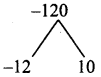
Samacheer Kalvi 9th Maths Guide Chapter 3 Algebra Ex 3.15

Students can download Maths Chapter 3 Algebra Ex 3.15 Questions and Answers, Notes, Samacheer Kalvi 9th Maths Guide Pdf helps you to revise the complete Tamilnadu State Board New Syllabus, helps students complete homework assignments and to score high marks in board exams.

Tamilnadu Samacheer Kalvi 9th Maths Solutions Chapter 3 Algebra Ex 3.15

Multiple Choice Questions.

Question 1.
If x3 + 6x2 + kx + 6 is exactly divisible by x + 2, then k = 2
(a) 6
(b) -7
(c) -8
(d) 11
Solution:
(d) 11
Hint:
p(x) = x3 + 6x2 + kx + 6
Given p(-2) = 0
(-2)3 + 6(-2)2 + k(-2) + 6 = 0
-8 + 24 – 2k + 6 = 0
22 – 2k = 0
k = \(\frac{22}{2}\)
= 11

Question 2.
The root of the polynomial equation 2x + 3 = 0 is…….
(a) \(\frac{1}{3}\)
(b) –\(\frac{1}{3}\)
(c) –\(\frac{3}{2}\)
(d) –\(\frac{2}{3}\)
Solution:
(c) –\(\frac{3}{2}\)
Hint:
2x + 3 = 0
2x = – 3 ⇒ x = –\(\frac{3}{2}\)

Samacheer Kalvi 9th Maths Guide Chapter 3 Algebra Ex 3.15

Question 3.
The type of the polynomial 4 – 3x3 is ……..
(a) constant polynomial
(b) linear polynomial
(c) quadratic polynomial
(d) cubic polynomial
Solution:
(d) cubic polynomial

Question 4.
If x51 + 51 is divided by x + 1, then the remainder is …….
(a) 0
(b) 1
(c) 49
(d) 50
Solution:
(d) 50
Hint:
p(x) = x51 + 51
p(-1)= (-1)51 + 51
= -1 + 51
= 50

Question 5.
The zero of the polynomial 2x + 5 is ……..
(a) \(\frac{5}{2}\)
(b) –\(\frac{5}{2}\)
(c) \(\frac{2}{5}\)
(d) –\(\frac{2}{5}\)
Solution:
(b) –\(\frac{5}{2}\)
Hint:
2x + 5 = 0 ⇒ 2x = -5 ⇒ x = –\(\frac{5}{2}\)

Samacheer Kalvi 9th Maths Guide Chapter 3 Algebra Ex 3.15

Question 6.
The sum of the polynomials p(x) = x3 – x2 – 2, q(x) = x2 – 3x + 1
(a) x3 – 3x – 1
(b) x3 + 2x2 – 1
(c) x3 – 2x2 – 3x
(d) x3 – 2x2 + 3x – 1
Solution:
(a) x3 – 3x – 1
Hint:
p(x) + q(x) = (x3 – x2 – 2) + (x2 – 3x + 1) = x3 – x2 – 2 + x² – 3x + 1
= x³ – 3x – 1

Question 7.
Degree of the polynomial (y³ – 2) (y³ + 1) is
(a) 9
(b) 2
(c) 3
(d) 6
Solution:
(d) 6
(y³ – 2) (y³ + 1) = y6 + y³ – 2y³ – 2
= y6 – y³ – 2

Question 8.
Let the polynomials be
(A) -13q5 + 4q² + 12q
(B) (x² + 4)(x² + 9)
(C) 4q8 – q6 + q²
(D) –\(\frac{5}{7}\) y12 + y³ + y5.
Then ascending order of their degree is
(a) A, B, D, C
(b) A, B, C, D
(c) B, C, D, A
(d) B, A, C, D
Solution:
(d) B, A, C, D

Samacheer Kalvi 9th Maths Guide Chapter 3 Algebra Ex 3.15

Question 9.
If p(a) = 0 then (x – a) is a …….. of p(x)
(a) divisor
(b) quotient
(c) remainder
(d) factor
Solution:
(d) factor

Question 10.
Zeros of (2 – 3x) is ……..
(a) 3
(b) 2
(c) \(\frac{2}{3}\)
(d) \(\frac{3}{2}\)
Solution:
(c) \(\frac{2}{3}\)

Question 11.
Which of the following has x -1 as a factor?
(a) 2x – 1
(b) 3x – 3
(c) 4x – 3
(d) 3x – 4
Solution:
(b) 3x – 3

Samacheer Kalvi 9th Maths Guide Chapter 3 Algebra Ex 3.15

Question 12.
If x – 3 is a factor of p(x), then the remainder is ……..
(a) 3
(b) -3
(c) p(3)
(d) p(-3)
Solution:
(c) p(3)

Question 13.
(x +y)(x² – xy + y²) is equal to ……..
(a) (x + y)³
(b) (x – y)³
(c) x³ + y³
(d) x³ – y³
Solution:
(c) x³ + y³

Question 14.
(a + b – c)² is equal to ……..
(a) (a – b + c)²
(b) (-a – b + c)²
(c) (a + b + c)²
(d) (a – b – c)²
Solution:
(b) (-a – b + c)²
Hint:
(a + b – c)² = a² + b² + c² + 2ab – 2bc – 2ac
(- a – b + c)² = a² + b² + c² + 2ab – 2bc – 2ac
(OR)
(- a – b + c)² = (-1)² (a + b + c)² (taking – 1 as common)
= (a + b – c)²

Samacheer Kalvi 9th Maths Guide Chapter 3 Algebra Ex 3.15

Question 15.
In an expression ax² + bx + c the sum and product of the factors respectively ……..
(a) a, bc
(b) b, ac
(c) ac, b
(d) bc, a
Solution:
(b) b, ac

Question 16.
If (x + 5) and (x – 3) are the factors of ax² + bx + c, then values of a, b and c are ………
(a) 1, 2, 3
(b) 1, 2, 15
(c) 1, 2, -15
(d) 1, -2, 15
Solution:
(c) 1, 2, -15
Hint:
(x + 5) (x – 3) = x² + (5 – 3) x + (5) (-3)
= x² + 2x – 15
compare with ax² + bx + c
a = 1, b = 2 and c = -15

Question 17.
Cubic polynomial may have maximum of ……… linear factors.
(a) 1
(b) 2
(c) 3
(d) 4
Solution:
(c) 3

Samacheer Kalvi 9th Maths Guide Chapter 3 Algebra Ex 3.15

Question 18.
Degree of the constant polynomial is ……..
(a) 3
(b) 2
(c) 1
(d) 0
Solution:
(d) 0

Question 19.
Find the value of m from the equation 2x + 3y = m. If its one solution is x = 2 and y = -2.
(a) 2
(b) -2
(c) 10
(d) 0
Solution:
(b) – 2
Hint:
The equation is 2x + 3y = m
Substitute x – 2 and y = -2 we get
2(2) + 3(-2) = m ⇒ 4 – 6 = m ⇒ -2 = m

Question 20.
Which of the following is a linear equation?
(a) x + \(\frac{1}{2}\) = 2
(b) x (x – 1) = 2
(c) 3x + 5 = \(\frac{2}{3}\)
(d) x³ – x = 5
Solution:
(c) 3x + 5 = \(\frac{2}{3}\)

Samacheer Kalvi 9th Maths Guide Chapter 3 Algebra Ex 3.15

Question 21.
Which of the following is a solution of the equation 2x – y = 6?
(a) (2, 4)
(b) (4, 2)
(c) (3, -1)
(d) (0, 6)
Solution:
(b) (4, 2)
Hint:
2x – y = 6
Substitute x – 4 and y = 2 we get
2(4) – 2 = 6 ⇒ 8 – 2 = 6 ⇒ 6 = 6
∴ (4, 2) is the solution

Question 22.
If (2, 3) is a solution of linear equation 2x + 3y = k then, the value of k is ……..
(a) 12
(b) 6
(c) 0
(d) 13
Solution:
(d) 13
Hint:
The equation is 2x + 3y = k
Substitute x = 2 and y = 3 we get,
2(2) + 3(3) = k ⇒ 4 + 9 = k ⇒ 13 = k

Question 23.
Which condition does not satisfy the linear equation ax + by + c = 0 ……..
(a) a ≠ 0, b = 0
(b) a = 0, b ≠ 0
(c) a = 0, b = 0, c ≠ 0
(d) a ≠ 0, b ≠ 0
Solution:
(c) a = 0, b = 0, c ≠ 0

Samacheer Kalvi 9th Maths Guide Chapter 3 Algebra Ex 3.15

Question 24.
Which of the following is not a linear equation in two variable?
(a) ax + by + c = 0
(b) 0x + 0y + c = 0
(c) 0x + by + c = 0
(d) ax + 0y + c = 0
Solution:
(b) 0x + 0y + c = 0
Hint:
0x + 0y + c = 0
0 + 0 + c = 0 ⇒ c = 0
There is no variable.
∴ It is not a linear equation

Question 25.
The value of k for which the pair of linear equations 4x + 6y – 1 = 0 and 2x + ky – 1 = 0 represents parallel lines is ……..
(a) k = 3
(b) k = 2
(c) k = 4
(d) k = -3
Solution:
(a) k = 3
Hint:
Slope of 4x + 6y – 1 = 0 is
6y = -4x + 1 ⇒ y = \(\frac{-4}{6}\) x + \(\frac{1}{6}\)
Slope = \(\frac{-4}{6}\) = \(\frac{-2}{3}\)
Slope of 2x + ky – 7 = 0
ky = -2x + 7
y = \(\frac{-2}{k}\)x + \(\frac{7}{k}\)
Slope of a line = \(\frac{-2}{k}\)
Since the lines are parallel
\(\frac{-2}{3}\) = \(\frac{-2}{k}\)
-2k = – 6
k = \(\frac{6}{2}\)
= 3

Samacheer Kalvi 9th Maths Guide Chapter 3 Algebra Ex 3.15

Question 26.
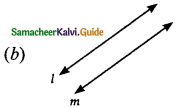
A pair of linear equations has no solution then the graphical representation is ……..
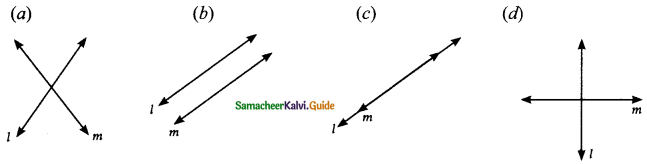
Samacheer Kalvi 9th Maths Guide Chapter 3 Algebra Ex 3.15 1
Solution:
Samacheer Kalvi 9th Maths Guide Chapter 3 Algebra Ex 3.15 2
Hint:
Since there is no solution the two lines are parallel. (l11m)

Question 27.
If \(\frac{a_1}{a_2}\) ≠ \(\frac{b_1}{b_2}\) where a1x + b1y + c1 = 0 and a2x + b2y + c2 = 0 then the given pair of linear equation has …….. solution(s).
(a) no solution
(b) two solutions
(c) unique
(d) infinite
Solution:
(c) unique
Hint:
Since it has unique solution
\(\frac{a_1}{a_2}\) ≠ \(\frac{b_1}{b_2}\)

Samacheer Kalvi 9th Maths Guide Chapter 3 Algebra Ex 3.15

Question 28.
\(\frac{a_1}{a_2}\) = \(\frac{b_1}{b_2}\) ≠ \(\frac{c_1}{c_2}\) where a1x + b1y + c1 = 0 and a2x + b2y + c2 = 0 then the given pair of linear equation has …….. solution(s).
(a) no solution
(b) two solutions
(c) infinite
(d) unique
Solution:
(a) no solution
Hint:
\(\frac{a_1}{a_2}\) = \(\frac{b_1}{b_2}\) ≠ \(\frac{c_1}{c_2}\) the linear equation has no solution.

Question 29.
GCD of any two prime numbers is …….
(a) -1
(b) 0
(c) 1
(d) 2
Solution:
(c) 1

Samacheer Kalvi 9th Maths Guide Chapter 3 Algebra Ex 3.15

Question 30.
The GCD of x4 – y4 and x² – y² is ……..
(a) x4 – y4
(b) x² – y²
(c) (x + y)²
(d) (x + y)4
Solution:
(b) x² – y²
Hint:
x4 – y4 = (x²)² – (y²)²
= (x² + y²)(x² – y²)
x² – y² = (x² – y²)
G.C.D. = x² – y²
Samacheer Kalvi 9th Maths Guide Chapter 5 Coordinate Geometry Ex 5.4

Students can download Maths Chapter 5 Coordinate Geometry Ex 5.4 Questions and Answers, Notes, Samacheer Kalvi 9th Maths Guide Pdf helps you to revise the complete Tamilnadu State Board New Syllabus, helps students complete homework assignments and to score high marks in board exams.

Tamilnadu Samacheer Kalvi 9th Maths Solutions Chapter 5 Coordinate Geometry Ex 5.4

Question 1.
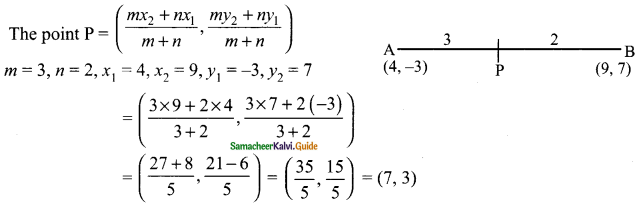
Find the coordinates of the point which divides the line segment joining the points A (4,-3) and B (9,7) in the ratio 3 : 2.
Solution:
A line divides internally in the ratio m : n
Samacheer Kalvi 9th Maths Guide Chapter 5 Coordinate Geometry Ex 5.4 1

Samacheer Kalvi 9th Maths Guide Chapter 5 Coordinate Geometry Ex 5.4

Question 2.
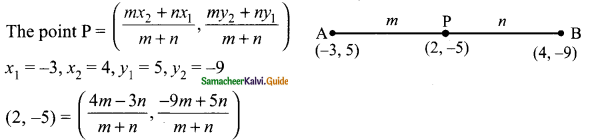
In what ratio does the point P(2, -5) divide the line segment joining A(-3, 5) and B(4, -9).
Solution:
A line divides internally in the ratio m : n
Samacheer Kalvi 9th Maths Guide Chapter 5 Coordinate Geometry Ex 5.4 2
\(\frac{4m-3n}{m+n}\)
= 2
4m – 3n = 2m + 2n
4m – 2m = 3n + 2n
2m = 5n
\(\frac{m}{n}\) = \(\frac{5}{2}\)
m : n = 5 : 2
The ratio is 5 : 2.
and
\(\frac{-9m+5n}{m+n}\)
= -5
-9m + 5 n = -5(m + n)
-9m + 5 n = -5m – 5n
-9m + 5 m = -5n – 5n
-4m = -10
\(\frac{m}{n}\) = \(\frac{10}{4}\) ⇒ \(\frac{m}{n}\) = \(\frac{5}{2}\)
m : n = 5 : 2

Samacheer Kalvi 9th Maths Guide Chapter 5 Coordinate Geometry Ex 5.4

Question 3.
Find the coordinates of a point P on the line segment joining A(1, 2) and B(6, 7) in such a way that AP = \(\frac{2}{5}\) AB.
Solution:
Let the point A (1, 2) and B (6, 7)
AP = \(\frac{2}{5}\) AB
\(\frac{AP}{PB}\) = \(\frac{2}{5}\)
∴ AP = 2; PB = 5 – 2 = 3
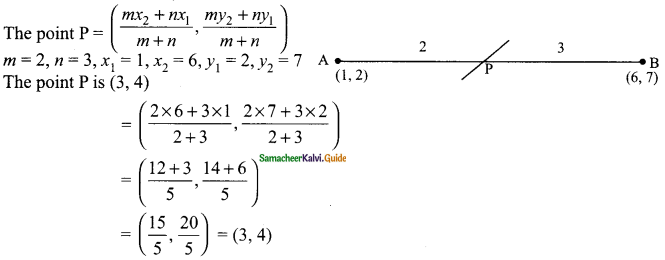
A line divides internally in the ratio m : n
Samacheer Kalvi 9th Maths Guide Chapter 5 Coordinate Geometry Ex 5.4 3

Samacheer Kalvi 9th Maths Guide Chapter 5 Coordinate Geometry Ex 5.4

Question 4.
Find the coordinates of the points of trisection of the line segment joining the points A (-5, 6) and B (4, -3).
Solution:
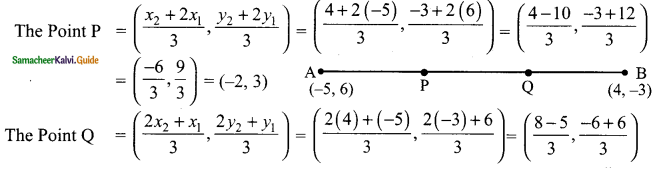
Let P and Q be the point of trisection
so that AP = PB = QB
Samacheer Kalvi 9th Maths Guide Chapter 5 Coordinate Geometry Ex 5.4 4
(\(\frac{3}{3}\), \(\frac{0}{3}\)) = (1, 0)
The Point P is (-2, 3), The Point Q is (1, 0)

Samacheer Kalvi 9th Maths Guide Chapter 5 Coordinate Geometry Ex 5.4

Question 5.
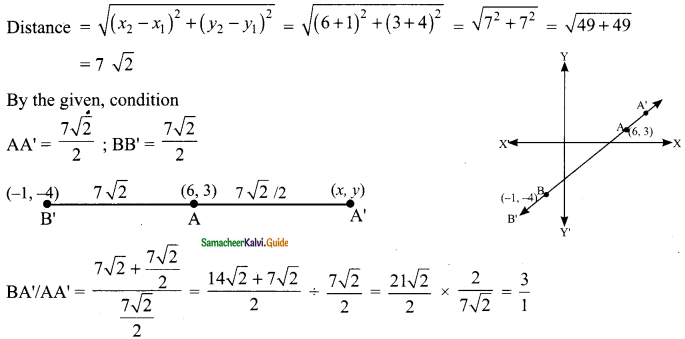
The line segment joining A(6, 3) and B(-1, -4) is doubled in length by adding half of AB to each end. Find the coordinates of the new end points.
Solution:
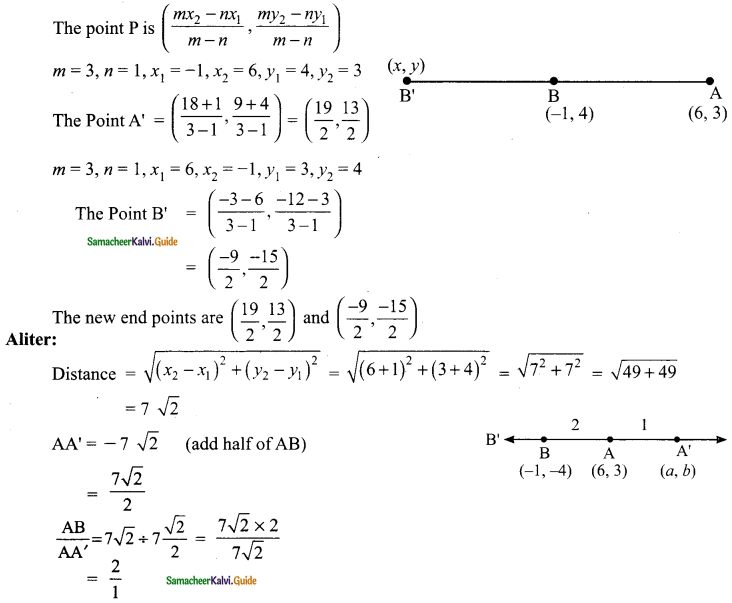
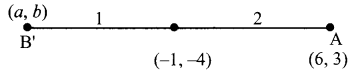
Samacheer Kalvi 9th Maths Guide Chapter 5 Coordinate Geometry Ex 5.4 5
m : n = 3 : 1
A line divides externally in the ratio m : n
Samacheer Kalvi 9th Maths Guide Chapter 5 Coordinate Geometry Ex 5.4 6
∴ BA’ divides in the ratio 2 : 1
A line divides internally in the ratio m : n the point is \(\frac{mx_{2}+nx_{1}}{m+n}, \frac{my_{2}+ny_{1}}{m+n}\)
Let the point A’ be (a, b)
Samacheer Kalvi 9th Maths Guide Chapter 5 Coordinate Geometry Ex 5.4 7
\(\frac{2a-1}{3}\) = 6
2a – 1 = 18
2a = 19
a = \(\frac{19}{2}\)
and
\(\frac{2b-4}{3}\) = 3
2b – 4 = 9
2b = 13
b = \(\frac{13}{2}\)
Samacheer Kalvi 9th Maths Guide Chapter 5 Coordinate Geometry Ex 5.4 8
The point A’ is (\(\frac{19}{2}\), \(\frac{13}{2}\))
To find B’
Let B’ be (a, b)
AB = 7√2
BB’ = \(\frac{1}{2}\) × 7√2 = \(\frac{7√2}{2}\)
\(\frac{AB}{BB’}\) = 7√2 ÷ \(\frac{7√2}{2}\) = \(\frac{7√2×2}{7√2}\) = 2
AB’ divides in the ratio 2 : 1
(-1, -4) = \(\frac{2a+6}{3}\), \(\frac{2b+3}{3}\)
\(\frac{2a+6}{3}\) = -1
2a + 6 = -3
2a = -3 – 6
2a = -9
a = –\(\frac{9}{2}\)
and
\(\frac{2b+3}{3}\) = -4
2b + 3 = -12
2b = -12 – 3
2b = -15
b = –\(\frac{15}{2}\) = -1
The point B’ is (-\(\frac{9}{2}\), –\(\frac{15}{2}\))

Samacheer Kalvi 9th Maths Guide Chapter 5 Coordinate Geometry Ex 5.4

Question 6.
Using section formula, show that the points A (7, -5), B (9, -3) and C (13, 1) are collinear.
Solution:
If three points are collinear, then one of the points divide the line segment joining the other points in the ratio r : 1. If P is between A and B and \(\frac{AP}{PB}\) = r
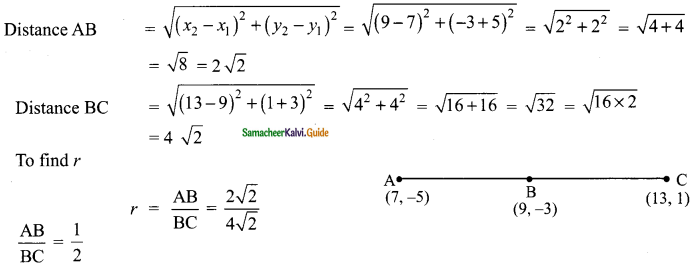
Samacheer Kalvi 9th Maths Guide Chapter 5 Coordinate Geometry Ex 5.4 9
The line divides in the ratio 1 : 2
A line divides internally in the ratio m : n
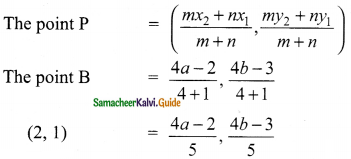
The point P = (\(\frac{mx_{2}+nx_{1}}{m+n}\), \(\frac{my_{2}+ny_{1}}{m+n}\))
m = 1, n = 2, x1 = 7, x2 = 13, y1 = – 5, y2 = 1
By the given equation,
The Point B = (\(\frac{13+14}{3}\), \(\frac{1-10}{3}\))
= (\(\frac{27}{3}\), \(\frac{-9}{3}\))
= (9, -3)
∴ The three points A, B and C are collinear.

Samacheer Kalvi 9th Maths Guide Chapter 5 Coordinate Geometry Ex 5.4

Question 7.
A line segment AB is increased along its length by 25% by producing it to C on the side of B. If A and B have the coordinates (-2, -3) and (2, 1) respectively, then find the coordinates of C.
Solution:
Let the point C be (a, b)
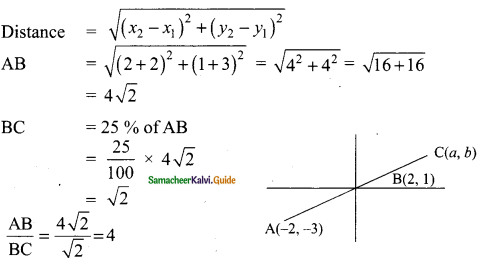
Samacheer Kalvi 9th Maths Guide Chapter 5 Coordinate Geometry Ex 5.4 10
The ratio is 4 : 1 (m : n)
A line divides internally in the ratio m : n
Samacheer Kalvi 9th Maths Guide Chapter 5 Coordinate Geometry Ex 5.4 11
\(\frac{4a-2}{5}\) = 2
4a – 2 = 10
4a = 12
a = \(\frac{12}{4}\) = 3
and
\(\frac{4b-3}{5}\) = 1
4b – 3 = 5
4b = 8
b = \(\frac{8}{4}\) = 2
The co-ordinate of C is (3, 2)

Samacheer Kalvi 9th Maths Guide Chapter 5 Coordinate Geometry Ex 5.4

Samacheer Kalvi 9th Maths Guide Chapter 5 Coordinate Geometry Ex 5.2

Students can download Maths Chapter 5 Coordinate Geometry Ex 5.2 Questions and Answers, Notes, Samacheer Kalvi 9th Maths Guide Pdf helps you to revise the complete Tamilnadu State Board New Syllabus, helps students complete homework assignments and to score high marks in board exams.

Tamilnadu Samacheer Kalvi 9th Maths Solutions Chapter 5 Coordinate Geometry Ex 5.2

Question 1.
Find the distance between the following pairs of points.
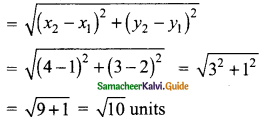
(i) (1, 2) and (4, 3)
Solution:
Distance between the points (1, 2) and (4, 3)
Samacheer Kalvi 9th Maths Guide Chapter 5 Coordinate Geometry Ex 5.2 1

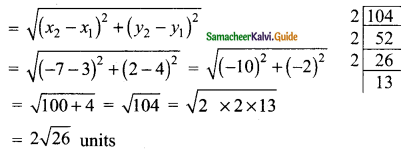
(ii) (3, 4) and (-7, 2)
Solution:
Distance between the points (3,4) and (-7, 2)
Samacheer Kalvi 9th Maths Guide Chapter 5 Coordinate Geometry Ex 5.2 2

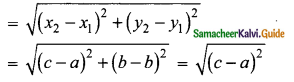
(iii) (a, b) and (c, b)
Solution:
Distance between the two points (a, b) and (c, b)
Samacheer Kalvi 9th Maths Guide Chapter 5 Coordinate Geometry Ex 5.2 3
= c – a units

Samacheer Kalvi 9th Maths Guide Chapter 5 Coordinate Geometry Ex 5.2

(iv) (3,- 9) and (-2, 3)
Solution:
Distance between the two points (3, -9) and (-2, 3)
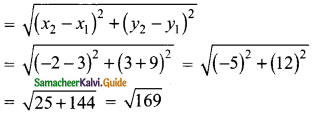
Samacheer Kalvi 9th Maths Guide Chapter 5 Coordinate Geometry Ex 5.2 4
= 13 units

Question 2.
Determine whether the given set of points in each case are collinear or not.
(i) (7, -2), (5, 1), (3, 4)
Solution:
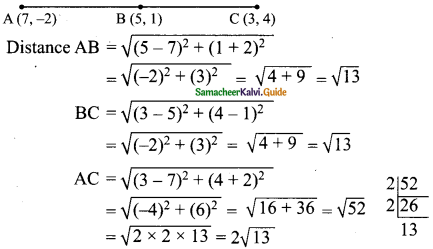
To prove that three points are collinear, sum of the distance between two pairs of points is equal to the third pair of points.
Samacheer Kalvi 9th Maths Guide Chapter 5 Coordinate Geometry Ex 5.2 5
AB + BC = AC
\(\sqrt{13}\) + \(\sqrt{13}\) = 2\(\sqrt{13}\) ⇒ 2\(\sqrt{13}\) = 2\(\sqrt{13}\)
∴ The given three points are collinear.

(ii) (a, -2), (a, 3), (a, 0)
Solution:
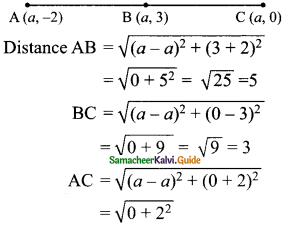
A (a, -2) B (a, 3) C (a, 0)
Samacheer Kalvi 9th Maths Guide Chapter 5 Coordinate Geometry Ex 5.2 6
√4
= 2
AC + BC = AB ⇒ 2 + 3 = 5
∴ The given three points are collinear.

Samacheer Kalvi 9th Maths Guide Chapter 5 Coordinate Geometry Ex 5.2

Question 3.
Show that the following points taken in order to form an isosceles triangle.
(i) A (5, 4), B(2, 0), C (-2, 3)
Solution:
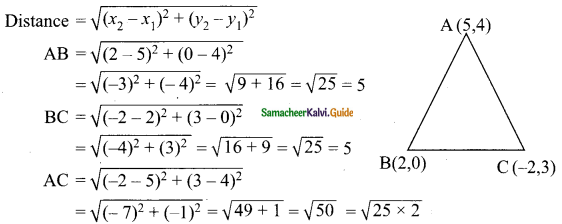
Samacheer Kalvi 9th Maths Guide Chapter 5 Coordinate Geometry Ex 5.2 7
= 5√2
AB = BC = 5. (Two sides are equal)
∴ ABC is an isosceles triangle.

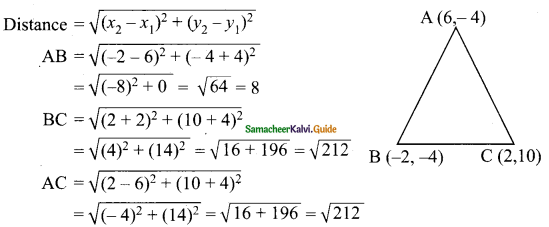
(ii) A (6, -1), B (-2, -4), C (2, 10)
Solution:
Samacheer Kalvi 9th Maths Guide Chapter 5 Coordinate Geometry Ex 5.2 8
BC = AC = \(\sqrt{212}\) (TWO sides are equal)
∴ ABC is an isosceles triangle.

Samacheer Kalvi 9th Maths Guide Chapter 5 Coordinate Geometry Ex 5.2

Question 4.
Show that the following points taken in order to form an equilateral triangle in each case.
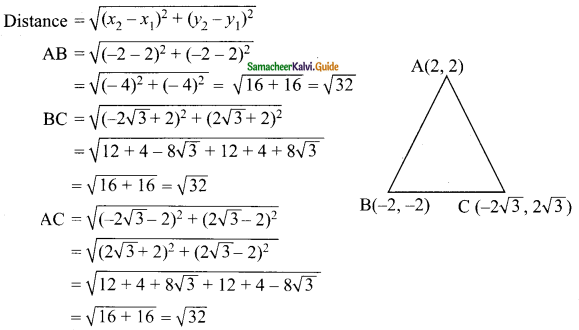
(i) A(2, 2), B(-2, -2), C(-2√3, 2√3)
Solution:
Samacheer Kalvi 9th Maths Guide Chapter 5 Coordinate Geometry Ex 5.2 9
AB = BC = AC (Three sides are equal)
∴ ABC is an equilateral triangle.

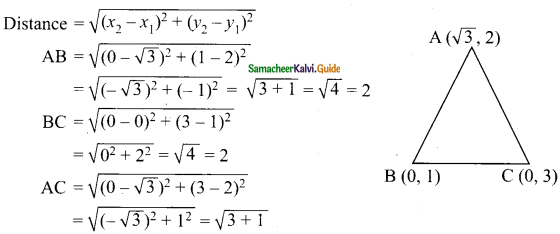
(ii) A(√3, 2), B (0, 1), C(0, 3)
Solution:
Samacheer Kalvi 9th Maths Guide Chapter 5 Coordinate Geometry Ex 5.2 10
= √4
= 2
AB = BC = AC (Three sides are equal)
∴ ABC is an equilateral triangle.

Samacheer Kalvi 9th Maths Guide Chapter 5 Coordinate Geometry Ex 5.2

Question 5.
Show that the following points taken in order to form the vertices of a parallelogram.
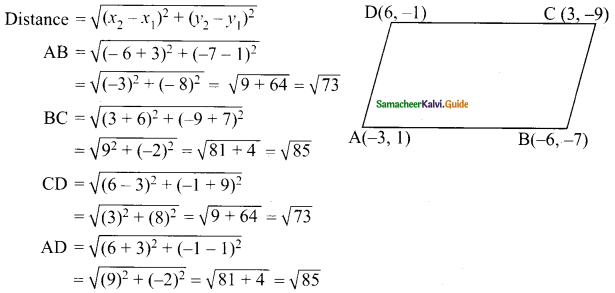
(i) A(-3, 1), B(-6, -7), C (3, -9) and D(6, -1)
Solution:
Samacheer Kalvi 9th Maths Guide Chapter 5 Coordinate Geometry Ex 5.2 11
AB = CD = \(\sqrt{73}\) and BC = AD = \(\sqrt{85}\) (Opposite sides are equal)
∴ ABCD is a parallelogram.

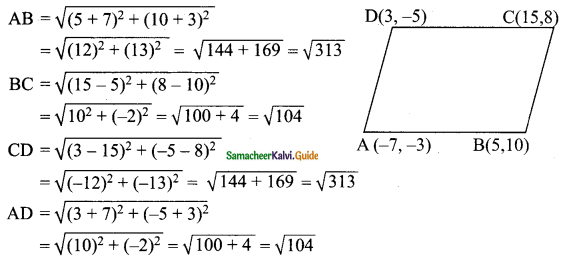
(ii) A (-7, -3), B(5, 10), C(15, 8) and D(3, -5)
Solution:
Samacheer Kalvi 9th Maths Guide Chapter 5 Coordinate Geometry Ex 5.2 12
AB = CD = \(\sqrt{313}\) and BC = AD = \(\sqrt{104}\) (Opposite sides are equal)
∴ ABCD is a parallelogram.

Samacheer Kalvi 9th Maths Guide Chapter 5 Coordinate Geometry Ex 5.2

Question 6.
Verify that the following points taken in order to form the vertices of a rhombus.
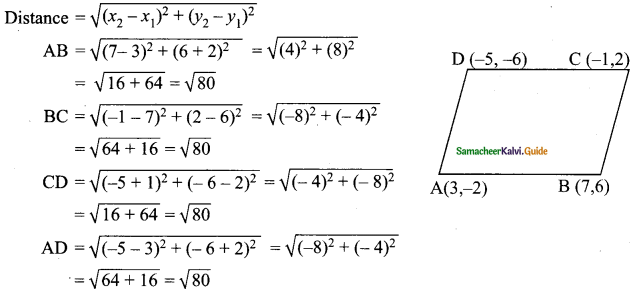
(i) A(3, -2), B (7, 6),C (-1, 2) and D (-5, -6)
Solution:
Samacheer Kalvi 9th Maths Guide Chapter 5 Coordinate Geometry Ex 5.2 13
AB = BC = CD = AD = \(\sqrt{80}\). All the four sides are equal.
∴ ABCD is a rhombus.

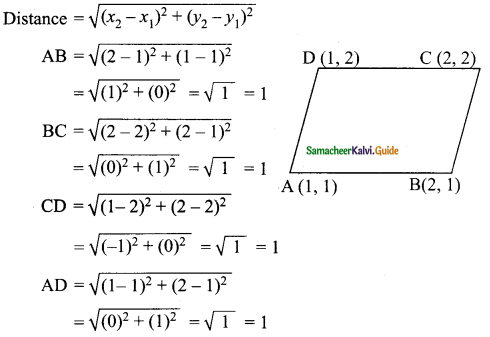
(ii) A (1, 1), B (2, 1),C (2, 2) and D (1, 2)
Solution:
Samacheer Kalvi 9th Maths Guide Chapter 5 Coordinate Geometry Ex 5.2 14
AB = BC = CD = AD = 1. All the four sides are equal.
∴ ABCD is a rhombus.

Question 7.
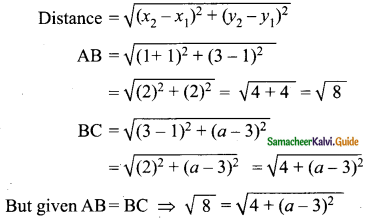
A (-1, 1), B (1, 3) and C (3, a) are points and if AB = BC, then find ‘a’.
Solution:
Samacheer Kalvi 9th Maths Guide Chapter 5 Coordinate Geometry Ex 5.2 15
4 + (a – 3)² = 8
(a – 3)² = 8 – 4
(a – 3)² = 4
a – 3 = √4
= ± 2
a – 3 = 2 (or) a – 3 = -2
a = 2 + 3 (or) a = 3 – 2
a = 5 (or) a = 1
∴ The value of a = 5 or a = 1.

Samacheer Kalvi 9th Maths Guide Chapter 5 Coordinate Geometry Ex 5.2

Question 8.
The abscissa of a point A is equal to its ordinate, and its distance from the point B(1, 3) is 10 units, What are the coordinates of A?
Solution:
Let the point A be (a, a) B is (1, 3)
Distance AB = 10 (Given)
By distance formula \(\sqrt{(a – 1 )² + (a – 3)²}\) = 10
Simplifying 2a² – 8a + 10 = 100
a² – 4a – 45 = 0
(a – 9)(a + 5) = 0
⇒ a = – 5; A = (-5, -5)
a = 9; A = (9, 9)

Question 9.
The point (x, y) is equidistant from the points (3, 4) and (-5, 6). Find a relation between x and y.
Solution:
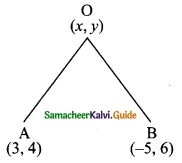
Let the point O be (x, y), A be (3, 4) and B be (-5, 6).
Samacheer Kalvi 9th Maths Guide Chapter 5 Coordinate Geometry Ex 5.2 16
Distance = \(\sqrt{(x_{2} – x_{1})² + (y_{2} – y_{1})²}\)
Given ,OA = OB
\(\sqrt{(x – 3 )² + (y – 4)²}\) = \(\sqrt{(x + 5 )² + (y – 6)²}\)
Squaring on both sides
(x – 3)² + (y – 4)² = (x + 5)² + (y – 6)²
x² – 6x + 9 + y² – 8y + 16 = x² + 10x + 25 + y² – 12y + 36
x² + y² – 6x – 8y + 25 = x² + y² + 10x – 12y + 61
6x – 10x – 8y + 12y = 61 – 25 ⇒ -16x + 4y = 36
÷ 4 ⇒ -4x + y = 9
∴ The relation between x and y is y = 4x + 9

Samacheer Kalvi 9th Maths Guide Chapter 5 Coordinate Geometry Ex 5.2

Question 10.
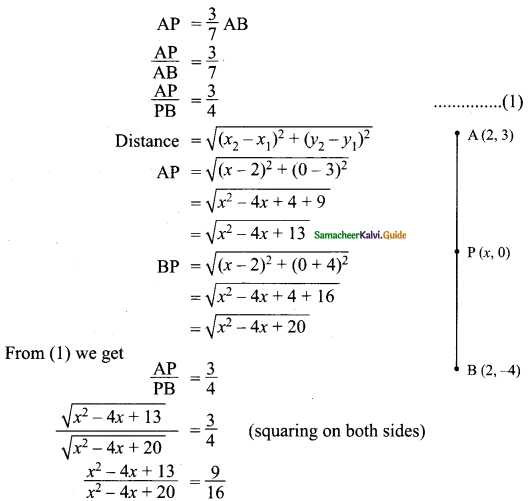
Let A(2,3) and B(2, -4) be two points. If P lies on the x-axis, such that AP = \(\frac{3}{7}\) AB, find the coordinates of P.
Solution:
Given points are A(2, 3) and B(2, -4)
The point P lies on the x-axis.
∴ The point P is (x, 0)
Samacheer Kalvi 9th Maths Guide Chapter 5 Coordinate Geometry Ex 5.2 17
16x² – 64x + 208 = 9x² – 36x + 180
16x² – 9x² – 64x + 36x + 208 – 180 = 0
7x² – 28x + 28 = 0
x² – 4x + 4 = 0
(x – 2)² = 0
x – 2 = 0
x = 2
∴ The point P is (2, 0)

Samacheer Kalvi 9th Maths Guide Chapter 5 Coordinate Geometry Ex 5.2

Question 11.
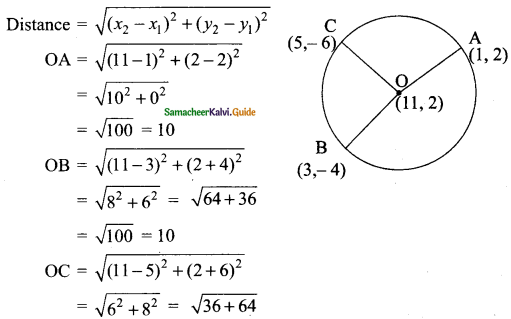
Show that the point (11, 2) is the centre of the circle passing through the points (1, 2), (3, -4) and (5, -6)
Solution:
Samacheer Kalvi 9th Maths Guide Chapter 5 Coordinate Geometry Ex 5.2 18
\(\sqrt{100}\)
= 10
OA = OB = OC = 10
O is the centre of the circle passing through A, B and C.

Question 12.
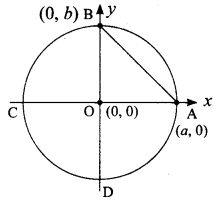
The radius of a circle with centre at origin is 30 units. Write the coordinates of the points where the circle intersects the axes. Find the distance between any two such points.
Solution:
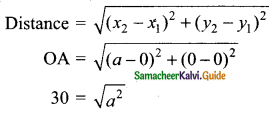
Samacheer Kalvi 9th Maths Guide Chapter 5 Coordinate Geometry Ex 5.2 19
Radius of the circle = 30 units. The point O is (0, 0).
Let a intersect the x-axis and b intersect the y-axis.
∴ The point A is (a, 0) and B is (0, b)
Samacheer Kalvi 9th Maths Guide Chapter 5 Coordinate Geometry Ex 5.2 20
Squaring on both sides
30² = a²
∴ a = 30
The point A is (30, 0)
OB = \(\sqrt{(0 – 0)² + (b – 0)²}\)
= \(\sqrt{0² + b²}\)
30 = \(\sqrt{b²}\)
Squaring on both sides
30² = b²
∴ b = 30
The point B is (0, 30)
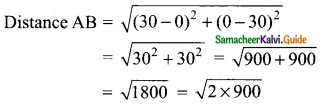
Samacheer Kalvi 9th Maths Guide Chapter 5 Coordinate Geometry Ex 5.2 21
= 30√2
∴ Distance between the two points = 30√2

Samacheer Kalvi 9th Maths Guide Chapter 5 Coordinate Geometry Ex 5.2

Samacheer Kalvi 9th Maths Guide Chapter 3 Algebra Ex 3.14

Students can download Maths Chapter 3 Algebra Ex 3.14 Questions and Answers, Notes, Samacheer Kalvi 9th Maths Guide Pdf helps you to revise the complete Tamilnadu State Board New Syllabus, helps students complete homework assignments and to score high marks in board exams.

Tamilnadu Samacheer Kalvi 9th Maths Solutions Chapter 3 Algebra Ex 3.14

Question 1.
The sum of a two digit number and the number formed by interchanging the digits is 110. If 10 is subtracted from the first number, the new number is 4 more than 5 times the sums of the digits of the first number. Find the first number.
Solution:
Let the ten’s digit be x and the unit digit be y.
The number is 10x + y
If the digits are interchanged
The new number is 10y + x
By the given first condition
10x + y + 10y + x = 110
11x + 11y = 110
x + y = 10 → (1) (Divided by 11)
Again by the given second condition
10x + y – 10 = 5(x + y ) + 4
10x + y – 10 = 5x + 5y + 4
5x – 4y = 14 → (2)
(1) × 5 ⇒ 5x + 5y = 50 → (3)
(2) × 1 ⇒ 5x – 4y = 14 → (2)
(3) – (2) ⇒ 9y = 36
y = 36/9
= 4
Substitute the value of y = 4 in (1)
x + y = 10
x + 4 = 10
x = 10 – 4
= 6
∴ The number is (10 × 6 + 4) = 64

Samacheer Kalvi 9th Maths Guide Chapter 3 Algebra Ex 3.14

Question 2.
The sum of the numerator and denominator of a fraction is 12. If the denominator is increased by 3, the fraction becomes \(\frac{1}{2}\). Find the fraction.
Solution:
Let the numerator be “x” and the denominator be “y”
∴ The fraction is \(\frac{x}{y}\)
By the given first condition
x + y = 12 → (1)
Again by the second condition
\(\frac{x}{y+3}\) = \(\frac{1}{2}\)
2x = y + 3
2x – y = 3 → (2)
(1) + (2) ⇒ 3x = 15
x = \(\frac{15}{3}\) = 5
Substitute the value of x = 5 in (1)
5 + y = 12
y = 12 – 5
= 7
∴ The fraction is \(\frac{5}{7}\)

Samacheer Kalvi 9th Maths Guide Chapter 3 Algebra Ex 3.14

Question 3.
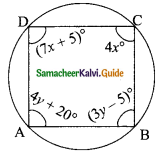
ABCD is a cyclic quadrilateral such that ∠A = (4y + 20)°, ∠B = (3y -5)°, ∠C = (4x)° and ∠D = (7x + 5)°. Find the four angles.
Solution:
Samacheer Kalvi 9th Maths Guide Chapter 3 Algebra Ex 3.14 1
ABCD is a cyclic quadrilateral ∠A + ∠C = 180°
(Sum of the opposite angles of a cyclic quadrilateral is 180°)
(4y + 20)° + (4x)° = 180°
4y + 20 + 4x = 180
4x + 4y = 180 – 20
4x + 4y = 160
x + y = 40 → (1) (divided by 4)
∠B + ∠D = 180° (Sum of the opposite angles of a cyclic quadrilateral)
(3y – 5)° + (7x + 5)° = 180°
3y – 5 + 7x + 5 = 180
7x + 3y = 180 → (2)
(1) × 3 ⇒ 3x + 3y = 120 → (3)
(3) – (2) ⇒ -4x = – 60
4x = 60
x = \(\frac{60}{4}\)
Substitute the value of x = 15 in (1)
15 + y = 40
y = 40 – 15 = 25
∠A = 4y + 20 = 4(25) + 20 = 100 + 20 = 120°
∴ ∠A = 120°
∠B = 3y – 5 = 3(25) – 5 = 75 – 5 = 70
∴ ∠B = 70°
∠C = 4x = 4(15) = 60
∴ ∠C = 60°
∠D = 7x + 5 = 7(15) + 5
∠D = 105 + 5 = 110°
∴ ∠A= 120°, ∠B = 70°, ∠C = 60° and ∠D = 110°

Samacheer Kalvi 9th Maths Guide Chapter 3 Algebra Ex 3.14

Question 4.
On selling a T.V. at 5% gain and a fridge at 10% gain, a shopkeeper gains Rs 2000. But if he sells the T.V. at 10% gain and the fridge at 5% loss, he gains Rs.1500 on the transaction. Find the actual price of the T.V. and the fridge.
Solution:
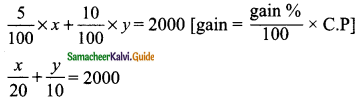
Let the cost price of the TV be Rs “x” and the cost price of the fridge be Rs “y”.
By the given condition
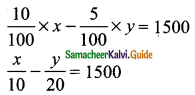
Samacheer Kalvi 9th Maths Guide Chapter 3 Algebra Ex 3.14 2
Multiply by 20
x + 2y = 40000 → (1)
Again by the given second condition
Samacheer Kalvi 9th Maths Guide Chapter 3 Algebra Ex 3.14 3
Multiply by 20
2x – y = 30000 → (2)
(2) × 2 ⇒ 4x – 2y = 60000 → (3)
(1) + (3) ⇒ 5x + 0 = 100000
x = \(\frac{100000}{5}\)
= 20000
Substitute the value of x = 20000 in (1)
20000 + 2y = 40000
2y = 40000 – 20000
= 20000
y = \(\frac{20000}{2}\)
= 10000
Cost price of a TV = Rs 20,000
Cost price of a fridge = Rs 10,000

Samacheer Kalvi 9th Maths Guide Chapter 3 Algebra Ex 3.14

Question 5.
Two numbers are in the ratio 5 : 6. If 8 is subtracted from each of the numbers, the ratio becomes 4 : 5. Find the numbers.
Solution:
Let the two numbers be x and y.
By the given first condition
x : y = 5 : 6
6x = 5y (Product of the extreme is equal to the product of the means)
6x – 5y = 0 → (1)
Again by the given second condition
x – 8 : y – 8 = 4 : 5
5(x – 8) = 4(y – 8)
5x – 40 = 4y – 32
5x – 4y = – 32 + 40
5x – 4y = 8 → (2)
(1) × 4 ⇒ 24x – 20y = 0 → (3)
(2) × 5 ⇒ 25x – 20y = 40 → (4)
(3) – (4) ⇒ – x + 0 = -40
∴ x = 40
Substitute the value of x = 40 in (1)
6(40) – 5y = 0
240 – 5y = 0 ⇒ – 5y = -240
5y = 240
y = \(\frac{240}{5}\)
= 48
The two numbers are 40 and 48 [∴ The ratio of the number = 40 : 48 are 5 : 6]

Samacheer Kalvi 9th Maths Guide Chapter 3 Algebra Ex 3.14

Question 6.
4 Indians and 4 Chinese can do a piece of work in 3 days. While 2 Indian and 5 Chinese can finish it in 4 days. How long would it take for 1 Indian to do it? How long would it ‘ take for 1 Chinese to do it?
Solution:
Let the time taken by a Indian be “x”
Time taken by a Chinese be “y”
Work done by a Indian in one day = \(\frac{1}{x}\)
Work done by a Chinese in one day = \(\frac{1}{y}\)
By the given first condition
(4 Indian + 4 Chinese) finish the work in 3 days
\(\frac{4}{x}\) + \(\frac{4}{y}\) = \(\frac{1}{3}\) → (1)
Again by the given second condition
(2 Indian + 5 Chinese) finish the work in 4 days
\(\frac{2}{x}\) + \(\frac{5}{y}\) = \(\frac{1}{4}\) → (2)
Solve the equation (1) and (2)
Let \(\frac{1}{x}\) = a; \(\frac{1}{y}\) = b
4a + 4b = \(\frac{1}{3}\)
12a + 12b = 1 → (3) (Multiply by 3)
2a + 5b = \(\frac{1}{4}\)
8a + 20b = 1 → (4) (Multiply by 4)
(3) × (2) ⇒ 24a + 24b = 2 → (5)
(4) × (3) ⇒ 24a + 60b = 3 → (6)
(5) – (6) ⇒ -36b = -1
b = \(\frac{1}{36}\)
Substitute the value of b = \(\frac{1}{36}\) in (3)
12a + 12(\(\frac{1}{36}\)) = 1
12a + \(\frac{1}{3}\) = 1
36a + 1 = 3
36a = 2
a = \(\frac{2}{36}\) = \(\frac{1}{18}\)
But \(\frac{1}{x}\) = a ⇒ \(\frac{1}{x}\) = \(\frac{1}{18}\)
x = 18
\(\frac{1}{y}\) = b ⇒ \(\frac{1}{y}\) = \(\frac{1}{36}\)
y = 36
∴ Time taken by a 1 Indian is 18 days
Time taken by a 1 Chinese is 36 days

Samacheer Kalvi 9th Maths Guide Chapter 3 Algebra Ex 3.14

Samacheer Kalvi 9th Maths Guide Chapter 3 Algebra Ex 3.13

Students can download Maths Chapter 3 Algebra Ex 3.13 Questions and Answers, Notes, Samacheer Kalvi 9th Maths Guide Pdf helps you to revise the complete Tamilnadu State Board New Syllabus, helps students complete homework assignments and to score high marks in board exams.

Tamilnadu Samacheer Kalvi 9th Maths Solutions Chapter 3 Algebra Ex 3.13

Question 1.
Solve by cross-multiplication method.
(i) 8x – 3y = 12; 5x = 2y + 7
Solution:
8x – 3y – 12 = 0 → (1)
5x – 2y – 7 = 0 → (2)
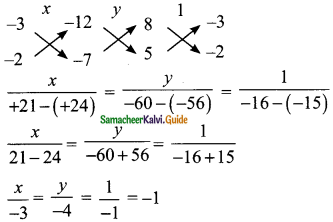
Use the coefficients for cross multiplication
Samacheer Kalvi 9th Maths Guide Chapter 3 Algebra Ex 3.13 1
\(\frac{x}{-3}\) = -1 ⇒ x = 3
\(\frac{y}{-4}\) = -1 ⇒ y = 4
∴ The value of x = 3 and y = 4

Samacheer Kalvi 9th Maths Guide Chapter 3 Algebra Ex 3.13

(ii) 6x + 7y – 11 = 0; 5x + 2y = 13
Solution:
6x + 7y – 11 = 0 → (1)
5x + 2y = 13 → (2)
Use the coefficient for cross multiplication
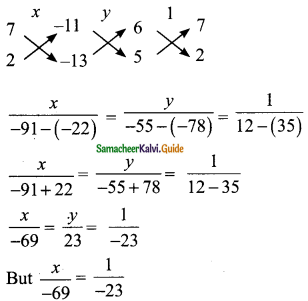
Samacheer Kalvi 9th Maths Guide Chapter 3 Algebra Ex 3.13 2
-23x = -69
∴ 23x = 69
x= \(\frac{69}{23}\)
= 3
\(\frac{y}{23}\) = \(\frac{1}{-23}\)
-23y = 23
23y = -23
y = –\(\frac{23}{23}\)
y = -1
∴ The value of x = 3 and y = -1

Samacheer Kalvi 9th Maths Guide Chapter 3 Algebra Ex 3.13

(iii) \(\frac{2}{x}\) + \(\frac{3}{y}\) =5; \(\frac{3}{x}\) – \(\frac{1}{y}\) + 9 = 0
Solution:
\(\frac{1}{x}\) = a; \(\frac{1}{y}\) = b
2a + 3b – 5 = 0 → (1)
3a – b + 9 = 0 → (2)
Using the coefficients for cross multiplication
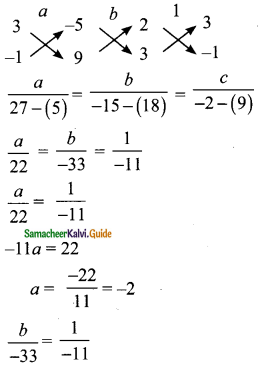
Samacheer Kalvi 9th Maths Guide Chapter 3 Algebra Ex 3.13 3
-11b = -33
11b = 33
b = \(\frac{33}{11}\) = 3
But \(\frac{1}{x}\) = a ⇒ \(\frac{1}{x}\) = -2
-2x = 1 ⇒ 2x = -1
x = –\(\frac{1}{2}\)
but \(\frac{1}{y}\) = b
\(\frac{1}{y}\) = 3 ⇒ 3y = 1
y = \(\frac{1}{3}\)
∴ The value of x = –\(\frac{1}{2}\) and y = \(\frac{1}{3}\)

Samacheer Kalvi 9th Maths Guide Chapter 3 Algebra Ex 3.13

Question 2.
Akshaya has 2 rupee coins and 5 rupee coins in her purse. If in all she has 80 coins totalling Rs 220, how many coins of each kind does she have.
Solution:
Let the number of 2 rupee coins be “x” and the number of 5 rupee coins be “y”.
By the given first condition
x + y = 80 → (1)
Again by the given second condition
2x + 5y = 220 → (2)
x + y – 80 = 0 → (3)
2x + 5y – 220 = 0 → (4)
Using the coefficients for cross multiplication
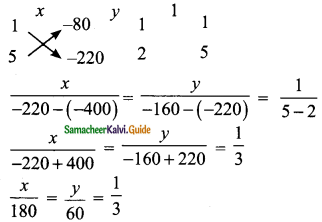
Samacheer Kalvi 9th Maths Guide Chapter 3 Algebra Ex 3.13 4
\(\frac{x}{180}\) = \(\frac{1}{3}\)
3x = 180
x = \(\frac{180}{3}\)
= 60
But \(\frac{y}{60}\) = \(\frac{1}{3}\)
3y = 60
y = \(\frac{6}{30}\)
= 20
Number of 2 rupee coins = 60
Number of 5 rupee coins = 20

Samacheer Kalvi 9th Maths Guide Chapter 3 Algebra Ex 3.13

Question 3.
It takes 24 hours to fill a swimming pool using two pipes. If the pipe of larger diameter is used for 8 hours and the pipe of the smaller diameter is used for 18 hours. Only half of the pool is filled. How long would each pipe take to fill the swimming pool.
Solution:
Let the time taken by the larger diameter pipe be “x” hours and the time taken by the smaller diameter pipe be “y” hours.
By the given first condition
\(\frac{1}{x}\) + \(\frac{1}{y}\) = \(\frac{1}{24}\) → (1)
Also
In 8 hours the large pipe fill \(\frac{8}{x}\)
In 18 hours the smaller pipe fill \(\frac{18}{y}\)
By the given second condition ( \(\frac{1}{2}\) of the tank)
\(\frac{8}{x}\) + \(\frac{18}{y}\) = \(\frac{1}{2}\) → (2)
Solve (1) and (2) we get
Let \(\frac{1}{x}\) = a; \(\frac{1}{y}\) = b
a + b = \(\frac{1}{24}\)
Multiply by 24
24a + 24b = 1
24a + 24b – 1 = 0 → (3)
8a + 18b = \(\frac{1}{2}\)
Multiply by 2
16a + 36b = 1
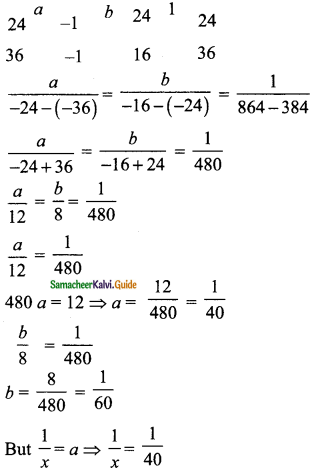
16a + 36b – 1 = 0 → (4)
Samacheer Kalvi 9th Maths Guide Chapter 3 Algebra Ex 3.13 5
x = 40
\(\frac{1}{y}\) = b ⇒ \(\frac{1}{y}\) = \(\frac{1}{60}\)
y = 60
To fill the remaining half of the pool.
Time taken by larger pipe = \(\frac{1}{2}\) × 40 = 20 hours
Time taken by smaller pipe = \(\frac{1}{2}\) × 60 = 30 hours

Samacheer Kalvi 9th Maths Guide Chapter 3 Algebra Ex 3.13

Samacheer Kalvi 9th Maths Guide Chapter 5 Coordinate Geometry Ex 5.1

Students can download Maths Chapter 5 Coordinate Geometry Ex 5.1 Questions and Answers, Notes, Samacheer Kalvi 9th Maths Guide Pdf helps you to revise the complete Tamilnadu State Board New Syllabus, helps students complete homework assignments and to score high marks in board exams.

Tamilnadu Samacheer Kalvi 9th Maths Solutions Chapter 5 Coordinate Geometry Ex 5.1

Question 1.
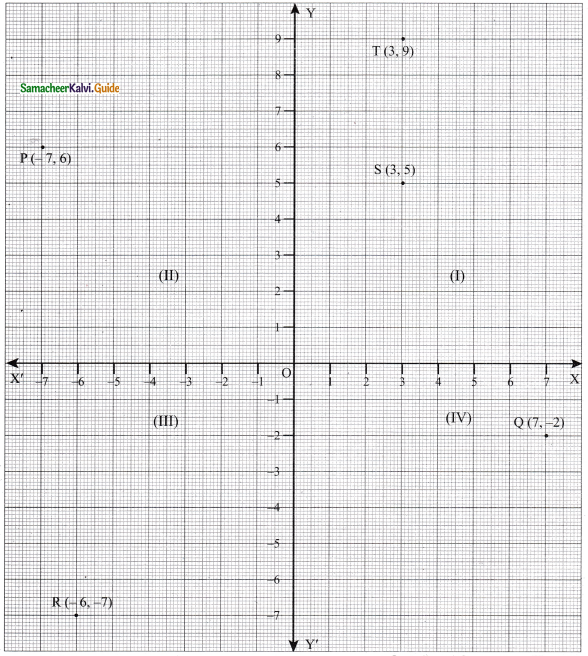
Plot the following points in the coordinate system and identify the quadrants P(-7, 6), Q(7, -2), R(-6, -7), S(3, 5) and T(3, 9)
Solution:
Samacheer Kalvi 9th Maths Guide Chapter 5 Coordinate Geometry Ex 5.1 1
(i) P(-7, 6) lies in the II quadrant because the x-coordinate is negative and y-coordinate is positive.
(ii) Q(7, -2) lies in the IV quadrant because the x-coordinate is positive and y-coordinate is negative.
(iii) R(-6, -7) lies in the III quadrant because the x-coordinate is negative and y-coordinate is negative.
(iv) S(3, 5) lies in the I quadrant because the x-coordinate is positive and y-coordinate is also positive.
(v) T(3, 9) lies in the I quadrant because the x-coordinate is positive and y-coordinate is also positive.

Samacheer Kalvi 9th Maths Guide Chapter 5 Coordinate Geometry Ex 5.1

Question 2.
Write down the abscissa and ordinate of the following.
(i) P
(ii) Q
(iii) R
(iv) S
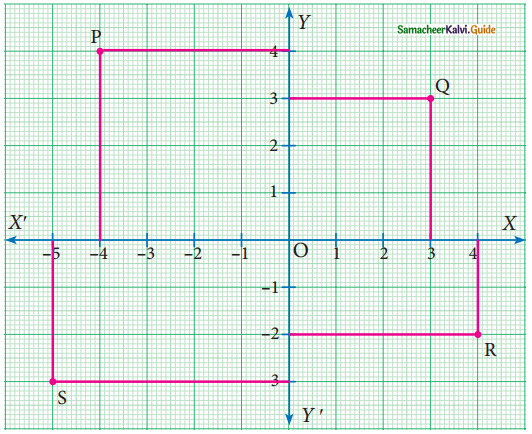
Samacheer Kalvi 9th Maths Guide Chapter 5 Coordinate Geometry Ex 5.1 2
Solution:
(i) P is (-4, 4) [-4 is abscissa and 4 is ordinate]
(ii) Q is (3, 3) [3 is abscissa and 3 is ordinate]
(iii) R is (4, -2) [4 is abscissa and -2 is ordinate]
(iv) S is (-5, -3) [-5 is abscissa and -3 is ordinate]

Samacheer Kalvi 9th Maths Guide Chapter 5 Coordinate Geometry Ex 5.1

Question 3.
Plot the following points in the coordinate plane and join them. What is your conclusion about the resulting figure?
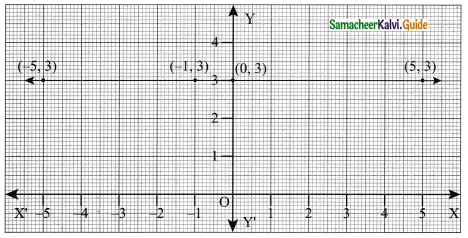
(i) (-5, 3) (-1, 3) (0, 3) (5, 3)
Solution:
Samacheer Kalvi 9th Maths Guide Chapter 5 Coordinate Geometry Ex 5.1 3
Straight line parallel to x-axis.

Samacheer Kalvi 9th Maths Guide Chapter 5 Coordinate Geometry Ex 5.1

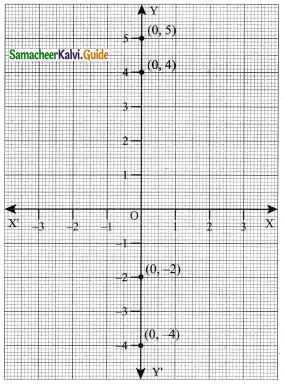
(ii) (0, -4) (0, -2) (0, 4) (0, 5)
Solution:
Samacheer Kalvi 9th Maths Guide Chapter 5 Coordinate Geometry Ex 5.1 4
The line is on the y-axis.

Samacheer Kalvi 9th Maths Guide Chapter 5 Coordinate Geometry Ex 5.1

Question 4.
Plot the following points in the coordinate plane. Join them in order. What type of geometrical shape is formed?
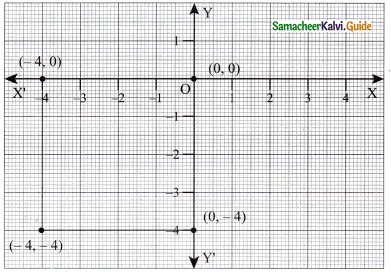
(i) (0, 0) (-4, 0) (-4, -4) (0, -4)
Solution:
Samacheer Kalvi 9th Maths Guide Chapter 5 Coordinate Geometry Ex 5.1 5
The geometrical shape of the figure is square.

Samacheer Kalvi 9th Maths Guide Chapter 5 Coordinate Geometry Ex 5.1

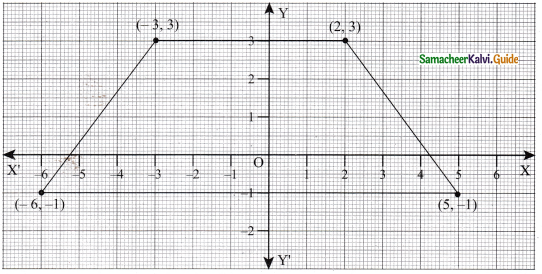
(ii) (-3, 3) (2, 3) (-6, -1) (5, -1)
Solution:
Samacheer Kalvi 9th Maths Guide Chapter 5 Coordinate Geometry Ex 5.1 6
The shape of the geometrical figure is Trapezium.

Samacheer Kalvi 9th Maths Guide Chapter 5 Coordinate Geometry Ex 5.1

Samacheer Kalvi 9th Maths Guide Chapter 3 Algebra Ex 3.5

Students can download Maths Chapter 3 Algebra Ex 3.5 Questions and Answers, Notes, Samacheer Kalvi 9th Maths Guide Pdf helps you to revise the complete Tamilnadu State Board New Syllabus, helps students complete homework assignments and to score high marks in board exams.

Tamilnadu Samacheer Kalvi 9th Maths Solutions Chapter 3 Algebra Ex 3.5

Question 1.
Factorise the following expressions:
(i) 2a² + 4a²b + 8a²c
(ii) ab – ac – mb + mc
Solution:
(i) 2a² + 4a²b + 8a²c = 2a²(1 + 2b + 4c)
(ii) ab – ac – mb + mc = a(b – c) – m(b – c)
= (b – c) (a – m)

Samacheer Kalvi 9th Maths Guide Chapter 3 Algebra Ex 3.5

Question 2.
Factorise the following expressions:
(i) x² + 4x + 4
(ii) 3a² – 24ab + 48b²
(iii) x5 – 16x
(iv) m2 + \(\frac{1}{m^2}\) – 23
(v) 6 – 216x2
(vi) a2 + \(\frac{1}{a^2}\) – 18
Solution:
(i) x2 + 4x + 4 = x2 + 2 × x × 2 + 22 [a2 + 2ab+ b2 = (a + b)2]
= (x + 2)2

(ii) 3a2 – 24ab + 48b2 = 3[a2 – 8ab + 16b2]
= 3[a2 – 2 × a × 4b + (4b)2]
= 3(a- 4b)2 [a2 – 2ab + b2 = (a – b)2]

Samacheer Kalvi 9th Maths Guide Chapter 3 Algebra Ex 3.5

(iii) x5 – 16x = x[x4 – 16] [a2 – b2 = (a + b) (a – b)]
= x[(x2)2 – 42]
= x(x2 + 4) (x2 – 4)
= x(x2 + 4) (x2 – 22)
= x(x2+ 4) (x + 2) (x – 2)

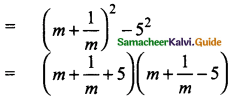
(iv) m2 + \(\frac{1}{m^2}\) – 23 = [Add + 2 and – 2 to make -23 as -25]
= m2 + \(\frac{1}{m^2}\) + 2 – 2 – 23 = m2 + \(\frac{1}{m^2}\) + 2 – 25
= m2 + \(\frac{1}{m^2}\) + 2 × m × \(\frac{1}{m}\) – 52
Samacheer Kalvi 9th Maths Guide Chapter 3 Algebra Ex 3.5 1

(v) 6 – 216x2 = 6[1 – 36x2]
= 6[1 – (6x)2] [a2 – b2 = (a + b)(a – b)]
= 6(1 + 6x) (1 – 6x)

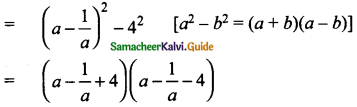
(vi) a2 + \(\frac{1}{a^2}\) – 18 = a2 + \(\frac{1}{a^2}\) – 2 + 2 – 18
(add -2 and +2 to make 18 as 16)
= a2 + \(\frac{1}{a^2}\) – 2 × a × \(\frac{1}{a}\) – 16 [a2 + b2 – 2ab = (a-b)(a- b)2]
Samacheer Kalvi 9th Maths Guide Chapter 3 Algebra Ex 3.5 2

Samacheer Kalvi 9th Maths Guide Chapter 3 Algebra Ex 3.5

Question 3.
Factorise the following expressions:
(i) 4x2 + 9y2 + 25z2 + 12xy + 30yz + 20xz
Solution:
[a2 + b2 + c2 + 2ab + 2bc + 2ac = (a + b + c)2]
= (2x)2 + (3y)2 + (5z)2 + 2(2x) (3y) + 2(3y) (5z) + 2(5z) (2x)
= (2x + 3y + 5z)2

(ii) 25x2 + 4y2 + 9z2 – 20xy + 12yz – 30xz
Solution:
= (5x)2 + (2y)2 + (3z)2 + 2(5x) (-2y) + 2(-2y) (- 3z) + 2(-3z) (5x)
= (5x – 2y – 3z)2

Samacheer Kalvi 9th Maths Guide Chapter 3 Algebra Ex 3.5

Question 4.
Factorise the following expressions:
(i) 8x3 + 125y3
(ii) 27x3 – 8y3
(iii) a6 – 64
Solution:
(i) 8x3 + 125y3 = (2x)3 + (5y)3 [a3 + b3 = (a + b)(a2 – ab + b2)
= (2x + 5y) [(2x)2 – (2x) (5y) + (5y)2]
= (2x + 5y) (4x2 – 10xy + 25y2)

(ii) 27x3 – 8y3 = (3x)3 – (2y)3 [a3 – b3 = (a – b)(a2 + ab + b2)]
= (3x – 2y) [(3x)2 + (3x) (2y) + (2y)2]
= (3x – 2y) (9x2 + 6xy + Ay2)

Samacheer Kalvi 9th Maths Guide Chapter 3 Algebra Ex 3.5

(iii) a6 – 64 = a6 – 26
= (a2)3 – (22)3 [a2 – b3 = (a- b) + (a2 + ab + b2)]
= (a2 – 22) [(a2)2 + (a2) (22) + (22)2]
= (a + 2) (a – 2) (a4 + 4a2 + 16)
= (a + 2) (a – 2) [(a2)2 + 42 + 8a2 – 4a2]
= (a + 2)(a- 2) [(a2 + 4)2 – (2a)2] {a2 – b2 = (a + b) (a – b)}
= (a + 2) (a – 2) [(a2 + 4 + 2a) (a2 + 4 – 2a)
= (a + 2) (a – 2) (a2 + 2a + 4) (a2 – 2a + 4)

Question 5.
Factorize the following
(i) x3 + 8y3 + 6xy – 1
(ii) l3 – 8m3 – 27n3 – 18lmn
Using the formula [a3 + b3 + c3 – 3abc] = (a + b + c) (a2 + b2 + c2 – ab – bc – ac)
Solution:
(i) x3 + 8y2 + 6xy – 1 = -(-x3 – 8y3 – 6xy + 1)
= – (-x3 – 8y3 + 1 – 6xy)
= -[(-x)3 + (-2y)3 + 1 – 3(x) (2y) (1)]
= -[-x – 2y + 1] [(-x)2 + (-2y)2 + 12 – (-x) (-2y) – (-2y) (1) – (1) (-x)]
= (x + 2y – 1)(x2 + 4y2 + 1 – 2xy + 2y + x)

Samacheer Kalvi 9th Maths Guide Chapter 3 Algebra Ex 3.5

(ii) l3 – 8m3 – 27n3 – 18lmn
= l3 + (-2m)3 + (-3n)2 – 3(l) (-2m) (-3n)
= (l – 2m – 3n) [l2 + (-2m)2 + (-3n)2 -1 (-2m)] – (-2m)(-3n) – (-3n)(l)
= (l – 2m – 3n) (l2 + 4m2 + 9n2 + 2lm – 6mn + 3ln)

Samacheer Kalvi 9th Maths Guide Chapter 3 Algebra Ex 3.7

Students can download Maths Chapter 3 Algebra Ex 3.7 Questions and Answers, Notes, Samacheer Kalvi 9th Maths Guide Pdf helps you to revise the complete Tamilnadu State Board New Syllabus, helps students complete homework assignments and to score high marks in board exams.

Tamilnadu Samacheer Kalvi 9th Maths Solutions Chapter 3 Algebra Ex 3.7

Question 1.
Find the quotient and remainder of the following.
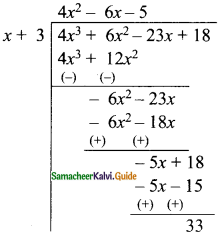
(i) 4x3 + 6x2 – 23x + 18) ÷ (x + 3)
Solution:
Samacheer Kalvi 9th Maths Guide Chapter 3 Algebra Ex 3.7 1
∴ The quotient = 4x2 – 6x – 5
The remainder = 33

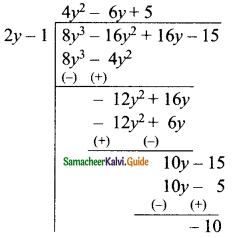
(ii) (8y3 – 16y2 + 16y – 15) ÷ (2y – 1)
Solution:
Samacheer Kalvi 9th Maths Guide Chapter 3 Algebra Ex 3.7 2
∴ The quotient = 4y2 – 6y + 5
The remainder = -10

Samacheer Kalvi 9th Maths Guide Chapter 3 Algebra Ex 3.7

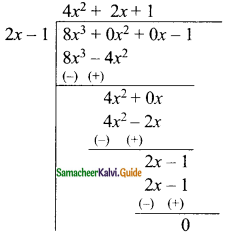
(iii) (8x3 – 1) ÷ (2x – 1)
Solution:
Samacheer Kalvi 9th Maths Guide Chapter 3 Algebra Ex 3.7 3
∴ The quotient = 4x2 + 2x + 1
The remainder = 0

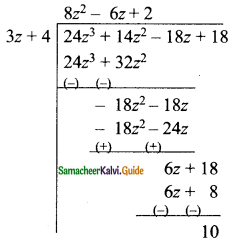
(iv) (-18z + 14z2 + 24z3 + 18) ÷ (3z + 4)
Solution:
Samacheer Kalvi 9th Maths Guide Chapter 3 Algebra Ex 3.7 4
∴The quotient = 8z2 – 6z + 2
The remainder = 10

Samacheer Kalvi 9th Maths Guide Chapter 3 Algebra Ex 3.7

Question 2.
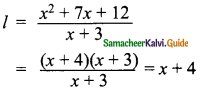
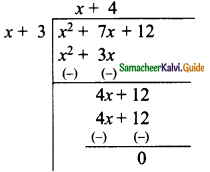
The area of a rectangle is x2 + 7x + 12. If its breadth is (x + 3) then find its length.
Solution:
Let the length of the rectangle be “l”
The breadth of the rectangle = x + 3
Area of the rectangle = length × breadth
x2 + 7x + 12 = l(x + 3)
Samacheer Kalvi 9th Maths Guide Chapter 3 Algebra Ex 3.7 5
Length of the rectangle = x + 4
Samacheer Kalvi 9th Maths Guide Chapter 3 Algebra Ex 3.7 6

Samacheer Kalvi 9th Maths Guide Chapter 3 Algebra Ex 3.7

Question 3.
The base of a parallelogram is (5x + 4). Find its height if the area is 25x2 – 16.
Solution:
Let the height of the parallelogram be “h”.
Base of the parallelogram = 5x + 4
Area of a parallelogram = 25x2 – 16
∴ Base x Height = 25x2 – 16
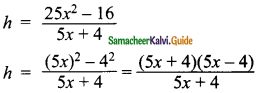
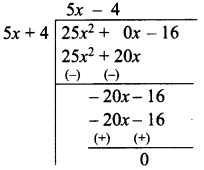
(5x + 4) × h = 25x2– 16
Samacheer Kalvi 9th Maths Guide Chapter 3 Algebra Ex 3.7 7
Height of the parallelogram = 5x – 4
Samacheer Kalvi 9th Maths Guide Chapter 3 Algebra Ex 3.7 8

Samacheer Kalvi 9th Maths Guide Chapter 3 Algebra Ex 3.7

Question 4.
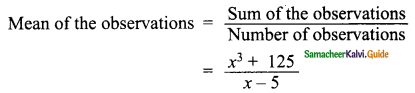
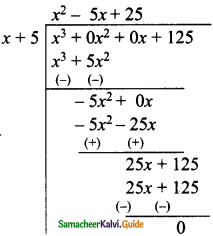
The sum of (x + 5) observations is (x3 + 125). Find the mean of the observations.
Solution:
Sum of the observation = x3 + 125
Number of observation = x + 5
Samacheer Kalvi 9th Maths Guide Chapter 3 Algebra Ex 3.7 9
Mean = x2 – 5x + 25
Samacheer Kalvi 9th Maths Guide Chapter 3 Algebra Ex 3.7 10

Question 5.
Find the quotient and remainder for the following using synthetic division:
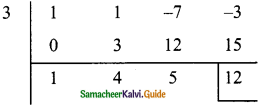
(i) (x3 + x2 – 7x – 3) ÷ (x – 3)
Solution:
p(x) = x3 + x2 – 7x – 3
d(x) = x – 3 [p(x) = d(x) × q(x) + r]
Samacheer Kalvi 9th Maths Guide Chapter 3 Algebra Ex 3.7 11
x – 3 = 0
x = 3
Hence the quotient = x2 + 4x + 5
Remainder = 12

Samacheer Kalvi 9th Maths Guide Chapter 3 Algebra Ex 3.7

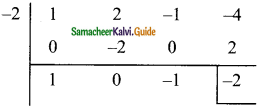
(ii) (x3 + 2x2 – x – 4) ÷ (x + 2)
Solution:
p(x) = x3 + 2x2 -x – 4
d(x) = x + 2
Samacheer Kalvi 9th Maths Guide Chapter 3 Algebra Ex 3.7 12
x + 2 = 0
x = -2
The quotient = x2 – 1
Remainder = -2

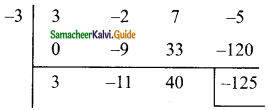
(iii) (3x3 – 2x2 + 7x – 5) ÷ (x + 3)
Solution:
p(x) = 3x3 – 2x2 + 7x – 5
d(x) = x + 3
Samacheer Kalvi 9th Maths Guide Chapter 3 Algebra Ex 3.7 13
x + 3 = 0
x = -3
The quotient = 3x2 – 11x + 40
Remainder = -125

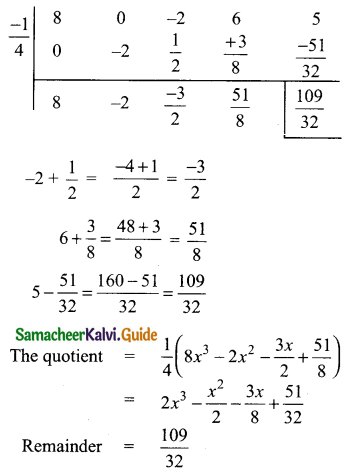
(iv) (8x4 – 2x2 + 6x + 5) ÷ (4x + 1)
Solution:
p(x) = 8x4 – 2x2 + 6x + 5
d(x) = 4x + 1
Samacheer Kalvi 9th Maths Guide Chapter 3 Algebra Ex 3.7 14

Samacheer Kalvi 9th Maths Guide Chapter 3 Algebra Ex 3.7

Question 6.
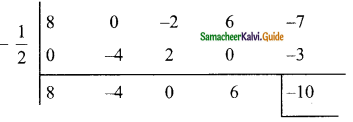
If the quotient obtained on dividing (8x4 – 2x2 + 6x – 7) by (2x + 1) is (4x3 + px2 -qx + 3), then find p, q and also the remainder.
Solution:
p(x) = 8x4 – 2x2 + 6x – 7
d(x) = 2x + 1
Samacheer Kalvi 9th Maths Guide Chapter 3 Algebra Ex 3.7 15
2x + 1 = 0
2x = -1
x = –\(\frac{1}{2}\)
The quotient = \(\frac{1}{2}\) [8x3 – 4x2 + 6]
= 4x3 – 2x2 + 3
= 4x3 – 2x2 + 0x + 3
The given quotient is = 4x3 + px2 – qx + 3
(compared with the given quotient)
The value of p = -2 and q = 0
Remainder = -10

Samacheer Kalvi 9th Maths Guide Chapter 3 Algebra Ex 3.7

Question 7.
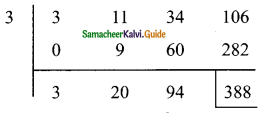
If the quotient obtained on dividing 3x3 + 11x2 + 34x + 106 by x – 3 is 3x2 + ax + b, then find a, b and also the remainder.
Solution:
p(x) = 3x3 + 11x2 + 34x + 106
d(x) = x – 3
Samacheer Kalvi 9th Maths Guide Chapter 3 Algebra Ex 3.7 16
x – 3 = 0
x = 3
The quotient is = 3x2 + 20x + 94
The given quotient is = 3x2 + ax + b
Compared with the given quotient
The value of a = 20 and b = 94
The remainder = 388

Samacheer Kalvi 9th Maths Guide Chapter 3 Algebra Ex 3.3

Students can download Maths Chapter 3 Algebra Ex 3.3 Questions and Answers, Notes, Samacheer Kalvi 9th Maths Guide Pdf helps you to revise the complete Tamilnadu State Board New Syllabus, helps students complete homework assignments and to score high marks in board exams.

Tamilnadu Samacheer Kalvi 9th Maths Solutions Chapter 3 Algebra Ex 3.3

Question 1.
Check whether p(x) is a multiple of g(x) or not.
(i) p(x) = x3 – 5x2 + 4x – 3; g(x) = x – 2
Solution:
p(x) = x3 – 5x2 + 4x – 3
P(2) = (2)3 – 5(2)2 + 4(2) – 3
= 8 – 5(4) + 8 – 3
= 8 – 20 + 8 – 3
= 16 – 23
= -7
p{2) ≠ 0
∴ p(x) is not a multiple of g(x)

Samacheer Kalvi 9th Maths Guide Chapter 3 Algebra Ex 3.3

Question 2.
By remainder theorem, find the remainder when p(x) is divided by g(x) where,
(i) p(x) = x3 – 2x2 – 4x – 1; g(x) = x + 1
Solution:
p(x) = x3 – 2x2 – 4x – 1
p(-1) = (-1)3 – 2(-1)2 – 4(-1) – 1
= 1 – 2 + 4 – 1
= 4 – 4 = 0
∴ The remainder = 0

(ii) p(x) = 4x3 – 12x2 + 14x – 3; g(x) = 2x – 1
Solution:
p(x) = 4x3 – 12x2 + 14x – 3
Samacheer Kalvi 9th Maths Guide Chapter 3 Algebra Ex 3.3 1
= 4 × \(\frac{1}{8}\) – 12 × \(\frac{1}{4}\) + 14 × \(\frac{1}{2}\) – 3
= \(\frac{1}{2}\) – 3 + 7 – 3
= \(\frac{1}{2}\) – 6 + 7
= \(\frac{1}{2}\) + 1
= \(\frac{3}{2}\)
∴ The reminder is \(\frac{3}{2}\)

(iii) p(x) = x3 – 3x2 + 4x + 50; g(x) = x – 3
Solution:
p(x) = x3 – 3x2 + 4x + 50
p(3) = 33 – 3(3)2 + 4(3) + 50
= 27 – 27 + 12 + 50
= 62
The remainder is 62.

Samacheer Kalvi 9th Maths Guide Chapter 3 Algebra Ex 3.3

Question 3.
Find the remainder when 3x3 – 4x2 + 7x – 5 is divided by (x + 3)
Solution:
p(x) = 3x3 – 4x2 + 7x – 5
When it is divided by x +3,
p(-3) = 3(-3)3 – 4(-3)2 + 7(-3) – 5
= 3(-27) – 4(9) – 21 – 5
= -81 – 36 – 21 – 5
= -143
The remainder is -143.

Samacheer Kalvi 9th Maths Guide Chapter 3 Algebra Ex 3.3

Question 4.
What is the remainder when x2018 + 2018 is divided by x – 1.
Solution:
p(x) = x2018 + 2018
When it is divided by x – 1,
p(1) = 12018 + 2018
= 1 + 2018
= 2019
The remainder is 2019.

Question 5.
For what value of k is the polynomial
p(x) = 2x3 – kx2 + 3x + 10 exactly divisible by x – 2
Solution:
p(x) = 2x3 – kx2 + 3x + 10
When it is exactly divided by x – 2,
P(2) = 0
2(2)3 – k(2)2 + 3(2) + 10 = 0
2(8) – k(4) + 6 + 10 = 0
16 – k(4) + 6 + 10 = 0
16 – 4k + 6 + 10 = 0
32 – 4k = 0
32 = 4k
∴ k = \(\frac{32}{4}\)
= 8
The value of k = 8

Samacheer Kalvi 9th Maths Guide Chapter 3 Algebra Ex 3.3

Question 6.
If two polynomials 2x3 + ax2 + 4x – 12 and x3 + x2 – 2x + a leave the same remainder when divided by (x – 3), find the value of a and also find the remainder.
Solution:
p(x1) = 2x3 + ax2 + 4x – 12
When it is divided by x – 3,
p(3) = 2(3)3 + a(3)2 + 4(3) – 12
= 54 + 9a + 12 – 12
= 54 + 9a ……….(R1)
p(x2) = x3 + x2 – 2x + a
When it is divided by x – 3,
p(3) = 33 + 32 – 2(3) + a
= 27 + 9 – 6 + a
= 30 + a ………(R2)
The given remainders are same (R1 = R2)
∴ 54 + 9a = 30 + a
9a – a = 30 – 54
8a = -24
∴ a = -24/8
= -3
Consider R2,
Remainder = 30 – 3
= 27

Samacheer Kalvi 9th Maths Guide Chapter 3 Algebra Ex 3.3

Question 7.
Determine whether (x – 1) is a factor of the following polynomials:
(i) x3 + 5x2 – 10x + 4
Solution:
p(x) = x3 + 5x2 – 10x + 4
p(1) = 13 + 5(1) – 10(1) + 4
= 1 + 5 – 10 + 4
= 10 – 10
= 0
∴ x – 1 is a factor of p(x)

(ii) x4 + 5x2 – 5x + 1
Solution:
p(1) = 14 + 5(1)2 – 5(1) + 1
= 1 + 5 – 5 + 1
= 7 – 5
= 2
= 0
∴ x – 1 is not a factor of p(x)

Samacheer Kalvi 9th Maths Guide Chapter 3 Algebra Ex 3.3

Question 8.
Using factor theorem, show that (x – 5) is a factor of the polynomial
2x3 – 5x2 – 28x + 15
Solution:
p(x) = 2x3 – 5x2 – 28x + 15
x – 5 is a factor
p(5) = 2(5)3 – 5(5)2 – 28(5) + 15
= 250 – 125 – 140 + 15
= 265 – 265
= 0
∴ x – 5 is a factor of p(x)

Samacheer Kalvi 9th Maths Guide Chapter 3 Algebra Ex 3.3

Question 9.
Determine the value of m, if (x + 3) is a factor of x3 – 3x2 – mx + 24.
Solution:
p(x) = x3 – 3x2 – mx + 24
when x + 3 is a factor
P(-3) = 0
(-3)3 – 3(-3)2 – m(-3) + 24 = 0
-27 – 27 + 3m + 24 = 0
-54 + 24 + 3m = 0
-30 + 3m = 0
3m = 30
m = \(\frac{30}{3}\)
= 10
The value of m = 10

Samacheer Kalvi 9th Maths Guide Chapter 3 Algebra Ex 3.3

Question 10.
If both (x-2) and (x – \(\frac{1}{2}\)) are the factors of ax2 + 5x + b, then show that a = b.
Solution:
p(x) = ax2 + 5x + b
when (x-2) is a factor
P(2) = 0
a(2)2 + 5(2) + b = 0
4a + 10 + b = 0
4a + b = -10 …….(1)
when (x – \(\frac{1}{2}\)) is a factor
p(\(\frac{1}{2}\)) = 0
a\((\frac{1}{2})^2\) + 5(\(\frac{1}{2}\)) + b = 0
Multiply by 4
a + 10 + 4b = 0
a + 46 = -10 …….(2)
From (1) and (2) we get
4a + b = a + 4b
4a – a = 4b – b
3a = 3b
a = b
Hence it is proved.

Samacheer Kalvi 9th Maths Guide Chapter 3 Algebra Ex 3.3

Question 11.
If (x – 1) divides the polynomial kx3 – 2x2 + 25x – 26 without remainder, then find the value of k.
Solution:
p(x) = kx3 – 2x2 + 25x – 26
When it is divided by x – 1
P(1) = 0
k(1)3 – 2(1)2 + 25(1) – 26 = 0
k – 2 + 25 – 26 = 0
k + 25 – 28 = 0
k – 3 = 0
k = 3
The value of k = 3

Samacheer Kalvi 9th Maths Guide Chapter 3 Algebra Ex 3.3

Question 12.
Check if (x + 2) and (x – 4) are the sides of a rectangle whose area is x2 – 2x – 8 by using factor theorem.
Solution:
Let the area of a rectangle be p(x)
p(x) = x2 – 2x – 8
When x + 2 is the side of the rectangle
p(-2) = (-2)2 – 2(-2) – 8
= 4 + 4 – 8
= 8 – 8
= 0
When x – 4 is the side of the rectangle.
P(4) = (4)2 – 2(4) – 8
= 16 – 8 – 8
= 16 – 16
= 0
(x + 2) and (x – 4) are the sides of a rectangle

Samacheer Kalvi 9th Maths Guide Chapter 3 Algebra Ex 3.6

Students can download Maths Chapter 3 Algebra Ex 3.6 Questions and Answers, Notes, Samacheer Kalvi 9th Maths Guide Pdf helps you to revise the complete Tamilnadu State Board New Syllabus, helps students complete homework assignments and to score high marks in board exams.

Tamilnadu Samacheer Kalvi 9th Maths Solutions Chapter 3 Algebra Ex 3.6

Question 1.
Factorise the following.
(i) x² + 10x + 24
Solution:
Product = 24, sum = 10
Samacheer Kalvi 9th Maths Guide Chapter 3 Algebra Ex 3.6 1
Split the middle term as 6x and 4x
x² + 10x + 24 = x² + 6x + 4x + 24
= x(x + 6) + 4 (x + 6)
= (x + 6) (x + 4)

(ii) z² + 4z – 12
Solution:
Product = -12, sum = 4
Samacheer Kalvi 9th Maths Guide Chapter 3 Algebra Ex 3.6 2
Split the middle term as 6z and -2z
z² + 4z – 12 = z² + 6z – 2z – 12
= z(z + 6) – 2 (z + 6)
= (z + 6) (z – 2)

Samacheer Kalvi 9th Maths Guide Chapter 3 Algebra Ex 3.6

(iii) p² – 6p – 16
Solution:
Product = -16, sum = -6
Samacheer Kalvi 9th Maths Guide Chapter 3 Algebra Ex 3.6 3
Split the middle term as – 8p and 2p
p² – 6p – 16 = p² – 8p + 2p – 16
= p(p – 8) + 2 (p – 8)
= (p – 8) (p + 2)

(iv) t² + 72 – 17t
Solution:
Product = +72, sum = -17
Samacheer Kalvi 9th Maths Guide Chapter 3 Algebra Ex 3.6 4
Split the middle term as -9t and -8t
t² – 17t + 72 = t² – 91 – 8t + 72
= t(t – 9) – 8 (l – 9)
= (t – 9) (t – 8)

(v) y² – 16y – 80
Solution:
Product = -80, sum = -16
Samacheer Kalvi 9th Maths Guide Chapter 3 Algebra Ex 3.6 5
Split the middle term as -20y and 4y
y² – 16y – 80 = y² – 20y + Ay – 80
= y(y – 20) + 4 (y – 20)
= (y – 20) (y + 4)

(vi) a² + 10a – 600
Solution:
Product = -600, sum =10
Samacheer Kalvi 9th Maths Guide Chapter 3 Algebra Ex 3.6 6
Split the middle term as 30a and -20a
a² + 10a – 600 = a² + 30a – 20a – 600
= a(a + 30) – 20 (a + 30)
= (a + 30) (a – 20)

Samacheer Kalvi 9th Maths Guide Chapter 3 Algebra Ex 3.6

Question 2.
Factorise the following.
(i) 2a² + 9a + 10
Solution:
Product = 2 × 10 = 20, sum = 9
Samacheer Kalvi 9th Maths Guide Chapter 3 Algebra Ex 3.6 7
Split the middle term as 5a and 4a
2a² + 9a + 10 = 2a² + 5a + 4a + 10
= a(2a + 5) + 2 (2a + 5)
= (2a+ 5) (a+ 2)

(ii) 5x² – 29xy – 42y²
Solution:
Product = 5 × -42 = -210, sum = -29
Samacheer Kalvi 9th Maths Guide Chapter 3 Algebra Ex 3.6 8
Split the middle term as -35x and 6x
5x² – 29xy – 42y² = 5x² – 35xy + 6xy – 42y²
= 5x (x – 7y) + 6y (x – 7y)
= (x – 7y) (5x + 6y)

(iii) 9 – 18x + 8x²
Solution:
Product = 9 × 8 = 72, sum = -18
Samacheer Kalvi 9th Maths Guide Chapter 3 Algebra Ex 3.6 9
Split the middle term as -12x and -6x
9 – 18x + 8x² = 8x² – 18x + 9
= 8x² – 12x – 6x + 9
= 4x (2x – 3) – 3 (2x – 3)
= (2x – 3) (4x – 3)

Samacheer Kalvi 9th Maths Guide Chapter 3 Algebra Ex 3.6

(iv) 6x² + 16xy + 8y²
Solution:
Product = 6 × 8 = 48, sum = 16
Samacheer Kalvi 9th Maths Guide Chapter 3 Algebra Ex 3.6 10
Split the middle term as 4xy and 12xy
6x² + 16xy + 8y² = 6x² + 12xy + 4xy + 8y²
= 6x (x + 2y) + 4y(x + 2y)
= (x + 2y) (6x + 4y)
= 2(x + 2y) (3x + 2y)

(v) 12x² + 36x²y + 27y²x²
Solution:
3x²2 [4 + 12y + 9y²]
= 3x² [9y² + 12y + 4]
Product = 9 x 4 = 36, sum =12
Samacheer Kalvi 9th Maths Guide Chapter 3 Algebra Ex 3.6 11
Split the middle term as 6y and 6y
12x² + 36x²y + 21y²x² = 3x² [9y² + 12y + 4]
= 3x² [9y² + 6y + 6y + 4]
= 3x² [3y(3y + 2) + 2(3y + 2)]
= 3x² (3y + 2) (3y + 2)
= 3x² (3y + 2)2

(vi) (a + b)² + 9 (a + b) + 18
Solution:
Let (a + b) = x
x² + 9x + 18
Product =18, sum = 9
Split the middle term as 6x and 3x
x² + 9x + 18 = x² + 6x + 3x + 18
= x (x + 6) + 3 (x + 6)
= (x + 6) (x + 3)
But x = a + b
(a + b)² + 9(a + b) + 18 = (a + b + 6) (a + b + 3)

Samacheer Kalvi 9th Maths Guide Chapter 3 Algebra Ex 3.6

Question 3.
Factorise the following.
(i) (p – q)² – 6(p – q) – 16
Solution:
Let (p – q) = x
(p – q)² – 6 (p – q) – 16 = x² – 6x – 16
Product = -16, sum = -6
Samacheer Kalvi 9th Maths Guide Chapter 3 Algebra Ex 3.6 12
Split the middle term as -8x and 2x
x² – 6x – 16 = x² – 8x + 2x – 16
= x(x – 8) + 2(x – 8)
= (x – 8) (x + 2)
(But x = p – q)
= (p – q – 8) (p – q + 2)

(ii) m² + 2mn – 24n²
Solution:
Product = -24, sum = 2
Samacheer Kalvi 9th Maths Guide Chapter 3 Algebra Ex 3.6 13
Split the middle term as 6mn and -4mn
m² + 2mn – 24m² = m² + 6mn – 4mn – 24n²
= m(m + 6n) – 4n (m + 6n)
= (m + 6n) (m – 4n)

Samacheer Kalvi 9th Maths Guide Chapter 3 Algebra Ex 3.6

(iii) √5 a² + 2a – 3√5?
Solution:
Product = √5 × – 3√5 = -15, sum = 2
Samacheer Kalvi 9th Maths Guide Chapter 3 Algebra Ex 3.6 14
Split the middle term as 5x and -3x
√5 a² + 2a – 3√5 = √5a² + 5a – 3a – 3√5
= √5 a(a + √5) – 3(a + √5)
= (a + √5) (√5a – 3)

(iv) a4 – 3a² + 2
Solution:
Let a² = x
a4 – 3a² + 2 = (a²)² – 3a² + 2
= x² – 3x + 2
Product = 2 and sum = -3
Samacheer Kalvi 9th Maths Guide Chapter 3 Algebra Ex 3.6 15
Split the middle term as -x and -2x
x² – 3x + 2 = x² – x – 2x + 2
= x(x – 1) – 2(x – 1)
= (x – 1) (x – 2)
a4 – 3a² + 2 = (a2 – 1)(a2 – 2) [But a2 = x]
= (a + 1) (a – 1) (a2 – 2)

Samacheer Kalvi 9th Maths Guide Chapter 3 Algebra Ex 3.6

(v) 8m3 – 2m2n – 15mn2
Solution:
8m3 – 2m2n – 15mn2 = m(8m2 – 2mn – 15n2)
Product = 8(-15) = -120 and sum = -2
Samacheer Kalvi 9th Maths Guide Chapter 3 Algebra Ex 3.6 16
Split the middle term as -12mn and 10mn
8m3 – 2m2n – 15mn2 = m[8m2 – 2mn – 15n2]
= m[8m2– 12mn + 10mn- 15n2]
= m[4m (2m – 3n) + 5n(2m – 3n)]
= m(2m – 3n) (4m + 5n)

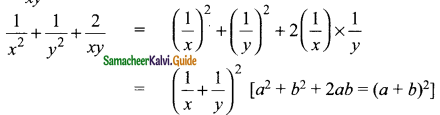
(vi) \(\frac{1}{x^{2}}+\frac{1}{y^{2}}+\frac{2}{x y}\)
Solution:
Samacheer Kalvi 9th Maths Guide Chapter 3 Algebra Ex 3.6 17