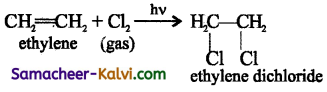
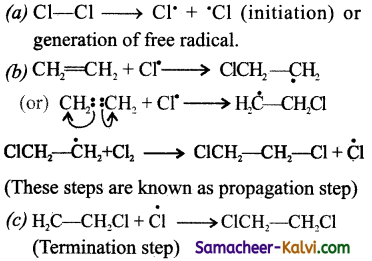
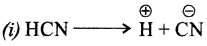
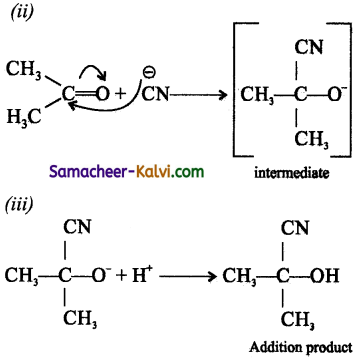
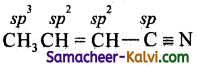
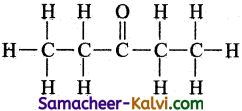
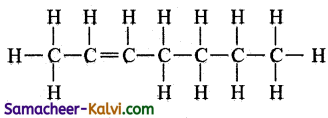
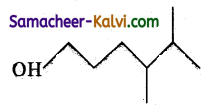
TN Board 11th Chemistry Important Questions Chapter 13 Hydrocarbons

TN State Board 11th Chemistry Important Questions Chapter 13 Hydrocarbons

Question 1.
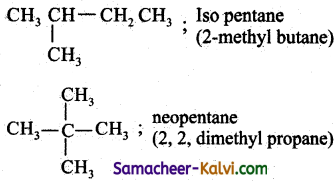
Write the IUPAC names of the following:

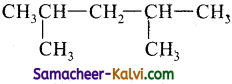
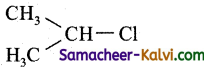
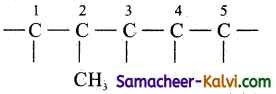
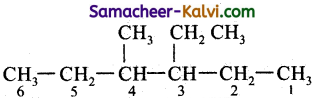
(i) TN State Board 11th Chemistry Important Questions Chapter 13 Hydrocarbons 1
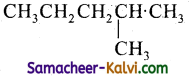
Answer:
2 – Methyl pentane

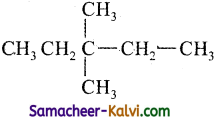
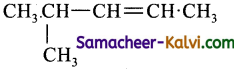
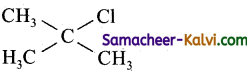
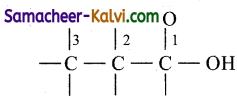
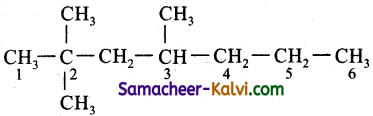
(ii) TN State Board 11th Chemistry Important Questions Chapter 13 Hydrocarbons 2

Answer:
2, 4- Dimethyl pentane

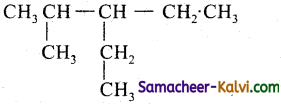
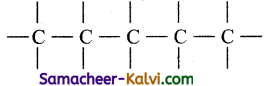
(iii) TN State Board 11th Chemistry Important Questions Chapter 13 Hydrocarbons 3

Answer:
3, 3 – Dimethyl pentane

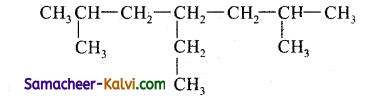
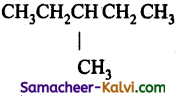
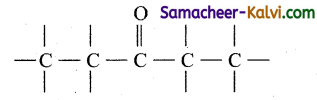
(iv) TN State Board 11th Chemistry Important Questions Chapter 13 Hydrocarbons 4

Answer:
3 – Ethyl – 2 – methylpentane

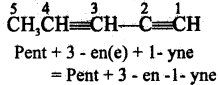
(v) TN State Board 11th Chemistry Important Questions Chapter 13 Hydrocarbons 5
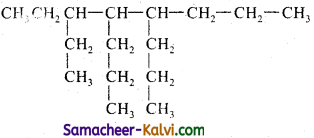
Answer:
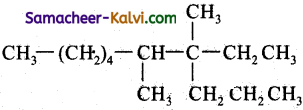
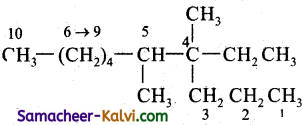
3 – Ethyl – 4, 5 – dipropyl octane

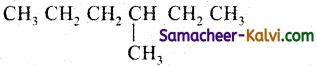
(vi) TN State Board 11th Chemistry Important Questions Chapter 13 Hydrocarbons 6
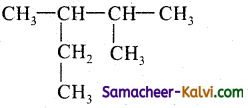
Answer:
2, 3 – Dimethylpentane

(vii) TN State Board 11th Chemistry Important Questions Chapter 13 Hydrocarbons 7

Answer:
4 – Ethyl – 2, 6 – Dimethylheptane

Samacheer Kalvi TN State Board 11th Chemistry Important Questions Chapter 13 Hydrocarbons

Question 2.
How will you prepare
(i) Propane from propene
(ii) Propane from propyne
(iii) Methane from sodium acetate
(iv) Propane from chloropropane
(v) Ethane from methyl bromide Give equations.
Answer:
(i)Propane from propene:
By hydrogenation
CH3CH = CH2 + H2 TN State Board 11th Chemistry Important Questions Chapter 13 Hydrocarbons 8 CH3CH2CH3

(ii) Propane from propyne:
By hydrogenation
CH3 C ≡ CH + 2H2 TN State Board 11th Chemistry Important Questions Chapter 13 Hydrocarbons 8 CH3CH2CH3 .
propyne-1

(iii)Methane from sodium acetate:
By decarboxylation i.e., heating sodium acetate with soda lime.

TN State Board 11th Chemistry Important Questions Chapter 13 Hydrocarbons 9

(iv) Propane from chloropropane:
By reduction using Zinc and HCl.

TN State Board 11th Chemistry Important Questions Chapter 13 Hydrocarbons 10

(v) Ethane from methyl bromide:
By Wurtz reaction.

CH3 Br + 2 Na + Br – CH3 TN State Board 11th Chemistry Important Questions Chapter 13 Hydrocarbons 11 Ch3 – CH3 (ethane) + 2 NaBr

Samacheer Kalvi TN State Board 11th Chemistry Important Questions Chapter 13 Hydrocarbons

Question 3.
How do you prepare ethane by Kolbe.’s electrolytic method?
Answer:
Electrolysis of a concentrated aqueous solution of either sodium or potassium salts
of acetic acid yields ethane at anode.
2 CH3COOK + 2H2O TN State Board 11th Chemistry Important Questions Chapter 13 Hydrocarbons 12 CH3 — CH3 + 2 CO2 + 2 KOH + H2

Question 4.
What are the reducing agents used in reduction of alkyl halides to alkanes?
Answer:
The hydrogen for reduction may be obtained by using any of the following reducing agents:
Zn + HCl, Zn + CH3COOH, Zn-Cu couple in ethanol, LiAlH4 etc…

Question 5.
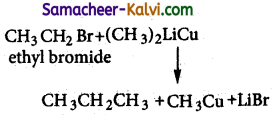
How propane is prepared by Corey- House synthesis?
Answer:
An alkyl halide and lithium di alkyl cuprate are reacted to give higher alkane.
eg: TN State Board 11th Chemistry Important Questions Chapter 13 Hydrocarbons 13
Question 6.
What are Grignard’reagents? blow do you prepare (i) ethane (ii) benzene from a suitable Grignard reagent?
Answer:
Halo alkanes reacts with magnesium in the presence of dry ethers to give alkyl magnesium halide which is known as Grignard reagents.
(i) Ethane is prepared from ethyl magnesium
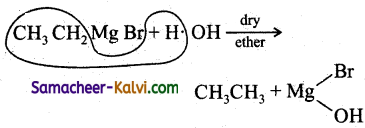
TN State Board 11th Chemistry Important Questions Chapter 13 Hydrocarbons 14

(ii) Benzene is prepared from phenyl magnesium bromide with water.
C6H5 Mg Br + H. OH TN State Board 11th Chemistry Important Questions Chapter 13 Hydrocarbons 15 C6H6 (benzene) + Mg(Br) . OH

Samacheer Kalvi TN State Board 11th Chemistry Important Questions Chapter 13 Hydrocarbons

Question 7.
The straight chain isomers have higher boiling point compared to branched chain isomers. Explain Why?
Answer:
The straight chain isomers have the most extended structure and larger surface area in comparison to branched chain isomers, which have compact structure. Thus the intermolecular forces are weaker in branched chain isomers. Hence they have lower boiling point Compared to straight chain isomers.

Question 8.
Whaf are conformers?
Answer:
The different arrangement of atoms or groups in space that result from the free rotation of carbon-carbon single bond axis are called conformations or conformational isomers or conformers.

Question 9.
Briefly outline conformation of ethane.
Answer:
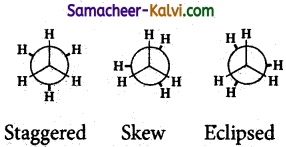
(i) The free rotation about C — C bond in ethane results in infinite number of readily interconvertible three dimensional arrangements called conformers.
(ii) Of the various conformers possible, the skew form, eclipsed form and the staggered forms are important.
(iii) In the eclipsed conformation, the hydrogens of one carbon are directly bonded to the other. The repulsions between the atoms is maximum and it is the least stable conformer.
(iv) In the staggered conformation, the hydrogens of the both the atoms are few apart from each other. The repulsions
between them is minimum and it is the most stable conformer.
(v) Skew conformations are the infinite number of possible between the eclipsed and staggered conformations.
(vi) The stabilities of the various conformations are staggered > skew > eclipsed.

(vii) TN State Board 11th Chemistry Important Questions Chapter 13 Hydrocarbons 16
Samacheer Kalvi TN State Board 11th Chemistry Important Questions Chapter 13 Hydrocarbons

Question 10.
Give equations for (i) complete combustion and (ii) incomplete combustion of methane.
Answer:
(i) Complete combustion of methane gives CO2 and H2O.

CH4 (g) + 2 O2 (g) → CO2 (g) + 2 H2O (g) ∆H = – 890 kJ

(ii) Incomplete combustion of methane gives carbon monoxide and carbon.

CH4 + 3 O2 TN State Board 11th Chemistry Important Questions Chapter 13 Hydrocarbons 17 2 CO + 4H2O
CH4 + O2 → C + 2 H2O

Methane reacts with chlorine in the presence of light or when heated as follows:

CH4 + Cl2 TN State Board 11th Chemistry Important Questions Chapter 13 Hydrocarbons 18 CH3Cl (methyl chloride) + HCl

CH3Cl + Cl2 TN State Board 11th Chemistry Important Questions Chapter 13 Hydrocarbons 18 CH2Cl2 (methylene chloride) + HCl

CHCl3 + Cl2 TN State Board 11th Chemistry Important Questions Chapter 13 Hydrocarbons 18 CCl4 (carbontetrachloride) + HCl

Samacheer Kalvi TN State Board 11th Chemistry Important Questions Chapter 13 Hydrocarbons

Question 11.
Explain free radical mechanism with a suitable example.
Answer:
The mechanism involves three steps
(i) Initiation: (generation of free radical)
The chain is initiated by UV light leading to homolytic fission of chlorine molecules j into free radicals (chlorine atoms).
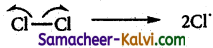
TN State Board 11th Chemistry Important Questions Chapter 13 Hydrocarbons 19

(ii) Propagation: It proceeds as follows,
(a) Chlorine free radical attacks the methane molecule and breaks the C – H bond resulting in the generation of methyl free radical.

TN State Board 11th Chemistry Important Questions Chapter 13 Hydrocarbons 20

(b) The methyl free radical thus obtained attacks the second molecule of chlorine to give chloromethane (CH3Cl) and a chlorine free radical as follows.

TN State Board 11th Chemistry Important Questions Chapter 13 Hydrocarbons 21

(c) Both step (a) and (b) are repeated several and this is known as propagation.

(iii) Termination:
The free radicals are destroyed during this step as follows.
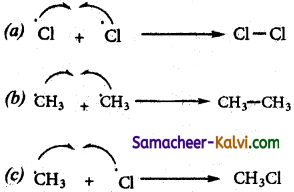
TN State Board 11th Chemistry Important Questions Chapter 13 Hydrocarbons 22

Samacheer Kalvi TN State Board 11th Chemistry Important Questions Chapter 13 Hydrocarbons

Question 12.
Explain aromatisation with an example.
Answer:
The conversion of aliphatic compounds into aromatic compounds is known as aromatisation. Alkanes having 6 to 10 carbon atoms are converted to benzene or its homologous at high temperatures in the presence of a catalyst.
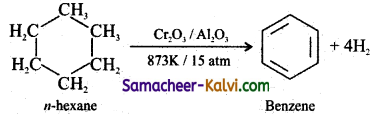
TN State Board 11th Chemistry Important Questions Chapter 13 Hydrocarbons 23

Question 13.
What is steam reforming process? Give an example.
Answer:
(i) Production of H2 gas from methane is known as steam reforming process.
(ii) Methane reacts with steam at 1273 K in the presence of Nickel and decomposes to form carbon monoxide and hydrogen gas.
CH4 (g) + H2O (g) TN State Board 11th Chemistry Important Questions Chapter 13 Hydrocarbons 24 CO (g) + 3 H2 (g)

Samacheer Kalvi TN State Board 11th Chemistry Important Questions Chapter 13 Hydrocarbons

Question 14.
Define pyrolysis. Explain with an example.
Answer:
Pyrolysis is defined as the thermal decomposi-tion of organic compound into smaller fragments in the absence of air through the application of heat.

In the absence of air, when alkane vapours are passed through red-hot metal it breaks down into simpler hydrocarbons.
(i) TN State Board 11th Chemistry Important Questions Chapter 13 Hydrocarbons 25
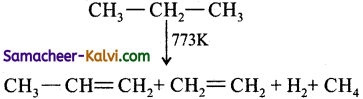
(ii) 2 CH3 — CH3 TN State Board 11th Chemistry Important Questions Chapter 13 Hydrocarbons 26 CH2 = CH2 + 2 CH4

Question 15.
Explain isomerisation with an example.
Answer:
Isomerisation is a chemical process by which a compound is transformed into any its isomeric forms. Normal alkanes can be converted into branched alkanes in the presence of AlCl3 and HCl at 298 K.

TN State Board 11th Chemistry Important Questions Chapter 13 Hydrocarbons 27

Samacheer Kalvi TN State Board 11th Chemistry Important Questions Chapter 13 Hydrocarbons

Question 16.
Mention the uses of alkanes.
Answer:
(i) Alkanes are used as fuels. Methane present in natural gas is used for home heating.
(ii) Mixtures of propane and butane(LPG) is used for domestic cooking purposes.
(iii) Gasoline, is a complex mixture of several hydrocarbons used as a fuel for internal combustion engines.
(iv) Carbon black is used in the manufacture . of ink, printer ink and black pigments.

Question 17.
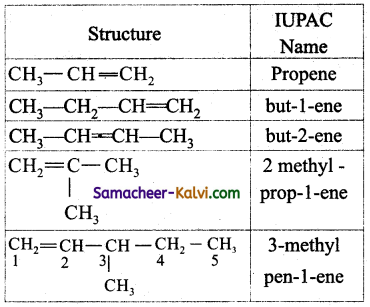
Write the IUPAC names of the following.
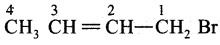
(i) CH3CH = CH2

(ii) CH3 — CH2 — CH = CH3

(iii) CH3 — CH = CH — CH3

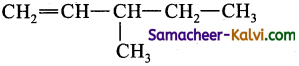
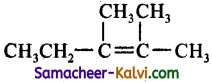
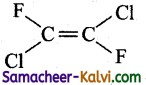
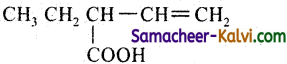
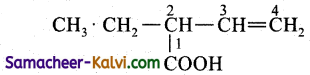
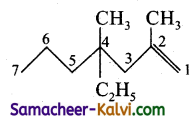
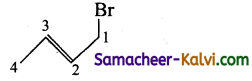
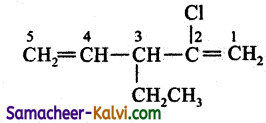
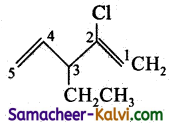
(iv) TN State Board 11th Chemistry Important Questions Chapter 13 Hydrocarbons 28
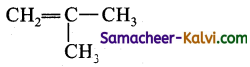
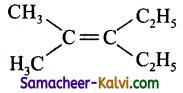
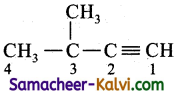
(v) TN State Board 11th Chemistry Important Questions Chapter 13 Hydrocarbons 29

Answer:

TN State Board 11th Chemistry Important Questions Chapter 13 Hydrocarbons 30

Samacheer Kalvi TN State Board 11th Chemistry Important Questions Chapter 13 Hydrocarbons

Question 18.
Write the structures and IUPAC names of different structural isomers of alkenes corresponding to C5H10.
Answer:
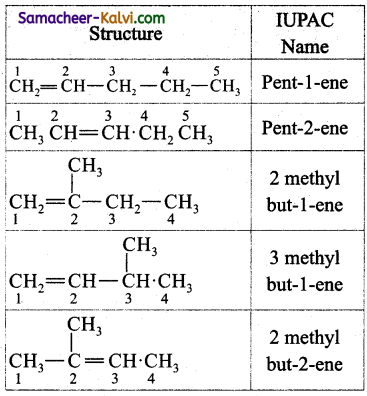
TN State Board 11th Chemistry Important Questions Chapter 13 Hydrocarbons 31

Question 19.
Explain geometrical isomerism with an example.
Answer:
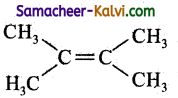
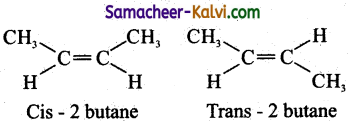
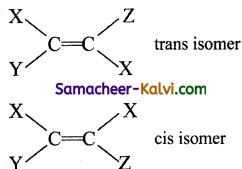
(i) Geometrical isomerism arises due to restricted rotation across TN State Board 11th Chemistry Important Questions Chapter 13 Hydrocarbons 32 double bond.
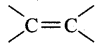
(ii) When similar groups lie on the same side of C = C double bond, it is known as ‘cis’ isomer.
(iii) When similar groups lie on the opposite side of C=C double bond, it is known as trans isomer.

eg: TN State Board 11th Chemistry Important Questions Chapter 13 Hydrocarbons 33
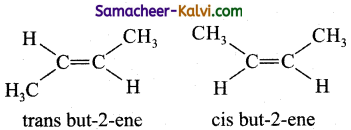
(iv) The melting point of a trans isomer is higher than that of its cis isomer.
(v) The solubility of a cis isomer is higher than that of its trans isomer in a given solvent.
(vi) cis isomer of an alkene is found to be more polar than its trans isomer.
(vii) The boiling point of the cis isomers are higher than those of their corresponding trans isomer.

Samacheer Kalvi TN State Board 11th Chemistry Important Questions Chapter 13 Hydrocarbons

Question 20.
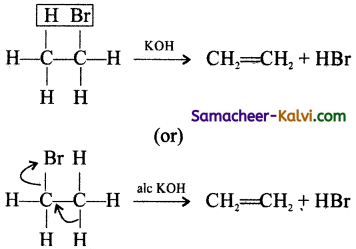
What is dehydrohalogenation? Give an example.
Answer:
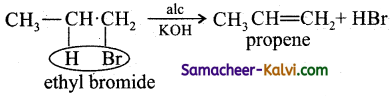
Removal of a hydrogen and halogen atom from adjacent carbon atom in an alkyl halide to form an alkene is known as dehydro halogenation.
eg: TN State Board 11th Chemistry Important Questions Chapter 13 Hydrocarbons 34
Question 21.
Give equations for the following reactions.
(i) 1 – bromo butane is treated with alcoholic potash.
Answer:

TN State Board 11th Chemistry Important Questions Chapter 13 Hydrocarbons 35

(ii) 1,2 di bromo propane.is heated with zinc and methyl alcohol.
Answer:
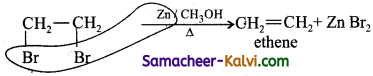
TN State Board 11th Chemistry Important Questions Chapter 13 Hydrocarbons 36

(iii) Potassium succinate is electrolysed using platinum electrodes.
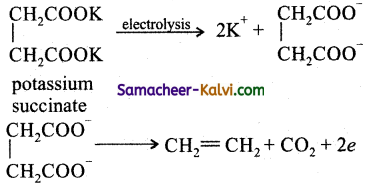
TN State Board 11th Chemistry Important Questions Chapter 13 Hydrocarbons 37

Samacheer Kalvi TN State Board 11th Chemistry Important Questions Chapter 13 Hydrocarbons

Question 22.
Starting from ethene, how will you prepare
(i) ethane
(ii) ethyl bromide
(iii) ethanol
(iv) formaldehyde
(v) poly ethylene. Give equations.
Answer:
(i) Ethene from ethane:
By treating ethene with hydrogen in the presence of nickel as catalyst.

CH2 = CH2 + H2 TN State Board 11th Chemistry Important Questions Chapter 13 Hydrocarbons 38 CH3 – CH3

(ii) Ethyl bromide from ethene:
By treating ethene with HBr.

CH = CH + HBr → CH3CH2HBr (ethyl trioxide)

(iii) Ethanol from ethene:
By treating ethane with cold dilute sulphuric acid and hydrolysing the product formed.
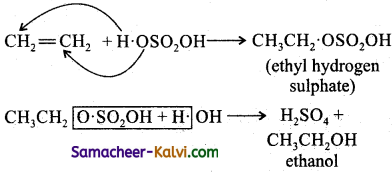
TN State Board 11th Chemistry Important Questions Chapter 13 Hydrocarbons 39

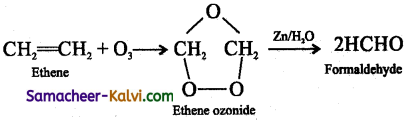
(iv) Formaldehyde from ethene: By treating ethene with ozone. The ozonide formed is decomposed by zinc and water.
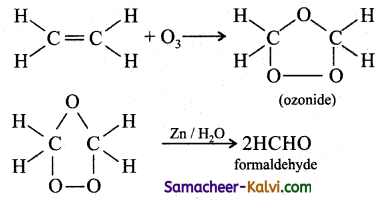
TN State Board 11th Chemistry Important Questions Chapter 13 Hydrocarbons 40

This reaction is known as ozonolysis.

(v) Polyethylene from ethene:
Ethene undergoes polymerisation when heated in a red hot tube at 873 K.
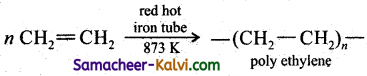
TN State Board 11th Chemistry Important Questions Chapter 13 Hydrocarbons 41

Samacheer Kalvi TN State Board 11th Chemistry Important Questions Chapter 13 Hydrocarbons

Question 23.
Complete the following equations:

(i) TN State Board 11th Chemistry Important Questions Chapter 13 Hydrocarbons 42
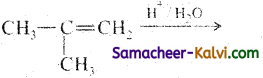
Answer:

TN State Board 11th Chemistry Important Questions Chapter 13 Hydrocarbons 43

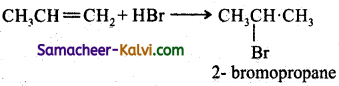
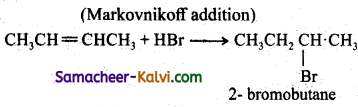
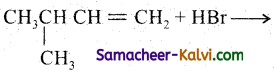
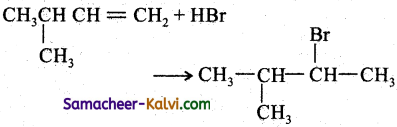
(ii) CH3CH = CH2 + HBr →
Answer:

TN State Board 11th Chemistry Important Questions Chapter 13 Hydrocarbons 44

(iii) CH3CH = CH.CH2 + HBr →
Answer:

TN State Board 11th Chemistry Important Questions Chapter 13 Hydrocarbons 45

(iv) CH3CH = CH2 + HBr TN State Board 11th Chemistry Important Questions Chapter 13 Hydrocarbons 46
Answer:
CH3 = CH2 + HBr TN State Board 11th Chemistry Important Questions Chapter 13 Hydrocarbons 46 CH3CH2CH2Br
(Anti – Markovnikoff’s addition)

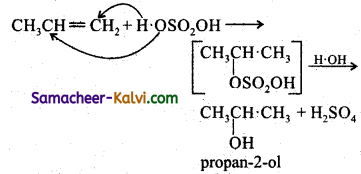
(v) CH3CH = CH2 + H2SO4
Answer:

TN State Board 11th Chemistry Important Questions Chapter 13 Hydrocarbons 47

Question 24.
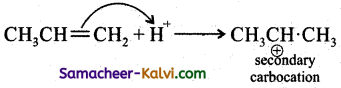
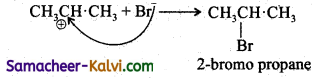
Discuss the mechanism of addition of HBr to propene.
Answer:
Step – 1:
HBr → H+ + Br (formation of electrophile)

Step – 2:

TN State Board 11th Chemistry Important Questions Chapter 13 Hydrocarbons 48

Step – 3:

TN State Board 11th Chemistry Important Questions Chapter 13 Hydrocarbons 49

In Step 2 the pi electrons are attacked by the electrophile and form a more stable secondary earbocation, which is further attacked by Br to form the product.

Samacheer Kalvi TN State Board 11th Chemistry Important Questions Chapter 13 Hydrocarbons

Question 25.
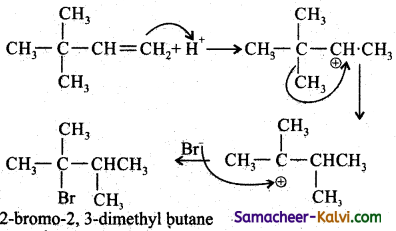
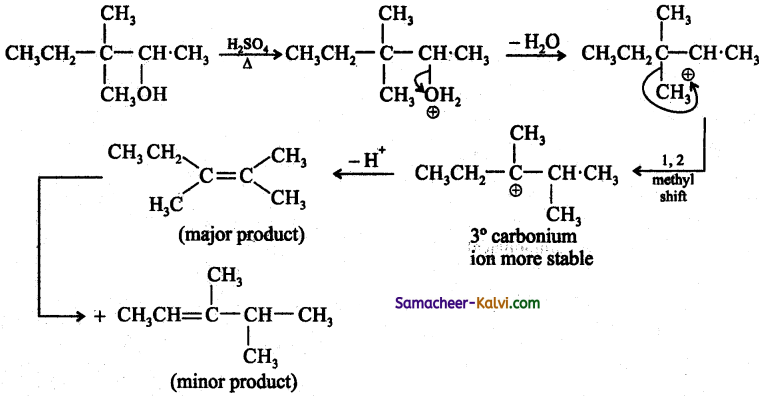
Addition of HBr to 3 – methyl – 1 – butene gives 2 – bromo – 2 – methyl butane as a major product. Explain Why?
Answer:
This is explained by the mechanism of the reaction.
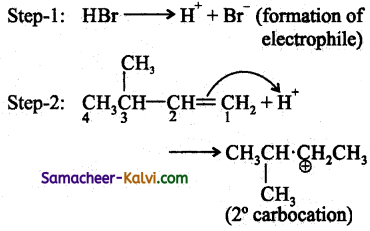
TN State Board 11th Chemistry Important Questions Chapter 13 Hydrocarbons 50

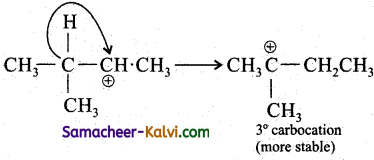
Since 2° carbocation is less stable than 3° carbocation, the hydrogen from the 3rd carbon atom migrates to the 2nd carbon atom with its bond pair of electrons. This is known as 1, 2 hydride shift.
TN State Board 11th Chemistry Important Questions Chapter 13 Hydrocarbons 51

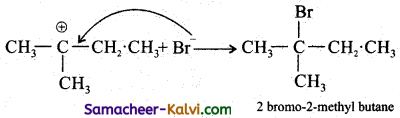
Step-3:
The Br attacks the tertiary carbon atom carrying the positive charge and forms the product.
TN State Board 11th Chemistry Important Questions Chapter 13 Hydrocarbons 52

Question 26.
Predict the major product formed in the following reactions.
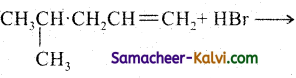
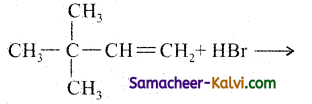
(i) CH3CH = CH2 + HBr →
Answer:
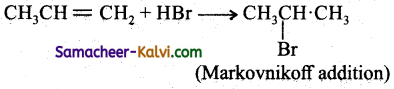
TN State Board 11th Chemistry Important Questions Chapter 13 Hydrocarbons 53

(ii) TN State Board 11th Chemistry Important Questions Chapter 13 Hydrocarbons 54

Answer:

TN State Board 11th Chemistry Important Questions Chapter 13 Hydrocarbons 55

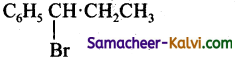
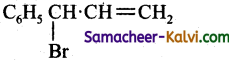
(iii) TN State Board 11th Chemistry Important Questions Chapter 13 Hydrocarbons 56

Answer:
Follow the same mechanism as (i).
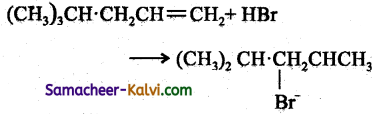
TN State Board 11th Chemistry Important Questions Chapter 13 Hydrocarbons 58

(iv) TN State Board 11th Chemistry Important Questions Chapter 13 Hydrocarbons 57

Answer:

TN State Board 11th Chemistry Important Questions Chapter 13 Hydrocarbons 59

Samacheer Kalvi TN State Board 11th Chemistry Important Questions Chapter 13 Hydrocarbons

Question 27.
Give the mechanism for the addition of HBr to propene in the presence of a peroxide.
Answer:
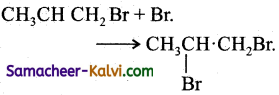
The addition of HBr to .propene in the presence of a peroxide occurs by a free radical mechanism. It consists of 3 steps.
(a) Initiation:
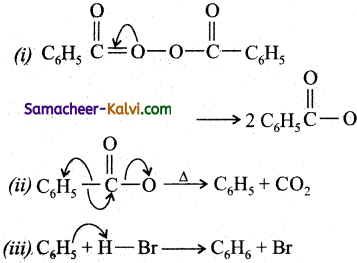
TN State Board 11th Chemistry Important Questions Chapter 13 Hydrocarbons 60

(b) Propagation:
During the first step, a bromine free radical adds to the double bond in such a way to give a more stable free radical. In the second step, the free radical thus produced abstracts a H from

(i) CH3 — CH = CH2 + Br → CH3CHCH2 Br 2° radical (more stable)

(ii) TN State Board 11th Chemistry Important Questions Chapter 13 Hydrocarbons 61
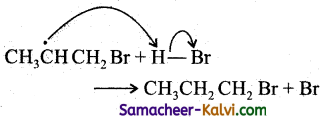
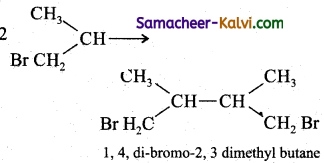
(c) Termination:

(i) 2 Br → Br2

(ii) TN State Board 11th Chemistry Important Questions Chapter 13 Hydrocarbons 62

(iii) TN State Board 11th Chemistry Important Questions Chapter 13 Hydrocarbons 63

Samacheer Kalvi TN State Board 11th Chemistry Important Questions Chapter 13 Hydrocarbons

Question 28.
Peroxide effect is not observed with HCl or HI. Explain Why?
Answer:
This is due to the following reasons:
(i) H — Cl bond (103 k.cal/mol) is stronger than H — Br bond (87.5 k.cal/mol). HCl is not decomposed by the peroxide to a free radical.
(ii) H — I bond is weaker than H — Br or H — Cl bond and it can form iodine free radical readily, but the iodine free radicals readily combine together to form iodine molecules rather than attacking the double bond.

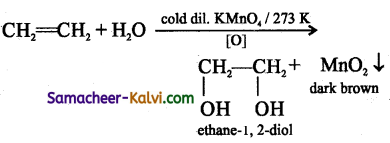
Question 29.
What is Baeyer’s reagent? How is it used to detect the presence of a multiple bond in alkenes/alkyne?
Answer:
(i) Cold, dilute alkaline potassium permanganate solution is known as Baeyer’s reagent.
(ii) When added to an alkene or alkyne the purple solution becomes dark green and then produces a dark brown precipitate. This indicates the presence of a double/ triple bond.

Samacheer Kalvi TN State Board 11th Chemistry Important Questions Chapter 13 Hydrocarbons

Question 30.
Complete the following equations:

(i) CH2 = CH2 + H2 TN State Board 11th Chemistry Important Questions Chapter 13 Hydrocarbons 64
Answer:

TN State Board 11th Chemistry Important Questions Chapter 13 Hydrocarbons 65

(ii) TN State Board 11th Chemistry Important Questions Chapter 13 Hydrocarbons 66

Answer:

TN State Board 11th Chemistry Important Questions Chapter 13 Hydrocarbons 67

(iii) CH3CH = CH CH3 TN State Board 11th Chemistry Important Questions Chapter 13 Hydrocarbons 69
Answer:

TN State Board 11th Chemistry Important Questions Chapter 13 Hydrocarbons 68

Samacheer Kalvi TN State Board 11th Chemistry Important Questions Chapter 13 Hydrocarbons

Question 31.
Explain the term ozonolysis with an example.
Answer:
Ozonolysis is a reaction between ozone and an alkene or an alkyne. In this reaction, ozone adds across the multiple bond to form an ozonide which decomposes to give one or more carbonyl compound, depending on the alkene/alkyne taken.
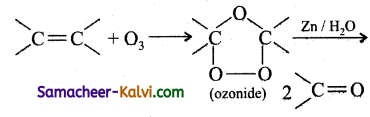
TN State Board 11th Chemistry Important Questions Chapter 13 Hydrocarbons 70

eg: TN State Board 11th Chemistry Important Questions Chapter 13 Hydrocarbons 71

Question 32.
Predict the products of ozonolysis of the following compounds.
(i) CH3CH = CH2

(ii) TN State Board 11th Chemistry Important Questions Chapter 13 Hydrocarbons 72
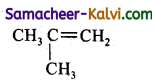
(iii) TN State Board 11th Chemistry Important Questions Chapter 13 Hydrocarbons 73

(iv) TN State Board 11th Chemistry Important Questions Chapter 13 Hydrocarbons 74

Answer:
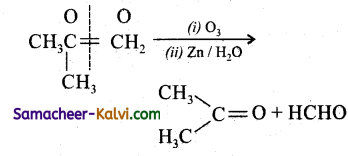
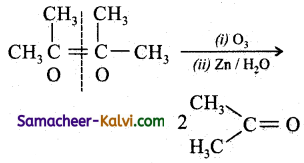
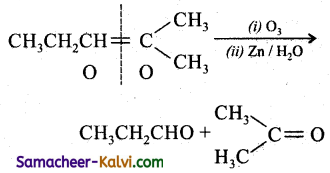
To predict the product of ozonolysis draw a line across C = C, and add one oxygen atom on either side.

(i) TN State Board 11th Chemistry Important Questions Chapter 13 Hydrocarbons 75
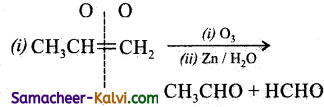
(ii) TN State Board 11th Chemistry Important Questions Chapter 13 Hydrocarbons 76

(iii) TN State Board 11th Chemistry Important Questions Chapter 13 Hydrocarbons 77

(iv) TN State Board 11th Chemistry Important Questions Chapter 13 Hydrocarbons 78

Samacheer Kalvi TN State Board 11th Chemistry Important Questions Chapter 13 Hydrocarbons

Question 33.
Explain the term polymerisation.
Answer:
Polymerisation is a process which involves the combination of several simple molecules (known as monomers) to form a giant molecule (known as polymer) under suitable experimental conditions.
eg: ethylene polymerises to polythene.
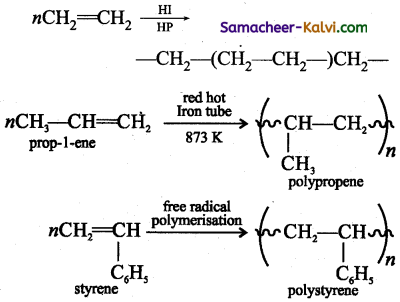
TN State Board 11th Chemistry Important Questions Chapter 13 Hydrocarbons 79

Question 34.
Mention the uses of the following:

(i) Polyethylene terephthalate (PET):
Answer:
Soft drinks bottles, jars, vegetable oil bottle.

(ii) High density polyethylene (HDPE):
Answer:
Milk, water and juice containers.

(iii) Polyvinyl chloride (PVC):
Answer:
Shampoo bottles, plastic pipes.

(iv) Low density polyethylene (LDPE):
Answer:
Sandwich bags, grocery bags.

(v) Polypropylene (PP):
Answer:
Straws, diaper, toys.

(vi) Polystyrene (PS):
Answer:
Disposable utensils, foam cups.

(vii) Multilayer plastics:
Answer:
Various flexible item.

Samacheer Kalvi TN State Board 11th Chemistry Important Questions Chapter 13 Hydrocarbons

Question 35.
Mention the uses of alkenes.
Answer:
(i) As a starting material in the synthesis of alcohol, plastics, liquors, detergents and fuels.
(ii) Used in the manufacture of floor tiles, shoes, synthetic fibres, rain coats, pipes etc.

Question 36.
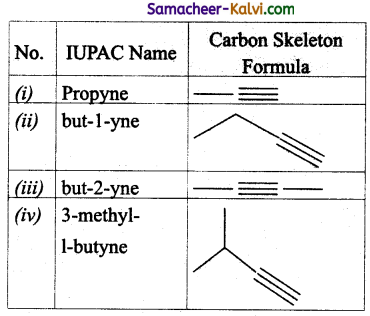
Write the IUPAC name and carbon skeleton formula for
(i) CH3 — C ≡ CH
(ii) CH3 — CH2 C ≡ CH
(iii) CH3 C ≡ C CH3
(iv) TN State Board 11th Chemistry Important Questions Chapter 13 Hydrocarbons 80
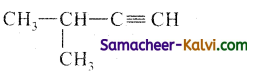
Answer:

TN State Board 11th Chemistry Important Questions Chapter 13 Hydrocarbons 81

Samacheer Kalvi TN State Board 11th Chemistry Important Questions Chapter 13 Hydrocarbons

Question 37.
How will you prepare the following? Give equations:
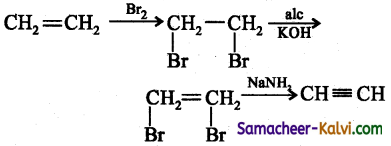
(i) Acetylene from ethylene:
Answer:
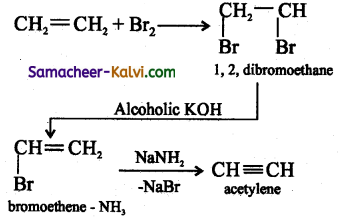
TN State Board 11th Chemistry Important Questions Chapter 13 Hydrocarbons 82

(ii) Prop – 1 – yne from 1, 2 dichloro propane:
Answer:
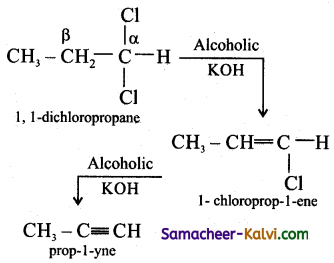
TN State Board 11th Chemistry Important Questions Chapter 13 Hydrocarbons 83

(iii) Acetylene from potassium succinate:
Answer:
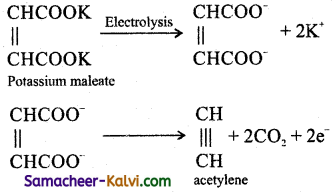
TN State Board 11th Chemistry Important Questions Chapter 13 Hydrocarbons 84

Question 38.
Briefly outline the acidic nature of alkynes.
Answer:
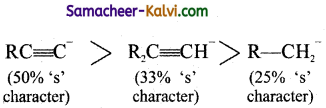
(i) An acidic substance should contain an ionisable hydrogen. Alkynes which contain a hydrogen atom (terminal alkyne) attached to an ‘sp’ hybridised atoms are acidic in nature, eg: Ethyne (CH ≡ CH), propyne (CH3C ≡ CH) etc. An ‘sp’ hybridised carbon is more electronegative than an sp2 or sp3 hybrid orbitals. Hence it pulls the electron pair towards itself resulting in the ionisation of alkane as follows:
HC ≡ CH → HC ≡ C (acetylide ion) + H+

Hence, terminal alkynes are acidic.
(ii) Terminal alkynes undergo the following reactions which the non-terminal alkynes do not
(a) They produce a while precipitate on treatment with ammoniacal silver nitrate.
CH3CH2C (but-l-yne) ≡ CH + 2 AgNO3 + 2 NH4OH → CH3CH2C ≡ CAg (Silver butynide) ↓+ 2 NH4NO3 + 2H2O

(b) They produce a red precipitate on treatment with ammonical cuprous chloride.

2 CH3 – CH2 – C ≡ CH (but-l-yne) + Cu2Cl2 + 2 NH4OH → CH3 – CH2 – C ≡ C – Cu ↓(Copper butynide) + 2 NH4Cl + 2 H2O

Samacheer Kalvi TN State Board 11th Chemistry Important Questions Chapter 13 Hydrocarbons

Question 39.
Give equation for the reaction of propyne with:

(i) H2 in the presence of Pt as catalyst:
Answer:
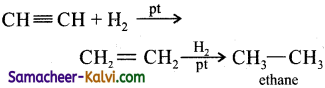
TN State Board 11th Chemistry Important Questions Chapter 13 Hydrocarbons 85

(ii) Bromine in carbon tetrachloride:
Answer:
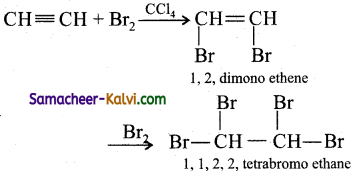
TN State Board 11th Chemistry Important Questions Chapter 13 Hydrocarbons 86

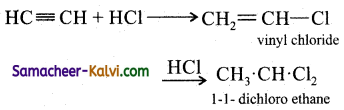
(iii) Hydrogen chloride:
Answer:

TN State Board 11th Chemistry Important Questions Chapter 13 Hydrocarbons 87

(iv) Mercuric sulphate and dilute sulphuric acid at 333 K:
Answer:
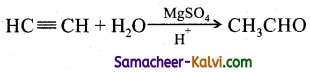
TN State Board 11th Chemistry Important Questions Chapter 13 Hydrocarbons 88

(v) Ozone followed by Zn / H2O:
Answer:
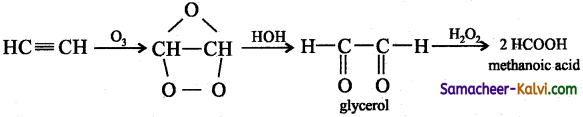
TN State Board 11th Chemistry Important Questions Chapter 13 Hydrocarbons 89

Samacheer Kalvi TN State Board 11th Chemistry Important Questions Chapter 13 Hydrocarbons

Question 40.
Distinguish by means of a chemical test.
(i) but-l-ene and but-l-yne:
Answer:

TN State Board 11th Chemistry Important Questions Chapter 13 Hydrocarbons 90

TN State Board 11th Chemistry Important Questions Chapter 13 Hydrocarbons 91

(ii) butane and but-1 -ene:
Answer:

TN State Board 11th Chemistry Important Questions Chapter 13 Hydrocarbons 92

(iii) but-2-yne and but-1 -yne:
Answer:

TN State Board 11th Chemistry Important Questions Chapter 13 Hydrocarbons 93

Question 41.
Give equation for the reaction of propyne with:

(i) Br2
Answer:
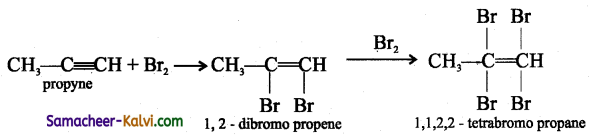
TN State Board 11th Chemistry Important Questions Chapter 13 Hydrocarbons 94

(ii) HgSO4 / H2SO4:
Answer:

TN State Board 11th Chemistry Important Questions Chapter 13 Hydrocarbons 95

(iii) O3 / HOH:
Answer:

TN State Board 11th Chemistry Important Questions Chapter 13 Hydrocarbons 96

Samacheer Kalvi TN State Board 11th Chemistry Important Questions Chapter 13 Hydrocarbons

Question 42.
Give a brief account on polymerisation of alkynes.
Answer:
Acetylene undergoes polymerisation producing different pr&lucts under different conditions.
(i) Cyclic poIymerisation:
When acetylene is passed brouh a red hot metallic tube at 873 K, cyclic polyrnerisaiion occurs with the formation of beniene.
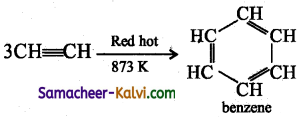
TN State Board 11th Chemistry Important Questions Chapter 13 Hydrocarbons 97

(ii) When acetylene is treated with cuprous chloride solution containing ammonium chloride, linear polymerisation occurs forming mono vinyl acetylene and divinyl acetelene.
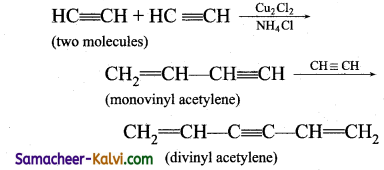
TN State Board 11th Chemistry Important Questions Chapter 13 Hydrocarbons 98

Question 43.
Give two examples each for monocyclic and polycyclic aromatic hydrocarbons.
Answer:
Monocyclic aromatic hydrocarbons:
Benzene(C6H6) and toluene(C6H5 CH3)

Polycyclic aromatic hydrocarbons:
Naphthalene (C6H5 – C6H5) and

Anthracene:
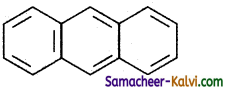
TN State Board 11th Chemistry Important Questions Chapter 13 Hydrocarbons 99

Samacheer Kalvi TN State Board 11th Chemistry Important Questions Chapter 13 Hydrocarbons

Question 44.
Write the structures of the following:

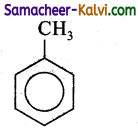
(i) Toluene
Answer:
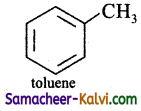
TN State Board 11th Chemistry Important Questions Chapter 13 Hydrocarbons 100

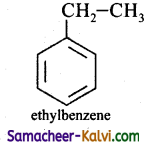
(ii) Ethyl benzene
Answer:

TN State Board 11th Chemistry Important Questions Chapter 13 Hydrocarbons 101

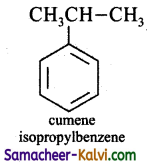
(iii) Isopropyl benzene
Answer:

TN State Board 11th Chemistry Important Questions Chapter 13 Hydrocarbons 102

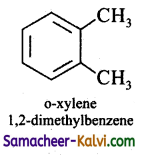
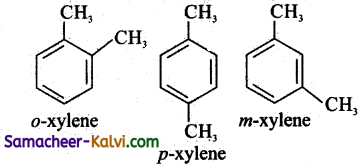
(iv) o – xylene
Answer:

TN State Board 11th Chemistry Important Questions Chapter 13 Hydrocarbons 103

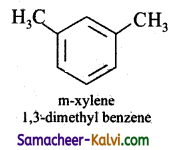
(v) m – xylene
Answer:

TN State Board 11th Chemistry Important Questions Chapter 13 Hydrocarbons 104

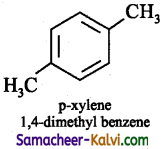
(vi) p – xylene
Answer:

TN State Board 11th Chemistry Important Questions Chapter 13 Hydrocarbons 105

Question 45.
Mention the conditions for an organic compound to be classified as aromatic. [OR] Explain Huckel’s rule.
Answer:
Huckel proposed that aromaticity is a function of electronic structure. A compound may be aromatic, if it obeys the following rules:
(i) The molecule must be co – planar
(ii) Complete delocalization of n electron in the ring
(iii) Presence of (4n + 2)π electrons in the ring where n is an integer (n = 0,1,2….)
This is known as Huckel’s rule.

Samacheer Kalvi TN State Board 11th Chemistry Important Questions Chapter 13 Hydrocarbons

Question 46.
Predict the following compounds are aromatic or not.
(i) Benzene
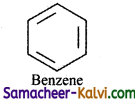
TN State Board 11th Chemistry Important Questions Chapter 13 Hydrocarbons 106

Answer:
(a) The benzene is a planar molecule.
(b) It has six delocalised π electrons.
(c) 4n + 2 = 6
4n = 6 – 2
4n = 4
n = 1
It obeys Huckel’s (4n + 2) π electron rule with n = 1.
Hence, benzene is aromatic.

(ii) Naphthalene
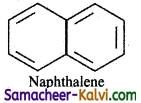
TN State Board 11th Chemistry Important Questions Chapter 13 Hydrocarbons 107

Answer:
(a) Naphthalene has a planar ring structure.
(b) It has 10 delocalised it electrons.
(c) 4n + 2 = 10
4n = 10 – 2
4n = 8
n = 8/4 = 2
Hence, naphthalene is aromatic.

(iii) Anthracene:
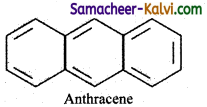
TN State Board 11th Chemistry Important Questions Chapter 13 Hydrocarbons 108

Answer:
It has a planar ring structure with 14 delocalised n electrons. Applying Huckel’s rule 4n + 2 = 14π electrons. n = 3 Hence it is an aromatic compound.

(iv) Cyclo penta diene:

TN State Board 11th Chemistry Important Questions Chapter 13 Hydrocarbons 109

Answer:
(a) It has planar structure.
(b) It has four π electron but the π electrons are not delocalised and hence it is not an aromatic compound.

(v) Cyclooctatetraene

TN State Board 11th Chemistry Important Questions Chapter 13 Hydrocarbons 110

Answer:
Molecule is non-planar and hence it is not an aromatic compound.

(vi) Cyclopropenylcation
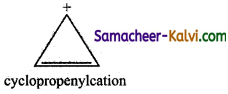
TN State Board 11th Chemistry Important Questions Chapter 13 Hydrocarbons 111

Answer:
(a) Cyclopropenylcation has planar structure.
(b) It has 2 delocalised π electron.
(c) 4n + 2 = 2
4n = 0
n = 0 (an integer) and hence it is aromatic compound.

Samacheer Kalvi TN State Board 11th Chemistry Important Questions Chapter 13 Hydrocarbons

Question 47.
Briefly explain the structure of benzene based on resonance.
Answer:
(i) On the basis of resonance, benzene is believed to be a resonance hybrid of the I and II are called Kekule structures and contribute more towards resonance hybrid than the rest of the structures.
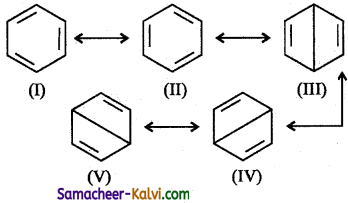
TN State Board 11th Chemistry Important Questions Chapter 13 Hydrocarbons 112

(ii) The two Kekule structures are equivalent and hence the stability of the resonance hybrid is high. Because of resonance, all the C — C bond lengths are equal which is intermediate to C = C and C — C bond lengths.
(iii) Resonance can occur only if the molecule is planar. Thus, benzene is a planar molecule, where all the six carbon and six hydrogen atoms lie in the same plane.
(iv) All the pi electrons are delocalised. This is represented by a circle inside the benzene ring. For convenience, Benzene is represented as

TN State Board 11th Chemistry Important Questions Chapter 13 Hydrocarbons 113

(Note: The resonance hybrid cannot be represented on paper.)

Question 48.
Briefly explain the molecular orbital structure of benzene.
Answer:
(i) All the six carbon atoms in benzene are ‘sp2‘ hybridised. The sp2 hybrid orbitals overlap with each other and with ‘s’ orbitals of the six hydrogen atoms forming C — C and C — H bonds.
(ii) Since, the bond results from the overlap of ‘sp2’ planar hybrid orbitals, all carbon and hydrogen atoms in benzene lie. in the same plane and all the bond angles are 120° as shown below:
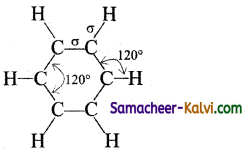
TN State Board 11th Chemistry Important Questions Chapter 13 Hydrocarbons 114

(iii) The unused ‘2p’ orbitals of each carbon atom which lie above and below the plane overlap laterally producing 3π molecular orbitals containing six electrons as shown in (a) and (b) below:
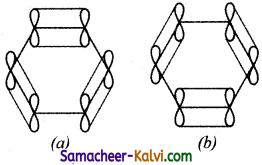
TN State Board 11th Chemistry Important Questions Chapter 13 Hydrocarbons 115

(iv) As the overlapping on both sides are equal, all the six ‘‘p’ orbitals unite to form a continues n molecular orbitals containing six electrons as shown below:

TN State Board 11th Chemistry Important Questions Chapter 13 Hydrocarbons 116

The formation of continuous molecular orbital suggests that all the six pi electrons are common to all the six carbon atom. The participation of pi electrons in more than one bond is called delocalisation of pi electrons.

(v) The molecular orbital picture of benzene explains all the known facts of about benzene, i.e., planarity of the molecule, bond angle, equal C — C bond lengths and stabilisation of the molecule.

Samacheer Kalvi TN State Board 11th Chemistry Important Questions Chapter 13 Hydrocarbons

Question 49.
How is benzene obtained from coal tar?
Answer:
Coal tar is a viscous liquid obtained by the pyrolysis of coal. During fractional distillation, coal tar is heated and distills away its volatile compounds namely benzene, toluene, xylene in the temperature range of 350 to 443 K. These vapours are collected at the upper part of the fractionating column.
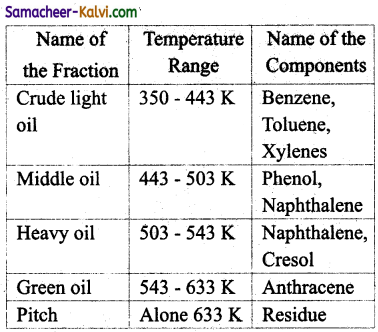
TN State Board 11th Chemistry Important Questions Chapter 13 Hydrocarbons 117

Question 50.
Give equations for the following reactions.

(i) Sodium benzoate is heated with soda lime.
Answer:

TN State Board 11th Chemistry Important Questions Chapter 13 Hydrocarbons 118

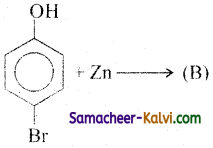
(ii) Phenol vapours are passed over zinc dust.
Answer:

C6H5OH + Zn → C6H6 + ZnO

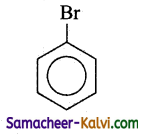
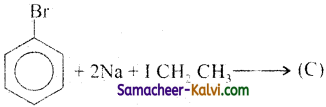
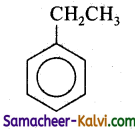
(iii) Bromo benzene and iodo methane is heated with metallic sodium in the presence of ether.
Answer:
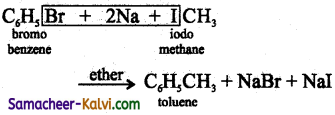
TN State Board 11th Chemistry Important Questions Chapter 13 Hydrocarbons 119

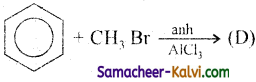
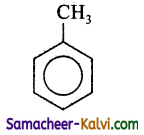
(iv) Benzene is treated with methyl chloride m the presence of anhydrous aluminium chloride. .
Answer:
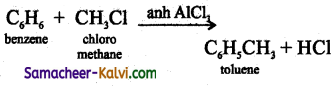
TN State Board 11th Chemistry Important Questions Chapter 13 Hydrocarbons 120

Samacheer Kalvi TN State Board 11th Chemistry Important Questions Chapter 13 Hydrocarbons

Question 51.
Identify the products in the following equations.

(i) TN State Board 11th Chemistry Important Questions Chapter 13 Hydrocarbons 121
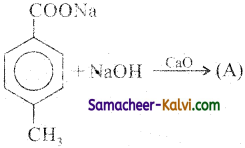
Answer:

A = TN State Board 11th Chemistry Important Questions Chapter 13 Hydrocarbons 122

(ii) TN State Board 11th Chemistry Important Questions Chapter 13 Hydrocarbons 123

Answer:

B = TN State Board 11th Chemistry Important Questions Chapter 13 Hydrocarbons 124

(iii) TN State Board 11th Chemistry Important Questions Chapter 13 Hydrocarbons 125

Answer:

C = TN State Board 11th Chemistry Important Questions Chapter 13 Hydrocarbons 126

(iv) TN State Board 11th Chemistry Important Questions Chapter 13 Hydrocarbons 127

Answer:

D = TN State Board 11th Chemistry Important Questions Chapter 13 Hydrocarbons 128

Question 52.
Explain the mechanism of chlorination of benzene.
Answer:
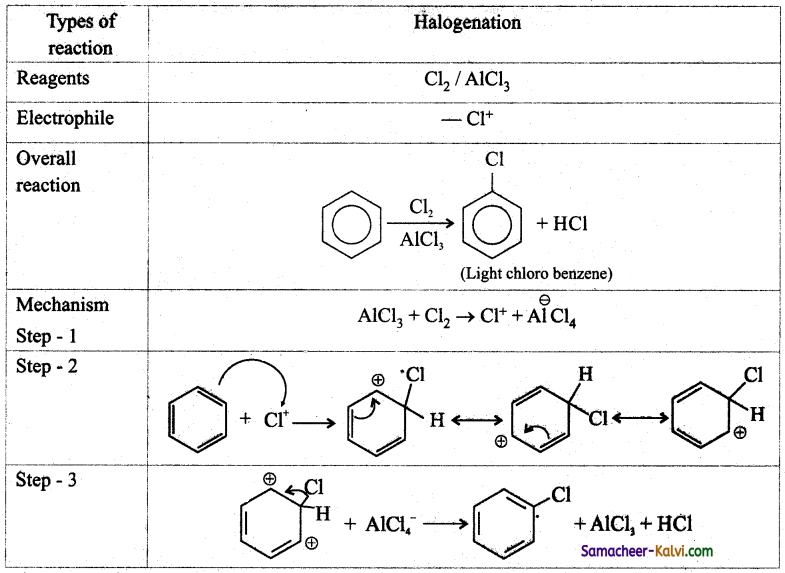
TN State Board 11th Chemistry Important Questions Chapter 13 Hydrocarbons 129

Samacheer Kalvi TN State Board 11th Chemistry Important Questions Chapter 13 Hydrocarbons

Question 53.
How do you get the following from benzene.

(i) cyclohexane
Answer:
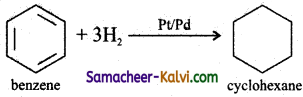
TN State Board 11th Chemistry Important Questions Chapter 13 Hydrocarbons 130

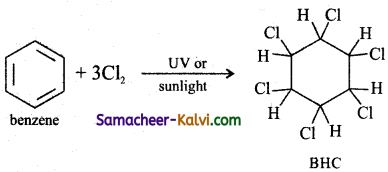
(ii) benzene hexachloride
Answer:

TN State Board 11th Chemistry Important Questions Chapter 13 Hydrocarbons 131

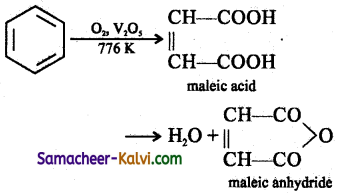
(iii) maleic anhydride
Answer:

TN State Board 11th Chemistry Important Questions Chapter 13 Hydrocarbons 132

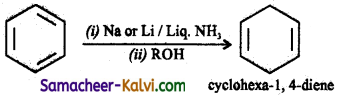
(iv) 1, 4 cyclo hexane
Answer:

TN State Board 11th Chemistry Important Questions Chapter 13 Hydrocarbons 133

Question 54.
Give examples for Ortho and para directing groups.
Answer:
All the activating groups are ‘ortho-para’ directors.
eg: — OH, — NH2, — NHR, — NHCOCH3, — OCH2 — CH3 — C2H5 etc.

Samacheer Kalvi TN State Board 11th Chemistry Important Questions Chapter 13 Hydrocarbons

Question 55.
What are metadirecting groups? Give example.
Answer:
Generally all deactivating groups are meta-directors,
eg: — NO2, — CN, — CHO,— COR, — COOH, — COOR, — SO3H etc.

Question 56.
Phenol on bromination gives a mixture of ortho and para bromo phenol but not m-bromo phenol. Explain why?
Answer:
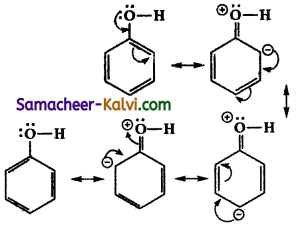
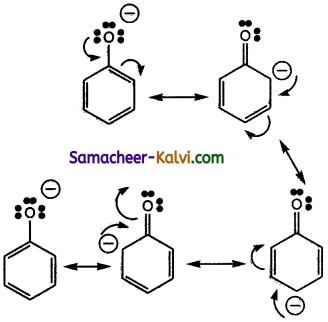
The actual structure of phenol is a resonance hybrid of the following structures.
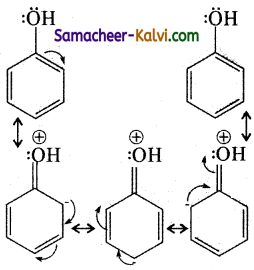
TN State Board 11th Chemistry Important Questions Chapter 13 Hydrocarbons 134

The ‘OH’ group in phenol is an ortho para orienting group. It activates the benzene orienting ring through its +M effect. As a result, the ortho and para position became electron rich compared to the meta position and the electrophile i.e., Br+ attacks the ortho and para positions. Hence bromination of benzene gives a mixture of ortho and para bromo phenols.
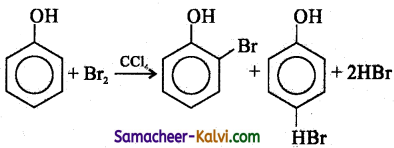
TN State Board 11th Chemistry Important Questions Chapter 13 Hydrocarbons 135

Samacheer Kalvi TN State Board 11th Chemistry Important Questions Chapter 13 Hydrocarbons

Question 57.
The halogen atom is halo benzene, has deactivate the benzene ring, yet ortho and para products are formed during electrophilic substitution reactions. Explain why?
Answer:
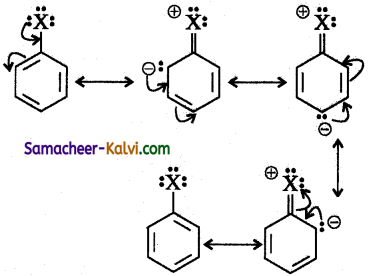
TN State Board 11th Chemistry Important Questions Chapter 13 Hydrocarbons 136

In aryl halides, the strong – I effect of the halogens (electron Withdrawing tendency) decreases the electron density of benzene ring, thereby deactivating for electrophilic attack.

However the presence of lone pair on halogens involved in the resonance with pi electrons of benzene ring, increases electron density at ortho and para position.

Thus the electrophile attacks the ortho and para position.

Question 58.
Explain how a meta directing group facilitate the meta substituents in benzene ring. [OR] “CHO” group in meta directing in electrophilic substitutions reaction. Explain why?
Answer:
Meta directing groups deactivate the benzene ring through their -M effect. As a results the electron density at ortho and para positions become electron deficient compared to the meta position. Or the meta position is relatively electron rich compared to ortho and para positions. Hence the electrophile attacks the meta position. For example the.aldehyde group (-CHO) is meta directing. The actual structure of benzaldehyde is a resonance hybrid of the following structures.
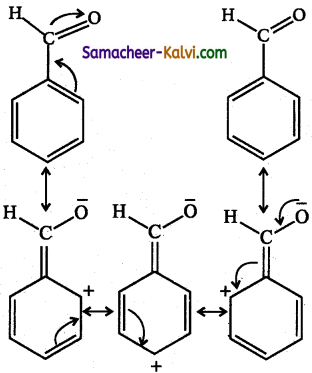
TN State Board 11th Chemistry Important Questions Chapter 13 Hydrocarbons 137

Because of -M effect, a positive charge is created at ortho and para position. This means the electron density at the meta position is relatively higher than ortho and para positions. Hence, meta directing groups favours meta substitution.

Samacheer Kalvi TN State Board 11th Chemistry Important Questions Chapter 13 Hydrocarbons

Question 59.
Write a short note on Carcinogenity and toxicity.
Answer:
Poly nuclear hydrocarbons are toxic and said to possess cancer producing (carcinogenic) property. These polynuclear hydrocarbons are produced by incomplete combustion of organic matter such as coal, petroleum, tobacco etc., They enter into the human body and undergo various biochemical reaction and finally damage DNA to cause cancer. Examples of polynuclear hydrocarbons having carcinogenic activity are 1, 2 benzanthracene, 1, 2, benzpyrene, 1, 2, 5, 6 dibenzanthracene.

Question 60.
Complete the following reactions:

(i) TN State Board 11th Chemistry Important Questions Chapter 13 Hydrocarbons 138
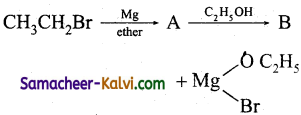
Answer:
A = CH3CH2MgBr; B = CH3CH3

(ii) TN State Board 11th Chemistry Important Questions Chapter 13 Hydrocarbons 139

Answer:
A = CH3 – CH3; B = CH3 CH2Br;
C = CH3 CH2 CH2 CH3

(iii) TN State Board 11th Chemistry Important Questions Chapter 13 Hydrocarbons 140
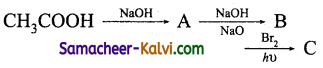
Answer:
A = CH3COONa; B = CH4; C = CH3Br

(iv) TN State Board 11th Chemistry Important Questions Chapter 13 Hydrocarbons 141

Answer:
A = CH3COONa; B = CH3 – CH3

(v) CaC2 + H2O —> A + B .
Answer:
A = C2H2 ; B = Ca(OH)2

(vi) TN State Board 11th Chemistry Important Questions Chapter 13 Hydrocarbons 142

Answer:
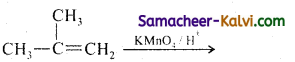
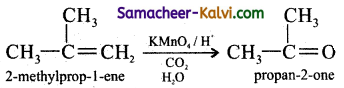
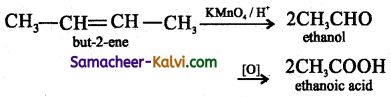
A = CH3 CHO; B = (CH3)2CO

(vii) TN State Board 11th Chemistry Important Questions Chapter 13 Hydrocarbons 143

Answer:
A = CH3CH2 C = C.Na;
B = CH3CH2C = C. CH2 CH3

(viii) TN State Board 11th Chemistry Important Questions Chapter 13 Hydrocarbons 144
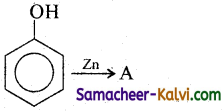
Answer:
A = C6H6

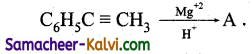
(ix) TN State Board 11th Chemistry Important Questions Chapter 13 Hydrocarbons 145

Answer:
A = C6H5CO CH2 CH3

Samacheer Kalvi TN State Board 11th Chemistry Important Questions Chapter 13 Hydrocarbons

Question 61.
An alkene ‘A’ on ozonolysis gives a mixture of ethanal and pentan-3-one. Write the structure and IUPAC name of A.

Write the structures of the products of ozonolysis side by side with their oxygen atoms pointing towards each other. Remove the oxygen atom and join the two carbon atoms by a double bond.
Answer:
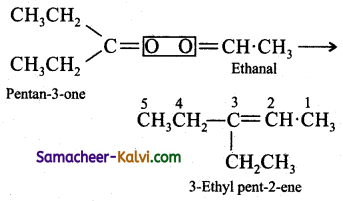
TN State Board 11th Chemistry Important Questions Chapter 13 Hydrocarbons 146

Question 62.
Bring out the following conversions:

(i) ethyl bromide to butane:
Answer:
CH3CH2Br TN State Board 11th Chemistry Important Questions Chapter 13 Hydrocarbons 147 CH3CH3

(ii) benzoic acid to benzene:
Answer:
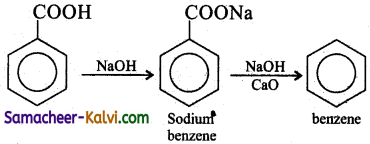
TN State Board 11th Chemistry Important Questions Chapter 13 Hydrocarbons 148

(iii) ethyl bromide to butane:
Answer:
CH3CH2Br TN State Board 11th Chemistry Important Questions Chapter 13 Hydrocarbons 149 CH3CH2CH2CH3

(iv) propene to 2-bromoprppane:
Answer:
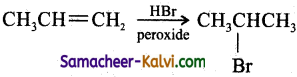
TN State Board 11th Chemistry Important Questions Chapter 13 Hydrocarbons 150

(v) ethyl bromide to ethylene glycol:
Answer:
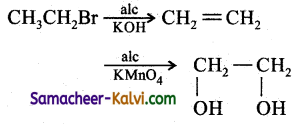
TN State Board 11th Chemistry Important Questions Chapter 13 Hydrocarbons 151

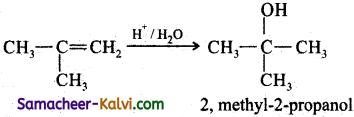
(vi) 2-methyl prop-l-ene to propan-2-ol:
Answer:
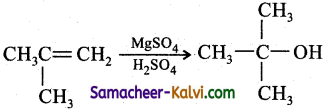
TN State Board 11th Chemistry Important Questions Chapter 13 Hydrocarbons 152

(vii) ethane to ethyne:
Answer:

TN State Board 11th Chemistry Important Questions Chapter 13 Hydrocarbons 153

(viii) acetylene to methanoic acid.
Answer:
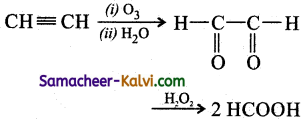
TN State Board 11th Chemistry Important Questions Chapter 13 Hydrocarbons 154

(ix) Toluene to o – bromo toluene.
Answer:
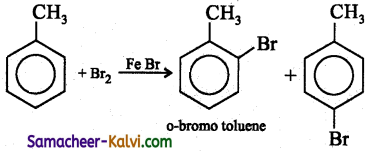
TN State Board 11th Chemistry Important Questions Chapter 13 Hydrocarbons 155

(x) benzene to m – dinitro benzene.
Answer:
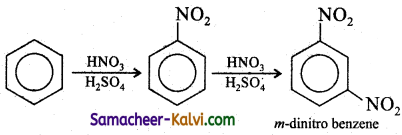
TN State Board 11th Chemistry Important Questions Chapter 13 Hydrocarbons 156

Samacheer Kalvi TN State Board 11th Chemistry Important Questions Chapter 13 Hydrocarbons

Question 63.
Bring out the following conversions:

(i) Benzene to o – dichloro benzene.
Answer:
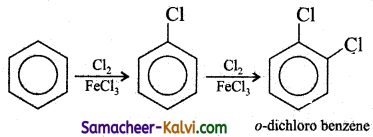
TN State Board 11th Chemistry Important Questions Chapter 13 Hydrocarbons 157

(ii) Benzene to o – nitro toulene.
Answer:
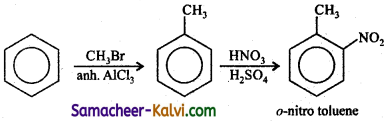
TN State Board 11th Chemistry Important Questions Chapter 13 Hydrocarbons 158

(iii) Benzene to m – nitro toulene.
Answer:
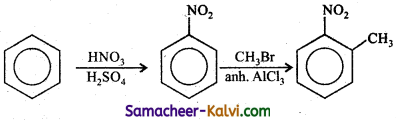
TN State Board 11th Chemistry Important Questions Chapter 13 Hydrocarbons 159

(iv) Benzene to p – nitro toulene.
Answer:
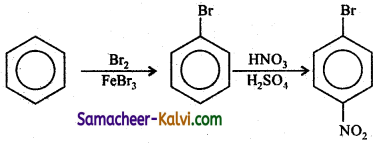
TN State Board 11th Chemistry Important Questions Chapter 13 Hydrocarbons 160

(v) Benzene to m – di nitro benzene.
Answer:
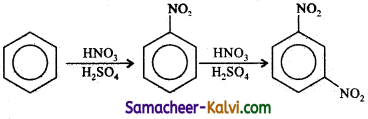
TN State Board 11th Chemistry Important Questions Chapter 13 Hydrocarbons 161

Choose the correct answer:

Question 1.
Isopropyl bromide on wurtz reaction gives:
(a) hexane
(b) propane
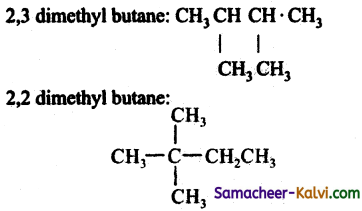
(c) 2, 3 dimethyl butane
(d) neohexane
Answer:
(c) 2, 3 dimethyl butane
Hint:
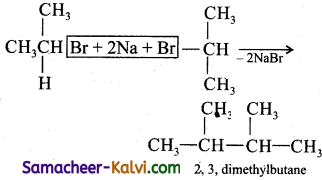
TN State Board 11th Chemistry Important Questions Chapter 13 Hydrocarbons 162

Question 2.
Heating a mixture of sodium benzoate with soda lime gives:
(a) benzene
(b) methane
(c) benzoic acid
(d) calcium benzoat
Answer:
(a) benzene
Hint:

TN State Board 11th Chemistry Important Questions Chapter 13 Hydrocarbons 163

Samacheer Kalvi TN State Board 11th Chemistry Important Questions Chapter 13 Hydrocarbons

Question 3.
Which of the following alkane has the lowest boiling point and highest melting point?
(a) w-pentane
(b) iso pentane
(c) neo pentane
(d) n-hexane
Answer:
(c) neo pentane
Hint:
Due to least surface area, neo pentane has the lowest boiling point, but due to high symmetry it has the highest melting point.

Question 4.
On mixing certain alkane with chlorine and irradiating it with ultraviolet light, one forms only one monochloro alkane. The alkane could be:
(a) neopentane
(b) propane
(c) pentane
(d) isopentane
Answer:
(a) neopentane
Hint:
Neopentane, has only one type carbon atoms attached to the carbon atom as
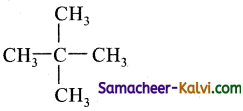
TN State Board 11th Chemistry Important Questions Chapter 13 Hydrocarbons 164

All hydrogen atoms are equivalent and hence it forms only one monochloro derivative.

Samacheer Kalvi TN State Board 11th Chemistry Important Questions Chapter 13 Hydrocarbons

Question 5.
Which one of the following exhibit geometrical ‘ isomerism?
(a) 1 – phenyl – 2 – butene
(b) 3 – phenyl – 1 – butene
(c) 2 – phenyl – 1 – butene
(d) 1, 1 diphenyl – 1 – propane
Answer:
(a) 1 – phenyl – 2 – butene
Hint:
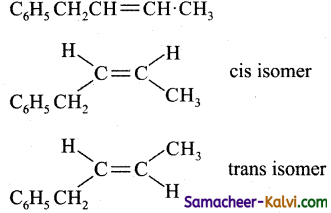
TN State Board 11th Chemistry Important Questions Chapter 13 Hydrocarbons 165

Question 6.
Give the IUPAC name of
(a) 3 – methyl-4-propyl-3-octene
(b) 4- butyl-3-methyl-3-heptene
(c) 2 – ethyl-3-propyl-2-heptene
(d) 2 – ethyl-2-propyl-2-heptene
Answer:
(a) 3 – methyl-4-propyl-3-octene
Hint:
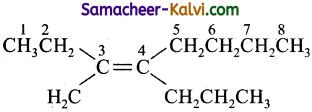
TN State Board 11th Chemistry Important Questions Chapter 13 Hydrocarbons 166

Question 7.
1-chlorobutane on reaction with alcoholic potash gives:
(a) 1 – Butene
(b) 1 – Butanol
(c) 2 – Butene
(d) 2 – Butanol
Answer:
(a) 1 – Butene
Hint:

TN State Board 11th Chemistry Important Questions Chapter 13 Hydrocarbons 167

Samacheer Kalvi TN State Board 11th Chemistry Important Questions Chapter 13 Hydrocarbons

Question 8.
Butene – 1 – may be converted to butane on reaction with:
(a) Pd / H2
(b) Zn / HCl
(c) Sn / HCl
(d) Zn – Hg
Answer:
(a) Pd / H2
Hint:

TN State Board 11th Chemistry Important Questions Chapter 13 Hydrocarbons 168

Question 9.
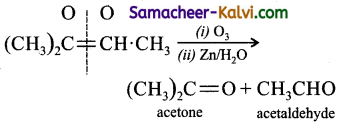
Which of the following gives an ozonolysis both aldehydes and ketones?
(a) (CH3)2C = CH CH3

(b) (CH3)2C = C.(CH3)2

(c) TN State Board 11th Chemistry Important Questions Chapter 13 Hydrocarbons 169
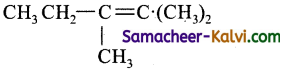
(d) TN State Board 11th Chemistry Important Questions Chapter 13 Hydrocarbons 170
Answer:
(a) (CH3)2C = CH CH3
Hint:

TN State Board 11th Chemistry Important Questions Chapter 13 Hydrocarbons 171

Samacheer Kalvi TN State Board 11th Chemistry Important Questions Chapter 13 Hydrocarbons

Question 10.
Identify the compounds A and B in the following reaction sequence.

TN State Board 11th Chemistry Important Questions Chapter 13 Hydrocarbons 172

(a) A is ethylene; B is acetaldehyde
(b) A is acetylene; B is propionaldehyde
(c) A is ethane; B is ethanol
(d) A is acetylene; B is acetaldehyde
Answer:
(d) A is acetylene; B is acetaldehyde
Hint:

TN State Board 11th Chemistry Important Questions Chapter 13 Hydrocarbons 173

Question 11.
A gas decolourises alkaline KMnO4 but does not give a precipitate with AgNO3 is:
(a) CH4
(b) C2H4
(c) C2H2
(d) C2H6
Answer:
(b) C2H4
Hint:
Ethylene decolourises KMnO4but does not give a precipitate with AgNO3.

Question 12.
The ortho-para directing group among the following is:
(a) COOH
(b) CN
(c) COCH3
(d) NHCOCH3
Answer:
(d) NHCOCH3

Samacheer Kalvi TN State Board 11th Chemistry Important Questions Chapter 13 Hydrocarbons

Question 13.
The number of structural isomers of C6H14 is:
(a) 3
(b) 4
(c) 5
(d) 6
Answer:
(d) 6
Hint:
n-hexane : CH3 CH2 CH2 CH2 CH2 CH3
2 – methyl pentane:
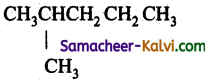
TN State Board 11th Chemistry Important Questions Chapter 13 Hydrocarbons 174

3 – methyl pentane:

TN State Board 11th Chemistry Important Questions Chapter 13 Hydrocarbons 175

TN State Board 11th Chemistry Important Questions Chapter 13 Hydrocarbons 176

Question 14.

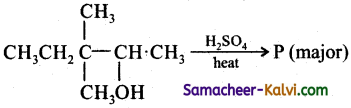
TN State Board 11th Chemistry Important Questions Chapter 13 Hydrocarbons 177

What is the major product ‘P’ in the above reaction?

(a) TN State Board 11th Chemistry Important Questions Chapter 13 Hydrocarbons 178
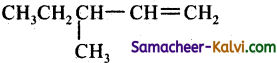
(b) TN State Board 11th Chemistry Important Questions Chapter 13 Hydrocarbons 179

(c) TN State Board 11th Chemistry Important Questions Chapter 13 Hydrocarbons 180

(d) TN State Board 11th Chemistry Important Questions Chapter 13 Hydrocarbons 181
Answer:

(d) TN State Board 11th Chemistry Important Questions Chapter 13 Hydrocarbons 181

Hint:

TN State Board 11th Chemistry Important Questions Chapter 13 Hydrocarbons 182

Samacheer Kalvi TN State Board 11th Chemistry Important Questions Chapter 13 Hydrocarbons

Question 15.
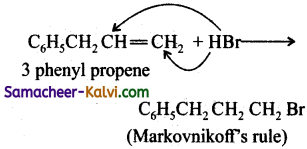
3 – phenyl propene on reaction with HBr gives as a major product:

(a)TN State Board 11th Chemistry Important Questions Chapter 13 Hydrocarbons 183
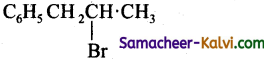
(b) TN State Board 11th Chemistry Important Questions Chapter 13 Hydrocarbons 184

(c) C6H5 CH2 CH2 CH2 Br

(d) TN State Board 11th Chemistry Important Questions Chapter 13 Hydrocarbons 185

Answer:

(b) TN State Board 11th Chemistry Important Questions Chapter 13 Hydrocarbons 184

Hint:

TN State Board 11th Chemistry Important Questions Chapter 13 Hydrocarbons 186

Question 16.
CHCHCH = CH + HBr TN State Board 11th Chemistry Important Questions Chapter 13 Hydrocarbons 187 [X] (major) + [Y] (minor) [X] and [Y] respectively are:
(a) BrCH2CH2CH = CH2 and C2H5CH(Br) . CH3
(b) C2H5 CH2 CH2 Br and – CH2 CH2 – CH = CH2
(c) C2H5 CH2 CH2 Br and C2H5 CH (Br) . CH3
(d) C2H5 CH (Br) . CH3 and C2H5 CH2 CH2 Br
Answer:
(c) C2H5 CH2 CH2 Br and C2H5 CH (Br) . CH3
Hint:
X is formed by the anti Markovnikoff’s addition. i.e., CH3 CH2 CH2 CH2 Br (X) as the major product. C2H5 CH (Br). CH3 is fonned as a minor product.

Samacheer Kalvi TN State Board 11th Chemistry Important Questions Chapter 13 Hydrocarbons

Question 17.
Which of these will not react with acetylene?
(a) NaOH
(b)ammonical AgNO3
(c)Na
(d)HCl
Answer:
(a) NaOH
Hint:
HC ≡ CH + NaOH (weaker base) → HC ≡ CNa (Stroinger base) + H2O
A weaker base cannot displace a stronger base.

Question 18.
Predict the product (c) in the following reaction of butyne – 1

TN State Board 11th Chemistry Important Questions Chapter 13 Hydrocarbons 188

(a) TN State Board 11th Chemistry Important Questions Chapter 13 Hydrocarbons 189

(b) TN State Board 11th Chemistry Important Questions Chapter 13 Hydrocarbons 190

(c) TN State Board 11th Chemistry Important Questions Chapter 13 Hydrocarbons 191

(d) TN State Board 11th Chemistry Important Questions Chapter 13 Hydrocarbons 192

Answer:

(a) TN State Board 11th Chemistry Important Questions Chapter 13 Hydrocarbons 189

Hint:
Addition of both HCl and HI occurs in accordance with Markovniff’s rule.
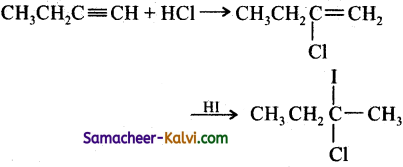
TN State Board 11th Chemistry Important Questions Chapter 13 Hydrocarbons 193

Samacheer Kalvi TN State Board 11th Chemistry Important Questions Chapter 13 Hydrocarbons

Question 19.
When 2 – butyne is treated with dilute H2SO4 / HgSO4, the product formed is:
(a) butanol – 1
(b) butanol – 2
(c) 2 – butanone
(d) butanal
Answer:
(c) 2 – butanone
Hint:
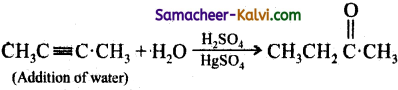
TN State Board 11th Chemistry Important Questions Chapter 13 Hydrocarbons 194

Question 20.
Which of the following reagents will be able to j distinguish between 1 -butyne and 2-butyne?

(a) NaNH2
(b) HCl
(c) O2
(d) Br2
Answer:
(a) NaNH2
Hint:
1 – Butyne being a terminal alkyne has an acidic hydrogen. Hence reacts with sodium in liquid ammonia (NaNH2) to evolve NH3 gas but 2 – butyne does not.

Samacheer Kalvi TN State Board 11th Chemistry Important Questions Chapter 13 Hydrocarbons

Question 21.
The molecular formula of diphenyl methane is C13H12. It is represented as

TN State Board 11th Chemistry Important Questions Chapter 13 Hydrocarbons 195

How many structural isomers are possible when one of the hydrogens are replaced by chlorine atom?
(a) 4
(b) 8
(c) 7
(d) 8
Answer:
(a) 4
Hint:
One hydrogen in CH2, ortho, meta and para hydrogens. Hence 4.

Question 22.
Which of the following compounds is not aromatic?

(a) TN State Board 11th Chemistry Important Questions Chapter 13 Hydrocarbons 196

(b) TN State Board 11th Chemistry Important Questions Chapter 13 Hydrocarbons 197

(c) TN State Board 11th Chemistry Important Questions Chapter 13 Hydrocarbons 198

(d) TN State Board 11th Chemistry Important Questions Chapter 13 Hydrocarbons 199

Answer:

(c) TN State Board 11th Chemistry Important Questions Chapter 13 Hydrocarbons 198

Hint:
Has a cyclic cloud of 2π electrons and hence aromatic, (b) and (c) have a cyclic cloud of six pi electrons and hence aromatic, (c) has 4π electrons and hence anti-aromatic.

Samacheer Kalvi TN State Board 11th Chemistry Important Questions Chapter 13 Hydrocarbons

Question 23.
The radical, TN State Board 11th Chemistry Important Questions Chapter 13 Hydrocarbons 200 is aromatic because it has:
(a) seven ‘p’ orbitals and seven unpaired electrons
(b) six ‘p’ orbitals and seven unpaired electrons
(c) six ‘p’ orbitals and six unpaired electrons
(d) seven ‘p’ orbitals and six unpaired, electrons
Answer:
(c) six ‘p’ orbitals and six unpaired electrons
Hint:
six ‘p’ orbitals and six pi- electrons from a cyclic electron cloud containing 6π i.e.,(4n + 2) π electron which is responsible for aromatic character. The seventh electron as such has nothing to do with the aromatic character of benzyl radical.The enthalpy of hydrogenation of these compounds will be in the order of:

Question 24.
Given
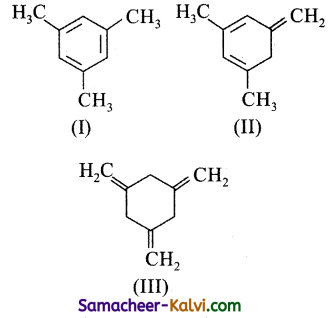
TN State Board 11th Chemistry Important Questions Chapter 13 Hydrocarbons 201

The enthalpy of hydrogenation of these compounds will be in the order of:
(a) II > III > I
(b) II > I > III
(c) I > II > III
(d) III > II > I
Answer:
(d) III > II > I
Hint:
The enthalpy of hydrogenation is inversely proportional to its stability.
i.e., Lower the stability, greater is its enthalpy of hydrogenation.
(I) is aromatic and hence most stable.
(II) is less stable than (I) because it is a cyclic conjugated diene.
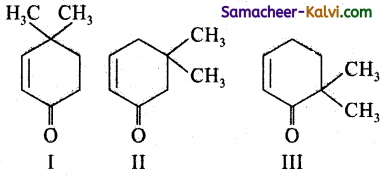
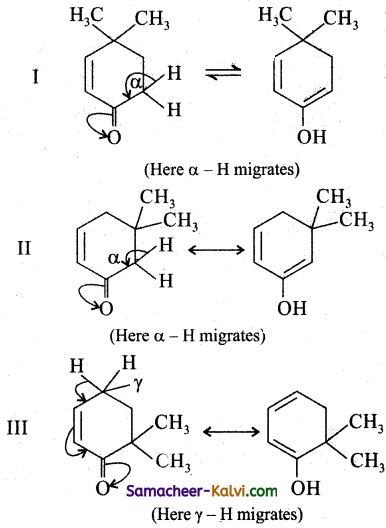
(III) is least stable because it is neither aromatic nor a cyclic conjugated diene. Hence, the stability of alkenes decrease in the order I > II > III and the enthalpy of hydrogenation in the order III > II > I.

Samacheer Kalvi TN State Board 11th Chemistry Important Questions Chapter 13 Hydrocarbons

Question 25.
Among the following compounds, the one that is most reactive towards electrophilic nitration is: 2012)
(a) benzoic acid
(b) nitrobenzene
(c) toluene
(d) benzene
Answer:
(c) toluene
Hint:
Toluene has electron releasing methyl group while others have electron with -drawing groups. Hence toluene is most reactive among others towards electrophilic substitution reaction.

Question 26.
Find the major product in the following reaction:
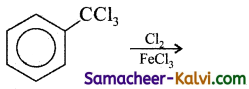
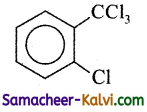
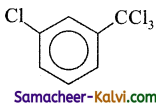
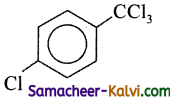
TN State Board 11th Chemistry Important Questions Chapter 13 Hydrocarbons 202

(a) TN State Board 11th Chemistry Important Questions Chapter 13 Hydrocarbons 203

(b) TN State Board 11th Chemistry Important Questions Chapter 13 Hydrocarbons 204

(c) TN State Board 11th Chemistry Important Questions Chapter 13 Hydrocarbons 205

(d) TN State Board 11th Chemistry Important Questions Chapter 13 Hydrocarbons 206

Answer:

(b) TN State Board 11th Chemistry Important Questions Chapter 13 Hydrocarbons 204

Hint:
– CCl3 is meta directing.

Samacheer Kalvi TN State Board 11th Chemistry Important Questions Chapter 13 Hydrocarbons

Assertion-Reason type Questions:

Question 27.
Assertion:
Boiling points of cis isomers are higher than those of trans isomers.
Reason:
Dipole moments of cis isomers are higher than these of trans isomers.
(a) Both assertion and reason are true and reason is the correct explanation of assertion.
(b) Both assertion and reason are true but reason is not the correct explanation of assertion.
(c) Assertion is true but reason is false.
(d) Both assertion and reasons are false.
Answer:
(a) Both assertion and reason are true and reason is the correct explanation of assertion.

Question 28.
Assertion:
Propene is more reactive thanethene towards electrophilic addition reactions.
Reason:
Hyper conjugation effect of the methyl group increases the electron density in the double bond.
(a) Both assertion and reason are true and reason is the correct explanation of assertion.
(b) Both assertion and reason are true but reason is not the correct explanation of assertion.
(c) Assertion is true but reason is false.
(d) Both assertion and reasons are false.
Answer:
(a) Both assertion and reason are true and reason is the correct explanation of assertion.

Samacheer Kalvi TN State Board 11th Chemistry Important Questions Chapter 13 Hydrocarbons

Question 29.
Assertion:
The C – H bond in ethyne is shorter than C – H bond in ethane.
Reason:
The hydrogen atoms in ethyne are acidic.
(a) Both assertion and reason are true and reason is the correct explanation of assertion.
(b) Both assertion and reason are true but reason is not the correct explanation of assertion.
(c) Assertion is true but reason is false.
(d) Both assertion and reasons are false.
Answer:
(b) Both assertion and reason are true but reason is not the correct explanation of assertion.
Hint:
The C – H bond in ethyne is sp2 hybridised and that in ethane sp3 hybridised. The sp2 hybridised carbon is more electronegative than sp3 hybridised carbon.

Question 30.
Assertion:
Benzene does not decolorise bromine water.
Reason:
Benzene contains three double bonds.
(a) Both assertion and reason are .true and reason is the correct explanation of assertion.
(b) Both assertion and reason are true but reason is not the correct explanation of assertion.
(c) Assertion is true but reason is false.
(d) Both assertion and reasons are false.
Answer:
(c) Assertion is true but reason is false.
Hint:
The correct reason is that the pi electrons of benzene are delocalised.

Samacheer Kalvi TN State Board 11th Chemistry Important Questions Chapter 13 Hydrocarbons

Question 31.
Assertion:
Friedel – Craft’s reaction is used to introduce an alkyl or allyl group into the benzene ring.
Reason:
Benzene is a solvent for the Friedel – Craft’s alkylation of bromo benzene.
(a) Both assertion and reason are true and reason is the correct explanation of assertion.
(b) Both assertion and reason are true but reason is not the correct explanation of assertion.
(c) Assertion is true but reason is false.
(d) Both assertion and reason are false.
Answer:
(c) Assertion is true but reason is false.
Hint:
Benzene is more reactive than bromobenzene. Hence, Friedel-Craft’s reaction will occur preferentially in benzene rather than bromo benzene and hence benzene cannot be used as a solvent in this reaction.

Question 32.
Which of the following will not show geometrical isomerism?

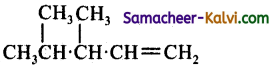
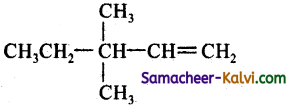
(a) TN State Board 11th Chemistry Important Questions Chapter 13 Hydrocarbons 207
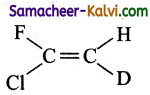
(b) TN State Board 11th Chemistry Important Questions Chapter 13 Hydrocarbons 208

(c) TN State Board 11th Chemistry Important Questions Chapter 13 Hydrocarbons 209

(d) TN State Board 11th Chemistry Important Questions Chapter 13 Hydrocarbons 210

Answer:

(d) TN State Board 11th Chemistry Important Questions Chapter 13 Hydrocarbons 210

Samacheer Kalvi TN State Board 11th Chemistry Important Questions Chapter 13 Hydrocarbons

Question 33.
Pick out the alkanes which differs from the other members of the group.
(a) 2, 2, dimethyl propane
(b) pentane
(c) 3, methyl butane
(d) 2, 2, dimethyl butane
Answer:
(d) 2, 2, dimethyl butane
Hint:
(a), (b), (c) are all isomers but ‘d’ is not.

Question 34.
Methane can be converted into ethane by the following reactions:
(a) chlorination followed by the reaction with alcoholic KOH.
(b) Chlorination followed by the reaction with aq. KOH.
(c) Chlorination followed by wurtz reaction.
(d) Chlorination followed by decarboxylation.
Answer:
(c) Chlorination followed by wurtz reaction.
Hint:
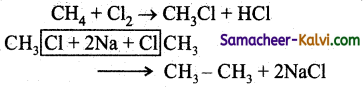
TN State Board 11th Chemistry Important Questions Chapter 13 Hydrocarbons 211

Samacheer Kalvi TN State Board 11th Chemistry Important Questions Chapter 13 Hydrocarbons

Question 35.
Which of the following pairs of alkynes contain only acidic hydrogen atoms?
(a) CH ≡ CH and CH3 C . CH3
(b) CH3 C ≡ CH and CH ≡ CH
(c) CH3C = C . CH3 and CH3CH2C = C CH3
(d) CH2 = CH2 and CH ≡ CH.
Answer:
(b) CH3 C ≡ CH and CH ≡ CH

Question 36.
Among the following, the pair of alkynes which show position isomerism is:
(a) But – 1 – yne and But – 2 – yne
(b) Pent – 1 – yne and 3 methyl but – 1 – yne
(c) But – 1 – yne and But – 3 – diene
(d) Propyne and Cyclopropene.
Answer:
(a) But – 1 – yne and But – 2 – yne
Hint:
CH3CH2C = CH and CH3C ≡ C . CH3 are position isomers.
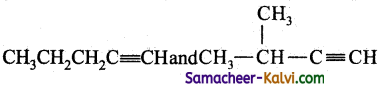
TN State Board 11th Chemistry Important Questions Chapter 13 Hydrocarbons 212 are chain isomers.
CH3CH2 C ≡ CH and CH2 = CH — CH = CH2 are functional isomers.
CH3C ≡ CH and TN State Board 11th Chemistry Important Questions Chapter 13 Hydrocarbons 213 are ring chain isomers.

Samacheer Kalvi TN State Board 11th Chemistry Important Questions Chapter 13 Hydrocarbons

Question 37.
Assertion:
Melting point of neopentane is higher than that of n – pentane but the boiling point of n – pentane is higher than that of neopentane.
Reason:
Melting point depends upon packing of molecules in the crystal lattice while boiling point depends upon the surface area of the molecule.
(a) If both assertion and reason are true, and reason is the correct explanation of assertion.
(b) If both assertion and reason are true, but reason is not the correct explanation of assertion.
(c) If assertion is true, but reason is false.
(d) If both assertion and reason are false.
Answer:
(a) If both assertion and reason are true, and reason is the correct explanation of assertion.

Question 38.
Assertion:
The C — H bond in ethyne is shorter than C — H bonds in ethene.
Reason:
Carbon atoms in ethene is sp hybridised while it is sp2 hybridised in ethyne.
(a) If both assertion and reason are true, and reason is the correct explanation of assertion.
(b) If both assertion and reason are true, but reason is not the correct explanation of assertion.
(c) If assertion is true, but reason is false.
(d) If both assertion and reason are false.
Answer:
(c) If assertion is true, but reason is false.
Hint:
Correct reason: carbon atom in ethene is sp2 hybridised while it is sp in ethyne.

Samacheer Kalvi TN State Board 11th Chemistry Important Questions Chapter 13 Hydrocarbons

Question 39.
Assertion :
Acetylene on treating with NaNH2 gives sodium acetylide and ammonia.
Reason : sp hybridised carbon atoms | of acetylene are considerably
electronegative.
(a) If both assertion and reason are true, and reason is the correct explanation of assertion.
(b) If both assertion and reason are true, but reason is not the correct explanation of assertion.
(c) If assertion is true, but reason is false.
(d) If both assertion and reason are false.
Answer:
(b) If both assertion and reason are true, but reason is not the correct explanation of assertion.
Hint:
Correct reason: Acetylene is a stronger acid than ammonia.

Question 40.
Assertion:
Friedel crafts reaction is used to introduce an alkyl or alyl group in benzene nucleus.
Reason:
Benzene is a software for the Friedel-crafts alkylation of bromo benzene. (AIIMS – 2008)
(a) If both assertion and reason are true, and reason is the correct explanation of assertion.
(b) If both assertion and reason are true, but reason is not the correct explanation of assertion.
(c) If assertion is true, but reason is false.
(d) If both assertion and reason are false.
Answer:
(c) If assertion is true, but reason is false.
Hint:
Correct reason: Since benzene is more reactive than bromobenzene Friedel – crafts reaction occur preferential in benzene, rathar than in bromobenzene and hence benzene cannot be used as a solvent in this reaction.

Samacheer Kalvi TN State Board 11th Chemistry Important Questions Chapter 13 Hydrocarbons

Question 41.
Assertion:
The reaction of conc.HNO3 and conc.H2SO4 on nitrobenzene gives m-dinitrobenzene.
Reason:
The nitro group in benzene ring decreases the electron density in the benzene ring.
(a) If both assertion and reason are true, and reason is the correct explanation of assertion.
(b) If both assertion and reason are true, but reason is not the correct explanation of assertion.
(c) If assertion is true, but reason is false.
(d) If both assertion and reason are false.
Answer:
(b) If both assertion and reason are true, but reason is not the correct explanation of assertion.
Hint:
Correct reason:
The nitro group in nitro benzene decreases the electron density at ortho and para positions. Hence the meta position in relatively high in electron density, i.e., NO2 group is theta directing.

Question 42.
Choose the correct statements from the following sentences.
Presence of a nitro group in a benzene ring.
(a) Deactivates the ring towards electrophilic substitution reaction.
(b) Activates the ring towards electrophilic Substitution reactions.
(c) Renders the ring basic.
(d) Deactivates the ring toward nucleophilic substitution ring.
Answer:
(a) Deactivates the ring towards electrophilic substitution reaction.

Samacheer Kalvi TN State Board 11th Chemistry Important Questions Chapter 13 Hydrocarbons

Question 43.
Identify the incorrect statement with regard to the structure of benzene.
(a) Benzene is a planar molecule.
(b) All C — C bonds in benzene have equal bond length due to resonance.
(c) Benzene exhibits resonance.
(d) Benzene contains three double bonds and three single bonds.
Answer:
(d) Benzene contains three double bonds and three single bonds.
Hint:
Benzene has delocalised pi electrons.

Question 44.
Which of the following reactions does not produce methane as a product?
(a) Decarboxylation of sodium acetate
(b) Electrolysis of potassium acetate
(c) Reduction of methyl bromide with zinc and hydrochloric acid.
(d) Hydrolysis of aluminium carbide.
Answer:
(b) Electrolysis of potassium acetate
Hint:
Electrolysis of CH3COOK produces ethane.

Samacheer Kalvi TN State Board 11th Chemistry Important Questions Chapter 13 Hydrocarbons

Question 45.
Choose the correct statement with regard to the boiling points of alkenes.
(a) The boiling point of straight chain alkane decreases regularly with their molecular mass.
(b) The branched chain alkane has a higher boiling point than the corresponding n – alkane.
(c) The boiling point of 2, 2, dimethyl propane is lower than these of 2 – methyl butane.
(d) The increase in boiling point of alkanes is
Answer:
(c) The boiling point of 2, 2, dimethyl propane is lower than these of 2 – methyl butane.
Hint:
Among isomeric alkanes, the branched chain isomer has a lower boiling point than the corresponding n-alkane. This is because, with branching the shape of the molecule tends to approach that of a sphere. Hence, surface area j of branched chain isomer decreases and so, magnitude of vanderwaals forces decrease.

As a result ion energy is required to break the force of attraction. 2, 2, dimethyl propane with two branches has a lower boiling point than that of 2-methyl butane which has one branch chain.

Question 46.
Choose the incorrect state with respect to electrophilic substitution reactions of benzene.
(a) In the bromination of benzene, a Lewis acid is used to generate the electrophile.
(b) In the nitration reactions, the electrophile is NO2+ (nitronium ion).
(c) In sulphonation reactions, the electrophile, SO3 is produced by the reaction.
2 H2SO4 ⇌ SO3 + HSO4 + H3O+
(d) The pi electrons of the benzene ring are tightly held and acts as a source for nucleophiles.
Answer:
(d) The pi electrons of the benzene ring are tightly held and acts as a source for nucleophiles.
Hint:
The pi electrons of the benzene ring are loosely held and easily available for electrophilic attack.

Samacheer Kalvi TN State Board 11th Chemistry Important Questions Chapter 13 Hydrocarbons

Question 47.
Match the entities of column I with appropriate entities of column II

Column I Column II

Column I  Column II
(i) Formation of methane by heating sodium ethanoate with soda lime  (A) Dehydration
(ii) Formation of ethene by distilling ethane with cone H<sub>2</sub>SO<sub>4</sub>  (B) Hydration
(iii) Formation of propan-2-ol by heating propene with conc. H<sub>2</sub>SO<sub>4</sub>  (C) Polymerisation
(iv) Formation of polythene from ethene (D) Decarboxylation

due to increase in molecular mass.
(a) (i) – (D), (ii) – (A), (iii) – (B), (iv) – (C)
(b) (i) – (A), (ii) – (C), (iii) – (D), (iv) – (B)
(c) (i) – (B ),(ii) – (D), (iii) – (A), (iv) – (C)
(d) (i) – (C), (ii) – (D), (iii) – (A), (iv) – (B)
Answer:
(i) – (D), (ii) – (A), (iii) – (B), (iv) – (C)

Samacheer Kalvi TN State Board 11th Chemistry Important Questions Chapter 13 Hydrocarbons

Question 48.
Match the entities of column I with appropriate entities of column II

Column I  Column II
(i) n-Butane and 2-methyl propane  (A) position isomers
(ii) But – 1 – ene and But – 2 – ene  (B) geometrical isomers
(iii) cis butene and trans butene  (C) functional isomers
(iv) Ethyl alcohol and dimethyl ether  (D) chain isomers

(a) (i) – (D), (ii) – (A), (iii) – (B), (iv) – (C)
(b) (i) – (A), (ii) – (C), (iii) – (D), (iv) – (B)
(c) (i) – (B), (ii) – (A), (iii) – (D), (iv) – (C)
(d) (i) – (D), (ii) – (B), (iii) – (C), (iv)- (A)
Answer:
(a) (i) – (D), (ii) – (A), (iii) – (B), (iv) – (C)
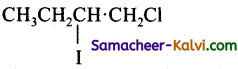
TN Board 11th Chemistry Important Questions

TN Board 11th Chemistry Important Questions Chapter 12 Basic Concepts of Organic Reactions

TN State Board 11th Chemistry Important Questions Chapter 12 Basic Concepts of Organic Reactions

Question 1.
Explain with example, homolytic and heterolytic cleavage of a covalent bond.
Answer:
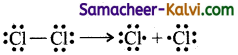
(i) Homolytic cleavage:
In this type of cleavage a covalent bond breaks symmetrically such that each of the bonded atom retains one electron.

eg: TN State Board 11th Chemistry Important Questions Chapter 12 Basic Concepts of Organic Reactions 1

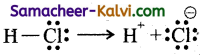
(ii) Heterolytic cleavage:
In this type of cleavage, a covalent bond breaks unsymmetrically such that one of the bonded atoms retains the bond pair of electrons.

eg: TN State Board 11th Chemistry Important Questions Chapter 12 Basic Concepts of Organic Reactions 2

Samacheer Kalvi TN State Board 11th Chemistry Important Questions Chapter 12 Basic Concepts of Organic Reactions

Question 2.
Explain the formation of tetra-butyl carbonium ion from tert butyl bromide.
Answer:
The carbon-bromine (— C — Br) bond is k polar covalent bond in tert-butylbromide due to greater electronegativity of bromine compound to that of carbon, i.e., As a result, the bromine atom acquires a slight negative charge and carbon atom a slight positive charge.

The — C — Br bond undergoes heterolytic fission, during a substitution reaction to form . tert-butyl carbocation which is more stable.

TN State Board 11th Chemistry Important Questions Chapter 12 Basic Concepts of Organic Reactions 3

Question 3.
Give an example for the formation of carbanion.
Answer:
Carbanions are negatively charged carbon atom in an organic compound formed by the heterolytic cleavage of a C — H bond.

eg: TN State Board 11th Chemistry Important Questions Chapter 12 Basic Concepts of Organic Reactions 4

Carbanions are reaction intermediates formed during organic reactions.

Samacheer Kalvi TN State Board 11th Chemistry Important Questions Chapter 12 Basic Concepts of Organic Reactions

Question 4.
Explain the hybridization of carbon in carbocation.
Answer:
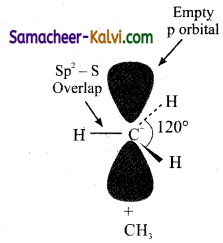
The carbon atom in a carbocation has a positive charge, and is sp2 hybridised. Hence, it has a planar structure. It is formed during an organic reaction as an intermediate.

TN State Board 11th Chemistry Important Questions Chapter 12 Basic Concepts of Organic Reactions 5

In the above structure, the three C — H bonds are formed by the overlap of the sp2 hybrid orbital of the carbon atom and Is orbital of hydrogen atom, each having one unpairedelectrons. The unhybridised ‘p’ orbital lies above and below the plane. The angle between H — C — H bond is 120°.

Question 5.
What is the shape of carbanion?
Answer:
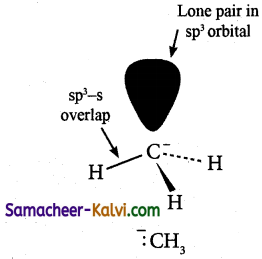
The negatively charged carbon (carbanion) is sp3 hybridised. The hybrid orbitals are directed towards the comers of a tetrahedron. Three hybrid orbitals are involved in the formation of three sigma bonds with other atoms. While the fourth hybrid orbital contain lone pair of electrons. The lone-pair, bond-pair repulsion results in a pyramidal shape for the carbanion.

TN State Board 11th Chemistry Important Questions Chapter 12 Basic Concepts of Organic Reactions 6

Samacheer Kalvi TN State Board 11th Chemistry Important Questions Chapter 12 Basic Concepts of Organic Reactions

Question 6.
Briefly mention the types of electron movements which are used to explain organic reactions.
Answer:
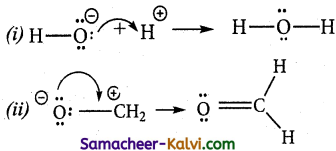
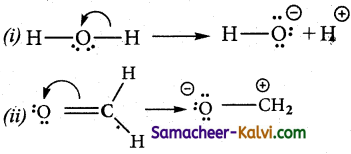
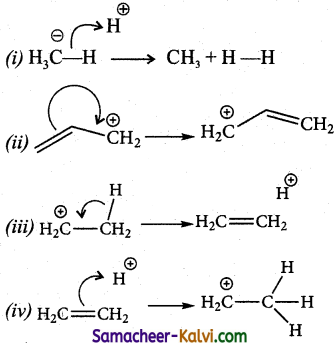
There are three types of electron movement viz.,
Type 1:
A lone pair to a bonding pair:

TN State Board 11th Chemistry Important Questions Chapter 12 Basic Concepts of Organic Reactions 7

Type 2:
A bonding pair to a lone pair:

TN State Board 11th Chemistry Important Questions Chapter 12 Basic Concepts of Organic Reactions 8

Type 3:
A bonding pair to an another bonding pair:

TN State Board 11th Chemistry Important Questions Chapter 12 Basic Concepts of Organic Reactions 9

Samacheer Kalvi TN State Board 11th Chemistry Important Questions Chapter 12 Basic Concepts of Organic Reactions

Question 7.
What is a free radical? How is it formed? Indicate the type of hybridization in an alkyl free radical.
Answer:
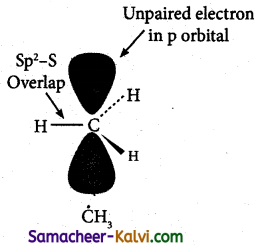
(i) Free radicals are neutral species.
(ii) They are formed by the homolytic fission of a covalent bond in such a way that each bonded atom retains one of the bond pair of electrons.
eg: H – H → H. + H.
H3C – H → H3C . + .H

(iii) The carbon atom in an alkyl free radical is sp2 hybridised. An alkyl free radical may be either planar or pyramidal. The odd electron present in the unhybridised ‘p’ orbital.

TN State Board 11th Chemistry Important Questions Chapter 12 Basic Concepts of Organic Reactions 10

Question 8.
Explain inductive effect with an example.
Answer:
(i) Inductive effect is defined as the change in the polarisation of a covalent bond – due to the presence of adjacent bonds atoms or groups in the molecule. This is a permanent phenomenon.
(ii) The C – Cl bond in ethyl chloride is a polar covalent bond because chlorine is more electronegative than carbon. As a result, Chlorine acquires a small negative charge and the carbon atom acquires small
positive charge.

TN State Board 11th Chemistry Important Questions Chapter 12 Basic Concepts of Organic Reactions 11

The positively charged carbon atom (1), draws the shared pair of electrons between itself and C2. This type of polarization effect is called inductive effect.

(iii) The electron displacement in inductive effect is permanent.
(iv) Groups which draws electrons away from the carbon chain but towards the substituents are said to exert -I effect.
eg: F, Cl, COOH, NO2, NH2.

(v) If the electron displacement is towards the carbon chain and away from the substituent, it is known as +1 effect. The groups which cause +I effect are CH3O, C2H5O, COO etc…

Samacheer Kalvi TN State Board 11th Chemistry Important Questions Chapter 12 Basic Concepts of Organic Reactions

Question 9.
Explain how the electromeric effect explains the nucleophilic addition in a carbonyl compound.
Answer:
The carbon-oxygen bond in a carbonyl group contains a σ and π bond. When a nucleophile approaches the carbonyl compound, the pi (π) electron are shifted towards the oxygen atom there by creating a positive charge on the carbon atom, which forms a new bond between the electron deficient carbon atom .and the nucleophile.

TN State Board 11th Chemistry Important Questions Chapter 12 Basic Concepts of Organic Reactions 12

The electro-positive part of the hueleophile forms a bond with the oxygen atom to form the addition product.

Question 10.
Write the resonance structure for 1, 3 butadiene.
Answer:

TN State Board 11th Chemistry Important Questions Chapter 12 Basic Concepts of Organic Reactions 13

Samacheer Kalvi TN State Board 11th Chemistry Important Questions Chapter 12 Basic Concepts of Organic Reactions

Question 11.
Explain +M (positive mesomeric) effect with an example.
Answer:
+M (positive mesomeric) effect arises, when the π electron shift occurs away from the substituent but towards the conjugated system.

eg: TN State Board 11th Chemistry Important Questions Chapter 12 Basic Concepts of Organic Reactions 14

Generally, electron releasing substituents exert +M effect. In the above example, the lone pair of electrons on the oxygen atom, of the hydroxyl group through +M effect moves to the carbon atom which gains a positive charge.

Question 12.
Explain -M (negative mesomeric) effect with an example.
Answer:
When the n electrons shift towards the substituent but away from the conjugated system, it is known as -M (negative mesomeric) effect, eg:

TN State Board 11th Chemistry Important Questions Chapter 12 Basic Concepts of Organic Reactions 15

In this case, the nitro group (electron withdrawing group), through its -M effect pulls the π electron pair towards itself across the conjugated system, giving rise to the resonance structure as shown.
Electron withdrawing substituents like CHO, COOH, CN etc exert -M effect.

Samacheer Kalvi TN State Board 11th Chemistry Important Questions Chapter 12 Basic Concepts of Organic Reactions

Question 13.
Draw the resonance structures of phenol and phenoxide ion.
Answer:
(i) In phenol, the lone pair of electrons on the oxygen atom of the phenolic group enters into conjugation with the benzene ring resulting in the following canonical structures.

TN State Board 11th Chemistry Important Questions Chapter 12 Basic Concepts of Organic Reactions 16

(ii) Phenoxide ion contains a negative charge on the oxygen atom attached to the benzene ring. This negative charge is dispersed throughout the benzene ring by resonance. This enhances the stability of phenoxide ion. The various canonical structures for phenoxide ion is

TN State Board 11th Chemistry Important Questions Chapter 12 Basic Concepts of Organic Reactions 17

Samacheer Kalvi TN State Board 11th Chemistry Important Questions Chapter 12 Basic Concepts of Organic Reactions

Question 14.
Account for the stability of the tertiary, secondary and primary carbocations based on hyper conjugation.
Answer:
The stability of the earbocation decreases in the order.

3° earbocation > 2° earbocation > 1° carbocation

Greater the number of alkyl groups attached to the carbon bearing positive charge, greater is number of the hyper conjugate structure.

Question 15.
Give an example for nucleophilic substitution reaction.
Answer:
In a nucleophilic substitution, a nucleophile (negatively charged reagent or a neutral molecule in which the central atom has a lone pair of electrons) attack a positively charged reactions site, and expel an atom or a group – from the substrate as a negative ion.

TN State Board 11th Chemistry Important Questions Chapter 12 Basic Concepts of Organic Reactions 18

Samacheer Kalvi TN State Board 11th Chemistry Important Questions Chapter 12 Basic Concepts of Organic Reactions

Question 16.
Give an example for electrophilic substitution reaction.
Answer:
Nitration of benzene, in the presence of a mixture of concentrated nitric acid and concentrated sulphuric acid gives nitro benzene. This is an example of electrophilic substitution reaction.

TN State Board 11th Chemistry Important Questions Chapter 12 Basic Concepts of Organic Reactions 19

In this reaction, NO2+ ion (nitronium ion) acts an electrophile, attacks the electron rich carbon atom of the benzene molecule, and expel the hydrogen atom as H+ ion.

TN State Board 11th Chemistry Important Questions Chapter 12 Basic Concepts of Organic Reactions 20

Samacheer Kalvi TN State Board 11th Chemistry Important Questions Chapter 12 Basic Concepts of Organic Reactions

Question 17.
Explain free radical substitution reaction with an example.
Answer:
A free radical substitution reaction is one in which a free radical (reagent) replaces an atom or a group from the substrate molecule, with an odd electron (free radical). Chlorination of methane is an example of free radical substitution reaction.

TN State Board 11th Chemistry Important Questions Chapter 12 Basic Concepts of Organic Reactions 21

In this reaction, the chlorine free radical, replaces hydrogen atom from CH4 as shown above.
Free radical substitution reactions occur through a chain reaction, which involves the following steps.
(i) initiation
(ii) propagation and
(iii) termination.

Question 18.
Give a brief account of addition reactions.
Answer:
Addition reactions are those in which the attacking species adds up to the substrate molecule to give a single product molecule. Usually, double or triple bonded compounds undergo addition reactions. In these reactions, a triple bond is converted to a double bond, and double bonds are converted to single bonds. For each pi(π) bond of the molecule, two sigma(σ) bonds are formed and the hybridisation of the carbon atom changes from sp to sp2 and sp2 to sp3.

TN State Board 11th Chemistry Important Questions Chapter 12 Basic Concepts of Organic Reactions 22

Samacheer Kalvi TN State Board 11th Chemistry Important Questions Chapter 12 Basic Concepts of Organic Reactions

Question 19.
Give an example for electrophilic addition reaction.
Answer:
In an electrophilic addition reactions, an electrophile approaches, the double or triple bond in the first step forms a covalent bond with one of the carbon atoms resulting in the formation of a carbocation, which then takes nucleophile to result in the addition product.

TN State Board 11th Chemistry Important Questions Chapter 12 Basic Concepts of Organic Reactions 23

TN State Board 11th Chemistry Important Questions Chapter 12 Basic Concepts of Organic Reactions 24

Question 20.
Give an example for (i) free radical addition reaction, (ii) nucleophilic addition reaction.
Answer:
(i) Free radical addition reaction:
Photo chemically catalysed addition of chlorine to ethylene is an example of free radical addition reactions.

TN State Board 11th Chemistry Important Questions Chapter 12 Basic Concepts of Organic Reactions 25

The mechanism involves the following steps:

TN State Board 11th Chemistry Important Questions Chapter 12 Basic Concepts of Organic Reactions 26

(ii) Nucleophilic addition reaction:
When a nucleophile attacks an electron deficient reaction site, the reaction is known as a nucleophilic addition reaction. Aldehydes and ketones undergo nucleophilic addition reaction.

The carbonyl group in aldehydes and ketones gets polarised due to the presence of highly electronegative oxygen atom as shown below:

TN State Board 11th Chemistry Important Questions Chapter 12 Basic Concepts of Organic Reactions 27

The nucleophile, attacks for the electron deficient carbon atom and forms an intermediate, which is further attacked by the electrophile on the negatively charged oxygen atom to form the addition product.
eg: Addition of HCN.to acetone.

TN State Board 11th Chemistry Important Questions Chapter 12 Basic Concepts of Organic Reactions 28

TN State Board 11th Chemistry Important Questions Chapter 12 Basic Concepts of Organic Reactions 29

Samacheer Kalvi TN State Board 11th Chemistry Important Questions Chapter 12 Basic Concepts of Organic Reactions

Question 21.
What are elimination reactions? Give an example.
Answer:
An elimination reaction is one which involves the loss of two atoms or groups from the same or adjacent carbon atom resulting in the formation of π bonds (double or triple). In an elimination reactions, the hybridised state of carbon get changed. Whenever an elimination reaction involves the formation of alkene, the sp3 hybridised state of carbon is changed to sp2 hybridised state.

eg: Base catalysed dehydrohalogenation of alkyl halide to give an alkene.

TN State Board 11th Chemistry Important Questions Chapter 12 Basic Concepts of Organic Reactions 30

Question 22.
Write a short note on oxidation reduction reaction in organic chemistry.
Answer:
Organic reactions involving addition of oxygen to a substrate are known as oxidation reaction and these involve addition of hydrogen to the substrate is known as reduction reaction. They are brought about by oxidising and reducing agents. General oxidising agents used are acidified KMnO4, acidified K2Cr2O7, H2SO4 etc., Mostly used reducing agents are sodium and ethanol, Lithium aluminium hydride, Zn and HCl, Sn and HCl etc.

eg: Oxidation

TN State Board 11th Chemistry Important Questions Chapter 12 Basic Concepts of Organic Reactions 31

eg: Reduction

TN State Board 11th Chemistry Important Questions Chapter 12 Basic Concepts of Organic Reactions 32

Samacheer Kalvi TN State Board 11th Chemistry Important Questions Chapter 12 Basic Concepts of Organic Reactions

Question 23.
How will you convert
(i) an alcohol to aldehyde
(ii) an alcohol to Ketone
Answer:

TN State Board 11th Chemistry Important Questions Chapter 12 Basic Concepts of Organic Reactions 33

Question 24.
What are the various steps involved in the conversion of an alkyl cyanide to a carboxyl acid?
Answer:

TN State Board 11th Chemistry Important Questions Chapter 12 Basic Concepts of Organic Reactions 34

Question 25.
How will you convert (i) an alkyl halide to alcohol (ii) an alkene to alcohol (iii) an alkyl halide to alkene.
Answer:

TN State Board 11th Chemistry Important Questions Chapter 12 Basic Concepts of Organic Reactions 35

Samacheer Kalvi TN State Board 11th Chemistry Important Questions Chapter 12 Basic Concepts of Organic Reactions

Choose the correct answer:

Question 1.
Homolytic fission of a covalent bond produces:
(a) cation
(b) anion
(c) both cation and anion
(d) free radical
Answer:
(d) free radical

Question 2.
In the compound, CH,C – Cl, the TN State Board 11th Chemistry Important Questions Chapter 12 Basic Concepts of Organic Reactions 36 bond undergoes heterolytic fission. The species formed are:
(a) TN State Board 11th Chemistry Important Questions Chapter 12 Basic Concepts of Organic Reactions 37

(b) TN State Board 11th Chemistry Important Questions Chapter 12 Basic Concepts of Organic Reactions 38

(c) TN State Board 11th Chemistry Important Questions Chapter 12 Basic Concepts of Organic Reactions 39

(d) both (a) and (b)
Answer:
(d) both (a) and (b)

TN State Board 11th Chemistry Important Questions Chapter 12 Basic Concepts of Organic Reactions 40

Hint:
depending on the energy supplied to break the bond.

Samacheer Kalvi TN State Board 11th Chemistry Important Questions Chapter 12 Basic Concepts of Organic Reactions

Question 3.
Choose the correct statement:
(a) The carbon atom in an alkyl free radical is sp3 hybridised.
(b) The carbon atom in a carbocation is sp3 hybridised.
(c) The carbocation has a planar structure.
(d) The carbon atom in an alkyl carbanion is sp2 hybridised.
Answer:
(c) The carbocation has a planar structure.
Hint:
The carbon atom in an alkyl carbon cation is sp2 hybridised and has a planar structure.

Question 4.
Choose the correct statement:
The stability of:
(a) Carbocation is achieved by decreasing the positive charge on the carbon.
(b) The stability of the carbocation is achieved by increasing the positive charge on the carbon atom.
(c) Among (CH3)3 C+ and (CH3)2CH+, the latter is more stable.
(d) Both (a) and (c)
Answer:
(a) Carbocation is achieved by decreasing the positive charge on the carbon.
Hint:
The stability of carbocation is influenced by both resonance and inductive effects. An alkyl group has electron releasing inductive effect. An alkyl group attached to the positively charged carbon atom tends to release electrons towards that carbon atom.

In doing so, it reduces the positive charge, on the carbon. In other words, the positive charge gets dispersed as a result, the alkyl group becomes somewhat positively charged itself. The dispersal of charge stabilizes the cafbocation. More the number of alkyl groups, more is the stability of the carbonation.

Samacheer Kalvi TN State Board 11th Chemistry Important Questions Chapter 12 Basic Concepts of Organic Reactions

Question 5.
Which of the following Carbocation would have the greatest stability?
(a) TN State Board 11th Chemistry Important Questions Chapter 12 Basic Concepts of Organic Reactions 41

(b) TN State Board 11th Chemistry Important Questions Chapter 12 Basic Concepts of Organic Reactions 42

(c) TN State Board 11th Chemistry Important Questions Chapter 12 Basic Concepts of Organic Reactions 43

(d) TN State Board 11th Chemistry Important Questions Chapter 12 Basic Concepts of Organic Reactions 44
Answer:
(b) TN State Board 11th Chemistry Important Questions Chapter 12 Basic Concepts of Organic Reactions 42
Hint:
The lone pair of electrons present in s is present in 3p orbital, while these of N, O and F are present in 2p orbital. Further the carbon atom bearing the positive charge has an empty 2p orbital. Effective resonance stabilisation occurs between orbitals of similar sizes. Hence, least resonance stabilisation occurs between S and C atoms. Among N, O and F, Nitrogen is least electronegative. Hence most effective resonance stabilisation occurs between N and C.

TN State Board 11th Chemistry Important Questions Chapter 12 Basic Concepts of Organic Reactions 45

Question 6.
In which of the following compounds, C – Cl bond ionization shall give most stable carbonium ion?
(a) TN State Board 11th Chemistry Important Questions Chapter 12 Basic Concepts of Organic Reactions 46

(b) O2NCH2 – CH2 – Cl

(c) TN State Board 11th Chemistry Important Questions Chapter 12 Basic Concepts of Organic Reactions 47

(d) TN State Board 11th Chemistry Important Questions Chapter 12 Basic Concepts of Organic Reactions 48
Answer:
(d) TN State Board 11th Chemistry Important Questions Chapter 12 Basic Concepts of Organic Reactions 48
Hint:
It gives most stable tertiary carbonium ion.

Samacheer Kalvi TN State Board 11th Chemistry Important Questions Chapter 12 Basic Concepts of Organic Reactions

Question 7.
The ascending order of stability of the carbanion:

TN State Board 11th Chemistry Important Questions Chapter 12 Basic Concepts of Organic Reactions 49

(a) P < R < S < Q
(b) R < P < S < Q
(c) R < P < Q < S
(d) P < R < Q < S
Answer:
(b) R < P < S < Q
Hint:
The stability of carbanion increases with -increase in ‘s’ Character of the carbon atom carrying the negative charge.

eg: TN State Board 11th Chemistry Important Questions Chapter 12 Basic Concepts of Organic Reactions 50

In general, the stability of various carbanions decrease in the order.

TN State Board 11th Chemistry Important Questions Chapter 12 Basic Concepts of Organic Reactions 51

Question 8.
Arrange the carbanions:
(CH3)3C, Cl3C, (CH3)2 CH, C6H5CH2 in order of their decreasing stability.

(a) (CH3)2CH > Cl3C > C6H5CH2 > (CH3)3C

(b) Cl3C > C6H5CH2 > (CH3)2CH > (CH3)3 C

(c) (CH3)3C > (CH3)2CH > C6H5CH2 > Cl3C

(d) C6H5CH2 > Cl3C > (CH3)3C > (CH3)2CH
Answer:
(b) Cl3C > C6H5CH2 > (CH3)2CH > (CH3)3 C
Hint:
Due to -I effect of the three chlorine atoms Cl3C is the most stable. This is followed by C6H5 CH2, which is stabilised by resonance. Out of (CH3)3C and (CH3)2CH, (CH3)2 CH is more stable due to + I effect.
Samacheer Kalvi TN State Board 11th Chemistry Important Questions Chapter 12 Basic Concepts of Organic Reactions

Question 9.
The lone pair of electrons in a carbanion is present in:
(a) sp3 hybrid orbital
(b) sp2 hybrid orbital
(c) empty orbital
(d) none of the above
Answer:
(c) empty orbital

Question 10.
The relative stability of alkyl free radical is in the order:

TN State Board 11th Chemistry Important Questions Chapter 12 Basic Concepts of Organic Reactions 52

Answer:
(a) TN State Board 11th Chemistry Important Questions Chapter 12 Basic Concepts of Organic Reactions 53

Hint:
The order of stability of free radicals can be explained on the basis of hyper conjugation. Greater the number of alkyl groups attached to the carbon atom carrying the odd electron, greater is the delocalisation of the electron and hence more stable the free radical.

Samacheer Kalvi TN State Board 11th Chemistry Important Questions Chapter 12 Basic Concepts of Organic Reactions

Question 11.
Which of the following pairs of species are neutral electrophiles?
(a) NH3 and CI+
(b) CO2 and H3O+
(c) dichloro carbene (: CCl2) and proton
(d) carbon dioxide and dichloro carbene
Answer:
(d) carbon dioxide and dichloro carbene

Question 12.
Three sets of charged species are given. Which one of the following sets act as a nucleophile?
(a) H2O, AlCl3, H+
(b) AlCl3, H3O+, OH
(c) CH3 NH2, CH3OH, I
(d) CH3O, CH3COO, CH3+
Answer:
(c) CH3 NH2, CH3OH, I
Hint:
CH3NH2 and CH3OH are neutral nucleophile, I is negative nucleophile.

Samacheer Kalvi TN State Board 11th Chemistry Important Questions Chapter 12 Basic Concepts of Organic Reactions

Question 13.
The relative stability of alkyl carbanion decreases in the order:
CH3 > 1° > 2 ° > 3°. This is explained by:
(a) inductive effect
(b) resonance effect
(c) both inductive and resonance effect
(d) hyper conjugative effect
Answer:
(a) inductive effect
Hint:
When an alkyl group is attached to a negatively charged carbon atom of the carbanion, it tends to release electrons towards that carbon. Thus it increases the electron density (- ve charge) on the carbon and destabilizes the carbanion. i.e., lesser the negative charge on the carbon atom, greater is its stability.

More the number of alkyl groups around the carbon atom carrying the negative charge, more is the destabilization and hence less stable the carbanion.

Samacheer Kalvi TN State Board 11th Chemistry Important Questions Chapter 12 Basic Concepts of Organic Reactions

Question 14.
The group which show -I effect are:
(a) (CH3)3C
(b) CH3
(c) COO
(d) SO3H
Answer:
(d) SO3H
Hint:
Higher the electronegativity of the substituent, greater is it’s -I effect.

Question 15.
Arrange the following groups in the decreasing order of -I effect.
NO2 (I), CHO (II), F (III), H (IV)
(a) CHO > F > H > NO2
(b) F > CHO > NO2 > H
(c) H > F > CHO > NO2
(d) NO2 > CHO > F > H
Answer:
(d) NO2 > CHO > F > H
Hint:
Higher the electronegativity of the substituent, greater is it’s -I effect.

Samacheer Kalvi TN State Board 11th Chemistry Important Questions Chapter 12 Basic Concepts of Organic Reactions

Question 16.
Among the following which is most acidic?
(a) CH3COOH
(b) ClCH2 COOH
(c) Cl2CHCOOH
(d) Cl3CCOOH
Answer:
(d) Cl3CCOOH
Hint:
When a halogen atom is attached to the carbon which is nearer to the carboxylic acid group, its -I effect withdraws the bonded electrons towards itself and makes the ionisation of H+ easy. The acidity of various chloro acetic acid is in the following order. The strength of the acid increases with increase in the -I effect of the group attached to the carboxyl group.
Trichloro acetic acid > Dichloro acetic acid > Chloro acetic acid > acetic acid

TN State Board 11th Chemistry Important Questions Chapter 12 Basic Concepts of Organic Reactions 54

Question 17.
Which does not represent the correct order of -I effect of the substituent?
(a) I < Cl < Br < F
(b) RS < R2N < RO
(c) R2O+ < R2N+ > R2S
(d) R2O+ > RO > C6H5O
Answer:
(a) I < Cl < Br < F
Hint:
The -I effect of halogens follows the order I < Br < Cl < F.

Samacheer Kalvi TN State Board 11th Chemistry Important Questions Chapter 12 Basic Concepts of Organic Reactions

Question 18.
In which of the following compounds, nucleophilic substitution reaction takes place at a faster rate?
(a) (CH3)3CF
(b) (CH3)3CCl
(c) (CH3)3CBr
(d) (CH3)3CI
Answer:
(a) (CH3)3CF
Hint:
When a highly electronegative atom such as halogen is attached to a carbon then it makes the C — X bond polar. In such cases the – I effect of halogen facilitates the attack of an incoming nucleophile at the polarised carbon, and hence increases the reactivity. The – I effect of halogen follow the order I < Br < Cl < F

Question 19.
The following order of acidity of the carboxylic acids

TN State Board 11th Chemistry Important Questions Chapter 12 Basic Concepts of Organic Reactions 55
is due to
(a) + I Inductive effect
(b) – I Inductive effect
(c) Resonance effect
(d) Both inductive and resonance effect
Answer:
(a) + I Inductive effect
Hint:
The acidity of carboxylic acid to the ionisation of – COOH group as
RCOOH ⇌ RCOO + H+
The + I effect of alkyl groups, increase the electron density around carboxyl carbon, which makes O – H bond stronger and the removal of proton more difficult. Greater the number of alkyl groups attached to the carbon atoms carrying the COOH group, lesser its acidity.

Samacheer Kalvi TN State Board 11th Chemistry Important Questions Chapter 12 Basic Concepts of Organic Reactions

Question 20.
In which of the following, the electron displacement is due to +E electromeric effect?
(a) TN State Board 11th Chemistry Important Questions Chapter 12 Basic Concepts of Organic Reactions 56

(b) TN State Board 11th Chemistry Important Questions Chapter 12 Basic Concepts of Organic Reactions 57

(c) TN State Board 11th Chemistry Important Questions Chapter 12 Basic Concepts of Organic Reactions 58

(d) both (a) and (b)
Answer:
(a) TN State Board 11th Chemistry Important Questions Chapter 12 Basic Concepts of Organic Reactions 56

Hint:
If the electrons due to pi (π) bond are transferred to that atom of the double bond to which the reagent gets finally attached, the effect is called +E effect.

TN State Board 11th Chemistry Important Questions Chapter 12 Basic Concepts of Organic Reactions 59

Question 21.
Which of the following is the most correct electron displacement for a nucleophile reaction to take place?
(a) TN State Board 11th Chemistry Important Questions Chapter 12 Basic Concepts of Organic Reactions 60

(b) TN State Board 11th Chemistry Important Questions Chapter 12 Basic Concepts of Organic Reactions 61

(c) TN State Board 11th Chemistry Important Questions Chapter 12 Basic Concepts of Organic Reactions 62

(d) TN State Board 11th Chemistry Important Questions Chapter 12 Basic Concepts of Organic Reactions 63
Answer:
(a) TN State Board 11th Chemistry Important Questions Chapter 12 Basic Concepts of Organic Reactions 60

Hint:
In, nucleophilic displacement reactions the flow of electron occurs in such a way to break the C – Cl bond and expel Cl as Cl.

Samacheer Kalvi TN State Board 11th Chemistry Important Questions Chapter 12 Basic Concepts of Organic Reactions

Question 22.
Which of the following electron displacement refer to + R or + M effect?
(a) TN State Board 11th Chemistry Important Questions Chapter 12 Basic Concepts of Organic Reactions 64

(b) TN State Board 11th Chemistry Important Questions Chapter 12 Basic Concepts of Organic Reactions 65

(c) TN State Board 11th Chemistry Important Questions Chapter 12 Basic Concepts of Organic Reactions 66

(d) both (b) and (c)
Answer:
(a) TN State Board 11th Chemistry Important Questions Chapter 12 Basic Concepts of Organic Reactions 64

Hint:
Groups which withdraw electrons from the double bond or from a conjugated system towards themselves due to resonance are said to have +R or +M effect.

Question 23.
Resonance effect involves:
(a) Delocalisation of pi – electrons along a conjugated system.
(b) Delocalisation of n – electrons along a conjugated system.
(c) Delocalisation of π – electrons along a conjugated system.
(d) All the above
Answer:
(d) All the above
Hint:
Resonance effect involves delocalisation of non-bonding pi and sigma electrons (hyper conjugation) to the adjacent π bond.

Samacheer Kalvi TN State Board 11th Chemistry Important Questions Chapter 12 Basic Concepts of Organic Reactions

Question 24.
1, 3 – butadiene has the structure TN State Board 11th Chemistry Important Questions Chapter 12 Basic Concepts of Organic Reactions 67
Choose the correct statement.
(1) The bonds between C1 – C2 and C3 – C4 are shorter than that of C2 – C3.
(2) The bond length between all the carbon atoms are the same.
(3) TN State Board 11th Chemistry Important Questions Chapter 12 Basic Concepts of Organic Reactions 68 are the canonical structure of the compound.
(4) The actual structure is a resonance hybrid of the contributing structures

TN State Board 11th Chemistry Important Questions Chapter 12 Basic Concepts of Organic Reactions 69

(a) all
(b) 1, 3, 4
(c) 2, 3, 4
(d) 3, 4
Answer:
(c) 2, 3, 4
Hint:
1, 3 butadiene exhibits resonance. The actual structure is the resonance hybrid of all the contributing structures. Because of resonance all C — C bonds in the compound are equal.

Question 25.
The effect that makes 2, 3 dimethyl 2 butene more stable than 2-butene is:
(a) resonance
(b) hyper conjugation
(c) electromeric effect
(d) inductive effect
Answer:
(b) hyper conjugation
Hint:

TN State Board 11th Chemistry Important Questions Chapter 12 Basic Concepts of Organic Reactions 70

more hyper conjugative structures are possible for 2, 3 dimethyl 2 – butene than 2 butene. Hence it is more stable.

Samacheer Kalvi TN State Board 11th Chemistry Important Questions Chapter 12 Basic Concepts of Organic Reactions

Question 26.
Which of the following compounds show hyper conjugation?
(a) CH2CHCl
(b) CH2CHCN
(c) CH3 CH = CH2
(d) all
Answer:
(c) CH3 CH = CH2
Hint:
In propene, the o-electrons of C – H bond of methyl group can be delocalised into the π – orbital of doubly bonded carbon as represented below.

TN State Board 11th Chemistry Important Questions Chapter 12 Basic Concepts of Organic Reactions 71

In the above structure the sigma bond is involved in resonance and breaks in order to supply electrons for delocalisation giving rise to 3 new canonical forms. In the contributing canonical structures: (II), (III) & (IV) of propene, there is no bond between an a-carbon and one of the hydrogen atoms. Hence the hyperconjugation is also known as “no bond resonance” or “Baker-Nathan effect”. The structures (II), (III) & (IV) are polar in nature.

(ii) Hyper conjugation effect is also observed when atoms / groups having lone pair of electrons are attached by a single bond, and in conjugation with a n bond. The lone pair of electrons enters into resonance and displaces 71 electrons resulting in more than one structure.

TN State Board 11th Chemistry Important Questions Chapter 12 Basic Concepts of Organic Reactions 72

(iii) When electronegative atoms or group of atoms are in conjugation with a 71 -bond, they pull % – electrons from the multiple bond.

TN State Board 11th Chemistry Important Questions Chapter 12 Basic Concepts of Organic Reactions 73

Samacheer Kalvi TN State Board 11th Chemistry Important Questions Chapter 12 Basic Concepts of Organic Reactions

Question 27.
CH3 CH2 Br + aqueous KOH → CH3 CH2 OH + KBr. This is an example of:
(a) nucleophilic substitution reaction
(b) free, radical substitution reaction
(c) electrophilic substitution reaction
(d) nucleophilic addition reaction
Answer:
(a) nucleophilic substitution reaction
Hint:
TN State Board 11th Chemistry Important Questions Chapter 12 Basic Concepts of Organic Reactions 74 (nucleophilic)
OH replaces in CH3CH2 Br. Hence it is nucleophilic substitution reaction.

Question 28.
Which of the following is an example for an elimination reaction?
(a) CH3CH2Br + aq KOH → CH3CH2OH + KBr + H2O
(b) CH3CH2Br + alc. KOH → CH2 = CH2 + KBr + H2O
(c) CH3 – CHO TN State Board 11th Chemistry Important Questions Chapter 12 Basic Concepts of Organic Reactions 75 CH3COOH
(d) CH2 = CH2 + HBr → CH3CH2Br
Answer:
(b) CH3CH2Br + alc. KOH → CH2 = CH2 + KBr + H2O
Hint:
The hydrogen and bromine atom from adjacent carbon atoms are eliminated and a new double bond is created between the two carbon atoms.

Samacheer Kalvi TN State Board 11th Chemistry Important Questions Chapter 12 Basic Concepts of Organic Reactions

Question 29.
Assertion:
Tertiary carbocations are generally formed more easily than primary carbocations.
Reason :
Hyper conjugation as well as inductive effect due to additional alkyl groups stabilise tertiary carbocations. .
(a) Both assertion and reason are true and the reason is the correct explanation of assertion.
(b) Both assertion and reason are true but the reason is not the correct explanation of assertion.
(c) Assertion is true but the reason is false.
(d) Both assertion and reason are false.
Answer:
(a) Both assertion and reason are true and the reason is the correct explanation of assertion.

Question 30.
Assertion:
Alkyl carbanion have pyramidal shape.
Reason :
The carbon atom carrying negative charge has an octet of electrons.
(a) Both assertion and season are true and reason is the correct explanation of assertion.
(b) Both assertion and reason are true but reason is not the correct explanation of assertion.
(c) Assertion is true but reason is false.
(d) Both assertion and reason are false.
Answer:
(b) Both assertion and reason are true but reason is not the correct explanation of assertion.
Hint:
Correct Reason.
Because of lone pair – bond pair repulsion.

TN State Board 11th Chemistry Important Questions Chapter 12 Basic Concepts of Organic Reactions 76

Samacheer Kalvi TN State Board 11th Chemistry Important Questions Chapter 12 Basic Concepts of Organic Reactions

Question 31.
Assertion:
The Chlorine atom attached to 1 – Chloropropane exerts -I effect.
Reason:
Chlorine being more electronegative pulls the electron pair towards itself from the carbon atom to which it is attached.
(a) Both assertion and reason are true and reason is the correct explanation of assertion.
(b) Both assertion and reason are true but reason is not the correct explanation of assertion.
(c) Assertion is true but reason is false.
(d) Both assertion and reason are fals
Answer:
(a) Both assertion and reason are true and reason is the correct explanation of assertion.

Question 32.
Assertion:
Phenol is acidic because the phenoxide ion is more stabilized than phenol by resonance.
Reason:
The ‘OH’ group in phenol exerts -M effect.
(a) Both assertion and reason are true and reason is the correct explanation of assertion.
(b) Both assertion and reason are true but reason is not the correct explanation of assertion.
(c) Assertion is true but reason is false.
(d) Both assertion and reason are false.
Answer:
(c) Assertion is true but reason is false.
Hint:
The ‘OH’ group in phenol exerts +M effect.

Samacheer Kalvi TN State Board 11th Chemistry Important Questions Chapter 12 Basic Concepts of Organic Reactions

Question 33.
Assertion:
The compound propene CH3CH = CH2 gives three hyper conjugative structures.
Reason:
The pi electron in propene are involved in hyper conjugation.
(a) Both assertion and reason are true and reason is the correct explanation of assertion.
(b) Both assertion and reason are true but reason is not the correct explanation of assertion.
(c) Assertion is true but reason is false.
(d) Both assertion and reason are false.
Answer:
(c) Assertion is true but reason is false.
Hint:
The TN State Board 11th Chemistry Important Questions Chapter 12 Basic Concepts of Organic Reactions 77 group, adjacent to C = C, is involved hyper conjugation (σ electrons).

Question 34.
Among the following structures, the one which is not the resonating structures of others in:

TN State Board 11th Chemistry Important Questions Chapter 12 Basic Concepts of Organic Reactions 78

(a) I
(b) II
(c) III
(d) IV
Answer:
(d) IV

TN State Board 11th Chemistry Important Questions Chapter 12 Basic Concepts of Organic Reactions 79
Hint:
Thus, IV is not the resonating structures of I, II, and III.

Samacheer Kalvi TN State Board 11th Chemistry Important Questions Chapter 12 Basic Concepts of Organic Reactions

Question 35.
Which of the following compounds does not contain sp3 hybridised carbons?
(a) Cyclo alkanes
(b) Single chain alkanes
(c) Branched chain alkanes
(d) Benzene
Answer:
(d) Benzene

Question 36.
Out of the following, the one containing only nucleophiles is:
(a) AlCl3, BF3, NH3
(b) NH3, CN, CH3OH
(c) AlCl3, NH2 , H2O
(d) RNH2, CX2, H
Answer:
(b) NH3, CN, CH3OH

Samacheer Kalvi TN State Board 11th Chemistry Important Questions Chapter 12 Basic Concepts of Organic Reactions

Question 37.
In which of the following pairs of carbocations, the first carbocation is more stable than the second.

TN State Board 11th Chemistry Important Questions Chapter 12 Basic Concepts of Organic Reactions 80

(a) II and III
(b) I, II and IV
(c) II and IV
(d) III and IV
Answer:
(b) I, II and IV

Question 38.
Among the following pairs, the one which will exhibit +I effect only?
(a) TN State Board 11th Chemistry Important Questions Chapter 12 Basic Concepts of Organic Reactions 81
(b) CO, COOH
(c) Cl and OH
(d) F and Cl
Answer:
(d) F and Cl

Samacheer Kalvi TN State Board 11th Chemistry Important Questions Chapter 12 Basic Concepts of Organic Reactions

Question 39.
Which of the following will neither act as an electrophile nor a nucleophile.
(a) H+, OH
(b) +NO2, Cl
(c) TN State Board 11th Chemistry Important Questions Chapter 12 Basic Concepts of Organic Reactions 82
(d) CH3NH2, (CH3)2NH2
Answer:
(c) TN State Board 11th Chemistry Important Questions Chapter 12 Basic Concepts of Organic Reactions 82
Hint:
H3O+ has a lone pair of electrons but due to the presence of the positive charge it cannot donate the electron pair and have does not act as a nucleophile. has a lone pair of electrons but due to the presence of the positive charge it has 8 electrons in its valence shell of oxygen atom.

It cannot expand its valence shell beyond 8 electrons and hence, it cannot act an electrophile TN State Board 11th Chemistry Important Questions Chapter 12 Basic Concepts of Organic Reactions 83 does not have a lone pair of electrons on the nitrogen atom. Hence it cannot act as a nucleophile. Similarly TN State Board 11th Chemistry Important Questions Chapter 12 Basic Concepts of Organic Reactions 83 also has 8 electrons around nitrogen atom. It also cannot expand its valence shell beyond 8 electrons and hence cannot act as electrophile.

Question 40.
Assertion (A):
In carbonyl compounds, in the presence of an attacking reagent, the carbonyl group is polarised as

TN State Board 11th Chemistry Important Questions Chapter 12 Basic Concepts of Organic Reactions 84

Reason (R):
Electromeric effect .involves the complete transfer of electrons of a multiple bond to one of the bonded atoms in the presence of an attacking reagent.
(a) both assertion and reason are correct and reason is the correct explanation of the assertion.
(b) both assertion and reason are correct but reason is not the correct explanation of assertion.
(c) assertion is true but reason is false
(d) both assertion and reason are false
Answer:
(a) both assertion and reason are correct and reason is the correct explanation of the assertion.

Samacheer Kalvi TN State Board 11th Chemistry Important Questions Chapter 12 Basic Concepts of Organic Reactions

Question 41.
Assertion (A):
Among the resonance structures of 1, 3 Butadiene, structure I is more stable, than structures II and III.

TN State Board 11th Chemistry Important Questions Chapter 12 Basic Concepts of Organic Reactions 85

Reason (R):
Structure with greater number of covalent bonds contributes more towards resonance hybrid.
(a) both assertion and reason are correct and reason is the correct explanation of the assertion.
(b) both assertion and reason are correct but reason is not the correct explanation of assertion.
(c) assertion is true but reason is false.
(d) both assertion and reason are false.
Answer:
(a) both assertion and reason are correct and reason is the correct explanation of the assertion.
Hint:
Since the formation of a bond is accompanied by release of energy, the structure (I) with two π bonds is more stable than II and III, which contain one π bond in each. Hence, structure (I) makes more contribution towards resonance hybrid than structure II and III.

Question 42.
Assertion (A):
The relative stability of carbocations follow the sequence:
tertiary > secondary > primary
Reason (R):
The order of reactivity of carbpcation follows the sequence
primary > secondary > tertiary
(a) both assertion and reason are correct and reason is the correct explanation of the assertion.
(b) both assertion and reason are correct but reason is not the correct explanation of assertion.
(c) assertion is true but reason is false.
(d) both assertion and reason are false.
Answer:
(b) both assertion and reason are correct but reason is not the correct explanation of assertion.
Hint:
The relative stability of carbocation is .explained as the basis of hyper conjugation greater the number of α – hydrogen atoms, greater is the hyper conjugative structures and greater is its stability.
The order of reactivity is reverse of their stability.

Samacheer Kalvi TN State Board 11th Chemistry Important Questions Chapter 12 Basic Concepts of Organic Reactions

Question 43.
Assertion (A):
The reaction, between an alkyl halide and sodium hydroxide is a nucleophilic substitution reaction.
Reason (R):
In all nucleophilic substitution is a stronger nucleophile displaces a weaker nucleophile.
(a) both assertion and reason are correct and reason is the correct explanation of the assertion.
(b) both assertion and reason are correct but ‘ reason is not the correct explanation of assertion.
(c) assertion is true but reason is false.
(d) both assertion and reason are false.
Answer:
(a) both assertion and reason are correct and reason is the correct explanation of the assertion.
Hint:
OH is a stronger nucleophile and it displaces X ion which is a weaker nucleophile.

Question 44.
Assertion (A):
All the carbon oxygen bonds in carbon dioxide have the same bond length of 1.15 Å.
Reason (R):
Carbon dioxide is a linear molecule.
(a) both assertion and reason are correct and reason is the correct explanation of the assertion.
(b) both assertion and reason are correct but reason is not the correct explanation of assertion.
(c) assertion is true but reason is false.
(d) both assertion and reason are false.
Answer:
(b) both assertion and reason are correct but reason is not the correct explanation of assertion.
Hint:
The correct reason for assertion is the structure of carbon dioxide is a resonance hybrid of

TN State Board 11th Chemistry Important Questions Chapter 12 Basic Concepts of Organic Reactions 86

Samacheer Kalvi TN State Board 11th Chemistry Important Questions Chapter 12 Basic Concepts of Organic Reactions

Question 45.
Which of the following statement is wrong with respect to carbanion?
(a) The carbon atom in a carbanion posses eight electrons in its valence shell.
(b) The carbon atom in a carbanion contain a lone pair of electrons in its one of the sp3 hybrid orbitals.
(c) The stability of carbanion be explained by inductive and resonance effects.
(d) Greater the negative charge on the carbon atom of the carbanion, the more stable it is.
Answer:
(d) Greater the negative charge on the carbon atom of the carbanion, the more stable it is.
Hint:
The correct statement is lesser the negative charge on the carbon atom of the carbanion more stable it is.

Question 46.
Consider the following reaction:

TN State Board 11th Chemistry Important Questions Chapter 12 Basic Concepts of Organic Reactions 87

Choose the correct statement with regard to the above reaction.
I. The reaction is a nucleophilic substitutions reaction.
II. The reaction is a nucleophilic addition reaction.
III. The nucleophile is CN ion.
IV. The nucleophile is NC ion.
(a) I & III
(b) II & III
(c) II & IV
(d) I & IV
Answer:
(b) II & III
Hint:

TN State Board 11th Chemistry Important Questions Chapter 12 Basic Concepts of Organic Reactions 88

Samacheer Kalvi TN State Board 11th Chemistry Important Questions Chapter 12 Basic Concepts of Organic Reactions

Question 47.
Choose the correct statement from among the following.
(a) The order of stability of carbocations is
(CH3)3C+ > (CH3)2 CH > +CH3CH2 > +CH3
(b) The carbocation are pyramidal in shape
(c) The stability of carbocations decreases in the order 1° > 2° > 3°
(d) In carbocation, bond pair of electrons are present in an unhybridised ‘p’ orbital
Answer:
(a) The order of stability of carbocations is
(CH3)3C+ > (CH3)2 CH > +CH3CH2 > +CH3

Question 48.
Choose the correct statement from the ‘ following, regarding eliminations reactions.
(a) Elimination reactions are these which involves the ion of two atoms or groups from the same or adjacent atoms of a substance to form a multiple bond.

(b) TN State Board 11th Chemistry Important Questions Chapter 12 Basic Concepts of Organic Reactions 89 is an example of substitution reaction.
(c) The two atoms groups, of removed from two from the same atom of the molecule it is called p – elimination.
(d) If two atoms or groups, if removed from the adjacent carbon atoms, of a-molecule, it is called a – elimination.
Answer:
(a) Elimination reactions are these which involves the ion of two atoms or groups from the same or adjacent atoms of a substance to form a multiple bond.

Samacheer Kalvi TN State Board 11th Chemistry Important Questions Chapter 12 Basic Concepts of Organic Reactions

Question 49.
Match the entities of column I with appropriate entities of column II

TN State Board 11th Chemistry Important Questions Chapter 12 Basic Concepts of Organic Reactions 90

(a) (i) – (D), (ii) – (B), (iii) – (A), (iv) – (C)
(b) (i) – (B), (ii) – (C), (iii) – (D), (iv) – (A)
(c) (i) – (D), (ii) – (B), (iii) – (C), (iv) – (A)
(d) (i) – (A), (ii) – (B), (iii) – (D), (iv) – (C)
Answer:
(a) (i) – (D), (ii) – (B), (iii) – (A), (iv) – (C)

Question 50.
Match the entities of column I with appropriate entities of column II.

Column I  Column II
(i) Neutral electrophile  (A) Nitronium ion
(ii) Positive electrophile  (B) Boron tri fluoride
(iii) Neutral nucleophile  (C) Carboxylate ion
(iv) Negative nucleophile  (D) Amines

(a) (i) – (B), (ii) – (A), (iii) – (D), (iv) – (C)
(b) (i) – (A), (ii) – (C), (iii) – (B), (iv) – (D)
(c) (i) – (C), (ii) – (D), (iii) – (A), (iv) – (B)
(d) (i) – (B), (ii) – (A), (iii) – (D), (iv) – (C)
Answer:
(a) (i) – (B), (ii) – (A), (iii) – (D), (iv) – (C)

TN Board 11th Chemistry Important Questions

TN Board 11th Chemistry Important Questions Chapter 11 Fundamentals of Organic Chemistry

TN State Board 11th Chemistry Important Questions Chapter 11 Fundamentals of Organic Chemistry

Question 1.
Name the organic compounds found in living things?
Answer:
DNA — Deoxyribonucleic acid, glycolipids, glycogen, lipoproteins, phospolipids etc…

Question 2.
Write the state of hybridization of all atoms in CH2 = C = CH2.
Answer:
The compound is known as alkene.
3 2 1
CH2 = C = CH2
All the three carbon atoms are joined by double bonds. Hence all of them are sp2 hybridised.

Samacheer Kalvi TN State Board 11th Chemistry Important Questions Chapter 11 Fundamentals of Organic Chemistry

Question 3.
Why does carbon undergo hybridisation prior to bond formation?
Answer:
Carbon forms four covalent bonds which of equal length and a bond angle of 109°28′ in alkanes, 120° in alkenes and 180° in alkynes. Overlapping of V and / or ‘p’ orbitals does not explain the bond length and bond angles. Hybridisation involves the formation of hybrid orbitals of equal energy and oriented in space in specific directions. It explains the experimentally observed bond angles and bond length in organic compounds.

Question 4.
What is the type of hybridisation of each carbon in the following compounds?
(i) CH3Cl
(ii) (CH3)2CO,
(iii) CH3CN,
(iv) HCONH2
(v) CH3CH = CHCN
Write partly condensed formula of the above compounds and indicate the type of hybridisation in each compound.
Answer:
(i) TN State Board 11th Chemistry Important Questions Chapter 11 Fundamentals of Organic Chemistry 1

(ii) TN State Board 11th Chemistry Important Questions Chapter 11 Fundamentals of Organic Chemistry 2

(iii) TN State Board 11th Chemistry Important Questions Chapter 11 Fundamentals of Organic Chemistry 3

(iv) TN State Board 11th Chemistry Important Questions Chapter 11 Fundamentals of Organic Chemistry 4

(v) TN State Board 11th Chemistry Important Questions Chapter 11 Fundamentals of Organic Chemistry 5

Samacheer Kalvi TN State Board 11th Chemistry Important Questions Chapter 11 Fundamentals of Organic Chemistry

Question 5.
Expand each of the following condensed formulae into their complete structural formulae,

(i) CH3CH2COCH2CH3
Answer:

TN State Board 11th Chemistry Important Questions Chapter 11 Fundamentals of Organic Chemistry 6

(ii) CH3CH==CH(CH2)3 CH3
Answer:

TN State Board 11th Chemistry Important Questions Chapter 11 Fundamentals of Organic Chemistry 7

Question 6.
For each of the following write their condensed formula and also their bond line formula.
(i) HO CH2 CH2 CH2 CH(CH3) CH(CH3) CH3
(ii) NaC ≡ CH — C = N
Answer:
Condensed formulae:
(i) HO.(CH2)3 CH(CH3)CH(CH3)2
(ii) HO CH(CN)2

Bond line formulae:

(i) TN State Board 11th Chemistry Important Questions Chapter 11 Fundamentals of Organic Chemistry 8

(ii) TN State Board 11th Chemistry Important Questions Chapter 11 Fundamentals of Organic Chemistry 9

Samacheer Kalvi TN State Board 11th Chemistry Important Questions Chapter 11 Fundamentals of Organic Chemistry

Question 7.
What are alicyclic compounds? Give two examples with their names.
Answer:
Carbocyelic compounds which resemble aliphatic compounds in most of their properties are called alicyclic compounds.

TN State Board 11th Chemistry Important Questions Chapter 11 Fundamentals of Organic Chemistry 10

Question 8.
What are homocyelic and heterocyclic compounds? Give an example of each type along with its name.
Answer:
Homocyelic compounds contains rings which are made up of only one kind of atoms i.e., carbon atoms.
eg: cyclo hexane or benzene.

TN State Board 11th Chemistry Important Questions Chapter 11 Fundamentals of Organic Chemistry 11

Heterocyclic compounds contain one or more hetero atoms (i.e., atoms other than carbon and hydrogen, eg: Oxygen, Sulphur, Nitrogen) in the ring.

TN State Board 11th Chemistry Important Questions Chapter 11 Fundamentals of Organic Chemistry 12

Question 9.
Write the functional groups of the following.

(i) alcohol
Answer:

TN State Board 11th Chemistry Important Questions Chapter 11 Fundamentals of Organic Chemistry 13

(ii) mono carboxylic
Answer:

TN State Board 11th Chemistry Important Questions Chapter 11 Fundamentals of Organic Chemistry 14

(iii) aldehyde
Answer:

TN State Board 11th Chemistry Important Questions Chapter 11 Fundamentals of Organic Chemistry 15

(iv) ketone
Answer:

TN State Board 11th Chemistry Important Questions Chapter 11 Fundamentals of Organic Chemistry 16

(v) ester
Answer:

TN State Board 11th Chemistry Important Questions Chapter 11 Fundamentals of Organic Chemistry 17

Samacheer Kalvi TN State Board 11th Chemistry Important Questions Chapter 11 Fundamentals of Organic Chemistry

Question 10.
Indicate primary prefix, root word, primary suffix and secondary suffix in the following compounds and write their IUPAC name.
Answer:

TN State Board 11th Chemistry Important Questions Chapter 11 Fundamentals of Organic Chemistry 18

Question 11.
Explain the terms (i) Root word (ii) Prefix and (Hi) Suffix’in writing the name of an organic compound.
Answer:
The IUPAC name of an organic compound consists of three parts.
prefix + root word + suffix .
(i) Root word denotes the number of carbon atoms in the longest continuous chain in molecules
(ii) Prefix denotes the group(s) attached to the main chain which is placed before the root.
(iii) Suffix denotes the functional group and is placed after the root word.

Samacheer Kalvi TN State Board 11th Chemistry Important Questions Chapter 11 Fundamentals of Organic Chemistry

Question 12.
Write the IUPAC names for the following compounds:

(i) TN State Board 11th Chemistry Important Questions Chapter 11 Fundamentals of Organic Chemistry 19

Answer:
Rule 1:
Select the largest continuous chain of carbon atoms in the molecule. This is called the parent chain while all other carbon atom which are not included in the parent chain are regarded as prefixes i.e., side chain or substituents. The largest chain contains 6 carbon atoms and it is named as a derivative of hexane.

TN State Board 11th Chemistry Important Questions Chapter 11 Fundamentals of Organic Chemistry 20

Rule 2:
Numbering of the carbon atom containing the substituent.
The numbering of the carbon atom containing the substituent is done in sucha way that the carbon atom containing the substituent should bear a lower number.

TN State Board 11th Chemistry Important Questions Chapter 11 Fundamentals of Organic Chemistry 21

Now the primary prefix is 3-methyl. Root word is hex; primary suffix is ‘ane’; IUPAC name 3-methyl hexane.

(ii) TN State Board 11th Chemistry Important Questions Chapter 11 Fundamentals of Organic Chemistry 22

Answer:
Rule 1:
If the organic compound contains two or more functional groups, one of the functional groups is selected as principal functional group while all the remaining functional groups are heated as substituents. The principal functional group in this compound is aldehyde group.

Rule 2:
When a chain terminating functional group such as —CHO,—COOH,—COOR, – CONH2,—COCl,—C ≡ N, etc is present, it is always given number 1.
Hence the numbering of the above compound is

TN State Board 11th Chemistry Important Questions Chapter 11 Fundamentals of Organic Chemistry 23

Prefix : 2-methyl; Root word is but; Primary prefix – an£; Secondary prefix = al; IUPAC name: 2-methyl butanal.

(iii) TN State Board 11th Chemistry Important Questions Chapter 11 Fundamentals of Organic Chemistry 24

Answer:
The principal functional group is —COOH (carboxylic acid group) and it should be always numbered as 1 and followed by double bond, triple bond and substituents in that order. Hence naming is done in the order and group, double bond and substituent.

TN State Board 11th Chemistry Important Questions Chapter 11 Fundamentals of Organic Chemistry 25

Prefix: 2-ethyl; Root word is but; primary prefix = 3 – en; secondary suffix is oic acid. Here the IUPAC name is 2-ethyl-3-enoic acid.

(iv) TN State Board 11th Chemistry Important Questions Chapter 11 Fundamentals of Organic Chemistry 26

Answer:

TN State Board 11th Chemistry Important Questions Chapter 11 Fundamentals of Organic Chemistry 27

Rule as given in (iii)
Primary prefix = 4- methyl;
Root word = hex;
Primary suffix = an;
Secondary suffix – nitrile.
IUPAC name = 4-methyl hexane nitrile.

(v) TN State Board 11th Chemistry Important Questions Chapter 11 Fundamentals of Organic Chemistry 28

Answer:
Rule as given in (iii)
Primary functional group = CONH2
Substitution CH2 = CH

TN State Board 11th Chemistry Important Questions Chapter 11 Fundamentals of Organic Chemistry 29

Primary prefix = 2-methyl;
Root word = but;
Primary suffix = 3- en;
Secondary suffix – amide.
IUPAC name = 2-methyl but-3-enamide.

Samacheer Kalvi TN State Board 11th Chemistry Important Questions Chapter 11 Fundamentals of Organic Chemistry

Question 13.
Write the condensed structural formula for the following compounds. Identify the prefix with position number, root word, primary prefix, secondary suffix and write them in the same order.

(i) 3-methyl hepta-1, 3, 5 triene;
Answer:
The root word is ‘hept’. This means the carbon chain contains 7 carbon atoms.
C — C — C — C — C — C — C
Number them from either end

TN State Board 11th Chemistry Important Questions Chapter 11 Fundamentals of Organic Chemistry 30

The primary prefix is 3 methyl i.e., methyl group is present as a substituent in the 3rd carbon atom. .

TN State Board 11th Chemistry Important Questions Chapter 11 Fundamentals of Organic Chemistry 31

The primary suffix is 1, 3, 5 triene, i.e., similarly the carbon atom 1, 3, 5 contain double bonds.

TN State Board 11th Chemistry Important Questions Chapter 11 Fundamentals of Organic Chemistry 32

Now complete the valencies of carbon by single bond with hydrogen.

TN State Board 11th Chemistry Important Questions Chapter 11 Fundamentals of Organic Chemistry 33

(ii) 2-methyl pentan-1-ol:
Answer:
The root word is ‘pent’. This means the carbon chain contains 5 carbon atoms,
—C—C—C—C—C
Number the carbon atom from any end. The primary prefix with position number is 2-methyl. Hence put the methyl group on a substituent in 2nd carbon atom.

TN State Board 11th Chemistry Important Questions Chapter 11 Fundamentals of Organic Chemistry 34

The primary suffix is ane and the secondary suffix is ‘ol’.
Hence put the ‘OH’ group in the second carbon atom and fill up the necessary hydrogen atom.

TN State Board 11th Chemistry Important Questions Chapter 11 Fundamentals of Organic Chemistry 35

(iii) Propanoic acid:
Answer:
The root word is ‘prop’ i.e., the carbon chain contains 3 carbon atoms.

TN State Board 11th Chemistry Important Questions Chapter 11 Fundamentals of Organic Chemistry 36

Since the primary suffix is ang and secondary suffix is ‘oic acid’, number the carbon atom from either end and place TN State Board 11th Chemistry Important Questions Chapter 11 Fundamentals of Organic Chemistry 37 group at the terminal carbon atom

TN State Board 11th Chemistry Important Questions Chapter 11 Fundamentals of Organic Chemistry 38

Fill up the hydrogen atom. Hence the structure is CH3CH2COOH.

Samacheer Kalvi TN State Board 11th Chemistry Important Questions Chapter 11 Fundamentals of Organic Chemistry

(iv) Pentan-3-one:
Answer:
Root word is pent. Draw the carbon chain containing 5 carbon atoms.

TN State Board 11th Chemistry Important Questions Chapter 11 Fundamentals of Organic Chemistry 39

Since secondary suffix is 3-one, put C = O in the third carbon atom.

TN State Board 11th Chemistry Important Questions Chapter 11 Fundamentals of Organic Chemistry 40

Fill the hydrogen atoms.

TN State Board 11th Chemistry Important Questions Chapter 11 Fundamentals of Organic Chemistry 41

(v) 2-cyclopentyl propanal:
Answer:
Primary prefix = 2 cyclo pentyl;
Root word = prop;
Primary suffix = an£;
Secondary suffix = al.

TN State Board 11th Chemistry Important Questions Chapter 11 Fundamentals of Organic Chemistry 42

Samacheer Kalvi TN State Board 11th Chemistry Important Questions Chapter 11 Fundamentals of Organic Chemistry

Question 14.
Draw the condensed structure and bond line structure of the following;

(i) 1 – 3 – butadiene:
Answer:
Condensed structure:
CH2 = CH — CH = CH2
Bond line structure:

TN State Board 11th Chemistry Important Questions Chapter 11 Fundamentals of Organic Chemistry 43

(ii) tert-butyl alcohol:
Answer:
Condensed structure formula:

TN State Board 11th Chemistry Important Questions Chapter 11 Fundamentals of Organic Chemistry 44

Bond line structure:

TN State Board 11th Chemistry Important Questions Chapter 11 Fundamentals of Organic Chemistry 45

(iii) 4-ethyl-2-4-dimethyl hept-1-ene:
Answer:
Condensed structure formula:

TN State Board 11th Chemistry Important Questions Chapter 11 Fundamentals of Organic Chemistry 46

Bond line structure:

TN State Board 11th Chemistry Important Questions Chapter 11 Fundamentals of Organic Chemistry 47

(iv) 3 methyl but – 1 – yne:
Answer:

TN State Board 11th Chemistry Important Questions Chapter 11 Fundamentals of Organic Chemistry 48

Bond line structure:

TN State Board 11th Chemistry Important Questions Chapter 11 Fundamentals of Organic Chemistry 49

Samacheer Kalvi TN State Board 11th Chemistry Important Questions Chapter 11 Fundamentals of Organic Chemistry

(v) 3 chloro – 1 – phenyl prop – 1 – ene
Answer:
Condensed structure formula:

TN State Board 11th Chemistry Important Questions Chapter 11 Fundamentals of Organic Chemistry 50

Bond line structure:

TN State Board 11th Chemistry Important Questions Chapter 11 Fundamentals of Organic Chemistry 51

(vi) 1 – bromo but 1- 1 – ene:
Answer:
Condensed structure formula:

TN State Board 11th Chemistry Important Questions Chapter 11 Fundamentals of Organic Chemistry 52

Bond line structure:

TN State Board 11th Chemistry Important Questions Chapter 11 Fundamentals of Organic Chemistry 53

(vii) 2 chloro-3-ethyl penta 1,4 diene:
Answer:
Condensed structure formula:

TN State Board 11th Chemistry Important Questions Chapter 11 Fundamentals of Organic Chemistry 54

Bond line structure: Cl

TN State Board 11th Chemistry Important Questions Chapter 11 Fundamentals of Organic Chemistry 55

Samacheer Kalvi TN State Board 11th Chemistry Important Questions Chapter 11 Fundamentals of Organic Chemistry

Question 15.
What type of isomerism is exhibited by the following compounds? Write the structure of isomers,
(i) Pentane
(ii) but-1-ene
(iii) butan-1 -ol
(iv) Pentanal
(v) pent-1 -yne
Answer:
All of them exhibit chain isomerism i.e., chain isomer differ in the arrangement of carbon atom in the chain.
(i) CH3 CH2 CH2 CH2 CH3; n – pentane

TN State Board 11th Chemistry Important Questions Chapter 11 Fundamentals of Organic Chemistry 56

(ii) CH3 CH2 CH = CH3;

TN State Board 11th Chemistry Important Questions Chapter 11 Fundamentals of Organic Chemistry 57

(iii) CH3 CH2 CH2 CH2 OH ; CH3 CH- CH2 OH

TN State Board 11th Chemistry Important Questions Chapter 11 Fundamentals of Organic Chemistry 58

(iv) CH3 CH2 CH2 CH2 CHO ; pentanal

TN State Board 11th Chemistry Important Questions Chapter 11 Fundamentals of Organic Chemistry 59

(v) HC ≡ C CH2 CH2 CH3; pent-1-yne

TN State Board 11th Chemistry Important Questions Chapter 11 Fundamentals of Organic Chemistry 60

Question 16.
Select the pair of chain isomers among the following:

TN State Board 11th Chemistry Important Questions Chapter 11 Fundamentals of Organic Chemistry 61

Answer:
(ii) and (iii), (iv) and (vi); (v) and (vi); (i) and (viii).

Samacheer Kalvi TN State Board 11th Chemistry Important Questions Chapter 11 Fundamentals of Organic Chemistry

Question 17.
Write down all the structural isomers of C6H14. Indicate the chain and position isomers among them.
Answer:

TN State Board 11th Chemistry Important Questions Chapter 11 Fundamentals of Organic Chemistry 62

Chain isomers: (i), (ii), (iii), (iv), (v)
Position isomers:
(a) (ii) and (iii),
(b) (iv) and(v).

Question 18.
Explain the term position isomerism with an example.
Answer:
It arises due to the difference in positions occupied by the substitu ents or due to different positions of double bond or triple bond in the case of alkenes and alkynes respectively.

eg: TN State Board 11th Chemistry Important Questions Chapter 11 Fundamentals of Organic Chemistry 63

Samacheer Kalvi TN State Board 11th Chemistry Important Questions Chapter 11 Fundamentals of Organic Chemistry

Question 19.
Write the structures of the isomers having the molecular formulae.

(i) C4H8
Answer:
CH3CH2CH = CH2;
But – 1 – ene

CH3 CH = CHCH3
But – 2 – ene

(ii) C4H6
Answer:
CH3CH2C ≡ CH ;
But – 1 – yne

CH3C ≡ C CH3
But – 2 – yne

(iii) C3H7Cl
Answer:
CH3CH2CH2Cl;
1 – Chloropropane

TN State Board 11th Chemistry Important Questions Chapter 11 Fundamentals of Organic Chemistry 64

(iv) C6H4Cl2
Answer:

TN State Board 11th Chemistry Important Questions Chapter 11 Fundamentals of Organic Chemistry 65

(iii)C8H10
Answer:

TN State Board 11th Chemistry Important Questions Chapter 11 Fundamentals of Organic Chemistry 66

Samacheer Kalvi TN State Board 11th Chemistry Important Questions Chapter 11 Fundamentals of Organic Chemistry

Question 20.
Explain the term stereoisomerism.
Answer:
(i) Stereoisomerism arises due to the difference in spatial arrangement of atoms or groups in the same molecule.
(ii) There are two types of stereo isomerism. They are geometrical and optical isomerism.
(iii) Restricted rotation of C = C in alkenes results in the formation of two isomers where in ‘cis’ isomer, two identical groups are present on the same side of C = C double bond. In ‘trans’ isomer the two identical groups lie opposite to each other across C = C double bond.

eg: TN State Board 11th Chemistry Important Questions Chapter 11 Fundamentals of Organic Chemistry 67

(iv) These isomers have different physical properties.
(v) Optical isomerism arises due to molecular asymmetry. Compounds which possess non-super impossible object-mirror image relationship exhibit optical isomerism.
(vi) Dextro and laevo isomers (also known as enantiomers) rotate the plane of the plane polarised light to the right and left respectively.

TN State Board 11th Chemistry Important Questions Chapter 11 Fundamentals of Organic Chemistry 68

Samacheer Kalvi TN State Board 11th Chemistry Important Questions Chapter 11 Fundamentals of Organic Chemistry

Question 21.
Trans isomer is more stable than cis isomer. Explain why?
Answer:
The trans isomer is more stable than the corresponding cis isomers. This is because in the cis isomer, the bulky groups are on the same side of the double bond. The steric repulsion of the groups makes the cis isomers less stable than the trans isomers in which bulky groups are on the opposite side.

Question 22.
Explain the geometrical isomerism exhibited oximes.
Answer:
Restricted rotation around C = N (oximes) gives rise to gieometrical isomerism in oximes. Here ‘syn’ and ‘anti’ are used instead of cis and trans respectively. In the syn isomer the H atom of a doubly bonded carbon and – OH group of doubly bonded nitrogen lie on the same side of the double bond, while in the anti isomer, they lie on the opposite side of the double bond.
For eg: TN State Board 11th Chemistry Important Questions Chapter 11 Fundamentals of Organic Chemistry 69

Question 23.
What are enantiomers? Give an example.
Answer:
Enantiomers are optically active substances, which possess a chiral carbon atom and possess non-super impossible object-mirror image relationship.
eg: TN State Board 11th Chemistry Important Questions Chapter 11 Fundamentals of Organic Chemistry 70

Samacheer Kalvi TN State Board 11th Chemistry Important Questions Chapter 11 Fundamentals of Organic Chemistry

Question 24.
Explain the term qualitative analysis of an organic compound.
Answer:
The elements present in the organic compound mainly carbon and hydrogen and other elements like halogen, sulphur, phosphorous and nitrogen. The presence of these elements are detected by performing chemical tests. This process is known as qualitative analysis, i.e., analyzing the compound and identifying them by their chemical properties.

Question 25.
Mention the principle involved in the detection of carbon and hydrogen in an organic compound.
Answer:
The carbon present in an organic is oxidised to carbon-dioxide and the hydrogen is oxidised to water. By cupric oxide the reactions involved are

C + 2 CuO → CO2 + 2 Cu
2 H + CuO → H2O + Cu

The carbon-dioxide is tested by passing the gas through lime water, which is turned milky. This indicates the presence of carbon.

The water formed in the above reaction, when sprinkled into white anhydrous copper sulphate, it turns blue. This indicates the presence of hydrogen in an organic compound.

Samacheer Kalvi TN State Board 11th Chemistry Important Questions Chapter 11 Fundamentals of Organic Chemistry

Question 26.
Describe the preparation of sodium fusion extract, to detect presence of nitrogen in an organic compound.
Answer:
A freshly dried piece of sodium metal is taken in with the organic compound in fusion tube and heated strongly till it become red hot. The red hot fusion tube is suddenly dipped into cold water taken in a china dish. The contents are boiled for 10 minutes and then filtered. The filtrate is known as sodium fusion extract and used for detection of nitrogen, sulphur, phosphorous and halogen. The extract is also known as Lassaigne extract.

Question 27.
Why is it necessary to heat the organic compound with sodium metal, while preparing sodium fusion extract?
Answer:
The organic compounds being polar are insoluble in water. By heating the organic compound with sodium, the elements form soluble ionic compounds with sodium. This makes analysis in aqueous solution easier VIZ, NaCN, Na2S, NaCl, etc…

Question 28.
How will you detect nitrogen present in an organic compound?
Answer:
To 2 ml of sodium fusion extract, freshly prepared ferrous sulphate is added. A green precipitate of ferrous hydroxide appears. The mixture is boiled for 2 minutes, cooled and acidified with dilute sulphuric acid (H2SO4 dissolves ferrous hydroxide). Appearance of a green or prussian blue confirms the presence of nitrogen in the compound. (Alternatively, FeCl3 and dil HCl may be added).

Samacheer Kalvi TN State Board 11th Chemistry Important Questions Chapter 11 Fundamentals of Organic Chemistry

Question 29.
Brief explain with equations the chemistry of Lassaigne test for detecting nitrogen in an organic compound.
Answer:
Lassaigne’s filtrate solution consists of sodium cyanide and sodium hydroxide
Na + ((C + N) Trans org. compound) → NaCN (Sodium cyanide)

2 Na + 2H2O → 2NaOH + H2
When the filtrate is boiled with ferrous sulphate solution, the following reactions take place. FeSO4 + 2NaOH

FeSO4 + 2 NaOH → Fe(OH)2 (Ferrous hydroxide (green)) + Na2SO4

Fe(OH)2 + 6NaCN → Na4[Fe(CN)6] (sodium ferro cyanide) + 2NaOH

At the same time, ferrous sulphate is converted to ferric sulphate. This reacts with sodium ferro cyanide to form ferric ferro Cyanide which gives green or prussian blue colour ro precipitate.

3 Na4[Fe(CN)6] + 2 Fe2(SO4)3 → Fe4[Fe(CN)6] (ferric ferro cyanide (Prussian blue)) + 6 Na2SO4

Question 30.
What happens when both nitrogen and sulphur in the organic compound. How will they be detected by Lassaigne’s test?
Answer:
In case if both N & S are present, a blood red color is obtained due to the following reactions.
Na + C + N + S TN State Board 11th Chemistry Important Questions Chapter 11 Fundamentals of Organic Chemistry 71 NaCNS (sodium sulphocyanide)

3 NaCNS + FeCl3 → Fe(CNS)3 (ferric sulphocyanide (Blood red color)) + 3 NaCl

Samacheer Kalvi TN State Board 11th Chemistry Important Questions Chapter 11 Fundamentals of Organic Chemistry

Question 31.
If sulphur Or nitrogen is present in an organic compound along with halogens, how will you detect the halogens.
Answer:
If sulphur is present along with nitrogen and halogens, the sodium fusion extract will contain Na2S (Sodium sulphide) along with NaCN. Both NaOH and Na2S, will react with silver nitrate (added to detect halogen) and form a white precipitate of AgCN and a black precipitate of Ag2S. Thus, the halogens in the compound cannot be detected.

Hence, to remove NaCN and Na2S, Sodium fusion extract is boiled with concentrated nitric acid which decomposes NaCN and Na2S.

NaCN + HNO3 → NaNO2 + HCN↑
Na2S + 2 HNO3 → 2NaNO3 + H2S↑

The solution free from NaCN and Na2S is cooled, and silver nitrate is added after acidifying with dilute nitric acid. A white precipitate (AgCl), soluble in ammonia indicates presence of chlorine. A pale yellow precipitate, sparingly soluble in ammonia indicates the presence of bromine. A yellow precipitate insoluble in ammonia indicates the presence of iodine in the organic compound.

Question 32.
Give the reaction involved in the detection of halogen in an organic compound.
Answer:
Na + X (from organic compound) TN State Board 11th Chemistry Important Questions Chapter 11 Fundamentals of Organic Chemistry 71 Na X (where x = Cl, Br, I, F)

NaX + AgNO3 → AgX + NaNO3

Samacheer Kalvi TN State Board 11th Chemistry Important Questions Chapter 11 Fundamentals of Organic Chemistry

Question 33.
Explain how sulphur is detected in an organic cojnpound by qualitative analysis.
Answer:

Experiment  Observation and inference
Sodium fusion extract + freshly prepared sodium nitro prusside solution.  A deep violet colour indicates the presence of sulphur.
Sodium fusion extract + acetic acid + lead acetate solution.  A black precipitate indicates the presence of sulphur.
Organic substance + KNO3 + Na2CO3 6186 TN State Board 11th Chemistry Important Questions Chapter 11 Fundamentals of Organic Chemistry 72 fused mass + H2O. Acidified with dil HCl + BaCl2.  A white precipitate of BaSO4 indicates the presence of sulphur.

Question 34.
Explain how the chlorine, bromine and iodine present in an organic compound is detected.
Answer:

TN State Board 11th Chemistry Important Questions Chapter 11 Fundamentals of Organic Chemistry 73

Samacheer Kalvi TN State Board 11th Chemistry Important Questions Chapter 11 Fundamentals of Organic Chemistry

Question 35.
Explain how will you detect phosphorous in an organic compound.
Answer:
The organic compound is fused with a mixture of sodium carbonate and potassium nitrate (fusion mixture). The phosphorus present in the compound is converted to sodium phosphate. The fused product is extracted with water and the aqueous solution obtained is boiled with concentrated nitric acid and ammonium molybdate. A yellow precipitate or yellow colouration indicates the presence of phosphorus. The yellow precipitate is due to the formation of ammonium phosphomolybdate (NH4)3 PO4.12MoO3.

Question 36.
Explain the principle involved in the estimation of carbon and hydrogen in an organic compound.
Answer:
Both carbon and hydrogen are estimated by the same method. A known weight of the organic substance is burnt in excess of oxygen and the carbon and hydrogen present in it are oxidized to carbon-dioxide and water, respectively.
Cx Hy + O2 TN State Board 11th Chemistry Important Questions Chapter 11 Fundamentals of Organic Chemistry 74 xCO2 + y H2O

The weight of carbon-dioxide and water thus formed are determined and the amount of carbon and hydrogen in the organic substance is calculated.
The percentage of carbon and hydrogen are calculated by the following formulae:
Percentage of Carbon = \(\frac{12}{44}\) × (Weight of CO2 formed / Weight of organic substance) × 100

Percentage of carbon = \(\frac{2}{8} \times \frac{\text { Weight of } \mathrm{H}_{2} \mathrm{O} \text { formed }}{\text { Weight of the organic compound }} \times 100\)

Samacheer Kalvi TN State Board 11th Chemistry Important Questions Chapter 11 Fundamentals of Organic Chemistry

Question 37.
Explain the principle involved in the estimation of sulphur in an organic compound (by carius method).
Answer:
A known mass of the organic substance is heated strongly with fuming HNO3. C & H get oxidised to CO2 & H2O while sulphur is j oxidised to sulphuric acid as per the following j reaction.

TN State Board 11th Chemistry Important Questions Chapter 11 Fundamentals of Organic Chemistry 75

The resulting solution is treated with excess of BaCl2 solution H2SO4 present in the solution in quantitatively converted into BaSO4, from the mass of BaSO4, the mass of sulphur 1 and hence the percentage of sulphur in the compound Can be calculated.

The percentage of sulphur is calculated by using the formula

Percentage of Sulphur = \(\frac{32}{233} \times \frac{\text { Weight of } \mathrm{BaSO}_{4} \text { formed }}{\text { Weight of the organic compound }} \times 100\)

Samacheer Kalvi TN State Board 11th Chemistry Important Questions Chapter 11 Fundamentals of Organic Chemistry

Question 38.
How will you estimate the halogens present in an organic compound?
Answer:
A known mass of the organic compound is heated with fuming HNO3 and AgNO3. C, H & S get oxidised to CO2, H2O & SO2 and halogen combines with AgNO3 to form acipitate of silver halide.

TN State Board 11th Chemistry Important Questions Chapter 11 Fundamentals of Organic Chemistry 76

The ppt of AgX is filtered, washed, dried and weighed. From the mass of AgX and the mass
of the organic compound taken, percentage of halogens are calculated.

TN State Board 11th Chemistry Important Questions Chapter 11 Fundamentals of Organic Chemistry 77

Question 39.
Explain how phosphorus in an organic compound is estimated?
Answer:
A known mass of the organic compound is heated with fuming HNO3 in a sealed tube. The carbon and hydrogen are oxidized to CO2 and H2O respectively. While phosphorus
present in the organic compound is oxidised to phosphoric acid (H3PO4). This is precipitated as ammonium phospho molybdate by heating with Conc.HNO3 and then adding ammonium molybdate. From the weight of ammonium phospho molybdate, the percentage of phosphorus can be determined.

In an alternative method, the phosphoric acid is precipitated as magnesium-ammonium
phosphate by adding magnesia mixture (a mixture containing MgCl2, NH4Cl and ammonia) This ppt is washed, dried and ignited to get magnesium pyrophosphate which is washed, dried a weighed.

TN State Board 11th Chemistry Important Questions Chapter 11 Fundamentals of Organic Chemistry 78

Samacheer Kalvi TN State Board 11th Chemistry Important Questions Chapter 11 Fundamentals of Organic Chemistry

Question 40.
Explain the princ iple involved for the preparation of nitrogen man organic compound by Dumas method.
Answer:
A known mass of the organic compound j is heated with excess of cupric oxide in an atmosphere of CO2. Carbon, hydrogen and sulphur if present are oxidised to CO2, H2O and SO2 respectively, while nitrogen gas is set free. Any oxide of nitrogen that may be formed is reduced to free N2 by passing over heated copper.

If the organic compound assigned the molecular formula Cx Hy Nz, the combustion ) equation is

TN State Board 11th Chemistry Important Questions Chapter 11 Fundamentals of Organic Chemistry 79

The nitrogen formed is collected over KOH and from the volume of N2 formed, the percentage can be calculated.
Percentage of N2 = \(\frac{28}{22.4} \times \frac{\text { Volume of } \mathrm{N}_{2} \text { formed at NTP }}{\text { Weight of the organic compound }} \times 100\)

Note:
The volume of N2 formed at the experimental temperature and pressure should by using the formula
\(\frac{P_{1} V_{1}}{T_{1}}=\frac{P_{2} V_{2}}{T_{2}}\)

Question 41.
Explain the principle involved in Kjeldahls method of estimation of nitrogen.
Answer:
(i) Kjeldahls method is based on the fact that when an organic compound containing nitrogen is heated With cone. H2SO4, the nitrogen in it is quantitatively converted to ammonium sulphate. The resultant liquid is then treated with excess of alkali \ and then liberated ammonia gas absorbed in excess of standard acid. The amount of ammonia (and hence nitrogen) is determined by finding the amount of acid neutralized by back titration with same standard alkali.
From the volume and the normality of the acid used to react with NH3, the percentage of nitrogen present in the organic compound can be determined by using the formula,

Percentage of Nitrogen = \(\frac{14 \times \mathrm{N} \times \mathrm{V}}{1000 \times \mathrm{w}} \times 100\)

Where N is the strength of H2SO4 used to neutralize NH3 and V in the volume of H2SO4 required for the complete neutralisation of evolved ammonia and ‘ w’ is the weight of the organic compound.

Samacheer Kalvi TN State Board 11th Chemistry Important Questions Chapter 11 Fundamentals of Organic Chemistry

Question 42.
0.92 g of an organic compound containing carbon, hydrogen and oxygen was analysed by combustion method. The increase in mass of the U tube and the potash bulbs at the end of the experiment was found to>be 1.08g and 1.76g respectively. Determine the percentage composition of carbon, hydrogen and oxygen in the compound.
Answer:
Increase in mass of ‘U’ tube = 1.08 g
i.e., mass of water formed = 1.08 g
Since, 18 g of H2O contain = 2 g of hydrogen
1.08 g of H2O contain = \(\frac{2}{18}\) × 1.08 g of hydrogen
percentage of hydrogen = \(\frac{2}{18}\) × \(\frac{1.08}{0.92}\) × 100 = 13.04
Increase in mass of potash bulbs = 1.76 g
Mass of carbon-dioxide formed = 1.76 g
Since, 44 g of CO2 = 12 g of Carbon
1.76 g of CO2 = \(\frac{12}{44}\) × 1.76 g of carbon
percentage of carbon = \(\frac{12}{44}\) × \(\frac{1.08}{0.92}\) × 100 = 52.17
percentage of oxygen = 100 – (%C + % H)
= 100 – (52.17 + 13.04) = 34.79

Question 43.
On complete combustion of 0.246 g of an organic compound gave 0.198 g of carbondioxide and 0.1014 g of water. Determine the percentage combustion of carbon and hydrogen in the compound.
Answer:

TN State Board 11th Chemistry Important Questions Chapter 11 Fundamentals of Organic Chemistry 80

Samacheer Kalvi TN State Board 11th Chemistry Important Questions Chapter 11 Fundamentals of Organic Chemistry

Question 44.
An organic compound was analysed by Duma’s method. The 0.45 g of the organic compound, gave 48.6 ml of nitrogen at 27°C and 756 mm pressure. Calculate the percentage of nitrogen.
Answer:
V1 = 48.6 mL
V2 = ?
P1 = 756 mm
P2 = 760 mm
T1 = 27 + 273 = 300 K
T2 = 273 K
Applying the formula,

\(\frac{\mathrm{P}_{1} \mathrm{~V}_{1}}{\mathrm{~T}_{1}}=\frac{\mathrm{P}_{2} \mathrm{~V}_{2}}{\mathrm{~T}_{2}}\)

Volume of N2 at NTP (V2) = \(\frac{\mathrm{P}_{1} \mathrm{~V}_{1}}{\mathrm{~T}_{1}} \times \frac{\mathrm{T}_{2}}{\mathrm{P}_{2}}=\frac{756 \times 48.6 \times 273}{300 \times 760}\) = 43.99 mL

Mass of organic compound = 0.45 g

percentage of notrogen in the compound = \(\frac{28}{22400} \times \frac{\text { Vol. of } \mathrm{N}_{2} \text { at } \mathrm{NTP}}{\text { Mass of the compound }} \times 100\)

= \(\frac{28}{22400} \times \frac{43.99}{0.45} \times 100\) = 12.22 %

Question 45.
On complete combustion of 0.246 g of an organic compound gave 0.198 g of carbondioxide and 0.1014 g of water. Determine the percentage combustion of carbon and hydrogen in the compound. (Vapour pressure of water aqueous tension at 300 K is 15 mm)
Answer:
Pressure of the gas (N2) = 715 – 15 = 700 mm
Converting the volume of N2 measured at 300 K and 715 mm pressure to the volume corresponding to NTP.

\(\frac{\mathrm{P}_{1} \mathrm{~V}_{1}}{\mathrm{~T}_{1}}=\frac{\mathrm{P}_{2} \mathrm{~V}_{2}}{\mathrm{~T}_{2}}\)
P1 = 700 mm
P2 = 760 mm
V1 = 50 mL
V2 = ?
T1 = 300 K
T2 = 273 K
V2 = \(\frac{700 \times 50}{300} \times \frac{273}{760}\) = 41.9 mL
Weight of the organic compound = 0.30 g
22400 mL of N2 at NTP = 28 g
41.9 mL of N2 at NTP = \(\frac{28}{22400}\) × 41.9 g

0.30 g of the organic compound contain = \(\frac{28}{22400}\) × 41.9 g of N2

100 g of the organic compound will contain 28 = \(\frac{28}{22400} \times \frac{41.9}{0.30} \times 100\) = 17.46 %

Samacheer Kalvi TN State Board 11th Chemistry Important Questions Chapter 11 Fundamentals of Organic Chemistry

Question 46.
0.2 g of an organic compound was analysed by Kjeldahls method. Ammonia evolved was absorbed in 60 mL of N/5 H2SO4 unused acid required 40 mL of N/10 NaOH for complete neutralisation. Find the percentage of nitrogen in the compound.
Answer:
Mass of organic compound = 0.2 g
Unused acid required = 40 mL \(\frac{\mathrm{N}}{10}\) NaOH

i.e., 40 mL. \(\frac{\mathrm{N}}{10}\) NaOH = 40 mL \(\frac{\mathrm{N}}{10}\) H2SO4

i.e., 40 mL \(\frac{\mathrm{N}}{10}\) H2SO4 = 20 mL of \(\frac{\mathrm{N}}{5}\) H2SO4

Acid used in the absorption of ammonia = (60 – 20) \(\frac{\mathrm{N}}{5}\) H2SO4

= 40 mL of \(\frac{\mathrm{N}}{5}\) H2SO4

Percentage of N2 = \(\begin{gathered}
1.4 \times \text { Normality of the acid used } \\
\quad \times \text { Volume of the acid used } \\
\hline \text { Weight of Substance }
\end{gathered}\)

= \(\frac{1.4 \times \frac{1}{5} \times 40}{0.2}=\frac{1.4 \times 40}{0.2 \times 5}\) = 56 %

Question 47.
During estimation of nitrogen present in an organic compound by Kjeldahls method, the ammonia evolved from (15g of the organic compound, neutralised 10 mL of 1M H2S04. Find the percentage of nitrogen in the cornpound.
Answer:
10 mL of 1M H2SO4 10 mL of 2N H2SO4.
Volume of acid required to react with NH3 = 10 mL .
Normality of the acid used = 2 N
Weight of the compound = 0.58

Percentage of N2 = \(\begin{gathered}
1.4 \times \text { Normality of the acid used } \\
\times \text { Volume of the acid used } \\
\hline \text { Wt. of substance }
\end{gathered}\)

= \(\frac{1.4 \times 2 \times 10}{0.5}\) = 56 %

Samacheer Kalvi TN State Board 11th Chemistry Important Questions Chapter 11 Fundamentals of Organic Chemistry

Question 48.
1.216 of an organic compound was reacted under Kjeldahls method and the ammonia evolved was absorbed in 100 mL of N H2SO4. The remaining acid solution was made upto 50 mL by the addition 0f water. 20 mL ot the acid solution required 32 mL of \(\frac{\mathrm{N}}{10}\) caustic soda solution br complete neutralisation. Calculate the percentage composition of nitrogen in the organic compound.
Answer:
20 mL of diluted unreacted acid solution required = 32 mL of NaOH
500 mL of dilute unreacted acid solution required= \(\frac{32}{50}\) × 50 mL of \(\frac{\mathrm{N}}{10}\) NaOH solution
= 80 mL of \(\frac{\mathrm{N}}{10}\) NaOH solution
i.e., 80 mL \(\frac{\mathrm{N}}{10}\) NaOH = 80 mL of \(\frac{\mathrm{N}}{10}\) H2SO4
Acid used for neutralisation of NH3 = (100 – 80) mL of N H2SO4
= 20 mL of N H2SO4

Percentage of nitrogen = \(\frac{1.4 \times \mathrm{N}(\text { acid used }) \times \mathrm{V} \text { (acid used) }}{\text { Weight of organic compound }}\)

= \(\frac{1.4 \times 1 \times 20}{1.216}\) = 23.03 %

Question 49.
0.5264 g of silver bromide is obtained from 0.5124 g of m organic compound. Calculate the percentage of bromine in the compound.
Answer:
mass of the compound (W) = 0.5124 g
mass of silver bromide (w) = 0.524 g
1 mole of AgBr = 1 mole of Br
188 g of AgBr = 80 g of Bromine
0.5264 g of AgBr = \(\frac{80}{188}\) × 0.5264 g of Br

0.5124 g of organic compound = \(\frac{80}{188}\) × 0.5264 g of Br

100 g of the organic compound = \(\frac{80}{188}\) × \(\frac{80}{188}\) ×100 g = 43.71 %

Samacheer Kalvi TN State Board 11th Chemistry Important Questions Chapter 11 Fundamentals of Organic Chemistry

Question 50.
0.156g of an organic compound on heating with fuming HNO3 and AgNO3 gives 0.235g of silver iodide. Calculate the percentage of iodine in the compound.
Answer:
Mass of organic compound = 0.156 g
Mass of AgI formed = 0.235 g
1 mol of AgI = 1 mol of I
235 g of AgI = 127 g of I

0.235 g AgI will contain = \(\frac{127}{235}\) × 0.235 g of iodine

0.156 g of the compound contain = \(\frac{127}{235}\) × 0.235 g of iodine

100 g of the compound contain = \(\frac{127}{235}\) × \(\frac{0.235}{0.156}\) × 100 = 81.41 %

Question 51.
0.1170 g of an organic compound on heating with conc. HNO3 and AgNO3 in a carius furnace gave 0.42g of silver chloride. Find the percentage of chlorine in the organic compound.
Answer:
Mass of organic compound = 0.1170 g
Mass of silver chloride formed = 0.42 g
1 mol of AgCl = 1 mol of Cl
143.5 g of AgCl = 35.5 g of chlorine
0.42 g of AgCl = \(\frac{35.5}{143.5}\) × 0.42 of g chlorine

0. 1170 g of organic compound contain = \(\frac{35.5}{143.5}\) × \(\frac{0.42}{0.1170}\) g of chlorine
100 g of the organic compound will contain = \(\frac{35.5}{143.5}\) × \(\frac{0.42}{0.1170}\) × 100 = 88.80 %

Samacheer Kalvi TN State Board 11th Chemistry Important Questions Chapter 11 Fundamentals of Organic Chemistry

Question 52.
In sulphur estimation, 0.157 g of an organic compound gave 0.4813 g of barium sulphate. What is the percentage of sulphur in the compound?
Answer:
Weight of organic compound = 0.157 g
Weight of barium sulphate formed = 0.4813 g
BaSO4 = S
1 mol of BaSO4 = 1 mol of sulphur
233 g of BaSO4 = 32 g of sulphur
0.4813 g of BaSO4 = \(\frac{32}{233}\) × 0.4813 g of sulphur

0.157 g of the compound contains = \(\frac{32}{233}\) × 0.4813 g of sulphur

100 g of the compound contains = \(\frac{32}{233}\) × \(\frac{0.4813}{0.157}\) × 100 = 42.10%

Question 53.
On heating 0.32 g of an organic compound with concentrated nitric acid and barium chloride, 0.932 g of barium sulphate was obtained. Calculate the percentage of sulphur in the compound.
Answer:
Mass of organic compound = 0.32 g
Mass of barium sulphate formed = 0.932 g
1 mol of BaSO4 = 1 mol of S
i.e., 233 g of BaSO4 = 32 g of S
0.932g of BaSO4 = \(\frac{32}{233}\) × 0.932

0.32g of the compound contain = \(\frac{32}{233}\) × 0.932

100g of the compound will contain = \(\frac{32}{233}\) × \(\frac{0.932}{0.32}\) × 100 = 40 %

Samacheer Kalvi TN State Board 11th Chemistry Important Questions Chapter 11 Fundamentals of Organic Chemistry

Question 54.
0.12 g of an organic compound containing phosphorous gave 0.22 gram Mg2P2O7 by the usual analysis. Calculate the percentage of phosphorus in the compound.
Answer:
Mass of organic compound = 0.12 g
Mass of Mg2P2O7 = 0.22 g
Now 1 mol of Mg2P2O7 = 2 mol of ‘P’ atom
i.e., 222 g of Mg2P2O7= \(\frac{62}{222}\) g of P

0.22 g of Mg2P2O7 = \(\frac{62}{222}\) × 0.22 g of P

0.12 g of the compound contain = \(\frac{62}{222}\) × 0.22 g of P

100 g of the compound contain = \(\frac{62}{222}\) × \(\frac{0.22}{0.12}\) × 100 = 51.20 %

Question 55.
What is the need for purification of an organic compound?
Answer:
In order to study the structure, physical properties, chemical properties and biological properties of organic compounds they must be in the pure state. Hence, to get the compound in pure state, organic compound have to be purified.

Samacheer Kalvi TN State Board 11th Chemistry Important Questions Chapter 11 Fundamentals of Organic Chemistry

Question 56.
Mention the principle invoked in the separation and purification of organic compound by the following methods. (i) Crystallisation,
(ii) Sublimation,
(iii) Distillation,
(iv) Fractional distillation,
(v) Steam
distillation,
(vi) Azeotropic distil laLion and
(vii) Chromatography.
Answer:
(i) Crystallisation:
It is used to purif’ organic solids by dissolving them in a suitable solvent, followed by filtration of the hot solution and cooling down to separate the solid as crystals.

(ii) Sublimation:
It is a process which a solid is directly converted to its vapour statewithout passing through the liquid state. It is useful to separate volatile and a non volatile solid. eg: dimphor, Benzoic acid, Naphthalene etc.

(iii) Distillation:
This method is to purify liquids from non-volatile impurities, and used for separating the constituents of a liquid mixture which differ in their boiling points.

Samacheer Kalvi TN State Board 11th Chemistry Important Questions Chapter 11 Fundamentals of Organic Chemistry

(iv) Fractional distillation:
The process of separation of the components in a liquidmixture at their respective boiling points in the form of vapours and the subsequent condensation of those vapours is called fractional distillation.

(v) Steam distillation:
It is applied for the separation and purification of liquids which is appreciably volatile in steam, partially immiscible with water but the impurities are non volatile.

(vi) Azeotropic distillation:
Azeotropes are constant boiling mixtures which distil as a single compound at a fixed temperature.
eg: Ethanol and water mixture in the ratio 95.87 : 4.13. In this type of distillation a third component like C6H6, CCl4, ether, glycerol, glycol is added which act as a depressing agent and depress the partial pressure one component so that the boiling point of that component is raised sufficiently and thus the other component will distil over.

(vii) Chromatography:
Chromatography is defined as a technique for the separation of a mixture brought about by differential movement of the individual compound through porous medium under the influence of moving solvent.

Question 57.
Suggest a method to purify
(i) Camphor containing traces of common salt,
(ii) Kerosene oil containing water,
(iii) A liquid which decomposed its boiling point.
Answer:
(i) Sublimation:
Camphor sublimes white common salt remains as a residue in the China dust.

(ii) The two liquids are immiscible. They can be separated by using a separating funnel. Kerosene being lighter than water forms the upper layer, while water forms the lower layer. The lower layer of water is run off white kerosene oil is obtained. It is dried over anhydrous CaCl2 or MgCl2 and distilled to give pure kerosene.

(iii) Distillation under reduced pressure:
Since, the boiling point of the liquid depends on the pressure acting on it, the boiling point of the liquid is lowered when the pressure is lowered. Thus, a liquid which decomposes at its boiling point can be purified safely at a lower temperature.

Samacheer Kalvi TN State Board 11th Chemistry Important Questions Chapter 11 Fundamentals of Organic Chemistry

Question 58.
A mixture contains two components A and B. The solution of A and B in water near their boiling points are 10 gram per 100 mL and 2 gram per 100 mL respectively. How will youseparate A and B from the mixtures?
Answer:
Fractional crystallization, when the saturated hot solution is allowed to cool the less soluble substance, B crystallises first leaving the more soluble component A in the mother liquor. Crystals of B are separated by filtration and on further cooling crystals of A appear and can be seperated.

Question 59.
Suggest methods of separation of the following mixtures.
(i) A mixture of liquid (A) (boiling point 365 K) and liquid B (boiling point 345 K).
(ii) A mixture of liquid (C) (boiling point 353 K) and liquid D (boiling point 413 K).
Answer:
(i) Fractional Distillation
(ii) Simple Distillation

Question 60.
The Rf values of A and B in a mixture by TLC in a solvent mixture are 0.65 and 0.42 respectively. 1f the mixture is separated by: column chromatography using the same solvent mixture as a mobile phase which of the two components A or B will elude first. Explain.
Answer::
Since, Rf value of A is 0.65, it is less strongly adsorbed as compared to component B with Rf. value of 0.42. Therefore, on extraction of the column A will elude first.

Samacheer Kalvi TN State Board 11th Chemistry Important Questions Chapter 11 Fundamentals of Organic Chemistry

Question 61.
How will you separate a mixture of urea and sodium chloride?
Answer:
Both urea and sodium chloride are soluble in water but urea is soluble in alcohol but sodium chloride is insoluble in alcohol. The mixture is shaken with alcohol, when urea goes into the solution while sodium chloride remains undissolved. The sodium chloride is separated by filtration, evaporation of the filtrate gives urea. on further cooling crystals of A appear and can be separated.

Choose the correct answer:

Question 1.
A compound with molecular formula C4H40 has all the four carbon atoms and the oxygen atom in the ring. It also has double bonds. The compound is:
(a) Homocyclic and aromatic
(b) Heterocyclic and aromatic
(e) Homocyclic but not aromatic
(d) Heterocyclic but not aromatic
Answer:
(b) Heterocyclic and aromatic
Hint:

TN State Board 11th Chemistry Important Questions Chapter 11 Fundamentals of Organic Chemistry 81

The five membered ring contains an oxygen atom in the ring. Hence, Heterocyclic. It is also aromatic because the pi electrons are delocalised.

Question 2.
Which of the following statement is incorrect?
The members of homologous series of alkanes:.
(a) are all straight chain compounds
(b) have the general molecular formula CnH2n + 2
(c) have similar chemical properties
(d) show regular gradation of physical properties.
Answer:
(a) are all straight chain compounds
Hint:
Alkanes have straight chain and branched chain structures.

Samacheer Kalvi TN State Board 11th Chemistry Important Questions Chapter 11 Fundamentals of Organic Chemistry

Question 3.
The enolic form of ethyl aceto acetate is shown below has:

TN State Board 11th Chemistry Important Questions Chapter 11 Fundamentals of Organic Chemistry 82

(a) 9 sigma bonds and two pi bonds
(b) 9 sigma bonds and one pi bond
(c) 18 sigma bonds and two pi bonds
(d) 16 sigma bonds and one pi bond
Answer:
(c) 18 sigma bonds and two pi bonds
Hint:

TN State Board 11th Chemistry Important Questions Chapter 11 Fundamentals of Organic Chemistry 83

no. of σ bonds = 18
no. of π bonds = 2

Question 4.
Considering the state of hybridisation of carbon atom, find out the molecule among the following which is linear?
(a) CH3CH2CH2CH3
(b) CH3 CH=CH.CH3
(c) CH3C ≡ C.CH3
(d) CH2 = CH.CH2C ≡ CH
Answer:
(c) CH3C ≡ C.CH3
Hint:
All carbon atoms are sp3 hybridised – tetrahedral.
(b) It is an alkene. Contain a double bond sp2 hybridised – plane triangle,
(c) It is an alkyne. sp hybridised – linear.
(d) It contains a double and triple bonded carbon sp2 and sp hybridised.

Samacheer Kalvi TN State Board 11th Chemistry Important Questions Chapter 11 Fundamentals of Organic Chemistry

Question 5.
The correct IUPAC name of CH3CH2CH(CH3) CH(C2H5)2 is: ;
(a) 4 – Ethyl – 3- methyl hexane
(b) 3- Ethyl – 4 – methyl hexane
(c) 4 Methyl – 3 – ethyl hexane
(d) 2, 3 dimethyl pentane
Answer:
(b) 3- Ethyl – 4 – methyl hexane
Hint:

TN State Board 11th Chemistry Important Questions Chapter 11 Fundamentals of Organic Chemistry 84

Question 6.
Which of the following structures represents 2,2,3, trimethyl hexane?
(a) CH3C (CH3)2 CH2 CH2 CH . (CH3)2
(b) CH3CH (CH3) CH2 CH (CH3) CH2 CH3
(c) CH3 C (CH3)2 CH (CH3) CH2 CH2 CH3
(d) CH3 C (CH3)2 CH2 C(CH3)2 CH3
Answer:
(b) CH3CH (CH3) CH2 CH (CH3) CH2 CH3
Hint:

TN State Board 11th Chemistry Important Questions Chapter 11 Fundamentals of Organic Chemistry 85

Samacheer Kalvi TN State Board 11th Chemistry Important Questions Chapter 11 Fundamentals of Organic Chemistry

Question 7.
The IUPAC name of the compound with the structural formula CH3 CH = CH — C = CH is:
(a) Pent – 2 – en – 4 yne
(b) Pent – 1 – yn – 3 ene
(c) Pent – 3 – en – 1 yne
(d) Pent – 2 – en – 5yne
Answer:
(c) Pent – 3 – en – 1 yne
Hint:
While naming unsaturated hydrocarbons the locant of the double bond or the triple bond
is place before the suffix ‘ene’ or ‘yne’.

TN State Board 11th Chemistry Important Questions Chapter 11 Fundamentals of Organic Chemistry 86

Question 8.
The IUPAC name of the following compound is:

TN State Board 11th Chemistry Important Questions Chapter 11 Fundamentals of Organic Chemistry 87

(a) 3, 4, Dimethyl – 3 – n – propyl octane
(b) 6, 7, Dimethyl – 2 – n – propyl octane
(c) 6, 7, Dimethyl – 7 – ethyl decane
(d) 4 – Ethyl- 4, 5 dimethyl decane
Answer:
(d) 4 – Ethyl- 4, 5 dimethyl decane
Hint:

TN State Board 11th Chemistry Important Questions Chapter 11 Fundamentals of Organic Chemistry 88

Question 9.
An organic compound contains

TN State Board 11th Chemistry Important Questions Chapter 11 Fundamentals of Organic Chemistry 89

groups. Which of these will be considered as the principal functional group while giving
(a) — C ≡ C —
(b) — OH
(c) TN State Board 11th Chemistry Important Questions Chapter 11 Fundamentals of Organic Chemistry 90
(d) — CH = O
Answer:
(d) — CH = O
Hint:
The order of preference is aldehyde, ketones, alcohols, alkynes.

Samacheer Kalvi TN State Board 11th Chemistry Important Questions Chapter 11 Fundamentals of Organic Chemistry

Question 10.
Given

TN State Board 11th Chemistry Important Questions Chapter 11 Fundamentals of Organic Chemistry 91

Which of the following compounds can exhibit tautomerism?
(a) II and III
(b) I, II and III
(c) I and II
(d) I and III
Answer:
(b) I, II and III
Hint:
Keto enol tautomerism involves migration ofa hydrogen atom either from a (1, 3) or γ (1, 5)or ∈ (1, 7) position to the oxygen atom of the keto group.

TN State Board 11th Chemistry Important Questions Chapter 11 Fundamentals of Organic Chemistry 92

Samacheer Kalvi TN State Board 11th Chemistry Important Questions Chapter 11 Fundamentals of Organic Chemistry

Thus I, II abd III all will exhibit tautomerism.

Question 11.
Structures CH3COOH and CH2 = CH.(OH).CH3 represent:
(a) metamerism
(b) functional isomerism
(c) keto-enol tautomerism
(d) position isomerism
Answer:
(c) keto-enol tautomerism
Hint:

TN State Board 11th Chemistry Important Questions Chapter 11 Fundamentals of Organic Chemistry 93

Question 12.
Fisher projection indicates:
(a) Horizontal substituents above the plane.
(b) Vertical substituents above the plane.
(c) Both horizontal and vertical substituents below the plane.
(d) Both horizontal and vertical substituents above the plane.
Answer:
(a) Horizontal substituents above the plane.

Question 13.
An organic compound which produces a bluish green coloured flame on heating in the presence of copper is:
(a) chlorobenzene
(b) benzaldehyde
(c) aniline
(d) benzoic acid
Answer:
(a) chlorobenzene
Hint:
Any organic compound which contains chlorine when heated in flame in the presence of copper produces a bluish blue flame due to the formation of volatile cupric chloride.

Samacheer Kalvi TN State Board 11th Chemistry Important Questions Chapter 11 Fundamentals of Organic Chemistry

Question 14.
0.28 g of a nitrogeneous compound was Kjeldahlised to produce 0.17 g of NH3. The percentage of nitrogen in the organic compound is:
(a) 5
(b) 30
(c) 50
(d) 80
Answer:
(c) 50
% N = \(\frac{14}{7}\) × \(\frac{0.17}{0.28}\) × 100 = 50 %

Question 15.
Which of the following structures permit cis-trans isomerism?
(a) X2C = CY2
(b) XYZ = CZ
(c) X2C = CXY
(d) XYC = CXZ
Answer:
(a) X2C = CY2
Hint:

TN State Board 11th Chemistry Important Questions Chapter 11 Fundamentals of Organic Chemistry 94

Question 16.
Assertion :
Alkanes containing more than three carbon atoms exhibit chain isomerism.
Reason :
All carbon atoms in alkanes are sp3 hybridised.
(a) Both the assertion and the reason are true and the reason is the correct explanation of assertion.
(b) Both the assertion and reason are true but reason is not the correct explanation of assertion.
(c) Assertion is true but reason is false.
(d) Both assertion and reason are false.
Answer:
(c) Assertion is true but reason is false.

Samacheer Kalvi TN State Board 11th Chemistry Important Questions Chapter 11 Fundamentals of Organic Chemistry

Question 17.
Assertion:
All the carbon atoms in but-2-ene lie in one plane.
Reason :
All the carbon atoms in but-2-ene re sp2 hybridised,
(a) Both the assertion and reason are true andthe reason is the correct explanation of assertion.
(b) Both the assertion and the reason are true but reason is not the correct explanation of assertion.
(c) Assertion is true but reason is false,
(d) Both assertion and reason are false.
Answer:
(c) Assertion is true but reason is false.
Hint:

TN State Board 11th Chemistry Important Questions Chapter 11 Fundamentals of Organic Chemistry 95

The correct statement for the reason, carbon atoms 2, 3 alone are sp2 hybridised.

Question 18.
Assertion:
Simple distillation can help in separating a mixture of propan- l-ol (boiling point 97°C) and propanone (56°C).
Reason :
Liquids with a difference of more than 20°C in their boiling point can be separated by simple distillation.
(a) Both the assertion and reason are true and the reason is the correct explanation of assertion.
(b Both the assertion and the reason are true but reason is not the correct explanation of assertion.
(c) Assertion is true but reason is false.
(d) Both assertion and reason are false.
Answer:
(a) Both the assertion and reason are true and the reason is the correct explanation of assertion.

Question 19.
Assertion:
A sulphur present in an organic compound can be estimated quantitatively by carius method.
Reason :
Sulphur can be easily separated from other atoms in the molecule and gets precipitated as yellow solid.
(a) Both the assertion and reason are true and the reason is the correct explanation of assertion.
(b) Both the assertion and the reason are true but reason is not the correct explanation of assertion.
(c) Assertion is true but reason is false
(d) Both assertion and reason are false.
Answer:
(a) Both the assertion and reason are true and the reason is the correct explanation of assertion.
Hint:
Sulphur is oxidised to H2SO4 and then estimated as barium sulphate.

Samacheer Kalvi TN State Board 11th Chemistry Important Questions Chapter 11 Fundamentals of Organic Chemistry

Question 20.
Assertion:
Components of a mixture and red and blue inks can be separated by distributing the components between stationary and mobile phase.
Reason :
The coloured components of inks migrate at different rates because paper selectively retains different components according to difference in their position between two phases,
(a) Both the assertion and the reason are true and the reason is the correct explanation of assertion.
(b) Both the assertion and the reason are true but reason is not the correct explanation of assertion.
(c) Assertion is true but reason is false.
(d) Both assertion and reason are false.
Answer:
(a) Both the assertion and the reason are true and the reason is the correct explanation of assertion.

Question 21.
Select the odd man out of the following j represents a homologous series.
(a) ethane, ethylene,ethyne
(b) methane, methanol, methanal
(c) methane, ethane, propane
(d) 1-hexane,2-hexane,3-hexane
Answer:
(c) methane, ethane, propane

Question 22.
In which of the following functional isomerism | is not possible? .
(a) Alcohols
(b) Aldehydes
(c) Alkyl halides
(d) Alkyl cyanides
Answer:
(c) Alkyl halides

Samacheer Kalvi TN State Board 11th Chemistry Important Questions Chapter 11 Fundamentals of Organic Chemistry

Question 23.
Among the following pairs the pair that ! illustrates functional isomerism is:
(a) 1 – butanol and 2 – butanol
(b) dimethyl ether and ethanol
(c) cis – 2 – butene and trans – 2 – butene
(d) ethanal and ethanol
Answer:
(b) dimethyl ether and ethanol

Question 24.
Consider the following four compounds:
I. CH3CH2CH2CH2CHO
II. CH3CH2CH2COCH3
III. CH3CH2COCH2CH3
IV. TN State Board 11th Chemistry Important Questions Chapter 11 Fundamentals of Organic Chemistry 96
(i) Which of the following pairs are position isomers?
(a) I and II
(b) II and III
(c) II and IV
(d) III and IV
Answer:
(b) II and III

(ii) Which of the following pairs are not functional ; isomers?
(a) II and III
(b) II and IV
(c) I and II
(d) I and IV
Answer:
(a) and (d)

Samacheer Kalvi TN State Board 11th Chemistry Important Questions Chapter 11 Fundamentals of Organic Chemistry

Question 25.
Assertion:
Butane and 2 methyl butane are homologous.
Reason :
Butane is a straight chain alkane, while 2 – methyl butane is a branched chain alkane.
(a) If both assertion and reason are correct and reason is the correct explanation of the assertion.
(b) If both assertion and reason are true but reason is not the correct explanation of the assertion.
(c) If assertion is true but reason is false.
(d) If both assertion and reason are false.
Answer:
(b) If both assertion and reason are true but reason is not the correct explanation of the assertion.

Question 26.
Assertion:
A mixture of ortho nitro phenol and para nitro phenol can be separatedn by steam distillation.
Reason:
Pata nitro phenol is steam volatile while ortho nitro phenol is not.
(a) If both assertion and reason are correct and reason is the correct explanation of the assertion.
(b) If both assertion and reason are true but reason is not the correct explanation of the assertion.
(c) If assertion is true but reason is false.
(d) If both assertion and reason are false.
Answer:
(c) If assertion is true but reason is false.

Samacheer Kalvi TN State Board 11th Chemistry Important Questions Chapter 11 Fundamentals of Organic Chemistry

Question 27.
Assertion:
NH2 — C — NH2 gives red colour in Lassaigne’s test.
Reason :
Compounds having nitrogen and carbon gives red colour in Lassaigne’s test.
(a) If both assertion and reason are correct and reason is the correct explanation of the assertion.
(b) If both assertion and reason are true but reason is not the correct explanation of the assertion.
(c) If assertion is true but reason is false.
(d) If both assertion and reason are false.
Answer:
(c) If assertion is true but reason is false.
Hint:
Correct Reason: Compounds containing N, S and C give red colour in Lassaigne’s test.

Question 28.
Assertion:
Lassaigne’s test is not shown by diazonium salts.
Reason :
Diazonium salts lose N2 on heating much before they have a chance to react with fused sodium.
(a) If both assertion and reason are correct and reason is the correct explanation of the assertion.
(b) If both assertion and reason are true but reason is not the correct explanation of the assertion.
(c) If assertion is true but reason is false.
(d) If both assertion and reason are false.
Answer:
(a) If both assertion and reason are correct and reason is the correct explanation of the assertion.

Samacheer Kalvi TN State Board 11th Chemistry Important Questions Chapter 11 Fundamentals of Organic Chemistry

Question 29.
Assertion:
All the carbon atoms of but-2-ene lie in one plane.
Reason :
All the carbon atoms in but-2-ene are sp2 hybridised.
(a) If both assertion and reason are correct and reason is the correct explanation of the assertion.
(b) If both assertion and reason are true but reason is not the correct explanation of the assertion.
(c) If assertion is true but reason is false.
(d) If both assertion and reason are false.
Answer:
(c) If assertion is true but reason is false.

Question 30.
Choose the correct statement from the following:
(a) Cyclo butane is an aromatic compound.
(b) Naphthalene is a hetero cyclic compound.
(c) Pyrole is a non-benzenoid compound.
(d) Thiophene is a homocyclic compound.
Answer:
(c) Pyrole is a non-benzenoid compound.

Samacheer Kalvi TN State Board 11th Chemistry Important Questions Chapter 11 Fundamentals of Organic Chemistry

Question 31.
Which of the following statement is correct with respect to alicyclic compound?
I. They are closed chain compounds.
II. Cyclo propane is an alicyclic compound.
III. Benzene is also an alicyclic compound.
(a) I and II
(b) II and III
(c) III only
(d) I and III
Answer:
(a) I and II

Question 32.
Choose the incorrect statement from the following:
(a) Pent – 1 – ene and pent – 2 – ene are position isomers.
(b) Propanal and propanone are functional isomers.
(c) Methyl propyl ether and diethyl ether are metamers.
(d) Pentan- 2 – one and pentan – 3 – one are position isomers.
Answer:
(d) Pentan-2 – one and pentan – 3 – one are position isomers.
Hint:
They are metamers.

Samacheer Kalvi TN State Board 11th Chemistry Important Questions Chapter 11 Fundamentals of Organic Chemistry

Question 33.
Choose the incorrect statement from the following:
(a) Camphor containing traces of common salt can be purified by sublimation.
(b) Kerosene oil containing water can be separated by using a separating funnel.
(c) A mixture of liquid A(b.pt 365 K) and liquid B(356 K) can be separated by fractional distillation.
(d) A mixture of water (b.pt 373 K) and aniline (b.pt 457 K) at 760 mm can be separated by fractional distillation.
Answer:
(d) A mixture of water (b.pt 373 K) and aniline (b.pt 457 K) at 760 mm can be separated by fractional distillation.
Hint:
They are separated by steam distillation.

Question 34.
Which of the following statement is incorrect with respect to cis-trans isomerism?
(a) It arises due to restricted rotation aeron C=C double bond.
(b) They have different physical properties.
(c) The ‘cis’ isomer is more polar than the ‘trans’ isomer.
(d) The ‘trans’ isomer is less stable than the ‘cis’ isomer.
Answer:
(d) The ‘trans’ isomer is less stable than the ‘cis’ isomer.

Samacheer Kalvi TN State Board 11th Chemistry Important Questions Chapter 11 Fundamentals of Organic Chemistry

Question 35.
Match the entities of column I with appropriate entities of column II.

TN State Board 11th Chemistry Important Questions Chapter 11 Fundamentals of Organic Chemistry 97

(a) (i) – (B), (ii) – (D), (iii) – (A), (iv) – (C)
(b) (i) – (D), (ii) – (B), (iii) – (C), (iv) – (A)
(c) (i) – (B), (ii) – (A), (iii) – (D), (iv) – (C)
(d) (i) – (D), (ii) – (C), (iii) – (A), (iv) – (B)
Answer:
(a)(i) – (B), (ii) – (D), (iii) – (A), (iv) – (C)

Samacheer Kalvi TN State Board 11th Chemistry Important Questions Chapter 11 Fundamentals of Organic Chemistry

Question 36.
Match the entities of column I with appropriate entities of column II.

Column I  Column II
(i) Two solids have different solubilities in a solvent and which do not undergo reaction when dissolved  (A) Simple distillation
(ii) Liquid that decomposes at its boiling point  (B) Crystallisation
(Hi) Two volatile liquids which have boiling points close to each other.  (C) Distillation under reduced pressure
(iv) Two liquids which have large difference in their boiling points.  (D) Fractional distillation

(a) (i) – (B), (ii) – (D), (iii) – (A), (iv) – (C)
(b) (i) – (B), (ii) – (C), (iii) – (D), (iv) – (A)
(c) (i) – (C), (ii) – (D), (iii) – (B), (iv) – (A)
(d) (i) – (B), (ii) – (D), (iii) – (C), (iv) – (A)
Answer:
(b) (i) – (B), (ii) – (C), (iii) – (D), (iv) – (A)

TN Board 11th Chemistry Important Questions

TN Board 11th Chemistry Important Questions Chapter 10 Chemical Bonding

TN State Board 11th Chemistry Important Questions Chapter 10 Chemical Bonding

Question 1.
State Octet rule.
Answer:
“The atoms transfer or share electrons so that all atoms involved in chemical bonding obtain 8 electrons in their outer shell (valence shell)”.

Question 2.
Write the Lewis structure for
(i) HCl O4:
Step 1:
Draw the skeletal structure.

TN State Board 11th Chemistry Important Questions Chapter 10 Chemical Bonding 1

Step 2:
Total number of valence electrons = 1 × 1 (hydrogen) + 1 × 7 (chlorine) + 4 × 6 (oxygen)
= 1 + 7 + 24 = 32 = 16 pairs

Step 3:
Draw single bonds between all atoms.

TN State Board 11th Chemistry Important Questions Chapter 10 Chemical Bonding 2

Five single bonds mestas 10 electrons are used for bonding. The remaining (32 – 10) = 22 electrons are to be distributed among all atoms so that their octet is complete.

Step 4:
Distribute the 11 electron pairs starting from oxygen.

TN State Board 11th Chemistry Important Questions Chapter 10 Chemical Bonding 3

Step 5:
Check whether all atoms have 8 electrons around them.

TN State Board 11th Chemistry Important Questions Chapter 10 Chemical Bonding 4

Samacheer Kalvi TN State Board 11th Chemistry Important Questions Chapter 10 Chemical Bonding

(ii) H3PO4
Answer:
Step 1:
Draw the skeletal structure. Hydrogen should always be placed at terminal position.

TN State Board 11th Chemistry Important Questions Chapter 10 Chemical Bonding 5

Step 2:
Draw single bonds between the atoms.

TN State Board 11th Chemistry Important Questions Chapter 10 Chemical Bonding 6

Step 3:
Total number of valence electrons = 1 × 5(P) + 4 × 6(O)1 + 3 × 1(H) = 5 + 24 + 3 = 32 = 16 pairs

Of the 32 electrons, 14 electrons (7 pairs) are used for covalent bond. The remaining electrons 32-14 = 18 (9 pairs) have to be distributed among all atoms so that they complete their octet.

Step 4:
The 18 electrons (9 pairs) are distributed among all atoms starting from oxygen.

TN State Board 11th Chemistry Important Questions Chapter 10 Chemical Bonding 7

Step 5:
Check all atom have a complete octet.
The correct Lewis structure is

TN State Board 11th Chemistry Important Questions Chapter 10 Chemical Bonding 8

(iii) O2-2
Answer:
Step 1:
Draw the skeletal structure.
O O

Step 2:
Total number of valence electrons = 2 × 6 (oxygen) + 2 (-2 ve charge) = 12 + 2 = 14

Step 3:
Draw single bonds between the two oxygen atoms.
O — O
i.e., of the 14 electrons, 2 are used for bond formation.
The remaining number of electrons is 14 – 2 = 12

Step 4:
These 12 electrons (6 pairs) are distributed on the oxygen atom as lone pair, so that their octet is complete.

TN State Board 11th Chemistry Important Questions Chapter 10 Chemical Bonding 9

(iv) H3O+
Answer:
Step 1:
Draw the skeletal structure.

TN State Board 11th Chemistry Important Questions Chapter 10 Chemical Bonding 10

Step 2:
Total number of valence electrons = 3 × 1 (hydrogen) + 1 × 6 (oxygen) – 1(+ve charge)
= 3 + 6 – 1 = 8

Step 3:
Draw single bonds between the atoms.

TN State Board 11th Chemistry Important Questions Chapter 10 Chemical Bonding 11

i.e., out of 8 e1ecrons, 6 electrons are used for bonding. The remaining number of electrons is two.

Step 4:
The two electrons are distributed on the oxygen atom as lone pair so that its octet is complete.

TN State Board 11th Chemistry Important Questions Chapter 10 Chemical Bonding 12

Step 5:
Check all atoms have an octet and hydrogen has 2 electrons. Hence the Lewis structure is

TN State Board 11th Chemistry Important Questions Chapter 10 Chemical Bonding 13

Samacheer Kalvi TN State Board 11th Chemistry Important Questions Chapter 10 Chemical Bonding

Question 3.
Explain the term formal charge with an example.
Answer:
The formal charge for the atom in a molecule or ion is the charge calculated for that atom based on the Lewis structure of the molecule or ion by using the equation.
Formal charge of the atom in a molecule = number of valence electrons in free atoms – (number of lone pair or non bonding electrons + \(\frac{1}{2}\) number of bonding electrons)
Formal charge = Nv – \(\left(\mathrm{N}_{l}+\frac{\mathbf{N}_{b}}{2}\right)\)

eg: TN State Board 11th Chemistry Important Questions Chapter 10 Chemical Bonding 14

Formal charge on carbon = Nv – \(\left(\mathrm{N}_{l}+\frac{\mathbf{N}_{b}}{2}\right)\)

= 4 – \(\left[0+\frac{8}{2}\right]\) = 0
Formal charge on oxygen = 6 – \(\left[4+\frac{4}{2}\right]\) = 0 (for both oxygen)

Question 4.
Calculate the formal charge on each oxygen atom inO3 molecule.
Answer:
The Lewis structure is

TN State Board 11th Chemistry Important Questions Chapter 10 Chemical Bonding 15

Formal charge (FC) = Nv – \(\left(\mathrm{N}_{l}+\frac{{\mathrm{N}}_{b}}{2}\right)\)
Nv – Number of valence electron of atom in its isolated state.
Nl – Number of electro us present as lone pairs around the atom in the Lewis structure.
Nb – Numbe of electrons present in bonds around the atõm (bond pairs) in the Lewis structure.

For oxygen atom (1):
Nv = 6; Nl = 4; Nb = 4
FC = 6 – \(\left[4+\frac{4}{2}\right]\)
= 6 – 6 = 0.

For oxygen atom (2):
Nv = 6; Nl = 2; Nb = 6
FC = 6 – \(\left[4+\frac{4}{2}\right]\)
=6 – 6 = 0

For oxygen atom (3):
Nv = 6; Nl = 6; Nb = 2
FC = 6 – \(\left(6+\frac{2}{2}\right)\)
= 6 – 7 = – 1

Samacheer Kalvi TN State Board 11th Chemistry Important Questions Chapter 10 Chemical Bonding

Question 5.
Calculate the formal charge on
(i) Sulphur in HSO4 ion
(ii) Chlorine in HClO4
Answer:
(i) The Lewis structure for HSO4 is

TN State Board 11th Chemistry Important Questions Chapter 10 Chemical Bonding 16

Formal charge on Sulphur atom:
Nv = 6; Nl = 0; Nb = 8
Formal charge = 6 – (0 + \(\frac{8}{2}\))
= 6 – 4 = + 2
Formal charge on sulphur in HSO4 is +2.

(ii) The Lewis structure for HC104 is

TN State Board 11th Chemistry Important Questions Chapter 10 Chemical Bonding 17

Formal charge on Chlorine atom:
Nv = 7; Nl = 0; Nb = 8
Formal charge – 7 – (0 – \(\frac{8}{2}\)) = 7 – 4 = +3
Formal charge on chlorine in HClO4 is +3.

Samacheer Kalvi TN State Board 11th Chemistry Important Questions Chapter 10 Chemical Bonding

Question 6.
Write foimal charges on atoms in
(i) Carbonate ion
(ii) Nitrite ion
(iii) Carbon dioxide.
Answer:
(i) Carbonate ion:
The Lewis structure for Carbonate ion is

TN State Board 11th Chemistry Important Questions Chapter 10 Chemical Bonding 18

Formal charge on Carbon atom:
Nv = 4; Nl= 0; Nb = 8
Formal charge = 4 – (0 – \(\frac{8}{2}\)) = 4 – 4 = 0

Formal charge on double bonded oxygen atom;
Nv = 6; Nl = 4; Nb = 24 .
Formal charge = 6 – (4 + \(\frac{4}{2}\)) = 6 – 6 = 0

Formal charge on single bonded oxygen atom:
Nv = 6; Nl = 6; Nb = 2
Formal charge = 6 – (6 + \(\frac{2}{2}\)) = 6 – 7 = -1

Thus, formal charge on carbon atom = 0
Double bonded oxygen atom = 0
Single bonded oxygen atom = -1

(ii) The Lewis structure for Nitrite ion is (NO2)

TN State Board 11th Chemistry Important Questions Chapter 10 Chemical Bonding 19

Formal charge on nitrogen atom:
Nv = 5; Nl = 2; Nb = 6
Formal charge = 5 – (2 + \(\frac{6}{2}\)) = 5 – 5 = 0

Formal charge on double bonded oxygen atom:
Nv = 6; Nl = 4; Nb = 2
Formal charge = 6 – (6 + \(\frac{2}{2}\)) = 6 – 6 = 0

Formal charge on single bonded oxygen atom:
Nv = 6; Nl = 6; Nb = 2
Formal charge = 6 – (6 +\(\frac{2}{2}\)) = 6 – 7 = -1

(iii) The Lewis structure for C02 is

TN State Board 11th Chemistry Important Questions Chapter 10 Chemical Bonding 20

Samacheer Kalvi TN State Board 11th Chemistry Important Questions Chapter 10 Chemical Bonding

Question 7.
What are electron deficient compounds? Give an example for an electron deficient molecule. Write its Lewis structure. Find the formal charge on the central atom.
Answer:
Molecules in which the central atom has only six electrons and two short of its octet are called electron deficient compounds.
eg: Boron tri fluoride BF3
The Lewis structure is

TN State Board 11th Chemistry Important Questions Chapter 10 Chemical Bonding 21

Formal charge on Boron:
Nv = 3; Nl = 0; Nb = 6 .
Formal charge = 3 – (0 + \(\frac{6}{2}\)) = 3 – 3 = 0

Question 8.
Give two examples of molecules with expanded valence shells.
Answer:
In molecules such as sulphur hexafluoride (SF6), phosphorous pentachloride (PCl5) the central atom has more than eight valence electrons around them. Here the central atom can accommodate additional electron pairs by using outer vacant d orbitals. In SF6 the central atom sulphur is surrounded by six bonding pair of electrons or twelve electrons.

TN State Board 11th Chemistry Important Questions Chapter 10 Chemical Bonding 22

Question 9.
What are odd electron molecules? Give an example.
Answer:
There are number of stable molecules in which double bonds are formed by sharing of an odd number of electrons i.e., one, three, five etc., between two bonded»atoms. The bonds of these type are called odd electron molecules. In these bonds also, octet rule is violated.
eg:
He2+ ion, O2 molecule, nitric oxide, nitrogen dioxide molecules are examples of three electron bonds.

TN State Board 11th Chemistry Important Questions Chapter 10 Chemical Bonding 23

Samacheer Kalvi TN State Board 11th Chemistry Important Questions Chapter 10 Chemical Bonding

Question 10.
Mention the conditions for the two atoms to form ionic bond.
Answer:
(i) The electronegativity difference between the two combining atoms should be large.
(ii) The least electro negative atom should have lower ionization enthalpy and the other atom should have higher electron gain enthalpy.
(iii) The lattice energy of formation should be high.

Question 11.
Explain the formation of potassium chloride.
Answer:
The electronic configuration of potassium and chlorine are
Potassium (K): [Ar] 4s1
Chlorine (Cl) : [Ne] 3s2, 3p5

Potassium has one electron in its valence shell and chlorine has seven electron in its valence shell. By loosing one electron potassium attains the inert gas electronic configuration of argon and becomes a unipositive cation (K+) and chlorine accepts this electron to become uninegative chloride ion (Cl) there by attaining the stable electronic configuration of argon. These two ions combine to form an ionic crystal in which they are held together by electrostatic attractive force.

Question 12.
Define Lattice energy.
Answer:
The energy released when the requisite number of gaseous positive and negative ions combine to form one mole of an ionic compound is known as lattice energy.

Samacheer Kalvi TN State Board 11th Chemistry Important Questions Chapter 10 Chemical Bonding

Question 13.
Explain the formation of coordinate covalent bond with an example.
Answer:
In the formation of coordinate covalent bond, one of the combining atom donates a pair of electrons (also known as donor atom) to an electron deficient acceptor atom and these atoms share their pair of electrons.

For example,In boron tri fluoride, boron atom is electron deficient and in ammonia the nitrogen has a lone pair of electron. In the formation of an adduct BF3 NH3, the nitrogen acts as a donor atom and boron acts as an acceptor atom. The bond formed between nitrogen and boron is a coordinate covalent bond.

Question 14.
Define the following (i) bond length (ii) bond angle (iii) bond order.
Answer:
(i) Bond length:
The distance between the nuclei of the two covalently bonded atoms is called bond length.

(ii) Bond angle:
The angle made by two covalent bonds is known as bond angle.

(iii) Bond order:
The number of bonds formed between the two bonded atoms in a molecule is called the bond order.

Question 15.
Define average bond enthalpy of’a bond. Explain with an example.
Answer:
The arithmetic mean of the bond energy values of the same type of bonds is considered as average bond enthalpy. For example in water, there are two OH bonds present and the energy needed to break them are not same.
H2O (g) → H(g) + OH(g) ∆H1 502 kJ mol-1
OH(g) → H(g) + 0(g) ∆H2 = 427 kJ mol-1

The average bond enthalpy of OH bond in water = \(\frac{502+427}{2}\) = 464.5 kJ mol-1

Samacheer Kalvi TN State Board 11th Chemistry Important Questions Chapter 10 Chemical Bonding

Question 16.
Mention the characteristics of resonance.
Answer:
(i) The contributing structures do not have real existence. Only resonance hybrid has the real existence.
(ii) As a result of resonance, the bond lengths become equal.
(iii) The resonance hybrid has the lowest energy and hence morè stable than the contributing structure.
(iv) Greater the resonance energy, greater is the stability of the molecule.
(v) Greater the number’ of qanonical forms, with nearly the same energy, greater is the stability of the molecule.

Question 17.
Write the resonance structures of the following:
(i) CO2
(ii) Carbonate ion (CO3-2)
(iii) Sulphur trioxide (SO3)
(iv) Nitrate ion (NO3)
(v) Carbon monoxide(CO)
(vi) Nitrous acid (HNO2)
(vii) Sulphate ion (SO4-2)
Answer:
(i) CO2

TN State Board 11th Chemistry Important Questions Chapter 10 Chemical Bonding 24

(ii) Carbonate ion (CO3-2)

TN State Board 11th Chemistry Important Questions Chapter 10 Chemical Bonding 25

(iii) Sulphur trioxide (SO3)

TN State Board 11th Chemistry Important Questions Chapter 10 Chemical Bonding 26

(iv) Nitrate ion (NO3)

TN State Board 11th Chemistry Important Questions Chapter 10 Chemical Bonding 27

(v) Carbon monoxide(CO)

TN State Board 11th Chemistry Important Questions Chapter 10 Chemical Bonding 28

(vi) Nitrous acid (HNO2)

TN State Board 11th Chemistry Important Questions Chapter 10 Chemical Bonding 29

(vii) Sulphate ion (SO4-2)

TN State Board 11th Chemistry Important Questions Chapter 10 Chemical Bonding 30

Samacheer Kalvi TN State Board 11th Chemistry Important Questions Chapter 10 Chemical Bonding

Question 18.
Define Resonance energy.
Answer:
The difference in energy between the most stable canonical structure and that of resonance hybrid is called resonance energy.

Question 19.
Diatomic molecules like H2, O2 etc have zero dipole moment. Explain why?
Answer:
In these diatomic molecules, the shared pair of electrons lie in between the nucleus of the two bonded atom. Hence, no separation of charges occur, i.e., these molecules have zero dipole moment.

Question 20.
Give examples for non polar molecule.
Answer:
Molecules which have a fixed value of dipole moment are known as non polar molecules, eg: HF, HCl, CO, NO etc…

Samacheer Kalvi TN State Board 11th Chemistry Important Questions Chapter 10 Chemical Bonding

Question 21.
Explain the formation of a polar covalent bond with an example.
Answer:
A polar covalent bond is formed between two atoms having a large difference in their electronegativities. In such a ease, the highly electronegative atom attracts the shared pair of electrons towards itself. As a result, a partial negative charge is developed on the electronegative atom arid a partial positive charge is developed on the electropositive atom, eg: Hδ+ – Fδ-. Thus apolarity is created between the two atoms. This type of covalent bond is known as polar covalent bond.

Question 22.
Explain why the dipole moment of carbon dioxide is zero.
Answer:
In CO2, the dipole moments of two polar bonds (CO) are equal in magnitude but have opposite direction. Hence, the net dipole moment of the CO2 is, p = µ1 + µ2
= µ1 + (-µ1) = 0.

TN State Board 11th Chemistry Important Questions Chapter 10 Chemical Bonding 31

Question 23.
Water has a dipole moment of 1.85 D. Explain.
Answer:
Incase of water net dipole moment is the vector sum of µ1 + µ2 as shown.

TN State Board 11th Chemistry Important Questions Chapter 10 Chemical Bonding 32

Dipole moment in water is found to be 1.85D.

Samacheer Kalvi TN State Board 11th Chemistry Important Questions Chapter 10 Chemical Bonding

Question 24.
How will you determine the extent of ionic character in a covalent bond?
Answer:
The extent of ionic character in a covalent bond can be related to the electro negativity difference to the bonded atoms. In a typical polar molecule, Aδ+ – Bδ, the electronegativity difference (χA – χB) can he used to predict the percentage of ionic character as follows.

If the electronegativity difference (χA – χB)> is equal to 1.7, then the bond A – B has 50% ionic – character if it is greater than 1.7, then the bond A – B has more than 50% ionic character and if it is lesser than 1.7, then the bond A – B has less than 50% ionic character.

Question 25.
Explain the term polarization.
Answer:
In an ionic compound, there is an electrostatic attractive force, between the cation and anion. The positively charged cation attracts the valence electrons of anion while repelling the nucleus. This causes a distortion in the electron cloud of the anion and its electron density drifts towards the cation, which results in some sharing of the valence electrons between these ions. Thus, a partial covalent character is developed between them. This phenomenon is called polarization.

Question 26.
SnCl2 is ionic but SnCl4 is covalent. Explain.
Answer:
The size of Sn+4 is smaller than Sn+2. Hence, polarization or distortion of electrons charge cloud of chloride ion is more. Hence SnCl4 is covalent.

Samacheer Kalvi TN State Board 11th Chemistry Important Questions Chapter 10 Chemical Bonding

Question 27.
Among NaCl, MgCl2, AlCl3, AlCl3 is covalent, while others are ionic. Explain.
Answer:
Greater the charge of the ion greater is its polarisability. Hence greater is its covalent character. Among the cation, Al+3 ion has a smaller size and greater charge. Hence it could polarise the chloride ion to a greater extent and so AlCl3 is covalent.

Question 28.
Lithium chloride is more covalent than sodium chloride. Explain why?
Answer:
The size of the Li+ ion is smaller than Na+ ion. Hence the polarizing power of Li+ ion is more, i.e., it polarizes the chloride ion more that of Na+ ion. Hence LiCl is covalent.

Question 29.
Lithium iodide is more covalent than Lithium chloride. Explain why?
Answer:
Lithium iodide is more covalent than lithium chloride as the size of I is larger than the Cl. Hence I will be more polarised than Cl by the cation, Li+.

Samacheer Kalvi TN State Board 11th Chemistry Important Questions Chapter 10 Chemical Bonding

Question 30.
CuCl is more covalent than NaCl. Explain why?
Answer:
Cu+ ion is smaller in size, compared to that of Na+ ion and has 3s2 3p6 3d10 configuration. According to Fajan’s rule, cations having ns2 np6 nd10 configuration exercise greater polarising power. Therefore Cu+ ion polarizes chloride ion to a greater thafi Na+ ion. Hence, CuCl is covalent while NaCl is ionic.

Question 31.
The shape of SF4 is see saw and that of XeF2 is linear. Explain on the basis of VSEPR theory.
Answer:
Shape of SF4:
The Lewis structure for SF4 is

TN State Board 11th Chemistry Important Questions Chapter 10 Chemical Bonding 33

Sulphur atom has 5 electron pairs in it. i.e., 4 bond pairs and one lone pair. Hence it belongs to AB3L4. The expected shape is see-saw.

Shape of XeF2:
The Lewis structure for XeF2 is

TN State Board 11th Chemistry Important Questions Chapter 10 Chemical Bonding 34

It has 3 lone pair and 2 bond pair. According to VSEPR theory, this belongs to AB2L3 type which has linear geometry.

TN State Board 11th Chemistry Important Questions Chapter 10 Chemical Bonding 35

Samacheer Kalvi TN State Board 11th Chemistry Important Questions Chapter 10 Chemical Bonding

Question 32.
Based on the VSEPR theory, predict the shapes of the following molecules,
(i) NH3
(ii) H2O
(iii) CIF3
Answer:
(i) Shape of NH3 molecule:
The Lewis structure for NH3 is

TN State Board 11th Chemistry Important Questions Chapter 10 Chemical Bonding 36

It has 3 bond pair and one lone pair of electron. According to VSEPR theory, this belongs to AB3L type. The l.p -l.p repulsion is greater than b.p – b.p repulsion. The shape is pyramidal with the bond angle 107°. ’

(ii) Shape of water molecule:
The Lewis structure for water molecule is

TN State Board 11th Chemistry Important Questions Chapter 10 Chemical Bonding 37

It has 2 bond pair and 2 lone pairs of electrons, According to VSEPR theory, this belongs to AB3L2 type, i.e., the shape is V shaped.

(iii) Shape of CIF3 molecule:
The Lewis structure for CIF3 is

TN State Board 11th Chemistry Important Questions Chapter 10 Chemical Bonding 38

It has three bond pairs and one lone pair of electrons. The l.p – l.p repulsion is greater than b.p – b.p (or) b.p – l.p repulsions. Minimum repulsion between the electron pairs, when the lone pairs are at equatorial position, i.e., it has T shape.

TN State Board 11th Chemistry Important Questions Chapter 10 Chemical Bonding 39

The lone pairs are present in equatorial positions and the bond pairs in axial position. According to VSEPR theory, this belongs to AB3L2 type, i.e., it has T shape.

Question 33.
Explain the salient features of valence bond theory.
Answer:
(i) This theory explains the formation of a covalent bond.
(ii) A covalent bond is formed by the overlapping of two atomic orbitals of the bonded atom.
(iii) For the formation of the strong covalent bond, the following conditions are to be met.
(a) The overlapping atomic orbital must contain one impaired electron and possess almost equal energy.
(b) In the region of maximum overlap the two electrons get paired.
(c) Greater the extent of overlap, stronger is the covalent bond formed.
(d) For maximum overlap, atomic orbital (except ‘s’ orbital) must approach along the same inter-nuclear axis.

Samacheer Kalvi TN State Board 11th Chemistry Important Questions Chapter 10 Chemical Bonding

Question 34.
Explain the formation of hydrogen molecule based on valence bond theory.
Answer:
Electronic configuration of hydrogen atom is lx1. During the formation of H2 molecule, the »lx orbitals of two hydrogen atoms containing one unpaired electron overlap with each other along the intemuclear axis. As the orbitals overlap with each other, the electrons get paired. This overlap is called x-x overlap. Such axial overlap results in the formation of a o- covalent bond.

TN State Board 11th Chemistry Important Questions Chapter 10 Chemical Bonding 40

Question 35.
Explain the formation of fluorine molecule based on valence bond theory.
Answer:
Valence shell electronic configuration of fluorine atom : 2s2 2px2, 2py2, 2pz1

When the half filled pz orbitals of two fluorine overlaps along the z-axis, a a- covalent bond is formed between them.

TN State Board 11th Chemistry Important Questions Chapter 10 Chemical Bonding 41

Samacheer Kalvi TN State Board 11th Chemistry Important Questions Chapter 10 Chemical Bonding

Question 36.
Explain the formation of (i) hydrogen fluoride and (ii) oxygen based on valence bond theory.
Answer:
Electronic configuration of hydrogen atom is 1s1

(i) Valence shell electronic configuration of fluorine atom:
2s2 2px2, 2py2, 2pz1. When half filled 1s orbital of hydrogen linearly overlaps with a half filled 2pz orbital of fluorine, a σ – covalent bond is formed between hydrogen and fluorine.

TN State Board 11th Chemistry Important Questions Chapter 10 Chemical Bonding 42

(ii) Valence shell electronic configuration of oxygen atom:2×2 2p2, 2py\ 2pzl

TN State Board 11th Chemistry Important Questions Chapter 10 Chemical Bonding 43

When the half filled pz orbitals of two oxygen overlaps along the z-axis (considering molecular axis as z axis), a o-covalent bond is formed between them. Other two half filled py orbitals of two oxygen atoms overlap laterally (sideways) to form a 7i-covalent bond between the oxygen atoms. Thus, in oxygen molecule, two oxygen atoms are connected by two covalent bonds (double bond). The other two pair of electrons present in the 2s and 2px orbital do not involve in bonding and remains as lone pairs on the respective oxygen.

TN State Board 11th Chemistry Important Questions Chapter 10 Chemical Bonding 44

Samacheer Kalvi TN State Board 11th Chemistry Important Questions Chapter 10 Chemical Bonding

Question 37.
Briefly explain the shape of BeCl2 molecule based on hybridisation.
Answer:
The electronic configuration of Be is 1s2 2s2 and that of chlorine is 1s2 2s2 2p6 3s2 3p5.

Electronic configuration of Be in ground state:

TN State Board 11th Chemistry Important Questions Chapter 10 Chemical Bonding 45

To form two covalent bonds, two atomic orbitals with one unpaired electron must be available.

Electronic configuration of Be in excited state:

TN State Board 11th Chemistry Important Questions Chapter 10 Chemical Bonding 46

To explain the equivalence of two Be — Cl bonds, one ‘2s’ and one ‘2p’ orbitals undergo sp hybridisation.
Electronic configuration of Be in hybridised state:

TN State Board 11th Chemistry Important Questions Chapter 10 Chemical Bonding 47

The two sp hybrid orbital orient in space in opposite direction making an angle of 180°. These sp hybrid orbitals overlap with 2pz orbital of chlorine and form two sigma bond.

Formation of BeCl2:

TN State Board 11th Chemistry Important Questions Chapter 10 Chemical Bonding 48

Thus the shape is linear. Cl – Be – Cl

Question 38.
Explain the shape of BF3 molecule based on hybridisation.
Answer:

TN State Board 11th Chemistry Important Questions Chapter 10 Chemical Bonding 80

(i) In the ground state boron has only one unpaired electron in the valence shell. In order to form three covalent bonds with fluorine atoms, three unpaired electrons are electrons in the 2s orbital is promoted to the 2py orbital in the excite state. In boron, the s orbital and two p orbitals (px and py) in the valence shell hybridses, to generate three equivalent sp2 orbitals as shown in the Figure.

TN State Board 11th Chemistry Important Questions Chapter 10 Chemical Bonding 50

(ii) These three orbitals lie in the same xy plane and the angle between any two orbitals is equal to 120°.
(iii) The three sp2 hybridised orbitals of boron now overlap with the 2pz orbitals of fluorine (3 atoms). This overlap takes place along the axis as shown below.

TN State Board 11th Chemistry Important Questions Chapter 10 Chemical Bonding 51

(iv) Formation of BF3 molecules:

TN State Board 11th Chemistry Important Questions Chapter 10 Chemical Bonding 52

Samacheer Kalvi TN State Board 11th Chemistry Important Questions Chapter 10 Chemical Bonding

Question 39.
Explain the sp3 hybridisation taking the formation of methane as example.
Answer:

TN State Board 11th Chemistry Important Questions Chapter 10 Chemical Bonding 53

In order to form four covalent bonds with the four hydrogen atoms, one of the paired electrons in the 2s orbital of carbon is promoted to its 2pz orbital in the excite state.configuration of carbon in the excited stateThe one 2s orbital and the three 2p orbitals of carbon mixes to give four equivalent sp2 hybridised orbitals. The angle between any two sp3 hybridised orbitals is 109°28′.of carbon in the ?

TN State Board 11th Chemistry Important Questions Chapter 10 Chemical Bonding 54

The one 2s orbital and the three 2p orbitais of carbon mixes to give four equivalent sp3 hybridised orbitais. The angle between any two sp3 hybridised orbitais is 109°28′.

TN State Board 11th Chemistry Important Questions Chapter 10 Chemical Bonding 55

The 1s orbitals of the four hydrogen atoms overlap linearly with the four sp3 hybridised orbitals of carbon to form four C – H σ – bonds in the methane molecule, as shown below.

Formation of CH4 molecule:

TN State Board 11th Chemistry Important Questions Chapter 10 Chemical Bonding 56

Samacheer Kalvi TN State Board 11th Chemistry Important Questions Chapter 10 Chemical Bonding

Question 40.
Explain the hybridisation in PCl5.
Answer:

TN State Board 11th Chemistry Important Questions Chapter 10 Chemical Bonding 57

To form five covalent bonds one of the 2s electron is produced to vacant 3dz2 orbital.

TN State Board 11th Chemistry Important Questions Chapter 10 Chemical Bonding 58

TN State Board 11th Chemistry Important Questions Chapter 10 Chemical Bonding 59

The orbital geometry of sp3 hybridised orbitals is trigonal bi-pyramidal as shown in the figure.

The 3pz orbitals of the five chlorine atoms linearly overlap along the axis with the five sp2d hybridised orbitals of phosphorous to form the five P – Cl σ – bonds, as shown below.

TN State Board 11th Chemistry Important Questions Chapter 10 Chemical Bonding 60

Formation of PCl5 molecule:

TN State Board 11th Chemistry Important Questions Chapter 10 ChemicalTN State Board 11th Chemistry Important Questions Chapter 10 Chemical Bonding 61 Bonding 61

Samacheer Kalvi TN State Board 11th Chemistry Important Questions Chapter 10 Chemical Bonding

Question 41.
Explain the sp3d2 hybridisation with an example.
Answer:
(i) In sulphur hexafluoride (SF6) the central atom sulphur extend its octet to undergo sp3d2 hybridisation to generate six sp2cf hybridised orbitals which accounts for six equivalent S – F bonds. The ground state electronic configuration of sulphur is [Ne] 3s2 3px2 3py1 3pz1.

(ii) TN State Board 11th Chemistry Important Questions Chapter 10 Chemical Bonding 62

(iii) One electron each from 3s orbital and 3p orbital of sulphur is promoted to its two vacant 3d orbitals (dz2 and dx2 – y2) in the excite state.

TN State Board 11th Chemistry Important Questions Chapter 10 Chemical Bonding 63

(iv) A total of six valence orbitals from sulphur (one 35 orbital, three 3p orbitals and two 3d orbitals) mixes to give six equivalent sp3d2 hybridised orbitals. The orbital geometry is octahedral as shown in the figure.

(v) TN State Board 11th Chemistry Important Questions Chapter 10 Chemical Bonding 64

(vi) The six sp3d2 hybridised orbitals of sulphur overlaps linearly with 2pz orbitals of six fluorine atoms to form the six S – F bonds in the sulphur hexafluoride molecule.


Samacheer Kalvi TN State Board 11th Chemistry Important Questions Chapter 10 Chemical Bonding

Question 42.
Explain the salient features of molecular orbital theory.
Answer:
(i) When atoms combines to form molecules, their individual atomic orbitals lose their identity and forms new orbitals called molecular orbitals.

(ii) The shapes of molecular orbitals depend upon the shapes of combining atomic orbitals.

(iii) The number of molecular orbitals formed is the same as the number of combining atomic orbitals. Half the number of molecular orbitals formed will have lower energy than the corresponding atomic orbital, while the remaining molecular orbitals will have higher energy.

The molecular orbital with lower energy is called bonding molecular orbital and the one with higher energy is called antibonding molecular orbital. The bonding molecular orbitals are represented as σ (Sigma), π (pi), δ (delta) and the corresponding antibonding orbitals are denoted as σ*, π* and δ*.

(iv) The electrons in a molecule are accommodated in the newly formed molecular orbitals. The filling of electrons in these orbitals follows Aufbau’s principle, Pauli’s exclusion principle and Hund’s rule as in the case of filling of electrons in atomic orbitals.

(v) Bond order gives the number of covalent bonds between the two combining atoms. The bond order of a molecule can be calculated using the following equation,

Bond order = \(\frac{\mathrm{N}_{b}-\mathrm{N}_{a}}{2}\)

Where Nb = Total number of electrons present in the bonding molecular orbitals.
Na = Total number of electrons present in the antibonding molecular orbitals and A bond order of zero value indicates that the molecule doesn’t exist.

Samacheer Kalvi TN State Board 11th Chemistry Important Questions Chapter 10 Chemical Bonding

Question 43.
Explain the formation of bonding and antibonding molecular orbitals in terms of linear combination of atomic orbitals.
Answer:
The wave function for molecular orbitals are obtained by linear combination of atomic orbitals.
(i) Two atomic orbitals represented by the wave function ψA and ψB with comparable energy, combines to form two molecular orbitals.

One is bonding molecular orbital(ψbonding) and the other is antibonding molecular orbital(ψantibonding). The wave functions for these two molecular orbitals can be obtained by the linear combination of the atomic orbitals ψA and ψB as below.

ψbonding = ψA + ψB
ψantibonding = ψA – ψB

(ii) The formation of bonding molecular orbital can be considered as the result of constructive interference of the atomic orbitals and the formation of antibonding molecular orbital can be the result of the destructive interference of the atomic orbitals.

Bonding molecular orbitals have lower energy compared to that of the atomic orbitals and antibonding molecular orbitals have higher energy compared to the atomic orbitals, node

TN State Board 11th Chemistry Important Questions Chapter 10 Chemical Bonding 79

Samacheer Kalvi TN State Board 11th Chemistry Important Questions Chapter 10 Chemical Bonding

Question 44.
Bring out the difference between q molecular orbital and it molecular orbital.
Answer:

σ molecular orbital  π molecular orbital
It is formed by head to head overlap of atomic orbitals along inter nuclear axis.  It is formed by the sideways overlap of atomic orbitals perpendicular to inter nuclear axis.
The extent of overlap is maximum  The extent of overlap is minimum.
It leads to the formation of a strong covalent bond.  It leads to the formation of a weak covalent bond.

Question 45.
Draw the energy level diagrams indicating the energy of the molecular orbitals.
Answer:

TN State Board 11th Chemistry Important Questions Chapter 10 Chemical Bonding 66

Samacheer Kalvi TN State Board 11th Chemistry Important Questions Chapter 10 Chemical Bonding

Question 46.
Draw the Molecular orbital diagram for
(i) H2 molecule
(ii) Li2 molecule
(iii) B2 molecule. Find their bond order. Indicate whether they are paramagnetic or diamagnetic. Answer:
(i) Molecular orbital diagram of hydrogen molecule (H2)
Electronic configuration of H atom 1s1
Electronic configuration of H2 molecule σ1s2

Bond order = \(\frac{\mathrm{N}_{b}-\mathrm{N}_{a}}{2}=\frac{2-0}{2}\) = 1

TN State Board 11th Chemistry Important Questions Chapter 10 Chemical Bonding 67

(ii) Molecular orbital diagram of lithium molecule (Li2)
Electronic configuration of Li atom 1s2 s1
Electronic configuration of Li2 molecule σ1s2, σ1s*2, σ2s2

Bond order = \(\frac{\mathrm{N}_{b}-\mathrm{N}_{a}}{2}=\frac{4-2}{2}\) = 1

Molecule has no unpaired electrons hence it is diamagnetic.

TN State Board 11th Chemistry Important Questions Chapter 10 Chemical Bonding 68

(iii) Molecular orbital diagram of boron molecule (B2)
Electronic configuration of B atom 1s2 2s2 2P1
Electronic configuration of B2 molecule σ1s2, σ*1s2, σ2s2, σ*2s2, π2py1, π2pz1

Bond order = \(\frac{\mathrm{N}_{b}-\mathrm{N}_{a}}{2}=\frac{6-4}{2}\) = 1

Molecule has two unpaired electrons hence it is paramagnetic.

TN State Board 11th Chemistry Important Questions Chapter 10 Chemical Bonding 69

Samacheer Kalvi TN State Board 11th Chemistry Important Questions Chapter 10 Chemical Bonding

Question 47.
Give a brief account of metallic bonding.
Answer:
The force that keeps the atoms of the metal in a metallic crystal is known as metallic bond.

According to the theory of Drude and Lorentz, metallic bond is due to the positive charged metal ions and the free electrons produced by the ionisation of the metal atom. The free electrons are shared by all the ions in the crystal. These free electrons are uniformly distributed around the metal ions.

According to Molecular orbital theory the atomic orbitals of the metal combine to form molecular orbitals, which are-so close in energy to each other as to form a bond. The lowest lying empty bond is called conduction bond and the outer most filled bond is called valence bond.
(i) In metals, the energies of conduction bond and valence bond are close to each other, that there is no gap between them.

TN State Board 11th Chemistry Important Questions Chapter 10 Chemical Bonding 70

Thus electrons pass easily from valence bond to conduction bond when a potential difference is applied. This is the reason why metals are good conductors of electricity.
(ii) Metals are also good conductors of heat. This is due to excitation of electrons from the valence bond to conduction bond on heating (thermal excitation).

Samacheer Kalvi TN State Board 11th Chemistry Important Questions Chapter 10 Chemical Bonding

Choose the correct answer:

Question 1.
The types of hybrid orbitals of nitrogen in NO2+, NO3 and NH4+ respectively are j expected to be:
(a) sp, sp3 and sp2
(b) sp, sp2 and sp3
(c) sp2, sp and sp3
(d) sp2, sp3 and sp
Answer:
(b) sp, sp2 and sp3
Hint:

TN State Board 11th Chemistry Important Questions Chapter 10 Chemical Bonding 71

Question 2.
In NO3 ion the number of bond pairs and lone j pairs of electrons mid nitrogen atoms are:
(a) 2, 2
(b) 3, 1
(c) 1, 3
(d) 4, 0
Answer:
(d) 4, 0
Hint:
The Lewis structure of NO3 is

TN State Board 11th Chemistry Important Questions Chapter 10 Chemical Bonding 72

Thus it has 4 bond pair and no lone pair.

Samacheer Kalvi TN State Board 11th Chemistry Important Questions Chapter 10 Chemical Bonding

Question 3.
In which of the following central atom is sp2 hybridised?
(a) BH4
(b) NH2
(c) CO3-2
(d) H3O+
Answer:
(c) CO3-2
Hint:
In BH4, NH2 and H3O+, the central atom in sp3 hybridised.
Step 1:
For CO3-2, the total no. of electron = 4+18 + 2 = 24
Step2:
Divide 24 by 8: The quotient (Q) = 3 and no remainder.
x = 3 or In CO3-2, C is sp2 hybridised.

Question 4.
Which molecule / ions, of the following does not contain unpaired electrons?
(a) N2+
(b) O2
(c) O2-2
(d) B2
Ans.
(c) O2-2
Hint:
The molecular orbital configuration of

TN State Board 11th Chemistry Important Questions Chapter 10 Chemical Bonding 73

Samacheer Kalvi TN State Board 11th Chemistry Important Questions Chapter 10 Chemical Bonding

Question 5.
The H – H baond energy is 43.6 kJ mol-1 and Cl – Cl band energy is 242 kJ mol-1. H – Cl bond energy is 431 kJ mol-1
Choose the correct statement:
(a) The H – H bond length is the shortest among the molecules given.
(b) The H – Cl bond length is the shortest among the molecules given.
(c) The Cl – Cl bond length is the shortest among the molecules given.
(d) The H – H bond length is the highest among the molecules given.
Answer:
(a) The H – H bond length is the shortest among the molecules given.
Hint:
If bond enthalpy increases, bond length decreases.

Question 6.
The correct order of polarising power of the cations is:
(a) Li+ > Na+ > K+ > Rb+ > Cs+
(b) Cs+ > Rb+ > K+ > Na+ > Li+
(c) Li+ > K+ > Na+ > Rb+ > Cs+
(d) K+ > Li+ > Rb+ > Na+ > Cs+
Answer:
(a) Li+ > Na+ > K+ > Rb+ > Cs+
Hint:
When the size of the cation is smaller than the other cations with the same charge the smaller cation causes greater extent of polarisation.

Samacheer Kalvi TN State Board 11th Chemistry Important Questions Chapter 10 Chemical Bonding

Question 7.
Which of the following represents the correct bond order?
(a) O2 > O2 > O2+
(b) O2 < O2 < O2+
(c) O2 > O2 > O2+
(d) O2 > O2 > O2+
Answer:
(b) O2 < O2 < O2+
Hint:

TN State Board 11th Chemistry Important Questions Chapter 10 Chemical Bonding 74

Question 8.
Which of the following has the most covalent j character?
(a) LiCl
(b) CsCl
(c) RbCl
(d) KCl
Answer:
(a) LiCl
Hint:
A small cation can polarise the large anion to a greater extent. Greater the extent of polarisation, greater is the covalent characters.

Samacheer Kalvi TN State Board 11th Chemistry Important Questions Chapter 10 Chemical Bonding

Question 9.
A molecule processing dipole moment is:
(a) CH4
(b) H2O
(c) BF3
(d) CO2
Answer:
(b) H2O
Hint:
In all other cases, the bond moments cancel each other and have zero dipole moment.

Question 10.
The type of overlapping of atomic orbitals involved in the formation of lithium hydride is:
(a) s – s overlap
(b) s – p overlap
(c) p – p overlap
(d) p – d overlap
Answer:
(a) s – s overlap
Hint:
The ‘2 s’ orbital of lithium and ‘1s’ orbital of hydrogen, each containing one unpaired electron overlap and form a sigma bond.

Samacheer Kalvi TN State Board 11th Chemistry Important Questions Chapter 10 Chemical Bonding

Question 11.
Which of the following species contain three bond pairs and one lone pair around the central atom?
(a) H2O
(b) BF3
(c) NH2
(d) PCl3
Answer:
(d) PCl3
Hint:

TN State Board 11th Chemistry Important Questions Chapter 10 Chemical Bonding 75

Question 12.
Which of the following is a polar molecule?
(a) BF3
(b) SF4
(c) SeF4
(d) FeF4
Answer:
(b) (b) SF4
Hint:
SF4 has a distorted geometry due to the presence of a lone pair of electrons and hence polar. All the others are symmetrical and have zero dipole moment.

Samacheer Kalvi TN State Board 11th Chemistry Important Questions Chapter 10 Chemical Bonding

Question 13.
Which of the following pairs of ions are isoelectronic and isostructural?
(a) SO3-2, NO3
(b) CIO3, SO3-2
(c) CO3-2, SO3-2
(d) CrO3, CO3-2
Answer:
(b) CIO3, SO3-2
Hint:
SO3-2 – sp3 – pyramidal: 16 + 24 + 2 = 42e
CIO3 – sp3 – pyramidal: 17 + 24+ 1 = 42e
CO3-2 – sp2 – Triangular planar: 6 + 24 + 2 = 32e
NO3 – sp2 – Triangular planar: 7 + 24 + 1 = 32e

Question 14.
Some of the properties of the two species, NO3 and H3O+ are described below: Which one of them is correct?
(a) Dissimilar in hybridisation for the central atom with the different structures.
(b) so structural with the same hybridisation for the central atony
(c) so structural with the different hybridisation for the central, atom.
(d) Similar in hybridisation for the central atom with the different structures.
Answer:
(a) Dissimilar in hybridisation for the central atom with the different structures.
Hint:
NO3: 5 + 18 + 1 = 24
\(\frac{24}{8}\) = 3 = sp2 hybridisation plane triangular structure.

H3+: 3 + 6 – 1 = \(\frac{8}{2}\) = 4 = sp3 hybridisation square pyramidal.
Thus hybridisation as well as structure are different.

Samacheer Kalvi TN State Board 11th Chemistry Important Questions Chapter 10 Chemical Bonding

Question 15.
The O – N – O bond angle is maximum in:
(a) NO3
(b) NO2
(C) NO2
(d) NO2+
Answer:
(d) NO2+
Hint:
NO3 has sp2 hybridisation and three resonating structures.

TN State Board 11th Chemistry Important Questions Chapter 10 Chemical Bonding 76

Hence the bond angle is 120°
NO2+ has no unshared electron. It has one bond pairs of electrons in two directions

TN State Board 11th Chemistry Important Questions Chapter 10 Chemical Bonding 77

The shape is linear with bond angle 120°.
NO2 has one unshared electron. Whereas NO2 has one unshared electron pair. Hence in N2 the repulsions on the bond pairs are more and the angle is less.

TN State Board 11th Chemistry Important Questions Chapter 10 Chemical Bonding 78

Question 16.
Assertion:
LiCl is covalent whereas NaCl is ionic.
Reason :
Greater the size of the- cation, greater is its polarising power.
(a) Both assertion and reason are true but reason is the correct explanation of assertion.
(b) Both assertion and reason are true but reason is not the correct explanation for assertion.
(c) Assertion is true but reason is false.
(d) Both assertion and reason are false.
Answer:
(c) Assertion is true but reason is false.
Hint:
Correct statement of reason: Smaller the size of the cation, greater is its polarising power.

Samacheer Kalvi TN State Board 11th Chemistry Important Questions Chapter 10 Chemical Bonding

Question 17.
Assertion:
The H — S — H bond angle in H2S is closer to 90° but H — O — H bond angle in water is 104.5°
Reason :
l.p – l.p repulsion is stronger in H2S than in H2O.
(a) Both assertion and reason are true but reason is the correct explanation of assertion.
(b) Both assertion and reason are true but reason is not the correct explanation for assertion.
(c) Assertion is true but reason is false.
(d) Both assertion and reason are false.
Answer:
(b) Both assertion and reason are true but reason is not the correct explanation for assertion.
Hint:
Correct Explanation: Bond pair—Bond pair repulsions are greater in water than that in H2S because ‘O’ atom is smaller than ‘S’ atom.

Question 18.
Assertion:
NO3 ion is planar while NH3 is pyramidal.
Reason :
N in NO3 is sp2 hybridised and in NH3 it is sp3 hybridised.
(a) Both assertion and reason are true but reason is the correct explanation of assertion.
(b) Both assertion and reason are true but reason is not the correct explanation for assertion.
(c) Assertion is true but reason is false.
(d) Both assertion and reason are false.
Answer:
(a) Both assertion and reason are true but reason is the correct explanation of assertion.

Samacheer Kalvi TN State Board 11th Chemistry Important Questions Chapter 10 Chemical Bonding

Question 19.
Assertion:
The resonance hybrid is more stable than any of the contributing structures.
Reason :
The contributing structures contain the same number of unpaired electrons and have real existence.
(a) Both assertion and reason are true but reason is the correct explanation of assertion.
(b) Both assertion and reason are true but reason is not the correct explanation for assertion.
(c) Assertion is true but reason is false.
(d) Both assertion and reason are false.
Answer:
(c) Assertion is true but reason is false.
Hint:
Correct statement of reason: The contributing structures contain the same number of unpaired electron but do not have . real existence.

Question 20.
Assertion:
Molecular nitrogen is less reactive than molecular oxygen.
Reason :
The bond length of N2 is shorter than that of O2
(a) Both assertion and reason are true but reason is the correct explanation of assertion.
(b) Both assertion and reason are true but reason is not the correct explanation for assertion.
(c) Assertion is true but reason is false.
(d) Both assertion and reason are false.
Answer:
(a) Both assertion and reason are true but reason is the correct explanation of assertion.

Samacheer Kalvi TN State Board 11th Chemistry Important Questions Chapter 10 Chemical Bonding

Question 21.
Select the odd man out from the following: The pair of molecules having identical geometry is:
(a) BCl3, PCl3
(b) BF3, NF3
(c) CCl4, CH4
(d) CHCl3, CH3Cl
Answer:
(c)
Hint:
CCl4 and CH4 have four bond pairs and have tetrahedral geometry whereas BCl3 is planar but PCl3 is pyramidal. BF3 is planar but NF3 is pyramidal. Both CHCl3 and CH3Cl have sp3 hybridisation but have different geometries because CHCl3 has three polar C — Cl bonds while in CH3Cl has only one C — Cl polar covalent bond.

Question 22.
In homonuclear molecules which of the following set of orbitals are degenerated?
(a) σ2s and σ1s
(b) π2px and π2py
(c) π2px and σ2pz
(d) σ2pz and π*2px
Answer:
(b) π2px and π2py

Question 23.
Among the following choose the one which have 2 bond pair and two lone pair of electrons on the central atom.
(a) BeCl2 and HgCl2
(b) CH4 and CCl4
(c) H2O and OF2
(d) PCl5 and AgF5
Answer:
(c) H2O and OF2

Samacheer Kalvi TN State Board 11th Chemistry Important Questions Chapter 10 Chemical Bonding

Question 24.
Which of the following pairs of compounds that cannot form hydrogen bond?
(a) HCl and HF
(b) H2O and HF
(c) CO2 and H2O
(d) CO2 + H2O2
Answer:
(d) CO2 + H2O2

Question 25.
Assertion:
Ionic compounds are non volatile.
Reason :
Intermolecular forces in these compounds are weak.
(a If both assertion and reasons are true and reason is the correct explanation of the assertion.
(b) If both assertion and reasons are true but reason is not the correct explanation of the assertion.
(c) If assertion is true but reason is false.
(d) If both assertion and reason are false.
Answer:
(c) If assertion is true but reason is false.

Question 26.
Assertion:
LiCl is predominantly a covalent compound.
Reason :
Electronegativity difference between Li nd Cl is too small.
(a) If both assertion ánd reasons are true and reason is the correct explanation of the assertion.
(b) If both assertion and reasons are true but reason is not the correct explanation of the assertion.
(c) If assertion is true but rason is false.
(d) If both assertion and reason are false.
Answer:
(c) If assertion is true but rason is false.
Hint:
Electronegativity difference between Li and Cl is quite large covalent compound is formed due to high ionisation energy of Li.

Samacheer Kalvi TN State Board 11th Chemistry Important Questions Chapter 10 Chemical Bonding

Question 27.
Assertion:
Overall electron affinity to form O-2 is negative.
Reason :
First electron affinity of oxygen is negative while the second electron affinity is positive. The former is greater in magnitude than the latter.
(a) If both assertion and reasons are true and reason is the correct explanation of the assertion.
(b) If both assertion and reasons are true but reason is not the correct explanation of the assertion.
(c) If assertion is true but reason is false.
(d) If both assertion and reason are false.
Answer:
(a) If both assertion and reasons are true and reason is the correct explanation of the assertion.

Question 28.
Assertion:
O2 and N2 have the same bond order.
Reason :
O2 and N2 have the same number of electrons and same molecular orbital configuration.
(a) If both assertion and reasons are true and reason is the correct explanation of the assertion.
(b) If both assertion and reasons are true but reason is not the correct explanation of the assertion.
(c) If assertion is true but reason is false.
(d) If both assertion and reason are false.
Answer:
(c) If assertion is true but reason is false.
Hint:
In O2, σ(2pz) is filled first before π(2px) and π(2py) while in N2 π(2px) and π(2py) are filled first.

Samacheer Kalvi TN State Board 11th Chemistry Important Questions Chapter 10 Chemical Bonding

Question 29.
Assertion:
Na2SO4 is soluble in water while BaSO4 is insoluble.
Reason :
Lattice energy of BaSO4 exceeds its hydration energy.
(a) If both assertion and reasons are true and reason is the correct explanation of the assertion.
(b) If both assertion and reasons are true but reason is not the correct explanation of the assertion.
(c) If assertion is true but reason is false.
(d) If both assertion and reason are false.
Answer:
(a) If both assertion and reasons are true and reason is the correct explanation of the assertion.

Question 30.
Which of the following statement is incorrect regarding bonding molecular orbitals?
(a) Bonding molecular orbitals posses less energy than atomic orbitals from which they are formed.
(b) Bonding molecular orbitals have low electron densities between the two nuclei.
(c) Every electron in bonding molecular orbitals contributes to attraction between the atoms.
(d) They are formed when the lobes of combining atomic orbitals have the same sign.
Answer:
(b) Bonding molecular orbitals posses less energy than atomic orbitals from which they are formed.

Question 31.
Mark the incorrect statement in the following.
(a) The bond order in the species O2, O2+ and O2 decreases as O2+ > O2 > O2.
(b) The bond energy in a diatomic molecule always increases when an electron is lost.
(c) Electrons in antibonding molecular orbitals contribute to repulsion between two atoms.
(d) With increase in bond order, bond length decreases and bond strength increases.
Answer:
(b) The bond energy in a diatomic molecule always increases when an electron is lost.

Samacheer Kalvi TN State Board 11th Chemistry Important Questions Chapter 10 Chemical Bonding

Question 32.
Choose the correct statement with regard to oxygen molecule.
(a) It is diamagnetic with no unpaired electrons.
(b) It is diamagnetic with two unpaired electrons.
(c) It is paramagnetic with two unpaired electrons.
(d) It is paramagnetic with no unpaired electrons.
Answer:
(c) It is paramagnetic with two unpaired electrons.

Question 33.
Polarisation is the distortion of the shape of an anion by an adjacently placed cation. Which j of the following statements is correct?
(a) Maximum polarisation is brought about by a cation of high charge.
(b) Maximum polarisation is brought about j by a cation of low radius.
(c) A huge cation is likely to bring about a lai c . degree of polarisation.
(d) Polarising power of a cation is less than that of an anion.
Answer:
(a) Maximum polarisation is brought about by a cation of high charge.

Samacheer Kalvi TN State Board 11th Chemistry Important Questions Chapter 10 Chemical Bonding

Question 34.
Which of the following statements is correct?
(a) HCl is covalent both in aqueous solution and in the gaseous state.
(b) HCl is covalent in the gaseous state but ionic in aqueous solution.
(c) HCl is ionic both in the gaseous state and in aqueous solution.
(d) None of the above.
Answer:
(b) HCl is covalent in the gaseous state but ionic in aqueous solution.

Question 35.
Match the entities of column I with appropriate entities of column II.

Column I (molecule/ ion)  Column II (shape)
(i) SnCl<sub>2</sub>  (A) linear
(ii) CO<sub>3</sub><sup>-2</sup>  (B) V – shape (bent)
(iii) HgCl<sub>2</sub>  (C) Trigonal pyramidal
(iv) H<sub>3</sub>O<sup>+</sup>  (D) Triangular planar

(a) (i) – (A), (ii) – (B), (iii) – (D), (iv) – (C)
(b) (i) – (D), (ii) – (C), (iii) – (A), (iv) – (B)
(c) (i) – (B), (ii) – (D), (iii) – (A), (iv) – (C)
(d) (i) – (C), (ii) – (D), (iii) – (A), (iv) – (B)
Answer:
(c) (i) – (B), (ii) – (D), (iii) – (A), (iv) – (C)

Samacheer Kalvi TN State Board 11th Chemistry Important Questions Chapter 10 Chemical Bonding

Question 36.
Match the entities of column I with appropriate entities of column II.

Column I (molecule/ ion)  Column II (Bond order)
(i) O2+  (A) 1.5
(ii) O2  (B) 1.0
(iii) O2  (C) 2.5
(iv) O2-2  (D) 2.0

(a) (i) – (C), (ii) – (D), (iii) – (A), (iv) – (B)
(b) (i) – (D), (ii) – (C), (iii) – (B), (iv) – (A)
(c) (i) – (A), (ii) – (B), (iii) – (D), (iv) – (C)
(d) (i) – (C), (ii) – (A), (iii) – (B), (iv) – (D)
Answer:
(a) (i) – (C), (ii) – (D), (iii) – (A), (iv) – (B)

TN Board 11th Chemistry Important Questions

TN Board 11th Chemistry Important Questions Chapter 9 Solutions

TN State Board 11th Chemistry Important Questions Chapter 9 Solutions

Question 1.
Define the following:

(i) Solution.
Answer:
A solution is a homogeneous mixture of a solute and a solvent, where the solute is uniformly distributed throughout the solution.

(ii) Saturated solution.
Answer:
A saturated solution more amount of the solute, than it can possibly dissolve at a particular temperature. Further, addition of the solute results in the precipitation of the solute.

(iii) Unsaturatgd solution.
Answer:
An unsaturated solution is one which could dissolve some more quantity of the olute in a given amount of solvent, till it becomes saturated.

(iv) Super saturated solution.
Answer:
A super saturated solution is one which contains more solute than the one require to form a saturated solution.

Samacheer Kalvi TN State Board 11th Chemistry Important Questions Chapter 9 Solutions

Question 2.
Give examples for a homogeneous solution.
Answer:
(i) Sea water
(ii) Air
(iii) Alloys like brass etc.

Question 3.
What do you understand by the term homogeneity?
Answer:
The term homogeneity means that all the constituents of a solution are uniformly distributed throughout the solution.

Question 4.
Bring out the distinction between an aqueous and non aqueous solution.
Answer:
An aqueous solution is one in which water is the solvent. Solution in which benzene, carbon tetrachloride, ether etc., used as solvents are known as non-aqueous solution.

Samacheer Kalvi TN State Board 11th Chemistry Important Questions Chapter 9 Solutions

Question 5.
Give examples for:

(i) A gaseous solution.
Answer:
Air (A mixture of nitrogen, oxygen and other gases). Humid oxygen (oxygen containing water). Camphor in nitrogen gas.

(ii) Liquid solution.
Answer:
CO2 dissolved in water (carbonated water). Ethanol dissolved in water, salt water.

(iii) Solid solution.
Answer:
Solution of H2 in palladium. Amalgam of potassium (used for dental filling). Gold alloy (of copper used in making jewellery).

Question 6.
What do you understand by the term

(i) Standard solution.
Answer:
A standard solution or a stock solution is a Solution whose concentration is accurately known.

(ii) Working standard.
Answer:
At the time of experiment, the solution , with required concentration is prepared by diluting the stock solution. This diluted solution is usually called working 1 standard.

Samacheer Kalvi TN State Board 11th Chemistry Important Questions Chapter 9 Solutions

Question 7.
Describe how do you prepare

(i) A standard solution.
Answer:
The required amount of the solute is weighed exactly in a weighing bottle. It is then transferred to a standard flask of definite volume. A small amount of water is added to dissolve the solute. Then water is added slowly till the mark indicated at the top of the flask. The flask is then covered with the stopper and the solution is shaken for uniform concentration.

(ii) Working standard.
Answer:
A standard solution can also be called a stock solution, eg: If a 1M solution of a solute is prepared (1 mole of a solute present in 1 litre). A small known amount of the solution is taken and further diluted to get a solution of known concentration.

This diluted solution, then can be used for experimental purposes. The concentration of the diluted solution is known and hence this is also a standard solution. This diluted solution is known as working standard.

The volume of the stock solution of known concentration, to be taken and how much 7 volume of water to be added to get the concentration of the working standard can be obtained by the relation.

CsVs = CwVw
Cs and Vs are the concentration and volume of the stock solution and Cw and Vw are the concentration and volume of the working standard.

Samacheer Kalvi TN State Board 11th Chemistry Important Questions Chapter 9 Solutions

Question 8.
What are the advantages of using standard solutions?
Answer:
(i) The error due to weighing the solute can be minimised by using concentrated stock solution that requires large quantity of solute.
(ii) We can prepare working standards of different concentrations by diluting the stock solution, which is more efficient Since consistency is maintained.
(iii) Some of the concentrated solutions are more stable and are less likely to support microbial growth than working standards used in the experiments.

Question 9.
Define the term solubility of a solute in a given solvent.
Answer:
Solubility of a solute is the maximum amount of solute that can be dissolved in a specific amount of solvent at a specified temperature. The solubility of a substance at a given temperature is defined as the amount of the solute that can be dissolved in 100 g of the solvent at a given temperature to form a saturated solution.

Question 10.
Mention the factors influencing the solubility.
Answer:
(i) The solubility of a solute in a given solvent depends on the nature of the solute and solvent. Generally ionic compounds are soluble in polar solvents like water and insoluble in non-polar solvents like benzene or toluene. Similarly covalent compounds are soluble in non-polar solvents and insoluble in polar solvents.
(ii) The solubility of a solid solute in a liquid increases with the increase in temperature.
(iii) If heat is liberated during the dissolution, the solubility of the solute decreases with increase in temperature. (For endothermic dissolution). If the dissociation is exothermic, the solubility increases with increase in temperature.
(iv) For a gaseous solute, the solubility . increases with the pressure of the gas , according to Henry’s law.

Samacheer Kalvi TN State Board 11th Chemistry Important Questions Chapter 9 Solutions

Question 11.
What are solubility curves? What information do we get from such curves?
Answer:

TN State Board 11th Chemistry Important Questions Chapter 9 Solutions 1

The variation of solubility of a solid in given solvent at a given temperature i.e., plot of solubility curves temperature is known as solubility curves.
The information obtained from the solubility curves are:
(i) The solubility of sodium chloride does not vary appreciably as the maximum solubility is achieved at normal temperature.
; (ii) The dissolution process of ammonium nitrate is endothermic, the solubility increases steeply with increase in temperature.
(iii) In the case of ceric sulphate, the dissolution is exothermic and the solubility decreases with increase in temperature.
(iv) Even though the dissolution of calcium chloride is exothermic, the solubility increases moderately with increase in temperature. Here, the entropy factor also plays a significant role in deciding the position of the equilibrium.

Question 12.
Explain why the solubility of a gaseous solute in a liquid solvent decreases with increase in temperature.
Answer:
The dissolution of gases in a liquid solvent is exothermic. i.e„ heat is liberated during the dissolution process. According to Eechatelier principle, increase in temperature, decreases the solubility of gas in a given solvent.

Question 13.
Why the carbonated drinks are stored in a pressurised container?
Answer:
According to Henry’s law, the solubility of a gas increases with the pressure of the gas at a given temperature. Thus, to increase the solubility of CO2 in water, at the room temperature, CO2 gas is dissolved in water at high pressures.

Samacheer Kalvi TN State Board 11th Chemistry Important Questions Chapter 9 Solutions

Question 14.
Compare Raoult’s Law and Henry ’s law.
Answer:
Similarities:
(i) Both apply to the volatile component of the solution.
(ii) Both state that the vapour pressure of any component in solution is proportional to the mole fraction of the solute in solution.
pA = p°A XA (Raoult’s law)
PA = kH XA (Henry,s law)
where pA is the partial vapour pressure of the component A and XA is the mole fraction of the solute in solution.

Dissimilarities:
(i) The two laws in their proportionality constant. In Raoult’s law, it is p°A, the vapour pressure of pure component A and in Henry’s law it is Henry’s law constant, (kH). The value of kH is experimentally determined.
(ii) For every dilute solutions, solvent obeys. Raoult’s law while the solute obey Henry’s law.

Samacheer Kalvi TN State Board 11th Chemistry Important Questions Chapter 9 Solutions

Question 15.
What are ideal and non-ideal solutions?
Answer:
(i) Ideal solutions:
An ideal solution is one in which each component i.e., the solute as well as the solvent obeys the Raoult’s law over the entire range of concentration.
(ii) Non-ideal solutions:
The solutions which do not obey Raoult’s law over the entire range of concentration are called non-ideal Solutions.

Question 16.
Bring out the characteristics of ideal and non-ideal solutions.
Answer:
Characteristics of ideal solutions:
(i) There is no change in the volume on . mixing the two components (solute & solvents). (∆Vmixing = 0).
(ii) There is no exchange of heat when the solute is dissolved in solvent (∆Hmixing = 0).
(iii) Escaping tendency of the solute and the solvent present in it should be same as in pure liquids.

Characteristics of non-ideal solutions:
For a non-ideal solution, there is a change in the volume and enthalpy upon mixing, i.e., ∆Hmixing ≠ 0 and ∆Vmixing ≠ 0. The deviation of the non-ideal solutions from the Raoult’s law can either be positive or negative.

Samacheer Kalvi TN State Board 11th Chemistry Important Questions Chapter 9 Solutions

Question 17.
What type of deviation from ideal behaviour exhibited by a mixture of ethanol and water? Explain.
Answer:
(i) A mixture of ethanol and water exhibit positive deviation from ideal behaviour. Hydrogen bonding exists between ethanol- ethanol, water-water and ethanol-water molecules as

TN State Board 11th Chemistry Important Questions Chapter 9 Solutions 2

The strength of hydrogen bonding between ethanol and water is less compared to thatof ethanol-ethanol or water-water. As a result, the escaping tendency of ethanol / water molecule is higher and hence both readily get evoporated. Thus, the partial vapour pressure of ethanol or water, pA or pB is greater then partial vapour, if this mixture behaves ideally.’ Hence, this – mixture shows positive deviation from ideal behaviour.

(ii) The volume of the solution is greater than the volume of ethanol and water taken together i.e., ∆Vmixing > 0.
It is due to the intermolecular forces among the molecules in solution. The molecules are loosely held, which results in an increase in volume on mixing.

(iii) ∆H(mixing) > 0. i.e., Heat is absorbed when ethanol and water are mixed. It is due to the fact that energy is required to break the hydrogen bond that exists between ethanol. and water molecules. This energy is less than the energy released in the formation of ethanol-water hydrogen bond.

Samacheer Kalvi TN State Board 11th Chemistry Important Questions Chapter 9 Solutions

Question 18.
Give examples for non-ideal solution sharing positive deviation from ideal behaviour.
Answer:
Ethyl alcohol and cyclohexane, Benzene and acetone, Carbon tetrachloride and chloroform, Acetone and ethyl alcohol, Ethyl alcohol and water.

Question 19.
What type of deviation does a mixture of aniline and phenol show? Explain.
Answer:
(i) A liquid mixture of aniline and phenol exhibit negative deviation from ideal behaviour. In this mixture, there exists aniline-aniline, phenol-phenol and phenol-aniline interactions. These infractions are due to hydrogen bonding among themselves. The strength of the hydrogen, bond is greater in phenol and aniline, compared to phenol – phenol or aniline- aniline molecules.

The formation of hydrogen bond between phenol and aniline, increases the escaping tendency of both phenol and aniline. Hence, the experimentally observed vapour pressure of die solution is greater than the calculated vapour pressure based on Raoult’s law.

(ii) The total volume of the solution is less the volumes of phenol and aniline that is mixed. ∆Vmixing < 0.

(iii) There is an increase in the enthalpy of mixing, i.e., ∆Hmixing > 0. It is due to the fact that less energy is required to break phenol-phenol and aniline- required to form new hydrogen bonding between phenol and aniline.

Samacheer Kalvi TN State Board 11th Chemistry Important Questions Chapter 9 Solutions

Question 20.
Give examples of a liquid mixtures showing negative deviation from ideal behaviour.
Answer:
Acetone + chloroform, Chloroform + diethyl ether, Acetone + aniline, Chloroform + Benzene.

Question 21.
Mention the factors responsible for deviation from Raoult’s Law.
Answer:
(i) Solute-solvent interaction: If solute- solute, solvent-solvent interactions are different from solute – solvent interactions, the liquid mixture deviate from ideal behaviour.
(ii) If the solute undergoes association or dissociation m a given solvent, then the solution deviate from ideal behaviour.
(iii) At higher temperatures, solution deviate from ideal behaviour.
(iv) The solution deviates from ideal behaviour at higher pressure.
(v) At relatively higher concentrations of the solutions; the deviations become larger.

Question 22.
Define Colligative properties.
Answer:
The properties which do not depend on the chemical nature of the solute but depends only on the number of solute particles (ions/ molecules) present in the solution are known as colligative properties.

Samacheer Kalvi TN State Board 11th Chemistry Important Questions Chapter 9 Solutions

Question 23.
Explain why the vapour pressure of a pure solvent is decreased by the addition of a non-volatile solid?
Answer:
Addition of a non-volatile, non-electrolyte solute decreases the vapour pressure of the pure solvent. In other words, the vapour pressure of the solution is less than that of the – pure solvent. When the liquid and its vapour are in equilibrium, the standard free energy change, ∆G = 0. During the dissociation the free energy decreases due to increase in entropy, i.e.,

∆G = Gsolution – Gsolvent
In order to maintain equilibrium, the free energy of the vapour phase of the solvent must also decrease. The free energy of the vapour must also decrease to reduce the pressure. Thus the vapour pressure of the solution is less than that of the pure solvent.

(Alternatively)

Addition of a non-volatile, non-electrolyte solute to a pure solvent, decreases the number of solvent molecules on the surface of the solution. This decreases the escaping tendency of the solvent molecules in the surface of the solution. In other words, the vapour pressure solution is less than that of the pure solvent.

Question 24.
What do you understand by the term ‘relative lowering of vapour pressure’? Explain why it is called colligative property.
Answer:
The ratio between the lowering of vapour pressure to the vapour pressure of pure solvent is known as relative lowering of vapour pressure i.e.,
\(\frac{\mathrm{p}^{\circ}-\mathrm{p}}{\mathrm{p}^{0}}\) = Relative lowering of vapour pressure.

From the equation,

\(\frac{p_{(\text {solvent })}^{0}-\mathbf{p}_{(\text {solution })}}{\mathbf{p}_{\text {(solvent) }}^{0}}\) = XB (mole fraction of the solute)

the relative lowering of vapour pressure is independent of its nature and depends only on the mole fraction of the solute. Hence, it is a colligative property.

Samacheer Kalvi TN State Board 11th Chemistry Important Questions Chapter 9 Solutions

Question 25.
Derive the relationship between the relative lowering of vapour pressure and molecular weight of a non-volatile solute.
Answer:
According to Raoult’s law the relative lowering of vapour pressure is,
\(\frac{\mathrm{P}^{0}{ }_{\text {solvent }}-\mathrm{P}_{\text {solution }}}{\mathrm{P}^{\mathrm{O}}}_{\text {solvent }}\) = XB

Let wA and wB be the weights of the solvent and solute respectively and their corresponding molar masses are MA and MB, then the mole fraction of the solute XB is

XB = \(\frac{n_{\mathrm{B}}}{n_{\mathrm{A}}+n_{\mathrm{B}}}\)

Here, nA and nB are the moles of the solvent and the solute respectively. For dilute solutions nA >> nB. Hence nA + nB ≈ nA
Now,

XB = \(\frac{n_{\mathrm{B}}}{n_{\mathrm{A}}}\)

Number of moles of solvent and the solute are,

nA = \(\frac{w_{\mathrm{A}}}{\mathrm{M}_{\mathrm{A}}}\),

nB = \(\frac{w_{\mathrm{B}}}{\mathrm{M}_{\mathrm{B}}}\)

Therefore,

XB = \(\frac{\frac{w_{\mathrm{B}}}{\mathrm{M}_{\mathrm{B}}}}{\frac{w_{\mathrm{A}}}{\mathrm{M}_{\mathrm{A}}}}\)

Thus, Relative lowering of vapour pressure = \(\frac{\frac{w_{\mathrm{B}}}{\mathrm{M}_{\mathrm{B}}}}{\frac{w_{\mathrm{A}}}{\mathrm{M}_{\mathrm{A}}}}\)

Relative lowering of vapour pressure = \(\frac{w_{\mathrm{B}} \times \mathrm{M}_{\mathrm{A}}}{w_{\mathrm{A}} \times \mathrm{M}_{\mathrm{B}}}\)

From the equation the molar mass of the solute (MB) can be calculated using the known values of wA, wB, MA and the measured relative lowering of vapour pressure.

Samacheer Kalvi TN State Board 11th Chemistry Important Questions Chapter 9 Solutions

Question 26.
Define boiling point of a liquid.
Answer:
The boiling point of a liquid is the temperature at which its vapour pressure becomes equal to the atmospheric pressure (1 atm).

Question 27.
Define elevation in boiling point.
Answer:
The increase in boiling point produced when a non-volatile solute is added to a volatile solvent is known as the elevation in boiling point.

Question 28.
Explain why the boiling point of a solution of a non-volatile solute is higher than the boiling point of the pure solvent.
Answer:
Addition of a non-volatile solute lowers the vapour pressure of the solvent, i.e., the solution has a lower vapour pressure than the solvent. Boiling point is the temperature at which vapour pressure of the liquid becomes equal to atmospheric pressure.

Since the vapour pressure of the solution is less than the vapour pressure of file solvent, its temperature has to be raised, more than that of the pure solvent So that its vapour pressure becomes equal to atmospheric pressure.

Samacheer Kalvi TN State Board 11th Chemistry Important Questions Chapter 9 Solutions

Question 29.
How is elevation in boiling point related to the molecular weight of the solute?
Answer:
The elevation of boiling point is directly proportional to the concentration of the solute particles.
∆Tb ∝ m ………..(1)
m is the concentration of solution expressed in molality.
∆Tb = Kb m
Where Kb</sub = molal boiling point elevation constant or Ebullioscopic constant.

Tb = Kb × \(\frac{w_{\mathrm{B}}}{\mathrm{M}_{\mathrm{B}}} \times \frac{1000}{w_{\mathrm{A}}}\)

Where wA, wB are the weights of solvent and solute respectively. MB is the molar mass solute B.

Question 30.
Define molal elevation constant.
Answer:
The Kb molal elevation constant is equal to the elevation in boiling point for 1 molal solution.

Samacheer Kalvi TN State Board 11th Chemistry Important Questions Chapter 9 Solutions

Question 31.
Define freezing point of a liquid.
Answer:
Freezing point is defined as “the temperature at which the solid and the liquid states of the substance have the same vapour pressure”. At freezing point, the solid and liquid phases of the substance are in equilibrium.

Question 32.
Define depression in freezing point.
Answer:
The lowering of the freezing point of the solvent when a solute is added is called depression in freezing point (∆Tf).

Question 33.
Explain why freezing point of a solution (T) is lower than that of the freezing point of pure solvent (T)?
Answer:
Curve ABC gives the variation of the vapour pressure of the pure solvent with temperautre. At B, the liquid is in equilirbium with the solid solvent, (in the case of H2O, the equilibrium is ice (s) ⇌ water (l)). The temperature is 0°C and the pressure is 1 atm.

At this temperature, the vapour pressure of liquid and that of solid solvent are equal. This is known as the freezing point of the pure solvent (T°f)

TN State Board 11th Chemistry Important Questions Chapter 9 Solutions 4

Addition of non-volatile, non-electrolyte solute to the pure solvent decreases the vapour pressure of solvent to D. i.e., the vapour pressure of the solution is indicated by the point D. Decrease in temperature decreases the vapour pressure of the solution.

At ‘E’, i. e., the freezing point of the pure solvent, the solution does not freeze. This is because, the vapour pressure of the solution is not equal to vapour pressure of the pure solvent. The temperature has to be decreased to the point ‘F’, where the vapour pressure of the solution . and the pure solvent becomes equal, i.e., the freezing point of the solution is less than the freezing point of the pure solvent.

Samacheer Kalvi TN State Board 11th Chemistry Important Questions Chapter 9 Solutions

Question 34.
How is depression in freezing point related to the molar mass of the non-volatile solute?
Answer:
The depression in freezing point is directly proportional to the molal concentration of the solute particles.
Hence,
∆Tf ∝ m
∆Tf = Kf m
Here, ‘m’ = is the molality of the solution.

∆Tf = Kf × \(\frac{w_{\mathrm{B}}}{\mathrm{M}_{\mathrm{B}}} \times \frac{1000}{w_{\mathrm{A}}}\)

Where m = \(\frac{w_{\mathrm{B}}}{\mathrm{M}_{\mathrm{B}}} \times \frac{1000}{w_{\mathrm{A}}}\)

wA and wB are the weights of solvent (A) and solute (B) respectively. MB is the gram molecular weight of the solute and Kf is molal depression constant.

Question 35.
What is a semipermeable membrane?
Answer:
The semipermeable membrane is oneAn which selectively allows certain molecules in the solution to pass through it but not others.

Samacheer Kalvi TN State Board 11th Chemistry Important Questions Chapter 9 Solutions

Question 36.
Define osmotic pressure.
Answer:
Osmotic pressure can be defined as “the pressure that must be applied to the solution to stop the influx of the solvent (to stop osmosis) through the semipermeable membrane”.

Question 37.
Write van’t Hoff equation to calculate osmotic pressure.
Answer:
π = cRT .
Here, c = Concentration of the solution in molarity
T = Temperature
R = Gas constant.

Question 38.
Derive an equation for determination of molar mass from osmotic pressure.
Answer:
According to Van’t Hoff equation
π = cRT
c = \(\frac{n}{\mathrm{~V}}\)
Here, n = number of moles of solute dissolved in ‘V’ litre of the solution.
Therefore, n = \(\frac{n}{\mathrm{~V}}\)RT or
πV = nRT ………..(1)

If the solution is prepared by dissolving wB g of non-volatile solute in wA g of solvent, then the number of moles ‘n’ is,
n = wB / MB
Since, MB = molar mass of the solute Substituting the V in (1), we get,

π = \(\frac{w_{\mathrm{B}}}{\mathrm{V}} \frac{\mathrm{RT}}{\mathrm{M}_{\mathrm{B}}}\)

MB = \(\frac{w_{\mathrm{B}}}{\mathrm{V}} \frac{\mathrm{RT}}{\pi}\) ………(2)
From the equation (2), molar mass of the solute can be calculated.

Samacheer Kalvi TN State Board 11th Chemistry Important Questions Chapter 9 Solutions

Question 39.
Explain why osmotic pressure measurements are prepared to determine the molar mass of polymers than other colligative properties.
Answer:
Unlike elevation of boiling point (for 1 molal solution the elevation in boiling point is 0.512°C for water) and the depression in freezing point (for 1 molal solution the depression in freezing point is 1.86°C for water), the magnitude of osmotic pressure is large.

The osmotic pressure can be measured at room temperature enables to determine the molecular mass of biomolecules which are unstable at higher temperatures.

Even for a very dilute solution, the osmotic pressure is large.

Question 40.
What are ‘hypotonic’ and ‘hypertonic’ solutions?
Answer:
These terms are used to compare the relative osmotic pressure of two solutions. A solution of low osmotic pressure is termed hypotonic and the one with higher osmotic pressure is terms as hypertonic.

Question 41.
Explain the principle involved in intravenous drip of saline water,
Answer:
Intravenous drip of saline water: Saline drip to the patients is based on the principle of osmosis.
(i) A 0.91% solution of NaCl in water is isotonic with blood. Hence, in this solutions red blood cells would neither
swell or shrink.
(ii) Aqueous solution of NaCl with concentration less than 0.91 % is hypotonic to blood. On placing red blood cells in this solution the solvent from outside of the cells will flow into the cell to normalise the osmotic pressure. This process is called hemolysis, which causes the cells to burst.
(iii) Aqueous solution ofNaCl with concentration more than 0.91% is hypertonic to blood. On placing red blood cells in this solution, the solvent molecules flow out of the cell which causes the cell to shrink.

Samacheer Kalvi TN State Board 11th Chemistry Important Questions Chapter 9 Solutions

Question 42.
Define reverse osmosis.
Answer:
It can be defined as a process in which a solvent passes through a Semipermeable membrane in the opposite direction of osmosis, when subjected to a hydrostatic pressure greater than the osmotic pressure.

Question 43.
Mention the applications of reverse osmosis.
Answer:
Application of reverse osmosis:
(i) Used in desalination of sea water and also in the purification of water.
(ii) To prepare fruit juice concentrate.
(iii) To remove pollutants from sewage disposal.

Question 44.
What do you understand by ‘abnormal molar mass’?
Answer:
The molar masses of solutes which undergo dissociation or association in a given solvent, if determined by measuring any of the colligative properties iS found to be different from their actual value. This is known as abnormal molar mass.

Samacheer Kalvi TN State Board 11th Chemistry Important Questions Chapter 9 Solutions

Question 45.
Define Van’t Hoff factor.
Answer:
The extent of dissociation or association of a solute in a given solvent is given by Van’t Hoff factor (i). It is defined as the ratio of the actual molar mass to the abriormal (calculated) molar mass of the solute. Here, the abnormal molar mass is the molar mass calculated usingthe experimentally determined colligative property.
i = \(\frac{\text { Normal (actual) molar mass }}{\text { Observed (abnormal) molar mass }}\)

= \(\frac{\text { Observed colligative property }}{\text { Calculated colligative property }}\)

Question 46.
How do you determine the nature of solute from Van’t Hoff factor?
Answer:
(i) If i = 1, the solute neither undergoes dissociation or association in a given solvent. The observed molar mass and the normal mass will be the same.
(ii) If i> 1, the solute undergoes dissociation in a given solvent. The observed molar mass will be less than the normal molar mass.
(iii) If i < 1, the solute undergoes association in a given solvent. The observed molar mass will be greater than the normal molar mass.

Samacheer Kalvi TN State Board 11th Chemistry Important Questions Chapter 9 Solutions

Question 47.
Calculate the mole fraction and molality of 2.5 gram of ethanoic acid (CH3COOH) in 75 gram of benzene.
Answer:

TN State Board 11th Chemistry Important Questions Chapter 9 Solutions 4

Question 48.
Calculate the molarity and normality of a solution containing 5,gram of NaOH in 450 ml solution.
Answer:
Mass of NaOH dissolved = 5 g
Volume of the solution = 450 cm3
Molar mass of NaOH = 40 g mol-1

TN State Board 11th Chemistry Important Questions Chapter 9 Solutions 5

(Normality and molarity of NaOH are the same. NaOH is monoacidic base).

Samacheer Kalvi TN State Board 11th Chemistry Important Questions Chapter 9 Solutions

Question 49.
20 ml of 10 N HCl are diluted with distilled water to form one litre solution. What is the normality of the diluted solution?
Answer:
During dilution, the number of equivalents of the solute remains the same, but the concentration (normality) decreases.
No. of equivalents (Before dilution) = No. of equivalents (after dilution)
V1 N1 x 10-3 = V2 N2 x 10-3
V1 = 20 ml; V2 = 1000 ml
N1 = 10 N ; N2 = ?
20 × 10 = 1000 × N2 20 × 10
N2 = \(\frac{20 \times 10}{1000}\) = 0.2 N

Question 50.
If N2 gas is bubbled through water at 293 K, how many millimoles of N2 gas would dissolve in 1 litre of water. Assume N2 exerts a partial pressure of 0.987 bar. Given that Heniy’s law constant for N2 at 293 K is 76.48 bar.
Answer:
According to Henry’s law.

TN State Board 11th Chemistry Important Questions Chapter 9 Solutions 6

If V moles of N2 are present in 1 litre of H2O (i.e., 55.5 moles),
XN2 = \(\frac{n}{n+55.5}\)

= \(\frac{n}{55.5}\) (n <<55.5)
∴ \(\frac{n}{55.5}\) = 1.29 × 10⁻⁵
n = 1.29 × 10-5 × 55.5
= 71.595 × 10⁻⁵ moles
= 0.716 millimeters

Samacheer Kalvi TN State Board 11th Chemistry Important Questions Chapter 9 Solutions

Question 51.
Vapour pressure of chloroform (CHCl3) and dichloromethane (CH2Cl2) at 298 K are 200 mm Hg and 415 mm Hg respectively. Calculate:
(i) Vapour pressure of the solution prepared by mixing 25.5 grams of CHCl3 and 40 g of CH3Cl2 at 298 K.
Answer:
Calculation of vapour pressure of the solution:
mass of CHCl3 = 25.5 g
mass of CH2Cl2 = 40 g
molar mass of CHCl3 = 12 + 1 + 3 × 35.5 = 119.5 g mol-1
molar mass of CH2Cl2 = 12 + 2 + 2 × 35.5 = 85 g mol-1
∴ moles of CHCl3 = \(\frac{25.5 g}{119.5 g \mathrm{~mol}^{-1}}\)
= 0.213 mol

∴ moles of CH2Cl2 = \(\frac{40 g}{85 g m o l^{-1}}\) = 0.470 mol

∴ mole fraction of CHCl3 (XCHCl3) = \(\frac{0.213}{0.213+0.470}\) = 0.312

mole fraction of CH2Cl2(XCH2Cl2) = 1 – 0.32 = 0.688

PCHCl3 = P°CHCl3 × XCHCl3
= 200 × 0.312

PCH2Cl2 = P°CH2Cl2 × XCH2Cl2

= 415 × 0.688

Ptotal = PCHCl3 PCH2Cl2
= 200 × 0.312 + 415 × 0.688 = 347.9 mm

(ii) The mole fraction of each component in the vapour phase.
Calculation of mole fraction of each component in vapour phase.
As calculated above,
PCHCl3 = 62
PCl3Cl2 = 285.5
Ptotal = 347.9
Mole fraction of CHCl3 in the vapour phase = \(\frac{\mathrm{p}_{\mathrm{CHCl}_{3}}}{\mathrm{P}_{\text {total }}}\)

= \(\frac{62.4 \mathrm{~mm}}{347.9 \mathrm{~mm}}\) = 0.18

Mole fraction of CH3Cl2 in the vapour phase = 1 – 0.18 = 0.82

Samacheer Kalvi TN State Board 11th Chemistry Important Questions Chapter 9 Solutions

Question 52.
Vapour pressure of water at 293 K is 17.51 mm. Lowering of vapour pressure if a sugar solution is 0.0614 mm. Calculate
(i) Relative lowering of vapour pressure.
Answer:
Given:
Vapour pressure of H2O (p°) =17.511 mm
Lowering of vapour pressure (p° – p) = 0.0614 mm
Relative lowering of vapour pressure = \(\frac{\left(p^{o}-p\right)}{p^{0}}\)

= \(\frac{0.0614 \mathrm{~mm}}{17.51 \mathrm{~m}}\) =000351

(ii) Vapour pressure of the solution.
Answer:
Vapour pressure of the solution (p)
p° – p = 0.0614
(17.51 mm – p) = 0.0614 mm
p = 17.51 mm-0.0614 mm = 17.4468 mm

(iii) Mole fraction of water.
Answer:
To calculate the mole fraction of water.
By Raoult’s law \(\frac{\left(p^{0}-p\right)}{p^{0}}\) = X2 (mole fraction of solute)
X2 = 0.00351
mole fraction of water = 1 – 0.00351 = 0.99649

Samacheer Kalvi TN State Board 11th Chemistry Important Questions Chapter 9 Solutions

Question 53.
The vapour pressure of a 5 % solution of a non volatile organic substance at 373 K is 745 mm. Calculate the molar mass of the solute.
Answer:
Mass of the solute (w2) = 5 g
Mass of the solution = 100 g
Mass of the solvent (w1) = 100 – 5 = 95 g
Vapour pressure of pure water at 373 K (p°) = 760 mm
Vapour pressure of the solution at 373 K (p) = 745 mm (given)
Molar mass of solvent (M1) = 18 g mol-1
Molar mass of solute = ?

TN State Board 11th Chemistry Important Questions Chapter 9 Solutions 7

Question 54.
200 cm3 ofan aqueous solution of protein contains 1.26 g of protein. The osmotic pressure of the solution at 300 K is found to be 2.57 × 10⁻³ bar. Calculate the molar mass of protein.
Answer:
Given:
Mass of the protein (w2) = 1.26 g
Volume of the solution (v) = 200 cm3 = 0.200 L
Osmotic pressure (π) = 2.57 × 10⁻³ bar
Temperature (T) = 300 K
R = gas constant = 0.083 L bar K-1 mol-1
M2 = \(\frac{w_{2} \times R \times T}{\pi v}\)

= \(\frac{1.26 \mathrm{~g} \times 0.083 \mathrm{~L} \mathrm{bar} \mathrm{K}^{-1} \mathrm{~mol}^{-1} \times 300 \mathrm{~K}}{2.57 \times 10^{-3} \mathrm{bar} \times 0.200 \mathrm{~L}}\)

= 61039 g mol-1

Question 55.
The boiling point of benzene is 353.23 K. When 1.80 g of a non-volatile solute was dissolved in 90 g of benzene, the boiling point is raised to 354.11 K. Calculate the molar mass of the solute. K6 for benzene is 2.53 K kg mol-1.
Answer:
Given:
Weight of the solute (w2) = 1.80 g
Weight of the solvent (w1) = 90 g
Boiling point of solution (T) = 354.11 K
Boiling point of the solvent (T0) =353.23 K
Molar elevation constant for benzene (Kb) = 2.53K kg mol
Molecular weight of the solute = ?
Using the formula

TN State Board 11th Chemistry Important Questions Chapter 9 Solutions 8

Samacheer Kalvi TN State Board 11th Chemistry Important Questions Chapter 9 Solutions

Question 56.
45 g of ethelene glycol (C2H6O2) is mixed with 600 g of water. Calculate
(a) freezing point depression.
(b) freezing point of the solution.
(Kf for water = 1.86 K kg mol-1 Atomic mass of C = 12, H = 1; O = 16 amu).
Answer:
Given:
Weight of the solute (w2) = 45 g
Weight of the solvent (w1) = 600 g
Molal depression constant (Kf) = 1.86 kg mol-1
Molar mass of solute (M2) = 24 + 6 + 32 = 62 g mol-1
Substituting these values in
∆Tf = Kf × \(\frac{w_{2}}{\mathrm{M}_{2}} \times \frac{1000}{w_{1}}\)

∆Tf = \(\begin{gathered}
1.86 \mathrm{~K} \mathrm{~kg} \mathrm{~mol}^{-1} \\
\frac{\times 45 \mathrm{~g} \times 1000}{62 \mathrm{~g} \mathrm{~mol}^{-1} \times 600 \mathrm{~g}}
\end{gathered}\)

Freezing point of pure water = 273.15 K

Freezing point of the solution = 273.15 – 2.25 = 270.9 K

Samacheer Kalvi TN State Board 11th Chemistry Important Questions Chapter 9 Solutions

Question 57.
0.5 g KCl was. dissolved in 100 g of water and the solution originally at 20°C froze at – 0.24°C. Calculate the percent ionisation of the salt.
Answer:
Kf for water per 1000 g water = 1.86°C
Weight of KCl3 (w2) = 0.5 g
Weight of water (w1) = 100 g
Molecular weight of KCl (m2) = 39 + 35.5 = 74.5 g
∆Tf = 0 – (-0.24)
Van’t Hoff factor (i) for KCl

TN State Board 11th Chemistry Important Questions Chapter 9 Solutions 9

Choose the correct answer:

Question 1.
The normality of 0.1M H2S04 is equal to:
(a) 0.2 N
(b) 0.1 N
(c) 0.05 N
(d) 2.0 N
Answer:
(a) 0.2 N
Hint:
Normality of a solution of acid = molarity × basicity
N = 0.1 × 2 (H2SO4 is dibasic) = 0.2 N

Question 2.
Which unit of concentration value is not changed with the change in temperature?
(a) Normality
(b) Molarity
(c) %V / V
(d) molality
Answer:
(d) molality
Hint:
m = \(\frac{\text { no. of mol of solute }}{\text { mass of solvent in } \mathrm{Kg}}\)

The masses of the solute and the solvent has no influence on temperature.

Samacheer Kalvi TN State Board 11th Chemistry Important Questions Chapter 9 Solutions

Question 3.
On increasing the temperature the solubility of gaseous solute in liquid solvent:
(a) increases
(b) decreases
(c) remains constant
(d) uncertain
Answer:
(b) decreases
Hint:
Dissolution of a gas in a liquid is an endothermic process. According to Le-Chatelier’s principle, increase in temperature result in decrease in the solubility of a gas.

Question 4.
What is the molality for 10% of w/w NaOH (aqueous) solution?
(a) 2.778
(b) 2.5
(c) 10
(d) 5
Answer:
(a) 2.778
Hint:
Weight of the solution = 100 g
Weight of NaOH = 10 g
Weight of water = 90 g

TN State Board 11th Chemistry Important Questions Chapter 9 Solutions 10

Question 5.
0.05 M glucose solution is isotonic with which of the following solution?
(a) 0.10 M NaCl
(b) 0.05 M NaCl
(c) 0.025 M NaCl
(d) 1 M NaCl
Answer:
(c) 0.025 M NaCl
Hint:
π ∝ C glucose contains only glucose molecules and NaCl contains 2 particles (viz Na+ + Cl). Isotonic solution should have same molar concentration.
0.025 M NaCl = 0.05 NaCl .
0.01 M NaCl = 0.02 M NaCl
0.05 M NaCl = 0.1 M NaCl
1 M NaCl = 2 M NaCl

Samacheer Kalvi TN State Board 11th Chemistry Important Questions Chapter 9 Solutions

Question 6.
Two solutions having same osmotic pressure at a given temperature are called:
(a) hypertonic
(b) hypotonic
(c) isotonic
(d) supertonic
Answer:
(c) isotonic

Question 7.
Van’t Hoff factor are l and m in the case of substances undergoing association, dissociation respectively. Then their Van’t Hoff factor will be:
(a) l < m
(b) l = m
(c) m < l
(d) l = m = 1
Answer:
(a) l < m
Hint:
Van’t Hoff factor l < 1 for solutes undergoes association and l > 1 for solutes undergoing dissociation.
∴ l < m

Question 8.
The Van’t Hoff factor for which of the following solute will be greater than 1:
(a) glucose
(b) benzoic acid
(c) sodium sulphate
(d) sucrose
Answer:
(c) sodium sulphate
Hint:
Na2SO4 → 2 Na+ + SO4-2
Glucose and sucrose does not undergo association or dissociation. Whereas, benzoic acid undergoes association.
Van’t Hoff factor is > 1 for solutes which undergo dissociation in a given solvent.

Samacheer Kalvi TN State Board 11th Chemistry Important Questions Chapter 9 Solutions

Question 9.
Which one of the following will give a better result when used on the roads to avoid freezing in the cold countries.
(a) NaCl
(b) CaCl2
(c) Na2SO4
(d) AlCl3
Answer:
(d) AlCl3
Hint:
Greater the number of ions produced greater is the depression in freezing point. In cold countries, salts are added to prevent freezing of water (forfnation of ice).

Question 10.
The lowest freezing point of 0.1 M aqueous solution is for:
(a) K2SO4
(b) NaCl
(c) Urea
(d) Glucose
Answer: (a)
Hint: Greater the number of particles, greater is the depression in freezing point. Hence a solution which contains fnore number of ions will have the lowest freezing point K2SO4 gives three ions.

Question 11.
Out of the following which has the highest boiling point will be:
(a) 0.1 M NaCl
(b) 0.1M BaCl2
(c) 0.1M KNO3
(d) 0.1 M K4[Fe(CN)6]
Answer:
(d) 0.1 M K4[Fe(CN)6]
Hint:
K4[Fe(CN)6] ionises to give 4K+ and one Fe(CN)6-4 ion. i.e., 5 ions. Greater the number of particles (ions) greater is the elevation in freezing point. Hence the solution which gives more number of ions will have the highest ‘ boiling point.

Samacheer Kalvi TN State Board 11th Chemistry Important Questions Chapter 9 Solutions

Question 12.
Elevation in boiling point of a molar glucose solution (d = 1.2g mL-1):
(a) 0.98 Kb
(b) Kb
(c) 1.20Kb
(d) 1.02Kb
Answer:
(a) 0.98 Kb
Hint:
1 mL of glucose solution = 1.2 g
1000 mL of glucose solution = 1.2 x 1000
Weight of the solvent = 1200 – 180 = 1020 g
w2 = m2 = 180;
∆Tb = Kb = \(\frac{w_{2}}{m_{2}} \times \frac{1000}{w_{1}}\)

= Kb × \(\frac{180}{180} \times \frac{1000}{1020}\)

= 0.98 Kb = 12000 g

Question 13.
The Henry’s law constant does not depend on the:
(a) nature of solute
(b) nature of solvent
(c) temperature of the system
(d) external pressure of the gas on the System
Answer:
(b) nature of solvent
Hint:
Henry’s law constant depends on the nature of the gas, temperature and pressure of the gas.

Question 14.
The unit of molality is:
(a) mol
(b) mol dm-3
(c) mol kg-1
(d) mol-1
Answer:
(c) mol kg-1

Samacheer Kalvi TN State Board 11th Chemistry Important Questions Chapter 9 Solutions

Question 15.
What is the concentration of a solution prepared by diluting 0.5 L of 1.80 M to 1.5 L with solvent?
(a) 0.6 M
(b) 0.5 M
(c) 0.8 M
(d) 0.7 M
Answer:
(a) 0.6 M
Hint:
During dilution, the number of mol of the solute does not change.
Hence, V1 M1 = V2 M2
Number of mole before dilution = Number of mol after dilution
5 L × 1.80 M = 1.5 L × M2
M2 = \(\frac{5 \mathrm{~L} \times 1.80 \mathrm{M}}{1.5 \mathrm{~L}}\) = 0.6 M

Question 16.
What will be the concentration of sugar in a solution prepared by mixing 3.0 L of 2.0 M sugar with 2.5 L of 1.0 M Salt:
(a) 1.09 M
(b) 1.54 M
(c) 1.32 M
(d) 1.7 M
Answer:
(a) 1.09 M
Hint:
The number of mol of sugar does not change on mixing but the volume of the solution change. The volume of the solution after mixing is
3.0 + 2.5 = 5.5 L
V1 M1 = V2 M2
3 L × 2.0 M = 5.5 L × M2
M2 = \(\frac{3 \mathrm{~L} \times 2.0 \mathrm{M}}{5.5 \mathrm{~L}}\) = 1.09 M

Question 17.
Assertion:
Molarity of a solution in liquid state changes with temperature.
Reason :
The volume of the solution will change with temperature.
(a) Both assertion and reason are true and reason is the correct explanation of assertion.
(b) Both assertion and reason are true but reason is not the correct explanation for assertion.
(c) Assertion is true but reason is false.
(d) Both assertion and reason are false.
Answer:
(a) Both assertion and reason are true and reason is the correct explanation of assertion.

Samacheer Kalvi TN State Board 11th Chemistry Important Questions Chapter 9 Solutions

Question 18.
Assertion:
When, methyl alcohol is added to water, boiling point of water increases.
Reason :
When a volatile solute is added to a volatile, solvent, elevation in boiling point is observed.
(a) Both assertion and reason are true and reason is the correct explanation of assertion.
(b) Both assertion and reason are true but reason is not the correct explanation for assertion.
(c) Assertion is true but reason is false.
(d) Both assertion and reason are false.
Answer:
(d) Both assertion and reason are false.
Hint:
When methyl alcohol is added to water, boiling point of water decreases (correct assertion). When a volatile solute is added to a volatile solvent, the vapour pressure of solvent increases.

Question 19.
Assertion:
When sodium chloride is added to water, a depression in freezing – point is observed.
Reason :
The lowering of vapour pressure of a solution, causes the depression in freezing point.
(a) Both assertion and reason are true and reason is the correct explanation of assertion.
(b) Both assertion and reason are true but reason is not the correct explanation for assertion.
(c) Assertion is true but reason is false.
(d) Both assertion and reason are false.

Question 20.
Assertion:
If 100 ml of 0.1 M solution of glucose has higher depression in freezing point than 100 ml of 0.1 M solution of urea.
Reason :
Kf for glucose and urea are different.
(a) Both assertion and reason are true and reason is the correct explanation of assertion.
(b) Both assertion and reason are true but reason is not the correct explanation of assertion.
(c) Assertion is true but reason is false
(d) Both assertion and reason are false.
Answer:
(d) Both assertion and reason are false.
Hint:
Correct assertion: Depression in freezing point of 0.1 M solution of glucose and urea are the same.
Correct reason: Kf is a property of solvent.

Samacheer Kalvi TN State Board 11th Chemistry Important Questions Chapter 9 Solutions

Question 21.
Assertion:
Out of various eolligative properties, osmotic pressure is used for the determination of various polymers.
Reason:
Polymer solutions do not possess constant boiling point or freezing i point.
(a) Both assertion and reason are true and reason is the correct explanation of assertion.
(b) Both assertion and reason are true but reason is not the correct explanation for assertion.
(c) Assertion is true but reason is false.
(d) Both assertion and reason are false.
Answer:
(a) Both assertion and reason are true and reason is the correct explanation of assertion.

Question 22.
Solutions of different types are given below. Identify the solution which contain a different solvent from the rest.
(a) Hydrated salts
(b) Alloys
(c) Dissolved gas in a mineral
(d) Alcohol in water
Answer:
(d) Alcohol in water
Hint:
Liquid is the solvent, while in all others the solvent is a solid.

Question 23.
Among the solids given, identify the one, which on dissolution absorbs heat.
(a) LiCO3
(b) Na2CO3.H2O
(c) Ce2(SO4)3
(d) NaCl
Answer:
(d) NaCl
Hint:
The dissolution of NaCl in H2O is endothermic, while the rest are exothermic.

Samacheer Kalvi TN State Board 11th Chemistry Important Questions Chapter 9 Solutions

Question 24.
Which one of the following pairs will not form an ideal solution?
(a) C6H6 and CCl4
(b) C6H6 and C6H3CH3
(c) C2H5Br and C2H5I
(d) (CH3)2CO and CCl4
Answer:
(d) (CH3)2CO and CCl4
Hint:
Structurally similar liquid form ideal solution.

Question 25.
Which of the following is correct for asolution sharing positive deviation from Raoult’s law?
(a) ∆V +ve; ∆H = +ve
(b) ∆V = -ve; ∆H = -ve
(c) ∆V = +ve; ∆H -ve
(d) ∆V = -ve; ∆H = +ve
Answer:
(a) ∆V +ve; ∆H = +ve

Question 26.
Assertion:
The vapour pressure of 0.1M sugar solution is more than that of 0.1M KCl solution.
Reason:
Lowering of vapour pressure is directly proportional to the number of species present in the solution.
(a) If both assertion and reason are true and reason is the correct explanation of the assertion.
(b) If both assertion arid reason are true but reason is not the correct explanation of the assertion.
(c) If assertion is correct but reason is incorrect.
(d) If assertion is incorrect but reason is correct.
Answer:
(a) If both assertion and reason are true and reason is the correct explanation of the assertion.

Samacheer Kalvi TN State Board 11th Chemistry Important Questions Chapter 9 Solutions

Question 27.
Assertion:
Out of the various collegative properties, Osmotic pressure is used for the determination of molecular masses of polymers.
Reason:
Polymer solutions do not possess a constant boiling point.
(a) If both assertion and reason are true and reason is the correct explanation of the assertion.
(b) If both assertion and reason are true but reason is not the correct explanation of the assertion.
(c) If assertion is correct but reason is incorrect.
(d) If assertion is incorrect but reason is correct.
Answer:
(c) If assertion is correct but reason is incorrect.

Question 28.
Assertion:
One molar solution is always more concentrated than a one molal solution.
Reason :
The amount of solvent is 1 M and 1 M aqueous solution is not equal.
(a) If both assertion and reason are true and reason is the correct explanation of the assertion.
(b) If both assertion and reason are true but reason is not the correct explanation of the assertion. .
(c) If assertion is correct but reason is incorrect.
(d) If assertion is incorrect but reason is correct.
Answer:
(d) If assertion is incorrect but reason is correct.

Question 29.
Assertion:
If more and more solute is added to a solvent, the freezing point of the solution keeps on becoming higher and higher.
Reason :
Presence of large amount of solute does not allow the solution to freeze.
(a) If both assertion and reason are true and reason is the correct explanation of the assertion.
(b) If both assertion and reason are true but reason is not the correct explanation of the assertion.
(c) If assertion is correct but reason is incorrect.
(d) If assertion is incorrect but reason is correct.
Answer:
(d) If assertion is incorrect but reason is correct.

Samacheer Kalvi TN State Board 11th Chemistry Important Questions Chapter 9 Solutions

Question 30.
Assertion:
If a liquid solute more volatile than the solvent is added to the solvent, the vapour pressure of the solution (ps) increases i.e.,ps > p.
Reason:
In the presence of a more volatile liquid solute, only the solute will form the vapours and solvent will not.
(a) If both assertion and reason are true and reason is the correct explanation of the assertion.
(b) If both assertion and reason are true but reason is not the correct explanation of the assertion.
(c) If assertion is correct but reason is incorrect.
(d) If assertion is incorrect but reason is correct.

Question 31.
Which of the following statement is incorrect?
(a) Greater the lowering of vapour pressure greater is the boiling point of the solution.
(b) Greater the lowering of vapour pressure, greater is the freezing point of the solution.
(c) At the freezing point, the solute and the solvent have che same vapour pressure.
(d) The units of molal depression constant are Km-1.
Answer:
(b) Greater the lowering of vapour pressure, greater is the freezing point of the solution.
Hint:
Greater the lowering of vapour pressure, greater is the depression in freezing point i.e., lower is the actual freezing point.

Samacheer Kalvi TN State Board 11th Chemistry Important Questions Chapter 9 Solutions

Question 32.
Which of the following is incorrect?
(a) Mass of the gas dissolved is directly proportional to its pressure.
(b) Mass of the gas dissolved is inversely proportional to temperature.
(c) A soda water bottle contains oxygen gas dissolved under pressure.
(d) Permanent gases are less soluble than temporary gases.
Answer:
(c) A soda water bottle contains oxygen gas dissolved under pressure.
Hint:
A soda water bottle contains carbondioxide underpressure.

Question 33.
Choose the correct statement.
In the phenomenon of osmosis:
(a) Solvent molecules move from higher concentration to lower concentration.
(b) Solvent molecules move from lower concentration to higher concentration.
(c) Solute molecules move from higher concentration to lower concentration.
(d) Solute molecules move from lower concentration to higher concentration.
Answer:
(b) Solvent molecules move from lower concentration to higher concentration.

Question 34.
Which of the following statement is correct?
(a) Lowering of vapour pressure takes place only in ideai solutions.
(b) Lowering of vapour pressure does not depend upon the solvent at a given concentration of the solute.
(c) Lowering of vapour pressure depends upon the nature of the solute.
(d) Relative lowering of vapour pressure does not depend upon the solvent at a given concentration of the solute.
Answer:
(a) Lowering of vapour pressure takes place only in ideal solutions.

Samacheer Kalvi TN State Board 11th Chemistry Important Questions Chapter 9 Solutions

Question 35.
For an ideal binary liquid solution with p°A > p°B, which of the following relations between xA(mole fraction of A in liquid phase) and yA(mole fraction of A in vapour phase) is correctly represented.
(a) xA = yA
(b) xA > yA
(c) xA < yA
(d) xA and yA cannot be correlated with each other.
Answer:
(c) xA < yA
Hint:
As p°A > p°B, A is more volatile and hence yA > xA or xA < yA.

Question 36.
Match the entities of column I with appropriate entities of column II

TN State Board 11th Chemistry Important Questions Chapter 9 Solutions 11

(a) (i) – (C), (ii) – (D), (iii) – (A), (iv) – (B)
(b) (i) – (B), (ii) – (A), (iii) – (C), (iv) – (D)
(c) (i) – (C), (ii) – (A), (iii) – (D), (iv) – (B)
(d) (i) – (D), (ii) – (C), (iii) – (A), (iv) – (B)
Answer:
(c) (i) – (C), (ii) – (A), (iii) – (D), (iv) – (B)

Samacheer Kalvi TN State Board 11th Chemistry Important Questions Chapter 9 Solutions

Question 37.
Match the entities of column I with appropriate entities of column II.

Column I (Vant Hoff factor i) Column II (Molecular state of the solute in a solution)
(i) i > 1 (A) the solute under goes association
(ii) i < 1 (B) the solute undergoes dissociation
(iii) i = 1 (C) impossible
(iv) i = 0 (D) the solute neither undergoes dissociation or association

(a) (i) – (A), (ii) – (B), (iii) – (D), (iv) – (C)
(b) (i) – (D), (ii) – (C), (iii) – (A), (iv) – (B)
(c) (i) – (C), (ii) – (D), (iii) – (B), (iv) – (A)
(d) (i) – (B), (ii) – (A), (iii) – (D), (iv) – (C)
Answer:
(d) (i) – (B), (ii) – (A), (iii) – (D), (iv) – (C)

TN Board 11th Chemistry Important Questions

TN Board 11th Chemistry Important Questions Chapter 8 Physical and Chemical Equilibrium

TN State Board 11th Chemistry Important Questions Chapter 8 Physical and Chemical Equilibrium

Question 1.
Name the two phases in equilibrium when ice cubes along with thermos flask at 0°C and 1 atm pressure.
Answer:
H2O (s) ⇌ H2O (l) at 0°C and 1 atm.

Question 2.
HO (l) and H2O (v) are in equilibrium with each other. At what temperature and pressure, they exist in equilibrium?
Answer:
H2O (l) ⇌ H2O (V) exist in equation at 373K and 1 atm pressure.
(Generally L ⇌ V equilibrium exist at the boiling point of the liquid at 1 atm pressure).

Samacheer Kalvi TN State Board 11th Chemistry Important Questions Chapter 8 Physical and Chemical Equilibrium

Question 3.
I2 (s) ^ I2 (v). What type of equilibrium it is?
Answer:
It is solid – vapour equilibrium that exists at the sublimation temperature and at 1 atm pressure.

Question 4.
Give exarnpies for reactions in which
(i) kp = Kc
(ii) Kp > Kc
(iii) Kp < Kc.
Answer:
Kp = Kc × (RT)∆n
Where,
∆n = (No. of mol of gaseous products) – (No. of mol of gaseous reactants)

(i) Kp = Kc; ∆n = 0
eg: H2 (g) + I2 (g) ⇌ 2HI(g)
Np (g) + Op (g) ⇌ 2NO (g)
[In general, if the number of mol of gaseous products and reactants are the same, ∆n = 0, i.e., Kp = Kc].

(ii) When the total number of mol of gaseous products is greater than the total number of mol of gaseous reactants, ∆n is +ve. Hence Kp > Kc.
eg: 2NH3 (g) ⇌ N2 (g) + 3H2
PCl5 (g) ⇌ PCl3 (g) + Cl2 (g)

(iii) When the total number of mol. of gaseous products is lesser than the total number of gaseous reactants, An is -ve. i.e., Kp < Kc.
eg: 2H2O (g) + O2 (g) ⇌ 2 H2O(g)
2 SO2 (g) + O2 (g) ⇌ 2 SO2 (g)

Samacheer Kalvi TN State Board 11th Chemistry Important Questions Chapter 8 Physical and Chemical Equilibrium

Question 5.
For. the reactions, N2 + 3H2 ⇌ 2 NH3 and \(\frac{1}{2}\) N2 + \(\frac{3}{2}\) N2 ⇌ NH3, Write down the express re a constant K1 and K2. How is K1 related to K2?
Answer:
For the equation N2 + 3H2 ⇌ 2 NH3

K1 = \(\frac{\left[\mathrm{NH}_{3}\right]^{2}}{\left[\mathrm{~N}_{2}\right]\left[\mathrm{H}_{2}\right]^{3}}\) ………………(1)

and for the equation,
\(\frac{1}{2}\) N2 + \(\frac{3}{2}\) N2 ⇌ NH3

K2 = \(\frac{\left[\mathrm{NH}_{3}\right]}{\left[\mathrm{N}_{2}\right]^{1 / 2}\left[\mathrm{H}_{2}\right]^{3 / 2}}\) …………(2)

Squaring equation (2)

(K2)2 = \(\frac{\left[\mathrm{NH}_{3}\right]^{2}}{\left[\mathrm{~N}_{2}\right]\left[\mathrm{H}_{2}\right]^{3}}\)

Equations (1) and (3) are the same.
Hence, K1 = (K2)2 or
K2 = \(\sqrt{\mathrm{K}_{1}}\)

Samacheer Kalvi TN State Board 11th Chemistry Important Questions Chapter 8 Physical and Chemical Equilibrium

Question 6.
The equilibrium constant for the reaction N2 + O2 ⇌ 2 NO2 at a particular temperature is 100. Write down the equilibrium constant expressions and determine the values of equilibrium constants for the following reactions.
(a) 2NO2 ⇌ N2 + 2 O2
(b) NO2 ⇌ N2 + O2
Answer:
The equilibrium constant for the reactions
N2 + O2 ⇌ 2 NO2 is

K1 = \(\frac{\left[\mathrm{NO}_{2}\right]^{2}}{\left[\mathrm{~N}_{2}\right]\left[\mathrm{O}_{2}\right]}\) = 100 ……….(1)

The equilibrium constant for reaction (a) is
K2 = \(\frac{\left[\mathrm{N}_{2}\right]\left[\mathrm{O}_{2}\right]^{2}}{\left[\mathrm{NO}_{2}\right]^{2}}\) ………..(2)

This is reciprocal of K1

K2 = \(\frac{1}{K_{1}}=\frac{1}{100}\) = 1 × 10⁻²
The equilibrium constant for reaction (b) is [N2] + [O2]

K3 = \(\frac{\left[\mathrm{N}_{2}\right]^{\frac{1}{2}}\left[\mathrm{O}_{2}\right]}{\left[\mathrm{NO}_{2}\right]}\)

Comparing (2) and (3)
K3 = \(\sqrt{K_{2}}=\sqrt{10^{-2}}\)
= 10-1 = 0.1

Samacheer Kalvi TN State Board 11th Chemistry Important Questions Chapter 8 Physical and Chemical Equilibrium

Question 7.
At 700 K, the equilibrium constant Kp for the reaction, 2SO3(g) 2SO2 (g) + O2 (g) is 1.80 × 10⁻³ KPa. What is the value for Kc for the reaction at the same temperature?
Answer:
Kp = Kc × (RT)∆n.
given, Kp = 1.80 × 10⁻³ KPa = 1.80 Pa
1.80 = Kc × (8.314 × 700)1
Kc = \(\frac{1.80}{8.314 \times 700}\)

8.314 × 700 = 3.09 × 10⁻⁴ mol m3
= 3.09 × 10⁻⁷ mol L

Question 8.
For the reactions
(i) PCl5 (g) ⇌ PCl3 (g) + Cl2 (g), the reaction quotient (Q) is greater than Kc.
(ii) H2 (g) + I2 (g) ⇌ 2HI (g), the reaction quotient (Q) is equal to Kf.
(iii) 2NH3(g) ⇌ N2 (g) + 3H2(g), the reaction quotient (Q) is less than Kc.
Predict the direction of the reaction based on the information given.
Answer:
(i) Q > Kc => The reaction will proceed in the reverse or backward direction.
(ii) Q = Kc => The reaction is at equilibrium.
(iii) Q < Kc => The reaction will proceed in the forward reaction.

Samacheer Kalvi TN State Board 11th Chemistry Important Questions Chapter 8 Physical and Chemical Equilibrium

Question 9.
Discuss the effect of pressure on the following equilibrium.
(i) N2 (g) + O2 (g) ⇌ 2NO
(ii) PCl3 (g) + Cl2(g) ⇌ PCl5 (g)
(iii)K2 (g) + 3H2 (g) ⇌ 2 NH3 (g)
Answer:
(i) Since the number of mole of gaseous reactants and products are the same, pressure has no effect on this equilibrium.
(ii) Increase in pressure favour the forward reaction which is accompanied by lesser number of moles.
(iii) The forward reaction is accompanied by decrease in number of moles. Hence increase in pressure favour the formation of NH3.

Question 10.
Discuss the effect of temperature on the following equilibria:
(i) N2 (g); + O2 (g) + heat ⇌ 2NO (g)
(ii) N2 (g) + 3H2 (g) ⇌ 2NH3 (g) 92.2 kJmol-1
Answer:
(i) Increase in temperature will favour an endothermic reaction. Hence, forward reaction is favoured.
(ii) The forward reaction is exothermic and the reverse reaction is endothermic. According to Le Chatelier’s principle, increase in temperature will favour the . reverse reaction i.e., decomposition of ammonia.

Question 11.
For the reaction, N2 (g) + 3 H2 (g) ⇌ 2NH3 (g), the partial pressures of N2 and H2 are 0.80 and 0.40 atmosphere respectively at equilibrium. The total pressure of the system is 2.80 atmospheres. What is Kp for the reaction?
Answer:
N2 (g) + 3H2 (g) ⇌ 2 NH3 (g)

TN State Board 11th Chemistry Important Questions Chapter 8 Physical and Chemical Equilibrium 1

Samacheer Kalvi TN State Board 11th Chemistry Important Questions Chapter 8 Physical and Chemical Equilibrium

Question 12.
The value of Kc for the reaction, 2 A ⇌ B + C is 2.0 × 10⁻³. At a given time, the composition of the reaction mixture [A] = [B] = [C] = 3 × 10⁻⁴ M. In which direction, the reaction will proceed?
Answer:
For a given reaction,
Q = \(\frac{[\mathrm{B}][\mathrm{C}]}{[\mathrm{A}]^{2}}\)

= \(\frac{\left(3 \times 10^{-4}\right)\left(3 \times 10^{-4}\right)}{\left(3 \times 10^{-4}\right)^{2}}\) = 1

Q > Kc. Hence the reaction will proceed in backward reaction.

Question 13.
AB2 dissociates AB2 ⇌ AB (g) + B (g). If the initial pressure is 500 mm of Hg and the total pressure at equilibrium is 700 mm of Hg, Calculate Kp for the reaction.
Answer:
AB2 ⇌ AB (g) + B (g)

TN State Board 11th Chemistry Important Questions Chapter 8 Physical and Chemical Equilibrium 2

TN State Board 11th Chemistry Important Questions Chapter 8 Physical and Chemical Equilibrium 3

Total pressure at equilibrium = 500 – P + P + P = 500 + P
Given 500 + P = 700 (or) P = 200 mm
PAB2 = 500 – 200 = 300 mm
PAB (at equilibrium) = 200 mm
PB (at equilibrium) = 200 mm

Kp = (PAB × PB) / PAB2

= \(\frac{200 \times 200}{300}\) = 133.3 mm

Samacheer Kalvi TN State Board 11th Chemistry Important Questions Chapter 8 Physical and Chemical Equilibrium

Question 14.
The following chemical reaction has attained equilibrium. CO (g) + 2H2 (g) ⇌ CH3OH (g), ∆H = – 92.0 kJ mol-1 What will happen if
(i) The volume of the reaction is suddenly reduced to half?
(ii) The partial pressure of hydrogen is suddenly doubled?
(iii) An inert gas is added to the system?
Kc = \(\frac{\left[\mathrm{CH}_{3} \mathrm{OH}\right]}{[\mathrm{CO}]\left[\mathrm{H}_{2}\right]^{2}}\);

Kp = \(\frac{{ }^{\mathrm{P}} \mathrm{CH}_{3} \mathrm{OH}}{\mathrm{P}_{\mathrm{CO}} \times \mathrm{P}_{\mathrm{H}_{2}^{2}}}\)
Answer:
(i) When the volume of the gas is reduced to half, the concentration of each reactant or product becomes double. Then,

Q = \(\frac{2\left[\mathrm{CH}_{3} \mathrm{OH}\right]}{2[\mathrm{CO}] \times 2\left[\mathrm{H}_{2}\right]^{2}}\)

= \(\frac{1}{4}\) Kc

As Q < Kc, the equilibrium will shift in the forward reaction i.e., more CH3OH will be formed to make Q = Kc

(ii) Q = \(\frac{2 \mathrm{P}_{\mathrm{CH}_{3} \mathrm{OH}}}{2 \mathrm{P}_{\mathrm{CO}} \times 2 \mathrm{P}_{\mathrm{H}_{2}^{2}}}=\frac{1}{4} \mathrm{~K}_{P}\)

As Q < Kp equilibrium-will shift in the forward direction to make Q = Kp.

(iii) As volume remains constant, molar concentrations will not change. Hence, no effect on equilibrium.

Question 15.
SO2Cl2 + heat ⇌ SO2 + Cl2
What will happen to the temperature of the system, if some Cl2 is added into it, at constant volume? Give reason.
Answer:
In adding chlorine, number of mole of chlorine increases. Hence to reduce the number of mol, the reverse reaction takes place. As the reverse reaction is exothermic, the temperature of the system will increase.

Samacheer Kalvi TN State Board 11th Chemistry Important Questions Chapter 8 Physical and Chemical Equilibrium

Question 16.
Why does ice melts slowly at higher altitudes? Melting of ice is an endothermic process accompanied by decrease in volume. At higher altitudes, pressure as well as temperature is low. In the equilibrium, ice ^ Water, both factors follow the reverse process. Hence, melting is slow.

Question 17.
2 N2O (g) + O2 (g) ⇌ 4 NO (g); ∆H > 0. What is the effect on equilibrium when
(i) Volume of the vessel increases?
(ii) Temperature decreases?
Answer:
(i) For the given reaction,
K = \(\frac{[\mathrm{NO}]^{4}}{\left[\mathrm{~N}_{2} \mathrm{O}\right]^{2}\left[\mathrm{O}_{2}\right]}\)

When the volume of the vessel increases, number of mol per unit volume (molar concentration) of each reactant and product decreases. As there are 4 concentration terms in the numerator but 3 concentration terms in the denominator, to keep Kp constant, the decrease in [N2O] and [O2] should be more i.e., the equilibrium will shift in the forward reactions.

Alternatively, increase in volume of the vessel, means decrease in pressure. As forward reaction is accompanied by increase in number of moles (P ∝ n), decrease in pressure will favour the forward reaction, (Le Chatelier principle).

(ii) As ∆H is +ve, the reaction is endothermic i.e., decrease in temperature will favour the direction in which heat is absorbed, i.e., backward reaction.

Samacheer Kalvi TN State Board 11th Chemistry Important Questions Chapter 8 Physical and Chemical Equilibrium

Question 18.
Discuss the effect of temperature and pressure on the equilibrium.
2 SO2 (g) + O2 (g) ⇌ 2 SO3 (g) +193.2 kJ.
Answer:
(i) Effect of temperature:
Increase in temperature favour the endothermic reaction i.e., backward reaction. The formation of SO3 is favoured at low temperature. An optimum temperature of 673 – 723 K is used to get the maximum yield of SO3.

(ii) Effect of pressure:
Increase in pressure favour the reaction accompanied by lesser number of moles. Hence increase in pressure faivour the forward reaction.

Question 19.
Based on the Le Chatelier principle, mention the conditions under which the maximum yield of the products in the following:
(i) Manufacture of NH3
N2 (g) + 3H2 (g) ⇌ 2NH3 (g);
∆H = -92 kL mol-1

(ii) Manufacture of NO
N2 (g) + O2 (g) ⇌ 2NO(g);
∆H = 180.7 kJ mol-1

(iii) Manufacture of SO3
2SO2(s) + O2 (g) ⇌ 2SO3 (g);
∆H = -193.2 kJ mol-1
Answer:
(i) It is an exothermic reaction, and, accompanied by decrease in number of moles. Hence, it is favoured by low temperature and high pressure.
(ii) It is endothermic reaction favoured by high temperature. Pressure has no effect. .
(iii) Same as (I).

Samacheer Kalvi TN State Board 11th Chemistry Important Questions Chapter 8 Physical and Chemical Equilibrium

Choose the correct answer:

Question 1.
For the reaction, PCl3 (g) + Cl2 (g) ⇌ PCl5 (g), the value of Kc at 250°C is 26. The value of Kp at this temperature will be:
(a) 0.61
(b) 0.57
(c) 0.83
(d) 0.46
Answer:
(a) 0.61
Hint:
Kp = Kc × (RT)∆n
= 26 × (0.082 × 523)-1 = 0.61

Question 2.
The Kp / Kc for the reaction,
CO (g) + O2 (g) ⇌ CO(g) is:
(a) 1
(b) RT
(c) RT \(-\frac{1}{2}\)
(d) (RT)\(\frac{1}{2}\)
Answer:
(c) RT \(-\frac{1}{2}\)
Hint:
\(\frac{\mathrm{K}_{p}}{\mathrm{~K}_{c}}\) = (RT)∆n
= (RT)\(-\frac{1}{2}\)

Samacheer Kalvi TN State Board 11th Chemistry Important Questions Chapter 8 Physical and Chemical Equilibrium

Question 3.
For the reaction, N2 (g) + O2 (g) ⇌ 2NO (g), the value of Kc at 800°C is 0.1. When the equilibrium concentrations of both the reactants is 0.5 mol, what is the value of Kp at this temperature?
(a) 0.5
(b) 0.1
(c) 0.01
(d) 0.025
Answer:
(b) 0.1
Hint:
∆n = 0; Kp = Kc

Question 4.
In a reversible reaction, two substances are in equilibrium. If the concentration of each reactant is doubled, the equilibrium constant will be:
(a) reduced to half its original value
(b) reduced to one fourth of its original value
(c) doubled
(d) constant
Answer:
(d) constant
Hint:
‘K’ is the ratio between the product of concentration of the products to the product of the concentration of the reactants. If both the numerator and denominator are doubled, K will remain constant.

Samacheer Kalvi TN State Board 11th Chemistry Important Questions Chapter 8 Physical and Chemical Equilibrium

Question 5.
The equilibrium constant for the reaction,
N2 (g) + O2 (g) ⇌ 2NO(g) is 4 × 10⁻⁴ at 2000K.
In the presence of the catalyst, the equilibrium is attained ten times faster. Therefore the equilibrium constant in the presence of a catalyst is:
(a) 40 × 10-4
(b) 4 × 10⁻⁴
(c) 4 × 10⁻³
(d) difficult to compute without more data.
Ans :
(b) 4 × 10⁻⁴
Hint:
A catalyst helps to attain equilibrium quickly. It does not change the value of equilibrium constant.

Question 6.
Le Chatelier’s principle is not applicable to:
(a) Fe (s) + S (s) ⇌ FeS (s)
(b) H2 (g) + I2 (g) ⇌ 2 SO3 (g)
(c) N2 (g) + 3H2 (g) ⇌ 2NH3 (g)
(d) N2(g) + P2 (g) ⇌ 2NO (g)
Ans :
(a) Fe (s) + S (s) ⇌ FeS (s)
Hint:
The increase in temperature or pressure does not have any impact on solids;

Question 7.
In which of the following reactions, the yield of the products decreases by increasing the pressure?
(a) 2SO2 (g) + O2 (g) ⇌ 2SO3 (g)
(b) K2 (g) + 3 H2 (g) ⇌ 2NH3 (g)
(c) PCl5 (g) ⇌ PCl3 (g) + Cl2 (g)
(d) N2 (g) + O2 (g) ⇌ 2NO(g)
Answer:
(c) PCl5 (g) ⇌ PCl3 (g) + Cl2 (g)
Hint:
Increasing the pressure towards the reverse reaction, hence the yield of the product [OR] Number of mol of gaseous products > Number of mol of gaseous reactants.

Samacheer Kalvi TN State Board 11th Chemistry Important Questions Chapter 8 Physical and Chemical Equilibrium

Question 8.
Formation of SO3 takes place according to the reaction
2 SO2 + O2 2 SO3
∆H = – 45.2 kcal. Which of the following favours the formation of SO3?
(a) Increase in temperature
(b) Increase in pressure
(c) Removal of oxygen
(d) Increase in volume
Answer:
(b) Increase in pressure
Hint:
Increase in pressure favour the reaction accompanied by decrease in number of moles of the gas.

Question 9.
For a given exothermic reaction Kp and Kp‘ are the equilibrium constants at temperatures T1 and T2. Assuming the heat of reaction is constant in the temperature range between T1 and T2, which of the following relationship holds good?
(a) Kp > Kp
(b) Kp < Kp
(c) Kp = Kp
(d) Kp = \(\frac{1}{K_{b}}^{\prime}\)
Answer:
(a) Kp > Kp
Hint:
According to van’t Hoff equation
log \(\frac{\mathrm{K}_{p}{ }^{\prime}}{\mathrm{K}_{p}}\) = \(\frac{\Delta \mathrm{H}}{2.303 \mathrm{R}}\left[\frac{1}{\mathrm{~T}_{2}}-\frac{1}{\mathrm{~T}_{1}}\right]\)

For exothermic reaction, ∆H is negative also T2 > T1

∴ \(\frac{1}{\mathrm{~T}_{2}}-\frac{1}{\mathrm{~T}_{1}}\) = – ve

∴ log \(\frac{\mathrm{k}_{p}^{\prime}}{\mathrm{K}_{p}}\) = – ve
(or) log Kp‘ – log Kp = – ve
i.e., log Kp‘ < log Kp or
Kp‘ < Kp or
Kp > Kp

Samacheer Kalvi TN State Board 11th Chemistry Important Questions Chapter 8 Physical and Chemical Equilibrium

Question 10.
‘a’ moles of PCl5 are heated in a closed container to equilibrate
PCl5 (g) ^ PCl3 (g) + Cl2 (g). at a pressure of ‘P’ atm. If, ‘x’ mole of PCl5 dissociate at equilibrium, then:
(a) \(\frac{x}{a}=\left(\frac{\mathrm{K}_{p}}{\mathrm{P}}\right)^{\frac{1}{2}}\)
(b) \(\frac{x^{\prime}}{a}=\frac{K_{p}}{K_{p}+P}\)
(c) \(\frac{x}{a}=\left(\frac{\mathrm{K}_{p}}{\mathrm{~K}_{p}+\mathrm{P}}\right)^{\frac{1}{2}}\)

(d) \(\frac{x}{a}=\left(\frac{K_{p}+P}{K_{p}}\right)^{1 / 2}\)

Answer:
(c) \(\frac{x}{a}=\left(\frac{\mathrm{K}_{p}}{\mathrm{~K}_{p}+\mathrm{P}}\right)^{\frac{1}{2}}\)
Hint:

TN State Board 11th Chemistry Important Questions Chapter 8 Physical and Chemical Equilibrium 4

Samacheer Kalvi TN State Board 11th Chemistry Important Questions Chapter 8 Physical and Chemical Equilibrium

Question 11.
If the concentration of OH ions in the reaction Fe(OH)3 ⇌ Fe+3 (aq) + 3 OH is decreased by \(\frac{1}{4}\) times, then the equilibrium concentration of Fe+3 ions will increase by:
(a) 8 times
(b) 16 times
(c) 64 times
(d) 4 times
Answer:
(c) 64 times
Hint:
K = \(\frac{\left[\mathrm{Fe}^{+3}\right]\left[\mathrm{OH}^{-}\right]^{3}}{\left[\mathrm{Fe}(\mathrm{OH})_{3}\right](s)}\)
= xy3 (aq)

If [OH] is decreased to \(\frac{y}{4}\) to keep K constant.
x’ (\(\frac{y}{4}\))3 = xy3 or x’ = 64x

Question 12.
Five mol of SO2 and 5 mol of O2 are allowed to react. It was found that 60% of SO2 is used up. If the pressure of the mixture is one atmosphere, the partial pressure of O2 is:
(a) 0.52 atm
(b) 0.21 atm
(c) 0.41 atm
(c) 0.82 atm
Ans :
(c) 0.41 atm
Hint:
2SO2 (g) + O2 (g) ^ 2SO3 (g)
Initial moles 5 5 0
As 60% of SO2 is used Up, the number of SO2 Used up is \(\frac{60}{100}\) × 5 = 3.

∴ no. of mol of SO2 in equilibrium: 5 – 3 = 2
As 2 mol of SO2 react with 1 mol of O2 = \(\frac{1}{2}\)
3 mol of SO2 will react with = \(\frac{1}{2}\) × 3 = 1.5 mol of O2
∴ number of mol of O2 at equilibrium = 5- 1.5 = 3.5
As 2 mol of SO2 produce 2 mol of SO3, no. of mol of SO3 at equilibrium = 3 mol.
∴ Total no. of mol at equilibrium = 2 + 3.5 + 3 = 8.5
∴ PO2 = \(\frac{x_{o_{2}}}{x_{\text {total }}}\) × Ptotal
= \(\frac{1}{4}\) × 1 = 0.41 atm

Samacheer Kalvi TN State Board 11th Chemistry Important Questions Chapter 8 Physical and Chemical Equilibrium

Question 13.
9.2 grams of N2O4 (g) is taken in a closed one litre vessel and heated till equilibrium is reached. What is the equilibrium constant (in mol lit-1) (molecular weight of N2O4 = 92)?
(a) 0.1
(b) 0.2
(c) 0.4
(d) 2
Answer:
(b) 0.2
Hint:
Initial [N2O4] = \(\frac{9.2}{92}\) mol L-1 = 0.1 mol L-1
At equilibrium (after 50% dissociation)
[N2O4] = 0.05 ML;
[NO2] = 0.1 M
K = \(\frac{\left[\mathrm{NO}_{2}\right]^{2}}{\left[\mathrm{~N}_{2} \mathrm{O}_{4}\right]}=\frac{(0.1)^{2}}{0.05}\) = 0.2

Question 14.
One, mole of water and one mole of carbon monoxide are taken in a 10 litre flask and heated to 725K. At equilibrium 40% of water (by mass) reacts with CO according to the equation.
H2O (g) + CO (g) – H2 (g) + CO2 (g)
The equilibrium constant for the reaction is:
(a) 0.444
(b) 0.044
(c) 4.44
(d) 444
Answer:
(a) 0.444
Hint:
At equilibrium,
TN State Board 11th Chemistry Important Questions Chapter 8 Physical and Chemical Equilibrium 5

Samacheer Kalvi TN State Board 11th Chemistry Important Questions Chapter 8 Physical and Chemical Equilibrium

Question 15.
A sample of HI(g) is placed in a flask at a pressure of 0.2 atm. At equilibrium, the partial pressure of HI (g) is 0.04 atm. The Kp for the equilibrium is:
(a) 4
(b) 0.4
(c) 40
(c) 0.04
Answer:
(a) 4
Hint:

TN State Board 11th Chemistry Important Questions Chapter 8 Physical and Chemical Equilibrium 6

Decrease in pressure of HI = 0.2 – 0.04 = 0.16 atm
Kp = \(\frac{{P_{H_{2}}} \times P_{I_{2}}}{P_{H I}^{2}}\)

= \(\frac{0.08 \mathrm{~atm} \times 0.08 \mathrm{~atm}}{10.04 \mathrm{~atm}^{2}}\) = 4.0

Samacheer Kalvi TN State Board 11th Chemistry Important Questions Chapter 8 Physical and Chemical Equilibrium

Question 16.
For the hypothetical reaction, the equilibrium constant (K) values are given:
A ⇌ B; K1 = 2.0
B ⇌ C; K1 =4.0
C ⇌ D; K1 = 3.0
The equilibrium constant K4 for the reaction, A = D is:
(a) 48
(b) 6
(c) 12
(d) 24
Ans :
(d) 24
Hint:
K4 = K1 × K2 × K3 = 2 × 4 × 3 = 24

Question 17.
Kp for the following reaction will be equal to:
3 Fe(s) + 4 H2O (g) Fe3O4 (s) + 4 H2 (g) is:
(a) \(\frac{P_{H_{2}}^{4}}{P_{H_{2} O}}\)

(b) \(\frac{P_{H_{2}}^{4}}{\left(P_{H_{2}} O\right)^{4}}\)

(c) \(\mathrm{P}_{\mathrm{H}_{2}}^{4} \times \mathrm{P}_{\mathrm{Fe}_{3} \mathrm{O}_{4}}\)

(d) \(\mathrm{P}_{\mathrm{H}_{2}} \times \mathrm{P}_{\mathrm{Fe}_{3} \mathrm{O}_{4}} / \mathrm{P}_{\mathrm{Fe}}\)
Answer:
(b) \(\frac{P_{H_{2}}^{4}}{\left(P_{H_{2}} O\right)^{4}}\)
Hint:
For Kp only partial pressure of gaseous substances are taken. The active mass of solids are taken as unity.

Samacheer Kalvi TN State Board 11th Chemistry Important Questions Chapter 8 Physical and Chemical Equilibrium

Question 18.
In what manner, will increase of pressure affect the following equilibrium?
C (s) + H2(g) ⇌ CO (g) + H (g)
(a) Shift in the forward reaction.
(b) Shift in the reverse reaction.
(c) Increase in the yield of hydrogen.
(d) No effect.
Answer:
(b) Shift in the reverse reaction.
Hint:
Increase in pressure, will favour the reaction which is accompanied by decrease in number of moles of gases.

Question 19.
What would happen to a reversible dissociation reaction at equilibrium when an inert gas is added while the pressure remains unchanged?
(a) Less of the product will be formed.
(b) More of the product will be formed.
(c) More of the reactants will be formed.
(d) It remains unaffected.
Answer:
(b) More of the product will be formed.
Hint:
A dissociation reaction involves the formation of more products.
A ⇌ B + C

At constant pressure, volume is proportional to number of moles. Addition of inert gas increases the number of mole (or) volume of the system. On account of this, the number of moles per unit volume (molar concentration) of the reactant and products will decrease. In order to overcome this stress, the equilibrium will shift in the direction in which there is an increase in the number of moles of the gases.

Samacheer Kalvi TN State Board 11th Chemistry Important Questions Chapter 8 Physical and Chemical Equilibrium

Question 20.
Choose the odd man out of the equilibrium that is not influenced by pressure.
(a) N2 (g) + 3 H2 (g) ⇌ 2 NH3 (g)
(b) CO2 (g) + 3H2 (g) ⇌ CH4 (g) + H2O (g)
(c) PCl5 (g) ⇌ PCl3 (g) + Cl2 (g)
(d) 2 HI (g) ⇌ H2 (g) + I2 (g)
Answer:
(d) 2 HI (g) ⇌ H2 (g) + I2 (g)

Question 21.
Select the odd man out of the following reactions Kp equal to Kc?
(a) H2 (g) + I2 (g) ⇌ 2HI(g)
(b) 2NO2 (g) ⇌ N2O4 (g)
(c) PCl5 (g) ⇌ PCl3 (g) + Cl2 (g)
(d) SOCl2 (g) ⇌ SO2 (g) + Cl2 (g)
Answer:
(a) H2 (g) + I2 (g) ⇌ 2 HI(g)

Question 22.
The correct pair of substances whose molar concentration is taken as unit counting in the expression for equilibrium constant.
(a) a 0.1M solution of CH3COOH and a 0.1 M Solution of ethanol.
(b) 0.5 mol of nitrogen and 1.0 mol of oxygen in equilibrium with nitro oxide
(c) Solid calcium carbonate and solid CaO in the equilibrium CaCO3 ⇌ CaO + CO2
(d) CH3COOC2H2 (l) and H2O (l) in equilibrium with CH3COOH and C2H5O4
Answer:
(c) Solid calcium carbonate and solid CaO in the equilibrium CaCO3 ⇌ CaO + CO2

Samacheer Kalvi TN State Board 11th Chemistry Important Questions Chapter 8 Physical and Chemical Equilibrium

Question 23:
Assertion (A):
The equilibrium constant is fixed and characteristic for any given chemical reaction at a specified temperature.
Reason (R):
The composition of the final equilibrium mixture at a particular temperature depends upon the starting amount of reactants.
(a) If both assertion (A) and reason (R) are true and reason is the correct explanation of assertion.
(b) If both assertion (A) and reason (R) are true, but reason is not the correct explanation of assertion.
(c) If assertion is true but reason is false.
(d) If both assertion and reason are false.
Answer:
(a) If both assertion (A) and reason (R) are true and reason is the correct explanation of assertion.

Question 24.
Assertion (A):
Equilibrium constant of a reaction increases, if the temperature is raised.
Reason (R):
The forward reaction becomes faster as the temperature is raised.
(a) If both assertion (A) and reason (R) are true and reason is the correct explanation of assertion.
(b) If both assertion (A) and reason (R) are true, but reason is not the correct explanation of assertion.
(c) If assertion is true but reason is false.
(d) If both assertion and reason are false.
Answer:
(c) If assertion is true but reason is false.

Question 25.
Assertion (A):
If the standard free energy change of a reaction is zero, this implies that equilibrium constant of the reaction is unity.
Reason (R):
For a reaction in equilibrium, equilibrium constant is always unity.
(a) If both assertion (A) and reason (R) are true and reason is the correct explanation of assertion.
(b) If both assertion (A) trad reason (R) are true, but reason is not the correct explanation of assertion.
(c) If assertion is true but reason is false.
(d) If both assertion and reason are false.
Answer:
(c) If assertion is true but reason is false.

Samacheer Kalvi TN State Board 11th Chemistry Important Questions Chapter 8 Physical and Chemical Equilibrium

Question 26.
Assertion (A):
For the reaction
2 NO (g) + O2 (g) HF ⇌ 2NO2 (g), increase in pressure favours the forward reaction.
Reason (R):
The reaction is exothermic.
(a) If both assertion (A) and reason (R) are true and reason is the correct explanation of assertion.
(b) If both assertion (A) and reason (R) are true, but reason is not the correct explanation of assertion.
(c) If assertion is true but reason is false.
(d) If both assertion and reason are false.
Answer:
(b) If both assertion (A) and reason (R) are true, but reason is not the correct explanation of assertion.

Question 27.
Assertion (A):
Adding an inert gas to dissociation equilibrium of N204 at constant pressure and temperatures increases the dissociation.
Reason (R):
Molar concentration of the reactants and products decrease.
(a) If both assertion (A) and reason (R) are true and reason is the correct explanation of assertion.
(b) If both assertion (A) and reason (R) are true, but reason is not the correct explanation of assertion.
(c) If assertion is true but reason is false.
(d) If both assertion and reason are false.
Answer:
(a) If both assertion (A) and reason (R) are true and reason is the correct explanation of assertion.

Samacheer Kalvi TN State Board 11th Chemistry Important Questions Chapter 8 Physical and Chemical Equilibrium

Question 28.
The gaseous reaction, SO2 + Cl2 ⇌ SO2Cl is exothermic and reversible. A mixture of SO2 (g), Cl2 (g), and SO2Cl2 (g) is at equilibrium in a closed container. Now, a certain quantity of extra SO2 is introduced into the container, the volume remaining the same. Which of the following is/are true?
(a) The pressure inside the container will not change
(b) The temperature will not change
(c) The temperature will increase
(d) The temperature will decrease.
Answer:
(c) The temperature will increase
Hint:
SO2 + Cl2 ⇌ SOCl2 + heat.
On adding SO⇌, the equilibrium will shift in the forward reaction, i.e., more heat will be produced so the temperature will increase.

Question 29.
To an equilibrium mixture of
2 SO2 (g) + O2 (g) ⇌ 2SO3 (g)
Some helium, an inert gas is added at constant volume. The addition of helium causes the total pressure to double. Which of the following is true?
(a) The concentration of all the three gases is unchanged.
(b) The concentration of sulphur tri oxide decreases.
(c) The number of moles of sulphur tri oxide increases.
(d) The concentration of sulphur tri oxide increase.
Answer:
(a) The concentration of all the three gases is unchanged.
Hint:
As the volume remains constant, the concentration of all three gases will remains unchanged an adding helium.

Samacheer Kalvi TN State Board 11th Chemistry Important Questions Chapter 8 Physical and Chemical Equilibrium

Question 30.
The Thermal dissociation of CaCO3 (s) is studied under different conditions.
CaCO3 (s) ⇌ CaO (s) + CO2 (g)
For this the correct statement(s) is (are):
(a) The value of the equilibrium constant Kp = [CaO][CO2]
(b) Removal of CO2 facilitates the formation of CO2
(c) The value of K is dependent on the amount of CaCO3 taken.
(d) Addition of a catalyst, favour the forward reactions.
Answer:
(b) Removal of CO2 facilitates the formation of CO2

Question 31.
For the reversible reactions
N2 (g) + 3 H2 (g) ⇌ 2NH3 (g) + heat
Choose the correct statement that favours the shifting the equilibrium in the forward reactions.
(a) by increasing the concentration of NH3 (g).
(b) by decreasing the pressure.
(c) by decreasing the concentration of N2 (g) and H2 (g).
(d) by decreasing the temperature and increasing the pressure.
Answer:
(d) by decreasing the temperature and increasing the pressure.

Samacheer Kalvi TN State Board 11th Chemistry Important Questions Chapter 8 Physical and Chemical Equilibrium

Question 32.
Match the entities in column I with appropriate entities in column II.

Column I (Process)  Column II (Property becoming constant at equilibrium)
(i) H2O (s) ⇌ H2O (l)  (A) Concentration of the solute at a given temperature.
(ii) H2O (l) ⇌ H2O (v)  (B) Ratio of concentration of products to reactants at constant temperature.
(iii) Sugar (s) ⇌ Sugar solution  (C) Melting point at constant and pressure.
(iv)CO2 (g) ⇌ CO2 (aq)  (D) Vapour pressure at constant temperature.

(a) (i) – (C), (ii) – (D), (iii) – (A), (iv) – (B)
(b) (i) – (D), (ii) – (C), (iii) – (B), (iv) – (A)
(c) (i) – (D), (ii) – (C), (iii) – (A), (iv) – (B)
(d) (i) – (C), (ii) – (A), (iii) – (B), (iv) – (D)
Answer:
(a) (i) – (C), (ii) – (D), (iii) – (A), (iv) – (B)

Question 33.
Which of the following statements are wrong?
I. Equilibrium constant of a reaction is doubled, of the concentrations of the products become double.
II. If the reaction mixture is compressed to half the volume, equilibrium constant is halved.
III. Equilibrium constant increases with increase in temperature.
IV. Equilibrium concentration increases in the pressure of a catalyst.
(a) I, II, III
(b) II, III, IV
(b) III
(d) all
Answer:
(c) III
Hint:
The effect of temperature on the equilibrium constant is given by Vant Hoff equation, i.e.,

TN State Board 11th Chemistry Important Questions Chapter 8 Physical and Chemical Equilibrium 7

Samacheer Kalvi TN State Board 11th Chemistry Important Questions Chapter 8 Physical and Chemical Equilibrium

Question 34.
Match the entities in column I with appropriate entities in column II.

Column I  Column II
(i) Manufacture of NH3  (A) Favoured by high temperature
(ii) Manufacture of NO  (B) Favoured by increasing temperature and pressure
(iii) Melting of ice  (C) Equilibrium remains unaffected
(iv) Dissociation of PCl5 at constant volume  (D) Favoured by low temperature and high pressure

(a) (i) – (D), (ii) – (A), (iii) – (B), (iv) – (C)
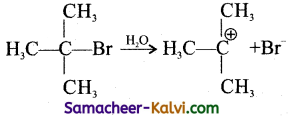
(b) (i) – (A), (ii) – (B), (iii) – (D), (iv) – (C)
(c) (i) – (D), (ii) – (C), (iii) – (A), (iv) – (B)
(d) (i) – (B), (ii) – (D), (iii)- (C), (iv) – (A)
Answer:
(a) (i) – (D), (ii) – (A), (iii) – (B), (iv) – (C)
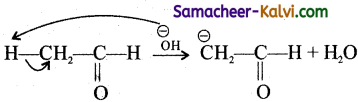
TN Board 11th Chemistry Important Questions

TN Board 11th Chemistry Important Questions Chapter 7 Thermodynamics

TN State Board 11th Chemistry Important Questions Chapter 7 Thermodynamics

Question 1.
Explain the terms
(i) isolated system
(ii) closed system
(iii) open system.
Answer:
(i)Isolated system:
This type of system has no interactions with matter. The boundary is sealed and insulated. Neither matter nor energy can be exchanged with the surroundings.

(ii) Closed system:
This type of system can exchange energy in the form of heat, work or radiations but not matter with surroundings. The boundary between the system and surroundings is sealed but not insulated.

(iii) Open system:
This type of system can exchange matter as well as energy with surroundings. The boundary is not sealed and not insulated.

Samacheer Kalvi TN State Board 11th Chemistry Important Questions Chapter7 Thermodynamics

Question 2.
Give examples for extensive and intensive properties.
Answer:

Extensive properties Intensive properties
volume, mass, amount of substance (mole), energy, enthalpy, entropy, free energy, heat capacity. molar volume, density, molar mass, molarity, mole fraction, molality, specific heat capacity.

Question 3.
Mention the condition for Adiabatic, isothermal, isobaric, isochoric arid cyclic process.
Answer:

Process Condition
Adiabatic  q = 0
Isothermal  dT = 0
Isobaric  dP = 0
Isochoric  dV = 0
Cyclic  dE = 0, dH = 0, dP = 0, dV = 0

Samacheer Kalvi TN State Board 11th Chemistry Important Questions Chapter7 Thermodynamics

Question 4.
State zeroth law of thermodynamics.
Answer:
The law states that ‘If two systems are separately in thermal equilibrium with a third one, then they tend to be in thermal equilibrium with themselves’.

Question 5.
Explain Zeroth law of thermodynamics.
Answer:
According to this law, if systems B and C separately are in thermal equilibrium with another system A, thenb systems B and C will also be in thermal equilibrium with each other. This is also the principle by which thermometers are used.

Question 6.
What are informations do you get from the thermo chemical equations?
Answer:
A thermo chemical equation gives,
(i) The number of mol of the reactants and the number of mol of the products.
(ii) The amount of heat liberated or absorbed (as the case may) i.e., magnitude of enthalpy change (∆H).
(iii) The physical state of the reactants or products i.e., if the species are solid or liquid or gas.
eg: H2 (g) + 2 O2 (g) → H2O (g) ∆H = – 268 kJ mol-1

Samacheer Kalvi TN State Board 11th Chemistry Important Questions Chapter7 Thermodynamics

Question 7.
Define molar heat capacity at constant volume and molar heat capacity at constant pressure.
Answer:
(i) The heat capacity at constant volume (CV) is defined as the rate of change of internal energy with respect to temperature at constant volume.

CV = \(\left(\frac{\partial \mathrm{H}}{\partial \mathrm{T}}\right)_{\mathrm{V}}\)

(ii) The molar heat capacity at constant pressure (CP) can be defined as the rate of change of enthalpy with respect to temperature at constant.pressure.
CP = \(\left(\frac{\partial H}{\partial T}\right)_{P}\)

Question 8.
Define the relationship CP – CV = nR for an ideal gas.
Answer:
The enthalpy of a system is given by
H = U + PV ……….(1)
for 1 mole of an ideal gas
PV = nRT …………(2)
By substituting (2) in (1) i.e., PV in equation (1) by nRT
H = U + nRT ………….(3)
Differentiating the above equation with respect to T,
\(\frac{\partial \mathrm{H}}{\partial \mathrm{T}}=\frac{\partial \mathrm{U}}{\partial \mathrm{T}}+n \mathrm{R} \frac{\partial \mathrm{T}}{\partial \mathrm{T}}\)

CP = CV + nR …………(4)

∵ [\(\left(\frac{\partial H}{\partial T}\right)_{P}\) = CP and \(\left(\frac{\partial U}{\partial T}\right)_{V}\) = CV]

CP – CV = nR

Samacheer Kalvi TN State Board 11th Chemistry Important Questions Chapter7 Thermodynamics

Question 9.
Explain why CP is always greater than CV?
Answer:
At constant pressure processes, a system has to do work against the surroundings. Hence, the system would require more heat to effect a given temperature rise than at constant volume, so CP is always greater than CV.

Question 10.
Show that ∆U = nCV (T2 – T1) and ∆H = CP(T2 – T1).
Answer:
For one mole of an ideal gas, we have
CV = \(\frac{d \mathrm{U}}{d \mathrm{~T}}\)
dU = CV dT
For a finite change, we have
∆U = CV ∆T
∆U = CV (T2 – T1)
and for n moles of an ideal gas we get
∆U = nCV(T2 – T1) ……….(1)
Similarly for n moles of an ideal gas we get
∆H = nCP (T2 – T1) ………….(2)

Question 11.
Describe the application of heat of combustion.
Answer:

  • The heat of formation of compounds can be calculated from heat of combustion values.
  • The calorific value of food and fuels can be calculated from heat of combustion.

Samacheer Kalvi TN State Board 11th Chemistry Important Questions Chapter7 Thermodynamics

Question 12.
Explain application of Hess’s law of constant heat summation with an example.
Answer:
(i) Hess’s law can be applied to calculate enthalpies of reactions that are difficult to measure. For example, it is very difficult to measure the heat of combustion of graphite to give pure CO.
(ii) However, enthalpy for the oxidation of graphite to CO2 and CO to CO2 can easily be measured. For these conversions, the heat of combustion values are – 393.5 kJ and – 283.5 kJ respectively.
(iii) From these data the enthalpy of combustion of graphite to CO can be calculated by applying Hess’s law.
The reactions involved in this process can be expressed as follows

TN State Board 11th Chemistry Important Questions Chapter 7 Thermodynamics 1

∆H1 = ∆H2 + ∆H3
– 393.5 kJ = X – 283.5 kJ
X = – 110.5 kJ

Samacheer Kalvi TN State Board 11th Chemistry Important Questions Chapter7 Thermodynamics

Question 13.
Derive an expression for the efficiency of a heat engine.
Answer:
Efficiency = \(\frac{\text { work performed }}{\text { heat absorbed }}\)

η = \(\frac{\left|q_{h}\right|-\left|q_{c}\right|}{\left|q_{h}\right|}\)

qh – heat absorbed fropi the hot reservoir
qc – heat transferred to cold reservoir

η = 1 – \(\frac{\left|q_{c}\right|}{\left|q_{h}\right|}\) …………(1)
For a reversible cyclic process
∆S(universe)= ∆S(system) + ∆S(surroundings) = 0
∆S(system) = – ∆S(surroundings)

\(\frac{q_{h}}{\mathrm{~T}_{h}}=\frac{-q_{c}}{\mathrm{~T}_{c}}\) \(\frac{-\mathrm{T}_{c}}{\mathrm{~T}_{h}}=\frac{q_{c}}{q_{h}}\)

\(\frac{\mathrm{T}_{c}}{\mathrm{~T}_{h}}=\frac{\left|q_{c}\right|}{\left|q_{h}\right|}\) …………..(2)
Substituting (2) in (1)
⇒ η = 1 – \(\frac{\mathrm{T}_{c}}{\mathrm{~T}_{h}}\) …………(3)
Hence, η < 1

Question 14.
Give expressions for the entropy change a phase change.
Answer:
∆S = \(\frac{q_{\mathrm{rev}}}{\mathrm{T}}=\frac{\Delta \mathrm{H}_{\mathrm{rev}}}{\mathrm{T}}\)
Where ∆Hrev is the enthalpy change at Temperature (T).

Samacheer Kalvi TN State Board 11th Chemistry Important Questions Chapter7 Thermodynamics

Question 15.
Define (i) molar heat of fusion (ii) molar heat of vaporisation (iii) enthalpy of transition.
Answer:
(i) Molar heat of fusion:
The molar heat of fusion is defined as “the change in enthalpy when one mole of a solid substance is converted into the liquid state at its melting point”.

(ii) Molar heat of vaporisation:
The molar heat of vaporisation is defined as “the change in enthalpy when one mole of liquid is converted into vapour state at its boiling point”.

(iii) Enthalpy of transition:
The heat of transition is defined as “The change in enthalpy when one mole of an element changes from one of its allotropic form to another.

Question 16.
Give examples for spontaneous processes.
Answer:
(i) A waterfall runs downhill, but never uphill, spontaneously.
(ii) A lump of sugar dissolves spontaneously in a cup of coffee, but never reappears in its original form spontaneously.
(iii) Heat flows from hotter object to a colder one; but never flows from colder to hotter object spontaneously.
(iv) The expansion of a gas into an evacuated bulb is a spontaneous process, the reverse process that is gathering of all molecules into one bulb is not spontaneous.

Samacheer Kalvi TN State Board 11th Chemistry Important Questions Chapter7 Thermodynamics

Question 17.
Explain how ∆G is related to spontaneity of a process.
Answer:
Let us consider a system which undergoes a change of state from state (1) to state (2) at constant temperature.
G2 – G1 = (H2 – H1) – T(S2 – S1)
∆G = ∆H – T ∆S ……….(1)
Now let us consider how ∆G is related to reaction spontaneity.
We know that
∆Stotal = ∆Ssys – ∆Ssurr
For a reversible process (equilibrium), the change in entropy of universe is zero.
∆Stotal = 0
[∵ ∆Ssys = – ∆Ssurr]
Similarly, for an equilibrium process ∆G = 0
For spontaneous process, ∆Stotal > 0, so ∆Stotal > 0
∆S(system) + ∆S(surroundings) > 0
\(\frac{\Delta \mathrm{H}_{\text {sys }}}{\mathrm{T}}\) – ∆S(system) > 0

∆Hsys – T∆Ssys > 0
T∆Ssys – ∆Hsys < 0
– (∆Hsys – T∆Ssys) > 0
– (∆G) > 0
Hence for a spontaneous process, ∆G < 0
i.e. ∆H – T ∆S < 0 …(1)
∆Hsys is the enthalpy change of a reaction, T∆Ssys is the energy which is not available to do useful work. So, ∆G is the net energy available to do usefuf work and is thus a measure of the ‘free energy’. For this reason, it is also known as the free energy of the reaction. For non spontaneous process, ∆G > 0.

Samacheer Kalvi TN State Board 11th Chemistry Important Questions Chapter7 Thermodynamics

Question 18.
How is Gibb’s free energy and network done by the system related?
Answer:
For any system at constant pressure and temperature.
∆G = ∆H – T∆S …(1)
We know that, ∆H = ∆U + P∆V
∴ ∆G = ∆U + P∆V – T∆S
from first law of thermodynamics if work is done by the system
∆U = q – w
from second law of thermodynamics
∆S = \(\frac{q}{\mathrm{~T}}\) ∆G = q – w + P∆V – T(\(\frac{q}{\mathrm{~T}}\))
∆G = -.w + P∆V
– ∆G = – w – P∆V …………… (3)
But – P∆V represents the work done due to expansion against a constant external pressure. Therefore, it is clear that the decrease, in free energy (- ∆G) accompanying a process taking place at constant temperature and pressure is equal to the maximum work obtainable from the system other than the work of expansion.

Question 19.
How is standard energy charge related to equilibrium constant?
Answer:
The standard free energy-change for a reversible reaction is related to its equilibrium constant (Keq) by means of the relationship
∆G° = ∆H° – T∆S°
where, ∆G° – Standard free energy change
∆H° = Standard enthalpy of formation
∆S° = Standard entropy of formation

Samacheer Kalvi TN State Board 11th Chemistry Important Questions Chapter7 Thermodynamics

Question 20.
Derive an expression for the standard free energy change for the reaction A + B ⇌ C + D in terms of the equilibrium constant.
Answer:
Lets consider a general equilibrium reaction A + B ⇌ C + D
The free energy change of the above reaction in any state (∆G) is related to the standard free energy change of the reaction (∆G° ) according to the following equation.
∆G = ∆G° + RT ln Q
where Q is reaction quotient and is defined as the ratio of concentration of the products to the concentrations of the reactants under non equilibrium condition.

When equilibrium is attained, there is no further free energy change i.e., ∆G = 0 and Q becomes equal to equilibrium constant. Hence the above equation becomes,
∆G° = – RT ln Keq
This equation is known as Van’t Hoff equation,
∆G° = – 2.303 RT log Keq

We also know that
∆G° = ∆H° – T∆S° = -RT ln Keq

Question 21.
Explain third law of thermodynamics.
Answer:
The entropy of pure crystalline substance s at absolute zero is zero. Alternatively it can be stated as, it is impossible to lower the temperature of an object to absolute zero in a finite number of steps. Mathematically,

\(\begin{gathered}
\text { lim } \\
\mathrm{T} \rightarrow 0
\end{gathered}\) S = 0 for a perfectly ordered crystalline state.

Crystals with defects (imperfection) at absolute zero, have entropy greater than zero. Absolute entropy of a substance can never be negative.

Samacheer Kalvi TN State Board 11th Chemistry Important Questions Chapter7 Thermodynamics

Question 22.
Two litres of an ideal gas at a pressure of 10 atm expands isothermally into vacuum until its total volume is 10 litres. How much heat is absorbed and how much work is done in the expansion.
Answer:
Work done in free expansion or work done against zero pressure is also zero.
wexp = -Pext(∆U)
0 = wexp = -Pext(V2 – V1)
0 = 0 (10 – 2) = 0
Hence heat change, and work done is zero.

Question 23.
Calculate the work done in reversible isothermal expansion when 2L of an ideal gas at a pressure of 10 atm expands isothermally against 1 atm to a final volume of 10 L.
Answer:
w = 2.303 nRT log\(\frac{\mathrm{V}_{2}}{\mathrm{~V}_{1}}\) ………(1)
PV = nRT ……….(2)
From equations (1) and (2)
w = 2.303 PV log\(\frac{\mathrm{V}_{2}}{\mathrm{~V}_{1}}\)
= 2.303 × 1 × 10 log \(\frac{10}{2}\)
= 2.303 × 1 × 10 × log 5
= 16.1 litre-atm
= 16.1 × 101.3 J = 1630.93 J
wexp = – 1630.93 J
q = -wexp = 1630.93 J

Samacheer Kalvi TN State Board 11th Chemistry Important Questions Chapter7 Thermodynamics

Question 24.
5 moles of an ideal gas expand isothermally and reversibly from a pressure of 10 atm to 2 atm at 300K. Calculate the work done by the system.
Answer:
w = – 2.303 nRT log\(\frac{P_{1}}{P_{2}}\)
= – 2.303 × 5 × 8.314 × 300 log \(\frac{10}{2}\)
= – 20.075 × 10³ J

Question 25.
Liquid benzene is oxidised at constant pressure according to following equation.
C6H6 (l) + \(\frac{15}{2}\) O2(s) → 6 CO2(g) + 3 H2O (l) Enthalpy change (∆H) for the reaction at 300K is -3728 kJ.
Calculate the internal energy charge.
Answer:
The reaction is
C6H6 (l) + \(\frac{15}{2}\) O2(s) → 6 CO2(g) + 3 H2O (l)
∆n = number of mol of gaseous products – number of mol of gaseous reactants
∆n = 6 – \(\frac{15}{2}\) = – \(\frac{3}{2}\)
∆H = ∆U + RT (∆n)
-3728 = ∆U+ (-\(\frac{3}{2}\)) × 8.314 × 10-3 × 300
∆U = -3724.25 kJ mol-1

Samacheer Kalvi TN State Board 11th Chemistry Important Questions Chapter7 Thermodynamics

Question 26.
1 g of graphite is burnt in a bomb calorimeter in excess of oxygen at 298K and 1 atm pressure according to the equation.
C(graphite) + O2(g) → CO2 (g)
During the reaction, temperature rises from 298K ‘to 299K. If the heat capacity of the bomb calorimeter is 20.7 kJ mol-1. What is the enthalpy change for the above reaction at 298K and 1 atm?
Answer:
Heat evolved in the reaction (∆U) = – CV∆T
= -20.7 × 1 = -20.7 kJ mol-1
Heat evolved in the combustion of 1 mol of carbon i.e., 12g of graphite
= – 20.7 × 12 kJ mol-1
= – 2.48 × 10² kJ mol-1
In the given reactions ∆n = 0
∆H = ∆U = – 2.48 × 10² kJ mol-1

Question 27.
Enthalpies of formation of CO (g), CO2 (g), N2O (g) and N2O4 (g) are -110, -393, + 81 and + 9.7 kJ mol-1 respectively. Find the value of ∆H for the reaction.
Answer:
N2O4 (g) + 3 CO (g) → N2O (g) + 3 CO2 (g).
Given:

TN State Board 11th Chemistry Important Questions Chapter 7 Thermodynamics 2

Samacheer Kalvi TN State Board 11th Chemistry Important Questions Chapter7 Thermodynamics

Question 28.
Given N2 (g) + 3H2 (g) → 2NH3 (g); ∆H° = – 92.4 kJ mol-1. What is the standard enthalpy of formation of NH3 (g)?
Answer:
The given reaction is .
N2 (g) + 3 H2 (g) → 2NH3 (g);
∆H° = – 92.4 kJ mol-1
∆H°= 2 ∆Hf° (NH3) – [∆Hf° (N2) + 3 ∆Hf° (H2)]
By definition, the standard enthalpy of formation of elements is equal to zero.
– 92.4 = 2 ∆Hf° (NH3) – (0 + 3 × 0)
i.e., for 2 mol of NH3 2∆Hf° (NH3) = – 92.4
for 1 mol of NH3 ∆Hf° (NH3) = – \(\frac{92.4}{2}\)
= 46.2 kJ mol-1

Question 29.
The enthalpy of combustion of carbon to carbondioxide is -393.5 kJ mol-1. Calculate the heat released upon the formation of 35.2g of CO2 from carbon and oxygen gas.
Answer:
The combustion of carbon is given by
C(s) + O2 (g) → CO2 (g)
∆H = – 393.5 kJ mol-1
Number of mol of CO2 = \(\frac{35.2}{44}\) = 0.8
Amount of heat evolved in the formation of 0.8 mol of CO2 is = 393.5 × 0.8 = 314.8 kJ

Samacheer Kalvi TN State Board 11th Chemistry Important Questions Chapter7 Thermodynamics

Question 30.
Calculate the enthalpy of formation of CH3OH(l) from the following data:
CH3OH (l) + \(\frac{3}{2}\) O2 (g) → CO2(g) + 2 H2O (l) ∆H° = – 726 kJ mol-1
C (s) + O2 (g) → CO2 (g) ∆H° = – 393 kJ mol-1
H2 (g) + \(\frac{1}{2}\) O2 (g) → H2O (l) ∆H° = – 286 kJ mol-1
Answer:
The required equation is
C (s) + 2 H2 (g) + \(\frac{1}{2}\) O2 (g) → CH3OH (l)
∆H = ? The given equations can be rearranged as
(i) CO2 (g) + 2H2O (l) → CH3OH (l).+ \(\frac{3}{2}\) O2 (g) + 726 kJmol-1
(ii) C (s) + O2 (g) → CO2 (g) -393 kJ mol-1
(iii) 2H2 (g) + O2 (g) → 2H2O (l) 2 x -286 kJ mol
On adding C (s) + 2H2 (g) + \(\frac{1}{2}\) O2 (g) → CH3OH – 239.0 kJ
AH°(CH3OH) = – 239.0 kJ mol-1

Question 31.
The heats of combustion of CH4 and C4H10 are – 890.3 and – 2878.7 kJ mol-1 respectively. Which of the two has greater efficiency as fuel per gram?
Answer:
Molar mass of methane = 16
Heat produced per gram of methane = –\(\frac{890}{16}\) = – 55.63 kJ
Molar mass of butane = 58
Heat produced per gram of butane = –\(\frac{2878.7}{58}\) = -49.62 kJ
Thus, methane has greater fuel efficiency than butane.

Samacheer Kalvi TN State Board 11th Chemistry Important Questions Chapter7 Thermodynamics

Question 32.
Whenever an acid is neutralised by a base, the net reaction is
H+ (aq) + OH (aq) → H2O (l); ∆H = – 57.1 kJ
Calculate the heat evolved for the following experiments:
Answer:
According to the reaction
H+ (aq) + OH (aq) → H2O (l); ∆H = – 57.1 kJ
i.e., when one mole of H+ ions reacts with one mole of OH ions, one mole of water is formed and 57.1 kJ of energy is released.
(i) 6.50 mole of HCl solution is neutralised by 0.50 mole of NaOH solution.
0.50 mole of HCl = 0.50 mole of H+ ions
0.50 mole of NaOH = 0.50 mole of OH ions
On mixing, 0.50 mole of H2O is formed.
Heat evolved for the formation of 0.50 mole of water = 57.1 × 0.5 = 28.55 kJ

(ii) 0.50 mole of HNO3 solution is neutralised
by 0.30 mole of NaOH solution.
0.50 mole of HNO3 = 0.50 mole of H+ ions
0.30 mole of KOH = 0.30 mole of OH ions
i.e., 0.30 mole of H+ ions react with 0.30 mole of OH ions and forms 0.30 mole of water.
Heat evolved in the formation of 0.30 mole of H2O = 57.1 × 0.3 = 17.13 kJ

(iii) 100 ml of 0.2 M HCl is mixed with 100 ml of 0.3M NaOH solution.
100 ml of 0.2 M HCl will give (\(\frac{0.2 \times 100}{1000}\)) mole of = 0.02 mole of H+ ions.
100 ml of 0.3 M NaOH will give (\(\frac{0.3 \times 100}{1000}\)) mole of = 0.03 mole of OH ions.
i.e., 0.02 mole of H+ Ions will react 0.03 mole of OH ions and produce 0.02 mole of H2O molecules.
Heat evolved in the formation of 0.02 mole of H2O = 0.02 × 57.1 = 1.142 kJ

(iv) 400 ml of 0.2 M H2SO4 is mixed with 600ml of 0.1M KOH solution.
400 ml of 0.2 M H2SO4 will give \(\left(\frac{2 \times 0.2}{1000}\right)\) × 400 = 0.16 mole of H+ ions.
600 ml of 0.1 M KOH will give \(\left(\frac{0.1 \times 600}{1000}\right)\) = 0 06 mole of OH ion
Heat evolved in the formation of 0.06 mole of H2O = 0.06 × 57.1 = 3.426 kJ

Samacheer Kalvi TN State Board 11th Chemistry Important Questions Chapter7 Thermodynamics

Question 33.
Calculate the standard heat of formation of carbon di sulphide (l). Given that the standard heats of combustion of carbon (s), sulphur (s) and carbon di sulphide (l) are – 393.3, – 293.72, and – 1108.76 kJ mol-1 respectively.
Answer:
The required equation is
C (s) + 2 S (s) → CS2(l); ∆H = ?
Given:
C(s) + O2 (g) → CO2(g); ∆H = – 393.3 kJ …………(1)
S(s) + O2 (g) → SO2 (g); ∆H = -293.7 kJ ………….(2)
CS2 (l) + O2 (g) → CO2 (g) + SO2 (g);
∆H = – 1108.76 kJ ………….(3)

First method:
Multiply equation (2) by 2
2 S (s) + 2 O2 (g) → 2 SO2 (g); ∆H = – 587.44 ………….(4)
Adding equations (1) and (4) and subtracting (3),
C (s) + 2 S (s) + 3O2 (g) – CS2 (l) – 3O2 (g) → CO2 (g) + 2SO2 (g) – CO2 (g) – 2SO2 (g)
C (s) + 2S (s) → CS2(l)
Thus, ∆Hf = – 393.3 – 587.44 + 1108.76 = 128.02 kJ
i.e., standard heat of formation of CS2 is 128.02 kJ.

Second method:
Standard enthalpy of formation of
CO2 = – 393.3 kJ
SO2 = – 293.72 kJ
CS2 = ?
From the first law of thermodynamics, the standard enthalpy of a compound is equal to the standard enthalpy of formation of the compound and the standard enthalpies of elements is equal to zero.

The equation is
CS2 (l) + 3 SO2 (g) → CO2 (g) + 2 SO2 (g); ∆H° = -1108.76 kJ
∆H° = ΣH° (products) – ΣH° (reactants)
= {∆H°f(CO2) + 2H°fSO2)} – {∆H°f(CS2) + 3 H°f(O2)}
-1108.76 = {- 393.3 + 2 × (-296.72)} – ∆H°f(CS2)
∆H°f(CS2) = + 1108.76 – 393.3 – 2 × (297.72)
= 1108.76 – 980.74= 128.02 kJ
∴ ∆H°f(CS2) = 128.02 kJ mol-1

Bond energies or Bond enthalpies:

  1. The bond dissociation energy of a diatomic molecule is also called bond energy.
  2. When a molecule or a compound contains more than one bond of the same kind, the average value of the dissociation energies of a given bond is taken. This average bond dissociation energy required to break each bond in a compound is called bond energy.
  3. Using bond energy data, heat of reaction is (∆H) can be calculated by using the equation.
    ∆H – ΣB.E of (reactants) – ΣB.E of (products)
  4. Alternating, of enthalpy change for the reaction and bond energies of all the bonds except one, the bond energy of that bond can be calculated.

Samacheer Kalvi TN State Board 11th Chemistry Important Questions Chapter7 Thermodynamics

Question 34.
Calculate ∆H, for the reaction,

TN State Board 11th Chemistry Important Questions Chapter 7 Thermodynamics 3

Bond energies of C – H bond, C – Cl bond are 415 kJ and 326 kJ respectively.
Answer:
∆H – Σ B.E of (Reactants) – ΣB.E of (products)
= 2 × (C – H) + 2[(Cl) – 0)] (B.E of all free atoms = 0)
= 2 × 415 + 2 × 326
= 830+ 652 = 1482 kJ

Question 35.
Calculate the enthalpy change for the following reactions.
H2C = CH3 (g) + H2 (g) → CH3 – CH3 (g)
The bond energies of C – H, C – C, C = C, H – H are 99, 83, 147, 104 kCal respectively.

TN State Board 11th Chemistry Important Questions Chapter 7 Thermodynamics 4

Answer:
∆H = Σ B.E (Reactants) – Σ B.E (products)
= [1 × (C = C) + 4 × (C – H)+ 1 × (H -H)] -1 × (C – C) + 6 × (C – H)
= (147 + 4 × 99 + 104) – (83 + 6 × 99) = – 30 k.cal

Samacheer Kalvi TN State Board 11th Chemistry Important Questions Chapter7 Thermodynamics

Question 36.
The bond dissociation energies of gaseous chlorine, hydrogen and hydrogen chloride are 104, 58 and 103 kcal mol-1 respectively. Calculate the enthalpy of foimation of HCl(g). Predict in which of the following, entropy increases / decreases.

(i) A liquid crystallises into a solid.
Answer:
When a liquid crystallises into a solid its entropy decreases because of randomness is less in a solid as compared to that in a liquid (∆s = negative)

(ii) Temperature of crystalline solid is raised from 0 K to 115 K.
Answer:
When a crystalline solid is heated from 0 K to 115 K, the entropy increases (∆S = positive) because at higher temperature, the constituent units starts vibrating around their mean position.

(iii) 2NaHCO3 (s) → Na2CO3 (s) + CO2 (g) + H2O (s)
Answer:
In the reaction
2NaHCO3 (s) → Na2CO3 (s) + CO2 (g) + H2O (g) the number of gaseous components increase aid hence entropy of the system will increase.

(iv) H2(g) → 2 H (g)
Answer:
In this reaction, the number of gaseous particles increase and hence entropy will also increase.

Samacheer Kalvi TN State Board 11th Chemistry Important Questions Chapter7 Thermodynamics

Question 37.
For the oxidation of iron:
4 Fe (s) + 3O2 (g) → 2Fe2O3 (s)
Answer:
The entropy change is – 549.4 Jk-1mol-1 at 298K. Inspite of negative entropy change of this reaction, why this reaction is spontaneous?
Answer:
∆H° for this reaction is – 1648 × 103 J mol-1
∆S° (system) = – 549.4 J k-1 mol-1
∆H°(reaction) = – 1648 × 103 J mol-1
T = 298 K (as standard state)
∆S(total) – ∆S(system) + ∆S(surrounding)
∆S(total) > 0 for spontaneous process
∆S(surrounding) = \(\frac{\Delta H(\text { surrounding) }}{\mathbf{T}}\)
= \(\frac{+1648 \times 10^{3}}{298}\)
= 5530 J k-1 mol-1
∆S(total) = – 549.4 + 5530 = 4960.6 J k-1 mol-1 = Positive
Hence, the reaction is spontaneous,

Question 38.
Calculate the enthalpy of Vaporisation per , mole Of ethanol, given ∆S = 109.8 J k-1 mol-1 and boiling point of ethanol is 78.5°C.
Answer:
∆S(vaporisation) = \(\frac{\Delta H \text { (Vaporisation) }}{T \text { (Boiling point) }}\)
Given,
∆S(vaporisation) = 109.8 J k-1 mol-1
T(Boiling point) = 78.5 + 273 = 351.5 K .
Substituting these values in the above equation

109.8 = \(\frac{\Delta \mathrm{H} \text { (vaporisation) }}{351.5}\)

∆H(vaporisation) = 38594.7 J mol-1 = 38.594 kJ mol-1

Samacheer Kalvi TN State Board 11th Chemistry Important Questions Chapter7 Thermodynamics

Question 39.
At 0°C, ice and water are in equilibrium and the enthalpy change for the process, HO (S) ⇌ HO (l) is 6 kJ mol-1. Calculate the entropy change for the conversion of ice into water.
Answer:
For the process,
H2O (S) ⇌ H2O (l)

∆S(fusion) = \(\frac{\Delta \mathrm{H}(\text { fusion })}{\text { Freezing temperature }}\)

= \(\frac{6 \times 1000}{273}\)

= 21.98 J k-1 mol-1

Question 40.
For the reaction, at 298K 2 A + B → C ∆H = 400 kJ mol-1, ∆S = 2 kJ mol-1
At what temperature will the reaction become spontaneous, considering ∆H and ∆S to be constant over the temperature range?
Answer:
For the reaction to be spontaneous
∆G = Negative (∆G < 0)
i.e., ∆H – T∆S < 0 (or) T >\(\frac{\Delta \mathrm{H}}{\Delta \mathrm{S}}\)

i.e., T > \(\frac{400 \times 1000}{2000}\) = T > 200 K
The reaction will be spontaneous above 200 K.

Samacheer Kalvi TN State Board 11th Chemistry Important Questions Chapter7 Thermodynamics

Question 41.
For the reaction,
2A (g) + B (g) → 2D (g) ∆U° = – 10.5 kJ and ∆S° = – 44.1 Jk-1
Calculate ∆G° for the reaction and predict whether the reaction is spontaneous or not.
Answer:
∆H° = ∆U° + RT(∆n)
= – 10.5 + 8.314 × 10-3 × 298 × (-1) = – 12.978 kJ
We know,
∆G° = ∆H° – T∆S°
= -12.978 -298 (-44.1 × 10⁻³) = 0.164 kJ
Hence, the reaction is non-spontaneous.

Question 42.
Will the reaction,
I2 (s) + H2S (g) → 2 HI (g) + S (s) proceed spontaneously in the forward direction at 298 K? ∆G°f (HI) = 1.8 kJ mol-1, ∆G°f(H2S) = 33.8 kJ mol-1.
Answer:
∆G° = 2G°f (product) – ∆G°f (reactants)
The standard free energies of elements are equal to zero = Standard free energy of formation of the compound
∆G° = {2 × ∆G°f (HI) + ∆G°f (S)} – {∆G°f (I2) – ∆G°f (H2S)}
= (2 × 1.8 + 0) – (0 + 33.8) = 30.2 kJ
Since, ∆G° is negative, the process is. spontaneous.

Samacheer Kalvi TN State Board 11th Chemistry Important Questions Chapter7 Thermodynamics

Question 43.
Compute the standard free energy of the reaction at 27°C for the combustion of methane using the given data:
CH4(g) + 2 O2 (g) → CO2 (g) + 2H2O (l)

TN State Board 11th Chemistry Important Questions Chapter 7 Thermodynamics 5

Answer:
∆H° = ∆H°f (CO2) + 2 ∆H°f (H2O) – ∆H°f (CH4)
= – 393.5 + 2 × (- 285.8) – (-74.8)
= – 890 kJ mol-1
∆S° = S°(CO2) + 2 S°(H2O) – S°(CH4) – 2S°(O2)
= 214 × 2 × 70 – 186 – 2 × 205
= – 242 Jk-1 mol-1
∆G° = ∆H° – T∆S°
= – 890 – 300 × (- 242 × 10-3)
= – 890 + 72.6 = – 817.4 kJmol-1.

Question 44.
What is the equilibrium constant kc for the following reaction at 400 K?
Answer:
2NOCl (g) ⇌ 2 NO (g) + Cl2 (g)
Answer:
∆H° = 77.2 kJ and ∆S°
= 122 Jk-1 mol-1
∆G° = ∆H° – T∆S°
= 77.2 – 400 × 122 × 10-3
= 28.4 kJ = 28.4 × 10³ J
We know, ∆G° = -2.303 RT log kc
log kc = \(\frac{-\Delta \mathrm{G}^{\circ}}{2.305 \times \mathrm{R} \times \mathrm{T}}\)

= \(\frac{-28.4 \times 10^{3}}{2.303 \times 8.314 \times 400}\) = 3.7081

kc = Antilog(-3.7081)
= 1.958 × 10⁻⁴

Samacheer Kalvi TN State Board 11th Chemistry Important Questions Chapter7 Thermodynamics

Question 45.
For the equilibrium
PCl (s) ⇌ PCl3 (g) + Cl2 (g) at 25°C.
kc = 1.8 × 10⁻⁷ R = 8.314 Jk-1 mol-1 Calculate ∆G° for the reaction.
Answer:
∆G° = – 2.303 RT log kc
= – 2.303 × 8.314 × 298 log (1.8 × 10⁻⁷)
= – 38484 J mol-1 = – 38.484 kJ mol-1

Question 46.
Calculate ∆G° for the reaction.
CO (g) + \(\frac{1}{2}\) O2 (g) → CO2 (g), ∆H° = -282.84 kJ
Answer:
Given, S°(CO2) = 213.8 Jk-1 mol-1
S°(CO) = 197.9 Jk-1 mol-1
S°(O2) = 205.0 Jk-1 mol-1
∆S° = Σ S°(products) – Σ S°(reactants)
= [S° (CO2) – S° (CO) + \(\frac{1}{2}\) S° (O2)]
= 213.8 – [197.9 + \(\frac{1}{2}\) × 205]
= – 86.6 JK-1 mol-1
We know,
∆G° = ∆H° – F∆S°
= – 282.84 – 298 × (- 86.6 × 10⁻³)
= – 282.84 + 25.807 = -257.033 kJ

Samacheer Kalvi TN State Board 11th Chemistry Important Questions Chapter7 Thermodynamics

Choose the correct answer:

Question 1.
When a liquid boils, there is:
(a) increase in entropy
(b) a decrease in entropy
(c) increase in heat of vaporization
(d) an increase in free energy
Answer:
(a) increase in entropy
Hint: When liquid boils, it becomes a gas vapour. The molecules in the gas vapour are randomly placed compared to the liquid i.e., randomness is high in gaseous state then in liquid.
∆s = SV – SL = positive

Question 2.
If ∆G for a reaction is negative, the change is:
(a) spontaneous
(b) non-spontaneous
(c) reversible
(d) equilibrium
Answer:
(a) spontaneous
Hint:
For a spontaneous reactions ∆G = negative

Question 3.
In which of the following process, the process is always non-feasible?
(a) ∆H > 0, ∆S > 0
(b) ∆H < 0, ∆S > 0
(c) ∆H > 0, ∆S < 0
(d) ∆H < 0, ∆S < 0
Answer:
(b) ∆H < 0, ∆S > 0
Hint:
For a spontaneous process, (b) ∆H < 0, ∆S > 0

Samacheer Kalvi TN State Board 11th Chemistry Important Questions Chapter7 Thermodynamics

Question 4.
Change in Gibbs free energy is given by:
(a) ∆G = ∆H + T∆S
(b) ∆G = ∆H – T∆S
(c) ∆G = ∆H × T∆S
(d) None of these
Ans:
(b) ∆G = ∆H – T∆S

Question 5.
Which of the following process is feasible at all temperatures?
(a) ∆H > 0, ∆S > 0
(b) ∆H > 0, ∆S < 0
(c) ∆H< 0, ∆S > 0
(d ∆H < 0, ∆S < 0
Answer:
(c) ∆H< 0, ∆S > 0
Hint:
When ∆H < 0 and ∆S > 0 at all temperatures, ∆G is negative.

Question 6.
Calculate the entropy change during the melting of one mole of ice into water at 0°C and 1 atm pressure. Enthalpy of fusion of ice is 6008 J mole-1.
(a) 22.007 J K-1 mole-1
(b) 22.007 J K mole-1
(c) 220.07 J K-1 mole-1
(d) 2.2007 J K-1 mole
Answer:
(a) 22.007 J K-1 mol-1
Hint:
∆S = \(\frac{\Delta \mathrm{H}_{f}}{\mathrm{~T}}=\frac{6008 \mathrm{~J} \mathrm{~mol}^{-1}}{273 \mathrm{~K}}\)
= 22.007 J K-1 mole-1

Samacheer Kalvi TN State Board 11th Chemistry Important Questions Chapter7 Thermodynamics

Question 7.
The final temperature of an engine whose initial temperature is 400K and having efficiency 25%.
(a) 200 K
(b) 400 K
(c) 300 K
(d) 450 K
Answer:
(c) 300 K
Hint:
% efficiency = \(\frac{\mathrm{T}_{1}-\mathrm{T}_{2}}{\mathrm{~T}_{1}}\)
T1 = initial temp.
T2 = final temp.
25 = \(\frac{400-T_{2}}{400}\) × 100
T2 = 300 K

Question 8.
When solid melts there is:
(a) an increase of entropy
(b) a decrease in entropy
(c) an increase in free energy
(d) an increase of heat of fusion
Answer:
(a) an increase of entropy
Hint:
∆S = SL – SS
Solid → liquid
∆S = SL – SS
SL > SS
∴ ∆S is positive

Samacheer Kalvi TN State Board 11th Chemistry Important Questions Chapter7 Thermodynamics

Question 9.
The unit of entropy is:
(a) J K-1 mol-1
(b) J mol-1
(c) J K mol-1
(d) J-1 K-1
Answer:
(a) J K-1 mol-1

Question 10.
If ∆G = 0, then the process is:
(a) Equilibrium
(b) Spontaneous
(c) Non Spontaneous
(d) None of the above
Answer:
(a) Equilibrium

Question 11.
The standard conditions for G° are:
(a) 1 mmHg / 25°C
(b) 1 atm / 25°K
(c) 1 atm / 298 K
(d) 1 atm / 0 K
Answer:
(c) 1 atm / 298 K

Samacheer Kalvi TN State Board 11th Chemistry Important Questions Chapter7 Thermodynamics

Question 12.
The efficiency of engine working between 100 to 400 K:
(a) 25 %
(b) 75 %
(c) 100 %
(d) 50 %
Answer:
(b) 75 %
Hint:
% efficiency = \(\frac{\mathrm{T}_{1}-\mathrm{T}_{2}}{\mathrm{~T}_{1}}\)
T1 = initial temp.
T2 = final temp.
25 = \(\frac{400-T_{2}}{300}\) × 100 (T1 > T2)
T2 = 100 K

Question 13.
Entropy is a _________ function.
(a) State
(b) Path
(c) Defined
(d) Undefined
Answer:
(a) State
Hint:
The value depends on initial and final state of the system and not on the path followed by the system.

Question 14.
An efficiency of an engine is always:
(a) = 0 %
(b) > 100 %
(c) < 100 %
(d) = 100 %
Answer:
(c) < 100 %
Hint:
According to second law of thermo-dynamics 100% conversion of energy to work is impossible.

Samacheer Kalvi TN State Board 11th Chemistry Important Questions Chapter7 Thermodynamics

Question 15.
If system moves from ordered state to disordered state, its entropy:
(a) Decreases
(b) Increases
(c) Become zero
(d) Increases then decreases
Answer:
(b) Increases
Hint:
Whenever there is greater disorderliness, greater is the entropy. Hence the increase in entropy.

Question 16.
In which of the following entropy increases?
(a) Condensation of water vapour
(b) Liquid freezes to solid
(c) Sublimation
(d) Gas freezes to a solid
Answer:
(c) Sublimation
Hint:
Solid → Vapour(sublimation)
∆S = S(vapour) – S(solid)
S(vap) > S(solid)= positive
i.e., entropy increases.

Question 17.
Which of the following is a state function?
(a) q
(b) ∆q
(c) w
(d) ∆S
Answer:
(d) ∆S
Hint:
∆S; The rest are path functions.

Samacheer Kalvi TN State Board 11th Chemistry Important Questions Chapter7 Thermodynamics

Question 18.
Which of the following will have highest ∆Hvap value?
(a) Acetone
(b) Ethanol
(c) Carbon tetrachloride
(d) Chloroform
Answer:
(c) Carbon tetrachloride
Hint:
When a liquid is converted to its vapour, the attraction between the molecules in the liquid should be less, so that they can readily escape into vapour. CCl4 being a non-polar liquid, has the least attraction and has lower vapour pressure and has highest ∆Hvap value.

Question 19.
Which of the following is not a state function?
(a) S
(b) H
(c) G
(d) q
Answer:
(d) q

Question 20.
The net work done by the system:
(a) w – P∆V
(b) w + P∆V
(c) -w + P∆V
(d) -w – P∆V
Answer:
(d) -w – P∆V

Samacheer Kalvi TN State Board 11th Chemistry Important Questions Chapter7 Thermodynamics

Question 21.
– ∆G is the net work done by the system except:
(a) Electrical work
(b) Expansion work
(c) Chemical work
(d) Photo chemical work
Answer:
(b) Expansion work
Hint:
The decrease in free energy (- ∆G) is the energy available with the system to perform work other than P – V work, (explanation / compression).

Question 22.
The enthalpy of vapourisation of a liquid is 30 kJ mol-1 and the entropy of vapourisation is 75 J K-1 mol-1. The boiling point of the liquid at 1 atm is:
(a) 250 K
(b) 400 K
(c) 450 K
(d) 600 K
Answer:
(b) 400 K
Hint:

TN State Board 11th Chemistry Important Questions Chapter 7 Thermodynamics 6

Question 23.
In a reversible process ∆S(system) + ∆S(surrounding) is:
(a) > 0
(b) < 0
(c) > 0
(d) = 0
Answer:
(d) = 0
Hint:
∆ST = 0 for a reversible (equilibrium)
= ∆S(system) + ∆S(surrounding) = 0

Samacheer Kalvi TN State Board 11th Chemistry Important Questions Chapter7 Thermodynamics

Question 24.
Which of the following does not result in an increase in the entropy?
(a) crystallisation of sucrose from solution
(b) rusting of Iron
(c) conversion of ice to water
(d) vapourisation of camphor
Answer:
(a) crystallisation of sucrose from solution
Hint:
Solution of sucrose > crystals of sucrose(solid)
∆S = S(solid) – S(solution)
= S(solution) < S(solid)

Question 25.
The standard free energy change (∆G°) is related to equilibrium constant (K) as:
(a) ∆G° = -2.303 RT lnK
(b) ∆G°= 2.303 RT log K
(c) ∆G° = RT ln K
(d) ∆G° = – 2.303 RT log K
Answer:
(d) ∆G° = – 2.303 RT log K

Question 26.
Entropy change involved in the conversion of 1 mole of liquid water at 373K to vapour at the same temperature will be ∆H = 2.257 kJ g-1
(a) 0.119 kJ
(b) 0.109 kJ
(c) 0.129 kJ
(d) 0.120 kJ
Answer:
(b) 0.109 kJ
Hint:
∆S = \(\frac{\Delta \mathrm{H}_{\mathrm{vap}}}{\mathrm{T}}\)

= \(\frac{2.257 \mathrm{~kJ} \mathrm{~g}^{-1} \times 18 \mathrm{~g} \mathrm{~mol}^{-1}}{373}\) = 0.109 kJ

Samacheer Kalvi TN State Board 11th Chemistry Important Questions Chapter7 Thermodynamics

Question 27.
Which of the following units represent largest amount of energy?
(a) calories
(b) Joule
(c) erg
(d) eV
Answer:
(a) calories
Hint:
1 calorie = 4.184 K; 1 erg = 10-7 J;
1 eV= 1.6 × 10⁻¹⁹ J

Question 28.
System in which there is no exchange of j matter , work or energy from surrounding:
(a) closed
(b) isolated
(c) adiabatic
(d isothermal
Answer:
(b) isolated

Question 29.
Identify the state quantity among the following:
(a) q
(b) q – w
(c) q + w
(d) q / w
Ans :
(c) q + w
Hint:
∆U = q + w; ∆U is a state function.

Samacheer Kalvi TN State Board 11th Chemistry Important Questions Chapter7 Thermodynamics

Question 30.
In general, for an exothermic reaction to be spontaneous :
(a) temperature should be high
(b) temperature should be zero
(c) temperature should be low
(d) temperature has no effect
Answer:
(c) temperature should be low
Hint:
∆G = ∆H – T∆S:
For exothermic reaction
∆H is negative,
∆S = positive and at low temperature
∆G = negative.
Hence temperature should be low.

Question 31.
Heat of neutralization of a strong acid by a j strong base is a constant value because:
(a) only H+ and OH ions react in every case
(b) the strong base and strong acid react completely
(c) the strong base and strong acid react in aqueous solution
(d) salt formed does not hydrolyse
Answer:
(a) only H+ and OH ions react in every case.

Samacheer Kalvi TN State Board 11th Chemistry Important Questions Chapter7 Thermodynamics

Question 32.
The heat absorbed at constant volume is equal to the system’s change in:
(a) enthalpy
(b) entropy
(c) internal energy
(d) free energy
Answer:
(c) internal energy
Hint:
qv</sub > = ∆U

Question 33.
Heat of neutralization of a strong acid by a base is always:
(a) positive
(b) negative
(c) zero
(d) positive or negative
Answer:
(b) negative
Hint:
The neutralisation of a strong acid by a base is always
H+ + OH —> H2O, for which the value is – 57.32 kJ.

Question 34.
For the reaction H2 + I2 ⇌ 2HI, ∆H = 12.40 kcal the heat of formation of HI is:
(a) 12.4 kcal mol-1
(b) – 12.4 kcal mol-1
(c) – 6.20 kcal mol-1
(d) 6.20 kcal mol-1
Answer:
(d) 6.20 kcal mol-1
Hint:
12.4 kcal is the amount of heat absorbed for 2 mol of the formation of HI. By definition, j the heat of formation is for one mol of the formation of H is \(\frac{12.40}{2}\) = 6.20 kcal mol-1

Samacheer Kalvi TN State Board 11th Chemistry Important Questions Chapter7 Thermodynamics

Question 35.
Heat capacity is:
(a) dq / dT
(b) dq .dT
(c) Σ q.l / dT
(d) none of these
Ans :
(a) dq / dT

Question 36.
The relation between Cp and Cp is:
(a) Cp – Cv = R
(b) Cp + Cv = R
(c) – 285 KJ
(d) R – Cv = Cp
Answer:
(a) Cp – Cv = R

Question 37.
The heat required to raise the temperature of a body by 1 K is called:
(a) specific heat
(b) thermal capacity
(c) water equivalent
(d) none of these
Ans :
(b) thermal capacity

Samacheer Kalvi TN State Board 11th Chemistry Important Questions Chapter7 Thermodynamics

Question 38.
Heat liberated when 100 ml of 1 N NaOH is neutralized by 300 ml of 1 N HCl:
(a) 22.92 kJ
(b) 17.19 kJ
(c) 11.46 kJ
(d) 5.73 kcal
Ans :
(d) 5.73 kcal
Hint:
Number of equivalents of HCl = \(\frac{100 \times 1}{1000}\) = 0.1 equivalent
Number of equivalents of NaOH = \(\frac{300 \times 1}{1000}\) = 0.3 equivalent
Limiting reagent is HCl.
∴ 0.1 equivalent of HCl = 0.1 equivalent of NaOH
1 equivalent of HCl neutralised 1 equivalent of NaOH
heat liberated = 57.32 kcal
0.1 equivalent HCl, produce = \(\frac{57.32}{1}\) × 0.1 = 5.73 k cal

Question 39.
In order to decompose 9 g of water, 142.5 kJ of heat is required. Hence enthalpy of formation of water is:
(a) – 142.5 kJ
(b) 142.5 kJ
(c) – 285 kJ
(d) 285 kJ
Answer:
(d) 285 kJ
Hint:
Enthalpy of formation of 9 g of water = (-) 142.5 kJ
Enthalpy of formation of 18 g (1 mole) of water = -142.5/9 × 18 = – 285 kJ

Question 40.
The state of a system can be described by quoting the relationship between :
(a) pressure, volume, temperature
(b) temperature, amount, pressure
(c) amount, volume, temperature
(d) pressure, volume, temperature and amount
Answer:
(d) pressure, volume, temperature and amount
Hint:
Any thermodynamic property of a system is a function of pressure, temperature, volume and amount (number of moles).

Samacheer Kalvi TN State Board 11th Chemistry Important Questions Chapter7 Thermodynamics

Question 41.
During complete combustion of one mole of butane, 2658 kJ of heat is liberated. The thermo chemical reaction for the above change is:
(a) 2C4H10 (g) + 13 O2 (g) → 8 CO2 (g) + 10 H2O (l); ∆HC = – 2658 kJ mol-1

(b) C4H10 (g) + \(\frac{13}{2}\) O2 (g) → 4 CO2 (g) + 5 H2O (g); ∆HC = – 1329.0 kJ mol-1

(c) C4H10(g) + \(\frac{13}{2}\) O2 (g) → 4 CO2 (g) + 5H2O ∆HC = – 2658.0 kJ mol-1

(d) C4H10 + \(\frac{13}{2}\) O2 (g) → 4CO2 (g) + 5H2O (l) ∆HC = +2658.0 kJ mol-1
Answer:
(c) C4H10(g) + \(\frac{13}{2}\) O2 (g) → 4 CO2 (g) + 5H2O ∆HC = – 2658.0 kJ mol-1
Hint:
The enthalpy of combustion is heat released by one mol of butane an burning with oxygen. CO2 (g) and H2O7 (l) are formed.

Question 42.
If ∆U°f of formation of CH4 (g) at a certain temperature is -393 kJ mol-1, then, the value of ∆H/is:
(a) zero
(b) < ∆U°f
(c) > ∆U°f
(d) equal to ∆U°f
Answer:
(b) < ∆U°f
Hint:
The ∆U°f for CH4 (g) is
C(s) + 2 H2O(g) > CH4 ∆U°f = – 393kJ mol-1
∆H = ∆U + (RT)∆n
∆H= 1 – 2 = -1
∆H = ∆U + (RT)-1

Samacheer Kalvi TN State Board 11th Chemistry Important Questions Chapter7 Thermodynamics

Question 43.
In an adiabatic process, no transfer of heat takes place between the svstem and surroundings. Choose the correct option for free expansion of ideal gas under adiabatic conditions from the following:
(a) q = 0; ∆T ≠ 0; w = 0
(b) q ≠ 0; ∆T = 0; w = 0
(c) q = 0; ∆T = 0; w = 0
(d) q = 0; ∆T < 0; w ≠ 0
Answer:
(c) q = 0; ∆T = 0; w = 0
Hint:
For free expansion,
Pext = 0
W = -Pext ∆U
For adiabatic process; q = 0
∆U = q + w = 0.
This means that interval energy remains constant, which is so at constant temperature. Hence, ∆T = 0.

Question 44.
The pressure-volume work for an ideal gas can be calculated by using the expression.
w = – \(\int_{v_{I}}^{v_{f}}\) Pext . dNt

The work can also be calculated from the PV plot by using the area. Under the curve within the specified limits. When an ideal gas is compressed (a) reversibly or (b) irreversibly from volume Vi to Vf, choose the correct option:
(a) w(reversible) = w(irreversible)
(b) w(reversible) < w(irreversible)
(c) w(reversible) > w(irreversible)
(d) w(reversible) = w(irreversible)
Answer:
(b) w(reversible) < w(irreversible)

TN State Board 11th Chemistry Important Questions Chapter 7 Thermodynamics 7

Hint:
Area under curve (a) which is for irreversible compression is more than area curve (b) which is for reversiblecompression. Hence, for compression w(reversible) < w(irreversible).

Samacheer Kalvi TN State Board 11th Chemistry Important Questions Chapter7 Thermodynamics

Question 45.
The entropy change can be calculated by using the expression, ∆S = \(\frac{q_{\text {rev }}}{\mathrm{T}}\). When water freezes in a glass beaker, choose the correct statement amongst the following:
(a) ∆S(system) decreases but ∆S(surroundings) remains same.
(b) ∆S(system) increases but ∆S(surroundings) decreases
(c) ∆S(system) decreases but ∆S(surroundings) increases
(d) ∆S(system) decreases and ∆S(surroundings) decreases.
Answer:
(c) ∆S(system) decreases but ∆S(surroundings) increases
Hint:
∆S (system) decreases because molecules of solid ice are less random than in liquid water. However, when water freezes to ice, heat is released which is absorbed by the surroundings. Hence entropy of the surroundings increases.

Question 46.
The enthalpies of elements in their standard states are taken as zero. The enthalpy of formation of a compound:
(a) is always negative
(b) is always positive
(c) may be positive or negative
(d) is never negative
Answer:
(c) may be positive or negative

Samacheer Kalvi TN State Board 11th Chemistry Important Questions Chapter7 Thermodynamics

Question 47.
The standard enthalpy of vapourisation, ∆H°vap for water at 100°C is 40.66 kJ mol-1, The internal energy change for water at 10i° C (in kJ mol-1) is:
(a) + 37.56
(b) – 43.76
(c) 43.76
(d) – 40.66
Answer:
(a) + 37.56
Hint:
H2O (l) → H2O
∆n = 1
∆H = ∆U – (RT)∆n
∆U = ∆H – (RT)∆n
= (40.66 × 1000 J mol-1 – (1 x 8.314Jk-1 mol-1 x 373 K)
= 40660 – 3101 JK-1 mol-1
= 37559 J mol-1 = 37.56 kJmol-1

Question 48.
Two similar reactions are given below:
H2 (g)+ O2 (g) >H2 (g); ∆H – ∆H1
H2 (g) + O2 (g) > H2 (l); ∆H = ∆H2
In terms of magnitude, of ∆H
(a) ∆H1 > ∆H2
(b) ∆H1 < ∆H2
(c) ∆H1 = ∆H2
(d) cannot be predicted
Answer:
(b) ∆H1 < ∆H2
Hint:
∆H2 > ∆H1 because when H2O (g) condenses to H2O (l), heat is evolved,. Hence, ∆H1 < ∆H2.

Question 49.
In the reaction, S + \(\frac{3}{2}\) O2 → SO3 + 2x kJ and SO2 + \(\frac{1}{2}\) O2 → SO3 + y kJ. The enthalpy of formation of SO2 is:
(a) x – y
(b) 2x + y
(c) x + y
(d) y – 2x
Answer:
(d) y – 2x
Hint:
Given, S + \(\frac{3}{2}\) O2 → SO3; ∆H = – 2x kJ (1)
SO2 + \(\frac{1}{2}\) O2 → SO3; ∆H = – y kJ (2)
The enthalpy of formation of SO2 is given by
S + O2 → SO3 ∆H = ? ………..(3)
Equation (1) – Equation (2) gives
S + O2 → SO3
i.e., ∆H = – 2x – (-y) = y – 2x

Samacheer Kalvi TN State Board 11th Chemistry Important Questions Chapter7 Thermodynamics

Question 50.
Calorific value of hydrogen gas is – 143 kJ mol-1. The standard enthalpy of formation of H2O will be:
(a) – 143 kJ mol-1
(b) + 143 kJ mol-1
(c) – 286 kJ mol-1
(d) + 286 kJ mol-1
Answer:
(c)
Hint:
H2 (g) + \(\frac{1}{2}\) O2 (g) → H2O (l)
Calorifìc value of a fuel is the amount of heat produced by 1 gm of the fuel.
1 g of H2O on combustion produces = 143 kJ
1 mol (2g) will produce 2 × 143 = 286 kJ
This is also the value of standard enthalpy of formation of water.

Question 51.
Based on first law of thermodynamics, which one of the following is correct?
(a) For an isochoric process, ∆U = -q
(b) For an adiabatic process, ∆U = -w
(c) For an isothermal process, q = + w
(d) For a cyclic process, q = -w
Answer:
(d) For a cyclic process, q = -w
Hint:
(a) ∆U = q + w; For an isochoric process, -w = P. ∆V = 0; Hence ∆U = qU
(b) For an adiabatic process, q = 0, Hence, ∆U = w.
(c) For an isothermal process, ∆U = 0, Hence, q = -w.
(d) For a cyclic process, ∆U = 0; Hence, q = – w.

Samacheer Kalvi TN State Board 11th Chemistry Important Questions Chapter7 Thermodynamics

Question 52.
The amount of heat evolved when 500 cm3 of 0.1 M hydrochloric acid is mixed with 200 cm3 of 0.2 M sodium hydroxide solution is:
(a) – 57.1 kJ
(b) + 57.1kJ
(c) 2.284 kJ
(d) -2.284 kJ
Answer:
(c) 2.284 kJ
Hint:
Number of mol of HCl = molarity × volume in cm-3 × 10-3
= 0.1 × 500 × 10-3 = 0.05
∴ Number of mol of H+ ions = 0.05 mol 6f H+ ions.
Number of mol of NaOH = 0.2 × 200 × 10-3 = 0.04 mol
number of mol of OH ions = 0.04 mol
NaOH is the limiting reagent. Therefore 0.04 mol of OH will combine with 0.04 mol of H+ ions
Heat evolved when 1 mol of OH combine with 1 mol of H+ ion = 57.1 kJ
Heat evolved when 0.04 mol of OH combine with 0.04 mol of H+ ion = 57.1 × 0.04
= 2.284 kJ

Question 53.
The following two reactions are known:
(i) Fe2O3 (s) + 3CO (g) → 2 Fe (s) + 3CO2 (g); ∆H = -26.8 kJ
(ii) FeO (s) + CO (g) → Fe (s) + CO2 (g); ∆H = -16.5kJ
The value for ∆H for the following reaction is
Fe2O3 (s) + CO (g) → 2 FeO (s) + CO2 (g) is
(a) + 10.3 kJ
(b) – 43.3 kJ
(c) -10.3kJ
(d) 6.2 kJ
Answer:
(d) 6.2 kJ
Hint:
Fe2O3 + 3CO → 2 Fe + 3CO2; ∆H = -26.8 kJ …………(1)
FeO + CO → Fe + CO2; ∆H = -16.5 kJ ……………..(2)
The required reactions is
Fe2O3 + CO → 2FeO + CO2; ∆H = ?
Multiply equation (2) by (1) and reverse it and add with equation (1)
Fe2O3 + 3CO → 2 Fe + 3CO2; ∆H = -26.8 kJ
2Fe + 2CO2 —> 2FeO + 2CO ; ∆H = +33.0 kJ
Fe2O3+ 3CO—> 2FeO + CO2; ∆H = 6.2 kJ

Samacheer Kalvi TN State Board 11th Chemistry Important Questions Chapter7 Thermodynamics

Question 54.
The heat of combustion of carbon to carbon-di-oxide is -393.5 kJ mol-1. The heat released upon formation of 35.2 g of CO2 from carbon and oxygen is:
(a) + 315 kJ
(b) – 630 kJ
(c) – 3.15 kJ
(d) – 315 kJ
Answer:
(d)
Hint:
C + O2 → CO2; ∆H = – 393.5 kJ
When 1 mol of CO2(44g of CO2) is formed heat evolved = – 393.5 kJ
When 35.2 g is formed, the amount of heat evolved is, = \(\frac{393.5}{44}\) × 35.2 = – 314.8 kJ
≈ – 315 kJ

Question 55.
For the reaction, 2H2 (g) + O2 (g) → 2H2O (g), the, ∆H = -571 kJ. Bond energy of H – H = 435 and O = O = 498. then the average bond energy of O – H bond will be:
(a) 484
(b) – 484
(c) 271
(d) – 271
Answer:
(a) 484
Hint:
2H2 + O2 → 2H2O
[∵ 2 × (H – O – H)]
∆H = 2 × BE(H -H) + BE(O = O) – 4(BE of O – H)
– 571 = (2 × 435 + 498 – (4 BE of O – H)
B.E (O – H) = 484

Samacheer Kalvi TN State Board 11th Chemistry Important Questions Chapter7 Thermodynamics

Question 56.
Enthalpy change for the reaction, 4H (g) → 2H2 (g) is – 869.6 kJ. The dissociation energy of H – H bond is:
(a) -217.4 kJ
(b) – 434.8 kJ
(c) – 896.6 kJ
(d) + 434.8 kJ
Ans :
(d) + 434.8 kJ
Hint:
2H2 (g) → 4H; ∆H = + 869.6 kJ
(or) H2 (g) → 2H (g)
∆H = \(\frac{869.6}{2}\) = 434.8 kJ

Question 57.
The direct conversion of A → B is difficult, Hence it is carried out by the following paths shown: . ..
∆S (A → C) = 50 e.u
∆S (C → D) = 30 e.u .
∆S (B → D) = 20 e.u.
where e.u. is entropy unit, then ∆S( A – B) is
(a) + 100 e.u.
(b) + 60 e.u
(c) – 100 e.u
(d) – 60 e.u.
Answer:
(b) + 60 e.u
Hint:
∆S (A – C)= SC – SA = 50e.u. …(1)
∆S (C → D) = SD – SA = 30 e.u. . . .(2)
∆S (B → D) = SD – SB = 20 e.u. .. .(3)
∆S (A → B) = SB – SA =?
Equation (1) + Equation (2) – Equation (3)
= ∆S(A – B)
= 50 + 30 – 20 = 60 e.u

Samacheer Kalvi TN State Board 11th Chemistry Important Questions Chapter7 Thermodynamics

Question 58.
In which of the following reaction, standard entropy change (∆S°) is positive and standard Gibb’s free energy change (∆G°) decreases sharply with increasing temperature?
(a) C(graphite) + \(\frac{1}{2}\) O2 (g) → CO (g)
(b) CO (g)+ \(\frac{1}{2}\) O2 (g) → CO2(g)
(c) Mg (s) + \(\frac{1}{2}\) O2 (g) → Mg (s)
(d) \(\frac{1}{2}\) C (graphite) + \(\frac{1}{2}\) O2 (g) → \(\frac{1}{2}\) CO2 (g)
Answer:
(a) C(graphite) + \(\frac{1}{2}\) O2 (g) → CO (g)
Hint:
The reaction (a) is accompanied increase in number of moles of gaseous substances. Hence entropy incre ases, i.e., ∆S° is + ve. From the relation, ∆G° = ∆H° – T∆S°, as temperature increases, T∆S° decreases sharply and hence ∆G° decreases sharply.

Question 59.
For the reaction, X2O4 (l) → 2 XO2 (g),
∆U = 2.1 kcal, ∆S = 20 cal Kr1 at 300 K. Hence, ∆G is:
(a) 2.7 kcal
(b) -2.7 kcal
(c) 9.3 kcal
(d) – 9.3 kcal
Answer:
(b) – 2.7 kcal
Hint:
∆H = ∆U + (RT)∆n
Given:
∆U = 2.1 kcal; ∆n = 2 – 0.2;
R = 2 × 10⁻³ kcal; T = 300K.
∴ ∆H= 2.1 + 2 × 2 × 10-3 × 300 = 3.3 kcal
Again, ∆G = ∆H – T∆S
Given, ∆S = 20 × 10-3 kcal K-1
∆H = 3.3 kcal (calculated above)
∆G = ?
∆S = 3.3 – 300 × (20 × 10-3)
= 3.3 – 6 = – 2.7 kcal.

Samacheer Kalvi TN State Board 11th Chemistry Important Questions Chapter7 Thermodynamics

Question 60.
Consider the following reactions:
(i) O2 (g) + 2 SO2 (g) → 2 SO3 (g)
(ii) CaC2O4 (s) → CaCO3 (s) + CO (g)
(iii) 2 H2 (g) + O2 (g) → 2H2O (g)

Choose the correct statement:
(a) In all the reactions entropy increases.
(b) In (i) and (iii) entropy decreases while in (ii) entropy increases
(c) In (i) and (ii) entropy decreases while in (in) entropy increases
(d) In (i) and (iii) entropy decreases while in (i) entropy increases.
Answer:
(b) In (i) and (iii) entropy decreases while in (ii) entropy increases
Hint:
In (i) ∆S = negative (because number of moles of gases decreases)
In (ii) ∆S = positive (because reactant is solid while the one of the productivity is a gas)
In (iii) ∆S = negative (because number of moles of gases decreases)

Question 61.
Which of the following is not correct?
(a) ∆G is zero for a reversible reaction
(b) ∆G is positive for a spontaneous reaction
(c) ∆G is negative for a spontaneous reaction
(d) ∆G is positive for a non-spontaneous reaction
Ans :
(b) ∆G is positive for a spontaneous reaction
Hint:
∆G is negative and net positive for a spontaneous reaction. ∆G = 0 for a reaction at equilibrium, ∆G is positive for a non-spontaneous reaction.

Samacheer Kalvi TN State Board 11th Chemistry Important Questions Chapter7 Thermodynamics

Question 62.
Examples for various types of system is given below. Identify the system which is different from others.
(a) Animals and plants
(b) Water kept in thermos flask
(c) Thermostat
(d) A refrigerator
Answer:
(a) Animals and plants
Hint:
Thermodynamically animals and plants | are considered as open system while others are closed system.

Question 63.
Examples of thermodynamic properties j are given. Among them one is an extensive | property and the others are intensive properties. Identify the extensive property.
(a) Temperature
(b) Pressure
(c) Mole fraction
(d) Gibb’s free energy ‘ v ‘
Answer:
(d) Gibb’s free energy ‘ v ‘

Question 64.
From the following pairs of properties identify the pair of property which is dependent on the quantity of matter present.
(a) Temperature, mass
(b) Mass, free energy
(c) Temperature and pressure
(d) Pressure and internal energy.
Answer:
(c) Temperature and pressure
Hint:
Both are intensive properties.

Samacheer Kalvi TN State Board 11th Chemistry Important Questions Chapter7 Thermodynamics

Question 65.
Work done in isothermal expansion of an ideal gas is given below.
From the following, identify the correct pairs which gives the expression for work done.
(a) w = +2.303 nRT log \(\frac{\mathrm{V}_{2}}{\mathrm{~V}_{1}}\) and w = + 2.303 nRT log \(\frac{\mathrm{P}_{1}}{\mathrm{P}_{2}}\)

(b) w = -2.303 /?RT log \(\frac{\mathrm{V}_{2}}{\mathrm{~V}_{1}}\) and w = – 2.303 nRT log \(\frac{\mathrm{P}_{2}}{\mathrm{P}_{1}}\)

(c) w = -2.303 nRT log \(\frac{\mathrm{V}_{1}}{\mathrm{~V}_{2}}\) and A w = – 2 303 nRT log \(\frac{\mathrm{P}_{1}}{\mathrm{P}_{2}}\)

(d) w = +2.303 nRT log \(\frac{\mathrm{V}_{1}}{\mathrm{~V}_{2}}\) and w = + 2.303 nRT log \(\frac{\mathrm{P}_{2}}{\mathrm{P}_{1}}\)
Answer:
(b) w = -2.303 /?RT log \(\frac{\mathrm{V}_{2}}{\mathrm{~V}_{1}}\) and w = – 2.303 nRT log \(\frac{\mathrm{P}_{2}}{\mathrm{P}_{1}}\)

Question 66.
Assertion:
Heat energy is completely transformed into work during the isothermal expansion of an ideal gas.
Reason:
During an isothermal process, the changes in internal energy of a gas is due to decrease in pressure is nullified by the change due to increase in volume.
(a) If both assertion and reason are true and reason is the correct explanation of the assertion.
(b) If both assertion and reason are true but reason is not the correct explanation of the assertion.
(c) If assertion is true but reason is false.
(d) If both assertion and reason are false.
Answer:
(a) If both assertion and reason are true and reason is the correct explanation of the assertion.

Samacheer Kalvi TN State Board 11th Chemistry Important Questions Chapter7 Thermodynamics

Question 67.
Assertion:
Chlorine when solidifies does not have zero entropy ever at absolute zero.
Reason:
Chlorine is a pungent smelling gas and it is difficult to solidify it.
(a) If both assertion and reason are true and reason is the correct explanation of the assertion.
(b) If both assertion and reason are true but reason is not the correct explanation of the assertion.
(c) If assertion is true but reason is false.
(d) If both assertion and reason are false.
Answer:
(b) If both assertion and reason are true but reason is not the correct explanation of the assertion.

Question 68.
Assertion:
Molar entropy of Vaporisation of water is different from ethanol.
Reason:
Water is more polar than ethanol.
(a) If both assertion and reason are true and reason is the correct explanation of the assertion.
(b) If both assertion and reason are true but reason is not the correct explanation of the assertion.
(c) If assertion is true but reason is false.
(d) If both assertion and reason are false.
Answer:
(c) If assertion is true but reason is false.

Question 69.
Assertion:
A process for which ∆Ssystem > 0 as well as ∆H > 0, passes from non spontaneous to spontaneous state as the temperature is increased.
Reason:
At higher temperatures T∆S exceeds ∆H.
(a) If both assertion and reason are true and reason is the correct explanation of the assertion.
(b) If both assertion and reason are true but reason is not the correct explanation of the assertion.
(c) If assertion is true but reason is false.
(d) If both assertion and reason are false.
Answer:
(a) If both assertion and reason are true and reason is the correct explanation of the assertion.

Samacheer Kalvi TN State Board 11th Chemistry Important Questions Chapter7 Thermodynamics

Question 70.
Assertion:
For the reaction,
2NH3 (g) → N2 (g) + 3H2 (g),
∆H > ∆E
Reason:
Enthalpy change is always greater than internal energy change.
(a) If both assertion and reason are true and reason is the correct explanation of the assertion.
(b) If both assertion ancj reason are true but reason is not the correct explanation of the assertion.
(c) If assertion is true but reason is false.
(d) If both assertion and reason are false.
Answer:
(c) If assertion is true but reason is false.

Question 71.
Which of the following statements are not correct?
(i) The standard value of absolute entropy of elementary substance is taken as zero.
(ii) Work done in an isothermal expansion is greater than that in an adiabatic expansion for the same increase in volume.
(iii) During adiabatic expansion of a real gas, there is no change in the enthalpy of the system.
(iv) Expansion against vacuum is very large and hence work done is also very large.

(a) (i), (iv)
(b) (ii), (iii)
(c) (i), (iii)
(d) (ii), (iv)
Answer:
(a) (i), (iv)

Samacheer Kalvi TN State Board 11th Chemistry Important Questions Chapter7 Thermodynamics

Question 72.
Based on first law of thermodynamics, which one of the following is correct?
(a) For an isochoric process, ∆U = – q
(b) For an adiabatic process, ∆U = – w
(c) For an isothermal process, q = + w
(d) For a cyclic process, q = – w
Answer:

Question 73.
Choose the incorrect statement from among the following:
All statements under constant temperature.
(a) For a spontaneous process, ∆S(total) should be positive and also ∆G is negative.
(b) For a process at equilibrium, both ∆S(total) and ∆G should be equal to zero.
(c) For a non-spontaneous process ∆S(total)should be negative and ∆G should be positive,
(d) Spontaneous process ∆S negative and ∆G positive.
Answer:
(d) Spontaneous process ∆S negative and ∆G positive.

Question 74.
Which of the following statements is correct, when both ∆H and T∆S are positive?
(a) If ∆H > T∆S, the process is non-spontaneous and ∆G is positive.
(b) If ∆H < T∆S, the process is spontaneous and ∆G is positive.
(c) If ∆H > T∆S, the process is spontaneous and ∆G is positive.
(d) If ∆H = T∆S, the process is spontaneous and ∆G = 0 .
Answer:
(a) If ∆H > T∆S, the process is non-spontaneous and ∆G is positive.

Samacheer Kalvi TN State Board 11th Chemistry Important Questions Chapter7 Thermodynamics

Question 75.
Choose the correct statement from among the following:
(a) The standard enthalpy of methane gas is equal to its standard enthalpy of its formation.
(b) The standard enthalpy if diamond is zero.
(c) For the change H2O (l) → H2O (v) ∆S is negative.
(d) The lattice enthalpy of an ionic compound should always have high positive value.
Answer:
(a) The standard enthalpy of methane gas is equal to its standard enthalpy of its formation.

Question 76.
Match the entities in column I with appropriate entities in column II.

Column I  Column II
(i) Isothermal process (A) q = ∆U
(ii) Adiabatic process (B) W = -P∆V
(iii) Isobaric process (C) W = ∆U
(iv) Isochoric process (D) W = nRT ln \(\frac{v_{2}}{v_{1}}\)

(a) (i) – (D), (ii) – (B), (iii) – (C), (iv) – (A)
(b) (i) – (D), (ii) – (C), (iii) – (B), (iv) – (A)
(c) (i) – (A), (ii) – (C), (iii) – (B), (iv) – (D)
(d) (i) – (C), (ii) – (A), (iii) – (D), (iv) – (B)
Answer:
(b) (i) – (D), (ii) – (C), (iii) – (B), (iv) – (A)

Samacheer Kalvi TN State Board 11th Chemistry Important Questions Chapter7 Thermodynamics

Question 77.
Match the entities in column I with appropriate entities in column II.

Column I  Column II
(i) Positive ∆U value  (A) Non – spontaneous at all temperature
(ii) Negative ∆H value  (B) Endothermic reaction
(iii) ∆H = -ve; ∆S = +ve  (C) Exothermic reaction
(iv) ∆H = +ve; ∆S = -ve  (D) Spontaneous at all temperatures

(a) (i) – (B), (ii) – (C), (iii) – (D), (iv) – (A)
(b) (i) – (C), (ii) – (B), (iii) – (A), (iv) – (D)
(c) (i) – (D), (ii) – (C), (iii) – (B), (iv) – (A)
(d) (i) – (C), (ii) – (A), (iii) – (D), (iv) – (B)
Answer:
(a) (i) – (B), (ii) – (C), (iii) – (D), (iv) – (A)

TN Board 11th Chemistry Important Questions

TN Board 11th Chemistry Important Questions Chapter 6 Gaseous State

TN State Board 11th Chemistry Important Questions Chapter 6 Gaseous State

Question 1.
Give the characteristics of gases.
Answer:
(i) They assume the volume and shape of their container.
(ii) They are the most compressible state of matter.
(iii) They mix thoroughly when confined to the same container.
(iv) They have much lower densities than liquids and solids.
(v) Their pressure is uniform on all sides of the container.

Question 2.
Mention the units of pressure in SI units.
Answer:
The SI unit of pressure is the Pascal (Pa),
1 Pa = 1 Nm-2 (Newton per second)
1 N = 1 kgms-2 (Kilogram mter per second)

Samacheer Kalvi TN State Board 11th Chemistry Important Questions Chapter 6 Gaseous State

Question 3.
Define atmospheric pressure.
Answer:
The force exerted on a unit area of earth by the column of air above it is called atmospheric pressure.

Question 4.
Define standard atmospheric pressure.
Answer:
The standard atmospheric pressure (1 atm.) is the pressure that supports a column of mercury exactly 760 mm (or 76 cm) high at 0°C at sea level. The standard atmosphere is thus equal to a pressure of 760 mm Hg, in which mm Hg represents the pressure exerted by a column of mercury 1 mm high.
Thus 1 atm. = 760 mm Hg

Samacheer Kalvi TN State Board 11th Chemistry Important Questions Chapter 6 Gaseous State

Question 5.
Describe an experiment to verify Boyle’s law.
Answer:
The schematic of the apparatus used

TN State Board 11th Chemistry Important Questions Chapter 6 Gaseous State 1

Mercury was added through the open end of the apparatus such that the mercury level on both ends are equal as shown in the figure
(a) Add more amount of mercury until the volume of the trapped air is reduced to half of its original volume as shown in figure
(b) The pressure exerted on the gas by the addition of excess mercury is given by the difference in mercury levels of the tube. Initially the pressure exerted by the gas is equal to 1 atm as the difference in height of the mercury levels is zero.

When the volume is reduced to half, the difference in mercury levels increases to 760 mm. Now the pressure exerted by the gas is equal to 2 atm. It led him to conclude that at a given temperature the volume occupied by a fixed mass of a gas is inversely proportional to its pressure.

Mathematically, the Boyle’s law can be written as
V ∝ \(\frac{1}{\mathrm{P}}\) …………..(1)
(T and n are fixed, T-temperature, n- number of moles)
V = k × \(\frac{1}{\mathrm{P}}\) …………(2)
k – proportionality constant When we rearrange equation (2).
PV = k at constant temperature and mass.

Samacheer Kalvi TN State Board 11th Chemistry Important Questions Chapter 6 Gaseous State

Question 6.
Give the graphical representation of Boyle’s law.
Answer:
According to Boyle’s law for a given mass of a gas under two different sets of conditions at constant temperature we can write
P1V1 = P2V2 = k

TN State Board 11th Chemistry Important Questions Chapter 6 Gaseous State 2

Question 7.
Prove that density of a gas in directly proportional to the pressure.
[OR] Derive pressure-density relationship from Boyle’s law.
Answer:
The pressure-density relationship can be derived from the Boyle’s law as shown below.
P1V1 = P2V2 (Boyle’s law)

P1 \(\frac{m}{d_{1}}\) = P2 \(\frac{m}{d_{2}}\)

Where “m” is the mass, d1 and d2 are the densities of gases at pressure P1 and P2.

\(\frac{P_{1}}{d_{1}}=\frac{P_{2}}{d_{2}}\)

In other words, the density of a gas is directly proportional to pressure.

Samacheer Kalvi TN State Board 11th Chemistry Important Questions Chapter 6 Gaseous State

Question 8.
Explain what happens of a balloon is moved from an ice-cold water bath to a. boiling water bath..
Answer:
If a balloon is moved from an ice cold water bath to a boiling water bath, the temperature of the gas increases. As a result, the gas molecules inside the balloon move faster and gas expands. Hence, the volume increases.

Question 9.
Explain the variation of volume of a gas with temperature at constant pressure.
Answer:
The plot of the volume of the gas against its temperature at a given pressure is shown in the figure.

TN State Board 11th Chemistry Important Questions Chapter 6 Gaseous State 3

From the graph, it is clear that the volume of the gas linearly increases with temperature at a given pressure. Such lines are called isobars. It can be expressed by the following straight line equation.
V = mT + C where T is the temperature in degree Celsius and m & C are constants.
When T = 0°C the volume becomes V0.
Hence, V0 = C and slope of the straight line m is equal to ∆V / ∆T.
Therefore the above equation can be written in the following form.

V = \(\left(\frac{\Delta V}{\Delta T}\right)\) T + V0 ……………(1)
(n, p are constant)

Divide the equation (1) by V0

\(\frac{\mathrm{V}}{\mathrm{V}_{0}}=\frac{1}{\mathrm{~V}_{0}}\left(\frac{\Delta \mathrm{V}}{\Delta \mathrm{T}}\right)\)T + 1 …………(2)

Charles and Gay Lussac found that under constant pressure, the relative increase in volume per degree increase in temperature is same for all gases. The relative increase in volume per °C (∝) is equal to \(\frac{1}{V_{0}}\left(\frac{\Delta V}{\Delta T}\right)\).

Therefore
V = \(\left(\frac{\Delta V}{\Delta T}\right)\) T + V0
V = V0 (T + 1) …………(3)

Charles found that the coefficient of expansion – is approximately equal to 1/273. It means that at constant temperature for a given mass, for each degree rise in temperature, all gases expand by 1/273 of their volume at 0°C. For refer Figure No. 61.

Samacheer Kalvi TN State Board 11th Chemistry Important Questions Chapter 6 Gaseous State

Question 10.
Explain why the pressure inprease two fold, when the volume is halved?
Answer:
The pressure is a result of the force of the gas particles on the walls of the container. If the volume is halved, the density is doubled. Hence, twice the number of the particles should be hitting the container and the pressure would be increased to two fold.

Question 11.
Explain why airplanes cabins’are pressurized.
Answer:
The pressure decreases with the increase in altitude because there are fewer molecules per unit volume of air. Above 9200 m (30000 ft.) for example, where most commercial air planes fly, the pressure is so low that one could pass out for lack of oxygen. For this reason most airplanes cabins are artificially pressurized.

Question 12.
How does the volume of a gas vary with temperature at constant pressure? Explain with the help of a plot between volume Vs temperature.
Answer:

TN State Board 11th Chemistry Important Questions Chapter 6 Gaseous State 4

The volume of a gas increases with temperature at constant pressure. Each line (isobar) represents the variation of volume with temperature at certain pressure. The pressure increases from P1 to P.
i.e., P1 < P2 < P3 < P4 < P5.
When these lines are extrapolated of extended to zero volume, they intersect at a temperature of- 273.15°C. All the gases are becoming liquids if they are cooled to sufficiently low temperatures. In other words, all gases occupy zero volume at absolute zero.

Samacheer Kalvi TN State Board 11th Chemistry Important Questions Chapter 6 Gaseous State

Question 13.
What is absolute zero? Mention its significance.
Answer:
Absolute zero is a temperature at which all gases have zero volume. This temperature cannot be obtained. It has a value of -273.15°C and theoretically it is the lowest temperature obtainable.

Question 14.
What are isobar and isochores?
Answer:
Isobars are the plot of volume Vs temperature at constant pressure and isochores are plot of pressure verses temperature at constant volume.

Question 15.
State Gay Lussac’s law.
Answer:
At constant volume the pressure of a fixed mass of a gas is directly proportional to temperature.
P ∝ T
or \(\frac{\mathrm{P}}{\mathrm{T}}\) = Constant k
If P1 and P2 are the pressures at temperatures T1 and T2, respectively, then from Gay Lussac’s law

\(\frac{P_{1}}{T_{1}}=\frac{P_{2}}{T_{2}}\)

Samacheer Kalvi TN State Board 11th Chemistry Important Questions Chapter 6 Gaseous State

Question 16.
State Avogadro’s hypothesis.
Answer:
Equal volumes of all gases under the same conditions of temperature and pressure contain equal number of molecules. The mathematical form of Avogadro’s hypothesis may be expressed as
V ∝ n
\(\frac{\mathrm{V}_{1}}{n_{1}}=\frac{\mathrm{V}_{2}}{n_{2}}\) = constant

Where V1 and n1 are the volume and number of moles of a gas and V2 and n2 are a different set of values of volume and number of moles of the same gas at same temperature and pressure.

Question 17.
Describe ideal gas equation.
Answer:
The gaseous state is described completely using the following four variables T, P, V and n. Each gas law, relates one variable of a gaseous sample to another while the other two variables are held constant. Therefore, combining all equations into a single equation will enable to account for the change in any or all of the variables.
Derivation of ideal gas equation from empirical gas laws:
Boyle’s law V ∝ \(\frac{1}{\mathrm{P}}\)
Charles law V ∝ T
Avogadro’s law V ∝ n
We can combine these equations into the following general equation that describes the physical behaviour of all gases.
V ∝ \(\frac{n \mathrm{~T}}{\mathrm{P}}\)

V = \(\frac{n \mathrm{RT}}{\mathrm{P}}\)
where, R is the proportionality constant. The above equation can be rearranged to give
PV = nRT

Samacheer Kalvi TN State Board 11th Chemistry Important Questions Chapter 6 Gaseous State

Question 18.
Arrive at the values of gas constant (R) in dm3 atm mol-1 K-1, Pa, m3 K-1, mol-1 at JK-1 mol-1.
Answer:
The numerical value; of the gas constant (R) can be calculated by using the equation
R = \(\frac{\mathrm{PV}}{n \mathrm{~T}}\) (R is also known as the universal gas constant) ,
For standard conditions in which P is 1 atm,, volume 22.414 dm3, for 1 mole at 273.15 (~ 273) K. .

R = \(\frac{1 \mathrm{~atm} . \times 22.414 \mathrm{dm}^{3}}{1 \mathrm{~mol} \times 273.15 \mathrm{~K}}\)
= 0.0821 dm3 atm . mole-1 K-1
Where P = 105 pascal, V = 22.71 × 10⁻³ m3 for 1 mole of a gas at 273.15 K
R = \(\frac{10^{5} \mathrm{~Pa} \times 22.71 \times 10^{-3} \mathrm{~m}^{3}}{1 \mathrm{~mol} \times 273.15 \mathrm{~K}}\)
= 8.314 Pa m3 K-1 mol-1
= 8.314 × 10⁻² bar dm3 K-1 mol-1
= 8.314 JK-1 mol-1

Question 19.
What is partial pressure of a gas?
Answer:
Partial pressure of a gas is the pressure exerted by the gas when it is present alone in that volume. This term is used to indicate the pressure of a gaseous component in a mixture of gases.

Samacheer Kalvi TN State Board 11th Chemistry Important Questions Chapter 6 Gaseous State

Question 20.
State Dalton’s law of partial pressure.
Answer:
The total pressure of a mixture of non-reacting gases is the sum of partial pressures of the gases present. Partial pressure of a gas is the pressure exerted by the gas when it is present alone occupies to entire volume of the vessel.

Question 21.
Express mathematically Dalton’s law of partial pressures.
Answer:
Let for gases 1, 2 and 3 the partial pressure are P1, P2 and P3
Mathematically,
PTotal = P1 + P2 + P3
when we consider the gases to behave ideally
P1 = n1 \(\frac{\mathrm{RT}}{\mathrm{V}}\);
P2 = n2 \(\frac{\mathrm{RT}}{\mathrm{V}}\);
P3 = n3 \(\frac{\mathrm{RT}}{\mathrm{V}}\);

PTotal = n1 \(\frac{\mathrm{RT}}{\mathrm{V}}\) + n2 \(\frac{\mathrm{RT}}{\mathrm{V}}\) + n3 \(\frac{\mathrm{RT}}{\mathrm{V}}\)

= (n1 + n2 + n3) \(\frac{\mathrm{RT}}{\mathrm{V}}\)
P1 = nTotal (\(\frac{\mathrm{RT}}{\mathrm{V}}\))

The partial pressure can be expressed as mole fraction multiplied Xi by the total pressure.
Pi = Xi PTotal
Xi = \(\frac{n_{i}}{\sum n_{i}}\)
= (number of mol of the gas 1) / (Total number of mol of all gases)

Samacheer Kalvi TN State Board 11th Chemistry Important Questions Chapter 6 Gaseous State

Question 22.
Mention the application of Dalton’s law.
Answer:
In a reaction involving the collection of gas by downward displacement of water, the pressure of dry vapour collected can be calculated using Dalton’s law.
Pdry gas collected = PTotal – Pwater vapour

Pwater vapour is generally referred as aqueous tension and its values are available for air at various temperatures. These values are relevant in weather forecast.

Question 23.
State Graham’s law of diffusion.
Answer:
The rate of effusion or diffusion of a gas is inversely proportional to the square root of molar mass at constant temperature and pressure.

Question 24.
Define rate of diffusion.
Answer:
It is defined as the number of molecules of a gas that get diffused in unit time.
Rate of diffusion = \(\frac{\text { Volume of the gas diffused }}{\text { time taken }}\)

Samacheer Kalvi TN State Board 11th Chemistry Important Questions Chapter 6 Gaseous State

Question 25.
Give an expression for the rate of diffusion of a gas and to its molecular weight.
Answer:
Rate of diffusion ∝ \(\frac{1}{\sqrt{M}}\)

Question 26.
Give an expression for the rates of diffusion of two different gases and their molecular weighs.
Answer:
\(\frac{r_{\mathrm{A}}}{r_{\mathrm{B}}}=\sqrt{\frac{\mathrm{M}_{\mathrm{B}}}{\mathrm{M}_{\mathrm{A}}}}\)

rA and rB rates of diffusion of gases A and B and the MA and MB are their molecular weighs.

Question 27.
Give an expression for»the diffusion of two gases diffusing at different pressures PA and PB and their molecular weighs.
Answer:
When diffusing gases are at different pressures (PA, PB)

\(\frac{r_{\mathrm{A}}}{r_{\mathrm{B}}}=\frac{\mathrm{P}_{\mathrm{A}}}{\mathrm{P}_{\mathrm{B}}} \sqrt{\frac{\mathrm{M}_{\mathrm{B}}}{\mathrm{M}_{\mathrm{A}}}}\)

Where rA and rB are the rates of diffusion of A and B and the MA and MB are their respective molecular masses.

Samacheer Kalvi TN State Board 11th Chemistry Important Questions Chapter 6 Gaseous State

Question 28.
Mention the postulates of kinetic theory of gases which do not explain the behaviour of real gases.
Answer:
The assumption that molecules in the gas phase occupy negligible volume (1) and that they do not exert any force oh one another either attractive or repulsive (2) do not account for the behaviour of real gas.

Question 29.
What are the observations that you get from the plot of Z Vs P. (PV / RT Vs P) for real gases?
Answer:

TN State Board 11th Chemistry Important Questions Chapter 6 Gaseous State 5

(i) For 1 mole of an ideal the plot becomes parallel to the pressure axis.
(ii) At low pressures all gases exhibit ideal behaviour. \(\frac{\mathrm{PV}}{\mathrm{RT}}\) values converges to 1 as P approaches to zero.
(iii) At moderate pressures, \(\frac{\mathrm{PV}}{\mathrm{RT}}\) becomes less than 1. This means that gases exhibit negative deviation from ideal behaviour. This is because attractive forces operate among molecules at relatively short distances.
(iv) At high pressures, \(\frac{\mathrm{PV}}{\mathrm{RT}}\) becomes greater than 1. This means that gases exhibit negative deviation from ideal behaviour. Intermolecular force becomes significant effect to affect the motion of the molecules.

Samacheer Kalvi TN State Board 11th Chemistry Important Questions Chapter 6 Gaseous State

Question 30.
Explain why in the case of a real gas the measured pressure is lower than the pressure of the gas if it behaved ideally.
Answer:
The speed of a’molecule that is moving toward the wall of a container is reduced by the attractive forces exerted by its neighbouring molecules. Hence, the measured gas pressure is lower than the pressure the gas would exert, if it behaved ideally.

Question 31.
What is compressibility factor? How does it explain the deviation of non-ideal gases from ideal behaviour.
Answer:
Compressibility factor is the ratio of PV to nRT.
Z = \(\frac{\mathrm{PV}}{n \mathrm{RT}}\)
For ideal gases PV = nRT i.e., Z = 1
At high pressures Z > 1 (Positive deviation)
At intermediate pressures Z < 1 (Negative deviation) Question 32. Explain the term ‘Boyle’s point’. Mention it significance. Answer: (i) Boyle’s point is the temperature at which, real gases behave ideally over a range of low pressures. (ii) The Boyle point varies with the nature of the gas. (iii) Above the Boyle point, Z > 1 for real gases, i.e., they show positive deviation.
(iv) Below the Boyle point, the real gases first show a decrease for Z, reaches a minimum and then increase with increase in pressure.

Samacheer Kalvi TN State Board 11th Chemistry Important Questions Chapter 6 Gaseous State

Question 33.
Under what conditions, do real gases behave ideally?
Answer:
The real gases behave ideally at low pressure and at high temperature.

Question 34.
Show how the molar volume.of a real and . ideal gas are related to each other?
Answer:
Z = \(\frac{\mathrm{PV}_{\text {real }}}{n \mathrm{RT}}\) ………..(1)

Videal = \(\frac{n \mathrm{RT}}{\mathrm{P}}\) …………..(2)
Substituting (2) in (1)

Z = \(\frac{\mathbf{V}_{\text {real }}}{\mathbf{V}_{\text {ideal }}}\)
Where Vreal is the molar volume of the real gas and ideal is the molar volume of it when it behaves ideal, i.e., compressibility is the ratio of real volume of the gas to ideal volume of any gas.

Question 35.
Explain Andrew’s isotherm of carbon dioxide.
Answer:
The isotherms of carbon dioxide at different temperatures is shown in figure.
From the plots we can infer the following:

TN State Board 11th Chemistry Important Questions Chapter 6 Gaseous State 6

At 13° C, carbondioxides exists as a gas at point A. Increasing the pressure of the gas decreases its volume to the point B. The volume of carbondioxide remains constant, till the point C. At the point B, carbon dioxide gets converted to liquid carbondioxide.

Along the line BC, carbondioxide exists both as vapour and liquid. They are in equilibrium with each other. At point ‘C’, carbondioxide is completely converted to liquid. Further increase of pressure at point ‘C’ has very little effect on the volume of carbondioxide. This is reflected in the steep rise in the curve.

Increasing the temperature, decreases the portion of the straight line (BC), which represents the co-existence of liquid and gaseous carbondioxide. At temperature 31°C the portion of the straight line becomes a point ‘P’. At their point, the entire gaseous carbondioxide is converted into liquid. This temperature, is known as critical temperature.

Above this temperature, carbondioxide exists as a gas and cannot be liquefied whatever be the pressure. Below this temperature, carbon dioxide can be readily converted to liquid by the application of pressure.

Samacheer Kalvi TN State Board 11th Chemistry Important Questions Chapter 6 Gaseous State

Question 36.
Using Andrew’s isotherm of CO2 explain the terms
(i) critical temperature,
(ii) critical pressure and
(iii) critical volume.
Answer:
(i) At the temperature of 31°C CO2 remains as a gas and below this temperature, CO2 can be converted to a liquid. Thus, this . temperature is called critical temperature. Above this temperature, CO2 exists mainly as a gas.
(ii) The pressure required to liquefy a gas at its critical temperature is known as critical pressure. For CO2, it is 73 atm.
(iii) The volume occupied by one mol of CO2 at its critical temperature and critical pressure is known as critical volume.

Question 37.
Explain Joule Thomson effect.
Answer:
The phenomenon of lowering of temperature when a gas is made to expand adiabatically from a region of high pressure into a region of low pressure is known as Joule – Thomson effect.

Samacheer Kalvi TN State Board 11th Chemistry Important Questions Chapter 6 Gaseous State

Question 38.
Which of the gases can be liquefied by Joule Thomson effect?
Answer:
Gases like O2, He, N2 and H2 have very low Tc, hence Joule-Thomson effect can be applied for cooling effectively for liquefaction.

Question 39.
What is inversion temperature? How is it related to Vander Waals constants?
Answer:
The temperature below which a gas obey Joule Thomson effect is called inversion temperature (Ti). At the inversion temperature, no rise or fall intemperature of a gas occurs while expanding. But above the inversion temperature, the gas gets heated up when allowed to expand through a hole. It is related to Vander Waals equation by

T2 = \(\frac{2 a}{R b}\)

Question 40.
Mention different methods of liquefaction of gases.There are different methods used for liquefaction of gases.
Answer:
(i) In Linde’s method: Joule-Thomson effect is used to get liquid air or any other gas.
(ii) Claude’s process: In addition to Joule- Thomson effect, the gas is allowed to perform mechanical work. So that more cooling is produced.
(iii) Adiabatic process: This method of cooling is produced by removing the magnetic property of magnetic material such as gadolinium sulphate. By this method, a temperature of 10-4 K i.e., as low as zero Kelvin can be achieved.

Samacheer Kalvi TN State Board 11th Chemistry Important Questions Chapter 6 Gaseous State

Question 41.
Inside a certain automobile engine, the volume of air in a cylinder is 0.475 dm3, when the pressure is 1.05 atm. When the gas is compressed, the pressure increased to 5.65 atm. at the same temperature. What is the volume of compressed air?
Answer:
Volume of air in the cylinder V1 = 0.475 dm3
Pressure of air (P1) = 1.05 atm
Pressure after compression of the gas (P2) = 5.65 atm
Volume of air after (V2) compression = ?
P1V1 = P2V2
1.05 × 0.475 = 5.65 × V2
V2 = \(\frac{1.05 \times 0.475}{5 .65}\) dm3 = 0.088 dm3

Question 42.
An inflated balloon has a volume of 275 mL and contains 0.120 mole of air. As shown in fig a piece of dry ice weighing lg is placed in the balloon and its neck is tied. What is the volume of the balloon after dry ice (solid CO2) has vapourized? Assume pressure and temperature to remain constant.
Answer:

TN State Board 11th Chemistry Important Questions Chapter 6 Gaseous State 7

(Avogadro’s hypothesis: The addition of carbondioxide to the balloon increases the number of molecules, which increases the volume).
Volume of the inflated balloon (V1) = 275 mL
Number of mole of air (n1) = 0.120 mol
No. of mol of CO2 introduced = \(\frac{1}{44}\) = 0.023
Total no. of mol of air + CO2 = 0.120 + 0.023 = 0.143 mol
Final volume of the balloon after CO2has vaporised = \(\frac{\mathrm{V}_{1}}{n_{1}}=\frac{\mathrm{V}_{2}}{n_{2}}\) or

\(\frac{273}{0.120}=\frac{V_{2}}{0.143}\)

V2 = \(\frac{273 \times 0.143}{0.120}\) = 325.325 mL

Samacheer Kalvi TN State Board 11th Chemistry Important Questions Chapter 6 Gaseous State

Question 43.
A sample of solid KClO3 (potassium chlorate) was heated in a test tube to obtain O2 according to the reaction 2KClO3 —» 2KCl + 3O2. The oxygen gas was collected by downward displacement of water at 295 K. The total pressure of the mixture is 772 mm of Hg and the vapour pressure of water is 26.7 mm of Hg at 300K. What is the partial pressure of the oxygen gas?
Answer:
Total pressure of mixture of O2 and H2O vapour = 772 mm of Hg
Vapour pressure of H2O = 26.7 mm of Hg
Pressure of O2 gas = 754.3 mm of Hg

Question 44.
Find the ratio of effusion rates of hydrogen and krypton gas.
Answer:
Molecular mass of H2 = 2 g mol-1
Molecular mass of Kr = 83g mol-1
\(\frac{r_{\mathrm{H}_{2}}}{r_{\mathrm{Kr}}}=\sqrt{\frac{\mathrm{M}_{\mathrm{kr}}}{\mathrm{M}_{\mathrm{H}_{2}}}}\)

= \(\sqrt{\frac{83}{2}}=\sqrt{41.5}\)
\(\sqrt{\frac{83}{2}}=\sqrt{41.5}\) = 6.44

Samacheer Kalvi TN State Board 11th Chemistry Important Questions Chapter 6 Gaseous State

Question 45.
If the weather balloon at a.pressure 0.0965 atm. at ground level has a volume of 10.0 m3. What will be the pressure at an altitude of 5300 m where its volume is 20.0 m3?
Answer:
Given:
P1 = 0.0965 atm; V1 = 10.0 m3 or 10 × 103 mL
P2 = ?
V2 = 20.0 m3 or 20 × 103 mL
using P1V1 = P2V2
= 0.0965 × 10 × 103
= P2 × 20 × 103
P2 = \(\frac{0.0965 \times 10}{20}\) = 0.04825 atm

Question 46.
At sea level a balloon has volume of 785 x 10-3 dm3. What will be its volume, if it taken to a place where the pressure is 0052 atm less than the atmospheric pressure of 1 atm.
Answer:
Pressure of the gas (P1) = 1 atm
Volume of the gas (V1) = 785 x 10-3 dm3
Pressure of the gas (P2) = 1 atm – 0.0052 atm , = 0.9948 atm
Volume of the gas (V2) = ?
P1V1= P2V2
1 × 785 × 10-3 = 0.9948 × V2
V2 = \(\frac{1 \times 785 \times 10^{-3}}{0.9948}\) = 789 × 10-3

Samacheer Kalvi TN State Board 11th Chemistry Important Questions Chapter 6 Gaseous State

Question 47.
When the temperature of a gas increases from 0°C the volume of the gas increases by a factor of 1.25. what is the final temperature?
Answer:
Temperature (T1) = 0°C = 273 K
Volume of the gas = V1 cm3
Temperature (T2) = ?
Volume of the gas (V2) = 1.25 V1

TN State Board 11th Chemistry Important Questions Chapter 6 Gaseous State 8

Question 48.
A helium filled balloon had a volume of 400 mL, when it is cooled to – 120°C. What will be its volume if the balloon is warmed in an oven to 100° C assuming no changes in pressure.
Answer:
Initial volume (V1) = 400 mL
Initial temperature (T1) = 273 – 120 = 153 K
Final volume (V2) = ?
Final temperature (T2) = 100 + 273 = 373 K

\(\frac{V_{1}}{T_{1}}=\frac{V_{2}}{T_{2}}\)

\(\frac{400}{153}=\frac{V_{2}}{373}\) (or)

V2 = \(\frac{400 \times 373}{153}\) = 975.2 mL

Samacheer Kalvi TN State Board 11th Chemistry Important Questions Chapter 6 Gaseous State

Question 49.
A steel tank contains carbondioxide at 300 K and a pressure of 10 atm. Calculate the internal gas pressure when the tank gas is heated to 373 K.
Answer:
Given, P1 = 10 atm; P2 = ?; T1 = 300K; T2 = 373

\(\frac{P_{1}}{T_{1}}=\frac{P_{2}}{T_{2}}\)
P2 = T2 = 373

\(\frac{100}{300}=\frac{P_{2}}{373}\) = 124.3 atm

Question 50.
In an experiment of verification of Charle’s law, the following are the set of readings taken by a student.

TN State Board 11th Chemistry Important Questions Chapter 6 Gaseous State 9

What is the average value of the constant of proportionality?
Answer:

TN State Board 11th Chemistry Important Questions Chapter 6 Gaseous State 10

The average value of the constant is 0.0053.

Samacheer Kalvi TN State Board 11th Chemistry Important Questions Chapter 6 Gaseous State

Question 51.
Pressure of 1 g of an ideal gas at 27°C is found to be 2 bar. When 2 g of another ideal gas B is -introduced in the same flash at ike same temperature, the pressure becomes 3 bar. Find the relationship between their molar masses.
Answer:
Let the molar masses of gases A and B are MA and MB respectively. Then their number of moles will be,
nA = \(\frac{1}{\mathrm{M}_{\mathrm{A}}}\);

nB = \(\frac{2}{\mathrm{M}_{\mathrm{B}}}\)
PA = 2 bar;
PA + PB = 3 bar
i.e., PB = 1 bar
Applying equation,
PV = nRT
PAV = nART;
PBV = nBRT

TN State Board 11th Chemistry Important Questions Chapter 6 Gaseous State 11

Question 52.
Density of a gas is formed to be 5.46g/dm3 at 27°C and at 2 bar pressure. What will be its density at STP?
Answer:
Density (d) = \(\frac{\mathrm{MP}}{\mathrm{RT}}\)
Where M is the molar mass, P and T are the temperature and pressure of the gas respectively.
Given:
d1 = 5.46g/dm3; T1 = 27°C = 300K;
P1 = 2 bar; d2 = ?
T2 = 0°C = 273K; P2 = 1 bar.
Using the above equation

\(\frac{d_{1}}{d_{2}}=\frac{\mathrm{P}_{1}}{\mathrm{~T}_{1}} \times \frac{\mathrm{T}_{2}}{\mathrm{P}_{2}}\) \(\frac{5.46}{d_{2}}=\frac{2}{300} \times \frac{273}{1}\)

d2 = 3 g/dm3.

Samacheer Kalvi TN State Board 11th Chemistry Important Questions Chapter 6 Gaseous State

Question 53.
Calculate the total pressure in a mixture of 8 g of oxygen and 4 g of hydrogen confined in a vessel of 1 dm3 at 27° C. [R = 0.083 bar dm3 K-1 mol-1.]
Answer:
Molar mass of O2 = 32 g mol-1
∴ 8g of O2 = \(\frac{8}{32}\) mol = 0.25 mol
Molar mass of H2 = 2 g mol-1
∴ 4 g of H2 = \(\frac{4}{42}\) mol = 2 mol
Total number of mol (n) = 0.25 + 2 = 2.25
Given:
Volume (V) = 1 dm3;
Temperature (T) = 27° C = 300 K
R = 0.083 bar dm3 K-1 mol-1
PV = nRT (or)
P = \(\frac{n \mathrm{RT}}{\mathrm{V}}\)

TN State Board 11th Chemistry Important Questions Chapter 6 Gaseous State 12

P = 56.025 bar

Question 54.
20 cm3 of SO2 diffuse through a pores partition in 60s. What volume of O2 will diffuse under similar conditions in 30s?
Answer:
Rate of diffusion of (rSO2) = \(\frac{20 \mathrm{dm}^{3}}{60 \mathrm{~s}}=\frac{1}{3}\) dm3s-1

Rate of diffusion of (rO2) = \(\frac{\mathrm{V}}{30}\) dm3s-1
Applying Graham’s law

\(\frac{r_{\mathrm{O}_{2}}}{r_{\mathrm{SO}_{2}}}=\sqrt{\frac{\mathrm{M}_{\mathrm{SO}_{2}}}{\mathrm{M}_{\mathrm{O}_{2}}}}\)

\(\frac{\mathrm{V} / 30}{1 / 3}=\sqrt{\frac{64}{32}}\)
\(\frac{\mathrm{V}}{10}\) = √2 = 1.414
1.414 × 10 = 14.14 dm3.

Samacheer Kalvi TN State Board 11th Chemistry Important Questions Chapter 6 Gaseous State

Question 55.
8 g of methane is placed in a 5 litre container at 27° C. Find Boyle’s constant.
Answer:
PV = Boyle’s constant.
But PV = nRT = \(\frac{w}{M}\) × RT
= \(\frac{8}{10}\) mol × 0.0821 L atm K-1mol-1 × 300K = 12.315 Latm.
Hence Boyle’s constant is 12.315 L atm.

Question 56.
A neon-di-oxygen mixture contains 70.6 g of di-oxygen and 167.5 g of neon. If the pressure of the mixture of gases in the cylinder is 25 bar, what is the partial pressure of di-oxygen and neon in the mixture? (Atomic mass of Ne = 20u)
Answer:
No. of mol of dioxygen (n)O2 = \(\frac{\text { mass of } \mathrm{O}_{2}}{\text { molar mass of } \mathrm{O}_{2}}\)
= \(\frac{70.6 \mathrm{~g}}{32.0 \mathrm{gmol}^{-1}}\) = 2.21 mol

No. of mol of neon (nNe) = \(\frac{\text { mass of } \mathrm{Ne}}{\text { molar mass of } \mathrm{Ne}}=\frac{167.5 \mathrm{~g}}{20 \mathrm{~g} \mathrm{~mol}^{-1}}\) = 8.375 mol.

mole fraction of di-hydrogen = \(\frac{n_{\mathrm{O}_{2}}}{n_{\mathrm{O}_{2}}+n_{\mathrm{Ne}}}=\frac{2.21}{2.21+8.375}\)

mole fraction of neon = 1 – 0.21 = 0.79
partial pressure of O2 = mole fraction of O2 × Total pressure
= 0.21 × 25 bar = 5.25 bar
partial pressure of Ne = mole fraction of Ne × Total pressure = 0.79 × 25 bar = 19.75 bar

Samacheer Kalvi TN State Board 11th Chemistry Important Questions Chapter 6 Gaseous State

Question 57.
One mol of SO2 gas occupies a volume of 500 mL. at 27°C and 50 atm pressure. Calculate the compressibility factor of the gas. Comment on the type of deviation shown by the gas from the ideal behaviour.
Answer:
Compressibility factor (Z) = \(\frac{\mathrm{PV}}{n \mathrm{RT}}\)
Given: n = 1; P = 50 atm;
V = 350 × 10-3 L = 0.35 L
R = 0.0821 L atm K-1 mol-1
T = 27 + 273 = 300 K
Substituting these values in the above equation
Z = \(\frac{(50 \mathrm{~atm})(0.35 \mathrm{~L})}{1 \mathrm{~mol}\left(0.821 \mathrm{~L} \mathrm{~atm} \mathrm{~K}^{-1} \mathrm{~mol}^{-1}\right)(300 \mathrm{~K})}\) = 0.711

Since, Z < 1, the gas shows negative deviation frofn ideal behaviour.

Question 58.
The Vander Waal’s constant ‘b’ for oxygen is 0.0318 L mol-1 . Calculate the diameter, of the oxygen molecule.
Answer:
b = 4V (or)
V = \(\frac{b}{4}=\frac{0.0318}{4}\) = 7.95 × 10⁻³ L mol-1
= 7.95 cm3 mol-1
Volume occupied by one mole of O2 molecule = \(\frac{7.95}{6.02 \times 10^{23}}\)
= 1.32 × 10⁻²³cm3
Considering the molecule to be spherical,
V = \(\frac{4}{3}\) πr3 = 1.32 × 10“23 cm3
r3 = 3.15 × 10⁻²⁴
Solving r = 1.466 × 10⁻⁸ cm
Diameter 2r = 2 × 1.466 × 10-8 cm
= 2.932 × 10⁻⁸ cm = 2.932 Å

Samacheer Kalvi TN State Board 11th Chemistry Important Questions Chapter 6 Gaseous State

Question 59.
An LPG cylinder containing 15 kg of butane at 27° C and 10 atm pressure is leaking. After one day,.its pressure is decreased to 8 atm. How much quality of the gas is leaked?
Answer:
PV = nRT. Here T and V are constant.
Hence \(\frac{\mathrm{P}_{1}}{\mathrm{P}_{2}}=\frac{n_{1}}{n_{2}}=\frac{w_{1}}{w_{2}}\)
Where Pj and P2 are the initial and final pressures.
i.e., P1 = 10 atm; P2 = 8 atm.
w1 and w2 weight of the gas present initiates and after leaking,
w1 = 15 kg : w2 = ?
∴ \(\frac{10}{8}=\frac{15}{w_{2}}\) (or)
w2 = 12 kg
Hence, the amount of gas leaked is .15 – 12 = 3 kg.

Question 60.
A balloon filled with air at room temperature and cooled to a much lower temperature can be used as a model for Charle’s law.
Answer:
The volume of air decreases as the temperature is lowered, i.e., its density increases. Thus a cooled air is heavier than atmospheric air. (The reverse fact is in made use of in filling hot air in the balloon which use up for meterological observations).

Samacheer Kalvi TN State Board 11th Chemistry Important Questions Chapter 6 Gaseous State

Question 61.
When the driver of an automobile applies brake, the passengers are pushed toward the front of the car but a helium balloon is pushed toward back of the car. Upon forward acceleration the passengers are pushed toward the front of the car. Why?
Answer:
When the car is accelerated forward, the air inside moves back relative to the car. This creates a slightly high pressure in the rear of the vehicle and a low pressure up front. Hence . the passengers are pushed towards the front of the car. This relative pressure difference in front and near of the car is responsible for pushing the passengers towards the front of the car. Since helium is lighter than air, it moves away from the region of high pressures.

Samacheer Kalvi TN State Board 11th Chemistry Important Questions Chapter 6 Gaseous State

Choose the correct answer:

Question 1.
The scope of the plot between PV and P at constant temperature is:
(a) zero
(b) 1
(c) \(\frac{1}{2}\)
(d) \(\frac{1}{\sqrt{2}}\)
Answer:
(a) zero
Hint:
It is a straight line. Hence the slope is zero.

Question 2.
Which of the following diagram directly describes the behaviour of a fixed mass of an ideal gas?
(a) TN State Board 11th Chemistry Important Questions Chapter 6 Gaseous State 13

(b) TN State Board 11th Chemistry Important Questions Chapter 6 Gaseous State 14

(c) TN State Board 11th Chemistry Important Questions Chapter 6 Gaseous State 15

(d) TN State Board 11th Chemistry Important Questions Chapter 6 Gaseous State 16

Answer:
(d) TN State Board 11th Chemistry Important Questions Chapter 6 Gaseous State 16
Hint:
At constant pressure, \(\frac{\mathrm{V}}{\mathrm{T}}\) = constant or V = KT. plot of V Vs T will be linear passing through origin.

Samacheer Kalvi TN State Board 11th Chemistry Important Questions Chapter 6 Gaseous State

Question 3.
The density of neon will be highest at:
(a) STP
(b) 0°C, 2 atm
(c) 273°C, 1 atm
(d) 273°C, 2 atm
Answer:
(b) 0°C, 2 atm
Hint:
d = \(\frac{\text { PM }}{\text { RT }}\) or
d ∝ \(\frac{\mathrm{P}}{\mathrm{T}}\)

Question 4.
Gas equation PV = nRT is obeyed by:
(a) only isothermal process
(b) only adiabatic process
(c) both (a) and (b)
(d) none of the above
Answer:
(c) both (a) and (b)

Question 5.
Molar volume of CO2 is maximum at:
(a) NTP
(b) 0°C and 2.0 atm
(c) 127°C and 1 atm
(d) 273°C and 2 atm
Answer:
(c) 127°C and 1 atm
Hint:
PV = RT; V = \(\frac{\mathrm{RT}}{\mathrm{P}}\)

Samacheer Kalvi TN State Board 11th Chemistry Important Questions Chapter 6 Gaseous State

Question 6.
The density of gas A is twice that of B. Molecular mass of A is half the molecular mass of B. The ratio of the partial pressures of A and B is:
(a) \(\frac{1}{4}\)
(b) \(\frac{1}{2}\)
(c) \(\frac{4}{1}\)
(d) \(\frac{2}{1}\)
Answer:
(c) \(\frac{4}{1}\)
Hint:
TN State Board 11th Chemistry Important Questions Chapter 6 Gaseous State 17

Question 7.
According to Graham’s law at a given temperature, the ratio of rates of diffusion, rA / rB of gases A and B is given by: where P and M are the pressure and molecular mass of gases A and B.
(a) \(\left(\frac{P_{A}}{P_{B}}\right)\left(\frac{M_{A}}{M_{B}}\right)^{\frac{1}{2}}\)

(b) \(\left(\frac{\mathbf{M}_{\mathrm{A}}}{\mathrm{M}_{\mathrm{B}}}\right)\left(\frac{\mathrm{P}_{\mathrm{A}}}{\mathrm{P}_{\mathrm{B}}}\right)^{\frac{1}{2}}\)

(c) \(\left(\frac{P_{A}}{P_{B}}\right)\left(\frac{M_{B}}{M_{A}}\right)^{\frac{1}{2}}\)

(d) \(\left(\frac{\mathrm{M}_{\mathrm{A}}}{\mathrm{M}_{\mathrm{B}}}\right)\left(\frac{\mathrm{P}_{\mathrm{B}}}{\mathrm{P}_{\mathrm{A}}}\right)^{\frac{1}{2}}\)

Answer:
(c) \(\left(\frac{P_{A}}{P_{B}}\right)\left(\frac{M_{B}}{M_{A}}\right)^{\frac{1}{2}}\)
Hint:
If two gases are taken at different pressures, Graham’s law in given by \(\frac{r_{\mathrm{A}}}{r_{\mathrm{B}}}=\frac{P_{\mathrm{A}}}{P_{\mathrm{B}}}\left(\frac{\mathrm{M}_{\mathrm{B}}}{\mathrm{M}_{\mathrm{A}}}\right)^{\frac{1}{2}}\)

Samacheer Kalvi TN State Board 11th Chemistry Important Questions Chapter 6 Gaseous State

Question 8.
Which of the following pairs of gases will diffuse at the same time through a poms plug?
(a) CO, NO2
(b) KO, C2H6
(c) NO2, CO2
(d) NH3, PH3
Answer:
(b) KO, C2H6
Hint:
NO and C2H6 has the same molecular mass.

Question 9.
Dominance of strong repulsive forces among molecules of gas (Z – compressibility factor)
(a) depends on Z and indicated by Z = 1
(b) depends on Z and indicated by Z > 1
(c) depends on Z and indicated by Z < 1 (d) is independent on Z Answer: (b) depends on Z and indicated by Z > 1

Samacheer Kalvi TN State Board 11th Chemistry Important Questions Chapter 6 Gaseous State

Question 10.
The ratio of Vander waal’s constants \(\left(\frac{a}{b}\right)\) has the dimension:
(a) atm L-1
(b) L atm mol-1
(c) atm mol L-1
(d) atm L mol-2
Answer:
(b) L atm mol-1
Hint:
\(\frac{a}{b}\)=(atm L2 mol-2) / (L mol-1) = L atm mol-1

Question 11.
The term that corrects for the attractive forces present in a real gas in the Vanderwaal’s equation is:
(a) nb
(b) \(\frac{a x^{2}}{v^{2}}\)
(c) –\(\frac{a x^{2}}{v^{2}}\)
(d) -ub
Answer:
(b) \(\frac{a x^{2}}{v^{2}}\)

Question 12.
The Vander waal’s constant ‘a’ for different gases are given below:

TN State Board 11th Chemistry Important Questions Chapter 6 Gaseous State 18

The gas that can be most easily liquefied is:
(a) O2
(b) N2
(c) CH4
(d) NH3
Answer:
(a) O2
Hint:
Greater the value of ‘a’ more easily the gas can be liquefied.

Samacheer Kalvi TN State Board 11th Chemistry Important Questions Chapter 6 Gaseous State

Question 13.
If helium is allo’wed to expand in vacuum, it liberates heat because:
(a) it is an inert gas
(b) it is an ideal gas
(c) the critical temperature of helium is very low
(d) it is one of the lightest gas
Answer:
(c) the critical temperature of helium is very low
Hint:
Lower the critical temperature, lower is the inversion temperature.

Question 14.
A gas such as carbon-di-oxide would be most likely to obey the ideal gas law at:
(a) low temperature and high pressures
(b) high temperature and high pressures
(c) low temperature and low pressures
(d) high temperature and low pressures
Answer:
(d) high temperature and low pressures
Hint:
Real gases show ideal behaviour at high temperature and low pressures.

Samacheer Kalvi TN State Board 11th Chemistry Important Questions Chapter 6 Gaseous State

Question 15.
Maximum deviations from ideal gas is ’ expected from:
(a) H2 (g)
(b) K2 (g)
(c) CH4 (g)
(d) NH3 (g)
Answer:
(d) NH3 (g)
Hint:
Of the gases given, NH3 is most easily liquefiable, i.e., has strongest intermolecular forces. Hence, it shows maximum deviation from ideal behaviour.

Question 16.
If ‘Z’ is a compressibility factor, Vander Waal’s equation at low pressures can be written as:
(a) Z = 1 + \(\frac{\mathrm{Pb}}{\mathrm{RT}}\)

(b) Z = 1 + \(\frac{\mathrm{RT}}{\mathrm{Pb}}\)

(c) Z = 1 – \(\frac{a}{V R T}\)

(d) Z = 1 – \(\frac{\mathrm{Pb}}{\mathrm{RT}}\)
Answer:
(c) 1 – \(\frac{a}{V R T}\)
Hint:
For 1 mol of a real gas, the Vander Waals equation is
(P + \(\frac{a}{\mathrm{~V}^{2}}\)) (V – b) = RT
At low pressures, V is large and therefore ‘b’ can be neglected in comparison with V.

TN State Board 11th Chemistry Important Questions Chapter 6 Gaseous State 19

Samacheer Kalvi TN State Board 11th Chemistry Important Questions Chapter 6 Gaseous State

Question 17.
The pressure exerted by 6.0 g of methane gas in a 0.03 m3 vessel at 129° C is:
(atomic masses: C = 12.01, H = 1.01 and R = 8.314 J K-1 mol-1)
(a) 215216 Pa
(b) 13409 Pa
(c) 41648 Pa
(d) 31684 Pa
Answer:
(c) 41648 Pa
Hint:
CH4 = 12.01 + 4 × 1.01 = 16.05 g mol-1
∴ 6 g of CH4 = \(\frac{6}{16.05}\) mol
T = 129°C = 273 + 129 = 402 K
PV = nRT or
P = \(\frac{n \mathrm{RT}}{\mathrm{V}}\)
P = \(\frac{6}{16.05} \times \frac{8.314 \times 402}{0.03}\)
= 41648 Pa

Question 18.
Equal volumes of He, O2 and SO2 are taken in a closed container. The ratio of the partial pressures of gases He, O2 and SO2 would be:
(a) 1 : 2 : 8
(b) 8 : 16 : 1
(c) 1 : 4 : 16
(d) 16 : 2 : 1
Answer:
(d) 16 : 2 : 1
Hint:
For a mixture of non-reacting gases partial pressure is proportional to the number of moles. If ‘m’ is the mass of each gas taken, then
No. of mol of He = \(\frac{m}{4}\)
No. of mol of O2 = \(\frac{m}{32}\)
No. of mol of SO2 = \(\frac{m}{64}\)
∴ Ratio of nHe : nO2 : nSO2 = \(\frac{1}{4}: \frac{1}{32}: \frac{1}{64}\) = 16 : 2 : 1

Samacheer Kalvi TN State Board 11th Chemistry Important Questions Chapter 6 Gaseous State

Question 19.
The isotherm obtained for CO is as follows:

TN State Board 11th Chemistry Important Questions Chapter 6 Gaseous State 20

The compressibility factor for the gas at point ‘A’ will be
(a) (1 – \(\frac{b}{\mathrm{~V}}\))

(b) (1 + \(\frac{b}{\mathrm{~V}}\))

(c) (1 + \(\frac{b}{\mathrm{RT}}\))

(d) 1 + \(\frac{a}{\mathrm{RTV}}\)
Answer:
(b) (1 + \(\frac{b}{\mathrm{~V}}\))
Hint:
For a real gas, the Vander Waals, equation is

(P + \(\frac{a}{\mathrm{~V}^{2}}\))(V – b) = RT

At point A, pressure is high, so that \(\frac{a}{\mathrm{~V}^{2}}\) can be neglected, Hence,
P (V – b) = RT (or) PV – Pb = RT
(or) PV = RT + Pb
(or) \(\frac{\mathrm{PV}}{\mathrm{RT}}=1+\frac{\mathrm{Pb}}{\mathrm{RT}}\)
i.e., Z = 1 + \(\frac{\mathrm{Pb}}{\mathrm{RT}}\)
substituting P = \(\frac{\mathrm{RT}}{\mathrm{V}}\)
Z = 1 + \(\frac{b}{\mathrm{~V}}\)

Samacheer Kalvi TN State Board 11th Chemistry Important Questions Chapter 6 Gaseous State

Question 20.
What is the pressure of 2 mole of NH3 at 27° C when its volume is 5 litres in the Vander Waal’s equation? (a = 4.17; b = 0.03711)
(a) 10.33 atm
(b) 9.33 atm
(c) 9.74 atm
(d) 9.2 atm
Answer:
(b) 9.33 atm
Hint:

TN State Board 11th Chemistry Important Questions Chapter 6 Gaseous State 21

Question 21.
The temperature at which the volume of the gas becomes zero is:
(a) 0°C
(b) 0 K
(c) 0° F
(d) none of these
Answer:
(b) 0 K

Samacheer Kalvi TN State Board 11th Chemistry Important Questions Chapter 6 Gaseous State

Question 22.
From the following plots, identify the one which is not related to the other plots.
(a) TN State Board 11th Chemistry Important Questions Chapter 6 Gaseous State 22

(b) TN State Board 11th Chemistry Important Questions Chapter 6 Gaseous State 23

(c) TN State Board 11th Chemistry Important Questions Chapter 6 Gaseous State 24

(d) TN State Board 11th Chemistry Important Questions Chapter 6 Gaseous State 25

Answer:
(d) TN State Board 11th Chemistry Important Questions Chapter 6 Gaseous State 25
Hint:
These plots shows the verification of Boyle’s law. The correct answer for (d) is T3 > T2 > T1.

Question 23.
Four equations are given below. Identify the equation which is different from the rest.
(a) \(\frac{P_{1} V_{1}}{T_{1}}=\frac{P_{2} V_{2}}{T_{2}}\)

(b) \(\frac{V_{1}}{T_{1}}=\frac{V_{2}}{T_{2}}\) at constant pressure

(c) Vt = V0 \(\left(\frac{273+t}{273}\right)\)

(d) \(\frac{\mathrm{V}}{\mathrm{T}}\) = Constant at constant pressure

Answer:
(a) \(\frac{P_{1} V_{1}}{T_{1}}=\frac{P_{2} V_{2}}{T_{2}}\)
Hint:
While all others are different’ forms of Charles law.

Samacheer Kalvi TN State Board 11th Chemistry Important Questions Chapter 6 Gaseous State

Question 24.
Assertion:
At zero degree Kelvin, the volume occupied by a gas is negligible.
Reason :
All molecular motions ceases at 0K.
(a) If both assertion and reason are true and reason is the correct explanation of the assertion.
(b) If both assertion and reason true but reason is not the correct explanation of the assertion.
(c) If assertion is true but reason is false.
(d) If both assertion and reason are false.
Answer:
(c) If assertion is true but reason is false.
Hint:
Correct Statement: Vibrational motion exists ever at OK.

Question 25.
Assertion:
Compressibility factor of non ideal gases is always less than 1.
Reason :
Non ideal gases exert less pressure than expected for ideal gas.
(a) If both assertion and reason are true and reason is the correct explanation of the assertion.
(b) If both assertion and reason are true but reason is not the correct explanation of the assertion.
(c) If assertion is true but reason is false.
(d) If both assertion and reason are false.
Answer:
(d) If both assertion and reason are false.
Hint:
Compressibility factor can be less than one or more than one depending on the nature of non-ideal gas.

Samacheer Kalvi TN State Board 11th Chemistry Important Questions Chapter 6 Gaseous State

Question 26.
Assertion:
The value of Vander Waal’s constant ‘a’ for ammonia is larger than that of nitrogen gas.
Reason:
Molecular weight of ammonia is lesser than that of nitrogen gas.
(a) If both assertion and reason are true and reason is the correct explanation of the assertion.
(b) If both assertion and reason are true but reason is not the correct explanation of the assertion.
(c) If assertion is true but reason is false.
(d) If both assertion and reason are false.
Answer:
(b) If both assertion and reason are true but reason is not the correct explanation of the assertion.
Hint:
The inter molecular forces of attraction are greater in NH3 than those of N2.

Question 27.
Choose the incorrect statement from among the following:
(a) The hot air is lighter than that of the atmospheric air.
(b) At high altitudes as the atmospheric pressure is low, the density of air is less.
(c) Avogadro’s law helps in the separation of isotopes of Uranium.
(d) Under identical conditions, ammonia will diffuse faster than càrbon dioxide.
Answer:
(c) Avogadro’s law helps in the separation of isotopes of Uranium.
Hint:
Graham’s law of diffusion helps in the separation of isotopes of Uranium.

Samacheer Kalvi TN State Board 11th Chemistry Important Questions Chapter 6 Gaseous State

Question 28.
Choose the incorrect statement from among the following:
(a) The compressibility factor for carbondioxide is less than one. This means that, carbon dioxide is more compressible than expected from ideal behaviour.
(b) Greater the value of the Vanderwaal’s constant ‘a’, greater is the magnitude of inter molecular forces of attraction,
(c) A gas like carbon dioxide would be most likely to obey the ideal gas law at high temperature and low pressures. (d) Temperature below which the gas does not obey ideal gas law is called critical temperature.
Answer:
(d) Temperature below which the gas does not obey ideal gas law is called critical temperature.
Hint:
The temperature below which the gas does not obey ideal gas law is called Boyle’s temperature.

Question 29.
Choose the correct statement from the following:
(a) All gases liquefy before absolute zero is reached.
(b) At constant temperature, for a fixed mass of gas the density is inversely proportional to its pressure.
(c) In the equation \(\frac{\mathrm{V}}{\mathrm{T}}\) = Constant (k), the value of T is independent upon the amount of gas taken.
(d) The plots of pressure verses volume at constant temperature is a straight line parallel to the volume axis.
Answer:
(a) All gases liquefy before absolute zero is reached.

Samacheer Kalvi TN State Board 11th Chemistry Important Questions Chapter 6 Gaseous State

Question 30.
Choose the correct statement from the following:
(a) Gases showing positive deviation from ideal behaviour will have the value of the compressibility factor (Z) greater than one.
(b) Lower the value of ‘a’, greater is the ease of liquefaction.
(c) Molar volume of carbon dioxide is maximum at NTP.
(d) Aqueous tension of water depends on both the temperature and amount of water.
Answer:
(a) Gases showing positive deviation from ideal behaviour will have the value of the compressibility factor (Z) greater than one.

Question 31.
Match the entities in column I with appropriate entities in column II.

Column I (Relationship) Column II (Law)
(i) v = kT  (A) Charle’s law at constant pressure
(ii) PV = Constant  (B) Charles’s law
(iii) r ∝ \(\sqrt{1 / d}\)  (C) Boyle’s law
(iv) Pt ∝ T  (D) Graham’s law

(a) (i) – (B), (ii) – (C), (iii) – (D), (iv) – (A)
(b) (i) – (C), (ii) – (D), (iii) – (A), (iv) – (B)
(c) (i) – (B), (ii) – (D), (iii) – (A), (iv) – (C)
(d) (i) – (D), (ii) – (A), (iii) – (B), (iv) – (C)
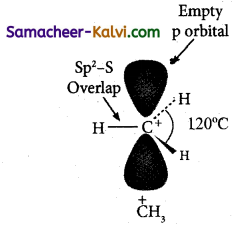
Answer:
(a) (i) – (B), (ii) – (C), (iii) – (D), (iv) – (A)

Samacheer Kalvi TN State Board 11th Chemistry Important Questions Chapter 6 Gaseous State

Question 32.
Match the entities in column I with appropriate entities in column II.

TN State Board 11th Chemistry Important Questions Chapter 6 Gaseous State 26

TN State Board 11th Chemistry Important Questions Chapter 6 Gaseous State 27

(a) (i) – (B), (ii) – (C), (iii) – (D), (iv) – (A)
(b) (i) – (C), (ii) – (B), (iii) – (A), (iv) – (D)
(c) (i) – (D), (ii) – (B), (iii) – (C), (iv) – (A)
(d) (i) – (C), (ii) – (D), (iii) – (B), (iv) – (A)
Answer:
(a) (i) – (B), (ii) – (C), (iii) – (D), (iv) – (A)

TN Board 11th Chemistry Important Questions

TN Board 11th Chemistry Important Questions Chapter 5 Alkali and Alkaline Earth Metals

TN State Board 11th Chemistry Important Questions Chapter 5 Alkali and Alkaline Earth Metals

Question 1.
Explain why atomic and ionic radii increases from lithium to caesium?
Answer:
On moving down the group, there is an increase in the number of shells, as well as increase in nuclear charge. The force of attraction between the nucleus and the added electron decreases. Hence, ionic and atomic radii increases.

Question 2.
Why alkali metals do not occur free in native?
Answer:
Since ionisation energy values of alkali metals are low, they are very reactive. They readily combine with oxygen, moisture and CO2 of the atmosphere and form compounds. Hence they do not occur free in nature.

Samacheer Kalvi TN State Board 11th Chemistry Important Questions Chapter 5 Alkali and Alkaline Earth Metals

Question 3.
Explain the following:
(i) Alkali metals have the lowest ionisation enthalpy compared to other elements in the respective period.
(ii) The second ionisation enthalpy values of alkali metals are high.
Answer:
(i) The atoms of alkali metals have largest size in their respective periods and therefore valence electrons are loosely bond to the nucleus and hence Can be easily
(ii) The removal of an electron from the alkali metals gives’ monovalent cations having stable electronic configurations similar to the noble gas. Therefore, it becomes very difficult to remove the second electron from the stable configurations already attained. Hence, the second ionisation enthalpy values of alkali metals are high.

Question 4.
What do you understand by the term “hydration enthalpy”? Explain how the hydration enthalpy of alkali metal cations vary in the group.
Answer:
The metal ion, in an aqueous solution gets surrounded by water dipoles in such a way that the cation or an anion is attracted by the opposite end of water dipoles. This process is known as hydration.

M+ (aq) + aq → [M (aq)]+ + energy

This process releases energy. This energy is known as hydration energy or hydration enthalpy.

Smaller the cation, greater is the degree of hydration. Thus, the degree of hydration of M+ ions decreases from Li+ ion to Cs+ ions.

Samacheer Kalvi TN State Board 11th Chemistry Important Questions Chapter 5 Alkali and Alkaline Earth Metals

Question 5.
Lithium salts are more soluble than the other metals of group 1. Explain why?
Answer:
The high solubility of Li salts is due to strong solvation of small size of Li+ ion.

Question 6.
Alkali metals give a characteristics colour for a bunsen flame. Explain why?
Answer:
The heat in the flame excites the valence electron to a higher energy level. When it drops back to its actual energy level, the excess energy is emitted as light, whose wavelength is in the visible region. This appears as a characteristic colour to the particular metal.

Question 7.
Bring out the similarities between lithium and magnesium.
Answer:
(i) Both lithium and magnesium are harder than other elements in the respective groups. .
(ii) Lithium and magnesium react slowly with water. Their oxides and hydroxides are much less soluble and their hydroxides decompose on heating.
(iii) Both form a nitride, Li3N and Mg3N2, by direct combination with nitrogen. .
(iv) They do not give any superoxides and form only oxides, Li2O and MgO.
(v) The carbonates of lithium and magnesium decompose upon heating to form their respective oxides and CO2.
(vi) Lithium and magnesium do not form bicarbonates.
(vii) Both LiCl and MgCl2 are soluble in ethanol and are deliquescent. They crystalline form aqueous solution as hydrates, LiCl . 2H2O and MgCl2 . 8 H2O

Samacheer Kalvi TN State Board 11th Chemistry Important Questions Chapter 5 Alkali and Alkaline Earth Metals

Question 8.
What is the cause for the distinctive behaviour of lithium? Compare the properties of lithium with other elements of the group.
Answer:
The distinctive behaviour of Li+ ion is due to its exceptionally small size, high polarising power, high hydration energy and non availability of d-orbitals.

TN State Board 11th Chemistry Important Questions Chapter 5 Alkali and Alkaline Earth Metals 1

Samacheer Kalvi TN State Board 11th Chemistry Important Questions Chapter 5 Alkali and Alkaline Earth Metals

Question 9.
Explain why alkali metals are very reactive.
Answer:
The reactivity of alkali metals is due to their low ionisation enthalpy. The ionisation enthalpy decreases down the group. Hence the reactivity of alkali metal increases from Li to Cs.

The high reactivity of alkali metals is proved by their reaction with oxygen and halogen which are most electronegative.

Question 10.
Explain the action of alkali metals with oxygen.
Answer:
All the alkali metals on exposure to air or oxygen bum vigorously, forming oxides on their surface. Lithium forms only monoxide, sodium forms the monoxide and peroxide and the other elements form monoxide, peroxide and superoxides. These oxides are basic in nature.

4 Li + O2 → Li2O (simple oxide)
2 Na + O2 → Na2O2 (peroxide)
M + O2 → MO2
(M = K, Rb,Cs; MO2 – superoxide)

Samacheer Kalvi TN State Board 11th Chemistry Important Questions Chapter 5 Alkali and Alkaline Earth Metals

Question 11.
Explain why?
(i) The ionic character of hydrides of alkali metals increase from Li to Cs.
(ii) The stability of hydrides decrease down the group.
(iii) Hydrides behave as strong reducing agents.
Answer:
(i) The electropositive character increases from Li to Cs. Hence their ionic character increases down the group.
(ii) The stability of the hydrides decreases down the group, as the size of the metal ion increases. The M—H bond distance increases with increase in size of metal
ion and it can be readily broken, i.e., the metal hydride is least stable.
(iii) They are powerful reducing agents as M—H bond is weaker and it can be readily broken.

Question 12.
Lithium iodide is covalent. Explain why?
Answer:
Lithium iodide shows covalent character, as Li+ ion, being smaller exerts high polarising power on the iodide anion. Alternatively, the iodide ion being the largest can be polarised to a greater extent by Li+ ion. Hence, lithium iodide is covalent.

Samacheer Kalvi TN State Board 11th Chemistry Important Questions Chapter 5 Alkali and Alkaline Earth Metals

Question 13.
Alkali metals dissolve in liquid ammonia and given deep blue solution. Explain the magnetic behaviour of these solution?
Answer:
The alkali metal atom readily loses its valence electron in ammonia solution. Both the cation and the electron are ammoniated to give ammoniated cation and ammoniated electron.

M + (x + y)NH3 → [M(NH3)x]+ + [e(NH3)y]

The blue colour of the solution is due to the ammoniated electron which absorbs energy in the visible region of light and thus imparts blue colour to the solution. The solutions are paramagnetic and on standing slowly liberate hydrogen resulting in the formation of an amide.
M+ + e + NH3 → MNH2 + V2H2

In concentrated solution, the blue colour changes to bronze colour and become diamagnetic.

Samacheer Kalvi TN State Board 11th Chemistry Important Questions Chapter 5 Alkali and Alkaline Earth Metals

Question 14.
Complete and balance the following equations.
(i) Li + H2O →
(ii) Na + C2H5OH →
(iii) CH ≡ CH + Na →
Answer:
(i) 2Li + 2H2O → 2LiOH + H2 (Lithium hydroxide)
(ii) 2Na + 2C2H5OH → C2H5ONa + H2 (sodium ethoxide)
(iii) CH ≡ CH TN State Board 11th Chemistry Important Questions Chapter 5 Alkali and Alkaline Earth Metals 2 HC ≡ CNa TN State Board 11th Chemistry Important Questions Chapter 5 Alkali and Alkaline Earth Metals 2 NaC ≡ C – Na (sodium acetylide)

Question 15.
Mention the uses of lithium.
Answer:
(i) Lithium metal is used to make alloys.
(ii) Lithium is also used to make electro chemical cells.
(iii) Lithium carbonate is used in medicines.

Question 16.
Mention the uses of sodium.
Answer:
(i) Sodium is used to make Na/Pb alloy needed to make Pb(Et)4 and Pb(Me)4.
(ii) Liquid sodium metal is used as a coolant in fast breeder nuclear reactors.

Question 17.
What are normal oxides, peroxides and superoxides? Give examples.
Answer:
Normal oxides are those which contain O-2 ion.
eg: Na2O, BaO, Al2O3 etc.,
Peroxides contain —O—O— linkage. (O2 ions). The produce hydrogen peroxide on treatment with dilute acid.
Na2O2 + H2SO4 → Na2SO4 + H2O2
Superoxides contain greater proportion of oxygen than normal oxides and peroxides. They contain 02~ ion.
eg: KO2, RbO2 or CsO2.

Samacheer Kalvi TN State Board 11th Chemistry Important Questions Chapter 5 Alkali and Alkaline Earth Metals

Question 18.
Give equation for the reaction of the following with water.
(i) Na2O,
(ii) K2O2,
(iii) KO2.
Answer:
(i) Na2O + H2O → 2NaOH + H2O
(ii) K202 + 2H2O → 2KOH + H2O2
(iii) 2K02 + 2H2O → 2KOH + H2O2 + O2

Question 19.
Give equation for the preparation of sodium chloride from
(i) NaOH,
(ii) Na2O,
(iii) Na2CO3.
Answer:
(i) NaOH + HCl → NaCl + H2O
(ii) Na2O + 2HCl → 2NaCl + H2O
(iii) Na2CO3 + 2HCl → 2NaCl + H2O + CO2

Question 20.
Which is more readily formed CSCl or NaCl, by the reaction of metal with chlorine? Explain.
Answer:
Caesium chloride is more readily, formed than sodium chloride, because caesium is more electropositive than sodium. As the electropositive character of the alkali metal increases, the case of formation of the halide increases.

Samacheer Kalvi TN State Board 11th Chemistry Important Questions Chapter 5 Alkali and Alkaline Earth Metals

Question 21.
Account for the low solubility of lithium luoride in water.
Answer:
The low solubility of LiF in water is due to its high lattice enthalpy (small size of Li+ and F ) than its solvation (hydration) energy.

Question 22.
Lithium halides are covalent. Explain.
Answer:
Due to the smaller size of lithium ion, it can polarise the larger halide ion to a greater extent. Hence Lithium halides are covalent.

Question 23.
Account for the thermal stability of carbonates and bicarbonates of alkali metals.
Answer:
As the electropositive character increases down the group, the stability of the carbonates and bicarbonates increases. This is due to the decrease in polarising power of alkali metal cations. The carbonates (M2CO3) of alkali metals are remarkably stable up to 1273 K, above which they first melt and then eventually decompose to form oxides.

Samacheer Kalvi TN State Board 11th Chemistry Important Questions Chapter 5 Alkali and Alkaline Earth Metals

Question 24.
Explain why lithium carbonate is the least stable among alkali metal carbonates.
Answer:
Li2CO3 is considerably less stable and decomposes readily.
Li2CO3 Li2O + CO2 This is presumably due to large size difference between Li+ and CO23 which makes the crystal lattice unstable.

Question 25.
Account for the solubility of alkali metal carbonates and bicarbonates in water.
Answer:
All the carbonates and bicarbonates are soluble in water and their solubilities increase rapidly on descending the group. This is due to the reason that lattice energies decrease more rapidly than their hydration energies on moving down the group.

Question 26.
Explain the solvay process of manufacturing sodium carbonate.
Answer:
In this process, ammonia is converted into – ammonium carbonate which then converted to ammonium bicarbonate by passing excess carbon dioxide in a sodium chloride solution saturated with ammonia. The ammonium bicarbonate thus formed reacts with the, sodium chloride to give sodium bicarbonate and ammonium chloride. As sodium bicarbonate has poor solubility, it gets precipitated. The sodium bicarbonate is isolated and is heated to give sodium carbonate. The equations involved in this process are,

2NH3 + H2O + CO2 → (NH4)2CO3
(NH4)2CO3 + H2O + CO2 → 2NH4HCO3
NH4HCO3 + NaCl → NH4Cl + NaHCO3
2 NaHCO3 → Na2CO3 + CO4 + H4O

The ammonia used in this process can be recovered by treating the resultant ammonium chloride solution with calcium hydroxide. Calcium chloride is formed as a by-product.

Samacheer Kalvi TN State Board 11th Chemistry Important Questions Chapter 5 Alkali and Alkaline Earth Metals

Question 27.
Mention the uses of sodium carbonate.
Answer:
(i) Sodium carbonate known as washing soda is used heavily for laundering.
(ii) It is an important laboratory reagent used in the qualitative analysis and in volumetric analysis.
(iii) It is also used in water treatment to convert the hard water to soft water.
(iv) It is used in the manufacturing of glass, paper, paint etc…

Question 28.
How is pure sodium chloride prepared from crude salt?
Answer:
Pure sodium chloride can be obtained from crude salt as follows. The insoluble impurities are removed by filtration from the crude salt solution with minimum amount of water. The filtrate contains sodium chloride solution. From this, sodium chloride can be crystallised by passing HCl gas into this solution. Calcium and magnesium chloride, being more soluble than sodium chloride, remain in solution.

Question 29.
Mention the uses of sodium chloride.
Answer:
(i) It is used as a common salt or table salt for domestic purpose.
(ii) It is used for the preparation of many inorganic compounds such as NaOH and Na2CO3.

Samacheer Kalvi TN State Board 11th Chemistry Important Questions Chapter 5 Alkali and Alkaline Earth Metals

Question 30.
Explain the Castner-Kellner process of manufacturing sodium hydroxide.
Answer:
Sodium hydroxide is prepared commercially by the electrolysis of brine solution in Castner-Kellner cell using a mercury cathode and a carbon anode. Sodium metal is discharged at the cathode and combines with mercury to form sodium amalgam. Chlorine gas is evolved at the anode. The sodium amalgam thus obtained is treated with water to give sodium hydroxide.
At cathode: Na+ + e → Na(amalgam)
At anode: Cl → 1/2 Cl2↑ + e
2Na(amalgam) + 2H2O → 2NaOH + 2Hg + H2

Question 31.
Mention the uses of sodium hydroxide.
Answer:
(i) Sodium hydroxide is used as a laboratory reagent.
(ii) It is also used in the purification of bauxite and petroleum refining.
(iii) It is used in the textile industries for mercerising cotton fabrics.
(iv) It is used in the manufacture of soap, paper, artificial silk and a number of chemicals.

Question 32.
How is sodium bicarbonate prepared?
Answer:
This compound is prepared by saturating a solution of sodium carbonate with carbon dioxide. The white crystalline powder of sodium bicarbonate, being less soluble, precipitated out.

Samacheer Kalvi TN State Board 11th Chemistry Important Questions Chapter 5 Alkali and Alkaline Earth Metals

Question 33.
Mention the uses of sodium bicarbonate.
Answer:
(i) Primarily used as an ingredient in baking.
(ii) Sodium hydrogen carbonate is a mild antiseptic for skin infections.
(iii) It is also used in fire extinguishers.

Question 34.
Discuss the biological importance of sodium and potassium.
Answer:
(i) Sodium and potassium ions maintain the ion balance and nerve impulse conduction.
(ii) Transport of sugar and amino acids into cells.
(iii) Potassium ions activate many enzymes, participate in the oxidation of glucose to produce ATP.
(iv) With sodium, potassium ion is responsible for the transmission of nerve signals.
(v) Sodium and potassium pump play an important role in transmitting nerve signals.

Question 35.
Why group 2 elements are called alkaline earth metals?
Answer:
These elements with the exception of beryllium are commonly known as the alkaline earth metals because their oxides and hydroxides are alkaline in nature and these metal oxides are found in the earth’s crust.

Question 36.
Write the electronic configuration of group 2 elements.
Answer:

TN State Board 11th Chemistry Important Questions Chapter 5 Alkali and Alkaline Earth Metals 3

Samacheer Kalvi TN State Board 11th Chemistry Important Questions Chapter 5 Alkali and Alkaline Earth Metals

Question 37.
Account for
(i) The atomic and ionic radii of group 2 elements are smaller than alkali metals.
(ii) The atomic and ionic radii increases down the group.
Answer:
(i) The atomic and ionic radii of alkaline earth metals are smaller than the corresponding members of the alkali metals. This is due to the fact the Group 2 elements having a higher nuclear charge that allows electrons to be attracted more strongly towards the nucleus.
(ii) On moving down the group, the radii increases due to gradual increase in the number of the shells and the screening effect.

Question 38.
Explain why alkaline earth metals exhibit an oxidation state of +2.
Answer:
The group 2 elements have two electrons in their valence shell and by losing these electrons, they acquire the stable noble gas configuration. So these elements exhibit +2 oxidation state in their compounds.

Question 39.
Explain:
(i) ionisation enthalpy of alkaline earth metals are low compared to ‘p’ block elements.
(ii) Ionisation enthalpy decreases down the group.
(iii) Ionisation enthalpy of group 2 elements are higher than that of group 1 elements.
Answer:
(i) Due to a fairly large size of the atoms, alkaline earth metals have low ionisation enthalpies when compared to ‘p’ block elements.
(ii) Down the group the ionisation enthalpy decreases as atomic size increases. This is due to the addition of new shells as well as increase in the magnitude of the screening effect of inner shell electrons.
(iii) Members of group 2 have higher ionization enthalpy values than group 1 because of their smaller size, with electrons being more attracted towards the nucleus of | the atoms. Correspondingly they are less electropositive than alkali metals.

Samacheer Kalvi TN State Board 11th Chemistry Important Questions Chapter 5 Alkali and Alkaline Earth Metals

Question 40.
Although IE1 values of alkaline earth metals ire higher than that of alkali metals the IE2 values of alkaline earth metals are much smaller than alkali metals. Explain.
Answer:
This is because in alkali metals the second electron is to be removed from a cation, which has already acquired a noble gas configuration. In the case of alkaline earth metals, the second electron is to be removed from a monovalent cation, which still has one electron in the outermost shell. Thus, the second electron can be removed more easily in the case of group 2 elements than in group 1 elements.

Question 41.
Hydration enthalpies of ine earth metal ions are larger than these of alkali metal ions. Explain.
Answer:
Smaller the size of the ions, greater is the extent of hydration. Hence alkaline earth metal ions are smaller in size compared to alkali metals. Hence their hydration enthalpies are much larger than alkali metals.

Question 42.
Account for the decrease in hydration enthalpy of group 2 elements down the group.
Answer:
The hydration enthalpies of alkaline earth metal ions also decrease with increase in ionic size down the group.
Be > Mg > Ca > Sr > Ba
eg: MgCl2 and CaCl2 exist as MgCl2.6H2O and CaCl2 . 6H2O while NaCl and KCl do not form such hydrates.

Samacheer Kalvi TN State Board 11th Chemistry Important Questions Chapter 5 Alkali and Alkaline Earth Metals

Question 43.
Account for the characteristic colour produced by the alkaline earth metal salt:: in bunsen flame.
Answer:
The heat in the flame excites the valence electron to a higher energy level, when it drops back to its actual energy level, the excess energy is emitted as light, whose wavelength is in the visible region as shown in the table.

TN State Board 11th Chemistry Important Questions Chapter 5 Alkali and Alkaline Earth Metals 4

Question 44.
Discuss the anomalous behaviour of beryllium.
Answer:
The anomalous properties of beryllium is mainly due to its small size, high electronegativity, high ionisation energy
and high polarising power compared to the other elements in the group. The anomalous properties of beryllium compared to other elements of the group are mentioned in table.

TN State Board 11th Chemistry Important Questions Chapter 5 Alkali and Alkaline Earth Metals 5

Samacheer Kalvi TN State Board 11th Chemistry Important Questions Chapter 5 Alkali and Alkaline Earth Metals

Question 45.
What is the cause for diagonal relationship between beryllium and aluminium?
Answer:
Beryllium (the first member of group (2) shows a diagonal, relatiofiship with aluminium. In this case, the size of these ions (rBe2+ = 0.45 Å and rAl3+= 0.54 Å) is not as close. However, their charge per unit area is closer (Be2+ = 2.36 and Al3+ = 2.50). They also have sameelectronegativity values (Be = 1.5; Al = 1.5).

Question 46.
Give methods of preparation of beryllium chloride.
Answer:
Thermal decomposition of (NH4)2BeF4 is the best route for the preparation of BeF2. BeCl2 is conveniently made from the oxide.
BeO + C + Cl2 TN State Board 11th Chemistry Important Questions Chapter 5 Alkali and Alkaline Earth Metals 6 BeCl2 + CO

Question 47.
How is beryllium hydride prepared? Give equation.
Answer:
BeH2 can be prepared by the reaction of BeCl2 with LiAlH4 (Lithium aluminium hydride).
2BeCl2 + LiAlH4 » 2BeH2 + LiCl + AlCl3

Samacheer Kalvi TN State Board 11th Chemistry Important Questions Chapter 5 Alkali and Alkaline Earth Metals

Question 48.
How does the basic nature of the oxides of group 2 elements vary down the group?
Answer:
The basic nature of oxides increases down the group.

TN State Board 11th Chemistry Important Questions Chapter 5 Alkali and Alkaline Earth Metals 7

Question 49.
How does (i) solubility,
(ii) thermal stability,
(iii) basic character hydroxides of group 2 elements vary down the group.
Answer:
All the properties increases down the group.
Be(OH)2 < Mg(OH)2 < Ca (OH)2 < Sr (OH)2 < Ba (OH)2

Question 50.
Beryllium halide are covalent. Explain why?
Answer:
Due to the smaller size of Be+2 ion, it polarises the halide ion to a greater extent. Hence Beryllium halides are covalent.

Samacheer Kalvi TN State Board 11th Chemistry Important Questions Chapter 5 Alkali and Alkaline Earth Metals

Question 51.
Explain with equations beryllium hydroxide is amphoteric.
Answer:
Beryllium hydroxide is amphoteric in nature as it reacts with both acid and alkali.
Be(OH)2 + 2 NaOH → Na2BeO2 +2H2O
Be(OH)2 + 2HCl → BeCl2 + 2H2O

Question 52.
Give a brief account of the structure of beryllium chloride.
Answer:

TN State Board 11th Chemistry Important Questions Chapter 5 Alkali and Alkaline Earth Metals 8

(i) Beryllium chloride has a chain structure in the solid state as shown in structure-(a).
(ii) In the vapour phase BeCl2 tends to form a chloro-bridged dimer in structure-(c).
(iii) Which dissociates into the linear monomer at high temperatures of the order of 1200 K. structure-(b).

Question 53.
How does (i) the solubility and
(ii) the thermal stability of the carbonates of group 2 elements vary down the group.
Answer:
(i) The solubility of carbonates in water decreases down the group.
(ii) The thermal stability increases down the group with increasing cationic size.

Question 54.
Explain why BeSO4 and MgSO4 are readily soluble in water.
Answer:
The greater hydration enthalpies of Be2+ and Mg2+ ions overcome the lattice enthalpy factor and therefore their sulphates are soluble in water.

Samacheer Kalvi TN State Board 11th Chemistry Important Questions Chapter 5 Alkali and Alkaline Earth Metals

Question 55.
Arrange the following as indicated.
(i) BeSO4, MgSO4 CaSO4, SrSO4 and BaSO4 in the increasing order of solubility,
(ii) Be(NO3)2, Mg(NO3)2, Ca(NO3)2, Sr (NO3)2, Ba(NO3)2 < Ba (NO3)2 in decreasing order of forming hydrated salts.
Answer:
(i) BeSO4 > MgSO4 > CaSO4 > SrSO4 > BaSO4.
(ii) Be(NO3)2 < Mg(NO3)2 < Ca (NO3)2 < Sr(NO3)2 < Ba (NO3)2 [due to increase in size of M2+ ions].

Question 56.
How is quick lime produced on a commercial scale?
Answer:
It is produced on a commercial scale by heating limestone in a lime kiln in the temperature range 1070-1270K.
CaCO3 → CaO + CO2
The reactionbeing reversible, carbon dioxide is removed as soon as it is produced to enable the reaction to proceed to completion.

Samacheer Kalvi TN State Board 11th Chemistry Important Questions Chapter 5 Alkali and Alkaline Earth Metals

Question 57.
Give equations for the reaction of CaO with
(i) H2O, (ii) CO2, (iii) SiO2, (iv) P4O10.
Answer:
(i) CaO + H2O → Ca(OH)2 (Calcium hydroxide)
(ii) CaO + CO2 → CaCO3 (Calcium carbonate)
(iii) CaO+ SiO2 → CaSiO3 (Calcium silicate)
(iv) 6 CaO + P4O10 → 2 Ca3(PO4)2 (Calcium phosphate)

Question 58.
What is slaked lime? How is it produced?
Answer:
Calcium hydroxide (Ca(OH)2) is called slaked lime. It is formed by the addition of limited amount of water as quick lime.
CaO + H2O → Ca(OH)2

Question 59.
Mention the uses of calcium oxide (CaO).
Answer:
(i) To manufacture cement, mortar and glass.
(ii) In die manufacture of sodium carbonate and slaked lime.
(iii) In the purification of sugar.
(iv) As a drying agent.

Samacheer Kalvi TN State Board 11th Chemistry Important Questions Chapter 5 Alkali and Alkaline Earth Metals

Question 60.
(i) What happens when carbon dioxide is passed through lime water? Give equation.
(ii)What happens when excess of carbondioxide is passed through lime water? Give equation.
Answer:
(i) When carbon dioxide is passed through lime water, it turns milky due to the formation of calcium carbonate.
Ca(OH)2 + CO2 → CaCO3↓ + H2O
(ii) On passing excess of carbon dioxide, the precipitate dissolves to form calcium hydrogen carbonate.
CaCO3 + CO2 + H2O → Ca(HCO3)2

Question 61.
Mention the uses of calcium hydroxide.
Answer:
Calcium hydroxide is used:
(i) In the preparation of mortar, a building material.
(ii) In white washing due to its disinfectant nature.
(iii) In glass making, in tanning industry, in the preparation of bleaching powder and for the purification of sugar.

Samacheer Kalvi TN State Board 11th Chemistry Important Questions Chapter 5 Alkali and Alkaline Earth Metals

Question 62.
Explain the term retrograde solubility.
Answer:
Gypsum becomes less soluble in water as the temperature increases. This is known as retrograde solubility, which is a distinguishing characteristic of gypsum.

Question 63.
Explain the term ‘desert rose’.
Answer:
Gypsum crystals are sometimes found to occur in a form that resembles the petals of a flower. This type of formation is referred to as ‘desert rose’, as they mostly occur in arid areas or desert terrains.

Question 64.
Explain why gypsum is used in making dry walls or wall board.
Answer:
Gypsum is known to have low thermal conductivity, which is the reason why it is used in making drywalls dr wallboards. Gypsum is also known as a natural insulator.

Question 65.
How is plaster of paris’ produced from gypsum? Mention its use.
Answer:
Gypsum is heated to about 300 degree Fahrenheit to produce plaster of Paris, which is also known as gypsum plaster. It is mainly used as a sculpting material.

Samacheer Kalvi TN State Board 11th Chemistry Important Questions Chapter 5 Alkali and Alkaline Earth Metals

Question 66.
Explain the use of gypsum in agriculture.
Answer:
It helps loosen up compact or clay soil and provides calcium and sulphur, which are essential for the healthy growth of a plant. It can also be used for removing sodium from soils having excess salinity.

Question 67.
What is ‘dead burnt plaster’? What is use?
Answer:
Anhydrous calcium sulphate formed by heating plaster of Paris above 393 K is known a dead burnt plaster. It has a remarkable property of setting with water. On mixing adequate quantity of water, it forms a plastic mass that gets into a hard solid in 5 to 15 minutes.

Question 68.
Briefly outline the biological importance of calcium and magnesium.
Answer:
(i) Mg is a cofactor of all enzymes that utilise ATP in phosphate transfer and energy release.
(ii) Magnesium is essential for DNA synthesis and is responsible for the stability and proper functioning of DNA.
(iii) Deficiency of magnesium results into, convulsion and neuro muscular irritation.
(iv) Calcium is present in blood and its concentration is maintained by hormones calcitonin and parathyroid hormone.
(v) Deficiency of calcium is blood causes it take to much time to clot and in muscle contraction.

Samacheer Kalvi TN State Board 11th Chemistry Important Questions Chapter 5 Alkali and Alkaline Earth Metals

Question 69.
Explain what to meant by efflorescence.
Answer:
It is a phenomenon by which water of hydration of a hydrated salt is lost on exposure to atmosphere, eg: Washing soda (Na2CO3 10H2O), and Glauber salt (Na2SO4 10H2O) when exposed to atmosphere lost their water of hydration and becomes powdery.

Choose the correct answer:

Question 1.
Among alkali metals, the metals having smallest metallic radius and largest metallic radius are:
(a) Li, Na
(b) Cs, Li
(c) Li, Cs
(d) Na, K
Answer:
(c) Li, Cs
Hint:
On moving down the group, the metallic radius increases.

Question 2.
The melting points of alkali metals:
(a) increase down the group
(b) decrease down the group
(c) does not show a regular trend
(d) increases upto K and then decreases
Answer:
(b) decrease down the group
Hint:
The low melting point is attributed to low binding energies of their .atoms in the crystal lattice an account of single electron in the valency shell and large atomic sizes. The binding energy decrease from Li to Cs consequently the melting points.
[ Note: The same reason is applicable to boiling points also.]

Samacheer Kalvi TN State Board 11th Chemistry Important Questions Chapter 5 Alkali and Alkaline Earth Metals

Question 3.
Choose the correct statement:
(a) Alkali metals are highly electropositive because of their low ionisation energies.
(b) Alkali metal cations have stable electronic configuration.
(c) The hydration enthalpies of alkali metals decreases from Li+ to Cs+.
(d) all the above.
Answer:
(d) all the above

Question 4.
Sodium react with water more vigorously than lithium because:
(a) it has higher atomic mass
(b) it is more electropositive
(c) it is more electronegative
(d) it is a metal
Answer:
(b) it is more electropositive
Hint:
The reactivity of alkali metals towards water increases from Li to Cs. This is due to increase in electropositive character in the same order.

Samacheer Kalvi TN State Board 11th Chemistry Important Questions Chapter 5 Alkali and Alkaline Earth Metals

Question 5.
Select the correct statement:
(a) Lithium carbonate is soluble in water.
(b) Potassium carbonate is soluble in water.
(c) Barium carbonate soluble in water.
(d) Bicarbonate of lithium is soluble in water.
Answer:
(b) Potassium carbonate is soluble in water.
Hint:
(a) The lattice energy of Li2CO3 is high compared to the solvation energy. Hence it is insoluble in water.
(b) Correct statement.
(c) BaCO3 is insoluble in water due to the high lattice energy.
(d) Lithium, due to its less electropositive nature does not form a bicarbonate.

Question 6.
Which of the following has the lowest thermal stability?
(a) Li2CO3
(b) Na2CO3
(c) K2CCO3
(d) Rb2CO3
Answer:
(a) Li2CO3
Hint:
The stability of carbonates increase down the group.

Samacheer Kalvi TN State Board 11th Chemistry Important Questions Chapter 5 Alkali and Alkaline Earth Metals

Question 7.
Sodium bums in dry air to give:
(a) Na2O
(b) Na2O2
(c) NaO2
(d) Na3N
Answer:
(b) Na2O2
Hint:
2Na + O2 → Na2O2

Question 8.
The by-product of Solvay ammonia-process is:
(a) CO2
(b) NH3
(c) CaCl2
(d) CaCO3
Answer:
(c) CaCl2
Hint:
The ammonia used in the process can be recovered by treating the resultant ammonium chloride with calcium hydroxide. Calcium chloride is formed as a by product.

Samacheer Kalvi TN State Board 11th Chemistry Important Questions Chapter 5 Alkali and Alkaline Earth Metals

Question 9.
Which of the following metal carbonate is decomposed on heating?
(a) Na2CO3
(b) K2CO3
(c) Li22CO3
(d) MgCO3
Ans :
(d) MgCO3
Hint:
Alkali metal carbonates are stable to heat. The electropositive character increases from Li to Cs. Hence the stability of the carbonates increase in the same order.
CS2CO3 > Rb2CO3 > K2CO3 > Na2CO3 > Li2CO3

Question 10.
Which of the following does not give flame colouration?
(a) BaCl2
(b) CaCO3
(c) SrCO3
(d) MgCl2
Answer:
(d) MgCl2
Hint:
Be and Mg in group 2, does not give flame colouration. In Be, and Mg because of their small size, electrons are held firmly and their excitation is difficult.

Samacheer Kalvi TN State Board 11th Chemistry Important Questions Chapter 5 Alkali and Alkaline Earth Metals

Question 11.
Epsom salt is:
(a) CaSO4 . 2H2O
(b) MgSO4 . H2O
(c) BaSO4
(d) SrSO4
Ans :
(b) MgSO4 . H2O

Question 12.
Suspension of slaked lime in water called:
(a) quick lime
(b) milk of lime
(c) lime water
(d) washing of lime
Ans :
(b) milk of lime

Question 13.
Quick lime is:
(a) CaCO3
(b) CaO
(c) CaSO4. 2H2O
(d Ca(OH)2
Answer:
(b) CaO

Samacheer Kalvi TN State Board 11th Chemistry Important Questions Chapter 5 Alkali and Alkaline Earth Metals

Question 14.
A metal X is prepared by the electrolysis of fused chloride. It reacts with hydrogen to form colourless solid from which hydrogen is released as treatment with water. The metal is:
(a) Al
(b) Ca
(c) Cu
(d) Zn
Ans :
(b) Ca
Hint:
Ca + H2 → CaH2
CaH2 + H2O → Ca(OH)2 + H2

Question 15.
A substance which gives a brick red flame colour and breaks down on heating giving oxygen and a brown gas is:
(a) CaCO3
(b) MgNO3
(c) MgCO3
(d) MgNCa(NO3)2
Ans :
(d) MgNCa(NO3)2
Hint:
Ca(NO3)2 > CaO + 2NO2 + O2

Samacheer Kalvi TN State Board 11th Chemistry Important Questions Chapter 5 Alkali and Alkaline Earth Metals

Question 16.
The sodium metal is made by electrolysis of molten mixture of 40% NaCl and 60% CaCl2. because:
(a) CaCl2 helps in the conduction of electricity
(b) Ca+2 can reduce NaCl to Na
(c) Ca+2 can displace Na from NaCl
(d) this mixture has a lower melting point than NaCl.
Answer:
Hint:
CaCl2 is added to lower the melting point ofNaCl.

Question 17.
The first ionisation energies of alkaline earth metals are higher than alkali metals. This is because:
(a) there is increase in nuclear charge of the alkaline earth metals.
(b) there is decrease in nuclear charge of the alkaline earth metals.
(c) there is no charge in nuclear charge.
(d) none of these.
Answer:
(a) there is increase in nuclear charge of the alkaline earth metals.

Question 18.
Potassium superoxide is used in oxygen cylinders in space and submarine, because it:
(a) absorbs CO2 and increases O2 constant
(b) eliminates moisture
(c) absorbs CO2
(d) produces O2
Answer:
(a) absorbs CO2 and increases O2 constant
Hint:
As air purifier in space capsules.

Samacheer Kalvi TN State Board 11th Chemistry Important Questions Chapter 5 Alkali and Alkaline Earth Metals

Question 19.
The substance not likely to contain CaCO3 is:
(a) dolomite
(b) a marble statue
(c) calcined gypsum
(d) sea shells
Answer:
(c) calcined gypsum

Question 20.
When washing soda is heated:
(a) CO2 is liberated
(b) CO is released
(c) CO + CO2 are released
(d) water vapour is released
Ans :
(d) water vapour is released
Hint:
Washing soda is Na2CO3 10H2O. This an heating loses its molecules of water and because anhydrous.

Samacheer Kalvi TN State Board 11th Chemistry Important Questions Chapter 5 Alkali and Alkaline Earth Metals

Question 21.
Identify the pair in which the first oxide is basic and the second one is amphoteric.
(a) LiO, NaO
(b) BeO, BaO
(c) BaO, BeO
(d) Na2O, CaO
Answer:
(c) BaO, BeO

Question 22.
Among the following compounds, a pair of compounds which are insoluble in water is:
(a) LiCl, LiF
(b) NaCl, NaBr
(c) NaBr, KBr
(d) CaCl2, NaCl
Ans :
(a) LiCl, LiF
Hint:
Both are covalent compounds.

Question 23.
The pair of carboniates,‘which decompose to the metal and carbon dioxide on heating is:
(a) Na2CO3, K2CO3
(b) Li2CO3, K2CO3
(c) Li2CO3, MgCO3
(d) Na2CO3, MgCO3
Answer:
(c) Li2CO3, MgCO3
Hint:
Due to diagonal relationship both the carbonates decompose to its metal and carbon dioxide. All other carbonates are stable to heat.

Samacheer Kalvi TN State Board 11th Chemistry Important Questions Chapter 5 Alkali and Alkaline Earth Metals

Question 24.
Assertion:
Alkali metals impart colour to the Bunsen flame.
Reason:
Their ionisation energies are low.

(a) If both assertion and reason are true and reason is the correct explanation of the assertion.
(b) If both assertion and reason are true but reason is not the correct explanation of j the assertion.
(c) If assertion is true but reason is false.
(d) If both assertion and reason are false.
Ans :
(a) If both assertion and reason are true and reason is the correct explanation of the assertion.

Question 25.
Assertion:
K, Rb and Cs form superoxides.
Reason:
The stability of superoxides increases from K+ to Cs+ due to decrease in lattice energy.

(a) If both assertion and reason are true and reason is the correct explanation of the : assertion.
(b) If both assertion and reason are true but reason is not the correct explanation of the assertion.
(c) If assertion is true but reason is false.
(d) If both assertion and reason are false.
Answer:
(c) If assertion is true but reason is false.
Hint:
Correct Reason: Since for salts of larger anions, the lattice energy increases with increase in the size of the cation from K+ to Cs+, therefore the stability of their superoxides increases from K to Cs.

Samacheer Kalvi TN State Board 11th Chemistry Important Questions Chapter 5 Alkali and Alkaline Earth Metals

Question 26.
Assertion:
Potassium carbonate cannot be manufactured by a process similar to Solvay’s soda ammonia process.
Reason:
Potassium hydrogen carbonate is less soluble in water than . sodium hydrogen carbonate.
(a) If both assertion and reason are true and reason is the correct explanation of the assertion.
(b) If both assertion and reason are true but reason is not the correct explanation of the assertion.
(c) If assertion is true but reason is false.
(d) If both assertion and reason are false.
Answer:
(c) If assertion is true but reason is false.
Hint:
KHCO3 is more soluble in water than NaHCO3.

Question 27.
Choose the correct Statements from the following:
(a) Sodium forms a super oxide.
(b) LiOH is a weak base while the hydroxides of other alkali metals are strongly basic.
(c) Washing soda has the formula Na2CO3.8H2O
(d) Calcium gives apple green colour when exposed to Bunsen flame.
Answer:
(a) Sodium forms a super oxide.

Samacheer Kalvi TN State Board 11th Chemistry Important Questions Chapter 5 Alkali and Alkaline Earth Metals

Question 28.
Choose the correct Statements from the following:
(a) Alkaline earth metals are less electro positive than alkali metals.
(b) The solubility of sulphates in water decrease down the group from Be to Ba.
(c) BeCO3 is less stable than MgCO3.
(d) Plaster of Paris has the formula CaSO4.H2O
Answer:
(b) The solubility of sulphates in water decrease down the group from Be to Ba.

Question 29.
Which of the following statements is true about Ca(OH)2?
(a) It is used in the preparation of bleaching powder.
(b) It is a light blue solid.
(c) It does not possess disinfectant properly.
(d) It is used in the manufacture of cement.
Answer:
(a) It is used in the preparation of bleaching powder.

Samacheer Kalvi TN State Board 11th Chemistry Important Questions Chapter 5 Alkali and Alkaline Earth Metals

Question 30.
Choose the incorrect statement in the following.
(a) BaO is soluble but BaSO4 is insoluble in water.
(b) Lil is more soluble in ethanol than KI.
(c) Both Li and Mg form solid hydrogen carbonates.
(d) Both LiCl and MgCl2 are deliquescent.
Answer:
(c) Both Li and Mg form solid hydrogen carbonates.

Question 31.
Which of the following statement is incorrect with respect to alkaline earth metals.
(a) Be and Mg exhibits diagonal relationship.
(b) Alkaline earth metals form ionic compounds in which the oxidation state of the metal is +2.
(c) The basic nature of the oxides of the decreases down the group.
(d) All carbonates decompose on heating.
Answer:
(c) The basic nature of the oxides of the decreases down the group.

Samacheer Kalvi TN State Board 11th Chemistry Important Questions Chapter 5 Alkali and Alkaline Earth Metals

Question 32.
Match the entities in column I with appropriate entities in column II.

Column I Column II
(i) Used as a source of 02 in submarines, space shuttles, and oxygen masks (A) Mg(Cl04)2
(ii) Used in obtaining the X-ray of the stomach. (B) CaH2
(iii) Used as a dying agent (C)KO2
(iv) Reacts with water to produced H2 (D) BaS04

(a) (i) – (C), (ii) – (A), (iii) – (B), (iv) – (D)
(b) (i) – (C), (ii) – (D), (iii) – (A), (iv) – (B)
(c) (i) – (B), (ii) – (B), (iii) – (D), (iv) – (B)
(d) (i) – (A), (ii) – (C), (iii) – (D), (iv) – (B)
Answer:
(b) (i) – (C), (ii) – (D), (iii) – (A), (iv) – (B)

Samacheer Kalvi TN State Board 11th Chemistry Important Questions Chapter 5 Alkali and Alkaline Earth Metals

Question 33.
Match the entities in column I with appropriate entities in column II.

Column I Column II
(i) Strongest reducing agent in aqueous solution (A) Magnesium
(ii) Does not give flame colouration (B) Caesium
(iii) Forms peroxides on heating with excess oxygen (C) Lithium
(iv) Used in photoelectric cells (D) Sodium

(a) (i)- (D), (ii) – (B), (iii) – (A), (iv) – (C)
(b) (i) . (B), (ii) – (C), (iii) – (A), (iv) – (D)
(c) (i) – (C), (ii) – (A), (iii) – (D), (iv) – (B)
(d) (i) – (C), (ii) – (A), (iii) – (D), (iv) – (B)
Answer:
(c) (i) – (C), (ii) – (A), (iii) – (D), (iv) – (B)

TN Board 11th Chemistry Important Questions

TN Board 11th Chemistry Important Questions Chapter 4 Hydrogen

TN State Board 11th Chemistry Important Questions Chapter 4 Hydrogen

Question 1.
Mention the properties in which ortho and para hydrogen differ.
Answer:
(i) The boiling point and melting point para hydrogen is lower than that of ortho hydrogen.
(ii) Para hydrogen has zero magnetic moment while ortho hydrogen has magnetic moment twice as that of proton.

Question 2.
Explain the laboratory preparation of hydrogen.
Answer:
Hydrogen is conveniently prepared in laboratory by the reaction of metals, such as zinc, iron, tin with dilute acid.

Zn + 2 HCl → ZnCl2 + H2

TN State Board 11th Chemistry Important Questions Chapter 4 Hydrogen 1

Samacheer Kalvi TN State Board 11th Chemistry Important Questions Chapter 4 Hydrogen

Question 3.
Explain steam -reforming of hydrocarbons to produce hydrogen gas.
Answer:
In this method hydrocarbon such as methane is mixed with steam and passed over nickel catalyst in the range 800 – 900°C and 35 atm pressures.
CH4 + H2O → CO + 3H2

Question 4.
What is water gas? How is it produced?
Answer:
Water gas is a mixture of carbon monoxide (CO) and hydrogen (H2), Steam is passed over a red-hot coke to produce carbon monoxide and hydrogen.

Question 5.
How will you convert carbon monoxide in water gas to carbondioxide?
Answer:
The carbon monoxide of the water gas can be converted to carbon dioxide by mixing the gas mixture with more steam at 400°C and passed over a shift converter containing iron/copper Catalyst. This reaction is called as water-gas shift reaction.
CO + H2O → CO2 + H2
The CO2 formed in the above process is absorbed in a solution of potassium carbonate.
CO2 + K2CO3 + H2O → 2 KHCO3

Samacheer Kalvi TN State Board 11th Chemistry Important Questions Chapter 4 Hydrogen

Question 6.
How is heavy hydrogen D2 produced?
Answer:
Prolonged electrolysis of heavy water produces heavy hydrogen. The electrolysises continued until the resulting solution becomes enriched in heavy water. Further electrolysis of the heavy water gives deuterium.
2D2O TN State Board 11th Chemistry Important Questions Chapter 4 Hydrogen 2 2D2 + O2

Question 7.
How is Tritium prepared?
Answer:
It is artificially prepared by bombarding lithium with slow neutrons in a nuclear fission reactor. The nuclear transmutation reaction for’ this process is as follows.

TN State Board 11th Chemistry Important Questions Chapter 4 Hydrogen 3

Question 8.
Give the reaction which takes place in H2 – O2 fuel cells.
Answer:
2H2 + O2 → 2H2O. This reaction is explosive and releases a lot of energy, which is used in fuel cells to generate electricity.

Samacheer Kalvi TN State Board 11th Chemistry Important Questions Chapter 4 Hydrogen

Question 9.
What is the order of reactivity of halogens towards hydrogen?
Answer:
The order of reactivity is F2 > Cl2 > Br2 > I2.

H2 + F2 TN State Board 11th Chemistry Important Questions Chapter 4 Hydrogen 4 2HF
H2 + Cl2 TN State Board 11th Chemistry Important Questions Chapter 4 Hydrogen 5 2HCl
H2 + Br2 TN State Board 11th Chemistry Important Questions Chapter 4 Hydrogen 6 2HBr
H2 + I2 TN State Board 11th Chemistry Important Questions Chapter 4 Hydrogen 7 2HI

Question 10.
Mention the oxidation state of hydrogen in hydrides. Give three examples of reactive metal hydrides.
Answer:
The oxidation state of hydrogen in hydrides is -1.
The reactive metal hydrides as LiH, NaH, CaH.

Question 11.
Name two hydrides which are used as reducing agents in organic chemistry. How are they prepared?
Answer:
Lithium aluminium hydride (Li AlH4) and sodium borohydride (NaBH4) are used as a reducing agent in organic chemistry. They are prepared as follows:
4 LiH + AlCl → Li [AlH4] + 3 LiCl
4 NaH + B(OCH3)3 → Na [BH4] + 3 CH3ONa

Samacheer Kalvi TN State Board 11th Chemistry Important Questions Chapter 4 Hydrogen

Question 12.
Give example of a reaction where H2 acts as a reducing agent.
Answer:
Hydrogen itself acts as a reducing agent. In the presence of finely divided nickel, it adds to the unsaturated organic compounds to form saturated compounds.
HC ≡ CH TN State Board 11th Chemistry Important Questions Chapter 4 Hydrogen 8 H2C = CH2 TN State Board 11th Chemistry Important Questions Chapter 4 Hydrogen 8 H3C – CH3

Question 13.
How does D2 react with O2 and halogen? Write balanced equation.
Answer:
They form heavy water and halides.
2D2 + O2 → 2D2O
D2 + X2 → 2DX [X = F, Cl, B and I]

Question 14.
Give a brief account of exchange reaction of D2O.
Answer:
In these reactions, hydrogen in the reactants is replaced by D.
2NaOH + D2O → 2NaOD + HOD
HCl + D2O → DCl + HOD
NH4Cl + 4D2O → ND4Cl + 4HOD

Question 15.
Mention the use of H2 in metallurgy.
Answer:
In metallurgy, hydrogen can be used to j reduce many metal oxides to metals at high 1 temperatures.
CuO + H2 → Cu + H2O
WO3 + 3H2 → W + 3H2O

Samacheer Kalvi TN State Board 11th Chemistry Important Questions Chapter 4 Hydrogen

Question 16.
Mention the industrial importance of hydrogen.
Answer:
(i) Ammonia is synthesized in a large scale by Haber process. The reaction is
N2 + 3H2 TN State Board 11th Chemistry Important Questions Chapter 4 Hydrogen 9 2NH3
(ii) Ammonia is used in the manufacture of chemicals such as nitric acid, fertilises and explosives.
(iii) It can be used to manufacture the industrial I solvent, methanol from carbon monoxide using copper as catalyst.
CO + 2H2 TN State Board 11th Chemistry Important Questions Chapter 4 Hydrogen 10 CH3OH

Question 17.
Give a brief account of the action of water on metals.
Answer:
(i) The most reactive metals i.e., the alkali metals, decompose water even in cold with the evolution of hydrogen leaving an alkali metal hydroxide solution.
2Na + 2 H2O → 2 NaOH + H2

(ii) The group 2 metals (except beryllium) react in a similar way but less violently, The hydroxides are less soluble in water than those of Group 1.
Ba + 2H2O → Ba(OH)2 + H2

(iii) Some transition metals react with hot water or steam to form the corresponding oxides. For example, steam passed over red hot iron results in the formation of iron oxide with the release of hydrogen.
3Fe + 4H2O → Fe3O4 + H2

(iv) Lead and copper decompose water only at a red hot. Silver, gold, mercury and platinum do not have any effect on water.

Samacheer Kalvi TN State Board 11th Chemistry Important Questions Chapter 4 Hydrogen

Question 18.
Give a brief account of the action of water on non-metals.
Answer:
(i) Fluorine decomposes cold water.
2F2 + 2H2O2 → 2H2F2 + O2
3F2 + 3H2O2 → 2H2F2 + O3
(ozonised oxygen)

(ii) Chlorine decomposes cold water forming j HC1 and HOCl (hypochlorous acid) j
Cl2 + H2O → 2HCl + HOCl.

Question 19.
What are the causes for the hardness of water?
Answer:
The presence of Ca+2 and Mg+2 ions and that of metal salt in the form of bicarbonate, chloride and sulphate ions makes water hard.

Question 20.
How is temporary hardness removed?
Answer:
This can be removed by boiling the hard water followed by filtration. Upon boiling, these salts decompose into insoluble carbonate which leads to their precipitation. The magnesium carbonate thus formed further hydrolysed to give insoluble magnesium hydroxide.
Ca(HCO3)2 → CaCO3 + H2O + CO2
Mg(HCO3)2 → MgCO3 + H2O+ CO2
MgCO3 + H2O → Mg(OH)2 + CO2
The resulting precipitates can be removed by filtration.

Samacheer Kalvi TN State Board 11th Chemistry Important Questions Chapter 4 Hydrogen

Question 21.
Explain Clark’s method of remaining temporary hardness of water.
Answer:
The Clark’s method uses, calculated amount of lime to hard water containing the magnesium and calcium and the resulting carbonates and hydroxides are filtered-off.
Ca(HCO3)2 + Ca(OH)2 → 2CaCO3 + 2H2O
Mg (HCO3)2 + 2Ca(OH)2 → 2CaCO3 + Mg(OH)2 + 2 H2O

Question 22.
How is permanent hardness in hardwater is removed?
Answer:
Permanent hardness of water is due to the presence of soluble salts of magnesium and calcium in the form of chlorides and sulphates in it. It can be removed by adding washing soda, which reacts with these metal (M = Ca or Mg) chlorides and sulphates in hard water to form insoluble carbonates.
MCl2 + Na2CO3 → MCO3 + 2 NaCl
MSO4 + Na2CO3 → MCO3 + Na2SO4

Question 23.
Give the chemical properties of heavy water and water.
Answer:
Heavy water is chemically similar to ordinary water (H2O). However D2O reacts more slowly than H2O in chemical reactions.
(i) When compounds containing hydrogen are treated with D2O, hydrogen undergoes an exchange for deuterium,
2NaOH + D2O → 2NaOD + HOD .
HCl + D2O → DCl + HOD
NH4Cl + 4D2O → ND4Cl + 4HOD

These exchange reactions are useful in determining the number of ionic hydrogens present in a given compound. For example, when D2O is treated with of hypo-phosphorus acid only one hydrogen atom is exchanged with deuterium. It indicates that, it is a monobasic acid.

H3PO2 + D2O → H2DPO2 + HDO

It is also used to prepare some deuterium compounds:

Al4C3 + 12 D2O → 4 Al(OD)3 3CD4
CaC2 + 2 D2O → Ca(OD)2 + C2D2
Mg3`N2 + 6 D2O → 3 Mg(OD)2 + 2 ND3
Ca3P2 + 6 D2O → 3 Ca(OD)2 + 2 PD3

Samacheer Kalvi TN State Board 11th Chemistry Important Questions Chapter 4 Hydrogen

Question 24.
What do you understand by 100 volume H2O2?
Answer:
This means 100 ml of oxygen is liberated by 1 ml of H2O2 solution as heating at STP.

Question 25.
An ice cube atO°C is placed in some liquid water at 0°C, the ice cube sinks – Why?
Answer:
The density of ice is lower than that of water. Hence it sinks in liquid water.

Question 26.
Calculate (i) Concentration of H2O2 in g/L,
(ii) Normally and
(iii) Molarity of a 10 vol solution of H2O2.
Answer:
(i) TN State Board 11th Chemistry Important Questions Chapter 4 Hydrogen 11

22400 ml of oxygen is obtained at NTP from = 68g of H2O2
10 ml of oxygen is obtained at NTP from = \(\frac{68}{22400}\) = 0.03035 g of H2O2
1 m/ of H2O2 contains = 0.03035 g H2O2
100 ml of H2O2 contains = 0.03035 × 100 = 3.035 g of H2O2
or
the solution is 3.035%
or
concentration of ‘10 vol’ solution = 3.035 × 10 = 30.35 g/litre.

(ii) Normality (N) = \(\frac{\text { Concentration in } \mathrm{g} / \mathrm{L}}{\text { Equivalent mass }}\)
Equivalent mass of H2O2 = \(\frac{\text { Molecular mass }}{2}=\frac{34}{12}\) = 17
Normality (N) = \(\frac{30.35}{17}\) = 1.785
Normality of 10 volume solution = 1.785 N
[Relationship between volume strength and normality]
Let volume strength of H2O2 solution be ‘V’.
i.e., ‘ V’ litre of O2 is given by 1L of H2O2 at NTP.
g/L of H2O2 = \(\frac{68}{22.4}\) × V
N = \(\frac{\text { strength }}{\text { Equivalent mass }}\)
= \(\frac{68}{22.4} \times \mathrm{V} \times \frac{1}{17}\)

‘V’ = 5.6 × Normality
Similarly ‘V’ = 11.2 × molarity

Samacheer Kalvi TN State Board 11th Chemistry Important Questions Chapter 4 Hydrogen

Question 27.
Give a brief account of ionic hydrides.
Answer:
These are hydrides composed of an electropositive metal, generally, an alkali or alkaline-earth metal, except beryllium and magnesium, formed by transfer of electrons from metal to hydrogen atoms. They can be prepared by the reaction of elements at about 400° C. These are salt-like, high-melting, white crystalline solids having hydride ions (H) and metal cations Mn+ where ‘n’ is the valency of the metal.
2 Li + H2 → 2 LiH

Question 28.
Give a brief account of covalent hydrides.
Answer:
Covalent hydrides are compounds in which hydrogen is attached to another element by sharing of electrons. Covalent hydrides are further divided into three categories, viz., electron precise (CH4, C2H6, SiH4, GeH4), electron-deficient (B2H6) and electron- rich hydrides (NH3, H2O). Since most of the covalent hydrides consist of discrete, small molecules that have relatively weak intermolecular forces, they are generally gases or volatile liquids.

Question 29.
Give a brief account of metallic (interstitial) hydrides.
Answer:
In metallic hydrides hydrogen occupies the interstitial sites (voids) of their crystal lattice. Hence, they are called interstitial hydrides; these hydrides show properties similar to parent metals and hence they are also known as metallic hydrides. Most of the hydrides are non-stoichiometric with variable composition (TiH1.5 – 1.8 and PdH0.6 – 0.8). Some are relatively light, inexpensive and thermally unstable which make them useful for hydrogen storage applications. Electropositive metals and some other metals form hydrides with the stoichiometry MH or sometimes MH2 (M = Ti, Zr, Hf, V, Zn).

Samacheer Kalvi TN State Board 11th Chemistry Important Questions Chapter 4 Hydrogen

Question 30.
Explain how hydrogen bond influence the properties of compound which can form hydrogen bond.
Answer:
Hydrogen bond is weaker than covalent bond but stronger than vanderwaals attraction compounds in which hydrogen bonding occur will have higher boiling point, melting point and solubility.
eg: H2O has a higher boiling point than H2S. CH3OH is soluble in water because it can form hydrogen bonding with water.

TN State Board 11th Chemistry Important Questions Chapter 4 Hydrogen 12

Question 31.
Explain (i) intermolecular hydrogen bond and
(ii) intramolecular hydrogen bond.
Answer:
(i) Intermolecular hydrogen bonds occur between two separate molecules. They can occur between any numbers of like or unlike molecules as long as hydrogen donors and acceptors are present in positions which enable the hydrogen bonding interactions. For example, intermolecular hydrogen bonds can occur between ammonia molecule themselves or between water molecules themselves or between ammonia and water.

(ii) Intramolecular hydrogen bonds are those which occur within a single molecule.

TN State Board 11th Chemistry Important Questions Chapter 4 Hydrogen 13

Samacheer Kalvi TN State Board 11th Chemistry Important Questions Chapter 4 Hydrogen

Question 32.
Explain the structure of ice.
Answer:

TN State Board 11th Chemistry Important Questions Chapter 4 Hydrogen 14

In ice, each atom is surrounded tetrahedrally by four water molecules through hydrogen bonds. That is, the presence of two hydrogen atoms and two lone pairs of electron on oxygen atoms in each water molecule allows formation of a three-dimensional structure. This arrangement creates an open structure having a number of vacant spaces. As a result the density of ice is less than that of liquid.

TN State Board 11th Chemistry Important Questions Chapter 4 Hydrogen 15

Tetrahedral arrangement of oxygen atoms in ice The above property of water is very helpful in aquatic life. In extreme cold conditions, the upper layer of sea or lake freezes. The ice layer being lighter does not sink and thereby sea animals or lake animals can live safely in water under these conditions.

Samacheer Kalvi TN State Board 11th Chemistry Important Questions Chapter 4 Hydrogen

Choose the correct answer:

Question 1.
The element which does not contain a neutron is:
(a) hydrogen
(b) helium
(c) chlorine
(d) none of the above
Answer:
(a) hydrogen

Question 2.
The number of electrons, protons and neutrons in protium, deuterium and tritium are respectively:
(a) 1, 1, 0 ; 1, 1, 1 ; 1, 1, 2
(b) 1, 1, 1 ; 1, 1, 0; 1, 1, 2
(c) 1, 1, 2; 1, 1, 0; 1, 1, 1
(d) 1, 1, 1; 1, 1, 0; 1, 1, 2
Answer:
(a) 1, 1, 0 ; 1, 1, 1 ; 1, 1, 2

Question 3.
Among the isotopes of hydrogen, which has higher mass and radio active?
(a) Protium
(b) Tritium
(c) Deuterium
(d) both deuterium and tritium
Answer:
(b) Tritium

Samacheer Kalvi TN State Board 11th Chemistry Important Questions Chapter 4 Hydrogen

Question 4.
Choose the incorrect statement:
(a) The boiling points of both deuterium and tritium are higher than that of protium.
(b) The inter nuclear distances between the two bonded atoms are different in all the isotopes.
(c) Enthalpy of dissociation is high in tritium
(d) both (b) and (c)
Answer:
(b) The inter nuclear distances between the two bonded atoms are different in all the isotopes.

Question 5.
Normal hydrogen consists of:
(a) 75% ortho form and 25% para form
(b) 25% ortho form and 75% para form
(c) 80% ortho form and 20% para form
(d) 20% ortho form and 80% para form
Answer:
(a) 75% ortho form and 25% para form

Question 6.
Choose the correct statement with regard to ortho and para hydrogen.

1. Both have similar chemical properties but differ in some physical properties.
2. The boiling points of normal, ortho and para hydrogens are the same.
3. The nuclear spin in both forms are the same.
4. Para hydrogen has zero magnetic moment.

(a) 1, 2
(b) 1, 4
(c) 2, 3
(d) 2, 4
Answer:
(b) 1, 4

Samacheer Kalvi TN State Board 11th Chemistry Important Questions Chapter 4 Hydrogen

Question 7.
CO2 + K2CO3 + H2O → X. The product X is:
(a) KHCO3
(b) CO2
(c) H2CO3
(d) KOH
Answer:
(b) CO2
Hint:
CO2 is absorbed by a solution of K2CO3.

Question 8.
Which of the following dissociate more readily?
(a) H2O
(b) D2O
(c) T2O
(d) H2 all dissociate to the same extent
Answer:
(a) H2O
Hint:
Because of smaller size of hydrogen atom compared to D. i.e., H – O bond is weaker than D – O bond.

Question 9.
Hydrogen resembles halogens in many respects for which several factors are responsible of the following factors which one is most important in this respect.
(a) Its tendency to lose an electron and form a cation.
(b) Its tendency to gain an electron in its valence shell to attain stable electronic configuration.
(c) Its low electron gain enthalpy.
(d) Its small size.
Answer:
(b) Its tendency to gain an electron in its valence shell to attain stable electronic configuration.

Samacheer Kalvi TN State Board 11th Chemistry Important Questions Chapter 4 Hydrogen

Question 10.
Metal hydrides are ionic, covalent or molecular in nature. Among LiH, NaH, KH, RbH, CsH the correct order of increasing ionic character is:
(a) LiH > NaH > CsH > KH > RbH
(b) LiH < NaH< KH < RbH < CsH
(c) RbH > CsH > NaH > KH > LiH
(d) NaH > CsH > RbH > LiH > KH
Answer:
(b) LiH < NaH< KH < RbH < CsH
Hint:
Ionic character increases as the size of the atoms increases or the electronegativity of the atom decreases.

Question 11.
Which of the following is electron precise hydride?
(a) B2H6
(b) NH3
(c) H2O
(d) CH4
Answer:
(d) CH4
Hint:
Electron precise hydrides contain, exact number of electrons to form normal covalent bond.

Question 12.
Consider the reactions:
(i) H2O2 + 2HI → I2 + 2H2O
(ii) HOCl + H2O2 → H3O+ + Cl + O2
Which of the following statements is correct about H2O2 with reference to the above reactions?
(a) an oxidising agent in both (i) and (ii)
(b) an oxidising agent in (i) and reducing agent in (ii)
(c) a reducing agent in (i) and oxidising agent in (ii)
(d) a reducing agent in both (i) and (ii)
Answer:
(b) an oxidising agent in (i) and reducing agent in (ii)
Hint:
The thumb-rule for oxidising behaviour of H2O2 is:
H2O2 acts as an reducing agent, if O2 is evolved and H2O2 acts as a oxidising agent O2 is NOT evolved.

Samacheer Kalvi TN State Board 11th Chemistry Important Questions Chapter 4 Hydrogen

Question 13.
Which of the following reactions increases the production of di-hydrogen from synthesis gas?
(a) CH4 (g) + H2O(g) TN State Board 11th Chemistry Important Questions Chapter 4 Hydrogen 16 CO + 3H2 (g)
(b) C (s) + R2O (g) TN State Board 11th Chemistry Important Questions Chapter 4 Hydrogen 17 CO (g) + H2 (g)
(c) CO (g) + H2O (g) TN State Board 11th Chemistry Important Questions Chapter 4 Hydrogen 18 CO (s) + H2 (g)
(d) C2H6 (g) + 2HO (g) TN State Board 11th Chemistry Important Questions Chapter 4 Hydrogen 19 2CO(g) + 5H2 (g)
Answer:
(c) CO (g) + H2O (g) TN State Board 11th Chemistry Important Questions Chapter 4 Hydrogen 18 CO (s) + H2 (g)

Question 14.
When sodium peroxide is treated with dilute sulphuric acid, the products are:
(a) sodium sulphate and water
(b) sodium sulphate and oxygen
(c) sodium sulphate, hydrogen and oxygen
(d) sodium sulphate and hydrogen peroxide
Answer:
(d) sodium sulphate and hydrogen peroxide
Hint:
Na2O2 + H2SO4 TN State Board 11th Chemistry Important Questions Chapter 4 Hydrogen 20 Na2SO4 + H2O2

Question 15.
Which of the following compounds is a peroxide?
(a) KO2
(b) BaO2
(c) MnO2
(d) NO2
Answer:
(b) BaO2
Hint:
Peroxides produce H2O2 an treatment with dilute acid. The rest of the compound does not produce H2O2 with acid.

Samacheer Kalvi TN State Board 11th Chemistry Important Questions Chapter 4 Hydrogen

Question 16.
Ag2O+ H2O2 → 2Ag + H2O + O2. In this reaction H2O2 acts as:
(a) reducing agent
(b) oxidising agent
(c) bleaching agent
(d) none of these
Answer:
(a) reducing agent
Hint:
Refer thumbs rule in Q.No. 12

Question 17.
Bond angles in H—O—H and H—O—O—H in water and H2O2 respectively are:
(a) 104.5°, 104.5°
(b) 94.8°, 94.8°
(c) 104.5°, 94.8°
(d) 94.8°, 104.5°
Answer:
(c) 104.5°, 94.8°

Question 18.
When zeolite, which is hydrated sodium aluminium silicate is treated with hard water, the sodium ions are exchanged with:,
(a) H+ ions
(b) Ca+2 ions
(c) SO4-2 ions
(d) M+2 ions
Answer:
(a) H+ ions

Samacheer Kalvi TN State Board 11th Chemistry Important Questions Chapter 4 Hydrogen

Question 19.
The reagent used for softening of the temporary hardness of water is / are:
(i) Ca3(PO4)2
(ii) Ca(OH)2
(Hi) Na2CO3
(iv) NaOCl
(a) (ii) and (iii)
(b) (i) and (iii)
(c) (ii) and (iv)
(d) (i) and (iv)
Answer:
(a) (ii) and (iii)
Hint:
Ca(OH)2 and Na2CO3 react with bicarbonates of Ca and Mg present in temporary hard water to form corresponding insoluble carbonates which an filtration give soft water.

Question 20.
In which of the following reactions H2O2 act as a

(i) H2O2 + 2H+ + 2e → 2H2O
(ii) H2O2 – 2e → O2 + 2H+
(iii) H2O2 + 2e → 2OH
(iv) H2O2 + 2OH – 2e → O2 + 2H2O

(a) (ii) and (iv)
(b) (i) and (ii)
(c) (iii) and (iv)
(d) (i) and (iii)
Answer:
(b) (i) and (ii)

Question 21.
Match the entities of column I with appropriate entities of column II and choose the correct option out of the following options (a),(b),(c) and (d) given at the end of the questions.

Column I Column II
(i) BeH2 (A) Complex
(ii) AsH3 (B) Interstitial
(iii) LaH3 (C) Covalent
(iv) LiAlH4 (D) Polymeric

(a) (i) – (D), (ii) – (C), (iii) – (A), (iv) – (B)
(b) (i) – (A), (ii) – (D), (iii) – (B), (iv) – (C)

(c) (i) – (C), (ii) – (B), (iii) – (D), (iv) – (A)
(d) (i) – (D), (ii) – (C), (iii) – (B), (iv) – (A)
Answer:
(d) (i) – (D), (ii) – (C), (iii) – (B), (iv) – (A)

Samacheer Kalvi TN State Board 11th Chemistry Important Questions Chapter 4 Hydrogen

Question 22.
Match the following:

Column I Column II
(i) Electrolysis of water produces (A) Atomic reactor
(ii) Lithium aluminium hydride is used as (B) Polar molecule
(iii) Hydrogen chloride acts as (C) Reducing agent
(iv) Heavy water is used in (D) Hydrogen and oxygen

(a) (i) – (D), (ii) – (C), (iii) – (B), (iv) – (A)
(b) (i) – (C), (ii) – (B), (iii) – (A), (iv) – (D)
(c) (i) – (C), (ii) – (A), (iii) – (D), (iv) – (B)
(d) (i) – (B), (ii) – (D), (iii) – (C), (iv) – (A)
Answer:
(d) (i) – (B), (ii) – (D), (iii) – (C), (iv) – (A)

Question 23.
Select the odd man out from the following: an amphoteric oxide is:
(a) Na2O
(b) BeO
(c) Cl2O7
(d) MgO
Answer:
(b) BeO

Question 24.
Select the odd man out from the following: An electron precise hydride is:
(a) B2H6
(b) NH3
(c) H2O
(d) CH4
Answer:
(d) CH4

Samacheer Kalvi TN State Board 11th Chemistry Important Questions Chapter 4 Hydrogen

Question 25.
Among the given hydrides, identify the pair in which the first one is ionic and the second is metallic hydride,
(a) LiH7, BeH2
(b) BeH2, LaH2.87
(c) NaH , LaH2.87
(d) CH4, BeH2
Answer:
(c) NaH , LaH2.87

Question 26.
Which of the following pairs of substances on reaction will not evolve H2 gas?
(a) Fe and H2SO4 (aq)
(b) Cu and HCl (aq)
(c) Na and alcohol
(d) Fe and steam
Answer:
(b) Cu and HCl (aq)

Question 27.
Assertion :
The water gas shift reaction can be used to increase the amount of syngas mixture.
Reason :
In this reaction, carbon monoxide reduces steam to hydrogen.
(a) If both assertion and reason are true and reason is the correct explanation of the assertion. .
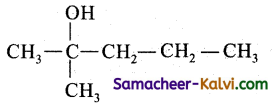
(b) If both assertion and reason are true but reason is not the correct explanation of the assertion.
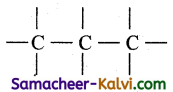
(c) If assertion is true but reason is false.
(d If both assertion and reason are false.
Answer:
(a) If both assertion and reason are true and reason is the correct explanation of the assertion.
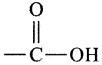
Samacheer Kalvi TN State Board 11th Chemistry Important Questions Chapter 4 Hydrogen

Question 28.
Assertion :
Chlorine reacts more rapidly with H2 than D2.
Reason :
D – Cl bond is stronger than H – Cl bond.
(a) If both assertion and reason are true and reason is the correct explanation of the assertion.
(b) If both assertion and reason are true but reason is not the correct explanation of the assertion.
(c) If assertion is true but reason is false.
(d) If both assertion and reason are false.
Answer:
(b) If both assertion and reason are true but reason is not the correct explanation of the assertion.

Question 29.
Assertion :
Electrolysis of molten CaH2 produces hydrogen gas at anode.
Reason :
In CaH2, hydrogen is present in the form of H ion.
(a) If both assertion and reason are true and reason is the correct explanation of the assertion.
(b) If both assertion and reason are true but reason is not the correct explanation of the assertion.
(c) If assertion is true but reason is false.
(d) If both assertion and reason are false.
Answer:
(a) If both assertion and reason are true and reason is the correct explanation of the assertion.

Question 30.
Assertion :
H2O is the only hydride of group 16 which is a liquid at room temperature.
Reason :
In ice, each hydrogen atom is surrounded by two covalent bonds and two hydrogen bonds.
(a) If both assertion and reason are true and reason is the correct explanation of the assertion.
(b) If both assertion and reason are true but reason is not the correct explanation of the assertion.
(c) If assertion is true but reason is false.
(d) If both assertion and reason are false.
Answer:
(b) If both assertion and reason are true but reason is not the correct explanation of the assertion.

Samacheer Kalvi TN State Board 11th Chemistry Important Questions Chapter 4 Hydrogen

Question 31.
Assertion :
The O – O bond in H2O2 is shorter in H2O2 than that of O2F2.
Reason :
H2O2 is an ionic compound.
(a) If both assertion and reason are true and reason is the correct explanation of the assertion.
(b) If both assertion and reason are true but – rea§pn is not the correct explanation of the assertion.
(c) If assertion is true but reason is false.
(d) If both assertion and reason are false.
Answer:
(d) If both assertion and reason are false.

Question 32.
Choose the incorrect statement from the following:
(a) HF is an electron rich hydride.
(b) Water softened by Permutit process is not demineralised water since it still contains sodium salts.
(c) H2O2 does not decompose NaHCO3 since it is weaker acid than H2CO3.
(d) In H2O2, the two O – H bonds lie in the same plane.
Answer:
(d) In H2O2, the two O – H bonds lie in the same plane.

Samacheer Kalvi TN State Board 11th Chemistry Important Questions Chapter 4 Hydrogen

Question 33.
Consider the reactions:

(I) H2O2 + O3 → H2O + 2O2
(II) H2O2 + Ag2O → 2Ag + H2O + O2
The role of H2O2 in the above reaction is respectively:
Choose the correct statement from the following:
(a) Oxidising in (I) and reducing in (II)
(b) Reducing in (I) ancl oxidising in (I)
(c) Reducing in (I) and (II)
(d) Oxidising in (I) and (II)
Answer:
(c) Reducing in (I) and (II)

Question 34.
What is incorrect about H2O2?
(a) Acts as both oxidising and reducing agent.
(b) Two O – H bonds lie in the same plane.
(c) Pale and blue liquid.
(d) Can be oxidised by O3.
Answer:
(b) Two O – H bonds lie in the same plane.

Samacheer Kalvi TN State Board 11th Chemistry Important Questions Chapter 4 Hydrogen

Question 35.
Which of the following statements is incorrect with respect to hydrogen?
(a) Hydrogen has three isotopes of which protium is the most common.
(b) In hydrides, hydrogen exists as an anion.
(c) Di hydrogen does not act as a reducing agent.
(d) Hydrogen ion exists as H3O+ Ions in aqueous solution.
Answer:
(c) Di hydrogen does not act as a reducing agent.

Question 36.
Which of the following statements are correct?

(i) The hydrogen bonding exists in hydrogen fluoride is intra molecular hydrogen bond.
(ii) In alkaline solutions, H2O2 acts as a reducing agent and it gets reduced to H2O and O2.
(iii) H2O2 is an acid.
(iv) H2O2 is also bleaching agent.

(a) (ii), (iii), (iv)
(b) (ii)and (iii)
(c) (i) and (iii)
(d) All
Answer:
(a) (ii), (iii), (iv)

TN Board 11th Chemistry Important Questions