Samacheer Kalvi 10th Maths Guide Chapter 4 Geometry Ex 4.1

Students can download Maths Chapter 4 Geometry Ex 4.1 Questions and Answers, Notes, Samacheer Kalvi 10th Maths Guide Pdf helps you to revise the complete Tamilnadu State Board New Syllabus, helps students complete homework assignments and to score high marks in board exams.

Tamilnadu Samacheer Kalvi 10th Maths Solutions Chapter 4 Geometry Ex 4.1

Question 1.
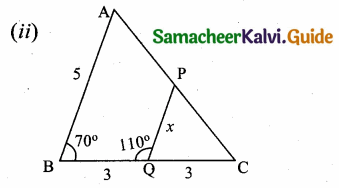
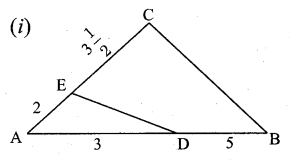
Check whether the which triangles are similar and find the value of x.
Samacheer Kalvi 10th Maths Guide Chapter 4 Geometry Ex 4.1 1
Samacheer Kalvi 10th Maths Guide Chapter 4 Geometry Ex 4.1 2
Solution:
(i) In ∆ABC and ∆AED
\(\frac { AB }{ AD } \) = \(\frac { AC }{ AE } \)
\(\frac { 8 }{ 3 } \) = \(\frac{11}{\frac{2}{2}}\)
\(\frac { 8 }{ 3 } \) = \(\frac { 11 }{ 4 } \) ⇒ 32 ≠ 33
∴ The two triangles are not similar.

(ii) In ∆ABC and ∆PQC
∠PQC = 70°
∠ABC = ∠PQC = 70°
∠ACB = ∠PCQ (common)
∆ABC ~ ∆PQC
\(\frac { 5 }{ X } \) = \(\frac { 6 }{ 3 } \)
6x = 15
x = \(\frac { 15 }{ 6 } \) = \(\frac { 5 }{ 2 } \)
∴ x = 2.5
∆ ABC and ∆PQC are similar. The value of x = 2.5

Samacheer Kalvi 10th Maths Guide Chapter 4 Geometry Ex 4.1

Question 2.
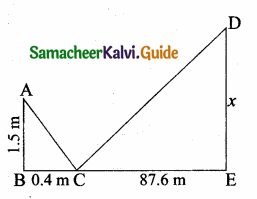
A girl looks the reflection of the top of the lamp post on the mirror which is 66 m away from the foot of the lamppost. The girl whose height is 12.5 m is standing 2.5 m away from the mirror. Assuming the mirror is placed on the ground facing the sky and the girl, mirror and the lamppost are in a same line, find the height of the lamp post.
Solution:
Let the height of the tower ED be “x” m. In ∆ABC and ∆EDC.
∠ABC = ∠CED = 90° (vertical Pole)
∠ACB = ∠ECD (Laws of reflection)
∆ ABC ~ ∆DEC
\(\frac { AB }{ DE } \) = \(\frac { BC }{ EC } \)
\(\frac { 1.5 }{ x } \) = \(\frac { 0.4 }{ 87.6 } \)
Samacheer Kalvi 10th Maths Guide Chapter 4 Geometry Ex 4.1 3
x = \(\frac{1.5 \times 87.6}{0.4}\) = \(\frac{1.5 \times 876}{4}\)
= 1.5 × 219 = 328.5
The height of the Lamp Post = 328.5 m

Question 3.
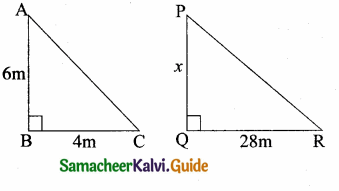
A vertical stick of length 6 m casts a shadow 400 cm long on the ground and at the same time a tower casts a shadow 28 m long. Using similarity, find the height of the tower.
Solution:
In ∆ABC and ∆PQR,
∠ABC = ∠PQR = 90° (Vertical Stick)
∠ACB = ∠PRQ (Same time casts shadow)
∆BCA ~ ∆QRP
Samacheer Kalvi 10th Maths Guide Chapter 4 Geometry Ex 4.1 4
\(\frac { AB }{ PQ } \) = \(\frac { BC }{ QR } \)
\(\frac { 6 }{ x } \) = \(\frac { 4 }{ 28 } \)
4x = 6 × 28 ⇒ x = \(\frac{6 \times 28}{4}\) = 42
Length of the lamp post = 42m

Samacheer Kalvi 10th Maths Guide Chapter 4 Geometry Ex 4.1

Question 4.
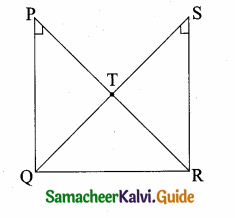
Two triangles QPR and QSR, right angled at P and S respectively are drawn on the same base QR and on the same side of QR. If PR and SQ intersect at T, prove that PT × TR = ST × TQ.
Solution:
In ∆PQT and ∆STR we have
∠P = ∠S = 90° (Given)
∠PTQ = ∠STR (Vertically opposite angle)
Samacheer Kalvi 10th Maths Guide Chapter 4 Geometry Ex 4.1 5
By AA similarity
∆PTQ ~ ∆STR we get
\(\frac { PT }{ ST } \) = \(\frac { TQ }{ TR } \)
PT × TR = ST × TQ
Hence it is proved.

Question 5.
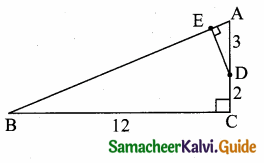
In the adjacent figure, ∆ABC is right angled at C and DE ⊥ AB. Prove that ∆ABC ~ ∆ADE and hence find the lengths of AE and DE.
Samacheer Kalvi 10th Maths Guide Chapter 4 Geometry Ex 4.1 6
Solution:
In ∆ABC and ∆ADE
∠ACB = ∠AED = 90°
∠A = ∠A (common)
∴ ∆ABC ~ ∆ADE (By AA similarity)
\(\frac { BC }{ DE } \) = \(\frac { AB }{ AD } \) = \(\frac { AC }{ AE } \)
\(\frac { 12 }{ DE } \) = \(\frac { 13 }{ 3 } \) = \(\frac { 5 }{ AE } \)
In ∆ABC, AB2 = BC2 + AC2
= 122 + 52 = 144 + 25 = 169
AB = \(\sqrt { 169 }\) = 13
Consider, \(\frac { 13 }{ 3 } \) = \(\frac { 5 }{ AE } \)
∴ AE = \(\frac{5 \times 3}{13}\) = \(\frac { 15 }{ 13 } \)
AE = \(\frac { 15 }{ 13 } \) and DE = \(\frac { 36 }{ 13 } \)
Consider, \(\frac { 12 }{ DE } \) = \(\frac { 13 }{ 3 } \)
DE = \(\frac{12 \times 3}{13}\) = \(\frac { 36 }{ 13 } \)

Samacheer Kalvi 10th Maths Guide Chapter 4 Geometry Ex 4.1

Question 6.
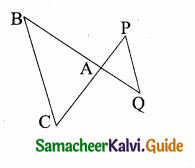
In the adjacent figure, ∆ACB ~ ∆APQ. If BC = 8 cm, PQ = 4 cm, BA = 6.5 cm and AP = 2.8 cm, find CA and AQ.
Samacheer Kalvi 10th Maths Guide Chapter 4 Geometry Ex 4.1 7
Solution:
Given ∆ACB ~ ∆APQ
\(\frac { AC }{ AP } \) = \(\frac { BC }{ PQ } \) = \(\frac { AB }{ AQ } \)
\(\frac { AC }{ 2.8 } \) = \(\frac { 8 }{ 4 } \) = \(\frac { 6.5 }{ AQ } \)
Consider \(\frac { AC }{ 2.8 } \) = \(\frac { 8 }{ 4 } \)
4 AC = 8 × 2.8
AC = \(\frac{8 \times 2.8}{4}\) = 5.6 cm
Consider \(\frac { 8 }{ 4 } \) = \(\frac { 6.5 }{ AQ } \)
8 AQ = 4 × 6.5
AQ = \(\frac{4 \times 6.5}{8}\) = 3.25 cm
Length of AC = 5.6 cm; Length of AQ = 3.25 cm

Question 7.
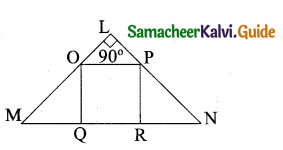
If figure OPRQ is a square and ∠MLN = 90°. Prove that
Samacheer Kalvi 10th Maths Guide Chapter 4 Geometry Ex 4.1 8
(i) ∆LOP ~ ∆QMO
(ii) ∆LOP ~ ∆RPN
(iii) ∆QMO ~ ∆RPN
(iv) QR2 = MQ × RN.
Solution:
(i) In ∆LOP and ∆QMO
∠OLP = ∠OQM = 90°
∠LOP = ∠OMQ (Since OQRP is a square OP || MN)
∴ ∆LOP~ ∆QMO (By AA similarity)

Samacheer Kalvi 10th Maths Guide Chapter 4 Geometry Ex 4.1

(ii) In ∆LOP and ∆RPN
∠OLP = ∠PRN = 90°
∠LPO = ∠PNR (OP || MN) .
∴ ∆LOP ~ ∆RPN (By AA similarity)

(iii) In ∆QMO and ∆RPN
∠MQO = ∠NRP = 90°
∠RPN = ∠QOM (OP || MN)
∴ ∆QMO ~ ∆RPN (By AA similarity)

(iv) We have ∆QMO ~ ∆RPN
\(\frac { MQ }{ PR } \) = \(\frac { QO }{ RN } \)
\(\frac { MQ }{ QR } \) = \(\frac { QR }{ RN } \)
QR2 = MQ × RN
Hence it is proved.

Question 8.
If ∆ABC ~ ∆DEF such that area of ∆ABC is 9cm2 and the area of ∆DEF is 16 cm2 and BC = 2.1 cm. Find the length of EF.
Solution:
Given ∆ABC ~ ∆DEF

Samacheer Kalvi 10th Maths Guide Chapter 4 Geometry Ex 4.1 9
\(\frac { 9 }{ 16 } \) = \(\frac{(2.1)^{2}}{\mathrm{E} \mathrm{F}^{2}}\)
(\(\frac { 3 }{ 4 } \))2 = (\(\frac { 2.1 }{ EF } \))2
\(\frac { 3 }{ 4 } \) = \(\frac { 2.1 }{ EF } \)
EF = \(\frac{4 \times 2.1}{3}\) = 2.8 cm
Legth of EF = 2.8 cm

Question 9.
Two vertical poles of heights 6 m and 3 m are erected above a horizontal ground AC. Find the value of y.
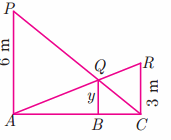
Samacheer Kalvi 10th Maths Guide Chapter 4 Geometry Ex 4.1 10
Solution:
In the ∆PAC and ∆BQC
∠PAC = ∠QBC = 90°
∠C is common
∆PAC ~ QBC
\(\frac { AP }{ BQ } \) = \(\frac { AC }{ BC } \)
\(\frac { 6 }{ y } \) = \(\frac { AC }{ BC } \)
∴ \(\frac { BC }{ AC } \) = \(\frac { y }{ 6 } \) …..(1)
In the ∆ACR and ∆QBC
∠ACR = ∠QBC = 90°
∠A is common
∆ACR ~ ABQ
\(\frac { RC }{ QB } \) = \(\frac { AC }{ AB } \)
\(\frac { 3 }{ y } \) = \(\frac { AC }{ AB } \)
\(\frac { AB }{ AC } \) = \(\frac { y }{ 3 } \) ……..(2)
By adding (1) and (2)
\(\frac { BC }{ AC } \) + \(\frac { AB }{ AC } \) = \(\frac { y }{ 6 } \) + \(\frac { y }{ 3 } \)
1 = \(\frac{3 y+6 y}{18}\)
9y = 18 ⇒ y = \(\frac { 18 }{ 9 } \) = 2
The Value of y = 2m

Samacheer Kalvi 10th Maths Guide Chapter 4 Geometry Ex 4.1

Question 10.
Construct a triangle similar to a given triangle PQR with its sides equal to \(\frac { 2 }{ 3 } \) of the corresponding sides of the triangle PQR (scale factor \(\frac { 2 }{ 3 } \) ).
Solution:
Given ∆PQR, we are required to construct another triangle whose sides are \(\frac { 2 }{ 3 } \) of the corresponding sides of the ∆PQR
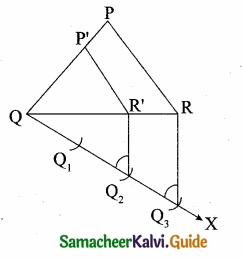
Samacheer Kalvi 10th Maths Guide Chapter 4 Geometry Ex 4.1 11
Steps of construction:
(i) Construct a ∆PQR with any measurement.
(ii) Draw a ray QX making an acute angle with QR on the side opposite to the vertex P.
(iii) Locate 3 points Q1, Q2 and Q3 on QX.
So that QQ1 = Q1Q2 = Q2Q3
(iv) Join Q3 R and draw a line through Q2 parallel to Q3 R to intersect QR at R’.
(v) Draw a line through R’ parallel to the line RP to intersect QP at P’. Then ∆ P’QR’ is the required triangle.

Samacheer Kalvi 10th Maths Guide Chapter 4 Geometry Ex 4.1

Question 11.
Construct a triangle similar to a given triangle LMN with its sides equal to \(\frac { 4 }{ 5 } \) of the corresponding sides of the triangle LMN (scale factor \(\frac { 4 }{ 5 } \) ).
Solution:
Given a triangle LMN, we are required to construct another ∆ whose sides are \(\frac { 4 }{ 5 } \) of the corresponding sides of the ∆LMN.
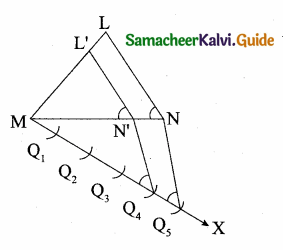
Samacheer Kalvi 10th Maths Guide Chapter 4 Geometry Ex 4.1 12

Steps of Construction:

  1. Construct a ∆LMN with any measurement.
  2. Draw a ray MX making an acute angle with MN on the side opposite to the vertex L.
  3. Locate 5 Points Q1, Q2, Q3, Q4, Q5 on MX.
    So that MQ1 = Q1Q2 = Q2Q3 = Q3Q4 = Q4Q5
  4. Join Q5 N and draw a line through Q4. Parallel to Q5N to intersect MN at N’.
  5. Draw a line through N’ parallel to the line LN to intersect ML at L’.
    ∴ ∆L’ MN’ is the required triangle.

Samacheer Kalvi 10th Maths Guide Chapter 4 Geometry Ex 4.1

Question 12.
Construct a triangle similar to a given triangle ABC with its sides equal to \(\frac { 6 }{ 5 } \) of the corresponding sides of the triangle ABC (scale factor \(\frac { 6 }{ 4 } \)).
Solution:
Given triangle ∆ABC, we are required to construct another triangle whose sides are \(\frac { 6 }{ 5 } \) of the corresponding sides of the ∆ABC.
Steps of construction
(i) Construct an ∆ABC with any measurement.
(ii) Draw a ray BX making an acute angle with BC.
(iii) Locate 6 points Q1, Q2, Q3, Q4, Q5, Q6 on BX such that
BQ1 = Q1Q2 = Q2Q3 = Q3Q4 = Q5Q6
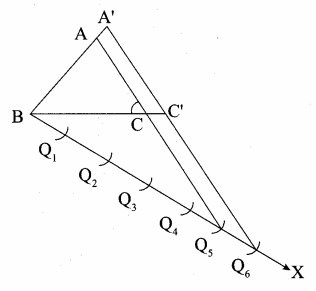
Samacheer Kalvi 10th Maths Guide Chapter 4 Geometry Ex 4.1 13
(iv) Join Q5 to C and draw a line through Q6 parallel to Q5 C intersecting the extended line BC at C’.
(v) Draw a line through C’ parallel to AC intersecting the extended line segment AB at A’.
∆A’BC’ is the required triangle.

Samacheer Kalvi 10th Maths Guide Chapter 4 Geometry Ex 4.1

Question 13.
Construct a triangle similar to a given triangle PQR with its sides equal to \(\frac { 7 }{ 3 } \) of the corresponding sides of the triangle PQR (scale factor \(\frac { 7 }{ 3 } \)).
Solution:
Given triangle ABC, we are required to construct another triangle whose sides are \(\frac { 7 }{ 3 } \) of the corresponding sides of the ∆ABC.
Steps of construction
(i) Construct a ∆PQR with any measurement.
(ii) Draw a ray QX making an acute angle with QR on the side opposite to the vertex P.
(iii) Locate 7 points Q1, Q2, Q3, Q4, Q5, Q6, Q7 on QX.
So that
QQ1 = Q1Q2 = Q2Q3 = Q3Q4 = Q5Q6 = Q6Q7
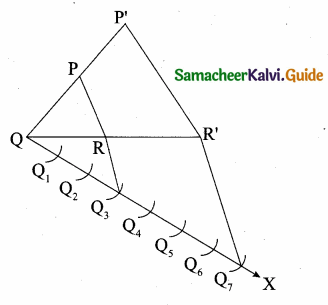
Samacheer Kalvi 10th Maths Guide Chapter 4 Geometry Ex 4.1 14
(iv) Join Q3 to R and draw a line through Q7 parallel to Q3R intersecting the extended line segment QR at R’.
(v) Draw a line through parallel to RP.
Intersecting the extended line segment QP at P’.
∴ ∆P’QR’ is the required triangle.
Samacheer Kalvi 10th Maths Guide Chapter 4 Geometry Ex 4.3

Students can download Maths Chapter 4 Geometry Ex 4.3 Questions and Answers, Notes, Samacheer Kalvi 10th Maths Guide Pdf helps you to revise the complete Tamilnadu State Board New Syllabus, helps students complete homework assignments and to score high marks in board exams.

Tamilnadu Samacheer Kalvi 10th Maths Solutions Chapter 4 Geometry Ex 4.3

Question 1.
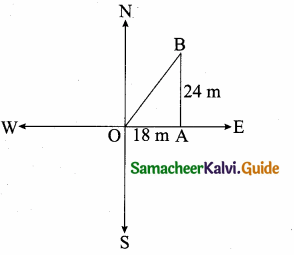
A man goes 18 m due east and then 24 m due north. Find the distance of his current position from the starting point?
Solution:
Let the initial position of the man be “O” and his final
position be “B”.
By Pythagoras theorem
In the right ∆ OAB,
Samacheer Kalvi 10th Maths Guide Chapter 4 Geometry Ex 4.3 1
OB2 = OA2 + AB2
= 182 + 242
= 324 + 576 = 900
OB = \(\sqrt { 900 }\) = 30
The distance of his current position is 30 m

Samacheer Kalvi 10th Maths Guide Chapter 4 Geometry Ex 4.3

Question 2.
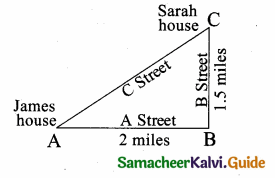
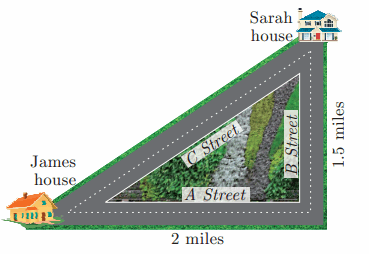
There are two paths that one can choose to go from Sarah’s house to James house. One way is to take C street, and the other way requires to take A street and then B street. How much shorter is the direct path along C street? (Using figure).
Samacheer Kalvi 10th Maths Guide Chapter 4 Geometry Ex 4.3 2
Solution:
Distance between Sarah House and James House using “C street”.
AC2 = AB2 + BC2
= 22 + 1.52
= 4 + 2.25 = 6.25
AC = \(\sqrt { 6.25 }\)
AC = 2.5 miles
Samacheer Kalvi 10th Maths Guide Chapter 4 Geometry Ex 4.3 3
Distance covered by using “A Street” and “B Street”
= (2 + 1.5) miles = 3.5 miles
Difference in distance = 3.5 miles – 2.5 miles = 1 mile

Samacheer Kalvi 10th Maths Guide Chapter 4 Geometry Ex 4.3

Question 3.
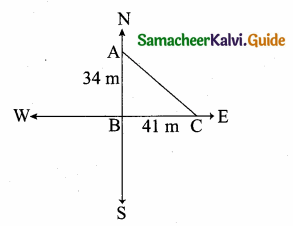
To get from point A to point B you must avoid walking through a pond. You must walk 34 m south and 41 m east. To the nearest meter, how many meters would be saved if it were possible to make a way through the pond?
Solution:
In the right ∆ABC,
By Pythagoras theorem
AC2= AB2 + BC2 = 342 + 412
= 1156 + 1681 = 2837
AC = \(\sqrt { 2837 }\)
= 53.26 m
Samacheer Kalvi 10th Maths Guide Chapter 4 Geometry Ex 4.3 4
Through A one must walk (34m + 41m) 75 m to reach C.
The difference in Distance = 75 – 53.26
= 21.74 m

Samacheer Kalvi 10th Maths Guide Chapter 4 Geometry Ex 4.3

Question 4.
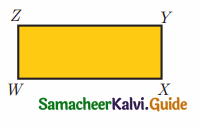
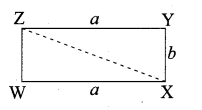
In the rectangle WXYZ, XY + YZ = 17 cm, and XZ + YW = 26 cm.
Calculate the length and breadth of the rectangle?
Samacheer Kalvi 10th Maths Guide Chapter 4 Geometry Ex 4.3 5
Solution:
Let the length of the rectangle be “a” and the breadth of the rectangle be “b”.
XY + YZ = 17 cm
b + a = 17 …….. (1)
In the right ∆ WXZ,
XZ2 = WX2 + WZ2
(XZ)2 = a2 + b2
Samacheer Kalvi 10th Maths Guide Chapter 4 Geometry Ex 4.3 6
XZ = \(\sqrt{a^{2}+b^{2}}\)
Similarly WY = \(\sqrt{a^{2}+b^{2}}\) ⇒ XZ + WY = 26
2 \(\sqrt{a^{2}+b^{2}}\) = 26 ⇒ \(\sqrt{a^{2}+b^{2}}\) = 13
Squaring on both sides
a2 + b2 = 169
(a + b)2 – 2ab = 169
172 – 2ab = 169 ⇒ 289 – 169 = 2 ab
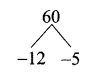
120 = 2 ab ⇒ ∴ ab = 60
a = \(\frac { 60 }{ b } \) ….. (2)
Substituting the value of a = \(\frac { 60 }{ b } \) in (1)
\(\frac { 60 }{ b } \) + b = 17
b2 – 17b + 60 = 0
(b – 2) (b – 5) = 0
b = 12 or b = 5
Samacheer Kalvi 10th Maths Guide Chapter 4 Geometry Ex 4.3 7
If b = 12 ⇒ a = 5
If b = 6 ⇒ a = 12
Lenght = 12 m and breadth = 5 m

Samacheer Kalvi 10th Maths Guide Chapter 4 Geometry Ex 4.3

Question 5.
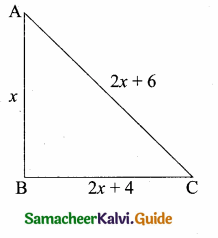
The hypotenuse of a right triangle is 6 m more than twice of the shortest side. If the third side is 2 m less than the hypotenuse, find the sides of the triangle.
Solution:
Let the shortest side of the right ∆ be x.
∴ Hypotenuse = 6 + 2x
Third side = 2x + 6 – 2
= 2x + 4
Samacheer Kalvi 10th Maths Guide Chapter 4 Geometry Ex 4.3 8
In the right triangle ABC,
AC2 = AB2 + BC2
(2x + 6)2 = x2 + (2x + 4)2
4x2 + 36 + 24x = x2 + 4x2 + 16 + 16x
0 = x2 – 24x + 16x – 36 + 16
∴ x2 – 8x – 20 = 0
(x – 10) (x + 2) = 0
x – 10 = 0 or x + 2 = 0
Samacheer Kalvi 10th Maths Guide Chapter 4 Geometry Ex 4.3 9
x = 10 or x = -2 (Negative value will be omitted)
The side AB = 10 m
The side BC = 2 (10) + 4 = 24 m
Hypotenuse AC = 2(10) + 6 = 26 m

Samacheer Kalvi 10th Maths Guide Chapter 4 Geometry Ex 4.3

Question 6.
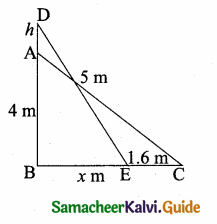
5 m long ladder is placed leaning towards a vertical wall such that it reaches the wall at a point 4m high. If the foot of the ladder is moved 1.6 m towards the wall, then find the distance by which the top of the ladder would slide upwards on the wall.
Solution:
“C” is the position of the foot of the ladder “A” is the position of the top of the ladder.
In the right ∆ABC,
BC2 = AC2 – AB2 = 52 – 42
= 25 – 16 = 9
BC = \(\sqrt { 9 }\) = 3m.
When the foot of the ladder moved 1.6 m toward the wall.
The distance between the foot of the ladder to the ground is
BE = 3 – 1.6 m
= 1.4 m
Samacheer Kalvi 10th Maths Guide Chapter 4 Geometry Ex 4.3 10
Let the distance moved upward on the wall be “h” m
The ladder touch the wall at (4 + h) M
In the right triangle BED,
ED2 = AB2 + BE2
52 = (4 + h)2 + (1.4)2
25 – 1.96= (4 + h)2
∴ 4 + h = \(\sqrt { 23.04 }\)
4 + h = 4. 8 m
h = 4.8 – 4
= 0.8 m
Distance moved upward on the wall = 0.8 m

Samacheer Kalvi 10th Maths Guide Chapter 4 Geometry Ex 4.3

Question 7.
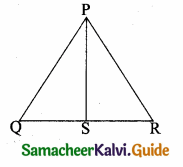
The perpendicular PS on the base QR of a ∆PQR intersects QR at S, such that QS = 3 SR. Prove that 2PQ2 = 2PR2 + QR2.
Solution:
Given QS = 3SR
QR = QS + SR
= 3SR + SR = 4SR
SR = \(\frac { 1 }{ 4 } \) QR …..(1)
QS = 3SR
SR = \(\frac { QS }{ 3 } \) ……..(2)
Samacheer Kalvi 10th Maths Guide Chapter 4 Geometry Ex 4.3 11
From (1) and (2) we get
\(\frac { 1 }{ 4 } \) QR = \(\frac { QS }{ 3 } \)
∴ QS = \(\frac { 3 }{ 4 } \) QR ………(3)
In the right ∆ PQS,
PQ2 = PS2 + QS2 ……….(4)
Similarly in ∆ PSR
PR2 = PS2 + SR2 ………..(5)
Subtract (4) and (5)
PQ2 – PR2 = PS2 + QS2 – PS2 – SR2
= QS2 – SR2
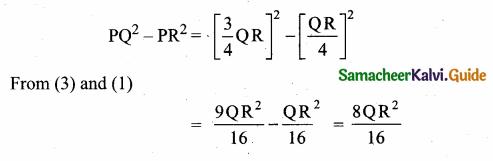
Samacheer Kalvi 10th Maths Guide Chapter 4 Geometry Ex 4.3 12
PQ2 – PR2 = \(\frac { 1 }{ 2 } \) QR2
2PQ2 – 2PR2 = QR2
2PQ2 = 2PR2 + QR2
Hence the proved.

Samacheer Kalvi 10th Maths Guide Chapter 4 Geometry Ex 4.3

Question 8.
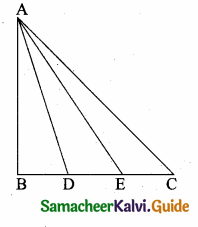
In the adjacent figure, ABC is a right angled triangle with right angle at B and points D, E trisect BC. Prove that 8AE2 = 3AC2 + 5AD2.
Solution:
Since the Points D, E trisect BC.
BD = DE = CE
Let BD = DE = CE = x
BE = 2x and BC = 3x
Samacheer Kalvi 10th Maths Guide Chapter 4 Geometry Ex 4.3 13
In the right ∆ABD,
AD2 = AB2 + BD2
AD2 = AB2 + x2 ……….(1)
In the right ∆ABE,
AE2 = AB2 + 2BE2
AE2 = AB2 + 4X2 ………..(2) (BE = 2x)
In the right ∆ABC
AC2 = AB2 + BC2
AC2 = AB2 + 9x2 …………… (3) (BC = 3x)
R.H.S = 3AC2 + 5AD2
= 3[AB2 + 9x2] + 5 [AB2 + x2] [From (1) and (3)]
= 3AB2 + 27x2 + 5AB2 + 5x2
= 8AB2 + 32x2
= 8 (AB2 + 4 x2)
= 8AE2 [From (2)]
= R.H.S.
∴ 8AE2 = 3AC2 + 5AD2

Samacheer Kalvi 10th Maths Guide Chapter 3 Algebra Additional Questions

Students can download Maths Chapter 3 Algebra Additional Questions and Answers, Notes, Samacheer Kalvi 10th Maths Guide Pdf helps you to revise the complete Tamilnadu State Board New Syllabus, helps students complete homework assignments and to score high marks in board exams.

Tamilnadu Samacheer Kalvi 10th Maths Solutions Chapter 3 Algebra Additional Questions

I. Choose the correct answer.

Question 1.
The HCF of x2 – y2; x3 – y3, …………. xn – yn where n ∈ N is
(1) x – y
(2) x + y
(3) xn – yn
(4) do not intersect
Answer:
(1) x – y

Samacheer Kalvi 10th Maths Guide Chapter 3 Algebra Additional Questions

Question 2.
Which of the following is correct.
(i) Every polynomial has finite number of multiples
(ii) LCM of two polynomials of degree “2” may be a constant
(iii) HCF of 2 polynomials may be a constant
(iv) Degree of HCF of two polynomials is always less than degree of L.C.M.
(1) (i) and (iii)
(2) (iii) and (iv)
(3) (iii) only
(4) (iv) only
Answer:
(3) (iii) only

Question 3.
The HCF of x2 – 2xy + y2 and x4 – y4 is …………….
(1) 1
(2) x + y
(3) x – y
(4) x2 – y2
Answer:
(3) x – y

Question 4.
The L.C.M. of ak ak+3, ak+5 where K ∈ N is …………
(1) ak+5
(2) ak
(3) ak+6
(4) ak+9
Answer:
(1) ak+5

Samacheer Kalvi 10th Maths Guide Chapter 3 Algebra Additional Questions

Question 5.
The LCM of (x + 1)2 (x – 3) and
(x2 – 9) (x + 1) is
(1) (x + 1)3 (x2 – 9)
(2) (x + 1)2 x2 – 9)
(3) (x + 1)2 (x – 3)
(4) (x – 9) (x + 1)
Answer:
(2) (x + 1)2(x2 – 9)

Question 6.
If \(\frac{a^{3}}{a-b}\) is added with \(\frac{b^{3}}{b-a}\) then the new expressions is …………
(1) a2 – ab + b2
(2) a2 + ab + b2
(3) a3 + b3
(4) a3 – b3
Answer:
(2) a2 + ab + b2

Question 7.
The solution set of x + \(\frac { 1 }{ x } \) = \(\frac { 5 }{ 2 } \) is ………….
(1) 2,\(\frac { 1 }{ 2 } \)
(2) 2,-\(\frac { 1 }{ 2 } \)
(3) -2, – \(\frac { 1 }{ 2 } \)
(4) -2, \(\frac { 7 }{ 2 } \)
Answer:
(1) 2,\(\frac { 1 }{ 2 } \)

Samacheer Kalvi 10th Maths Guide Chapter 3 Algebra Additional Questions

Question 8.
On dividing \(\frac{x^{2}-25}{x+3}\) by \(\frac{x+5}{x^{2}-9}\) is equal to ……………….
(1) (x – 5)(x + 3)
(2) (x + 5) (x – 3)
(3) (x – 5)(x – 3)
(4) (x + 5)(x + 3)
Answer:
(3) (x – 5)(x – 3)

Question 9.
The square root of (x + 11)2 – 44x is ………….
(1)|(x – 11)2
(2) |x + 11|
(3) |11 – x2|
(4) |x – 11|
Answer:
(4) |x – 11|

Question 10.
If α, β are the zeros of the polynomial p(x) = 4x2 + 3x + 7 then \(\frac{1}{\alpha}\) + \(\frac{1}{\beta}\) is equal to …………
(1) \(\frac { 7 }{ 3 } \)
(2) – \(\frac { 7 }{ 3 } \)
(3) \(\frac { 3 }{ 7 } \)
(4) – \(\frac { 3 }{ 7 } \)
Answer:
(4) – \(\frac { 3 }{ 7 } \)

Samacheer Kalvi 10th Maths Guide Chapter 3 Algebra Additional Questions

Question 11.
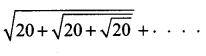
The value of Samacheer Kalvi 10th Maths Guide Chapter 3 Algebra Additional Questions 1 is  ……….
(1) -5
(2) 5
(3) 4
(4) -3
Answer:
(2) 5

Question 12.
If α and β are the roots of the equation ax2 + bx + c = 0 then (α + β)2 is ……………..
(1) \(\frac{-b^{2}}{a^{2}}\)
(2) \(\frac{-c^{2}}{a^{2}}\)
(3) \(\frac{-b^{2}}{a^{2}}\)
(4) \(\frac { bc }{ a } \)
Answer:
(3) \(\frac{-b^{2}}{a^{2}}\)

Question 13.
The roots of the equation x2 – 8x + 12 = 0 are
(1) real and equal
(2) real and rational
(3) real and irrational
(4) unreal
Answer:
(2) real and rational

Samacheer Kalvi 10th Maths Guide Chapter 3 Algebra Additional Questions

Question 14.
If one root of the equation is the reciprocal of the other root in ax2 + bx + c = 0 then …………
(1) a = c
(2) a = b
(3) b = c
(4) c = 0
Answer:
(1) a = c

Question 15.
If α and β are the roots of the equation x2 + 2x + 8 = 0 then the value of \(\frac{\alpha}{\beta}+\frac{\beta}{\alpha}\) is ………………
(1) \(\frac { 1 }{ 2 } \)
(2) 6
(3) \(\frac { 3 }{ 2 } \)
(4) –\(\frac { 3 }{ 2 } \)
Answer:
(4) –\(\frac { 3 }{ 2 } \)

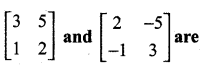
Question 16.
Samacheer Kalvi 10th Maths Guide Chapter 3 Algebra Additional Questions 2
are………
(1) 4, 6, 6
(2) 6, 6, 4
(3) 6, 4, 6
(4) 4, 4, 6
Answer:
(3) 6, 4, 6

Question 17.
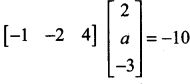
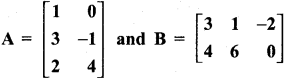
If [-1 -2 4] Samacheer Kalvi 10th Maths Guide Chapter 3 Algebra Additional Questions 3 then the value of “a” is ………….
(1) 2
(2) -4
(3) 4
(4) -2
Answer:
(4) -2

Samacheer Kalvi 10th Maths Guide Chapter 3 Algebra Additional Questions

Question 18.
The matrix A given by (aij)2×2 if aij = i – j is …………
Samacheer Kalvi 10th Maths Guide Chapter 3 Algebra Additional Questions 4
Answer:
Samacheer Kalvi 10th Maths Guide Chapter 3 Algebra Additional Questions 5

Question 19.
If A is of order 4 × 3 and B is of order 3 × 4 then the order of BA is ………………….
(1) 3 × 4
(2) 4 × 4
(3) 3 × 3
(4) 4 × 1
Answer:
(3) 3 × 3

Question 20.
If Samacheer Kalvi 10th Maths Guide Chapter 3 Algebra Additional Questions 6 then “x” is ……………..
(1) 1
(2) 2
(3) 3
(4) 4
Answer:
(4) 4

Samacheer Kalvi 10th Maths Guide Chapter 3 Algebra Additional Questions

II. Answer the following.

Question 1.
Solve x + y = 7; y + z = 4; z + x = 1
Answer:
x + y = 7 ……(1)
y + z = 4 ………(2)
z + x = 1 …………(3)
Adding (1); (2) and (3)
2x + 2y + 2z = 12
x + y + z = 6 ….(4)
From (1) ⇒ x + y = 7
7 + z = 6
z = 6 – 7 = -1
From (2) ⇒ x + 4 = 6
x = 6 – 4 = 2
From (3) ⇒ y + 1 = 6
y = 6 – 1 = 5
The value of x = 2, y = 5 and z = -1

Question 2.
Find the HCF of 25x4y7; 35x3y8; 45x3y3
Answer:
25x4y7 = 5 × 5 × x4 × y7
35x3y8 = 5 × 7 × x3 × y8
45 x3y3 = 3 × 3 × 5 × x3 × y3
H.C.F. = 5x3y3

Question 3.
Find the values of k for which the following equation has equal roots.
(k – 12)x2 + 2(k – 12)x + 2 = 0
Solution:
\(\frac{(k-12)}{a} x^{2}+\frac{2(k-12)}{b} x+\frac{2}{c}=0\)
Δ = b2 – 4ac = (2(k – 12))2 – 4(6 – 12)(2)
= 4(k – 12)[(k – 12) – 2]
= 4(k – 12)(k – 14)
The given equation will have equal roots, if A = 0
⇒ 4(k – 12)(k – 14) = 0
k – 12 = 0 or k – 14 = 0
k = 12, 14

Question 4.
Find the LCM of x3 + y3; x3 – y3; x4 + x2y2 + y4
Answer:
x3 + y3 = (x + y) (x2 – xy + y2)
x3 – y3 = (x – y)(x2 + xy + y2)
x4 + x2y2 + y4 = (x2 + y2)2 – (xy)2
= (x2 + y2 + xy)
L.C.M. = (x + y)(x – y) (x2 + xy + y2)
(x2 – xy + y2)
= [(x + y) (x2 – xy +y2)]
[(x – y) (x2 + xy + y2)]
= (x3 + y3) (x3 – y3)
L.C.M. = x6 – y6

Samacheer Kalvi 10th Maths Guide Chapter 3 Algebra Additional Questions

Question 5.
The sum of two numbers is 15. If the sum of their reciprocals is \(\frac{3}{10}\), find the numbers.
Solution:
Let the numbers be α, β
Sum of the roots = α + β = 15 ………….. (1)
sum of their reciprocals = \(\frac{1}{\alpha}+\frac{1}{\beta}=\frac{3}{10}\) ……….. (2)
\(\frac{\beta+\alpha}{\alpha \beta}=\frac{3}{10}\)
10(α + β) = 3αβ …………. (3)
3αβ = 10 × 15 = 150
Products of the roots = αβ = 50 ………….. (4)
∴ From (1) & (4), we have
x2 – 15x + 50 = 0
(x – 10)(x – 5) = 0 ⇒ x = 10, 5
∴ he numbers are 10, 5.

Question 6.
For What value of k, the G.C.D. of [x2 + x – (2k + 2)] and 2x2 + kx – 12 is (x + 4)?
Answer:
p(x) = x2 + x – (2k + 2)
g(x) = 2x2 + kx – 12
G.C.D. = x + 4
when x + 4 is the G.C.D.
p(-4) = 0 or g(-4) = 0
[Hint: Take any one of the polynomial]
g(x) = 2x2 + kx – 12 = 0
2(-4)2 + k (-4) – 12 = 0
2(16) – 4x – 12 = 0
32 – 4k – 12 = 0
20 = 4k
k = \(\frac { 20 }{ 4 } \) = 5
The value of k = 5

Samacheer Kalvi 10th Maths Guide Chapter 3 Algebra Additional Questions

Question 7.
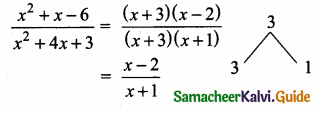
Simplify \(\frac{x^{2}+x-6}{x^{2}+4 x+3}\)
Answer:
x2 + x – 6 = (x + 3) (x – 2)
x2 + 4x + 3 = (x + 3) (x + 1)
Samacheer Kalvi 10th Maths Guide Chapter 3 Algebra Additional Questions 7
Samacheer Kalvi 10th Maths Guide Chapter 3 Algebra Additional Questions 8

Question 8.
Multiply
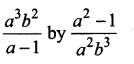
Samacheer Kalvi 10th Maths Guide Chapter 3 Algebra Additional Questions 10
Answer:
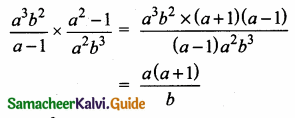
Samacheer Kalvi 10th Maths Guide Chapter 3 Algebra Additional Questions 11

Question 9.
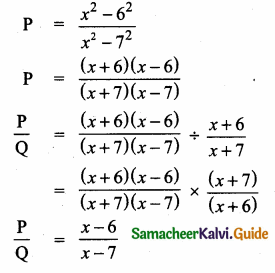
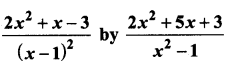
if P = \(\frac{x^{3}-36}{x^{2}-49}\) and Q = \(\frac { x+6 }{ x+7 } \) find the value of \(\frac { P }{ Q } \).
Answer:
Samacheer Kalvi 10th Maths Guide Chapter 3 Algebra Additional Questions 12

Samacheer Kalvi 10th Maths Guide Chapter 3 Algebra Additional Questions

Question 10.
Simplify
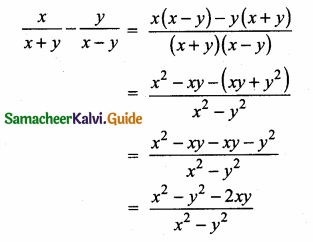
\(\frac { x }{ x+y } \) – \(\frac { y }{ x-y } \)
Answer:
Samacheer Kalvi 10th Maths Guide Chapter 3 Algebra Additional Questions 13

Question 11.
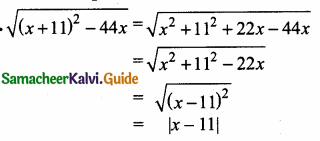
Find the square root of (x + 11)2 – 44x
Answer:
Samacheer Kalvi 10th Maths Guide Chapter 3 Algebra Additional Questions 14

Question 12.
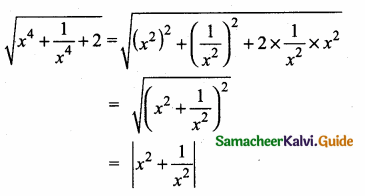
Find the square root of x4 + \(\frac{1}{x^{4}}\) + 2
Answer:
Samacheer Kalvi 10th Maths Guide Chapter 3 Algebra Additional Questions 15

Samacheer Kalvi 10th Maths Guide Chapter 3 Algebra Additional Questions

Question 13.
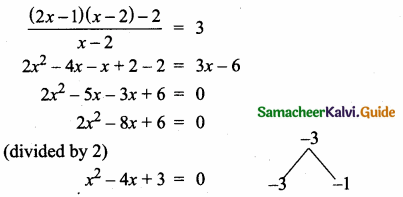
Solve the equation 2x – 1 – \(\frac { 2 }{ x-2 } \) = 3
Answer:
2x – 1 – \(\frac { 2 }{ x-2 } \) = 3
Samacheer Kalvi 10th Maths Guide Chapter 3 Algebra Additional Questions 16
(x – 3) (x – 1) = 0
x – 3 = 0 or x – 1 = 0
x = 3 or x = 1
The solution set is (1,3)

Question 14.
Find the roots of \(\sqrt { 2 }\) x2 + 7x + 5\(\sqrt { 2 }\) = 0
Answer:
\(\sqrt { 2 }\) x2 + 7x + 5 \(\sqrt { 2 }\) = 0
\(\sqrt { 2 }\) x2 + 2x + 5x + 5 \(\sqrt { 2 }\) = 0
Samacheer Kalvi 10th Maths Guide Chapter 3 Algebra Additional Questions 17
\(\sqrt { 2 }\) x (x + \(\sqrt { 2 }\)) + 5 (x + \(\sqrt { 2 }\)) = 0
(x + \(\sqrt { 2 }\)) (\(\sqrt { 2 }\) x + 5) = 0
(x + \(\sqrt { 2 }\) ) = 0 or \(\sqrt { 2 }\) x + 5 = 0
x = – \(\sqrt { 2 }\) or \(\sqrt { 2 }\) x + 5 = 0
x = – \(\sqrt { 2 }\) or \(\sqrt { 2 }\) x = -5
x = \(\frac{-5}{\sqrt{2}}\)
The roots are and – \(\sqrt { 2 }\) and \(\frac{-5}{\sqrt{2}}\)

Samacheer Kalvi 10th Maths Guide Chapter 3 Algebra Additional Questions

Question 15.
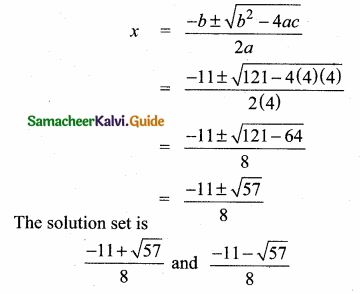
Solve \(\sqrt { x+5 }\) = 2x + 3 using formula method.
Answer:
\(\sqrt { x+5 }\) = 2x + 3
(\(\sqrt { x+5 }\))2 = (2x + 3)2
x + 5 = 4x2 + 9 + 12x
0 = 4x2 + 12x – x + 9 – 5
0 = 4x2 + 11x + 4
Here a = 4, b = 11, c = 4
Samacheer Kalvi 10th Maths Guide Chapter 3 Algebra Additional Questions 18

Question 16.
The sum of a number and its reciprocal is \(\frac { 37 }{ 6 } \). Find the number.
Answer:
Let the require number be “x”
Its reciprocal is \(\frac { 1 }{ x } \)
By the given data
Samacheer Kalvi 10th Maths Guide Chapter 3 Algebra Additional Questions 87
The required number is \(\frac { 1 }{ 6 } \) or 6

Question 17.
Determine the nature of the roots of the equation 2x2 + x – 1 = 0
Answer:
2x2 + x – 1 = 0
Here a = 2,b = 1,c = -1
∆ = b2 – 4 ac
= 12 – 4(2) (-1)
= 1 + 8
= 9
Since b2 – 4ac > 0 the roots are real and unequal

Samacheer Kalvi 10th Maths Guide Chapter 3 Algebra Additional Questions

Question 18.
Find the value of k for which the given equation 9x2 + 3kx + 4 = 0 has real and equal roots.
Answer:
9x2 + 3 kx + 4 = 0
a = 9, b = 5k, c = 4
since the equation has real and equal roots
b2 – 4ac = 0
(3k)2 – 4(9) (4) = 0
9k2 – 144 = 0
9k2 = 144
k2 = \(\frac { 144 }{ 9 } \) = 16
k = \(\sqrt { 16 }\)
k = ± 4

Question 19.
If one root of the equation
3x2 – 10x + 3 = 0 is \(\frac { 1 }{ 3 } \) find the other root
Answer:
α and β are the roots of the equation 3x2 – 10x + 3 = 0
Sum of the roots (α + β) = \(\frac { 10 }{ 3 } \)
Product of the roots (αβ) = \(\frac { 3 }{ 3 } \) = 1
one of the roots is \(\frac { 1 }{ 3 } \) (say α = \(\frac { 1 }{ 3 } \))
αβ = 1
\(\frac { 1 }{ 3 } \) × β = 1
β = 3
The other roots is 3

Samacheer Kalvi 10th Maths Guide Chapter 3 Algebra Additional Questions

Question 20.
Form the quadratic equation whose roots are 3 + \(\sqrt { 7 }\); 3 – \(\sqrt { 7 }\)
Answer:
Sum of the roots = 3 + \(\sqrt { 7 }\) + 3 – \(\sqrt { 7 }\)
= 6
Product of the roots = (3 + \(\sqrt { 7 }\)) (3 – \(\sqrt { 7 }\) )
= 32 – (\(\sqrt { 7 }\))2
= 9 – 7
= 2
The required equation is
x2 – (sum of the roots) x + product of the roots = 0
x2 – (6)x + 2 = 0
x – 6x + 2 = 0

Question 21.
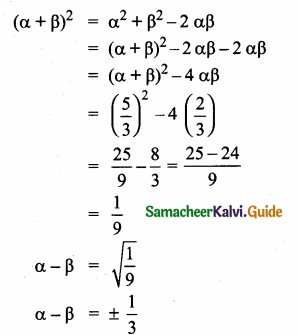
If α and β are the roots of the equation 3x2 – 5x + 2 = 0, then find the value of α – β.
Answer:
α and β are the roots of the equation
3x2 – 5x + 2 = 0
α + β = \(\frac { 5 }{ 3 } \), αβ = \(\frac { 2 }{ 3 } \)
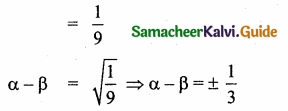
Samacheer Kalvi 10th Maths Guide Chapter 3 Algebra Additional Questions 19

Samacheer Kalvi 10th Maths Guide Chapter 3 Algebra Additional Questions

Question 22.
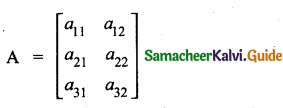
Determine the matrix A = (aij)3×2 if aij = 3i – 2j
Answer:
Samacheer Kalvi 10th Maths Guide Chapter 3 Algebra Additional Questions 20
aij = 3i – 2j
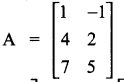
a11 = 3(1) – 2(1) = 3 – 2 = 1
a12 = 3(1) – 2(1) = 3 – 4 = 1
a21 = 3(2) – 2(1) = 6 – 2 = 4
a22 = 3(2) – 2(2) = 6 – 4 = 2
a31 = 3(3) – 2(1) = 9 – 2 = 7
a32 = 3(3) – 2(2) = 9 – 4 = 5
Samacheer Kalvi 10th Maths Guide Chapter 3 Algebra Additional Questions 21

Question 23.
Samacheer Kalvi 10th Maths Guide Chapter 3 Algebra Additional Questions 22
Answer:
Samacheer Kalvi 10th Maths Guide Chapter 3 Algebra Additional Questions 23

Question 24.
Find if
Samacheer Kalvi 10th Maths Guide Chapter 3 Algebra Additional Questions 24
Answer:
Samacheer Kalvi 10th Maths Guide Chapter 3 Algebra Additional Questions 25

Samacheer Kalvi 10th Maths Guide Chapter 3 Algebra Additional Questions

Question 25.
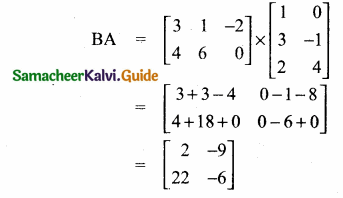
Samacheer Kalvi 10th Maths Guide Chapter 3 Algebra Additional Questions 26
find BA
Answer:
Samacheer Kalvi 10th Maths Guide Chapter 3 Algebra Additional Questions 27

Question 26.
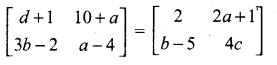
Find the unknowns a, b, c, d, x, y in the given matrix equation.
Samacheer Kalvi 10th Maths Guide Chapter 3 Algebra Additional Questions 28
Answer:
Samacheer Kalvi 10th Maths Guide Chapter 3 Algebra Additional Questions 29
Equating the corresponding elements of the two matrices we get
d + 1 = 2
d = 2 – 1 = 1
10 + a = 2a + 1
10 – 1 = 2a – a
9 = a
36 – 2 = b – 5
3b – b = -5 + 2
2b = -3 ⇒ b = \(\frac { -3 }{ 2 } \)
a – 4 = 4c ⇒ a – 4c = 4
9 – 4c = 4 ⇒ 4c = 4 – 9
-4c = -5 ⇒ c = \(\frac { 5 }{ 4 } \)
The value of a = 9, b = \(\frac { -3 }{ 2 } \), c = \(\frac { 5 }{ 4 } \) and d = 1

Samacheer Kalvi 10th Maths Guide Chapter 3 Algebra Additional Questions

Question 27.
Prove that
Samacheer Kalvi 10th Maths Guide Chapter 3 Algebra Additional Questions 30
multiplication is inverse to each other.
Answer:
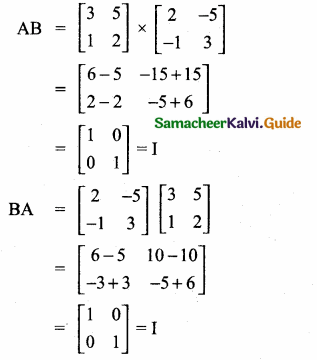
Samacheer Kalvi 10th Maths Guide Chapter 3 Algebra Additional Questions 31
AB = BA = I
Multiplication of matrices are iverse to each other.

III. Answer the following questions.

Question 1.
Solve x – \(\frac { y }{ 5 } \) = 6; y – \(\frac { z }{ 7 } \) = 8; z – \(\frac { x }{ 2 } \) = 10
Answer:
x – \(\frac { y }{ 5 } \) = 6
multiply by 5
5x – y = 30 …….(1)
y – \(\frac { z }{ 7 } \) = 8
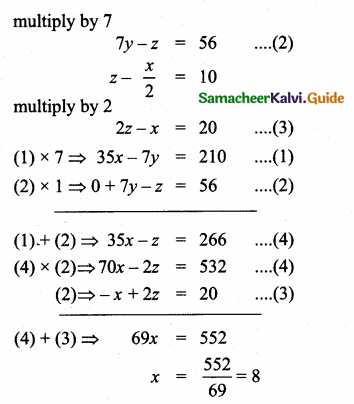
Samacheer Kalvi 10th Maths Guide Chapter 3 Algebra Additional Questions 32
Substitute the value of x = 8 in (1)
5(8) – y = 30
– y = 30 – 40 = -10
∴ y = 10
Substitute the value of x = 8 in (3)
2z – 8 = 20
2z = 20 + 8
z = \(\frac { 28 }{ 2 } \) = 14
The value of x = 8, y = 10 and z = 14

Samacheer Kalvi 10th Maths Guide Chapter 3 Algebra Additional Questions

Question 2.
Solve for x,y and z using the given 3 equations
\(\frac { 2 }{ y } \) – \(\frac { 4 }{ z } \) + \(\frac { 3 }{ x } \) = 3; \(\frac { 5 }{ x } \) – \(\frac { 4 }{ y } \) – \(\frac { 8 }{ z } \) = 8 ; \(\frac { 6 }{ y } \) + \(\frac { 6 }{ z } \) +\(\frac { 1 }{ x } \) = 2
Answer:
Let \(\frac { 1 }{ x } \) = a, \(\frac { 1 }{ y } \) = b, \(\frac { 1 }{ z } \) = c
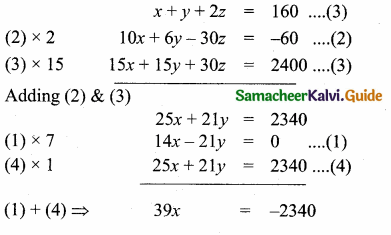
3a + 2b – 4c = 3 ………(1)
5a – 4b – 8c = 8 ………(2)
a + 6b + 6c = 2 ………(3)
(1) × 2 ⇒ 6a + 4b – 8c = 6 …..(1)
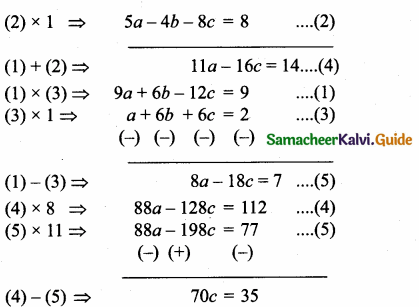
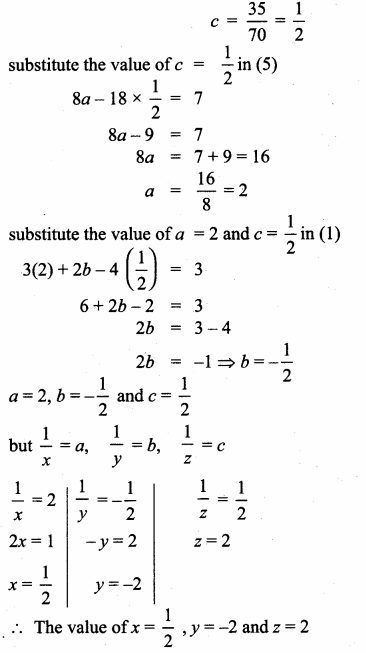
Samacheer Kalvi 10th Maths Guide Chapter 3 Algebra Additional Questions 33
Samacheer Kalvi 10th Maths Guide Chapter 3 Algebra Additional Questions 34

Samacheer Kalvi 10th Maths Guide Chapter 3 Algebra Additional Questions

Question 3.
100 pencils are to be kept inside three types of boxes A, B and C. If 5 boxes of type A, 3 boxes of type B, 2 boxes of type C are used 6 pencils are left out. If 3 boxes of type A, 5 boxes of type B, 2 boxes of type C are used 2 pencils are left out. If 2 boxes of type A, 4 boxes of type B and 4 boxes of type C are used, there is a space for 4 pencils. Find the number of pencils that each box can hold.
Answer:
Let the number of pencil in the box A be “x”
Let the number of pencil in the box B be “y”
Let the number of pencil in the box C be “z”
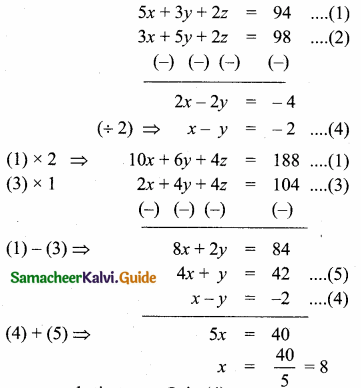
By the given first condition
5x + 3y + 2z = 94 ….(1)
By the given second condition
3x + 5y + 2z = 98 ….(2)
By the given third condition
2x + 4y + 4z = 104 ….(3)
subtract (1) and (3)
Samacheer Kalvi 10th Maths Guide Chapter 3 Algebra Additional Questions 35
substitute x = 8 and y = 10 in (1)
5(8) + 3(10) + 2z = 94
40 + 30 + 2z = 94
2z = 94 – 70
2z = 24
z = \(\frac { 24 }{ 2 } \) = 12
Number of pencil in box A = 8
Number of pencil in box B = 10
Number of pencil in box C = 12

Question 4.
What 2 masons earn in a day is earned by 3 male workers in a day. The daily wages of 15 female workers is ₹30 more than the total daily wages of 5 masons and 3 male workers. If one mason, one male worker and 2 female workers are engaged for a day, the builder has to pay ?160 as wages. Find the daily wages of a mason, a male worker and a female worker.
Answer:
Let the daily wage of a mason be ₹ x
Let the daily wage of a male worker be ₹ y
Let the daily wage of a female worker be ₹ z
By the given first condition
2x = 3y
2x – 3y = 0 …..(1)
By the given second condition
15z = 5x + 3y + 30
-5x – 3y + 15z = 30
5x + 3y – 15z = -30 ………(2)
By the given third condition
Samacheer Kalvi 10th Maths Guide Chapter 3 Algebra Additional Questions 36
substitute the value of x = 60 in ….(1)
2(60) – 3y = 0
120 = 3y
y = \(\frac { 120 }{ 3 } \) = 40
substitute the value of x = 60 and y = 40 in (3)
60 + 40 + 2z = 160
2z = 160 – 100
2z = 60
z = \(\frac { 60 }{ 2 } \) = 30
Daily wages of a manson = ₹60
Daily wages of a male worker = ₹40
Daily wages of a female worker = ₹30

Samacheer Kalvi 10th Maths Guide Chapter 3 Algebra Additional Questions

Question 5.
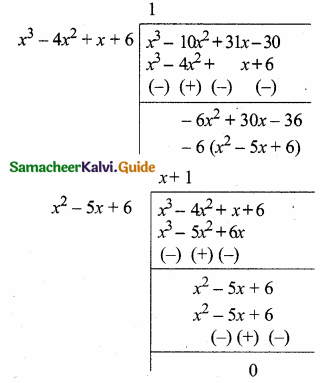
Find the G.C.D. of x3 – 10x2 + 31x – 30 and 2x3 – 8x2 + 2x + 12
Answer:
p(x) = x3 – 10x2 + 31x – 30
g(x) = 2x3 – 8x2 + 2x + 12
= 2(x3 – 4x2 + x + 6)
Samacheer Kalvi 10th Maths Guide Chapter 3 Algebra Additional Questions 37
G.C.D. = x2 – 5x + 6

Question 6.
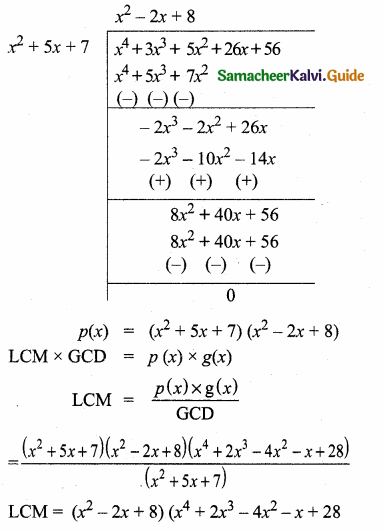
The G.C.D of x4 + 3x3 + 5x2 + 26x + 56 and x4 + 2x3 – 4x2 – x + 28 is x2 + 5x + 7. Find their L.C.M.
Answer:
p(x) = x4 + 3x3 + 5x2 + 26x + 56
g(x) = x4 + 2x3 – 4x2 – x + 28
G.C.D. = x2 + 5x + 7
Samacheer Kalvi 10th Maths Guide Chapter 3 Algebra Additional Questions 38

Samacheer Kalvi 10th Maths Guide Chapter 3 Algebra Additional Questions

Question 7.
Find the values of “a” and “b” given that p(x) = (x2 + 3x + 2) (x2 – 4x + a); g(x) = (x2 – 6x + 9) × (x2 + 4x + b) and their G.C.D is (x + 2) (x – 3)
Answer:
p(x) = (x2 + 3x + 2) (x2 – 4x + a)
= (x + 1) (x + 2) (x2 – 4x + a)
G.C.D is given as (x + 2) (x – 3)
x – 3 is a factor of x2 – 4x + a
Samacheer Kalvi 10th Maths Guide Chapter 3 Algebra Additional Questions 39
p(3) = 0
9 – 4(3) + a = 0
9 – 12 + a = 0
– 3 + a =0
a = 3
Samacheer Kalvi 10th Maths Guide Chapter 3 Algebra Additional Questions 40
g(x) = (x2 – 6x + 9) (x2 + 4x + 6)
= (x – 3) (x – 3) (x2 + 4x + b)
But G.C.D. is (x + 2) (x – 3)
∴ x + 2 is a factor of x2 + 4x + 6
g(-2) = 0
4 + 4(-2) + b = 0
4 – 8 + 6 = 0
-4 + b = 0
b = 4
The value of a = 3 and b = 4

Question 8.
Find the other polynomial g(x), given that LCM, HCF and p(x) as (x – 1) (x – 2) (x2 – 3x + 3); x – 1 and x3 – 4x2 + 6x – 3 respectively.
Answer:
LC.M. = (x – 1) (x – 2) (x2 – 3x + 3)
HCF = (x – 1)
p(x) = x3 – 4x2 + 6x – 3
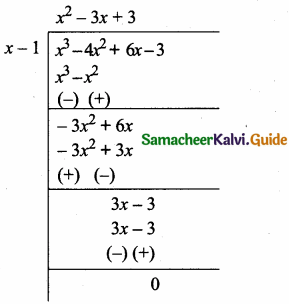
Samacheer Kalvi 10th Maths Guide Chapter 3 Algebra Additional Questions 41
p(x) = (x – 1) (x2 – 3x + 3)
p(x) × g(x) = LCM × HCF
(x – 1) (x2 – 3x + 3) × g(x)
= (x – 1) (x – 2) (x2 – 3x + 3) (x – 1)
Samacheer Kalvi 10th Maths Guide Chapter 3 Algebra Additional Questions 42
The other polynominal g(x) x2 – 3x + 2

Samacheer Kalvi 10th Maths Guide Chapter 3 Algebra Additional Questions

Question 9.
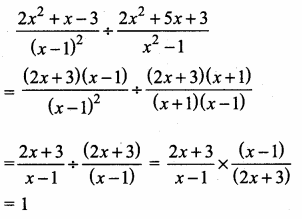
Divide
Samacheer Kalvi 10th Maths Guide Chapter 3 Algebra Additional Questions 43
Answer:
2x2 + x – 3 = 2x2 + 3x – 2x – 3
= x(2x + 3) – 1 (2x + 3)
= (2x + 3) (x – 1)
Samacheer Kalvi 10th Maths Guide Chapter 3 Algebra Additional Questions 44
2x2 + 5x + 3 = 2x2 + 3x + 2x + 3
= x(2x + 3) + 1 (2x + 3)
= (2x + 3) (x + 1)
x2 -1 = (x + 1) (x – 1)
Samacheer Kalvi 10th Maths Guide Chapter 3 Algebra Additional Questions 45
Samacheer Kalvi 10th Maths Guide Chapter 3 Algebra Additional Questions 46

Question 10.
Simplify
Samacheer Kalvi 10th Maths Guide Chapter 3 Algebra Additional Questions 47
Answer:
(x2 – x – 6) = (x – 3) (x + 2)
2x2 + 5x – 3 = 2×2 + 6x – x – 3
Samacheer Kalvi 10th Maths Guide Chapter 3 Algebra Additional Questions 48
= 2x (x + 3) -1 (x + 3)
= (x + 3) (2x – 1)
x2 + 5x + 6 = (x + 2) (x + 3)
Samacheer Kalvi 10th Maths Guide Chapter 3 Algebra Additional Questions 49
Samacheer Kalvi 10th Maths Guide Chapter 3 Algebra Additional Questions 50

Samacheer Kalvi 10th Maths Guide Chapter 3 Algebra Additional Questions

Question 11.
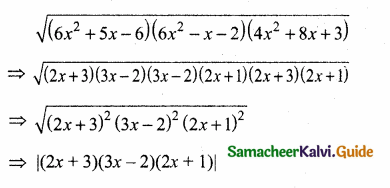
Find the square root of (6x2 + 5x – 6) (6x2 – x – 2) (4x2 + 8x + 3)
Answer:
6x2 + 5x – 6 = 6x2 + 9x – 4x – 6
= 3x(2x + 3) -2 (2x + 3)
= (2x + 3) (3x – 2)
Samacheer Kalvi 10th Maths Guide Chapter 3 Algebra Additional Questions 51
6x2 – x – 2 = 6x2 – 4x + 3x – 2
= 2x (3x – 2) + 1 (3x – 2)
= (3x – 2) (2x + 1)
Samacheer Kalvi 10th Maths Guide Chapter 3 Algebra Additional Questions 52
4x2 + 8x + 3 = 4x2 + 6x + 2x + 3
= 2x(2x + 3) + 1 (2x + 3)
= (2x + 3) (2x + 1)
Samacheer Kalvi 10th Maths Guide Chapter 3 Algebra Additional Questions 53
Samacheer Kalvi 10th Maths Guide Chapter 3 Algebra Additional Questions 54

Question 12.
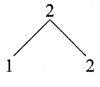
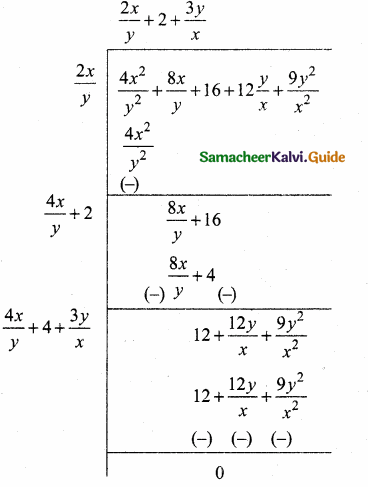
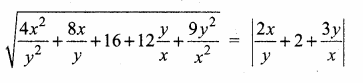
Find the square root of the polynomial
\(\frac{4 x^{2}}{y^{2}}\) + \(\frac { 8x }{ y } \) + 16 + 12 \(\frac { y }{ x } \) + \(\frac{9 y^{2}}{x^{2}}\)
Answer:
Samacheer Kalvi 10th Maths Guide Chapter 3 Algebra Additional Questions 55
Samacheer Kalvi 10th Maths Guide Chapter 3 Algebra Additional Questions 555

Samacheer Kalvi 10th Maths Guide Chapter 3 Algebra Additional Questions

Question 13.
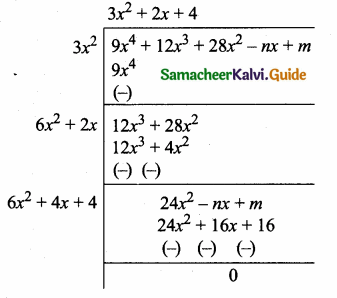
If m – nx + 28x2 + 12x3 + 9x4 is a perfect square, then find the values of m and n.
Answer:
Arrange the polynomial in descending power of x.
9x4 + 12x3 + 28x2 – nx + m
Now,
Samacheer Kalvi 10th Maths Guide Chapter 3 Algebra Additional Questions 56
Since the given polynomial is a perfect square,
-nx – 16x = 0
-x (n + 16) = 0
n + 16 = 0 ⇒ n = -16
m – 16 = 0 ⇒ m = 16
The value m = 16 and n = -16

Question 14.
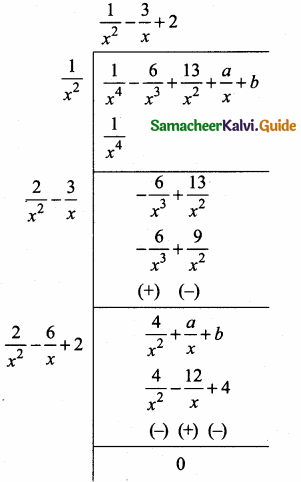
If b + \(\frac { a }{ x } \) + \(\frac{13}{x^{2}}\) – \(\frac{6}{x^{3}}\) + \(\frac{1}{x^{4}}\) is a perfect square, find the values of “a” and “b”
Answer:
Arrange the values of “a” and “b”
Samacheer Kalvi 10th Maths Guide Chapter 3 Algebra Additional Questions 57
Since it is a perfect square
\(\frac { a }{ x } \) + \(\frac { 12 }{ x } \) = 0
\(\frac { 1 }{ x } \) (a + 12) = 0
a + 12 = 0 ⇒ a = -12
b – 4 = 0 ⇒ b = 4
The value of a = -12 and b = 4

Question 15.
Solve
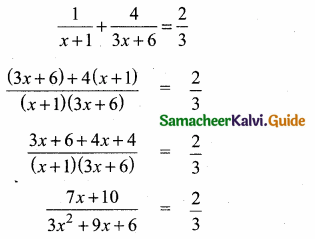
\(\frac { 1 }{ x + 1 } \) + \(\frac { 4 }{ 3x+6 } \) = \(\frac { 2 }{ 3 } \)
Answer:
Samacheer Kalvi 10th Maths Guide Chapter 3 Algebra Additional Questions 58
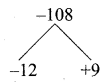
6x2 – 12x + 9x – 18 = 0
6x(x – 2) + 9(x – 2) = 0
Samacheer Kalvi 10th Maths Guide Chapter 3 Algebra Additional Questions 59
(x – 2) (6x + 9) = 0
x – 2 = 0 or 6x + 9 = 0
x = 2 or 6x + 9 = 0
x = 2 or 6x = -9
x = – \(\frac { 9 }{ 6 } \) = \(\frac { -3 }{ 2 } \)
The solution is \(\frac { -3 }{ 2 } \) or 2

Samacheer Kalvi 10th Maths Guide Chapter 3 Algebra Additional Questions

Question 16.
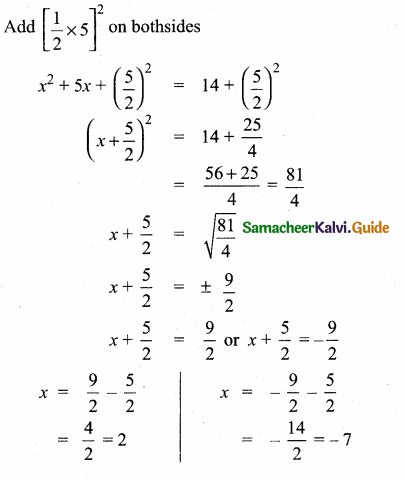
A two-digit number is such that the product of the digits is 14. When 45 is added to the number, the digits interchange their places. Find the number (solve by completing square method)
Answer:
Let the ten’s digit be “x”
∴ The unit digit = \(\frac { 14 }{ x } \)
∴ The number is 10x + \(\frac { 14 }{ x } \)
If the digits are interchanged the number is \(\frac { 140 }{ x } \) + x
By the given condition
10x + \(\frac { 14 }{ x } \) + 45 = \(\frac { 140 }{ x } \) + x
multiply by x
10x2 + 14 + 45x = 140 + x2
9x2 + 45x + 14 – 140 = 0
9x2 + 45x – 126 = 0
Divided by 9
x2 + 5x – 14 = 0
x2 + 5x = 14
Samacheer Kalvi 10th Maths Guide Chapter 3 Algebra Additional Questions 60
Since the digit of the number can not be negative
∴ x = 2
The number = 10x + \(\frac { 14 }{ x } \)
= 20 + \(\frac { 14 }{ 2 } \)
= 20 + 7
= 27
The number is 27

Question 17.
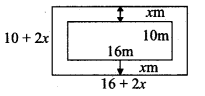
A rectangular garden 10 m by 16 m is to be surrounded by a concreate walk of uniform width. Given that the area of walk is 120 sqm assuming the width of walk be ‘V form the equation then solve it by formula method.
Answer:
Area of the garden = 16 × 10
= 160 sq.m
Samacheer Kalvi 10th Maths Guide Chapter 3 Algebra Additional Questions 61
Area of the garden with walking area
= (1.6 + 2x) (10 + 2x)
= 160 + 32x + 20x + 4x2
= 4x2 + 52x + 160
Area of the concrete walk = Area of the garden with walk – Area of garden
= 4x2 + 52x + 160 – 160
120 = 4x2 + 52x
4x2 + 52x – 120 = 0
(÷ by 4) ⇒ x2 + 13x – 30 = 0
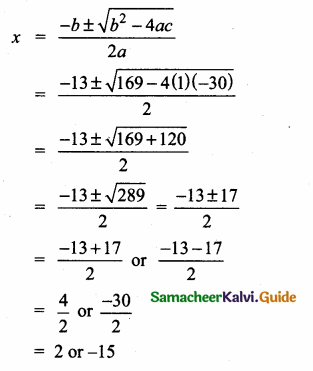
Here a = 1, b = 13, c = -30
(comparing with ax2 + bx + c = 0)
Samacheer Kalvi 10th Maths Guide Chapter 3 Algebra Additional Questions 62
Since the width cannot be negative. Width of the garden = 2 m

Samacheer Kalvi 10th Maths Guide Chapter 3 Algebra Additional Questions

Question 18.
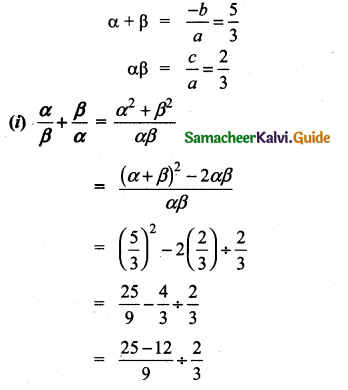
If α and β are the roots of the equation 3x2 – 5x + 2 = 0 find the value of
(i) \(\frac{\alpha}{\beta}+\frac{\beta}{\alpha}\)
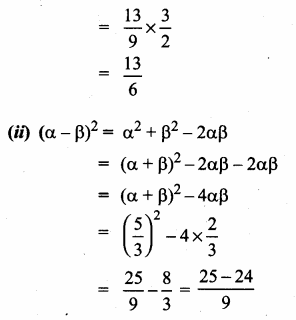
(ii) α – β
(iii) \(\frac{\alpha^{2}}{\beta}+\frac{\beta^{2}}{\alpha}\)
Answer:
Comparing with ax2 + bx + c = 0
a = 3, b = -5, c = 2
α and β are the roots of the equation
3x2 – 5x + 2 = 0
Samacheer Kalvi 10th Maths Guide Chapter 3 Algebra Additional Questions 63
Samacheer Kalvi 10th Maths Guide Chapter 3 Algebra Additional Questions 64
Samacheer Kalvi 10th Maths Guide Chapter 3 Algebra Additional Questions 65
(iii) \(\frac{\alpha^{2}}{\beta}+\frac{\beta^{2}}{\alpha}=\frac{\alpha^{3}+\beta^{3}}{\alpha \beta}\)
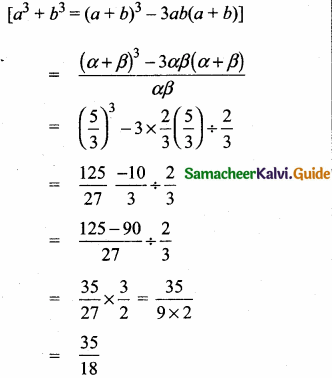
Samacheer Kalvi 10th Maths Guide Chapter 3 Algebra Additional Questions 66

Samacheer Kalvi 10th Maths Guide Chapter 3 Algebra Additional Questions

Question 19.
If α and β are the roots of the equation 3x2 – 6x + 1 = 0 from the equation whose roots are
(i) α2 β;β2α
(ii) 2α + β; 2β + a
Answer:
α and β are the roots of 3x2 – 6x + 1 = 0
α + β = \(\frac { 6 }{ 3 } \) = 2
αβ = \(\frac { 1 }{ 3 } \)
(i) Given the roots are α2β and β2α
Sum of the roots = α2β + β2α
= αβ (α + β)
= \(\frac { 1 }{ 3 } \)(2)
= \(\frac { 2 }{ 3 } \)
Product of the roots = (α2β) x (β2α)
= α2β2
= (αβ)3
= (\(\frac { 1 }{ 3 } \))3
= \(\frac { 1 }{ 27 } \)
The quadratic equation is
x2 – (sum of the roots) x + product of the roots = 0
x2 – (\(\frac { 2 }{ 3 } \)) x + \(\frac { 1 }{ 27 } \) = 0
multiply by 27
27x2 – 18x + 1 = 0

(ii) Given the roots are 2α + β; 2 β + α
Sum of the roots = 2α + β + 2 β + α
= 2(α + β) + (α + β)
= 2(2) + 2
= 6
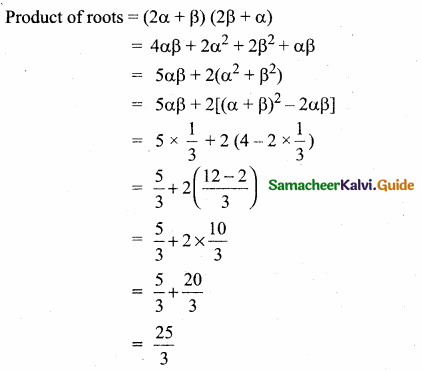
Samacheer Kalvi 10th Maths Guide Chapter 3 Algebra Additional Questions 67
The quadratic polynomial is
x2 – (sum of the roots) x + product of the roots = 0
x2 – 6x + \(\frac { 25 }{ 3 } \) = 0
3x2 – 18x + 25 = 0

Samacheer Kalvi 10th Maths Guide Chapter 3 Algebra Additional Questions

Question 20.
Find X and Y if
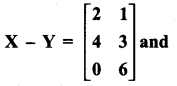
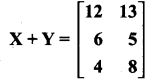
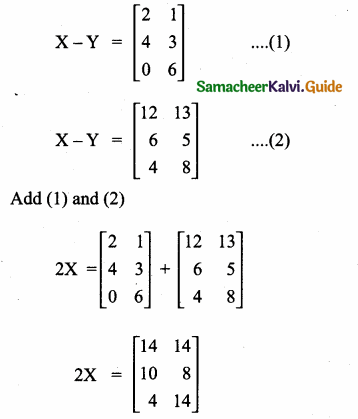
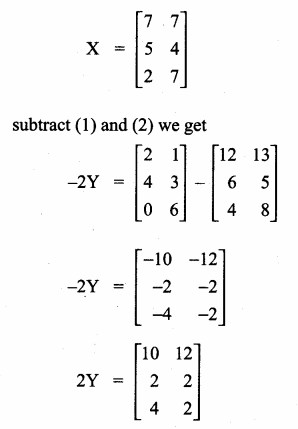
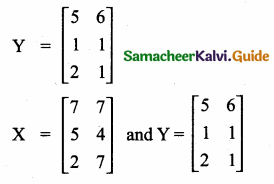
Samacheer Kalvi 10th Maths Guide Chapter 3 Algebra Additional Questions 68Samacheer Kalvi 10th Maths Guide Chapter 3 Algebra Additional Questions 69
Answer:
Samacheer Kalvi 10th Maths Guide Chapter 3 Algebra Additional Questions 70
Samacheer Kalvi 10th Maths Guide Chapter 3 Algebra Additional Questions 71
Samacheer Kalvi 10th Maths Guide Chapter 3 Algebra Additional Questions 72

Samacheer Kalvi 10th Maths Guide Chapter 3 Algebra Additional Questions

Question 21.
Solve for x,y
Samacheer Kalvi 10th Maths Guide Chapter 3 Algebra Additional Questions 73
Answer:
Samacheer Kalvi 10th Maths Guide Chapter 3 Algebra Additional Questions 74
Samacheer Kalvi 10th Maths Guide Chapter 3 Algebra Additional Questions 75

Question 22.
Samacheer Kalvi 10th Maths Guide Chapter 3 Algebra Additional Questions 78
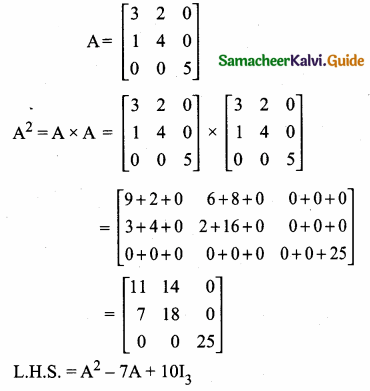
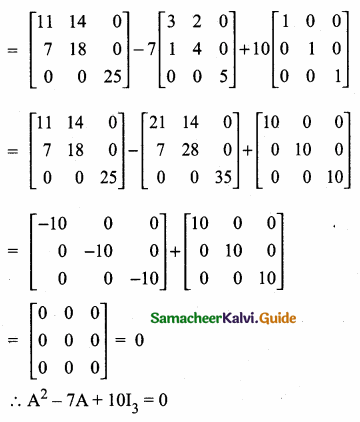
Show that A2 – 7A + 1013 = 0
Answer:
Samacheer Kalvi 10th Maths Guide Chapter 3 Algebra Additional Questions 79
Samacheer Kalvi 10th Maths Guide Chapter 3 Algebra Additional Questions 80

Samacheer Kalvi 10th Maths Guide Chapter 3 Algebra Additional Questions

Question 23.
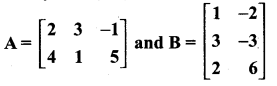
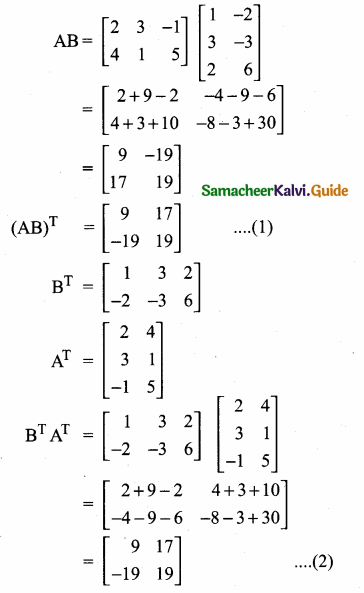
Verify that (AB)T = BT AT if
Samacheer Kalvi 10th Maths Guide Chapter 3 Algebra Additional Questions 81
Answer:
Samacheer Kalvi 10th Maths Guide Chapter 3 Algebra Additional Questions 82
From (1) and (2) we get
(AB)= BTAT

Question 24.
Draw the graph of y = x2 and hence solve x2 – 4x – 5 = 0.
Answer:
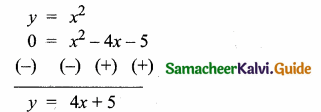
Given equations are y = x2 and x2 – 4x – 5 = 0
(i) Assume the values of x from – 4 to 5.
Samacheer Kalvi 10th Maths Guide Chapter 3 Algebra Additional Questions 83
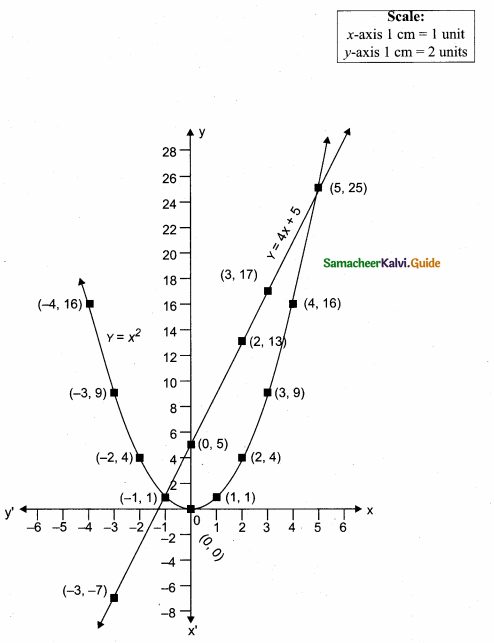
(ii) Plot the points (- 4,16), (- 3, 9), (- 2,4), (-1, 1), (0,0), (1, 1), (2,4), (3, 9), (4,16), (5,25).
(iii) Join the points by a smooth curve.
(iv) Solve the given equations
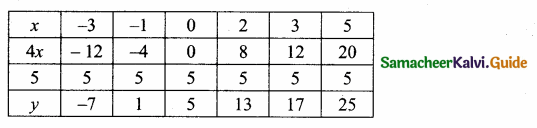
Samacheer Kalvi 10th Maths Guide Chapter 3 Algebra Additional Questions 84
Samacheer Kalvi 10th Maths Guide Chapter 3 Algebra Additional Questions 85
(v) The points of intersection of the line and the parabola are (-1, 1) and (5, 25).
The x-coordinates of the points are -1 and 5.
Thus solution set is {- 1, 5}.

Samacheer Kalvi 10th Maths Guide Chapter 3 Algebra Additional Questions
Samacheer Kalvi 10th Maths Guide Chapter 3 Algebra Additional Questions 86

Question 25.
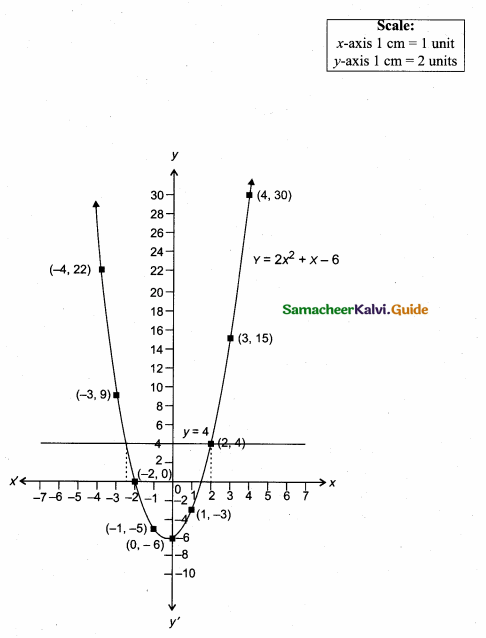
Draw the graph of y = 2x2 + x – 6 and hence solve 2x2 + x – 10 = 0.
Answer:
Given equations are y = x2 and x2 – 4x – 5 = 0
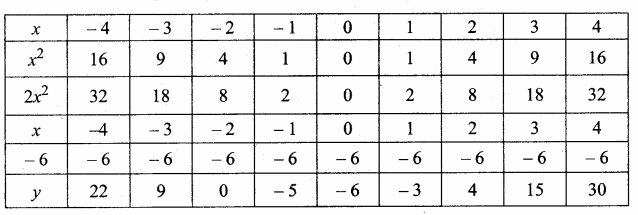
(i) Assume the values of x from – 4 to 5.
Samacheer Kalvi 10th Maths Guide Chapter 3 Algebra Additional Questions 832
(ii) Plot the points (- 4, 22), (- 3, 9), (- 2, 0), (-1, -5), (0, -6), (1, -3), (2, 4), (3, 15), (4, 30).
(iii) Join the points by a smooth curve.
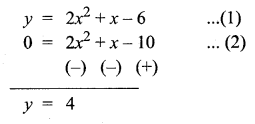
(iv) Solve the given equations: Subtract 2x2 + x – 10 = 0
Samacheer Kalvi 10th Maths Guide Chapter 3 Algebra Additional Questions 841
y = 4 is a straight line parallel to X-axis
(v) The straight line and parabola intersect at point (-2.5, 4) and (2, 4).
The x-coordinates of the points are -2.5 and 2.
The solution set is {- 2.5, 2}.
Samacheer Kalvi 10th Maths Guide Chapter 3 Algebra Additional Questions 842

Samacheer Kalvi 10th Maths Guide Chapter 4 Geometry Ex 4.2

Students can download Maths Chapter 4 Geometry Ex 4.2 Questions and Answers, Notes, Samacheer Kalvi 10th Maths Guide Pdf helps you to revise the complete Tamilnadu State Board New Syllabus, helps students complete homework assignments and to score high marks in board exams.

Tamilnadu Samacheer Kalvi 10th Maths Solutions Chapter 4 Geometry Ex 4.2

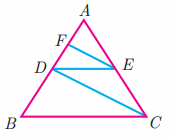
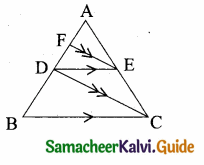
Question 1.
In ∆ABC, D and E are points on the sides AB and AC respectively such that DE || BC
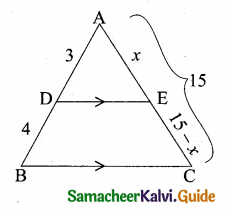
(i) If \(\frac { AD }{ DB } \) = \(\frac { 3 }{ 4 } \) and AC = 15 cm find AE.
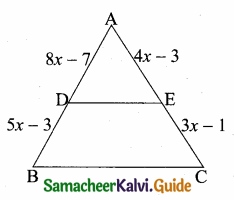
(ii) If AD = 8x – 7 , DB = 5x – 3 , AE = 4x – 3 and EC = 3x – 1, find the value of x.
Solution:
(i) Let AE be x
∴ EC = 15 – x
In ∆ABC we have DE || BC
By Basic proportionality theorem, we have
Samacheer Kalvi 10th Maths Guide Chapter 4 Geometry Ex 4.2 1
\(\frac { AD }{ DB } \) = \(\frac { AE }{ EC } \)
\(\frac { 3 }{ 4 } \) = \(\frac { x }{ 15-x } \)
4x = 3 (15 – x)
4x = 45 – 3x
7x = 45 ⇒ x = \(\frac { 45 }{ 7 } \) = 6.43
The value of x = 6.43

Samacheer Kalvi 10th Maths Guide Chapter 4 Geometry Ex 4.2

(ii) Given AD = 8x – 7; BD = 5x – 3; AE = 4x – 3; EC = 3x – 1
In ∆ABC we have DE || BC
By Basic proportionality theorem
\(\frac { AD }{ DB } \) = \(\frac { AE }{ EC } \)
\(\frac { 8x-7 }{ 5x-3 } \) = \(\frac { 4x-3 }{ 3x-1 } \)
Samacheer Kalvi 10th Maths Guide Chapter 4 Geometry Ex 4.2 2
(8x – 7) (3x – 1) = (4x – 3) (5x – 3)
24x2 – 8x – 21x + 7 = 20x2 – 12x – 15x + 9
24x2 – 20x2 – 29x + 27x + 7 – 9 = 0
4x2 – 2x – 2 = 0
2x2 – x – 1 = 0 (Divided by 2)
Samacheer Kalvi 10th Maths Guide Chapter 4 Geometry Ex 4.2 3
2x2 – 2x + x – 1 = 0
2x(x -1) + 1 (x – 1) = 0
(x – 1) (2x + 1) = 0
x – 1 = 0 or 2x + 1 = 0
x = 1 or 2x = -1 ⇒ x = – \(\frac { 1 }{ 2 } \) (Negative value will be omitted)
The value of x = 1

Samacheer Kalvi 10th Maths Guide Chapter 4 Geometry Ex 4.2

Question 2.
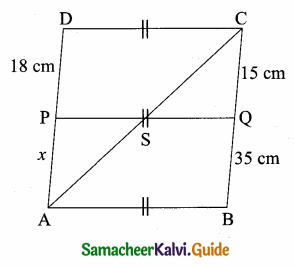
ABCD is a trapezium in which AB || DC and P,Q are points on AD and BC respectively, such that PQ || DC if PD = 18 cm, BQ
Solution:
Join AC intersecting PQ at S.
Let AP be x
∴ AD = x + 18
In the ∆ABC, QS || AB
By basic proportionality theorem.
Samacheer Kalvi 10th Maths Guide Chapter 4 Geometry Ex 4.2 4
\(\frac { AS }{ SC } \) = \(\frac { BQ }{ QC } \)
\(\frac { AS }{ SC } \) = \(\frac { 35 }{ 15 } \) ………(1)
In the ∆ACD; PS || DC
By basic proportionality theorem.
\(\frac { AS }{ SC } \) = \(\frac { AP }{ PD } \)
\(\frac { AS }{ SC } \) = \(\frac { x }{ 18 } \) ………..(2)
From (1) and (2) we get
\(\frac { 35 }{ 15 } \) = \(\frac { x }{ 18 } \)
15x = 35 × 18 ⇒ x = \(\frac{35 \times 18}{15}\) = 42
AD = AP + PD
= 42 + 18 = 60
The value of AD = 60 cm

Samacheer Kalvi 10th Maths Guide Chapter 4 Geometry Ex 4.2

Question 3.
In ∆ABC, D and E are points on the sides AB and AC respectively. For each of the following cases show that DE || BC.
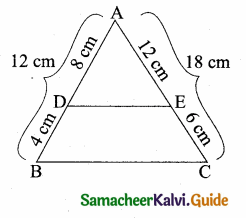
(i) AB = 12 cm, AD = 8 cm, AE = 12 cm and AC = 18 cm.
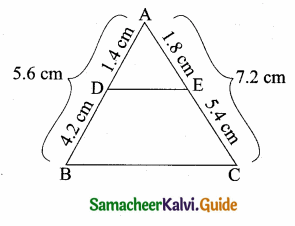
(ii) AB = 5.6 cm, AD = 1.4 cm, AC = 7.2 cm and AE = 1.8 cm.
Solution:
(i) Here AB = 12 cm; BD =12 – 8 = 4 cm; AE =12 cm; EC = 18 – 12 = 6 cm
Samacheer Kalvi 10th Maths Guide Chapter 4 Geometry Ex 4.2 5
∴ \(\frac { AD }{ DB } \) = \(\frac { 8 }{ 4 } \) = 2
\(\frac { AE }{ EC } \) = \(\frac { 12 }{ 6 } \) = 2
\(\frac { AD }{ DB } \) = \(\frac { AE }{ EC } \)
By converse of basic proportionality theorem DE || BC

(ii) Here AB = 5.6 cm; AD = 1.4 cm;
BD = AB – AD
= 5.6 – 1.4 = 4.2
Samacheer Kalvi 10th Maths Guide Chapter 4 Geometry Ex 4.2 6
AC = 7.2 cm; AE = 1.8 cm
EC = AC – AE
= 7.2 – 1.8
EC = 5.4 cm
\(\frac { AD }{ DB } \) = \(\frac { 1.4 }{ 4.2 } \) = \(\frac { 1 }{ 3 } \)
\(\frac { AE }{ EC } \) = \(\frac { 1.8 }{ 5.4 } \) = \(\frac { 1 }{ 3 } \)
\(\frac { AE }{ EC } \) = \(\frac { AD }{ DB } \)
By converse of basic proportionality theorem DE || BC

Samacheer Kalvi 10th Maths Guide Chapter 4 Geometry Ex 4.2

Question 4.
In fig. if PQ || BC and BC and PR || CD prove that
Samacheer Kalvi 10th Maths Guide Chapter 4 Geometry Ex 4.2 7
(i) \(\frac { AR }{ AD } \) = \(\frac { AQ }{ AB } \)
(ii) \(\frac { QB }{ AQ } \) = \(\frac { DR }{ AR } \)
Solution:
(i) In ∆ABC, We have PQ || BC
By basic proportionality theorem
Samacheer Kalvi 10th Maths Guide Chapter 4 Geometry Ex 4.2 8
\(\frac { AQ }{ AB } \) = \(\frac { AP }{ AC } \) ……(1)
In ∆ACD, We have PR || CD
basic proportionality theorem
\(\frac { AP }{ AC } \) = \(\frac { AR }{ AD } \) ………..(2)
From (1) and (2) we get
\(\frac { AQ }{ AB } \) = \(\frac { AR }{ AD } \) (or) \(\frac { AR }{ AD } \) = \(\frac { AQ }{ AB } \)

(ii) In ∆ABC, PQ || BC (Given)
By basic proportionality theorem
\(\frac { AP }{ PC } \) = \(\frac { AQ }{ QB } \) ………..(1)
In ∆ADC, PR || CD (Given)
By basic proportionality theorem
\(\frac { AP }{ PC } \) = \(\frac { AR }{ RD } \) ………(2)
From (1) and (2) we get
\(\frac { AQ }{ QB } \) = \(\frac { AP }{ RD } \) (or) \(\frac { QB }{ AQ } \) = \(\frac { RD }{ AR } \)

Samacheer Kalvi 10th Maths Guide Chapter 4 Geometry Ex 4.2

Question 5.
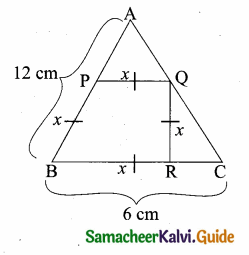
Rhombus PQRB is inscribed in ∆ABC such that ∠B is one of its angle. P, Q and R lie on AB, AC and BC respectively. If AB = 12 cm and BC = 6 cm, find the sides PQ, RB of the rhombus.
Solution:
Let the side of the rhombus be “x”. Since PQRB is a Rhombus PQ || BC
By basic proportionality theorem
Samacheer Kalvi 10th Maths Guide Chapter 4 Geometry Ex 4.2 9
\(\frac { AP }{ AB } \) = \(\frac { PQ }{ BC } \) ⇒ \(\frac { 12-x }{ BC } \) = \(\frac { x }{ 6 } \)
12x = 6 (12 – x)
12x = 72 – 6x
12x + 6x = 72
18x = 72 ⇒ x = \(\frac { 72 }{ 18 } \) = 4
Side of a rhombus = 4 cm
PQ = RB = 4 cm

Samacheer Kalvi 10th Maths Guide Chapter 4 Geometry Ex 4.2

Question 6.
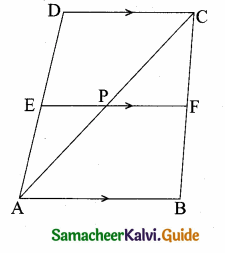
In trapezium ABCD, AB || DC , E and F are points on non-parallel sides AD and BC respectively, such that EF || AB.
Show that = \(\frac { AE }{ ED } \) = \(\frac { BF }{ FC } \)
Solution:
Given: ABCD is a trapezium AB || DC
E and F are the points on the side AD and BC
EF || AB
To Prove: \(\frac { AE }{ ED } \) = \(\frac { BF }{ FC } \)
Samacheer Kalvi 10th Maths Guide Chapter 4 Geometry Ex 4.2 10
Construction: Join AC intersecting AC at P
Proof:
In ∆ABC, PF || AB (Given)
By basic proportionality theorem
\(\frac { AP }{ PC } \) = \(\frac { BF }{ FC } \) ………..(1)
In the ∆ACD, PE || CD (Given)
By basic Proportionality theorem
\(\frac { AP }{ PC } \) = \(\frac { AE }{ ED } \) …………..(2)
From (1) and (2) we get
\(\frac { AE }{ ED } \) = \(\frac { BF }{ FC } \)

Samacheer Kalvi 10th Maths Guide Chapter 4 Geometry Ex 4.2

Question 7.
In figure DE || BC and CD || EE Prove that AD2 = AB × AF.
Samacheer Kalvi 10th Maths Guide Chapter 4 Geometry Ex 4.2 11
Solution:
Given: In ∆ABC, DE || BC and CD || EF
Samacheer Kalvi 10th Maths Guide Chapter 4 Geometry Ex 4.2 12
To Prove: AD2 = AB × AF
Proof: In ∆ABC, DE || BC (Given)
By basic proportionality theorem
\(\frac { AB }{ AD } \) = \(\frac { AC }{ AE } \) ……….. (1)
In ∆ADC; FE || DC (Given)
By basic Proportionality theorem
\(\frac { AD }{ AF } \) = \(\frac { AC }{ AE } \) ……..(2)
From (1) and (2) we get
\(\frac { AB }{ AD } \) = \(\frac { AD }{ AF } \)
AD2 = AB × AF
Hence it is proved

Question 8.
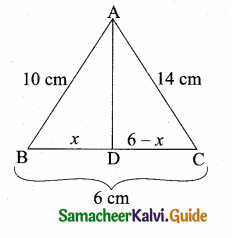
In ∆ABC, AD is the bisector of ∠A meeting side BC at D, if AB = 10 cm, AC = 14 cm and BC = 6 cm, find BD and DC.
Solution:
In ∆AABC AD is the internal bisector of ∠A
Given BC = 6 cm
Let BD = x ∴ DC = 6 – x cm
By Angle bisector theorem
\(\frac { BD }{ DC } \) = \(\frac { AB }{ AC } \)
\(\frac { x }{ 6-x } \) = \(\frac { 10 }{ 14 } \)
Samacheer Kalvi 10th Maths Guide Chapter 4 Geometry Ex 4.2 13
14x = 60 – 10x
24x = 60
x = \(\frac { 60 }{ 24 } \) = \(\frac { 10 }{ 4 } \) = 2.5
BD = 2.5 cm;
DC = 6 – x ⇒ 2.5 = 3.5 cm

Samacheer Kalvi 10th Maths Guide Chapter 4 Geometry Ex 4.2

Question 9.
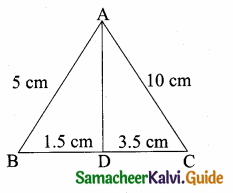
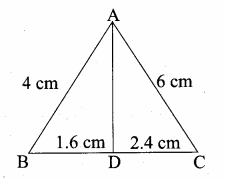
Check whether AD is bisector of ∠A of ∆ABC in each of the following,
(i) AB = 5 cm, AC = 10 cm, BD = 1.5 cm and CD = 3.5 cm.
(ii) AB = 4 cm, AC 6 cm, BD = 1.6 cm and CD = 2.4 cm.
Solution:
(i) In ∆ABC, AB = 5 cm, AC = 10 cm, BD = 1.5 cm, CD = 3.5 cm
\(\frac { BD }{ DC } \) = \(\frac { 1.5 }{ 3.5 } \) = \(\frac { 15 }{ 35 } \) = \(\frac { 3 }{ 7 } \)
\(\frac { AB }{ AC } \) = \(\frac { 5 }{ 10 } \) = \(\frac { 1 }{ 2 } \)
Samacheer Kalvi 10th Maths Guide Chapter 4 Geometry Ex 4.2 14
\(\frac { BD }{ DC } \) ≠ \(\frac { AB }{ AC } \)
∴ AD is not a bisector of ∠A.

(ii) In ∆ABC, AB = 4 cm, AC = 6 cm, BD = 1.6 cm, CD = 2.4 cm
Samacheer Kalvi 10th Maths Guide Chapter 4 Geometry Ex 4.2 15
\(\frac { BD }{ DC } \) = \(\frac { 1.6 }{ 2.4 } \) = \(\frac { 16 }{ 24 } \) = \(\frac { 2 }{ 3 } \)
\(\frac { AB }{ AC } \) = \(\frac { 4 }{ 6 } \) = \(\frac { 2 }{ 3 } \)
∴ \(\frac { BD }{ DC } \) = \(\frac { AB }{ AC } \)
By angle bisector theorem; AD is the internal bisector of ∠A

Samacheer Kalvi 10th Maths Guide Chapter 4 Geometry Ex 4.2

Question 10.
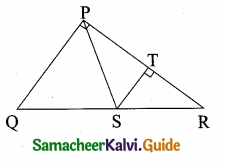
In figure ∠QPR = 90°, PS is its bisector.
If ST ⊥ PR, prove that ST × (PQ + PR) = PQ × PR.
Solution:
Given: ∠QPR = 90°; PS is the bisector of ∠P. ST ⊥ ∠PR
Samacheer Kalvi 10th Maths Guide Chapter 4 Geometry Ex 4.2 16
To prove: ST × (PQ + PR) = PQ × PR
Proof: In ∆ PQR, PS is the bisector of ∠P.
∴ \(\frac { PQ }{ QR } \) = \(\frac { QS }{ SR } \)
Adding (1) on both side
1 + \(\frac { PQ }{ QR } \) = 1 + \(\frac { QS }{ SR } \)
\(\frac { PR+PQ }{ PR } \) = \(\frac { SR+QS }{ SR } \)
\(\frac { PQ+PR }{ PR } \) = \(\frac { QR }{ SR } \) ……….(1)
In ∆ RST And ∆ RQP
∠SRT = ∠QRP = ∠R (Common)
∴ ∠QRP = ∠STR = 90°
(By AA similarity) ∆ RST ~ RQP
\(\frac { SR }{ QR } \) = \(\frac { ST }{ PQ } \)
\(\frac { QR }{ SR } \) = \(\frac { PQ }{ ST } \) ……..(2)
From (1) and (2) we get
\(\frac { PQ+PR }{ PR } \) = \(\frac { PQ }{ ST } \)
ST (PQ + PR) = PQ × PR

Samacheer Kalvi 10th Maths Guide Chapter 4 Geometry Ex 4.2

Question 11.
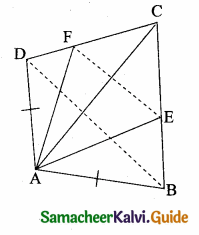
ABCD is a quadrilateral in which AB = AD, the bisector of ∠BAC and ∠CAD intersect the sides BC and CD at the points E and F respectively. Prove that EF || BD.
Solution:
ABCD is a quadrilateral. AB = AD.
AE and AF are the internal bisector of ∠BAC and ∠DAC.
Samacheer Kalvi 10th Maths Guide Chapter 4 Geometry Ex 4.2 17
To prove: EF || BD.
Construction: Join EF and BD
Proof: In ∆ ABC, AE is the internal bisector of ∠BAC.
By Angle bisector theorem, we have,
∴ \(\frac { AB }{ AC } \) = \(\frac { BE }{ EC } \) ………(1)
In ∆ ADC, AF is the internal bisector of ∠DAC
By Angle bisector theorem, we have,
\(\frac { AD }{ AC } \) = \(\frac { DF }{ FC } \)
∴ \(\frac { AB }{ AC } \) = \(\frac { DF }{ FC } \) (AB = AD given) ………(2)
From (1) and (2), we get,
\(\frac { BE }{ EC } \) = \(\frac { DF }{ FC } \)
Hence in ∆ BCD,
BD || EF (by converse of BPT)

Question 12.
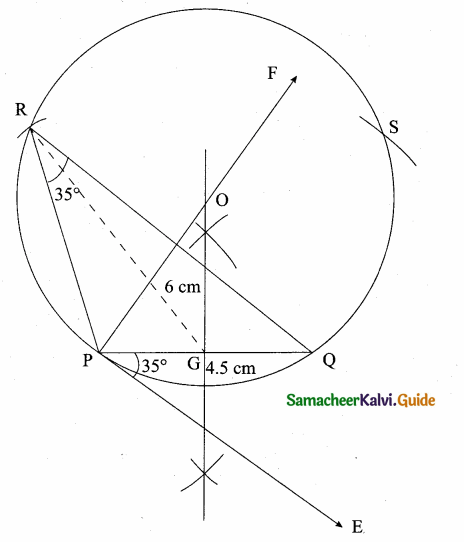
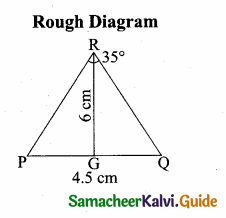
Construct a ∆PQR which the base PQ = 4.5 cm, R = 35° and the median from R to RG is 6 cm.
Answer:
Samacheer Kalvi 10th Maths Guide Chapter 4 Geometry Ex 4.2 18

Samacheer Kalvi 10th Maths Guide Chapter 4 Geometry Ex 4.2 19
Steps of construction

  1. Draw a line segment PQ = 4.5 cm
  2. At P, draw PE such that ∠QPE = 60°
  3. At P, draw PF such that ∠EPF = 90°
  4. Draw the perpendicular bisect to PQ, which intersects PF at O and PQ at G.
  5. With O as centre and OP as radius draw a circle.
  6. From G mark arcs of radius 5.8 cm on the circle. Mark them at R and S
  7. Join PR and RQ. PQR is the required triangle.
Samacheer Kalvi 10th Maths Guide Chapter 4 Geometry Ex 4.2

Question 13.
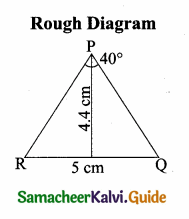
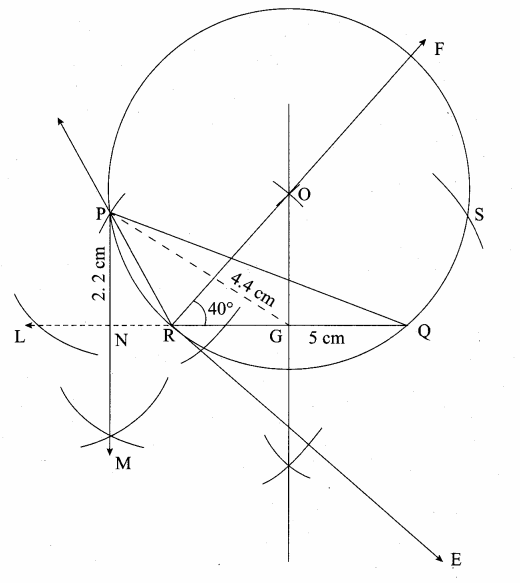
Construct a ∆PQR in which QR = 5 cm, ∠P = 40° and the median PG from P to QR is 4.4 cm. Find the length of the altitude from P to QR.
Answer:
Samacheer Kalvi 10th Maths Guide Chapter 4 Geometry Ex 4.2 20
Samacheer Kalvi 10th Maths Guide Chapter 4 Geometry Ex 4.2 21
Steps of construction

  1. Draw a line segment RQ = 5 cm.
  2. At R draw RE such that ∠QRE = 40°
  3. At R, draw RF such that ∠ERF = 90°
  4. Draw the perpendicular bisector to RQ, which intersects RF at O and RQ at G.
  5. With O as centre and OP as radius draw a circle.
  6. From G mark arcs of radius 4.4 cm on the circle. Mark them as P and S.
  7. Join PR and PQ. Then ∆PQR is the required triangle.
  8. From P draw a line PN which is perpendicular to RQ it meets at N.
  9. Measure the altitude PN.
    PN = 2.2 cm.

Samacheer Kalvi 10th Maths Guide Chapter 4 Geometry Ex 4.2

Question 14.
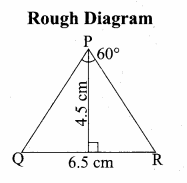
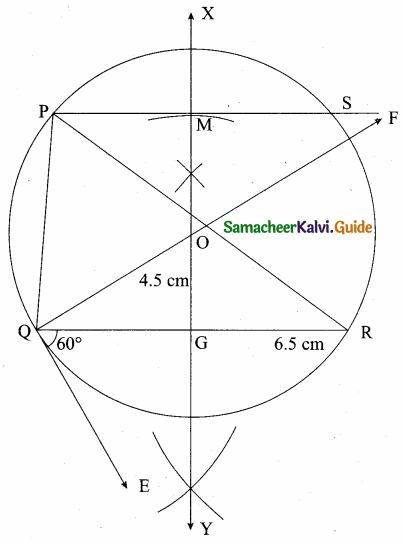
Construct a ∆PQR such that QR = 6.5 cm, ∠P = 60° and the altitude from P to QR is of length 4.5 cm.
Answer:
Samacheer Kalvi 10th Maths Guide Chapter 4 Geometry Ex 4.2 22
Samacheer Kalvi 10th Maths Guide Chapter 4 Geometry Ex 4.2 23
Steps of construction

  1. Draw a line segment QR = 6.5 cm.
  2. At Q draw QE such that ∠RQE = 60°.
  3. At Q, draw QF such that ∠EQF = 90°.
  4. Draw the perpendicular of QR which intersects QF at O and QR at G.
  5. With O as centre and OQ as radius draw a circle.
  6. X Y intersects QR at G. On X Y, from G mark an arc at M. Such that GM = 4.5 cm.
  7. Draw AB through M which is parallel to QR.
  8. AB Meets the circle at P and S.
  9. join QP and RP.
    PQR is the required triangle.

Samacheer Kalvi 10th Maths Guide Chapter 4 Geometry Ex 4.2

Question 15.
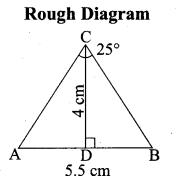
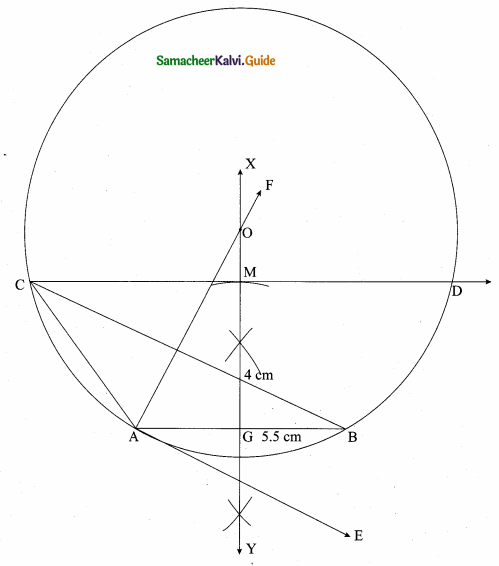
Construct a ∆ABC such that AB = 5.5 cm, ∠C = 25° and the altitude from C to AB is
Answer:
Samacheer Kalvi 10th Maths Guide Chapter 4 Geometry Ex 4.2 24
Samacheer Kalvi 10th Maths Guide Chapter 4 Geometry Ex 4.2 25
Steps of construction

  1. Draw a line segment AB = 5.5 cm.
  2. At A draw AE such that ∠BAE = 25°.
  3. At A draw AF such that ∠EAF = 90°.
  4. Draw the perpendicular bisector of AB which intersects AF at O and AB at G.
  5. With O as centre and OB as radius draw a circle.
  6. X Y intersects AB at G. On X Y, from G mark an arc at M. Such that GM = 4 cm.
  7. Through M draw a line parallel to AB intersect the circle at C and D.
  8. Join AC and BC.
    ABC is the required triangle.

Samacheer Kalvi 10th Maths Guide Chapter 4 Geometry Ex 4.2

Question 16.
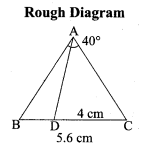
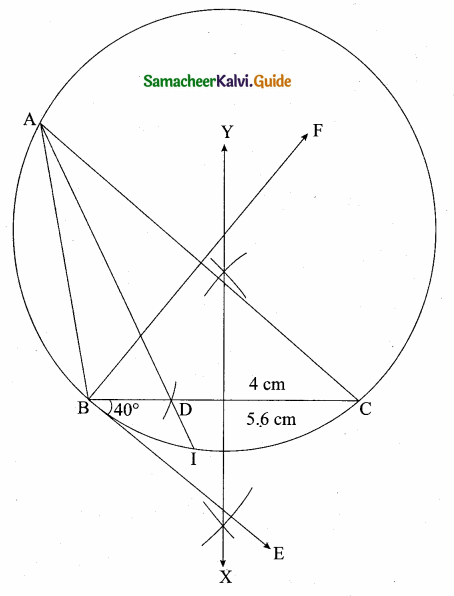
Draw a triangle ABC of base BC = 5.6 cm, ∠A = 40° and the bisector of ∠A meets BC at D such that CD = 4 cm.
Answer:
Samacheer Kalvi 10th Maths Guide Chapter 4 Geometry Ex 4.2 26
Samacheer Kalvi 10th Maths Guide Chapter 4 Geometry Ex 4.2 27
Steps of construction

  1. Draw a line segment BC = 5.6 cm.
  2. At B draw BE such that ∠CBE = 40°.
  3. At B draw BF such that ∠EBF = 90°.
  4. Draw the perpendicular bisector to BC which intersects BF at O and BC at G.
  5. With O as centre and OB as radius draw a circle.
  6. From C mark an arc of 4 cm on CB at D.
  7. The perpendicular bisector intersects the circle at I. Joint ID.
  8. ID produced meets the circle at A. Now Join AB and AC.
    This ABC is the required triangle.

Samacheer Kalvi 10th Maths Guide Chapter 4 Geometry Ex 4.2

Question 17.
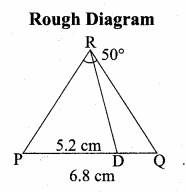
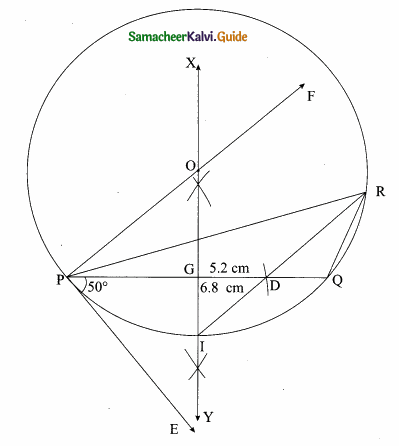
Draw ∆PQR such that PQ = 6.8 cm, vertical angle is 50° and the bisector of the vertical angle meets the base at D where PD = 5.2 cm
Answer:
Samacheer Kalvi 10th Maths Guide Chapter 4 Geometry Ex 4.2 28
Samacheer Kalvi 10th Maths Guide Chapter 4 Geometry Ex 4.2 29
Steps of construction

  1. Draw a line segment PQ = 6.8 cm.
  2. At P draw PE such that ∠QPE = 50°.
  3. At P draw PF such that ∠EPF = 90°.
  4. Draw the perpendicular bisector to PQ which intersects PF at O and PQ at G.
  5. With O as centre and OP as radius draw a circle.
  6. From P mark an arc of 5.2 cm on PQ at D.
  7. The perpendicular bisector intersects the circle at I. Join ID.
  8. ID produced meets the circle at A. Now Joint PR and QR. This PQR is the required triangle.

Samacheer Kalvi 10th Maths Guide Chapter 4 Geometry Ex 4.5

Students can download Maths Chapter 4 Geometry Ex 4.5 Questions and Answers, Notes, Samacheer Kalvi 10th Maths Guide Pdf helps you to revise the complete Tamilnadu State Board New Syllabus, helps students complete homework assignments and to score high marks in board exams.

Tamilnadu Samacheer Kalvi 10th Maths Solutions Chapter 4 Geometry Ex 4.5

Question 1.
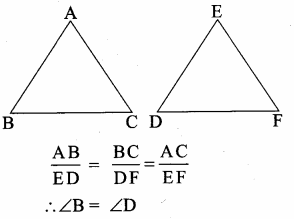
If in triangles ABC and EDF, \(\frac { AB }{ DE } \) = \(\frac { BC }{ FD } \) then they will be similar, when ……….
(1) ∠B = ∠E
(2) ∠A = ∠D
(3) ∠B = ∠D
(4) ∠A = ∠F
Answer:
(3) ∠B = ∠D
Hint:
Samacheer Kalvi 10th Maths Guide Chapter 4 Geometry Ex 4.5 1

Samacheer Kalvi 10th Maths Guide Chapter 4 Geometry Ex 4.5

Question 2.
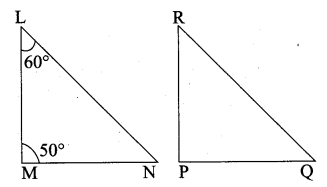
In ∆LMN, ∠L = 60°, ∠M = 50°. If ∆LMN ~ ∆PQR then the value of ∠R is ……………
(1) 40°
(2) 70°
(3) 30°
(4) 110°
Answer:
(2) 70°
Hint:
Since ∆LMN ~ ∆PQR
∠N = ∠R
∠N = 180 – (60 + 50)
= 180 – 110°
∠N = 70° ∴ ∠R = 70°
Samacheer Kalvi 10th Maths Guide Chapter 4 Geometry Ex 4.5 2

Samacheer Kalvi 10th Maths Guide Chapter 4 Geometry Ex 4.5

Question 3.
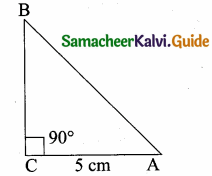
If ∆ABC is an isosceles triangle with ∠C = 90° and AC = 5 cm, then AB is ………
(1) 2.5 cm
(2) 5 cm
(3) 10 cm
(4) 5 \(\sqrt { 2 }\) cm
Answer:
(4) 5 \(\sqrt { 2 }\) cm
Hint:
Samacheer Kalvi 10th Maths Guide Chapter 4 Geometry Ex 4.5 3
AB2 = AC2 + BC2
AB2 = 52 + 52
(It is an isosceles triangle)
AB = \(\sqrt { 50 }\) = \(\sqrt{25 \times 2}\)
AB = 5 \(\sqrt { 2 }\)

Samacheer Kalvi 10th Maths Guide Chapter 4 Geometry Ex 4.5

Question 4.
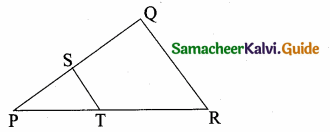
In a given figure ST || QR, PS = 2 cm and SQ = 3 cm. Then the ratio of the area of ∆PQR to the area of ∆PST is …………….
Samacheer Kalvi 10th Maths Guide Chapter 4 Geometry Ex 4.5 4
(1) 25 : 4
(2) 25 : 7
(3) 25 : 11
(4) 25 : 13
Answer:
(1) 25 : 4
Hint. Area of ∆PQR : Area of ∆PST
\(\frac{\text { Area of } \Delta \mathrm{PQR}}{\text { Area of } \Delta \mathrm{PST}}=\frac{\mathrm{PQ}^{2}}{\mathrm{PS}^{2}}=\frac{5^{2}}{2^{2}}=\frac{25}{4}\)
Area of ∆PQR : Area of ∆PST = 25 : 4

Question 5.
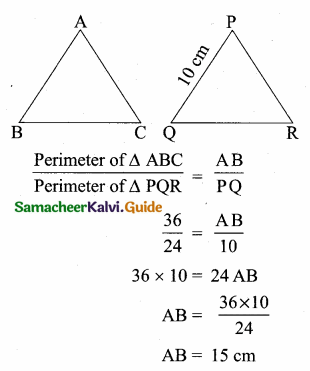
The perimeters of two similar triangles ∆ABC and ∆PQR are 36 cm and 24 cm respectively. If PQ =10 cm, then the length of AB is ………….
(1) 6 \(\frac { 2 }{ 3 } \) cm
(2) \(\frac{10 \sqrt{6}}{3}\)
(3) 66 \(\frac { 2 }{ 3 } \) cm
(4) 15 cm
Answer:
(4) 15 cm
Hint:
Samacheer Kalvi 10th Maths Guide Chapter 4 Geometry Ex 4.5 5

Samacheer Kalvi 10th Maths Guide Chapter 4 Geometry Ex 4.5

Question 6.
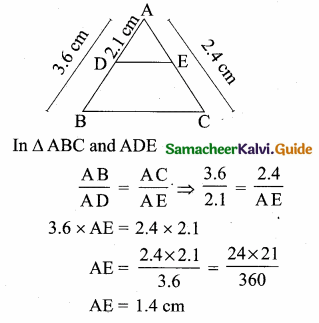
If in ∆ABC, DE || BC. AB = 3.6 cm, AC = 2.4 cm and AD = 2.1 cm then the length of AE is ………..

(1) 1.4 cm
(2) 1.8 cm
(3) 1.2 cm
(4) 1.05 cm
Answer:
(1) 1.4 cm
Hint:
Samacheer Kalvi 10th Maths Guide Chapter 4 Geometry Ex 4.5 6

Question 7.
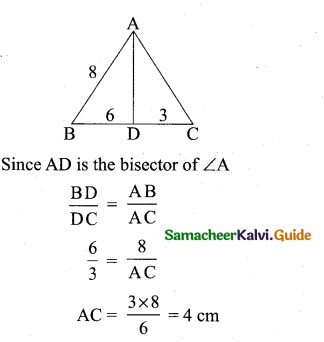
In a ∆ABC, AD is the bisector of ∠BAC. If AB = 8 cm, BD = 6 cm and DC = 3 cm.
The length of the side AC is ………….
(1) 6 cm
(2) 4 cm
(3) 3 cm
(4) 8 cm
Answer:
(2) 4 cm
Hint:
Samacheer Kalvi 10th Maths Guide Chapter 4 Geometry Ex 4.5 7

Samacheer Kalvi 10th Maths Guide Chapter 4 Geometry Ex 4.5

Question 8.
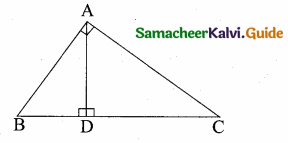
In the adjacent figure ∠BAC = 90° and AD ⊥ BC then ………..
Samacheer Kalvi 10th Maths Guide Chapter 4 Geometry Ex 4.5 8
(1) BD.CD = BC2
(2) AB.AC = BC2
(3) BD.CD = AD2
(4) AB.AC = AD2
Answer:
(3) BD CD = AD2
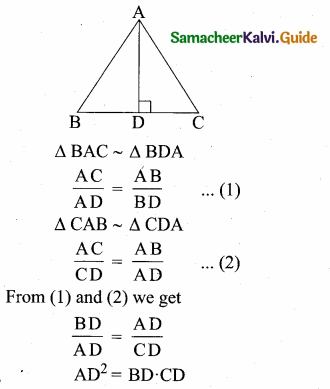
Hint:
Samacheer Kalvi 10th Maths Guide Chapter 4 Geometry Ex 4.5 9

Samacheer Kalvi 10th Maths Guide Chapter 4 Geometry Ex 4.5

Question 9.
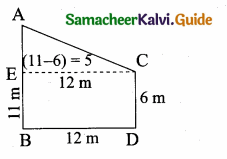
Two poles of heights 6 m and 11m stand vertically on a plane ground. If the distance between their feet is 12 m, what is the distance between their tops?
(1) 13 m
(2) 14 m
(3) 15 m
(4) 12.8 m
Answer:
(1) 13 m
Hint:
Samacheer Kalvi 10th Maths Guide Chapter 4 Geometry Ex 4.5 10
AC2 (Distance between the two tops)
= AE2 + EC2
= 52 + 122
= 25 + 144= 169
AC = \(\sqrt { 169 }\) = 13 cm

Samacheer Kalvi 10th Maths Guide Chapter 4 Geometry Ex 4.5

Question 10.
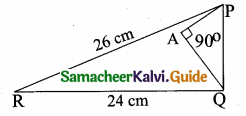
In the given figure, PR = 26 cm, QR = 24 cm, ∠PAQ = 90°, PA = 6 cm and QA = 8 cm. Find ∠PQR.
Samacheer Kalvi 10th Maths Guide Chapter 4 Geometry Ex 4.5 11
(1) 80°
(2) 85°
(3) 75°
(4) 90°
Answer:
(4) 90°
Hint.
PR = 26 cm, QR = 24 cm, ∠PAQ = 90°
In the ∆PQR,
Samacheer Kalvi 10th Maths Guide Chapter 4 Geometry Ex 4.5 12
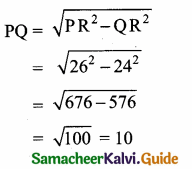
In the right ∆ APQ
PQ2 = PA2 + AQ2
= 62 + 82
= 36 + 64 = 100
PQ = \(\sqrt { 100 }\) = 10
∆ PQR is a right angled triangle at Q. Since
PR2 = PQ2 + QR2
∠PQR = 90°

Question 11.
A tangent is perpendicular to the radius at the
(1) centre
(2) point of contact
(3) infinity
(4) chord
Solution:
(2) point of contact

Samacheer Kalvi 10th Maths Guide Chapter 4 Geometry Ex 4.5

Question 12.
How many tangents can be drawn to the circle from an exterior point?
(1) one
(2) two
(3) infinite
(4) zero
Answer:
(2) two

Question 13.
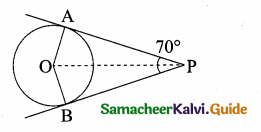
The two tangents from an external points P to a circle with centre at O are PA and PB.
If ∠APB = 70° then the value of ∠AOB is ……….
(1) 100°
(2) 110°
(3) 120°
(4) 130°
Answer:
(2) 110°
Hint.
Samacheer Kalvi 10th Maths Guide Chapter 4 Geometry Ex 4.5 13
∠OAP = 90°
∠APO = 35°
∠AOP = 180 – (90 + 35)
= 180 – 125 = 55
∠AOB = 2 × 55 = 110°

Samacheer Kalvi 10th Maths Guide Chapter 4 Geometry Ex 4.5

Question 14.
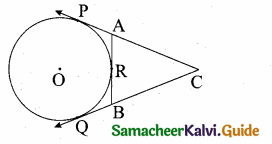
In figure CP and CQ are tangents to a circle with centre at 0. ARB is another tangent touching the circle at R. If CP = 11 cm and BC = 7 cm, then the length of BR is …….
Samacheer Kalvi 10th Maths Guide Chapter 4 Geometry Ex 4.5 14
(1) 6 cm
(2) 5 cm
(3) 8 cm
(4) 4 cm
Answer:
(4) 4 cm
Hint.
BQ = BR = 4 cm (tangent of the circle)
PC = QC = 11 cm (tangent of the circle)
QC = 11 cm
QB + BC = 11
QB + 7 = 11
QB = 11 – 7 = 4 cm
BR = BQ = 4 cm

Samacheer Kalvi 10th Maths Guide Chapter 4 Geometry Ex 4.5

Question 15.
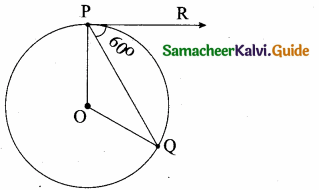
In figure if PR is tangent to the circle at P and O is the centre of the circle, then ∠POQ is ………….
Samacheer Kalvi 10th Maths Guide Chapter 4 Geometry Ex 4.5 15
(1) 120°
(2) 100°
(3) 110°
(4) 90°
Answer:
(1) 120°
Hint.
Since PR is tangent of the circle.
∠QPR = 90°
∠OPQ = 90° – 60° = 30°
∠OQB = 30°
In ∆OPQ
∠P + ∠Q + ∠O = 180°
30 + 30° + ∠O = 180°
(OP and OQ are equal radius)
∠O = 180° – 60° = 120°

Samacheer Kalvi 10th Maths Guide Chapter 4 Geometry Ex 4.4

Students can download Maths Chapter 4 Geometry Ex 4.4 Questions and Answers, Notes, Samacheer Kalvi 10th Maths Guide Pdf helps you to revise the complete Tamilnadu State Board New Syllabus, helps students complete homework assignments and to score high marks in board exams.

Tamilnadu Samacheer Kalvi 10th Maths Solutions Chapter 4 Geometry Ex 4.4

Question 1.
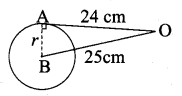
The length of the tangent to a circle from a point P, which is 25 cm away from the centre is 24 cm. What is the radius of the circle?
Solution:
Let the radius AB be r. In the right ∆ ABO,
OB2 = OA2 + AB2
252 = 242 + r2
Samacheer Kalvi 10th Maths Guide Chapter 4 Geometry Ex 4.4 1
252 – 242 = r2
(25 + 24) (25 – 24) = r2
r = \(\sqrt { 49 }\) =7
Radius of the circle = 7 cm

Samacheer Kalvi 10th Maths Guide Chapter 4 Geometry Ex 4.4

Question 2.
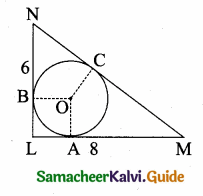
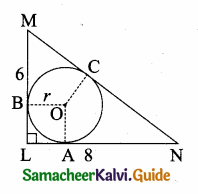
∆ LMN is a right angled triangle with ∠L = 90°. A circle is inscribed in it. The lengths of the sides containing the right angle are 6 cm and 8 cm. Find the radius of the circle.
Solution:
LN = 6; ML = 8. In the right ∆ LMN,
MN2 = LN2 + LM2
= 62 + 82 = 36 + 64 = 100
MN = \(\sqrt { 100 }\) = 10
Samacheer Kalvi 10th Maths Guide Chapter 4 Geometry Ex 4.4 2
OA= OB = OC = r
AN = CN (Tangent of the circle)
LN – AL= CN
LN – r = CN
8 – r = CN ……(1)
MC = MB (tangent of the circle)
MC = ML – LB
MC = 6 – r …….(2)
Samacheer Kalvi 10th Maths Guide Chapter 4 Geometry Ex 4.4 3
Add (1) and (2)
MC + CN = (6 – r) + (8 – r)
MN = 14 – 2r
10 = 14 – 2r
2r = 14 – 10 = 4
r = \(\frac { 4 }{ 2 } \) = 2 cm
radius of the circle = 2 cm

Samacheer Kalvi 10th Maths Guide Chapter 4 Geometry Ex 4.4

Question 3.
A circle is inscribed in ∆ ABC having sides 8 cm, 10 cm and 12 cm as shown in figure, Find AD, BE and CF.
Samacheer Kalvi 10th Maths Guide Chapter 4 Geometry Ex 4.4 4
Solution:
AD = AF = x (tangent of the circle)
BD = BE = y (tangent of the circle)
CE = CF = z (tangent of the circle)
AB = AD + DB
x + y = 12 ……(1)
BC = BE + EC
y + z= 8 …….(2)
AC = AF + FC
x + z = 10 ……(3)
Add (1) (2) and (3)
2x + 2y + 2z = 12 + 8 + 10
x + y + z = \(\frac { 30 }{ 2 } \) = 15 …….(4)
By x + y = 12 in (4)
z = 3
y + z = 8 in (4)
x = 7
x + z = 10 in (4)
y = 5
AD = 7 cm; BE = 5 cm and CF = 3 cm

Samacheer Kalvi 10th Maths Guide Chapter 4 Geometry Ex 4.4

Question 4.
PQ is a tangent drawn from a point P to a circle with centre O and QOR is a diameter of the circle such that ∠POR = 120° . Find ∠OPQ.
Solution:
∠POQ = 180° – 120° = 60°
In ∆OPQ, we know
Samacheer Kalvi 10th Maths Guide Chapter 4 Geometry Ex 4.4 5
∠POQ + ∠OQP + ∠OPQ = 180°
(Sum of the angles of a ∆ is 180°)
60° + 90° + ∠OPQ = 180°
∠OPQ = 180° – 150° = 30°
∠OPQ = 30°

Samacheer Kalvi 10th Maths Guide Chapter 4 Geometry Ex 4.4

Question 5.
A tangent ST to a circle touches it at B. AB is a chord such that ∠ABT = 65°. Find ∠AOB, where “O” is the centre of the circle.
Solution:
Given ∠ABT = 65°
∠OBT = 90°(TB is the tangent of the circle)
∠ABO = 90° – 65° = 25°
∠ABO + ∠BOA + ∠OAB = 180°
25° + x + 25° = 180° (Sum of the angles of a ∆)
Samacheer Kalvi 10th Maths Guide Chapter 4 Geometry Ex 4.4 6
(OA and OB are the radius of the circle.
∴ ∠ABO = ∠BAO = 25°
x + 50 = 180°
x = 180° – 50° = 130°
∴ ∠BOA = 130°

Question 6.
In figure, O is the centre of the circle with radius 5 cm. T is a point such that OT = 13 cm and OT intersects the circle E, if AB is the tangent to the circle at E, find the length of AB.
Samacheer Kalvi 10th Maths Guide Chapter 4 Geometry Ex 4.4 7
Solution:
In the right ∆ OTP,
PT2 = OT2 – OP2
= 132 – 52
= 169 – 25
= 144
PT = \(\sqrt { 144 }\) = 12 cm
Since lengths of tangent drawn from a point to circle are equal.
∴ AP = AE = x
AT = PT – AP
= (12 – x) cm
Since AB is the tangent to the circle E.
∴ OE ⊥ AB
∠OEA = 90°
∠AET = 90°
In ∆AET, AT2 = AE2 + ET2
In the right triangle AET,
AT2 = AE2 + ET2
(12 – x)2 = x2 + (13 – 5)2
144 – 24x + x2 = x2 + 64
24x = 80 ⇒ x = \(\frac { 80 }{ 24 } \) = \(\frac { 20 }{ 6 } \) = \(\frac { 10 }{ 3 } \)
BE = \(\frac { 10 }{ 3 } \) cm
AB = AE + BE
= \(\frac { 10 }{ 3 } \) + \(\frac { 10 }{ 3 } \) = \(\frac { 20 }{ 3 } \)
Lenght of AB = \(\frac { 20 }{ 3 } \) cm

Samacheer Kalvi 10th Maths Guide Chapter 4 Geometry Ex 4.4

Question 7.
In two concentric circles, a chord of length 16 cm of larger circle becomes a tangent to the smaller circle whose radius is 6 cm. Find the radius of the larger circle.
Solution:
Here AP = PB = 8 cm
In ∆OPA,
OA2 = OP2 + AP2
Samacheer Kalvi 10th Maths Guide Chapter 4 Geometry Ex 4.4 8
= 62 + 82
= 36 + 64
= 100
OA = \(\sqrt { 100 }\) = 10 cm
Radius of the larger circle = 10 cm

Samacheer Kalvi 10th Maths Guide Chapter 4 Geometry Ex 4.4

Question 8.
Two circles with centres O and O’ of radii 3 cm and 4 cm, respectively intersect at two points P and Q, such that OP and O’ P are tangents to the two circles. Find the length of the common chord PQ.
Solution:
In ∆ OO’P
(O’O)2 = OP2 + O’P2
= 32 + 42
Samacheer Kalvi 10th Maths Guide Chapter 4 Geometry Ex 4.4 9
= 9 + 16
(OO’)2 = 25
∴ OO’ = 5cm
Since the line joining the centres of two intersecting circles is perpendicular bisector of their common chord.
OR ⊥ PQ and PR = RQ
Let OR be x, then O’R = 5 – x again Let PR = RQ = y cm
In ∆ ORP, OP2 = OR2 + PR2
9 = x2 + y2 …(1)
In ∆ O’RP, O’P2 = O’R2 + PR2
16 = (5 – x)2 + y2
16 = 25 + x2 – 10x + y2
16 = x2 + y2 + 25 – 10x
16 = 9 + 25 – 10x (from 1)
16 = 34 – 10x
10x = 34 – 16 = 18
x = \(\frac { 18 }{ 10 } \) = 1.8 cm
Substitute the value of x = 1.8 in (1)
9 = (1.8)2 + y2
y2 = 9 – 3.24
y2 = 5.76
y = \(\sqrt { 5.76 }\) = 2.4 cm
Hence PQ = 2 (2.4) = 4.8 cm
Length of the common chord PQ = 4.8 cm

Samacheer Kalvi 10th Maths Guide Chapter 4 Geometry Ex 4.4

Question 9.
Show that the angle bisectors of a triangle are concurrent.
Solution:
Given: ABC is a triangle. AD, BE and CF are the angle bisector of ∠A, ∠B, and ∠C.
To Prove: Bisector AD, BE and CF intersect
Proof: The angle bisectors AD and BE meet at O. Assume CF does not pass through O. By angle bisector theorem.
AD is the angle bisector of ∠A
\(\frac { BD }{ DC } \) = \(\frac { AB }{ AC } \) …..(1)
BE is the angle bisector of ∠B
Samacheer Kalvi 10th Maths Guide Chapter 4 Geometry Ex 4.4 10
\(\frac { CE }{ EA } \) = \(\frac { BC }{ AB } \) …….(2)
CF is the angle bisector ∠C
\(\frac { AF }{ FB } \) = \(\frac { AC }{ BC } \) …….(3)
Multiply (1) (2) and (3)
\(\frac { BD }{ DC } \) × \(\frac { CE }{ EA } \) × \(\frac { AF }{ FB } \) = \(\frac { AB }{ AC } \) × \(\frac { BC }{ AB } \) × \(\frac { AC }{ BC } \)
So by Ceva’s theorem.
The bisector AD, BE and CF are concurrent.

Samacheer Kalvi 10th Maths Guide Chapter 4 Geometry Ex 4.4

Question 10.
In ∆ABC , with ∠B = 90° , BC = 6 cm and AB = 8 cm, D is a point on AC such that AD = 2 cm and E is the midpoint of AB. Join D to E and extend it to meet at F. Find BF.
Solution:
Consider ∆ABC. Then D, E and F are respective points on the sides AC, AB and BC.
By construction D, E, F are collinear.
By Menelaus’ theorem \(\frac { AE }{ EB } \) × \(\frac { BF }{ FC } \) × \(\frac { CD }{ DA } \) = 1 ……(1)
AD = 2 cm; AE = EB = 4 cm; BC = 6 cm; FC = FB + BC = x + 6
In ∆ABC, By Pythagoras theorem.
Samacheer Kalvi 10th Maths Guide Chapter 4 Geometry Ex 4.4 11
AC2= AB2 + BC2
AC2 = 82 + 62 = 64 + 36 = 100
AC = \(\sqrt { 100 }\) = 10
CD = AC – AD
= 10 – 2 = 8 cm
Substituting the values in (1) we get
\(\frac { 4 }{ 4 } \) × \(\frac { x }{ x+6 } \) × \(\frac { 8 }{ 2 } \) = 1
\(\frac { x }{ x+6 } \) × 4 = 1
4x = x + 6
3x = 6 ⇒ x = \(\frac { 6 }{ 3 } \) = 2
The value of BF = 2 cm

Question 11.
An artist has created a triangular stained glass window and has one strip of small length left before completing the window. She needs to figure out the length of left out portion based on the lengths of the other sides as shown in the figure.
Samacheer Kalvi 10th Maths Guide Chapter 4 Geometry Ex 4.4 12
Solution:
Given that AE = 3 cm, EC = 4 cm, CD = 10 cm, DB = 3 cm, AF = 5 cm.
Let FB be x
Using Ceva’s theorem we have
\(\frac { AE }{ EC } \) × \(\frac { CD }{ DB } \) × \(\frac { BF }{ AF } \) = 1
\(\frac { 3 }{ 4 } \) × \(\frac { 10 }{ 3 } \) × \(\frac { x }{ 5 } \) = 1
\(\frac { 2x }{ 4 } \) = 1
2x = 4 ⇒ x = \(\frac { 4 }{ 2 } \) = 2
The value of BF = 2

Samacheer Kalvi 10th Maths Guide Chapter 4 Geometry Ex 4.4

Question 12.
Draw a tangent at any point R on the circle of radius 3.4 cm and centre at P ?
Answer:
Given Radius = 3.4 cm
Samacheer Kalvi 10th Maths Guide Chapter 4 Geometry Ex 4.4 13
Samacheer Kalvi 10th Maths Guide Chapter 4 Geometry Ex 4.4 14
Steps of construction:

  1. Draw a circle with centre “O” of radius 3.4 cm.
  2. Take a point P on the circle Join OP.
  3. Draw a perpendicular line TT’ to OP which passes through P.
  4. TT’ is the required tangent.

Samacheer Kalvi 10th Maths Guide Chapter 4 Geometry Ex 4.4

Question 13.
Draw a circle of radius 4.5 cm. Take a point on the circle. Draw the tangent at that point using the alternate segment theorem.
Answer:
Radius of the circle = 4.5 cm
Samacheer Kalvi 10th Maths Guide Chapter 4 Geometry Ex 4.4 15
Samacheer Kalvi 10th Maths Guide Chapter 4 Geometry Ex 4.4 16
Steps of construction:

  1. With O as centre, draw a circle of radius 4.5 cm.
  2. Take a point L on the circle. Through L draw any chord LM.
  3. Take a point M distinct from L and N on the circle, so that L, M, N are in anti-clockwise direction. Join LN and NM.
  4. Through “L” draw tangent TT’such that ∠TLM = ∠MNL
  5. TT’ is the required tangent.

Samacheer Kalvi 10th Maths Guide Chapter 4 Geometry Ex 4.4

Question 14.
Draw the two tangents from a point which is 10 cm away from the centre of a circle of radius 5 cm. Also, measure the lengths of the tangents.
Answer:
Radius = 5 cm; Distance = 10 cm
Samacheer Kalvi 10th Maths Guide Chapter 4 Geometry Ex 4.4 17
Samacheer Kalvi 10th Maths Guide Chapter 4 Geometry Ex 4.4 18
Steps of construction:

  1. With O as centre, draw a circle of radius 5 cm.
  2. Draw a line OP =10 cm.
  3. Draw a perpendicular bisector of OP, which cuts OP at M.
  4. With M as centre and MO as radius draw a circle which cuts previous circle at A and B.
  5. Join AP and BP. AP and BP are the required tangents.

Samacheer Kalvi 10th Maths Guide Chapter 4 Geometry Ex 4.4

Verification: In the right ∆ OAP
PA2 = OP2 – OA2
= 102 – 52 = \(\sqrt { 100-25 }\) = \(\sqrt { 75 }\) = 8.7 cm
Lenght of the tangent is = 8.7 cm

Question 15.
Take a point which is 11 cm away from the centre of a circle of radius 4 cm and draw the two tangents to the circle from that point.
Answer:
Radius = 4 cm; Distance = 11 cm
Samacheer Kalvi 10th Maths Guide Chapter 4 Geometry Ex 4.4 19
Samacheer Kalvi 10th Maths Guide Chapter 4 Geometry Ex 4.4 20
Steps of construction:

  1. With O as centre, draw a circle of radius 4 cm.
  2. Draw a line OP = 11 cm.
  3. Draw a perpendicular bisector of OP, which cuts OP at M.
  4. With M as centre and MO as radius, draw a circle which cuts previous circle A and B.
  5. Join AP and BP. AP and BP are the required tangents.

This the length of the tangents PA = PB = 10.2 cm
Verification: In the right angle triangle OAP
PA2 = OP2 – OA2
= 112 – 42 = 121 – 16 = 105
PA = \(\sqrt { 105 }\) = 10.2 cm
Length of the tangents = 10.2 cm

Samacheer Kalvi 10th Maths Guide Chapter 4 Geometry Ex 4.4

Question 16.
Draw the two tangents from a point which is 5 cm away from the centre of a circle of diameter 6 cm. Also, measure the lengths of the tangents.
Answer:
Radius = 3cm; Distance = 5cm.
Samacheer Kalvi 10th Maths Guide Chapter 4 Geometry Ex 4.4 21
Samacheer Kalvi 10th Maths Guide Chapter 4 Geometry Ex 4.4 22
Steps of construction:

  1. With O as centre, draw a circle of radius 3 cm.
  2. Draw a line OP = 5 cm.
  3. Draw a perpendicular bisector of OP, which cuts OP at M.
  4. With M as centre and MO as radius draw a circle which cuts previous circles at A and B.
  5. Join AP and BP, AP and BP are the required tangents.

The length of the tangent PA = PB = 4 cm
Verification: In the right angle triangle OAP
PA2 = OP2 – OA2
= 52 – 32
= 25 – 9
= 16 PA
= \(\sqrt { 16 }\) = 4 cm
Length of the tangent = 4 cm

Samacheer Kalvi 10th Maths Guide Chapter 4 Geometry Ex 4.4

Question 17.
Draw a tangent to the circle from the point P having radius 3.6 cm, and centre at O. Point P is at a distance 7.2 cm from the centre.
Answer:
Radius = 3.6; Distance = 7.2 cm.
Samacheer Kalvi 10th Maths Guide Chapter 4 Geometry Ex 4.4 23
Samacheer Kalvi 10th Maths Guide Chapter 4 Geometry Ex 4.4 24
Steps of construction:

  1. With O as centre, draw a circle of radius 3.6 cm.
  2. Draw a line OP = 7.2 cm.
  3. Draw a perpendicular bisector of OP which cuts OP at M.
  4. With M as centre and MO as radius draw a circle which cuts the previous circle at A and B.
  5. Join AP and BP, AP and BP are the required tangents.

Samacheer Kalvi 10th Maths Guide Chapter 4 Geometry Ex 4.4

Length of the tangents PA = PB = 6.26 cm
Verification: In the right triangle ∆OAP
PA2 = OP2 – OA2
= 7.22 – 3.62 =(7.2 + 3.6) (7.2 – 3.6)
PA2 = 10.8 × 3.6 = \(\sqrt { 38.88 }\)
PA = 6.2 cm
Length of the tangent = 6.2 cm

Samacheer Kalvi 10th Maths Guide Chapter 3 Algebra Ex 3.13

Students can download Maths Chapter 3 Algebra Ex 3.13 Questions and Answers, Notes, Samacheer Kalvi 10th Maths Guide Pdf helps you to revise the complete Tamilnadu State Board New Syllabus, helps students complete homework assignments and to score high marks in board exams.

Tamilnadu Samacheer Kalvi 10th Maths Solutions Chapter 3 Algebra Ex 3.13

Question 1.
Determine the nature of the roots for the following quadratic equations
(i) 15x2 + 11x + 2 = 0
Answer:
Here a = 15, b = 11, c = 2
∆ = b2 – 4ac
∆ = 112 – 4(15) × 2
= 121 – 120
∆ = 1 > 0
So the equation will have real and unequal roots

(ii) x2 – x – 1 = 0
Answer:
Here a = 1, b = -1, c = -1
∆ = b2 – 4ac
= (-1)2 – 4(1)(-1)
= 1 + 4 = 5
∆ = 1 > 0
So the equation will have real and unequal roots.

Samacheer Kalvi 10th Maths Guide Chapter 3 Algebra Ex 3.13

(iii) \(\sqrt { 2 }\) t2 – 3t + 3\(\sqrt { 2 }\) = 0
Answer:
Here a = \(\sqrt { 2 }\) , b = -3, c = 3\(\sqrt { 2 }\)
∆ = b2 – 4ac
= (-3)2 – 4(\(\sqrt { 2 }\)) (3\(\sqrt { 2 }\))
= 9 – 24 = -15
∆ = -15 < 0
So the equation will have no real roots.

(iv) 9y2 – 6\(\sqrt { 2y }\) + 2 = 0
Answer:
Here a = 9, b = -6\(\sqrt { 2 }\), c = 2
∆ = b2 – 4ac
= (-6\(\sqrt { 2 }\))2 – 4(9) (2)
= 72 – 72
= 0
So the equation will have real and equal roots.

(v) 9a2b2x2 – 24abcdx + 16c2d2 = 0, a ≠ 0, b ≠ 0
Answer:
Here a = 9a2b2; b = -24 abed, c = 16c2d2
∆ = b2 – 4ac
= (-24abcd)2 – 4(9a2b2) (16c2d2)
= 576a2b2c2d2 – 576a2b2c2d2
∆ = 0
So the equation will have real and equal roots.

Samacheer Kalvi 10th Maths Guide Chapter 3 Algebra Ex 3.13

Question 2.
Find the value(s) of ‘k’ for which the roots of the following equations are real and equal.
(i) (5k – 6)2 + 2kx + 1 = 0
(ii) kx2 + (6k + 2)x + 16 = 0
Solution:
(5k – 6)x2 + 2kx + 1 :
a = (5k – 6), b = 2, c = 1
Δ = b2 – 4ac
⇒ (2k)2 – 4 (5k – 6)(1)
⇒ 4k2 – 20k + 24 = 0 [∵ Since the roots are real and equal)
⇒ k2 – 5k + 6 = 0
⇒ (k – 3)(k – 2) = 0
k = 3, 2

(ii) kx2 + (6k + 2)x + 16 = 0
a = k, b = (6k + 2), c = 16
Δ = b2 – 4ac [∵ the roots are real and equal)
⇒ (6k + 2)2 – 4 × k × 16 = 0
⇒ 36k2 + 24k + 4 – 64k = 0
⇒ 36k2 – 40k + 4 =0
⇒ 36k2 – 36k – 4k + 4 =0
⇒ 36k (k – 1) – 4 (k – 1) = 0
⇒ 4 (k – 1) (9k – 1) =0
⇒ k = 1 or k = \(\frac{1}{9}\)

Samacheer Kalvi 10th Maths Guide Chapter 3 Algebra Ex 3.13

Question 3.
If the roots of (a – b)x2 + (b – c)x + (c – a) = 0 are real and equal, then prove that b, a, c are in arithmetic progression.
Answer:
(a – b) x2 + (b – c) x + (c – a) = 0
Here a = (a – b);b = b – c ; c = c – a
Samacheer Kalvi 10th Maths Guide Chapter 3 Algebra Ex 3.13 1
Since the equation has real and equal roots ∆ = 0
∴ b2 – 4ac = 0
(b – c)2 – 4(a – b)(c – a) = 0
b2 + c2 – 2bc -4 (ac – a2 – bc + ab) = 0
b2 + c2 – 2bc – 4ac + 4a2 + 4bc – 4ab = 0
b2 + c2 + 2bc -4a (b + c) + 4a2 = 0
(b + c)2 – 4a (b + c) + 4a2 = 0
[(b+c) – 2a]2 = 0 [using a2 – 2ab + b2 = (a – b)2]
b + c – 2a = 0
b + c = 2a
b + c = a + a
c – a = a – b (t2 – t1 = t3 – t2)
b,a,c are in A.P.

Samacheer Kalvi 10th Maths Guide Chapter 3 Algebra Ex 3.13

Question 4.
If a, b are real then show that the roots of the equation (a – b)2 – 6(a + b)x – 9(a – b) = 0 are real and unequal.
Solution:
(a – b)x2 – 6(a + b)x – 9(a – b) = 0
Δ = b2 – 4ac
= (-6(a + b)2 – 4(a – b)(-9(a – b))
= 36(a + b)2 + 36(a – b)2
= 36 (a2 + 2ab + b2) + 36(a2 – 2ab + b2)
= 72a2 + 12b2
= 72(a2 + b2) > 0
∴ The roots are real and unequal.

Samacheer Kalvi 10th Maths Guide Chapter 3 Algebra Ex 3.13

Question 5.
If the roots of the equation (c2 – ab)x2 – 2(a2 – bc)x + b2 – ac = 0 are real and equal prove that either a = 0 (or) a3 + b3 + c3 = 3abc
Answer:
(c2 – ab)x2 – 2(a2 – bc)x + b2 – ac = 0
Here a = c2 – ab ; b = – 2 (a2 – bc); c = b2 – ac
Since the roots are real and equal
∆ = b2 – 4ac
[-2 (a2 – bc)]2 – 4(c2 – ab) (b2 – ac) = 0
4(a2 – bc)2 – 4[c2 b2 – ac3 – ab3 + a2bc] = 0
Divided by 4 we get
(a2 – bc)2 – [c2 b2 – ac3 – ab3 + a2bc] = 0
a4 + b2 c2 – 2a2 bc – c2b2 + ac3 + ab3 – a2bc = 0
a4 + ab3 + ac3 – 3a2bc = 0
= a(a3 + b3 + c3) = 3a2bc
a3 + b3 + c3 = \(\frac{3 a^{2} b c}{a}\)
a3 + b3 + c3 = 3 abc
Hence it is proved

Samacheer Kalvi 10th Maths Guide Chapter 3 Algebra Ex 3.12

Students can download Maths Chapter 3 Algebra Ex 3.12 Questions and Answers, Notes, Samacheer Kalvi 10th Maths Guide Pdf helps you to revise the complete Tamilnadu State Board New Syllabus, helps students complete homework assignments and to score high marks in board exams.

Tamilnadu Samacheer Kalvi 10th Maths Solutions Chapter 3 Algebra Ex 3.12

Question 1.
If the difference between a number and its reciprocal is \(\frac { 24 }{ 5 } \), find the number.
Answer:
Let the number be “x” and its reciprocal is \(\frac { 1 }{ x } \)
By the given condition
x – \(\frac { 1 }{ x } \) = \(\frac { 24 }{ 5 } \)
\(\frac{x^{2}-1}{x}\) = \(\frac { 24 }{ 5 } \)
5x2 – 5 = 24x
5x2 – 24x – 5 = 0
Samacheer Kalvi 10th Maths Guide Chapter 3 Algebra Ex 3.12 1
5x2 – 25x + x – 5 = 0 ⇒ 5x (x – 5) + 1(x – 5) = 0
(x – 5) (5x – 1) = 0 ⇒ x – 5 = 0 or 5x + 1 = 0
x = 5 or 5x = -1 ⇒ x = \(\frac { -1 }{ 5 } \)
The number is 5 or \(\frac { -1 }{ 5 } \)

Samacheer Kalvi 10th Maths Guide Chapter 3 Algebra Ex 3.12

Question 2.
A garden measuring 12m by 16m is to have a pedestrian pathway that is meters wide installed all the way around so that it increases the total area to 285 m2. What is the width of the pathway?
Answer:
Let the width of the rectangle be “ω”
Length of the outer rectangle = 16 + (ω + ω)
16 + 2ω
Breadth of the outer rectangle = 12 + 2ω
Samacheer Kalvi 10th Maths Guide Chapter 3 Algebra Ex 3.12 2
By the given condition
(16 + 2ω) (12 + 2ω) = 285
192 + 32 ω + 24 ω + 4 ω2 = 285
4 ω2 + 56ω = 285 – 192
4 ω2 + 56 ω = 93
4 ω2+ 56 ω – 93 = 0
Here a = 4, b = 56, c = -93
Samacheer Kalvi 10th Maths Guide Chapter 3 Algebra Ex 3.12 3
= 1.5 or -15.5 (Width is not negative)
∴ Width of the path way = 1.5 m

Samacheer Kalvi 10th Maths Guide Chapter 3 Algebra Ex 3.12

Question 3.
A bus covers a distance of 90 km at a uniform speed. Had the speed been 15 km/hour more it would have taken 30 minutes less for the journey. Find the original speed of the journey.
Answer:
Let the original speed of the bus be “x” km/hr
Time taken to cover 90 km = \(\frac { 90 }{ x } \)
After increasing the speed by 15 km/hr
Time taken to cover 90 km = \(\frac { 90 }{ x+15 } \)
By the given condition
\(\frac { 90 }{ x } \) – \(\frac { 90 }{ x+15 } \) = \(\frac { 1 }{ 2 } \)
\(\frac{90(x+15)-90 x}{x(x+15)}\) = \(\frac { 1 }{ 2 } \)
90x + 1350 – 90x = \(\frac{x^{2}+15 x}{2}\)
1350 = \(\frac{x^{2}+15 x}{2}\)
2700 = x2 + 15x
Samacheer Kalvi 10th Maths Guide Chapter 3 Algebra Ex 3.12 4
x2 + 15x – 2700 = 0
(x + 60) (x – 45) = 0
x + 60 = 0 or x – 45 = 0
x = – 60 or x = 45
The speed will not be negative
∴ Original speed of the bus = 45 km/hr

Samacheer Kalvi 10th Maths Guide Chapter 3 Algebra Ex 3.12

Question 4.
A girl is twice as old as her sister. Five years hence, the product of their ages – (in years) will be 375. Find their present ages.
Answer:
Let the age of the sister be “x”
The age of the girl = 2x
Five years hence
Age of the sister = x + 5
Age of the girl = 2x + 5
By the given condition
(x + 5) (2x + 5) = 375
2x2 + 5x + 10x + 25 = 375
2x2 + 15x – 350 = 0
a = 2, b = 15, c = -350
Samacheer Kalvi 10th Maths Guide Chapter 3 Algebra Ex 3.12 5
Age will not be negative
Age of the girl = 10 years
Age of the sister = 20 years (2 × 10)

Samacheer Kalvi 10th Maths Guide Chapter 3 Algebra Ex 3.12

Question 5.
A pole has to be erected at a point on the boundary of a circular ground of diameter 20 m in such a way that the difference of its distances from two diametricallyopposite fixed gates P and Q on the boundary is 4 m. Is it possible to do so? If answer is yes at what distance from the two gates should the pole be erected?
Answer:
Let “R” be the required location of the pole
Let the distance from the gate P is “x” m : PR = “x” m
The distance from the gate Q is (x + 4)m
∴ QR = (x + 4)m
In the right ∆ PQR,
Samacheer Kalvi 10th Maths Guide Chapter 3 Algebra Ex 3.12 6
PR2 + QR2 = PQ2 (By Pythagoras theorem)
x2 + (x + 4)2 = 202
x2 + x2 + 16 + 8x = 400
2x2 + 8x – 384 = 0
Samacheer Kalvi 10th Maths Guide Chapter 3 Algebra Ex 3.12 7
x2 + 4x – 192 = 0(divided by 2)
(x + 16) (x – 12) = 0
x + 16 = 0 or x – 12 = 0 [negative value is not considered]
x = -16 or x = 12
Yes it is possible to erect
The distance from the two gates are 12 m and 16 m

Samacheer Kalvi 10th Maths Guide Chapter 3 Algebra Ex 3.12

Question 6.
From a group of 2x2 black bees , square root of half of the group went to a tree. Again eight-ninth of the bees went to the same tree. The remaining two got caught up in a fragrant lotus. How many bees were there in total?
Answer:
Total numbers of black bees = 2x2
Half of the group = \(\frac { 1 }{ 2 } \) × 2x2 = x2
Square root of half of the group = \(\sqrt{x^{2}}\) = x
Eight – ninth of the bees = \(\frac { 8 }{ 9 } \) × 2x2 = \(\frac{16 x^{2}}{9}\)
Number ofbees in the lotus = 2
By the given condition
x + \(\frac{16 x^{2}}{9}\) + 2 = 2x2
(Multiply by 9) 9x + 16×2 + 18 = 18x2
Samacheer Kalvi 10th Maths Guide Chapter 3 Algebra Ex 3.12 8
18x2 – 16x2 – 9x – 18 = 0 ⇒ 2x2 – 9x – 18 = 0
2x2 – 12x + 3x – 18 = 0
2x(x – 6) + 3 (x – 6) = 0
(x – 6) (2x + 3) = 0
x – 6 = 0 or 2x + 3 = 0
x = 6 or 2x = -3 ⇒ x = \(\frac { -3 }{ 2 } \) (number of bees will not be negative)
Total number of black bees = 2x2 = 2(6)2
= 72

Samacheer Kalvi 10th Maths Guide Chapter 3 Algebra Ex 3.12

Question 7.
Music is been played in two opposite galleries with certain group of people. In the first gallery a group of 4 singers were singing and in the second gallery 9 singers were singing. The two galleries are separated by the distance of 70 m. Where should a person stand for hearing the same intensity of the singers voice?
(Hint: The ratio of the sound intensity is equal to the square of the ratio of their corresponding distances).
Answer:
Number of singers in the first group = 4
Number of singers in the second group = 9
Distance between the two galleries = 70 m
Let the distance of the person from the first group be x
and the distance of the person from the second group be 70 – x
By the given condition
4 : 9 = x2 : (70 – x)2 (by the given hint)
\(\frac { 4 }{ 9 } \) = \(\frac{x^{2}}{(70-x)^{2}}\)
\(\frac { 2 }{ 3 } \) = \(\frac { x }{ 70-x } \) [taking square root on both sides]
3x = 140 – 2x
5x = 140
x = \(\frac { 140 }{ 5 } \) = 28
The required distance to hear same intensity of the singers voice from the first galleries is 28m
The required distance to hear same intensity of the singers voice from the second galleries is (70 – 28) = 42 m

Samacheer Kalvi 10th Maths Guide Chapter 3 Algebra Ex 3.12

Question 8.
There is a square field whose side is 10 m. A square flower bed is prepared in its centre leaving a gravel path all round the flower bed. The total cost of laying the flower bed and gravelling the path at ₹3 and ₹4 per square metre respectively is ₹364. Find the width of the gravel path.
Answer:
Let the width of the gravel path be ‘x’
Side of the flower bed = 10 – (x + x)
= 10 – 2x
Samacheer Kalvi 10th Maths Guide Chapter 3 Algebra Ex 3.12 9
Area of the path way = Area of the field – Area of the flower bed
= 10 × 10 – (10 – 2x) (10 – 2x) sq.m
= 100 – (100 + 4x2 – 40x)
= 100 – 100 – 4x2 + 40x
= 40x – 4x2 sq.m
Area of the flower bed = (10 – 2x) (10 – 2x) sq.m.
= 100 + 4x2 – 40x
By the given condition
Samacheer Kalvi 10th Maths Guide Chapter 3 Algebra Ex 3.12 10
3(100 + 4x2 – 40x) + 4(40x – 4x2) = 364
300 + 12x2 – 120x + 160x – 16x2 = 364
-4x2 + 40x + 300 – 364 = 0
-4x2 + 40x – 64 = 0
(÷ by 4) ⇒ x2 – 10x + 16 = 0
[The width must not be equal to 8 m since the side of the field is 10m]
(x – 8) (x – 2) = 0
x – 8 = 0 or x – 2 = 0 x = 8 or x = 2
Width of the gravel path = 2 m

Samacheer Kalvi 10th Maths Guide Chapter 3 Algebra Ex 3.12

Question 9.
Two women together took 100 eggs to a market, one had more than the other. Both sold them for the same sum of money. The first then said to the second: “If I had your eggs, I would have earned ₹ 15”, to which the second replied: “If I had your eggs, I would have earned ₹ 6 \(\frac{2}{3}\) How many eggs did each had in the beginning?
Solution:
Let the no. of eggs with woman 1 be x and woman 2 be y.
∴ x + y = 100
Let w1 sell the eggs at ₹ ‘a’ per egg.
Let w2 sell the eggs at ₹ ‘b’ per egg.
Case 1:
They sold them for same money.
∴ ax = by
Case 2:
ay = 15 and bx = \(\frac{20}{3}\)
∴ One woman had 40 eggs and the other had 60 eggs.

Samacheer Kalvi 10th Maths Guide Chapter 3 Algebra Ex 3.12

Question 10.
The hypotenuse of a right angled triangle is 25 cm and its perimeter 56 cm. Find the length of the smallest side.
Answer:
Perimeter of a right angle triangle = 56 cm
Sum of the two sides + hypotenuse = 56
Sum of the two sides = 56 – 25
= 31 cm
Let one side of the triangle be “x”
Samacheer Kalvi 10th Maths Guide Chapter 3 Algebra Ex 3.12 11
The other side of the triangle = (31 – x) cm
By Pythagoras theorem
AB2 + BC2 = AC2
x2 + (31 – x)2 = 252
x2 + 961 + x2 – 62x = 625
Samacheer Kalvi 10th Maths Guide Chapter 3 Algebra Ex 3.12 12
2x2 – 62x + 961 – 625 = 0
2x2 – 62x + 336 = 0 ⇒ x2 – 31x + 168 = 0
(x – 24) (x – 7) = 0
x – 24 = 0 (or) x – 7 = 0
x = 24 (or) x = 7
Length of the smallest side is 7 cm

Samacheer Kalvi 10th Maths Guide Chapter 3 Algebra Ex 3.11

Students can download Maths Chapter 3 Algebra Ex 3.11 Questions and Answers, Notes, Samacheer Kalvi 10th Maths Guide Pdf helps you to revise the complete Tamilnadu State Board New Syllabus, helps students complete homework assignments and to score high marks in board exams.

Tamilnadu Samacheer Kalvi 10th Maths Solutions Chapter 3 Algebra Ex 3.11

Question 1.
Solve the following quadratic equations by completing the square method
(i) 9x2 – 12x + 4 = 0
Answer:
9x2 – 12x + 4 = 0
x2 – \(\frac { 12x }{ 9 } \) + \(\frac { 4 }{ 9 } \) = 0 (Divided by 9)
x2 – \(\frac { 4x }{ 3 } \) = \(\frac { -4 }{ 9 } \)
Add [\(\frac { 1 }{ 2 } \) (\(\frac { 4 }{ 3 } \))]2 on both sides
Samacheer Kalvi 10th Maths Guide Chapter 3 Algebra Ex 3.11 1
The solution is \(\frac { 2 }{ 3 } \)

Samacheer Kalvi 10th Maths Guide Chapter 3 Algebra Ex 3.11

(ii) \(\frac { 5x+7 }{ x-1 } \) = 3x + 2
Answer:
(3x + 2) (x – 1) = 5x + 7
3x2 – 3x + 2x – 2 = 5x + 7 ⇒ 3x2 – x – 5x – 2 – 7 = 0
3x2 – 6x – 9 = 0 ⇒ x2 – 2x – 3 = 0 (divided by 3)
x2 – 2x = 3
Adding (\(\frac { 1 }{ 2 } \) × 2)2 on both sides
x2 – 2x + 1 = 3 + 1
(x – 1)2 = 4 ⇒ x – 1 = \(\sqrt { 4 }\)
x – 1 = ±2
x – 1 = 2 or x – 1 = -2
x = 3 or x = -1
The solution set is -1 and 3

Samacheer Kalvi 10th Maths Guide Chapter 3 Algebra Ex 3.11

Question 2.
Solve the following quadratic equations by formula method
(i) 2x2 – 5x + 2 = 0
Answer:
a = 2, b = -5, c = 2
Samacheer Kalvi 10th Maths Guide Chapter 3 Algebra Ex 3.11 2
The solution set is \(\frac { 1 }{ 2 } \) and 2

(ii) \(\sqrt { 2 }\) f2 – 6 f + 3 \(\sqrt { 2 }\) = 0
Answer:
Here a = \(\sqrt { 2 }\), b = -6 and c = 3\(\sqrt { 2 }\)
Samacheer Kalvi 10th Maths Guide Chapter 3 Algebra Ex 3.11 3
The solution set is \(\frac{3+\sqrt{3}}{\sqrt{2}}\) and \(\frac{3-\sqrt{3}}{\sqrt{2}}\)

(iii) 3y2 – 20y – 23 = 0
Answer:
a = 3, b = -20, c = -23
Samacheer Kalvi 10th Maths Guide Chapter 3 Algebra Ex 3.11 4
The solution set is -1 and \(\frac { 23 }{ 3 } \)

(iv) 36y2 – 12ay + (a2 – b2) = 0
Answer:
Here a = 36, b = -12a, c = a2 – b2
Samacheer Kalvi 10th <img class=
The solution set is \(\frac { (a+b) }{ 6 } \) and \(\frac { (a-b) }{ 6 } \)

Samacheer Kalvi 10th Maths Guide Chapter 3 Algebra Ex 3.11

Question 3.
A ball rolls down a slope and travels a distance d = t2 – 0.75t feet in t seconds. Find the time when the distance travelled by the ball is 11.25 feet.
Answer:
Distance = t2 – 0.75t
11.25 = t2 – 0.75t
Multiply by 100
1125 = 100t2 – 75t
100t2 – 75t – 1125 = 0 (Divided by 25)
4t2 – 3t – 45 = 0
a = 4,
b = -3,
c = -45
Samacheer Kalvi 10th Maths Guide Chapter 3 Algebra Ex 3.11 7
(time will not be negative)
The required time = \(\frac { 15 }{ 4 } \) seconds
= 3 \(\frac { 3 }{ 4 } \) second or 3.75 seconds

Samacheer Kalvi 10th Maths Guide Chapter 3 Algebra Ex 3.10

Students can download Maths Chapter 3 Algebra Ex 3.10 Questions and Answers, Notes, Samacheer Kalvi 10th Maths Guide Pdf helps you to revise the complete Tamilnadu State Board New Syllabus, helps students complete homework assignments and to score high marks in board exams.

Tamilnadu Samacheer Kalvi 10th Maths Solutions Chapter 3 Algebra Ex 3.10

Question 1.
Solve the following quadratic equations by factorization method
(i) 4x2 – 7x – 2 = 0
Answer:
4x2 – 7x – 2 = 0
4x2 – 8x + x – 2 = 0
4x(x – 2) + 1(x – 2) = 0
(x – 2) + (4x + 1) = 0
Samacheer Kalvi 10th Maths Guide Chapter 3 Algebra Ex 3.10 1
x – 2 = 0 or 4x + 1 = 0 (equate the product of factors to zero)
x = 2 or 4x = -1 ⇒ x = \(\frac { -1 }{ 4 } \)
The roots are 2; \(\frac { -1 }{ 4 } \)

Samacheer Kalvi 10th Maths Guide Chapter 3 Algebra Ex 3.10

(ii) 3(p2 – 6) = p(p + 5)
Answer:
3p2 – 18 = p2 + 5p
Samacheer Kalvi 10th Maths Guide Chapter 3 Algebra Ex 3.10 2
2p2 – 5p – 18 = 0
2p2 – 9p + 4p – 18 = 0
p(2p – 9) + 2(2p – 9) = 0
(2p – 9)(p + 2) = 0
2p – 9 = 0 or p + 2 =
The roots are p = \(\frac { 9 }{ 2 } \), -2

(iii) \(\sqrt{a(a-7)}\) = 3 \(\sqrt{2}\)
Answer:
Squaring on both sides
a(a – 7) = (3\(\sqrt{2}\))2
Samacheer Kalvi 10th Maths Guide Chapter 3 Algebra Ex 3.10 3
a2 – 7a = 18
a2 – 7a – 18 = 0
(a – 9) (a + 2) = 0
a – 9 = 0 or a + 2 = 0
The roots are -2 and 9

Samacheer Kalvi 10th Maths Guide Chapter 3 Algebra Ex 3.10

(iv) \(\sqrt { 2 }\) x2 + 7x + 5\(\sqrt { 2 }\) = 0
Answer:
\(\sqrt { 2 }\) x2 + 7x + 5 \(\sqrt { 2 }\) = 0
\(\sqrt { 2 }\) x2 + 2x + 5x + 5\(\sqrt { 2 }\) = 0
\(\sqrt { 2 }\) x (x + \(\sqrt { 2 }\)) + 5(x + \(\sqrt { 2 }\)) = 0
Samacheer Kalvi 10th Maths Guide Chapter 3 Algebra Ex 3.10 4
(x + \(\sqrt { 2 }\)) + (\(\sqrt { 2 }\)x + 5) = 0 (equate the product of factors to zero)
x + – \(\sqrt { 2 }\) = 0 or \(\sqrt { 2 }\)x + -5
x = \(\frac{-5}{\sqrt{2}}\)
The roots are – \(\sqrt { 2 }\), \(\frac{-5}{\sqrt{2}}\)

(v) 2x2 – x + \(\frac { 1 }{ 8 } \) = 0
Answer:
2x2 -x + \(\frac { 1 }{ 8 } \) = 0
16x2 – 8x + 1 = (multiply by 8)
Samacheer Kalvi 10th Maths Guide Chapter 3 Algebra Ex 3.10 5
16x2 – 4x – 4x + 1
4x(4x – 1) – 1 (4x – 1) = 0
(4x- 1) (4x- 1) = 0
4x = 1, 4x = 1
x = \(\frac { 1 }{ 4 } \), x = \(\frac { 1 }{ 4 } \)
The roots are \(\frac { 1 }{ 4 } \) and \(\frac { 1 }{ 4 } \)

Samacheer Kalvi 10th Maths Guide Chapter 3 Algebra Ex 3.10

Question 2.
The number of volleyball games that must be scheduled in a league with n teams is given by G(n) = \(\frac{n^{2}-n}{2}\) where each team plays with every other team exactly once. A league schedules 15 games. How many teams are in the league?
Solution:
G(n) = \(\frac{n^{2}-n}{2}\)
⇒ 15 = \(\frac{n^{2}-n}{2}\) ⇒ 30 = n2 – n
n2 – n – 30 = 0
⇒ n2 – 6n + 5n – 30 = 0
n(n – 6) + 5 (n – 6) = 0
(n – 6)(n + 5) = 0 ⇒ n = 6, -5
As n cannot be (-ve), n = 6.
∴ There are 6 teams in the league.