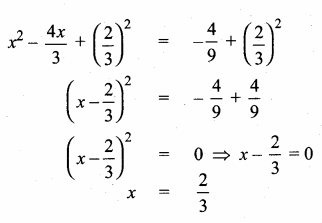
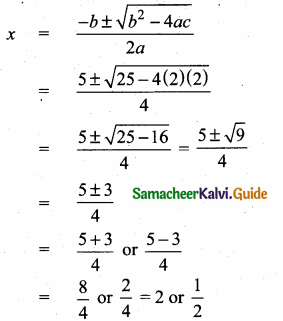
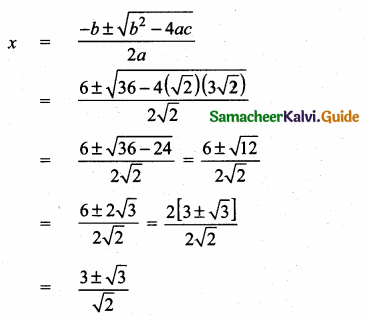
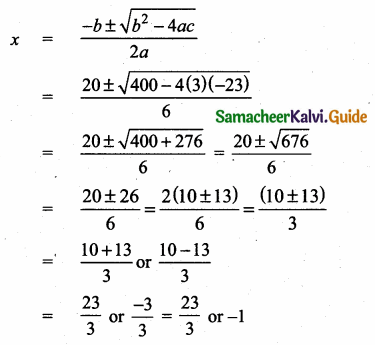
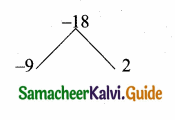
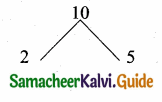
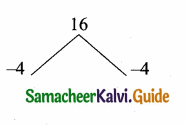
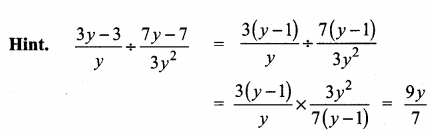
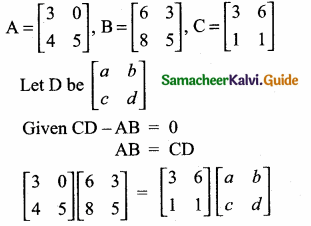
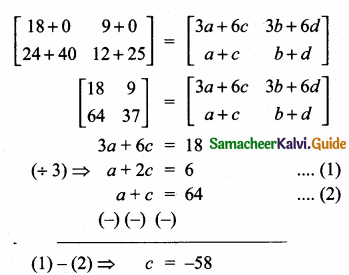
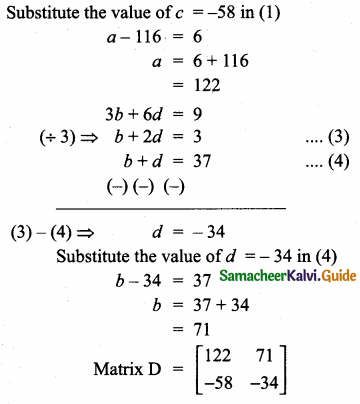
Samacheer Kalvi 10th Maths Guide Chapter 3 Algebra Ex 3.15

Students can download Maths Chapter 3 Algebra Ex 3.15 Questions and Answers, Notes, Samacheer Kalvi 10th Maths Guide Pdf helps you to revise the complete Tamilnadu State Board New Syllabus, helps students complete homework assignments and to score high marks in board exams.

Tamilnadu Samacheer Kalvi 10th Maths Solutions Chapter 3 Algebra Ex 3.15

Question 1.
Graph the following quadratic equations and state their nature of solutions.
(i) x2 – 9x + 20 = 0
(ii) x2 – 4x + 4 = 0
(iii) x2 + x + 7 = 0
(iv) x2 – 9 = 0
(v) x2 – 6x + 9 = 0
(vi) (2x – 3) (x + 2) = 0

(i) x2 – 9x + 20 = 0
Answer:
Let y = x2 – 9x + 20
(i) Prepare the table of values for y = x2 – 9x + 20
Samacheer Kalvi 10th Maths Guide Chapter 3 Algebra Ex 3.15 1
(ii) Plot the points (-1, 30) (0,20) (1, 12) (2, 6) (3,2), (4, 0), (5, 0), (6,2) (omit the high value)
(iii) Join the points by a free hand smooth curve.
(iv) The roots of the equation are the X-coordinates of the intersecting points of the curve with X-axis (4, 0) and (5, 0)
There are two points of intersection with the X-axis at 4 and 5. The solution set is 4 and 5. The quadratic equation has real and unequal roots.
(v) Since there is two point of intersection with X-axis (different solution)
∴ The equation x2 – 9x + 20 = 0 has real and unequal roots.
Samacheer Kalvi 10th Maths Guide Chapter 3 Algebra Ex 3.15 2

Samacheer Kalvi 10th Maths Guide Chapter 3 Algebra Ex 3.15

(ii) x2 – 4x + 4 = 0
Answer:
Let y = x2 – 4x + 4
(i) Prepare the table of values for y = x2 – 4x + 4
Samacheer Kalvi 10th Maths Guide Chapter 3 Algebra Ex 3.15 3
(ii) Plot the points (-3,25) (-2,16) (-1, 9) (0,4) (1,-1) (2, 0), (3,1) and (4, 4)
(iii) Join the points by a free hand smooth curve.
(iv) The roots of the equation are the X-coordinates of the intersecting points of the curve with X-axis (2, 0) which is 2.
(v) Since there is only one point of intersection with X-axis (2, 0).
∴ The solution set is 2.
The Quadratic equation x2 – Ax + 4 = 0 has real and equal roots.
Samacheer Kalvi 10th Maths Guide Chapter 3 Algebra Ex 3.15 4

(iii) x2 + x + 7 = 0
Answer:
Let y = x2 + x + 7
(i) Prepare the table of values for y = x2 + x + 7
Samacheer Kalvi 10th Maths Guide Chapter 3 Algebra Ex 3.15 5
(ii) Plot the points (-4,19) (-3,13) (-2, 9) (-1, 7) (0, 7) (1, 9), (2,13) (3,19) and (4,27)
(iii) Join the points by a free hand smooth curve.
(iv) The solution of the given quadratic equation are the X-coordinates of the intersecting points of the parabola with the X-axis.
(v) The curve does not intersecting the X-axis. There is no solution set.
The equation x2 + x + 7 = 0 has no real roots.
Samacheer Kalvi 10th Maths Guide Chapter 3 Algebra Ex 3.15 6

Samacheer Kalvi 10th Maths Guide Chapter 3 Algebra Ex 3.15

(iv) x2 – 9 = 0
Answer:
Let y = x2 – 9
(i) Prepare the table of values for y = x2 – 9
Samacheer Kalvi 10th Maths Guide Chapter 3 Algebra Ex 3.15 7
(ii) Plot the points (-4, 7) (-3, 0) (-2, -5) (-1, -8) (0, -9) (1, -8), (2, -5) (3, 0) (4, 7)
(iii) Join the points by a free hand smooth curve.
(iv) The curve intersect the X-axis at -3 and 3.
The solution is (-3, 3).
(v) Since there are two points of intersection -3 and 3 with the X-axis the quadratic equation has real and unequal roots.
Samacheer Kalvi 10th Maths Guide Chapter 3 Algebra Ex 3.15 8

Samacheer Kalvi 10th Maths Guide Chapter 3 Algebra Ex 3.15

(v) x2 – 6x + 9 = 0
Answer:
Let y = x2 – 6x + 9
(i) Prepare a table of values for y = x2 – 6x + 9
Samacheer Kalvi 10th Maths Guide Chapter 3 Algebra Ex 3.15 9
(ii) Plot the points (-2,25) (-1,16) (0,9) (1,4) (2,1) (3,0), (4,1) and (5,4) on the graph using suitable scale (omit the points (-4, 49) and (-3, 36)
(iii) Join the points by a free hand smooth curve.
(iv) The X – coordinates of the point of intersection of the curve with X-axis are the roots of the , given equation, provided they intersect.
The solution is 3.
(v) Since there is only one point of intersection with X-axis the quadratic equation x2 – 6x + 9 = 0 has real and equal roots.
Samacheer Kalvi 10th Maths Guide Chapter 3 Algebra Ex 3.15 10

Samacheer Kalvi 10th Maths Guide Chapter 3 Algebra Ex 3.15

(vi) (2x – 3) (x + 2) = 0
Answer:
y = (2x – 3) (x + 2)
= 2x2 + 4x – 3x – 6
= 2x2 + x – 6

(i) Prepare a table of values for y from x – 4 to 4
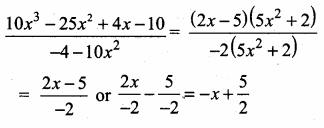
Samacheer Kalvi 10th Maths Guide Chapter 3 Algebra Ex 3.15 11
(ii) Plot the points (-4, 22) (-3, 9) (-2, 0) (-1, -5) (0, -6) (1, -3), (2, 4), (3, 15) and (4, 30).
(iii) Join the points by a free hand smooth curve.
(iv) The curve intersect the X – axis at (-2, 0) and (1\(\frac { 1 }{ 2 } \), 0)
∴ The solution set is (-2,1\(\frac { 1 }{ 2 } \))
(v) Since there are two points of intersection with X – axis, the quadratic equation has real and un – equal roots.
Samacheer Kalvi 10th Maths Guide Chapter 3 Algebra Ex 3.15 12

Samacheer Kalvi 10th Maths Guide Chapter 3 Algebra Ex 3.15

Question 2.
Draw the graph of y = x2 – 4 and hence solve x2 – x – 12 = 0
Answer:
(i) Draw the graph of y = x2 – 4 by preparing the table of values as below.
Samacheer Kalvi 10th Maths Guide Chapter 3 Algebra Ex 3.15 13
(ii) Plot the points for the ordered pairs (-4, 12) (-3, 5) (-2, 0) (-1, -3) (0, -4) (1, -3), (2, 0), (3, 5) and (4, 12). Draw the curve with the suitable scale.
(iii) To solve x2 – x – 12 = 0 subtract x2 – x – 12 from y = x2 – 4
Samacheer Kalvi 10th Maths Guide Chapter 3 Algebra Ex 3.15 14
The equation y = x + 8 represents a straight line. Prepare a table for y = x + 8
Samacheer Kalvi 10th Maths Guide Chapter 3 Algebra Ex 3.15 16
(iv) Mark the point of intersection of the curve and the straight line is (-3, 5) and 4, 12)
∴ The solution set is (-3, 4) for x2 – x – 12 = 0.
Samacheer Kalvi 10th Maths Guide Chapter 3 Algebra Ex 3.15 40

Samacheer Kalvi 10th Maths Guide Chapter 3 Algebra Ex 3.15

Question 3.
Draw the graph of y = x2 + x and hence solve x2 + 1 = 0
Answer:
Let y = x2 + x
(i) Draw the graph of y = x2 + x by preparing the table.
Samacheer Kalvi 10th Maths Guide Chapter 3 Algebra Ex 3.15 18
(ii) Plot the points (-4, 12), (-3, 6), (-2, 2), (-1, 0), (0, 0), (1, 2), (2, 6), (3, 12) and (4, 20).
(iii) Join the points by a free hand to get smooth curve.
(iv) To solve x2 + 1 = 0, subtract x2 + 1 = 0 from x2 + x we get.
Samacheer Kalvi 10th Maths Guide Chapter 3 Algebra Ex 3.15 51
The equation represent a straight line. Draw a line y = x – 1
Samacheer Kalvi 10th Maths Guide Chapter 3 Algebra Ex 3.15 19
Observe the graph of y = x2 + 1 does not interset the parabola y = x2 + x.
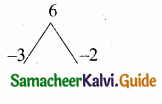
This x2 + 1 has no real roots.
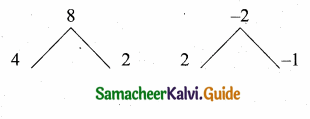
Samacheer Kalvi 10th Maths Guide Chapter 3 Algebra Ex 3.15 20

Samacheer Kalvi 10th Maths Guide Chapter 3 Algebra Ex 3.15

Question 4.
Draw the graph of y = x2 + 3x + 2 and use it to solve x2 + 2x + 1 = 0.
(i) Draw the graph of y = x2 + 3x + 2 preparing the table of values as below.
Samacheer Kalvi 10th Maths Guide Chapter 3 Algebra Ex 3.15 21
(ii) Plot the points (-4, 6), (-3, 2), (-2, 0), (-1, 0), (0, 2), (1, 6), (2, 12), (3, 20) (4, 30).
(iii) To solve x2 + 2x + 1 = 0 subtract x2 + 2x + 1 = 0 from y = x2 + 3x + 2
Samacheer Kalvi 10th Maths Guide Chapter 3 Algebra Ex 3.15 22
(iv) Draw the graph of y = x + 1 from the table
Samacheer Kalvi 10th Maths Guide Chapter 3 Algebra Ex 3.15 23
The equation y = x + 1 represent a straight line.
This line intersect the curve at only one point (-1, 0). The solution set is (-1).
Samacheer Kalvi 10th Maths Guide Chapter 3 Algebra Ex 3.15 24

Samacheer Kalvi 10th Maths Guide Chapter 3 Algebra Ex 3.15

Question 5.
Draw the graph of y = x2 + 3x – 4 and hence use it to solve x2 + 3x – 4 = 0
Answer:
Let y = x2 + 3x – 4
(i) Draw the graph of y = x2 + 3x – 4
Samacheer Kalvi 10th Maths Guide Chapter 3 Algebra Ex 3.15 25
(ii) Plot the points (-5, 6), (-4, 0), (-3, -4), (-2, -6), (-1, -6), (0, -4), (1, 0), (2, 6), (3, 14) on the graph using suitable scale.
(iii) Join the points by a free hand smooth curve.
The smooth curve is the graph of y = x2 – 4x + 4
(iv) To solve x + 3x – 4 = 0, subtract x2 + 3x – 4 = 0 from y = x2 + 3x – 4.
y = 0
∴ The point of intersection with the x – axis is the solution set.
The solution set is -4 and 1.
Samacheer Kalvi 10th Maths Guide Chapter 3 Algebra Ex 3.15 38

Question 6.
Draw the graph of y = x2 – 5x – 6 and hence solve x2, – 5x – 14 = 0
Answer:
Let y = x2 – 5x – 6
(i) Draw the graph of y = x2 – 5x – 6 by preparing the table of values as below.
Samacheer Kalvi 10th Maths Guide Chapter 3 Algebra Ex 3.15 27
(ii) Plot the points (-3, 18), (-2, 8), (-1, 0), (0, -6), (1, -10), (2, -12), (3, -12), (4, -10), (5,-6), (6, 0) and (7, 8).
(iii) Join the points by a free hand to get smooth curve.
(iv) To solve x2 – 5x – 14 = 0, subtract x2 – 5x – 14 = 0 from y = x2 – 5x – 6.
Samacheer Kalvi 10th Maths Guide Chapter 3 Algebra Ex 3.15 28
The equation y = 8 represent a straight line draw a straight line through y = 8 intersect the curve at two places. From the two points draw perpendicular line to the X – axis it will intersect at -2 and 7.
The solution is -2 and 7
Samacheer Kalvi 10th Maths Guide Chapter 3 Algebra Ex 3.15 29

Samacheer Kalvi 10th Maths Guide Chapter 3 Algebra Ex 3.15

Question 7.
Draw the graph of y = 2x2 – 3x – 5 and hence solve 2x2 – 4x – 6 = 0
Answer:
(i) Draw the graph of y = 2x2 – 3x – 5 by preparing the table of values given below.
Samacheer Kalvi 10th Maths Guide Chapter 3 Algebra Ex 3.15 39
(ii) Plot the points (-3, 22), (-2, 9), (-1, 0), (0, -5), (1,-6), (2, -3), (3, 4), (4, 15) on the graph sheet using suitable scale.
(iii) To solve 2x2 – 4x – 6 = 0 subtract 2x2 – 4x – 6 = 0 from y = 2x2 – 3x – 5
Samacheer Kalvi 10th Maths Guide Chapter 3 Algebra Ex 3.15 31
(iv) y = x + 1 represent a straight line.
Samacheer Kalvi 10th Maths Guide Chapter 3 Algebra Ex 3.15 32
The straight line intersect the curve at (-1, 0) and (3, 4). From the two point draw perpendicular lines to the X – axis it will intersect at -1 and 3.
The solution set is (-1, 3)
Samacheer Kalvi 10th Maths Guide Chapter 3 Algebra Ex 3.15 33

Samacheer Kalvi 10th Maths Guide Chapter 3 Algebra Ex 3.15

Question 8.
Draw the graph of y = (x – 1) (x + 3) and hence solve x2 – x – 6 = 0
Answer:
y = (x – 1) (x + 3)
y = x2 + 2x – 3
(i) Draw the graph of y = x2 + 2x – 3 by preparing the table of values given below
Samacheer Kalvi 10th Maths Guide Chapter 3 Algebra Ex 3.15 34
(ii) Plot the points (-4, 5), (-3, 0), (-2, -3), (-1, -4), (0, -3), (1, 0), (2, 5), (3, 12) and (4, 21) on the graph sheet using suitable scale.
(iii) To solve x2 – x – 6 = 0 subtract x2 – x – 6 = 0 from y = x2 + 2x – 3
(iv) Draw the graph of y = 3x + 3 by preparing the table.
Samacheer Kalvi 10th Maths Guide Chapter 3 Algebra Ex 3.15 35
(v) The straight line cuts the curve at (-2, -3) and (3, 12). Draw perpendicular lines from the point to X – axis.
The line cut the X – axis at -2 and 3.
The solution set is (-2, 3)

Samacheer Kalvi 10th Maths Guide Chapter 3 Algebra Ex 3.6

Students can download Maths Chapter 3 Algebra Ex 3.6 Questions and Answers, Notes, Samacheer Kalvi 10th Maths Guide Pdf helps you to revise the complete Tamilnadu State Board New Syllabus, helps students complete homework assignments and to score high marks in board exams.

Tamilnadu Samacheer Kalvi 10th Maths Solutions Chapter 3 Algebra Ex 3.6

Question 1.
Simplify
(i) \(\frac{x(x+1)}{x-2}+\frac{x(1-x)}{x-2}\)
Answer:
\(\frac{x(x+1)}{x-2}+\frac{x(1-x)}{x-2}\) = \(\frac{x(x+1)+x(1-x)}{x-2}\)
= \(\frac{x^{2}+x+x-x^{2}}{x-2}\)
= \(\frac { 2x }{ x-2 } \)

(ii) \(\frac { x+2 }{ x+3 } \) + \(\frac { x-1 }{ x-2 } \)
Answer:
\(\frac { x+2 }{ x+3 } \) + \(\frac { x-1 }{ x-2 } \) = \(\frac{(x+2)(x-2)+(x-1)(x+3)}{(x+3)(x-2)}\)
Samacheer Kalvi 10th Maths Guide Chapter 3 Algebra Ex 3.6 1

Samacheer Kalvi 10th Maths Guide Chapter 3 Algebra Ex 3.6

(iii) \(\frac{x^{3}}{x-y}+\frac{y^{3}}{y-x}\) = \(\frac{x^{3}}{x-y}+\frac{y^{3}}{-1(x-y)}\)
Answer:
= \(\frac{x^{3}}{x-y}-\frac{y^{3}}{x-y}\)
= \(\frac{x^{3}-y^{3}}{x-y}\) (using a3 – b3 = (a – b) (a2 + ab + b2))
= \(\frac{(x-y)\left(x^{2}+x y+y^{2}\right)}{x-y}\)
= x2 + xy + y2

Question 2.
Simplify
(i) \(\frac{(2 x+1)(x-2)}{x-4}\) – \(\frac{\left(2 x^{2}-5 x+2\right)}{x-4}\)
Answer:
Samacheer Kalvi 10th Maths Guide Chapter 3 Algebra Ex 3.6 2

(ii) \(\frac{4 x}{x^{2}-1}-\frac{x+1}{x-1}\)
Answer:
Samacheer Kalvi 10th Maths Guide Chapter 3 Algebra Ex 3.6 3
Samacheer Kalvi 10th Maths Guide Chapter 3 Algebra Ex 3.6 5
Samacheer Kalvi 10th Maths Guide Chapter 3 Algebra Ex 3.6 4

Samacheer Kalvi 10th Maths Guide Chapter 3 Algebra Ex 3.6

Question 3.
Subtract \(\frac{1}{x^{2}+2}\) from \(\frac{2 x^{3}+x^{2}+3}{\left(x^{2}+2\right)^{2}}\)
Answer:
Samacheer Kalvi 10th Maths Guide Chapter 3 Algebra Ex 3.6 6

Question 4.
Which rational expression should be subtracted from \(\frac{x^{2}+6 x+8}{x^{3}+8}\)
Answer:
Samacheer Kalvi 10th Maths Guide Chapter 3 Algebra Ex 3.6 7

Samacheer Kalvi 10th Maths Guide Chapter 3 Algebra Ex 3.6

Question 5.
If A = \(\frac{2x+1}{2 x-1}\), B = \(\frac{2x-1}{2x+1}\) find \(\frac{1}{A-B}\) – \(\frac{2 \mathbf{B}}{\mathbf{A}^{2}-\mathbf{B}^{2}}\)
Answer:
Samacheer Kalvi 10th Maths Guide Chapter 3 Algebra Ex 3.6 8

Samacheer Kalvi 10th Maths Guide Chapter 3 Algebra Ex 3.6

Question 6.
If A = \(\frac { x }{ x+1 } \) B = \(\frac { 1 }{ x+1 } \) prove that \(\frac{(\mathbf{A}+\mathbf{B})^{2}+(\mathbf{A}-\mathbf{B})^{2}}{\mathbf{A}+\mathbf{B}}=\frac{2\left(x^{2}+1\right)}{x(x+1)^{2}}\)
Answer:
Samacheer Kalvi 10th Maths Guide Chapter 3 Algebra Ex 3.6 9
Samacheer Kalvi 10th Maths Guide Chapter 3 Algebra Ex 3.6 10

Samacheer Kalvi 10th Maths Guide Chapter 3 Algebra Ex 3.6

Question 7.
Pari needs 4 hours to complete a work. His friend Yuvan needs 6 hours to complete the same work. How long will it take to complete if they work together?
Solution:
Pari: time required to complete the work = 4 hrs.
∴ In 1 hr. he will complete = \(\frac{1}{4}\) of the work.
= \(\frac{1}{4}\) w.
Yuvan: Time required to complete the work = 6 hrs.
∴ In 1 hr. he will complete the \(\frac{1}{6}\) of the work
= \(\frac{1}{6}\) w
Working together, in 1 hr. they will complete \(\frac{w}{4}+\frac{w}{6}\) of the work.
= \(\frac{6 w+4 w}{24}=\frac{5}{12} w\)
∴ To complete the total work time taken
= \(\frac{w}{\frac{5}{12} w}=\frac{12}{5}\) = 2.4 hrs. [∵ (4) hrs = 4 × 60 = 24 min]
= 2 hrs 24 minutes.

Samacheer Kalvi 10th Maths Guide Chapter 3 Algebra Ex 3.6

Question 8.
Iniya bought 50 kg of fruits consisting of apples and bananas. She paid twice as much per kg for the apple as she did for the banana. If Iniya bought ? 1800 worth of apples and ₹ 600 worth bananas, then how many kgs of each fruit did she buy?
Let the weight of applies be a kg.
Let the weight of bananas be b kg.
a + b = 50
ax = ₹ 1800 ………….. (1)
by = ₹ 600 ………… (2)
x = 2y …………… (3)
Use (3) in (1) ⇒ a(2y) = 1800
y = \(\frac{900}{a}\) ………….. (4)
Use (4) in (2) ⇒ \(b\frac{900}{a}\) = 600
∵ 3b = 2a …………….. (5)
∵ a + b = 50
a + \(\frac{2 a}{3}\) = 50 ⇒ \(\frac{5 a}{3}\) = 50
⇒ a = 50 × \(\frac{3}{5}\)
= 30
∴ b = 20
∴ Iniya bought 30 kg of applies and 20 kg of bananas
= 30
.’. b = 20.
.’. Iniya bought 30 kg of applies and 20 kg of bananas.

Samacheer Kalvi 10th Maths Guide Chapter 3 Algebra Ex 3.17

Students can download Maths Chapter 3 Algebra Ex 3.17 Questions and Answers, Notes, Samacheer Kalvi 10th Maths Guide Pdf helps you to revise the complete Tamilnadu State Board New Syllabus, helps students complete homework assignments and to score high marks in board exams.

Tamilnadu Samacheer Kalvi 10th Maths Solutions Chapter 3 Algebra Ex 3.17

Question 1.
If then
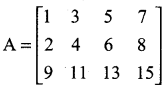
Samacheer Kalvi 10th Maths Guide Chapter 3 Algebra Ex 3.17 1
verify that (i) A + B = B + A
(ii) A + (-A) = (-A) + A = O.
Answer:
Samacheer Kalvi 10th Maths Guide Chapter 3 Algebra Ex 3.17 2
From (1) and (2) we get A + B = B + A
Samacheer Kalvi 10th Maths Guide Chapter 3 Algebra Ex 3.17 3
From (1) and (2) we get
A + (-A) = (-A) + A = 0

Samacheer Kalvi 10th Maths Guide Chapter 3 Algebra Ex 3.17

Question 2.
If Samacheer Kalvi 10th Maths Guide Chapter 3 Algebra Ex 3.17 4
Samacheer Kalvi 10th Maths Guide Chapter 3 Algebra Ex 3.17 5 then verify that
A + (B + C) = (A + B) + C.
Answer:
Samacheer Kalvi 10th Maths Guide Chapter 3 Algebra Ex 3.17 6
Samacheer Kalvi 10th Maths Guide Chapter 3 Algebra Ex 3.17 7
From (1) and (2) we get
A + (B + C) = (A + B) + C

Samacheer Kalvi 10th Maths Guide Chapter 3 Algebra Ex 3.17

Question 3.
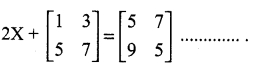
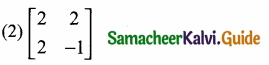
Find X and Y if Samacheer Kalvi 10th Maths Guide Chapter 3 Algebra Ex 3.17 8 and Samacheer Kalvi 10th Maths Guide Chapter 3 Algebra Ex 3.17 9
Answer:
Samacheer Kalvi 10th Maths Guide Chapter 3 Algebra Ex 3.17 10
Samacheer Kalvi 10th Maths Guide Chapter 3 Algebra Ex 3.17 11

Samacheer Kalvi 10th Maths Guide Chapter 3 Algebra Ex 3.17

Question 4.
If Samacheer Kalvi 10th Maths Guide Chapter 3 Algebra Ex 3.17 12
find the value of (i) B – 5A (ii) 3A – 9B
Answer:
Samacheer Kalvi 10th Maths Guide Chapter 3 Algebra Ex 3.17 13

Question 5.
Find the values of x, y, z if
Samacheer Kalvi 10th Maths Guide Chapter 3 Algebra Ex 3.17 14
Answer:
(i) x – 3 = 1 ⇒ x = 1 + 3 ⇒ x = 4
3x – z = 0 (substitute the value of x)
3(4) – z = 0
12 – z = 0
∴ z = 12
x + y + z = 6
4 + y + 12 = 0
y + 16 = 6
y = 6- 16
∴ y = -10
The value of x = 4, y = -10 and z = 12

(ii) [x y – z z + 3] + [y 4 3] = [4 8 16]
x + y = 4 ….(1)
y – z + 4 = 8
Substitute the value
of z in (2)
(2) ⇒ y – 10 = 4
Substitute the value of y in (1)
z + 3 + 3 = 16
z + 6 = 16
z = 16 – 16 = 10
y = 14
(1) ⇒ x + 14 = 4
x – 4 – 14 = -10
The value of x = -10, y = 14 and z = 10

Samacheer Kalvi 10th Maths Guide Chapter 3 Algebra Ex 3.17

Question 6.
Find x and y if x Samacheer Kalvi 10th Maths Guide Chapter 3 Algebra Ex 3.17 15
Answer:
Samacheer Kalvi 10th Maths Guide Chapter 3 Algebra Ex 3.17 16
4x – 2y = 4
(1) ⇒ 2x – y = 2
(2) ⇒ 3x – y = 2
– x + y = 2
Add (1) and (2)
Samacheer Kalvi 10th Maths Guide Chapter 3 Algebra Ex 3.17 17
Substitute the value of x = 4 in (2)
– 4 + y = 2
y = 2 + 4 = 6
The value of x = 4 and y = 6

Samacheer Kalvi 10th Maths Guide Chapter 3 Algebra Ex 3.17

Question 7.
Find the non-zero values of x satisfying the matrix equation
Samacheer Kalvi 10th Maths Guide Chapter 3 Algebra Ex 3.17 18
Answer:
Samacheer Kalvi 10th Maths Guide Chapter 3 Algebra Ex 3.17 19
The value of x = 4

Samacheer Kalvi 10th Maths Guide Chapter 3 Algebra Ex 3.17

Question 8.
Solve for x,y :
Samacheer Kalvi 10th Maths Guide Chapter 3 Algebra Ex 3.17 20
Answer:
Samacheer Kalvi 10th Maths Guide Chapter 3 Algebra Ex 3.17 21
x2 – 4x = -5
x2 – 4x + 5 = 0
(x – 5) (x + 1) = 0
x – 5 = 0 or x + 1 = 0
x = 5 or x = – 1
Samacheer Kalvi 10th Maths Guide Chapter 3 Algebra Ex 3.17 22
The value of x = -1 and 5
y2 – 2y = 8
y2 – 2y – 8 = 0
(y – 4) (y + 2) = 0
y – 4 = 0 or y + 2 = 0
Samacheer Kalvi 10th Maths Guide Chapter 3 Algebra Ex 3.17 23
y = 4 or y = -2
The value of y = -2 and 4

Samacheer Kalvi 10th Maths Guide Chapter 3 Algebra Ex 3.14

Students can download Maths Chapter 3 Algebra Ex 3.14 Questions and Answers, Notes, Samacheer Kalvi 10th Maths Guide Pdf helps you to revise the complete Tamilnadu State Board New Syllabus, helps students complete homework assignments and to score high marks in board exams.

Tamilnadu Samacheer Kalvi 10th Maths Solutions Chapter 3 Algebra Ex 3.14

Question 1.
Write each of the following expression in terms of α + β and αβ
(i) \(\frac{\alpha}{3 \beta}+\frac{\beta}{3 \alpha}\)
Answer:
Samacheer Kalvi 10th Maths Guide Chapter 3 Algebra Ex 3.14 1

(ii) \(\frac{1}{\alpha^{2} \beta}+\frac{1}{\beta^{2} \alpha}\)
Answer:
Samacheer Kalvi 10th Maths Guide Chapter 3 Algebra Ex 3.14 2

(iii) (3α – 1) (3β – 1)
Answer:
(3α – 1) (3β – 1) = 9αc – 3α – 3β + 1
= 9αβ – 3(α + β) + 1

Samacheer Kalvi 10th Maths Guide Chapter 3 Algebra Ex 3.14

(iv) \(\frac{\alpha+3}{\beta}+\frac{\beta+3}{\alpha}\)
Answer:
Samacheer Kalvi 10th Maths Guide Chapter 3 Algebra Ex 3.14 3

Question 2.
The roots of the equation 2x2 – 7x + 5 = 0 are a and p. Find the value of [without solving the equation]
\(\text { (i) } \frac{1}{\alpha}+\frac{1}{\beta}\)
Answer:
α and α are the roots of the equation 2x2 – 7x + 5 = 0
α + β = \(\frac { 7 }{ 2 } \) ; αβ = \(\frac { 5 }{ 2 } \)
(i) \(\frac{1}{\alpha}+\frac{1}{\beta}\) = \(\frac{\beta+\alpha}{\alpha \beta}\)
= \(\frac { 7 }{ 2 } \) + \(\frac { 5 }{ 2 } \) = \(\frac { 7 }{ 2 } \) × \(\frac { 2 }{ 5 } \) = \(\frac { 7 }{ 5 } \)

(ii) \(\frac{\alpha}{\beta}+\frac{\beta}{\alpha}\)
Answer
Samacheer Kalvi 10th Maths Guide Chapter 3 Algebra Ex 3.14 4
= (\(\frac { 7 }{ 2 } \))2 – 2 × \(\frac { 5 }{ 2 } \) ÷ \(\frac { 5 }{ 2 } \)
= \(\frac { 49 }{ 4 } \) – 5 ÷ \(\frac { 5 }{ 2 } \) = \(\frac { 49-20 }{ 4 } \) ÷ \(\frac { 5 }{ 2 } \)
= \(\frac { 29 }{ 4 } \) × \(\frac { 2 }{ 5 } \) = \(\frac { 29 }{ 10 } \)

Samacheer Kalvi 10th Maths Guide Chapter 3 Algebra Ex 3.14

(iii) \(\frac{\alpha+2}{\beta+2}+\frac{\beta+2}{\alpha+2}\)
Answer:
Samacheer Kalvi 10th Maths Guide Chapter 3 Algebra Ex 3.14 5

Samacheer Kalvi 10th Maths Guide Chapter 3 Algebra Ex 3.14

Question 3.
The roots of the equation x2 + 6x – 4 = 0 are a, p. Find the quadratic equation whose roots are
(i) α2 and β2
Answer:
α and β are the roots of x2 + 6x – 4 = 0
α + β = -6; αβ = -4

(i) Sum of the roots = α2 + β2
= (α + β)2 – 2αβ
= 36 – 2 – (4) = 36 + 8
= 44
Product of the roots = α2 + β2
= (αβ)2
= (-4)2
= 16
The Quadratic equation is
x2 – (sum of the roots) x + Product of the roots = 0
x2 – (44)x + 16 = 0
x2 – 44x + 16 = 0

(ii) \(\frac{2}{\alpha}\) and \(\frac{2}{\beta}\)
Answer:
Sum of the roots = \(\frac{2}{\alpha}\) + \(\frac{2}{\beta}\)
= \(\frac{2 \beta+2 \alpha}{\alpha \beta}=\frac{2(\alpha+\beta)}{\alpha \beta}\)
= \(\frac{2(-6)}{-4}=\frac{-12}{-4}=3\)
Product of the roots = \(\frac{2}{\alpha} \times \frac{2}{\beta}=\frac{4}{\alpha \beta}\)
= \(\frac { 4 }{ -4 } \) = -1
The Quadratic equation is
x2 – (sum of the roots) x + Product of the roots = 0
x2 – 3x – 1 = 0

(iii) α2β and β2α
Answer:
Sum of the roots = α2β + β2α
= αβ (α + β)
= -4 (-6) = 24
Product of the roots = α2β × β2α
= α2β3 = (αβ)3
= (-4)3 = -64
The Quadratic equation is
x2 – (Sum of the roots) x + Product of the roots = 0
x2 – 24x – 64 = 0

Samacheer Kalvi 10th Maths Guide Chapter 3 Algebra Ex 3.14

Question 4.
If α, β are the roots of 7x2 + ax + 2 = 0 and if β – α = \(\frac { 13 }{ 7 } \) Find the values of a.
Answer:
α and β are the roots of 7x2 + ax + 2 = 0
α + β = \(\frac { -a }{ 7 } \); αβ = \(\frac { 2 }{ 7 } \)
Given β – α = – \(\frac { 13 }{ 7 } \) ⇒ α – β = \(\frac { 13 }{ 7 } \)
Squaring on both sides
(α – β)2 = (\(\frac { 13 }{ 7 } \))2
α2 + β2 = 2αβ = \(\frac { 169 }{ 49 } \)
(- \(\frac { a }{ 7 } \))2 -4(\(\frac { 2 }{ 7 } \)) = \(\frac { 169 }{ 49 } \) ⇒ \(\frac{a^{2}}{49}-\frac{8}{7}=\frac{169}{49}\)
\(\frac{a^{2}}{49}\) = \(\frac { 225 }{ 49 } \) ⇒ a2 = \(\frac{225 \times 49}{49}\)
a2 = 225 ⇒ a = ± \(\sqrt { 225 }\) = ± 15
The value of a = 15 or – 15

Question 5.
If one root of the equation 2y2, – ay + 64 = 0 is twice the other then find the values of a.
Answer:
Let the roots be α and 2α
Here a = 2, b = – a, c = 64
Sum of the roots = – \(\frac { b }{ a } \)
α + 2α = \(\frac { a }{ 2 } \)
3α = \(\frac { a }{ 2 } \)
a = 6α …….(1)
Product of the roots = \(\frac { c }{ a } \)
α × 2α = \(\frac { 64 }{ 2 } \) = 2α2 = 32
α2 = \(\frac { 32 }{ 2 } \) = 16
α = \(\sqrt { 16 }\) = ± 4
Substitute the value of a in (1)
When α = 4
a = 6(4)
a = 24
The Value of a is 24 or -24
When α = -4
a = 6(-4)
a = -24

Samacheer Kalvi 10th Maths Guide Chapter 3 Algebra Ex 3.14

Question 6.
If one root of the equation 3x2 + kx + 81 = 0 (having real roots) is the square of the other then find k.
Answer:
Let α and α2 be the root of the equation 3x2 + kx + 81
Here a = 3, b = k, c = 81
Sum of the roots = – \(\frac { b }{ a } \) = – \(\frac { k }{ 3 } \)
α + α2 = –\(\frac { k }{ 3 } \)
3α + 3α2 = -k ……..(1)
Product of the roots = \(\frac { c }{ a } \) = \(\frac { 81 }{ 3 } \) = 27
α × α2 = 27
α3 = 27 ⇒ α3 = 33
α = 3
Substitute the value of α = 3 in (1)
3(3) + 3(3)2 = -k
9 + 27 = -k ⇒ 36 = – k
∴ k = -36
The value of k = -36

Samacheer Kalvi 10th Maths Guide Chapter 3 Algebra Ex 3.5

Students can download Maths Chapter 3 Algebra Ex 3.5 Questions and Answers, Notes, Samacheer Kalvi 10th Maths Guide Pdf helps you to revise the complete Tamilnadu State Board New Syllabus, helps students complete homework assignments and to score high marks in board exams.

Tamilnadu Samacheer Kalvi 10th Maths Solutions Chapter 3 Algebra Ex 3.5

Question 1.
Simplify
(i) \(\frac{4 x^{2} y}{2 z^{2}} \times \frac{6 x z^{3}}{20 y^{4}}\)
Answer:
Samacheer Kalvi 10th Maths Guide Chapter 3 Algebra Ex 3.5 1

Samacheer Kalvi 10th Maths Guide Chapter 3 Algebra Ex 3.5

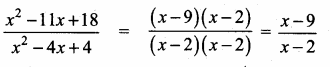
(ii) \(\frac{p^{2}-10 p+21}{p-7} \times \frac{p^{2}+p-12}{(p-3)^{2}}\)
Answer:
P2 – 10p + 21 = (p – 7) (p – 3)
p2 + p – 12 = (p + 4) (p – 3)
Samacheer Kalvi 10th Maths Guide Chapter 3 Algebra Ex 3.5 2
Samacheer Kalvi 10th Maths Guide Chapter 3 Algebra Ex 3.5 3
Samacheer Kalvi 10th Maths Guide Chapter 3 Algebra Ex 3.5 4

(iii) \(\frac{5 t^{3}}{4 t-8} \times \frac{6 t-12}{10 t}\)
Answer:
Samacheer Kalvi 10th Maths Guide Chapter 3 Algebra Ex 3.5 5

Samacheer Kalvi 10th Maths Guide Chapter 3 Algebra Ex 3.5

Question 2.
Simplify
(i) \(\frac{x+4}{3 x+4 y} \times \frac{9 x^{2}-16 y^{2}}{2 x^{2}+3 x-20}\)
Answer:
9x2 – 16y2 = (3x)2 – (4y)2
= (3x + 4y) (3x – 4y)
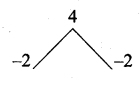
2x2 + 3x – 20 = 2x2 + 8x – 5x – 20
= 2x (x + 4) – 5 (x + 4)
= (x + 4) (2x – 5)
Samacheer Kalvi 10th Maths Guide Chapter 3 Algebra Ex 3.5 6

(ii) \(\frac{x^{3}-y^{3}}{3 x^{2}+9 x y+6 y^{2}} \times \frac{x^{2}+2 x y+y^{2}}{x^{2}-y^{2}}\)
Answer:
x3 – y3 = (x – y) (x2 + xy + y2)
x2 + 2xy + y2 = (x + y) (x + y)
Samacheer Kalvi 10th Maths Guide Chapter 3 Algebra Ex 3.5 7
3x2 + 9xy + 6y2 = 3(x2 + 3xy + 2y2)
= 3 (x + 2y) (x + y)
(x2 – y2) = (x + y) (x – y)
Samacheer Kalvi 10th Maths Guide Chapter 3 Algebra Ex 3.5 8

Samacheer Kalvi 10th Maths Guide Chapter 3 Algebra Ex 3.5

Question 3.
Simplify
(i) \(\frac{2 a^{2}+5 a+3}{2 a^{2}+7 a+6} \div \frac{a^{2}+6 a+5}{-5 a^{2}-35 a-50}\)
Answer:
Samacheer Kalvi 10th Maths Guide Chapter 3 Algebra Ex 3.5 9
2 a2 + 5a + 3a + 3 = 2a2 + 2a + 3a + 3
= 2a(a + 1) + 3 (a + 1)
= (a + 1) (2a + 3)
Samacheer Kalvi 10th Maths Guide Chapter 3 Algebra Ex 3.5 10
2a2 + 7a + 6 = 2a2 + 3a + 4a + 6
= a(2a + 3) + 2 (2a + 3)
= (2a + 3) (a + 2)
Samacheer Kalvi 10th Maths Guide Chapter 3 Algebra Ex 3.5 11
a2 + 6a + 5 = (a + 5) + (a + 1)
-5a2 – 35a – 50 = -5(a2 + 7a + 10)
= -5(a + 5)(a + 2)
Samacheer Kalvi 10th Maths Guide Chapter 3 Algebra Ex 3.5 12
Samacheer Kalvi 10th Maths Guide Chapter 3 Algebra Ex 3.5 13

Samacheer Kalvi 10th Maths Guide Chapter 3 Algebra Ex 3.5

(ii) \(\frac{b^{2}+3 b-28}{b^{2}+4 b+4}+\frac{b^{2}-49}{b^{2}-5 b-14}\)
Solution:
Samacheer Kalvi 10th Maths Guide Chapter 3 Algebra Ex 3.5 14
b2 + 3b – 28 = (b + 7) (b – 4)
b2 + 4b + 4 = (b + 2) (b + 2)
b2 – 49 = b2 – 72
= (b + 7) (b – 7)
b2 – 5b – 14 = (b – 7) (b + 2)
Samacheer Kalvi 10th Maths Guide Chapter 3 Algebra Ex 3.5 15
Samacheer Kalvi 10th Maths Guide Chapter 3 Algebra Ex 3.5 16
Samacheer Kalvi 10th Maths Guide Chapter 3 Algebra Ex 3.5 17

(iii) \(\frac{x+2}{4 y}+\frac{x^{2}-x-6}{12 y^{2}}\)
Answer:
Samacheer Kalvi 10th Maths Guide Chapter 3 Algebra Ex 3.5 18
x2 – x – 6 = (x – 3) (x + 2)
Samacheer Kalvi 10th Maths Guide Chapter 3 Algebra Ex 3.5 19

Samacheer Kalvi 10th Maths Guide Chapter 3 Algebra Ex 3.5

(iv) \(\frac{12 t^{2}-22 t+8}{3 t} \div \frac{3 t^{2}+2 t-8}{2 t^{2}+4 t}\)
Answer:
12t2 – 22t + 8 = 2(6t2 – 11t + 4)
= 2[6t2 – 8t – 3t + 4]
Samacheer Kalvi 10th Maths Guide Chapter 3 Algebra Ex 3.5 20
= 2[2t (3t – 4) – 1 (3t – 4)]
= 2(3t – 4) (2t – 1)
3t2 + 2t – 8 = 3t2 + 6t – 4t – 8
= 3t(t + 2) – 4 (t + 2)
Samacheer Kalvi 10th Maths Guide Chapter 3 Algebra Ex 3.5 21
= (t + 2) (3t – 4)
2t2 + 4t = 2t(t + 2)
Samacheer Kalvi 10th Maths Guide Chapter 3 Algebra Ex 3.5 22

Samacheer Kalvi 10th Maths Guide Chapter 3 Algebra Ex 3.5
Question 4.
If x = \(\frac{a^{2}+3 a-4}{3 a^{2}-3}\) and y = \(\frac{a^{2}+2 a-8}{2 a^{2}-2 a-4}\) find the value of x2y-2
Answer:
Samacheer Kalvi 10th Maths Guide Chapter 3 Algebra Ex 3.5 25
Samacheer Kalvi 10th Maths Guide Chapter 3 Algebra Ex 3.5 23
The value of x2 y-2 = \(\frac{x^{2}}{y^{2}}\) = (\(\frac { x }{ y } \))2
Samacheer Kalvi 10th Maths Guide Chapter 3 Algebra Ex 3.5 27

Samacheer Kalvi 10th Maths Guide Chapter 3 Algebra Ex 3.5

Question 5.
If a polynomial p(x) = x2 – 5x – 14 when divided by another polynomial q(x) gets reduced to \(\frac { x-7 }{ x+2 } \) find q(x).
Answer:
p(x) = x2 – 5x – 14
= (x – 7) (x + 2)
Samacheer Kalvi 10th Maths Guide Chapter 3 Algebra Ex 3.5 28
By the given data
\(\frac { p(x) }{ q(x) } \) = \(\frac { (x-7) }{ x+2 } \)
\(\frac{(x-7)(x+2)}{q(x)}\) = \(\frac { (x-7) }{ x+2 } \)
q(x) × (x – 7) = (x – 7) (x + 2) (x + 2)
q(x) = \(\frac{(x-7)(x+2)(x+2)}{(x-7)}\)
= (x + 2)2
q(x) = x2 + 4x + 4

Samacheer Kalvi 10th Maths Guide Chapter 2 Numbers and Sequences Unit Exercise 2

Students can download Maths Chapter 2 Relations and Functions Unit Exercise 2 Questions and Answers, Notes, Samacheer Kalvi 10th Maths Guide Pdf helps you to revise the complete Tamilnadu State Board New Syllabus, helps students complete homework assignments and to score high marks in board exams.

Tamilnadu Samacheer Kalvi 10th Maths Solutions Chapter 2 Numbers and Sequences Unit Exercise 2

Question 1.
Prove that n2 – n divisible by 2 for every positive integer n.
Answer:
We know that any positive integer is of the form 2q or 2q + 1 for some integer q.
Case 1: When n = 2 q
n2 – n = (2q)2 – 2q = 4q2 – 2q
= 2q (2q – 1)
In n2 – n = 2r
2r = 2q(2q – 1)
r = q(2q + 1)
n2 – n is divisible by 2

Case 2: When n = 2q + 1
n2 – n = (2q + 1)2 – (2q + 1)
= 4q2 + 1 + 4q – 2q – 1 = 4q2 + 2q
= 2q (2q + 1)
If n2 – n = 2r
r = q (2q + 1)
∴ n2 – n is divisible by 2 for every positive integer “n”

Samacheer Kalvi 10th Maths Guide Chapter 2 Numbers and Sequences Unit Exercise 2

Question 2.
A milk man has 175 litres of cow’s milk and 105 litres of buffalow’s milk. He wishes to sell the milk by filling the two types of milk in cans of equal capacity. Calculate the following
(i) Capacity of a can
(ii) Number of cans of cow’s milk
(iii) Number of cans of buffalow’s milk.
Answer:
175 litres of cow’s milk.
105 litres of goat’s milk.
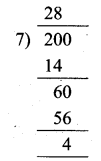
H.C.F of 175 & 105 by using Euclid’s division algorithm.
175 = 105 × 1 + 70, the remainder 70 ≠ 0
Samacheer Kalvi 10th Maths Guide Chapter 2 Numbers and Sequences Unit Exercise 2 1
Again using division algorithm,
Samacheer Kalvi 10th Maths Guide Chapter 2 Numbers and Sequences Unit Exercise 2 2
105 = 70 × 1 + 35, the remainder 35 ≠ 0
Again using division algorithm.
70 = 35 × 2 + 0, the remainder is 0.
∴ 35 is the H.C.F of 175 & 105.
(i) ∴ The milk man’s milk can’s capacity is 35 litres.
(ii) No. of cow’s milk obtained = \(\frac { 175 }{ 35 } \) = 5 cans
(iii) No. of buffalow’s milk obtained = \(\frac { 105 }{ 35 } \) = 3 cans

Samacheer Kalvi 10th Maths Guide Chapter 2 Numbers and Sequences Unit Exercise 2

Question 3.
When the positive integers a, b and c are divided by 13 the respective remainders are 9,7 and 10. Find the remainder when a + 2b + 3c is divided by 13.
Answer:
Given the positive integer are a, b and c
a = 13q + 9 (divided by 13 leaves remainder 9)
b = 13q + 7
c = 13q + 10
a + 2b + 3c = 13q + 9 + 2(13q + 7) + 3 (13q + 10)
= 13q + 9 + 26q + 14 + 39q + 30
= 78q + 53
When compare with a = 3q + r
= (13 × 6) q + 53
The remainder is 53

Question 4.
Show that 107 is of the form 4q +3 for any integer q.
Solution:
107 = 4 × 26 + 3. This is of the form a = bq + r.
Hence it is proved.

Samacheer Kalvi 10th Maths Guide Chapter 2 Numbers and Sequences Unit Exercise 2

Question 5.
If (m + 1)th term of an A.P. is twice the (n + 1)th term, then prove that (3m + 1)th term is twice the (m + n + 1)th term.
Answer:
tn = a + (n – 1)d
Given tm+1 = 2 tn+1
a + (m + 1 – 1)d = 2[a + (n + 1 – 1)d]
a + md = 2(a + nd) ⇒ a + md =2a + 2nd
md – 2nd = a
d(m – 2n) = a ….(1)
To Prove t(3m + 1) = 2(tm+n+1)
L.H.S. = t3m+1
= a + (3m + 1 – 1)d
= a + 3md
= d(m – 2n) + 3md (from 1)
= md – 2nd + 3md
= 4md – 2nd
= 2d (2m – n)
R.H.S. = 2(tm+n+1)
= 2 [a + (m + n + 1 – 1) d]
= 2 [a + (m + n)d]
= 2 [d (m – 2n) + md + nd)] (from 1)
= 2 [dm – 2nd + md + nd]
= 2 [2 md – nd]
= 2d (2m – n)
R.H.S = L.H.S
∴ t(3m+1) = 2 t(m+n+1)
Hence it is proved.

Samacheer Kalvi 10th Maths Guide Chapter 2 Numbers and Sequences Unit Exercise 2

Question 6.
Find the 12th term from the last term of the A.P -2, -4, -6,… -100.
Answer:
The given A.P is -2, -4, -6, …. 100
d = -4 – (-2) = -4 + 2 = – 2
Finding the 12 term from the last term
a = -100, d = 2 (taking from the last term)
n = 12
tn = a + (n – 1)d
t12 = – 100 + 11 (2)
= -100 + 22
= -78
∴ The 12th term of the A.P from the last term is – 78

Question 7.
Two A.P’s have the same common difference. The first term of one A.P is 2 and that of the other is 7. Show that the difference between their 10th terms is the same as the difference between their 21st terms, which is the same as the difference between any two corresponding terms.
Solution:
Let the two A.Ps be
AP1 = a1, a1 + d, a1 + 2d,…
AP2 = a2, a2 + d, a2 + 2d,…
In AP1 we have a1 = 2
In AP2 we have a2 = 7
t10 in AP1 = a1 + 9d = 2 + 9d ………….. (1)
t10 in AP2 = a2 + 9d = 7 + 9d …………… (2)
The difference between their 10th terms
= (1) – (2) = 2 + 9d – 7 – 9d
= -5 ………….. (I)
t21 m AP1 = a1 + 20d = 2 + 20d …………. (3)
t21 in AP2 = a2 + 20d = 7 + 20d ………… (4)
The difference between their 21 st terms is
(3) – (4)
= 2 + 20d – 7 – 20d
= -5 ……………. (II)
I = II
Hence it is Proved.

Samacheer Kalvi 10th Maths Guide Chapter 2 Numbers and Sequences Unit Exercise 2

Question 8.
A man saved ₹16500 in ten years. In each year after the first he saved ₹100 more than he did in the preceding year. How much did he save in the first year?
Answer:
Amount of saving in ten years = ₹ 16500
S10 = 16500, d= 100
Sn = \(\frac { n }{ 2 } \) [2a + (n – 1)d]
S10 = \(\frac { 10 }{ 2 } \) [2a + 9d]
16500 = \(\frac { 10 }{ 2 } \) [2a + 900] = 5(2a + 900)
16500 = 10a + 4500 ⇒ 16500 – 4500 = 10a
12000 = 10a
a = \(\frac { 12000 }{ 10 } \) = 1200
Amount saved in the first year = ₹ 1200

Question 9.
Find the G.P. in which the 2nd term is \(\sqrt { 6 }\) and the 6th term is 9 \(\sqrt { 6 }\).
Answer:
2nd term of the G.P = \(\sqrt { 6 }\)
t2 = \(\sqrt { 6 }\)
[tn = a rn-1]
a.r = \(\sqrt { 6 }\) ….(1)
6th term of the G.P. = 9 \(\sqrt { 6 }\)
a. r5 = 9\(\sqrt { 6 }\) ……..(2)
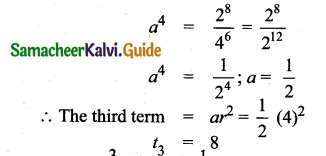
Samacheer Kalvi 10th Maths Guide Chapter 2 Numbers and Sequences Unit Exercise 2 4
Samacheer Kalvi 10th Maths Guide Chapter 2 Numbers and Sequences Unit Exercise 2 5

Samacheer Kalvi 10th Maths Guide Chapter 2 Numbers and Sequences Unit Exercise 2

Question 10.
The value of a motorcycle depreciates at a rate of 15% per year. What will be the value of the motorcycle 3 year hence, which is now purchased for ₹45,000?
Solution:
a = ₹45000
Depreciation = 15% for ₹45000
= 45000 × \(\frac { 15 }{ 100 } \)
d = ₹6750 since it is depreciation
d = -6750
At the end of 1st year its value = ₹45000 – ₹6750
= ₹38250,
Again depreciation = 38250 × \(\frac { 15 }{ 100 } \) = 5737.50
At the end of 2nd year its value
= ₹38250 – ₹5737.50 = 32512.50
Again depreciation = 32512.50 × \(\frac { 15 }{ 100 } \) = 4876.88
At the end of the 3rd year its value
= 32512.50 – 4876.88 = 27635.63
∴ The value of the automobile at the 3rd year
= ₹ 27636

Samacheer Kalvi 10th Maths Guide Chapter 2 Numbers and Sequences Ex 2.10

Students can download Maths Chapter 2 Numbers and Sequences Ex 2.10 Questions and Answers, Notes, Samacheer Kalvi 10th Maths Guide Pdf helps you to revise the complete Tamilnadu State Board New Syllabus, helps students complete homework assignments and to score high marks in board exams.

Tamilnadu Samacheer Kalvi 10th Maths Solutions Chapter 2 Numbers and Sequences Ex 2.10

Multiple choice questions:

Question 1.
Euclid’s division lemma states that for positive integers a and b, there exist unique integers q and r such that a = bq + r, where r must satisfy ………………….
(1) 1 < r < b
(2) 0 < r < b
(3) 0 < r < 6
(4) 0 < r < b
Ans.
(3) 0 < r < b

Samacheer Kalvi 10th Maths Guide Chapter 2 Numbers and Sequences Ex 2.10

Question 2.
Using Euclid’s division lemma, if the cube of any positive integer is divided by 9 then the possible remainders are ………………….
(1) 0, 1, 8
(2) 1, 4, 8
(3) 0, 1, 3
(4) 1, 3, 5
Answer:
(1) 0, 1, 8
Hint: Let the +ve integer be 1, 2, 3, 4 …………
13 = 1 when it is divided by 9 the remainder is 1.
23 = 8 when it is divided by 9 the remainder is 8.
33 = 27 when it is divided by 9 the remainder is 0.
43 = 64 when it is divided by 9 the remainder is 1.
53 = 125 when it is divided by 9 the remainder is 8.
The remainder 0, 1, 8 is repeated.

Question 3.
If the H.C.F of 65 and 117 is expressible in the form of 65m – 117 , then the value of m is
(1) 4
(2) 2
(3) 1
(4) 3
Answer:
(2) 2
Hint:
H.C.F. of 65 and 117
117 = 65 × 1 + 52
65 = 52 × 1 + 13
52 = 13 × 4 + 0
∴ 13 is the H.C.F. of 65 and 117.
65m – 117 = 65 × 2 – 117
130 – 117 = 13
∴ m = 2

Samacheer Kalvi 10th Maths Guide Chapter 2 Numbers and Sequences Ex 2.10

Question 4.
The sum of the exponents of the prime factors in the prime factorization of 1729 is …………………….
(1) 1
(2) 2
(3) 3
(4) 4
Answer:
(3) 3
Hint: 1729 = 7 × 13 × 19
Sum of the exponents = 1 + 1 + 1
= 3

Question 5.
The least number that is divisible by all the numbers from 1 to 10 (both inclusive) is
(1) 2025
(2) 5220
(3) 5025
(4) 2520
Answer:
(4) 2520
Hint:
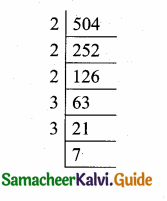
Samacheer Kalvi 10th Maths Guide Chapter 2 Numbers and Sequences Ex 2.10 1
L.C.M. = 23 × 32 × 5 × 7
= 8 × 9 × 5 × 7
= 2520

Samacheer Kalvi 10th Maths Guide Chapter 2 Numbers and Sequences Ex 2.10

Question 6.
74k ≡ ______ (mod 100)
(1) 1
(2) 2
(3) 3
(4) 4
Answer:
(1) 1
Hint:
74k ≡______ (mod 100)
y4k ≡ y4 × 1 = 1 (mod 100)

Question 7.
Given F1 = 1 , F2 = 3 and Fn = Fn-1 + Fn-2 then F5 is ………….
(1) 3
(2) 5
(3) 8
(4) 11
Answer:
(4) 11
Hint:
Fn = Fn-1 + Fn-2
F3 = F2 + F1 = 3 + 1 = 4
F4 = F3 + F2 = 4 + 3 = 7
F5 = F4 + F3 = 7 + 4 = 11

Samacheer Kalvi 10th Maths Guide Chapter 2 Numbers and Sequences Ex 2.10

Question 8.
The first term of an arithmetic progression is unity and the common difference is 4. Which of the following will be a term of this A.P
(1) 4551
(2) 10091
(3) 7881
(4) 13531
Answer:
(3) 7881
Hint:
t1 = 1
d = 4
tn = a + (n – 1)d
= 1 + 4n – 4
4n – 3 = 4551
4n = 4554
n = will be a fraction
It is not possible.
4n – 3 = 10091
4n = 10091 + 3 = 10094
n = a fraction
4n – 3 = 7881
4n = 7881 + 3 = 7884
n = \(\frac{7884}{4}\), n is a whole number.
4n – 3 = 13531
4n = 13531 – 3 = 13534
n is a fraction.
∴ 7881 will be 1971st term of A.P.

Samacheer Kalvi 10th Maths Guide Chapter 2 Numbers and Sequences Ex 2.10

Question 9.
If 6 times of 6th term of an A.P is equal to 7 times the 7th term, then the 13th term of the A.P. is ………..
(1) 0
(2) 6
(3) 7
(4) 13
Answer:
(1) 0
Hint:
6 t6 = 7 t7
6(a + 5d) = 7 (a + 6d) ⇒ 6a + 30d = 7a + 42d
30 d – 42 d = 7a – 6a ⇒ -12d = a
t13 = a + 12d (12d = -a)
= a – a = 0

Question 10.
An A.P consists of 31 terms. If its 16th term is m, then the sum of all the terms of this A.P. is
(1) 16 m
(2) 62 m
(3) 31 m
(4) \(\frac { 31 }{ 2 } \) m
Answer:
(3) 31 m
Hint:
t16 = m
S31 = \(\frac { 31 }{ 2 } \) (2a + 30d)
= \(\frac { 31 }{ 2 } \) (2(a + 15d))
(∵ t16 = a + 15d)
= 31(t16) = 31m

Samacheer Kalvi 10th Maths Guide Chapter 2 Numbers and Sequences Ex 2.10

Question 11.
In an A.P., the first term is 1 and the common difference is 4. How many terms of the A.P must be taken for their sum to be equal to 120?
(1) 6
(2) 7
(3) 8
(4) 9
Answer:
(3) 8
Here a = 1, d = 4, Sn = 120
Sn = \(\frac { n }{ 2 } \)[2a + (n – 1)d]
120 = \(\frac { n }{ 2 } \) [2 + (n – 1)4] = \(\frac { n }{ 2 } \) [2 + 4n – 4)]
= \(\frac { n }{ 2 } \) [4n – 2)] = \(\frac { n }{ 2 } \) × 2 (2n – 1)
120 = 2n2 – n
∴ 2n2 – n – 120 = 0 ⇒ 2n2 – 16n + 15n – 120 = 0
2n(n – 8) + 15 (n – 8) = 0 ⇒ (n – 8) (2n + 15) = 0
n = 8 or n = \(\frac { -15 }{ 2 } \) (omitted)
∴ n = 8

Question 12.
A = 265 and B = 264 + 263 + 262 …. + 20 which of the following is true?
(1) B is 264 more than A
(2) A and B are equal
(3) B is larger than A by 1
(4) A is larger than B by 1
Answer:
(4) A is larger than B by
A = 265
B = 264+63 + 262 + …….. + 20
= 2
= 1 + 22 + 22 + ……. + 264
a = 1, r = 2, n = 65 it is in G.P.
S65 = 1 (265 – 1) = 265 – 1
A = 265 is larger than B

Samacheer Kalvi 10th Maths Guide Chapter 2 Numbers and Sequences Ex 2.10

Question 13.
The next term of the sequence \(\frac { 3 }{ 16 } \),\(\frac { 1 }{ 8 } \),\(\frac { 1 }{ 12 } \),\(\frac { 1 }{ 18 } \) is ………..
(1) \(\frac { 1 }{ 24 } \)
(2) \(\frac { 1 }{ 27 } \)
(3) \(\frac { 2 }{ 3 } \)
(4) \(\frac { 1 }{ 81 } \)
Answer:
(2) \(\frac { 1 }{ 27 } \)
Hint:
\(\frac { 3 }{ 16 } \),\(\frac { 1 }{ 8 } \),\(\frac { 1 }{ 12 } \),\(\frac { 1 }{ 18 } \)
a = \(\frac { 3 }{ 16 } \), r = \(\frac { 1 }{ 8 } \) ÷ \(\frac { 3 }{ 16 } \) = \(\frac { 1 }{ 8 } \) × \(\frac { 16 }{ 3 } \) = \(\frac { 2 }{ 3 } \)
The next term is = \(\frac { 1 }{ 18 } \) × \(\frac { 2 }{ 3 } \) = \(\frac { 1 }{ 27 } \)

Question 14.
If the sequence t1,t2,t3 … are in A.P. then the sequence t6,t12,t18 … is
(1) a Geometric Progression
(2) an Arithmetic Progression
(3) neither an Arithmetic Progression nor a Geometric Progression
(4) a constant sequence
Answer:
(2) an Arithmetic Progression
Hint:
If t1, t2, t3, … is 1, 2, 3, …
If t6 = 6, t12 = 12, t18 = 18 then 6, 12, 18 … is an arithmetic progression

Samacheer Kalvi 10th Maths Guide Chapter 2 Numbers and Sequences Ex 2.10

Question 15.
The value of (13 + 23 + 33 + ……. + 153) – (1 + 2 + 3 + …….. + 15) is …………….
(1) 14400
(2) 14200
(3) 14280
(4) 14520
Answer:
(3) 14280
Hint:
Samacheer Kalvi 10th Maths Guide Chapter 2 Numbers and Sequences Ex 2.10 2
1202 – 120 = 120(120 – 1)
120 × 119 = 14280

Samacheer Kalvi 10th Maths Guide Chapter 2 Numbers and Sequences Ex 2.9

Students can download Maths Chapter 2 Numbers and Sequences Ex 2.9 Questions and Answers, Notes, Samacheer Kalvi 10th Maths Guide Pdf helps you to revise the complete Tamilnadu State Board New Syllabus, helps students complete homework assignments and to score high marks in board exams.

Tamilnadu Samacheer Kalvi 10th Maths Solutions Chapter 2 Numbers and Sequences Ex 2.9

Question 1.
Find the sum of the following series
(i) 1 + 2 + 3 + …….. + 60
(ii) 3 + 6 + 9 + …….. +96
(iii) 51 + 52 + 53 + …….. + 92
(iv) 1 + 4 + 9 + 16 + …….. + 225
(v) 62 + 72 + 82 + …….. + 212
(vi) 103 + 113 + 123 + …….. + 203
(vii) 1 + 3 + 5 + …… + 71
Solution:
(i) 1 + 2 + 3 + …….. + 60 = \(\frac{60 \times 61}{2}\)
[Using \(\frac{n(n+1)}{2}\) formula]
= 1830

(ii) 3 + 6 + 9 + …….. + 96 = 3(1 + 2 + 3 + ……… + 32)
= \(\frac{3 \times 32 \times 33}{2}\)
= 1584

(iii) 51 + 52 + 53 + …….. + 92 = (1 + 2 + 3 + ……. + 92) – (1 + 2 + 3 + …… + 50)
Samacheer Kalvi 10th Maths Guide Chapter 2 Numbers and Sequences Ex 2.9
= 4278 – 1275
= 3003

(iv) 1 + 4 + 9 + 16 + …….. + 225 = 12 + 22 + 32 + 42 + ………… + 152
\(\frac{15 \times 16 \times 31}{6}\)
[using \(\frac{n(n+1)(2 n+1)}{6}\)] formula
= 1240

(v) 62 + 72 + 82 + …….. + 212 = 1 + 22 + 32 + 42 + ………… + 212 – (1 + 22 + ………… + 52)
= \(\frac{21 \times 22 \times 43}{6}\) – \(\frac{5 \times 6 \times 11}{6}\)
= 3311 – 55
= 3256

(vi) 103 = 113 + 123 + …….. + 203 = 13 + 23+ 33 + ………… + 203 – (13 + 23 + 33 + …………. + 93)
Samacheer Kalvi 10th Maths Guide Chapter 2 Numbers and Sequences Ex 2.9
[Using (\(\frac{n(n+1)}{2}\))2 formula]
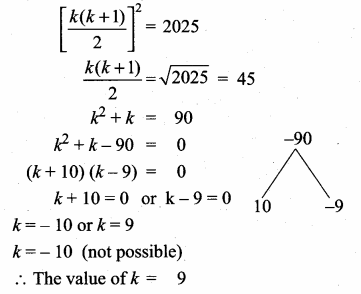
= 2102 – 452 = 44100 – 2025
= 42075

(vii) 1 + 3 + 5+ … + 71
Here a = 1; d = 3 – 1 = 2; l = 71
Samacheer Kalvi 10th Maths Guide Chapter 2 Numbers and Sequences Ex 2.9 1
Samacheer Kalvi 10th Maths Guide Chapter 2 Numbers and Sequences Ex 2.9

Question 2.
If 1 + 2 + 3 + …. + k = 325 , then find 13 + 23 + 33 + …………. + k3
Answer:
1 + 2 + 3 + …. + k = 325
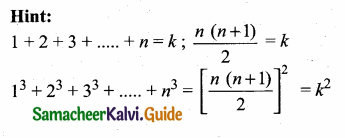
\(\frac{k(k+1)}{2}\) = 325 ……(1)
Samacheer Kalvi 10th Maths Guide Chapter 2 Numbers and Sequences Ex 2.9
= 3252 (From 1)
= 105625

Question 3.
If 13 + 23 + 33 + ………… + K3 = 44100 then find 1 + 2 + 3 + ……. + k
Answer:
13 + 23 + 33 + ………….. + k3 = 44100
Samacheer Kalvi 10th Maths Guide Chapter 2 Numbers and Sequences Ex 2.9
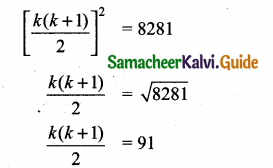
\(\frac{k(k+1)}{2}\) = \(\sqrt { 44100 }\) = 210
1 + 2 + 3 + …… + k = \(\frac{k(k+1)}{2}\)
= 210

Question 4.
How many terms of the series 13 + 23 + 33 + …………… should be taken to get the sum 14400?
Answer:
13 + 23 + 33 + ……. + n3 = 14400
Samacheer Kalvi 10th Maths Guide Chapter 2 Numbers and Sequences Ex 2.9
\(\frac{n(n+1)}{2}\) = \(\sqrt { 14400 }\)
\(\frac{n(n+1)}{2}\) = 120 ⇒ n2 + n = 240
Samacheer Kalvi 10th Maths Guide Chapter 2 Numbers and Sequences Ex 2.9 25
n2 + n – 240 = 0
(n + 16) (n – 15) = 0
(n + 16) = 0 or (n – 15) = 0
n = -16 or n = 15 (Negative will be omitted)
∴ The number of terms taken is 15

Samacheer Kalvi 10th Maths Guide Chapter 2 Numbers and Sequences Ex 2.9

Question 5.
The sum of the squares of the first n natural numbers is 285, while the sum of their cubes is 2025. Find the value of n.
Answer:
12 + 22 + 32 + …. + n2 = 285
Samacheer Kalvi 10th Maths Guide Chapter 2 Numbers and Sequences Ex 2.9 35

Question 6.
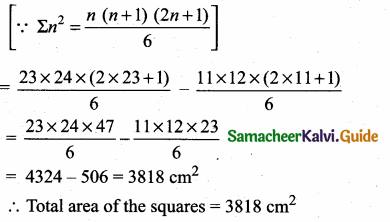
Rekha has 15 square colour papers of sizes 10 cm, 11 cm, 12 cm, …, 24 cm. How much area can be decorated with these colour papers?
Answer:
Area of 15 square colour papers
= 102 + 112 + 122 + …. + 242
= (12 + 22 + 32 + …. + 242) – (12 + 22 + 92)
= \(\frac{24 \times 25 \times 49}{6}-\frac{9 \times 10 \times 19}{6}\)
= 4 × 25 × 49 – 3 × 5 × 19
= 4900 – 285
= 4615
Area can be decorated is 4615 cm2

Samacheer Kalvi 10th Maths Guide Chapter 2 Numbers and Sequences Ex 2.9

Question 7.
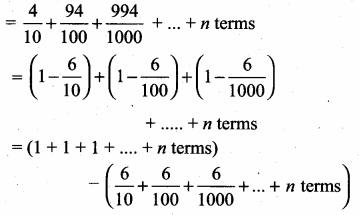
Find the sum of the series (23 – 1)+(43 – 33) + (63 – 153) + …….. to
(i) n terms
(ii) 8 terms
Answer:
Sum of the series = (23 – 1) + (43 – 33) + (63 – 153) + …. n terms
= 23 + 43 + 63 + …. n terms – (13 + 33 + 53 + …. n terms) …….(1)
23 + 43 + 63 + …. n = ∑(23 + 43 + 63 + ….(2n)3]
∑ 23 (13 + 23 + 33 + …. n3)
= 8 (\(\frac{n(n+1)}{2}\))2
= 2[n (n + 1)]2
13 + 33 + 53 + ……….(2n – 1)3 [sum of first 2n cubes – sum of first n even cubes]
Samacheer Kalvi 10th Maths Guide Chapter 2 Numbers and Sequences Ex 2.9 45
Substituting (2) and (3) in (1)
Sum of the series = 2n2 (n + 1)2 – n2 (2n + 1)2 + 2n2(n + 1)2
= 4n2 (n + 1)2 – n2 (2n + 1)2
= n2 [(4(n + 1)2 – (2n + 1)2]
= n2 [4n2 + 4 + 8n – 4n2 – 1 – 4n]
= n2 [4n + 3]
= 4n3 + 3n2

(ii) when n = 8 = 4(8)3 + 3(8)2
= 4(512) + 3(64)
= 2240

Samacheer Kalvi 10th Maths Guide Chapter 1 Relations and Functions Ex 1.5

Students can download Maths Chapter 1 Relations and Functions Ex 1.5 Questions and Answers, Notes, Samacheer Kalvi 10th Maths Guide Pdf helps you to revise the complete Tamilnadu State Board New Syllabus, helps students complete homework assignments and to score high marks in board exams.

Tamilnadu Samacheer Kalvi 10th Maths Solutions Chapter 1 Relations and Functions Ex 1.5

Question 1.
Using the functions f and g given below, find fog and gof Check whether fog = gof.

(i) f(x) = x – 6, g(x) = x2
Answer:
f(x) = x – 6, g(x) = x2
fog = fog (x)
= f(g(x))
fog = f(x)2
= x2 – 6
gof = go f(x)
= g(x – 6)
= (x – 6)2
= x2 – 12x + 36
fog ≠ gof

Samacheer Kalvi 10th Maths Guide Chapter 1 Relations and Functions Ex 1.5

(ii) f(x) = \(\frac { 2 }{ x } \), g(x) = 2x2 – 1
Answer:
f(x) – \(\frac { 2 }{ x } \); g(x) = 2x2 – 1
fag = f[g (x)]
= f(2x2 – 1)
= \(\frac{2}{2 x^{2}-1}\)
gof = g [f(x)]
= g (\(\frac { 2 }{ x } \))
= 2 (\(\frac { 2 }{ x } \))2 – 1
\(=2 \times \frac{4}{x^{2}}-1\)
\(=\frac{8}{x^{2}}-1\)
fog ≠ gof

(iii) f(x) = \(\frac { x+6 }{ 3 } \), g(x) = 3 – x
Answer:
f(x) = \(\frac { x+6 }{ x } \), g(x) = 3 – x
fog = f[g(x)]
= f(3 – x)
Samacheer Kalvi 10th Maths Guide Chapter 1 Relations and Functions Ex 1.5 1

Samacheer Kalvi 10th Maths Guide Chapter 1 Relations and Functions Ex 1.5

(iv) f(x) = 3 + x, g(x) = x – 4
Answer:
f(x) = 3 + x ;g(x) = x – 4
fog = f[g(x)]
= f(x – 4)
= 3 + x – 4
= x – 1
gof = g[f(x)]
= g(3 + x)
= 3 + x – 4
= x – 1
fog = gof

(v) f(x) = 4x2 – 1,g(x) = 1 + x
Answer:
f(x) = 4x2 – 1 ; g(x) = 1 + x
fog = f[g(x)]
= 4(1 + x)
= 4(1 + x)2 – 1
= 4[1 + x2 + 2x] – 1
= 4 + 4x2 + 8x – 1
= 4x2 + 8x + 3
gof = g [f(x)]
= g (4x2 – 1)
= 1 + 4x2 – 1
= 4x2
fog ≠ gof

Question 2.
Find the value of k, such that fog = gof
(i) f(x) = 3x + 2, g(x) = 6x – k
(ii) f(x) = 2x – k, g(x) = 4x + 5
Solution:
(i) f(x) = 3x + 2, g(x) = 6x – k
fog(x) = f(g(x)) = f(6x – k) = 3(6x – k) + 2
= 18x – 3k + 2 …………… (1)
gof(x) = g(f(x)) = g(3x + 2) = 6(3x + 2) – k
= 18x + 12 – k ……………. (2)
(1) = (2)
⇒ 18x – 3k + 2 = 18x + 12 – k
2k = -10
k = -5

(ii) f(x) = 2x – k, g(x) = 4x + 5
fog(x) = f(g(x)) = f(4x + 5) = 2(4x + 5) – k
= 8x + 10 – k ……………… (1)
gof(x) = g(f(x)) = g(2x – k) = 4(2x – k) + 5
= 8x – 4k + 5 ……………. (2)
(1) = (2)
⇒ 8x + 10 – k = 8x – 4k + 5
3k = -5
k = \(\frac{-5}{3}\)

Question 3.
If f(x) = 2x – 1, g(x) = \(\frac { x+1 }{ 2 } \), show that f o g = g o f = x
Answer:
f(x) = 2x – 1 ; g(x) = \(\frac { x+1 }{ 2 } \)
fog = f[g(x)]
Samacheer Kalvi 10th Maths Guide Chapter 1 Relations and Functions Ex 1.5 2
∴ fog = gof = x
Hence it is proved.

Samacheer Kalvi 10th Maths Guide Chapter 1 Relations and Functions Ex 1.5

Question 4.
(i) If f (x) = x2 – 1, g(x) = x – 2 find a, if gof(a) = 1.
(ii) Find k, if f(k) = 2k – 1 and fof (k) = 5.
Solution:
(i) f(x) = x2 – 1, g(x) = x – 2
Given gof(a) = 1
gof(x) = g(f(x)
= g(x2 – 1) = x2 – 1 – 2
= x2 – 3
gof(a) ⇒ a2 – 3 = 1 =+ a2 = 4
a = ± 2
(ii) f(k) = 2k – 1
fo f(k) = 5
f(f(k)m = f(2k – 1) = 5
⇒ 2(2k – 1) – 1 = 5
4 k – 2 – 1 = 5 ⇒ 4k = 8
k = 2

Samacheer Kalvi 10th Maths Guide Chapter 1 Relations and Functions Ex 1.5

Question 5.
Let A,B,C N and a function f: A → B be defined by f(x) = 2x + 1 and g: B → C be defined by g(x) = x2 . Find the range of fog and gof.
Answer:
f(x) = 2x + 1 ; g(x) = x2
fog = f[g(x)]
= f(x2)
= 2x2 + 1
2x2 + 1 ∈ N
g o f = g [f(x)]
= g (2x + 1)
g o f = (2x + 1)2
(2x + 1)2 ∈ N
Range = {y/y = 2x2 + 1, x ∈ N};
{y/y = (2x + 1)2, x ∈ N)

Question 6.
If f(x) = x2 – 1. Find (i)f(x) = x2 – 1, (ii)fofof
Solution:
(i) f(x) = x2 – 1
fof(x) = f(fx)) = f(x2 – 1)
= (x2 – 1 )2 – 1;
= x4 – 2x2 + 1 – 1
= x4 – 2x2
(ii) fofof = f o f(f(x))
= f o f (x4 – 2x2)
= f(f(x4 – 2x2))
= (x4 – 2x2)2 – 1
= x8 – 4x6 + 4x4 – 1

Samacheer Kalvi 10th Maths Guide Chapter 1 Relations and Functions Ex 1.5

Question 7.
If f : R → R and g : R → R are defined by f(x) = x5 and g(x) = x4 then check if f, g are one – one and fog is one – one?
Answer:
f(x) = x5 – It is one – one function
g(x) = x4 – It is one – one function
fog = f[g(x)]
= f(x4)
= (x4)5
fag = x20
It is also one-one function.

Question 8.
Consider the functions f(x), g(x), h(x) as given below. Show that (fog)oh = fo(goh) in each case.
(i) f(x) = x – 1, g(x) = 3x + 1 and h(x) = x2
(ii) f(x) = x2, g(x) = 2x and h(x) = x + 4
(iii) f(x) = x – 4, g(x) = x2 and h(x) = 3x – 5
Solution:
(i) f(x) = x – 1, g(x) = 3x + 1 and h(x) = x2
f(x) = x – 1
g(x) = 3x + 1
f(x) = x2
(fog)oh = fo(goh)
LHS = (fog)oh
fog = f(g(x)) = f(3x + 1) = 3x + 1 – 1 = 3x
(fog)oh = (fog)(h(x)) = (fog)(x) = 3 ……………. (1)
RHS = fo(goh)
goh = g(h(x)) = g(x2) = 3x2 + 1
fo(goh) = f(3x2 + 1) = 3x2 + 1 – 1= 3x………… (2)
LHS = RHS Hence it is verified.

Samacheer Kalvi 10th Maths Guide Chapter 1 Relations and Functions Ex 1.5

(ii) f(x) = x2, g(x) = 2x, h(x) = x + 4
(fog)oh = fo(goh)
LHS = (fog)oh
fog = f(g(x)) = f(2x) = (2x)2 = 4x2
(fog)oh = (fog) h(x) = (fog) (x + 4)
= 4(x + 4)2 = 4(x2 + 8x+16)
= 4x2 + 32x + 64 ………….. (1)
RHS = fo(goh) goh = g(h(x)) = g(x + 4)
= 2(x + 4) = (2x + 8)
fo(goh) = f(goh) = f(2x + 8) = (2x + 8)2
= 4x2 + 32x + 64 ……………… (2)
(1) = (2)
LHS = RHS
∴ (fog)oh = fo(goh) It is proved.

(iii) f(x) = x – 4, g(x) = x2, h(x) = 3x – 5
(fog)oh = fo(goh)
LHS = (fog)oh
fog = f(g(x)) = f(x2) = x2 – 4
(fog)oh = (fog)(3x – 5) = (3x – 5)2 – 4
= 9x2 – 30x + 25 -4
= 9x2 – 30x + 21 ………….. (1)
∴ RHS = fo(goh)
(goh) = g(h(x)) = g(3x – 5) = (3x – 5)2
= 9x2 – 30x + 25
fo(goh) = f(9x2 – 30 x + 25)
= 9x2 – 30x + 25 – 4
= 9x2 – 30x + 21 …………… (2)
(1) = (2)
LHS = RHS
∴ (fog)oh = fo(goh)
It is proved.

Samacheer Kalvi 10th Maths Guide Chapter 1 Relations and Functions Ex 1.5

Question 9.
Let f = {(-1, 3), (0, -1), (2, -9)} be a linear function from Z into Z. Find f(x).
Answer:
The linear equation is f(x) = ax + b
f(-1) = 3
a(-1) + b = 3
-a + b = 3 ….(1)
f(0) = -1
a(0) + b = -1
0 + b = -1
b = -1
Substitute the value of b = -1 in (1)
-a – 1 = 3
-a = 3 + 1
-a = 4
a = -4
∴ The linear equation is -4(x) -1 = -4x – 1 (or) – (4x + 1)

Samacheer Kalvi 10th Maths Guide Chapter 1 Relations and Functions Ex 1.5

Question 10.
In electrical circuit theory, a circuit C(t) is called a linear circuit if it satisfies the superposition principle given by C(at1 + bt2) = aC(t1) + bC(t2), where a,b are constants. Show that the circuit C(t) = 31 is linear.
Solution:
Given C(t) = 3t. To prove that the function is linear
C(at1) = 3a(t1)
C(bt2) = 3 b(t2)
C(at1 + bt2) = 3 [at1 + bt2] = 3at1 + 3bt2
= a(3t1) + b(3t2) = a[C(t1) + b(Ct2)]
∴ Superposition principle is satisfied.
Hence C(t) = 3t is linear function.

Samacheer Kalvi 10th Maths Guide Chapter 2 Numbers and Sequences Ex 2.2

Students can download Maths Chapter 2 Numbers and Sequences Ex 2.2 Questions and Answers, Notes, Samacheer Kalvi 10th Maths Guide Pdf helps you to revise the complete Tamilnadu State Board New Syllabus, helps students complete homework assignments and to score high marks in board exams.

Tamilnadu Samacheer Kalvi 10th Maths Solutions Chapter 2 Numbers and Sequences Ex 2.2

Question 1.
For what values of natural number n, 4th can end with the digit 6?
Answer:
4n = (22)n = 22n
= 2n × 2n
2 is a factor of 4n
∴ 4n is always even.

Samacheer Kalvi 10th Maths Guide Chapter 2 Numbers and Sequences Ex 2.2

Question 2.
If m, n are natural numbers, for what values of m, does 2n × 5n ends in 5?
Solution:
2n × 5m
2n is always even for all values of n.
5m is always odd and ends with 5 for all values of m.
But 2n × 5m is always even and ends in 0.
∴ 2n × 5m cannot end with the digit 5 for any values of m. No value of m will satisfy 2n × 5m ends in 5.

Question 3.
Find the H.C.F. of 252525 and 363636.
Answer:
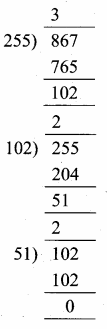
To find the HCF of 252525 and 363636 by using Euclid’s Division algorithm.
363636 = 252525 × 1 + 111111
The remainder 111111 ≠ 0
By division of Euclid’s algorithm
252525 = 111111 × 2 + 30303
The remainder 30303 ≠ 0
Again by division of Euclid’s algorithm
111111 = 30303 × 3 + 20202
The remainder 20202 ≠ 0
Again by division of Euclid’s algorithm.
30303 = 20202 + 10101
The remainder 10101 ≠ 0
Again by division of Euclid’s algorithm.
20202 = 10101 × 2 + 0
The remainder is 0
∴ The H.C.F. is 10101

Samacheer Kalvi 10th Maths Guide Chapter 2 Numbers and Sequences Ex 2.2

Question 4.
If 13824 = 2a × 3b then find a and b?
Answer:
Using factor tree method factorise 13824
Samacheer Kalvi 10th Maths Guide Chapter 2 Numbers and Sequences Ex 2.2 2
Samacheer Kalvi 10th Maths Guide Chapter 2 Numbers and Sequences Ex 2.2 1
13824 = 29 × 33
Given 13824 = 2a × 3b
Compare we get a = 9 and b = 3

Samacheer Kalvi 10th Maths Guide Chapter 2 Numbers and Sequences Ex 2.2

Aliter:
13824 = 29 × 33
Compare with
13824 = 2a × 3b
The value of a = 9 b = 3

Question 5.
If p1x1 × p2x2 × p3x3 × p4x4 = 113400 where p1 p2, p3, p4 are primes in ascending order and x1, x2, x3, x4, are integers, find the value of p1,p2,p3,p4 and x1,x2,x3,x4.
Answer:
Given 113400 = p1x1 × p2x2 × p3x3 × p4x4
Using tree method factorize 113400
Samacheer Kalvi 10th Maths Guide Chapter 2 Numbers and Sequences Ex 2.2 3
113400 = 23 × 34 × 52 × 7
compare with
113400 = p1x1 × p2x2 × p3x3 × p4x4
P1 = 2, x1 = 3
P2 = 3, x2 = 4
P3 = 5, x3 = 2
P4 = 7, x4 = 1

Samacheer Kalvi 10th Maths Guide Chapter 2 Numbers and Sequences Ex 2.2

Question 6.
Find the L.C.M. and H.C.F. of 408 and 170 by applying the fundamental theorem of Arithmetic.
Answer:
Factorise 408 and 170 by factor tree method
Samacheer Kalvi 10th Maths Guide Chapter 2 Numbers and Sequences Ex 2.2 4
Samacheer Kalvi 10th Maths Guide Chapter 2 Numbers and Sequences Ex 2.2 5
408 = 23 × 3 × 17
170 = 2 × 5 × 17
To find L.C.M. list all prime factors of 408 and 170 of their greatest exponents.
L.C.M. = 23 × 3 × 5 × 17
= 2040
To find the H.C.F. list all common factors of 408 and 170.
H.C.F. = 2 × 17 = 34
L.C.M. = 2040 ; HCF = 34

Samacheer Kalvi 10th Maths Guide Chapter 2 Numbers and Sequences Ex 2.2

Question 7.
Find the greatest number consisting of 6 digits which is exactly divisible by 24,15,36?
Answer:
The greatest number of 6 digits is 999999.
The greatest number must be divisible by L.C.M. of 24, 15 and 36
Samacheer Kalvi 10th Maths Guide Chapter 2 Numbers and Sequences Ex 2.2 6
24 = 23 × 3
15 = 3 × 5
36 = 22 × 32
L.C.M = 23 × 32 × 5
= 360
To find the greatest number 999999 must be subtracted by the remainder when 999999 is divided by 360
The greatest number in 6 digits = 999999 – 279
= 999720
Samacheer Kalvi 10th Maths Guide Chapter 2 Numbers and Sequences Ex 2.2 7

Question 8.
What is the smallest number that when divided by three numbers such as 35, 56 and 91 leaves remainder 7 in each case?
Solution:
35 = 5 × 7
56 = 2 × 2 × 2 × 7
91 = 7 × 13
LCM of 35, 56, 91 = 5 × 7 × 2 × 2 × 2 × 13 = 3640
∴ Required number = 3647 which leaves remainder 7 in each case.

Samacheer Kalvi 10th Maths Guide Chapter 2 Numbers and Sequences Ex 2.2

Question 9.
Find the least number that is divisible by the first ten natural numbers?
Answer:
Find the L.C.M of first 10 natural numbers
Samacheer Kalvi 10th Maths Guide Chapter 2 Numbers and Sequences Ex 2.2 8
The least number is 2520

Modular Arithmetic
Two integers “a” and “b” are congruence modulo n if they differ by an integer multiple of n. That b – a = kn for some integer k. This can be written as a = b (mod n).

Euclid’s Division Lemma and Modular Arithmetic

Let m and n be integers, where m is positive. By Euclid’s division Lemma we can write n = mq + r where 0 < r < m and q is an integer.
This n = r (mod m)