Samacheer Kalvi 10th English Model Question Paper 1

Students can Download Samacheer Kalvi 10th English Model Question Paper 1 Pdf, Samacheer Kalvi 10th English Model Question Papers helps you to revise the complete Tamilnadu State Board New Syllabus, helps students complete homework assignments and to score high marks in board exams.

Tamil Nadu Samacheer Kalvi 10th English Model Question Paper 1

General Instructions:

  1. The question paper comprises of four parts.
  2. You are to attempt all the sections in each part. An internal choice of questions is provided wherever applicable.
  3. All questions of Part I, II, III and IV are to be attempted separately.
  4. Question numbers I to 14 in Part I are Multiple Choice Questions of one mark each. These are to be answered by writing the correct answer along with the corresponding – option code.
  5. Part II has got four sections. The questions are of two marks each. Question numbers 15 to 18 in Section I and Question numbers 19 to 22 in Section II are to be answered in about one or two sentences each. Question numbers 23 to 28 in Section III and IV are to be answered as directed.
  6. Question numbers 29 to 45 in Part III are of five marks each and have been divided in five sections. These are to be answered as directed.
  7.  Question numbers 46 and 47 in Part IV are of eight marks each. Question number 47 has four questions of two marks each. These are to be answered as directed.

Time: 2.30 Hours
Maximum Marks: 100

Part – I

Answer all the questions. [14 x 1= 14]
Choose the most suitable answer and write the code with the corresponding answer.
Choose the appropriate synonyms for the italicised words.

Question 1.
The whole family walked about on the big plateau.
(a) highland
(b) pinnacle
(c) lake
(d) valley
Answer:
(a) highland

Question 2.
Before I could intervene, the cops were in the attic.
(a) interfere
(b) interrogate
(c) instigate
(d) investigate
Answer:
(a) interfere

Question 3.
Nagen had a rustic look.
(a) urban
(b) rural
(c) modem
(d) crude
Answer:
(d) crude

Samacheer Kalvi 10th English Model Question Paper 1

Choose the appropriate antonym for the italicised words.

Question 4.
I gave my crew members the best dishes with the limited resources.
(a) limitations
(b) partial
(c) incomplete
(d) boundless
Answer:
(d) boundless

Question 5.
They continue to grapple with the challenges of inclusion.
(a) seclusion
(b) enclosure
(c) addition
(d) exclusion
Answer:
(d) exclusion

Question 6.
The man was startled.
(a) annoyed
(b) alarmed
(c) reassured
(d) amused
Answer:
(c) reassured

Question 7.
Choose the correct plural form of ‘millennium’.
(a) millennia
(b) millenniums
(c) millenniumes
(d) millenniaas
Answer:
(a) millennia

Question 8.
Form a derivative by adding the right suffix to the word – imagine.
(a) or
(b) ary
(c) al
(d) tion
Answer:
(d) tion

Samacheer Kalvi 10th English Model Question Paper 1

Question 9.
Choose the correct expansion of the abbreviation SAARC.
(a) South African Association for Regional Cooperation
(b) South Asian Association for Railways Cooperation
(c) South Asian Association for Regional Cooperation
(d) South Asian Association for Regional Corporation
Answer:
(c) South Asian Association for Regional Cooperation

Question 10.
Complete the following sentence with the most appropriate phrasal verb given below:
The match was ……………. due to rain.
(a) called upon
(b) called on
(c) called off
(d) called at
Answer:
(c) called off

Question 11.
Choose the suitable option to pair it with the word ‘flower’ to form a compound word.
(a) sun
(b) rain
(c) sky
(d) son
Answer:
(a) sun

Question 12.
Fill in the blank with the most appropriate preposition given below:
The cat was hiding …………………….. the table.
(a) by
(b) under
(c) at
(d) for
Answer:
(b) under

Question 13.
Complete the following sentence using the most appropriate tense form of the verb given below:
I speak, and the words appear on my screen and then ……………………….. I them out.
(a) can be printed
(b) can printing
(c) were printed
(d) can print
Answer:
(d) can print

Samacheer Kalvi 10th English Model Question Paper 1

Question 14.
Choose the most appropriate linker from the given four alternatives.
The baby isn’t sleeping, ………………………. it’s late.
(a) in spite
(b) even though
(c) although
(d) so
Answer:
(b) even though

Part – II [10 x 2 = 20]

Section -I

Answer any THREE of the following questions in a sentence or two. [3 x 2 = 6]

Question 15.
What happened to the young seagull when it landed on the green sea?
Answer:
When the young seagull landed on the green sea, he completely forgot that he had not always been able to fly and shrieked shrilly, turning his beak sideways and crowed amusedly. He screamed with fright when he dropped his legs to stand on the green sea and sank into it.

Question 16.
What was the mean act of Holmes with Dr. Watson?
Answer
When Dr. Watson offered to examine symptoms and treat him Holmes said he would have a doctor in whom he had confidence. This was really very rude of Holmes and showed his madness.

Question 17.
What is the meaning of Tarini? Why is it worshipped?
Answer
The word ‘Tarini ’ means ‘boat ’ and in Sanskrit it means ‘ Saviour ’. Tara – Tarini is worshipped for safety and success at sea.

Samacheer Kalvi 10th English Model Question Paper 1

Question 18.
What did Sasanka tell Aditya, looking at the fifteen ten-rupee notes in his hand?
Answer
Sasanka said to Aditya, ‘Aditya, this smacks too much of charity. Doesn’t it? I had recognised you at Nagen uncle’s tea shop by that mole on your right cheek. I could see you had not recognised me. So I recited the same poem that I had recited on the prize-giving day, on purpose, so that you may remember. Then, when you came to visit me, I couldn’t help venting my anger on you.’

Section – II

Read the following sets of poetic lines and answer any THREE of the following. [3 x 2 = 6]

Question 19.
“In the dim past, nor holding back in fear From what the future veils; but with a whole And happy heart, that pays its toll
To Youth and Age, and travels on with cheer.”
(a) How can one travel on with cheer?
(b) What is meant by ‘veil’?
Answer
(a) One can travel cheerfully with a happy heart.
(b) A veil is a cover that is used to partially hide something.

Question 20.
“And so it were wisest to keep our feet From wandering into Complaining Street;”
(a) What is the wisest thing that the poet suggests?
(b) What does the phrase ‘to keep our feet from wandering’ refer to?
Answer
(a) The wisest thing is to avoid wandering into the complaining street.
(b) The phrase, ‘to keep our feet from wandering’ refer to restricting your path from strolling.

Question 21.
“At last by starvation and famine made bold,
All dripping with wet, and all trembling with cold,”
(a) What made the cricket bold?
(b) Why did the cricket drip and tremble?
Answer
(а) Starvation and hunger made the cricket bold.
(b) The cricket dripped wet and trembled with cold because it was winter.

Samacheer Kalvi 10th English Model Question Paper 1

Question 22.
“Some water, coal, and oil is all we ask,
And a thousandth of an inch to give us play:
And now, if you will set us to our task,
We will serve you four and twenty hours a day!”
(a) What is the requirement of the machines?
(b) What does the second line indicate?
Answer
(a) The requirement of the machines is water, coal and oil.
(b) The second line indicates the close arrangement of the nuts, screws and bolts.

Section – III

Answer any THREE of the following. [3 x 2 = 6]

Question 23.
Rewrite the following sentence to the other voice.
Answer
I will never forget this experience.
This experience will not be forgotten by me

Question 24.
Rewrite using indirect speech.
Answer
They asked us, “Are you going anywhere at the weekend.?”
They asked us if we were going anywhere at the weekend.

Question 25.
Punctuate the following.
Answer

  • M Hamel saw me and said very kindly go to your place quickly, little Franz we were beginning without you
  • M. Hamel saw me and said very kindly, “Go to your place quickly, little Franz. We were beginning without you

Question 26.
Transform the following sentence into a simple sentence.
Answer
He is rich, yet he is unhappy.
Despite being rich he is unhappy.

Samacheer Kalvi 10th English Model Question Paper 1

Question 27.
Rearrange the words in the correct order to make meaningful sentences.
(a) Six puppies / to/ had / Maya’s / given birth / dog
(b) Many times / Sita told Ravi / two dogs / have / already / we
Answer
(a) Maya’s dog had given birth to six puppies.
(b) Many times Sita told Ravi we already have two dogs.

Section – IV

Answer the following. [1 x 2 = 2]

Question 28.
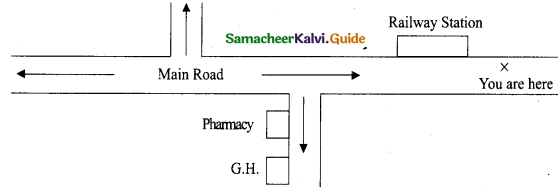
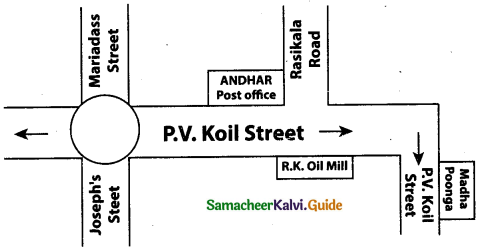
Help the stranger from Mariadass street to reach his/her destination, Madha Poonga with the help of the given road-map and write down the steps
Samacheer Kalvi 10th English Model Question Paper 1.1

  • From Mariadoss street, proceed further and take the left at the crossroads on P.V.Koil Street.
  • Go further down and cross Andhra Post office on the left and R.K.Oil Mill on the right.
  • After half a furlong, you must take the right on P. V.Koil street where you will find Madha Poonga on the left.

Part – III [10 x 5 = 50]
Section – I

Answer any TWO of the following in utmost 10 lines. [2 x 5 = 10]

Question 29.
What do you know about James Thurber, the narrator?
Answer:
The narrator James Thurber, presents himself as acting judiciously, although his actions are uncommon to raise the uncertainties of the policemen. He is the first person in the household to hear the mysterious sound, as he is stepping out of the bathtub at 1:15 a.m. on November 17th. After waking his brother Herman, he is the one who resolves that the reason of the sound downstairs must be an apparition. When his hasty mother decides that the sounds must be caused by intruders, the narrator thinks that she is past reasoning. Even when the cops arrive, he is still wrapped in a towel from his bath.

Later, when the reporter comes around asking questions, the narrator puts on one of his mother’s blouses, explaining that it is the only thing that he can find at the moment. He chooses to be honest with the reporter and tell him that the problem was caused by ghosts, but the reporter does not take him earnestly. Later, when the policeman who has been shot by Grandfather wants to challenge him and take his gun back, the narrator mediates with composed receptivity and offers to take the gun over to the police station in the morning.
“A judicious reticence is hard to learn, but
it is a lifetime lesson.’’

Question 30.
What are the various innovations made in India to help the differently-abled lead a normal life?
Answer:
There are various innovations made in India to help the differently abled lead a normal life. Lechal Shoes by Krispian Lawrence is an innovation for the disabled to use GPS & Blutooth. This enabled shoes to help the disabled navigate streets, based on instructions from map software on a smartphone. The App also records the route and also counts steps.

Blee Watch by industrial designers Nupura Kirloskar and Janhavi Joshi of Mumbai invented the Smart watch for the hearing impaired. It converts sound waves into vibrations and colour codes to alert users to emergency sounds and ringing doorbells. It even helps them feel the rhythm of music. iGEST by Anil Prabhakar, IIT-M professor and cofounder of enability technologies innovated a wearable device which tracks gestures of speech-impaired people and speaks for them. I guess technology makes a differently abled person’s life easier.
“Exploration is the engine that drives Innovation.”

Samacheer Kalvi 10th English Model Question Paper 1

Question 31.
What do you know about the Navikaa Sagar Parikrama?
Answer:
Navika Sagar Parikrama was a project undertaken in consonance with the National policy to empower women to attain their full potential. The Project is considered essential towards promoting ocean sailing activities in the Navy while depicting Government of India’s thrust for Nari Shakti which means women power. The Chief of the Naval Staff, Admiral Sunil Lanba gave his welcome speech when this project was launched.

The voyage was aimed to show case ‘Make in India’ initiative by sailing on-board indigenously built INSV Tarini. The special feature of this sailboat is that it encouraged use of environment friendly non-conventional renewable energy resources such as the wind; collected and updated meteorological, ocean and wave data on regular basis for accurate weather forecast by India Meteorological Department (IMD) and also collected data for monitoring marine pollution on high seas.
“The goal is not to sail the boats, but rather to help the boat sail herself.’’

Question 32.
‘Man does change with time’-What were the various changes that came about in Aditya?
Answer:
Man does change with time. According to Sanyal, Aditya was a boy who could never compete him in scholastic or non-scholastic activities. He was a liar and an envious personality. But, years later Aditya no longer is the same personality. He is more matured and responsible. His childish nature makes him feel guilty, for stealing the medal that belonged to Sanyal.

Aditya now wanted to restore Sanyal, his lost happiness. Knowing about his financial constraints, he decides to give him the cost of the silver medal. He drives with a firm determination to his ancestral house. When he reaches, he rushes to the attic. Aditya gets on top of a packing Case and pushes his hand inside the ventilator, upsetting a sparrow’s nest. However, he heaves a sigh of relief when he gets what he had been looking for. He goes straight to the Jeweller to determine the current rate of the medal in the market. All these surely show a remarkable change in him.

Even when Sanyal behaves rudely, Aditya is courteous and friendly. His only intention is penitence. He is so mature that he even understands and justifies the grievances Sanyal had in his heart. When Sanyal prefers the medal, without second thoughts he restores it to Sanyal whole-heartedly.
“Change is universal.”

Section – II

Answer any TWO of the following in utmost 10 lines. [2 x 5 = 10]

Question 33.
Narrate the fable of ‘The Ant and the Cricket’ in your own words.
Answer:
The silly young cricket was fun-loving. He used to sing all through the pleasant sunny months of summer and spring. He was short-sighted. He didn’t bother to store food for the rainy season and cold winter. When the earth was covered with ice and snow, he found that he had nothing to eat and his cupboard was empty. There were no flowers nor leaves on the trees. He grew nervous. Starvation could be seen over his face. Wet with the rain and shivering with cold, the hungry cricket went to an ant to get shelter and food.

He made it clear that he would return the borrowed grain the next day. With humility, the miserly ant said that he was surely the servant and friend of the cricket. But as a matter of principle, the ants neither borrow nor lend. He asked why he never bothered to store something for the rainy day. The cricket admitted that he had been careless and foolish. He enjoyed the beauties of summer and sang merrily. The ant then told him bluntly to go and dance all winter and turned the poor cricket out.
‘Prudence is foresight and farsightedness. ’

Samacheer Kalvi 10th English Model Question Paper 1

Question 34.
The poem ‘No men are foreign’ has a greater relevance in today’s world. Elucidate.
Answer:
The poet, James Kirkup, quotes various instances to prove that no men are foreign. The very title of the poem is thought-provoking and forces the reader to think about the issue of people living in other countries as foreigners and strangers. As the poem advances, the poet recurrently emphasises that all human beings are indistinguishable in their nature and tactics. All live on the same earth; enjoy air, sun and water; love peace and are opposed to war.

They all have mutual experiences and toil in a similar manner to earn the living. The realistic reasoning put forth by the poet and the numerous reminders fully satisfy the reader that no men are foreign. He gets the message that alienation from fellow brethren is equally damaging to himself. He also understands that by treating other men as foreign, the world stands exposed to the risk of war which can lead to permanent destruction and pollution of mother earth. It is true that many people have been telling us to live harmoniously since long. We never follow their message.

We also know that our greed to get more wealth and power cannot give us peaceful life. But some deep-rooted evils in our society make us draw a distinction between people. We know that all customs and conventions have been made by people. We start to hate even our family members due to our ego to be more powerful. By doing so, we at last harm ourselves. In society, people dislike selfish people. So before going to hurt other’s feeling, first of all we should think whether doing such act with others are justified by other people or society.
‘Smile at strangers and you just might change a life. ’

Question 35.
Read the following stanza and answer the questions given below.
“Let me but live my life from year to year,
With forward face and unreluctant soul;
Not hurrying to, nor turning from the goal; – Not mourning for the things that disappear ”
(i) Pick out the alliterated words in the first line.
(ii) What is the figure of speech used in the second line?
(iii) Pick out the rhyming words from the above lines.
(iv) Give an example of the usage of couplet in the above stanza.
Answer:
(i) ‘Let, live, life’ are the alliterated words in the first line.
(ii) The figure of speech is alliteration, (e.g. forward face)
(iii) Year and disappear; soul and goal are the rhyming words.
(iv) With forward face and unreluctant soul;
Not hurrying to, nor turning from the goal;

Samacheer Kalvi 10th English Model Question Paper 1

Question 36.
Paraphrase the following stanza.
Some water, coal, and oil is all we ask,
And a thousandth of an inch to give us play:
And now, if you will set us to our task,
We will serve you four and twenty hours a day!
Answer:
Here it is clearly stated that the only requirement for the machine is water, coal and oil. The moving parts may have a clearance of a thousandth of an inch which may be the permissible variation from the required dimensions. These parts are closely arranged with bolts and nuts leaving only less than an inch for the movement of wheels. With such a setup, the machines are willing to work round the clock, non-stop without any rest.

Section – III

Answer any ONE of the following: [1 x 5 = 5]

Question 37.
Rearrange the following sentences in coherent order.
(i) Peter’s mother asked Peter to go across the dike and take cakes to his friend.
(ii) The little boy was glad to go on such an errand, and started off with a light heart.
(iii) Holland is a country where much of the land lies below sea level.
(iv) Even the little children know the dikes must be watched every moment.
(v) Peter’s father opened and closed the sluices for ships to pass out of Holland’s canals into the great sea.
Answer:
Rearranged number sequence: (iii), (iv), (v), (i), (ii)
(iii) Holland is a country where much of the land lies below sea level.
(iv) Even the little children know the dikes must be watched every moment.
(v) Peter’s father opened and closed the sluices for ships to pass out of Holland’s canals into the
great sea.
(i) Peter’s mother asked Peter to go across the dike and take cakes to his friend.
(ii) The little boy was glad to go on such an errand, and started off with a light heart.

Question 38.
Read the following passage and answer the questions that follow.
The next room, a broad gallery about a quarter of a mile long, was devoted to publicity, and it well may be imagined what the publicity for such a journal as the Earth Herald had to be. It brought in a daily average of three million dollars. They are gigantic signs reflected on the clouds, so large that they can be seen all over a whole country.

From that gallery a thousand projectors were unceasingly employed in sending to the clouds, on which they were reproduced in colour, these inordinate advertisements. At that moment the clock struck twelve. The director of the Earth Herald left the hall and sat down in a rolling armchair. In a few minutes he had reached his dining room half a mile away, at the far end of the office. The table was laid and he took his place at it.

Within reach of his hand was placed a series of taps and before him was the curved surface of a phonotelephote, on which appeared the dining room of his home in Paris. Mr and Mrs Bennett had arranged to have lunch at the same time – nothing could be more pleasant than to be face to face in spite of the distance, to see one another and talk by means of the phonotelephotic apparatus.
Questions
(i) Where was the broad gallery?
(ii) What happened in the broad gallery?
(iii) What was the income of the Earth Herald every day?
(iv) Why did the director sit on the roiling armchair?
(v) State the use of the phonoteleohote.
Answer:
(i) The broad gallery was in Earth Herald, the world’s largest newspaper.
(ii) The broad gallery was devoted to publicity. From that gallery a thousand projectors were unceasingly employed in sending to the clouds, on which they were reproduced in colour, inordinate advertisements.
(iii) The income of Earth Herald was an average of three million dollars every day.
(iv) He sat down in a rolling armchair to reach his dining room which was half a mile away, at the far end of the office.
(v) One can see each other and talk by means of the phonotelephotic apparatus.

Section – IV

Answer any FOUR of the following. [4 x 5 = 20]

Question 39.
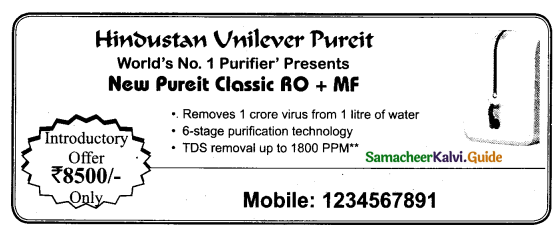
Prepare an attractive advertisement using the hints given below.
Branded water purifier – Introductory offer only Rs. 8,500/-. Best virus remover
Samacheer Kalvi 10th English Model Question Paper 1.2

Question 40.
You are S. Sundaram. Write a letter to the Commissioner of Chennai Corporation, complaining about the poor sanitary conditions and mosquito menace in your locality.
Answer:
S. Sundaram
34, Periyar Road
Chennai-46
19 September, 20XX
The Commissioner
Chennai Municipal Corporation
Chennai
Sir,
Sub: Poor sanitary conditions and mosquito menace in Periyar Road I want to draw your kind attention towards the poor sanitary conditions prevailing in our locality – Periyar Road. It seems that the cleaners have forgotten the existence of this locality on the civic map of Chennai. Heaps of rubbish are lying here and there, with flies swarming around and pigs wallowing in the filth and mud caused by the overflow of dirty water from the drains on to the road. The drains are choked as they are neither cleaned nor flushed.

The dirty water collects on the road forming cesspools of filthy water. There are also many pits on the roads which are full of drain water. All these serve as breeding places for mosquitoes. The mosquito menace is so intense in our locality that we have to use anti mosquito sprays, mats and repellants have undisturbed sleep for a couple of hours. You are requested to pay
a surprise visit to the locality and judge the state yourself. Kindly take some immediate and effective steps to improve the sanitation and rid us of the menace of mosquitoes.

Hoping for a favourable action.
Yours faithfully
S. Sundaram

Address on the envelope
To
The Commissioner
Chennai Municipal Corporation
Chennai

Samacheer Kalvi 10th English Model Question Paper 1

Question 41.
You are Juliet / Gideon, Gymkhana Club of Coimbatore. Draft a notice to be sent to the members asking them to attend the extraordinary meeting of the Governing Body (Insert the necessary details).
Answer:

Gymkhana Club, Coimbatore
10 March 20XX
NOTICE

Members are requested to make it convenient to attend an extraordinary meeting of the Governing Body to discuss amendments in guest charges and
monthly subscriptions.
Date : 20th March 20XX Time : 7 p.m.
Place : Gymkhana Club Complex, Coimbatore
Governing Body members are requested to stay for dinner.

Prabhat/Parvi
Secretary

Question 42.
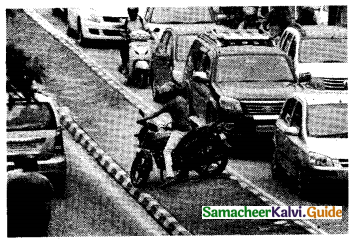
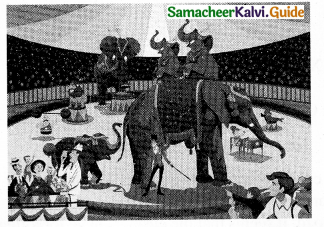
Look at the following picture and express your views on it in about five sentences.
Samacheer Kalvi 10th English Model Question Paper 1.3
Answer:
Circus
In the world of public entertainment, circus occupies a prominent place. We feel thrilled to watch the antics of the lion, bear and elephants who dance to their ring master’s tunes. Animals were born free, but man has tamed them and uses them for his own benefit. The tricks and feats of these animals provide a sheer contrast to the adventurous feats of performing artistes. The children express their joy with clapping while the grown-ups just marvel at the daredevilry of the ringmasters.

Question 43.
Make notes or write a summary of the following passage.
Answer:
The greatness of a country depends upon its people. India is fortunate to have vast human resources. Our countrymen are second to none in intelligence and in doing hard work. From the ancient period Indians excelled in art, architecture, knowledge of metals, medicines, literature etc., After our independence in 1947, the Government took steps to improve our country in all sphere. By the first Five-Year Plan was specially designed to improve our irrigational methods. By the five year plans, provisions are made for the development of the country.

The first Five-Year Plan was specially designed to improve our irrigational methods. By the green revolution we attained self sufficiency in the field of agricultural production. The present age is the atomic age. India too established an Atomic Energy Commission under the guidance of Dr. Bhabha. India made the first successful nuclear explosion on 18th Mary, 1974 which made India the sixth member of the world nuclear club.

No other country’s scientists helped; it was purely Indian efforts. We have sent our Indian cosmonaut to space also. On April 3,1984 Shri Rakesh Sharma, the best pilot of Indian Air Forse, travelled into space with two Soviet spacemen in Soyuz II spaceship.

Notes
Title: Greatness of India
1. (a) Greatness of the country – people
(b) our country men are second to none
(c) From the ancient people Indians excelled in arts and crafts
(d) After Independence Government took steps to improve in all spheres
(e) The first five year plan was designed
(f) Green revolution attained self sufficiency

2. (a) The present age is the atomic age
(b) India made the first nuclear explosion
(c) India sent cosmonauts to space

Summary

Title: Greatness of India
Rough Draft
India fortunate to have vast human resources. Our countrymen are second to none in intelligence and in doing hard work. Ancient Indians excelled in art, architecture, metallurgy, medicine, literature etc After Independence, by the five year plans, provisions are made for the development of the country green revolution we attained self sufficiency in the field of agricultural production. Present age is the atomic age. An Atomic Energy Commission under the guidance of Dr. Babha. Due to the successful clear explosion in 1974, India the sixth member of the world nuclear club. It was purely Indian effort we have sent Rakesh Sharma to space in Soyuz II.

Fair Draft:

India is fortunate to have vast human resources. Ancient Indians excelled in art, architecture, metallurgy, medicine, literature etc., After Independence by the green revolution we attained self sufficiency in agricultural production. Present age is the atomic age. Due to the successful nuclear explosion in 1974, India is the sixth member of the world nuclear club.
No. of words in the Fair Draft: 55

Samacheer Kalvi 10th English Model Question Paper 1

Question 44.
Identify and correct the errors in the following sentences.
(a) A group of twelve students are travelling together from Mumbai to Kanyakumari by the last week of September.
(b) One of his sons are a doctor by profession in the United States of America for nearly ten years.
(c) The decoration of the new house, including the furniture are most pleasing.
(d) Though senior in age, his father is junior than my father in service.
(e) He is going everyday for a morning walk with his friends and neighbours.
Answer:
(a) A group of twelve students are travelling together from Mumbai to Kanyakumari in the last week of September.
(b) One of his sons is a doctor by profession in the United States of America for nearly ten years.
(c) The decoration of the new house, including the furniture is most pleasing.
(d) Though senior in age, his father is junior to my father in service.
(e) He goes everyday for a morning walk with his friends and neighbours.

Section – V

Quote from memory. [1 x 5 = 5]

Question 45.
Remember, no …………… and water.
Answer:
Remember, no men are strange, no countries foreign
Beneath all uniforms, a single body breathes
Like ours: the land our brothers walk upon
Is earth like this, in which we all shall lie.
They, too, aware of sun and air and water,

Part – IV

Write a paragraph of about 150 words by developing the following hints. [2 x 8 = 16]

Question 46.
(a) Love of a son for his mother – opposition to the law – tyrant – elderly people inefficient – importance of aged people – decree. Foothills – proclamation – cruel decree – killing aged people wasn’t common – poor farmer distressed.
Answer:
“The Aged Mother” by Matsuo Basho is a Japanese folklore about the love of a son for his mother and the mother’s love in return for her son. They encountered this agony as an opposition to the law of placing aged people to death. The tyrant stated the law of killing the elderly people because he was a warrior himself who felt that only the young men and women who were robust were useful to the country. According to the warrior, elderly people were inefficient and couldn’t be obliging to individuals who were however healthy as him.

To such a despotic leader, the importance of aged people was insignificant. Hence, he pronounced it as a decree. When the poor farmer and his aged mother who lived in a poor hut of the foothills in the country of Shining heard the proclamation by the despotic leader who announced the cruel decree of killing elderly people in that place, their heart was distressed. During this period, killing aged people wasn’t common. Therefore, when the poor farmer came to know of the decree he bore sadness in his heart. He was extremely concerned and was in deep thoughts to make an escape.

[OR]

(b) Narrate the story of Zigzag by developing the following hints.
Dr. Ashok T Krishnan’s family – shelter Somu’s new pet – talks twenty-one languages – genuine African witch doctor’s gift – to Mrs Krishnan a nuisance – children Arvind, Maya – the unique gifts – ZigZag, a disappointment – steadfast sleep – chandelier and fan blades – maid Lakshmi – unfinished masterpiece -e-mail – seventh day – reply – Zig Zag’s snore take a turn – at the clinic.
Answer:
Dr. Ashok T Krishnan’s family shelters Somu’s new pet, Zig-Zag, a queer-looking African bird, who is known for talking and singing in twenty-one different languages. They consider Zigzag to be a harmless, unusual and lovable bird bred by a genuine African witch doctor, who gifted it to Somu when he toured the deepest jungles of Africa. To Somu, the bird is an absolute treasure and a real help. Mrs. Krishnan considers it a nuisance.

Their son Arvind and daughter Maya are keen on having the pet. They both discuss the unique gifts given by Uncle Somu viz insect-eating plant, tiny shark teeth penknife and the aboriginal boomerang. ZigZag turns out to be a disappointment for the Krishnan family. Zigzag does nothing but sleep and snore to annoy all around. All attempts to awaken the bird goes in vain. The bird at first before resorting to a steadfast sleep eats the nuts and fruits, keeps them safe in the chandelier and the fan blades.

Samacheer Kalvi 10th English Model Question Paper 1

The maid Lakshmi shrieks in an excited manner thinking she is blessed with papayas and bananas raining inside the room. Mrs. Krishnan is annoyed at the slice of overripe papaya whizzing off the fan and splattering all over her unfinished masterpiece – Sunset at Marina spreading streaks of gooey orange pulp and shiny black seeds all over it. Dr. Krishnan leaves an e-mail message for Somu, asking him for clear instructions on how to stop Zigzag from snoring. On the seventh day, they receive the reply that he never sleeps nor snores. Mrs. Krishnan wants it to be sent to Visu as her friends and experts will come home and choose her paintings for the exhibition. Krishnan takes ZigZag in the car and hopes to find Visu so that ZigZag’s snore doesn’t add to the din of the sobs and shrieks produced by the tiny patients waiting for him.

However, Ziggy-Zagga, King-of-the-Tonga, was not familiar to being kept waiting, makes his way to the clinic where he perches himself on the nurse’s reception table. Suddenly things take a turn when ZigZag starts speaking. It’s Zigzag’s voice, clear and commanding. Gone was Zigzag’s bored and grumpy expression. Instead, the bird looked happy and alert as it went about the job it had been trained for, first with the African witch doctor and then with Dr. Somu.

Question 47.
Read the following passage and answer the questions given below:
Answer:
Rambutan is a close cousin of the litchi fruit, but not as well known. It is a member of the Sapindaceae family and resembles the litchi, except for its long, flesh coloured spines. Rambutan (Napheluim lappaceum) is an ever green tropical tree which reaches a height of 50 to 80 feet and has a straight trunk, with a dense spreading crown. There are both male and female trees and only female trees bear fruit. It grows best in deep, clay loam or sandy loam rich in organic matter.

Rambutan is usually propagated by seeds. The seeds taken from the fruit, may be planted horizontally with the flattened side downward so that the seeding grows straight and has a strong root system. While harvesting the entire fruit cluster must be cut from the branch. The fruit must be kept dry and well ventilated to prevent them from getting spoilt. The peeled fruits are occasionally stewed as dessert.

Questions.
(a) Which fruit does the Rambutan look like?
(b) What is the botanical name for Rambutan?
(c) What kind of soil is ideal for Rambutan?
(d) Why should the seed be planted horizontally?
Answer:
(a) Rambutan looks like the litchi but for the long, flesh coloured spines.
(b) The botanical name for Rambutan is Napheluim lappaceum.
(c) Rambutan grows best in deep, clay loam or sandy loam rich in organic matter.
(d) The seed should be planted horizontally with the flattened side downward so that the seeding grows straight and has a strong root system.

[OR]

Read the following poem and answer the questions given below:
All are over: does truth sound bitter As one at first believes?
Mark, ‘tis the sparrow’s good night twitter About our cottage eaves?
And the leaf-buds on the vine are woolly,
I noticed that, today;
One day more bursts them open fully You know the red turns grey.
Tomorrow we meet the same then, dearest?
May I take your hand in mine?
Mere friends are we — well, friends the merest Keep much that I resign:
For each glance of the eye so bright and black,
Though I keep with heart’s endeavour, —
Your voice, when you wish the snowdrops back,
Though it stays in my soul forever!
Yet I will but say what mere friends say,
Or only a thought stronger.
I will hold your hand but as long as all may,
Or so very little longer.

Samacheer Kalvi 10th English Model Question Paper 1

Questions.
(a) What is meant by the words, ‘All are over’?
(b) What did the poet note?
(c) What is the deep-rooted desire of the poet?
(d) What are the two things praised in the poem?
Answer:
(a) ‘All are over’ means that the love affair between the lover and his mistress has come to an end.
(b) The poet noted the sparrow’s good night twitter in the cottage roof-space and the leaf- buds on the vine which had gone woolly.
(c) The deep-rooted desire of the poet is to win back his lost beloved.
(d) The eyes and voice are the two things praised in this poem.

Samacheer Kalvi 10th Social Science Guide History Chapter 1 Outbreak of World War I and Its Aftermath

Students can download 10th Social Science History Chapter 1 Outbreak of World War I and Its Aftermath Questions and Answers, Notes, Samacheer Kalvi 10th Social Science Guide Pdf helps you to revise the complete Tamilnadu State Board New Syllabus, helps students complete homework assignments and to score high marks in board exams.

Tamilnadu Samacheer Kalvi 10th Social Science Solutions History Chapter 1 Outbreak of World War I and Its Aftermath

Samacheer Kalvi 10th Social Science Outbreak of World War I and Its Aftermath Text Book Back Questions and Answers

I. Choose the correct answer

Question 1.
What were the three major empires shattered by the end of First World War?
(a) Germany, Austria Hungary, and the Ottomans
(b) Germany, Austria-Hungary, and Russia
(c) Spain, Portugal and Italy
(d) Germany, Austria-Hungary, Italy
Answer:
(a) Germany, Austria Hungary, and the Ottomans

Question 2.
Where did the Ethiopian army defeat the Italian army?
(a) Delville
(b) Orange State
(c) Adowa
(d) Algiers
Answer:
(c) Adowa

Samacheer Kalvi 10th Social Science Guide History Chapter 1 Outbreak of World War I and Its Aftermath

Question 3.
Which country emerged as the strongest in East Asia towards the close of nineteenth century?
(a) China
(b) Japan
(c) Korea
(d) Mongolia
Answer:
(b) Japan

Question 4.
Who said “imperialism is the highest stage of capitalism”?
(a) Lenin
(b) Marx
(c) Sun Yat-sen
(d) Mao Tsetung
Answer:
(a) Lenin

Question 5.
What is the Battle of Marne remembered for?
(a) air warfare
(b) trench warfare
(c) submarine warfare
(d) ship warfare
Answer:
(b) trench warfare

Samacheer Kalvi 10th Social Science Guide History Chapter 1 Outbreak of World War I and Its Aftermath

Question 6.
Which country after the World War I took to a policy of isolation?
(a) Britain
(b) France
(c) Germany
(d) USA
Answer:
(a) Britain

Question 7.
To which country did the first Secretary General of League of Nations belongs?
(a) Britain
(b) France
(c) Dutch
(d) USA
Answer:
(a) Britain

Question 8.
Which country was expelled from the League of Nations for attacking Finland?
(a) Germany
(b) Russia
(c) Italy
(d) France
Answer:
(b) Russia

Samacheer Kalvi 10th Social Science Guide History Chapter 1 Outbreak of World War I and Its Aftermath

II. Fill in the blanks

  1. Japan forced a war on China in the year ……………….
  2. The new state of Albania was created according to the Treaty of ………………. signed in May 1913.
  3. Japan entered into an alliance with England in the year ……………….
  4. In the Balkans ………………. had mixed population.
  5. In the battle of Tannenberg ………………. suffered heavy losses.
  6. ………………. as Prime Minister represented France in Paris Peace Conference.
  7. ………………. became Prime Minister leading a new coalition of liberals and moderate Socialists before Lenin established the Bolshevik government.
  8. Locarno Treaty was signed in the year ………………..

Answers:

  1. 1894
  2. London
  3. 1902
  4. Macedonia
  5. Russia
  6. Clemenceau
  7. Kerensky
  8. 1925

Samacheer Kalvi 10th Social Science Guide History Chapter 1 Outbreak of World War I and Its Aftermath

III. Choose the correct statement

Question 1.
(i) Italy remained a neutral country when the World War broke out.
(ii) Italy was much disappointed over the peace settlement at Versailles.
(iii) The Treaty of Sevres was signed with Italy.
(iv) Italy was denied even small places such as Trieste, Istria and the south Tyrol.
(a) (i) and (ii) are correct
(b) (iii) is correct
(c) (iv) is correct
(d) (i), (iii) and (iv) are correct
Answer:
(a) (i) and (ii) are correct

Question 2.
(i) The Turkish Empire contained many non-Turkish people in the Balkans.
(ii) Turkey fought on the side of the central powers
(iii) Britain attacked Turkey and captured Constantinople
(iv) Turkey’s attempt to attack Suez Canal but were repulsed.
(a) (i) and (ii) are correct
(b) (i) and (Hi) are correct
(c) (iv) is correct
(d) (i), (ii) and (iv) are correct
Answer:
(d) (i), (ii) and (iv) are correct

Samacheer Kalvi 10th Social Science Guide History Chapter 1 Outbreak of World War I and Its Aftermath

Question 3.
Assertion (A): Germany and the United States were producing cheaper manufactured goods and capturing England’s markets.
Reason (R): Both the countries produced required raw material for their industries.
(a) Both A and R are correct
(b) A is right but R is not the correct reason
(c) Both A and R are wrong
(d) R is right but it has no relevance to A.
Answer:
(b) A is right but R is not the correct reason

Question 4.
Assertion (A): The first European attempts to carve out colonies in Africa resulted in bloody battles.
Reason (R): There was stiff resistance from the native population.
(a) Both A and R are correct
(b) A is right but R is not the correct reason
(c) Both A and R are wrong
(d) R is right but it has no relevance to A.
Answer:
(a) Both A and R are correct

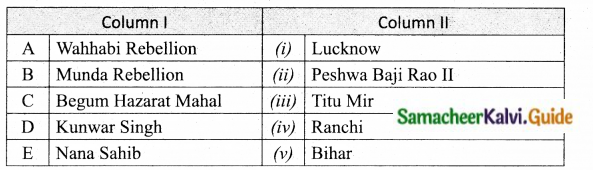
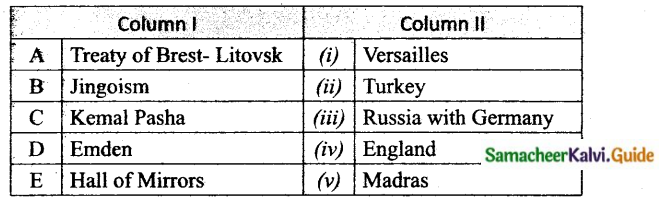
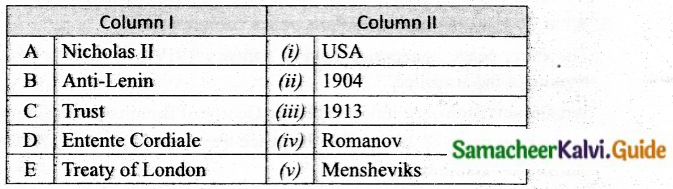
IV. Match the following
Samacheer Kalvi 10th Social Science Guide History Chapter 1 Outbreak of World War I and Its Aftermath 8
Answers:
A. (iii)
B. (iv)
C. (ii)
D. (v)
E. (i)

V. Answer briefly

Question 1.
How do you assess the importance of Sino-Japanese War?
Answer:
Sino-Japanese war took place in the years 1894 – 1895. China was defeated in the war. Japan annexed the Liaotung peninsula with Port Arthur inspite of warning given by three great powers, Russia, Germany and France. By this Japan had proved that it was the strongest nation of the East – Asia.

Question 2.
Name the countries in the Triple Entente.
Answer:
Britain, France and Russia.

Question 3.
What were the three militant forms of nationalism in Europe?
Answer:
The three militant forms of nationalism were, England’s Jingoism, France’s Chauvinism and Germany’s Kultur.

Samacheer Kalvi 10th Social Science Guide History Chapter 1 Outbreak of World War I and Its Aftermath

Question 4.
What do you know of trench warfare?
Answer:
Trench warfare is a type of land warfare using occupied fighting lines consisting largely of military trenches, in which troops are well-protected from the enemy’s small arms fire and are substantially sheltered from artillery. It is a warfare in which opposing armed forces attack, counterattack, and defend from relatively permanent systems of trenches dug in the ground.

Question 5.
What was the role of Mustafa Kemal Pasha?
Answer:
When Britian attacked Turkey directly and tried to capture Constantinople, Turks put up a brave fight and Mustafa Kemal Pasha played a great role to win freedom for the country. He put an end to the sultanate and caliphate. He modernized it and changed it out for recognition.

Question 6.
Highlight the global influence of Russian Revolution?
Answer:
The Russian Revolution fired people’s imagination across the world. In many countries, communist parties were formed. The Russian communist government encouraged the colonies to fight for their freedom and gave all support to them. Debates over key issues, land reforms, social welfare, workers’ rights, and gender equality taking place in a global context.

Question 7.
List out any two causes for the failure of the League of Nations.
Answer:
League did not had the military power of its own , it could not enforce its decisions. Even though, it had world wide membership it become very much the center of European diplomacy.

VI. Answer all the questions given under each caption

Question 1.
Imperialism
(a) What do you know of monopoly capitalism?
(b) How did Japan emerge as an imperial power?
(c) Why did the industrial countries need colonies in the nineteenth century?
(d) What were the contrasts capitalism produced?
Answer:
(a) Capitalism based on the principle of free -trade without any control or regulation by the state is called monopoly Capitalism.
(b) Japan emerged as an imperial power by annexing the Liaotung peninsula with Port Arthur inspite of warning given by Russia, Germany and France.
(c) Because colonies acted as a market for surplus goods and vast supplies of raw materials.
(d) Capitalism produced extreme poverty and extreme wealth. Slum and skyscraper. Empire state and dependent exploited colony.

Samacheer Kalvi 10th Social Science Guide History Chapter 1 Outbreak of World War I and Its Aftermath

Question 2.
German Emperor

(a) What was the nature of Emperor Kaiser Wilhelm II of Germany?
Answer:
Emperor Kaiser Wilhelm II of Germany was ruthlessly assertive and aggressive. He proclaimed that Germany would be the leader of the world.

(b) What was the violent form of Germany called?
Answer:
It was called Germany’s Kultur.

(c) Why did Kaiser Wilhelm intervene in the Morocco affair?
Answer:
The British agreement with France over the latter’s interest in Morocco was consented by Germany. So Kaiser Wilhelm II of Germany intentionally recognised the independence of the Sultan and demanded an international conference to decide on the future of Morocco.

(d) What happened to Germany’s colonies in Africa?
Answer:
The German colonies in western and eastern Africa were attacked by the Allies. As these colonies were quite far off from Germany they could not receive any immediate help, and therefore had to surrender to the Allies.

Question 3.
Balkan Wars
(a) Why was Balkan League formed?
(b) What was the outcome of the first Balkan War?
(c) Who were defeated in this war?
(d) What was the name of the Treaty signed at the end of this second Balkan War?
Answer:
(a) To control Greece, Serbia, Bulgaria and Montenegro in succeeding Balkans from Turks, in March 1912 the Balkan League was formed.
(b) The Balkan League defeated the Turkish forces in the 1st Balkan war.
(c) Turkey and Bulgaria were defeated in this war.
(d) Treaty of Bucharest in August 1913.

Samacheer Kalvi 10th Social Science Guide History Chapter 1 Outbreak of World War I and Its Aftermath

VII. Answer the following in detail

Question 1.
Discuss the main causes of the First World War.
Answer:
The causes of the First World War are given below:

  1. Formation of European alliances and counter alliances
  2. Emergence of violent forms of nationalism in countries like England, France and Germany
  3. Aggressive attitude of the German Emperor Kaiser Wilhelm II
  4. Hostility of France towards Germany
  5. Opportunity for imperial power politics in the Balkans
  6. The Balkans wars
  7. Immediate cause which included the assassination of Archduke Franz Ferdinand, nephew and heir to Franz Joseph, Emperor of Austria-Hungary, by Princip, a Bosnian Serb, on 28 June 1914.

Samacheer Kalvi 10th Social Science Guide History Chapter 1 Outbreak of World War I and Its Aftermath

Question 2.
Highlight the provisions of the Treaty of Versailles relating to Germany.
Answer:

  1. All the central powers were directed to pay war indemnity especially Germany was to pay heavy amount for the losses suffered.
  2. Germany had to pay 6,600 million pounds as per the Reparation Commission, but can be paid in installments.
  3. The Germans should not have submarines and airforce, but can have a small navy and an army of one lakh men.
  4. Austria and Germany separated and Austria was given independence.
  5. All German colonies came under the mandated territories of League of nations.
  6. Germany had to give up all her overseas possessions, rights and titles to the allies.
  7. Germany surrendered Alsace-Lorraine to France.
  8. She signed the Treaty of Brest-Litovsk with Russia and the treaty of Bucharest with Bulgaria.
  9. Rhineland was to be occupied by the allies. East of Rhineland area was to be demilitarised.
  10. Poland was recreated with a corridor to Baltic containing the port of Danzig of Germany.

Question 3.
Explain the course of the Russian Revolution under the leadership of Lenin.
Answer:

  1. Lenin was in Switzerland when the revolution broke out in Russia. He wanted to continued revolution.
  2. His slogan of “All power to the Soviets” soon won over the workers’ leaders. Devastated by war time shortages, the people were attracted by the slogan of ‘Bread, Peace and Land’.
  3. In October Lenin persuaded the Bolshevik Central Committee to decide on immediate revolution. Trotsky prepared a detailed plan
  4. On 7 November the key government buildings, including the Winter Palace, the Prime Minister’s headquarters, were seized by armed factory workers and revolutionary troops
  5. On 8 November 1917a new Communist government was in office in Russia. Its head this time was Lenin. The Bolshevik Party was renamed the Russian Communist Party.

Question 4.
Estimate the work done by the League of Nations, pointing out the reasons for its failure?
Answer:

  1. League of nations was formed in 1920 with the twin objective of avoiding war and to maintain peace in the world.
  2. The main work done by the League was to solve the dispute arose between Sweden and Finland over the sovereignity of Aaland Island. It ruled that the island should go to Finland.
  3. League solved the frontier dispute between Poland and Germany in upper Silesia.
  4. When dispute arose between Greece and Bulgaria in 1925, Greece invaded Bulgaria and the League ordered a ceasefire.
  5. League had been successful in signing the Locarno Treaty in 1925 by which Germany,France, Belgium, Great Britain and Italy mutually guaranteed peace in Western Europe.
  6. The main reason for the failure of the League was Italy, Japan and Germany headed by dictators refused to be bound by the orders of the League and started violation and League rules.
  7. When League condemned the violation, they withdrew their membership.
  8. League did not had a military power of its own.
  9. Though it had a world-wide membership, it became the center of European diplomacy.
  10. The League remained a passive witness to events, issues and incidents of violations therefore finally dissolved in 1946.

Samacheer Kalvi 10th Social Science Guide History Chapter 1 Outbreak of World War I and Its Aftermath

VIII. Activity

Question 1.
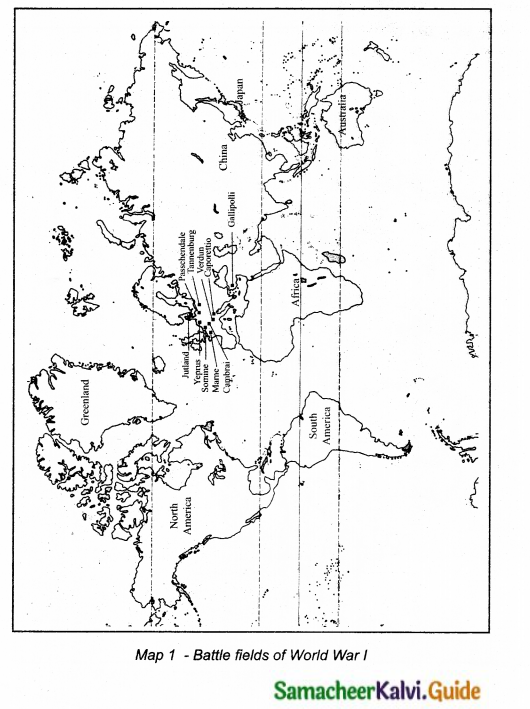
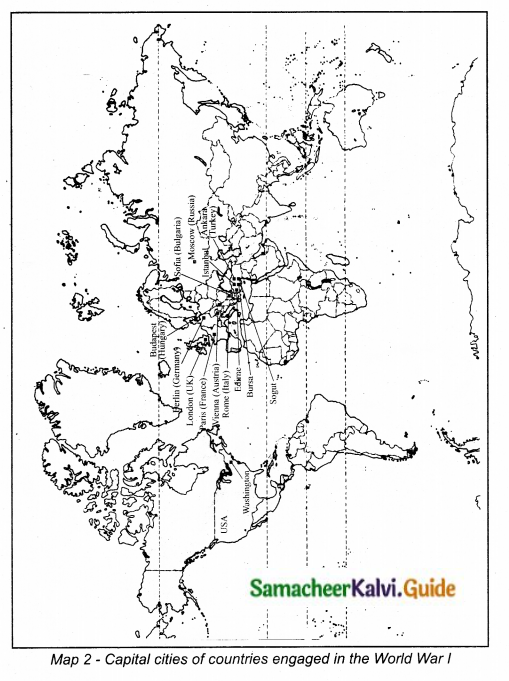
Students can be taught to mark the places of battles and the capital cities of the countries that were engaged in the War.
Answer:
(a) Battles of I World war:
(i) Battle of Tannenberg
(ii) Battle of Marne
(iii) Battle of Gallipoli
(iv) Battle of Jutland
(v) Battle of Verdun
(vi) Battle of Passchendaele
(vii) Battle of Caporetto
(viii) Battle of Cambrai
(ix) Battle of the Somme.
Samacheer Kalvi 10th Social Science Guide History Chapter 1 Outbreak of World War I and Its Aftermath 2

Samacheer Kalvi 10th Social Science Guide History Chapter 1 Outbreak of World War I and Its Aftermath

(b) Capital cities of countries engaged in the IWW.
Central powers & Capital:
(i) Germany – Berlin
(ii) Austria – Vienna
(iii) Hungary – Budapest
(iv) Italy – Rome
(v) Ottoman Empire – Istanbul, Bursa, Edirne, Sogut
(vi) Bulgaria – Sofia
(vii) Tu rkey – An ka ra
Allies- Capital:
(i) Great Britain – London
(ii) France – Paris
(iii) Russia – Moscow
(iv) Italy – Rome
(v) United States – Washington D. C
Samacheer Kalvi 10th Social Science Guide History Chapter 1 Outbreak of World War I and Its Aftermath 3

Question 2.
An assignment or a project work on the role of Indian soldiers in different battle fields across the globe and the casualties they suffered during the War be attempted by the students.
Answer:
During the War, the Indian Army contributed a large number of divisions and independent brigades to the European, Mediterranean and the Middle East. The Indian Army fought against the German Empire in German East Africa and on the Western Front. Indian divisions were also sent to Egypt, Gallipoli and nearly 700,000 served in Mesopotamia against the Ottoman Empire. While some divisions were sent overseas others had to remain in India guarding the North West Frontier and on internal security and training duties.

In addition to the permanent divisions, the Indian Army also formed a number of independent brigades. As part of the Southern Army the Aden Brigade was stationed in the Aden Protectorate on the strategically important naval route from Europe to India, where there was limited fighting.

The Bannu Brigade, the Derajat Brigade and the Kohat Brigade were all part of the Northern Army and they were deployed along the North West Frontier. The South Persia Brigade was formed in 1915 at the start of the Persian Campaign to protect the Anglo- Persian oil installations in south Persia and the Persian Gulf.

On the outbreak of war, the Indian Army had 150,000 trained men and the Indian Government offered the services of two cavalry and two infantry divisions for service overseas. The force known as Indian Expeditionary Force A was attached to the British Expeditionary Force and the four divisions were formed into two army corps: an infantry Indian Corps and the Indian Cavalry Corps.

Indian Expeditionary Force B consisted of the 27th (Bangalore) Brigade from the 9th (Secunderabad) Division and an Imperial Service Infantry Brigade, a pioneer battalion, a mountain artillery battery and engineers were sent to Tanganyika with the task of invading German East Africa. Force C was formed from the Indian Army’s 29th Punjabis, together with half battalions from the Princely states of Jind, Bharatpur, Kapurthala and Rampur. The largest Indian Army force to serve abroad was the Indian Expeditionary Force D in Mesopotamia, under the command of Lieutenant-General Sir John Nixon.

Over one million Indian troops served overseas, of whom 62,000 died and another 67,000 were wounded. In total at least 74,187 Indian soldiers died during the War. Field-Marshal Sir Claude Auchinleck, Commander-in-Chief of the Indian Army from 1942, commented that the British “couldn’t have come through both wars [World War I and II] if they hadn’t had the Indian Army.”

Samacheer Kalvi 10th Social Science Guide History Chapter 1 Outbreak of World War I and Its Aftermath

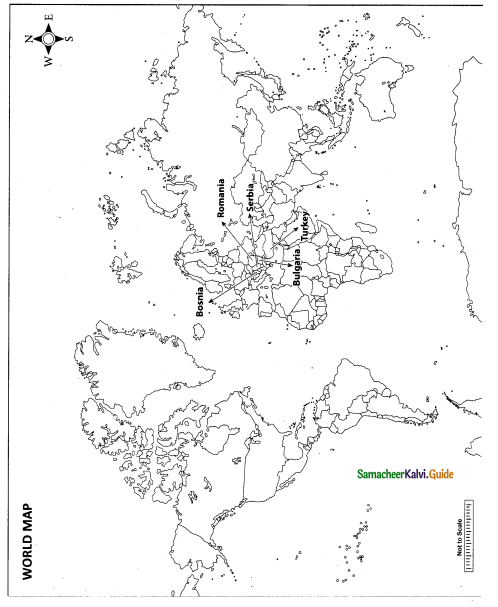
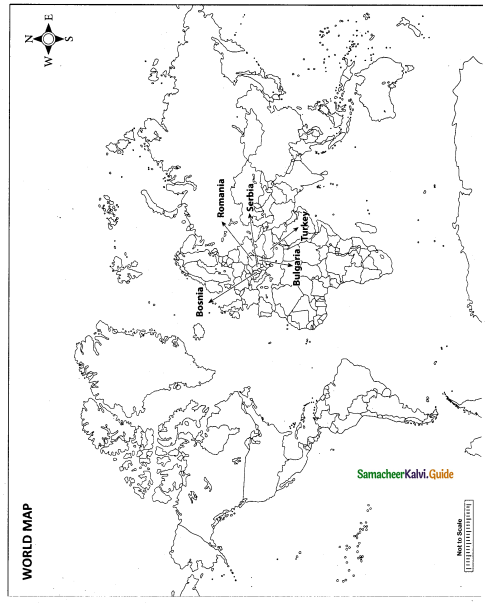
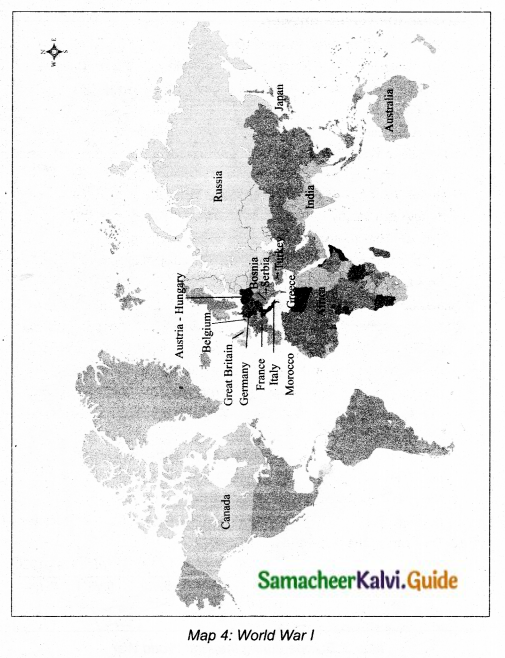
IX. Map Work

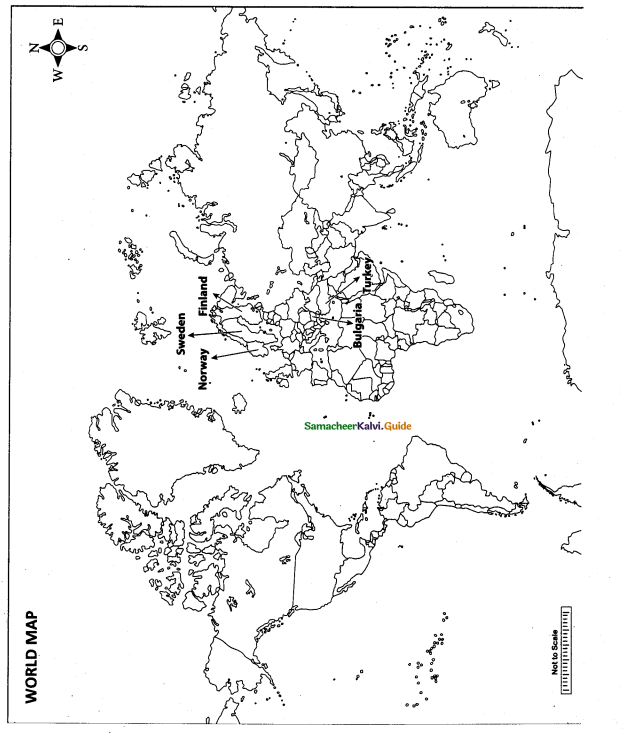
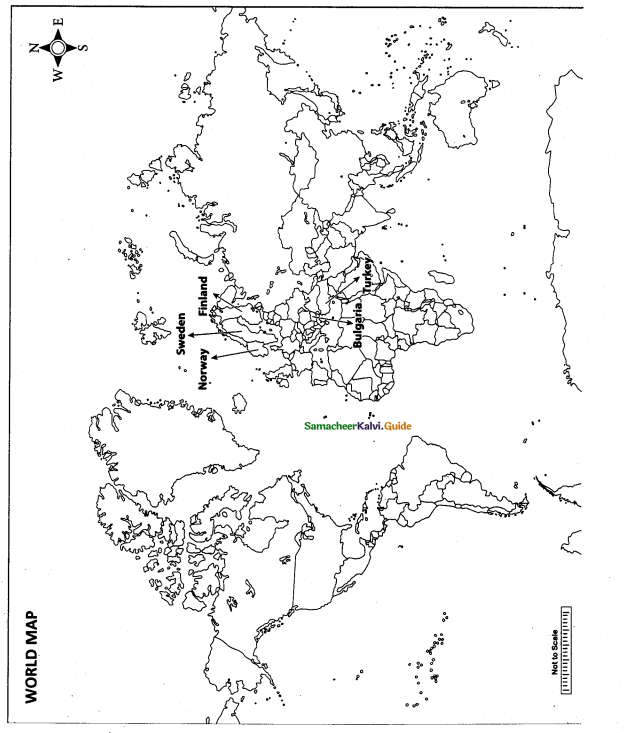
Mark the following countries on the world map.

  1. Great Britain
  2. Germany
  3. France
  4. Italy
  5. Morocco
  6. Turkey
  7. Serbia
  8. Bosnia
  9. Greece
  10. Austria-Hungary
  11. Bulgaria
  12. Rumania

Samacheer Kalvi 10th Social Science Guide History Chapter 1 Outbreak of World War I and Its Aftermath 5

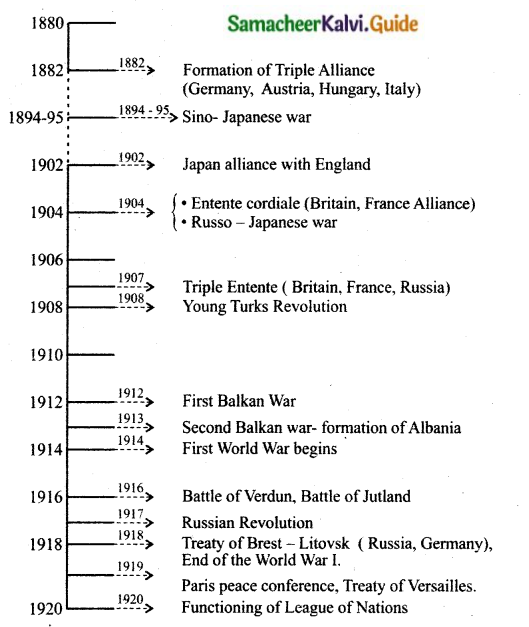
Timeline:
Samacheer Kalvi 10th Social Science Guide History Chapter 1 Outbreak of World War I and Its Aftermath 1

Samacheer Kalvi 10th Social Science Guide History Chapter 1 Outbreak of World War I and Its Aftermath

Samacheer Kalvi 10th Social Science Outbreak of World War I and Its Aftermath Additional Important Questions and Answers

I. Choose the correct answer

Question 1.
The Treaty of serves was signed with:
(a) Austria
(b) Hungary
(c) Turkey
(d) Bulgaria
Answer:
(c) Turkey

Question 2.
The policy of imperialism followed by the European countries from 1870-1945 was known as ……
(a) New imperialism
(b) Military imperialism
(c) Neo-imperialism
Answer:
(a) New imperialism

Question 3.
President Woodrow Wilson put forward ………….. points in the League of nations.
(a) 12
(b) 11
(c) 10
(d) 14
Answer:
(d) 14

Question 4.
With a modem army and navy, ….. had emerged as an advanced industrialised
power.
(a) Germany
(b) Japan
(c) Italy
Answer:
(b) Japan

Question 5.
Germany surrendered in:
(a) 1917
(b) 1918
(c) 1919
(d) 1916
Answer:
(b) 1918

Samacheer Kalvi 10th Social Science Guide History Chapter 1 Outbreak of World War I and Its Aftermath

Question 6.
The ‘Sphere of influence’ was adopted by the European countries in ……
(a) Japan
(b) China
(c) India
Answer:
(b) China

Question 7
………….. is the name of the parliament of Russia.
(a) Tsar
(b) Trotsky
(c) Duma
(d) Rasputin.
Answer:
(c) Duma

Question 8.
The word “Imperialism” is derived from ……
(a) Greek
(b) German
(c) Latin
Answer:
(c) Latin

Question 9.
Nicholas II abdicated from his throne on ……………. 1917.
(a) March 12
(b) March 15
(c) November 18
(d) October 14
Answer:
(b) March 15

Question 10.
The development of ……. speeded the movements of goods between colonies and other countries.
(a) Roadways
(b) Waterways
(c) Railways
Answer:
(c) Railways

Samacheer Kalvi 10th Social Science Guide History Chapter 1 Outbreak of World War I and Its Aftermath

II. Fill in the blanks

  1. The biggest outcome of the first world war was the …………….
  2. The Trust is an industrial organisation in the …………….
  3. The Imperialist Prime Minister of South Africa was called …………….
  4. Cartel means ……………. of enterprises in the same field of business.
  5. The treaty of ……………. was signed after the Russo-Japanese war and Japan got back port Arthur.
  6. The violent form of nationalism in Germany was called as …………….
  7. France and Germany were old …………….
  8. The enemity between and led to the outbreak of war in 1914.
  9. The new state of Albania was created according to the treaty of ……………. signed in 1913.
  10. Russia suffered heavy loses in the battle of …………….
  11. Trench warfare was the style followed in the battle of …………….
  12. Russia signed the treaty of ……………. with Germany.
  13. Italy formally joined the allies in …………….
  14. Battle of Jutland is a ……………. battle.
  15. ……………. is the name of the American ship sunk by Germany.
  16. ……………. was one of the principle in the fourteen points of Paris peace conference.
  17. The war conditions led to the ……………. movement in India.
  18. ……………. modernised Turkey and changed it out of all recognition.
  19. £ is the symbol of …………….
  20. The Bolshevik party was renamed as ……………. party.

Answers:

  1. Russian Revolution
  2. USA
  3. Cecil Rhodes
  4. Association
  5. Portsmouth
  6. Kultur
  7. Rivals
  8. Austria and Serbia
  9. London
  10. Tannenburg
  11. Marne
  12. Brest Litovsk
  13. 1916
  14. Naval
  15. Lusitania
  16. Self determination
  17. Home Rule
  18. Pound sterling
  19. Kemal Pasha
  20. Russian communist

Samacheer Kalvi 10th Social Science Guide History Chapter 1 Outbreak of World War I and Its Aftermath

III. Choose the correct statements.

Question 1.
(i) The Industrial achievements of Germany in the later half of the 19th Century gave her a dominating position in Europe.
(ii) When Germany came to the scene of exploitation, it became weak in its military power.
(iii) When there was nowhere else to expand, imperialist countries grab other’s possession.
(iv) Russia, Britain and France joined in the scramble for colonies.
(a) (i) and (ii) are correct
(b) (i) and (iii) are wrong
(c) (ii) and (iv) are wrong
(d) (i), (ii) and (iv) are correct
Answer:
(c) (ii) and (iv) are wrong

Question 2.
(i) The Central powers consisted of Germany, Austria-Hungary, Turkey and Bulgaria.
(ii) Italy strongly supported Germany.
(iii) In April 1916, Britain, France and Italy signed the Treaty of London.
(iv) Italy agreed to enter the war against the central powers in-return of this territory after the war.
(a) (i), (ii) and (iii) are correct
(b) (ii), (iii) and (iv) are correct
(c) (i) and (iii) are correct
(d) (i) and (iv) are correct
Answer:
(d) (i) and (iv) are correct

Question 3.
(i) Trenches are ditches dug by troops enabled soldiers.
(ii) It was done to protect themselves from enemy fire.
(iii) The battle of Jutland is a memorable one for Trench war fare.
(iv) Trench system used in the first world war consisted of six to seven trench lines running parallel to each other.
(a) (ii) and (iv) are correct
(b) (i) and (ii) are correct
(c) (i) and (iv) are correct
(d) (iii) and (iv) are correct
Answer:
(b) (i) and (ii) are correct

Question 4.
(i) The main provision of the Versailles treaty was that all central powers were directed to pay war indemnity.
(ii) All the German colonies became mandated territories under the League of nations.
(iii) The Saar coal mine was given to Bulgaria.
(iv) Northern Schleswig was given to France.
(a) (iii) and (iv) are correct
(b) (i) and (ii) are correct
(c) (i), (ii), (iv) are correct
(d) (ii) and (iv) are correct
Answer:
(b) (i) and (ii) are correct

Samacheer Kalvi 10th Social Science Guide History Chapter 1 Outbreak of World War I and Its Aftermath

Question 5.
(i) Triple Alliance was signed in 1882 between Germany, Austria-Hungary and Italy.
(ii) Entente cordiale was signed in 1906 between Britain and Russia.
(iii) Triple Entente was signed between Britain, France and Russia.
(iv) The Britain violation of Belgian neutrality forced German to enter the war.
(a) (i), (ii), (iv) are correct
(b) (iii) and (iv) are correct
(c) (i) and (iii) are correct
(d) (ii) and (iv) are correct
Answer:
(c) (i) and (iii) are correct

Samacheer Kalvi 10th Social Science Guide History Chapter 1 Outbreak of World War I and Its Aftermath

IV. Assertion and Reason

Question 1.
Assertion (A): Inspite of warning of the three great powers, Russia, Germany and France, Japan annexed the Liaotung Peninsula with Port Arthur.
Reason (R): Japan proved that it was the strongest nation of the East Asia.
(a) Both A and R are correct
(b) A is right but R is not the correct reason
(c) Both A and R are wrong
(d) R is right but it has no relevant to A
Answer:
(a) Both A and R are correct

Question 2.
Assertion (A): Two peace conferences were held at the Hague in Holland in 1899 and in 1907.
Reason (R): Lenin of Russia wanted to bring Universal peace and suggested these conferences.
(a) Both A and R are correct
(b) A is right but R is not the correct reason
(c) Both A and R are wrong
(d) R is right but it has no relevant to A
Answer:
(b) A is right but R is not the correct reason

Question 3.
Assertion (A): Italy formally joined with the allies fighting with Austria, initially sustained, but finally collapsed.
Reason (R): Germans came to Austria’s help.
(a) Both A and R are correct
(b) A is right but R is not the correct reason
(c) Both A and R are wrong
(d) R is right but it has no relevant to A
Answer:
(a) Both A and R are correct

Question 4.
Assertion (A): In Germany and Austria, women and children suffered from hunger and privation.
Reason (R): Aeroplanes were used for bombing targeted Civilian population.
(a) Both A and R are correct
(b) A is right but R is not the correct reason
(c) Both A and R are wrong
(d) R is right but it has no relevant to A
Answer:
(b) A is right but R is not the correct reason

Question 5.
Assertion (A): Marxists in Russia had the fortune of getting Lenin as their leader.
Reason (R): Tsar Nicholas li was under the strong influence of his wife Alexandra.
(a) Both A and R are correct
(b) A is right but R is not the correct reason
(c) Both A and R are wrong
(d) R is right but it has no relevant to A
Answer:
(b) A is right but R is not the correct reason

Samacheer Kalvi 10th Social Science Guide History Chapter 1 Outbreak of World War I and Its Aftermath

Question 6.
Assertion (A): The League of nations could apply the principle of collective security.
Reason (R): It was supported by Italy, Japan and Germany.
(a) Both A and R are correct
(b) A is right but R is not the correct reason
(c) Both A and R are wrong
(d) R is right but it has no relevant to A
Answer:
(c) Both A and R are wrong

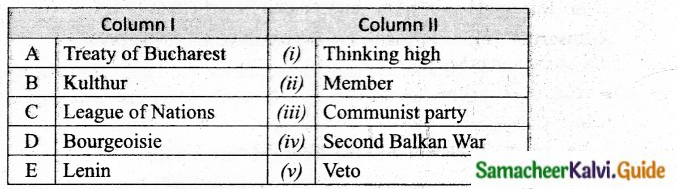
V. Match the following

Question 1.
Match the Column I with Column II.
Samacheer Kalvi 10th Social Science Guide History Chapter 1 Outbreak of World War I and Its Aftermath 6
Answer:
A. (iv)
B. (v)
C. (i)
D. (ii)
E. (iii)

Question 2.
Match the column I with column II.
Samacheer Kalvi 10th Social Science Guide History Chapter 1 Outbreak of World War I and Its Aftermath 7
Answer:
A. (iv)
B. (i)
C. (v)
D. (ii)
E. (iii)

Samacheer Kalvi 10th Social Science Guide History Chapter 1 Outbreak of World War I and Its Aftermath

VI. Answer the following questions briefly

Question 1.
What was the aim of the capitalist countries?
Answer:
The aim of the capitalistic countries was to produce more and more. The surplus wealth that was produced was used to build more factories, railways, steamship and other such undertakings.

Question 2.
What is colonialism?
Answer:
(i) Colonialism refers to the policy of acquiring and maintaining colonies especially for exploitation.
(ii) It also means that it is a relationship between an indigenous majority and a minority foreign invaders.

Question 3.
What was the immediate cause of the first world war?
Answer:
The nephew and heir to Franz Joseph, Emperor of Austria-Hungary. The Arch duke Franz Ferdinand was killed by Princip a Serbian of Bosnia. This was the immediate cause as Austria got help from Germany and Serbia got help from Russia. Thus the war began in 1914.

Question 4.
How did China became an International colony?
Answer:

  1. The Boers were defeated by foreign powers.
  2. When they reached Peking, the capital of China, Empress Dowager fled from the capital,
  3. The U.S.A. and England formulated the Open Door Policy or Me Too Policy.
  4. The Chinese territories were partitioned among the foreign powers for trade rights. Thus China became an international colony.

Question 5.
What do you understand by Paris peace conference?
Answer:
The Paris peace conference held in January 1919 two months after the signing of the armistice.
Woodrow Wilson of America and Lloyd George of Britain were the important personalities. On 28 June 1919, the peace treaty was signed in The Hall of Mirrors at Versailles.

Question 6.
What was the immediate cause of the First World War?
Answer:

  1. In 1908, Austria annexed Bosnia and Herzegovina against the Congress of Berlin.
  2. Austrian Prince Francis Ferdinand and his wife were assassinated at Sarajevo on June 28, 1914.
  3. Austria sent an ultimatum to Serbia, but Serbia ignored it.
  4. So Austria declared war on Serbia on 28th July 1914.

Question 7.
Write the slogans raised by Lenin that attracted soviet people.
Answer:
“All power to the soviets” and “Bread, Peace and Land” were the slogans raised by Lenin that attracted the soviet people who were devastated by war time shortages.

Samacheer Kalvi 10th Social Science Guide History Chapter 1 Outbreak of World War I and Its Aftermath

Question 8.
Write any two terms of the Treaty of Versailles.
Answer:

  1. A huge war indemnity was imposed on Germany. Her army was reduced.
  2. The overseas possessions of Germany were divided among the victorious nations.

Question 9.
Write any two objectives of the League.
Answer:
The two main objective of the League of Nations was (i) To avoid war and to maintain peace in the world, (ii) To promote international co-operation in economic and social affairs.

Question 10.
What do you mean by Russian Revolution?
Answer:
The fall of monarch in February 1917 and the events of October are known as the Russian Revolution.

Question 11.
What is Duma? Why did the Tsar dismiss the first Duma within 75 days of its election?
Answer:
An elective legislative assembly established in 1905 by Nicholas II in Russia is known as Duma. Because the Tsar did not want anyone to question his authority, so he dismissed the first Duma within 75 days.

Samacheer Kalvi 10th Social Science Guide History Chapter 1 Outbreak of World War I and Its Aftermath

VII. Answer all the questions given under each caption

1. Characteristics of Imperialism

(a) What led to concept of Imperialism?
Answer:
Capitalism inevitably led to the concept of Imperialism.

(b) What was Lenin idea on Imperialism?
Answer:
According to Lenin, imperialism is the highest stage of Capitalism.

(c) What were the purposes for which the colonies were made use of?
Answer:
The colonies served as a market for goods and also vast suppliers of raw materials like cotton, Rubber etc.

(d) What was the logic behind Imperialism apart from colonisation?
Answer:
The logic behind Imperialism apart from colonisation was, total militarisation and total war.

2. The ambition of Germany

(а) Who was the ruler of Germany during the First World War?
Answer:
Kaiser Wilhelm II.

(b) What did he believe?
Answer:
He believed that Germany alone was competent to rule the whole world.

(c) What could not be tolerated by him?
Answer:
He could not tolerate the British saying that the Sun never sets in the British Empire.

3. Naval Battles

(a) Name the Naval battle that took place in 1916?
Answer:
In 1916, the Naval battle had taken place in the North sea called as Battle of Jutland.

(b) Which country started the Sub-marine warfare thereafter?
Answer:
Germany started their Submarine warfare thereafter.

(c) Name the ship that bombarded Madras?
Answer:
The ship that bombarded Madras was the famous Emden ship.

(d) Name the American ship torpedoed by a German Submarine.
Answer:
Lusitania, an American ship was torpedoed by a German Submarine.

Samacheer Kalvi 10th Social Science Guide History Chapter 1 Outbreak of World War I and Its Aftermath

4. Course of the First World War

(a) Give the duration of the First World War.
Answer:
From July 28, 1914 to November 11, 1918.

(b) Who were called the Central Powers?
Answer:
The countries which were on the side of Germany were called the Central Powers.

(c) Who were called the Allies?
Answer:
The countries which were on the side of Britain were called as the Allies.

(d) What and all were used in war?
Answer:
Artillery, Tanks and submarines were used in the war.

5. Lenin

(a) Where was he born?
Answer:
Lenin was bom in 1870 near the middle Volga to educated parents.

(b) What was his belief?
Answer:
Lenin believed that the wav for freedom was through mass action.

(c) When and why was he arrested?
Answer:
He was arrested in 1895 and kept in Serbia for encouraging the ideas of Marxism to the factory workers in St. Petersburg.

(d) How did he form the Bolshevik party?
Answer:
Lenin gained the support of small majority called Bolshmstvo known as Bolsheviks which later became the Bolshevik party.

Samacheer Kalvi 10th Social Science Guide History Chapter 1 Outbreak of World War I and Its Aftermath

6. Results of the war

(a) How were the terms of the treaties drafted?
Answer:
Based upon the fourteen points of the American President Woodrow Wilson.

(b) What did Germany surrendered to France?
Answer:
Germany surrendered Alsace and Lorraine to Europe.

(c) Where was monarchy abolished?
Answer:
In Germany, Russia, Austria and Turkey.

(d) Name the new Republics.
Answer:
Czechoslovakia and Poland.

Samacheer Kalvi 10th Social Science Guide History Chapter 1 Outbreak of World War I and Its Aftermath

VIII. Answer the following in detail

Question 1.
Write a note on the structure and composition of its League of Nations.
Answer:

  1. The covenant of the League of Nations was formed at the Paris peace conference after the first world war.
  2. President of USA -Woodrow Wilson largely supported for this task to be accomplished.
  3. The structure of the League consist of the Assembly, the council, the Secretariat, the permanent court of Justice and the International Labour organization.
  4. Each member country was represented in the Assembly.
  5. Each member country’ and had one vote and also possessed the right of veto.
  6. Britain, France, Italy, Japan and United States were originally declared permanent members of the council.
  7. The council was the executive of the League.
  8. The staff of the secretariat was appointed by the Secretary General in consultation with the council.
  9. The court of Justice consisted of fifteen Judges.
  10. The International Labour organization comprised a Secretariat. The general conference will include four representatives from each country.
  11. The first secretary general of League of Nations was Sir Eric Drummond from Britain.

Question 2.
What were the results of the first world war?
Answer:
The Paris Peace Conference:

  1. The first world war came to an end by the Paris Peace Conference of 1919.
  2. The city of Danzig was internationlized.
  3. Lithuvania, Latvia and Estonia were granted independence.

Samacheer Kalvi 10th Social Science Guide History Chapter 1 Outbreak of World War I and Its Aftermath

The formation of the League of Nations:

  1. The first world war brought untold miseries to people.
  2. All the nations wanted a permanent body to maintain peace in the world. So the League of Nations was formed in 1920.
  3. The victorious nations forced the defeated nations with unfair treaties. It sowed the seed for the second world war.

Question 3.
What was the impact of First world war on India?
Answer:

  1. The first world war had multiple effects on the Indian economy, society and politics.
  2. Indians had taken an active part in the war on the side of Britain, believing that they would reward Independence after the war.
  3. But also, disappointment was rewarded to the Indians.
  4. Indian soldiers asked to serve in Europe, Africa and West Asia.
  5. India contributed £230 million in cash and over £125 million in loan towards war expenses.
  6. India also sent war materials to the value of £ 250 million .
  7. There were economic distress all over the country.
  8. Towards the end of the war, India suffered under the world wide epidemic of influenza.
  9. Home Rule Movement arose in India due to the war conditions.
  10. The congress split of extremists and moderates reunited.
  11. The Ottoman Empire under the Turkish Sultan was defeated in World war I and the territories shared between Britain and France.
  12. This led to the formation of Khilafat Movement in India.

Samacheer Kalvi 10th Maths Guide Chapter 6 Trigonometry Additional Questions

Students can download Maths Chapter 6 Trigonometry Additional Questions and Answers, Notes, Samacheer Kalvi 10th Maths Guide Pdf helps you to revise the complete Tamilnadu State Board New Syllabus, helps students complete homework assignments and to score high marks in board exams.

Tamilnadu Samacheer Kalvi 10th Maths Solutions Chapter 6 Trigonometry Additional Questions

I. Multiple Choice Questions

Question 1.
(1 – sin2 θ) sec2 θ = …………
(1) 0
(2) 1
(3) tan2 θ
(4) cos2 θ
Answer:
(2) 1
Hint: (1 – sin2 θ) sec2 θ = cos2 θ sec2 θ = cos2 θ \(\frac{1}{\cos ^{2} \theta}\) = 1

Samacheer Kalvi 10th Maths Guide Chapter 6 Trigonometry Additional Questions

Question 2.
(1 + tan2 θ) sin2 θ = ………….
(1) sin2 θ
(2) cos2 θ
(3) tan2 θ
(4) cot2 θ
Answer:
(3) tan2 θ
Hint: (1 + tan2 θ) sin2 θ = sec2 θ sin2 θ = \(\frac{1}{\cos ^{2} \theta}\) sin2 θ = \(\frac{\sin ^{2} \theta}{\cos ^{2} \theta}\) = tan2 θ

Question 3.
(1 – cos2 θ) (1 + cot2 θ) = ………..
(1) sin2 θ
(2) 0
(3) 1
(4) tan2 θ
Answer:
(3) 1
Hint: (1 – cos2 θ) (1 + cot2 θ) = sin2 θ cosec2 θ = sin2 θ. \(\frac{1}{\sin ^{2} \theta}\)= 1

Question 4.
sin (90° – θ) cos θ + cos (90° – θ) sin θ = …………..
(1) 1
(2) 0
(3) 2
(4) -1
Answer:
(1) 1
Hint: sin (90° – θ) cos θ + cos (90° – θ) sin θ = cos θ cos θ + sin θ sin θ = cos2 θ + sin2 θ = 1

Samacheer Kalvi 10th Maths Guide Chapter 6 Trigonometry Additional Questions

Question 5.
1 – \(\frac{\sin ^{2} \theta}{1+\cos \theta}\) = ……………….
(1) cos θ
(2) tan θ
(3) cot θ
(4) cosec θ
Answer:
(1) cos θ
Hint:
Samacheer Kalvi 10th Maths Guide Chapter 6 Trigonometry Additional Questions 1

Question 6.
cos4 x – sin4 x = ……………
(1) 2 sin2 x – 1
(2) 2 cos2 x – 1
(3) 1 + 2 sin2 x
(4) 1 – 2 cos2 x
Answer:
(2) 2 cos2 x – 1
Hint:
cos4 x – sin4 x (cos2 x)2 – (sin2 x)2
= (cos2 x + sin2x) (cos2 x – sin2x)
= 1 (cos2 x – sin2 x)
= cos2 x – (1 – cos2 x)
cos2 x – 1 + cos2 x
= 2 cos2 x – 1.

Question 7.
If tan θ = \(\frac { a }{ x } \) , then the value of \(\frac{x}{\sqrt{a^{2}+x^{2}}}\) = ………………
(1) cos θ
(2) sin θ
(3) cosec θ
(4) sec θ
Answer:
(1) cos θ
Hint:
Samacheer Kalvi 10th Maths Guide Chapter 6 Trigonometry Additional Questions 2
Samacheer Kalvi 10th Maths Guide Chapter 6 Trigonometry Additional Questions 3

Question 8.
If x = a sec θ, y = b tan θ, then the value of \(\frac{x^{2}}{a^{2}}-\frac{y^{2}}{b^{2}}\) = ………………..
(1) 1
(2) -1
(3) tan2 θ
(4) cosec2 θ
Answer:
(1) 1
Hint:
Samacheer Kalvi 10th Maths Guide Chapter 6 Trigonometry Additional Questions 4

Samacheer Kalvi 10th Maths Guide Chapter 6 Trigonometry Additional Questions

Question 9.
\(\frac{\sec \theta}{\cot \theta+\tan \theta}\) = ………..
(1) cot θ
(2) tan θ
(3) sin θ
(4) – cot θ
Answer:
(3) sin θ
Hint:
Samacheer Kalvi 10th Maths Guide Chapter 6 Trigonometry Additional Questions 5

Question 10.
Samacheer Kalvi 10th Maths Guide Chapter 6 Trigonometry Additional Questions 6
Answer:
(1) tan θ
(2) 1
(3) -1
(4) sin θ
Answer:
(2) 1
Hint:
Samacheer Kalvi 10th Maths Guide Chapter 6 Trigonometry Additional Questions 7

Question 11.
In the adjoining figure, AC = ………….
Samacheer Kalvi 10th Maths Guide Chapter 6 Trigonometry Additional Questions 8
(1) 25m
(2) 25 \(\sqrt { 3 }\) m
(3) \(\frac{25}{\sqrt{3}}\)
(4) 25 \(\sqrt { 2 }\) m
Answer:
(2) 25 \(\sqrt { 3 }\) m
Hint:
tan θ = \(\frac { AC }{ AB } \) ⇒ tan 60° = \(\frac { AC }{ 25 } \) ⇒ AC = 25 \(\sqrt { 3 }\) m

Question 12.
In the adjoining figure ∠ABC =
Samacheer Kalvi 10th Maths Guide Chapter 6 Trigonometry Additional Questions 9
(1) 45°
(2) 30°
(3) 60°
(4) 50°
Answer:
(3) 60°
Hint:
tan B = \(\frac { AC }{ AC } \) = \(\frac{100 \sqrt{3}}{100}\) = \(\sqrt { 3 }\) ⇒ ∴ tan B = \(\sqrt { 3 }\) ⇒ ∠B = 60°

Samacheer Kalvi 10th Maths Guide Chapter 6 Trigonometry Additional Questions

Question 13.
A man is 28.5 m away from a tower. His eye level above the ground is 1.5 m. The angle of elevation of the tower from his eyes is 45°. Then the height of the tower is …………..
(1) 30 m
(2) 27.5 m
(3) 28.5 m
(4) 27 m
Answer:
(1) 30 m
Hint:
tan 45° = \(\frac { AB }{ BC } \)
Samacheer Kalvi 10th Maths Guide Chapter 6 Trigonometry Additional Questions 10
1 = \(\frac { x }{ 28.5 } \) ⇒ x = 28.5
Height of tower = 28.5 + 1.5 = 30 m

Question 14.
In the adjoining figure, sin θ = \(\frac { 15 }{ 17 } \) Then BC = ………….
(1) 85 m
(2) 65 m
(3) 95 m
(4) 75 m
Answer:
(4) 75 m
Hint:
sin θ = \(\frac { BC }{ AC } \) ⇒ \(\frac { 15 }{ 17 } \) = \(\frac { BC }{ 85 } \) ⇒ BC = \(\frac{85 \times 15}{17}\) = 75 m
Samacheer Kalvi 10th Maths Guide Chapter 6 Trigonometry Additional Questions 11

Question 15.
(1 + tan2 θ) (1 – sin θ) (1 + sin θ) = …………..
(1) cos2 θ – sin2 θ
(2) sin2 θ – cos2 θ
(3) sin2 θ + cos2 θ
(4) 0
Answer:
(3) sin2 θ + cos2 θ
Hint:
(1 + tan2 θ) (1 – sin θ) (1 + sin θ) = (1 + tan2 θ) (1 – sin2 θ) = sec2 θ × cos2 θ = sec2 θ × cos2 θ = sec2 θ × \(\frac{1}{\sec ^{2} \theta}\) = 1 = sin2 θ + cos2 θ

Samacheer Kalvi 10th Maths Guide Chapter 6 Trigonometry Additional Questions

Question 16.
(1 + cot2 θ) (1 – cos θ) (1 + cos θ) = ………………….
(1) tan2 θ – sec2 θ
(2) sin2 θ – cos2 θ
(3) sec2 θ – tan2 θ
(4) cos2 θ – sin2 θ
Answer:
(3) sec2 θ – tan2 θ
Hint:
(1 + cot2 θ) (1 – cos θ) (1 + cos θ) = (1 + cot2 θ) (1 – cos2 θ) = cosec2 θ. sin2 θ
= \(\frac{1}{\sin ^{2} \theta}\) sin2 θ = 1 = sec2 θ – tan2 θ.

Question 17.
(cos2 θ – 1) (cot2 θ + 1) + 1 = ……………….
(1) 1
(2) -1
(3) 2
(4) 0
Answer:
(4) 0
Hint:
(cos2 θ – 1) (cot2 θ + 1) + 1 = – sin2 θ (cosec2 θ) + 1 = – sin2 θ \(\frac{1}{\sin ^{2} \theta}\) + 1 = -1 + 1 = 0

Question 18.
\(\frac{1+\tan ^{2} \theta}{1+\cot ^{2} \theta}\) = …………….
(1) cos2 θ
(2) tan2 θ
(3) sin2 θ
(4) cot2 θ
Answer:
(2) tan2 θ
Hint:
Samacheer Kalvi 10th Maths Guide Chapter 6 Trigonometry Additional Questions 12

Question 19.
Sin2 θ + \(\frac{1}{1+\tan ^{2} \theta}\) …………
(1) cosec2 θ + cot2 θ
(2) cosec2 θ – cot2 θ
(3) cot2 θ – cosec2 θ
(4) sin2 θ – cos2 θ
Answer:
(2) cosec2 θ – cot2 θ
Hint:
sin2 θ + \(\frac{1}{1+\tan ^{2} \theta}\) = sin2 θ + \(\frac{1}{\sec ^{2} \theta}\) = sin2 θ + cos2 θ = 1 cosec2 θ – cot2 θ

Question 20.
9 tan2 θ – 9 sec2 θ = ……..
(1) 1
(2) 0
(3) 9
(4) -9
Answer:
(4) -9
Hint:
9 tan2 θ – 9 sec2 θ = 9(tan2 θ – sec2 θ) = 9(-1) = -9

Samacheer Kalvi 10th Maths Guide Chapter 6 Trigonometry Additional Questions

Question 21.
The length of shadow of a tower on the plane ground is \(\sqrt { 3 }\) times the height of the tower. The angle of elevation of sum is …………..
(1) 45°
(2) 30°
(3) 60°
(4) 90°
Ans.
(2) 30°
Hint: Let the height of the tower be “x”
Lenght of the shadow is \(\sqrt { 3 }\) x
Samacheer Kalvi 10th Maths Guide Chapter 6 Trigonometry Additional Questions 13
In the right ∆ ABC, tan θ = \(\frac{\mathrm{AB}}{\mathrm{BC}}=\frac{x}{\sqrt{3} x}=\frac{1}{\sqrt{3}}\)
= tan 30°
θ = 30°

Question 22.
A ladder makes an angle of 60° with the ground, when placed against a wall. If the foot of the ladder is 2m away from the wall, then the length of the ladder (in metres) is …………
(1) \(\frac{4}{\sqrt{2}}\) m
(2) 4 \(\sqrt { 3 }\) m
(3) 2 \(\sqrt { 2 }\) m
(4) 4 m
Answer:
(4) 4 m
Hint:
Let the length of the ladder be x.
Samacheer Kalvi 10th Maths Guide Chapter 6 Trigonometry Additional Questions 14
In ∆ ABC, cos 60° = \(\frac { BC }{ AC } \) = \(\frac { 2 }{ x } \)
\(\frac { 1 }{ 2 } \) = \(\frac { 2 }{ x } \) ⇒ x = 4m

Question 23.
The angle of depression of a car parked on the road from the top of a 150m high tower is 30°. The distance of the car from the tower (in metres) is ……….
(1) 150 \(\sqrt { 3 }\) m
(2) 150 \(\sqrt { 2 }\)
(3) 75 cm
(4) 50 \(\sqrt { 3 }\) m
Answer:
(4) 50 \(\sqrt { 3 }\) m
Hint:
Let the distance of the car from the tower is “x” m
In ∆ ABC, tan 30° = \(\frac { AB }{ BC } \)
Samacheer Kalvi 10th Maths Guide Chapter 6 Trigonometry Additional Questions 15
\(\frac{1}{\sqrt{3}}\) = \(\frac { 150 }{ x } \) ⇒ x = 150 \(\sqrt { 3 }\) m

Samacheer Kalvi 10th Maths Guide Chapter 6 Trigonometry Additional Questions

Question 24.
The angle of elevation of the top of a tower at a point on the ground 50 m away from the foot of the tower is 45°. Then the height of the tower (in meters) is ……….
(1) 50 \(\sqrt { 3 }\) m
(2) 50 m
(3) \(\frac{50}{\sqrt{2}}\) m
(4) \(\frac{50}{\sqrt{3}}\) m
Answer:
(4) \(\frac{50}{\sqrt{3}}\) m
Hint:
Let the height of the AB be “x”
On ∆ ABC
tan 45° = \(\frac { AB }{ BC } \)
Samacheer Kalvi 10th Maths Guide Chapter 6 Trigonometry Additional Questions 16
1 = \(\frac { x }{ 50 } \) ⇒ x = 50 m

Question 25.
If x = a cos θ and y = b sin θ, then b2x2 + a2y2 = ……………
(1) a2b2
(2) ab
(3) a4b4
(4) a2 + b2
Answer:
(1) a2b2
Hint:
b2a2 cos2 θ + a2 b2 sin2 θ = a2b2 (cos2 θ + sin2 θ) = a2b2 × 1 = a2b2

II. Answer The Following Questions.

Question 1.
Prove that sec2 θ + cosec2 θ = sec2 θ cosec2 θ
Answer:
L.H.S = sec2 θ + cosec2 θ
Samacheer Kalvi 10th Maths Guide Chapter 6 Trigonometry Additional Questions 17

Question 2.
Prove that \(\frac{\sin \theta}{1-\cos \theta}\) = cosec θ + cot θ.
Answer:
Samacheer Kalvi 10th Maths Guide Chapter 6 Trigonometry Additional Questions 18

Samacheer Kalvi 10th Maths Guide Chapter 6 Trigonometry Additional Questions

Question 3.
Prove that \(\frac{\cos \theta}{\sec \theta-\tan \theta}\) = 1 + sin θ
Answer:
Samacheer Kalvi 10th Maths Guide Chapter 6 Trigonometry Additional Questions 19
= 1 + sin θ = R.H.S
L.H.S = R.H.S

Question 4.
Prove that sec θ (1 – sin θ) (sec θ + tan θ) = 1
Answer:
L.H.S = sec θ (1 – sin θ) (sec θ + tan θ)
Samacheer Kalvi 10th Maths Guide Chapter 6 Trigonometry Additional Questions 20

Question 5.
Prove that \(\frac{\sin \theta}{\csc \theta+\cot \theta}=1\) – cos θ
Answer:
Samacheer Kalvi 10th Maths Guide Chapter 6 Trigonometry Additional Questions 21

Question 6.
Prove the identify \(\frac{\sin \theta}{\csc \theta}+\frac{\cos \theta}{\sec \theta}=1\)
Answer:
Samacheer Kalvi 10th Maths Guide Chapter 6 Trigonometry Additional Questions 22

Question 7.
Prove the identify \(\sqrt{\frac{1-\cos \theta}{1+\cos \theta}}\) = cosec θ – cot θ
Answer:
Samacheer Kalvi 10th Maths Guide Chapter 6 Trigonometry Additional Questions 23
(∵ 1 – cos2 θ = sin2 θ)
L.H.S = R.H.S

Samacheer Kalvi 10th Maths Guide Chapter 6 Trigonometry Additional Questions

Question 8.
Prove the identity [cosec (90° – θ) – sin (90° – θ)] [cosec θ – sin θ] [tan θ + cot θ] = 1
Answer:
Now, [cosec (90° – θ) – sin (90° – θ)] [cosec θ – sin θ] [tan θ + cot θ]
Samacheer Kalvi 10th Maths Guide Chapter 6 Trigonometry Additional Questions 24

Question 9.
A kite is flying with a string of length 200 m. If the thread makes an angle 30° with the ground, find the distance of the kite from the ground level. (Here, assume that the string is along a straight line.)
Answer:
Let h denote the distance of the kite from the ground level.
In the figure, AC is the string
Given that ∠CAB = 30° and AC = 200 m.
In the right ∆ CAB,
sin 30 = \(\frac { BC }{ AC } \)
Samacheer Kalvi 10th Maths Guide Chapter 6 Trigonometry Additional Questions 25
sin 30 = \(\frac { h }{ 200 } \)
⇒ h = 200 sin 30°
∴ h = 200 × \(\frac { 1 }{ 2 } \) = 100 m
Hence the distance of the kite from the ground level is 100 m.

Question 10.
Find the angular elevation (angle of elevation from the ground level) of the Sun when the length of the shadow of a 30 m long pole is 10 \(\sqrt { 3 }\) m.
Answer:
Let S be the position of the Sun and BC be the pole.
Let AB denote the length of the shadow of the pole.
Let the angular elevation of the Sun be θ.
Given that AB = 10 \(\sqrt { 3 }\) m and BC = 30 m
In the right ∆ CAB,tan θ = \(\frac { BC }{ AB } \) = \(\frac{30}{10 \sqrt{3}}=\frac{3}{\sqrt{3}}\)
⇒ tan θ = \(\sqrt { 3 }\)
∴ θ = 60°
Thus, the angular elevation of the Sun from the ground level is 60°

Question 11.
A ramp for unloading a moving truck, has an angle of elevation of 30°. If the top of the ramp is 0.9 m above the ground level, then find the length of the ramp.
Answer:
Let AC be the length of the ramp and AC = “x” metre
In the right angled ∆ ABC,
∠A = 30° and BC = 0.9 m
sin 30° = \(\frac { BC }{ AC } \)
Samacheer Kalvi 10th Maths Guide Chapter 6 Trigonometry Additional Questions 26
\(\frac { 1 }{ 2 } \) = \(\frac { 0.9 }{ x } \)
x = 0.9 × 2 = 1.8 m
∴ Length of the ramp x = 1.8 m

Samacheer Kalvi 10th Maths Guide Chapter 6 Trigonometry Additional Questions

Question 12.
A girl of height 150 cm stands in front of a lamp-post and casts a shadow of length 150 \(\sqrt { 3 }\) cm on the ground. Find the angle of elevation of the top of the lamp-post.
Answer:
The height of the girl (BC) = 150 cm
Length of the shadow = 150 \(\sqrt { 3 }\) cm
Let θ be the angle of elevation of the lamp post.
Samacheer Kalvi 10th Maths Guide Chapter 6 Trigonometry Additional Questions 27
In θ = \(\frac{150}{150 \sqrt{3}}\) = \(\frac{1}{\sqrt{3}}\)
Samacheer Kalvi 10th Maths Guide Chapter 6 Trigonometry Additional Questions 28
tan 30° = \(\frac{1}{\sqrt{3}}\) ⇒ ∴ θ = 30°
∴ Angle of elevation of the lamp post = 30°

Question 13.
Prove that \(\sqrt{\cot ^{2} \theta-\cos ^{2} \theta}\) = cot θ . cos θ
Answer:
Samacheer Kalvi 10th Maths Guide Chapter 6 Trigonometry Additional Questions 29

Samacheer Kalvi 10th Maths Guide Chapter 6 Trigonometry Additional Questions

Question 14.
Prove that \(\frac{1+\sin \theta}{\cos \theta}+\frac{\cos \theta}{1+\sin \theta}\) = 2 sec θ
Answer:
Samacheer Kalvi 10th Maths Guide Chapter 6 Trigonometry Additional Questions 30

Question 15.
A tower is 100 \(\sqrt { 3 }\) metres high. Find the angle of elevation of its top from a point 100 metres away from its foot.
Answer:
Let MN be the tower of height 100 \(\sqrt { 3 }\) m
“O” be the point of observation such that OM = 100 m
Samacheer Kalvi 10th Maths Guide Chapter 6 Trigonometry Additional Questions 31
Let 0 be the angle of elevation
In the right ∆ OMN, we have
tan θ = \(\frac { MN }{ OM } \) = \(\frac{100 \sqrt{3}}{100}\)
tan θ = \(\sqrt { 3 }\) = tan 60°
∴ θ = 60°
Hence the angle of elevation is 60°

Question 16.
If sin θ = x and sec θ = y, then find the value of cot θ
Answer:
Given sin θ = x
y = sec θ = \(\frac{1}{\cos \theta}\)
∴ cos θ = \(\frac { 1 }{ y } \) ⇒ cot θ = \(\frac{\cos \theta}{\sin \theta}=\frac{1}{y} \div x\)
cot θ = \(\frac { 1 }{ xy } \)

Question 17.
A circus artist is climbing a 20 m long rope, which is tightly stretched and tied from the top of a vertical pole to the ground. Find the height of the pole, if the angle made by the rope with the ground level is 30° ( see figure).
Answer:
In the figure, let AC is the rope and AB is the pole. In right ∆ ABC, we have
\(\frac { AB }{ AC } \) = sin 30°
But, sin 30° = \(\frac { 1 }{ 2 } \)
\(\frac { AB }{ AC } \) = \(\frac { 1 }{ 2 } \) ⇒ \(\frac { AB }{ 20 } \) = \(\frac { 1 }{ 2 } \)
[∵ AC = 20 m]
Samacheer Kalvi 10th Maths Guide Chapter 6 Trigonometry Additional Questions 32
AB = 20 × \(\frac { 1 }{ 2 } \) = 10 m
Thus, the required height of the pole is 10 m.

Question 18.
A kite is flying at a height of 60 m above the ground. The string attached to the kite is temporarily tied to a point on the ground. The inclination of the string with the ground is 60°. Find the length of the string, assuming that there is no slack in the string.
Answer:
Let in the right ∆ AOB,
OB = Length of the string
AB = 60 m = Height of the kite.
In the right ∆ OAB
Samacheer Kalvi 10th Maths Guide Chapter 6 Trigonometry Additional Questions 33
sin 60° = \(\frac { AB }{ OB } \)
\(\frac{\sqrt{3}}{2}\) = \(\frac { 60 }{ OB } \)
\(\sqrt { 3 }\) × OB = 120
OB = \(\frac{120}{\sqrt{3}}=\frac{120 \times \sqrt{3}}{3}\)
Lenght of the string = 40 \(\sqrt { 3 }\) = 40 \(\sqrt { 3 }\) m

Samacheer Kalvi 10th Maths Guide Chapter 6 Trigonometry Additional Questions

Question 19.
Prove that sin6 θ + cos6 θ + 3 sin2 θ cos2 θ = 1
Answer:
L. H. S = sin6 θ + cos6 θ + 3 sin2 θ cos2 θ
= (sin2 θ)3 + (cos2 θ)3 + 3 sin2 θ cos2 θ
= (sin2 θ + cos2 θ)3 – 3 × sin2 θ cos2 θ (sin2 θ + cos2 θ) + 3 × sin2 θ cos2 θ
[Using a3 + h3 = (a + h)3 – 3 ab (a + h)]
= 13 – 3 sin2 θ cos2 θ (1) + 3 sin2 θ cos2 θ
= 1 – 3 sin2 θ cos2 θ + 3 sin2 θ cos2 θ
= 1
L.H. S = R. H. S

III. Answer The Following Questions.

Question 1.
Prove that \(\sqrt{\frac{\sec \theta-1}{\sec \theta+1}}+\sqrt{\frac{\sec \theta+1}{\sec \theta-1}}=2\) cosec θ
Answer:
Samacheer Kalvi 10th Maths Guide Chapter 6 Trigonometry Additional Questions 34

Question 2.
Prove that \(\frac{1+\cos A}{\sin A}+\frac{\sin A}{1+\cos A}\) = 2 cosec A.
Answer:
Samacheer Kalvi 10th Maths Guide Chapter 6 Trigonometry Additional Questions 35

Question 3.
Prove that 2 (sin6 θ + cos6 θ) – 3 (sin4 θ + cos4 θ) + 1 = θ
Answer:
consider, sin6 θ + cos6 θ
= (sin2 θ)3 + (cos2 θ)3
[Using a3 + b3 = (a + b)3 – 3 ab(a + b)]
= (sin2 θ + cos2 θ)3 – 3 sin2 θ cos2 θ (sin2 θ + cos2 θ)
= 1 – 3 sin2 θ cos2 θ
Now sin4 θ + cos4 θ = (sin2 θ)2 + (cos2 θ)2 (a2 + b2 = (a + b)2 – 2 ab)
= (sin2 θ + cos2 θ)2 – 2 (sin2 θ cos2 θ)
= 1 – 2 (sin2 θ cos2 θ)
L. H. S = 2 (sin6 θ + cos6 θ) – 3 (sin4 θ + cos4 θ) + 1
= 2(1 – 3 sin2 θ cos2 θ) – 3 (1 – 2 sin2 θ cos2 θ) + 1
= 2 – 6 sin2 θ cos2 θ – 3 + 6 sin2 θ cos2 θ + 1
= 3 – 3 = 0
L.H.S. = R.H.S

Samacheer Kalvi 10th Maths Guide Chapter 6 Trigonometry Additional Questions

Question 4.
Prove that \(\frac{\sin \left(90^{\circ}-\theta\right)}{1+\sin \theta}+\frac{\cos \theta}{1-\cos \left(90^{\circ}-\theta\right)}\) = 2 sec θ
Answer:
Samacheer Kalvi 10th Maths Guide Chapter 6 Trigonometry Additional Questions 36

Question 5.
Prove that \(\frac{\tan \theta}{1-\cot \theta}+\frac{\cot \theta}{1-\tan \theta}\) = 1 + sec θ cosec θ
Answer:
Samacheer Kalvi 10th Maths Guide Chapter 6 Trigonometry Additional Questions 37
Samacheer Kalvi 10th Maths Guide Chapter 6 Trigonometry Additional Questions 38

Question 6.
Prove that \(\frac{\sin \left(90^{\circ}-\theta\right)}{1-\tan \theta}+\frac{\cos \left(90^{\circ}-\theta\right)}{1-\cot \theta}\) = cos θ + sin θ
Answer:
Samacheer Kalvi 10th Maths Guide Chapter 6 Trigonometry Additional Questions 39
L.H.S = R.H.S
Hence Proved

Question 7.
Prove that \(\frac{\tan \left(90^{\circ}-\theta\right)}{\csc \theta+1}+\frac{\csc \theta+1}{\cot \theta}\) = 2 sec θ
Answer:
Samacheer Kalvi 10th Maths Guide Chapter 6 Trigonometry Additional Questions 40
Samacheer Kalvi 10th Maths Guide Chapter 6 Trigonometry Additional Questions 41
Samacheer Kalvi 10th Maths Guide Chapter 6 Trigonometry Additional Questions 411

Samacheer Kalvi 10th Maths Guide Chapter 6 Trigonometry Additional Questions

Question 8.
Prove that
Samacheer Kalvi 10th Maths Guide Chapter 6 Trigonometry Additional Questions 42
Answer:
Samacheer Kalvi 10th Maths Guide Chapter 6 Trigonometry Additional Questions 43

Question 9.
Prove that (1 + cot θ – cosec θ) (1 + tan θ + sec θ) = 2
Answer:
L.H.S = (1 + cot θ – cosec θ) (1 + tan θ + sec θ)
Samacheer Kalvi 10th Maths Guide Chapter 6 Trigonometry Additional Questions 44
L. H. S = R. H. S
Hence proved

Question 10.
Prove that \(\frac{\sin \theta-\cos \theta+1}{\sin \theta+\cos \theta-1}=\frac{1}{\sec \theta-\tan \theta}\)
Answer:
Samacheer Kalvi 10th Maths Guide Chapter 6 Trigonometry Additional Questions 47
Samacheer Kalvi 10th Maths Guide Chapter 6 Trigonometry Additional Questions 48
Samacheer Kalvi 10th Maths Guide Chapter 6 Trigonometry Additional Questions 488

Samacheer Kalvi 10th Maths Guide Chapter 6 Trigonometry Additional Questions

Question 11.
Prove that
Samacheer Kalvi 10th Maths Guide Chapter 6 Trigonometry Additional Questions 49
Answer:
Samacheer Kalvi 10th Maths Guide Chapter 6 Trigonometry Additional Questions 50
LHS = RHS
Hence proved

Question 12.
If tan θ = n tan α and sin θ = m sin α, then prove that cos2 θ = \(\frac{m^{2}-1}{n^{2}-1}, n \neq \pm 1\)
Answer:
Given tan θ = n tan α and sin θ = m sin α
Let us eliminate using cosec2 α – cot2 α = 1
Samacheer Kalvi 10th Maths Guide Chapter 6 Trigonometry Additional Questions 51
Samacheer Kalvi 10th Maths Guide Chapter 6 Trigonometry Additional Questions 52

Question 13.
If sin θ, cos θ and tan θ are in G. P., then prove that cot6 θ – cot2 θ = 1.
Answer:
Given, sin θ, cos θ, tan θ are in G. P., To prove cot6 θ – cot2 θ = 1
Samacheer Kalvi 10th Maths Guide Chapter 6 Trigonometry Additional Questions 53
Samacheer Kalvi 10th Maths Guide Chapter 6 Trigonometry Additional Questions 54

Question 14.
A person in an helicopter flying at a height of 700 m, observes two objects lying opposite to each other on either bank of a river. The angles of depression of the objects are 30° and 45°. Find the width of the river. (\(\sqrt { 3 }\) = 1. 732)
Answer:
Let C be the point of observation.
The objects A and B lying opposite to each other on either bank of a river.
Width of the river AB = AD + BD
In the right ∆ ACD,
Samacheer Kalvi 10th Maths Guide Chapter 6 Trigonometry Additional Questions 57
tan 30° = \(\frac { CD }{ AD } \) ⇒ \(\frac{1}{\sqrt{3}}\) = \(\frac { 700 }{ AD } \)
∴ AD = 700 \(\sqrt { 3 }\)
In the right ∆ BCD tan 45° = \(\frac { CD }{ BD } \)
1 = \(\frac { 700 }{ BD } \) ⇒ BD = 700 m
∴ Width of the river = AD + BD
= 700 \(\sqrt { 3 }\) + 700 = 700 (\(\sqrt { 3 }\) + 1)
= 700 (1.732 + 1) = 700 × 2.732 m
= 1912.400 m
∴ Width of the river = 1912.4 m

Samacheer Kalvi 10th Maths Guide Chapter 6 Trigonometry Additional Questions

Question 15.
A person X standing on a horizontal plane, observes a bird flying at a distance of 100 m from him at an angle of elevation of 30°. Another person Y standing on the roof of a 20 m high building, observes the bird at the same time at an angle of elevation of 45°. If X and Y are on the opposite sides of the bird, then find the distance of the bird from Y.
Answer:
Let the position of the bird be “B”
Given, AY = 20 m, CD = 20 m, BX = 100 m, ∠BXD = 30° and ∠BYC = 45°
In the right ∆ BXD, sin 30° = \(\frac { BD }{ BX } \)
\(\frac { 1 }{ 2 } \) = \(\frac { BD }{ 100 } \) ⇒ BD = \(\frac{100 \times 1}{2}\) = 50 m
Samacheer Kalvi 10th Maths Guide Chapter 6 Trigonometry Additional Questions 58
BC = BD – DC
BC = 50 m – 20 m = 30 m
In the right ∆ YBC, sin 45° = \(\frac { BC }{ BY } \)
\(\frac{1}{\sqrt{2}}\) = \(\frac { 30 }{ BY } \) ⇒ BY = 30\(\sqrt { 2 }\)
∴ Distance of the bird from the person Y is 30\(\sqrt { 2 }\) m

Question 16.
A boy is standing at some distance from a 30 m tall building and his eye level from the ground is 1.5 m. The angle of elevation from his eyes to the top of the building increases from 30° to 60° as he walks towards the building. Find the distance he walked towards the building.
Answer:
In the given figure A, B, C is a horizontal at the level of the boy
AD = A’D – AA’
AD = 30 – 1.5 = 28.5 m
Let the distance walked by the student CB is ‘x’ m.
Let AB be ‘y’ m
In the right ∆ ABD,tan 60° = \(\frac { AD }{ AB } \)
\(\sqrt { 3 }\) = \(\frac { 28.5}{ y } \)
y =\(\frac{28.5}{\sqrt{3}}\) …….(1)
Samacheer Kalvi 10th Maths Guide Chapter 6 Trigonometry Additional Questions 59
In the right ∆ ACD,tan 30° = \(\frac { AD }{ AC } \)
\(\frac{1}{\sqrt{3}}\) = \(\frac{28.5}{x+y}\) ⇒ x + y = 28.5 \(\sqrt { 3 }\)
y = 28.5 \(\sqrt { 3 }\) – x ………..(2)
From (1) and (2) we get,
\(\frac{28.5}{\sqrt{3}}\) = 28.5 \(\sqrt { 3 }\) – x
28.5 = 28.5 × 3 – \(\sqrt { 3 }\) x
\(\sqrt { 3 }\) x = 28.5 × 3 – 28.5
\(\sqrt { 3 }\) x = 28.5 × (3 – 1) = 28.5 × 2
\(\sqrt { 3 }\) x = 57.0 m
x = \(\frac{57}{\sqrt{3}}=\frac{57 \times \sqrt{3}}{\sqrt{3} \times \sqrt{3}}\) ⇒ x = \(\frac{57 \times \sqrt{3}}{3}\) = 19 \(\sqrt { 3 }\) m.
∴ The distance walked by the boy = 19 \(\sqrt { 3 }\) m.

Samacheer Kalvi 10th Maths Guide Chapter 6 Trigonometry Additional Questions

Question 17.
A straight highway leads to the foot of a tower. A man standing on the top of the tower spots a van at an angle of depression of 30°. The van is approaching the tower with a uniform speed. After 6 minutes, the angle of depression of the van is found to be 60°. How many more minutes will it take for the van to reach the tower?
Answer:
Let A be the point of observation. B and C be the positions of the van. Let the height of the tower AD be x. Let the speed of the van be “s”. C is the position of van after 6 minutes.
Time taken by the van from B to C be minutes.
Distance BC = 6 × s = 6 s (speed × time)
Let distance between CD be t s (time × speed)
Samacheer Kalvi 10th Maths Guide Chapter 6 Trigonometry Additional Questions 60
In the right ∆ ABD, tan 30° = \(\frac { AD }{ DB } \)
Samacheer Kalvi 10th Maths Guide Chapter 6 Trigonometry Additional Questions 61
Samacheer Kalvi 10th Maths Guide Chapter 6 Trigonometry Additional Questions 622
∴ 3 more minutes will be taken by the van to reach the tower.

Samacheer Kalvi 10th Maths Guide Chapter 6 Trigonometry Unit Exercise 6

Students can download Maths Chapter 6 Trigonometry Unit Exercise 6 Questions and Answers, Notes, Samacheer Kalvi 10th Maths Guide Pdf helps you to revise the complete Tamilnadu State Board New Syllabus, helps students complete homework assignments and to score high marks in board exams.

Tamilnadu Samacheer Kalvi 10th Maths Solutions Chapter 6 Trigonometry Unit Exercise 6

Question 1.
Prove that
(i) cot2 A \(\left(\frac{\sec A-1}{1+\sin A}\right)\) + sec2 A \(\left(\frac{\sin A-1}{1+\sec A}\right)\) = 0
(ii) \(\frac{\tan ^{2} \theta-1}{\tan ^{2} \theta+1}\) = 1 – 2 cos2 θ
Answer:
Samacheer Kalvi 10th Maths Guide Chapter 6 Trigonometry Unit Exercise 6 1
Samacheer Kalvi 10th Maths Guide Chapter 6 Trigonometry Unit Exercise 6 2
Hence it is proved
Samacheer Kalvi 10th Maths Guide Chapter 6 Trigonometry Unit Exercise 6 3
= 1 – cos2 θ
L.H.S = R.H.S
Hence it is proved.

Samacheer Kalvi 10th Maths Guide Chapter 6 Trigonometry Unit Exercise 6

Question 2.
Prove that
\(\left(\frac{1+\sin \theta-\cos \theta}{1+\sin \theta+\cos \theta}\right)^{2}=\left(\frac{1-\cos \theta}{1+\cos \theta}\right)\)
Answer:
Samacheer Kalvi 10th Maths Guide Chapter 6 Trigonometry Unit Exercise 6 4
LHS = RHS
Hence it is proved

Question 3.
If x sin2 θ + y cos2 θ = sin θ cos θ and x sin θ = y cos θ, then prove that x2 + y2 = 1.
Answer:
Given x sin2 θ + y cos2 θ = sin θ cos θ
x sin θ = y cos θ ……..(1)
x sin3 θ + y cos3 θ = sin θ cos θ
x sin θ (sin2 θ) + y cos θ (cos2 θ) = sin θ cos θ
x sin θ (sin2 θ) + x sin θ (cos2 θ) = sin θ cos θ
x sin θ (sin2 θ + cos2 θ) = sin θ cos θ
x sin θ = sin θ cos θ
x = cos θ
substitute x = cos θ in (1)
cos θ sin θ = y cos θ y = sin θ
L. H. S = x2 + y2 = cos2 θ + sin2 θ = 1
L.H. S = R.H.S
Hence it is proved.

Samacheer Kalvi 10th Maths Guide Chapter 6 Trigonometry Unit Exercise 6

Question 4.
If a cos θ – b sin θ = c, then prove that (a sin θ + b cos θ) = ± \(\sqrt{a^{2}+b^{2}-c^{2}}\).
Answer:
Given a cos θ – b sin θ = c
Squaring on both sides
(a cos θ – b sin θ)2 = c2
a2 cos2 θ + b2 sin2 θ – 2 ab cos θ sin θ = c2
a2 (1 – sin2 θ) + b2 (1 – cos2 θ) – 2 ab cos θ sin θ = c2
a2 – a2 sin2 θ + b2 – b2 cos2 θ – 2 ab cos θ sin θ = c2
– a2 sin2 θ – B2 – cos2 θ – 2 ab cos θ sin θ = – a2 – b2 + c2
a2 sin2 θ + b2 cos2 θ + 2 ab cos θ sin θ = a2 + b2 – c2
(a sin θ + b cos θ)2 – a2 + b2 – c2
a sin θ + b cos θ = ± \(\sqrt{a^{2}+b^{2}-c^{2}}\)
Hence it is proved.

Question 5.
A bird is sitting on the top of a 80 m high tree. From a point on the ground, the angle of elevation of the bird is 45° . The bird flies away horizontally in such away that it remained at a constant height from the ground. After 2 seconds, the angle of elevation of the bird from the same point is 30° . Determine the speed at which the bird flies. (\(\sqrt { 3 }\) = 1.732)
Answer:
Samacheer Kalvi 10th Maths Guide Chapter 6 Trigonometry Unit Exercise 6 5
A is the initial position of the bird B is the final position of the bird Let the speed of the bird be “s”
Distance = speed × time
∴ AB = 2x
Let CD be x
∴ CE = x + 2s
In the ∆ CDA, tan 45° = \(\frac { AD }{ CD } \)
1 = \(\frac { 80 }{ x } \)
x = 80 ……..(1)
In the ∆ BCE
tan 30° = \(\frac { BE }{ CE } \)
\(\frac{1}{\sqrt{3}}\) = \(\frac { 80 }{ x+2s } \)
x + 2s = 80 \(\sqrt { 3 }\)
x = 80 \(\sqrt { 3 }\) – 2 s ………(2)
From (1) and (2) we get
80 \(\sqrt { 3 }\) – 2 s = 80
80 \(\sqrt { 3 }\) – 80 = 2 s ⇒ 80 (\(\sqrt { 3 }\) – 1) = 2 s
s = \(\frac{80(\sqrt{3}-1)}{2}\) = 40 (1.732 – 1) = 40 × 0.732 = 29.28
Speed of the flying bird = 29.28 m/sec

Samacheer Kalvi 10th Maths Guide Chapter 6 Trigonometry Unit Exercise 6

Question 6.
An aeroplane is flying parallel to the Earth’s surface at a speed of 175 m/sec and at a height of 600 m. The angle of elevation of the aeroplane from a point on the Earth’s surface is 37° at a given point. After what period of time does the angle of elevation increase to 53°? (tan 53° = 1.3270, tan 37° = 0.7536)
Answer:
Let C is the initial and D is the final position of the aeroplane.
Let the time taken by the aeroplane be “t”
∴ CD = 175 t (Distance = speed × time)
Samacheer Kalvi 10th Maths Guide Chapter 6 Trigonometry Unit Exercise 6 6
Let AB be x
∴ AE = x + 175 t
In the right ∆ ABC
Samacheer Kalvi 10th Maths Guide Chapter 6 Trigonometry Unit Exercise 6 7
Samacheer Kalvi 10th Maths Guide Chapter 6 Trigonometry Unit Exercise 6 77
∴ Time taken is 1. 97 seconds

Question 7.
A bird is flying from A towards B at an angle of 35°, a point 30 km away from A. At B it changes its course of flight and heads towards C on a bearing of 48° and distance 32 km away.
(i) How far is B to the North of A?
(ii) How far is B to the West of A?
(iii) How far is C to the North of B?
(iv) How far is C to the East of B?
(sin 55° = 0.8192, cos 55° = 0.5736, sin 42° = 0.6691, cos 42° = 0.7431)
Answer:
Samacheer Kalvi 10th Maths Guide Chapter 6 Trigonometry Unit Exercise 6 8
(i) To find the distance of B to the north of A
In ∆ ABB,
Samacheer Kalvi 10th Maths Guide Chapter 6 Trigonometry Unit Exercise 6 9
Distance of B to the North of A = 24. 58 km

(ii) Distance from B to the west of A is AB’
In ∆ ABB’
cos 55° = \(\frac{\mathrm{AB}^{\prime}}{\mathrm{AB}}\)
0.5736 = \(\frac{A B^{\prime}}{30}\)
∴ AB’ = 0.5736 × 30 = 17. 21 km
Distance of B to the West of A is 17. 21 km

(iii) Distance from C to the North of B is CD
In the right ∆ BCD, sin 42° = \(\frac { CD }{ BC } \)
0.6691 = \(\frac { BD }{ 32 } \)
∴ CD = 0.6691 × 32 = 21.41 km
Distance of C to the North B is 21. 41 km

(iv) The distance of C to the East of B is BD
In the right ∆ BDC, cos 42° = \(\frac { BD }{ BC } \)
0.7431 = \(\frac { BD }{ 32 } \)
∴ BD = 0.7431 × 32
= 23.78 km
Distance of C to the East of B is 23.78 km.

Samacheer Kalvi 10th Maths Guide Chapter 6 Trigonometry Unit Exercise 6

Question 8.
Two ships are sailing in the sea on either side of the lighthouse. The angles of depression of two ships as observed from the top of the lighthouse are 60° and 45° respectively. If the distance between the ships is 200 \(\left(\frac{\sqrt{3}+1}{\sqrt{3}}\right)\) meters, find the height of the lighthouse
Answer:
Let A and B the position of the first ship and the second ship
Distance = 200 \(\left(\frac{\sqrt{3}+1}{\sqrt{3}}\right)\) m
Let the height of the light house CD be “h”
Samacheer Kalvi 10th Maths Guide Chapter 6 Trigonometry Unit Exercise 6 10
In the right ∆ ACD, tan 60° = \(\frac { CD }{ AD } \)
\(\sqrt { 3 }\) = \(\frac { h }{ AD } \)
∴ AD = \(\frac{h}{\sqrt{3}}\) ……….(1)
In the right ∆ BCD
tan 45° = \(\frac { DC }{ BD } \)
1 = \(\frac { h }{ BD } \)
∴ BD = h
Distance between the two ships = AD + BD
200 (\(\frac{\sqrt{3}+1}{\sqrt{3}}\)) = \(\frac{h}{\sqrt{3}}\) + h ⇒ 200 (\(\sqrt { 3 }\) + 1) = h + \(\sqrt { 3 }\) h
200 (\(\sqrt { 3 }\) + 1) = h(1 + \(\sqrt { 3 }\)) ⇒ h = \(\frac{200(\sqrt{3}+1)}{(1+\sqrt{3})}\)
h = 200
Height of the light house = 200 m

Samacheer Kalvi 10th Maths Guide Chapter 6 Trigonometry Unit Exercise 6

Question 9.
A building and a statue are in opposite side of a street from each other 35 m apart. From a point on the roof of building the angle of elevation of the top of statue is 24° and the angle of depression of base of the statue is 34° . Find the height of the statue. (tan 24° = 0.4452, tan 34° = 0.6745)
Answer:
Let the height of the statue be “h” m
Let AD be x
∴ EC = h – x
In the right ∆ ABD,
Samacheer Kalvi 10th Maths Guide Chapter 6 Trigonometry Unit Exercise 6 11
tan 34° = \(\frac { AD }{ AB } \)
0.6745 = \(\frac { x }{ 35 } \)
∴ x = 0.6745 × 35 ⇒ x = 23.61 m
In the right ∆ DEC ⇒ tan 24° = \(\frac { EC }{ DE } \)
0.4452 = \(\frac { h-x }{ 35 } \) ⇒ h – x = 0.4452 × 35
h – 23.61 = 15. 58 ⇒ h = 15.58 + 23.61 = 39.19 m
Height of the statue = 39.19 m

Samacheer Kalvi 10th Science Guide Chapter 1 Laws of Motion

Students can download 10th Science Chapter 1 Laws of Motion Questions and Answers, Notes, Samacheer Kalvi 10th Science Guide Pdf helps you to revise the complete Tamilnadu State Board New Syllabus, helps students complete homework assignments and to score high marks in board exams.

Tamilnadu Samacheer Kalvi 10th Science Solutions Chapter 1 Laws of Motion

Samacheer Kalvi 10th Science Laws of Motion Text Book Back Questions and Answers

I. Choose the correct answer

Question 1.
Inertia of a body depends on:
(a) weight of the object
(b) acceleration due to gravity of the planet
(c) mass of the object
(d) both (a) & (b)
Answer:
(c) mass of the object

Question 2.
Impulse is equals to ______ .
(a) rate of change of momentum
(b) rate of force and time
(c) change of momentum
(d) rate of change of mass.
Answer:
(c) change of momentum

Samacheer Kalvi 10th Science Guide Chapter 1 Laws of Motion

Question 3.
Newton’s III law is applicable:
(a) for a body is at rest
(b) for a body in motion
(c) both (a) & (b)
(d) only for bodies with equal masses
Answer:
(b) for a body in motion

Question 4.
Plotting a graph for momentum on the X-axis and time on Y-axis. Slope of momentum – time graph gives _____
(a) Impulsive force
(b) Acceleration
(c) Force
(d) Rate of force.
Answer:
(c) Force

Question 5.
In which of the following sport the turning effect of force is used?
(a) swimming
(b) tennis
(c) cycling
(d) hockey
Answer:
(c) cycling

Question 6.
The unit of ‘g’ is ms-2. It can be also expressed as:
(a) cm s-2
(b) N kg-1
(c) N m2kg-1
(d) cm2s-2
Answer:
(a) cm s-2

Question 7.
One kilogram force equals to _____ .
(a) 9.8 dyne
(b) 9.8 × 10⁴ N
(c) 98 × 104 dyne
(d) 980 dyne.
Answer:
(c) 98 × 104 dyne

Question 8.
The mass of a body is measured on planet Earth as M kg. When it is taken to a planet of radius half that of the Earth then its value will be ….. kg.
(a) 4 M
(b) 2 M
(c) M/4
(d) M
Answer:
(c) M/4

Question 9.
If the Earth shrinks to 50% of its real radius its mass remaining the same, the weight of a body on the Earth will:
(a) decrease by 50%
(b) increase by 50%
(c) decrease by 25%
(d) increase by 300%
Answer:
(c) decrease by 25%

Samacheer Kalvi 10th Science Guide Chapter 1 Laws of Motion

Question 10.
To project the rockets which of the following principle(s) is / (are) required?
(a) Newton’s third law of motion
(b) Newton’s law of gravitation
(c) law of conservation of linear momentum
(d) both a and c.
Answer:
(d) both a and c.

II. Fill in the blanks

  1. To produce a displacement …….. is required.
  2. Passengers lean forward when the sudden brake is applied in a moving vehicle. This can be explained by ……….
  3. By convention, the clockwise moments are taken as ……… and the anticlockwise moments are taken as ……….
  4. …….. is used to change the speed of the car.
  5.  A man of mass 100 kg has a weight of …….. at the surface of the Earth.

Answer:

  1. force
  2. inertia
  3. negative, positive
  4. Accelerator
  5. Weight = m × g = 100 × 9.8 = 980 N

III. State whether the following statements are true or false. Correct the statement if it is false.

  1. The linear momentum of a system of particles is always conserved.
  2. Apparent weight of a person is always equal to his actual weight.
  3. Weight of a body is greater at the equator and less at the polar region.
  4. Turning a nut with a spanner having a short handle is so easy than one with a long handle.
  5. There is no gravity in the orbiting space station around the Earth. So the astronauts feel weightlessness.

Answer:

  1. True
  2. False – Apparent weight of a person is not always equal to his actual weight.
  3. False – Weight of a body is minimum at the equator. It is maximum at the poles.
  4. False – Turning a nut with a spanner having a longer handle is so easy than one with a short handle.
  5. False – Astronauts are falling freely around the earth due to their huge orbital velocity.

IV. Match the following.

Samacheer Kalvi 10th Science Guide Chapter 1 Laws of Motion 1
Answer:
A. (ii)
B. (Hi)
C. (iv)
D. (i)

Samacheer Kalvi 10th Science Guide Chapter 1 Laws of Motion

V. Assertion and Reasoning.

Mark the correct choice as:
(a) If both the assertion and the reason are true and the reason is the correct explanation of assertion.
(b) If both the assertion and the reason are true, but the reason is not the correct explanation of the assertion.
(c) Assertion is true, but the reason is false.
(d) Assertion is false, but the reason is true.
1. Assertion: The sum of the clockwise moments is equal to the sum of the anticlockwise moments.
Reason: The principle of conservation of momentum is valid if the external force on the system is zero.
2. Assertion: The value of ‘g’ decreases as height and depth increases from the surface of the Earth.
Reason: ‘g’ depends on the mass of the object and the Earth.
Answer:
1. (b)
2. (c)

VI. Answer Briefly.

Question 1.
Define inertia. Give its classification.
Answer:
The inherent property of a body to resist any change in its state of rest or the state of uniform motion, unless it is influenced upon by an external unbalanced force, is known as ‘inertia’.
Classifications:

  1. Inertia of rest
  2. Inertia of motion
  3. Inertia of direction

Question 2.
Classify the types of force based on their application.
Answer:
Based on the direction in which the forces act, they can be classified into two types as:

  1. Like parallel forces: Two or more forces of equal or unequal magnitude acting along the same direction, parallel to each other are called like parallel forces.
  2. Unlike parallel forces: If two or more equal forces or unequal forces act along with opposite directions parallel to each other, then they are called, unlike parallel forces.

Question 3.
If a 5 N and a 15 N forces are acting opposite to one another. Find the resultant force and the direction of action of the resultant force.
Answer:
F1 = 5 N
F2 = 15 N
∴ Resultant force FR = F1 – F2
= 5 – 15 = -10 N
It acts in the direction of the force of 15 N (F2).

Question 4.
Differentiate mass and weight.
Answer:
Ratio of masses of planets is
m1 = m2 = 2 : 3
Ratio of radii
R1 = R2 = 4 : 7
We know
Samacheer Kalvi 10th Science Guide Chapter 1 Laws of Motion 2

Samacheer Kalvi 10th Science Guide Chapter 1 Laws of Motion

Question 5.
Define the moment of a couple.
Answer:
When two equal and unlike parallel forces applied simultaneously at two distinct points constitute a couple. A couple results in causes the rotation of the body. This rotating effect of a couple is known as the moment of a couple.

Question 6.
State the principle of moments.
Answer:
Principle of moments states that if a rigid body is in equilibrium on the action of a number of like (or) unlike parallel forces then the algebraic sum of the moments in the clockwise direction is equal to the algebraic sum of the moments in the anticlockwise direction.

Question 7.
State Newton’s second law.
Answer:
The force acting on a body is directly proportional to the rate of change of linear momentum of the body and the change in momentum takes place in the direction of the force.

Question 8.
Why a spanner with a long handle is preferred to tighten screws in heavy vehicles?
Answer:
When a spanner is having a long handle, the turning effect of the applied force is more when the distance between the fixed edge and the point of application of force is more. Hence a spanner with a long handle is preferred to tighten screws in heavy vehicles.

Question 9.
While catching a cricket ball the fielder lowers his hands backwards. Why?
Answer:
While catching a cricket ball the fielder lowers his hands backwards, so increase the time during which the velocity of the cricket ball decreases to zero. Therefore the impact of force on the palm of the fielder will be reduced.

Question 10.
How does an astronaut float in a space shuttle?
Answer:
Astronauts are not floating but falling freely around the earth due to their huge orbital velocity. Since spaceshuttle and astronauts have equal acceleration, they are under free fall condition. (R = 0) Hence, both the astronauts and the space station are in the state of weightlessness.

Samacheer Kalvi 10th Science Guide Chapter 1 Laws of Motion

VII. Solve the given problems.

Question 1.
Two bodies have a mass ratio of 3 : 4 The force applied on the bigger mass produces an acceleration of 12 ms2. What could be the acceleration of the other body, if the same force acts on it.
Answer:
Ratio of masses m1 : m2 = 3 : 4
Acceleration of m2 is a2 = 12 m/s²
Force acting of m2 is F2 = m2a2
F2 = 4 × 12 = 48N
but F2 = F1
∴ Force acting on m1 is F1 = 48N
∴ Acceleration of m1 = a1 = \(\frac{F_1}{m_1}\)
a1 = \(\frac{48}{3}\)
= 16 m/s²
Acceleration of the other body ax = 16 m/s²

Question 2.
A ball of mass 1 kg moving with a speed of 10 ms-1 rebounds after a perfect elastic collision with the floor. Calculate the change in linear momentum of the ball.
Answer:
Given mass = 1 kg, speed = 10 ms-1
Initial momentum = mu = 1 × 10 = 10 kg ms-1
Final momentum = -mu = -10 kg ms-1
Change in momentum = final momentum – initial momentum = -mu – mu
Change in momentum = -20 kg ms-1

Question 3.
A mechanic unscrew a nut by applying a force of 140 N with a spanner of length 40 cm. What should be the length of the spanner if a force of
40 N is applied to unscrew the same nut?
Answer:
Force acting on the screw F1 = 140 N
Length of a spanner d1 = 40 × 10-2 m
Second force applied to the screw F2 = 40 N
Let the length of spanner be d2
According to the Principle of moments,
F1 × d1 = F2 × d2
= 140 × 40 = 40 × d2
∴ d2 = \(\frac{140×40}{40}\)
= 140 × 10-2 m
Length of a spanner = 140 × 10-2 m

Question 4.
The ratio of masses of two planets is 2 : 3 and the ratio of their radii is 4 : 7. Find the ratio of their accelerations due to gravity.
Answer:
Ratio of masses of two planets is
m1 : m2 = 2 : 3
Ratio of their radii,
R1 : R2 = 4 : 7
We know g
Img 2
∴ g1 : g2 = 49 : 24

Samacheer Kalvi 10th Science Guide Chapter 1 Laws of Motion

VIII. Answer in Detail.

Question 1.
What are the types of inertia? Give an example for each type.
Answer:
Types of Inertia:
(i) Inertia of rest: The resistance of a body to change its state of rest is called inertia of rest.
E.g.: When you vigorously shake the branches of a tree, some of the leaves and fruits are detached and they fall down (Inertia of rest).

(ii) The inertia of motion: The resistance of a body to change its state of motion is called inertia of motion.
E.g.: An athlete runs some distance before jumping. Because this will help him jump longer and higher. (Inertia of motion)

(iii) Inertia of direction: The resistance of a body to change its direction of motion is called inertia of direction.
E.g.: When you make a sharp turn while driving a car, you tend to lean sideways, (Inertia of direction).

Question 2.
State Newton’s laws of motion.
Answer:
(i) Newton’s First Law : States that “every body continues to be in its state of rest or the state of uniform motion along a straight line unless it is acted upon by some external force”.

(ii) Newton’s Second Law : States that “the force acting on a body is directly proportional to the rate of change of linear momentum of the body and the change in momentum takes place in the direction of the force”.

(iii) Newton’s third law : States that “for every action, there is an equal and opposite reaction. They always act on two different bodies”.

Question 3.
Deduce the equation of a force using Newton’s second law of motion.
Answer:
Let, ‘m’ be the mass of a moving body, moving along a straight line with an initial speed V. After a time interval of ‘t’, the velocity of the body changes to v due to the impact of an unbalanced external force F.
Initial momentum of the body Pi = mu
Final momentum of the body Pf = mv
Change in momentum Δp = Pi – Pf – mv – mu
By Newton’s second law of motion,
Force, F ∝ rate of change of momentum
F ∝ change in momentum / time
F ∝ \(\frac{mv-mu}{t}\)
F = \(\frac {km(v-u)}{t}\)
Here, k is the proportionality constant.
k = 1 in all systems of units. Hence,
F = \(\frac {m(v-u)}{t}\)
Since,
acceleration = change in velocity/time,
a = (v – u)/t.
Hence, we have F = m × a
Force = mass × acceleration

Question 4.
State and prove the law of conservation of linear momentum.
Answer:
Samacheer Kalvi 10th Science Guide Chapter 1 Laws of Motion 3
Proof:
Let two bodies A and B having masses m1 and m2 move with initial velocity u1 and u2 in a straight line. Let the velocity of the first body be higher than that of the second body, i.e,, u1 > u2. During an interval of time t second, they tend to have a collision. After the impact, both of them move along the same straight line with a velocity v1 and v2 respectively.
Force on body B due to A,
FB = m2(v2 – u2)/t
Force on body A due to B,
FA = m1(v1 – u1)/t
By Newton’s III law of motion,
Action force = Reaction force
FA = -FB
m1(v1 – u1)/t = -m2 (v2 – u2)/t
m1 v1 + m2 v2 = m1 u1 + m2 u2
The above equation confirms in the absence of an external force, the algebraic sum of the momentum after collision is numerically equal to the algebraic sum of the momentum before collision.
Hence the law of conservation of linear momentum is proved.

Samacheer Kalvi 10th Science Guide Chapter 1 Laws of Motion

Question 5.
Describe rocket propulsion.
Answer:

  1. Propulsion of rockets is based on the law of conservation of linear momentum as well as Newton’s III law of motion.
  2. Rockets are filled with fuel (either liquid or solid) in the propellant tank. When the rocket is fired, this fuel is burnt and hot gas is ejected with high speed from the nozzle of the rocket, producing a huge momentum.
  3. To balance this momentum, an equal and opposite reaction force is produced in the combustion chamber, which makes the rocket project forward.
  4. While in motion, the mass of the rocket gradually decreases, until the fuel is completely burnt out.
  5. Since there is no net external force acting on it, the linear momentum of the system is conserved.
  6. The mass of the rocket decreases with altitude, which results in the gradual increase in the velocity of the rocket.
  7. At one stage, it reaches a velocity, which is sufficient to just escape from the gravitational pull of the Earth. This velocity is called escape velocity.

Question 6.
State the universal law of gravitation and derive its mathematical expression.
Answer:
Newton’s universal law of gravitation states that every particle of matter in this universe attracts every other particle with a force. This force is directly proportional to the product of their masses and inversely proportional to the square of the distance between the centres of these masses. The direction of the force acts along the line joining the masses.

Force between the masses is always attractive and it does not depend on the medium where they are placed.
Samacheer Kalvi 10th Science Guide Chapter 1 Laws of Motion 4
Let, m1 and m2 be the masses of two bodies A and B placed r metre apart in space
Force
F ∝ m1 × m2
F ∝ 1/r²
On combining the above two expressions
F ∝ \(\frac{m_1×m_2}{r^2}\)
F = \(\frac{Gm_1 m_2}{r^2}\)
Where G is the universal gravitational constant. Its value in SI unit is 6.674 × 10⁻¹¹ N m² kg-2.

Question 7.
Give the applications of gravitation.
Answer:

  1. Dimensions of the heavenly bodies can be measured using the gravitation law. Mass of the Earth, the radius of the Earth, acceleration due to gravity, etc. can be calculated with higher accuracy.
  2. Helps in discovering new stars and planets.
  3. One of the irregularities in the motion of stars is called ‘Wobble’ lead to the disturbance in the motion of a planet nearby. In this condition, the mass of the star can be calculated using the law of gravitation.
  4. Helps to explain germination of roots is due to the property of geotropism, which is the property of a root responding to the gravity.
  5. Helps to predict the path of the astronomical bodies.

Samacheer Kalvi 10th Science Guide Chapter 1 Laws of Motion

IX. HOT questions.

Question 1.
Two blocks of masses 8 kg and 2 kg respectively lie on a smooth horizontal surface in contact with one other. They are pushed by a horizontally applied force of 15 N. Calculate the force exerted on the 2 kg mass.
Answer:
Mass of first block m1 = 8 kg
Mass of second block m2 = 2 kg
Total mass M = 8 + 2 = 10 kg
Force applied F = 15 N
∴ Acceleration a = \(\frac{F}{M}\)
\(\frac{15}{10}\) = 1.5 m/s²
Force exerted on the 2 kg mass,
F = ma
= 2 × 1.5 = 3 N

Question 2.
A heavy truck and bike are moving with the same kinetic energy. If the .mass of the truck is four times that of the bike, then calculate the ratio of their momenta. (Ratio of momenta = 1 : 2)
Answer:
Let the mass of truck be m1
Let the mass of bike be m2
m1 = 4m2
∴ \(\frac{m_1}{m_2}\) = 4
Kinetic energy K.E1 = K.E2
∴ m2, \({ v }_{ 1 }^{ 2 }\) = m2\({ v }_{ 1 }^{ 2 }\)
Samacheer Kalvi 10th Science Guide Chapter 1 Laws of Motion 5
Ratio of momenta be P1 : P2
Samacheer Kalvi 10th Science Guide Chapter 1 Laws of Motion 6
∴ Ratio of their momenta = 2 : 1

Question 3.
“Wearing helmet and fastening the seat belt is highly recommended for safe journey” Justify your answer using Newton’s laws of motion.
Answer:
(i) According to Newton’s Second Law, when you fall from a bike on the ground with a force equal to your mass and acceleration of the bike.
According to Newton’s Third Law, an equal and opposite reacting force on the ground is exerted on your body. When you do not wear a helmet, this reacting force can cause fatal head injuries. So it is important to wear helmet for a safe journey.

(ii) Inertia in the reason that people in cars need to wear seat belts. A moving car has inertia, and so do the riders inside it. When the driver applies the brakes, an unbalanced force in applied to the car. Normally the bottom of the seat applies imbalanced force friction which slows the riders down as the car slows. If the driver stops the car suddenly, however, this force is not exerted over enough time to stop the motion of the riders. Instead, the riders continue moving forward with most of their original speed because of their inertia.

Samacheer Kalvi 10th Science Guide Chapter 1 Laws of Motion

Samacheer Kalvi 10th Science Laws of Motion Additional Important Questions and Answers

I. Choose the correct answer.

Question 1.
When a force is exerted on an object, it can change its:
(a) state
(b) shape
(c) position
(d) all the above
Answer:
(d) all the above

Question 2.
When the train stops, the passenger moves forward, It is due to ______ .
(a) Inertia of passenger
(b) Inertia of train
(c) gravitational pull by the earth
(d) None of the above.
Answer:
(a) Inertia of passenger

Question 3.
Force is a …….. quantity.
(a) vector
(b) fundamental
(c) scalar
(d) none
Answer:
(a) vector

Question 4.
The force of gravitation is ________ .
(a) repulsive
(b) conservative
(c) electrostatic
(d) non – conservative.
Answer:
(b) conservative

Samacheer Kalvi 10th Science Guide Chapter 1 Laws of Motion

Question 5.
The laws of motion of a body is given by:
(a) Galileo
(b) Archimedis
(c) Einstein
(d) Newton
Answer:
(d) Newton

Question 6.
A bodyweight 700 N on earth. What will be its weight on a planet having 1 / 7 of earth’s mass and half of the earth’s radius?
(a) 400 N
(b) 300 N
(c) 200 N
(d) 100 N.
Answer:
(a) 400 N

Question 7.
From the following statements write down that which is not applicable to mass of an object:
(a) It is a fundamental quantity
(b) It is measured using physical balance
(c) It is measured using spring balance
(d) It is the amount of matter.
Answer:
(c) It is measured using spring balance

Question 8.
Newton’s first law of motion defines:
(a) inertia
(b) force
(c) acceleration
(d) both inertia and force
Answer:
(d) both inertia and force

Question 9.
Mechanics is divided into ____ types.
(a) one
(b) two
(c) three
(d) four.
Answer:
(b) two

Question 10.
When an object undergoes acceleration:
(a) its velocity increases
(b) its speed increases
(c) its motion is uniform
(d) a force always acts on it
Answer:
(d) a force always acts on it

Question 11.
On what factor does inertia of a body depend?
(a) volume
(b) area
(c) mass
(d) density
Answer:
(c) mass

Question 12.
_____ deals with the motion of bodies without considering the cause of motion.
(a) Inertia
(b) Force
(c) Kinematics
(d) kinetics.
Answer:
(c) Kinematics

Question 13.
If mass of an object is m, velocity v, acceleration a and applied force is F and momentum P is given by:
(a) P = m × v
(b) P = m × a
(c) P = \(\frac{m}{v}\)
(d) P = \(\frac{v}{m}\)
Answer:
(a) P = m × v

Samacheer Kalvi 10th Science Guide Chapter 1 Laws of Motion

Question 14.
Which of the following is a vector quantity?
(a) speed
(b) distance
(c) momentum
(d) time
Answer:
(c) momentum

Question 15.
Unit of momentum in SI system is ______ .
(a) ms-1
(b) Kg ms-2
(c) Kg ms-1
(d) ms-2
Answer:
(c) Kg ms-1

Question 16.
Force is measured based on:
(a) Newton’s first law
(b) Newton’s second law
(c) Newton’s third law
(d) All the above
Answer:
(b) Newton’s second law

Question 17.
Force measures rate of change of:
(a) acceleration
(b) velocity
(c) momentum
(d) distances
Answer:
(c) momentum

Question 18.

The rotating or turning effect of a force about a fixed point or fixed axis is called _____ .
(a) Force
(b) momentum
(c) torque
(d) couples.
Answer:
(c) torque

Question 19.
The physical quantity which is equal to the rate of change of momentum is:
(a) displacement
(b) acceleration
(c) force
(d) impulse
Answer:
(c) force

Question 20.
The momentum of a massive object at rest is:
(a) very large
(b) very small
(c) zero
(d) infinity
Answer:
(c) zero

Question 21.
The velocity which is sufficient to just escape from the gravitational pull of the earth is _____ .
(a) drift velocity
(b) escape velocity
(c) gradual velocity
(d) final velocity.
Answer:
(b) escape velocity

Question 22.
A force applied on an object is equal to:
(a) product of mass and velocity
(b) sum of mass and velocity of an object
(c) product of mass and acceleration
(d) sum of mass and acceleration
Answer:
(c) product of mass and acceleration

Question 23.
Action and reaction do not balance each other because they:
(a) act on the same body
(b) do not act on the same body
(c) are in opposite direction
(d) are unequal
Answer:
(b) do not act on the same body

Samacheer Kalvi 10th Science Guide Chapter 1 Laws of Motion

Question 24.
The value of variation of accelaration due to gravity (g) is ______ at the centre of the earth.
(a) one
(b) zero
(c) ∞
(d) \(\frac{1}{\infty}\).
Answer:
(b) zero

Question 25.
Action and reaction forces are:
(a) equal in magnitude
(b) equal in direction
(c) opposite in direction
(d) both equal in magnitude and opposite in direction
Answer:
(d) both equal in magnitude and opposite in direction

Question 26.
If mass of a body is doubled then its acceleration becomes:
(a) halved
(b) doubled
(c) thrice
(d) zero
Answer:
(a) halved

Question 27.
The principle involved in the working of a jet plane is:
(a) Newton’s first law
(b) Conservation of momentum
(c) Law of inertia
(d) Newton’s second law
Answer:
(b) Conservation of momentum

Question 28.
_____ of a body is defined as the quantity of matter contained in the object.
(a) weight
(b) mass
(c) force
(d) momentum.
Answer:
(b) mass

Question 29.
A gun gets kicked back when a bullet is fired. It is a good example of Newton’s:
(a) gravitational law
(b) first law
(c) second law
(d) third law
Answer:
(d) third law

Question 30.
To change the state or position of an object force is essential.
(a) balanced
(b) unbalanced
(c) electric
(d) elastic
Answer:
(b) unbalanced

Question 31.
When a bus starts suddenly the passengers in the standing position are pushed backwards, this action is due to:
(a) first law of motion
(b) second law of motion
(c) third law of motion
(d) conservation of momentum
Answer:
(a) first law of motion

Question 32.
When a body at rest breaks into two pieces of equal masses, then the parts will move:
(a) in same direction
(b) along different directions
(c) in opposite directions with unequal speeds
(d) in opposite directions with equal speeds
Answer:
(d) in opposite directions with equal speeds

Question 33.
The principle of function of a jet aeroplane is based on:
(a) first law of motion
(b) second law of motion
(c) third law of motion
(d) all the above
Answer:
(c) third law of motion

Question 34.
Which of the following has the largest inertia?
(a) pin
(b) book
(c) pen
(d) table
Answer:
(d) table

Samacheer Kalvi 10th Science Guide Chapter 1 Laws of Motion

Question 35.
An athlete runs a long path before taking a long jump to increase:
(a) energy
(b) inertia
(c) momentum
(d) force
Answer:
(c) momentum

Question 36.
The weight of a person is 50 kg. The weight of that person on the surface
(a) 50 N
(b) 35 N
(c) 380 N
(d) 490 N
Answer:
(d) 490 N

Question 37.
Which is incorrect statement about the action and reaction referred to Newton’s third law of motion?
(a) They are equal
(b) They are opposite
(c) They act on the same object
(d) They act on two different objects
Answer:
(c) They act on the same object

Question 38.
The tendency of a force to rotate a body about a given axis is called:
(a) turning effect of a force
(b) moment of force
(c) torque
(d) all the above
Answer:
(d) all the above

Question 39.
The magnitude of the moment of force is:
(a) product of force and the perpendicular distance
(b) product of force and velocity
(c) ratio of force to the acceleration
(d) ratio of force to the perpendicular distance
Answer:
(a) product of force and the perpendicular distance

Question 40.
If the force rotates the body in the anticlockwise direction, then the moment is called:
(a) clockwise moment
(b) anticlockwise moment
(c) couple
(d) torque
Answer:
(b) anticlockwise moment

Question 41.
Anticlockwise moment is:
(a) positive
(b) negative
(c) opposite
(d) zero
Answer:
(a) positive

Question 42.
Clockwise moment or torque is:
(a) zero
(b) always one
(c) negative
(d) positive
Answer:
(c) negative

Question 43.
SI unit of moment of force is:
(a) Nm-2
(b) Nm-1
(c) Ns
(d) Nm
Answer:
(d) Nm

Question 44.
Moment of force produces:
(a) acceleration
(b) linear motion
(c) velocity
(d) angular acceleration
Answer:
(d) angular acceleration

Question 45.
Two equal and opposite forces whose lines of action do not coincide are said to constitute a:
(a) couple
(b) torque
(c) unlike force
(d) parallel force
Answer:
(a) couple

Samacheer Kalvi 10th Science Guide Chapter 1 Laws of Motion

Question 46.
Couple produces:
(a) translatory motion
(b) rotatory motion
(c) translatory as well as rotatory motion
(d) neither translatory nor rotatory
Answer:
(b) rotatory motion

Question 47
……. is an example of couple.
(a) opening or closing a tap
(b) turning of a key in a lock
(c) steering wheel of car
(d) all the above
Answer:
(d) all the above

Question 48.
Force of attraction between any two objects in the universe is called:
(a) gravitational force
(b) mechanical force
(c) magnetic force
(d) electrostatic force
Answer:
(a) gravitational force

Question 49.
Universal law of gravitation was given by:
(a) Archimedes
(b) Aryabhatta
(c) Kepler
(d) Newton
Answer:
(d) Newton

Question 50.
The force of gravitation between two bodies does not depend on:
(a) product of their masses
(b) their separation
(c) sum of their masses
(d) gravitational constant
Answer:
(c) sum of their masses

Question 51.
Law of gravitation is applicable to:
(a) heavy bodies only
(b) small sized objects
(c) light bodies
(d) objects of any size
Answer:
(d) objects of any size

Question 52.
The value of gravitational constant (G) is:
(a) different at different places
(b) same at all places in the universe
(c) different at all places of earth
(d) same only at all the places of earth
Answer:
(b) same at all places in the universe

Question 53.
The unit of gravitational constant is:
(a) Nm² kg
(b) kgms-2
(c) Nm² kg-2
(d) ms-2
Answer:
(c) Nm² kg-2

Samacheer Kalvi 10th Science Guide Chapter 1 Laws of Motion

Question 54.
The weight of an object is:
(a) the quantity of matter it contains
(b) its inertia
(c) same as its mass
(d) the force with which it is attracted by the earth
Answer:
(d) the force with which it is attracted by the earth

Question 55.
In vacuum, all freely failing objects have the same:
(a) speed
(b) velocity
(c) force
(d) acceleration
Answer:
(d) acceleration

Question 56.
The acceleration due to gravity:
(a) has the same value everywhere in space
(b) has the same value everywhere on earth
(c) varies with the latitude on earth
(d) is greater on moon due to its smaller diameter
Answer:
(c) varies with the latitude on earth

Question 57.
When an object is thrown up, the force of gravity:
(a) is opposite to the direction of motion
(b) is in the same direction as direction of motion
(c) decreases as it rises up
(d) increases as it rises up
Answer:
(a) is opposite to the direction of motion

Question 58.
The SI unit of acceleration due to gravity ‘g’ is:
(a) ms-1
(b) ms
(c) ms-2
(d) ms²
Answer:
(c) ms-2

Question 59.
What happens to the value of ‘g’ as we go higher from surface of earth?
(a) decreases
(b) increases
(c) no change
(d) zero
Answer:
(a) decreases

Question 60.
Mass of a body on moon is:
(a) the same as that on the earth
(b) \(\frac{1}{6}\)th of that at the surface of the earth
(c) 6 times as that on the earth
(d) none of these
Answer:
(a) the same as that on the earth

Question 61.
At which place is the value of ‘g’ is zero?
(a) at poles
(b) at centre of the earth
(c) at equator
(d) above the earth
Answer:
(b) at centre of the earth

Question 62.
The weight of the body is maximum:
(a) at the centre of the earth
(b) on the surface of earth
(c) above the surface of earth
(d) none of the above
Answer:
(b) on the surface of earth

Question 63.
A rock is brought from the surface of the moon to the earth, then its:
(a) weight will change
(b) mass will change
(c) both mass and weight will change.
(d) mass and weight will remain the same
Answer:
(a) weight will change

Question 64.
Why is the acceleration due to gravity on the surface of the moon is lesser than that on the surface of earth?
(a) because mass of moon is less
(b) radius of moon is less
(c) mass and radius of moon is large
(d) mass and radius of moon is less
Answer:
(d) mass and radius of moon is less

Samacheer Kalvi 10th Science Guide Chapter 1 Laws of Motion

Question 65.
if the distance between two bodies is doubled, then the gravitational force between them is:
(a) halved
(b) doubled
(c) reduced to one-fourth
(d) increased by one fourth
Answer:
(c) reduced to one-fourth

Question 66.
The unit newton can also be written as:
(a) kgm
(b) kgms-1
(c) kgms-2
(d) kgm-2s
Answer:
(c) kgms-2

Question 67.
A bus starts for rest and moves after 4 seconds. Its velocity is 100 ms 1. Its uniform acceleration is:
(a) 10 ms-2
(b) 25 ms-2
(c) 400 ms-2
(d) 2.5 ms-2
Answer:
(b) 25 ms-2

Question 68.
A body of mass 10 kg increases its velocity from 2 m/s to 8 m/s within 4 second by the application of a constant force. The magnitude of the applied force is:
(a) 1.5 N
(b) 30 N
(c) 15 N
(d) 150 N
Answer:
(c) 15 N

Question 69.
The moment of force in clockwise direction is the moment in the anticlockwise direction.
(a) equal to
(b) lesser than
(c) greater than
(d) none
Answer:
(a) equal to

Question 70.
Which one of the following is scalar quantity?
(a) momentum
(b) moment of force
(c) speed
(d) velocity
Answer:
(c) speed

Question 71.
Which of the following changes the direction of motion of a body?
(a) momentum
(b) force
(c) energy
(d) mass
Answer:
(b) force

Question 72.
When one makes a sharp turns while driving a car he tends to lean sideways due to:
(a) inertia
(b) inertia of rest
(c) inertia of motion
(d) inertia of direction
Answer:
(d) inertia of direction

Question 73.
The unit of momentum is:
(a) kg m
(b) m/s²
(c) kg m/s
(d) joule
Answer:
(c) kg m/s

Samacheer Kalvi 10th Science Guide Chapter 1 Laws of Motion

Question 74.
Moment of a force is given by τ =
(a) \(\frac{F}{d}\)
(b) F × 2d
(c) \(\frac{F}{d}\)
(d) F × d
Answer:
(d) F × d

Question 75.
Which of the following work on the principle of torque?
(a) Gears
(b) Seasaw
(c) steering wheel
(d) all the above
Answer:
(d) all the above

Question 76.
The SI unit of gravitational constant
(a) Nm²/g
(b) Nm²kg²
(c) Nm²/g-2
(d) Nmkg
Answer:
(c) Nm²/g-2

Question 77.
What is the value of gravitational constant?
(a) 6.674 × 10⁻¹¹ Nm²/g-2
(b) 9.8 × 10⁻¹¹ Nm²/g-2
(c) 6.647 × 10⁻¹¹ Nm²/g-2
(d) 13.28 × 10⁻¹¹ Nm²/g-2
Answer:
(a) 6.674 × 10⁻¹¹ Nm²/g-2

Question 78.
The value of mass of the Earth is:
(a) 6.972 × 1024 kg
(b) 6.792 × 1024 kg
(c) 5.972 × 1024 kg
(d) 2.936 × 1024 kg
Answer:
(c) 5.972 × 1024 kg

Question 79.
At poles of the Earth, weight of the body is:
(a) minimum
(b) maximum
(c) zero
(d) infinity
Answer:
(b) maximum

Question 80.
Where will the value of acceleration due to gravity be minimum?
(a) poles of the earth
(b) centre of the earth
(c) equator of the earth
(d) space
Answer:
(d) space

Question 81.
When an elevator is at rest:
(a) Apparent weight is greater than the actual weight
(b) Apparent weight is less than the actual weight
(c) Apparent weight is equal to the actual weight
(d) None of the above
Answer:
(c) Apparent weight is equal to the actual weight

Question 82.
In a lift, apparent weight of a body is equal to zero when the lift is;
(a) at rest
(b) moving upwards
(c) moving downwards
(d) falling down freely
Answer:
(d) falling down freely

Question 83.
When the lift is moving upward with an acceleration ‘o’ the apparent weight of the body is:
(a) lesser than actual weight
(b) greater than actual weight
(c) equal to actual weight
(d) zero
Answer:
(b) greater than actual weight

Question 84.
When an elevator is moving downward, the apparent weight of a person who is in that elevator is:
(a) maximum
(b) zero
(c) minimum
(d) infinity
Answer:
(c) minimum

Question 85.
Which law helps to predict the path of the astronomical bodies?
(a) Newton’s law of motion
(b) Newton’s law of gravitation
(c) Newton’s law of cooling
(d) Pascal’s law
Answer:
(b) Newton’s law of gravitation

Samacheer Kalvi 10th Science Guide Chapter 1 Laws of Motion

II. Fill in the blanks.

1. If force – mass × acceleration, then momentum = ………
2. If liquid hydrogen is for rocket, then …….. is for MRI.
3. Inertia: (f) Mass then momentum: ……… Recoil of the gun: (ii) Newton’s third law: then flight of Jet Planes and Rockets: ………
4. Newton’s first law of motion: definition of force and inertia then Newton’s third law of motion: ….(i)….. while Newton’s second law of motion: ……(ii)…….
5. Newton’s first law: qualitative definition of force Newton’s second law: …..(i)…… The value of g: 9.8 ms-2 then Gravitational constant: …..(ii)……
6. Force: vector then momentum: …….(i)……. Balanced force: resultant of the two forces is zero then……(ii)…….. : resultant forces are responsible for change in position or state.
7. Momentum is the product of …….. and …….
8. To produce an acceleration of 1 m/s² in an object of mass 1 kg. The force required is ……… and for 3 kg of mass to produce same acceleration, the force required is ……….
9. Two or more forces are acting in an object and does not change its position, the forces are ………. and it is essential to act some ………. force, to change the state or position of an object.
10. ……… deals with bodies that are at rest under the action of force.
11. A branch of mechanics that deals with the motion of the bodies considering the cause of motion is called ………
12. If m is the mass of a body moving with velocity v then its momentum is given by P = ……..
13. A system of forces can be brought to equilibrium by applying ………. in opposite direction.
14. Torque is a ……… quantity.
15. Steering wheel transfers a torque to the wheels with ………..
16. The mathematical form of the principle of moments is ………..
17. Change in momentum takes place in the ………. of ………
18. 1 Newton = ……..
19. If a force F acts on a body for a time t’s then the impulse is ………
20. 1 kg f = ………
21. The force of attraction between two objects is directly proportional to the product of their ……. and inversely proportional to the square of the ………. between them.
22. The value of g varies with ……… and ………
23. The value of gravitational constant is ……… at all places but the value of acceleration due to gravity ………..
24. The relation between g and G is ………
Answer:
1. mass × velocity
2. liquid helium
3. (i) Mass and velocity, (ii) Law of conservation of momentum
4. (i) Law of conservation of momentum, (ii) Measure of force
5. (i) Quantitative definition of force, (ii) 6.673 × 10⁻¹¹ Nm²kg-2
6. (i) vector, (ii) imbalanced force
7. mass, velocity
8. 1 N, 3 N
9. balanced, unbalanced
10. Statics
11. kinetics
12. mv
13. equilibriant
14. vector
15. less effort
16. F1 × d1 = F2 × d2
17. direction, force
18. 105 dyne
19. I = F × t
20. 9.8 N
21. masses, distance
22. altitude, depth
23. same, differs
24. g = \(\frac{GM}{R^2}\)

III. State whether the following statements are true or false. Correct the statement if it is false.

1. Newton’s first law explains inertia:
2. If a motion depends on force then it is called as natural motion.
3. The resistance of a body to change its state of motion is known as inertia of motion.
4. Linear momentum = mass × acceleration.
5. Two equal force acting in opposite directions are called unlike parallel forces.
6. If the resultant force of three force acting on body is zero then the forces are called balanced forces.
7. Torque is a scalar quantity.
8. Moment of couple = Force × ⊥r distance between line of action of forces
9. Principle of moments states that moment in clockwise direction = Moment in anti clockwise direction.
10. 1 Newton = 1 g cm s-2
11. Impulse = Force
12. Propulsion of rockets is based Newton’s third law of motion and conservation of linear momentum.
13. The value of universal gravitational constant is 6.674 × 10⁻¹¹ Nm² kg-2
14. The relation between g and G is g = \(\frac{Gm}{R^2}\)
15. The value of acceleration due to gravity decreases as the altitude of the body increases.
16. In a ‘free fall’ motion acceleration of the body is equal to the acceleration due to gravity.
Answer:
1. True
2. False – If a motion does not depend on force then it is called as natural motion.
3. True
4. False – Linear momentum = mass × velocity
5. True
6. True
7. False – Torque is a vector quantity
8. True
9. True
10. False – 1 Newton = 1 kg ms-2
11. False – Impulse = Change in momentum
12. True
13. True
14. False – The relation between g and G is g = \(\frac{GM}{R^2}\)
15. True
16. True

Samacheer Kalvi 10th Science Guide Chapter 1 Laws of Motion

IV. Match the following.

Question 1.
Match the column A with column B.
Samacheer Kalvi 10th Science Guide Chapter 1 Laws of Motion 7
Answer:
A. (iv)
B. (i)
C. (iii)
D. (v)
E. (ii)

Question 2.
Match the column A with column B.
Samacheer Kalvi 10th Science Guide Chapter 1 Laws of Motion 8
Answer:
A. (iv)
B. (v)
C. (ii)
D. (i)
E. (iii)

Question 3.
Match the column A with column B.
Samacheer Kalvi 10th Science Guide Chapter 1 Laws of Motion 9
Answer:
A. (ii)
B. (iv)
C. (v)
D. (i)
E. (iii)

Question 4.
Match the column A with column B.
Samacheer Kalvi 10th Science Guide Chapter 1 Laws of Motion 10
Answer:
A. (iv)
B. (v)
C. (i)
D. (ii)

V. Assertion and Reasoning.

Question 1.
Assertion: While travelling in a motor car we tend to remain at rest with respect to the seat.
Reason: While travelling in a motor car we tend to move along the car with respect to the ground.
(a) Both Assertion and Reason are false.
(b) Assertion is true but Reason is false.
(c) Assertion is false but Reason is true.
(d) Both Assertion and Reason are true.
Answer:
(d) Both Assertion and Reason are true.

Question 2.
Assertion: When we kick a football it will roll over; when we kick a stone of the size of the football, it remains unmoved.
Reason: Inertia of a body depends mainly on its mass.
(a) Both Assertion and Reason are true and Reason explains Assertion.
(b) Both Assertion and Reason are true but Reason doesn’t explain Assertion.
(c) Both Assertion and Reason are false.
(d) Assertion is true but Reason is false.
Answer:
(a) Both Assertion and Reason are true and Reason explains Assertion.

Samacheer Kalvi 10th Science Guide Chapter 1 Laws of Motion

Question 3.
Assertion: In a gun-bullet experiment, the acceleration of the gun is much lesser than the acceleration of the bullet.
Reason: The gun has much smaller mass than the bullet.
(a) Both Assertion and Reason are false.
(b) Assertion is true but Reason is false.
(c) Assertion is false but Reason is true.
(d) Both Assertion and Reason are true.
Answer:
(b) Assertion is true but Reason is false.

Question 4.
Assertion: When a bullet is fired from a gun, the bullet moves forward, the gun moves backward.
Reason: Total momentum before collision is equal to the total momentum .after collision.
(a) Both Assertion and Reason are true and Reason explains Assertion.
(b) Both Assertion and Reason are true but Reason doesn’t explain Assertion.
(c) Assertion is true but Reason is false.
(d) Assertion is false but Reason is true.
Answer:
(b) Both Assertion and Reason are true but Reason doesn’t explain Assertion.

Question 5.
Assertion: A person whose mass on earth is 125 kg will have his mass on moon as 250 kg.
Reason: Mass varies from place to place.
(a) Both Assertion and Reason are true and Reason explains Assertion.
(b) Both Assertion and Reason are true but Reason doesn’t explain Assertion.
(c) Both Assertion and Reason are false.
(d) Assertion is true but Reason is false.
Answer:
(c) Both Assertion and Reason are false.

Question 6.
Assertion: During turning a cyclist negotiates of the curve, while a man sitting in the car leans outwards of the curve.
Reason: An acceleration is acting towards the centre of the curve.
(a) If both the assertion and the reason are true and the reason is the correct explanation of assertion.
(b) If both the assertion and the reason are true, but the reason is not the correct explanation of assertion.
(c) Assertion is true, but the reason is false.
(d) Assertion is false, but the reason is true.
Answer:
(c) Assertion is true, but the reason is false.

Question 7.
Assertion: On a rainy day, it is difficult to drive a car at high speed.
Reason: The valve of coefficient of friction is lowered due to polishing of the surface.
(a) If both the assertion and the reason are true and the reason is the correct explanation of assertion.
(b) If both the assertion and the reason are true, but the reason is not the correct explanation of assertion.
(c) Assertion is true, but the reason is false.
(d) Assertion is false, but the reason is true.
Answer:
(a) If both the assertion and the reason are true and the reason is the correct explanation of assertion.

Question 8.
Assertion: A rocket moves forward by pushing the air backwards.
Reason: It derives the necessary thrust to move forwarded according to Newton’s third law of motion.
(a) If both the assertion and the reason are true and the reason is the correct explanation of assertion.
(b) If both the assertion and the reason are true, but the reason is not the correct explanation of assertion.
(c) Assertion is true, but the reason is false.
(d) Assertion is false, but the reason is true.
Answer:
(a) If both the assertion and the reason are true and the reason is the correct explanation of assertion.

Question 9.
Assertion: A mass in the elevator which is falling freely, does not experience gravity.
Reason: Inertial and gravitational masses have equivalence.
(a) If both the assertion and the reason are true and the reason is the correct explanation of assertion.
(b) If both the assertion and the reason are true, but the reason is not the correct explanation of assertion.
(c) Assertion is true, but the reason is false.
(d) Assertion is false, but the reason is true.
Answer:
(c) Assertion is true, but the reason is false.

Question 10.
Assertion: The intensity of gravitational field varies with respect to height and depth of a body on the Earth.
Reason: The value of gravitational field intensity depends on height and depth of a body.
(a) If both the assertion and the reason are true and the reason is the correct explanation of assertion.
(b) If both the assertion and the reason are true, but the reason is not the correct explanation of assertion.
(c) Assertion is true, but the reason is false.
(d) Assertion is false, but the reason is true.
Answer:
(d) Assertion is false, but the reason is true.

Samacheer Kalvi 10th Science Guide Chapter 1 Laws of Motion

VI. Answer briefly.

Question 1.
What is meant by mechanics? How can it be classified?
Answer:
Mechanics is the branch of physics that deals with the effect of force on bodies. It is divided into two branches namely statics and dynamics.

Question 2.
What is statics?
Answer:
Statics deals with the bodies, which are at rest under the action of forces.

Question 3.
What is dynamics?
Answer:
Dynamics is the study of moving bodies under the action of forces.

Question 4.
What is Kinematics?
Answer:
Kinematics deals with the motion of bodies without considering the cause of motion.

Question 5.
What is Kinetics?
Answer:
Kinetics deals with the motion of bodies considering the cause of motion.

Question 6.
Define momentum. State its unit.
Answer:
The product of mass and velocity of a moving body gives the magnitude of linear momentum. It acts in the direction of the velocity of the object.
Its S.I unit is kg ms-1.

Question 7.
What is meant by a force?
Answer:
Force is one that changes or tends to change the state of rest or of uniform motion of a body.

Question 8.
State the effects of force.
Answer:

  1. Produces or tries to produce the motion of a static body.
  2. Stops or tries to stop a moving body.
  3. Changes or tries to change the direction of motion of a moving body.

Question 9.
What is resultant force?
Answer:
When several forces act simultaneously on the same body, then the combined effect of the multiple forces can be represented by a single force, which is termed as ‘resultant force’.

Question 10.
What are balanced forces?
Answer:
If the resultant force of all the forces acting on a body is equal to zero, then the body will be in equilibrium. Such forces are called balanced forces.

Samacheer Kalvi 10th Science Guide Chapter 1 Laws of Motion

Question 11.
What are unbalanced forces?
Answer:
Forces acting on an object which tend to change the state of rest or of uniform motion of it are called unbalanced forces.

Question 12.
What is meant by equilibriant?
Answer:
A system can be brought to equilibrium by applying another force, which is equal to the resultant force in magnitude, but opposite in direction. Such force is called as ‘Equilibriant’.

Question 13.
What is meant by couple? State few examples.
Answer:
Two equal and unlike parallel forces applied simultaneously at two distinct points constitute a couple. The line of action of the two forces does not coincide.
Eg: Turning a tap, winding or unwinding a screw, spinning of a top, etc.

Question 14.
A sudden application of brakes may cause injury to passengers in a car by collision with panels in front?
Answer:
With the application of brakes, the car slows down but our body tends to continue in the same state of motion because of inertia.

Question 15.
When we are standing in a bus which begins to move suddenly, we tend to fall backwards. Why?
Answer:
This is because a sudden start of the bus brings motion to the bus as well as to our feet in contact with the floor of the bus. But the rest of our body opposes this motion because of its inertia.

Question 16.
While travelling through a curved path, passengers in a bus tend to get thrown to one side. Justify.
Answer:
When an unbalanced force is applied by the engine to change the direction of motion of the bus, passengers move to one side of the seat due to inertia of their body.

Question 17.
Define momentum of an object.
Answer:
The momentum of an object is defined as the product of its mass and velocity.

Question 18.
Define One newton.
Answer:
The amount of force required for a body of mass 1 kg produces an acceleration of 1 ms-2, 1 N = 1 kg ms-2.

Question 19.
Define one dyne.
Answer:
The amount of force required for a body of mass 1 gram produces an acceleration of 1 cm s-2, 1 dyne = 1 g cm s-2; also
1 N = 105 dyne.

Question 20.
What is unit force?
Answer:
The amount of force required to produce an acceleration of 1 ms-2 in a body of mass 1 kg is called ‘unit force’.

Samacheer Kalvi 10th Science Guide Chapter 1 Laws of Motion

Question 21.
What are the values of 1 kg f and 1 g f.
Answer:
1 kg f= 1 kg × 9.8 m s-2 = 9.8 N;
1 g f = 1 g × 980 cm s-2 = 980 dyne

Question 22.
What is meant by impulsive force?
Answer:
A large force acting for a very short interval of time is called as ‘Impulsive force’.

Question 23.
What is meant by impulse?
Answer:
When a force F acts on a body for a period of time t, then the product of force and time is known as ‘impulse’ represented by ‘J’
Impulse, J = F × t

Question 24.
Prove that impulse is equal to the magnitude of change in momentum.
Answer:
By Newton’s second law,
F = ΔP/t (Δ refers to change)
ΔP = F × t
J = ΔP
F × t = ΔP
Impulse is also equal to the magnitude of change in momentum. Its unit is kg ms-1 or N s.

Question 25.
How can the change in momentum be achieved?
Answer:
Change in momentum can be achieved in two ways. They are:

  1. A large force acting for a short period of time and
  2. A smaller force acting for a longer period of time.

Question 26.
State an example for change in momentum.
Answer:
Automobiles are fitted with springs and shock absorbers to reduce jerks while moving on uneven roads.

Question 27.
A spring balance is fastened to a wall and another spring balance is attached to its hole and is pulled steadily. Do both the spring balances show different readings on their scales. Give reason.
Answer:
No, both the spring balances show same reading. Because both action and reaction are equal and opposite.

Question 28.
When a gun is fired it recoils, Give reason.
Answer:
When a gun is fired it exerts forward force on the bullet. The bullet exerts an equal and opposite reaction force on the gun. This results in the recoil of the gun.

Question 29.
Action and reaction are equal and opposite. But they do not cancel each other. Give reason.
Answer:
They do not cancel each other because they never act on the same body. Since they act on different bodies, they do not cancel each other.

Question 30.
Why does a cricket player, pulls his arms back with the ball while catching a ball?
Answer:
(i) The cricket player stops the speeding ball suddenly in a very short time. The high value of velocity of the ball will be decreased to zero, in a very short time and it will result in a high retardation.
(ii) When the player pulls his arms with the ball, he increases the value of time and so retardation is also decreased and retardation force is lesser than before and the palm of player is not hurt.

Samacheer Kalvi 10th Science Guide Chapter 1 Laws of Motion

Question 31.
When a sailor jumps forward, the boat moves backward. State the action and reaction in the above case.
Answer:
Action – a sailor jumps forward.
Reaction – movement of the boat.

Question 32.
It is easier to stop a tennis ball than a cricket ball moving with the same velocity.
Answer:
This is because the mass of tennis ball is less than the cricket ball. So it has lesser momentum and hence smaller force is required to stop the tennis ball.

Question 33.
Define moment of force.
Answer:
The magnitude of the moment of force about a point is defined as the product of the magnitude of force and perpendicular distance of the point from the line of action of the force.

Question 34.
Draw the diagram of a couple.
Answer:
Samacheer Kalvi 10th Science Guide Chapter 1 Laws of Motion 11

Question 35.
What do you know about moment of a couple?
Answer:
Moment of a couple is the product of force and perpendicular distance between the line of action of forces.
M = F × S

Question 36.
It is easier to open a door by applying the force at the free end. Justify.
Answer:
(i) If the force is applied at the handle of the door to open it, only small force is required. That means larger the perpendicular distance, lesser is the force needed to turn the body.

(ii) From this it is easy to conclude that the turning effect of a body about an axis depends not only on the magnitude of the force but also on the perpendicular distance of the line of action of the applied force from the axis of rotation.

Question 37.
A force can rotate a nut when applied by a wrench.
Answer:
(a) What is meant by moment of force?
Answer:
The turning effect of force acting on a body about an axis is called the moment of force.

(b) Name the factors on which the turning effect of a force depend on.
Answer:
Turning effect of force depends on-

  1. The magnitude of the force applied and
  2. The distance of line of action of the force from the axis of rotation.

Question 38.
What is meant by weightlessness?
Answer:
Whenever a body or a person falls freely under the action of Earth’s gravitational force alone, it appears to have zero weight. This state is referred to as ‘weightlessness’.

Question 39.
What is meant by moment of a force?
Answer:
The turning effect of force acting on a body about an axis is called moment of force.

Question 40.
What is meant by gravitational force?
Answer:
The gravitational force is the force of attraction between objects in the universe.

Samacheer Kalvi 10th Science Guide Chapter 1 Laws of Motion

Question 41.
In which direction does gravitational force act?
Answer:
The gravitational force acts along the line joining the centres of two objects.

Question 42.
(a) When a horse suddenly starts running, the rider falls backward. Give reason.
Answer:
This is because the lower part of the rider which is in contact with the horse, comes into motion. While his upper part tends to remain at rest due to inertia.

(b) Coin falls into the tumbler when the card is given a sudden jerk. State the fact that is utilized in this illustration.
Answer:
inertia.

Question 43.
(a) Why it is difficult to walk on a slippery floor or sand?
Answer:
Because we are unable to push (action) such a ground sufficiently hard. As a result, the force of reaction is not sufficient to help us to move forward.

(b) State the law related to this.
Answer:
Newton’s third law of motion.

Question 44.
State the numerical value and unit of gravitational constant.
Answer:
The numerical value of gravitational constant is 6.673 × 10⁻¹¹ Nm² kg-2.
Its unit is Nm² kg-2.

Question 45.
What is meant by acceleration due gravity?
Answer:
The acceleration produced in a body on account of the force of gravity is called acceleration due to gravity.

Question 46.
Write the expression of acceleration due to gravity.
Answer:
Acceleration due to gravity g = \(\frac{GM}{R^2}\)
where G is gravitational constant.
M is the mass of the earth.
R is radius of the earth.

Question 47.
Deduce the value of mass of earth.
Answer:
Mass of earth M = \(\frac{gR^2}{G}\)
g = 9.8 m/s²
R = 6.38 × 10⁶ m
G = 6.673 × 10⁻¹¹ Nm² kg-2
Samacheer Kalvi 10th Science Guide Chapter 1 Laws of Motion 12
= 5.98 × 1024 kg

Question 48.
What happens to the gravitational force between two objects if the masses of both objects are doubled?
Answer:
If the masses of both objects are doubled, then gravitational force between them will be increased to four times.

Question 49.
The mass of a body is 60 kg. What will be its mass when it is placed on the moon?
Answer:
The mass of a body on the moon is 60 kg. There will be no change in mass because it is still made up of same amount of matter.

Question 50.
When an object is taken to the moon, is there any change in weight?
Answer:
Yes. The weight of a object will be decreased because the gravitational force is weak i.e., the value of acceleration due to gravity becomes less on the moon.

Samacheer Kalvi 10th Science Guide Chapter 1 Laws of Motion

Question 51.
Gravitational force acts on all objects is proportional to their masses. But a heavy object falls slower than a light object. Give reason.
Answer:
It is true that gravitational force between all objects are in proportion to their masses. But in free fall of objects, acceleration produced in a body is due to gravitational force is independent of mass of object that’s why a heavy object does not fall faster.

Question 52.
A falling apple is attracted towards the earth.
(a) Does the apple attract the earth?
Answer:
Yes. According to Newton’s third Law. The apple attracts the earth.

(b) Why doesn’t earth move towards an apple?
Answer:
According to Newton’s second Law, for a given force, acceleration a ∝ \(\frac{1}{m}\). Here mass of an apple is negligibly small compared to earth. So we cannot see the earth moving towards an apple.

Question 53.
Observe the figure and write the answer:
Answer:
Samacheer Kalvi 10th Science Guide Chapter 1 Laws of Motion 13
(a) The force which balance A exerts on balance B is called …….
Answer:
The force which balance A exerts on balance B is called action.

(b) The force of balance B on balance A is called ……..
Answer:
The force of balance B on balance A is called opposite reaction.

Question 54.
What is meant by apparent weight?
Answer:
Apparent weight is the weight of the body acquired due to the action of gravity and other external forces acting on the body.

Question 55.
What is meant by free fall?
Answer:
When the person in a lift moves down with an acceleration (a) equal to the , acceleration due to gravity (g), i.e., when a = g, this motion is called as ‘free fall’. Here, the apparent weight (R = m (g – g) = 0) of the person is zero.

Samacheer Kalvi 10th Science Guide Chapter 1 Laws of Motion

VII. Solve the given problems.

Question 1.
The ratio of masses of two bodies is 1 : 3 and the ratio of applied forces on them is 4 : 9. Calculate the ratio of their accelerations.
Answer:
Ratio of masses m1 : m2 = 1 : 3
Ratio of applied forces F1 : F2 = 4 : 9
Accelerations a = \(\frac{F}{m}\)
Acceleration of first body,
a1 = \(\frac{F_1}{m_1}\)
= \(\frac{4}{1}\) = 4
Acceleration of second body,
a2 = \(\frac{F_2}{m_2}\)
Ratio of their accelerations is 4 : 3

Question 2.
What is acceleration produced by a force of 12 N exerted on an object of mass 3 kg?
Answer:
F = 12 N; m = 3 kg ; a = ?
F = ma; a = F/m = \(\frac{4}{1}\) = 4 m/s²
The acceleration produced a = 4 m/s².

Question 3.
A certain force exerted for 1.2 s raises the speed of an object from 1.8 m/s to 4.2 m/s. Later, the same force is applied for 2 s. How much does the speed change in 2 s.
Answer:
t = 1.2 s; u = 1.8 m/s; v = 4.2 m/s
acceleration a = \(\frac{v-u}{t}\)
= \(\frac{4.2-1.8}{1.2}\) = \(\frac{2.4}{1.2}\)
= 2 m/s²
Now, the force applied is the same, it will produce the same acceleration.
Change in speed = acceleration × time for which force is applied.
= 2 × 2 = 4 m/s
Change in speed = 4 m/s.

Question 4.
A constant force acts on an object of mass 10 kg for a duration of 4 s. It increases the objects velocity from 2 ms-1 to 8 ms-1. Find the magnitude of the applied force.
Answer:
Mass of an object m = 10 kg
Initial velocity u = 2 ms-1
Final velocity v = 8 ms-1
We know, force F = \(\frac{m(v-u)}{t}\)
F = \(\frac{10(8-2)}{4}\)
= \(\frac{10×6}{4}\)
= 15 N

Samacheer Kalvi 10th Science Guide Chapter 1 Laws of Motion

Question 5.
Which would require a greater force for accelerating a 2 kg of mass at 4 ms-2 or a 3 kg mass at 2 ms-2?
Answer:
We know, force F = ma
Given m1 = 2 kg a1 = 4 ms-2
m2 = 3 kg a2 = 2 ms-2
F1 = m1 a1 = 2 × 4 = 8 N
F2 = m2 a2 = 3 × 2 = 6 N
∴ F1 > F2.
Thus, accelerating 2 kg mass at 4 ms-2 would require a greater force.

Question 6.
A bullet of mass 15 g is horizontally fired with a velocity 100 ms-1 from a pistol of mass 2 kg. What is the recoil velocity of the pistol?
Answer:
The mass of the bullet, m1 = 15 g = 0.015 kg
Mass of the pistol, m2 = 2 kg
Initial velocity of the bullet, u1 = 0
Initial velocity of the pistol, u2 = 0
Final velocity of the bullet, v1 = + 100 ms-1
(The direction of the bullet is taken from left to right-positive, by convention) Recoil velocity of the pistol = v2
Total momentum of the pistol and bullet before firing.
= m1 u1 + m2 u1
= (0.015 × 0) + (2 × 0)
= 0
Total momentum of the pistol and bullet after firing.
= m1 v1 + m2 v2
= (0.015 × 100) + (2 × v2)
= 1.5 + 2v2
According to the law of conservation of momentum,
Total momentum after firing = Total momentum before firing.
1.5 + 2v2 = 0
2v2 = -1.5
v2 = – 0.75 ms-1
Negative sign indicates that the direction in which the pistol would recoil is opposite to that of the bullet, that is, right to left.

Question 7.
A 10 g bullet is shot from a 5 kg gun with a velocity of 400 m/s. what is the speed of recoil of the gun?
Answer:
Mass of bullet, m1 = 10 g
= 10 × 10-3 kg = 10-2 kg
Mass of gun, m2 = 5 kg
Velocity of bullet, v1 = 400 m/s
speed of recoil of gun v2 = ?
Total momentum of bullet and gun after firing = total momentum before firing.
m1 v1 + m2 v2 = 0
v2 = –\(\frac{m_1 v_1}{m_2}\)
= \(\frac{-10_{-2}×400}{5}\) = -0.8 m/’s.
The speed of recoil of the gun v2 = -0.8 m/’s.
Negative sign shows that the gun moves in a direction opposite to that of the bullet.

Question 8.
The figure represents two bodies of masses 10 kg and 20 kg, moving with an initial velocity of 10 ms-1 and 5 ms-1 respectively. They collide with each other. After collision, they move with velocities 12 ms-1 and 4 ms-1 respectively. The time of collision is 2 s. Now calculate F2 and F2.
Answer:
Samacheer Kalvi 10th Science Guide Chapter 1 Laws of Motion 14
m1 = 10 kg
m2 = 20 kg
u1 = 10 ms-1
u2 = 5 ms-1
v1 = 12 ms-1
v2 = 4 ms-1
Time of collision, t = 2 s
∴ Force acting on 20 kg object
F1 = m2 (\(\frac{v_2-u_2}{t}\))
= 20(\(\frac{4-5}{2}\))
F1 = -10 N
Force acting on 10 kg object
F2 = m1 (\(\frac{v_1-u_1}{t}\))
= 10(\(\frac{12-10}{2}\))
F2 = 10 N

Samacheer Kalvi 10th Science Guide Chapter 1 Laws of Motion

Question 9.
The mass of an object is 5 kg. What is its weight on the earth?
Answer:
Mass, m = 5 kg
Acceleration due to gravity,
g = 9.8 ms-2
Weight, W = m × g
W = 5 × 9.8 = 49 N
Therefore, the weight of the object is 49 N.

Question 10.
Calculate the force of gravitation between two objects of masses 80 kg and 120 kg kept at a distance of 10 m from each other. Given, G = 6.67 × 10⁻¹¹ Nm² / kg².
Answer:
m1 = 80 kg, m2 = 120 kg, r = 10 m,
G = 6.67 × 10⁻¹¹ Nm² / kg², F = ?
Samacheer Kalvi 10th Science Guide Chapter 1 Laws of Motion 15
= 64.032 × 10⁻¹⁰ N
The force of gravitation between two objects = 64.032 × 10⁻¹⁰ N.

Question 11.
Calculate the value of acceleration due to gravity on moon. Given mass of moon = 7.4 × 10²² kg. radius of moon = 1740 km.
Answer:
Samacheer Kalvi 10th Science Guide Chapter 1 Laws of Motion 16
= 1.63 ms2
The acceleration due to gravity = 1.63 ms-2.

Question 12.
State Newton’s law of gravitation. Write an expression for acceleration due to gravity on the surface of the earth. If the ratio of acceleration due to gravity of two heavenly bodies is 1 : 4 and the ratio of their radii is 1 : 3, what will be the ratio of their masses?
Answer:
Newton’s law of gravitation states that every object in the universe attracts every other object with a force which is directly proportional to the product of their masses and inversely proportional to the square of the distance between them.
F = \(\frac{Gm_{1}m_{2}}{d^{2}}\)
Acceleration due to gravity g = \(\frac{GM}{R^{2}}\)
Where G is gravitational constant
M is the mass of the earth
R is radius of the earth
Ratio of acceleration due to gravity = 1 : 4
Ratio of radii of two bodies = 1 : 3
Acceleration due to gravity is g
Samacheer Kalvi 10th Science Guide Chapter 1 Laws of Motion 17
Dividing Equation (1) by equation (2) we get
Samacheer Kalvi 10th Science Guide Chapter 1 Laws of Motion 18
∴ M1 : M2 = 1 : 36
∴ Ratio of their masses = 1 : 36

Question 13.
A bomb of mass 3 kg, initially at rest, explodes into two parts of 2 kg and 1 kg. The 2 kg mass travels with a velocity of 3 m/s. At what velocity will the 1 kg mass travel?
Answer:
Mass of a bomb m = 3 kg
Initial velocity of the bomb v = 0
Mass of the first part m1 = 2 kg
Velocity of the first part v1= 3 m/s
Mass of the second part m2 = 1 kg
Let the velocity of the second part be v2.
By the law of conservation of momentum
mv = m1 v1 + m2 v2
3 × 0 = 2 × 3 + 1 × v2
0 = 6 + v2
∴ v2 = -6 m/s
Velocity of the 1 kg mass = -6 m/s

Samacheer Kalvi 10th Science Guide Chapter 1 Laws of Motion

Question 14.
Two ice skaters of weight 60 kg and 50 kg are holding the two ends of a rope. The rope is taut. The 60 kg man pulls the rope with 20 N force. What will be the force exerted by the rope on the other person? What will be their respective acceleration?
Answer:
Mass of first ice skater = 50 kg
Mass of second ice skater = 60 kg
Force applied by second ice skater = 20 N
When the rope is taut, the force exerted by the rope on the other person is 20 N.
Samacheer Kalvi 10th Science Guide Chapter 1 Laws of Motion 19
= 0.33 m/s²

VIII. Answer in detail.

Question 1.
Explain the types of forces.
Answer:
Based on the direction in which the forces act, they can be classified into two types as:
1. Like parallel forces : Two or more forces of equal or unequal magnitude acting along the same direction, parallel to each other are called like parallel forces.
2. Unlike parallel forces : If two or more equal forces or unequal forces act along opposite directions parallel to each other, then they are called unlike parallel forces.

Question 2.
Tabulate the action of forces with their resultant and diagram.
Answer:
Samacheer Kalvi 10th Science Guide Chapter 1 Laws of Motion 20

Question 3.
Explain the applications of torque.
Answer:
1. Gears : A gear is a circular wheel with teeth around its rim. It helps to change the speed of rotation of a wheel by changing the torque and helps to transmit power.

2. Seasaw : Most of you have played on the seasaw. Since there is a difference in the weight of the persons sitting on it, the heavier person lifts the lighter person. When the heavier person comes closer to the pivot point (fulcrum) the distance of the line of action of the force decreases. It causes less amount of torque to act on it. This enables the lighter person to lift the heavier person.

3. Steering Wheel : A small steering wheel enables you to manoeuore a car easily by transferring a torque to the wheels with less effort.

Samacheer Kalvi 10th Science Guide Chapter 1 Laws of Motion

Question 4.
State and explain principle of moments.
Answer:
When a number of like or unlike parallel forces act on a rigid body and the body is in equilibrium, then the algebraic sum of the moments in the clockwise direction is equal to the algebraic sum of the moments in the anticlockwise direction. In other words, at equilibrium, the algebraic sum of the moments of all the individual forces about any point is equal to zero.
Samacheer Kalvi 10th Science Guide Chapter 1 Laws of Motion 21
In the illustration given in figure, the force F1 produces an anticlockwise rotation at a distance d1 from the point of pivot P (called fulcrum) and the force F2 produces a clockwise rotation at a distance d2 from the point of pivot P. The principle of moments can be written as follows:
Moment of clockwise direction = Moment of anticlockwise direction
F1 × d1 = F2 × d2

Question 5.
Explain the illustrations for Newton’s third law of motion briefly.
Answer:
Newton’s third law states that ‘for every action, there is an equal and opposite reaction.They always act on two different bodies.
If a body A applies a force FA on a body B, then the body B reacts with force FB on the body A, which is equal to FA in magnitude, but opposite in direction. FB = -FA
Eg:
(i) When birds fly they push the air downwards with their wings (Action) and the air pushes the bird upwards(Reaction).
(ii) When a person swims he pushes the water using the hands backwards (Action), and the water pushes the swimmer in the forward direction (Reaction).
(iii) When you fire a bullet, the gun recoils backward and the bullet is moving forward (Action) and the gun equalises this forward action by moving backward (Reaction).

Question 6.
Derive the relation between acceleration due to gravity (g) and Gravitational constant G.
Answer:
Samacheer Kalvi 10th Science Guide Chapter 1 Laws of Motion 22
When a body is at rests on the surface of the Earth, it is acted upon by the gravitational force of the Earth. Let us compute the magnitude of this force in two ways. Let, M be the mass of the Earth and m be the mass of the body. The entire mass of the Earth is assumed to be concentrated at its centre. The radius of the Earth is R = 6378 km = 6400 km approximately. By Newton’s law of gravitation, the force acting on the body is given by
F = \(\frac{GMm}{R^2}\)
Here, the radius of the body considered is negligible when compared with the Earth’s radius. Now, the same force can be obtained from Newton’s second law of motion.
According to this law, the force acting on the body is given by the product of its mass and acceleration (called as weight). Here, acceleration of the body is under the action of gravity hence a = g
F = ma = mg …….. (1)
F = weight = mg ……… (2)
Comparing equations (1) and (2), we get
mg = \(\frac{GMm}{R^2}\)
Acceleration due to gravity g = \(\frac{GM}{R^2}\)

Question 7.
Tabulate the apparent weight of person moving in a lift when lift is
(i) moving upwards
(ii) moving downwards
(iii) at rest
(iv) falling down freely.
Answer:
Samacheer Kalvi 10th Science Guide Chapter 1 Laws of Motion 23

Samacheer Kalvi 10th Science Guide Chapter 1 Laws of Motion

IX. HOT Questions

Question 1.
What gives the measure of inertia?
Answer:
Mass of a body gives the measure of inertia.

Question 2.
Is any external force required to keep a body in uniform motion?
Answer:
No, external force is not required to keep a body in uniform motion.

Question 3.
Which law of motion gives the measure of force?
Answer:
Newton’s second law of motion.

Question 4.
Write the second law of motion in vector form.
Answer:
\(\vec { F } =m\vec { a }\)
Where, \(\vec { F }\) – force, m – mass, \(\vec { a }\) – acceleration.

Question 5.
What is the net force acting on a cork that floats on water? Why?
Answer:
The net force is zero, because the weight of the cork is balanced by the upthrust of water on it.

Question 6.
What is the relation between newton and dyne?
Answer:
1 newton = 105 dyne

Question 7.
A person is standing on a weighing machine placed nearly a door. What will be the effect of the reading of the machine if a person presses the edge of the door upward?
Answer:
The reading of the machine will increase.

Question 8.
A bomb explode in mid-air into two equal fragments. What is the relation between the direction of motion of the two fragments?
Answer:
The two fragments will fly off in exactly opposite directions.

Question 9.
Which law explains the following situation, Athlete runs a certain distance before long jump.
Answer:
Law of inertia which is Newton’s first law of motion.

Samacheer Kalvi 10th Science Guide Chapter 1 Laws of Motion

Question 10.
Is impulse a scalar?
Answer:
No, impulse is a vector quantity.

Question 11.
When a lift moves with uniform velocity, what is its
(i) acceleration and
(ii) the apparent weight of the person standing inside the lift.
Answer:
(i) Acceleration of the lift is zero.
(ii) The apparent weight of a person standing inside the lift is equal to his true weight since R = mg.

Question 12.
When a lift falls freely, what happens to the apparent weight of a body in the lift.
Answer:
The apparent weight of the body in the lift is equal to zero. Since
R = m(g – g) = 0

Question 13.
When a body falls freely it appears to have zero weight. Give reason.
Answer:
When a body falls freely, it acts under the action of gravitational force alone. Hence it appears to have zero weight.

Samacheer Kalvi 10th Social Science Guide History Chapter 2 The World Between Two World Wars

Students can download 10th Social Science History Chapter 2 The World Between Two World Wars Questions and Answers, Notes, Samacheer Kalvi 10th Social Science Guide Pdf helps you to revise the complete Tamilnadu State Board New Syllabus, helps students complete homework assignments and to score high marks in board exams.

Tamilnadu Samacheer Kalvi 10th Social Science Solutions History Chapter 2 The World Between Two World Wars

Samacheer Kalvi 10th Social Science The World Between Two World Wars Text Book Back Questions and Answers

I. Choose the correct answer

Question 1.
With whom of the following was the Lateran Treaty signed by Italy?
(a) Germany
(b) Russia
(c) Pope
(d) Spain
Answer:
(c) Pope

Question 2.
With whose conquest did the Mexican civilization collapse?
(a) Heman Cortes
(b) Francisco Pizarro
(c) Toussaint Louverture
(d) Pedro I
Answer:
(a) Heman Cortes

Question 3.
Who made Peru as part of their dominions?
(a) English
(b) Spaniards
(c) Russians
(d) French
Answer:
(b) Spaniards

Samacheer Kalvi 10th Social Science Guide History Chapter 2 The World Between Two World Wars

Question 4.
Which President of the USA pursued “Good Neighbour” policy towards Latin America?
(a) Roosevelt
(b) Truman
(c) Woodrow Wilson
(d) Eisenhower
Answer:
(a) Roosevelt

Question 5.
Which part of the world disliked dollar imperialism?
(a) Europe
(b) Latin America
(c) India
(d) China
Answer:
(b) Latin America

Question 6.
Who was the brain behind the apartheid policy in South Africa?
(a) Verwoerd
(b) Smut
(c) Herzog
(d) Botha
Answer:
(a) Verwoerd

Question 7.
Which quickened the process of liberation in South America?
(a) Support of US
(b) Napoleonic Invasion
(c) Simon Bolivar’s involvement
(d) French Revolution
Answer:
(b) Napoleonic Invasion

Question 8.
Name the President who made amendment to Monroe Doctrine to justify American intervention in the affairs of Latin America.
(a) Theodore Roosevelt
(b) Truman
(c) Eisenhower
(d) Woodrow Wilson
Answer:
(a) Theodore Roosevelt

II. Fill in the blanks

  1. The founder of the Social Democratic Party was ……………
  2. The Nazi Party’s propaganda was led by ……………
  3. The Vietnam Nationalist Party was formed in ……………
  4. The Secret State Police in Nazi Germany was known as ……………
  5. The Union of South Africa came into being in May ……………
  6. The ANC leader Nelson Mandela was put behind the bars for …………… years
  7. …………… were a military nation.
  8. Boers were also known as ……………

Answers:

  1. Ferdinand Lassalle
  2. Josef Goebbels
  3. 1927
  4. The Gestapo
  5. 1910
  6. 27
  7. Aztecs
  8. Afrikaners

Samacheer Kalvi 10th Social Science Guide History Chapter 2 The World Between Two World Wars

III. Choose the correct statement

Question 1.
(i) During World War I the primary task of Italy was to keep the Austrians occupied on the Southern Front.
(ii) Germany took to Fascism much later than Italy.
(iii) The first huge market crash in the US occurred on 24 October 1929.
(iv) The ban on African National Congress was lifted in 1966.
(a) (i) and (ii) are correct
(b) (iii) is correct
(c) (iii) and (iv) are correct
(d) (i), (ii) and (iii) are correct
Answer:
(d) (i), (ii) and (iii) are correct

Question 2.
Assertion (A): A new wave of economic nationalism which expressed itself in protectionism affected the world trade.
Reason (R): This was because the USA was not willing to provide economic aid to the debtor countries.
(a) Both A and R are correct.
(b) A is right but R is not the correct explanation.
(c) Both A and R are wrong.
(d) R is right but it has no relevance to A.
Answer:
(a) Both A and R are correct.

Samacheer Kalvi 10th Social Science Guide History Chapter 2 The World Between Two World Wars

Question 3.
Assertion (A): The Berlin Colonial Conference of 1884-85 had resolved that Africa should be divided into spheres of influence of various colonial powers.
Reason (R): The war between the British and Boers in South Africa, however, was in defiance of this resolution.
(a) Both A and R are right.
(b) A is right but R is not the right reason.
(c) Both A and R are wrong.
(d) A is wrong and R has no relevance to A.
Answer:
(a) Both A and R are right.

IV. Match the Following
Samacheer Kalvi 10th Social Science Guide History Chapter 2 The World Between Two World Wars 1
Answer:
A. (iv)
B. (v)
C. (i)
D. (ii)
E. (iii)

V. Answer briefly

Question 1.
What do you know of the White Terror in Indo-China?
Answer:
In general, the various periods of violent repression led by the counter-revolutionary forces in any country is called as White terror. In Indo-China, when a large number of peasants revolted against the French government, . headed by the communists. It was crushed by the White terror. Many rebels were killed in this incident.

Samacheer Kalvi 10th Social Science Guide History Chapter 2 The World Between Two World Wars

Question 2.
Discuss the importance of Ottawa Economic Summit.
Answer:
Bilateral trade treaties between Britain and the member states of the British Empire were signed at an economic summit in Ottawa in 1932. In this summit the participants (including India) agreed to give preference to imperial (British) over non-imperial goods.

Question 3.
Explain the Monroe Doctrine.
Answer:
The president of the USA, Monroe declared that if any of the Europeans interfere anywhere in America, it would be equal to waging a war against the Americans. This threat frightened the European powers. By 1930, the whole of South America was free from European domination. This was called the Monroe Doctrine.

Question 4.
What was the result of Mussolini’s march on Rome?
Answer:
In October 1923, in the context of a long ministerial crisis, Mussolini organised the fascist March on Rome. Impressed by the show of force, the king invited Mussolini to form a government.

Samacheer Kalvi 10th Social Science Guide History Chapter 2 The World Between Two World Wars

Question 5.
Point out the essence of the Berlin Colonial Conference, 1884-85.
Answer:
The Berlin colonial conference of 1884-85 put forward the idea that Africa should be divided into spheres of influence of various colonial powers.

Question 6.
How did Great Depression impact on Indian agriculture?
Answer:
The Great Depression had a deep impact on Indian agriculture. The value of farm produce, declined by half, while the land rent to be paid by the peasant, remained unchanged. In terms of prices of agricultural commodities, the obligation of the farmers to the state doubled.

Question 7.
Explain the reason for the Smuts-Herzog alliance.
Answer:
When the world economic depression affected South Africa very badly, Smuts believed that coalition Government was necessary to solve the economic problems of the country. Therefore, the South Africa party and the United party made an alliance in 1934. The alliance continued till 1939,

Question 8.
Define “Dollar Imperialism”.
Answer:
‘Dollar Imperialism’ is the term used to describe the policy of the USA in maintaining and dominating over distant lands through economic aid.

Samacheer Kalvi 10th Social Science Guide History Chapter 2 The World Between Two World Wars

VI. Answer the questions given under each caption

Question 1.
Anti-Colonial Struggle in Indo-China

(a) Define the concept of decolonisation.
Answer:
Decolonisation is a process through which colonial powers transferred institutional and legal control over their colonies to indigenous nationalist government.

(b) What were the three States that formed Indo-China?
Answer:
Cambodia, Laos and Vietnam.

(c) How did Communist ideas help in developing the spirit of anti-colonialism.
Answer:
Communist ideas from mainland China helped in developing the spirit of anti-colonalism in Indo-china. Many became convinced that the considerable wealth of Ind-ochina was benefiting only the colonial power. This aroused the feeling of nationalism which resulted in violence. In 1916 there was a major anti-colonial revolt which was crushed brutally. There were also guerrilla activities in Tongking.

(d) Which was the mainstream political party in Indo-China?
Answer:
The mainstream political party in Indo-china was the Vietnam Nationalist Party. It was composed of the wealthy and middle-class sections of the population.

Samacheer Kalvi 10th Social Science Guide History Chapter 2 The World Between Two World Wars

Question 2.
Ho Chi Minh

(a) Where was Ho Chi Minh born?
Answer:
Ho Chi Minh was bom in Tongking in 1890.

(b) How did Ho Chi Minh become a popular Vietnam Nationalist?
Answer:
In the Paris peace conference, he insisted the right for Vietnam independence. His articles on newspapers the Pamphlet, “French colonialism on Trial’’, made him popular as a Vietnam nationalist.

(c) What do you know of Ho Chi Minh’s Revolutionary Youth Movement?
Answer:
In 1923, he went to Moscow and learnt revolutionary techniques. In 1925, he founded the Revolutionary Youth Movement.

(d) How was the League for Independence called in Indo-China?
Answer:
League for Independence was called as Viet Minh in Indo-China.

Samacheer Kalvi 10th Social Science Guide History Chapter 2 The World Between Two World Wars

Question 3.
Political developments in South America

(a) By which year did the whole of South America become free from European domination?
Answer:
By 1830 the whole of South America was free from European domination.

(b) How many republics came into being from Central America?
Answer:
Five republics came into being from the Central America.

(c) In which year was Cuba occupied by the USA?
Answer:
The USA occupied Cuba in the year 1898.

(d) What made oligarchic regimes unpopular in South America?
Answer:
Economic growth, urbanisation and industrial growth in countries like Argentina, Chile, Brazil, and Mexico helped consolidate the hold of middle class and the emergence of militant working class oganisations. At the same time American power and wealth came to dominate Central and South America. These factors made olgarchic regimes unpopular in South America.

VII. Answer in Detail

1. Trace the circumstances that led to the rise of Hitler in Germany.
Answer:

  1. Germany’s defeat and humiliation at the end of the first world war causa! great shock to the German people.
  2. A group of seven men including Adolf Hitler met in Munich and founded the National Socialist German Worker’s party which was in short called as Nazi party.
  3. His attempt to capture Bavaria in 1923.
  4. His National Revolution on the outskirts of Munch took him to the prison.
  5. There he wrote his autobiography. Mein Kampf (My struggle) which contained his political ideas.
  6. In 1932, Presidential election, the communist party won but refused to collaborate with the social democratics.
  7. Thereafter, Hitler became chancellor in 1933, when Von Hindenburg as president.
  8. The Nazi state of Hitler, known as Third Reich brought an end to the parliamentary democracy.
  9. Hitler replaced the Weimar Republic flag by Swastika symbol of Nazi party.
  10. He declared all the other political parties except Nazi party as illegal.
  11. He expanded his army of brown shirt and Jack booted wearing men.
  12. He abolished trade unions, their leaders were arrested. Strikes become illegal, Labour Front was used by the state to control industry, State also controlled press, theatre, cinema, radio and over education.
  13. Hitler secret police, The Gestapo was formed and run by Himmler, and second in command was Heydrich, who concentrated on army camps.
  14. Hitler’s foreign policy aimed at restoring the armed strength of Germany.
  15. All the above circumstances helped the rise of Hitler in Germany.

Samacheer Kalvi 10th Social Science Guide History Chapter 2 The World Between Two World Wars

Question 2.
Attempt a narrative account of how the process of decolonization happened in India during the inter-war period (1919-39).
Answer:
(i) The decolonisation process started in India with the launch of the Swadeshi Movement in 1905. The outbreak of the First world war in 1914 brought about rapid political and economic changes.
(ii) In 1919, the Government of India Act introduced Dyarchy that provided for elected provinical assemblies as well as for Indian ministers to hold certain portfolios under transferred subjects. The Indian National Congress rejected the arrangements under Dyarchy and decided to boycott the legislature.
(iii) The Government of British India provided incentives for the British iron and steel industry by guaranteeing purchasing contracts. But in case of indigenous industries, support was only in the form of providing ‘technical advice and education’ and the establishment of pioneer factories in new industries sponsored by the government.
(iv) The Government of British India also raised revenue tariffs in the Depression years to gain foreign currency earnings. Britain’s need for gold in the crisis years was met from the export of gold from India. By overvaluing Indian currency, the British made imports cheaper. The currency exchange policy pursued by the British government fuelled tensions between the colonial government and its subjects, and intensified the political agitation against British rule.
(v) The Great Depression shattered Indian agriculture. The value of farm produce declined by half, while the land rent to be paid by the peasant remained intact. The great fall in prices prompted Indian nationalists to demand protection for internal economy. The 1930s saw the emergence of the Indian National Congress as a militant mass movement.

Question 3.
Describe the rise and growth of nationalist politics in South Africa.
Answer:

  1. The two main political parties in South Africa were:
    • (a) The Unionist party which was mainly British and
    • (b) The south Africa party which had mainly Afrikaners (or) Boers.
  2. Botha was the first Prime Minister who belonged to the South African party ruled in co-operation with the British.
  3. But, the militant section of the South African party formed the National party under Herzog.
  4. In 1912, The African national Congress was formed by Nelson Mandela. But it was banned and he was put into prison for 27 years.
  5. In 1920 elections, the National Party won, with 44 seats..
  6. Herzog wanted a twin policy of supremacy of Whites over the Blacks and Afrikaners over British.
  7. The South African party was led by smuts, secured 41 seats.
  8. In this moment, the Unionist party and the South African party merged together. Therefore Smuts gained majority over National party.
  9. In 1924 elections, National party won supported by the Labour Movement, (composed of white miners)
  10. The Act passed in 1924 prevented blacks from joining trade Unions. Native blacks suffered in Social, Political and Economic spheres.
  11. The Great Economic depression brought sufferings to South Africa, therefore, the South African party and the Nationalist party unite in 1934. This smuts-Herzog alliance lasted till 1939.
  12. Herzog resigned when the parliament decided infavour of second world war.
  13. Smuts continued as prime minister. When Herzog died, many from that party joined the nationalist.
  14. Therefore, in 1948, election Reunified National party won over United party.

Samacheer Kalvi 10th Social Science Guide History Chapter 2 The World Between Two World Wars

VIII. Activity

Question 1.
Each student may be asked to write an assignment on how each sector and each section of population in the USA came to be affected by the Stock Market Crash in 1929.
Answer:
Agriculture sector: The prices of the agricultural crops dropped, so low that many farmers became bankrupt and lost their farms. Livestock was the main source of cash. Com was used to feed Cattle and Pigs. But nothing could help them.

Banking Sector: Confidence in the economy was shattered, Wall street and the banks were no longer seen as reliable. Many refused to put money into stocks. The Federal Reserve did not give aid to banks and small banks collapsed.

Industrial sector: As the country’s economy worsened, local industries affected badly. Production went down. Factories closed. Workers remain unemployed. Almost 15 million people were out of work.

Political Sector: The depression affected politics badly people started disliking Herbert Hoover, the president and his type of laissez faire economics. People voted for Franklin Roosevelt. There was dangerous high U.S debt.

Question 2.
A group project work on Vietnam War is desirable. An album or pictures, portraying the air attacks of the US on Vietnam and the brave resistance put up by the Vietnamese may be prepared.
Answer:
Vietnam war: During the 1950’s and 1960’s the United states fought war to stop communism. Vietnam was a French colony since 1880. They fought for independence and won in 1954. The country was split into North Vietnam and South Vietnam. The United states helped south Vietnam with men and materials. The North Vietnam could control South Vietnam.

In 1969, Richard Nixon, became the president of Vietnam. He started bringing more soldiers into force U.S also increased bombing of North Vietnam. Later, in 1973, they agreed to a cease fire. North, South Vietnamese and U.S.A agreed to stop the war. U.S.A returned home. But communism was not stopped in Vietnam.

Samacheer Kalvi 10th Social Science Guide History Chapter 2 The World Between Two World Wars

Timeline:
Samacheer Kalvi 10th Social Science Guide History Chapter 2 The World Between Two World Wars 2

Samacheer Kalvi 10th Social Science The World Between Two World Wars Additional Important Questions and Answers

I. Choose the correct answer

Question 1.
The …………… change the political conditions in several countries.
(a) Fascism
(b) Nazism
(c) Depression
(d) Oligarchy
Answer:
(c) Depression

Question 2.
The Greatest craze in America was
(a) Trade
(b) Gambling
(c) Share market
Answer:
(c) Share market

Question 3.
HO-Chi-Minh was greatly influenced by the …………… ideas, that he made him to return to Indo China.
(a) Mas-Tse-Tung
(b) Hitler
(c) Bismarck
(d) Tonking
Answer:
(a) Mas-Tse-Tung

Question 4.
The founder of the fascist party was
(a) Adolf Hitler
(b) Benito Mussolini
(c) Stalin
Answer:
(b) Benito Mussolini

Question 5
…………… became the first Caribbean country to throw off slavery and French Colonial control.
(a) Haiti
(b) Mayapan
(c) Portugal
(d) Lisbon
Answer:
(a) Haiti

Question 6
The great relief was provided to the workers by
(a) ILO
(b) Factory Act
(c) Charter of Labour
Answer:
(c) Charter of Labour

Samacheer Kalvi 10th Social Science Guide History Chapter 2 The World Between Two World Wars

Question 7.
The stock market crash took place in New York in the year:
(a) 1940
(b) 1939
(c) 1929
(d) 1909
Answer:
(c) 1929

Question 8
The Allied armies occupied the resources rich
(a) Rhineland
(b) Green land
(c) Sudentenland
Answer:
(a) Rhineland

Question 9.
In 1923, Hitler attempted to capture power in
(a) Munich
(b) Bavaria
(c) Leipzig
(d) Weimar
Answer:
(b) Bavaria

Question 10.
For some time Hitler was a
(a) Painter
(b) Teacher
(c) Tailor
Answer:
(a) Painter

Question 11.
About six million jews in Europe were killed and the Nazis termed it as:
(a) The final solution
(b) Concentraion camps
(c) Security
(d) Foreign policy
Answer:
(a) The final solution

Question 12.
The Allies were strengthened by the entry of
(a) Austria
(b) America
(c) Poland
Answer:
(b) America

Samacheer Kalvi 10th Social Science Guide History Chapter 2 The World Between Two World Wars

II. Fill in the blanks

  1. The unjust nature of the treaty of ………….. led to the rise of fascism in Italy and Germany.
  2. Hitler developed violent political base against …………..
  3. The Nazi state of Hitler was called as …………..
  4. The Social Democratic party played a major role in the formation of the ………….. republic.
  5. ………….. in his early days, worked as a cook in a London hotel and later lead a war against USA.
  6. The two independent Boer states were Transvaal and the …………..
  7. The Act of ………….. made it impossible for the blacks to acquire land in most of their country.
  8. The voting right to Blacks was abolished in the …………..
  9. The decrease in the value of a Country’s currency is called as …………..
  10. Countries in the ………….. agreed to convert paper money into fixed amount of gold.
  11. The secret police of Hitler was formed and run by …………..
  12. Mein Kampf means …………..
  13. A Spaniard named ………….. collapsed the Aztec empire.
  14. ………….. declared Brazil’s independence from Portugal.
  15. The doctrine of ………….. amended by Roosevelt authorised US intervention in Latin America.

Answers:

  1. Versailles
  2. Jews
  3. Third Reich
  4. Weimar
  5. Ho-Chi-Minh
  6. Orange Free States
  7. 1913
  8. Cape province
  9. devaluation
  10. gold standard
  11. Himmler
  12. My struggle
  13. Herman cortes
  14. Pedro I
  15. 1904

Samacheer Kalvi 10th Social Science Guide History Chapter 2 The World Between Two World Wars

III. Choose the correct statement

Question 1.
(i) The depression changed the political conditions in several countries.
(ii) Mussolini was an elementary school master initially and later became a political journalist with socialistic ideas.
(iii) During World War I, Hitler served the Italian army.
(iv) With the fall of Mussolini, the social democratic party was revived.
(a) (i) and (ii) are correct
(b) Only (Hi) is correct
(c) (iii) and (iv) are correct
(d) (ii) and (iv) are correct
Answer:
(a) (i) and (ii) are correct

Question 2.
(i) Decolonisation process was quickened during the Inter-war period in India.
(ii) The Munroe Doctrine prevented Colonisation of Latin American countries by European powers.
(iii) The economic slump originated in USA in 1929 affected all the countries of
(iv) British setup the Union of South Africa, which was racist in nature.
(a) (ii) and (iv) are correct
(b) (i), (ii), (iii), (iv) are correct
(c) (in) and (iv) are correct
(d) (i) and (ii) are correct
Answer:
(b) (i), (ii), (iii), (iv) are correct

Question 3.
(i) in 1930, Civil disobedience Movement evoked tremendous response in rural India.
(ii) The decision of Britain to involve Indians in the Second World War was a welcoming effect from the Congress Ministry.
(iii) The Ottawa Submit of 1931, helped the colonies to give preference to non-imperial goods.
(iv) Decolonisation process started in India with the introduction of Swadeshi movement in 1905.
(a) (i) and (ii) are correct
(b) (i), (ii) and (iii) are correct
(c) (iii) and (iv) are correct
(d) (i) and (iv) are correct
Answer:
(d) (i) and (iv) are correct

Samacheer Kalvi 10th Social Science Guide History Chapter 2 The World Between Two World Wars

Question 4.
(i) The American and French Revolutions provided inspirations to the Latin Americans.
(ii) Latin American nationalists fought not only with Spain and Portugal but also among each other.
(iii) U.S.A protected the South American republics from Europe.
(iv) U.S.A rejected its right to intervene in Cuban internal affairs.
(a) (i) and (ii) are correct
(b) (i), (ii) and (iii) are correct
(c) (iii) and (iv) are correct
(d) (i) aid (iv) are correct
Answer:
(b) (i), (ii) and (iii) are correct

IV. Assertion and Reason

Question 1.
Assertion (A): After World War I, there was worldwide credit contraction and break down of the International system of exchange.
Reason (R): Many countries left the gold standard and followed devaluation of the currency.
(a) Both A and R are correct.
(b) A is correct but R is not the correct explanation.
(c) Both A and R are wrong.
(d) R is correct but it has no relevance to A.
Answer:
(a) Both A and R are correct.

Samacheer Kalvi 10th Social Science Guide History Chapter 2 The World Between Two World Wars

Question 2.
Assertion (A): In 1990, the ban on ANC was lifted and Mandela was freed.
Reason (R): Apartheid is based on the belief that the political equality of white and black in South Africa would mean Black rule.
(a) Both A and R are correct.
(b) A is correct but R is not the correct explanation.
(c) Both A and R are wrong.
(d) R is correct but it has no relevance to A.
Answer:
(b) A is correct but R is not the correct explanation.

Question 3.
Assertion (A): Jews were removed from Government positions, deprived of citizenship and their establishments were attacked.
Reason (R): Hitler had developed violent political biases against Jews.
(a) Both A and R are correct.
(b) A is correct but R is not the correct explanation.
(c) Both A and R are wrong. ”
(d) R is correct but it has no relevance to A.
Answer:
(a) Both A and R are correct.

Question 4.
Assertion (A): Britain transmitted the effects of depression to its colonies. Reason (R): The great depression of 1929 favoured Britain trade and business.
(a) Both A and R are correct.
(b) A is correct but R is not fhe correct explanation.
(c) Both A and R are wrong.
(d) R is correct but it has no relevance to A.
Answer:
(b) A is correct but R is not the correct explanation.

Samacheer Kalvi 10th Social Science Guide History Chapter 2 The World Between Two World Wars

Question 5.
Assertion (A): Aztecs form Mexico conquered Maya country and ruled for nearly 200 years.
Reason (R): Spaniards, especially Hernan Cortes and Pizarro helped Aztecs to conquer Maya country.
(a) Both A and R are correct.
(b) A is correct but R is not the correct explanation.
(c) Both A and R are wrong.
(d) R is correct but it has no relevance to A.
Answer:
(b) A is correct but R is not the correct explanation.

V. Match the Followings

Question 1.
Match the Column I with Column II.
Samacheer Kalvi 10th Social Science Guide History Chapter 2 The World Between Two World Wars 3
Answer:
A. (iv)
B. (i)
C. (vi)
D. (ii)
E. (iii)

Samacheer Kalvi 10th Social Science Guide History Chapter 2 The World Between Two World Wars

Question 2.
Match the Column I with Column II.
Samacheer Kalvi 10th Social Science Guide History Chapter 2 The World Between Two World Wars 4
Answer:
A. (iv)
B. (i)
C. (v)
D. (iii)
E. (vi)

VI. Answer briefly

Question 1.
Why did Fascism emerged in Italy and Germany?
Answer:

  1. The first world war gravely weakened the European powers. The trade and financial imbalances left by the war created instabilities throughout the world.
  2. The conflict between the working and ruling classes that controlled the government became intense. As a result of this Fascism emerged in Italy and Germany.

Question 2.
How did FDR tackle economic depression?
Answer:

  1. The policy formulated to tackle the economic depression by FDR was known as New Deal.
  2. It includes Relief, Recovery and Reforms.

Samacheer Kalvi 10th Social Science Guide History Chapter 2 The World Between Two World Wars

Question 3.
What do you mean by Gold Standard?
Answer:
It is a monetary system where a country’s currency value is directly linked to gold. Countries in the Gold standard agreed to convert paper money into a fixed amount of gold.

Question 4.
What are the four pillars of fascism?
Answer:

  1. Charismatic Leadership
  2. Single party rule under a dictator
  3. Terror
  4. Economic control

Question 5.
Who were called as Boers?
Answer:
The descendants of original Dutch settlers of South Africa, also known as Afrikaners were called Boers. Their language is Afrikaans. The Boers hated those people whom they referred to as Uitlanders (foreigners).

Question 6.
How did Mussolini seize power?
Answer:

  1. On October 30, 1922, the fascists organized a march to Rome and showed their strength.
  2. The Government surrendered and the emperor Victor Emanuel III invited Mussolini to form the Government.
  3. The fascists seized power without bloodshed under the leadership of Mussolini.

Question 7.
What is meant by Good Neighbour policy.
Answer:
It was the policy of USA after 1933, put forward by Franklin Roosevelt, the president of America. According to the policy, USA would not intervene in the internal affairs of any state and would give economic and technical . assistance to Latin America.

Samacheer Kalvi 10th Social Science Guide History Chapter 2 The World Between Two World Wars

Question 8.
How did Mussolini put an end to the conflict between the pope and King?
Answer:

  1. In 1929, Mussolini signed the Latern Treaty with the Pope.
  2. By this treaty Mussolini recognized the papacy of the Pope in the Vatican city and the Pope recognized the sovereigty of the King in Rome.
  3. Thus the 60 years conflict between Papacy and the Italian Government came to an end.

Question 9.
Define Oligarchy.
Answer:
Oligarchy can be defined as a small group of people having control of a country.

VII. Answer the questions given under each caption

Question 1.
Fascist Party
(a) Who was the founder of the Fascist party?
Answer:
Benito Mussolini

(b) Write the slogans of Mussolini.
Answer:
“Believe, Obey, Fight” and “The More Force, The More Honour”.

(c) What were the aims of Fascism?
Answer:

  1. Exaltation of the state.
  2. Protection of private property.
  3. Spirited foreign policy.

(d) What was the motto of Fascism?
Answer:

  1. Everything within the state.
  2. Nothing against the state.
  3. Nothing outside the state.

Question 2.
Mussolini

(a) When did Mussolini joined the Fascist party?
Answer:
When the fascist party was founded in 1919, he immediately joined the . fascist party.

(b) What did Mussolini organise?
Answer:
Mussolini organise the Fascist March on Rome and showed his force and strength in October 1922.

(c) How was he called?
Answer:
He was called as Duce (the leader) by his followers.

(d) What was made the religion of Italy?
Answer:
The Roman Catholic faith was made the religion of Italy.

Samacheer Kalvi 10th Social Science Guide History Chapter 2 The World Between Two World Wars

Question 3.
Hitler’s Aggressive policy

(a) Why did Hitler conquer territories?
Answer:
Hitler conquered territories to accommodate the growing population and to accumulate resources.

(b) How did he violated the Lacarno treaty of 1925?
Answer:
In 1936, he reoccupied Rhine Land by violating the Lacamo treaty of 1925.

(c) What did he demanded from Poland?
Answer:
Hitler demanded the right to construct a military road connecting East Prussia with Germany through Poland and also the surrender of Danzig.

(d) When did he declared war on Poland?
Answer:
Hitler declared war on Poland on 1st September 1939.

Samacheer Kalvi 10th Social Science Guide History Chapter 2 The World Between Two World Wars

Question 4.
Social Democratic Party

(a) When and where was the social Democratic party founded?
Answer:
Social Democratic party was founded on 23rd May 1863 in Leipzig by Ferdinand Lassalle.

(b) Why did Bismarck out lawed this party from 1878 to 1890?
Answer:
The German superior group of people considered the very existence of the party is a threat to the Security and stability of the newly formed Reich. .

(c) What happened to the social democrats when the party was outlawed?
Answer:
The social democrats were arrested and sent to concentration camps.

(d) When was the party revived?
Answer:
With the fall of Hitler, in 1945 the social Democratic party was revived.

Samacheer Kalvi 10th Social Science Guide History Chapter 2 The World Between Two World Wars

Question 5.
Boer War

(a) Who were called as Boers?
Answer:
The descendants of original Dutch settlers of South Africa, were called as Boers.

(b) With whom did the Boers fought with?
Answer:
Boers fought with British and the last started for three years 1899-1902. British won finally.

(c) What were the states annexed by the British?
Answer:
The British annexed the two Boer states, the Transvaal and Orange free state,

(d) What happened to the two states of Boers and two colonies of British?
Answer:
The four states formed into a union of South Africa in May 1910.

VIII. Answer in detail

Question 1.
Narrate the emergence of Mussolini and his triumph.
Answer:

  1. After the treaty of Versailes, in 1919, Italian socialists proclaimed that they follow communism in Russia (Bolsheviks)
  2. As a powerful speaker, he supported the use of violence and broke with socialists when they opposed Italy’s entry into the war.
  3. In 1919, when Fascist party was founded, he joined it.
  4. Fascist raised in strength with support of ex-soldiers, Industrialists and youth.
  5. In 1922, he led a march to Rome and showed the king, his force and strength.
  6. Impressed by that, the king invited Mussolini to form the government.
  7. He advocated dictatorship, and radical authority called as Fascism.
  8. In 1924 elections, Fascist secured 65% of votes.
  9. When the fairness of the elections were questioned by Matteotti, a socialist leader, he was murdered and opposition party was banned.
  10. Assuming the title of Duce in 1926, he became the dictator.
  11. In 1929, he signed the Lateran treaty with pope and won over the Roman Catholic church by transferring the Vatican city as an Independent state.
  12. He passed law forbidding strikes and locks outs.
  13. In 1938, parliament was abolished and was replaced by a body representing the fascist party.

Samacheer Kalvi 10th Social Science Guide History Chapter 2 The World Between Two World Wars

Question 2.
How did Hitler establish Nazi rule in Germany?
Answer:
Adolf Hitler:
He was born in 1889 in Austria. His father was a customs officer. He lost his parents from his earlyhood. So he went to Vienna for job and was a painter for sometime. During the First World War, he joined the army and fought bravely for which he was awarded the Iron cross.

Rise of Nazis party:
After the war, Hitler did not get any job. So he organized a group of men called the National socialists in 1919, which became the Nazist party.

Beer Hall Revolution:

  1. In 1923, he made attempt to capture power. It was known as “Beer Hall Revolution”. But he failed in his attempt.
  2. He was arrested for high treason and sentenced to five years imprisonment.
  3. While he was in prison he wrote a book called “Mein Kampf” (My struggle), which became the Bible of the Nazis.

Capture of power:
Under the inspiring leadership of Hitler, the Nazi party grew in power and number.

  1. In the election of 1932, the Nazi party became the 2nd largest group in the German parliament.
  2. In 1933, the Nazists became the largest party in the German parliament and Hitler became the Chancellor and Hindenburg as president.
  3. On the death of President Hindenburg, he made himself as President and Chancellor.
  4. He abolished the Weimar Republic and himself became a dictator.

Question 3.
How did the Munroe Doctrine protected the South American Republics?
Answer:

  1. When European kings wanted to help the king of Spain to crush the revolutionaries in the South America Colonies, America Interfered.
  2. The President of the USA, Munroe declared that if Europeans interfered anywhere in America, North or South, it is equal to wage a war against the United states.
  3. The threat of the president of USA frightened the European powers.
  4. By this, in 1830, the whole of South America was free from European domination.
  5. In 1898, after defeating the Spanish, USA occupied Cuba and Puerto Rico.
  6. USA retained its right to intervene in Cuban internal affairs.
  7. Later Roosevelt made an important amendment to the Munroe doctrine in 1904. It authorized U.S, Intervention in Latin America.
  8. Thus, the Munroe Doctrine protected the American continent from European affairs.

Samacheer Kalvi 10th Social Science Model Question Papers 2020-2021 English Tamil Medium Tamil Nadu

Subject Matter Experts at SamacheerKalvi.Guide have created Tamil Nadu State Board New Syllabus Samacheer Kalvi 10th Social Science Model Question Papers 2020-2021 Pdf Free Download in English Medium and Tamil Medium of TN SSLC Class 10th Social Science Model Question Papers, Previous Year Question Papers, Sample Papers are part of Samacheer Kalvi 10th Model Question Papers 2021 Tamilnadu.

Let us look at these Government of TN State Board Samacheer Kalvi 10th Std Social Science Model Question Papers with Answers 2020-21 Tamil Medium Pdf. Students can view or download the Samacheer Kalvi Class 10th Social Science New Model Question Papers 2021 Tamil Nadu English Medium Pdf for their upcoming TN SSLC board examinations. Students can also read Tamilnadu Samacheer Kalvi 10th Social Science Guide.

Tamil Nadu Samacheer Kalvi 10th Social Science Model Question Papers 2020 2021 Tamil English Medium

Tamil Nadu Samacheer Kalvi 10th Social Science Model Question Papers English Medium

Tamil Nadu Samacheer Kalvi 10th Social Science Model Question Papers Tamil Medium

  • Samacheer Kalvi 10th Social Science Model Question Paper 1
  • Samacheer Kalvi 10th Social Science Model Question Paper 2
  • Samacheer Kalvi 10th Social Science Model Question Paper 3
  • Samacheer Kalvi 10th Social Science Model Question Paper 4
  • Samacheer Kalvi 10th Social Science Model Question Paper 5

Samacheer Kalvi 10th Social Science Model Question Paper Design 2020-2021 Tamil Nadu

Types of QuestionsMarksNo. of Questions to be AnsweredTotal Marks
Part-I
Multiple Choice Questions
11414
Part-II
(Totally 14 questions will be given. Answer any Ten. Any one question should be answered compulsorily)
21020
Part-Ill
(Totally 14 questions will be given. Answer any Ten. Any one question should be answered compulsorily)
51050
Part-IV8216
Total Marks100

Samacheer Kalvi 10th Social Science Model Question Paper Weightage of Marks

PurposeWeightage
1. Knowledge30%
2. Understanding40%
3. Application20%
4. Skill/Creativity10%

It is necessary that students will understand the new pattern and style of Tamil Nadu Samacheer Kalvi 10th Social Science Model Question Papers 2021 according to the latest exam pattern. These State Board 10th Standard Social Science Public Exam Model Question Papers 2020-21 Tamil Nadu in Tamil Medium and English Medium are useful to understand the pattern of questions asked in the board exam. Know about the important concepts to be prepared for TN SSLC Board Exams and Score More marks.

We hope the given Tamil Nadu State Board New Syllabus Samacheer Kalvi Class 10th Social Science Model Question Papers 2020 2021 Pdf Free Download in English Medium and Tamil Medium will help you get through your subjective questions in the exam.

Let us know if you have any concerns regarding the Government of TN State Board Samacheer Kalvi SSLC 10th Standard Social Science Model Question Papers with Answers 2020 21, Sample Papers, Previous Year Question Papers, drop a comment below and we will get back to you as soon as possible.

Samacheer Kalvi 10th English Model Question Papers 2020-2021 Tamil Nadu

Subject Matter Experts at SamacheerKalvi.Guide have created Tamil Nadu State Board New Syllabus Samacheer Kalvi 10th English Model Question Papers 2020-2021 Pdf Free Download of TN SSLC Class 10th English Model Question Papers, Previous Year Question Papers, Sample Papers are part of Samacheer Kalvi 10th Model Question Papers 2021 Tamilnadu.

Let us look at these Government of TN State Board Samacheer Kalvi 10th Std English Model Question Papers with Answers 2020-21 Pdf. Students can view or download the Samacheer Kalvi Class 10th English New Model Question Papers 2021 Tamil Nadu Pdf for their upcoming TN SSLC board examinations. Students can also read Tamilnadu Samacheer Kalvi 10th English Guide.

Tamil Nadu Samacheer Kalvi 10th English Model Question Papers 2020 2021

Samacheer Kalvi 10th English Model Question Papers with Answers 2021 Tamil Nadu

Samacheer Kalvi 10th English Model Question Paper Design 2020-2021 Tamil Nadu

Samacheer Kalvi 10th English Model Question Papers Design Tamil Nadu

It is necessary that students will understand the new pattern and style of Tamil Nadu Samacheer Kalvi 10th English Model Question Papers 2021 Answer Keys according to the latest exam pattern. These State Board 10th Standard English Public Exam Model Question Papers 2020-21 Tamil Nadu are useful to understand the pattern of questions asked in the board exam. Know about the important concepts to be prepared for TN SSLC Board Exams and Score More marks.

We hope the given Tamil Nadu State Board New Syllabus Samacheer Kalvi Class 10th English Model Question Papers 2020 2021 Pdf Free Download will help you get through your subjective questions in the exam.

Let us know if you have any concerns regarding the Government of TN State Board Samacheer Kalvi SSLC 10th Standard English Model Question Papers with Answers 2020 21, Sample Papers, Previous Year Question Papers, drop a comment below and we will get back to you as soon as possible.

Samacheer Kalvi 10th Social Science Guide History Chapter 4 The World after World War II

Students can download 10th Social Science History Chapter 4 The World after World War II Questions and Answers, Notes, Samacheer Kalvi 10th Social Science Guide Pdf helps you to revise the complete Tamilnadu State Board New Syllabus, helps students complete homework assignments and to score high marks in board exams.

Tamilnadu Samacheer Kalvi 10th Social Science Solutions History Chapter 4 The World after World War II

Samacheer Kalvi 10th Social Science The World after World War II Text Book Back Questions and Answers

I. Choose the correct answer

Question 1.
Who was the first director of Whampoa Military Academy?
(a) Sun Yat-Sen
(b) Chiang Kai-Shek
(c) Michael Borodin
(d) Chou En Lai
Answer:
(b) Chiang Kai-Shek

Question 2.
Which American President followed the policy of containment of Communism?
(a) Woodrow Wilson
(b) Truman
(c) Theodore Roosevelt
(d) Franklin Roosevelt
Answer:
(b) Truman

Samacheer Kalvi 10th Social Science Guide History Chapter 4 The World after World War II

Question 3.
When was People’s Political Consultative Conference held in China?
(a) September 1959
(b) September 1948
(c) September 1954
(d) September 1949
Answer:
(d) September 1949

Question 4.
The United States and European allies formed to resist any Soviet aggression in Europe.
(a) SEATO
(b) NATO
(c) SENTO
(d) Warsaw Pact
Answer:
(b) NATO

Question 5.
Who became the Chairman of the PLO’s Executive Committee in 1969?
(a) Hafez al-Assad
(b) Yasser Arafat
(c) Nasser
(d) Saddam Hussein
Answer:
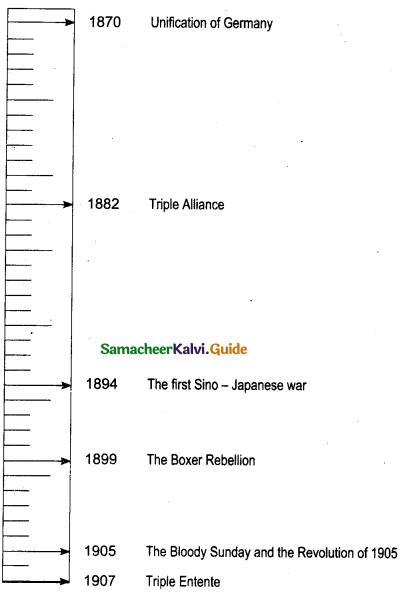
(b) Yasser Arafat

Question 6.
When was North and South Vietnam united?
(a) 1975
(b) 1976
(c) 1973
(d) 1974
Answer:
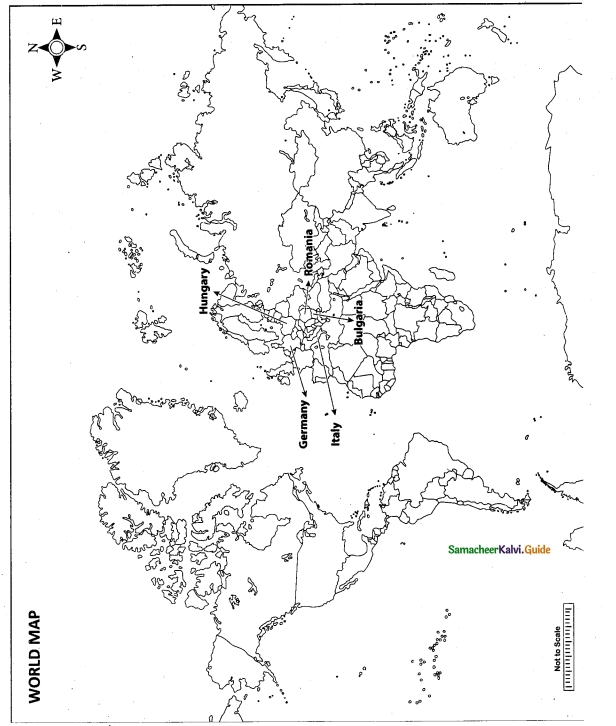
(b) 1976

Question 7.
Where was Arab League formed?
(a) Cairo
(b) Jordan
(c) Lebanon
(d) Syria
Answer:
(a) Cairo

Samacheer Kalvi 10th Social Science Guide History Chapter 4 The World after World War II

Question 8.
When was the Warsaw Pact dissolved?
(a) 1979
(b) 1989
(c) 1990
(d) 1991
Answer:
(d) 1991

II. Fill in the blanks

  1. ………………. was known as the “Father of modern China”.
  2. in 1918, the society for the study of Marxism was formed in ………………. University.
  3. After the death of Dr. Sun Yat-Sen, the leader of the Kuomintang party was ……………….
  4. ……………….. treaty is open to any Arab nation desiring peace and security in the region.
  5. The treaty of ………………. provided for mandates in Turkish -Arab Empire.
  6. Germany joined the NATO in ……………….
  7. ………………. was the Headquarters of the Council of Europe.
  8. ………………. treaty signed on February 7,1992 created the European Union.

Answers:

  1. Dr. Sun Yat-Sen
  2. Peking
  3. Chiang-Kai-Sheik
  4. Central Treaty organisation
  5. Versailles
  6. 1955
  7. Strasbourg
  8. Maastricht

III. Choose the correct statement / statements

Question 1.
(i) In China (1898) the young emperor, under the influence of the educated
minority, initiated a series of reforms known as the 100 days of reforms.
(ii) The Kuomintang Party represented the interests of the workers and peasants.
(iii) Yuan Shih-Kai had lost prestige in the eyes of Nationalists, when he agreed to the demand of Japan to have economic control of Manchuria and Shantung.
(iv) Soviet Union refused to recognize the People’s Republic of China for more than two decades.
(a) (i) and (ii) are correct
(b) (ii) and (iii) are correct
(c) (i) and (iii) are correct
(d) (i) and (iv) are correct
Answer:
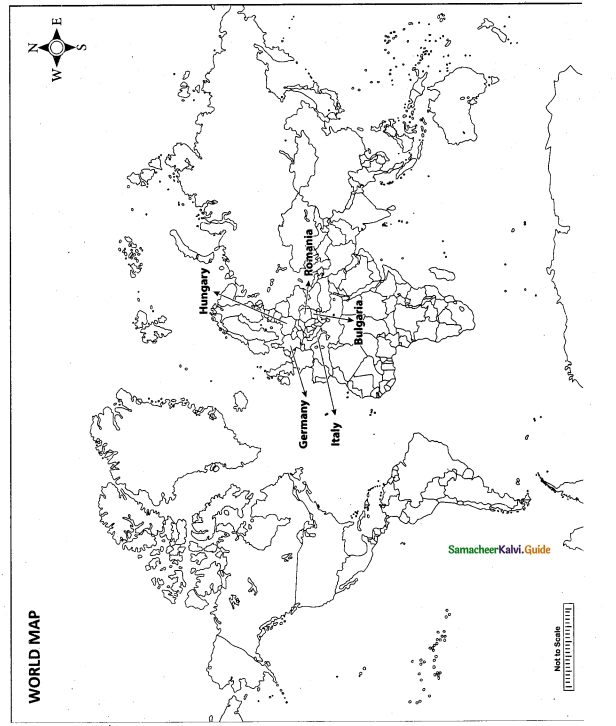
(c) (i) and (iii) are correct

Question 2.
(i) In 1948, the Soviets had established left wing government in the countries of Eastern Europe that had been liberated by the Soviet Army.
(ii) The chief objective of NATO was to preserve peace and security in the North Atlantic region.
(iii) The member countries of SEATO were committed to prevent democracy from gaining ground in the region.
(iv) Britain used the atomic bomb against Japan to convey its destructive capability to the USSR.
(a) (ii), (iii) and (iv) are correct
(b) (i) and (ii) are correct
(c) (iii) and (iv) are correct
(d) (i), (ii) and (iii) are correct
Answer:
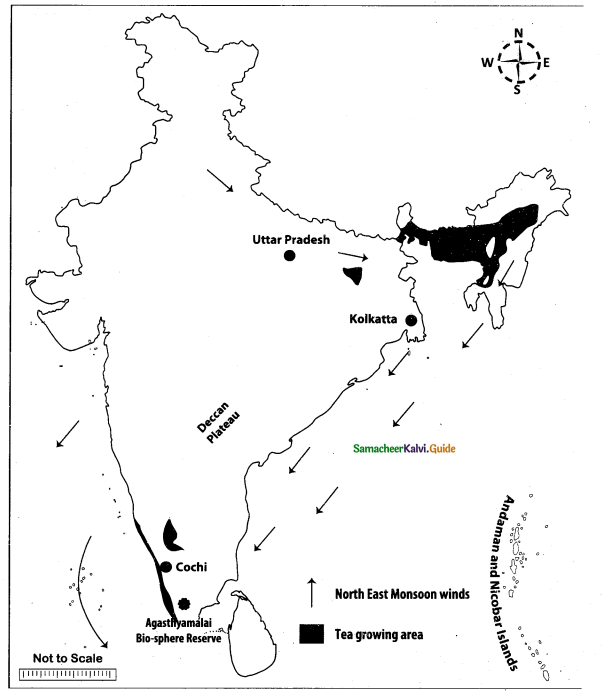
(b) (i) and (ii) are correct

Samacheer Kalvi 10th Social Science Guide History Chapter 4 The World after World War II

Question 3.
Assertion (A): America’s Marshall Plan was for reconstruction of the war¬. ravaged Europe.
Reason (R): The US conceived the Marshal Plan to bring the countries in the Western Europe under its influence.
(a) Both (A) and (R) are correct, but R is not the correct explanation of A
(b) Both (A)and (R) are wrong
(c) Both (A) and (R) are correct and R is the correct explanation of A
(d) (A) is wrong and (R) is correct.
Answer:
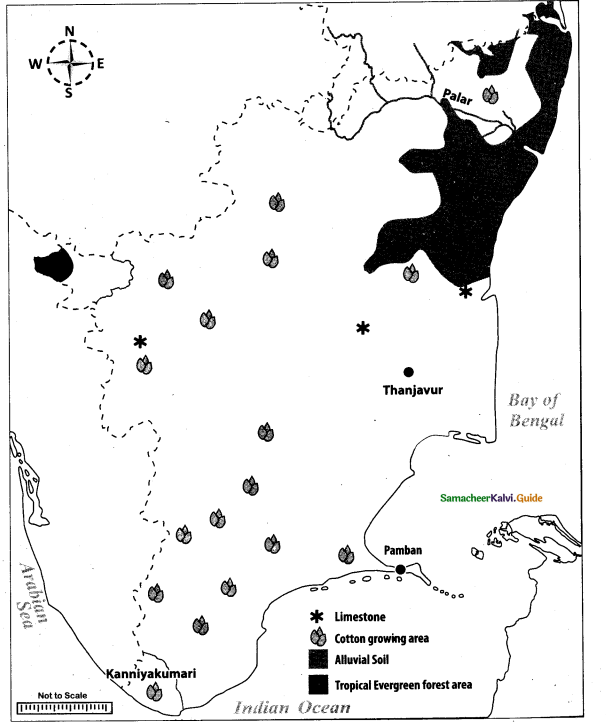
(c) Both (A) and (R) are correct and R is the correct explanation of A

IV. Match the following

Samacheer Kalvi 10th Social Science Guide History Chapter 4 The World after World War II 1
Answer:
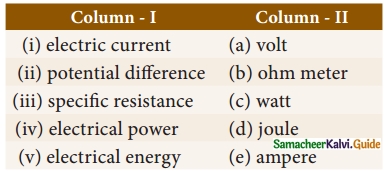
A. (ii)
B. (iii)
C. (iv)
D. (v)
E. (i)

V. Answer briefly

Question 1.
Write any three causes for the Chinese Revolution of 1911.
Answer:
Three causes of the Chinese Revolution of 1911 are

  1. The government of Manchu dynasty began to disintegrate with the death of the Empress Dowager Cixi in 1908. The new emperor was two-years old and the provincial governors began to assert their independence. In October 1911 the local army mutinied and the revolt spread.
  2. There were a few middle class leaders. Dr. Sun Yat-sen was one among them. He took part in the rising against the Manchus in 1895. The rising failed and Sun Yat-Sen was sent in the prison. But he continued to spread nationalist ideas.
  3. Yuan Shih-Kai, who had earlier served as a minister in the Manchu administration, persuaded those responsible for the ascension of the young Emperor to prevant on him to abdicate.

Question 2.
Explain how in 1928 Kuomintang and Chiang-Kai Shek established Central Government in China.
Answer:
Chiang Kai-shek started conquering China. Starting from Canton, in 1928, he captured Peking and also removed all communists in the Kuomintang party. Thus, he established Central government in China.

Samacheer Kalvi 10th Social Science Guide History Chapter 4 The World after World War II

Question 3.
Write a note on Mao’s Long March.
Answer:
Mao was an active leader who had gained full control of the Chinese Communist Party, by 1933. In 1934, he organised communist army of about 100,000 and set out on a long March. The marchers were continually harassed by Kuominatang forces, by local war lords and by unfriendly tribesmen of the 100,000 who set out, only 20,000 finally arrived in northern Shemi in late 1935, after crossing nearly 6000 miles. They were soon poined by other communist armies. By 1937, Mao had become the leader of over 10 million people. Mao’s Long March, as it is called so, has become legendary in the history of China.

Question 4.
What do you know of Baghdad Pact?
Answer:
In 1955, Turkey, Iraq, Great Britain, Iran and Pakistan signed a pact known as Baghdad pact. In 1958, when United States joined, then it was called as Central Treaty organization. The treaty was open to any Arab nation desiring peace and security in their region. It was dissolved in 1979.

Question 5.
What was the Marshall Plan?
Answer:
The Marshall Plan was an American initiative passed in 1948 to and Western Europe, in which the United States gave over $12 Billion in economic assistance to help rebuild Western European economies after the end of World War II. It operated for four years beginning in April 1948. The goals of the United States were to rebuild war-tom regions, modernise industry and improve European prosperity.

Question 6.
The Suez Canal crisis confirmed that Israel had been created to serve the cause of western interests-Elaborate.
Answer:
In 1956, Egypt invaded Suez Canal under Colonel Nasser and nationalized it. With the failure of diplomacy, Britain and France decided to use force. They bombed Egyptian air fields as well as Suez Canal area. However, United States and United Nations pressure, all the three invaders withdrew from Suez Canal.

Question 7.
Write a note on Third World Countries.
Answer:
The capitalist countries led by the US were politically designated as the First Worlds, while the communist states led by the Soviet Union came to be known as the Second World states, outside these two were called third World. During the Cold War, third World consisted of the developing world the former colonies of Africa, Asia, and Latin America. With the break up of the Soviet Union in 1991, and the process of globalisation, the term Third World has lost its relevance.

Question 8.
How was the Cuban missile crisis defused?
Answer:
In April 1961, on the island of Bay of Pigs, U.S bombed Cuban airfields and surrounded Cuba, with their warships. At the same time, USSR was secretly installing nuclear missiles in Cuba. Finally when Soviet President Khrushchev agreed to withdraw the missiles, the Cuban missile-crisis defused.

Samacheer Kalvi 10th Social Science Guide History Chapter 4 The World after World War II

VI. Answer all the questions under each caption

Question 1.
Cold War

(a) Name the two military blocs that emerged in the Post-World War II.
Answer:
United States and the Soviet Union were the two military blocs that emerged in the post World War-II.

(b) Who coined the term “Cold War” and who used it first?
Answer:
The term Cold war was first coined by the English writer George Orwell in 1945 and it was used for the first time by Bernard Baruch, a multimillionaire from USA.

(c) What was the response of Soviet Russia to the formation of NATO?
Answer:
Warsaw Pact was the response of Soviet Russia to the formation of NATO.

(d) What was the context in which Warsaw Pact was dissolved?
Answer:
With the Break-up of USSR in 1991, the Warsaw Pact was dissolved.

Question 2.
Korean War

(a) Who was the President of North Korea during the Korean War?
Answer:
Kim II was the President of North Korea during the Korean War.

(b) Name the southern rival to the President of North Korea.
Answer:
Syngman Rhee

(c) How long did the Korean War last?
Answer:
The Korean War lasted three years

(d) What was the human cost of the War?
Answer:
The human cost was enormous, there were 500,000 western casualties and three times that number on the other side. Approximately two million Korean civilian died.

Question 3.
Non-Aligned Movement (NAM)

(a) When and where was the first conference on Non-Aligned Movement held?
Answer:
At Belgrade, in 1961, the first conference on NAM was held.

(b) Who were the prominent personalities present in the first conference?
Answer:
The prominent personalities present in the first conference were Tito (Yugoslavia), Nasser (Egypt), Nehru (India), Nikrumah (Ghana), Sukrano (Indonesia),.

(c) What were the objectives of NAM?
Answer:
Peaceful co-existence, commitment to peace and security.

(d) List out any two basic principles of Non-Alignment Movement enunciated in the Belgrade Conference.
Answer:

  1. Non-Alignment with any of the two super powers (USA/USSR).
  2. Fight all forms of colonialism and Imperialism.

Samacheer Kalvi 10th Social Science Guide History Chapter 4 The World after World War II

VII. Answer in detail

Question 1.
Estimate the role of Mao Tse tung in making China a communist country.
Answer:

  1. Mao was greatly influenced by the ideas of Max and Lenin. He wanted to make China a communist country. So, he became active in the political activities of Hunan from the year 1912.
  2. After the death of Sun Yat-Sen in 1925, The Kuomintang was organised under the leadership of Chang Kai-Shek. Being an avowed critic of communists, Chiang removed all the important position holders in the Communist Party including Mao Tse Tung to weaken the party. However, the communists continued to influence the workers and peasants the Kuomintang represented the interests of landlords and capitalists.
  3. Mao had understood that the Kuomintang grip on the towns was too strong. So, he started organising the peasantry. When the relationships between Kuomintang and Communist Party broke, a few hundred Communist-led by Mao retreated into the wild mountains on the border between the provinces of Kiangsi and Hunan. The Kuomintang could not penetrate the mountains.
  4. Meanwhile, the campaign against the communists got distracted as Chiang Kai-Shek had to deal with the constant threat from Japan.
  5. By 1933 Mao had gained full control of the Chinese Communist Party. In 1934, he set out on a long march with the help of about 100,000 communist army. He also got support of other communist armies.
  6. By 1937, Mao had become the leader of over 10 million people. He organised workers and peasants councils in villages of Shensi and Kansu and finally got success in making China a communist country.

Samacheer Kalvi 10th Social Science Guide History Chapter 4 The World after World War II

Question 2.
Attempt an essay on the Arab-lsraeii wars of 1967 and 1973.
Answer:

  1. Before the creation of the State of Israel in 1948, all Arabs and their . descendants lived in the Palestine.
  2. Ever since the formation, the Palestinian Liberation organisation (PLO). Israel came to be attacked by the Palestinian Guerrilla groups based in Syria, Lebanon and Jordan.
  3. Israel resorted to violent military force .
  4. In November 1966, an Israeli strike on the village of Al-Samu in the west bank of Jordan killed 18 people and wounded 54 people.
  5. Israel’s air battle with Syria in April 1967 ended in the shooting down of six Syrian MIG fighter jets.
  6. After air battle with Syria, when Arab States were mobilized by Nasser on June 5th Israel staged a sudden air strike that destroyed more than, 90% of Egypt’s air force on the tarmac.
  7. Later, Egypt and Syria under Presidents Anwar Sadat and Hafez-al- Assad respectively concluded a secret agreement in January 1973 to bring their armies under one command.
  8. When peace deals did not work out with Israel, Egypt and Syria launched a sudden and surprise attack on the Yom Kippur religious holiday on 6th October 1973.
  9. Though Israel suffered heavy casualities, it finally pushed back the Arab forces.
  10. Due to U.N intervention, Israel was forced to return and Arabs gained nothing.
  11. U.S succeeded in showing their control on their region and oil resource, led to U. S led war against Iraq in 1991.

Question 3.
Narrate the history of transformation of Council of Europe into an European Union.
Answer:
(i) After World War II, it was decided to integrate the states of western Europe. One of the chief objectives was to prevent further European wars by ending the rivalry between France and Germany. In May 1949, ten countries met in London and signed a form called Council of Europe

(ii) Since the Council of Europe had no real power, a proposal to set up two European organisations were made. Accordingly, the European Defence Community (EDC) and the European Coal and Steel Community (ECSC) were established. Six countries belonging to ECSC signed the treaty of Rome which established the European Economic Community (EEC) or the European Common Market, with headquarters at Brussels.

(iii) The EEC facilitated the elimination of barriers to the movement of goods and services, capital, and labour. It also prohibited public policies or private agreements that restricted market comptetion. Throughout the 1970s and 80s the EEC kept expanding its membership.

(iv) The single European Act came into force on July 1, 1987. It significantly expanded the EEC’s scope giving the meetings of the EPC a legal basis. It also called for more intensive coordination of foreign policy among member countries. According to the SEA each member was given multiple votes, depending on the countries population.

(v) The Maastricht (Netherlands) Treaty signed on February 7, 1992, created the European Union (EU). Today the European Union has 28 member states, and is functioning from its headquarters at Brussels, Belgium.

Samacheer Kalvi 10th Social Science Guide History Chapter 4 The World after World War II

VIII. Activity

Question 1.
Divide the class into two groups. Let one group act as supporters of USA and the other group act as supporters of Soviet Union, Organise a debate.
Answer:
One group of students act as the supports of USA and the other group act as supporters of Soviet Union on their role in the cold war era.
(Students can have debate based on the following aspects)

During the time of cold war, the two super powers that emerged was USA and USSR.

Strengths of USA:

  1. Strongest navy both the Pacific and Atlantic.
  2. Continued and strong economic position that the USA held in the beginning till the end.
  3. Foreign policy of the USA. The actions of USA during the cold war era, very powerful and could guarantee others the strong power of the nation is to prevent communism spreading elsewhere.
  4. The country was able to generate the vast amount of wealth necessary to sustain the investment in weapons, technology and other operations.
  5. USA was also technologically powerful in target finding, tracking, sensors etc.
  6. The Truman’s doctrine was used throughout the war time. The doctrine helped USA to negotiate with other states to adopt capitalism.

Strengths of USSR:

  1. Strongest land based military, especially tanks.
  2. USSR developed air defense equipment and networks.
  3. Spread of Communism joined together backed USSR.
  4. As against NATO, USSR also formed military block, the Warsaw pact.
  5. With Western European countries USSR facilitated trade relations.
  6. Highly strengthened space exploration.

In the end of cold war, the Soviet Union fell, and the Communism expired.

Question 2.
Involving the entire class, an album may be prepared with pictures relating to Korean, Arab-lsraeli and Vietnam Wars to highlight the human sufferings in terms of death and devastation.
Answer:
Students should go to the search engine in google and type “The War’s impact on the Korean peninsula and trace the article of the journal of America – East Asia Relations” for a detailed Report.

Korean War: To give a sample answer: According to a U.S. Department of state publication, the number of killed, wounded and missing from the Armed forces of the Republic of Korea exceeded 4,00.000. From the U.S. side, 1,42,000. In addition, the heavy toll in death and injuries to the civilian population as well as wide property damage.

Arab-Israel War: Students should trace the answer from the google search engine as: The U.N. Report on Israel’s Gaza War.

To give a sample answer: From the 183 page report of the U.N. report, it is very clear that many civilians died. More than 6,000 Israeli airstrikes, 14,500 tank shells and 35,000 artillery shells led to the destruction of about 18,000 dwellings in Gaza. Nearly 1,462 Palestinian civilians, 299 women and 551 children were killed (According to U.N. Investigation). In Israel six civilians and 67 soldiers were killed.

Vietnam War: Students should trace the answer in the google search engine as “The War’s effect on the Vietnamese Land and People” for a detailed report.

To give a sample answer: About 58,000 American soldiers were killed and another 3,04,000 were wounded. Since most of the fighting took place in Vietnam, an estimated 4 million Vietnamese were killed on both sides including as many as 1 -3 million civilians. Many Vietnamese in country side turned into homeless refuges. Many forms and forests were destroyed.

Along with the detailed report, students should collect pictures showing Korea, Arab-Israel and Vietnam War, highlighting human sufferings. Students should click to google search engine and go to → Images → then type Korean War pictures / Arab Israel War pictures / Vietnam War pictures, download it take a print out of its and paste it in a A4 sheet paper or an a chart paper neatly and create an album.

Timeline:
Samacheer Kalvi 10th Social Science Guide History Chapter 4 The World after World War II 2

Samacheer Kalvi 10th Social Science Guide History Chapter 4 The World after World War II

Samacheer Kalvi 10th Social Science The World after World War II Additional Important Questions and Answers

I. Choose the correct answer

Question 1.
The emergence of ……………. and ……………. as super powers resulted in the division of the World into two block after World War II.
(a) Japan, USA
(b) USA, USSR
(c) China, Japan
(d) USA, Germany
Answer:
(b) USA, USSR

Question 2.
Dr.Sun yat-sen was born in a poor family near ………
(a) Canton
(b) France
(c) Spain
Answer:
(a) Canton

Question 3
……………. was called the father of modern China.
(a) Chiang-Kai-Shek
(b) Yuan-Shi-Kai
(c) Mao-Tse-Tung
(d) Dr. Sun Yat-Sen
Answer:
(d) Dr. Sun Yat-Sen

Question 4.
Mao was born in ……… in South – East China.
(a) Cambodia
(b) Vietnam
(c) Hunan
Answer:
(c) Hunan

Question 5.
Yuan-Shi-Kai died in the year …………….
(a) 1912
(b) 1913
(c) 1915
(d) 1916
Answer:
(d) 1916

Question 6.
Which of the following is not a part of Indo – China?
(a) Cambodia
(b) China
(c) Vietnam
Answer:
(b) China

Question 7.
The Historical Long March set out in China in …………….
(a) 1935
(b) 1937
(c) 1934
(d) 1936
Answer:
(c) 1934

Question 8.
In which of the following was indentured Vietnamese labour widely used?
(a) Rice cultivation
(b) Rubber plantation
(c) Industry
Answer:
(b) Rubber plantation

Samacheer Kalvi 10th Social Science Guide History Chapter 4 The World after World War II

Question 9.
……………. was the leader of the people’s Republic of China.
(a) Marshall
(b) Truman
(c) Mao-Tse-Tung
(d) Chiang-Kai-shek
Answer:
(c) Mao-Tse-Tung

Question 10.
Ho Chi Minh means ………
(a) He, Who enlightens
(b) Enlightenment
(c) The Enlightened one
Answer:
(a) He, Who enlightens

Question 11.
The Idea of European self-help programme financed by the United States was called as …………….
(a) NATO
(b) SEATO
(c) ECA
(d) Marshall plan
Answer:
(d) Marshall plan

Question 12.
EURATOM was established by the ………
(a) Treaty of Nanking
(b) Treaty of Rome
(c) Treaty of London
Answer:
(b) Treaty of Rome

Question 13.
The term ‘cold war’ was first coined by the English writer …………….
(a) Shakespeare
(b) George Orwell
(c) William Dexter
(d) Peter Alphonse
Answer:
(b) George Orwell

Question 14.
As a part of Marshall plan financing, European nations received nearly ……………. billion in aid.
(a) $ 12
(b) $ 11
(c) $ 15
(d) $ 13
Answer:
(d) $ 13

Question 15.
Greece and Turkey joined NATO in the year …………….
(a) 1945
(b) 1947
(c) 1952
(d) 1955
Answer:
(c) 1952

Question 16.
……………. was otherwise called as pact.
(a) NATO
(b) CENTO
(c) SEATO
(d) EC SC
Answer:
(d) EC SC

Question 17
……………. are included as member countries in NATO.
(a) Canada, Belgium
(b) U.K., Portugal
(c) Both (a) and (b)
(d) None of the above
Answer:
(c) Both (a) and (b)

Question 18.
NATO had ……………. members by the year 2017.
(a) 30
(b) 51
(c) 29
(d) 24
Answer:
(c) 29

Question 19.
In December 1954, a conference of eight European nations took place in Moscow. This was called as …………….
(a) Warsaw pact
(b) Counter to NATO
(c) SEATO
(d) Both (a) and (b)
Answer:
(d) Both (a) and (b)

Question 20.
The headquarters of the Warsaw pact was …………….
(a) Belgium
(b) Poland
(c) Moscow
(d) Romania
Answer:
(c) Moscow

Samacheer Kalvi 10th Social Science Guide History Chapter 4 The World after World War II

Question 21.
The Korea was partitioned into North and South Korea in the year …………….
(a) 1944
(b) 1945
(c) 1946
(d) 1947
Answer:
(b) 1945

Question 22.
With the collapse of the ……………. the idea of non-alignment lost relevance.
(a) Berlin
(b) CIA
(c) ECA
(d) Soviet Union
Answer:
(d) Soviet Union

Question 23.
The NAM held its first conference at ……………. in 1961.
(a) Bandung
(b) Belgrade
(c) Thailand
(d) Philippine
Answer:
(b) Belgrade

Question 24.
The World Zionist Organisation was founded in the year …………….
(a) 1857
(b) 1887
(c) 1897
(d) 1867
Answer:
(c) 1897

Question 25.
Castro nationalised the U.S. owned ……………. companies.
(a) cotton
(b) sugar
(c) oil
(d) petrol
Answer:
(b) sugar

Question 26.
The Cuban Missile crisis was defused by ……………. as the agreed to withdraw the missiles.
(a) Khrushchev
(b) Fidel Castro
(c) Leumi
(d) Stem Gang
Answer:
(a) Khrushchev

Samacheer Kalvi 10th Social Science Guide History Chapter 4 The World after World War II

Question 27.
In the Arab World, it is treated as the ……………. when large number of Arabs become refugees.
(a) Catastrophe
(b) Nakbah
(c) Negev and (b)
(d) Both (a) and (b)
Answer:
(d) Both (a) and (b)

Question 28.
For resolving the Suez Canal Crisis, ……………. from Indian played a crucial role.
(a) Gandhi
(b) Nehru
(c) Bose
(d) Tilak
Answer:
(b) Nehru

Question 29.
Arab-lsrael war took place in the years …………….
(a) 1967,69
(b) 1969,74
(c) 1967,73
(d) 1972,73
Answer:
(c) 1967,73

Question 30.
……………. became the first president of the state of Palestine in 1989.
(a) Anwar Sadat
(b) Yasser Arafat
(c) Nasser Arafat
(d) Nasser Hussain
Answer:
(b) Yasser Arafat

Question 31.
By the end of second world war, ……………. controlled the northern half of Vietnam.
(a) Vietminh
(b) Ho-Chi-Minh
(c) Ngo Dinh Diem
(d) None
Answer:
(a) Vietminh

Question 32.
……………. controlled the southern half of the Vietnam.
(a) Viet Minh
(b) Bao Dai
(c) Ngo Dinh Diam
(d) None
Answer:
(b) Bao Dai

Question 33.
The North and the South Vietnam were formally united as one country in …………….
(a) 1973
(b) 1976
(c) 1975
(d) 1974
Answer:
(b) 1976

Question 34.
In May 1949, ten countries met in ……………. and signed to form a council of Europe.
(a) Japan
(b) Syria
(c) London
(d) France
Answer:
(c) London

Question 35.
To prevent further European War ……………. was founded.
(a) Council of Europe
(b) Council of Trent
(c) ECSC
(d) EU
Answer:
(a) Council of Europe

Samacheer Kalvi 10th Social Science Guide History Chapter 4 The World after World War II

Question 36.
……………. did not join the EEC, when it was formed.
(a) U.K
(b) U.S.A
(c) USSR
(d) Italy
Answer:
(a) U.K

Question 37.
Britain, voted to exit the EU in the year …………….
(a) 2015
(b) 2014
(c) 2017
(d) 2019
Answer:
(c) 2017

Question 38.
West Berlin was supported by …………….
(a) USA
(b) UK
(c) USSR
(d) Germany
Answer:
(a) USA

Question 39.
East Berlin was supported by …………….
(a) USA
(b) UK
(c) USSR
(d) Germany
Answer:
(c) USSR

Question 40.
Germany was officially united on …………….
(a) 1987
(b) 1989
(c) 1990
(d) 2003
Answer:
(c) 1990

Question 41.
in 1985, ……………. became the head of the USSR.
(a) Mikhai Gorbachev
(b) Reagen
(c) Stalin
(d) Kohl
Answer:
(a) Mikhai Gorbachev

Question 42.
The Chernobyl disaster took place in the year …………….
(a) 1987
(b) 1984
(c) 1986
(d) 2006
Answer:
(c) 1986

Question 43.
Gorbachev announced his resignation on …………….
(a) 21st November
(b) 25th December
(c) 2nd October
(d) 15th August
Answer:
(b) 25th December

Question 44.
USSR dissolved formally In the year …………….
(a) 31st Dec. 1990
(b) 30th Dec. 1991
(c) 31st Dec. 1991
(d) 28,h Feb. 1991
Answer:
(c) 31st Dec. 1991

Samacheer Kalvi 10th Social Science Guide History Chapter 4 The World after World War II

Question 45.
……………. was an ally of Gorbachev.
(a) Yeltsin
(b) Brezhnev
(c) Khrushchev
(d) None
Answer:
(a) Yeltsin

II. Fill in the blanks

  1. ………………… and ………………… were the Superpowers after the World War II.
  2. The cold war period ended with the fall of …………………
  3. Empress Dowager died in ………………… led to the disintegration of the Manchu dynasty.
  4. Kuomintang party of China was otherwise called as ………………… party.
  5. ………………… was the ultimate aim of Dr. Sun Yat-sen’s party.
  6. The Chinese revolution broke out in the year …………………
  7. The first director of the Whampoa Military academy was …………………
  8. The campaign against the communists led by Chiang-Kai-Shek was distracted by ………………… and warlords.
  9. By ………………… Mao became the leader of the Chinese people.
  10. Over ………………… delegates from various countries attended the people’s political consultative conference.
  11. When Japanese surrendered in 1945, the Japanese areas were occupied by the …………………
  12. By the year …………………, communist control has been established over most parts of China.
  13. The two mighty communist powers in the world were ………………… and …………………
  14. The term cold war was first coined by …………………
  15. ………………… nations became a part of Marshall’s plan of self-help programme.
  16. The Marshall plan funding ended in …………………
  17. ………………… was created to resist Soviet aggression in Europe.
  18. NATO means …………………
  19. NATO was formed in the year …………………
  20. The members of NATO agreed that, any armed attack on any one of them would be considered attack on …………………
  21. For the collective security of the South-east Asia, ………………… was formed in 1954.
  22. Member of SEATO were committed to prevent …………………
  23. SEATO was formed in 1954, after signing of the …………………
  24. ………………… was formed by Soviet Union as a counter to NATO.
  25. ………………… European nations attended the Warsaw pact in December 1954.
  26. The treaty on Warsaw pact was concluded on …………………
  27. The Warsaw pact was dissolved in …………………
  28. The Warsaw pact dissolved because of the break-up of …………………
  29. The Baghdad pact was otherwise called as …………………
  30. Turkey, Iran, Iraq, Pakistan and Great Britain signed a treaty in 1955, known as …………………
  31. When U.S.A joined the Baghdad pact, it was called by name …………………
  32. USA joined the Baghdad pact in the year …………………
  33. CENTO was dissolved in the year …………………
  34. Korea was partitioned as North Korea and South Korea in the year …………………
  35. The president of North Korea was …………………
  36. The party of Kim II was called as …………………
  37. The president of the South Korea was …………………
  38. The party of Syngman Rhee was …………………
  39. Korean War lasted for ………………… years.
  40. NAM refers to the …………………
  41. NAM was signed in ………………… at the ………………… conference.
  42. Bandung is a city in …………………
  43. With the collapse of ………………… the idea of NAM lost importance.
  44. CIA is a Central Intelligence Agency of …………………
  45. The Act of ………………… in Cuba, threatened American economic interests.
  46. USA bombed Cuban ………………… with the aim of overthrowing Castro’s regime.
  47. ………………… was the president of USSR, when the Cuban Missile crisis took place.
  48. Cuba was helped by …………………
  49. When USSR remove missile from Cuba, USA had to agree to remove missile from ………………… and …………………
  50. ………………… was a Zionist Terrorist Organisation.
  51. The Zionist Para-military organization was called as …………………
  52. The World Zionist organization was founded in the year …………………
  53. Jews living outside their ancient home scattered around North America and Europe was called as …………………
  54. ………………… Nationalised Suez Canal.
  55. India represented by ………………… played a crucial role in resolving the crisis.
  56. The Arab-lsraeli War took place in the years ………………… and …………………
  57. PLO refers to …………………
  58. PLO was formed in …………………
  59. ………………… was the prominent leader of Palestine.
  60. By the end of the Second World War, ………………… Controlled the northern half of Vietnam.
  61. South Vietnam was ruled by …………………
  62. America supported troops of ………………… Vietnam.
  63. The city of ………………… was renamed as Ho-Chi-Minh city.
  64. To create a United Europe to resist any threat from Soviet Russia, ………………… was formed.
  65. European Economic Community was otherwise called as …………………
  66. SEA refers to …………………
  67. According to the SEA, each member was given ………………… votes.
  68. The ………………… Treaty created the European Union.
  69. Maastricht is in …………………
  70. EU was created on Maastricht treaty signed on …………………
  71. The headquarters of the EU is at …………………
  72. Brussels is at …………………
  73. ………………… Germany was prosperous.
  74. ………………… Germany was suffering from lack of democracy and freedom.
  75. Germany was officially reunited on …………………
  76. Glasnost means …………………
  77. Perestroika means …………………
  78. ………………… was introduced by Gorbachev to restructure Soviet economic and political system.
  79. After Gorbachev, power fell into the hands of …………………
  80. For ………………… days, Soviet Union, continued to exist only in name.
  81. Soviet Union dissolved formally on 31st December …………………
  82. USSR split into ………………… countries.
  83. ………………… was the president of the newly independent Russian State.
  84. U.S.A. troops used ………………… weapons in their war against Vietnam.
  85. Napalm and Agent Orange are the names of incendiary …………………

Answers:

  1. USA and USSR
  2. Berlin Wall
  3. 1908
  4. National People’s Party
  5. Socialism
  6. 1911
  7. Chiang-Kai-Shek
  8. Japan
  9. 1937
  10. 650
  11. Kuomintang
  12. 1948
  13. Soviet Union, People’s Republic of China
  14. George Orwell
  15. Sixty
  16. 1951
  17. NATO
  18. North Atlantic Treaty Organisation
  19. 1949
  20. NATO
  21. SEATO
  22. Communism
  23. Manila Pact
  24. Warsaw Pact
  25. 8 (eight)
  26. May 14, 1955
  27. 1991
  28. USSR
  29. Central Treaty Organisation
  30. Baghdad Pact
  31. Central Treaty Organisation
  32. 1958
  33. 1979
  34. 1945
  35. Kim II
  36. People’s Republic of Korea
  37. Syngman Rhee
  38. The Republic of Korea
  39. three
  40. Non-Aligned Movement
  41. 1955, Bandung
  42. Indonesia
  43. Soviet Union
  44. America
  45. Castro
  46. Airfields
  47. Khrushchev
  48. USSR
  49. Turkey, Italy
  50. Stem Gang
  51. Irgun Zvai Leumi
  52. 1897
  53. Diaspora
  54. Colonel Nasser
  55. Nehru
  56. 1967, 1973
  57. Palestine Liberation Organisation
  58. 1948
  59. Yasser Arafat
  60. Viet Minh
  61. Ngo Dinh Diem
  62. South
  63. Saigon
  64. Council of Europe
  65. European Common Market
  66. Single European Act
  67. multiple
  68. Maastricht
  69. Netherlands
  70. Feb 7, 1992
  71. Brussels
  72. Belgium
  73. West Berlin’s
  74. East Berlin
  75. 3rd October 1990
  76. openness
  77. restructuring
  78. Perestroika
  79. Boris Yeltsin
  80. Six 81.1991
  81. 15
  82. Boris Yeltsin
  83. Bacteriological
  84. bombs

Samacheer Kalvi 10th Social Science Guide History Chapter 4 The World after World War II

III. Choose the correct statement / statements

Question 1.
(i) The cold war period ended with the fall of Berlin Wall
(ii) Mao concentrated mainly on organizing the peasantry.
(iii) In 1937, the communist army of about 100,000 set out on the Long march.
(iv) Marshall plan funded nearly $ 15 billion.
(a) (ii and (ii) are correct
(b) (i) and (iii) are correct
(c) (ii and (iv) are correct
(d) (iii) and (iv) are correct.
Answer:
(a) (ii and (ii) are correct

Question 2.
(i) The USSR was much concerned about the destruction caused by the Second World War.
(ii) The South East Asia Treaty organization was organised for the collective security of countries in South East Asia.
(iii) The Communist States led by the Soviet Union came to be known First World Countries.
(iv) The Capitalist countries led by the U.S.A. were politically designated as Second World Countries.
(a) (i) and (ii) are correct
(b) (i), (iii), (iv) are wrong
(c) (i) and (iv) are correct
(d) (ii) and (iii) are correct.
Answer:
(b) (i), (iii), (iv) are wrong

Question 3.
(i) NAM refers to the Non-Aligned Movement.
(ii) The Single European Act of the EU as called as SEA.
(iii) Anwar Sadat was the president of the Palestine in 1989.
(iv) The fighters of South Vietnam were trained in guerrilla warfare.
(a) (i) and (ii) are correct
(b) (i), (iii), (iv) are wrong
(c) (i) and (iv) are correct
(d) (ii) and (iii) are correct.
Answer:
(a) (i) and (ii) are correct

Question 4.
(i) The Third World principally consist of the developing World.
(ii) With the breakup of the Soviet Union in 1991, and the process of globalization, the term has lost its relevance.
(iii) The former colonies of Asia, Africa, and Latin America were called as Third World Countries.
(iv) The division of Germany into West and East led to glaring differences in living standards.
(a) (i) and (ii) are correct
(b) (i), (ii), (iii) are correct
(c) (i) and (iii) are correct
(d) All the four are correct.
Answer:
(d) All the four are correct.

Question 5.
(i) Yeltsin worked as a Mayor of Moscow.
(ii) Yeltsin was returned to power with overwhelming support of a Moscow in 1899.
(iii) For twelve days, the Soviet Union continued to exist only in name.
(iv) On 28th February 1991, USSR was formally dissolved.
(a) (i) and (ii) are correct
(b) (i), (ii), (iii) are correct
(c) (i) and (iii) are correct
(d) All the four are correct.
Answer:
(a) (i) and (ii) are correct

Samacheer Kalvi 10th Social Science Guide History Chapter 4 The World after World War II

Question 6.
(i) CENTO was otherwise called as Manila pact.
(ii) As a counter to SEATO, NATO was formed.
(iii) The Korean war helped to bring down the intensity of the Cold war.
(iv) The EEC eliminated barriers to the movement of goods, Capital and labour.
(a) (i) and (ii) are correct
(b) (i), (ii), (iii) are wrong
(c) (i) and (iv) are correct
(d) All the four are correct.
Answer:
(b) (i), (ii), (iii) are wrong

Question 7.
(i) The Berlin Wall was just a physical barrier.
(ii) Berlin Wall divided East Germany and West Germany.
(iii) USA supported East Berlin.
(iv) USSR supported West Berlin.
(a) (i) and (ii) are correct
(b) (i), (ii), (iii) are wrong
(c) (i) and (iv) are correct
(d) All the four are wrong.
Answer:
(a) (i) and (ii) are correct

IV. Assertion and Reason

Question 1.
Assertion (A): Yuan Shih-Kai of China lost prestige in his country.
Reason (R): He agreed to the demand of Japan to have economic control of Manchuria and Shantung.
(a) Both (A) and (R) are correct, R is not the correct explanation of A
(b) Both (A) and (R) are wrong
(c) Both (A) and (R) are correct, and R is the correct explanation of A
(d) (A) is wrong and (R) is correct.
Answer:
(c) Both (A) and (R) are correct, and R is the correct explanation of A

Question 2.
Assertion (A): The rivalry that developed after World War 11 is referred to as “Cold War”.
Reason (R): This war did not take recourse to weapons.
(a) Both (A) and (R) are correct, R is not the correct explanation of A
(b) Both (A) and (R) are wrong
(c) Both (A) and (R) are correct, and R is the correct explanation of A
(d) (A) is wrong and (R) is correct.
Answer:
(c) Both (A) and (R) are correct, and R is the correct explanation of A

Question 3.
Assertion (A): There was High military expenditure on both sides of USA and USSR.
Reason (R): Soviet Union tested the nuclear bomb and America used the nuclear bomb against Japan.
(a) Both (A) and (R) are correct, R is not the correct explanation of A
(b) Both (A) and (R) are wrong
(c) Both (A) and (R) are correct, and R is the correct explanation of A
(d) (A) is wrong and (R) is correct.
Answer:
(c) Both (A) and (R) are correct, and R is the correct explanation of A

Samacheer Kalvi 10th Social Science Guide History Chapter 4 The World after World War II

Question 4.
Assertion (A): The U.S. and its European allies formed the NATO to wage war against Vietnam.
Reason (R): As a counter to the NATO, Soviet Union organised the Warsaw pact.
(a) Both (A) and (R) are correct, R is not the correct explanation of A
(b) Both (A) and (R.) are wrong
(c) Both (A) and (R) are correct and R is the correct explanation of A
(d) (A) is wrong and (R) is correct.
Answer:
(d) (A) is wrong and (R) is correct.

Question 5.
Assertion (A): A small country had succeeded in winning Independence and the greatest power of the World-The country Vietnam.
Reason (R): The help given to Vietnam by the Socialist Countries, the political support given by Asia and Africa is evident.
(a) Both (A) and (R) are correct, R is not the correct explanation of A
(b) Both (A) and (R) are wrong
(c) Both (A) and (R) are correct and R is the correct explanation of A
(d) (A) is wrong and (R) is correct.
Answer:
(c) Both (A) and (R) are correct and R is the correct explanation of A

Question 6.
Assertion (A): Sun Yat-sen sent Chiang Kai-shek to Moscow, in Russia. The Russians in turn sent Michael Borodin to China.
Reason {R): Chiang Kai-shek started conquering China from Canton.
(a) Both (A) and (R) are correct, R is not the correct explanation of A
(b) Both (A) and (R) are wrong
(c) Both (A) and (R) are correct and R is the correct explanation of A
(d) (A) is wrong and (R) is correct.
Answer:
(a) Both (A) and (R) are correct, R is not the correct explanation of A

Question 7.
Assertion (A): U.S.A. supported Diem government in South Vietnam. Reason (R): U.S. wanted to establish a strong government in South Vietnam.
(a) Both (A) and (R) are correct, R is not the correct explanation of A
(b) Both (A) and (R) are wrong
(c) Both (A) and (R) are correct and R is the correct explanation of A
(d) (A) is wrong and (R) is correct.
Answer:
(c) Both (A) and (R) are correct and R is the correct explanation of A

V. Match the following

Question 1.
Match the Column I with Column II.
Samacheer Kalvi 10th Social Science Guide History Chapter 4 The World after World War II 3
Answer:
A. (v)
B. (iii)
C. (ii)
D. (i)
E. (vi)

Samacheer Kalvi 10th Social Science Guide History Chapter 4 The World after World War II

Question 2.
Match the Column I with Column II.
Samacheer Kalvi 10th Social Science Guide History Chapter 4 The World after World War II 4
Answer:
A. (iv)
B. (iii)
C. (i)
D. (ii)
E. (vi)

VI. Answer briefly

Question 1.
Describe about Zionist movement.
Answer:
(i) In Palestine, the ancient home of Jews, only a few thousand Jews were living in 1900.
(ii) Some 15 million were scattered around Europe and North America.
(iii) These Jews had been subjected to systematic persecution for centuries.
(iv) But in the late nineteenth century, the persecution in Russia (Where two-thirds of the world’s jews lived), France and Germany was intense.
(v) Some Jews emigrated to Palestine, while many more went to the United States and Britain.
(vi) In 1896, Thodore Herzel, a Viennese journalist, published a pamphlet called the Jewish state in which he called for the creation of a Jewish national home. In 1897 the world zionist organisation was founded.

Question 2.
What was Truman’s policy?
Answer:
Truman, the president of USA announced a policy of containment of communism. This implies U.S. would support those countries which were threatened by USSR to spread communism.

Question 3.
Mention the initial member countries of the EU.
Answer:

  1. Belgium
  2. France
  3. Italy
  4. Luxemburg
  5. Netherlands
  6. West Germany

Question 4.
What is meant by SEA?
Answer:
SEA refers to the single European Act which came into force on July 1,1987. According to the SEA, each member was given multiple votes depending on the country’s population. Its main aim is establishing a single market.

Question 5.
Name the organs of the EU.
Answer:

  1. European parliament
  2. Council of the European Union
  3. European commission
  4. Court of Justice
  5. Court of Auditors

Samacheer Kalvi 10th Social Science Guide History Chapter 4 The World after World War II

Question 6.
Write a note on European Union.
Answer:
On February 7, 1992, the Maastricht Treaty that signed in Netherlands created the European Union. All the member countries of the EU will use common currency Euro, a single market and common Act. EU at present has 28 members with head quarters at Brussels, Belgium.

Question 7.
How was the European union formed?
Answer:
According to the Merger Treaty of 1967, the three communities namely the European coal and steel community, the European Economic community and the European Atomic Energy community were merged together to form the European union.

VII. Answer all the questions under each caption

Question 1.
People’s Republic of China

(a) Who was the leader of the People’s Republic of China?
Answer:
Mao Tse-Tung was the leader of the People’s Republic of China.

(b) Name the two mighty Communist powers of the world?
Answer:
The Soviet-Union and the people’s Republic of China.

(c) Who did not recognise People’s Republic of China and for how long?
Answer:
The UNO refused to recognise people’s Republic of China for more than twenty years.

(d) How did the government of Taiwan got recognition?
Answer:
The government of Chiang Kai-shek in Taiwan was given recognition ‘ due to the pressure from USA.

Question 2.
Achievements of EU

(a) What is the symbol of the Euro?
Answer:
The symbol of the Euro is €.

(b) What did the Euro eliminate?
Answer:
The Euro eliminated foreign exchange hurdles encountered by companies doing business across European border.

(c) How many members are there in the EU at present?
Answer:
At present, there are 28 members in the EU.

(d) Who allocates funds to European research projects?
Answer:
The European Research council.

Question 3.
Disintegration of The Soviet Union.

(a) Who became the head of USSR in 1985?
Answer:
Mikhail Gorbachev became the head of the USSR in 1985.

(b) What is meant by “thaw”?
Answer:
The “Thaw” refers to the period from the early 1950’s and 1960’s when repression and censorship in the Soviet Union was relaxed and millions of political prisioners were released. It was the period of Khrushchev’s reign.

(c) What is meant by Glasnost?
Answer:
Glasnost means openness. It was the policy of more transperancy and openness in the government policy of former Soviet Russia introduced by Mikhail Gorbachev.

(d) What is meant by Perestroika?
Answer:
Perestroika means restructuring. It refers to the programme introduced by Mikhail Gorbhachev to restructure Soviet economic and political system.

Question 4.
Berlin Wall

(a) Who constructed a wall which virtually cut off West Berlin and East Berlin? and when?
Answer:
East German began to construct a wall in 1961 which virtually cut off West Berlin and East Berlin.

(b) How was it guarded?
Answer:
It was guarded with watchtowers and other lethal impediments to stop people from the east.

(c) What does the Berlin wall symbolise?
Answer:
It was symbolic boundary between Communism and Capitalism.

(d) What happened with the fall of the Berlin wall?
Answer:
With the fall of the Berlin wall , followed by the collapse of the Soviet Union, the cold war came to an end.

VIII. Answer in detail

Question 1.
Write a brief account of the life and achievements of Ho Chi Minh.
Answer:
He was born in a small town in Central Vietnam. He studied in French school that produced great leaders. After his studies he worked on a French liner operating between Saigon and Marseilles. He was greatly inspired by European communist parties, became member of commintem and was instrumental in bringing together competing nationalists groups to form the Vietnamese communist party in 1930. It was later renamed the Indo-Chinese communist party. After spending 30 years abroad in Europe, China Thailand, he returned to Vietnam in 1941. He became President of the Vietnam Democratic Republic in 1943.

After the split of Vietnam, he and the communists took control of North Vietnam. With the help of his government, National Liberation Front in the south fought for unification of the country. He fought hard to maintain the autonomy of Vietnam and till the end proved true to his name. Ho Chi Minh meaning He, Who Enlightens.

Samacheer Kalvi 10th Social Science Guide History Chapter 4 The World after World War II

Question 2.
Illustrate the cold war developments in case of the Vietnam war. Narrate how North and South Vietnam unified as Independent Nation.
Solution:

  1. By 1945, the end of the second world war, Viet Minh controlled the northern half of Vietnam, led by Ho-chi- Minh.
  2. Viet Minh and french reached an agreement by which North Vietnam would be a free state.
  3. While French was helped by America, Viet Minh was helped by the new Chinese communist government.
  4. War broke out between them. Eventually , France troops were defeated.
  5. The Geneva conference that met on Korea and Indo China in 1954, decided that of Laos. Combodia and Vietnam. The independent states would be Laos and Cambodia. Vietnam, temporarily divided.
  6. While North Vietnam controlled by Viet Minh with leader Ho-Chi-Minh and south Vietnam would be under the leadership of Bao Dai.
  7. At the same time, South Vietnam was ruled by Ngo Dinh Diem.
  8. When U.S wanted to establish a strong Non-communist government in South Vietnam. In 1965, marines landed on Danang naval base and namely 2,10,000 traps in the country, j (ix) The U.S bombed both North and South.
  9. The fighters of North Vietnam trained in Guerrilla warfare sustained.
  10. America suffered heavy casualties , vast devastated and many were killed.
  11. The youth rebelled against the horrors of the war.
  12. The protest against the war spread all over the world.
  13. By 1975, the armies of the North and the only one party of South Vietnam called National Liberation front of South Vietnam attacked America.
  14. By 30th April 1975, all the American troops had withdrawn and capital of South Vietnam Saigon was liberated.
  15. North Vietnam and South Vietnam formally united as one country in 1976.
  16. The city of Saigon was renamed as the Ho-Chi-Minh city .
  17. Thus, the emergence of Vietnam as a united and Independent nation was an historic event.

Samacheer Kalvi 10th Social Science Guide History Chapter 4 The World after World War II

Question 3.
Explain the breakup of the Soviet Union.
Answer:

  1. In the middle of 1980’s Soviet Union economy was suffering.
  2. In 1985, Mikhail Gorbachev took over as the president of USSR.
  3. Gorbachev spoke about the need for openness (Glasnost) and Perestroika (restructuring).
  4. But his ideas of reform did not work out for him because, to compete with U.S, USSR need to allocate more funds to the military.
  5. The economic stagnation of the Soviet Union aggrevated tension and promoted nationalist feelings.
  6. In the year 1988, Mass protest broke out in Armenia and in the Baltic states.
  7. Gorbachev made attempts to stabilize his position by relying on conservative forces in 1989, 1991.
  8. But the massive miner’s strike interrupted. The series of worker’s strike under mined the communist regimes first in Poland, then in Hungary.
  9. The fall of Berlin wall in Germany, encouraged people to be united.
  10. Gorbachev made a last attempt to take a hard line against miner’s strike and huge demonstrations in Moscow in 1991.
  11. In response, the conservative forces in his government used troops in Moscow and held Gorbachev under house arrest.
  12. Power fell into the hands of Boris Yeltsin.
  13. In November 1991, eleven republics announced that they would establish a common wealth of independent states.
  14. On 25th Dec 1991 , Gorbachev resigned.
  15. For six days, the Soviet Union continued to remain only in name and at midnight on 31st December 1991 it was formally dissolved.
  16. The USSR was no more.

Samacheer Kalvi 10th Science Guide Chapter 2 Optics

Students can download 10th Science Chapter 2 Optics Questions and Answers, Notes, Samacheer Kalvi 10th Science Guide Pdf helps you to revise the complete Tamilnadu State Board New Syllabus, helps students complete homework assignments and to score high marks in board exams.

Tamilnadu Samacheer Kalvi 10th Science Solutions Chapter 2 Optics

Samacheer Kalvi 10th Science Optics Text Book Back Questions and Answers

I. Choose the correct answer.

Question 1.
The refractive index of four substances A, B, C and D are 1.31,1.43,1.33, 2.4 respectively. The speed of light is maximum in:
(a) A
(b) B
(c) C
(d) D
Answer:
(a) A

Question 2.
Where should an object be placed so that a real and inverted image of same size is obtained by a convex lens:
(a) f
(b) 2f
(c) infinity
(d) between f and 2f
Answer:
(b) 2f

Question 3.
Where should an object be placed so that a real and inverted image of the same size is obtained by a convex lens ______.
(a) f
(b) 2f
(c) infinity
(d) between f and 2f.
Answer:
(b) 2f

Samacheer Kalvi 10th Science Guide Chapter 2 Optics

Question 4.
Magnification of a convex lens is _____.
(a) positive
(b) negative
(c) either positive or negative
(d) zero.
Answer:
(b) negative

Question 5.
A convex lens forms a real, diminished point sized image at focus. Then the position of the object is at:
(a) focus
(b) infinity
(c) at 2f
(d) between f and 2f
Answer:
(b) infinity

Question 6.
Power of a lens is -4D, then its focal length is:
(a) 4 m
(b) -40 m
(c) -0.25 m
(d) -2.5 m
Answer:
(d) -2.5 m

Question 7.
In a myopic eye, the image of the object is formed _____.
(a) behind the retina
(b) on the retina
(c) in front of the retina
(d) on the blind spot.
Answer:
(c) in front of the retina

Question 8.
The eye defect ‘presbyopia’ can be corrected by:
(a) convex lens
(b) concave lens
(c) convex mirror
(d) Bi focal lenses
Answer:
(d) Bi focal lenses

Question 9.
Which of the following lens would you prefer to use while reading small letters found in a dictionary?
(a) A convex lens of focal length 5 cm
(b) A concave lens of focal length 5 cm
(c) A convex lens of focal length 10 cm
(d) A concave lens of focal length 10 cm
Answer:
(d) A concave lens of focal length 10 cm

Question 10.
If VB, VG, VR be the velocity of blue, green and red light respectively in a glass prism, then which of the following statement gives the correct relation?
(a) VB = VG = VR
(b) VB > VG > VR
(c) VB < VG < VR
(d) VB < VG > VR
Answer:
(c) VB < VG < VR

Samacheer Kalvi 10th Science Guide Chapter 2 Optics

II. Fill in the blanks.

  1. The path of the light is called as ………
  2. The refractive index of a transparent medium is always greater than ……….
  3. If the energy of incident beam and the scattered beam are same, then the ………. scattering of light is called as scattering ……….
  4. According to Rayleigh’s scattering law, the amount of scattering of light is inversely proportional to the fourth power of its ……….
  5. Amount of light entering into the eye is controlled by ……….

Answer:

  1. ray
  2. unity
  3. elastic
  4. wavelength
  5. iris

III. True or False. If false correct it.

  1. Velocity of light is greater in denser medium than in rarer medium.
  2. The power of lens depends on the focal length of the lens.
  3. Increase in the converging power of eye lens cause ‘hypermetropia’
  4. The convex lens always gives small virtual image.

Answer:

  1. False – Velocity of light is greater in rarer medium than in denser medium.
  2. True
  3. True
  4. False – The convex lens does not give small virtual image always.

IV. Match the following.

Samacheer Kalvi 10th Science Guide Chapter 2 Optics 1
Answer:
1. d
2. a
3. e
4. b
5. c

Samacheer Kalvi 10th Science Guide Chapter 2 Optics

V. Assertion and reasoning type.

Mark the correct choice as-
(a) If both assertion and reason are true and reason is the correct explanation of assertion.
(b) If both assertion and reason are true but reason is not the correct explanation of assertion.
(c) Assertion is true but reason is false.
(d) Assertion is false but reason is true.
1. Assertion: If the refractive index of the medium is high (denser medium) the velocity of the light in that medium will be small
Reason: Refractive index of the medium is inversely proportional to the velocity of the light.

2. Assertion: Myopia is due to the increase in the converging power of eye lens.
Reason: Myopia can be corrected with the help of concave lens.
Answer:
1. (a)
2. (a)

VI. Answer Briefly.

Question 1.
What is refractive index?
Answer:
Refractive index gives us an idea of how fast or how slow light travels in a medium.

Question 2.
State Snell’s law.
Answer:
The ratio of the sine of the angle of incidence and sine of the angle of refraction is equal to the ratio of refractive indices of the two media. This law is also known as Snell’s law.
\(\frac{sin i}{sin r}\) = \(\frac{µ_2}{µ_1}\)

Question 3.
Draw a ray diagram to show the image formed by a convex lens when the object is placed between F and 2F.
Answer:
Samacheer Kalvi 10th Science Guide Chapter 2 Optics 2

Question 4.
Define dispersion of light.
Answer:
When a beam of white light or composite light is refracted through any transparent media such as glass or water, it is split into its component colours. This phenomenon is called as ‘dispersion of light’.

Question 5.
State Rayleigh’s law of scattering.
Answer:
Rayleigh’s scattering law states that, “The amount of scattering of light is inversely proportional to the fourth power of its wavelength”.
Amount of scattering ‘S’ ∝\(\frac{1}{λ^4}\)

Question 6.
Differentiate convex lens and concave lens.
Answer:
Samacheer Kalvi 10th Science Guide Chapter 2 Optics 3

Question 7.
What is the power of accommodation of the eye?
Answer:

  • The ability of the eye lens to focus nearby as well as the distant objects is called the power of accommodation of the eye.
  • This is achieved by changing the focal length of the eye lens with the help of ciliary muscles.

Samacheer Kalvi 10th Science Guide Chapter 2 Optics

Question 8.
What are the causes of ‘Myopia’?
Answer:

  1. The lengthening of eye ball.
  2. The focal length of eye lens is reduced.
  3. The distance between eye lens and retina increases.
  4. The far point will not be at infinity.
  5. The far point comes closer.

Question 9.
Why does the sky appear blue in colour?
Answer:
When sunlight passes through the atmosphere, the blue colour (shorter wavelength) is scattered to a greater extent than the red colour (longer wavelength). This scattering causes the sky to appear blue in colour.

Question 10.
Why are traffic signals red in colour?
Answer:

  • Red light has the highest wavelength.
  • It is scattered by atmospheric particles.
  • So red light is able to travel the longest distance through a fog, rain etc.

VII. Give the answer in detail.

Question 1.
List any five properties of light?
Answer:

  • Light is a form of energy.
  • Light always travels along a straight line.
  • Light does not need any medium for its propagation. It can even travel through a vacuum.
  • The speed of light in vacuum or air is, c = 3 × 10⁸ ms-1
  • Since light is in the form of waves, it is characterized by a wavelength (λ) and a frequency (v), which are related by the following equation: c = vλ (c = velocity of light).
  • Different coloured light has a different wavelength and frequency.

Question 2.
Explain the rules for obtaining images formed by a convex lens with the help of ray diagram.
Answer:
Rule-1: When a ray of light strikes the convex or concave lens obliquely at its optical centre, it continues to follow its path without any deviation.
Samacheer Kalvi 10th Science Guide Chapter 2 Optics 4
Rule-2: When rays parallel to the principal axis strikes a convex or concave lens, the refracted rays are converged to (convex lens) or appear to diverge from (concave lens) the principal focus.
Samacheer Kalvi 10th Science Guide Chapter 2 Optics 5
Rule-3: When a ray passing through (convex lens) or directed towards (concave lens) the principal focus strikes a convex or concave lens, the refracted ray will be parallel to the principal axis.
Samacheer Kalvi 10th Science Guide Chapter 2 Optics 6

Question 3.
Differentiate the eye defects: Myopia and Hypermetropia.
Answer:
Samacheer Kalvi 10th Science Guide Chapter 2 Optics 7

Samacheer Kalvi 10th Science Guide Chapter 2 Optics

Question 4.
Explain the construction and working of a ‘Compound Microscope’.
Answer:
Construction : A compound microscope consists of two convex lenses. The lens with the shorter focal length is placed near the object, and is called as ‘objective lens’ or ‘objective piece’. The lens with larger focal length and larger aperture placed near the observer’s eye is called as ‘eye lens’ or ‘eye piece’. Both the lenses are fixed in a narrow tube with adjustable provision.

Working : The object (AB) is placed at a distance slightly greater than the focal length of objective lens (u > F0). A real, inverted and magnified image (A’B’) is formed at the other side of the objective lens. This image behaves as the object for the eye lens. The position of the eye lens is adjusted in such a way, that the image (B’B’) falls within the principal focus of the eye piece. This eye piece forms a virtual, enlarged and erect image (A”B”) on the same side of the object.
Samacheer Kalvi 10th Science Guide Chapter 2 Optics 8
Compound microscope has 50 to 200 times more magnification power than simple microscope.

VIII. Numerical Problems.

Question 1.
An object is placed at a distance 20 cm from a convex lens of focal length 10 cm. Find the image distance and nature of the image.
Answer:
Distance of an object u = 20 cm
Focal length of a convex lens f = 10 cm
Let the image distance be v
We know
Samacheer Kalvi 10th Science Guide Chapter 2 Optics 9
v = 20 cm
Magnification m = \(\frac{v}{u}\) = \(\frac{20}{20}\) = 1
Hence a real image of same size is formed at 20 cm.
Image distance = 20 cm

Question 2.
An object of height 3 cm is placed at 10 cm from a concave lens of focal length 15 cm. Find the size of the image.
Answer:
Object distance u = 10 cm
Focal length of a concave lens f= -15 cm
Let v be the image distance,
Samacheer Kalvi 10th Science Guide Chapter 2 Optics 10
Distance of image v = 6 cm
Magnification m = \(\frac{v}{u}\) = \(\frac{6}{10}\) = 0.6
And Magnification m = \(\frac{h’}{h}\)
Where h’ – height of image
h – height of object
0.6 = \(\frac{h’}{3}\)
∴ h’ = 3 × 0.6 = 1.8 cm
∴ Height of image = 1.8 cm

Samacheer Kalvi 10th Science Guide Chapter 2 Optics

IX. Higher order thinking (HOT) questions.

Question 1.
While doing an experiment for the determination of focal length of a convex lens, Raja Suddenly dropped the lens. It got broken into two halves along the axis. If he continues his experiment with the same lens,
(a) can he get the image?
(b) Is there any change in the focal length?
Answer:
(a) He can get the image.
(b) The focal length of the lens will be doubled.

Question 2.
The eyes of the nocturnal birds like owl are having a large cornea and a large pupil. How does it help them?
Answer:

  • The large pupil opens wider and allows the maximum amount of light to enter the eye in the dark.
  • Their lens is large and situated near the retina. This also allows a lot of light to register on the retina. The retina contains 2 types of light-sensing cells rods and cones.
  • Cones are responsible for the coloured vision and require bright, focused light.
  • Rods are extremely sensitive to light and have a photosensitive pigment called rhodopsin which plays a vital role in night vision.

Samacheer Kalvi 10th Science Optics Additional Important Questions and Answers

I. Choose the correct answer.

Question 1.
The scattering of sun light by the atoms or molecules of the gases in the Earth’s atmosphere is known as:
(a) Mie scattering
(b) Tyndall scattering
(c) Rayleigh scattering
(d) Raman scattering
Answer:
(c) Rayleigh scattering

Question 2.
Mie scattering is responsible for the _____ appearance of the clouds.
(a) red
(b) blue
(c) colourless
(d) white.
Answer:
(d) white

Question 3.
In an inelastic scattering the energy of the incident beam of light is ……….. that of scattering beam.
(a) greater than
(b) less than
(c) equal to
(d) different from
Answer:
(d) different from

Question 4.
As per Rayleigh’s scattering law, amount of scattering is:
(a) directly proportioanl to fourth power of wavelength
(b) inversely proportioanl to fourth power of wavelength
(c) inversely proportioanl to square of wavelength
(d) directly proportional to square of wavelength
Answer:
(b) inversely proportioanl to fourth power of wavelength

Samacheer Kalvi 10th Science Guide Chapter 2 Optics

Question 5.
The refractive index of a medium is dependent on the _____ of the light.
(a) wavelength
(b) strength
(c) density
(d) refraction.
Answer:
(a) wavelength

Question 6.
The scattering of light by colloidal particles in the colloidal solution is called:
(a) Raman scattering
(b) Tyndall scattering
(c) Mie scattering
(d) Elastic scattering
Answer:
(b) Tyndall scattering

Question 7.
A piece of transparent material bounded by curved surfaces is called:
(a) mirror
(b) prism
(c) slab
(d) lens
Answer:
(d) lens

Question 8.
If the energy of the incident and the scattered beam of light are not the same, then it is called as _____.
(a) Elastic
(b) Raman
(c) Inelastic
(d) Mie.
Answer:
(c) Inelastic

Question 9.
A convex lens does not produce:
(a) real magnified image
(b) virtual magnified image
(c) virtual diminished image
(d) real diminished image
Answer:
(c) virtual diminished image

Question 10.
A lens which is thicker in the middle than at the edges is known as:
(a) concave lens
(b) convex lens
(c) bifocal lens
(d) cylindrical lens
Answer:
(b) convex lens

Question 11.
The object is always placed on the _____ side of the lens.
(a) left
(b) right
(c) top
(d) bottom.
Answer:
(a) left

Question 12.
The parallel rays from the outer edge are deviated towards the middle in a:
(a) convex mirror
(b) concave lens
(c) concave mirror
(d) convex lens
Answer:
(d) convex lens

Question 13.
The light rays passing through the optic centre will:
(a) diverged
(b) scattered
(c) converged
(d) emerge undeviated
Answer:
(d) emerge undeviated

Question 14.
All the distances are measured from the ______ of the lense.
(a) centre of curvature
(b) optical centre
(c) principal focus
(d) infinity.
Answer:
(b) optical centre

Question 15.
A ray passing through the principal focus and incident on the lens will:
(a) converge
(b) diverge
(c) emerge parallel to the principal axis
(d) not emerge out
Answer:
(c) emerge parallel to the principal axis

Samacheer Kalvi 10th Science Guide Chapter 2 Optics

Question 16.
When the object is placed at infinity from the convex lens, the image is formed at:
(a) F
(b) C
(c) infinity
(d) between F and 2F
Answer:
(a) F

Question 17.
The human eye is ____ in nature.
(a) convex
(b) concave
(c) transparent glass
(d) Plano – concave.
Answer:
(a) convex

Question 18.
The image formed by a concave lens is:
(a) virtual
(b) diminished
(c) virtual and diminished
(d) virtual and enlarged
Answer:
(c) virtual and diminished

Question 19.
To get a real image using convex lens, the object must be placed at:
(a) infinity
(b) principal focus
(c) beyond principal focus and infinity
(d) both (b) and (c)
Answer:
(d) both (b) and (c)

Question 20.
_____ is the centre part of the iris.
(a) cornea
(b) retina
(c) pupil
(d) eye lens.
Answer:
(c) pupil

Question 21.
For a convex lens the point at which the parallel rays converge is called of the lens.
(a) pole
(b) centre of curvature
(c) principal focus
(d) none
Answer:
(c) principal focus

Question 22.
A real image formed by a convex lens is always:
(a) erect
(b) magnified
(c) inverted
(d) diminished
Answer:
(c) inverted

Question 23.
The law of distances is given by:
Samacheer Kalvi 10th Science Guide Chapter 2 Optics 11
Answer:
(b) \(\frac{1}{f}\) = \(\frac{1}{u}\) + \(\frac{1}{v}\)

Question 24.
The unit of focal length is:
(a) dioptre
(b) metre
(c) ohm
(d) ampere
Answer:
(b) metre

Question 25.
The sign of focal length of a convex lens is ………. sign.
(a) negative
(b) positive
(c) negative or positive
(d) none of the above
Answer:
(b) positive

Samacheer Kalvi 10th Science Guide Chapter 2 Optics

Question 26.
The focal length of concave lens has ……… sign.
(a) positive
(b) negative
(c) positive or negative
(d) none of the above
Answer:
(b) negative

Question 27.
The magnification in terms of object distance u and image distance v is m :
(a) \(\frac{u}{v}\)
(b) u + v
(c) \(\frac{v}{u}\)
(d) uv
Answer:
(c) \(\frac{v}{u}\)

Question 28.
In terms of object distance u and focal length/, magnification is given by m =
Samacheer Kalvi 10th Science Guide Chapter 2 Optics 12
Answer:
(b) \(\frac{f}{u-f}\)

Question 29.
The magnification in terms of v and/:
(a) f
(b) v – f
(c) \(\frac{f}{v-f}\)
(d) \(\frac{v-f}{f}\)
Answer:
(d) \(\frac{v-f}{f}\)

Question 30.
The unit of power is:
(a) m
(b) ohm
(C) dioptre
(d) ampere
Answer:
(C) dioptre

Question 31.
If the focal length of a convex lens is 1 m then its power is:
(a) 1 dioptre
(b) 0.1 dioptre
(c) 10 dioptre
(d) 0.01 dioptre
Answer:
(a) 1 dioptre

Question 32.
In a simple microscope, the magnification can be increased by:
(a) lens of long focal length
(b) lens
(c) lens of short focal length
(d) lens of infinite focal length
Answer:
(c) lens of short focal length

Question 33.
Convex lenses are used:
(a) as camera lenses
(b) as magnifying lenses
(c) to correct hypermetropia
(d) all the above
Answer:
(d) all the above

Question 34.
Which lens is used in wide angle spyhole in doors?
(a) convex lens
(b) concave lens
(c) cylindrical lens
(d) parabolic lens
Answer:
(b) concave lens

Question 35.
The mathematical form of lens maker’s formula is:
Samacheer Kalvi 10th Science Guide Chapter 2 Optics 13
Answer:
(a)

Samacheer Kalvi 10th Science Guide Chapter 2 Optics

Question 36.
If f is the focal length of the lens then its power is given by:
(a) P = \(\frac{2}{f}\)
(b) p = \(\frac{1}{f}\)
(c) p = f
(d) p = f1
Answer:
(b) p = \(\frac{1}{f}\)

Question 37.
Which part of the human eye changes the focal length of the eye lens?
(a) pupil
(b) retina
(c) ciliary muscles
(d) cornea
Answer:
(c) ciliary muscles

Question 38.
On which part of human eye, image is formed?
(a) cornea
(b) iris
(c) retina
(d) pupil
Answer:
(c) retina

Question 39.
For normal human eye the value of near point is:
(a) 25 cm
(b) 25 m
(c) 2.5 m
(d) 25 mm
Answer:
(a) 25 cm

Question 40.
In hypermeteropia, the focal length of the eye lens is:
(a) decreased
(b) remains the same
(c) increased
(d) none of the above
Answer:
(c) increased

Question 41.
Presbyopia can be corrected by using:
(a) convex lens
(b) bifocal lens
(c) concave lens
(d) cylindrical lens
Answer:
(b) bifocal lens

Question 42.
Astigmatism can be corrected by using:
(a) bifocal lens
(b) cylindrical lens
(c) convex lens
(d) concave lens
Answer:
(b) cylindrical lens

Question 43.
The magnifying power of compound microscope is:
(a) 10
(b) 20
(c) 50
(d) 50 to 200
Answer:
(d) 50 to 200

Question 44.
The accuracy of travelling microscope is of the order of:
(a) 0.01 cm
(b) 0.01 mm
(c) 0.1 mm
(d) 0.1 cm
Answer:
(b) 0.01 mm

Samacheer Kalvi 10th Science Guide Chapter 2 Optics

II. Fill in the blanks.

1. The velocity of light in vacuum is ……….
2. If v is the frequency and λ is the wavelength then velocity of the wave is c = ……….

3. Among colours of visible light ……… colour has the highest wavelength.
4. According to Snell’s law refractive index, µ2 = ……….
5. In a medium having high value of refractive index then speed of light in that medium is ……….
6. Angle of refraction is the smallest for ……… and the highest for ……….
7. The refractive index depends on ………. of light.
8. Colours having shorter wavelength scattered more than longer wavelength colours according to ……….. law.
9. After passing through a convex lens ……….. rays ………. at the principal focus.
10. For a convex lens, as the object distance increases, the image distance ……….
11. A ray passing through the optic centre of a lens emerges …………
12. ……… is due to irregular curvature of the surface of the eye lens.
13. When a parallel beam of light passes through a convex lens, the rays from the outer edges are …………
14. A ray parallel to the principal axis of a convex lens after refraction passes through …………
15. When the object is placed between ………….. and ………… of a convex lens a virtual image will be formed.
16. For a convex lens, as the object approaches the lens the image becomes …………
17. In a phographic camera ………… lens is used.
18. The shorter the focal length, the ………. is the magnification.
19. The nature of the image formed by a simple microscope is ……….., ………… and …………
20. Real images are formed by a ……….. lens.
21. Concave lens produces ………… images.
22. The value of power of a lens having focal length one metre is ………..
23. For a normal eye the value of far point is …………
24. …………. is known as short sightedness.
25. Hyper metropia is known as ………..
26. The mathematical form of focal length of a concave lens used to correct myopia is f = ……….
27. ……….. lenses are used to correct astigmatism.
28. For a normal eye, the value of least distance of distinct vision is ………..
29. The objective of the compound microscope has …………. focal length.
30. The focal length of ………. is greater in a compound microscope.
31. ……… is an optical instrument to see the distant objects.
32. A terrestrial telescope produces ……… image.
33. Elaborate view of galaxies and planets is obtained by ………
Answer:
1. 3 × 10⁸ m/s
2. vλ
3. red
4. \(\frac{sin i}{sin r}\)
5. low
6. red, violet
7. wavelength
8. Rayleigh scattering
9. parallel, converge
10. will decrease
11. undeviated
12. Astigmatism
13. deviated towards the centre of the lens
14. the principal focus
15. principal focus, optical centre
16. bigger
17. biconvex
18. greater
19. virtual, erect, magnified
20. convex
21. virtual
22. One dioptre
23. infinity
24. Myopia
25. long sightedness
26. xy/x – y
27. Cylindrical
28. 25 cm
29. shorter
30. eye piece
31. Telescope
32. an erect
33. Telescope

Samacheer Kalvi 10th Science Guide Chapter 2 Optics

III. True or False. If false correct it.

1. Light does not travel along a straight line.
2. All coloured light has same wavelength.
3. In refraction incident ray, refracted ray and normal lie in the same plane.
4. Velocity of light is greater in rarer medium is greater than that in denser medium.
5. For red colour angle of refraction is the least.
6. The refractive index of a medium ¡s independent of wavelength.
7. Tyndall scattering, is the scattering of light by colloids.
8. According to Rayleigh’s scattering law, red colour is scattered to a greater extent than blue colour.
9. Mie scattering takes place when the diameter is larger than the wavelength of the incident light.
10. The lines in Raman scattering having frequencies lower than the incident frequency are called Antistoke’s lines.
11. In front of a convex lens when the object is placed at infinity the formed image is smaller than that of the object.
12. When an object is placed at finite distance from the concave lens a virtual image is formed between optical centre and focus of the concave lens.
13. Pupil of human eye bends the incident light on to the lens.
14. For a normal human eye, the value of far point is 25 cm.
15. Astigmatism is corrected by cylindrical lenses.
Answer:
1. False – Light always travels along a straight lines.
2. False – Different coloured light has different wavelength.
3. True
4. True
5. True
6. False – The refractive index of a medium depends on wavelength.
7. True
8. False – According to Rayleigh’s scattering law, blue colour is scattered to a greater extent than red colour.
9. True
10. False – The lines in Raman scattering having frequencies higher than the incident frequency are called Antistoke’s lines.
11. True
12. True
13. False – Cornea of human eye bends the incident light on to the lens.
14. False – For a normal human eye, the value of near point is 25 cm.
15. True

IV. Match the following.

Question 1.
Match the column I with column II.
Samacheer Kalvi 10th Science Guide Chapter 2 Optics 14
Answer:
A. (v)
B. (iv)
C. (i)
D. (ii)

Question 2.
Position of the object placed infront of a convex lens are given in Column
I. Match them with the natures of the images formed by the convex lens given in column II.
Samacheer Kalvi 10th Science Guide Chapter 2 Optics 15
Answer:
A. (v)
B. (iv)
C. (i)
D. (ii)

Samacheer Kalvi 10th Science Guide Chapter 2 Optics

Question 3.
Match the following:
Samacheer Kalvi 10th Science Guide Chapter 2 Optics 16
Answer:
A. (v)
B. (iv)
C. (i)
D. (ii)

Question 4.
Match the Column I with Column II.
Samacheer Kalvi 10th Science Guide Chapter 2 Optics 17
Answer:
A. (iv)
B. (iii)
C. (ii)
D. (i)

Question 5.
Match the Column I with Column II.
Samacheer Kalvi 10th Science Guide Chapter 2 Optics 18
Answer:
A. (iv)
B. (i)
C. (ii)
D. (iii)

Question 6.
Match the column I with column II.
Samacheer Kalvi 10th Science Guide Chapter 2 Optics 19
Answer:
A. (iii)
B. (i)
C. (iv)
D. (ii)

Question 7.
Match the Column I with Column II.
Samacheer Kalvi 10th Science Guide Chapter 2 Optics 20
Answer:
A. (iv)
B. (iii)
C. (ii)
D. (i)

V. Assertion and Reasoning type.

Question 1.
Assertion : The sun looks bigger in size at sunrise and sunset than during day.
Reason : In detraction light rays bend around the edges of the obstacle.
(a) If both Assertion and Reason are true and Reason is the correct explanation of Assertion.
(b) If both Assertion and Reason are true but Reason is not the correct explanation of Assertion.
(c) If Assertion is true but Reason is false.
(d) If Assertion is false but Reason is true.
Answer:
(b) If both Assertion and Reason are true but Reason is not the correct explanation of Assertion.

Question 2.
Assertion: Colours can be scan in thin layers of oil on the surface water. Reason: White light is composed of several colours.
(a) If both Assertion and Reason are true and Reason is the correct explanation of Assertion.
(b) If both Assertion and Reason are true but Reason is not the correct explanation of Assertion.
(c) If Assertion is true but Reason is false.
(d) If Assertion is false but Reason is true.
Answer:
(b) If both Assertion and Reason are true but Reason is not the correct explanation of Assertion.

Question 3.
Assertion: Raman spectrum of a liquids contains lines whose frequencies are not equal to that of incident radiation.
Reason: If a photon strikes an atom in a liquid that is in existed state photon losses energy.
(a) If both Assertion and Reason are true and Reason is the correct explanation of Assertion.
(b) If both Assertion and Reason are true but Reason is not the correct explanation of Assertion.
(c) If Assertion is true but Reason is false.
(d) If Assertion is false but Reason is true.
Answer:
(b) If both Assertion and Reason are true but Reason is not the correct explanation of Assertion.

Samacheer Kalvi 10th Science Guide Chapter 2 Optics

Question 4.
Assertion: The refractive index of a prism depends only on the material of the prism.
Reason: The refractive index of a prism depends upon the refracting angle and angel of minimum deviation.
(a) If both Assertion and Reason are true and Reason is the correct explanation of Assertion.
(b) If both Assertion and Reason are true but Reason is not the correct explanation of Assertion.
(c) If Assertion is true but Reason is false.
(d) If Assertion is false but Reason is true.
Answer:
(c) If Assertion is true but Reason is false.

Question 5.
Assertion: A single lens produces a coloured image of an object illuminated by white light.
Reason: The refractive index of material of lens is different for different wavelength of light.
(a) If both Assertion and Reason are true and Reason is the correct explanation of Assertion.
(b) If both Assertion and Reason are true but Reason is not the correct explanation of Assertion.
(c) If Assertion is true but Reason is false.
(d) If Assertion is false but Reason is true.
Answer:
(a) If both Assertion and Reason are true and Reason is the correct explanation of Assertion.

Question 6.
Assertion: If a convex lens is placed in water, its convergence power decrease.
Reason: Focal length of lens is independent of refractive index of the medium.
(a) If both Assertion and Reason are true and Reason is the correct explanation of Assertion.
(b) If both Assertion and Reason are true but Reason is not the correct explanation of Assertion.
(c) If Assertion is true but Reason is false.
(d) If Assertion is false but Reason is true.
Answer:
(c) If Assertion is true but Reason is false.

Question 7.
Assertion: Light waves travel in straight lines.
Reason: Rectilinear propagation of light confirm the above mentioned properly.
(a) If both Assertion and Reason are true and Reason is the correct explanation of Assertion.
(b) If both Assertion and Reason are true but Reason is not the correct explanation of Assertion.
(c) If Assertion is true but Reason is false.
(d) If Assertion is false but Reason is true.
Answer:
(a) If both Assertion and Reason are true and Reason is the correct explanation of Assertion.

Question 8.
Assertion: Raman scattering the scattering of monochromatic light by atoms and molecule of a liquid.
Reason: The wavelength of Raman lines is same.
(a) If both Assertion and Reason are true and Reason is the correct explanation of Assertion.
(b) If both Assertion and Reason are true but Reason is not the correct explanation of Assertion.
(c) If Assertion is true but Reason is false.
(d) If Assertion is false but Reason is true.
Answer:
(b) If both Assertion and Reason are true but Reason is not the correct explanation of Assertion.

Question 9.
Assertion: Power of a lens is the reciprocal of its focal length.
Reason: The unit of power is one dioptre when the unit of focal length is one metre.
(a) If both Assertion and Reason are true and Reason is the correct explanation of Assertion.
(b) If both Assertion and Reason are true but Reason is not the correct explanation of Assertion.
(c) If Assertion is true but Reason is false.
(d) If Assertion is false but Reason is true.
Answer:
(a) If both Assertion and Reason are true and Reason is the correct explanation of Assertion.

Question 10.
Assertion: Presbyopia is due to ageing of human beings.
Reason: For those persons, ciliary muscles of the eye become weak.
(a) If both Assertion and Reason are true and Reason is the correct explanation of Assertion.
(b) If both Assertion and Reason are true but Reason is not the correct explanation of Assertion.
(c) If Assertion is true but Reason is false.
(d) If Assertion is false but Reason is true.
Answer:
(a) If both Assertion and Reason are true and Reason is the correct explanation of Assertion.

Samacheer Kalvi 10th Science Guide Chapter 2 Optics

VI. Answer Briefly.

Question 1.
What is meant by refraction?
Answer:
When a ray of light travels from one transparent medium into another obliquely, the path of the light undergoes deviation. This deviation of ray of light is called refraction.

Question 2.
State laws of refraction.
Answer:
First law of refraction: The incident ray, the refracted ray of light and the normal to the refracting surface all lie in the same plane.

Second law of refraction: The ratio of the sine of the angle of incidence and sine of the angle of refraction is equal to the ratio of refractive indices of the two media. This law is also known as Snell’s law.
\(\frac{sin i}{sin r}\) = \(\frac{µ_2}{µ_1}\)

Question 3.
Define refractive index of a medium.
Answer:
The ratio of speed of light in vacuum to the speed of light in a medium is defined as refractive index ‘p’ of that medium.

Question 4.
What is meant by monochromatic source?
Answer:
If a source of light produces a light of single colour, it is known as a monochromatic source.

Question 5.
When white light is refracted by a transparent medium what will you get? Why?
Answer:

  1. When white light is refracted by a transparent medium, a spectrum is obtained.
  2. This is because, different coloured lights are bent through different angles.

Question 6.
What is scattering of light?
Answer:
When sunlight enters the Earth’s atmosphere, the atoms and molecules of different gases present in the atmosphere refract the light in all possible directions. This is called as ‘Scattering of light’.

Samacheer Kalvi 10th Science Guide Chapter 2 Optics

Question 7.
State the types of scattering.
Answer:

  1. Elastic scattering
  2. Inelastic scattering

Question 8.
What is elastic scattering?
Answer:
If the energy of the incident beam of light and the scattered beam of light are same, then it is called as ‘elastic scattering’.

Question 9.
What is inelastic scattering?
Answer:
If the energy of the incident beam of light and the scattered beam of light are not same, then it is called as ‘inelastic scattering’.

Question 10.
How are different types of scattering formed? Mention the types of scattering.
Answer:
The nature and size of the scatterer results in different types of scattering. They are

  1. Rayleigh scattering
  2. Mie scattering
  3. Tyndall scattering
  4. Raman scattering

Question 11.
What is Rayleigh scattering?
Answer:
The scattering of sunlight by the atoms or molecules of the gases in the earth’s atmosphere is known as Rayleigh scattering.

Question 12.
Why the colour of the Sun is red at sunrise and sunset?
Answer:
At sunrise and sunset, the light rays from the Sun have to travel a larger distance in the atmosphere than at noon. Hence, most of the blue lights are scattered away and only the red light which gets least scattered reaches us. Therefore, the colour of the Sun is red at sunrise and sunset.

Question 13.
When does Mie scattering take place?
Answer:
Mie scattering takes place when the diameter of the scatterer is similar to or larger than the wavelength of the incident light.

Question 14.
What are the causes of Mie scattering?
Answer:
Mie scattering is caused by pollen, dust, smoke, water droplets, and other particles in the lower portion of the atmosphere.

Question 15.
Why the clouds have white appearance?
Answer:
Mie scattering is responsible for the white appearance of the clouds. When white light falls on the water drop, all the colours are equally scattered which together form the white light.

Question 16.
What is Tyndall Scattering?
Answer:
The scattering of light rays by the colloidal particles in the colloidal solution is called Tyndall Scattering or Tyndall Effect.

Question 17.
What is meant by colloid? State few examples.
Answer:
Colloid is a microscopically small substance that is equally dispersed throughout another material. Eg: Milk, Ice cream, muddy water, smoke.

Samacheer Kalvi 10th Science Guide Chapter 2 Optics

Question 18.
What is meant by Raman Scattering?
Answer:
When a parallel beam of monochromatic (single coloured) light passes through a gas or liquid or transparent solid, a part of light rays are scattered.

Question 19.
Define Raman Scattering.
Answer:
Raman Scattering is defined as “The interaction of light ray with the particles of pure liquids or transparent solids, which leads to a change in wavelength or frequency.”

Question 20.
What is Rayleigh line?
Answer:
The spectral lines having frequency equal to the incident ray frequency is called ‘Rayleigh line’.

Question 21.
What are Raman lines?
Answer:
The spectral lines which are having frequencies other than the incident ray frequency are called ‘Raman lines’.

Question 22.
What are stokes lines and Antistokes lines?
Answer:
The lines having frequencies lower than the incident frequency is called stokes lines and the lines having frequencies higher than the incident frequency are called Antistokes lines.

Question 23.
What is a lens?
Answer:
A lens is an optically transparent medium bounded by two spherical refracting surfaces or one plane and one spherical surface.

Question 24.
How is lens classified?
Answer:
Lens is basically classified into two types. They are:

  1. Convex Lens
  2. Concave Lens.

Question 25.
What is biconvex lens?
Answer:
Convex or bi-convex lens: It is a lens bounded by two spherical surfaces such that it is thicker at the centre than at the edges. A beam of light passing through it, is converged to a point. So, a convex lens is also called as converging lens.

Question 26.
What is meant by biconcave lens?
Answer:
Concave or bi-concave Lens: It is a lens bounded by two spherical surfaces such that it is thinner at the centre than at the edges. A parallel beam of light passing through it, is diverged or spread out. So, a concave lens is also called as diverging lens.

Question 27.
What are
(i) Plano-convex lens?
(ii) Plano-concave lens?
Answer:
(i) If one of the faces of a bi-convex lens is plane, it is known as a plano-convex lens.
(ii) If one of the faces of a bi-concave lens is plane, it is known as a plano-concave lens.

Question 28.
State the applications of convex lenses.
Answer:

  1. Convex lenses are used as camera lenses.
  2. They are used as magnifying lenses.
  3. They are used in making microscope, telescope and slide projectors.
  4. They are used to correct the defect of vision called hypermetropia.

Samacheer Kalvi 10th Science Guide Chapter 2 Optics

Question 29.
Draw diagrams of different types converging lenses.
Answer:
Samacheer Kalvi 10th Science Guide Chapter 2 Optics 21

Question 30.
Represent different types of lenses by diagram.
Answer:
Samacheer Kalvi 10th Science Guide Chapter 2 Optics 22

Samacheer Kalvi 10th Science Guide Chapter 2 Optics 23
Question 31.
What is the nature of the image formed by an object is placed behind the centre of curvature of a convex leas. Draw a ray diagram.
Answer:
When an object is placed behind the center of curvature (beyond C), a real and inverted image is formed between the center of curvature and the principal focus. The size of the image is the same as that of the object.
Samacheer Kalvi 10th Science Guide Chapter 2 Optics 24

Question 32.
Draw a ray diagram to indicate the nature of the image formed when an object is placed in between the centre of curvature and principal focus of a convex lens.
Answer:
When an object is placed in between the center of curvature and principal focus, a real and inverted image is formed behind the center of curvature. The size of the image is bigger than that of the object.
Samacheer Kalvi 10th Science Guide Chapter 2 Optics 25

Question 33.
Draw a ray diagram for the formation of image (by the concave lens) when object is at infinity.
Answer:
When an object is placed at infinity, a virtual image is formed at the focus. The size of the image is much smaller than that of the object.
Samacheer Kalvi 10th Science Guide Chapter 2 Optics 26

Question 34.
What are the applications of concave lens?
Answer:

  1. Concave lenses are used as eye lens of‘Galilean Telescope’.
  2. They are used in wide angle spy hole in doors.
  3. They are used to correct the defect of vision called ‘myopia’.

Samacheer Kalvi 10th Science Guide Chapter 2 Optics

Question 35.
What do you know about lens formula?
Answer:
The lens formula gives the relationship among distance of the object (u), distance of the image (v) and the focal length (f) of the lens. It is expressed as
\(\frac{1}{f}\) = \(\frac{1}{v}\) – \(\frac{1}{u}\)

Question 36.
Define magnification.
Answer:
It is defined as the ratio of the height of the image to the height of an object. Magnification is denoted by the letter ‘m’. If height of the object is h and height of the image is h’, the magnification produced by lens is,
Samacheer Kalvi 10th Science Guide Chapter 2 Optics 27

Question 37.
What is lens formula?
Answer:
The lens formula relates the focal length of a lens with the distance of object and image.
Samacheer Kalvi 10th Science Guide Chapter 2 Optics 28
where µ is the refractive index of the material of the lens; R1 and R2 are the radii of curvature of the two faces of the lens; f is the focal length of the lens.

Question 38.
What is meant by power of lens?
Answer:
The ability of a lens to converge (convex lens) or diverge (concave lens) light rays is called as its power.

Question 39.
Define power of a lens. State its unit.
Answer:
Power of a lens is numerically defined as the reciprocal of its focal length.
P = \(\frac{1}{f}\)
The SI unit of power of a lens is dioptre.

Question 40.
What is meant by dioptre.
Answer:
Dioptre is the power of a lens, whose focal length is 1 metre.
1 Dioptre = 1 m-1.

Question 41.
Differentiate convex lens from concave lens.
Answer:
Samacheer Kalvi 10th Science Guide Chapter 2 Optics 29

Question 42.
What are
(i) Pupil &
(ii) Retina?
Answer:
(i) Pupil: It is the centre part of the Iris. It is the pathway for the light to retina.
(ii) Retina: This is the back surface of the eye. It is the most sensitive part of human eye, on which real and inverted image of objects is formed.

Question 43.
What is persistence of vision?
Answer:
If the time interval between two consecutive light pulses is less than 0.1 second, human eye cannot distinguish them separately. It is called persistence of vision.

Samacheer Kalvi 10th Science Guide Chapter 2 Optics

Question 44.
What is least distance of distinct vision?
Answer:
The minimum distance required to see the objects distinctly without strain is called least distance of distinct vision. It is called as near point of eye. It is 25 cm for normal human eye.

Question 45.
What is far point?
Answer:
The maximum distance up to which the eye can see objects clearly is called as far point of the eye.

Question 46.
What is Presbyopia?
Answer:
Due to ageing, ciliary muscles become weak and the eye-lens become rigid (inflexible) and so the eye loses its power of accommodation. Because of this, an aged person cannot see the nearby objects clearly. So, it is also called as ‘old age hypermetropia’.

Question 47.
What is meant by astigmatism?
Answer:
In this defect, eye cannot see parallel and horizontal lines clearly. It may be inherited or acquired. It is due to the imperfect structure of eye lens because of the development of cataract on the lens, ulceration of cornea, injury to the . refracting surfaces, etc. Astigmatism can be corrected by using cylindrical lenses (Torrid lenses).

Question 48.
State the principle of microscope. How is it classified?
Answer:
It works under the principle of angular magnification of lenses. It is classified as

  1. Simple microscope
  2. Compound microscope

Question 49.
What are the uses of simple microscope?
Answer:
Simple microscopes are used

  1. By watch repairers and jewellers.
  2. To read small letters clearly.
  3. To observe parts of flower, insects etc.
  4. To observe finger prints in the field of forensic science.

Question 50.
How is telescope classified?
Answer:
According to optical property, it is classified into two groups:

  1. refracting telescope
  2. reflecting telescope

Question 51.
Mention the advantages of telescope.
Answer:

  1. Elaborate view of the Galaxies, Planets, stars and other heavenly bodies is possible.
  2. Camera can be attached for taking photograph for the celestial objects.
  3. Telescope can be viewed even with the low intensity of light.

Question 52.
What are the disadvantages of telescope?
Answer:

  1. Frequent maintenance is needed.
  2. It is not easily portable.

Samacheer Kalvi 10th Science Guide Chapter 2 Optics

VII. Give the answer in Detail.

Question 1.
State the Laws of Refraction.
Answer:
The incident ray, the refracted ray of light and the normal to the refracting surface all lie in the same plane.
Second law of Refraction:

  1. The ratio of the sine of the angle of incidence and sine of the angle of refraction is equal to the ratio of refractive indices of the two media. This law is also known as Snell’s law.
    \(\frac{\sin i}{\sin r}=\frac{\mu_{2}}{\mu_{1}}\)
  2. Refractive index gives us an idea of how fast or how slow light travels in a medium. The ratio of the speed of light in a vacuum to the speed of light in a medium is defined as the refractive index ‘µ’ of that medium.
  3. The speed of light in a medium is low if the refractive index of the medium is high and vice versa.
  4. When light travels from a denser medium into a rarer medium, the refracted ray is bent away from the normal drawn to the interface.
  5. When light travels from a rarer medium into a denser medium, the refracted ray is bent towards the normal drawn to the interface.

Question 2.
Describe Raman Scattering.
Answer:
When a parallel beam of monochromatic (single coloured) light passes through a gas or liquid or transparent solid, a part of light rays are scattered.

The scattered light contains some additional frequencies (or wavelengths) other than that of incident frequency (or wavelength). This is known as Raman scattering or Raman Effect.

Raman Scattering is defined as “The interaction of light ray with the particles of pure liquids or transparent solids, which leads to a change in wavelength or frequency.”

The spectral lines having frequency equal to the incident ray frequency is called ‘Rayleigh line’ and the spectral lines which are having frequencies other than the incident ray frequency are called ‘Raman lines’. The lines having frequencies lower than the incident frequency is called stokes lines and the lines having frequencies higher than the incident frequency are called Antistokes lines.

Question 3.
With the help of ray diagram, explain the nature, size and position of the image formed by a convex lens. When object is placed at
(i) infinity
(ii) beyond C
(iii) placed at C
(iv) Placed between F and C,
(v) placed at F
(vi) placed between F and optical centre O.
Answer:
(i) Object at infinity: When an object is placed at infinity, a real image is formed at the principal focus. The size of the image is much smaller than that of the object.
Samacheer Kalvi 10th Science Guide Chapter 2 Optics 30

(ii) Object placed beyond C (>2F): When an object is placed behind the center of curvature(beyond C), a real and inverted image is formed between the center of curvature and the principal focus. Th e size of the image is the same as that of the object.
Samacheer Kalvi 10th Science Guide Chapter 2 Optics 31

(iii) Object placed at C: When an object is placed at the center of curvature, a real and inverted image is formed at the other center of curvature. The size of the image is the same as that of the object.
Samacheer Kalvi 10th Science Guide Chapter 2 Optics 32

(iv) Object placed between F and C: When an object is placed in between the center of curvature and principal focus, a real and inverted image is formed behind the center of curvature. The size of the image is bigger than that of the object.
Samacheer Kalvi 10th Science Guide Chapter 2 Optics 33

(v) Object placed at the principal focus F: When an object is placed at the focus, a real image is formed at infinity. The size of the image is much larger than that of the object.
Samacheer Kalvi 10th Science Guide Chapter 2 Optics 34

(vi) Object placed between the principal focus F and optical centre O: When an object is placed in between principal focus and optical centre, a virtual image is formed. The size of the image is larger than that of the object.
Samacheer Kalvi 10th Science Guide Chapter 2 Optics 35

Question 4.
Explain the formation of images formed by a concave lens.
Answer:
Object at Infinity: When an object is placed at infinity, a virtual image is formed at the focus. The size of the image is much smaller than that of the object.
Samacheer Kalvi 10th Science Guide Chapter 2 Optics 36

Object anywhere on the principal axis at a finite distance: When an object is placed at a finite distance from the lens, a virtual image is formed between optical center and focus of the concave lens. The size of the image is smaller than that of the object.
Samacheer Kalvi 10th Science Guide Chapter 2 Optics 37

But, as the distance between the object and the lens is decreased, the distance between the image and the lens also keeps decreasing. Further, the size of the image formed increases as the distance between the object and the lens is decreased.
Samacheer Kalvi 10th Science Guide Chapter 2 Optics 38

Samacheer Kalvi 10th Science Guide Chapter 2 Optics

Question 5.
Explain Mie Scattering.
Answer:
Mie scattering:

  1. Mie scattering takes place when the diameter of the Scatterer is similar to or larger than the wavelength of the incident light. It is also an elastic scattering.
  2. The amount of scattering is independent of wavelength.
  3. Mie scattering is caused by pollen, dust, smoke, water droplets, and other particles in the lower portion of the atmosphere.
  4. Mie scattering is responsible for the white appearance of the clouds.
  5. When white light falls on the water drop, all the colours are equally scattered which, together form the white light.

Question 6.
With the help of a diagram, explain the structure and working of human eye.
Answer:
Structure of the eye:
The eye ball is approximately spherical in shape with a diameter of about 2.3 cm. It consists of a tough membrane called sclera, which protects the internal parts of the eye.
Samacheer Kalvi 10th Science Guide Chapter 2 Optics 39
Cornea : This is the thin and transparent layer on the front surface of the eyeball as shown in figure. It is the main refracting surface. When light enters through the cornea, it refracts or bends the light on to the lens.

Iris : It is the coloured part of the eye. It may be blue, brown or green in colour. Every person has a unique colour, pattern and texture. Iris controls amount of light entering into the pupil like camera aperture.

Pupil : It is the centre part of the Iris. It is the pathway for the light to retina.

Retina : This is the back surface of the eye. It is the most sensitive part of human eye, on which real and inverted image of objects is formed.

Ciliary muscles : Eye lens is fixed between the ciliary muscles. It helps to change the focal length of the eye lens according to the position of the object.

Eye Lens : It is the important part of human eye. It is convex in nature.

Working of the eye : The transparent layer cornea bends the light rays through pupil located at the centre part of the Iris. The adjusted light passes through the eye lens. Eye lens is convex in nature. So, the light rays from the objects are converged and a real and inverted image is formed on retina. Then, retina passes the received real and inverted image to the brain through optical nerves. Finally, the brain senses it as erect image.

Question 7.
Describe simple microscope.
Answer:
Simple microscope: It has a convex lens of short focal length. It is held near the eye to get enlarged image of small objects.
Let an object (AB) is placed at a point within the principal focus (u < f) of the convex lens and the observer’s eye is placed just behind the lens. As per this position the convex lens produces an erect, virtual and enlarged image (A’B’), The image formed is in the same side of the object and the distance equal to the least distance of distinct vision (D) (For normal human eye D = 25 cm).
Samacheer Kalvi 10th Science Guide Chapter 2 Optics 40

Question 8.
Write short notes on
(i) Astronomical telescope
(ii) Terrestrial telescope.
Answer:
(i) Astronomical Telescope: An astronomical telescope is used to view heavenly bodies like stars, planets, galaxies and satellites.

(ii) Terrestrial Telescope: The image in an astronomical telescope is inverted. So, it is not suitable for viewing objects on the surface of the Earth. Therefore, a terrestrial telescope is used. It provides an erect image. The major difference between astronomical and terrestrial telescope is erecting the final image with respect to the object.

VIII. Numerical Problems.

Question 1.
A needle of size 5 cm is placed 45 cm from a lens produced an image on a screen placed 90 cm away from the lens.
Answer:
(i) Identify the types of lens.
Calculate focal length of the lens.
Height of the object h1 = 5 cm
Distance of the object u = -45 cm
Distance of the image v = 90 cm
We know that
Samacheer Kalvi 10th Science Guide Chapter 2 Optics 41
Focal length of the lens = 30 cm
Since focal length is positive the lens is convex lens.

(ii) Identify the size of the image
Samacheer Kalvi 10th Science Guide Chapter 2 Optics 42
∴ h2 = -10 cm
The negative sign indicates that the image is real and inverted.

Samacheer Kalvi 10th Science Guide Chapter 2 Optics

Question 2.
A concave lens has focal length of 15 cm. At what distance should the object from the lens be placed so that it forms an image 10 cm from the lens?
Answer:
v = -10 cm; f =-15 cm; u = ?
Lens formula:
\(\frac{1}{f}\) = \(\frac{1}{v}\) – \(\frac{1}{u}\)
Type of lens: Concave lens
Samacheer Kalvi 10th Science Guide Chapter 2 Optics 43
u =-30 cm
Thus, the object distance is 30 cm.

Question 3.
An object is placed at a distance of 30 cm from a concave lens of focal length 15 cm. An erect and virtual image is formed at a distance of 10 cm from the lens. Calculate the magnification.
Answer:
Type of lens is Cancave lens.
Formula:
Magnification m = \(\frac{v}{u}\)
Object distance u = -30 cm
Image distance v = -10 cm
m = \(\frac{-10}{-30}\) = \(\frac{1}{3}\) = +0.33

Question 4.
The focal length of a concave lens is 2 cm. Calculate the power of the lens.
Answer:
Formula:
P = \(\frac{1}{f}\)
Type of lens is concave lens.
Focal length of concave lens,
f = -2 m power of the lens.
P = \(\frac{1}{-2 m}\)
P = -0.5 dioptre

Question 5.
A needle placed at 30 cm from the lens forms an image on a screen placed 60 cm on the other side of the lens. Identify the type of lens and determine the focal length.
Answer:
u = -30 cm
v = 60 cm
u is negative because image is formed on the on the other side of the lens.
Samacheer Kalvi 10th Science Guide Chapter 2 Optics 44
It is a convex lens.

Question 6.
A 3 cm tall bulb is placed at a distance of 20 cm from a diverging lens having a focal length of 10.5 cm. Determine the distance of the image.
Answer:
u = -20 cm
f = -10.5 cm
Samacheer Kalvi 10th Science Guide Chapter 2 Optics 45
The distance of the image is -6.88 cm

Question 7.
A ray from medium 1 is refracted below while passing through medium 2. Find the refractive index of the second medium with respect to medium 1.
Answer:
Refractive index µ
Samacheer Kalvi 10th Science Guide Chapter 2 Optics 46
Refractive index = 0.707

Question 8.
The optical prescription of a pair of spectacle is
Right eye: -3.5 D, Left eye: -4.00 D.
(i) Name the defect of the eye.
Answer:
Shortsighted (Myopia)

(ii) Are these lenses thinner at the middle or at the edges?
Answer:
These lenses are thinner in the middle.

(iii) Which lens has a greater focal length?
Answer:
power = \(\frac{1}{focal length}\)
Right eye: power P = -3.5 D
Samacheer Kalvi 10th Science Guide Chapter 2 Optics 47
Left eye: Power P = -4 D
Samacheer Kalvi 10th Science Guide Chapter 2 Optics 48
Hence the lens having power of -3.5 D has greater focal length.

Samacheer Kalvi 10th Science Guide Chapter 2 Optics

Question 9.
The radii of curvature of two surfaces of a double convex lens are 10 cm each. Calculate its focal length and power of the lens in air and liquid. Refractive indices of glass and liquid are 1.5 and 1.8 respectively.
Answer:
Radius of curvature of first surface R1 = 10 cm
Radius of curvature of second surface R2 = 10 cm
In air
Samacheer Kalvi 10th Science Guide Chapter 2 Optics 49
pl = -3.33 d

Question 10.
An object 2 cm tall is placed 10 cm in front of a convex lens of focal length 15 cm. Find the position, size and nature of the image formed.
Answer:
Focal length of a convex lens f = 15 × 10-2 m
Weight of the object ho = 2 × 10⁻² m
Let weight of the image be hv
Distance of the object u = 10 × 10-2 m
Distance of the image v = 15 × 10-2 m
We know
Samacheer Kalvi 10th Science Guide Chapter 2 Optics 50
∴ v = -30 × 10-2 m
Distance of the image = 30 × 10-2 m
Samacheer Kalvi 10th Science Guide Chapter 2 Optics 51
Hence a virtual image 6 × 10⁻² m height is formed at a distance of 30 × 10-2 m from the lens on the same side of the lens.

IX. Higher order thinking (HOT) questions.

Question 1.
Ramu passes white light through a quartz prism. For which colour refractive index is greater?
Answer:
Refractive index is maximum for violet light when white light passes through a quartz prism.

Question 2.
Sita has kept a stud consists of diamond. What will she observe? Give reason.
Answer:
The diamond stud appears bright because of total internal reflection.

Question 3.
Guna passes a ray light through a glass slab. Which optical phenomenon will take place? What can he observe with reference to wavelength?
Answer:
When a ray of light enters a glass slab he can observe refraction of light. He observed that wavelength of light decreases.

Question 4.
A prism is placed in the minimum deviation position. Chari has passed a ray of light at an angle of 45°, then what is the value of angle of emergence? Why?
Answer:
The angle of emergence = 45°.
Since, in the minimum deviation positron, angle of incidence is equal to angle of emergence.

Samacheer Kalvi 10th Science Guide Chapter 2 Optics

Question 5.
Mani is using a lens of power 2 dioptre. What is the focal length of the lens?
Answer:
Focal length = \(\frac{1}{power}\)
F= \(\frac{1}{2}\) = 0.5 m

Question 6.
Surya has placed a lens of power 1 D in side water. What will happen to power of the lens?
Answer:
The power of the lens will be more than original power.

Question 7.
Sonu has observed some lines in solar spectrum are absorbed by the elements present in the atmosphere. What are the lines?
Answer:
The lines are Fraunhofer lines.