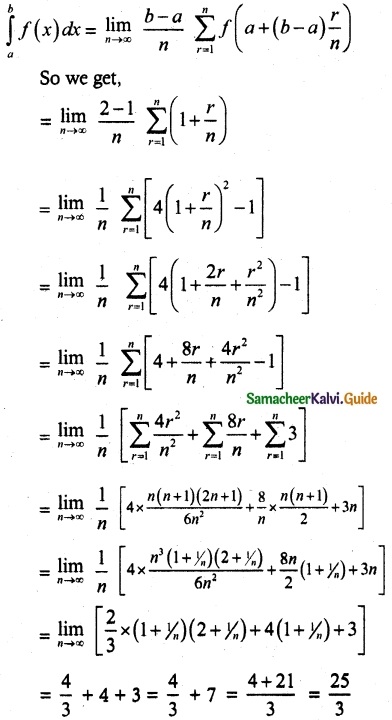
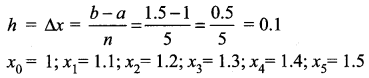
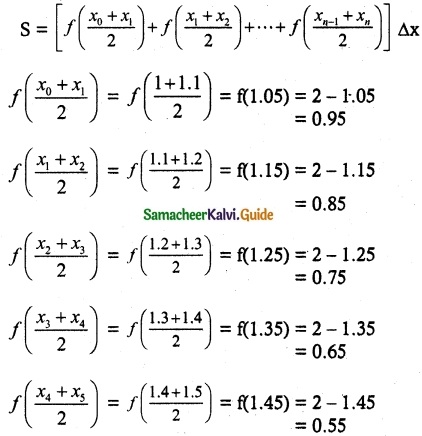
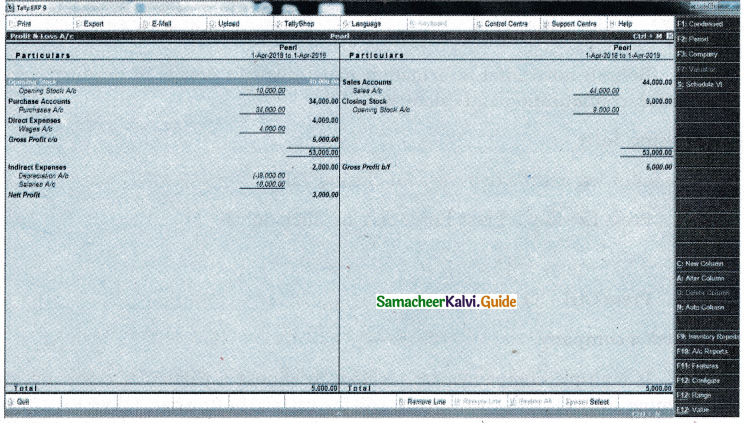
Samacheer Kalvi 12th Accountancy Guide Chapter 3 Accounts of Partnership Firms-Fundamentals

Tamilnadu State Board New Syllabus Samacheer Kalvi 12th Accountancy Guide Pdf Chapter 3 Accounts of Partnership Firms-Fundamentals Text Book Back Questions and Answers, Notes.

Tamilnadu Samacheer Kalvi 12th Accountancy Solutions Chapter 3 Accounts of Partnership Firms-Fundamentals

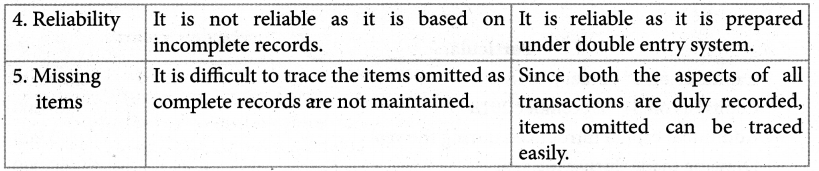
12th Accountancy Guide Accounts of Partnership Firms-Fundamentals Text Book Back Questions and Answers

I Multiple Choice Questions

Question 1.
In the absence of partnership deed, profits of the firm will be shared by the partners in
(a) Equal ratio
(b) Capital ration
(c) Both (a) and (b)
(d) None of these
Answer:
(a) Equal ratio

Samacheer Kalvi 12th Accountancy Guide Chapter 3 Accounts of Partnership Firms-Fundamentals

Question 2.
In the absence of an agreement among the partners, interest on capital is
(a) Not allowed
(b) Allowed at bank rate
(c) Allowed @ 5% per annum
(d) Allowed @ 6% per annum
Answer:
(a) Not allowed

Question 3.
As per the Indian Partnership Act, 1932, the rate of interest allowed on loans advanced by partners is
(a) 8% per annum
(b) 12% per annum
(c) 5% per annum
(d) 6% per annum
Answer:
(d) 6% per annum

Question 4.
Which of the following is shown in profit and loss appropriation account?
(a) Office Expenses
(b) Salary of staff
(c) Partner’s salary
(d) Interest on bank loan
Answer:
(c) Partner’s salary

Samacheer Kalvi 12th Accountancy Guide Chapter 3 Accounts of Partnership Firms-Fundamentals

Question 5.
When fixed capital method is adapted by a partnership firm, which of the following items will appear in capital account?
(a) Additional capital introduced
(b) Interest on capital
(c) Interest on drawings
(d) Share of profit
Answer:
(a) Additional capital introduced

Question 6.
When a partner withdraws regularly a fixed sum of money at the middle of every month period for which interest is to be calculated on the drawings on an average is
(a) 5.5 moths
(b) 6 months
(c) 12 months
(d) 6.5 months
Answer:
(b) 6 months

Samacheer Kalvi 12th Accountancy Guide Chapter 3 Accounts of Partnership Firms-Fundamentals

Question 7.
Which of the following is the incorrect pair?

(a) Interest on drawingsDebited to capital account
(b) Interest on capitalCredited to capital account
(c) Interest on loanDebited to capital account
(d) Share of profitCredited to capital Account

Answer:
c

Question 8.
In the absence of an agreement, partners are entitled to
(a) Salary
(b) Commission
(c) Interest on loan
(d) Interest on capital
Answer:
(c) Interest on loan

Question 9.
Pick the odd one out
(a) Partners share profits and losses equally
(b) Interest on partners capital is allowed at 7% per annum
(c) No salary or remuneration allowed
(d) Interest on loan from partners is allowed at 6% per annum
Answer:
(b) Interest on partners capital is allowed at 7% per annum

Samacheer Kalvi 12th Accountancy Guide Chapter 3 Accounts of Partnership Firms-Fundamentals

Question 10.
Profit after interest on drawings, interest on capital and remuneration is ₹ 10,500. Geetha, a partner, is entitled to receive commission @ 5% on profits after charging such commission. Find out commission.
(a) ₹ 50
(b) ₹ 150
(c) ₹ 550
(d) ₹ 500
Hint:
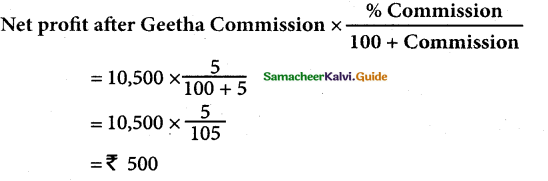
Samacheer Kalvi 12th Accountancy Guide Chapter 3 Accounts of Partnership Firms-Fundamentals 1
Answer:
(d) ₹ 500

II Very Short Answer Questions

Question 1.
Define partnership.
Answer:
According to Section 4 of the Indian Partnership Act, 1932, the partnership is defined as, “the relation between person who has agreed to share the profits of a business carried on by all or any of them acting for all.

Question 2.
What is a partnership deed?
Answer:
A partnership deed is a document in writing that contains the terms of the agreement among the partners.

Question 3.
What is meant by the fixed capital method?
Answer:
Under the fixed capital method, the capital of the partners is not altered and it remains generally fixed. Two accounts are maintained for each partner namely:

  1. Capital account and
  2. Current account

The transactions relating to initial capital introduced, additional capital introduced, and capital permanently withdrawn are entered in the capital account and all other transactions are recorded in the current account.

Question 4.
What is the journal entry to be passed for providing interest on capital to a partner? For providing interest on capital.

Samacheer Kalvi 12th Accountancy Guide Chapter 3 Accounts of Partnership Firms-Fundamentals 2Samacheer Kalvi 12th Accountancy Guide Chapter 3 Accounts of Partnership Firms-Fundamentals 2

Samacheer Kalvi 12th Accountancy Guide Chapter 3 Accounts of Partnership Firms-Fundamentals

Question 5.
Why profit and loss appropriation account prepared?
Answer:
The profit and loss appropriation account is an extension of the profit and loss account prepared for the purpose of adjusting the transactions relating to amounts due to and amounts due from partners. It is a nominal account in nature. The balance being the profit or loss is transferred to the partners’ capital or current account in the profit-sharing ratio.

III Short Answer Questions

Question 1.
State the features of partnership?
Answer:
Following are the essential features of a partnership.

  1. A partnership is an association of two or more persons. The maximum number of partners is limited to 50.
  2. There should be an agreement among the persons to share the profit or loss of the business. The agreement may be oral or written or implied.
  3. The agreement must be to carry on a business and to share the profits of the business.
  4. The business may be carried on by all the partners or any of them acting for all.

Question 2.
State any six contents of a partnership deed.
Answer:
Contents of partnership deed.
Generally, a partnership deed contains the following:

  • Name of the firm and nature and place of business.
  • Date of commencement and duration of business.
  • Names and addresses of all partners.
  • Capital contributed by each partner.
  • profit sharing ratio

Samacheer Kalvi 12th Accountancy Guide Chapter 3 Accounts of Partnership Firms-Fundamentals

Question 3.
State the differences between fixed capital method and fluctuating capital method.
Differences between fixed capital method and fluctuating capital method.
Answer:
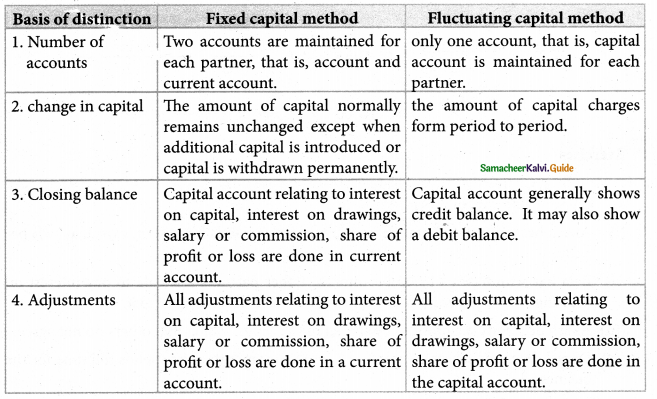
Samacheer Kalvi 12th Accountancy Guide Chapter 3 Accounts of Partnership Firms-Fundamentals 3

Question 4.
Write a brief note on the applications of the provisions of the Indian Partnership Act, 1932 in the absence of a partnership deed.
Answer:
Applications of the provisions of the Indian Partnership Act, 1932 in the absence of partnership deed.

  1. Remuneration to partners: No salary or remuneration is allowed to any partner. [Section 13(a)]
  2. Profit-sharing ratio: Profit and losses are to be shared by the partners equally. [Section 13(b)]
  3. Interest on capital: No interest is allowed on the capital. When a partner is entitled to interest on capital contributed as per partnership deed, such interest on capital will be payable only out of profits [Section 13(c)]
  4. Interest on loans advanced by partners to the firm: Interest on the loan is to be allowed at the rate of 6 percent per annum. [Section 13(d)]
  5. Interest on drawings: No interest is charged on the drawings of the partners.

Question 5.
Jayaraman is a partner who withdrew 10,000 regularly in the middle of every month. Interest is charged on the drawings at 6% per annum. Calculate interest on drawings for the year ended 31st December 2018.
Answer:
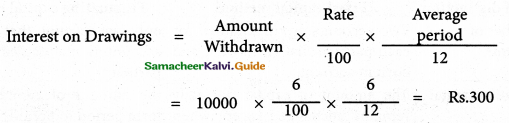
Samacheer Kalvi 12th Accountancy Guide Chapter 3 Accounts of Partnership Firms-Fundamentals 4

Samacheer Kalvi 12th Accountancy Guide Chapter 3 Accounts of Partnership Firms-Fundamentals

IV Exercises

Question 1.
Akash, Bala, Chandru, and Daniel are partners in a firm. There is no partnership deed. How will you deal with the following?

  1. Akash has contributed to maximum capital. He demands interest on capital at 10% per annum.
  2. Bala has withdrawn ₹ 3,000 per month. Other partners ask Bala to pay interest on drawings @ 8% per annum to the firm. But, Bala did not agree to it.
  3. Akash demands the profit to be shared in the capital ratio. But, others do not agree.
  4. Daniel demands a salary at the rate of ₹ 10,000 per month as he spends full time for the business.
  5. The loan advanced by Chandru to the firm is ₹ 50,000. He demands interest on loan@ 12% per annum

Solution:

  1. No interest on capital is payable to any partner.
  2. No interest is chargeable on drawings made by the partner.
  3. Profits should be distributed equally
  4. No remuneration is payable to any partner.
  5. Interest on the loan is payable at 6% per annum.

Question 2.
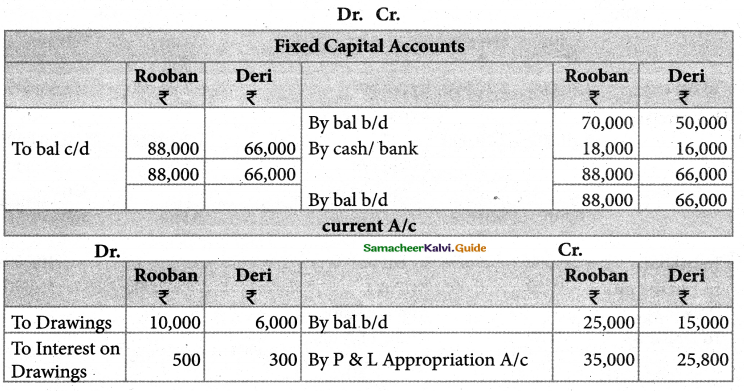
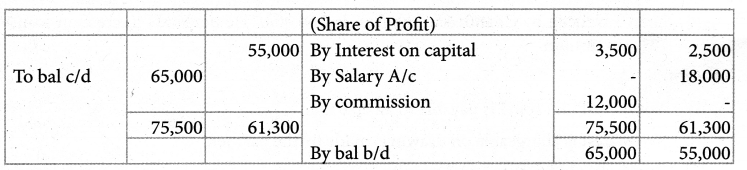
From the following information, prepare capital accounts of partners Rooban and Deri, when their capitals are fixed.
Answer:
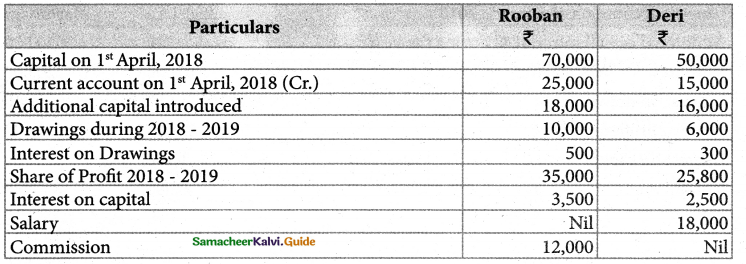
Samacheer Kalvi 12th Accountancy Guide Chapter 3 Accounts of Partnership Firms-Fundamentals 5
Solution :
Samacheer Kalvi 12th Accountancy Guide Chapter 3 Accounts of Partnership Firms-Fundamentals 6 Samacheer Kalvi 12th Accountancy Guide Chapter 3 Accounts of Partnership Firms-Fundamentals 7

Question 3.
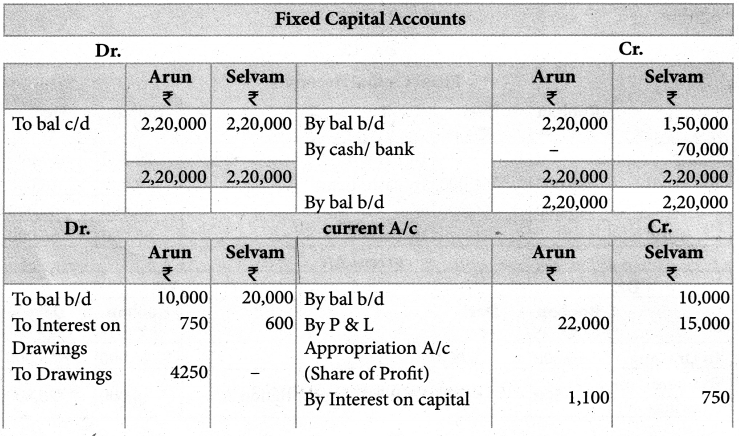
Arun and Selvam are partners who maintain their capital accounts under fixed capital method. From the following particulars, prepare capital accounts of partners.
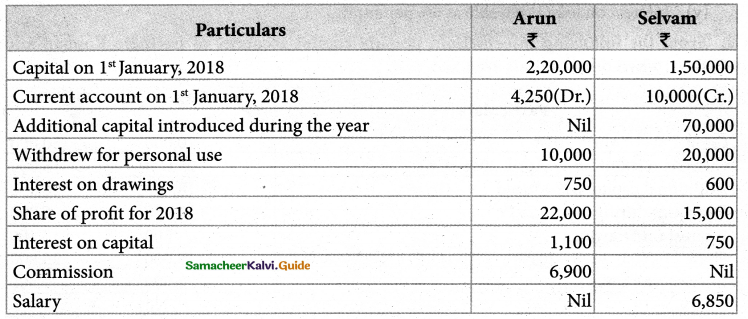
Samacheer Kalvi 12th Accountancy Guide Chapter 3 Accounts of Partnership Firms-Fundamentals 8
Solution :
Samacheer Kalvi 12th Accountancy Guide Chapter 3 Accounts of Partnership Firms-Fundamentals 9 Samacheer Kalvi 12th Accountancy Guide Chapter 3 Accounts of Partnership Firms-Fundamentals 10

Question 4.
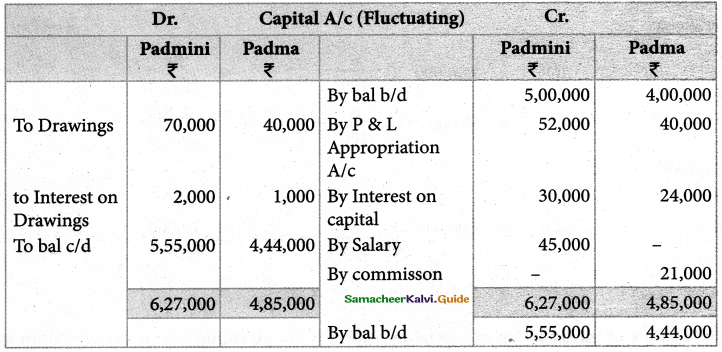
From the following information, prepare capital accounts of partners Padmini and Padma, When their capitals are fluctuating.
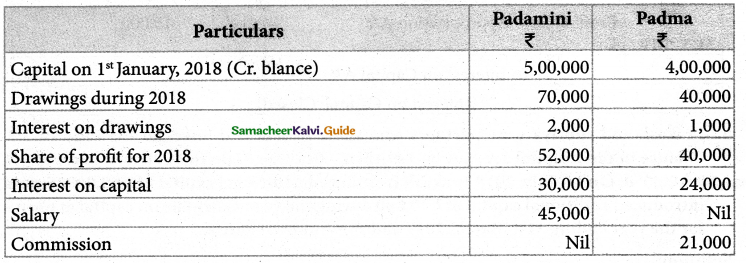
Samacheer Kalvi 12th Accountancy Guide Chapter 3 Accounts of Partnership Firms-Fundamentals 11
Solution :
Samacheer Kalvi 12th Accountancy Guide Chapter 3 Accounts of Partnership Firms-Fundamentals 12

Samacheer Kalvi 12th Accountancy Guide Chapter 3 Accounts of Partnership Firms-Fundamentals

Question 5.
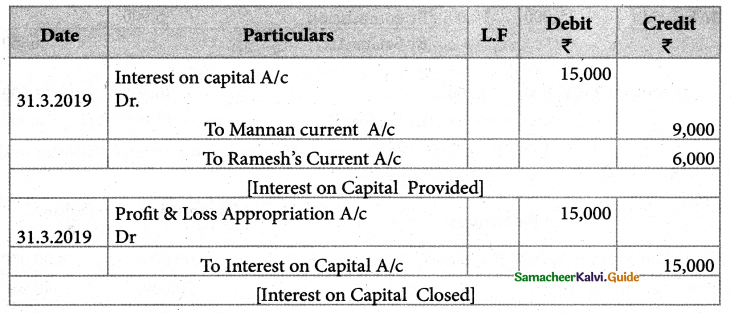
Mannan and Ramesh share profits and losses in the ratio of 3:2 and their capital on 1st April 2018 were Mannan ₹ 1,50,000 and Ramesh ₹ 1,00,000 respectively and their current accounts show a credit balance of ₹  25,000 and ₹ 20,000 respectively. Calculate interest on capital at 6% p.a for the year ending 31st March 2019 and show the journal entries.
Solution :
For providing interest on capital
Samacheer Kalvi 12th Accountancy Guide Chapter 3 Accounts of Partnership Firms-Fundamentals 13

Question 6.
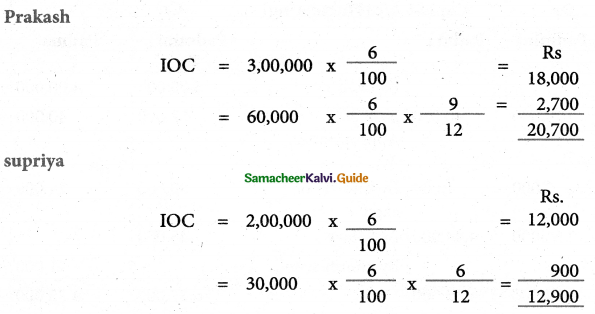
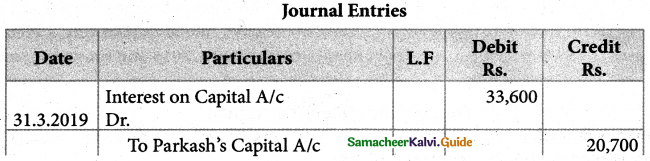
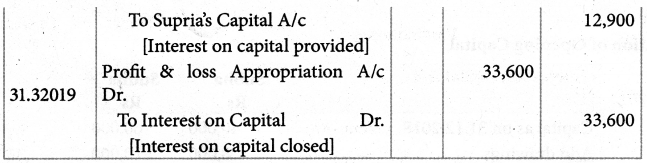
Prakash and Supriya were partners who share profits and losses in the ratio of 5:3. Balance in their capital account on 1st April 2018 was Prakash ₹ 3,00,000 and Supriya ₹ 2,00,000. On 1st July 2018 Prakash introduced additional capital of ₹ 60,000. Supria introduced additional capital of ₹ 30,000 during the year. Calculate on capital at 6% p.a for the year ending 31st March 2019 and show journal entries.
Solution:
Samacheer Kalvi 12th Accountancy Guide Chapter 3 Accounts of Partnership Firms-Fundamentals 14

Note: Date of introduction of capital by Supria is not given, interest is calculated for an average period of 6 months.
Samacheer Kalvi 12th Accountancy Guide Chapter 3 Accounts of Partnership Firms-Fundamentals 15 Samacheer Kalvi 12th Accountancy Guide Chapter 3 Accounts of Partnership Firms-Fundamentals 16

Question 7.
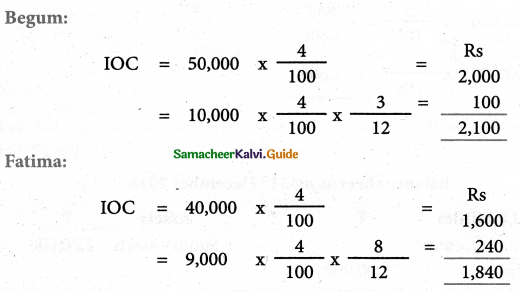
The capital account of Begum and Fatima on 1st January 2018 showed a balance of ₹ 50,000 and ₹ 40,000 respectively. On 1st October 2018, Begum introduced an additional capital of ₹ 10,000 and On 1st May 2018 Fatima introduced an additional capital of ₹ 9,000. Calculate Interest on capital at 4% p.a. for the year ending 31st December 2018.
Solution :
Samacheer Kalvi 12th Accountancy Guide Chapter 3 Accounts of Partnership Firms-Fundamentals 17
Interest on capital
Begum Rs. 2,100
Fatima Rs. 1,840

Samacheer Kalvi 12th Accountancy Guide Chapter 3 Accounts of Partnership Firms-Fundamentals

Question 8.
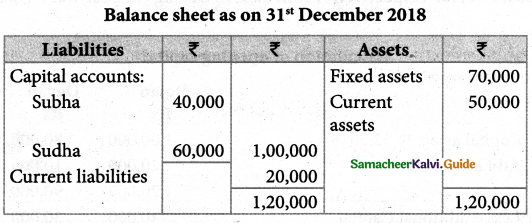
From the following balance sheets of Subha and Sudha who share profits and losses in 2:3, Calculate interest on capital at 5% p.a. for the year ending 31st December 2018.
Samacheer Kalvi 12th Accountancy Guide Chapter 3 Accounts of Partnership Firms-Fundamentals 18
Drawings of subha and sudha during the year were ₹ 8,000 and ₹ 10,000 respectively. Profit earned during the year was ₹ 30,000.
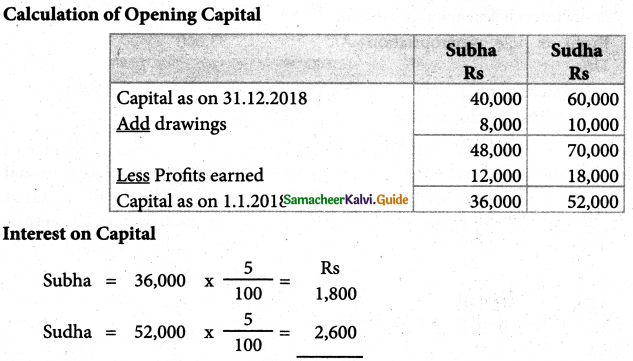
Solution :
Samacheer Kalvi 12th Accountancy Guide Chapter 3 Accounts of Partnership Firms-Fundamentals 19

Question 9.
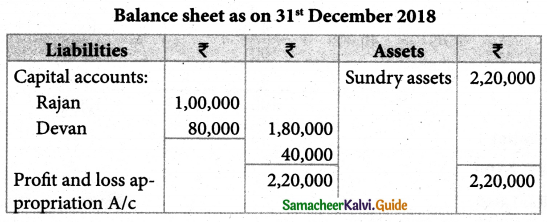
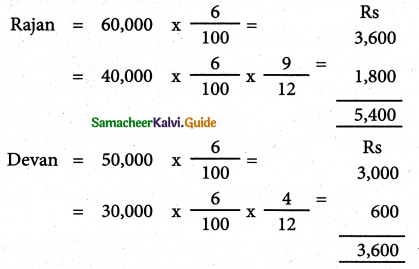
From the following balance sheets of Rajan and Devan who share profits and losses in 2:1, Calculate interest on capital at 6% p.a. for the year ending 31st December 2018.
Samacheer Kalvi 12th Accountancy Guide Chapter 3 Accounts of Partnership Firms-Fundamentals 20
on 1st April, Rajan introduced an additional capital of ₹ 40,000, and on 1st September 2018. Devan introduced ₹ 30,000. Drawings of Rajan and Devan during the year were ₹ 20,000 and ₹ 10,000 respectively. Profit earned during the year was ₹ 70,000
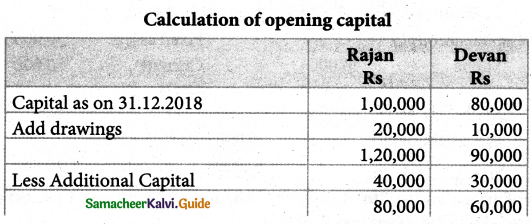
Solution :
Samacheer Kalvi 12th Accountancy Guide Chapter 3 Accounts of Partnership Firms-Fundamentals 21 Samacheer Kalvi 12th Accountancy Guide Chapter 3 Accounts of Partnership Firms-Fundamentals 22
Interest on Capital
Samacheer Kalvi 12th Accountancy Guide Chapter 3 Accounts of Partnership Firms-Fundamentals 23
Interest on capital
Rajan = Rs. 5,400
Devan = Rs. 3,600

Question 10.
Ahmad and Basheer Contribute ₹ 60,000 and ₹ 40,000 respectively as capital. Their respective share of profit is 2:1 and the profit before interest on capital for the year is ₹ 5,000. Computer the amount of interest on capital in each of the following situations:

  1. If the partnership deed is silent as to the interest of capital
  2. If interest on capital @ 4% is allowed as per the partnership deed
  3. If the partnership deed allows interest on capital @ 6% per annum.

Solution
interest on capital @ 4%
Ahamed = 60,000 × \(\frac{4}{100}\) = 2,400
Basheer = 40,000 × \(\frac{4}{100}\) = 1,600

interest on capital @ 6%
Ahamed = 60,000 × \(\frac{6}{100}\) = 3,600
Basheer = 40,000 × \(\frac{6}{100}\) = 2,400

  1. No Interest on capital is allowed
  2. Since there is sufficient profit, interest on capital wifi be provided Ahamad. ₹ 2,400; Basheer. ₹ 1,600
  3. Since the profit is insufficient, interest on capital will not be provided. profit of ₹ 5,000 will be distributed to the partners in their capital ratio of 3:2

Samacheer Kalvi 12th Accountancy Guide Chapter 3 Accounts of Partnership Firms-Fundamentals

Question 11.
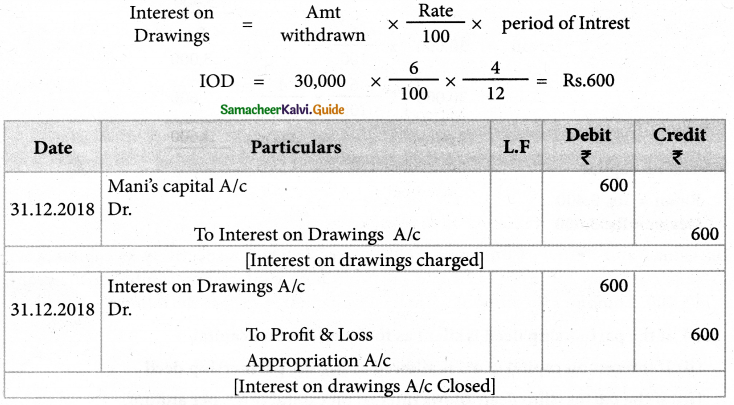
Mani is a partner, who withdrew ₹ 30,000 on 1st September 2018. Interest on drawings is charged at 6% per annum. Calculate interest on drawings on 31st December 2018 and show the journal entries by assuming that the fluctuating capital method is followed.
Solution :
Samacheer Kalvi 12th Accountancy Guide Chapter 3 Accounts of Partnership Firms-Fundamentals 24

Question 12.
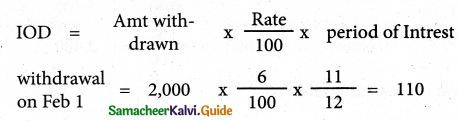
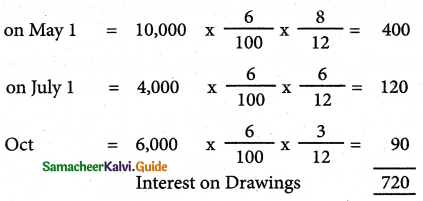
Santhosh is a partner in a partnership firm. As per the partnership deed, interest on drawings is charged per annum. During the year ended 31st December 2018 he withdrew as follows:

Date

Rs

February1 2,000
May 110,000
July 14,000
October 16,000

calculate the amount of interest on drawings.
Solution :
Samacheer Kalvi 12th Accountancy Guide Chapter 3 Accounts of Partnership Firms-Fundamentals 25 Samacheer Kalvi 12th Accountancy Guide Chapter 3 Accounts of Partnership Firms-Fundamentals 26

Question 13.
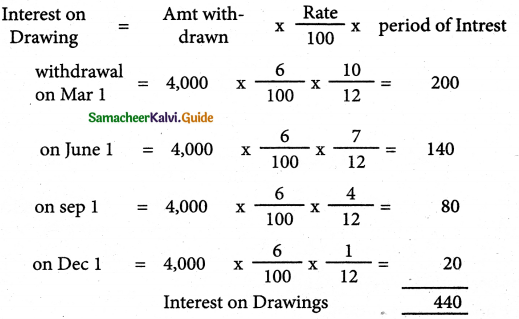
Kumar is a partner in a partnership firm. As per the partnership deed, interest on drawings is charged at 6% per annum. During the year ended 31st December 2018 he wi drew as follows:

Date

Rs

March 1 4,000
June 1 4,000
September 14,000
December 14,000

calculate the amount of interest on drawings.
Solution :
Samacheer Kalvi 12th Accountancy Guide Chapter 3 Accounts of Partnership Firms-Fundamentals 27

Question 14.
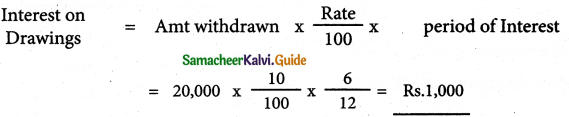
Mathew is a partner who withdrew ₹ 20,000 during the year 2018. Interest on drawings is charged at 10% per annum. Calculate interest on drawings on 31st December 2018.
Solution :
Samacheer Kalvi 12th Accountancy Guide Chapter 3 Accounts of Partnership Firms-Fundamentals 28
Note: Date of withdrawal is not given, interest is calculated for an average period of 6 months.

Samacheer Kalvi 12th Accountancy Guide Chapter 3 Accounts of Partnership Firms-Fundamentals

Question 15.
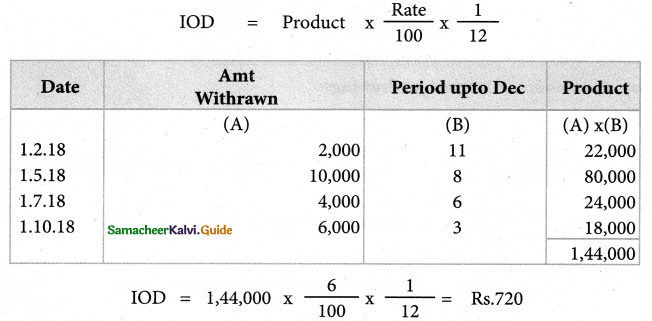
Santhosh is a partner in a partnership firm. As per the partnership deed, interest on drawings is charged at 6% per During the ended 31st December 2018 he withdrew as follows:

Date

Rs

Feb 12,000
May 110,000
July 14,000
Oct 16,000

calculate the amount of interest on drawings by using the product method.
Solution :
Samacheer Kalvi 12th Accountancy Guide Chapter 3 Accounts of Partnership Firms-Fundamentals 29

Question 16.
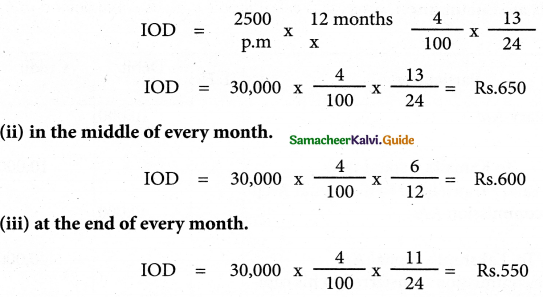
Kavitha is a partner in a firm. She withdraws ₹ 2,500 p.m. regularly interest on drawings is charged @ 4% p.a. Calculate the interest on drawings using average period, if she draws.
(i) at the beginning of every month
(ii) in the middle of every month
(iii) at the end of every month
Samacheer Kalvi 12th Accountancy Guide Chapter 3 Accounts of Partnership Firms-Fundamentals 30
Solution :
(i) at the beginning of every month
Amt withdrawn = 2,500 × 12 = Rs. 30,000
Samacheer Kalvi 12th Accountancy Guide Chapter 3 Accounts of Partnership Firms-Fundamentals 31

Samacheer Kalvi 12th Accountancy Guide Chapter 3 Accounts of Partnership Firms-Fundamentals

Question 17.
Kevin and Francis are partners. Kevin draws ₹ 5,000 at the end of each quarter. Interest on drawings is chargeable at 6% p.a. Calculate interest on drawings for the year ending 31st March 2019 using the average period.
Solution:
Kevin → Rs. 5,000 → at the end of each quarter
Average period = \(\frac{9+0}{2}=4 \frac{1}{2}\) Months
Amt withdrew = 5000 × 4 times = Rs. 20,000
IOD = 20,000 × \(\frac{6}{100} \times \frac{9}{24}\)= Rs. 450

Question 18.
Ram and Shyam were partners. Ram withdrew ₹ 18,000 at the beginning of each half year. Interest on drawings is chargeable @ 10% p.a. Calculate interest on the drawings for the year ending 31st December 2018 using the average period.
Solution :
Ram → Rs. 18,000 → beg of each half year.
Average period = \(\frac{12+6}{2}\) = 9 months
Amount withdrawn = 18,000 × 2 times = Rs. 36,000
IOD = 36,000 × \(\frac{10}{100} \times \frac{9}{12}\)= Rs. 2,700

Question 19.
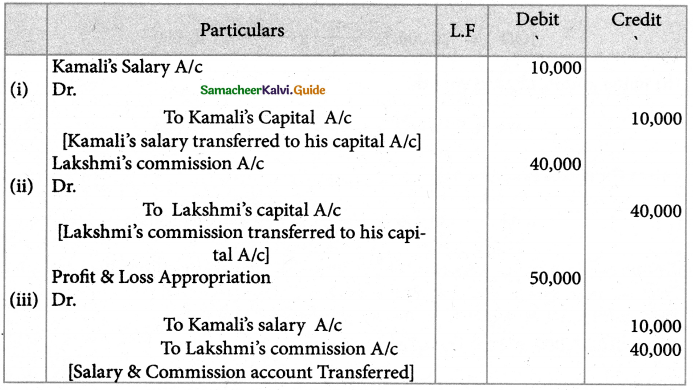
Janani, Kamali, and Lakshmi are partners in the firm sharing profits and losses equally. As per the terms of the partnership deed, Kamali allows a monthly salary of ₹ 10,000, and Lakshmi is allowed a commission of ₹ 40,000 per annum for their contribution to the business of the firm. You are required to pass the necessary journal entry. Assume that their capitals are fluctuating.
Solution :
Samacheer Kalvi 12th Accountancy Guide Chapter 3 Accounts of Partnership Firms-Fundamentals 32

Question 20.
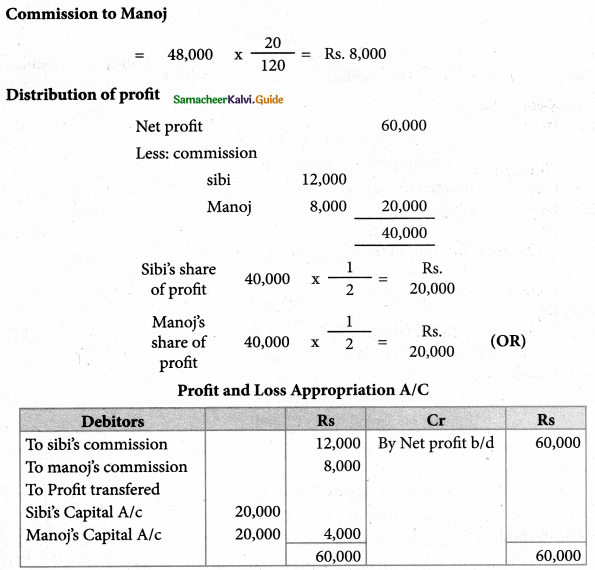
Sibi and Manoj are partners in a firm. Sibi is to get a commission of 20% of net profit before charging any commission. Manoj is to get a commission of 20% on net profit after charging all commission. Net profit for the year ended 31st Dec 2018 before ch y commission was ₹ 60,000. Find the commission of Sibi and Man Also show the distribution of profit.
Solution:
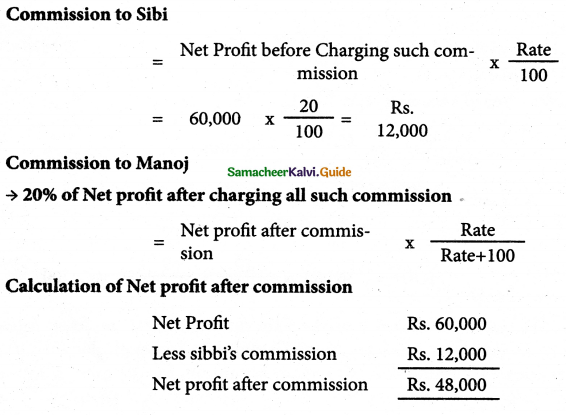
Samacheer Kalvi 12th Accountancy Guide Chapter 3 Accounts of Partnership Firms-Fundamentals 33 Samacheer Kalvi 12th Accountancy Guide Chapter 3 Accounts of Partnership Firms-Fundamentals 34
Note: Assumed to be equal partners (1:1)

Samacheer Kalvi 12th Accountancy Guide Chapter 3 Accounts of Partnership Firms-Fundamentals

Question 21.
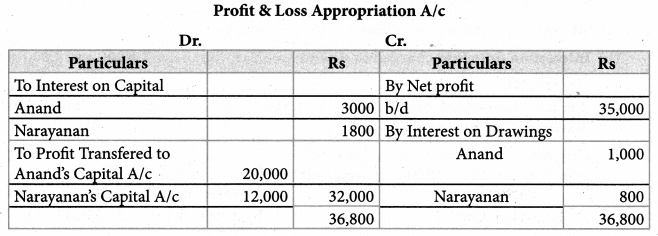
Anand and Narayanan are partners in firm sharing profits and losses in the ratio of 5:3 On 1st January 2018, their capitals were ₹ 50,000 and ₹ 30,000 respectively. The partnership deed specifies the following:
(a) Interest on capital is to be allowed at 6% per annum.
(b) Interest on drawings charged to Anand and Narayanan are ₹ 1,000 and ₹ 800 respectively.
(c) The net profit of the firm before considering interest on capital and interest on drawings amounted to ₹ 35,000
Give necessary journal entries and prepare profit and loss appropriation account as on 31st December 2018. Assume that the capitals are fluctuating.
Solution :
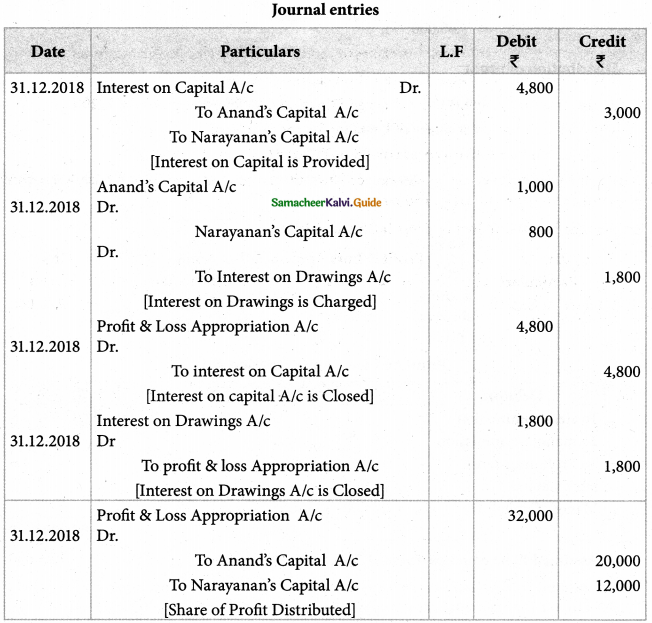
Samacheer Kalvi 12th Accountancy Guide Chapter 3 Accounts of Partnership Firms-Fundamentals 35 Samacheer Kalvi 12th Accountancy Guide Chapter 3 Accounts of Partnership Firms-Fundamentals 36

Question 22.
Dinesh and Sugumar entered into a partnership agreement on 1st January 2018, Dinesh contributing ₹ 1,50,000 and Sugumar ₹ 1,20,000 as capital. The agreement provided that:
(a) Profits and losses shared in the ratio 2:1 as between Dinesh and Sugumar.
(b) Partners to be entitled to interest on capital @ 4% p.a
(c) Interest on drawings to be charged Dinesh: ₹ 3,600 and Sugumar: ₹ 2,200
(d) Dinesh to receive a salary of ₹ 60,000 for the year, and
(e) Sugumar to receive a commission of ₹  80,000
During the year ended on 31st December 2018, the firm made a profit of ₹ 2,20,000 before adjustment of interest, salary and commission.
Prepare the Profit and loss appropriation account.
Solution :
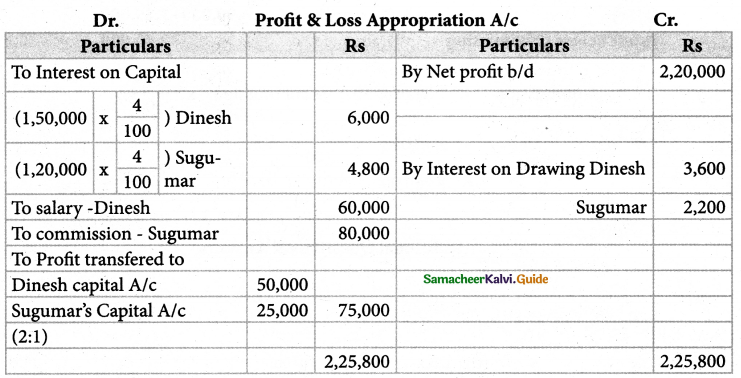
Samacheer Kalvi 12th Accountancy Guide Chapter 3 Accounts of Partnership Firms-Fundamentals 37

Question 23.
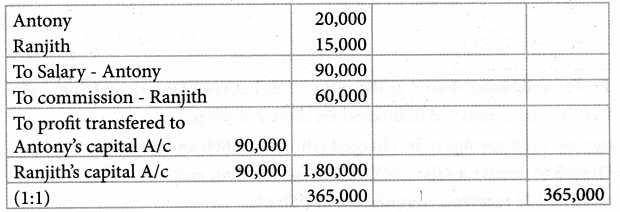
Antony and Ranjith Started a business on 1st April 2018 with capitals of ₹ 4,00,000 and ₹ 3,00,000 respect According to the Partnership Deed, Anton is to get the salary of ₹ 90,000 per annum, Ranj ith is got 25% commission on profit after allowing salary to Antony and interest on capital @ 5% p.a but before charging such commission. The profit-sharing ratio between the two partners is 1:1 During the year, the firm earned a profit of ₹ 3,65,000.
Prepare profit and loss appropriation account. The firm closes its accounts on 31st March every year.
Solution :

Samacheer Kalvi 12th Accountancy Guide Chapter 3 Accounts of Partnership Firms-Fundamentals 38 Samacheer Kalvi 12th Accountancy Guide Chapter 3 Accounts of Partnership Firms-Fundamentals 39
Calculation of profit before charging such commission
Net profit 3,65,000
Less: Ioc 20,000+15,000
salary 90,000 1,25,000
Profit before Commission 2,40,000
Commission = Net profit before commission × \(\frac{\text { Rate }}{100}\)
= 2,40,000 × \(\frac{25}{100}\)
= Rs.60,000

Samacheer Kalvi 12th Accountancy Guide Chapter 3 Accounts of Partnership Firms-Fundamentals

12th Accountancy Guide Accounts of Partnership Firms-Fundamentals Additional Important Questions and Answers

Question 1.
The minimum number of Reasons in a partnership firm is
(a) One
(b) Two
(c) Three
Answer:
(b) Two

Question 2.
In a partnership business, the agreement is
(a) Compulsory
(b) Optional
(c) Not necessary.
Answer:
(a) Compulsory

Question 3.
In a partnership, partners share their profits & losses in ‘ ratio
(a) their capital
(b) equal
(c) agreed
Answer:
(c) agreed

Question 4.
under fixed capital system, the profits and losses of partners will be transferred to their account
(a) Current
(b) Drawings
(c) Capital
Answer:
(a) Current

Samacheer Kalvi 12th Accountancy Guide Chapter 3 Accounts of Partnership Firms-Fundamentals

Question 5.
Interest on capital is calculated on the
(a) Opening capital
(b) Closing capital
(c) Average capital
Answer:
(a) Opening capital

Question 6.
Current accounts for partners will be opened under
(a) fixed capital method
(b) fluctuation capital method
(c) either fixed capital method or fluctuating capital method
Answer:
(a) fixed capital method

Question 7.
In the absence of agreement profits and losses are divided
(a) in the ratio of capitals
(b) in the ratio of time devoted by each partner
(c) equally
Answer:
(c) equally

Samacheer Kalvi 12th Accountancy Guide Chapter 3 Accounts of Partnership Firms-Fundamentals

Question 8.
x and y are partners sharing the profits and losses in the ratio of 2:3 with capitals of Rs. 1,20,000 and Rs. 60,000 respectively profits for the year are Rs. 9,000. If the partnership deed is silent as to interest on the capital show how profit is shared among x and y
(a) profit x – Rs.6,000 y – Rs.3,000
(b) profit x – Rs.3,600 y – Rs.5,400
(c) profit x – Rs.3,000 y – Rs. 6000
Hint:
Profit ₹ 9,000 Sharing ratio = 2:3
X Partner profit = 9,000 × 2/5 = ₹ 3,600
Y Partner profit = 9,000 × 3/5  = ₹ 5,400
Answer:
(b) profits – Rs.3,600 y – Rs.5,400

Question 9.
where a partner is entitled to interest on capital such interest will be payable
(a) Only out of profits
(b) Only out of Capital
(c) Out of profits or out of capital
Answer:
(a) Only out of profits

Question 10.
under fixed capital method, salary payable to a partner is recorded
(a) in the current account
(b) in capital account
(c) either in current account or capital account
Answer:
(a) in the current account

Samacheer Kalvi 12th Accountancy Guide Chapter 3 Accounts of Partnership Firms-Fundamentals

II Very Short Answer Questions

Question 11.
What is meant by the fluctuating capital method?
Answer:
Under this method, only a capital account is maintained for each partner. All the transactions between the partner and the firm are recorded in the capital account. This account is credited with the initial and additional capital introduced by the partner. The account is debited with capital withdrawn, drawings, interest on drawings, and share of loss of the partner. As a result, the balance in this account goes on fluctuating periodically. Under this method, the partner s capital account may show either credit balance or debit balance.

Question 12.
Mention the methods of calculating interest on drawings?
Answer:

  1. Direct Method
  2. Product Method
  3. Average period Method.

Question 13.
How to calculate the average period under different circumstances?
Answer:
The average period is computed as follows:
The following table shows the average period in months for withdrawal made at the beginning. In the middle and at the end of every month, quarter and half- year of the year.
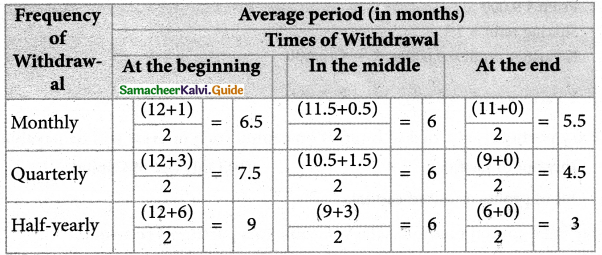
Samacheer Kalvi 12th Accountancy Guide Chapter 3 Accounts of Partnership Firms-Fundamentals 40

Samacheer Kalvi 12th Accountancy Guide Chapter 3 Accounts of Partnership Firms-Fundamentals

Additional problems:

Question 14.
Show how the following items will appear in the capital accounts of the partners, Anbu and Balu.

ParticularsAnbu

Balu

Capital on 1.4.200490,00070,000
Drawings during 2004 – 200512,0009,000
Interst on Drawings360270
Interest on capital5,4004,200
Partner’s salary12,000…….
commission6000
Share of profit for 2004-056,0004000

Solution :
a) When capital accounts are fixed:
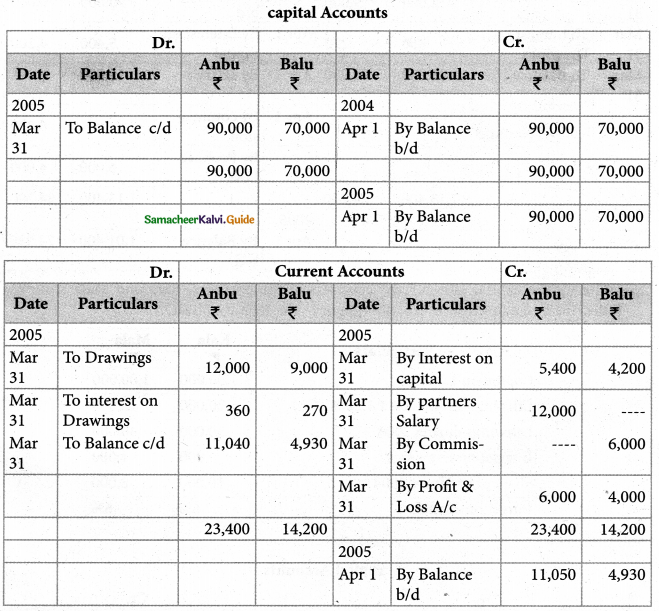
Samacheer Kalvi 12th Accountancy Guide Chapter 3 Accounts of Partnership Firms-Fundamentals 41

b) when capital accounts are fluctuating:

capital Accounts
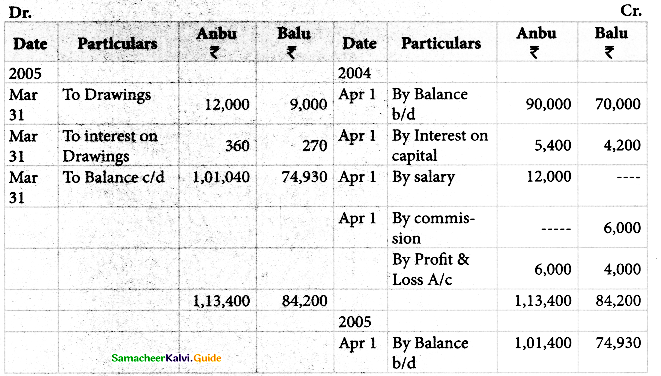
Samacheer Kalvi 12th Accountancy Guide Chapter 3 Accounts of Partnership Firms-Fundamentals 42

Question 15.
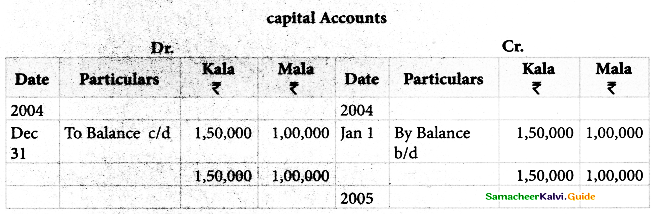
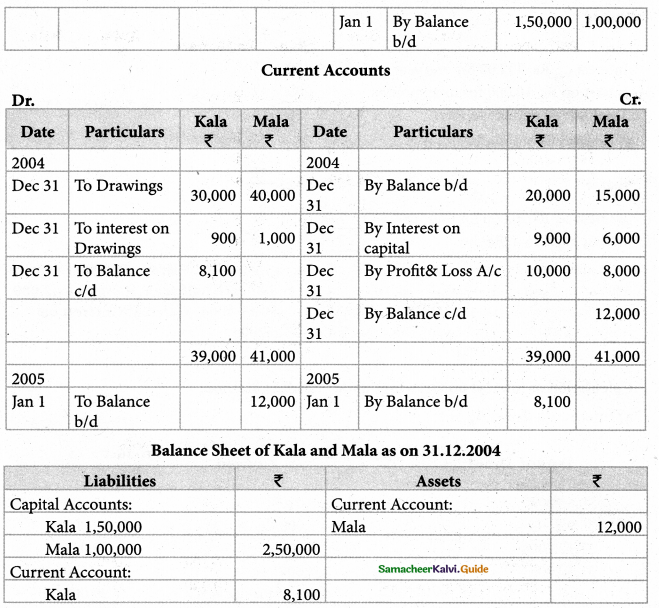
Write up the capital and. current accounts of the partners, Kala and Mala from the following and show how these will appear in the Balance Sheet.

ParticularsKala
Rs.
Mala
Rs.
Capital on1.1.20041,50,0001,00,000
Current accounts on 1.1.2004(Cr.)20,00015,000
Drawings during 200430,00040,000
Interest on Drawings9001,000
Share of profit for 200410,0008,000
Interst on capital6%6%

Solution :
Samacheer Kalvi 12th Accountancy Guide Chapter 3 Accounts of Partnership Firms-Fundamentals 43 Samacheer Kalvi 12th Accountancy Guide Chapter 3 Accounts of Partnership Firms-Fundamentals 44

Samacheer Kalvi 12th Accountancy Guide Chapter 3 Accounts of Partnership Firms-Fundamentals

Question 16.
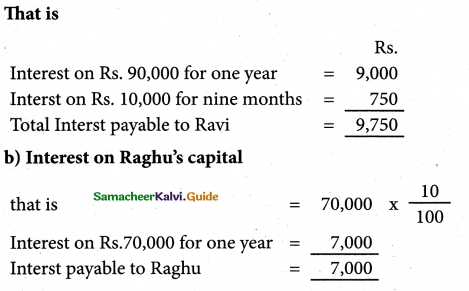
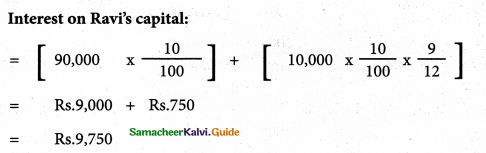
Ravi and Raghu started business on April 1, 2003, with a capital of 90,000 and Rs. 70,000 respectively. Ravi introduced Rs. 10,000 as additional capital on July 1, 2003. Interset on capital is to be allowed @ 10%. Calculate the interest payable to Ravi and Raghu for the year ending March 31, 2004.
Solution :
Samacheer Kalvi 12th Accountancy Guide Chapter 3 Accounts of Partnership Firms-Fundamentals 45 Samacheer Kalvi 12th Accountancy Guide Chapter 3 Accounts of Partnership Firms-Fundamentals 46

Question 17.
P, Q and R were partners sharing profits in the ratio of 3:2:1. P draws Rs.5,000 at the end of each quarter. Q draws Rs. 10,000 at the end of each half-year. R draws Rs.2,000 on 1.5.2004 Rs.3,000 on 31.10.2004, Rs.5,000 on 30.11.2004. Calculate interest on their drawings at 10% p.a for the year ending 31.3.2005.
Solution :
Calculation of interest on Drawings under Product Method:
a) Interest on drawing of P :
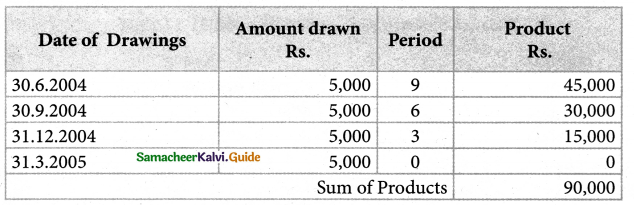
Samacheer Kalvi 12th Accountancy Guide Chapter 3 Accounts of Partnership Firms-Fundamentals 47
Interest on drawings at 10% p.a. on Rs.90,000
Interst on drawings = 90,000 × \(\frac{10}{100} \times \frac{1}{12}\) = Rs. 750
Interest on drawings of Q:

Date of DrawingsAmount drawn
Rs.
Period. Product Rs.
30.9.200410,000660,000
31.3.200510,00000
Sum of Products60,000

Interest on drawings at 10% p.a. on Rs.60,000
Interst on drawings = 60,000 × \(\frac{10}{100} \times \frac{1}{12}\) = Rs.500
Interst on drawings of R:
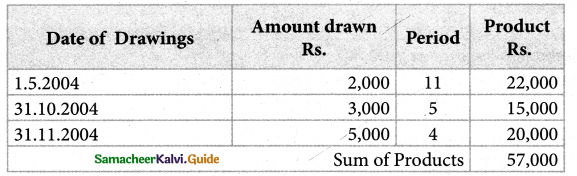
Samacheer Kalvi 12th Accountancy Guide Chapter 3 Accounts of Partnership Firms-Fundamentals 48
Interest on drawings at 10% p.a. on Rs.57,000
Interest on drawings = 57,000 x \(\frac{10}{100} \times \frac{1}{12}\) = Rs.475

Samacheer Kalvi 12th Accountancy Guide Chapter 3 Accounts of Partnership Firms-Fundamentals

Question 18.
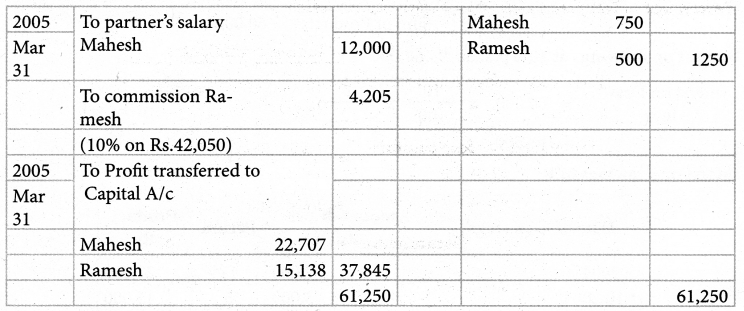
Mahesh and Ramesh are partners sharing profits in the ratio of 3:2 with capitals of Rs.50,000 and Rs.40,000 respectively. Interest on capital is agreed at 8%p.a Interest on drawings is fixed at 10% p.a. The drawings of the partners were Rs.15,000 and Rs.10.000, the interest for Mahesh Rs.750 and for Ramesh Rs.500. Mahesh is entitled to a salary of Rs. 12,000 p.a. and Ramesh is entitled to get a commission of 10% on the Net Profit before charging such cc ion. The Net Profit of the firm before making the above adjustments was Rs.60,000 for the year ended 31st March 2005.
Prepare the profit and loss appropriation account.
Solution :
In the Books of the Firm Profit and Loss Appropriation Account
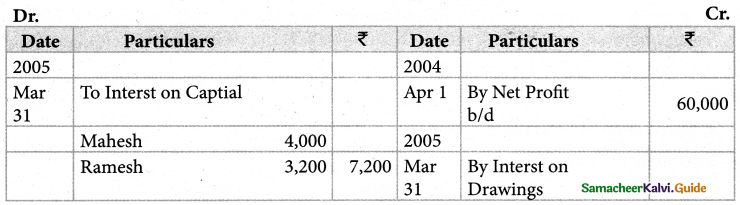
Samacheer Kalvi 12th Accountancy Guide Chapter 3 Accounts of Partnership Firms-Fundamentals 49 Samacheer Kalvi 12th Accountancy Guide Chapter 3 Accounts of Partnership Firms-Fundamentals 50

Note: Calculation of commission.
Step 1→ Total the credit side of the Profit and Loss Appropriation Account, i.e., Rs. 61,250
Step 2 → Total the debit side of the Profit and Loss Appropriation Account, i.e., Rs. 19,200
Step 3 → Find the balance, i.e., Rs. 42,050.
Step 4 → Apply the formula.
Commission = Net Profit before commission × \(\frac{\text { Rate of Commission }}{100} \text {\)
Commission = 42,050 × \(\frac{10}{100}\) = 4,205
The Balance of Rs. 37,845 (Rs.42,050 – Rs. 4,205) is transferred to Parnters Capital accounts in the ratio.

Samacheer Kalvi 12th Accountancy Guide Chapter 3 Accounts of Partnership Firms-Fundamentals

Question 19.
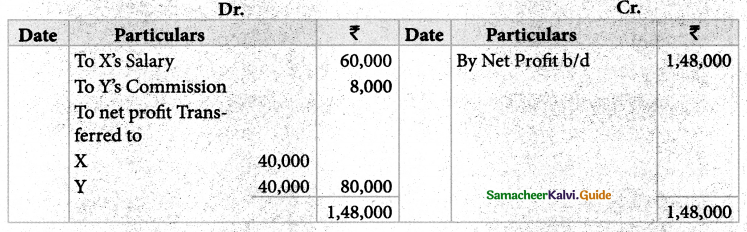
X and Y are partners in a firm, sharing profits losses equal. X is entitled to a salary of Rs. 5,000 p.m. Y is entitled to a con ion c 0% of Net Profit after charging such commission. Net Profit before charging commission and salary was Rs. 1,48,000. Show the Profit and loss appropriation account.
Solution:
a) Calculation of Salary to X:
5,0 p.m. for 12 months = 12 × 5,000 = Rs. 60,000
Calculation of Commission to Y:
Percentage of Net profit after charging the commission =
Net Profit before commission × \(\frac{\text { Rate of commission }}{100+\text { Rate of commision }}\)
Net Profit before commission = 1,48,000 – 60,000 = Rs.88,000
Commission = 88,000 × \(\frac{10}{100+10}\)
= 88,000 × \(\frac{10}{110}\)
= Rs.8,000
Samacheer Kalvi 12th Accountancy Guide Chapter 3 Accounts of Partnership Firms-Fundamentals 51

Samacheer Kalvi 12th Maths Guide Chapter 9 Applications of Integration Ex 9.6

Tamilnadu State Board New Syllabus Samacheer Kalvi 12th Maths Guide Pdf Chapter 9 Applications of Integration Ex 9.6 Textbook Questions and Answers, Notes.

Tamilnadu Samacheer Kalvi 12th Maths Solutions Chapter 9 Applications of Integration Ex 9.6

Question 1.
Evaluate the following
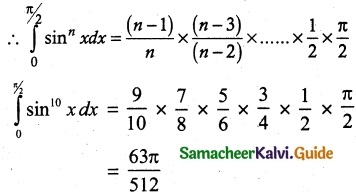
(i) \(\int_{0}^{π/2}\) sin10x dx
Solution:
Here n = 10, which is even
Samacheer Kalvi 12th Maths Guide Chapter 9 Applications of Integration Ex 9.6 1

Samacheer Kalvi 12th Maths Guide Chapter 9 Applications of Integration Ex 9.6

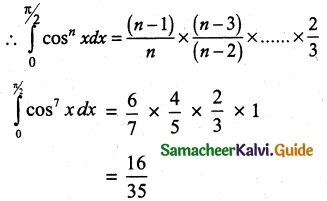
(ii) \(\int_{0}^{π/2}\) cos7x dx
Solution:
Here n = 7, which is odd
Samacheer Kalvi 12th Maths Guide Chapter 9 Applications of Integration Ex 9.6 2

Samacheer Kalvi 12th Maths Guide Chapter 9 Applications of Integration Ex 9.6

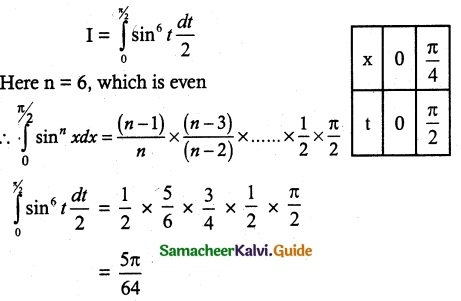
(iii) \(\int_{0}^{π/4}\) sin6 2x dx
Solution:
put t = 2x
dt = 2 dx
Samacheer Kalvi 12th Maths Guide Chapter 9 Applications of Integration Ex 9.6 3

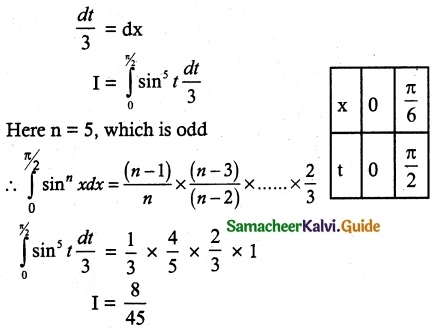
(iv) \(\int_{0}^{π/6}\) sin5 3x dx
Solution:
put t = 3x
dt = 3 dx
Samacheer Kalvi 12th Maths Guide Chapter 9 Applications of Integration Ex 9.6 4

Samacheer Kalvi 12th Maths Guide Chapter 9 Applications of Integration Ex 9.6

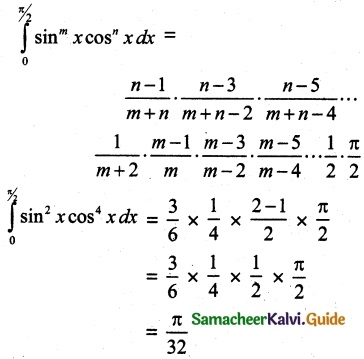
(v) \(\int_{0}^{π/2}\) sin2 x cos4 x dx
Solution:
Here m = 2, which is even and n = 4, which is even
Samacheer Kalvi 12th Maths Guide Chapter 9 Applications of Integration Ex 9.6 5

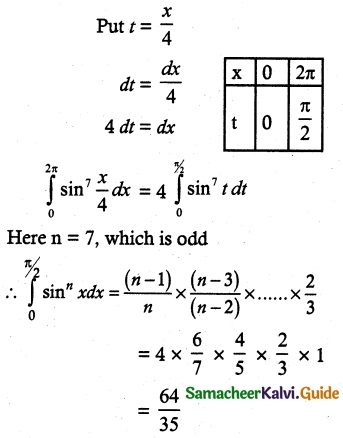
(vi) \(\int_{0}^{2π}\) sin7 \(\frac{x}{4}\) dx
Solution:
Samacheer Kalvi 12th Maths Guide Chapter 9 Applications of Integration Ex 9.6 6

Samacheer Kalvi 12th Maths Guide Chapter 9 Applications of Integration Ex 9.6

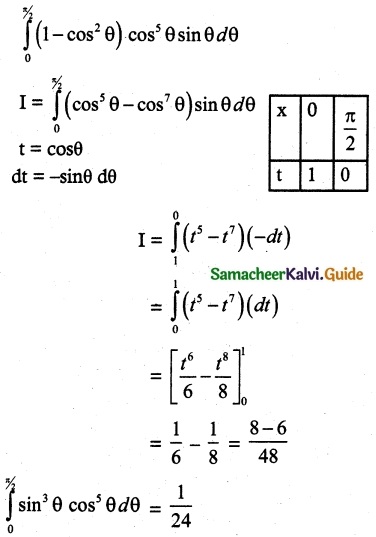
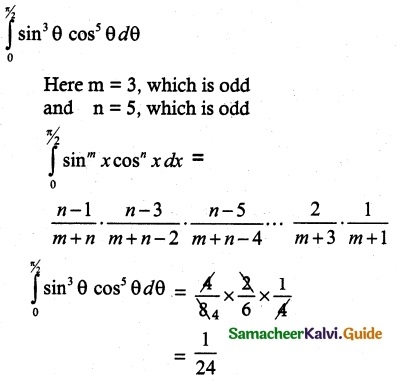
(vii) \(\int_{0}^{π/2}\) sin3 θ cos5 θ dθ
Solution:
Samacheer Kalvi 12th Maths Guide Chapter 9 Applications of Integration Ex 9.6 7
Aliter Method
Samacheer Kalvi 12th Maths Guide Chapter 9 Applications of Integration Ex 9.6 8

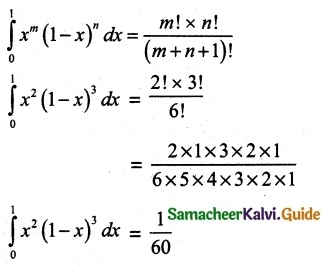
(viii) \(\int_{1}^{0}\) x² (1 – x)³ dx
Solution:
By applying reduction formula
Samacheer Kalvi 12th Maths Guide Chapter 9 Applications of Integration Ex 9.6 9

Samacheer Kalvi 12th Maths Guide Chapter 9 Applications of Integration Ex 9.6

Samacheer Kalvi 12th Maths Guide Chapter 9 Applications of Integration Ex 9.4

Tamilnadu State Board New Syllabus Samacheer Kalvi 12th Maths Guide Pdf Chapter 9 Applications of Integration Ex 9.4 Textbook Questions and Answers, Notes.

Tamilnadu Samacheer Kalvi 12th Maths Solutions Chapter 9 Applications of Integration Ex 9.4

Question 1.
Evaluate the following
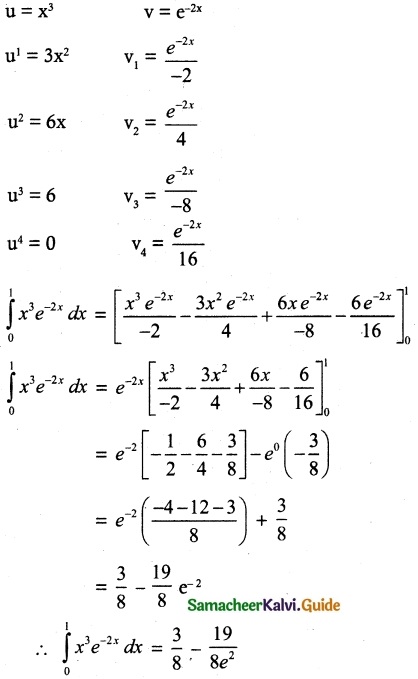
\(\int_{0}^{1}\) x³e-2x dx
Solution:
Bernoulli’s formula,
∫uv dx = uv1 – u1v2 + u2v3 – u3v4 + ….
Samacheer Kalvi 12th Maths Guide Chapter 9 Applications of Integration Ex 9.4 1

Samacheer Kalvi 12th Maths Guide Chapter 9 Applications of Integration Ex 9.4

Question 2.
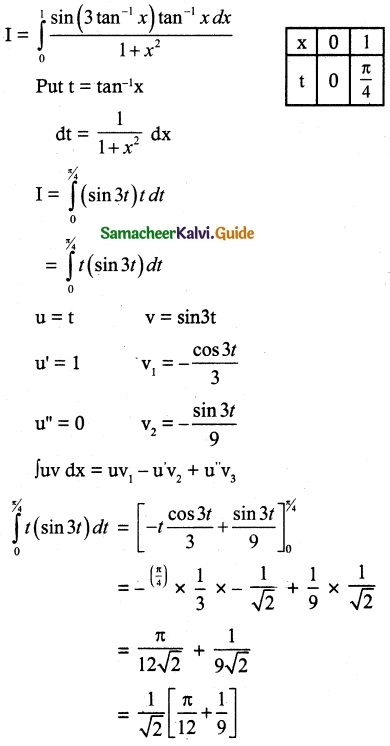
\(\int_{0}^{1}\) \(\frac{sin(3tan^{-1}x)tan^{-1}x dx}{1+x^2}\)
Solution:
Samacheer Kalvi 12th Maths Guide Chapter 9 Applications of Integration Ex 9.4 2

Samacheer Kalvi 12th Maths Guide Chapter 9 Applications of Integration Ex 9.4

Question 3.
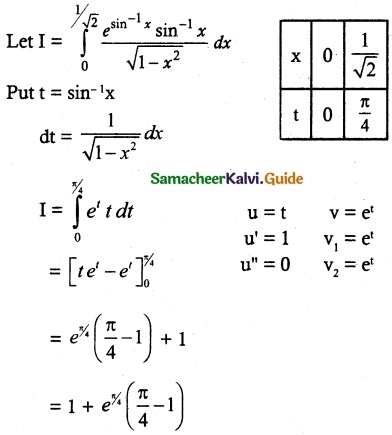
\(\int_{0}^{1/√2}\) \(\frac{e^{sin^{-1}x}sin^{-1}x}{\sqrt{1-x^2}}\) dx
Solution:
Samacheer Kalvi 12th Maths Guide Chapter 9 Applications of Integration Ex 9.4 3

Samacheer Kalvi 12th Maths Guide Chapter 9 Applications of Integration Ex 9.4

Question 4.
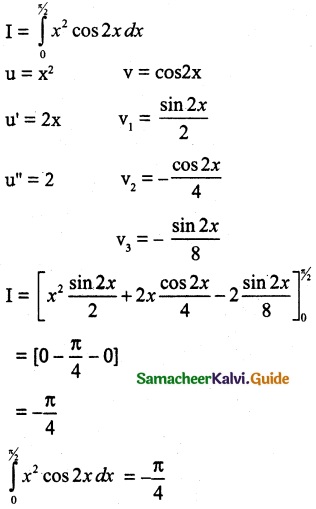
\(\int_{0}^{\pi / 2}\) x² cos 2x dx
Solution:
Samacheer Kalvi 12th Maths Guide Chapter 9 Applications of Integration Ex 9.4 4

Samacheer Kalvi 12th Maths Guide Chapter 9 Applications of Integration Ex 9.4

Samacheer Kalvi 12th Maths Guide Chapter 9 Applications of Integration Ex 9.3

Tamilnadu State Board New Syllabus Samacheer Kalvi 12th Maths Guide Pdf Chapter 9 Applications of Integration Ex 9.3 Textbook Questions and Answers, Notes.

Tamilnadu Samacheer Kalvi 12th Maths Solutions Chapter 9 Applications of Integration Ex 9.3

Question 1.
Evaluate the following definite integrals.
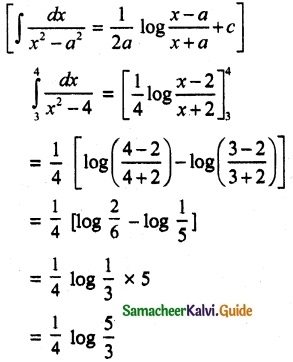
(i) \(\int_{3}^{4}\) \(\frac{dx}{x^2-4}\)
Solution:
Samacheer Kalvi 12th Maths Guide Chapter 9 Applications of Integration Ex 9.3 1

Samacheer Kalvi 12th Maths Guide Chapter 9 Applications of Integration Ex 9.3

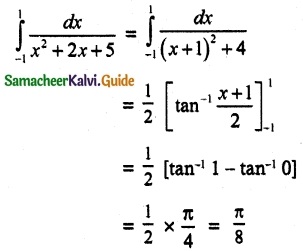
(ii) \(\int_{-1}^{1}\) \(\frac{dx}{x^2+2x+5}\)
Solution:
Samacheer Kalvi 12th Maths Guide Chapter 9 Applications of Integration Ex 9.3 2

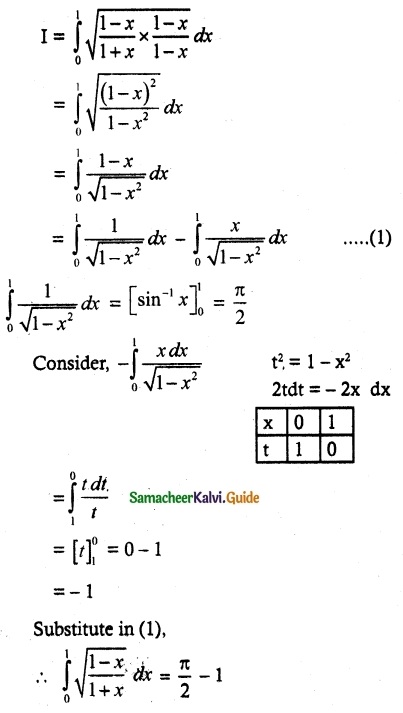
(iii) \(\int_{0}^{1}\) \(\frac{\sqrt{1-x}}{\sqrt{1+x}}\) dx
Solution:
Samacheer Kalvi 12th Maths Guide Chapter 9 Applications of Integration Ex 9.3 3

Samacheer Kalvi 12th Maths Guide Chapter 9 Applications of Integration Ex 9.3

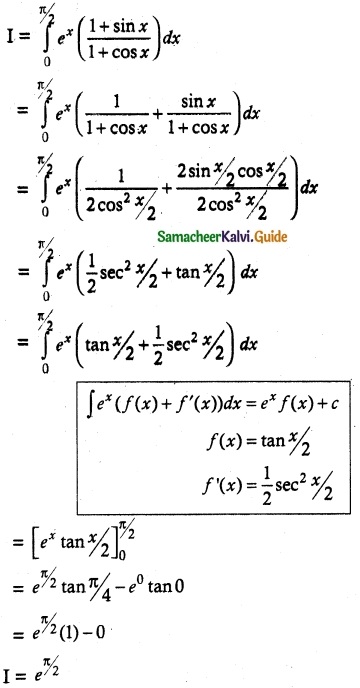
(iv) \(\int_{0}^{\pi / 2}\) (\(\frac{1+sin}{1+cosx}\))dx
Solution:
Samacheer Kalvi 12th Maths Guide Chapter 9 Applications of Integration Ex 9.3 4

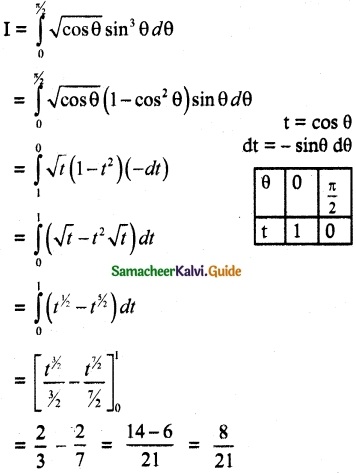
(v) \(\int_{0}^{\pi / 2}\) \(\sqrt{cos θ}\) sin³θ dθ
Solution:
Samacheer Kalvi 12th Maths Guide Chapter 9 Applications of Integration Ex 9.3 5

Samacheer Kalvi 12th Maths Guide Chapter 9 Applications of Integration Ex 9.3

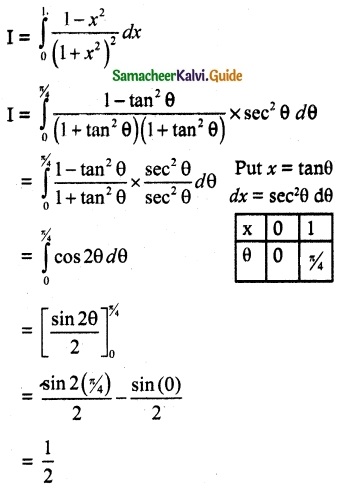
(vi) \(\int_{0}^{1}\) \(\frac{1-x^2}{(1+x^2)^2}\) dx
Solution:
Samacheer Kalvi 12th Maths Guide Chapter 9 Applications of Integration Ex 9.3 6

Question 2.
Evaluate the following integrals using properties of integration:
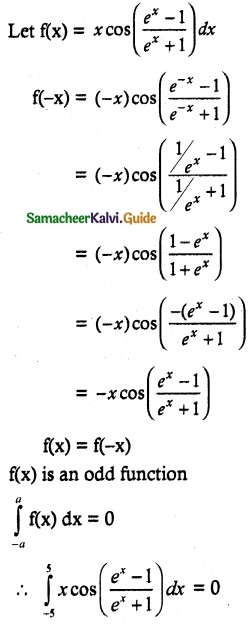
(i) \(\int_{-5}^{5}\) x cos (\(\frac{e^x-1}{e^x+1}\)) dx
Solution:
Samacheer Kalvi 12th Maths Guide Chapter 9 Applications of Integration Ex 9.3 7

Samacheer Kalvi 12th Maths Guide Chapter 9 Applications of Integration Ex 9.3

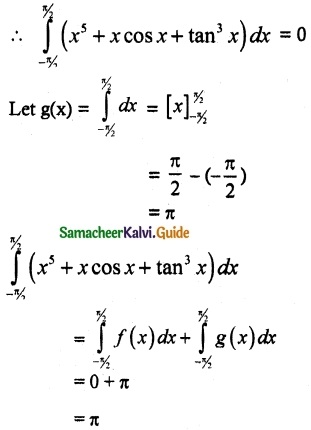
(ii) \(\int_{-\pi / 2}^{\pi / 2}\) (x5 + x cos x + tan³ x) dx
Solution:
\(\int_{-\pi / 2}^{\pi / 2}\) (x5 + x cos x + tan³ x) dx
= \(\int_{-\pi / 2}^{\pi / 2}\) (x5 + x cos x + tan³ x) dx + \(\int_{-\pi / 2}^{\pi / 2}\)
Let f(x) = x5 + x cos x + tan³x
f(-x) = -x5 – x cos x – tan³x
f(x) = -f(-x)
f(x) is an odd function
Samacheer Kalvi 12th Maths Guide Chapter 9 Applications of Integration Ex 9.3 8

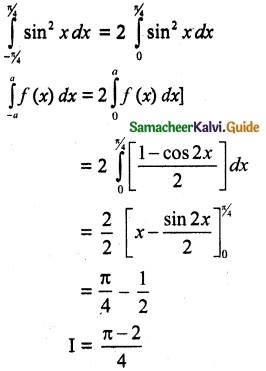
(iii) \(\int_{-\pi / 4}^{\pi / 4}\) sin² x dx
Solution:
I = \(\int_{-\pi / 4}^{\pi / 4}\) sin² x dx
f(x) = sin²x
f(-x) = sin²(-x) = sin²x
f(x) = f(-x)
f(x) is an even function
Samacheer Kalvi 12th Maths Guide Chapter 9 Applications of Integration Ex 9.3 9

Samacheer Kalvi 12th Maths Guide Chapter 9 Applications of Integration Ex 9.3

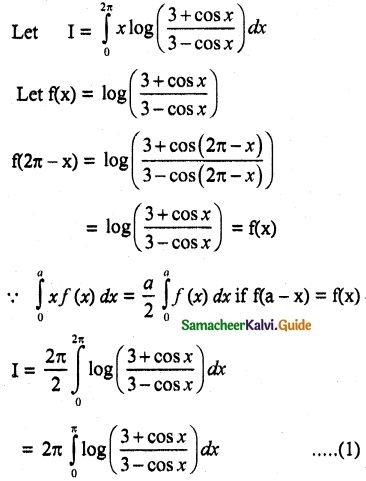
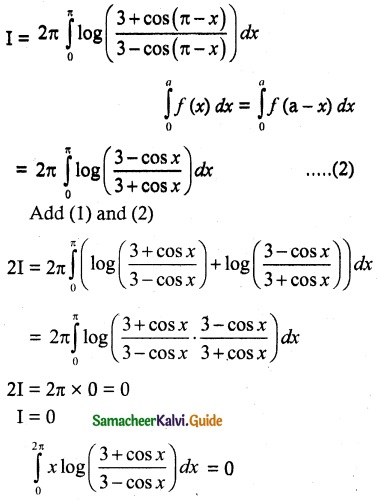
(iv) \(\int_{0}^{2π}\) x log(\(\frac{3+cos x}{3-cos x}\))dx
Solution:
Samacheer Kalvi 12th Maths Guide Chapter 9 Applications of Integration Ex 9.3 10
Samacheer Kalvi 12th Maths Guide Chapter 9 Applications of Integration Ex 9.3 11

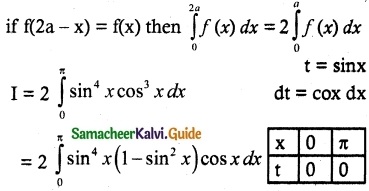
(v) \(\int_{0}^{π}\) sin4 x cos³ x dx
Solution:
\(\int_{0}^{π}\) sin4 x cos³ x dx
f(x) = sin4x cos³x
f(2π – x) = sin4(2π – x) cos³ (2π – x)
= sin4x cos³x
f(2π – x) = f(x)
Samacheer Kalvi 12th Maths Guide Chapter 9 Applications of Integration Ex 9.3 12
Limit from 0 to π tends to 0 to 0
∴ Integral value = 0
∴ \(\int_{0}^{π}\) sin4 x cos³ x dx = 0

Samacheer Kalvi 12th Maths Guide Chapter 9 Applications of Integration Ex 9.3

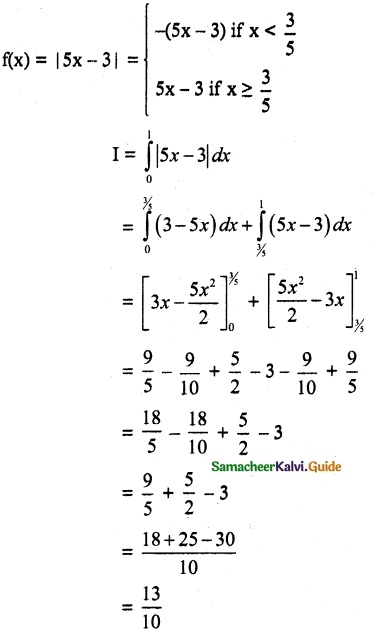
(vi) \(\int_{0}^{1}\) |5x – 3|dx
Solution:
Samacheer Kalvi 12th Maths Guide Chapter 9 Applications of Integration Ex 9.3 13

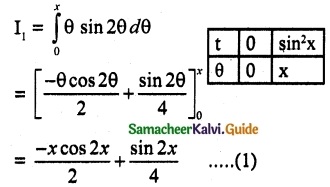
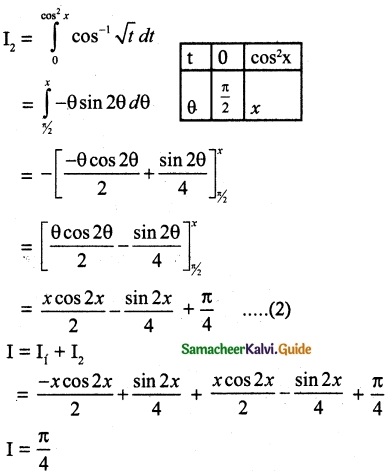
(vii) \(\int_{0}^{sin^2x}\) sin-1 √t dt + \(\int_{0}^{cos^2x}\) cos-1 √t dt
Solution:
I1 = \(\int_{0}^{sin^2x}\) sin-1 √t dt
Put sin-1 √t = θ
√t = sin θ
\(\frac{1}{2√t}\) dt = cos θ dθ
dt = 2√t cos θ dθ
= 2 sin θ cos θ dθ
dt = sin 2θ dθ
Samacheer Kalvi 12th Maths Guide Chapter 9 Applications of Integration Ex 9.3 14
I1 = \(\int_{0}^{cos^2x}\) cos-1 √t dt
Put cos-1 √t = θ
√t = cos θ
\(\frac{1}{2√t}\) dt = -sin θ dθ
dt = -2√t sin θ dθ
= -2 cos θ sin θ dθ
dt = -sin 2θ dθ
Samacheer Kalvi 12th Maths Guide Chapter 9 Applications of Integration Ex 9.3 15

Samacheer Kalvi 12th Maths Guide Chapter 9 Applications of Integration Ex 9.3

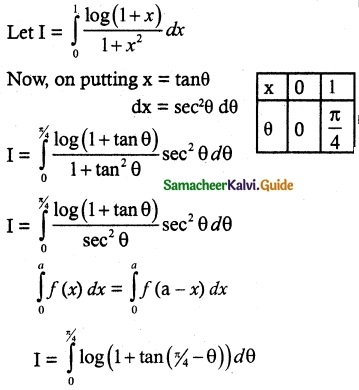
(viii) \(\int_{0}^{1}\) \(\frac{log(1+x)}{1+x^2}\) dx
Solution:
Samacheer Kalvi 12th Maths Guide Chapter 9 Applications of Integration Ex 9.3 16
Samacheer Kalvi 12th Maths Guide Chapter 9 Applications of Integration Ex 9.3 17

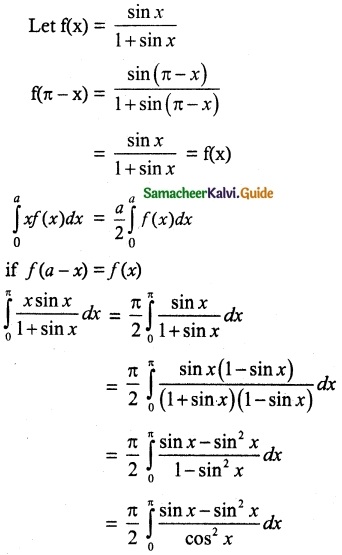
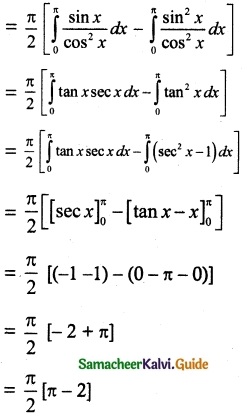
(ix) \(\int_{0}^{π}\) \(\frac{x sin x}{1+sin x}\) dx
Solution:
Samacheer Kalvi 12th Maths Guide Chapter 9 Applications of Integration Ex 9.3 18
Samacheer Kalvi 12th Maths Guide Chapter 9 Applications of Integration Ex 9.3 19

Samacheer Kalvi 12th Maths Guide Chapter 9 Applications of Integration Ex 9.3

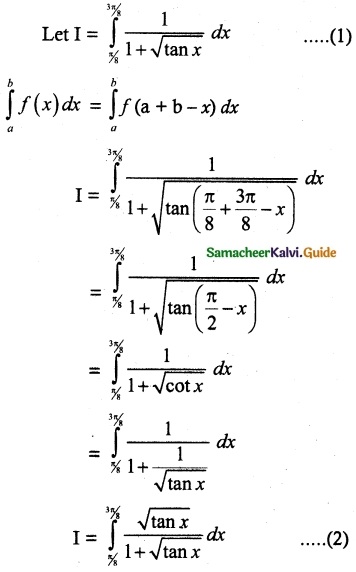
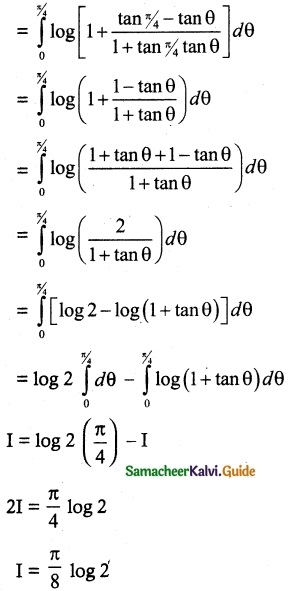
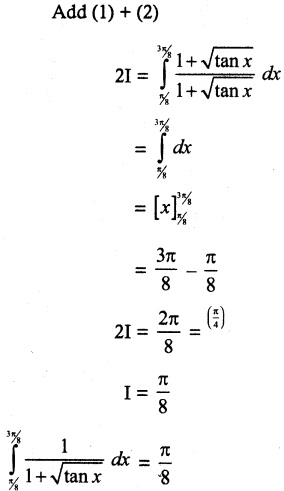
(x) \(\int_{π/8}^{3π/8}\) \(\frac{1}{1+\sqrt{tan x}}\) dx
Solution:
Samacheer Kalvi 12th Maths Guide Chapter 9 Applications of Integration Ex 9.3 20
Samacheer Kalvi 12th Maths Guide Chapter 9 Applications of Integration Ex 9.3 21

Samacheer Kalvi 12th Maths Guide Chapter 9 Applications of Integration Ex 9.3

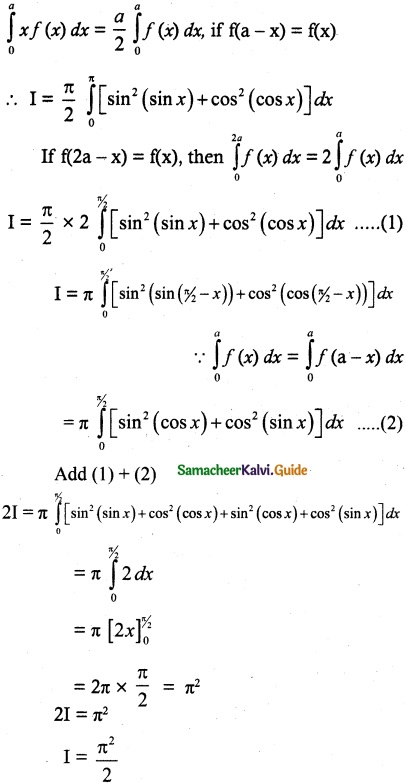
(xi) \(\int_{0}^{π}\) x[sin²(sin x) + cos² (cos x)] dx
Solution:
Let I = \(\int_{0}^{π}\) x[sin²(sin x) + cos² (cos x)] dx
f(x) = sin² (sin x) + cos² (cos x)
f(π – x) = sin² (sin π – x)) + cos² (cos(π – x))
= sin² (sin x) + cos² (cos x)
f(x) = f(π – x)
Samacheer Kalvi 12th Maths Guide Chapter 9 Applications of Integration Ex 9.3 22

Samacheer Kalvi 12th Maths Guide Chapter 9 Applications of Integration Ex 9.3

Samacheer Kalvi 12th Accountancy Guide Chapter 2 Accounts of Not-For-Profit Organisation

Tamilnadu State Board New Syllabus Samacheer Kalvi 12th Accountancy Guide Pdf Chapter 2 Accounts of Not-For-Profit Organisation Text Book Back Questions and Answers, Notes.

Tamilnadu Samacheer Kalvi 12th Accountancy Solutions Chapter 2 Accounts of Not-For-Profit Organisation

12th Accountancy Guide Accounts of Not-For-Profit Organisation Text Book Back Questions and Answers

I Multiple Choice Questions

Choose the correct answer

Question 1.
Receipts and payments account is a
(a) Nominal A/c
(b) Real A/c
(c) Personal A/c
(d) Representative personal account
Answer:
(b) Real A/c

Samacheer Kalvi 12th Accountancy Guide Chapter 2 Accounts of Not-For-Profit Organisation

Question 2.
Receipts and payments account records receipts and payments of
(a) Revenue nature only
(b) Captital nature only
(c) Both revenue and captial nature
(d) None of the above
Answer:
(c) Both revenue and captial nature

Question 3.
Balance of receipts and payments account indicates the
(a) Loss incurrd during the period
(b) Excess of income over expenditure of the period
(c) Total cash payments during the period
(d) Cash and bank balance as on the date
Answer:
(d) Cash and bank balance as on the date

Question 4.
Income and expenditure account is a
(a) Nominal A/c
(b) Real A/c
(c) Personal A/c
(d) Representative personal account
Answer:
(a) Nominal A/c

Samacheer Kalvi 12th Accountancy Guide Chapter 2 Accounts of Not-For-Profit Organisation

Question 5.
Income and expenditure Account is prepared to find out
(a) Profit or loss
(b) Cash and bank balance
(c) Surplus or deficit
(d) Financial position
Answer:
(c) Surplus or deficit

Question 6.
Which of the following should not be recorded in the income and expenditure account?
(a) Sale of old news papers
(b) Loss on sale of asset
(c) Honorarium paid to the secretary
(d) Sale proceeds of furniture
Answer:
(d) Sale proceeds of furniture

Question 7.
Subsceiption due but not received for the current year is
(a) An asset
(c) An expense
(b) A liability
(d) An item to be ignored
Answer:
(a) An asset

Question 8.
Legacy is a
(a) Revenue expenditure
(b) Capital expenditure
(c) Revenue receipt
(d) Capital receipt
Answer:
(d) Capital receipt

Samacheer Kalvi 12th Accountancy Guide Chapter 2 Accounts of Not-For-Profit Organisation

Question 9.
Donations received for a specific purpose is
(a) Revenue receipt
(b) Capital receipt
(c) Revenue expenditure
(d) Capital expenditure
Answer:
(b) Capital receipt

Question 10.
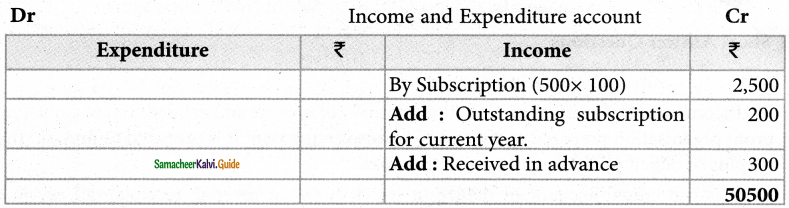
There are 500 members in a club each paying ₹ 100 as annual subscription. Subscription due but not received for the current year is ₹ 200; Subscription received in advance is ₹ 300. Find out the amount of subscription to be shown in the income and expend ; account.
(a) ₹ 50,500
(b) ₹ 50,200
(c) ₹ 49,900
(d) ₹ 49,800
Hint:
Samacheer Kalvi 12th Accountancy Guide Chapter 2 Accounts of Not-For-Profit Organisation 1
Answer:
(a) ₹ 50,500

II Very Short Answer Questions

Question 1.
State the meanting of not-for-profit organisation.
Answer:
Some organisations are established for the purpose of rendering servies to the public without any profit motive. They may be created for the promotion of art, culture, education, sports, etc. These organisations are called not-for-profit organisation.

Samacheer Kalvi 12th Accountancy Guide Chapter 2 Accounts of Not-For-Profit Organisation

Question 2.
What is receipts any payments account?
Answer:
Receipts and Payments account is a summary of cash and bank transactions of not-for- profit organisations prepared at the end of eac financial year.

It is a real account in nature. The receipts any payments account begins with the opening balances of cash and bank and ends with closing balances of cash and bank. All cash receipts are shown on the debit side and all cash payments are shown on the credit side of this account. All cash receipts and cash payments whether of capital or revenue nature will be recorded irrespective of the period for which the amoutn is received or paid, it is recorded if cash is received or paind during the year.

Question 3.
What is Legacy?
Answer:
A gift made to a not-for-profit organisation by a will, is called legacy. It is a capital receipt.

Question 4.
Write a short note on life membership fees.
Answer:
Amount received towards life membership fee from members is a capital receipt as it is non-recurring in nature.

Question 5.
Give four examples for Capital r pts of not-for-profit organisation.
Answer:
Life membership fees, Legacies Specifi, Specific donations, Sale of fixed assets, Special funds, Tournament fund prize

Samacheer Kalvi 12th Accountancy Guide Chapter 2 Accounts of Not-For-Profit Organisation

Question 6.
Give four examples for revenue receipts of not-for-profit organisation?
Answer:
Subscription, Interest on investment, Interest on fixed deposit
Sale of (old) sports materials, Sale of (old) newspapers

III Short Answer Questions

Question 1.
What is income and expenditure account?
Answer:
Income and expenditure account is a summary of income and expenditure of a not-for- profit organisation prepared at the end of an accounting year. It is prepared to find out the surplus or deficit pertaining to a particular year.
It is a nominal account in nature in which items of revenue receipts and revenue expenditure, relating to the current year alone are recorded. It is prepared following the accrual basis of accounting.

Samacheer Kalvi 12th Accountancy Guide Chapter 2 Accounts of Not-For-Profit Organisation

Question 2.
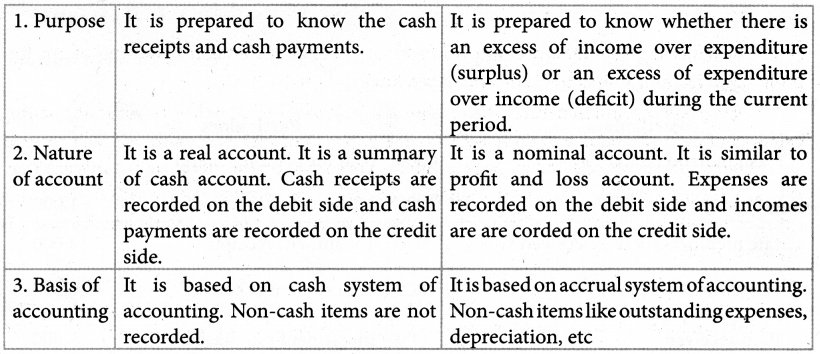
State the differences between Receipts and Payments Account and Income and Expenditure Account.
Answer:
Samacheer Kalvi 12th Accountancy Guide Chapter 2 Accounts of Not-For-Profit Organisation 2 Samacheer Kalvi 12th Accountancy Guide Chapter 2 Accounts of Not-For-Profit Organisation 3

Question 3.
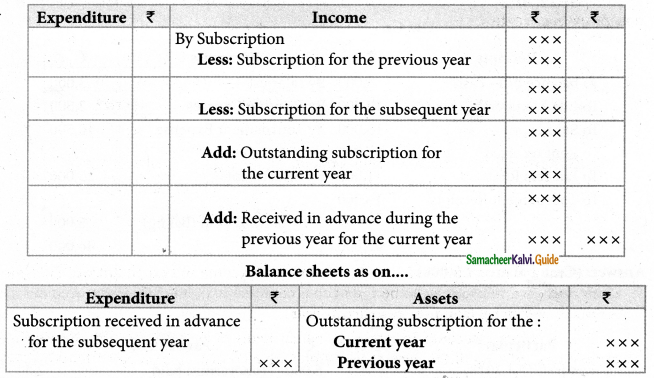
How annual subscription is dealt with in the final accounts of not-for-profit organisation?
Answer:
Samacheer Kalvi 12th Accountancy Guide Chapter 2 Accounts of Not-For-Profit Organisation 4

Samacheer Kalvi 12th Accountancy Guide Chapter 2 Accounts of Not-For-Profit Organisation

Question 4.
How the following items are dealt with in the final accounts of not-for-profit organisation? (a) Sale of sports materials (b) Life membership fees (c) Tournament fund
Answer:

  • Sale of sports materials: Shown on the credit side of Income & Edpenditure A/c.
  • Life membership fees: being capital receipt, will be shown on the liability side of the B/s.
  • Tournament Fund: being capital receipt, will be shown on the liability side o f the B/s.

IV Exercise

Question 1.
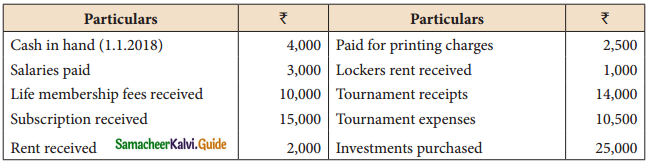
From the information given below, prepare Receipts and Payments account of Kurunji Sports Club for the year ended 31st December, 2018
Samacheer Kalvi 12th Accountancy Guide Chapter 2 Accounts of Not-For-Profit Organisation 5
Solution :
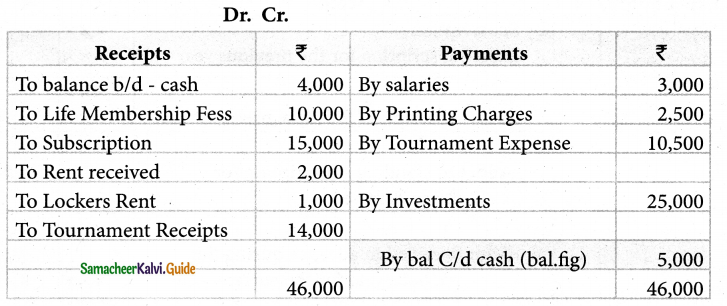
In the books of Kurunji Sports Club Receipts & Payments A/c for the year ended 31.12.2018
Answer:
Samacheer Kalvi 12th Accountancy Guide Chapter 2 Accounts of Not-For-Profit Organisation 6
Cash balance: ₹ 5,000

Question 2.
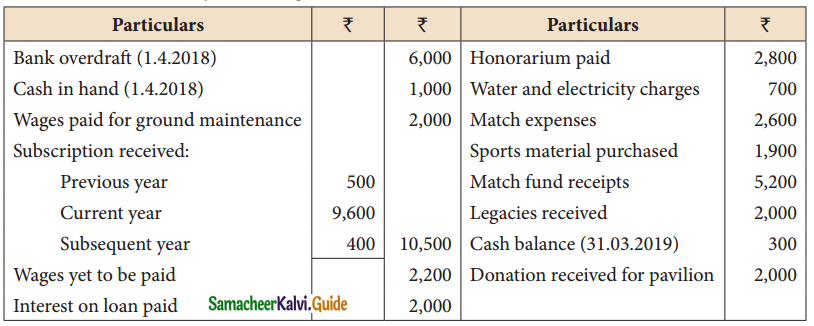
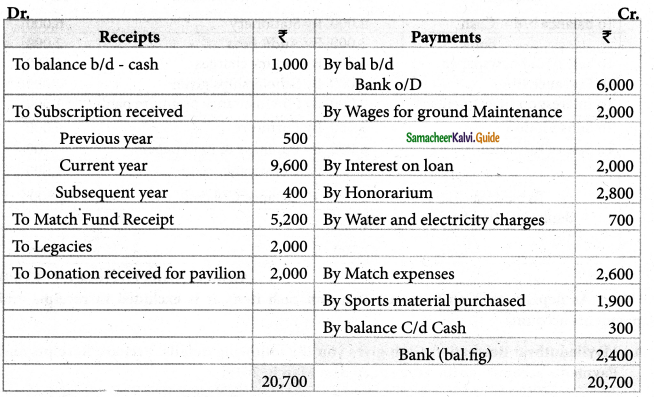
From the information given below, prepare Receipts and Payments account of Coimbatore Cricket club for the year ending 31st March, 2019.
Samacheer Kalvi 12th Accountancy Guide Chapter 2 Accounts of Not-For-Profit Organisation 7
Solution:
In the book of Coimbatore Cricket Club/Receipts & Payments A/c for the year ended 31.3.2019
Samacheer Kalvi 12th Accountancy Guide Chapter 2 Accounts of Not-For-Profit Organisation 8
Answer:
Bank balance: ₹ 2,400

(Hint: Wages yet to be paid is a non cash item. Hence, it is excluded in receipts and payments account)

Samacheer Kalvi 12th Accountancy Guide Chapter 2 Accounts of Not-For-Profit Organisation

Question 3.
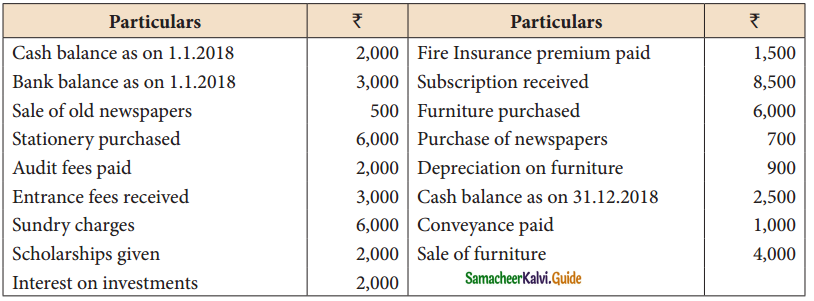
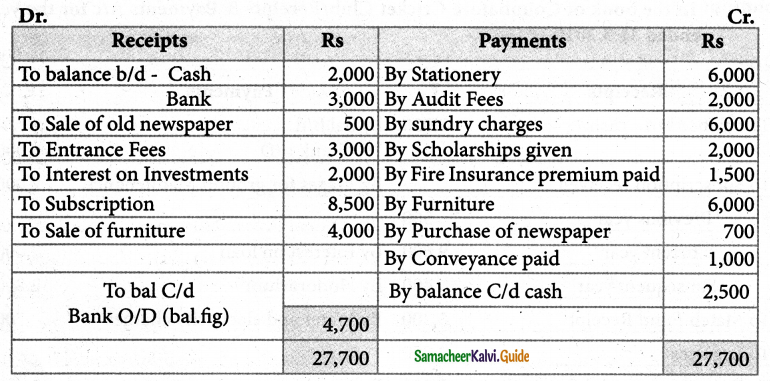
From the information given below, prepare Receipts and Payments account of Madurai Mother Theresa Mahalir Madram for the year ended 31st December, 2018.
Samacheer Kalvi 12th Accountancy Guide Chapter 2 Accounts of Not-For-Profit Organisation 9
Solution: In the book of Mother Teresa Mahalir Mandram, Madurai Receipt & Payment A/c for the year ended 31.12.2018

Answer:
Bank Overdraft: ₹ 4,700
(Hint: As depreciation on furniture is a non cash item, it is excluded in receipts and payments account)

Question 4.
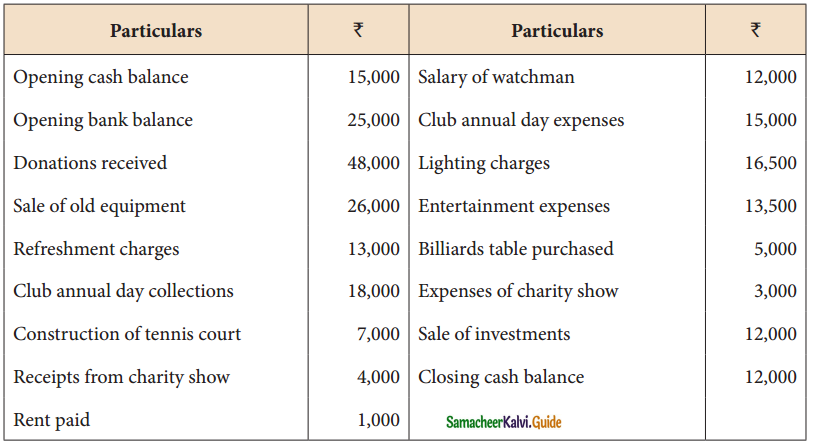
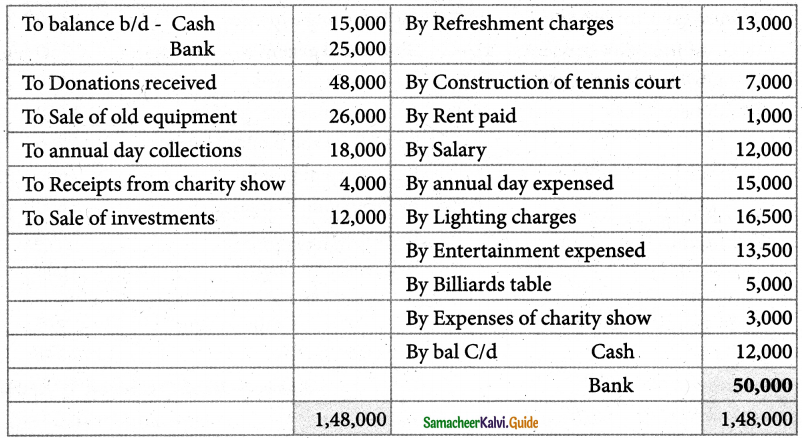
Mayiladuthrai Recreation Club gives you the following details. Prepare Receipts and Payments account for the year ended 31st March, 2019.
Samacheer Kalvi 12th Accountancy Guide Chapter 2 Accounts of Not-For-Profit Organisation 11
Solution:
In the books of Mayiladuthurai Recreation Club Receipts & Payments A/c for the year ended 31.3.2019
Samacheer Kalvi 12th Accountancy Guide Chapter 2 Accounts of Not-For-Profit Organisation 12
Samacheer Kalvi 12th Accountancy Guide Chapter 2 Accounts of Not-For-Profit Organisation 13
Answer:
Bank balance: ₹ 50,000

Samacheer Kalvi 12th Accountancy Guide Chapter 2 Accounts of Not-For-Profit Organisation

Question 5.
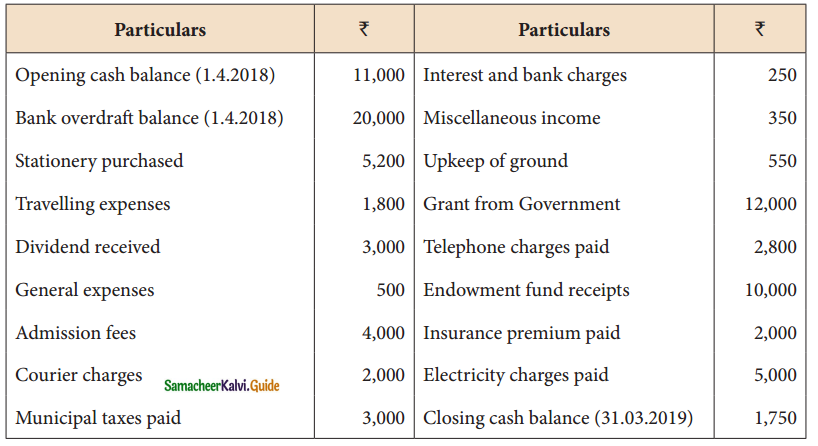
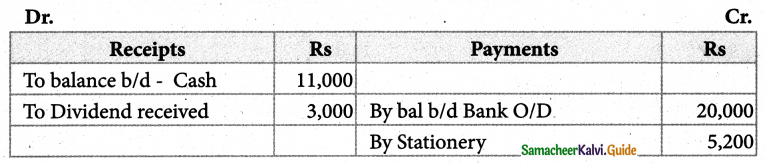
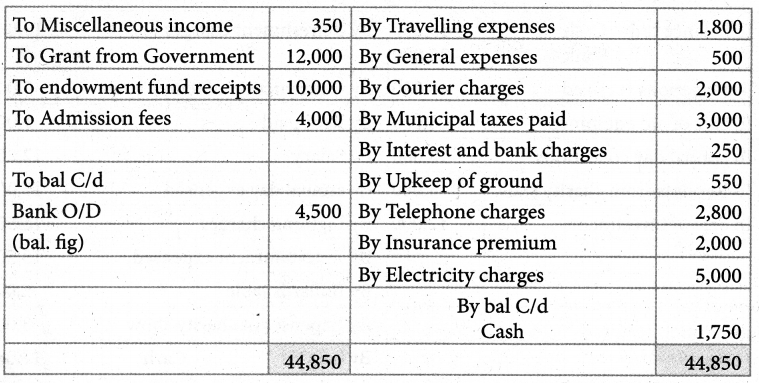
From the following information, prepare Receipts and Payments account of Cuddalore Kabaddi Association for the year ended 31st March, 2019
Samacheer Kalvi 12th Accountancy Guide Chapter 2 Accounts of Not-For-Profit Organisation 14
Solution :
In the books of Cuddalore Kabaddi Association
Receipts & Payments A/c for the year ended 31.3.2019
Samacheer Kalvi 12th Accountancy Guide Chapter 2 Accounts of Not-For-Profit Organisation 14 Samacheer Kalvi 12th Accountancy Guide Chapter 2 Accounts of Not-For-Profit Organisation 16
Answer:
Bank Overdraft: ₹ 4,500

Question 6.
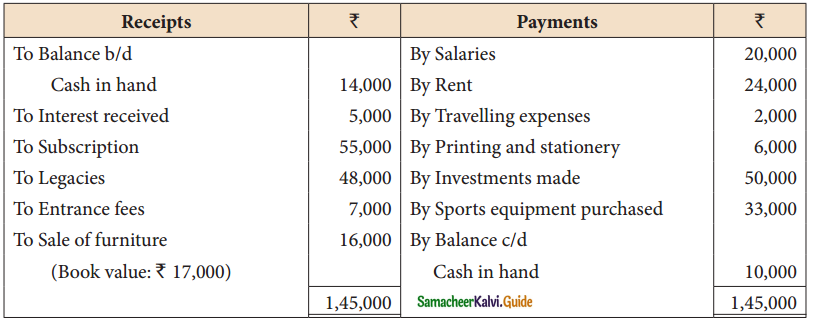
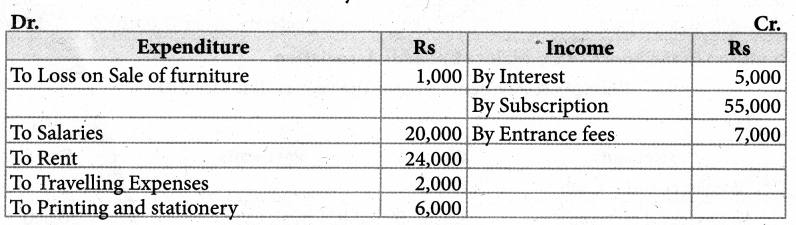
From the following receipts and payments account of Tenkasi Ihiruvalluvar Mandram, Prepare income and expenditure account for the year ended 31st March, 2019.
Samacheer Kalvi 12th Accountancy Guide Chapter 2 Accounts of Not-For-Profit Organisation 17
In the books of Tenkasi Ihiruvalluvar Mandram Income &Expenditure A/c for the year ended 31.3.19
Samacheer Kalvi 12th Accountancy Guide Chapter 2 Accounts of Not-For-Profit Organisation 18
Samacheer Kalvi 12th Accountancy Guide Chapter 2 Accounts of Not-For-Profit Organisation 19
Answer:
Surplus: ₹14,000

Question 7.
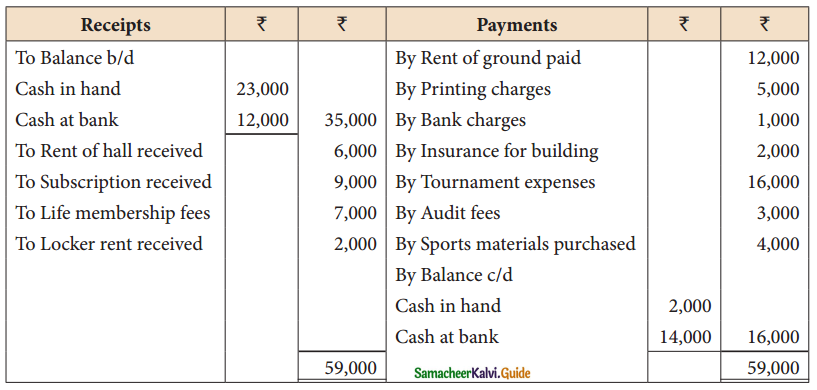
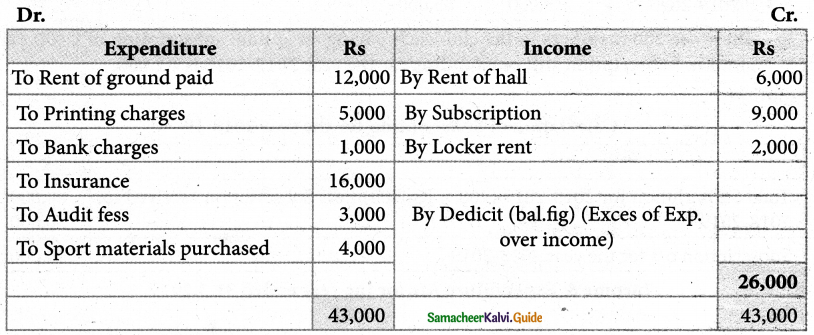
From the following receipts and payment account, prepare income and expenditure account of Kumbakonam Basket Ball Association for the year ended 31st March, 2018.
Samacheer Kalvi 12th Accountancy Guide Chapter 2 Accounts of Not-For-Profit Organisation 20
Solution: In the books of Kumbakonam Basket Ball Association Income &Expenditure A/cfor the year ended 31.3.18
Samacheer Kalvi 12th Accountancy Guide Chapter 2 Accounts of Not-For-Profit Organisation 21
Answer:
Deficit: ₹ 26,000

Samacheer Kalvi 12th Accountancy Guide Chapter 2 Accounts of Not-For-Profit Organisation

Question 8.
From the following receipts and payments account and the additional information given below, calculate the amoumt of of subscription to be shown in Income and expenditure account for the year ending 31st December, 2018.
Samacheer Kalvi 12th Accountancy Guide Chapter 2 Accounts of Not-For-Profit Organisation 22
Additional information: Subscription outstanding for the year 2018 is Rs.8,000
Solution:
Income & Expenditure A/c for the year ended 31.12.2018
Samacheer Kalvi 12th Accountancy Guide Chapter 2 Accounts of Not-For-Profit Organisation 23
Answer:
Subscription for 2018: ₹ 1,80,000)

Question 9.
How the following items will appear in the final accounts of a club for the year ending 31st March 2019?
Samacheer Kalvi 12th Accountancy Guide Chapter 2 Accounts of Not-For-Profit Organisation 24
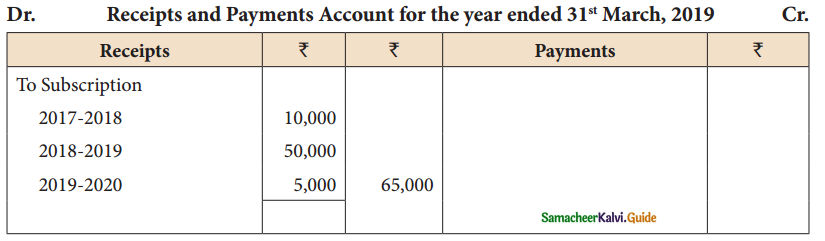
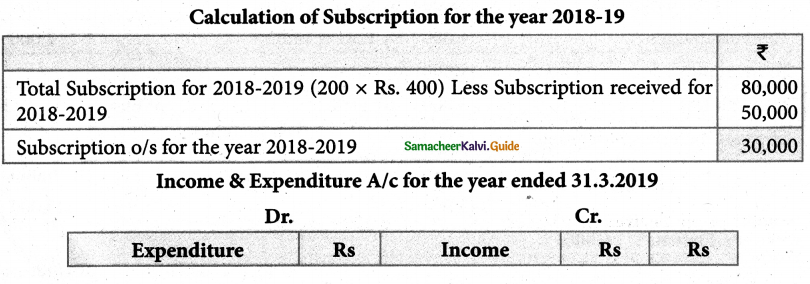
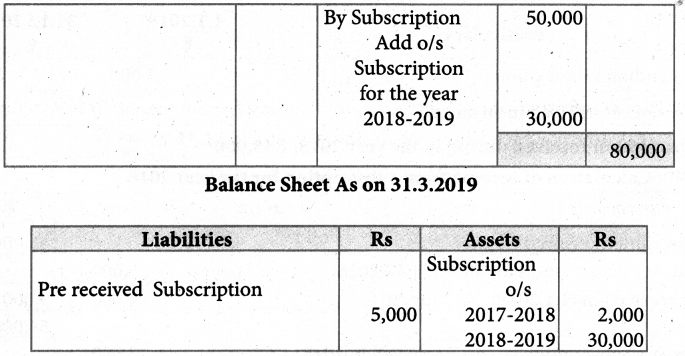
There are 200 members in the club each paying an annual subscription of ₹ 400 per annum. Subscription still outstanding for the year 2017-2018 is ₹ 2,000.
Solution :
Samacheer Kalvi 12th Accountancy Guide Chapter 2 Accounts of Not-For-Profit Organisation 25 Samacheer Kalvi 12th Accountancy Guide Chapter 2 Accounts of Not-For-Profit Organisation 26
Answer:
Income and Expenditure A/c: Subscription: ₹ 80,000 Balance Sheet: Assets: Subscription outstanding: ₹ 32,000; Liabilities: Subscription received in advance: ₹ 5,000

Samacheer Kalvi 12th Accountancy Guide Chapter 2 Accounts of Not-For-Profit Organisation

Question 10.
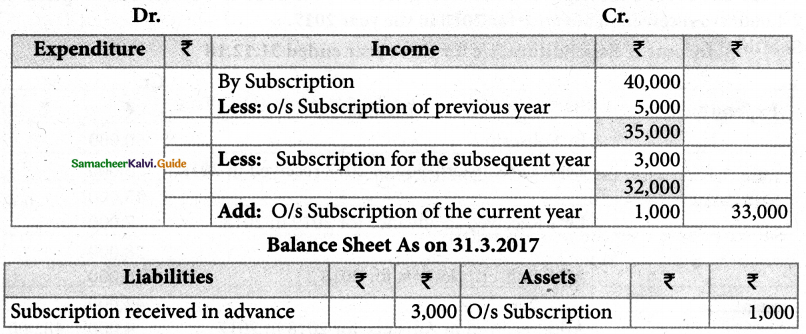
Ho w will the following items appear in the final accounts of a club for the year ending 31st March 2017? Received subscription of ₹ 40,000 during the year 2016-17. This includes subscription of ₹ 5,000 for 2015-16 and ₹ 3,000 for the year 2017-18. subscription of ₹ 1,000 is still outstanding for the year 2016-17.
Solution:
Income & Expenditure A/c for the year ended 31.3.17
Samacheer Kalvi 12th Accountancy Guide Chapter 2 Accounts of Not-For-Profit Organisation 27
Answer:
Income and Expenditure A/c: Subscription: ₹ 33,000
Balance Sheet: Assets: Subscription outstanding: ₹ 1,000;
Liabilities: Subscription received in advance: ₹ 3,000

Question 11.
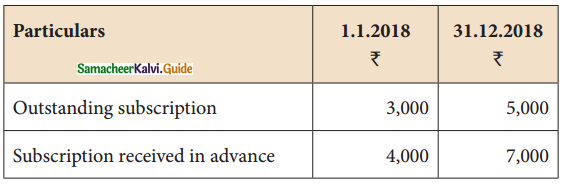
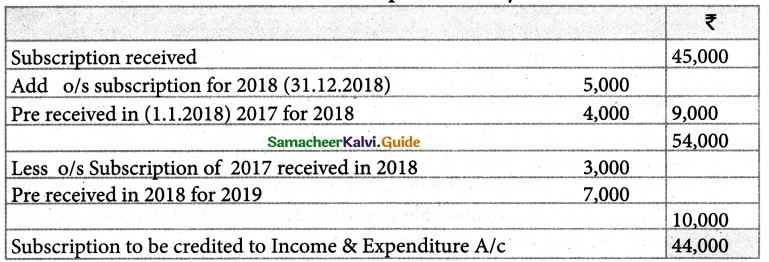
Compute income from subscription for the year 2018 from the following particulars relating to a club.
Samacheer Kalvi 12th Accountancy Guide Chapter 2 Accounts of Not-For-Profit Organisation 28
Subscription received during in the year 2018: ₹ 45,000
Solution:
Calculation of income from subscription for the year 2018
Samacheer Kalvi 12th Accountancy Guide Chapter 2 Accounts of Not-For-Profit Organisation 29
Answer:
Income and Expenditure A/c: Subscription: ₹ 44,000

Samacheer Kalvi 12th Accountancy Guide Chapter 2 Accounts of Not-For-Profit Organisation

Question 12.
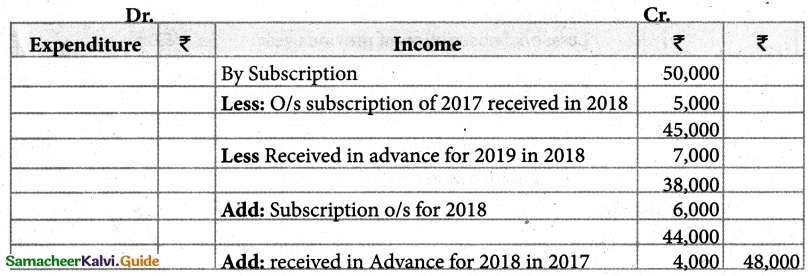
From the following particulars, show how the item ‘Subscription’ will appear in the Income and Expenditure Account for the year ended 31.12.2018?

Subscription received in 2018 is ₹ 50,000 which includes ₹ 5,000 for 2017 and ₹ 7,000 for 2019. Subscription outstanding for the year 2018 is ₹ 6,000. Subscription of ₹ 4,000 was received in advance for 2018 in the year 2017.
Solution:
Income & Expenditure A/c for three year ended 31.12.18
Samacheer Kalvi 12th Accountancy Guide Chapter 2 Accounts of Not-For-Profit Organisation 30
Answer:
Income and Expenditure A/c: Subscription:₹ 48,000
Question 13.
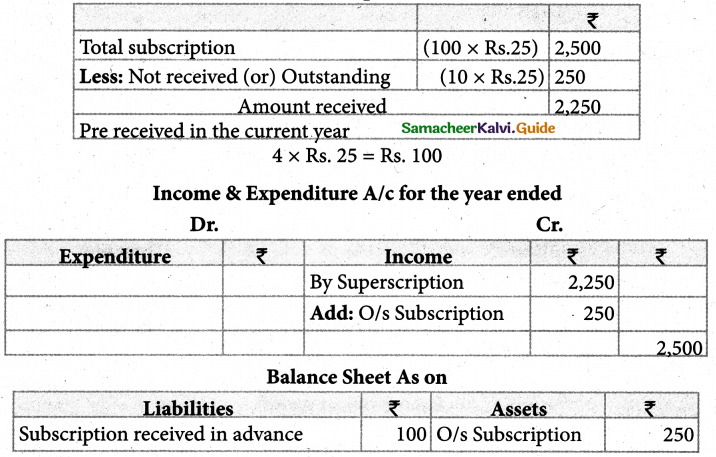
How the following items appear in the final accounts of Thoothukudi Young Pioneers Association?
There are one hundred members in the association each paying 25 as annual subscription. By the end of the year 10 members had not paid their subscription but four members had paid for the next year in advance.
Solution:
Calculation of income from subscription
Samacheer Kalvi 12th Accountancy Guide Chapter 2 Accounts of Not-For-Profit Organisation 31
Answer:
Income and Expenditure Account: Subscription: ₹ 2,500
Balance Sheet: Assets: Subscription outstanding: ₹ 250;
Liabilities: Subscription received in advance: ₹ 100

Samacheer Kalvi 12th Accountancy Guide Chapter 2 Accounts of Not-For-Profit Organisation

Question 14.
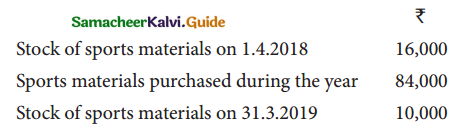
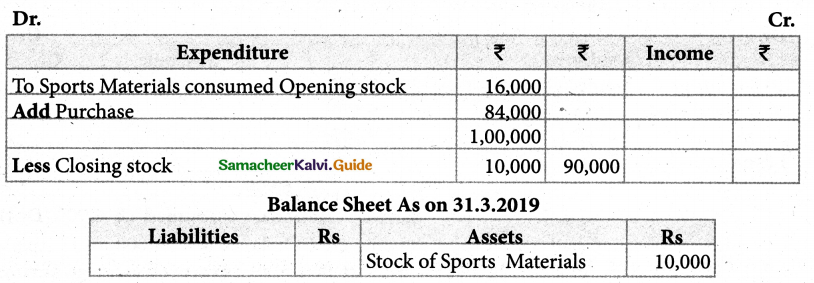
How will the following appear in the final accounts of Marthadam Women Cultural Association?
Samacheer Kalvi 12th Accountancy Guide Chapter 2 Accounts of Not-For-Profit Organisation 32
Solution :
Income & Expenditure A/c for the year ended 31.3.2019
Samacheer Kalvi 12th Accountancy Guide Chapter 2 Accounts of Not-For-Profit Organisation 33
Answer:
Income and Expenditure Account (Dr): ₹ 90,000;
Balance Sheet: Assets: Stock of sports materials: ₹ 10,000
Question 15.
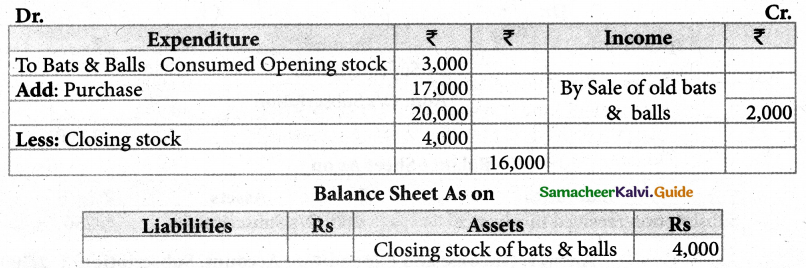
How will the following appear in the final accounts of Vedaranyam Sports Club?

Opening stock of bats and balls3,000
Purchase of bats and balls during the year17,000

Sale of old bats and balls2,000
Closing stock of bats and balls4,000

Solution:
Income & Expenditure A/c for the year ended
Samacheer Kalvi 12th Accountancy Guide Chapter 2 Accounts of Not-For-Profit Organisation 34
Answer:
Income and Expenditure Account: Bats and balls consumed : ₹ 16,000 (Dr);
Sale of old sports materials: ₹ 2,000 (Cr.)
Balance Sheet: Assets side: Stock of bats and balls: ₹ 4,000)

Samacheer Kalvi 12th Accountancy Guide Chapter 2 Accounts of Not-For-Profit Organisation

Question 16.
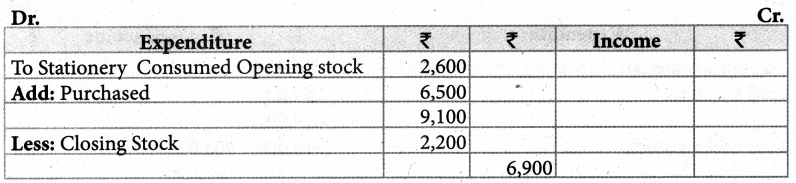
Show how the following items appear in the income and expenditure account of Sirkazhi Singers Association?

Stock of stationery on 1.4.20182,600
Purchase of stationery during the year6,500
Stock of stationery on 31.3.20182,200

Solution:
Income & Expenditure A/c for the year ended 31.3.2018
Samacheer Kalvi 12th Accountancy Guide Chapter 2 Accounts of Not-For-Profit Organisation 35
Answer:
Stationery consumed : ₹ 6,900 (Dr.)

Question 17.
Chennai tennis club had Match fund showing credit balance of ₹ 24,000 on 1st April, 2018. Receipt to the fund during the year was ₹ 26,000. Match expensed incurred during the year was ₹ 33,000. How these items will appear in the final accounts of the club for the year ended 31st March, 2019?
Solution:
Balance Sheet As on 31.3.19
Samacheer Kalvi 12th Accountancy Guide Chapter 2 Accounts of Not-For-Profit Organisation 36
Answer:
Balance sheet: Liabilities: Match fund : ₹ 17,000

Samacheer Kalvi 12th Accountancy Guide Chapter 2 Accounts of Not-For-Profit Organisation

Question 18.
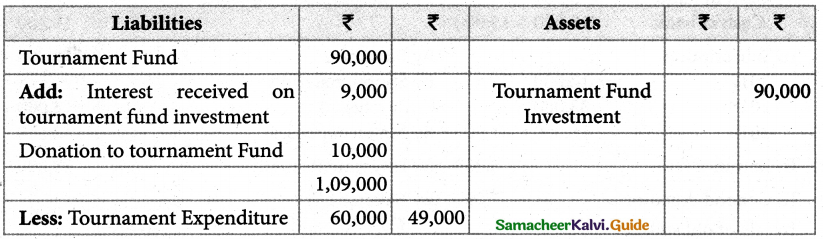
How will the following appear in the final accounts of Karaikudi sports club for the year ending 31st March, 2019?
Particulars ?

Particular
Tournament fund on 1st April 201890,000
Tournament fund investment on 1st April 201890,000
Interest received on tournament fund investment9,000
Donation to tournament fund10,000
Tournament expenses60,000

Solution:
Balance Sheet As on 31.3.2019
Samacheer Kalvi 12th Accountancy Guide Chapter 2 Accounts of Not-For-Profit Organisation 37
Answer:
Balance sheet: Liabilities: Tournament fund: ₹ 49,000
Assets: Tournament fund investment: ₹ 90,000

Question 19.
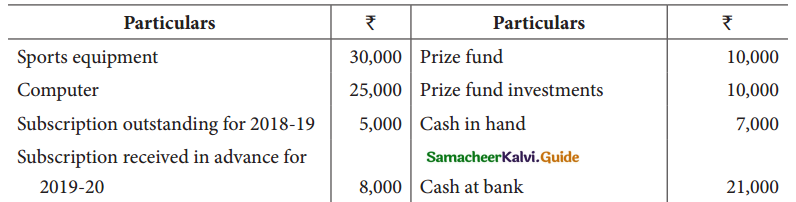
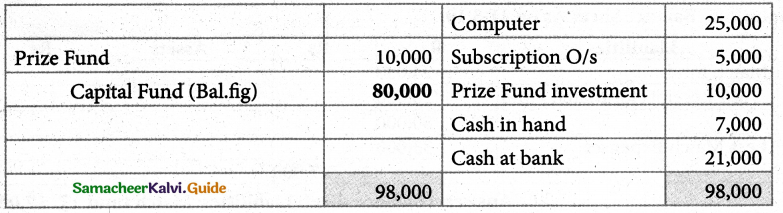
Compute capital fund of Salam Sports Club as on 01.4.2019?
Samacheer Kalvi 12th Accountancy Guide Chapter 2 Accounts of Not-For-Profit Organisation 38
Solution:
Balance Sheet As on 1.4.2019
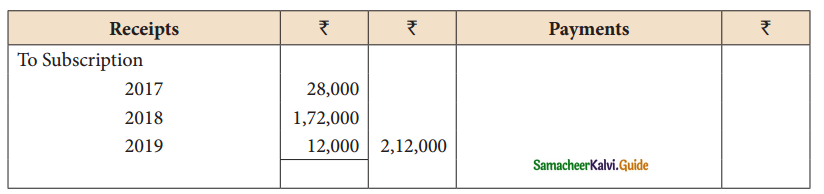
Samacheer Kalvi 12th Accountancy Guide Chapter 2 Accounts of Not-For-Profit Organisation 39 Samacheer Kalvi 12th Accountancy Guide Chapter 2 Accounts of Not-For-Profit Organisation 40
Answer:
Capital fund: ₹ 80,000

Samacheer Kalvi 12th Accountancy Guide Chapter 2 Accounts of Not-For-Profit Organisation

Question 20.
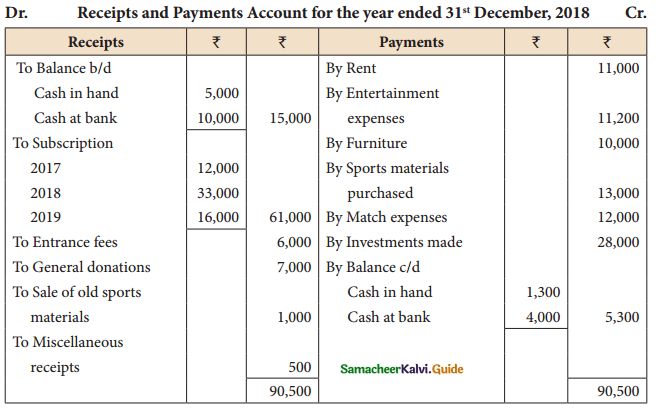
From the follwoing Receipts and Paymentaccount and from the information given below of Ramanathapuram Sports Club, prepare Income and Expenditure account for the year ended 31st December, 2018 and the balance sheet as on that date.
Samacheer Kalvi 12th Accountancy Guide Chapter 2 Accounts of Not-For-Profit Organisation 41

Additional information:
(i) Capital fund as on 1st January 2018 ₹ 30,000
(ii) Opening stock of sports material ₹ 3,000 and closing stock of sports material ₹ 5,000
Solution
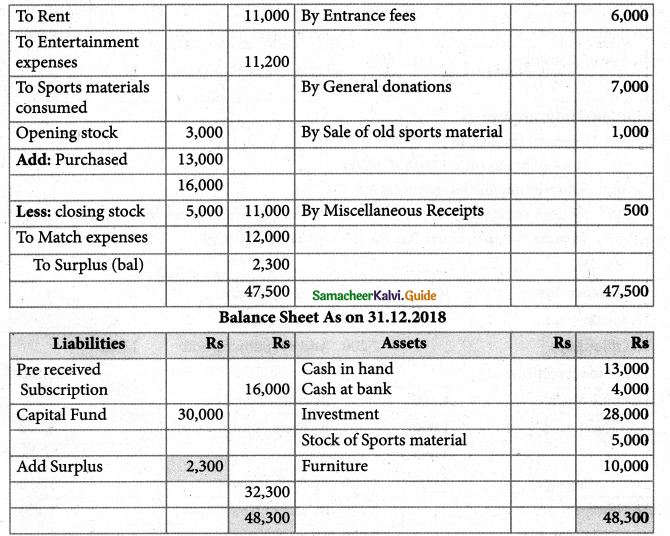
Dr. Income & Expenditure A/c for three year ended 31.12.18
Samacheer Kalvi 12th Accountancy Guide Chapter 2 Accounts of Not-For-Profit Organisation 42 Samacheer Kalvi 12th Accountancy Guide Chapter 2 Accounts of Not-For-Profit Organisation 43
Answer:
Surplus: ₹ 2,300; Balance Sheet total: ₹ 48,300

Samacheer Kalvi 12th Accountancy Guide Chapter 2 Accounts of Not-For-Profit Organisation

Question 21.
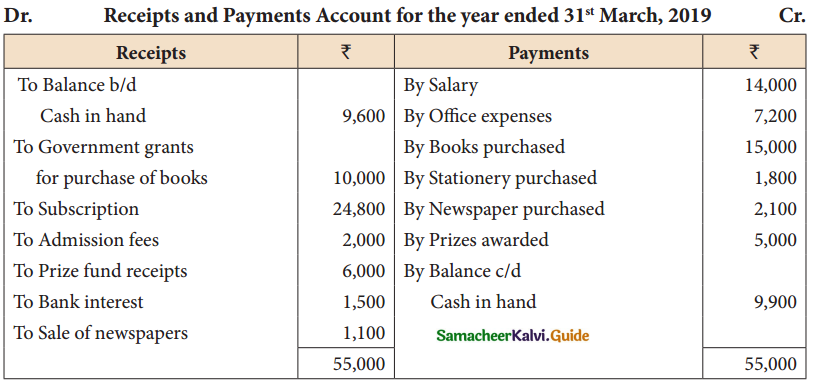
From the following Receipts and Payments account of Yarcaud Youth Association, prepare Income and expenditure account for the year ended 31st March, 2019 and the balance sheet as on the date.
Samacheer Kalvi 12th Accountancy Guide Chapter 2 Accounts of Not-For-Profit Organisation 44
Additional information:
(i) Opening capital fund ₹ 20,000.
(ii) Stock of books on 1.4.2018 ₹ 9,200.
(iii) Subscription due but not received ₹ 1,700.
(iv) Stock of stationery on 1.4.2018 ₹ 1,200 and stock of stationery on 31.3.2019, ₹ 2,000
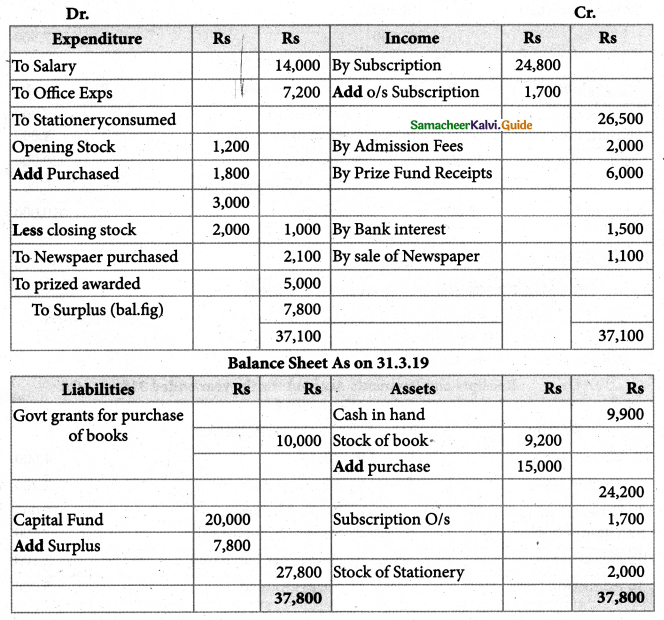
Solution:
Income & Expenditure A/c for the year ended 31.3.19
Samacheer Kalvi 12th Accountancy Guide Chapter 2 Accounts of Not-For-Profit Organisation 45
Answer:
Surplus: ₹ 7,800; Balance Sheet total: ₹ 37,800

Samacheer Kalvi 12th Accountancy Guide Chapter 2 Accounts of Not-For-Profit Organisation

Question 22.
Following is the Receipts and Payments account of Neyveli Science Club for the year ended 31st December, 2018.
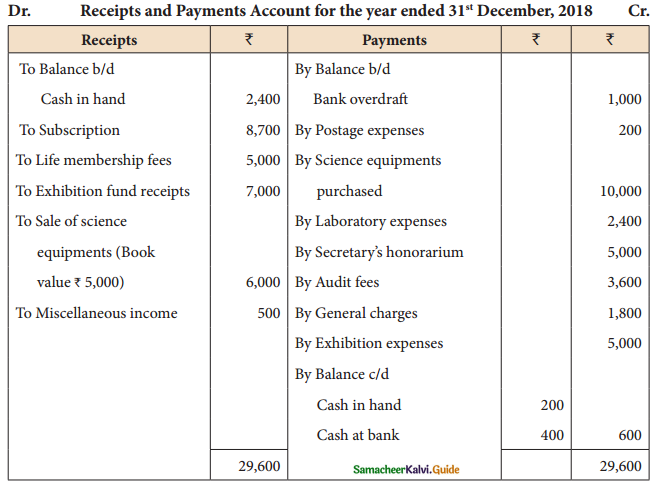
iSamacheer Kalvi 12th Accountancy Guide Chapter 2 Accounts of Not-For-Profit Organisation 46
Additional information:
(i) Opening capital fund ₹ 6,400.
(ii) Subscription includes ₹ 600 for the year 2019.
(iii) Science equipment as on 1.1.2018 ₹ 5,000.
(iv) Surplus on account of exhibition should be kept in reserve for new auditorium. Prepare income and expenditure account for the year ended 31st December, 2018 and the balance sheet as on that date.
Solution:
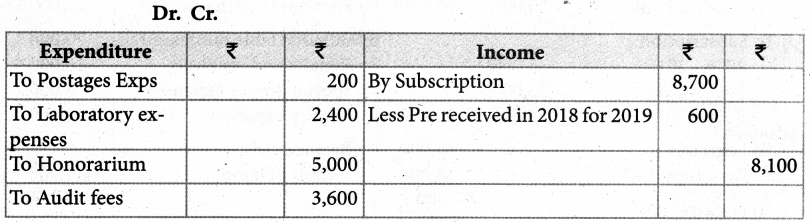
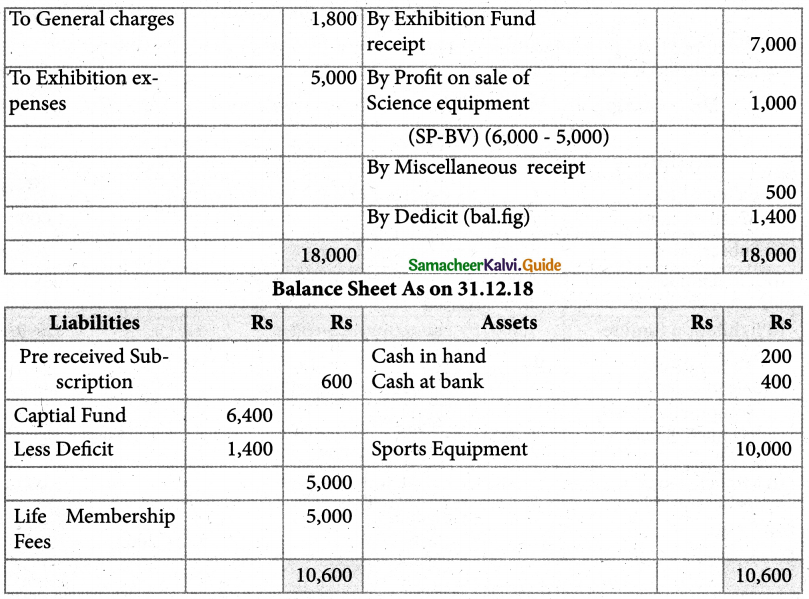
Income & Expenditure A/c for the year ended 31.12.18
Samacheer Kalvi 12th Accountancy Guide Chapter 2 Accounts of Not-For-Profit Organisation 47 Samacheer Kalvi 12th Accountancy Guide Chapter 2 Accounts of Not-For-Profit Organisation 48
Answer:
Deficit: ₹ 1,400; Balance Sheet total: ₹ 10,600

Samacheer Kalvi 12th Accountancy Guide Chapter 2 Accounts of Not-For-Profit Organisation

Question 23.
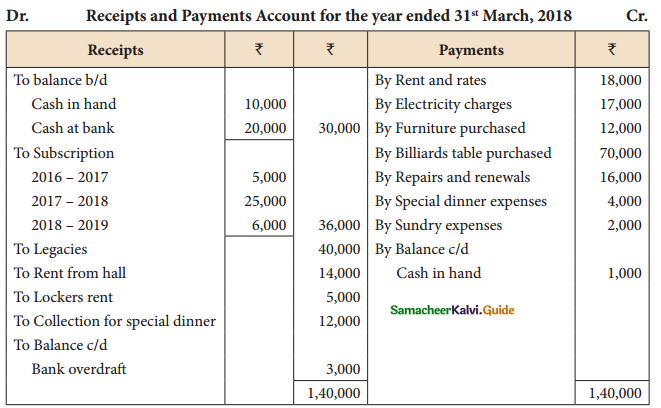
From the following Receipts and Payments account of Sivasasi Pensioner’s Recreation Club, prepare income and expenditure account for the year ended 31st March, 2018 and the balance sheet as on that date.
Samacheer Kalvi 12th Accountancy Guide Chapter 2 Accounts of Not-For-Profit Organisation 49
Additional information:
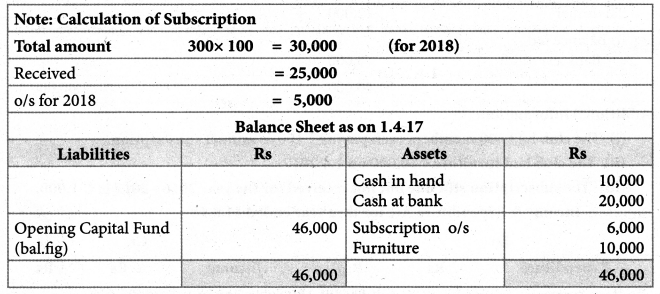
(i) The club had 300 members each paying ₹ 100 as annual subscription.
(ii) The club had furniture ₹ 10,000 on 1.4.2017.
(iii) The subscription still due but not received for the year 2016 – 2017 is ₹ 1,000.
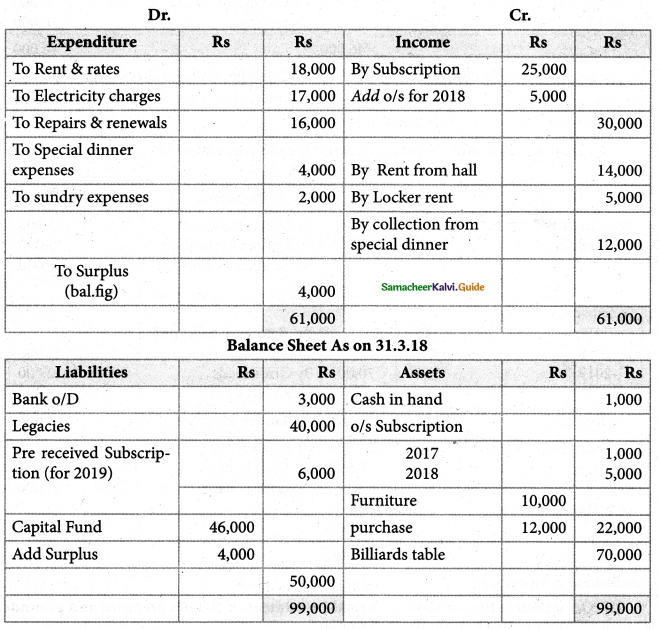
Solution:
Income & Expenditure A/c for thre year ended 31.3.18
Samacheer Kalvi 12th Accountancy Guide Chapter 2 Accounts of Not-For-Profit Organisation 51
Answer:
Surplus: ₹ 4,000; Opening capital fund ₹ 46,000; Balance sheet total: ₹ 99,000

Samacheer Kalvi 12th Accountancy Guide Chapter 2 Accounts of Not-For-Profit Organisation

Question 24.
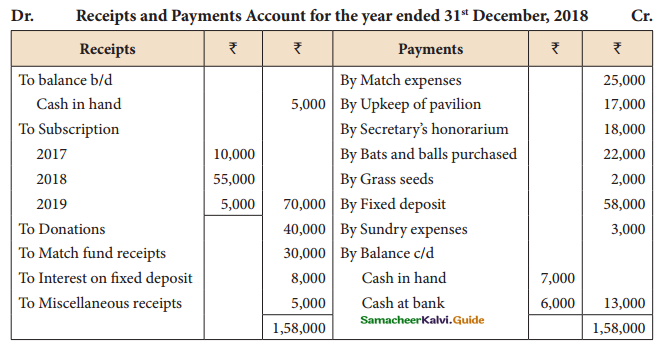
Following is the Receipts and payments account ofVirudhunagar Volleyball Association for the year ended 31st December, 2018.
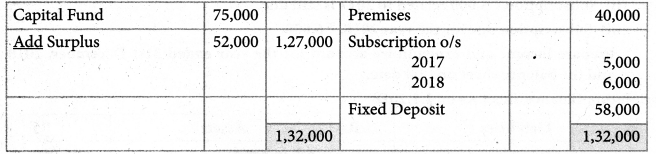
Samacheer Kalvi 12th Accountancy Guide Chapter 2 Accounts of Not-For-Profit Organisation 52
Additional information:
(i) On 1.1.2018, the association owned investments ₹ 10,000, premises and grounds ₹ 40,000, stock of bats and balls ₹ 5,000.
(ii) Subscription 15,000 related to 2017 is still due.
(iii) Subscription due for the year 2018, ₹ 6,000.
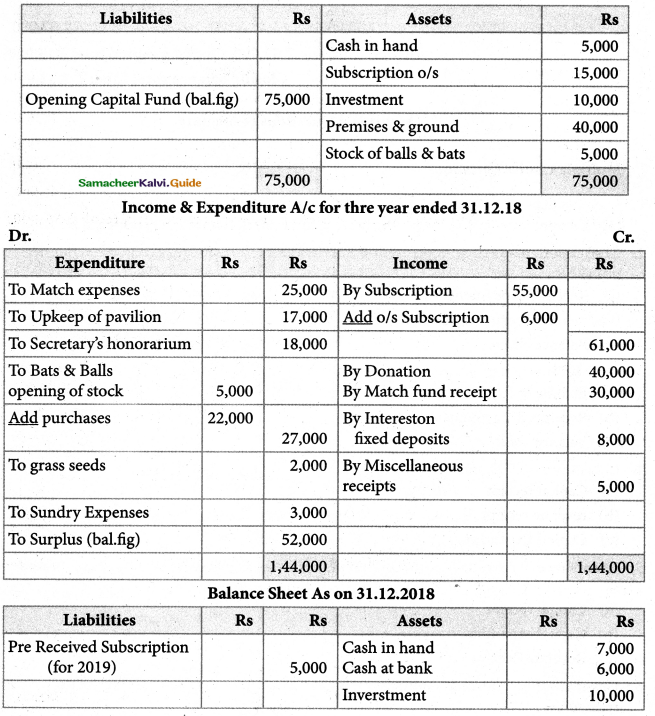
Prepare income and expenditure account for the year ended 31st December, 2018 and the balance sheet on that date.
Solution :
Balance Sheet As on 1.1.2018
Samacheer Kalvi 12th Accountancy Guide Chapter 2 Accounts of Not-For-Profit Organisation 53
Samacheer Kalvi 12th Accountancy Guide Chapter 2 Accounts of Not-For-Profit Organisation 54
Answer:
SurpIus: ₹ 52,000; Opening capital fund ₹ 75,000;
Closing balance sheet total: ₹ 1,32,000

12th Accountancy Guide Accounts of Not-For-Profit Organisation Additional Important Questions and Answers

I Multiple Choice Questions

Question 1.
Receipts & payments A/c records receipts & payments of
(a) Current year only
(b) Previous & future period only
(c) both a & b
Answer:
(c) both a & b

Samacheer Kalvi 12th Accountancy Guide Chapter 2 Accounts of Not-For-Profit Organisation

Question 2.
Non-cash items such as depreciation outstanding expenses and accrued income are not shown in
(a) Receipts & payments A/c
(b) Income & expenditure A/c
(c) Balance sheet
Answer:
(a) Receipts & payments A/c

Question 3.
Only revenue items are recorded in
(a) Income & Expenditure A/c
(b) Receipts & payments A/c
(c) Balance sheet
Answer:
(a) Income & Expenditure A/c

Question 4.
Interest on investment received is a
(a) Capital receipt
(b) revenue receipt
(c) Capital Expenditure
Answer:
(b) revenue receipt

Samacheer Kalvi 12th Accountancy Guide Chapter 2 Accounts of Not-For-Profit Organisation

Question 5.
Grants received towards construction of buildings acqisiton of assets etc are treated as
(a) Capital receipt
(b) Capital expenditure
(c) Revenue Receipt
Answer:
(a) Capital receipt

Question 6.
Grants received towards maintenance of assets, payments of salaries etc aire are treated as
(a) Capital receipt
(b) revenue receipt
(c) Capital Expenditure
Answer:
(b) revenue receipt

Question 7.
Revenue items of current year alone are recorded in
(a) Receipts & Payments A/c
(b) Income & Expenditure A/c
(c) Balance sheet
Answer:
(b) Income & Expenditure A/c

III. Short Answer Questions

Question 1.
What are the ffeatures of not-for-profit organisations.
Answer:
Following are the features of not-for-profit organisations:

  1. Not-for-profit organisations are the organisations which function without any profit motive.
  2. Their main aim is to provide services to a specific group or the public at large.
  3. Generally, they do not undertake business or trading activities.
  4. Their main sources of income include subscription from members, donations, grant-in¬aid and legacies.

Samacheer Kalvi 12th Accountancy Guide Chapter 2 Accounts of Not-For-Profit Organisation

Question 2.
What are the accounts prepared by not-for-profit organisations
Answer:

  1. Receipts and payments account,
  2. Income and expenditure account and
  3. Balance sheet

Question 3.
What are the steps in the preparation of Receipts & Payments A/c?
Answer:
Following are the steps involved in the preparation of receipts and payments account:

  • Record the opening balance of cash in hand and favourable bank balance on the debit side of receipts and payments account. If there is bank overdraft, it must be recorded on the credit side.
  • Actual cash receipts during the year are recorded on the debit side and actual cash payments during the year are recorded on the credit side.
  • While recording cash receipts and payments, no distinction needs to be made between revenue and capital items. Similarly, no distinction needs to be made whether the amount reveived or paid relates to the current period, previous period or future period.
  • If the total of the debit side is more than the credit side, the balancing figure will appear on the credit side. It represents the closing balance of cash or bank.
  • If the total of the credit side is more than the debit side, the balancing figure will appear on the debit side. It represents bank overdraft.

Question 4.
Name a few examples capital for expenditure & revenue expenditure.
Answer:

Capital expenditureRevenue expenditure
Purchase of sports equipment
Purchase of books for library
Honorarium
Charity
Audit fees
Purchase of sports materials
Printing and stationery
Postage and courier charges
Expenses relating to a) Tournament, b) Sports,
c) Matches, d) Enterainments e) Dinner

IV Additional Problems:

Question 1.
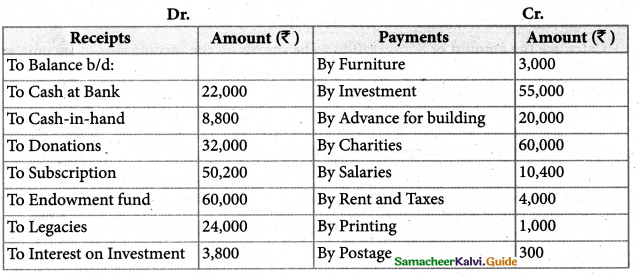
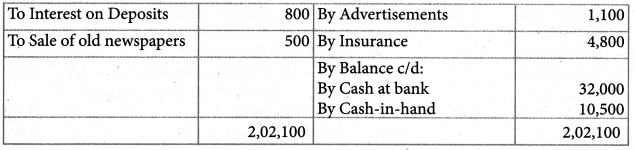
The following particulars of a club are available.
Samacheer Kalvi 12th Accountancy Guide Chapter 2 Accounts of Not-For-Profit Organisation 55
Prepare Receipts and Payments Account as on 31st March, 2002.
Solution:
Receipts and Payments A/c for the year ended 31st March, 2002
Samacheer Kalvi 12th Accountancy Guide Chapter 2 Accounts of Not-For-Profit Organisation 56

Samacheer Kalvi 12th Accountancy Guide Chapter 2 Accounts of Not-For-Profit Organisation

Question 2.
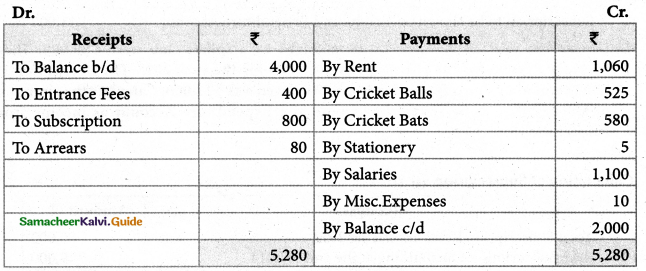
From the following particulars prepare receipts and payments account of a club for the year 2000:
Cash Balance (1st Jan. 2001) Rs. 4,000; Entry fee received Rs. 400; Subscription received Rs. 800; Last year’s arrears Rs. 80; Rent paid Rs. 1,060; Purchase of cricket balls Rs. 525; Purchase of cricket bats Rs. 580; Miscellaneous expenses Rs. 10; Purchase of Stationery Rs. 5; Salary paid Rs. 1,100.
Solution:
Receipts and Payments A/c for the year ended 31st December, 2001
Samacheer Kalvi 12th Accountancy Guide Chapter 2 Accounts of Not-For-Profit Organisation 57

Question 3.
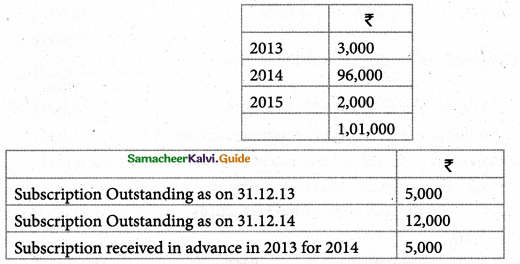
Subscription received by the Health Club during the year 2014 were as under:
Samacheer Kalvi 12th Accountancy Guide Chapter 2 Accounts of Not-For-Profit Organisation 58

Calculate the amount of Subscription to be shown on the income side of Income and Expenditure A/c.
Solution:
Calculation of Subscription for 2014

ReceiptsAmounts
Total Subscription Received during 2014 Add: Subscription Outstanding at 31.12.141,01,000
12,000
Less: Subscription Outstanding 31.12.131,13,000
5,000
Add: Subscription received in advance in 2013 for 20141,08,000
5,000
Less: Subscription received in advance in 2014 for 20151,13,000
2,000

Subscription to be shown in Income and Expenditure Account1,11,000
Samacheer Kalvi 12th Accountancy Guide Chapter 2 Accounts of Not-For-Profit Organisation

Question 4.
During the year 2014, subscription received by a sports club were ₹ 80,000. These included ^ 3,000 for the year 2013 and 16,000 for the year 2015. On Decembrer 31, 2013 amount of subscription due but not reveived was ₹ 12,000. Calculate the ammount of subscription to be shown in Income and Expenditure Account as income from subscription?
Solution
Calculation of Subscription for 2014

ReceiptsAmount
Total Subscription Received during 2014
Add: Subscription Outstanding at the end of 2014
80,000
9,000
Less: Subscription Outstanding at the end of 201389.000
12.000
Add: Subscription received in advance in 2013 for 201477,000
………….
Less: Subscription received in advance in 2014 for 201577,000
6,000
Subscription to be shown in Income and Expenditure Account71,000

Question 5.
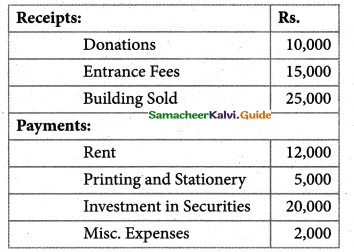
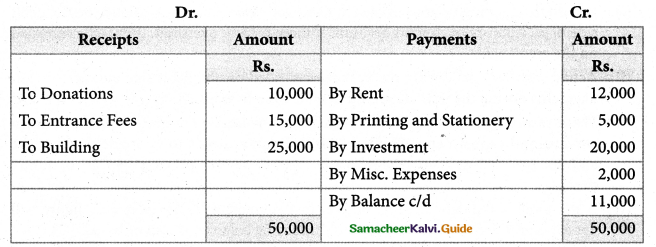
The Receipts and Payments Account of Harimohan Charitable Institution is given:
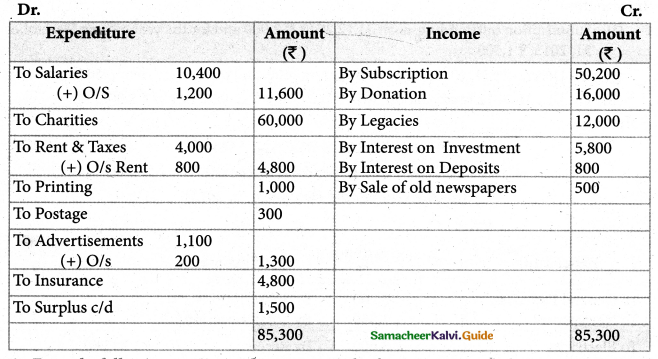
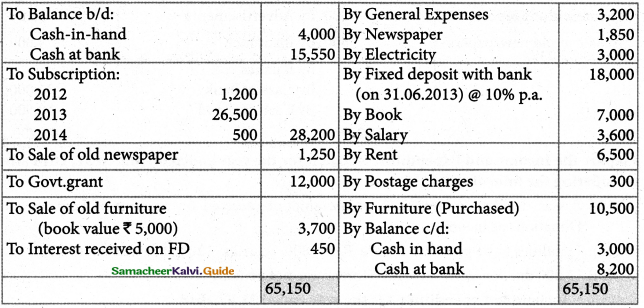
Samacheer Kalvi 12th Accountancy Guide Chapter 2 Accounts of Not-For-Profit Organisation 59 Samacheer Kalvi 12th Accountancy Guide Chapter 2 Accounts of Not-For-Profit Organisation 60
Prepare the Income and Expenditure Account for the year ended on March 31, 2014 after considering the following:
(i) It was decided to treat 50% of the amount received on account of Legacies and Donations as income.
(ii) Liabilities to be provided for are: Rent’ 800; Salaries ‘ 1200; Advertisement’ 200
(iii) ‘2,000 due for interest on investment was not actually received.
Solution:
Income & Expenditure A/c the year ended 31.03.2018
Samacheer Kalvi 12th Accountancy Guide Chapter 2 Accounts of Not-For-Profit Organisation 61

Samacheer Kalvi 12th Accountancy Guide Chapter 2 Accounts of Not-For-Profit Organisation

Question 6.
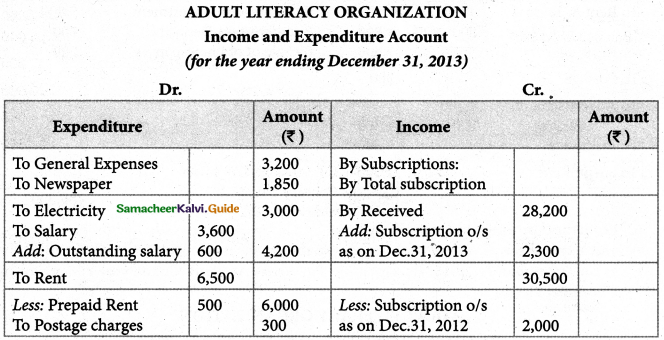
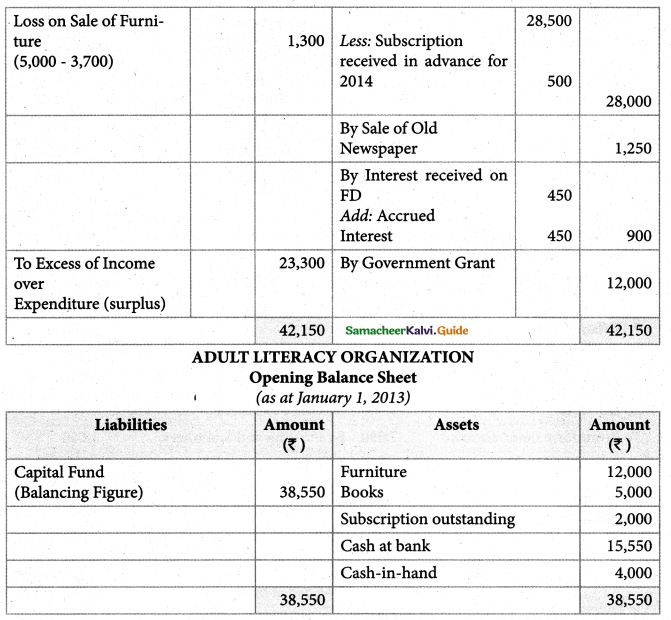
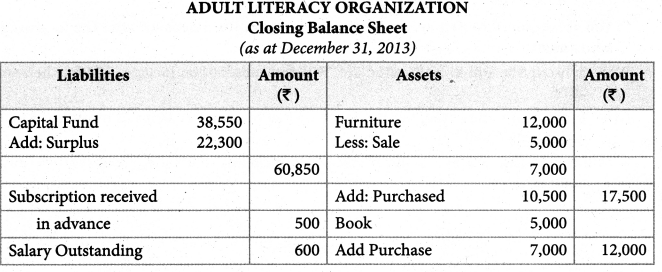
From the following receipts and payments and information given below, prepare Income and Expenditure Account and opening Balance Sheet of Adult Literacy orgnization as on December 31, 2013: Receipts and Payments Account for the year ending as on December31,2013.
Samacheer Kalvi 12th Accountancy Guide Chapter 2 Accounts of Not-For-Profit Organisation 62
Samacheer Kalvi 12th Accountancy Guide Chapter 2 Accounts of Not-For-Profit Organisation 63
Information:
(i) Subscription outstanding as on 31.12.2012, ₹ 2,000 and for the year ending December 31,2013, ₹ 1,500
(ii) On December 31,2013 Salary outstanding’ 600, and one month Rent paid in advance.
(iii) On Jan. 01,2012 organization owned Furniture ₹ 12,000, Books ₹ 5,000.
Solution:
Samacheer Kalvi 12th Accountancy Guide Chapter 2 Accounts of Not-For-Profit Organisation 64
Samacheer Kalvi 12th Accountancy Guide Chapter 2 Accounts of Not-For-Profit Organisation 65
Samacheer Kalvi 12th Accountancy Guide Chapter 2 Accounts of Not-For-Profit Organisation 66
Samacheer Kalvi 12th Accountancy Guide Chapter 2 Accounts of Not-For-Profit Organisation 67

Samacheer Kalvi 12th Accountancy Guide Chapter 2 Accounts of Not-For-Profit Organisation

Question 7.
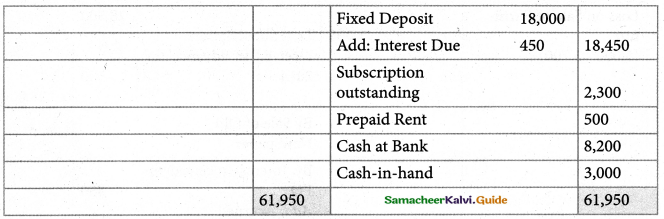
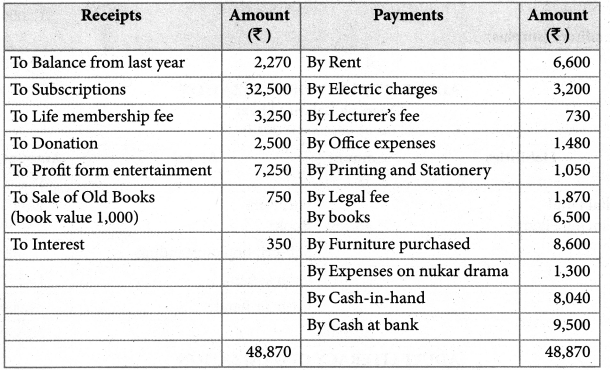
The following is the account of cash transactions of the Nari Kalayan Samittee for the year ended December 31, 2013:
Samacheer Kalvi 12th Accountancy Guide Chapter 2 Accounts of Not-For-Profit Organisation 68
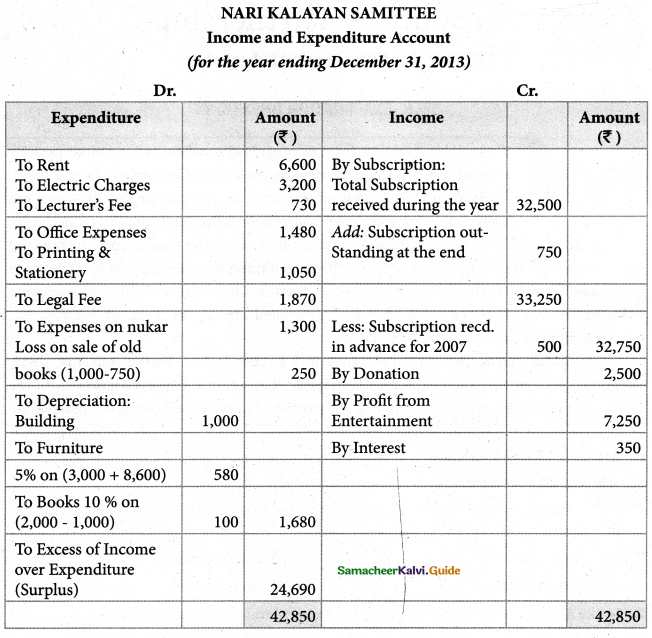
You are required to prepare an Income and Expenditure Account after the following adjustments:
(i) Subscription still to be received are ‘ 750, but subscription include ‘ 500 for the year 2014.
(ii) In the beginning of the year the Sangh owned building ‘ 20,000 and furniture ‘ 3,000 and Books ‘2,000.
(iii) Provide depreciation of furniture @5% (including purchase), books @10% and building @5%.
Samacheer Kalvi 12th Accountancy Guide Chapter 2 Accounts of Not-For-Profit Organisation 69

Samacheer Kalvi 12th Maths Guide Chapter 9 Applications of Integration Ex 9.2

Tamilnadu State Board New Syllabus Samacheer Kalvi 12th Maths Guide Pdf Chapter 9 Applications of Integration Ex 9.2 Textbook Questions and Answers, Notes.

Tamilnadu Samacheer Kalvi 12th Maths Solutions Chapter 9 Applications of Integration Ex 9.2

Question 1.
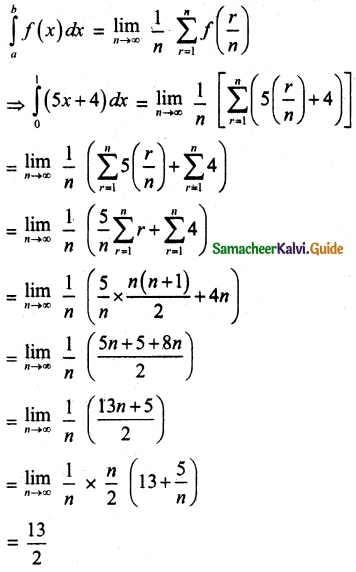
Evaluate the following integrals as the limits of sums:
(i) \(\int_{0}^{1}\) (5x + 4)dx
Solution:
(i) Here f(x) = 5x + 4, a = 0, b = 1
Hence we get
Samacheer Kalvi 12th Maths Guide Chapter 9 Applications of Integration Ex 9.2 1

Samacheer Kalvi 12th Maths Guide Chapter 9 Applications of Integration Ex 9.2

(ii) \(\int_{1}^{2}\) (4x² – 1)dx
Solution:
Here f(x) = 4x² – 1, a = 1, b = 2
We use the formula
Samacheer Kalvi 12th Maths Guide Chapter 9 Applications of Integration Ex 9.2 2

Samacheer Kalvi 12th Maths Guide Chapter 9 Applications of Integration Ex 9.2

Samacheer Kalvi 12th Maths Guide Chapter 9 Applications of Integration Ex 9.1

Tamilnadu State Board New Syllabus Samacheer Kalvi 12th Maths Guide Pdf Chapter 9 Applications of Integration Ex 9.1 Textbook Questions and Answers, Notes.

Tamilnadu Samacheer Kalvi 12th Maths Solutions Chapter 9 Applications of Integration Ex 9.1

Question 1.
Find an approximate value of \(\int_{1}^{1.5}\) x dx by applying the left – end rule with the partition {1.1, 1.2, 1.3, 1.4, 1.5}
Solution:
Here a = 1, b = 1.5, n = 5, f(x) = x
So, the width of each subinterval is
Samacheer Kalvi 12th Maths Solutions Chapter 9 Applications of Integration Ex 9.1 1
The left hand rule for Riemann sum,
S = [f(x0) + f(x1)) + f(x2) + f(x3) + f(x4)] ∆x
= [f(1) + f(1.1) + f(1.2) + f(1.3) + f(1.4)] (0.1)
= [1 + 1.1 + 1.2 + 1.3 + 1.4] (0.1)
= [6] (0.1)
= 0.6.

Samacheer Kalvi 12th Maths Guide Chapter 9 Applications of Integration Ex 9.1

Question 2.
Find an approximate value of \(\int_{1}^{1.5}\) x² dx by applying the right – end rule with the partition {1.1, 1.2, 1.3, 1.4, 1.5}
Solution:
Here a = 1, b = 1.5, n = 5, f(x) = x²
So, the width of each subinterval is
h = Δx = \(\frac{b-a}{n}\) = \(\frac{1.5- 1}{5}\) = 0.1
The partition of the interval is given by
x1 = 1.1
x2 = 1.2
x3 = 1.3
x4 = 1.4
x5 = 1.5
The right – end rule for Riemann sum with equal width Δx is
S = [f(x1) + f(x2) + ….. + f(xn)] Δx
∴ S = [f(1.1) + f(1.2) + f(1.3) + f(1.4) + f(1.5)](0.1)
= (1.21 + 1.44 + 1.69 + 1.96 + 2.25) × 0.1
= 8.55 × 0.1
= 0.855

Samacheer Kalvi 12th Maths Guide Chapter 9 Applications of Integration Ex 9.1

Question 3.
Find an approximate value of \(\int_{1}^{1.5}\) (2 – x) dx by applying the mid – point rule with the partition {1.1, 1.2, 1.3, 1.4, 1.5}
Solution:
Here a = 1, b = 1.5, n = 5, f(x) = 2 – x
So, the width of each subinterval is
h = Δx = \(\frac{b-a}{n}\) = \(\frac{1.5- 1}{5}\) = 0.1
The partition of the interval is given by
The partition of the interval is given b.y
x0 = 1, x1 = 1.1, x2=1.2, x3 = 1.3, x4 = 1.4, x5 = 1.5
The mid – point rule for Riemann sum with equal width Δx is
Samacheer Kalvi 12th Maths Guide Chapter 9 Applications of Integration Ex 9.1 1
∴ S = (0.95 + 0.85 + 0.75 + 0.65 + 0.55) × 0.1
= 3.75 × 0.1
= 0.375

Samacheer Kalvi 12th Maths Guide Chapter 9 Applications of Integration Ex 9.1

Samacheer Kalvi 12th Accountancy Guide Chapter 10 Computerised Accounting System-Tally

Tamilnadu State Board New Syllabus Samacheer Kalvi 12th Accountancy Guide Pdf Chapter 10 Computerised Accounting System-Tally Text Book Back Questions and Answers, Notes.

Tamilnadu Samacheer Kalvi 12th Accountancy Solutions Chapter 10 Computerised Accounting System-Tally

12th Accountancy Guide Computerised Accounting System-Tally Text Book Back Questions and Answers

I Multiple Choice Questions

Choose the correct answer
Question 1.
Accounting report prepared according to the requirements of the user is
(a) Routine accounting report
(b) Special purpose report
(c) Trial balance
(d) Balance sheet
Answer:
(b) Special purpose report

Question 2.
Function key F 11 is used for
(a) Company Features
(b) Accounting vouchers
(c) Company Configuration
(d) None of these
Answer:
(a) Company Features

Question 3.
Which sub menu displays groups, ledgers and voucher type in tally?
(a) Inventory vouchers
(b) Accounting vouchers
(c) Company Info
(d) Account Info
Answer:
(d) Account Info
 Samacheer Kalvi 12th Accountancy Guide Chapter 10 Computerised Accounting System-Tally

Question 4.
What are the predefined Ledger(s) in Tally?
(i) Cash
(ii) Profit & Loss A/c
(iii) Capital A/c
(a) Only (i)
(b) Only (ii)
(c) Both (i) and (ii)
(d) Both (ii) and (iii)
Answer:
(c) Both (i) and (ii)

Question 5.
Contra voucher is used for
(a) Master entry
(b) Withdrawal of cash from bank for office use
(c) Reports
(d) Credit purchase of assets
Answer:
(b) Withdrawal of cash from bank for office use

Question 6.
Which is not the default group in Tally
(a) Suspense account
(b) Outstanding expense
(c) Sales account
(d) Investments
Answer:
(b) Outstanding expense

 Samacheer Kalvi 12th Accountancy Guide Chapter 10 Computerised Accounting System-Tally

Question 7.
Salary account comes under which of the following head?
(a) Direct Incomes
(b) Direct Expenses
(c) Indirect Incomes
(d) Indirect Expenses
Answer:
(d) Indirect Expenses

Question 8.
₹ 25,000 withdrawn from bank for office use. In which voucher type, this transaction will be recorded
(a) Suspense account
(b) Outstanding expense
(c) Sales account
(d) Investment
Answer:
(a) Suspense account

Question 9.
In which vouchers type credit purchase of furniture is recorded in Tally
(a) Receipt voucher
(b) Journal voucher
(c) Purchase voucher
(d) Payment voucher
Answer:
(b) Journal voucher

 Samacheer Kalvi 12th Accountancy Guide Chapter 10 Computerised Accounting System-Tally

Question 10.
Which of the following options is used to view Trial Balance from Gateway of Tally?
(a) Gateway of Tally → Reports → Trial Balance
(b) Gateway of Tally → Trial Balance
(c) Gateway of Tally → Reports → Display → Trial Balance
(d) None of these
Answer:
(c) Gateway of Tally → Reports → Display → Trial Balance

II Very Short Answer Questions

Question 1.
What is automated accounting system?
Answer:
Automated accounting is an approach to maintain up-to-date accounting records with the aid of accounting software.

 Samacheer Kalvi 12th Accountancy Guide Chapter 10 Computerised Accounting System-Tally

Question 2.
What are accounting reports?
Answer:
Accounting report is a compilation of accounting information that are derived from the accounting records of a business concern. Accounting reports may be classified as routine reports and special purpose reports.

Question 3.
State any five accounting reports.
Answer:

  1. Daybooks/Joumal
  2. Ledger
  3. Trial Balance
  4. Income statement
  5. Balance sheet

Question 4.
What is Accounting Information System (AIS)?
Answer:
Accounting Information System (AIS) collects financial data, processes them, and provides information to the various users. To provide information AIS requires data from another information system that is manufacturing, marketing, and human resources. Similarly, other information systems require data from Ais in order to provide information.

 Samacheer Kalvi 12th Accountancy Guide Chapter 10 Computerised Accounting System-Tally

Question 5.
What is a group in Tally.ERP 9?
Answer:
A group is a collection of ledgers of the same nature. There are predefined groups of accounts which are widely used in accounts of any organization. Groups are categorized as primary groups and subgroups.

III Short Answer Questions

Question 1.
Write a brief note on accounting vouchers.
Answer:
A voucher is a document which contains details of transactions. Transactions are to be recorded through voucher entries. Tally has a set of predefined vouchers such as Purchase, Sales, Payment, Receipt and Contra.

To view the list of voucher types:
Gateway of Tally → Masters Accounts Info → Voucher Type →Display
As per the requirements of users, additional voucher type can be created.

Following are some of the major accounting vouchers used in an organisation:

  • Receipt Voucher
  • Payment Voucher
  • Contra Voucher
  • Purchase Voucher
  • Sales Voucher
  • Journal Voucher

 Samacheer Kalvi 12th Accountancy Guide Chapter 10 Computerised Accounting System-Tally

Question 2.
What are the pre-defined ledgers available in Tally.ERP 9?
Answer:
Tally has two predefined ledgers, cash and profit and loss A/c. The user has to create various other ledgers based on their requirements. Predefined group/ledger cannot be deleted.

Question 3.
Mention the commonly used voucher types in Tally.ERP 9?
Answer:
Following are some of the major accounting vouchers used in an organization:

  1. Receipt Voucher
  2. Payment Voucher
  3. Contra Voucher
  4. Purchase Voucher
  5. Sales Voucher
  6. Journal Voucher

 Samacheer Kalvi 12th Accountancy Guide Chapter 10 Computerised Accounting System-Tally

Question 4.
Explain how to view profit and loss statement in Tally ERP 9?
Answer:
F10: A/c Reports > Profit & Loss A/c > AltF1 (detailed)
(or)
Gateway of Tally > Reports > Profit & Loss A/c > AltF1 (detailed)
Samacheer Kalvi 12th Accounts Guide Chapter 10 Computerised Accounting System-Tally 1

Question 5.
Explain any five applications of computerized accounting system.
Answer:
Application of accounting software – Tally

(1) Starting Tally:
Tally can be started in either of the ways given below:
Click on Start > All programs . Tally.ERP 9 > Tally.ERP 9 icon
(Or)
Click Tally.ERP. 9 icon (shortcut) on the desktop

(2) Creation of a company:
It is essential to enter the particulars of the company for which accounts are to be maintained in Tally. In order to create a company, the following steps are to be followed:
Company Info>Create Company

(3) Gateway of Tally:
After creation of a company and whenever Tally is started a screen Gateway of Tally appears. It shows the company selected under List of Selected Companies on the left pane.

Gateway of Tally is shown on the right pane which contains menu options such as Transactions and Reports. The shortcut key for each menu option is a letter from the option’s name, which will be highlighted in red.

Vertical button bar is placed on the extreme right of screen which contains buttons such as F1 and F2 for quick interaction with Tally.ERP 9.

Bottom horizontal information panel displays details of product, version, licence, configuration and calculator.

(4) Closing Tally
The following are the two ways for closing Tally:
Press Esc Key > Press Enter or Y or Click on yes
(or)
Press Ctrl + Q

(5) Select a company
If multiple companies are created, to choose a particular company, after opening Tally, click F1 (Select Cmp) on the vertical button bar. Tally.ERP 9 displays the Select Company screen, with a list of companies that are already created. Select the company for which accounting has to be done.

 Samacheer Kalvi 12th Accountancy Guide Chapter 10 Computerised Accounting System-Tally

IV Exercises

Question 1.
Record the following transactions in Tally.
(a) Devi commenced a business with a capital of ₹ 4,00,000
(b) An account was opened with Indian Bank and deposited ₹ 60,000
(c) Purchased furniture by paying cash ₹ 15,000
(d) Goods purchased on credit from Sumathy for ₹ 50,000
(e) Cash sales made for ₹ 10,000
(f) Goods purchased from Raja for ₹ 5,000 and paid by cheque
(g) Goods sold to Arun on credit for ₹ 70,000
(h) Money is withdrawn from bank for office use ₹ 25,000
(i) Part payment of ₹ 30,000 made to Sumathy by cheque
(j) Arun made part payment of ₹ 10,000 by cash
(k) Salaries paid to staff through ECS ₹ 36,000
(l) Carriage on purchases of ₹ 6,000 paid by cash
(m) Purchased computer from Muthu Ltd. on credit ₹ 44000
Solution
Samacheer Kalvi 12th Accounts Guide Chapter 10 Computerised Accounting System-Tally 2
Samacheer Kalvi 12th Accounts Guide Chapter 10 Computerised Accounting System-Tally 3
Samacheer Kalvi 12th Accounts Guide Chapter 10 Computerised Accounting System-Tally 4

 Samacheer Kalvi 12th Accountancy Guide Chapter 10 Computerised Accounting System-Tally

Question 2.
The following balance sheet has been prepared from the books of pearl on 1 – 4- 2018,
Samacheer Kalvi 12th Accounts Guide Chapter 10 Computerised Accounting System-Tally 5
During the year the following transactions took place.

(a) Wages paid by cash ₹ 4,000
(b) Salaries paid by cheque ₹ 10,000
(c) Cash purchases made for ₹ 4,000
(d) Good purchased on credit from Yazhini ₹ 30,000
(e) Goods sold on credit to Jothi ₹ 40,000
(f) Payment made to Yazhini through NEFT ₹ 6,000
(g) Cash received from Peter ₹ 10,000
(h) Cash sales made for ₹ 4,000
(i) Depreciate buildings at 20%
(j) Closing stock on 31.03.2013 ₹ 9,000

You are required to prepare trading and profit and loss account for the year ended 31-03-2019 and balance sheet as on that using Tally.
Solution
Samacheer Kalvi 12th Accounts Guide Chapter 10 Computerised Accounting System-Tally 6

Samacheer Kalvi 12th Accounts Guide Chapter 10 Computerised Accounting System-Tally 8

12th Accountancy Guide Computerised Accounting System-Tally Additional Important Questions and Answers

III Short Answer Questions

Question 1.
What do you mean by a Computerised Accounting system?
Answer:
Computerized accounting system refers to the system of maintaining accounts using f computers. It involves the processing of accounting transactions through the use of a computer in order to maintain and produce accounting records and reports. Computerized accounting system takes accounting transactions as input that are processed through accounting software to generate various reports.

Question 2.
What are the applications of the Computerised Accounting system?
Answer:
The application of CAS are as follows:
(1) Maintaining accounting records: In CAS, accounting records can be maintained easily and efficiently for the low time period. It does not require a large amount of physical space. It facilitates fast and accurate retrieval of data and information.

(2) Inventory management: CAS facilitates efficient management of inventory. Fast-moving, slow-moving, and obsolete inventory can be identified. Updated information about the availability of inventory, level of inventory, etc., can be obtained instantly.

(3) Payroll preparation: Payroll involves the calculation of the amount due to an employee, pay of an employee may be calculated based on hours/days worked or units produced. CAS records the attendance of employees, computes the amount of salary, makes deductions such as provident fund, income ta, etc.

(4) Report generation: CAS helps to generate various routine and special purpose reports.

(5) Data import/export: Accounting data and information can be imported from or exported to other users within the organization as well as outside the organization.

(6) Taxation: CAS helps to compute various taxes and to deduct these and deposit the same to the Government account.

 Samacheer Kalvi 12th Accountancy Guide Chapter 10 Computerised Accounting System-Tally

Question 3.
What are the steps involved in designing accounting reports?
Answer:
Following are the steps involved in designing accounting reports:

  1. Define the objective of generating the report.
  2. Specify the structure of the report
  3. Creating database queries to interact with the database to retrieve, modify, add, or delete data from the records.
  4. Write notes on the following
    • Contra Voucher
    • Purchase Voucher
    • Journal Voucher

(a) Contra Voucher:
A transaction involving both cash account and bank account is recorded using contra voucher. The transaction may be for deposit of cash into bank account or withdrawal of cash from bank account To record Contra:
Gateway of Tally > Transactions > Accounting Voucher > F4:Contra

(b) Purchase Voucher:
Purchase voucher are used for recording both cash and credit purchases of goods. To record Purchases:
Gateway of Tally > Transactions > Accounting Vouchers > F9:Purchase

(c) Journal Voucher:
Journal voucher are used for recording transactions involving other than cash, bank, purchases and sales such as depreciation, provision for bad bebts.
To record Journal:
Gateway of Tally > Transactions > Accounting vouchers > F7:Journal

Samacheer Kalvi 12th Maths Guide Chapter 8 Differentials and Partial Derivatives Ex 8.8

Tamilnadu State Board New Syllabus Samacheer Kalvi 12th Maths Guide Pdf Chapter 8 Differentials and Partial Derivatives Ex 8.8 Textbook Questions and Answers, Notes.

Tamilnadu Samacheer Kalvi 12th Maths Solutions Chapter 8 Differentials and Partial Derivatives Ex 8.8

Choose the most suitable answer from the given four alternatives:

Question 1.
A circular template has a radius of 10 cm. The measurement of the radius has an approximate error of 0.02 an. Then the percentage error in the calculating the area of this template is
(a) 0.2 %
(b) 0.4 %
(c) 0.04 %
(d) 0.08 %
Solution:
(b) 0.4 %
Hint:
Radius of a circular plate = 10 cm
error in radius dr = 0.02
A = πr²
dA = 2πrdr
Samacheer Kalvi 12th Maths Guide Chapter 8 Differentials and Partial Derivatives Ex 8.8 1

Samacheer Kalvi 12th Maths Guide Chapter 8 Differentials and Partial Derivatives Ex 8.8

Question 2.
The percentage error of the fifth root of 31 is approximately how many times the percentage error in 31?
(a) \(\frac{1}{31}\)
(b) \(\frac{1}{5}\)
(c) 5
(d) 31
Solution:
(b) \(\frac{1}{5}\)
Hint:
(i.e.) the percentage error in the nth root of a number is approximately \(\frac{1}{n}\) times the percentage error in the number.

Question 3.
If u (x, y) = ex2 + y2 then \(\frac{\partial u}{\partial x}\) is equal to
(a) ex2 + y2
(b) 2xu
(c) x²u
(d) y²u
Solution:
(b) 2xu
Hint:
u = ex2 + y2
\(\frac{\partial u}{\partial x}\) = ex2 + y2 (2x) = 2xu

Samacheer Kalvi 12th Maths Guide Chapter 8 Differentials and Partial Derivatives Ex 8.8

Question 4.
If v (x, y) = log (ex + ey), then \(\frac{\partial v}{\partial x}\) + \(\frac{\partial u}{\partial y}\) is equal to
(a) (ex + ey)
(b) \(\frac{1}{e^x+e^y}\)
(c) 2
(d) 1
Solution:
(d) 1
Hint:
v = log (ex + ey)
Samacheer Kalvi 12th Maths Guide Chapter 8 Differentials and Partial Derivatives Ex 8.8 2
= 1

Question 5.
If w (x, y) = xy, x > 0, then \(\frac{\partial w}{\partial x}\) is equal to
(a) xy log x
(b) y log x
(c) y xy-1
(d) x log y
Solution:
(c) y xy-1
Hint:
w(x, y) = xy
\(\frac{\partial w}{\partial x}\) = y xy-1

Samacheer Kalvi 12th Maths Guide Chapter 8 Differentials and Partial Derivatives Ex 8.8

Question 6.
If f (x, y) = exy, then \(\frac{\partial^2 f}{\partial x \partial y}\) is equal to
(a) xy exy
(b) (1 + xy)exy
(c) (1 + y) exy
(d) (1 + x)exy
Solution:
(b) (1 + xy)exy
Hint:
f(x, y) = exy
\(\frac{\partial f}{\partial y}\) = x exy (x) = xexy
\(\frac{\partial^2 f}{\partial x \partial y}\) = x exy (y) + exy = exy(1 + xy)

Question 7.
If we measure the side of a cube to be 4 cm with an error of 0.1 cm, then the error in our calculation of the volume is
(a) 0.4 cu.cm
(b) 0.45 cu.cm
(c) 2 cu.cm
(d) 4.8 cu.cm
Solution:
(d) 4.8 cu.cm
Hint:
Side of the cube = 4 cm
Volume V = x³
dV = 3x²dx
= 3 × 16 × 0.1
= 4.8 cu. cm

Samacheer Kalvi 12th Maths Guide Chapter 8 Differentials and Partial Derivatives Ex 8.8

Question 8.
The change in the surface area S = 6x² of a cube when the edge length varies from x0 to x0 + dx is
(a) 12 x0 + dx
(b) 12 x0 dx
(c) 6 x0 dx
(d) 6 x0 + dx
Solution:
(b) 12 x0 dx
Hint:
Surface Area S = 6x²
dS = 12 × dx
dS = 12 x0 dx

Question 9.
The approximate change in volume V of a cube of side x meters caused by increasing the side by 1% is
(a) 0.3 x m³
(b) 0.03 x m³
(c) 0.03 x² m³
(d) 0.03 x³ m³
Solution:
(c) 0.03 x² m³
Hint:
Volume of the cube V = x³
dV = 3x² dx
= 3x² × 0.01
= 0.03 x² m³

Samacheer Kalvi 12th Maths Guide Chapter 8 Differentials and Partial Derivatives Ex 8.8

Question 10.
If g (x, y) = 3x² – 5y + 2y², x(t) = et and y(t) = cos t then \(\frac{dg}{dt}\) is equal to
(a) 6 e2t + 5 sin t – 4 cos t sin t
(b) 6 e2t – 5 sin t – 4 cos t sin t
(c) 3 e2tt + 5 sin t + 4 cos t sin t
(d) 3 e2t – 5 sint + 4 cos t sin t
Solution:
(a) 6 e2t + 5 sin t – 4 cos t sin t
Hint:
x = et, y = cos t
Samacheer Kalvi 12th Maths Guide Chapter 8 Differentials and Partial Derivatives Ex 8.8 3
= 6 x et + (-5 + 4y) – sin t
= 6 et et + 5 sin t – 4 cos t sin t
= 6e2t + 5 sin t – 4 cos t sin t

Question 11.
If f(x) = \(\frac{x}{x+1}\), then its differential is given by
(a) –\(\frac{x}{(x+1)^2}\) dx
(b) \(\frac{x}{(x+1)^2}\) dx
(c) \(\frac{x}{x+1}\) dx
(d) –\(\frac{x}{x+1}\) dx
Solution:
(b) \(\frac{x}{(x+1)^2}\) dx
Hint:
Samacheer Kalvi 12th Maths Guide Chapter 8 Differentials and Partial Derivatives Ex 8.8 4

Samacheer Kalvi 12th Maths Guide Chapter 8 Differentials and Partial Derivatives Ex 8.8

Question 12.
If u (x, y) = x² + 3xy + y – 2019, then \(\frac{\partial u}{\partial x}\)| (4, -5) is equal to
(a) -4
(b) -3
(c) -7
(d) 13
Solution:
(c) -7
Hint:
u (x, y) = x² + 3xy + y – 2019
\(\frac{\partial u}{\partial x}\) = 2x + 3y
\(\frac{\partial u}{\partial x}\)| (4, -5) = 8 – 15 = -7

Question 13.
Linear approximation for g(x) = cos x at x = \(\frac{π}{2}\) is
(a) x + \(\frac{π}{2}\)
(b) -x + \(\frac{π}{2}\)
(c) x – \(\frac{π}{2}\)
(d) -x – \(\frac{π}{2}\)
Solution:
(b) -x + \(\frac{π}{2}\)
Hint:
linear approximation
Samacheer Kalvi 12th Maths Guide Chapter 8 Differentials and Partial Derivatives Ex 8.8 5

Samacheer Kalvi 12th Maths Guide Chapter 8 Differentials and Partial Derivatives Ex 8.8

Question 14.
If w (x, y, z) = x² (y – z) + y² ( z – x)+ z²(x – y) then \(\frac{\partial w}{\partial x}\) + \(\frac{\partial w}{\partial y}\) + \(\frac{\partial w}{\partial z}\) is
(a) xy + yz + zx
(b) x (y + z)
(c) y (z + x)
(d) 0
Solution:
(d) 0
Hint:
w (x, y, z) = x² (y – z) + y² ( z – x)+ z²(x – y)
Samacheer Kalvi 12th Maths Guide Chapter 8 Differentials and Partial Derivatives Ex 8.8 6
= 2xy – 2xz – y² + z² + x² + 2yz – 2yx – z² – x² + y² + 2zx – 2zy
= 0

Question 15.
If f (x, y, z) = xy + yz + zx, then fx – fz is equal to
(a) z – x
(b) y – z
(c) x – z
(d) y – x
Solution:
(a) z – x
Hint:
f (x, y, z) = xy + yz + zx
\(\frac{\partial f}{\partial x}\) = y + z
\(\frac{\partial f}{\partial z}\) = y + x
fx – fz = y + z – y – x = z – x

Samacheer Kalvi 12th Maths Guide Chapter 8 Differentials and Partial Derivatives Ex 8.8

Samacheer Kalvi 12th Accountancy Guide Chapter 1 Accounts from Incomplete Records

Tamilnadu State Board New Syllabus Samacheer Kalvi 12th Accountancy Guide Pdf Chapter 1 Accounts from Incomplete Records Text Book Back Questions and Answers, Notes.

Tamilnadu Samacheer Kalvi 12th Accountancy Solutions Chapter 1 Accounts from Incomplete Records

12th Accountancy Guide Accounts from Incomplete Records Text Book Back Questions and Answers

I Multiple Choice Questions

Choose the correct answer

Question 1.
Incomplete records are generally maintained by
(a) A company
(b) Government
(c) Small sized sole trader business
(d) Multinational enterprises
Answer:
(c) Small sized sole trader business

Samacheer Kalvi 12th Accountancy Guide Chapter 1 Accounts from Incomplete Records

Question 2.
Statement of affairs is a
(a) Statement of income and expenditure
(b) Statement of assets and liabilities
(c) Summary of cash transactions
(d) Summary of credit transactions
Answer:
(b) Statement of assets and liabilities

Question 3.
Opening statement of affairs is usually prepared to find out the
(a) Capital in the beginning of the year
(b) Capital at the end of the year
(c) Bills payable accepted during the year
(d) Loss occurred during the year
Answer:
(a) Capital in the beginning of the year

Question 4.
The excess of assets over liabilities is
(a) Loss
(b) Cash
(c) Capital
(d) Profit
Answer:
(c) Capital

Samacheer Kalvi 12th Accountancy Guide Chapter 1 Accounts from Incomplete Records

Question 5.
Which of the following items relating to bills payable is transferred to the total creditors account?
(a) Loss
(b) Cash
(c) Capital
(d) Profit
Answer:
(c) Capital

Question 6.
The amount of credit sales can be computed from
(a) Total debtors account
(b) Total creditors account
(c) Bills receivable account
(d) Bills payable account
Answer:
(a) Total debtors account

Question 7.
Which one of the following statements is not true in relation to incomplete records?
(a) It is an unscientific method of recording transactions
(b) Records are maintained only for cash and personal accounts
(c) It is suitable for all types of organisations
(d) Tax authorities do not accept
Answer:
(c) It is suitable for all types of organisations

Question 8.
What is the amount of capital of the proprietor, if his assets Rs. 85,000 and Liabilities Rs 21,000.
(a) ₹ 85,000
(b) ₹ 1,06,000
(c) ₹ 21,000
(d) ₹ 64,000
Answer:
(d) ₹ 64,000
Hint:
Assets = Capital – Liabilities
85,000 = Capital – 21,000
Capital = 85,000 – 21,000
Capital = 64,000

Samacheer Kalvi 12th Accountancy Guide Chapter 1 Accounts from Incomplete Records

Question 9.
When capital, in the beginning, is ₹ 10,000, drawings during the year is ₹ 6,000 profit made during the year is ₹ 2,000 and the additional capital introduced is ₹ 3,000, find out the amount of capital at the end.
(a) ₹ 9,000
(b) ₹ 11,000
(c) ₹ 21,000
(d) ₹ 3,000
Answer:
(a) ₹ 9,000
Hint:

Particulars
Capital at the end9,000
Add: Drawings6,000
15,000
Less: Additional capital3,000
12,000
Less: Opening Capital10,000
Profit2,000

Question 10.
Opening balance of debtors: ₹ 30,000, cash received: ₹ 1,00,000, credit sales: ₹ 90,000; closing balance of debtors is
(a) ₹ 30,000
(b) ₹ 1,30,000
(c) ₹ 40,000
(d) ₹ 20,000
Answer:
(d) ₹ 20,000
Hint:
Samacheer Kalvi 12th Accountancy Guide Chapter 1 Accounts from Incomplete Records 1

II. Very Short Answer Questions

Question 1.
What is meant by incomplete records?
Answer:

  1. When accounting records are not strictly maintained according to the double-entry system, these records are called incomplete accounting records.
  2. Generally, cash accounts and the personal accounts of customers and creditors are maintained fully and other accounts are maintained based on necessity.

Samacheer Kalvi 12th Accountancy Guide Chapter 1 Accounts from Incomplete Records

Question 2.
State the accounts generally maintained by the small-sized sole trader when a double-entry accounting system is not followed.
Answer:
Cash account and the personal accounts of customers and creditors are maintained fully and other accounts are maintained based on necessity.

Question 3.
What is a statement of affairs?
Answer:
A statement of affairs is a statement showing the balances of assets and liabilities on a particular date. The balance of assets is shown on the right side and the balance of liabilities on the left side. This statement resembles a balance sheet. The difference between the total of assets and the total of liabilities is taken as capital.
Capital = Assets – Liabilities.

III Short Answer Questions

Question 1.
What are the features of incomplete records?
Answer:
1. Nature:

  • It is an unscientific and unsystematic way of recording transactions.
  • Accounting principles and accounting standards are not followed properly.

2. Types of accounts maintained – In general only cash and personal accounts are maintained fully. Real accounts and nominal accounts are not maintained properly. Some transactions are correctly omitted.

3. Lack of uniformity – There is no uniformity in recording the transactions among different organizations. Different organizations record their transactions according to their needs and conveniences.

4. Financial statements may not represent true and fair view – Due to the incomplete information and inaccurate records of accounts, the profit or loss calculated from these records cannot be relied upon. It may not represent true profitability. Assets and liabilities may not represent a true and fair view of financial position.

5. Suitability – Only the business concerns which have no legal obligation to maintain books of accounts under the double-entry system may maintain incomplete records. Hence, it may be maintained by small-sized sole traders and partnership firms.

6. Mixing up of personal and business transactions – Generally, personal transactions of the owners are mixed up with the business transactions. For example, the purchase of goods for their own use may be mixed up along with business purchases.

Question 2.
What are the limitations of incomplete records?
Answer:

  • Lack of proper maintenance of records: It is an unscientific and unsystematic way of maintaining records. Real and Nominal accounts are not maintained properly.
  • Difficulty in preparing trial balance: As accounts are not maintained for all items, the accounting records are incomplete. Hence, it is difficult to prepare a trial balance to check the arithmetical accuracy of the accounts.
  • Difficulty in ascertaining true profitability of the business: Profit is found out based on available information and estimates. hence, it is difficult to ascertain true profit as the trading and profit and loss account cannot be prepared with accuracy.

Samacheer Kalvi 12th Accountancy Guide Chapter 1 Accounts from Incomplete Records

Question 3.
State the differences between double-entry system and incomplete records.
Answer:
Samacheer Kalvi 12th Accountancy Guide Chapter 1 Accounts from Incomplete Records 2

Question 4.
State the procedure for calculating profit or loss through the statement of affairs.
Answer:
The difference between the closing capital and the opening capital is taken as profit or loss of the business. Due adjustments are to be made for any withdrawal of capital from the business and for the additional capital introduced in the business.
Adjusting closing capital = Closing capital + Drawings – Opening capital.
Closing capital + Drawings – Additional capital – Opening capital = Proft/Loss.

Samacheer Kalvi 12th Accountancy Guide Chapter 1 Accounts from Incomplete Records

Question 5.
Differentiate between the statement of affairs and the balance sheet.
Answer:
Samacheer Kalvi 12th Accountancy Guide Chapter 1 Accounts from Incomplete Records 3 Samacheer Kalvi 12th Accountancy Guide Chapter 1 Accounts from Incomplete Records 4

Question 6.
How is the amount of credit sale ascertained from incomplete records?
Answer:
For ascertaining the amount of credit sales, the total debtor’s account should be prepared. The specimen of the total dr’s A/c is given below.
Samacheer Kalvi 12th Accountancy Guide Chapter 1 Accounts from Incomplete Records 5

IV Exercise

Question 1.
From the following particulars ascertain profit or loss:

Particulars
Capital_at the beginning of the year(1st April 2018)5,00,000
Capital at the end of the year (31st March 2019)8,50,000
Additional capital introduced during the year1,20,000
Drawings during the year70,000

Solution:
Statement of profit or loss for the year ended 31.03.2019

Particulars
Closing as on 31.03.20198,50,000
Add: Drawing during the year70,000
9,20,000
Less: Additional capital introduced during the year1,20,000
Adjusted closing capital8,00,000
Less: opening_Capital (as on 01.04.2018)5,00,000
Profit ¡nade during the year3,00,000

Answer:
Profit: ₹ 3,00,000

Samacheer Kalvi 12th Accountancy Guide Chapter 1 Accounts from Incomplete Records

Question 2.
From the following particulars ascertain profit or loss :

Particulars
Capital as on 1st January 20182,20,000
Capital as on 31st December 20181,80,000
Additional capital introduced during the year40,000
Drawing made during the year50,000

Solution:
Statement of profit or loss for the year ended 31.12.2018

Particulars
Capital as on 31.12.20181,80,000
Add: Drawing during the year50,000
2,30,000
Less: Additional capital40,000
Adjusted closing capital1,90,000
Less: Opening Capital (as on 01.01.2018)2,20,000
Loss incurred during the year30,000

Answer:
Loss: ₹ 30,000

Samacheer Kalvi 12th Accountancy Guide Chapter 1 Accounts from Incomplete Records

Question 3.
From the following details, calculate the missing figure.

Particulars
Closing capital as on 31.03.201880,000
Additional capital introduced during the year30,000
Drawings during the year15,000
Opening capital on 01.04.2017?
Loss for the year ending 31.03.201825,000

Solution:
Calculation \ of opening capital

Particulars
Closing Capital as on 31.03.201880,000
Add: Drawing during the year15,000
95,000
Less: Additional capital30,000
Adjusted closing capital65,000
Less: Opening Capital (as on 01.01.2018)90,000
Loss incurred during the year25,000

Answer:
Opening capital: ₹ 90,000

Question 4.
From the following details, calculate the capital as on 31st December 2018.

Particulars
Capital as on 1st January 2018Particulars 1,00,000
Goods are withdrawn for personal use by the owner30,000
Additional capital introduced during the year15,000
Profit for the year60,000

Calculation of closing capital

Particulars
Closing Capital as on 31.12.20181,45,000
Add Drawing (goods are withdrawn for personal use)30,000
1,75,000
Less Additional capital15,000
Adjusted closing capital1,60,000
Less opening Capital (as on 01.01.2018)1,00,000
Profit for the year60,000

Answer:
Closing Capital: ₹ 1,45,000

Samacheer Kalvi 12th Accountancy Guide Chapter 1 Accounts from Incomplete Records

Question 5.
From the following details, calculate the missing figure:

Particulars
Capital as on 1st April 201840,000
Capital as on 31st March 201950,000
Additional capital introduced during the year7,000
Profit for the year8,000
Drawing during the year?

Solution:
Calculation of drawings

Particulars
Closing Capital as on 31.03.201950,000
Add: Drawing (bal.fig)5,000
55,000
Less: Additional capital introduced7,000
Adjusted closing capital48,000
Less: Opening Capital (as on 01.04.2018)1,00,000
Profit made during the year8,000

Answer:
Drawings: ₹ 5,000

Question 6.
Following are the balance in th books of thomas as on 31st March 2019.
Samacheer Kalvi 12th Accountancy Guide Chapter 1 Accounts from Incomplete Records 6
Prepare a statement of affairs as on 31st March 2019 and calculate capitals as at that date.
Solution:
Statement of affairs as on 31.3.2019
Samacheer Kalvi 12th Accountancy Guide Chapter 1 Accounts from Incomplete Records 7
Answer :
Capital: ₹ 2,80,000

Samacheer Kalvi 12th Accountancy Guide Chapter 1 Accounts from Incomplete Records

Question 7.
On 1st April 2018 Subha started her business with a capital of ₹ 1,20,000. She did not maintain a proper book of accounts. Following particulars are available from her books as on 31.03.2019.
Samacheer Kalvi 12th Accountancy Guide Chapter 1 Accounts from Incomplete Records 8
During the year she withdraw ₹ 30,000 for her personal use. She introduced further capital of ₹ 40,000 during the year. Calculate her profile or loss.
Solution:
Statement of affairs as on 31.03.2019
Samacheer Kalvi 12th Accountancy Guide Chapter 1 Accounts from Incomplete Records 9

Statement of profit or Loss for year ending 31st March 2019

Particulars
Closing capital as on 31.03.20194,20,000
Add: Drawings30,000
4,50,000
Less: Additional capital40,000
Adjusted closing capital4,10,000
Less: opening Capital (as on 01.04.2018)1,20,000
Profit made during the year2,90,000

Answer:
Closing Capital: ₹ 2,80,000; Profit: ₹ 2,90,000

Samacheer Kalvi 12th Accountancy Guide Chapter 1 Accounts from Incomplete Records

Question 8.
Raju does not keep proper books of accounts. The following details are taken from his records.
Samacheer Kalvi 12th Accountancy Guide Chapter 1 Accounts from Incomplete Records 10
During the year he introduced further capital of ₹ 50,000 and withdraw ₹ 2,500 per month from the business for his personal use. Prepare a statement of profit or loss with the above information.
Solution:
Statement of affairs as on 1.1.2018
Samacheer Kalvi 12th Accountancy Guide Chapter 1 Accounts from Incomplete Records 11
Answer:
Opening Capital: ₹ 2,50,000; Closing capital: ₹ 3,00,000; Profit: ₹ 30,000

Samacheer Kalvi 12th Accountancy Guide Chapter 1 Accounts from Incomplete Records

Question 9.
Ananth does not keep his books under the double-entry system. Find the profit or loss made by him for the year ending 31st March 2019.
Samacheer Kalvi 12th Accountancy Guide Chapter 1 Accounts from Incomplete Records 12

Ananth had withdrawn ₹ 60,000 for his personal use. He had introduced ₹ 17,000 as capital for expansion of his business. Create a provision of 5% on debtors. Plant and machinery is to be depreciated at 10%.
Solution:
Statement of Affairs As on 31.3.2018
Samacheer Kalvi 12th Accountancy Guide Chapter 1 Accounts from Incomplete Records 13 Samacheer Kalvi 12th Accountancy Guide Chapter 1 Accounts from Incomplete Records 14
Answer:
Opening Capital: ₹ 1,93,000; Closing capital: ₹ 1,57,000; Profit: ₹ 7,000

Question 10.
Find out credit sales from the following information.

Particulars
Debtors on 1st April, 20181,00,000
Cash received from debtors2,30,000
Discount allowed5,000
Returns inward25,000
Debtors on 31st March 20191,20,000

Solution:
Samacheer Kalvi 12th Accountancy Guide Chapter 1 Accounts from Incomplete Records 15

Samacheer Kalvi 12th Accountancy Guide Chapter 1 Accounts from Incomplete Records

Question 11.
From the following details find out total sales made during the year.

Particulars
Debtors on 1st January, 20181,30,000
Cash received from debtors during the year35,000
Sales returns4,20,000
Bad debts15,000
Debtors on 31st December 20182,00,000
Cash Sales4,60,000

Solution:
Samacheer Kalvi 12th Accountancy Guide Chapter 1 Accounts from Incomplete Records 16
Total sales = Credit Sales + Cash Sales
= 5,40,000 + 4,60,000
Total Sales = Rs. 10,00,000
Answer :
Credit sales : ₹ 5,40,000; Total Sales : ₹ 10,00,000

Question 12.
From the following particulars, prepare bills receivable amount and compute the bills received from the debtors.

Particulars
Bills receivable at the beginning of the year1,40,000
Bills receivable at the end of the year2,00,000
Bills receivable at the end of the year3,90,000
Bills received dishonoured30,000

Solution:
Samacheer Kalvi 12th Accountancy Guide Chapter 1 Accounts from Incomplete Records 17
Answer:
B/R received: ₹ 4,80,000;

Question 13.
From the following particulars, calculate total sales.
Samacheer Kalvi 12th Accountancy Guide Chapter 1 Accounts from Incomplete Records 18
Prepare a statement of affairs as on 31st March 2019 and calculate capitals as at that date.
Solution:
Samacheer Kalvi 12th Accountancy Guide Chapter 1 Accounts from Incomplete Records 19
Total sales = Credit Sales + Cash Sales
= 9,85,000 + 3,15,000
Total Sales = Rs. 13,00,000
Answer:
B/R received : ₹ 2,05,000; Credit sales: ₹ 9,85,000; Total sales: ₹ 13,00,000

Samacheer Kalvi 12th Accountancy Guide Chapter 1 Accounts from Incomplete Records

Question 14.
From the following details, calculate credit puchases

Particulars
Opening creditors1, 70,000
Purchase returns20,000
Cash paid to creditors4,50,000
Closing creditors1,90,000

Solution:
Samacheer Kalvi 12th Accountancy Guide Chapter 1 Accounts from Incomplete Records 20
Answer:
Credit sales : ₹ 2,80,000

Question 15.
From the following particulars calculate total purchases.
Samacheer Kalvi 12th Accountancy Guide Chapter 1 Accounts from Incomplete Records 21
Solution:
Samacheer Kalvi 12th Accountancy Guide Chapter 1 Accounts from Incomplete Records 22
Total Purchase = Cr Purchase + Cash Purchase
= 1,55,000 + 2,25,000
Total Purchase = Rs. 3,80,000
Answer:
B/P accepted: ₹ 25,000; Credit purchases: ₹ 1,55,000; Total Purchases: ₹ 3,80,000

Question 16.
From the following details you are required to calculate credit sales and credit purchases by preparing total debtors account, total creditors account, bills receivable account and bills payable account.
Samacheer Kalvi 12th Accountancy Guide Chapter 1 Accounts from Incomplete Records 23
Solution:
Samacheer Kalvi 12th Accountancy Guide Chapter 1 Accounts from Incomplete Records 24
Answers:
B/R received: ₹ 42,000; Credit sales : ₹ 6,59,000; B/P accepted : ₹ 40,000; Credit Purchases: ₹ 4,00,000

Samacheer Kalvi 12th Accountancy Guide Chapter 1 Accounts from Incomplete Records

Question 17.
From the following details of Rakesh, prepare Trading and Profit and Loss account for the year ended 31st March, 2019 and a Balance Sheet as on that date.
Samacheer Kalvi 12th Accountancy Guide Chapter 1 Accounts from Incomplete Records 25
Other details
Samacheer Kalvi 12th Accountancy Guide Chapter 1 Accounts from Incomplete Records 26
Solution:
Samacheer Kalvi 12th Accountancy Guide Chapter 1 Accounts from Incomplete Records 27 Samacheer Kalvi 12th Accountancy Guide Chapter 1 Accounts from Incomplete Records 28
Answer:
Credit Sales: ₹ 13,85,000; Credit purchases: ₹ 11,85,000; Gross profit: ₹ 1,60,000; Net profit: ₹ 50,000, Balance Sheet Total: 8,90,000

Question 18.
Mary does not keep her books under double entry system. From the following details prepare trading and profit and loss account for the year ending 31st March, 2019 and a balance sheet as on that date.
Samacheer Kalvi 12th Accountancy Guide Chapter 1 Accounts from Incomplete Records 29 Samacheer Kalvi 12th Accountancy Guide Chapter 1 Accounts from Incomplete Records 30
Solution:
Samacheer Kalvi 12th Accountancy Guide Chapter 1 Accounts from Incomplete Records 31 Samacheer Kalvi 12th Accountancy Guide Chapter 1 Accounts from Incomplete Records 32

Samacheer Kalvi 12th Accountancy Guide Chapter 1 Accounts from Incomplete Records

Question 19.
Arun carries on hardware business and does not keep his books on double entry basis The following particulars have been extracted from his books.
Samacheer Kalvi 12th Accountancy Guide Chapter 1 Accounts from Incomplete Records 33
Other information for the year ending 31.12.2018 showed the following:
Samacheer Kalvi 12th Accountancy Guide Chapter 1 Accounts from Incomplete Records 34
Total sales during the year were ₹ 7,70,000. Purchases returns during the year were 30,000 and sales returns were ₹ 25,000. Depreciate land and building by 5%. Provide ₹ 1,500 for doubtful debts. Prepare trading and profit and loss account for the year ending 31st December, 2018 and a balance sheet as on that date.
Solution:
Samacheer Kalvi 12th Accountancy Guide Chapter 1 Accounts from Incomplete Records 35 Samacheer Kalvi 12th Accountancy Guide Chapter 1 Accounts from Incomplete Records 36
Answer:
Opening capital: ₹ 3,80,000; Credit purchases: ₹ 6,25,000; Gross profit: ₹ 1,35,000; Net profit:: ₹ 86,000, Balance Sheet Total: ₹ 5,01,000

Question 20.
Selvam does not keep ; books under double entry system. From the following information prepare trading and Profit and loss A/c and Balance Sheet as on 31-12-2018
Samacheer Kalvi 12th Accountancy Guide Chapter 1 Accounts from Incomplete Records 37
Adjustments: Write off depreciation of 10% on machinery Create a reserve of 1% on debtors for doubtful debts.
Solution:
Samacheer Kalvi 12th Accountancy Guide Chapter 1 Accounts from Incomplete Records 38 Samacheer Kalvi 12th Accountancy Guide Chapter 1 Accounts from Incomplete Records 39
Answer:
Opening capital: ₹ 1,50,000; Gross Profit: ₹ 1,11,000; Net profit:: ₹ 69,000, Balance Sheet Total: ₹ 2,46,000

Samacheer Kalvi 12th Accountancy Guide Chapter 1 Accounts from Incomplete Records

12th Accountancy Guide Accounts from Incomplete Records Additional Important Questions and Answers

I. Choose the best answer

Question 1.
Companies must maintain accounting records under double entry system as per
(a) Sec. 128 (1) of Indian Companies Act, 1956
(b) Sec. 128 (1) of Indian Companies Act, 2000
(c) Sec. 128 (1) of Indian Companies Act, 2013
Answer:
(b) Sec. 128 (1) of Indian Companies Act, 2000

Question 2.
Single entry system is an ………………….system of bookkeeping.
(a) incomplete
(b) inefficient
(c) adequate
Answer:
(a) incomplete

Question 3.
Single entry system maintains only ……………. and cash accounts
(a) Real
(b) Personal
(c) Nominal
Answer:
(b) Personal

Question 4.
Single entry system does maintain ………………… and ………………… accounts
(a) Assets & liabilities
(b) Debtors, Creditors
(c) Read, Nominal
Answer:
(c) Read, Nominal

Samacheer Kalvi 12th Accountancy Guide Chapter 1 Accounts from Incomplete Records

Question 5.
Single entry system is not based on …………….. as pect concept
(a) Double Entry
(b) Dual
(c) Single
Answer:
(b) Dual

Question 6.
Incomplete records are those records which are not kept under……………………….
(a) Single Entry
(b) Double Entry
(c) None of the above
Answer:
(b) Double Entry

Question 7.
Credit purchases can be ascertained as a balancing figure in the ……………………
(a) Total Creditors A/c
(b) Debtors A/c
(c) Capital A/c
Answer:
(a) Total Creditors A/c

Question 8.
To know total purchases and total sales under single entry system, one has to depend on
(a) Trading A/c
(b) Copies of invoice and Vouchers
(c) Profit 8c Loss A/c
Answer:
(b) Copies of invoice and Vouchers

Question 9.
Under single entry system, the arithmetical accuracy of………………. cannot be checked.
(a) Trial Balance
(b) Trading A/c
(c) Balance Sheet
Answer:
(a) Trial Balance

Samacheer Kalvi 12th Accountancy Guide Chapter 1 Accounts from Incomplete Records

Question 10.
If the adjusted closing capital is more than the opening capital, it is …………………
(a) Loss
(b) Profit
(c) Asset
Answer:
(b) Profit

Question 11.
If the adjusted closing capital is less than the opening capital, it is…………….
(a) Loss
(b) Profit
(c) Asset
Answer:
(a) Loss

Question 12.
Statement of Affairs resembles a…………………
(a) Balance Sheet
(b) Trading A/c
(c) Profit A/c Loss A/c
Answer:
(a) Balance Sheet

Question 13.
Profit under ……………… Entry system is only an estimate
(a) Double
(b) Single
(c) Income
Answer:
(b) Single

Question 14.
The total assets of a proprietor is Rs. 5,00,000. His liabilities are Rs.3,50,000 His capital in the business is
(a) Rs. 1,50,000
(b) Rs. 8,50,000
(c) Rs. 3,50,000
Hint:
Assets = Capital – Liabilities
5,00,000 = ? – 3,50,000
Capital = 5,00,000 – 3,50,000
= 1,50,000
Answer:
(a) Rs. 1,50,000

Samacheer Kalvi 12th Accountancy Guide Chapter 1 Accounts from Incomplete Records

Question 15.
Statement of affairs method is also called
(a) Conversion method
(b) Net worth method
(c) Adjusted closing capital method
Answer:
(b) Net worth method

II Short Answer Questions

Question 16.
Define single Entry System
Answer:
According to Kohler, Single Entry System is a system of book keeping in which as a rule only records of cash and personal accounts are maintained. It is always incomplete double entry varying with circumstances.

Question 17.
What is conversion method?
Answer:
If it is desired to calculated profit by preparing trading and profit & loss Account under single entry system then it is called conversion method.

Question 18.
State the steps to be followed to prepare final accounts from incomplete records
Answer:
Following are the steps to be followed to prepare final accounts from incomplete records.
1. Opening statement of affairs is to be prepared, to ascertain the opening capital.

2. Missing figures must be found out with the available data.
This can be done by preparing memorandum accounts or by making necessary adjustments to the existing figures. For example,

  • It may become necessary to prepare a cash book to find out the missing items such as cash purchases, cash sales, etc.
  • By preparing total debtors account and total creditors account, credit sales and credit purchases can be ascertained respectively.
  • Bills receivable account and bills payable account are to be prepared to find out the balances of bills receivable received and bills payable accepted respectively.

3. The final step is to prepare trading and profit and loss account and balance sheet.

Samacheer Kalvi 12th Accountancy Guide Chapter 1 Accounts from Incomplete Records

III Exercises

Question 1.
Find out profit or loss from the following information

Particulars
Opening Capital4,00,000
Drawings90,000
Closing Capital5,00,000
Additional Capital during the year30,000

Solution:

Statement of profit or loss
Rs.  ₹
Closing Capital5,00,000
Add: Drawings90,000
5,90,000
Less: Additional Capital30,000
Adjusted closing capital5,60,000
Less: Opening capital4,00,000
Profit for the year1,60,00

Question 2.
Calculate the missing information from the following.

Particulars
Profit made during the year4,800
Capital at the end?
Additional Capital introduced during the year4,000
Drawings2,400
Capital in the beginning9,600

Solution:
Calculation of Closing Capital

Closing capital (Bal. Fig)16,000
Add: Drawings2,400
18,400
Less: Additional Capital4,000
Adjusted closing capital14,400
Less: Opening capital9,600
Profit made during the year4,800

Answer:
Capital at the end Rs. 16,000

Samacheer Kalvi 12th Accountancy Guide Chapter 1 Accounts from Incomplete Records

Note:

Step1: Add Profit of Rs. 4,800 with opening capital Rs. 9,600 = Adjusted closing capital Rs. 14,400
Step2: Add Additional capital of Rs. 4,000 with Adjusted closing capital Rs. 14,400 = Rs. 18,400
Step3: Deduct drawing Rs.2,400 from the total amount arrived (Step 2) Rs. 18,400 = Clsoing Capital Rs. 16,000.

Question 3.
Mr. Suresh Strated business with Rs. 2,00,000 on 1st April 2003. His books are kept under single entry. On 31st March, 2004 his position was as under:
Samacheer Kalvi 12th Accountancy Guide Chapter 1 Accounts from Incomplete Records 40
Ascertain the profit or loss made by Mr.Suresh for the year ended 31st March 2004.
Solution:
Statement of affairs of Mr. Suresh as on 31.03.2004
Samacheer Kalvi 12th Accountancy Guide Chapter 1 Accounts from Incomplete Records 41

Question 4.
Prakash keeps his books by ‘Single Entry System His position on 01.04.2003 and
3 1.03.2004 was as follows.
Samacheer Kalvi 12th Accountancy Guide Chapter 1 Accounts from Incomplete Records 42
He introduced an additional capital of Rs. 8,000 during the financial year. He withdraw Rs.= 14,000 for domestic purpose. Find out the profit for the year ended 3 1.03.2004.
Solution:
i) Calculation of opening capital:
Samacheer Kalvi 12th Accountancy Guide Chapter 1 Accounts from Incomplete Records 43

Question 5.
Mrs. Vanitha keeps her books on singly entry basis. Find out the profit or loss made for the period ending 31. 03. 2004.
Samacheer Kalvi 12th Accountancy Guide Chapter 1 Accounts from Incomplete Records 44
Mrs. Vanitha had withdrawn Rs. 10,000 for her personal use and had intrdocued fresh capital of Rs.4,000. A provision of 5% on debtors is necessary. Write off depreciation of plant at 10% and furniture at 15%.
Solution:
Samacheer Kalvi 12th Accountancy Guide Chapter 1 Accounts from Incomplete Records 45 Samacheer Kalvi 12th Accountancy Guide Chapter 1 Accounts from Incomplete Records 46

Samacheer Kalvi 12th Accountancy Guide Chapter 1 Accounts from Incomplete Records

Question 6.
Ram and Laxman are equal partners in a business in which the books are kept by single entry. On 01.04.2004 their position was as under:
Samacheer Kalvi 12th Accountancy Guide Chapter 1 Accounts from Incomplete Records 47
Solution:
Calculation of closing capital:
Samacheer Kalvi 12th Accountancy Guide Chapter 1 Accounts from Incomplete Records 48 Samacheer Kalvi 12th Accountancy Guide Chapter 1 Accounts from Incomplete Records 49

Question 7.
Find out total purchases and total sales from the following details by making necessary accounts:

Opening balance of Sundry debtors50,000
Opening balance of Sundry creditors30,000
Cash collected from Sundry debtors3,00,000
Discount received1,500
Cash Paid to Sundry creditors20,000
Discount allowed5,000
Return inwards6,000
Return in outwards8,000
Closing balance of Sundry debtors35,000
ciosi balance of Sundry creditors25,000
Cash Purchases12,000
Cish SaIes24,000

Solution:
Samacheer Kalvi 12th Accountancy Guide Chapter 1 Accounts from Incomplete Records 50
Total Purchases = Cash Purchases + Credit Purchases
= Rs. 12,000 + Rs. 24,500
= Rs. 36,500

Total Sales = Cash Sales + Credit Sales
= Rs. 24,000 + Rs. 2,96,000
= Rs. 3,20,000

Samacheer Kalvi 12th Accountancy Guide Chapter 1 Accounts from Incomplete Records

Question 8.
Mr. James commenced business on 1.04.2004 with a Capital of Rs. 75,000. he immediately bought furniture for Rs. 12,000. During the year, he borrowed Rs. 15,000 from his wife as loan. He has withdrawn Rs. 21,600 for his family expenses. From the following particulars you are required to prepare Trading and Profit & Loss A/c and Balance Sheet as on 31.03.2005.

Rs.
Cash received from Sundry debtors1,21,000
Cash paid to Sundry creditors1,75,000
Cash Purchases1,00,000
Cash Sales40,000
Carriage inwards4,500
Discount allowed to Sundry debtors4,000
Salaries5,000
Office Expenses4,000
Advertisement5,000
Closing balance of Sundry debtors75,000
Closing balance of Sundry creditors50,000
Closing Stock35,000
Closing cash balance43,900

Provide 10% depreciationon furnitures
Solution:
Samacheer Kalvi 12th Accountancy Guide Chapter 1 Accounts from Incomplete Records 51 Samacheer Kalvi 12th Accountancy Guide Chapter 1 Accounts from Incomplete Records 52

Question 9.
Mrs. Malathy maintained her account books on single entry system. On 01.04.2003 her Capital was Rs. 2,50,000.
Additional Information:

Opening Stock1,25,000
Cash received from Sundry debtors25,000
Cash Sales1,00,000
Cash Paid to Sundry creditors30,000
Opening Sundry debtors20,000
Opening Sundry creditors91,500
Business expenses60,400
Free hold premises (3 1.03.2004)2,00,000
Furniture (31.03.2004)3,600
Closing Stock1,30,000
Closing Sundry debtors40,000
Closing Sundry creditors1,00,000
Closing cash balance27,500

Prepare trading and profit & loss account for the year ended 31.03.2004 and balance sheet
as on that date.
Solution:
Samacheer Kalvi 12th Accountancy Guide Chapter 1 Accounts from Incomplete Records 53 Samacheer Kalvi 12th Accountancy Guide Chapter 1 Accounts from Incomplete Records 54

Samacheer Kalvi 12th Accountancy Guide Chapter 1 Accounts from Incomplete Records

Question 10.
From the following details, prepare Trading and Profit & Loss account for the period ended 31.03.2004 and a Balance sheet on that date.

Additional Information:
Samacheer Kalvi 12th Accountancy Guide Chapter 1 Accounts from Incomplete Records 55
Solution:
Samacheer Kalvi 12th Accountancy Guide Chapter 1 Accounts from Incomplete Records 56 Samacheer Kalvi 12th Accountancy Guide Chapter 1 Accounts from Incomplete Records 57 Samacheer Kalvi 12th Accountancy Guide Chapter 1 Accounts from Incomplete Records 58