Samacheer Kalvi 9th Maths Guide Chapter 3 Algebra Ex 3.8

Students can download Maths Chapter 3 Algebra Ex 3.8 Questions and Answers, Notes, Samacheer Kalvi 9th Maths Guide Pdf helps you to revise the complete Tamilnadu State Board New Syllabus, helps students complete homework assignments and to score high marks in board exams.

Tamilnadu Samacheer Kalvi 9th Maths Solutions Chapter 3 Algebra Ex 3.8

Question 1.
Factorise each of the following polynomials using synthetic division:
(i) x3 – 3x² – 10x + 24
Solution:
p(x) – x3 – 3x² – 10x + 24
p(1) = 13 – 3(1)² – 10(1) + 24
= 1 – 3 – 10 + 24
= 25 – 13
≠ 0
x – 1 is not a factor

p(-1) = (-1)3 – 3(-1)² – 10(-1) + 24
= – 1 – 3(1) + 10 + 24
= -1 – 3 + 10 + 24
= 34 – 4
= 30
≠ 0
x + 1 is not a factor

p(2) = 23 – 3(2)² – 10(2) + 24
= 8 – 3(4) – 20 + 24
= 8 – 12 – 20 + 24
= 32 – 32
= 0
∴ x – 2 is a factor
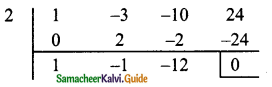
Samacheer Kalvi 9th Maths Guide Chapter 3 Algebra Ex 3.8 1
x² – x – 12 = x² – 4x + 3x – 12
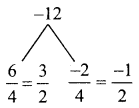
Samacheer Kalvi 9th Maths Guide Chapter 3 Algebra Ex 3.8 2
= x(x – 4) + 3 (x – 4)
= (x – 4) (x + 3)
∴ The factors of x3 – 3x² – 10x + 24 = (x – 2) (x – 4) (x + 3)

Samacheer Kalvi 9th Maths Guide Chapter 3 Algebra Ex 3.8

(ii) 2x3 – 3x² – 3x + 2
Solution:
p(x) = 2x3 – 3x² – 3x + 2
P(1) = 2(1)3 – 3(1)² – 3(1) + 2
= 2 – 3 – 3 + 2
= 2 – 6
= -4
≠ 0
x – 1 is not a factor

P(-1) = 2(-1)3 – 3(-1)² – 3(-1) + 2
= -2 – 3 + 3 + 2
= 5 – 5
= 0
∴ x + 1 is a factor
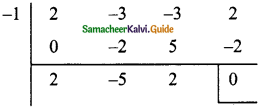
Samacheer Kalvi 9th Maths Guide Chapter 3 Algebra Ex 3.8 3
2x² – 5x + 2 = 2x² – 4x – x + 2
Samacheer Kalvi 9th Maths Guide Chapter 3 Algebra Ex 3.8 4
= 2x(x – 2) – 1 (x – 2)
= (x – 2) (2x – 1)
∴ The factors of 2x3 – 3x² – 3x + 2 = (x + 1) (x – 2) (2x – 1)

Samacheer Kalvi 9th Maths Guide Chapter 3 Algebra Ex 3.8

(iii) – 7x + 3 + 4x3
Solution:
p(x) = – 7x + 3 + 4x3
= 4x3 – 7x + 3
P(1) = 4(1)3 – 7(1) + 3
4 – 7 + 3
= 7 – 7
= 0
∴ x – 1 is a factor
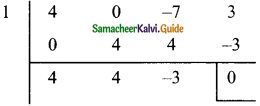
Samacheer Kalvi 9th Maths Guide Chapter 3 Algebra Ex 3.8 5
4x² + 4x – 3 = 4x² + 6x – 2x – 3
Samacheer Kalvi 9th Maths Guide Chapter 3 Algebra Ex 3.8 6
= 2x(2x + 3) – 1 (2x + 3)
= (2x + 3) (2x – 1)
∴ The factors of – 7x + 3 + 4x3 = (x – 1) (2x + 3) (2x – 1)

Samacheer Kalvi 9th Maths Guide Chapter 3 Algebra Ex 3.8

(iv) x3 + x² – 14x – 24
Solution:
p(x) = x3 + x² – 14x – 24
p(1) = (1)3 + (1)2 – 14 (1) – 24
= 1 + 1 – 14 – 24
= -36
≠ 0
x + 1 is not a factor.

p(-1) = (-1)3 + (-1)² – 14(-1) – 24
= -1 + 1 + 14 – 24
= 15 – 25
≠ 0
x – 1 is not a factor.

p(2) = (-2)3 + (-2)2 – 14 (-2) – 24
= -8 + 4 + 28 – 24
= 32 – 32
= 0
∴ x + 2 is a factor
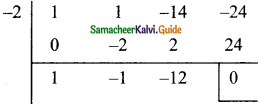
Samacheer Kalvi 9th Maths Guide Chapter 3 Algebra Ex 3.8 7
x² – x – 12 = x² – 4x + 3x – 12
Samacheer Kalvi 9th Maths Guide Chapter 3 Algebra Ex 3.8 8
= x(x – 4) + 3 (x – 4)
= (x – 4) (x + 3)
This (x + 2) (x + 3) (x – 4) are the factors.
x3 + x2 – 14x – 24 = (x + 2) (x + 3) (x – 4)

Samacheer Kalvi 9th Maths Guide Chapter 3 Algebra Ex 3.8

(v) x3 – 7x + 6
Solution:
p(x) = x3 – 7x + 6
P( 1) = 13 – 7(1) + 6
= 1 – 7 + 6
= 7 – 7
= 0
∴ x – 1 is a factor
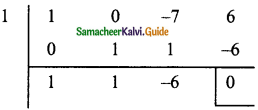
Samacheer Kalvi 9th Maths Guide Chapter 3 Algebra Ex 3.8 9
x² + x – 6 = x² + 3x – 2x – 6
Samacheer Kalvi 9th Maths Guide Chapter 3 Algebra Ex 3.8 10
= x(x + 3) – 2 (x + 3)
= (x + 3) (x – 2)
This (x – 1) (x – 2) (x + 3) are factors.
∴ x3 – 7x + 6 = (x – 1) (x – 2) (x + 3)

Samacheer Kalvi 9th Maths Guide Chapter 3 Algebra Ex 3.8

(vi) x3 – 10x² – x + 10
p(x) = x3 – 10x2 – x + 10
= 1 – 10 – 1 + 10
= 11 – 11
= 0
∴ x – 1 is a factor
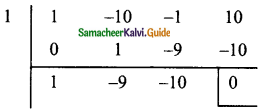
Samacheer Kalvi 9th Maths Guide Chapter 3 Algebra Ex 3.8 11
x2 – 9x – 10 = x2 – 10x + x – 10
Samacheer Kalvi 9th Maths Guide Chapter 3 Algebra Ex 3.8 12
= x(x – 10) + 1 (x – 10)
= (x – 10) (x + 1)
This (x – 1) (x + 1) (x – 10) are the factors.
∴ x3 – 10x2 – x + 10 = (x – 1) (x – 10) (x + 1)

Samacheer Kalvi 9th Maths Guide Chapter 3 Algebra Ex 3.8

Samacheer Kalvi 9th Maths Guide Chapter 2 Real Numbers Additional Questions

Students can download Maths Chapter 2 Real Numbers Additional Questions and Answers, Notes, Samacheer Kalvi 9th Maths Guide Pdf helps you to revise the complete Tamilnadu State Board New Syllabus, helps students complete homework assignments and to score high marks in board exams.

Tamilnadu Samacheer Kalvi 9th Maths Solutions Chapter 2 Real Numbers Additional Questions

I. Multiple choice question

Question 1.
The decimal form of –\(\frac{3}{4}\) is ………
(a) – 0.75
(b) – 0.50
(c) – 0.25
(d) – 0.125
Solution:
(a) – 0.75

Samacheer Kalvi 9th Maths Guide Chapter 2 Real Numbers Additional Questions

Question 2.
If a number has a non-terminating and non-recurring decimal expansion, then it is……….
(a) a rational number
(b) a natural number
(c) an irrational number
(d) an integer
Solution:
(c) an irrational number

Question 3.
Which one of the following has terminating decimal expansion?
(a) \(\frac{7}{9}\)
(b) \(\frac{8}{15}\)
(c) \(\frac{1}{12}\)
(d) \(\frac{5}{32}\)
Solution:
(d) \(\frac{5}{32}\)

Question 4.
Which of the following are irrational numbers?
(i) \(\sqrt{2+\sqrt3}\)
(ii) \(\sqrt{4+\sqrt25}\)
(iii) \(\sqrt[3]{5+\sqrt7}\)
(iv) \(\sqrt{8-\sqrt[3]8}\)
(a) (ii), (iii) and (iv)
(b) (i), (iii) and (iv)
(c) (i), (ii) and (iii)
(d) (i), (iii) and (iv)
Solution:
(d) (i), (iii) and (iv)

Samacheer Kalvi 9th Maths Guide Chapter 2 Real Numbers Additional Questions

Question 5.
Irrational number has a
(a) terminating decimal
(b) no decimal part
(c) non-terminating and recurring decimal
(d) non-terminating and non-recurring decimal
Solution:
(d) non-terminating and non-recurring decimal

Question 6.
If \(\frac{1}{7}\) = 0.142857, then the value of \(\frac{3}{7}\) is……..
(a) 0.285741
(b) 0.428571
(c) 0.285714
(d) 0.574128
Solution:
(b) 0.428571

Question 7.
Which of the following are not rational numbers?
(a) 7√5
(b) \(\frac{7}{\sqrt{5}}\)
(c) \(\sqrt{36}\) – 9
(d) π + 2
Solution:
(c) \(\sqrt{36}\) – 9

Samacheer Kalvi 9th Maths Guide Chapter 2 Real Numbers Additional Questions

Question 8.
The product of 2√5 and 6√5 is……….
(a) 12√5
(b) 60
(c) 40
(d) 8√5
Solution:
(b) 60

Question 9.
The rational number lying between \(\frac{1}{5}\) and \(\frac{1}{2}\)
(a) \(\frac{7}{20}\)
(b) \(\frac{2}{10}\)
(c) \(\frac{2}{7}\)
(d) \(\frac{3}{10}\)
Solution:
(a) \(\frac{7}{20}\)

Question 10.
The value of 0.03 + 0.03 is ……….
(a) 0.\(\overline { 09 }\)
(b) 0.\(\overline { 0303 }\)
(c) 0.\(\overline { 06 }\)
(d) 0
Solution:
(c) 0.06

Samacheer Kalvi 9th Maths Guide Chapter 2 Real Numbers Additional Questions

Question 11.
The sum of \(\sqrt{343}\) + \(\sqrt{567}\) is
(a) 18√3
(b) 16√7
(c) 15√3
(d) 14√7
Solution:
(b) 16√7

Question 12.
If \(\sqrt{363}\) = x√3 then x = ………
(a) 8
(b) 9
(c) 10
(d) 11
Solution:
(d) 11

Question 13.
The rationalising factor of \(\frac{1}{\sqrt{7}}\) is ……….
(i) 7
(b) √7
(c) \(\frac{1}{7}\)
(d) \(\frac{1}{\sqrt{7}}\)
Solution:
(b) √7

Samacheer Kalvi 9th Maths Guide Chapter 2 Real Numbers Additional Questions

Question 14.
The value of \((\frac{1}{3^5})^4\) is ……..
(a) 320
(b) 3-20
(c) \(\frac{1}{3^{-20}}\)
(d) \(\frac{1}{3^{9}}\)
Solution:
(b) 3-20

Question 15.
What is 3.976 × 10⁻⁴ written in decimal form?
(a) 0.003976
(b) 0.0003976
(c) 39760
(d) 0.03976
Solution:
(b) 0.0003976

II. Answer the following Questions.

Question 1.
Find any seven rational numbers between \(\frac{5}{8}\) and –\(\frac{5}{6}\)
Solution:
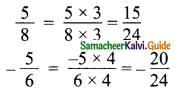
Let us convert the given rational numbers having the same denominators.
L.C.M of 8 and 6 is 24.
Samacheer Kalvi 9th Maths Guide Chapter 2 Real Numbers Additional Questions 1
Now the rational numbers between
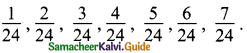
Samacheer Kalvi 9th Maths Guide Chapter 2 Real Numbers Additional Questions 2
We can take any seven of them.
Samacheer Kalvi 9th Maths Guide Chapter 2 Real Numbers Additional Questions 3

Question 2.
Find any three rational numbers between \(\frac{1}{2}\) and \(\frac{1}{5}\)
Solution:
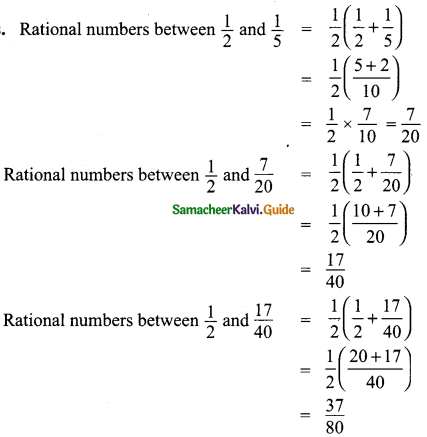
Samacheer Kalvi 9th Maths Guide Chapter 2 Real Numbers Additional Questions 4
Thus the three rational numbers are \(\frac{7}{20}\), \(\frac{17}{40}\) and \(\frac{37}{80}\)

Samacheer Kalvi 9th Maths Guide Chapter 2 Real Numbers Additional Questions

Question 3.
Represent \(-\frac{2}{11}\), \(-\frac{5}{11}\) and \(-\frac{9}{11}\) on the number lines.
Solution:
Samacheer Kalvi 9th Maths Guide Chapter 2 Real Numbers Additional Questions 5
To Represent \(-\frac{2}{11}\), \(-\frac{5}{11}\) and \(-\frac{9}{11}\) on the number line we make 11 markings each being equal distence \(\frac{1}{11}\) on the left of 0.
The point A represent \((-\frac{2}{11})\), the point B represents \((-\frac{5}{11})\) and the point C represents \((-\frac{9}{11})\)

Question 4.
Express the following in the form \(\frac{p}{q}\), where p and q are integers and q ≠ 0.
(i) 0.\(\overline { 47 }\)
Solution:
Let x = 0.474747…….. →(1)
100 x = 47.4747…….. →(2)
(2) – (1) ⇒ 100x – x = 47.4747……..
(-) 0.4747……..
99 x = 47.0000
x = \(\frac{47}{99}\)
∴ 0.\(\overline { 47 }\) = \(\frac{47}{99}\)

(ii) 0.\(\overline { 57 }\)
Solution:
Let x = 0.57777…….. →(1)
10 x = 5.77777…….. →(2)
100 x = 57.7777…….. →(3)
(3) – (2) ⇒ 100 x – 10 x = 57.7777……..
(-) 5.7777……..
99 x = 52.0000
x = \(\frac{52}{90}\) = \(\frac{26}{45}\)
∴ 0.\(\overline { 57 }\) = \(\frac{26}{45}\)

(iii) 0.\(\overline { 245 }\)
Solution:
Let x = 0.2454545…….. →(1)
10 x = 2.454545…….. →(2)
1000 x = 245.4545…….. →(3)
(3) – (2) ⇒ 1000 x – 10 x = 245.4545
(-) 2.4545………
990 x = 243.00000
x = \(\frac{243}{990}\) (or) \(\frac{27}{110}\)
∴ 0.\(\overline { 245 }\) = \(\frac{27}{110}\)

Samacheer Kalvi 9th Maths Guide Chapter 2 Real Numbers Additional Questions

Question 5.
Without actual division classify the decimal expansion of the following numbers as terminating or non-terminating and recurring.
(i) \(\frac{7}{16}\)
(ii) \(\frac{13}{150}\)
(ii) –\(\frac{11}{75}\)
(iv) \(\frac{17}{200}\)
Solution:
(i) \(\frac{7}{16}\) = \(\frac{7}{2^4}\) = \(\frac{7}{2^{4} \times 5^{0}}\)
∴ \(\frac{7}{16}\) has a terminating decimal expansion.

(ii) \(\frac{13}{150}=\frac{13}{2 \times 3 \times 5^{2}}\)
Since it is not in the form of \(\frac{P}{2^{m} \times 5^{n}}\)
∴ \(\frac{13}{150}\) as non-terminating and recurring decimal expansion.

(iii) \(-\frac{11}{75}=-\frac{11}{3 \times 5^{2}}\)
Since it is not in the form of \(\frac{P}{2^{m} \times 5^{n}}\)
∴ –\(\frac{11}{75}\) as non-terminating and recurring decimal expansion.

(iv) \(\frac{17}{200}=\frac{17}{2^{3} \times 5^{2}}\)
∴ \(\frac{17}{200}\) has a terminating decimal expansion.

Samacheer Kalvi 9th Maths Guide Chapter 2 Real Numbers Additional Questions

Question 6.
Find the value of \(\sqrt{27}\) + \(\sqrt{75}\) – \(\sqrt{108}\) + \(\sqrt{48}\)
Solution:
Samacheer Kalvi 9th Maths Guide Chapter 2 Real Numbers Additional Questions 6
= 3√3 + 5√3 – 6√3 + 4√3
= 12√3 – 6√3
= 6√3
= 6 × 1.732
= 10.392

Question 7.
Evaluate \(\frac{\sqrt{2}+1}{\sqrt{2-1}}\)
Solution:
Samacheer Kalvi 9th Maths Guide Chapter 2 Real Numbers Additional Questions 7
= 2√2 + 3
= 2 × 1.414 + 3
= 2.828 + 3
= 5.828

Samacheer Kalvi 9th Maths Guide Chapter 2 Real Numbers Additional Questions

Question 8.
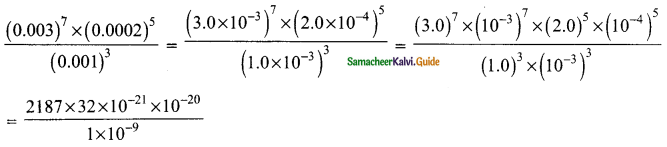
Samacheer Kalvi 9th Maths Guide Chapter 2 Real Numbers Additional Questions 8
Solution:
Samacheer Kalvi 9th Maths Guide Chapter 2 Real Numbers Additional Questions 9
= 69984 × 1021-21-20+9
= 69984 × 10-32
= 6.9984 × 104 × 10-32
= 6.9984 × 10⁻³²+4
= 6.9984 × 10⁻²⁸

Question 9.
Write
(a) 9.87 × 10⁹
(b) 4.134 × 10⁻⁴ and
(c) 1.432 × 10⁻⁹ in decimal form.
Solution:
(a) 9.87 × 109 = 9870000000
(b) 4.134 × 10-4 = 0.0004134
(c) 1.432 × 10-9 = 0.000000001432

Samacheer Kalvi 9th Maths Guide Chapter 2 Real Numbers Additional Questions

Samacheer Kalvi 9th Maths Guide Chapter 2 Real Numbers Ex 2.8

Students can download Maths Chapter 2 Real Numbers Ex 2.8 Questions and Answers, Notes, Samacheer Kalvi 9th Maths Guide Pdf helps you to revise the complete Tamilnadu State Board New Syllabus, helps students complete homework assignments and to score high marks in board exams.

Tamilnadu Samacheer Kalvi 9th Maths Solutions Chapter 2 Real Numbers Ex 2.8

Question 1.
Represent the following numbers in the scientific notation:
(i) 569430000000
(ii) 2000.57
(iii) 0.0000006000
(iv) 0.0009000002
Solution:
(i) 569430000000 = 5.6943 × 10¹¹
(ii) 2000.57 = 2.00057 × 10³
(iii) 0.0000006000 = 6.0 × 10⁻⁷
(iv) 0.0009000002 = 9.000002 × 10⁻⁴

Samacheer Kalvi 9th Maths Guide Chapter 2 Real Numbers Ex 2.8

Question 2.
Write the following numbers in decimal form:
(i) 3.459 × 10⁶
(ii) 5.678 × 10⁴
(iii) 1.00005 × 10⁻⁵
(iv) 2.530009 × 10⁻⁷
Solution:
(i) 3.459 × 106
= 3459000
(ii) 5.678 × 104
= 56780
(iii) 1.00005 × 10-5
= 0.0000100005
(iv) 2.530009 × 10-7
= 0.0000002530009

Samacheer Kalvi 9th Maths Guide Chapter 2 Real Numbers Ex 2.8

Question 3.
Represent the following numbers in scientific notation:
(i) (300000)2 × (20000)4
(ii) (0.000001)11 ÷ (0.005)3
(iii) {(0.00003)6 × (0.00005)4} ÷ {(0.009)3 × (0.05)2}
Solution:
(i) (300000)2 × (20000)4 = (3 × 10⁵)2 × (2 × 104)4
= 32 × (105)2 × 24 × (104)4
= 9 × 1010 × 16 × 1016
= 9 × 16 × 1010-16
= 144 × 1026
= 1.44 × 1028

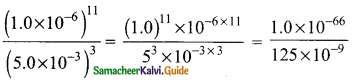
(ii) (0.000001)11 ÷ (0.005)3
Samacheer Kalvi 9th Maths Guide Chapter 2 Real Numbers Ex 2.8 1
0.008 × 10-66+9
= 8.0 × 10-3 × 10-57
= 8.0 × 10⁻³-57
= 8.0 × 10-60

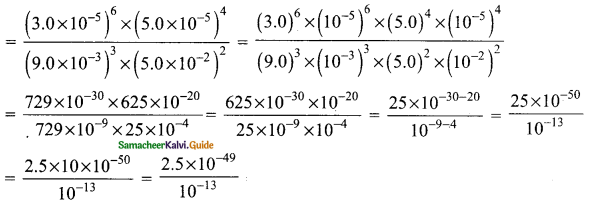
(iii) {(0.00003)6 × (0.00005)4} ÷ {(0.009)3 × (0.05)2}
Samacheer Kalvi 9th Maths Guide Chapter 2 Real Numbers Ex 2.8 2
= 2.5 × 10-49+13
= 2.5 × 10-36

Samacheer Kalvi 9th Maths Guide Chapter 2 Real Numbers Ex 2.8

Question 4.
Represent the following information in scientific notation:
(i) The world population is nearly 7000,000,000.
(ii) One light year means the distance 9460528400000000 km.
(iii) Mass of an electron is 0.000 000 000 000 000 000 000 000 000 00091093822 kg.
Solution:
(i) World population = 7.0 × 10⁹
(ii) Distance = 9.4605 × 10¹⁵ km.
(iii) Mass of an electron = 9.1093822 × 10⁻³¹ kg

Samacheer Kalvi 9th Maths Guide Chapter 2 Real Numbers Ex 2.8

Question 5.
Simplify:
(2.75 × 10⁷) + (1.23 × 10⁸)
(ii) (1.598 × 10¹⁷) – (4.58 × 10¹⁵)
(iii) (1.02 × 1010) × (1.20 × 10-3)
(iv) (8.41 × 10⁴) ÷ (4.3 × 10⁵)
Solution:
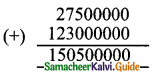
(i) (2.75 × 10⁷) + (1.23 × 10⁸) = 27500000 + 123000000
Samacheer Kalvi 9th Maths Guide Chapter 2 Real Numbers Ex 2.8 3
= 150500000
= 1.505 × 10⁸

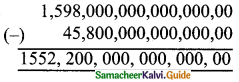
(ii) (1.598 × 10¹⁷) – (4.58 × 10¹⁵) = 1552,20000000000000
Samacheer Kalvi 9th Maths Guide Chapter 2 Real Numbers Ex 2.8 4
= 1.5522 × 10¹⁷

Samacheer Kalvi 9th Maths Guide Chapter 2 Real Numbers Ex 2.8

(iii) (1.02 × 1010) × (1.20 × 10-3) = 1.02 × 1.20 × 1010 × 10-3
=1.224 × 10⁷

(iv) (8.41 × 10⁴) ÷ (4.3 × 10⁵) = \(\frac{8.41×10^{4}}{4.3×10^{5}}\)
= \(\frac{8.41}{4.3}\) × 104-5
= \(\frac{8.41}{4.3}\) × 10-1
= 1.9558139 × 10⁻¹

Samacheer Kalvi 9th Maths Guide Chapter 2 Real Numbers Ex 2.7

Students can download Maths Chapter 2 Real Numbers Ex 2.7 Questions and Answers, Notes, Samacheer Kalvi 9th Maths Guide Pdf helps you to revise the complete Tamilnadu State Board New Syllabus, helps students complete homework assignments and to score high marks in board exams.

Tamilnadu Samacheer Kalvi 9th Maths Solutions Chapter 2 Real Numbers Ex 2.7

Question 1.
Rationalise the denominator:
(i) \( \frac{1}{\sqrt{50}}\)
(ii) \( \frac{5}{3\sqrt{5}}\)
(iii) \( \frac{\sqrt{75}}{\sqrt{18}}\)
(iv) \( \frac{3\sqrt{5}}{\sqrt{6}}\)
Solution:
(i) \( \frac{1}{\sqrt{50}}\) = \(\frac{1}{\sqrt{25 \times 2}}=\frac{1}{5 \sqrt{2}}=\frac{1}{5 \sqrt{2}} \times \frac{\sqrt{2}}{\sqrt{2}}=\frac{\sqrt{2}}{5 \times 2}=\frac{\sqrt{2}}{10}\)

(ii) \( \frac{5}{3\sqrt{5}}\) = \(\frac{5}{3 \sqrt{5}} \times \frac{\sqrt{5}}{\sqrt{5}}=\frac{5 \sqrt{5}}{3 \times 5}=\frac{\sqrt{5}}{3}\)

(iii) \( \frac{\sqrt{75}}{\sqrt{18}}\) = \(\frac{\sqrt{3 \times 25}}{\sqrt{2 \times 9}}=\frac{5 \sqrt{3}}{3 \sqrt{2}}=\frac{5 \sqrt{3}}{3 \sqrt{2}} \times \frac{\sqrt{2}}{\sqrt{2}}=\frac{5 \sqrt{6}}{3 \times 2}=\frac{5 \sqrt{6}}{6}\)

(iv) \( \frac{3\sqrt{5}}{\sqrt{6}}\) = \( \frac{3 \sqrt{5}}{\sqrt{6}} \times \frac{\sqrt{6}}{\sqrt{6}}=\frac{3 \sqrt{30}}{6}=\frac{\sqrt{30}}{2} \)

Samacheer Kalvi 9th Maths Guide Chapter 2 Real Numbers Ex 2.7

Question 2.
Rationalise the denominator and simplify:
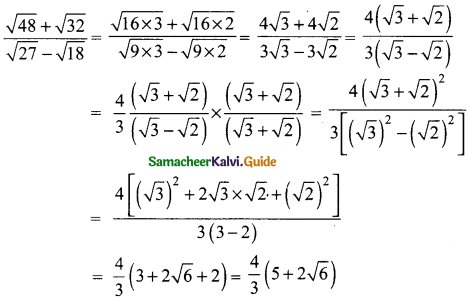
(i) \(\frac{\sqrt{48}+\sqrt{32}}{\sqrt{27}-\sqrt{18}}\)
Solution:
Samacheer Kalvi 9th Maths Guide Chapter 2 Real Numbers Ex 2.7 1

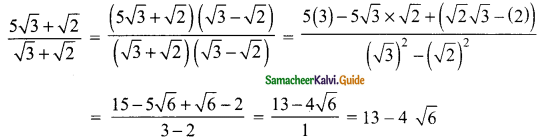
(ii) \(\frac{5\sqrt{3}+\sqrt{2}}{\sqrt{3}+\sqrt{2}}\)
Solution:
Samacheer Kalvi 9th Maths Guide Chapter 2 Real Numbers Ex 2.7 2

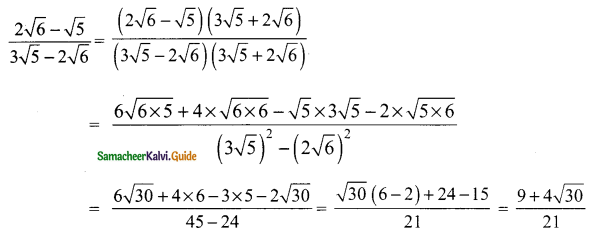
(iii) \(\frac{2\sqrt{6}-\sqrt{5}}{3\sqrt{5}-2\sqrt{6}}\)
Solution:
Samacheer Kalvi 9th Maths Guide Chapter 2 Real Numbers Ex 2.7 3

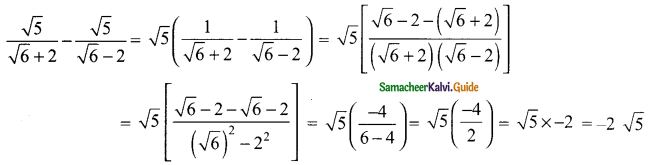
(iv) \(\frac{\sqrt{5}}{\sqrt{6}+2} – \frac{\sqrt{5}}{\sqrt{6}-2}\)
Solution:
Samacheer Kalvi 9th Maths Guide Chapter 2 Real Numbers Ex 2.7 4

Samacheer Kalvi 9th Maths Guide Chapter 2 Real Numbers Ex 2.7

Question 3.
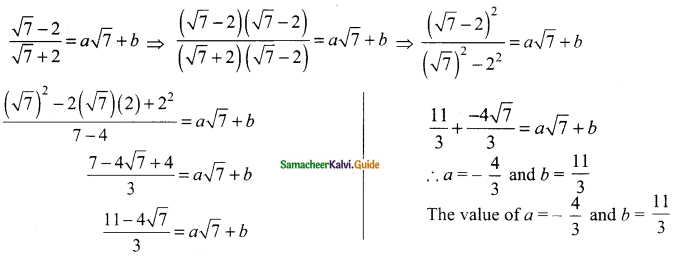
Find the value of a and b if \(\frac{\sqrt{7}-2}{\sqrt{7}+2} = a\sqrt{7} + b\).
Solution:
Samacheer Kalvi 9th Maths Guide Chapter 2 Real Numbers Ex 2.7 5

Samacheer Kalvi 9th Maths Guide Chapter 2 Real Numbers Ex 2.7

Question 4.
If x = \(\sqrt{7}\) + 2, then find the value of x² + \(\frac{1}{x^2}\)
Solution:
\(\sqrt{7}\) + 2 ⇒ x² = \((\sqrt{5}+2)^{2}\)
= \((\sqrt{5})^{2}\) + 2 × 2 × \(\sqrt{5}\) + 2² = 5 + 4 \(\sqrt{5}\) + 4 = 9 + 4\(\sqrt{5}\)
\(\frac{1}{x}=\frac{1}{\sqrt{5}+2}=\frac{\sqrt{5}-2}{(\sqrt{5}+2)(\sqrt{5}-2)}=\frac{\sqrt{5}-2}{(\sqrt{5})^{2}-2^{2}}=\frac{\sqrt{5}-2}{5-4}=\sqrt{5}-2\)
\(\frac{1}{x^{2}}\) = (\(\sqrt{5} – 2)^{2}\)
= \((\sqrt{5})^{2}\) – 2 × \(\sqrt{5}\) × 2 + 2² = 5 – 4 \(\sqrt{5}\) + 4 = 9 – 4 \(\sqrt{5}\)
∴ x² + \(\frac{1}{x^{2}}\) = 9 + \(4\sqrt{5}\) + 9 – \(4\sqrt{5}\) = 18
The value of x² + \(\frac{1}{x^{2}}\) = 18

Samacheer Kalvi 9th Maths Guide Chapter 2 Real Numbers Ex 2.7

Question 5.
Given \(\sqrt{2}\) = 1.414, find the value of \(\frac{8 – 5\sqrt{2}}{3 – 2\sqrt{2}}\) (to 3 places of decimals).
Solution:
Samacheer Kalvi 9th Maths Guide Chapter 2 Real Numbers Ex 2.7 6
= 4 + \(\sqrt{2}\) = 4 + 1.414 = 5.414

Samacheer Kalvi 9th Maths Guide Chapter 2 Real Numbers Ex 2.7

Samacheer Kalvi 9th Maths Guide Chapter 2 Real Numbers Ex 2.6

Students can download Maths Chapter 2 Real Numbers Ex 2.6 Questions and Answers, Notes, Samacheer Kalvi 9th Maths Guide Pdf helps you to revise the complete Tamilnadu State Board New Syllabus, helps students complete homework assignments and to score high marks in board exams.

Tamilnadu Samacheer Kalvi 9th Maths Solutions Chapter 2 Real Numbers Ex 2.6

Question 1.
Simplify the following using addition and subtraction properties of surds:
(i) 5\(\sqrt{3}\) + 18\(\sqrt{3}\) – 2\(\sqrt{3}\)
(ii) 4\(\sqrt[3]{5}\) + 2\(\sqrt[3]{5}\) – 3\(\sqrt[3]{5}\)
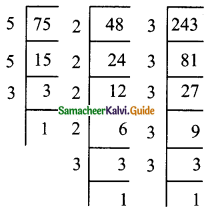
(iii) 3\(\sqrt{75}\) + 5\(\sqrt{48}\) – \(\sqrt{243}\)
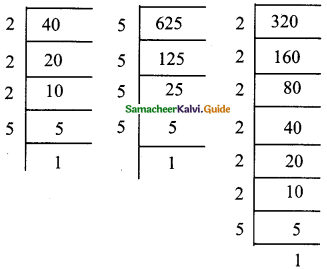
(iv) 5\(\sqrt[3]{40}\) + 2\(\sqrt[3]{625}\) – 3\(\sqrt[3]{320}\)
Solution:
(i) 5\(\sqrt{3}\) + 18\(\sqrt{3}\) – 2\(\sqrt{3}\) = (5 + 18 – 2)\(\sqrt{3}\)
= (23 – 2) \(\sqrt{3}\) = 21\(\sqrt{3}\)

(ii) 4\(\sqrt[3]{5}\) + 2\(\sqrt[3]{5}\) – 3\(\sqrt[3]{5}\) = (4 + 2 – 3) \(\sqrt[3]{5}\)
= (6 – 3) \(\sqrt[3]{5}\) = 3\(\sqrt[3]{5}\)

Samacheer Kalvi 9th Maths Guide Chapter 2 Real Numbers Ex 2.6

(iii) 3\(\sqrt{75}\) + 5\(\sqrt{48}\) – \(\sqrt{243}\) = \(3\sqrt{5^{2}×3} + 5\sqrt{2^{4}×3} – \sqrt{3^{5}}\)
Samacheer Kalvi 9th Maths Guide Chapter 2 Real Numbers Ex 2.6 1
= 3 × 5\(\sqrt{3}\) + 5 × 2²\(\sqrt{3}\) – 3²\(\sqrt{3}\) = 15\(\sqrt{3}\) + 20\(\sqrt{3}\) – 9\(\sqrt{3}\)
= (15 + 20 – 9)\(\sqrt{3}\)
= (35 – 9)\(\sqrt{3}\)
= 26 \(\sqrt{3}\)

(iv) 5\(\sqrt[3]{40}\) + 2\(\sqrt[3]{625}\) – 3\(\sqrt[3]{320}\)
Samacheer Kalvi 9th Maths Guide Chapter 2 Real Numbers Ex 2.6 2
= 5\(\sqrt[3]{2^{3}×5} + 2\sqrt[3]{5^{3}×5} – 3\sqrt[3]{2^{3}×2^{3}×5}\)
5 × 2\(\sqrt[3]{5} + 2 × 5\sqrt[3]{5} – 3 × 2 × 2\sqrt[3]{5} \)
= 10\(\sqrt[3]{5} + 10\sqrt[3]{5} – 12\sqrt[3]{5} \)
= 20\(\sqrt[3]{5} – 12\sqrt[3]{5}\)
= 8\(\sqrt[3]{5}\)

Samacheer Kalvi 9th Maths Guide Chapter 2 Real Numbers Ex 2.6

Question 2.
Simplify the following using multiplication and division properties of surds:
(i) \(\sqrt{3}\) × \(\sqrt{5}\) × \(\sqrt{2}\)
(ii) \(\sqrt{35}\) ÷ \(\sqrt{7}\)
(iii) \(\sqrt[3]{27}\) × \(\sqrt[3]{8}\) × \(\sqrt[3]{125}\)
(iv) (7\(\sqrt{a}\) – 5\(\sqrt{b}\)) (7\(\sqrt{a}\) + 5\(\sqrt{b}\))
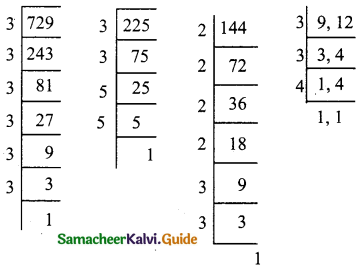
(v) (\(\sqrt{\frac{225}{729}} – \sqrt{\frac{25}{144}}\)) ÷ \(\sqrt{\frac{16}{81}}\)
Solution:
(i) \(\sqrt{3}\) × \(\sqrt{5}\) × \(\sqrt{2}\) = \(\sqrt{3×5×2} = \sqrt{30}\)

(ii) \(\sqrt{37} ÷ \sqrt{7} = \frac{\sqrt{35}}{\sqrt{7}} = \sqrt{\frac{35}{7}} = \sqrt{5}\)

(iii) \(\sqrt[3]{27}\) × \(\sqrt[3]{8}\) × \(\sqrt[3]{125}\) = \(\sqrt[3]{27×8×125}\)
= \(\sqrt[3]{3^{3}×2^{3}×5^{3}}\) = 3 × 2 × 5 = 30

(iv) (7\(\sqrt{a}\) – 5\(\sqrt{b}\)) (7\(\sqrt{a}\) + 5\(\sqrt{b}\))
[using a2 – b2 = (a + b) (a – b)]
(7\(\sqrt{a}\) – 5\(\sqrt{b}\)) (7\(\sqrt{a}\) + 5\(\sqrt{b}\)) = \((7\sqrt{a})^{2} – (5\sqrt{b})^{2}\) = 49a – 25b

(v) (\(\sqrt{\frac{225}{729}} – \sqrt{\frac{25}{144}}\)) ÷ \(\sqrt{\frac{16}{81}}\)
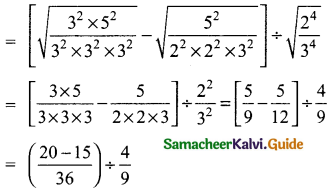
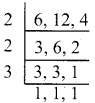
Samacheer Kalvi 9th Maths Guide Chapter 2 Real Numbers Ex 2.6 3
Samacheer Kalvi 9th Maths Guide Chapter 2 Real Numbers Ex 2.6 4
= \(\frac{5}{36}\) × \(\frac{9}{4}\)
= \(\frac{5×1}{4×4}\)
= \(\frac{5}{16}\)

Samacheer Kalvi 9th Maths Guide Chapter 2 Real Numbers Ex 2.6

Question 3.
If \(\sqrt{2}\) = 1.414, \(\sqrt{3}\) = 1.732, \(\sqrt{5}\) = 2.236, \(\sqrt{10}\) = 3.162, then find the values of the following correct to 3 places of decimals.
(i) \(\sqrt{40}\) – \(\sqrt{20}\)
(ii) \(\sqrt{300}\) + \(\sqrt{90}\) – \(\sqrt{8}\)
Solution:
(i) \(\sqrt{40}\) – \(\sqrt{20}\) = \(\sqrt{4×10} – \sqrt{4×5} = 2\sqrt{10} – 2\sqrt{5}\)
= 2 × 3.162 – 2 × 2.236 = 6.324 – 4.472 = 1.852

(ii) \(\sqrt{300}\) + \(\sqrt{90}\) – \(\sqrt{8}\) = \(\sqrt{3×100} + \sqrt{9×10} – \sqrt{4×2}\)
= 10\(\sqrt{3}\) + 3\(\sqrt{10}\) – 2\(\sqrt{2}\)
= 10 × 1.732 + 3 × 3.162 – 2 × 1.414
= 17.32 + 9.486 – 2.828
= 26.806 – 2.828
= 23.978

Samacheer Kalvi 9th Maths Guide Chapter 2 Real Numbers Ex 2.6

Question 4.
Arrange surds in descending order
(i) \(\sqrt[3]{5}\), \(\sqrt[9]{4}\), \(\sqrt[6]{3}\)
Solution:
LCM of 3, 9 and 6 is 18
Samacheer Kalvi 9th Maths Guide Chapter 2 Real Numbers Ex 2.6 5
\(\sqrt[3]{5}\) = \(\sqrt[3×6]{5^{6}}\) = \(\sqrt[18]{15625}\)
\(\sqrt[9]{4}\) = \(\sqrt[2×9]{4^{2}}\) = \(\sqrt[18]{16}\)
\(\sqrt[6]{3}\) = \(\sqrt[3×6]{3^{3}}\) = \(\sqrt[18]{27}\)
\(\sqrt[18]{15625}\) > \(\sqrt[18]{27}\) > \(\sqrt[18]{16}\)
\(\sqrt[3]{5}\) > \(\sqrt[6]{3}\) > \(\sqrt[9]{4}\)

Samacheer Kalvi 9th Maths Guide Chapter 2 Real Numbers Ex 2.6

(ii) \(\sqrt[2]{\sqrt[3]{5}}\), \(\sqrt[3]{\sqrt[4]{7}}\), \(\sqrt{\sqrt{3}}\)
Solution:
\(\sqrt[2]{\sqrt[3]{5}}\) = \(\sqrt[6]{5}\); \(\sqrt[3]{\sqrt[4]{7}}\) = \(\sqrt[12]{7}\); \(\sqrt{\sqrt{3}}\) = \(\sqrt[4]{3}\)
LCM of 6, 12 and 4 is 12
Samacheer Kalvi 9th Maths Guide Chapter 2 Real Numbers Ex 2.6 6
\(\sqrt[2]{\sqrt[3]{5}}\) = \(\sqrt[6]{5}\) = \(\sqrt[12]{5^{2}}\) = \(\sqrt[12]{25}\)
\(\sqrt[3]{\sqrt[4]{7}}\) = \(\sqrt[12]{7}\) = \(\sqrt[12]{7}\)
\(\sqrt{\sqrt{3}}\) = \(\sqrt[4]{3}\) = \(\sqrt[12]{3^{3}}\) = \(\sqrt[12]{27}\)
\(\sqrt[12]{27}\) > \(\sqrt[12]{25}\) > \(\sqrt[12]{7}\)
\(\sqrt{\sqrt{3}}\) > \(\sqrt[2]{\sqrt[3]{5}}\) > \(\sqrt[3]{\sqrt[4]{7}}\)

Question 5.
Can you get a pure surd when you find:
(i) the sum of two surds
(ii) the difference of two surds
(iii) the product of two surds
(iv) the quotient of two surds
Justify each answer with an example.
Solution:
(i) Yes we can get a surd.
Example:
(a) 3\(\sqrt{2}\) + 5\(\sqrt{2}\) = (3 + 5)\(\sqrt{2}\) = 8\(\sqrt{2}\)
(b) 3\(\sqrt{6}\) + 2\(\sqrt{6}\) = (3 + 2)\(\sqrt{6}\) = 5\(\sqrt{6}\)

(ii) Yes we can get a surd.
Example:
(a) \(\sqrt{75}\) – \(\sqrt{48}\) = \(\sqrt{25×3}\) – \(\sqrt{16×3}\) = (5 – 4) \(\sqrt{3}\) = \(\sqrt{3}\)
(b) \(\sqrt{98}\) – \(\sqrt{72}\) = \(\sqrt{49×2}\) – \(\sqrt{36×2}\) = (7 – 6) \(\sqrt{2}\) = \(\sqrt{2}\)

Samacheer Kalvi 9th Maths Guide Chapter 2 Real Numbers Ex 2.6

(iii) Yes we can get a surd.
Example:
(a) \(\sqrt{8}\) × \(\sqrt{6}\) = \(\sqrt{8×6}\) = \(\sqrt{48}\)
(b) \(\sqrt{11}\) × \(\sqrt{3}\) = \(\sqrt{11×3}\) = \(\sqrt{33}\)

(iv) Yes we can get a surd.
Example:
(a) \(\sqrt{55}\) ÷ \(\sqrt{5}\) = \(\frac{\sqrt{11×5}}{\sqrt{5}} = \sqrt{11}\)
(b) \(\sqrt{65}\) ÷ \(\sqrt{5}\) = \(\frac{\sqrt{13×5}}{\sqrt{13}} = \sqrt{5}\)

Question 6.
Can you get a rational number when you compute:
(i) the sum of two surds
(ii) the difference of two surds
(iii) the product of two surds
(iv) the quotient of two surds
Justify each answer with an example.
Solution:
(i) Yes, the sum of two surds will give a rational number.
Example:
(a) (2 + \(\sqrt{3}\)) + (2 – \(\sqrt{3}\)) = 4
(b) (\(\sqrt{5}\) + 4) + (7 – \(\sqrt{5}\)) = 11

(ii) Yes, the difference of two surds will give a rational number.
Example:
(a) (5 + \(\sqrt{7}\)) – (- 5 + \(\sqrt{7}\)) = 10
(b) (\(\sqrt{11}\) + 5) – (-3 + \(\sqrt{11}\)) = 8

Samacheer Kalvi 9th Maths Guide Chapter 2 Real Numbers Ex 2.6

(iii) Yes, the product of two surds will give a rational number.
Example:
(a) \(\sqrt{125}\) × \(\sqrt{45}\) = \(\sqrt{25×5}\) × \(\sqrt{9×5}\) = 5\(\sqrt{5}\) × 3\(\sqrt{5}\) = 15 × 5 = 75
(b) \(\sqrt{150}\) × \(\sqrt{6}\) = \(\sqrt{25×6}\) × \(\sqrt{6}\) = 5\(\sqrt{6}\) × \(\sqrt{6}\) = 5 × 6 = 30

(iv) Yes. The quotient of two surds will give a rational number.
Example:
(a) \(\sqrt{32}\) ÷ \(\sqrt{8}\) = \(\frac{\sqrt{8×4}}{\sqrt{8}} = \sqrt{4}\) = 2
(b) \(\sqrt{50}\) ÷ \(\sqrt{2}\) = \(\frac{\sqrt{25×2}}{\sqrt{2}} = \sqrt{25}\) = 5

Samacheer Kalvi 9th Maths Guide Chapter 2 Real Numbers Ex 2.9

Students can download Maths Chapter 2 Real Numbers Ex 2.9 Questions and Answers, Notes, Samacheer Kalvi 9th Maths Guide Pdf helps you to revise the complete Tamilnadu State Board New Syllabus, helps students complete homework assignments and to score high marks in board exams.

Tamilnadu Samacheer Kalvi 9th Maths Solutions Chapter 2 Real Numbers Ex 2.9

Question 1.
If n is a natural number then √n is……….
(a) always a natural number
(b) always an irrational number
(c) always a rational number
(d) may be rational or irrational
Solution:
(d) may be rational or irrational

Samacheer Kalvi 9th Maths Guide Chapter 2 Real Numbers Ex 2.9

Question 2.
Which of the following is not true?
(a) Every rational number is a real number
(b) Every integer is a rational number
(c) Every real number is an irrational number
(d) Every natural number is a whole number
Solution:
(c) Every real number is an irrational number

Question 3.
Which one of the following, regarding sum of two irrational numbers, is true?
(a) always an irrational number
(b) may be a rational or irrational number
(c) always a rational number
(d) always an integer
Solution:
(b) may be a rational or irrational number

Samacheer Kalvi 9th Maths Guide Chapter 2 Real Numbers Ex 2.9

Question 4.
Which one of the following has a terminating decimal expansion?
(a) \(\frac{5}{64}\)
(b) \(\frac{8}{9}\)
(c) \(\frac{14}{15}\)
(d) \(\frac{1}{12}\)
Solution:
(a) \(\frac{5}{64}\)
Hint:
\(\frac{5}{64}\) = \(\frac{5}{2^{6}}\)

Question 5.
Which one of the following is an irrational number?
(a) \(\sqrt{25}\)
(b) \(\sqrt{\frac{9}{4}}\)
(c) \(\frac{7}{11}\)
(d) π
Solution:
(d) π
Hint:
We take frequently π as \(\frac{22}{7}\) (which gives the value of 3.1428571428571…….) to be its correct value, but in reality these are only approximations

Samacheer Kalvi 9th Maths Guide Chapter 2 Real Numbers Ex 2.9

Question 6.
An irrational number between 2 and 2.5 is………
(a) \(\sqrt{11}\)
(b) √5
(c) \(\sqrt{2.5}\)
(d) √8
Solution:
(b) √5
Hint:
√5 = 2.236, it lies between 2 and 2.5

Question 7.
The smallest rational number by which \(\frac{1}{3}\) should be multiplied so that its decimal expansion terminates with one place of decimal is ………
(a) \(\frac{1}{10}\)
(b) \(\frac{3}{10}\)
(c) 3
(d) 30
Solution:
(b) \(\frac{3}{10}\)
Hint:
\(\frac{1}{3}\) × \(\frac{3}{10}\) = \(\frac{1}{10}\) = \(\frac{1}{2×5}\) it has terminating decimal expansion.

Samacheer Kalvi 9th Maths Guide Chapter 2 Real Numbers Ex 2.9

Question 8.
If \(\frac{1}{7}\) = 0.\(\overline { 142857 }\) then the value of \(\frac{5}{7}\) is ………..
(a) 0.\(\overline { 142857 }\)
(b) 0.\(\overline { 714285 }\)
(c) 0.\(\overline { 571428 }\)
(d) 0.714285
Solution:
(b) 0.\(\overline { 714285 }\)

Question 9.
Find the odd one out of the following.
(a) \(\sqrt{32}×\sqrt{2}\)
(b) \(\frac{\sqrt{27}}{\sqrt{3}}\)
(c) \(\sqrt{72}×\sqrt{8}\)
(d) \(\frac{\sqrt{54}}{\sqrt{18}}\)
Solution:
(b) \(\frac{\sqrt{27}}{\sqrt{3}}\)
Hint:
\(\frac{\sqrt{27}}{\sqrt{3}}\) = \(\frac{\sqrt{27}}{\sqrt{3}}\) = √9 = 3. It is an odd number

Samacheer Kalvi 9th Maths Guide Chapter 2 Real Numbers Ex 2.9

Question 10.
0.\(\overline { 34 }\) + 0.3\(\overline { 4 }\) = ……….
(a) 0.6\(\overline { 87 }\)
(b) 0.\(\overline { 68 }\)
(c) 0.6\(\overline { 8 }\)
(d) 0.68\(\overline { 7 }\)
Solution:
(a) 0.6\(\overline { 87 }\)
Hint:
0.34343434
0.34444444
0.68787878

Question 11.
Which of the following statement is false?
(a) The square root of 25 is 5 or -5
(b) \(-\sqrt{25}\) = -5
(c) \(\sqrt{25}\) = 5
(d) \(\sqrt{25}\) = ±5
Solution:
(d) \(\sqrt{25}\) = ±5

Question 12.
Which one of the following is not a rational number?
(a) \(\sqrt{\frac{8}{18}}\)
(b) \(\frac{7}{3}\)
(c) \(\sqrt{0.01}\)
(d) \(\sqrt{13}\)
Solution:
(d) \(\sqrt{13}\)

Samacheer Kalvi 9th Maths Guide Chapter 2 Real Numbers Ex 2.9

Question 13.
\(\sqrt{27}\) + \(\sqrt{12}\) = ……….
(a) \(\sqrt{39}\)
(b) 5√6
(c) 5√3
(d) 3√5
Solution:
(d) 3√5
Hint:
\(\sqrt{27}\) + \(\sqrt{12}\) = \(\sqrt{9×3}\) + \(\sqrt{3×4}\) = 3√3 + 2√3 = 5√3

Question 14.
If \(\sqrt{80}\) = k√5, then k = ………
(a) 2
(b) 4
(c) 8
(d) 16
Solution:
(b) 4
Hint:
\(\sqrt{80}\) = k√5
\(\sqrt{16×5}\) = k√5
4√5 = k√5
∴ k = 4

Samacheer Kalvi 9th Maths Guide Chapter 2 Real Numbers Ex 2.9

Question 15.
4√7 × 2√3 = ……….
(a) 6\(\sqrt{10}\)
(b) 8\(\sqrt{21}\)
(c) 8\(\sqrt{10}\)
(d) 6\(\sqrt{21}\)
Solution:
(b) 8\(\sqrt{21}\)
Hint:
4√7 × 2√3 = 4 × 2\(\sqrt{7×3}\) = 8\(\sqrt{21}\)

Question 16.
When written with a rational denominator, the expression \(\frac {2\sqrt{3}}{3\sqrt{2}}\) can be simplified as……..
(a) \(\frac {\sqrt{2}}{3}\)
(b) \(\frac {\sqrt{3}}{2}\)
(c) \(\frac {\sqrt{6}}{3}\)
(d) \(\frac {2}{3}\)
Solution:
(c) \(\frac {\sqrt{6}}{3}\)

Samacheer Kalvi 9th Maths Guide Chapter 2 Real Numbers Ex 2.9

Question 17.
When (2√5 – √2)² is simplified, we get………
(a) 4√5 + 2√2
(b) 22 – 4\(\sqrt{10}\)
(c) 8 – 4\(\sqrt{10}\)
(d) 2\(\sqrt{10}\) – 2
Solution:
(b) 22 – 4\(\sqrt{10}\)
Hint:
(2√5 – √2)² = (2√5)² + (√2)² – 2 × 2√5 × √2
= 20 – 4\(\sqrt{10}\) + 2
= 22 – 4\(\sqrt{10}\)

Samacheer Kalvi 9th Maths Guide Chapter 2 Real Numbers Ex 2.9

Question 18.
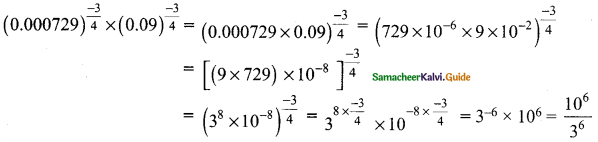
\((0.000729)^\frac{-3}{4}\) × \((0.09)^\frac{-3}{4}\) = ……..
(a) \(\frac {10^3}{3^3}\)
(b) \(\frac {10^5}{3^5}\)
(c) \(\frac {10^2}{3^2}\)
(d) \(\frac {10^6}{3^6}\)
Solution:
(d) \(\frac {10^6}{3^6}\)
Hint:
Samacheer Kalvi 9th Maths Guide Chapter 2 Real Numbers Ex 2.9 1

Question 19.
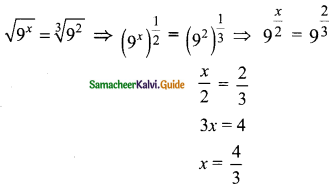
If √9x = \(\sqrt[3]{9^2}\), then x = …….
(a) \(\frac {2}{3}\)
(b) \(\frac {4}{3}\)
(c) \(\frac {1}{3}\)
(d) \(\frac {5}{3}\)
Solution:
(b) \(\frac {4}{3}\)
Hint:
Samacheer Kalvi 9th Maths Guide Chapter 2 Real Numbers Ex 2.9 2

Samacheer Kalvi 9th Maths Guide Chapter 2 Real Numbers Ex 2.9

Question 20.
The length and breadth of a rectangular plot are 5 × 10⁵ and 4 × 10⁴ metres respectively. Its area is ……….
(a) 9 × 101 m2
(b) 9 × 10⁹ m2
(c) 2 × 10¹⁰ m2
(d) 20 × 1020 m2
Solution:
(c) 2 × 10¹⁰ m2
Hint:
Area of a rectangle = l × b = 5 × 105 × 4 × 104
= 5 × 4 × 105+4
= 20 × 109
= 2.0 × 10 × 109
= 2 × 10¹⁰ m2

Samacheer Kalvi 9th Maths Guide Chapter 4 Geometry Additional Questions

Students can download Maths Chapter 4 Geometry Additional Questions and Answers, Notes, Samacheer Kalvi 9th Maths Guide Pdf helps you to revise the complete Tamilnadu State Board New Syllabus, helps students complete homework assignments and to score high marks in board exams.

Tamilnadu Samacheer Kalvi 9th Maths Solutions Chapter 4 Geometry Additional Questions

I. Multiple Choice Questions.

Question 1.
The angle sum of a convex polygon with number of sides 7 is ………
(a) 900°
(b) 1080°
(c) 1444°
(d) 720°
Solution:
(a) 900°

Question 2.
What is the name of a regular polygon of six sides?
(a) Square
(b) Equilateral triangle
(c) Regular hexagon
(d) Regular octagon
Solution:
(c) Regular hexagon

Samacheer Kalvi 9th Maths Guide Chapter 4 Geometry Additional Questions

Question 3.
One angle of a parallelogram is a right angle. The name of the quadrilateral is ………
(a) square
(b) rectangle
(c) rhombus
(d) kite
Solution:
(b) rectangle

Question 4.
If all the four sides of a parallelogram are equal and the adjacent angles are of 120° and 60°, then the name of the quadrilateral is ………
(a) rectangle
(b) square
(c) rhombus
(d) kite
Solution:
(c) rhombus

Question 5.
In a parallelogram ∠A : ∠B = 1 : 2. Then ∠A ………
(a) 30°
(b) 60°
(c) 45°
(d) 90°
Solution:
(b) 60°

Samacheer Kalvi 9th Maths Guide Chapter 4 Geometry Additional Questions

Question 6.
Which of the following is a formula to find the sum of interior angles of a quadrilateral of w-sides?
(a) \(\frac{n}{2}\) × 180°
(b) (\(\frac{n+1}{2}\)) 180°
(c) (\(\frac{n-1}{2}\)) 180°
(d) (n – 2) 180°
Solution:
(d) (n – 2) 180°

Question 7.
Diagonal of which of the following quadrilaterals do not bisect it into two congruent triangles?
(a) rhombus
(b) trapezium
(c) square
(d) rectangle
Solution:
(b) trapezium

Question 8.
The point of concurrency of the medians of a triangle is known as ………
(a) circumcentre
(b) incentre
(c) orthocentre
(d) centroid
Solution:
(d) centroid

Samacheer Kalvi 9th Maths Guide Chapter 4 Geometry Additional Questions

Question 9.
Orthocentre of a triangle is the point of concurrency of ………
(a) medians
(b) altitudes
(c) angle bisectors
(d) perpendicular bisectors of side
Solution:
(b) altitudes

Question 10.
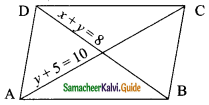
ABCD is a parallelogram as shown. Find x and y.
Samacheer Kalvi 9th Maths Guide Chapter 4 Geometry Additional Questions 1
(a) 1, 7
(b) 2, 6
(c) 3, 5
(d) 4, 4
Solution:
(c) 3, 5

Question 11.
A circle divides the plane into part ………
(a) 1
(b) 2
(c) 3
(d) 4
Solution:
(c) 3

Samacheer Kalvi 9th Maths Guide Chapter 4 Geometry Additional Questions

Question 12.
The longest chord of a circle is a of the circle……….
(a) radius
(b) diameter
(c) chord
(d) secant
Solution:
(b) diameter

Question 13.
Opposite angles of a cyclic quadrilateral are ………
(a) supplementary
(b) complementary
(c) equal
(d) none of these
Solution:
(a) supplementary

Question 14.
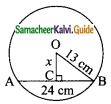
The value of x from figure is if ‘O’ is the centre of the circle ………
Samacheer Kalvi 9th Maths Guide Chapter 4 Geometry Additional Questions 2
(a) 20 cm
(b) 15 cm
(c) 12 cm
(d) 5 cm
Solution:
(d) 5 cm

Samacheer Kalvi 9th Maths Guide Chapter 4 Geometry Additional Questions

Question 15.
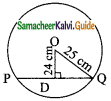
If PQ = x and ‘O’ is the centre of the circle, then x= ………
Samacheer Kalvi 9th Maths Guide Chapter 4 Geometry Additional Questions 3
(a) 7 cm
(b) 14 cm
(c) 8 cm
(d) 13 cm
Solution:
(b) 14 cm

Question 16.
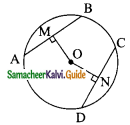
In figure OM = ON = 8cm and AB = 30 cm, then CD = ………
Samacheer Kalvi 9th Maths Guide Chapter 4 Geometry Additional Questions 4
(a) 15 cm
(b) 30 cm
(c) 40 cm
(d) 10 cm
Solution:
(b) 30 cm

Question 17.
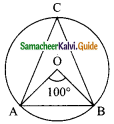
O is the centre of a circle, ∠AOB = 100°. Then angle ∠ ACB = ………
Samacheer Kalvi 9th Maths Guide Chapter 4 Geometry Additional Questions 5
(a) 80°
(b) 40°
(c) 50°
(d) 60°
Solution:
(c) 50°

Samacheer Kalvi 9th Maths Guide Chapter 4 Geometry Additional Questions

Question 18.
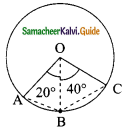
In,a circle, with center O, ∠AOB = 20°, ∠BOC = 40°, arc BC = 4 Then length of arc AB will be ………
Samacheer Kalvi 9th Maths Guide Chapter 4 Geometry Additional Questions 6
(a) 8 cm
(b) 6 cm
(c) 2 cm
(d) 1 cm
Solution:
(c) 2 cm

Question 19.
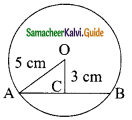
In the figure , OC = 3cm and radius of circle is 5 cm. Then AB = ………
Samacheer Kalvi 9th Maths Guide Chapter 4 Geometry Additional Questions 7
(a) 4 cm
(b) 5 cm
(c) 6 cm
(d) 8 cm
Solution:
(d) 8 cm

Question 20.
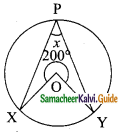
O is the centre of the circle. The value of x in the given diagram is ………
Samacheer Kalvi 9th Maths Guide Chapter 4 Geometry Additional Questions 8
(a) 100°
(b) 160°
(c) 200°
(d) 80°
Solution:
(d) 80°

Samacheer Kalvi 9th Maths Guide Chapter 4 Geometry Additional Questions

II. Answer the following questions.

Question 1.
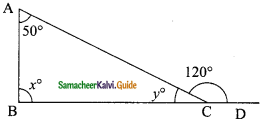
In the figure find x° and y°.
Solution:
∠ACD = ∠A + ∠B
(An exterior angle of a triangle is sum of its interior opposite angles)
120° = 50° + x°
x° = 120° – 50°
= 70°
In the triangle ABC
Samacheer Kalvi 9th Maths Guide Chapter 4 Geometry Additional Questions 9
∠A + ∠B + ∠ACB = 180° (Sum of the angles of a Δ)
50° + x + ∠ACB = 180°
50° + 70° + ∠ACB = 180°
∠ACB = 180° – 120°
y = 60°
(OR)
∠ACD + ∠ACB = 180° (Angles of a linear pair)
∠ACB = 180° – 120°
= 60°
The value of x = 70° and y = 60°.

Samacheer Kalvi 9th Maths Guide Chapter 4 Geometry Additional Questions

Question 2.
The angles of quadrilateral are in the ratio 3 : 5 : 9 : 13. Find all the angles of the quadrilateral.
Solution:
Let the angles of the quadrilateral be 3x, 5x, 9x and 13x.
Sum of all the angles of quadrilateral = 360°.
3x + 5x + 9x + 13x = 360°
30x = 360°
x = \(\frac{360°}{30}\)
= 12°
3x = 3 × 12 = 36°
5x = 5 × 12 = 60°
9x = 9 × 12 = 108°
13x = 13 × 12 = 156°
The required angles of quadrilateral are 36°, 60°, 108° and 156°.

Question 3.
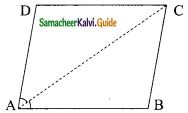
Diagonal AC of a parallelogram ABCD bisects ∠A. Show that
Samacheer Kalvi 9th Maths Guide Chapter 4 Geometry Additional Questions 10
(i) it bisects ∠C also
(ii) ABCD is a rhombus.
Solution:
We have a parallelogram ABCD in which diagonals AC bisect ∠A.
∠DAC = ∠BAC
(i) To prove that AC bisects ∠C
∴ ABCD is a parallelogram
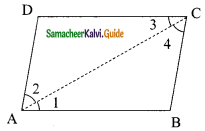
Samacheer Kalvi 9th Maths Guide Chapter 4 Geometry Additional Questions 11
∴ AB || DC and AC is a transversal
∴ ∠1 = ∠3 (Alternate interior angle) …….(1)
Also BC || AD and AC is a transversal
∴ ∠2 = ∠4 (Alternate interior angle) …….(2)
But AC bisects ∠A
∴ ∠1 = ∠2 ……… (3)
From (1), (2) and (3) we get
∠3 = ∠4
∴ AC bisects ∠C.

Samacheer Kalvi 9th Maths Guide Chapter 4 Geometry Additional Questions

(ii) To prove that ABCD is a rhombus.
In ΔABC, we have ∠1 = ∠4 [∴ ∠ 1 = ∠2 = ∠4]
∴ BC = AB (side opposite to equal angles are equal) ……..(4)
Similarly AD = DC …….. (5)
But ABCD is a parallelogram AB = DC (Opposite sides of a parallelogram) ………(6)
From (4), (5) and (6) we have AB = BC = CD = DA.
Thus ABCD is a rhombus.

Question 4.
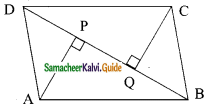
ABCD is a parallelogram and AP and CQ are perpendiculars from vertex A and C on diagonal BD.
Show that
Samacheer Kalvi 9th Maths Guide Chapter 4 Geometry Additional Questions 12
(i) ΔAPB ≅ ΔCQD
(ii) AP = CQ.
Solution:
(i) In ΔAPB and ΔCQD we have
∠APB = ∠CQD (90° each)
AB = CD (opposite sides of parallelogram ABCD)
∠ABP = ∠CDQ (AB || CD and AD is a transversal)
Using ASA congruency we have,
ΔAPB ≅ ΔCQD

(ii) Since ΔAPB ≅ ΔCQD
∴ Their corresponding parts are equal.
∴ AP = CQ.

Samacheer Kalvi 9th Maths Guide Chapter 4 Geometry Additional Questions

Question 5.
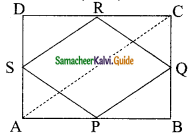
ABCD is a rectangle and P, Q, R and S are the mid-points of the sides AB, BC, CD and DA respectively. Show that the quadrilateral PQRS is a rhombus.
Samacheer Kalvi 9th Maths Guide Chapter 4 Geometry Additional Questions 13
Solution:
In rectangle ABCD, P is the mid-point of AB.
Q is the mid-point of BC. R is the mid-point of CD.
S is the mid-point of DA. AC is the diagonal.
Now in ΔABC,
PQ = \(\frac{1}{2}\) AC and PQ || AC ……. (1)
Similarly in ΔACD,
SR = \(\frac{1}{2}\) AC and SR || AC ……. (2)
From (1) and (2) we get,
PQ = SR and PQ || SR
Similarly by joining BD, we have
PS = QR and PS || QR
i.e. Both pairs of opposite sides of quadrilateral PQRS are equal and parallel.
∴ PQRS is a parallelogram.

Samacheer Kalvi 9th Maths Guide Chapter 4 Geometry Additional Questions

Question 6.
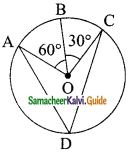
In the figure A, B and C are three points on a circle with centre O such that ∠BOC = 30° and ∠AOB = 60°. If D is a point on the circle other than the arc ABC, find ∠ADC.
Solution:
Samacheer Kalvi 9th Maths Guide Chapter 4 Geometry Additional Questions 14
O is the centre of the circle. ∠AOB = 60° and ∠BOC = 30°
Sum of all the angles of quadrilateral = 360°.
∠AOB + ∠BOC = ∠AOC
∴ ∠AOC = 30° + 60°
= 90°
∠ADC = \(\frac{1}{2}\) × 90°
= 45°

Question 7.
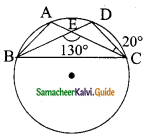
In the given figure A, B, C and D are four points on a circle, AC and BD intersect at a point E such that ∠BEC = 130° and ∠ECD = 20°. Find ∠BAC.
Solution:
In ΔCDE,
Samacheer Kalvi 9th Maths Guide Chapter 4 Geometry Additional Questions 15
Exterior ∠BEC = Sum of interior opposite angle
130° = ∠EDC + ∠ECD
130° = ∠EDC + 20°
130° – 20° = ∠EDC
110° = ∠EDC
∴ ∠BAC = ∠BDC = 110° (Both the triangles are standing on the same base)
∠BAC = 110°

Samacheer Kalvi 9th Maths Guide Chapter 4 Geometry Additional Questions

Question 8.
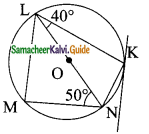
In the given figure KLMN is a cyclic quadrilateral. KD is the tangent at K. If ∠N is a diameter ∠NLK = 40° and ∠LNM = 50°. Find ∠MLN and ∠DKL.
Samacheer Kalvi 9th Maths Guide Chapter 4 Geometry Additional Questions 16
Solution:
LN is a diameter
∠LMN = ∠LKN = 90° (Angle in a semi-circle)
∴ ∠MLN = 90° – 50°
= 40°
∠LNK = 90° – 40°
= 50°
∠DKL = ∠LKN = 50° (angles in the alternate segment)
∴ ∠DKL = 50°
∠MLN = 40° and ∠DKL = 50°

Question 9.
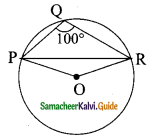
In the given figure ∠PQR = 100°, where P, Q and R are points on a circle with centre ‘O’. Find ∠OPR.
Samacheer Kalvi 9th Maths Guide Chapter 4 Geometry Additional Questions 17
Solution:
∠PQR is the angle subtended by the chord PR in the minor segment.
reflex ∠POR = 2∠PQR
= 2 × 100°
= 200°
Now ∠POR + reflex ∠POR = 360°
∠POR + 200° = 360°
∠POR = 360° – 200°
= 160°
From the given diagram, POR is an isosceles triangle (∴ PO = OR = radii)
∴ ∠OPR = ∠ORP (angles opposite to equal sides)
In ΔOPR,
∠OPR + ∠ORP + ∠POR = 180°
∠OPR + ∠OPR + 160° = 180°
2∠OPR = 180° – 160°
2∠OPR = 20°
∠OPR = \(\frac{20°}{2}\)
= 10°
∴ ∠OPR = 10°

Samacheer Kalvi 9th Maths Guide Chapter 4 Geometry Additional Questions

Question 10.
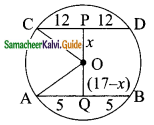
AB and CD are two parallel chords of a circle which are on either sides of the centre such that AB = 10 cm and CD = 24 cm. Find the radius if the distance between AB and CD is 17 cm.
Solution:
Samacheer Kalvi 9th Maths Guide Chapter 4 Geometry Additional Questions 18
Given AB = 10 cm, CD = 24 cm and PQ = 17 cm.
PC = PD = \(\frac{24}{2}\)
= 12 cm
AQ = QB = \(\frac{10}{2}\)
= 5 cm
Let OP be x; OQ = (17 – x)
In the ΔOPC,
OC² = OP² + PC²
= x² + 12²
In the ΔOAQ,
OA² = AQ² + QO²
= 5² + (17 – x)²
= 25 + 289 + x² – 34x
= 314 + x² – 34x
But OA² = OC²
314 + x² – 34x = x² + 144
-34x = 144 – 314
-34x = -170
34x = 170
x = \(\frac{170}{34}\)
= \(\frac{10}{2}\)
= 5
We know,
OC² = x²+ 144
= 5² + 144
= 25 + 144
OC² = 169
But OC = \(\sqrt{169}\)
= 13
Radius of the circle = 13 cm
= x² + 144

Samacheer Kalvi 9th Maths Guide Chapter 4 Geometry Additional Questions

Samacheer Kalvi 9th Maths Guide Chapter 4 Geometry Ex 4.1

Students can download Maths Chapter 4 Geometry Ex 4.1 Questions and Answers, Notes, Samacheer Kalvi 9th Maths Guide Pdf helps you to revise the complete Tamilnadu State Board New Syllabus, helps students complete homework assignments and to score high marks in board exams.

Tamilnadu Samacheer Kalvi 9th Maths Solutions Chapter 4 Geometry Ex 4.1

Question 1.
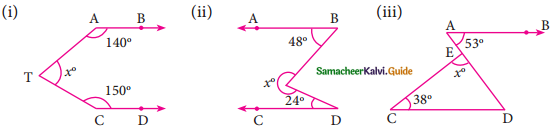
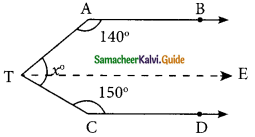
In the figure, AB is parallel to CD, find x.
Samacheer Kalvi 9th Maths Guide Chapter 4 Geometry Ex 4.1 1
Solution:
(i) Through T draw TE || AB.
Samacheer Kalvi 9th Maths Guide Chapter 4 Geometry Ex 4.1 2
∴ ∠BAT + ∠ATE = 180° (AB || TE)
140° + ∠ATE = 180°
∠ATE = 180°- 140° = 40°
Similarly ∠ETC + ∠TCD = 180° (TE || CD)
∠ETC+150° = 180°
∠ETC = 180°- 150° = 30°
x = ∠ATE + ∠ETC
= 40°+ 30° = 70°
x = 70°

Samacheer Kalvi 9th Maths Guide Chapter 4 Geometry Ex 4.1

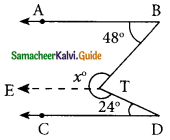
(ii) Draw TE || AB.
Samacheer Kalvi 9th Maths Guide Chapter 4 Geometry Ex 4.1 3
∠ABT + ∠ETB = 180° (AB || TE)
48° + ∠ETB = 180°
∠ETB = 180° – 48° = 132°
Similarly ∠CDT + ∠DTE = 180°
24° + ∠DTE = 180°
∴ ∠DTE = 180° – 24°
= 156°
∴ ∠BTE + ∠ETD = 132° + 156°
= 288°
x = 288°

Samacheer Kalvi 9th Maths Guide Chapter 4 Geometry Ex 4.1

(iii) In the given figure AB || CD, AD is the transversal.
∠CDA = ∠BAD
= 53° (alternate angles are equal)
In ΔECD, ∠D = ∠A = 53° (Alternate angles are equal)
∠E + ∠C + ∠D = 180° (sum of the angles of a triangle)
x° + 38° + 53° = 180°
x° = 180°- 91°
= 89°
x = 89°

Question 2.
The angles of a triangle are in the ratio 1 : 2 : 3, find the measure of each angle of the triangle.
Solution:
The ratio of the angles of a triangle = 1 : 2 : 3.
Let the angles of a triangle be x, 2x and 3x.
x + 2x + 3x = 180° (Total angle of a triangle is 180°)
6x = 180°
x = \(\frac{180°}{6}\)
= 30°
x = 30°; 2x = 2 × 30° = 60°; 3x = 3 × 30° = 90°
Measures of the angles of a triangle = 30°, 60° and 90°.

Samacheer Kalvi 9th Maths Guide Chapter 4 Geometry Ex 4.1

Question 3.
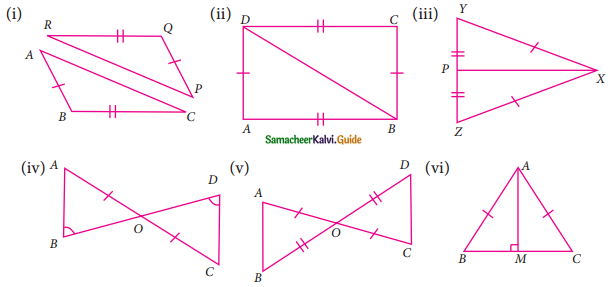
Consider the given pairs of triangles and say whether each pair is that of congruent triangles. If the triangles are congruent, say ‘how’; if they are not congruent say ‘why’ and also say if a small modification would make them congruent:
Samacheer Kalvi 9th Maths Guide Chapter 4 Geometry Ex 4.1 4
(i) In ΔPQR and ΔABC
PQ = AB (Given)
RQ = BC (Given)
ΔABC is not congruent to ΔPQR.
If PR = AC then ΔABC ≅ ΔPQR

(ii) In ΔABD and ΔCDB
AB = CD (Given)
AD = BC (Given)
BD is common
By SSS congruency
ΔABD ≅ ΔCDB

Samacheer Kalvi 9th Maths Guide Chapter 4 Geometry Ex 4.1

(iii) In ΔPXY and ΔPXZ
PX is common.
XY = XZ (Given)
PY = PZ (Given)
By SSS congruency
ΔPXY ≅ ΔPXZ

(iv) In the given figure BD bisect AC
In ΔAOB and ΔOCD
OA = OC (Given)
∠AOB = ∠DOC (vertically opposite angles)
∠B = ∠D (Given)
By ASA congruency ΔAOB ≅ ΔOCD

(v) In the given figure AC and BD bisect each other at O.
∴ OA = OC (Given); OB = OD (Given)
∠AOB = ∠COD (vertically opposite angles)
By SAS congruency
ΔAOB ≅ ΔOCD

Samacheer Kalvi 9th Maths Guide Chapter 4 Geometry Ex 4.1

(vi) In the given figure
AB = AC (Given)
BM = MC (AM is the median of the ΔABC)
AM is common (By SSS congruency)
∴ ΔABM ≅ ΔACM

Question 4.
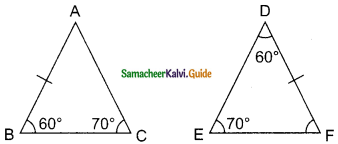
ΔABC and ΔDEF are two triangles in which AB = DF, ∠ACB = 70°, ∠ABC = 60°; ∠DEF = 70° and ∠EDF = 60°. Prove that the triangles are congruent.
Solution:
Samacheer Kalvi 9th Maths Guide Chapter 4 Geometry Ex 4.1 5
In ΔABC ∠B = 60° and ∠C = 70°
∴ ∠A = 180° – (60° + 70°)
= 180° – 130°
= 50°
In ΔDEF ∠E = 70° and ∠D = 60°
∠F = 180° – (70° + 60°)
= 180° – 130°
= 50°
∠A = ∠F = 50°
∠B = ∠D = 60°
∠C = ∠E = 70°
By AAA congruency
ΔABC ≅ ΔFDE
(or)
∠B = ∠D = 60°
∠C = ∠E = 70°
AB = FE
By ASA congruency
ΔABC ≅ ΔFDE

Samacheer Kalvi 9th Maths Guide Chapter 4 Geometry Ex 4.1

Question 5.
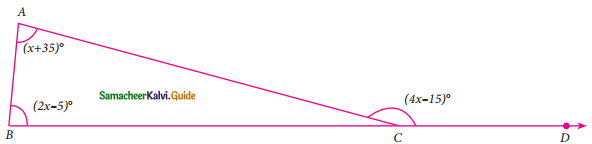
Find all the three angles of the ΔABC.
Samacheer Kalvi 9th Maths Guide Chapter 4 Geometry Ex 4.1 6
Solution:
∠A + ∠B = ∠ACD (An exterior angle of a triangle is sum of its interior opposite angles)
x + 35 + 2x – 5 = 4x – 15
3x + 30 = 4x – 15
30 + 15 = 4x – 3x
45° = x
∠A = x + 35°
= 45° + 35°
= 80°
∠B = 2x – 5
= 2(45°) – 5°
= 90° – 5°
= 85°
∠ACD = 4x – 15
= 4 (45°) – 15°
= 180° – 15°
= 165°
∠ACB = 180° – ∠ACD
= 180° – 165°
= 15°
∠A = 80°, ∠B = 85° and ∠C = 15°.

Samacheer Kalvi 9th Maths Guide Chapter 4 Geometry Ex 4.1

Samacheer Kalvi 9th Maths Guide Chapter 5 Coordinate Geometry Ex 5.3

Students can download Maths Chapter 5 Coordinate Geometry Ex 5.3 Questions and Answers, Notes, Samacheer Kalvi 9th Maths Guide Pdf helps you to revise the complete Tamilnadu State Board New Syllabus, helps students complete homework assignments and to score high marks in board exams.

Tamilnadu Samacheer Kalvi 9th Maths Solutions Chapter 5 Coordinate Geometry Ex 5.3

Question 1.
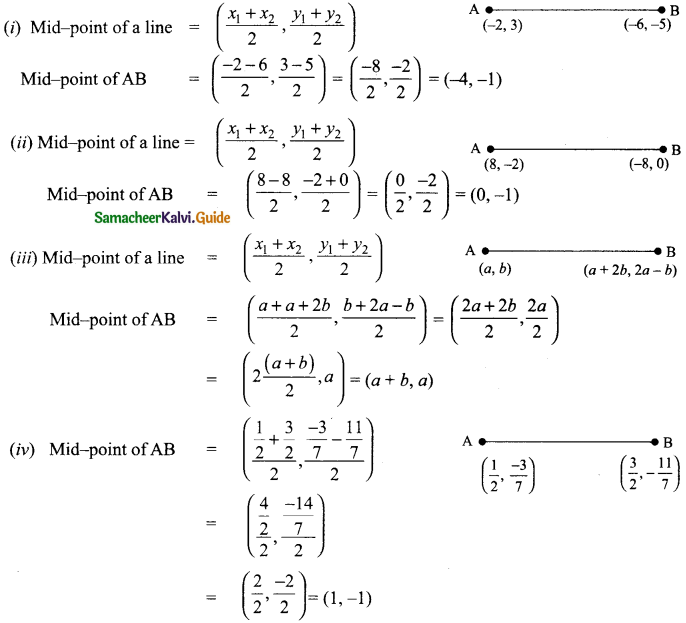
Find the mid-points of the line segment joining the points.
(i) (-2, 3) and (-6, -5)
(ii) (8, -2) and (-8, 0)
(iii) (a, b) and (a + 2b, 2a – b)
(iv) (\(\frac{1}{2},\frac{-3}{7}\)) and (\(\frac{3}{2},\frac{-11}{7}\))
Solution:
Samacheer Kalvi 9th Maths Guide Chapter 5 Coordinate Geometry Ex 5.3 1

Samacheer Kalvi 9th Maths Guide Chapter 5 Coordinate Geometry Ex 5.3

Question 2.
The centre of a circle is (-4, 2). If one end of the diameter of the circle is (-3, 7) then find the other end.
Solution:
Let the other end of the diameter B be (a, b)
Samacheer Kalvi 9th Maths Guide Chapter 5 Coordinate Geometry Ex 5.3 2
∴ \(\frac{-3+a}{2}\) = -4
-3 + a = -8
a = -8 + 3
a = -5
\(\frac{7+b}{2}\)
7 + b = 4
b = 4 – 7 ⇒ b = -3
The other end of the diameter is (-5, -3).

Samacheer Kalvi 9th Maths Guide Chapter 5 Coordinate Geometry Ex 5.3

Question 3.
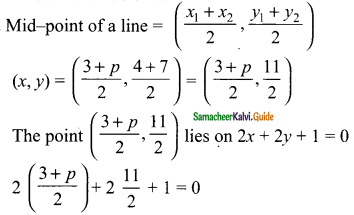
If the mid-point (x, y) of the line joining (3, 4) and (p, 7) lies on 2x + 2y + 1 = 0, then what will be the value of p?
Solution:
Samacheer Kalvi 9th Maths Guide Chapter 5 Coordinate Geometry Ex 5.3 3
3 + p + 11 + 1 = 0 ⇒ p + 15 = 0 ⇒ p = -15
The value of p is -15.

Samacheer Kalvi 9th Maths Guide Chapter 5 Coordinate Geometry Ex 5.3

Question 4.
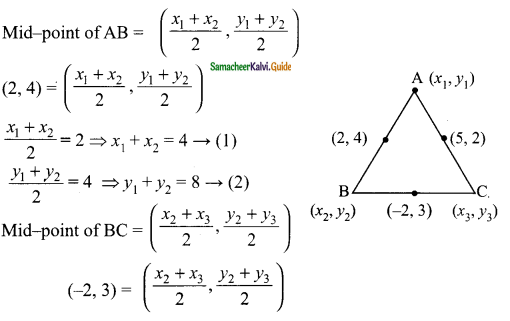
The mid-point of the sides of a triangle are (2, 4), (-2, 3) and (5, 2). Find the coordinates of the vertices of the triangle.
Solution:
Let the vertices of the ΔABC be A (x1 y1), B (x2, y2) and C (x3, y3)
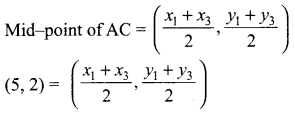
Samacheer Kalvi 9th Maths Guide Chapter 5 Coordinate Geometry Ex 5.3 4
\(\frac{x_{2}+x_{3}}{2}\) = -2 ⇒ x2 + x3 = -4 → (3)
\(\frac{y_{2}+y_{3}}{2}\) = 3 ⇒ y2 + y3 = 6 → (4)
Samacheer Kalvi 9th Maths Guide Chapter 5 Coordinate Geometry Ex 5.3 5
\(\frac{x_{1}+x_{3}}{2}\) = 5 ⇒ x1 + x3 = 10 → (5)
\(\frac{y_{1}+y_{3}}{2}\) = 2 ⇒ y1 + y3 = 4 → (6)
By adding (1) + (3) + (5) we get
2x1 + 2x2 + 2x3 = 4 – 4 + 10
2(x1 + x2 + x3) = 10 ⇒ x1 + x2 + x3 = 5
From (1) x1 + x2 = 4 ⇒ 4 + x3 = 5
x3 = 5 – 4 = 1
∴ The vertices of the ΔABC are
A (9, 3)
B (-5, 5), C (1, 1)
From (3) x2 + x3 = -4 ⇒ x1 + (-4) = 5
x1 = 5 + 4 = 9
From (5) ⇒ x1 + x3 = 8
x2 + 10 = 5
x2 = 5 – 10 = -5
∴ x1 = 9, x2 = -5, x3 = 1
By adding (2) + (4) + (6) we get
2y3 + 2y2 + 2y3 = 8 + 6 + 4
2(y1 +y2 + y3) = 18 ⇒ y1 + y2 + y3 = 9
From (2) ⇒ y1 + y2 = 8
8 + y3 = 9 ⇒ y3 = 9 – 8 = 1
From (4)
y2 + y3 = 6 ⇒ y1 + 6 = 9
y1 = 9 – 6 = 3
From (6)
y1 + y3 = 4 ⇒ y2 + 4 = 9
y2 = 9 – 4 = 5
∴ y1 = 3, y2 = 5, y3 = 1

Samacheer Kalvi 9th Maths Guide Chapter 5 Coordinate Geometry Ex 5.3

Question 5.
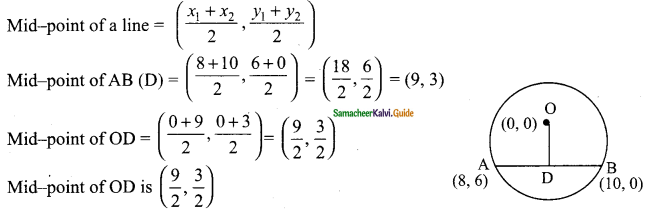
O (0, 0) is the centre of a circle whose one chord is AB, where the points A and B (8, 6) and (10, 0) respectively. OD is the perpendicular from the centre to the chord AB. Find the coordinates of the mid-point of OD.
Solution:
Note: Since OD is perpendicular to AB, OD bisect the chord
D is the mid-point of AB
Samacheer Kalvi 9th Maths Guide Chapter 5 Coordinate Geometry Ex 5.3 6

Question 6.
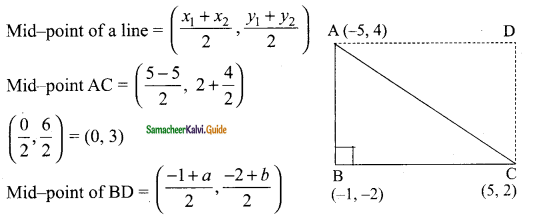
The points A(-5, 4) , B(-1, -2) and C(5, 2) are the vertices of an isosceles right-angled triangle where the right angle is at B. Find the coordinates of D so that ABCD is a square.
Solution:
Since ABCD is a square
Mid-point of AC = mid-point of BD
Let the point D be (a, b)
Samacheer Kalvi 9th Maths Guide Chapter 5 Coordinate Geometry Ex 5.3 7
But mid-point of BD = Mid-point of AC
(\(\frac{-1+a}{2}, \frac{-2+b}{2}\)) = (0, 3)
\(\frac{-1+a}{2}\) = 0
-1 + a = 0
a = 1
(\(\frac{-2+b}{2}\))
-2 + b = 6
b = 6 + 2 = 8
∴ The vertices D is (1, 8).

Samacheer Kalvi 9th Maths Guide Chapter 5 Coordinate Geometry Ex 5.3

Question 7.
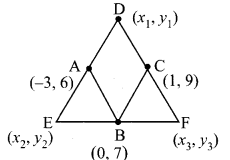
The points A (-3, 6), B (0, 7) and C (1, 9) are the mid points of the sides DE, EF and FD of a triangle DEF. Show that the quadrilateral ABCD is a parallellogram.
Solution:
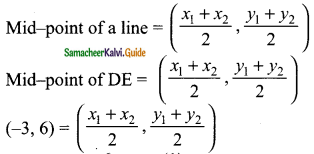
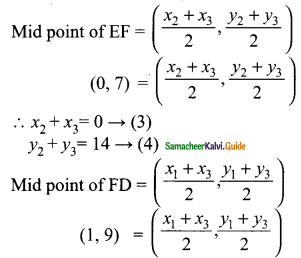
Let D be (x1 y1), E (x2, y2) and F (x3, y3)
Samacheer Kalvi 9th Maths Guide Chapter 5 Coordinate Geometry Ex 5.3 8
Samacheer Kalvi 9th Maths Guide Chapter 5 Coordinate Geometry Ex 5.3 9
x1 + x2 = -6 → (1)
y1 + y2 = 12 → (2)
Samacheer Kalvi 9th Maths Guide Chapter 5 Coordinate Geometry Ex 5.3 10
x1 + x3 = 2 → (5)
y1 + y3 = 18 → (6)
Add (1) + (3) + (5)
2x1 + 2x2 + 2x3 = -6 + 0 + 2
2 (x1 + x2 + x3) = -4
x1 + x2 + x3 = -2
From (1) x1 + x2 = -6
x3 = -2 + 6 = 4
From (3) x2 + x3 = 0
x1 = -2 + 0
x1 = -2
From (5) x1 + x3 = 2
x2 + 2 = -2
x2 = -2 -2 = -4
∴ x1 = -2, x2 = -4, x3= 4
Add (2) + (4) + 6
2y1 + 2y2 + 2y3 = 12 + 14 + 18
2(y1 + y2 + y3) = 44
y1 + y2+ y3 = 44/2 = 22
From (2) y1 + y2 = 12
12 + y3 = 22 ⇒ y3 = 22 – 12 = 11
From (4) y2 + y3 = 14
y1 + 14 = 22 ⇒ y1 = 22 – 14
y1 = 8
From (6)
y1 +y3 = 18
y2 + 18 = 22 ⇒ = 22 – 18
= 4
∴ y1 = 8, y2 = 4, y3 = 11
The vertices D is (-2, 8)
Samacheer Kalvi 9th Maths Guide Chapter 5 Coordinate Geometry Ex 5.3 11
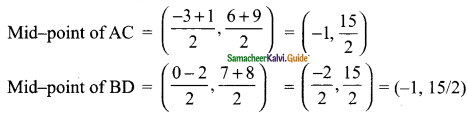
Mid-point of diagonal AC = Mid-point of diagonal BD
The quadrilateral ABCD is a parallelogram

Samacheer Kalvi 9th Maths Guide Chapter 5 Coordinate Geometry Ex 5.3

Question 8.
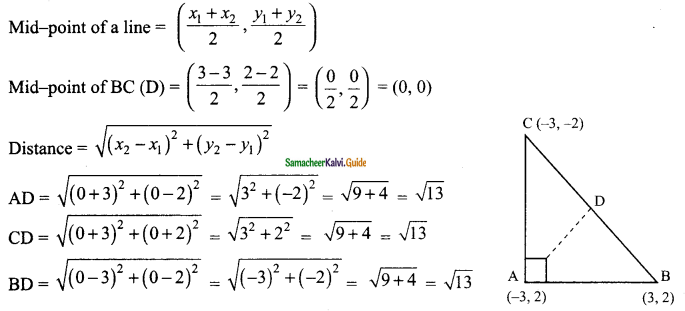
A(-3, 2) , B(3, 2) and C(-3, -2) are the vertices of the right triangle, right angled at A. Show that the mid point of the hypotenuse is equidistant from the vertices.
Solution:
Samacheer Kalvi 9th Maths Guide Chapter 5 Coordinate Geometry Ex 5.3 12
AD = CD = BD = \(\sqrt{13}\)
Mid-point of BC is equidistance from the centre.

Samacheer Kalvi 9th Maths Guide Chapter 5 Coordinate Geometry Ex 5.3

Samacheer Kalvi 9th Maths Guide Chapter 3 Algebra Additional Questions

Students can download Maths Chapter 3 Algebra Additional Questions and Answers, Notes, Samacheer Kalvi 9th Maths Guide Pdf helps you to revise the complete Tamilnadu State Board New Syllabus, helps students complete homework assignments and to score high marks in board exams.

Tamilnadu Samacheer Kalvi 9th Maths Solutions Chapter 3 Algebra Additional Questions

I. Multiple choice questions

Question 1.
Which of the following is a monomial?
(a) 4x²
(b) a + b
(c) a + b + c
(d) a + b + c + d
Solution:
(a) 4x²

Question 2.
Which of the following is trinomial?
(a) -7z
(b) z² – 4y²
(c) x²y – xy² + y
(d) 12a – 9ab + 5b – 3
Solution:
(c) x²y – xy² + y

Samacheer Kalvi 9th Maths Guide Chapter 3 Algebra Additional Questions

Question 3.
The sum of 5x²; -7x²; 8x²; 11x² and -9x² is ………
(a) 2x²
(b) 4x²
(c) 6x²
(d) 8x²
Solution:
(d) 8x²

Question 4.
The area of a rectangle with length 2l²m and breadth 3lm² is ………
(a) 6l³m³
(b) l³m³
(c) 2l³m³
(d) 4l³m³
Solution:
(a) 6l³m³

Question 5.
The coefficient of x² and x in 2x³ – 5x² + 6x – 3 are respectively ………
(a) 2, -5
(b) 2, 6
(c) – 5, 6
(d) -5, -3
Solution:
(c) – 5, 6

Samacheer Kalvi 9th Maths Guide Chapter 3 Algebra Additional Questions

Question 6.
In the system 6x -2y = 3; kx – y = 2 has a unique solution then ………
(a) k = 3
(b) k ≠ 3
(c) k = 4
(d) k ≠ 4
Solution:
(b) k ≠ 3

Question 7.
A system of two linear equation in two variables is inconsistent. If their graphs ………
(a) coincide
(b) intersect only at a point
(c) do not intersect at any point
(d) cut the x-axis
Solution:
(c) do not intersect at any point

Question 8.
The system of equation x – 4y = 8; 3x – 12y = 24 ……….
(a) has infinitely many solution
(b) has no solution
(c) has a unique solution
(d) may or may not have a solution
Solution:
(a) has infinitely many solution

Samacheer Kalvi 9th Maths Guide Chapter 3 Algebra Additional Questions

Question 9.
The solution set of x – ay = 4 and x + y = 0 is (1, -1) the value of a is ………
(a) -1
(b) 1
(c) -3
(d) 3
Solution:
(d) 3

Question 10.
The solution set of x + y = 7; x – y = 3 is ………
(a) (-5, -2)
(b) (-5, 2)
(c) (5, 2)
(d) (2, 5)
Solution:
(c) (5, 2)

Samacheer Kalvi 9th Maths Guide Chapter 3 Algebra Additional Questions

II. Answer following Questions

Question 1.
What must be added to x4 – 3x2 + 2x + 6 to get x4 – 2x3 – x + 8?
Solution:
Let A be the required number to be added.
(x4 – 3x2 + 2x + 6) + A = x4 – 2x3 – x + 8
A = x4 – 2x3 – x + 8 – (x4 – 3x2 + 2x + 6)
= x4 – 2x3 – x + 8 – x4 + 3x2 – 2x – 6
= -2x3 + 3x2 – 3x + 2
Hence -2x3 + 3x2 – 3x + 2 must be added.

Question 2.
What must be subtracted to y4 + 2y3 – 3y + 8 to get y4 – 2y3 + 6?
Solution:
Let A be the required number to be subtracted.
(y4 + 2y3 – 3y2 + 8) – A = y4 – 2y3 + 6
y4 + 2y3 – 3y2 + 8 – (y4 – 2y3 + 6) = A
y4 + 2y3 – 3y2 + 8 – y4 + 2y3 – 6 = A
4y3 – 3y2 + 2 = A
Hence 4y3 – 3y2 + 2 must be subtracted.

Samacheer Kalvi 9th Maths Guide Chapter 3 Algebra Additional Questions

Question 3.
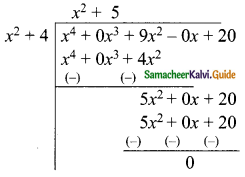
The area of a rectangle is x4 + 9x2 + 20 sq.units and its length is x2 + 4 units. Find its breadth in term of x.
Solution:
Let the breadth of a rectangle be “b”
Length of the rectangle = x2 + 4
Area of the rectangle = x4 + 9x2 + 20
Length × Breadth = x4 + 9x2 + 20
(x2 + 4) × b = x4 + 9x2 + 20
b = \(\frac{x^{4}+9x^{2}+20}{x^{2}+4}\)
= x2 + 5
breadth of a rectangle = x2 + 5
Samacheer Kalvi 9th Maths Guide Chapter 3 Algebra Additional Questions 1

Question 4.
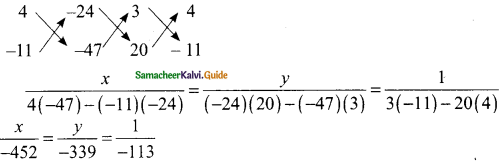
Solve 3x + 4y = 24; 20x – 11y = 47 using cross multiplication method.
Solution:
3x + 4y – 24 = 0 → (1)
20x – 11y – 47 = 0 → (2)
Samacheer Kalvi 9th Maths Guide Chapter 3 Algebra Additional Questions 2
\(\frac{x}{-452}\) = \(\frac{1}{-113}\)
-113 = -452
x = \(\frac{452}{113}\)
= 4
But \(\frac{y}{-339}\) = \(\frac{1}{-113}\)
-113y = -339
y = \(\frac{339}{113}\)
= 3
∴ The solution set is (4, 3)

Samacheer Kalvi 9th Maths Guide Chapter 3 Algebra Additional Questions

Question 5.
A fraction such that if the numerator is multiplied by 3 and the denominator is reduced by 3, we get \(\frac{18}{11}\), but if the numerator is increased by 8 and the denominator is doubled, we get \(\frac{2}{5}\). Find the fraction.
Solution:
Let the numerator be x and the denominator be y
∴ The fraction is \(\frac{x}{y}\)
According to the given condition
\(\frac{3x}{y-3}\) = \(\frac{18}{11}\)
33x = 18(y – 3)
33x = 18y – 54
33x – 18y – 54 = 0
11x – 6y – 18 = 0 ……. (1)
According to the second condition
\(\frac{x+8}{2y}\) = \(\frac{2}{5}\)
5x + 40 = 4y
5x – 4y + 40 = 0 ……..(2)
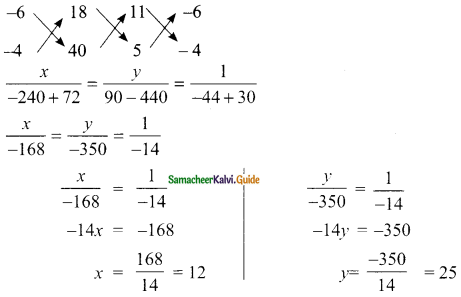
Samacheer Kalvi 9th Maths Guide Chapter 3 Algebra Additional Questions 3
∴ The fraction is = \(\frac{12}{25}\)

Samacheer Kalvi 9th Maths Guide Chapter 3 Algebra Additional Questions

Question 6.
One number is greater than the thrice the other number by 2. If 4 times the smaller number exceeds the greater by 5, find the number.
Solution:
Let the greater number be x and the smaller number be “y” By the given first condition
x = 3y + 2
x – 3y = 2 ……(1)
Again by the given second condition
4y = x + 5
-x + 4y = 5 …….(2)
Add (1), (2) ⇒ y = 7
Substitute the value of y = 7 in (1)
x – 3(7) = 2
x = 2 + 21
= 23
The greater number is 23 and the smaller number is 7.

Samacheer Kalvi 9th Maths Guide Chapter 3 Algebra Additional Questions

Question 7.
The cost of 11 pencils and 3 erasers is Rs 50 and the cost of 8 pencils and 3 erasers is Rs 38. Find the cost of 5 pencils and 5 erasers.
Solution:
Let the cost of a pencil be Rs x and the cost of an eraser be Rs y. According to the first condition.
11x + 3y = 50 …….(1)
According to the second condition
8x + 3y = 38 ……..(2)
(1) – (2) ⇒ 3x = 12
x = \(\frac{12}{3}\)
= 4
Substitute the value of x = 4 in (1)
11 (4) + 3y = 50
3y = 50 – 44
3y = 6
y = \(\frac{6}{3}\)
= 2
Cost of 5 pencils + 5 erasers = 5(4) + 5(2)
= 20 + 10
= 30
The required cost is Rs 30