Samacheer Kalvi 9th Maths Guide Chapter 1 Set Language Ex 1.7

Students can download Maths Chapter 1 Set Language Ex 1.7 Questions and Answers, Notes, Samacheer Kalvi 9th Maths Guide Pdf helps you to revise the complete Tamilnadu State Board New Syllabus, helps students complete homework assignments and to score high marks in board exams.

Tamilnadu Samacheer Kalvi 9th Maths Solutions Chapter 1 Set Language Ex 1.7

I. Multiple Choice Questions.

Question 1.
Which of the following is correct?
(a) {7} ∈ {1, 2, 3, 4, 5, 6, 7, 8, 9, 10}
(b) 1 ∈ {1, 2, 3, 4, 5, 6, 7, 8, 9, 10}
(c) 7 ∉ {1, 2, 3, 4, 5, 6, 7, 8, 9, 10}
(d) {7} {1, 2, 3, 4, 5, 6, 7, 8, 9, 10}
Solution:
(b) 1 ∈ {1, 2, 3, 4, 5, 6, 7, 8, 9, 10}

Question 2.
The set P = {x | x ∈ Z, -1 < x < 1} is a ……….
(a) Singleton set
(b) Power set
(c) Null set
(d) Subset
Solution:
(a) Singleton set
Hint: P = {0}

Samacheer Kalvi 9th Maths Guide Chapter 1 Set Language Ex 1.7

Question 3.
If U = {x | x ∈ N, x < 10} and A = {x | x ∈ N, 2 ≤ x < 6} then (A’)’ is………..
{a) {1, 6, 7, 8, 9}
(b) {1, 2, 3, 4}
(c) {2, 3, 4, 5}
(d) { }
Solution:
(c) {2, 3, 4, 5}
Hint:
U = {1, 2, 3, 4, 5, 6, 7, 8, 9}
A= {2, 3, 4, 5}; A’ = {1, 6, 7, 8, 9}
(A’)’ = U – A
(A’)’ = {2, 3, 4, 5}

Question 4.
If B⊆A then n(A∩B) is………..
(a) n(A – B)
(b) n(B)
(c) n(B – A)
(d) n(A)
Solution:
(b) n(B)

Samacheer Kalvi 9th Maths Guide Chapter 1 Set Language Ex 1.7

Question 5.
If A = {x, y, z} then the number of non- empty subsets of A is…………..
(a) 8
(b) 5
(c) 6
(d) 7
Solution:
(d) 7
Hint:
n(A) = 3; P(A) = 2m = 23 = 8
Non-empty subsets of A = 8 – 1 = 7

Question 6.
Which of the following is correct?
(a) Ø ⊆ {a, b}
(b) Ø ∈ {a, b}
(c) {a} ∈ {a, b}
(d) a ⊆ {a, b}
Solution:
(a) Ø ⊆ {a, b}
Hint:
‘Q’ is a subset of every set.

Samacheer Kalvi 9th Maths Guide Chapter 1 Set Language Ex 1.7

Question 7.
If A∪B = A∩B then ……………
(a) A ≠ B
(b) A = B
(c) A ⊂ B
(d) B ⊂ A
Solution:
(b) A = B

Question 8.
If B – A is B, then A∩B is………….
(a) A
(b) B
(c) U
(d) Ø
Solution:
(d) Ø

Samacheer Kalvi 9th Maths Guide Chapter 1 Set Language Ex 1.7

Question 9.
From the adjacent diagram n[P(AΔB)] is………….
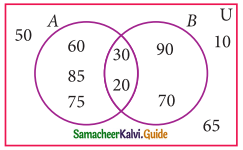
Samacheer Kalvi 9th Maths Guide Chapter 1 Set Language Ex 1.7 1
(a) 8
(b) 16
(c) 32
(d) 64
Solution:
(c) 32
Hint:
A – B = {60, 85, 75}
B – A = {90, 70}
AΔB = (A – B) ∪ (B – A)
= {60, 70, 75, 85, 90}
n[P(AΔB)] = 25 = 32

Question 10.
If n(A) = 10 and n(B) = 15 then the minimum and maximum number of elements in A∩B is …………
(a) (10, 15)
(b) (15, 10)
(c) (10, 0)
(d) (0, 10)
Solution:
(d) (0, 10)

Samacheer Kalvi 9th Maths Guide Chapter 1 Set Language Ex 1.7

Question 11.
Let A = {Ø} and B = P(A) then A∩B is………..
(a) {Ø, {Ø}}
(b) {Ø}
(c) Ø
{d) {0}
Solution:
(b) {Ø}
Hint:
A = {Ø}, B = {{ }, {Ø}}
A∩B = {Ø}

Question 12.
In a class of 50 boys, 35 boys play carrom and 20 boys play chess then the number of boys play both games is……..
(a) 5
(b) 30
(c) 15
(d) 10
Solution:
(a) 5
Hint:
n(A∪B) = 50, n(A) = 35, n(B) = 20
n(A∩B) = n(A) + n(B) – n(A∪B)
= 35 + 20 – 50 = 5

Question 13.
If U = {x : x ∈ N and x < 10}, A = {1, 2, 3, 5, 8} and B = (2, 5, 6, 7, 9}, then n [(A∪B)’] is
(a) 1
(b) 2
(c) 4
(d) 8
Solution:
(a) 1
Hint:
U = {1, 2, 3, 4, 5, 6, 7, 8, 9}
A∪B ={1, 2, 3, 5, 8} ∪ {2, 5, 6, 7, 9}
= {1, 2, 3, 5, 6, 7, 8, 9}
(A∪B)’ = {1, 2, 3, 4, 5, 6, 7, 8, 9} – {1, 2, 3, 5, 6, 7, 8, 9}
= {4}
n(A∪B)’ = 1

Samacheer Kalvi 9th Maths Guide Chapter 1 Set Language Ex 1.7

Question 14.
For any three sets P, Q and R, P – (Q∩R) is ………
(a) P – (Q∪R)
(i)(P∩Q) – R
(c) (P – Q) ∪ (P – R)
(d) (P – Q) ∩ (P – R)
Solution:
(c)(P – Q) ∪ (P – R)

Question 15.
Which of the following is true?
(a) A – B = A∩B
(b) A – B = B – A
(c) (A∪B)’ = A’∪B’
(d) (A∩B)’ = A’∪B’
Solution:
(d) (A∩B)’ = A’∪B’

Samacheer Kalvi 9th Maths Guide Chapter 1 Set Language Ex 1.7

Question 16.
If n(A∪B∪C) = 100, n(A) = 4x, n(B) = 6x, n(C) = 5x, n(A∩B) = 20, n(B∩C) = 15 and n(A∩C) = 25, then n(A∩B∩C) = 10, then the value of x is……….
(a) 10
(b) 15
(c) 25
(d) 30
Solution:
(b) 15
Hint:
n(A∪B∪C) = n( A) + n(B) + n(C) – n(A∩B) – n(B∩C) – n(A∩C) + n(A∩B∩C)
100 = 4x + 6x + 5x – 20 – 15 – 25 + 10
100 = 15x – 50 ⇒ 150 = 15x ⇒ x = \(\frac{150}{15}\) = 10

Question 17.
For any three sets A, B and C, (A – B) ∩ (B – C) is equal to
(a) A only
(b) B only
(c) C only
(d) \(\phi \)
Solution:
(d) \(\phi \)
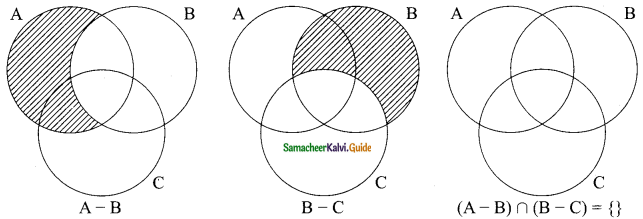
Samacheer Kalvi 9th Maths Guide Chapter 1 Set Language Ex 1.7 2

Samacheer Kalvi 9th Maths Guide Chapter 1 Set Language Ex 1.7

Question 18.
If J = Set of three sided shapes, K = Set of shapes with two equal sides and L = Set of shapes with right angle, then J∩K∩L is………
(a) Set of isosceles triangles
(b) Set of equilateral triangles
(c) Set of isosceles right triangles
(d) Set of right angled triangles
Solution:
(c) Set of isosceles right triangles
J = Set of three sided shapes; It is a triangle
K = Set of shapes with two equal sides (Isosceles triangle)
L = Set of shapes with right angle (One angle is right angle)
∴ J∩K∩L = Set of isosceles right triangles

Question 19.
The shaded region in the Venn diagram is
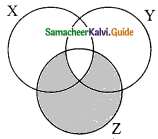
Samacheer Kalvi 9th Maths Guide Chapter 1 Set Language Ex 1.7 3
(a) Z – (X∪Y)
(b) (X∪Y) ∩ Z
(c) Z – (X∩Y)
(d) Z ∪ (X∩Y)
Solution:
(c) Z – (X∩Y)

Samacheer Kalvi 9th Maths Guide Chapter 1 Set Language Ex 1.7

Question 20.
In a city, 40% people like only one fruit, 35% people like only two fruits, 20% people like all the three fruits. How many percentage of people do not like any one of the above three fruits?
(a) 5
(b) 8
(c) 10
(d) 15
Solution:
(a) 5

Samacheer Kalvi 9th Maths Guide Chapter 2 Real Numbers Ex 2.1

Students can download Maths Chapter 2 Real Numbers Ex 2.1 Questions and Answers, Notes, Samacheer Kalvi 9th Maths Guide Pdf helps you to revise the complete Tamilnadu State Board New Syllabus, helps students complete homework assignments and to score high marks in board exams.

Tamilnadu Samacheer Kalvi 9th Maths Solutions Chapter 2 Real Numbers Ex 2.1

Question 1.
Which arrow best shows the position of \(\frac{11}{3}\) on the number line?
Samacheer Kalvi 9th Maths Guide Chapter 2 Real Numbers Ex 2.1 1
Solution:
D represent \(\frac{11}{3}\) on the number line.

Samacheer Kalvi 9th Maths Guide Chapter 2 Real Numbers Ex 2.1

Question 2.
Find any three rational numbers between \(\frac{-7}{11}\) and \(\frac{2}{11}\)
Solution:
Three rational numbers between \(\frac{-7}{11}\) and \(\frac{2}{11}\)
\(\frac{-6}{11}\), \(\frac{-5}{11}\), \(\frac{-4}{11}\), ……… \(\frac{1}{11}\)

Samacheer Kalvi 9th Maths Guide Chapter 2 Real Numbers Ex 2.1

Question 3.
Find any five rational numbers between
(i) \(\frac{1}{4}\) and \(\frac{1}{5}\)
Solution:
Converting the given rational numbers with the same denominators.
\(\frac{1}{4}\) = \(\frac{1×30}{4×30}\) = \(\frac{30}{120}\)
\(\frac{1}{5}\) = \(\frac{1×24}{5×24}\) = \(\frac{24}{120}\)
Five rational numbers between \(\frac{30}{120}\) and \(\frac{24}{120}\) are \(\frac{25}{120}\), \(\frac{26}{120}\), \(\frac{27}{120}\), \(\frac{28}{120}\) and \(\frac{29}{120}\)
Five rational numbers between \(\frac{1}{4}\) and \(\frac{1}{5}\) are \(\frac{25}{120}\), \(\frac{26}{120}\), \(\frac{27}{120}\), \(\frac{28}{120}\) and \(\frac{29}{120}\)
Other Method:
A rational numbers between \(\frac{1}{4}\) and \(\frac{1}{5}\) = \(\frac{1}{2}\)(\(\frac{1}{4}\)+\(\frac{1}{5}\)) = \(\frac{1}{2}\)(\(\frac{5+4}{20}\)) = \(\frac{1}{2}\) × \(\frac{9}{20}\) = \(\frac{9}{40}\)
A rational numbers between \(\frac{1}{4}\) and \(\frac{9}{40}\) = \(\frac{1}{2}\)(\(\frac{1}{4}\)+\(\frac{9}{40}\)) = \(\frac{1}{2}\)(\(\frac{10+9}{40}\)) = \(\frac{19}{80}\)
A rational numbers between \(\frac{1}{4}\) and \(\frac{19}{80}\) = \(\frac{1}{2}\)(\(\frac{1}{4}\)+\(\frac{19}{20}\)) = \(\frac{1}{2}\)(\(\frac{20+19}{80}\)) = \(\frac{39}{160}\)
A rational numbers between \(\frac{1}{4}\) and \(\frac{39}{160}\) = \(\frac{1}{2}\)(\(\frac{1}{4}\)+\(\frac{39}{160}\)) = \(\frac{1}{2}\)(\(\frac{40+39}{160}\)) = \(\frac{79}{320}\)
A rational numbers between \(\frac{1}{4}\) and \(\frac{79}{320}\) = \(\frac{1}{2}\)(\(\frac{1}{4}\)+\(\frac{79}{320}\)) = \(\frac{1}{2}\)(\(\frac{80+79}{320}\)) = \(\frac{159}{640}\)
∴ Five rational numbers are between \(\frac{9}{40}\), \(\frac{19}{80}\), \(\frac{39}{160}\), \(\frac{79}{320}\) and \(\frac{159}{640}\)

Samacheer Kalvi 9th Maths Guide Chapter 2 Real Numbers Ex 2.1

(ii) 0.1 and 0.11
Solution:
\(\frac{1×100}{10×100}\) = \(\frac{100}{1000}\)
\(\frac{11×10}{100×10}\) = \(\frac{110}{1000}\)
The five rational numbers are \(\frac{101}{1000}\), \(\frac{102}{1000}\), \(\frac{103}{1000}\), \(\frac{104}{1000}\), \(\frac{105}{1000}\), …….. (or)
The five rational numbers are 0.101, 0.102, 0.103, 0.104 and 0.105.

Samacheer Kalvi 9th Maths Guide Chapter 2 Real Numbers Ex 2.1

(iii) -1 and -2
Solution:
Converting to rational numbers, – 1 = \(-\frac{10}{11}\) and – 2 = \(-\frac{20}{10}\)
So five rational numbers between -2 and -1 are \(-\frac{11}{10}\), \(-\frac{12}{10}\), \(-\frac{13}{10}\), \(-\frac{14}{10}\), \(-\frac{15}{10}\).
Other Method:
A rational number between -1 and -2 = \(\frac{1}{2}\)[-1-2] = \(\frac{1}{2}\)[-3] = \(-\frac{3}{2}\)
A rational number between -1 and \(-\frac{3}{2}\) = \(\frac{1}{2}\)[-1 – \(\frac{3}{2}\)] = \(\frac{1}{2}\)(\(\frac{-2-3}{2}\)) = \(-\frac{5}{4}\)
A rational number between -1 and \(-\frac{5}{4}\) = \(\frac{1}{2}\)[-1 – \(\frac{5}{4}\)] = \(\frac{1}{2}\)(\(\frac{-4-5}{4}\)) = \(-\frac{9}{8}\)
A rational number between -1 and \(-\frac{9}{8}\) = \(\frac{1}{2}\)[-1 – \(\frac{9}{8}\)] = \(\frac{1}{2}\)(\(\frac{-8-9}{8}\)) = \(-\frac{17}{16}\)
A rational number between -1 and \(-\frac{17}{16}\) = \(\frac{1}{2}\)[1 – \(\frac{17}{16}\)] = \(\frac{1}{2}\)(\(\frac{-16-17}{16}\)) = \(\frac{1}{2}\) (\(\frac{-33}{16}\)) = \(\frac{-33}{32}\)
The five rational numbers are \(-\frac{3}{2}\), \(-\frac{5}{4}\), \(-\frac{9}{8}\), \(-\frac{17}{16}\), and \(\frac{-33}{32}\)

Samacheer Kalvi 9th Maths Guide Chapter 2 Real Numbers Ex 2.1

Samacheer Kalvi 9th Maths Guide Chapter 1 Set Language Ex 1.6

Students can download Maths Chapter 1 Set Language Ex 1.6 Questions and Answers, Notes, Samacheer Kalvi 9th Maths Guide Pdf helps you to revise the complete Tamilnadu State Board New Syllabus, helps students complete homework assignments and to score high marks in board exams.

Tamilnadu Samacheer Kalvi 9th Maths Solutions Chapter 1 Set Language Ex 1.6

Question 1.
(i) If n(A) = 25, n(B) – 40, n(A∪B) = 50 and n(B’) = 25, find n(A∩B) and n(U).
Solution:
Given, n(A) = 25, n(B) = 40, n(A∪B) = 50 and n(B’) = 25 n(A∩B) = n(A) + n(B) – n(A∪B)
n(A∩B) = n(A) + n(B) – n(A∪B)
n(A∩B) = 25 + 40 – 50
= 65 – 50
= 15
n(U) = n(B) + n(B)’
= 40 + 25
= 65
∴ n(A∩B) = 15 and n(U) = 65

(ii) If n(A) = 300, n(A∪B) = 500, n(A∩B) = 50 and n(B’) = 350, find n(B) and n(U).
Solution:
Given, n(A) = 300, n(A∪B) = 500, n(A∩B) = 50 and n(B’) = 350
n(A∪B) = n(A) + n(B) – n(A∩B)
500 = 300 + n(B) – 50
500 = 250 + n(B)
500 – 250 = n(B)
250 = n(B)
∴ n(B) = 250
n(U) = n(B) + n(B)’
250 + 350 = 600
∴ n(B) = 250 and n(U) = 600

Samacheer Kalvi 9th Maths Guide Chapter 1 Set Language Ex 1.6

Question 2.
If U = {x : x ∈ N, x ≤ 10}, A = { 2, 3, 4, 8, 10} and B = {1, 2, 5, 8, 10}, then verify that n(A∪B) = n(A) + n(B) – n(A∩B)
Solution:
U= {1, 2, 3, 4, 5, 6, 7, 8, 9, 10}
A = {2, 3, 4, 8, 10}; B = {1, 2, 5, 8, 10}
n(U) = 10, n(A) = 5, n(B) = 5
(A∪B) = {2, 3, 4, 8, 10} ∪ {1, 2, 5, 8, 10}
= {1, 2, 3, 4, 5, 8, 10}
∴ n(A∪B) = 7 ……..(1)
(A∩B) = {2, 3, 4, 8, 10} ∩ {1, 2, 5, 8, 10}
= {2, 8, 10}
n(A∩B) = 3
n(A) + n(B) – n(A∩B) = 5 + 5 – 3
= 10 – 3
= 7 ……(2)
From (1) and (2) we get,
n(A∪B) = n(A) + n(B) – n(A∩B)

Samacheer Kalvi 9th Maths Guide Chapter 1 Set Language Ex 1.6

Question 3.
Verify n(A∪B∪C) = n(A) + n(B) + n(C) – n(A∩B) – n(B∩C) – n(A∩C) + n(A∩B∩C) for the following sets.
(i) A = {a, c, e, f, h}, B = {c, d, e, f} and C = {a, b, c, f}
Solution:
A∩B = {a, c, e, f, h} ∩ {c, d, e, f}
= {c, e, f}
B∩C = {c, d, e, f} ∩ {a, b, c, f}
= {c, f}
A∩C = {a, c, e, f, h} ∩ {a, b, c, f}
= {c, f}
(A∩B∩C) = {a, c, e, f, h} ∩ {c, d, e, f} ∩ {a, b, c, f}
= {c, f}
(A∪B∪C) = {a, c, e, f, h} ∪ {c, d, e, f} ∪ {a, b, c, f}
= {a, b, c, d, e, f, h}
n(A∩B) = 3, n(B∩C) = 2, n(A∩C) = 3, n(A∩B∩C) = 2
n(A∪B∪C) = 7……….(1)
n(A) + n(B) + n(C) – n(A∩B) – n(B∩C) – n( A∩C) + n(A∩B∩C)
= 5 + 4 + 4 – 3 – 2 – 3 + 2 = 15 – 8
= 7 ……….(2)
From (1) and (2) we get
n(A∪B∪C) = n(A) + n(B) + n(C) – n(A∩B) – n(B∩C) – n(A∩C) + n(A∩B∩C)

(ii) A= {1, 3, 5}, B = {2, 3, 5, 6}, C = {1, 5, 6, 7}
A∩B = {1, 3, 5} ∩ {2, 3, 5, 6}
= {3, 5}
B∩C = {2, 3, 5, 6} ∩ {1, 5, 6, 7}
= {5, 6}
A∩C = {1, 3, 5} ∩ {1, 5, 6, 7}
= {1, 5}
A∩B∩C = {1, 3, 5} ∩ {2, 3, 5, 6} ∩ {1, 5, 6, 7}
= {5}
A∪B∪C = {1, 3, 5} ∪ {2, 3, 5, 6} ∪ {1, 5, 6, 7}
= {1, 2, 3, 5, 6, 7}
n(A) = 3, n(B) = 4, n(C) = 4
n(A∩B) = 2, n(B∩C) = 2, n(A∩C) = 2
n(A∩B∩C) = 1
n(A∪B∪C) = 6……….(1)
n(A) + n(B) + n(C) – n(A∩B) – n(B∩C) – n(A∩C) + n(A∩B∩C) = 3 + 4 + 4 – 2 – 2 – 2 + 1
= 12 – 6
= 6………(2)
From (1) and (2) we get
n(A∪B∪C) = n(A) + n(B) + n(C) – n(A∩B) – n(B∩C) – n(A∩C) + n(A∩B∩C)

Samacheer Kalvi 9th Maths Guide Chapter 1 Set Language Ex 1.6

Question 4.
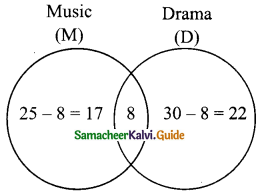
In a class, all students take part in either music or drama or both. 25 students take part in music, 30 students take part in drama and 8 students take part in both music and drama. Find
(i) The number of students who take part in only music.
(ii) The number of students who take part in only drama.
(iii) The total number of students in the class.
Solution:
Samacheer Kalvi 9th Maths Guide Chapter 1 Set Language Ex 1.6 1
Let M be the set of all students take part in music.
Let D be the set of all students take part in drama.
n( M) = 25, n(D) = 30 and n(M∩D) = 8
By using venn-diagram
From the venn – diagram we get.
(i) Number of students take part in only music = 17
(ii) Number of students take part in only drama = 22
(iii) Total number of students in the class = 17 + 8 + 22 = 47

Question 5.
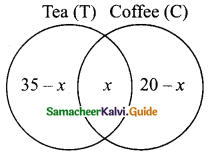
In a party of 45 people, each one likes Tea or Coffee or both. 35 people like tea and 20 people like coffee. Find the number of people who
(i) like both Tea and Coffee.
(ii) do not like Tea.
(iii) do not like Coffee.
Solution:
Samacheer Kalvi 9th Maths Guide Chapter 1 Set Language Ex 1.6 2
Let’T’ be the set of people likes Tea
Let ‘C’ be the set of people likes Coffee
n(T∩C) = 45, n(T) = 35 and n(C) = 20
Let X be the number of people likes both Tea and Coffee.
By using venn diagram
From the venn – diagram we get.
35 – x + x + 20 – x = 45
55 – x = 45
55 – 45 = x
10 = x
(i) People like both tea and coffee = 10
(ii) People do not like tea = 20 – x
= 20 – 10 = 10
(iii) People do not like coffee = 35 – x
= 35 – 10 = 25

Samacheer Kalvi 9th Maths Guide Chapter 1 Set Language Ex 1.6

Question 6.
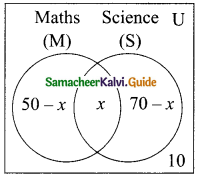
In an examination 50% of the students passed in mathematics and 70% of students passed in science while 10% students failed in both subjects. 300 students passed in both the subjects. Find the total number of students who appeared in the examination, if they took examination in only two subjects.
Solution:
Let M and S represent the student failed in Mathematics and Science.
Given: Number of students passed in Mathematics is 50%
Samacheer Kalvi 9th Maths Guide Chapter 1 Set Language Ex 1.6 3
∴ Number of students failed in Mathematics = 100 – 50% = 50%
n(M) = 50%
Number of students passed in Science is 70%
∴ Number of students failed in Science = 100 – 70% = 30%
n(S) = 30%
Number of students failed in both the subjects is 10%
n(M∩S) = 10%
n(M∪S)= n(M) + n(S) – n(M∩S)
= 50 + 30 – 10 = 80 – 10 = 70
Given: 70% of the students failed in atleast any one of the subject
∴ 30% of the students passed in atleast any one of the subjects.
30 students passed mean, the total number of students is 100.
∴ 300 students passed means, the total number of students = \(\frac{100 × 300}{30}\)
Total number of students appeared in the examination = 1000

Question 7.
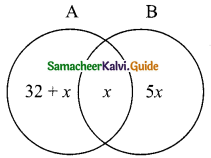
A and B are two sets such that n(A – B) = 32 + x, n(B – A) = 5x and n(A∩B) = x. Illustrate the information by means of a venn diagram. Given that n(A) = n(B). Calculate the value of x.
Solution:
n(A – B) = 32 + x, n(B – A) = 5x
n(A∩B) = x
From the Venn diagram:
Samacheer Kalvi 9th Maths Guide Chapter 1 Set Language Ex 1.6 4
Given n( A) = n(B)
32 + x + x = x + 5x
32 + 2x = 6x
32 = 6x – 2x
32 = 4x
x = \(\frac{32}{4}\) = 8
The value of x = 8

Samacheer Kalvi 9th Maths Guide Chapter 1 Set Language Ex 1.6

Question 8.
Out of 500 car owners investigated, 400 owned car A and 200 owned car B, 50 owned both A and B cars. Is this data correct?
Solution:
Let A be the set of people owned car A
Let B be the set of people owned car B
n( A) = 400, n(B) = 200, n(A∩B) = 50
n(A∪B) = 500………..(1)
n(A) + n(B) – n(A∩B) = 400 + 200 – 50
= 600 – 50
= 550………(2)
From (1) and (2) we get
n(A∪B) ≠ n(A) + n(B) – n(A∩B)
∴ The given data is not correct.

Question 9.
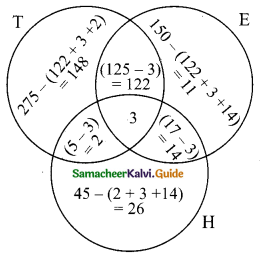
In a colony, 275 families buy Tamil newspaper, 150 families buy English newspaper, 45 families buy Hindi newspaper, 125 families buy Tamil and English newspapers, 17 families buy English and Hindi newspapers, 5 families buy Tamil and Hindi newspapers and 3 families buy all the three newspapers. If each family buy atleast one of these newspapers then find
(i) Number of families buy only one newspaper
(ii) Number of families buy atleast two newspapers
(iii) Total number of families in the colony.
Solution:
Let T, E and H represent families buying Tamil newspaper, English newspaper and Hindi newspaper respectively.
n(T) = 275, n(E) = 150, n(H) = 45
n(T∩E) = 125, n(E∩H) = 17, n(T∩H) = 5
n(T∩E∩H) = 3
Let us represent the given data in Venn diagrams.
Samacheer Kalvi 9th Maths Guide Chapter 1 Set Language Ex 1.6 5
(i) Number of families buy only one news paper = 148 + 11 + 26
= 185
(ii) Number of families buy atleast two news paper = 122 + 2 + 14 + 3
= 141
(iii) Total number of families in the colony = 148 + 122 + 11 + 14 + 3 + 2 + 26
= 326

Samacheer Kalvi 9th Maths Guide Chapter 1 Set Language Ex 1.6

Question 10.
A survey of 1000 farmers found that 600 grew paddy, 350 grew ragi, 280 grew corn, 120 grew paddy and ragi, 100 grew ragi and corn, 80 grew paddy and corn. If each farmer grew atleast any one of the above three, then find the number of farmers who grew all the three.
Solution:
Let P, R and C represent sets of farmers grew paddy, ragi and com respectively.
n(P∪R∪C) = 1000, n(P) = 600, n(R) = 350, n(C) = 280
n(P∩R) = 120, n(R∩C) = 100, w(P∩C) = 80 Let the number of farmers who grew all the three be “x”
n(P∪R∪C ) = n(P) + n( R) + n( C) – n(P∩R) – n(R∩C) – n(P∩C) + n(P∩R∩C )
1000 = 600 + 350 + 280 – 120 – 100 – 80 + x = 1230 – 300 + x.
1000 = 930 + x
1000 – 930 = x
70 = x
Number of farmers who grew all the three = 70.

Question 11.
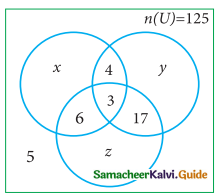
In the adjacent diagram, if n(U) = 125, y is two times of x and z is 10 more than x, then find the value of x, y and z.
Samacheer Kalvi 9th Maths Guide Chapter 1 Set Language Ex 1.6 6
Solution:
n(U) = 125
y = 2x and z = x + 10
n(U) = x + 4 + y + 17 + 3 + 6 + z + 5
125 = x + 4 + 2x + 17 + 3 + 6 + x + 10 + 5
125 = 4x + 45
125 – 45 = 4x
80 = 4x
x = 80/4 = 20
y = 2x = 2 × 20 = 40
z = x + 10 = 20 + 10 = 30
∴ The value of x = 20, y = 40 and z = 30.

Samacheer Kalvi 9th Maths Guide Chapter 1 Set Language Ex 1.6

Question 12.
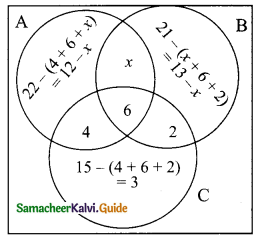
Each student in a class of 35 plays atleast one game among chess, carrom and table tennis. 22 play chess, 21 play carrom, 15 play table tennis, 10 play chess and table tennis, 8 play carrom and table tennis and 6 play all the three games. Find the number of students who play (i) chess and carrom but not table tennis (ii) only chess (iii) only carrom (Hint: Use Venn diagram)
Solution:
Let A, B and C represent students play chess, carrom and table tennis.
n(A) = 22, n(B) = 21 , n(C) = 15
n(A∩C) = 10 , n(B∩C) = 8 , n(A∩B∩C) = 6
Let “x” represent student play chess and carrom but not table tennis.
Let us represent the data in Venn diagram.
Samacheer Kalvi 9th Maths Guide Chapter 1 Set Language Ex 1.6 7
From the Venn diagram we get,
Number of students play atleast one game = 35
12 – x + x + 13 – x + 2 + 6 + 4 + 3 = 35
40 – 35 = x
5 = x
(i) Number of students who play chess and carrom but not table tennis = 5
(ii) Number of students who play only chess = 12 – x
= 12 – 5 = 7
(iii) Number of students who play only carrom = 13 – x
= 13 – 5 = 8

Question 13.
In a class of 50 students, each one come to school by bus or by bicycle or on foot. 25 by bus, 20 by bicycle, 30 on foot and 10 students by all the three. Now how many students come to school exactly by two modes of transport?
Solution:
Let B, C and D represent students come to school by bus, bicycle and foot respectively.
n(B∪C∪D) = 50 , n(B) = 25 , n(C) = 20 , n(D) = 30, n(B∩C∩D) = 10
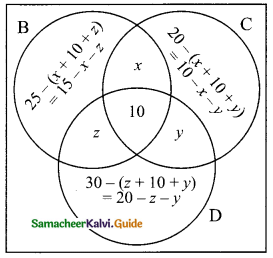
Let x, y and z represent the students come to school exactly by two modes of transport.
Let us represent the given data in Venn diagrams.
<Samacheer Kalvi 9th Maths Guide Chapter 1 Set Language Ex 1.6 8
Total number of students in the class = 50
15 – x – z + x + 10 – x – y + y + 10 + z + 20 – z – y = 50
55 – x – y – z = 50
55 – 50 = x + y + z
5 = x + y + z
Number of students come to school exactly by two modes of transport = 5

Samacheer Kalvi 9th Maths Guide Chapter 1 Set Language Ex 1.6

Samacheer Kalvi 9th Maths Guide Chapter 1 Set Language Ex 1.2

Students can download Maths Chapter 1 Set Language Ex 1.2 Questions and Answers, Notes, Samacheer Kalvi 9th Maths Guide Pdf helps you to revise the complete Tamilnadu State Board New Syllabus, helps students complete homework assignments and to score high marks in board exams.

Tamilnadu Samacheer Kalvi 9th Maths Solutions Chapter 1 Set Language Ex 1.2

Question 1.
Find the cardinal number of the following sets.
(i) M = {p, q, r, s, t, u}
(ii) P = {x : x = 3n + 2, n ∈ W and x < 15}
(iii) Q = {y : y = \(\frac{4}{3n}\), n ∈ N and 2 < n ≤ 5}
(iv) R = {x : x is an integer, x ∈ Z and – 5 ≤ x < 5}
(v) S = The set of all leap years between 1882 and 1906.
Solution:
(i) n (M) = 6
(ii) n (P) = 5 [n = {0, 1, 2, 3 . . . . 14}]
(iii) Since n = {3, 4, 5} ; n (Q) = 3
(iv) X = {-5, -4, -3, -2, -1, 0, 1, 2, 3, 4} ∴ n (R) = 10
(v) S = {1884, 1888, 1892, 1896, 1904}; n (S) = 5

Samacheer Kalvi 9th Maths Guide Chapter 1 Set Language Ex 1.2

Question 2.
Identify the following sets as finite or infinite.
(i) X = The set of all districts in Tamilnadu.
(ii) Y = The set of all straight lines passing through a point.
(iii) A = {x : x ∈ Z and x < 5}
(iv) B = {x : x² – 5x + 6 = 0, x ∈ N}
Solution:
(i) Finite
(ii) Infinite set (many lines can be drawn from a point)
(iii) Infinite set {A = ……. -2, -1, 0, 1, 2, 3, 4}
(iv) Finite set [x² – 5x + 6 = 0 ⇒ (x – 3) (x – 2) = 0; x = 3 and 2]

Question 3.
Which of the following sets are equivalent or unequal or equal sets?
(i) A = The set of vowels in the English alphabets.
B = The set of all letters in the word “VOWEL”
(ii) C = {2, 3, 4, 5}
D = {x : x ∈ W, 1 < x < 5}
(iii) X = {x : x is a letter in the word “LIFE”}
Y = {F, I, L, E}
(iv) G = {x : x is a prime number and 3 < x < 23}
H = {x : x is a divisor of 18}
Solution:
(i) Equivalent set [n(A) = n(B) = 5] ∴ A ≈ B
(ii) Unequal sets [C = {2, 3, 4, 5}; D = {2, 3, 4}]
(iii) Equal sets [X = {L, I, F, E}; Y = {F, I, L, E} [n(X) = 4 = n(Y)] ∴ X ≈ Y
(iv) Equivalent sets [G = {5, 7, 11, 13, 17, 19}; H = {1, 2, 3, 6, 9, 18}]
[n(G) = n(H) = 6 ∴ G ≈ H)]

Samacheer Kalvi 9th Maths Guide Chapter 1 Set Language Ex 1.2

Question 4.
Identify the following sets as null set or singleton set.
(i) A = {x : x ∈ N, 1 < x < 2}
(ii) B = The set of all even natural numbers which are not divisible by 2
(iii) C = {0}.
(iv) D = The set of all triangles having four sides.
Solution:
(i) Null set [No natural numbers is in between 1 and 2]
(ii) Null set [All the even natural numbers are not divisible by 2]
(Hi) Singleton set [n (C) = 1]
(iv) Null set [All the triangles has 3 sides]

Question 5.
State which pairs of sets are disjoint or overlapping?
(i) A = {f, i, a, s} and B = {a, n, f, h, s}
A = {f, i, a, s} and B = {a, n, f, h, s}
A and B are overlapping sets

(ii) C = {x : x is a prime number, x > 2} and D = {x : x is an even prime number}
C= {3, 5, 7…….}
D = {2}
C and D are disjoint sets

(iii) E = {x : x is a factor of 24} and F = {x : x is a multiple of 3, x < 30}
E = {1, 2, 3, 4, 6, 8, 12, 24}
F = {3, 6, 9, 12, 15, 18, 21, 24, 27} [Hint: E ∩ F = {3, 6, 24, …….}]
E and F are overlapping sets

Samacheer Kalvi 9th Maths Guide Chapter 1 Set Language Ex 1.2

Question 6.
If S = {square, rectangle, circle, rhombus, triangle}. List the elements of the following subset of S.
(i) The set of shapes which have 4 equal sides.
(ii) The set of shapes which have radius.
(iii) The set of shapes in which the sum of all interior angles is 180°.
(iv) The set of shapes which have 5 sides.
Solution:
(i) Subset of S = {square, rhombus}
(ii) Subset of S = {circle}
(iii) Subset of S = {triangle}
(iv) Subset of S = { }

Question 7.
If A = {a,{a, b}}, write all the subsets of A.
Solution:
A = {a, {a, b}}
Subset of A are Ø, {a}, {a, b}, {a, {a, b}} (or) { }, {a}, {a,b, {a,{a,b}}
P(A) = {Ø, {a}, {a, b}, {a {a, b}} (or) {{ }, {a}, {a,b, {a,{a,b}}

Samacheer Kalvi 9th Maths Guide Chapter 1 Set Language Ex 1.2

Question 8.
Write down the power set of the following sets.
(i) A = {a, b}
(ii) B = {1, 2, 3}
(iii) D = {p, q, r, s}
(iv) E = Ø
Solution:
(i) A = {a, b)
P(A) = {{},{a},{b}, {a, b}}

(ii) B = {1, 2, 3}
P(B) = {{}, {1}, {2}, {3}, {1,2}, {2, 3}, {1,3}, {1,2,3}}

(iii) D = {p, q, r, s}
P(D) = {{},{p},{q},{r},{s},{p, q} {p, r} {p, s}
{q, r}, {q, s}, {r, s}, {p, q, r} {q, r, s}
{p, r, s} {p, q, s} {p, q, r, s}}

(iv) E = Ø
P(E) = {{}}
Note: (empty set is the subset of all the sets)

Samacheer Kalvi 9th Maths Guide Chapter 1 Set Language Ex 1.2

Question 9.
Find the number of subsets and the number of proper subsets of the following sets.
(i) W = {red, blue, yellow}
(ii) X = {x² : x ∈ N, x² ≤ 100}
Solution:
(i) W = {red, blue, yellow}
n (W) = 3
The number of subsets of W = n [P(W)] = 2m
= 23 = 8
Number of proper subsets of W = n[P(W)] – 1
= 8 – 1
= 7 (or)
Number of proper subsets of W = 2m – 1
= 23 – 1 = 8 – 1 = 7

(ii) X = {x2 : x ∈ N, x2 ≤ 100}.
X= {1,2, 3, 4, …. 10}
n(X) = 10
The number of subsets of X = n[P(X)]
= 2m
= 210 = 1024
Number of proper subsets of X = 2m – 1
= 1024 – 1
= 1023

Samacheer Kalvi 9th Maths Guide Chapter 1 Set Language Ex 1.2

Question 10.
(i) If n(A) = 4, find n[P(A)]
(ii) If n(A) = 0, find n[P(A)]
(Hi) If n[P(A)] = 256, find n(A)
Solution:
(i) n (A) = 4
n [P(A)] = 2m = 24
= 16

(ii) n (A) = 0
n [P(A)] = 2m = 2° = 1

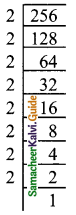
(iii) n [P(A)] = 256
Samacheer Kalvi 9th Maths Guide Chapter 1 Set Language Ex 1.2 1
2m = 28
∴ n (A) = 8

Samacheer Kalvi 9th Maths Guide Chapter 1 Set Language Ex 1.1

Students can download Maths Chapter 1 Set Language Ex 1.1 Questions and Answers, Notes, Samacheer Kalvi 9th Maths Guide Pdf helps you to revise the complete Tamilnadu State Board New Syllabus, helps students complete homework assignments and to score high marks in board exams.

Tamilnadu Samacheer Kalvi 9th Maths Solutions Chapter 1 Set Language Ex 1.1

Question 1.
Which of the following are sets?
(i) The collection of prime numbers upto 100
(ii) The collection of rich people in India
(iii) The collection of all rivers in India
(iv) The collection of good hockey players
Solution:
(i) It is a set
(ii) It is not a set (The word “rich” is not well defined)
(iii) It is a set
(iv) It is not a set (The word “good” is not well defined)

Samacheer Kalvi 9th Maths Guide Chapter 1 Set Language Ex 1.1

Question 2.
List the set of letters of the following words in Roster form.
(i) INDIA
(ii) PARALLELOGRAM
(iii) MISSISSIPPI
(iv) CZECHOSLOVAKIA
Solution:
(i) A = {I, N, D, A}
(ii) B = {P, A, R, L , E, O, G, M}
(iii) C = {M, I, S, P}
(iv) D = {C, Z, E, H, O, S, L, V, A, K, I}

Samacheer Kalvi 9th Maths Guide Chapter 1 Set Language Ex 1.1

Question 3.
Consider the following sets A = {0, 3, 5, 8}, B = {2, 4, 6, 10} and C = {12, 14, 18, 20}.
(a) State whether True or False:
(i) 18 ∈ C
(if) 6 ∉ A
(iii) 14 ∉ C
(iv) 10 ∈ B
(v) 5 ∈ B
(vi) 0 ∈ B
Solution:
(i) True
(ii) True
(iii) False
(iv) True
(v) False
(vi) False

(b) Fill in the blanks:
(i) 3 ∈ …………
(ii) 14 ∈…………
(iii) 18 ……….. B
(iv) 4 ………. B
Solution:
(i) A
(ii) C
(iii) ∉
(iv) ∈

Samacheer Kalvi 9th Maths Guide Chapter 1 Set Language Ex 1.1

Question 4.
Represent the following sets in Roster form.
(i) A = The set of all even natural numbers less than 20.
(ii) B = {y : y = \(\frac{1}{2n}\), n∈N, n ≤ 5}
(iii) C = {x : x is perfect cube, 27 < x < 216}
(iv) D = {x : x ∈Z, – 5 < x ≤ 2}
Solution:
(i) A= {2, 4, 6, 8, 10, 12, 14, 16, 18}
(ii) B = {\(\frac{1}{2}\), \(\frac{1}{4}\), \(\frac{1}{6}\), \(\frac{1}{8}\), \(\frac{1}{10}\)}
(iii) C = {64, 125}
(iv) D = {-4, -3, -2, -1, 0, 1, 2}

Samacheer Kalvi 9th Maths Guide Chapter 1 Set Language Ex 1.1

Question 5.
Represent the following sets in set builder form.
(i) B = The set of all cricket players in India who scored double centuries in one day internationals.
(ii) C = {\(\frac{1}{2}\), \(\frac{2}{3}\), \(\frac{3}{4}\), …….}
(iii) D = The set of all Tamil months in a year.
(iv) E = The set of odd Whole numbers less than 9.
Solution:
(i) B = {x : x is a set of all cricket players in India who scored double centuries in one day internationals}
(ii) C = {x : n ∈ N, x = \(\frac{n}{n + 1}\) }
(iii) D = {x : x ∈ set of all Tamil months in a year}
(iv) E = {x : x is an odd whole number and x < 9}

Samacheer Kalvi 9th Maths Guide Chapter 1 Set Language Ex 1.1

Question 6.
Represent the following sets in descriptive form.
(i) P = { January, June, July}
(ii) Q = {7, 11, 13, 17, 19, 23, 29}
(iii) R = {x : x∈N, x < 5}
(iv) S = {x : x is a consonant in English alphabets}
Solution:
(i) P = The set of all months beginning with the letter “J”
(ii) Q = The set of all prime numbers between 5 and 31
(iii) R = The set of natural numbers less than 5
(iv) S = The set of consonants in English alphabets

Samacheer Kalvi 9th Science Guide Chapter 18 Organization of Tissues

Tamilnadu State Board New Syllabus Samacheer Kalvi 9th Science Guide Pdf Chapter 18 Organization of Tissues Text Book Back Questions and Answers, Notes.

Samacheer Kalvi 9th Science Solutions Chapter 18 Organization of Tissues

9th Science Guide Organization of Tissues Text Book Back Questions and Answers

I. Choose the correct answer:

Question 1.
The tissue composed of living thin walled polyhedral cell is
(a) parenchyma
(b) pollenchyma
(c) pclerenchyma
(d) none of above
Answer:
(d) none of above

 Samacheer Kalvi 9th Science Guide Chapter 18 Organization of Tissues

Question 2.
The fibres consists of
(a) parenchyma
(b) sclerenchyma
(c) collenchyma
(d) none of above
Answer:
(b) sclerenchyma

Question 3.
Companion cells are closely associated with
(a) sieve elements
(b) vessel elements
(c) trichomes
(d) guard cells
Answer:
(a) sieve elements

 Samacheer Kalvi 9th Science Guide Chapter 18 Organization of Tissues

Question 4.
Which of the following is a complex tissue?
(a) Parenchyma
(b) Collenchyma
(c) Xylem
(d) Sclerenchyma
Answer:
(c) Xylem

Question 5.
Aerenchyma is found in
(a) epiphytes
(b) hydrophytes
(c) halophytes
(d) xerophytes
Answer:
(b) hydrophytes

 Samacheer Kalvi 9th Science Guide Chapter 18 Organization of Tissues

Question 6.
Smooth muscles occur in
(a) uterus
(b) artery
(c) vein
(d) all of the above
Answer:
(d) all of the above

Question 7.
Nerve cell does not contains
(a) axon
(b) nerve endings
(e) tendons
(d) dendrités
Answer:
(c) tendons

 Samacheer Kalvi 9th Science Guide Chapter 18 Organization of Tissues

II. Match the following.

Question 1.

Sclereids Chlorenchyma
Chloroplast Sclerenchyma
Simple tissue Collenchyma
Companion cell Xylem
Tracheids Phloem

Answer:

Sclereids Sclerenchyma
Chloroplast Chlorenchyma
Simple tissue Collenchyma
Companion cell Phloem
Tracheids Xylem

III Fill in the blanks :

1. ……………. tissues provide mechanical support to organs.
Answer:
Compound epithelium

 Samacheer Kalvi 9th Science Guide Chapter 18 Organization of Tissues

2. Parenchyma, Collenchyma, Sclerenchyma are ……………. type of tissue.
Answer:
simple

3. ……………. and ……………… are complex issues.
Answer:
Xylem, phloem

4. Epithelial cells with cilia are fóund in ……………….. of our body
Answer:
trachea or windpipe

 Samacheer Kalvi 9th Science Guide Chapter 18 Organization of Tissues

5. Lining of the small intestine is made up of …………………..
Answer:
columnar epithelium

IV. State whether true or false. If false, correct the statement :

1. Epithelial tissue is protective tissue in an animal body.
Answer:
True.

2. Bone and cartilage are two types of areolar connective tissue.
Answer:
False.
Correct statement: Bone and cartilage are two types of supportive connective tissue.

3. Parenchyma is a simple tissue.
Answer:
True.

 Samacheer Kalvi 9th Science Guide Chapter 18 Organization of Tissues

4. Phloem is made up of tracheids.
Answer:
False.
Correct statement: Phloem is made up of sieve tubes.

5. Vessels are found in collenchyma.
Answer:
False.
Correct statement: Vessels are found in the xylem.

 Samacheer Kalvi 9th Science Guide Chapter 18 Organization of Tissues

V. Answer briefly :

Question 1.
What are intercalary meristems? How do they differ from other meristems?
Answer:
Intercalary meristem lies between the region of permanent tissues and is part of primary meristem which is detached due to formation of intermittent permanent tissues. It is found either at the base of leaf e.g. Pinus or at the base of intemodes e.g. grasses.

Question 2.
What is complex tissue? Name the various kinds of complex tissues.
Answer:

  • Complex tissues are made of more than one type of cells that work together as a unit.
  • Complex tissues consist of parenchyma and sclerenchyma cells. However, collenchymatous cells are not present in such tissues.
  • Common examples are xylem and phloem.

 Samacheer Kalvi 9th Science Guide Chapter 18 Organization of Tissues

Question 3,.
Mention the most abundant muscular tissue found in our body. State its function.
Answer:
Connective tissue is the most abundant and widely distributed tissue. It provides a structural framework and gives support to different tissues forming organs.

Question 4.
What is skeletal connective tissue? How is it helpful in the functioning of our body?
Answer:
The supporting or skeletal connective tissues forms the endoskeleton of the vertebrate body. They protect various organs and help in locomotion. The supportive tissues include cartilage and bone.

 Samacheer Kalvi 9th Science Guide Chapter 18 Organization of Tissues

Question 5.
Why should gametes be produced by meiosis during sexual reproduction?
Answer:
Meiosis is important as it produces gametes i.e., male or female germ cells. During meiosis, a germ cell or gamete divides to make four new sex cells. As a result of fertilization two gamates join together to form an egg or zygote. Therefore only if gametes are produced, fertilization can take place.

Question 6.
In which stage of mitosis the chromosomes align in an equatorial plate? How?
Answer:
Metaphase (meta – after) The duplicated chromosomes arrange on the equatorial plane and form the metaphase plate. Each chromosome gets attached to a spindle fibre by its centromere. The centromere of each chromosome divides into two each being associated with a chromatid.

 Samacheer Kalvi 9th Science Guide Chapter 18 Organization of Tissues

VI. Answer in detail:

Question 1.
What are the permanent tissues? Describe the different types of simple permanent tissues.
Answer:
Permanent tissues:
Permanent tissues are those in which, growth has stopped either completely or for the time being. At times, they become meristematic partially or wholly.

Different types of simple permanent tissue :
Simple tissue: Simple tissue is homogeneous-composed of structurally and functionally similar cells. Eg : Parenchyma, collenchyma, and sclerenchyma.

Parenchyma:

Samacheer Kalvi 9th Science Guide Chapter 18 Organization of Tissues 1

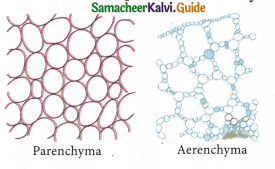
  • Parenchyma are simple permanent tissue composed of living cells.
  • Parenchyma cells are thin-walled, oval, rounded, or polygonal in shape with well-developed spaces among them.
  • In aquatic plants, parenchyma possesses intercellular air spaces and is named as aerenchyma.
  • When exposed to light, parenchyma cells may develop chloroplasts and are known as chlorenchyma.

Functions:

  • Parenchyma may store water in many succulent and xerophytic plants.
  • It also serves the functions of storage of food reserves, absorption, buoyancy, secretion, etc

Collenchyma:
Samacheer Kalvi 9th Science Guide Chapter 18 Organization of Tissues 2

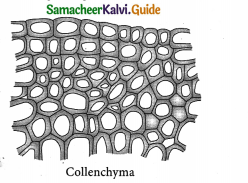
  • Collenchyma is a living tissue found beneath the epidermis.
  • Cells are elongated with unevenly thickened non-lignified walls. Cells have rectangular oblique or tapering ends and persistent protoplast.
  • They possess thick primary non-lignified walls.
    Functions: They provide mechanical support for growing organs.

Sclerenchymà:

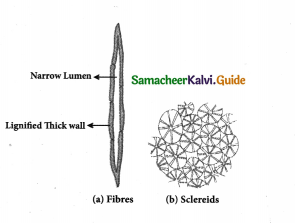
  • Scierenchyma consists of thick-walled cells which are often lignified.
  • Scierenchyma cells do not possess living protoplasts at maturity. Scierenchyma cells are grouped into

(i) fibers and (ii) sclereids.
Samacheer Kalvi 9th Science Guide Chapter 18 Organization of Tissues 3

Fibres : Elongated scierenchymatous cells, usually with pointed ends. Their walls are lignified. Fibres are abundantly found in many plants. Eg. Jute.
Sclereids:

  • Sclereids are widely distributed in plant body. They are usually broad, may occur in single or in groups.
  • Sclereids are isodiametric, with lignified walls. Pits are prominent and seen along the walls.
  • Lumen is filled with wall materials. Sclereids are also common in fruits and seeds.

 Samacheer Kalvi 9th Science Guide Chapter 18 Organization of Tissues

Question 2.
Write about the elements of Xylem.
Answer:
Xylem is a conducting tissue which conducts water, mineral nutrients upward from root to leaves. Xylem is also meant for mechanical support to the plant body. Xylem is composed of different kinds of elements. They are

  1. xylem tracheids
  2. xylem fibres
  3. xylem vessels and
  4. xylem parenchyma.

(i) Xylem tracheids: They are elongated or tube-like dead cells with hard, thick and lignified walls. Their ends are tapering, blunt or chisel-like. These cells are devoid of protoplast. They have large lumen without any content. Their function is conduction of water and providing mechanical support to the plant.

(ii) Xylem fibers: These cells are elongated, lignified and pointed at both the ends. Xylem fibres help in the conduction of water and nutrients from root to the leaf and also provide mechanical support to the plant.

(iii) Xylem vessels: They are long cylindrical, tube-like structures with lignified walls and wide central lumen. These cells are dead as these do not have protoplast. They are arranged in longitudinal series in which the partitioned walls (transverse walls) are perforated, and so the entire structure looks-like a water pipe. Their main function is the transport of water and minerals from root to leaf, and also to provide mechanical strength.

(iv) Xylem parenchyma: Its cells are living and thin-walled. The main function of xylem parenchyma is to store starch and fatty substances.

Question 3.
List out the differences< between mitosis and meipsis.
Answer:

Mitosis Meiosis
1. Occurs in somatic cells. Occurs in reproductive cells
2. Involved in growth and occurs continuously throughout life. Involved in gamete formation only during the reproductively active age.
3. Consists of single division. Consists of two divisions.
4. Two diploid daughter cells are formed. Four haploid daughter cells are formed.
5. The chromosome number in the daughter cell is similar to the parent cell (2n). The chromosome number in the daughter cell is just half (n) of the parent cell.
6. Identical daughter cells are formed. Daughter cells are not similar to the parent cell and are randomly assorted.

 Samacheer Kalvi 9th Science Guide Chapter 18 Organization of Tissues

VII. Higher Order Thinking Skills :

Question 1.
What is the consequence that occurs if all blood platelets are removed from the blood?
Answer:
Blood platelets play a major role in the clotting of blood whenever there is a wound/injury. If blood platelets are removed from the blood, clotting of blood will not occur. In case of any injury/surgery etc., blood will be lost from the body in excess and may even prove to be fatal.

2. Which are not true cells in the blood? Why?
Answer:
Red blood cells or erythrocytes cannot be considered as true cells since they have a nucleus only in the early stages. A mature RBC lacks a nucleus which is the controlling centre of all living cells.

Intext Activities

ACTIVITY – 1
Rinse your mouth with water. Using a toothpick or ice-cream stick, scrap superficial cells from the inner side of the cheek and spread it on a clean glass slide. Dry the glass slide with the scrap cells taken from the inner side of the cheek. Add two drops of methylene blue stain. Identify the cells under low and high power of the microscope.
Solution:
1. Large irregularly shaped cells with cell walls.
2. Dark blue nucleus at the central part of each cell.
3. Lightly stained cytoplasm colour in each cell.

9th Science Guide Organization of Tissues Additional Important Questions and Answers

I. Choose the correct answer :

Question 1.
A meristematic tissue consists of
(a) immature cells that are capable of undergoing cell division.
(b) mature cells
(c) non-living cells
(d) sclerenchyma cells
Answer:
(a) immature cells that are capable of undergoing cell division

Question 2.
Two long bones of the hand are dislocated in a person who met with an accident. Which among the following may be the possible reason?
(a) Tendon injury
(b) Break of skeletal muscle
‘(c) Ligament tear
(d) Rupture of Areolar tissue
Answer:
(c) Ligament tear

 Samacheer Kalvi 9th Science Guide Chapter 18 Organization of Tissues

Question 3.
Non-striated muscles are found in
(a) blood vessels
(b) gastric glands
(c) urinary bladder
(d) all of these
Answer:
(d) all of these

Question 4.
Which of the following is not found in a neuron?
(a) Sarcolemma
(b) Dendrite
(c) Myelin sheath
(d) Axon
Answer:
(a) Sarcolemma

Question 5.
Cylindrical, unbranched multinucleated cells are
(a) striated muscle cells
(b) smooth muscles
(c) cardiac muscles
(d) none of the above.
Answer:
(a) striated muscle cells

 Samacheer Kalvi 9th Science Guide Chapter 18 Organization of Tissues

Question 6.
The matrix of the bone is rich in
(a) elastin
(b) reticular fibres
(c) collagen
(d) myosin
Answer:
(c) collagen

Question 7.
Which muscles act involuntarily?
(i) Striated muscles
(ii) Smooth muscles
(iii) Cardiac muscles
(iv) Skeletal muscles
(a) (i) and (ii)
(b) (ii) and (iii)
(c) (iii) and (iv)
(d)(i) and (iv)
Answer:
(b) (ii) and (iii)

Question 8.
Tendon connects
(a) cartilage with muscles
(b) bone with skeletal muscles
(c) ligament with muscles
(d) bone with bone
Answer:
(b) bone with skeletal muscles

 Samacheer Kalvi 9th Science Guide Chapter 18 Organization of Tissues

Question 9.
In a certain type of cell division, the diploid number of chromosomes is reduced to half. This kind of division occurs in
(a) testis
(b) ovary
(c) both ovary and testis
(d) all body cells
Answer:
(c) both ovary and testis

Question 10.
……………… is derived from the ground meristem.
(a) Cortex
(b) Epidermis
(c) Xylem
(d) Cambium
Answer:
(a) Cortex

Question 11.
The function of phloem fibres is …………….to the plant body
(a) passage of food
(b) Store food
(c) mechanical strength
(d) preparation of food
Answer:
(c) mechanical strength

 Samacheer Kalvi 9th Science Guide Chapter 18 Organization of Tissues

Question 12.
The …………….. epithelium is also known as pavement membrane.
(a) Ciliated
(b) Squamous
(c) Cuboidal
(d) Glandular
Answer:
(b) Squamous

Question 13.
Elastic structures that connect bones to bones are called ………………..
(a) muscles
(b) tendons
(c) ligaments
(d) areolar tissue
Answer:
(c) ligaments

 Samacheer Kalvi 9th Science Guide Chapter 18 Organization of Tissues

Question 14.
………………… is seen in unicellular animals.
(a) Mitosis
(b) meiosis
(e) Amitosis
(d) none of the above
Answer:
(c) Amitosis

Question 15.
The disappearance of spindle fibres is seen in …………….
(a) metaphase
(b) prophase
(c) anaphase
(d) telophase
Answer:
(d) telophase

Question 16.
The ………………… is a single, long fiber like process that develops from the cyton.
(a) dendron
(b) axon
(c) dendrite
(d) neurilemma
Answer:
(b) axon

 Samacheer Kalvi 9th Science Guide Chapter 18 Organization of Tissues

Question 17.
Bouquet stage refers to ……………..
(a) diakinesis
(b) leptotene
(c) zygotene
(d) pachytene
Answer:
(b) leptotene

Fill in the blanks :

1. The ……………. tissues are made up of more than one type of cells and these woks together as a unit.
Answer:
complex

2. The two types of skeletal connective tissues are ……………. and …………….
Answer:
bone, cartilage

3. Humans have 46 chromosomes. Their sperms and eggs will have ……………. chromosomes each.
Answer:
23

 Samacheer Kalvi 9th Science Guide Chapter 18 Organization of Tissues

4. During pairing of chromosomes in meiosis, the …………….. chromosomes come to lie side by side.
Answer:
homologous

5. The word meristem is derived from a Greek word ………………
Answer:
Meristos

6. Cork cambium is an example of ……………… meristem.
Answer:
secondary

 Samacheer Kalvi 9th Science Guide Chapter 18 Organization of Tissues

7. The meristem found at the base of intemodes is called ……………….
Answer:
intercalary meristem

8. In apple, paranchyma stores ………………
Answer:
sugar

9. Fibres are extensively longer ranging from 20 mm to 550 mm ……………….
Answer:
corchorus capsularis (jute)

10. During mieosis in pachytene, stages the paired chromosomes are called ………………….
Answer:
bivalents

 Samacheer Kalvi 9th Science Guide Chapter 18 Organization of Tissues

11. Mitosis was discovered by …………………..
Answer:
Flemming

12. Both smooth and cardiac muscles are …………….. in nature.
Answer:
involuntary

13. ………………. is a non-flexible skeletal connective tissue.
Answer:
Bone

 Samacheer Kalvi 9th Science Guide Chapter 18 Organization of Tissues

14. ……………. acts as a fat reservoir.
Answer:
Adipose tissue

15. …………….. epithelium is seen in sweat glands.
Answer:
Cuboidal

16. Genetic variations occur in meiosis because of …………….
Answer:
crossing over

III. State whether True or false. If false, write the correct statement:

1. Epithelial layer does not allow regulation of materials between the body and the external environment.
Answer:
False.
Correct statement: Epithelium is involved in the absorption and elimination of waste.

2. Striated and non-striated tissues are types of epithelial tissues.
Answer:
False.
Correct statement: They are types of muscular tissues.

 Samacheer Kalvi 9th Science Guide Chapter 18 Organization of Tissues

3. Spindle formation occur in amitosis.
Answer:
False.
Correct statement: Spindle formation occur in mitosis.

4. Movement of food in the alimentary canal is because of cardiac muscles.
Answer:
False.
Correct statement: Movement of food is alimentary canal by the rhythmic con t no-tom and relaxation of the muscular nails of the alimentary canal.
Correct statement: Movement of food in the alimentary canal.

5. A mature RBC lacks a nucleus.
Answer:
True

6. Excessive pulling of bones causes a sprain.
Answer:
False.
Correct statement: Sprain is caused by excessive pulling of ligaments.

 Samacheer Kalvi 9th Science Guide Chapter 18 Organization of Tissues

7. Glandular epithelium gives a stratified appearance.
Answer:
False.
Correct statement: Compound epithelium given a stratified appearance.

8. Sieve cells have no companion cells.
Answer:
True.

9. Conduction can be bidirectional in phloem tissue.
Answer:
True.

10. White blood corpuscles contain respiratory pigment hemoglobin.
Answer:
False.
Correct statement: Red blood corpuscles contain respiratory pigment hemoglobin.

 Samacheer Kalvi 9th Science Guide Chapter 18 Organization of Tissues

IV. Assertion and Reason type:

Direction: In each of the following questions, a statement of Assertion is given and a corresponding statement of Reason is given just below it. Of statements, given below, mark the correct answer as
(a) Both Assertion and Reason are true and Reason is the correct explanation of Assertion.
(b) Both Assertion and Reason are true that Reason is not the correct explanation of Assertion.
(c) Assertion is true but Reason is false.
(d) Both Assertion and Reason are false.

Question 1.
Assertion: Non-striated muscles are said to be voluntary in nature.
Reason: Non-striated muscles are under the control of our will.
Answer:
(d) Both Assertion and Reason are false

Question 2.
Assertion: Materials are exchanged between epithelial and connective tissues by diffusion.
Reason: Blood vessels are absent in epithelial tissue.
Answer:
(a) Assertion and Reason are true and Reason is the correct explanation of Assertion

 Samacheer Kalvi 9th Science Guide Chapter 18 Organization of Tissues

V. Answer in one or two sentences :

Question 1.
Name the two types of sclerenchyma cells.
Answer:
Sclerenchyma cells are grouped into

  1. fibres and
  2. sclereids.

Question 2.
Name the components of xylem and phloem.
Answer:
Xylem is composed of :

  • Xylem tracheids
  • Xylem fibres
  • Xylem vessels
  • Xylem parenchyma

Phloem is composed of:

  • Sieve elements
  • Companion cells
  • Phloem fibres
  • Phloem parenchyma

Question 3.
Name the tissue that connects muscle to bone in humans.
Answer:
Tendons join skeletal muscles to bones in our body.

 Samacheer Kalvi 9th Science Guide Chapter 18 Organization of Tissues

Question 4.
Name the tissue that stores excess fat in our body.
Answer:
Adipose tissue.

Question 5.
Name the connective tissue with a fluid matrix.
Answer:
Blood and lymph

Question 6.
Name the tissue present in the brain.
Answer:
Nervous tissue.

Question 7.
What is plate meristem?
Answer:
These cells divide into two planes resulting in an increase in the area of an organ.
Eg: Leaf formation.

 Samacheer Kalvi 9th Science Guide Chapter 18 Organization of Tissues

Question 8.
Differentiate collenchyma and sclerenchyma.
Answer:

Collenchyma Sclerenchyma
It consists of living cells It consists of dead cells
Cells contain protoplasm Cells do not possess living protoplast
Cell walls are non-lignified Cell walls are lignified

Question 9.
Mention the type of epithelium seen in alveoli of lungs.,
Answer:
Squamous epithelium.

Question 10.
Name the supportive connective tissues.
Answer:
Cartilage and bone

Question 11.
Name the cartilage cells present in the matrix.
Answer:
Chondrocytes.

 Samacheer Kalvi 9th Science Guide Chapter 18 Organization of Tissues

Question 12.
What is the role of RBC?
Answer:
RBC contains a respiratory pigment called hemoglobin which is involved in the transport of oxygen to tissues.

Question 13.
Mention the stages of meiotic Prophase -I.
Answer:
Leptotene, Zygotene, Pachytene, Diplotene, Diakinesis.

Question 14.
What is the significance of Meiosis?
Answer:
The constant number of chromosomes in a given species is maintained by meiotic division.

 Samacheer Kalvi 9th Science Guide Chapter 18 Organization of Tissues

Question 15.
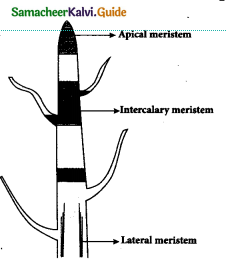
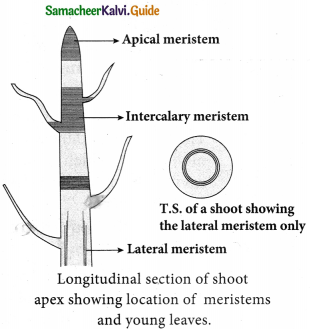
Draw a shoot apex and label the meristem’s parts.
Answer:
Samacheer Kalvi 9th Science Guide Chapter 18 Organization of Tissues 4

VI. Short Answer Type :

Question 1.
How would you differentiate meristematic and permanent tissue?
Answer:

Meristematic tissue Permanent tissue
Cytoplasm is dense, and vacuoles are nearly absent. Usually large central vacuole present in living permanent cells.
Intercellular spaces absent. Intercellular spaces present.
Component cells are small, spherical or polygonal and undifferentiated. Component cells are large, differentiated with different shapes.
Cell wall is thin and elastic. Cell wall is thick.
Nucleus is large and prominent. Nucleus is less conspicuous.
Cells grow and divide regularly. Cells do not normally divide.
Provides mechanical support and elasticity to the plant body. Provides only mechanical support.

Question 2.
Differentiate fibres from sclereids.
Answer:

Sclereids Fibres
Usually broad Elongated narrow thread-like
End walls blunt Usually with pointed ends.
Occur singly Occur in bundles
Deep pits Narrow pits

 Samacheer Kalvi 9th Science Guide Chapter 18 Organization of Tissues

Question 3.
Which tissue is the main component of tendons and ligaments? How do they differ in function?
Answer:
Dense Connective Tissue is a fibrous connective tissue densely packed with fibres and fibroblasts. It is the principal component of tendons and ligaments.

a. Tendons: Cord-like, strong, structures that join skeletal muscles to bones. Tendons have great strength and limited flexibility. They consist of parallel bundles of collagen fibres, between which are present rows of fibroblasts.

b. Ligaments: They are highly elastic structures and have great strength which connects bones to bones. They contain very little matrix. They strengthen the joints and allow normal movement.

Question 4.
What are the fibres present in the connective tissue proper?
Answer:
Connective tissue proper: Connective tissue proper consists of collagen fibres, elastin fibres and fibroblast cells.

Areolar tissue: It has cells and fibres loosely arranged in a semi-fluid ground substance called matrix. It takes the form of fine threads crossing each other in every direction leaving small spaces called areolae. It joins skin to muscles, fills space inside organs and is found around muscles, blood vessels and nerves. It helps in repair of tissues after injury and fixes skin to underlying muscles.

Adipose Tissue: Adipose tissue is the aggregation of fat cells or adipocytes spherical or oval in shape. It serves as fat reservoir. The matrix consists of collagen fibres, elastin fibres and fibroblast cells.

 Samacheer Kalvi 9th Science Guide Chapter 18 Organization of Tissues

Question 5.
How are collagen fibres organized in dense connective tissues?
Answer:

  • Dense connective tissue is a fibrous connective tissue densely packed with fibres and fibroblasts. It is the principal component of tendon and ligaments.
  • Tendons consist of parallel bundles of collagen fibres, between which are present rows of fibroblasts.
  • Ligaments are highly elastic structures and contain very little matrix.

Question 6.
Write one point of difference between
a) Bone and cartilage.
b) Simple and compound epithelial tissue.
Answer:
a)

Bone Cartilage
It is solid, rigid, and strong, non-flexible skeletal connective tissue. It is a soft, semi-rigid, flexible skeletal connective tissue.
The matrix of the bone is in the form of concentric rings called lamellae The matrix is composed of large cartilage cells called chondrocytes

b)

Simple epithelium tissue Çompound epithelium tissue
It is composed of a single layer of cells
resting ón a basement membrane.
It is composed of several layers of cells.
Only the cells of the deepest layer rest
on the basement membrane.

Question 7.
Why is blood considered to be a fluid connective tissue?
Answer:

  • The blood and the lymph are the fluid connective tissues which link different parts of the body. The cells of the connective tissue are loosely spaced and are embedded in an intercellular matrix.
  • Blood contains corpuscles which are red blood cells (erythrocytes), white blood cells (leucocytes), and platelets. In this fluid connective tissue, blood cells move in a fluid matrix called plasma. The plasma contains inorganic salts and organic substances. It is a main circulating fluid that helps in the transport of nutrient substances.

 Samacheer Kalvi 9th Science Guide Chapter 18 Organization of Tissues

Question 8.
Give the sequence of the events occurring during prophase of mitosis.
Answer:

  • During this stage, chromosomes become short and thick and are clearly visible inside the nucleus.
  • Centrosome splits into two daughter centrioles and occupies opposite poles of the cell.
  • Each centriole is surrounded by aster rays. Spindle fibres appear between the two centrioles.
  • The nuclear membrane and nucleolus disappear gradually.

Question 9.
Why is meiosis called reductional division and mitosis as equational division?
Answer:

  • In mitosis one parent cell divides into two identical daughter cells, each with a nucleus having the same amount of DNA, same number of chromosomes and genes as the parent cells. It is therefore called an equational division.
  • Meiosis is called reduction division because the chromosome number is reduced to haploid (n) from diploid (2n) in the daughter cells.

Question 10.
What is terminalization?
Answer:
In the stage of diplotene of meiotic prophase I, chiasmata begin to move along the length of the chromosome from the centromere towards the end resulting in terminalization.

 Samacheer Kalvi 9th Science Guide Chapter 18 Organization of Tissues

Question 11.
What is a tetrad?
Answer:
The chromosomes are visible as long paired twisted threads. The pairs so formed are called bivalents. Each bivalent now contains four chromatids (tetrad stage) in pachytene of mieotic prophase I. The condition of bivalent containing four chromatids are called tetrad stage.

Question 12.
What is crossing over?
During pachytene of mieotic prophase I, the chromatids break and the broken segments are interchanged between homologous chromosomes. The points of exchange are the chiasmata. This is called .crossing over.

Question 13.
What is bouquet stage?
Answer:
During leptotene of mieotic prophase I, the chromosomes become uncoiled and assume long thread-like structures and take up a specific orientation inside the nucleus. They form a bouquet stage.

 Samacheer Kalvi 9th Science Guide Chapter 18 Organization of Tissues

Question 14.
What is zygotene?
Answer:
It is one of the stages of mieoticphophase I. Two homologous chromosomes approach each other and begin to pair. The pairing of homologous chromosomes is called synapsis.

Question 15.
Explain amitosis.
Answer:
It is the simplest model of cell division and occurs in unicellular animals, aging cells and in foetal membranes. During amitosis, the nucleus elongates first, and a constriction appears in it which deepens and divides the nucleus into two, followed by this cytoplasm divides resulting in the formation of two daughter cells.

Question 16.
Write the salient features of the compound epithelium.
Answer:

  • It consists of more than one layer of cells and gives a stratified appearance. Hence, they are also known as stratified epithelial cells.
  • The main function of this epithelium is to give protection to the underlying tissues against mechanical and chemical stress.
  • They also cover the dry surface of the skin, the moist surface of the buccal cavity, and the pharynx.

 Samacheer Kalvi 9th Science Guide Chapter 18 Organization of Tissues

Question 17.
Write a note the significance of mitosis.
Answer:

  • This equational division results in the production of diploid daughter cells (2n) with equal distribution of genetic material (DNA).
  • In multicellular organisms growth, organ development and an increase in body size are accomplished through the process of mitosis.
  • Mitosis helps in the repair of damaged and wounded tissues by the renewal of the lost cells.

Question 18.
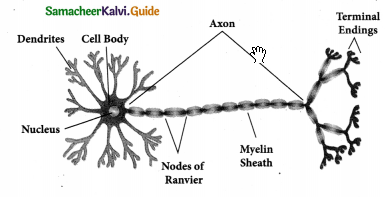
Draw a neuron and label the parts.
Answer:
Samacheer Kalvi 9th Science Guide Chapter 18 Organization of Tissues 5

VII. Answer in detail:

Question 1.
What are meristems? Describe the distribution and functions of various types of meristems.
Answer:
Meristematic tissues are group of immature cells that are capable of undergoing cell division. In plants, the meristem is found in zones where growth can take place. Example: apex of stem, root, leaf primordia, vascular cambium, cork cambium, etc.,

Types of Meristems based on position:
On the basis of their position in the plant, meristems are of three types: Apical meristem, Intercalary meristem, and Lateral meristem.

Apical meristem: These are found at the apices or growing points of root and shoot and bring about an increase in length.

Intercalary meristem: It lies between the region of permanent tissues and is part of the primary meristem. It is found either at the base of leaf e.g. pinus or at the base of internodes e.g. grasses.

Lateral Meristem: These are arranged parallel and causes the thickness of the plant part.

Functions: Meristems are actively dividing tissues of the plant, that are responsible for primary (elongation) and secondary (thickness) growth of the plant.
Samacheer Kalvi 9th Science Guide Chapter 18 Organization of Tissues 6

Question 2.
Give one reason for the following:
a. Blood is fluid connective tissue.
b. Skeletal muscles are voluntary muscles.
c. Heart muscles are involuntary in nature.
Answer:
The blood and the lymph are the fluid connective tissues which link different parts of the body. The cells of the connective tissue are loosely spaced and are embedded in an intercellular matrix.

(a) Blood: Blood contains corpuscles which are red blood cells (erythrocytes), white blood cells (leucocytes), and platelets. In this fluid connective tissue, blood cells move in a fluid matrix called plasma. The plasma contains inorganic salts and
organic substances. It is a main circulating fluid that helps in the transport of nutrient substances.

(b) They work under our control and are also known as voluntary muscles. They are not under the control of our will and so are called involuntary muscles.

(c) Cardiac muscle: It is a special contractile tissue present in the heart. The muscle fibers are cylindrical, branched, and uninucleate The branches join to form a network called as itercalated disc which are unique distinguishing features of the
cardiac muscles. The contraction of cardiac muscle is involuntary and rhythmic.

 Samacheer Kalvi 9th Science Guide Chapter 18 Organization of Tissues

Question 3.
Explain simple epithelium and its types.
Answer:
Simple Epithelium :
1. It is formed of a single layer of cells. It forms a lining for the body cavities and ducts.
2. Simple epithelium is further divided into the following types.

  • Squamous epithelium
  • Cuboidal epithelium
  • Columnar epithelium
  • Ciliated epithelium
  • Glandular epithelium

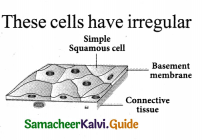
(i) Squamous epithelium :

  • It is made up of thin, flat cells with prominent nuclei. These cells have irregular boundaries and bind with neighbouring cells.
  • The squamous epithelium is also known as pavement membrane, which forms the delicate lining of the buccal cavity, alveoli of lungs, proximal tubule of kidneys, blood vessels etc.
  • It protects the body from mechanical injury, drying and invasion of germs.
    Samacheer Kalvi 9th Science Guide Chapter 18 Organization of Tissues 7

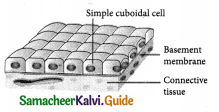
(ii) Cuboidal epithelium:

  • It is composed of single layer of cubical cells.
  • The nucleus is round and lies in the centre.
  • This tissue is present in the thyroid vesicles, salivary glands, sweat glands, exocrine pancreas.
  • It is also found in the intestine and tubular part of the nephron (kidney tubules) as microvilli that increase the absorptive surface area.
  • Their main function is secretion and absorption.
    Samacheer Kalvi 9th Science Guide Chapter 18 Organization of Tissues 8

(iii) Columnar epithelium:

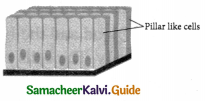
  • It is composed of a single layer of slender, elongated and pillar like cells.
  • Their nuclei are located at the base.
  • It is found lining the stomach, gall bladder, bile duct, small intestine, colon, oviducts and forms a mucous membrane. ‘
  • They are mainly involved in secretion and absorption.
    Samacheer Kalvi 9th Science Guide Chapter 18 Organization of Tissues 9

(iv) Ciliated epithelium :

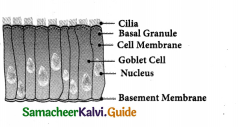
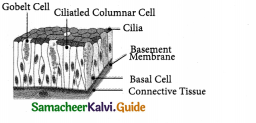
  • Certain columnar cells bear numerous delicate hair like out growths called ilia and are called ciliated epithelium.
  • Their function is to move particles or mucus in a specific direction over the epithelium.
  • It is seen in the trachea of wind-pipe, bronchioles of respiratory tract, kidney tubules and fallopian tubes of oviducts.
    Samacheer Kalvi 9th Science Guide Chapter 18 Organization of Tissues 10

(v) Glandular epithelium :

  • Epithelial cells are often modified to form specialized gland cells which secrete chemical substances at the epithelial surface.
  • This lines the gastric glands, pancreatic tubules and intestinal glands.
    Samacheer Kalvi 9th Science Guide Chapter 18 Organization of Tissues 11

Question 4.
Explain the components of phloem tissue.
Answer:
Phloem is a complex tissue and consists of the following elements :
(i) Sieve elements
(ii) Companion cells
(iii) Phloem fibres
(iv) Phloem parenchyma

(i) Sieve elements :

  • The conducting elements of phloem are collectively called as Sieve elements.
  • Sieve tubes are elongated, tube-like slender cells placed end to end. The transverse walls at the ends are perforated and are known as sieve plates.
  • The main function of sieve tubes is translocation of food, from leaves to the storage organs of the plants.

(ii) Companion cells : These are elongated cells attached to the lateral wall of the sieve tubes. A companion cell may be equal in length to the accompanying sieve tube element or the mother cell may be divided transversely forming a series of companion cells.

(iii) Phloem parenchyma : The phloem parenchyma are living cells which have cytoplasm and nucleus. Their function is to store food materials.

(iv) Phloem fibers : Sclerenchymatous cells associated with primary and secondary phloem are commonly called phloem fibers. These cells are elongated, lignified and provide mechanical strength to the plant body.

 Samacheer Kalvi 9th Science Guide Chapter 18 Organization of Tissues

Question 5.
Write a note on blood and its components.
Answer:
Blood is a fluid connective tissue.
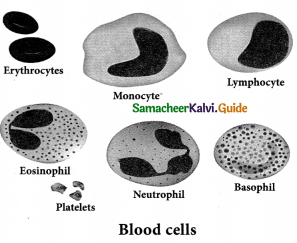
Blood contains corpuscles which are red blood cells (erythrocytes), white blood cells (leucocytes) and platelets. In this fluid connective tissue, the blood cells move in a fluid matrix called. The plasma contains inorganic salts and organic substances. It is a main circulating fluid that helps in the transport of nutrient substances.

Red blood corpuscles (Erythrocytes):

  • The red blood corpuscles are oval shaped, circular, biconcave disc-like and lack nucleus when mature (mammalian RBC).
  • They contain a respiratory pigment called haemoglobin which is involved in the transport of oxygen to tissues.

White blood corpuscles (Leucocytes): They are larger in size, contain distinct nucleus and are colourless. They are capable of amoeboid movement and play an important ‘ role in body’s defense mechanism. WBC’s are of two types :
(i) Granulocytes.
(ii) Agranulocytes.

(i) Granulocytes have irregular shaped nuclei and cytoplasmic granules. They include the neutrophils, basophils and eosinophils. Agranulocytes lack cytoplasmic granules and include the lymphocytes and monocytes.

Blood platelets : They are minute, anucleated, fragile fragments of giant bone marrow called mega karyocytes They play an important role in blood clotting mechanism.
Samacheer Kalvi 9th Science Guide Chapter 18 Organization of Tissues 12

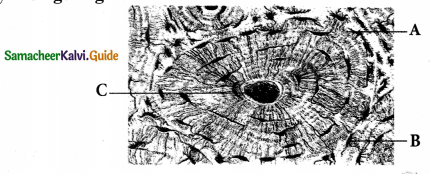
VIII. Higher Order Thinking Skills :

Question 1.
Identify the figure given below
Samacheer Kalvi 9th Science Guide Chapter 18 Organization of Tissues 13
(a) Label the parts A, B and C.
(b) What is the chemical composition of the tissue?
Answer:
(a) T.S. of Bone
(A) Lamellae
(B) Lacunae
(C) Central (Haversian canal)
(b) The matrix of the bone is rich in calcium salts and collagen fibres which gives the bone its strength.
(c) C – Haversian canal

 Samacheer Kalvi 9th Science Guide Chapter 18 Organization of Tissues

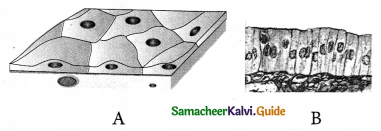
Question 2.
Identify figures A and B.
Samacheer Kalvi 9th Science Guide Chapter 18 Organization of Tissues 14
(a) …………… epithelium forms the outer lining of the buccal cavity.
(b) ………………. epithelium consist of ceils that are tall and pillar-like.
(c) Which one allows diffusion of substances?
(d) Which is called pavement epithelium?
(e) Which epithelium lines the gastrointestinal tract and epiglottis?
Answer:
Figure A – Squamous Epithelium
Figure B. – Glandular epithelium
(a) Squamous
(b) Columnar
(c) Columnar epithelium
(d) Squamous epithelium
(e) Columnar epithelium

Question 3.
If cell (A) has undergone one mitotic division and another cell (B) has completed its meiotic division. The number of cells produced in A and B would be
Cell A: Cell B :
Answer:
Cell A : 2 daughter cells.
Cell B : 4 daughter cells.

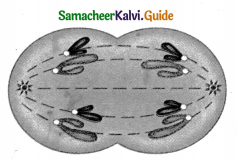
Question 4.
Identify the stage of mitosis from the below picture. List the chromosomal events in this stage.
Samacheer Kalvi 9th Science Guide Chapter 18 Organization of Tissues 15

Answer:
Mitotic anaphase
(i) The centromeres attaching the two chromatids divide and the two daughter chromatids of each chromosome separate and migrate towards the two opposite poles.
(ii) The migration of the daughter chromosomes is achieved by the contraction of spindle fibres.

 Samacheer Kalvi 9th Science Guide Chapter 18 Organization of Tissues

Question 5.
Identify the following relationship
Cuboidal : Epithelial
Cardiac : ………..
Granulocytes : …………
Osteocytes : ………….
Answer:
Cardiac : Muscular
Granulocytes : Blood cells
Osteocytes : Bone cells

Question 6.
Umbilical cord blood is collected at the time of child birth and stored in stem cell banks? Reason out.
Answer:

  • Umbilical cord blood consists of stem cells, they are undifferentiated cells which undergo unlimited divisions and give rise to one or more different types of cells. – Embryonic stem cells differentiate into different tissues and organs.
  • Stem cells can be used in the treatment of certain degenerative diseases in future.

Question 7.
How do WBC help in defence?
Answer:
They are capable of amoeboid movement and play an important role. They engulf or destroy foreign bodies.

Samacheer Kalvi 9th Science Guide Chapter 17 Animal Kingdom

Tamilnadu State Board New Syllabus Samacheer Kalvi 9th Science Guide Pdf Chapter 17 Animal Kingdom Text Book Back Questions and Answers, Notes.

Samacheer Kalvi 9th Science Solutions Chapter 17 Animal Kingdom

9th Science Guide Animal Kingdom Text Book Back Questions and Answers

I. Choose the correct answer :

Question 1.
Find the group having only marine members.
(a) Mollusca
(b) Coelenterata
(c) Echinodermata
(d) Porifera
Answer :
(d) Echinodermata

 Samacheer Kalvi 9th Science Guide Chapter 17 Animal Kingdom

Question 2.
Mesoglea is present in
(a) Porifera
(b) Coelenterata
(c) Annelida
(d) Arthropoda
Answer:
(b) Coelenterata

 Samacheer Kalvi 9th Science Guide Chapter 17 Animal Kingdom

Question 3.
Which one of the following pairs is not a poikilothermic animal
(a) Fishes and Amphibians
(b) Amphibians and Aves
(c) Aves and Mammals
(d) Reptiles and Mammals
Answer:
(c) Aves and Mammals

Question 4
Identify the animal having four chambered heart.
(a) Lizard
(b) Snake
(c) Crocodile
(d) Calotes
Answer:
(c) Crocodile

 Samacheer Kalvi 9th Science Guide Chapter 17 Animal Kingdom

Question 5
The animal without skull is
(a) Acrania
(b) Acephalia
(c) Apteria
(d) Acoelomate
Answer:
(a) Acrania

Question 6.
Hermaphrodite organisms are
(a) Hydra, Tape worm, Earthworm, Amphioxus
(b) Hydra, Tape worm, Earthworm, Ascidian
(c) Hydra, Tape worm, Earthworm, Balanoglossus
(d) Hydra, Tape worm, Ascaris, Earthworm
Answer:
b) Hydra, Tap worm, Earthworm, Ascidian

Question 7.
Poikilothermic organisms are
(a) Fish, Frog, Lizard, Man
(b) Fish, Frog, Lizard, Cow
(c) Fish, Frog, Lizard, Snake
(d) Fish, Frog, Lizard, Crow
Answer:
(c) Fish, Frog, Lizard, Snake

 Samacheer Kalvi 9th Science Guide Chapter 17 Animal Kingdom

Question 8.
Air sacs and Pneumatic bones are seen in
(a) fish
(b) frog
(c) bird
(d) bat
Answer:
(c) Bird

Question 9.
Excretory organ of tape worm is
(a) flame cells
(b) nephridia
(c) body surface
(d) solenocytes
Answer:
(a) Flame cells

Question 10.
Water vascular system is found in
(a) Hydra
(b) Earth worm
(c) Star fish
(d) Ascaris
Answer:
(c) Starfish

 Samacheer Kalvi 9th Science Guide Chapter 17 Animal Kingdom

II. Fill in the blanks :

1. The skeletal framework of Porifera is ……………..
Answer:
spicules

2. Ctenidia are respiratory organs in ……………….
Answer:
phylum mollusca

3. Skates are ………………. fishes.
Answer:
cartilaginous

 Samacheer Kalvi 9th Science Guide Chapter 17 Animal Kingdom

4. The larvae of an amphibian is …………………..
Answer:
bilaterally symmetrical

5. ………………. are jawless vertebrates.
Answer:
Cyclostomes

6. …………………… is the unique characteristic feature of mammal.
Answer:
Placenta

 Samacheer Kalvi 9th Science Guide Chapter 17 Animal Kingdom

7. Spiny anteater is an example for …………….. mammal.
Answer:
egg-laying

III. State whether true or false. If false write the correct statement :

1. Canal system is seen in coelenterates.
Answer:
False.
Correct statement: Canal system is seen in porifera

2. Hermaphrodite animals have both male and female sex organs.
Answer:
True,

3. Trachea are the respiratory organ of Annelida.
Answer:
False.
Correct statement: Trachea are the respiratory organ of Arthopoda.

 Samacheer Kalvi 9th Science Guide Chapter 17 Animal Kingdom

4. Bipinnaria is the larva of Mollusca.
Answer:
False.
Correct statement: Bipinnaria is the larva of star fish.

5. Balanoglossus is a ciliary feeder.
Answer:
True.

6. Fishes have two chambered heart.
Answer:
True.

 Samacheer Kalvi 9th Science Guide Chapter 17 Animal Kingdom

7. Skin of reptilians are smooth and moist.
Answer:
False.
Correct statement: Skin of cyclostomata are smooth and moist.

8. Wings of birds are the modified forelimbs.
Answer:
True

9. Female mammals have mammary glands.
Answer:
True.

 Samacheer Kalvi 9th Science Guide Chapter 17 Animal Kingdom

IV. Match the following :

PHYLUM EXAMPLES
(A) Coelenterata (i) Snail
(B) Platyhelminthes (ii) Starfish
(C) Echinodermata (iii) Tapeworm
(D) Mollusca (iv) Hydra

Answer:
A – iv, B – iii, C – ii, D – i

V. Answer very briefly :

Question 1.
Define taxonomy.
Answer:
The theoretical study of classification includes its basic principles, procedures, and rules.

Question 2.
What is nematocyst?
Answer:
The tentacles of organisms belonging to phylum Coelenterata bear stinging cells called cnidoblast or nematocyst.

 Samacheer Kalvi 9th Science Guide Chapter 17 Animal Kingdom

Question 3.
Why coelenterates are called diploblastic animals?
Answer:
The animals in phylum coelenterates have two layers the outer ectoderm and the inner endoderm in the body wall. So they are called diploblastic animals.

Question 4.
List the respiratory organs of amphibians.
Answer:
Respiration is through by gills, skin, buccopharynx and lungs.

Question 5.
How does locomotion take place in starfish?
Answer:
Locomotion is affected by tube feet.

 Samacheer Kalvi 9th Science Guide Chapter 17 Animal Kingdom

Question 6.
Are jellyfish and starfish similar to fishes? If no justify the answer.
Answer:

  • Jellyfish is a coelenterate. Their bodies are made of calcium carbonate.
  • Starfish fish is an echinoderm. Their bodies are made of calcium carbonate.
  • Catfish is a fish species.
  • Jellyfish and starfish are invertebrates.
  • Fishes are vertebrates.

Question 7.
Why are frogs said to be amphibians?
Answer:
The frogs have dual adaptation in land and aquatic environments. So they are called amphibians.

VI. Answer briefly:

Question 1.
Give an account on phylum Annelida.
Answer:

  • These are bilaterally symmetrical, triploblastic, first true coelomate animals with an organ-system grade of organization.
  • Body is externally divided into segments called metameres joined by ring-like structures called annuli.
  • It is covered by a moist thin cuticle.
  • Setae and parapodia are locomotor organs.
  • Sexes may be separate or ünited (hermaphrodites).
    e.g- Nereis, Earthworm, Leech.

 Samacheer Kalvi 9th Science Guide Chapter 17 Animal Kingdom

Question 2.
Differentiate between flatworms and roundworms?
Answer:

Flatworms Roundworms
a) They belong to Phylum Platyhelminthes. They belong to Phylum Aschelminthes.
b) They are mostly parasitic. Exist as free-living soil forms or as parasites.
c) Mostly hermaphrodites. Sexual dimorphism is seen.
d) They are acoelomate organisms. They are pseudocoelomate organisms.
e) The alimentary canal is absent or simple.
Eg: Tapeworm.
The alimentary canal is a straight tube.
Eg: Roundworm.

Question3.
Outline the flow charts of Phylum Chordata.
Answer:
Classification of phylum Chordata:
Samacheer Kalvi 9th Science Guide Chapter 17 Animal Kingdom 1

Question 4.
List five characteristic features of fishes.
Answer:

  • Fishes are poikilothermic, whose internal temperature varies, considerably.
  • The body has a covering of scales.
  • Body muscles are arranged into segments called myotomes.
  • The body is differentiated into head, trunk and tail.
  • Respiration is done by 5 to7 pairs of gills, which are covered by an operculum or sometimes maybe naked.

 Samacheer Kalvi 9th Science Guide Chapter 17 Animal Kingdom

Question 5.
Comment on the aquatic and terrestrial habits of amphibians.
Answer:
Aquatic habits of amphibians:

  • The larva of amphibians (tadpole) lives in water and breathes with gills.
  • External fertilization occurs in frog with water as a medium of fertilization.
  • The adult frog has webbed feet to swim in water.
  • The skin is moist and glandular which helps in Respiration.

Terrestrial habits of amphibians:

  • The adults live on land and breathe through the lungs. Bucco-pharynx also helps in Respiration.
  • The forelimbs are short and help to hop on land.

Question 6.
How are the limbs of the birds adapted for avian life?
Answer:

  1. Birds have a spindle-shaped body.
  2. The forelimbs are modified as wings for aerial locomotion.
  3. The air sacs present in the birds, make the bird lightweight.
  4. The body is covered with feathers.

 Samacheer Kalvi 9th Science Guide Chapter 17 Animal Kingdom

VII. Answer in detail :

Question 1.
Describe the characteristic features of different Prochordates.
Answer:
Prochordata :

  • The urochordates are considered as the forerunner of vertebrates.
  • Based on the nature of the notochord, protochordate is classified into subphylum Urochordata and subphylum Cephalochordata.
    Phylum Hemichordata :
    Samacheer Kalvi 9th Science Guide Chapter 17 Animal Kingdom 2
  • Hemichordates are marine organisms with soft, vermiform and unsegmented body.
  • They are bilaterally symmetrical, coelomate animals with non-chordate and chordate features.
  • They have gill slits but do not have notochord.
  • They are ciliary feeders and mostly remain as tubiculous forms, e.g- Balanoglossus (Acorn worms).
    Subphylum Urochordata:
    Samacheer Kalvi 9th Science Guide Chapter 17 Animal Kingdom 3
  • Notochord is present only in the tail region of free-living larva, e.g. Ascidian
  • Adults are sessile forms and mostly degenerate.
  • The body is covered with a tunic or test.

Subphylum Cephalochordata :

  • Cephalochordates are small fish like marine chordates with unpaired dorsal fins.
  • The notochord extends throughout the entire length of the body. e.g. Amphioxus

Question 2.
Give an account on phylum Arthropoda.
Answer:

  • Arthropoda is the largest phylum.
  • The organisms have jointed legs.
  • The body is segmented into head, thorax and abdomen.
  • The exoskeleton is made up of chitin.
  • The coelomic cavity is filled with haemolymph (blood).
  • They do not have defined blood vessels. This is called open circulatory system.
  • The insects shed the exoskeleton and this process is called moulting.
  • Small Arthropods absorb oxygen through the body and larger aquatic species breathe through book gills.
  • Land Arthropods breathe through a system of tiny body tubes called tracheae.
  • Excretion occurs through malphigian tubules and through green glands in crabs and prawns. .
  • Insects, spiders, crabs, shrimps, butterflies, millipedes, centipedes, and scorpions are some arthropods.

 Samacheer Kalvi 9th Science Guide Chapter 17 Animal Kingdom

Intext activities

ACTIVITY – 1
Samacheer Kalvi 9th Science Guide Chapter 17 Animal Kingdom 5
Observation :

  • Scorpion
  • Arachnid
  • Cockroach
  • Crab
  • Crustacean
    [End of the activity]

9th Science Guide Animal Kingdom Additional Important Questions and Answers

I. Choose the correct answer:

Question 1.
Which is not an insect?
(a) Housefly
(b) Bedbug
(c) Mosquito
(d) Spider
Answer:
d) Spider

Question 2.
Which is not a feature of chordates?
(a) Green glands
(b) Sweat glands
(c) Sebaceous gland
(d) Mammary gland
Answer:
(a) Green glands

 Samacheer Kalvi 9th Science Guide Chapter 17 Animal Kingdom

Question 3.
Choose the correct terms related to Hemichordate
(a) Vermiform, unsegmented, bilaterally symmetrical, ciliary feeders
(b) Vermiform, segmented, triploblastic, ciliary feeders
(c) Vermiform, unsegmented, diploblastic, ciliary feeders
(d) Vermiform, unsegmented; triploblastic, filter feeders
Answer:
a) Vermiform, unsegmented, bilaterally symmetrical, ciliary feeders

Question 4.
The …………. can swim faster than a cheetah.
(a) Sail fish
(b) Catfish
(c) Jelly fish
(d) Sucker fish
Answer:
a) Sail fish

 Samacheer Kalvi 9th Science Guide Chapter 17 Animal Kingdom

Question 5.
The biggest vertebrate animal is the ……………….
(a) Blue whale
(b) Dolphin
(c) Elephant
(d) Rhinoceros
Answer:
(a) Blue whale

Question 6.
Who introduced binomial nomenclature?
(a) Huxley
(b) Carolus Linnaeus
(c) Nicolaus Copernicus
(d) Charles Darwin
Answer:
(b) Carolus Linnaeus

 Samacheer Kalvi 9th Science Guide Chapter 17 Animal Kingdom

Question 7.
What is the binomial name of tapeworm?
(a) Ascaris lumbricoides
(b) Taenia solium
(c) Lampito mauritii
(d) Hirudinaria granulosa
Answer:
(b) Taenia solium

Question 8.
Which is the state bird of Tamil Nadu?
(a) Peacock
(b) Parrot
(c) Emerald dove
(d) Eagle
Answer:
(c) Emerald dove

Question 9. ;
……………. is an example of bony fish.
(a) Mullets
(b) Sharks
(c) Skates
(d) Hagfish
Answer:
(a) Mullets

 Samacheer Kalvi 9th Science Guide Chapter 17 Animal Kingdom

Question 10.
The notochord extends throughout the entire length of the body.
(a) Acorn worms
(b) Lamprey
(c) Ascidian
(d) Amphioxus
Answer:
(d) Amphioxus

Question 11.
Animals which possess notochord are called as …………………
(a) invertebrates
(b) non-chordates
(c) chordates
(d) all the above
Answer:
(c) chordates

 Samacheer Kalvi 9th Science Guide Chapter 17 Animal Kingdom

Question 12.
What ¡s the name of the bone which is filled with air?
(a) Flat bones
(b) Irregular bones
(c) Short bones
(d) Pneumatic bones
Answer:
d) Pneumatic bones

Question 13.
_________ ¡s the unique characteristic feature of mammals.
(a) Placenta
(b) Egg
(c) Tail
(d) Ear
Answer:
(a) Placenta

Question 14.
________ have gill slits but do not have notochord.
(a) Phylum Hemichordata
(b) Phylum Echirodermata
(c) Phylum Mollusca
(d) Phylum Annelida
Answer:
Phylum Hemichordata

 Samacheer Kalvi 9th Science Guide Chapter 17 Animal Kingdom

II. Fill In the blanks:

1. The binomial name of our National Bird is …………………………
Answer:
pavocristatus

2. In mammals testis are enclosed by ………………….
Answer:
scrotal sacs

3. In birds, the air sacs communicate with …………………
Answer:
lungs

 Samacheer Kalvi 9th Science Guide Chapter 17 Animal Kingdom

4. The animals belonging to phylunm …………….. are said to be soft-bodied.
Answer:
mollusca

5. The name ………….. means “thousand legs”.
Answer:
millipede

6. The skeletal framework of phylum Porifera is made up of ……………..
Answer:
spicules

 Samacheer Kalvi 9th Science Guide Chapter 17 Animal Kingdom

7. A true body cavity is located within ………………
Answer:
mesoderm

8………………. separates the digestive tract from the body wall.
Answer:
Coelom

9. ……………….. formed during embryonic development.
Answer:
Notochord

 Samacheer Kalvi 9th Science Guide Chapter 17 Animal Kingdom

10. …………….. is the largest phylum of the animal kingdom.
Answer:
Arthropoda

11. ………………… is a fluid-filled body cavity.
Answer:
Coelom

12. The body cavity of the phylum Aschelminthes is …………………….
Answer:
pseudocoelom

 Samacheer Kalvi 9th Science Guide Chapter 17 Animal Kingdom

13. The most common diseases caused by nematodes in human beings are …………and ……………
Answer:
elephantiasis, ascariasis

14. Cyclostmes are ………………….
Answer:
jawless vertebrates

15. Malphigian tubules also called as ……………….
Answer:
green glands

 Samacheer Kalvi 9th Science Guide Chapter 17 Animal Kingdom

16. Locomotion of phylum Echinodermata is affected by .
Answer:
tube feet

III. Analogy:

Question 1.
Echinodermata: ________ : : Soft Bodies Animals: ________
Answer:
Spiny Skinned Animals; Mollusca.

Question2.
Birds: _______ : : _________ : Cold-blooded.
Answer:
Warm-blooded; Fishes.

IV. State whether true or false. If false write the correct statement:

1. Order is a number of related families having common characters are placed in an order.
Answer:
True.

2. Tissue organization can be seen in phylum Porifera.
Answer:
False.
Correct statement: Cellular grade of organization can be seen in phylum Porifera.

 Samacheer Kalvi 9th Science Guide Chapter 17 Animal Kingdom

3. Aschelminthes is the largest phylum of the animal kingdom.
Answer:
False.
Correct statement: Arthropods is the largest phylum of the animal kingdom.

4. In the animals belonging to phylum Echinodermata, the body is divided into head, muscular food and visceral mass………….
Answer:
False.
Correct statement: In phylum mollusca, the body is divided into head, muscular food and visceral mass.

5. Setae and parapodia are locomotor organs of earthworms.
Answer:
True.

 Samacheer Kalvi 9th Science Guide Chapter 17 Animal Kingdom

6. Mammals have four-chambered Hearts.
Answer:
True,

V. Match the following:

Question 1.

(A) Cartilaginous (i) Mullets
(B) Bony fishes (ii) Sharks
(C) Pneumatic bones (iii) Reptiles
(D) Three chambered heart (iv) Birds

Answer:
A – i, B – ii, C – iv, D – iii

 Samacheer Kalvi 9th Science Guide Chapter 17 Animal Kingdom

VI. Assertion and Reason type :

Question 1.
Assertion (A) : The Arthropods have an open circulatory system. .
Reason (R) : The cells and tissues are bathed in blood.
(a) A is right and R is wrong.
(b) A is the wrong R is right.
(c) A and R are wrong.
(d) A is right R explains A.
Answer:
(d) A is right R explains A

Question 2.
Assertion (A) : Mammals give birth to their young ones.
Reason (R) : Platypus is an egg-laying mammal.
(a) A and R are correct.
(b) A and R are wrong.
(c) R explains A.
(d) A is the wrong R is right.
Answer:
(a) A and R are correct

 Samacheer Kalvi 9th Science Guide Chapter 17 Animal Kingdom

VII. Answer in one or two sentences :

Question 1.
Which organism is called Friends of farmers? Why?
Answer:
Earthworms are called ‘Friends of the farmers’ because after digesting organic matter, earthworms excrete a nutrient-rich waste product called castings which are used as Vermicompost.

Question 2.
What are the sub-phylum of prochordates?
Answer:
Sub phylum of prochordates are
Subphylum Cephalochordata
Subphylum Urochordata

Question 3.
Name the three germ layers.,
Answer:
Ectoderm, mesoderm and endoderm

 Samacheer Kalvi 9th Science Guide Chapter 17 Animal Kingdom

Question 4.
Name the locomotary organs seen in phylum protozoa.
Answer:
Pseudopodia, cilia, or flagella.

Question 5.
Mention two special features of mammals.
Answer:
(i) External ear or pinna is seen in most the mammals.
(ii) Presence of the placenta is a unique characteristic feature.

Question 6.
Write the binomials of a) Man b) Tapeworm
Answer:
a) Homo sapiens
b) Taenia solium.

 Samacheer Kalvi 9th Science Guide Chapter 17 Animal Kingdom

Question 7.
What is the binomial name?
Answer:
Carolus Linnaeus introduced the method of naming the animals with two names. This is known as binomial name and is followed universally.
Eg: Binomial of frog is
Samacheer Kalvi 9th Science Guide Chapter 17 Animal Kingdom 6

VIII. Short answer questions :

Question 1.
How is the body wall of coelenterates arranged?
Answer:
Body wall of coelenterate is disloblastic with two layers, namely the outer ectoderm and the inner endoderm, are separated by non-cellular jelly-like substance called mesoglea. Due to the presence of two layers in the body wall, they are said to be diploblastic animals.

Question 2.
What is polymorphism?
Answer:
Many coelenterates exhibit polymorphism, which is the variation in the structure and function of the individuals of the same species. They reproduce both asexually and sexually, e.g. Hydra, Jellyfish.

 Samacheer Kalvi 9th Science Guide Chapter 17 Animal Kingdom

Question 3.
What is the unique feature of chordates?
Answer:
Presence of notochord is the unique feature of chordates.

Question 4.
On the basis of position of notochord, classify the different prochordates. Justify your answer.
Answer:

Subphyla of prochordates Position of notochord
b) Cephalochordata The notochord is present only in the tail region of the free-living larva. e.g. Ascidian
c) Urochordata The notochord extends throughout the entire length of the body. e.g. Amphioxus

Question 5.
List the integumentary glands of mammals.
Answer:
Integumentary glands are seen in mammals:

  • Sweat glands
  • Sebaceous glands
  • Scent glands
  • Mammary glands are modified
  • Integumentary glands

 Samacheer Kalvi 9th Science Guide Chapter 17 Animal Kingdom

Question 6.
How is the reproductive characters of mammals different from those of aves.

Mammals

Aves

(i) Mammals have paired sex organs, eggs are small with little or no yolk. (i) They are oviparous and lay eggs.
(ii) They are viviparous and give birth to young one. (ii) Formation of placenta is not seen. The embryo is nourished,by egg yolk. Egg has an abundant quantity of yolk.
(iii) Formation of placenta is a special feature. The tissue connects the foetus to maternal tissues.

Question 7.
Mention two characteristic features of phylum Echinodermata.
Answer:
They have a water vascular system which is a unique feature. Locomotion is affected by tube feet.

Question 8.
Mention two features seen in Aves to aid in flying.
Answer:

  • The forelimbs are modified into wings for flight.
  • Bones are filled with air (pneumatic bones), which reduces body weight.

 Samacheer Kalvi 9th Science Guide Chapter 17 Animal Kingdom

Question 9.
Why is crocodile unique among reptiles?
Answer:
It has a four-chambered heart whereas the reptiles have a three-chambered heart.

Question 10
Why are eggs of reptiles covered with shell unlike eggs of amphibians?
Answer:
First-class of vertebrates adapted for terrestrial life and lay their eggs with tough outer Shell e.g Calotes, Lizard, Snake, Tortoise, Turtle. Hence the eggs are covered with shells to protect them. Whereas amphibians eggs are laid in water.

Question 11.
What are pneumatic bones?
Answer:
The bones are filled with air. So they are called pneumatic bones and are seen in aves.

 Samacheer Kalvi 9th Science Guide Chapter 17 Animal Kingdom

IX. Long answer questions :

Question 1.
Write a note on mammals.
Answer:

  • Mammals are -warm-blooded animals.
  • The skin is covered with hair. It also bears sweat and sebaceous (oil) glands.
  • The body is divisible into head, neck, trunk and tail.
  • Females have mammary glands, which secrete milk for feeding the young ones.
  • The external ear or pinnae is present.
  • Heart is four-chambered and they breathe through lungs.
  • Except egg-laying mammals (Platypus, and Spiny anteater), all other mammals give birth to their young ones (viviparous).
  • Placenta is the unique characteristic feature of mammals, e.g Rat, Rabbit, Man.

Question 2.
Write a note on aves.
Answer:

  • Birds are homeothermic (warm-blooded) animals with several adaptations to fly.
  • The spindle or boat-shaped body is divisible into head, neck, trunk and tail.
  • The body is covered with feathers. Forelimbs are modified into wings for flight.
  • Hindlimbs are adapted for walking, perching or swimming.
  • The respiration is through lungs, which have air sacs.
  • Bones are filled with air (pneumatic bones), which reduces body weight.
  • They lay large yolk laden eggs.
  • They are covered by hard calcareous shell, e.g. Parrot, Crow, Eagle, Pigeon, Ostrich.

Question 3.
Outline the flow chart of invertebrate phyla.
Answer:
Samacheer Kalvi 9th Science Guide Chapter 17 Animal Kingdom 7

Samacheer Kalvi 9th Science Guide Chapter 19 Plant Physiology

Tamilnadu State Board New Syllabus Samacheer Kalvi 9th Science Guide Pdf Chapter 19 Plant Physiology Text Book Back Questions and Answers, Notes.

Tamilnadu Samacheer Kalvi 9th Science Solutions Chapter 19 Plant Physiology

9th Science Guide Plant Physiology Text Book Back Questions and Answers

Samacheer Kalvi 9th Science Guide Chapter 20 Organ Systems in Animals

I. Choose the correct answer :

Question 1.
The tropic movement that helps the climbing vines to find a suitable support is …………….
(a) phototropism
(c) thigmotropism
(b) geotropism
(d) chemotropism
Answer:
(c) thigmotropism

Question 2.
The chemical reaction occurs during photosynthesis is .
(a) CO2 is reduced and water is oxidized
(b) water is reduced and CO2 is oxidized
(c) both CO2 and water are oxidized
(d) both CO2 and water are produced
Answer:
(a) CO2 is reduced and water is oxidized

Question 3.
The bending of root of a plant in response to water is called …………………….
(a) Thigmonasty
(b) Phototropism
(c) Hydrotropism
(d) Photonasty
Answer:
(c) Hydrotropism

Samacheer Kalvi 9th Science Guide Chapter 20 Organ Systems in Animals

Question 4.
A growing seedling is kept in the dark room. A burning candle is placed near it for a few days. The tip part of the seedling bends towards the burning candle. This is an example of ……………
(a) Chemotropism
(b) Geotropism
(c) Phototropism
(d) Thigmotropism
Answer:
(c) Phototropism

Question 5.
The root of the plant is …………………
i) positively phototropic but-negatively geotropic
ii) positively geotropic but negatively phototropic
iii) negatively phototropic but positively hydrotropic
iv) negatively hydrotropic but.positively phototropic
(a) (i) and (ii)
(b) (ii) and (iii)
(c) (iii) and (iv)
(d) (i) and (iv)
Answer:
(b) (ii) and (iii)

Samacheer Kalvi 9th Science Guide Chapter 20 Organ Systems in Animals

Question 6.
The non-directional movement of a plant part in response to temperature is called………………..
(a) Thermotropism
(b) Thermonasty
(c) Chemotropism
(d) Thigmonasty
Answer:
(b) Thermonasty

Question 7.
Chlorophyllin a leaf is required for …………………
(a) photosynthesis
(b) tropic movement
(c) transpiration
(d) nastic movement
Answer:
(a) photosynthesis

Samacheer Kalvi 9th Science Guide Chapter 20 Organ Systems in Animals

Question 8.
Transpiration takes place through ………………..
(a) fruit
(b) seed
(c) flower
(d) stomata
Answer:
(d) stomata

II. Fill in the blanks :

1. The shoot system grows upward in response to ………………..
Answer:
light

2. ………………..is positively hydrotropic as well as positively geotropic.
Answer:
root

3. The green pigment present in the plant is………………..
Answer:
chlorophyll

Samacheer Kalvi 9th Science Guide Chapter 20 Organ Systems in Animals

4. The solar tracking of sunflower in accordance with the path of sun is due to …………………
Answer:
phototropism:

5. The response of a plant part towards gravity is ………………..
Answer:
geotropism

6. Plants take in carbon dioxide for photosynthesis but need ……………….. for their living.
Answer:
oxygen

III. Match column A with column B

Column A

Column B

1. Roots growing downwards into soil. Positive phototropism
2. Shoots growing towards the light. Negative geotropism
3. Shoots growing upward. Negative phototropism
4. Roots growing downwards away from light. Positive geotropism

Answer:

Column A Column B
1. Roots growing downwards into soil. Positive geotropism
2. Shoots growing towards the light. Positive phototropism
3. Shoots growing upward. Negative geotropism
4. Roots growing downwards away from light. Negative phototropism

IV. State whether true or false. If false, correct the statement:

1. The response of a part of plant to the chemical stimulus is called phototropism.
Answer:
False.
Correct statement : The response of a plant part to the chemical stimulus is called Itemoiropisin.

2. Shoot is positively phototropic and negatively geotropic.
Answer:
True.

Samacheer Kalvi 9th Science Guide Chapter 20 Organ Systems in Animals

3. When the weather is hot, water evaporates lesser which is due to opening of stomata.
Answer:
False.
Correct statement: When the weather is hot, water evaporates more but stomata begin to close to reduce evaporation.

4. Photosynthesis produces glucose and carbon dioxide.
Answer:
False.
Correct statement: Photosynthesis produces glucose and oxygen.

5. Photosynthesis is important in releasing oxygen to keep the atmosphere in balance.
Answer:
True

Samacheer Kalvi 9th Science Guide Chapter 20 Organ Systems in Animals

6. Plants lose water when the stomata on leaves are closed.
Answer:
False.
Correct statement: Plants lose water when the stomata on leaves are open.

V. Answer very briefly :

Question 1.
What is nastic movement?
Answer:
Non-directional response to the stimulus is called Nastic movements.

Question 2.
Name the plant part
a) Which bends in the direction of gravity but away from the light.
b) Which bends towards the light but away from the force of gravity.
Answer:
a) Root system
b) Shoot system.

Samacheer Kalvi 9th Science Guide Chapter 20 Organ Systems in Animals

Question 3.
Differentiate phototropism from photo nasty.
Answer:
Phototropism:

  1. Movement of a plant part towards the light.
  2. Eg: Shoot of a plant.

Photonasty:

  1. Movement of a plant part is a response to light.
  2. Eg: Moonflower, Taraxacum Officinale.

Question 4.
Photosynthesis converts energy X into energy Y.
a) What are X and Y?
b) Green plants are autotrophic in their mode of nutrition. Why?
Answer:
a) X → light energy,
Y → Chemical energy.
b) Green plants are autotrophic in their mode of nutrition because they prepare then- own food materials through photosynthesis.

Question 5.
Define transpiration.
Answer:
The loss of water in the form of water vapour from the aerial parts of the plant body is called Transpiration.

Samacheer Kalvi 9th Science Guide Chapter 20 Organ Systems in Animals

Question 6.
Name the cell that surrounds the stoma.
Answer:
Each stomata is surrounded by guard cells.

VI. Answer briefly :

Question 1.
Give the technical terms for the following :
a) Growth dependent movement in plants.
b) Growth independent movement in plants.
Answer:
a) Tropic movements
b) Nastic movements

Question 2.
Explain the movement seen in Pneumatophores of Avicennia.
Answer:

  • Pneumato[hores are specialized roots that can involve in the respiration of plants,
  • This type of roots intakes the gas through its lenticel. a small hole in their both.

Question 3.
Fill in the blanks:
Samacheer Kalvi 9th Science Guide Chapter 19 Plant Physiology 1
Answer:
Samacheer Kalvi 9th Science Guide Chapter 19 Plant Physiology 2

Samacheer Kalvi 9th Science Guide Chapter 20 Organ Systems in Animals

Question 4.
What is chlorophyll?
Answer:
Chlorophyll is a green pigment present in all green plants with is responsible for the absorption of light to provide energy for photosynthesis.

Question 5.
Name the part of plant which shows positive geotropism. Why?
Answer:
Root shows positive geotropism because of the unidirectional movement in response to gravity.

Question 6.
What is the difference between the movement of flowers in the sunflower plant and the closing of the leaves in the Mimosa pudica?
Answer:
Movement of flower in sunflower plant:
In sunflower plant the stem tip follows the path of the sun from dawn to dusk (East to est) and in night it moves from West to East. This is a growth movement and takes place in response to the stimulus ‘light’. It is an example of tropic movement in response to light and is called phototropism.

Closing of the leaves in the Mimosa pudica :
The closing of leaves in Mimosa pudica occurs in response to touch. It is not a growth movement and occurs independently of the direction of stimulus. This is nastic movement . and is called Thigmonasty.

Samacheer Kalvi 9th Science Guide Chapter 20 Organ Systems in Animals

Question 7.
Suppose you have a rose plant growing in a pot, how will you demonstrate transpiration in it?
Answer:
Tie a plastic bag over leaves of rose plant and place in sunlight. After a few hours, we see water condensing inside the plastic bag. This is due to loss of water in the form of water vapour, which condenses into water. This is due to transpiration.

Question 8.
Mention the differences between stomatal and lenticular transpiration.
Answer:
Stomatal transpiration :

  1. Loss of water from plants through stomata.
  2. 90-95% of transpiration in a plant takes place through stomata only.

Lenticular transpiration :

  1. Loss of water from plants as vapour through the lenticels.
  2. A very small percentage of water is lost by through plants lenticular transpiration.

Question 9.
To which directional stimuli do (a) roots respond (b) shoots respond?
Answer:
(a) Roots respond positively geostrophic and negatively phototrophic.
(b) Shoots respond negatively geostrophic and positively phototrophic.

Samacheer Kalvi 9th Science Guide Chapter 20 Organ Systems in Animals

VII. Answer in detail :

Question 1.
Differentiate between tropic and nastic movements
Answer:
Tropic movements

  1. Unidirectional response to the stimulus.
  2. Growth dependent movements.
  3. More or less permanent and irreversible.
  4. Found in all plants.
  5. Slow action.

Nastic movements :

  1. Non-directional response to the stimulus
  2. Growth independent movements. –
  3. Temporary and reversible.
  4. Found only in a few specialized plants.
  5. Immediate action.

Question 2.
How will you differentiate the different types of transpiration?
Answer:
There are three types of transpiration:
Stomatal transpiration: Loss of water from plants through stomata. It accounts for 90- 95% of the water transpired from leaves.
Cuticular transpiration: Loss of water in plants through the cuticle.
Lenticular transpiration: Loss of water from plants as vapour through the lenticels. The lenticels are tiny openings that protrude from the barks in woody stems and twigs as well as in other plant organs.
But transpiration is necessary for the following reasons.

  1. It creates a pull in leaf and stem.
  2. It creates an absorption force in roots.
  3. It is necessary for a continuous supply of minerals.
  4. It regulates the temperature of the plant.

VIII. Higher Order Thinking Skills:

Question 1.
There are 3 plants A, B and C. The flowers of A open their petals in bright light during the day but closes when it gets dark at night. On the other hand, the flowers f of plant B open their petals at night but closes during the day when there is a bright light. The leaves of plant C fold up and droop when touched with fingers or any other solid object.
(a) Name the phenomenon shown by the flowers of plants A and B.
(b) Name one plant each which behaves like the flowers of plant A and B.
(c) Name the phenomenon exhibited by the leaves of plant C.
Answer:
(a) Photonasty
(b) Plant A – Common Dandelion – Taraxacum officinale
Plant B – Moonflower – Ipomoea alba
(c) Nyctinasty

Samacheer Kalvi 9th Science Guide Chapter 20 Organ Systems in Animals

Question 2.
Imagine that student A studied the importance of certain factors in photosynthesis.
He took a potted plant and kept it in dark for 24 hours. In the early hours of the next
morning, he covered one of the leaves with dark paper in the centre only. Then he placed the plant in sunlight for a few hours and tested the leaf which was covered
with black paper for starch.
(a) What aspect of photosynthesis was being investigated?
(b) Why was the plant kept in the dark before the experiment?
(c) How will you prove that starch is present in the leaves?
Answer:
(a) Necessity of light as a factor for Photosynthesis.
(b) To make the plant starch-free before starting the experiment. After the experiment, if starch is found in the leaf it will be the starch prepared by leaves during the experiment only.
(c) Presence of starch in the leaves can be proved by doing the starch test.

  • The potted plant is kept in bright sunlight for 4 to 6 hours.
  • The selected covered leaf is plucked and the black paper is removed.
  • The leaf is immersed in boiling water for a few minutes and then in alcohol to remove chlorophyll.
  • The leaf is now tested with iodine solution for the presence of starch.
  • The covered part of the leaf does not turn blue-black whereas the uncovered part of the leaf turns blue-black colour.
  • The covered part of the leaf which did not receive the sunlight was unable to synthesize starch.
  • Hence it does not turn blue-black colour.
  • But the uncovered part of the leaf which received sunlight was able to synthesize starch and so it turns blue-black in colour.

Intext Activities

ACTIVITY – 1

Take a glass trough and fill it with sand. Keep a flower pot containing water, plugged at the bottom at the centre of the glass trough. Place some soaked pea or bean seeds around the pot in the sand. What do you observe after 6 or 7 days? Record your observation.

Aim : To demonstrate hydrotropism.
Materials required : Glass trough, sand, flower pot, plugged at the bottom, pea or bean seeds and water.

Samacheer Kalvi 9th Science Guide Chapter 19 Plant Physiology 3

Samacheer Kalvi 9th Science Guide Chapter 20 Organ Systems in Animals

Procedure :

  1. A glass trough is taken and is filled with sand. A flowerpot containing water plugged at the bottom is kept at the centre of the glass trough.
  2. Soaked pea or bean seeds are placed around the pot in the sand. It is observed after 6 or 7 days.

Observation: Observed that radicle has grown towards the pot and moisture instead of growing vertically downward.
Inference: It proves that primary root is positively hydrotropic.
Result: Hydrotropism has been demonstrated by showing positive hydrotropism in roots.

[End of the activity]

ACTIVITY – 2

Take pea seeds soaked in water overnight. Wait for the pea seeds to germinate. Once the seedling has grown put it in a box with an opening for light on one side. After few hours, you can clearly see how the stem has bent and grown towards the light.

Aim : To demonstrate phototropism.
Materials required : Box, water, light and pea seeds.

Procedure:

  1. Take pea seeds soaked in water overnight. Wait for the pea seeds to germinate.
  2. Once the seedling has grown put it in a box with an opening for light on one side.
  3. After few hours, you can clearly see how the stem has bent and grown towards the light.

Observation : Observed that movement of a stem of a plant (pea seeds) towards light moist condition. This is the way a new plant develops from a seed.
Inference : Positive phototropism of a plant has been demonstrated.

[End of the activity]

ACTIVITY – 3

Pluck a variegated leaf from Coleus plant kept in sunlight. De- starch it by keeping in dark room for 24 hours. Draw the picture of this leaf and mark the patches of cholorphyll on the leaf. Immerse the leaf in boiling water followed by alcohol and test it for starch using iodine solution. Record your observation.

Aim : To show that chlorophyll is essential for photosynthesis.
Materials required : Plant with variegated leaves, boiling water, alcohol and iodine solution.
Samacheer Kalvi 9th Science Guide Chapter 19 Plant Physiology 4

Procedure:
Variegated leaf is plucked from Coleus plant kept in sunlight. It isde-starched by keeping it in dark room for 24 hours. The picture of this leaf is drawn and the patches of cholorphyll on the leaf are marked. After immersing the leaf in boiling water followed by alcohol it is tested for starch with iodine solution.

Observation : The patches of the leaf with chlorophyll turn blue-black. The other portions remain colourless.
Inference: The chlorophyll is essential for photosynthesis.

Samacheer Kalvi 9th Science Guide Chapter 20 Organ Systems in Animals

ACTIVITY – 4

Place a potted plant in a dark room for about 2 days to de-starch its leaves. Cover one of its leaves with the thin strip of black paper as shown in the picture, make sure that the leaf is covered on both sides. Keep the potted plant in bright sunlight for 4 to 6 hours. Pluck the selected covered leaf and remove the black paper.
Immerse the leaf in boiling water for a few minutes and then in alcohol to remove chlorophyll. Test the leaf now with iodine solution for the presence of starch. The covered part of the leaf does not turn blue-black whereas the uncovered part of the leaf turns blue-black colour. Why are the changes in colour noted in the covered and uncovered part of the leaf?
Samacheer Kalvi 9th Science Guide Chapter 19 Plant Physiology 5

Aim : To show that light is essential for photosynthesis.
Materials required : Covered leaf, boiling water, alcohol and iodine.

Procedure:

  1. A potted plant is placed in a dark room for about 2 days to de-starch its leaves.
  2. One of its leaves is covered with a thin strip of black paper as shown in the picture.
  3. Make sure that the leaf is covered on both sides.
  4. The potted plant is kept in bright sunlight for 4 to 6 hours.
  5. The selected covered leaf is plucked and the black paper is removed.
  6. Th e leaf is immersed in boiling water for a few minutes and then in alcohol to remove chlorophyll.
  7. The leaf is now tested with iodine solution for the presence of starch.

Observation : The covered part of the leaf does not turn blue-black whereas the uncovered part of the leaf turns blue black colour. The covered part of the leaf which did not receive sunlight was unable to synthesize starch.
Inference : The light is essential for photosynthesis.

9th Science Guide Plant Physiology in Animals Additional Important Questions and Answers

I. Choose the correct answer :

Question 1.
The bending of root of a plant in response to water is called …………………..
(a) thigmonasty
(b) phototropism
(c) hydrotropism
(d) photonasty
Answer:
(c) hydrotropism

Question 2.
A growing seedling is kept in the dark room. A burning candle is placed near it for a few days. The top part of the seedling bends towards the burning candle. This is an example of ……………………
(a) chemotropism
(b) thigmotropism
(c) phototropism
(d) geotropism
Answer:
(c) phototropism

Question 3.
The root of the plant is ……………………
(i) positively phototropic but negatively geotropic.
(ii) positively geotropic but negatively phototropic.
(iii) negatively phototropic but positively hydrotropic.
(iv) negatively hydrotropic but positively phototropic.
(a) (i) and (ii)
(b) (ii) and (iii)
(c) (iii) and (iv)
(d) (i) and (iv)
Answer:
(b) (ii) and (iii)

Samacheer Kalvi 9th Science Guide Chapter 20 Organ Systems in Animals

Question 4.
The plant part which exhibits negative geotropism is ……………………
(a) root
(b) stem
(c) branch
(d) leaves
Answer:
(b) stem

Question 5.
The non-directional movement of a plant part in response to temperature is called…………………..
(a) thermotropism
(b) thermonasty
(c) chemotropism
(d) thigmonasty
Answer:
(b) thermonasty

Samacheer Kalvi 9th Science Guide Chapter 20 Organ Systems in Animals

Question 6.
Sunflowers open the petals in bright light during the day time but close the petals in dark at night. This response of sunflowers is called ……………………
(a) geonasty
(b) thigmonasty
(c) chemonasty
(d) photonasty
Answer:
(d) photonasty

Question 7.
During photosynthesis plants exhale ……………………
(a) Carbon dioxide
(b) oxygen
(c) hydrogen
(d) helium
Answer:
(b) oxygen

Samacheer Kalvi 9th Science Guide Chapter 20 Organ Systems in Animals

Question 8.
Chlorophyll in a leaf is required for ……………………
(a) photosynthesis
(b) transpiration
(c) tropic movement
(d) nastic movement
Answer:
(a) photosynthesis

Question 9.
A plant is kept in a dark room for about 24 hours before conducting any experiment on photosynthesis in order to ……………………
(a) remove chlorophyll from the leaf
(b) remove starch from the leaves
(c) ensure that photosynthesis occurred
(d) to prove transpiration
Answer:
(b) remove starch from the leaves

Question 10.
Transpiration takes place through ……………………
(a) fruit
(b) seed
(c) flower
(d) stomata
Answer:
(d) stomata

Samacheer Kalvi 9th Science Guide Chapter 20 Organ Systems in Animals

Question 11.
Thigmonasty can be seen in ……………………
(a) Mimosa pudica
(b) Taraxacum officinale
(c) Ipomea alba
(d) Rhizophora
Answer:
(a) Mimosa pudica

Question 12.
The venus flytrap plants are examples for …………………..
(a) chemotropism
(b) thigmonasty
(c) hydrotropism
(d) thigmotropism
Answer:
(b) thigmonasty

Question 13.
………………….. flowers bloom as the temperature increases.
(a) Rose
(b) Jasmine
(c) Lilly
(d) Tulip
Answer:
(d) Tulip

Samacheer Kalvi 9th Science Guide Chapter 20 Organ Systems in Animals

Question 14.
Only green plants have the unique capacity to release ………………….. into the atmosphere.
(a) nitrogen
(b) oxygen
(c) carbon dioxide
(d) ozone
Answer:
(b) oxygen

Question 15.
The end product of photosynthesis is ……………………
(a) glucose
(b) sucrose
(c) fructose
(d) none of the above
Answer:
(a) glucose

Samacheer Kalvi 9th Science Guide Chapter 20 Organ Systems in Animals

II. Fill in the blanks :

1. The minerals like nitrogen, potassium and phosphorus, are required in substantial quantity by the plants are called …………………..
Answer:
macronutrients

2. The solar tracking of sunflower in accordance with the path of sun is due to ………………………
Answer:
phototropism

3. The response of a plant part towards gravity is ………………………
Answer:
geotropism

4. When the leaves of a sensitive plant are touched with a finger, they fold up and when light fades at dusk the petals of a sunflower. These two plants show ……………………..and ……………………..movements.
Answer:
thigmonastic, photonastic

Samacheer Kalvi 9th Science Guide Chapter 20 Organ Systems in Animals

5. Opening and closing of Moon flower is not a tropism because the movement in this is……………………..
Answer:
independent of stimulus

6. The raw materials for photosynthesis are …………………….. and ………………………
Answer:
carbon dioxide, water

7. When iodine solution is added for testing starch, part of the leaf with …………………….. turn blue- black colour.
Answer:
starch

8. In leaves, the food is stored in the form of……………………..
Answer:
starch

9. Plants may inhale carbon dioxide for photosynthesis but need ……………………..for their living.
Answer:
oxygen

10. Plants utilize only ……………………..% of the absorbed water for photosynthesis and the other activities.
Answer:
1

Samacheer Kalvi 9th Science Guide Chapter 20 Organ Systems in Animals

11 . Plants inhale and exhale continuously through the . ……………………..
Answer:
stamata

12. The bending of shoot towards light is due to the hormone ……………………..
Answer:
auxin

13. Heliotropism is a kind of ……………………..
Answer:
phototropism

14. The ……………………..plant exhibits one of the fastest known nastic movements.
Answer:
venus flytrap

15. Chlorophyll differs from haemoglobin by the presence of its central molecule ……………………..
Answer:
magnesium

16. Plants exchange gases ……………………..continuously through these stomata.
Answer:
CO2 to O2

17. Guard cells help in regulating the ……………………..
Answer:
rate of transpiration

Samacheer Kalvi 9th Science Guide Chapter 20 Organ Systems in Animals

III. Analogy :

Question 1.
Towards a stimulus : ……………….:: Away from the stimulus : Negative tropism
Answer:
Positive tropism

Question 2.
Hydrotropism : Response towards water :: Phototropism : …………..
Answer:
Response towards light

Question 3.
Photosynthesis : ……………….. :: Transpiration : Stomata
Answer:
Green leaves

Samacheer Kalvi 9th Science Guide Chapter 20 Organ Systems in Animals

IV. State whether the following statements are true or false. If false, write the correct statement :

1. Scientific term used to represent the bending of roots towards water is called geotropism.
Answer:
False.
Correct statement: Scientific term used to represent the bending of roots towards water is called hydrotropism.

2. When the leaves of Mimosa pudica plant are touched with the finger, they fold up quickly.
Answer:
True.
Correct statement: This is an example of thigmonasty.

3. The petals of moon flower open up in morning and closes in the evening. This is called photonasty.
Answer:
False.
Correct statement :The petals of moon flower dost ‘ in the morning and opens up in the evening. This is called photonasty.

Samacheer Kalvi 9th Science Guide Chapter 20 Organ Systems in Animals

4. Photosynthesis produces glucose and carbon dioxide.
Answer:
False.
Correct statement: Photosynthesis produces glucose and oxygen.

5. Photosynthesis is important in releasing oxygen to keep the atmosphere in balance.
Answer:
True.

6. Plants lose water when the stomata on leaves are closed.
Answer:
False.
Correct statement: Plants will not lose water when the stomata on leaves are closed.

V. Assertion and reason :

Question 1.
Assertion (A) : If the plant part moves in the direction of gravity, it is called positive geotropism.
Reason (R) : Stem shows positive geotropism.
(a) A and R are incorrect
(b) A is incorrect, R is correct
(c) A is correct, R is incorrect
(d) Both A and R are correct
Answer:
(c) A is correct, R is incorrect

Question 2.
Assertion (A) : The loss of excess water from the aerial parts of the plant in the form of water vapour is known as transpiration.
Reason (R) : Stomata of the leaf perform transpiration.
(a) A and R are incorrect
(b) A is incorrect, R is correct
(c) A is correct, R is incorrect
(d) Both A and R are correct
Answer:
(d) Both A and R are correct

Samacheer Kalvi 9th Science Guide Chapter 20 Organ Systems in Animals

VI. Short answer questions :

Question 1.
Write the scientific terms used to represent the following:
(a) Growing of roots towards the gravity.
(b) Bending of roots towards the water.
Samacheer Kalvi 9th Science Guide Chapter 19 Plant Physiology 6
Answer:
(a) Positive geotropism
(b) Positive hydrotropism.

Samacheer Kalvi 9th Science Guide Chapter 20 Organ Systems in Animals

Question 2.
Observe the given picture.
(a) Identify this plant. What type of special movement is shown by this plant?
(b) What are the other movements seen in this plant?
Answer:
(a) Mimosa pudica.
Special movement shown by the plant: Just a casual touch is enough to make the leaves of Mimosa pudica (Touch-me- not plant) fold up and droop. This is described as seismonasty or thigmonasty.
Movements which are not directed towards stimuli but are independent of the stimulus direction are called as nastie movements. They may or may not be growth movement.

(b) The foliage of Mimosa closes during darkness and reopens in the presence of light. Note : The ‘rapid movement of in leaflets in Mimosa is rare in the plant kingdom and is related to changes in turgor pressure.

Question 3.
What is the end product of photosynthesis?
Answer:
The end product of photosynthesis is glucose which is converted into starch and stored in the plant parts.

Question 4.
Name the minute openings seen on the lower surface of the leaf.
Answer:
Stomata are the minute openings seen on the lower surface of the leaf.

Samacheer Kalvi 9th Science Guide Chapter 20 Organ Systems in Animals

Question 5.
Give the scientific terms for the following:
(a) Growth dependent movement in plants.
(b) Growth independent movement in plants.
Answer:
(a) Tropic movements
(b) Nastie movements.

Question 6.
Study the pictures below and then complete the table by putting a plus (+) if the shoot or root grows towards the stimulus and a minus (-) if it grows away from it.
Samacheer Kalvi 9th Science Guide Chapter 19 Plant Physiology 7
Samacheer Kalvi 9th Science Guide Chapter 19 Plant Physiology 8
Answer:
Samacheer Kalvi 9th Science Guide Chapter 19 Plant Physiology 9

Question 7.
What is the other name for thigmonasty?
Answer:
Seismonasty.

Question 8.
Which flowering plant shows photonasty just opposite to that of Dandelion?
Answer:
Moon flower.

Samacheer Kalvi 9th Science Guide Chapter 20 Organ Systems in Animals

Question 9.
Give an example for negative hydrotropism.
Answer:
Growth of certain fungal hyphae away from the source of water/moisture.
Note : No clear evidences of negative hydrotropism.

Question 10.
Which gas is evolved during photosynthesis?
Answer:
Oxygen.

Question 11.
Give an example for micronutrients.
Answer:
Zinc.

Question 12.
What does a Mimosapudica plant do in response to touch? What is the phenomenon known as?
Answer:
In response to touch, the leaves of the plant Mimosa pudica fold up and droop. The movement is known as seismonasty or thigmonasty.

Samacheer Kalvi 9th Science Guide Chapter 20 Organ Systems in Animals

Question 13,
(i) What happens to the dandelion flower
(a) During the daytime?
(b) At night?
(ii) What is the phenomenon known as?
Answer:
(i) (a) The dandelion flower unfolds.
(b) The dandelion flower closes.
(ii) The phenomenon is known as photonasty.

Question 14.
Define photosynthesis.
Answer:
‘Photo’ means Tight’ and ‘synthesis’ means ‘to build’ thus photosynthesis literally means ‘building up with the help of light’. During this process, the light energy is converted into chemical energy. Green plants are autotrophic in their mode of nutrition because they prepare their food materials through a process called photosynthesis.\

Question 15.
Draw the structure of stomata and label the parts.
Answer:
Samacheer Kalvi 9th Science Guide Chapter 19 Plant Physiology 10

Samacheer Kalvi 9th Science Guide Chapter 20 Organ Systems in Animals

Question 16.
Complete the following table with the different types of tropism:
Samacheer Kalvi 9th Science Guide Chapter 19 Plant Physiology 11
Answer:
Samacheer Kalvi 9th Science Guide Chapter 19 Plant Physiology 12

Question 17.
Label the diagram with the raw materials and products of photosynthesis.
Samacheer Kalvi 9th Science Guide Chapter 19 Plant Physiology 13
Answer:
A. Carbon dioxide
B. Water
C. Glucose
D. Oxygen

Samacheer Kalvi 9th Science Guide Chapter 20 Organ Systems in Animals

Question 18.
Give an example for the movement of plant part which is very quick and can be observed easily.
Answer:
Just a casual touch is enough to make the leaves of Mimosa pudica fold up and droop. This takes place quickly and can be easily observed.

Question 19.
Name the cell that surrounds the stoma.
Answer:
Guard cells.

Question 20.
Give an example for chemotropism.
Answer:
During fertilization, pollen tube grows down the style in response to the sugars in the style is an example of chemotropism.

Samacheer Kalvi 9th Science Guide Chapter 20 Organ Systems in Animals

Question 21.
Give the overall equation for photosynthesis.
Answer:
Samacheer Kalvi 9th Science Guide Chapter 19 Plant Physiology 14

Question 22.
Guard cells of stomata are green but cannot photosynthesize? Give reason.
Answer:
The enzymes needed for photosynthetic reactions are absent and hence guard cells cannot photosynthesize. _ .

Question 23.
Why do roots of halophytes show negative geotropism.
Answer:
The roots turn 180° upright for respiration.

Question 24.
Why do stems show postive phototropism?
Answer:

  • Stem growing up and towards light is more likely to get sunlight for photosynthesis and display its flowers prominently for pollinators to arrive.
  • It also has better chance of spreading its seeds.

Samacheer Kalvi 9th Science Guide Chapter 20 Organ Systems in Animals

Question 25.
Mention four factors required for photosynthesis?
Answer:
Chlorophyll, Water, Carbon dioxide and Light.

Question 26.
Why is transpiration called as necessary evil?
Answer:
Water is lost by transpiration but still it is a necessary process since it gives the following advantages to the plant.

  • Creates an absorption force in roots to suck more water form the soil.
  • Regulates the temperature of the plant. Hence transpiration is said to be a necessary evil.

Samacheer Kalvi 9th Science Guide Chapter 20 Organ Systems in Animals

Question 27.
What are stomata?
Answer:
The leaves have tiny holes, t ailed slomaia, through which the exchange of air takes place. The leaves have tiny, microscopic pores called stomata. Water evaporates through these stomata. Each stomata is surrounded by guard cells. These guard cells help in regulating the rate of transpiration by opening and closing of stomata.

Question 28.
Write the scientific terms used to represent.
Answer:
Leaves fold up and droop in touch-me-not plant Mimosa pudica Ans. Thigmonasty or Seismonasty.
Example: Brunnichia ovata and Mimosa pudica.

Samacheer Kalvi 9th Science Guide Chapter 20 Organ Systems in Animals

VII. Long answer questions :

Question 1.
Write a note on Transpiration.
Answer:

  • The loss of water in the form of wate r vapour from the aerial parts of the plant body is called as transpiration.
  • The leaves have tiny, microscopic pores called stomata.
  • Water evaporates through these stomata. Each stomata is surrounded by guard cells.
  • These guard cells help in regulating the rate of transpiration by opening and closing of stomata.

Question 2.
Write the types of tropism.
Answer:
Types of Tropism :
Based on the nature of stimuli, tropism can be classifi ed as follows.
Phototropism : Movement of a plant part towards light, e.g. shoot of a plant.
Geotropism : Movement of a plant in response to gravity, e.g. root of a plant.
Hydrotropism : Movement of a plant or part of a plant towards water, e.g root of a plant.
Thigmotropism : Movement of a plant part due to touch, e.g. climbing vines.
Chemotropism : Movement of a part of plant in response to chemicals, e.g growth of a pollen tube in response to sugar present on the stigma.

Tropism is generally termed positive if growth is towards the signal and negative if it is away from the signal. Shoot of a plant moves towards the light, the roots move away. Th us the shoots are positively phototropic.
Samacheer Kalvi 9th Science Guide Chapter 19 Plant Physiology 15
Usually shoot system of a plant is positively phototropic and negatively geotropic and root system is negatively phototropic and positively geotropic.
Samacheer Kalvi 9th Science Guide Chapter 19 Plant Physiology 16

Samacheer Kalvi 9th Science Guide Chapter 20 Organ Systems in Animals

VIII. Higher Order Thinking Skills :

Question 1.
While conducting experiments to study the effects of various stimuli on the plants, it was observed that the roots of a plant X grow and bend towards two stimuli A and B but bend away from a third stimulus C. The stem of the plant X however bends ” away from stimulus A and B but bends towards the stimulus C. The stimulus B is known to act on the roots due to factors related with Earth. Keeping these points in mind, answer the following questions:
(a) What could be stimulus A ?
(b) Name the stimulus seen in B.
(c) What could be stimulus-C?
Answer:
(a) Stimulus A – Water
(b) Stimulus B – Gravity
(c) Stimulus C – Light

Samacheer Kalvi 9th Science Guide Chapter 20 Organ Systems in Animals

Question 2.
An organism A which cannot move from one place to another makes a simple food B from the substances C and D available in the environment. This food is made in the presence of green coloured substance E present in organs F in the presence of light energy in a process called G. Some of the simple food B also gets converted into a complex food H for storage purposes. This food gives blue-black colour with iodine solution?
(a) What is (i) organism A (ii) food B and food H?
(b) What are C and D?
(c) Name (i) green coloured substance E and organ F.
(d) What is the process G?
Answer:
(a) (i) Organism A refers to Green plants.
(ii) Food B – Glucose
Food H – Starch

(b) C – Carbon dioxide
D – Water

(c) Green coloured substance E – Chlorophyll
Organ F – Leaves

(d) G – Photosynthesis process.

Samacheer Kalvi 9th Science Guide Chapter 20 Organ Systems in Animals

Tamilnadu State Board New Syllabus Samacheer Kalvi 9th Science Guide Pdf Chapter 20 Organ Systems in Animals Text Book Back Questions and Answers, Notes.

Tamilnadu Samacheer Kalvi 9th Science Solutions Chapter 20 Organ Systems in Animals

9th Science Guide Organ Systems in Animals Text Book Back Questions and Answers

Samacheer Kalvi 9th Science Guide Chapter 20 Organ Systems in Animals

I. Choose the correct answer :

Question 1.
Which of the following is not a salivary gland?
(a) Sublingual
(b) Lachrymal
(c) Submaxillary
(d) Parotid
Answer:
(b) Lachrymal

Question 2.
Stomach of human beings mainly digests ……………….
(a) carbohydrates
(b) proteins
(c) fat
(d) sucrose
Answer:
(b) proteins

Samacheer Kalvi 9th Science Guide Chapter 20 Organ Systems in Animals

Question 3.
To prevent the entry of food into the trachea, the opening is guarded by ………………..
(a) epiglottis
(b) glottis
(c) hard palate
(d) soft palate
Answer:
(a) epiglottis

Question 4.
Bile helps in the digestion of ………………..
(a) proteins
(b) sugar
(c) fats
(d) carbohydrates
Answer:
(c) fats

Samacheer Kalvi 9th Science Guide Chapter 20 Organ Systems in Animals

Question 5.
The structural and functional unit of the kidney is ………………..
(a) villi
(b) liver
(c) nephron
(d) ureter
Answer:
(c) nephron

Question 6.
Which one of the following substance is not a constituent of sweat?
(a) Urea
(b) Protein
(c) Water
(d) Salt
Answer:
(b) Protein

Samacheer Kalvi 9th Science Guide Chapter 20 Organ Systems in Animals

Question 7.
The common passage meant for transporting urine and sperms in male is ………………..
(a) ureter
(b) urethra
(c) vas deferens
(d) scrotum
Answer:
(c) vas deferens

Question 8.
Which of the following is not a part of female reproductive system?
(a) Ovary
(b) Uterus
(c) Testes
(d) Fallopian tube
Answer:
(c) Testes

II. Fill in the blanks :

1. The opening of the stomach into the intestine is called …………………
Answer:
pylorus

Samacheer Kalvi 9th Science Guide Chapter 20 Organ Systems in Animals

2. The muscular and sensory organ which helps in mixing the food with saliva is ………………..
Answer:
tongue

3. Bile, secreted by liver is stored temporarily in………………..
Answer:
gall bladder

4. The longest part of alimentary canal is………………..
Answer:
ileum

5. The human body functions normally at a temperature of about …………………
Answer:
37°C

Samacheer Kalvi 9th Science Guide Chapter 20 Organ Systems in Animals

6. The largest cell in the human body of a female is………………..
Answer:
ovum

III. State whether true or false. If false, correct the statement.

1. Nitric acid in the stomach kills microorganisms in the food.
Answer:
False.
Correct statement : Hydrochloric acid in the stomach kills micro-organisms in the food.

2. During digestion, proteins are broken down into amino acids.
Answer:
True.

3. Glomerular filtrate consists of many substances like amino acids, vitamins, hormones, salts, glucose and other essential substances.
Answer:
False.
Correct statement: Hormones are not present in glomerular filtrate.

Samacheer Kalvi 9th Science Guide Chapter 20 Organ Systems in Animals

IV. Match the following :

Organ Elimination
1. Skin (a) Urine
2. Lungs (b) Sweat
3. Intestine (c) Carbon dioxide
4. Kidneys (d) Undigested food

Answer:
1 – b, 2 – c, 3 – d, 4 – a

V. Differentiate the following :

a. Excretion and Secretion
b. Absorption and Assimilation
c. Ingestion and Egestion
d. Diphyodont and Heterodont
e. Incisors and Canines
Answer:
(a) Excretion
The process of removal of nitrogenous wastes generated in the body is called excretion.

Samacheer Kalvi 9th Science Guide Chapter 20 Organ Systems in Animals

Secretion
A process by which substances are produced and discharged from a cell, gland or organ for a function in the organism or for excretion.

(b)
Absorption
Absorption is the process by which nutrients obtained after digestion are absorbed by villi and circulated

  1. throughout the body by blood and lymph and supplied to all body cells according to their requirements.
  2. It takes place in the small intestine. It

Assimilation :

  1. Assimilation means the incorporation of the absorbed food materials into the tissue cells as their internal and hoihogenous component.
  2.  takes place in the cells of the body.

(c) Ingestion
The process of nutrition begins with intake of food, called ingestion.

Egestion :
The undigested or unassimilated portion of the ingested food material is thrown out from the body through the anal aperture as faecal matter. This is known as egestion or defaecation.

(d) Diphyodont
In human beings two sets of teeth (Diphyodont) are developed in their life time. The first appearing set of 20 teeth ca! led temporary or milk teeth are replaced by the second set of thirty two permanent teeth, sixteen in each jaw. This is called Diphyodont dentition.

Heterodont
Permanent teeth are of four types according to their struture and function namely Incisors, Canines, Premolars and molars. This is called Heterodont dentition.

Samacheer Kalvi 9th Science Guide Chapter 20 Organ Systems in Animals

(e) Incisors  :

  1. Used for cutting and biting.
  2. In a human adult there are 8 incisors

Canines

  1. Used for tearing and piercing.
  2. In a human adult there are 4 canines.

VI. Answer briefly :

Question 1.
How is the small intestine designed to absorb digested food?
Answer:
Small intestine comprises three parts- duodenum, jejunum and ileum. Ileum is the longest part of the small intestine. It contains minute finger-like projections called villi where absorption of food takes place. They are approximately 4 million in number. Internally, each villus contains fine blood capillaries and lacteal tubes.

Question 2.
Why do we sweat?
Answer:
The human body functions normally at a temperature of about 37°C. When it gets hot sweat glands start secreting sweat, which contains water with small amounts of other chemicals like ammonia, urea, lactic acid and salts (mainly sodium chloride). The sweat passes through the pores in the skin and gets evaporated, which reduces the body temperature.

Samacheer Kalvi 9th Science Guide Chapter 20 Organ Systems in Animals

Question 3.
Mention any two vital functions of the human kidney.
Answer:
Two vital functions of the kidneys are;

  1. Maintain the fluid and electrolyte balance in our body.
  2. Maintain the osmotic pressure in blood and tissues.

Question 4.
What is micturition?
Answer:
When the urinary bladder is full the urine is expelled out through the urethra. This process is called micturition. A healthy person excretes one to two litres of urine per day.

Question 5.
Name the types of teeth present in an adult human being. Mention the functions of each.
Answer:
Permanent teeth are of four types (Heterodont), according to their structure and function namely incisors, canines, premolars, and molars.

Types of teeth and their functions :
Samacheer Kalvi 9th Science Guide Chapter 20 Organ Systems in Animals 1

Samacheer Kalvi 9th Science Guide Chapter 20 Organ Systems in Animals

Question 6.
Explain the structure of nephron.
Answer:
Samacheer Kalvi 9th Science Guide Chapter 20 Organ Systems in Animals 2

  • Each kidney consists of more than one million nephrons. Nephrons or uriniferous tubules are structural and functional units of the kidneys.
  • Each nephron consists of Renal corpuscle or Malphigian corpuscle and renal tubule.
  • The renal corpuscle consists of a cup-shaped structure called Bowman’s capsule containing a bunch of capillaries called glomerulus.
  • Blood enters the glomerular capillaries through afferent arterioles and leaves out through efferent arterioles.
  • The Bowman’s capsule continues as the renal tubule which consists of three regions proximal convoluted tubule, U-shaped hair pin loop, the loop of Henle and the distal convoluted tubule.
  • The distal convoluted tubule which opens into the collecting tubule. The nitrogenous wastes are drained into renal pelvis of kidney which leads to ureters and stored in the urinary bladder.
  • Urine is expelled out through the urethra.

Samacheer Kalvi 9th Science Guide Chapter 20 Organ Systems in Animals

VII. Answer in detail :

Question 1.
Describe the alimentary canal of man.
Answer:
Alimentary canal is a muscular coiled, tubular structure. It consists of mouth, buccal cavity, pharynx, oesophagus, stomach, small intestine (consisting of duodenum, jejunum and ileum), large intestine (consisting of caecum, colon and rectum) and anus.
Samacheer Kalvi 9th Science Guide Chapter 20 Organ Systems in Animals 3

Mouth: Leads into the buccal cavity. It is bound 2 soft movable upper and lower lips. The buccal cavity is a large space-bound above by the palate (which separates the windpipe and food tube), below by the throat and on the sides by the jaws. The jaws bear teeth.

Teeth: Hard structures meant
for holding, cutting, grinding and crushing the food. In human beings, two sets of teeth (Diphyodont) are developed in their lifetime.

Each tooth has a root fitted in the gum (Theocodont). Permanent teeth are of four types (Heterodont), according to their structure and function namely incisors, canines, premolars and molars.

Dental formula represents the number of different type of teeth present in each half of a jaw (upper and lower jaw).
For Permanent teeth in each half of upper and lower jaw:
\(\frac{2,1,2,3}{2,1,2,3}\) = 16 x 2 = 32

Samacheer Kalvi 9th Science Guide Chapter 20 Organ Systems in Animals

Salivary glands: There are 3 pairs

  • Parotid glands Largest salivary glands, which lie in the cheeks in front of the ears.
  • Sublingual glands Smallest lands and lie beneath the tongue.
  • Submaxillary or Submandibular-glands-lie at the angles of the lower jaw.

Tongue: Muscular, sensory organ – Helps in mixing the food with the saliva.

Pharynx: It is a membrane-lined cavity behind the nose and mouth, connecting them to the oesophagus. Serves as” a pathway for the movement of food from mouth to oesophagus.

Oesophagus: Muscular-membranous canal about 22 cm in length. It conducts food ‘ from pharynx to the stomach by peristalsis (wave-like movement) produced by the rhythmic contraction and relaxation of the muscular walls of alimentary canal.

Stomach: Wide J-shaped muscular organ located.

Location: Between oesophagus and the small intestine.

Small intestine: The small intestine is the longest part of the alimentary canal, which is a long coiled tube measuring about 5 – 7 m. It comprises three parts- duodenum, jejunum, and ileum.

  • Duodenum – C-shaped and receives the bile duct (from the liver) and pancreatic duct (from Pancreas). ’
  • Jejunum Middle part of the small intestine. A short region of the small intestine.
  • Ileum – Forms the lower part of the small intestine and opens into the large intestine.

Liver: Largest digestive gland of the body, reddish-brown in colour. Bile salts help in the digestion of fats by emulsification (conversion of large fat droplets into small ones).

Pancreas: Lobed, a leaf-shaped gland situated between the stomach and duodenum.
Pancreas acts both as an exocrine gland and as an endocrine gland.

Large intestine: The unabsorbed and undigested food is passed into the large intestine.
It extends from the ileum to the anus. About 1.5 meters in length. Has 3 parts colon and rectum.

Caecum: Small blind pouch-like structure at the junction of the small and large intestine.
From its blind end, a finger-like structure called a vermiform appendix arises. It is a vestigeal (functionless) organ in human beings.

Colon: Much broader than ileum. Passes up the abdomen on the right ascending colon,
crosses to the left just below the stomach (transverse colon) and down on the left side – (descending colon).

Rectum: Last part which opens into the anus muscles called mi;)! Spain opens when passing stools.

Samacheer Kalvi 9th Science Guide Chapter 20 Organ Systems in Animals

Question 2.
Explain the structure of the kidney and the steps involved in the formation of urine.
Answer:
STRUCTURE OF KIDNEYS:

  • Kidneys are bean-shaped reddish-brown in colour.
  • The kidneys lie on either side of the vertebral column in the abdominal cavity attached to the dorsal body wall.
  • The right kidney is placed lower than the left kidney as the liver takes up much space on the right side.
  • Each kidney is about 11 cm long, 5 cm wide, and 3 cm thick.
  • Internally the kidney consists of:
    • An outer dark region the cortex. Longitudinal section of human kidney
    • The inner lighter region the medulla.
  • Both of these regions contain uriniferous tubules or nephrons.
  • The medulla consists of multitubular conical masses called the
    or whose bases are adjacent to the cortex.
  • On the inner concave side of each kidney, a notch called hilum is present through which blood vessels and nerves enter in and the urine leaves out.
    Samacheer Kalvi 9th Science Guide Chapter 20 Organ Systems in Animals 4

STEPS INVOLVED IN URINE FORMATION :

There are three stages.

  1. Glomerular filtration
  2. Tubular reabsorption and
  3. Tubular secretion

Glomerular filtration: Urine formation begins with the filtration of blood through epithelial walls of the glomerulus and Bowman’s capsule. The filtrate is called the glomerular filtrate. Both essential and non-essential substances present in the blood are filtered.

Tubular reabsorption: The filtrate in the proximal tubule consists of essential substances such as glucose, amino acids, vitamins sodium-potassium bicarbonates, and water that are reabsorbed into the blood by a process of selective reabsorption

Tubular secretion: Substances such as EU or ions are secreted into the tubule. This tubular filtrate is finally known as urine , which is hypertonic in man Finally the urine passes into collecting ducts to the pelvis and through the ureter into the urinary bladder. When the urinary bladder is full the urine is expelled out through the urethra. This process is called micturition. The healthy person excretes 1-2 litres of urine/day.

Samacheer Kalvi 9th Science Guide Chapter 20 Organ Systems in Animals

VIII. Assertion and Reason :

Mark the correct answer as ;
a. If both Assertion and Reason are true and Reason is the correct explanation of Assertion.
b. If both Assertion and Reason are true but Reason is not the correct explanation of Assertion.
c. If Assertion is true but Reason is false.
d. If both Assertion and Reason are false.

Question 1.
Assertion: Urea is excreted out through the kidneys.
Reason: Urea is a toxic substance.
Answer:
(a) Both Assertion and Reason are true and Reason is the correct explanation of Assertion

Question 2.
Assertion: In both the sexes gonads perform dual function.
Reason: Gonads are also called primary sex organs.
Answer:
(a) Both Assertion and Reason are true and Reason is the correct explanation of Assertion

Samacheer Kalvi 9th Science Guide Chapter 20 Organ Systems in Animals

IX. Higher Order Thinking Skills :

Question 1.
If pepsin is lacking in gastric juice, then which event in the stomach will be affected?
a. digestion of starch into sugars.
b. breaking of proteins into peptides.
c. digestion of nucleic acids.
d. breaking of fats into glycerol and fatty acids.
Answer:
b. breaking of proteins into peptides.

Question 2.
Name the blood vessel that
(a) enter malphigian capsule and
(b) leaves malphigian capsule.
Answer:
(a) Afferent arteriole.
(b) Efferent arteriole.

Samacheer Kalvi 9th Science Guide Chapter 20 Organ Systems in Animals

Question 3.
Why do you think that urine analysis is an important part of medical diagnosis?
Answer:
Urine is excreted from the human body which constitutes more than 95% water and other constituents like urea, chloride, sodium, potassium, creatinine and other dissolved ions, and inorganic and organic compounds. When there is an illness or disease, the constituents and its levels in urine also change.

Therefore urinalysis is also an important diagnostic tool which may be used to screen for and/or help diagnose conditions such as urinary tract infections, kidney disorders, liver problems, diabetes, or other metabolic conditions.

Question 4.
Why does your doctor advise you to drink plenty of water?
Answer:
Drinking water helps

  • Maintain the balance of fluids and electrolytes in the body.
  • When muscle cells don’t get enough water it results in muscle fatigue.
  • The functioning of kidneys also requires a lot of water.
  • Staying hydrated is necessary for good health.

Question 5.
Can you guess why there are sweat glands on the palm of our hands and the soles of our feet?
Answer:
Sweating is important for thermal regulation. Sweat works as a defense against microbes to which our hands and feet are mostly exposed than the other parts of our body.

Samacheer Kalvi 9th Science Guide Chapter 20 Organ Systems in Animals

X. Match the parts of the given figure with the correct option:
Samacheer Kalvi 9th Science Guide Chapter 20 Organ Systems in Animals 5
Answer:
Samacheer Kalvi 9th Science Guide Chapter 20 Organ Systems in Animals 6

Intext Activities

ACTIVITY – 1

Look at the picture given below and answer the questions that follow :
Samacheer Kalvi 9th Science Guide Chapter 20 Organ Systems in Animals 7
1. Are the teeth of animals similar to ours?
2. How is the shape of their teeth related to their food habit?
Answer:
There are many differences between human teeth and animal teeth.

  • Humans have at most 32 teeth, but many animals have more than we do.
  • Humans use them for breaking down food but animals need these teeth for breaking down of food and also for survival such as hunting, attacking, and defending themselves.

Lion Teeth: They are
Carnivore Teeth: Teeth are very sharp and scissor-like. Their front teeth are used to bite and hold onto prey while their long canine teeth are used for tearing flesh and meat. Their molars are also sharp – and used for slicing rather than chewing because they mainly swallow their food in whole chunks.

Bison or buffalo teeth: They are
Herbivore teeth: An herbivore is an animal that gets energy from eating plants. Herbivores have more molars than we do. They use these flat teeth for grinding branches, grasses, and seeds. Since their food doesn’t try to escape, they use their front teeth like pruning shears to clip leaves and stems.

9th Science Guide Organ Systems in Animals Additional Important Questions and Answers

I. Choose the correct answers :

Question 1.
In the dental formula \(\frac{2,1,2}{2,1,2}\) 3 refers to ……………………
(a) incisors
(b) molars
(c) premolars
(d) canine
Answer:
(b) molars

Samacheer Kalvi 9th Science Guide Chapter 20 Organ Systems in Animals

Question 2.
Lysozyme is seen in …………………….
(a) gastric juice
(b) intestinal juice
(c) bile
(d) saliva
Answer:
(d) saliva

Question 3.
…………………… is the smallest gland.
(a) Pancreas
(b) Sublingual
(c) Parotid
(d) Submaxillary
Answer:
(b) Sublingual

Question 4.
Curdling of milk protein is done by ……………………
(a) pepsin
(b) rennin
(c) lipase
(d) maltase
Answer:
(b) rennin

Samacheer Kalvi 9th Science Guide Chapter 20 Organ Systems in Animals

Question 5.
……………………acts as birth canal.
(a) Fallopian tube
(b) Vagina
(c) Uterus
(d) Vasdeferens
Answer:
(b) Vagina

Question 6.
The act of bringing swallowed food back to the mouth
(a) egestion
(b) ingestion
(c) micturition
(d) regurgitation
Answer:
(d) regurgitation

Question 7.
Gastric glands do not secrete ……………………
(a) renin
(b) pepsin
(c) lipase
(d) none of the above
Answer:
(c) lipase

Samacheer Kalvi 9th Science Guide Chapter 20 Organ Systems in Animals

Question 8.
Excretion means …………………….
(a) taking in oxygen from the air and giving out carbon dioxide.
(b) disposal of harmful germs and worms from our body.
(c) distribution of digested food to the body tissues through blood.
(d) removal of nitrogenous wastes generated in the body.
Answer:
(d) removal of nitrogenous wastes generated in the body

Question 9.
Which is the major excretory product in human?
(a) H+ or K+
(b) Glucose
(c) Urea
(d) Creatinine
Answer:
(a) H+ or K+

Question 10.
Which is a pear-shaped muscular organ in females?
(a) Uterus
(b) Fallopian tubes
(c) Ovaries
(d) Vagina
Answer:
(a) Uterus

Samacheer Kalvi 9th Science Guide Chapter 20 Organ Systems in Animals

Question 11.
What is the other name of fallopian tubes?
(a) Ovaries
(b) Fimbriae
(c) Oviducts
(d) Ova
Answer:
(c) Oviducts

II. Fill in the blanks :

1. ……………… is the smallest cell in males.
Answer:
Sperm

2. Progesterone is secreted by………………
Answer:
corpus luteum

3. The oviducts are also known as ………………
Answer:
fallopian tubes

4. One mature ovum is released once in every……………… days.
Answer:
28

Samacheer Kalvi 9th Science Guide Chapter 20 Organ Systems in Animals

5. Beta cells of pancreas produce ………………
Answer:
insulin

6. Organs which are concerned with the formation, storage and elimination of urine constitute the ………………
Answer:
excretory system

7. In the process of urine formation, the maximum amount of water from the glomerular filtrate is reabsorbed in the ………………
Answer:
proximal convoluted tubule

8. ……………… receives the sperms, acts as birth canal during childbirth.
Answer:
Vagina

Samacheer Kalvi 9th Science Guide Chapter 20 Organ Systems in Animals

9. The narrower lower part of the uterus is ………………
Answer:
cervix

10. ……………… carries sperms to the seminal vesicles.
Answer:
Vas deferens

11. ……………… is the smallest cell in the male body.
Answer:
Sperm

12. The process of formation of sperms is known as ………………
Answer:
spermatogenesis

Samacheer Kalvi 9th Science Guide Chapter 20 Organ Systems in Animals

13. ……………… is the vestigeal organ in human.
Answer:
Vermiform appendix

14. ……………… acts as a thermoregulatory organ.
Answer:
Sorotum

15. Tubular filtrate finally known as………………
Answer:
urine

Samacheer Kalvi 9th Science Guide Chapter 20 Organ Systems in Animals

III. Match the following:

Ovaries Bean shape
Fallopian tubes Almond shape
Uterus Funnel – shape
Kidney Peas -shape

Answer:

Ovaries Bean shape
Fallopian tubes Almond shape
Uterus Funnel – shape
Kidney Peas -shape

IV. Answer the following in one or two sentences :

1. It conducts food from pharynx to stomach by peristalsis.
Answer:
Oesophagus.

Samacheer Kalvi 9th Science Guide Chapter 20 Organ Systems in Animals

2. Finger-like projections enhance the absorbing capacity of the small intestine.
Answer:
Villi.

3. The bunch of capillaries inside the Bowman’s capsule.
Answer:
Glomerulus.

4. Thin muscular tubes which carry urine from kidney to urinary bladder.
Answer:
Ureter.

Samacheer Kalvi 9th Science Guide Chapter 20 Organ Systems in Animals

5. Small sac-like muscular structures that enclose testes.
Answer:
Scrotal sacs.

V. Very short answer questions :

Question 1.
Name the salivary glands.
Answer:
3 pairs of salivary glands are present in the mouth cavity.
They are Parotid glands, sublingual glands, and submaxillary or submandibular glands.

Question 2.
What is chyme?
Answer:
The action of the gastric juice SSid churning of food in the stomach converts the bolus into a semi-digested food called chyme.

Samacheer Kalvi 9th Science Guide Chapter 20 Organ Systems in Animals

Question 3.
What are villi?
Answer:
Ileum is the longest part of the small intestine. It contains minute finger-like projections called villi. They help in the absorption of food.

Question 4.
Name the bile salts.
Answer:
Sodium glycolate and sodium tauraglycolate.

Question 5.
Name the bile pigments.
Answer:
Bilirubin and Biliviridin

Samacheer Kalvi 9th Science Guide Chapter 20 Organ Systems in Animals

Question 6.
What is heparin?
Answer:
It is an anticoagulant produced by the liver.

Question 7.
What are Islets of Langerhans?
Answer:
The endocrine cells of the pancreas are known as Islets of Langerhans and they produced the hormones – insulin and glucagon.

Question 8.
What is succus entericus?
Answer:
The intestinal glands secrete intestinal juice called succus entericus which contains enzymes like maltase, lactase, sucrase, lipase etc.

Samacheer Kalvi 9th Science Guide Chapter 20 Organ Systems in Animals

Question 9.
What is a vermiform appendix?
Answer:
It is a finger-like structure originating from the blind end of the caecum, is the alimentary canal of man. It is a vestigial organ (functionless organ).

Question 10.
What is the contribution of Joseph E. Murray in Nephrology?
Answer:
He performed the first successful kidney transplant operation.

Question 11.
What is parturition?
Answer:
Childbirth is called parturition.

Samacheer Kalvi 9th Science Guide Chapter 20 Organ Systems in Animals

VI. Short answer questions :

Question 1.
What is an artificial kidney?
Answer:
Dialysis or artificial kidney :
(i) When kidneys lose their filtering efficiency, excessive amounts of fluid and toxic waste accumulate in the body. This condition is known as kidney (renal) failure.
For this, an artificial kidney is used to filter the blood of the patient. The patient is said to be put on dialysis and the process of purifying blood by an artificial kidney is called hemodialysis.
(ii) When renal failure cannot be treated by drug or dialysis, the patients are advised for kidney transplantation.

Question 2.
Draw the human excretory system and label the parts.
Answer:
Samacheer Kalvi 9th Science Guide Chapter 20 Organ Systems in Animals 8

Samacheer Kalvi 9th Science Guide Chapter 20 Organ Systems in Animals

Question 3.
What are the end products of digestion of starch, proteins and fats respectively?
Answer:
Starch – Glucose
Proteins – Amino acids
Fats – Fatty acids and glycerol

Question 4.
What are the functions of the ovaries and uterus in the female reproductive system?
Answer:
Functions of ovaries :

  • The ovaries are the female gonads, which produce ova or the female gametes.
  • They also secrete the female sex hormones namely estrogen and progesterone.

Functions of the uterus :

  • Uterus is a pear-shaped muscular, hollow structure present in the pelvic cavity.
  • The development of foetus occurs inside the uterus.

Question 5.
Give reasons for the following
(a) Scrotum remains outside the body of human males.
(b) The wall of the stomach is not digested by its own enzyme.
Answer:
(a) The two testes lie in the respective scrotal sacs. The scrotum acts as a thermoregulatory organ and provides an optimum temperature for the formation of sperms. The sperms develop at a temperature of 1-3°C lower than the normal body temperature. Hence scrotum remains outside the body of human males.

(b) The wall of the stomach is protected by mucus. Hence the wall of the stomach is not digested by its own enzymes. Further the gastric enzyme pepsinogen is present only in inactive form and converted into active pepsin only when food enters the stomach.

Samacheer Kalvi 9th Science Guide Chapter 20 Organ Systems in Animals

Question 6.
What is homeostasis?
Answer:
The tendency of the body to seek and maintain a balance condition or equilibrium within its internal environment, even when faced with external challenges is called homeostasis.

Question 7.
Rearrange the jumbled sequence of the different parts of alimentary canal in proper sequence, (oesophagus, small intestine, stomach, large intestine, anus, mouth, rectum)
Answer:
Mouth, oesophagus, stomach, small intestine, large intestine, rectum, anus.

Question 8.
Select the substances given below that need to be excreted from the body, (urea, amino acids, carbon dioxide, uric acid, glucose)
Answer:
Urea and carbon dioxide

Samacheer Kalvi 9th Science Guide Chapter 20 Organ Systems in Animals

Question 9.
Rearrange the jumbled words and fill in the blanks in the following passage to make it a meaningful description.
The human urinary system consists of a pair of …….. ( nyedik), which form the urine; a pair of …….. (ertreu), which conduct the …….. (neuri) from kidneys to the …….. (naryuri drebdal) for storage of urine and a …….. (reuhrat) through which the urine is voided by bladder contractions.
Answer:
1. Kidney
2. Ureter
3. Urine
4. Urinary bladder
5. Urethra

Samacheer Kalvi 9th Science Guide Chapter 20 Organ Systems in Animals

VII. Long answer questions :

Question 1.
List the function of the liver.
Answer:

  • Synthesizes foetal red blood cells.
  • Produces fibrinogen and prothrombin, used for clotting of blood.
  • Destroys red blood cells.
  • Stores iron, copper, vitamins A, and D.
  • Produces heparin (an anticoagulant).
  • Excretes toxic and metallic poisons.
  • Detoxifies substances including drugs and alcohol.

Question 2.
Draw a chart to show the various enzymes produced during digestion in our body and their action.
Answer:
Samacheer Kalvi 9th Science Guide Chapter 20 Organ Systems in Animals 9

Samacheer Kalvi 9th Science Guide Chapter 20 Organ Systems in Animals

Question 3.
Write a note on teeth of humans.
Answer:

  • Teeth are hard structures meant for holding, cutting, grinding, and crushing the food.
  • In human beings, two sets of teeth (Diphyodont) are developed in their lifetime. The first appearing set of 20 teeth called temporary or milk teeth are replaced by the second set of thirty-two permanent teeth, sixteen in each jaw. Each tooth has a root fitted in the gum (Theocodont).
  • Permanent teeth are of four types (Heterodont), according to their structure and function namely incisors, canines, premolars, and molars.
  • Dental formula represents the number of different types of teeth present in each half of a jaw (upper and lower jaw).
  • The types of teeth are denoted as incisors (i), canine (c), premolars (pm) and molars (m). The dental formula is presented as:

For Milk teeth in each half of upper and lower jaw:
\(\frac{2,1,2}{2,1,2}\)= 10 x 2 = 20
For Permanent teeth in each half of upper and lower jaw:

\(\frac{2,1,2,3}{2,1,2,3}\) = 16 x 2 = 32
Types of teeth and their functions

Samacheer Kalvi 9th Science Guide Chapter 20 Organ Systems in Animals 10

Samacheer Kalvi 9th Science Guide Chapter 20 Organ Systems in Animals

Question 4.
Write a note on functions of liver in digestion.
Answer:

  • It is the largest digestive gland of the body which is reddish-brown in colour.
  • It is divided into two main lobes, right and left lobes. The right lobe is larger than the left lobe.
  • On the undersurface of the liver, gall bladder is present. The liver cells secrete bile which is temporarily stored in the gall bladder.
  • Bile is released into small intestine when food enters in it. It has bile salts (sodium glycolate and sodium tauraglycolate) and bile pigments (bilirubin and biliviridin).
  • Bile ssfits help in the digestion of fats by bringing about their emulsification (conversion of large fat droplets into small ones).

Question 5.
Write a note on the skin.
Answer:

  • Skin is the outermost covering of the body. It stretches all over the body in the form of a layer.
  • It accounts for 15% of an adult’s human body weight. There are many structures and glands derived from the skin. It eliminates metabolic wastes through perspiration.
  • The human body functions normally at a temperature of about 37 C.
  • When it gets hot sweat glands to start secreting sweat, which contains water with small amounts of other chemicals like ammonia, urea, lactic acid and salts (mainly sodium chloride).
  • The sweat passes through the pores in the skin and gets evaporated.

VIII. Higher Order Thinking Skills :

Question 1.
Reproductive organs are also considered endocrine glands.
Answer:
The testes apart from producing sperms also produce male sex hormones called testosterone. Similarly, the ovary apart from producing the ovum also produces the female sex hormone called oestrogen. Hence the gonads are also considered endocrine glands.

Samacheer Kalvi 9th Science Guide Chapter 20 Organ Systems in Animals

Question 2.
Skin is considered to be an excretory organ – Justify.
Answer:
Skin eliminates

Samacheer Kalvi 9th Science Guide Chapter 21 Nutrition and Health

Tamilnadu State Board New Syllabus Samacheer Kalvi 9th Science Guide Pdf Chapter 21 Nutrition and Health Text Book Back Questions and Answers, Notes.

Tamilnadu Samacheer Kalvi 9th Science Solutions Chapter 21 Nutrition and Health

9th Science Guide Nutrition and Health Text Book Back Questions and Answers

Samacheer Kalvi 9th Science Guide Chapter 21 Nutrition and Health

I. Choose the correct answer :

Question 1.
The nutrient required in trace amounts to accomplish various body functions is ……………….
(a) carbohydrate
(b) protein
(c) vitamin
(d) fat
Answer:
(c) Vitamin

Samacheer Kalvi 9th Science Guide Chapter 21 Nutrition and Health

Question 2.
The physician who discovered that scurvy can be cured by ingestion of citrus fruits is ………………..
(a) James Lind
(b) Louis Pasteur
(c) Charles Darwin
(d) Isaac Newton
Answer:
(a) James Lind

Question 3.
The sprouting of onion and potatoes can be delayed by the process of ……………..
(a) freezing
(b) irradiation
(c) salting
(d) canning
Answer:
(b) Irradiation

Question 4.
Food and Adulteration Act was enforced by Government of India in the year …………..
(a) 1964
(b) 1954
(c) 1950
(d) 1963
Answer:
(b) 1954

Samacheer Kalvi 9th Science Guide Chapter 21 Nutrition and Health

Question 5.
An internal factor responsible for spoilage of food is …………………
(a) wax coating
(b) contaminated utensils
(c) moisture content in food
(d) synthetic preservatives
Answer:
(c) moisture content in food

II. Fill in the blanks :

1. Deficiency diseases can be prevented by taking ……………………… diet.
Answer:
balanced

Samacheer Kalvi 9th Science Guide Chapter 21 Nutrition and Health

2. The process of affecting the natural composition and the quality of food substance is
known as ………………………
Answer:
adulteration

3. Vitamin D is called as ……………………… vitamin as it can be synthesised by the body from the rays of sunlight.
Answer:
sunshine

4. Dehydration is based on the principle of removal of ………………………
Answer:
water

5. Food should not be purchased beyond the date of ………………………
Answer:
expiry

6. AGMARK is used to certify ……………………… and ……………………… products in India.
Answer:
agricultural, Livestock

Samacheer Kalvi 9th Science Guide Chapter 21 Nutrition and Health

III. State whether true or false. If false, correct the statement.

1. Iron is required for the proper functioning of thyroid gland.
Answer:
False.
Correct statement: Iodine is required for the proper functioning of the thyroid gland.

2. Vitamins are required in large quantities for normal functioning of the body.
Answer:
False.
Correct statement: Vitamins are required in minute quantities for normal functioning of the body.

Samacheer Kalvi 9th Science Guide Chapter 21 Nutrition and Health

3. Vitamin C is a water soluble vitamin.
Answer:
True.

4. Lack of adequate fats in diet may result in low body weight.
Answer:
True.

5. ISI mark is mandatory to certify agricultural products.
Answer:
False.
Correct statement: ISI mark is mandatory to certify Industrial products.

Samacheer Kalvi 9th Science Guide Chapter 21 Nutrition and Health

IV. Match the following :

Column A Column B
1. Calcium a. Muscular fatigue
2. Sodium b. Anaemia
3. Potassium c. Osteoporosis
4. Iron d. Goitre
5. Iodine e. Muscular cramps

Answer:
1-c, 2-e, 3 -a, 4-b

V. Fill in the blanks with suitable answers :

Vitamins Rich source Deficiency disease
Calciferol Rickets
Papaya Night blindness
Ascorbic acid
Whole grains Beriberi

Answer:

Vitamins Rich source Deficiency disease
Calciferol Liver, Dairy products, Fish Rickets
Retinol Papaya Night blindness
Ascorbic acid Leafy vegetables, Sprouts Citrus fruits Scurvy
Thiamine Whole grains Beriberi

Samacheer Kalvi 9th Science Guide Chapter 21 Nutrition and Health

VI. Give abbreviations for the following food standards :

  1. ISI ……………..
  2. FPO ……………..
  3. AGMARK ……………..
  4. FCI ……………..
  5. FSSAI ……………..

Answer:

  1. Indian Standards Institution.
  2. Fruit Process Order.
  3. Agricultural Marking.
  4. Food Corporation of India.
  5. Food Safety and Standards Authority of India.

VII. Assertion and Reason:

Direction: In the following question, a statement of an Assertion is given and a corresponding Reason is given just below it. Of the statements given below, mark the correct answer is:
(a) If both Assertion and Reason are true and the Reason is the correct explanation of Assertion
(b) If both Assertion and Reason are true but Reason is not the correct explanation of Assertion
(c) If Assertion is true but Reason is false
(d) If both Assertion and Reason is false

Question 1.
Assertion: Haemoglobin contains iron.
Reason: Iron deficiency leads to anemia.
Answer:
(b) Both Assertion and Reason are true but Reason is not the correct explanation of Assertion

Samacheer Kalvi 9th Science Guide Chapter 21 Nutrition and Health

Question 2.
Assertion: AGMARK is a quality control agency.
Reason: ISI is a symbol of quality.
Answer:
(d) Both Assertion and Reason is false

VIII. Give reasons for the following statements

a. Salt is added as a preservative in pickles …………………….
b. We should not eat food items beyond the expiry date …………………….
c. Deficiency of calcium in the diet leads to poor skeletal growth …………………….
Answer:
(a) Because it removes the moisture content in the food by osmosis.
(b) Because it will get spoilt and can cause diseases.
(c) Because calcium is a constituent of bones.

Samacheer Kalvi 9th Science Guide Chapter 21 Nutrition and Health

IX. Answer briefly:

Question 1.
Differentiate
a) Kwashiorkar from Marasmus
b) Macronutrients from Micronutrients
Answer:
(a)

Kwashiorkar Marasmus
1. Children whose diet mainly consists of carbohydrates but lack in protein. Children are affected when the diet is poor in carbohydrates, fats and proteins.
2. It affects children between 1-5 years of age It usually affects the intacts below the age of one year.

(b)
Answer:

Macronutrients Micronutrients
1. Nutrients required for the growth and development of the body in large quantities are called Macronutrients. Nutrients required for the growth and development of the body in small quantities are called Micronutrients.
2. Eg: Calcium, Potassium and Sodium. Eg: Iron and Iodine.

Samacheer Kalvi 9th Science Guide Chapter 21 Nutrition and Health

Question 2.
Why salt is used as a preservative in food?
Answer:

  1. It removes the moisture content in the food.
  2. Prevents the growth of bacteria.
  3. Reduces the activity of microbial enzymes.

Question 3.
What is an adulterant?
Answer:
Adulteration is defined as “the addition or subtraction of any substance to or from food so that the natural composition and the quality of food substance is affected.” The adulterant is any material which is used for the purpose of adulteration.

Question 4.
Name any two naturally occurring toxic substances in food.
Answer:
Alkaloids and Aflatoxin.

Question 5.
What factors are required for the absorption of Vitamin D from the food by the body?
Answer:

  1. Human skin can synthesize Vitamin D when exposed to sunlight (especially early morning).
  2. When the sun rays fall on the skin dehydro cholesterol is converted into Vitamin D. Hence, Vitamin D is called “Sunshine vitamin”.

Samacheer Kalvi 9th Science Guide Chapter 21 Nutrition and Health

Question 6.
Write any one function of the following minerals
a) Calcium
b) Sodium
c) Iron
d) Iodine
Answer:

Minerals Function
a. Calcium 1. Constituent of bones and enamel of teeth.
2. Controls muscle contraction.
b. Sodium 1. Maintains fluid balance.
2. Helps in neurotransmission.
c. Iron 1. Important component of hemoglobin.
d. Iodine 1. Necessary for the formation of thyroid hormone.

Question 7.
Explain any two methods of food preservation.
Answer:

  • SMOKING: Food products like Meat and Fish are exposed to smoke. The drying action of the smoke tends to preserve the food.
  • Use of Inert gas: Nitrogen gas is filled in air tight packets of Potato wafers and other products. It prevents the growth of fungus and insects in them.

Samacheer Kalvi 9th Science Guide Chapter 21 Nutrition and Health

Question 8.
What are the effects of consuming adulterated food?
Answer:
Consumption of these adulterated foods may lead to serious health issues like fever, diarrhoea, nausea, vomiting, gastrointestinal disorders, asthma, allergy, neurological disorder, skin allergies, immune suppression, kidney and liver failure, colon cancer, and even birth defects.

X. Answer in detail :

Question 1.
How are vitamins useful to us? Tabulate the sources, deficiency diseases and symptoms of fat soluble vitamins.
Answer:
Samacheer Kalvi 9th Science Guide Chapter 21 Nutrition and Health 1
Samacheer Kalvi 9th Science Guide Chapter 21 Nutrition and Health 2

Question 2.
Explain the role of food control agencies in India.
Answer:
Food quality control agencies :
ISI, AGMARK, FPO, FCl and other health departments enforce minimum standards for the consumer products. FCI (Food Corporation of India) was set up in the year 1965 with the following objectives : ^

  • Effective price support operations for safeguarding the interest of farmers.
  • Distributing food grains throughout the country.
  • Maintaining satisfactory levels of operational and buff er stock of food grains to ensure national security.
  • Regulate the market price to provide food grains to consumers at reliable price.
Food control agency Role
1. ISI (Indian Standards
Institution) known as Bureau of Indian Standard (BIS)
Certifies industrial products like electrical appliances like switches, wiring cables, water heater, electric motor, kitchen appliances etc.
2. AGMARK (Agricultural Marking) Certifies agricultural and livestock products li ke cereals, essential oils, pulses, honey, butter etc.
3. FPO (Fruit Process Order) Certifies the fruit products like juice, jams, sauce, canned fruits and vegetables, pickles etc.,
4. Food Safety and Standards Authority of India. Responsible for protecting and promoting the public health through regulation and supervision of food safety

Samacheer Kalvi 9th Science Guide Chapter 21 Nutrition and Health

XI. Higher Order Thinking Skills :

Question 1.
Look at the picture and answer the question that follows.
Samacheer Kalvi 9th Science Guide Chapter 21 Nutrition and Health 3
a) Name the process involved in the given picture.
b) Which diary food is preserved by this process?
c) What is the temperature required for the above process?
Answer:
(a) Pasteurization.
(b) Milk.
(c) 63°C for 30 minutes followed by sudden cooling.

Samacheer Kalvi 9th Science Guide Chapter 21 Nutrition and Health

Question 2.
The doctor advices an adolescent girl who is suffering from anaemia to include more leafy vegetables and dates in her diet; Why so?
Answer:
Iron deficiency is the most common nutrient deficiency in adolescent girls. Insufficient iron can lead to anaemia. Leafy vegetables and dates are rich in iron and other minerals. So the doctor advises to include more of these in the diet.

Question 3.
Sanj ana wants to buy an aim bottle in a grocery shop. What are the things she should observe on the label before purchasing it?
Answer:
She must look for the following details on the label of the jam bottle.

  • Date of manufacture and date of expiry. She must make sure that the contents of the bottle must be conserved before the date of expiry.
  • She must look for the FPO certification to ensure that the product has been certified by the quality agency and is safe for consumption.

9th Science Guide Nutrition and Health Additional Important Questions and Answers

I. Choose the best answers:

Question 1.
The maximum amount of energy provided by carbohydrate is …………………….
(a) 3 kcal
(b) 4 kcal
(c) 5 kcal
(d) 9 kcal
Answer:
(b) 4 kcal

Samacheer Kalvi 9th Science Guide Chapter 21 Nutrition and Health

Question 2.
……………….. is a polysaccharide.
(a) Glucose
(b) Sucrose
(c) Fructose
(d) Cellulose
Answer:
(d) Cellulose

Question 3.
There are ………………. essential amino acids required by the human body through the diet.
(a) 8
(b) 5
(c) 9
(d) 12
Answer:
(c) 9

Samacheer Kalvi 9th Science Guide Chapter 21 Nutrition and Health

Question 4.
…………………… is a trace element required by our body.
(a) Magnesium
(b) Iron
(c) Phosphorous
(d) Sodium
Answer:
(b) Iron

Question 5.
Pellagra is a deficiency disease, choose the vitamin related to it.
(a) Pyridoxine
(b) Cyanacobalamine
(c) Niacin
(d) Riboflavin
Answer:
(c) Niacin

Question 6.
Seafood is a source of …………………
(a) calcium
(b) potassium
(c) iodine
(d)chlorine
Answer:
(c) iodine

Question 7.
World Health Day is celebrated on ……………….
(a) 8th April
(b) 7th April
(c) 5th April
(d) 4th April
Answer:
(b) 7th April

Samacheer Kalvi 9th Science Guide Chapter 21 Nutrition and Health

Question 8.
World Food Day is celebrated on ………………
(a) 15th October
(b) 18th October
(c) 16th October
(d) 20th October
Answer:
(c) 16th October

Question 9.
Calcium carbide is used to ………………….
(a) Given colour to fruits
(b) Preserve Jams/Jellies
(c) Ripen bananas
(d) Adulterant in poultry feed
Answer:
(c) Ripen bananas

Samacheer Kalvi 9th Science Guide Chapter 21 Nutrition and Health

Question 10.
…………….. is an intentionally added adulterant in milk.
(a) Citric acid
(b) Hydrogen peroxide
(c) Starch
(d) Sucrose
Answer:
(b) Hydrogen peroxide

II. Fill in the blanks :

1. …………….. is an example of a monosaccharide.
Answer:
glucose

2. The lipids can provide a maximum of …………… of energy.
Answer:
9 kcal/gram

Samacheer Kalvi 9th Science Guide Chapter 21 Nutrition and Health

3. The term vitamin was introduced by ………..
Answer:
Dr. Funk

4. Swollen and bleeding gums is a symptom of _______
Answer:
scurvy

5. Delayed blood clotting is a symptom of deficiency of vitamin ______ in the body.
Answer:
K

6. Give an example of a substance used to protect food grains in the olden days
Answer:
Dried neem leaves/Turmeric

Samacheer Kalvi 9th Science Guide Chapter 21 Nutrition and Health

7. Smoking is a method of food preservation used for ……………
Answer:
meat/fish

8. The gas ……………. is filled in airtight packets of potato wafers.
Answer:
nitrogen

9. …………….. is a natural preservative used to increase the shelf life of fruit juices/squash.
Answer:
Sugar/Honey

Samacheer Kalvi 9th Science Guide Chapter 21 Nutrition and Health

III. Mention whether the following statements are true or false. If false, give the correct statements :

1. Carnauba wax is coated on apples to increase the taste.
Answer:
False.
Correct statement: Carnauba wax is coated on apples to give a shiny appearance.

2. Coffee power adulterated with tamarind powder floats in water.
Answer:
False.
Correct statement: Coffee powder adulterated with tamarind powder will not float but it will settle down at the bottom of the container.

3. Chalk powder is an adulterant used in common salt.
Answer:
True.

Samacheer Kalvi 9th Science Guide Chapter 21 Nutrition and Health

4. Louis Pasteur developed vaccination against Rabies and Anthrax.
Answer:
True.

5. In a food pyramid, fat and oil are placed at the bottom.
Answer:
False.
Correct statement: In a food pyramid, fat and oil are placed at the top of the pyramid

IV. Match the following :

1. Vacuum drying a. Vegetables
2. Cold storage b. Seeds
3. Deep freezing c. Cheese powder
4. Canning d. Meat

Answer:
1-c, 2 – a, 3-b, 4-d

Samacheer Kalvi 9th Science Guide Chapter 21 Nutrition and Health

V. Assertion and Reason :

Question 1.
Assertion (A): Bananas are kept at room temperature.
Reason (R): In a refrigeration-bananas ripen fast.
(a) A and R are incorrect.
(b) A is correct and R is the explanation for A.
(c) A is correct but R is not the correct explanation.
(d) A is correct and R is wrong.
Answer:
(d) A is correct and R is wrong

Samacheer Kalvi 9th Science Guide Chapter 21 Nutrition and Health

Question 2.
Assertion (A): Fruits and vegetables are placed at the bottom of a food pyramid.
Reason (R): They must be consumed in more quantities for good health.
(a) A and R are incorrect.
(b) A is correct and R is the explanation for A.
(c) A is correct and R is incorrect.
(d) A is incorrect R is correct.
Answer:
(b) A is correct and R is the explanation for A

VI. Analogy :

Question 1.
(a) Vitamin A : ……………
(b) …………… : Sterility in rats.
Answer:
(a) Nyctalopia
(b) Vitamin E

Samacheer Kalvi 9th Science Guide Chapter 21 Nutrition and Health

Question 2.
(a) …………… : Anaemia
(b) Iodine : …………….
Answer:
(a) Iron
(b) Goitre

Question 3.
(a) Jams : ……………
(b) …………… : oil.
Answer:
(a) Honey
(b) Pickles.

VII. Answer the following in one or two sentences:

Question 1.
Name any two essential amino acids.
Answer:
Phenylalanine and lysine.

Samacheer Kalvi 9th Science Guide Chapter 21 Nutrition and Health

Question 2.
Name the major minerals required by the human body.
Answer:
Calcium, phosphorous, potassium, sodium, and magnesium.

Question 3.
Give two examples of trace elements required by the body.
Answer:
Iron, chlorine.

Question 4.
Name the processes involved in metabolism.
Answer:
Anabolism and catabolism.

Question 5.
What is a balanced diet?
Answer:
A diet containing essential nutrients in the right proportion (balanced diet) is required for normal growth and development and to prevent malnutrition.

Question 6.
Give examples of synthetic food preservatives.
Answer:
Citric acid, vinegar.

Samacheer Kalvi 9th Science Guide Chapter 21 Nutrition and Health

Question 7.
How are adulterants classified?
Answer:

  • Natural adulterants
  • Incidental/unintentionally added adulterants.
  • Intentionally added adulterants.

Question 8.
Name the adulterants used in
(a) Tea leaves
(b) Chilli powder.
Answer:
(a) Coal tar dye
(b) Brick powder

VIII. Short answer questions :

Question 1.
What is goiter?
Answer:
It is a swelling of the region below the neck due to the enlargement of the thyroid gland. It is caused due to iodine deficiency.

Question 2.
Why do we need to preserve food?
Answer:

  • Increase the shelf life of food.
  • Retain the colour, texture, flavour and nutritive value.
  • Increase food supply.
  • Decrease the wastage of food.

Samacheer Kalvi 9th Science Guide Chapter 21 Nutrition and Health

Question 3.
What is pasteurization?
Answer:

  • Pasteurization is a process of heat treatment of liquid products. E.g for the preservation of milk and beverages.
  • This process also involves boiling of milk to a temperature of 63 °C for about 30 minutes and suddenly cooling to destroy the microbes present in the milk.

Question 4.
Why do we store bananas at room temperature?
Answer:
If bananas are kept in the refrigerator, the enzyme responsible for ripening becomes inactive. The enzyme responsible for browning and cell damage becomes more active and the skin colour changes to dark brown.

Question 5.
Why is the oil used as a preservative for pickles?
Answer:
The addition of oil in pickles prevents the contact of air with food. Hence microorganisms cannot grow and spoil the food.

Samacheer Kalvi 9th Science Guide Chapter 21 Nutrition and Health

Question 6.
List the methods of food preservation.
Answer:

  • Drinking
  • Smoking
  • Irradiation
  • Cold storage
  • Freezing
  • Pasteurization
  • Canning.

Question 7.
Why is sugar used to preserve fruits and fruit products?
Answer:
The hygroscopic nature of sugar/ honey helps in reducing the water content of food and also minimizing the process of oxidation in fruits.

Samacheer Kalvi 9th Science Guide Chapter 21 Nutrition and Health

Question 8.
Give a simple technique to detect adulteration in milk.
Answer:
Place a drop of milk on a slanting polished surface. Pure milk flows slowly leaving a trail behind while the milk adulterated with water will flow fast without leaving a trail. This is the single technique to detect adulteration in milk.

IX. Long answer questions:

Question 1.
Write a note on food preservatives.
Answer:
Food can be preserved by adding natural and synthetic preservatives.
A. Natural preservatives:
Some naturally available materials like salt, sugar, and oil are used as food preservatives.
1. Addition of salt: It is one of the oldest methods of preserving food. The addition of salt removes the moisture content in the food by the process of osmosis. This prevents the growth of bacteria and reduces the activity of microbial enzymes. Meat, fish, gooseberry, lemon, and raw mangoes are preserved by salting. Salt is also used as a preservative in pickles, canned foods, etc.

2. Addition of sugar: Sugar/Honey is added as a preservative to increase the shelf life of fruits and fruit products like jams, jellies, squash, etc. The hygroscopic nature of sugar/honey helps in reducing the water content of food and also minimizing the process of oxidation in fruits.

3. Addition of oil: The addition of oil in pickles prevents the contact of air with food. Hence microorganisms cannot grow and spoil the food.

Samacheer Kalvi 9th Science Guide Chapter 21 Nutrition and Health

B. Synthetic preservatives:
Synthetic food preservatives like sodium benzoate, citric acid, vinegar, sodium meta bisulphate, and potassium bisulphate are added to food products like sauces, jams, jellies, packed foods, and ready-to-eat foods. These preservatives delay microbial growth and keep the food safe for a long duration.