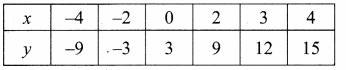
Samacheer Kalvi 10th Maths Guide Chapter 2 Numbers and Sequences Ex 2.4

Students can download Maths Chapter 2 Numbers and Sequences Ex 2.4 Questions and Answers, Notes, Samacheer Kalvi 10th Maths Guide Pdf helps you to revise the complete Tamilnadu State Board New Syllabus, helps students complete homework assignments and to score high marks in board exams.

Tamilnadu Samacheer Kalvi 10th Maths Solutions Chapter 2 Numbers and Sequences Ex 2.4

Question 1.
Find the next three terms of the following sequence.
(i) 8, 24, 72,…
(ii) 5, 1, -3, …
(iii) \(\frac { 1 }{ 4 } \), \(\frac { 2 }{ 9 } \), \(\frac { 3 }{ 16 } \)
(i) 216, 648, 1944 (This sequence is multiple of 3)
Next three terms are 216, 648, 1944
(ii) Next three terms are -7, -11, -15
(adding -4 with each term)
(iii) Next three terms are \(\frac { 4 }{ 25 } \),\(\frac { 5 }{ 36 } \) and \(\frac { 6 }{ 49 } \)
[using \(\frac{n}{(n+1)^{2}}\)]

Samacheer Kalvi 10th Maths Guide Chapter 2 Numbers and Sequences Ex 2.4

Question 2.
Find the first four terms of the sequences whose nth terms are given by
(i) an = n3 – 2
(ii) an = (-1)n+1 n(n+1)
(iii) an = 2n2 – 6
Solution:
tn = an = n3 -2
(i) a1 = 13 – 2 = 1 – 2 – 1
a2 = 23 – 2 = 8 – 2 = 6
a3 = 33 – 2 = 27 – 2 = 25
a4 = 43 – 2 = 64 – 2 = 62
∴ The first four terms are -1, 6, 25, 62, ……….

(ii) an = (-1)n+1 n(n + 1)
a1 = (-1)1+1 (1) (1 +1)
= (-1)2 (1) (2) = 2
a2 = (-1)2+1 (2) (2 + 1)
= (-1)3 (2) (3)= -6
a3 = (-1)3+1 (3) (3 + 1)
= (-1)4 (3) (4) = 12
a4 = (-1)4+1 (4) (4 + 1)
= (-1)5 (4) (5) = -20
∴ The first four terms are 2, -6, 12, -20,…

(iii) an = 2n2 – 6
a1 = 2(1)2 – 6 = 2 – 6 = -4
a2 = 2(2)2 – 6 = 8 – 6 = 2
a3 = 2(3)2 – 6 = 18 – 6 = 12
a4 = 2(4)2 – 6 = 32 – 6 = 26
∴ The first four terms are -4, 2, 12, 26, …

Samacheer Kalvi 10th Maths Guide Chapter 2 Numbers and Sequences Ex 2.4

Question 3.
Find the nth term of the following sequences
(i) 2, 5, 10, 17, ……
Answer:
(12 + 1);(22 + 1),(32 + 1),(42 + 1)….
nth term is n2 + 1
an = n2 + 1

(ii) 0,\(\frac { 1 }{ 2 } \),\(\frac { 2 }{ 3 } \) ……
Answer:
(\(\frac { 1-1 }{ 1 } \)), (\(\frac { 2-1 }{ 2 } \)), (\(\frac { 3-1 }{ 3 } \)) …..
nth term is \(\frac { n-1 }{ n } \)
an = \(\frac { n-1 }{ n } \)

(iii) 3,8,13,18,…….
Answer:
[5(1) -2], [5(2) – 2], [5(3) – 2], [5(4) – 2] ….
The nth term is 5n – 2
an = 5n – 2

Samacheer Kalvi 10th Maths Guide Chapter 2 Numbers and Sequences Ex 2.4

Question 4.
Find the indicated terms of the sequences whose nth terms are given by

(i) an = \(\frac { 5n }{ n+2 } \) ; a6 and a13
Answer:
an = \(\frac { 5n }{ n+2 } \)
a6 = \(\frac { 5(6) }{ 6+2 } \) = \(\frac { 30 }{ 8 } \) = \(\frac { 15 }{ 4 } \)
a13 = \(\frac { 5(13) }{ 13+2 } \) = \(\frac{5 \times 13}{15}\) = \(\frac { 13 }{ 3 } \)
a6 = \(\frac { 15 }{ 4 } \), a13 = \(\frac { 13 }{ 3 } \)

(ii) an = – (n2 – 4); a4 and a11
Answer:
an = -(n2 – 4)
a4 = -(42 – 4)
= – (16 – 4)
= -12
a11 = -(112 – 4)
= – (121 – 4)
= – 117
a4 = -12 and a11 = -117

Question 5.
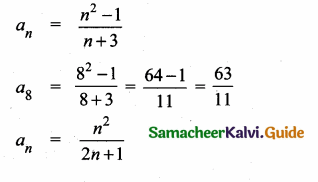
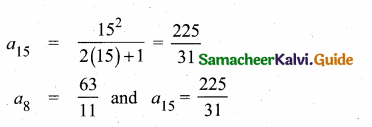
Find a8 and a15 whose nth term is an
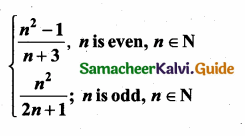
Samacheer Kalvi 10th Maths Guide Chapter 2 Numbers and Sequences Ex 2.4 1
Answer:
Samacheer Kalvi 10th Maths Guide Chapter 2 Numbers and Sequences Ex 2.4 2
Samacheer Kalvi 10th Maths Guide Chapter 2 Numbers and Sequences Ex 2.4 3

Samacheer Kalvi 10th Maths Guide Chapter 2 Numbers and Sequences Ex 2.4

Question 6.
If a1 = 1, a2 = 1 and an = 2an-1 + an-2, n > 3, n ∈ N, then find the first six terms of the sequence.
Solution:
a1 = 1, a2 = 1, an = 2an-1 + an-2
a3 = 2a(3-1) + a(3-2)
= 2a2 + a1
= 2 × 1 + 1 = 3
a4 = 2a(4-1) + a(4-2)
= 2a3 + a2
= 2 × 3 + 1 = 7
a5 = 2a(5-1) + a(5-2)
= 2a4 + a3
= 2 × 7 + 3 = 17
a6 = 2a(6-1) + a(6-2)
= 2a5 + a4
= 2 × 17 + 7
= 34 + 7
= 41
∴ The first six terms of the sequence are 1, 1, 3, 7, 17, 41 ………..
Samacheer Kalvi 10th Maths Guide Chapter 2 Numbers and Sequences Ex 2.8

Students can download Maths Chapter 2 Numbers and Sequences Ex 2.8 Questions and Answers, Notes, Samacheer Kalvi 10th Maths Guide Pdf helps you to revise the complete Tamilnadu State Board New Syllabus, helps students complete homework assignments and to score high marks in board exams.

Tamilnadu Samacheer Kalvi 10th Maths Solutions Chapter 2 Numbers and Sequences Ex 2.8

Question 1.
Find the sum of first n terms of the G.P.
(i) 5, -3, \(\frac { 9 }{ 5 } \),-\(\frac { 27 }{ 25 } \), ……
(ii) 256,64,16,…….
Answer:
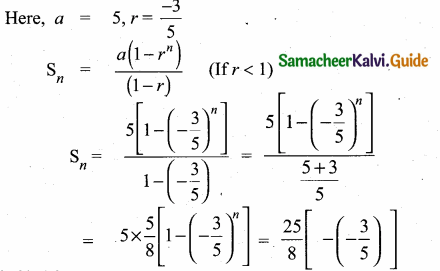
(i) 5,-3,\(\frac { 9 }{ 5 } \),\(\frac { 27 }{ 55 } \), ….. n terms
Samacheer Kalvi 10th Maths Guide Chapter 2 Numbers and Sequences Ex 2.8 1

Samacheer Kalvi 10th Maths Guide Chapter 2 Numbers and Sequences Ex 2.8

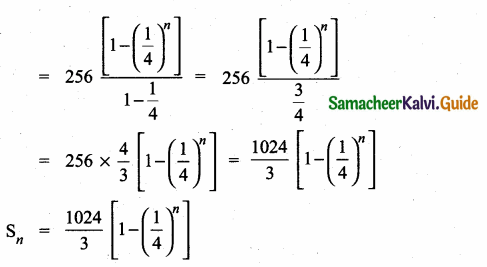
(ii) 256,64,16,…….
Answer:
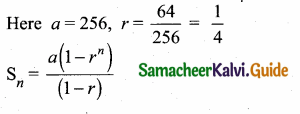
Here a = 256, r = \(\frac { 64 }{ 256 } \) = \(\frac { 1 }{ 4 } \)
Samacheer Kalvi 10th Maths Guide Chapter 2 Numbers and Sequences Ex 2.8 2
Samacheer Kalvi 10th Maths Guide Chapter 2 Numbers and Sequences Ex 2.8 3

Question 2.
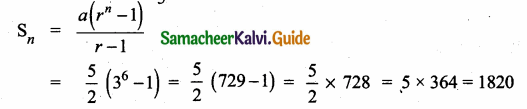
Find the sum of first six terms of the G.P. 5,15,45,…
Answer:
Here a = 5, r = \(\frac { 15 }{ 3 } \) = 3, n = 6
Samacheer Kalvi 10th Maths Guide Chapter 2 Numbers and Sequences Ex 2.8 4
Sum of first 6 terms = 1820

Question 3.
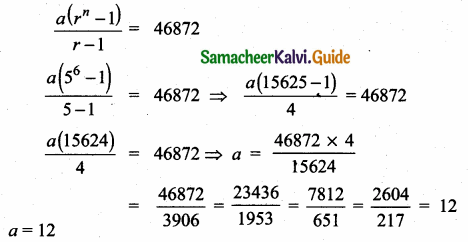
Find the first term of the G.P. whose common ratio 5 and whose sum to first 6 terms is 46872.
Answer:
Common ratio (r) = 5
S6 = 46872
Samacheer Kalvi 10th Maths Guide Chapter 2 Numbers and Sequences Ex 2.8 5
The first term of the G.P. is 12.

Samacheer Kalvi 10th Maths Guide Chapter 2 Numbers and Sequences Ex 2.8

Question 4.
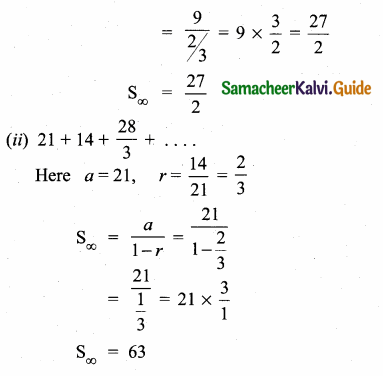
Find the sum to infinity of (i) 9 + 3 + 1 + ….(ii) 21 + 14 + \(\frac { 28 }{ 3 } \) ……
Answer:
(i) 9 + 3 + 1 + ….
a = 9, r = \(\frac { 3 }{ 9 } \) = \(\frac { 1 }{ 3 } \)
Sum of infinity term = \(\frac { a }{ 1 – r } \) = \(\frac{9}{1-\frac{1}{3}}\)
Samacheer Kalvi 10th Maths Guide Chapter 2 Numbers and Sequences Ex 2.8 6

Samacheer Kalvi 10th Maths Guide Chapter 2 Numbers and Sequences Ex 2.8

Question 5.
If the first term of an infinite G.P. is 8 and its sum to infinity is \(\frac { 32 }{ 3 } \) then find the common ratio.
Answer:
Here a = 8, S∞ = \(\frac { 32 }{ 3 } \)
\(\frac { a }{ 1-r } \) = \(\frac { 32 }{ 3 } \)
\(\frac { 8 }{ 1-r } \) = \(\frac { 32 }{ 3 } \)
32 – 32 r = 24 ⇒ 32 r = 8
r = \(\frac { 8 }{ 32 } \) = \(\frac { 1 }{ 4 } \)
Common ration = \(\frac { 1 }{ 4 } \)

Question 6.
Find the sum to n terms of the series
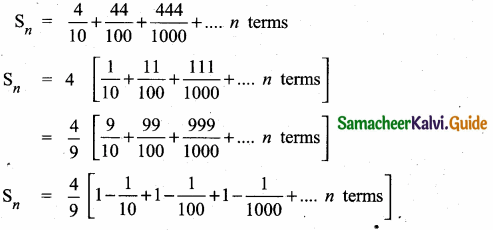
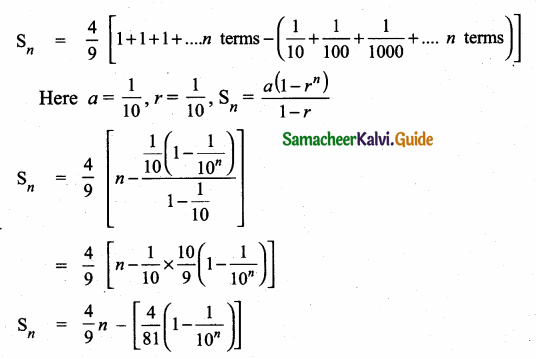
(i) 0.4 + 0.44 + 0.444 + …… to n terms
Answer:
Samacheer Kalvi 10th Maths Guide Chapter 2 Numbers and Sequences Ex 2.8 7
Samacheer Kalvi 10th Maths Guide Chapter 2 Numbers and Sequences Ex 2.8 8
(ii) 3 + 33 + 333 + ………… to n terms
Answer:
Sn = 3 + 33 + 333 + …. to n terms
= 3[1 + 11 + 111 + …. to n terms]
= \(\frac { 3 }{ 9 } \) [9 + 99 + 999 + …. n terms]
= \(\frac { 1 }{ 3 } \) [(10 – 1) + (100 – 1) + (1000 – 1) + …… n terms]
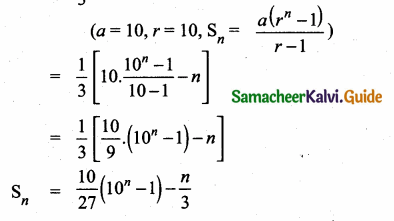
= \(\frac { 1 }{ 3 } \) [10 + 100 + 1000 + ….. n terms – (1 + 1 + 1 ….. n terms)]
Samacheer Kalvi 10th Maths Guide Chapter 2 Numbers and Sequences Ex 2.8 9

Samacheer Kalvi 10th Maths Guide Chapter 2 Numbers and Sequences Ex 2.8

Question 7.
Find the sum of the Geometric series 3 + 6 + 12 + …….. + 1536
Answer:
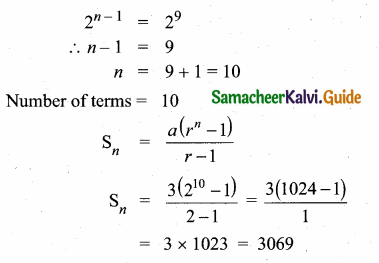
3 + 6 + 12 …. +1536
a = 3, r = \(\frac { 6 }{ 3 } \) = 2
tn = 1536
Samacheer Kalvi 10th Maths Guide Chapter 2 Numbers and Sequences Ex 2.8 10
Samacheer Kalvi 10th Maths Guide Chapter 2 Numbers and Sequences Ex 2.8 11
∴ Sum of the series is 3069

Samacheer Kalvi 10th Maths Guide Chapter 2 Numbers and Sequences Ex 2.8

Question 8.
Kumar writes a letter to four of his friends. He asks each one of them to copy the letter and mail to four different persons with the instruction that they continue the process similarly. Assuming that the process is unaltered and it costs ₹2 to mail ong letter, find the amount spent on postage when 8th set of letters is mailed.
Answer:
When kumar writes a letter to his friend.Friend writes a letter to another person.
It form a G.P
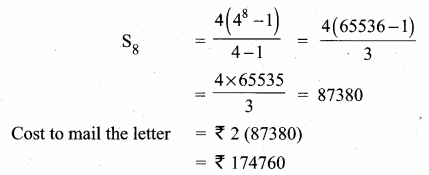
The G.P is 4, 16, 64,………
Here a = 4, r = 4
The last term is 4 (4)8-1 = 4(4)7
Samacheer Kalvi 10th Maths Guide Chapter 2 Numbers and Sequences Ex 2.8 12

Question 9.
Find the rational form of the number 0.123 .
Answer:
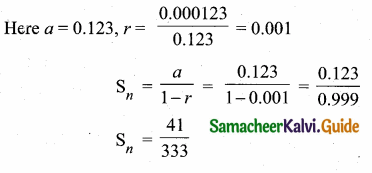
Let x = \(\overline { 0.123 } \)
= 0.123123123….
= 0.123 + 0.000123 + 000000123 + ….
This is an infinite G.P
Samacheer Kalvi 10th Maths Guide Chapter 2 Numbers and Sequences Ex 2.8 13

Samacheer Kalvi 10th Maths Guide Chapter 2 Numbers and Sequences Ex 2.8

Question 10.
If Sn = (x + y) + (x2 + xy + y2) + (x3 + x2y + xy2 + y3) + ………… n terms then prove that
Answer:
Sn = (x + y) + (x2 + xy + y2) + (x3 + x2y + xy2 + y3) + …….. n
Multiply by x
x Sn = x(x + y) + x(x2 + xy + y2) + x(x3 + x2y + xy2 + y3) + ……….. n
= x2 + xy + x3 + x2y + xy2 + x4 + x3y + x2y2 + xy3 + …… n terms ……(1)
Multiply by y
ySn = y(x + y) + y(x2 + xy + y2) + y(x3 + x2y + xy2 + y3) + ….. n
= xy + y2 + x2y + xy2 + y3 + x3y + x2y2 + xy3 + y4 + ….. n terms
Subtract (1) and (2)
x Sn – y Sn = x2 + xy + x3 + x2y + xy2 + x4 + x3y + x2y2 + xy3 + …….
– xy + y2 + x2y + xy2 + y3 + x3y + x2y2 + xy3 + y4 + ……
(x – y) Sn = (x2 + x3 + x4 + ……) – (y2 + y3 + y4 + ……)
[ a = x2; r = x and a = y2; r = y, Sn = \(\frac{a\left(r^{n}-1\right)}{r-1}\)]
Samacheer Kalvi 10th Maths Guide Chapter 2 Numbers and Sequences Ex 2.8 14
Hence it is proved.

Samacheer Kalvi 10th Maths Guide Chapter 3 Algebra Ex 3.9

Students can download Maths Chapter 3 Algebra Ex 3.9 Questions and Answers, Notes, Samacheer Kalvi 10th Maths Guide Pdf helps you to revise the complete Tamilnadu State Board New Syllabus, helps students complete homework assignments and to score high marks in board exams.

Tamilnadu Samacheer Kalvi 10th Maths Solutions Chapter 3 Algebra Ex 3.9

Question 1.
Determine the quadratic equations, whose sum and product of roots are
(i) -9, 20
Answer:
Sum of the roots = -9 and Product of the roots = 20
The Quadratic equation is
x2 – (sum of the roots) x + product of the roots = 0
x2 – (-9) x + 20 = 0 ⇒ x2 + 9x + 20 = 0

(ii) \(\frac { 5 }{ 3 } \), 4
Answer:
Sum of the roots = \(\frac { 5 }{ 3 } \); Product of the roots = 4
The Quadratic equation is
x2 – (sum of the roots) x + product of the roots = 0
x2 – (\(\frac { 5 }{ 3 } \)) x + 4 = 0 ⇒ x2 – \(\frac { 5 }{ 3 } \) x + 4 = 0
3x2 – 5x + 12 = 0

Samacheer Kalvi 10th Maths Guide Chapter 3 Algebra Ex 3.9

(iii) \(\frac { -3 }{ 2 } \), -1
Answer:
Sum of the roots = \(\frac { -3 }{ 2 } \); Product of the roots = -1
The Quadratic equation is
x2 – (sum of the roots) x + product of the roots = 0
x2 – (-\(\frac { 3 }{ 2 } \)) x + (-1) = 0 ⇒ x2 + \(\frac { 3 }{ 2 } \) x – 1 = 0
2x2 + 3x – 2 = 0

(iv) – (2 – a)2, (a + 5)2
Answer:
Sum of the roots = – (2 – a)2; Product of the roots = (a + 5)2
x2 – (sum of the roots) x + product of the roots = 0
x2 – [-(2 – a)2] x + (a + 5)2 = 0
x2 + (2 – a)2 x + (a + 5)2 = 0

Question 2.
Find the sum and product of the roots for each of the following quadratic equations
(i) x2 + 3x – 28 = 0
(ii) x2 + 3x = 0
(iii) 3 + \(\frac{1}{a}=\frac{10}{a^{2}}\)
(iv) 3y2 – y – 4 = 0
Solution:
(i) x2 – (-3)x + (-28) = 0.
Comparing this with x2 – (α + β)x + αβ = 0.
(α + β) = Sum of the roots = -3
αβ = product of the roots = -28

(ii) x2 + 3x = 0 = x2 – (-3)x + 0 = 0
x2 – (α + β)x + αβ = 0
Sum of the roots α + β = -3
Products of the roots αβ =0

(iii) 3 + \(\frac { 1 }{ a } \) = \(\frac{10}{a^{2}}\)
Answer:
Multiply by a2
3a2 + a = 10
3a2 + a – 10 = 0
Sum of the roots (α + β) = \(\frac { -1 }{ 3 } \)
Product of the roots (α β) = \(\frac { -10 }{ 3 } \)

Samacheer Kalvi 10th Maths Guide Chapter 3 Algebra Ex 3.9

(iv) 3y2 – y – 4 = 0
Answer:
Sum of the roots (α + β) = \(\frac { -(-1) }{ 3 } \) = \(\frac { 1 }{ 3 } \)
Product of the roots (α β) = \(\frac { -4 }{ 3 } \)

Samacheer Kalvi 10th Maths Guide Chapter 3 Algebra Ex 3.8

Students can download Maths Chapter 3 Algebra Ex 3.8 Questions and Answers, Notes, Samacheer Kalvi 10th Maths Guide Pdf helps you to revise the complete Tamilnadu State Board New Syllabus, helps students complete homework assignments and to score high marks in board exams.

Tamilnadu Samacheer Kalvi 10th Maths Solutions Chapter 3 Algebra Ex 3.8

Question 1.
Find the square root of the following polynomials by division method
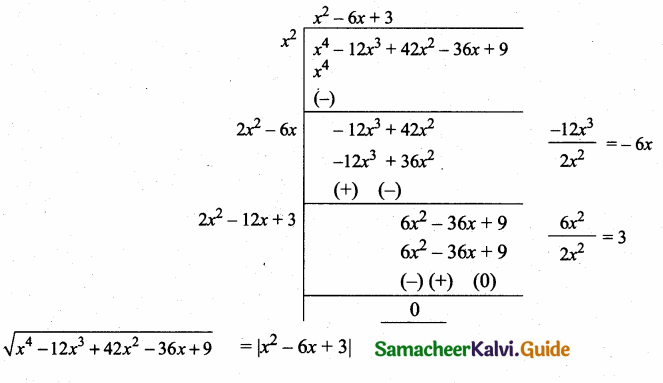
(i) x4 – 12x3 + 42x2 – 36x + 9
Answer:
Samacheer Kalvi 10th Maths Guide Chapter 3 Algebra Ex 3.8 1
Samacheer Kalvi 10th Maths Guide Chapter 3 Algebra Ex 3.8

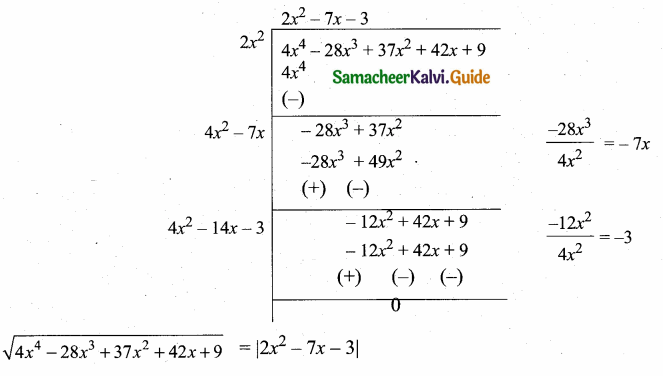
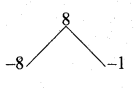
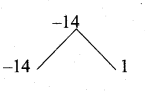
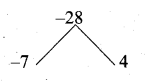
(ii) 31 x2 – 28x3 + 4x4 + 42x + 9
Answer:
Rearrange the order we get
4x4 – 28x3 + 37x2 + 42x + 9
Samacheer Kalvi 10th Maths Guide Chapter 3 Algebra Ex 3.8 3
Samacheer Kalvi 10th Maths Guide Chapter 3 Algebra Ex 3.8

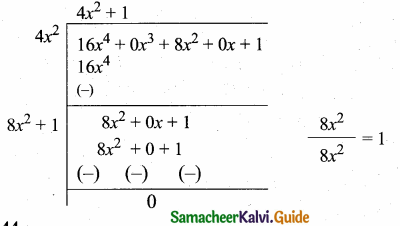
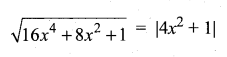
(iii) 16x4 + 8x2 + 1
Answer:
Samacheer Kalvi 10th Maths Guide Chapter 3 Algebra Ex 3.8 5
Samacheer Kalvi 10th Maths Guide Chapter 3 Algebra Ex 3.8 6

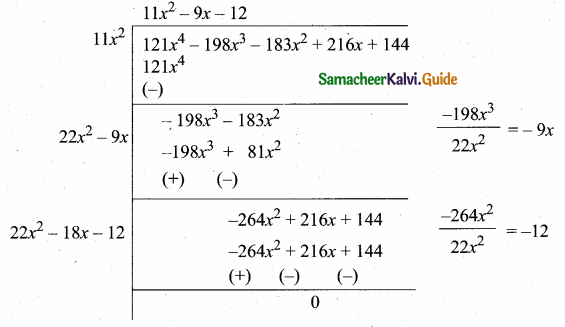
(iv) 121 x4 – 198x3 – 183x2 + 216x + 144
Answer:
Samacheer Kalvi 10th Maths Guide Chapter 3 Algebra Ex 3.8 7
Samacheer Kalvi 10th Maths Guide Chapter 3 Algebra Ex 3.8 8

Question 2.
Find the square root of the expression
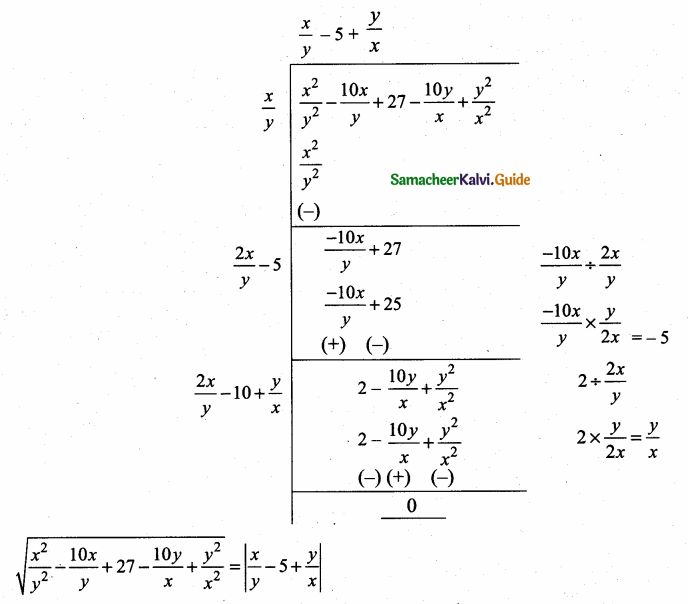
\(\frac{x^{2}}{y^{2}}\) – \(\frac { 10x }{ y } \) + 27 – \(\frac { 10y }{ x } \) + \(\frac{y^{2}}{x^{2}}\)
Answer:
Samacheer Kalvi 10th Maths Guide Chapter 3 Algebra Ex 3.8 11
Samacheer Kalvi 10th Maths Guide Chapter 3 Algebra Ex 3.8

Question 3.
Find the values of a and b if the following polynomials are perfect squares.
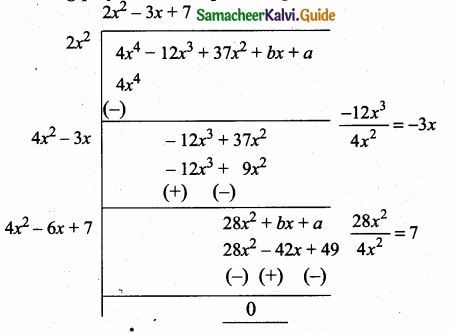
(i) 4x4 – 12x3 + 37x2 + bx + a
Answer:
Samacheer Kalvi 10th Maths Guide Chapter 3 Algebra Ex 3.8 112
Since it is a perfect square
b + 42 = 0
b = – 42
a – 49 = 0
a = 49
∴ The value of a = 49 and b = – 42

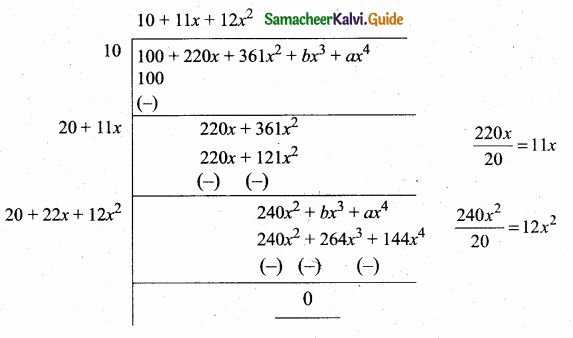
(ii) ax4 + bx3 + 361x2 + 220x + 100
Answer:
Re-arrange the order we get
100 + 220x + 361x2 + bx3 + ax4
Samacheer Kalvi 10th Maths Guide Chapter 3 Algebra Ex 3.8 12
Since it is a perfect square
b – 264 = 0
b = 264
a – 144 = 0
a = 144
∴ The value of a = 144 and b = 264

Samacheer Kalvi 10th Maths Guide Chapter 3 Algebra Ex 3.8

Question 4.
Find the values of m and n if the following expressions are perfect sqaures.
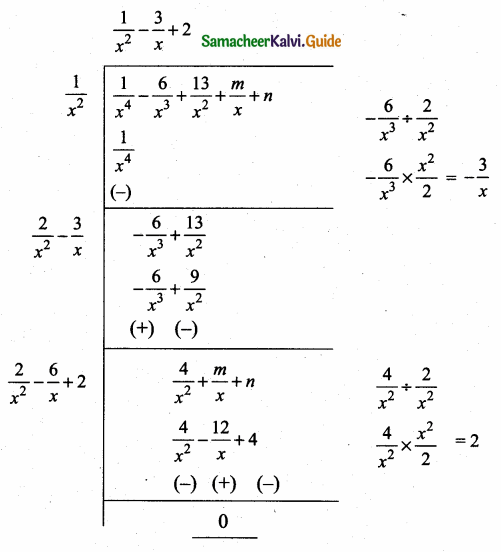
(i) \(\frac{1}{x^{4}}\) – \(\frac{6}{x^{3}}\) + \(\frac{13}{x^{2}}\) + \(\frac { m }{ x } \) + n
Answer:
Samacheer Kalvi 10th Maths Guide Chapter 3 Algebra Ex 3.8 13
Since it is a perfect square
\(\frac { 1 }{ x } \) (m + 12) = 0
m + 12 = 0
m = -12
n – 4 = 0
n = 4
∴ The value of m = -12 and n = 4

Samacheer Kalvi 10th Maths Guide Chapter 3 Algebra Ex 3.8

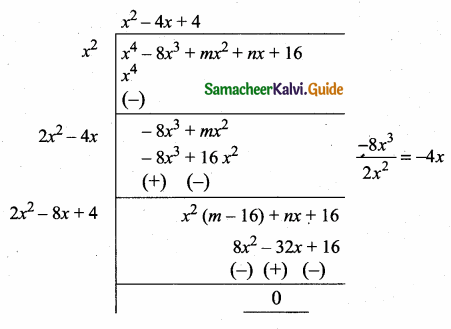
(ii) x4 – 8x3 + mx2 + nx + 16
Answer:
Samacheer Kalvi 10th Maths Guide Chapter 3 Algebra Ex 3.8 14
Since it is a perfect square
m – 16 – 8 = 0
m – 24 = 0
m = 24
n + 32 = 0
n = -32
∴ The value of m = 24 and n = -32

Samacheer Kalvi 10th Maths Guide Chapter 3 Algebra Ex 3.16

Students can download Maths Chapter 3 Algebra Ex 3.16 Questions and Answers, Notes, Samacheer Kalvi 10th Maths Guide Pdf helps you to revise the complete Tamilnadu State Board New Syllabus, helps students complete homework assignments and to score high marks in board exams.

Tamilnadu Samacheer Kalvi 10th Maths Solutions Chapter 3 Algebra Ex 3.16

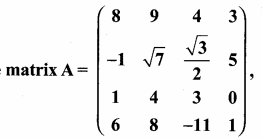
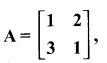
1. In the
Samacheer Kalvi 10th Maths Guide Chapter 3 Algebra Ex 3.16 1
write (i) The number of elements
(ii) The order of the matrix
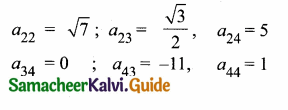
(iii) Write the elements a22, a23, a24, a34, a43, a44.
Answer:
(i) The number of elements is 16
(ii) The order of the matrix is 4 × 4
(iii) Elements corresponds to
Samacheer Kalvi 10th Maths Guide Chapter 3 Algebra Ex 3.16 2

Samacheer Kalvi 10th Maths Guide Chapter 3 Algebra Ex 3.16

Question 2.
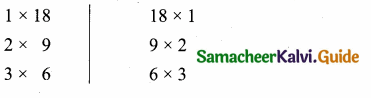
If a matrix has 18 elements, what are the possible orders it can have? What if it has 6 elements?
Answer:
The possible orders of the matrix having 18 elements are
Samacheer Kalvi 10th Maths Guide Chapter 3 Algebra Ex 3.16 3
The possible orders of the matrix having 6 elements are
Samacheer Kalvi 10th Maths Guide Chapter 3 Algebra Ex 3.16 4

Question 3.
Construct a 3 × 3 matrix whose elements are given by
(i) aij = |i – 2j|
Answer:
aij = |i – 2j|
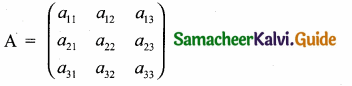
The general 3 × 3 matrices is
Samacheer Kalvi 10th Maths Guide Chapter 3 Algebra Ex 3.16 5
a11 = |1 – 2(1)| = |1 – 2| = | – 1| = 1
a12 = |1 – 2(2)| = |1 – 4| = | – 3| = 3
a13 = |1 – 2(3)| = |1 – 6| = | – 5| = 5
a21 = |2 – 2(1)| = |2 – 2| = 0 = 0
a22 = |2 – 2(2)| = |2 – 4| = | – 2| = 2
a23 = |2 – 2(3)| = |2 – 6| = | – 4| = 4
a31 = |3 – 2(1)| = |3 – 2| = | 1 | = 1
a32 = |3 – 2(2)| = |3 – 4| = | – 1 | = 1
a33 = |3 – 2(3)| = |3 – 6| = | – 3 | = 3
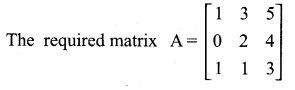
The required matrix
Samacheer Kalvi 10th Maths Guide Chapter 3 Algebra Ex 3.16 6

Samacheer Kalvi 10th Maths Guide Chapter 3 Algebra Ex 3.16

(ii) aij = \(\frac{(i+j)^{3}}{3}\)
Answer:
a11 = \(\frac{(1+1)^{3}}{3}\) = \(\frac{2^{3}}{3}\) = \(\frac { 8 }{ 3 } \)
a12 = \(\frac{(1+2)^{3}}{3}\) = \(\frac { 27 }{ 3 } \) = 9
a13 = \(\frac{(1+3)^{3}}{3}\) = \(\frac { 64 }{ 3 } \) = \(\frac { 64 }{ 3 } \)
a21 = \(\frac{(2+1)^{3}}{3}\) = \(\frac { 27 }{ 3 } \) = 9
a22 = \(\frac{(2+2)^{3}}{3}\) = \(\frac { 64 }{ 3 } \) = \(\frac { 64 }{ 3 } \)
a23 = \(\frac{(2+3)^{3}}{3}\) = \(\frac { 125 }{ 3 } \) = \(\frac { 125 }{ 3 } \)
a31 = \(\frac{(3+1)^{3}}{3}\) = \(\frac { 64 }{ 3 } \) = \(\frac { 64 }{ 3 } \)
a32 = \(\frac{(3+2)^{3}}{3}\) = \(\frac { 125 }{ 3 } \) = \(\frac { 125 }{ 3 } \)
a33 = \(\frac{(3+3)^{3}}{3}\) = \(\frac { 216 }{ 3 } \) = 72
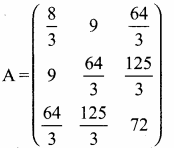
The required matrix
Samacheer Kalvi 10th Maths Guide Chapter 3 Algebra Ex 3.16 7

Samacheer Kalvi 10th Maths Guide Chapter 3 Algebra Ex 3.16

Question 4.
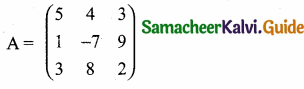
If  Samacheer Kalvi 10th Maths Guide Chapter 3 Algebra Ex 3.16 8then find the tranpose of A.
Answer:
Samacheer Kalvi 10th Maths Guide Chapter 3 Algebra Ex 3.16 8
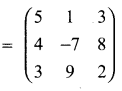
transpose of A = (AT)
Samacheer Kalvi 10th Maths Guide Chapter 3 Algebra Ex 3.16 10

Question 5.
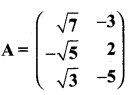
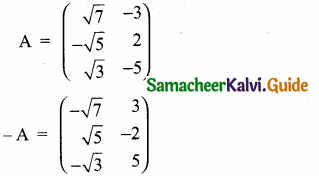
If Samacheer Kalvi 10th Maths Guide Chapter 3 Algebra Ex 3.16 11 then find the tranpose of – A
Answer:
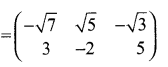
Samacheer Kalvi 10th Maths Guide Chapter 3 Algebra Ex 3.16 12
Transpose of – A = (-AT) = Samacheer Kalvi 10th Maths Guide Chapter 3 Algebra Ex 3.16 13

Samacheer Kalvi 10th Maths Guide Chapter 3 Algebra Ex 3.16

Question 6.
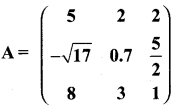
If A = Samacheer Kalvi 10th Maths Guide Chapter 3 Algebra Ex 3.16 14 then verify (AT)T = A
Answer:
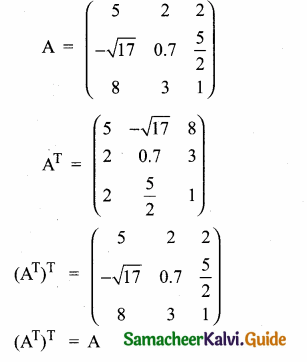
Samacheer Kalvi 10th Maths Guide Chapter 3 Algebra Ex 3.16 15
Hence it is verified

Question 7.
Find the values of x, y and z from the following equations
(i)
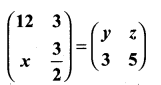
Samacheer Kalvi 10th Maths Guide Chapter 3 Algebra Ex 3.16 16
Answer:
Since the given matrices are equal then all the corresponding elements are equal.
y = 12, z = 3, x = 3
The value of x = 3, y = 12 and z = 3

Samacheer Kalvi 10th Maths Guide Chapter 3 Algebra Ex 3.16

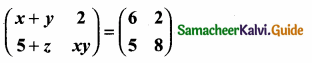
(ii)
Samacheer Kalvi 10th Maths Guide Chapter 3 Algebra Ex 3.16 17
Answer:
x + y = 6 ……(1)
5 + z = 5
z = 5 – 5 = 0
xy = 8
y = \(\frac { 8 }{ x } \)
Substitute the value of y = \(\frac { 8 }{ x } \) in (1)
x + \(\frac { 8 }{ x } \) = 6
x2 + 8 = 6x
x2 – 6x + 8 = 0
(x – 4) (x – 2) = 0
∴ x – 4 = 0 or x – 2 = 0
x = 4 or x = 2
y = \(\frac { 8 }{ 4 } \) = 2 or y = \(\frac { 8 }{ 2 } \) = 4
Samacheer Kalvi 10th Maths Guide Chapter 3 Algebra Ex 3.16 18
∴ The value of x, y and z are 4, 2, 0 (or) 2, 4, 0

Samacheer Kalvi 10th Maths Guide Chapter 3 Algebra Ex 3.16

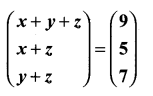
(iii)
Samacheer Kalvi 10th Maths Guide Chapter 3 Algebra Ex 3.16 19
Solution:
x + y + z = 9 ……….(1)
x + z = 5 ……….(2)
y + z = 7 ……….(3)
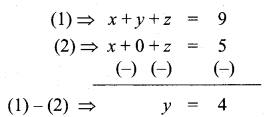
Samacheer Kalvi 10th Maths Guide Chapter 3 Algebra Ex 3.16 20
Substitute the value of y = 4 in (3)
y + z = 7
4 + z = 7
z = 7 – 4
= 3
Substitute the value of z = 3 in (2)
x + 3 = 5
x = 5 – 3
= 2
∴ The value of x = 2 , y = 4 and z = 3

Samacheer Kalvi 10th Maths Guide Chapter 3 Algebra Ex 3.7

Students can download Maths Chapter 3 Algebra Ex 3.7 Questions and Answers, Notes, Samacheer Kalvi 10th Maths Guide Pdf helps you to revise the complete Tamilnadu State Board New Syllabus, helps students complete homework assignments and to score high marks in board exams.

Tamilnadu Samacheer Kalvi 10th Maths Solutions Chapter 3 Algebra Ex 3.7

Question 1.
Find the square root of the following.
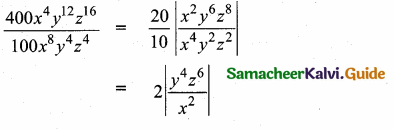
(i) \(\frac{400 x^{4} y^{12} z^{16}}{100 x^{8} y^{4} z^{4}}\)
Answer:
Samacheer Kalvi 10th Maths Guide Chapter 3 Algebra Ex 3.7 1

Samacheer Kalvi 10th Maths Guide Chapter 3 Algebra Ex 3.7

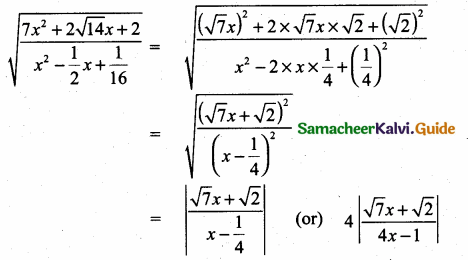
(ii) \(\frac{7 x^{2}+2 \sqrt{14} x+2}{x^{2}-\frac{1}{2} x+\frac{1}{16}}\)
Answer:
Samacheer Kalvi 10th Maths Guide Chapter 3 Algebra Ex 3.7 2

(iii) \(\frac{121(a+b)^{8}(x+y)^{8}(b-c)^{8}}{81(b-c)^{4}(a-b)^{12}(b-c)^{4}}\)
Answer:
Samacheer Kalvi 10th Maths Guide Chapter 3 Algebra Ex 3.7 3

Samacheer Kalvi 10th Maths Guide Chapter 3 Algebra Ex 3.7

Question 2.
Find the square root of the following
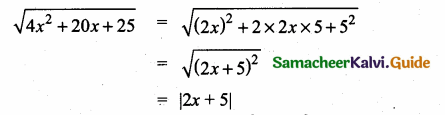
(i) 4x2 + 20x + 25
Answer:
Samacheer Kalvi 10th Maths Guide Chapter 3 Algebra Ex 3.7 4

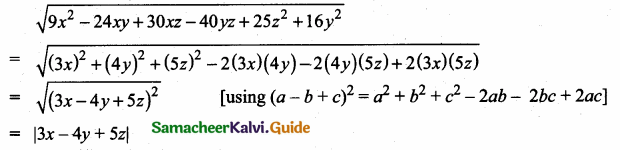
(ii) 9x2 – 24xy + 30xz – 40yz + 25z2 + 16y2
Answer:
Samacheer Kalvi 10th Maths Guide Chapter 3 Algebra Ex 3.7 5

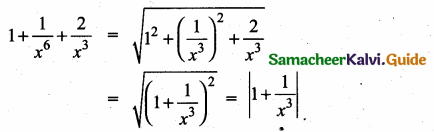
(iii) \(1+\frac{1}{x^{6}}+\frac{2}{x^{3}}\)
Answer:
Samacheer Kalvi 10th Maths Guide Chapter 3 Algebra Ex 3.7 6

(iv) (4x2 – 9x + 2)(7x2 – 13x – 2)(28x2 – 3x – 1)
Answer:
4x2 – 9x +2 = 4x2 – 8x – x + 2
= 4x(x – 2)-1 (x – 2)
= (x – 2)(4x – 1)
Samacheer Kalvi 10th Maths Guide Chapter 3 Algebra Ex 3.7 7
7x2 – 13x – 2 = 7x2 – 14x + x – 2
= 7x (x – 2) + 1 (x – 2)
= (x – 2) (7x + 1)
Samacheer Kalvi 10th Maths Guide Chapter 3 Algebra Ex 3.7 8
28x2 – 3x – 1 = 28x2 – 7x + 4x – 1
= 7x (4x – 1) + 1 (4x – 1)
= (4x – 1) (7x + 1)
Samacheer Kalvi 10th Maths Guide Chapter 3 Algebra Ex 3.7 9

Samacheer Kalvi 10th Maths Guide Chapter 3 Algebra Ex 3.7

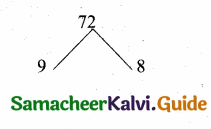
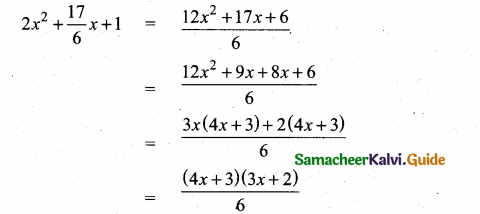
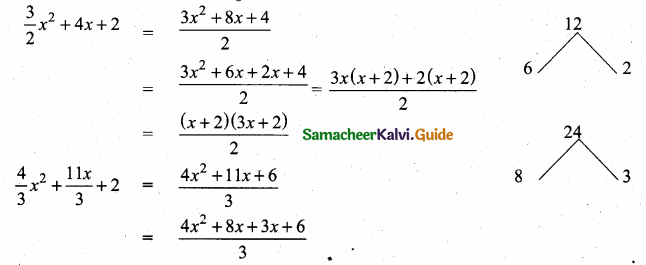
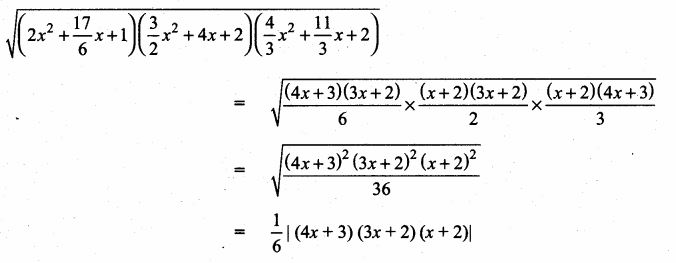
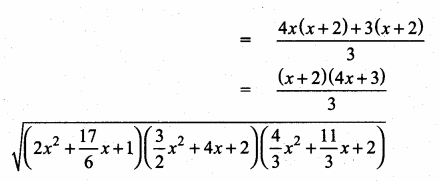
(v) (2x2 + \(\frac { 17 }{ 6 } \)x + 1) (\(\frac { 3 }{ 2 } \) x2 + 4x + 2) (\(\frac { 4 }{ 3 } \) x2 + \(\frac { 11 }{ 3 } \) x + 2)
Answer:
Samacheer Kalvi 10th Maths Guide Chapter 3 Algebra Ex 3.7 10
Samacheer Kalvi 10th Maths Guide Chapter 3 Algebra Ex 3.7 12
Samacheer Kalvi 10th Maths Guide Chapter 3 Algebra Ex 3.7 13

Samacheer Kalvi 10th Maths Guide Chapter 3 Algebra Ex 3.7
Samacheer Kalvi 10th Maths Guide Chapter 3 Algebra Ex 3.7 134
Samacheer Kalvi 10th Maths Guide Chapter 3 Algebra Ex 3.7 14

Samacheer Kalvi 10th Maths Guide Chapter 3 Algebra Ex 3.18

Students can download Maths Chapter 3 Algebra Ex 3.18 Questions and Answers, Notes, Samacheer Kalvi 10th Maths Guide Pdf helps you to revise the complete Tamilnadu State Board New Syllabus, helps students complete homework assignments and to score high marks in board exams.

Tamilnadu Samacheer Kalvi 10th Maths Solutions Chapter 3 Algebra Ex 3.18

Question 1.
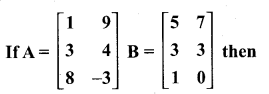
Find the order of the product matrix AB if
Samacheer Kalvi 10th Maths Guide Chapter 3 Algebra Ex 3.18 1
Answer:
Given A = [aij]p×q and B = [aij]q×r
Order of product of AB = p × r
Order of product of BA is not defined. Number columns in r is not equal to the number of rows in P.
∴ Product BA is not defined.

Samacheer Kalvi 10th Maths Guide Chapter 3 Algebra Ex 3.18

Question 2.
A has ‘a’ rows and ‘a + 3 ’ columns. B has ‘6’ rows and ‘17 – b’ columns, and if both products AB and BA exist, find a, b?
Solution:
A has a rows, a + 3 columns.
B has b rows, 17 – b columns
If AB exists a × a + 3
b × 17 – b
a + 3 = 6 ⇒ a – 6 = -3 ………… (1)
If BA exists 6 × 17-6
a × a + 3
17 – 6 = a ⇒ a + 6 = 17 …………. (2)
(1) + (2) ⇒ 2a = 14 ⇒ a = 7
Substitute a = 7 in (1) ⇒ 7 – b = -3 ⇒ b = 10
a = 7, b = 10

Samacheer Kalvi 10th Maths Guide Chapter 3 Algebra Ex 3.18

Question 3.
A has ‘a’ rows and ‘a + 3 ’ columns. B has rows and ‘b’ columns, and if both products AB and BA exist, find a,b?
Answer:

  1. Order of matrix AB = 3 × 3
  2. Order of matrix AB = 4 × 2
  3. Order of matrix AB = 4 × 2
  4. Order of matrix AB = 4 × 1
  5. Order of matrix AB = 1 × 3

Question 4.
Samacheer Kalvi 10th Maths Guide Chapter 3 Algebra Ex 3.18 2
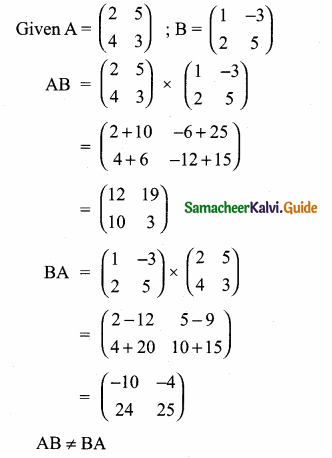
find AB, BA and check if AB = BA?
Answer:
Samacheer Kalvi 10th Maths Guide Chapter 3 Algebra Ex 3.18 3

Question 5.
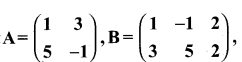
Given that
Samacheer Kalvi 10th Maths Guide Chapter 3 Algebra Ex 3.18 4
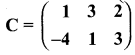
Samacheer Kalvi 10th Maths Guide Chapter 3 Algebra Ex 3.18 5
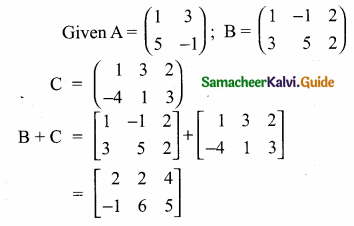
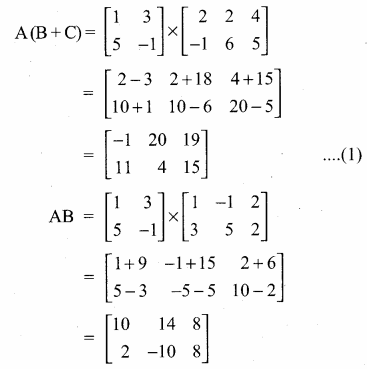
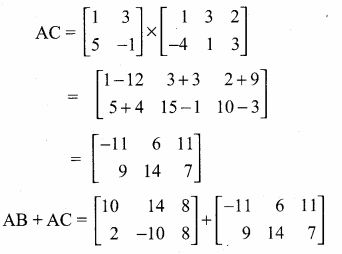
verify that A(B + C) = AB + AC
Answer:
Samacheer Kalvi 10th Maths Guide Chapter 3 Algebra Ex 3.18 6

Samacheer Kalvi 10th Maths Guide Chapter 3 Algebra Ex 3.18 7
Samacheer Kalvi 10th Maths Guide Chapter 3 Algebra Ex 3.18 8
Samacheer Kalvi 10th Maths Guide Chapter 3 Algebra Ex 3.18 9
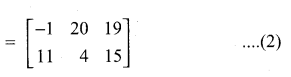
From (1) and (2) we get
A (B + C) = AB + AC

Samacheer Kalvi 10th Maths Guide Chapter 3 Algebra Ex 3.18

Question 6.
Show that the matrices
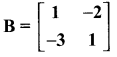
Samacheer Kalvi 10th Maths Guide Chapter 3 Algebra Ex 3.18 99Samacheer Kalvi 10th Maths Guide Chapter 3 Algebra Ex 3.18 10
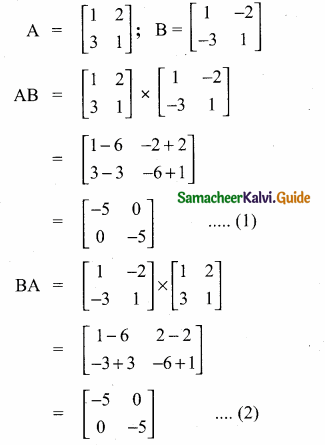
satisfy commutative property AB = BA
Answer:
Samacheer Kalvi 10th Maths Guide Chapter 3 Algebra Ex 3.18 11
From (1) and (2) we get
AB = BA. It satisfy the commutative property.

Question 7.
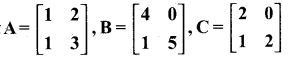
Samacheer Kalvi 10th Maths Guide Chapter 3 Algebra Ex 3.18 12
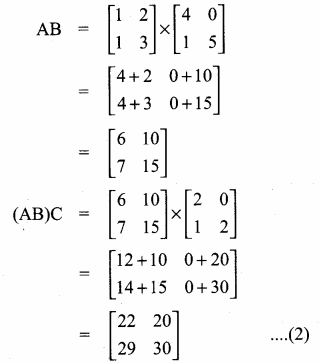
Show that (i) A(BC) = (AB)C
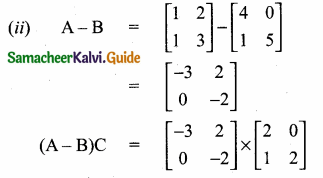
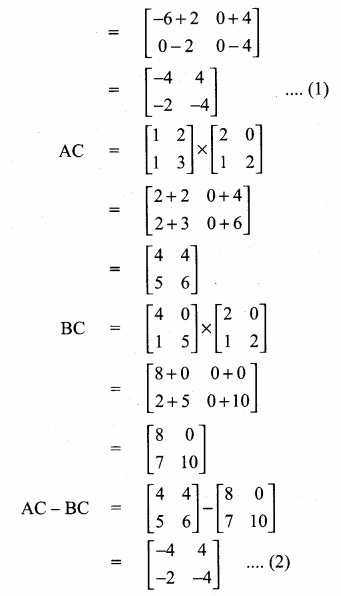
(ii) (A-B)C = AC – BC
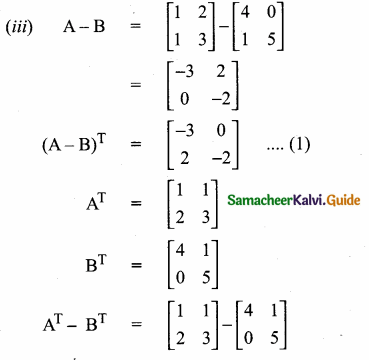
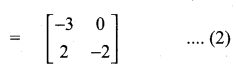
(iii) (A-B)T = AT – BT
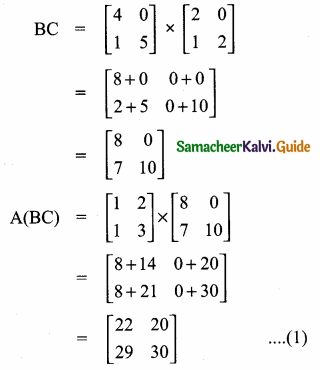
Answer:
Samacheer Kalvi 10th Maths Guide Chapter 3 Algebra Ex 3.18 13
Samacheer Kalvi 10th Maths Guide Chapter 3 Algebra Ex 3.18 14
Samacheer Kalvi 10th Maths Guide Chapter 3 Algebra Ex 3.18 15
From (1) and (2) we get
A(BC) = (AB)C

Samacheer Kalvi 10th Maths Guide Chapter 3 Algebra Ex 3.18
Samacheer Kalvi 10th Maths Guide Chapter 3 Algebra Ex 3.18 16

Samacheer Kalvi 10th Maths Guide Chapter 3 Algebra Ex 3.18 17

From (1) and (2) we get
(A – B) C = AC – BC
Samacheer Kalvi 10th Maths Guide Chapter 3 Algebra Ex 3.18 18
Samacheer Kalvi 10th Maths Guide Chapter 3 Algebra Ex 3.18 19
From (1) and (2) we get
(A-B)T = AT – BT

Samacheer Kalvi 10th Maths Guide Chapter 3 Algebra Ex 3.18

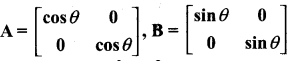
Question 8.
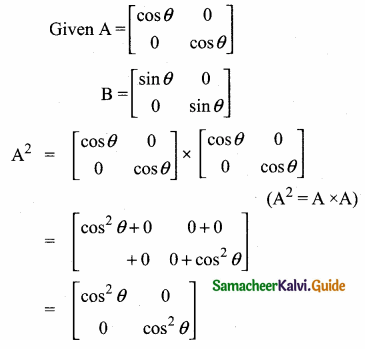
Samacheer Kalvi 10th Maths Guide Chapter 3 Algebra Ex 3.18 20
then snow that A2 + B2 = I.
Answer:
Samacheer Kalvi 10th Maths Guide Chapter 3 Algebra Ex 3.18 21

Question 9.
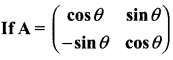
Samacheer Kalvi 10th Maths Guide Chapter 3 Algebra Ex 3.18 22
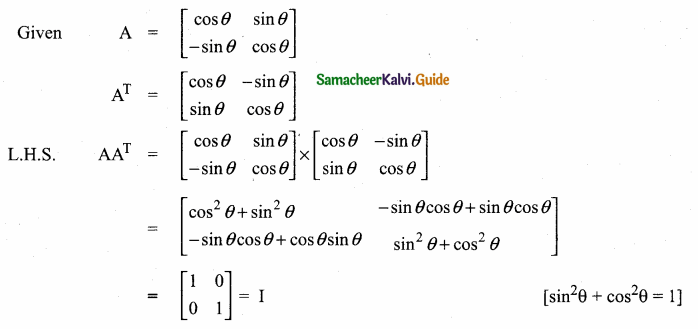
prove that AAT = I.
Answer:
Samacheer Kalvi 10th Maths Guide Chapter 3 Algebra Ex 3.18 23
AAT = I
∴ L.H.S. = R.H.S.

Samacheer Kalvi 10th Maths Guide Chapter 3 Algebra Ex 3.18

Question 10.
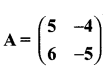
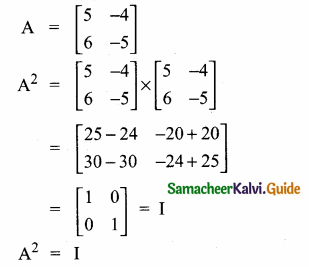
Verify that A2 = I when
Samacheer Kalvi 10th Maths Guide Chapter 3 Algebra Ex 3.18 24
Answer:
Samacheer Kalvi 10th Maths Guide Chapter 3 Algebra Ex 3.18 25
∴ L.H.S. = R.H.S.

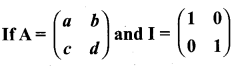
Question 11.
Samacheer Kalvi 10th Maths Guide Chapter 3 Algebra Ex 3.18 26
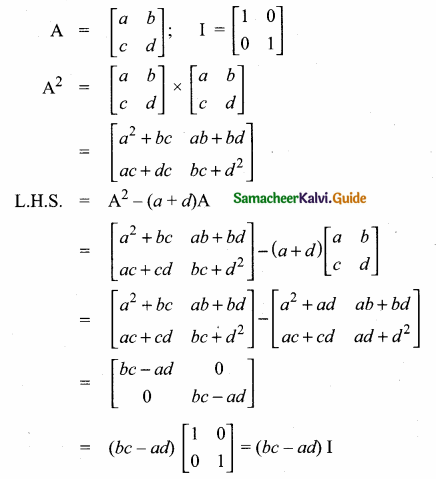
show that A2 – (a + d)A = (bc – ad)I2.
Answer:
Samacheer Kalvi 10th Maths Guide Chapter 3 Algebra Ex 3.18 27
L.H.S. = R.H.S.
A2 – (a + d) A = (bc – ad)I2

Samacheer Kalvi 10th Maths Guide Chapter 3 Algebra Ex 3.18

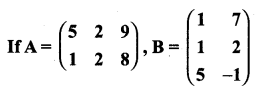
Question 12.
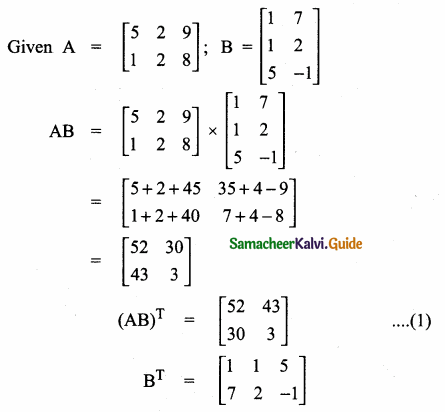
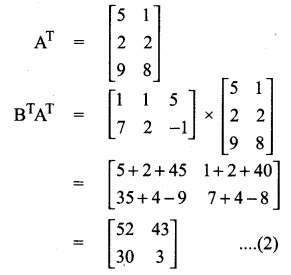
Samacheer Kalvi 10th Maths Guide Chapter 3 Algebra Ex 3.18 28
verify that (AB)T = BT AT
Answer:
Samacheer Kalvi 10th Maths Guide Chapter 3 Algebra Ex 3.18 29
Samacheer Kalvi 10th Maths Guide Chapter 3 Algebra Ex 3.18 30
From (1) and (2) we get, (AB)T = BT AT

Samacheer Kalvi 10th Maths Guide Chapter 3 Algebra Ex 3.18

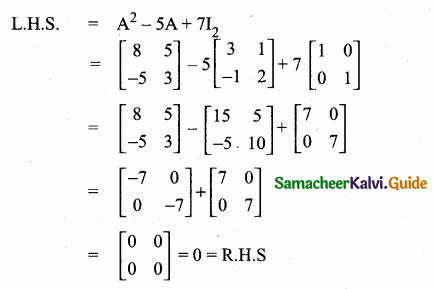
Question 13.
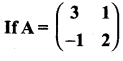
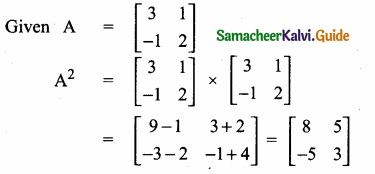
Samacheer Kalvi 10th Maths Guide Chapter 3 Algebra Ex 3.18 31
show that A2 – 5A + 7I2 = 0
Answer:
Samacheer Kalvi 10th Maths Guide Chapter 3 Algebra Ex 3.18 32
Samacheer Kalvi 10th Maths Guide Chapter 3 Algebra Ex 3.18 33
L.H.S. = R.H.S.
∴ A2 – 5A + 7I2 = 0

Samacheer Kalvi 10th Maths Guide Chapter 3 Algebra Ex 3.15

Students can download Maths Chapter 3 Algebra Ex 3.15 Questions and Answers, Notes, Samacheer Kalvi 10th Maths Guide Pdf helps you to revise the complete Tamilnadu State Board New Syllabus, helps students complete homework assignments and to score high marks in board exams.

Tamilnadu Samacheer Kalvi 10th Maths Solutions Chapter 3 Algebra Ex 3.15

Question 1.
Graph the following quadratic equations and state their nature of solutions.
(i) x2 – 9x + 20 = 0
(ii) x2 – 4x + 4 = 0
(iii) x2 + x + 7 = 0
(iv) x2 – 9 = 0
(v) x2 – 6x + 9 = 0
(vi) (2x – 3) (x + 2) = 0

(i) x2 – 9x + 20 = 0
Answer:
Let y = x2 – 9x + 20
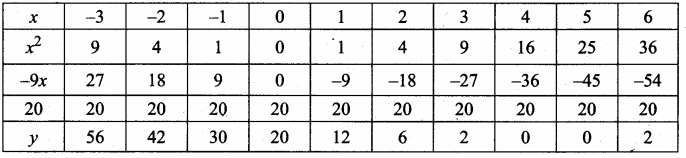
(i) Prepare the table of values for y = x2 – 9x + 20
Samacheer Kalvi 10th Maths Guide Chapter 3 Algebra Ex 3.15 1
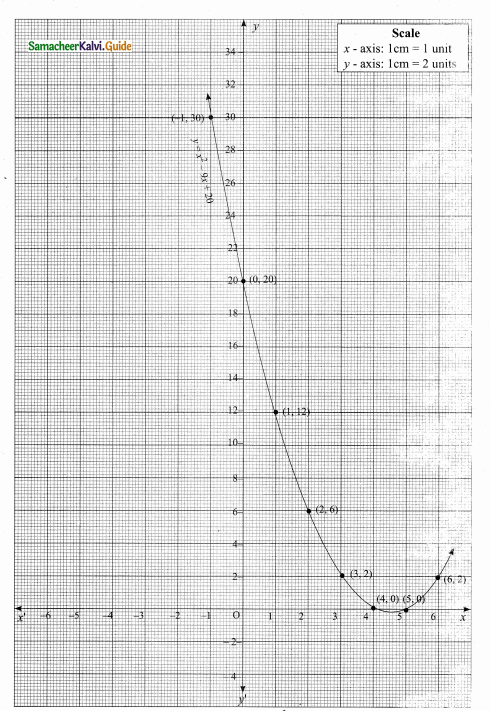
(ii) Plot the points (-1, 30) (0,20) (1, 12) (2, 6) (3,2), (4, 0), (5, 0), (6,2) (omit the high value)
(iii) Join the points by a free hand smooth curve.
(iv) The roots of the equation are the X-coordinates of the intersecting points of the curve with X-axis (4, 0) and (5, 0)
There are two points of intersection with the X-axis at 4 and 5. The solution set is 4 and 5. The quadratic equation has real and unequal roots.
(v) Since there is two point of intersection with X-axis (different solution)
∴ The equation x2 – 9x + 20 = 0 has real and unequal roots.
Samacheer Kalvi 10th Maths Guide Chapter 3 Algebra Ex 3.15 2

Samacheer Kalvi 10th Maths Guide Chapter 3 Algebra Ex 3.15

(ii) x2 – 4x + 4 = 0
Answer:
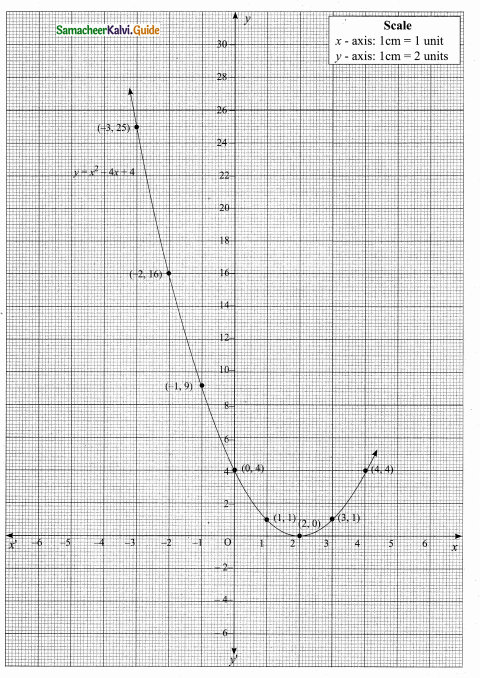
Let y = x2 – 4x + 4
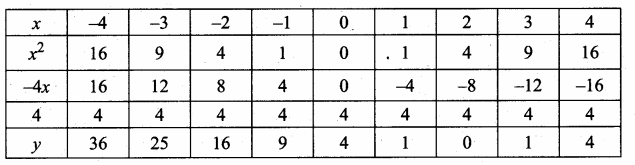
(i) Prepare the table of values for y = x2 – 4x + 4
Samacheer Kalvi 10th Maths Guide Chapter 3 Algebra Ex 3.15 3
(ii) Plot the points (-3,25) (-2,16) (-1, 9) (0,4) (1,-1) (2, 0), (3,1) and (4, 4)
(iii) Join the points by a free hand smooth curve.
(iv) The roots of the equation are the X-coordinates of the intersecting points of the curve with X-axis (2, 0) which is 2.
(v) Since there is only one point of intersection with X-axis (2, 0).
∴ The solution set is 2.
The Quadratic equation x2 – Ax + 4 = 0 has real and equal roots.
Samacheer Kalvi 10th Maths Guide Chapter 3 Algebra Ex 3.15 4

(iii) x2 + x + 7 = 0
Answer:
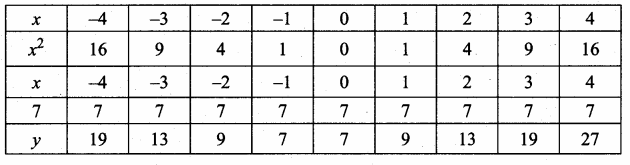
Let y = x2 + x + 7
(i) Prepare the table of values for y = x2 + x + 7
Samacheer Kalvi 10th Maths Guide Chapter 3 Algebra Ex 3.15 5
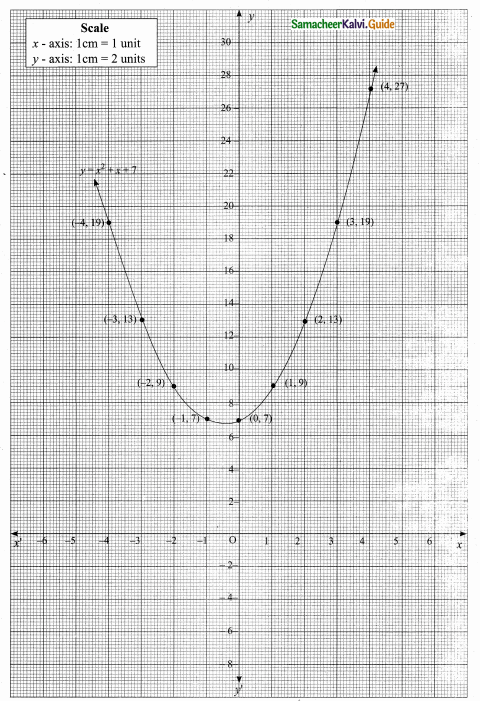
(ii) Plot the points (-4,19) (-3,13) (-2, 9) (-1, 7) (0, 7) (1, 9), (2,13) (3,19) and (4,27)
(iii) Join the points by a free hand smooth curve.
(iv) The solution of the given quadratic equation are the X-coordinates of the intersecting points of the parabola with the X-axis.
(v) The curve does not intersecting the X-axis. There is no solution set.
The equation x2 + x + 7 = 0 has no real roots.
Samacheer Kalvi 10th Maths Guide Chapter 3 Algebra Ex 3.15 6

Samacheer Kalvi 10th Maths Guide Chapter 3 Algebra Ex 3.15

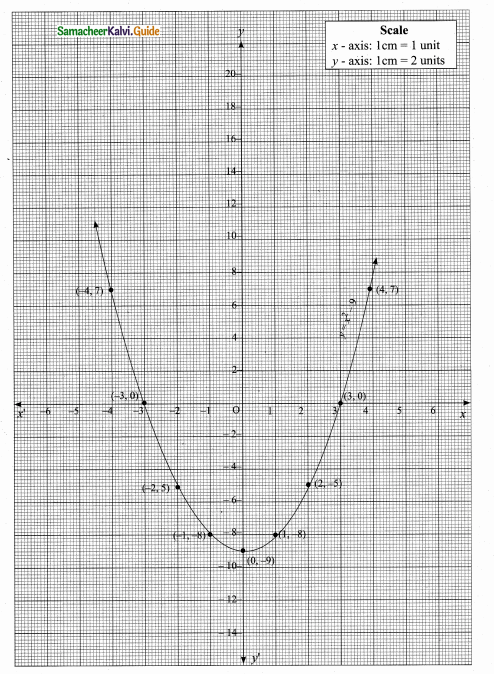
(iv) x2 – 9 = 0
Answer:
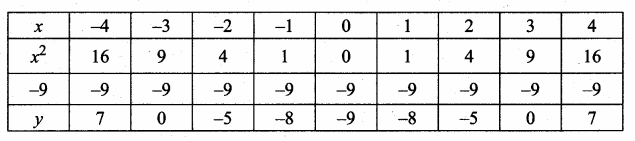
Let y = x2 – 9
(i) Prepare the table of values for y = x2 – 9
Samacheer Kalvi 10th Maths Guide Chapter 3 Algebra Ex 3.15 7
(ii) Plot the points (-4, 7) (-3, 0) (-2, -5) (-1, -8) (0, -9) (1, -8), (2, -5) (3, 0) (4, 7)
(iii) Join the points by a free hand smooth curve.
(iv) The curve intersect the X-axis at -3 and 3.
The solution is (-3, 3).
(v) Since there are two points of intersection -3 and 3 with the X-axis the quadratic equation has real and unequal roots.
Samacheer Kalvi 10th Maths Guide Chapter 3 Algebra Ex 3.15 8

Samacheer Kalvi 10th Maths Guide Chapter 3 Algebra Ex 3.15

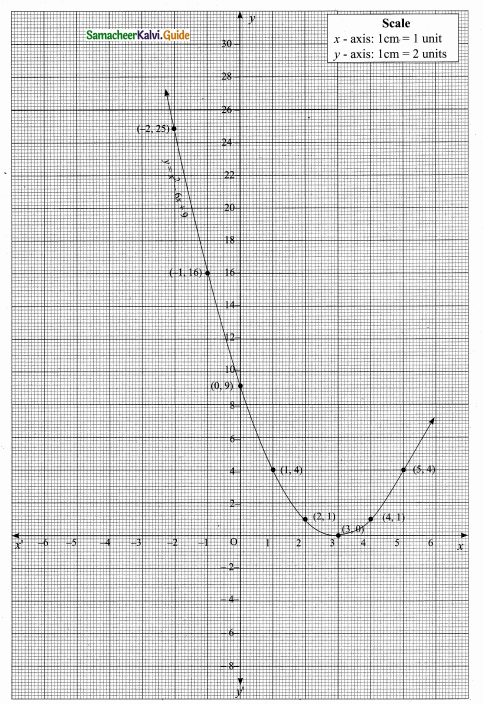
(v) x2 – 6x + 9 = 0
Answer:
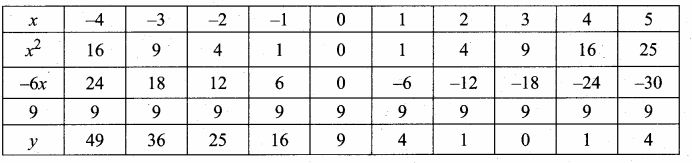
Let y = x2 – 6x + 9
(i) Prepare a table of values for y = x2 – 6x + 9
Samacheer Kalvi 10th Maths Guide Chapter 3 Algebra Ex 3.15 9
(ii) Plot the points (-2,25) (-1,16) (0,9) (1,4) (2,1) (3,0), (4,1) and (5,4) on the graph using suitable scale (omit the points (-4, 49) and (-3, 36)
(iii) Join the points by a free hand smooth curve.
(iv) The X – coordinates of the point of intersection of the curve with X-axis are the roots of the , given equation, provided they intersect.
The solution is 3.
(v) Since there is only one point of intersection with X-axis the quadratic equation x2 – 6x + 9 = 0 has real and equal roots.
Samacheer Kalvi 10th Maths Guide Chapter 3 Algebra Ex 3.15 10

Samacheer Kalvi 10th Maths Guide Chapter 3 Algebra Ex 3.15

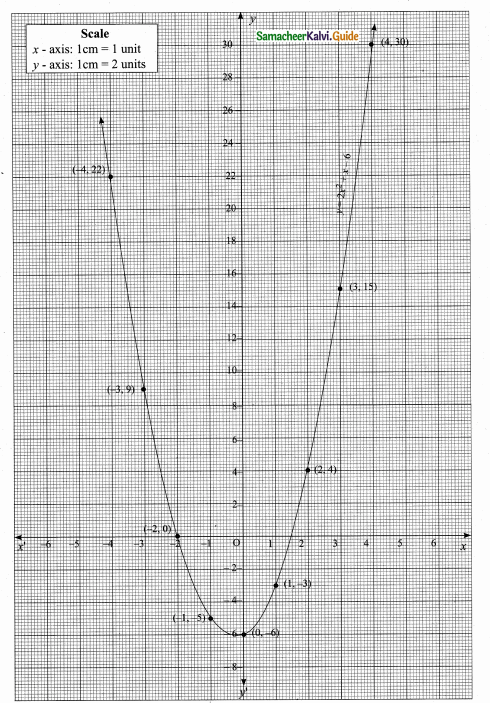
(vi) (2x – 3) (x + 2) = 0
Answer:
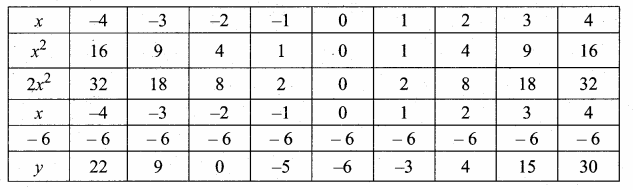
y = (2x – 3) (x + 2)
= 2x2 + 4x – 3x – 6
= 2x2 + x – 6

(i) Prepare a table of values for y from x – 4 to 4
Samacheer Kalvi 10th Maths Guide Chapter 3 Algebra Ex 3.15 11
(ii) Plot the points (-4, 22) (-3, 9) (-2, 0) (-1, -5) (0, -6) (1, -3), (2, 4), (3, 15) and (4, 30).
(iii) Join the points by a free hand smooth curve.
(iv) The curve intersect the X – axis at (-2, 0) and (1\(\frac { 1 }{ 2 } \), 0)
∴ The solution set is (-2,1\(\frac { 1 }{ 2 } \))
(v) Since there are two points of intersection with X – axis, the quadratic equation has real and un – equal roots.
Samacheer Kalvi 10th Maths Guide Chapter 3 Algebra Ex 3.15 12

Samacheer Kalvi 10th Maths Guide Chapter 3 Algebra Ex 3.15

Question 2.
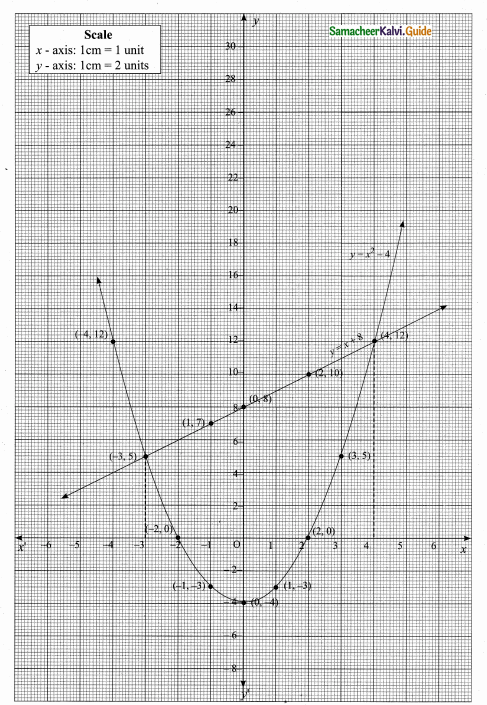
Draw the graph of y = x2 – 4 and hence solve x2 – x – 12 = 0
Answer:
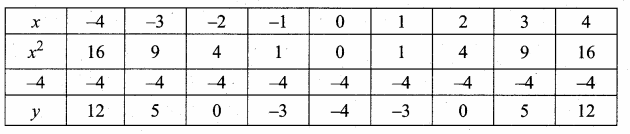
(i) Draw the graph of y = x2 – 4 by preparing the table of values as below.
Samacheer Kalvi 10th Maths Guide Chapter 3 Algebra Ex 3.15 13
(ii) Plot the points for the ordered pairs (-4, 12) (-3, 5) (-2, 0) (-1, -3) (0, -4) (1, -3), (2, 0), (3, 5) and (4, 12). Draw the curve with the suitable scale.
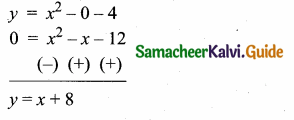
(iii) To solve x2 – x – 12 = 0 subtract x2 – x – 12 from y = x2 – 4
Samacheer Kalvi 10th Maths Guide Chapter 3 Algebra Ex 3.15 14
The equation y = x + 8 represents a straight line. Prepare a table for y = x + 8
Samacheer Kalvi 10th Maths Guide Chapter 3 Algebra Ex 3.15 16
(iv) Mark the point of intersection of the curve and the straight line is (-3, 5) and 4, 12)
∴ The solution set is (-3, 4) for x2 – x – 12 = 0.
Samacheer Kalvi 10th Maths Guide Chapter 3 Algebra Ex 3.15 40

Samacheer Kalvi 10th Maths Guide Chapter 3 Algebra Ex 3.15

Question 3.
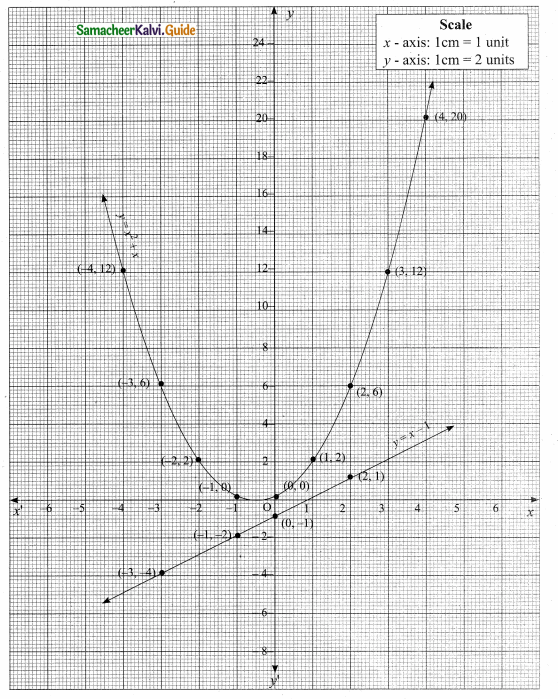
Draw the graph of y = x2 + x and hence solve x2 + 1 = 0
Answer:
Let y = x2 + x
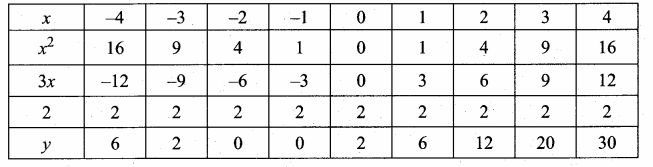
(i) Draw the graph of y = x2 + x by preparing the table.
Samacheer Kalvi 10th Maths Guide Chapter 3 Algebra Ex 3.15 18
(ii) Plot the points (-4, 12), (-3, 6), (-2, 2), (-1, 0), (0, 0), (1, 2), (2, 6), (3, 12) and (4, 20).
(iii) Join the points by a free hand to get smooth curve.
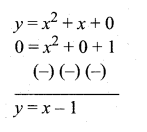
(iv) To solve x2 + 1 = 0, subtract x2 + 1 = 0 from x2 + x we get.
Samacheer Kalvi 10th Maths Guide Chapter 3 Algebra Ex 3.15 51
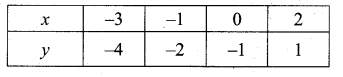
The equation represent a straight line. Draw a line y = x – 1
Samacheer Kalvi 10th Maths Guide Chapter 3 Algebra Ex 3.15 19
Observe the graph of y = x2 + 1 does not interset the parabola y = x2 + x.
This x2 + 1 has no real roots.
Samacheer Kalvi 10th Maths Guide Chapter 3 Algebra Ex 3.15 20

Samacheer Kalvi 10th Maths Guide Chapter 3 Algebra Ex 3.15

Question 4.
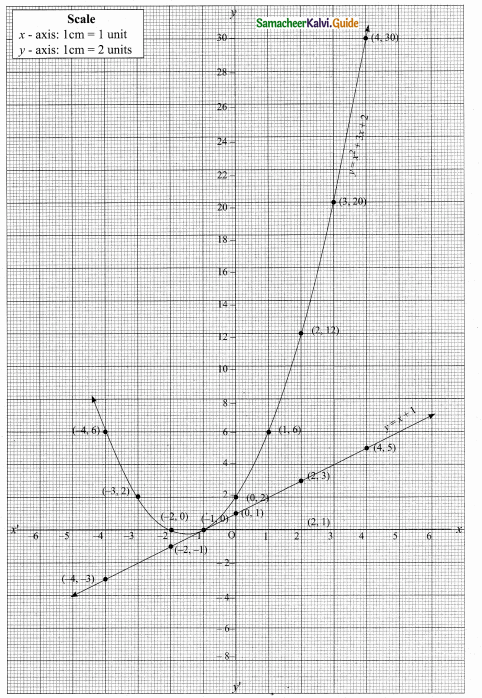
Draw the graph of y = x2 + 3x + 2 and use it to solve x2 + 2x + 1 = 0.
(i) Draw the graph of y = x2 + 3x + 2 preparing the table of values as below.
Samacheer Kalvi 10th Maths Guide Chapter 3 Algebra Ex 3.15 21
(ii) Plot the points (-4, 6), (-3, 2), (-2, 0), (-1, 0), (0, 2), (1, 6), (2, 12), (3, 20) (4, 30).
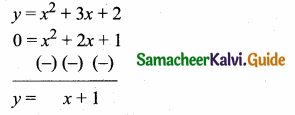
(iii) To solve x2 + 2x + 1 = 0 subtract x2 + 2x + 1 = 0 from y = x2 + 3x + 2
Samacheer Kalvi 10th Maths Guide Chapter 3 Algebra Ex 3.15 22
(iv) Draw the graph of y = x + 1 from the table
Samacheer Kalvi 10th Maths Guide Chapter 3 Algebra Ex 3.15 23
The equation y = x + 1 represent a straight line.
This line intersect the curve at only one point (-1, 0). The solution set is (-1).
Samacheer Kalvi 10th Maths Guide Chapter 3 Algebra Ex 3.15 24

Samacheer Kalvi 10th Maths Guide Chapter 3 Algebra Ex 3.15

Question 5.
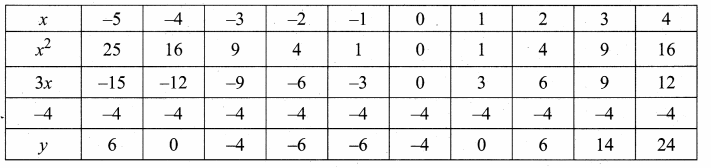
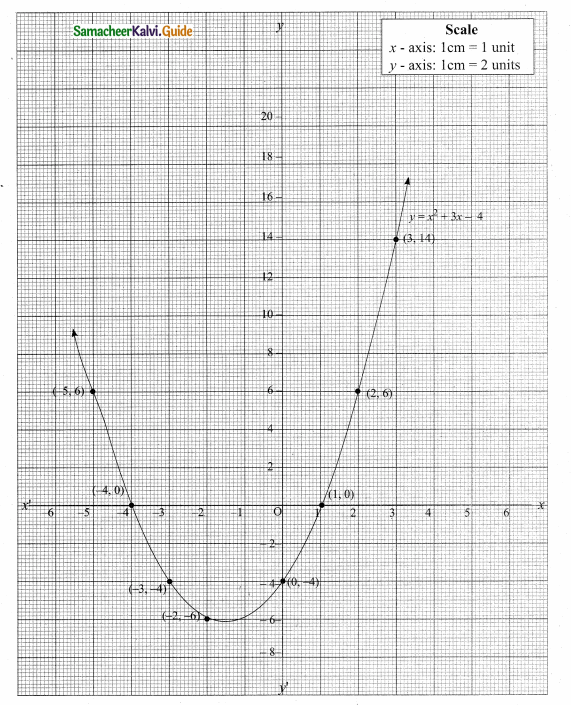
Draw the graph of y = x2 + 3x – 4 and hence use it to solve x2 + 3x – 4 = 0
Answer:
Let y = x2 + 3x – 4
(i) Draw the graph of y = x2 + 3x – 4
Samacheer Kalvi 10th Maths Guide Chapter 3 Algebra Ex 3.15 25
(ii) Plot the points (-5, 6), (-4, 0), (-3, -4), (-2, -6), (-1, -6), (0, -4), (1, 0), (2, 6), (3, 14) on the graph using suitable scale.
(iii) Join the points by a free hand smooth curve.
The smooth curve is the graph of y = x2 – 4x + 4
(iv) To solve x + 3x – 4 = 0, subtract x2 + 3x – 4 = 0 from y = x2 + 3x – 4.
y = 0
∴ The point of intersection with the x – axis is the solution set.
The solution set is -4 and 1.
Samacheer Kalvi 10th Maths Guide Chapter 3 Algebra Ex 3.15 38

Question 6.
Draw the graph of y = x2 – 5x – 6 and hence solve x2, – 5x – 14 = 0
Answer:
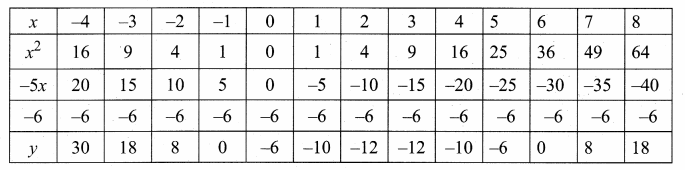
Let y = x2 – 5x – 6
(i) Draw the graph of y = x2 – 5x – 6 by preparing the table of values as below.
Samacheer Kalvi 10th Maths Guide Chapter 3 Algebra Ex 3.15 27
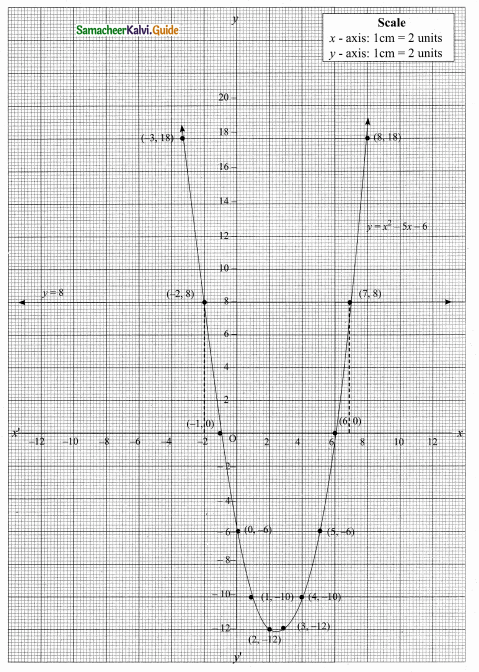
(ii) Plot the points (-3, 18), (-2, 8), (-1, 0), (0, -6), (1, -10), (2, -12), (3, -12), (4, -10), (5,-6), (6, 0) and (7, 8).
(iii) Join the points by a free hand to get smooth curve.
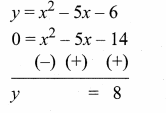
(iv) To solve x2 – 5x – 14 = 0, subtract x2 – 5x – 14 = 0 from y = x2 – 5x – 6.
Samacheer Kalvi 10th Maths Guide Chapter 3 Algebra Ex 3.15 28
The equation y = 8 represent a straight line draw a straight line through y = 8 intersect the curve at two places. From the two points draw perpendicular line to the X – axis it will intersect at -2 and 7.
The solution is -2 and 7
Samacheer Kalvi 10th Maths Guide Chapter 3 Algebra Ex 3.15 29

Samacheer Kalvi 10th Maths Guide Chapter 3 Algebra Ex 3.15

Question 7.
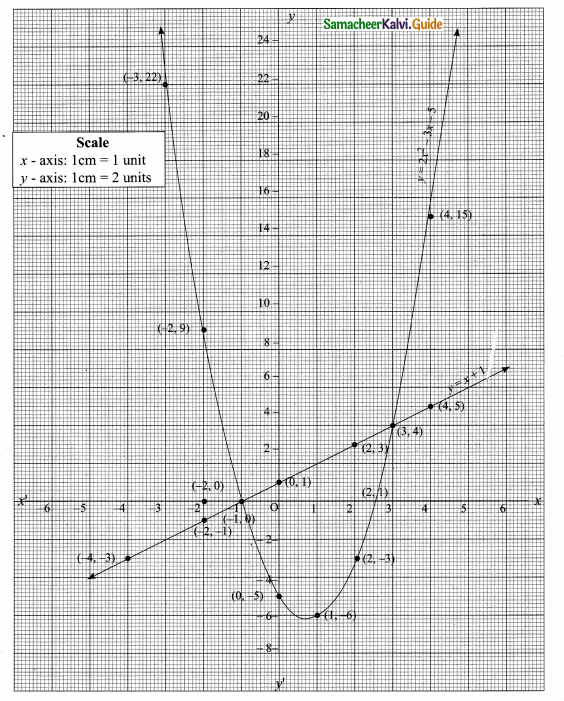
Draw the graph of y = 2x2 – 3x – 5 and hence solve 2x2 – 4x – 6 = 0
Answer:
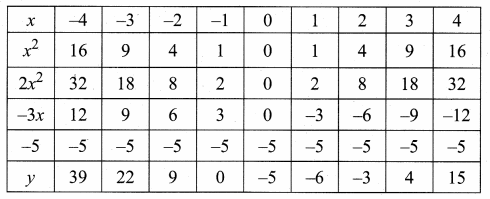
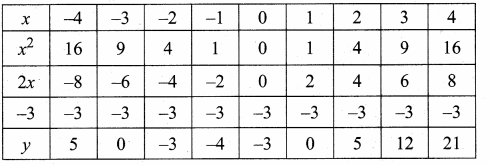
(i) Draw the graph of y = 2x2 – 3x – 5 by preparing the table of values given below.
Samacheer Kalvi 10th Maths Guide Chapter 3 Algebra Ex 3.15 39
(ii) Plot the points (-3, 22), (-2, 9), (-1, 0), (0, -5), (1,-6), (2, -3), (3, 4), (4, 15) on the graph sheet using suitable scale.
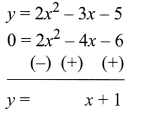
(iii) To solve 2x2 – 4x – 6 = 0 subtract 2x2 – 4x – 6 = 0 from y = 2x2 – 3x – 5
Samacheer Kalvi 10th Maths Guide Chapter 3 Algebra Ex 3.15 31
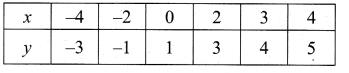
(iv) y = x + 1 represent a straight line.
Samacheer Kalvi 10th Maths Guide Chapter 3 Algebra Ex 3.15 32
The straight line intersect the curve at (-1, 0) and (3, 4). From the two point draw perpendicular lines to the X – axis it will intersect at -1 and 3.
The solution set is (-1, 3)
Samacheer Kalvi 10th Maths Guide Chapter 3 Algebra Ex 3.15 33

Samacheer Kalvi 10th Maths Guide Chapter 3 Algebra Ex 3.15

Question 8.
Draw the graph of y = (x – 1) (x + 3) and hence solve x2 – x – 6 = 0
Answer:
y = (x – 1) (x + 3)
y = x2 + 2x – 3
(i) Draw the graph of y = x2 + 2x – 3 by preparing the table of values given below
Samacheer Kalvi 10th Maths Guide Chapter 3 Algebra Ex 3.15 34
(ii) Plot the points (-4, 5), (-3, 0), (-2, -3), (-1, -4), (0, -3), (1, 0), (2, 5), (3, 12) and (4, 21) on the graph sheet using suitable scale.
(iii) To solve x2 – x – 6 = 0 subtract x2 – x – 6 = 0 from y = x2 + 2x – 3
(iv) Draw the graph of y = 3x + 3 by preparing the table.
Samacheer Kalvi 10th Maths Guide Chapter 3 Algebra Ex 3.15 35
(v) The straight line cuts the curve at (-2, -3) and (3, 12). Draw perpendicular lines from the point to X – axis.
The line cut the X – axis at -2 and 3.
The solution set is (-2, 3)

Samacheer Kalvi 10th Maths Guide Chapter 3 Algebra Ex 3.6

Students can download Maths Chapter 3 Algebra Ex 3.6 Questions and Answers, Notes, Samacheer Kalvi 10th Maths Guide Pdf helps you to revise the complete Tamilnadu State Board New Syllabus, helps students complete homework assignments and to score high marks in board exams.

Tamilnadu Samacheer Kalvi 10th Maths Solutions Chapter 3 Algebra Ex 3.6

Question 1.
Simplify
(i) \(\frac{x(x+1)}{x-2}+\frac{x(1-x)}{x-2}\)
Answer:
\(\frac{x(x+1)}{x-2}+\frac{x(1-x)}{x-2}\) = \(\frac{x(x+1)+x(1-x)}{x-2}\)
= \(\frac{x^{2}+x+x-x^{2}}{x-2}\)
= \(\frac { 2x }{ x-2 } \)

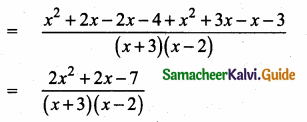
(ii) \(\frac { x+2 }{ x+3 } \) + \(\frac { x-1 }{ x-2 } \)
Answer:
\(\frac { x+2 }{ x+3 } \) + \(\frac { x-1 }{ x-2 } \) = \(\frac{(x+2)(x-2)+(x-1)(x+3)}{(x+3)(x-2)}\)
Samacheer Kalvi 10th Maths Guide Chapter 3 Algebra Ex 3.6 1

Samacheer Kalvi 10th Maths Guide Chapter 3 Algebra Ex 3.6

(iii) \(\frac{x^{3}}{x-y}+\frac{y^{3}}{y-x}\) = \(\frac{x^{3}}{x-y}+\frac{y^{3}}{-1(x-y)}\)
Answer:
= \(\frac{x^{3}}{x-y}-\frac{y^{3}}{x-y}\)
= \(\frac{x^{3}-y^{3}}{x-y}\) (using a3 – b3 = (a – b) (a2 + ab + b2))
= \(\frac{(x-y)\left(x^{2}+x y+y^{2}\right)}{x-y}\)
= x2 + xy + y2

Question 2.
Simplify
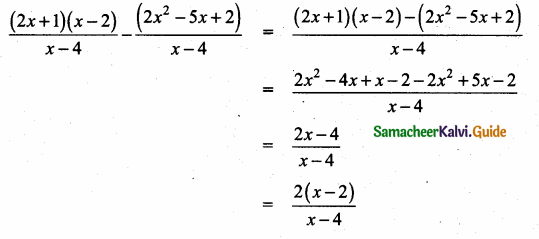
(i) \(\frac{(2 x+1)(x-2)}{x-4}\) – \(\frac{\left(2 x^{2}-5 x+2\right)}{x-4}\)
Answer:
Samacheer Kalvi 10th Maths Guide Chapter 3 Algebra Ex 3.6 2

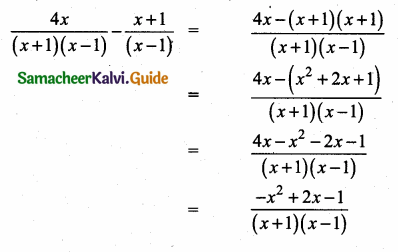
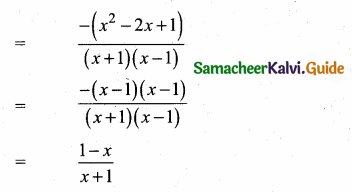
(ii) \(\frac{4 x}{x^{2}-1}-\frac{x+1}{x-1}\)
Answer:
Samacheer Kalvi 10th Maths Guide Chapter 3 Algebra Ex 3.6 3
Samacheer Kalvi 10th Maths Guide Chapter 3 Algebra Ex 3.6 5
Samacheer Kalvi 10th Maths Guide Chapter 3 Algebra Ex 3.6 4

Samacheer Kalvi 10th Maths Guide Chapter 3 Algebra Ex 3.6

Question 3.
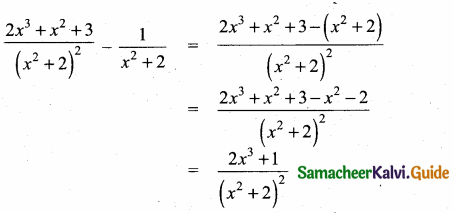
Subtract \(\frac{1}{x^{2}+2}\) from \(\frac{2 x^{3}+x^{2}+3}{\left(x^{2}+2\right)^{2}}\)
Answer:
Samacheer Kalvi 10th Maths Guide Chapter 3 Algebra Ex 3.6 6

Question 4.
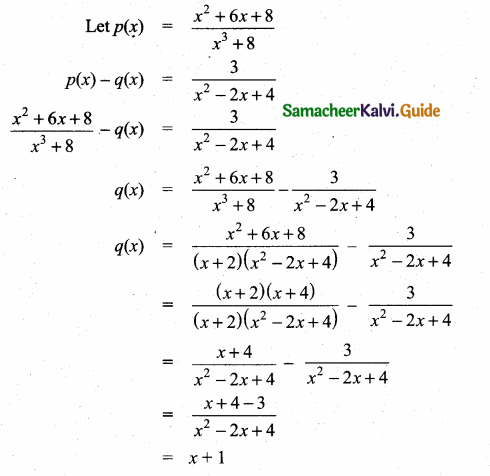
Which rational expression should be subtracted from \(\frac{x^{2}+6 x+8}{x^{3}+8}\)
Answer:
Samacheer Kalvi 10th Maths Guide Chapter 3 Algebra Ex 3.6 7

Samacheer Kalvi 10th Maths Guide Chapter 3 Algebra Ex 3.6

Question 5.
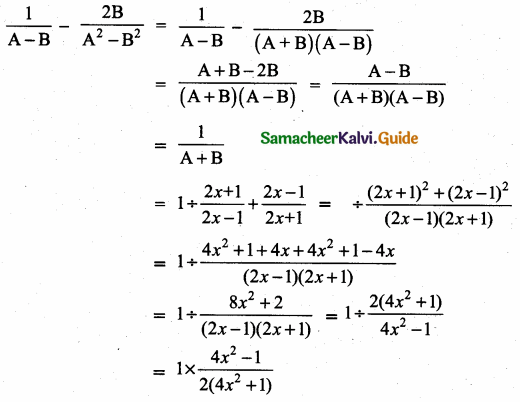
If A = \(\frac{2x+1}{2 x-1}\), B = \(\frac{2x-1}{2x+1}\) find \(\frac{1}{A-B}\) – \(\frac{2 \mathbf{B}}{\mathbf{A}^{2}-\mathbf{B}^{2}}\)
Answer:
Samacheer Kalvi 10th Maths Guide Chapter 3 Algebra Ex 3.6 8

Samacheer Kalvi 10th Maths Guide Chapter 3 Algebra Ex 3.6

Question 6.
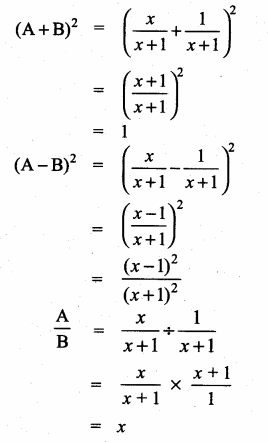
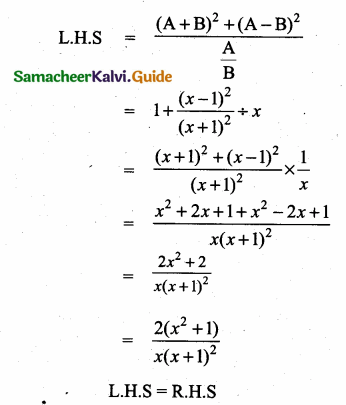
If A = \(\frac { x }{ x+1 } \) B = \(\frac { 1 }{ x+1 } \) prove that \(\frac{(\mathbf{A}+\mathbf{B})^{2}+(\mathbf{A}-\mathbf{B})^{2}}{\mathbf{A}+\mathbf{B}}=\frac{2\left(x^{2}+1\right)}{x(x+1)^{2}}\)
Answer:
Samacheer Kalvi 10th Maths Guide Chapter 3 Algebra Ex 3.6 9
Samacheer Kalvi 10th Maths Guide Chapter 3 Algebra Ex 3.6 10

Samacheer Kalvi 10th Maths Guide Chapter 3 Algebra Ex 3.6

Question 7.
Pari needs 4 hours to complete a work. His friend Yuvan needs 6 hours to complete the same work. How long will it take to complete if they work together?
Solution:
Pari: time required to complete the work = 4 hrs.
∴ In 1 hr. he will complete = \(\frac{1}{4}\) of the work.
= \(\frac{1}{4}\) w.
Yuvan: Time required to complete the work = 6 hrs.
∴ In 1 hr. he will complete the \(\frac{1}{6}\) of the work
= \(\frac{1}{6}\) w
Working together, in 1 hr. they will complete \(\frac{w}{4}+\frac{w}{6}\) of the work.
= \(\frac{6 w+4 w}{24}=\frac{5}{12} w\)
∴ To complete the total work time taken
= \(\frac{w}{\frac{5}{12} w}=\frac{12}{5}\) = 2.4 hrs. [∵ (4) hrs = 4 × 60 = 24 min]
= 2 hrs 24 minutes.

Samacheer Kalvi 10th Maths Guide Chapter 3 Algebra Ex 3.6

Question 8.
Iniya bought 50 kg of fruits consisting of apples and bananas. She paid twice as much per kg for the apple as she did for the banana. If Iniya bought ? 1800 worth of apples and ₹ 600 worth bananas, then how many kgs of each fruit did she buy?
Let the weight of applies be a kg.
Let the weight of bananas be b kg.
a + b = 50
ax = ₹ 1800 ………….. (1)
by = ₹ 600 ………… (2)
x = 2y …………… (3)
Use (3) in (1) ⇒ a(2y) = 1800
y = \(\frac{900}{a}\) ………….. (4)
Use (4) in (2) ⇒ \(b\frac{900}{a}\) = 600
∵ 3b = 2a …………….. (5)
∵ a + b = 50
a + \(\frac{2 a}{3}\) = 50 ⇒ \(\frac{5 a}{3}\) = 50
⇒ a = 50 × \(\frac{3}{5}\)
= 30
∴ b = 20
∴ Iniya bought 30 kg of applies and 20 kg of bananas
= 30
.’. b = 20.
.’. Iniya bought 30 kg of applies and 20 kg of bananas.

Samacheer Kalvi 10th Maths Guide Chapter 3 Algebra Ex 3.17

Students can download Maths Chapter 3 Algebra Ex 3.17 Questions and Answers, Notes, Samacheer Kalvi 10th Maths Guide Pdf helps you to revise the complete Tamilnadu State Board New Syllabus, helps students complete homework assignments and to score high marks in board exams.

Tamilnadu Samacheer Kalvi 10th Maths Solutions Chapter 3 Algebra Ex 3.17

Question 1.
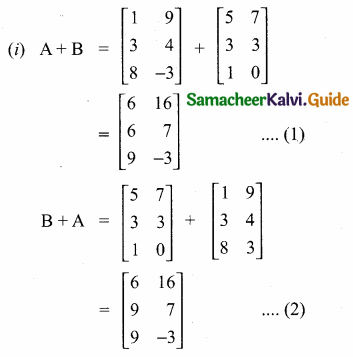
If then
Samacheer Kalvi 10th Maths Guide Chapter 3 Algebra Ex 3.17 1
verify that (i) A + B = B + A
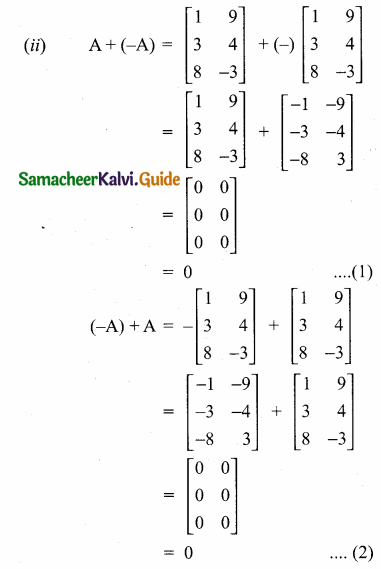
(ii) A + (-A) = (-A) + A = O.
Answer:
Samacheer Kalvi 10th Maths Guide Chapter 3 Algebra Ex 3.17 2
From (1) and (2) we get A + B = B + A
Samacheer Kalvi 10th Maths Guide Chapter 3 Algebra Ex 3.17 3
From (1) and (2) we get
A + (-A) = (-A) + A = 0

Samacheer Kalvi 10th Maths Guide Chapter 3 Algebra Ex 3.17

Question 2.
If Samacheer Kalvi 10th Maths Guide Chapter 3 Algebra Ex 3.17 4
Samacheer Kalvi 10th Maths Guide Chapter 3 Algebra Ex 3.17 5 then verify that
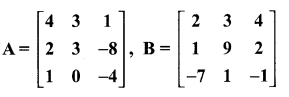
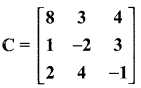
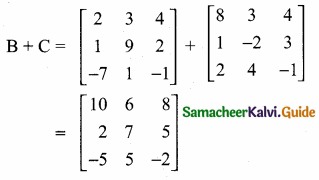
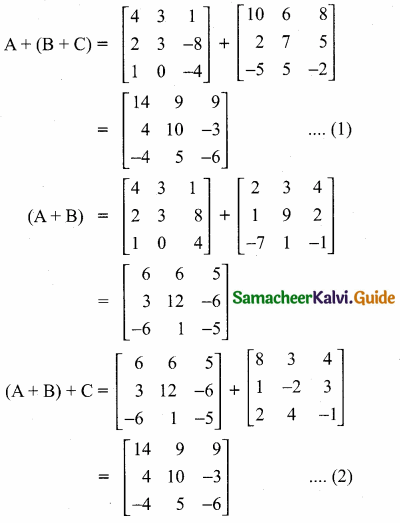
A + (B + C) = (A + B) + C.
Answer:
Samacheer Kalvi 10th Maths Guide Chapter 3 Algebra Ex 3.17 6
Samacheer Kalvi 10th Maths Guide Chapter 3 Algebra Ex 3.17 7
From (1) and (2) we get
A + (B + C) = (A + B) + C

Samacheer Kalvi 10th Maths Guide Chapter 3 Algebra Ex 3.17

Question 3.
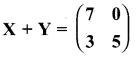
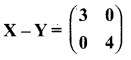
Find X and Y if Samacheer Kalvi 10th Maths Guide Chapter 3 Algebra Ex 3.17 8 and Samacheer Kalvi 10th Maths Guide Chapter 3 Algebra Ex 3.17 9
Answer:
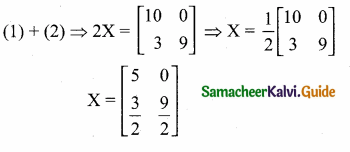
Samacheer Kalvi 10th Maths Guide Chapter 3 Algebra Ex 3.17 10
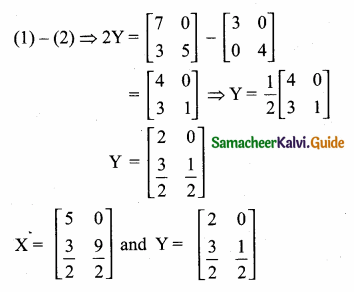
Samacheer Kalvi 10th Maths Guide Chapter 3 Algebra Ex 3.17 11

Samacheer Kalvi 10th Maths Guide Chapter 3 Algebra Ex 3.17

Question 4.
If Samacheer Kalvi 10th Maths Guide Chapter 3 Algebra Ex 3.17 12
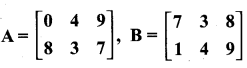
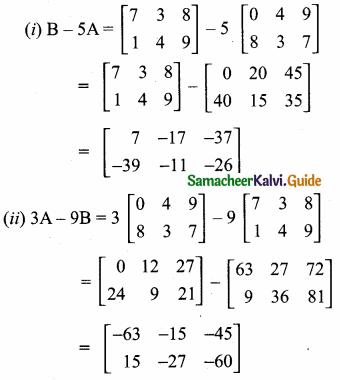
find the value of (i) B – 5A (ii) 3A – 9B
Answer:
Samacheer Kalvi 10th Maths Guide Chapter 3 Algebra Ex 3.17 13

Question 5.
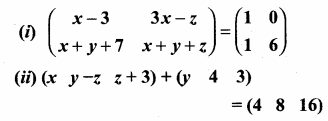
Find the values of x, y, z if
Samacheer Kalvi 10th Maths Guide Chapter 3 Algebra Ex 3.17 14
Answer:
(i) x – 3 = 1 ⇒ x = 1 + 3 ⇒ x = 4
3x – z = 0 (substitute the value of x)
3(4) – z = 0
12 – z = 0
∴ z = 12
x + y + z = 6
4 + y + 12 = 0
y + 16 = 6
y = 6- 16
∴ y = -10
The value of x = 4, y = -10 and z = 12

(ii) [x y – z z + 3] + [y 4 3] = [4 8 16]
x + y = 4 ….(1)
y – z + 4 = 8
Substitute the value
of z in (2)
(2) ⇒ y – 10 = 4
Substitute the value of y in (1)
z + 3 + 3 = 16
z + 6 = 16
z = 16 – 16 = 10
y = 14
(1) ⇒ x + 14 = 4
x – 4 – 14 = -10
The value of x = -10, y = 14 and z = 10

Samacheer Kalvi 10th Maths Guide Chapter 3 Algebra Ex 3.17

Question 6.
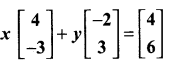
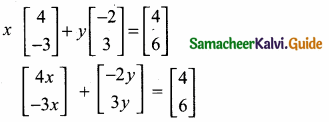
Find x and y if x Samacheer Kalvi 10th Maths Guide Chapter 3 Algebra Ex 3.17 15
Answer:
Samacheer Kalvi 10th Maths Guide Chapter 3 Algebra Ex 3.17 16
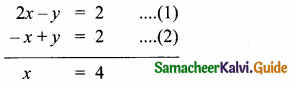
4x – 2y = 4
(1) ⇒ 2x – y = 2
(2) ⇒ 3x – y = 2
– x + y = 2
Add (1) and (2)
Samacheer Kalvi 10th Maths Guide Chapter 3 Algebra Ex 3.17 17
Substitute the value of x = 4 in (2)
– 4 + y = 2
y = 2 + 4 = 6
The value of x = 4 and y = 6

Samacheer Kalvi 10th Maths Guide Chapter 3 Algebra Ex 3.17

Question 7.
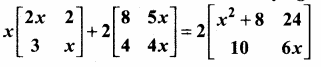
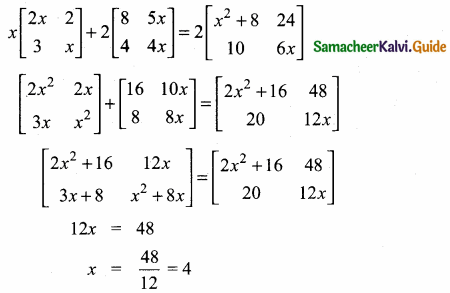
Find the non-zero values of x satisfying the matrix equation
Samacheer Kalvi 10th Maths Guide Chapter 3 Algebra Ex 3.17 18
Answer:
Samacheer Kalvi 10th Maths Guide Chapter 3 Algebra Ex 3.17 19
The value of x = 4

Samacheer Kalvi 10th Maths Guide Chapter 3 Algebra Ex 3.17

Question 8.
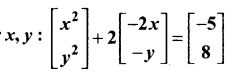
Solve for x,y :
Samacheer Kalvi 10th Maths Guide Chapter 3 Algebra Ex 3.17 20
Answer:
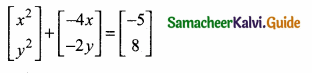
Samacheer Kalvi 10th Maths Guide Chapter 3 Algebra Ex 3.17 21
x2 – 4x = -5
x2 – 4x + 5 = 0
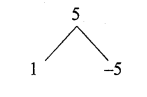
(x – 5) (x + 1) = 0
x – 5 = 0 or x + 1 = 0
x = 5 or x = – 1
Samacheer Kalvi 10th Maths Guide Chapter 3 Algebra Ex 3.17 22
The value of x = -1 and 5
y2 – 2y = 8
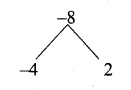
y2 – 2y – 8 = 0
(y – 4) (y + 2) = 0
y – 4 = 0 or y + 2 = 0
Samacheer Kalvi 10th Maths Guide Chapter 3 Algebra Ex 3.17 23
y = 4 or y = -2
The value of y = -2 and 4