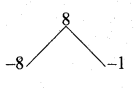
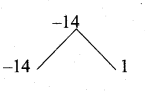
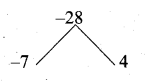
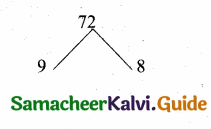
Samacheer Kalvi 10th Maths Guide Chapter 1 Relations and Functions Unit Exercise 1

Students can download Maths Chapter 1 Relations and Functions Unit Exercise 1 Questions and Answers, Notes, Samacheer Kalvi 10th Maths Guide Pdf helps you to revise the complete Tamilnadu State Board New Syllabus, helps students complete homework assignments and to score high marks in board exams.

Tamilnadu Samacheer Kalvi 10th Maths Solutions Chapter 1 Relations and Functions Unit Exercise 1

Question 1.
If the ordered pairs (x2 – 3x, y2 + 4y) and (-2, 5) are equal, then find x and y.
Answer:

(x2 – 3x, y2 + 4y) = (-2, 5)
x2 – 3x = -2
x2 – 3x + 2 = 0
(x – 2) (x – 1) = 0
x – 2 = 0 or x – 1 = 0
x = 2 or 1
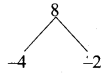
Samacheer Kalvi 10th Maths Guide Chapter 1 Relations and Functions Unit Exercise 1 1
y2 + 4y = 5
y2 + 4y – 5 = 0
(y + 5) (y – 1) = 0
y + 5 = 0 or y – 1 = 0
y = -5 or y = 1
The value of x = 2, 1
and 7 = -5, 1
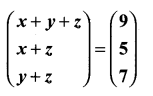
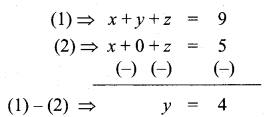
Samacheer Kalvi 10th Maths Guide Chapter 1 Relations and Functions Unit Exercise 1 2

Samacheer Kalvi 10th Maths Guide Chapter 1 Relations and Functions Unit Exercise 1

Question 2.
The Cartesian product A × A has 9 elements among which (-1, 0) and (0, 1) are found. Find the set A and the remaining elements of A × A.
Solution:
A = {-1, 0, 1}, B = {1, 0, -1}
A × B = {(-1, 1), (-1, 0), (-1, -1), (0, 1), (0, 0), (0, -1), (1, 1), (1, 0), (1, -1)}

Samacheer Kalvi 10th Maths Guide Chapter 1 Relations and Functions Unit Exercise 1

Question 3.
Given that f(x) = \(\left\{\begin{array}{rl}
{\sqrt{x-1}} & {x \geq 1} \\
{4} & {x<1}
\end{array}\right.\).
Find
(i) f(0) (ii)f (3) (iii) f(a + 1) in terms of a.(Given that a > 0)
Answer:
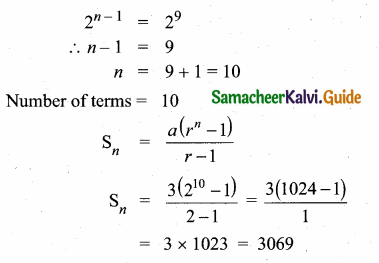
f(x) = \(\sqrt { x-1 }\) ; f(x) = 4
(i) f(0) = 4
(ii) f(3) = \(\sqrt { 3-1 }\) = \(\sqrt { 2 }\)
(iii) f(a + 1) = \(\sqrt { a+1-1 }\) = \(\sqrt { a }\)

Question 4.
Let A = {9, 10, 11, 12, 13, 14, 15, 16, 17} and let f: A → N be defined by f(n) = the highest prime factor of n ∈ A. Write f as a set of ordered pairs and find the range of f.
Solution:
A = {9, 10, 11, 12, 13, 14, 15, 16, 17}
f: A → N
f(n) = the highest prime factor of n ∈ A
f = {(9, 3), (10, 5), (11, 11), (12, 3), (13, 13), (14, 7), (15, 5), (16, 2), (17, 17)}
Range = {3, 5, 11, 13, 7, 2, 17}
= {2, 3, 5, 7, 11, 13, 17}

Samacheer Kalvi 10th Maths Guide Chapter 1 Relations and Functions Unit Exercise 1

Question 5.
Find the domain of the function
Samacheer Kalvi 10th Maths Guide Chapter 1 Relations and Functions Unit Exercise 1 3
Answer:
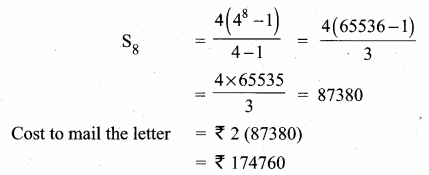
Samacheer Kalvi 10th Maths Guide Chapter 1 Relations and Functions Unit Exercise 1 4
Domain of f(x) = {-1, 0, 1}

Question 6.
If f(x)= x2, g(x) = 3x and h(x) = x – 2 Prove that (fog)oh = fo(goh).
Solution:
f(x) = x2
g(x) = 3x
h(x) = x – 2
(fog)oh = x – 2
LHS = fo(goh)
fog = f(g(x)) = f(3x) = (3x)2 = 9x2
(fog)oh = (fog) h(x) = (fog) (x – 2)
= 9(x – 2)2 = 9(x2 – 4x + 4)
= 9x2 – 36x + 36 ……………. (1)
RHS = fo(goh)
(goh) = g(h(x)) = g(x – 2)
= 3(x – 2) = 3x – 6
fo(goh) = f(3x – 6) = (3x – 6)2
= 9x2 – 36x + 36 ………….. (2)
(1) = (2)
LHS = RHS
(fog)oh = fo(goh) is proved.

Samacheer Kalvi 10th Maths Guide Chapter 1 Relations and Functions Unit Exercise 1

Question 7.
Let A= {1,2} and B = {1,2,3,4}, C = {5,6} and D = {5,6,7,8}. Verify whether A × C is a subset of B × D?
Answer:
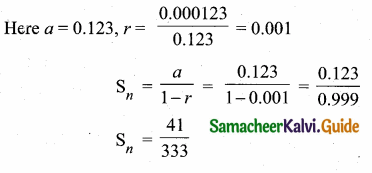
Given A = {1, 2}
B = {1, 2, 3, 4}
C = {5,6}
D = {5,6, 7,8}
A × C = {1,2} × {5,6}
= {(1,5) (1,6) (2, 5) (2, 6)}
B × D = {1,2, 3, 4} × {5, 6, 7, 8}
= {(1,5) (1,6) (1,7) (1,8)
(2, 5) (2, 6) (2,7) (2, 8)
(3, 5) (3, 6) (3, 7) (3, 8)
(4, 5) (4, 6) (4, 7) (4, 8)}
∴ A × C ⊂ B × D
Hence it is verified

Question 8.
If f(x) = \(\frac{x-1}{x+1}, x \neq 1\) Show that
f(f(x)) = – \(\frac { 1 }{ x } \), Provided x ≠ 0.
Answer:

Samacheer Kalvi 10th Maths Guide Chapter 1 Relations and Functions Unit Exercise 1 5
Samacheer Kalvi 10th Maths Guide Chapter 1 Relations and Functions Unit Exercise 1 6

Samacheer Kalvi 10th Maths Guide Chapter 1 Relations and Functions Unit Exercise 1

Question 9.
The functions f and g are defined by f{x) = 6x + 8; g(x) = \(\frac { x-2 }{ 3 } \)
(i) Calculate the value of gg [latex]\frac { 1 }{ 2 } [/latex]
(a) Write an expression for gf (x) in its simplest form.
Answer:
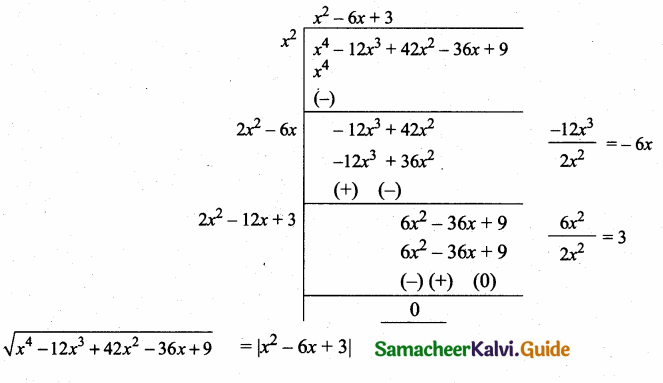
f(x) = 6x + 8 ; g(x) = \(\frac { x-2 }{ 3 } \)
Samacheer Kalvi 10th Maths Guide Chapter 1 Relations and Functions Unit Exercise 1 7
Samacheer Kalvi 10th Maths Guide Chapter 1 Relations and Functions Unit Exercise 1 8
Samacheer Kalvi 10th Maths Guide Chapter 1 Relations and Functions Unit Exercise 1 88

Samacheer Kalvi 10th Maths Guide Chapter 1 Relations and Functions Unit Exercise 1

Question 10.
Write the domain of the following real functions
Samacheer Kalvi 10th Maths Guide Chapter 1 Relations and Functions Unit Exercise 1 9
Answer:
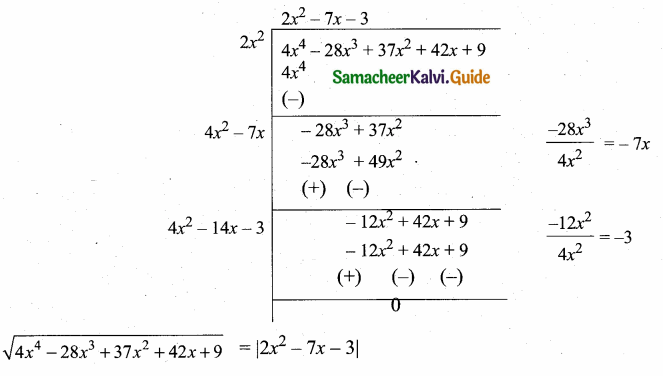
(i) f (x) = \(\frac { 2x+1 }{ x-9 } \)
If the denominator vanishes when x = 9
So f(x) is not defined at x = 9
∴ Domain is x ∈ [R – {9}]

(ii) if p(x) = \(=\frac{-5}{4 x^{2}+1}\)
p(x) is defined for all values of x. So domain is x ∈ R.

(iii) g(x) = \(\sqrt { x-2 }\)
When x < 2 g(x) becomes complex. But given “g” is real valued function.
So x > 2
Domain x ∈ (2, α)

(iv) h (x) = x + 6
For all values of x, h(x) is defined. Hence domain is x ∈ R.

Samacheer Kalvi 10th Maths Guide Chapter 1 Relations and Functions Ex 1.6

Students can download Maths Chapter 1 Relations and Functions Ex 1.6 Questions and Answers, Notes, Samacheer Kalvi 10th Maths Guide Pdf helps you to revise the complete Tamilnadu State Board New Syllabus, helps students complete homework assignments and to score high marks in board exams.

Tamilnadu Samacheer Kalvi 10th Maths Solutions Chapter 1 Relations and Functions Ex 1.6

Multiple Choice Questions

Question 1.
If n(A × B) = 6 and A= {1, 3} then n (B) is ………….
(1) 1
(2) 2
(3) 3
(4) 6
Answer:
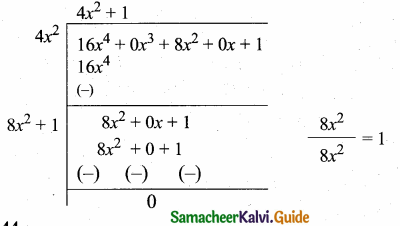
(3) 3
Hint: n(A × B) = 6
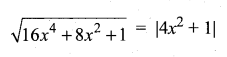
n(A) = 2
n(A × B) = n(A) × n(B)
6 = 2 × n(B)
n(B) = \(\frac { 6 }{ 2 } \) = 3

Samacheer Kalvi 10th Maths Guide Chapter 1 Relations and Functions Ex 1.6

Question 2.
A = {a, b, p}, B = {2, 3}, C = {p, q, r, s} then n[(A ∪ C) × B] is
(1) 8
(2) 20
(3) 12
(4) 16
Answer:
(3) 12
Hint:
A = {a, b, p}, B = {2, 3}, C = {p, q, r, s}
n (A ∪ C) × B
A ∪ C = {a, b, p, q, r, s}
(A ∪ C) × B = {{a, 2), (a, 3), (b, 2), (b, 3), (p, 2), (p, 3), (q, 2), (q, 3), (r, 2), (r, 3), (s, 2), (s, 3)
n [(A ∪ C) × B] = 12

Question 3.
If A = {1,2}, B = {1,2, 3, 4}, C = {5,6} and D = {5, 6, 7, 8} then state which of the following statement is true ……………….
(1) (A × C) ⊂ (B × D)
(2) (B × D) ⊂ (A × C)
(3) (A × B) ⊂ (A × D)
(4) (D × A) ⊂ (B × A)
Answer:
(1) (A × C) ⊂ (B × D)
Hint: n(A × B) = 2 × 4 = 8
(A × C) = 2 × 2 = 4
n(B × C) = 4 × 2 = 8
n(C × D) = 2 × 4 = 8
n(A × C) = 2 × 2 = 4
n(A × D) = 2 × 4 = 8
n(B × D) = 4 × 4 = 16
∴ (A × C) ⊂ (B × D)
Samacheer Kalvi 10th Maths Guide Chapter 1 Relations and Functions Ex 1.6

Question 4.
If there are 1024 relations from a set A = {1, 2, 3, 4, 5} to a set B, then the number of elements in B is
(1) 3
(2) 2
(3) 4
(4) 6
Answer:
(2) 2
Hint:
n(A) = 5
n(B) = x
n(A × B) = 1024 = 210
25x = 210
⇒ 5x = 10
⇒ x =2

Question 5.
The range of the relation R = {(x, x2) a prime number less than 13} is ……………………
(1) {2, 3, 5, 7}
(2) {2, 3, 5, 7, 11}
(3) {4, 9, 25, 49, 121}
(4) {1, 4, 9, 25, 49, 121}
Answer:
(3) {4, 9, 25, 49, 121}
Hint:
Prime number less than 13 = {2, 3, 5, 7, 11}
Range (R) = {(x, x2)}
Range = {4, 9, 25, 49, 121} (square of x)

Samacheer Kalvi 10th Maths Guide Chapter 1 Relations and Functions Ex 1.6

Question 6.
If the ordered pairs (a + 2, 4) and (5, 2a + b)are equal then (a, b) is
(1) (2, -2)
(2) (5, 1)
(3) (2, 3)
(4) (3, -2)
Answer:
(4) (3, -2)
Hint:
(a + 2, 4), (5, 2a + b)
a + 2 = 5
a = 3
2a + b = 4
6 + b = 4
b = -2

Question 7.
Let n(A) = m and n(B) = n then the total number of non-empty relations that can be defined from A to B is ……………..
(1) mn
(2) nm
(3) 2mn – 1
(4) 2mn
Answer:
(4) 2mn

Question 8.
If {(a, 8),(6, b)}represents an identity function, then the value of a and b are respectively
(1) (8, 6)
(2) (8, 8)
(3) (6, 8)
(4) (6, 6)
Answer:
(1) (8, 6)
Hint:
{{a, 8), (6, b)}
a = 8
b = 6

Samacheer Kalvi 10th Maths Guide Chapter 1 Relations and Functions Ex 1.6

Question 9.
Let A = {1, 2, 3, 4} and B = {4, 8, 9, 10}.
A function f: A → B given by f = {(1, 4), (2, 8),(3,9),(4,10)} is a ……………
(1) Many-one function
(2) Identity function
(3) One-to-one function
(4) Into function
Answer:
(3) One-to-one function
Hint:
Samacheer Kalvi 10th Maths Guide Chapter 1 Relations and Functions Ex 1.6 2
Different elements of A has different images in B.
∴ It is one-to-one function.

Question 10.
If f (x) = 2x2 and g(x) = \(\frac { 1 }{ 3x } \), then fog is …………..
(1) \(\frac{3}{2 x^{2}}\)
(2) \(\frac{2}{3 x^{2}}\)
(3) \(\frac{2}{9 x^{2}}\)
(4) \(\frac{1}{6 x^{2}}\)
Answer:
(3) \(\frac{2}{9 x^{2}}\)
Hint:
Samacheer Kalvi 10th Maths Guide Chapter 1 Relations and Functions Ex 1.6 3

Samacheer Kalvi 10th Maths Guide Chapter 1 Relations and Functions Ex 1.6

Question 11.
If f: A → B is a bijective function and if n(B) = 7, then n(A) is equal to
(1) 7
(2) 49
(3) 1
(4) 14
Answer:
(1) 7
Hint:
In a bijective function, n(A) = n(B)
⇒ n(A) = 7

Question 12.
Let f and g be two functions given by
f = {(0,1),(2, 0),(3-4),(4,2),(5,7)}
g = {(0,2),(1,0),(2, 4),(-4,2),(7,0)}
then the range of f o g is …………………
(1) {0,2,3,4,5}
(2) {-4,1,0,2,7}
(3) {1,2,3,4,5}
(4) {0,1,2}
Answer:
(4) {0,1,2}
Hint: f = {(0, 1)(2, 0)(3, -4) (4, 2) (5, 7)}
g = {(0,2)(l,0)(2,4)(-4,2)(7,0)}
Samacheer Kalvi 10th Maths Guide Chapter 1 Relations and Functions Ex 1.6 4
fog = f[g(x)]
f [g(0)] = f(2) = 0
f [g(1)] = f(0) = 1
f [g(2)] = f(4) = 2
f[g(-4)] = f(2) = 0
f[g(7)] = f(0) = 1
Range of fog = {0,1,2}

Samacheer Kalvi 10th Maths Guide Chapter 1 Relations and Functions Ex 1.6

Question 13.
Let f(x) = \(\sqrt{1+x^{2}}\) then
(1) f(xy) = f(x),f(y)
(2) f(xy) ≥ f(x),f(y)
(3) f(xy) ≤ f(x).f(y)
(4) None of these
Answer:
(3) f(xy) ≤ f(x).f(y)
Hint:
\(\sqrt{1+x^{2} y^{2}} \leq \sqrt{\left(1+x^{2}\right)} \sqrt{\left(1+y^{2}\right)}\)
⇒ f(xy) ≤ f(x) . f(y)

Question 14.
If g= {(1,1),(2,3),(3,5),(4,7)} is a function given by g(x) = αx + β then the values of α and β are
(1) (-1,2)
(2) (2,-1)
(3) (-1,-2)
(4) (1,2)
Answer:
(2) (2, -1)
Hint: g (x) = αx + β
g(1) = α(1) + β
1 = α + β ….(1)
g (2) = α (2) + β
3 = 2α + β ….(2)
Solve the two equations we get
α = 2, β = -1

Samacheer Kalvi 10th Maths Guide Chapter 1 Relations and Functions Ex 1.6

Question 15.
f(x) = (x + 1)3 – (x – 1)3 represents a function which is
(1) linear
(2) cubic
(3) reciprocal
(4) quadratic
Answer:
(4) quadratic
Hint:
f(x) = (x + 1)3 – (x – 1)3
= x3 + 3x2 + 3x + 1 -[x3 – 3x2 + 3x – 1]
= x3 + 3x2 + 3x + 1 – x3 + 3x2 – 3x + 1 = 6x2 + 2
It is a quadratic function.

Samacheer Kalvi 10th Maths Guide Chapter 2 Numbers and Sequences Ex 2.3

Students can download Maths Chapter 2 Numbers and Sequences Ex 2.3 Questions and Answers, Notes, Samacheer Kalvi 10th Maths Guide Pdf helps you to revise the complete Tamilnadu State Board New Syllabus, helps students complete homework assignments and to score high marks in board exams.

Tamilnadu Samacheer Kalvi 10th Maths Solutions Chapter 2 Numbers and Sequences Ex 2.3

Question 1.
Find the least positive value of x such that

(i) 71 = x (mod 8)
Answer:
71 = 7 (mod 8)
∴ The value of x = 7
Samacheer Kalvi 10th Maths Guide Chapter 2 Numbers and Sequences Ex 2.3 1

(ii) 78 + x = 3 (mod 5)
78 + x – 3 = 5n (n is any integer)
75 + x = 5n
(Let us take x = 5)
75 + 5 = 80 (80 is a multiple of 5)
∴ The least value of x is 5

Samacheer Kalvi 10th Maths Guide Chapter 2 Numbers and Sequences Ex 2.3

(iii) 89 = (x + 3) (mod 4)
89 – (x + 3) = 4n
(n may be any integer)
89 – x – 3 = 4n
89 – x = 4n
86 – x is a multiple of 4
(84 is a multiple of 4)
86 – 2 = 4n
84 = 4n
The value of x is 2

(iv) 96 = \(\frac { x }{ 7 } \) (mod 5)
96 – \(\frac { x }{ 7 } \) = 5n (n may be any integer)
672 – x = 35n (multiple of 35 is 665)
672 – 7 = 665
∴ The value of x = 7

(v) 5x = 4 (mod 6)
5x – 4 = 6n (n may be any integer)
5x = 6n + 4
x = \(\frac { 6n+4 }{ 5 } \)
Substitute the value of n as 1, 6, 11, 16 …. as n values in x = \(\frac { 6n+4 }{ 5 } \) which is divisible by 5.
2, 8, 14, 20,…………
The least positive value is 2.

Question 2.
If x is congruent to 13 modulo 17 then 7x -3 is congruent to which number modulo 17?
Solution:
x ≡ 13 (mod 17)
Let p be the required number …………. (1)
7x – 3 ≡ p (mod 17) ………….. (2)
From (1),
x – 13 = 17n for some integer M.
x – 13 is a multiple of 17.
x must be 30.
∴ 30 – 13 = 17
which is a multiple of 17.
From (2),
7 × 30 – 3 ≡ p (mod 17)
210 – 3 ≡ p (mod 17)
207 ≡ p (mod 17)
207 ≡ 3 (mod 17)
∴ P ≡ 3

Samacheer Kalvi 10th Maths Guide Chapter 2 Numbers and Sequences Ex 2.3

Question 3.
Solve 5x ≡ 4 (mod 6)
5x – 4 = 6n (n may be any integer)
5x = 6n + 4
x = \(\frac{6 n+4}{5}\)
The value of n 1, 6, 11, 16 ……..
∴ The value of x is 2, 8, 14, 20 …………..

Question 4.
Solve 3x – 2 = 0 (mod 11)
Answer:
Given 3x – 2 = 0(mod 11)
3x – 2 = 11n (n may be any integer)
3x = 2 + 11n
x = \(\frac { 11n+2 }{ 3 } \)
Substitute the value of n = 2, 5, 8, 11 ….
When n ≡ 2 ⇒ x = \(\frac { 22+2 }{ 3 } \) = \(\frac { 24 }{ 3 } \) = 8
When n = 5 ⇒ x = \(\frac { 55+2 }{ 3 } \) = \(\frac { 57 }{ 3 } \) = 19
When n = 8 ⇒ x = \(\frac { 88+2 }{ 3 } \) = \(\frac { 90 }{ 3 } \) = 30
When n = 11 ⇒ x = \(\frac { 121+2 }{ 3 } \) = \(\frac { 123 }{ 3 } \) = 41
∴ The value of x is 8, 19, 30,41

Question 5.
What is the time 100 hours after 7 a.m.?
Answer:
100 ≡ x (mod 12) Note: In a clock every 12 hours
100 ≡ 4 (mod 12) the numbers repeats.
Samacheer Kalvi 10th Maths Guide Chapter 2 Numbers and Sequences Ex 2.3 11
The time repeat after 7 am is 7 + 4 = 11 o’ clock (or) 11 am.

Samacheer Kalvi 10th Maths Guide Chapter 2 Numbers and Sequences Ex 2.3

Question 6.
What is time 15 hours before 11 p.m.?
Solution:
15 ≡ x (mod 12)
15 – x = 12n
15 – x is a multiple of 12 x must be 3.
Samacheer Kalvi 10th Maths Guide Chapter 2 Numbers and Sequences Ex 2.3 33
∴ The time 15 hrs before 11 O’clock is 11 – 3 = 8 O’ clock i.e. 8 p.m

Question 7.
Today is Tuesday. My uncle will come after 45 days. In which day my uncle will be coming?
Answer:
Number of days in a week = 7
45 ≡ x (mod 7)
45 ≡ 3 (mod 7)
Samacheer Kalvi 10th Maths Guide Chapter 2 Numbers and Sequences Ex 2.3 3
The value of x must be 3.
Three days after tuesday is friday uncle will come on friday.

Samacheer Kalvi 10th Maths Guide Chapter 2 Numbers and Sequences Ex 2.3

Question 8.
Prove that 2n + 6 × 9n is always divisible by 7 for any positive integer n.
Solution:
21 + 6 × 91 = 2 + 54 = 56 is divisible by 7
When n = k,
2k + 6 × 9k = 7 m [where m is a scalar]
⇒ 6 × 9k = 7 m – 2k …………. (1)
Let us prove for n = k + 1
Consider 2k+1 + 6 × 9k+1 = 2k+1 + 6 × 9k × 9
= 2k+1 + (7m – 2k)9 (using (1))
= 2k+1 + 63m – 9.2k = 63m + 2k.21 – 9.2k
= 63m – 2k (9 – 2) = 63m – 7.2k
= 7 (9m – 2k) which is divisible by 7
∴ 2n + 6 × 9n is divisible by 7 for any positive integer n

Question 9.
Find the remainder when 281 is divided by 17?
Answer:
281 ≡ x(mod 17)
240 × 240 × 21 ≡ x(mod 17)
(24)10 × (24)10 × 21 ≡ x(mod 17)
(16)10 × (16)10 × 21 ≡ x(mod 17)
(162)5 × (162)5 × 21 ≡ x(mod 17)
= 1 × 1 × 2 (mod 17)
[(16)2 = 256 = 1 (mod 17)]
= 2 (mod 17)
281 = 2(mod 17)
∴ x = 2
The remainder is 2

Samacheer Kalvi 10th Maths Guide Chapter 2 Numbers and Sequences Ex 2.3

Question 10.
The duration of flight travel from Chennai to London through British Airlines is approximately 11 hours. The airplane begins its journey on Sunday at 23:30 hours. If the time at Chennai is four and half hours ahead to that of London’s time, then find the time at London, when will the flight lands at London Airport?
Answer:
Duration of the flight time = 11 hours
(Chennai to London)
Starting time on Sunday = 23 : 30 hour
Samacheer Kalvi 10th Maths Guide Chapter 2 Numbers and Sequences Ex 2.3 4
Time difference is 4 \(\frac { 1 }{ 2 } \) horns ahead to london
The time to reach London airport = (10.30 – 4.30)
= 6 am
The first reach the london airport next day (monday) at 6 am

Samacheer Kalvi 10th Maths Guide Chapter 1 Relations and Functions Ex 1.1

Students can download Maths Chapter 1 Relations and Functions Ex 1.1 Questions and Answers, Notes, Samacheer Kalvi 10th Maths Guide Pdf helps you to revise the complete Tamilnadu State Board New Syllabus, helps students complete homework assignments and to score high marks in board exams.

Tamilnadu Samacheer Kalvi 10th Maths Solutions Chapter 1 Relations and Functions Ex 1.1

1. Find A × B, A × A and B × A
(i) A = {2, -2, 3} and B = {1, -4}
(ii) A = B = {p, q}
(iii) A – {m, n} ; B = Φ
Answer:
(i) A = {2, -2, 3} and B = {1, -4}
A × B = {2,-2, 3} × {1,-4}
= {(2, 1), (2, -4)(-2, 1) (-2, -4) (3, 1) (3,-4)}
A × A = {2,-2, 3} × {2,-2, 3}
= {(2, 2)(2, -2)(2, 3)(-2, 2)
(-2, -2)(-2, 3X3,2) (3,-2) (3,3)}
B × A = {1,-4} × {2,-2, 3}
= {(1, 2)(1, -2)( 1, 3)(-4, 2) (-4,-2)(-4, 3)}

Samacheer Kalvi 10th Maths Guide Chapter 1 Relations and Functions Ex 1.1

(ii) A = B = {p, q}
A × B = {p, q) × {p, q}
= {(p,p),(p,q)(q,p)(q,q)}
A × A = {p,q) × (p,q)
= {(p,p)(p,q)(q,p)(q,q)
B × A = {p,q} × {p,q}
= {(p,p)(p,q)(q,p)(q,q)

(iii) A = {m, n} × B = Φ
Note: B = Φ or {}
A × B = {m, n) × { }
= { )
A × A = {m, n) × (m, n)}
= {(m, m)(w, w)(n, m)(n, n)}
B × A = { } × {w, n}
= { }

Question 2.
Let A = {1, 2, 3} and B = {x | x is a prime number less than 10}. Find A × B and B × A.
Solution:
A = {1, 2, 3}, B = {2, 3, 5, 7}
A × B = {(1, 2), (1, 3), (1, 5), (1, 7), (2, 2), (2, 3) , (2, 5), (2, 7), (3, 2), (3, 3), (3, 5), (3, 7)}
B × A = {(2, 1), (2, 2), (2, 3), (3, 1), (3, 2), (3, 3) , (5, 1), (5, 2), (5, 3), (7, 1), (7, 2) , (7, 3)}

Samacheer Kalvi 10th Maths Guide Chapter 1 Relations and Functions Ex 1.1

Question 3.
If B × A = {(-2, 3),(-2, 4),(0, 3),(0, 4), (3,3) ,(3, 4)} find A and B.
Answer:
B × A = {(-2, 3)(-2, 4) (0, 3) (0, 4) (3, 3) (3,4)}
A = {3,4}
B = {-2,0,3}

Question 4.
If A ={5, 6}, B = {4, 5, 6} , C = {5, 6, 7}, Show that A × A = (B × B) ∩ (C × C).
Solution:
A = {5,6}, B = {4, 5, 6},C = {5, 6, 7}
A × A = {(5, 5), (5, 6), (6, 5), (6, 6)} ……….. (1)
B × B = {(4, 4), (4, 5), (4, 6), (5, 4),
(5, 5), (5, 6), (6, 4), (6, 5), (6, 6)} …(2)
C × C = {(5, 5), (5, 6), (5, 7), (6, 5), (6, 6),
(6, 7), (7, 5), (7, 6), (7, 7)} …(3)
(B × B) ∩ (C × C) = {(5, 5), (5,6), (6, 5), (6,6)} …(4)
(1) = (4)
A × A = (B × B) ∩ (C × C)
It is proved.

Samacheer Kalvi 10th Maths Guide Chapter 1 Relations and Functions Ex 1.1

Question 5.
Given A = {1,2,3}, B = {2,3,5}, C = {3,4} and D = {1,3,5}, check if
(A ∩ C) × (B ∩ D) = (A × B) ∩ (C × D) is true?
Answer:
A = {1,2, 3}, B = {2, 3, 5}, C = {3,4} D = {1,3,5}
A ∩ c = {1,2,3} ∩ {3,4}
= (3}
B ∩ D = {2,3, 5} ∩ {1,3,5}
= {3,5}
(A ∩ C) × (B ∩ D) = {3} × {3,5}
= {(3, 3)(3, 5)} ….(1)
A × B = {1,2,3} × {2,3,5}
= {(1,2) (1,3) (1,5) (2, 2) (2, 3) (2, 5) (3, 2) (3, 3) (3, 5)}
C × D = {3,4} × {1,3,5}
= {(3,1) (3, 3) (3, 5) (4,1) (4, 3) (4, 5)}
(A × B) ∩ (C × D) = {(3, 3) (3, 5)} ….(2)
From (1) and (2) we get
(A ∩ C) × (B ∩ D) = (A × B) ∩ (C × D)
This is true.

Samacheer Kalvi 10th Maths Guide Chapter 1 Relations and Functions Ex 1.1

Question 6.
Let A = {x ∈ W | x < 2}, B = {x ∈ N |1 < x < 4} and C = {3, 5}. Verify that
(i) A × (B ∪ C) = (A × B) ∪ (A × C)
(ii) A × (B ∩ C) = (A × B) ∩ (A × C)
(iii) (A ∪ B) × C = (A × C) ∪ (B × C)
(iv) A × (B ∪ C) = (A × B) ∪ (A × C)
Solution:
A = {x ∈ W|x < 2} = {0,1}
B = {x ∈ N |1 < x < 4} = {2,3,4}
C = {3,5}
LHS =A × (B ∪ C)
B ∪ C = {2, 3, 4} ∪ {3, 5}
= {2, 3, 4, 5}
A × (B ∪ C) = {(0, 2), (0, 3), (0,4), (0, 5), (1, 2) , (1, 3), (1, 4),(1, 5)} ………. (1)
RHS = (A × B) ∪ (A × C)
(A × B) = {(0, 2), (0, 3), (0, 4), (1, 2), (1, 3), (1, 4)}
(A × C) = {(0, 3), (0, 5), (1, 3), (1, 5)}
(A × B) ∪ (A × C)= {(0, 2), (0, 3), (0,4), (1, 2), (1, 3), (1, 4), (0, 5), (1, 5)} ….(2)
(1) = (2), LHS = RHS
Hence it is proved.

Samacheer Kalvi 10th Maths Guide Chapter 1 Relations and Functions Ex 1.1

(ii) A × (B ∩ C) = (A × B) ∩ (A × C)
LHS = A × (B ∩ C)
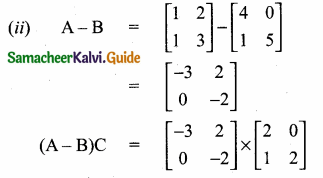
(B ∩ C) = {3}
A × (B ∩ C) = {(0, 3), (1, 3)} …(1)
RHS = (A × B) ∩ (A × C)
(A × B) = {(0, 2), (0, 3), (0, 4), (1, 2), (1, 3), (1, 4)}
(A × C) = {(0, 3), (0, 5), (1, 3), (1, 5)}
(A × B) ∩ (A × C) = {(0, 3), (1, 3)} ……….. (2)
(1) = (2) ⇒ LHS = RHS.
Hence it is verified.

(iii) (A ∪ B) × C = (A × C) ∪ (B × C)
LHS = (A ∪ B) × C
A ∪ B = {0, 1, 2, 3, 4}
(A ∪ B) × C = {(0, 3), (0, 5), (1, 3), (1, 5), (2, 3), (2, 5), (3, 3), (3, 5), (4, 3), (4, 5)} …………. (1)
RHS = (A × C) ∪ (B × C)
(A × C) = {(0, 3), (0, 5), (1, 3), (1, 5)}
(B × C) = {(2, 3), (2, 5), (3, 3), (3, 5), (4, 3), (4, 5)}
(A × C) ∪ (B × C) = {(0, 3), (0, 5), (1, 3), (1, 5), (2, 3), (2, 5), (3, 3), (3, 5), (4, 3), (4, 5)} ………… (2)
(1) = (2)
∴ LHS = RHS. Hence it is verified.

Samacheer Kalvi 10th Maths Guide Chapter 1 Relations and Functions Ex 1.1

Question 7.
Let A = The set of all natural numbers less than 8, B = The set of all prime numbers less than 8, C = The set of even prime number. Verify that
(i) (A ∩ B) × C = (A × c) ∩ (B × C)
(ii) A × (B – C) = (A × B) – (A × C)
Answer:
A = {1,2, 3, 4, 5,6, 7}
B = {2, 3, 5,7}
C = {2}

(i) (A ∩ B) × C = (A × C) ∩ (B × C)
A ∩ B = {1, 2, 3, 4, 5, 6, 7} ∩ {2, 3, 5, 7}
= {2, 3, 5, 7}
(A ∩ B) × C = {2, 3, 5, 7} × {2}
= {(2, 2) (3, 2) (5, 2) (7, 2)} ….(1)
A × C = {1,2, 3, 4, 5, 6, 7} × {2}
= {(1,2) (2, 2) (3, 2) (4, 2)
(5.2) (6, 2) (7, 2)}
B × C = {2, 3, 5, 7} × {2}
= {(2, 2) (3, 2) (5, 2) (7, 2)}
(A × C) ∩ (B × C) = {(2, 2) (3, 2) (5, 2) (7, 2)} ….(2)
From (1) and (2) we get
(A ∩ B) × C = (A × C) ∩ (B × C)

Samacheer Kalvi 10th Maths Guide Chapter 1 Relations and Functions Ex 1.1

(ii) A × (B – C) = (A × B) – (A × C)
B – C = {2, 3, 5, 7} – {2}
= {3,5,7}
A × (B – C) = {1,2, 3, 4, 5, 6,7} × {3,5,7}
= {(1, 3) (1, 5) (1, 7) (2, 3) (2, 5)
(2, 7) (3, 3) (3, 5) (3, 7) (4, 3)
(4, 5) (4, 7) (5, 3) (5, 5) (5, 7)
(6, 3) (6, 5) (6, 7) (7, 3) (7, 5) (7, 7)} ………….(1)
A × B = {1,2, 3, 4, 5, 6, 7} × {2, 3, 5,7}
= {(1, 2) (1, 3) (1, 5) (1, 7) (2, 2) (2, 3)
(2, 5) (2, 7) (3, 2) (3, 3) (3, 5) (3, 7)
(4, 2) (4, 3) (4, 5) (4, 7) (5, 2) (5, 3) (5, 5)
(5, 7) (6, 2) (6, 3) (6, 5) (6, 7)
(7, 2) (7, 3) (7, 5) (7, 7)}
A × C = {1,2, 3,4, 5, 6, 7} × {2}
= {(1, 2) (2, 2) (3, 2) (4, 2) (5, 2) (6.2) (7,2)}
(A × B) – (A × C) = {(1, 3) (1, 5) (1, 7)
(2, 3) (2, 5) (2, 7) (3, 3) (3, 5)
(3, 7) (4, 3) (4, 5) (4, 7) (5, 3) (5, 5)
(5, 7) (6, 3) (6, 5) (6, 7) (7, 3) (7, 5) (7, 7)} ….(2)
From (1) and (2) we get
A × (B – C) = (A × B) – (A × C)

Samacheer Kalvi 10th Maths Guide Chapter 1 Relations and Functions Ex 1.1

Relations
Let A and B be any two non-empty sets. A “relation” R from A to B is a subset of A × B satisfying some specified conditions.

Note:

  1. The domain of the relations R = {x ∈ A/xRy, for some y ∈ B}
  2. The co-domain of the relation R is B
  3. The range of the ralation

R = (y ∈ B/xRy for some x ∈ A}

Samacheer Kalvi 10th Maths Guide Chapter 2 Numbers and Sequences Ex 2.1

Students can download Maths Chapter 2 Numbers and Sequences Ex 2.1 Questions and Answers, Notes, Samacheer Kalvi 10th Maths Guide Pdf helps you to revise the complete Tamilnadu State Board New Syllabus, helps students complete homework assignments and to score high marks in board exams.

Tamilnadu Samacheer Kalvi 10th Maths Solutions Chapter 2 Numbers and Sequences Ex 2.1

Question 1.
Find all positive integers which when divided by 3 leaves remainder 2.
Answer:
All the positive integers when divided by 3 leaves remainder 2
By Euclid’s division lemma
a = bq + r, 0 < r < b
a = 3q + r where 0 < q < 3
a leaves remainder 2 when divided by 3
∴ The positive integers are 2, 5, 8, 11,…

Samacheer Kalvi 10th Maths Guide Chapter 2 Numbers and Sequences Ex 2.1

Question 2.
A man has 532 flower pots. He wants to arrange them in rows such that each row contains 21 flower pots. Find the number of completed rows and how many flower pots are left over.
Solution:
Using Euclid’s division algorithm,
a = 21q + r, we get 532 = 21 × 25 + 7.
The remainder is 7.
No. of completed rows = 25, left over flower pots = 7 pots.

Question 3.
Prove that the product of two consecutive positive integers is divisible by 2.
Answer:
Let n – 1 and n be two consecutive positive integers, then the product is n (n – 1)
n(n – 1) = n2 – n
We know that any positive integer is of the form 2q or 2q + 1 for same integer q

Samacheer Kalvi 10th Maths Guide Chapter 2 Numbers and Sequences Ex 2.1

Case 1:
when n = 2 q
n2 – n = (2q)2 – 2q
= 4q2 – 2q
= 2q (2q – 1)
= 2 [q (2q – 1)]
n2 – n = 2 r
r = q(2q – 1)
Hence n2 – n. divisible by 2 for every positive integer.

Case 2:
when n = 2q + 1
n2 – n = (2q + 1 )2 – (2q + 1 )
= (2q + 1) [2q + 1 – 1]
= 2q (2q + 1)
n2 – n = 2r
r = q (2q + 1)
n2 – n divisible by 2 for every positive integer.

Question 4.
When the positive integers be a, b and c are divided by 13, the respective remainders are 9, 7 and 10. Show that a + b + c is divisible by 13.
Solution:
Let the positive integers be a, b, and c.
a = 13 q + 9
b = 13q + 1
c = 13 q + 10
a + b + c = 13q + 9 + 13q + 7 + 13q + 10
= 39q + 26
= 13 (3q + 2)
which is divisible by 13.

Samacheer Kalvi 10th Maths Guide Chapter 2 Numbers and Sequences Ex 2.1

Question 5.
Prove that square of any integer leaves the remainder either 0 or 1 when divided by 4.
Answer:
Let the integer be ” x ”
The square of its integer is “x2
Let x be an even integer
x = 2q + 0
x2 = 4q2
When x is an odd integer
x = 2k + 1
x2 = (2k + 1)2
= 4k2 + 4k + 1
= 4k (k + 1) + 1
= 4q + 1 [q = k(k + 1)]
It is divisible by 4
Hence it is proved

Question 6.
Use Euclid’s Division Algorithm to find the Highest Common Factor (H.C.F) of
(i) 340 and 412
(ii) 867 and 255
(iii) 10224 and 9648
(iv) 84, 90 and 120
Solution:
To find the H.C.F. of 340 and 412. Using Euclid’s division algorithm.
We get 412 = 340 × 1 + 72
The remainder 72 ≠ 0
Again applying Euclid’s division algorithm
340 = 72 × 4 + 52
The remainder 52 ≠ 0.
Again applying Euclid’s division algorithm
72 = 52 × 1 + 20
The remainder 20 ≠ 0.
Again applying Euclid’s division algorithm,
52 = 20 × 2 + 12
The remainder 12 ≠ 0.
Again applying Euclid’s division algorithm.
20 = 12 × 1 + 8
The remainder 8 ≠ 0.
Again applying Euclid’s division algorithm
12 = 8 × 1 + 4
The remainder 4 ≠ 0.
Again applying Euclid’s division algorithm
8 = 4 × 2 + 0
The remainder is zero.
Therefore H.C.F. of 340 and 412 is 4.

Samacheer Kalvi 10th Maths Guide Chapter 2 Numbers and Sequences Ex 2.1

(ii) To find the H.C.F. of 867 and 255, using Euclid’s division algorithm.
867 = 255 × 3 + 102
The remainder 102 ≠ 0.
Again using Euclid’s division algorithm
255 = 102 × 2 + 51
The remainder 51 ≠ 0.
Again using Euclid’s division algorithm
102 = 51 × 2 + 0
The remainder is zero.
Therefore the H.C.F. of 867 and 255 is 51.

(iii) To find H.C.F. 10224 and 9648. Using Euclid’s division algorithm.
10224 = 9648 × 1 + 576
The remainder 576 ≠ 0.
Again using Euclid’s division algorithm
9648 = 576 × 16 + 432
Remainder 432 ≠ 0.
Again applying Euclid’s division algorithm
576 = 432 × 1 + 144
Remainder 144 ≠ 0.
Again using Euclid’s division algorithm
432 = 144 × 3 + 0
The remainder is zero.
There H.C.F. of 10224 and 9648 is 144.

(iv) To find H.C.F. of 84, 90 and 120.
Using Euclid’s division algorithm
90 = 84 × 1 + 6
The remainder 6 ≠ 0.
Again using Euclid’s division algorithm
84 = 6 × 14 + 0
The remainder is zero.
∴ The H.C.F. of 84 and 90 is 6. To find the H.C.F. of 6 and 120 using Euclid’s division algorithm.
120 = 6 × 20 + 0
The remainder is zero.
Therefore H.C.F. of 120 and 6 is 6
∴ H.C.F. of 84, 90 and 120 is 6.

Samacheer Kalvi 10th Maths Guide Chapter 2 Numbers and Sequences Ex 2.1

Question 7.
Find the largest number which divides 1230 and 1926 leaving remainder 12 in each case.
Answer:
Find the HCF of ( 1230 – 12) and (1926- 12)
i.e HCF of 1218 and 1914
By Euclid’s division algorithm
1914 = 1218 × 1 + 696
The remainder 696 ≠ 0
By Euclid’s division algorithm
1218 = 696 × 1 + 522
The remainder 522 ≠ 0
Again by Euclid’s division algorithm
696 = 522 × 1 + 174
The remainder 174 ≠ 0 Again by Euclid’s division algorithm
522 = 174 × 3 + 0
The remainder is zero
∴ HCF of 1218 and 1914 is 174
The largest value is 174

Samacheer Kalvi 10th Maths Guide Chapter 2 Numbers and Sequences Ex 2.1

Question 8.
If d is the Highest Common Factor of 32 and 60, find x and y satisfying d = 32x + 60y.
Solution:
Applying Euclid’s divison lemma to 32 and 60, we get
60 = 32 × 1 + 28 ……………. (i)
The remainder is 28 ≠ 0.
Again applying division lemma
32 = 28 × 1 + 4 ……………. (ii)
The remainder 4 ≠ 0.
Again applying division lemma
28 = 4 × 7 + 0 ………….. (iii)
The remainder zero.
∴ H.C.F. of 32 and 60 is 4.
From (ii), we get
32 = 28 × 1 + 4
⇒ 4 = 32 – 28 × 1
⇒ 4 = 32 – (60 – 32 × 1) × 1
⇒ 4 = 32 – 60 + 32
⇒ 4 = 32 × 2+(-1) × 60
∴ x = 2 and y = -1

Question 9.
A positive integer, when divided by 88, gives the remainder 61. What will be the remainder when the same number is divided by 11?
Answer:
Let the positive integer be “x”
x = 88 × y + 61 (a = pq + r)
since 88 is a multiple of 11
61 = 11 × 5 + 6
∴ The remainder is 6

Samacheer Kalvi 10th Maths Guide Chapter 2 Numbers and Sequences Ex 2.1

Question 10.
Prove that two consecutive positive integers are always coprime.
Solution:
Let the numbers be I, I + 1:
They are co-prime if only +ve integer that divides both is 1.
I is given to be +ve integer.
So I = 1, 2, 3, ….
∴ One is odd and the other one is even. Hence H.C.F. of the two consecutive numbers is 1. Hence the result.

Samacheer Kalvi 10th Maths Guide Chapter 1 Relations and Functions Additional Questions

Students can download Maths Chapter 1 Relations and Functions Additional Questions and Answers, Notes, Samacheer Kalvi 10th Maths Guide Pdf helps you to revise the complete Tamilnadu State Board New Syllabus, helps students complete homework assignments and to score high marks in board exams.

Tamilnadu Samacheer Kalvi 10th Maths Solutions Chapter 1 Relations and Functions Additional Questions

I. Multiple Choice Questions.

Question 1.
If n(A × B) = 15 and B = {1, 3, 7} then n(A) is ……………
(1) 3
(2) 5
(3) 1
(4) 15
Answer:
(2) 5
Hint: B(A × B) = 15
n(A) × n(B) = 15
n(A) × 3 = 15
n(A) = \(\frac { 15 }{ 3 } \) = 5

Samacheer Kalvi 10th Maths Guide Chapter 1 Relations and Functions Additional Questions

Question 2.
If A = {a, b,c) B = {b, d, e}
C = {a, e, i, o, u} then n [A ∩ C] × B] is
(1) 18
(2) 36
(3) 9
(4) 3
Answer:
(4) 3
Hint:
A ∩ C = {a,b,c} ∩ {a, e, i, o, u}
= {a}
n(A ∩ C) = 1
n[(A ∩ C) × B] = n(A ∩ C) × n(B)
= 1 × 3
= 3

Question 3.
If there are 28 relation from a set A = {2,4, 6, 8} to a set B, then the number of elements in B is ………………
(1) 7
(2) 14
(3) 5
(4) 4
Answer:
(1) 7
Hint: n(A) = 4
n(A × B) = 28
n(A) × n(B) = 28
4 × n(B) = 28
n(B) = \(\frac { 28 }{ 4 } \) = 7

Samacheer Kalvi 10th Maths Guide Chapter 1 Relations and Functions Additional Questions

Question 4.
The ordered pairs (a + 1, 4) (3, 4a + b) are equal then (a, b) is ………………..
(1) (4, 20)
(2) (20, 4)
(3) (-4, 20)
(4) (20, -4)
Answer:
(3) (-4, 20)
Hint: (a + 7, 4) = (3, 4a + b)
a + 7 = 3
a = 3 – 7
= – 4
4a + b = 4
4(-4) + b = 4
-16 + b = 4
b = 4 + 16 = 20
The pair (a, 6) is (-4, 20)

Question 5.
The range of the relation R = {(x, x3) / x} is a prime number less than 13} is …………………
(1) (2,3,5,7,11)
(2) (4,9,25,49,121)
(3) (8,27, 125,343, 1331)
(4) (1,8,27, 125,343, 1331)
Answer:
(3) (8, 27, 125,343, 1331)
Hint: x = {2, 3, 5, 7, 11}
Range (x3) = {8, 27, 125, 343, 1331}

Samacheer Kalvi 10th Maths Guide Chapter 1 Relations and Functions Additional Questions

Question 6.
If {( x, 2), (4, y) } represents an identity function, then (x, y) is
(1) (2, 4)
(2) (4, 2)
(3) (2, 2)
(4) (4, 4)
Answer:
(1) (2, 4)
Hint: In an identity function each element is associated with itself.

Question 7.
If {(7, 11), (5, a)} represents a constant
function, then the value of ‘a’ is
(1) 7
(2) 11
(3) 5
(4) 9
Answer:
(2) 11
Hint: All the images are same in a constant function.

Question 8.
Given f(x) = (- 1)x is a function from N to Z. Then the range of f is
(1) {1}
(2) N
(3) { 1,- 1 }
(4) Z
Answer:
(3) {1, – 1}
Hint: f(x) = (- 1)x = ± 1

Question 9.
If f = { (6, 3), (8, 9), (5, 3), (-1, 6) }, then the pre-images of 3 are
(1) 5 and-1
(2) 6 and 8
(3) 8 and-1
(4) 6 and 5
Answer:
(4) 6 and 5.
Hint: The Pre images of 3 are 6 and 5

Samacheer Kalvi 10th Maths Guide Chapter 1 Relations and Functions Additional Questions

Question 10.
Let A= { 1, 3, 4, 7, 11 }, B = {-1, 1, 2, 5, 7, 9 } and f : A → B be given by
f = {(1, -1), (3,2), (4, 1), (7, 5), (11, 9)}.
Then f is ………………….
(1) one-one
(2) onto
(3) bijective
(4) not a function
Answer:
(1) one – one
Hint:
Samacheer Kalvi 10th Maths Guide Chapter 1 Relations and Functions Additional Questions 1

Question 11.
The given diagram represents
(1) an onto function
(2) a constant function
(3) an one-one function
(4) not a function
Samacheer Kalvi 10th Maths Guide Chapter 1 Relations and Functions Additional Questions 2
Answer:
(4) not a function
Hint: 2 has two images 4 and 2.
It is not a function.

Samacheer Kalvi 10th Maths Guide Chapter 1 Relations and Functions Additional Questions

Question 12.
If A = { 5, 6, 7 }, B = { 1, 2, 3, 4, 5 }and f: A → B is defined by f(x) = x – 2, then the range of f is …………….
(1) {1,4, 5}
(2) {1,2, 3, 4, 5}
(3) { 2, 3, 4 }
(4) { 3, 4, 5 }
Answer:
(4) {3, 4, 5}
Hint: f(x) = x – 2
f(5) = 5 – 2 = 3
f(6) = 6 – 2 = 4
f(7) = 7 – 2 = 5
Range of f = {3, 4, 5}

Question 13.
If f(x) = x2 + 5, then f(-4) = ………
(1) 26
(2) 21
(3) 20
(4) – 20
Answer:
(2) 21
Hint: f(x) = x2 + 5
f(- 4) = (-4)2 + 5 = 16 + 5 = 21

Question 14.
If the range of a function is a singleton set, then it is ……………..
(1) a constant function
(2) an identity function
(3) a bijective function
(4) an one-one function
Answer:
(1) a constant function
Hint: Every element of the first set has same image in the second set.

Samacheer Kalvi 10th Maths Guide Chapter 1 Relations and Functions Additional Questions

Question 15.
If f : A → B is a bijective function and if n(A) = 5 , then n(B) is equal to ………………
(1) 10
(2) 4
(3) 5
(4) 25
Answer:
(3) 5
Hint: If A and B are Bijective (one-one and onto) function then n (A) = n (B)

Question 16.
If f: R → R defined by f(x) = 3x – 6 and g : R → R defined by g(x) = 3x + k if fog – gof then the value of k is …………………..
(1) – 5
(2) 5
(3) 6
(4) -6
Answer:
(4) – 6
Hint: f(x) = 3x – 6 ;g(x) = 3x + k
fog = f[g(x)]
= f(3x + k)
= 3 (3x + k) – 6
= 9x + 3k – 6
g o f = g[f(x)]
= g(3x – 6)
= 3(3x – 6 ) + k
= 9x – 18 + k
But fog = gof
9x + 3k – 6 = 9x – 18 + k
3k – k = -18 + 6
2k = -12
k = \(\frac { -12 }{ 2 } \) = -6

Samacheer Kalvi 10th Maths Guide Chapter 1 Relations and Functions Additional Questions

Question 17.
If f(x) = x2 – x then f (x – 1) – f(x + 1) is ……………….
(1) 4x
(2) 4x + 2
(3) 2 – 4x
(4) 4x – 2
Answer:
(3) 2 – 4x
Hint: f(x – 1) = (x – 1)2 – (x – 1)
= x2 – 2x + 1 – x + 1
= x2 – 3x + 2
f(x + 1) = (x + 1)2 – (x + 1)
= x2 + 2x + 1 – x – 1
= x2 + x
f(x – 1) – f(x + 1) = x2 – 3x + 2 – (x2 + x)
= x2 – 3x + 2 – x2 – x
= -4x + 2 = 2 – 4x

Question 18.
If K(x) = 3x – 9 then L (x) = 7x – 10 then LOK is ……………..
(1) 21x + 73
(2) – 21x + 73
(3) 21x – 73
(4) 22x – 73
Answer:
(3) 21x – 73
Hint: K (x) = 3x – 9 ; L(x) = 7x – 10
LOK = L[K(x)]
= L (3x – 9)
= 7(3x – 9) – 10
= 21x – 63 – 10
= 21x – 73

Question 19.
Composition of function is ……………..
(1) commutative
(2) associative
(3) commutative and associative
(4) not associative
Answer:
(2) associative

Samacheer Kalvi 10th Maths Guide Chapter 1 Relations and Functions Additional Questions

Question 20.
A comet is heading for Jupiter with acceleration a = 50 kms-2. The velocity of the comet at time ”t” is given by f(t) = at2 – at + 1. Then the velocity at time t = 5 seconds is …………..
(1) 900kms-1
(2) 1001 kms-1
(3) 2001 kms-1
(4) 50 kms-1
Answer:
(2) 1001 kms-1
Hint: f(t) = at2 – at + 1
m = 50(5)2 – 50(5) + 1
= 1250 – 250 + 1
= 1001 kms-1

II. Answer the following questions.

Question 1.
f(x) = (1 + x)
f(x) = (2x – 1)
Show that fo(g(x)) = gof(x)
Solution:
f(x) = 1 + x
g(x) = (2x – 1)
fog(x) = f(g(x)) = f(2x – 1)
= 1 + 2x – 1 = 2x ………….. (1)
gof(x) = g(f(x)) = g(1 + x) = 2(1 + x) = 1
= 2 + 2x – 1
= 2x + 1 ……………. (2)
(1) ≠ (2)
∴ fog(x) + gof(x) It is verified.

Question 2.
If A × B = {(a, x) (a, y) (b, x) (b, y) (c, x) (c, y)} then find A and B
Answer:
A × B = {(a, x) (a, y) (b, x) (b, y) (c, x) (c, y)}
A = {a, b, c}
B = {x,y}

Samacheer Kalvi 10th Maths Guide Chapter 1 Relations and Functions Additional Questions

Question 3.
Let A = {x ∈ w/3 < x < 7},
B = {x ∈ N/0 < x < 3}, C = {x ∈ w/x < 2}
verify A × (B ∩ C) = (A × B) ∩ (A × C)
Answer:
A = {4,5,6} ; B = {1,2} C = {0, 1}
B ∩ C = {1,2} ∩ {0, 1}
= {1}
A × (B ∩ C) = {4,5,6} × {1}
= {(4, 1) (5, 1) (6, 1)} …. (1)
A × B = {4,5,6} × {1,2}
= {(4, 1) (4, 2) (5, 1) (5, 2) (6, 1) (6, 2)}
A × C = {4,5,6} x {0, 1}
= {(4,0) (4,1) (5,0)
(5, 1) (6, 0) (6, 1)}
(A × B) ∩ (A × C) = {(4, 1) (5, 1) (6, 1)}…. (2)
From (1) and (2) we get
A × (B ∩ C) = (A × B) ∩ (A × C)

Question 4.
Let A = {10, 11, 12, 13, 14}; B = {0, 1, 2, 3, 5} and fi: A → B, i = 1, 2, 3. State the type of function for the following (give reason):
(i) f1 = {(10,1), (11,2), (12,3), (13,5), (14,3)}
Answer:
The element 12 and 14 in A have same image 3 in B.
Samacheer Kalvi 10th Maths Guide Chapter 1 Relations and Functions Additional Questions 4
∴ It is not one-one function.
The element ‘0’ in B has no preimage in A
∴ It is not onto function
So the given function is neither one – one nor onto function.

Samacheer Kalvi 10th Maths Guide Chapter 1 Relations and Functions Additional Questions

(ii) f2 = {(10,1), (11,1), (12,1), (13,1), (14,1)}
Answer:
f2 is a constant function
Samacheer Kalvi 10th Maths Guide Chapter 1 Relations and Functions Additional Questions 3
(iii) f3 = {(10,0), (11,1), (12,2), (13,3), (14,5)}
Answer:
f3 is one-one and onto function (or) bijective function.
Samacheer Kalvi 10th Maths Guide Chapter 1 Relations and Functions Additional Questions 44

Question 5.
If X = {1, 2, 3, 4, 5}, Y = {1, 3, 5, 7, 9} determine which of the following relations from X to Y are functions? Give reason for your answer. If it is a function, state its type.
(i) R1 = {(x,y)| y = x + 2,x ∈ X,y ∈ Y}
Answer:
Given y = x + 2
When x = 1 ; y = 1 + 2 = 3
When x = 2 ; y = 2 + 2 = 4
When x = 3 ; y = 3 + 2 = 5
When x = 4 ; y = 4 + 2 = 6
When x = 5 ; y = 5 + 2 = 7
Samacheer Kalvi 10th Maths Guide Chapter 1 Relations and Functions Additional Questions 5
R1 = {1,3), (2,4), (3, 5), (4, 6), (5,7)}
R1 is not a function ; 2 and 4 has no image in Y.

Samacheer Kalvi 10th Maths Guide Chapter 1 Relations and Functions Additional Questions

(ii) R2 = {(1,1), (2,1), (3,3), (4,3), (5,5)}
Answer:
R2 is a function.
Every element of X has unique image in Y.
1 and 2 have same image 1
3 and 4 have same image 3
It is not one – one function …. (1)
7 and 9 has no pre image in X
It is not an onto function …. (2)
Samacheer Kalvi 10th Maths Guide Chapter 1 Relations and Functions Additional Questions 6
From (1) and (2) we know that, it is
neither one – one nor onto function.

(iii) R3 = {(1,1), (1,3), (3,5), (3,7), (5,7)}
Answer:
R3 is not a function.
1 has two images 1 and 3
3 has two images 5 and 7
Samacheer Kalvi 10th Maths Guide Chapter 1 Relations and Functions Additional Questions 7

(iv) R4 = {(1,3), (2,5), (4,7), (5,9), (3,1)}
Answer:
Every element of X has unique image in
Y. Range = Co-domain
R4 is a function.
Samacheer Kalvi 10th Maths Guide Chapter 1 Relations and Functions Additional Questions 8
It is an one-one and onto function (or) bijective function

Samacheer Kalvi 10th Maths Guide Chapter 1 Relations and Functions Additional Questions

Question 6.
A= {-2,-1, 1, 2} and f = {(x,\(\frac { 1 }{ x } \)) ; x ∈ A}
Write down the range of f. Is f a function from A to A?
Answer:
Given, f = (x,\(\frac { 1 }{ x } \)) ; So f(x) = \(\frac { 1 }{ x } \)
f (-2) = \(\frac { 1 }{ -2 } \) = – \(\frac { 1 }{ 2 } \) ; f(-1) = \(\frac { 1 }{ -1 } \) = -1
f(1) = \(\frac { 1 }{ 1 } \) = 1 ; f(2) = \(\frac { 1 }{ 2 } \) = \(\frac { 1 }{ 2 } \)
Range of f = {\(\frac { -1 }{ 2 } \), -1, 1, \(\frac { 1 }{ 2 } \)}
It is not a function from A to A since – \(\frac { 1 }{ 2 } \) ,\(\frac { 1 }{ 2 } \) ∈ A

Question 7.
Let A = {1, 2, 3, 4, 5}, B = N and f: A → B be defined by f(x) = x2. Find the range of f. Identify the type of function.
Solution:
A = {1, 2, 3, 4, 5}
B = {1, 2, 3, 4 ….}
f: A → B, f(x) = x2
∴ f(1) = 12 = 1
f(2) = 22 = 4
f(3) = 32 = 9
f(4) = 42 = 16
f(5) = 52 = 25
∴ Range of f = {1, 4, 9, 16, 25)
Elements in A have been different elements in B. Therefore it is one-one function. But not all the elements in B have preimages in A. Therefore it is not on-to function.

Samacheer Kalvi 10th Maths Guide Chapter 1 Relations and Functions Additional Questions

Question 8.
Let A = { 1, 2, 3, 4, 5 }, B = N and f: A → B be defined by f(x) = x2.
Find the range of f. Identify the type of function.
Answer:
Now, A = { 1, 2, 3, 4, 5 };
B = { 1, 2, 3, 4, … }
Given f: A → B and f(x) = x2
f(1) = 12 = 1;
f(2) = 4;
f(3) = 9;
f(4) = 16;
f(5) = 25.
Range of f = {1, 4, 9, 16, 25}
Since distinct elements are mapped into distinct images, it is a one-one function.
However, the function is not onto, since 3 ∈ B but there is no x ∈ A
such that
f(x) = x2 = 3.

Question 9.
Identify the type of function.
Samacheer Kalvi 10th Maths Guide Chapter 1 Relations and Functions Additional Questions 9
Samacheer Kalvi 10th Maths Guide Chapter 1 Relations and Functions Additional Questions 10
Answer:
(i) Many – one into
(ii) One – one onto
(iii) Constant function
(iv) One – one into

Samacheer Kalvi 10th Maths Guide Chapter 1 Relations and Functions Additional Questions

Question 10.
Find the domain and range of the following
(i) f = {(1, 2), (2, 3), (3, 4), (4, 5) (5, 6)}
(ii) R = {(-2, 4), (-1,1), (2,4), (1,1) (-3, 9)}
Answer:
(i) f = {( 1,2), (2, 3), (3, 4), (4, 5) (5, 6)}
Domain = {1,2, 3,4, 5}
Range = {2, 3, 4, 5, 6}

(ii) R = {(-2,4), (-1, 1),(2,4), (1,1) (-3,9)}
Domain = {-2, -1,2, 1,-3} (or)
= {-3,-2,-1, 1,2}
Range = {4, 1, 9} (or) {1, 4, 9}

Question 11.
Given P ={-2,-1, 0,1}
Q = {1,-2, 6,-3}
R = {x,y/y = x2 – 3 x ∈ P,y ∈ Q}
(i) List the elements of R
(ii) Is the relation a function? If so identity the function
Answer:
P = {-2, -1, 0, 1}; Q = {1, -2,6, -3}
y = x2- 3 x ∈ P, y ∈ Q
When x = -2 ⇒ y = (-2)2 – 3 = 4 – 3 = 1
When x = -1 ⇒ y = (-1 )2 – 3 = 1 – 3 = -2
When x = 0 ⇒ y = (0)2 – 3 = 0 -3 = -3
When x = 1 ⇒ y = 12 – 3 = 1 – 3 = -2
(i) R = {(-2,1), (-1,-2), (0,-3), (1,-2)}
(ii) Yes the relation is a function many – one into function.

Samacheer Kalvi 10th Maths Guide Chapter 1 Relations and Functions Additional Questions

Question 12.
Given f(x) = 3x – 2; g(x) = 2x2 find
(i) fog and
(ii) gof what do you find
Answer:
f(x) = 3x – 2 ; g(x) = 2x2
(i) f o g = f[g(x)]
= f(2x2)
= 3(2x2) – 2
= 6x2 – 2

(ii) g o f = g [f(x)]
= g (3x – 2)
= 2(3x – 2)2
= 2(9x2 + 4 – 12x)
= 18x2 – 24x + 8
we find that fog ≠ gof
Composition of function is not commutative.

Question 13.
If f: R → R is defined by f(x) = ax + 3 and g: R → R is defined by g (x) = 4x – 3 find a so that fog = gof
Answer:
f(x) = ax + 3 ; g(x) = 4x -3
fog = f[g(x)]
= f(4x – 3)
= a (4x – 3) + 3
= 4ax – 3a + 3
gof = g [f(x)]
= g (ax + 3)
= 4 (ax + 3) – 3
= 4 ax + 12 – 3
= 4ax + 9
But fog = gof
4ax – 3a + 3 = 4ax + 9
-3a + 3 = 9
– 3a = 6
a = – 2
The value of a = – 2

Samacheer Kalvi 10th Maths Guide Chapter 1 Relations and Functions Additional Questions

Question 14.
Given f(x) = 3 + x ; g(x) = x2 ;
h(x) = \(\frac { 1 }{ x } \) find fo (goh)
Answer:
f(x) = 3 + x ; g (x) = x2, h(x) = \(\frac { 1 }{ x } \)
goh = g[h(x)]
= g (\(\frac { 1 }{ x } \))
= (\(\frac { 1 }{ x } \))2
goh = \(\frac{1}{x^{2}}\)
fo(goh) = f (\(\frac{1}{x^{2}}\))
= 3 + \(\frac{1}{x^{2}}\)

Question 15.
If f(x) = x + 3 where A = {4, 6, 8,10} B = {7, 9,11,13} and f: A → B
(i) Draw the arrow diagram
(ii) Why type of function is f.
Answer:
A= {4, 6, 8, 10}
f(x) = x + 3
f(4) = 4 + 3 = 7
f(6) = 6 + 3 = 9
f(8) = 8 + 3 = 11
f(10) = 10 + 3 = 13
Samacheer Kalvi 10th Maths Guide Chapter 1 Relations and Functions Additional Questions 11
(ii) one – one onto function

III. Answer the following Questions

Question 1.
Given A = {2,3, 5}, B = {1,2,3}
C = {2, 5}, D = {2,3, 5} check if
(A ∩ C) × (B ∩ D) = (A × B) ∩ (C × D)
Answer:
A ∩ C = {2, 3, 5} ∩ (2, 5}
= (2,5}
B ∩ D = {1,2,3} ∩ {2,3,5}
= {2,3}
(A ∩ C) × (B ∩ D) = {2, 5} × {2, 3}
= {(2, 2) (2, 3) (5, 2) (5, 3)} …. (1)
A × B = {2,3,5} × {1,2,3}
= {(2,1) (2, 2) (2, 3)
(3, 1) (3, 2) (3, 3)
(5, 1) (5, 2) (5, 3)}
C × D = {2, 5} × {2, 3, 5}
= {(2, 2) (2, 3) (2, 5) (5, 2) (5, 3) (5, 5)}
(A × B) ∩ (C × D) = {(2,2) (2, 3) (5, 2) (5, 3)} …. (2)
From (1) and (2) we get
(A ∩ C) × (B ∩ D) = (A × B) ∩ (C × D)

Samacheer Kalvi 10th Maths Guide Chapter 1 Relations and Functions Additional Questions

Question 2.
Study the relation given below an set- builder form. Represent each of them by
(a) an arrow diagram
(b) a graph
(c) a set in roster.
If {{x,y}/y = 2x + 1; x < 10 and y < 12 x ∈ N, y ∈ N}
Answer:
y = 2x + 1
when x = 1 ⇒ y = 2(1) + 1 = 2 + 1 = 3
when x = 2 ⇒ y = 2(2) + 1 = 4 + 1 = 5
when x = 3 ⇒ y = 2(3) + 1 = 6 + 1 = 7
when x = 4 ⇒ y = 2(4) + 1 = 8 + 1 = 9
when x = 5 ⇒ y = 2(5) + 1 = 10 + 1 = 11
f = {(1,3) (2, 5) (3, 7) (4, 9) (5, 11)}

(a) Arrow diagram
Samacheer Kalvi 10th Maths Guide Chapter 1 Relations and Functions Additional Questions 12
(b) A graph
Samacheer Kalvi 10th Maths Guide Chapter 1 Relations and Functions Additional Questions 13
(c) Roster form: R = {(1,3) (2,5) (3,7) (4,9) (5,11)}

Question 3.
State whether the following graphs represents a function. Give reason for your answer.
Samacheer Kalvi 10th Maths Guide Chapter 1 Relations and Functions Additional Questions 14
Samacheer Kalvi 10th Maths Guide Chapter 1 Relations and Functions Additional Questions 15
Samacheer Kalvi 10th Maths Guide Chapter 1 Relations and Functions Additional Questions 16
Samacheer Kalvi 10th Maths Guide Chapter 1 Relations and Functions Additional Questions 17
Samacheer Kalvi 10th Maths Guide Chapter 1 Relations and Functions Additional Questions 18
Answer:
(i) The given graph represents a function. The vertical line cuts the graph at most one point R
Samacheer Kalvi 10th Maths Guide Chapter 1 Relations and Functions Additional Questions 19
(ii) The vertical line cuts the graph at most one point Q. The given graph represents a function.
Samacheer Kalvi 10th Maths Guide Chapter 1 Relations and Functions Additional Questions 20
(iii) The vertical line cuts the graph at A and B. The given graph does not represents a function.
Samacheer Kalvi 10th Maths Guide Chapter 1 Relations and Functions Additional Questions 21
(iv) The vertical line cuts the graph at A and B. The given graph does not represents a function.
Samacheer Kalvi 10th Maths Guide Chapter 1 Relations and Functions Additional Questions 22
(v) The vertical line cuts the graph at most one point R. The given graph represents a function.
Samacheer Kalvi 10th Maths Guide Chapter 1 Relations and Functions Additional Questions 23

Samacheer Kalvi 10th Maths Guide Chapter 1 Relations and Functions Additional Questions

Question 4.
Let A = {6, 9,15,18, 21}; B = {1, 2, 4, 5, 6} and f: A → B be defined by f(x) = \(\frac { x-3 }{ 3 } \) Represent f by, (i) an arrow diagram, (ii) a set of ordered pairs, (iii) a table, (iv) a graph.
Given, A = {6, 9, 15, 18, 21}, B = {1, 2, 4, 5, 6}
f(x) = \(\frac { x-3 }{ 3 } \)
f(6) = \(\frac { 6-3 }{ 3 } \) = \(\frac { 3 }{ 3 } \) = 1
f(9) = \(\frac { 9-3 }{ 3 } \) = \(\frac { 6 }{ 3 } \) = 2
f(15) = \(\frac { 15-3 }{ 3 } \) = \(\frac { 12 }{ 3 } \) = 4
f(18) = \(\frac { 18-3 }{ 3 } \) = \(\frac { 12 }{ 3 } \) = 4
f(18) = \(\frac { 18-3 }{ 3 } \) = \(\frac { 15 }{ 3 } \) = 5
f(21) = \(\frac { 21-3 }{ 3 } \) = \(\frac { 18 }{ 3 } \) = 6

(i) an arrow diagram
Samacheer Kalvi 10th Maths Guide Chapter 1 Relations and Functions Additional Questions 24
(ii) a set of ordered pairs
f = {(6,1), (9, 2), (15, 4), (18, 5), (21,6)}

(iii) a table
Samacheer Kalvi 10th Maths Guide Chapter 1 Relations and Functions Additional Questions 25

(iv) a graph
Samacheer Kalvi 10th Maths Guide Chapter 1 Relations and Functions Additional Questions 26

Samacheer Kalvi 10th Maths Guide Chapter 1 Relations and Functions Additional Questions

Question 5.
Let A = {4,6,8,10} and B = {3,4,5,6,7}. If f: A → B is defined by f(x) = \(\frac { 1 }{ 2 } \) x + 1 then represent f by (i) an arrow diagram, (ii) a set of ordered pairs and, (iii) a table.
Answer:
Given, A = {4, 6, 8, 10}
B = {3, 4, 5, 6, 7}
f(x) = \(\frac { x }{ 2 } \) + 1
f(4) = \(\frac { 4 }{ 2 } \) + 1 = 2 + 1 = 3
f(6) = \(\frac { 6 }{ 2 } \) + 1 = 3 + 1 = 4
f(8) = \(\frac { 8 }{ 2 } \) + 1 = 4 + 1 = 5
f(10) = \(\frac { 10 }{ 2 } \) + 1 = 5 + 1 = 6

(i) an arrow diagram
Samacheer Kalvi 10th Maths Guide Chapter 1 Relations and Functions Additional Questions 27
(ii) a set of ordered pairs
f = {(4, 3), (6, 4), (8, 5), (10, 6)}

(iii) a table
Samacheer Kalvi 10th Maths Guide Chapter 1 Relations and Functions Additional Questions 28

Question 6.
A function f[- 3, 7 ) → R is defined as follows f(x) =
Samacheer Kalvi 10th Maths Guide Chapter 1 Relations and Functions Additional Questions 29
Find (i) f(5) + f(6)
(ii) f(1) – f(-3)
(iii) f(-2) – f(4)
(iv) \(\frac{f(3)+f(-1)}{2 f(6)-f(1)}\)
Answer:
Given, f(x) = 4x2 – 1; x = {-3, -2, -1, 0, 1}
f(x) = 3x – 2; x = {2,3,4}
f(x) = 2x – 3; x = {5,6}
(i) f(5) + f(6)
f(x) = 2x – 3
f(5) = 2(5) – 3 = 10 – 3 = 7
f(6) = 2(6) – 3 = 12 – 3 = 9
∴ f(5) + f(6) = 7 + 9 = 16

(ii) f(1) – f(-3)
f(x) = 4x2 – 1
f(1) = 4(1)2 – 1 = 4 – 1 = 3
f(-3) = [4(-3)2 – 1]
= 4 (9) – 1
= 36 – 1 = 35
∴ f(1) – f(-3) = 3 – (35) = -32

(iii) f(-2) – f(4)
f(x) = 4x2 – 1
f(-2) = 4(-2)2 – 1 = 4(4) – 1 = 16 – 1 = 15
f(x) = 3x – 2
f(4) = [3(4) – 2] = 12 – 2 = 10
∴ f(-2) – f(4) = 15 – 10 = 5

Samacheer Kalvi 10th Maths Guide Chapter 1 Relations and Functions Additional Questions 30

Samacheer Kalvi 10th Maths Guide Chapter 1 Relations and Functions Additional Questions

Question 7.
A function f : [- 7, 6) → R is defined as follows
Samacheer Kalvi 10th Maths Guide Chapter 1 Relations and Functions Additional Questions 31
Samacheer Kalvi 10th Maths Guide Chapter 1 Relations and Functions Additional Questions 32
Answer:
Given, f(x) = x2 + 2x + 1 ; x = {-7, -6}
f(x) = x + 5 ; x = {-5, -4, -3, -2, -1, 0, 1, 2}
f(x) = x – 1; x{3, 4, 5}

(i) 2f(- 4) + 3f(2)
f(x) = x + 5
f(-4) = -4 + 5 = 1
f(2) = 2 + 5 = 7
∴ 2f(-4) + 3 f(2) = 2(1) + 3(7) = 2 + 21 = 23

(ii) f(-7) – f(-3)
f(x) = x2 + 2x + 1
f(-7) = (-7)2 + 2(-7) + 1 = 49 – 14 + 1 = 36
f(x) = x + 5
f(-3) = -3 + 5 = 2
∴ f(-7) – f(-3) = 36 – 2 = 34

(iii) \(\frac{4 f(-3)+2 f(4)}{f(-6)-3 f(1)}\)
f(x) = x + 5
f(-3) = -3 + 5 = 2
f(x) = x – 1
f(4) = 4 – 1 = 3
f(x) = x2 + 2x + 1
f(-6) = (-6)2 + 2(-6) + 1 = 36 – 12 + 1 = 25
f(x) = x + 5
f(1) = 1 + 5 = 6
Samacheer Kalvi 10th Maths Guide Chapter 1 Relations and Functions Additional Questions 33

Question 8.
Let A= { 0,1, 2, 3 } and B = {1, 3, 5, 7, 9 } be two sets. Let f: A → B be a function given by f (x) = 2x + 1. Represent this function as
(i) a set of ordered pairs
(ii) a table
(iii) an arrow diagram and
(iv) a graph.
Answer:
A = {0, 1, 2, 3}, B = { 1, 3, 5, 7, 9 },f(x) = 2x + 1
f(0) = 2(0) + 1 = 1, f(1) = 2(1) + 1 = 3 ,f(2) = 2(2) + 1 = 5, f(3) = 2(3) + 1 = 7

(i) Set of ordered pairs
The given function/can be represented as a set of ordered pairs as
f = {(0, 1), (1, 3), (2, 5), (3,7)}

(ii) Table form
Let us represent f using a table as shown below.
Samacheer Kalvi 10th Maths Guide Chapter 1 Relations and Functions Additional Questions 34

(iii) Arrow Diagram
Let us represent f by an arrow diagram.
We draw two closed curves to represent the sets A and B. Here each element of A and its unique image element in B are related with an arrow.
Samacheer Kalvi 10th Maths Guide Chapter 1 Relations and Functions Additional Questions 35

Samacheer Kalvi 10th Maths Guide Chapter 1 Relations and Functions Additional Questions

(iv) Graph
We are given that
f = {(x,f(x)) | x ∈ A} = {(0,1), (1, 3), (2, 5), (3, 7)}. Now, the points (0, 1), (1, 3), (2, 5) and (3, 7) are plotted on the plane as shown below.
The totality of all points represent the graph of the function.
Samacheer Kalvi 10th Maths Guide Chapter 1 Relations and Functions Additional Questions 36

Question 9.
A. function f: [1, 6) → R is defined as follows
Samacheer Kalvi 10th Maths Guide Chapter 1 Relations and Functions Additional Questions 37
(Here, [1, 6) = {x ∈ R : 1 ≤ x < 6})
Find the value of
(i) f(5)
(ii) f(3)
(iii) f(1)
(iv) f(2) – f(4)
(v) 2f(5) – 3f(1).
Answer:
(i) Let us find f(5). Since 5 lies between 4 and 6, we have to use f(x) = 3x2 – 10.
Thus, f(5) = 3(52) – 10 = 65.

(ii) To find f(3), note that 3 lies between 2 and 4.
So, we use f(x) = 2x – 1 to calculate f(3).
Thus, f(3) = 2(3) – 1 = 5.

(iii) Let us find f(1).
Now, 1 is in the interval 1 < x < 2
Thus, we have to use f(x) = 1 + x to obtain f(1) = 1 + 1 = 2.

(iv) f (2) – f(4)
Now, 2 is in the interval 2 < x < 4 and so, we use f(x) = 2x – 1.
Thus, f(2) = 2(2) -1 = 3.
Also, 4 is in the interval 4 < x < 6. Thus, we use f(x) = 3x2 – 10
Therefore, f(4) = 3(42) – 10 = 3(16) – 10 = 48 – 10 = 38.
Hence, f(2) – f(4) = 3 – 38 = -35.

(v) To calculate 2 f (5) – 3f (1), we shall make use of the values that we have already calculated in (i) and (iii). Thus, 2f(5) – 3f(1) = 2(65) – 3(2) = 130 – 6 – 124.

Samacheer Kalvi 10th Maths Guide Chapter 1 Relations and Functions Additional Questions

Question 10.
Given f(x) = 5x + 2; g(x) = 2x – 3;
h(x) = 3x + 1. Verify fo (goh) = (fog) oh
Answer:
f(x) = 5x + 2 ; g(x) = 2x – 3; h(x) = 3x + 1
L.H.S. = fo (goh)
goh = g[h(x)]
= g(3x + 1)
= 2(3x + 1) – 3
= 6x – 1
fo (goh) = f[goh (x)]
= f(6x – 1)
= 5 (6x – 1) + 2
= 30 x – 5 + 2
fo (goh) = 30x – 3 ….(1)
R.H.S. = (fog) oh
fog = f[g(x)]
= f(2x – 3)
= 5(2x – 3) + 2
= 30x – 5 + 2
fo (goh) = 30x – 3 …..(1)
R.H.S. = (fog) oh
fog = f[g(x)]
= f(2x – 3)
= 5 (2x – 3)
= 5 (2x – 3) + 2
= 10x – 15 + 2
= 10x – 13
(fog) oh = fog [h(x)]
= fog (3x + 1)
= 10 (3x + 1) – 13
= 30x + 10 – 13
= 30x – 3 ….(2)
From (1) and (2) we get L.H.S. = R.H.S.
fo(goh) = (fog) oh

Question 11.
Given f(x) = x2 + 4; g(x) = 3x – 2;
h(x) = x – 5. Show that the composition of functions is associative.
Answer:
f(x) = x2 + 4 ; g(x) – 3x – 2; h(x) = x – 5
To prove fo (goh) = (fog) oh
L.H.S. fo (goh)
goh = g[h(x)]
= g(x – 5)
= 3(x – 5) – 2
= 3x – 15 – 2
goh = 3x – 17
fo (goh) = f [goh (x)]
= f(3x – 17)
= (3x – 17)2 + 4
= 9x2 + 289 – 102 x + 4
= 9x2 – 102x + 293 ….(1)
R.H.S. = (fog) oh
fog – f[g(x)]
= f(3x-2)
= (3x – 2)2 + 4
= 9×2 + 4 – 12x + 4
= 9×2 – 12x + 8
(fog) oh = fog [h(x)]
= fog (x – 5)
= 9(x – 5)2 – 12 (x – 5) + 8
= 9(x2 + 25 – 10x) – 12x + 60 + 8
= 9x2 + 225 – 90x – 12x + 60 + 8
= 9x2 – 102x + 293 ….(2)
From (1) and (2) we get fo (goh) = (fog) oh.
Composition of function is associative

Samacheer Kalvi 10th Maths Guide Chapter 1 Relations and Functions Additional Questions

Question 12.
Given f(x) = x – 2; g(x) = 3x + 5; h(x) = 2x – 3. Verify that (goh) of = go (hof)
Answer:
f(x) = x – 2 ; g(x) = 3x + 5; h(x) = 2x – 3
L.H.S. (goh) of
goh = g[h(x)]
= g(2x – 3)
= 3(2x – 3) + 5
= 6x – 9 + 5
= 6x – 4
(goh) of = goh [f(x)]
= goh (x – 2)
= 6(x – 2) – 4
= 6x – 12 – 4
= 6x – 16 ….(1)

R.H.S. go(hof)
hof = h[f(x)]
= h(x- 2)
= 2(x – 2) – 3
= 2x – 4 – 3
= 2x – 7
go(hof) = g [hof (x)]
= g (2x – 7)
= 3(2x – 7) + 5
= 6x – 21 + 5
= 6x – 16 ….(2)
From (1) and (2) we get (goh) of = go(hof)

Samacheer Kalvi 10th English Guide Supplementary Chapter 2 Zigzag

Tamilnadu State Board New Syllabus Samacheer Kalvi 10th English Guide Pdf Supplementary Chapter 2 Zigzag Questions and Answers, Zigzag Supplementary Summary, Notes.

Tamilnadu Samacheer Kalvi 10th English Solutions Supplementary Chapter 2 Zigzag

10th English Guide Supplementary Zigzag Textbook Questions and Answers

A. Identify the speaker / character.

Question 1.
Even though I clearly said “no”!
Answer:
Dr. Krishnan

Samacheer Kalvi 10th English Guide Supplementary Chapter 2 Zigzag

Question 2.
The one that spits deadly poison straight into its opponent’s eyes.
Answer:
Maya

Question 3.
Remember the tiny penknife he gave me last year.
Answer:
Maya

Samacheer Kalvi 10th English Guide Supplementary Chapter 2 Zigzag

Question 4.
It’s Somu’s thoughtless ways that reduce me to tears.
Answer:
Mrs. Krishnan

Question 5.
‘Come in, zigzag, come in dear!’
Answer:
Visu, the old cook

B. Read the story again and write how these characters reacted in these situations.

Question 1.
“You’re both quite mistaken”.
Answer:
Dr. Krishnan hastened to explain
Mrs. Krishnan was horrified on hearing about zigzag.

Samacheer Kalvi 10th English Guide Supplementary Chapter 2 Zigzag

Question 2.
“It’s Somu’s thoughtless ways that reduce me to tears”.
Answer:
Mrs. Krishnan spoke irritably.
Dr. Krishnan was hurrying to his clinic.

Question 3.
“Just wait till zigzag settles down in this new home”.
Answer:
Visu comforted everyone.
Aravind and Maya were disappointed as the bird didn’t talk.

Samacheer Kalvi 10th English Guide Supplementary Chapter 2 Zigzag

Question 4.
“Zigzag hardly ever sleeps”.
Answer:
Somu sent an e-mail to Dr.Krishnan about Zigzag.
Dr.Krishnan predicted it as ridiculously simple.

Question 5.
“You are an absolute treasure…”
Answer:
Dr. Krishnan sighed and spoke to zigzag Zigzag didn’t bother to reply.

C. Complete the given tabular columns.


Answer:

D. Answer the following questions in one or two sentences.

Question 1.
Why did Dr. Ashok’s cousin call him?
Answer:
Dr. Ashok Krishnans cousin Somu called him to shelter Zigzag, his pet bird, when he left for Alaska.

Samacheer Kalvi 10th English Guide Supplementary Chapter 2 Zigzag

Question 2.
Mention atleast …. zigzag at home?
Answer:

  1. I’m going crazy with the sound of zigzag snoring, plus all these telephone calls.
  2. “And my beautiful painting…”

Question 3.
What are pets did Somu have?
Answer:
Somu had a giant green and gold fighting beetle and an African snake.

Samacheer Kalvi 10th English Guide Supplementary Chapter 2 Zigzag

Question 4.
What was Mrs. Krishnan busy with?
Answer:
Mrs. Krishnan was busy with her paintings to be displayed for sale the following week.

Question 5.
What commotion did the boomerang cause in the neighbourhood?
Answer:
Boomerang sliced through all the TV aerials in the neighborhood. It caused permanent damage to several cars in the parking lot. It also knocked out their watchman cold with the force thrown by Arvind.

Samacheer Kalvi 10th English Guide Supplementary Chapter 2 Zigzag

Question 6.
What happened when Somu left zigzag with the Krishnan’s?
Answer:
Zigzag deposited the walnuts and fruits to the Chandelier and transferred them all the blades of the ceiling fan. Then it perched on the curtain rod and went off to sleep.

Question 7.
How did zigzag communicate with the Krishnan’s?
Answer:
Zigzag did not communicate with the Krishnan’s although everyone tried several times and in several languages to speak to him, he only slept and snored.

Samacheer Kalvi 10th English Guide Supplementary Chapter 2 Zigzag

Question 8.
What was the e-mail message sent to Somu by Dr. Krishnan?
Answer:
Dr. Krishnan sent an email to Somu, asking for instructions on how to stop zigzag from snoring.

Question 9.
What did Aravind confess?
Answer:
Arvind confessed that for the first time in his life, he was actually looking forward to go to school. The school was as calm as a monastery compared to their house.

Samacheer Kalvi 10th English Guide Supplementary Chapter 2 Zigzag

Question 10.
Why did Mrs. Jhunjhunwala buy the painting?
Answer:
Mrs. jhunjhunwala bought the painting because she liked the new technique of- painting.

E. Answer the following questions in about 100-150 words:

Question 1.
Write a passage in your own words the various commotions caused by zigzag at Dr. Krishnan’s
Answer:
When Visu, the old cook of Dr. Somu brought Zigzag to Dr. Krishnan’s house, all were surprised to see such a strange and weird bird. It was a foot and a half tall. It was a multilingual talking- singing bird. It could talk and sing in twenty-one languages.

When it refused to say a word, Arvind brought some juicy fruits and nuts for the bird. It did not eat them but transferred one ‘ by one to the chandelier and on to the blades of the ceiling fan. Then it perched on a curtain rod, it sank his beak into plumpy guava and then went off to sleep. Then he began to snore. The snore became louder and very louder.

His snoring pounded their eardrums till their heads ached. When the fan was switched on by their maid, the painting of Mrs. Krishnan got spoilt by streaks of orange pulp spreading on it. His snoring troubled all the neighbors and they were complaining about it.

(OR)

Title: Zigzag
Author: Asha Nehemiah
Characters: Zigzag, Dr. Krishnan, Mrs. Krishnan, Dr. Somu, Aravind, the old-cook Visu and Lakshmi.
Theme: Things are not always as we think.

Dr. Somu left for Alaska. He had a pet bird. He sent it to Dr. Krishnan’s house through his old cook Visu. His name was Zigzag. All were surprised to see the strange bird. He was one and a half foot tall. He could talk and sing in 21 languages. But he did not speak a word. Aravind brought juicy fruits and nuts for zigzag.

He transferred them to the chandelier and on to the fan plates. He perched on the curtain rod and started sleeping and snoring. The snore became louder. It pounded their eardrums causing headaches. When the fan was switched on, the streaks of orange pulp spread on Mrs. Krishnan’s painting. It was spoilt. His snoring troubled all the neighbours and they were complaining about it.

(OR)

  1. The cook of Dr. Somu brought Zigzag to Dr. Krishnan’s house.
  2. All were surprised to see him
  3. He was a strange and wierd bird
  4. He could talk and sing in 21 languages
  5. But he did not say a word
  6. Aravind gave juicy fruits and nuts to him
  7. He did not eat but transferred them to the chandelier and fan plate
  8. He perched on the curtain rod and slept with snoring.
  9. When the maid Lakshmi switched on the fan the painting of Mrs. Krishnan got spoilt by the streaks of orange pulp
  10. The neighbours complained about the loud snoring of the bird as they were troubled.

Samacheer Kalvi 10th English Guide Supplementary Chapter 2 Zigzag

Question 2.
What happened when zigzag was taken to the clinic?
Answer:
Introduction:
Zigzag created lot of misunderstandings in Dr. Krishnan’S house. So he wanted to take zigzag to his clinic. Let us see below what happens in the clinic.

Zigzag’s arrival to clinic:
Dr. Krishnan took zigzag to the clinic. He warned him not to sleep. Zigzag went to the clinic and perched on the reception table. Dr. Krishnan heard some strange sound in the clinic.

Zigzag’s behaviour:
The strange sound was zigzag’s clear and commanding voice. There was complete silence in the clinic. Dr, Krishnan was amazed. Zigzag’s bored and grumpy expression was gone. He went about the job.

Conclusion:
Thus zigzag made the clinic completely silent. Zigzag efficiently comforted the frightened y patients. Dr. Krishnan thought that zigzag was an absolute treasure.

(OR)

Title: Zigzag
Author: Asha Nehemiah
Characters: Dr. Krishnan and Zigzag.
Theme: Change is the law of life.

Dr. Krishnan took Zigzag to the clinic. He asked him to wait in the car. He warned him not to sleep. But he was not used to being kept waiting. So he went into the clinic and perched on the reception table. Dr. Krishnan heard a voice when he hardly walked into his clinic. It was Zigzag’s clear and commanding voice.

There was silence in the room. Everyone waited, open mouth for his next sentence. Dr. Krishnan was amazed. Zigzag’s bored and grumpy expression was gone. Instead he looked happy and alert. He went about the job. He had been trained for the job with the doctors. The clinic became a calm and orderly place without any confusion. Zigzag efficiently comforted the frightened patients.

(OR)

  1. Dr. Krishnan took Zigzag to the clinic.
  2. He asked zigzag to wait in the car.
  3. But he went into the clinic and perched on the reception table.
  4. Dr. Krishnan heard a voice even before he went into his room
  5. There was a silence and everyone waited for Zigzag’s next sentence.
  6. Dr. Krishnan was amazed
  7. Zigzag’s bored and grumpy expression was gone
  8. Instead Zigzag looked happy and alert to do his job
  9. He comforted the frightened patients.
  10. Dr. Krishnan’s clinic became a calm place without confusion.

Samacheer Kalvi 10th English Guide Supplementary Chapter 2 Zigzag

Question 3.
Narrate the story zigzag in your own words.
Answer:
This story is about a multilingual weird bird, named Zigzag. Dr. Krishnan’s clinic usually sounded noisy because of the shouting and crying of children. His friend Dr. Somu requested him to shelter Zigzag, his pet as he was about to leave for Alaska.

When Zigzag was brought to his house, it did not speak to anyone. It could sing and talk in 21 different languages. But it did not speak any word to them. Instead, he transferred the fruits and nuts given to him to a Chandelier and to the blades of the ceiling fan. It perched on a curtain rod and went off to sleep. When the fan was switched on, all the fruits and nuts fell down.

The papaya slice splattered on the painting of Mrs. Krishnan and spoiled it. Mrs. Krishnan was irritated and persuaded Dr. Krishnan to send the bird away to Visu s house. So Dr. Krishnan took the bird to his clinic. There it commanded everyone in an orderly way. He brought peace, calmness and a disciplined atmosphere in the clinic. The painting which had been spoilt by Zigzag was sold out for ₹ 5,000. It was bought because the new technique in painting was liked by the buyer. Thus Mr. Krishnan’s family invited Zigzag to stay with them for another week.

(OR)

This is a story about Zigzag, a multilingual bird. Dr. Somu who left for Alaska asked Dr. Krishnan to shelter him. Visu brought him to Dr. Krishnan’s house. He did not speak to anyone though he could talk and sing in 21 languages. Instead, he transferred the fruits and nuts to a chandelier and the fan plates.

Then he perched on a curtain rod and went to sleep. When the fan was switched on the fruit slices fell off spoiling the painting of Mrs. Krishnan. She got irritated and told her husband to send Zigzag to Visu’s house. Dr. Krishnan took him to his clinic.

Zigzag commanded the patients and the clinic became a calm and orderly place. The spoilt painting was sold for Rs. 5000. The buyer considered it as a new technique of painting. Mrs. Krishnan wanted to keep Zigzag for another week.

(OR)

  1. Zigzag was a bird.
  2. Dr. Krishnan was a child specialist.
  3. Vishu brought zigzag to Dr. Krishnan’s house.
  4. Zigzag could speak 21 languages.
  5. But the bird didn’t speak a word.
  6. Zigzag fell asleep and began to snore.
  7. Its loud snore disturbed everyone.
  8. Mrs. Krishnan’s painting was spoiled
  9. Mrs. Krishnan was very angry.
  10. Dr. Krishnan took zigzag to the clinic.
  11. At the clinic it helped to maintain calmness.
  12. It made the children laugh.
  13. It recited the French poetry.
  14. So the family decided to keep him with them.
  15. Everyone is happy now.

Samacheer Kalvi 10th English Guide Supplementary Chapter 7 A Dilemma

Tamilnadu State Board New Syllabus Samacheer Kalvi 10th English Guide Pdf Supplementary Chapter 7 A Dilemma Questions and Answers, Summary, Notes.

Tamilnadu Samacheer Kalvi 10th English Solutions Supplementary Chapter 7 A Dilemma

10th English Guide Supplementary A Dilemma Textbook Questions and Answers

A. Read the given lines carefully and identify the character / speaker:

Question 1.
I suppose you think me queer. I will explain?
Answer:
Uncle Philip

Samacheer Kalvi 10th English Guide Supplementary Chapter 7 A Dilemma

Question 2.
Don’t come back. I won’t hasten things?
Answer:
Uncle Philip

Question 3.
He thought it simply a cruel jest?
Answer:
Tom’s Father Confessor.

Samacheer Kalvi 10th English Guide Supplementary Chapter 7 A Dilemma

Question 4.
He did not desire to do so?
Answer:
Professor Clinch

Question 5.
He would think it over and come back later?
Answer:
The collector

B. Based on your understanding of the story, answer the following briefly.

Question 1.
What did the uncle do as soon as he bought a stone?
Answer:
As soon the uncle bought a stone, he carried it in his pocket for a month and now and then he took it out and looked at it.

Samacheer Kalvi 10th English Guide Supplementary Chapter 7 A Dilemma

Question 2.
What did the uncle bequeath to the narrator?
Answer:
The uncle bequeathed an iron safe containing gems and a dynamite that would explode in his safe.

Question 3.
What was the condition laid by the uncle to inherit his property?
Answer:
The uncle asked Tom to open the box with belief and trust which increase his expectation and desire. If he doubted and opened the dynamite would explode.

Samacheer Kalvi 10th English Guide Supplementary Chapter 7 A Dilemma

Question 4.
Why do you think Tom happily looked forward to the expenditure for his uncle’s funeral?
Answer:
Tom thought he would become a very rich man after his uncle died when he inherited the box of gems.

Question 5.
Write a few words about the mechanism used in the iron box?
Answer:
The box contained an interesting mechanism. It will act with certainty as one unlocks it, and explode 9 1/2 ounces of his improved, super sensitive dynamite one must open without doubting to desire a fortune. If they doubt, the person will be blown to atoms.

Samacheer Kalvi 10th English Guide Supplementary Chapter 7 A Dilemma

Question 6.
What was the counsel offered to the narrator?
Answer:
The narrator was counselled to give up thinking about the box and its contents

Question 7.
Why and when was the narrator shocked?
Answer:
The narrator was shocked when he read the letter that the box contained sensitive dynamite.

Samacheer Kalvi 10th English Guide Supplementary Chapter 7 A Dilemma

Question 8.
What was the doctor’s warning to Tom?
Answer:
The doctor warned Tom not to lose his mind thinking a lot about the rubies.

Question 9.
Why didn’t Tom dare to assign the task of unlocking the box to someone?
Answer:
Tom felt a stranger had no right to be subjected to the trial that he dare not face. So he did not want a stranger to open the box.

C. Answer the questions given below in a paragraph of 150 words.

Question 1.
Describe briefly the contents of the letter written by Tom’s uncle.
Answer:
Title: A Dilemma
Character: Tom and Uncle Philip
Author: Silas Weir Mitchell
Theme: ‘A Bird in hand is worth two in the bush’

In his letter Uncle Philip wrote that the box contained a large number of fine pigeon – blood rubies and a lot of diamonds of which one was a beautiful blue diamond. There were hundreds of pearls, a famous green pearl and a necklace of blue pearls. Regarding Susan, he insisted Tom to continue to have expectations and remember his dear uncle.

He gave the stones to Tom instead of leaving them to a charity. The letter instructed Tom about the mechanism of unlocking it. It would explode 9 1/2 ounces of improved, super sensitive diamond. The letter added that if he opened it doubtfully it would rain him to atoms. If he opened it with faith and care, he would nourish hopes and expectations. He asked Tom to be very careful.

(OR)

Uncle Philip wrote that there were plenty of pigeon – blood rubies, diamonds, pearls and a necklace of blue pearls. Among them there was a beautiful blue diamond and a famous green pearl.

He thought of Susan and said he must have expectations and remembrance of his dear uncle. He gave the stones to him instead of a charity. He told about the mechanism of unlocking it. If he opened it doubtfully, 9 1/2 ounces of quality dynamite would turn to atoms. With faith, if he opened it carefully, he would nourish hopes and expectations. Tom was warned to be careful.

(OR)

  1. Uncle Philip wrote about plenty of rubies, diamonds, pearls and a blue pearls necklace in the box.
  2. There was a beautiful blue diamond and a famous green pearl.
  3. Uncle gave him the stones instead of a charity
  4. He told about the mechanism of unlocking the box
  5. Opening the box doubtfully, 9 1/2 ounces of dynamite would explode
  6. Opening it with faith and care, Tom would nourish hopes and expectations
  7. Uncle philip asked Tom to be careful

Samacheer Kalvi 10th English Guide Supplementary Chapter 7 A Dilemma

Question 2.
Explain the efforts taken by Tom to open the iron box. Did he succeed? Why?
Answer:
Title: A Dilemma
Author: Silas Weir Mitchell
Characters: Tom, Prof. Clinch, Father Confessor and the Collector.
Theme: ‘Take the risk or lose the chance’

After getting the box, Tom went on thinking about it. He went after people for their advice. He spent his spare times in the libraries. He imagined wild plans like dropping the box from a height to open it. He wanted to get the gems after the explosion. In all his attempts, he could not succeed.

He thought very hard in vain over weeks and months. His father confessor dismissed it that it was a cruel joke of his uncle. His doctor advised him to stop thinking about the box with precious gems as it would make him mad.

He tried to deposit it in the bank, but withdrew it because he was afraid of burglary. He consulted Professor Clinch about his dilemma. He dismissed it as an incredible story. Thus Tom had to leave the box to the society for Preservation of Human Vivisection.

“Take the risk and drop the fear”

(OR)

Tom inherited the iron box. He constantly thought about it. He went after people for their advice. He ransacked libraries. He imagined wild plans like dropping the box from a height to open it.

He wanted to get the gems after the explosion. He thought hard in vain for weeks and months. His father dismissed it as a cruel joke of his uncle. His doctor advised him to stop thinking about it. He tried to deposit it in the bank. He consulted Prof. Clinch about his dilemma. He dismissed it as an incredible story. Finally, Tom had to leave the box to the society for Preservation of Human Vivisection.

(OR)

  1. Tom always thought about the box
  2. He asked many people to advise him
  3. He imagined wild plans to open the box
  4. He thought of getting the gems after the box’s explosion
  5. Nothing worked out for his success
  6. His father dismissed it
  7. His doctor advised him to stop thinking about the box
  8. He was afraid of deposit
  9. His Professor Clinch dismissed it
  10. Thus Tom left the box to the society for the Preservation of Human Vivisection

D. Fill in the blanks with the right options and write down the summary of the story ‘A dilemma’.

Question 1.
The narrator was sent for, by his uncle when we was ……………….. (on his death bad / on his travels / in his work place)
Answer:
on his death bed

Samacheer Kalvi 10th English Guide Supplementary Chapter 7 A Dilemma

Question 2.
The uncle had collected precious ……………….. (jewels / stones / articles)
Answer:
stones

Question 3.
His uncle announced Tom as his heir and wanted him to pay for his …………………. (rented house / marriage / funeral)
Answer:
funeral

Samacheer Kalvi 10th English Guide Supplementary Chapter 7 A Dilemma

Question 4.
Leaving an iron box for Tom, his uncle instructed him not to …………………… the box. (throw / carry / shake)
Answer:
shake

Question 5.
The letter read that the box contained ……………….. (a sensitive dynamite / jewels / money)
Answer:
a sensitive dynamite

Samacheer Kalvi 10th English Guide Supplementary Chapter 7 A Dilemma

Question 6.
He started thinking of all possible ways to open the box without being …………………. (wounded / killed / maimed)
Answer:
killed

Question 7.
He planned to explode the box at but dropped the plant in fear of losing the rubies (home / a safe distance / a waste land)
Answer:
a safe distance

Question 8.
His consultation with …………………. did not yield him any fruitful solution. (Uncle Philip / Professor Clinch / Susan)
Answer:
Professor Clinch

Samacheer Kalvi 10th English Guide Supplementary Chapter 7 A Dilemma

Question 9.
He failed in his attempts to open the box. His efforts to read about explosives led to ……………….. (hopes / confusions / suspicious) and he had to change his (name and occupation / lodgings / appearance)
Answer:
confusion, name and occupation

Question 10.
At last, he bequeathed the box to ………………… (his offspring / his friends / the society)
Answer:
the society

Read the following passage and answer the questions that follow.

1. I was just thirty-seven when my Uncle Philip died. A week before that event he sent for me; and here let me say that I had never set eyes on him. He hated my mother, but I do not know why. She told me long before his last illness that I need expect nothing from my father’s brother. He was an inventor, an able and ingenious mechanical engineer, and had much money by his improvement in turbine-wheels.

He was a bachelor; lived alone, cooked his own meals, and collected precious stones, especially rubies and pearls. From the time he made his first money he had this mania. As he grew richer, the desire to possess rare and costly gems became stronger. When he bought a new stone, he carried it in his pocket for a month and now and then took it out and looked at it. Then it was added to the collection in his safe at the trust company.

Question 1.
How old was the narrator when his uncle died?
Answer:
The narrator was just thirty-seven, when his Uncle Philip died.

Samacheer Kalvi 10th English Guide Supplementary Chapter 7 A Dilemma

Question 2.
Had the narrator seen his uncle before? Give lines from the passage that support your answer?
Answer:
No, the narrator had not seen his uncle before, “A week before that even he sent for me; and here let me say that I had never set eyes on him”.

Question 3.
What had the narrator’s mother told him of his father’s brother?
Answer:
He was an inventor, an able and ingenious mechanical engineer and had much money by his improvement in turbine wheels.

Samacheer Kalvi 10th English Guide Supplementary Chapter 7 A Dilemma

Question 4.
What do you know about Uncle Philip?
Answer:
He was a bachelor lived alone cooked his own meals and collected precious stones, especially rubies and pearls. From the time he made his first money, he had this mania.

Question 5.
What did the uncle do, when he bought a new stone?
Answer:
He carried the new stonein his pocket for a month and now and then took it out and looked at it. Then it was added to the collection in his safe at the trust company.

2. Now I repent of my wickedness to you all, and desire to live in the memory of at least one of my family. You think I am poor and have only my annuity. You will be profitably surprised. I have never parted with my precious stones; they will be yours. You are my sole heir. I shall carry with me to the other world the satisfaction of making one man.

Question 1.
What did he repent of?
Answer:
He repented of his wickedness to all.

Samacheer Kalvi 10th English Guide Supplementary Chapter 7 A Dilemma

Question 2.
What didn’t he part with?
Answer:
He did not part with his precious stones.

Question 3.
Who would be his sole heir?
Answer:
Tom would be his sole heir.

Samacheer Kalvi 10th English Guide Supplementary Chapter 7 A Dilemma

Question 4.
What kind of satisfaction was he going to have?
Answer:
By announcing Tom his sole heir, he makes Tom happy. This kind of satisfaction was he going to have.

Question 5.
Was he a poor man?
Answer:
No, Tom’s uncle was not a poor man.

Samacheer Kalvi 10th English Guide Supplementary Chapter 6 The Little Hero of Holland

Tamilnadu State Board New Syllabus Samacheer Kalvi 10th English Guide Pdf Supplementary Chapter 6 The Little Hero of Holland Questions and Answers, Summary, Notes.

Tamilnadu Samacheer Kalvi 10th English Solutions Supplementary Chapter 6 The Little Hero of Holland

10th English Guide Supplementary The Little Hero of Holland Textbook Questions and Answers

A. Based on the understanding of the story, complete the Graphic Organiser suitably.


Answer:
Title: The Little Hero of Holland
Setting: A dike above the sea water
Characters: Peter, Peter’s mother and father, Peter’s blind friend, people of Holland.
Theme: Sacrifice to save the country
Plots: Father works in the dike as a gate keeper.
Mother sends Peter with cakes to visit his blind filend.
Peter notices a leak ¡n the dike while returning.
He plucks the hole with his finger the whole night to save his people of Holland.
Brave little hero Peter saves Holland from drowning.
Climax: Peter stays at the dike with his finger In the whole night in cold weather with his finger stuffed and numbed. Next morning passers by saved him and mended the hole. Peter saved Holland.

Values
Highlighted: Love and concern for the nation. Determination to save the people. Dedication towards the mother land.

B. Based on your understanding of the story answer the following questions in one or two sentences:

Question 1.
What are the little children of Holland, aware of?
Answer:
The little children of Holland are aware the dikes must be watched every moment and that even a small hole can be very dangerous. It would bring the sea to Holland.

Samacheer Kalvi 10th English Guide Supplementary Chapter 6 The Little Hero of Holland

Question 2.
What is the work assigned to Peter’s father?
Answer:
Tending the gates of the dike was the work assigned to Peter’s father. He opened and closed the gates when ships entered the sea from Holland.

Question 3.
Why did Peter’s mother call him?
Answer:
Peter’s mother called him to go and give cakes to his friend who was blind.

Question 4.
How did Peter spend his time with his blind friend?
Answer:
Peter’s stayed with his poor blind man a little while to tell him about his walk along the dike and the sun and the flowers and the ships far out at sea.

Samacheer Kalvi 10th English Guide Supplementary Chapter 6 The Little Hero of Holland

Question 5.
Why did the father always say angry waters’?
Answer:
The father always said angry waters because the seawater lashed on the dikes always.

Question 6.
What did Peter see when he stopped near the dikes?
Answer:
When Peter stopped near the dikes he saw a small hole in the dike through which a tiny stream was flowing.

Samacheer Kalvi 10th English Guide Supplementary Chapter 6 The Little Hero of Holland

Question 7.
What were the thoughts of the mother when Peter did not return home?
Answer:
Peter’s mother thought that she was spending that night with his friend and that she would scold him next morning for staying away from home without permission.

Question 8.
How did Peter spend his night at the dikes?
Answer:
Peter put his finger in the hole. He crouched on a stone bending his head. He did not sleep, though his eyes were closed. He rubbed his hand thinking that he could stay throughout the night.

Samacheer Kalvi 10th English Guide Supplementary Chapter 6 The Little Hero of Holland

Question 9.
Who found Peter in the dikes and what did he do?
Answer:
A man who went for his work heard Peter moaning and found him clinging to the side of the great wall.

Question 10.
How did the villagers mend the hole?
Answer:
The villagers brought shovels and mended the hole after hearing the alarm.

C. Based on your understanding of the story answer the following question in about 100-150 words.

Question 1.
Narrate in your own words the circumstances that led Peter to be a brief little hero.
Answer:
Introduction:
This story is about a little boy who saved his country from flooding.

Across the dikes:
Peter was a little boy who lived in Holland. Peter’s mother wanted him to go across the dikes to meet his blind friend. Peter went there and stayed till evening. When returning he heard some sound of trickling water. He found a small hole in the dikes. He put his finger into the hole and stopped the water.

Little hero:
He stayed there putting his finger in that hole. His finger became numb. He slept there the whole night. In the morning, a villager saw Peter sitting there. He called the villagers. The villagers arrived with shovels and mended the hole.

Conclusion:
Thus, Peter saved his country, from flooding and was called as the “Hero of Holland”.

(OR)

Peter was a little boy in Holland. One day his mother sent him to give a cake to his blind friend. He walked along the dike. He spent sometime and wanted to return home early. On his way he saw water streaming through a small hole in the dike. He wanted to save Holland.

He climbed down and put his finger into the hole and stopped the leakage. He stayed outside in cold without sleeping. He shouted for help but in vain. Next day a passer by heard his groan and came to rescue him. He spread the alarm. The villagers came runnng with shovels and mended the dike. Thus Peter became a great hero who saved Holland.

(OR)

  1. Peter was a little boy in Holland
  2. His mother asked him to visit his blind friend
  3. He stayed with him for a while and returned home
  4. On his way he saw a small hole in the dike and water was gushing out.
  5. He wanted to save Holland
  6. He climbed down the dike and closed the hole with his little finger
  7. The water leakage was stopped
  8. He stayed outside at night in cold weather without sleeping
  9. Next morning a passer by heard his groan and went nearer him
  10. He alarmed and the villagers came running and mended the dike
  11. Peter became a great little hero of Holland

D. Identify the character / speaker:

Question 1.
‘I want you to go across the dike and take these cakes to your friend, the blind man’
Answer:
Peter’s Mother

Samacheer Kalvi 10th English Guide Supplementary Chapter 6 The Little Hero of Holland

Question 2.
I am glad they are so strong?
Answer:
Peter

Question 3.
‘Holland shall not be drowned while I am here’.
Answer:
Peter

Samacheer Kalvi 10th English Guide Supplementary Chapter 6 The Little Hero of Holland

Question 4.
‘What’s the matter?” he called. “Are you hurt?’
Answer:
Passer by

Question 5.
‘Tell them to come quickly!’
Answer:
Peter

E. Read the following passage and answer the questions that follow.

1. One afternoon the early fall when Peter was eight years old his mother called him from his play, “Come, Peter,” she said. “I want you to go across the dike and take these cakes to your friend, the blind man. If you go quickly, and do not stop to play, you will be home again before dark.” The little boy was glad to go on such an errand, and started off with a light heart.

He stayed with the poor blind man a little while to tell him about his walk along the dike and about the sun and the flowers and the ships far out at sea. Then he remembered his mother’s wish that he should return before dark and, bidding his friend goodbye, he set out for home.

Question 1.
What did Peter’s mother want him to do?
Answer:
Peter’s mother wanted him to go across the dike and take those cakes to his blind friend.

Samacheer Kalvi 10th English Guide Supplementary Chapter 6 The Little Hero of Holland

Question 2.
What did Peter’s mother advise him to do?
Answer:
Peter’s mother advised him not to indulge in playing and to return home before dark.

Question 3.
Why was the little boy glad?
Answer:
The little boy was glad to go on such an errand to meet the blind man.

Samacheer Kalvi 10th English Guide Supplementary Chapter 6 The Little Hero of Holland

Question 4.
What did the little boy tell his friend?
Answer:
The little boy told his friend about his walk along the dike and about the sun and the flowers and the ships far out at sea.

Question 5.
What did the little boy remember?
Answer:
The little boy remembered his mother’s wish that he should return before dark.

Samacheer Kalvi 10th English Guide Supplementary Chapter 5 A Day in 2889 of an American Journalist

Tamilnadu State Board New Syllabus Samacheer Kalvi 10th English Guide Pdf Supplementary Chapter 5 A Day in 2889 of an American Journalist Questions and Answers, Summary, Notes.

Tamilnadu Samacheer Kalvi 10th English Solutions Supplementary Chapter 5 A Day in 2889 of an American Journalist

10th English Guide Supplementary A Day in 2889 of an American Journalist Textbook Questions and Answers

A. Answer the following questions in two or three lines.

Question 1.
Why did Francis Bennett wake up with a bad temper?
Answer:
Francis Bennett woke up with a bad temper because he was feeling lonely and bored. It was eight days since his wife had gone to France.

Samacheer Kalvi 10th English Guide Supplementary Chapter 5 A Day in 2889 of an American Journalist

Question 2.
What was a mechanized dressing room?
Answer:
It is a dressing room in which the machines in the room wash, shaves, and dresses a person. It buttons him top to toe on the threshold of his office.

Question 3.
How was food served to him?
Answer:
Food was served to him through a network of pneumatic tubes. It was an expensive system, but cooking was better.

Samacheer Kalvi 10th English Guide Supplementary Chapter 5 A Day in 2889 of an American Journalist

Question 4.
What was Bennett curious about astronomy?
Answer:
Bennett was curious about astronomy because one astronomer had just determined the elements of the new planet ‘Gandini’. He was delighted to know about the accuracy of it.

Question 5.
Why did he visit Niagara?
Answer:
He visited Niagara to see his accumulator works. Thereafter using the force of cataracts to produce energy, he sold or hired it out to the consumers.

Samacheer Kalvi 10th English Guide Supplementary Chapter 5 A Day in 2889 of an American Journalist

Question 6.
How did Bennett travel?
Answer:
Bennett travelled by aero-car which shot across space at a speed of about 400 miles an hour. Within half an hour, he reached his works at Niagara.

Question 7.
Give three instances of how mechanization has changed life at home in 2889?
Answer:
At home through phonotelephote, vision and speech are transmitted. In two minutes, without the help of an attendant, the machine gets a person to be ready, for his office. Food can be served through pneumatic tubes.

Samacheer Kalvi 10th English Guide Supplementary Chapter 5 A Day in 2889 of an American Journalist

Question 8.
How is advertising in this age different from what we have today?
Answer:
The gigantic advertisement signs are reflected in the clouds so large that they can be seen all over the Country. From that gallery, a thousand projectors were unendingly employed in sending to the clouds on which they were reproduced in color, these inordinate advertisements.

B. Identify the character/speaker.

Question 1.
As soon as he woke up, he switched on his phonotelephote.
Answer:
Francis Bennett

Question 2.
Well, Cash, what have you got?
Answer:
Francis Bennett

Samacheer Kalvi 10th English Guide Supplementary Chapter 5 A Day in 2889 of an American Journalist

Question 3.
‘Photo telegrams from Mercury, Venus, and Mars, Sir.’
Answer:
Cash

Question 4.
‘Interesting! And Jupiter?’
Answer:
Francis Bennett

Question 5.
‘Not yet, Mr.Bennett.’
Answer:
Cash

Samacheer Kalvi 10th English Guide Supplementary Chapter 5 A Day in 2889 of an American Journalist

Question 6.
‘No, it’s the inhabitants.’
Answer:
Corley

Question 7.
‘Where are we going, Sir?’
Answer:
Aero – coachman

Samacheer Kalvi 10th English Guide Supplementary Chapter 5 A Day in 2889 of an American Journalist

Question 8.
‘Then, Sir, I shall really have discovered the absolute’?
Answer:
The young inventor

Question 9.
‘Are you saying you’re going to be able to construct a human being?’
Answer:
Francis Bennett’

Samacheer Kalvi 10th English Guide Supplementary Chapter 5 A Day in 2889 of an American Journalist

Question 10.
‘I’m going to start this moment.’
Answer:
Edith

C. Choose the best answer.

Question 1.
Bennette’s wife was in …………………
(i) Germany
(ii) Australia
(iii) France
(iv) Holland
Answer:
(iii) France

Samacheer Kalvi 10th English Guide Supplementary Chapter 5 A Day in 2889 of an American Journalist

Question 2.
The data from the stellar world was gathered by …………………..
(i) Bennette
(ii) astronomical reporters
(iii) the computer
(iv) telephote
Answer:
(ii) astronomical reporters

Question 3.
The food was being delivered through …………………. tubes.
(i) pneumatic
(ii) shallow
(iii) hollow
(iv) virtual
Answer:
(i) pneumatic

Samacheer Kalvi 10th English Guide Supplementary Chapter 5 A Day in 2889 of an American Journalist

Question 4.
The wayfarers were carried from one place to another by the …………………..
(i) bullet train
(ii) jet
(iii) moving pavement
(iv) heli-taxi
Answer:
(iii) moving pavement

D. Fill in the story map given below.

Samacheer Kalvi 10th English Guide Supplementary Chapter 5 A Day in 2889 of an American Journalist img 1
Answer:
Samacheer Kalvi 10th English Guide Supplementary Chapter 5 A Day in 2889 of an American Journalist img 2

Read the passage given below and answer the questions that follow:

1. A second inventor, using as a basis some old experiments that dated from the 19th century, had the idea of moving a whole city in a single block. He suggested, as a demonstration, the town of Saaf, situated fifteen miles from the sea; after conveying it on rails down to the shore, he would transform it into a seaside resort.

Francis Bennett, attracted by this project, agreed to take a half-share in it. The proposals heard and dealt with, Francis Bennett went to stretch himself out in an easy-chair in the audition-room. Then, pressing a button, he was put into communication with the Central Concert.

After so busy a day, what a charm he found in the works of our greatest masters, based on a series of delicious harmonico- algebraic formulae during his meal, phonotelephotic communication had been set up with Paris.

Question 1.
In which century were the old experiments dated? And what was it?
Answer:
The old experiments were dated from the 19th century. It was the idea of moving a whole city in a single block.

Samacheer Kalvi 10th English Guide Supplementary Chapter 5 A Day in 2889 of an American Journalist

Question 2.
Where was Saaf situated?
Answer:
Saaf was situated fifteen miles from the sea.

Question 3.
What was the proposal awaiting for Saaf?
Answer:
The proposal awaiting for Saaf was ‘that to convey it on the rails down to the shore and to transform it into a seaside resort.

Samacheer Kalvi 10th English Guide Supplementary Chapter 5 A Day in 2889 of an American Journalist

Question 4.
How and to whom was Francis Bennett connected?
Answer:
Francis Bennett was connected with the Central Concert, by pressing a button.

Question 5.
Pick out any two words that refer to technology?
Answer:

  1. Harmonico – algebraic formulae
  2. Phonotelephotic communication

2. The next room, a broad gallery about a quarter of a mile long, was devoted to publicity, and it well may be imagined what the publicity for such a journal as the Earth Herald had to be. It brought in a daily average of three million dollars. They are gigantic signs reflected on the clouds, so large that they can be seen all over the whole country.

For that gallery, a thousand projectors were unceasingly employed in sending to the clouds, on which they were reproduced in colour, these inordinate advertisements. At that moment the clock struck twelve. The director of the Earth Herald left the hall and sat down in a rolling armchair. In a few minutes, he had reached his dining room half a mile away, at the far end of the office.

Question 1.
What was the next room devoted to?
Answer:
The next room was devoted to publicity.

Question 2.
What was the breadth of the gallery?
Answer:
The breadth of the gallery was about a quarter of a mile long.

Samacheer Kalvi 10th English Guide Supplementary Chapter 5 A Day in 2889 of an American Journalist

Question 3.
How much did the gallery bring in?
Answer:
The gallery brought in a daily average of three million dollars.

Question 4.
How was the advertisement done here?
Answer:
A thousand projectors would send gigantic signs to the clouds and the signs would be reflected and they could be seen all over a whole country.

Samacheer Kalvi 10th English Guide Supplementary Chapter 5 A Day in 2889 of an American Journalist

Question 5.
Where did the director of the Earth Herald sit?
Answer:
The director of the Earth Herald sat down in a rolling armchair