Samacheer Kalvi 10th Tamil Model Question Papers 2020-2021 Tamil Nadu

Expert Teachers at SamacheerKalvi.Guru has created Tamil Nadu State Board New Syllabus Samacheer Kalvi 10th Tamil Model Question Papers 2020-2021 Pdf Free Download of TN SSLC Class 10th Tamil Model Question Papers, Previous Year Question Papers, Sample Papers are part of Samacheer Kalvi 10th Model Question Papers 2021 Tamilnadu.

Here we have given the Government of TN State Board Samacheer Kalvi 10th Std Tamil Model Question Papers with Answers 2020-21 Pdf. Students can view or download the Samacheer Kalvi Class 10th Tamil New Model Question Papers 2021 Tamil Nadu Pdf for their upcoming TN SSLC board examinations. Students can also read Tamilnadu Samcheer Kalvi 10th Tamil Guide.

Tamil Nadu Samacheer Kalvi 10th Tamil Model Question Papers 2020 2021

Samacheer Kalvi 10th Tamil Model Question Papers with Answers 2021 Tamil Nadu

Samacheer Kalvi 10th Tamil Model Question Paper Design 2020-2021 Tamil Nadu
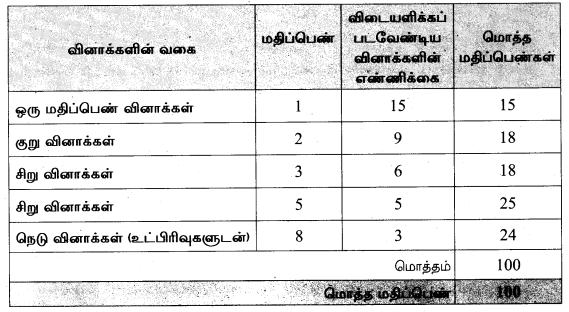
Samacheer Kalvi 10th Tamil Model Question Papers Tamil Nadu

Samacheer Kalvi 10th Tamil Model Question Papers Tamil Nadu

It is necessary that students will understand the new pattern and style of Tamil Nadu Samacheer Kalvi 10th Tamil Model Question Papers 2021 Answer Keys according to the latest exam pattern. These State Board 10th Standard Tamil Public Exam Model Question Papers 2020-21 Tamil Nadu are useful to understand the pattern of questions asked in the board exam. Know about the important concepts to be prepared for TN SSLC Board Exams and Score More marks.

We hope the given Tamil Nadu State Board New Syllabus Samacheer Kalvi Class 10th Tamil Model Question Papers 2020 2021 Pdf Free Download will help you.

If you have any queries regarding the Government of TN State Board Samacheer Kalvi SSLC 10th Standard Tamil Model Question Papers with Answers 2020 21, Sample Papers, Previous Year Question Papers, drop a comment below and we will get back to you at the earliest.

Samacheer Kalvi 10th Social Science Guide History Chapter 6 Early Revolts against British Rule in Tamil Nadu

Students can download 10th Social Science History Chapter 6 Early Revolts against British Rule in Tamil Nadu Questions and Answers, Notes, Samacheer Kalvi 10th Social Science Guide Pdf helps you to revise the complete Tamilnadu State Board New Syllabus, helps students complete homework assignments and to score high marks in board exams.

Tamilnadu Samacheer Kalvi 10th Social Science Solutions History Chapter 6 Early Revolts against British Rule in Tamil Nadu

Samacheer Kalvi 10th Social Science Early Revolts against British Rule in Tamil Nadu Text Book Back Questions and Answers

I. Choose the correct answer

Question 1.
Who was the first Palayakkarars to resist the East India Company’s policy of territorial aggrandisement?
(a) Marudhu brothers
(b) Puli Thevar
(c) Velunachiyar
(d) Veerapandya Kattabomman
Answer:
(b) Puli Thevar

Question 2.
Who had borrowed money from the East India Company to meet the expenses he had incurred during the Carnatic wars ?
(a) Velunachiyar
(b) Puli Thevar
(c) Nawab of Arcot
(d) Raja of Travancore
Answer:
(c) Nawab of Arcot

Samacheer Kalvi 10th Social Science Guide History Chapter 6 Early Revolts against British Rule in Tamil Nadu

Question 3.
Who had established close relationship with the three agents of Chanda Sahib?
(a) Velunachiyar
(b) Kattabomman
(c) Puli Thevar
(d) Oomai thurai
Answer:
(c) Puli Thevar

Question 4.
Where was Sivasubramanianar executed?
(a) Kayathar
(b) Nagalapuram
(c) Virupachi
(d) Panchalamkurichi
Answer:
(b) Nagalapuram

Question 5.
Who issued the Tiruchirappalli proclamation of Independence?
(a) Marudhu brothers
(b) Puli Thevar
(c) Veerapandya Kattabomman
(d) Gopala Nayak
Answer:
(a) Marudhu brothers

Question 6.
When did the Vellore Revolt breakout?
(a) 24 May 1805
(b) 10 July 1805
(c) 10 July 1806
(d) 10 September 1806
Answer:
(c) 10 July 1806

Question 7.
Who was the Commander-in-Chief responsible for the new military regulations in Vellore Fort?
(a) Col. Fancourt
(b) Major Armstrong
(c) Sir John Cradock
(d) Colonel Agnew
Answer:
(c) Sir John Cradock

Question 8.
Where were the sons of Tipu Sultan sent after the Vellore Revolt?
(a) Calcutta
(b) Mumbai
(c) Delhi
(d) Mysore
Answer:
(a) Calcutta

II. Fill in the blanks

  1. The Palayakkarars system was put in place in Tamil Nadu by …………….
  2. Except the Palayakkarars of ……………. all other western Palayakkarars supported Puli Thevar.
  3. Velunachiyar and her daughter were under the protection of ……………. for eight years.
  4. Bennerman deputed ……………. to convey his message, asking Kattabomman to surrender.
  5. Kattabomman was hanged to death at …………….
  6. The Rebellion of Marudhu Brothers was categorized in the British records as the …………….
  7. ……………. was declared the new Sultan by the rebels in Vellore Fort.
  8. ……………. suppressed the revolt in Vellore Fort.

Answers:

  1. Viswanatha Nayaka of Madurai
  2. Sivagiri
  3. Gopala Nayakar
  4. Ramalinganar
  5. Kayathar
  6. Second Palayakarar war
  7. Fateh Hyder (the eldest son of Tipusultan)
  8. Colonel. Gillespie

Samacheer Kalvi 10th Social Science Guide History Chapter 6 Early Revolts against British Rule in Tamil Nadu

III. Choose the correct statement

Question 1.
(i) The Palayakkarars system was in practice in the Kakatiya Kingdom.
(ii) Puli Thevar recaptured Nerkattumseval in 1764 after the death of Khan Sahib.
(iii) Yusuf Khan who was negotiating with the Palayakkarars, without informing the Company administration was charged with treachery and hanged in 1764.
(iv) Ondiveeran led one of the army units of Kattabomman.
(a) (i), (ii) and (iv) are correct
(b) (i), (ii) and (iii) are correct
(c) (iii) and (iv) are correct
(d) (i) and (iv) are correct
Answer:
(b) (i), (ii) and (iii) are correct

Question 2.
(i) UnderColonel Campbell, the English Army went along with Mahfuzkhan’s army.
(ii) After Muthu Vadugar’s death in Kalaiyar Kovil battle, Marudhu Brothers assisted Velunachiyar in restoring the throne to her.
(iii) Gopala Nayak spearheaded the famous Dindigul League.
(iv) In May 1799 Cornwallis ordered the advance of Company armies to Tirunelveli.
(a) (i) and (ii) are correct
(b) (ii) and (iii) are correct
(c) (ii), (iii) and (iv) are correct
(d) (i) and (iv) are correct
Answer:
(b) (ii) and (iii) are correct

Question 3.
Assertion (A): Puli Thevar tried to get the support of Hyder Ali and the French.
Reason (R): Hyder Ali could not help Puli Thevar as he was already in a serious conflict with the Marathas.
(a) Both (A) and (R) are correct, but (R) is not the correct explanation of (A)
(b) Both (A) and (R) are wrong
(c) Both (A) and (R) are correct and (R) is the correct explanation of (A)
(d) (A) is wrong and (R) is correct
Answer:
(c) Both (A) and (R) are correct and (R) is the correct explanation of (A)

Samacheer Kalvi 10th Social Science Guide History Chapter 6 Early Revolts against British Rule in Tamil Nadu

Question 4.
Assertion (A): Apart from the new military Regulations the most objectionable was the addition of a leather cockade in the turban.
Reason (R): The leather cockade was made of animal skin.
(a) (A) is wrong and (R) is correct
(b) Both (A) and (R) are correct and (R) is the correct explanation of (A)
(c) Both (A) and (R) are wrong
(d) Both (A) and (R) are correct, but (R) is not the correct explanation of (A)
Answer:
(b) Both (A) and (R) are correct and (R) is the correct explanation of (A)

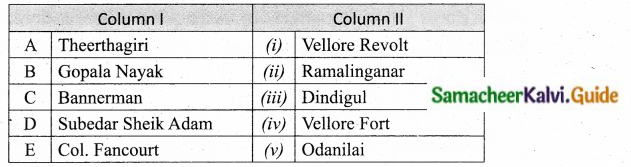
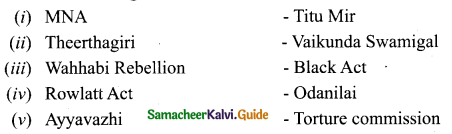
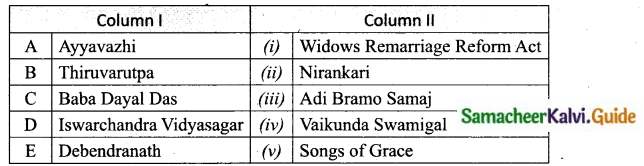
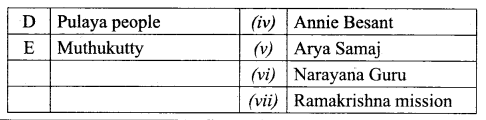
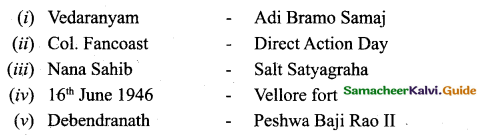
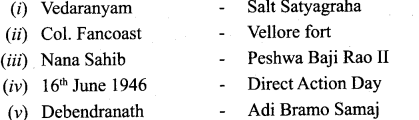
IV. Match the following
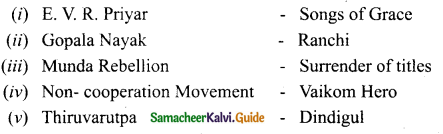
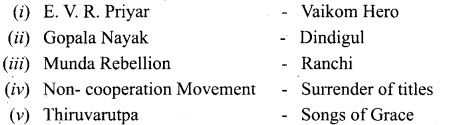
Samacheer Kalvi 10th Social Science Guide History Chapter 6 Early Revolts against British Rule in Tamil Nadu 1
Answer:
A. (v)
B. (iii)
C. (ii)
D. (i)
E. (iv)

V. Answer the questions briefly

Question 1.
What were the duties of the Palayakkarars?
Answer:
The Palayakkarars carried on the following duties:

  1. They collected revenue, administered the territory control, settled disputes and maintained law and order.
  2. On many occasions the Palayakkarars helped the Nayak rulers to restore the kingdom to them.

Question 2.
Identify the Palayams based on the division of east and west.
Answer:
The two prominent blocs were Eastern and Western Palayams:

Eastern Palayams:

  1. Sattur
  2. Nagalapuram
  3. Ettayapuram
  4. Panchalamkurichi.

Western Palayams:

  1. Uthumalai
  2. Thallawankottai
  3. Naduvakurichi
  4. Singampatti
  5. Seithur.

Samacheer Kalvi 10th Social Science Guide History Chapter 6 Early Revolts against British Rule in Tamil Nadu

Question 3.
Why was Heron dismissed from service?
Answer:
Colonel Heron was urged to deal with Puli Thevar as he continued to defy the authority of the company. Puli Thevar wielded much influence over the western Palayakkarars. Heron had to abandon the plan for want of cannon and of supplies and pay to soldiers. He retired to Madurai. He was then recalled and dismissed from sendee.

Question 4.
What was the significance of the Battle of Kalakadu?
Answer:

  1. With the support of the East India company Arcot Nawab Mohamed Ali wanted to bring Madurai and Tirunelveli regions which were under the command of Nawab Chandra Sahib’s agents.
  2. These agents got the support of Tamil Palayakkarars and had close relationship with Puli Thevar.
  3. An army was sent under the head of Mahfiizkhan to capture Tirunelveli.
  4. Before he station his troops near Kalakadu 2000 soldiers from Travancore joined the forces of Puli Thevar.
  5. In the Battle of Kalakadu Mahfiizkhan troops were routed.
  6. The organized resistance of the Palayakkarars under Puli Thevar gave an opportunity to the English to interfere directly in the affairs of Tirunelveli.

Question 5.
What was the bone of contention between the Company and Kattabomman?
Answer:
The company appointed its collectors to collect taxes from all the palayams. The collectors humiliated the Palayakkarars and adopted force to collect the taxes. This was the bone of contention between the English and Kattabomman.

Question 6.
Highlight the essence of the Tiruchirappalli Proclamation of 1801.
Answer:

  1. The proclamation of 1801 was an early call to the Indians to unite against the British.
  2. Many Palayakkars rebelled together, especially Chinna Maruthu collected nearly 20,000 men to challenge British.
  3. But the Rajas of Pudukkottai, Ettayapuram and Thanjavur supported British.
  4. So, in May 1801, English attacked the rebels in Thanjavur and Trichy rebels failed.
  5. Though the Palayakkarars fell to the English, their exploits and sacrifices inspired later generation.
  6. The rebellion of Marudhu brothers is a land mark event in the history of Tamil Nadu.
  7. It is also known as “South Indian Rebellion”.

Question 7.
Point out the importance of the Treaty of 1801.
Answer:
Under the terms of the Carnatic Treaty of 31 July 1801, the British assumed direct control over Tamilagam and the Palayakkarar system came to an end with the demolition of all forts and disbandment of their army.

VI. Answer the questions given under each caption

Question 1.
Velunachiyar

(a) Who was the military chief of Velunachiyar?
Answer:
The military chief of Velunachiyar was ‘Thandavarayanar’.

(b) What were the martial arts in which she was trained?
Answer:
Velunachiyar had training in martial arts like valari, stick fighting and to wield weapons.

(c) Whom did she marry?
Answer:
She married Muthu Vadugar the Raja of Sivagangai.

(d) What was the name of her daughter?
Answer:
Her daughter name was Vellachinachiyar.

Samacheer Kalvi 10th Social Science Guide History Chapter 6 Early Revolts against British Rule in Tamil Nadu

Question 2.
Dheeran Chinnamalai
(а) When was Dheeran Chinnamalai born?
Answer:
Dheeran Chinnamalai was born in 1756 in the Mandradiar royal family of Palayakottai.

(b) How did he earn the title “Chinnamalai”?
Answer:
Once when Tipu’s diwan Mohammed Ali was returning to Mysore with the tax money, Theerthagiri blocked his way and took back all the tax money. He let Mohammed Ali go by instructing him to tell his Sultan that ‘Chinnamalai; who is between Sivamalai and Chinnamalai, was the one who took away taxes. Thus, he gained the name ‘Dheeran Chennamalai’.

(c) Name the Diwan of Tipu Sultan.
Answer:
Mohammed Ali

(d) Why and where was he hanged to death?
Answer;
He was hanged at the top of the Sankagiri Fort on 31 July 1805 because he refused to accept the rule of the British.

VII. Answer in detail

Question 1.
Attempt an essay of the heroic fight Veerapandya Kattabomman conducted against the East India Company.
Answer:
Several events led to the conflicts between Veerapandiya Kattabomman and the East India Company.
Event 1:

  1. Under the provisions of a treaty signed in 1781 with Mysore Sultan the East India Company gained the right to collect taxes from Panchalamkurichi where Veerapandiya Kattabommman was the ruler.
  2. The company appointed its collectors to collect taxes from all the Palayams.
  3. The collectors adopted force and humiliated the Palayakaras to collect the taxes. This was the bone of contention between the English and Kattabomman.

Event 2: Collector Jackson against the wish of the Madras Government wanted to send an army to collect the revenue dues from Kattabomman.

  1. The arrogant English collector ordered Kattabomman to meet him in. Ramanathapuram. But Kattabomman’s attempts became futile as Jackson refused to meet him.
  2. At last Kattabomman was made to stand for three hours before the haughty collector in Ramanathapuram.
  3. Sensing danger Kattabomman with his brother’s help escaped from that place.
  4. Kattabomman on his return to Panchalamkurichi represented to the Madras Council about his ill treatment by the collector Jackson.
  5. Kattabomman appeared before the committee on 15th December 1798 and proved that he was not committed any offence.
  6. He cleared almost all the revenue arrears.
  7. Jackson was dismissed from his service.

Samacheer Kalvi 10th Social Science Guide History Chapter 6 Early Revolts against British Rule in Tamil Nadu

Event 3: Inspired by the Marudhu brothers Tiruchirapaili proclamation Kattabomman was interested to join the confederacy.

  1. Kattabomman and Marudhu brothers jointly decided on a confrontation with the English.
  2. Kattabomman advanced towards Sivagiri who was a tributary to the company.
  3. So the company considered Kattabomman’s expedition as a challenge to their authority.
  4. Under the command of Bannerman on 1st September 1799 an ultimatum was served on Kattabomman to surrender.
  5. The evasive reply of Kattabomman made Bannerman to attack the Fort of Panchalamkurichi.
  6. Kattabomman escaped to Pudukottai.
  7. The Britsh put a prize on his head.
  8. Betrayed by the Rajas of Ettayapuram and Pudukottai Kattabomman was arrested.
  9. During the trial before all the Palayakkarars he bravely admitted all the charges levelled against him.
  10. He was hanged to death at Kayatharu near Tirunelveli on 16th October.
  11. His courageousness and bravery was enacted as ballads by Indian folks.

Question 2.
Highlight the tragic fall of Sivagangai and its outcome.
Answer:
In May 1801, the English attacked the rebels in Thanjavur and Tiruchirappalli. The rebels went to Piranmalai and Kalayarkoil. But they were defeated by the forces of the English. In the end, the able commanders of the English company helped. Unfortunately, the rebellion failed and Sivagangai was annexed in 1801.
Outcomes

  • The Marudhu brothers were executed in the fort of Tirupathur near Ramanathapuram on 24 October 1801.
  • Oomaithurai and Sevathaiah were captured and beheaded at Panchalamkuruchi on 16 November 1801.
  • Seventy-three rebels were exiled to Penang in Malaya.
  • Though the Palayakkarars fell to the English, their exploits and sacrifices inspired later generations.

Samacheer Kalvi 10th Social Science Guide History Chapter 6 Early Revolts against British Rule in Tamil Nadu

Question 3.
Account for the outbreak of Vellore Revolt in 1806.
Answer:
Causes for the outbreak of Vellore Revolt in 1806:

  1. The Sepoys in the British Indian Army had a strong sense of resentment over low salary and poor prospects of promotion.
  2. The English officers disrespect for the social and religious sentiments of the Indian sepoys also angered them.
  3. Many sepoys families were in dire economic straits due to out break of famine in 1805 and the unsettled conditions caused by new land tenures.
  4. The imprisonment of Tipu’s sons and the family members in Vellore Fort.

The immediate cause for the revolt was triggered by the new military regulations introduced by the Commander in Chief Sir John Cradock.

  1. The Indian soldiers were not allowed to wear caste marks or ear rings when in uniform.
  2. They were asked to shave their beard and trim the moustache to look smart.
  3. The most resented cause was the leather cockade made of animal skin.
  4. The sepoys were compelled to wear the turban and those who refused were severely punished.
  5. In 10th July 1806 in the early hours guns were booming and the Indian sepoys of the regiments 1st and 23rd raised their standard of revolt.

VIII. Activity

Question 1.
Teacher can ask the students to prepare an album of patriotic leaders of early revolts against the British rule in Tamil Nadu. Using their imagination they can also draw pictures of different battles in which they attained martyrdom.
Answer:
Few names of the patriotic leaders of the’early revolt against the British mle in Tamil Nadu are listed below.

  1. Subramaniya Bharathiyar
  2. Kumaraswamy Mudaliar (popularly known as Tiruppur Kumaran)
  3. Velunachiyar
  4. Vanchinathan
  5. Veerapandia Kattabomman
  6. V.O. Chidambaram
  7. Dheeran Chinnamalai
  8. Subramaniya Siva
  9. The Maruthu Pandiyar brothers (Periya Maruthu, Chinna Maruthu)
  10. Puli Thevar

Samacheer Kalvi 10th Social Science Guide History Chapter 6 Early Revolts against British Rule in Tamil Nadu

Students can collect pictures of the above mentioned patriotic leaders and paste it in a notebook, prepare an album and submit to the teacher. Below the picture, student should also write the name of the patriotic leader below the picture.

If the student is very good in drawing skills, then instead of pasting pictures, they can also draw two or three of the patriotic leaders images and write their name below and prepare an album. Students can also use their creativity, imagine a battle field and can portrait that also.

Question 2.
Stage play visualising the conversation between Jackson and Kattabomman be attempted by students with the help of teachers.
Answer:
Stage play – Conversation between Jackson and Kattabomman.
Participants: Characters – Kattabomman, Subramanianar, Oomaithurai, Collector Jackson, Company officials soldiers.

Scence – 1 Kattabomman’s Court.

A company official reading the notice issued by collector Jackson. (Kattabomman’s soldier asking permission to let in the company official)

Sepoy : Maharaja, English East India Company’s servant brought a message for you. Shall I ask him to let in. I seek your permission.

Kattabomman : Allow him. (Servant entry)

Kattabomman: What message you have brought?

Servant : Maharaja (Reading the message)
I, “The collector of Ramnad” issuing order to Kattabomman to meet in person.

Kattabomman : yes you can go

Scene – 2

Kattabomman and his Minister and some soldiers going to meet Jackson after hearing he was camping at placard showing courtallam.

Collector has gone Srivilliputtur (Voice)

Placard showing Srivilliputur (You are asked to come to Ramanathapuram)

Scene – 3 (Ramanathapuram Fort)

Kattabomman waiting outside the gate to meet the Collector. After lhour he was asked to get inside the court of collector Jackson.

Jackson: Not noticing him wantedly I am
Kattabomman: I am kattabomman who is collector Jackson.
Jackson: Got angry Hay who are you nian calling me by name?
Kattabomman: I am Kattabomman wants to know who you are? Asking me the question.
(Further got irritated)
Jackson: I am collector Jackson. Are you the defiant Kattabomman.
Kattabomman: I want to know for what reason I was asked to come over here. As a coward ran and came to Ramanathapuram Mr. Jackson.
Jackson: Shut up man. You have the charge on you that you didn’t pay neither the tribute not the tax arrears.
(Irritated by his command)
Kattabomman: Whom do you expect to pay tribute or Taxes. Me? Why I should pay taxes. It’s our land the nature is giving water to the field. We the people till the land, sow the seeds plant the saplings watered the field, nurtured the plants, removed the weeds. What work you have done for asking the tax.
Jackson: Hay man Kattabomman you are talking too much, Your region belong to us.
Kattabomman: (Laughing) Is it so? Who gave you the right of possession?
Jackson: (Furiated yelling) Guards arrest him.
(Guards entry)
Kattabomman: Sensing the danger took out the sword (fighting and escaping from that place)
(screen)

Samacheer Kalvi 10th Social Science Guide History Chapter 6 Early Revolts against British Rule in Tamil Nadu

Question 3.
A comparative study of Vellore Revolt and 1857 Revolt by students be tried enabling them to find out to what extent Vellore Revolt had all the forebodings of the latter.
Answer:
Common causes for the Revolt at Vellore and Revolt of 1857.

Vellore Revolt:

  1. Most of the soldiers in the British army were well trained soldiers from various Palayams. Hindus and Muslims majority Indian Troops.
  2. Resentment over low salary promotion prospects
  3. New dress code, rules and regulations affected the religions sentiments.
  4. Uprising was well planned and raised by the soldiers at Vellore Fort shot down many colonels
  5. Immediate cause introduction of Agnew Turban- a leather hat made of animal skin.
  6. Soldiers were forced to wear the Turban.
  7. Spread to other areas Bellary, Bangalore, Hyderabad, Sankagiri, Walajabad, Nandy durg.
  8. Fateh hyder Tipu’s son was declared as their leader.

Revolt of 1857:

  1. Most of the soldiers were from Sikhs, Hindus and Muslims. Out numbered the English officers.
  2. Same point of view low salary inferior out look of the English officers.
  3. Conversion activities interference in the Indian culture affected their sentiments.
  4. Revolt originated from Bengal regiment.
  5. Introduction of Greased cartridges smeared with animal fat.
  6. Indian soldiers were compelled to use the cartridges.
  7. Spead to Kanpur, Delhi, Oudh, Jhansi, Lucknow, Bihar etc.
  8. Emperor Bahadhur Shah II of Delhi was made to sit on the throne and declared as the emperor of India.

These points clearly shows that the Vellore Revolt had all the forebodings of the latter.

Samacheer Kalvi 10th Social Science Guide History Chapter 6 Early Revolts against British Rule in Tamil Nadu

Samacheer Kalvi 10th Social Science Early Revolts against British Rule in Tamil Nadu Additional Important Questions And Answers

I. Choose the correct answer

Question 1.
Palayakkarars in Tamil refers to the:
(a) Holders of a little kingdom as a feudatory.
(b) Revenue collectors of the British
(c) Rebels of the Carnatic region
(d) Commanders of Nawab of Arcot
Answer:
(a) Holders of a little kingdom as a feudatory.

Question 2.
Palayakkarars police duties were known as ……………….
(a) Padikaval
(b) Village Kaval
(c) Irravu Kaval
Answer:
(a) Padikaval

Question 3.
The first female ruler of Sivagangai who resisted the colonial power of the British:
(a) Jhansi Rani Lakshmibai
(b) Rani Mangammal
(c) Velunachiyar
(d) Kuyili
Answer:
(c) Velunachiyar

Question 4.
Puli Thevar was defeated by …………… in 1767.
(a) Khan Sahib
(b) Captain Campbell
(c) Hyder Ali
Answer:
(b) Captain Campbell

Samacheer Kalvi 10th Social Science Guide History Chapter 6 Early Revolts against British Rule in Tamil Nadu

Question 5.
The British commander who put down the Vellore revolt was:
(a) Bannerman
(b) William Bentinck
(c) Sir John cradock
(d) Colonel Gillespie
Answer:
(d) Colonel Gillespie

Question 6.
Who was Mahfuzkhan?
(a) Brother of the Nawab of Arcot
(b) Minister of the Nawab of Arcot
(c) Brother of Yusuf Khan
(d) Indian sepoy in the British army
Answer:
(a) Brother of the Nawab of Arcot

Question 7.
Veerapandiya Kattabomman was the Palayakkarar of :
(a) Sivagangai
(b) sivagiri
(c) Madurai
(d) Panchalamkurichi
Answer:
(d) Panchalamkurichi

Question 8.
Where did Kattabomman escape?
(a) Ettayapuram
(b) Coimbatore
(c) Pudukottai
(d) Tarapuram
Answer:
(c) Pudukottai

Question 9.
On his return to Panchalamkurichi ………………….. represented to the Madras council.
(a) Kattabomman
(b) Marudhu brothers
(c) Puli Thevar
(d) Dheeran chinnamalai
Answer:
(a) Kattabomman

Samacheer Kalvi 10th Social Science Guide History Chapter 6 Early Revolts against British Rule in Tamil Nadu

Question 10.
Which city was annexed at the end of the Anglo-Mysore War in 1799?
(a) Ramanathapuram
(b) Coimbatore
(c) Panchalamkuruchi
(d) Pudukottai
Answer:
(b) Coimbatore

Question 11.
Jackson was dismissed from service and a new collector ………………….. was appointed.
(a) Syed
(b) Clarke
(c) William Brown
(d) S.R Lushington
Answer:
(d) S.R Lushington

Question 12.
Kattabomman cleared all the revenue arrears leaving only a balance of ………………….. pagodas.
(a) 1180
(b) 1080
(c) 1801
(d) 1108
Answer:
(b) 1080

Question 13.
Yadhul Nayak was the Palayakkarar of:
(a) Coimbatore
(b) Dindigul
(c) Anamalai
(d) Kamudhi
Answer:
(c) Anamalai

Question 14.
Oomathurai and Sevathaiah the two brothers of Kattabomman escaped from the Palayamkottai prison to:
(a) Kamudhi
(b) Sivagangai
(c) Kerala
(d) Thiruchirappalli
Answer:
(a) Kamudhi

Question 15.
………………….. involved in setting the disputes in the Kongu region.
(a) Dheeran chinnamalai
(b) Velunachiyar
(c) Oomathurai
(d) Gopala Nayak
Answer:
(a) Dheeran chinnamalai

Samacheer Kalvi 10th Social Science Guide History Chapter 6 Early Revolts against British Rule in Tamil Nadu

II. Fill in the blanks

  1. The word ………………….. means a domain a military camp or a little kingdom.
  2. The Palayakkararsystem was in practice during the rule of ………………….. of warangal in the Kakatiya kingdom.
  3. The police duties of Palayakkarars were known as …………………..
  4. The Palayakkarars of Sivagiri, Ettayapuram and Panchalamkurichi did not join the confederacy of …………………..
  5. The unity of the Palayakkarars began to break with the …………………..
  6. In 1772 under the command of ………………….. stormed the kalaiyar kovil palace.
  7. The South Indian confederacy was organised by
  8. The forces of Diwan of Mysore and Chinnamalai fought at
  9. The failed because there was no immediate help from outside.
  10. The was the predecessor of the great Revolt of 1857.
  11. Under poligar system was given for valuable military services rendered by any individual.
  12. The began to consolidate and extend its influence after the three carnatic wars in Tamil Nadu.
  13. ………………….. the Minister of viswanatha Nayaka helped him to introduce Palayakkarar system in Tamil Nadu.
  14. The Palayakkarar system lasted for from ………………….. the Nayaks of Madurai.
  15. Within their respective Palayams Palayakkarars function as ………………….. authorities.
  16. Traditionally there were ………………….. Palayakkarars created by Nayak rulers.
  17. Many Palayakkarars refused to pay taxes to the company as their lands handed down to them over …………………..
  18. The company branded ………………….. as rebels.
  19. Mahfuzkhan was the brother of …………………..
  20. ………………….. was sent with a contingent army under colonel Heron to capture Tirunelveli and Madurai.
  21. Mahfuzkhan had the support of ………………….. and ………………….. from the carnatic to capture Tirunelveli.
  22. Two thousand soldiers from ………………….. joined the forces of Puli Thevar at kalakad.
  23. The Palayakkarars of Tirunelveli under Puli Thevar constantly rebelled against
  24. Yusufkhan’s (Khan sahib) original name was ………………….. before his conversion to Islam.
  25. The ………………….. from Tiruchirappalli arrived in September 1760 to assist Yusufkhan to attack Puli Thevar.
  26. The battering of ………………….. by Yusufkhan took two months.
  27. Expel of French power from Pondicherry made Travancore, ………………….., Uthumalai and ………………….. to support the English.
  28. The ………………….. was charged with treachery and hanged in 1764 by the company.
  29. Captain ………………….. defeated Puli Thevar in 1767.
  30. Puli Thevar escaped and died in …………………..
  31. Velunachiyar was under the protection of Gopala Nayak for ………………….. years.
  32. At the age of 16 ………………….. was married to Muthuvadugar of Sivagangai.
  33. Dalavay means …………………..
  34. In behalf of Velunachiyar Dalavai ………………….. wrote a letter to Sultan Hyder AN seeking military assistance.
  35. Hyder Ali ordered his commandant ………………….. in Dindigul Fort to provide required military assistance to Velunachiyar.
  36. Kuyili faithful friend of Velunachiyar led a unit of women soldiers named after …………………..
  37. ………………….. was the shepherd girl who was killed by the company for not divulging information on kuyili the commander.
  38. The company’s administrators ………………….. and ………………….. considered Kattabomman a man of peaceful disposition.
  39. To meet out the expenses of Nawab and his family ………………….. of the revenue (taxes) collection was allowed.
  40. The land revenue arrear from Kattabomman was ………………….. pagodas in 1798.
  41. The did not give permission to collector Jackson to send an army to Panchalamkurichi to collect dues from Kattabomman.
  42. Kattabomman’s Minister ………………….. accompanied him to Ramanathapuram to met collector Jackson.
  43. In a clash at the gate of Ramanathapuram Fort English officer ………………….. was killed.
  44. In may 1799 ………………….. issued orders from Madras for the advance of forces to Tirunelveli.
  45. Bannerman moved his entire army to Panchalamkurichi on …………………..
  46. ………………….. gathered all the secrets of the Fort of Panchalamkurichi.
  47. In a clash at ………………….. Sivasubramanianar was taken a prisoner.
  48. Kattabomman escaped to …………………..
  49. ………………….. was executed at Nagalapuram on 13th September.
  50. Kattabomman was hanged from a ………………….. in the old Fort of Kayathar.

Answers:

  1. Palayam
  2. Prataba Rudhra
  3. Padikaval or Arasukaval
  4. Puli Thevar
  5. elimination of French power from Pondicherry
  6. Lt. Col Bon Jour
  7. Marudhu brothers of Sivagangai
  8. Noyyal river bed
  9. Vellore Revolt
  10. Vellore Revolt
  11. Palayam
  12. English East India Company
  13. Ariyanathar
  14. two hundred years
  15. independent sovereign
  16. 72
  17. sixty generations
  18. defiant Palayakkarars
  19. Nawab of Arcot
  20. Mahfuzkhan
  21. cavalry and foot soldiers
  22. Travancore
  23. Nawab’s authority
  24. Marudhunayagam
  25. artillary
  26. Nerkkatumseval Fort
  27. Seithur, Surandai
  28. Yusufkhan
  29. Campbell
  30. exile
  31. eight
  32. Velunachiyar
  33. Military chief
  34. Thandavarayanar
  35. Syed
  36. Udaiyal
  37. Udaiyal
  38. James London, Colin Jackson
  39. one- sixth
  40. 3310
  41. Madras Government
  42. Sivasubramanianar
  43. Lietenant Clarke
  44. Lord Wellesley
  45. 5th September 1799
  46. Ramalinganar
  47. Kallarpatti
  48. Pudukottai
  49. Sivasubramanianar
  50. Tamarind tree

Samacheer Kalvi 10th Social Science Guide History Chapter 6 Early Revolts against British Rule in Tamil Nadu

III. Choose the correct statement

Question 1.
(i) Velunachiyar organised an army and succeeded in securing an alliance with Hyder Ali.
(ii) Hyder Ali provided the required military assistance to Velunachiyar
(iii) A fierce battle was fought at Devadanampatti.
(iv) Velunachiyar escaped with her daughter and lived in Ramanathapuram.
(a) (i), (ii) and (iv) are correct
(b) (i), (iii) and (iv) are correct
(c) (ii) and (iii) are correct
(d) (i) and (ii) are correct
Answer:
(d) (i) and (ii) are correct

Question 2.
(i) Dheeran chinnamalai was trained by the French.
(ii) He launched Gwerilla attack and evaded capture by the British.
(iii) He was born at Coimbatore,
(iv) He refused to accept the rule of the British.
(a) (i), (ii) and (iv) are correct
(b) (i), (ii) and (iii) are correct
(c) (iii) and (iv) are correct
(d) (i) and (iii) are correct
Answer:
(a) (i), (ii) and (iv) are correct

Question 3.
(i) Coimbatore was annexed at the end of the Anglo – Mysore was in 1799.
(ii) The status of Raja of Thanjavur had been reduced to that of a vassal.
(iii) English East India company acquired the revenue districts of salem and Dindigul from Tipu.
(iv) A treaty was forced on Marudhu brothers on the charge of disloyalty.
(a) (i), (iii) and (iv) are correct
(b) (i), (ii) and (iii) are correct
(c) (i) and (iv) are correct
(d) (ii) and (iv) are correct
Answer:
(b) (i), (ii) and (iii) are correct

Question 4.
Assertion (A): Kattabomman took an expedition to Sivagiri to influence to join Marudhu brothers.
Reason (R): Palayakkarars of Sivagiri was a tributory to the company of the British. They refuse to join.
(a) Both A and R are correct. R is the correct explanation of A.
(b) A is correct and R is Wrong
(c) A is wrong ans R is correct
(d) A is correct and R is not the correct explanation of A.
Answer:
(a) Both A and R are correct. R is the correct explanation of A.

Question 5.
Assertion (A): Chinna Marudhu collected 20,000 men to challenge the English army and many Palayakkarars joined, but failed.
Reason (R): Divide and Rule Policy of the British split the forces of the Palayakkarars.
(a) A is correct R is wrong
(b) A is wrong and R is correct
(c) Both A and R are correct and R is the correct explanation of A.
(d) A is correct but R is not the correct explanation of A.
Answer:
(c) Both A and R are correct and R is the correct explanation of A.

Samacheer Kalvi 10th Social Science Guide History Chapter 6 Early Revolts against British Rule in Tamil Nadu

Question 6.
Assertion (A): The Nawab of Arcot gave the power of collecting revenue to the English East India company from southern Palayakkarars.
Reason (R): The company branded the defiant Palayakkarars as rebels.
(a) A is correct R is wrong
(b) A is wrong R is correct
(c) Both A and R are correct R explains A.
(d) Both A and R are correct. R is not the correct explanation to A.
Answer:
(a) A is correct R is wrong

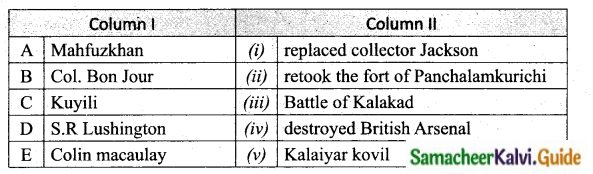
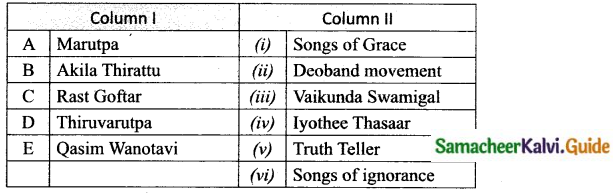
IV. Match the following

Question 1.
Match the Column I with Column II.
Samacheer Kalvi 10th Social Science Guide History Chapter 6 Early Revolts against British Rule in Tamil Nadu 2
Answer:
A. (iii)
B. (v)
C. (iv)
D. (i)
E. (ii)

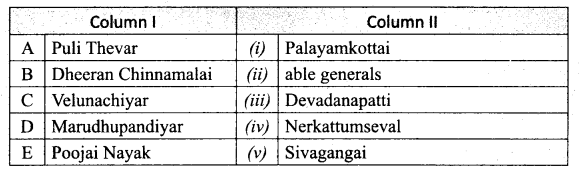
Question 2.
Match the Column I with Column II.
Samacheer Kalvi 10th Social Science Guide History Chapter 6 Early Revolts against British Rule in Tamil Nadu 3
Answer:
A. (iv)
B. (i)
C. (v)
D. (ii)
E. (iii)

Samacheer Kalvi 10th Social Science Guide History Chapter 6 Early Revolts against British Rule in Tamil Nadu

V. Answer the questions briefly

Question 1.
Write a note on Carnatic treaty.
Answer:
The suppression of the Palayakkarar rebellions of 1799 and 1800-1801 resulted in the liquidation of all the local chieftains of Tamil Nadu. Under the terms of the Carnatic treaty of 31 July 1801. The British assumed direct control over Tamilagam and the Palayakarar system to an end with the demolition of all forts and disbandment of their army.

Question 2.
Why was the Revenue collection of the southern Palayakkarars was given to the company Rule?
Answer:

  1. Nawab of Arcot had borrowed money from the East India Company to meet the expenses he had incurred during the camatic wars.
  2. When the debts exceeded his capacity to pay, he gave the Revenue Collection Authority to the company rule.

Question 3.
Write a note on Hyder Ali.
Answer:
Hyder Ali was the ruler of Mysore. He was a bitter enemy of England. He was born in 1772. Though he started his career as a soldier, he rose to the position of commander-in-chief. In 1766, when the Raja of Mysore died, Hyder Ali proclaimed himself as the ruler and became the Sultan of Mysore. Tipu Sultan was the son of Hyder Ali.

Question 4.
Name the three major ports of Puli Thevar. When did these forts come under the control of Yusuf Khan?
Answer:
The three major ports of Puli Thevar were Nerkattumseval, Vasudevanallur and Panayur. In 16th May 1761 they came under the control of Yusufkhan.

Question 5.
What does the word ‘Palayam’ mean? What does the Palayakkarar in Tamil refer to?
Answer:
The word ‘Palayam’ means a domain, military camp, or a little kingdom. The Palayakkarar in Tamil refers to the holder of a little Kingdom as a feudatory to a greater sovereign.

Question 6.
Write about the brave act of Kuyili the friend of Velunachiyar.
Answer:

  1. Kiyili was a faithful friend of velunachiyar.
  2. She led the unit of women soldiers.
  3. Kuyili is said to have walked in to the British arsenal (1780) after setting herself on fire, destroying all the ammunition.

Question 7.
Why did the Nawab of Arcot borrow money from the East India company? What happened when his debts exceeded his capacity to pay?
Answer:
The Nawab of Arcot borrowed money from the East India company to meet the expenses he had incurred during the Carnatic wars. When his debts exceeded his capacity to pay, the power of collecting the land revenue dues from southern Palayakkarars was given to the East India company.

Samacheer Kalvi 10th Social Science Guide History Chapter 6 Early Revolts against British Rule in Tamil Nadu

Question 8.
How the Rebellion of Marudhu brothers referred as and who participated in the rebellion?
Answer:
In the British records the rebellion of Marudhu brothers (1800) is referred as the “Second Palayakkarar war”.

Those who participated in the Rebellion were: Marudhu Pandiyar of Sivagangai, Gopala Nayak of a Dindigul, Kerala verma of Malabar and Krishnappa Nayak and Dhoondaj i of Mysore.

VI. Answer the questions given under each caption

Question 1.
Siege of Panchalamkuruchi
(a) Why did Lord Wellesley issue orders in May 1799?
Answer:
Lord Wellesley issued orders in May 1799 for the advance of forces from Tiruchirapalli, Thanjavur, and Madurai to Tirunelveli.

(b) Who commanded the troops?
Answer:
Major Bannerman commanded the troops.

(c) What commanded the troops?
Answer:
On 1st September 1799, an ultimatum was served on Kattabomman to surrender.

(d) Why did Bannerman depute Ramalinganar to Kattabomman’s fort?
Answer:
Bannerman deputed Ramalinganar to Kattabomman’s fort so that he could convey a message asking him (Kattabomman) to surrender.

Question 2.
Consequences of Vellore Revolt

(a) Where was Tipu’s sons imprisoned after the revolt?
Answer:
Tipu’s sons were sent to Calcutta after the revolt.

(b) What was the reward given to the people who suppressed the revolt?
Answer:
Col. Gillespie was given 7,000 pagodas. The officers and men engaged in the suppression were rewarded with prize money and promotion.

(c) Name the English Generals who were removed from their office?
Answer:
Col. Sir John Cradock, Adjutant General Agnew and Governor William Bentinck were removed from their office.

Samacheer Kalvi 10th Social Science Guide History Chapter 6 Early Revolts against British Rule in Tamil Nadu

(d) What was withdrawn after the revolt?
Answer:
The military regulations were withdrawn after the revolt.

Question 3.
New Military Regulations
(a) What were the Indian soldiers asked to do according to new’ military regulation?
Answer:
According to the new military regulation the Indian soldiers were asked not to wear caste marks or ear rings when in uniform. They were to be cleanly shaven on the chin and maintain uniformity how their moustache looked.

(b) How did the new turban add fuel to fire?
Answer:
The new turban was the leather cockade made of animal skin.

(c) How did the sepoys react to the new turban?
Answer:
The sepoys refused to wear the new turban.

(d) What was the Company’s reaction?
Answer:
The company remained silent. It did not pay any notice to the sepoys grievances.

Question 4.
The Seige of Panchalamkurichi

(a) From which regions forces were sent to Tirunelveli?
Answer:
From the regions of Tiruchirappali, Thanjavur and Madurai sent to Tirunelveli.

(b) Which troops joined the British later?
Answer:
The Travancore troops joined the British later.

(c) What was served on Kattabomman and for what purpose?
Answer:
An ultimatum was served on Kattabomman to surrender.

(d) What was the response of Kattabomman?
Answer:
Kattabomman refused to surrender.

Samacheer Kalvi 10th Social Science Guide History Chapter 6 Early Revolts against British Rule in Tamil Nadu

Question 5.
Proclamation of 1801

(a) Who issued the proclamation of 1801?
Answer:
Marudhu pandiyar issued the proclamation of Independence 1801.

(b) Why did they issue the proclamation?
Answer:
The proclamation was an early call to the Indians to unite.

(c) Where was the copies of proclamation pasted?
Answer:
The proclamation was pasted on the walls of Nawab’s palace in Tiruchirappalli Fort and on the walls of Srirangam temple.

(d) From where did the forces reinforced to fight with the revolters?
Answer:
British reinforcements were rushed from Bengal, Ceylon and Malaya.

Question 6.
Grievances of Indian Soldiers

(a) Who deliberate on the future course of action against the company Government?
Answer:
The dispossessed little kings and feudal chieftains.

(b) What was the culmination of the Palayakkarar wars?
Answer:
The Vellore Revolt of 1806

(c) What were the resentment of British Indian army?
Answer:
The British Indian army had a strong resentment over low salary and poor prospects of promotion.

(d) What bothered the Indian sepoys much?
Answer:
The new recruitment of the sepoys to the army.

Samacheer Kalvi 10th Social Science Guide History Chapter 6 Early Revolts against British Rule in Tamil Nadu

VII. Answer in detail

Question 1.
Write a brief note on Vellore Mutiny.
Answer:

  • The British administration prohibited the Hindu soldiers from smearing religious marks on their foreheads.
  • They ordered the Muslims to shave their beard and trim their moustache.
  • This created a strong resentment among the soldiers.
  • Instigated by the sons of Tipu, the revolting soldiers gathered in the Vellore fort, under the pretext of a marriage function.
  • At midnight the soldiers surrounded the fort and killed most of the Europeans.
  • They unfurled the flag of Tipu over the fort.
  • Fateh Hyder, the second Son of Tipu was declared as the ruler.
  • But the revolt was crushed by the British.

Question 2.
How did Velunachiyar able to get back her territory (Sivagangai)?
Answer:

  1. Velunachiyar during her period of hiding organised an army.
  2. She succeeded in securing an alliance with not only Gopala Nayakar (Virupachi near Dindigul) but Hyder Ali as well.
  3. She was affluent in Urdu. Velunachiyar explained in detail in urdu all the problems she had with East India Company.
  4. She conveyed her strong determination to fight the English.
  5. Impressed by her courage, Hyder Ali ordered his commandant Syed in Dindigal fort to provide the necessary military assistance.
  6. Velunachiyar employed agents for gathering intelligence to find where the British had stored ammunition.
  7. With military assistance from Gbpala Nayakar and Hyder Ali she recaptured Sivagangai.
  8. She was crowned as queen with the help of Marudhu brothers.
  9. She was the first female ruler to resist the British colonial power in India.

Question 3.
Write about the Dindigul League.
Answer:

  1. The famous Dindigul league was headed by Gopala Nayak, the Palayakkarar of virupachi.
  2. He formed the league with Lakshmi Nayak of Manaparai and poojai Nayak of Devadanapatti.
  3. He drew the inspiration from Tipu Sultan, who sent a deputation to show his camaraderie.
  4. He led the resistance against the British from Coimbatore and later joined Oomaidurai, Kattabomman’s brother.
  5. He put up a fierce fight at Aanamalai hills.
  6. The local peasants gave him full support.
  7. But Gopala Nayak was overpowered by the British forces in 1801.

Samacheer Kalvi 10th Social Science Guide History Chapter 6 Early Revolts against British Rule in Tamil Nadu

Question 4.
Give an account of Marudhu brothers Rebellion of 1800.
Answer:

  1. Despite the suppression of Kattabomman’s revolt in 1799 rebellion broke out again in 1800.
  2. In the British records it is referred to as the second Palayakkarar war.
  3. In April 1800 the confederacy consisting of Marudhu Pandiyars of Sivagangai, GopalaNayak of Dindigul, Kerala verma of malabar and Krishnappa Nayak and Dhoondaji of Mysore met at Virupachi and decided to organise an uprising against the company.
  4. The Uprising, which broke out in Coimbatore in June 1800, soon spread to Ramanathapuram and Madurai.
  5. The company got wind of it and declared war on Krishnappa Nayak of Mysore, Kerala Verma of Malabar and others.
  6. The Palayakars of Coimbatore, Sathyamangalam, and Tarapuram were caught and hanged.
  7. In February 1801, the two brothers of Kattabomman, Oomathurai and Sevathaiah escaped from Palayamkottai prison and Chinna Marudhu took them to Siruvayal his capital.
  8. The English demanded the Marudhu Pandiyars to hand over fugitives but they refused.
  9. Col.Agnew and Col.Innes marched on Sivagangai.
  10. In June 1801 Marudhu Pandyars issued a proclamation of independence the Tiruchirappalli proclamation.
  11. The rebellion failed and Sivagangai was annexed in 1801.

Samacheer Kalvi 10th Social Science Guide History Chapter 6 Early Revolts against British Rule in Tamil Nadu

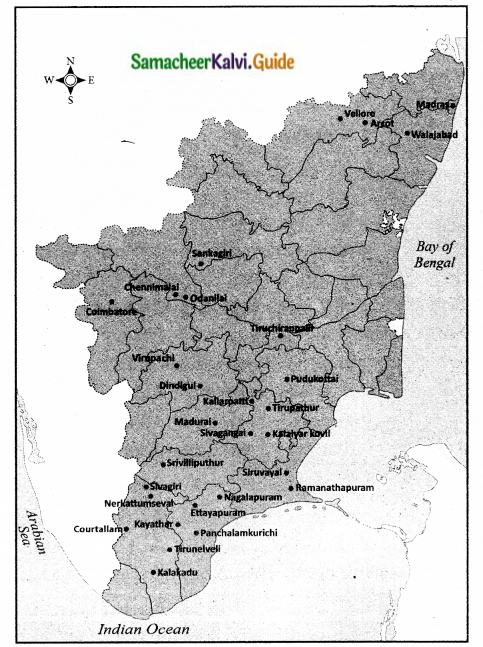
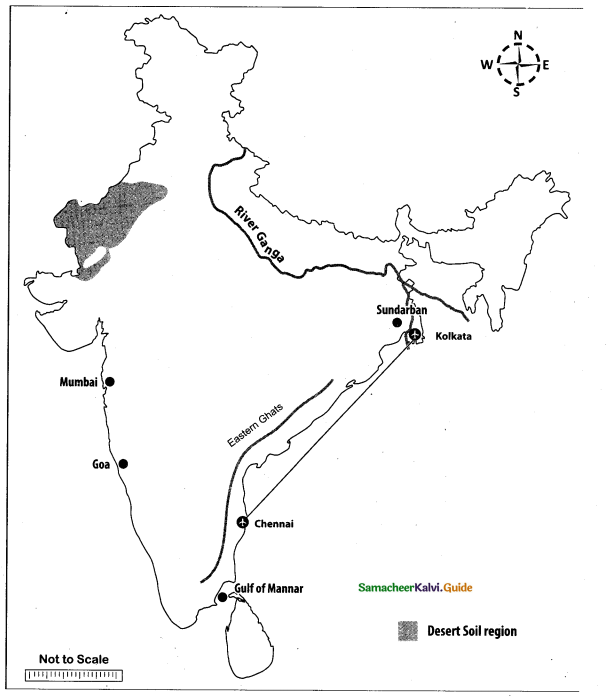
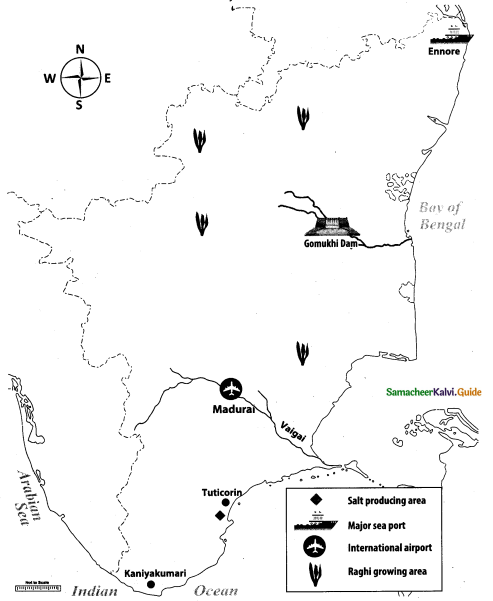
VIII. Map Study

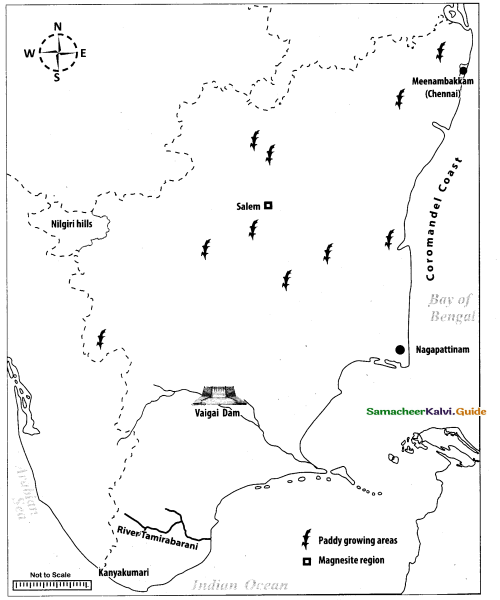
Mark important centres of Early revolts against British Rule in Tamil Nadu.
Samacheer Kalvi 10th Social Science Guide History Chapter 6 Early Revolts against British Rule in Tamil Nadu 4
Map: Centres of Early Revolts against British Rule in Tamil Nadu

Samacheer Kalvi 10th Science Model Question Papers 2020-2021 English Tamil Medium Tamil Nadu

Subject Matter Experts at SamacheerKalvi.Guide have created Tamil Nadu State Board New Syllabus Samacheer Kalvi 10th Science Model Question Papers 2020-2021 Pdf Free Download in English Medium and Tamil Medium of TN SSLC Class 10th Science Model Question Papers, Previous Year Question Papers, Sample Papers are part of Samacheer Kalvi 10th Model Question Papers 2021 Tamilnadu.

Let us look at these Government of TN State Board Samacheer Kalvi 10th Std Science Model Question Papers with Answers 2020-21 Tamil Medium Pdf. Students can view or download the Samacheer Kalvi Class 10th Science New Model Question Papers 2021 Tamil Nadu English Medium Pdf for their upcoming TN SSLC board examinations. Students can also read Tamilnadu Samacheer Kalvi 10th Science Guide.

Tamil Nadu Samacheer Kalvi 10th Science Model Question Papers 2020 2021 Tamil English Medium

Tamil Nadu Samacheer Kalvi 10th Science Model Question Papers English Medium

Tamil Nadu Samacheer Kalvi 10th Science Model Question Papers Tamil Medium

  • Samacheer Kalvi 10th Science Model Question Paper 1
  • Samacheer Kalvi 10th Science Model Question Paper 2
  • Samacheer Kalvi 10th Science Model Question Paper 3
  • Samacheer Kalvi 10th Science Model Question Paper 4
  • Samacheer Kalvi 10th Science Model Question Paper 5

Samacheer Kalvi 10th Science Model Question Paper Design 2020-2021 Tamil Nadu
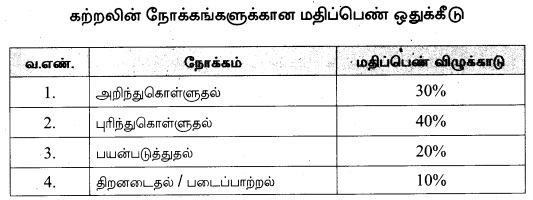
Types of Questions Marks No. of Questions to be Answered Total Marks
Part-I
Multiple Choice Questions
1 12 12
Part-II
(Totally 9 questions will be given. Answer any Seven. Any one question should be answered compulsorily)
2 7 14
Part-Ill
(Totally 9 questions will be given. Answer any Seven. Any one question should be answered compulsorily)
4 7 28
Part-IV 7 3 21
Total Marks 75

Samacheer Kalvi 10th Science Model Question Paper Weightage of Marks

Purpose Weightage
1. Knowledge 30%
2. Understanding 40%
3. Application 20%
4. Skill/Creativity 10%

It is necessary that students will understand the new pattern and style of Tamil Nadu Samacheer Kalvi 10th Science Model Question Papers 2021 according to the latest exam pattern. These State Board 10th Standard Science Public Exam Model Question Papers 2020-21 Tamil Nadu in Tamil Medium and English Medium are useful to understand the pattern of questions asked in the board exam. Know about the important concepts to be prepared for TN SSLC Board Exams and Score More marks.

We hope the given Tamil Nadu State Board New Syllabus Samacheer Kalvi Class 10th Science Model Question Papers 2020 2021 Pdf Free Download in English Medium and Tamil Medium will help you get through your subjective questions in the exam.

Let us know if you have any concerns regarding the Government of TN State Board Samacheer Kalvi SSLC 10th Standard Science Model Question Papers with Answers 2020 21, Sample Papers, Previous Year Question Papers, drop a comment below and we will get back to you as soon as possible.

Samacheer Kalvi 10th Social Science Model Question Paper 1 English Medium

Students can Download Samacheer Kalvi 10th Social Science Model Question Paper 1 English Medium Pdf, Samacheer Kalvi 10th Social Science Model Question Papers helps you to revise the complete Tamilnadu State Board New Syllabus, helps students complete homework assignments and to score high marks in board exams.

Tamil Nadu Samacheer Kalvi 10th Social Science Model Question Paper 1 English Medium

General Instructions:

  1. The question paper comprises of four parts
  2. You are to attempt all the questions in each part. An internal choice of questions is provided wherever applicable.
  3. All questions of Part I, II, III, and IV are to be attempted separately.
  4. Question numbers 1 to 14 in Part I are Multiple Choice Questions of one mark each.
    These are to be answered by writing the correct answer along with the corresponding option code and the corresponding answer
  5. Question numbers 15 to 28 in Part II are of two marks each. Any one question should be answered compulsorily.
  6. Question numbers 29 to 42 in Part III are of five marks each. Any one question should be answered compulsorily.
  7. Question numbers 43 to 44 in Part IV are of Eight marks each. Draw diagrams wherever necessary.

Time: 3 Hours
Maximum Marks: 100

Part – I

Answer all the questions. Choose the correct answer [14 × 1 = 14]

Question 1.
Which country after the World War I took to a policy of isolations?
(a) Britain
(b) France
(c) Germany
(d) USA
Answer:
(a) Britain

Question 2.
Name the president who made amendment to Monroe Doctrine to justify American intervention in the affairs of Latin America.
(a) Theodore Roosevelt
(b) Truman
(c) Eisenhower
(d) Woodrow Wilson
Answer:
(a) Theodore Roosevelt

Samacheer Kalvi 10th Social Science Model Question Paper 1 English Medium

Question 3.
Who became the Chairman of the PLO’s Executive Committee in 1969?
(a) 1975
(b) 1976
(c) 1973
(d) 1974
Answer:
(b) 1976

Question 4.
When did the Partition of Bengal come into effect?
(a) 19 June 1905
(b) 18 July 1906
(c) 19 August 1907
(d) 16 October 1905
Answer:
(d) 16 October 1905

Question 5.
On 8th January 1933 which day was observed ………………….
(a) Temple Entry Day
(b) Day of Deliverance
(c) Direct Action Day
(d) Independence Day
Answer:
(a) Temple Entry Day

Question 6.
Deccan Plateau covers an area of about …………………. sq. km.
(a) 8 lakhs
(b) 6 lakhs
(c) 5 lakhs
(d) 7 lakhs
Answer:
(d) 7 lakhs

Question 7.
…………………. is a line joining the places of equal rainfall.
(a) Isohyets
(b) Isobar
(c) Isotherm
(d) Latitudes
Answer:
(a) Isohyets

Question 8.
The state which leads in the production of coffee is ………………….
(a) West Bengal
(b) Karnataka
(c) Odisha
(d) Punjab
Answer:
(b) Karnataka

Samacheer Kalvi 10th Social Science Model Question Paper 1 English Medium

Question 9.
The district which has the largest forest cover in Tamil Nadu is ………………….
(a) Dharmapuri
(b) Vellore
(c) Dindugal
(d) Erode
Answer:
(a) Dharmapuri

Question 10.
…………………. Plains are formed by the older alluviums.
(a) Bhabar
(b) Tarai
(c) Bhangar
(d) Khadar
Answer:
(c) Bhangar

Question 11.
The Directive Principles can be classified into ………………….
(a) Liberal and Communist principles
(b) Socialist and Communist principles
(c) Liberal, Gandhian and Communist principles
(d) Socialist, Gandhian and Liberal principles
Answer:
(d) Socialist, Gandhian and Liberal principles

Question 12.
Non-Alliance means ………………….
(a) being neutral
(b) freedom to decide on issues independently
(e) demi I itari sat ion
(d) None of the above
Answer:
(b) freedom to decide on issues independently

Question 13.
Tamil Nadu Health System Projects has launched …………………. service at free of cost.
(a) 106 ambulance
(b) 108 ambulance
(c) 107 ambulance
(d) 105 ambulance
Answer:
(b) 108 ambulance

Question 14.
India economy is ………………….
(a) Developing Economy
(b) Emerging Economy
(c) Dual Economy
(d) All the above
Answer:
(d) All the above

Samacheer Kalvi 10th Social Science Model Question Paper 1 English Medium

Part – II

Answer any 10 questions. Question No. 28 is compulsory. [10 × 2 = 20]

Question 15.
What was the impact of Swami Vivekananda’s activist ideology?
Answer:

  • Vivekananda’s activist ideology related to the desire for political change among many ‘ western eductated young Bengalis.
  • Many of the youths, who were involved in the militant nationalist struggle during the Swadeshi Movement, following the Partition of Bengal, were inspired by Vivekananda.

Question 16.
What are the objectives of IMF?
Answer:
The objectives of the IMF are to:

  • Foster global monetary cooperation,
  • Secure financial stability,
  • Facilitate international trade,
  • Promote high employment and sustainable economic growth, and
  • Reduce poverty around the world.

Question 17.
What was the bone of contention between the Company and Kattabomman?
Answer:
The company appointed its collectors to collect taxes from all the palayams. The collectors humiliated the Palayakkarars and adopted force to collect the taxes. This was the bone of contention between the English and Kattabomman.

Question 18.
Describe the Jallianwala Bagh Massacre.
Answer:
1. On 13 April 1919, a public meeting was organised at Jallianwala Bagh in Amritsar in defiance of the Rowlatt Act. As it happened to be Baisaki Day, thousands of villagers had gathered there to enjoy the day together.

2. General Reginald Dyer, on hearing the assemblage, surrounded the place with his troops and an armoured vehicle. He blocked the only entrance to the park and ordered his troops to fire without any warning.

3. The firing continued for ten minutes in which about 370 were killed and more than thousand injured. However, an unofficial estimates put the death toll at more than thousand. The Jallianwala Bagh massacre is a big scar on the British Indian history.

Question 19.
What is meant by ‘normal lapse rate’?
Answer:
Temperature decreases at the rate of 6.5°C for every 1000 metres of ascent. It is called normal lapse rate.

Question 20.
Define soil.
Answer:
Soil is the uppermost layer of the land surface, usually composed of minerals, organic matter, living organisms, air and water. Its formation is mainly related to the parent rock material, surface relief, climate and natural vegetation.

Samacheer Kalvi 10th Social Science Model Question Paper 1 English Medium

Question 21.
Mention the major areas of Jute production in India.
Answer:
West Bengal, Andhra pradesh, Bihar, Uttar Pradesh, Assam, Chattisgarh, Odisha are the major jute producing area.

Question 22.
What are the classical languages in India?
Answer:
There are six classical languages namely – Tamil, Sanskrit, Telugu, Kannada, Malayalam and Odia.

Question 23.
Write a short note on Strategic partnership Agreement (SPA).
Answer:
Indo-Afghan relation was strengthened by the Strategic Partnership Agreement (SPA). SPA provides assistance to re-build Afghan’s infrastructure, institutions, agriculture, water, education, health and providing duty-free access to the Indian market.

Question 24.
What is Fair trade ?
Answer:

  • Fair trade is an industrial arrangement designed to help producers in developing countries achieve better trading conditions.
  • Fair trade is about better prices, decent working conditions and fair terms of trade for farmers and workers.

Question 25.
Name the sectors contribute to the GDP with example.
Answer:
Name of the sectors are :

  • Primary sector
  • Secondary sector and
  • Tertiary sector.

Question 26.
Write any five principles of Fair Trade Practices.
Answer:
Five principles of Fair trade practices:

  • Creating opportunities for economically disadvantaged producers.
  • Transforming and accountability.
  • Fair trading practices and payment of fair price.
  • Ensuring no child labour and forced labour.
  • Respect for the environment.

Question 27.
What is Entrepreneurship?
Answer:
Entrepreneurship is a process of an action of an entrepreneur who undertakes to establish his entreprise. It is the ability to create and build something.

Question 28.
During cyclone, how does the Meterological department warn the fishermen?
Answer:
1. During disturbed weather over the seas, the ports likely to be affected are warned by concerned ACWCs / CWCs by advising the port authorities through port warnings to hoist appropriate Storm Warning Signals. The Department also issue “Fleet forecast” for Indian Navy.

2. Coastal Bulletins for Indian coastal areas covering up to 75 km from the coast line and sea area bulletins for the sea areas beyond 75 km. The special warnings are issued for fishermen four times a day in normal weather and every three hourly in accordance with the four stage warning in case of disturbed weather.

3. The general public, the coastal residents and fishermen are warned through state government officials and broadcast of warnings through All India Radio and National Television telecast programmes in national and regional hook up. A sytem of warning dissemination for fishermen through World Space Digital Based radio receiver is being planned.

Samacheer Kalvi 10th Social Science Model Question Paper 1 English Medium

Part – III

Answer any 10 questions. Question No. 42 is compulsory. [10 × 5 = 50]

Question 26.
Fill in the blanks:
(i) Germany joined the NATO in ………………….
(ii) The plateau which his between the Nilgiris and Dharmapuri district is ………………….
(iii) At present our foreign policy acts as a means to generate ………………….for domestic growth
and development.
(iv) ………………….foundation from USA introduced HYV in India.
(v) Agriculture of Tamil Nadu constitutes ………………….economy.
Answers:
(i) 1955
(ii) Bharamahal
(iii) inward investment
(iv) FORD
(v) 21%

Question 30.
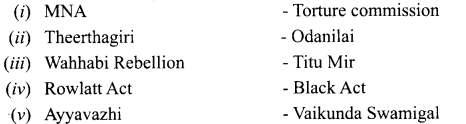
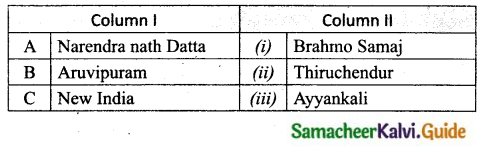
Match the following:
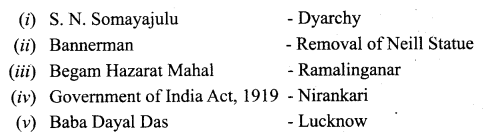
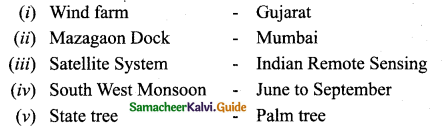
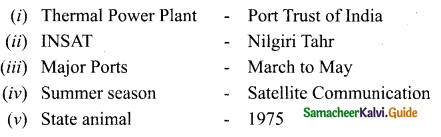
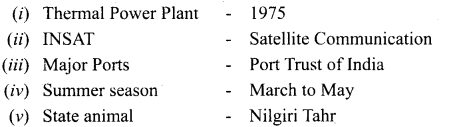
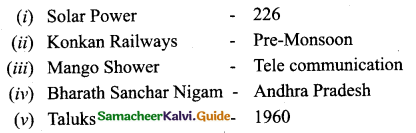
Samacheer Kalvi 10th Social Science Model Question Paper 1 English Medium - 1
Answers:
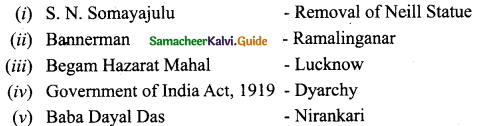
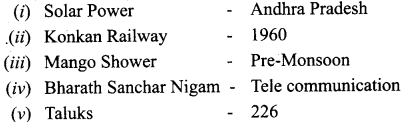
Samacheer Kalvi 10th Social Science Model Question Paper 1 English Medium - 2

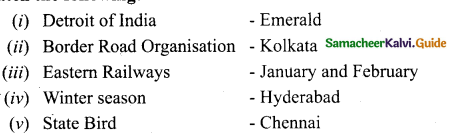
Question 31.
Match the following:
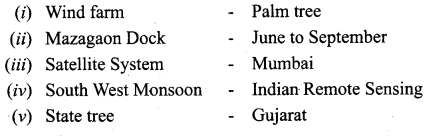
Samacheer Kalvi 10th Social Science Model Question Paper 1 English Medium - 3
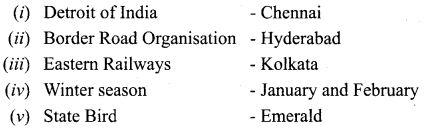
Answers:
Samacheer Kalvi 10th Social Science Model Question Paper 1 English Medium - 4
Question 32.
(a) Distinguish between
(i) Western Ghats and Eastern Ghats
(ii) Tropical Evergreen forest and Deciduous forest
Answer:
(a) (i) Western Ghats and Eastern Ghats:

Western Ghats :

  1. They run parallel to the western coast and form the western boundary of the Deccan Plateau
  2. They are continuous and can be crossed only through the passes like Pal Ghat, Thai Ghat, Bhor Ghat.
  3. The highest peak of this region is Anaimudi with a height of 2,659 m.
  4. These Ghats are higher and their average height is 900 – 1600 meters
  5. They face the rain bearing winds and cause orographic rainfall.

Eastern Ghats :

  1. They run parallel to the eastern coast and form the eastern boundary of the Deccan Plateau
  2. These are more discontinuous and irregular.
  3. The highest peak of this region is Mahendragiri with a height of 1,051 m.
  4. These Ghats are lower than the western ghats with an average height of about 600 meters
  5. It is almost parallel to monsoon winds originating from the Bay of Bengal and does not cause much rainfall.

(ii) Tropical Evergreen forest and Deciduous forest:

Tropical Evergreen forest :

  1. These forests are located in regions of heavy rainfall more their 200 cm of rainfall.
  2. The trees in these forests are evergreen.
  3. These forest are very dense and composed of tall trees reaching up to the height of above 60 metres.
  4. The important trees of these forests are Rosewood, Ebony, Mahogany,and . Chinchona, Bamboo and Lianas.

Deciduous forest :

  1. These forests are located in regions of rainfall between 70-200 cm.
  2. The trees in the deciduous forests shed their leaves due to dryness during the spring and early summer.
  3. The tropical deciduous forests are commercially important as they yeild valuable timber and other forest products.
  4. The main trees of these forests are Teak, Sal, Sisam, Sandalwood, Wattle and Neem.

(b) Give reason: The great Indian desert is called Marusthali.
Answer:
The Thar desert, also known as the Great Indian desert is a large arid region in the north western part of the Indian Subcontinent that covers an area of 2,00,000 Km2 and forms a natural boundary between India and Pakistan.

Marusthali means sand-dune. It covered eastern portion of the Great Indian Thar Desert in Western Rajasthan. It extends over about 24,000 square miles north of the Luni River.

Samacheer Kalvi 10th Social Science Model Question Paper 1 English Medium

Question 33.
Estimate the role of Mao Tse tung in making China a communist country.
Answer:
1. Mao was greatly influenced by the ideas of Max and Lenin. He wanted to make China a communist country. So, he became active in the political activities of Hunan from the year 1912.

2.  After the death of Sun Yat-Sen in 1925, The Kuomintang was organised under the leadership of Chang Kai-Shek. Being an avowed critic of communists, Chiang removed all the important position holders in the Communist Party including Mao Tse Tung to weaken the party. However, the communists continued to influence the workers and peasants the Kuomintang represented the interests of landlords and capitalists.

3. Mao had understood that the Kuomintang grip on the towns was too strong. So, he started organising the peasantry. When the relationships between Kuomintang and Communist Party broke, a few hundred Communist led by Mao retreated into the wild mountains on the border between the provinces of Kiangsi and Hunan. The Kuomintang could not penetrate the mountains.

4.  Meanwhile, the campaign against the communists got distracted as Chiang Kai-Shek had to deal with the constant threat from Japan.

5. By 1933 Mao had gained full control of the Chinese Communist Party. In 1934, he set out on a long march with the help of about 100,000 communist army. He also got support of other communist armies.

6. By 1937, Mao had become the leader of over 10 million people. He organised workers and peasants councils in villages of Shensi and Kansu and finally got success in making China a communist country.

Question 34.
Describe the background for the formation of the Justice party and point out its contribution to the cause of social justice.
Answer:
1. It was the period of World War I. The British government thought to introduce representative institutions for Indians after the war. Fearing that such political reforms would further strengthen the political power of Brahmins, educated non-Brahmins decided to organise themselves politically.

2. So, in 1916, some prominent non-Brahmin leaders came together from South Indian Liberation Federation (SILF). It later came to be known as the Justice Party. It was a political party in the Madras Presidency of British India.

Contribution of the Justice Party to the cause-social justice:

  • The Justice Party government widened education and employment opportunities for the majority of the population and created space for them in the political sphere.
  • The Justices removed the legal hindrances restricting inter-caste marriages and broke the barriers that prevented Adi Dravidars from the use of public wells and tanks.
  • In 1921, the Madras legislature under the Justice Party government was the first to approve participators of women in the electoral politics.

Question 35.
Explain the divisions of Northern Mountains and its importance to India.
Answer:

  • The Himalayas geologically young and structurally fold mountains stretch over the northern borders of India.
  • The Himalayas represent the loftiest and one of the most rugged mountain harries of the world.
  • The mountain ranges run in a west-east direction from the India to the Brahmaputra.
  • They form an arc, which covers a distance of about 2,400 km. Their width varies from 1,400 km in Kashmir to 150 km in Arunachal Pradesh.

Division of Himalayas:

1. Himadri or Inner Himalayas:

  • The Northern most range is known as the Great or Inner Himalayas or the “Himadri”.
  • It is the most continuous range consisting of the loftiest peaks with an average height of 6,000 metres.
  • It contains all the prominent Himalayan peaks.
  • The core of this past of Himalayas is composed of granite.
  • It is perennially snow bound, and a number of glaciers descend from this range.

2. Himachal or Lesser Himalayas:

  • Below Himadri is the most rugged mountain system and is know as Himachal or lesser Himalaya.
  • They range are mainly composed of highly compressed and altered rocks.
  • The altitude varies between 3,700 and 4,500 metres and the average width is of 50 km.
  • While the Pir Pangal range forms the longest and the most important range. The Dhaula Dhar and the Mahabharat ranges are also prominent ones.
  • This range consists of the famous valley of Kashmir, the Kangra and Kullu valley in Himachal Pradesh.
  • This region is well known for its hill stations.

3. Siwaliks:
The outermost range of the Himalayas is called the Siwaliks.

  • They extend over a width of 10 – 50 km and have an altitude varying between 900 and 1100 metres.
  • These range are composed of unconsolidated sediments brought down by rivers from the main Himalayan ranges located further north.
  • These valleys are covered with thick gravel and alluvium.
  • The longitudinal valley lying between lesser Himalayas and the Siwaliks are known as Duns. Dehra Dun, Kofli Dun and Pati Dun are some of the well-known Duns.

Importance of Himalayas:

  • Himalayas blocks southwest monsoon winds and cause heavy rainfall to north India.
  • It forms a natural barrier to the Sub-continent.
  • It is the source for many perennial rivers like Indus, Ganges, Brahmaputra etc.
  • The Northern Mountains are described as paradise of tourists due to its natural beauty.
  • Many hill stations and pilgrim centres like Amarnath, Kedarnath, Badrinath and Vaishnavidevi temples situated here.
  • It provides raw materials for many forest based industries.
  • It prevents the cold winds blowing from the central Asia and protects India from severe cold.
  • Himalayas renowned for the rich biodiversity.

Samacheer Kalvi 10th Social Science Model Question Paper 1 English Medium

Question 36.
Explain the factors responsible for the concentration of jute industries in the hooghly region.
Most of the Jute mills of India are centralised in “Hooghly Basin” of the West Bengal. The factors responsible for the concentration of Jute industry in Hooghly Basin region are:

  • Ganga, Brahmaputra delta regions grow about 90% of India’s Jute and provides raw materials in jute mills.
  • Coal for power is obtained from Raniganj coalfields.
  • Hooghly River provides cheap water transport and soft water for washing, processing, retting and dyeing jute.
  • Humid climate is favourable for spinning and weaving.
  • Cheap labour is available from West Bengal, Bihar and Uttar Pradesh.
  • Conductive port facility of Kolkata for export and import at Kolkata.
  • In addition to West Bengal, Jute mills are also located in Andhra pradesh, Uttar pradesh, Bihar, Madhya Pradesh and Odisha.
  • India exports jute products to Australia, U.K, Thailand, U.S.A, Canada, Argentina, East Africa, New Zealand and Indonesia.

Question 37.
Mention the differences between Fundamental Rights and Directive Principles of State Policy.
Answer:
Here are the differences between Fundamental Rights and Directive Principles of State Policy.
S.No. Fundamental Rights Directive Principles of State Policy

  1. It was derived from the Constitution of the USA.
  2. These Rights cannot be taken away even by the Government.
  3. These Rights are enforceable by a Court of Law.
  4. These have legal sanctions.
  5. These rights strengthen political democracy in the country.
  6. These are natural rights.

Directive Principles of State Policy :

  1. It was drawn on the model of the Constitution of Ireland
  2. These are mere instructions to the Government.
  3. These are not enforceable in any court.
  4. These have moral and political sanctions.
  5. The implementation of these principles ensures social and economic democracy.
  6. These lead to protect human rights.

Question 38.
Elucidate why the Green Revolution was born.
Answer:

  • The Green Revolution was bom in the country paving way for self-sufficiency in food grain production.
  • Increased food grain production was made possible by an increase area cultivated with HYV of rice and wheat as also an increase in the yield of these major cereal crops.
  • Area under food grains was a little more than 98 million hectares during early 1950s. The country was producing just 54 million tonnes of food grains then with an average yield of food grains of 547 kg per hectare.
  • The food situation has steadily improved over a period of 65 years. Area under food grain ‘ cultivation has grown to 122 million hectares, with an increase of five-fold increase in
    food grain production.
  • Yield of food grains has increased four-fold between the time of independence and at present.

Question 39.
Discuss the core determinants of India’s foreign policy?
Answer:
Basic Determinants of a Foreign Policy:

  • Geographical position and size of territory
  • Nation’s history, traditions and philosophical basis
  • Natural resources
  • The compulsion of economic development
  • Political stability and structure of government ‘
  • The necessity of peace, disarmament and non-proliferation of nuclear weapons
  • Military strength
  • International milieu

Question 40.
Describe the powers and functions of the High Court.
Answer:
The powers and functions of the High Court:

  • The High Court enjoys original jurisdiction in matters of admiralty, probate, matrimonial and contempt of court.
  • It hears appeals in both civil and criminal cases against the decisions of the subordinate courts and can review their judgments.
  • It can issue writs such as habeas corpus, mandamus, prohibition, quo warranto and certiorari not only for the enforcement of the Fundamental Rights but also for other purposes.
  • It has the power of supervision over all courts and tribunals functioning in its territorial jurisdiction (except military courts or tribunals).
  • It controls and supervises the working of the lower courts and maintains records of its proceedings and decisions.

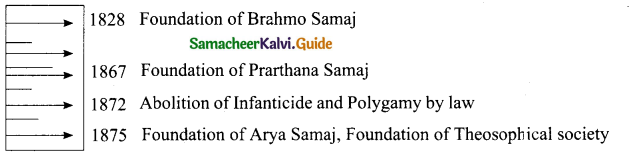
Question 41.
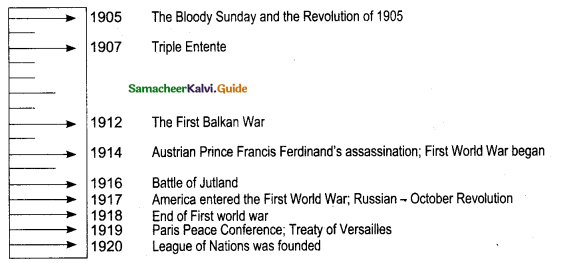
Draw a time line for the following:
Write any five important events between 1828-1875
Answer:
Samacheer Kalvi 10th Social Science Model Question Paper 1 English Medium - 5

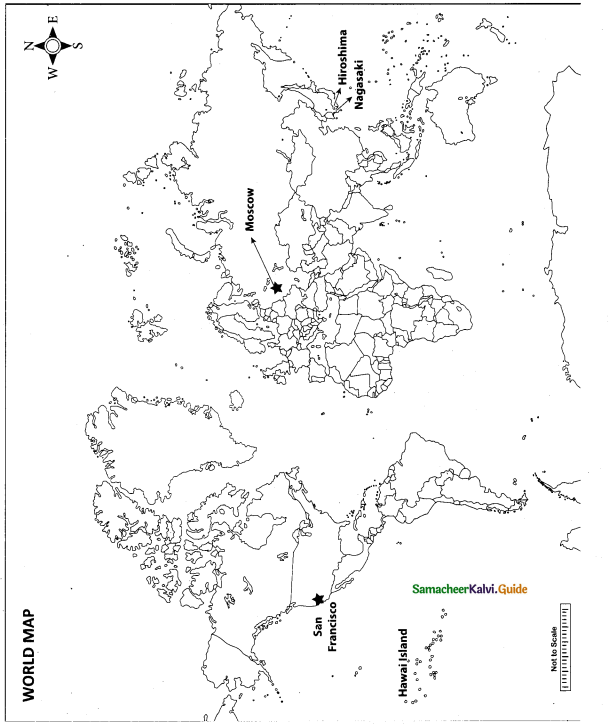
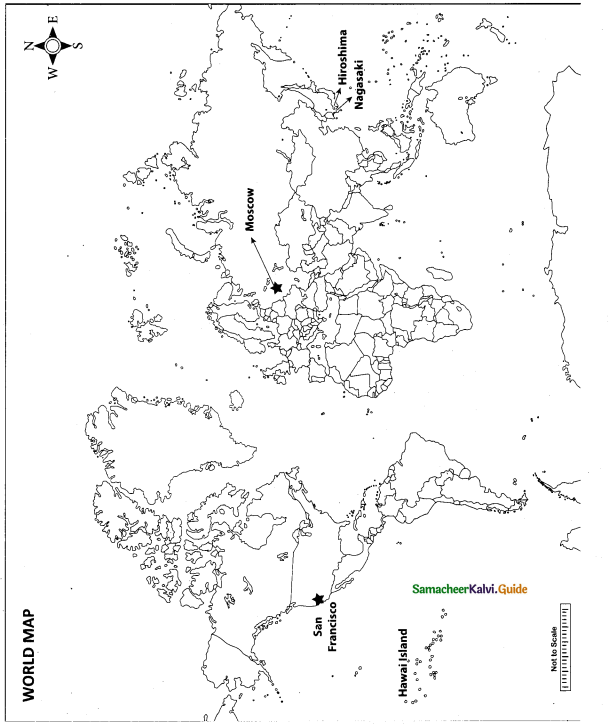
Question 42.
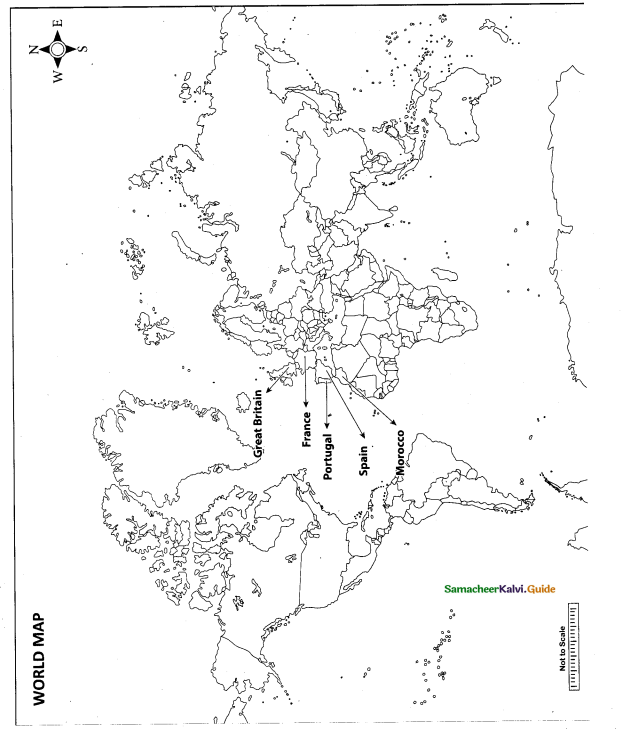
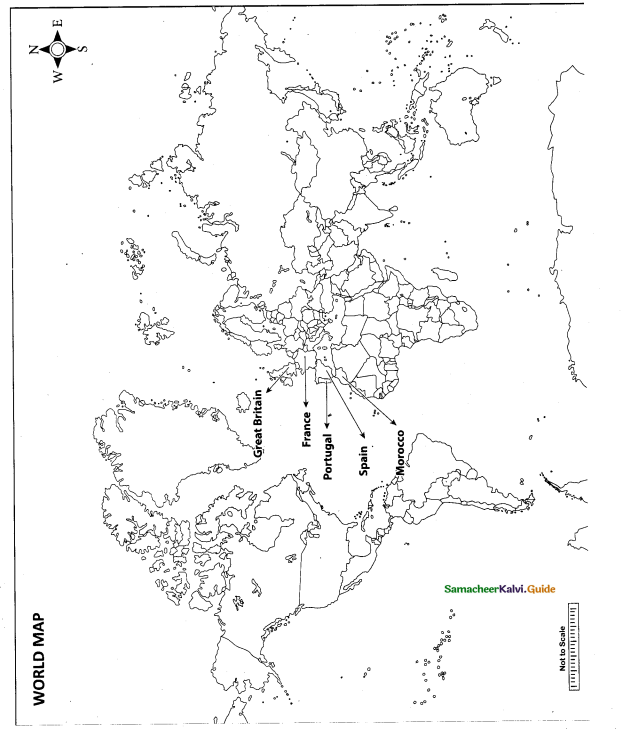
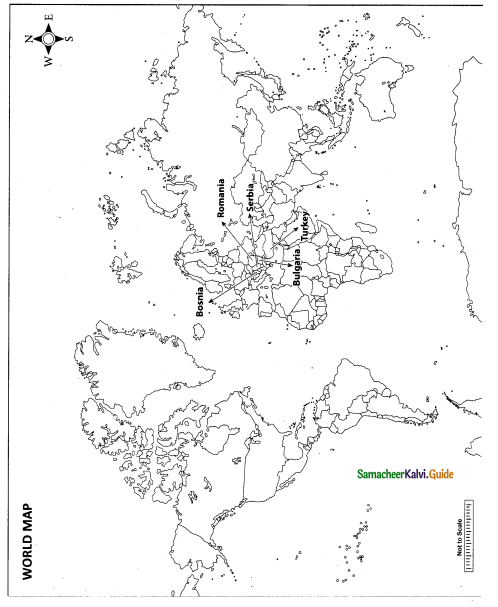
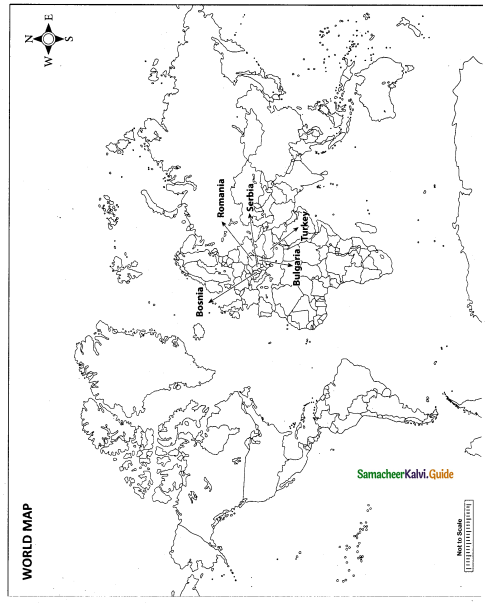
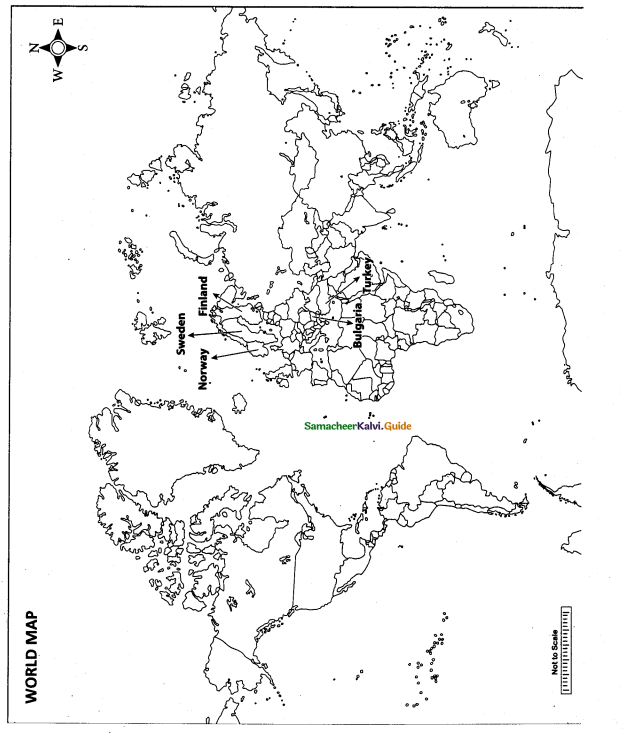
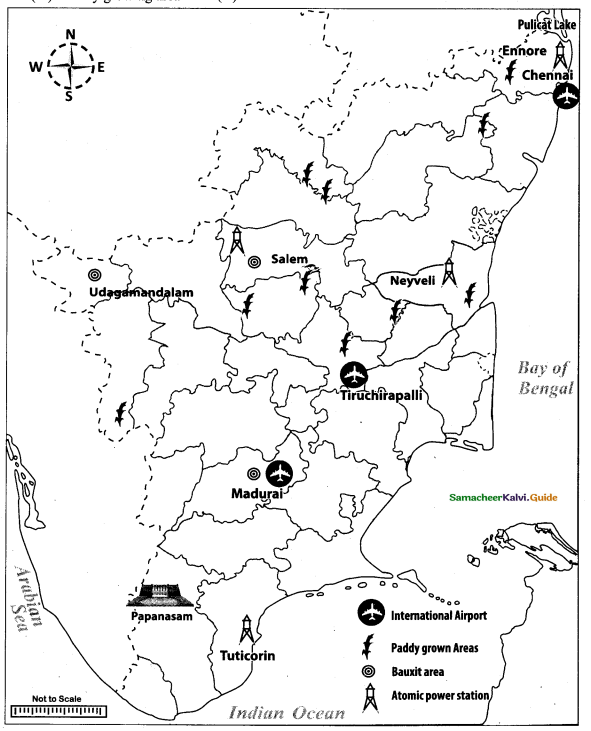
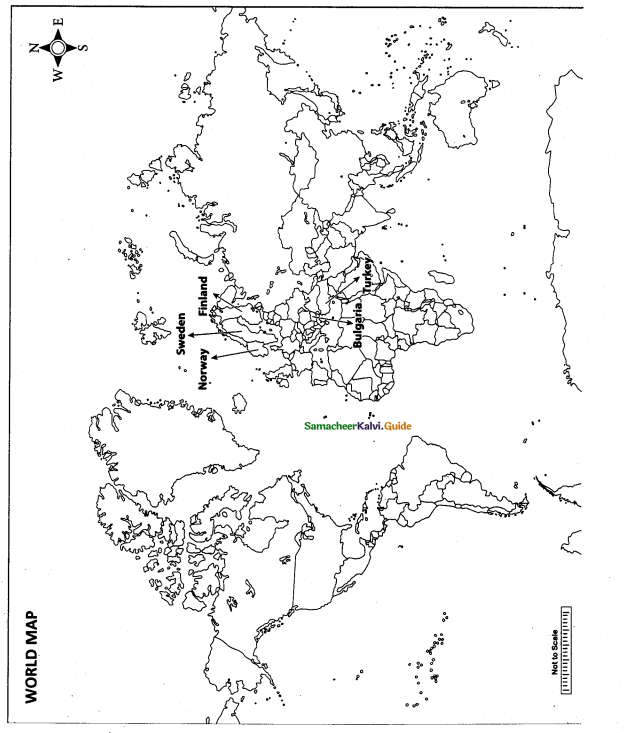
Mark the following places on the world map.
(i) San Fransico
(ii) Hawai Island
(iii) Hiroshima
(iv) Moscow
(v) Nagasaki
Answer:
Samacheer Kalvi 10th Social Science Model Question Paper 1 English Medium - 6

Samacheer Kalvi 10th Social Science Model Question Paper 1 English Medium

Part – IV

Answer both questions. [2 × 8 = 16]

Question 43.
(a) Imperialism
(i) What do you know of monopoly capitalism?
(ii) How did Japan emerge as an imperial power?
(iii) Why did the industrial countries need colonies in the nineteenth century?
(iv) What were the contrasts capitalism produced?
Answer:
(a) Imperialism
(i) Monopoly capitalism is a capitalist system typified by tread monopolies in the hands of a few people. After 1870, the capitalism of free competition (based on the principle of free trade without any control or regulation by the state) became the capitalism of monopolies.

(ii) Japan took to Western education and machinery with a modem army and navy had emerged as an advanced industrialised power. It also followed the imperialistic aggression policy of the European powers faithfully. It surprised the world by giving a crushing defeat to China in the Sino-Japanese War during the period of 1894-95. Japan also defeated Russia in Russo- Japanese War in 1904 and got back Port Arthur from it. In this way it emerged as an imperial power.

(iii) An ever-growing demand for markets and raw materials made the industrial countries hungry for colonies in the nineteenth century.

(iv) Capitalism produced huge contrasts. Those contrasts were: extreme poverty and extreme wealth, slum and skyscraper, empire-state and dependent exploited colony.

(b) Non-Aligned Movement (NAM)
(i) When and where was the first conference on Non-Aligned Movement held?
(ii) Who were the prominent personalities present in the first conference?
(iii) What were the objectives of NAM?
(iv) List out any two basic principles of Non-Alignment Movement enunciated in the Belgrade Conference.
Answer:
(b) Non-Aligned Movement (NAM)
(i) The first conference on NAM was held at Belgrade in 1961.
(ii) The prominent personalities present in the first conference were Tito (Yugoslavia), Nasser (Egypt), Nehru (India), Nkrumah (Ghana) and Sukarno (Indonesia).
(iii) To fight all forms of colonialism and imperialism.
(iv) Two basic principles of NAM eximiated in the Belgrade conference were:

  • peaceful cooperation, commitment to peace and security
  • no military alliance with any super power.

[OR]

(c) Non-Brahmin Movement
(i) Why was the South Indian Liberal Federation formed?
(ii) What is the Non-Brahmin Manifesto?
(iii) Why did EVR join the Non-Brahmin Movement?
(iv) What do you know about anti-Hindi agitation?
Answer:
(c) Non-Brahmin Movement
(i) The South Indian Liberal Federation was formed to promote the interests of non-Brahmins.

(ii) The Non-Brahmin Manifesto had objectives such as reservation of jobs for non-Brahmins in government service and seats in representative bodies. It opposed the Home Rule Movement and criticised Congress as a party of Brahmins.

(iii) EVR joined the non-Brahmin movement because he felt the Congress was promoting the
interests of Brahmins alone.

(iv) A massive campaign was led by EVR against the introduction of Hindi as a compulsory subject in schools. The anti-Hindi agitation was popular because Hindi was considered a form of Aryan and North Indian imposition. EVR organised an anti-Hindi conference. More than 1200 protesters were arrested at a rally. The subject was later removed after protests.

(d) Maraimalai Adigal
(i) Name the Sangam texts for which Maraimalai Adigal wrote commentaries.
(ii) Name the Journal where he worked as a young man.
(iii) Why did he oppose imposition of Hindi?
(iv) Who were the key influences in Maraimalai Adigal’s life?
Answer:
(d) Maraimalai Adigal
(i) Pattinappalai and Mullaipattu
(ii) Siddhanta Deepika
(iii) Adigal promoted the use of pure Tamil words and removal of the Sanskrit influences from Tamil language. He painted out that Tamil language would suffer with the introduction of Hindi.
(iv) His teachers P. Sundaram Pillai and Somasundara Nayagar were the key influences in Maraimalai Adigal’s life.

Samacheer Kalvi 10th Social Science Model Question Paper 1 English Medium

Question 44.
Mark the following places on the given outline map of India.
(i) Eastern Ghats
(ii) Gulf of Mannar
(iii) Sundarban
(iv) Desert soil region
(v) Mumbai
(vi) Chennai to Kolkata Air route
(vii) Goa
(viii) River Ganga
Answer:
Samacheer Kalvi 10th Social Science Model Question Paper 1 English Medium - 7

[OR]

Mark the following places on the given outline map of Tamil Nadu:
(i) Tuticorin
(ii) Salt region
(iii) Raghi growing area
(iv) Gomukhi dam
(v) Vaigai river
(vi) Kanniyakumari
(vii) One international airport
(viii) One major sea port
Answer:
Samacheer Kalvi 10th Social Science Model Question Paper 1 English Medium – 8

Map for Q. 42
(i) San Francisco
(ii) Hawai Island
(iii) Hiroshima
(iv) Moscow
(v) Nagasaki
Answer:
Samacheer Kalvi 10th Social Science Model Question Paper 1 English Medium - 6

Map for Q. 44
(i) Eastern Ghats
(ii) GulfofMannar
(iii) Sundarban
(iv) Desert soil region
(v) Mumbai
(vi) Chennai to Kolkata Air route
(vii) Goa
(viii) River Ganga
Answer:
Samacheer Kalvi 10th Social Science Model Question Paper 1 English Medium - 7

Map for Q. 44
(I) Tuticorin
(ii) Salt region
(iii) Ragi growing area
(iv) Gomukhi dam
(y) Vaigai river
(vi) Kanniyakumari
(vii) One international airport
(viii) One major sea port
Answer:
Samacheer Kalvi 10th Social Science Model Question Paper 1 English Medium - 8

Samacheer Kalvi 10th Social Science Guide History Chapter 5 Social and Religious Reform Movements in the 19th Century

Students can download 10th Social Science History Chapter 5 Social and Religious Reform Movements in the 19th Century Questions and Answers, Notes, Samacheer Kalvi 10th Social Science Guide Pdf helps you to revise the complete Tamilnadu State Board New Syllabus, helps students complete homework assignments and to score high marks in board exams.

Tamilnadu Samacheer Kalvi 10th Social Science Solutions History Chapter 5 Social and Religious Reform Movements in the 19th Century

Samacheer Kalvi 10th Social Science Social and Religious Reform Movements in the 19th Century Text Book Back Questions and Answers

I. Choose the correct answer

Question 1.
In which year was Sati abolished?
(a) 1827
(b) 1829
(c) 1826
(d) 1921
Answer:
(b) 1829

Question 2.
What was the name of the Samaj founded by Dayanand Saraswati?
(a) Arya Samaj
(b) Brahmo Samaj
(c) Prarthana Samaj
(d) Adi Brahmo Samaj
Answer:
(a) Arya Samaj

Question 3.
Whose campaign and work led to the enactment of Widow Remarriage Reform Act of 1856?
(a) Iswarchandra Vidyasagar
(b) Raja Rammohan Roy
(c) Annie Besant
(d) Jyotiba Phule
Answer:
(a) Iswarchandra Vidyasagar

Samacheer Kalvi 10th Social Science Guide History Chapter 5 Social and Religious Reform Movements in the 19th Century

Question 4.
Whose voice was Rast Goftarl
(a) Parsi Movement
(b) Aligarh Movement
(c) Ramakrishna Mission
(d) Dravida Mahajana Sabha
Answer:
(a) Parsi Movement

Question 5.
Who was the founder of Namdhari Movement?
(a) Baba Dayal Das
(b) Baba Ramsingh
(c) Gurunanak
(d) Jyotiba Phule
Answer:
(b) Baba Ramsingh

Question 6.
Who was Swami Shradhananda?
(a) a disciple of Swami Vivekananda
(b) one who caused a split in the Brahmo Samaj of India
(c) one who caused a split in the Arya Samaj
(d) founder of Samathuva Samajam
Answer:
(c) one who caused a split in the Arya Samaj

Question 7.
Who was the founder of Widow Remarriage Association?
(a) M.G. Ranade
(b) Devendranath Tagore
(c) Jvotiba Phule
(d) Ayvankali
Answer:
(a) M.G. Ranade

Question 8.
Who was the author of the book Satyarthaprakash?
(a) Dayananda Saraswathi
(b) Vaikunda Swamy
(c) Annie Besant
(d) Swami Shradanatha
Answer:
(a) Dayananda Saraswathi

Samacheer Kalvi 10th Social Science Guide History Chapter 5 Social and Religious Reform Movements in the 19th Century

II. Fill in the blanks

  1.  …………….. founded the Samarasa Vedha Sanmarga Sangam.
  2. The founder of Poona Sarvajanik Sabha was ……………..
  3. Satyashodak Samaj was launched by ……………..
  4. Gulumgir was written by ……………..
  5. Satyarthaprakash enumerates the positive principles of ……………..
  6. Ramakrishna Mission was established by ……………..
  7. …………….. was the forerunner of Akali Movement.
  8. …………….. brought tremendous changes in the caste structure in Kerala.
  9. Oru paisa Tamilan was started by ……………..

Answers:

  1. Ramalinga Adigal
  2. M.G.Ranade
  3. Jyothika Phule
  4. Jyothika Phule
  5. Vivekanandha
  6. Singh Sabha
  7. Narayana Guru and Ayyankali
  8. Jyothee Thassar

III. Choose the correct statement

Question 1.
Choose the correct statement:
(i) Raja Rammohan Roy preached monotheism
(ii) He encouraged idolatry
(iii) He published tracts condemning social evils
(iv) Raja Rammohan Roy was supported by Governor General William
(a) (i) is correct
(b) (i) and (ii) are correct
(c) (i),(ii) and (iii) are correct
(d) (i),(iii) and (iv) are correct
Answer:
(d) (i),(iii) and (iv) are correct

Question 2.
Choose the correct statement:
(i) Prarthana Samaj was founded by Dr. Atma Ram Pandurang
(ii) Prarthana Samaj encouraged interdining and inter-caste marriage
(iii) Jyotiba Phule worked for the upliftment of men.
(iv) Prarthana Samaj had it’s origin in the Punjab.
(a) (i) is correct
(b) (ii) is correct
(c) (i) and (ii) are correct
(d) (iii) and (iv) are correct
Answer:
(c) (i) and (ii) are correct

Question 3.
Choose the correct statement:
(i) Ramakrishna Mission was actively involved in social causes such as education, health care, relief in time of calamities.
(ii) Ramakrishna emphasised the spiritual union with god through ecstatic practices.
(iii) Ramakrishna established the Ramakrishna Mission
(iv) Ramakrishna opposed the Partition of Bengal
(a) (i) is correct
(b) (i) and (ii) are correct
(c) (iii) is correct
(d) (iv) alone correct
Answer:
(b) (i) and (ii) are correct

Question 4.
Assertion: Jyotiba Phule opened orphanages and homes for widows Reason: Jyotiba Phule opposed child marriage and supported widow remarriage
(a) Assertion is correct but reason is not apt to the assertion
(b) Assertion is correct and the reason is apt to the assertion
(c) Both are wrong
(d) Reason is correct but assertion is irrelevant
Answer:
(a) Assertion is correct but reason is not apt to the assertion

IV. Match the following

Samacheer Kalvi 10th Social Science Guide History Chapter 5 Social and Religious Reform Movements in the 19th Century 1
Answer:
A. (iv)
B. (v)
C. (ii)
D. (i)
E. (iii)

Samacheer Kalvi 10th Social Science Guide History Chapter 5 Social and Religious Reform Movements in the 19th Century

V. Answer briefly

Question 1.
Mention the four articles of faith laid down by Maharishi Debendranath Tagore?
Answer:
Maharashi Debendranath Tagore laid down the following four articles of faith –

  1. In the beginning, there was nothing. The one Supreme Being alone existed who created the Universe.
  2. He alone is the Good of truth, Infinite Wisdom, Goodness and Power, eternal, omnipresent, the One without second.
  3. Our salvation depends on belief in him and in his worship in this world and the next.
  4. Belief consists in loving him and doing his will.

Question 2.
Discuss Mahadev Govind Ranade’s contribution to social reforms.
Answer:
Ranade was the founder of the Widow Marriage Association, the Poona Sarvajanik Sabha and the Deccan Educational Society.

Question 3.
Assess the role of Ayyankali in fighting for the cause of “untouchables.”
Answer:
Ayyankali brought social tremendous changes especially in caste structure. The discrimination he faced as a child turned him into a leader of an anti-caste movement and who later fought for basic rights including access to public spaces and entry to schools. Ayyankali challenged many caste conventions such as clothing style, he wore clothes associated with upper castes that were prohibited for lower castes.

Question 4.
Write a note on reforms of Ramalinga Adigal.
Answer:
Ramalinga Adigal showed his compassion and mercy on all living beings including plants, This he called as Jeevakarunya. He established in 1865, “Samarasa Suddha Sanmarga Sathya Sanga” which means Society for pure truth in Universal self-hood. He also established a free feeding house for everyone irrespective of caste at Vadalur.

Question 5.
What was the impact of Swami Vivekananda’s activist ideology?
Answer:
Vivekananda’s activist ideology related to the desire for political change among many western eductated young Bengalis. Many of the youths, who were involved in the militant nationalist struggle during the Swadeshi Movement, following the Partition of Bengal, were inspired by Vivekananda.

Samacheer Kalvi 10th Social Science Guide History Chapter 5 Social and Religious Reform Movements in the 19th Century

Question 6.
What are the differences between Reformist Movements and Revival Movements?
Answer:
Reformist movement means a movement to reform (or) bring positive changes in the Social or religious institution of a society.

Revival movement means to give a new life to the social or religious institution of a society which seems to be dying or being diluted.

Question 7.
List the social evils eradicated by Brahmo Samaj.
Answer:
The Brahmo Samaj raised voice against:

  1. Caste system
  2. Dowry
  3. Ill-treatment of women
  4. Polygamy
  5. Infanticide

Question 8.
Highlight the work done by -Jyotiba Phule for the welfare of the poor and the marginalized.
Answer:
Jyotiba Phule opened orphanages and homes for widows. He opened the first school for untouchables in 1852 in Poona. He opposed child marriage and supported widow remarriage.

Question 9.
What was the impact of IyotheeThassar’s visit to SriLanka?
Answer:
Jyothee Thassar went to Sri Lanka in 1898 and converted into Buddhism. In the same year, he founded the Sakya Buddhist Society at Madras to construct the rational religious philosophy through Buddhist religion. He argued that the so-called untouchables were orginally Buddhists who were sligmatised by Brahminism. He stated that the revival of Buddhism could leberate the people from the evil of caste practice that afflicted the Hindu society.

VI. Answer all the questions given under each caption

Question 1.
Aligarh Movement

(i) What is the main aim of this Movement?
Answer:
The main aim of this movement, was to improve the community of Muslims by giving them education, especially is western education and take up government services.

(ii) Who is considered the soul-of this Movement?
Answer:
Sir Sayyid Ahmed Khan is considered the soul of this movement

(iii) Why were English books translated into Urudu?
Answer:
English books were translated into Urdu. So that the interest of the Muslims would be best served if it is in Urdu and to concentrate on it.

(iv) Name the college which was later raised to the status of a University?
Answer:
The college was raised to the status of a University in 1920 was Aligarh Mohammedan Anglo-Oriental college.

Question 2.
Ramalinga Adigal

(i) What is Jeevakarunya?
Answer:
It is showing compassion and mercy on all living beings including plants.

(ii) What are the Songs of Grace?
Answer:
His voluminous songs that were compiled and published under the title Thiruvarupta are called Songs of Grace.

(iii) Point out the major contribution of Samarasa Vedha Sanmarga Sathya Sangam?
Answer:
‘Samarasa Vedha Sanmarga Sathya Sangam’ means ‘Society for Pure Truth in Universal self-hood.

(iv) Where did he establish his free feeding house?
Answer:
He established a free feeding houses for everyone irrespective of caste at Vadalur.

Samacheer Kalvi 10th Social Science Guide History Chapter 5 Social and Religious Reform Movements in the 19th Century

Question 3.
Deoband Movement

(i) Who were the organizers of this Movement?
Answer:
The organizers of Deoband movement was the orthodox Muslim Ulema.

(ii) What were the two main objectives of the Movement?
Answer:
(a) The twin objective of this movement were propagating the pure teaching of the Quran and the Hadith.
(b) Encouraging the spirit of Jihad against the foreign and the un- islamic elements.

(iii) Who founded the school at Deoband?
Answer:
The Ulema under the leadership of Muhammad QasimWanotavi and Rashid Ahamad Gangotri founded the school at Deoband in U.R

(iv) Against whom the fatwa was issued by Deoband Ulema?
Answer:
The Deoband Ulema issued a religious decree (Fatwa) against Syed Ahmed Khan’s organisation called the United Patriotic Association and The Muhammaden Anglo-Oriental Association.

VII. Answer in detail

Question 1.
Compare and contrast the contributions of Revivalist Movements with that of Reform Movements.
Answer:
The Indian reformists were quite hesitant to subject their old notions and habits to critical scrutiny. Instead they attempted to harmonise both Indian and Western cultures. However, their ideas and their actions helped to mitigate social evils such as sati, female infanticide, and child marriage, and all kinds of superstitious religious beliefs. Reformist movements like the Brahmo Samaj, the Prathana Samaj and the Aligarh Movement. These movements brought considerable reforms in the contemporary society.

Revivalist movements tended to revive former customs or practices and thus take the society back to the glorious past. The Deoband Movement was a revivalist movement, organised by the orthodox Muslim Ulimas other such movements included the Arya Samaj, the Ramakrishna Mission.

Samacheer Kalvi 10th Social Science Guide History Chapter 5 Social and Religious Reform Movements in the 19th Century

Question 2.
Discuss the circumstances that led to the Reform movements of 19th century.
Answer:

  1. Introduction of English Education made the Indians think that the British aim is to produce English educated middle class clerks.
  2. The People came under the influence of Western ideas and thoughts.
  3. The Propaganda of Christianity in India which served Britains imperial interests.
  4. Many Indian scholars such as Raja Ram Mohan Roy, Keshab Chandra Sen contributed to bring a change in the social institutions of the country.
  5. The Reformists were deeply concerned with the existed social evils like sati, child marriage and Polygamy.
  6. Following the organisational structure of Christian missionaries, Indian reformers wanted to establish reform movements.
  7. All over India, there set to begin a social awakening on the eradication of terrible caste tyranny.
  8. The reformers strived hard to bring back the glorious past of India.

Question 3.
Evaluate the contributions of Ramakrishna Paramahamsa and Swami Vivekananda to regenerate Indian society.
Answer:
Ramakrishna Paramhamsa and Vivekananda have played a big role in regenerating the Indian society.

Ramakrishna Paramhamsa: He was a simple priest of Dakshineshwar near Calcutta. He gained popularity in the latter half of the nineteenth century. He emphasised the spiritual union with god through ecstatic practices such as singing bhagan. He was an ardent worshipper of goddess Kali. In his view, all religions contain the universal elements which, if practised, would lead to salvation. He said, “Jiva in Siva” (all living beings are God). They need service not mercy service for man, must be regarded as God. He attracted educated youth who were dissatisfied with the rational orientation of religious reform organisations such as the Brahmo Samaj.

Swami Vivekananda: He was the prime follower of Ramakrishna Paramhamsa. He emphasised a cultural nationalism and made a call to Indian youth to regenerate Hindu society. His ideas bred a sense of self-confidence among Indians who felt inferior in relations to the materialistic achievements of the west. He suggested that the lower castes should be allowed to engage in the Hindu rituals from which they were traditionally excluded. His activist ideology rekindled the desire for political change among many western educated young Bengalis. Many of the youths who were involved in the militant nationalist struggle during the Swadeshi Movement were inspired by Vivekananda.
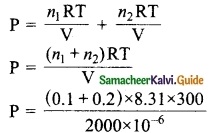
Question 4.
Write an essay on the role played by the 19th century reformers towards the cause of Women.
Solution:

  1. The position of women in India during the 19th century was miserable. They were not treated equal to men and they were denied rights.
  2. The Social reformers of the 19th century played a significant role in bringing an awakening to the people that women’s participation will strengthen the society.
  3. The reformers strongly advocated education for women.
  4. Raja Ram Mohan Roy with the help of the Governor General of British, William Bentinck abolished Sati in 1829.
  5. He advocated the rights of widows to remarry and wanted polygamy to come to an end. He also raised voice against child marriage.
  6. Reformer Vidyasagar led a movement by which ‘Widows Remarriage Reform Act’ of 1856 was intended
  7. to improve the lot of child widows and save them perpetual widowhood.
  8. Reformer Jyothiba Phule opened Orphanages and homes for widows.
  9. Sikh Reform movement prohibited the dowry system and child marriage.
  10. Reformer Iyothee Thessar considered education as an important tool for empowerment for women and a driving force behind the establishment of several schools for the Untouchables in Tamil Nadu.

VIII. Activity

Question 1.
Debate Social evils of 19th century with those of present day.
Answer:
The list below shows the social evil of 19th century and of the present day. The students should form themselves as separate groups one supporting the 19th century and the other supporting present day. The judgement of the debate can be.

There should be great reformers like that of the 19th century and eradicate the social evils of today. Education itself is a great reformer that should awaken the minds of the young children of today for not involving themselves in any of the social evil nor they see others doing it.

Social evils of 19th century: Child Marriage, superstitious beliefs, Sati, not allowing widows to remarry denying education for women, caste differences, untouchability, Brahman domination.

Social evils of present day: Female Infanticide Dowry system, sexual harassment of women, (or) women safety, Domestic violence (or) violence at home . Drug trafficing, pollution (Air, sound and water) Hygiene and sanitation. Disobeying rules,everywhere and anywhere.

Question 2.
Students can write an assignment on the present state of the reform organizations discussed in the lesson.
Answer:
Assignment on the present state of the reform organizations discussed in the lesson.

Brahmo Samaj founded by Raja Ram Mohan Roy denounces image worship and the caste system. In the 19th century the society benefitted by this social reform. The movement lost force in the 20th century its fundamentals are still accepted by the society.

Ramakrishna Mission: The Mission carries out extensive educational and Philanthropic work in India. They work on the principle of selfless work done with dedication to God. As of 2016, the Mission have 182 centers all over the world (136 in India, 13 in USA, 13 in Bangladesh, 2 in Russia) .Besides these, there are private centers all over the world run by the followers of Sri Ramakrishna and Vivekananda. The Mission has received numerous awards throughout its lifetime.

Theosophical society: The Theosophical society at Adyar is a beautiful campus with influence since its founders first arrived here in 1882. The society helps the nation even today by running Olcott Memorial High school in Tamil Nadu. They extend their help by various activities at times of disasters especially Tsunami in 2004. Now in Adyar , open all days except Saturday, Sunday public hoildays.

Arya Samaj: Arya Samaj established a chain of DAV educational institutions for the education of both boys and girls. It represented a form of national awakening of the Indian people. It adopts the programme of mass education, elimination of sub-castes and equality of men and women.

Samacheer Kalvi 10th Social Science Guide History Chapter 5 Social and Religious Reform Movements in the 19th Century

Samacheer Kalvi 10th Social Science Social and Religious Reform Movements in the 19th Century Additional Important Questions and Answers

I. Choose the correct answer

Question 1.
……………… was one of the earlier reformers influenced by the western ideas to initiate reforms.
(a) Raja Ram Mohan Roy
(b) Keshab Chandra Sen
(c) M.G.Ranade
(d) Atma Ram Pandurang.
Answer:
(a) Raja Ram Mohan Roy

Question 2.
Lord William Bentinck passed an Act in 1829, to abolish “Sati” due to the efforts of
(a) Mrs. Annie Besant
(b) Lala Hansray
(c) Raja Rammohan Roy
Answer:
(c) Raja Rammohan Roy

Question 3.
Arya Samaj movement initiated its movement in ………………
(a) Assam
(b) Punjab
(c) Bihar
(d) Kerala
Answer:
(b) Punjab

Question 4.
The headquarters of the Rama Krishna Mission is at
(a) Kanchipuram
(b) Belur
(c) Melur
Answer:
(b) Belur

Question 5.
Prarthana Samaj was founded in ………………
(a) Bihar
(b) Bombay
(c) Bengal
(d) Madras
Answer:
(b) Bombay

Question 6.
Sir Syed Ahamed Khan started the
(a) Aligarh movement
(b) Muslim League
(c) Theosophical Society
Answer:
(a) Aligarh movement

Samacheer Kalvi 10th Social Science Guide History Chapter 5 Social and Religious Reform Movements in the 19th Century

Question 7.
……………… was the prime follower of Ramakrishna Paramahansa
(a) Vivekananda
(b) Atma Ram Pandurang
(c) M.G. Ranade
(d) Keshab Chandra Sen
Answer:
(a) Vivekananda

Question 8.
A great socialist reformer from Kerala is
(a) Sree Narayana Guru
(b) Guru Nanak
(c) Guru Sai
Answer:
(a) Sree Narayana Guru

Question 9.
Furdunji Naoroji founded the Rahnumai Mazdayasnan Sabha ………………
(a) 1849
(b) 1851
(c) 1850
(d) 1862
Answer:
(b) 1851

Question 10.
The Hindus who had been converted to other religions were reconverted by
(a) Swadeshi movement
(b) Suddhi movement
(c) National movement
Answer:
(b) Suddhi movement

Question 11.
Iyothee Thassar called the ……………… as Sathi Petham Atra Dravidar.
(a) Untouchables
(b) Parsis
(c) Akali
(d) Sikhs
Answer:
(a) Untouchables

Question 12.
……………… criticized the rule of British as the rule of White Devils.
(a) Ramalinga Adigal
(b) Vaikunda Swamigal
(c) Furdunji Naoroji
(d) Iyothee Thassar
Answer:
(b) Vaikunda Swamigal

Question 13.
……………… considered education as a powerful tool for empowerment and a driving force behind the establishment of several schools.
(a) M.G. Ranade
(b) Iyothee Thassar
(c) Vaikunda Swamigal
(d) Sree Narayan Guru
Answer:
(b) Iyothee Thassar

Question 14.
……………… raised funds and campaigned to educate the lower caste of Pulaya people.
(a) Ayyankali
(b) Sree Narayan Guru
(c) M.G. Ranade
(d) Ramalinga Adigal
Answer:
(a) Ayyankali

Samacheer Kalvi 10th Social Science Guide History Chapter 5 Social and Religious Reform Movements in the 19th Century

Question 15.
……………… was called respectfully by his followers as Ayya.
(a) Vaikunda Swamigal
(b) Sree Narayan Guru
(c) Raja Ram Mohan Roy
(d) Namdhari
Answer:
(a) Vaikunda Swamigal

Question 16.
……………… launched the Satyashodak Samaj to stir the non-Brahmin masses to self-respect and ambition.
(a) Ayyankali
(b) Jyotiba Phule.
(c) Narayana Guru
(d) Annie Besant
Answer:
(b) Jyotiba Phule.

Question 17.
……………… started a number of DAV Schools.
(a) Arya Samaj
(b) Brahmo Samaj
(c) Theosophical Society
(d) Prarthana Samaj
Answer:
(a) Arya Samaj

Question 18.
……………… worked mainly for the Ezhava community of Kerala.
(a) Ayyankali
(b) Sree Narayan Guru
(c) Jyotiba Phule
(d) M.G. Ranade
Answer:
(b) Sree Narayan Guru

Question 19.
Deoband movement was a ……………… movement.
(a) Reform
(b) Revival
(c) Anti-Reform
(d) Anti-Revival
Answer:
(b) Revival

Question 20.
Rast Goftar was the main voice of ……………… movement.
(a) Nirankari
(b) Namdhari
(c) Parsi
(d) Vaikundar
Answer:
(c) Parsi

Samacheer Kalvi 10th Social Science Guide History Chapter 5 Social and Religious Reform Movements in the 19th Century

Question 21
……………… condemned the religious custom of animal sacrifice.
(a) Iyothee Thassar
(b) Vaikundar
(c) Ramalinga
(d) Jyotiba Phule
Answer:
(b) Vaikundar

Question 22.
“I saw those people, poor and of unmatched honor, their hearts weary, and I grew weak” who said this”?
(a) Vallalar
(b) Vaikundar
(c) Iyothee Thassar
(d) Deoband
Answer:
(a) Vallalar

Question 23.
……………… and ……………… are the Socio-religious movement among the Sikhs.
(a) Nirankari
(b) Namdhari
(c) (a) and (b)
(d) (a), (b) and Akaii movement
Answer:
(c) (a) and (b)

Question 24.
……………… was the movement founded in USA and later shifted to India,
(a) Ramakrishna Mission
(b) Theosophical Society
(c) Brahmo Samaj
(d) Prarthana Samaj
Answer:
(b) Theosophical Society

Question 25.
……………… established the Khalsa college for the Sikhs in Amritsar.
(a) Namdhari
(b) Nirankari
(c) Singh Sabha
(d) Akaii
Answer:
(c) Singh Sabha

Samacheer Kalvi 10th Social Science Guide History Chapter 5 Social and Religious Reform Movements in the 19th Century

II. Fill in the blanks

  1. English Education was introduced by British with the arm of producing …………….. in India.
  2. In the 19th Century …………….. had its effect on the newly emerging middle class.
  3. The Indian reformers attempted to harmonize both Indian and …………….. cultures.
  4. The two categories of reform movements are: reform movements and …………….. movements.
  5. Raja Ram Mohan Roy preached worship of …………….. God.
  6. Raja Ram Mohan Roy’s ideas forced Bentinck to bring legislation abolishing ……………..
  7. Sati was abolished in the year ……………..
  8. The Governor General …………….. helped in abolishing Sati in India.
  9. Raja Ram Mohan Roy founded the Brahmo Samaj in ……………..
  10. Brahmo Samaj was taken over by …………….. after the death of Ram Mohan Roy.
  11. Keshab Chandra Sen joined the Brahmo Samaj in ……………..
  12. Widow Remarriage Reform Act was passed in the year ……………..
  13. Gulamgiri was an important work written by ……………..
  14. …………….. was the founder of the Widow Marriage Association.
  15. …………….. was the founder of the Prarthana Samaj.
  16. …………….. movement was similar to the Brahmo Samaj.
  17. The age for marriage was fixed as …………….. years.
  18. The age of marriage was raised to thirteen years in ……………..
  19. The age of consent Act was passed in ……………..
  20. Arya Samaj was initiated at ……………..
  21. …………….. was the founder of Arya Samaj.
  22. Strict monotheism was one of the main principle of ……………..
  23. Swami Dayananda wrote the book ……………..
  24. …………….. started a number of Dayananda Anglo-vedic Schools and Colleges.
  25.  …………….. raised his voice as Go back to Vedas.
  26. …………….. accused that the group running he DAV School is too Westernised.
  27. …………….. worked as a priest in Kali temple but later became a great reformer.
  28. “Jiva is Siva” means ……………..
  29. The counter-conversion movement was called as ……………..
  30. …………….. means songs of Ignorance.
  31. The Theosophical Society was founded by …………….. and ……………..
  32. The Theosophical movement was founded in the …………….. in 1875.
  33. The Theosophical movement was in India at …………….. in Chennai in 1886.
  34. Annie Besant spread Theosophical ideas with the help of the newspapers called …………….. and ……………..
  35. …………….. opened a first School for untouchables in 1852 in Poona.
  36. Jyothi Phule launched the Truth Seekers Society in ……………..
  37. Sri Narayana Dharma Paripalana Yogam is an organisation to uplift the ……………..
  38. …………….. translated many English books especially Science books into Urdu.
  39. …………….. raised funds to educate the lower class pulaya people.
  40. …………….. started the Aligarh movement.
  41. The Mohammedan Anglo-Oriental College was founded in the year ……………..
  42. The Aligarh Anglo-Oriental College was raised to the status of a University in ……………..
  43. …………….. used journalism as tool to make inroads into the print public sphere.
  44. Ramalinga Adigal was popularly known as ……………..
  45. Mercy to all living beings including plants is called ……………..
  46. …………….. opposed both Infant marriages and the use of astrology.
  47. …………….. was the founder of the Nirankari movement.
  48. Nirankar movement worship the God as ……………..
  49. Nirankar means ……………..
  50. The Namdhari movement was founded by ……………..
  51. …………….. cult was also known as Ayya Vazhi.
  52. …………….. founded Samathura Samajam.
  53. …………….. was a siddha medicine practitioner who turned into a reformer.
  54. …………….. started a weekly journal Oru Paisa Tamilian.

Answers:

  1. Clerks
  2. Christianity
  3. Western
  4. Revival
  5. One
  6. Sati
  7. 1829
  8. Bentinck
  9. 1828
  10. Debendranath Tagore
  11. 1857
  12. 1856
  13. JyotibaPhule
  14. Ranade
  15. Dr. Atma Ram Pandurang
  16. PrarthanaSamaj
  17. Ten
  18. 1925
  19. 1860
  20. Punjab
  21. Swami Dayanand Saraswati
  22. Arya Samaj
  23. Satyartha Prakash
  24. Arya Samaj
  25. Swami Dayanda Saraswathi
  26. Swami Shradhananda
  27. Ramakrishna
  28. All living beings are God
  29. Suddi movement
  30. Marutpa
  31. Madame H.P Blavatsky and Colonel Olcott
  32. USA
  33. Adyar
  34. New India and Commonweal
  35. JyothiPhule
  36. 1870
  37. Depressed classes
  38. Sayyid Ahmed Khan
  39. Sadhu Jana paripalanasangam
  40. Sayyid Ahmed Khan
  41. 1875
  42. 1920
  43. IyotheeThassar
  44. Vallalar
  45. Jeeva karanga
  46. Parsi Reform movement
  47. Baba Dayal das
  48. Nirankar
  49. Formless
  50. Baba Ram Singh
  51. Vaikunda Swamigal
  52. VaikundaSwamigal
  53. Iyothee Thassar
  54. Iyothee Thassar

Samacheer Kalvi 10th Social Science Guide History Chapter 5 Social and Religious Reform Movements in the 19th Century

III. Choose the correct statements

Question 1.
(i) Raja Ram Mohan Roy argued that the ancient texts of the Hindus preached Monotheism.
(ii) Brahmo Samaj failed to attract the people from the lower sections of society.
(iii) Its impact on the culture of modern Bengal and its middle class was quite significant.
(iv) The poet Rabindranath Tagore carried on the work of Brahmo Samaj after Raja Ram Mohan Roy.
(a) (i) (ii) are correct
(b) (i) (iv) are correct
(c) (i) (ii) (iii) are correct
(d) (ii) (iv) are wrong
Answer:
(c) (i) (ii) (iii) are correct

Question 2.
(i) The age of marriage of initially fixed for 25 years.
(ii) Later it was reduced to thirteen years in 1925.
(iii) It was raised to eighteen in 1891.
(iv) Now, the law remained as twenty as in 1860 Act.
(a) (i) (ii) are correct
(b) (i) (iv) are correct
(c) (i) (ii) (iii) are correct
(d) (i) (ii) (iii) (iv) are wrong
Answer:
(d) (i) (ii) (iii) (iv) are wrong

Question 3.
(i) Arya Samaj attempted to check the incidence of religious conversion in British India.
(ii) Ramakrishna emphasised the spiritual union with God through the practice of singing bhajans.
(iii) Theosophical Society stimulated the study of the Christianity among people.
(iv) Savitribai Phule devoted her life for the upliftment of the depressed classes.
(a) (i) (ii) are correct
(b) (i) (ii) (iv) are correct
(c) (iii) (iv) are correct
(d) (i) (ii) (iii) are correct
Answer:
(b) (i) (ii) (iv) are correct

Question 4.
(i) Narendra Nath Datta was known as Swami Vivekananda.
(ii) He became famous for his address on Hinduism at the Indian Congress of Hindus in Chicago in 1893.
(iii) Narayana Guru inspired Kerala Society especially among the Ezhavas.
(iv) inspired by Sree Narayana Guru, Ayyankali founded the Sadhu Jana Paripalana Sangam.
(a) (i) (ii) are correct
(b) (i) (ii) (iv) are correct
(c) (i) (iii) (iv) are correct
(d) (ii) (iii) (iv) are correct.
Answer:
(c) (i) (iii) (iv) are correct

Question 5.
(i) Annie Besant spread Theosophical ideas through her newspapers called New India and Commonweal.
(ii) Jyotiba Phule is chiefly known as the earliest leader of the non-Brahmin movement.
(iii) His work Gulamgiri is an important text that summarized many of his radical ideas.
(iv) Thinkers and writers such as Kumaran Asan and Dr. Palpu were influenced by Narayana Guru ideas.
(a) (i) (ii) are correct
(b) (i) (ii) (iv) are correct
(c) (ii) (ii) (iii) are correct
(d) (i) (ii) (iii) (iv) are wrong.
Answer:
(d) (i) (ii) (iii) (iv) are wrong.

Question 6.
(i) Deoband School did not prepare its students for the government jobs but for the preaching of Islamic faith.
(ii) In South Travancore, there were restrictions on lower caste people as to what to wear and not to wear.
(iii) lyothee Thassar established a movement called as Oru, Paisa Tamilian.
(iv) John Rathinam ideas were collected into a text called Akila Thirattu.
(a) (i) (ii) are correct
(b) (i) (ii) (iv) are correct
(c) (ii) (iv) are correct
(d) (i) (iii) (iv) are wrong.
Answer:
(a) (i) (ii) are correct

IV. Assertion and Reason

Question 1.
Assertion (A): Keshab Chandra Sen was greatly influenced by Christianity. Reason (R): He was believing in its spirit, but not in the person of its founder.
(a) A is correct, R is the correct explanation of A.
(b) R is correct but A is not relevant to R.
(c) A and R is wrong.
(d) R is wrong but A is correct.
Answer:
(a) A is correct, R is the correct explanation of A.

Question 2.
Assertion (A): The Reform movement Arya Samaj was started in Punjab. Reason (R): Swami Dayananda Saraswathi settled in Punjab to preach his ideas
(a) A is correct and R is the relevant explanation.
(b) R is correct but A is not relevant to A.
(c) A and R is wrong.
(d) R is wrong but A is correct.
Answer:
(a) A is correct and R is the relevant explanation.

Question 3.
Assertion (A): The primary achievement of the Ramakrishna was his ability to attract educated youths..
Reason (R): The Samaj started a number of Dayananda Anglo vedic Schools and colleges.
(a) A is correct and R is the relevant explanation.
(b) A is correct and R is not relevant explanation to A.
(c) A and R is wrong.
(d) R is wrong but A is correct.
Answer:
(b) A is correct and R is not relevant explanation to A.

Samacheer Kalvi 10th Social Science Guide History Chapter 5 Social and Religious Reform Movements in the 19th Century

Question 4.
Assertion (A): Narayana Guru established a grand temple at Arivupuram and dedicated it to all.
Reason (R): In his days, the people of the depressed classes has no access to temples.
(a) A is correct and R is the relevant to A.
(b) A is correct and R is not relevant to A.
(c) A and R is wrong.
(d) A is wrong R is correct.
Answer:
(a) A is correct and R is the relevant to A.

Question 5.
Assertion (A): The School at Deoband encouraged English education. Reason (R): The instruction imparted in the School was the Original Islamic religion.
(a) A is correct and R is the relevant explanation to A.
(b) A is wrong and R is correct.
(c) A is correct and R is not relevant explanation to A.
(d) R is correct but A is wrong.
Answer:
(d) R is correct but A is wrong.

Question 6.
Assertion (A): Ramaiinga Adigal established a free feeding house for everyone irrespective of caste at Vadalur in 1867.
Reason (R): There was a terrible famine in South India in 1866.
(a) A is correct and R is the relevant explanation of A.
(b) A is correct and R is not relevant explanation to A
(c) A is wrong R is correct.
(d) R is correct and R is wrong.
Answer:
(b) A is correct and R is not relevant explanation to A

Question 7.
Assertion (A): Pandithar lyothee Thassar went to Srilanka in 1898 and converted to Buddhism.
Reason (R): He was disappointed with the Hindi dharma, which served as a base for propogating caste in Hindu Society.
(a) A is correct and R is the relevant explanation of A.
(b) A is correct and R is not relevant to A
(c) A is wrong R is correct.
(d) R is correct and A is wrong.
Answer:
(a) A is correct and R is the relevant explanation of A.

Samacheer Kalvi 10th Social Science Guide History Chapter 5 Social and Religious Reform Movements in the 19th Century

V. Match the following

Question 1.
Match the Column I with Column II.
Samacheer Kalvi 10th Social Science Guide History Chapter 5 Social and Religious Reform Movements in the 19th Century 2
Samacheer Kalvi 10th Social Science Guide History Chapter 5 Social and Religious Reform Movements in the 19th Century 3
Answer:
A. (vii)
B. (vi)
C. (iv)
D. (iii)
E. (ii)

Question 2.
Match the Column I with Column II.
Samacheer Kalvi 10th Social Science Guide History Chapter 5 Social and Religious Reform Movements in the 19th Century 4
Answer:
A. (vi)
B. (iii)
C. (v)
D. (i)
E. (ii)

VI. Answer briefly

Question 1.
Write a note on Prarthana Samaj.
Answer:

  1. Prarthana Samaj was founded in Bombay in 1867 by Dr. Atmaram Pandurang.
  2. It advocated inter-dining, inter-caste marriage, widow re-marriage, improvement of women and downtrodden classes, abolition of Purdha System and Child marriage.
  3. The Samaj is founded night schools, asylum and Orphanages and other such institutions for the downtrodden people.

Question 2.
Write a note on Brahmo Samaj.
Answer:
It was a reform movement formed in 1828 by Raja Ram Mohan Roy at Calcutta. The Samaj mainly focused on the customs of Sati, Child marriage and Polygamy and wanted to remove them legally. The Samaj was successful by abolishing Sati in 1829, with the help of the Governor General Bentinck. It appealed widow remarriage and followed monotheism.

Question 3.
Mention the main principles of the Theosophical Society.
Answer:

  1. To develop the feeding of fraternity.
  2. To study ancient religions, philosophy and science.
  3. To find out the laws of nature and the development of divine power in India.

Question 4.
Write a short note on Ramakrishna Mission.
Answer:
Swami Vivekananda founded the Ramakrishna mission. The mission did not restrict itself to religious activities but was actively involved in social causes such as education, health care and relief in times of calamities. Service to humanity is the practical Vedanta of this mission.

Question 5.
Point out the impacts of Social and Religious reform movements in the 19th Century.
Answer:

  1. These movements greatly helped to abolish some of the evils like sati, child marriage and inter and untouchability.
  2. It promoted education, encouraged widow re-marriage, inter-caste marriages and inter-dining.
  3. It instilled social awakening and spirit of nationalism in the middle of Indians.
  4. It made the people to be proud of their culture and glory.
  5. It helped the Indians to face problems with scientific approach and outlook.

Question 6.
List out the Social Reformers of Tamil Nadu.
Answer:
(i) The Social Reformers of Tamil Nadu are Ramalinga Swamigal – emphasising feeding of poor.
(ii) Vaikunda Swamigal – emphasising unity of people of all castes.
(iii) Iyothee Thassar – emphasising Caste less society.

Question 7.
Who is known as Martin-Luthur of Hinduism? Why?
Answer:

  1. Swamy Dayananda Saraswathi is known as the Martin Luther of Hinduism.
  2. He started Suddhi Movement to reconvert the Hindus who had been converted to other religions earlier.
  3. By his efforts, a large number of people were taken back within the fold of Hinduism.

Question 8.
As a student of today, what do you think the social evils present in today’s world and need reform?
Answer:
The Social evils present in today’s world and need reforms are Girl child harassment, female infanticide, Non-observance of societal rules, Adulteration, and above all poverty and pollution.

Samacheer Kalvi 10th Social Science Guide History Chapter 5 Social and Religious Reform Movements in the 19th Century

VII. Answer all the questions given under each caption

Question 1.
Brahmo Samaj

(a) Who founded Brahmo Samaj?
Answer:
Raja Rammohan Roy

(b) What Were the languages learnt by Raja Rammohan Roy?
Answer:
Arabic, Sanskrit, Persian, English, French, Latin, Greek and Hebrew languages.

(c) Name the books written by Raja Rammohan Roy.
Answer:
Precepts of Jesus Christ and Guide to Peace and Happiness were written by Raja Rammohan Roy.

(d) What did Brahmo Samaj believe?
Answer:
It believed in a “Universal religion” based on the principle of one Supreme God.

Question 2.
Arya Samaj

(a) When, where and who founded the Arya Samaj.
Answer:
The Arya Samaj was founded by Swami Dayananda Saraswathi in 1875, in Punjab.

(b) What was the main idea focused by the Samaj.
Answer:
‘Go Back to Vedas’.

(c) What did the Samaj do in the field of education?
Answer:
The Samaj started a number of Dayananda Anglo-vedic schools and colleges to spread education.

(d) What was the name of the school started after dayananda starting OAV schools are westernised?
Answer:
By 1900, Swami Shraddhanada established his own network of schools called Gurukulas emphasising the study of vedas.

Question 3.
The Theosophical Society

(a) Who was the founder of the Theosophical Society?
Answer:
It was founded by Madame Blavatsky and Henry S. Olcott.

(b) Why was it founded?
Answer:
It was founded to preach about God and Wisdom.

(c) Who was the president of this society in 1893?
Answer:
Mrs. Annie Besant.

(d) Where is the headquarters of this society located?
Answer:
The headquarters of this society is at Adyar in Chennai.

Question 4.
Parsi and Sikh Reform Movements

(a) Who founded the Parsis’ Reform Society?
Answer:
Furdunji Naoroji founded the Parsis’ Reform Society in 1851.

(b) What are the names of the two Sikh Reform Movements?
Answer:
Nirankaris and Namdharis are the names of the two Sikh Reform Movements.

(c) Name the leader from Parsi community who played a big role in early congress?
Answer:
Pherozeshah Mehta and Dinshaw Wacha played a big role in early congress from Parsi community.

(d) Who were the founders of the Sikh Reform movements? What was the objective?
Answer:
Baba Dayal Das was the founder of the Nirankari movement and Baba Ram Singh was the founder of the Namdhari movement Its main objective was to restore the purity of Sikhism and the authority of Guru Nanak.

Samacheer Kalvi 10th Social Science Guide History Chapter 5 Social and Religious Reform Movements in the 19th Century

VIII. Answer in detail

Question 1.
Elaborate the Early Reform Movements in Bengal.
Answer:
Brahmo Samaj: This was one of the earlier reform movement founded by Raja Ram Mohan Roy. Deeply concerned with the customs of Sati, child marriage and polygamy, raised his voice through the Samaj and abolished sati by legislation in 1829. The Samaj strongly advocated education for women, widow remarriage and western education. It Condemned Idol worship and meaningless rituals and ceremonies.

Adi Brahmo Samaj: In 1886, a Split occurred in Brahmo Samaj and Keshab Chandra Sen left the Samaj and founded a new organisation called Debendranath’s organisation also called as Adi-Brahmo Samaj, This Samaj also followed the ideas of Brahmo Samaj.

Prarthana Samaj: A movement similar to Brahmo Samaj founded in Bombay was called Prathana Samaj. It was founded by R.C Bhandarkar and Mahadev Govinda Ranade. Inter caste dining, Inter-caste marriage, Widow remarriage, improvement of women and depressed classes were their main activities.

Arya Samaj: The Arya Samaj was founded by Swami Dayananda Saraswathi. This is a revival movement stating ‘ Go back to Vedas’, The Samaj concentrated on social reforms and education . DAV schools of today were originally started by Arya Samaj.

Ramakrishna Mission: Ramakrishna Mission was founded by Swami Vivekananda. The mission actively involved in the social causes such as education, health care and relief in times of calamities. Service to humanity is their slogan which means Service to God.

Theosophical Movement: The Theosophical movement was founded in ‘ USA by Madame Blavatsky and Colonel Olcott. Later the movement laid its foundation headed by Annie Besant in Adyar, Chennai.

She spread her ideas through her newspaper New India and commonweal. This movement played a major role in Indian Nationalist politics.

Question 2.
Explain the activities of the Ramakrishna Mission.
Answer:

  1. Ramakrishna Mission’s activities cover the areas like educational work, healthcare, cultural activities, rural upliftment, tribal welfare and youth movement.
  2. It has its own hospitals, charitable dispensaries, maternity clinics, tuberculosis clinics and mobile dispensaries.
  3. It also maintains training centres for nurses.
  4. Orphanages and homes for the elderly people are maintained. Rural and tribal welfare works are also going on.
  5. It educational activities the Ramakrishna Mission has established many renowned educational institutions in India.
  6. It has its own universities, colleges and vocational training centres.
  7. It has also involved in disaster relief operations during famine, epidemic, fire, flood, earthquake, cyclones and communal disturbances.
  8. It played an important role in the installation of Photo Voltaic (PV) lighting system in the Sundarbans regions of West Bengal. The PV lighting was used to provide electricity to the people, who were traditionally depending on kerosene and diesel.

Samacheer Kalvi 10th Science Guide Chapter 3 Thermal Physics

Students can download 10th Science Chapter 3 Thermal Physics Questions and Answers, Notes, Samacheer Kalvi 10th Science Guide Pdf helps you to revise the complete Tamilnadu State Board New Syllabus, helps students complete homework assignments and to score high marks in board exams.

Tamilnadu Samacheer Kalvi 10th Science Solutions Chapter 3 Thermal Physics

Samacheer Kalvi 10th Science Thermal Physics Text Book Back Questions and Answers

I. Choose the correct answer.

Question 1.
The value of universal gas constant:
(a) 3.81 mol-1 K-1
(b) 8.03 mol-1 K-1
(c) 1.38 mol-1 K-1
(d) 8.31 mol-1 K-1
Answer:
(d) 8.31 mol-1 K-1

Question 2.
If a substance is heated or cooled, the change in mass of that substance is:
(a) positive
(b) negative
(c) zero
(d) none of the above
Answer:
(b) negative

Question 3.
If a substance is heated or cooled, the linear expansion occurs along the axis of ______.
(a) X or -X
(b) Y or -Y
(c) both (a) and (b)
(d) either (a) or (b).
Answer:
(c) both (a) and (b)
Hint: When a substance is heated its expansion is positive i,e, can be taken along either +X or +Y direction. But when substance is cooled it’s either length or area or volume decreases i.e. with respect expansion, it is opposite direction i.e. either -X or -Y direction respectively.

Samacheer Kalvi 10th Science Guide Chapter 3 Thermal Physics

Question 4.
Temperature is the average of the molecules of a substance.
(a) difference in K.E and P.E
(b) sum of P.E and K.E
(c) difference in T.E and P.E
(d) difference in K.E and T.E
Answer:
(b) sum of P.E and K.E

Question 5.
In the Given diagram, the possible direction of heat energy transformation is:
Samacheer Kalvi 10th Science Guide Chapter 3 Thermal Physics 1
(a) A ← B, A ← C, B ← C
(b) A → B, A → C, B → C
(c) A → B, A ← C, B → C
(d) A ← B, A → C, B ← C
Answer:
(a) A ← B, A ← C, B ← C

II. Fill in the blanks.

  1. The value of Avogadro number ………..
  2. The temperature and heat are ……….. quantities.
  3. One calorie is the amount of heat energy required to raise the temperature of ……….. of water through
  4. According to Boyle’s law, the shape of the graph between pressure and reciprocal of volume is …………

Answer:

  1. 6.023 × 10²³
  2. Inter convertible
  3. 1 gram, 1°C
  4. A straight line

III. State whether the following statements are true or false, if false explain why?

  1. For a given heat in liquid, the apparent expansion is more than that of real expansion.
  2. Thermal energy always flows from a system at higher temperature to a system at lower temperature.
  3. According to Charles’s law, at constant pressure, the temperature is inversely proportional to volume.

Answer:

  1. True
  2. True
  3. False – According to Charles law, at constant pressure, the volume is directly proportional to temperature.

IV. Match the items in column-I to the items in column-II

Samacheer Kalvi 10th Science Guide Chapter 3 Thermal Physics 2
Answer:
A. (s)
B. (t)
C. (p)
D. (q)
E. (r)

Samacheer Kalvi 10th Science Guide Chapter 3 Thermal Physics

V. Assertion and Reason type questions.

(a) Both the assertion and the reason are true and the reason is the correct explanation of the assertion.
(b) Both the assertion and the reason are true but the reason is not the correct explanation of the assertion.
(c) The assertion is true but the reason is false.
(d) The assertion is false but the reason is true.
1. Assertion: There is no effects on other end when one end of the rod is only heated.
Reason: Heat always flows from a region of lower temperature to higher temperature of the rod.

2. Assertion: Gas is highly compressible than solid and liquid
Reason: Interatomic or intermolecular distance in the gas is comparably high.
Answer:
1. (b)
2. (a)

VI. Answer in briefly.

Question 1.
Define one calorie.
Answer:
One calorie is defined as the amount of heat energy required to rise the temperature of 1 gram of water through 1°C.

Question 2.
Distinguish between linear and superficial areal expansion.
Answer:
Samacheer Kalvi 10th Science Guide Chapter 3 Thermal Physics 3

Question 3.
What is the coefficient of cubical expansion?
Answer:
The ratio of increase in the volume of the body per degree rise in temperature to its unit volume is called a coefficient of cubical expansion.

Question 4.
State Boyle’s law
Answer:
When the temperature of a gas is kept constant, the volume of a fixed mass of gas is inversely proportional to its pressure.
P ∝ 1 / V

Question 5.
State-the law of volume.
Answer:
When the pressure of a gas is kept constant, the volume of a gas is directly proportional to the temperature of the gas.
i.e., V ∝ T.
(or)
\(\frac{\mathrm{V}}{\mathrm{T}}\) = constant.

Samacheer Kalvi 10th Science Guide Chapter 3 Thermal Physics

Question 6.
Distinguish between ideal gas and real gas.
Answer:
Samacheer Kalvi 10th Science Guide Chapter 3 Thermal Physics 4

Question 7.
What is co-efficient of real expansion?
Answer:
Coefficient of real expansion is defined as the ratio of the true rise in the volume of the liquid per degree rise in temperature to its unit volume. The SI unit of coefficient of real expansion is the K-1.

Question 8.
What is the coefficient of apparent expansion?
Answer:
Coefficient of apparent expansion is defined as the ratio of the apparent rise in the volume of the liquid per degree rise in temperature to its unit volume.
The SI unit of the coefficient of apparent expansion is K-1.

VII. Numerical problems.

Question 1.
Find the final temperature of a copper rod whose area of cross section changes from 10 m² to 11 m² due to heating. The copper rod is initially kept at 90 K. (Coefficient of superficial expansion is 0.0021 /K).
Answer:
Change in area ΔA = 11 – 10 = 1 m²
Initial temperature T1 = 90 K
Let Final temperature be T2K
A0 = 10 m²
Coefficient of superficial expansion is
αA = 0.0021 / k
\(\frac{ΔA}{A_0}\) = αAΔT
\(\frac{1}{10}\) = 0.0021 ΔT
∴ ΔT = 0.0021 × 10
= 0.021
T2 – T1 = 0.021
T2 – 90 = 0.021
∴ Final temperature T2 = 90.021 K

Question 2.
Calculate the coefficient of cubical expansion of a zinc bar. Whose volume is increased 0.25 m³ from 0.3 m³ due to the change in its temperature of 50 K.
Answer:
Initial volume V0 = 0.25 m³
Final volume = 0.30 m³
Change in volume ΔV = 0.3 – 0.25 = 0.05 m³
Temperature ΔT = 50K
Coefficient of cubical expansion is
Samacheer Kalvi 10th Science Guide Chapter 3 Thermal Physics 5
∴ Coefficient of Cubical expansion
αv = 0.004 /K

Samacheer Kalvi 10th Science Guide Chapter 3 Thermal Physics

VIII. Answer in detail.

Question 1.
Derive the ideal gas equation.
Answer:
The ideal gas equation is an equation, which relates all the properties of an ideal gas. An ideal gas obeys Boyle’s law and Charles’s law and Avogadro’s law.
According to Boyle’s law, PV = constant ………. (1)
According to Charles’s law,
\(\frac{V}{T}\) = constant ……… (2)
According to Avogadro’s law,
\(\frac{V}{T}\) = constant …….. (3)
After combining equations (1), (2) and (3), you equation. can get the following
\(\frac{V}{nT}\) = constant ……. (4)
The above relation is called the combined law of gases. If you consider a gas, which contains µ moles of the gas, the number of atoms contained will be equal to µ times the Avogadro number, N0.
i.e., n = µNA
Using equation (5), in equation (4) can be written as
\(\frac{PV}{µN_{A}T}\) = constant
The value of the constant in the above equation is taken to be KB, which is called as Boltzmann constant (1.38 × 10⁻²³ JK-1). Hence, we have the following equation:
\(\frac{PV}{µN_{A}T}\) = KB
PV = µNAKBT
µNAKB = R
which is termed as universal gas constant whose value is 8.31 J mol-1 K-1.
PV = RT
Ideal gas equation is also called as equation of state because it gives the relation between the state variables and it is used to describe the state of any gas.

Question 2.
Explain the experiment of measuring the real and apparent expansion of a liquid with a neat diagram.
Answer:
Samacheer Kalvi 10th Science Guide Chapter 3 Thermal Physics 6
To start with, the liquid whose real and apparent expansion is to be determined is poured in a container up to a level. Mark this level as L1. Now, heat the container and the liquid using a burner. Initially, the container receives the thermal energy and it expands. As a result, the volume of the liquid appears to have reduced. Mark this reduced level of liquid as L2. On further heating, the thermal energy supplied to the liquid through the container results in the expansion of the liquid. Hence, the level of liquid rises to L3. Now, the difference between the levels L1 and L3 is called as apparent expansion, and the difference between the levels L2 and L3 is called real expansion. The real expansion is always more than that of apparent expansion.
Real expansion = L3 – L2
Apparent expansion = L3 – L1

IX. HOT Question

Question 1.
If you keep ice at 0°C and water at 0°C in either of your hands, in which hand you will feel more chillness? Why?
Answer:
The hand consisting of ice at 0°C would feel more chillness because, ice undergoes melting. More amount of energy (chillness) is transferred to hand. In addition ice has latent heat of fusion.

Samacheer Kalvi 10th Science Guide Chapter 3 Thermal Physics

Samacheer Kalvi 10th Science Thermal Physics Additional Important Questions and Answers

I. Choose the correct answer.

Question 1.
The commonly used scales of temperature are:
(a) Kelvin
(b) Celsius
(c) Fahrenheit
(d) All the above
Answer:
(d) All the above

Question 2.
Ideal gas equation for n mole of gas ____.
(a) PT = nRV
(b) Pv = nRT
(c) PV = nRT
(d) PT = RV.
Answer:
(b) Pv = nRT
Hint: T represents absolute temperature by t temperature in 0°C.

Question 3.
The value of 27° C in the kelvin scale:
(a) 30 K
(b) 300 K
(c) 327 K
(d) 0 K
Answer:
(b) 300 K

Question 4.
Kelvin scale has zero reading at temperature _____.
(a) 0°C
(b) -100°C
(c) -273°C
(d) -212°C.
Answer:
(c) -273°C
Hint: K = C + 273 or C = K – 273
at K = 0, C = -273°.

Samacheer Kalvi 10th Science Guide Chapter 3 Thermal Physics

Question 5.
The relation between Celsius and kelvin scales of temperature is:
(a) K = 273 – C
(b) K = C + 273
(c) K=
(d) K = C
Answer:
(b) K = C + 273

Question 6.
Linear expansion is related to _____.
(a) area
(b) length
(c) volume
(d) mass.
Answer:
(b) length
Hint: Linear expansion is directly proportional to the original length of rod and rise in temperature.

Question 7.
For any exchange of heat:
(a) Heat gained = Zero
(b) Heat lost = Zero
(c) Heat gained = Heat lost
(d) Heat gained = -heat lost
Answer:
(c) Heat gained = Heat lost

Question 8.
………. is the degree of hotness.
(a) Heat
(b) Calorie
(c) Joule
(d) Temperature
Answer:
(d) Temperature

Question 9.
Avogadro’s Number _____ mol.
(a) 6.023 × 10²³
(b) 6.025 × 1025
(c) 6.24 × 1024
(d) 6.022 × 10²².
Answer:
(a) 6.023 × 10²³
Hint: NA = 6.023 × 10²³

Question 10.
If a temperature of 327°C is equivalent to ………. in kelvin scale.
(a) 273 K
(b) 600 K
(c) -527 K
(d) -273 K
Answer:
(b) 600 K

Question 11.
When spirit is poured on our hand, cooling is produced because:
(a) Spirit has cooling effect.
(b) Spirit has boiling effect.
(c) The boiling point of spirit is low.
(d) The boiling point of spirit is high.
Answer:
(c) The boiling point of spirit is low.

Question 12.
Process of transfer of heat through liquid and gases is _____.
(a) conduction
(b) radiation
(c) convection
(d) none of these.
Answer:
(c) convection
Hint: Heat flows by the conventional current is upward direction by convection method.

Question 13.
Heat required to melt 1 kg of ice at 0°C is:
(a) 226 × 102 J
(b) 336 × 103 J
(c) 353 × 103 J
(d) 3 × 10⁵ J
Answer:
(b) 336 × 103 J

Question 14.
Relation between α, β and γ is _____.
(a) α = β = γ
(b) \(\alpha=\frac{\beta}{2}=3 \gamma\)
(c) \(\alpha=\frac{\beta}{2}=\frac{\gamma}{3}\)
(d) \(\alpha=\frac{\beta}{2}=\frac{\gamma}{4}\).
Answer:
(c) \(\alpha=\frac{\beta}{2}=\frac{\gamma}{3}\)
Hint: (c) \(\alpha=\frac{\beta}{2}=\frac{\gamma}{3}\) (or) 6α = 3β = 2γ.

Samacheer Kalvi 10th Science Guide Chapter 3 Thermal Physics

Question 15.
When a certain quantity of ice is melting remains the same.
(a) Volume
(b) Temperature
(c) Mass
(d) Density
Answer:
(b) Temperature

Question 16.
Steam causes more severe burns than water at the same temperature because steam:
(a) is in vapour state
(b) contains less heat than water at the same temperature.
(c) contains more heat than water at the same temperature.
(d) cause bums by nature.
Answer:
(c) contains more heat than water at the same temperature.

Question 17.
Which expansion coefficient (α, β, γ) of a substance has the largest and y smallest magnitude?
(a) α, β
(b) α, γ
(c) γ, α
(d) β, α.
Answer:
(c) γ, α
Hint: As γ is 3 times of α and β is 2 times of α. so α is minimum and γ is maximum.

Question 18.
According to the principle of mixtures, the heat lost by a hot body is equal to:
(a) Heat gained by the surroundings
(b) Heat transferred to the surroundings
(c) Heat gained by the body
(d) None of the above
Answer:
(c) Heat gained by the body

Question 19.
The quantity of water vapour required to saturate air at high temperature is:
(a) Less
(b) Temperature
(c) More
(d) None of the above
Answer:
(c) More

Question 20.
In steam heater, solids attain constant temperature because:
(a) Solid should not be heated less
(b) Solid should not be heated more
(c) Melting point of solid is 100°C
(d) Volume does not change.
Answer:
(c) Melting point of solid is 100°C

Question 21.
The quantity of water vapour required to saturate air depends on:
(a) Pressure of atmosphere
(b) Temperature of atmosphere
(c) Humidity of atmosphere E
(d) All the above
Answer:
(b) Temperature of atmosphere

Question 22.
Volume of a gas at t°C is given by:
Samacheer Kalvi 10th Science Guide Chapter 3 Thermal Physics 7
Answer:
(c) Vt = Vo (1 + \(\frac{t}{273}\))

Question 23.
At a higher temperature to saturate air, ………. quantity of water vapour is required.
(a) Less
(b) Some
(c) More
(d) No
Answer:
(c) More

Question 24.
The relationship between length (L0) of a body and change in temperature is:
Samacheer Kalvi 10th Science Guide Chapter 3 Thermal Physics 8
Answer:
(b) L0 = \(\frac{ΔL}{α_{L}ΔT}\)

Question 25.
The S.l unit of coefficient of linear expansion is:
(a) °C
(b) K-1
(c) Cal
(d) Joule
Answer:
(b) K-1

Samacheer Kalvi 10th Science Guide Chapter 3 Thermal Physics

Question 26.
Coefficient of superficial expansion:
(a) is same for all materials
(b) is infinity
(c) different for different materials
(d) is zero
Answer:
(c) different for different materials

Question 27.
The ratio of change in area of a metal to its original area is \(\frac{ΔA}{A_0}\) =
(a) αA
(b) αAΔT
(c) \(\frac{α_A}{ΔT}\)
(d) unity
Answer:
(b) αAΔT

Question 28.
According to Boyle’s law the relation between pressure (P) and volume of a gas is:
(a) P ∝ V
(b) P = V
(c) P ∝\(\frac{1}{V}\)
(d) V ∝ P
Answer:
(c) P ∝\(\frac{1}{V}\)

Question 29.
At constant temperature of a gas:
(a) PV = 1
(b) PV = 0
(c) PV = infinity
(d) PV = constant
Answer:
(d) PV = constant

Question 30.
The mathematical form of Charles’s law is:
(a) V ∝ \(\frac{1}{T}\)
(b) TV = constant
(c) \(\frac{V}{T}\) = constant
(d) V = T
Answer:
(c) \(\frac{V}{T}\) = constant

Question 31.
If V is the volume and n is the number of atoms present in it then:
(a) V ∝ \(\frac{1}{n}\)
(b) V ∝ n
(c) V = n
(d) \(\frac{n}{V}\) = constant
Answer:
(b) V ∝ n

Question 32.
\(\frac{V}{n}\) = constant is the mathematical form of:
(a) Boyle’s law
(b) Charles’s law
(c) Avogadro’s law
(d) Dalton’s law
Answer:
(c) Avogadro’s law

Question 33.
Mathematical form of Boyle’s law is:
(a) \(\frac{V}{n}\) = constant
(b) PT = constant
(c) \(\frac{V}{T}\) = constant
(d) PV = constant
Answer:
(d) PV = constant

Question 34.
A gas that obeys Boyle’s law and Charles’s law is called:
(a) Gas
(b) Ideal gas
(c) Perfect gas
(d) All the above
Answer:
(b) Ideal gas

Question 35.
The value of universal gas constant is:
(a) 3.81 J/mol/K
(b) 8.31 J/mol/K
(c) 8.13
(d) 6.81 J/mol/K
Answer:
(b) 8.31 J/mol/K

Samacheer Kalvi 10th Science Guide Chapter 3 Thermal Physics

Question 36.
The unit of universal gas constant is:
(a) \(\frac{J}{K}\)
(b) J mol-1K
(c) J/mol/K
(d) J K-1 mol
Answer:
(c) J/mol/K

Question 37.
If atoms of a gas do not interact with each other than the gas is:
(a) natural gas
(b) bio gas
(c) real gas
(d) perfect gas
Answer:
(d) perfect gas

Question 38.
Mathematical form of ideal gas equation is:
(a) PV = T
(b) P = RT
(c) PV = RT
(d) PV = R
Answer:
(c) PV = RT

II. Fill in the blanks.

1. The value if 290K in Celsius scale is ……….
2. The value of 37°C in kelvin scale is ……….
3. The value of 323 K in Celsius scale is ……….
4. Transfer of heat is continued until a ………. is established.
5. ……….. produces the sensation of warm.
6. When a body is heated or cooled its ……….. is not altered.
7. For any exchanges of heat …………. = …………
8. On heating all forms of matter undergo ………..
9. The coefficient of linear expansion is ………. for ……….. metals.
10. The unit of coefficient of superficial expansion is …………
11. The coefficient of cubical expansion of liquid is independent of …………
12. The S.l of unit of coefficient of real expansion is ………..
13. As per Boyle’s law pressure of a gas is …………. proportional to its volume.
14. PV = constant is the mathematical form of ………….
15. As per Charles’s law volume of a gas is ………… to temperature.
16. According Avogadro’s law volume of a gas is directly proportional ………… present in it.
17. The value of Avogadro’s number is …………
18. A gas that obey Boyle’s law is …………
19. A gas that does not obey gas laws then it is …………
20. A gas in which atoms interact with a force then it is a ………..
21. For a given heat, the real expansion is ……….. than that of apparent expansion.
22. The equation of state of a gas is …………
23. Universal gas equation is used to describe the ………….
24. If a gas consists of µ moles then the number of atoms in n = …………
Answer:
1. 17°C
2. 310 K
3.50°C
4. thermal equilibrium
5. Heat
6. mass
7. Heat gained, Heat lost
8. expansion
9. different, different
10. K-1
11. Temperature
12. K-1
13. inversely
14. Boyle’s law
15. directly proportional
16. number of atoms or molecules
17. 6.023 × 10²³/mol
18. ideal gas
19. real gas
20. real gas
21. more
22. PV = RT
23. state of any gas
24. µNA, NA – Avogadro’s number

Samacheer Kalvi 10th Science Guide Chapter 3 Thermal Physics

III. State whether the following statements are true or false, if false explain why?

1. The relation between Fahrenheit and Kelvin scale of temperature is (K) K = (F + 460) × \(\frac{5}{9}\).
2. The relation between Celsius and Kelvin is K = C – 273.
3. Thermal energy is also known as heat energy.
4. When a body is heated volume is not altered.
5. All forms of matter undergo expansion on heating.
6. Longitudinal expansion is given by ΔL = L0αLΔT
7. Cubical expansion is same for all materials.
8. The S.l unit of coefficient of apparent expansion is K-1.
9. As per Boyle’s law PT = constant.
10. According to Avogadro’s law \(\frac{V}{n}\) = constant
Answer:
1. True
2. False -The relation between Celsius and Kelvin is K= C + 273
3. True
4. False – When a body is heated mass is not altered.
5. True
6. True
7. False – Cubical expansion is different for different materials.
8. True
9. False – As per Boyle’s law PV= constant.
10. True

IV. Match the items in column-I to the items in column-II.

Question 1.
Match the following:
Samacheer Kalvi 10th Science Guide Chapter 3 Thermal Physics 9
Answer:
A – (s)
B – (t)
C – (p)
D – (q)

Question 2.
Match the following:
Samacheer Kalvi 10th Science Guide Chapter 3 Thermal Physics 10
Answer:
A – (s)
B – (r)
C – (p)
D – (q)

Question 3.
Match the following:
Samacheer Kalvi 10th Science Guide Chapter 3 Thermal Physics 11
Answer:
A – (t)
B – (s)
C – (p)
D – (q)

V. Assertion and reason type questions.

Question 1.
Assertion: In a pressure cooker, the water starts boiling again on removing its lid.
Reason: The impurities in water bring down its boiling point.
(a) Both the assertion and the reason are true and the reason is the correct explanation of the assertion.
(b) Both the assertion and the reason are true but the reason is not the ’ correct explanation of the assertion.
(c) The assertion is true but the reason is false.
(d) The assertion is false but the reason is true.
Answer:
(c) The assertion is true but the reason is false.

Question 2.
Assertion: Air at some distance above the fire is hotter than same distance below it.
Reason: Air surrounding the fire carries heat upwards.
(a) Both the assertion and the reason are true and the reason is the correct explanation of the assertion.
(b) Both the assertion and the reason are true but the reason is not the correct explanation of the assertion.
(c) The assertion is true but the reason is false.
(d) The assertion is false but the reason is true.
Answer:
(a) Both the assertion and the reason are true and the reason is the correct explanation of the assertion.

Samacheer Kalvi 10th Science Guide Chapter 3 Thermal Physics

Question 3.
Assertion: Woolen clothes keys the body warm in winter.
Reason: Air a poor conducts of heat.
(a) Both the assertion and the reason are true and the reason is the correct explanation of the assertion.
(b) Both the assertion and the reason are true but the reason is not the correct explanation of the assertion.
(c) The assertion is true but the reason is false.
(d) The assertion is false but the reason is true.
Answer:
(a) Both the assertion and the reason are true and the reason is the correct explanation of the assertion.

Question 4.
Assertion: Temperature near the sea coast is moderate.
Reason: Water has a high thermal conductivity.
(a) Both the assertion and the reason are true and the reason is the correct explanation of the assertion.
(b) Both the assertion and the reason are true but the reason is not the correct explanation of the assertion.
(c) The assertion is true but the reason is false.
(d) The assertion is false but the reason is true.
Answer:
(b) Both the assertion and the reason are true but the reason is not the correct explanation of the assertion.

Question 5.
Assertion: It is hotter over the top of fire than at the same distance on the sides.
Reason: Air surrounding the fire conducts more heat upwards.
(a) Both the assertion and the reason are true and the reason is the correct explanation of the assertion.
(b) Both the assertion and the reason are true but the reason is not the correct explanation of the assertion.
(c) The assertion is true but the reason is false.
(d) The assertion is false but the reason is true.
Answer:
(c) The assertion is true but the reason is false.

Question 6.
Assertion: Perspiration from human body helps in cooling the body. Reason: A thin layer of water on the skin enhance its emissivity.
(a) Both the assertion and the reason are true and the reason is the correct explanation of the assertion.
(b) Both the assertion and the reason are true but the reason is not the correct explanation of the assertion.
(c) The assertion is true but the reason is false.
(d) The assertion is false but the reason is true.
Answer:
(c) The assertion is true but the reason is false.

VI. Answer in briefly

Question 1.
Define Temperature.
Answer:
Temperature is defined as the property which determines whether a body is in equilibrium or not with the surroundings.

Question 2.
Why the gas thermometer is more sensitive than Hg thermometer
Answer:
As the thermal (cubical) expansion of gas is much larger than Hg. So gas thermometer is more sensitive than of Hg thermometer.

Question 3.
What is meant by thermodynamic temperature?
Answer:
The temperature measured in relation to absolute zero using the kelvin scale is known as absolute temperature. It is also known as the thermodynamic temperature.

Question 4.
What is the relation between different types of scale of temperature?
Answer:
The relation between the different types of scale of temperature:
Celsius and Kelvin: K = C + 273,
Fahrenheit and Kelvin: [K] = (F + 460) × \(\frac{5}{9}\).
0 K = -273°C.

Samacheer Kalvi 10th Science Guide Chapter 3 Thermal Physics

Question 5.
Do all liquids expand on heating? give an example.
Answer:
All liquids do not expand on heating. If water is heated from 0°C to 4°C it contracts.

Question 6.
What will happen if two bodies are at different temperatures brought in contact with one other?
Answer:
There will be a transfer of heat energy from the hot body to the cold body until a thermal equilibrium is established between them.

Question 7.
What will happen if a cold body is placed in contact with a hot body?
Answer:
Some thermal energy is transferred from the hot body to the cold body. As a result, there is some rise in the temperature of the cold body and decrease in the temperature of the hot body. This process will continue until these two bodies attain the same temperature.

Question 8.
Why is invar is used in making a clock pendulum or spring to oscillate?
Answer:
Invar an alloy of Ni and steel has extremely low thermal expansion so the change in length in summer and winter will be a very small change, so the time period of oscillation will be very small. Hence the clock gives almost the correct time.

Question 9.
What is meant by heating?
Answer:
The process in which heat energy flows from a body at a higher temperature to another body at lower temperature is known as heating.

Question 10.
What is the average velocity of the molecules of an ideal gas?
Answer:
As the velocity components of molecules of an ideal gas, all three axis time and time axis are equal in magnitude so their vector sum will be zero. So every velocity of an ideal gas is zero.

Question 11.
What changes will occur when heat is given to a substance?
Answer:

  1. Temperature of the substance rises.
  2. The substance may change its state from solid to liquid or from liquid to gas. (Hi) The substance will expand when heated.

Question 12.
Why does the temperature less than zero on the absolute scale not possible.
Answer:
As the absolute temperature (T) is directly proportioned to KE of molecules of gas, and KE of molecules can never be negative so the absolute scale temperature can never be negative.

Question 13.
What is meant by linear expansion?
Answer:
When a body is heated or cooled, the length of the body changes due to change in its temperature. Then the expansion is said to be linear or longitudinal expansion.

Question 14.
Write the characteristics of an ideal gas.
Answer:

  1. It obeys all gas laws at all values of temperature pressure.
  2. Size of molecules is negligibly small.
  3. There is no force of attraction or repulsion between its molecule.

Question 15.
Mention the relation between change in length and coefficient of linear expansion?
Answer:
The equation relating the change in length and the change in temperature of a body is given below:
\(\frac{ΔL}{L_0}\) = αLΔT
ΔL – Change in length (Final length – Original length)
L0 – Original length
ΔT – Change in temperature (Final temperature – Initial temperature)
αL – Coefficient of linear expansion.

Samacheer Kalvi 10th Science Guide Chapter 3 Thermal Physics

Question 16.
What is meant by superficial expansion?
Answer:
If there is an increase in the area of a solid object due to heating, then the expansion is called superficial or areal expansion.

Question 17.
Define co-efficient of superficial expansion.
Answer:
The ratio of increase in area of the body per degree rise in temperature to its unit area is called as coefficient of superficial expansion.

Question 18.
State the relation between change in area and change in temperature.
Answer:
\(\frac{ΔA}{A_0}\) = αAΔT
ΔA – Change in area (Final area – Initial area)
A0 – Original area
ΔT – Change in temperature (Final temperature – Initial temperature)
αA – Coefficient of superficial expansion.

Question 19.
What is meant by cubical expansion?
Answer:
If there is an increase in the volume of a solid body due to heating, then the expansion is called cubical or volumetric expansion.

Question 20.
Write the equation relation the change in volume and the change in temperature.
Answer:
\(\frac{ΔV}{V_0}\) = αAΔT
ΔV – Change in volume (Final volume – Initial volume)
V0 – Original volume
ΔT – Change in temperature (Final temperature – Initial temperature)
αV – Coefficient of cubical expansion.

Question 21.
What is real expansion of a liquid?
Answer:
If a liquid is heated directly without using any container, then the expansion that you observe is termed as real expansion of the liquid.

Question 22.
What is meant by apparent expansion of a liquid?
Answer:
The expansion of a liquid when observed without considering the expansion of the container is called the apparent expansion of the liquid.

Question 23.
State Avogadro’s law.
Answer:
Avogadro’s law states that at constant pressure and temperature, the volume of a gas is directly proportional to number of atoms or molecules present in it.
i.e., V α n
(or) \(\frac{V}{n}\) = constant

Question 24.
What is Avogadro’s number?
Answer:
Avogadro’s number (NA) is the total number of atoms per mole of the substance. It is equal to 6.023 × 10²³/mol.

Question 25.
What are real gases?
Answer:
If the molecules or atoms of a gases interact with each other with a definite amount of intermolecular or inter atomic force of attraction, then the gases are said to be real gases.

Samacheer Kalvi 10th Science Guide Chapter 3 Thermal Physics

Question 26.
What is a perfect gas?
Answer:
If the atoms or molecules of a gas do not interact with each other, then the gas is said to be an ideal gas or a perfect gas.

Question 27.
What is an ideal gas equation?
Answer:
The ideal gas equation is an equation, which relates all the properties of an ideal gas.

Question 28.
Why is ideal gas equation called as equation of state?
Answer:
Ideal gas equation is also called as equation of state because it gives the relation between the state variables and it is used to describe the state of any gas.

Question 29.
Define each unit of a thermodynamic scale of temperature.
Answer:
Each unit of the thermodynamic scale of temperature is defined as the fraction of 1/273.16th part of the thermodynamic temperature of the triple point of water.

VII. Numerical problems.

Question 1.
Transform 100°C into K.
Answer:
T (kelvin) = (273 + t°C) K
= (273 + 100) K
= 373 K
100°C = 373 K

Question 2.
Convert 23 K into °C.
Answer:
T = 23 K
T°C = K – 273
= 23 – 273
= -250°C
23 K = -250°C

Question 3.
If the gap between steel sails on the railway track of 66 m long is 3.63 cm at 10°C. Then at what value of temperature will just touch of steel is 11 × 10-6 °C.
Solution:
L0 = 66 m = 6600 cm
α = 11 × 10-6 °C.
∆L = Lt – L0 = 3.63
t1 = 10°C
t2 = ?
\(\alpha=\frac{\Delta \mathrm{L}}{\mathrm{L}_{\mathrm{o}} \Delta \mathrm{T}}\)
\(\begin{array}{l}{\Delta \mathrm{T}=\frac{\Delta \mathrm{L}}{\mathrm{L}_{0} \times \alpha}} \\ {\Delta \mathrm{T}=\frac{3.63}{6600 \times 11 \times 10^{-6}}}\end{array}\)
∆T = t2 – t1 = 50
⇒ t2 – 10 = 50
⇒ t2 = 50 + 10 = 60°C
so final temperature t2 = 60°C

Question 4.
At what temperature do the ratings of Celsius and Fahrenheit scales coincide?
Answer:
Let TB = TB – x
Samacheer Kalvi 10th Science Guide Chapter 3 Thermal Physics 12
∴ 180x = 100x – 3200
80x = -3200
x = –\(\frac{3200}{80}\) = -40°
x = -40°
∴ Hence -40°C and -40° f are identical Temperature.

Samacheer Kalvi 10th Science Guide Chapter 3 Thermal Physics

Question 5.
On heating a glass block of 105 cm³ from 25°C to 40°C its volume increases by 4 cm³. Calculate the coefficient of
(i) Cubical expansion and
(ii) Linear expansion
Answer:
Volume V0 = 105 cm³
Change in temperature ΔT = 40 – 25 = 15°C
Change in volume ΔV = 4 cm³
(i) The coefficient of cubical expansion is
Samacheer Kalvi 10th Science Guide Chapter 3 Thermal Physics 13
αV = 26.67 × 10⁻⁶/°C

(ii) Coefficient of linear expansion is
αL = \(\frac{αV}{3}\)
αL = \(\frac{26.67}{3}\) × 10-6
αL = 8.89 × 10⁻⁶/°C

Question 6.
A balloon partially filled with the gas volume 30 m3 at on surface of the earth where pressure is 76 cm of Hg and temperature is 27°C. What will be the increase in the volume of the gas balloon when it rises to a height where the temperature becomes (-54°C) and pressure become 7.6 cm of Hg.
Solution:
Given, P1 = 76 cm Hg, P2 = 7.6 cm of Hg
V1 = 30 m3, V2 = ?
T1 = 27 + 273 = 300 K
T2 = -54 + 273 = 219 K
By gas equation
\(\frac{\mathrm{P}_{1} \mathrm{V}_{1}}{\mathrm{T}_{1}}=\frac{\mathrm{P}_{2} \mathrm{V}_{2}}{\mathrm{T}_{2}}\)
\(\mathrm{V}_{2}=\frac{\mathrm{P}_{1} \mathrm{V}_{1} \mathrm{T}_{2}}{\mathrm{T}_{1} \mathrm{P}_{2}}=\frac{76 \times 30 \times 219}{300 \times 7.6}\) = 219 m3
So increase in volume of gas = 219 – 30 = 189 m3.

Question 7.
If the area of metal changes by 0.22% when it is heated through 10°C, then calculate the coefficient of superficial expansion.
Answer:
\(\frac{ΔA}{A}\) = 0.22% = \(\frac{0.22}{100}\)
Change in temperature ΔT = 10°C
∴ Coefficient of cubical expansion
Samacheer Kalvi 10th Science Guide Chapter 3 Thermal Physics 14
= 22 × 10-6/°C

Question 8.
Using the ideal gas equation determine the value of universal gas constant. It is given that one gram, molecule of a gas at S.T.P occupies 22.4 litres.
Answer:
Pressure P = 1.013 × 10⁵ pa
Volume V = 22.4 lit I
= 22.4 × 10⁻³
Temperature T = 273 K
For one mole of a gas
PV = RT
∴ R = \(\frac{PV}{T}\)
Samacheer Kalvi 10th Science Guide Chapter 3 Thermal Physics 15
= 8.31 J/mol/K

Question 9.
When a gas filled in a closed vessel is heated through 1°C, its pressure increases by 0.4% what is the initial temperature of the gas?
Answer:
Initial pressure P1 = P
Samacheer Kalvi 10th Science Guide Chapter 3 Thermal Physics 16
PT + 0.004PT = PT + P
0.004PT = P
∴ T = \(\frac{1}{0.004}\)
= 250 K
∴ Initial Temperature of the gas = 250 K

Question 10.
A vessel of volume 2000 cm³ contains 0.1 mole of O2 and 0.2 mole of CO2 . If the temperature of the mixture is 300 K then calculate the pressure exerted by it.
Answer:
n1 = 0.1; n2 = 0.2; R = 8.31 J/mol/K;
Temperature T = 300K; Volume V = 2000 × 10-6
Pressure P = P1 + P2
Samacheer Kalvi 10th Science Guide Chapter 3 Thermal Physics 17
P = 3.74 × 10⁵ pa

Samacheer Kalvi 10th Science Guide Chapter 3 Thermal Physics

VIII. Answer in detail.

Question 1.
Explain how the loss of heat (or transfer of heat) due to modes of transfer of heat is minimised in a thermos flask.
Answer:
Transfer of heat is thermos is minimised as under:
(i) By conduction: As in conduction heat can transfer by contact of a material medium. In thermos, the air is evacuated between the walls so heat transfer is stopped by conduction mode.

(ii) By convection: As convection mode also requires material (fluid) medium and there is nothing between the walls of thermos so heat does not transfer by connection mode.

(iii) By Radiation: As Ag polish is coated opaque on inner and outer walls of thermos radiation obeys the laws of refraction and reflection so no refraction takes place through opaque wall.
Reflection of outer radiation goes outside of the inner wall goes inside. So the transfer of heat is minimised by polishing.

Question 2.
Explain linear expansion in Solids.
Answer:
When a body is heated or cooled, the length of the body changes due to change in its temperature. Then the expansion is said to be linear or longitudinal expansion.

The ratio of increase in length of the body per degree rise in temperature to its unit length is called as the coefficient of linear expansion. The SI unit of Coefficient of Linear expansion is K-1. The value of coefficient of linear expansion is different for different materials.
Samacheer Kalvi 10th Science Guide Chapter 3 Thermal Physics 18
The equation relating the change in length and the change in temperature of a body is given below:
\(\frac{ΔL}{L_0}\) = αLΔT
ΔL – Change in length (Final length – Original length)
L0 – Original length
ΔT – Change in temperature (Final temperature – Initial temperature)
αL – Coefficient of linear expansion.

Question 3.
Write a note on superficial expansion.
Answer:
If there is an increase in the area of a solid object due to heating, then the expansion is called superficial or areal expansion.

Superficial expansion is determined in terms of coefficient of superficial expansion. The ratio of increase in area of the body per degree rise in temperature to its unit area is called as coefficient of superficial expansion. Coefficient of superficial expansion is different for different materials. The SI unit of Coefficient of superficial expansion is K-1.

The equation relating to the change in area and the change in temperature is given below:
Samacheer Kalvi 10th Science Guide Chapter 3 Thermal Physics 19
\(\frac{ΔA}{A_0}\) = αAΔT
ΔA – Change in area (Final area – Original area)
A0 – Original area
ΔT – Change in temperature (Final temperature – Initial temperature)
αA – Coefficient of superficial expansion.

Question 4.
What do you know about cubical expansion?
Answer:
If there is an increase in the volume of a solid body due to heating, then the expansion is called cubical or volumetric expansion. As in the cases of linear and areal expansion, cubical expansion is also expressed in terms of coefficient of cubical expansion. The ratio of increase in volume of the body ‘ per degree rise in temperature to its unit volume is called as coefficient of cubical expansion. This is also measured in K-1.
Samacheer Kalvi 10th Science Guide Chapter 3 Thermal Physics 20
The equation relating to the change in volume and the change in temperature is given below:
\(\frac{ΔV}{V_0}\) = αVΔT
ΔV – Change in volume (Final volume – Original volume)
V0 – Original volume
ΔT – Change in temperature (Final temperature – Initial temperature)
αV – Coefficient of cubical expansion.

Samacheer Kalvi 10th Science Guide Chapter 3 Thermal Physics

IX. Hot Questions.

Question 1.
At what common temperature a block of wood metal appear equally cold or hot when touched?
Answer:
A body appears hot when touched if heat flows from the body to our hand and vice – versa. If there is no flow of heat across the body and hand, the body can not be identified while it is hot or cold as bodies are in thermal equilibrium with our body. So both block of wood and metal must have the temperature of our body i.e., 37°C.

Question 2.
At room temperature water does not sublimate from ice to steam. Give reason.
Answer:
The critical temperature of the water is much above room temperature.

Question 3.
Good conductors of heat are also good conductors of electricity and vice versa why?
Answer:
It is because of the movement of electrons present in the materials.

Question 4.
When does the Charle’s law fail?
Answer:
By Charle’s law at constant pressure
V ∝ T or T ∝ V
At T = 0 K volume must be zero but it is impossible, at low-temperature gases does not obey the characterise of the ideal gas. As the molecules come closer and force of attraction and repulsion takes place.

Question 5.
When sugar is added to tea it gets cooled, why?
Answer:
When sugar is added to tea, its heat gets shared by sugar. So temperature of tea decreases.

Question 6.
A metal disc has a hole in it. What happens to the size of the hole, when the disc is heated.
Answer:
The size of the hole increases. Because expansion takes place on heating.

Samacheer Kalvi 10th Science Guide Chapter 3 Thermal Physics

Question 7.
Can the temperature of a body be negative on the kelvin scale.
Answer:
No, This is because absolute zero on the kelvin scale is the minimum possible temperature.

Samacheer Kalvi 10th Social Science Model Question Paper 3 English Medium

Students can Download Samacheer Kalvi 10th Social Science Model Question Paper 3 English Medium Pdf, Samacheer Kalvi 10th Social Science Model Question Papers helps you to revise the complete Tamilnadu State Board New Syllabus, helps students complete homework assignments and to score high marks in board exams.

Tamil Nadu Samacheer Kalvi 10th Social Science Model Question Paper 3 English Medium

General Instructions:

  1. The question paper comprises of four parts
  2. You are to attempt all the questions in each part. An internal choice of questions is provided wherever applicable.
  3. All questions of Part I, II, III, and IV are to be attempted separately.
  4. Question numbers 1 to 14 in Part I are Multiple Choice Questions of one mark each.
    These are to be answered by writing the correct answer along with the corresponding option code and the corresponding answer
  5. Question numbers 15 to 28 in Part II are of two marks each. Any one question should be answered compulsorily.
  6. Question numbers 29 to 42 in Part III are of five marks each. Any one question should be answered compulsorily.
  7. Question numbers 43 to 44 in Part IV are of Eight marks each. Draw diagrams wherever necessary.

Time: 3 Hours
Maximum Marks: 100

Part – I

Answer all the questions. Choose the correct answer [14 × 1 = 14]

Question 1.
What were the three major empires shattered by the end of First World War?
(a) Germany, Austria-Hungary, and the Ottomans
(b) Germany, Austria-Hungary, and Russia
(c) Spain, Portugal and Italy
(d) Germany, Austria-Hungary, Italy
Answer:
(a) Germany, Austria-Hungary, and the Ottomans

Question 2.
Which quickened the-process of liberation in South America?
(a) Support of US
(b) Napoleonic Invasion
(c) Simon Bolivar’s involvement
(d) French Revolution
Answer:
(d) French Revolution

Question 3.
When was people’s Political consultative conference held in China?
(a) September 1959
(b) September 1948
(c) September 1954
(d) September 1949
Answer:
(d) September 1949

Samacheer Kalvi 10th Social Science Model Question Paper 3 English Medium

Question 4.
Who were driven out of their homeland during the process of creation of zamins under permanent Settlement?
(a) Santhals
(b) Titu Mir
(c) Munda
(d) Kol.
Answer:
(a) Santhals

Question 5.
Which among the following was declared as ‘Independence Day’?
(a) 26th January 1930
(b) 26th December 1929
(c) 16th June 1946
(d) 15th January 1947
Answer:
(d) 15th January 1947

Question 6.
The extent of Himalayas in the east-west is about …………………
(a) 2,500 km
(b) 2,400 km
(c) 800 km
(d) 2,200 km
Answer:
(a) 2,500 km

Question 7.
Western disturbances cause rainfall in …………………
(a) Tamil Nadu
(b) Kerala
(c) Punjab
(d) Madhya Predesh
Answer:
(c) Punjab

Question 8.
The soil formed by the river are …………………
(a) Red soils
(b) Black soils
(c) Desert soils
(d) Alluvial soils
Answer:
(d) Alluvial soils

Question 9.
Retreating monsoon wind pick up moisture from …………………
(a) Arabian sea
(b) Bay of Bengal
(c) Indian ocean
(d) Timor sea
Answer:
(b) Bay of Bengal

Question 10.
Second staple food of the people of Tamil Nadu is …………………
(a) Pulses
(b) Millets
(c) Oilseeds
(d) Rice
Answer:
(b) Millets

Samacheer Kalvi 10th Social Science Model Question Paper 3 English Medium

Question 11.
Which one of the following rights was described by Dr. B. R. Ambedkar as the heart and soul of the constitution?
(a) Right to freedom of religion
(b) Right to equality
(c) Right to constitutional remedies
(d) Right to property
Answer:
(c) Right to constitutional remedies

Question 12.
Which of the following country is not the founder member of NAM?
(a) Yugoslavia
(b) Indonesia
(c) Egypt
(d) Pakistan
Answer:
(d) Pakistan

Question 13.
………………… is the process of providing or obtaining the food necessary for health and growth.
(a) Health
(b) Nutrition
(c) Sanitation
(d) Security
Answer:
(b) Nutrition

Question 14.
Gross value added at current prices for services sector is estimated at lakh crore
in 2018-19.
(a) 91.06
(b) 92.26
(c) 80.07
(d) 98.29
Answer:
(b) 92.26

Part – II

Answer any 10 questions. Question No. 28 is compulsory. [10 x 2 = 20]

Question 15.
Access the role of Ayyankali in fighting for the cause of “Untouchables”.
Answer:
(i) Ayyankali brought tremendous social changes especially in caste structure. The discrimination he faced as a child turned him into a leader of an anti-caste movement and who later fought for basic rights including access to public spaces and entry to schools.

(ii) Ayyankali challenged many caste conventions such as clothing style, he wore clothes associated with upper castes that were prohibited for lower castes.

Question 16.
How did Hitler get the support from the people of germany?
Answer:
(i) Hitler was well aware of the discontent among the Germans. He used his oratorical skills to sway the common people and promised them to return the glorious military past of Germany. He founded the National Socialist Party, generally known as “the Nazis”.

(ii) The fundamental platform on which Hitler built his support was the notion of the racial superiority of the Germans as a pure, ‘Aryan’ race and a deep-seated hatred of the Jews. Hitler came to power in 1933 and ruled Germany for twelve long years.

Question 17.
Why was Heron dismissed from service?
Answer:

  • Colonel Heron was urged to deal with Puli Thevar as he continued to defy the authority of the company. Puli Thevar wielded much influence over the western Palayakkarars.
  • Heron had to abandon the plan for want of cannon and of supplies and pay to soldiers. He retired to Madurai. He was then recalled and dismissed from service.

Question 18.
Why did Gandhi withdraw the Non- cooperation Movement?
Answer:

  • The Non-cooperation Movement started in 1920. It soon became a nation-wide movement because it got support of the people across the country. But in February 1922, a violent incident occurred at Chauri Chaura, a village near Gorakhpur in Uttar Pradesh.
  • In this incident a procession of nationalists provoked by the police turned violent. The police finding themselves outnumbered shut themselves inside the police station.
  • The mob burnt the police station in which 22 policemen lost their lives. The incident hurt Gandhiji too much and he immediately withdrew the movement.

Question 19.
What are “Jet Stream”?
Answer:
In the upper layers of the atmosphere, there are strong westerly winds concentrated in a relatively narrow and shallow streams known as “Jet streams” They cause heavy rainfall in North-west India.

Question 20.
State any two characteristics of block cotton soil.
Answer:

  • This soil is rich in calcium carbonate, magnesium, potash, lime and iron but deficient in phosphorous. It is clayey and impermeable which has great capacity to retain moisture for a long time.
  • It becomes sticky when wet but develops cracks during dry summer season. The soil is suited for dry farming due to its high moisture retentivity.

Question 21.
Name the tributaries of river Thamirabarani.
Answer:
Karaiyar, Servalar, Manimuthar, Gadananathi, Pachaiyar, Chittar and Ramanathi are its main tributaries.

Question 22.
List out the three leads of the relations between the centre and the states.
Answer:
There are –

  • Legislative relations
  • Administrative relations
  • Financial relations.

Question 23.
What do you know about kaladan Multi-Model Transit Transport?
Answer:
(i) India is building the Kaladan Multi-Model Transit Transport, a road-river-port cargo transport project to link Kolkata to Sittwe in Myanmar.

(ii) A project aiming to connect Kolkata with Ho Chi Minh City on the South Sea for the formation of an economic zone will have a road pass through Myanmar, Cambodia and Vietnam and work on the first phase connecting Guwahati with Mandalay is currently underway.

Samacheer Kalvi 10th Social Science Model Question Paper 3 English Medium

Question 24.
What is national emergency?
Answer:
National emergency is a situation beyond the ordinary. The President declares this emergency if he is satisfied that India’s security is threatened due to war, external aggression or armed rebellion or if there is an imminent danger or threat.

Question 25.
How the state of Jammu and Kashmir differ from the other states of India.
Answer:

  • The Constitution of India grants special status to Jammu and Kashmir among Indian States, and it is the only state in India to have a separate Constitution.
  • The Directive Principles of the State Policy and Fundamental Duties of the Constitution are not applicable to the State of Jammu and Kashmir.
  • Rights to property, which is denied as a Fundamental Right to rest of India is still guaranteed in Jammu and Kashmir.

Question 26.
what are the factors supporting to develop the Indian economy?
Answer:
Factors supporting to develop the Indian economy :

  • A fast growing population of working age.
  • India has a strong legal system and many English language speakers
  • Wage costs are low here.
  • India’s economy has successfully developed highly advanced and attractive clusters of business in the technology space.

Question 27.
What is the main objective of WTO?
Answer:
The main objective of WTO is to set and enforce rules for international trade and to provide a forum for negotiating and monitoring further trade liberalisations.

Question 28.
Name the important multipurpose projects of Tamil Nadu.
Answer:
Mettur Dam, Amaravathi Dam, Papanasam Dam, Bhavani Sagar Dam.

Part – III

Answer any 10 questions. Question No. 42 is compulsory. [10 x 5 = 50]

Question 29.
Fill in the blanks:
(i) ………………… treaty signed on February 7, 1922 created the EU.
(ii) The riverine island of Srirangam is located between …………………and ………………… branches of Cauvery.
(iii) …………………was India’s policy in the face of the bipolar order of the cold war.
(iv) In the year ………………… National Food Security Act was passed by the Indian Parliament.
(v) Tamil Nadu ranks …………………in India with a share of over 20% in total road projects under
operation in the Public Private Partnership (PPP).
Answers
(i) The Maastricht
(ii) Northern, Southern
(iii) Non-Alignment
(iv) 2013
(v) Second

Question 30.
Match the following:
Samacheer Kalvi 10th Social Science Model Question Paper 3 English Medium - 1
Answers:
Samacheer Kalvi 10th Social Science Model Question Paper 3 English Medium - 2
Question 31.
Match the following:
Samacheer Kalvi 10th Social Science Model Question Paper 3 English Medium - 3
Answers:
Samacheer Kalvi 10th Social Science Model Question Paper 3 English Medium - 4

Samacheer Kalvi 10th Social Science Model Question Paper 3 English Medium

Question 32.
(a) Distinguish between
(i) North East Monsoon and South West Monsoon
(ii) Rabi and Kharif Crop Season
Answer:
(a) (i) North East Monsoon and South East Monsoon:
North East Monsoon :

  1. North east monsoon occurs between October and December.
  2. It is Winter Monsoon.
  3. The coromandal coast of Tamil Nadu gets, heavy rainfall from north east monsoon.

South West Monsoon :

  1. Southwest Monsoon occurs between June to September.
  2. It is Summer Monsoon.
  3. The districts of Nilgiris, Kanyakumari, Salem, Coimbatore and Erode get rainfall.

(ii) Rabi and Kharif crop season:
Rabi Crop Season :

  1. Rabi crops are sown in the beginning of the winter (i.e.) in November.
  2. The crops are harvested in the beginning of summer (i.e) in March. days of November.
  3. Major crops are wheat, tobacco, mustard, pulses, linseed and grains.

Kharif Crop Season :

  1. Kharif crops are sown in the beginning of monsoon (i.e.) in June.
  2. The crops are harvested in the early
  3. Major crops are paddy, maize, cotton, millets, jute and sugarcane.

(b) Give reason: Alluvial soil is fertile
Answer:
Alluvial soil are formed by the deposition of silt by the rivers. Alluvial soils are generally fertile as they are rich in minerals such as lime, potassium, magnesium, nitrogen and phosphoric acid. It is deficient in nitrogen and humus. It is porous and loamy.

Question 33.
Discuss the main causes of the First World War.
Answer:
The causes of the First World War are given below:

  • Formation of European alliances and counter alliances
  • Emergence of violent forms of nationalism in countries like England, France and Germany
  • Aggressive attitude of the German Emperor Kaiser Wilhelm II
  • Hostility of France towards Germany
  • Opportunity for imperial power politics in the Balkans
  • The Balkans wars
  • Immediate cause which included the assassination of Archduke Franz Ferdinand,nephew and heir to Franz Joseph, Emperor of Austria-Hungary, by Princip, a Bosnian Serb, on 28 June 1914.

Question 34.
Discuss the causes and consequences of the Revolt of 1857?
Answer:
The Great Rebellion of 1857 is a unique example of resistance to the British authorities, in India. There were several reasons that triggered the Revolt:

(i) The annexation policy of British India created dissatisfaction among the native rulers. The British claimed themselves as paramount, exercising supreme authority. New territories were annexed on the grounds that the native rulers were corrupt, and inept.

(ii) The British annexed several territories such as Satara, Sambalpur, parts of Punjab, Jhansi and Nagpur through the Doctrine of Lapse. This also angered many Indian rulers.

(iii) Indian sepoys were upset with discrimination in salary and promotion. They were paid much less than their European counterparts. They felt humiliated and racially abused by their seniors.

Consequences:

  • India was pronounced as one of the many crown colonies to be directly governed by the Parliament. This resulted in the transfer of power from the East India company to the British crown.
  • Queen Victoria proclaimed to the Indian people that the British government would not interfere in traditional institutions and religious matters. It was promised that Indians would be absorbed in government services.
  • There came significant changes in the Indian army. The number of Indians was reduced. Indians were restrained from holding important ranks and position.
  • It was also decided that instead of recruiting soldiers from Rajputs, Brahmins and North Indian Muslims, more soldiers would be recruited from the Gorkhas, Sikhs and Pathans.

Question 35.
Bring out the characteristics of Intensive and Plantation farming.
Answer:
Intensive farming:

  • It involves various types of agriculture with higher levels of input, such as capital and labour, per unit of agricultural land area.
  • It aims to maximize yields from available land through various means, such as heavy use of pesticides and chemical fertilizers. ,
  • Intensive farming is practiced in Punjab, parts of Rajasthan, Uttar Pradesh, and Madhya Pradesh in India.

Plantation farming:

  • It is a single crop farming, practised on a large area.
  • Crops are mainly grown for the market.
  • It is both labour intensive and capital intensive.
  • It has an interface of agriculture and industry.
  • Developed network of transport and communication connecting the plantation processing industries and markets play an important role in the development of plants. Example- tea, coffee, rubber, sugarcane, etc.

Samacheer Kalvi 10th Social Science Model Question Paper 3 English Medium

Question 36.
Write an account on river Cauvery.
Answer:

  • The main river of Tamil Nadu is Cauvery which originates at Talacauvery in the Brahmragiri hills of Kodagu (Coorg) district of Karnataka in the Western Ghats.
  • About 416 km of its course falls in Tamil Nadu. It serves as the boundary between Karnataka
    and Tamil Nadu for a distance of 64 km. A tributary called Bhavani joins Cauvery on the right bank about 45 km from the Mettur Reservoir.
  • Thereafter, it takes easterly course to enter into the plains of Tamil Nadu. Cauvery and its distributaries in its lower course drain the districts of Nagapattinam, Thanjavur, Thivarur and Thiruchirapalli.
  • The Cauvery, Kollidam and the vellar jointly drain central part of the Tamil Nadu. The head of the Cauvery delta is near the islands of Srirangam. Kollidam branches off from cauvery at Grand Anaicut, also called as Kallanai was built across the river Cauvery.
  • After Kallanai, the river breaks into a large number of distributaries and forms a network all over the delta. The network of tributaries within the delta of cauvery in the coast is called as the ‘Garden of Southern India’.
  • It merges into Bay of Bengal to the south of Cuddalore. Cauvery along with its tributaries Bhavani, Noyyal, Mayar and Amaravathi is the most important source of canal irrigation.

Question 37.
Write briefly on the Right to Constitutional Remedies.
Answer:
(i) Our Constitution guarantees six Fundamental Rights to its citizens. It safeguards all these rights by granting us the Right to Constitutional Remedies. It is possible that the Government or private bodies may violate one of our Fundamental Rights.

(ii) Right to Constitutional Remedies protects us from such violations. It allows us to file a case against the Government or private bodies in the High Courts of the States and the Supreme Court of the India.

(iii) Both the Supreme Court and High Courts are empowered to issue five kinds of writs of habeas corpus, mandamus, prohibition two warrants and certiorari to protect the Fundamental Rights of the citizens. That is why the Supreme Court is called the “Guardian of the Constitutions”.

Question 38.
Briefly discuss the Functions of the State Legislature.
Answer:
The powers and functions of the State Legislature are almost the same as that of the Parliament.

  • The State Legislature can pass laws on all subjects mentioned in the State List as per the constitutions. It can also pass laws on concurrent subjects.
  • The Legislature controls the finances of the State. The Lower House enjoys greater power than the Upper House in money matters. Money Bills can be introduced only in the Lower House of the Assembly.
  • The Legislature controls the Executive. The council of Ministers is responsible to the Assembly. The ministers have to answer questions asked by the members of the Legislature.
  • The Council cannot vote for grants.
  • No new tax can be levied without the sanction and permission of the Assembly.

Question 39.
Briefly explain the evolution of M[NC and its advantages and disadvantages.
Answer:
Multinational companies first started their activities in the extractive industries and controlled raw materials in the host countries during 1920s and then entered the manufacturing and service sectors after 1950s. Most of the MNCs at present belong to the four major exporting countries i.e., USA, UK, France and Germany. However, the largest is America. In 1971, the American Corporations held 52% of the total world stock of foreign direct inverstment.
Great Britain held 14.5% followed by France 5% and Federal Republic of Germany 4.4% and Japan 2.7%.

Advantages of MNCs:

  • MNCs produce the same quality of goods at lower cost and without transaction cost.
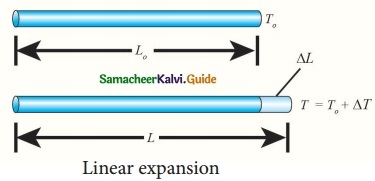
  • They reduce prices and increase the purchasing power of consumers world wide.
  • They are able to take advantage of tax variation.
  • They spur job growth in the local economy.

Disdvantages of MNCs:

(i) They have led to the downfall of smaller, local business.

(ii) With more companies transferring offices and centering operations in other countries, jobs for the people living in developed countries are threatened.

(iii) MNCs often invest in developing countries where they can take advantage of cheaper labour. Some MNCs prefer to put up branches in these parts of the world where there are no stringent policies in labour and where people need jobs because these MNCs can demand for cheaper labour and lesser healthcare benefits.

Question 40.
Write a note on history of industrialisation in Tamil Nadu.
Answer:

Industrialisation in the Colonial Period:

  • The introduction of cotton cultivation in western and southern Tamil Nadu by the colonial government led to the emergence of a large-scale textile sector in these parts, which involved ginning, pressing, spinning and weaving operations.
  • Introduction of railways also expanded the market for cotton yam and helped develop the sector.
  • There was increase in trade during this period which led to industrial development. The two active ports in the region were Chennai and Tuticorin.
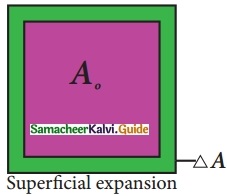
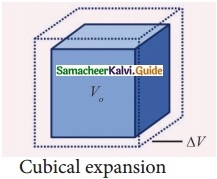
  • In Western Tamil Nadu, the emergence of textiles industries also led to demand and starting of textile machinery industry in the region.

Post-Independence to early 1990s:

  • After independence, several large enterprises were set up by both the central and state governments.
  • The Integral Coach Factory in Chennai made railway coaches and the Bharat Heavy Electricals Limited (BHEL) in Tiruchirapalli manufactured boilers and turbines.
  • Ashok Motors and Standard Motors together helped form an automobile cluster in the Chennai region.
  • The 1970s and 1980s saw the setting up of emergence of powerloom weaving clusters in the Coimbatore region as well as expansion of cotton knitwear cluster in Tiruppur and home furnishings cluster in Karur.
  • The Hosur industrial cluster is a successful case of how such policy efforts to promote industrial estates helped develop industries in a backward region.

Industrialisation in Tamil Nadu – Liberalization Phase:

  • The final phase of industrialisation is the post-reforms period since the early 1990s.
  • Because of trade liberalisation measures, exports of textiles, home furnishings and leather products began to grow rapidly.
  • Efforts to attract investments led to entry of leading multinational firms (MNCs) into the state, especially in the automobile sector.
  • Chennai region also emerged as a hub for electronics industry with MNCs such as Nokia, Foxconn, Samsung and Flextronics opening plants on the city’s outskirts.
  • A significant share of these investments has come up in special economic zones in the districts bordering Chennai.
  • The major industries are automobiles, autocomponents, light and heavy engineering, machinery, cotton, etc.
  • This diffused process of industrialisation and corresponding urbanisation has paved the way for better rural-urban linkages in Tamil Nadu than in most other states.

Samacheer Kalvi 10th Social Science Model Question Paper 3 English Medium

Question 41.
Draw a time line for the following:
Write any five important events between 1905-1920
Answer:
Samacheer Kalvi 10th Social Science Model Question Paper 3 English Medium - 5

Question 42.
Mark the following places on the world map.
(i) Portugal
(ii) Spain
(iii) Morocco
(iv) France
(v) Great Britian
Answer:
Samacheer Kalvi 10th Social Science Model Question Paper 3 English Medium - 6

Samacheer Kalvi 10th Social Science Model Question Paper 3 English Medium

Part – IV

Answer both questions. [2 x 8 = 16]

Question 43.
(a) Battle of Stalingrad
(i) When did Germany attack Stalingrad?
(ii) What were the main manufactures of Stalingrad?
(iii) What was the name of the plan formulated by Hitler to attack Stalingrad?
(iv) What is the significance of the Battle of Stalingrad?
Answer:
(a) Battle of Stalingrad:
(i) In August 1942, Germany attacked Stalingrad.
(ii) The main manufactures of Stalingrad were armaments and tractors.
(iii) Fall Blau or Operation Blue
(iv) The people of Russia were grateful for Stalin’s conduct of the war. They regarded him as ‘a prodigy of patience, tenacity and vigilance, almost omnipresent, almost omniscient.’

(b) Political developments in South America.
(i) By which year did the whole of South America become free from European domination?
(ii) How many republics came into being from the Central America?
(iii) In which year was Cuba occupied by the USA?
(iv) What made oligarchic regimes unpopular in South America?
Answer:
(b) Political developments in South America:
(i) By 1830 the whole of South America was free from European domination.
(ii) Five republics came into being from the Central America.
(iii) The USA occupied Cuba in the year 1898.
(iv) Economic growth, urbanisation and industrial growth in countries like Argentina, Chile, Brazil, and Mexico helped consolidate the hold of middle class and the emergence of militant working class oganisations. At the same time American power and wealth came to dominate Central and South America. These factors made olgarchic regimes unpopular in South America.

[OR]

(c) Gandhi and Mass nationalism.
(i) Which incident is considered a turning point in the life of Gandhi?
(ii) Name the works that influenced Gandhi?
(iii) How did Gandhi use satyagraha as a strategy in South Africa?
(iv) What do you know about the Champaran Satyagraha?
Answer:
(c) Gandhi and Mass nationalism:
(i) On his journey from Durban to Pretoria, at the Pietermaritzburg railway station, he was physically thrown out of the first class compartment in which he was travelling despite having a first class ticket. This incident is considered a turning point in the life of Gandhi.
(ii) Tolstoy’s The Kingdom of God is Within You, Ruskin’s Unto This Last and Thoreau’s Civil Disobedience.
(iii) Gandhi developed satyagraha (truth-force) as a strategy, in which campaigners went on peaceful marches and presented themselves for arrest in protest against unjust laws.
(iv) The Champaran Satyagraha of 1916 was the first satyagraha movement inspired by Gandhi. It was a farmer’s uprising that took place in Champaran district of Bihar, India during the British colonial period.

(d) Periyar E. V. R.
(i) When did Periyar found Dravidar Kazhagam?
(ii) What were the Newspapers and Journals run by Periyar?
(iii) Why was Periyar known as Vaikom hero?
(iv) Which was the most important work of Periyar?
Answer:
(d) Periyar E. V. R.
(i) Periyar found Dravidar Kazhagam in 1944.
(ii) The newspapers and journals started by Periyar were – Kudi Arasu, Revolt, Puratchi, Paguththarivu and Viduthalai.
(iii) In Vaikom, people protested against the practice of no access to the temples by the lower caste people. After the local leaders were arrested Periyar led the Temple Entry Movement and was imprisoned. So, people hailed him as Vaikom Virar or hero of Vaikom.
(iv) Right from 1929, when the Self-respect Conferences began to voice its concern over the plight of women, Periyar had been emphasising women’s right to divorce and property. Periyar’s most important work on this subject is Why the Woman is Enslaved.

Samacheer Kalvi 10th Social Science Model Question Paper 3 English Medium

Question 44.
Mark the following places on the given outline map of India.
(i) Himalayas
(ii) Nilgiris
(iii) Narmada
(iv) Lakshadweep
(v) Deccan Plateau
(vi) Southwest Monsoon
(vii) Paddy growing area
(viii) Chennai to Mumbai air route
Answer:
Samacheer Kalvi 10th Social Science Model Question Paper 3 English Medium - 7

[OR]

Mark the following places are given outline map of Tamil Nadu:
(i) Coromandel coast
(ii) Paddy growing area
(iii) Nilgiri Hills
(iv) Nagapattinam
(v) Meenambakkam
(vi) Thamirabarani
(vii) Magnesite region (any one place)
(viii) Vaigai Dam
Answer:
Samacheer Kalvi 10th Social Science Model Question Paper 3 English Medium - 8

Map for Q. 42
(i) Portugal
(ii) Spain
(iii) Morocco
(iv) France
(v) Great Britain
Answer:
Samacheer Kalvi 10th Social Science Model Question Paper 3 English Medium - 9

Map for Q. 44
(i) Himalayas
(ii) Nilgiris
(if) Narmada
(iv) Lakshadwccp
(v) Deccan Plateau
(vi) Southwest Monsoon
(vii) Paddy growing area
(viii) Chennai to Mumbai air route
Answer:
Samacheer Kalvi 10th Social Science Model Question Paper 3 English Medium - 10

Map for Q. 44
(i) Coromandel coast
(ii) Paddy growing area
(iii) Nilgiri Hills
(iv) Nagapattinam
(v) Meenambakkam
(vi) Thamirabarani
(vii) Magnesite region (any one place)
(viii) Vaigai Dam
Answer:
Samacheer Kalvi 10th Social Science Model Question Paper 3 English Medium - 11

Samacheer Kalvi 10th Social Science Model Question Paper 2 English Medium

Students can Download Samacheer Kalvi 10th Social Science Model Question Paper 2 English Medium Pdf, Samacheer Kalvi 10th Social Science Model Question Papers helps you to revise the complete Tamilnadu State Board New Syllabus, helps students complete homework assignments and to score high marks in board exams.

Tamil Nadu Samacheer Kalvi 10th Social Science Model Question Paper 2 English Medium

General Instructions:

  1. The question paper comprises of four parts
  2. You are to attempt all the questions in each part. An internal choice of questions is provided wherever applicable.
  3. All questions of Part I, II, III, and IV are to be attempted separately.
  4. Question numbers 1 to 14 in Part I are Multiple Choice Questions of one mark each.
    These are to be answered by writing the correct answer along with the corresponding option code and the corresponding answer
  5. Question numbers 15 to 28 in Part II are of two marks each. Any one question should be answered compulsorily.
  6. Question numbers 29 to 42 in Part III are of five marks each. Any one question should be answered compulsorily.
  7. Question numbers 43 to 44 in Part IV are of Eight marks each. Draw diagrams wherever necessary.

Time: 3 Hours
Maximum Marks: 100

Part – I

Answer all the questions. Choose the correct answer [14 × 1 = 14]

Question 1.
What is the Battle of Marne remembered for?
(a) Air warfare
(b) Trench warfare
(c) Submarine warfare
(d) Ship warfare
Answer:
(b) Trench warfare

Question 2.
With whom of the following was the Lateran Treaty signed by Italy?
(a) Germany
(b) Russia
(c) Pope
(d) Spain
Answer:
(c) Pope

Question 3.
The United States and European allies formed to resist any Soviet aggression in
Europe.
(a) SEATO
(b) NATO
(c) SENTO
(d) Warsaw Pact
Answer:
(b) NATO

Samacheer Kalvi 10th Social Science Model Question Paper 2 English Medium

Question 4.
Find out the militant nationalist from the following.
(a) Dadabhai Naoroji
(b) Justice Govind Ranade
(c) Bipin Chandra Pal
(d) Romesh Chandra
Answer:
(c) Bipin Chandra Pal

Question 5.
When was the first forest Act enacted?
(a) 1858
(b) 1911
(c) 1865
(d) 1936
Answer:
(c) 1865

Question 6.
…………………………. River is known as “Sorrow of Bihar”.
(a) Narmada
(b) Godavari
(c) Kosi
(d) Damodar
Answer:
(c) Kosi

Question 7.
………………………….  helps in quick, ripening of mangoes along the coast of Kerala and Karnataka.
(a) Loo
(b) Nor wester
(c) Mango showers
(d) Jet stream
Answer:
(c) Mango showers

Question 8.
Which crop is called as “Golden fibre” in India?
(a) cotton
(b) Wheat
(c) Jute
(d) Tobacco
Answer:
(c) Jute

Question 9.
Which of the following district is affected by sand dunes to a large extent?
(a) Theni
(b) Madurai
(c) Thanjavur
(d) Ramanathapuram
Answer:
(d) Ramanathapuram

Samacheer Kalvi 10th Social Science Model Question Paper 2 English Medium

Question 10.
The transport useful in the inaccessible area is ………………………….
(a) Roadways
(b) Railways
(c) Airways
(d) Waterways
Answer:
(c) Airways

Question 11.
How can the fundamental Rights be suspended?
(a) If the supreme court so desires
(b) If the Prime Minister orders to this effect
(c) If the President orders it during the national emergency
(d) All of the above
Answer:
(c) If the President orders it during the national emergency

Question 12.
Find the odd one ………………………….
(a) Social welfare
(b) Health care
(c) Diplomacy
(d) Domestic affairs
Answer:
(c) Diplomacy

Question 13.
…………………………. status is one of the indicators of the overall well-being of population and human resources development.
(a) Health
(b) Nutritional
(c) Economic
(d) Wealth
Answer:
(a) Health

Samacheer Kalvi 10th Social Science Model Question Paper 2 English Medium

Question 14.
Which one is a trade policy?
(a) irrigation policy
(b) import and export policy
(c) Land-reform policy
(d) Wage policy
Answer:
(b) import and export policy

Part – II

Answer any 10 questions. Question No. 28 is compulsory. [10 x 2 = 20]

Question 15.
Write a note on reforms of Ramalinga Adigal.
Answer:
(i) Ramalinga swamigal emphasised the bonds of responsibility and compassion between living beings. He expressed the view that those who lack compassion for suffering of human beings are hard hearted, their wisdom clonded. He showed his compassion and mercy on all living beings including plants.

(ii) He established the Samarasa Vedha Sanmarga Sangam in 1865 and it was renamed in 1872 as ‘Samarasa Suddha Sanmarga Sathya Sangam’ which means ‘Society for pure truth in universal self-hood’. Ramalinga also estabilished a free feeding house for everyone.

Question 16.
Describe the Pearl Harbour incident.
Answer:
(i) Pearl Harbour incident took place in December 1941 when Japan attacked American naval installations in Pearl Harbour, Hawaii, without warning to cripple America’s Pacific fleet. Many battle ships and numerous fighter planes were destroyed.

(ii) The US declared war on Japan, with Britain and China. This brought together both the Asia Pacific and the European war into one common cause. Most importantly, it brought the United States with its enormous resources into the war as a part of the Allies.

Samacheer Kalvi 10th Social Science Model Question Paper 2 English Medium

Question 17.
What was the significance of the Battle of Kalakadu?
Answer:
In the Battle of Kalakadu, Mahfuzkhan’s troops were routed by the huge forces of Puli Thevar.

Question 18.
Write a note on the Khilafat Movement.
Answer:

  • After World War I, the Caliph of Turkey, who was considered the head of Muslims all over the world, was given a very harsh treatment. The Khilafat Movement started in support of the Caliph.
  • It was led by Maulana Mohamed Ali and Maulana Shaukat Ali, popularly known as the Ali brothers.
  • It aimed to restore the prestige and power of the Caliphate. Mahatma Gandhi supported the movement and saw it an opportunity to unite the Hindus and the Muslims.

Question 19.
Define ‘Meteorology’.
Answer:
The branch of science concerned with the processes and phenomena of the atmosphere, especially as a means of forecasting the weather.

Question 20.
Name the types of soil found in India.
Answer:

  1. Alluvial Soils
  2. Black soils
  3. Red soils
  4. Laterite soils
  5. Forest and mountain soils
  6. Arid and desert soils
  7. Saline and alkaline soils
  8. Peaty and marshy soils.

Question 21.
Name the important oil producing regions of India.
Answer:
Oil in India is obtained from both from on-shore and off-shore areas.
Western Coast off shore oil fields:

  1. Mumbai high oil fields
  2. Gujarat Coast
  3. Basseim oil field, South of Mumbai high
  4. Ankleshwar
  5. Cambay-Luni Region
  6. Ahemedabad-Kalol Region
  7. Aliabet oil feild, south of Bhavanagar

Eastern Coast off shore oil fields:

  1. Brahmaputra valley
  2. Digboi oil fields
  3. Nahoratiya oil fields
  4. Moran-Hugrijan oil fields
  5. Rudrasagar-Lawa oil fields
  6. Surrma valley
  7. Offshore of Andaman and Nicobar, Gulf of Mannar, Baleshwar coast, Punjab, Haryana and Uttar Pradesh.

Question 22.
What is national emergency?
Answer:
National emergency is a situation beyond the ordinary. The President declares this emergency if he is satisfied that India’s security is threatened due to war, external aggression or armed rebellion or if there is an imminent danger or threat.

Samacheer Kalvi 10th Social Science Model Question Paper 2 English Medium

Question 23.
Mention the member countries of BRICS.
Answer:

  • Brazil
  • Russia
  • India
  • China
  • South Africa

Question 24.
Write any five principles of Fair Trade Practices.
Answer:
Five principles of Fair trade practices:

  • Creating opportunities for economically disadvantaged producers.
  • Transforming and accountability.
  • Fair trading practices and payment of fair price.
  • Ensuring no child labour and forced labour.
  • Respect for the environment.

Question 25.
Define food security according to FAO.
Answer:
The United Nation’s Food and Agriculture Organisation defines food security as follows: “Food security exists when all people, at all times, have physical, social and economic access to sufficient, safe and nutritious food which meets their dietary needs and food preferences for an active and healthy life.” (FAO, 2009)

Question 26.
What are the effects of Green Revolution?
Answer:

  • It increase the production and cultivation
  • It increase the productivity
  • Changes in cropping system
  • Industrial development

Question 27.
Why is Coimbatore called the Manchester of Tamil Nadu?
Answer:
Maximum units are concentrated in and around Coimbatore region. For this region it is known as the “Manchester of South India”. It is known as such because of presence of more than 25,000 small, medium, large scale industries and textile mills.

Question 28.
What was the reason for India to choose the path of Non-Alignment?
Answer:

  • The new nations that got independence after the long period of colonial struggle found themselves in a very difficult situation with respect to economic development.
  • So it was necessary to align with either of the blocs – United States of America (USA) or United Soviet Socialist Republic (USSR).
  • Nehru, India’s first Prime Minister, was opposed to the rivalry of the two superpowers (America and Russia). So he chose the path of Non-Alignment.

Part – III

Answer any 10 questions. Question No. 42 is compulsory. [10 x 5 = 50]

Question 29.
Fill in the blanks
(i) …………………………. was the headquarters of the Council of Europe.
(ii) …………………………. is the highest peak in the southern most part of the Eastern Ghats.
(iii) …………………………. is the instrument for implementing foreign policy of a state.
(iv) …………………………. is an important indicator of nutrition deficiency.
(v) Sathanur dam is constructed across the river ………………………….
Answers
(i) Strasbourg
(ii) Solaikaradu
(iii) Diplomacy
(iv) Underweight
(v) Thenpennai.

Samacheer Kalvi 10th Social Science Model Question Paper 2 English Medium

Question 30.
Match the following:
Samacheer Kalvi 10th Social Science Model Question Paper 2 English Medium - 1
Answer
Samacheer Kalvi 10th Social Science Model Question Paper 2 English Medium - 2

Question 31.
Match the following:
Samacheer Kalvi 10th Social Science Model Question Paper 2 English Medium - 3
Answer
Samacheer Kalvi 10th Social Science Model Question Paper 2 English Medium - 4

Question 32.
(a) Distinguish between
(i) Western Coastal Plains and Eastern Coastal Plains
(ii) Marine Fishing and Inland Fishing
Answer:
(a) (i) Western Coastal Plains and Eastern Coastal Plains:

Western Coastal Plains :

  1. It lies between the Western Ghats and Arabian Sea.
  2. It is a narrow plain, which stretches from Gujarat to Kerala with an average width of 50 – 80 Km.
  3. This plain is drained by less rivers like Narmada and Tapti forming estuaries.
  4. It consists of three sections. The northern part of the coast is called the Konkan (Mumbai – Goa), the
  5. Central stretch is called the Kannad plain while the southern stretch is referred to as the Malabar coast.

Eastern Coastal Plains:

  1. It lies between the Eastern Ghats and Bay of Bengal Sea.
  2. They are wide and level plains with an average width of 80 – 100 Km.
  3. This plain is drained by more rivers forming deltas like Mahanadi, Godavari, Krishna and Kaveri.
  4. It consists of two sections. In the northern part, it is referred to as the Northern Circar, while the southern part is known as the Coromandal coast.
  5. Lake Chilka is an important feature along the eastern coast.

(ii) Marine Fishing and Inland Fishing:
Marine Fishing :

  1. It includes coastal off-shore and deep sea fisheries mainly on the continent shelf.
  2. Kerala leads in the marine fish production in India.

Inland Fishing :

  1. Rivers, lakes, canals, reservoirs, ponds, tanks etc.
  2. Andhra Pradesh is the leading producer in India.

(b) Give reason: Western Coastal plain is narrow.
Answer:

  • It lies between the Western Ghats and Arabian Sea.
  • It is a narrow plain, which stretches from Gujarat to Kerala with an average width of 50-80 km.
  • It is mainly characterised by sandy beaches, coastal sand dunes, mud flats, lagoons, estuary, laterite platforms and residual hills.

Question 33.
Attempt an essay on the rise and fall of Adolf Hitler.
Hitler was great orator. He swayed the people by his impassioned speeches, promising a return to the glorious military past of Germany. He founded the National Socialist Party, known as ‘the Nazis’.

He came to power in 1933 and ruled Germany till 1945, with a small group of fanatic followers. He rearmed Germany. He made huge expenditure on the recruitment of armed forces and the manufacture of armaments and machinery for the army, navy and air force. Soon the economic condition of Germany got strengthened and the problem of unemployment came to an end. In 1938, Hitler invaded Austria and Czechoslovakia.

Sudetenland in Czechoslovakia was German-speaking, and Hitler’s claim was that the German-speaking people should be united in one nation. Though Hitler gave an assurance in the Munich Pact that Germany would not attack any other country, but this was broken immediately. In 1939, he invaded Czechoslovakia.

Poland was attacked next, and this was the final act which resulted in declaration of war by Britain and France against Germany. In June 1940, Italy joined Germany, and in September 1940, Japan also joined the Axis Powers.

The German army followed a tactic of ‘lightning strike’ to storm into various countries and overrun them. In June 1941, German army invaded Russia and remained successful in the initial years. But ultimately got defeated due to the resistance by Soviet army, and the fierce Russian winter.

In the Battle of Alamein 1942, the Allied forces counter-attacked and defeated the German and Italian forces in North Africa. The German army was chased across the desert, out of North Africa. The war continued till Hitler’s suicide in April 1945.

Samacheer Kalvi 10th Social Science Model Question Paper 2 English Medium

Question 34.
Discuss the reasons behind the partition of India.
While the Indian National Congress was calling for Britain to quit India, in 1943, the Muslim League passed a resolution demanding the British to divide and quit. There were several reasons for the separate Muslim homeland in the sub-continent:

  • As colonizers, the British had followed a divide-and-rule policy in India. In the census they categorized people according to religion and viewed and treated them as separate from each other.
  • The British based their knowledge of the people of India on religious texts and the intrinsic differences they found in them, instead of examining how people of different religions coexisted.
  • As soon as the Muslim League was formed, Muslims were placed on a separate electorate.
    Thus, the separateness of Muslims in India was built into the Indian electoral process.
  • There was also an ideological divide between the Muslims and the Hindus of India. While there were strong feelings of nationalism in India, by the late 19th century there were also communal conflicts and movements in the country that were based on religious identities rather than class or regional ones.
  • Both Hindu Mahasabha and Muslim League claimed that the interests of the Hindus and Muslims were different and hostile to each other.
  • The British policy of divide and rule, through measures such as Partition of Bengal, Communal Award, had encouraged the vested interests out to exploit the religious differences.

Question 35.
State the types of soil in India and explain the characteristics and distribution of soil.
Answer:
Samacheer Kalvi 10th Social Science Model Question Paper 2 English Medium - 5
Samacheer Kalvi 10th Social Science Model Question Paper 2 English Medium - 6
Samacheer Kalvi 10th Social Science Model Question Paper 2 English Medium - 7

Question 36.
Describe the nature of the plateau region of Tamil Nadu.
Answer:

  • Plateau of Tamil Nadu are located between the Western Ghats and the Eastern Ghats.
  • It is roughly triangular in shape and covers an area of about 60,000 sq. km. .
  • Its height increases from east to west. Its height ranges between 150 and 600 m.
  • This plateau is broader in the north and very narrow in the south and it has many subdivisions.
  • Bharamahal plateau is a part of the Mysore plateau situated in the northwestern part of Tamil Nadu. Dharmapuri and Krishnagiri districts are located in this region.
  • Coimbatore plateau lies between the Nilgiris and Dharmapuri districts. Its height varies from 150 to 450 metres. Moyar river separates this plateau from the Mysore plateau.
  • Rivers like Bhavani, Noyyal and Amaravathi, which originate from Western Ghats form Valleys in the region. Many intermontane plateaus are found in the region of the Nilgiris. Sigur plateau is one such plateau.
  • Madurai plateau found in madurai district extends up to the foothills of the Western Ghats. Vaigai and Thamirabarani basins are located in the zone.

Samacheer Kalvi 10th Social Science Model Question Paper 2 English Medium

Question 37.
Point out the fundamental Rights.
The Fundamental Rights are enshrined in Part III of the Constitution from Articles 12 to 35. There are six Fundamental Rights –

  • Right to Equality It provides equality before law. It prohibits discrimination on grounds of religion, race, caste, sex or place of birth. It abolishes untouchability.
  • Right to Freedom It provides freedom of speech and expression, assembly, association, movement, residence and profession.
  • Right against Exploitation It prohibits trafficking in human beings and forced labour. It also prohibits employment of children in factories, etc.
  • Right to religion It gives freedom of conscience and free profession practice and propagations of religion. ,
  • Cultural and Educational rights It gives protection of language, script and culture of minorities. It also gives minorities the right to establish and administer educational institutions.
  • Right to Constitutional Remedies It allows individuals to seek redressal for the violation of their Fundamental Rights.

Question 38.
Make a list on basic concepts followed by India to maintain friendly relations with its neighbours.
Answer:

  • Indian foreign policy has always regarded the concept of neighbourhood as one of widening concentric circles, around the central axis of historical and cultural commonalties.
  • India gives political and diplomatic priority to her immediate neighbours and the Indian Ocean Island states such as Maldives. ,
  • India provides neighbours with support as needed in this form of resources equipment and training.

Question 39.
Explain various terms associated with measuring of national income.
Answer:
Various terms associated with measuring of national income.

(i) Gross National Product or GNP is the total value of goods and services produced and income received in a year by domestic residents of a country. It excludes profits earned from capital invested abroad.

(ii) Gross Domestic Product or GDP is the total value of output of goods and services produced by the factors of production within the geographical boundaries of the country.

(iii) Net National Product or NNP refers to gross national product, i.e., the total market value of all final goods and services produced by the factors of productions of a country or other polity during a given time period, minus depreciation.

(iv) Net Domestic Product or NDP is a part of Gross Domestic Product. It is obtained from the Gross Domestic Product by deducting the Quantum of the wear and tear expenses (depreciation).
NDP = GDP – Depreciation

(v) Per .Capita Income or PCI is an indicator to show the living standard of people in a country.
It is obtained by dividing the National Income by the population of a country.
National Income
Per Capita Income = \(\frac{\text { National Income }}{\text { Population }}\)

(vi) Personal Income or PI is the total money income received by individuals and households of a country from all possible services before direct taxes. Personal income can be expressed as follows:
PI = NI Corporate Income Taxes – Undistributed Corporate Profits – Social Security Contributions + Transfer payment.

(vii) Disposable Income or DI means actual income which can be spent on consumption by individuals and families. It can be expressed as DPI = PI – Direct Taxes.

Question 40.
Write in detail about the types of policies adopted by the Tamil Nadu government to industrialise?
Industrial Policy of Tamil Nadu:
Tamil Nadu enjoys growth and has excellent infrastructure. A straggly established cluster and political stability are the major advantages. The state government has a pro-active industrial policy and is very encouraging when it comes to SEZs.
Important industrial policies:

  • Tamil Nadu Industrial Policy – 2014
  • Implementation of Industrial Policy – 2015
  • Tamilnadu State Environmental Policy – 2014
  • Tamilnadu SEZs Policy -2013
  • Tamilnadu Automobiles and Auto Parts Policy – 2014 (/) Tamilnadu Biotechnology Policies – 2014

Question 41.
Draw a time line for the following:
live important events between 1922-1943
Answer:
Samacheer Kalvi 10th Social Science Model Question Paper 2 English Medium - 8

Question 42.
Mark the following places on the world map.
(i) Bosnia
(ii) Romania
(iii) Serbia
(iv) Bulgaria
(v) Turkey
Samacheer Kalvi 10th Social Science Model Question Paper 2 English Medium - 9

Part – IV

Answer both questions. [2 x 8 = 16]

Question 43.
(a) Balkan Wars
(i) Why was Balkan league formed?
(ii) What was the outcome of the first Balkan war?
(iii) Who were defeated in this war?
(iv) What was the name of the Treaty signed at the end of this second Balkan war?
Answer:
(a) Balkan Wars
(i) Balkan League was formed to attack and defeat Turkish forces in the first Balkan War in 1912-13.
(ii) The new state of Albania was created and the other Balkan states divided up Macedonia between them. Turkey was reduced to the area around Constantinople.
(iii) The Turkish forces were defeated in the first Balkan War.
(iv) The name of the Treaty signed at the end of the second Balkan War was the Treaty of Bucharest.

(b) Deccan Riots
(i) When and where did the first recorded incident of rioting against the moneylenders in the Deccan appear?
(ii) What was the right given to moneylenders under a new law of the British?
(iii) What did it result in?
(iv) Against whom was the violence directed in the Deccan riots.
Answer:
(b) Deccan Riots
(i) The first recorded incident of rioting against the moneylenders in the Deccan appeared in May 1875, in Supa, a village near Poona.
(ii) Under a new law, the British moneylenders were allowed to attach the mortgaged land of the defaulters and auction it off.
(iii) It resulted in transfer of lands from the cultivators to the non-cultivating classes.
(iv) The violence was directed mostly at the Gujarat moneylenders.

[OR]

(c) Early Nationalist Movement in Tamil Nadu
(i) What were the objectives of Madras Native Association?
(ii) What led to the emergence of nationalist press in Tamil Nadu?
(iii) What were the demands of Madras Mahajana Sabha?
(iv) Who were the early nationalist leaders in Tamil Nadu?
Answer:
(c) Early Nationalist Movement in Tamil Nadu
(i) The objective of Madras Native Association was to promote the interests of its members and reduction of taxes. It also protested against the government’s support to missionary activities.

(ii) The entire press opposed the appointment of the first South Indian judge of the Madras High Court in 1878. This led to a need of a nationalist press to express the Indian perspective. The Hindu was started in 1878 and soon became a vehicle for nationalist propaganda.

(iii) The demands of Madras Mahajana Sabha were to conduct civil services examinations simultaneously in England and India, abolition of India Council in London, reduction of taxes, and reduction of civil and military expenditure.

(iv) Some early nationalists in Tamil Nadu were: V.S. Srinivasa Sastri, P.S. Sivasamy Iyer, V. Krishnasamy Iyer, T.R. Venkatrama Sastri, G.A. Natesan, T.M. Madhava Rao and S. Subramania Iyer.

(d) Labour Movement in Tamil Nadu
(i) Highlight the factors that caused the birth of Trade Union Movement in Madras.
(ii) Identify the three prominent persons associated with the Madras Labour Union.
(iii) Where was the first conference of All India Trade Union Congress held?
(iv) Who organized the first ever celebration of May Day in Madras and which year?
Answer:
(d) Labour Movement in Tamil Nadu
(i) The factors that caused the birth of Trade Union Movement in Madras are,

  • Retrenchment of workers at the end of the First World War.
  • Nationalists’ support to the cause of labour.

(ii) Three prominent persons associated with the Madras Labour Union are B.R Walia, M. Singaravelar and Thiru.Vi. Kalyanasundaram.

(iii) The first All India Trade Union Conference was held in Bombay.
(iv) M. Singaravelar organised the first ever celebration of May Day in Madras in 1923.

Samacheer Kalvi 10th Social Science Model Question Paper 2 English Medium

Question 44.
Mark the following places on the given outline map of India.
(i) Western Ghats
(ii) Mahanadi
(iii) Malwa Plateau
(iv) Panna biosphere reserve
(v) Southwest Monsoon
(vi) Black soil region
(vii) Tea growing area
(viii) Hirakud Dam
Answer:
Samacheer Kalvi 10th Social Science Model Question Paper 2 English Medium - 10

[OR]

Mark the following places on the given outline map of Tamil Nadu:
(i) One Lignite producing area
(ii) Neyveli
(iii) Kollidam
(iv) Decidious forest area
(v) Alluvial soil region
(vi) Cuddalore
(vii) Vellore
(viii) River Chittar
Answer:
Samacheer Kalvi 10th Social Science Model Question Paper 2 English Medium - 11

Map for Q. 42
(i) Bosnia
(ii) Romania
(iii) Serbia
(iv) Bulgaria
(v) Turkey
Answer:

Samacheer Kalvi 10th Social Science Model Question Paper 2 English Medium - 9

Map for Q. 44
(i) Western Ghats
(ii) Mahanadi
(iii) Malwa Plateau
(iv) Panna biosphere reserve
(v) Southwest Monsoon
(vi) Black soil region
(vii) Tea growing area
(viii) Hirakud Dam
Answer:
Samacheer Kalvi 10th Social Science Model Question Paper 2 English Medium - 10

Map for Q.44
(j) One Lignite producing area
(ii) Neyveli
(iii) Kollidam
(iv) Decidious forest area
(v) Alluvial soil regions
(vi) Cuddalore
(vii) Vellore
(viii) River Chittar
Answer:
Samacheer Kalvi 10th Social Science Model Question Paper 2 English Medium - 11

Samacheer Kalvi 10th Science Model Question Paper 1 English Medium

Students can Download Samacheer Kalvi 10th Science Model Question Paper 1 English Medium Pdf, Samacheer Kalvi 10th Science Model Question Papers helps you to revise the complete Tamilnadu State Board New Syllabus, helps students complete homework assignments and to score high marks in board exams.

Tamil Nadu Samacheer Kalvi 10th Science Model Question Paper 1 English Medium

General Instructions:

  1. The question paper comprises of four parts
  2. You are to attempt all the questions in each part. An internal choice of questions is provided wherever applicable.
  3. All questions of Part I, II, III and IV are to be attempted separately.
  4. Question numbers 1 to 12 in Part I are Multiple Choice Questions of one mark each.
    These are to be answered by writing the correct answer along with the corresponding option code.
  5. Question numbers 13 to 22 in Part II are of two marks each. Any one question should be answered compulsorily.
  6. Question numbers 23 to 32 in Part III are of four marks each. Any one question should be answered compulsorily.
  7. Question numbers 33 to 35 in Part IV are of seven marks each. Draw diagrams wherever necessary.

Time: 3 Hours
Maximum Marks: 75

Part – I

(i) Answer all the questions. [12 × 1 = 12]
(ii) Choose the most suitable answer and write the code with the corresponding answer.

Question 1.
Newton’s III law is applicable ________ .
(a) for a body is at rest
(b) for a body in motion
(c) both a and b
(d) only for bodies with equal masses
Answer:
(c) both a and b

Question 2.
SI unit of resistance is ________.
(a) mho
(b) joule
(c) Ohm
(d) Ohm meter
Answer:
(c) Ohm

Samacheer Kalvi 10th Science Model Question Paper 1 English Medium

Question 3.
Which of the following is the heaviest one?
(a) Hydrogen
(b) Alpha
(c) Beta
(d) Gamma
Answer:
(b) Alpha

Question 4.
1 mole of any substance contains ________ molecules.
(a) 6.023 × 10²³
(b) 6.023 × 10⁻²³
(c) 3.0115 × 10²³
(d) 12.046 × 10²³
Answer:
(a) 6.023 × 10²³

Question 5.
In the alumino thermic process the role of Al is ________
(a) Oxidizing agent
(b) reducing agent
(c) hydrogeneration agent
(d) Sulphurising agent
Answer:
(b) reducing agent

Question 6.
Solubility is the amount of solid dissolved in ________ g of solvent.
(a) 10 g
(b) 50 g
(c) 100 g
(d) 1 g
Answer:
(c) 100 g

Samacheer Kalvi 10th Science Model Question Paper 1 English Medium

Question 7.
Heart of heart is called ________.
(a) SA node
(b) Purkinjee fibres
(c) AV node
(d) Bundle of His
Answer:
(a) SA node

Question 8.
Metastasis is associated with ________.
(a) Benign tumour
(b) Malignant tumour
(c) Both (a) and (b)
(d) Crown gall tumour
Answer:
(b) Malignant tumour

Question 9.
Kreb’s cycle takes place in ________.
(a) Chloroplast
(b) Stomata
(c) Inner mitochondrial membrane
(d) Mitochondrial matrix
Answer:
(d) Mitochondrial matrix

Question 10.
The endarch condition is the characteristic feature of ________.
(a) root
(b) stem
(c) leaves
(d) flower
Answer:
(b) stem

Samacheer Kalvi 10th Science Model Question Paper 1 English Medium

Question 11.
Palaeontology deals with the study of ________.
(a) fossils
(b) genes
(c) petroleum
(d) homologous organ
Answer:
(a) fossils

Question 12.
Which software is used to create animation?
(a) Paint
(b) PDF
(c) MS word
(d) Scratch
Answer:
(d) Scratch

Part – II

Answer any seven questions. (Q.No: 22 is compulsory) [7 × 2 = 14]

Question 13.
State the principle of Moments.
Answer:
When a number of like or unlike parallel forces act on a rigid body and the body is in equilibrium, then the algebraic sum of the moments in the clockwise direction is equal to the algebraic sum of the moments in the anti-clockwise direction.

Samacheer Kalvi 10th Science Model Question Paper 1 English Medium

Question 14.
Why does the sky appear in blue colour?
Answer:
When sunlight passes through the atmosphere, the blue colour is scattered to a greater extent than the red colour. This scattering causes the sky to appear in blue colour.

Question 15.
What is the audible range of frequency?
Answer:
Audible waves – These are sound waves with a frequency ranging between 20 Hz to 20,000 Hz.

Question 16.
What is meant by binary solution?
Answer:
A solution must at least be consisting of two components. Such solutions which are made of one solute and one solvent are called binary solutions, (e.g.) adding CuSO4 crystals to water.

Question 17.
Differentiate reversible and irreversible reactions.
Answer:
Reversible Reaction:

  • Reaction can be reversed.
  • It proceeds in both directions.
  • It attains equilibrium.
  • It is relatively slow.

Irreversible Reaction:

  • Reaction cannot be reversed.
  • It is unidirectional.
  • Equilibrium is not attained.
  • It is fast.

Samacheer Kalvi 10th Science Model Question Paper 1 English Medium

Question 18.
What are viviparous animals?
Answer:
The animals which give birth to young ones are called viviparous animals.

Question 19.
Bring out any two physiological activities of abscisic acid (ABA).
Answer:

  1. ABA promotes the process of abscission. (Separation of leaves, flowers and fruits from the branch)
  2. During water stress and drought conditions ABA causes stomatal closure.

Question 20.
Define triple fusion.
Answer:
The fusion involving two polar nucleus and a sperm nucleus, that occurs in double fertilization in a seed plant and results in the formation of endosperm is called the triple fusion.

Question 21.
Why is Archaeopteryx considered to be connecting link?
Answer:
Archaeopteryx is the oldest known fossil bird. It is considered to be a connecting link between reptiles and birds. It had wings with feathers like a bird. It had long tail, clawed digits and conical teeth, like a reptile.

Samacheer Kalvi 10th Science Model Question Paper 1 English Medium

Question 22.
Calculate the resistance of a conductor through which a current of 5A passes, when the potential difference between its ends is 60V.
Answer:
Given, I = 5A
V = 60 V
From Ohm’s law: R = \(\frac{V}{I}=\frac{60}{5}\) =12 Ω
∴ R = 12 Ω

Part – III

Answer any seven questions (Q.No: 32 is compulsory) [7 × 4 = 28]

Question 23.
State the universal law of gravitation and derive its Mathematical expression.
Answer:
Samacheer Kalvi 10th Science Model Question Paper 1 English Medium 1
This law states that every particle of matter in this universe attracts every other particle with a force. This force is directly proportional to the product of their masses and inversely proportional to the square of the distance between the centres of there masses. The direction of the force acts along the line joining the masses.

Force between the masses is always attractive and it does not depend on the medium where they are placed. Let m1 and m2 be the masses of two bodies A and B placed r metre apart in space

Force, F ∝ m1 × m2, F ∝ \(\frac{1}{r^{2}}\)
On combining the above two expressions,
F ∝ \(\frac{m_{1} \times m_{2}}{r^{2}}\)
F = \(\frac{G m_{1} m_{2}}{r^{2}}\)
Where G is the universal gravitational constant. Its value in SI unit is 6.674 × 10⁻¹¹ N m2 kg-2.

Samacheer Kalvi 10th Science Model Question Paper 1 English Medium

Question 24.
(i) List any five properties of light.
Answer:

  • Light is a form of energy.
  • Light always travel along a straight line.
  • Light does not need any medium for its propagation. It can even travel through vacuum.
  • The speed of light in vacuum or air is C = 3 x 10⁸ ms-1
  • Different coloured light has different wavelength and frequency.

(ii) State Rayleigh’s law of scattering.
Answer:
Rayleigh’s scattering law states that “The amount of scattering of light is inversely proportional to the fourth power of its wavelength”.
Amount of scattering S ∝ \(\frac{1}{\lambda^{4}}\)

Question 25.
(i) A torch bulb is rated at 3V and 600 mA. calculate it’s (a) power (b) resistance (c) energy consumed if it is used for 4 hours.
Answer:
Given
V = 3V
I = 600 mA = 600 × 10-3 A
(a) Power (P) = VI = 3 × 600 × 10-3 = 1800 × 10-3
P= 1.8 W (or) watt.

(b) Resistance (R) = \(\frac{V}{I}\)
Samacheer Kalvi 10th Science Model Question Paper 1 English Medium 2
R = 5 Ω

(c) Power (P) = 1.8 W and t = 4 hours
= 4 × 60 × 60 = 14400 second.
Energy consumed (E) = P × t
= 1.8 × 14400 = 25920 joules
E = 25.9 Wh

(ii) Why does sound travel faster on a rainy day than on a dry day?
Answer:
When humidity increases the speed of sound increases. That is why we can hear sound from long distances clearly during rainy season.

Samacheer Kalvi 10th Science Model Question Paper 1 English Medium

Question 26.
Give the salient features of “Modern atomic theory”.
Answer:
The Salient features of “Modern atomic theory” are:

  • An atom is no longer indivisible.
  • Atoms of the same element may have different atomic masses.
  • Atoms of different elements may have same atomic masses.
  • Atoms of one element can be transmuted into atom of other elements. In other words, atom is no longer indestructible.
  • Atoms may not always combine in a simple whole number ratio.
  • Atom is the smallest particle that takes part in a chemical reaction.
  • The mass of an atom can be converted into energy E = mc2.

Question 27.
How is Aluminium extracted from Bauxite?
Answer:
Bauxite is the chief ore of aluminium. The extraction of aluminium from bauxite involves two steps:
(1) Conversion of bauxite into alumina – Baeyer’s process.
The conversion of Bauxite into Alumina involves the following steps:
Bauxite ore is finely ground and heated under pressure with a solution of concentrated caustic soda at 150° C to obtain sodium meta aluminate.

On diluting sodium meta aluminate with water, a precipitate of aluminium hydroxide is formed. The precipitate is filtered, washed, dried and ignited at 1000°C to get alumina.

(2) Electrolytic reduction of alumina – Hall’s process.
Aluminium is produced by the electrolytic reduction of fused alumina (Al2O3) in the electrolytic cell.
Cathode: Iron tank linked with graphite
Anode: A bunch of graphite rods suspended in molten electrolyte.
Electrolyte:
Samacheer Kalvi 10th Science Model Question Paper 1 English Medium 3
Pure alumina + molten cryolite + fluorspar
Samacheer Kalvi 10th Science Model Question Paper 1 English Medium 4
Temperature: 900 – 950° C
Voltage used: 5 – 6 V
Overall reaction:
2 Al2O3 → 4 Al + 3 O2

Question 28.
What are the structures involved in the protection of brain?
Answer:
The brain, controlling centre of all the body activities is covered by three connective tissue membrane (or) meninges.

  • Duramater – is the outermost thick fibrous membrane.
  • Arachnoid membrane – is the middle thin vascular membrane providing web-like cushion.
  • Piamater – is the innermost thin delicate membrane richly supplied with blood. Meningeal membranes protect the brain from mechanical injury.

Samacheer Kalvi 10th Science Model Question Paper 1 English Medium

Question 29.
(a) Why did Mendel select pea plant for his experiment?
Answer:

  • The pea plant is self pollinating and so it is very easy to raise pure breeding individuals.
  • It has a short life span.
  • It is easy to cross pollinate.
  • It has deeply defined contrasting characters.
  • The flowers are bisexual.

(b) What is the importance of valves in the heart?
Answer:
The valves are the muscular flaps, that regulate the flow of blood in a single direction and prevent backward flow of blood.

Question 30.
Differentiate the following:
(i) Light dependent reaction and Light independent reaction
Answer:
Light dependent reaction:

  • It is called Hill reaction or Light reaction.
  • The reaction is earned out in Thylakoid membranes of the chloroplast.
  • It is carried out in the presence of light.
  • Photosynthetic pigments absorb the light energy and convert it into chemical energy ATP and NADPH2.

Light independent reaction:

  • It is called Dark reaction or Biosynthetic pathway or Calvin cycle.
  • This reaction is carried out in the stroma of the chloroplast.
  • It is carried out in the absence of light.
  • CO2 is reduced into carbohydrates with the help of light generated ATP and NADPH2.

(ii) Aerobic and Anaerobic respiration
Answer:
Aerobic:

  • Occur in the presence of oxygen.
  • Carbon dioxide, water and ATP are produced.

Anaerobic:

  • Occur in the absence of oxygen.
  • Lactic acid, Ethanol and ATP are produced.

Samacheer Kalvi 10th Science Model Question Paper 1 English Medium

Question 31.
(a) What is metastasis?
Answer:
The cancerous cells migrate to distant parts of the body and affect new tissues and this process is called Metastasis.

(b) What are the effects of hybrid vigour in animals?
Answer:
The superiority of the hybrid, obtained by cross breeding is called heterosis or hybrid vigour.
Effects of hybrid vigour:

  • Increased production of milk by cattles.
  • Increased production of egg by poultry.
  • High quality of milk is produced.
  • Increased growth rate in domesticated animals.

Question 32.
(i) Explain Soddy and Fajan Radioactive displacement law.
Answer:
Alpha decay:
(a) Unstable parent nucleus emits an alpha particle to form stable daughter nucleus.
(b) 92U23890Th234 + 2He4 ( α – decay ).
(c) Mass number decreases by 4.
(d) Atomic number decreases by 2.

Beta decay:
(a) Unstable parent nucleus emits a beta particle to form stable daughter nucleus.
(b) 15P3216S32 + -1e0 (β – decay)
(c) Mass number – no change.
(d) Atomic number increased by 1.

Gamma decay:
(a) The atomic number and the mass number remain same.
(b) The energy level of the nucleus change. .

(ii) Calculate the pH of 0.05M H2SO4.
[H+] = Normality = Molarity × basicity
= 0.05 × 2 = 0.1
= 10-1 = 1 × 10⁻¹
pH = -log10 [H+]
pH = -log10 1 × 10⁻¹
pH = -log10 1 – log 10-1
pH = 0 – (- 1 log10 10) = 1

Part – IV

Answer all the questions. [3 × 7 = 21]

Question 33.
(a) (i) State the law of volume.
Answer:
When the pressure of gas is kept constant, the volume of a gas is directly proportional to the temperature of the gas.
(i.e.,) V ∝ T .
\(\frac{V}{T}\) = constant

(ii) Derive the ideal gas equation.
Answer:
The ideal gas equation is an equation, which relates all the properties of an ideal gas. An ideal gas obeys Boyle’s law, Charles’ law and Avagadro’s law,
According to Boyle’s law
PV = constant ……… (1)
According to Charles’s law,
\(\frac{V}{T}\) = constant …….(2)
According to Avagadro’s law,
\(\frac{V}{n}\) = constant ……(3)
After combining equations (1), (2) and (3)
\(\frac{P V}{n T}\) = constant ……..(4)

The above relation is called combined law of gases. If you consider a gas, which contains μ moles of the gas, the number of atoms contained will be equal to (i times the Avagadro’s number, NA
(i.e.,) n = μ NA
using equation (5) equation (4) can be written as
PV / μ NA T = constant

The value of the constant in the above equation is taken to be kB, which is called as Boltzmann constant (1.38 × 10⁻²³ J K-1). Hence, we have the following equation,
PV / μ NA T = kB
PV = μ NA kB T
Here μ NA kB = R, which is termed as universal gas constant whose value is 8.31 Jmol-1_1K-1
PV = RT
Ideal gas equation is also called as equation of state because it gives the relation between the state variables and it is used to describe the state of any gas.

[OR]

(b) (i) A man is standing between two vertical walls 680 m apart. He claps his hands and hears two distinct echoes after 0.9 seconds and 1.1 seconds respectively. What is the speed of sound in the air?
Answer:
Samacheer Kalvi 10th Science Model Question Paper 1 English Medium 5

(ii) A door is pushed, at a point whose distance from the hinges is 90 cm, with a force of 40 N. Calculate the moment of the force about the hinges.
Answer:
The moment of a force M = F × d
F = 40 N
d = 90 cm = 0.9 m
Hence, moment of the force = 40 × 0.9 = 36 Nm

Samacheer Kalvi 10th Science Model Question Paper 1 English Medium

Question 34.
(a) (i) Calculate the mass of 2.5 mole of oxygen atom.
Answer:
Number of moles = \(\frac{\text { Mass }}{\text { Atomic mass }}\)
∴ Mass = Number of moles × Atomic mass
= 0.5 × 16 = 8 g

(ii) Calculate the number of molecules in 11g of CO2.
Answer:
Gram Molecular of CO2 = 44 g.
number of molecules in 44 g of CO2 = 6.023 × 10²³
number of molecules in 11 g of CO2 = \(\frac{6.023 \times 10^{23}}{44}\) × 11
= 1.53 × 10²³ molecules

(iii) Calculate the number of moles in 81g of aluminium.
Answer:
Number of moles = \(\frac{\text { Mass }}{\text { Atomic mass }}\)
= \(\frac{81}{27}\) = 3 moles

[OR]

(b) How is ethanol manufactured from sugar-cane?
Answer:
Molasses is a dark coloured syrupy liquid left after the crystallization of sugar from the concentrated sugarcane juice. It contains 30 % of Sucrose, which cannot be separated by crystallization.

(i) Dilution of Molasses:
Molasses is first diluted with water,to bring down the concentration of sugar to about 8 to 10 percent.

(ii) Addition of Nitrogen Source:
Molasses contains enough nitrogenous matter to act as food for yeast during the fermentation process. If the nitrogenous matter is poor, ammonium sulphate or ammonium phosphate is added.

(iii) Addition of yeast:
This solution kept in large fermentation tank and yeast is added to it kept at about 303K for a few days. During this period, the enzymes invertase and Zymase present in yeast, convert sucrose into ethanol.
Samacheer Kalvi 10th Science Model Question Paper 1 English Medium 6
The fermented liquid is technically called wash.

(iv) Distillation of wash:
This wash containing 15 to 18% alcohol, is now subjected to fractional distillation. The main fraction drawn is an aqueous solution of ethanol which contains 95.5% of ethanol and 4.5% of water. This is called rectified spirit. This mixture is then refluxed over quicklime for about 5 to 6 hour and then allowed to stand for 12 hours. On distillation of mixture pure alcohol (100%) is obtained. This is called absolute alcohol.

Samacheer Kalvi 10th Science Model Question Paper 1 English Medium

Question 35.
(a) (i) Which hormone requires iodine for its formation? What will happen if intake of iodine in our diet is low?
Answer:
The formation of Thyroxine (T4) and Triiodothyronine requires iodine. If there is an inadequate supply of iodine in our diet it leads to enlargement of thyroid gland called goitre.

(ii) What is the importance of rainwater harvesting?
Answer:
The importance of rainwater harvesting is as follows:

  • Overcome the rapid depletion of ground water level.
  • To meet the increased demand of water.
  • Reduces flood and soil erosion.
  • Water stored in ground is not contaminated by human and animal wastes and hence can be used for drinking purposes.

(iii) What is colostrum? How is milk production hormonally regulated?
Answer:
The first fluid which is produced from the mammary gland after child birth is called colostrum. Milk production from alveoli of mammary gland is stimulated by prolactin secreted from anterior pituitary.

[OR]

(b) (i) How does locomotion take place in leech?
Answer:
Locomotion in leech takes place by:

  • Looping or crawling movement: Crawling movement is brought about by the contraction and relaxation of muscles. The two suckers serve for attachment during movement.
  • Swimming movement: Leeches swim very actively and perform undulating movement in water.

(ii) How does Fossilization occur in plants?
Answer:
Fossilization in plants: The process of formation of fossil in the rocks is called fossilization.
The common methods of fossilization includes:

1. Petrifiction: Minerals like silica slowly penetrate in and replace the original organic tissue. This method can preserve hard and soft parts, (e.g.) wood fossils.

2. Mold and Cast: A replica of a plant or animal is preserved in sedimentary rocks. When the organism get buried in sediment it is dissolved by underground water leaving a hollow depression called Mold. It shows only the original shape and not the internal structure. Minerals or sediments fill the hollow depression and forms a cast.

3. Preservation: The entire plant may be preserved to protect from the organism from decay. Ice or amber (tree sap) can be used for preservation.

4. Compression: When the organism dies, the hard parts settle at the bottom of the sea bed and are covered by sediment. The process goes on continuously and the fossils are formed.

5. Infiltration: The precipitation of minerals takes place which later on infiltrate the cell wall. The process is brought about by several mineral element such as silica, calcium carbonate and magnesium carbonate.

Samacheer Kalvi 10th Social Science Model Question Paper 5 English Medium

Students can Download Samacheer Kalvi 10th Social Science Model Question Paper 5 English Medium Pdf, Samacheer Kalvi 10th Social Science Model Question Papers helps you to revise the complete Tamilnadu State Board New Syllabus, helps students complete homework assignments and to score high marks in board exams.

Tamil Nadu Samacheer Kalvi 10th Social Science Model Question Paper 5 English Medium

General Instructions:

  1. The question paper comprises of four parts
  2. You are to attempt all the questions in each part. An internal choice of questions is provided wherever applicable.
  3. All questions of Part I, II, III, and IV are to be attempted separately.
  4. Question numbers 1 to 14 in Part I are Multiple Choice Questions of one mark each.
    These are to be answered by writing the correct answer along with the corresponding option code and the corresponding answer
  5. Question numbers 15 to 28 in Part II are of two marks each. Any one question should be answered compulsorily.
  6. Question numbers 29 to 42 in Part III are of five marks each. Any one question should be answered compulsorily.
  7. Question numbers 43 to 44 in Part IV are of Eight marks each. Draw diagrams wherever necessary.

Time: 3 Hours
Maximum Marks: 100

Part – I

Answer all the questions. Choose the correct answer [14 × 1 = 14]

Question 1.
Which country was expelled from the League of Nations for attacking Finland?
(a) Germany
(b) Russia
(c) Italy
(d) France
Answer:
(b) Russia

Question 2.
Who was the first Indian judge of the Madras High Court?
(a) T. Muthu Swamy
(b) P. S. Sivasamy
(c) V. S. Srinivasa Sastri
(d) G. A. Natesan
Answer:
(a) T. Muthu Swamy

Question 3.
Which American President followed the policy of containment of communism?
(a) Woodrow Wilson
(b) Truman
(c) Theodore Roosevelt
(d) Franklin Roosevelt
Answer:
(b) Truman

Question 4.
Which one of the following was launched by Haji Shariatullah in 1818 in East Bengal?
(a) Wahhabi Rebellion
(b) Farazi Movement
(c) Tribal uprising
(d) Kol Revolt
Answer:
(b) Farazi Movement

Samacheer Kalvi 10th Social Science Model Question Paper 5 English Medium

Question 5.
Who was arrested during the anti-Rowlatt protests in Amirtsar?
(a) Motilal Nehru
(b) Shaifuddin Kitchlew
(c) MohamedAli
(d) Raj Kumar Shukla
Answer:
(b) Shaifuddin Kitchlew

Question 6.
The North-South extend of India is ………………..
(a) 2,500 km
(b) 2,933 km
(c) 3,214 km
(d) 2,814 km
Answer:
(c) 3,214 km

Question 7.
Meteorology is the science of………………..
(a) Weather
(b) Social
(c) Political
(d) Human
Answer:
(a) Weather

Question 8.
The Soil which is rich in iron oxides is ………………..
(a) Alluvial
(b) Black
(c) Red
(d) Alkaline
Answer:
(c) Red

Question 9.
The latitudinal extent of Tamil Nadu is………………..
(a) 8°4’N to 13°35’N
(b) 8°5’S to 13°35’S
(c) 8°0’N to 13°5’N
(d) 8°0’S to 13°05’S
Answer:
(a) 8°4’N to 13°35’N

Question 10.
Pick out the odd one………………..
(a) Inundational canals
(b) Perennial canals
(c) Tanks
(d) Canals
Answer:
(c) Tanks

Samacheer Kalvi 10th Social Science Model Question Paper 5 English Medium

Question 11.
Under which article financial emergency can be proclaimed?
(a) Article 352
(b) Article 356
(c) Article 360
(d) Article 368
Answer:
(c) Article 360

Question 12.
Which Minister plays a vital role in molding foreign policy of our country?
(a) Defense Minister
(b) Prime Minister
(c) External Affairs Minister
(d) Home Minister
Answer:
(c) External Affairs Minister

Question 13.
…………….. is the only state in India to adopt universal PDS
(a) Kerala
(b) Andhra Pradesh
(c) Tamil Nadu
(d) Karnataka
Answer:
(c) Tamil Nadu

Question 14.
GNP equals………………..
(a) NNP adjusted for inflation
(b) GDP adjusted for inflation
(c) GDP plus net property income from abroad
(d) NNP plus net property income or abroad
Answer:
(c) GDP plus net property income from abroad

Part – II

Answer any 10 questions. Question No. 28 is compulsory. [10 × 2 = 20]

Question 15.
Mention the four articles of faith laid down by Maharishi Debendranath Tagore?
Answer:
Maharashi Debendranath Tagore laid down the following four articles of faith –

  • In the beginning, there was nothing. The one Supreme Being alone existed who created the Universe.
  • He alone is the Good of truth, Infinite Wisdom, Goodness and Power, eternal, omnipresent, the One without second.
  • Our salvation depends on belief in him and in his worship in this world and the next.
  • Belief consists in loving him and doing his will.

Question 16.
Mention the important clauses of the Treaty of Versailles relating to Germany.
Answer:
Here are the important clauses of the Treaty of Versailles relating to Germany:

  • Germany was forced to give up territories to the west, north and east of the German border.
  • Germany had to disarm and was allowed to retain a very restricted armed force (army, navy and air force);
  • As reparations for the War, Germany was expected to pay for the military and civilian cost of the War to the Allied nations. .

Question 17.
What were the duties of a Palayakkarars?
Answer:
The Palayakkarars carried on the following duties:

  • They collected revenue, administered the territory control, settled disputes and maintained law and order.
  • On many occasions the Palayakkarars helped the Nayak rulers to restore the kingdom to them.

Question 18.
Write a note on Bhagat Singh.
Answer:
1. Bhagat Singh was an Indian socialist revolutionary whose two acts of dramatic violence against the British in India and the execution at the age of 23 made him a folk hero of the Indian Independence Movement.

2. Bhagat Singh along with B. K. Dutt threw a smoke bomb inside the Central Legislative Assembly in 1929. It was not intended to hurt anyone. They threw pamphlets and shouted Tnquilab Zindabad’ and ‘Long Live the Proletariat’.

3. He along with Rajguru was arrested and sentenced to death. Bhagat Singh’s daring act fired the imagination of the youth across India and he became popular.

Samacheer Kalvi 10th Social Science Model Question Paper 5 English Medium

Question 19.
Name the distinct seasons of India.
Answer:

  • Winter or cold weather season (Jan-Feb)
  • Pre Monsoon or Summer (March-May)
  • Southwest Monsoon or rainy season (June-September)
  • Northeast Monsoon season (October-December)

Question 20.
Define Agriculture.
Answer:
Agriculture is the process of producing food for people, fodder for cattle, fiber and many other desired products by the cultivation of certain plants and the raising of domesticated animals.

Question 21.
Name the different types of coal with their carbon content.
Answer:

  1. Anthracite : contains 80 to 90% Carbon
  2. Bituminous : contains 60 to 80% Carbon
  3. Lignite : 40 to 90% Carbon
  4. Peat : contains less than 40% Carbon

Question 22.
List out the air ports and sea ports of Tamil Nadu.
Answer:
Airports:

  • Chennai International Airport
  • Coimbatore International Airport
  • Madurai International Airport
  • Tiruchirapalli International Airport

Domestic Airports:
Tuticorin and Salem

Sea Port: Major Sea Ports are:

  • Chennai
  • Ennore
  • Tuticorin

Intermediate port at Nagapattinam and 15 minor ports.

Question 23.
List out any five global groupings in which India is a member.
Answer:
India is a member of formal groupings like UNO, NAM, S AARC, G20 and the Commonwealth.

Question 24.
List out any two special powers of the Attorney General of India?
Answer:
1.  The Attorney General of India has the right to speak and to take part in the proceedings of both Houses of the Parliament or their joint sitting and any committee of the Parliament of which he may be named as a member, but without a right to vote.

2. In the performance of his official duties, Attorney General of India has the right of audience in all Courts in the territory of India.

Samacheer Kalvi 10th Social Science Model Question Paper 5 English Medium

Question 25.
What are the qualifications for the appointment of Governor?
Answer:
Qualifications of the Governor is given below

  • He should be a citizen of India.
  • He must have completed 35 years of age.
  • He should not be a member of Parliament or any State legislature.
  • He should not hold any other profitable occupation.

Question 26.
Write the name of economic policies of India.
Answer:
Name of economic policies in India are:

  • Agriculture Policy
  • Industrial Policy
  • New Economic Policy
  • Trade Policy
  • Employment Policy
  • Currency and Banking Policy
  • Fiscal and Monetary Policy
  • Wage Policy
  • Population Policy

Question 27.
What is meant by black money?
Answer:
Black money is funds earned on the black market on which income and other taxes have not been paid. The unaccounted money that is concealed from the tax administrator is called black money.

Question 28.
Name any five biosphere reserves in India.
Answer:

  1. Agasthyamalai
  2. Dibru Saikhowa
  3. Dihang Dibang
  4. Great Nicobar
  5. Gulf of Mannar
  6. The Nilgiris
  7. Sundarbans

Part – III

Answer any 10 questions. Question No. 42 is compulsory. [10 × 5 = 50]

Question 29.
Fill in the blanks
(i) In 1918, the society for the study of Marxism was fortned in ………………..University.
(ii) ………………..is the Tamil Nadu state animal.
(iii) ………………..is a small Himalyan Kingdom.
(iv) ………………..is the value of currency expressed in terms of the amount of goods and services
that one unit of money can buy.
(v) The difference between the value of exports and imports is called ………………..
Answers
(i) Peking
(ii) Nilgiri Thar
(iii) Bhutan
(iv) Purchasing power
(v) Balance of trade

Question 30.
Match the following
Samacheer Kalvi 10th Social Science Model Question Paper 5 English Medium - 1

Answers:
Samacheer Kalvi 10th Social Science Model Question Paper 5 English Medium - 2

Samacheer Kalvi 10th Social Science Model Question Paper 5 English Medium

Question 31.
Match the following
Samacheer Kalvi 10th Social Science Model Question Paper 5 English Medium - 3
Answers:
Samacheer Kalvi 10th Social Science Model Question Paper 5 English Medium - 4

Question 32.
(a) Distinguish between
(i) Jute industry and Sugar industry.
(ii) Internal Trade and International Trade.
Answer:
(a) (i) Jute industry and Sugar industry:
Jute industry :

  1. The Jute industry is concerned mainly with the production of gunny bags, canvas, pack sheets, jute web, carpets, cordage, hessian and twines.
  2. West Bengal, Titagarh, Jagatdat, Budge- budge, Haora and Bhadreshwar are the chief centres of jute industry.

Sugar industry :

  1. Sugar can be produced from sugarcane, sugar-beets, or any other crop which have sugar content.
  2. Uttar Pradesh, Maharashtra, Karnataka, Andhra Pradesh, Tamil Nadu, Bihar, Punjab, Gujarat, Haryana and Madhya Pradesh.

(ii) Internal Trade and International Trade:
Internal Trade

  1. Internal trade is also known as local trade. It is carried on within the domestic territory of a country.
  2. Land transport plays a major role in the movement of goods.
  3. This trade is mostly fixed on the nation’s currency.
  4. This internal trade helps to promote balanced regional growth in the country. This trade leads to rapid economic progress of a country.

International Tirade :

  1. International trade is also known as External trade. It is a trade carried on between two or more countries.
  2. Ocean transport plays major role in the movement of goods.
  3. This trade is carried on foreign currency.
  4. This trade leads to rapid economic progress of a country.

(b) Give reason: Cities are densely populated than the villages.
Answer:
Agriculture, job opportunities and industrial development are the main causes of population density in the cities then the villages.

Question 33.
Assess the structure and the activities of the UN.
Answer:
The United Nations came into existence in the year 1945 to achieve lasting peace among all nations which were inter-dependent. It functions like any government, through its principal organs which are similar to the legislative, executive and judicial wings of a state.

  • The General Assembly is the body in which each member state is represented. It meets once a year and issues of interest and points of conflict are discussed in the Assembly.
  • The Security Council has fifteen members, five of them (the USA, Britain, France, Russia and China) are permanent members. The other ten temporary members are elected in .rotation from different parts of the world. Each of the permanent members has the right to veto any decision by the other members of the Security Council.
  • The UN Secretariat is headed by the Secretary General, who is elected by the General Assembly on the recommendation of the Security Council.
  • The International Court of Justice is the Judicial wing of the United Nations. Its headquarter is at The Hague.
  • The fifth organ of the UN is the Economic and Social Council (ECOSOC). It is responsible for coordinating all the economic and social work of the United Nations.

Activities of the United Nations:
Human rights, the problems of refugees, climate change, gender equality are all within the ambit of the activities of the United Nations. The UN Peace-keeping force has acted in many areas of conflict all over the world.

Question 34.
Discuss the response to Swadeshi Movement in Tamil Nadu.
Answer:
1. During the Swadeshi movement, public meetings were organised in various parts of Tamil Nadu, and they were attended by thousands of people. Tamil was used for the first time to mobilise people.

2. Many journals came into existence to spread Swadeshi ideals. Students and youth participated widely in the movement. Some lectures were delivered by Bipin Chandra Pal, while Subramania Bharati’s patriotic songs stirred patriotic emotions in people.

Samacheer Kalvi 10th Social Science Model Question Paper 5 English Medium

Question 35.
Explain the importances of satellite communication in India.
Answer:

1. Satellite images are used for weather forecasting, monitory of natural calamities, surveillance of border areas etc. The communication through satellites emerged as a new era in communication in our country after the establishment of Indian Space Research Organization (ISRO) in 1969.

2. Satellite systems in India can be grouped into two on the basis of two satellites namely
“Indian National Satellite” (INSAT) and “Indian Remote Sensing Satellite” (IRS). These satellites collect data in several spectral band and transmit there to ground stations for various uses.

3. The communication and remote sensing satellites INSAT and IRS have revolutionized India’s communication system. Metrological studies and natural resource management. The National Remote Sensing Agency (NRSA) at Hyderabad provides facilities for acquisition of data and its processing.

4. There is no doubt that India has irrefatably arrived as a space power in the world. The INSAT series are used for relaying signals to television, telephone, radio, mobile phone.

5. It is also useful in weather detection, internet. The INSAT series GSAT series, GSAT series KALPANA -1, HAMS AT, EDUSAT are the major communication satellite used for communication purpose. GSAT – 7A is the recent launch for communication programs. INSAT – IB launched on 30th August, 1983 is the first communication satellite in INSAT series.

Question 36.
Bring out the types and distribution of soils in Tamil Nadu.
Answer:
Types of Soils Distribution of Soil in Tamil Nadu
Alluvial Soil :  It is found in river valley regions and coastal plains. Thanjavur, Tiruvarur, Nagapattinam, Villupuram, Cuddalore, Tirunelveli and Kanniyakumari
Black Soil : Coimbatore, Madurai, Virudhunagar, Tirunelveli and Thoothukudi
Red Soil : Sivagangai and Ramanathapuram
Laterite Soil : Kancheepuram, Tiruvallur and Thanjavur districts and source patches over the mountain region in the Nilgiris
Saline Soil : Saline soils in Tamil Nadu are confined to the Coromandel coast and Vedaranyam

Question 37.
Mention OPEC missions and how does it help other countries?
Answer:
OPEC’s mission:

  • To coordinate oil policies in its member countries
  • Help stabilise oil markets
  • To secure fair and stable income to petroleum producers
  • An efficient, economic and regular supply of oil to consuming nations
  • A fair return on capital to those investing in the petroleum industry

How does OPEC help other countries:
The OPEC Fund for International Development (OPID) is an institution that helps finance projects with low interest loans. It also provides grants to social and humanitarian projects. OPEC has an Information Centre with over 20,000 volumes including books, reports, maps and conference proceedings related to petroleum, energy and the oil market. The Information Centre is open to the public and is often used by researchers and students. ,

Question 38.
Write the differences between the growth and development.
Answer:
Differences between the Economic growth and Economic development:
Economic Growth :

  1. It is the positive quantitative change in the output of an economy in a particular time period
  2. Economic growth is the ‘narrower’ concept.
  3. Quantitative in nature.
  4. Rise in parameters like, GDP, GNP, FDI, FII etc.
  5. Short term in nature.
  6. It is applicable in developed nations.
  7. It is measured by increase in national income.
  8. It occurs in a certain period of time.

Economic Development :

  1. It consider the rise in the output in an economy along with the advancement of HDI index which considers a rise in living standards, advancement in technology and overall happiness index of a nation.
  2. Economic development is the ‘broader’ concept.
  3. Qualitative in nature.
  4. Rise in life expectancy rate, infant, improvement in literacy rate, infant mortality rate and poverty rate etc.
  5. Long-term in nature.
  6. It is applicable in developing co countries.
  7. It is measured by increase in real national income, i.e., per capita income.
  8. It is a continuous process.

Samacheer Kalvi 10th Social Science Model Question Paper 5 English Medium

Question 39.
Write the challenges of Globalization.
Answer:
The following are the challenges of globalization.

  • To ensure that the benefits of globalization extent to all countries. That will certainly not happen automatically.
  • To deal with the fear that globalization leads to stability, which is particularly marked in the developing world. .
  • To address the very real fear in the industrial world that increased global competition will lead memorably to a race to the bottom in wages, labour rights, employment practices, and the environment.
  • Globalization and all of the complicated problems related to it must not be used as excuses to avoid searching for new ways to cooperate in the over all interest of countries and people.
  • People have started consuming more junk foods. This has badly affected their health.

Question 40.
Name some industrial development agencies and explain them.
Answer:
The following are some agencies that have played a key role in industrialization in the state.

SIPCOT: (State Industries Promotion Corporation of Tamil Nadu), 1971:
It was formed in the year 1971 to promote industrial growth in the state by setting up industrial estates.

TANSIDCO: (Tamil Nadu Small Industries Development corporation), 1970:
TANSIDCO is a state-agency of the state of TN established in the year 1970 to promote smallscale industries in the state. It gives subsidies and provide technical assistance for new firms in the small scale sector.

TIDCO (Tamil Nadu Industrial Development Corporation), 1965:
TIDCO is another government agency to promote industries in the state and to establish industrial estates.

TIIC (Tamil Nadu Industrial Investment Corporation Ltd.), 1949:
TIIC is intended to provide low-cost financial support for both setting up new units and also for expansion of existing units. Though it is meant to meet the requirements of all types of firms, 90% of support goes to micro, small and medium enterprises.

TANSI (Tamil Nadu Small Industries Corporation Ltd.), 1965:
TANSI was formed in 1965 to take over the small scale-units that were set up and run by the Department of Industries and Commerce. It is supposed to be the first industrial corporation operating in the domain for small enterprises.

Question 41.
Draw a time line for the following:
Write any five important events between 1920-1940
Year  – Events
1920  – Non Co-operation Movement
1921 – Ahmedabad Congress Session
1922 – Chauri Chaura incident / Suspension of Non Co-operation movement
1923 – Birth of Swaraj Party
1924 – Formation of Hindustan Republican Army
1925 – Death of C.R. Das / Swaraj Party dissolved
1927 – Formation of Simon Commission
1928 – Arrival of Simon Commission to India / The Nehru Report
1929 – Lahore Congress
1930 – Salt Satyagraha / Civil Disobedience Movement / Dandi. March / First Round Table Conference
1931 – Gandhi Irwin Pact / Second Round Table Conference
1932 – Poona Pact / The Communal Award / Third Round Table Conference
1935 – Government of India Act
1937 – Provincial Elections
1939 Second World War started
1940 – Jinnah’s demand for separate nation – Pakistan / August offer

Samacheer Kalvi 10th Social Science Model Question Paper 5 English Medium

Question 42.
Mark the following places on the world map.
(i) Norway
(ii) Sweden
(iii) Finland
(iv) Bulgaria
(v) Turkey
Answer:
Samacheer Kalvi 10th Social Science Model Question Paper 5 English Medium - 5

Part – IV

Answer both questions. [2 × 8 = 16]

Question 43. (a) Anti-Colonial Struggle in Indo-China (*) Define the concept of decolonisation.
(if) What were the three States that formed Indo-China.
(iii) How did Communist ideas help in developing the spirit of anti-colonialism.
(iv) Which was the mainstream political party in Indo-China?
Answer:
(a) Anti-Colonial Struggle in Indo-China
(i) Decolonisation is a process through which colonial powers transferred institutional and legal control over their colonies to indigenous nationalist government.
(if). Cambodia, Laos and Vietnam.
(iii) Communist ideas from mainland China helped in developing the spirit of anti-colonalism in Indo-China. Many became convinced that the considerable wealth of Indo-China was benefiting only the colonial power. This aroused the feeling of nationalism which resulted in violence. In 1916 there was a major anti-colonial revolt which was crushed brutally. There were also guerrilla activities in Tongking.
(iv) The mainstream political party in Indo-China was the Vietnam Nationalist Party. It was composed of the wealthy and middle class sections of the population.

(b) Vellore Revolt
(i) When did Vellore Revolt break out?
(ii) Who introduced new military regulation?
(iii) Who was the first victim of the revolt?
(iv) Who was proclaimed by the rebels as their new rules?
Answer:
(b) Vellore Revolt
(i)10th July 1806 .
(ii) Commander in Chief Sir John Cradock.
(iii) Colonel Fancourt
(iv) Fateh Hyder

[OR]

(c) Velunachiyar
(i) Who was the military chief of Velunachiyar?
(ii) What were the martial arts in which she was trained?
(iii) Whom did she marry?
(iv) What was the name of her daughter?
(c) Velunachiyar
(i) Gopala Nayaker
(ii) The martial arts in which she was trained were valari, stick fighting and to wield weapons.
(iii) She was married to Muthu Vadugar, the Raja of Sivagangai.
(iv) Her Daughter’s name was Vellachinachiar.

(d) Self Respect Movement
(i) Who started the Self Respect Movement? ’
(ii) Why did he start?
(iii) When was it started?
(iv) Name the laws passed by the government due to the constant struggle of Self Respect Movement.
Answer:
(d) Self Respect Movement
(i) E.V. Ramaswamy Periyar started the self respect movement.
(ii) He started it in order to spread and execute his ideas and policies.
(iii) It was started in 1925.
(iv) Widow Remarriage Act, Women’s Right to property Act and abolition of Devadasi Act.

Samacheer Kalvi 10th Social Science Model Question Paper 5 English Medium

Question 44.
Mark the following places on the given outline map of India.
(i) Aravalli
(ii) Brahmaputra
(iii) Chotanagpur plateau
(iv) West Bengal
(v) Desert soil region
(vi) Coffee growing area
(vii) Machillipatnam
(viii) National Highway NH-7
Answer:
Samacheer Kalvi 10th Social Science Model Question Paper 5 English Medium - 6

[OR]

Mark the following places on the given outline map of Tamil Nadu.
(i) International airport
(ii) Madurai
(iii) Paddy growing area
(iv) Atomic power station
(v) Bauxite area
(vi) Pulicat lake
(vii) Papanasam
(viii) Ennore
Answer:
Samacheer Kalvi 10th Social Science Model Question Paper 5 English Medium - 7

Map for Q. 42
(i) Norway
(ii) Sweden
(iii) Finland
(iv) Bulgaria
(v) Turkey
Answer:
Samacheer Kalvi 10th Social Science Model Question Paper 5 English Medium - 8

Map for Q. 44
(i) Aravalli Range
(ii) River Brahmaputra
(iii) Chotanagpur plateau
(iv) West Bengal
(v) Desert soil region
(vi) Coffee growing area
(vii) Machillipatnam
(viii) National Highway NH-7
Answer:

Samacheer Kalvi 10th Social Science Model Question Paper 5 English Medium - 9

Map for Q. 44
(i) International airport
(ii) Madurai
(iii) Paddy growing area
(iv) Atomic power station
(v) Bauxite area
(vi) Pulicat lake
(vii) Papanasam
(viii) Ennore
Answer:

Samacheer Kalvi 10th Social Science Model Question Paper 5 English Medium - 10