Samacheer Kalvi 10th Social Science Model Question Papers 2020-2021 English Tamil Medium Tamil Nadu

Subject Matter Experts at SamacheerKalvi.Guide have created Tamil Nadu State Board New Syllabus Samacheer Kalvi 10th Social Science Model Question Papers 2020-2021 Pdf Free Download in English Medium and Tamil Medium of TN SSLC Class 10th Social Science Model Question Papers, Previous Year Question Papers, Sample Papers are part of Samacheer Kalvi 10th Model Question Papers 2021 Tamilnadu.

Let us look at these Government of TN State Board Samacheer Kalvi 10th Std Social Science Model Question Papers with Answers 2020-21 Tamil Medium Pdf. Students can view or download the Samacheer Kalvi Class 10th Social Science New Model Question Papers 2021 Tamil Nadu English Medium Pdf for their upcoming TN SSLC board examinations. Students can also read Tamilnadu Samacheer Kalvi 10th Social Science Guide.

Tamil Nadu Samacheer Kalvi 10th Social Science Model Question Papers 2020 2021 Tamil English Medium

Tamil Nadu Samacheer Kalvi 10th Social Science Model Question Papers English Medium

Tamil Nadu Samacheer Kalvi 10th Social Science Model Question Papers Tamil Medium

  • Samacheer Kalvi 10th Social Science Model Question Paper 1
  • Samacheer Kalvi 10th Social Science Model Question Paper 2
  • Samacheer Kalvi 10th Social Science Model Question Paper 3
  • Samacheer Kalvi 10th Social Science Model Question Paper 4
  • Samacheer Kalvi 10th Social Science Model Question Paper 5

Samacheer Kalvi 10th Social Science Model Question Paper Design 2020-2021 Tamil Nadu

Types of Questions Marks No. of Questions to be Answered Total Marks
Part-I
Multiple Choice Questions
1 14 14
Part-II
(Totally 14 questions will be given. Answer any Ten. Any one question should be answered compulsorily)
2 10 20
Part-Ill
(Totally 14 questions will be given. Answer any Ten. Any one question should be answered compulsorily)
5 10 50
Part-IV 8 2 16
Total Marks 100

Samacheer Kalvi 10th Social Science Model Question Paper Weightage of Marks

Purpose Weightage
1. Knowledge 30%
2. Understanding 40%
3. Application 20%
4. Skill/Creativity 10%

It is necessary that students will understand the new pattern and style of Tamil Nadu Samacheer Kalvi 10th Social Science Model Question Papers 2021 according to the latest exam pattern. These State Board 10th Standard Social Science Public Exam Model Question Papers 2020-21 Tamil Nadu in Tamil Medium and English Medium are useful to understand the pattern of questions asked in the board exam. Know about the important concepts to be prepared for TN SSLC Board Exams and Score More marks.

We hope the given Tamil Nadu State Board New Syllabus Samacheer Kalvi Class 10th Social Science Model Question Papers 2020 2021 Pdf Free Download in English Medium and Tamil Medium will help you get through your subjective questions in the exam.

Let us know if you have any concerns regarding the Government of TN State Board Samacheer Kalvi SSLC 10th Standard Social Science Model Question Papers with Answers 2020 21, Sample Papers, Previous Year Question Papers, drop a comment below and we will get back to you as soon as possible.

Samacheer Kalvi 10th English Model Question Papers 2020-2021 Tamil Nadu

Subject Matter Experts at SamacheerKalvi.Guide have created Tamil Nadu State Board New Syllabus Samacheer Kalvi 10th English Model Question Papers 2020-2021 Pdf Free Download of TN SSLC Class 10th English Model Question Papers, Previous Year Question Papers, Sample Papers are part of Samacheer Kalvi 10th Model Question Papers 2021 Tamilnadu.

Let us look at these Government of TN State Board Samacheer Kalvi 10th Std English Model Question Papers with Answers 2020-21 Pdf. Students can view or download the Samacheer Kalvi Class 10th English New Model Question Papers 2021 Tamil Nadu Pdf for their upcoming TN SSLC board examinations. Students can also read Tamilnadu Samacheer Kalvi 10th English Guide.

Tamil Nadu Samacheer Kalvi 10th English Model Question Papers 2020 2021

Samacheer Kalvi 10th English Model Question Papers with Answers 2021 Tamil Nadu

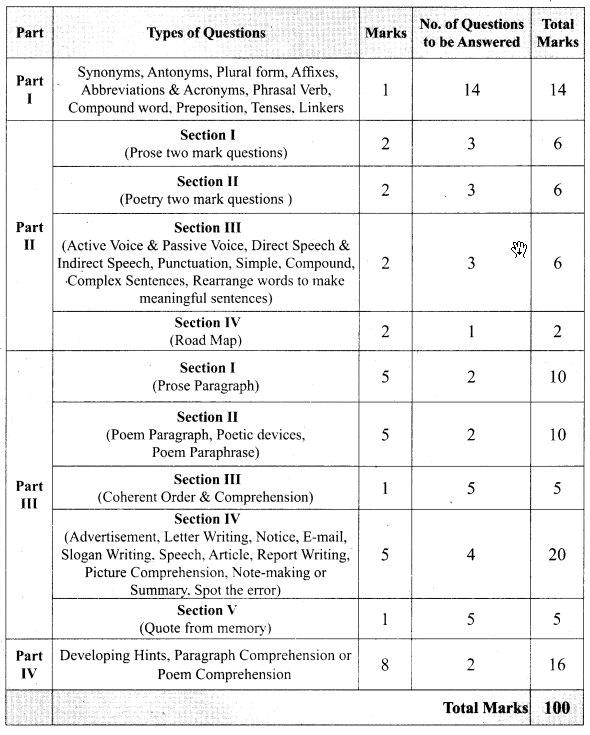
Samacheer Kalvi 10th English Model Question Paper Design 2020-2021 Tamil Nadu

Samacheer Kalvi 10th English Model Question Papers Design Tamil Nadu

It is necessary that students will understand the new pattern and style of Tamil Nadu Samacheer Kalvi 10th English Model Question Papers 2021 Answer Keys according to the latest exam pattern. These State Board 10th Standard English Public Exam Model Question Papers 2020-21 Tamil Nadu are useful to understand the pattern of questions asked in the board exam. Know about the important concepts to be prepared for TN SSLC Board Exams and Score More marks.

We hope the given Tamil Nadu State Board New Syllabus Samacheer Kalvi Class 10th English Model Question Papers 2020 2021 Pdf Free Download will help you get through your subjective questions in the exam.

Let us know if you have any concerns regarding the Government of TN State Board Samacheer Kalvi SSLC 10th Standard English Model Question Papers with Answers 2020 21, Sample Papers, Previous Year Question Papers, drop a comment below and we will get back to you as soon as possible.
Samacheer Kalvi 10th Social Science Guide History Chapter 4 The World after World War II

Students can download 10th Social Science History Chapter 4 The World after World War II Questions and Answers, Notes, Samacheer Kalvi 10th Social Science Guide Pdf helps you to revise the complete Tamilnadu State Board New Syllabus, helps students complete homework assignments and to score high marks in board exams.

Tamilnadu Samacheer Kalvi 10th Social Science Solutions History Chapter 4 The World after World War II

Samacheer Kalvi 10th Social Science The World after World War II Text Book Back Questions and Answers

I. Choose the correct answer

Question 1.
Who was the first director of Whampoa Military Academy?
(a) Sun Yat-Sen
(b) Chiang Kai-Shek
(c) Michael Borodin
(d) Chou En Lai
Answer:
(b) Chiang Kai-Shek

Question 2.
Which American President followed the policy of containment of Communism?
(a) Woodrow Wilson
(b) Truman
(c) Theodore Roosevelt
(d) Franklin Roosevelt
Answer:
(b) Truman

Samacheer Kalvi 10th Social Science Guide History Chapter 4 The World after World War II

Question 3.
When was People’s Political Consultative Conference held in China?
(a) September 1959
(b) September 1948
(c) September 1954
(d) September 1949
Answer:
(d) September 1949

Question 4.
The United States and European allies formed to resist any Soviet aggression in Europe.
(a) SEATO
(b) NATO
(c) SENTO
(d) Warsaw Pact
Answer:
(b) NATO

Question 5.
Who became the Chairman of the PLO’s Executive Committee in 1969?
(a) Hafez al-Assad
(b) Yasser Arafat
(c) Nasser
(d) Saddam Hussein
Answer:
(b) Yasser Arafat

Question 6.
When was North and South Vietnam united?
(a) 1975
(b) 1976
(c) 1973
(d) 1974
Answer:
(b) 1976

Question 7.
Where was Arab League formed?
(a) Cairo
(b) Jordan
(c) Lebanon
(d) Syria
Answer:
(a) Cairo

Samacheer Kalvi 10th Social Science Guide History Chapter 4 The World after World War II

Question 8.
When was the Warsaw Pact dissolved?
(a) 1979
(b) 1989
(c) 1990
(d) 1991
Answer:
(d) 1991

II. Fill in the blanks

  1. ………………. was known as the “Father of modern China”.
  2. in 1918, the society for the study of Marxism was formed in ………………. University.
  3. After the death of Dr. Sun Yat-Sen, the leader of the Kuomintang party was ……………….
  4. ……………….. treaty is open to any Arab nation desiring peace and security in the region.
  5. The treaty of ………………. provided for mandates in Turkish -Arab Empire.
  6. Germany joined the NATO in ……………….
  7. ………………. was the Headquarters of the Council of Europe.
  8. ………………. treaty signed on February 7,1992 created the European Union.

Answers:

  1. Dr. Sun Yat-Sen
  2. Peking
  3. Chiang-Kai-Sheik
  4. Central Treaty organisation
  5. Versailles
  6. 1955
  7. Strasbourg
  8. Maastricht

III. Choose the correct statement / statements

Question 1.
(i) In China (1898) the young emperor, under the influence of the educated
minority, initiated a series of reforms known as the 100 days of reforms.
(ii) The Kuomintang Party represented the interests of the workers and peasants.
(iii) Yuan Shih-Kai had lost prestige in the eyes of Nationalists, when he agreed to the demand of Japan to have economic control of Manchuria and Shantung.
(iv) Soviet Union refused to recognize the People’s Republic of China for more than two decades.
(a) (i) and (ii) are correct
(b) (ii) and (iii) are correct
(c) (i) and (iii) are correct
(d) (i) and (iv) are correct
Answer:
(c) (i) and (iii) are correct

Question 2.
(i) In 1948, the Soviets had established left wing government in the countries of Eastern Europe that had been liberated by the Soviet Army.
(ii) The chief objective of NATO was to preserve peace and security in the North Atlantic region.
(iii) The member countries of SEATO were committed to prevent democracy from gaining ground in the region.
(iv) Britain used the atomic bomb against Japan to convey its destructive capability to the USSR.
(a) (ii), (iii) and (iv) are correct
(b) (i) and (ii) are correct
(c) (iii) and (iv) are correct
(d) (i), (ii) and (iii) are correct
Answer:
(b) (i) and (ii) are correct

Samacheer Kalvi 10th Social Science Guide History Chapter 4 The World after World War II

Question 3.
Assertion (A): America’s Marshall Plan was for reconstruction of the war¬. ravaged Europe.
Reason (R): The US conceived the Marshal Plan to bring the countries in the Western Europe under its influence.
(a) Both (A) and (R) are correct, but R is not the correct explanation of A
(b) Both (A)and (R) are wrong
(c) Both (A) and (R) are correct and R is the correct explanation of A
(d) (A) is wrong and (R) is correct.
Answer:
(c) Both (A) and (R) are correct and R is the correct explanation of A

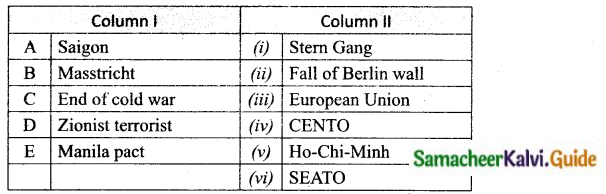
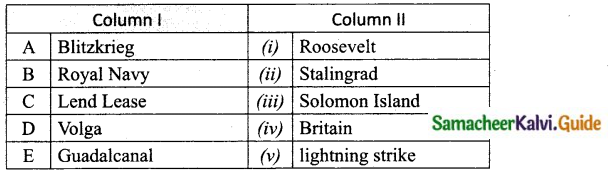
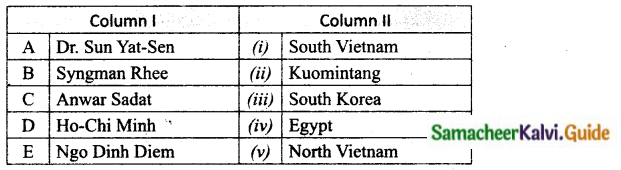
IV. Match the following

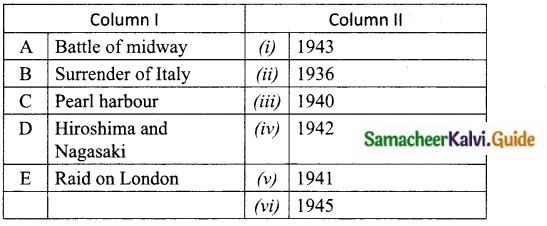
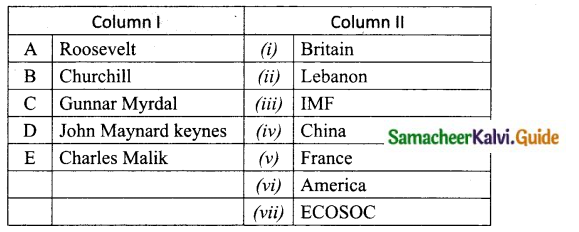
Samacheer Kalvi 10th Social Science Guide History Chapter 4 The World after World War II 1
Answer:
A. (ii)
B. (iii)
C. (iv)
D. (v)
E. (i)

V. Answer briefly

Question 1.
Write any three causes for the Chinese Revolution of 1911.
Answer:
Three causes of the Chinese Revolution of 1911 are

  1. The government of Manchu dynasty began to disintegrate with the death of the Empress Dowager Cixi in 1908. The new emperor was two-years old and the provincial governors began to assert their independence. In October 1911 the local army mutinied and the revolt spread.
  2. There were a few middle class leaders. Dr. Sun Yat-sen was one among them. He took part in the rising against the Manchus in 1895. The rising failed and Sun Yat-Sen was sent in the prison. But he continued to spread nationalist ideas.
  3. Yuan Shih-Kai, who had earlier served as a minister in the Manchu administration, persuaded those responsible for the ascension of the young Emperor to prevant on him to abdicate.

Question 2.
Explain how in 1928 Kuomintang and Chiang-Kai Shek established Central Government in China.
Answer:
Chiang Kai-shek started conquering China. Starting from Canton, in 1928, he captured Peking and also removed all communists in the Kuomintang party. Thus, he established Central government in China.

Samacheer Kalvi 10th Social Science Guide History Chapter 4 The World after World War II

Question 3.
Write a note on Mao’s Long March.
Answer:
Mao was an active leader who had gained full control of the Chinese Communist Party, by 1933. In 1934, he organised communist army of about 100,000 and set out on a long March. The marchers were continually harassed by Kuominatang forces, by local war lords and by unfriendly tribesmen of the 100,000 who set out, only 20,000 finally arrived in northern Shemi in late 1935, after crossing nearly 6000 miles. They were soon poined by other communist armies. By 1937, Mao had become the leader of over 10 million people. Mao’s Long March, as it is called so, has become legendary in the history of China.

Question 4.
What do you know of Baghdad Pact?
Answer:
In 1955, Turkey, Iraq, Great Britain, Iran and Pakistan signed a pact known as Baghdad pact. In 1958, when United States joined, then it was called as Central Treaty organization. The treaty was open to any Arab nation desiring peace and security in their region. It was dissolved in 1979.

Question 5.
What was the Marshall Plan?
Answer:
The Marshall Plan was an American initiative passed in 1948 to and Western Europe, in which the United States gave over $12 Billion in economic assistance to help rebuild Western European economies after the end of World War II. It operated for four years beginning in April 1948. The goals of the United States were to rebuild war-tom regions, modernise industry and improve European prosperity.

Question 6.
The Suez Canal crisis confirmed that Israel had been created to serve the cause of western interests-Elaborate.
Answer:
In 1956, Egypt invaded Suez Canal under Colonel Nasser and nationalized it. With the failure of diplomacy, Britain and France decided to use force. They bombed Egyptian air fields as well as Suez Canal area. However, United States and United Nations pressure, all the three invaders withdrew from Suez Canal.

Question 7.
Write a note on Third World Countries.
Answer:
The capitalist countries led by the US were politically designated as the First Worlds, while the communist states led by the Soviet Union came to be known as the Second World states, outside these two were called third World. During the Cold War, third World consisted of the developing world the former colonies of Africa, Asia, and Latin America. With the break up of the Soviet Union in 1991, and the process of globalisation, the term Third World has lost its relevance.

Question 8.
How was the Cuban missile crisis defused?
Answer:
In April 1961, on the island of Bay of Pigs, U.S bombed Cuban airfields and surrounded Cuba, with their warships. At the same time, USSR was secretly installing nuclear missiles in Cuba. Finally when Soviet President Khrushchev agreed to withdraw the missiles, the Cuban missile-crisis defused.

Samacheer Kalvi 10th Social Science Guide History Chapter 4 The World after World War II

VI. Answer all the questions under each caption

Question 1.
Cold War

(a) Name the two military blocs that emerged in the Post-World War II.
Answer:
United States and the Soviet Union were the two military blocs that emerged in the post World War-II.

(b) Who coined the term “Cold War” and who used it first?
Answer:
The term Cold war was first coined by the English writer George Orwell in 1945 and it was used for the first time by Bernard Baruch, a multimillionaire from USA.

(c) What was the response of Soviet Russia to the formation of NATO?
Answer:
Warsaw Pact was the response of Soviet Russia to the formation of NATO.

(d) What was the context in which Warsaw Pact was dissolved?
Answer:
With the Break-up of USSR in 1991, the Warsaw Pact was dissolved.

Question 2.
Korean War

(a) Who was the President of North Korea during the Korean War?
Answer:
Kim II was the President of North Korea during the Korean War.

(b) Name the southern rival to the President of North Korea.
Answer:
Syngman Rhee

(c) How long did the Korean War last?
Answer:
The Korean War lasted three years

(d) What was the human cost of the War?
Answer:
The human cost was enormous, there were 500,000 western casualties and three times that number on the other side. Approximately two million Korean civilian died.

Question 3.
Non-Aligned Movement (NAM)

(a) When and where was the first conference on Non-Aligned Movement held?
Answer:
At Belgrade, in 1961, the first conference on NAM was held.

(b) Who were the prominent personalities present in the first conference?
Answer:
The prominent personalities present in the first conference were Tito (Yugoslavia), Nasser (Egypt), Nehru (India), Nikrumah (Ghana), Sukrano (Indonesia),.

(c) What were the objectives of NAM?
Answer:
Peaceful co-existence, commitment to peace and security.

(d) List out any two basic principles of Non-Alignment Movement enunciated in the Belgrade Conference.
Answer:

  1. Non-Alignment with any of the two super powers (USA/USSR).
  2. Fight all forms of colonialism and Imperialism.

Samacheer Kalvi 10th Social Science Guide History Chapter 4 The World after World War II

VII. Answer in detail

Question 1.
Estimate the role of Mao Tse tung in making China a communist country.
Answer:

  1. Mao was greatly influenced by the ideas of Max and Lenin. He wanted to make China a communist country. So, he became active in the political activities of Hunan from the year 1912.
  2. After the death of Sun Yat-Sen in 1925, The Kuomintang was organised under the leadership of Chang Kai-Shek. Being an avowed critic of communists, Chiang removed all the important position holders in the Communist Party including Mao Tse Tung to weaken the party. However, the communists continued to influence the workers and peasants the Kuomintang represented the interests of landlords and capitalists.
  3. Mao had understood that the Kuomintang grip on the towns was too strong. So, he started organising the peasantry. When the relationships between Kuomintang and Communist Party broke, a few hundred Communist-led by Mao retreated into the wild mountains on the border between the provinces of Kiangsi and Hunan. The Kuomintang could not penetrate the mountains.
  4. Meanwhile, the campaign against the communists got distracted as Chiang Kai-Shek had to deal with the constant threat from Japan.
  5. By 1933 Mao had gained full control of the Chinese Communist Party. In 1934, he set out on a long march with the help of about 100,000 communist army. He also got support of other communist armies.
  6. By 1937, Mao had become the leader of over 10 million people. He organised workers and peasants councils in villages of Shensi and Kansu and finally got success in making China a communist country.

Samacheer Kalvi 10th Social Science Guide History Chapter 4 The World after World War II

Question 2.
Attempt an essay on the Arab-lsraeii wars of 1967 and 1973.
Answer:

  1. Before the creation of the State of Israel in 1948, all Arabs and their . descendants lived in the Palestine.
  2. Ever since the formation, the Palestinian Liberation organisation (PLO). Israel came to be attacked by the Palestinian Guerrilla groups based in Syria, Lebanon and Jordan.
  3. Israel resorted to violent military force .
  4. In November 1966, an Israeli strike on the village of Al-Samu in the west bank of Jordan killed 18 people and wounded 54 people.
  5. Israel’s air battle with Syria in April 1967 ended in the shooting down of six Syrian MIG fighter jets.
  6. After air battle with Syria, when Arab States were mobilized by Nasser on June 5th Israel staged a sudden air strike that destroyed more than, 90% of Egypt’s air force on the tarmac.
  7. Later, Egypt and Syria under Presidents Anwar Sadat and Hafez-al- Assad respectively concluded a secret agreement in January 1973 to bring their armies under one command.
  8. When peace deals did not work out with Israel, Egypt and Syria launched a sudden and surprise attack on the Yom Kippur religious holiday on 6th October 1973.
  9. Though Israel suffered heavy casualities, it finally pushed back the Arab forces.
  10. Due to U.N intervention, Israel was forced to return and Arabs gained nothing.
  11. U.S succeeded in showing their control on their region and oil resource, led to U. S led war against Iraq in 1991.

Question 3.
Narrate the history of transformation of Council of Europe into an European Union.
Answer:
(i) After World War II, it was decided to integrate the states of western Europe. One of the chief objectives was to prevent further European wars by ending the rivalry between France and Germany. In May 1949, ten countries met in London and signed a form called Council of Europe

(ii) Since the Council of Europe had no real power, a proposal to set up two European organisations were made. Accordingly, the European Defence Community (EDC) and the European Coal and Steel Community (ECSC) were established. Six countries belonging to ECSC signed the treaty of Rome which established the European Economic Community (EEC) or the European Common Market, with headquarters at Brussels.

(iii) The EEC facilitated the elimination of barriers to the movement of goods and services, capital, and labour. It also prohibited public policies or private agreements that restricted market comptetion. Throughout the 1970s and 80s the EEC kept expanding its membership.

(iv) The single European Act came into force on July 1, 1987. It significantly expanded the EEC’s scope giving the meetings of the EPC a legal basis. It also called for more intensive coordination of foreign policy among member countries. According to the SEA each member was given multiple votes, depending on the countries population.

(v) The Maastricht (Netherlands) Treaty signed on February 7, 1992, created the European Union (EU). Today the European Union has 28 member states, and is functioning from its headquarters at Brussels, Belgium.

Samacheer Kalvi 10th Social Science Guide History Chapter 4 The World after World War II

VIII. Activity

Question 1.
Divide the class into two groups. Let one group act as supporters of USA and the other group act as supporters of Soviet Union, Organise a debate.
Answer:
One group of students act as the supports of USA and the other group act as supporters of Soviet Union on their role in the cold war era.
(Students can have debate based on the following aspects)

During the time of cold war, the two super powers that emerged was USA and USSR.

Strengths of USA:

  1. Strongest navy both the Pacific and Atlantic.
  2. Continued and strong economic position that the USA held in the beginning till the end.
  3. Foreign policy of the USA. The actions of USA during the cold war era, very powerful and could guarantee others the strong power of the nation is to prevent communism spreading elsewhere.
  4. The country was able to generate the vast amount of wealth necessary to sustain the investment in weapons, technology and other operations.
  5. USA was also technologically powerful in target finding, tracking, sensors etc.
  6. The Truman’s doctrine was used throughout the war time. The doctrine helped USA to negotiate with other states to adopt capitalism.

Strengths of USSR:

  1. Strongest land based military, especially tanks.
  2. USSR developed air defense equipment and networks.
  3. Spread of Communism joined together backed USSR.
  4. As against NATO, USSR also formed military block, the Warsaw pact.
  5. With Western European countries USSR facilitated trade relations.
  6. Highly strengthened space exploration.

In the end of cold war, the Soviet Union fell, and the Communism expired.

Question 2.
Involving the entire class, an album may be prepared with pictures relating to Korean, Arab-lsraeli and Vietnam Wars to highlight the human sufferings in terms of death and devastation.
Answer:
Students should go to the search engine in google and type “The War’s impact on the Korean peninsula and trace the article of the journal of America – East Asia Relations” for a detailed Report.

Korean War: To give a sample answer: According to a U.S. Department of state publication, the number of killed, wounded and missing from the Armed forces of the Republic of Korea exceeded 4,00.000. From the U.S. side, 1,42,000. In addition, the heavy toll in death and injuries to the civilian population as well as wide property damage.

Arab-Israel War: Students should trace the answer from the google search engine as: The U.N. Report on Israel’s Gaza War.

To give a sample answer: From the 183 page report of the U.N. report, it is very clear that many civilians died. More than 6,000 Israeli airstrikes, 14,500 tank shells and 35,000 artillery shells led to the destruction of about 18,000 dwellings in Gaza. Nearly 1,462 Palestinian civilians, 299 women and 551 children were killed (According to U.N. Investigation). In Israel six civilians and 67 soldiers were killed.

Vietnam War: Students should trace the answer in the google search engine as “The War’s effect on the Vietnamese Land and People” for a detailed report.

To give a sample answer: About 58,000 American soldiers were killed and another 3,04,000 were wounded. Since most of the fighting took place in Vietnam, an estimated 4 million Vietnamese were killed on both sides including as many as 1 -3 million civilians. Many Vietnamese in country side turned into homeless refuges. Many forms and forests were destroyed.

Along with the detailed report, students should collect pictures showing Korea, Arab-Israel and Vietnam War, highlighting human sufferings. Students should click to google search engine and go to → Images → then type Korean War pictures / Arab Israel War pictures / Vietnam War pictures, download it take a print out of its and paste it in a A4 sheet paper or an a chart paper neatly and create an album.

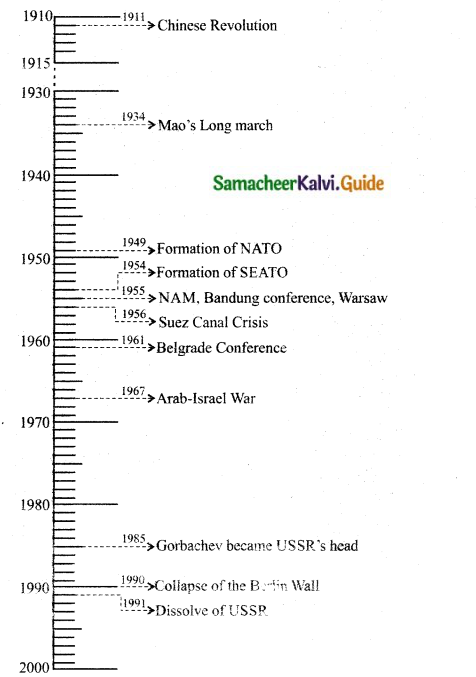
Timeline:
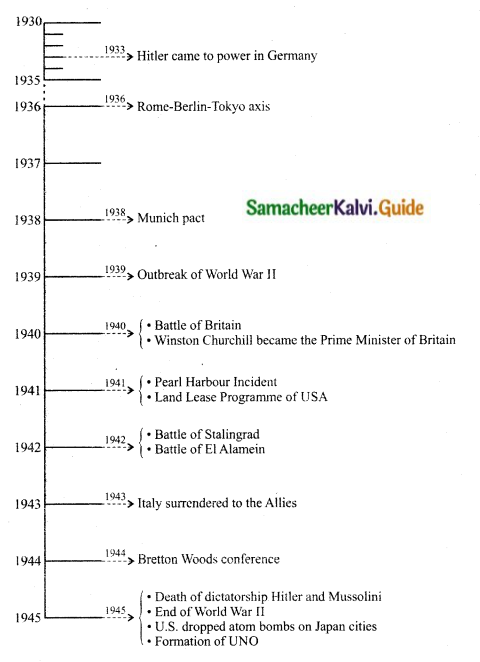
Samacheer Kalvi 10th Social Science Guide History Chapter 4 The World after World War II 2

Samacheer Kalvi 10th Social Science Guide History Chapter 4 The World after World War II

Samacheer Kalvi 10th Social Science The World after World War II Additional Important Questions and Answers

I. Choose the correct answer

Question 1.
The emergence of ……………. and ……………. as super powers resulted in the division of the World into two block after World War II.
(a) Japan, USA
(b) USA, USSR
(c) China, Japan
(d) USA, Germany
Answer:
(b) USA, USSR

Question 2.
Dr.Sun yat-sen was born in a poor family near ………
(a) Canton
(b) France
(c) Spain
Answer:
(a) Canton

Question 3
……………. was called the father of modern China.
(a) Chiang-Kai-Shek
(b) Yuan-Shi-Kai
(c) Mao-Tse-Tung
(d) Dr. Sun Yat-Sen
Answer:
(d) Dr. Sun Yat-Sen

Question 4.
Mao was born in ……… in South – East China.
(a) Cambodia
(b) Vietnam
(c) Hunan
Answer:
(c) Hunan

Question 5.
Yuan-Shi-Kai died in the year …………….
(a) 1912
(b) 1913
(c) 1915
(d) 1916
Answer:
(d) 1916

Question 6.
Which of the following is not a part of Indo – China?
(a) Cambodia
(b) China
(c) Vietnam
Answer:
(b) China

Question 7.
The Historical Long March set out in China in …………….
(a) 1935
(b) 1937
(c) 1934
(d) 1936
Answer:
(c) 1934

Question 8.
In which of the following was indentured Vietnamese labour widely used?
(a) Rice cultivation
(b) Rubber plantation
(c) Industry
Answer:
(b) Rubber plantation

Samacheer Kalvi 10th Social Science Guide History Chapter 4 The World after World War II

Question 9.
……………. was the leader of the people’s Republic of China.
(a) Marshall
(b) Truman
(c) Mao-Tse-Tung
(d) Chiang-Kai-shek
Answer:
(c) Mao-Tse-Tung

Question 10.
Ho Chi Minh means ………
(a) He, Who enlightens
(b) Enlightenment
(c) The Enlightened one
Answer:
(a) He, Who enlightens

Question 11.
The Idea of European self-help programme financed by the United States was called as …………….
(a) NATO
(b) SEATO
(c) ECA
(d) Marshall plan
Answer:
(d) Marshall plan

Question 12.
EURATOM was established by the ………
(a) Treaty of Nanking
(b) Treaty of Rome
(c) Treaty of London
Answer:
(b) Treaty of Rome

Question 13.
The term ‘cold war’ was first coined by the English writer …………….
(a) Shakespeare
(b) George Orwell
(c) William Dexter
(d) Peter Alphonse
Answer:
(b) George Orwell

Question 14.
As a part of Marshall plan financing, European nations received nearly ……………. billion in aid.
(a) $ 12
(b) $ 11
(c) $ 15
(d) $ 13
Answer:
(d) $ 13

Question 15.
Greece and Turkey joined NATO in the year …………….
(a) 1945
(b) 1947
(c) 1952
(d) 1955
Answer:
(c) 1952

Question 16.
……………. was otherwise called as pact.
(a) NATO
(b) CENTO
(c) SEATO
(d) EC SC
Answer:
(d) EC SC

Question 17
……………. are included as member countries in NATO.
(a) Canada, Belgium
(b) U.K., Portugal
(c) Both (a) and (b)
(d) None of the above
Answer:
(c) Both (a) and (b)

Question 18.
NATO had ……………. members by the year 2017.
(a) 30
(b) 51
(c) 29
(d) 24
Answer:
(c) 29

Question 19.
In December 1954, a conference of eight European nations took place in Moscow. This was called as …………….
(a) Warsaw pact
(b) Counter to NATO
(c) SEATO
(d) Both (a) and (b)
Answer:
(d) Both (a) and (b)

Question 20.
The headquarters of the Warsaw pact was …………….
(a) Belgium
(b) Poland
(c) Moscow
(d) Romania
Answer:
(c) Moscow

Samacheer Kalvi 10th Social Science Guide History Chapter 4 The World after World War II

Question 21.
The Korea was partitioned into North and South Korea in the year …………….
(a) 1944
(b) 1945
(c) 1946
(d) 1947
Answer:
(b) 1945

Question 22.
With the collapse of the ……………. the idea of non-alignment lost relevance.
(a) Berlin
(b) CIA
(c) ECA
(d) Soviet Union
Answer:
(d) Soviet Union

Question 23.
The NAM held its first conference at ……………. in 1961.
(a) Bandung
(b) Belgrade
(c) Thailand
(d) Philippine
Answer:
(b) Belgrade

Question 24.
The World Zionist Organisation was founded in the year …………….
(a) 1857
(b) 1887
(c) 1897
(d) 1867
Answer:
(c) 1897

Question 25.
Castro nationalised the U.S. owned ……………. companies.
(a) cotton
(b) sugar
(c) oil
(d) petrol
Answer:
(b) sugar

Question 26.
The Cuban Missile crisis was defused by ……………. as the agreed to withdraw the missiles.
(a) Khrushchev
(b) Fidel Castro
(c) Leumi
(d) Stem Gang
Answer:
(a) Khrushchev

Samacheer Kalvi 10th Social Science Guide History Chapter 4 The World after World War II

Question 27.
In the Arab World, it is treated as the ……………. when large number of Arabs become refugees.
(a) Catastrophe
(b) Nakbah
(c) Negev and (b)
(d) Both (a) and (b)
Answer:
(d) Both (a) and (b)

Question 28.
For resolving the Suez Canal Crisis, ……………. from Indian played a crucial role.
(a) Gandhi
(b) Nehru
(c) Bose
(d) Tilak
Answer:
(b) Nehru

Question 29.
Arab-lsrael war took place in the years …………….
(a) 1967,69
(b) 1969,74
(c) 1967,73
(d) 1972,73
Answer:
(c) 1967,73

Question 30.
……………. became the first president of the state of Palestine in 1989.
(a) Anwar Sadat
(b) Yasser Arafat
(c) Nasser Arafat
(d) Nasser Hussain
Answer:
(b) Yasser Arafat

Question 31.
By the end of second world war, ……………. controlled the northern half of Vietnam.
(a) Vietminh
(b) Ho-Chi-Minh
(c) Ngo Dinh Diem
(d) None
Answer:
(a) Vietminh

Question 32.
……………. controlled the southern half of the Vietnam.
(a) Viet Minh
(b) Bao Dai
(c) Ngo Dinh Diam
(d) None
Answer:
(b) Bao Dai

Question 33.
The North and the South Vietnam were formally united as one country in …………….
(a) 1973
(b) 1976
(c) 1975
(d) 1974
Answer:
(b) 1976

Question 34.
In May 1949, ten countries met in ……………. and signed to form a council of Europe.
(a) Japan
(b) Syria
(c) London
(d) France
Answer:
(c) London

Question 35.
To prevent further European War ……………. was founded.
(a) Council of Europe
(b) Council of Trent
(c) ECSC
(d) EU
Answer:
(a) Council of Europe

Samacheer Kalvi 10th Social Science Guide History Chapter 4 The World after World War II

Question 36.
……………. did not join the EEC, when it was formed.
(a) U.K
(b) U.S.A
(c) USSR
(d) Italy
Answer:
(a) U.K

Question 37.
Britain, voted to exit the EU in the year …………….
(a) 2015
(b) 2014
(c) 2017
(d) 2019
Answer:
(c) 2017

Question 38.
West Berlin was supported by …………….
(a) USA
(b) UK
(c) USSR
(d) Germany
Answer:
(a) USA

Question 39.
East Berlin was supported by …………….
(a) USA
(b) UK
(c) USSR
(d) Germany
Answer:
(c) USSR

Question 40.
Germany was officially united on …………….
(a) 1987
(b) 1989
(c) 1990
(d) 2003
Answer:
(c) 1990

Question 41.
in 1985, ……………. became the head of the USSR.
(a) Mikhai Gorbachev
(b) Reagen
(c) Stalin
(d) Kohl
Answer:
(a) Mikhai Gorbachev

Question 42.
The Chernobyl disaster took place in the year …………….
(a) 1987
(b) 1984
(c) 1986
(d) 2006
Answer:
(c) 1986

Question 43.
Gorbachev announced his resignation on …………….
(a) 21st November
(b) 25th December
(c) 2nd October
(d) 15th August
Answer:
(b) 25th December

Question 44.
USSR dissolved formally In the year …………….
(a) 31st Dec. 1990
(b) 30th Dec. 1991
(c) 31st Dec. 1991
(d) 28,h Feb. 1991
Answer:
(c) 31st Dec. 1991

Samacheer Kalvi 10th Social Science Guide History Chapter 4 The World after World War II

Question 45.
……………. was an ally of Gorbachev.
(a) Yeltsin
(b) Brezhnev
(c) Khrushchev
(d) None
Answer:
(a) Yeltsin

II. Fill in the blanks

  1. ………………… and ………………… were the Superpowers after the World War II.
  2. The cold war period ended with the fall of …………………
  3. Empress Dowager died in ………………… led to the disintegration of the Manchu dynasty.
  4. Kuomintang party of China was otherwise called as ………………… party.
  5. ………………… was the ultimate aim of Dr. Sun Yat-sen’s party.
  6. The Chinese revolution broke out in the year …………………
  7. The first director of the Whampoa Military academy was …………………
  8. The campaign against the communists led by Chiang-Kai-Shek was distracted by ………………… and warlords.
  9. By ………………… Mao became the leader of the Chinese people.
  10. Over ………………… delegates from various countries attended the people’s political consultative conference.
  11. When Japanese surrendered in 1945, the Japanese areas were occupied by the …………………
  12. By the year …………………, communist control has been established over most parts of China.
  13. The two mighty communist powers in the world were ………………… and …………………
  14. The term cold war was first coined by …………………
  15. ………………… nations became a part of Marshall’s plan of self-help programme.
  16. The Marshall plan funding ended in …………………
  17. ………………… was created to resist Soviet aggression in Europe.
  18. NATO means …………………
  19. NATO was formed in the year …………………
  20. The members of NATO agreed that, any armed attack on any one of them would be considered attack on …………………
  21. For the collective security of the South-east Asia, ………………… was formed in 1954.
  22. Member of SEATO were committed to prevent …………………
  23. SEATO was formed in 1954, after signing of the …………………
  24. ………………… was formed by Soviet Union as a counter to NATO.
  25. ………………… European nations attended the Warsaw pact in December 1954.
  26. The treaty on Warsaw pact was concluded on …………………
  27. The Warsaw pact was dissolved in …………………
  28. The Warsaw pact dissolved because of the break-up of …………………
  29. The Baghdad pact was otherwise called as …………………
  30. Turkey, Iran, Iraq, Pakistan and Great Britain signed a treaty in 1955, known as …………………
  31. When U.S.A joined the Baghdad pact, it was called by name …………………
  32. USA joined the Baghdad pact in the year …………………
  33. CENTO was dissolved in the year …………………
  34. Korea was partitioned as North Korea and South Korea in the year …………………
  35. The president of North Korea was …………………
  36. The party of Kim II was called as …………………
  37. The president of the South Korea was …………………
  38. The party of Syngman Rhee was …………………
  39. Korean War lasted for ………………… years.
  40. NAM refers to the …………………
  41. NAM was signed in ………………… at the ………………… conference.
  42. Bandung is a city in …………………
  43. With the collapse of ………………… the idea of NAM lost importance.
  44. CIA is a Central Intelligence Agency of …………………
  45. The Act of ………………… in Cuba, threatened American economic interests.
  46. USA bombed Cuban ………………… with the aim of overthrowing Castro’s regime.
  47. ………………… was the president of USSR, when the Cuban Missile crisis took place.
  48. Cuba was helped by …………………
  49. When USSR remove missile from Cuba, USA had to agree to remove missile from ………………… and …………………
  50. ………………… was a Zionist Terrorist Organisation.
  51. The Zionist Para-military organization was called as …………………
  52. The World Zionist organization was founded in the year …………………
  53. Jews living outside their ancient home scattered around North America and Europe was called as …………………
  54. ………………… Nationalised Suez Canal.
  55. India represented by ………………… played a crucial role in resolving the crisis.
  56. The Arab-lsraeli War took place in the years ………………… and …………………
  57. PLO refers to …………………
  58. PLO was formed in …………………
  59. ………………… was the prominent leader of Palestine.
  60. By the end of the Second World War, ………………… Controlled the northern half of Vietnam.
  61. South Vietnam was ruled by …………………
  62. America supported troops of ………………… Vietnam.
  63. The city of ………………… was renamed as Ho-Chi-Minh city.
  64. To create a United Europe to resist any threat from Soviet Russia, ………………… was formed.
  65. European Economic Community was otherwise called as …………………
  66. SEA refers to …………………
  67. According to the SEA, each member was given ………………… votes.
  68. The ………………… Treaty created the European Union.
  69. Maastricht is in …………………
  70. EU was created on Maastricht treaty signed on …………………
  71. The headquarters of the EU is at …………………
  72. Brussels is at …………………
  73. ………………… Germany was prosperous.
  74. ………………… Germany was suffering from lack of democracy and freedom.
  75. Germany was officially reunited on …………………
  76. Glasnost means …………………
  77. Perestroika means …………………
  78. ………………… was introduced by Gorbachev to restructure Soviet economic and political system.
  79. After Gorbachev, power fell into the hands of …………………
  80. For ………………… days, Soviet Union, continued to exist only in name.
  81. Soviet Union dissolved formally on 31st December …………………
  82. USSR split into ………………… countries.
  83. ………………… was the president of the newly independent Russian State.
  84. U.S.A. troops used ………………… weapons in their war against Vietnam.
  85. Napalm and Agent Orange are the names of incendiary …………………

Answers:

  1. USA and USSR
  2. Berlin Wall
  3. 1908
  4. National People’s Party
  5. Socialism
  6. 1911
  7. Chiang-Kai-Shek
  8. Japan
  9. 1937
  10. 650
  11. Kuomintang
  12. 1948
  13. Soviet Union, People’s Republic of China
  14. George Orwell
  15. Sixty
  16. 1951
  17. NATO
  18. North Atlantic Treaty Organisation
  19. 1949
  20. NATO
  21. SEATO
  22. Communism
  23. Manila Pact
  24. Warsaw Pact
  25. 8 (eight)
  26. May 14, 1955
  27. 1991
  28. USSR
  29. Central Treaty Organisation
  30. Baghdad Pact
  31. Central Treaty Organisation
  32. 1958
  33. 1979
  34. 1945
  35. Kim II
  36. People’s Republic of Korea
  37. Syngman Rhee
  38. The Republic of Korea
  39. three
  40. Non-Aligned Movement
  41. 1955, Bandung
  42. Indonesia
  43. Soviet Union
  44. America
  45. Castro
  46. Airfields
  47. Khrushchev
  48. USSR
  49. Turkey, Italy
  50. Stem Gang
  51. Irgun Zvai Leumi
  52. 1897
  53. Diaspora
  54. Colonel Nasser
  55. Nehru
  56. 1967, 1973
  57. Palestine Liberation Organisation
  58. 1948
  59. Yasser Arafat
  60. Viet Minh
  61. Ngo Dinh Diem
  62. South
  63. Saigon
  64. Council of Europe
  65. European Common Market
  66. Single European Act
  67. multiple
  68. Maastricht
  69. Netherlands
  70. Feb 7, 1992
  71. Brussels
  72. Belgium
  73. West Berlin’s
  74. East Berlin
  75. 3rd October 1990
  76. openness
  77. restructuring
  78. Perestroika
  79. Boris Yeltsin
  80. Six 81.1991
  81. 15
  82. Boris Yeltsin
  83. Bacteriological
  84. bombs

Samacheer Kalvi 10th Social Science Guide History Chapter 4 The World after World War II

III. Choose the correct statement / statements

Question 1.
(i) The cold war period ended with the fall of Berlin Wall
(ii) Mao concentrated mainly on organizing the peasantry.
(iii) In 1937, the communist army of about 100,000 set out on the Long march.
(iv) Marshall plan funded nearly $ 15 billion.
(a) (ii and (ii) are correct
(b) (i) and (iii) are correct
(c) (ii and (iv) are correct
(d) (iii) and (iv) are correct.
Answer:
(a) (ii and (ii) are correct

Question 2.
(i) The USSR was much concerned about the destruction caused by the Second World War.
(ii) The South East Asia Treaty organization was organised for the collective security of countries in South East Asia.
(iii) The Communist States led by the Soviet Union came to be known First World Countries.
(iv) The Capitalist countries led by the U.S.A. were politically designated as Second World Countries.
(a) (i) and (ii) are correct
(b) (i), (iii), (iv) are wrong
(c) (i) and (iv) are correct
(d) (ii) and (iii) are correct.
Answer:
(b) (i), (iii), (iv) are wrong

Question 3.
(i) NAM refers to the Non-Aligned Movement.
(ii) The Single European Act of the EU as called as SEA.
(iii) Anwar Sadat was the president of the Palestine in 1989.
(iv) The fighters of South Vietnam were trained in guerrilla warfare.
(a) (i) and (ii) are correct
(b) (i), (iii), (iv) are wrong
(c) (i) and (iv) are correct
(d) (ii) and (iii) are correct.
Answer:
(a) (i) and (ii) are correct

Question 4.
(i) The Third World principally consist of the developing World.
(ii) With the breakup of the Soviet Union in 1991, and the process of globalization, the term has lost its relevance.
(iii) The former colonies of Asia, Africa, and Latin America were called as Third World Countries.
(iv) The division of Germany into West and East led to glaring differences in living standards.
(a) (i) and (ii) are correct
(b) (i), (ii), (iii) are correct
(c) (i) and (iii) are correct
(d) All the four are correct.
Answer:
(d) All the four are correct.

Question 5.
(i) Yeltsin worked as a Mayor of Moscow.
(ii) Yeltsin was returned to power with overwhelming support of a Moscow in 1899.
(iii) For twelve days, the Soviet Union continued to exist only in name.
(iv) On 28th February 1991, USSR was formally dissolved.
(a) (i) and (ii) are correct
(b) (i), (ii), (iii) are correct
(c) (i) and (iii) are correct
(d) All the four are correct.
Answer:
(a) (i) and (ii) are correct

Samacheer Kalvi 10th Social Science Guide History Chapter 4 The World after World War II

Question 6.
(i) CENTO was otherwise called as Manila pact.
(ii) As a counter to SEATO, NATO was formed.
(iii) The Korean war helped to bring down the intensity of the Cold war.
(iv) The EEC eliminated barriers to the movement of goods, Capital and labour.
(a) (i) and (ii) are correct
(b) (i), (ii), (iii) are wrong
(c) (i) and (iv) are correct
(d) All the four are correct.
Answer:
(b) (i), (ii), (iii) are wrong

Question 7.
(i) The Berlin Wall was just a physical barrier.
(ii) Berlin Wall divided East Germany and West Germany.
(iii) USA supported East Berlin.
(iv) USSR supported West Berlin.
(a) (i) and (ii) are correct
(b) (i), (ii), (iii) are wrong
(c) (i) and (iv) are correct
(d) All the four are wrong.
Answer:
(a) (i) and (ii) are correct

IV. Assertion and Reason

Question 1.
Assertion (A): Yuan Shih-Kai of China lost prestige in his country.
Reason (R): He agreed to the demand of Japan to have economic control of Manchuria and Shantung.
(a) Both (A) and (R) are correct, R is not the correct explanation of A
(b) Both (A) and (R) are wrong
(c) Both (A) and (R) are correct, and R is the correct explanation of A
(d) (A) is wrong and (R) is correct.
Answer:
(c) Both (A) and (R) are correct, and R is the correct explanation of A

Question 2.
Assertion (A): The rivalry that developed after World War 11 is referred to as “Cold War”.
Reason (R): This war did not take recourse to weapons.
(a) Both (A) and (R) are correct, R is not the correct explanation of A
(b) Both (A) and (R) are wrong
(c) Both (A) and (R) are correct, and R is the correct explanation of A
(d) (A) is wrong and (R) is correct.
Answer:
(c) Both (A) and (R) are correct, and R is the correct explanation of A

Question 3.
Assertion (A): There was High military expenditure on both sides of USA and USSR.
Reason (R): Soviet Union tested the nuclear bomb and America used the nuclear bomb against Japan.
(a) Both (A) and (R) are correct, R is not the correct explanation of A
(b) Both (A) and (R) are wrong
(c) Both (A) and (R) are correct, and R is the correct explanation of A
(d) (A) is wrong and (R) is correct.
Answer:
(c) Both (A) and (R) are correct, and R is the correct explanation of A

Samacheer Kalvi 10th Social Science Guide History Chapter 4 The World after World War II

Question 4.
Assertion (A): The U.S. and its European allies formed the NATO to wage war against Vietnam.
Reason (R): As a counter to the NATO, Soviet Union organised the Warsaw pact.
(a) Both (A) and (R) are correct, R is not the correct explanation of A
(b) Both (A) and (R.) are wrong
(c) Both (A) and (R) are correct and R is the correct explanation of A
(d) (A) is wrong and (R) is correct.
Answer:
(d) (A) is wrong and (R) is correct.

Question 5.
Assertion (A): A small country had succeeded in winning Independence and the greatest power of the World-The country Vietnam.
Reason (R): The help given to Vietnam by the Socialist Countries, the political support given by Asia and Africa is evident.
(a) Both (A) and (R) are correct, R is not the correct explanation of A
(b) Both (A) and (R) are wrong
(c) Both (A) and (R) are correct and R is the correct explanation of A
(d) (A) is wrong and (R) is correct.
Answer:
(c) Both (A) and (R) are correct and R is the correct explanation of A

Question 6.
Assertion (A): Sun Yat-sen sent Chiang Kai-shek to Moscow, in Russia. The Russians in turn sent Michael Borodin to China.
Reason {R): Chiang Kai-shek started conquering China from Canton.
(a) Both (A) and (R) are correct, R is not the correct explanation of A
(b) Both (A) and (R) are wrong
(c) Both (A) and (R) are correct and R is the correct explanation of A
(d) (A) is wrong and (R) is correct.
Answer:
(a) Both (A) and (R) are correct, R is not the correct explanation of A

Question 7.
Assertion (A): U.S.A. supported Diem government in South Vietnam. Reason (R): U.S. wanted to establish a strong government in South Vietnam.
(a) Both (A) and (R) are correct, R is not the correct explanation of A
(b) Both (A) and (R) are wrong
(c) Both (A) and (R) are correct and R is the correct explanation of A
(d) (A) is wrong and (R) is correct.
Answer:
(c) Both (A) and (R) are correct and R is the correct explanation of A

V. Match the following

Question 1.
Match the Column I with Column II.
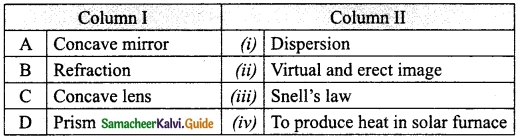
Samacheer Kalvi 10th Social Science Guide History Chapter 4 The World after World War II 3
Answer:
A. (v)
B. (iii)
C. (ii)
D. (i)
E. (vi)

Samacheer Kalvi 10th Social Science Guide History Chapter 4 The World after World War II

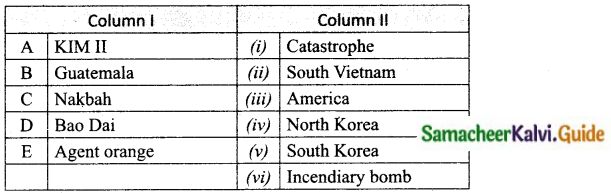
Question 2.
Match the Column I with Column II.
Samacheer Kalvi 10th Social Science Guide History Chapter 4 The World after World War II 4
Answer:
A. (iv)
B. (iii)
C. (i)
D. (ii)
E. (vi)

VI. Answer briefly

Question 1.
Describe about Zionist movement.
Answer:
(i) In Palestine, the ancient home of Jews, only a few thousand Jews were living in 1900.
(ii) Some 15 million were scattered around Europe and North America.
(iii) These Jews had been subjected to systematic persecution for centuries.
(iv) But in the late nineteenth century, the persecution in Russia (Where two-thirds of the world’s jews lived), France and Germany was intense.
(v) Some Jews emigrated to Palestine, while many more went to the United States and Britain.
(vi) In 1896, Thodore Herzel, a Viennese journalist, published a pamphlet called the Jewish state in which he called for the creation of a Jewish national home. In 1897 the world zionist organisation was founded.

Question 2.
What was Truman’s policy?
Answer:
Truman, the president of USA announced a policy of containment of communism. This implies U.S. would support those countries which were threatened by USSR to spread communism.

Question 3.
Mention the initial member countries of the EU.
Answer:

  1. Belgium
  2. France
  3. Italy
  4. Luxemburg
  5. Netherlands
  6. West Germany

Question 4.
What is meant by SEA?
Answer:
SEA refers to the single European Act which came into force on July 1,1987. According to the SEA, each member was given multiple votes depending on the country’s population. Its main aim is establishing a single market.

Question 5.
Name the organs of the EU.
Answer:

  1. European parliament
  2. Council of the European Union
  3. European commission
  4. Court of Justice
  5. Court of Auditors

Samacheer Kalvi 10th Social Science Guide History Chapter 4 The World after World War II

Question 6.
Write a note on European Union.
Answer:
On February 7, 1992, the Maastricht Treaty that signed in Netherlands created the European Union. All the member countries of the EU will use common currency Euro, a single market and common Act. EU at present has 28 members with head quarters at Brussels, Belgium.

Question 7.
How was the European union formed?
Answer:
According to the Merger Treaty of 1967, the three communities namely the European coal and steel community, the European Economic community and the European Atomic Energy community were merged together to form the European union.

VII. Answer all the questions under each caption

Question 1.
People’s Republic of China

(a) Who was the leader of the People’s Republic of China?
Answer:
Mao Tse-Tung was the leader of the People’s Republic of China.

(b) Name the two mighty Communist powers of the world?
Answer:
The Soviet-Union and the people’s Republic of China.

(c) Who did not recognise People’s Republic of China and for how long?
Answer:
The UNO refused to recognise people’s Republic of China for more than twenty years.

(d) How did the government of Taiwan got recognition?
Answer:
The government of Chiang Kai-shek in Taiwan was given recognition ‘ due to the pressure from USA.

Question 2.
Achievements of EU

(a) What is the symbol of the Euro?
Answer:
The symbol of the Euro is €.

(b) What did the Euro eliminate?
Answer:
The Euro eliminated foreign exchange hurdles encountered by companies doing business across European border.

(c) How many members are there in the EU at present?
Answer:
At present, there are 28 members in the EU.

(d) Who allocates funds to European research projects?
Answer:
The European Research council.

Question 3.
Disintegration of The Soviet Union.

(a) Who became the head of USSR in 1985?
Answer:
Mikhail Gorbachev became the head of the USSR in 1985.

(b) What is meant by “thaw”?
Answer:
The “Thaw” refers to the period from the early 1950’s and 1960’s when repression and censorship in the Soviet Union was relaxed and millions of political prisioners were released. It was the period of Khrushchev’s reign.

(c) What is meant by Glasnost?
Answer:
Glasnost means openness. It was the policy of more transperancy and openness in the government policy of former Soviet Russia introduced by Mikhail Gorbachev.

(d) What is meant by Perestroika?
Answer:
Perestroika means restructuring. It refers to the programme introduced by Mikhail Gorbhachev to restructure Soviet economic and political system.

Question 4.
Berlin Wall

(a) Who constructed a wall which virtually cut off West Berlin and East Berlin? and when?
Answer:
East German began to construct a wall in 1961 which virtually cut off West Berlin and East Berlin.

(b) How was it guarded?
Answer:
It was guarded with watchtowers and other lethal impediments to stop people from the east.

(c) What does the Berlin wall symbolise?
Answer:
It was symbolic boundary between Communism and Capitalism.

(d) What happened with the fall of the Berlin wall?
Answer:
With the fall of the Berlin wall , followed by the collapse of the Soviet Union, the cold war came to an end.

VIII. Answer in detail

Question 1.
Write a brief account of the life and achievements of Ho Chi Minh.
Answer:
He was born in a small town in Central Vietnam. He studied in French school that produced great leaders. After his studies he worked on a French liner operating between Saigon and Marseilles. He was greatly inspired by European communist parties, became member of commintem and was instrumental in bringing together competing nationalists groups to form the Vietnamese communist party in 1930. It was later renamed the Indo-Chinese communist party. After spending 30 years abroad in Europe, China Thailand, he returned to Vietnam in 1941. He became President of the Vietnam Democratic Republic in 1943.

After the split of Vietnam, he and the communists took control of North Vietnam. With the help of his government, National Liberation Front in the south fought for unification of the country. He fought hard to maintain the autonomy of Vietnam and till the end proved true to his name. Ho Chi Minh meaning He, Who Enlightens.

Samacheer Kalvi 10th Social Science Guide History Chapter 4 The World after World War II

Question 2.
Illustrate the cold war developments in case of the Vietnam war. Narrate how North and South Vietnam unified as Independent Nation.
Solution:

  1. By 1945, the end of the second world war, Viet Minh controlled the northern half of Vietnam, led by Ho-chi- Minh.
  2. Viet Minh and french reached an agreement by which North Vietnam would be a free state.
  3. While French was helped by America, Viet Minh was helped by the new Chinese communist government.
  4. War broke out between them. Eventually , France troops were defeated.
  5. The Geneva conference that met on Korea and Indo China in 1954, decided that of Laos. Combodia and Vietnam. The independent states would be Laos and Cambodia. Vietnam, temporarily divided.
  6. While North Vietnam controlled by Viet Minh with leader Ho-Chi-Minh and south Vietnam would be under the leadership of Bao Dai.
  7. At the same time, South Vietnam was ruled by Ngo Dinh Diem.
  8. When U.S wanted to establish a strong Non-communist government in South Vietnam. In 1965, marines landed on Danang naval base and namely 2,10,000 traps in the country, j (ix) The U.S bombed both North and South.
  9. The fighters of North Vietnam trained in Guerrilla warfare sustained.
  10. America suffered heavy casualties , vast devastated and many were killed.
  11. The youth rebelled against the horrors of the war.
  12. The protest against the war spread all over the world.
  13. By 1975, the armies of the North and the only one party of South Vietnam called National Liberation front of South Vietnam attacked America.
  14. By 30th April 1975, all the American troops had withdrawn and capital of South Vietnam Saigon was liberated.
  15. North Vietnam and South Vietnam formally united as one country in 1976.
  16. The city of Saigon was renamed as the Ho-Chi-Minh city .
  17. Thus, the emergence of Vietnam as a united and Independent nation was an historic event.

Samacheer Kalvi 10th Social Science Guide History Chapter 4 The World after World War II

Question 3.
Explain the breakup of the Soviet Union.
Answer:

  1. In the middle of 1980’s Soviet Union economy was suffering.
  2. In 1985, Mikhail Gorbachev took over as the president of USSR.
  3. Gorbachev spoke about the need for openness (Glasnost) and Perestroika (restructuring).
  4. But his ideas of reform did not work out for him because, to compete with U.S, USSR need to allocate more funds to the military.
  5. The economic stagnation of the Soviet Union aggrevated tension and promoted nationalist feelings.
  6. In the year 1988, Mass protest broke out in Armenia and in the Baltic states.
  7. Gorbachev made attempts to stabilize his position by relying on conservative forces in 1989, 1991.
  8. But the massive miner’s strike interrupted. The series of worker’s strike under mined the communist regimes first in Poland, then in Hungary.
  9. The fall of Berlin wall in Germany, encouraged people to be united.
  10. Gorbachev made a last attempt to take a hard line against miner’s strike and huge demonstrations in Moscow in 1991.
  11. In response, the conservative forces in his government used troops in Moscow and held Gorbachev under house arrest.
  12. Power fell into the hands of Boris Yeltsin.
  13. In November 1991, eleven republics announced that they would establish a common wealth of independent states.
  14. On 25th Dec 1991 , Gorbachev resigned.
  15. For six days, the Soviet Union continued to remain only in name and at midnight on 31st December 1991 it was formally dissolved.
  16. The USSR was no more.

Samacheer Kalvi 10th Science Guide Chapter 2 Optics

Students can download 10th Science Chapter 2 Optics Questions and Answers, Notes, Samacheer Kalvi 10th Science Guide Pdf helps you to revise the complete Tamilnadu State Board New Syllabus, helps students complete homework assignments and to score high marks in board exams.

Tamilnadu Samacheer Kalvi 10th Science Solutions Chapter 2 Optics

Samacheer Kalvi 10th Science Optics Text Book Back Questions and Answers

I. Choose the correct answer.

Question 1.
The refractive index of four substances A, B, C and D are 1.31,1.43,1.33, 2.4 respectively. The speed of light is maximum in:
(a) A
(b) B
(c) C
(d) D
Answer:
(a) A

Question 2.
Where should an object be placed so that a real and inverted image of same size is obtained by a convex lens:
(a) f
(b) 2f
(c) infinity
(d) between f and 2f
Answer:
(b) 2f

Question 3.
Where should an object be placed so that a real and inverted image of the same size is obtained by a convex lens ______.
(a) f
(b) 2f
(c) infinity
(d) between f and 2f.
Answer:
(b) 2f

Samacheer Kalvi 10th Science Guide Chapter 2 Optics

Question 4.
Magnification of a convex lens is _____.
(a) positive
(b) negative
(c) either positive or negative
(d) zero.
Answer:
(b) negative

Question 5.
A convex lens forms a real, diminished point sized image at focus. Then the position of the object is at:
(a) focus
(b) infinity
(c) at 2f
(d) between f and 2f
Answer:
(b) infinity

Question 6.
Power of a lens is -4D, then its focal length is:
(a) 4 m
(b) -40 m
(c) -0.25 m
(d) -2.5 m
Answer:
(d) -2.5 m

Question 7.
In a myopic eye, the image of the object is formed _____.
(a) behind the retina
(b) on the retina
(c) in front of the retina
(d) on the blind spot.
Answer:
(c) in front of the retina

Question 8.
The eye defect ‘presbyopia’ can be corrected by:
(a) convex lens
(b) concave lens
(c) convex mirror
(d) Bi focal lenses
Answer:
(d) Bi focal lenses

Question 9.
Which of the following lens would you prefer to use while reading small letters found in a dictionary?
(a) A convex lens of focal length 5 cm
(b) A concave lens of focal length 5 cm
(c) A convex lens of focal length 10 cm
(d) A concave lens of focal length 10 cm
Answer:
(d) A concave lens of focal length 10 cm

Question 10.
If VB, VG, VR be the velocity of blue, green and red light respectively in a glass prism, then which of the following statement gives the correct relation?
(a) VB = VG = VR
(b) VB > VG > VR
(c) VB < VG < VR
(d) VB < VG > VR
Answer:
(c) VB < VG < VR

Samacheer Kalvi 10th Science Guide Chapter 2 Optics

II. Fill in the blanks.

  1. The path of the light is called as ………
  2. The refractive index of a transparent medium is always greater than ……….
  3. If the energy of incident beam and the scattered beam are same, then the ………. scattering of light is called as scattering ……….
  4. According to Rayleigh’s scattering law, the amount of scattering of light is inversely proportional to the fourth power of its ……….
  5. Amount of light entering into the eye is controlled by ……….

Answer:

  1. ray
  2. unity
  3. elastic
  4. wavelength
  5. iris

III. True or False. If false correct it.

  1. Velocity of light is greater in denser medium than in rarer medium.
  2. The power of lens depends on the focal length of the lens.
  3. Increase in the converging power of eye lens cause ‘hypermetropia’
  4. The convex lens always gives small virtual image.

Answer:

  1. False – Velocity of light is greater in rarer medium than in denser medium.
  2. True
  3. True
  4. False – The convex lens does not give small virtual image always.

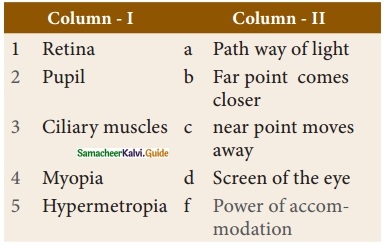
IV. Match the following.

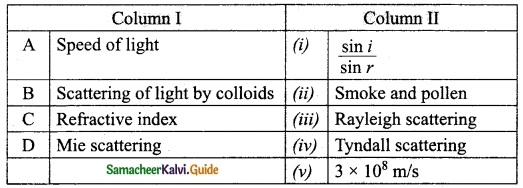
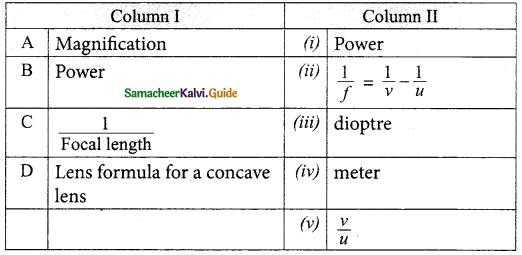
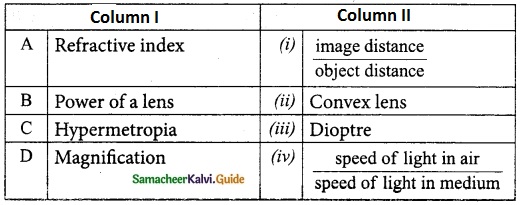
Samacheer Kalvi 10th Science Guide Chapter 2 Optics 1
Answer:
1. d
2. a
3. e
4. b
5. c

Samacheer Kalvi 10th Science Guide Chapter 2 Optics

V. Assertion and reasoning type.

Mark the correct choice as-
(a) If both assertion and reason are true and reason is the correct explanation of assertion.
(b) If both assertion and reason are true but reason is not the correct explanation of assertion.
(c) Assertion is true but reason is false.
(d) Assertion is false but reason is true.
1. Assertion: If the refractive index of the medium is high (denser medium) the velocity of the light in that medium will be small
Reason: Refractive index of the medium is inversely proportional to the velocity of the light.

2. Assertion: Myopia is due to the increase in the converging power of eye lens.
Reason: Myopia can be corrected with the help of concave lens.
Answer:
1. (a)
2. (a)

VI. Answer Briefly.

Question 1.
What is refractive index?
Answer:
Refractive index gives us an idea of how fast or how slow light travels in a medium.

Question 2.
State Snell’s law.
Answer:
The ratio of the sine of the angle of incidence and sine of the angle of refraction is equal to the ratio of refractive indices of the two media. This law is also known as Snell’s law.
\(\frac{sin i}{sin r}\) = \(\frac{µ_2}{µ_1}\)

Question 3.
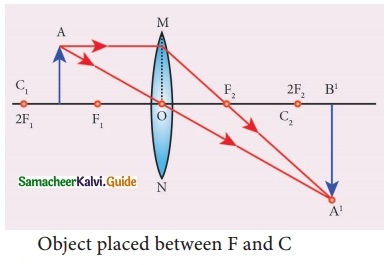
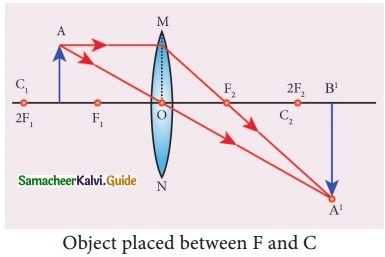
Draw a ray diagram to show the image formed by a convex lens when the object is placed between F and 2F.
Answer:
Samacheer Kalvi 10th Science Guide Chapter 2 Optics 2

Question 4.
Define dispersion of light.
Answer:
When a beam of white light or composite light is refracted through any transparent media such as glass or water, it is split into its component colours. This phenomenon is called as ‘dispersion of light’.

Question 5.
State Rayleigh’s law of scattering.
Answer:
Rayleigh’s scattering law states that, “The amount of scattering of light is inversely proportional to the fourth power of its wavelength”.
Amount of scattering ‘S’ ∝\(\frac{1}{λ^4}\)

Question 6.
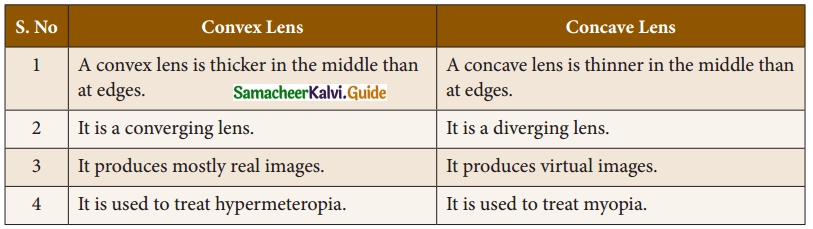
Differentiate convex lens and concave lens.
Answer:
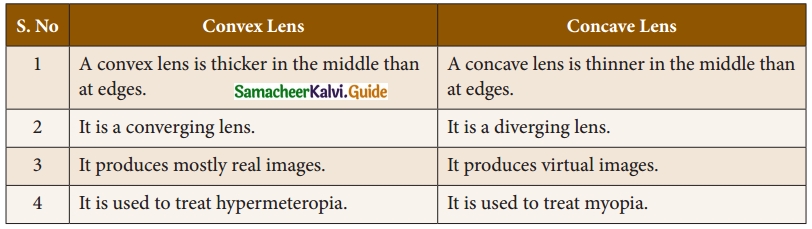
Samacheer Kalvi 10th Science Guide Chapter 2 Optics 3

Question 7.
What is the power of accommodation of the eye?
Answer:

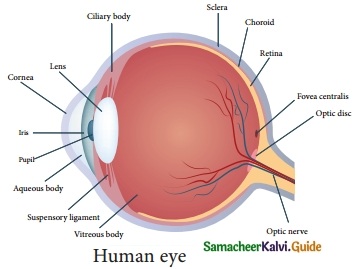
  • The ability of the eye lens to focus nearby as well as the distant objects is called the power of accommodation of the eye.
  • This is achieved by changing the focal length of the eye lens with the help of ciliary muscles.

Samacheer Kalvi 10th Science Guide Chapter 2 Optics

Question 8.
What are the causes of ‘Myopia’?
Answer:

  1. The lengthening of eye ball.
  2. The focal length of eye lens is reduced.
  3. The distance between eye lens and retina increases.
  4. The far point will not be at infinity.
  5. The far point comes closer.

Question 9.
Why does the sky appear blue in colour?
Answer:
When sunlight passes through the atmosphere, the blue colour (shorter wavelength) is scattered to a greater extent than the red colour (longer wavelength). This scattering causes the sky to appear blue in colour.

Question 10.
Why are traffic signals red in colour?
Answer:

  • Red light has the highest wavelength.
  • It is scattered by atmospheric particles.
  • So red light is able to travel the longest distance through a fog, rain etc.

VII. Give the answer in detail.

Question 1.
List any five properties of light?
Answer:

  • Light is a form of energy.
  • Light always travels along a straight line.
  • Light does not need any medium for its propagation. It can even travel through a vacuum.
  • The speed of light in vacuum or air is, c = 3 × 10⁸ ms-1
  • Since light is in the form of waves, it is characterized by a wavelength (λ) and a frequency (v), which are related by the following equation: c = vλ (c = velocity of light).
  • Different coloured light has a different wavelength and frequency.

Question 2.
Explain the rules for obtaining images formed by a convex lens with the help of ray diagram.
Answer:
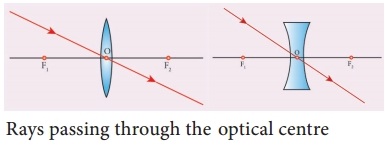
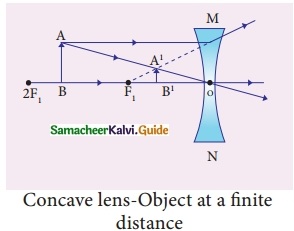
Rule-1: When a ray of light strikes the convex or concave lens obliquely at its optical centre, it continues to follow its path without any deviation.
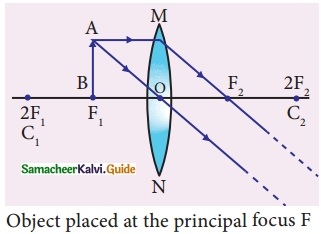
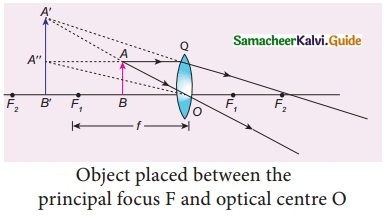
Samacheer Kalvi 10th Science Guide Chapter 2 Optics 4
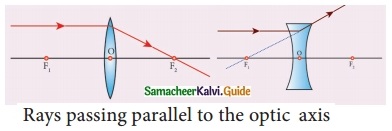
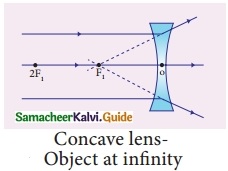
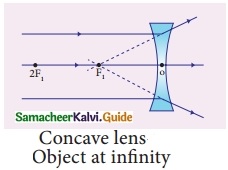
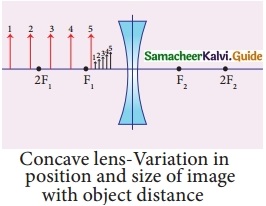
Rule-2: When rays parallel to the principal axis strikes a convex or concave lens, the refracted rays are converged to (convex lens) or appear to diverge from (concave lens) the principal focus.
Samacheer Kalvi 10th Science Guide Chapter 2 Optics 5
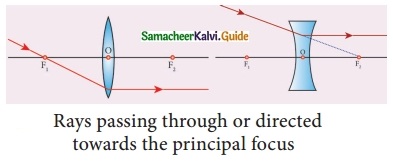
Rule-3: When a ray passing through (convex lens) or directed towards (concave lens) the principal focus strikes a convex or concave lens, the refracted ray will be parallel to the principal axis.
Samacheer Kalvi 10th Science Guide Chapter 2 Optics 6

Question 3.
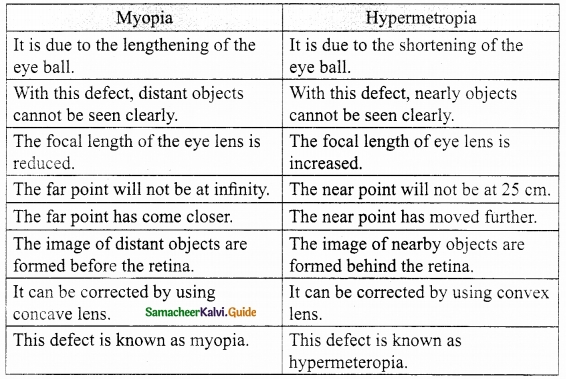
Differentiate the eye defects: Myopia and Hypermetropia.
Answer:
Samacheer Kalvi 10th Science Guide Chapter 2 Optics 7

Samacheer Kalvi 10th Science Guide Chapter 2 Optics

Question 4.
Explain the construction and working of a ‘Compound Microscope’.
Answer:
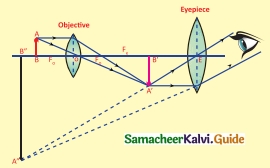
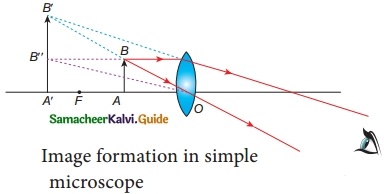
Construction : A compound microscope consists of two convex lenses. The lens with the shorter focal length is placed near the object, and is called as ‘objective lens’ or ‘objective piece’. The lens with larger focal length and larger aperture placed near the observer’s eye is called as ‘eye lens’ or ‘eye piece’. Both the lenses are fixed in a narrow tube with adjustable provision.

Working : The object (AB) is placed at a distance slightly greater than the focal length of objective lens (u > F0). A real, inverted and magnified image (A’B’) is formed at the other side of the objective lens. This image behaves as the object for the eye lens. The position of the eye lens is adjusted in such a way, that the image (B’B’) falls within the principal focus of the eye piece. This eye piece forms a virtual, enlarged and erect image (A”B”) on the same side of the object.
Samacheer Kalvi 10th Science Guide Chapter 2 Optics 8
Compound microscope has 50 to 200 times more magnification power than simple microscope.

VIII. Numerical Problems.

Question 1.
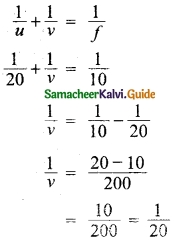
An object is placed at a distance 20 cm from a convex lens of focal length 10 cm. Find the image distance and nature of the image.
Answer:
Distance of an object u = 20 cm
Focal length of a convex lens f = 10 cm
Let the image distance be v
We know
Samacheer Kalvi 10th Science Guide Chapter 2 Optics 9
v = 20 cm
Magnification m = \(\frac{v}{u}\) = \(\frac{20}{20}\) = 1
Hence a real image of same size is formed at 20 cm.
Image distance = 20 cm

Question 2.
An object of height 3 cm is placed at 10 cm from a concave lens of focal length 15 cm. Find the size of the image.
Answer:
Object distance u = 10 cm
Focal length of a concave lens f= -15 cm
Let v be the image distance,
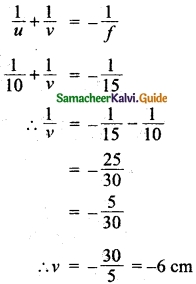
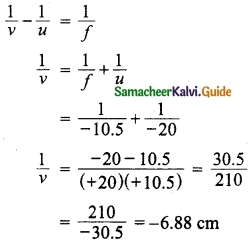
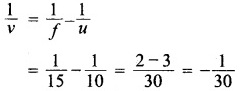
Samacheer Kalvi 10th Science Guide Chapter 2 Optics 10
Distance of image v = 6 cm
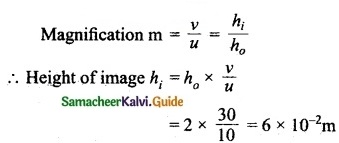
Magnification m = \(\frac{v}{u}\) = \(\frac{6}{10}\) = 0.6
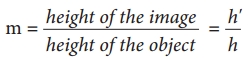
And Magnification m = \(\frac{h’}{h}\)
Where h’ – height of image
h – height of object
0.6 = \(\frac{h’}{3}\)
∴ h’ = 3 × 0.6 = 1.8 cm
∴ Height of image = 1.8 cm

Samacheer Kalvi 10th Science Guide Chapter 2 Optics

IX. Higher order thinking (HOT) questions.

Question 1.
While doing an experiment for the determination of focal length of a convex lens, Raja Suddenly dropped the lens. It got broken into two halves along the axis. If he continues his experiment with the same lens,
(a) can he get the image?
(b) Is there any change in the focal length?
Answer:
(a) He can get the image.
(b) The focal length of the lens will be doubled.

Question 2.
The eyes of the nocturnal birds like owl are having a large cornea and a large pupil. How does it help them?
Answer:

  • The large pupil opens wider and allows the maximum amount of light to enter the eye in the dark.
  • Their lens is large and situated near the retina. This also allows a lot of light to register on the retina. The retina contains 2 types of light-sensing cells rods and cones.
  • Cones are responsible for the coloured vision and require bright, focused light.
  • Rods are extremely sensitive to light and have a photosensitive pigment called rhodopsin which plays a vital role in night vision.

Samacheer Kalvi 10th Science Optics Additional Important Questions and Answers

I. Choose the correct answer.

Question 1.
The scattering of sun light by the atoms or molecules of the gases in the Earth’s atmosphere is known as:
(a) Mie scattering
(b) Tyndall scattering
(c) Rayleigh scattering
(d) Raman scattering
Answer:
(c) Rayleigh scattering

Question 2.
Mie scattering is responsible for the _____ appearance of the clouds.
(a) red
(b) blue
(c) colourless
(d) white.
Answer:
(d) white

Question 3.
In an inelastic scattering the energy of the incident beam of light is ……….. that of scattering beam.
(a) greater than
(b) less than
(c) equal to
(d) different from
Answer:
(d) different from

Question 4.
As per Rayleigh’s scattering law, amount of scattering is:
(a) directly proportioanl to fourth power of wavelength
(b) inversely proportioanl to fourth power of wavelength
(c) inversely proportioanl to square of wavelength
(d) directly proportional to square of wavelength
Answer:
(b) inversely proportioanl to fourth power of wavelength

Samacheer Kalvi 10th Science Guide Chapter 2 Optics

Question 5.
The refractive index of a medium is dependent on the _____ of the light.
(a) wavelength
(b) strength
(c) density
(d) refraction.
Answer:
(a) wavelength

Question 6.
The scattering of light by colloidal particles in the colloidal solution is called:
(a) Raman scattering
(b) Tyndall scattering
(c) Mie scattering
(d) Elastic scattering
Answer:
(b) Tyndall scattering

Question 7.
A piece of transparent material bounded by curved surfaces is called:
(a) mirror
(b) prism
(c) slab
(d) lens
Answer:
(d) lens

Question 8.
If the energy of the incident and the scattered beam of light are not the same, then it is called as _____.
(a) Elastic
(b) Raman
(c) Inelastic
(d) Mie.
Answer:
(c) Inelastic

Question 9.
A convex lens does not produce:
(a) real magnified image
(b) virtual magnified image
(c) virtual diminished image
(d) real diminished image
Answer:
(c) virtual diminished image

Question 10.
A lens which is thicker in the middle than at the edges is known as:
(a) concave lens
(b) convex lens
(c) bifocal lens
(d) cylindrical lens
Answer:
(b) convex lens

Question 11.
The object is always placed on the _____ side of the lens.
(a) left
(b) right
(c) top
(d) bottom.
Answer:
(a) left

Question 12.
The parallel rays from the outer edge are deviated towards the middle in a:
(a) convex mirror
(b) concave lens
(c) concave mirror
(d) convex lens
Answer:
(d) convex lens

Question 13.
The light rays passing through the optic centre will:
(a) diverged
(b) scattered
(c) converged
(d) emerge undeviated
Answer:
(d) emerge undeviated

Question 14.
All the distances are measured from the ______ of the lense.
(a) centre of curvature
(b) optical centre
(c) principal focus
(d) infinity.
Answer:
(b) optical centre

Question 15.
A ray passing through the principal focus and incident on the lens will:
(a) converge
(b) diverge
(c) emerge parallel to the principal axis
(d) not emerge out
Answer:
(c) emerge parallel to the principal axis

Samacheer Kalvi 10th Science Guide Chapter 2 Optics

Question 16.
When the object is placed at infinity from the convex lens, the image is formed at:
(a) F
(b) C
(c) infinity
(d) between F and 2F
Answer:
(a) F

Question 17.
The human eye is ____ in nature.
(a) convex
(b) concave
(c) transparent glass
(d) Plano – concave.
Answer:
(a) convex

Question 18.
The image formed by a concave lens is:
(a) virtual
(b) diminished
(c) virtual and diminished
(d) virtual and enlarged
Answer:
(c) virtual and diminished

Question 19.
To get a real image using convex lens, the object must be placed at:
(a) infinity
(b) principal focus
(c) beyond principal focus and infinity
(d) both (b) and (c)
Answer:
(d) both (b) and (c)

Question 20.
_____ is the centre part of the iris.
(a) cornea
(b) retina
(c) pupil
(d) eye lens.
Answer:
(c) pupil

Question 21.
For a convex lens the point at which the parallel rays converge is called of the lens.
(a) pole
(b) centre of curvature
(c) principal focus
(d) none
Answer:
(c) principal focus

Question 22.
A real image formed by a convex lens is always:
(a) erect
(b) magnified
(c) inverted
(d) diminished
Answer:
(c) inverted

Question 23.
The law of distances is given by:
Samacheer Kalvi 10th Science Guide Chapter 2 Optics 11
Answer:
(b) \(\frac{1}{f}\) = \(\frac{1}{u}\) + \(\frac{1}{v}\)

Question 24.
The unit of focal length is:
(a) dioptre
(b) metre
(c) ohm
(d) ampere
Answer:
(b) metre

Question 25.
The sign of focal length of a convex lens is ………. sign.
(a) negative
(b) positive
(c) negative or positive
(d) none of the above
Answer:
(b) positive

Samacheer Kalvi 10th Science Guide Chapter 2 Optics

Question 26.
The focal length of concave lens has ……… sign.
(a) positive
(b) negative
(c) positive or negative
(d) none of the above
Answer:
(b) negative

Question 27.
The magnification in terms of object distance u and image distance v is m :
(a) \(\frac{u}{v}\)
(b) u + v
(c) \(\frac{v}{u}\)
(d) uv
Answer:
(c) \(\frac{v}{u}\)

Question 28.
In terms of object distance u and focal length/, magnification is given by m =
Samacheer Kalvi 10th Science Guide Chapter 2 Optics 12
Answer:
(b) \(\frac{f}{u-f}\)

Question 29.
The magnification in terms of v and/:
(a) f
(b) v – f
(c) \(\frac{f}{v-f}\)
(d) \(\frac{v-f}{f}\)
Answer:
(d) \(\frac{v-f}{f}\)

Question 30.
The unit of power is:
(a) m
(b) ohm
(C) dioptre
(d) ampere
Answer:
(C) dioptre

Question 31.
If the focal length of a convex lens is 1 m then its power is:
(a) 1 dioptre
(b) 0.1 dioptre
(c) 10 dioptre
(d) 0.01 dioptre
Answer:
(a) 1 dioptre

Question 32.
In a simple microscope, the magnification can be increased by:
(a) lens of long focal length
(b) lens
(c) lens of short focal length
(d) lens of infinite focal length
Answer:
(c) lens of short focal length

Question 33.
Convex lenses are used:
(a) as camera lenses
(b) as magnifying lenses
(c) to correct hypermetropia
(d) all the above
Answer:
(d) all the above

Question 34.
Which lens is used in wide angle spyhole in doors?
(a) convex lens
(b) concave lens
(c) cylindrical lens
(d) parabolic lens
Answer:
(b) concave lens

Question 35.
The mathematical form of lens maker’s formula is:
Samacheer Kalvi 10th Science Guide Chapter 2 Optics 13
Answer:
(a)

Samacheer Kalvi 10th Science Guide Chapter 2 Optics

Question 36.
If f is the focal length of the lens then its power is given by:
(a) P = \(\frac{2}{f}\)
(b) p = \(\frac{1}{f}\)
(c) p = f
(d) p = f1
Answer:
(b) p = \(\frac{1}{f}\)

Question 37.
Which part of the human eye changes the focal length of the eye lens?
(a) pupil
(b) retina
(c) ciliary muscles
(d) cornea
Answer:
(c) ciliary muscles

Question 38.
On which part of human eye, image is formed?
(a) cornea
(b) iris
(c) retina
(d) pupil
Answer:
(c) retina

Question 39.
For normal human eye the value of near point is:
(a) 25 cm
(b) 25 m
(c) 2.5 m
(d) 25 mm
Answer:
(a) 25 cm

Question 40.
In hypermeteropia, the focal length of the eye lens is:
(a) decreased
(b) remains the same
(c) increased
(d) none of the above
Answer:
(c) increased

Question 41.
Presbyopia can be corrected by using:
(a) convex lens
(b) bifocal lens
(c) concave lens
(d) cylindrical lens
Answer:
(b) bifocal lens

Question 42.
Astigmatism can be corrected by using:
(a) bifocal lens
(b) cylindrical lens
(c) convex lens
(d) concave lens
Answer:
(b) cylindrical lens

Question 43.
The magnifying power of compound microscope is:
(a) 10
(b) 20
(c) 50
(d) 50 to 200
Answer:
(d) 50 to 200

Question 44.
The accuracy of travelling microscope is of the order of:
(a) 0.01 cm
(b) 0.01 mm
(c) 0.1 mm
(d) 0.1 cm
Answer:
(b) 0.01 mm

Samacheer Kalvi 10th Science Guide Chapter 2 Optics

II. Fill in the blanks.

1. The velocity of light in vacuum is ……….
2. If v is the frequency and λ is the wavelength then velocity of the wave is c = ……….
3. Among colours of visible light ……… colour has the highest wavelength.
4. According to Snell’s law refractive index, µ2 = ……….
5. In a medium having high value of refractive index then speed of light in that medium is ……….
6. Angle of refraction is the smallest for ……… and the highest for ……….
7. The refractive index depends on ………. of light.
8. Colours having shorter wavelength scattered more than longer wavelength colours according to ……….. law.
9. After passing through a convex lens ……….. rays ………. at the principal focus.
10. For a convex lens, as the object distance increases, the image distance ……….
11. A ray passing through the optic centre of a lens emerges …………
12. ……… is due to irregular curvature of the surface of the eye lens.
13. When a parallel beam of light passes through a convex lens, the rays from the outer edges are …………
14. A ray parallel to the principal axis of a convex lens after refraction passes through …………
15. When the object is placed between ………….. and ………… of a convex lens a virtual image will be formed.
16. For a convex lens, as the object approaches the lens the image becomes …………
17. In a phographic camera ………… lens is used.
18. The shorter the focal length, the ………. is the magnification.
19. The nature of the image formed by a simple microscope is ……….., ………… and …………
20. Real images are formed by a ……….. lens.
21. Concave lens produces ………… images.
22. The value of power of a lens having focal length one metre is ………..
23. For a normal eye the value of far point is …………
24. …………. is known as short sightedness.
25. Hyper metropia is known as ………..
26. The mathematical form of focal length of a concave lens used to correct myopia is f = ……….
27. ……….. lenses are used to correct astigmatism.
28. For a normal eye, the value of least distance of distinct vision is ………..
29. The objective of the compound microscope has …………. focal length.
30. The focal length of ………. is greater in a compound microscope.
31. ……… is an optical instrument to see the distant objects.
32. A terrestrial telescope produces ……… image.
33. Elaborate view of galaxies and planets is obtained by ………
Answer:
1. 3 × 10⁸ m/s
2. vλ
3. red
4. \(\frac{sin i}{sin r}\)
5. low
6. red, violet
7. wavelength
8. Rayleigh scattering
9. parallel, converge
10. will decrease
11. undeviated
12. Astigmatism
13. deviated towards the centre of the lens
14. the principal focus
15. principal focus, optical centre
16. bigger
17. biconvex
18. greater
19. virtual, erect, magnified
20. convex
21. virtual
22. One dioptre
23. infinity
24. Myopia
25. long sightedness
26. xy/x – y
27. Cylindrical
28. 25 cm
29. shorter
30. eye piece
31. Telescope
32. an erect
33. Telescope

Samacheer Kalvi 10th Science Guide Chapter 2 Optics

III. True or False. If false correct it.

1. Light does not travel along a straight line.
2. All coloured light has same wavelength.
3. In refraction incident ray, refracted ray and normal lie in the same plane.
4. Velocity of light is greater in rarer medium is greater than that in denser medium.
5. For red colour angle of refraction is the least.
6. The refractive index of a medium ¡s independent of wavelength.
7. Tyndall scattering, is the scattering of light by colloids.
8. According to Rayleigh’s scattering law, red colour is scattered to a greater extent than blue colour.
9. Mie scattering takes place when the diameter is larger than the wavelength of the incident light.
10. The lines in Raman scattering having frequencies lower than the incident frequency are called Antistoke’s lines.
11. In front of a convex lens when the object is placed at infinity the formed image is smaller than that of the object.
12. When an object is placed at finite distance from the concave lens a virtual image is formed between optical centre and focus of the concave lens.
13. Pupil of human eye bends the incident light on to the lens.
14. For a normal human eye, the value of far point is 25 cm.
15. Astigmatism is corrected by cylindrical lenses.
Answer:
1. False – Light always travels along a straight lines.
2. False – Different coloured light has different wavelength.
3. True
4. True
5. True
6. False – The refractive index of a medium depends on wavelength.
7. True
8. False – According to Rayleigh’s scattering law, blue colour is scattered to a greater extent than red colour.
9. True
10. False – The lines in Raman scattering having frequencies higher than the incident frequency are called Antistoke’s lines.
11. True
12. True
13. False – Cornea of human eye bends the incident light on to the lens.
14. False – For a normal human eye, the value of near point is 25 cm.
15. True

IV. Match the following.

Question 1.
Match the column I with column II.
Samacheer Kalvi 10th Science Guide Chapter 2 Optics 14
Answer:
A. (v)
B. (iv)
C. (i)
D. (ii)

Question 2.
Position of the object placed infront of a convex lens are given in Column
I. Match them with the natures of the images formed by the convex lens given in column II.
Samacheer Kalvi 10th Science Guide Chapter 2 Optics 15
Answer:
A. (v)
B. (iv)
C. (i)
D. (ii)

Samacheer Kalvi 10th Science Guide Chapter 2 Optics

Question 3.
Match the following:
Samacheer Kalvi 10th Science Guide Chapter 2 Optics 16
Answer:
A. (v)
B. (iv)
C. (i)
D. (ii)

Question 4.
Match the Column I with Column II.
Samacheer Kalvi 10th Science Guide Chapter 2 Optics 17
Answer:
A. (iv)
B. (iii)
C. (ii)
D. (i)

Question 5.
Match the Column I with Column II.
Samacheer Kalvi 10th Science Guide Chapter 2 Optics 18
Answer:
A. (iv)
B. (i)
C. (ii)
D. (iii)

Question 6.
Match the column I with column II.
Samacheer Kalvi 10th Science Guide Chapter 2 Optics 19
Answer:
A. (iii)
B. (i)
C. (iv)
D. (ii)

Question 7.
Match the Column I with Column II.
Samacheer Kalvi 10th Science Guide Chapter 2 Optics 20
Answer:
A. (iv)
B. (iii)
C. (ii)
D. (i)

V. Assertion and Reasoning type.

Question 1.
Assertion : The sun looks bigger in size at sunrise and sunset than during day.
Reason : In detraction light rays bend around the edges of the obstacle.
(a) If both Assertion and Reason are true and Reason is the correct explanation of Assertion.
(b) If both Assertion and Reason are true but Reason is not the correct explanation of Assertion.
(c) If Assertion is true but Reason is false.
(d) If Assertion is false but Reason is true.
Answer:
(b) If both Assertion and Reason are true but Reason is not the correct explanation of Assertion.

Question 2.
Assertion: Colours can be scan in thin layers of oil on the surface water. Reason: White light is composed of several colours.
(a) If both Assertion and Reason are true and Reason is the correct explanation of Assertion.
(b) If both Assertion and Reason are true but Reason is not the correct explanation of Assertion.
(c) If Assertion is true but Reason is false.
(d) If Assertion is false but Reason is true.
Answer:
(b) If both Assertion and Reason are true but Reason is not the correct explanation of Assertion.

Question 3.
Assertion: Raman spectrum of a liquids contains lines whose frequencies are not equal to that of incident radiation.
Reason: If a photon strikes an atom in a liquid that is in existed state photon losses energy.
(a) If both Assertion and Reason are true and Reason is the correct explanation of Assertion.
(b) If both Assertion and Reason are true but Reason is not the correct explanation of Assertion.
(c) If Assertion is true but Reason is false.
(d) If Assertion is false but Reason is true.
Answer:
(b) If both Assertion and Reason are true but Reason is not the correct explanation of Assertion.

Samacheer Kalvi 10th Science Guide Chapter 2 Optics

Question 4.
Assertion: The refractive index of a prism depends only on the material of the prism.
Reason: The refractive index of a prism depends upon the refracting angle and angel of minimum deviation.
(a) If both Assertion and Reason are true and Reason is the correct explanation of Assertion.
(b) If both Assertion and Reason are true but Reason is not the correct explanation of Assertion.
(c) If Assertion is true but Reason is false.
(d) If Assertion is false but Reason is true.
Answer:
(c) If Assertion is true but Reason is false.

Question 5.
Assertion: A single lens produces a coloured image of an object illuminated by white light.
Reason: The refractive index of material of lens is different for different wavelength of light.
(a) If both Assertion and Reason are true and Reason is the correct explanation of Assertion.
(b) If both Assertion and Reason are true but Reason is not the correct explanation of Assertion.
(c) If Assertion is true but Reason is false.
(d) If Assertion is false but Reason is true.
Answer:
(a) If both Assertion and Reason are true and Reason is the correct explanation of Assertion.

Question 6.
Assertion: If a convex lens is placed in water, its convergence power decrease.
Reason: Focal length of lens is independent of refractive index of the medium.
(a) If both Assertion and Reason are true and Reason is the correct explanation of Assertion.
(b) If both Assertion and Reason are true but Reason is not the correct explanation of Assertion.
(c) If Assertion is true but Reason is false.
(d) If Assertion is false but Reason is true.
Answer:
(c) If Assertion is true but Reason is false.

Question 7.
Assertion: Light waves travel in straight lines.
Reason: Rectilinear propagation of light confirm the above mentioned properly.
(a) If both Assertion and Reason are true and Reason is the correct explanation of Assertion.
(b) If both Assertion and Reason are true but Reason is not the correct explanation of Assertion.
(c) If Assertion is true but Reason is false.
(d) If Assertion is false but Reason is true.
Answer:
(a) If both Assertion and Reason are true and Reason is the correct explanation of Assertion.

Question 8.
Assertion: Raman scattering the scattering of monochromatic light by atoms and molecule of a liquid.
Reason: The wavelength of Raman lines is same.
(a) If both Assertion and Reason are true and Reason is the correct explanation of Assertion.
(b) If both Assertion and Reason are true but Reason is not the correct explanation of Assertion.
(c) If Assertion is true but Reason is false.
(d) If Assertion is false but Reason is true.
Answer:
(b) If both Assertion and Reason are true but Reason is not the correct explanation of Assertion.

Question 9.
Assertion: Power of a lens is the reciprocal of its focal length.
Reason: The unit of power is one dioptre when the unit of focal length is one metre.
(a) If both Assertion and Reason are true and Reason is the correct explanation of Assertion.
(b) If both Assertion and Reason are true but Reason is not the correct explanation of Assertion.
(c) If Assertion is true but Reason is false.
(d) If Assertion is false but Reason is true.
Answer:
(a) If both Assertion and Reason are true and Reason is the correct explanation of Assertion.

Question 10.
Assertion: Presbyopia is due to ageing of human beings.
Reason: For those persons, ciliary muscles of the eye become weak.
(a) If both Assertion and Reason are true and Reason is the correct explanation of Assertion.
(b) If both Assertion and Reason are true but Reason is not the correct explanation of Assertion.
(c) If Assertion is true but Reason is false.
(d) If Assertion is false but Reason is true.
Answer:
(a) If both Assertion and Reason are true and Reason is the correct explanation of Assertion.

Samacheer Kalvi 10th Science Guide Chapter 2 Optics

VI. Answer Briefly.

Question 1.
What is meant by refraction?
Answer:
When a ray of light travels from one transparent medium into another obliquely, the path of the light undergoes deviation. This deviation of ray of light is called refraction.

Question 2.
State laws of refraction.
Answer:
First law of refraction: The incident ray, the refracted ray of light and the normal to the refracting surface all lie in the same plane.

Second law of refraction: The ratio of the sine of the angle of incidence and sine of the angle of refraction is equal to the ratio of refractive indices of the two media. This law is also known as Snell’s law.
\(\frac{sin i}{sin r}\) = \(\frac{µ_2}{µ_1}\)

Question 3.
Define refractive index of a medium.
Answer:
The ratio of speed of light in vacuum to the speed of light in a medium is defined as refractive index ‘p’ of that medium.

Question 4.
What is meant by monochromatic source?
Answer:
If a source of light produces a light of single colour, it is known as a monochromatic source.

Question 5.
When white light is refracted by a transparent medium what will you get? Why?
Answer:

  1. When white light is refracted by a transparent medium, a spectrum is obtained.
  2. This is because, different coloured lights are bent through different angles.

Question 6.
What is scattering of light?
Answer:
When sunlight enters the Earth’s atmosphere, the atoms and molecules of different gases present in the atmosphere refract the light in all possible directions. This is called as ‘Scattering of light’.

Samacheer Kalvi 10th Science Guide Chapter 2 Optics

Question 7.
State the types of scattering.
Answer:

  1. Elastic scattering
  2. Inelastic scattering

Question 8.
What is elastic scattering?
Answer:
If the energy of the incident beam of light and the scattered beam of light are same, then it is called as ‘elastic scattering’.

Question 9.
What is inelastic scattering?
Answer:
If the energy of the incident beam of light and the scattered beam of light are not same, then it is called as ‘inelastic scattering’.

Question 10.
How are different types of scattering formed? Mention the types of scattering.
Answer:
The nature and size of the scatterer results in different types of scattering. They are

  1. Rayleigh scattering
  2. Mie scattering
  3. Tyndall scattering
  4. Raman scattering

Question 11.
What is Rayleigh scattering?
Answer:
The scattering of sunlight by the atoms or molecules of the gases in the earth’s atmosphere is known as Rayleigh scattering.

Question 12.
Why the colour of the Sun is red at sunrise and sunset?
Answer:
At sunrise and sunset, the light rays from the Sun have to travel a larger distance in the atmosphere than at noon. Hence, most of the blue lights are scattered away and only the red light which gets least scattered reaches us. Therefore, the colour of the Sun is red at sunrise and sunset.

Question 13.
When does Mie scattering take place?
Answer:
Mie scattering takes place when the diameter of the scatterer is similar to or larger than the wavelength of the incident light.

Question 14.
What are the causes of Mie scattering?
Answer:
Mie scattering is caused by pollen, dust, smoke, water droplets, and other particles in the lower portion of the atmosphere.

Question 15.
Why the clouds have white appearance?
Answer:
Mie scattering is responsible for the white appearance of the clouds. When white light falls on the water drop, all the colours are equally scattered which together form the white light.

Question 16.
What is Tyndall Scattering?
Answer:
The scattering of light rays by the colloidal particles in the colloidal solution is called Tyndall Scattering or Tyndall Effect.

Question 17.
What is meant by colloid? State few examples.
Answer:
Colloid is a microscopically small substance that is equally dispersed throughout another material. Eg: Milk, Ice cream, muddy water, smoke.

Samacheer Kalvi 10th Science Guide Chapter 2 Optics

Question 18.
What is meant by Raman Scattering?
Answer:
When a parallel beam of monochromatic (single coloured) light passes through a gas or liquid or transparent solid, a part of light rays are scattered.

Question 19.
Define Raman Scattering.
Answer:
Raman Scattering is defined as “The interaction of light ray with the particles of pure liquids or transparent solids, which leads to a change in wavelength or frequency.”

Question 20.
What is Rayleigh line?
Answer:
The spectral lines having frequency equal to the incident ray frequency is called ‘Rayleigh line’.

Question 21.
What are Raman lines?
Answer:
The spectral lines which are having frequencies other than the incident ray frequency are called ‘Raman lines’.

Question 22.
What are stokes lines and Antistokes lines?
Answer:
The lines having frequencies lower than the incident frequency is called stokes lines and the lines having frequencies higher than the incident frequency are called Antistokes lines.

Question 23.
What is a lens?
Answer:
A lens is an optically transparent medium bounded by two spherical refracting surfaces or one plane and one spherical surface.

Question 24.
How is lens classified?
Answer:
Lens is basically classified into two types. They are:

  1. Convex Lens
  2. Concave Lens.

Question 25.
What is biconvex lens?
Answer:
Convex or bi-convex lens: It is a lens bounded by two spherical surfaces such that it is thicker at the centre than at the edges. A beam of light passing through it, is converged to a point. So, a convex lens is also called as converging lens.

Question 26.
What is meant by biconcave lens?
Answer:
Concave or bi-concave Lens: It is a lens bounded by two spherical surfaces such that it is thinner at the centre than at the edges. A parallel beam of light passing through it, is diverged or spread out. So, a concave lens is also called as diverging lens.

Question 27.
What are
(i) Plano-convex lens?
(ii) Plano-concave lens?
Answer:
(i) If one of the faces of a bi-convex lens is plane, it is known as a plano-convex lens.
(ii) If one of the faces of a bi-concave lens is plane, it is known as a plano-concave lens.

Question 28.
State the applications of convex lenses.
Answer:

  1. Convex lenses are used as camera lenses.
  2. They are used as magnifying lenses.
  3. They are used in making microscope, telescope and slide projectors.
  4. They are used to correct the defect of vision called hypermetropia.

Samacheer Kalvi 10th Science Guide Chapter 2 Optics

Question 29.
Draw diagrams of different types converging lenses.
Answer:
Samacheer Kalvi 10th Science Guide Chapter 2 Optics 21

Question 30.
Represent different types of lenses by diagram.
Answer:
Samacheer Kalvi 10th Science Guide Chapter 2 Optics 22

Samacheer Kalvi 10th Science Guide Chapter 2 Optics 23
Question 31.
What is the nature of the image formed by an object is placed behind the centre of curvature of a convex leas. Draw a ray diagram.
Answer:
When an object is placed behind the center of curvature (beyond C), a real and inverted image is formed between the center of curvature and the principal focus. The size of the image is the same as that of the object.
Samacheer Kalvi 10th Science Guide Chapter 2 Optics 24

Question 32.
Draw a ray diagram to indicate the nature of the image formed when an object is placed in between the centre of curvature and principal focus of a convex lens.
Answer:
When an object is placed in between the center of curvature and principal focus, a real and inverted image is formed behind the center of curvature. The size of the image is bigger than that of the object.
Samacheer Kalvi 10th Science Guide Chapter 2 Optics 25

Question 33.
Draw a ray diagram for the formation of image (by the concave lens) when object is at infinity.
Answer:
When an object is placed at infinity, a virtual image is formed at the focus. The size of the image is much smaller than that of the object.
Samacheer Kalvi 10th Science Guide Chapter 2 Optics 26

Question 34.
What are the applications of concave lens?
Answer:

  1. Concave lenses are used as eye lens of‘Galilean Telescope’.
  2. They are used in wide angle spy hole in doors.
  3. They are used to correct the defect of vision called ‘myopia’.

Samacheer Kalvi 10th Science Guide Chapter 2 Optics

Question 35.
What do you know about lens formula?
Answer:
The lens formula gives the relationship among distance of the object (u), distance of the image (v) and the focal length (f) of the lens. It is expressed as
\(\frac{1}{f}\) = \(\frac{1}{v}\) – \(\frac{1}{u}\)

Question 36.
Define magnification.
Answer:
It is defined as the ratio of the height of the image to the height of an object. Magnification is denoted by the letter ‘m’. If height of the object is h and height of the image is h’, the magnification produced by lens is,
Samacheer Kalvi 10th Science Guide Chapter 2 Optics 27

Question 37.
What is lens formula?
Answer:
The lens formula relates the focal length of a lens with the distance of object and image.
Samacheer Kalvi 10th Science Guide Chapter 2 Optics 28
where µ is the refractive index of the material of the lens; R1 and R2 are the radii of curvature of the two faces of the lens; f is the focal length of the lens.

Question 38.
What is meant by power of lens?
Answer:
The ability of a lens to converge (convex lens) or diverge (concave lens) light rays is called as its power.

Question 39.
Define power of a lens. State its unit.
Answer:
Power of a lens is numerically defined as the reciprocal of its focal length.
P = \(\frac{1}{f}\)
The SI unit of power of a lens is dioptre.

Question 40.
What is meant by dioptre.
Answer:
Dioptre is the power of a lens, whose focal length is 1 metre.
1 Dioptre = 1 m-1.

Question 41.
Differentiate convex lens from concave lens.
Answer:
Samacheer Kalvi 10th Science Guide Chapter 2 Optics 29

Question 42.
What are
(i) Pupil &
(ii) Retina?
Answer:
(i) Pupil: It is the centre part of the Iris. It is the pathway for the light to retina.
(ii) Retina: This is the back surface of the eye. It is the most sensitive part of human eye, on which real and inverted image of objects is formed.

Question 43.
What is persistence of vision?
Answer:
If the time interval between two consecutive light pulses is less than 0.1 second, human eye cannot distinguish them separately. It is called persistence of vision.

Samacheer Kalvi 10th Science Guide Chapter 2 Optics

Question 44.
What is least distance of distinct vision?
Answer:
The minimum distance required to see the objects distinctly without strain is called least distance of distinct vision. It is called as near point of eye. It is 25 cm for normal human eye.

Question 45.
What is far point?
Answer:
The maximum distance up to which the eye can see objects clearly is called as far point of the eye.

Question 46.
What is Presbyopia?
Answer:
Due to ageing, ciliary muscles become weak and the eye-lens become rigid (inflexible) and so the eye loses its power of accommodation. Because of this, an aged person cannot see the nearby objects clearly. So, it is also called as ‘old age hypermetropia’.

Question 47.
What is meant by astigmatism?
Answer:
In this defect, eye cannot see parallel and horizontal lines clearly. It may be inherited or acquired. It is due to the imperfect structure of eye lens because of the development of cataract on the lens, ulceration of cornea, injury to the . refracting surfaces, etc. Astigmatism can be corrected by using cylindrical lenses (Torrid lenses).

Question 48.
State the principle of microscope. How is it classified?
Answer:
It works under the principle of angular magnification of lenses. It is classified as

  1. Simple microscope
  2. Compound microscope

Question 49.
What are the uses of simple microscope?
Answer:
Simple microscopes are used

  1. By watch repairers and jewellers.
  2. To read small letters clearly.
  3. To observe parts of flower, insects etc.
  4. To observe finger prints in the field of forensic science.

Question 50.
How is telescope classified?
Answer:
According to optical property, it is classified into two groups:

  1. refracting telescope
  2. reflecting telescope

Question 51.
Mention the advantages of telescope.
Answer:

  1. Elaborate view of the Galaxies, Planets, stars and other heavenly bodies is possible.
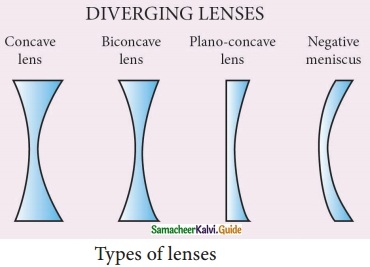
  2. Camera can be attached for taking photograph for the celestial objects.
  3. Telescope can be viewed even with the low intensity of light.

Question 52.
What are the disadvantages of telescope?
Answer:

  1. Frequent maintenance is needed.
  2. It is not easily portable.
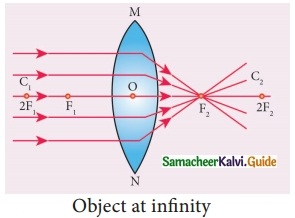
Samacheer Kalvi 10th Science Guide Chapter 2 Optics

VII. Give the answer in Detail.

Question 1.
State the Laws of Refraction.
Answer:
The incident ray, the refracted ray of light and the normal to the refracting surface all lie in the same plane.
Second law of Refraction:

  1. The ratio of the sine of the angle of incidence and sine of the angle of refraction is equal to the ratio of refractive indices of the two media. This law is also known as Snell’s law.
    \(\frac{\sin i}{\sin r}=\frac{\mu_{2}}{\mu_{1}}\)
  2. Refractive index gives us an idea of how fast or how slow light travels in a medium. The ratio of the speed of light in a vacuum to the speed of light in a medium is defined as the refractive index ‘µ’ of that medium.
  3. The speed of light in a medium is low if the refractive index of the medium is high and vice versa.
  4. When light travels from a denser medium into a rarer medium, the refracted ray is bent away from the normal drawn to the interface.
  5. When light travels from a rarer medium into a denser medium, the refracted ray is bent towards the normal drawn to the interface.

Question 2.
Describe Raman Scattering.
Answer:
When a parallel beam of monochromatic (single coloured) light passes through a gas or liquid or transparent solid, a part of light rays are scattered.

The scattered light contains some additional frequencies (or wavelengths) other than that of incident frequency (or wavelength). This is known as Raman scattering or Raman Effect.

Raman Scattering is defined as “The interaction of light ray with the particles of pure liquids or transparent solids, which leads to a change in wavelength or frequency.”

The spectral lines having frequency equal to the incident ray frequency is called ‘Rayleigh line’ and the spectral lines which are having frequencies other than the incident ray frequency are called ‘Raman lines’. The lines having frequencies lower than the incident frequency is called stokes lines and the lines having frequencies higher than the incident frequency are called Antistokes lines.

Question 3.
With the help of ray diagram, explain the nature, size and position of the image formed by a convex lens. When object is placed at
(i) infinity
(ii) beyond C
(iii) placed at C
(iv) Placed between F and C,
(v) placed at F
(vi) placed between F and optical centre O.
Answer:
(i) Object at infinity: When an object is placed at infinity, a real image is formed at the principal focus. The size of the image is much smaller than that of the object.
Samacheer Kalvi 10th Science Guide Chapter 2 Optics 30

(ii) Object placed beyond C (>2F): When an object is placed behind the center of curvature(beyond C), a real and inverted image is formed between the center of curvature and the principal focus. Th e size of the image is the same as that of the object.
Samacheer Kalvi 10th Science Guide Chapter 2 Optics 31

(iii) Object placed at C: When an object is placed at the center of curvature, a real and inverted image is formed at the other center of curvature. The size of the image is the same as that of the object.
Samacheer Kalvi 10th Science Guide Chapter 2 Optics 32

(iv) Object placed between F and C: When an object is placed in between the center of curvature and principal focus, a real and inverted image is formed behind the center of curvature. The size of the image is bigger than that of the object.
Samacheer Kalvi 10th Science Guide Chapter 2 Optics 33

(v) Object placed at the principal focus F: When an object is placed at the focus, a real image is formed at infinity. The size of the image is much larger than that of the object.
Samacheer Kalvi 10th Science Guide Chapter 2 Optics 34

(vi) Object placed between the principal focus F and optical centre O: When an object is placed in between principal focus and optical centre, a virtual image is formed. The size of the image is larger than that of the object.
Samacheer Kalvi 10th Science Guide Chapter 2 Optics 35

Question 4.
Explain the formation of images formed by a concave lens.
Answer:
Object at Infinity: When an object is placed at infinity, a virtual image is formed at the focus. The size of the image is much smaller than that of the object.
Samacheer Kalvi 10th Science Guide Chapter 2 Optics 36

Object anywhere on the principal axis at a finite distance: When an object is placed at a finite distance from the lens, a virtual image is formed between optical center and focus of the concave lens. The size of the image is smaller than that of the object.
Samacheer Kalvi 10th Science Guide Chapter 2 Optics 37

But, as the distance between the object and the lens is decreased, the distance between the image and the lens also keeps decreasing. Further, the size of the image formed increases as the distance between the object and the lens is decreased.
Samacheer Kalvi 10th Science Guide Chapter 2 Optics 38

Samacheer Kalvi 10th Science Guide Chapter 2 Optics

Question 5.
Explain Mie Scattering.
Answer:
Mie scattering:

  1. Mie scattering takes place when the diameter of the Scatterer is similar to or larger than the wavelength of the incident light. It is also an elastic scattering.
  2. The amount of scattering is independent of wavelength.
  3. Mie scattering is caused by pollen, dust, smoke, water droplets, and other particles in the lower portion of the atmosphere.
  4. Mie scattering is responsible for the white appearance of the clouds.
  5. When white light falls on the water drop, all the colours are equally scattered which, together form the white light.

Question 6.
With the help of a diagram, explain the structure and working of human eye.
Answer:
Structure of the eye:
The eye ball is approximately spherical in shape with a diameter of about 2.3 cm. It consists of a tough membrane called sclera, which protects the internal parts of the eye.
Samacheer Kalvi 10th Science Guide Chapter 2 Optics 39
Cornea : This is the thin and transparent layer on the front surface of the eyeball as shown in figure. It is the main refracting surface. When light enters through the cornea, it refracts or bends the light on to the lens.

Iris : It is the coloured part of the eye. It may be blue, brown or green in colour. Every person has a unique colour, pattern and texture. Iris controls amount of light entering into the pupil like camera aperture.

Pupil : It is the centre part of the Iris. It is the pathway for the light to retina.

Retina : This is the back surface of the eye. It is the most sensitive part of human eye, on which real and inverted image of objects is formed.

Ciliary muscles : Eye lens is fixed between the ciliary muscles. It helps to change the focal length of the eye lens according to the position of the object.

Eye Lens : It is the important part of human eye. It is convex in nature.

Working of the eye : The transparent layer cornea bends the light rays through pupil located at the centre part of the Iris. The adjusted light passes through the eye lens. Eye lens is convex in nature. So, the light rays from the objects are converged and a real and inverted image is formed on retina. Then, retina passes the received real and inverted image to the brain through optical nerves. Finally, the brain senses it as erect image.

Question 7.
Describe simple microscope.
Answer:
Simple microscope: It has a convex lens of short focal length. It is held near the eye to get enlarged image of small objects.
Let an object (AB) is placed at a point within the principal focus (u < f) of the convex lens and the observer’s eye is placed just behind the lens. As per this position the convex lens produces an erect, virtual and enlarged image (A’B’), The image formed is in the same side of the object and the distance equal to the least distance of distinct vision (D) (For normal human eye D = 25 cm).
Samacheer Kalvi 10th Science Guide Chapter 2 Optics 40

Question 8.
Write short notes on
(i) Astronomical telescope
(ii) Terrestrial telescope.
Answer:
(i) Astronomical Telescope: An astronomical telescope is used to view heavenly bodies like stars, planets, galaxies and satellites.

(ii) Terrestrial Telescope: The image in an astronomical telescope is inverted. So, it is not suitable for viewing objects on the surface of the Earth. Therefore, a terrestrial telescope is used. It provides an erect image. The major difference between astronomical and terrestrial telescope is erecting the final image with respect to the object.

VIII. Numerical Problems.

Question 1.
A needle of size 5 cm is placed 45 cm from a lens produced an image on a screen placed 90 cm away from the lens.
Answer:
(i) Identify the types of lens.
Calculate focal length of the lens.
Height of the object h1 = 5 cm
Distance of the object u = -45 cm
Distance of the image v = 90 cm
We know that
Samacheer Kalvi 10th Science Guide Chapter 2 Optics 41
Focal length of the lens = 30 cm
Since focal length is positive the lens is convex lens.

(ii) Identify the size of the image
Samacheer Kalvi 10th Science Guide Chapter 2 Optics 42
∴ h2 = -10 cm
The negative sign indicates that the image is real and inverted.

Samacheer Kalvi 10th Science Guide Chapter 2 Optics

Question 2.
A concave lens has focal length of 15 cm. At what distance should the object from the lens be placed so that it forms an image 10 cm from the lens?
Answer:
v = -10 cm; f =-15 cm; u = ?
Lens formula:
\(\frac{1}{f}\) = \(\frac{1}{v}\) – \(\frac{1}{u}\)
Type of lens: Concave lens
Samacheer Kalvi 10th Science Guide Chapter 2 Optics 43
u =-30 cm
Thus, the object distance is 30 cm.

Question 3.
An object is placed at a distance of 30 cm from a concave lens of focal length 15 cm. An erect and virtual image is formed at a distance of 10 cm from the lens. Calculate the magnification.
Answer:
Type of lens is Cancave lens.
Formula:
Magnification m = \(\frac{v}{u}\)
Object distance u = -30 cm
Image distance v = -10 cm
m = \(\frac{-10}{-30}\) = \(\frac{1}{3}\) = +0.33

Question 4.
The focal length of a concave lens is 2 cm. Calculate the power of the lens.
Answer:
Formula:
P = \(\frac{1}{f}\)
Type of lens is concave lens.
Focal length of concave lens,
f = -2 m power of the lens.
P = \(\frac{1}{-2 m}\)
P = -0.5 dioptre

Question 5.
A needle placed at 30 cm from the lens forms an image on a screen placed 60 cm on the other side of the lens. Identify the type of lens and determine the focal length.
Answer:
u = -30 cm
v = 60 cm
u is negative because image is formed on the on the other side of the lens.
Samacheer Kalvi 10th Science Guide Chapter 2 Optics 44
It is a convex lens.

Question 6.
A 3 cm tall bulb is placed at a distance of 20 cm from a diverging lens having a focal length of 10.5 cm. Determine the distance of the image.
Answer:
u = -20 cm
f = -10.5 cm
Samacheer Kalvi 10th Science Guide Chapter 2 Optics 45
The distance of the image is -6.88 cm

Question 7.
A ray from medium 1 is refracted below while passing through medium 2. Find the refractive index of the second medium with respect to medium 1.
Answer:
Refractive index µ
Samacheer Kalvi 10th Science Guide Chapter 2 Optics 46
Refractive index = 0.707

Question 8.
The optical prescription of a pair of spectacle is
Right eye: -3.5 D, Left eye: -4.00 D.
(i) Name the defect of the eye.
Answer:
Shortsighted (Myopia)

(ii) Are these lenses thinner at the middle or at the edges?
Answer:
These lenses are thinner in the middle.
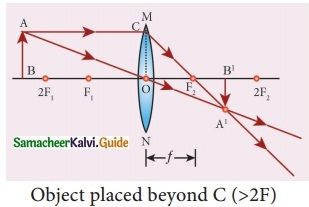
(iii) Which lens has a greater focal length?
Answer:
power = \(\frac{1}{focal length}\)
Right eye: power P = -3.5 D
Samacheer Kalvi 10th Science Guide Chapter 2 Optics 47
Left eye: Power P = -4 D
Samacheer Kalvi 10th Science Guide Chapter 2 Optics 48
Hence the lens having power of -3.5 D has greater focal length.

Samacheer Kalvi 10th Science Guide Chapter 2 Optics

Question 9.
The radii of curvature of two surfaces of a double convex lens are 10 cm each. Calculate its focal length and power of the lens in air and liquid. Refractive indices of glass and liquid are 1.5 and 1.8 respectively.
Answer:
Radius of curvature of first surface R1 = 10 cm
Radius of curvature of second surface R2 = 10 cm
In air
Samacheer Kalvi 10th Science Guide Chapter 2 Optics 49
pl = -3.33 d

Question 10.
An object 2 cm tall is placed 10 cm in front of a convex lens of focal length 15 cm. Find the position, size and nature of the image formed.
Answer:
Focal length of a convex lens f = 15 × 10-2 m
Weight of the object ho = 2 × 10⁻² m
Let weight of the image be hv
Distance of the object u = 10 × 10-2 m
Distance of the image v = 15 × 10-2 m
We know
Samacheer Kalvi 10th Science Guide Chapter 2 Optics 50
∴ v = -30 × 10-2 m
Distance of the image = 30 × 10-2 m
Samacheer Kalvi 10th Science Guide Chapter 2 Optics 51
Hence a virtual image 6 × 10⁻² m height is formed at a distance of 30 × 10-2 m from the lens on the same side of the lens.

IX. Higher order thinking (HOT) questions.

Question 1.
Ramu passes white light through a quartz prism. For which colour refractive index is greater?
Answer:
Refractive index is maximum for violet light when white light passes through a quartz prism.

Question 2.
Sita has kept a stud consists of diamond. What will she observe? Give reason.
Answer:
The diamond stud appears bright because of total internal reflection.

Question 3.
Guna passes a ray light through a glass slab. Which optical phenomenon will take place? What can he observe with reference to wavelength?
Answer:
When a ray of light enters a glass slab he can observe refraction of light. He observed that wavelength of light decreases.

Question 4.
A prism is placed in the minimum deviation position. Chari has passed a ray of light at an angle of 45°, then what is the value of angle of emergence? Why?
Answer:
The angle of emergence = 45°.
Since, in the minimum deviation positron, angle of incidence is equal to angle of emergence.
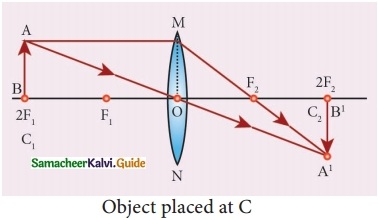
Samacheer Kalvi 10th Science Guide Chapter 2 Optics

Question 5.
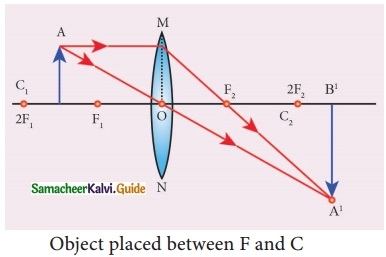
Mani is using a lens of power 2 dioptre. What is the focal length of the lens?
Answer:
Focal length = \(\frac{1}{power}\)
F= \(\frac{1}{2}\) = 0.5 m

Question 6.
Surya has placed a lens of power 1 D in side water. What will happen to power of the lens?
Answer:
The power of the lens will be more than original power.

Question 7.
Sonu has observed some lines in solar spectrum are absorbed by the elements present in the atmosphere. What are the lines?
Answer:
The lines are Fraunhofer lines.

Samacheer Kalvi 10th Social Science Guide History Chapter 3 World War II

Students can download 10th Social Science History Chapter 3 World War II Questions and Answers, Notes, Samacheer Kalvi 10th Social Science Guide Pdf helps you to revise the complete Tamilnadu State Board New Syllabus, helps students complete homework assignments and to score high marks in board exams.

Tamilnadu Samacheer Kalvi 10th Social Science Solutions History Chapter 3 World War II

Samacheer Kalvi 10th Social Science World War II Text Book Back Questions and Answers

I. Choose the correct answer

Question 1.
When did the Japanese formally sign of their surrender?
(a) 2 September, 1945
(b) 2 October, 1945
(c) 15 August, 1945
(d) 12 October, 1945
Answer:
(a) 2 September, 1945

Question 2.
Who initiated the formation of League of Nations?
(a) Roosevelt
(b) Chamberlain
(c) Woodrow Wilson
(d) Baldwin
Answer:
(a) Roosevelt

Samacheer Kalvi 10th Social Science Guide History Chapter 3 World War II

Question 3.
Where was the Japanese Navy defeated by the US Navy?
(a) Battle of Guadalcanal
(b) Battle of Midway
(c) Battle of Leningrad
(d) Battle of El Alamein
Answer:
(b) Battle of Midway

Question 4.
Where did the US drop its first atomic bomb?
(a) Kavashaki
(b) Innoshima
(c) Hiroshima
(d) Nagasaki
Answer:
(c) Hiroshima

Question 5.
Who were mainly persecuted by Hitler?
(a) Russians
(b) Arabs
(c) Turks
(d) Jews
Answer:
(d) Jews

Question 6.
Which Prime Minister of England who signed the Munich Pact with Germany?
(a) Chamberlain
(b) Winston Churchill
(c) Lloyd George
(d) Stanley Baldwin
Answer:
(a) Chamberlain

Samacheer Kalvi 10th Social Science Guide History Chapter 3 World War II

Question 7.
When was the Charter of the UN signed?
(a) June 26, 1942
(b) June 26, 1945
(c) January 1, 1942
(d) January 1, 1945
Answer:
(b) June 26, 1945

Question 8.
Where is the headquarters of the International Court of Justice located?
(a) New York
(b) Chicago
(c) London
(d) The Hague
Answer:
(d) The Hague

II. Fill in the blanks

  1. Hitler attacked ……………… which was a demilitarized zone.
  2. The alliance between Italy, Germany and Japan is known as ………………
  3. ……………… started the Lend-Lease programme.
  4. Britain Prime Minister ……………… resigned in 1940.
  5. Saluting the bravery of the ……………… Churchill said that “Never was so much owed by so many to so few”.
  6. ……………… is a device used to find out the enemy aircraft from a distance.
  7. The Universal Declaration of Human Rights set forth fundamental human rights in ……………… articles.
  8. After the World War II ……………… was voted into power in Great Britain.

Answers:

  1. Rhineland
  2. Rome – Berlin
  3. Roosevelt
  4. Chamberlain
  5. Royal Air force
  6. Radar
  7. 30
  8. Labour party

Samacheer Kalvi 10th Social Science Guide History Chapter 3 World War II

III. Choose the correct statement

Question 1.
(i) Banking was a major business activity among Jews.
(ii) Hitler persecuted the Jews.
(iii) In the concentration camps Jews were killed.
(iv) The United Nations has currently 129 member countries in it.
(a) (i) and (ii) are correct
(b) (i) and (Hi) are correct
(c) (iii) and (iv) are correct
(d) (i) is correct and (ii), (iii) and (iv) are wrong
Answer:
(a) (i) and (ii) are correct

Question 2.
Assertion (A): President Roosevelt realised that the United States had to change its policy of isolation.
Reason (R): He started a programme of Lend Lease in 1941.
(a) Both A and R are correct
(b) A is right but R is not the correct reason
(c) Both A and R are wrong
(d) R is right but it has no relevance to A
Answer:
(a) Both A and R are correct

Samacheer Kalvi 10th Social Science Guide History Chapter 3 World War II

IV. Match the Following
Samacheer Kalvi 10th Social Science Guide History Chapter 3 World War II 1
Answers:
A. (v)
B. (iv)
C. (i)
D. (ii)
E. (iii)

V. Answer the questions briefly

Question 1.
Mention the important clauses of the Treaty of Versailles relating to Germany.
Answer:

  1. Germany was forced to give up territories to the west, north and east of the German border.
  2. Germany had to be disarmed and was allowed to retain only a very restricted army, navy and air force.
  3. Germany was expected to pay huge military and civilian cost of the war to the allied nations (approx. $ 25 billion).

Question 2.
Who were the three prominent dictators of the post World War I?
Answer:
The three prominent dictators of the post-World War I were Mussolini (Italy), Hitler (Germany) and Franco (Spain).

Question 3.
How did Hitler get the support from the people of Germany?
Answer:
Hitler was able to sway away the emotions of the German people by his great speeches. He promised them that he will return back the glorious Germany. His racial superiority of the Germans as a pure Aryan race and a deep-rooted hatred for jews made him get the support of his people.

Samacheer Kalvi 10th Social Science Guide History Chapter 3 World War II

Question 4.
Describe the Pearl Harbour incident.
Answer:
Pearl Harbour incident took place in December 1941 when japan attacked American naval installations in Pearl Harbour, Hawaii, without warning to cripple America’s Pacific fleet. Many battle ships and numerous fighter planes were destroyed. The US declared war on Japan, with Britain and China. This brought together both the Asia Pacific and the European war into one common cause. Most importantly, it brought the United States with its enormous resources into the war as a part of the Allies.

Question 5.
What do you know of Beveridge Report?
Answer:
The Report that was published in the United Kingdom in 1942 to improve the general welfare of the people is called as Beveridge Report. It proposed that the government should provide citizens with adequate income, healthcare, education housing and employment to overcome poverty and disease thereby improve general welfare.

Question 6.
Name the Bretton Woods Twins.
Answer:
The World Bank and the International Monetary Fund.

Question 7.
What are the objectives of the IMF?
Answer:

  1. To foster global monetary co-operation
  2. To secure Financial Stability
  3. To facilitate International Trade
  4. To promote high employment and sustainable economic growth.
  5. To reduce poverty around the world.

Samacheer Kalvi 10th Social Science Guide History Chapter 3 World War II

VI. Answer the questions given under each caption

Question 1.
Battle of Stalingrad

(a) When did Germany attack Stalingrad?
Answer:
In August 1942, Germany attacked Stalingrad.

(b) What were the main manufactures of Stalingrad?
Answer:
The main manufactures of Stalingrad were armaments and tractors.

(c) What was the name of the plan formulated by Hitler to attack Stalingrad?
Answer:
Fall Blau or Operation Blue

(d) What is the significance of the Battle of Stalingrad?
Answer:
The people of Russia were grateful for Stalin’s conduct of the war. They regarded him as ‘a prodigy of patience, tenacity and vigilance, almost omnipresent, almost omniscient.

Question 2.
Japanese Aggression In South-east Asia

(a) Name the South-east Asian countries which fell to the Japanese.
Answer:
Guam, the Philippines, Hong Kong, Singapore, Malaya, the Dutch East Indies and the Burma all fell to the Japanese.

Samacheer Kalvi 10th Social Science Guide History Chapter 3 World War II

(b) Account for the setback of Allies in the Pacific region?
Answer:
The Allies had a setback in the Pacific region because of their inadequate preparation. The local people had to face the atrocities of the Japanese.

(c) What is the significance of Battle of Midway?
Answer:
The U.S. navy defeated the Japanese navy in the Battle of Midway. Thus, the battle is in favour of the Allies.

(d) What happened to the Indians living in Burma?
Answer:
The Indians living in Burma walked all the way to the Indian border facing many hardships. Many died of disease and exhaustion.

Question 3.
General Assembly and Security Council

(a) List the permanent member countries of the Security Council.
Answer:
The United States, Britain, France, Russia and China.

(b) What is the Holocaust?
Answer:
The word ‘holocaust’ is used to describe the genocide of nearly six million Jews by the Germans during the Second World War.

(c) Who was the Chairperson of the UN Commission on Human Rights?
Answer:
The widow of US President Franklin Roosevelt was the chairperson of the UN Commission on Human Rights.

(d) What is meant by veto?
Answer:
A veto is the power to unilaterally stop an official action, especially the enactment of legislation.

Samacheer Kalvi 10th Social Science Guide History Chapter 3 World War II

VII. Answer in detail

Question 1.
Attempt an essay on the rise and fall of Adolf Hitler.
Answer:

  1. Adolf Hitler Was the founder of the National Socialist party, generally known as the Nazi party.
  2. His great oratorical skill, his promise to bring back the glorious past of Germany, his support for the German race and hatred towards the Jews helped him to get people support.
  3. He came to power in 1933 and ruled Germany till 1945.
  4. He began to re-arm Germany and recruitment of new armed forces.
  5. The manufacture of armaments and machinery for the army, navy and air force with large spending from government resulted in the revival of the economic condition and helped to solve the unemployment problem in the economy.
  6. He followed aggressive policy and therefore in 1936, he invaded Rhine land, the demilitarized zone.
  7. His alliance with Italy and Japan became Rome-Berlin-Tokyo axis.
  8. He signed Munich pact stating Germany would not conquer any other territory, rather in 1939, he invaded Czechoslovakia.
  9. His attack on Poland resulted in the declaration of war by Britain and France against Germany.
  10. In 1941, German army invaded Russia. But the resistance of the German army and Russian winter defeated German army.
  11. When the allied forces fought back, Germany also retaliated. Finally, Hitler committed suicide in 1945.
  12. In 1945, allies occupied Berlin and Germany was divided as two sections after the war.

Question 2.
Analyse the effects of World War II.
Answer:
World War II was the most devastating war in history. It left a deep impact on the entire world. It changed the world in fundamental ways. Here are the effects of this War:

(i) The world got polarised into two main blocs led by superpowers, one led by the United States which followed anti-communist ideology, and the other by Soviet Russia which was essentially communist in nature. Europe was thus divided into two: Communist and non-communist.

(ii) The United States and the Soviet Union entered into a race to have more nuclear powered World War II 43 weapons. They built a large stockpile of such weapons. Meanwhile, Britain and France developed their own nuclear weapons.

(iii) Gradually there arose competition among countries. They began to devote large amount of resources in developing more and more powerful weapons with great destructive power, and defence spending skyrocketed in many countries.

(iv) It was realised that the League of Nations was ineffective and weak. So countries of the world decided not to repeat the mistake. Instead, many international agencies, in particular the United Nations, the World Bank and the International Monetary Fund came into existence providing a forum for countries large and small.

(v) Many other important social and economic changes also took place in the post-War world. Colonial powers were forced to give independence to former colonies in a process of decolonisation. India was the first country to get independence.

(vi) Women became the part of labour force in huge numbers. They became economically independent.

Samacheer Kalvi 10th Social Science Guide History Chapter 3 World War II

Question 3.
Assess the structure and activities of the UN.
Answer:
The charter of the United Nations was signed on June 26, 1945 by 51 nations. Now, the United Nations has 193 member states and each one has an equal vote in the UN.

Structure of UN:
Samacheer Kalvi 10th Social Science Guide History Chapter 3 World War II 2

The General Assembly: Meets once in a year. Issues of interest and points of conflict are discussed in the Assembly.

The Security Council: Consist of five permanent members (USA, Britain, France, Russia, China) and ten non-permanent members (elected in rotation). Each permanent member has the right to veto (A right to reject a decision).

UN Secretariat: Headed by the Secretary by law General. He is elected by the General Assembly on the recommendations of the Security Council. He, with his cabinet and officials run the UN.

International Court of Justice: Headquarters at the Hague in Holland.

The Economic and the Social Council: Co-ordinates all the social and economic work of the U.N. Headed by economists like Gunnar Myrdal.

Samacheer Kalvi 10th Social Science Guide History Chapter 3 World War II

Activities of the UN:

  1. Human Rights, Refugees problem, climatic change, gender equality are the important issues taken over and deals with it. Earlier in 1960’s decolonisation was also a part of their activity.
  2. UN peace keeping force acted in many areas of conflict all over the World. Indian army has been a part of it.
  3. The preamble of the UN declares, its activities include human rights, equality of men and women.

VIII. Students Activity

Question 1.
A debate in the class on the success or failure of the UN in preserving World Peace.
Answer:
The students can take the following topics for debate and finally conclude, UN is successful as it has stopped the nations from bringing another war. Small to big clashes were/are handled by UN efficiently.

Argument for:
The topics of discussion for debate are:

  1. Solving International conflicts: Since 1945, UN peacekeepers have undertaken over 60 field missions and negotiated 172 peaceful settlements that ended Regional conflicts.
  2. Liberation from Colonial rule: Eighty nations and more than 750 million people have been freed from colonialism.
  3. Human Rights: Custodian for the protection of human rights, discrimination against women, Children’s rights, torture, missing persons etc. in many countries.
  4. Enhancing Human life: Specialised agencies of the UN engaged in enhancing all aspects of human life, including education, health, poverty reduction, climate change.
  5. Treaties: More than 560 multilateral treaties on human rights, refugees, disarmament.

Argument against:

Non-proliferation Treaty (NPT): Signed by 190 nations, all live superpowers owned nuclear weapons. Later, several countries North Korea, Israel, Pakistan, India developed nuclear weapons.

Veto Power: Veto power has limited its effectiveness at critical times.

War Criminals: The International criminal court has prosecuted several war criminals. But it has been criticised for prosecuting only African leaders. But Western powers too have committed war crimes.

Israel Attack: Israel attacked homes schools, U.N. shelters in Gaza killing 2,200 Palestinians. The U.N. Security Council has failed any action against Israel.

Conclusion: U.N. is imperfect but it is also indispensable. It is successful as, it is avoiding any other war.
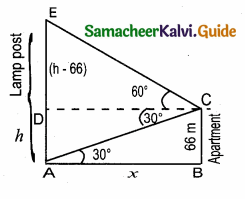
Samacheer Kalvi 10th Social Science Guide History Chapter 3 World War II

Question 3.
Marking the Allies and Axis countries, as well as important battlefields of World War II in a world map.
Answer:
Samacheer Kalvi 10th Social Science Guide History Chapter 3 World War II 3

IX. Map Work

Question 1.
Mark the following on the world map.
1. Axis Power Countries
2. Allied Power Countries
3. Hiroshima, Nagasaki, Hawai Island, Moscow, San Fransico
Answer:
(2)
Samacheer Kalvi 10th Social Science Guide History Chapter 3 World War II 3
(3)
Samacheer Kalvi 10th Social Science Guide History Chapter 3 World War II 4

Samacheer Kalvi 10th Social Science Guide History Chapter 3 World War II 5

Timeline:
Samacheer Kalvi 10th Social Science Guide History Chapter 3 World War II 6

Samacheer Kalvi 10th Social Science Guide History Chapter 3 World War II

Samacheer Kalvi 10th Social Science World War II Additional Important Questions and Answers

I. Choose the correct answer

Question 1.
The financial cost of the II World War was ……………….. times higher than that of the I World War.
(a) one
(b) three
(c) five
(d) seven
Answer:
(c) five

Question 2.
The coal mines given to France were ………
(a) Jharia
(b) Saar
(c) Bokaro
Answer:
(b) Saar

Question 3.
“Money in wheelbarrows to buy bread” in the 1920’s. Which country referred to here.
(a) Italy
(b) Austria
(c) Germany
(d) Spain
Answer:
(c) Germany

Samacheer Kalvi 10th Social Science Guide History Chapter 3 World War II

Question 4.
The principles of war and conquests was glorified by ………
(a) Moderates
(b) Dictators
(c) Extremists
Answer:
(b) Dictators

Question 5.
Hitler broke the Munich pact by invading ……………….. in 1939.
(a) Manchuria
(b) Sudetenland
(c) Poland
(d) Czechoslovakia
Answer:
(d) Czechoslovakia

Question 6.
Hitler demanded the surrender of ………
(a) Danzig
(b) Jutland
(c) Estonia
Answer:
(a) Danzig

Question 7.
The attack of ……………….. by Germany was the final act which result in the initiation of II World War.
(a) Britain
(b) France
(c) Russia
(d) Poland
Answer:
(d) Poland

Question 8.
The British Prime Minister during the Second World War was ………
(a) Sir Winston Churchill
(b) Clement Atlee
(c) Lloyd George
Answer:
(a) Sir Winston Churchill

Question 9.
The tactic followed by Germany to overrun other countries was called as:
(a) Sea-borne invasion
(b) Blitzkrieg
(c) Dunkirk
(d) None
Answer:
(b) Blitzkrieg

Question 10.
In ………, Hitler invaded Russia.
(a) 1940
(b) 1941
(c) 1943
Answer:
(b) 1941

Question 11.
“We shall fight in the fields and in the streets” ……………….. but, we shall never surrender.”- said by
(a) Winston Churchill
(b) Napoleon Bonaparte
(c) George Washington
(d) Roosevelt.
Answer:
(a) Winston Churchill

Samacheer Kalvi 10th Social Science Guide History Chapter 3 World War II

Question 12.
……………….. used the device radar for detecting aircraft at a distance in World War II.
(a) Germany
(b) Japan
(c) Britain
(d) USA
Answer:
(c) Britain

Question 13.
In September 1940, London was bombed mercilessly by German Air force. This action was called as:
(a) Spit fires
(b) Hurricanes
(c) Blitz
(d) Dunkirk
Answer:
(c) Blitz

Question 14.
Land lease programme of USA took place between the years:
(a) 1939 – 1945
(b) 1941 – 1945
(c) 1936 – 1940
(d) 1914 – 1918
Answer:
(b) 1941 – 1945

Question 15.
In the war between Germany and Russia in 1941, ……………….. was defeated.
(a) Germany
(b) Russia
(c) Britain
(d) None
Answer:
(a) Germany

Question 16.
Stalingrad I situated along the banks of the river:
(a) Miami
(b) Volga
(c) Hwang-Ho
(d) Marne
Answer:
(b) Volga

Question 17.
In the battle of Stalingrad, Germans used the code word ……………….. on Russia.
(a) Alamein
(b) Land lease
(c) Fall Blau
(d) Montegomary
Answer:
(c) Fall Blau

Question 18.
Mussolini was killed by a ……………….. partisan.
(a) Germany
(b) Italy
(c) Russia
(d) Britain
Answer:
(b) Italy

Samacheer Kalvi 10th Social Science Guide History Chapter 3 World War II

Question 19.
Mussolini was killed in:
(a) May 1945
(b) April 1944
(c) April 1945
(d) May 1946
Answer:
(c) April 1945

Question 20.
In 1945 ……………….. was divided into two sections.
(a) Germany
(b) Italy
(c) Bengal
(d) Russia
Answer:
(a) Germany

Question 21.
Japanese army indulged in the biggest slaughter in the place ……………….. in China.
(a) Manchuria
(b) Nanking
(c) Peking
(d) Shangai
Answer:
(b) Nanking

Question 22.
Japan announced surrendered to U.S on ……………….. 1945.
(a) 2nd September
(b) 15th August
(c) 3rd August
(d) 5th February
Answer:
(b) 15th August

Question 23.
The Security council has ……………….. members.
(a) 10
(b) 15
(c) 25
(d) 3
Answer:
(b) 15

Question 24.
At present, the United Nations has ……………….. member states.
(a) 196
(b) 195
(c) 194
(d) 193
Answer:
(d) 193

Samacheer Kalvi 10th Social Science Guide History Chapter 3 World War II

Question 25.
The World Bank is located at:
(a) Sweden
(b) New Zealand
(c) Washington
(d) New York
Answer:
(c) Washington

Question 26.
IMF has at present ……………….. member countries.
(a) 200
(b) 187
(c) 189
(d) 190
Answer:
(c) 189

Question 27.
IMF help the countries to solve their ……………….. position.
(a) debt
(b) Balance of payment
(c) Independency
(d) Trade
Answer:
(b) Balance of payment

Question 28.
The report published in 1942, in United Kingdom for the general welfare of the people was called as ……………….. report.
(a) Bretton Woods
(b) Beveridge
(c) Blitzkrieg
(d) Common wealth
Answer:
(b) Beveridge

Question 29.
……………….. party in Great Britain promised for a welfare state to the people.
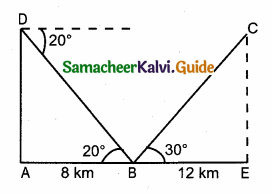
(a) Communist party
(b) Democratic party
(c) Socialised party
(d) Labour party
Answer:
(d) Labour party

Samacheer Kalvi 10th Social Science Guide History Chapter 3 World War II

Question 30.
The benefits to the people can be achieved either through ……………….. transfers or free services.
(a) Cash
(b) Country
(c) State
(d) Regional
Answer:
(a) Cash

II. Fill in the blanks

  1. World War II began in ……………… and ended in ………………
  2. The Treaty of ……………… was signed at the end of World War I in 1919.
  3. The Germans offered to pay ……………… billion gold marks to the allies.
  4. The United States was faced with great depression after ………………
  5. The National Socialist party in Germany was generally known as ………………
  6. In 1938, Hitler signed the Munich pact with Prime Minister ………………
  7. In 1939, Hitler invaded ……………… as against his promise in Munich pact.
  8. Hitler showed hatred against ………………
  9. Hitler came to power in ……………… and ruled till ………………
  10. World War II was a ……………… war fought with tanks, submarines, bomber planes etc.
  11. Britain and France declared war on Germany in ………………
  12. In ………………, Italy and Japan joined the axis powers.
  13. In September 1940, London war bombed by Germans mercilessly. This action was known as ………………
  14. Blitzkrieg means ………………
  15. The name of the Britain navy was ………………
  16. The war between Britain and ……………… took place in Dunkirk in 1940.
  17. The fighter planes of the British Royal force was called as ……………… and ………………
  18. ……………… of America started the Land Lease programme.
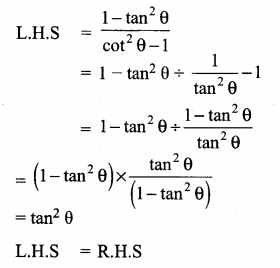
  19. Caucasus was famous for its ……………… in Russia.
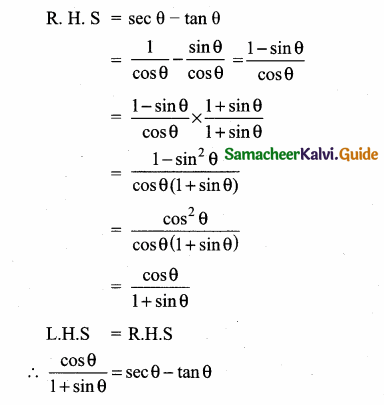
  20. Mussolini of Italy was killed by an ……………… partisan.
  21. The battle of ……………… was considered to be the Great patriotic war by the Russians.
  22. Italy surrendered to the allies in ………………
  23. The Allied forces under the command of ……………… invaded Normanday in France.
  24. Canton was called as ……………… in China.
  25. On December 1941, ……………… attacked American naval installations in Pearl Harbour.
  26. Guadalcanal is in the ……………… islands.
  27. USA dropped an atomic bomb on ……………… and ……………… cities of Japan.
  28. Japan announced their surrender on ………………
  29. Japan formally signed their surrender marking the end of the World War II was ………………
  30. ……………… and ……………… are the two super powers after the II World War.
  31. US and Soviet Russia entered into a race to have more ………………
  32. ………………, ………………, and ……………… came into existence after the II World War.
  33. ……………… started entering into labour force in huge number after World War II.
  34. In the process ofdecolonisation ……………… was the first country toget Independence.
  35. The word ……………… refers the genocide of Jews by the Germans during Second World War.
  36. A major outcome of the Holocaust was the creation of the State of ………………
  37. ……………… became the Homeland for Jews after II World War.
  38. The Un efforts to protect human rights at the global levei resulted in the UN commission on ………………
  39. The Un adopted the Human Rights Charter on ………………
  40. ……………… is observed globally as Human Rights Day.
  41. Britain and United States gave a joint declaration called as ……………… in 1941 that helped in the formation of UNO.
  42. ……………… were the axis powers of the II World War.
  43. The initial member States of the UN were ……………… nations.
  44. The Charter of the United Nations was signed on ………………
  45. Each member State in U.N.has ……………… vote.
  46. The UN functions almost like a ………………
  47. There are ………………, ………………, ………………, ……………… wing for the UN.
  48. Veto means ………………
  49. ……………… has veto power.
  50. ……………… permanent members are there in UN.
  51. WHO means ………………
  52. UNICEF means ………………
  53. FAO means ………………
  54. UNESCO expansion is ………………
  55. UNDP expansion is ………………
  56. The ……………… has been a port of peace keeping force of the UN in deployment to many parts of the World.
  57. The World Bank and the IMP are referred to as ………………
  58. The two main organs of the World Bank are ……………… and ………………
  59. IBRD expansion is ………………
  60. IDA expansion is ………………
  61. The IDA lends money to the ……………… for development activities.
  62. The loans sanctioned by IDA at low interest rates for development purposes are called as ………………
  63. Soft loans are given for ……………… years.
  64. The ……………… functions with private enterprises in developing countries.
  65. IFC expansion is ………………
  66. The World Bank is actively promoting the cause of improving the and eradicating the ………………
  67. The IMF was the brainchild of ……………… and ………………
  68. The initial member countries of IMF were ………………
  69. Its primary objective is to ensure ……………… and development across the World.
  70. The fund gives resources to countries facing ……………… problem.
  71. The number of member countries of IMF at present are ……………… countries.
  72. All the countries in the Western Europe are now ………………
  73. The ……………… in Great Britain after World War I promised to look at the people from the cradle to the grave.
  74. Legislations was enacted to provide comprehensive free health coverage to the citizens in Britain through ………………
  75. The monetary benefits after World War II by Labour party was ………………, ……………… etc.

Answers:

  1. 1939, 1945
  2. Versailles
  3. 100
  4. 1929
  5. Nazis
  6. Chamberlin
  7. Czechoslovakia
  8. Jews
  9. 1933, 1945
  10. modem
  11. 1939
  12. 1940
  13. Blitz
  14. Lightning strike
  15. Royal Navy
  16. France
  17. Spitfires, Hurricanes
  18. President Roosevelt
  19. Oil fields
  20. Italian
  21. Stalingrad
  22. 1943
  23. General Elsenhower
  24. Guangzhou
  25. Japan
  26. Solomon
  27. Hiroshima, Nagasaki
  28. 15th August 1945
  29. 2nd Sept 1945
  30. United States, Soviet Russia
  31. Nuclear weapons
  32. United Nations, World Bank, International Monetary Fund
  33. Women
  34. India
  35. Holocaust
  36. Israel
  37. Israel
  38. Human Rights
  39. 10th Dec 1948
  40. 10th Dec 1948
  41. Atlantic Charter
  42. Germany, Italy, Japan
  43. 51
  44. June 26, 1945
  45. One
  46. Government
  47. Executive, Judicial, Legislative, Co-ordinating
  48. The right to block major decisions
  49. Permanent members
  50. Five
  51. World Health Organisation
  52. United Nations Children’s Fund
  53. Food and Agricultural Organisation
  54. UN educational, Scientific and Cultural Organisation
  55. United Nations Development programme
  56. Indian Army
  57. Bretton Woods Twins
  58. IBRD, IDA
  59. International Bank for Reconstruction and Development
  60. International Development Agency
  61. Government
  62. Soft loans
  63. 50
  64. IFC
  65. International Finance Corporation
  66. Environment, AIDS
  67. Hary Dexter, John Maynard Keynes
  68. 29
  69. Financial Stability
  70. Balance of payment
  71. 189
  72. Welfare states
  73. Labour party
  74. National Health Service
  75. Old age pension, Child care services

Samacheer Kalvi 10th Social Science Guide History Chapter 3 World War II

III. Choose the correct statement

Question 1.
(i) The axis powers of World War II were Germany, Italy and Japan.
(ii) Russia attacked the American naval base at Pearl Harbour in 1941.
(iii) The UN adopted the historic human rights charter on 10th December 1947.
(iv) The executive wing of the UN is the UN Secretariat.
(a) (i) (ii) are correct
(b) (i) (ii) (iii) are correct
(c) (i) (iv) are correct
(d) (ii) (iv) are wrong.
Answer:
(c) (i) (iv) are correct

Question 2.
(i) Reparations refers to the compensation exacted from a defeated nation by the victorious nation.
(ii) Slaughter is compulsory military service.
(iii) Japanese navy was defeated by the US Navy at the battle of mid way.
(iv) Progression taxation by taxing the higher income groups at relatively high rates.
(a) (ii) (iii) (iv) are correct
(b) (ii) (iv) are wrong
(c) (iii) (iv) are correct
(d) (iii) (iv) are wrong.
Answer:
(a) (ii) (iii) (iv) are correct

Question 3.
(i) The Security Council of the UNO has fifteen members.
(ii) The mass killing of Jews in Nazi was called holocaust
(iii) Battle of Ex Alamein was considered one of the greatest battles by Russia.
(iv) The Japanese navy defeated the US navy in the battle of Midway.
(a) (i) (ii) are correct
(b) (ii) (iv) are correct
(c) (i) (ii) (iii) are correct
(d) (i) (iv) are wrong
Answer:
(a) (i) (ii) are correct

Samacheer Kalvi 10th Social Science Guide History Chapter 3 World War II

Question 4.
(i) The World Bank and the IMF are referred to as the Bretton Woods Twins.
(ii) The post World War I led to the rise of dictatorship in Italy, Germany, and Spain.
(iii) The post World War II changed the world into two blocks as communist and non communist.
(iv) The Shakespeare’s play the Merchant of Venice clearlv depicts the dislike and distrust of Jews among the Nazi people.
(a) (i) (ii) are correct
(b) (i) (ii) (iii) are wrong
(c) (i) (ii) (iii) (iv) are correct
(d) (iii) (iv) (ii) are wrong
Answer:
(c) (i) (ii) (iii) (iv) are correct

Question 5.
(i) IMF lends money from its resources to countries facing balance of payment problem.
(ii) The Munich pact was signed between Germany and the Soviet Union.
(iii) Huge worthless money for bread often refers to the Britain’s severe inflation after II World War.
(iv) Franco of Spain was the only dictatorship that emerged after II World War.
(a) (i) (ii) are correct
(b) (i) (iii) (iv) are correct
(c) (i) (ii) (iii) (iv) are wrong
(d) (i) (iv) are correct
Answer:
(a) (i) (ii) are correct

Question 6.
(i) Japanese extended their empire throughout South-east Asia.
(ii) Burma, Indonesia, Singapore, Malaya, Hong Kong, Philippines all fell to the Japanese.
(iii) Many Indians walked ail the way from Burma to the Indian border facing many sufferings.
(iv) Many Indians who stayed there suffered under the Japanese.
(a) (ii) (iv) are wrong
(b) (i) (ii) (iii) (iv) are correct
(c) (iii) (i) are correct
(d) (i) (ii) (iii) (iv) are wrong
Answer:
(b) (i) (ii) (iii) (iv) are correct

Samacheer Kalvi 10th Social Science Guide History Chapter 3 World War II

Question 7.
(i) Hitler was killed by his countrymen in 1945
(ii) Mussolini committed suicide in April 1945
(iii) The United States declared war on Japan on December 1944.
(iv) In 1938, Japan invaded China and seized Beijing.
(a) (ii) (iv) are wrong
(b) (i) (ii) (iii) (iv) are correct
(c) (i) (ii) are correct
(d) (i) (ii) (iii) (iv) are wrong
Answer:
(d) (i) (ii) (iii) (iv) are wrong

Question 8.
(i) In the year 1940, the British Prime Minister Chamberlain resigned.
(ii) The newly elected British Prime Minister next was Winston Churchill.
(iii) The end of World War II signalled a change in the world order and political configurations among the major powers.
(iv) The Treaty of Versailles ended the World War II.
(a) (i) (iv) are wrong
(b) (i) (ii) (iii) (iv) are correct
(c) (i) (ii) (iii) are correct
(d) (i) (ii) (iv) are correct
Answer:
(c) (i) (ii) (iii) are correct

IV. Assertion and Reason

Question 1.
Assertion (A): World War I (1914-18) and World War II (1939-45) are only referred as World wars.
Reason (R): The high death of the civilians and the soldiers and the extended area of the conflicts.
(a) Both A and R are correct
(b) A is correct but R is not the correct reason
(c) Both A and R are wrong
(d) R is correct but A is wrong.
Answer:
(a) Both A and R are correct

Question 2.
Assertion (A): The League remained an ineffectual international body. Reason (R): Along with the USA, as a non-member mainly Germany was determined to maintain a non-interventionist attitude.
(a) Both A and R are correct
(b) A is correct but R is not the correct reason
(c) Both A and R are wrong
(d) R is correct but A is wrong.
Answer:
(b) A is correct but R is not the correct reason

Question 3.
Assertion (A): Hitler invaded Austria and Czechoslovakia in 1938.
Reason (R): Hitler claimed all the German speaking people should be united into one nation.
(a) Both A and R are correct
(b) A is correct but R is not the correct reason
(c) Both A and R are wrong
(d) R is correct but A is not relevant to R.
Answer:
(a) Both A and R are correct

Question 4.
Assertion (A): The mood in Britain was not in favour of starting another war after World War I.
Reason (R): Just as the United States they wanted to be concerned with the revival of the economy after great depression.
(a) Both A and R are correct
(b) A is correct but R is not the correct reason
(c) Both A and R are wrong
(d) R is correct but A is not relevant to A.
Answer:
(b) A is correct but R is not the correct reason

Question 5.
Assertion (A): Germany developed a fleet of sub-marines which caused havoc in the Atlantic Ocean.
Reason (R): Germany ensured themselves for a sea-borne invasion on allies.
(a) Both A and R are correct
(b) A is right but R is not the correct explanation of A.
(c) Both A and R are wrong
(d) R is correct, which is not relevant to A.
Answer:
(b) A is right but R is not the correct explanation of A.

Samacheer Kalvi 10th Social Science Guide History Chapter 3 World War II

Question 6.
Assertion (A): The long term objective of Germany was to exploit Russia’s natural Resource oil.
Reason (R): German army invaded Russia.
(a) Both A and R are correct
(b) A is right but R is not the correct explanation of A
(c) Both A and R are wrong
(d) R is correct, which is not relevant to A.
Answer:
(a) Both A and R are correct

Question 7.
Assertion (A): Germans tried to capture the city of Stalingrad in Russia. Reason (R): Stalingrad was the militarised zone of Russia.
(a) Both A and R are correct
(b) A is right, but R is not the correct explanation of A
(c) Both A and R are wrong
(d) R is right, A is wrong.
Answer:
(b) A is right, but R is not the correct explanation of A

Question 8.
Assertion (A): Hitler committed suicide in April 1945.
Reason (R): The Allied forces in 1945, occupied parts of Berlin and began to attack Germany from the east.
(a) Both A and R are correct
(b) A is correct but R is not the correct explanation.
(c) Both A and R are wrong
(d) R is correct but A is not relevant to R.
Answer:
(a) Both A and R are correct

Question 9.
Assertion (A): The United States declared war on Japan.
Reason (R): In 1931, the Japanese army invaded Manchuria and in 1937, invaded China and seized Beijing.
(a) Both A and R are correct
(b) A is correct but R is not the correct explanation of A
(c) Both A and R are wrong
(d) R is correct but R is not relevant to A.
Answer:
(b) A is correct but R is not the correct explanation of A

Question 10.
Assertion (A): U.S. dropped an atomic bomb on Hiroshima and another bomb was dropped on Nagasaki.
Reason (R): U.S. developed hatred over the development of two cities Hiroshima and Nagasaki.
(a) Both A and R are correct
(b) A is correct, but R is not the correct explanation of A
(c) Both A and R are wrong
(d) R is correct but it is the correct reason for A.
Answer:
(b) A is correct, but R is not the correct explanation of A

Samacheer Kalvi 10th Social Science Guide History Chapter 3 World War II

Question 11.
Assertion (A): The U.S. and the Soviet Union followed communist and non¬communist ideas.
Reason (R): Countries began to devote large amount of resources in developing dangerous weapons.
(a) Both A and R are correct
(b) A is correct, but not relevant to R
(c) Both A and R are wrong
(d) R is correct, but not relevant to A.
Answer:
(c) Both A and R are wrong

V. Match the Following

Question 1.
Match the Column I with Column II.
Samacheer Kalvi 10th Social Science Guide History Chapter 3 World War II 7
Answer:
A. (iv)
B. (i)
C. (v)
D. (vi)
E. (iii)

Question 2.
Match the Column I with Column II.
Samacheer Kalvi 10th Social Science Guide History Chapter 3 World War II 8
Answer:
A. (v)
B. (i)
C. (vi)
D. (iii)
E. (ii)

Samacheer Kalvi 10th Social Science Guide History Chapter 3 World War II

VI. Answer the questions briefly

Question 1.
What are soft loans?
Answer:
The loans that are sanctioned by the International Development Agency to the Governments for developmental activities are called as soft loans. They are given at very low rate of interest of 50 years.

Question 2.
Did Munich Pact bring peace for some time? How?
Answer:

  1. In September 1938, Hitler threatened Czechoslovakia.
  2. The British Prime Minister Neville chamberlain initiated talks and signed Munich pact,
  3. Hitler promised not to take any more Czech territory.
  4. Chamberlain believed that he had achieved “Peace for some time”. But within six months Hitler seized the remainder of Czechoslovakia. So Munich pact has brought peace only for some time.

Question 3.
What do you know about the World Bank?
Answer:
The World bank consists of two main organs namely The International Bank for Reconstruction and Development (IBRD) and the International Development Agency (IDA). Together they are called as the World Bank.

Question 4.
Why did America declare war on Japan?
Answer:

  1. The Japanese had attacked the American fleet stationed at Pearl Harbour on December 7, 1941.
  2. This disastrous attack forced the Americans to enter into the war.
  3. The very next day the USA declared war on Japan.

Question 5.
What are the axis powers and the ally powers of II World War?
Answer:
Germany, Italy, Japan – Axis powers.
Britain, France, Russia, USA – Ally powers.

Question 6.
Name the countries involved in World War II.
Answer:

  1. The allies countries were under the leadership of Britain. [Britain, France, Russia and U.S.A]
  2. The axis countries were under the leadership of Germany. [Germany, Italy and Japan]

Question 7.
What was the immediate cause of the II World War?
Answer:
The main and immediate cause of the II World War was the aggressive, military, dictatorship attitude of Germany, fast-developing Japan. Hitler’s attack on Poland in 1939, resulted in the declaration of the War by Britain and France.

Samacheer Kalvi 10th Social Science Guide History Chapter 3 World War II

Question 8.
Write a brief note on security council.
Answer:

  1. The council has five permanent members and ten non-permanent members.
  2. The five permanent members are the USA, UK, France, Russian Federation and China,
  3. The non-permanent members are elected by the General Assembly for two years term,
  4. The permanent members have the right to veto for any council decision.
  5. Its main responsibility is to maintain International peace and security.

Question 9.
What is ECOSOC? What are its organs?
Answer:
The Economic and Social Council, is the UN organ which is responsible for co-ordinating all the economic and social work of the United Nations. The Regional Economic commissions functioning for regional development across the various regions of the World are its organs. (Asia pacific, West Asia, Europe, Africa, Latin America).

Question 10.
Name some of the specialized agencies of the UNO.
Answer:

  1. The World Health Organisation [WHO]
  2. The United Nations Educational Scientific and Cultural Organisation(UNESCO)
  3. The United Nation’s Children’s Fund (UNICEF)
  4. The International Labour Organisation (ILO)
  5. Food and Agricultural Organisation (FAO)
  6. International Monetary Fund (IMF)
  7. International Bank for Reconstruction and Development (IBRD)

VII. Answer the questions given under each caption

Question 1.
Causes of the Second World War.

(a) Name the treaty signed by Japan, Italy and Germany.
Answer:
Italy – Germany – Japan signed the Rome – Berlin – Tokyo Axis treaty.

(b) Mention some of the ideologies that emerged after the First World War.
Answer:
Democracy, Communism, Fascism and Nazism.

(c) What was the policy followed by the statesmen of the major world powers?
Answer:
The statesmen of the major world powers followed the policy of appeasement.

(d) What did Hitler violate?
Answer:
He violated the Munich Pact.

Samacheer Kalvi 10th Social Science Guide History Chapter 3 World War II

Question 2.
Munich Pact

(a) Who concluded the Munich pact with Germany?
Answer:
In 1938, Prime Minister Chamberlain concluded the Munich pact with Germany.

(b) What did Hitler do in 1939?
Answer:
In 1939, Hitler invaded Czechoslovakia breaking the munich pact that Germany would not attack any other country.

(c) Which act of Hitler made Britain and France declare war on Germany?
Answer:
His act of attack on Poland made Britain and France declare war on Germany.

(d) What were the weapons used in World War II?
Answer:
Heavy military equipment such as tanks, sub-marines, battleships, aircraft carriers, fighter planes and bomber planes.

Question 3.
Organs of the UNO

(a) Name the major organs of the UNO.
Answer:

  1. The General Assembly
  2. The Security Council
  3. The Economic and Social Council
  4. The Trusteeship Council
  5. The International Court of Justice
  6. The Secretariat

(b) Who was elected as the President of the UN General Assembly in 1953?
Answer:
Mrs. Vijaya Lakshmi Pandit

(c) What is the function of the Trusteeship Council?
Answer:
The Trusteeship Council looks after certain territories placed under the trusteeship of the UNO.

(d) How is the Secretary-General of the UNO appointed?
Answer:
The Secretary-General is appointed by the General Assembly on the advice of the Security Council.

Samacheer Kalvi 10th Social Science Guide History Chapter 3 World War II

Question 4.
Birth of Israel.

(a) What is meant by Holocaust?
Answer:
Holocaust refers to the mass killing of jews by the Germans during World War II.

(b) What was the major outcome of the Holocaust?
Answer:
The major outcome of the Holocaust was the creation of the State of Israel as a homeland for the Jews.

(c) What did the Israel occupy?
Answer:
The Israel has occupied large parts of Palestinian homelands.

(d) From whom does Israel get the support from?
Answer:
Israel get the vast support from the United States.

Question 5.
The United Nations

(a) Who took the first initiative for the formation of the United Nations?
Answer:
The United states and the Britain in 1941.

(b) Name the joint declaration they issued?
Answer:
The Atlantic Charter was the name of the joint declaration they issued.

(c) How many countries accepted the declaration at first?
Answer:
The declaration of the United Nations was accepted by 26 countries, on New years Day 1942.

(d) How many nations signed the charter? When?
Answer:
On June 26, 1945, 51 nations signed the charter.

Samacheer Kalvi 10th Social Science Guide History Chapter 3 World War II

Question 6.
International Monetary Fund (IMF)

(a) On whose idea the International Monetary Fund was initiated?
Answer:
Harry Dexter white and John Maynard Keynes ideas brought the emergence of IMF.

(b) When was it formally organised?
Answer:
It was formally organised in 1945 with 29 member countries (at present 189).

(c) What were the three main agendas of the IMF?
Answer:

  1. To promote International monetary co-operation.
  2. To expand International trade.
  3. To bring exchange stability.

(d) State the main reason of its funding?
Answer:
The IMF lends money from its resources to countries facing Balance of payment problems.

VIII. Answer in detail

Question 1.
What were the results of Second World War?
Answer:

  1. The destruction to life and property was on a much larger scale than the First World War.
  2. Over 50 millions lost their lives.
  3. It sounded the death knell to dictatorship in Germany and Italy.
  4. Germany was occupied by the Allied forces, and later it was divided into two parts.
  5. The West Germany was controlled by Britain, France and America and the East Germany by Russia.
  6. At the end of the war, Japan was occupied by American forces under General Mc. Arthur.
  7. The war weakened Britain and France.
  8. America and Russia emerged as super powers.
  9. The war did not end totalitarianism in Russia. A cold war started between Russia and America.
  10. The war quickened the phase of national movements in Asia and Africa.
  11. India, Burma, Egypt, Ceylon and Malaya won their freedom from Britain.
  12. Philippines got independence from America.
  13. Indo-china got independence from France.
  14. Indonesia got independence from the Dutch.
  15. The European countries gave up the policy of colonialism and imperialism.
  16. The United Nations Organisation was set up to maintain international peace and harmony. It works hard to maintain international co-operation and for the promotion of human welfare.

Question 2.
Write a note on international Monetary Fund (IMF).
Answer:

  1. International Monetary Fund was established in 1945 after the Bretton Woods conference in 1944 along with the World Bank.
  2. It is located in the Washington in United States.
  3. The idea of starting of IMF was given by Harry Dexter, White and John Maynard Keynes, a famous economist.
  4. The initial members of the IMF were 29. Now, there are 189 member countries with IMF,
  5. The main objectives of IMF include to foster global monetary co-operation, to secure financial stability, to facilitate trade, promote employment, to sustain economic growth and reduce poverty all over the world.
  6. The fund lends money to its member countries to correct their balance of payment position if they are unable to pay for their imports.
  7. The funding from IMF is not very easy as it strictly imposes restrictions on lending.
  8. It imposes the developing nations to tighten the budgets and reduce fiscal expenditure.

Samacheer Kalvi 10th Social Science Guide History Chapter 3 World War II

Question 3.
Write a note on the UN Commission of Human Rights.
Answer:

  1. Human Rights means the fundamental freedom for all human beings without any differences in race, sex, language and religion.
  2. The UN efforts to protect human rights on a global basis resulted in the formation of the UN commission on Human Rights.
  3. A committee was set up for its formation. It was headed by the wife of FDR of USA, after his death.
  4. The other members of the commission included Charles Malik from Lebanon, P.C.Chang from China, Rene Casin from France.
  5. The Commission set forth with 30 articles.
  6. The UN adopted this historic charter on 10th December 1948.
  7. This day, the 10th December is observed as Human Rights Day all over the World.
  8. According to the Franklin and Eleanor institute in New York, reports, from 1948 till now, nearly 90 National constitutions are part of this Human Rights Commission of UN.

Samacheer Kalvi 10th Maths Guide Chapter 6 Trigonometry Ex 6.5

Students can download Maths Chapter 6 Trigonometry Ex 6.5 Questions and Answers, Notes, Samacheer Kalvi 10th Maths Guide Pdf helps you to revise the complete Tamilnadu State Board New Syllabus, helps students complete homework assignments and to score high marks in board exams.

Tamilnadu Samacheer Kalvi 10th Maths Solutions Chapter 6 Trigonometry Ex 6.5

Multiple Choice Questions

Question 1.
The value of sin2 θ + \(\frac{1}{1+\tan ^{2} \theta}\) is equal to ………………
(1) tan2 θ
(2) 1
(3) cot2 θ
(4) 0
Answer:
(2) 1
Hint:
sin2 θ + \(\frac{1}{1+\tan ^{2} \theta}\) = sin2 θ + \(\frac{1}{\sec ^{2} \theta}\) = sin2 θ + cos2 θ = 1

Samacheer Kalvi 10th Maths Guide Chapter 6 Trigonometry Ex 6.5

Question 2.
tan θ cosec2 θ – tan θ is equal to ………………
(1) sec θ
(2) cot2 θ
(3) sin θ
(4) cot θ
Answer:
(4) cot θ
Hint:
tan θ cosec2 θ – tan θ = tan θ (cosec2 θ – 1)
= tan θ × cot2 θ = \(\frac{1}{\cot \theta}\) × cot2 θ = cot θ

Question 3.
If (sin α + cosec α)2 + (cos α + sec α)2 = k + tan2 α + cot2 α, then the value of k is equal to
(1) 9
(2) 7
(3) 5
(4) 3
Solution:
(2) 7
(sin α + cos α)2 + (cos α + sec α)2
= sin2 α + cosec2 α + 2 sin α cosec α + cos2 α + sec2 α + 2 cos α sec α
= 1 + cosec2 α + 2 + sec2 α + 2
= 1 + cot2 α + 1 + 2 + tan2 α + 1 + 2
= 7 + tan2 α + cot2 α
k = 7

Question 4.
If sin θ + cos θ = a and sec θ + cosec θ = b , then the value of b (a2 – 1) is equal to ……………
(1) 2 a
(2) 3 a
(3) 0
(4) 2 ab
Answer:
(1) 2 a
Hint:
b (a2 – 1) = (sec θ + cosec θ) [(sin θ + cos θ)2 – 1]
= \(\frac{1}{\cos \theta}+\frac{1}{\sin \theta}\) [sin2 θ + cos2 θ + 2 sin θ cos θ – 1]
Samacheer Kalvi 10th Maths Guide Chapter 6 Trigonometry Ex 6.5 1

Samacheer Kalvi 10th Maths Guide Chapter 6 Trigonometry Ex 6.5

Question 5.
If 5x = sec θ and \(\frac { 5 }{ x } \) = tan θ, then x2 – \(\frac{1}{x^{2}}\) is equal to …………….
(1) 25
(2) \(\frac { 1 }{ 25 } \)
(3) 5
(4) 1
Answer:
(2) \(\frac { 1 }{ 25 } \)
Hint:
Samacheer Kalvi 10th Maths Guide Chapter 6 Trigonometry Ex 6.5 2
Samacheer Kalvi 10th Maths Guide Chapter 6 Trigonometry Ex 6.5 3
Samacheer Kalvi 10th Maths Guide Chapter 6 Trigonometry Ex 6.5 4
Question 6.
If sin θ = cos θ , then 2 tan2 θ + sin2 θ – 1 is equal to ………………
(1) \(\frac { -3 }{ 2 } \)
(2) \(\frac { 3 }{ 2 } \)
(3) \(\frac { 2 }{ 3 } \)
(4) \(\frac { -2 }{ 3 } \)
Answer:
(2) \(\frac { 3 }{ 2 } \)
Hint:
Samacheer Kalvi 10th Maths Guide Chapter 6 Trigonometry Ex 6.5 5
Samacheer Kalvi 10th Maths Guide Chapter 6 Trigonometry Ex 6.5 6

Question 7.
If x = a tan θ and y = b sec θ then …………..
(1) \(\frac{y^{2}}{b^{2}}-\frac{x^{2}}{a^{2}}=1\)
(2) \(\frac{x^{2}}{a^{2}}-\frac{y^{2}}{b^{2}}=1\)
(3) \(\frac{x^{2}}{a^{2}}-\frac{y^{2}}{b^{2}}=0\)
(4) \(\frac{y^{2}}{b^{2}}-\frac{x^{2}}{a^{2}}=0\)
Answer:
(1) \(\frac{y^{2}}{b^{2}}-\frac{x^{2}}{a^{2}}=1\)
Hint:
x = a tan θ
\(\frac { x }{ a } \) = tan θ
\(\frac{x^{2}}{a^{2}}\) = tan2 θ
\(\frac{y^{2}}{b^{2}}-\frac{x^{2}}{a^{2}}\) = sec2 θ – tan2 θ = 1
y = b sec θ
\(\frac{y}{b}\) = sec θ
\(\frac{y^{2}}{b^{2}}\) = sec2 θ

Samacheer Kalvi 10th Maths Guide Chapter 6 Trigonometry Ex 6.5

Question 8.
(1 + tan θ + sec θ) (1 + cot θ – cosec θ) is equal to ……………
(1) 0
(2) 1
(3) 2
(4) -1
Answer:
(3) 2
Hint:
(1 + tan θ + sec θ) (1 + cot θ – cosec θ)
Samacheer Kalvi 10th Maths Guide Chapter 6 Trigonometry Ex 6.5 7

Question 9.
a cot θ + b cosec θ = p and b cot θ + a cosec θ = q then p2 – q2 is equal to
(1) a2 – b2
(2) b2 – a2
(3) a2 + b2
(4) b-a
Solution:
(2) b2 – a2
(a cot θ + b cosec θ)2 = p2
(b cot θ + a cosec θ )2 = q2
p2 – q2 = a2 cost2θ + a2 cot2θ + 2ab cot θ cosec θ – (b2cot2θ + a2 cosec2θ + 2ab cot θ cosec θ) = (a2 – b2) cot2θ + (b2 – a2)cosec2θ = (a2 – b2) (cosec2θ – 1) + (b2 – a2) (cosec2θ)
= (a2 – b2)cosec2θ – (a2 – b2) – (a2 – b2) cosec2θ
= b2 – a2

Samacheer Kalvi 10th Maths Guide Chapter 6 Trigonometry Ex 6.5

Question 10.
If the ratio of the height of a tower and the length of its shadow is \(\sqrt { 3 }\) : 1, then the angle of elevation of the sun has a measure
(1) 45°
(2) 30°
(3) 90°
(4) 60°
Answer:
(4) 60°
Hint:
Ratio of length of the tower : length of the shadow = \(\sqrt { 3 }\) : 1
Samacheer Kalvi 10th Maths Guide Chapter 6 Trigonometry Ex 6.5 8
Let the tower be \(\sqrt { 3 }\) x and the shadow be x
tan C = \(\frac { AB }{ BC } \) ⇒ tan C = \(\frac{\sqrt{3} x}{x}\) = \(\sqrt { 3 }\)
tan C = tan 60° ⇒ ∴ ∠C = 60°

Question 11.
The electric pole subtends an angle of 30° at a point on the same level as its foot. At a second point ‘6’ metres above the first, the depression of the foot of the tower is 60° . The height of the tower (in metres) is equal to ……………
(1) \(\sqrt { 3 }\) b
(2) \(\frac { b }{ 3 } \)
(3) \(\frac { b }{ 2 } \)
(4) \(\frac{b}{\sqrt{3}}\)
Answer:
(3) \(\frac { b }{ 2 } \)
Hint:
Let the height of the pole BC be h
AC = b + h
Let CD be x
In the right ∆ BCD, tan 30° = \(\frac { BC }{ AB } \)
\(\frac{1}{\sqrt{3}}\) = \(\frac { h }{ x } \)
x = \(\sqrt { 3 }\) h ………. (1)
Samacheer Kalvi 10th Maths Guide Chapter 6 Trigonometry Ex 6.5 9
In the right ∆ ACD, tan 60° = \(\frac { AC }{ CD } \)
\(\sqrt { 3 }\) = \(\frac { b+h }{ x } \)
x = \(\frac{b+h}{\sqrt{3}}\) ………(2)
From (1) and (2) we get
\(\sqrt { 3 }\) h = \(\frac{b+h}{\sqrt{3}}\) ⇒ 3 h = b + h
2 h = b ⇒ h = \(\frac { b }{ 2 } \)

Samacheer Kalvi 10th Maths Guide Chapter 6 Trigonometry Ex 6.5

Question 12.
A tower is 60 m height. Its shadow is x metres shorter when the sun’s altitude is 45° than when it has been 30° , then x is equal to
(1) 41. 92 m
(2) 43. 92 m
(3) 43 m
(4) 45. 6 m
Answer:
(2) 43. 92 m
Hint:
In the right ∆ ABC, tan 30° = \(\frac { AB }{ BC } \) = \(\frac { 60 }{ x+y } \)
\(\frac{1}{\sqrt{3}}\) = \(\frac { 60 }{ x+y } \) ⇒ x + y = 60 \(\sqrt { 3 }\)
Samacheer Kalvi 10th Maths Guide Chapter 6 Trigonometry Ex 6.5 10
y = 60 \(\sqrt { 3 }\) – x …….(1)
In the right ∆ ABD, tan 45° = \(\frac { AB }{ BD } \)
1 = \(\frac { 60 }{ y } \) ⇒ y = 60 ………..(2)
From (1) and (2) we get
60 = 60 \(\sqrt { 3 }\) – x
x = 60 \(\sqrt { 3 }\) – 60 = 60 (\(\sqrt { 3 }\) – 1) = 60 (1.732 – 1)
= 60 × 0.732
x = 43.92 m

Question 13.
The angle of depression of the top and bottom of 20 m tall building from the top of a multistoried building are 30° and 60° respectively. The height of the multistoried building and the distance between two buildings (in metres) is …………….
(1) 20,10\(\sqrt { 3 }\)
(2) 30, 5 \(\sqrt { 3 }\)
(3) 20, 10
(4) 30, 10\(\sqrt { 3 }\)
Answer:
(4) 30, 10\(\sqrt { 3 }\)
Hint:
Let the height of the multistoried building AB be “h”
AE = h – 20
Let BC be x
In the right ∆ ABC, tan 60° = \(\frac { AB }{ BC } \) ⇒ \(\sqrt { 3 }\) = \(\frac { h }{ x } \)
x = \(\frac{h}{\sqrt{3}}\) ………..(1)
Samacheer Kalvi 10th Maths Guide Chapter 6 Trigonometry Ex 6.5 111
In the right ∆ ABC, tan 30° = \(\frac { AE }{ ED } \) = \(\frac { h-20 }{ x } \)
\(\frac{1}{\sqrt{3}}\) = \(\frac { h-20 }{ x } \)
x = (h – 20) \(\sqrt { 3 }\) ………(2)
From (1) and (2) we get,
\(\frac{h}{\sqrt{3}}\) = (h – 20) \(\sqrt { 3 }\)
h = 3h – 60 ⇒ 60 = 2 h
h = \(\frac { 60 }{ 2 } \) = 30
Distance between the building (x) = \(\frac{h}{\sqrt{3}}=\frac{30}{\sqrt{3}}=\frac{30 \sqrt{3}}{3}=10 \sqrt{3}\)

Samacheer Kalvi 10th Maths Guide Chapter 6 Trigonometry Ex 6.5

Question 14.
Two persons are standing ‘x’ metres apart from each other and the height of the first person is double that of the other. If from the middle point of the line joining their feet an observer finds the angular elevations of their tops to be complementary, then the height of the shorter person (in metres) is ……………….
(1) \(\sqrt { 2 }\)x
(2) \(\frac{x}{2 \sqrt{2}}\)
(3) \(\frac{x}{\sqrt{2}}\)
(4) 2 x
Answer:
(2) \(\frac{x}{2 \sqrt{2}}\)
Hint:
Consider the height of the 2nd person ED be “h”
Height of the second person is 2 h
C is the mid point of BD
In the right ∆ ABC, tan θ = \(\frac { AB }{ BC } \)
Samacheer Kalvi 10th Maths Guide Chapter 6 Trigonometry Ex 6.5 12
Samacheer Kalvi 10th Maths Guide Chapter 6 Trigonometry Ex 6.5 13

Samacheer Kalvi 10th Maths Guide Chapter 6 Trigonometry Ex 6.5

Question 15.
The angle of elevation of a cloud from a point h metres above a lake is β . The angle of depression of its reflection in the lake is 45° . The height of the location of the cloud from the lake is ………….
Samacheer Kalvi 10th Maths Guide Chapter 6 Trigonometry Ex 6.5 14
Samacheer Kalvi 10th Maths Guide Chapter 6 Trigonometry Ex 6.5 15
Samacheer Kalvi 10th Maths Guide Chapter 6 Trigonometry Ex 6.5 17

Samacheer Kalvi 10th Maths Guide Chapter 6 Trigonometry Ex 6.2

Students can download Maths Chapter 6 Trigonometry Ex 6.2 Questions and Answers, Notes, Samacheer Kalvi 10th Maths Guide Pdf helps you to revise the complete Tamilnadu State Board New Syllabus, helps students complete homework assignments and to score high marks in board exams.

Tamilnadu Samacheer Kalvi 10th Maths Solutions Chapter 6 Trigonometry Ex 6.2

Question 1.
Find the angle of elevation of the top of a tower from a point on the ground, which is 30 m away from the foot of a tower of height 10 \(\sqrt { 3 }\) m.
Answer:
Height of the tower (AC) = 10 \(\sqrt { 3 }\) m
Distance between the base of the tower and point of observation (AB) = 30 m
Let the angle of elevation ∠ABC be θ
In the right ∆ ABC, tan θ = \(\frac { AC }{ AB } \)
= \(\frac{10 \sqrt{3}}{30}=\frac{\sqrt{3}}{3}\)
Samacheer Kalvi 10th Maths Guide Chapter 6 Trigonometry Ex 6.2 1
tan θ = \(\frac{1}{\sqrt{3}}\) = tan 30°
∴ Angle of inclination is 30°

Samacheer Kalvi 10th Maths Guide Chapter 6 Trigonometry Ex 6.2

Question 2.
A road is flanked on either side by continuous rows of houses of height 4\(\sqrt { 3 }\) m with no space in between them. A pedestrian is standing on the median of the road facing a row house. The angle of elevation from the pedestrian to the top of the house is 30° . Find the width of the road.
Answer:
Let the mid point of the road AB is “P” (PA = PB)
Height of the home = 4\(\sqrt { 3 }\) m
Let the distance between the pedestrian and the house be “x”
In the right ∆ APD, tan 30° = \(\frac { AD }{ AP } \)
Samacheer Kalvi 10th Maths Guide Chapter 6 Trigonometry Ex 6.2 2
\(\frac{1}{\sqrt{3}}=\frac{4 \sqrt{3}}{x}\)
x = 4 \(\sqrt { 3 }\) × \(\sqrt { 3 }\) = 12 m
∴ Width of the road = PA + PB
= 12 + 12
= 24 m

Question 3.
To a man standing outside his house, the angles of elevation of the top and bottom of a window are 60° and 45° respectively. If the height of the man is 180 cm and if he is 5 m away from the wall, what is the height of the window? (\(\sqrt { 3 }\) = 1.732)
Answer:
Let the height of the window FE be “h” m
Let FC be “x” m
∴ EC = (h + x) m
Samacheer Kalvi 10th Maths Guide Chapter 6 Trigonometry Ex 6.2 3
In the right ∆ CDF, tan 45° = \(\frac { CE }{ CD } \)
1 = \(\frac { x }{ 5 } \) ⇒ x = 5
In the right ∆ CDE, tan 60° = \(\frac { CE }{ CD } \)
\(\sqrt { 3 }\) = \(\frac { x+h }{ 5 } \) ⇒ x + h = 5\(\sqrt { 3 }\)
5 + h = 5 \(\sqrt { 3 }\) (substitute the value of x)
h = 5 \(\sqrt { 3 }\) – 5 = 5 × 1.732 – 5 = 8. 66 – 5 = 3.66
∴ Height of the window = 3.66 m

Samacheer Kalvi 10th Maths Guide Chapter 6 Trigonometry Ex 6.2

Question 4.
A statue 1.6 m tall stands on the top of a pedestal. From a point on the ground, the angle of elevation of the top of the statue is 60° and from the same point the angle of elevation of the top of the pedestal is 40° . Find the height of the pedestal.
(tan 40° = 0.8391, \(\sqrt { 3 }\) = 1.732)
Answer:
Height of the statue = 1.6 m
Let the height of the pedestal be “h”
AD = H + 1.6m
Let AB be x
In the right ∆ ABD, tan 60° = \(\frac { AD }{ AB } \)
\(\sqrt { 3 }\) = \(\frac { h+1.6 }{ x } \)
x = \(\frac{h+1.6}{\sqrt{3}}\) ……..(1)
Samacheer Kalvi 10th Maths Guide Chapter 6 Trigonometry Ex 6.2 4
In the right ∆ ABC, tan 40° = \(\frac { AC }{ AB } \)
0.8391 = \(\frac { h }{ x } \)
x = \(\frac { h }{ 0.8391 } \)
Substitute the value of x in (1)
\(\frac{h}{0.8391}=\frac{h+1.6}{\sqrt{3}}\)
(h + 1.6) 0.8391 = \(\sqrt { 3 }\) h
0.8391 h + 1.34 = 1.732 h
1.34 = 1.732 h – 0.8391 h
1.34 = 0.89 h
h = \(\frac { 1.34 }{ 0.89 } \) = \(\frac { 134 }{ 89 } \) = 1.5 m
Height of the pedestal = 1.5 m

Question 5.
A Flag pole ‘h’ metres is on the top of the hemispherical dome of radius ‘r’ metres. A man is standing 7 m away from the dome. Seeing the top of the pole at an angle 45° and moving 5 m away from the dome and seeing the bottom of the pole at an angle 30° . Find (i) the height of the pole (ii) radius of the dome. (\(\sqrt { 3 }\) = 1.732)
Samacheer Kalvi 10th Maths Guide Chapter 6 Trigonometry Ex 6.2 5
Answer:
Height of the Flag pole (ED) = h m
AF and AD is the radius of the semi circle (r)
AC = (r + 7)
AB = (r + 7 + 5)
= (r + 12)
In the right ∆ ABD, tan 30° = \(\frac { AD }{ AB } \)
Samacheer Kalvi 10th Maths Guide Chapter 6 Trigonometry Ex 6.2 6
\(\frac{1}{\sqrt{3}}=\frac{r}{r+12}\)
\(\sqrt { 3 }\) r = r + 12
\(\sqrt { 3 }\) r – r = 12 ⇒ r (\(\sqrt { 3 }\) – 1) = 12
r[1.732 – 1] = 12 ⇒ 0.732 r = 12
r = \(\frac { 12 }{ 0.732 } \) ⇒ = 16.39 m
In the right ∆ ACE, tan 45° = \(\frac { AE }{ AC } \)
1 + \(\frac { r+h }{ r+7 } \)
r + 7 = r + h
∴ h = 7 m
Height of the pole (h) = 7 m
Radius of the dome (r) = 16.39 m

Samacheer Kalvi 10th Maths Guide Chapter 6 Trigonometry Ex 6.2

Question 6.
The top of a 15 m high tower makes an angle of elevation of 60° with the bottom of an electronic pole and angle of elevation of 30° with the top of the pole. What is the height of the electric pole?
Answer:
Let the height of the electric pole AD be “h” m
EC = 15 – h m
Let AB be “x”
Samacheer Kalvi 10th Maths Guide Chapter 6 Trigonometry Ex 6.2 7
In the right ∆ ABC, tan 60° = \(\frac { BC }{ AB } \)
\(\sqrt { 3 }\) = \(\frac { 15 }{ x } \)
x = \(=\frac{15}{\sqrt{3}}=\frac{15 \times \sqrt{3}}{3}\)
= 5\(\sqrt { 3 }\)
In the right ∆ CDE, tan 30° = \(\frac { EC }{ DE } \)
\(\frac{1}{\sqrt{3}}=\frac{15-h}{x}\) ………….(1)
Substitute the value of x = 5 \(\sqrt { 3 }\) in (1)
\(\frac{1}{\sqrt{3}}=\frac{15-h}{5 \sqrt{3}} \Rightarrow \sqrt{3}(15-h)=5 \sqrt{3}\)
(15 – h) = \(\frac{5 \sqrt{3}}{\sqrt{3}}\) ⇒ 15 – h = 5
h = 15 – 5 = 10
∴ Height of the electric pole = 10 m

Question 7.
A vertical pole fixed to the ground is divided in the ratio 1:9 by a mark on it with lower part shorter than the upper part. If the two parts subtend equal angles at a place on the ground, 25 m away from the base of the pole, what is the height of the pole?
Answer:
Let the first part of the pole be “x” and the second part be “9x”
∴ height of the pole (AC) = x + 9x = 10x
Given ∠CDB = ∠BDA
∴ BD is the angle bisector of ∠ADC
By angle bisector theorem
Samacheer Kalvi 10th Maths Guide Chapter 6 Trigonometry Ex 6.2 8
\(\frac { AB }{ BC } \) = \(\frac { AD }{ DC } \)
\(\frac { 9x }{ x } \) = \(\frac { AD }{ 25 } \) ⇒ AD = 9 × 25 = 225
In the right ∆ ACD
AD2 = AC2 + CD2
(225)2 = (10x)2 + 252
50625 = 100x2 + 625
∴ 100x2 = 50625 – 625 = 50000
x2 = \(\frac { 50000 }{ 100 } \) = 500
x = \(\sqrt { 500 }\) = \(\sqrt{5 \times 100}=10 \sqrt{5}\)
∴ AC = 10 × 10\(\sqrt { 5 }\) = 100 \(\sqrt { 5 }\) (AC = 10x)
∴ Height of the pole = 100 \(\sqrt { 5 }\) m

Samacheer Kalvi 10th Maths Guide Chapter 6 Trigonometry Ex 6.2

Question 8.
A traveler approaches a mountain on highway. He measures the angle of elevation to the peak at each milestone. At two consecutive milestones the angles measured are 4° and 8°. What is the height of the peak if the distance between consecutive milestones is 1 mile, (tan 4° = 0.0699, tan 8° = 0.1405)
Answer:
Let the height of the peak be “h” mile. Let AD be x mile.
∴ AB = (x + 1) mile.
In the right ∆ ADC, tan 8° = \(\frac { AC }{ AC } \)
Samacheer Kalvi 10th Maths Guide Chapter 6 Trigonometry Ex 6.2 9
0.1405 = \(\frac { h }{ x } \)
x = \(\frac { h }{ 0.1405 } \) ………..(1)
In ∆ ABC, tan 4° = \(\frac { AC }{ AB } \)
0.0699 = \(\frac { h }{ x+1 } \) ⇒ (x + 1) 0.0699 = h
0.0699x + 0.0699 = h
0.0699 x = h – 0.0699
x = \(\frac { h-0.0699 }{ 0.0699 } \) ………(2)
Equation (1) and (2) we get,
\(\frac { h-0.0699 }{ 0.0699 } \) = \(\frac { h }{ 0.1405 } \)
0.0699 h = 0.1405 (h – 0.0699)
0.0699 h = 0.1405 h – 0.0098
0.0098 = 0.1405 h – 0.0699 h
0.0098 = 0.0706 h
h = \(\frac { 0.0098 }{ 0.0706 } \) = \(\frac { 98 }{ 706 } \) = 0.1388
= 0.14 mile (approximately)
Height of the peak = 0.14 mile

Samacheer Kalvi 10th Maths Guide Chapter 6 Trigonometry Ex 6.4

Students can download Maths Chapter 6 Trigonometry Ex 6.4 Questions and Answers, Notes, Samacheer Kalvi 10th Maths Guide Pdf helps you to revise the complete Tamilnadu State Board New Syllabus, helps students complete homework assignments and to score high marks in board exams.

Tamilnadu Samacheer Kalvi 10th Maths Solutions Chapter 6 Trigonometry Ex 6.4

Question 1.
From the top of a tree of height 13 m the angle of elevation and depression of the top and bottom of another tree are 45° and 30° respectively. Find the height of the second tree, (\(\sqrt { 3 }\) = 1.732)
Answer:
Let the height of the second tree be “h”
ED = (h – 13) m
Let AB = x m
In the right ∆ ABC, tan 30° = \(\frac { BC }{ AB } \)
\(\frac{1}{\sqrt{3}}\) = \(\frac { 13 }{ x } \)
x = 13 \(\sqrt { 3 }\) ……..(1)
Samacheer Kalvi 10th Maths Guide Chapter 6 Trigonometry Ex 6.4 1
In the right ∆ CED, tan 45° = \(\frac { DE }{ EC } \)
1 = \(\frac { h-13 }{ x } \)
x = h – 13 ……..(2)
From (1) and (2) we get
h – 13 = 13 \(\sqrt { 3 }\) ⇒ h = 13 \(\sqrt { 3 }\) + 13
= 13 × 1.732 + 13
= 22.52 + 13 = 35.52 m
∴ Height of the second tree = 35.52 m

Samacheer Kalvi 10th Maths Guide Chapter 6 Trigonometry Ex 6.4

Question 2.
A man is standing on the deck of a ship, which is 40 m above water level. He observes the angle of elevation of the top of a hill as 60° and the angle of depression of the base of the hill as 30° . Calculate the distance of the hill from the ship and the height of the hill. (\(\sqrt { 3 }\) = 1.732)
Answer:
Let the height of the hill BE be “h” m and the distance of the hill from the ship be “x” m
In the right ∆ ABD
tan 30° = \(\frac { AD }{ DB } \)
\(\frac{1}{\sqrt{3}}=\frac{40}{x}\)
x = 40 \(\sqrt { 3 }\) ……..(1)
In the right ∆ CDE
tan 60° = \(\frac { CE }{ DC } \)
\(\sqrt { 3 }\) = \(\frac { h-40 }{ x } \)
x = \(\frac{h-40}{\sqrt{3}}\) ……..(2)
Samacheer Kalvi 10th Maths Guide Chapter 6 Trigonometry Ex 6.4 2
From (1) and (2) we get
\(\frac{h-40}{\sqrt{3}}\) = 40\(\sqrt { 3 }\)
h – 40 = 40 × 3
h = 120 + 40 = 160 m
Height of the hill = 160 m
Distance of the hill from the ship = 40 × \(\sqrt { 3 }\) = 40 × 1.732 = 69.28 m

Question 3.
If the angle of elevation of a cloud from a point ‘h’ metres above a lake is θ1 and the angle of depression of its reflection in the lake is θ2. Prove that the height that the cloud is located from the ground is \(\frac{h\left(\tan \theta_{1}+\tan \theta_{2}\right)}{\tan \theta_{2}-\tan \theta_{1}}\)
Answer:
Let P be the cloud and Q be its reflection.
Let A be the point of observation such that AB = h
Let the height of the cloud be x. (PS = x)
PR = x – h and QR = x + h
Samacheer Kalvi 10th Maths Guide Chapter 6 Trigonometry Ex 6.4 3
Let AR = y
In the right ∆ ARP, tan θ1 = \(\frac { PR }{ AR } \)
tan θ1 = \(\frac { x-h }{ y } \) ………(1)
In the ∆ AQR,
tan θ2 = \(\frac { QR }{ AR } \)
tan θ2 = \(\frac { x+h }{ y } \) ……….(2)
Add (1) and (2)
Samacheer Kalvi 10th Maths Guide Chapter 6 Trigonometry Ex 6.4 4

Samacheer Kalvi 10th Maths Guide Chapter 6 Trigonometry Ex 6.4

Question 4.
The angle of elevation of the top of a cell phone tower from the foot of a high apartment is 60° and the angle of depression of the foot of the tower from the top of the apartment is 30° . If the height of the apartment is 50 m, find the height of the cell phone tower. According to radiations control norms, the minimum height of a cell phone tower should be 120 m. State if the height of the above mentioned cell phone tower meets the radiation norms.
Answer:
Let the height of the cell phone tower be “h” m
AD is the height of the apartment; AD = 50 m
Let AB be “x”
In the right triangle ABC
tan 60° = \(\frac { BC }{ AB } \)
\(\sqrt { 3 }\) = \(\frac { h }{ x } \)
Samacheer Kalvi 10th Maths Guide Chapter 6 Trigonometry Ex 6.4 5
x = \(\frac{h}{\sqrt{3}}\) …….(1)
In the right triangle ABD, tan 30° = \(\frac { AD }{ AB } \)
\(\frac{1}{\sqrt{3}}\) = \(\frac { 50 }{ x } \)
x = 50 \(\sqrt { 3 }\) ……(2)
From (1) and (2) We get
\(\frac{h}{\sqrt{3}}\) = 50 \(\sqrt { 3 }\)
h = 50\(\sqrt { 3 }\) × \(\sqrt { 3 }\) = 50 × 3 = 150
Height of the cell phone tower is 150 m.
Yes, the cell phone tower meets the radiation norms.

Samacheer Kalvi 10th Maths Guide Chapter 6 Trigonometry Ex 6.4

Question 5.
The angles of elevation and depression of the top and bottom of a lamp post from the top of a 66 m high apartment are 60° and 30° respectively. Find
(i) The height of the lamp post.
(ii) The difference between height of the lamp post and the apartment.
(iii) The distance between the lamp post and the apartment. (\(\sqrt { 3 }\) = 1.732)
Answer:
(i) Let the height of the lamp post AE be “h” m
DE = h – 66
Let AB be “x”
In the right ∆ ABC, tan 30° = \(\frac { BC }{ AB } \)
\(\frac{1}{\sqrt{3}}=\frac{66}{x}\)
x = 66 \(\sqrt { 3 }\) ……(1)
Samacheer Kalvi 10th Maths Guide Chapter 6 Trigonometry Ex 6.4 6
In the right ∆ CDE, tan 60° = \(\frac { DE }{ DC } \)
\(\sqrt { 3 }\) = \(\frac { h-66 }{ x } \) ⇒ \(\sqrt { 3 }\) x = h – 66
x = \(\frac{h-66}{\sqrt{3}}\) ………….(2)
From (1) and (2) we get
\(\frac{h-66}{\sqrt{3}}\) = 66 \(\sqrt { 3 }\)
h – 66 = 66 \(\sqrt { 3 }\) × \(\sqrt { 3 }\) = 66 × 3
h – 66 = 198 ⇒ h = 198 + 66
h = 264 m
(i) the height of the lamp post = 264 m
(ii) Difference of the height of lamp post and apartment = 264 – 66
= 198 m
(ii) Distance between the lamp post and the apartment = 66 \(\sqrt { 3 }\) m
= 66 × 1.732 = 114.31 m

Samacheer Kalvi 10th Maths Guide Chapter 6 Trigonometry Ex 6.4

Question 6.
Three villagers A, B and C can see each other across a valley. The horizontal distance between A and B is 8 km and the horizontal distance between B and C is 12 km. The angle of depression of B from A is 20° and the angle of elevation of C from B is 30°. Calculate:
(i) the vertical height between A and B.
(ii) the vertical height between B and C. (tan 20° = 0 .3640, \(\sqrt { 3 }\) = 1. 732)
Answer:
Let AD is the vertical height between A and B
In the right ∆ ABD
Samacheer Kalvi 10th Maths Guide Chapter 6 Trigonometry Ex 6.4 7
tan 20° = \(\frac { AD }{ BD } \)
0.3640 = \(\frac { AD }{ 8 } \)
AD = 0.3640 × 8 = 2.912 km
∴ AD = 2.91 km
CE is the vertical height between C and B
In the right ∆ BCE, tan 30° = \(\frac { CE }{ BE } \)
\(\frac{1}{\sqrt{3}}=\frac{C E}{12} \Rightarrow \sqrt{3} C E=12\)
CE = \(\frac{12}{\sqrt{3}}=\frac{12 \times \sqrt{3}}{\sqrt{3} \times \sqrt{3}}=\frac{12 \times \sqrt{3}}{3}\)
= 4 \(\sqrt { 3 }\) = 4 × 1.732 = 6.928
= 6.93 km
(i) The vertical height between A and B = 2.91 km
(ii) The vertical height between B and C = 6.93 km

Samacheer Kalvi 10th Maths Guide Chapter 6 Trigonometry Ex 6.1

Students can download Maths Chapter 6 Trigonometry Ex 6.1 Questions and Answers, Notes, Samacheer Kalvi 10th Maths Guide Pdf helps you to revise the complete Tamilnadu State Board New Syllabus, helps students complete homework assignments and to score high marks in board exams.

Tamilnadu Samacheer Kalvi 10th Maths Solutions Chapter 6 Trigonometry Ex 6.1

Question 1.
Prove the following identities.
(i) cot θ + tan θ = sec θ cosec θ
(ii) tan4 θ + tan2 θ = sec4 θ – sec2 θ
Answer:
(i) L. H. S = cot θ + tan θ
= \(\frac{\cos \theta}{\sin \theta}+\frac{\sin \theta}{\cos \theta}\)
= \(\frac{\cos ^{2} \theta+\sin ^{2} \theta}{\sin \theta \cos \theta}\)
[cos2 θ + sin2 θ = 1]
= \(\frac{1}{\sin \theta \cos \theta}\)
= sec θ . cosec θ = R. H. S
∴ cot θ + tan θ = sec θ cosec θ

Samacheer Kalvi 10th Maths Guide Chapter 6 Trigonometry Ex 6.1

(ii) tan4 θ + tan2 θ = sec4 θ – sec2 θ
L.H.S = tan4 θ + tan2 θ
= tan2 θ (tan2 θ + 1)
= tan2 θ sec2 θ
R.H.S = sec4 θ – sec2 θ
= sec2 θ (sec2 θ – 1)
= sec2 θ tan2 θ
L.H.S = R.H.S
∴ tan4 θ + tan2 θ = sec4 θ – sec2 θ

Question 2.
Prove the following identities.
(i) \(\frac{1-\tan ^{2} \theta}{\cot ^{2} \theta-1}\) = tan2 θ
(ii) \(\frac{\cos \theta}{1+\sin \theta}\) = sec θ – tan θ
Answer:
(i) \(\frac{1-\tan ^{2} \theta}{\cot ^{2} \theta-1}\) = tan2 θ
Samacheer Kalvi 10th Maths Guide Chapter 6 Trigonometry Ex 6.1 1
(ii) \(\frac{\cos \theta}{1+\sin \theta}\) = sec θ – tan θ
Samacheer Kalvi 10th Maths Guide Chapter 6 Trigonometry Ex 6.1 2
Aliter:
L.H.S = \(\frac{\cos \theta}{1-\sin \theta}\)
[conjugate (1 – sin θ)]
Samacheer Kalvi 10th Maths Guide Chapter 6 Trigonometry Ex 6.1 3

Samacheer Kalvi 10th Maths Guide Chapter 6 Trigonometry Ex 6.1

Question 3.
Prove the following identities.
Samacheer Kalvi 10th Maths Guide Chapter 6 Trigonometry Ex 6.1 4
Solution:
Samacheer Kalvi 10th Maths Guide Chapter 6 Trigonometry Ex 6.1 5
Samacheer Kalvi 10th Maths Guide Chapter 6 Trigonometry Ex 6.1 6
Samacheer Kalvi 10th Maths Guide Chapter 6 Trigonometry Ex 6.1 7
Samacheer Kalvi 10th Maths Guide Chapter 6 Trigonometry Ex 6.1 77

Question 4.
Prove the following identities.
(i) sec6 θ = tan6 θ + 3 tan2 θ sec2 θ + 1
(ii) (sin θ + sec θ)2 + (cos θ + cosec θ)2 = 1 + (sec θ + cosec θ)2
Answer:
(i) sec6 θ = tan6 θ + 3 tan2 θ sec2 θ + 1
L.H.S = sec6 θ
= (sec2 θ)3 = (1 + tan2 θ)3
= 1 + (tan2 θ)3 + 3 (1) (tan2 θ) (1 + tan2 θ) [(a + b)3 = a3 + b3 + 3 ab (a + b)]
= 1 + tan6 θ + 3 tan2 θ(1 + tan2 θ)
= 1 + tan6 θ + 3 tan2 θ (sec2 θ)
= 1 + tan6 θ + 3 tan2 θ sec2 θ
= tan6 θ + 3 tan2 θ sec2 θ + 1
L.H.S = R.H.S

(ii) (sin θ + sec θ)2 + (cos θ + cosec θ)2 = 1 + (sec θ + cosec θ)2
L.H.S = (sin θ + sec θ)2 + (cos θ + cosec θ)2]
= [sin2 θ + sec2 θ + 2 sin θ sec θ + cos2 θ + cosec2 θ + 2 cos θ cosec θ]
= (sin2 θ + cos2 θ) + (sec2 θ + cosec2 θ) + 2 (sin θ sec θ + cos θ cosec θ)
Samacheer Kalvi 10th Maths Guide Chapter 6 Trigonometry Ex 6.1 8
= 1 + sec2 θ + cosec2 θ + 2 sec θ cosec θ
= 1 + (sec θ + cosec θ)2
L.H.S = R.H.S
∴ (sin θ + sec θ)2 + (cos θ + cosec θ)2 = 1 + (sec θ + cosec θ)2

Samacheer Kalvi 10th Maths Guide Chapter 6 Trigonometry Ex 6.1

Question 5.
Prove the following identities.
(i) sec4 θ (1 – sin4 θ) – 2 tan2 θ = 1
(ii) \(\frac{\cot \theta-\cos \theta}{\cot \theta+\cos \theta}=\frac{\csc \theta-1}{\csc \theta+1}\)
Answer:
(i) L.H.S = sec4 θ (1 – sin4 θ) – 2 tan2 θ
Samacheer Kalvi 10th Maths Guide Chapter 6 Trigonometry Ex 6.1 9
L.H.S = R.H.S
∴ sec4 θ (1 – sin4 θ) – 2 tan2 θ = 1

(ii) \(\frac{\cot \theta-\cos \theta}{\cot \theta+\cos \theta}=\frac{\csc \theta-1}{\csc \theta+1}\)
Samacheer Kalvi 10th Maths Guide Chapter 6 Trigonometry Ex 6.1 10
Samacheer Kalvi 10th Maths Guide Chapter 6 Trigonometry Ex 6.1 11
Samacheer Kalvi 10th Maths Guide Chapter 6 Trigonometry Ex 6.1 111

Question 6.
Prove the following identities.
Samacheer Kalvi 10th Maths Guide Chapter 6 Trigonometry Ex 6.1 12
Samacheer Kalvi 10th Maths Guide Chapter 6 Trigonometry Ex 6.1 13
Answer:
Samacheer Kalvi 10th Maths Guide Chapter 6 Trigonometry Ex 6.1 14
Samacheer Kalvi 10th Maths Guide Chapter 6 Trigonometry Ex 6.1 15

Samacheer Kalvi 10th Maths Guide Chapter 6 Trigonometry Ex 6.1

Question 7.
(i) If sin θ + cos θ = \(\sqrt { 3 }\), then prove that tan θ + cot θ = 1.
(ii) If \(\sqrt { 3 }\) sin θ – cos θ = θ, then show that tan 3θ = \(\frac{3 \tan \theta-\tan ^{3} \theta}{1-3 \tan ^{2} \theta}\)
Answer:
sin θ + cos θ = \(\sqrt { 3 }\) (squaring on both sides)
(sin θ + cos θ)2 = (\(\sqrt { 3 }\))2
sin2 θ + cos2 θ + 2 sin θ cos θ = 3
1 + 2 sin θ cos θ = 3
2 sin θ cos θ = 3 – 1
2 sin θ cos θ = 2
∴ sin θ cos θ = 1
L.H.S = tan θ + cot θ
Samacheer Kalvi 10th Maths Guide Chapter 6 Trigonometry Ex 6.1 16
L.H.S = R.H.S ⇒ tan θ + cot θ = 1

(ii) If \(\sqrt { 3 }\) sin θ – cos θ = 0
To prove tan 3θ = \(\frac{3 \tan \theta-\tan ^{3} \theta}{1-3 \tan ^{2} \theta}\)
\(\sqrt { 3 }\) sin θ – cos θ = 0
\(\sqrt { 3 }\) sin θ = cos θ
\(\frac{\sin \theta}{\cos \theta}=\frac{1}{\sqrt{3}}\)
tan θ = tan 30°
θ = 30°
L.H.S = tan 3θ°
= tan3 (30°)
= tan 90°
= undefined (∝)
Samacheer Kalvi 10th Maths Guide Chapter 6 Trigonometry Ex 6.1 22
∴ tan 3θ = \(\frac{3 \tan \theta-\tan ^{3} \theta}{1-3 \tan ^{2} \theta}\)

Samacheer Kalvi 10th Maths Guide Chapter 6 Trigonometry Ex 6.1

Question 8.
(i) If \(\frac{\cos \alpha}{\cos \beta}=m\) and \(\frac{\cos \alpha}{\cos \beta}=n\) then prove that (m2 + n2) cos2 β = n2
(ii) If cot θ + tan θ = x and sec θ – sec θ – cos θ = y, then prove that (x2y)2/3 – (xy2)2/3 = 1
Answer:
(i) L.H.S = (m2 + n2) cos2 β
Samacheer Kalvi 10th Maths Guide Chapter 6 Trigonometry Ex 6.1 17
L.H.S = R.H.S ⇒ ∴ (m2 + n2) cos2 β = n2

(ii) Given cot θ + tan θ = x sec θ – cos θ = y
x = cot θ + tan θ
x = \(\frac{1}{\tan \theta}\) + tan θ
= \(\frac{1+\tan ^{2} \theta}{\tan \theta}\) = \(\frac{\sec ^{2} \theta}{\tan \theta}\)
Samacheer Kalvi 10th Maths Guide Chapter 6 Trigonometry Ex 6.1 18
y = sec θ – cos θ
= \(\frac{1}{\cos \theta}-\cos \theta=\frac{1-\cos ^{2} \theta}{\cos \theta}\)
y = \(\frac{\sin ^{2} \theta}{\cos \theta}\)
Samacheer Kalvi 10th Maths Guide Chapter 6 Trigonometry Ex 6.1 19

Question 9.
(i) If sin θ + cos θ = p and sec θ + cosec θ = q, then prove that q (p2 – 1) = 2 p
(ii) If sin θ (1 + sin2 θ) = cos2 θ, then prove that cos6 θ – 4 cos4 θ + 8 cos2 θ = 4
Answer:
(i) p = sin θ + cos θ
p2 = (sin θ + cos θ)2
= sin2 θ + cos2 θ + 2 sin θ cos θ = 1 + 2 sin θ cos θ
q = sec θ + cosec θ
= \(\frac{1}{\cos \theta}+\frac{1}{\sin \theta}=\frac{\sin \theta+\cos \theta}{\sin \theta \cos \theta}\)
L.H.S = q(p2 – 1)
Samacheer Kalvi 10th Maths Guide Chapter 6 Trigonometry Ex 6.1 20

(ii) sin θ (1 + sin2 θ) = cos2 θ
sin θ (1 + 1 – cos2 θ) = cos2 θ
sin θ (2 – cos2 θ) = cos2 θ
Squaring on both sides,
sin2 θ (2 – cos2 θ)2 = cos4 θ
(1 – cos2 θ) (4 + cos4 θ – 4 cos2 θ) = cos4 θ
4 cos4 θ – 4 cos2 θ – cos6 θ + 4 cos4 θ = cos4 θ
4 + 5 cos4 θ – 8 cos2 θ – cos6 θ = cos4 θ
– cos6 θ + 5 cos4 θ – cos4 θ – 8 cos2 θ = -4
– cos6 θ + 4 cos4 θ – 8 cos2 θ = -4
cos6 θ – 4 cos4 θ + 8 cos2 θ = 4
Hence it is proved

Samacheer Kalvi 10th Maths Guide Chapter 6 Trigonometry Ex 6.1

Question 10.
If \(\frac{\cos \theta}{1+\sin \theta}\) = \(\frac { 1 }{ a } \), then prove that \(\frac{a^{2}-1}{a^{2}+1}\) = sin θ
Answer:
Samacheer Kalvi 10th Maths Guide Chapter 6 Trigonometry Ex 6.1 21
Samacheer Kalvi 10th Maths Guide Chapter 6 Trigonometry Ex 6.1 223

Samacheer Kalvi 10th Maths Guide Chapter 6 Trigonometry Ex 6.3

Students can download Maths Chapter 6 Trigonometry Ex 6.3 Questions and Answers, Notes, Samacheer Kalvi 10th Maths Guide Pdf helps you to revise the complete Tamilnadu State Board New Syllabus, helps students complete homework assignments and to score high marks in board exams.

Tamilnadu Samacheer Kalvi 10th Maths Solutions Chapter 6 Trigonometry Ex 6.3

Question 1.
From the top of a rock 50 \(\sqrt { 3 }\) m high, the angle of depression of a car on the ground is observed to be 30°. Find the distance of the car from the rock.
Answer:
Let the distance of the car from the rock is “x” m
Samacheer Kalvi 10th Maths Guide Chapter 6 Trigonometry Ex 6.3 1
In the right ∆ ABC, tan 30° = \(\frac { AB }{ BC } \)
\(\frac{1}{\sqrt{3}}=\frac{50 \sqrt{3}}{x}\)
x = 50 \(\sqrt { 3 }\) × \(\sqrt { 3 }\) = 50 × 3
= 150 m
∴ Distance of the car from the rock = 150 m

Samacheer Kalvi 10th Maths Guide Chapter 6 Trigonometry Ex 6.3

Question 2.
The horizontal distance between two buildings is 70 m. The angle of depression of the top of the first building when seen from the top of the second building is 45°. If the height of the second building is 120 m, find the height of the first building.
Answer:
Let the height of the first building AD be “x” m
∴ EC = 120 – x
In the right ∆ CDE,
tan 45° = \(\frac { CE }{ CD } \)
Samacheer Kalvi 10th Maths Guide Chapter 6 Trigonometry Ex 6.3 2
1 = \(\frac { 120-x }{ 70 } \) ⇒ 70 = 120 – x
x = 50 cm
∴ The height of the first building is 50 m

Question 3.
From the top of the tower 60 m high the anles of depression the top and bottom of a vertical lamp post are observed be 38° and 60° respectively
Find the height of the lamp post. (tan 38° = 0.7813,\(\sqrt { 3 }\) = 1.732)
Answer:
Let the height of the lamp post be “h”
The height of the tower (BC) = 60 m
∴ EC = 60 – h
Let AB be x
In the right ∆ ABC,
Samacheer Kalvi 10th Maths Guide Chapter 6 Trigonometry Ex 6.3 3
tan 60° = \(\frac { BC }{ AB } \)
\(\sqrt { 3 }\) = \(\frac { 60 }{ x } \)
x = \(\frac{60}{\sqrt{3}}\) ……..(1)
In the right ∆ DEC, tan 38° = \(\frac { EC }{ DE } \)
0.7813 = \(\frac { 60-h }{ x } \)
x = \(\frac { 60-h }{ 0.7813 } \) …….(2)
From (1) and (2) we get
\(\frac{60}{\sqrt{3}}\) = \(\frac { 60-h }{ 0.7813 } \)
60 × 0.7813 = 60 \(\sqrt { 3 }\) – \(\sqrt { 3 }\) h
\(\sqrt { 3 }\) h = 60 \(\sqrt { 3 }\) – 46.88
= 60 × 1.732 – 46.88
= 103.92 – 46.88
1.732 h = 57.04 ⇒ h = \(\frac { 57.04 }{ 1.732 } \)
h = \(\frac { 570440 }{ 1732 } \) = 32.93 m
∴ Height of the lamp post = 32.93 m

Samacheer Kalvi 10th Maths Guide Chapter 6 Trigonometry Ex 6.3

Question 4.
An aeroplane at an altitude of 1800 m finds that two boats are sailing towards it in the same direction. The angles of depression of the boats as observed from the aeroplane are
60° and 30° respectively. Find the distance between the two boats. (\(\sqrt { 3 }\) = 1.732)
Answer:
C and D are the position of the two boats.
Let the distance between the two boats be “x”
Let BC = y
∴ BD = (x + y)
Samacheer Kalvi 10th Maths Guide Chapter 6 Trigonometry Ex 6.3 4
In the right ∆ ABC, tan 30° = \(\frac { AB }{ BD } \)
\(\frac{1}{\sqrt{3}}\) = \(\frac { 1800 }{ x+y } \)
x + y = 1800 \(\sqrt { 3 }\)
y = 1800 \(\sqrt { 3 }\) – x ……(1)
In the right ∆ ABC, tan 60° = \(\frac { AB }{ BC } \)
\(\sqrt { 3 }\) = \(\frac { 1800 }{ y } \)
y = \(\frac{1800}{\sqrt{3}}\) ……….(2)
From (1) and (2) we get
\(\frac{1800}{\sqrt{3}}\) = 1800 \(\sqrt { 3 }\) – x
1800 = 1800 × 3 – \(\sqrt { 3 }\)x
\(\sqrt { 3 }\)x = 5400 – 1800
x = \(\frac{3600}{\sqrt{3}}=\frac{3600 \times \sqrt{3}}{\sqrt{3} \times \sqrt{3}}=\frac{3600 \times \sqrt{3}}{3}\)
= 1200 × 1.732 = 2078.4 m
Distance between the two boats = 2078.4 m

Samacheer Kalvi 10th Maths Guide Chapter 6 Trigonometry Ex 6.3

Question 5.
From the top of a lighthouse, the angle of depression of two ships on the opposite sides of it are observed to be 30° and 60°. If the height of the lighthouse is h meters and the line joining the ships passes through the foot of the lighthouse, show that the distance between the ships is \(\frac{4 h}{\sqrt{3}}\) m.
Answer:
A and C be the position of two ships.
Let AB be x and BC be y. Distance between the two ships is x + y
Samacheer Kalvi 10th Maths Guide Chapter 6 Trigonometry Ex 6.3 5
In the right ∆ ABD, tan 60° = \(\frac { BD }{ AB } \)
\(\sqrt { 3 }\) = \(\frac { h }{ x } \)
x = \(\frac{h}{\sqrt{3}}\) ……(1)
In the right ∆ BCD,
tan 30° = \(\frac { BD }{ BC } \)
\(\frac{1}{\sqrt{3}}\) = \(\frac { h }{ y } \)
y = \(\sqrt { 3 }\) h
Distance between the two ships (x + y) = \(\frac{h}{\sqrt{3}}+\sqrt{3} h\)
= \(\frac{h+3 h}{\sqrt{3}}=\frac{4 h}{\sqrt{3}}\)
Hence it is verified

Question 6.
A lift in a building of height 90 feet with transparent glass walls is descending from the top of the building. At the top of the building, the angle of depression to a fountain in the garden is 60°. Two minutes later, the angle of depression reduces to 30°. If the fountain is 30 \(\sqrt { 3 }\) feet from the entrance of the lift, find the speed of the lift which is descending.
Answer:
Let the speed of the lift is “x” feet / minute
Distance AB = 2 x feet (speed × time)
BC = (90 – 2x)
In the right ∆ BCD,
Samacheer Kalvi 10th Maths Guide Chapter 6 Trigonometry Ex 6.3 6
tan 30° = \(\frac { BC }{ DC } \)
\(\frac{1}{\sqrt{3}}=\frac{90-2 x}{30 \sqrt{3}}\)
\(\sqrt { 3 }\) (90 – 2x) = 30\(\sqrt { 3 }\)
(90 – 2x) = \(\frac{30 \sqrt{3}}{\sqrt{3}}\) ⇒ (90 – 2x) = 30
2x = 60
x = \(\frac { 60 }{ 2 } \) = 30
x = 30 feet/minute
Speed of the lift = 30 feet / minute (or) [ \(\frac { 30 }{ 60 } \) second) 0.5 feet / second