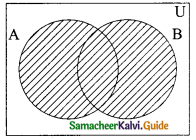
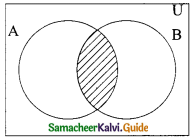
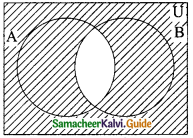
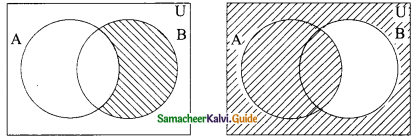
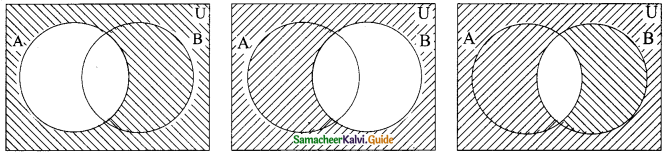
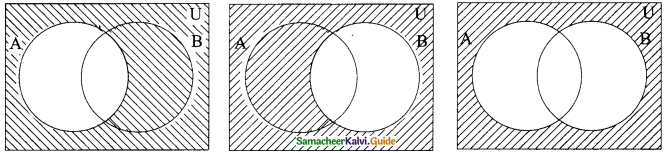
Samacheer Kalvi 9th Maths Guide Chapter 3 Algebra Ex 3.2

Students can download Maths Chapter 3 Algebra Ex 3.2 Questions and Answers, Notes, Samacheer Kalvi 9th Maths Guide Pdf helps you to revise the complete Tamilnadu State Board New Syllabus, helps students complete homework assignments and to score high marks in board exams.

Tamilnadu Samacheer Kalvi 9th Maths Solutions Chapter 3 Algebra Ex 3.2

Question 1.
Find the value of the polynomial f(y) = 6y – 3y2 + 3 at
(i) y = 1
(ii) y = -1
(iii) y = 0
Solution:
(i) When y = 1
f(y) = 6y – 3y2 + 3
f(1) = 6(1) – 3(1)2 + 3
= 6 – 3 + 3 = 6

(ii) When y = – 1
f(y) = 6y – 3y2 + 3
f(-1) = 6(-1) – 3(-1)2 + 3
= – 6 – 3 + 3
= – 6

(iii) When y = 0
f(y) = 6y – 3y2 + 3
f(0) = 6(0) – 3(0)2 + 3
= 0 – 0 + 3
= 3

Samacheer Kalvi 9th Maths Guide Chapter 3 Algebra Ex 3.2

Question 2.
If p(x) = x2 – 2√2x + 1, find p(2√2).
Solution:
p(x) = x2 – 2√2x + 1
p(2√2) = (2√2)2 – 2√2 (2√2) + 1
= 8 – 8 + 1
= 0 + 1
= 1

Question 3.
Find the zeros of the polynomial in each of the following.
(i) P(x) = x – 3
Solution:
p( 3) = 3 – 3
= 0
p(3) is the zero of p(x)

(ii) p(x) = 2x + 5
Solution:
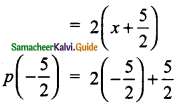
Samacheer Kalvi 9th Maths Guide Chapter 3 Algebra Ex 3.2 1
= -5 + 5
= 2(0)
= 0
Hence –\(\frac{5}{2}\) is the zero of p(x).

Samacheer Kalvi 9th Maths Guide Chapter 3 Algebra Ex 3.2

(iii) q(y) = 2y – 3
Solution:
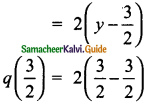
Samacheer Kalvi 9th Maths Guide Chapter 3 Algebra Ex 3.2 2
= 2 × 0
= 0
Hence \(\frac{3}{2}\) is the zero of q(y).

(iv) f(z) = 8z
Solution:
f(0) = 8 × 0
= 0
Hence 0 is the zero of f(z)

(v) p(x) = ax when a ≠ 0
Solution:
p(0) = a(0)
= 0
Hence, 0 is the zero of p(x)

(vi) h(x) = ax + b, a ≠ 0, a, b∈R
Solution:
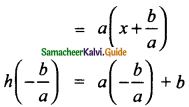
Samacheer Kalvi 9th Maths Guide Chapter 3 Algebra Ex 3.2 3
Hence –\(\frac{b}{a}\) is the zero of h(x).

Samacheer Kalvi 9th Maths Guide Chapter 3 Algebra Ex 3.2

Question 4.
Find the roots of the polynomial equations.
(i) 5x – 6 = 0
Solution:
5x = 6
x = \(\frac{6}{5}\)
\(\frac{6}{5}\) is the root of the polynomial.

(ii) x + 3 = 0
Solution:
x = -3
-3 is the root of the polynomial.

Samacheer Kalvi 9th Maths Guide Chapter 3 Algebra Ex 3.2

(iii) 10x + 9 = 0
Solution:
10x = -9
x = –\(\frac{9}{10}\)
–\(\frac{9}{10}\) is the root of the polynomial.

(iv) 9x – 4 = 0
Solution:
9x = 4
x = \(\frac{4}{9}\)
\(\frac{4}{9}\) is the root of the polynomial.

Samacheer Kalvi 9th Maths Guide Chapter 3 Algebra Ex 3.2

Question 5.
Verify whether the following are zeros of the polynomial, indicated against them,or not.
(i) p(x) = 2x – 1, x = \(\frac{1}{2}\)
Solution:
p (\(\frac{1}{2}\)) = 2(\(\frac{1}{2}\)) – 1
= 1 – 1
= 0
∴ \(\frac{1}{2}\) is the zero of the polynomial.

(ii) p(x) = x3 – 1, x = 1
Solution:
p(1) = 13 – 1
= 1 – 1
= 0
∴ 1 is the zero of the polynomial

Samacheer Kalvi 9th Maths Guide Chapter 3 Algebra Ex 3.2

(iii) p(x) = ax + b, x = \(\frac{-b}{a}\)
Solution:
p(\(\frac{-b}{a}\)) = a(\(\frac{-b}{a}\)) + b
= -b + b
= 0
∴ \(\frac{-b}{a}\) is the zero of the polynomial. a

(iv) p(x) = (x + 3) (x – 4); x = -3, x = 4
Solution:
P(-3) = (-3 + 3) (-3 – 4)
= (0) (-7)
= 0
P( 4) = (4 + 3) (4 – 4)
= (7) (0)
= 0
∴ -3 and 4 are the zeros of the polynomial.

Samacheer Kalvi 9th Maths Guide Chapter 3 Algebra Ex 3.2

Question 6.
Find the number of zeros of the following polynomials represented by their graphs.
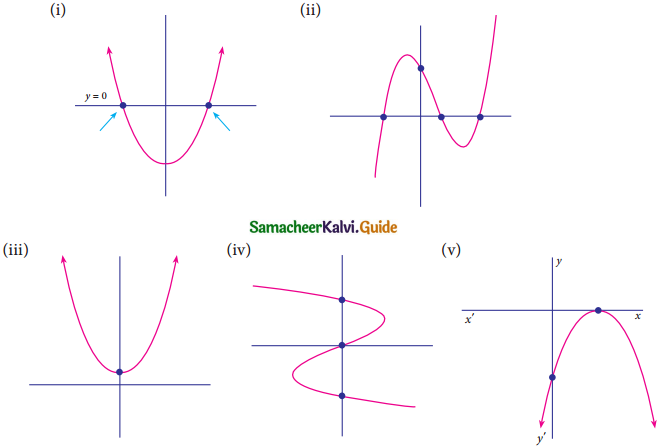
Samacheer Kalvi 9th Maths Guide Chapter 3 Algebra Ex 3.2 4
Solution:
(i) Number of zeros = 2 (The curve is intersecting the x-axis at 2 points)
(ii) Number of zeros = 3 (The curve is intersecting the x-axis at 3 points)
(iii) Number of zeros = 0 (The curve is not intersecting the x-axis)
(iv) Number of zeros = 1 (The curve is intersecting at the origin)
(v) Number of zeros = 1 (The curve is intersecting the x-axis at one point)
Samacheer Kalvi 9th Maths Guide Chapter 3 Algebra Ex 3.1

Students can download Maths Chapter 3 Algebra Ex 3.1 Questions and Answers, Notes, Samacheer Kalvi 9th Maths Guide Pdf helps you to revise the complete Tamilnadu State Board New Syllabus, helps students complete homework assignments and to score high marks in board exams.

Tamilnadu Samacheer Kalvi 9th Maths Solutions Chapter 3 Algebra Ex 3.1

Question 1.
Which of the following expressions are polynomials. If not give reason:
(i) \(\frac{1}{x^2}\) + 3x – 4
Solution:
(i) \(\frac{1}{x^2}\) + 3x – 4 is not a polynomial. Since the exponent of x2 is not a whole number, but it is (\(\frac{1}{x^2}\) = x-2) negative number.

(ii) x2 (x – 1)
Solution:
x2 (x – 1) is a polynomial.

(iii) \(\frac{1}{x}\) (x + 5)
Solution:
\(\frac{1}{x}\) (x + 5) is not a polynomial. Since the exponent of x is not a whole number, but it is (\(\frac{1}{x}\) = x-1) negative number.

(iv) \(\frac{1}{x^{-2}}\) + \(\frac{1}{x^{-1}}\) + 7
Solution:
\(\frac{1}{x^{-2}}\) + \(\frac{1}{x^{-1}}\) + 7 is a polynomial. (\(\frac{1}{x^{-2}}\) = x2 and \(\frac{1}{x^{-1}}\) = x)

(v) √5x2 + √3x + √2
Solution:
√5x2 + √3x + √2 is a polynomial.

(vi) m2 – \(\sqrt[3]{m}\) + 7m – 10
m2 –\(\sqrt[3]{m}\) + 7m – 10 is not a polynomial. Since the exponent of m is not a whole number.
(\(\sqrt[3]{m}\) = m1/3)

Samacheer Kalvi 9th Maths Guide Chapter 3 Algebra Ex 3.1

Question 2.
Write the coefficient of x2 and x in each of the following polynomials.
(i) 4 + \(\frac{2}{5}\) x2 – 3x
Solution:
Coefficient of x2 is \(\frac{2}{5}\) and coefficient of x is -3.

(ii) 6 – 2x2 + 3x3 – √7x
Solution:
Coefficient of x2 is -2 and coefficient of x is -√7

(iii) π x2 – x + 2
Solution:
Coefficient of x2 is π and coefficient of x is -1.

(iv) √3x2 + √2x + 0.5
Solution:
Coefficient of x2 is √3 and coefficient of x is √2

(v) x2 – \(\frac{7}{2}\) x + 8
Solution:
Coefficient of x2 is 1 and coefficient of x is –\(\frac{7}{2}\)

Samacheer Kalvi 9th Maths Guide Chapter 3 Algebra Ex 3.1

Question 3.
Find the degree of the following polynomials.
(i) 1 – √2 y2 + y7
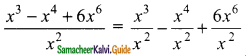
(ii) \(\frac{x^{3}-x^{4}+6 x^{6}}{x^{2}}\)
(iii) x3 (x2 + x)
(iv) 3x4 + 9x2 + 27x6
(v) 2√5p4 \(-\frac{8 p^{3}}{\sqrt{3}}+\frac{2 p^{2}}{7}\)
Solution:
(i) 1 – √2 y2 + y7
The degree of the polynomial is 7.

(ii) Samacheer Kalvi 9th Maths Guide Chapter 3 Algebra Ex 3.1 1
= x – x2 + 6x4
The degree of the polynomial is 4.

(iii) x3 (x2 + x) = x5 + x4
The degree of the polynomial is 5.

(iv) 3x4 + 9x2 + 27x6
The degree of the polynomial is 6.

(v) 2√5p4 \(-\frac{8 p^{3}}{\sqrt{3}}+\frac{2 p^{2}}{7}\)
The degree of the polynomial is 4.

Samacheer Kalvi 9th Maths Guide Chapter 3 Algebra Ex 3.1

Question 4.
Rewrite the following polynomial in standard form.
(i) x – 9 + √7x3 + 6x2
Solution:
The standard form is √7x3 + 6x2 – x – 9
(or) – 9 + x + 6x2 + √7x3

(ii) √2x2 – \(\frac{7}{2}\) x4 + x – 5x3
Solution:
The standard form is – \(\frac{7}{2}\) x4 – 5x3 + √2x2 + x
(or) x + √2x2 – 5x3 – \(\frac{7}{2}\) x4

(iii) 7x3 – \(\frac{6}{5}\) x2 + 4x – 1
Solution:
The given polynomial is in standard form (or) – 1 + 4x – \(\frac{6}{5}\) x2 + 7x3

(iv) y2 + √5y3 – 11 – \(\frac{7}{3}\) y + 9y4
Solution:
The standard form is 9y4 + √5y3 + y2 – \(\frac{7}{3}\) y – 11
(or) – 11 – \(\frac{7}{3}\) y + y2 + √5y3 + 9y4

Samacheer Kalvi 9th Maths Guide Chapter 3 Algebra Ex 3.1

Question 5.
Add the following polynomials and find the degree of the resultant polynomial
(i) p(x) = 6x2 – 7x + 2; q(x) = 6x3 – 7x + 15
Solution:
p(x) + q(x) = 6x2 – 7x + 2 + 6x3 – 7x + 15
= 6x3 + 6x2 – 7x – 7x + 2 + 15
= 6x3 + 6x2 – 14x + 17
The degree of the polynomial is 3.

(ii) h(x) = 7x3 – 6x + 1; f(x) = 7x2 + 17x – 9
Solution:
h(x) + f(x) = 7x3 – 6x + 1 + 7x2 + 17x – 9
= 7x3 + 7x2 + 11x – 8
The degree of the polynomial is 3.

(iii) f(x) = 16x4 – 5x2 + 9; g(x) = -6x3 + 7x – 15
Solution:
f(x) + g(x) = 16x4 – 5x2 + 9 – 6x3 + 7x – 15
= 16x4 – 6x3 – 5x2 + 7x + 9 – 15
= 16x4 – 6x3 – 5x2 + 7x – 6
The degree of the polynomial is 4.

Samacheer Kalvi 9th Maths Guide Chapter 3 Algebra Ex 3.1

Question 6.
Subtract the second polynomial from the first polynomial and find the degree of the resultant polynomial.
(i) p(x) = 7x2 + 6x – 1; q(x) = 6x – 9
Solution:
p(x) – q(x) = 7x2 + 6x – 1 – (6x – 9)
= 7x2 + 6x – 1 – 6x + 9
= 7x2 + 6x – 6x – 1 + 9
= 7x2 + 8
The degree of the polynomial is 2.

(ii) f(y) = 6y2 – 7y + 2; g(y) = 7y + y3
Solution:
f(y) – g(y) = 6y2 – 7y + 2 – (7y + y3)
= 6y2 – 7y + 2 – 7y – y3
= -y3 + 6y2 – 7y – 7y + 2
= -y3 + 6y2 – 14y + 2
The degree of the polynomial is 3.

(iii) h(z) = z5 – 6z4 + z; f(z) = 6z2 + 10z – 7
Solution:
h(z) – f(z) = z5 – 6z4 + z – (6z2 + 10z – 7)
= z5 – 6z4 + z – 6z2 – 10z + 7
= z5 – 6z4 – 6z2 + z – 10z + 7
= z5 – 6z4 – 6z2 – 9z + 7
The degree of the polynomial is 5.

Samacheer Kalvi 9th Maths Guide Chapter 3 Algebra Ex 3.1

Question 7.
What should be added to 2x3 + 6x2 – 5x + 8 to get 3x3 – 2x2 + 6x + 15?
Solution:
3x³ – 2x2 + 6x + 15 – (2x³ + 6x2 – 5x + 8)
= 3x³ – 2x2 + 6x + 15 – 2x³ – 6x2 + 5x – 8
= 3x³ – 2x³- 2x2 – 6x2 + 6x + 5x + 15 – 8
= x³ – 8x2 + 11x + 7
x³ – 8x2 + 11x + 7 must be added to get 3x³ – 2x2 + 6x + 15.

Question 8.
What must be subtracted from 2x4 + 4x2 – 3x + 7 to get 3x3 – x2 + 2x + 1?
Solution:
2x4 + 4x2 – 3x + 7 – (3x3 – x2 + 2x + 1)
= 2x4 + 4x2 – 3x + 7 – 3x3 + x2 – 2x – 1
= 2x4 – 3x3 + 4x2 + x2 – 3x – 2x + 7 – 1
= 2x4 – 3x3 + 5x2 – 5x + 6
2x4 – 3x3 + 5x2 – 5x + 6 must be subtracted to get 3x3 – x2 + 2x + 1.

Samacheer Kalvi 9th Maths Guide Chapter 3 Algebra Ex 3.1

Question 9.
Multiply the following polynomials and find the degree of the resultant polynomial:
(i) p(x) = x2 – 9, q(x) = 6x2 + 7x – 2
Solution:
p(x) × q(x) = (x2 – 9) (6x2 + 7x – 2)
= 6x4 + 7x3 – 2x2 – 54x2 – 63x + 18
= 6x4 + 7x3 – 56x2 – 63x + 18
The degree of the polynomial is 4.

(ii) f(x) = 7x + 2, g(x) = 15x – 9
Solution:
f(x) × g(x) = (7x + 2) (15x – 9)
= 105x2 – 63x + 30x – 18
= 105x2 – 33x – 18
The degree of the polynomial is 2.

(iii) h(x) = 6x2 – 7x + 1, f(x) = 5x – 7
Solution:
h(x) × f(x) = (6x2 – 7x + 1) (5x – 7)
= 30x3 – 42x2 – 35x2 + 49x + 5x – 7
= 30x3 – 77x2 + 54x – 7
The degree of the polynomial is 3.

Samacheer Kalvi 9th Maths Guide Chapter 3 Algebra Ex 3.1

Question 10.
The cost of a chocolate is Rs. (x + y) and Amir bought (x + y) chocolates. Find the total amount paid by him in terms of x and y. If x = 10, y = 5 find the amount paid by him.
Solution:
The cost of a chocolate = (x + y)
Number of chocolates bought by Amir = x + y
Total amount paid by him = (x + y) (x + y)
= x2 + xy + xy + y2
= x2 + 2xy + y2
When x = 10 and y = 5
The total amount paid by him = (10)2 + 2(10)(5) + (5)2
= 100 + 100 + 25 = 225

Samacheer Kalvi 9th Maths Guide Chapter 3 Algebra Ex 3.1

Question 11.
The length of a rectangle is (3x + 2) units and it’s breadth is (3x – 2) units. Find its area in terms of x. What will be the area if x = 20 units.
Solution:
Length of the rectangle = 3x + 2 units
Breadth of the rectangle = 3x – 2 units
Area of the rectangle = (3x + 2) (3x – 2)
= 9x2 – 6x + 6x – 4
= 9x2 – 4
When x = 20
Area of the rectangle = 9(20)2 – 4
= 9(400) – 4
= 3600 – 4
= 3596 sq.units.

Samacheer Kalvi 9th Maths Guide Chapter 3 Algebra Ex 3.1

Question 12.
p(x) is a polynomial of degree 1 and q(x) is a polynomial of degree 2. What kind of the polynomial is p(x) × q(x)?
Solution:
Degree of the polynomial p(x) = 1
Degree of the polynomial q(x) = 2
Degree of p(x) × q(x) = 3
The polynomial is a cubic polynomial (or) Polynomial of degree 3.

Samacheer Kalvi 9th Maths Guide Chapter 3 Algebra Ex 3.4

Students can download Maths Chapter 3 Algebra Ex 3.4 Questions and Answers, Notes, Samacheer Kalvi 9th Maths Guide Pdf helps you to revise the complete Tamilnadu State Board New Syllabus, helps students complete homework assignments and to score high marks in board exams.

Tamilnadu Samacheer Kalvi 9th Maths Solutions Chapter 3 Algebra Ex 3.4

Question 1.
Expand the following:
(i) (2x + 3y + 4z)2
(ii) (-p + 2q + 3r)2
(iii) (2p + 3) (2p – 4) (2p – 5)
(iv) (3a + 1) (3a – 2) (3a + 4)
Solution:
We know that (a + b + c)2 = a2 + b2 + c2 + 2ab + 2bc + 2ac
(i) (2x + 3y + 4z)2 = (2x)2 + (3y)2 + (4z)2 + 2(2x) (3y) + 2(3y) (4z) + 2(4z) (2x)
= 4x2 + 9y2 + 16z2 + 12xy + 24yz + 16xz

(ii) (-p + 2q + 3r)2 = (-p)2 + (2q)2 + (3r)2 + 2(-p) (2q) + 2(2q)(3r) + 2(3r) (- p)
= p2+ 4q2 + 9r2 – 4pq + 12qr – 6pr

Samacheer Kalvi 9th Maths Guide Chapter 3 Algebra Ex 3.4

(iii) (2p + 3) (2p – 4) (2p – 5)
[Here x = 2p, a = 3, b = -4 and c = -5]
= (2p)3 + (3 – 4 – 5) (2p)2 + [(3)(-4) + (-4)(-5) + (3) (-5)] 2p + (3) (-4) (-5)
= 8p3 + (-6)(4p2) + (-12 + 20 – 15) 2p + 60
= 8p3 – 24p2 – 14p + 60

(iv) (3a + 1) (3a – 2) (3a + 4)
[Here x = 3a, a = 1, b = -2 and c = 4]
= (3a)3 + (1 – 2 + 4) (3a)2 + [(1)(-2) + (-2) (4) + (4) (1)] (3a) + (1) (-2) (4)
= 27a3 + 3(9a2) + (-2 – 8 + 4) (3a) – 8
= 27a3 + 27a2 – 18a – 8

Samacheer Kalvi 9th Maths Guide Chapter 3 Algebra Ex 3.4

Question 2.
Using algebraic identity, find the coefficients of x2, x and constant term without actual expansion.
(i) (x + 5)(x + 6)(x + 7)
Solution:
[Here x = x, a = 5, b = 6, c = 7]
(x + a) (x + b) (x + c) = x3 + (a + b + c)x2 + (ab + bc + ac)x + abc
coefficient of x2 = 5 + 6 + 7
= 18
coefficient of x = 30 + 42 + 35
= 107
constant term = (5) (6) (7)
= 210

Samacheer Kalvi 9th Maths Guide Chapter 3 Algebra Ex 3.4

(ii) (2x + 3)(2x – 5) (2x – 6)
Solution:
[Here x = 2x, a = 3, b = -5, c = -6]
(x + a) (x + b) (x + c) = x3 + (a + b + c)x2 + (ab + bc + ac)x + abc
coefficient of x2 = (3 – 5 – 6)4 [(2x)2 = 4x2]
= (-8) (4)
= -32
coefficient of x = [(3)(-5) + (-5)(-6) + (-6)(3)](2)
= (-15 + 30-18) (2)
= (-3) (2)
= -6
constant term = (3) (-5) (-6)
= 90

Samacheer Kalvi 9th Maths Guide Chapter 3 Algebra Ex 3.4

Question 3.
If (x + a)(x + b)(x + c) = x3 + 14x2 + 59x + 70, find the value of
(i) a + b + c
(ii) \(\frac{1}{a} + \frac{1}{b} + \frac{1}{c}\)
(iii) a2 + b2 + c2
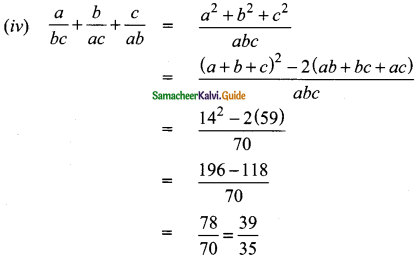
(iv) \(\frac{a}{bc} + \frac{b}{ac} + \frac{c}{ab}\)
Solution:
(x + a) (x + b) (x + c) = x3 + 14x2 + 59x + 70
x3 + (a + b + c)x2 + (ab + bc + ac)x + abc = x3 + 14x2 + 59x + 70
a + b + c = 14, ab + bc + ac = 59, abc = 70
(i) a + b + c = 14

(ii) \(\frac{1}{a} + \frac{1}{b} + \frac{1}{c}\) = \(\frac{bc+ac+ab}{abc}\)
= \(\frac{59}{70}\)

(iii) a2 + b2 + c2 = (a + b + c)2 – 2 (ab + bc + ac)
= (14)2 – 2(59)
= 196 – 118
= 78

Samacheer Kalvi 9th Maths Guide Chapter 3 Algebra Ex 3.4 1

Samacheer Kalvi 9th Maths Guide Chapter 3 Algebra Ex 3.4

Question 4.
Expand:
(i) (3a – 4b)3
Solution:
(a – b)3 = a3 – b3 – 3ab (a – b)
(3a – 4b)3 = (3a)3 – (4b)3 – 3(3a)(4b)(3a – 4b)
= 27a3 – 64b3 – 36ab (3a – 4b)
= 27a3 – 64b3 – 108a2b + 144ab2

(ii) [x + \(\frac{1}{y}]^{3}\)
Solution:
(a + b)3 = a3 + b3 + 3ab (a + b)
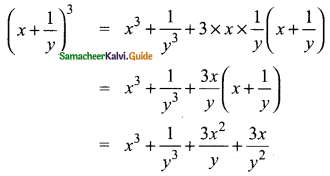
Samacheer Kalvi 9th Maths Guide Chapter 3 Algebra Ex 3.4 2

Question 5.
Evaluate the following by using identities:
(i) 983
Solution:
983 = (100 – 2)3 [(a – b)3 = a3 – b3 – 3ab (a – b)]
= 1003 – (2)3 – 3(100) (2) (100 – 2)
= 1000000 – 8 – 600(98)
= 1000000 – 8 – 58800
= 1000000 – 58808
= 941192

(ii) 10013
Solution:
(1001)3 = (1000 + 1)3
[(a + b)3 = a3 + b3 + 3ab (a + b)]
= (1000)3 + 13 + 3(1000) (1) (1000 + 1)
= 1000000000 + 1 + 3000 (1001)
= 1000000001 + 3003000
= 1003003001

Samacheer Kalvi 9th Maths Guide Chapter 3 Algebra Ex 3.4

Question 6.
If (x + y + z) = 9 and (xy + yz + zx) = 26, then find the value of x2 + y2 + z2.
Solution:
x + y + z = 9; xy + yz + zx = 26
x2 + y2 + z2 = (x + y + z)2 – 2xy – 2yz – 2xz
= (x + y + z)2 – 2 (xy + yz + zx)
= 92 – 2(26)
= 81 – 52
= 29

Question 7.
Find 27a3 + 64b3, If 3a + 4b = 10 and ab = 2
Solution:
3a + Ab = 10, ab = 2
27a3 + 64b3 = (3a)3 + (4b)3
[a3 + b3 = (a + b)3 – 3 ab (a + b)]
= (3a + 4b)3 – 3 × 3a × 4b (3a + 4b)
= 103 – 36ab (10)
= 1000 – 36(2)(10)
= 1000 – 720
= 280

Samacheer Kalvi 9th Maths Guide Chapter 3 Algebra Ex 3.4

Question 8.
Find x3 – y3, if x – y = 5 and xy = 14.
Solution:
x – y = 5, xy = 14
x3 – y= (x – y)3 + 3xy (x – y)
= 53 + 3(14) (5)
= 125 + 210
= 335

Question 9.
If a + \(\frac{1}{a}\) = 6, then find the value of a3 +\(\frac{1}{a^3}\)
Solution:
a + \(\frac{1}{a}\) = 6 [a3 + b3 = (a + b)3 – 3ab (a + b)]
Samacheer Kalvi 9th Maths Guide Chapter 3 Algebra Ex 3.4 3
= 63 – 3(6)
= 216 – 18
= 198

Samacheer Kalvi 9th Maths Guide Chapter 3 Algebra Ex 3.4

Question 10.
If x2 + \(\frac{1}{x^2}\) = 23, then find the value of x + \(\frac{1}{x}\) and x3 + \(\frac{1}{x^3}\)
Solution:
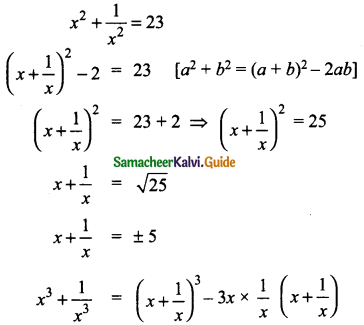
Samacheer Kalvi 9th Maths Guide Chapter 3 Algebra Ex 3.4 4
When x = 5 [a3 + b3 = (a + b)3 – 3ab (a + b)]
= (5)3 – 3(5)
= 125 – 15
= 110
when x = -5
x3 + \(\frac{1}{x^3}\) = (-5)3 – 3(-5)
= -125 + 15
= -110
∴ x3 + \(\frac{1}{x^3}\) = ±110

Question 11.
If (y – \(\frac{1}{y})^{3}\) = 27 then find the value of y3 – \(\frac{1}{y^3}\)
Solution:
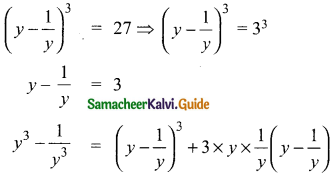
Samacheer Kalvi 9th Maths Guide Chapter 3 Algebra Ex 3.4 5
= 33 + 3(3)
= 27 + 9
= 36

Samacheer Kalvi 9th Maths Guide Chapter 3 Algebra Ex 3.4

Question 12.
Simplify:
(i) (2a + 3b + 4c) (4a2 + 9b2 + 16c2 – 6ab – 12bc – 8ca)
(ii) (x – 2y + 3z) (x2 + 4y2 + 9z2 + 2xy + 6yz – 3xz)
Solution:
x3 + y3 + z3 – 3xyz ≡ (x + y + z) (x2 + y2 + z2 – xy – yz – zx)
(i) (2a + 3b + 4c) (4a2 + 9b2 + 16c2 – 6ab – 12bc – 8ea)
= (2a)3 + (3b)3 + (4c)3 – 3 (2a) (3b) (4c)
= 8a3 + 27b3 + 64c3 – 72abc

(ii) (x – 2y + 3z) (x2 + 4y2 + 9z2 + 2xy + 6yz – 3xz)
= x3 + (-2y)3 + (3z)3 – 3(x) (-2y) (3z)
= x3 – 8y3 + 27z3 + 18xyz

Question 13.
By using identity evaluate the following:
(i) 73 – 103 + 33
Solution:
x3 + y3 + z3 – 3xyz = (x + y + z) (x2 + y2 + z2 – xy – yz – zx)
We know that a + b + c = 0 then a3 + b3 + c3 = 3ab
a + b + c = 7 + (-10) + 3
= 10 – 10
= 0
∴ 73 – 103 + 33 = 3(7) (-10) (3)
= -630

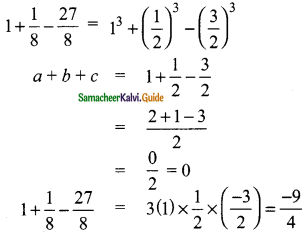
(ii) 1 + \(\frac{1}{8}\) – \(\frac{27}{8}\)
Solution:
We know that a3 + b3 + c3 = 0 then a + b + c = 3abc
Samacheer Kalvi 9th Maths Guide Chapter 3 Algebra Ex 3.4 6

Samacheer Kalvi 9th Maths Guide Chapter 3 Algebra Ex 3.4

Question 14.
If 2x -3y – 4z = 0, then find 8x3 – 27y3 – 64z3.
Solution:
We know x3 +y3 + z3 – 3xyz = (x + y + z) (x2 + y2 + z2 – xy – yz – zx)
x3 + y3 + z3 = (x + y + z) (x2 +y2 + z2 – xy – yz – zx) + 3xyz
8x3 – 27y3 – 64z3 = (2x)3 + (-3y)3 + (-4z)3
= (2x – 3y- 4z) [(2x)2 + (-3y)2 + (-4z)2 – (2x)(-3y) – (-3y) (-4z) -(-4z)(2x)] + 3(2x)(-3y)(-4z)
= 0 (4x2 + 9y2 + 16z2 + 6xy – 12yz + 8xz) + 72xyz
= 72xyz
8x3 – 27y3 – 64z3 = 72xyz

Samacheer Kalvi 9th Maths Guide Chapter 2 Real Numbers Ex 2.3

Students can download Maths Chapter 2 Real Numbers Ex 2.3 Questions and Answers, Notes, Samacheer Kalvi 9th Maths Guide Pdf helps you to revise the complete Tamilnadu State Board New Syllabus, helps students complete homework assignments and to score high marks in board exams.

Tamilnadu Samacheer Kalvi 9th Maths Solutions Chapter 2 Real Numbers Ex 2.3

Question 1.
Represent the following irrational numbers on the number line.
(i) \(\sqrt{3}\)
Solution:
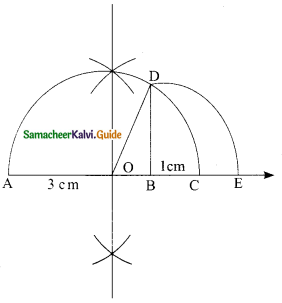
Samacheer Kalvi 9th Maths Guide Chapter 2 Real Numbers Ex 2.3 1
Steps of construction:
1. Draw a line and mark a point A and B such that AB = 3 cm.
2. Mark a point C on this line such that BC = 1 cm.
3. Find the mid point of AC by drawing perpendicular bisector of AC and let it be “O”.
4. With O as centre and OC = OA as radius draw a semicircle.
5. Draw a line BD, which is perpendicular to AB at B.
6. Now BD = \(\sqrt{3}\) which can be marked in the number line as the value of BE = BD = \(\sqrt{3}\)

Samacheer Kalvi 9th Maths Guide Chapter 2 Real Numbers Ex 2.3

(ii) Represent \(\sqrt{4.7}\) on a number line.
Solution:
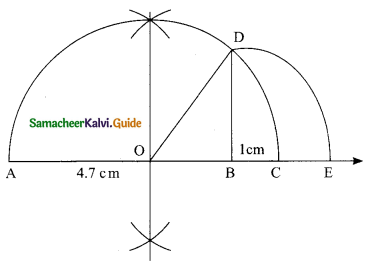
Samacheer Kalvi 9th Maths Guide Chapter 2 Real Numbers Ex 2.3 2
Steps of construction:
1. Draw a line and mark a point A and B such that AB = 4.7 cm.
2. Mark a point C on this line such that A BC = 1 cm.
3. Find the mid point of AC by drawing perpendicular bisector of AC and let it be “O”.
4. With O as centre and OC = OA as radius draw a semicircle.
5. Draw a line BD, which is perpendicular to AB at B.
6. Now BD = \(\sqrt{4.7}\), which can be marked in the number line as the value of BE = BD = \(\sqrt{4.7}\).

Samacheer Kalvi 9th Maths Guide Chapter 2 Real Numbers Ex 2.3

(iii) Represent \(\sqrt{6.5}\) on a number line.
Solution:
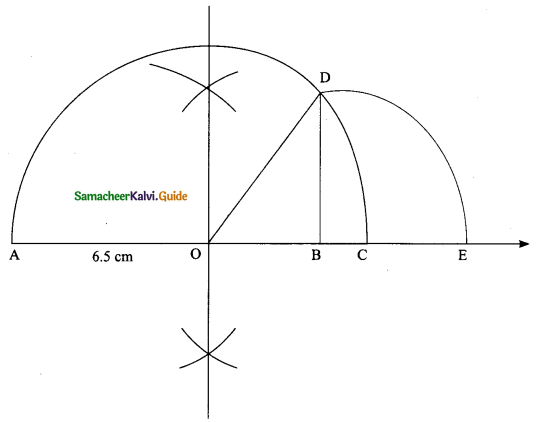
Samacheer Kalvi 9th Maths Guide Chapter 2 Real Numbers Ex 2.3 3
Steps of construction:
1. Draw a line and mark a point A and B such that AB = 6.5 cm.
2. Mark a point C on this line such that BC = 1 cm.
3. Find the mid point of AC by drawing perpendicular bisector of AC and let it be “O”.
4. With O as centre and OC = OA as radius draw a semicircle.
5. Draw a line BD, which is perpendicular to AB at B.
6. Now BD = \(\sqrt{6.5}\), which can be marked in the number line as the value of BE = BD = \(\sqrt{6.5}\)

Samacheer Kalvi 9th Maths Guide Chapter 2 Real Numbers Ex 2.3

Question 2.
Find any two irrational numbers between
(i) 0.3010011000111…. and 0.3020020002….
Solution:
Two irrational numbers between the given two rational numbers are 0.301202200222……. and 0.301303300333……..

(ii) \(\frac{6}{7}\) and \(\frac{12}{13}\)
Solution:
\(\frac{6}{7}\) = 0.\(\overline {857142}\)
\(\frac{12}{13}\) = 0.\(\overline {923076}\)
The two irrational numbers are 0.8616611666111…….. and 0.8717711777111………

Samacheer Kalvi 9th Maths Guide Chapter 2 Real Numbers Ex 2.3

(iii) \(\sqrt{2}\) and \(\sqrt{3}\)
Solution:
Samacheer Kalvi 9th Maths Guide Chapter 2 Real Numbers Ex 2.3 4
\(\sqrt{2}\) = 1.414
\(\sqrt{3}\) = 1.732
The two irrational numbers between \(\sqrt{2}\) and \(\sqrt{3}\) are 1.515511555……. and 1.616611666………..

Samacheer Kalvi 9th Maths Guide Chapter 2 Real Numbers Ex 2.3

Question 3.
Find any two rational numbers between 2.2360679……… and 2.236505500……….
Solution:
The two rational numbers are 2.2362 and 2.2363 (It has many answers)

Samacheer Kalvi 9th Maths Guide Chapter 2 Real Numbers Ex 2.2

Students can download Maths Chapter 2 Real Numbers Ex 2.2 Questions and Answers, Notes, Samacheer Kalvi 9th Maths Guide Pdf helps you to revise the complete Tamilnadu State Board New Syllabus, helps students complete homework assignments and to score high marks in board exams.

Tamilnadu Samacheer Kalvi 9th Maths Solutions Chapter 2 Real Numbers Ex 2.2

Question 1.
Express the following rational numbers into decimal and state the kind of decimal expression.
(i) \(\frac{2}{7}\)
(ii) -5\(\frac{3}{11}\)
(iii) \(\frac{22}{3}\)
(iv) \(\frac{327}{200}\)
Solution:
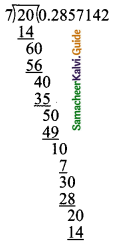
Samacheer Kalvi 9th Maths Guide Chapter 2 Real Numbers Ex 2.2 1
(i) \(\frac{2}{7}\) = 0.2857142….
= 0.\(\overline {285714}\)
Non-terminating and recurring decimal expansion.

Samacheer Kalvi 9th Maths Guide Chapter 2 Real Numbers Ex 2.2

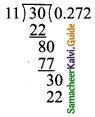
(ii) -5\(\frac{3}{11}\) = -5 + 0.272 = -5.272……..
Samacheer Kalvi 9th Maths Guide Chapter 2 Real Numbers Ex 2.2 2
= -5.\(\overline {27}\)
Non-terminating and recurring decimal expansion.

(iii) \(\frac{22}{3}\) = 7.333……..
Samacheer Kalvi 9th Maths Guide Chapter 2 Real Numbers Ex 2.2 3
= 7.\(\overline {3}\)
Non-terminating and recurring decimal expansion.

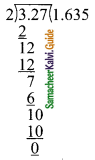
(iv) \(\frac{327}{200}\) = \(\frac{327}{2×100}\)
Samacheer Kalvi 9th Maths Guide Chapter 2 Real Numbers Ex 2.2 4
= \(\frac{3.27}{2}\)
= 1.635
Terminating decimal expansion.

Samacheer Kalvi 9th Maths Guide Chapter 2 Real Numbers Ex 2.2

Question 2.
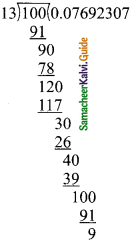
Express \(\frac{1}{13}\) in decimal form. Find the length of the period of decimals.
Solution:
Samacheer Kalvi 9th Maths Guide Chapter 2 Real Numbers Ex 2.2 5
\(\frac{1}{13}\) = 0.07692307
= 0.\(\overline {076923}\)
Length of the period of decimal is 6.

Question 3.
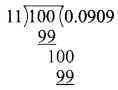
Express the rational number \(\frac{1}{33}\) in recurring decimal form by using the recurring decimal expansion of \(\frac{1}{11}\). Hence write \(\frac{71}{33}\) in recurring decimal form.
Solution:
Samacheer Kalvi 9th Maths Guide Chapter 2 Real Numbers Ex 2.2 6
\(\frac{1}{11}\) = 0.0909……… = 0.\(\overline {09}\)
∴ \(\frac{1}{33}\) = \(\frac{1}{3}\) × \(\frac{1}{11}\)
= \(\frac{1}{3}\) × 0.0909 ……..
= 0.0303 …… = 0.\(\overline {03}\)
\(\frac{71}{33}\) = 2\(\frac{5}{33}\) = 2 + \(\frac{5}{33}\) = 2 + 5 × \(\frac{1}{33}\)
= 2 + 5 × 0.\(\overline {03}\)
2 + (5 × 0.030303 ……..)
2 + 0.151515 ………
2+ 0.\(\overline {15}\)
2.\(\overline {15}\)

Samacheer Kalvi 9th Maths Guide Chapter 2 Real Numbers Ex 2.2

Question 4.
Express the following decimal expression into rational numbers.
(i) 0.24
Solution:
Let x = 0.242424 ………. →(1)
100 x = 24.2424 ……… →(2)
(2) – (1) ⇒ 100 x – x = 24.2424 ……….. (-)
 0.2424 ……..
99 x = 24.0000
x = \(\frac{24}{99}\)
(or)
\(\frac{8}{33}\)

(ii) 2.327
Solution:
Let x = 2.327327327 ………. →(1)
1000 x = 2327.327327 ……… →(2)
(2) – (1) ⇒ 1000 x – x = 2327.327327 ……….. (-)
  2.327327 ……..
999 x = 2325.000
x = \(\frac{2325}{999}\)
(or)
\(\frac{775}{333}\)

Samacheer Kalvi 9th Maths Guide Chapter 2 Real Numbers Ex 2.2

(iii) – 5.132
Solution:
– 5.132 = -5 + \(\frac{1}{10}\) + \(\frac{3}{100}\) + \(\frac{2}{1000}\)
= \(\frac{-5000 + 100 +30 + 2}{1000}\) = \(\frac{-4868}{1000}\)
(or)
\(\frac{-1217}{250}\)

(iv) 3.17
Solution:
Let x = 3.1777 ………. →(1)
10 x = 31.777 ……… →(2)
100 x = 317.77 …….. →(3)
(3) – (2) ⇒ 100 x – 10 x = 317.77 ……….. (-)
 31.777 ……..
90 x = 286.000
x = \(\frac{286}{90}\)
(or)
\(\frac{143}{45}\)

(v) 17.215
Solution:
Let x = 17.2151515 ………. →(1)
10 x = 172.151515 ……… →(2)
100 x = 17215.1515 …….. →(3)
(3) – (2) ⇒ 1000 x – 10 x = 17215.1515 ……….. (-)
 17215.1515 ……..
990 x = 17043
x = \(\frac{17043}{990}\)
(or)
\(\frac{5681}{330}\)

Samacheer Kalvi 9th Maths Guide Chapter 2 Real Numbers Ex 2.2

(vi) -21.2137
Solution:
Let x = -21.213777 ………. →(1)
1000 x = -21213.777 ……… →(2)
100 x = -212137.77 …….. →(3)
(3) – (2) ⇒ 10000 x – 1000 x = -21213.777 ……….. (-)
-21213.777 ……..
9000 x = -190924
x = \(\frac{-190924}{9000}\)
(or)
\(\frac{-47731}{2250}\)

Question 5.
Without actual division, find which of the following rational numbers have terminating decimal expression.
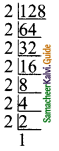
(i) \(\frac{7}{128}\)
Solution:
Samacheer Kalvi 9th Maths Guide Chapter 2 Real Numbers Ex 2.2 7
\(\frac{7}{128}\) = \(\frac{7}{2^{7}}\)
∴ \(\frac{7}{128}\) has terminating decimal expression.

Samacheer Kalvi 9th Maths Guide Chapter 2 Real Numbers Ex 2.2

(ii) \(\frac{21}{15}\)
Solution:
\(\frac{21}{15}\) = \(\frac{7}{5}\) = \(\frac{7}{5^1}\)
\(\frac{21}{15}\) has terminating decimal expression.

(iii) 4\(\frac{9}{35}\)
Solution:
4\(\frac{9}{35}\) = \(\frac{149}{35}\)
4\(\frac{149}{5×7}\) (It is not in the form of \(\frac{P}{2^{m} × 5^{n}}\)
∴ 4\(\frac{9}{35}\) has non-terminating recurring decimal expression.

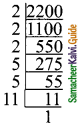
(iv) \(\frac{219}{2200}\)
Solution:
Samacheer Kalvi 9th Maths Guide Chapter 2 Real Numbers Ex 2.2 8
\(\frac{219}{2200}\) = \(\frac{219}{2^{3} × 5^{2} × 11}\) (It is not in the form of \(\frac{P}{2^{m} × 5^{n}}\)
∴ \(\frac{219}{2200}\) has non-terminating recurring decimal expression.

Samacheer Kalvi 9th Maths Guide Chapter 1 Set Language Ex 1.5

Students can download Maths Chapter 1 Set Language Ex 1.5 Questions and Answers, Notes, Samacheer Kalvi 9th Maths Guide Pdf helps you to revise the complete Tamilnadu State Board New Syllabus, helps students complete homework assignments and to score high marks in board exams.

Tamilnadu Samacheer Kalvi 9th Maths Solutions Chapter 1 Set Language Ex 1.5

Question 1.
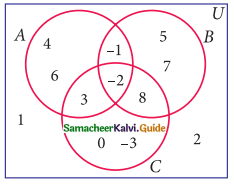
Using the adjacent Venn diagram, find the following sets:
Samacheer Kalvi 9th Maths Guide Chapter 1 Set Language Ex 1.5 1
(i) A – B
(ii) B – C
(iii) A’∪B’
(iv) A’∩B’
(v) (B∪C)’
(vi) A – (B∪C)
(vii) A – (B∩C)
Solution:
From the diagram we get
U = {-3, -2, -1, 0, 1, 2, 3, 4, 5, 6, 7, 8},
A= {-2,-1, 3, 4, 6}, B = {-2,-1, 5, 7, 8}
C = {-3, -2, 0, 3, 8}
A’ = U – A = {-3, -2, -1, 0, 1, 2, 3, 4, 5, 6, 7, 8} – {-2, -1, 3, 4, 6}
= {-3, 0, 1, 2, 5, 7, 8}
B’ = U – B = {-3, -2, -1, 0, 1, 2, 3, 4, 5, 6, 7, 8} – {-2, -1, 5, 7, 8}
= {-3, 0, 1, 2, 3, 4, 6}
B∪C = {-2, -1, 5, 7, 8} ∪ {-3, -2, 0, 3, 8} = {-3, -2, -1, 0, 3, 5, 7, 8}
B∩C = {-2, -1, 5, 7, 8} ∩ {-3, -2, 0, 3, 8} = {-2, 8}

(i) A – B = {3, 4, 6}
(ii) B – C = {-1, 5, 7}
(iii) A’∪B’= {-3, 0, 1, 2, 5, 7, 8} ∪ {-3, 0, 1, 2, 3, 4, 6}
= {-3, 0, 1, 2, 3, 4, 5, 6, 7, 8}
(iv) A’∩B’ = {-3, 0, 1, 2, 5, 7, 8} ∩ {-3, 0, 1, 2, 3, 4, 6}
= {-3, 0, 1, 2}
(v) (B∪C)’ = U – (B∪C)= {-3,-2,-1,0, 1,2, 3,4, 5, 6, 7, 8} – {-3, -2, -1, 0, 3, 5, 7, 8}
= {1, 2, 4, 6}
(vi) A – (B∪C) = {-2, -1, 3, 4, 6} – {-3, -2, -1, 0, 3, 5, 7, 8} = {4, 6}
(vii) A – (B∩C) = {-2,-1, 3, 4, 6} – {-2, 8} = {-1, 3, 4, 6}

Samacheer Kalvi 9th Maths Guide Chapter 1 Set Language Ex 1.5

Question 2.
If K = {a, b, d, e, f}, L = {b, c, d, g} and M = {a, b, c, d, h} then find the following:
(i) K∪(L∩M)
(ii) K∩(L∪M)
(iii) (K∪L) ∩ (K∪M)
(iv) (K∩L) ∪ (K∩M)
and verify distributive laws.
Solution:
K = {a, b, d, e, f}, L = {b, c, d, g} and M = {a, b, c, d, h}
(i) K∪(L∩M)
(L∩M) = {b, c, d, g} ∩ [a, b, c, d, h}
= {b, c, d}
K∪(L∩M) = {a, b, d, e, f} ∪ {b, c, d}
= {a, b, c, d, e, f}

(ii) K∩(L∪M)
(L∪M) = {b, c, d, g} ∪ {a, b, c, d, h}
= {a, b, c, d, g, h}
K∩(L∪M) = {a, b, d, e, f} ∩ {a, b, c, d, g, h}
= {a, b, d }

(iii) (K∪L) ∩ (K∪M)
(K∪L) = {a, b, d, e, f} ∪ {b, c, d, g}
= {a, b, c, d, e, f, g}
(K∪M) = {a, b, d, e, f} ∪ {a, b, c, d, h}
= {a, b, c, d, e, f, h}
(K∪L) ∩ (K∪M) = {a, b, c, d, e, f, g} ∩ {a, b, c, d, e, f, h}
= {a, b, c, d, e, f}

(iv) (K∩L) ∪ (K∩M)
(K∩L) = {a, b, d, e, f) ∩ {b, c, d, g}
= {b, d}
(K∩M) = {a, b, d, e, f} ∩ {a, b, c, d, h}
= {a, b, d}
(K∩L) ∪ (K∩M) = {b, d} ∪ [a, b, d}
= {a, b, d}
From (ii) & (iv) we get, K∩(L∪M) = (K∩L) ∪ (K∩M)
From (i) & (iii) we get, K∪(L∩M) = (K∪L) ∩ (K∪M)

Samacheer Kalvi 9th Maths Guide Chapter 1 Set Language Ex 1.5

Question 3.
For A = {x : x ∈ Z, -2 < x ≤ 4}, B = {x : x ∈ W, x ≤ 5}, C = {-4, -1, 0, 2, 3, 4}
verify A∪(B∩C) = (A∪B) ∩ (A∪C).
Solution:
A = {-1, 0, 1, 2, 3, 4}, B = {0, 1, 2, 3, 4, 5} and C = {-4, -1, 0, 2, 3, 4}
B∩C = {0, 1, 2, 3, 4, 5} ∩ {-4, -1, 0, 2, 3, 4}
= {0, 2, 3, 4}
A∪(B∩C) = {-1, 0, 1, 2, 3, 4} ∪ {0, 2, 3, 4}
= {-1, 0, 1, 2, 3, 4} ……..(1)
A∪B = {-1, 0, 1, 2, 3, 4} ∪ {0, 1, 2, 3, 4, 5}
= {-1, 0, 1, 2, 3, 4, 5}
A∪C = {-1, 0, 1, 2, 3, 4} ∪ {-4, -1, 0, 2, 3, 4}
= {-4, -1, 0, 1, 2, 3, 4}
(A∪B) ∩ (A∪C) = {-1, 0, 1, 2, 3, 4, 5} ∩ {-4, -1, 0, 1, 2, 3, 4}
= {-1, 0, 1, 2, 3, 4} ……..(2)
From (1) and (2) we get A∪(B∩C) = (A∪B) ∩ (A∪C).

Question 4.
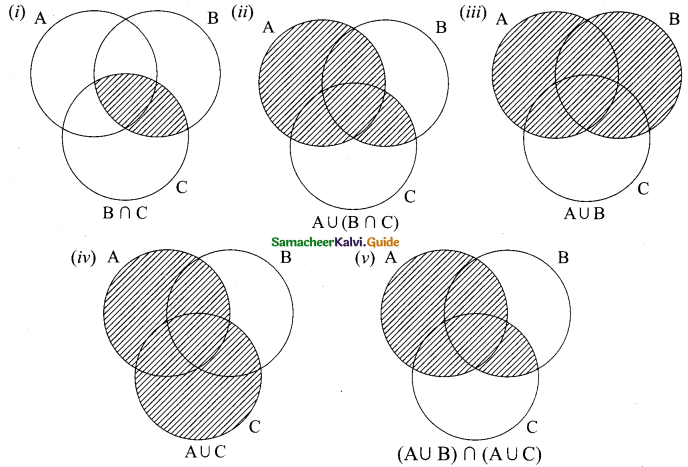
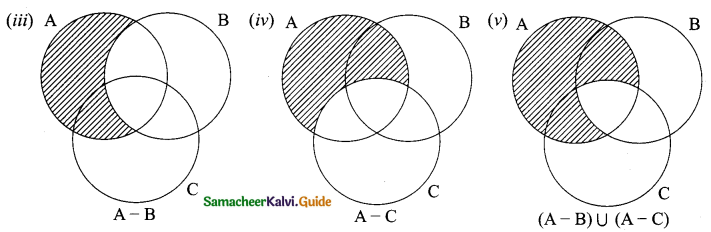
Verify A∪(B∩C) = (A∪B) ∩ (A∪C) using Venn diagrams.
Solution:
Samacheer Kalvi 9th Maths Guide Chapter 1 Set Language Ex 1.5 2
From (ii) and (v) we get A∪(B∩C) = (A∪B) ∩ (A∪C).

Samacheer Kalvi 9th Maths Guide Chapter 1 Set Language Ex 1.5

Question 5.
If A = {b, c, e, g, h}, B = {a, c, d, g, f}, and C = {a, d, e, g, h}, then show that A – (B∩C) = (A – B) ∪ (A – C).
Solution:
A = {b, c, e, g, h} ; B = {a, c, d, g, f}; C = {a, d, e, g, h}
B∩C = {a, c, d, g, i} ∩ {a, d, e, g, h}
= {a, d, g}
A – (B∩C) = {b, c, e, g, h} – {a, d, g}
= {b, c, e, h}…….(1)
A – B = {b, c, e, g, h} – {a, c, d, g, i}
= {b, e, h}
A – C = {b, c, e, g, h} – {a, d, e, g, h}
= {b, c}
(A – B) ∪ (A – C) = {b, e, h} ∪ {b, c}
= {b, c, e, h)……..(2)
From (1) and (2) we get A – (B∩C) = (A – B) ∪ (A – C)

Samacheer Kalvi 9th Maths Guide Chapter 1 Set Language Ex 1.5

Question 6.
If A= {x : x = 6n, n∈W and n < 6}, B = {x : x = 2n, n∈N and 2 < n ≤ 9} and
C = {x : x = 3n, n∈N and 4 ≤ n < 10}, then show that A – (B∩C) = (A – B) ∪ (A – C)
Solution:
A = {0, 6, 12, 18, 24, 30}; B = {6, 8, 10, 12, 14, 16, 18}; C = {12, 15, 18, 21, 24, 27}
B∩C = {6, 8, 10, 12, 14, 16, 18} ∩ {12, 15, 18, 21, 24, 27}
= {12, 18}
A – (B∩C) = {0, 6, 12, 18, 24, 30} – {12, 18}
= {0, 6, 24, 30}………(1)
A – B = {0, 6, 12, 18, 24, 30} – {6, 8, 10, 12, 14, 16, 18}
= {0, 24, 30}
A – C = {0, 6, 12, 18, 24, 30} – {12, 15, 18, 21, 24, 27}
= {0, 6, 30}
(A – B) ∪ (A – C) = {0, 24, 30} ∪ {0, 6, 30}
= {0, 6, 24, 30}……..(2)
From (1) and (2) we get A – (B∩C) = (A – B) ∪ (A – C).

Question 7.
If A = {-2, 0, 1, 3, 5}, B = {-1, 0, 2, 5, 6} and C = {-1, 2, 5, 6, 7}, then show that
A – (B∪C) = (A – B) ∩ (A – C).
Solution:
A= {-2, 0, 1, 3, 5}, B = {-1, 0, 2, 5, 6}, C = {-1, 2, 5, 6, 7}
B∪C = {-1, 0, 2, 5, 6} ∪ {-1, 2, 5, 6, 7}
= {-1, 0, 2, 5, 6, 7}
A – (B∪C) = {-2, 0, 1, 3, 5} – {-1, 0, 2, 5, 6, 7}
= {-2, 1, 3} ………(1)
A – B = {-2, 0, 1, 3, 5} – {-1, 0, 2, 5, 6}
= {-2, 1, 3}
A – C = {-2, 0, 1, 3, 5}- {-1, 2, 5, 6, 7}
= {-2, 0, 1, 3}
(A- B) ∩ (A- C) = {-2, 1, 3} ∩ {-2, 0, 1, 3}
= {-2, 1, 3} ….(2)
From (1) and (2) we get A – (B∪C) = (A – B) ∩ (A – C).

Samacheer Kalvi 9th Maths Guide Chapter 1 Set Language Ex 1.5

Question 8.
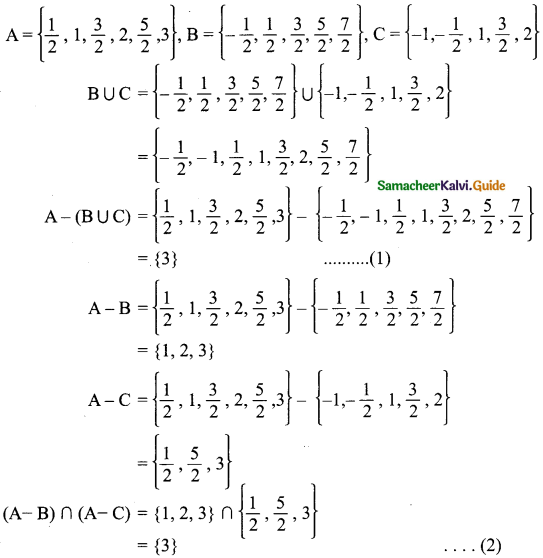
IF A = {y : y = \(\frac{a + 1}{2}\), a ∈ W and a ≤ 5}, B = {y : y = \(\frac{2n – 1}{2}\), n ∈ W and n < 5} and C = {-1, \(-\frac{1}{2}\), 1, \(\frac{3}{2}\), 2} then show that A – (B∪C) = (A – B) ∩ (A – C).
Solution:
Samacheer Kalvi 9th Maths Guide Chapter 1 Set Language Ex 1.5 3
From (1) and (2) we get A – (B∪C) = (A – B) ∩ (A – C).

Question 9.
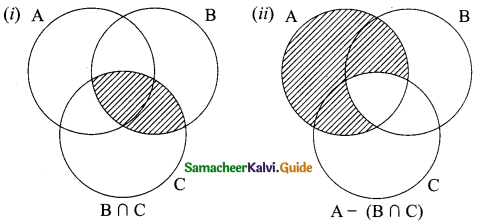
Verify A- (B∩C) = (A – B) ∪ (A – C) using Venn diagrams.
Solution:
Samacheer Kalvi 9th Maths Guide Chapter 1 Set Language Ex 1.5 4
Samacheer Kalvi 9th Maths Guide Chapter 1 Set Language Ex 1.5 5
From (ii) and (v) we get A- (B∩C) = (A – B) ∪ (A – C).

Samacheer Kalvi 9th Maths Guide Chapter 1 Set Language Ex 1.5

Question 10.
If U = {4, 7, 8, 10, 11, 12, 15, 16} , A = {7, 8, 11, 12} and B = {4, 8, 12, 15}, then verify De Morgan’s Laws for complementation.
U= {4, 7, 8, 10, 11, 12, 15, 16} , A = {7, 8, 11, 12} and B = {4, 8, 12, 15}
(i) (A∪B)’ = A’∩B’
(ii) (A∩B)’ = A’∪B’
Solution:
(i) A∪B = {7, 8, 11, 12} ∪ {4, 8, 12, 15}
= {4, 7, 8, 11, 12, 15}
(A∪B)’ = {4, 7, 8, 10, 11, 12, 15, 16} – {4, 7, 8, 11, 12, 15}
= {10,16} ………(1)
A’ = {4, 7, 8, 10, 11, 12, 15, 16} – {7, 8, 11, 12}
= {4, 10, 15, 16}
B’ = {4, 7, 8, 10, 11, 12, 15, 16} – {4, 8, 12, 15}
= {7, 10, 11, 16}
A’∩B’ = {4, 10, 15, 16} ∩ {7, 10, 11, 16}
= {10,16} ………(2)
From (1) and (2) we get (A∪B)’ = A’∩B’

(ii) A∩B = {7, 8, 11, 12} ∩ {4, 8, 12, 15}
= {8, 12}
(A∩B)’ = {4, 7, 8, 10, 11, 12, 15, 16} – {8, 12}
= {4, 7, 10, 11, 15, 16} ………(1)
A’ = {4, 10, 15, 16}
B’ = {7, 10, 11, 16}
A’∪B’ = {4, 10, 15, 16} ∪ {7, 10, 11, 16}
= {4, 7, 10, 11, 15, 16} ………(2)
From (1) and (2) we get (A∩B)’ = A’∪B’

Samacheer Kalvi 9th Maths Guide Chapter 1 Set Language Ex 1.5

Question 11.
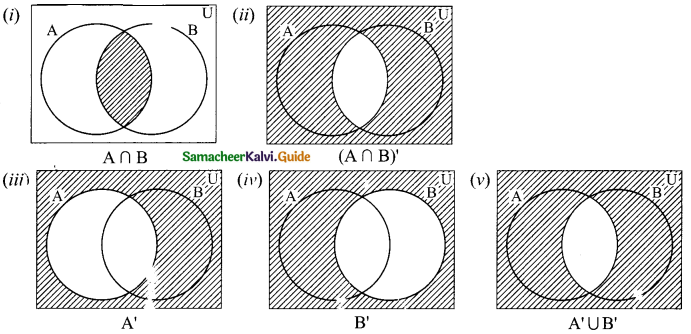
Verify (A∩B)’ = A∪B’ using Venn diagrams.
Solution:
Samacheer Kalvi 9th Maths Guide Chapter 1 Set Language Ex 1.5 6
From (ii) and (i) we get (A∩B)’ = A’∪B’

Samacheer Kalvi 9th Maths Guide Chapter 2 Real Numbers Ex 2.5

Students can download Maths Chapter 2 Real Numbers Ex 2.5 Questions and Answers, Notes, Samacheer Kalvi 9th Maths Guide Pdf helps you to revise the complete Tamilnadu State Board New Syllabus, helps students complete homework assignments and to score high marks in board exams.

Tamilnadu Samacheer Kalvi 9th Maths Solutions Chapter 2 Real Numbers Ex 2.5

Question 1.
Write the following in the form of \(5^n\):
(i) 625
(ii) \(\frac{1}{5}\)
(iii) \(\sqrt{5}\)
(iv) \(\sqrt{125}\)
Solution:
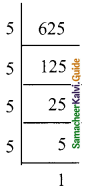
(i) 625 = 54
Samacheer Kalvi 9th Maths Guide Chapter 2 Real Numbers Ex 2.5 1
(ii) \(\frac{1}{5}\) = 5-1
(iii) \(\sqrt{5}\) = \(5^\frac{1}{2}\)
(iv) \(\sqrt{125}\) = \(\sqrt{5^3}\) = \((5^3)^\frac{1}{2} = 5^\frac{3}{2}\)

Samacheer Kalvi 9th Maths Guide Chapter 2 Real Numbers Ex 2.5

Question 2.
Write the following in the form of \(4^n\):
(i) 16
(ii) 8
(iii) 32
Solution:
(i) 16
= 4 × 4
= 4²

(ii) 8
= 4 × 2
= 4 × \(\left(2^{2}\right)^{\frac{1}{2}} \)
= 4 \(\times 4^{\frac{1}{2}} \)
= 4\(^{1+\frac{1}{2}} \)
= 4\(^{\frac{2+1}{2}} \)
= 4\(^{3 / 2}\)

(iii) 32
= 4 × 4 × 2
= 4² × \(\left(2^{2}\right)^{\frac{1}{2}} \)
= 4\(^{2} \times 4^{\frac{1}{2}} \)
= 4\(^{2+\frac{1}{2}} \)
= 4\(^{\frac{4+1}{2}} \)
= 4\(^{\frac{5}{2}} \)

Samacheer Kalvi 9th Maths Guide Chapter 2 Real Numbers Ex 2.5

Question 3.
Find the value of
(i) (49)\(^\frac{1}{2}\)
(ii) (243)\(^\frac{2}{5}\)
(iii) (9)\(^\frac{-3}{2}\)
(iv) \((\frac{64}{125})^\frac{-2}{3}\)
Solution:
(i) 49\(^\frac{1}{2}\) = \((7^2)^\frac{1}{2}\) = 7\(^{2 × \frac{1}{2}}\) = 7
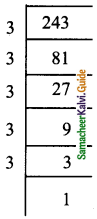
(ii) (243)\(^\frac{2}{5}\) = \((3^5)^\frac{2}{5}\) = 3\(^{5 × \frac{2}{5}}\) = 3² = 9
Samacheer Kalvi 9th Maths Guide Chapter 2 Real Numbers Ex 2.5 2
(iii) \(9^{\frac{-3}{2}}=\left(3^{2}\right)^{\frac{-3}{2}}=3^{2 \times \frac{-3}{2}}=3^{-3}=\frac{1}{3^{3}}=\frac{1}{27}\)
(iv) \(\left(\frac{64}{125}\right)^{\frac{-2}{3}}=\left(\frac{4^{3}}{5^{3}}\right)^{\frac{-2}{3}}=\left[\left(\frac{4}{5}\right)^{3}\right]^{\frac{-2}{3}}=\left(\frac{4}{5}\right)^{3 \times \frac{-2}{3}}=\left(\frac{4}{5}\right)^{-2}=\frac{4^{-2}}{5^{-2}}=\frac{5^{2}}{4^{2}}=\frac{25}{16} \)

Samacheer Kalvi 9th Maths Guide Chapter 2 Real Numbers Ex 2.5

Question 4.
Use a fractional index to write:
(i) \(\sqrt{5}\)
(ii) \(\sqrt[2]{7}\)
(iii) (\(\sqrt[3]{49})^{5}\)
(iv) \((\frac{1}{\sqrt[3]{100}})^{7}\)
Solution:
(i) \(\sqrt{5}\) = (5)\(^\frac{1}{2}\)
(ii) \(\sqrt[2]{7}\) = 7\(^\frac{1}{2}\)
(iii) \((\sqrt[3]{49})^{5}=\left[(49)^{\frac{1}{3}}\right]^{5}=\left[\left(7^{2}\right)^{\frac{1}{3}}\right]^{5}=\left(7^{\frac{2}{3}}\right)^{5}=7^{\frac{2}{3} \times 5}=7^{\frac{10}{3}}\)
(iv) \(\left(\frac{1}{\sqrt[3]{100}}\right)^{7}=\left[\frac{1}{\sqrt[3]{10^{2}}}\right]^{7}=\left[\frac{1}{\left(10^{2}\right)^{1 / 3}}\right]^{7}=\left[\frac{1}{10^{2 / 3}}\right]^{7}=\left(10^{\frac{-2}{3}}\right)^{7}=10^{\frac{-2}{3} \times 7}=10^{\frac{-14}{3}}\)

Samacheer Kalvi 9th Maths Guide Chapter 2 Real Numbers Ex 2.5

Question 5.
Find the 5th root of:
(i) 32
(ii) 243
(iii) 100000
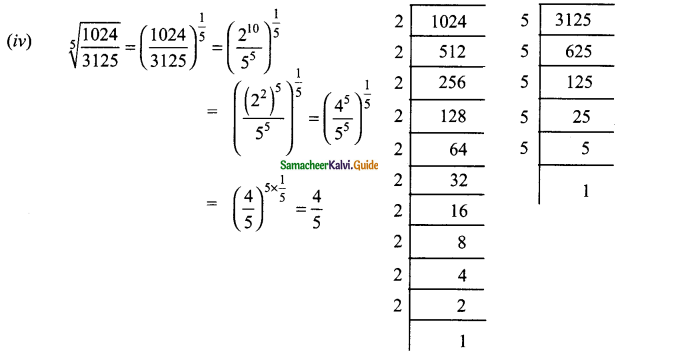
(iv) \(\frac{1024}{3125}\)
Solution:
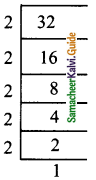
(i) \(\sqrt[5]{32}=(32)^{\frac{1}{5}}=\left(2^{5}\right)^{\frac{1}{5}}=2^{5 \times \frac{1}{5}} \) = 2
Samacheer Kalvi 9th Maths Guide Chapter 2 Real Numbers Ex 2.5 3
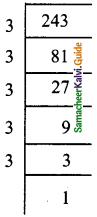
(ii) \(\sqrt[5]{243}=(243)^{\frac{1}{5}}=\left(3^{5}\right)^{\frac{1}{5}}=3^{5 \times \frac{1}{5}}\) = 3
Samacheer Kalvi 9th Maths Guide Chapter 2 Real Numbers Ex 2.5 4
(iii) \(\sqrt[5]{100000}=(100000)^{\frac{1}{5}}=\left(10^{5}\right)^{\frac{1}{5}}\)
= \(10^{5}\times{\frac{1}{5}}\)
Samacheer Kalvi 9th Maths Guide Chapter 2 Real Numbers Ex 2.5 5

Samacheer Kalvi 9th Maths Guide Chapter 2 Real Numbers Ex 2.5

Samacheer Kalvi 9th Maths Guide Chapter 2 Real Numbers Ex 2.4

Students can download Maths Chapter 2 Real Numbers Ex 2.4 Questions and Answers, Notes, Samacheer Kalvi 9th Maths Guide Pdf helps you to revise the complete Tamilnadu State Board New Syllabus, helps students complete homework assignments and to score high marks in board exams.

Tamilnadu Samacheer Kalvi 9th Maths Solutions Chapter 2 Real Numbers Ex 2.4

Question 1.
Represent the following numbers on the number line.
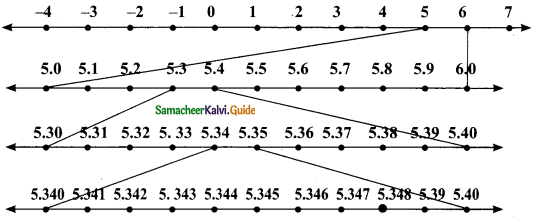
(i) 5.348
Solution:
5.348 lies between 5 and 6.
Samacheer Kalvi 9th Maths Guide Chapter 2 Real Numbers Ex 2.4 1
Steps of construction:
1. Divide the distance between 5 and 6 into 10 equal intervals.
2. Mark the point 5.3 which is the sixth from the left of 6 and 3 from the right of 5.
3. 5.34 lies between 5.3 and 5.4. Divide the distance into 10 equal intervals.
4. Mark the point 5.34 which is sixth from the left of 5.40
5. 5.348 lies between 5.34 and 5.35. Divide the distance into 10 equal intervals.
6. Mark a point 5.348 which is second from the left of 5.350 and seventh form the right of 5.340

Samacheer Kalvi 9th Maths Guide Chapter 2 Real Numbers Ex 2.4

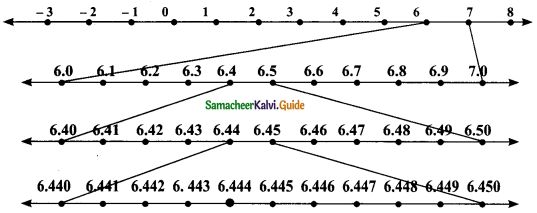
(ii) 6.\(\overline {4}\) upto 3 decimal places.
Solution:
6.\(\overline {4}\) = 6.4444
6.\(\overline {4}\) = 6.444 (correct to 3 decimal places)
The number lies between 6 and 7.
Samacheer Kalvi 9th Maths Guide Chapter 2 Real Numbers Ex 2.4 2
Steps of construction:
1. Divide the distance between 6 and 7 into 10 equal intervals.
2. Mark the point 6.4 which is the sixth from the left of 7 and fourth from the right of 6.
3. 6.44 lies between 6.44 and 6.45. Divide the distance into 10 equal intervals.
4. Mark the point 6.44 which is sixth from the left of 6.5 and fourth from the right of 6.40.
5. Mark the point 6.444 which is sixth from the left of 6.450 and fourth from the right of 6.440.

Samacheer Kalvi 9th Maths Guide Chapter 2 Real Numbers Ex 2.4

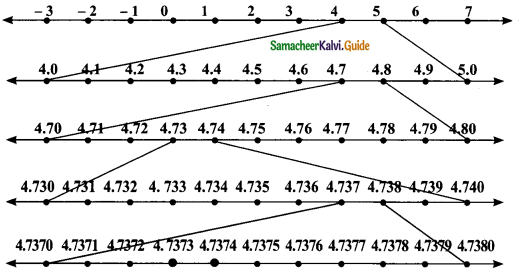
(ii) 4.\(\overline {73}\) upto 4 decimal places.
Solution:
4.\(\overline {73}\) = 4.737373……..
= 4.737374 (correct to 4 decimal places 4.7374 lies between 4 and 5)
Samacheer Kalvi 9th Maths Guide Chapter 2 Real Numbers Ex 2.4 3
Steps of construction:
1. Divide the distance between 4 and 5 into 10 equal parts.
2. Mark the point 4.7 which is third from the left of 5 and seventh from the right of 4.
3. 4.73 lies between 4.7 and 4.8. Divide the distance into 10 equal intervals.
4. Mark the point 4.73 which is seventh from the left of 4.80 and third from the left of 4.70.
5. 4.737 lies between 4.73 and 4.74. Divide the distance into 10 equal intervals.
6. Mark the point 4.737 which is third from the left of 4.740 and seventh from the right of 4.730.
7. 4.7374 lies between 4.737 and 4.738. Divide the distance into 10 equal intervals.
8. Mark the point 4.7374 which is sixth from the left of 4.7380 and fourth from the right of 4.7370.

Samacheer Kalvi 9th Maths Guide Chapter 2 Real Numbers Ex 2.4

Samacheer Kalvi 9th Maths Guide Chapter 1 Set Language Additional Questions

Students can download Maths Chapter 1 Set Language Additional Questions and Answers, Notes, Samacheer Kalvi 9th Maths Guide Pdf helps you to revise the complete Tamilnadu State Board New Syllabus, helps students complete homework assignments and to score high marks in board exams.

Tamilnadu Samacheer Kalvi 9th Maths Solutions Chapter 1 Set Language Additional Questions

Choose the correct answer

Question 1.
A = {set of odd natural numbers}, B = {set of even natural numbers}, then A and B are……….
(a) equal set
(b) equivalent sets
(c) overlapping sets
(d) disjoint sets
Solution:
(d) disjoint sets

Question 2.
Number of subsets in set A = {1, 2, 3} is
(a) 3
(b) 6
(c) 8
(d) 9
Solution:
(c) 8

Samacheer Kalvi 9th Maths Guide Chapter 1 Set Language Additional Questions

Question 3.
The set does not have a proper subset is
(a) Finite set
(b) Infinite set
(c) Null set
(d) Singleton set
Solution:
(c) Null set

Question 4.
Sets having the same number of elements are called
(a) overlapping sets
(b) disjoints sets
(c) equivalent sets
(d) equal sets
Solution:
(c) equivalent sets

Question 5.
The set (A – B) ∪ (B – A) is
(a) AΔB
(b) A∪B
(c) A∩B
(d) A’∪B’
Solution:
(a) AΔB

Samacheer Kalvi 9th Maths Guide Chapter 1 Set Language Additional Questions

Question 6.
The set of (A∪B) – (A∩B) is
(a) (A∪B)’
(b) AΔB
(c) (A∩B)’
(d) A’∪B’
Solution:
(b) AΔB

Question 7.
The set {x : x ∈ A, x ∈ B, x ∉ A∩B} is
(a) A∩B
(b) A∪B
(c) A – B
(d) AΔB
Solution:
(d) AΔB

Question 8.
The number of elements of the set {x : x ∈ Z , x² = 1} is
(a) 0
(b) 1
(c) 2
(d) 3
Solution:
(c) 2

Samacheer Kalvi 9th Maths Guide Chapter 1 Set Language Additional Questions

Question 9.
If A is a proper subset of B, then A∩B =…………..
(a) A
(b) B
(c) 0
(d)A∪B
Solution:
(a) A

Question 10.
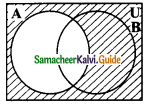
The shade region with adjoint diagram represents ……….
Samacheer Kalvi 9th Maths Guide Chapter 1 Set Language Additional Questions 1
(a) A – B
(b) B – A
(c) A’
(d) B’
Solution:
(c) A’

Question 11.
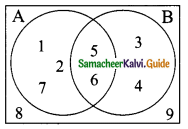
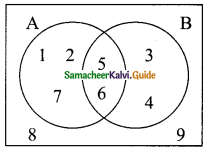
From the given venn diagram (A∪B)’ is ………..
Samacheer Kalvi 9th Maths Guide Chapter 1 Set Language Additional Questions 2
(a) {5, 6}
(b) {1, 2, 3, 4, 7}
(c) {1, 2, 3, 4, 5, 6, 7}
(d) {8, 9}
Solution:
(d) {8, 9}

Samacheer Kalvi 9th Maths Guide Chapter 1 Set Language Additional Questions

Question 12.
If n(A∪B∪C) = 73, n(A) = 2x, n(B) = 3x, n(C) = 5x, n(A∩B) = 10, n(B∩C) = 15, n(A∩C) = 5 and n(A∩B∩C) = 3, then the value of x is ………
(a) 9
(b) 10
(c) 5
(d) 18
Solution:
(b) 10

Question 13.
For any three sets, n(A∪B∪C) = 60, n(A) = 25, n(B) = 20, n(C) = 15, n(A∩B) = 10, n(B∩C) = 7, n(A∩C) = 3, then n(A∩B∩C) is……….
(a) 10
(b) 15
(c) 20
(d) 25
Solution:
(c) 20

Question 14.
If n(U) = 70, n(A) = 25, n(B) = 30, n(A∩B) = 5, then n(A∪B)’ is……….
(a) 5
(b) 10
(c) 15
(d) 20
Solution:
(d) 20

Samacheer Kalvi 9th Maths Guide Chapter 1 Set Language Additional Questions

Question 15.
Which of the following is not correct?
(a) A – (B∪C) = (A – B) ∩ (A – C)
(b) A – (B∩C) = (A – B) ∪ (A – C)
(c) (A∪B)’ = A’∩B’
(d) A’∪B’ = (A – B)’
Solution:
(d) A’∪B’ = (A – B)’

Answer the following questions.

Question 1.
Write the following in “Roster” form?
(a) A = set of the months having 31 days.
(b) B = {x : x is a natural number of 2 digits divisible by 13}
(c) C = {set of vowels in the word “father”}
(d) D = {x : 5 < x ≤ 10; x ∈ N}
(e) E = {x : x is a square natural number less than 16}
Solution:
(a) A = {Jan, March, May, July, Aug, Oct, Dec}
(b) B = {13, 26, 39, 52, 65, 78, 91}
(c) C = {a, e}
(d) D = {6, 7, 8, 9, 10}
(e) E = {1, 4, 9}

Samacheer Kalvi 9th Maths Guide Chapter 1 Set Language Additional Questions

Question 2.
Given that A = {1, 3, 5, 7} B = {1, 2, 4, 6, 8}. Find
(i) AΔB and
(ii) BΔA
Solution:
(i) A = {1, 3, 5, 7}; B = {1, 2, 4, 6, 8}
A – B = {1, 3, 5, 7} – {1, 2, 4, 6, 8}
= {3, 5, 7}
B – A = {1, 2, 4, 6, 8} – {1, 3, 5, 7}
= {2, 4, 6, 8}
AΔB = (A – B) ∪ (B – A)
= {3, 5, 7} ∪ {2, 4, 6, 8}
= {2, 3, 4, 5, 6, 7, 8}
(ii) BΔA = (B – A) ∪ (A – B)
= {2, 4, 6, 8} ∪ {3, 5, 7}
= {2, 3, 4, 5, 6, 7, 8}

Question 3.
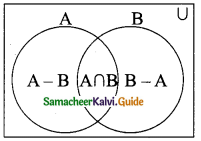
From the venn-diagram, list the following:
Samacheer Kalvi 9th Maths Guide Chapter 1 Set Language Additional Questions 3
(i) A
(ii) B
(iii) A∩B
(iv)A∪B
(v) A – B
(vi) B – A
(vii) (A – B) ∩ (B – A)
Solution:
(i) A = {1, 2, 5, 6, 7}
(ii) B = {3, 4, 5, 6}
(iii) A∩B = {5, 6}
(iv) A∪B = {1, 2, 3, 4, 5, 6, 7}
(v) A – B = {1, 2, 7}
(vi) B – A = {3, 4}
(vii) (A – B) ∩ (B – A) = { }

Samacheer Kalvi 9th Maths Guide Chapter 1 Set Language Additional Questions

Question 4.
In a class there are 40 students. 26 have opted for Mathematics and 24 have opted for Science. How many student have opted for Mathematics and Science.
Solution:
Let M be the set of students opting for Mathematics.
Let S be the set of students opting for Science.
n (M∪S) = 40, n (M) = 26, n(S) = 24
n(M∪S) = n (M) + n (S)- n(M∩S)
40 = 26 + 24 – n(M∩S)
n (M∩S) = 26 + 24 – 40 = 50 – 40 = 10
∴ Number of students opted for Mathematics and Science = 10.
Another Method:
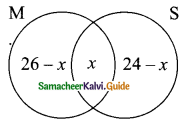
Let “x” be the number of students opted for Mathematics and Science.
Let M and S represent students opting Mathematics and Science.
n(M∪S) = 40, n(M) = 26, n(S) = 24
Samacheer Kalvi 9th Maths Guide Chapter 1 Set Language Additional Questions 4
By venn-diagram, number of students in a class = 26 – x + x + 24 – x
40 = 50 – x
x = 50 – 40 = 10
x = 10
∴ Number of students opted for Mathematics and Science = 10.

Samacheer Kalvi 9th Maths Guide Chapter 1 Set Language Additional Questions

Question 5.
If U = {1, 2, 3, 4, 5, 6, 7, 8, 9}, A = {4, 5, 7, 9}, B = {1, 3, 5, 7, 8}, Verify De Morgan’s Laws for complementation.
De Morgan’s Laws (i) (A∪B)’ = A’∩B’ (ii) (A∩B)’ = A’∪B’
Solution:
(i) A∪B = {4, 5, 7, 9} ∪ {1, 3, 5, 7, 8}
= {1, 3, 4, 5, 7, 8, 9}
(A∪B)’ = {1, 2, 3, 4, 5, 6, 7, 8, 9} – {1, 3, 4, 5, 7, 8, 9}
= {2, 6}……….(1)
A’= {1, 2, 3, 4, 5, 6, 7, 8, 9} – {4, 5, 7, 9}
= {1, 2, 3, 6, 8}
B’ = {1, 2, 3, 4, 5, 6, 7, 8, 9} – {1, 3, 5, 7, 8}
= {2, 4, 6, 9}
A’∩B’ = {1, 2, 3, 6, 8} ∩ {2, 4, 6, 9}
= {2, 6}………(2)
From (1) and (2) we get (A∪B)’ = A’∩B’.

(ii) A∩B = {4, 5, 7, 9} ∩ {1, 3, 5, 7, 8}
= {5, 7}
(A∩B)’= {1, 2, 3, 4, 5, 6, 7, 8, 9} – {5, 7}
= {1, 2, 3, 4, 6, 8, 9}………(1)
A’ = {1, 2, 3, 6, 8}
B’ = {2, 4, 6, 9}
A’∪B’ = {1, 2, 3, 6, 8} ∪ {2, 4, 6, 9}
= {1, 2, 3, 4, 6, 8, 9}………(2)
From (1) and (2) we get (A∩B)’ = A’∪B’.

Samacheer Kalvi 9th Maths Guide Chapter 1 Set Language Ex 1.3

Students can download Maths Chapter 1 Set Language Ex 1.3 Questions and Answers, Notes, Samacheer Kalvi 9th Maths Guide Pdf helps you to revise the complete Tamilnadu State Board New Syllabus, helps students complete homework assignments and to score high marks in board exams.

Tamilnadu Samacheer Kalvi 9th Maths Solutions Chapter 1 Set Language Ex 1.3

Question 1.
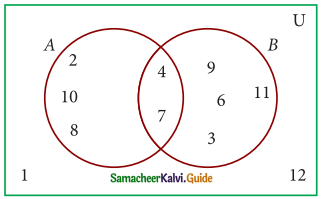
Using the given venn diagram, write the elements of
Samacheer Kalvi 9th Maths Guide Chapter 1 Set Language Ex 1.3 1
(i) A
(ii) B
(iii) A∪B
(iv) A∩B
(v) A – B
(vi) B – A
(vii) A’
(viii) B’
(ix) U
Solution:
(i) A = {2, 4, 7, 8, 10}
(ii) B = {3, 4, 6, 7, 9, 11}
(iii) A∪B = {2, 3, 4, 6, 7, 8, 9, 10, 11}
(iv) A∩B = {4, 7}
(v) A – B = {2, 8, 10}
(vi) B – A = {3, 6, 9, 11}
(vii) A’ = {1, 3, 6, 9, 11, 12}
(viii) B’ = {1,2, 8, 10, 12}
(ix) U = {1, 2, 3, 4, 6, 7, 8, 9, 10, 11, 12}

Samacheer Kalvi 9th Maths Guide Chapter 1 Set Language Ex 1.3

Question 2.
Find A∪B, A∩B, A – B and B – A for the following sets
(i) A = {2, 6, 10, 14} and B = {2, 5, 14, 16}
Solution:
A∪B = {2, 6, 10, 14} ∪ {2, 5, 14, 16}
= {2, 5, 6, 10, 14, 16}
A∩B = {2, 6, 10, 14} ∩ {2, 5, 14, 16}
= {2, 14}
A – B = {2, 6, 10, 14} – {2, 5, 14, 16}
= {6, 10}
B – A = {2, 5, 14, 16} – {2, 6, 10, 14}
= {5, 16}

(ii) A = {a, b, c, e, u} and B = {a, e, i, o, u}
Solution:
A∪B = {a, b, c, e, u} ∪ {a, e, i, o, u}
= {a, b, c, e, i, o, u}
A∩B = {a, b, c, e, u} ∩ {a, e, i, o, u}
= {a, e, u}
A – B = {a, b, c, e, u} – {a, e, i, o, u}
= {b, c}
B – A = {a, e, i, o, u} – {a, b, c, e, u}
= {i, o}

(iii) A = {x : x ∈ N, x ≤ 10} and B = {x : x ∈ W, x < 6}
Solution:
A = {1, 2, 3, 4, 5, 6,7, 8, 9, 10} and B = {0, 1, 2, 3, 4, 5}
A∪B = {1, 2, 3, 4, 5, 6, 7, 8, 9, 10} ∪ {0, 1, 2, 3, 4, 5}
= {0, 1, 2, 3, 4, 5, 6, 7, 8, 9, 10}
A∩B = {1, 2, 3, 4, 5, 6, 7, 8, 9, 10} ∩ {0, 1, 2, 3, 4, 5}
= {1, 2, 3, 4, 5}
A – B = {1, 2, 3, 4, 5, 6, 7, 8, 9, 10} – {0, 1, 2, 3, 4, 5}
= {6, 7, 8, 9, 10}
B – A = {0, 1, 2, 3, 4, 5} – {1, 2, 3, 4, 5, 6, 7, 8, 9, 10}
= {0}

(iv) A = Set of all letters in the word “mathematics” and B = Set of all letters in the word “geometry”
Solution:
A = {m, a, t, h, e, i, c, s}
B = {g, e, o, m, t, r, y}
A∪B = {m, a, t, h, e, i, c, s} ∪ {g, e, o, m, t, r, y}
= {a, c, e, g, h, i, m, o, r, s, t, y}
A∩B= {m, a, t, h, e, i, c, s} ∩ {g, e, o, m, t, r, y}
= {e, m, t}
A – B = {m, a, t, h, e, i, c, 5} – {g, e, o, m, t, r, y}
= {a, c, h, i, s}
B -A = {g, e, o, m, t, r, y} – {m, a, t, h, e, i, c, s}
= {g, o, r, y}

Samacheer Kalvi 9th Maths Guide Chapter 1 Set Language Ex 1.3

Question 3.
If U = {a, b, c, d, e, f, g, h), A = {b, d, f, h} and B = {a, d, e, h}, find the following sets.
(i) A’
Solution:
A’ = U – A
= {a, b, c, d, e, f, g, h} – {b, d, f, h)
= {a, c, e, g}

(ii) B’
Solution:
B’ = U – B
= {a, b, c, d, e, f, g, h} – {a, d, e, h}
= {b, c, f, g}

(iii) A’∪B’
Solution:
A’∪B’ = {a, c, e, g} ∪ {b, c,f, g}
= {a, b, c, e, f, g}

(iv) A’∩B’
Solution:
A’∩B’ = {a, c, e, g} ∩ {b, c, f, g}
= {c, g}

(v) (A∪B)’
Solution:
A∪B = {b, d, f, h} ∪ {a, d, e, h}
= {a, b, d, e, f, h}
(A∪B)’ = U – (A∪B)
= {a, b, c, d, e, f, g, h} – {a, b, d, e, f, h}
= {c, g}

(vi) (A∩B)’
Solution:
(A∩B) = {b, d, f, h) ∩ {a, d, e, h)
= {d, h}
(A∩B)’ = U – (A∩B)
= {a, b, c, d, e, f, g, h} – {d, h}
= {a, b, c, e, f, g}

(vii) (A’)’
Solution:
A’ = {a, c, e, g}
(A’)’ = U – A’
= {a, b, c, d, e, f, g, h} – {a, c, e, g}
= {b, d, f, h}

(viii) (B’)’
Solution:
B’ = {b, c, f, g}
(B’)’ = U – B’
= {a, b, c, d, e, f, g, h) – {b, c, f, g)
= {a, d, e, h}

Samacheer Kalvi 9th Maths Guide Chapter 1 Set Language Ex 1.3

Question 4.
Let U = {0, 1, 2, 3, 4, 5, 6, 7} A = {1, 3, 5, 7} and B = {0, 2, 3, 5, 7}, find the following sets.
(i) A’
Solution:
A’ = U – A
= {0, 1, 2, 3, 4, 5, 6, 7} – {1, 3, 5, 7}
= {0, 2, 4, 6}

(ii) B’ = U – B
Solution:
= {0, 1, 2, 3, 4, 5, 6, 7} – {0, 2, 3, 5, 7}
= {1, 4, 6}

(iii) A’∪B’
Solution:
A’∪B’ = {0, 2, 4, 6,}∪{1, 4, 6}
{0, 1, 2, 4, 6}

(iv) A’∩B’
Solution:
A’∩B’ = {0, 2, 4, 6,}∩{1, 4, 6}
{4, 6}

(v) (A∪B)’
Solution:
A∪B = {1, 3, 5, 7}∪{0, 2, 3, 5, 7}
= {0, 1, 2, 3, 5, 7}
(A∪B)’ = U – (A∪B)
{0, 1, 2, 3, 4, 5, 6, 7} – {0, 1, 2, 3, 5, 7}
{4, 6}

(vi) (A∩B)’
Solution:
(A∩B)= {1, 3, 5, 7}∩{0, 2, 3, 5, 7}
= {3, 5, 7}
(A∩B)’ = U – (A∩B)
= {0, 1, 2, 3, 4, 5, 6, 7} – {3, 5, 7}
= {0, 1, 2, 4, 6}

(vii) (A’)’
A’ = {0, 2, 4, 6}
(A’)’ = U – A’
= {0, 1, 2, 3, 4, 5, 6, 7} – {0, 2, 4, 6}
= {1, 3, 5, 7}

(viii) (B’)’
B’ = {1, 4, 6}
(B’)’ = {0, 1, 2, 3, 4, 5, 6, 7} – {1, 4, 6}
= {0, 2, 3, 5, 7}

Samacheer Kalvi 9th Maths Guide Chapter 1 Set Language Ex 1.3

Question 5.
Find the symmetric difference between the following sets.
(i) P = {2, 3, 5, 7, 11} and Q = {1, 3, 5, 11}
Solution:
Use anyone of the formula to find A & B
AΔB = (A – B)∪(B – A) or AΔB = (A∪B) – (A∩B)
P∪Q = {2, 3, 5, 7, 11} ∪ {1,3,5, 11}
= {1, 2, 3, 5, 7, 11}
P∩Q = {2, 3, 5, 7, 11}∩{1, 3, 5,11}
= {3, 5, 11}
PΔQ = (P∪Q) – (P∩Q)
= {1, 2, 3, 5, 7, 11} – {3, 5, 11}
= {1, 2, 7}
(OR)
P – Q = {2, 3, 5, 7, 11} – {1, 3, 5, 11}
= {2,7}
Q – P = {1, 3, 5, 11} – {2, 3, 5, 7, 11}
= {1}
PΔQ = (P – Q)∪(Q – P)
= {2, 7} ∪ {1}
= {1, 2, 7}

(ii) R = {l, m, n, o, p} and S = {j, l, n, q}
Solution:
R- S = {l, m, n, o, p} – {j, l, n, q}
= {m, o, p}
S – R = {j, l, n, q} – {l, m, n, o, p}
= {j, q}
RΔS = (R – S)∪(S – R)
= {m, o, p} – {j, q} = {j, m, o, p, q)
(OR)
R∪S = {l, m, n, o, p} ∪ {j,l,n,q}
= {l, m, n, o, p, j, q}
R∩S = {l, m, n, o,p} ∩ {j, l, n, q}
= {l, n}
RΔS = (R∪S) – (R∩S)
= {l, m, n, o, p, j, q} – { l, n}
= {m, o, p, j, q}

(iii) X = {5, 6, 7} and Y = {5, 7, 9, 10}
Solution:
X∪Y = {5, 6, 7} ∪ {5, 7, 9, 10}
= {5 ,6, 7, 9, 10}
X∩Y = {5, 6, 7} ∩ {5, 7, 9, 10}
= {5, 7}
XΔY = (X∪Y) – (X∩Y)
= {5, 6, 7, 9, 10} – {5, 7}
= {6, 9, 10}
OR
X – Y = {5, 6, 7} – {5, 7, 9, 10} = {6}
Y – X = {5, 7, 9, 10} – {5, 6, 7} = {9, 10}
XΔY = (X – Y) ∪ (Y – X)
= {6}∪{9, 10}
= {6, 9, 10}

Samacheer Kalvi 9th Maths Guide Chapter 1 Set Language Ex 1.3

Question 6.
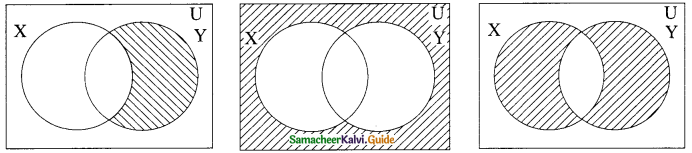
Using the set symbols, write down the expressions for the shaded region in the following
Samacheer Kalvi 9th Maths Guide Chapter 1 Set Language Ex 1.3 2
Solution:
Samacheer Kalvi 9th Maths Guide Chapter 1 Set Language Ex 1.3 3

Question 7.
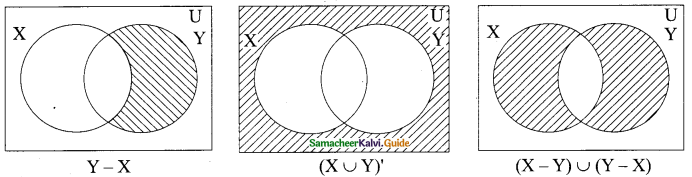
Let A and B be two overlapping sets and the universal set U. Draw appropriate Venn diagram for each of the following,
(i) A∪B
(ii) A∩B
(iii) (A∩B)’
(iv) (B – A)’
(v) A’∪B’
(Vi) A’∩B’
(vii) What do you observe from the Venn diagram (iii) and (v)?
Solution:
(i) A∪B
Samacheer Kalvi 9th Maths Guide Chapter 1 Set Language Ex 1.3 4

(ii) A∩B
Samacheer Kalvi 9th Maths Guide Chapter 1 Set Language Ex 1.3 5

(iii) (A∩B)’
Samacheer Kalvi 9th Maths Guide Chapter 1 Set Language Ex 1.3 6

(iv) (B – A)’
Samacheer Kalvi 9th Maths Guide Chapter 1 Set Language Ex 1.3 7

(v) A’∪B’
Samacheer Kalvi 9th Maths Guide Chapter 1 Set Language Ex 1.3 8

(Vi) A’∩B’
Samacheer Kalvi 9th Maths Guide Chapter 1 Set Language Ex 1.3 9

Samacheer Kalvi 9th Maths Guide Chapter 1 Set Language Ex 1.3

(vii) What do you observe from the diagram (iii) and (v)?
From the diagram (iii) and (v) we get (A∩B)’ = A’∪B’
Samacheer Kalvi 9th Maths Guide Chapter 1 Set Language Ex 1.3 10