Samacheer Kalvi 4th Tamil Guide Chapter 13 நன்னெறி

Tamilnadu State Board New Syllabus Samacheer Kalvi 4th Tamil Guide Pdf Chapter 13 நன்னெறி Text Book Back Questions and Answers, Summary, Notes.

Tamilnadu Samacheer Kalvi 4th Tamil Solutions Chapter 13 நன்னெறி

Samacheer Kalvi 4th Tamil Guide Chapter 13 நன்னெறி

வாங்க பேசலாம்

Question 1.
பாடலை உரிய ஒலிப்புடன் படித்து மகிழ்க.
Answer:
மாணவர்கள் தாங்களாகவே பாடலை உரிய ஒலிப்புடன் படித்து மகிழ வேண்டும்.

Question 2.
உன்னிடம் பிறர் எப்படிப் பேச வேண்டும் என எண்ணுகிறாய்? ஏன்?
Answer:
என்னிடம் பிறர் இன்சொல் பேச வேண்டும் என்று எண்ணுகிறேன்.
ஏனெனில் நாம் பேசும் இன்சொற்களால் அனைவரும் மகிழ்வர். பிறர் நம்மிடம் எவ்வாறு பேச வேண்டும் என்று எண்ணுகிறோமா அதேபோல் நாமும் பிறரிடம் பேசவேண்டும்.

Samacheer Kalvi 4th Tamil Guide Chapter 13 நன்னெறி

சிந்திக்கலாமா?

இன்சொற்களைப் பேசுவதால் நன்மையே விளையும் என்பதைப் பிறருக்கு எப்படி உணர்த்தலாம்?
Answer:
பிறர் மனதைப் புண்படுத்தாத சொற்களே இன்சொற்கள். நாம் எதிர்நோக்குபவர்களில் புதியவர், சிறியவர், பெரியவர், நண்பர், உறவினர் என எவராக இருந்தாலும் இனிமையாகப் பேசுதல் சிறப்பு. நலம் விசாரித்தல், உபசரித்தல் போன்றவையும் இன்சொல்லாகும்.
இன்சொல் பேசுவதனால் ஏற்படும் நன்மைகளை உணர்த்தும் கதைகளை, நிகழ்வுகளை நாம் பிறருக்குக் கூறலாம்.

படிப்போம்! சிந்திப்போம்! எழுதுவோம்!

சரியான சொல்லைத் தெரிவு செய்து எழுதுவோமா?

Question 1.
‘இன்சொல்’ இச்சொல்லைப் பிரித்து எழுதக் கிடைப்பது
அ) இன் + சொல்
ஆ) இனிமை + சொல்
இ) இன்மை + சொல்
ஈ) இனிய + சொல்
Answer:
ஆ) இனிமை + சொல்

Samacheer Kalvi 4th Tamil Guide Chapter 13 நன்னெறி

Question 2.
‘அதிர்கின்ற வளை’ – இச்சொற்களில் அதிர்கின்ற என்னும் சொல்லின் பொருள்……………
அ) உடைகின்ற
ஆ) ஒலிக்கின்ற
இ) ஒளிர்கின்ற
ஈ) வளைகின்ற
Answer:
ஆ) ஒலிக்கின்ற

Question 3.
வியனுலகம் – இச்சொல்லைப் பிரித்து எழுதக் கிடைப்பது …………….
அ) வியன் + உலகம்
ஆ) வியல் + உலகம்
இ) விய + உலகம்
ஈ) வியன் + னுலகம்
Answer:
அ) வியன் + உலகம்

Samacheer Kalvi 4th Tamil Guide Chapter 13 நன்னெறி

வினாக்களுக்கு விடையளிக்க

Question 1.
உலகம் எப்போது மகிழும்? – நன்னெறிப் பாடல் மூலம் உணர்த்துக.
Answer:
உலகம் மக்கள் பேசும் இன்சொற்களைக் கேட்டு மகிழும்.

Question 2.
கடலின் அலைகள் எப்போது பொங்கி எழும்?
குளிர்ச்சி பொருந்திய நிலவின் ஒளியைக் கண்டு கடலின் அலைகள் பொங்கி எழும்.
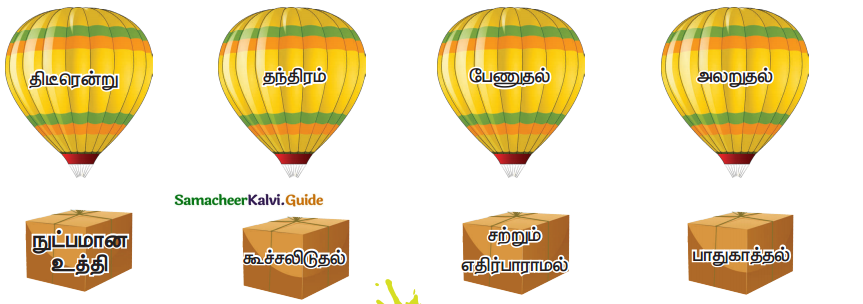
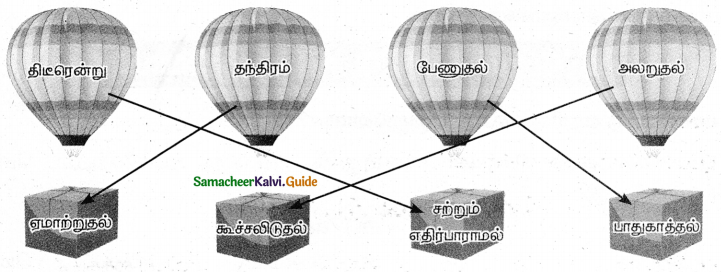
1. இன்சொல் – கதிரவனின் ஒளி
2. வன்சொல் – நிலவின் ஒளி
3. அழல்கதிர் – கடுஞ்சொல்
4. தண்ணென் கதிர் – இனிய சொல்
Answer:
1. இன்சொல் – இனிய சொல்
2. வன்சொல் – கடுஞ்சொல்
3. அழல்கதிர் – கதிரவனின் ஒளி
4. தண்ணென் கதிர் – நிலவின் ஒளி

Samacheer Kalvi 4th Tamil Guide Chapter 13 நன்னெறி

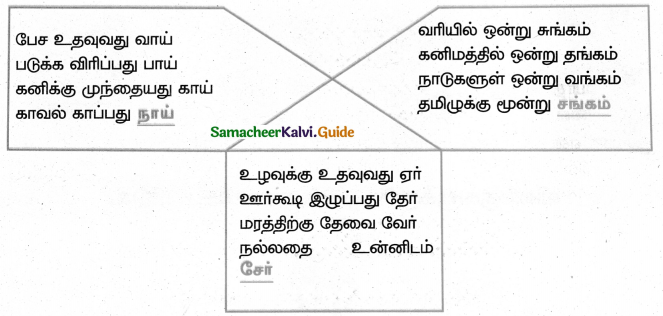
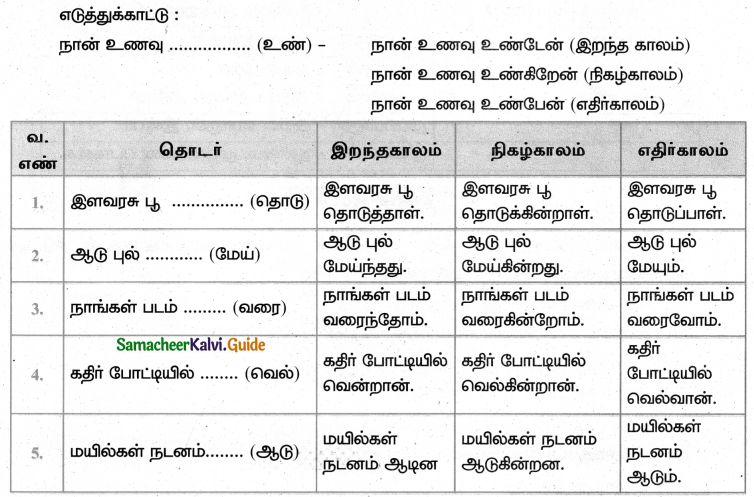
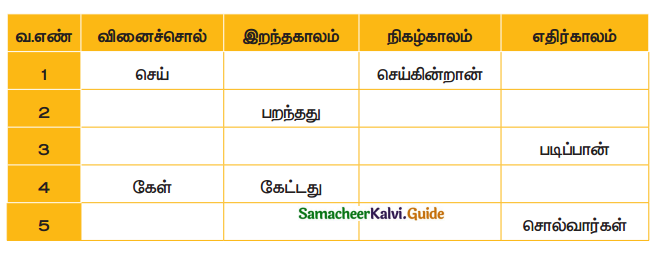
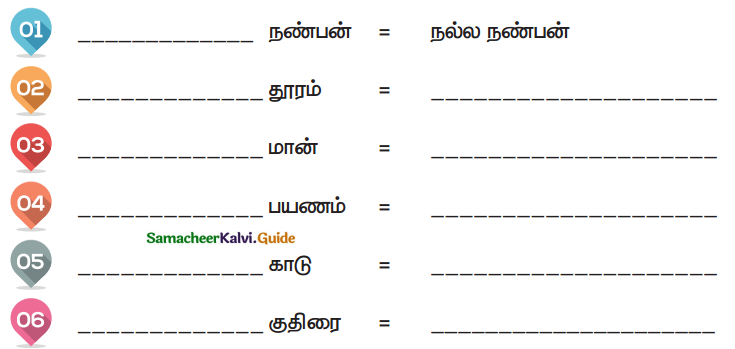
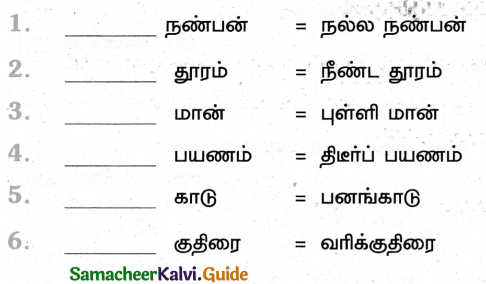
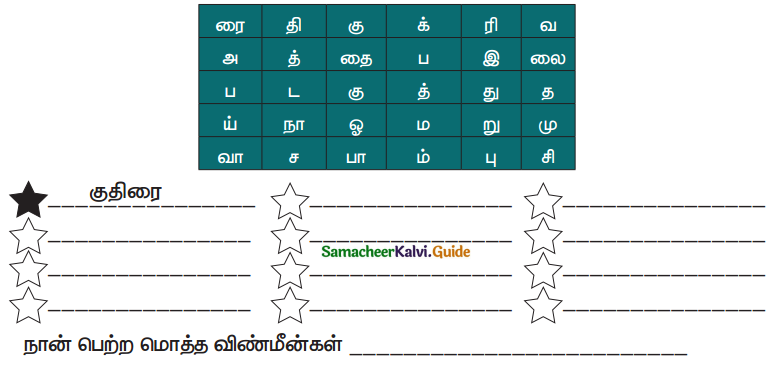
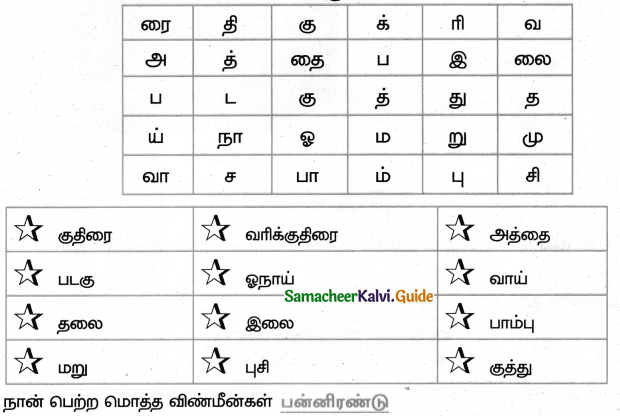
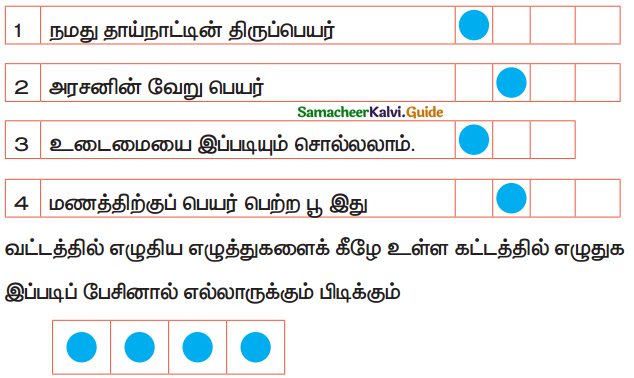
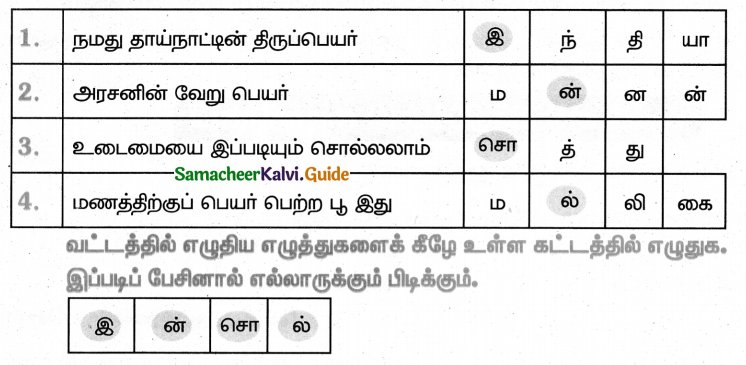
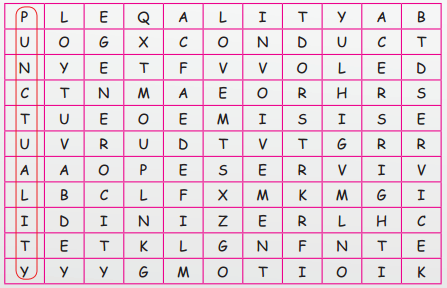
குறிப்புகளைக் கொண்டு கட்டத்தை நிரப்புக

Samacheer Kalvi 4th Tamil Guide Chapter 13 நன்னெறி 1
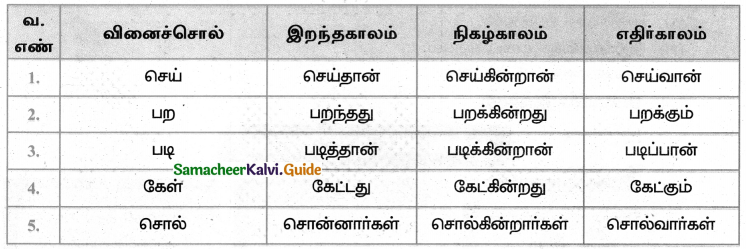
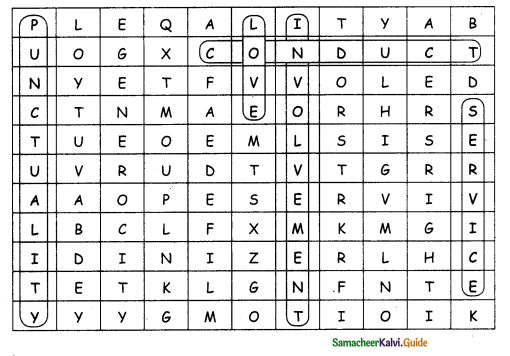
Answer:
Samacheer Kalvi 4th Tamil Guide Chapter 13 நன்னெறி 2

Samacheer Kalvi 4th Tamil Guide Chapter 13 நன்னெறி

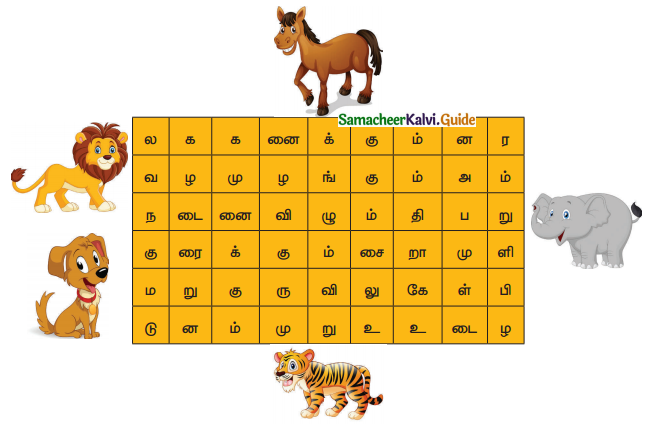
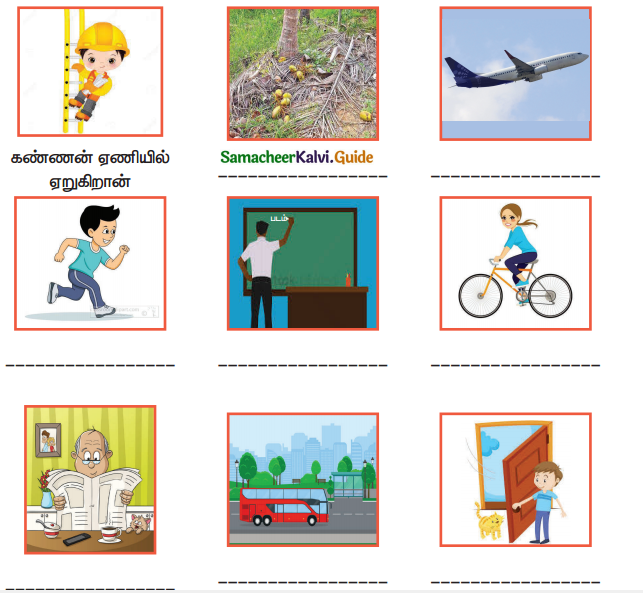
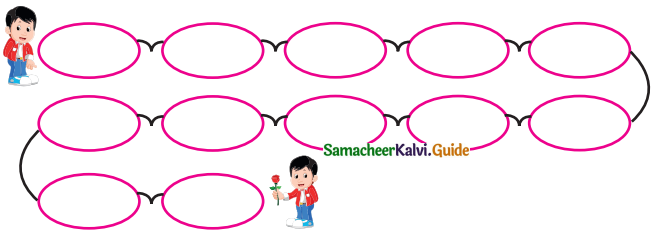
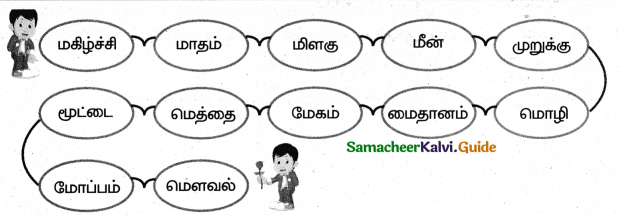
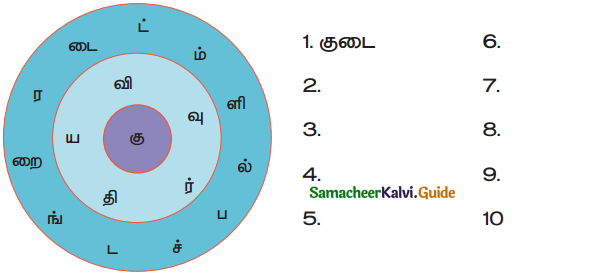
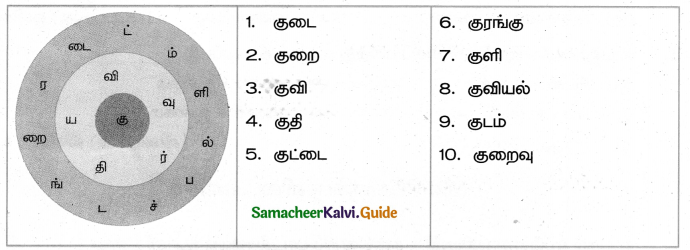
சிறு வட்டத்தில் உள்ள எழுத்தை முதலாகக் கொண்டு சொல் உருவாக்குக

Samacheer Kalvi 4th Tamil Guide Chapter 13 நன்னெறி 3
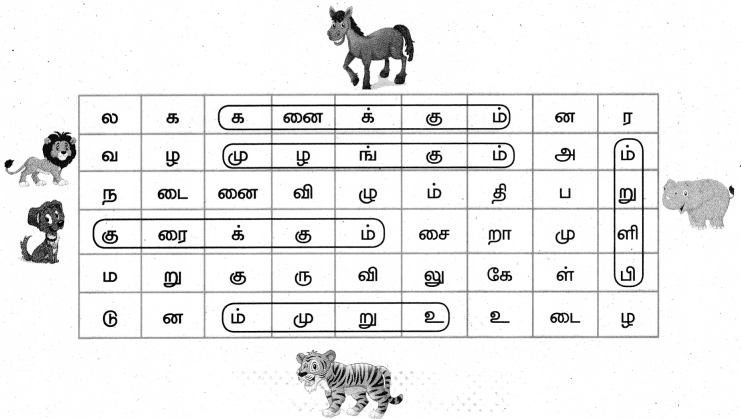
Answer:
Samacheer Kalvi 4th Tamil Guide Chapter 13 நன்னெறி 4

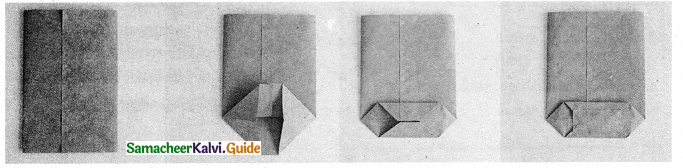
அறிந்து கொள்வோம்

Samacheer Kalvi 4th Tamil Guide Chapter 13 நன்னெறி 5

செயல் திட்டம்

இனியவை கூறல் என்னும் திருக்குறள் அதிகாரத்திலுள்ள குறட்பாக்களை எழுதி வருக.
Answer:
1. இன்சொலால் ஈரம் அளைஇப் படிறுஇலவாம்
செம்பொருள் கண்டார்வாய்ச் சொல்.
2. அகன்அமர்ந்து ஈதலின் நன்றே முகனமர்ந்து
இன்சொலன் ஆகப் பெறின்.
3. முகத்தான் அமர்ந்து இனிதுநோக்கி அகத்தானாம்
இன்சொ லினதே அறம்.
4. துன்புறூஉம் துவ்வாமை இல்லாகும் யார்மாட்டும்
இன்புறூஉம் இன்சொ லவர்க்கு
5.பணிவுடையன் இன்சொலன் ஆதல் ஒருவற்கு அணியல்ல மற்றுப் பிற.
6. அல்லவை தேய அறம்பெருகும் நல்லவை
நாடி இனிய சொலின்.
7. நயன்ஈன்று நன்றி பயக்கும் பயன்ஈன்று
பண்பின் தலைப்பிரியாச் சொல்.
8. சிறுமையுவு நீங்கிய இன்சொல் மறுமையும்
இம்மையும் இன்பம் தரும்.
9. இன்சொல் இனிதீன்றல் காண்பான் எவன்கொலோ
வன்சொல் வழங்கு வது.
10. இனிய உளவாக இன்னாத கூறல்
கனிஇருப்பக் காய்கவர்ந் தற்று.

Samacheer Kalvi 4th Tamil Guide Chapter 13 நன்னெறி

கூடுதல் வினாக்கள்

வினாக்களுக்கு விடையளிக்க.

Question 1.
நன்னெறி நூல் பற்றி எழுதுக.
Answer:

  • நீதி நூல்களுள் ஒன்று நன்னெறி.
  • இந்நூலைத் துறைமங்கலம் சிவப்பிரகாச சுவாமிகள் இயற்றினார். நாற்பது நேரிசை வெண்பாக்கள் இந்நூலில் உள்ளன.
  • ஒவ்வொரு வெண்பாவும் ஒவ்வோர் உவமை மூலம் ஒவ்வொரு நீதிக்கருத்தை விளக்குவது இந்நூலின் சிறப்பாகும்.

Question 2.
இன்சொல் – வன்சொல், நன்னெறிப் பாடல் மூலம் விளக்குக.
Answer:

  • கடலானது கதிரவனின் வெப்பத்தைக் கண்டு பொங்காது. குளிர்ச்சி பொருந்திய நிலவின் ஒளி கண்டுதான் பொங்கும்.
  • அதுபோலக் கடலால் சூழப்பட்ட இப்பெரிய உலகில் வாழும் மக்கள் இன்சொற்களைக் கேட்டு மகிழ்வார்களே அன்றி, வன்சொற்களைக் கேட்டு மகிழ மாட்டார்கள் என்று நன்னெறி கூறுகிறது.

Samacheer Kalvi 4th Tamil Guide Chapter 13 நன்னெறி

பாடல் பொருள்

பொன்னாலான ஒலிக்கும் வளையல்களை அணிந்த பெண்ணே, கடலானது கதிரவனின் வெப்பத்தைக் கண்டு பொங்காது. குளிர்ச்சி பொருந்திய நிலவின் ஒளி கண்டுதான் பொங்கும். அதுபோலக் கடலால் சூழப்பட்ட இப்பெரிய உலகில் வாழும் மக்கள் இன்சொற்களைக் கேட்டு மகிழ்வார்களே அன்றி, வன்சொற்களைக் கேட்டு மகிழ மாட்டார்கள் என்பதைப் புரிந்து செயல்படுக.

Samacheer Kalvi 5th Social Science Guide Term 1 Chapter 3 Good Citizen

Tamilnadu State Board New Syllabus Samacheer Kalvi 5th Social Science Guide Pdf Term 1 Chapter 3 Good Citizen Text Book Back Questions and Answers, Notes.

Tamilnadu Samacheer Kalvi 5th Social Science Solutions Term 1 Chapter 3 Good Citizen

Samacheer Kalvi 5th Social Science Guide Good Citizen Text Book Back Questions and Answers

Evaluation

I. Fill in the blanks.

Question 1.
Man is a ________.
Answer:
social animal

Samacheer Kalvi 5th Social Science Guide Term 1 Chapter 3 Good Citizen

Question 2.
The word civic means ________ of a nation.
Answer:
citizen

Question 3.
The aim of education is to change a person into a ________.
Answer:
valuable person

Question 4.
________ is the basic value for every individual.
Answer:
Personal value

Question 5.
Always be ________ in discharging duty.
Answer:
punctual

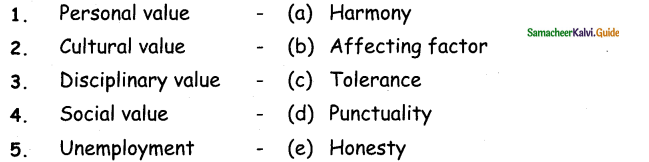
II. Match the following.

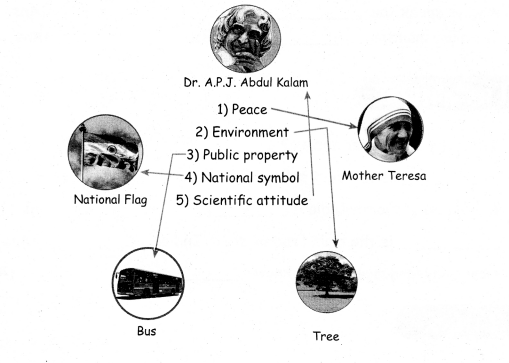
Samacheer Kalvi 5th Social Science Guide Term 1 Chapter 3 Good Citizen 1
Answer:

  1. (e)
  2. (a)
  3. (d)
  4. (c)
  5. (b)

III. Answer the following:

Question 1.
Define the term Citizen.
Answer:
The term citizen means an inhabitant of a particular country, enjoying various rights and executing his duties.

Samacheer Kalvi 5th Social Science Guide Term 1 Chapter 3 Good Citizen

Question 2.
List out any five personal values.
Answer:

  1. Being Honest
  2. Help others
  3. Love all living beings
  4. Always speak the truth
  5. Help Elders and poor.

Question 3.
Write a short note on cultural values.
Answer:

  • Becoming well mannered and cultured is an essence of society.
  • Irrespective of language and religion people live together in harmony. This helps to maintain cultural values.
  • We are all humans. We must live together as brothers and sisters.

Question 4.
What are the social values?
Answer:

  • Maintain good relations with people.
  • Respect elders
  • Respect nature
  • Be tolerant
  • Maintain friendship.

Question 5.
What are disciplinary values?
Answer:

  • Punctuality
  • Involvement
  • Treating everyone as equal
  • Doing work on time
  • Holding your morals.

Samacheer Kalvi 5th Social Science Guide Term 1 Chapter 3 Good Citizen

IV. Answer in detail:

Question 1.
Write about the constitutional values.
Answer:
The Constitutional values are,

  • Safeguard the public properties
  • Maintain the unity and integrity of the Nation
  • Develop Scientific attitude
  • Protect the natural resources
  • Care for the environment
  • Develop patriotism.

Question 2.
Write any five factors that enrich good values.
Answer:
The factors that enriches good values are,

  1. Literacy
  2. Creating awareness and interests
  3. Trying hard till success
  4. One’s own evaluation
  5. Acceptance.

Try These:

Question 1.
We show _____________ to all living beings.
Answer:
Love

Question2.
Help the poor with ____________.
Answer:
generosity

Samacheer Kalvi 5th Social Science Guide Term 1 Chapter 3 Good Citizen

Question 3.
____________ is the best policy.
Answer:
Honesty

Question 4.
The best relationship is ____________.
Answer:
friendship

Question 5.
We show ____________ to our guests.
Answer:
hospitality

Question 6.
We show ____________ to those who suffer.
Answer:
mercy

Question 7.
Always speak the ____________.
Answer:
truth

Question 8.
We must maintain ____________ in public.
Answer:
peace

Samacheer Kalvi 5th Social Science Guide Term 1 Chapter 3 Good Citizen

Try These

Question 1.
What is your mother tongue ? ____________
Answer:
Tamil

Question 2.
____________ is the best policy.
Answer:
Honesty

Question 3.
Main food of North India is ____________.
Answer:
Wheat

Question 4.
____________ is the main food of south India.
Answer:
Rice

Question 5.
How many languages do you know? ____________
Answer:
2

Samacheer Kalvi 5th Social Science Guide Term 1 Chapter 3 Good Citizen

Think:

Question 1.
Grow trees to get______________ .
Answer:
rainfall

Question 2.
Millions benefit if they live ______________ .
Answer:
peacefully

Question 3.
United we ______________ divided we fall.
Answer:
stand

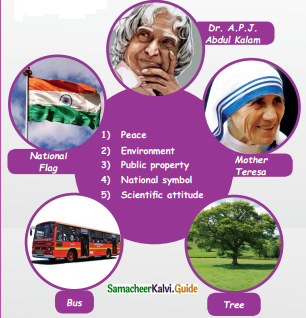
Circle the good values given above:

Samacheer Kalvi 5th Social Science Guide Term 1 Chapter 3 Good Citizen - 1
Answer:
Samacheer Kalvi 5th Social Science Guide Term 1 Chapter 3 Good Citizen 2

Match the Following:

Samacheer Kalvi 5th Social Science Guide Term 1 Chapter 3 Good Citizen 3a

Answer:


Samacheer Kalvi 5th Social Science Guide Term 1 Chapter 3 Good Citizen 3b
Samacheer Kalvi 5th Social Science Guide Term 1 Chapter 3 Good Citizen

Samacheer Kalvi 5th Social Science Guide Good Citizen Additional Questions and Answers

I. Fill in the blanks.

Question 1.
_____________ is the best policy.
Answer:
Honesty

Question 2.
Good values ore classified into ____________ types.
Answer:
foul

Question 3.
___________ values ore love, generosity, mercy etc.,
Answer:
Personal

Question 4.
____________ values include indiscriminate society and various cultural features.
Answer:
Cultural

Question 5.
____________ is an important feature of social values.
Answer:
Mannerism

Question 6.
To protect equality is the soul of ____________ value.
Answer:
disciplinary

Samacheer Kalvi 5th Social Science Guide Term 1 Chapter 3 Good Citizen

II. Match the following:

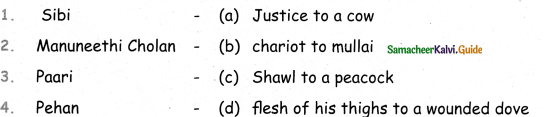
Samacheer Kalvi 5th Social Science Guide Term 1 Chapter 3 Good Citizen 4

Answer:

  1. (d)
  2. (a)
  3. (b)
  4. (c)

III. Answer the following Questions:

Question 1.
What are the five senses?
Answer:

  1. Sight
  2. Hearing
  3. Smell
  4. Taste
  5. Touch

Question 2.
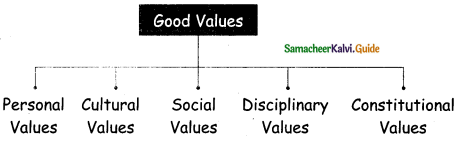
What are the types of Good values?
Answer:
Samacheer Kalvi 5th Social Science Guide Term 1 Chapter 3 Good Citizen 5

Question 3.
What are Personal values?
Answer:
Personal value is the basic value for every individual. We must bring out the hidden values of a person that they acquire from their experiences. This leads to their overall development.

Samacheer Kalvi 5th Social Science Guide Term 1 Chapter 3 Good Citizen

Question 4.
What are the factors that affect our values?
Answer:
There are some factors that effect our values :

  1. Extreme faith in religion leads to communalism.
  2. Don’t break the queue/rules.
  3. Spitting and dumping garbage anywhere.
  4. Polluting land and water.

IV. Answer the detail:

Question 1.
What are the steps we need to follow to stay healthy?
Answer:

  1. Wakeup early in the morning
  2. Brush your teeth
  3. Have a bath
  4. Wear clean clothe
  5. Wear slippers/shoes
  6. Trim hair and cut the nails
  7. Wash hands before and after meals.

Samacheer Kalvi 5th Social Science Guide Term 1 Chapter 4 Atmosphere

Tamilnadu State Board New Syllabus Samacheer Kalvi 5th Social Science Guide Pdf Term 1 Chapter 4 Atmosphere Text Book Back Questions and Answers, Notes.

Tamilnadu Samacheer Kalvi 5th Social Science Solutions Term 1 Chapter 4 Atmosphere

Samacheer Kalvi 5th Social Science Guide Atmosphere Text Book Back Questions and Answers

Evaluation

I. Choose the best answer.

Question 1.
The atmosphere is divided ______ into layers.
(a) four
(b) five
(c) six
(d) seven
Answer:
(b) five

Samacheer Kalvi 5th Social Science Guide Term 1 Chapter 4 Atmosphere

Question 2.
The Earth receives heat energy from the ______ .
(a) Moon
(b) Mars
(c) Sun
(d) Venus
Answer:
(c) Sun

Question 3.
World Meteorological Day
(a) March – 20
(b) March – 21
(c) March – 22
(d) March – 23
Answer:
(d) March – 23

Question 4.
The study of weather is called _______ .
(a) Meteorology
(b) Ecology
(c) Archaeology
(d) Sociology
Answer:
(a) Meteorology

Samacheer Kalvi 5th Social Science Guide Term 1 Chapter 4 Atmosphere

Question 5.
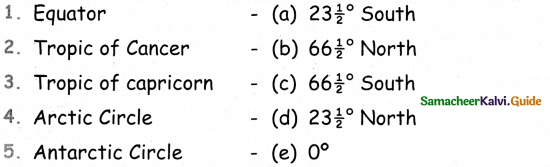
Zone located in between Tropic cancer and Tropic of Capricorn is _______ zone.
(a) Temperate
(b) Subtropical
(c) Cold
(d) Torrid
Answer:
(d) Torrid

Question 6.
_______ is used to measure pressure in the air.
(a) Barometer
(b) Thermometer
(c) Anemometer
(d) Wind vane
Answer:
(a) Barometer

Question 7.
Monsoon is derived from the _______ word.
(a) Greek
(b) Arabian
(c) English
(d) Latin
Answer:
(b) Arabian

Question 8.
Vertical cloud is called _________ .
(a) Cirrus cloud
(b) Stratus clouds
(c) Cumulus clouds
(d) Nimbus clouds
Answer:
(d) Nimbus clouds

Question 9.
________ clouds give convectional rainfall.
(a) Cirrus
b) Stratus
(c) Cumulus
(d) Nimbus
Answer:
(c) Cumulus

Samacheer Kalvi 5th Social Science Guide Term 1 Chapter 4 Atmosphere

Question 10.
Statement I – The instrument used to measure wind direction in wind vane.
Statement II – Light travels faster than sound.
(a) Statement I is True, II is False
(b) Statement I,II are True
(c) Statement I,II are False
(d) Statement I is False, II is True
Answer:
(b) Statement I,II are True

II. Fill in the blanks.

Question 1.
The instrument used to measure heat _______ .
Answer:
Calorimeter

Question 2.
The imaginary lines drawn parallel to the surface of the earth is _______ .
Answer:
Latitudes

Question 3.
Sea breeze blows from _______ in the evening.
Answer:
sea to land

Question 4.
_______ are rain clouds.
Answer:
Nimbus

III. Match the following

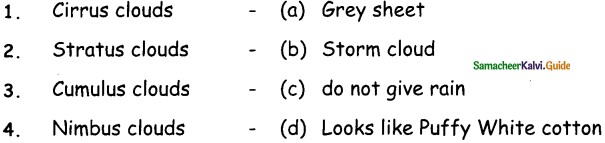
Samacheer Kalvi 5th Social Science Guide Term 1 Chapter 3 Good Citizen 1
Answer:

  1. (c)
  2. (a)
  3. (d)
  4. (b)

Samacheer Kalvi 5th Social Science Guide Term 1 Chapter 4 Atmosphere

IV. State True/ False.

Question 1.
All weather changes occur in the Troposphere.
Answer:
True

Question 2.
Latitudes and Longitudes help us to locate a country.
Answer:
True

Question 3.
Atmosphere gets heated by conduction than solar radiation.
Answer:
True

Question 4.
The main reason for the change of wind direction is to Earth’s rotation.
Answer:
True

Question 5.
Cyclone moves in anti-clockwise direction.
Answer:
True

Samacheer Kalvi 5th Social Science Guide Term 1 Chapter 4 Atmosphere

V. Answer the following.

Question 1.
What is climate?
Answer:
The word climate is derived from the Greek word called clima. Climate is the average weather condition of a vast area over more than 30 years.

Question 2.
Name the atmospheric layers.
Answer:

  • Troposphere
  • Stratosphere
  • Mesosphere
  • Thermosphere
  • Exosphere.

Question 3.
Write a short note on the Nimbus clouds.
Answer:
Nimbus clouds appears as dark or grey in color. It gives heavy rainfall. It’s called vertical or rain clouds.

Question 4.
Write a short note on the orographic rainfall.
Answer:
When the moisture laden winds from the sea rises as it moves over a mountain range, it becomes cool and causes heavy rainfall. The opposite side of the mountain is called Leeward side. It receives very little rainfall.

Samacheer Kalvi 5th Social Science Guide Term 1 Chapter 4 Atmosphere

VI. Answer in detail:

Question 1.
Write about Jet Streams.
Answer:

  • Air currents in the upper layers of atmosphere is known as Jet streams.
  • It could determine the arrival and departure of monsoon winds in India.

Question 2.
Explain the types of winds.
Answer:
Wind:
The air moves horizontally from high pressure to low pressure area is called wind. :
Different types of wind
Planetary winds: These winds move in the same direction throughout the year with the rotation of the earth.

Monsoon winds: They are seasonal winds.
Types:

  • South west monsoon winds.
  • North east monsoon winds.
  • Monsoon rains.

Sea breeze: Wind blows from sea to land during the evening.

Land breeze: Wind blows from land to sea in the morning.

Samacheer Kalvi 5th Social Science Guide Term 1 Chapter 4 Atmosphere

InText Activity

Question 1.
Take a ball and throw it up in the air observe the increasing speed of the ball when it comes down.
Answer:
Activity to be done by the students themselves

Question 2.
Write the significance of gases.
Answer:
Oxygen – makes life possible on the Earth.
Carbondioxide – helps to retain warmth on the Earth.
Ozone – protects our earth from ultra violet rays.

Project:
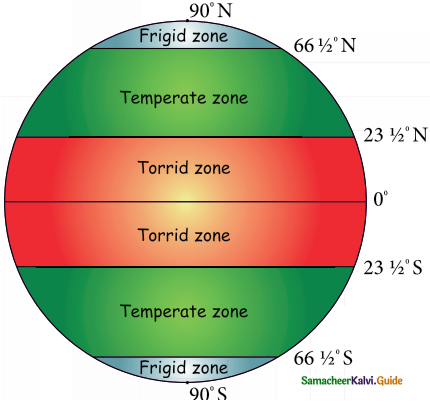
Draw Heat Zones.
Answer:
Samacheer Kalvi 5th Social Science Guide Term 1 Chapter 3 Good Citizen 2

Samacheer Kalvi 5th Social Science Guide Term 1 Chapter 4 Atmosphere

Samacheer Kalvi 5th Social Science Guide Atmosphere Additional Questions and Answers

I. Choose the best answer.

Question 1.
The earth rotates on its axis once in
(a) 12
(b) 24
(c) 36
(d) 48
Answer:
(b) 24

Question 2.
Sunlight takes _______ minutes time to move 1°.
(a) 2
(b) 3.5
(c) 4
(d) 4.5
Answer:
(c) 4

Question 3.
The instrument used to measure the speed of the wind is
(a) Airmeter
(b) Thermometer
(c) Anemometer
(d) windmeter
Answer:
(c) Anemometer

Samacheer Kalvi 5th Social Science Guide Term 1 Chapter 4 Atmosphere

II. Fill in the blanks.

Question 1.
__________ is the great circle at the centre of the earth.
Answer:
Equators

Question 2.
The 0° longitude is called ________ meridian.
Answer:
prime

Question 3.
The highest mountain in the world is __________ .
Answer:
Himalayas

Question 4.
__________ is the highest peak in the world.
Answer:
Mount Everest

Question 5.
__________ is the highest peak in the Nilgiri ranges.
Answer:
Doddabetta

Question 6.
The instrument used to measure the direction of wind is __________ .
Answer:
wind vane

Question 7.
__________ energy is a form of renewable energy.
Answer:
Wind

Samacheer Kalvi 5th Social Science Guide Term 1 Chapter 4 Atmosphere

Question 8.
A generator can convert mechanical energy into __________ .
Answer:
electricity

Question 9.
The word monsoon is derived from the Arabic term.
Answer:
‘Mausim’

Question 10.
__________ blows from sea to land during the evening.
Answer:
Sea breeze

Question 11.
__________ blows from land to sea in the morning.
Answer:
Land breeze

III. Match the Following:

I.
Samacheer Kalvi 5th Social Science Guide Term 1 Chapter 3 Good Citizen 3
Samacheer Kalvi 5th Social Science Guide Term 1 Chapter 3 Good Citizen 4
Answer:

  1. (c)
  2. (d)
  3. (b)
  4. (a)

Samacheer Kalvi 5th Social Science Guide Term 1 Chapter 4 Atmosphere

II.
Samacheer Kalvi 5th Social Science Guide Term 1 Chapter 3 Good Citizen 5
Answer:

  1. (e)
  2. (d)
  3. (a)
  4. (b)
  5. (c)

IV. True/ False.

Question 1.
Wind turbines converts the kinetic energy into electricity energy. T/F
Answer:
Flase

Question 2.
Local wind affects the weather. T/F
Answer:
True

Question 3.
Cumulus clouds are associated with rainfall lightning and thunder. T/F
Answer:
True

Question 4.
Condensation of the wind causes rain fall. T/F
Answer:
True

Question 5.
The warm air from the hot area is heated and moves downwards. T/F
Answer:
False

Samacheer Kalvi 5th Social Science Guide Term 1 Chapter 4 Atmosphere

V. Write short note:

Question 1.
What is Biosphere?
Answer:
Biosphere is the combination of lithosphere, hydrosphere and atmosphere.

Question 2.
What is atmosphere?
Answer:
Atmosphere is the envelope of air around the Earth.

Question 3.
What are the types of heat zones?
Answer:
Frigid zone, Temperate zone, Torrid zone.

Question 4.
What is wind?
Answer:
The air which moves horizontally from high pressure to low pressure area is called wind.

Question 5.
What are the types of local wind?
Answer:

  • Warm local wind – North West India
  • Cool local wind – North East India

Samacheer Kalvi 5th Social Science Guide Term 1 Chapter 4 Atmosphere

Question 6.
Explain about cyclone.
Answer:
Hurricane/cyclone changes its position and direction with time to time. The speed of winds also changes with time. It gives very heavy rainfall.

Question 7.
Explain Convectional Rain fall.
Answer:
During summer solar insolation takes place in land. Water evaporates from lakes, ponds and vegetations. Due to this a heavy rainfall with lightning and thunder occurs in the evening for a short period.

VI. Answer in detail:

Question 1.
Explain Loo wind.
Answer:
The ‘Loo’ is a strong, dusty, gusty, hot and dry summer wind from the west which blows over of North Western India. It is especially strong in the months of May and June. Due to it very high temperature, exposure to it often leads to fatal heatstrokes.

Question 2.
Explain the types of clouds.
Answer:
The clouds are composed of water vapour in the air. The clouds are divided into four categories on the basis of appearance and height. They are

  1. Cirrus cloud
  2. Stratus cloud
  3. Cumulus cloud
  4. Nimbus cloud

1. Cirrus cloud: These clouds appears like a silver grey fish at a very high altitude in the sky. These may not give rain.

2. Stratus cloud: They are grey in colour and are spreadout. They may give small shower.

3. Cumulus cloud: It looks like a burst cotton and gives convectional rainfall. These clouds are associated with rainfall lightning and thunder.

4. Nimbus cloud: It appears as dark or grey in color. It gives heavy rainfall. It is called vertical or rain clouds.

Samacheer Kalvi 5th Social Science Guide Term 1 Chapter 4 Atmosphere

Question 3.
Write about ‘weather factory’.
Answer:
When the clouds of positive and negative (+, -) charge hit each other, lightning and thunder are produced. Light travels faster than sound, therefore thunder follows lightning. When all the characteristics together activate at same time it is called weather factory.

Samacheer Kalvi 4th English Guide Book Answers Solutions

Subject Matter Experts at SamacheerKalvi.Guide have created Tamil Nadu State Board Samacheer Kalvi 4th English Book Answers Solutions Guide Pdf Free Download are part of Samacheer Kalvi 4th Books Solutions.

Let us look at these TN State Board New Syllabus Samacheer Kalvi 4th Std English Guide Pdf of Text Book Back Questions and Answers Term 1, 2, 3, Chapter Wise Important Questions, Study Material, Question Bank, Notes, and revise our understanding of the subject.

Samacheer Kalvi 4th English Book Solutions Guide Pdf Free Download

Tamilnadu State Board Samacheer Kalvi 4th English Book Back Answers Solutions Guide Term 1, 2, 3.

Samacheer Kalvi 4th English Book Back Answers

Samacheer Kalvi 4th English Book Solutions Term 1

Samacheer Kalvi 4th English Prose

Samacheer Kalvi 4th English Poem

Samacheer Kalvi 4th English Supplementary

Samacheer Kalvi 4th English Book Solutions Term 2

Samacheer Kalvi 4th English Prose

Samacheer Kalvi 4th English Poem

Samacheer Kalvi 4th English Supplementary

Samacheer Kalvi 4th English Book Solutions Term 3

Samacheer Kalvi 4th English Prose

Samacheer Kalvi 4th English Poem

Samacheer Kalvi 4th English Supplementary

We hope these Tamilnadu State Board Samacheer Kalvi Class 4th English Book Solutions Answers Guide Pdf Free Download will help you get through your subjective questions in the exam.

Let us know if you have any concerns regarding TN State Board New Syllabus Samacheer Kalvi 4th Standard English Guide Pdf of Text Book Back Questions and Answers, Chapter Wise Important Questions, Study Material, Question Bank, Notes, drop a comment below and we will get back to you as soon as possible.

Samacheer Kalvi 5th Social Science Guide Term 1 Chapter 2 Towards History

Tamilnadu State Board New Syllabus Samacheer Kalvi 5th Social Science Guide Pdf Term 1 Chapter 2 Towards History Text Book Back Questions and Answers, Notes.

Tamilnadu Samacheer Kalvi 5th Social Science Solutions Term 1 Chapter 2 Towards History

Samacheer Kalvi 5th Social Science Guide Towards History Text Book Back Questions and Answers

Evaluation

I. Choose the best Answer:

Question 1.
Palaeolithic humans,
(a) Wore cotton clothes
(b) Wore woolen clothes.
(c) Wore leaves and skin of animals
Answer:
(c) Wore leaves and skin of animals

Samacheer Kalvi 5th Social Science Guide Term 1 Chapter 2 Towards History

Question 2.
________ was the first pet animal of man.
(a) Cow
(b) Horse
(c) Dog
Answer:
(c) Dog

Question 3.
What was the first metal discovered by early human?
(a) Iron
(b) Copper
(c) Gold
Answer:
(b) Copper

II. Fill in the blanks.

Question 1.
Early man lived in ________.
Answer:
caves and holes of big tree

Samacheer Kalvi 5th Social Science Guide Term 1 Chapter 2 Towards History

Question 2.
The Stone Age is the period in which Stones were used as________ .
Answer:
weapons

Question 3.
________ was used to produce fire.
Answer:
Scratching two stones

Question 4.
________ is the first scientific invention of man.
Answer:
Stone wheels

Question 5.
At the end of New Stone Age, ________ was invented.
Answer:
copper

Samacheer Kalvi 5th Social Science Guide Term 1 Chapter 2 Towards History

III. Answer the following.

Question 1.
What is Stone Age?
Answer:
Stone age is a period in which stones were used as weapons.

Question 2.
Write a short note on Nomadic Life.
Answer:

  • Early humans did not know to grow crops.
  • They wandered in all the landscapes in search of food.
  • They ate whatever they got and drank water from natural sources.
  • This kind of life was called nomadic life.

Question 3.
Define Neolithic age.
Answer:
Man used bones, horns, stones, skin, branches of trees and sticks as their tools and weapons. This stage of development in history was called New stone age or Neolithic age.

Question 4.
Write a short note on Pottery.
Answer:

  • Pottery was also one of the greatest inventions by humans.
  • The baked pot was strong and looked beautiful.
  • Stone Age people made all the household artefacts by themselves.

Samacheer Kalvi 5th Social Science Guide Term 1 Chapter 2 Towards History

Question 5.
Name some Archaeological sites in Tamil Nadu.
Answer:
In Tamilnadu, Athichanallur, Arikkamedu and Keeladi.

IV. Answer in detail:

Question 1.
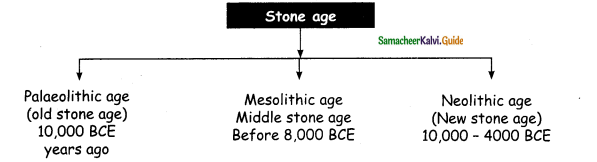
How can we classify the Stone Age?
Answer:
Samacheer Kalvi 5th Social Science Guide Term 1 Chapter 2 Towards History-1

Question 2.
Write about Chalcolithic Age and Iron Age.
Answer:

  • Chalcolithic Age – At the end of new Stone Age copper was invented. In this age both stone and copper were used. This period was called Chalcolithic Age.
  • Iron Age – After Chalcolithic Age, humans discovered iron and started using iron tools and weapons. This age was called Iron Age. In this age household articles and agricultural tools were made up of iron.

Samacheer Kalvi 5th Social Science Guide Term 1 Chapter 2 Towards History

InText Activity

Question 1.
What were the food eaten by early humans?
Answer:
Flesh of animals, green leaves, roots and grains.

Question 2.
Why did early humans live in caves?
Answer:
To Protect themselves from wild animals and weather.

Question 3.
Why did they eat raw flesh?
Answer:
They did not know the use of fire.

Samacheer Kalvi 5th Social Science Guide Term 1 Chapter 2 Towards History

Samacheer Kalvi 5th Social Science Guide 2 Towards History  Additional Question and Answers

I. Choose the best answer:

Question 1.
Humans tamed ___________ as their pet at first.
(a) dog
(b) cow
(c) fox
(d) elephant
Answer:
(a) do

Question 2.
Palaeolithic age is in _________ years ago.
(a) 10,000 BCE
(b) 8,000 BCE
(c) 100 BCE
(d) 4,000 BCE
Answer:
(a) 10,000

Question 3.
Mesolithic age is known as ________ .
(a) Old stone age
(b) Middle stone age
(c) New stone age
(d) None of these
Answer:
(b) Middle stone age

Samacheer Kalvi 5th Social Science Guide Term 1 Chapter 2 Towards History

Question 4.
Civilisations started around ________ years ago.
(a) 200
(b) 300
(c) 400
(d) 500
Answer:
(b) 30

II. Fill in the blanks.

Question 1.
Early humans used the ________ tools to protect themselves.
Answer:
stone

Question 2.
________ stone is used for making tools and weapons.
Answer:
Quartzite

Samacheer Kalvi 5th Social Science Guide Term 1 Chapter 2 Towards History

Question 3.
________ stone was used to produce fire.
Ans :
Flint

Question 4.
Study of coins is called ________
Answer:
Numismatics

Question 5.
________ people used bones, horns, stones, skin, branches of trees.
Answer:
Neolithic age

Question 6.
________ was the greatest inventions by humans.
Answer:
Pottery

Samacheer Kalvi 5th Social Science Guide Term 1 Chapter 2 Towards History

Question 7.
The period which has written documents are called ________ period.
Answer:
Historical

III. Answer the following:

Question 1.
What are the uses of fire?
Answer:

  1. To protect themselves from animals.
  2. To find the path at night.
  3. To protect themselves from winter.

Question 2.
What is the help of historical period document?
Answer:
Historical period documents help us to know about the life styles of the people, events, food habits, culture, art, architecture, literature etc.,

Question 3.
What is stone wheels?
Answer:
When the stones rolled down the mountains they acquired round shape. Humans observed them and thus wheel was invented. In the beginning it was made of stone and later by wood. This was the first scientific invention.

Question 4.
What is Numismatics?
Answer:
study of coins is called Numismatics. All types of coins right from metals to paper help to learn about the kings, and economic conditions of that period.

Samacheer Kalvi 5th Social Science Guide Term 1 Chapter 2 Towards History

Question 5.
What is inscription?
Answer:
Scripts inscribed about a king’s rule, people or society on rocks and walls are called inscriptions, usually they are found on temple walls.

Question 6.
Classify Palaeolithic and Neolithic tools.
Answer:
Palaeolithic tools – Tools made of Quartzite stone.
Neolithic age tools – Tools made of bones, horns, skin, branches of trees and sticks.

Question 7.
What are the sources that help us to learn history?
Answer:
All the evidences or traces like, artifacts, pots, coins, idols, ornaments, weapons written documents etc, are valuable sources to construct history.

Question 8.
What is a museum?
Answer:
Museum is a place where objects which are rare and used by our ancestors are preserved. These give information about the lives of people.

Samacheer Kalvi 5th Social Science Guide Term 1 Chapter 2 Towards History

Question 9.
Why were paintings drawn on rocks?
Answer:

  • Paintings could have been drawn or rocks to convey their lifestyles to the future generations.
  • They might have wished to record their activities through their paintings.

Samacheer Kalvi 5th Social Science Guide Term 1 Chapter 1 Our Earth

Tamilnadu State Board New Syllabus Samacheer Kalvi 5th Social Science Guide Pdf Term 1 Chapter 1 Our Earth Text Book Back Questions and Answers, Notes.

Tamilnadu Samacheer Kalvi 5th Social Science Solutions Term 1 Chapter 1 Our Earth

Samacheer Kalvi 5th Social Science Guide Our Earth Text Book Back Questions and Answers

Evaluation

I. Fill in the blanks.

Question 1.
The distance between the earth and the sun is _________ .
Answer:
Nearly 150 Million Km

Samacheer Kalvi 5th Social Science Guide Term 1 Chapter 1 Our Earth

Question 2.
_________ are caused due to revolution of the Earth.
Answer:
Seasons

Question 3.
The continent _________ is covered by ice
Answer:
Antarctica

Question 4.
The biggest continent is _________ .
Answer :
Asia

Question 5.
_________ is described as Red Planet.
Answer:
Mars

Samacheer Kalvi 5th Social Science Guide Term 1 Chapter 1 Our Earth

Question 6.
_________ Percentage of our earth is covered by salt water.
Answer :
71 %

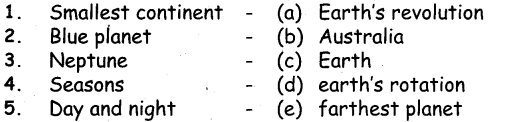
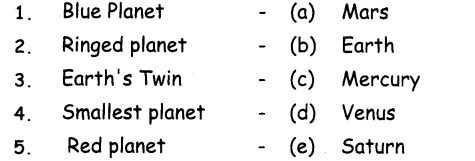
II. Match the Following

Samacheer Kalvi 5th Social Science Guide Term 1 Chapter 1 Our Earth 1
Answer:

  1. (b)
  2. (c)
  3. (e)
  4. (a)
  5. (d)

III. Short Question and Answers:

Question 1.
What do you know about Universe?
Answer:

  • The Universe is a vast expansion of space.
  • The Universe consists of billions of galaxies, stars, planets, dwarf planets, comets, asteroids, meteoroids and natural satellites.
  • The exact size of the universe is still unknown. Scientists believe that the universe is still expanding outward.

Samacheer Kalvi 5th Social Science Guide Term 1 Chapter 1 Our Earth

Question 2.
Define solar system.
Answer:
Solar system consists of the sun, the planets, stars, their moons, dwarf planets, asteroids and comets. These objects are gravitationally bound.

Question 3.
How did the Earth form?
Answer:

  • Approximately 4.54 billion years ago, Solar System was a cloud of dust and gas known as Solar Nebula.
  • Due to an explosion, these particles collapsed and began to spin having the sun at centre.
  • The bigger particles which revolve around the sun are called planets. Thus the planet Earth formed.

Question 4.
Distinguish between Rotation and Revolution.
Answer:

                    RotationRevolution
The earth rotates on its own axis.The movement of the earth around the sun.
It causes day and night.It causes seasons.
The earth completes one rotation in 24 hours.The earth completes one revolution in 365 ¼ days

Question 5.
How many oceans are there in the earth?
Answer:
There are 5 oceans in the Earth.

  1. Pacific Ocean
  2. Atlantic Ocean
  3. Indian Ocean
  4. Arctic Ocean
  5. Southern Ocean

IV. Paragraph:

Question 1.
Write about the solar system.
Answer:

  • There are 8 planets in our solar system.
  • The outer planets are Gaseous planets.
  • They are Jupiter, Saturn, Uranus and Neptune.
  • The inner – rocky planets are Mercury, Venus, Earth and Mars.
  • They are called Terrestrial Planets.
  • The frozen planets are Uranus and Neptune

Samacheer Kalvi 5th Social Science Guide Term 1 Chapter 1 Our Earth

Question 2.
Write about the Planet Earth in detail.
Answer:

  • Our Earth is called the Blue Planet.
  • It is made up of 7 Continents and 5 Oceans.
  • We live on the surface of the Earth.
  • Around 71% of our Earth is covered by salt water called Oceans.
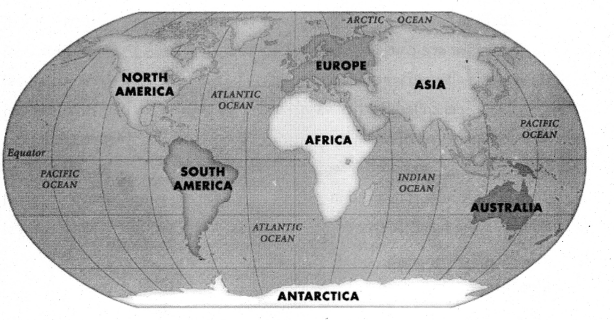
  • Asia is the largest continent and Australia is the smallest continent.

Question 3.
Explain about the continents.
Answer:

  • Earth is made up of 7 continents and 5 oceans.
  • The continents are Asia, Africa, North America, South America, Antarctica, Europe and Australia.
  • The biggest continent is Asia continent, and the smallest one is Australia.
  • Antarctica is a snow covered landmass.

Samacheer Kalvi 5th Social Science Guide Our Earth Additional Questions and Answers

I. Fill in the blanks.

Question 1.
The Earth is the ______________ planet from the sun.
Answer :
Third

Question 2.
day and night are caused due to the earth’s ________
Answer:
rotation

Question 3.
Universe is also referred to us ________.
Answer:
cosmos

Question 4.
___________ is called Earth’s twin.
Answer :
Venus

Question 5.
The continent full of snow is ________.
Answer:
Antarctica

Question 6.
Only percent of water is fresh in earth.
Answer :
2.5

Question 7.
Birlo Planetarium is located in __________ .
Answer:
Chennai

Samacheer Kalvi 5th Social Science Guide Term 1 Chapter 1 Our Earth

Question 8.
Galaxy is the huge cluster of __________ .
Answer:
stars

II. Match the following:

Samacheer Kalvi 5th Social Science Guide Term 1 Chapter 1 Our Earth 2
Answer :

  1. (b)
  2. (e)
  3. (d)
  4. (c)
  5. (a)

III. Short Question and Answers:

Question 1.
What is the galaxy?
Answer:
Galaxy has a huge cluster of stars. Our galaxy ‘Milky way is one of the countless billions of galaxies in the Universe.

Question 2.
How many continents are there in the earth?
Answer:
Asia, Africa, North America, South America, Antarctica, Europe,
and Australia.

Question 3.
Which are the biggest and smallest continents in our earth?
Answer:
The biggest continent is Asia and the smallest continent is Australia.

IV. Answer in Paragraph:

Question 1.
Why is Mars called the red planet?
Answer:
Mars is the fourth planet from the sun and the second smallest planet in the solar system, after Mercury. It is named after the Roman God of war. It appears red in colour due to the presence of iron oxide on its surface. So, it is often described as the Red planet.

Samacheer Kalvi 5th Social Science Guide Term 1 Chapter 1 Our Earth

V. Map work:

Question 1.
On a world map mark the five oceans and Continents of the Earth.
Answer:
Samacheer Kalvi 5th Social Science Guide Term 1 Chapter 1 Our Earth - 3

Question 2.
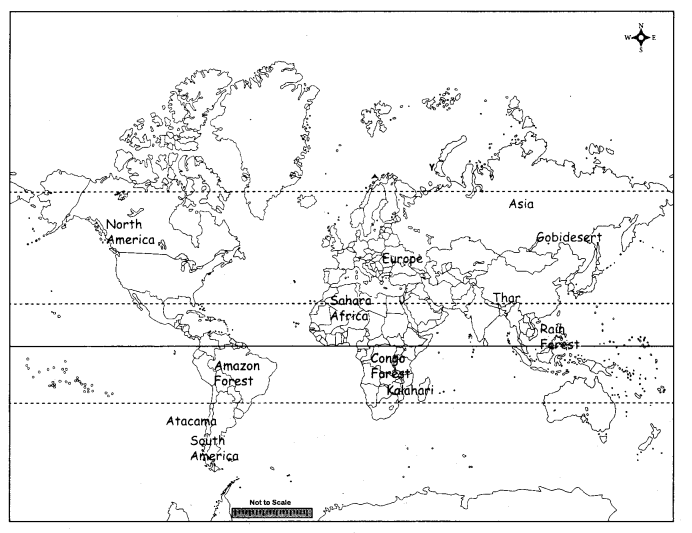
On a world map mark the deserts and forests.
Answer :
Samacheer Kalvi 5th Social Science Guide Term 1 Chapter 1 Our Earth - 4

Samacheer Kalvi 9th Social Science Guide Economics Chapter 5 Migration

Tamilnadu State Board New Syllabus Samacheer Kalvi 9th Social Science Guide Pdf History Chapter 5 Migration Text Book Back Questions and Answers, Important Questions Notes.

Tamilnadu Samacheer Kalvi 9th Social Science Solutions Economics Chapter 5 Migration

Samacheer Kalvi 9th Social Science Migration Text Book Back Questions and Answers

I. Choose the correct Answer

Question 1.
According to the 2011 census, the total population of India was
(a) 121 crore
(b) 221 crore
(c) 102 crore
(d) 100 crore
Answer:
(a) 121 crore

Samacheer Kalvi 9th Social Science Guide Economics Chapter 5 Migration

Question 2.
_______ has recorded the maximum number of emigrants.
(a) Ramanathapuram
(b) Coimbatore
(c) Chennai
(d) vellore
Answer:
(c) Chennai

Question3.
during 2015,______of illiterates were migrants from Tamil Nadu.
(a) 7%
(b) 175%
(c) 23%
(d) 9%
Answer :
(a) 7%

Question4.
The poorer sections of the population migrate__________
(a) as a survival strategy
(b) to improve their living standards
(c) as a service
(d) to get experience
Answer:
(a) survival strategy

II. Fill in the blanks

  1. Migration is enumerated on_______and_____bases.
  2. The mobility of population in rural areas is ______than urban areas.
  3. In rural india ,as per census 2011,________percent of the population are counted as migrants.
  4. ______ is the major reason for female migration.
  5. Any migrant stream would consist of______ sub streams.

Answer:

  1. place of birth,place of residence
  2. greater
  3. 37
  4. marriage
  5. heterogeneous

III. Match the following

  1. Migration policy – (a) Work
  2. Female migrants – (b) low incidence of out migration
  3. Chennai – (c) maximum number of emigration
  4. Better off migrants – (d) marriage
  5. Salem – (e) to reduce the volume of migration
  6. Male migrants – (f) to improve the living standard

Answer:

  1. – (e)
  2. – (d)
  3. – (c)
  4. – (f)
  5. – (b)
  6. – (a)

IV.Give short answers

Question 1.
Enlist the reasons for migration.
Answer:
The reasons for migration include; Work/Employment, Business, Education, Marriage, and other such reasons.

Samacheer Kalvi 9th Social Science Guide Economics Chapter 5 Migration

Question 2.
What are the major factors responsible for female migrants in India?
Answer:

  1. Among female migrants, 70 % in India and 51 % in Tamil Nadu report marriage as their reason for migration, in 2011.
  2. Marriage and the movement associated with marriage appear to be a major factor responsible for women’s mobility in India and in Tamil Nadu

Question 3.
Name four districts in Tamil Nadu which record a low number of migration.
Answer:
Cuddalore, Karur, Thiruvannamalai, Vellore, Namakkal, Salem, Dindigul, Krishnagiri, Nilgiris and Dharmapuri districts record low number of emigrants.

Question 4.
What are the factors responsible for the poorer sections and better-off sections to migrate?
Answer:

  1. Poorer sections of the population people migrate as a survival strategy.
  2. Migrants from better-off sections move to their living standards.

Samacheer Kalvi 9th Social Science Guide Economics Chapter 5 Migration

Question 5.
List the four destinations and the percentage of migrants from Tamil Nadu.
Answer:
Of the total migrants who go to foreign countries, nearly 20% have chosen to go to Singapore, while 18% to the United Arab Emirates, 16% to Saudi Arabia, 13 % to the United States of America.

Question6.
What does the study reveal about the occupation undertaken by migrants?
Answer:

  1. The study clearly reveals a whole range of occupations undertaken by migrants.
  2. Highly skilled occupation on the one hand and low skilled occupations on the other with a large number of semi-skilled occupations in between.

V. Answer in detail

Question.1
State the aims of migration policies.
Answer:
Policies to address the problem of migration in developing countries like India essentially aim at the following:
To reduce the volume of migration: As a large part of the migration is a reflection of poverty
and insecurity faced by large sections of the rural people, the focus of intervention has to be in rural areas. Rural development policies to reduce poverty and insecurity would be essential to reduce the rate of migration.

To redirect the migrant streams: Redirection of migrant streams, away from big metropolitan cities is a desirable policy option. This policy can help in reducing spatial inequalities by suitable strategies, such as developing a more dispersed pattern of urbanisation.

Question.2
Discuss the patterns of migration.
Answer:

  1. The pattern of migration is very complex, comprising of number of streams.
  2. Rural to rural; rural to urban; urban to rural; urban to urban.
  3. Short, medium and long distance migration streams.
  4. Long-term stable migration and short-term circulatory type of movements.
  5. Each of these streams would consist of different types of migrants (from different social classes), each with its own reason for migration.
  6. The extent and nature of these rhigrant streams would essentially depend on.
    • Pressures and aspirations experienced hy people at the origin of migration.
    • Constraints imposed on mobility at the origin of migration.
    • Opportunities at the destination and
    • The cost of migration.

Question 3.
Elucidate about some of the interesting findings of migration in Tamil Nadu.
Answer:
In Tamil Nadu, two out of every five persons is reported to be a migrant in the year 2011. Incidence of migrants is higher in rural areas and larger among women. Tamil Nadu has a history of migration and people have moved for various reasons such as trade, business, employment etc, to various countries. During the colonial period, labourers had moved to other colonies seeking work and wages.

In the more recent period workers from Tamil Nadu have been moving to countries in the Gulf, the United States of America and Australia. In 2015, an independent research study was conducted to understand the level, nature and pattern of migration in Tamil Nadu. This study has made some interesting findings, as discussed below:

  • Of the total migrants in Tamil Nadu, 65 percent have migrated or moved abroad while 35 percent have moved within the country.
  • Chennai district has recorded the maximum number of emigrants followed by Coimbatore, Ramanathapuram and Tiruchirapalli districts.
    Cuddalore, Karur, Thiruvannamalai, Vellore, Namakkal, Salem, Dindigul, Krishnagiri, Nilgirfs and Dharmapuri districts record low number of emigrants. This study also provides information about the sex and destination of migrants Tamil Nadu.
  • Of the total migrants who go to foreign countries, nearly 20% have chosen to go to Singapore, while 18% to the United Arab Emirates, 16% to Saudi Arabia, 13 % to the United States of America; and Malaysia, Kuwait, Oman, Qatar, Australia and England are also refered as important destinations for migrants from Tamil Nadu in the year 2015.
  • Of the international migrants, 15 percent are women, while 85 percent are men.

Samacheer Kalvi 9th Social Science Guide Economics Chapter 5 Migration

Question 4.
Analyse the educational qualification of migrants from Tamil Nadu in 2015.
Answer:
On the question of educational qualifications of migrants from Tamil Nadu, the study reveals that in 2015 about 7 % were illiterates; 30 % have completed schooling ie. class 10; 10 % have completed class 12; 15 % had undergone some vocational training; 11 % were graduates; 12% were professionally qualified and 11 % had post graduate degrees.

VI. Write the correct statement.

Question 1.
In recent times workers from Tamil Nadu are moving to Africa.
Answer:
In the more recent period workers from Tamil Nadu have been moving to countries in the Gulf, United States of America and Australia.

Samacheer Kalvi 9th Social Science Guide Economics Chapter 5 Migration

Question 2.
In Tamil Nadu, the extent of migration is much higher in urban areas compared to rural areas.
Answer:
In Tamil Nadu, the extent of migration is much higher in rural are as compared to urban areas.

Question 3.
Any migrant stream would consist of homogenous sub-streams.
Answer:
Any migrant stream would consist of heterogenous-sub streams.

Question 4.
Two out of even, 10 persons are reported to be a migrant.
Answer:
Two out of every five persons are reported to be a migrant.

Samacheer Kalvi 9th Social Science Migration Additional Important Questions and Answers

I. Choose the correct Answer

Question 1.
In Tamil Nadu, migrants account for percent in rural areas.
(a) 38
(b) 41
(c) 28
(d) 50
Answer:
(b) 41

Samacheer Kalvi 9th Social Science Guide Economics Chapter 5 Migration

Question 2.
The driving force among men to migration is _________
(a) work
(b) employment
(c) tourism
(d) both a and b
Answer:
(d) both a and b

Question 3.
_________ Of the international migrants percent are women.
(a) 85
(b) 25
(c) 15
(d) 20
Answer:
(c) 15

Question 4.
Pick out the odd man _________
(a) Australia
(b) the USA
(c) Gulf countries
(d) Uganda
Answer:
(d) Uganda

II. Fill in the blanks.

  1. During the colonial period, labourers had moved to other colonies seeking ______
  2. Coimbatore has recored ______the number of emigrants next to Chennai.
  3. _____is the difference in social status, wealth or opportunity between people or groups.
  4. The process of moving from one place to another is known as ______
  5. Change in populating occurs due to births, deaths and ______

Answer:

  1. work and wages
  2. maximum
  3. Inequality
  4. migration
  5. migration

III. Match the following

  1. Place of birth – (i) Paul Harris Daniel
  2. Red Tea – (ii) Heterogeneous
  3. Migration – (iii) Destination
  4. Migrant stream – (iv) Lifetime migrant
  5. Kuwait – (v) trade

Answer:

  1.  – (iv)
  2. – (i)
  3. – (v)
  4. – (ii)
  5. – (iii)

IV.Give short answers

Question 1.
Mention the percentage of migrants in India as well as in Tamil Nadu.
Answer:

  1. The percentage of migrants was 37 percent in the country.
  2. It was at a much higher rate in Tamil Nadu at 43 percent.

Samacheer Kalvi 9th Social Science Guide Economics Chapter 5 Migration

Question 2.
How to determine the extent and nature of migration?
Answer:

  1. The extent and nature of migration in any society is basically determined by the nature of the development process experienced by that society.
  2. That is, the type and scale of development achieved by the agricultural and industrial sectors in an economy would determine the migratory patterns.

Question.3
What do the extent and nature of the migrant streams depend?
Answer:
The extent and nature of these migrant streams would essentially depend on:

  1. Pressures and aspirations experienced by people at the origin of migration.
  2. Constraints imposed on mobility at the origin of migration.
  3. Opportunities at the destination and availability of information regarding these opportunities.
  4. The cost of migration.

V.Answer in detail

Question 1.
Explain the concept of migration.
Answer:

  1. In any settlement-village or town change in population occurs due to birth, death and migration.
  2. Of these three components of population change, birth and death is clearly identifiable events while migration poses the maximum amount of problem with regards to its definition and measurement.
  3. As almost everyone keeps moving most of the time, it is not easy to define which of these moves have to be classified as migratory moves.
  4. In the Census of India, migration is enumerated on two bases – Place of birth and Place of residence.

Samacheer Kalvi 9th Social Science Guide Economics Chapter 5 Migration

Question 2.
Write a short note on “Red Tea”.
Answer:

  1. “Red Tea” is a very well known novel written by Paul Harris Daniel.
  2. The novel portraits the slavery life of plantation workers in Valparai.
  3. This novel depicts the blood-stained history of the workers that is hidden behind the green cover of the hills.
  4. This novel has been translated in Tamil by R. Murugavel in the name “Eriyum Panikkaadu” (6TifliL|LD usfilaafi
  5. The story starts with Karupan migrating to the hills with his wife in search of survival.
  6. The narrator of this story is Dr. Daniel, who comes there to treat the plantation employees.

VI. Write the correct statement

Question 1.
One usually associates mobility with female rather than male.
Answer:
One usually associate mobility with male rather than female.

Question 2.
Of the total migrants in Tamil Nadu, 65 percent have migrated toward rural areas.
Answer:
Of the total migrants in Tamil Nadu, 65 percent have migrated or moved abroad.

Samacheer Kalvi 9th Social Science Guide Economics Chapter 5 Migration

Question 3.
Work is the major factor responsible for female migrants in India.
Answer:
Work is the major factor responsible for male migrants in India.

Question 4.
Of the international migrants, 15 percent are men while 85 percent are women.
Answer:
Of the international migrants, 15 percent are women while 85 percent are men.

Samacheer Kalvi 8th English Guide Prose Chapter 2 Hobby Turns into A Successful Career

Tamilnadu State Board New Syllabus Samacheer Kalvi 8th English Guide Pdf Prose Chapter 2 Hobby Turns into A Successful Career Text Book Back Questions and Answers, Summary, Notes.

Tamilnadu Samacheer Kalvi 8th English Solutions Prose Chapter 2 Hobby Turns into A Successful Career

8th English Guide Hobby Turns into A Successful Career Text Book Back Questions and Answers

WARM-UP (Text Book Page No. 35)

Look at the picture. Discuss in pairs and share your answers with you friends.

1. What is the girl doing?
Samacheer Kalvi 8th English Guide Prose Chapter 2 Hobby – Turns A Successful Career 1
Answer:
The girl is painting a picture.

2. What is the man doing? Will you like to do it? Why?
Samacheer Kalvi 8th English Guide Prose Chapter 2 Hobby – Turns A Successful Career 4
Answer:
The man is cooking. I don’t like doing it because I don’t want my finger cut.

3. Do you like gardening? Why?
Samacheer Kalvi 8th English Guide Prose Chapter 2 Hobby – Turns A Successful Career 3
Answer:
Yes, I like gardening, because it is a hobby first. The garden gives us fresh vegetables, flowers so gardening is both beneficial and a pastime.

4. What are the benefits of taking up cycling as a hobby?
Samacheer Kalvi 8th English Guide Prose Chapter 2 Hobby – Turns A Successful Career 2
Answer:
Cycling is truly a hobby. This is one of the best exercises both for our body and heart. It increases stamina.

8th English Guide Hobby Turns into A Successful Career Text Book Back Questions and Answers

Section – I

Read and Understand (Text Book Page No. 37)

A. Say true or false:

1. Mani’s hobby is playing cricket.
Answer:
False

2. Hobbies are unique to people.
Answer:
True

3. People have hobbies only to pass the time
Answer:
False

B. Choose the correct answer:

1. Mani imagined a world with
a) music and musicians
b) building and sculptures
c) magic and magicians.
Answer:
c) magic and magicians

Samacheer Kalvi 9th English Guide Prose Chapter 2 I Can’t Climb Trees Anymore

2. When Mani started writing things, he was unable to
a) describe them accurately
b) describe them fluently
c) describe them imaginatively
Answer:
a) describe them accurately

3. Mani feels writing is like
a) painting the voice
b) engraving the voice
c) designing the voice
Answer:
a) painting the voice

Section – II

Read and Understand (Text Book Page No – 39)

A. Say true or false.

1. Ajay Garg is an artist.
Answer: True

2. Asha Devi taught Ajay the miniature painting.
Answer: True

3. Ajay displayed 150 paintings.
Answer: True

Samacheer Kalvi 9th English Guide Prose Chapter 2 I Can’t Climb Trees Anymore

4. Ajay was awarded by the Indian president Dr. A.P.J. Abdul Kalam.
Answer: True

B. Answer the following questions:

1. What was Ajay gifted with?
Answer:
Ajay was gifted with the skill of painting.

2. How was he honored?
Answer:
He was honored and awarded a national award of accomplishment from the Indian President Dr. A.P.J Abdul Kalam, in 2004.

3. What is Ajay’s current goal?
Answer:
Ajay’s current goal was to re-energies the dying art of traditional Miniature Indian paintings.

4. Is Aj ay’s hobby become a successful career? How?
Answer:
Yes, because he turned his hobby into a successful career.

Section – III

Read and Understand (Text Book Page No.41)

A. Fill in the blanks:

1. Mani’s grandfather noticed it and helped him by reading ………………..
Answer:
bedtime stories

2. Ajay mastered the techniques of ……………….
Answer:
Preparing colours and brushes

Samacheer Kalvi 9th English Guide Prose Chapter 2 I Can’t Climb Trees Anymore

3. Ilavazhagi won her first match against ……………..
Answer:
her father

B. Choose correct synonyms for the italic word.

1. Writing is a unique hobby
a) common
b) beneficial
c) uncommon
d) separate
Answer:
d) separate

2. Ajay started to paint happily.
a) depressed
b) joyfully
c) unhappily
d) sadly
Answer:
b) joyfully

3. Miniature paintings depict Indian culture.
a) warp
b) portray
c) twist
d) falsify
Answer:
b) portray

C. Choose correct antonyms for the italic word.

1. Ajay suffered an injury.
a) sorrow
b) endure
c) hurt
d) mourn
Answer:
b) endure

2. Ajay mastered the techniques of painting.
a) skilled
b) proficient
c) unskilled
d) experienced
Answer:
c) unskilled

3. Ilavazhagi won the world championship in
a) win
b) succeed
c) defeat
d) well-skilled
Answer:
c) defeat

D. Answer the following questions in one or two sentences.

1. What happened to Ajay at the age of three?
Answer:
Ajay suffered an injury at the age of three. He was treated, but that treatment left him permanently deaf.

Samacheer Kalvi 9th English Guide Prose Chapter 2 I Can’t Climb Trees Anymore

2. What did Asha Devi teach Ajay?
Answer:
She taught him the old and dying technique of “Traditional Indian Miniature Painting”.

3. Why writing is beneficial according to Mani?
Answer:
According to Mani, writing opens his mind to think beyond the little things with a broader mind. It makes him more passionate about his life, and learn new things.

E. Answer the following question in 100 words.

1. How did Ajay’s father find his son’s talent?
Answer:
Ajay Kumar Garg is a skilled young artist, lives in Jaipur, India. At the age of three, he suffered an injury in his ears. He had taken many treatments, but they were ineffective and left him permanently deaf. One day his father had bought him a paint set to play. Ajay started to play joyfully. He used to paint on the walls, and floors, etc. Whenever he .used the paint set he remained happy in his life. It was noticed by his father, and soon he realised that he was talented in painting.

2. Write a note on Illavalaghi:
Answer:
Ilavazhagi was one among the many to achieve their dream amidst all odds. Her father was a district-level champion in carom. He used to put her on the Carom board to listen to the sound of strikers and coins. Her father took her to the local clubs frequently. When Ilavazhagi won her first match against her father, she gained confidence. This confidence led her to win the Asia Cup, SAARC Cup, and the world championship. She won a lot of trophies. She won the 2008 Indian National Carom Championship and became a world champion in the women’s singles. Her passion for Carom made her succeed in life.

Vocabulary (Text Book Page No. 42)

Singular and Plural.
Write the plural form of the given words:

Samacheer Kalvi 8th English Guide Prose Chapter 2 Hobby – Turns A Successful Career 5

SingularPlural
foodfood
radiusradii
governor-generalgovernors-general
syllabussyllabi
datumData
commander-in-chiefcommanders-in-chief
thesistheses
forumfora
cattlecattle
geniusgenii

 COMPOUND WORDS (Text Book Page No. 44)
A. Match the following compound words and write them:
Samacheer Kalvi 8th English Guide Prose Chapter 2 Hobby – Turns A Successful Career 6

First wordSecond wordNew word
matchmarkmatchbox
aircutairport
bloodportblood bank
Popgumpopcorn
skybanksky blue
hairbluehair cut
bookcombook mark
sewingboxsewing gum

B. Choose the best answer to make a compound word:
1. Which can be placed after ‘soft’?
a) play
b) ware
c) run
d) cycle
Answer:
b) ware

2. Which can be placed before ’light’?
a) try
b) sun
c) horse
d) cat
Answer:
b) sun

Samacheer Kalvi 9th English Guide Prose Chapter 2 I Can’t Climb Trees Anymore

3. Which can be placed after ‘safe’?
a) chair
b) guard
c) shop
d) van
Answer:
b) guard

4. Which can be placed after ‘blue’?
a) cane
b) print
c) see
d) land
Answer:
b) print

5. Which can be placed after ‘water’?
a) food
b) stick
c) fall
d) out
Answer:
c) fall

Listening (Text Book Page No. 44)

Questions on passage and answers.
Note: The listening passage is given on page no. 226
1. What is philately?
Answer:
Stamp collecting hobby is known as philately.

2. What is Numismatics?
Answer:
The hobby of collecting coins from different countries is called Numisonatics.

3. Do you know where the rarest and the most beautiful shells are found?
Answer:
The rarest and the most beautiful shells are found in the Indo-Pacific, Caribbean, and Mediterranean regions.

4. Painting can help unleash your creative side. How?
Answer:
Painting relaxes our mind and helps us focus better.

5. What is your friend’s hobby? How does it differ from yours? Discuss and write.
Answer:
My friend’s hobby is web-browsing. It is different from my hobby of gardening. His hobby is an amazing hobby. We can learn about things that are thousands of kilometers away with just a few clicks. We can also share all the wonderful information with our friends.

SPEAKING (Book Page No. 45)

Naveen: Hi Ajay! How are you?
Ajay: I am Fine, and what about you?
Naveen: I am fine too. What are you doing in this early morning?
Ajay: I am taking care of my garden. The garden is running to weeds.
Naveen: oh! What a beautiful garden it is!
Ajay: It is beautiful as I work every day in it.
Naveen: Who helps you in your work?
Ajay: I have done this. It is my and who I have cultivated vegetable hobby.
Naveen: Oh! that’s nice. How long have you been doing this?
Ajay: I have been doing this for …….
Naveen : ……………………………………………………………………………………….
Ajaj : ………………………………………………………………………………………..
Naveen : ……………………………………………………………………………………….
Ajaj : ……………………………………………………………………………………….
Naveen : ……………………………………………………………………………………….
Answer:
Naveen: Hi Ajay! How are you?
Ajay: I am Fine, and what about you?
Naveen: I am fine too. What are you doing in this early morning?
Ajay: I am taking care of my garden. The garden is running to weeds.
Naveen: oh! What a beautiful garden it is!
Ajay: It is beautiful as I work every day in it.
Naveen: Who helps you in your work?
Ajay: I have done this. It is my and who I have cultivated vegetable hobby.
Naveen: Oh! that’s nice. How long have you been doing this?
Ajay: I have been doing this for three years.
Naveen: Who gave you the idea of gardening?
Ajay: I had it out of my own interest.
Naveen: I also want to do something useful to spend my spare time.
Ajay: You can also do gardening because it will give you enjoyment as well as a lot of benefits, such as getting fresh vegetables and flowers.
Naveen : If you help me, I will start it from tomorrow onwards.

WRITING (Text Book Page No. 48)
Develop the following hints:
1. Tortoise – hare – forest – Tortoise walking- seen by a hare- hare laughs – tortoise speed – Tortoise sad – bet – race – Tortoise moving- slow speed – Hare moves – fast – sleeps- tortoise – reaches winning point – first – Wins the bet.

HARD WORK NEVER FAILS
Once there lived a tortoise and a hare in the forest. One day the hare saw the tortoise walking slowly. The hare laughed at the tortoise is speed. The tortoise felt very sad. One day they agreed to bet a race between them. The tortoise moved slowly but the hare moved as fast. When the hare saw the tortoise was coming slowly, it started to sleep. Meanwhile, the tortoise reached the winning point first and won the match.

2. Akbar – Birbal – courtiers jealous of Birbal – ask Akbar – test Birbal wiseness – Courtier puts a question – How many crows in Agra – Birbal asks for a week – everyday sitting on the terrace – looking at the crows- after a week – courtier asks – Birbal says 156757 crows – asks the courtier to check- Akbar laughs.

BIRBAL THE WISE
Akbar and Birbal were good friends. The courtiers were jealous of Birbal. They asked the king Akbar to test his wiseness. The courtiers put a question to Birbal that how many crows were in Agra. Birbal asked them for a week to say the answer. Every day he looked at the crows by on the terrace. After a week the courtiers asked him to say the answer. Birbal said that there were 56757 crows in. Agra. He asked them to check it. Akbar laughed at it.

Samacheer Kalvi 9th English Guide Prose Chapter 2 I Can’t Climb Trees Anymore

3. A woodcutter – cutting wood – dropped his ax in the pond – started weeping – an angel appeared – asked what the matter was – brought a golden axe – from the pond – woodcutter did not accept – brought a silver axe – not accepted – brought an iron axe – accepted – pleased with the honesty – offered all the axes to him.

PERSISTENCE WILL SUCCEED
A woodcutter lived in a village. One day he was cutting the wood near to the pond. He dropped his ax into the pond unexpectedly. He started weeping. An angel appeared before him suddenly and asked him what the matter was. The angel brought a golden ax from the bond but he refused to accept it. Again the angel brought a silver axe but he did not accept it. When the angel brought an iron axe he did accept it immediately. The angel was pleased with his honesty and offered him all the axes.

ADJECTIVES (Text Book Page No. 47)

a. Fill in the blanks:
Samacheer Kalvi 8th English Guide Prose Chapter 2 Hobby – Turns A Successful Career 7

PositiveComparativeSuperlative
talltallertallest
smartsmartersmartest
largelargerlargest
bigbiggerbiggest
latelater / latterlattest

Let’s compare two things:
1. Which is faster a train or a plane?
A plane is faster than a train.
2. Which is cheaper gold or silver?
Silver is cheaper than gold.
3. Which is larger, city or village?
City is larger than village.
4. Which is bigger, a sea or an ocean?
An ocean is bigger than the sea.
5. Which is taller, a giraffe or a camel?
A giraffe is taller than a camel.

Let’s compare three things:
1. Town – city – village (quiet)
Village is quiet.
The town is quieter than city Village is the quietest.

2. Istanbul – Moscow – London (populated)
London is populated country.
Moscow is more populated than London. Istanbul is the most populated country.

3. Windy weather – warm weather – rainy weather (good)
Windy weather is good.
Warm weather is better than windy weather.
Rainy weather is the best.

Samacheer Kalvi 9th English Guide Prose Chapter 2 I Can’t Climb Trees Anymore

4. Ocean – river – lake (deep)
River is deep.
Lake is deeper than river Ocean is the deepest.

5. The USA – Russia – Spain (large)
Spain is large country.
Russia is larger than in Spain.
The USA is the largest country.

6. The Mahanadi – The Cauvery – The Ganga (long)
The Mahanadi is a long river.
The Cauvery is longer than the Mahanadi.
Ganga is the longest river.

7. Chennai – Hyderabad – Bengaluru (modern)
Bengaluru is a modem city.
Hyderabad is more modem than Bengaluru.
Chennai is the most modem city.

8. Giraffe – Horse – goat (tall)
Goat is a tall animal.
Horse is a taller than Goat.
Giraffee is the tallest animal.

9. Elephant – Cat – Dog (strong)
Cat is a strong animal.
Dog is stronger than Cat.
Elephant is the strongest animal.

10. Maharastra – Tamilnadu – Rajasthan (hot)
Maharastra is a hot state.
Tamilnadu is a hotter state than Maharastra.
Rajasthan is the hottest state.

Hobby Turns into A Successful Career Summary in English

Mani, is guided by his grandfather to have reading as his habit. Hobbies are activities of spare time. Reading habit made Mani, a writer. Mani is happy to be writer. It gives him pleasant new experiences and new ideas. Writing is his passion. Writing makes him feel like a free bird.

Hobby Turns into A Successful Career Summary in Tamil

மணி என்ற பையன் தன் தாத்தாவின் அறிவுரையை ஏற்று வாசித்தலை தன் பொழுதுபோக்காக ஆக்கிக் கொள்கிறான். வாசிப்பு பழக்கம் மணியை எழுத்தாளர் ஆக்கியது. எழுத்தாளர் தொழில் மகிழ்ச்சி தருவதாகவும், இனிய புதிய கருத்துக்களையும் அனுபவங்களையும் தருவதாய் மணி சொல்கிறார். எழுதுதல் தனக்கு உயிர் போன்றது என்றும் எழுதுதல் தனக்கு பறவை போன்ற சுதந்தித்தை தருவதாகவும் மணி கூறுகிறார்.
Glossary Text Book Page No. 79

WORDSMEANINGS
uniquedistinctive / uncommon
exhausttire out
energizesgive energy
passionateintense/ heartfelt
accuratelyexactly
fictionimaginative writing
spareextra

Synonyms

WORDSMEANINGS
difficulttough/hard
pourspill
immerseplunge / absorb
imaginationcreativity
beneficialuseful
describeexplain

 Antonyms

WORDSANTONYMS
difficultXeasy
startedXended
enjoyedXworried
uniqueXcommon
beneficialXuseless
broaderXnarrower
differentXsame, similar

Glossary (Text Book Page No – 81)

WORDSMEANINGS
impairment (n)disability
miniature (adj)very small of its kind
accomplished (adj)full-filled
magnifying (adj)enhance
exhibited (v)show or reveal
revitalise (v)re – energise

Synonyms

WORDSSYNONYMS
talentedskilled
sufferedhurted / injured
cureheal
giftedtalented
impressedinspired
apprenticetrainee / beginner
masteredlearned/acquired
gainedwon
accomplishmentachievement

  Antonyms

WORDSANTONYMS
talentedXunskilled
sufferedXpleased
permanentlyXtemporarily
miniatureXbig /large
depictXhide / cover
traditionalXmodern

Glossary (Text Book Page No.83)

WORDSMEANINGS
accommodates (n)sufficient space for
trophies (n)a decorative cup was given as a token of victory
shattered (v)break, damage, or destroyed

Synonyms

WORDSSYNONYMS
chasepursue / follow
shatteredbroken
determinedbad / persistent
achieveaccomplish
victoriessuccess
wonsucceeded
participatedtook part

Antonyms

WORDSANTONYMS
passionateXreluctant
chaseXabandon
shattered                –                ‘Xchiseled
determinedXweak
confidenceXdiffidence
enoughXshortage
suitableXunfit


Samacheer Kalvi 9th Social Science Guide Economics Chapter 4 Tamilnadu Agriculture

Tamilnadu State Board New Syllabus Samacheer Kalvi 9th Social Science Guide Pdf Economics Chapter 4 Tamilnadu Agriculture Text Book Back Questions and Answers, Important Questions Notes.

Tamilnadu Samacheer Kalvi 9th Social Science Solutions Economics Chapter 4 Tamilnadu Agriculture

Samacheer Kalvi 9th Social Science Tamilnadu Agriculture Text Book Back Questions and Answers

I. Choose the correct answer

Question 1.
Irrigated land surface out of cultivable land is __________
(a) 27%
(b) 57%
(c) 28%
(d) 49%
Answer:
(b) 57%

Samacheer Kalvi 9th Social Science Guide Economics Chapter 4 Tamilnadu Agriculture

Question 2.
Out of the following which is not a food crop _________
a) Bajra
b) Ragi
c) Maize
(d) Coconut
Answer:
(d) Coconut

Question 3.
The productivity of paddy during the year 2014-2015
(a) 3,039 kg
(b) 4,429 kg
(c) 2,775 kg
(d) 3,519 kg
Answer:
(b) 4,429 kg

Question 4.
Both agricultural productivity and food productivity has ________
(a) decreased
(b) not stable
(c) remained stable
(d) increased
Answer:
(d) increased

Samacheer Kalvi 9th Social Science Guide Economics Chapter 4 Tamilnadu Agriculture

Question 5.
The North-East monsoon period in Tamil Nadu
(a) August – October
(b) September – November
(c) October – December
(d) November – January
Answer:
(c) October-December

II. Fill in the blanks

  1. The major occupation of people in Tamil Nadu is _________
  2. Tamil Nadu receives rainfall all from the _________monsoon.
  3. The total geographical area of Tamil Nadu is _________hectares.

Answer:

  1. Agriculture
  2. North-East
  3. one crore 30 lakh and 33 thousand

III. Match the following

  1. Non food crops – (i) 79,38,000
  2. Dhal – (ii) less than hectare of cultivable land
  3. North east monsoon – (iii) October – December
  4. Small farmers – (iv) Urad Dal, Toor Dal, Green grams
  5. No. of farmers in 2015 – 2016 – (v) Coconut, Channa

Answer:

  1.  – (v)
  2. – (iv)
  3. – (iii)
  4. – (ii)
  5. – (i)

IV. Give short answers

Question 1.
Give two examples for each food crop and non-food crops.
Answer:
Example for food crops: Paddy, Maize Example for non-food crops: Coconut, Cotton.

Samacheer Kalvi 9th Social Science Guide Economics Chapter 4 Tamilnadu Agriculture

Question 2.
What are the factors responsible for the changes in the cropping area?
Answer:
The size of the land, quality of the land, amount of rainfall received, reliable water source all contribute to a change in the cropping area.

Question 3.
Who monitors the quantity and quality of groundwater?
Answer:
The Union Ground Water Board is constantly monitoring the level and nature of groundwater. This continuous monitoring has categorized the Panchayat Union (blocks) in terms of the amount of groundwater used. 139 blocks in Tamilnadu are identified as excessive users of groundwater and 100 blocks as nearing the stage of excessive usage of groundwater. 11 blocks have been identified with reduced water quality. Only 136 blocks have enough quantity and quality water for usage.

Question 4.
On what factors does crop cultivation depend. List out the factors on which the crop cultivation depend.
Answer:
The crop cultivation depends on the amount of land being cultivated, the productivity of crops, source of water weather, rainfall etc.

Question 5.
Differentiate between small and marginal farmers.
Answer:

  1. Marginal farmers cultivate is an area of less than one hectare.
  2. Small farmers cultivate 1 – 2 hectares of land.
  3. In Tamil Nadu, the number of marginal farmers is decreasing.

V. Answer in detail

Question 1.
Give a note on the water resources of Tamil Nadu.
Answer:
Northeast monsoon (Oct-Dec) is a major source of water for Tamil Nadu. The Northeast monsoon rains are stored in reservoirs, lakes, ponds, and wells for cultivation. Conventional water bodies like lakes, ponds and canals provide water for agriculture in Tamil Nadu. 2,239 canals run through Tamil Nadu covering a length of 9,750 km. There are 7,985 small lakes, 33,142 large lakes, 15 lakh open wells and there are 3,54,000 borewells in the state where agriculture is carried out with the help of these water resources.

The area of land that is irrigated using water from lakes is very low. Nearly 3.68 lakh hectares of land obtain water from lakes. The canals provide water to 6.68 lakh hectares. Borewells irrigate 4.93 lakh hectares and open wells provide water to 1L91 lakh hectares of land.

Samacheer Kalvi 9th Social Science Guide Economics Chapter 4 Tamilnadu Agriculture

Question 2.
What are the problems faced by using groundwater for agriculture?
Answer:

  1. Tamil Nadu agriculture is dependent on groundwater.
  2. The use of groundwater for agriculture creates many hardships too.
  3. There would be no suffering if the amount of water taken from the underground and the amount of water that goes into the underground during the rainy season are equal.
  4. On the contrary, as the amount of water taken increases, the groundwater will go down resulting in complete dryness or change to unusable water.
  5. The Union Water Board is constantly monitoring the level and nature of groundwater.
  6. This continuous monitoring has categorized the Panchayat Union (Blocks) in terms of the amount of groundwater used.
  7. 139 Blocks are identified as excessive users of groundwater and 100 Blocks identified as nearing the stage of excessive usage of groundwater.
  8. blocks have been identified with reduced water quality. Only 136 blocks have enough quantity and quality of water for usage.
  9. From this, we clearly understand that Tamil Nadu agriculture is dependent on groundwater. It is very urgent and necessary to regulate the usage of underground water. This is very important for fertile farming.

Question 3.
Discuss the source of irrigation for agriculture.
Answer:
There are no perennial rivers in Tamil Nadu. Tamil Nadu receives the required water from the Northeast and Southwest monsoons. When the southwest monsoon rains are high in the catchment areas of the Cauvery River in Karnataka dams get filled and in turn, the Cauvery river in Tamil Nadu gets water.

Northeast monsoon (Oct-Dec) is a major source of water for Tamil Nadu. The Northeast monsoon rains are’ stored in reservoirs, lakes, ponds, and wells for cultivation. Conventional water bodies like lakes, ponds, and canals provide water for agriculture in Tamil Nadu. 2,239 canals run through Tamil Nadu covering a length of 9,750 km. There are 7,985 small lakes, 33,142 large lakes, 15 lakh open wells and there are 3,54,000 borewells in the state where agriculture is carried out with the help of these water resources.

The area of land that is irrigated using water from lakes is very low. Nearly 3.68 lakh hectares of land obtain water from lakes. The canals provide water to 6.68 lakh hectares. Borewells irrigate 4.93 lakh hectares and open wells provide water to 11.91 lakh hectares of land.

Samacheer Kalvi 9th Social Science Tamilnadu Agriculture Additional Important Questions and Answers

I. Choose the correct answer

Question 1.
Cholam cultivation takes place in TamilNadu is __________
(a) 7% land area
(b) 1% land area
(c) 12% land area
(d) 9% land area
Answer:
(a) 7% land area

Samacheer Kalvi 9th Social Science Guide Economics Chapter 4 Tamilnadu Agriculture

Question 2.
Krishi Karman award in related to __________
(a) cotton textile
(b) industrial growth
(c) food grain production
(d) educational growth
Answer:
(c) food grain production

Question 3.
Manila (groundnut) is grown in percent if the cultivated land.
(a) 6
(b) 3
(c) 10
(d) 12
Answer:
(a) 6

Question 4.
The third largest river in India __________
(a) Cauvery
(b) Godavari
(c) Krishna
(d) Mahanadhi
Answer:
(a) Cauvery

Samacheer Kalvi 9th Social Science Guide Economics Chapter 4 Tamilnadu Agriculture

Question 5.
In 2011, nearly of the women were involved in agriculture __________
(a) 35%
(b) 55%
(c) 25%
(d) 45%
Answer:
(b) 55%

II. Fill the blanks

  1. Most of the cultivations in Tamil Nadu are __________farmers
  2. A major portion of the employee involved in agricultural activities are __________labourers.
  3. In India the total land area under agriculture is __________fast.
  4. If there is good water for a land, it can be cultivated more than __________in a year.
  5. Nammaalvar believed in __________the’future generation of India.

Answer:

  1. marginal
  2. Landless
  3. shrinking
  4. one crop
  5. youth

III. Match the following

  1. Mettur Dam – (i) Tony Allen
  2. Maize – (ii) Kallanai
  3. Virtual water – (iii) Vanagam farm
  4. Cauvery – (iv) Highest – storage
  5. Nammaalvar – (v) Second

Answer:

  1. – (iv)
  2. – (v)
  3. – (i)
  4. – (ii)
  5. – (iii)

Samacheer Kalvi 9th Social Science Guide Economics Chapter 4 Tamilnadu Agriculture

IV. Give short answers

Question 1.
Write a note river Cauvery.
Answer:

  1. River Cauvery is the third largest river in India. Its length is 765 km.
  2. Cauvery passes Thiruchirapalli, Tanjavur, Srirangapattinam, Kumbakonnam.
  3. The dams constructed across Cauvery in Tamil Nadu are Mettur Dam, Kallanai

Question 2.
What Is National Ayush Movement?
Answer:

  1. The National Ayush Movement scheme is implemented by the central government.
  2. Its main aim is to save and extend the life of many medicinal herbs that grow only in the forest.
  3. This scheme is carried out with 60:40 shares from the central and state governments.

Question 3.
Write a note on Krlshi Karman award to TamllNadu.
Answer:

  1. Tamil Nadu has the highest GDP in India according to 2017
  2. Tamil Nadu tops in food grain production in 2015 – 2016 Prime Minister presented the Krishi Karman award to Tamil Nadu.
  3. Mettur dam has the highest storage of water in Tamilnadu for agricultural Purpose.

Samacheer Kalvi 9th Social Science Guide Economics Chapter 4 Tamilnadu Agriculture

Question 4.
Write a note on Farmer Producer Organizations (FPOs) in TamilNadu.
Answer:

  1. Small and marginal farmers in Tamil Nadu will be benefited from FPOs.
  2. Each of the producers’ groups have been given an investment grant of ?5 lakh to purchase farm equipment.
  3. Apart from using the equipment within the group, these can also be rented out to other farmers.
  4. The government also has a contract farming policy.

V. Answer in detail

Question 1.
Write about Nammaalvari journey towards Organic farming?
Answer:

  1. When Green Revolution was spreading throughout the nation, Nammalvar started his life journey towards organic farming.
  2. He resigned his regional Agricultural Developmental Officer post for this purpose.
  3. He believed in the youth the future generation of India.
  4. Nearly 6000 youth had completed training in organic farming in his Vanagam Farm.
  5. He spent most of his days in struggles for organic farming and travels campaigning for the same.
  6. He used only public transport.
  7. He felt that this was his small role in reducing environmental pollution.

Question 2.
Explain the term Virtual water.
Answer:

  1. The term virtual water was introduced by Tony Allen in 1990.
  2. The water consumed in the production process of an agriculture or industrial product has been called the virtual water.
  3. It is a hidden flow of water when food or other commodities are traded from one place to another..
  4. For instance it takes 1340 cubic meters of water to produce one metric ton of wheat.
  5. That is, if one metric ton of wheat is exported to another country, then, it means that 1340 cubic metre of water used to cultivate this amount of wheat is also being exported.
  6. India is the largest global freshwater user.
  7. India has been the fifth largest exporter of virtual water in the world.

Samacheer Kalvi 9th Social Science Guide Economics Chapter 4 Tamilnadu Agriculture

Question 3.
Write a note on Micro Irrigation.
Answer:

  1. Micro irrigation technology is a very good remedial to tackle shortage in irrigational water.
  2. This irrigation technology helps to have a higher yield when compared to the traditional irrigational methods.
  3. As only required amount of water is supplied at regular intervals, it increases the ability of water usage and productivity of the crop resulting in reduction of labour expenses and weed growth in the field.
  4. The government has taken many measures to implement micro irrigation for proper distribution of water to crops that require more water.

Question 4.
What are Farmer Producer Organisations (FPOs)?
Answer:

  1. In April 2013, the Government of India issued a National Policy and Process Guidelines on formation of FPOs.
  2. The year 2014 was observed as the “Year of Farmer Producer Organisations” by the Government of India.
  3. Its main idea of promoting and strengthening member based institutions of farmers.
  4. It aimed at engaging the farmer companies to procure agricultural products and sell them.
  5. Supply of inputs such as seed, fertilizer and machinery, market linkages, training & networking and financial and technical advice are also among the major activities of FPO

Samacheer Kalvi 9th Social Science Guide Economics Chapter 3 Money and Credit

Tamilnadu State Board New Syllabus Samacheer Kalvi 9th Social Science Guide Pdf History Chapter 3 Money and Credit Text Book Back Questions and Answers, Important Questions Notes.

Tamilnadu Samacheer Kalvi 9th Social Science Solutions Economics Chapter 3 Money and Credit

Samacheer Kalvi 9th Social Science Money and Credit Text Book Back Questions and Answers

I. Choose the correct answer

  1. Certain metals like ______ (gold/iron) were used as a medium of exchange in ancient times.
  2. The Head Quarters of the RBI is at __________ (Chennai /Mumbai).
  3. International trade is carried on in terms of ________ (US Dollars / Pounds).
  4. The currency of Japan is ______ (Yen/Yuan)

Answer:

  1. Gold
  2. Mumbai
  3. US Dollars
  4. Yen

Samacheer Kalvi 9th Social Science Guide Economics Chapter 3 Money and Credit

II. Fill in the blanks

  1. ________ System can be considered as the first form of trade.
  2. money supply is divided into _______.
  3. The first printing press of the RBI was started at_________
  4. ________act as a regulator of the circulation of money
  5. the thesis about money by B.R. Ambedkar is _________

answer:

  1. barter
  2. four
  3. nasik
  4. reserve bank of india
  5. the probiem of the rupee – its origin and solutio

III. Match the following:

  1. US Dollar – (i) Automatic Teller Machine
  2. Currency in circulation – (ii) Substitute of money
  3. ATM – (iii) Universally accepted currency
  4. Salt – (iv) Saudi Arabia
  5. Riyal – (v) 85%

Answer:

  1. – (iii)
  2. – (v)
  3. – (i)
  4. – (ii)
  5. – (iv)

IV. Give Short Answer

Question 1.
Why was money invented?
Answer:

  1. If there were no money, we would be reduced to a barter economy.
  2. In the market, we don’t barter for individual goods.
  3. Instead, we exchange for goods (or) services for a common medium of exchange that is money.

Samacheer Kalvi 9th Social Science Guide Economics Chapter 3 Money and Credit

Question 2.
What is ancient money?
Answer:

  1. The metals can be termed as first form of currency.
  2. Gold, Silver and Copper wefe the metals used first.
  3. They were called ancient currency.

Question 3.
What were the items used as barter during olden days?
Answer:
Leather beads, shells, tobacco, salt, com, and even slaves were the items used as barter during the olden days.

Question 4.
What is spice route? Why was it called so?
Answer:

  1. Spice route was an ancient trade route followed by merchants, importers and exporters.
  2. The merchants followed spice routes of both land and sea from Malabar in India as far west as Morocco.
  3. Pepper, Spices, Pearls, Gems, Rubies and Muslin clothes were exported from the eastern sea of Tamil Nadu.
  4. Pepper and spices took a major share of the exports.
  5. Thus this route was called the spice route.

Question 5.
What is natural money?
Answer:
The metals such as silver and gold gained importance gradually all over the world. So, these metals were used as a standard value in the exchange of goods. This was called natural money.

Question 6.
Why were coins of low value printed in large quantities?
Answer:

  1. There were insufficient reserves of gold and silver.
  2. Mines also had a limited reserve of these metals.
  3. An alternative was found and coins were made using metals with lesser value.
  4. These were used to buy and sell goods of lesser value.
  5. It was used as the money of the poor people.

Samacheer Kalvi 9th Social Science Guide Economics Chapter 3 Money and Credit

Question 7.
What is meant by foreign exchange?
Answer:

  1. It is the conversion of one country’s currency into another. A country’s currency value may also be set by the country’s government.
  2. It is a system of trading in and converting the currency of one country into that of another.

V. Answer in detail

Question 1.
Explain how money is transacted in the digital world.
Answer:

  1. One has to visit the bank and fill in a challan or produce a cheque to withdraw money from his account.
  2. Now this practice is gradually vanishing.
  3. Instead, one can easily withdraw the necessary amount from an Automated Teller Machine (ATM), with the help of an ATM debit card.
  4. One can easily withdraw the money needed at any time at ATMs located everywhere.
  5. A person can deposit money in their account without visiting the branch.
  6. Similarly, credit cards are also available, through which things are bought on credit and the amount can be paid later.
  7. Now a days, instead of using cheques or Demand Drafts (DDs), online transactions through net banking are carried out.
  8. Through this, money is transacted to anyone who lives anywhere across the globe.
  9. Technology has advanced sci much that even mobile banking is widely used nowadays.

Question 2.
Explain in detail about the role of RBI in the country.
Answer:
A government has the responsibility to regulate money supply and oversee the monetary policy. Hoarding of money must be avoided at all costs in a country’s economy. Only then money can be saved in banks.

A major portion of the savings in banks are used for the development of industries, economic growth and various development schemes for the welfare of the poor.
All the major and important banks were nationalised (1969) in India. The Reserve Bank of India (RBI) regulates the circulation of currency in India.

The Reserve Bank of India started its operations on 1st April 1935. It was permanently moved to Mumbai from the year 1937. RBI was nationalised in 1949. 85% of the printed currency is let for circulation. According to the statistics available as on August 2018, currency worth of 19 lakh crore are in circulation.

Samacheer Kalvi 9th Social Science Guide Economics Chapter 3 Money and Credit

Question 3.
Write in detail about the various functions of money.
Answer:

  1. When money replaced the barter system, a lot of practical issues were solved.
  2. Money acts a medium of exchange, a unit of measurement, a store in value and a standard of deferred payments.
  3. plays an important role in transactions.
  4. Medium of Exchange – Money should be accepted liberally in exchange of goods and services in a country.
  5. Unit of Account – Money should be the common, standard unit of calculating a country’s total consumer goods, products, services etc. For example, if a book costs 50, it means that the price of the book is equal to 50 units of money. Money is used to measure and record financial transactions in a country.
  6. A Store of Value – Money is used as a store of purchasing power. It can be used to finance future payments.

VI. Write the correct statement

Question (a)

  1. The barter system flourished wherever civilizations thrived.
  2. This was the initial form of trade.

(i) 1 is correct; 2 is wrong
(ii) Both 1 and 2 are correct
(iii) Both 1 and 2 are wrong
(iv) 1 is wrong; 2 is correct
Answer:
(ii) Both 1 and 2 are correct

Question (b)

  1. Most of the international trade transactions are carried out in US dollars.
  2. No other country except the US carries out trade in the world.

(i) Both the statements are correct.
(ii) Both the statements are wrong.
(iii) 1 is correct; 2 is wrong
(iv) 1 is wrong; 2 is correct
Answer:
(iii) 1 is correct; 2 is wrong

VII. Project and Activity

Question 1.
Visit a local museum and collect information about the coins displayed there.
Answer:
Activity to be done by the students themselves

Samacheer Kalvi 9th Social Science Guide Economics Chapter 3 Money and Credit

Question 2.
Imagine you are going abroad for a Post Graduation course in architecture. Write a letter to the Branch Manager regarding an education loan.
Answer:
Date: 12th June 20xx.
From
xxxx yyyy
Chennai – 600 xxx.
To
The Branch Manager,
State Bank of India, xxx Branch,
Chennai – 600 xxx
Sir,
Sub: Request to sanction Educational Loan

I submit the following for your kind perusal.

I have completed my B.Arch. degree in Anna University. I have applied for a Post graduation course in architecture, that is, M. Arch at Kingston University in Australia. I have got the admission card also. But the cost of studies is too high. I request you to kindly sanction an educational loan for Rs.8 lakhs.

I am an account holder of your bank here. My SB Account No. is xxxx xxxx xxxxx.

I will be much obliged if you kindly consider my application and sanction the Educational Loan. Expecting your favourable reply.

Thanking you.
Yours faithfully,
[Signature]

VIII. Life Skills

Question 1.
Observe at a 20 rupee note. What is written on it?
Answer:
The following lines are written on it in Hindi and English.
Reserve Bank of India.
Guaranteed by the Central Government.
I promise to pay the bearer the sum of twenty rupees.
(Singend)
Governor

Samacheer Kalvi 9th Social Science Guide Economics Chapter 3 Money and Credit

Question 2.
Prepare a family budget for a month.
Answer:
Activity to be done by the students themselves based on the monthly income.

Intext HOTS

Question 1.
How important is foreign exchange to one’s country?
Answer:
The foreign exchange market is merely a part of the money market in the financial centres. The buyers and sellers of claim on foreign money and the intermediaries together constitute a foreign exchange market. It is not restricted to any given country or geographical area.

There is a wide variety of dealers in the foreign exchange market. Banks dealing in foreign exchange have branches with substantial balances in different countries. Through their branches and correspondents, the services of such banks, usually called “Exchange Banks,” are available all over the world.

Samacheer Kalvi 9th Social Science Money and Credit Additional Important Questions and Answers

I. Choose the correct answer

  1. Barter system involved the exchange of ______ (Goods/Money)
  2. NFC was introduced in Britain in the year ______ (2016/2008)
  3. The Chinese made coins out of ______ (Bronze/Copper)
  4. In 1999 mobile banks were used in ______ (USA/Europe)
  5. In educational loans the ______
  6. One rupee and two rupee notes were first printed in India in the year ______ (1917/1927)
  7. Security Priting and Minting Corporation of India Ltd. was started in ________(Mumbai/Dewas)

Answer:

  1. Goods
  2. 2008
  3. Bronze
  4. Europe
  5. Student
  6. 1917
  7. Dewas

Samacheer Kalvi 9th Social Science Guide Economics Chapter 3 Money and Credit

II. Fill in the blanks

  1. Exchange of goods means _____
  2. Countries bordering the Indian ocean used ______
  3. Paper money spread to Europe through the travels of __________
  4. A gold plated coin called the was introduced in Europe __________
  5. The Credit card was invented by __________
  6. In 2016 NFC got introduced in __________
  7. All the major and important banks were nationalised in India in __________
  8. There is no security required for the loan amount upto _________
  9. The relationship between money and price is connected with the policy __________
  10. Trades and small entrepreneurs need for their needs __________
  11. When the metal supply got limited 2 currency was introduced __________
  12. The medium of exchange in a country is __________

Answer:

  1. Barter System
  2. Shells
  3. Marco Polo
  4. Florin
  5. John Biggins
  6. India
  7. 1969
  8. 4 lakhs
  9. Monetary
  10. Credit
  11. Paper
  12. currency

III. Match the following

Question 1.

  1. European union – (i) Pound
  2. England – (ii) Ringgit
  3. China – (iii) Dollar
  4. Malaysia – (iv) Euro
  5. Australia – (v) Yuan

Answer:

  1. – (iv)
  2. – (i)
  3. – (v)
  4. – (ii)
  5. – (iii)

IV. Give short answers

Question 1.
What is ATM?
Answer:

  1. ATM means Automated Teller Machine, with the help of an ATM debit card.
  2. One can easily withdraw the money needed at any time at ATMs located everywhere.

Question 2.
How is the major portion of the savings in banks used?
Answer:
A major portion of the savings in banks are used for the development of industries, economic growth and various development schemes for the welfare of the poor.

Samacheer Kalvi 9th Social Science Guide Economics Chapter 3 Money and Credit

Question 3.
What phenomenon increased the importance of the market and money?
Answer:

  1. Growing crops and production are done on a commercial basis, rather than on a subsistence level.
  2. This phenomenon also increased the importance of the market and money.

Question 4.
What type of currency notes was available till 1947?
Answer:

  1. Till 1947, the currency notes with the image of King George VI were in circulation.
  2. After Independence, the Government of India issued currency notes.

Question 5.
Why do we say that money, a store of value?
Answer:

  1. Money is used as a store of purchasing power.
  2. It can be used to finance future payments.

Question 6.
What is meany by SHG?
Answer:
People who live in a particular place or those who are involved in a certain work join together as a group and start saving. These are called Self Help Groups (SHG).

V. Answer in detail

Question 1.
What are educational loans?
Answer:

  1. Educational loan attempts to meet the educational aspirations of the society.
  2. A student is the main borrower.
  3. A parent, spouse, or sibling can be the co-applicant.
  4. It is offered to students who want to pursue higher education in India or overseas.
  5. It can be taken for a full-time, part-time or vocational course, and Graduation or Post Graduation.
  6. There is no security required for the loan amount up to 4 lakhs
  7. The loan is repaid by the student generally after the employment.
  8. Students can apply through “Vidya Lakshmi Portal Education Loan Scheme”

Samacheer Kalvi 9th Social Science Guide Economics Chapter 3 Money and Credit

Question 2.
Explain the relationship between Money and Price.
Answer:

  1. The relationship between money and price is connected with the Monetary policy.
  2. There is a close relationship between the growth of money supply and inflation.
  3. Price controls play a very important role in a country’s economic stability.
  4. This role is played by RBI.
  5. Currency is the medium of exchange in a country.
  6. The Indian currency is called the Indian Rupee (INR).
  7. In a country the foreign currency is called foreign exchange.
  8. Purchasing capacity of all currencies in the world are compared using the US dollar as the standard currency.
  9. This value differs from country to country.
  10. Most of the international trade transactions are carried out in US dollar.

Question 3.
How is currency printed in India?
Answer:

  1. In 1925, the British government established a government press at Nasik in Maharashtra
  2. Currencies were printed three years later.
  3. In 1974, a press was started in Dewas, Madhya Pradesh.
  4. In the 1990’s two more presses were started in Mysuru, Karnataka, and Salboni in West Bengal to print bank notes.
  5. The Reserve Bank of India has the authority to decide the value of currency to be printed and how the amount should reach its destination safely.
  6. Though the RBI has the power to print up to ten thousand rupee notes, at present a maximum of upto rupees two thousand is printed.

Question 4.
Write a note on credit.
Answer:

  1. Farmers avail credit during monsoons for buying seeds, agricultural input and other expenses.
  2. Traders and small entrepreneurs need credit for their needs.
  3. Even large industries receive a credit to take up their new projects.
  4. Credit is available from:
    • Formal financial institutions like nationalised and private banks and co-operative banks
    • Informal financial institutions
    • Micro credit is received through Self Help Groups (SHG).
  5. As far as nationalised banks and co-operative banks are concerned the interest to credit is comparatively lesser and there is a guarantee for the pledged, goods.

Question 5.
What is an informal financial institution?
Answer:

  1. Informal financial institutions are easily approachable to customers with flexible procedures.
  2. But there are issues like the safety of items pledged high rates of interest and modes of recovery.
  3. The nationalised banks provide help to these groups through micro-credit.
  4. Credit is given through SHG for street vendors, fishermen, especially women, and the poor.
  5. In Tamil Nadu, all the banks have 10,612 branches, across the state.

Samacheer Kalvi 9th Social Science Guide Economics Chapter 3 Money and Credit

Question 6.
Why is foreign exchange important?
Answer:

  1. Without the ability to trade in different currencies, companies’ prospects would be limited.
  2. As a result, global economic growth would suffer.
  3. Investors also use the forex market.
  4. Those who seek international diversification benefits need to trade currencies to buy and sell foreign assets and securities.
  5. Foreign exchange reserve increases the confidence in the monetary and exchange rate policies of the government.
  6. Foreign exchange reserves come to the rescue of any country to absorb the distress related to such a crisis.
  7. In doing so the foreign exchange market is the mechanism that transfers purchasing power from one country to another.

VI. Write the correct statement

Question 1.
1. Mobile banking is not used.
2. Pepper and Spices took a major share of exports.
(i) Both 1 and 2 are correct
(ii) Both 1 and 2 are wrong
(iii) 1 is correct, 2 is wrong
(iv) 1 is wrong, 2 is correct
Answer:
(iv) 1 is wrong, 2 is correct

Samacheer Kalvi 9th Social Science Guide Economics Chapter 3 Money and Credit

Question 2.
1. Reserve Bank of India was permanently moved to Mumbai from 1935
2. Gold, silver and copper were called ancient money.
(i) Both 1 and 2 are correct
(ii) 1 is correct, 2 is wrong
(iii) 1 is wrong, 2 is correct
(iv) Both 1 and 2 are wrong
Answer:
(iii) 1 is wrong, 2 is correct