Samacheer Kalvi 4th Tamil Guide Chapter 24 மலையும் எதிரொலியும்

Tamilnadu State Board New Syllabus Samacheer Kalvi 4th Tamil Guide Pdf Chapter 24 மலையும் எதிரொலியும் Text Book Back Questions and Answers, Summary, Notes.

Tamilnadu Samacheer Kalvi 4th Tamil Solutions Chapter 24 மலையும் எதிரொலியும்

Samacheer Kalvi 4th Tamil Guide Chapter 24 மலையும் எதிரொலியும்

வாங்க பேசலாம்

மலைப்பகுதிக்குச் சென்றிருக்கிறீர்களா? உங்களுக்கு ஏற்பட்ட அனுபவத்தைப் பேசுக.
Answer:
நான் விடுமுறையில் என் குடும்பத்தினருடன் மலைப்பகுதிக்குச் சென்றிருக்கிறேன். கொடைக்கானலுக்குச் சென்றோம். எங்குப் பார்த்தாலும் பச்சைப் பசேல் என்று அடர்ந்த செடி கொடிகள் பார்ப்பதற்கு மிகவும் அழகாக இருந்தது. மலைகளிலிருந்து விழும் அருவி நீர் வெள்ளியைக் காய்ச்சி ஊற்றியதைப் போல உள்ளது. இயற்கை நம் மனதை மிகவும் அமைதியாக வைத்துள்ளது. மலையில் ஏறும் போது வளைந்து வளைந்து செல்வது எனக்கு மிகவும் பிடித்திருந்தது.

சிந்திக்கலாமா?

Samacheer Kalvi 4th Tamil Guide Chapter 24 மலையும் எதிரொலியும் 1

மேலே உள்ள இரண்டு படங்களிலும் நீங்கள் காண்பது என்ன? இருவரில் யாருடைய செயல் சிறந்தது?
Answer:

  • முதல் காட்சியில் நாயின் வாலைப் பிடித்து இழுக்கிறான். அது தவறானது.
  • இரண்டாவது காட்சி நாயை அன்புடன் அரவணைத்துக் கொள்கிறான். இச்செயலே சிறந்தது. பிற உயிர்களிடத்து அன்பு காட்ட வேண்டும் என்பதை உணர்த்துகிறது.

Samacheer Kalvi 4th Tamil Guide Chapter 24 மலையும் எதிரொலியும்

படிப்போம்! சிந்திப்போம்! எழுதுவோம்!

வினாக்களுக்கு விடையளிக்க

Question 1.
தந்தையும் மகனும் எங்குச் சென்று கொண்டிருந்தனர்?
Answer:
தந்தையும் மகனும் மலைப்பகுதியில் நடந்து சென்று கொண்டிருந்தனர்.

Question 2.
சிறுவன் பேசியபோது மலை என்ன செய்தது?
Answer:
“யார் நீ” என்று கேட்டது, பிறகு “உன்னை எனக்கு ரொம்பப் பிடித்திருக்கிறது” என்று கூறியது.

Samacheer Kalvi 4th Tamil Guide Chapter 24 மலையும் எதிரொலியும்

Question 3.
சிறுவன் “நான் அன்பு கொண்டவன்” என்று சொல்லியிருந்தால் மலை என்ன சொல்லி இருக்கும்?
Answer:
சிறுவன் “நான் அன்பு கொண்டவன்” என்று சொல்லிருந்தால் மலையும் “நான் அன்பு கொண்டவன்” என்று சொல்லியிருக்கும்.

Question 4.
இக்கதையின் மூலம் தந்தை மகனுக்குக் கூறிய அறிவுரை யாது?
Answer:

  • “நீ மற்றவர்களிடம் அதிகமான திறமையை எதிர்பார்த்தால் முதலில் உன்னுடைய திறமையை அதிகரித்துக் கொள்”.
  • “நாம் எதைக் கொடுக்கிறோமோ, அதையே வாழ்க்கையும் நமக்குத் திருப்பிக் கொடுக்கிறது”.
  • உன்னுடைய வாழ்க்கை எதிர்பாராமல் நடக்கும் ஒன்றன்று, அது உன்னுடைய எதிரொலிதான் என்று தந்தை மகனுக்கு அறிவுரை கூறினார்.

Samacheer Kalvi 4th Tamil Guide Chapter 24 மலையும் எதிரொலியும்

கலையும் கைவண்ணமும்

வண்ணம் தீட்டி மகிழ்வோம்
Samacheer Kalvi 4th Tamil Guide Chapter 24 மலையும் எதிரொலியும் 2
மாணவர்கள் தாங்களாகவே வண்ணம் தீட்டி மகிழ வேண்டும்.

விடுகதைக்குரிய சரியான படத்தைத் தேர்ந்தெடுப்போமா?

Question 1.
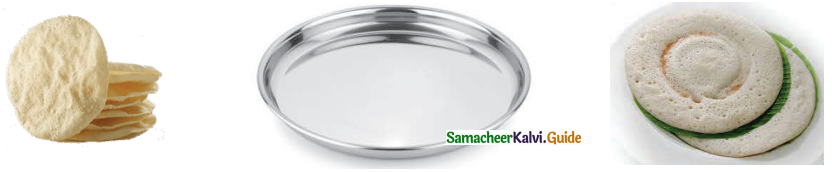
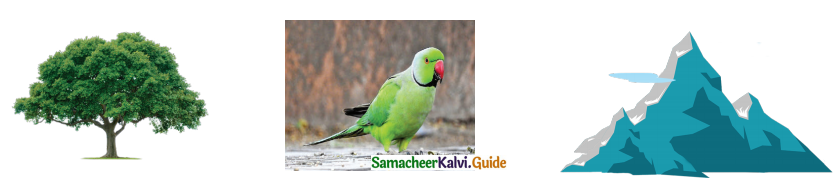
வட்டமாய் இருந்திடுவேன் உண்ணுவதற்கே என்னை வாங்குவர். ஆனால் என்னை யாரும் உண்ணுவதில்லை. நான் யார்?
Samacheer Kalvi 4th Tamil Guide Chapter 24 மலையும் எதிரொலியும் 3
Answer:
தட்டு

Samacheer Kalvi 4th Tamil Guide Chapter 24 மலையும் எதிரொலியும்

Question 2.
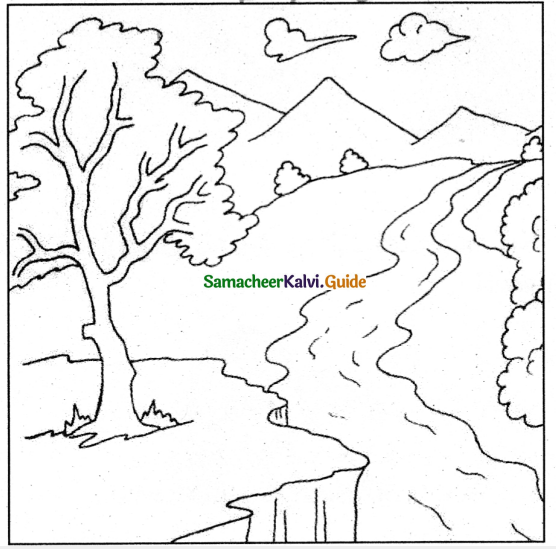
உயரமாய் இருந்திடுவேன்; பச்சை ஆடை உடுத்தியிருப்பேன்; குளிர்ச்சியான தண்ணீரைக் கொட்டுவேன். நான் யார்?
Samacheer Kalvi 4th Tamil Guide Chapter 24 மலையும் எதிரொலியும் 4
Answer:
மலை

Question 3.
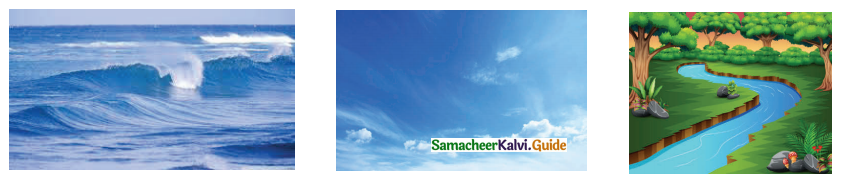
நீல நிறமாய்த் தோன்றிடுவேன். ஓயாமல் அலைந்திடுவேன். தவழ்ந்து தவழ்ந்து வந்திடுவேன். நான் யார்?
Samacheer Kalvi 4th Tamil Guide Chapter 24 மலையும் எதிரொலியும் 5
Answer:
கடல்

Samacheer Kalvi 4th Tamil Guide Chapter 24 மலையும் எதிரொலியும்

Question 4.
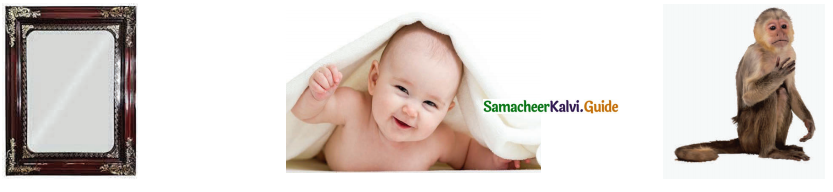
நீ பார்த்தால் நானும் பார்ப்பேன். நீ சிரித்தால் நானும் சிரிப்பேன். நீ செய்தால் நானும் செய்வேன். நான் யார்?
Answer:
Samacheer Kalvi 4th Tamil Guide Chapter 24 மலையும் எதிரொலியும் 6
விடை:
கண்ணாடி

Question 5.
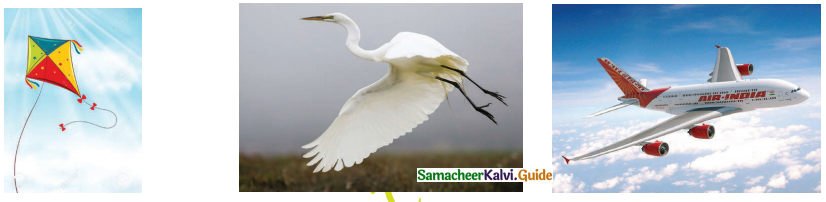
தரையிலே ஊர்ந்திடுவேன். வானத்திலே பறந்திடுவேன். கடலைத் தாண்டிடுவேன். மக்களைச் சுமந்து செல்வேன். நான் யார்?
Samacheer Kalvi 4th Tamil Guide Chapter 24 மலையும் எதிரொலியும் 7
Answer:
விமானம்

Samacheer Kalvi 4th Tamil Guide Chapter 24 மலையும் எதிரொலியும்

மொழியோடு விளையாடு

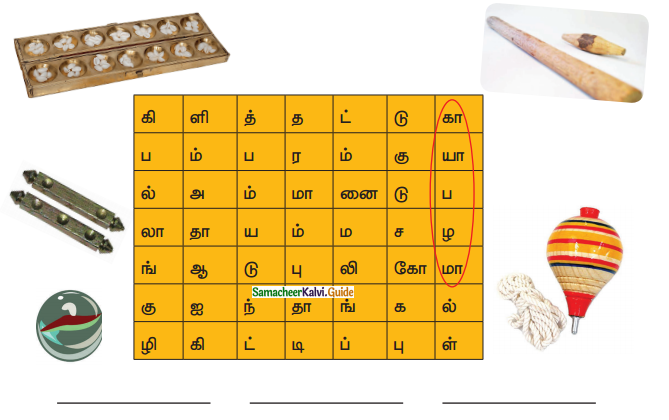
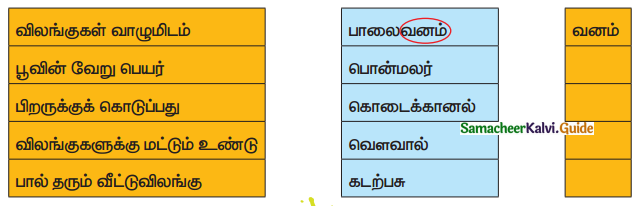
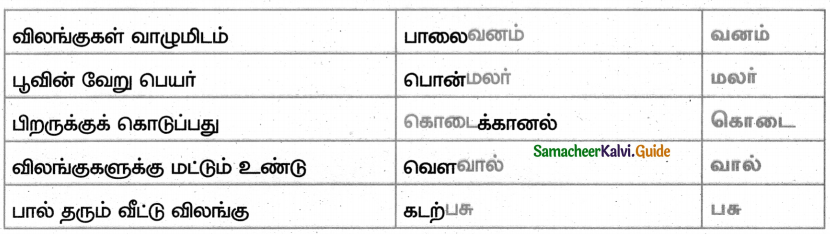
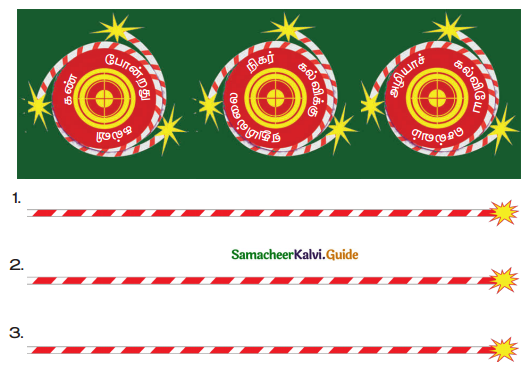
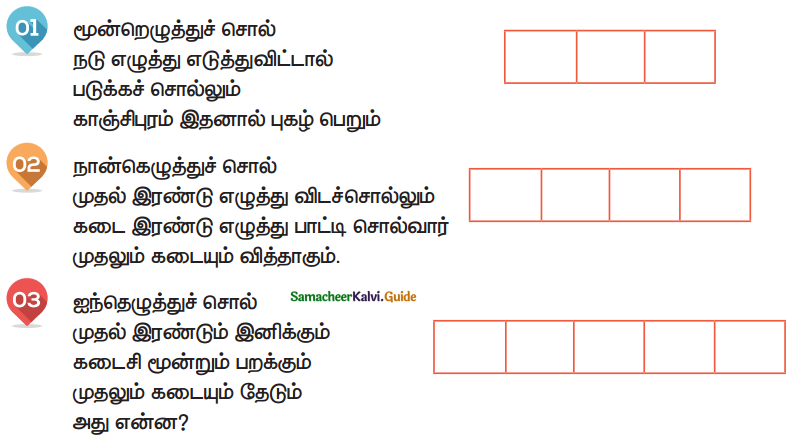
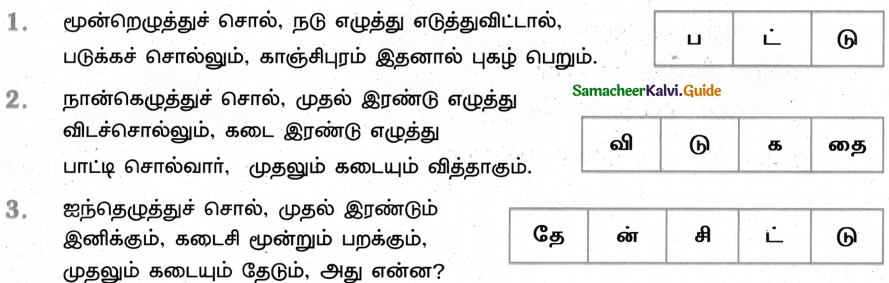
குறிப்புகளைப் படி, விடையைக் கண்டுபிடி
Samacheer Kalvi 4th Tamil Guide Chapter 24 மலையும் எதிரொலியும் 8
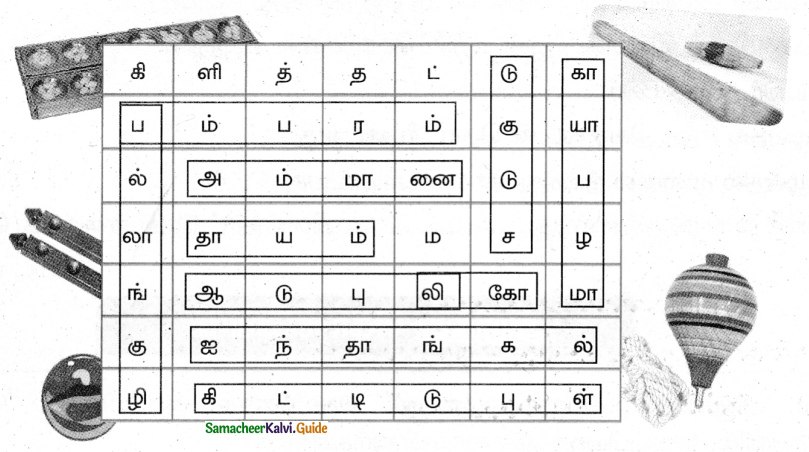
Answer:
Samacheer Kalvi 4th Tamil Guide Chapter 24 மலையும் எதிரொலியும் 9

Samacheer Kalvi 4th Tamil Guide Chapter 24 மலையும் எதிரொலியும்

அறிந்து கொள்வோம்

உலகின் மிக உயரமான சிகரம். – இமயமலையில் உள்ள எவரெஸ்ட்
தமிழ்நாட்டின் மிக உயரமான சிகரம் – ஆனைமலையிலுள்ள ஆனைமுடி

செயல் திட்டம்

உனக்குப் பிடித்த செல்லப் பிராணி எது? அதனிடம் நீ எவ்வாறு நடந்து கொள்வாய்? எழுதி வருக.
Answer:
எனக்குப் பிடித்த செல்லப் பிராணி நாய். நான் அதனிடம் அன்பாக நடந்து கொள்வேன். தினமும் காலையும் மாலையும் அதனை அழைத்துக் கொண்டு காலார நடப்பேன். மூன்று வேலையும் அதற்கான உணவைக் கொடுப்பேன். அதனிடம் பேசிக் கொண்டே இருப்பேன். மாலை நேரத்தில் கொஞ்ச நேரம் விளையாடுவேன். எங்களில் ஒருவனாக அந்த நாய்க்குட்டியைப் பார்த்துக் கொள்வேன். கட்டிப்போட மாட்டேன். சுதந்திரமாக வீடு முழுவதும் சுற்றிவரும் எங்கள் வீட்டு நாய்க்குட்டி.

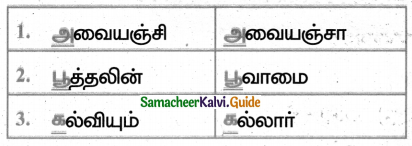
எழுவாய், பயனிலை அறிவோமா?

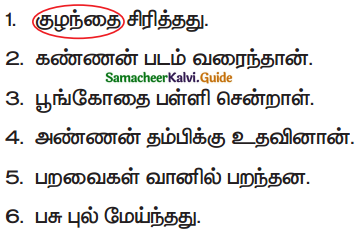
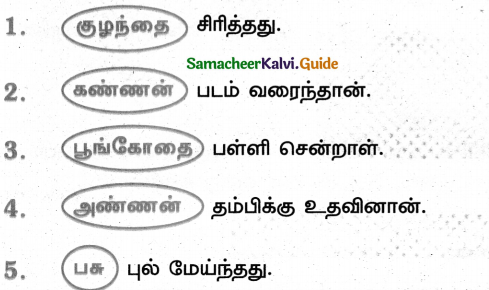
கீழ்க்காணும் தொடர்களில் எழுவாயைக் கண்டறிந்து வட்டமிடுக
Samacheer Kalvi 4th Tamil Guide Chapter 24 மலையும் எதிரொலியும் 11
Answer:
Samacheer Kalvi 4th Tamil Guide Chapter 24 மலையும் எதிரொலியும் 10

Samacheer Kalvi 4th Tamil Guide Chapter 24 மலையும் எதிரொலியும்

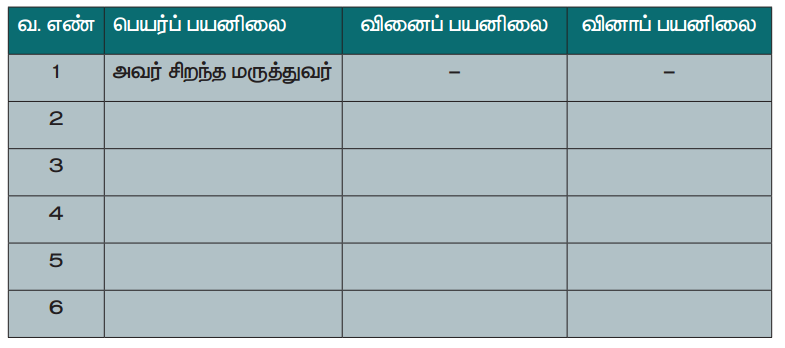
கீழ்க்காணும் தொடர்களைப் பயனிலைகளுக்கேற்றவாறு அட்டவணைப்படுத்துக.
1. அவர் சிறந்த மருத்துவர்.
2. என்னை அழைத்தவர் யார்?
3. அருளரசன் நல்ல மாணவன்
4. நேற்று அழகன் ஊருக்குச் சென்றான்.
5. முக்கனிகள் யாவை?
6. புலி உறுமியது.
Samacheer Kalvi 4th Tamil Guide Chapter 24 மலையும் எதிரொலியும் 12
Answer:
Samacheer Kalvi 4th Tamil Guide Chapter 24 மலையும் எதிரொலியும் 13

கூடுதல் வினாக்கள்

நிரப்புக :

1. தந்தையும் மகனும் ………………. பகுதியில் நடந்து சென்றனர்.
2. நம்முடைய ………………. எதிர்பாராமல் நடக்கும் ஒன்றன்று என்று தந்தை கூறினார்.
3. தந்தை மலையிடம் ………………. என்றார்.
4. தந்தை மகனிடம் ………………. வளர்த்துக் கொள்” என்றார்.
5. நாம் செய்கின்ற செயல்களே ………………. ‘விளைவிக்கின்றன.
Answer:
1. தந்தையும் மகனும் மலைப் பகுதியில் நடந்து சென்றனர்.
2. நம்முடைய வாழ்க்கை எதிர்பாராமல் நடக்கும் ஒன்றன்று என்று தந்தை கூறினார்.
3. தந்தை மலையிடம் “நீ வெற்றி வீரன்” என்றார்.
4. தந்தை மகனிடம் “திறமையை வளர்த்துக் கொள்” என்றார்.
5. நாம் செய்கின்ற செயல்களே நன்மையையும், தீமையையும் ‘விளைவிக்கின்றன.

Samacheer Kalvi 4th Tamil Guide Chapter 24 மலையும் எதிரொலியும்

வினாக்களுக்கு விடையளிக்க.

Question 1.
மகன் “ஆ ஆ ஆ!” என்று ஏன் கத்தினான்?
Answer:
தந்தையும் மகனும் மலைப்பகுதியில் நடந்து சென்று கொண்டிருந்தனர். அப்பொழுது மகன் திடீரென்று கீழே விழுந்து அடிபட்டதால், “ஆ ஆ ஆ!” என்று கத்தினான்.

Question 2.
மகன் மலையிடம் பேசியவை யாவை?
Answer:
முதலில் “யார் நீ” என்று கேட்டான்.
இரண்டாவது “உன்னை எனக்கு ரொம்பப் பிடித்திருக்கிறது” என்று கத்தினான்.
மூன்றாவது “உன்னால் நேரில் வர முடியாதா?” என்று திட்டினான்.

Samacheer Kalvi 4th Tamil Guide Chapter 24 மலையும் எதிரொலியும்

Question 3.
வாழ்க்கை பற்றி அப்பா கூறியது யாது?
Answer:
நாம் எதைக் கொடுக்கிறோமோ அதையே வாழ்க்கையும் நமக்குத் திருப்பிக் கொடுக்கிறது. நம்முடைய வாழ்க்கை எதிர்பாராமல் நடக்கும் ஒன்றன்று. அது நம்முடைய எதிரொலிதான் என்று கூறினார்.
Samacheer Kalvi 4th Social Science Guide Term 1 Chapter 2 Five Landforms

Tamilnadu State Board New Syllabus Samacheer Kalvi 4th Social Science Guide Pdf Term 1 Chapter 2 Five Landforms Text Book Back Questions and Answers, Notes.

Tamilnadu Samacheer Kalvi 4th Social Science Solutions Term 1 Chapter 2 Five Landforms

Samacheer Kalvi 4th Social Science Guide Five Landforms Text Book Back Questions and Answers

Evaluation

I. List out:

Question 1.
Write the names of the mountains and the places, where they are located in your district.
Samacheer Kalvi 4th Social Science Guide Term 1 Chapter 2 Five Landforms 1
Answer:
Samacheer Kalvi 4th Social Science Guide Term 1 Chapter 2 Five Landforms 2

Samacheer

Question 2.
Write the names of the trees around your school.
Samacheer Kalvi 4th Social Science Guide Term 1 Chapter 2 Five Landforms 3
Answer:
Samacheer Kalvi 4th Social Science Guide Term 1 Chapter 2 Five Landforms 4

II. Fill in the blanks:

Questions 1.
The vast flat land on the Earth is called ______
Answer:
plain

Question 2.
______ is the fourth oldest water diversion system for irrigation in the world.
Answer:
Kallanai

Question 3.
__________ forest is located in Kanyakumari district.
Answer:
Keeriparai Reserve

Samacheer

Question 4.
The agricultural land and the area around is called ____________ .
Answer:
Marutham

Question 5.
____________ is the biggest mangrove forest in India.
Answer:
Sundafbans

Question 6.
Marina beach is located in ____________ .
Answer:
Chennai

Samacheer

III. Match the following:

(a)
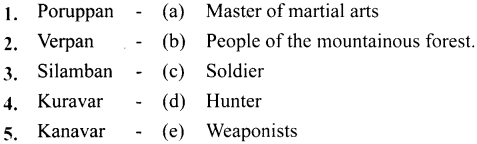
Samacheer Kalvi 4th Social Science Guide Term 1 Chapter 2 Evaluation 5
Answer:

  1. – c
  2. – a
  3. – d
  4. – e
  5. – b

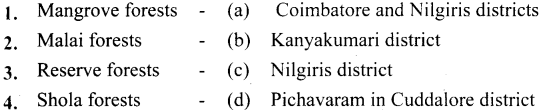
(b)
Samacheer Kalvi 4th Social Science Guide Term 1 Chapter 2 Evaluation 6
Answer:
1. – d
2. – c
3. – b
4. – a

Samacheer

Answer in short:

Question 1.
Name the people of five thinais.
Answer:

KurinjiKuravar, Kurathiyar
MullaiIdaiyar, Idaichiyar
MaruthamUzhavar, Uzaththiyar
NeithalParathavar (Fisher man)
PaalaiEyinar, Eyitriar

Question 2.
List four themes of Mullai land.
Answer:

GodThirumal
PeopleIdaiyar, Idaichiyar
OccupationCattle rearing, Gathering fruits
Plants/FlowersGuara / Mullai flower

Question 3.
What do you know about Sembulam?
Answer:
The forest region is referred as Mullai Land. This region is also called “Sembulam” due to the presence of red soil.

Question 4.
How the Palai (dry land) region is formed?
Answer:
Palai region is formed due to the drying up of Kurinji and Mullai Land.

Samacheer

Question 5.
What are the themes of Palai?
Answer:
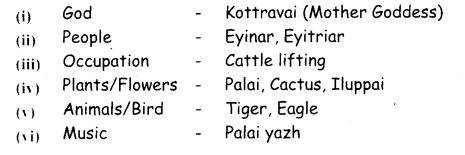
Samacheer Kalvi 4th Social Science Guide Term 1 Chapter 2 Five Landforms 7

InText Activity:

Samacheer

Activity:

Question 1.
With help of your teacher visit a nearby mountainous region and collect the herbs and know their uses.
Answer:
Activity to be done by the students themselves

Question 2.
“Trees are our friends”. Do you accept? Discuss with group.
Answer:
Activity to be done by the students themselves

Samacheer Kalvi 4th Social Science Guide Five Landforms Additional Questions and Answers

Samacheer

I. Fill in the blanks:

Question 1.
The landform of mountain is ________ .
answer:
Kurinji

Question 2.
The land of Kurinji was composed of _____ and _____soils with stones and pebbles.
Answer:
Red, Black

Question 3.
A large area covered by trees is called __________ .
Answer:
Forest

Samacheer

Question 4.
The second biggest mangrove forest in India is ________ .
Answer:
Pichavaram forest

Question 5.
The land of Marutham is formed of _____ and _____ soil.
Answer:
Alluvial, Red

Question 6.
The land of Neithal is made of ________ soil.
Answer:
Saline

Samacheer

Question 7.
__________ is the second longest beach in the world.
Answer:
Marina

Question 8.
The first longest beach is ___________ beach.
Answer:
Miyami

Question 9.
The land of palai is _________ and _________ .
Answer:
Sandy, Saline

Samacheer

II. Match the following:

(a)

Samacheer Kalvi 4th Social Science Guide Term 1 Chapter 2 Five Landforms 8
Answer:

  1. – (C)
  2. – (e)
  3. – (a)
  4. – (d)
  5. – (b)

(b)
Samacheer Kalvi 4th Social Science Guide Term 1 Chapter 2 Five Landforms 9
Answer:

  1. – (d)
  2. – (c)
  3. – (b)
  4. – (a)

Samacheer

III. Circle odd one:

Question 1.
Lord, Murugan, Bamboo, Rabbit, Kuravar
Answer:
Samacheer Kalvi 4th Social Science Guide Term 1 Chapter 2 Five Landforms 10

Question 2.
Magrove, forests, Sandy forest, Dry land
Answer:
Samacheer Kalvi 4th Social Science Guide Term 1 Chapter 2 Five Landforms 11

IV. Write True or False:

Question 1.
In Mullai land, there are fully pebbles and stones.
Answer:
True

Samacheer

V. Answer in short:

Question 1.
What is called landforms?
Answer:
The places we see on the surface of the Earth is called landforms.

Question 2.
What are the five elements of Nature?
Answer:

  1. Land
  2. Water
  3. Air
  4. Fire
  5. Sky.

Question 3.
What are the important hills in Tamil Nadu?
Answer:

  • Kolli hills
  • Shervarayan hills
  • Kalrayan hills
  • Nilgiris hills
  • Javad hills
  • yelagiri hills.

Question 4.
How many years does the Kurinji flower bloom?
Answer:
12 Years once Kurinji flower bloom.

Samacheer

Question 5.
What is Sea?
Answer:
The salty water body that covers a large part of the surface of the Earth is called sea.

Question 6.
What is dry land?
Answer:
A dry region with less or without rainfall is called a dry land.

Question 7.
Write the names of the mountains and the places, where they are located in your district
Answer:

MountainsPlaces
1. Kolli hillsNamakkal (Namakkal district)
2. Shervaroy hillsSalem, yercaud (Salem)

Samacheer

VI. Answer in detail:

Question 1.
Write about Kurinji flower.
Answer:
The miraculous Kurinji flower grows once in twelve years. The flower grows well in the Western Ghats. It flowers in the month of July to September: This flower has medicinal value.

Samacheer Kalvi 5th Science Guide Term 1 Chapter 1 Organ System

Tamilnadu State Board New Syllabus Samacheer Kalvi 5th Science Guide Pdf Term 1 Chapter 1 Organ System Text Book Back Questions and Answers, Notes.

Tamilnadu Samacheer Kalvi 5th Science Solutions Term 1 Chapter 1 Organ System

Samacheer Kalvi 5th Science Guide Organ System Text Book Back Questions and Answers

Evaluation

I. Choose the Correct Answer:

Question 1.
What is the length of the alimentary canal?
a) 3-5 m
b) 5-6 m
c) 9-11 m
d) 6-9 m
Answer:
d) 6-9 m

Question 2.
Which organ is involved in respiration?
a) Kidney
b) Lungs
c) Heart
d) Brain
Answer:
b) Lungs

Question 3.
How many kidneys do we have?
a) 2
b) 3
c) 1
d) 4
Answer:
a) 2

Samacheer Kalvi 5th Science Guide Term 1 Chapter 1 Organ System

Question 4.
Functional unit of brain is
a) Neuron
b) Nephron
c) Brain stem
d) Nerves
Answer:
a) Neuron

Question 5.
Blood is bumped by
a) Lungs
b) Heart
c) Kidneys
d) Bones
Answer:
b) Heart

Samacheer Kalvi 5th Science Guide Term 1 Chapter 1 Organ System

II. Fill in the blanks:

Question 1.
A group of organs together make up an _______ system.
Answer:
organ system

Question 2.
The process by which the body removes waste is called _______.
Answer:
Excretion

Question 3.
The number of chambers in human heart is _______.
Answer:
Four

Question 4.
The functional unit of kidney is _______.
Answer:
Nephron

Question 5.
The human nervous system is divided into _______ parts.
Answer:
Two

Samacheer Kalvi 5th Science Guide Term 1 Chapter 1 Organ System

III. Say True or False:

Question 1.
The circulatory system is made up of the heart, blood, and blood vessels.
Answer:
True

Question 2.
Important function of the heart is to transport blood with nutrients, oxygen, waste, and hormones.
Answer:
True

Question 3.
The brain is protected by the rib cage.
Answer:
False

Question 4.
The functional unit of kidney is neuron.
Answer:
False

Samacheer Kalvi 5th Science Guide Term 1 Chapter 1 Organ System

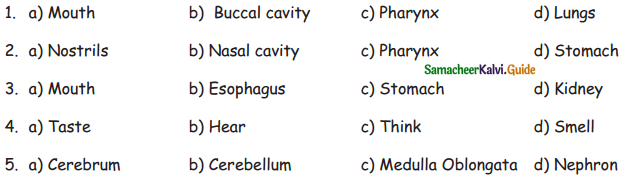
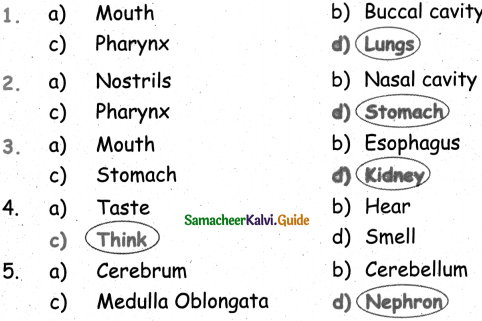
IV. Circle the odd one:

Question 1:

Samacheer Kalvi 5th Science Guide Term 1 Chapter 1 Organ System 2
Answer:
Samacheer Kalvi 5th Science Guide Term 1 Chapter 1 Organ System 1

Samacheer Kalvi 5th Science Guide Term 1 Chapter 1 Organ System

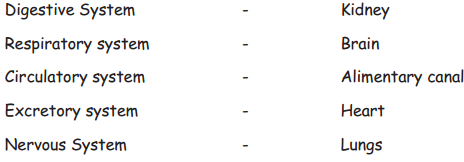
V. Match the following:

Samacheer Kalvi 5th Science Guide Term 1 Chapter 1 Organ System 3
Answer:

  1. C
  2. e
  3. d
  4. a
  5. b

Samacheer Kalvi 5th Science Guide Term 1 Chapter 1 Organ System

VI. Answer briefly:

Question 1.
Name the salivary glands in our mouth?
Answer:
The three parts of salivary glands in our mouth are parotid, sublingual and submandibular glands.

Question 2.
What is respiration?
Answer:
The process of providing oxygen to the tissues of the body and removing carbon dioxide from the tissues is called respiration.

Question 3.
What is the function of pericardial fluid?
Answer:
The space between the membranes is filled with pericardial fluid. This fluid protects the heart from shock.

Question 4.
Name the chambers in human heart?
Answer:
The heart is divided into four chambers. Two upper chambers are called atria or auricles. Two lower thicker chambers are called ventricles. The upper and lower chambers are separated by a muscular wall or tissue known as auriculo-ventricular septum of the heart.

Question 5.
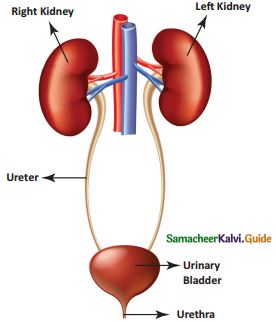
Arrange the excretory system in correct sequence.
(Urinary bladder, Ureter, Kidney, Urethra).
Answer:
Kidney, Ureter, Urinary bladder, Urethra.

Samacheer Kalvi 5th Science Guide Term 1 Chapter 1 Organ System

Question 6.
What are the two parts of peripheral nervous system?
Answer:
Peripheral nervous system consists of nerves extending from spinal cord to all parts of the body. It is made up of 2 parts.

  • Somatic nervous system
  • Autonomous nervous system.

Question 7.
What are the functions of blood?
Answer:

  • Blood transports nutrients, oxygen, wastes, and hormones.
  • It regulates the water level and body temperature.
  • It takes oxygen to tissues and cells finally reaches the lungs to take oxygen again.

Samacheer Kalvi 5th Science Guide Term 1 Chapter 1 Organ System

VII. Answer in detail:

Question 1.
List out the functions of the digestive system.

Answer:

  • The process of conversion of complex food molecules into simpler molecules is called digestion.
  • Saliva moistens food.
  • Salivary enzymes which break down complex starch into simple carbohydrate molecules.
  • Digestive enzymes are used for digesting fats, proteins, and carbohydrates.

Question 2.
Explain the main parts of the circulatory system.
Answer:

  • In circulatory system, Blood is circulated to transport oxygen and nutrients to every part of the body through circulatory system.
  • Circulatory system consists of the
    1. Heart
    2. Blood
    3. Blood Vessels

1. Heart:

  • The heart is a hollow, muscular organ conical in shape.
  • It is covered by a double walled pericardium membrane, filled with pericardial fluid.
  • This fluid protects the heart from shock.
  • Heart is placed inside the rib cage between the two lungs.
  • Heart has 4 chambers, the two upper chambers called auricles.
  • The two lower thicker chambers called ventricles.
  • The upper and lower chambers of the heart are separated by muscular wall known as auriculo-ventricular septum.
  • The right side of the heart receives de-oxygenated blood from various parts of body and pumped to the lungs for oxygenation.
  • The left side of the heart receives oxygenated blood from the lungs and pumps to different parts of the body.

Samacheer Kalvi 5th Science Guide Term 1 Chapter 1 Organ System

2. Blood:

  • It transports nutrients’ oxygen, wastes and hormones.
  • It regulates the water level and body temperature.
  • Blood pumped through out the body by the heart.
  • It takes oxygen to the tissues and cells from the lungs.

3. Blood vessels:
Blood vessels consists of arteries and veins. Arteries carry oxygenated blood except pulmonary arteries which carries deoxygenated blood from the heart vein carries deoxygenated blood except pulmonary veins which carries oxygenated blood to heart.

Question 3.
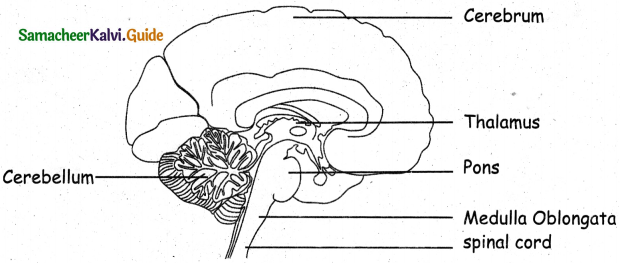
Explain three major parts of human brain.
Answer:
Human brain is divided into 3 major parts.

  1. Fore Brain (Cerebrum)
  2. Mid Brain (Cerebellum)
  3. Hind Brain (Medulla Oblongata)

1. Fore Brain – Cerebrum
The fore brain consists of cerebrum, thalamus and hypothalamus.

  • It is the largest part of the brain.
  • It is the centre of human memory.
  • It is responsible for intelligence, imagination and reasoning.

2. Mid Brain – Cerebellum

  • It lies behind the cerebrum.
  • It co-ordinates the movements of the muscules of body.
  • It helps to maintain the balance of the body.

3. Hind Brain – Medulla Oblongata

  • The hind brain comprises of pons and medulla oblongata.
  • It is also called the brain stem.
  • It controls breathing, heartbeat, and other involuntary muscles, so it is called “Vital Knot”.
  • It connects the brain to the spinal cord.

Samacheer Kalvi 5th Science Guide Term 1 Chapter 1 Organ System

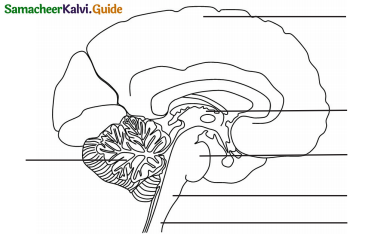
Question 4.
Label the diagram given below.

Samacheer Kalvi 5th Science Guide Term 1 Chapter 1 Organ System 4
Answer:
Samacheer Kalvi 5th Science Guide Term 1 Chapter 1 Organ System 5

VIII. Questions based on higher order thinking (HOT):

Question 1. Why It is important to wear helmet while riding a bike?
Answer:
Wearing helmet helps to protect your life and protect your head from danger. The head and brain is the most vulnerable to injury in a motorcycle accident. Drivers and passengers wearing helmets increase their chances of survival over non-helmet wearers. Riders who do not wear helmets are at risk of suffering a traumatic brain injury, if they are in accident. Brain trauma often results in spinal cord injuries and disability that requires extended care and physical therapy. The damaged brain may deteriorate after hospitalization and die days to weeks after the injury due to secondary injury.

Question 2.
Eating fast-food and junk food affects our health. Justify.
Answer:

  • Fast food is usually higher in fat, calories cholesterol, and sodium in comparison to homemade meals.
  • Eating too much fast food can increase the risk for health problems such as high blood pressure, heart disease, and obesity.
  • Eating a poor quality diet high in junk food is linked to a higher risk of obesity, depression, digestive issues, heart diseases and stroke, type 2 diabetes, cancer, and early death.

Samacheer Kalvi 5th Science Guide Term 1 Chapter 1 Organ System

Samacheer Kalvi 5th Science Guide Organ System Additional Questions and Answers

I. Choose the Correct Answer:

Question 1.
The brain is kept in a bony case called
a) Cranium
b) Cerebellum
c) Cerebrum
d) Medulla Oblongata
Answer:
a) Cranium

Question 2.
The left side of the heart receives oxygenated blood from
a) Lung
b) Heart
c) Liver
d) Kidney
Answer:
a) Lung

Question 3.
Name the functional unit of brain
a) Neurons
b) Nephrons
c) Fibrous membrane
d) Capsule
Answer:
a) Hind Brain

Question 4.
The brain loses the ability to function when it does not get oxygen for more than.
a) 2 minutes
b) 3 minutes
c) 4 minutes
d) 5 minutes
Answer:
4 minutes

Question 5.
The volume of blood in human adults is _______.
a) 4-5 litres
b) 5-6 litres
c) 3-5 litres
d) 4-8 litres
Answer:
a) 4-5 litres

Question 6.
The volume of blood in human adults is _______.
a) 4-5 litres
b) 5-6 litres
c) 3-5 litres
d) 4-8 litres
Answer:

a) 4-5 litres

Samacheer Kalvi 5th Science Guide Term 1 Chapter 1 Organ System

Question 7.
Heart ¡s covered with double walled membrane called
a) cerebrum
b) Cerebellum
c) pericardium
d) rib cage
Answer:
c) pericardium

Question 8.
____________ carries sensation’s from the organs to the brain.
a) Somatic nervous system
b) Autonomous nervous system
c) Central nervous system
d) Spinal cord
Answer:
Somatic nervous system

Question 9.
____________ is the largest part of the brain.
a) Fore Brain
b) Mid Brain
c) Hind Brain
d) Centre Brain
Answer:
a) Fore Brain

Question 10.
Medulla oblongata is called as
a) pia meter
b) durameter
c) vital knot
d) pons verolli
Answer:
c) vital knot

Question 11.
Which of the following statement is correct about cerebellum?
a) It is the largest part of the brain
b) It co-ordinates the movements of the muscles of the body.
c) It controls involuntary action
d) It lies behind the cerebrum
Answer:
Both (b) and (d)

Samacheer Kalvi 5th Science Guide Term 1 Chapter 1 Organ System

II. Fill in the blanks:
Question 1.
Salivary glands secrete _______.
Answer:
saliva

Question 2.
Name the organism which lives in the digestive system of human _______.
Answer:
Tapeworm

Question 3.
Liver produces for the digestion of fat.
Answer:
Bile

Question 4.
________ is sac – like in shape.
Answer:
Urinary bladder

Question 5.
Kidneys receive approximately ________ litres of blood.
Answer:
250 liter

Question 6.
The kidneys are made up of millions of excretory units called _______.
Answer:
Nephrons

III. Say True or False:

Question 1.
Liver transport nutrients, oxygen, wastes, and hormones.
Answer:
False

Question 2.
Blood vessels consist of arteries and veins.
Answer:
True

Question 3.
Crab has blue blood.
Answer:
True

Question 4.
Autonomous nervous system carries sensation from the organs_______ to the brain.
Answer:
True

Question 5.
Average weight of human brain ¡s 2.3 kg.
Answer:
False

Question 6.
Brain is made up of eight immovable bones.
Answer:
True

Question 7.
Fore brain lies behind the cerebrum.
Answer:
False

Question 8.
Fore brain is the centre of human memory.
Answer:
True

Samacheer Kalvi 5th Science Guide Term 1 Chapter 1 Organ System

IV. Circle the odd one out:

Question 1.
(a) Heart
(b) Blood vessels
(c) Airway
(d) Pancreatic juice
Answer:
(d) Pancreatic juice

Question 2.
(a) Air way
(b) Lungs
(c) Liver
(d) Muscles of respiration
Answer:
(c) Liver

Question 3.
(a) pancreatic juice
(b) Bile
(c) Digestive enzymes
(d) paracardial fluid
Answer:
(d) paracardial fluid

Question 4.
(a) Nasal cavity
(b) Pharynx
(c) Nostrils
(d) Pancreas
Answer:
(d) Pancreas

Question 5.
(a) Dura mater
(b) Cranium
(c) Arachnoid membrane
(d) Pia meter
Answer:
(b) Cranium

Question 6.
(a) Pharynx
(b) Larynx
(c) bronchi
(d) Arteries
Answer:
(d) Arteries

Samacheer Kalvi 5th Science Guide Term 1 Chapter 1 Organ System

V. Match the following:

Question 1.

Samacheer Kalvi 5th Science Guide Term 1 Chapter 1 Organ System 7
Answer:

  1. d
  2. a
  3. b
  4. c

Question 2.

Samacheer Kalvi 5th Science Guide Term 1 Chapter 1 Organ System 8
Answer:

  1. b
  2. a
  3. d
  4. c

Samacheer Kalvi 5th Science Guide Term 1 Chapter 1 Organ System

VI. Answer briefly:

Question 1.
What is digestion?
Answer:
The process of conversion of complex food molecules into simpler molecules is called digestion.

Question 2.
What are the compounds present in the food?
Answer:
The food contain complex compounds like carbohydrates, proteins and fats.

Question 3.
Mention the 3 important digestive glands in the process of digestion?
Answer:
Three important digestive glands in the process of digestion are:

  • Salivary glands
  • Pancreas
  • Liver.

Question 4.
Why do we eat?
Answer:
Food contains sources of energy that the body needs to stay alive and to repair itself.

Samacheer Kalvi 5th Science Guide Term 1 Chapter 1 Organ System

Question 5.
What happens when we swallow our food?
Answer:

  • Our tongue squeezes off a portion and pushes down into your throat to the top of the esophagus.
  • When we swallow muscular waves push the food along the digestive tract from the mouth down the esophagus to the stomach.
  •  From the stomach, it moves on to the small and large intestine.

Question 6.
What are the most important toxic gases in smoke?
Answer:
Smoke contains many toxic gases. The most common is carbon monoxide.

Question 7.
What is the primary organ of the respiratory system?
Answer:
The lungs are the primary organs of the respiratory system. They are paired cone-shaped organs. They are located near the backbone on both sides of the heart.

Question 8.
Name the muscles of respiration?
Answer:
Muscles of respiration include diaphram and intercostal muscles.

Samacheer Kalvi 5th Science Guide Term 1 Chapter 1 Organ System

VII. Answer in detail:

Question 1.
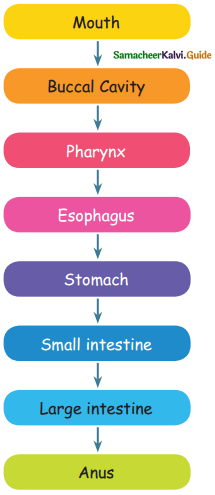
Draw a flow chart to explain the function of digestive system in human being.
Answer:

Samacheer Kalvi 5th Science Guide Term 1 Chapter 1 Organ System 9

Samacheer Kalvi 5th Science Guide Term 1 Chapter 1 Organ System

Question 2.
Draw and label the parts for the structure of kidney.
Answer:
Samacheer Kalvi 5th Science Guide Term 1 Chapter 1 Organ System 10

Samacheer Kalvi 5th Science Guide Term 1 Chapter 1 Organ System

Question 3.
Explain the structure of heart.
Answer:

  • The heart ¡s a hollow, muscular organ. It ¡s conical ¡n shape.
  • It ¡s covered with double walled membrane called pericardiurn.
  • The space between themembranes is filled with pericardial fluid. .
  • The pericardial fluid protects the heart from shock.
  • Heart ¡s placed inside the thoracic chamber (rib cage) ¡n between the two lungs.
  • The heart ¡s divided into four chambers.
  • Two upper chambers are called atrio or auricles.
  • Two lower thicker chambers are called ventricles.
  • The upper and lower chambers of the heart are separated by a muscular wall or tissue known as the auriculo-ventricular septum of the heart.
  • The right side of the heart receives deoxygenated blood from various parts of the body and pumps it to the lungs for
    oxygenation.
  • The left side of the heart receives oxygenated blood from the lungs and pumps it into different parts of the body.

Samacheer Kalvi 4th Social Science Guide Term 1 Chapter 1 Kingdoms of Rivers

Tamilnadu State Board New Syllabus Samacheer Kalvi 4th Social Science Guide Pdf Term 1 Chapter 1 Kingdoms of Rivers Text Book Back Questions and Answers, Notes.

Tamilnadu Samacheer Kalvi 4th Social Science Solutions Term 1 Chapter 1 Kingdoms of Rivers

Samacheer Kalvi 4th Social Science Guide Kingdoms of Rivers Text Book Back Questions and Answers

Evalution

I. Choose the correct answer:

Question 1.
Cheras, Cholas and Pandyas were called _________ .
(a) Nayanmars
(b) Moovendargal
(c) Kuru nila mannargal
Answer:
(b) Moovendargal

Samacheer Kalvi 4th Social Science Guide Term 1 Chapter 1 Kingdoms of Rivers

Question 2.
The efficient king among the Cheras was _________ .
(a) Karikalan
(b) Valvil Ori
(c) Cheran Senguttuvan
Answer:
(c) Cheran Senguttuvan

Question 3.
Port of Cholas was _________ .
(a) Kaveri poompattinam
(b) Chennai
(c) Thondi
Answer:
(a) Kaveri poornpattinam

Question 4.
The flag of Pandyas was _________ .
(a) Peacock
(b) Fish
(c) Tiger
Answer:
(b) Fish

Question 5.
The Vallal (Feudal lord) who gave his chariot to Mullai was _________ .
(a) Pari
(b) Pehan
(c) Adhiyaman
Answer:
(a) Pari

Samacheer Kalvi 4th Social Science Guide Term 1 Chapter 1 Kingdoms of Rivers

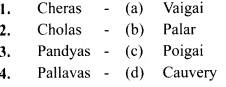
II. Match the following :

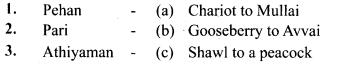
Samacheer Kalvi 4th Social Science Guide Term 1 Chapter 1 Kingdoms of Rivers 7
Answer:

  1. – (c)
  2. – (d)
  3. – (a)
  4. – (b)

III. Answer in short :

Question 1.
Who were the greatest kings among the Cheras?
Answer:
Imayavaramban Neduncheralathan and Senguttuvan were the greatest kings among the cheras.

Question 2.
Who were Kadai ezhu vallalgal?
Answer:

  • Pehan
  • Pari
  • Nedumudi kari
  • Aai
  • Athiyaman
  • Nalli
  • Valvil Ori.

Question 3.
Tell about the achievements of Karikalan.
Answer:

  • Karikalan became the king at a very early age and ruled efficiently.
  • Karikalan constructed dam kallanai across river cauvery.
  • He defeated both Cheras and Pandyas together.

Samacheer Kalvi 4th Social Science Guide Term 1 Chapter 1 Kingdoms of Rivers

Question 4.
Which was the capital and coastal town of Pallavas?
Answer:

  • Capital – Kancheepuram
  • Coastal town – Mahabalipuram

IV. Who Said?

Question 1.
‘Yano Arasan, Yanae kalvan’.
Answer:
Pandiyan Nedunchezhian said, “Yano Arasan, Yanae kalvan”. Because he wrongly prosecuted Kovalan and gave death sentence.

Try to answer

Question 1.
Who were the greatest kings of early Cheras?
Answer:
Imayavaramban Neduncheralathan and Senguttuvan.

Question 2.
Name the epic wrote by Ilangovadigal
Answer:
Silappathikaram.

Samacheer Kalvi 4th Social Science Guide Term 1 Chapter 1 Kingdoms of Rivers

Question 3.
Who was the greatest Chola king of the ancient period?
Answer:
Karikalacholan.

Question 4.
Name the capital and port of the Cholas.
Answer:
Uraiyur, Kaveripoompattinam.

Question 5.
Which Pandya mannan was mentioned in Silappathikaram?
Answer:
Pandyan Nedunchezhian.

Question 6.
Who wrote ’Madurai Kanchi’?
Answer:
Mangudi Maruthanar.

Question 7.
What is inscribed on the flag of Pandyas?
Answer:
Fish.

Question 8.
Which was the capital of Pallavas?
Answer:
Kancheepuram.

Samacheer Kalvi 4th Social Science Guide Term 1 Chapter 1 Kingdoms of Rivers

Question 9.
Where is Thondai mandalam in Tamil Nadu?
Answer:
North eastern part.

Question 10.
Who offered gooseberry to the poetess Avvai?
Answer:
Athiyaman.

Question 11.
Who put his shawl around the peacock?
Answer:
Pehan.

Question 12.
List out the festivals of Tamil people at present
Answer:
Pongal, Tamil New Year, Diwali etc.

InText Activity

Activity 1

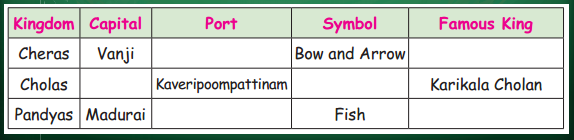
Ancient Tamil Kingdoms (Moovendargal)
Fill in the blanks
Samacheer Kalvi 4th Social Science Guide Term 1 Chapter 1 Kingdoms of Rivers 2
Answer:
Samacheer Kalvi 4th Social Science Guide Term 1 Chapter 1 Kingdoms of Rivers 1

Samacheer Kalvi 4th Social Science Guide Term 1 Chapter 1 Kingdoms of Rivers

Activity 2

List out the territories of the Moovendargal in the present districts of Tamil Nadu.
Samacheer Kalvi 4th Social Science Guide Term 1 Chapter 1 Kingdoms of Rivers 3
Answer:
Samacheer Kalvi 4th Social Science Guide Term 1 Chapter 1 Kingdoms of Rivers 4

Samacheer Kalvi 4th Social Science Guide Kingdoms of Rivers  Additional Questions and Answers

I. Choose the correct answer:

Question 1.
Cheras capital city was _________ .
(a) Madurai
(b) Vanji
(c) Uraiyur
(d) Kancheepuram
Answer:
(b) Vanji

Question 2.
The flag of Chera is ________ .
(a) Bow and arrow
(b) Tiger
(c) Fish
(d) Nandi
Answer:
(a) Bow and arrow

Samacheer Kalvi 4th Social Science Guide Term 1 Chapter 1 Kingdoms of Rivers

Question 3.
Port of Cheras was_______ .
(a) Kaveri poompattinam
(b) Chennai
(c) Thondi
(d) Korkai
Answer:
(c) Thondi

Question 4.
________ describes that Cholanadu is famous for rice
(a) patirruppattu
(b) pattinappalai
(C) Purananuru
(d) Agananuru
Answer:
(b) Pattinappalai

Question 5.
The capital of Cholas was ________
(a) Vanji
(b) Uraiyur
(c) Madurai
(d) Kancheepuram
Answer:
(b) Uraiyur

Question 6.
The world’s oldest dam still in use
(a) Mettur Dam
(b) Kolidam dan
(c) Kallanai
(d) Aliyar dam
Answer:
(c) Kallanai

Samacheer Kalvi 4th Social Science Guide Term 1 Chapter 1 Kingdoms of Rivers

Question 7.
River flowing in Madurai
(a) Cauvery
(b) Pallaru
(c) Vaigai
(d) Thamirabarani
Answer:
(c) Vaigai

Question 8.
Paridiya country famous for _______
(a) Pearls
(b) Gems
(c) Coral
(d) Rice
Answer:
(a) Pearls

Question 9.
The third Tamil Sangam was held in________
(a) Madurai
(b) Chennai
(C) Trichy
(d) Kanniyakumari
Answer:
(a) Madurai

Question 10.
_______ describes hospitality as one of the important duties of the Tamils.
(a) Pura Nanooru
(b) Aga Nanooru
(c) Aathichoodi
(d) Pattinapalai
Answer:
(a) Pura Nanooru

Samacheer Kalvi 4th Social Science Guide Term 1 Chapter 1 Kingdoms of Rivers

II. Fill in the blanks :

Question 1.
_______ offered gooseberry to the poetess Avvai.
Answer:
Adihiyaman

III. Match the following

Question 1.
Samacheer Kalvi 4th Social Science Guide Term 1 Chapter 1 Kingdoms of Rivers 9
Answer:

  1. – (c)
  2. – (a)
  3. – (b)

IV. Circle odd one:

Question 1.
Cheras, Maravar, Cholas, Pandiyas
Answer:
Samacheer Kalvi 4th Social Science Guide Term 1 Chapter 1 Kingdoms of Rivers 5

Question 2.
cauvery, Uraiyur, Tiger flag, Musiri
Answer:
Samacheer Kalvi 4th Social Science Guide Term 1 Chapter 1 Kingdoms of Rivers 6

Samacheer Kalvi 4th Social Science Guide Term 1 Chapter 1 Kingdoms of Rivers

V. Write True or False :

Question 1.
The Ancient people lived near river banks.
Answer:
False

Question 2.
The Kallanai dam was built at 12th BC century
Answer:
False

VI. Answer in short :

Question 1.
Name the epic wrote by Ilangovadigal.
Answer:
Silappathikaram.

Question 2.
Name the capital and port of the cholas.
Answer:
Uraiyur, Kaveri poompattinam.

Question 3.
Who erected the statue of Kannagi?
Answer:
Imayavaramban Neduncheralathan erected the statue of Kannagi.

Samacheer Kalvi 4th Social Science Guide Term 1 Chapter 1 Kingdoms of Rivers

Question 4.
Who got the title of Thalaiyalanganathu Seruvendra Pandiya?
Answer:
Pandiya Nedunchezhian.

Question 5.
who also called ‘Karikal Peruvalathan?
Answer:
Karikalan.

Question 6.
Who wrote Pattinappalai?
Answer:
Kadiyalur Uruthirangkannanar.

Question 7.
Who are the greatest kings in pallavas?
Answer:
Mahendravarman and Narasimhavarman are the greatest kings in pallavas.

Question 8.
Who were build Cave temples and Mondithic rathas?
Answer:
The Pallavas were Cave temples and Mondithic rathas.

Samacheer Kalvi 4th Social Science Guide Term 1 Chapter 1 Kingdoms of Rivers

Question 9.
How was Arasan called by his People?
Answer:
Ko, Kon, Venthan, Kotravan, Irai.

Question 10.
Write any two millets.
Answer:

  1. Varagu
  2. Thinai

Question 11.
Write the Important festivals of Sangam Age.
Answer:\

  • Karthikai
  • Thiruvaadhirai
  • Harvest festivals and
  • Indira Vizha.

Samacheer Kalvi 4th Social Science Guide Term 1 Chapter 1 Kingdoms of Rivers

VII. Answer in detail :

Question 1.
Write a short note on Kallanai.
Answer:
Kallanai was constructed by the Chola king Karikalan in the 2nd century B.C.(B.C.E.). This is said to be the world’s oldest dam still in use. Stones and Lime mortar were used to construct it.

Samacheer Kalvi 5th Social Science Guide Term 3 Chapter 3 Educational Rights

Tamilnadu State Board New Syllabus Samacheer Kalvi 5th Social Science Guide Pdf Term 3 Chapter 3 Educational Rights Text Book Back Questions and Answers, Notes.

Tamilnadu Samacheer Kalvi 5th Social Science Solutions Term 3 Chapter 3 Educational Rights

Samacheer Kalvi 5th Social Science Guide Educational Rights Text Book Back Questions and Answers

Evaluation

I. Choose the correct answer:

Question 1.
________ is the first step for a child’s development.
a) Education
b) Exploration
c) Excavation
Answer:
a) Education

Samacheer Kalvi 5th Social Science Guide Term 3 Chapter 3 Educational Rights

Question 2.
Education is more than ________.
a) Numeracy
b) Literacy
c) all of the above
Answer:
b) Literacy

Question 3.
“Education is the manifestation of the perfection already in man” is the famous quote of ________.
a) Mahatma Sandhi
b) Dr. Radhakrishnan
c) Swami Vivekananda
Answer:
c) Swami Vivekananda

Question 4.
________ describes the importance of free and compulsory education for children.
a) The Right to Literacy Act
b) The Right to Education Act
c) The Right to School Act
Answer:
b) The Right to Education Act

Question 5.
The Government of India has framed the ________ to promote education.
a) National Education Policy
b) National Policy on Elementary Education
c) National Policy on Literacy
Answer:
a) National Education Policy

Samacheer Kalvi 5th Social Science Guide Term 3 Chapter 3 Educational Rights

II. Match the following:

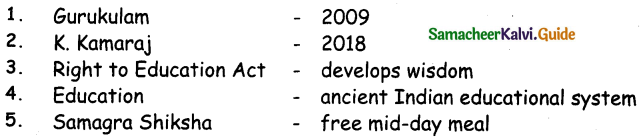
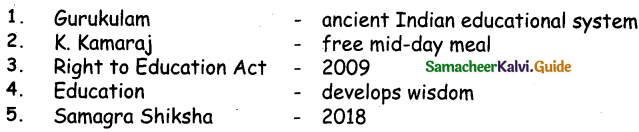
Samacheer Kalvi 5th Social Science Guide Term 3 Chapter 3 Educational rights 1
Answer:
Samacheer Kalvi 5th Social Science Guide Term 3 Chapter 3 Educational rights 2

Samacheer Kalvi 5th Social Science Guide Term 3 Chapter 3 Educational Rights

III. True or False:

Question 1.
Every child has the right to have free and compulsory education.
Answer:
True

Question 2.
Education helps in increasing awareness of surroundings, social and political issues.
Answer:
True

Question 3.
Right to School Act describes the importance of free and compulsory education for children.
Answer:
False

Question 4.
Numeracy is the first step towards making one educated.
Answer:
False

Question 5.
The former Chief Minister of Tamil Nadu, K.Kamaraj was implemented Free mid-day meal programme.
Answer:
True

Samacheer Kalvi 5th Social Science Guide Term 3 Chapter 3 Educational Rights

IV. Answer the following :

Question 1.
Write about the importance of education.
Answer:
Education doesn’t mean that one should be literate. It is more than literacy. Education helps to

  • analyse the reason.
  • build skills to live.
  • know what is right and wrong.
  • lead a moral life.

Question 2.
Write a short note on Educational Rights.
Answer:

  • Every child has right to have free and compulsory education.
  • The Right to Education Act (RTE) specifies different responsibilities to the local authorities and government to ensure free and compulsory education.

Question 3.
What is the role of Sarva Shiksha Abhiyan?
Answer:

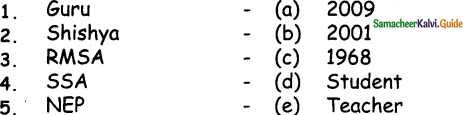
  • The Sarva Shiksha Abhiyan (SSA), the Right to Education Act (RTE) Act have improved the educational performance.
  • Sarva Shiksha Abhiyan (SSA) (Education for All) was launched in the year 2001.

Question 4.
Give a short note on National Education Policy.
Answer:

  • In 2019, the Government of India has framed the National Education Policy (NEP) to promote education among the people of India.
  • The NPE covers all educational systems from primary to college level.

Question 5.
Write any two features of Samagra Shiksha.
Answer:

  • Providing quality education and improving learning outcomes of students.
  • Focusing on girl education.
  • Focusing on digital education.

Samacheer Kalvi 5th Social Science Guide Term 3 Chapter 3 Educational Rights

V. Answer in detail:

Question 1.
Write about the Indian education system.
Answer:

  • In ancient time India has the Gurukula system of education in which anyone who visited to study went to a teacher’s house and requested to be taught.
  • The modern school was brought to India, including the English language, originally by Lord Thomas Babington Macaulay in the
  • Education in India is provided by public school (controlled and funded by three levels: central, state and local) and private schools.
  • Under various articles of the Indian Constitution, free and compulsory education is provided as a fundamental right to children between the ages of 6 and 14.

Question 2.
Write about the Right to Education Act in detail.
Answer:

  • Right to Education Act (2009) describes the importance of free and compulsory education for children between 6 to 14 years of age.
  • Education should be affordable to the common people. There should be no discrimination in education.
  • The child should be at the centre of an education system.
    Important features of RTE
  • Until the completion of elementary education, no student is stopped from school.
  • Improvement in the quality of education.
  • School infrastructure should be improved every three years.

Samacheer Kalvi 5th Social Science Guide Term 3 Chapter 3 Educational Rights

Question 3.
Write about Samagra Shiksha in detail.
Answer:

  • Samagra Shiksha is an integrated scheme for school education from pre-school to senior secondary levels.
  • The scheme has been prepared with the broader goal of improving school effectiveness measured in terms of equal opportunities for schooling and equitable learning outcomes.
  • The scheme is an integration of three already existing schemes – Sarva Shiksha Abhiyan (SAA), Rashtriya Madhyamik Shiksha Abhiyan (RMSA) and Teacher Education (TE).

Activity:

Solve the Puzzles:

Samacheer Kalvi 5th Social Science Guide Term 3 Chapter 3 Educational rights 3

Question 1.
I am white when I am dirty and black when I am clean. Who am I?
Answer:
Black Board

Question 2.
I am tall when I am young and I am short when I am old. Who am I?
Answer:
Pencil

Question 3.
I am wet when I am drying. Who am I?
Answer:
Towel

Question 4.
I have a neck but no head. Who am I?
Answer:
A bottle

Samacheer Kalvi 5th Social Science Guide Term 3 Chapter 3 Educational Rights

Samacheer Kalvi 5th Social Science Guide Educational Rights Additional Questions and Answers

I. Choose the correct answer:

Question 1.
________ is important for people as well as the nation.
a) Education
b) Exploration
c) Excavation
Answer:
a)Education

Question 2.
Education develops ________.
a) ability
b) power
c) wisdom
Answer:
c) wisdom

Question 3.
________ is best known for his speech which began with the words.
a) Dr. Radha Krishnan
b) Swami Vivekananda
c) Mahatma Sandhi
Answer:
b) Swami Vivekananda

Question 4.
The legislative section is divided into ________ lists.
a) two
b) three
c) four
Answer:
b) three

Question 5.
Rashtriya Madhyamik Shiksha Abhiyan was launched in ________.
a) 1968
b) 2000
c) 2009
Answer:
c) 2009

Question 6.
________ birth anniversary is celebrated as Educational Development Day.
a) K. Kamaraj’s
b) Gandhi’s
c) Swami Vivekananda
Answer:
a) K. Kamaraj’s

Samacheer Kalvi 5th Social Science Guide Term 3 Chapter 3 Educational Rights

II. Fill in the blanks:

Question 1.
________ also helps in overall development of a country.
Answer:
Education

Question 2.
Education removes superstitious ________.
Answer:

beliefs

Question 3.
________ is the system of education that was practised in ancient India.
Answer:
Gurukulam

Question 4.
The first National Education Policy was implemented in ________.
Answer:
1968

Question 5.
________ was launched in the year 2001.
Answer:
Sarva Shiksha Abhiyan

Samacheer Kalvi 5th Social Science Guide Term 3 Chapter 3 Educational Rights

III. Write True or False:

Question 1.
Education is more than literacy.
Answer:
True

Question 2.
The youth should be at the centre of an education system.
Answer:
False

Question 3.
The NPE covers all educational systems from primary to college level.
Answer:
True

Question 4.
Child labour is allowed in our country.
Answer:
False

Question 5.
Samagra Shiksha scheme improves the quality of education and the learning of students.
Answer:
True

Samacheer Kalvi 5th Social Science Guide Term 3 Chapter 3 Educational Rights

IV. Match the Following:

Samacheer Kalvi 5th Social Science Guide Term 3 Chapter 3 Educational rights 4
Answer:

  1. (e)
  2. (d)
  3. (a)
  4. (b)
  5. (c)

Samacheer Kalvi 5th Social Science Guide Term 3 Chapter 3 Educational Rights

V. Answer the following:

Question 1.
Write a short note on education given by Mahatma Gandhi.
Answer:

  • Literacy in itself is no education.
  • Literacy is not the end of education.
  • Real education consists in drawing the best out of yourself.

Question 2.
Write the classifications of Indian educational system.
Answer:
Indian educational system is mainly divided into four stages. They are:

  • Lower primary
  • Upper primary
  • Secondary
  • Higher secondary.

Question 3.
Write a short note on Rashtriya Madhyamik Shiksha Abhiyan.
Answer:

  • Rashtriya Madhyamik Shiksha Abhiyan (RMSA) was launched in 2009.
  • The aim of this programme – Raising the minimum level of education to class X.

Samacheer Kalvi 5th Social Science Guide Term 3 Chapter 3 Educational Rights

VI. Answer in detail:
Question 1.
What are the objectives of Sarva Shiksha Abhiyan?.
Answer:
Objectives of Sarva Shiksha Abhiyan

  • Increasing the enrolment in primary schools
  • Getting access to free and compulsory education for children up to age 14.
  • Improving the quality of education.


Samacheer Kalvi 4th Tamil Guide Chapter 23 கணினி உலகம்

Tamilnadu State Board New Syllabus Samacheer Kalvi 4th Tamil Guide Pdf Chapter 23 கணினி உலகம் Text Book Back Questions and Answers, Summary, Notes.

Tamilnadu Samacheer Kalvi 4th Tamil Solutions Chapter 23 கணினி உலகம்

Samacheer Kalvi 4th Tamil Guide Chapter 23 கணினி உலகம்

வாங்க பேசலாம்

Question 1.
கணினியின் திரைபோன்று செய்து கணினியைப் பற்றிப் பேசுக.
Answer:
கணினி நம் உலகைச் சுருக்கி உள்ளங்கையில் கொடுத்துவிட்டது. கணினி வன்பொருள் மற்றும் மென்பொருள் இடையிலான பரிமாற்றத்தின் மூலம் இயங்குகிறது.

கணினியின் உள்ளீடு , வெளியீடு கருவிகள் உள்ளன. விசைப்பலகை, சுட்டி போன்றவை உள்ளீட்டுக் கருவிகள். காட்சித்திரை, கணினி அச்சுப்பொறி போன்றவை வெளியீட்டுக் கருவிகள்.
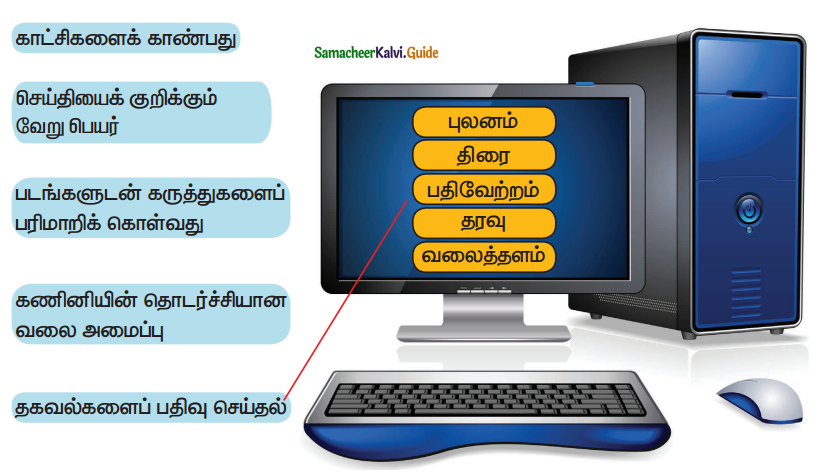
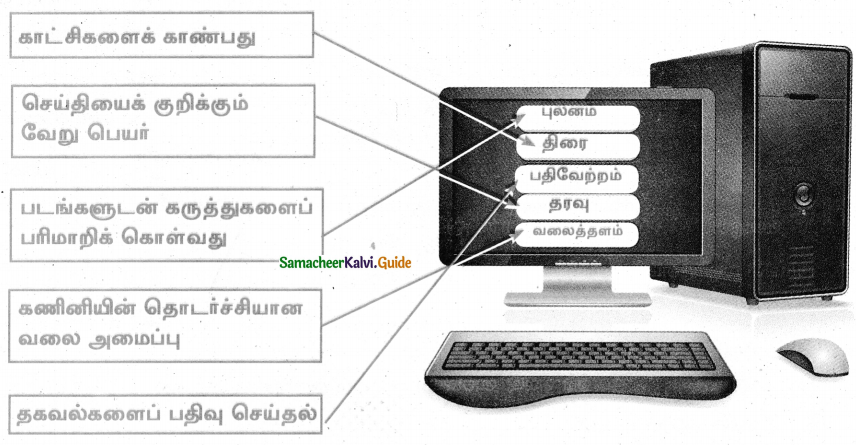
நாம் கணினிக்குக் கொடுக்கும் தகவல்தாம் தரவுகள் (Data). தரவுகள் பதிவு செய்வதைப் பதிவேற்றம் எனவும் தகவல் பெறுவதைப் பதிவிறக்கம் எனவும் அழைக்கிறோம்.

கணினிகளின் தொடர்ச்சியான வலை அமைப்புகள் சேர்ந்திருக்கும் இணைப்பே வலைத்தளம் அல்லது இணையம் எனப்படுகிறது. கணினிகளுக்கு இடையே தகவல் பரிமாற்றம் செய்ய மின்னஞ்சல் பயன்படுகிறது.

இப்போது புலனம், முகநூல் சுட்டுரை ஆகியவற்றின் மூலம் கருத்துப் பரிமாற்றம் செய்யப்படுகிறது. இவற்றை நாம் ஆக்கப் பயன்களுக்கு மட்டும் செயல்படுத்துவோம்.

Samacheer Kalvi 4th Tamil Guide Chapter 23 கணினி உலகம்

சிந்திக்கலாமா?

அழகன், புத்தகத்தில் மட்டுமே படிக்க முடியும் என்கிறான்.
அவன் நண்பனோ கணினியிலும் படிக்கலாம் என்கிறான்.
இதுபற்றி உங்கள் கருத்து என்ன?
Answer:
அழகன் புத்தகத்தில் மட்டுமே படிக்க முடியும் என்று கூறுவது தவறான கூற்றாகும். அவன் நண்பன் கணினியிலும் படிக்கலாம் என்று கூறுவது சரியானதாகும்.

புத்தகத்தில் படிக்கலாம், ஆனால் புத்தகத்தில் மட்டுமே படிக்கமுடியும் என்று கூறவியலாது. ஏனெனில் கணினியின் மூலமாகவும் படிக்கலாம்.

கணினி நமக்குத் தேவையான அனைத்து கருத்துகளையும் நொடியில் தேடித் தந்து விடுகிறது. அதனால் கணினியில் படிப்பதும் எளிதானது என்பது என் கருத்து.

படிப்போம்! சிந்திப்போம்! எழுதுவோம்!

சரியான சொல்லைத் தெரிவு செய்து எழுதுவோமா?

Question 1.
சார்லஸ் பாப்பேஜ் கண்டறிந்த அறிவியல் கருவி ……………………………
அ) தொலைக்காட்சி
ஆ) கணினி
இ) கைப்பேசி
ஈ) மடிக்கணினி
Answer:
ஆ) கணினி

Question 2.
இப்போதெல்லாம் – இச்சொல்லைப் பிரித்து எழுதக் கிடைப்பது ……………………………
அ) இப்போது + எல்லாம்
ஆ) இப்போ + எல்லாம்
இ) இப்போதே + எல்லாம்
ஈ) இப்போ + வெல்லாம்
Answer:
அ) இப்போது + எல்லாம்

Samacheer Kalvi 4th Tamil Guide Chapter 23 கணினி உலகம்

Question 3.
நினைவகம் – இச்சொல்லைப் பிரித்து எழுதும் முறை ……………………………
அ) நினை + வகம்
ஆ) நினை + அகம்
இ) நினைவு + வகம்
ஈ) நினைவு + அகம்
Answer:
ஈ) நினைவு + அகம்

Question 4.
மின் + அஞ்சல் – இச்சொற்களைச் சேர்த்து எழுதக் கிடைக்கும் சொல் ……………………………
அ) மின் அஞ்சல்
ஆ) மின்னஞ்சல்
இ) மின் அஞ்சல்
ஈ) மினஞ்சல்
Answer:
ஆ) மின்னஞ்சல்

Samacheer Kalvi 4th Tamil Guide Chapter 23 கணினி உலகம்

Question 5.
பதிவேற்றம் – இச்சொல்லின் பொருள் ……………………………
அ) தகவல் ஆராய்தல்
ஆ) தகவல் வரிசைப்படுத்துதல்
இ) தகவல் பதிவு செய்தல்
ஈ) தகவல் பெறுதல்
Answer:
ஈ) தகவல் பெறுதல்

வினாக்களுக்கு விடையளிக்க

Question 1.
சென்னையில் பூவிழி கண்டுகளித்த இடங்கள் யாவை?
Answer:
அடுக்குமாடிக் கட்டங்கள், மிகப்பெரிய சாலை, மெரினா கடற்கரை, விமான நிலையம், அண்ணா நூற்றாண்டு நூலகம், உயிர்க்காட்சிச் சாலை, பொழுதுபோக்கு மையங்கள், தகவல் தொழில்நுட்பப் பூங்கா ஆகியவ ைசென்னையில் பூவிழி கண்டுகளித்த இடங்கள் ஆகும்.

Samacheer Kalvi 4th Tamil Guide Chapter 23 கணினி உலகம்

Question 2.
கணினியின் முதன்மைப் பகுதிகளை எழுதுக.
Answer:
கணினியின் முதன்மைப் பகுதிகள் :

  1. மையச் செயல்பாட்டுப்பகுதி (CPU)
  2. கட்டுப்பாட்டகம் (Control Unit)
  3. நினைவகம் (Memory)
  4. உள்ளீ டு மற்றும் வெளியீடு (Input and output)

Question 3.
இணையம் என்றால் என்ன?
Answer:
கணினிகளின் தொடர்ச்சியான வலை அமைப்புகள் சேர்ந்திருக்கும் இணைப்பே வலைத்தளம் அல்லது இணையம் எனப்படுகிறது.

Question 4.
மின்னஞ்சல் எதற்குப் பயன்படுகிறது?
Answer:
கணினிகளுக்கு இடையே இணையத்தின் வாயிலாகச் செய்யப்படும் தகவல் பரிமாற்றமே மின்னஞ்சல். இது தகவல்களைப் பரிமாறிக் கொள்ளப் பயன்படுகிறது.

குறிப்புகளைப் படித்துச் சொற்களைத் தேர்ந்தெடுப்போமா?
Samacheer Kalvi 4th Tamil Guide Chapter 23 கணினி உலகம் 1
Asnwer:
Samacheer Kalvi 4th Tamil Guide Chapter 23 கணினி உலகம் 2

Samacheer Kalvi 4th Tamil Guide Chapter 23 கணினி உலகம்

மொழி விளையாட்டு

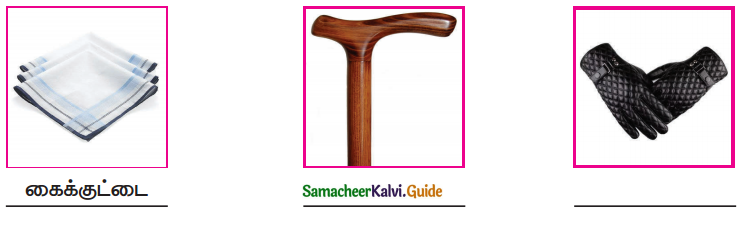
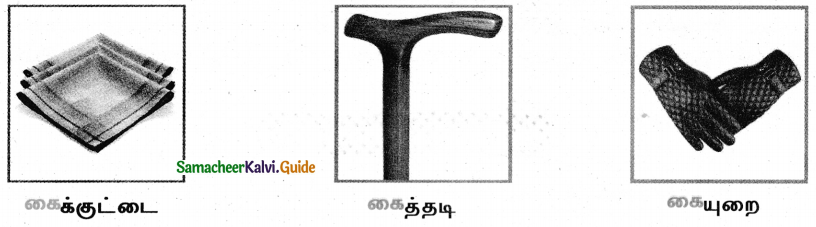
கை என்னும் சொல்லை முதலெழுத்தாகக் கொண்டு பல சொற்களை உருவாக்கலாமா?
Samacheer Kalvi 4th Tamil Guide Chapter 23 கணினி உலகம் 3
Answer:
Samacheer Kalvi 4th Tamil Guide Chapter 23 கணினி உலகம் 4

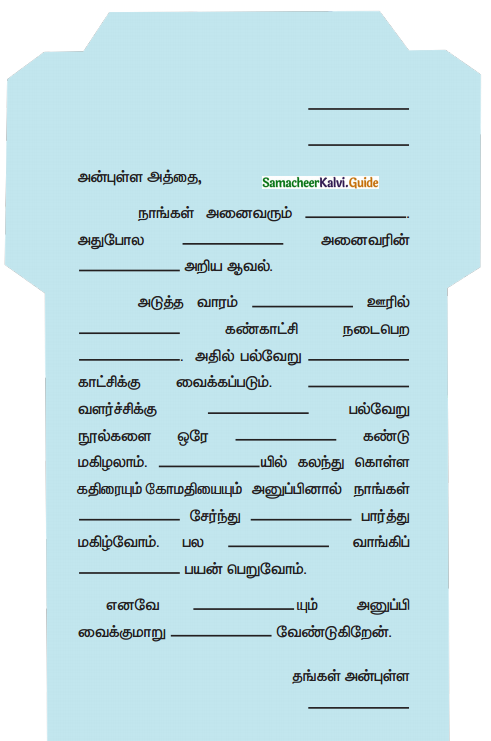
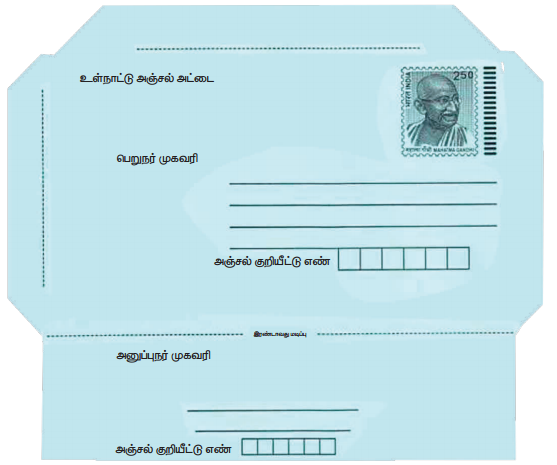
விடுபட்ட இடங்களில் உரிய சொற்களை நிரப்பிக் கடிதத்தை முழுமையாக்குவோம்

Samacheer Kalvi 4th Tamil Guide Chapter 23 கணினி உலகம் 5
Samacheer Kalvi 4th Tamil Guide Chapter 23 கணினி உலகம் 6
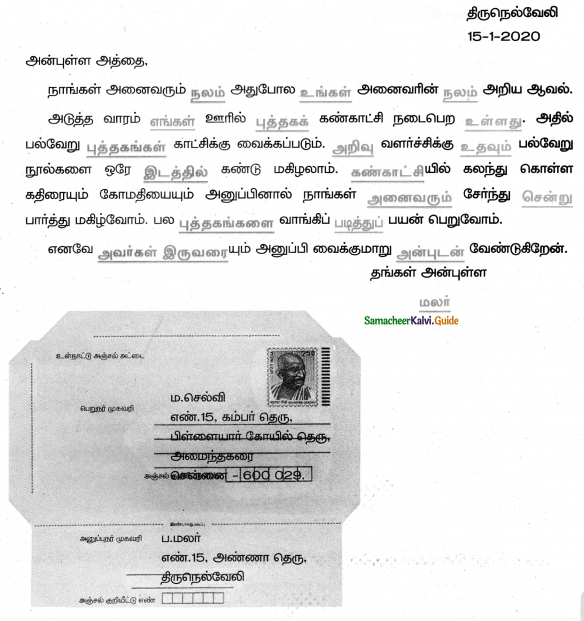
Answer:
Samacheer Kalvi 4th Tamil Guide Chapter 23 கணினி உலகம் 7

Samacheer Kalvi 4th Tamil Guide Chapter 23 கணினி உலகம்

கூடுதல் வினாக்கள்

நிரப்புக :

1. தரமணியில் தொழில்நுட்பப் பூங்கா உள்ளது.
2. கணினியைக் கண்டுபிடித்தவர் சார்லஸ் பாப்பேஜ்.
3. CPU என்பதன் தமிழ் விரிவாக்கம் மையச் செயல்பாட்டுப் பகுதி.
4. Keyboard என்பதன் தமிழ்ச் சொல் விசைப்பலகை.
5. இணையம் மூலமாகக் கடிதமும் எழுதலாம்.
6. புலனம், முகநூல் போன்றவை வலைத்தளச் செயலிகள்.
7. இணையத்தின் வாயிலாகச் செய்யப்படும் தகவல் பரிமாற்றம் மின்னஞ்சல் எனப்படும்.
8. விசைப்பலகை, சுட்டி போன்றவை உள்ளீட்டுக் கருவிகள்.
9. காட்சித்திரை, கணினி, அச்சுப்பொறி போன்றவை வெளியீட்டுக் கருவிகள்.
10. எந்தவொரு நாட்டு நிகழ்வுகளையும் நாம் நேரடியாகக் காண உதவுவது இணையம்.

Samacheer Kalvi 4th Tamil Guide Chapter 23 கணினி உலகம்

விடையளி :

Question 1.
கணினி – குறிப்பு எழுதுக.
Answer:

  • கணினி என்பது நாம் தரும் உள்ளீடுகளைப் பெற்று அதனைச் செயல்படுத்தி அதற்கேற்ற வெளியீடுகளைத் தரும் ஒரு மின்னணு சாதனம்.
  • கணினியை சார்லஸ் பாப்பேஜ் கண்டுபிடித்தார்.
  • முதன்முதலில் கண்டுபிடிக்கப்பட்ட கணினி அளவில் மிகப்பெரியது. அதனை எளிதாக ஓர் இடத்திலிருந்து மற்றோர் இடத்திற்குக் கொண்டு செல்ல இயலாது.
  • ஆனால், இப்போதோ கையடக்க வடிவிலே கூடக் கணினிகள் உருவாக்கப்படுகின்றன.

Question 2.
கணினியின் அமைப்பினை எழுதுக.
Answer:

  • கணினியின் மையச் செயல்பாட்டுப் பகுதி என்பது செய்நிரல் அடிப்படையில் கணிதச்  செயல்பாடுகளை அமைக்கும்.
  • கட்டுப்பாட்டகம் என்பது செய்திகளைத் திரளாகச் சேமித்து வைத்திருக்கும். செய்திகள்/ தகவல்களை நிலையாகச் சேமித்து வைக்கும் இடம்தான் நினைவகம்.
  • மையச் செயலகம் ஒருங்கிணைந்த உள்ளீடு, வெளியீடு கருவிகளைத் தன்னுள் பெற்றிருக்கும்.

Question 3.
கணினியின் உள்ளீடு, வெளியீடு கருவிகள் பற்றி எழுதுக.
Answer:

  • விசைப்பலகை, சுட்டி போன்றவை உள்ளீட்டுக் கருவிகள்.
  • காட்சித்திரை, கணினி அச்சுப்பொறி போன்றவை வெளியீட்டுக் கருவிகள்.

Samacheer Kalvi 4th Tamil Guide Chapter 23 கணினி உலகம்

Question 4.
தரவு, பதிவேற்றம், பதிவிறக்கம் – விளக்குக.
Answer:

  • கணினிக்குக் கொடுக்கும் தவல்கள் – தரவுகள்.
  • தரவுகள் பதிவு செய்வது – பதிவேற்றம்
  • தகவல் பெறுவது – பதிவிறக்கம்.

Question 5.
மின்னஞ்சல் எதற்குப் பயன்படுகிறது?
Answer:
கணினிகளுக்கு இடையே தகவல் பரிமாற்றம் செய்வதற்கு மின்னஞ்சல் பயன்படுகிறது.

Question 6.
வலைத்தளச் செயலிகள் யாவை?
Answer:
வலைத்தளச் செயலிகள் ;

  • புலனம்
  • முகநூல்
  • சுட்டுரை.

Question 7.
வலைத்தளச் செயலிகளில் நம் கருத்துகளை எவ்வாறு பதிவிடலாம்?
Answer:
வலைத்தளச் செயலிகளைச் செயலி உருவாக்கம் சென்று நம் மின்னஞ்சல் முகவரி கொடுத்து உருவாக்கி நம் கருத்துகளைப் பதிவிடலாம் அல்லது பெறலாம்.

Samacheer Kalvi 4th Tamil Guide Chapter 23 கணினி உலகம்

Question 8.
கீழ்க்கொடுக்கப்பட்டுள்ள சொற்களுக்குக் கலைச்சொல் எழுதுக.
Answer:
1. CPU – மையச் செயல்பாட்டுப் பகுதி
2. Control Unit – கட்டுப்பாட்டகம்
3. Memroy – நினைவகம்
4. Input – உள்ளீடு
5. Output – வெளியீடு
6. Keyboard – விசைப்பலகை
7. Mouse – சுட்டி
8. Monitor – காட்சித்திரை
9. Printer – கணினி அச்சுப்பொறி
10. Data – தரவு
11. Download – பதிவிறக்கம்
12. Website – வலைத்தளம்
13. Email ID – மின்ன ஞ்சல்
14. Whatsapp – புலனம்
15. Facebook – முகநூல்
16. Twitter – சுட்டுரை
17. Webapps – வலைதளச்செயலிகள்
18. Play store – செயலி உருவாக்கம்

Samacheer Kalvi 4th Tamil Guide Chapter 22 ஆனந்தம் விளையும் பூமியடி

Tamilnadu State Board New Syllabus Samacheer Kalvi 4th Tamil Guide Pdf Chapter 22 ஆனந்தம் விளையும் பூமியடி Text Book Back Questions and Answers, Summary, Notes.

Tamilnadu Samacheer Kalvi 4th Tamil Solutions Chapter 22 ஆனந்தம் விளையும் பூமியடி

Samacheer Kalvi 4th Tamil Guide Chapter 22 ஆனந்தம் விளையும் பூமியடி

வாங்க பேசலாம்

Question 1.
நமது இந்திய நாட்டின் பெருமைகள் குறித்து உமது கருத்துகளைப் பகிர்ந்து கொள்க.
Answer:
இந்திய நாட்டின் பெருமைகள் :

  • உலகிலேயே மிகப்பெரிய ஜனநாயக நாடு.
  • பல்வேறு மக்கள் தொன்றுதொட்டு இன்றுவரை மகிழ்ச்சியுடன் வாழும் வளம் பெற்ற நாடு.
  • இயற்கை அரண்களான வடக்கே இமயமலை மூன்று பக்கம் நீராலும் சூழப்பட்ட நாடு.
  • பழமையான கலாச்சாரத்தைக் கொண்ட நாடு.
  • வேளாண் தொழிலில் சிறந்த நாடு.
  • விட்டுக்கொடுத்து வாழும் மிகப்பெரிய பண்பு கொண்ட நாடு.
  • காடுகளில் வாழும் கலாச்சாரத்திலும் புதிய நாகரிகம் கண்ட, வன்முறையில்லாத நாடு.
  • பல சாதி மத இனம் மொழி வேறுபாடுகள் இருந்தாலும் இந்தியர் என்ற ஒற்றுமையுடன் வாழும் நாடு.
  • விஞ்ஞானிகள் பலரையும் சான்றோர்கள் பலரையும் ஈன்றெடுத்த நாடு வீரம் பொதிந்த நாடு .
    இதனாலன்றோ பாரதியார்,
    பாருக்குள்ளே நல்ல நாடு
    நம் பாரத நாடு. – என்று பாடுகிறார்.

Question 2.
உங்கள் ஊரிலுள்ள சிறப்பு வாய்ந்த இடங்களைப் பற்றி, உமது கருத்துகளை எடுத்துக் கூறுக.
Answer:
எங்கள் ஊர் திருவண்ணாமலை. இங்கு சிறப்பு வாய்ந்த இடங்களில் முதலிடம் பெறுவது அருணாச்சலேஸ்வரர் கோயில்தான். கார்த்திகை தீபம், கிரிவலம் இவையிரண்டும் திருவண்ணாமலையுடன் பிணைந்தது. இது சிவனின் பஞ்சபூத தலங்களில் ஒன்று இது அக்னி தலமாகும். கார்த்திகை மாதத்தில் இங்குள்ள மலை உச்சியில் நெய் தீபம் ஏற்றப்படும். ஒவ்வொரு பௌர்ணமியன்றும் மலையைச் சுற்றிவருவர். அவ்வாறு சுற்றும்போது மூலிகைக் காற்றைச் சுவாசிக்க முடியும் என்று கூறுவர்.

அடுத்தது சாத்தனூர் அணை. பெண்ணையாற்றின் குறுக்கே கட்டப்பட்டது. இங்கு தொங்குபாலம் ஒன்று உள்ளது. சிறுவர்களுக்கான படகு சவாரியும் இரயில் வண்டியும் உள்ளன. ஸ்ரீசேஷாத்திரி சுவாமிகள் ஆசிரமம், செஞ்சிக்கோட்டை இவையெல்லாம் திருவண்ணாமலைக்குப் பெருமை சேர்ப்பவை. திருவண்ணாமலை அண்ணாமலையார் கோவில் அருணகிரிநாதரால் பாடப்பெற்ற வரலாற்றுச் சிறப்புடையது. செஞ்சிக்கோட்டையும் வரலாற்றுச் சிறப்புடைய கோட்டையாகும். விடுமுறை நாட்களில் இங்கு சுற்றுலாவாசிகளால் அலங்கரிக்கப்படும்.

Samacheer Kalvi 4th Tamil Guide Chapter 22 ஆனந்தம் விளையும் பூமியடி

சிந்திக்கலாமா?

Samacheer Kalvi 4th Tamil Guide Chapter 22 ஆனந்தம் விளையும் பூமியடி 1

கண்ணைப் போல காக்க வேண்டும் எவ்வாறு?
Answer:

  • வனவிலங்குகள், பறவைகள் வாழும் இடங்களில் உள்ள தாவரங்களை அழிக்காமல் பாதுகாக்க வேண்டும்.
  • வனவிலங்குகளை வேட்டையாடாமல் இருக்க வேண்டும். ஏனெனில் அவை ஒன்றையொன்று சார்ந்து வாழ்கின்றன.
  • அவை உள்ள இடங்களில் பெரிய நீர்த்தொட்டிகள் அமைத்துத் தண்ணீர் ஊற்றி வைக்கலாம்.
  • அவ்வப்போது, அவற்றிற்குத் தேவையான உணவுப் பொருட்களை வாங்கிப் போடலாம். அரசாங்கத்தின் உதவியுடன் வனத்துறையினர் மேலும் பாதுகாப்புப் பணிகளைச் செய்ய வேண்டும்.

படிப்போம்! சிந்திப்போம்! எழுதுவோம்!

சரியான சொல்லைத் தெரிவு செய்து எழுதுவோமா?

Question 1.
‘இன்னல்’ இச்சொல்லின் பொருள் …………………………
அ) மகிழ்ச்சி
ஆ) கன்னல்
இ) துன்பம்
ஈ) இன்பம்
Answer:
இ) துன்பம்

Samacheer Kalvi 4th Tamil Guide Chapter 22 ஆனந்தம் விளையும் பூமியடி

Question 2.
கும்மியடி – இச்சொல்லைப் பிரித்து எழுதக் கிடைப்பது……………………
அ) கும்மி + யடி
ஆ) கும் + மியடி
இ) கும் + மடி
ஈ) கும்மி + அடி
Answer:
ஈ) கும்மி + அடி

Question 3.
ஆனந்தம் – இச்சொல்லின் எதிர்ச்சொல் ……………………
அ) மகிழ்ச்சி
ஆ) வருத்தம்
இ) அன்பு
ஈ) கோபம்
Answer:
ஆ) வருத்தம்

Samacheer Kalvi 4th Tamil Guide Chapter 22 ஆனந்தம் விளையும் பூமியடி

Question 4.
ஒரே ஓசையில் முடியாத சொற்கள் ……………………….
அ) தேசமடி – பூமியடி
ஆ) போற்றிட்டி – காத்திட்டி
இ) கும்மியடி – கோடி
ஈ) போனதடி – போற்றிடவே
Answer:
ஈ) போனதடி – போற்றிடவே

Question 5.
கும்மியாட்டத்தைக் குறிக்கும் படம்
Samacheer Kalvi 4th Tamil Guide Chapter 22 ஆனந்தம் விளையும் பூமியடி 2
Answer:
ஈ)

Samacheer Kalvi 4th Tamil Guide Chapter 22 ஆனந்தம் விளையும் பூமியடி

மொழியோடு விளையாடு

படங்களின் பெயரை எழுதுக. பெயரின் முதல் எழுத்துகளில் உருவாகும் சொல்லுக்குரிய படத்துடன் இணைக்க
Samacheer Kalvi 4th Tamil Guide Chapter 22 ஆனந்தம் விளையும் பூமியடி 3
Answer:
Samacheer Kalvi 4th Tamil Guide Chapter 22 ஆனந்தம் விளையும் பூமியடி 4

Samacheer Kalvi 4th Tamil Guide Chapter 22 ஆனந்தம் விளையும் பூமியடி

பாடலில் இடம்பெற்றுள்ள ஒத்த ஓசைச் சொற்களை எழுதுக
Samacheer Kalvi 4th Tamil Guide Chapter 22 ஆனந்தம் விளையும் பூமியடி 5
Answer:
Samacheer Kalvi 4th Tamil Guide Chapter 22 ஆனந்தம் விளையும் பூமியடி 6

Samacheer Kalvi 4th Tamil Guide Chapter 22 ஆனந்தம் விளையும் பூமியடி

பொருத்துக

Samacheer Kalvi 4th Tamil Guide Chapter 22 ஆனந்தம் விளையும் பூமியடி 7
Answer:
Samacheer Kalvi 4th Tamil Guide Chapter 22 ஆனந்தம் விளையும் பூமியடி 8

அறிந்து கொள்வோம்

நாட்டுப்புறக் கலைகள் என்பவை நாட்டுப்புற மக்களின் உணர்ச்சி வெளிப்படாகும். இந்த உணர்ச்சிகள் பாடலாகவும், ஆடலாகவும் மக்களிடையே வெளிப்படுகின்றன.

செயல் திட்டம்

உமது ஊரில் பாடப்படும் நாட்டுப்புறப் பாடல்களைக் கேட்டு, எழுதி வருக.
Asnwer:
Samacheer Kalvi 4th Tamil Guide Chapter 22 ஆனந்தம் விளையும் பூமியடி 9

Samacheer Kalvi 4th Tamil Guide Chapter 22 ஆனந்தம் விளையும் பூமியடி

கூடுதல் வினாக்கள்

நிரப்புக :
1. சுகம் கோடி விளைய வேண்டும்.
2. நமது இன்னல் போனது.
3. நமது தேசம் இந்தியா.
4. மண்ணைத் தாயாய்ப் போற்ற வேண்டும்.
5. நமது தேசத்தைக் கண்ணைப் போலக் காக்க வேண்டும்.

Samacheer Kalvi 4th Tamil Guide Chapter 22 ஆனந்தம் விளையும் பூமியடி

விடையளி :

Question 1.
கும்மியடி பாடல் மூலம் நீ அறிந்தவற்றை எழுதுக.
Answer:

  • நம் நாடு விடுதலை பெற்றதும் கோடி இன்பங்கள் விளைந்தது. நமது துன்பங்கள் போனதென்று மனம் மகிழ்ச்சியடைய வேண்டும்.
  • நம் பாரத தேசம் கவிஞர்கள் புகழ்ந்து பாடும் பூமியாகும்.
  • மகிழ்ச்சி விளைந்திடும் பூமி. புகழ்ச்சிகள் கொண்ட நாடு.
  • அறிவு சிறந்த அறிஞர்கள் வாழும் பூமி.
  • உயர்வில் மலையைப் போன்றது. அதிக வளம் கொண்ட பூமி.
  • நமது தேசம் இந்தியா என்று எண்ணி அனைவரும் ஒன்றுபட்டு வாழ வேண்டும்.
  • நம் நாட்டைத் தாயைப்போல் போற்றுவோம்; கண்ணைப் போல் காப்போம்.

Samacheer Kalvi 5th Social Science Guide Term 3 Chapter 2 Agriculture

Tamilnadu State Board New Syllabus Samacheer Kalvi 5th Social Science Guide Pdf Term 3 Chapter 2 Agriculture Text Book Back Questions and Answers, Notes.

Tamilnadu Samacheer Kalvi 5th Social Science Solutions Term 3 Chapter 2 Agriculture

Samacheer Kalvi 5th Social Science Guide Agriculture Text Book Back Questions and Answers

Evaluation

I. Choose the correct answer:

Question 1.

_______ is the cultivation of crops.
a) Irrigation
b) Agriculture
c) Excavation
Answer:
b) Agriculture

Samacheer Kalvi 5th Social Science Guide Term 3 Chapter 2 Agriculture

Question 2.
A _______ is a person who is engaged in agriculture.
a)doctor
b)teacher
c) farmer
Answer:
c) farmer

Question 3.
_______ farming refers to the raising of animals along with the crops.
a) Commercial
b) Mixed
c) Subsistence
Answer:
b) Mixed

Question 4.
_______ monitors the level and nature of groundwater.
a) Central Ground Water Board
b) Metro Water Board
c) Sewage Water Board
Answer:
a) Central Ground Water Board

Question 5.
_______ is the largest cotton producing district in Tamil Nadu.
a) Coimbatore
b) Chennai
c) Cuddalore
Answer:
a) Coimbatore

Samacheer Kalvi 5th Social Science Guide Term 3 Chapter 2 Agriculture

II. Match the Following:

Samacheer Kalvi 5th Social Science Guide Term 3 Chapter 2 Agriculture 1
Answer:
Samacheer Kalvi 5th Social Science Guide Term 3 Chapter 2 Agriculture 2

III. True or False:

Question 1.
Rice is the leading food crop in Tamil Nadu.
Answer:
True

Question 2.
Tamil Nadu has two soil types.
Answer:
False

Question 3.
Drip irrigation is a type of micro-irrigation system.
Answer:
True

Question 4.
Jackfruit is an example of plantation crop.
Answer:
False

Question 5.
Mango is the leading fruit crop of Tamil Nadu.
Answer:
True

Samacheer Kalvi 5th Social Science Guide Term 3 Chapter 2 Agriculture

IV. Answer the following:

Question 1.
What is agriculture?
Answer:

  • Agriculture is the art and science of preparing the soil for cultivation, growing crops and raising livestock,
  • Agriculture led to the development of human civilisation.

Question 2.
Write about farmers.
Answer:

  • A farmer is a person who cultivates crops and rears animals (poultry and other livestock). India is a land of farmers.
  • It is called so because majority of Indians are directly or indirectly involved in agricultural activities.

Question 3.
Name the different types of farming.
Answer:
There are several types of farming.

  • Subsistence farming
  • Commercial farming
  • Plantation farming
  • Mixed farming

Question 4.
What is well irrigation?
Answer:
Well irrigation has been practiced in Tamil Nadu for many generations. It is a less expensive type of irrigation.

Question 5.
What is well irrigation?
Answer:

  • Well irrigation has been practiced in Tamil Nadu for many generations. It is a less expensive type of irrigation.
  • Government of India is the National Apex Agency entrusted with the responsibilities of providing scientific inputs for management, exploration, monitoring, assessment, augmentation and regulation of groundwater resources of the country.
  • CGWB monitors the level and nature of groundwater.

Samacheer Kalvi 5th Social Science Guide Term 3 Chapter 2 Agriculture

V. Answer in detail:

Question 1.
Write about mixed and plantation farming.
Answer:

  • Mixed Farming: Mixed Farming refers to the rearing of animals along with the cultivation. This type of farming is economical.
  • Plantation Farming: Plantation Farming is done in an estate where a single cash crop is cultivated on a large scale.
    Examples: Tea, Coffee and Rubber.

Question 2.
Explain any two types of irrigation.
Answer:

  • Well Irrigation: Well Irrigation has been practiced in Tamil Nadu for many generations. It is a less expensive type of irrigation.
  • Canal Irrigation: Canal Irrigation is the most important form of irrigation in India. Most of the North Indian canals are perennial. The main canal irrigated areas are in the northern plains of India such as Uttar Pradesh, Punjab, Haryana, Rajasthan and Bihar.

Question 3.
Write about the important crops of Tamil Nadu.
Answer:

  • Tamil Nadu is suitable for the production of fruits, vegetables, spices, plantation crops, flowers, medicinal and aromatic plants.
  • Horticulture is the fastest growing sector within agriculture in Tamil Nadu.
  • Paddy is grown in large areas because rice is the main staple food of the state.
    iv) The principal food crops are rice, maize, jowar (cholam), bajra (Kambu), ragi, and pulses (Bengal gram,
    red gram, green gram, black gram, and horse gram).

Samacheer Kalvi 5th Social Science Guide Term 3 Chapter 2 Agriculture

Activity:

Find out the Following.
Question 1.
One who produces food for us _______.
Answer:
Farmer

Question 2.
It is used for ploughing _______.
Answer:
Tractor

Question 3.
It is used for separating grain from hay _______.
Answer:
Winnower

Think Zone:

Question 1.
Which state is known as the Rice bowl of India?
Answer:
Andhra Pradesh is known as the Rice bowl of India.

Samacheer Kalvi 5th Social Science Guide Term 3 Chapter 2 Agriculture

Samacheer Kalvi 5th Social Science Guide Agriculture Additional Questions and Answers

I. Choose the correct answer:

Question 1.
_______ of our national’s income comes from agriculture.
a) One-third
b) Two-third
c) One-forth
Answer:
a) One-third

Question 2.
_______ is a land of farmers.
a) Europe
b) India
c) Japan
Answer:
b) India

Question 3.
_______ method of farming is done by using modern tools and techniques.
a) Plantation farming
b) Subsistence farming
c) Commercial farming
Answer:
c) Commercial farming

Question 4.
_______ is the most important form of irrigation in India.
a) Well irrigation
b) Canal irrigation
c) Sprinkler irrigation
Answer:
a)Well irrigation

Question 5.
_______ is known as the Rice bowl of Tamil Nadu.
a) Thanjavur
b) Chennai
c) Madurai
Answer:
a) Thanjavur

Samacheer Kalvi 5th Social Science Guide Term 3 Chapter 2 Agriculture

II. Fill in the blanks:

Question 1.
_______ is the branch of agriculture.
Answer:
Animal husbandry

Question 2.
_______ has become a necessity for humans.
Answer:
Agriculture

Question 3.
Agricultural development contributes to the _______ of our country.
Answer:
Economy

Question 4.
_______ type of farming is economical.
Answer:
Mixed farming

Question 5.
Tamil Nadu depends on _______ and monsoon.
Answer:
Northeast, South west

Question 6.
_______ has been practised in Tamil Nadu for many generations.
Answer:
Well Irrigation

Question 7.
Water is sprayed through pipes in the air through _______.
Answer:
Sprinklers

Samacheer Kalvi 5th Social Science Guide Term 3 Chapter 2 Agriculture

III. True or False:

Question 1.
Agriculture led to the development of human civilisation.
Answer:
True

Question 2.
Agriculture is the backbone of our economy.
Answer:
True

Question 3.
In commercial farming, crops, are cultivated and used only for own family consumption.
Answer:
False

Question 4.
Canal irrigation is the most important form of irrigation in India.
Answer:
True

Question 5.
Sprinkler irrigation is a type of micro-irrigation system that saves water and soil nutrients.
Answer:
False

Question 6.
Chennai is known as the Manchester of South India
Answer:
False

IV. Match the Following:

Samacheer Kalvi 5th Social Science Guide Term 3 Chapter 2 Agriculture 3
Answer:

  1. (e)
  2. (d)
  3. (a)
  4. (b)
  5. (c)

Samacheer Kalvi 5th Social Science Guide Term 3 Chapter 2 Agriculture

V. Answer the following:
Question 1.
Define micro farmers.
Answer:
Farmers who cultivate in an area less than 1 hectare are called micro farmers.

Question 2.
Write a short note on subsistence farming.
Answer:
In subsistence farming, crops are cultivated and used only for own family consumption. Such type of farming is adopted by small and marginal farmers on fragmented land holdings. The cultivated crops are usually food crops.

Question 3.
Write about FCI.
Answer:
The Government has set up agencies like the Food Corporation of India to purchase the farm products directly from the farmers at reasonable rates.

Question 4.
What is Green revolution?.
Answer:
Green revolution is a process which brought an increase in crop production by using new varieties of seeds, pesticides and new agricultural techniques.

Samacheer Kalvi 5th Social Science Guide Term 3 Chapter 2 Agriculture

Question 5.
Who is the father of Green revolution in India?
Answer:
Dr. M.S. Swaminathan of Tamil Nadu is known as the Father of Green Revolution in India.

Question 6.
What is animal husbandry?
Answer:
Animal husbandry is the branch of agriculture. It is to raise animals for meat, fur, milk, eggs and other products.

Question 7.
What is Horticulture?
Answer:
Horticulture is the science or art of cultivating fruits, vegetables, flowers or ornamental plants.

Question 8.
Name some important cropping seasons in Tamil Nadu.
Answer:

  • Navarai
  • Sornavari
  • Kar
  • Kuruvai
  • Samba
  • Thaladi.

Samacheer Kalvi 5th Social Science Guide Term 3 Chapter 2 Agriculture

VI. Answer the following in detail:

Question 1.
What is Irrigation? and types of Irrigation.

Answer:
Irrigation is the supply of water to land or crops for the purpose of agricultural production.
Types of Irrigation

  • Well Irrigation
  • Canal Irrigation
  • Sprinkler Irrigation
  • Drip Irrigation.

Question 2.
Write about sprinkler and Drip Irrigation.
Answer:

  • Sprinkler irrigation: Sprinkler irrigation is similar to natural rainfall. Water is sprayed through pipes in the air through sprinklers.
  • Drip Irrigation: Drip Irrigation is a type of micro-irrigation system that saves water and soil nutrients. In this system water drips slowly into the roots of plants through pipes. Pipes can be either above the soil surface or buried below the surface. The water directly reaches the roots and minimises evaporation.

Samacheer Kalvi 4th Tamil Guide Chapter 21 காட்டுக்குள்ளே பாட்டுப்போட்டி

Tamilnadu State Board New Syllabus Samacheer Kalvi 4th Tamil Guide Pdf Chapter 21 காட்டுக்குள்ளே பாட்டுப்போட்டி Text Book Back Questions and Answers, Summary, Notes.

Tamilnadu Samacheer Kalvi 4th Tamil Solutions Chapter 21 காட்டுக்குள்ளே பாட்டுப்போட்டி

Samacheer Kalvi 4th Tamil Guide Chapter 21 காட்டுக்குள்ளே பாட்டுப்போட்டி

வாங்க பேசலாம்

Question 1.
கதையில் நடுவர் மயிலக்கா கூறும் தீர்ப்பு சரியானதா? உம் கருத்தைச் சொந்த நடையில் கூறுக.
Answer:
கதையில் நடுவர் மயில் அக்கா கூறும் தீர்ப்பு சரியானது. காகம் பாடாது என்று அதனை கேலி பேசியவர் முன்னிலையில் தொடர்ந்து அரைமணி நேரம் பாடி அனைவரின் கவனத்தையும் தம் பக்கம் ஈர்த்த காகம்தான் பரிசு பெறுவதற்கு சரியான பறவை. காகம் தான் பாடியதோடு மட்டுமல்லாமல் மற்ற பறவைகளுக்கும் முன் மாதிரியாக இருந்தது. எனவே பாட்டு ராணி என்ற பட்டம் காகத்திற்குக் கிடைத்தது ஏற்புடைய ஒன்றாகும்.

Question 2.
உங்கள் பள்ளியில் நடைபெற்ற பாட்டுப்போட்டி நிகழ்வுகள் குறித்துப் பேசுக.
Answer:
வணக்கம்!
எங்கள் பள்ளியில் நவம்பர் பதினான்கு அன்று குழந்தைகள் தினம் கொண்டாடப்பட்டது.

அன்று பல போட்டிகள் நடைபெற்றது. நான் பாட்டுப் போட்டியில் கலந்து கொண்டேன். ஒவ்வொருவரும் ஒவ்வொரு பாடலைப் பாடினர். ஒரு சிலர் நடனமாடியும் பாடல் பாடியும் மகிழ்ந்தனர். ஒரு சிலர் இசைக்கருவிகளை இசைத்தனர். என்னுடைய தோழி குறையொன்றுமில்லை ‘ என்ற எம். எஸ். சுப்புலட்சுமியின் பாடலைப் பாடினாள். அனைவரும் அப்பாடலை மெய்மறந்து கேட்டனர். ‘பாடலுக்கு அழகு கேட்டார் நன்று எனக் கூறல்’ என்ற சிறுபஞ்சமூலம் கூற்றின்படி அவளுடைய பாடலை அனைவரும் இரசித்தனர். இறுதியில் பரிசு அறிவிக்கப்பட்டது. என் தோழிக்குப் பரிசு கிடைத்தது. நான் மிகவும் மகிழ்ந்தேன்.

Samacheer Kalvi 4th Tamil Guide Chapter 21 காட்டுக்குள்ளே பாட்டுப்போட்டி

சிந்திக்கலாமா?

போட்டியில் வெற்றி பெறுவதைக் காட்டிலும் பங்கேற்பதுதான் இன்றியமையாதது என்று உன் தந்தை கூறுகிறார். ஏன் தெரியுமா?
Answer:
போட்டியில் பங்கேற்பதன் மூலம் அவரவர் ஆற்றல் வெளிப்படுகிறது. பலமுறை தோற்றாலும் ஒரு முறையாவது வெற்றி பெறுவோம் என்ற நம்பிக்கை வளர்கிறது.
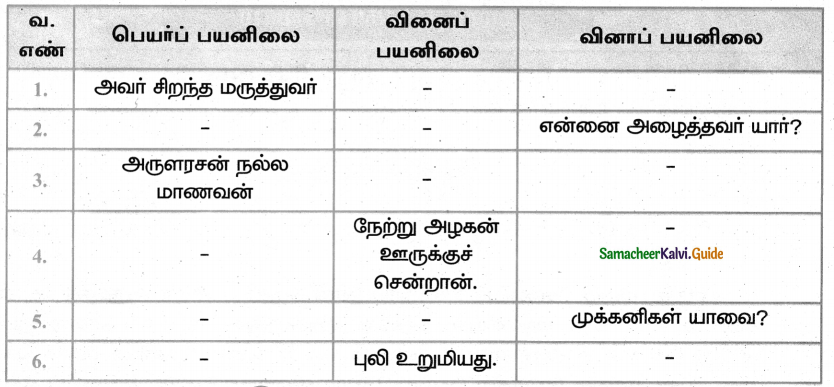
போட்டியில் கலந்துகொள்ளும் போது தன்னால் என்ன முடியும், முடியாது என்பதை அறிந்து கொள்ள முடிகிறது.

போட்டியில் தோற்றாலும் சரி என்று கலந்து கொள்ளும் போது அவர்களுக்குள் ஓர் உந்துதல் சக்தி உண்டாகிறது. அச்சக்தி அவர்களை முயற்சி செய்யத் தூண்டுகோலாய் அமைகிறது.


Samacheer Kalvi 4th Tamil Guide Chapter 21 காட்டுக்குள்ளே பாட்டுப்போட்டி

போட்டிக்காக அவர்கள் செய்யும் பயிற்சியும் முயற்சியும் அவர்களைச் சுறுசுறுப்பாக்குகிறது. செயல்பாட்டைத் தூண்டி வளர்ச்சிக்கு உதவுகிறது.
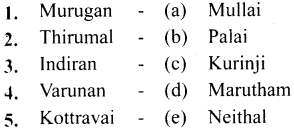
இக்காரணங்களால் போட்டியில் வெற்றி பெறுவதைக் காட்டிலும் பங்கேற்பதுதான் இன்றியமையதாதது என்று தந்தை கூறுகிறார்.
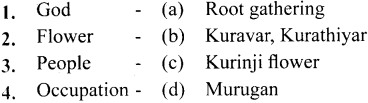
வினாக்களுக்கு விடையளிக்க

Question 1.
காட்டில் நடந்த போட்டியின் பெயர் என்ன?
Answer:
காட்டில் நடந்த போட்டியின் பெயர் ‘பாட்டுப்போட்டி’ ஆகும்.

Question 2.
காக்காவின் பாட்டைக் கேட்ட சிங்கராஜா என்ன கூறினார்?
Answer:
காக்காவின் பாட்டைக் கேட்ட சிங்கராஜா “ஆகா…. என்ன சுருதி சுத்தம்; அற்புதம்!” என்று கூறினார்.

Samacheer Kalvi 4th Tamil Guide Chapter 21 காட்டுக்குள்ளே பாட்டுப்போட்டி

Question 3.
‘பாட்டு ராணி’ பட்டம் பெற்ற பறவை எது?
Answer:
‘பாட்டு ராணி’ பட்டம் பெற்ற பறவை காகம்.

புதிர்களைப் படிப்போம்! விடை காண்போம்! படத்துடன் பொருத்துவோம்!
Samacheer Kalvi 4th Tamil Guide Chapter 21 காட்டுக்குள்ளே பாட்டுப்போட்டி 1
Answer:
Samacheer Kalvi 4th Tamil Guide Chapter 21 காட்டுக்குள்ளே பாட்டுப்போட்டி 2
Samacheer Kalvi 4th Tamil Guide Chapter 21 காட்டுக்குள்ளே பாட்டுப்போட்டி 3

மீண்டும் மீண்டும் சொல்வோம்

1. ஒரு குடம் எடுத்து அரைக்குடம் இறைத்துக் குறைகுடம் நிரப்பி நிறைகுடம் ஆக்கினான்.
2. துள்ளி எழுந்து பள்ளி சென்றாள் வள்ளி. அவளுடன் மெள்ள மெள்ள வந்து சேர்ந்து கொண்டாள் அல்லி.

Samacheer Kalvi 4th Tamil Guide Chapter 21 காட்டுக்குள்ளே பாட்டுப்போட்டி

கலையும் கை வண்ணமும்

காகிதத்தில் கரடி செய்வோம்

Samacheer Kalvi 4th Tamil Guide Chapter 21 காட்டுக்குள்ளே பாட்டுப்போட்டி 4

அறிந்து கொள்வோம்

  1. ஆண்மயிலுக்குதான் தோகை உண்டு.
  2. ஆண் சிங்கத்துக்குதான் பிடரிமயிர் உண்டு
  3. மரங்கொத்திப் பறவை மரத்தை ஒரு நொடிக்கு 20 முறை கொத்தும்.
  4. புறா ஓய்வெடுக்காமல் சுமார் ஆயிரம் கிலோமீட்டர் வரை பறக்கும் திறன் கொண்டது.

செயல் திட்டம்

எவையேனும் ஐந்து பறவைகளின் படங்களை ஒட்டி அவற்றைப் பற்றி ஐந்து வரிகள் எழுதி வருக.
Answer:
Samacheer Kalvi 4th Tamil Guide Chapter 21 காட்டுக்குள்ளே பாட்டுப்போட்டி 5
Samacheer Kalvi 4th Tamil Guide Chapter 21 காட்டுக்குள்ளே பாட்டுப்போட்டி 6

Samacheer Kalvi 4th Tamil Guide Chapter 21 காட்டுக்குள்ளே பாட்டுப்போட்டி

கூடுதல் வினாக்கள்

நிரப்புக:

1. ‘சிரிப்பொலியொன்று’ இச்சொல்லைப் பிரித்து எழுதக் கிடைப்பது சிரிப்பு+ஒலி+ஒன்று.
2. மரக்கிளையில் குரங்கு ஒன்று உட்கார்ந்திருந்தது.
3. காட்டில் பறவைகளுக்கான பாட்டுப்போட்டி நடந்தது.
4. போட்டிக்கு வந்த பறவைகளின் பெயர்களை எழுதியது ஆந்தை.
5. போட்டிக்கு நடுவராக இருந்த பறவை மயில்,
6. மயில் ஒய்யாரமாகத் தோகை விரித்தபடி மேடையில் அமர்ந்தது.
7. முதலில் பாடிய பறவை மைனா.
8. இரண்டாவது போட்டியாளராக வந்த பறவை கிளி.
9. – கிளி பாடத் தொடங்கியதும் விலங்குகளின் விசில் சத்தம் விண்ணைத் தொட்டது.
10. வெட்கத்தோடு கீழே இறங்கிய பறவை சேவல்.
11. தலையை முன்னும் பின்னுமாய் ஆட்டிக்கொண்டே பாடிய பறவை கழுகு.
12. கழுகு பாடிய பாட்டு காடெங்கும் எதிரொலித்தது.
13. கழுகின் பாட்டைக் கேட்டு பயந்தவை மான்குட்டிகள்.
14. “இம்புட்டுத்தான் என் பாட்டு” என்று சொன்ன பறவை கொக்கு.
15. நிறைய விலங்குகள் குயிலுக்கு இரசிகர்களாய் இருந்தன.
16. கடைசிப் போட்டியாளராக வந்த பறவை காகம்.

விடையளி:

Question 1.
சேவலும் குரங்கும் என்னப் பேசிக் கொண்டது.
Answer:
அமைதியாக இருந்த காட்டில் சேவல் அங்கு யாருமில்லை என்று எண்ணிக் கொண்டு மெலிதாய்க் குரல் எழுப்பிப் பாடிக் கொண்டிருந்தது.

திடீரென சிரிப்பொலி கேட்டதும் சேவல் பயந்துகொண்டே “யார் சிரித்தது?” என்று கேட்டது. மரத்தின் மேலேயிருந்த குரங்கு , “என்ன பாட்டு பலமா இருக்கு. என்ன விசேஷம்?” என்று குரங்கு கேட்டது. சேவலுக்கு வெட்கம் வந்துவிட்டது.
சேவல் “மறுநாள் பாட்டுப்போட்டி நடப்பதாகவும் அதற்குப் பயிற்சி எடுப்பதாகவும் கூறியது.
“போட்டியில் பாடு. வெற்றி பெற வாழ்த்துகள்!” என்று குரங்கு கூறியது. சேவல் ரொம்ப நன்றி என்று தலையாட்டியது.

Samacheer Kalvi 4th Tamil Guide Chapter 21 காட்டுக்குள்ளே பாட்டுப்போட்டி

Question 2.
குருவி ஒலிபெருக்கி முன்னே வந்து கூறியது யாது?
Answer:
குருவி, மற்ற பறவைகளிடம் “பாட்டுப்போட்டியில் நன்றாகவும் அதிக நேரமெடுத்தும் பாட வேண்டும். அனைவரும் இரசிக்கும்படியாகவும் இருக்க வேண்டும். அப்படியான பாடலைப் பாடுபவர்களுக்குப் பரிசு வழங்கப்படும்” என்று கூறியது.

Question 3.
சேவல் பாடியபோது மற்ற பறவைகள் மற்றும் விலங்குகளின் நிலை என்ன?
Answer:
சேவல் “கொக்… கொக்… கொக்கரக்கோ … கோ….” என்று பாடியது.
தூங்கிக் கொண்டிருந்த ஒன்றிரண்டு கரடிகளும் விழித்துக் கொண்டன. சேவலைப் பார்த்து, “தூங்கிறவங்களை எழுப்புறதே உன் பாட்டா இருக்கு. அருமையான பாட்டு. போதும்பா, நிப்பாட்டு!” என்று மற்ற பறவைகள் கத்தின. சேவல் வெட்கத்தோடு கீழே இறங்கியது.

Samacheer Kalvi 4th Tamil Guide Chapter 21 காட்டுக்குள்ளே பாட்டுப்போட்டி

Question 4.
கழுகு பாடியபோது என்ன நடந்தது?
Answer:
கழுகு தலையை முன்னும் பின்னுமாய் ஆட்டிக்கொண்டே பாடியது. அப்பாட்டு காடெங்கும் எதிரொலித்தது. மான்குட்டிகள் பயந்து போய்விட்டன. சில பயத்தில் அழுதன. சில எழுந்து ஓடத் தொடங்கின. இதைப் பார்த்துச் சிரித்த யானைக்குக் கண்ணில் நீரே வந்து விட்டது.

Question 5.
குயில் மேடைக்கு வந்தபோது மற்ற பறவை, விலங்குகளின் செயல் யாது?
Answer:
குயில் மேடைக்கு வந்தபோது, பறவை, விலங்குகள் எல்லாமும் எழுந்து நின்று கைகளைத் தட்டின. குயிலுக்கு நிறைய விலங்குகள் இரசிகர்களாய் இருந்தன. ஒவ்வொன்றாய் எழுந்து நின்று குயில் குமாரிக்குப் பூங்கொத்துகளைக் கொடுத்தன.
வாழ்த்துக்களைச் சொல்லி அனுப்பி வைத்தன.

Samacheer Kalvi 4th Tamil Guide Chapter 21 காட்டுக்குள்ளே பாட்டுப்போட்டி

Question 6.
காகம் எவ்வாறு பாடியது? மற்ற பறவை விலங்குகள் என்ன செய்தன?
Answer:
காகம் மெல்லியக் குரலில் முதலில் பாட ஆரம்பித்தது. விலங்குகள் ஆச்சரியத்தோடு கவனித்தன. ‘கா’ என்ற ஓர் எழுத்திலேயே புதுப்புது ஆலாபனைகள். சுருதி கூட்டிப் பாடிக்கொண்டே இருந்ததது. கேலி செய்த பறவைகளுக்கு என்னவோ போலாகிவிட்டது அவை அனைத்தும் எழுந்து பாட்டிற்கேற்ப ஆட்டம் போட்டது. புலி “பிரமாதம்” என்றது. சிங்கம் தலையாட்டி இரசித்தது.

Question 7.
நடுவர் மயிலக்காவின் தீர்ப்பு யாது?
Answer:
“பாருங்க. காக்கா பாட வர்றபோது கேலி செஞ்சீங்க. ஆனா, தயங்கி நிற்காம, விடாமுயற்சியோட பாடுச்சு. அது மட்டுமில்ல. நிறைய பயிற்சி எடுத்துப் புதுப்புது இராகத்தில் பாடியிருக்கு. எல்லாரும் கை தட்டி பாராட்டுற அளவுக்கு அரைமணி நேரம் பாடியிருக்கு. முயற்சியும் பயிற்சியும் இருந்தால் எல்லாராலும் பாட முடியும்னு இந்தப் போட்டி மூலமா காக்கா நிரூபிச்சுக் காட்டியிருக்கு. மற்றவர்களுக்குத் தன்னம்பிக்கையை ஊட்டியுள்ளது. இந்தப் பாட்டுப் போட்டியில் முதல் பரிசு வழங்கிப் பாராட்டுகிறேன்!” என்று தீர்ப்பு வழங்கியது. ‘பாட்டுராணி’ என்ற பட்டத்தைக் காகத்தின் தலையில் கிரீடமாய்ச் சூட்டியது.

Samacheer Kalvi 4th Tamil Guide Chapter 20 மாசில்லாத உலகம் படைப்போம்

Tamilnadu State Board New Syllabus Samacheer Kalvi 4th Tamil Guide Pdf Chapter 20 மாசில்லாத உலகம் படைப்போம் Text Book Back Questions and Answers, Summary, Notes.

Tamilnadu Samacheer Kalvi 4th Tamil Solutions Chapter 20 மாசில்லாத உலகம் படைப்போம்

Samacheer Kalvi 4th Tamil Guide Chapter 20 மாசில்லாத உலகம் படைப்போம்

வாங்க பேசலாம்

Question 1.
நீர் எதனால் மாசடைகிறது? நீர் மாசு ஏற்படுவதை எப்படித் தவிர்க்கலாம்? குழுவில் கலந்துரையாடுக.
Answer:
மாணவன் 1 : இன்று விடுமுறைதானே? நீ என்ன இவ்வளவு சீக்கிரம் எழுந்துவிட்டாய்?
மாணவன் 2 : இன்று விடுமுறைதான். எங்கள் பகுதியில் உள்ள கழிவுநீர்க்
கால்வாயைச் சுத்தம் செய்கிறார்கள். அதற்கு என் அண்ணன் செல்வதற்காக விடியற்காலையில் எழுந்தான். நானும் அவனுடனேயே எழுந்துவிட்டேன்.

மாணவன் 1 : உன்னுடைய அண்ணன் கல்லூரியில் தானே படிக்கின்றார்? நீ…?
மாணவன் 2 : என் அண்ண னுடைய கல்லூரியில் ஒரு விழிப்புணர்வு கூட்டம் நடைபெற்றதாம். அதில் அவரவர்கள் வாழும் பகுதியில் உள்ள கால்வாய்களை மாணவர்கள் சுத்தம் செய்ய வேண்டும் என்று கூறியுள்ளனர்.

மாணவன் 1 : அட! இதுகூட நல்ல சிந்தனையாக உள்ளதே. இதெல்லாம் செய்து என்ன பயன்? தொழிற்சாலைக் கழிவுகளாலும் வீட்டுக் கழிவுகளாலும் தூயநீர் ஓடிய ஆறுகளில் இன்று கழிவுநீர் ஓடுகிறது.
மாணவன் 2 : நீ கூறுவது முற்றிலும் சரியே. தேவையற்ற வேதிக்கழிவுகளைச் சாக்கடையில் கலக்க விடுகிறோம். இந்நீரானது நேரே கடலில் சென்று கலந்துவிடுகிறது. இதனால் கடல்வாழ் உயிரினங்களும் அழிக்கப்படுகின்றன. கடல் வாழ் உயிரினமான மீன்களை மக்கள் விரும்பி உண்கின்றனர். அவர்களுக்கு நோய்கள் ஏற்படவும் வாய்ப்புள்ளது. கழிவுநீர் கடலில் செல்லாமல் இருக்க ஆங்காங்கு மரங்களை நட்டு அவற்றிற்கு அந்நீர் போய் சேரும்படி செய்யலாம்.

Samacheer Kalvi 4th Tamil Guide Chapter 20 மாசில்லாத உலகம் படைப்போம்

மாணவன் 1 : தொழிற்சாலைக் கழிவுகளுக்கும் மாற்று ஏற்பாடு செய்து கொள்ள வேண்டும். ஒவ்வொரு வீட்டிலும் மழைநீர் சேமிப்புத் தொட்டிகளையும் வைத்து மழைநீர் வீணாகக் கடலில் கலக்காமல் பார்த்துக் கொள்ளலாம்.
மாணவன் 2 : ஆமாம். இவ்வாறு செய்தால் நீர்வளமும் பாதுகாக்கப்படும்.

சிந்திக்கலாமா?

உங்கள் பள்ளியில் நடைபெறப்போகும் அறிவியல் கண்காட்சிக்காக நீ புதுமையாகச் செய்ய விரும்புவது என்ன?
Answer:
என் பள்ளியில் நடைபெறப்போகும் அறிவியல் கண்காட்சிக்காக நான் புதுமையாகச் செய்ய விரும்புவது சத்தமின்றிச் செல்லும் போக்குவரத்துச் சாதனங்கள்.

நம்மைச் சுற்றியுள்ள சுற்றுச்சூழலைப் பலவழிகளில் நாம் தூய்மையற்றதாக்கி விடுகின்றோம். அதில் ஒலி மாசும் ஒன்று. இம்மாசினால் பாதிக்கப்படுவோர் பலர். சாலையில் வாகனங்கள் ஒன்றையொன்று முந்திச் செல்லாமல் பயணம் செல்வதற்கும், ஒலி பெருக்கி இல்லாமல் இருப்பதற்கும் வழியைக் கண்டறிந்து அதற்கான ஒரு மாதிரி வாகனத்தைச் செய்வதற்குப் பரிந்துரை செய்யும் அளவிற்கு ஒரு புதுமையான வாகனமொன்றைச் செய்வேன்.

Samacheer Kalvi 4th Tamil Guide Chapter 20 மாசில்லாத உலகம் படைப்போம்

படிப்போம்! சிந்திப்போம்! எழுதுவோம்!

சரியான சொல்லைத் தெரிவு செய்து எழுதுவோமா?

Question 1.
‘மாசு’ – என்னும் பொருள் தராத சொல்
அ) தூய்மை
ஆ) தூய்மையின்மை
இ) அழுக்கு
ஈ) கசடு
Answer:
அ) தூய்மை

Question 2.
‘மாசு + இல்லாத’ – இச்சொல்லைச் சேர்த்து எழுதக் கிடைப்பது
அ) மாசிலாத
ஆ) மாசில்லாத
இ) மாசி இல்லாத
ஈ) மாசு இல்லாத
Answer:
ஆ) மாசில்லாத

Samacheer Kalvi 4th Tamil Guide Chapter 20 மாசில்லாத உலகம் படைப்போம்

Question 3.
‘அவ்வுருவம்’ என்ற சொல்லைப் பிரிக்கக் கிடைப்பது _
அ) அவ் + வுருவம்
ஆ) அந்த + உருவம்
இ) அ + உருவம்
ஈ) அவ் + உருவம்
Answer:
இ) அ + உருவம்

Question 4.
‘நெடிதுயர்ந்து’ என்ற சொல்லைப் பிரிக்கக் கிடைப்பது
அ) நெடிது + உயர்ந்து
ஆ) நெடி + துயர்ந்து
இ) நெடிது + துயர்ந்து
ஈ) நெடிது + யர்ந்து
Answer:
அ) நெடிது + உயர்ந்து

Samacheer Kalvi 4th Tamil Guide Chapter 20 மாசில்லாத உலகம் படைப்போம்

Question 5.
‘குறையாத’ என்ற சொல்லின் எதிர்ச்சொல் –
அ) நிறையாத
ஆ) குறைபாடுடைய
இ) குற்றமுடைய
ஈ) முடிக்கப்படாத
Answer:
அ) நிறையாத

வினாக்களுக்கு விடையளிக்க

Question 1.
ஆசிரியர் வைத்திருந்த அழைப்பிதழில் என்ன செய்தி இருந்தது?.
Answer:
ஆசிரியர் வைத்திருந்த அழைப்பிதழில் ‘அறிவியல் திருவிழா’ பற்றிய செய்தி இருந்தது.

Question 2.
அறிவியல் விழாவில் கலந்துகொள்வதற்காக மாணவர்களை ஆசிரியர் எவ்வாறு ஊக்கப்படுத்தினார்?
Answer:
“வழக்கமான ஆய்வுகள் போல் அல்லாமல், புதுமையாக முயற்சி செய்யுங்கள். பரிசு பெறுவதனைவிட, உங்களுடைய மாறுபட்ட சிந்தனைக்கு முன்னுரிமை தாருங்கள். அதனையே செயல்படுத்துங்கள்” இவ்வாறு மாணவர்களை ஆசிரியர் ஊக்கப்படுத்தினார்.

Samacheer Kalvi 4th Tamil Guide Chapter 20 மாசில்லாத உலகம் படைப்போம்

Question 3.
அறிவியல் விழாவில் காணப்பட்ட நெடிதுயர்ந்த உருவத்தை எப்படி உருவாக்கினர்?
Answer:

  • விழா அரங்கின் வாசலில் நெடிதுயர்ந்து நின்ற உருவம் முழுவதும் பயன்படுத்தித் தூக்கி எறியப்பட்ட மின்னணுக் கழிவுகளால் செய்யப்பட்டிருந்தது.
  • பழுதான கணினிகளின் பகுதிப் பொருள்கள் ஓர் அரக்கனின் வடிவில் உருவாக்கப்பட்டிருந்தன. அதன் மார்புப் பகுதியில் ஒரு மடிக்கணினி பொருத்தப்பட்டிருந்தது.
  • தோள்பட்டையில் ஒலிபெருக்கி அமைக்கப்பட்டிருந்தது. அரக்கன் பேசுவதுபோல் அமைக்கப்பட்டிருந்தது.

Question 4.
சுற்றுச்சூழல் சீர்கேட்டுக்கு எவையெல்லாம் காரணமாக அமைகின்றன?
Answer:
ஒவ்வொரு நாளும் உங்களால் தூக்கி எறியப்படும் மின்னணுக் கழிவுகள் நிலத்தையும் சுற்றுச்சூழலையும் பெரிதும் சீர்கேட்டுக்கு உள்ளாக்குகின்றன.

Question 5.
நாம் பயன்படுத்திய மின்பொருள்களை என்ன செய்ய வேண்டும்?
Answer:

  • நாம் பயன்படுத்திய மின்னணுப் பொருள்களைத் தேவைக்குப் பயன்படுத்த வேண்டும்.
  • கண்ட இடங்களில் தூக்கி எறிந்திடாமல் முறையாக மறுசுழற்சிக்கு உட்படுத்த வேண்டும்.

Samacheer Kalvi 4th Tamil Guide Chapter 20 மாசில்லாத உலகம் படைப்போம்

பாடுவோம் விடை கூறுவோம்
எது சரி? எது தவறு?

Samacheer Kalvi 4th Tamil Guide Chapter 20 மாசில்லாத உலகம் படைப்போம் 1
Answer:
Samacheer Kalvi 4th Tamil Guide Chapter 20 மாசில்லாத உலகம் படைப்போம் 2

தொடர் இரண்டு; விடை ஒன்று கண்டுபிடிப்போமா?

1. காலைக்குப் பின்னால் வரும்; கழுத்தில் வந்து விழும் ………………….
Answer:
மாலை

2. ஆடையுமாகும்; அறிவையும் தரும் ……………………
Answer:
நூல்

Samacheer Kalvi 4th Tamil Guide Chapter 20 மாசில்லாத உலகம் படைப்போம்

மொழியோடு விளையாடு

ஒரு சொல்லுக்கு இரு பொருள் எழுதுக

Samacheer Kalvi 4th Tamil Guide Chapter 20 மாசில்லாத உலகம் படைப்போம் 3
Answer:
Samacheer Kalvi 4th Tamil Guide Chapter 20 மாசில்லாத உலகம் படைப்போம் 4

கலையும் கை வண்ணமும்

காகிதக் குவளை செய்வோமா!

செய்முறை : தேவையான பொருள் ; பயன்படுத்திய பொருள் ஒன்று.
Samacheer Kalvi 4th Tamil Guide Chapter 20 மாசில்லாத உலகம் படைப்போம் 5

இயற்கையைக் காப்போம்

வாடி வதங்கிய மரங்கள்; வண்ணம் இழந்த இலைகள்; காய்ந்து கருகிய பூக்கள்; வறண்ட பூமி; வற்றிக் கிடக்கும் ஆறு; வெண்பஞ்சு மேகம்; பசுமை இழந்து பாளம் பளமாக வெடித்துக் கிடக்கும் வயல்வெளிகள்; என்னவாயிற்று? அவற்றின் அழகெல்லாம் எங்கே போயிற்று? அதோ, ஒரு வீட்டின் அருகே தண்ணீர்க் குழாய். அதில் சொட்டுச் சொட்டாக நீர். அதனை நிரப்பிக் கொள்ள எத்தனை குடங்கள் வரிசையாக வரிசையாக. அப்பப்பா! இந்தச் சொட்டு நீர் நாளையும் வருமா? வினாக்குறியுடன் சிறுமி.

Samacheer Kalvi 4th Tamil Guide Chapter 20 மாசில்லாத உலகம் படைப்போம்

இந்த உரைப்பகுதிக்குப் பொருத்தமாக வாசகங்கள் எழுதுக.
நீரைச் சேமிப்போம்; நீடுழி வாழ்வோம்.
Answer:
நீரின்றி அமையாது இவ்வுலகம்.
மழை நீரை சேமிப்போம்!
நம் மண்ணின் வளத்தை பாதுகாப்போம்!
மழை நீர் நம் ஒவ்வொருவரின் உயிர்நீர்!

செயல் திட்டம்

உங்கள் பள்ளியில் நடைபெற உள்ள ஆண்டுவிழா, இலக்கிய மன்ற விழா போன்றவற்றுள் ஏதேனும் ஒரு விழாவுக்கு அழைப்பிதழ் உருவாக்குக.
Answer:
Samacheer Kalvi 4th Tamil Guide Chapter 20 மாசில்லாத உலகம் படைப்போம் 6

Samacheer Kalvi 4th Tamil Guide Chapter 20 மாசில்லாத உலகம் படைப்போம்

கூடுதல் வினாக்கள்

நிரப்புக :

1. வகுப்புக்குள் நுழைந்த ஆசிரியரது கைகளில் அழைப்பிதழ் இருந்தது.
2. அறிவியல் திருவிழா மாவட்டக் கல்வித்துறை சார்பில் நடைபெற்றது.
3. முகிலன் அழைப்பிதழைப் படித்தபோது மாணவர்கள் ஆர்வமுடன் கேட்டனர்.
4. நெடிதுயர்ந்த ஓர் உருவம் விழா அரங்கின் வாசலில் நின்றது.
5. அரக்க வடிவில் இருந்த உருவத்தின் மார்பு பகுதியில் ஒரு மடிக்கணினி பொருத்தப்பட்டிருந்தது.
ஒலிபெருக்கி அரக்கனின் தோள் பட்டையில் அமைக்கப்பட்டிருந்தது.
7. மின்னணுப் பொருள்களைப் பயன்பாட்டிற்குப் பிறகு மறுசுழற்சிக்கு உட்படுத்த வேண்டும்.
8. சிறந்த அறிவியல் படைப்புக்குரிய விருது முகிலனது பள்ளிக்கே கிடைத்தது.
9. முகிலனைப் பாராட்டியவர்கள் மாணவர்கள், ஆசிரியர்கள் மற்றும் தலைமையாசிரியர்.
10. அரங்கினுள் நுழைந்தவர்கள் அரக்க உருவத்தைப் பார்த்து வியந்தனர்.
Answer:
1. வகுப்புக்குள் நுழைந்த ஆசிரியரது கைகளில் அழைப்பிதழ் இருந்தது.
2. அறிவியல் திருவிழா மாவட்டக் கல்வித்துறை சார்பில் நடைபெற்றது.
3. முகிலன் அழைப்பிதழைப் படித்தபோது மாணவர்கள் ஆர்வமுடன் கேட்டனர்.
4. நெடிதுயர்ந்த ஓர் உருவம் விழா அரங்கின் வாசலில் நின்றது.
5. அரக்க வடிவில் இருந்த உருவத்தின் மார்பு பகுதியில் ஒரு மடிக்கணினி பொருத்தப்பட்டிருந்தது.
ஒலிபெருக்கி அரக்கனின் தோள் பட்டையில் அமைக்கப்பட்டிருந்தது.
7. மின்னணுப் பொருள்களைப் பயன்பாட்டிற்குப் பிறகு மறுசுழற்சிக்கு உட்படுத்த வேண்டும்.
8. சிறந்த அறிவியல் படைப்புக்குரிய விருது முகிலனது பள்ளிக்கே கிடைத்தது.
9. முகிலனைப் பாராட்டியவர்கள் மாணவர்கள், ஆசிரியர்கள் மற்றும் தலைமையாசிரியர்.
10. அரங்கினுள் நுழைந்தவர்கள் அரக்க உருவத்தைப் பார்த்து வியந்தனர்.

Samacheer Kalvi 4th Tamil Guide Chapter 20 மாசில்லாத உலகம் படைப்போம்

விடையளி :

Question 1.
அழைப்பிதழில் இருந்த குறிப்பு யாது?
Answer:
ஆய்வுகள் மாணவர்தம் சொந்த முயற்சியாகவும் இதுவரை வெளிவராத புதிய முன்னெடுப்பாகவும் அமைதல் வேண்டும்.

Question 2.
அரக்க வடிவில் இருந்த உருவம் இறுதியாக என்ன பேசியது?
Answer:
“மாசில்லாத உலகம் படைப்போம்!
மகிழ்வான வாழ்வு பெறுவோம்”
என்று அரக்க வடிவில் இருந்த உருவம் இறுதியாகப் பேசியது.

Samacheer Kalvi 4th Tamil Guide Chapter 20 மாசில்லாத உலகம் படைப்போம்

Question 3.
முகிலனை எதற்காக அனைவரும் பாராட்டினர்?
Answer:
முகிலன் பயன்படுத்தித் தூக்கி எறியப்பட்ட மின்னணுப் பொருள்களைப் பயன்படுத்தி நெடிதுயர்ந்த அரக்க வடிவில் ஓர் உருவத்தைப் படைத்தான். அது சுற்றுச்சூழல் மாசு அடைவது பற்றியும் அதற்கு மக்கள்தான் காரணம் என்றும் பேசுவது போல் அமைத்திருந்தான்.

இப்படைப்பினால், அந்த ஆண்டிற்கான சிறந்த அறிவியல் படைப்புக்குரிய விருது, முகிலனது பள்ளிக்குக் கிடைத்தது.
ஆதலால் மாணவர்களும், ஆசிரியர்களும், தலைமையாசிரியரும் முகிலனின் புதுமையான படைப்பைப் பாராட்டி மகிழ்ந்தனர்.