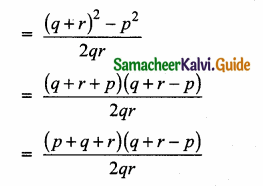
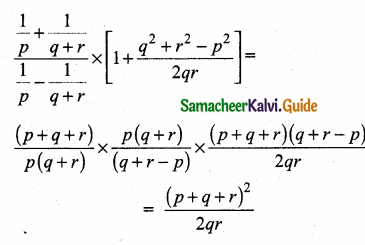
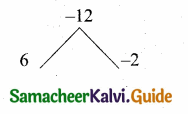
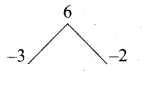
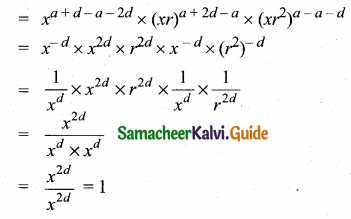
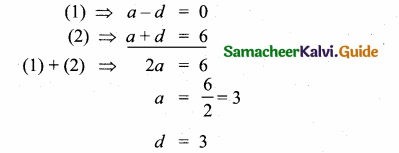
Samacheer Kalvi 10th Maths Guide Chapter 3 Algebra Ex 3.19

Students can download Maths Chapter 3 Algebra Ex 3.19 Questions and Answers, Notes, Samacheer Kalvi 10th Maths Guide Pdf helps you to revise the complete Tamilnadu State Board New Syllabus, helps students complete homework assignments and to score high marks in board exams.

Tamilnadu Samacheer Kalvi 10th Maths Solutions Chapter 3 Algebra Ex 3.19

Question 1.
A system of three linear equations in three variables is inconsistent if their planes
(1) intersect only at a point
(2) intersect in a line
(3) coincides with each other
(4) do not intersect
Answer:
(4) do not intersect

Question 2.
The solution of the system x + y -3z = -6, -7y + 7z = 7,3z = 9 is
(1) x = 1, y = 2, z = 3
(2) x = -1, y = 2, z = 3
(3) x = -1, y = -2, z = 3
(4) x = 1, y = 2, z = 3
Solution:
(4) x = 1, y = 2, z = 3
Hint:
x + y – 3z = -6
-7y + 7z = 7
3z = 9
z = 3
-7y + 21 = 7
-7y = -14
y = 2
x + 2 -3 × 3 = -6
x + 2 – 9 = -6 .
x = -6 + 7 = 1

Samacheer Kalvi 10th Maths Guide Chapter 3 Algebra Ex 3.19

Question 3.
If (x – 6) is the HCF of x2 – 2x – 24 and x2 – kx – 6 then the value of k is ……………..
(1) 3
(2) 5
(3) 6
(4) 8
Answer:
(2) 5
Hint.
HCF = x – 6
p(x) = x2 – 2x – 24
= (x – 6) (x + 4)
g(x) = x2 – kx – 6
∴ x – 6 is the common factor.
g (6) = 62 – k(6) – 6
= 36 – 6k – 6
= 30 – 6k
g(6) = 0
30 – 6k = 0
30 = 6k ⇒ k = \(\frac { 30 }{ 6 } \) = 5
The value of k = 5

Samacheer Kalvi 10th Maths Guide Chapter 3 Algebra Ex 3.19

Question 4.
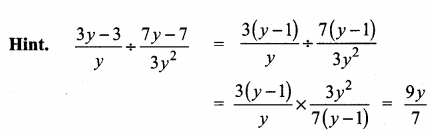
\(\frac { 3y-3 }{ y } \) + \(\frac { 7y-7 }{ 3y2 } \) is …………

Samacheer Kalvi 10th Maths Guide Chapter 3 Algebra Ex 3.19 1
Answer:
(1) \(\frac{9 y}{7}\)
Samacheer Kalvi 10th Maths Guide Chapter 3 Algebra Ex 3.19 2

Question 5.
y2 + \(\frac{1}{y^{2}}\) is not equal to ………….
(1) \(\frac{y^{4}+1}{y^{2}}\)
(2) (y + \(\frac { 1 }{ y } \))2
(3) (y – \(\frac { 1 }{ y } \))2
(4) (y + \(\frac { 1 }{ y } \))2 – 2
Answer:
(2) (y + \(\frac { 1 }{ y } \))2
Hint.
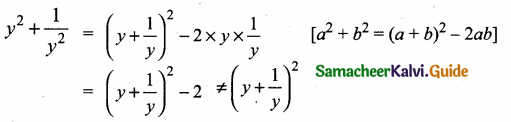
Samacheer Kalvi 10th Maths Guide Chapter 3 Algebra Ex 3.19 4

Samacheer Kalvi 10th Maths Guide Chapter 3 Algebra Ex 3.19

Question 6.
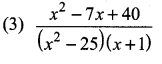
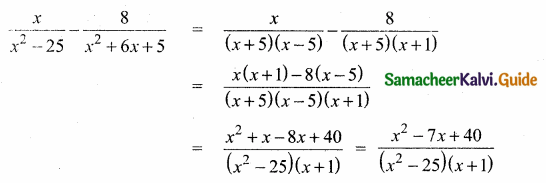
\(\frac{x}{x^{2}-25}-\frac{8}{x^{2}+6 x+5}\) gives …………..
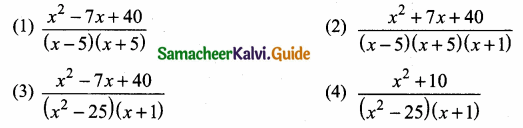
Samacheer Kalvi 10th Maths Guide Chapter 3 Algebra Ex 3.19 5
Answer:
Samacheer Kalvi 10th Maths Guide Chapter 3 Algebra Ex 3.19 6
Hint.
Samacheer Kalvi 10th Maths Guide Chapter 3 Algebra Ex 3.19 7

Samacheer Kalvi 10th Maths Guide Chapter 3 Algebra Ex 3.19

Question 7.
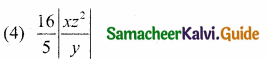
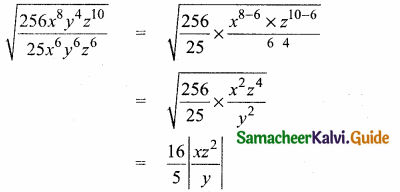
The square root of \(\frac{256 x^{8} y^{4} z^{10}}{25 x^{6} y^{6} z^{6}}\) is equal to ………….

Samacheer Kalvi 10th Maths Guide Chapter 3 Algebra Ex 3.19 8
Answer:
Samacheer Kalvi 10th Maths Guide Chapter 3 Algebra Ex 3.19 9
Hint.
Samacheer Kalvi 10th Maths Guide Chapter 3 Algebra Ex 3.19 10

Question 8.
Which of the following should be added to make x4 + 64 a perfect square
(1) 4x2
(2) 16x2
(3) 8x2
(4) -8x2
Solution:
(2) 16x2
Hint:
x4 + 64 = (x2)2 + 82 + 2 × 8x2
= (x2 + 8)2

Samacheer Kalvi 10th Maths Guide Chapter 3 Algebra Ex 3.19

Question 9.
The solution of (2x – 1)2 = 9 is equal to ………..
(1) -1
(2) 2
(3) -1, 2
(4) None of these
Answer:
(3) -1, 2
Hint.
(2x – 1)2 = 9 ⇒ (2x – 1) = \(\sqrt { 9 }\)
2x – 1 = ± 3 ⇒ 2x – 1 = 3 or 2x – 1 = 3
2x – 1 = 3
2x = 4 ⇒ x = \(\frac { 4 }{ 2 } \) = 2
2x – 1 = -3 ⇒ 2x = -3 + 1
x = -1

Samacheer Kalvi 10th Maths Guide Chapter 3 Algebra Ex 3.19

Question 10.
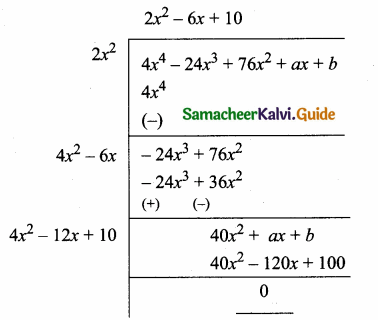
The values of a and b if 4x4 – 24x3 + 76x2 + ax + b is a perfect square are ………..
(1) 100,120
(2) 10,12
(3) -120,100
(4) 12,10
Answer:
(3) -120,100
Hint.
Since it is a perfect square
a + 120 = 0
a = -120
b – 100 = 0
b = 100
Samacheer Kalvi 10th Maths Guide Chapter 3 Algebra Ex 3.19 11

Samacheer Kalvi 10th Maths Guide Chapter 3 Algebra Ex 3.19

Question 11.
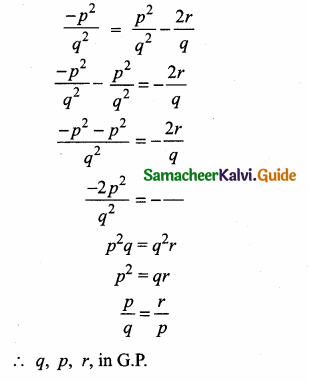
If the roots of the equation q2x2 + p2x + r2 = 0 are the squares of the roots of the equation qx2 + px + r = 0 , then q,p,r are in ……………..
(1) A.P.
(2) G.P.
(3) Both A.P and G.P
(4) none of these
Answer:
(2) G.P.
Hint.
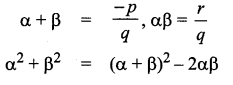
q2x2 + p2x + r2 = 0
Let the roots be α2 + β2
α2 + β2 = \(\frac{-p^{2}}{q^{2}}\)
α2β2 = \(\frac{r^{2}}{q^{2}}\)
qx2 + px + r = 0
Let the root be α and β
Samacheer Kalvi 10th Maths Guide Chapter 3 Algebra Ex 3.19 12
Samacheer Kalvi 10th Maths Guide Chapter 3 Algebra Ex 3.19 13

Question 12.
Graph of a linear polynomial is a
(1) straight line
(2) circle
(3) parabola
(4) hyperbola
Solution:
(1) straight line

Samacheer Kalvi 10th Maths Guide Chapter 3 Algebra Ex 3.19

Question 13.
The number of points of intersection of the quadratic polynomial x2 + 4x + 4 with the X axis is …………….
(1) 0
(2) 1
(3) 0 or 1
(4) 2
Answer:
(2) 1
Hint:
(x + 2)2 = 0 ⇒ (x + 2) (x + 2) = 0
x + 2 = 0 or x + 2 = 0 ⇒ x = -2 or x = -2
Number of points of intersection is 1 (both the values are same)

Question 14.
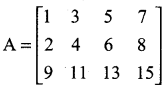
For the given matrix
Samacheer Kalvi 10th Maths Guide Chapter 3 Algebra Ex 3.19 14
the order of the matrix AT is ……………
(1) 2 × 3
(2) 3 × 2
(3) 3 × 4
(4) 4 × 3
Answer:
(3) 3 × 4

Question 15.
If A is a 2 × 3 matrix and B is a 3 × 4 matrix, how many columns does AB have ………..
(1) 3
(2) 4
(3) 2
(4) 5
Answer:
(2) 4
Hint.
The order of AB is 2 × 4
∴ Number of columns is 4.

Samacheer Kalvi 10th Maths Guide Chapter 3 Algebra Ex 3.19

Question 16.
If the number of columns and rows are not equal in a matrix then it is said to be a
(1) diagonal matrix
(2) rectangular matrix
(3) square matrix
(4) identity matrix
Solution:
(2) rectangular matrix

Question 17.
Transpose of a column matrix is …………..
(1) unit matrix
(2) diagonal matrix
(3) column matrix
(4) row matrix
Answer:
(4) row matrix

Question 18.
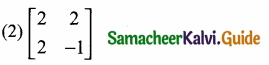
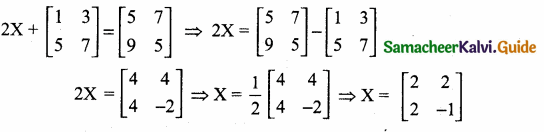
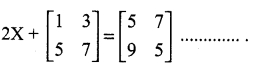
Find the matrix X if
Samacheer Kalvi 10th Maths Guide Chapter 3 Algebra Ex 3.19 15
Samacheer Kalvi 10th Maths Guide Chapter 3 Algebra Ex 3.19 16
Answer:
Samacheer Kalvi 10th Maths Guide Chapter 3 Algebra Ex 3.19 17
Hint.
Samacheer Kalvi 10th Maths Guide Chapter 3 Algebra Ex 3.19 18

Samacheer Kalvi 10th Maths Guide Chapter 3 Algebra Ex 3.19

Question 19.
Which of the following can be calculated from the given matrices?
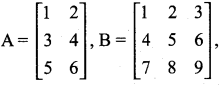
Samacheer Kalvi 10th Maths Guide Chapter 3 Algebra Ex 3.19 19
(i) A2
(ii) B2
(iii) AB
(iv) BA
(1) (i) and (ii) only
(2) (ii) and (iii) only
(3) (ii) and (iv) only
(4) all of these
Answer:
(3) (ii) and (iv) only
Hint: (i) A2 is possible to find
(ii) B2 is also possible to find
(iii) not possible: order of A= (3 × 2) order of B is (3 × 3). AB is not possible number of column of matrix A ≠ number of rows of the matrix B.
(iv) Possible number column of the matrix is equal to the number of the matrix A.

Question 20.

Samacheer Kalvi 10th Maths Guide Chapter 3 Algebra Ex 3.19 20
Which of the following statements are correct?

Samacheer Kalvi 10th Maths Guide Chapter 3 Algebra Ex 3.19 21
(1) (i) and (ii) only
(2) (ii) and (iii) only
(3) (iii) and (iv)
(4) all of these
Answer:
(1) (i) and (ii) only
Hint.
(i) AB + C : order of A = 2 × 3
order of B = 3 × 2
order of AB = 2 × 2
order of C = 2 × 2
It is possible to add AB + C

Samacheer Kalvi 10th Maths Guide Chapter 3 Algebra Ex 3.19

(ii) BC :
order of B = 3 × 2
order of C = 2 × 2
It is possible to find BC

(iii) BA is not possible
order of B = 3 × 2
order of A = 3 × 2
BA does not exist.
BA + C is not a correct statement

(iv) ABC is not possible
order of A = 2 × 3 order of
B = 3 × 2
order of AB = 2 × 2
order of C = 3 × 2
It is not possible to multiply AB and C.
∴ The statement ABC is not correct.
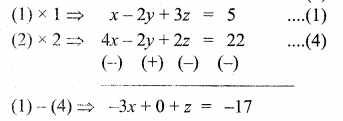
Samacheer Kalvi 10th Maths Guide Chapter 3 Algebra Unit Exercise 3

Students can download Maths Chapter 3 Algebra Unit Exercise 3 Questions and Answers, Notes, Samacheer Kalvi 10th Maths Guide Pdf helps you to revise the complete Tamilnadu State Board New Syllabus, helps students complete homework assignments and to score high marks in board exams.

Tamilnadu Samacheer Kalvi 10th Maths Solutions Chapter 3 Algebra Unit Exercise 3

Question 1.
Solve
\(\frac { 1 }{ 3 } \) (x + y – 5) = y – z = 2x – 11 = 9 – (x + 2z)
Answer:
\(\frac { 1 }{ 3 } \) (x + y – 5) = y – z
x + y – 5 = 3y – 3z
x + y – 3y + 3z = 5
x – 2y + 3z = 5 ….(1)
y – z – 2x – 11
-2 x + y – z = -11
2x – y + z = 11 …..(2)
2x – 11 = 9-(x + 2 z)
2x – 11 = 9 – x – 2z
2x + x + 2z = 9 + 11
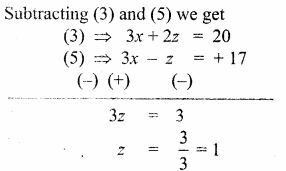
3x + 2z = 20 ….(3)
Samacheer Kalvi 10th Maths Guide Chapter 3 Algebra Unit Exercise 3 1
3x – z = 17 …. (5)
Samacheer Kalvi 10th Maths Guide Chapter 3 Algebra Unit Exercise 3 99
Samacheer Kalvi 10th Maths Guide Chapter 2 Numbers and Sequences Unit Exercise 3
Substitute the value of z = 1 in (3)
3x + 2(1) = 20
3x = 20 – 2
3x = 18
x = \(\frac { 18 }{ 3 } \) = 6
substitute the value of x = 6, z = 1 in (2)
2(6) – y + 1 = 11
12 – y + 1 = 11
13 – y = 11
-y = 11 – 13
-y = -2
y = 2
∴ The value of x = 6, y = 2 and z = 1

Samacheer Kalvi 10th Maths Guide Chapter 2 Numbers and Sequences Unit Exercise 3

Question 2.
One hundred and fifty students are admitted to a school. They are distrbuted over three sections A, B and C. If 6 students are shifted from section A to section C, the sections will have equal number of students. If 4 times of students of section C exceeds the number of students of section A by the number of students in section B, find the number of students in the three sections.
Answer:
Let the number of students in section A be “x”
Let the number of students in section B be “y”
Let the number of students in section C be “z”
By the given first condition
x + y + z = 150 ……(1)
again by the second condition
x – 6 = z + 6
x – z = 6 + 6
x – z = 12 ….(2)
again by the third condition
x + y = 4z
x + y – 4z = 0
x + y – 4z = 0 ….(3)
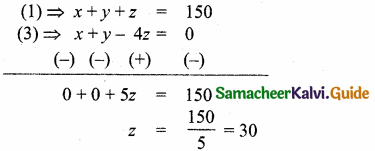
Subtracting (1) and (3)
Samacheer Kalvi 10th Maths Guide Chapter 3 Algebra Unit Exercise 3 2
Substitute the value of z = 30 in (2)
x – 30 = 12
x = 12 + 30
= 42
Substitute the value of x = 42 and z = 30 in (1)
42 + y + 30 = 150
y + 72 = 150
y = 150 – 72
= 78
Number of students in section A, B and C are = 42, 78 and 30.

Samacheer Kalvi 10th Maths Guide Chapter 2 Numbers and Sequences Unit Exercise 3

Question 3.
In a three-digit number, when the tens and the hundreds digit are interchanged the new number is 54 more than three times the original number. If 198 is added to the number, the digits are reversed. The tens digit exceeds the hundreds digit by twice as that of the tens digit exceeds the unit digit. Find the original number.
Answer:
Let the hundred digit be x
the tens digit be y and the unit digit be z
∴ The number is 100x + 10y + z
By the given first condition
100y + 10x + z = 54 + 3 (100x + 10y + z)
100y + 10x + z = 54 + 300x + 30y + 3z
-290x + 70y – 2z = 54 (÷ -2)
145x-35y + z = -27 ….(1)
Again by the second condition
198 + 100x + 10y + z = 100z + 10y + x
99x – 99z = -198 (÷ 99)
x – z = -2 ….(2)
Again by the third condition
y – x = 2(y – z)
y – x = 2y – 2z
– x – y + 2z = 0
x + y – 2z = 0 ….(3)
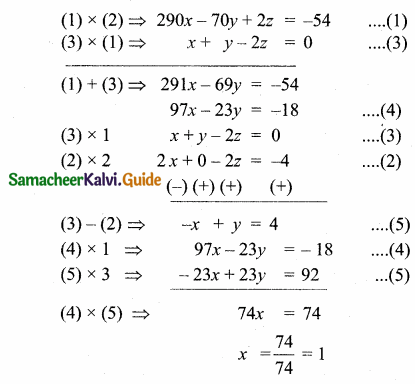
Samacheer Kalvi 10th Maths Guide Chapter 3 Algebra Unit Exercise 3 3
substitute the value of x = 1 in …….(2)
1 – z = -2
3 = z
∴ z = 3
substitute the value of x = 1 and z = 3 in …….(3)
1 – y – 6 = 0
y – 5 = 0
y = 5
∴ The number is 153

Samacheer Kalvi 10th Maths Guide Chapter 2 Numbers and Sequences Unit Exercise 3

Question 4.
Find the least common multiple of xy(k2 +1) + k(x2 + y2) and xy(k2 – 1) + k(x2 – y2).
Solution:
xy (k2 + 1) + k (x2 + y2) …………… (1)
xy(k2 – 1) + k(x2 – y2) …………… (2)
(1) ⇒ xyk2 + xy + kx2 + ky2
(2) ⇒ xyk2 – xy + kx2 – ky2
(1) ⇒ yk (xk + y) + x (xk + y)
= (xk + y) (x + yk)
(2) ⇒ yk (xk – y) + x (xk – y)
= (x + yk) (xk – y)
∴ L.C.M. : (x + yk) (xk + y) (xk – y)
= (x + yk) (x2k2 – y2)

Samacheer Kalvi 10th Maths Guide Chapter 2 Numbers and Sequences Unit Exercise 3

Question 5.
Find the GCD of the following by division algorithm
2x4 + 13x3 + 27x2 + 23x + 7,
x3 + 3x2 + 3x + 1, x2 + 2x + 1
Answer:
p(x) = 2x4 + 13x3 + 27x2 + 23x + 7
g(x) = x3 + 3x2 + 3x + 1
r(x) = x2 + 2x + 1
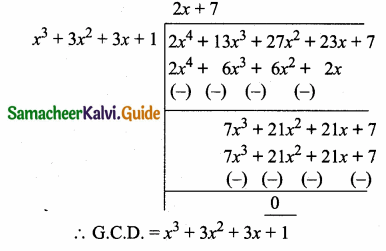
(i) Find the G.C.D. of p(x) and g(x)
Samacheer Kalvi 10th Maths Guide Chapter 3 Algebra Unit Exercise 3 4
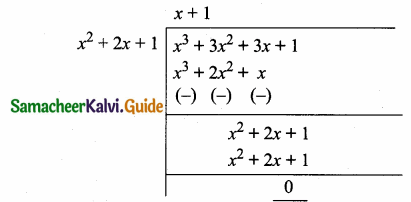
(ii) Find the G.C.D. of r(x) and the G.C.D. of p(x) and g(x)
Samacheer Kalvi 10th Maths Guide Chapter 3 Algebra Unit Exercise 3 5
∴ G.C.D.= x2 + 2x + 1
∴ G.C.D. of the three
polynomials = x2 + 2x + 1

Samacheer Kalvi 10th Maths Guide Chapter 2 Numbers and Sequences Unit Exercise 3

Question 6.
Reduce the given Rational expressions to its lowest form
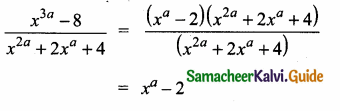
(i) \(\frac{x^{3 a}-8}{x^{2 a}+2 x^{a}+4}\)
Answer:
x3a – 8 = (xa)3 – 23
(using the formula a3 – b3 = (a – b)(a2 + ab + b2)
= (xa – 2)[(xa)2 + xa × 2 + 22]
= (xa – 2) (x2a + 2xa + 4)
Samacheer Kalvi 10th Maths Guide Chapter 3 Algebra Unit Exercise 3 6

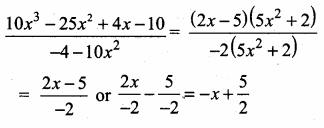
(ii) \(\frac{10 x^{3}-25 x^{2}+4 x-10}{-4-10 x^{2}}\)
Answer:
10x3 – 25x2 + 4x – 10 = 5x2(2x – 5) + 2 (2x – 5)
= (2x – 5) (5x2 + 2)
– 4 – 10x2 = -2 (2 + 5x2)
= -2(5x2 + 2)
Samacheer Kalvi 10th Maths Guide Chapter 3 Algebra Unit Exercise 3 7

Samacheer Kalvi 10th Maths Guide Chapter 2 Numbers and Sequences Unit Exercise 3

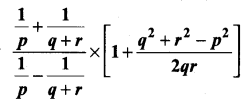
Question 7.
Simplify
Samacheer Kalvi 10th Maths Guide Chapter 3 Algebra Unit Exercise 3 8
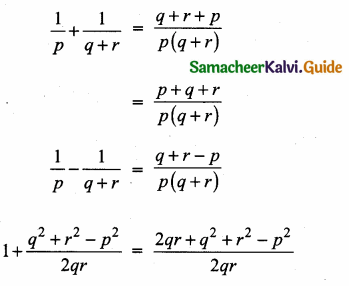
Answer:
Samacheer Kalvi 10th Maths Guide Chapter 3 Algebra Unit Exercise 3 9
Samacheer Kalvi 10th Maths Guide Chapter 3 Algebra Unit Exercise 3 10
Samacheer Kalvi 10th Maths Guide Chapter 3 Algebra Unit Exercise 3 100

Samacheer Kalvi 10th Maths Guide Chapter 2 Numbers and Sequences Unit Exercise 3

Question 8.
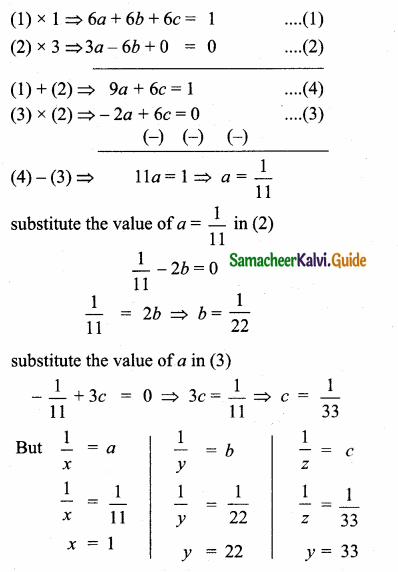
Arul, Ravi and Ram working together can clean a store in 6 hours. Working alone, Ravi takes twice as long to clean the store as Arul does. Ram needs three times as long as Arul does. How long would it take each if they are working alone?
Answer:
Let the time taken by Arul be “x” hours
Let the time taken by Ravi be “y” hours
Let the time taken by Ram be “z” hours
By the given first condition
\(\frac { 1 }{ x } \) + \(\frac { 1 }{ y } \) + \(\frac { 1 }{ z } \) = \(\frac { 1 }{ 6 } \)
Again by the given second condition
\(\frac { 1 }{ x } \) = 2 × \(\frac { 1 }{ y } \)
\(\frac { 1 }{ x } \) – \(\frac { 2 }{ y } \) = 0
By the given third condition
3 × \(\frac { 1 }{ z } \) = \(\frac { 1 }{ x } \)
– \(\frac { 1 }{ x } \) + \(\frac { 3 }{ z } \) = 0
Let \(\frac { 1 }{ x } \) = a, \(\frac { 1 }{ y } \) = b, \(\frac { 1 }{ z } \) = c
a + b + c = \(\frac { 1 }{ 6 } \)
6a + 6b + 6c = 1 …….(1)
a – 2b = 0 ……….(2)
-a + 3c = 0 …………(3)
Samacheer Kalvi 10th Maths Guide Chapter 3 Algebra Unit Exercise 3 11
Arul take 11 hours, Ravi take 22 hours and Ram takes 33 hours.

Samacheer Kalvi 10th Maths Guide Chapter 2 Numbers and Sequences Unit Exercise 3

Question 9.
Find the square root of 289x4 – 612x3 + 970x2 – 684x + 361.
Answer:
Samacheer Kalvi 10th Maths Guide Chapter 3 Algebra Unit Exercise 3 12

Question 10.
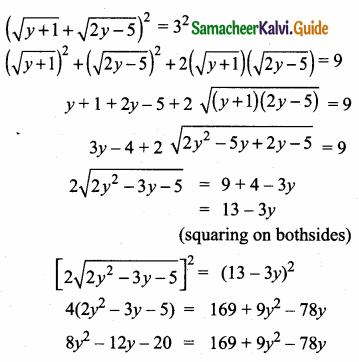
Solve \(\sqrt { y+1 }\) + \(\sqrt { 2y-5 }\) = 3
Answer:
\(\sqrt { y+1 }\) + \(\sqrt { 2y-5 }\) = 3
(squaring on bothsides)
Samacheer Kalvi 10th Maths Guide Chapter 3 Algebra Unit Exercise 3 13
8y2 – 9y2 – 12y + 78y – 20 – 169 = 0
-y2 – 66y – 189 = 0
y2 – 66y + 189 = 0
(y – 3) (y – 63) = 0
Samacheer Kalvi 10th Maths Guide Chapter 3 Algebra Unit Exercise 3 14
y – 3 or y = 63
The value of y is 3 and 63

Samacheer Kalvi 10th Maths Guide Chapter 2 Numbers and Sequences Unit Exercise 3

Question 11.
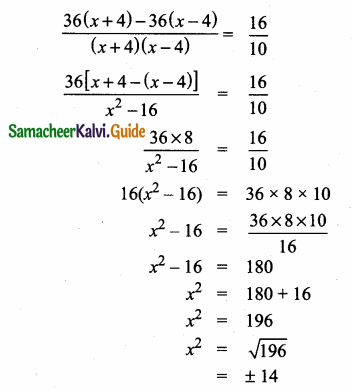
A boat takes 1.6 hours longer to go 36 kins up a river than down the river. If the speed of the water current is 4 km per hr, what is the speed of the boat in still water?
Answer:
Let the speed of the boat in still water be “x”
Time taken to go for up of a river = \(\frac { 36 }{ x+4 } \)
By the given condition
\(\frac { 36 }{ x-4 } \) – \(\frac { 36 }{ x+4 } \) = 1.6
Samacheer Kalvi 10th Maths Guide Chapter 3 Algebra Unit Exercise 3 15
The speed of the boat in still water = 14 km/hr

Samacheer Kalvi 10th Maths Guide Chapter 2 Numbers and Sequences Unit Exercise 3

Question 12.
Is it possible to design a rectangular park of perimeter 320 m and area 4800 m2? If so find its length and breadth.
Answer:
Let the length of the rectangular park be “l”
and the breadth of the rectangular park be “b”
Perimeter of the park = 320 m
2 (l + b) = 320
l + b = 160
l = 160 – b ……….(1)
Area of the park = 4800 m2
l × b = 4800 ….(2)
substitute the value of l = 160 – b in (2)
(160 – b)b = 4800
160b – b2 = 4800
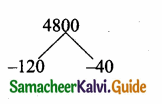
b2 – 160b + 4800 = 0
(b – 120) (b – 40) = 0
Samacheer Kalvi 10th Maths Guide Chapter 3 Algebra Unit Exercise 3 16
b = -120 = 0 or b – 40 = 0
b = 120 or b = 40
If breadth is 120 length is 40
If breadth is 40 length is 120
Length of the park = 120 m
Breadth of the park = 40 m

Samacheer Kalvi 10th Maths Guide Chapter 2 Numbers and Sequences Unit Exercise 3

Question 13.
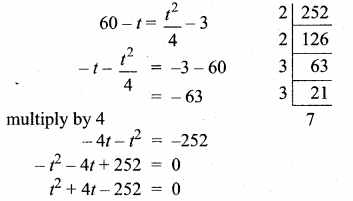
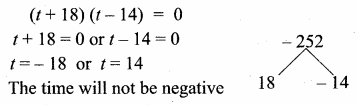
At t minutes past 2 pm, the time needed to 3 pm is 3 minutes less than \(\frac{t^{2}}{4}\) Find t.
Answer:
Time needed by the minutes hand to show
3 pm = (60 – 1) minutes
By the given condition
Samacheer Kalvi 10th Maths Guide Chapter 3 Algebra Unit Exercise 3 17
Samacheer Kalvi 10th Maths Guide Chapter 3 Algebra Unit Exercise 3 18
∴ The value of t = 14 minutes

Question 14.
The number of seats in a row is equal to the total number of rows in a hall. The total number of seats in the hall will increase by 375 if the number of rows is doubled and the number of seats in each row is reduced by 5. Find the number of rows in the hall at the beginning.
Answer:
Let the number of rows in the hall be “x”
∴ Total number of rows = x
Total number of seats in the hall is “x2”
By the given condition
x2 + 375 = 2x (x – 5)
x2 + 375 = 2x2– 10x
x2 – 2x2 + 10x + 375 = 0
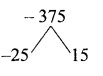
– x2 + 10x + 375 = 0
– x2 – 10x – 375 = 0
(x – 25) (x + 15)
x – 25 = 0 or x + 15 = 0
x = 25 or x = – 15
Samacheer Kalvi 10th Maths Guide Chapter 3 Algebra Unit Exercise 3 19
Number of rows in the hall = 25

Samacheer Kalvi 10th Maths Guide Chapter 2 Numbers and Sequences Unit Exercise 3

Question 15.
If α and β are the roots of the polynomial f(x) – x2 – 2x + 3, find the polynomial whose roots are
(i) α + 2, β + 2
Answer:
α and β are the roots of the polynomial
x2 – 2x + 3 = 0
α + β = 2; αβ = 3
(i) Sum of the roots = α + 2 + β + 2
= α + β + 4
= 2 + 4
= 6
Product of the roots = (α + 2) (β + 2)
= αβ + 2α + 2β + 4
= αβ + 2(α + β) + 4
= 3 + 4 + 4
= 11
The quadratic polynomial
x2 – (sum of the roots) x + product of the roots = 0
x2 – (6) x + 11 = 0
x2 – 6x + 11 = 0

(ii) \(\frac{\alpha-1}{\alpha+1}, \frac{\beta-1}{\beta+1}\)
Answer:
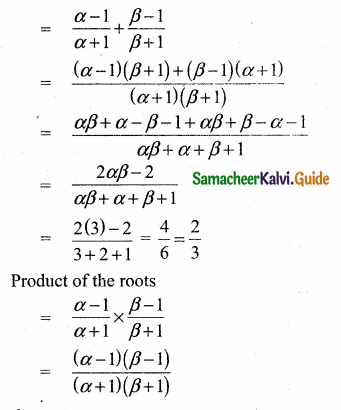
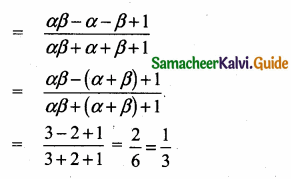
Sum of the roots
Samacheer Kalvi 10th Maths Guide Chapter 3 Algebra Unit Exercise 3 20
Samacheer Kalvi 10th Maths Guide Chapter 3 Algebra Unit Exercise 3 21
The quadratic polynomial is
x2 – (sum of the roots) + products of the roots = 0
x2 – (\(\frac { 2 }{ 3 } \)) x + \(\frac { 1 }{ 3 } \) = 0
3x2 – 2x + 1 = 0

Samacheer Kalvi 10th Maths Guide Chapter 2 Numbers and Sequences Unit Exercise 3

Question 16.
If -4 is a root of the equation x2 + px – 4 = 0 and if the equation x2 + px + q = 0 has equal roots, find the values of p and q.
Solution:
f(x) = x2 + px – 4 = 0
If -4 is a root, then
f(-4) = (-4)2 + P(-4) – 4 = 16 – 4p – 4 = 0
12 – 4p = 0
-4p = -12
p = 3
x2 + 3x + q =0 has equal roots,
∆ = b2 – 4ac = 0
32 – 4 × 1 × q = 0
9 – 4q = 0
-4 q = -9
q = \(\frac{9}{4}\)
p = 3, q = \(\frac{9}{4}\)

Samacheer Kalvi 10th Maths Guide Chapter 2 Numbers and Sequences Unit Exercise 3

Question 17.
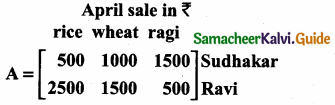
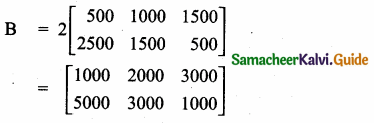
Two farmers Senthil and Ravi cultivates three varieties of grains namely rice, wheat and ragi. If the sale (in ₹) of three varieties of grains by both the farmers in the month of April is given by the matrix.
Samacheer Kalvi 10th Maths Guide Chapter 3 Algebra Unit Exercise 3 22
and the May month sale (in ₹) is exactly twice as that of the April month sale for each variety.
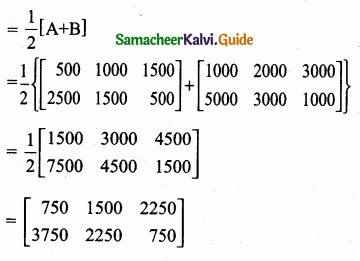
(i) What is the average sales of the months April and May.
Answer:
(i) Let A represent the sale on April
Samacheer Kalvi 10th Maths Guide Chapter 3 Algebra Unit Exercise 3 23
Let B represent the sale on May
Samacheer Kalvi 10th Maths Guide Chapter 3 Algebra Unit Exercise 3 24
Average sale of the month April and May
Samacheer Kalvi 10th Maths Guide Chapter 3 Algebra Unit Exercise 3 25

Samacheer Kalvi 10th Maths Guide Chapter 2 Numbers and Sequences Unit Exercise 3

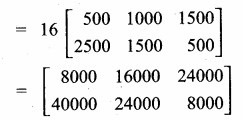
(ii) If the sales continue to increase in the same way in the successive months, what will be sales in the month of August?
Answer:
If it increasing in the successive months of
May sale is 2 (April sale)
June sale is 4 (April sale)
July sale is 8 (April sale)
August sale is 16 (April sale)
Sales in the month of August
Samacheer Kalvi 10th Maths Guide Chapter 3 Algebra Unit Exercise 3 26

Question 18.
If cos Samacheer Kalvi 10th Maths Guide Chapter 3 Algebra Unit Exercise 3 27 = I2, find x.
Answer:
Samacheer Kalvi 10th Maths Guide Chapter 3 Algebra Unit Exercise 3 28

Samacheer Kalvi 10th Maths Guide Chapter 2 Numbers and Sequences Unit Exercise 3

Question 19.
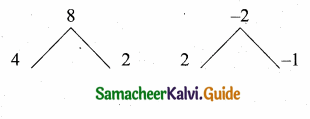
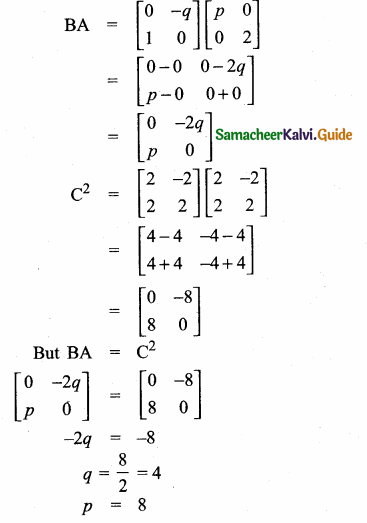
Given
Samacheer Kalvi 10th Maths Guide Chapter 3 Algebra Unit Exercise 3 29
and if BA = C2, find p and q
Answer:
Samacheer Kalvi 10th Maths Guide Chapter 3 Algebra Unit Exercise 3 30
∴The value of p = 8 and q = 4

Samacheer Kalvi 10th Maths Guide Chapter 2 Numbers and Sequences Unit Exercise 3

Question 20.
Samacheer Kalvi 10th Maths Guide Chapter 3 Algebra Unit Exercise 3 31
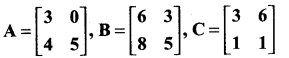
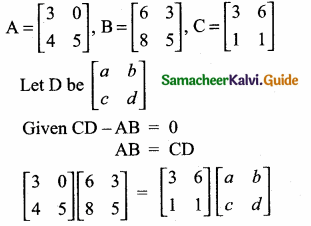
find the matrix D, such that CD – AB = 0
Answer:
Given
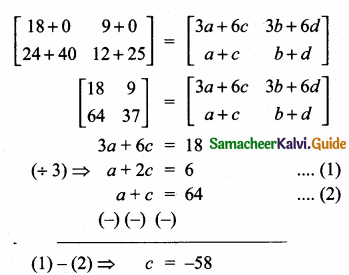
Samacheer Kalvi 10th Maths Guide Chapter 3 Algebra Unit Exercise 3 32
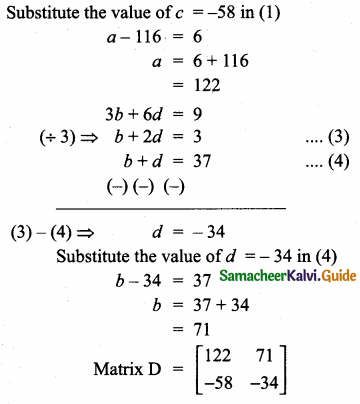
Samacheer Kalvi 10th Maths Guide Chapter 3 Algebra Unit Exercise 3 33
Samacheer Kalvi 10th Maths Guide Chapter 3 Algebra Unit Exercise 3 34

Samacheer Kalvi 10th Maths Guide Chapter 2 Numbers and Sequences Additional Questions

Students can download Maths Chapter 2 Numbers and Sequences Additional Questions and Answers, Notes, Samacheer Kalvi 10th Maths Guide Pdf helps you to revise the complete Tamilnadu State Board New Syllabus, helps students complete homework assignments and to score high marks in board exams.

Tamilnadu Samacheer Kalvi 10th Maths Solutions Chapter 2 Numbers and Sequences Additional Questions

I. Choose the correct answer.

Question 1.
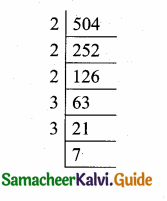
The sum of the exponents of the prime factors in the prime factorisation of 504 is ……….
(1) 3
(2) 2
(3) 1
(4) 6
Answer:
(4) 6
Samacheer Kalvi 10th Maths Guide Chapter 2 Numbers and Sequences Additional Questions 1
Hint: 504 = 23 × 32 × 71
Sum of the exponents
= 3 + 2 + 1 = 6

Samacheer Kalvi 10th Maths Guide Chapter 2 Numbers and Sequences Additional Questions

Question 2.
If two positive integers a and 6 are expressible in the form a = pq2 and b = p3q ; p, q being prime numbers, then L.C.M. of (a, b) is ……………
(i) pq
(2) P2 q2
(3) p3 q3
(4) P3 q2
Answer:
(4) P3 q2
Hint: a = p × q2 and b = p3 × q
∴ L.C.M. of (a, b) is p3 q2

Question 3.
If n is a natural number then 73n – 43n is always divisible by …………….
(1) 11
(2) 3
(3) 33
(4) both 11 and 3
Answer:
(4) both 11 and 3
Hint: 73n – 43n is of the form a2n – b2n which is divisible by both a – b and a + b. So 73n – 43n is divisible by both 7 – 4 = 3 and 7 + 4 = 11.

Samacheer Kalvi 10th Maths Guide Chapter 2 Numbers and Sequences Additional Questions

Question 4.
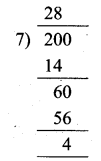
The value of x when 200 = x (mod 7) is …………………
(1) 3
(2) 4
(3) 54
(4) 12
Answer:
(2) 4
Hint:
Samacheer Kalvi 10th Maths Guide Chapter 2 Numbers and Sequences Additional Questions 2
200 ≡ x (mod 7)
200 ≡ 4 (mod 7)
The value of x = 4

Question 5.
The common difference of the A.P.
\(\frac { -2 }{ 2b } \) , \(\frac { 1-6b }{ 2b } \), \(\frac { 1-12b }{ 2b } \) is …………….
(1) 2b
(2) -2b
(3) 3
(4) -3
Answer:
(4) -3
Hint:
\(\frac { 1-12b }{ 2b } \) – \(\frac { 1-6b }{ 2b } \) = \(\frac { 1-12b-1+6b }{ 2b } \) = \(\frac { -6b2 }{ 2b } \) = \(\frac { -6b }{ 2b } \) = -3

Samacheer Kalvi 10th Maths Guide Chapter 2 Numbers and Sequences Additional Questions

Question 6.
Which one of the following is not true?
(1) A sequence is a real valued function defined on N.
(2) Every function represents a sequence.
(3) A sequence may have infinitely many terms.
(4) A sequence may have a finite number of terms.
Answer:
(2) Every function represents a sequence.
Hint: A sequence is a function whose domain is the set of natural numbers.

Question 7.
The 8th term of the sequence 1,1,2,3,5,8, ………. is ……….
(1) 25
(2) 24
(3) 23
(4) 21
Answer:
(4) 21
Hint: In fibonacci sequence
Fn = Fn-1 + Fn-2
F8 = F7 + F6
8th term = 6th term + 7th term
= 8 + (5 + 8) = 21

Question 8.
The next term of \(\frac { 1 }{ 20 } \) in the sequence \(\frac { 1 }{ 2 } \),\(\frac { 1 }{ 6 } \),\(\frac { 1 }{ 12 } \),\(\frac { 1 }{ 20 } \) is ……………
(1) \(\frac { 1 }{ 24 } \)
(2) \(\frac { 1 }{ 22 } \)
(3) \(\frac { 1 }{ 30 } \)
(4) \(\frac { 1 }{ 18 } \)
Answer:
(3) \(\frac { 1 }{ 30 } \)
Hint:
The general term tn = \(\frac{1}{n(n+1)}\)
⇒ t5 = \(\frac{1}{5(6)}\) = \(\frac { 1 }{ 30 } \)

Samacheer Kalvi 10th Maths Guide Chapter 2 Numbers and Sequences Additional Questions

Question 9.
If a, 6, c, l, m are in A.P, then the value of a – 46 + 6c – 4l + m is …………
(1) 1
(2) 2
(3) 3
(4) 0
Answer:
(4) 0
Hint: Given, a, b, c, l, m, are in A.P.
a = a; b = a + d; c = a + 2 d; 1 = a + 3d;
m = a + 4d [The general form of A.P.]
a – 4b + 6c – 4l + m
= a – 4(a + d) + 6(a + 2d) – 4 (a + 3d) + a + 4d
= a – 4a – 4d+ 6a + 12 d – 4a – 12d + a + 4d
= a + 6a + a – 4a – 4a
= 8a – 8a
= 0

Question 10.
If a, b, c are in A.P. then \(\frac { a-b }{ b-c } \) is equal to ……………
(1) \(\frac { a }{ b } \)
(2) \(\frac { b }{ c } \)
(3) \(\frac { a }{ c } \)
(4) 1
Answer:
(4) 1
Hint: a, b, c are in A.P.
b – a = c-b [common difference is same t2 – t1 = t3 – t2]
\(\frac { b-a }{ c-b } \) = 1 ⇒ \(\frac{-(a-b)}{-(b-c)}\) = 1
∴ \(\frac { a-b }{ b-c } \) = 1

Samacheer Kalvi 10th Maths Guide Chapter 2 Numbers and Sequences Additional Questions

Question 11.
If the nth term of a sequence is 100n + 10, then the sequence is ……
(1) an A.P.
(2) a G..P.
(3) a constant sequence
(4) neither A.P. nor G.P.
Answer:
(1) an A.P.
Hint: tn = 100/n + 10
t1 = 100 + 10 = 110
t2 = 200+ 10 = 210
t3 = 300+ 10 = 310
∴ The series 110, 210, 310 …………. are in A.P.

Question 12.
If a1, a2, a3, …… are in A.P. such that \(\frac{a_{4}}{a_{7}}=\frac{3}{2}\), then the 13th term of the A.P. is ……………..
(1) \(\frac { 3 }{ 2 } \)
(2) 0
(3) 12a1
(4) 14a1
Answer:
(2) 0
Hint:
\(\frac{a_{4}}{a_{7}}=\frac{3}{2}\)
2a4 = 3a7
2(a + 3d) = 3(a + 6d)
2a + 6d = 3a + 18d
0 = a + 12d
[tn = a + (n – 1)d]
0 = t13

Question 13.
If the sequence a1, a2, a3 ,… is in A.P., then the sequence a5, a10, a15, …. is …..,
(1) a G.P.
(2) an A.P.
(3) neither A.P nor G.P.
(4) a constant sequence
Answer:
(2) an A.P.
Hint: a5, a10, a15, ……….. = a + 4d, a + 9d, a + 14d
t2 – t1 = a + 9d – (a + 4d) = 5d
t3 – t2 = a + 14d – (a + 9d) = 5d
Common difference is 5d
If terms of an A.P are chosen at equal intervals then they form an A.P.

Samacheer Kalvi 10th Maths Guide Chapter 2 Numbers and Sequences Additional Questions

Question 14.
If k + 2,4k – 6, 3k – 2 are the 3 consecutive terms of an A.P, then the value of K is ……………
(1) 2
(2) 3
(3) 4
(4) 5
Answer:
(2) 3
Hint: Here, a = k + 2, b = 4k-6, c = 3k-2
We know that a, b, c are in A.P.
b – a = c – b ⇒ 2b = a + c
2(4k – 6) = k + 2 + 3k – 2
8k – 12 = 4k ⇒ 4k = 12
K = \(\frac { 12 }{ 4 } \) = 3

Question 15.
If a, b, c, l, m, n are in A.P, then 3a + 7, 3b + 7, 3c + 7, 31 + 7, 3m + 7, 3n + 7 form ………..
(1) a G . P.
(2) an A.P.
(3) a constant sequence
(4) neither A.P. nor G.P.
Answer:
(2) an A.P.
Hint: In an A.P, if each term is multiplied by a constant or added by a constant, the resulting sequence is an A.P.

Samacheer Kalvi 10th Maths Guide Chapter 2 Numbers and Sequences Additional Questions

Question 16.
If the third term of a G.P. is 2, then the product of first 5 terms is ……………..
(1) 52
(2) 25
(3) 10
(4) 15
Answer:
(2) 25
Hint: Consider the 5 terms of the G.P be \(\frac{a}{r^{2}}\),\(\frac { a }{ r } \), a, ar, ar2
Product of 5 terms = \(\frac{a}{r^{2}} \times \frac{a}{r} \times a \times a r \times ar^{2}\), = a5, 25 (Given a = 2)

Question 17.
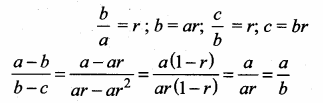
If a, b, c are in G.P., then \(\frac { a-b }{ b-c } \) is equal to …………..
(1) \(\frac { a }{ b } \)
(2) \(\frac { b }{ a } \)
(3) \(\frac { a }{ c } \)
(4) \(\frac { c }{ b } \)
Ans.
(1) \(\frac { a }{ b } \)
Hint: Let the common ratio be “r”
Samacheer Kalvi 10th Maths Guide Chapter 2 Numbers and Sequences Additional Questions 3

Question 18.
If x, 2x + 2, 3x + 3, are in G.P., then 5x, 10x + 10, 15x + 15, form …………..
(1) anA.P.
(2) a G.P.
(3) a constant sequence
(4) neither A.P. nor a G.P.
Answer:
(2) a G.P.
Hint: If a G.P. is multiplied by a constant then the sequence is also a G.P.
In the given question each term is multiplied by 5

Samacheer Kalvi 10th Maths Guide Chapter 2 Numbers and Sequences Additional Questions

Question 19.
The sequence – 3, – 3, – 3, …… is ……..
(1) an A.P. only
(2) a G.P. only
(3) neither A.P. nor G.P.
(4) both A.P. and G.P.
Answer:
(4) both A.P. and G.P.
Hint: The given sequence is constant.
The sequence is A.P. and G.P.

Question 20.
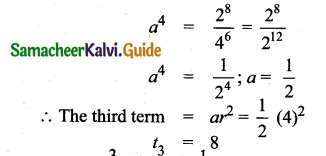
If the product of the first four consecutive terms of a G.P is 256 and if the common ratio is 4 and the first term is positive, then its 3rd term is …….
(1) 8
(2) \(\frac { 1 }{ 16 } \)
(3) \(\frac { 1 }{ 32 } \)
(4) 16
Answer:
(1) 8
Hint: The general form of the G.P. is a, ar, ar2, ar3, ar4, …………..
By data, a (ar) (ar2) (ar3) = 256
a4 × r6 = 256
[Given r = 4]
Samacheer Kalvi 10th Maths Guide Chapter 2 Numbers and Sequences Additional Questions 4

Question 21.
In G.P, t2 = \(\frac { 3 }{ 5 } \) and t3 = \(\frac { 1 }{ 5 } \) Then the common ratio is ……….
(1) \(\frac { 1 }{ 5 } \)
(2) \(\frac { 1 }{ 3 } \)
(3) 1
(4) 5
Answer:
(2) \(\frac { 1 }{ 3 } \)
Hint: common ratio is
(r) = \(\frac{t_{3}}{t_{2}}=\frac{1}{5} \times \frac{5}{3} \Rightarrow r=\frac{1}{3}\)

Question 22.
If x ≠ 0, then 1 + sec x + sec2 x + sec3 x + sec4 x + sec5 x is equal to ……………
(1) (1 + sec x) (sec2 x + sec3 x + sec4 x)
(2) (1 + sec x) (1 + sec2 x + sec4 x)
(3) (1 – sec x) (sec x + sec3 x + sec5 x)
(4) (1 + sec x) (1 + sec3 x + sec4 x)
Answer:
(2) (1 + sec x) (1 + sec2 x + sec4 x).
Hint:
1 + sec x + sec2 x + sec3 x
+ sec4 x + sec5 x
= (1 + sex x) + sec2 x (1 + sec x) + sec4 x (1 + see x)
= (1 + sec x) + sec2 x (1 + sec x) + sec4 x (1 + secx)
= (1 + sec x) (1 + sec2 x + sec4 x)

Samacheer Kalvi 10th Maths Guide Chapter 2 Numbers and Sequences Additional Questions

Question 23.
If the nth term of an A.P. is tn = 3 – 5n, then the sum of the first n terms is …………….
(1) \(\frac { n }{ 2 } \) [1 – 5n]
(2) n (1 – 5n)
(3) \(\frac { n }{ 2 } \) (1 + 5n)
(4) \(\frac { n }{ 2 } \) (1 + n)
Answer:
(1) \(\frac { n }{ 2 } \) [1 – 5n]
Hint:
tn =. 3 – 5(n)
t1 = 3 – 5(1) = -2 ; t2 = 3 – 10 = -7
a = -2, d = -7 – (-2) = -5
Sn = \(\frac { n }{ 2 } \) [2a + (n – 1)d]
= \(\frac { n }{ 2 } \) [-4 + (n – 1) (-5)]
= \(\frac { n }{ 2 } \) [- 4 -5n + 5] = \(\frac { n }{ 2 } \) [1 – 5n]

Question 24.
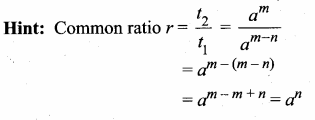
The common ratio of the G.P. am-n, am, am+n is …………
(1) am
(2) a-m
(3) an
(4) a-n
Answer:
(3) an
Samacheer Kalvi 10th Maths Guide Chapter 2 Numbers and Sequences Additional Questions 5

Question 25.
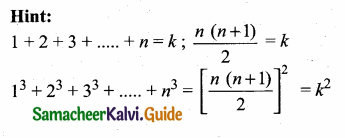
If 1 + 2 + 3 + … + n = k then 13 + 23 + ……. + n3 is equal to …………
(1) K2
(2) K3
(3) \(\frac{k(k+1)}{2}\)
(4) (K + 1)3
Answer:
(1) K2
Samacheer Kalvi 10th Maths Guide Chapter 2 Numbers and Sequences Additional Questions 6

II. Answer the following.

Question 1.
Show that the square of any positive integer of the form 3m or 3m + 1 for some integer m.
Answer:
Let a be any positive integer. Then it is of the form 3q or 3q + 1 or 3q + 2
Case – 1 When a = 3q
a2 = (3q)2 = 9 q2
= (3q) (3q)
= 3m where m = 3q
Case – 2 When a = 3q + 1
a2 = (3q + 1)2 = 9q2 + 6q + 1
= 3q (3q + 2) + 1
= 3 m + 1
where m = q (3q + 2)
Case – 3 When a = 3q + 2
a2 = (3q + 2)2 = 9q2 + 12q + 4
= 9q2 + 12q + 3 + 1
= 3(3q2 + 4q + 1) + 1
= 3m + 1
where m = 3q2 + 4q + 1
Hence a is of the form 3m or 3m + 1

Samacheer Kalvi 10th Maths Guide Chapter 2 Numbers and Sequences Additional Questions

Question 2.
Show that any positive odd integer is of the form 4q + 1 or 4q + 3, where q is some integer.
Solution:
Let us start with taking a, where a is a +ve odd integer.
We apply the division algorithm with ‘a’ and ‘b’ = 4.
Since 0 < r < 4, the possible remainders are 0, 1, 2, 3.
That is, a can be 4q, or 4q + 1, or 4q + 2 or 4q + 3, where 1 is the quotient. However, since a is odd, a cannot be 4q or 4q + 2 (since they are both divisible by 2).
Any odd integer is of the form 4q + 1 or 4q + 3.

Question 3.
Compute x such that 54 = x (mod 8)
Answer:
52 = 25 = 1 (mod 8)
54 = (52)2 = l2 (mod 8)
= 1
54 = 1 (mod 8)

Question 4.
The first term of an A.P. is 6 and the common difference is 5. Find the A.P. and its general term.
Answer:
Given, a = 6, d = 5
General term tn = a + (n – 1) d
= 6 + (n – 1) 5
= 6 + 5 n – 5
= 5 n + 1
The general form of the A.P. is a, a + d, a + 2d,
The A.P. is 6, 11, 16, 21, ……… 5n + 1.

Samacheer Kalvi 10th Maths Guide Chapter 2 Numbers and Sequences Additional Questions

Question 5.
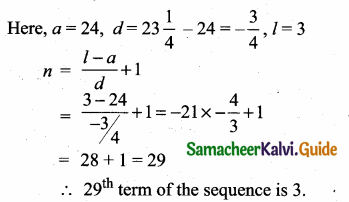
Which term of the arithmetic sequence 24, 23\(\frac { 1 }{ 4 } \), 22 \(\frac { 1 }{ 2 } \), 21 \(\frac { 3 }{ 4 } \), …….. is 3?
Answer:
Given The A.P is 24, 23 \(\frac { 1 }{ 4 } \), 22 \(\frac { 1 }{ 2 } \), 21 \(\frac { 3 }{ 4 } \), …………..
Samacheer Kalvi 10th Maths Guide Chapter 2 Numbers and Sequences Additional Questions 7

Question 6.
Determine the AP whose 3rd term is 5 and the 7th term is 9.
Solution:
We have
a3 = a + (3 – 1)d = a + 2d = 5 ……….. (1)
a7 = a + (7 – 1)d = a + 6d = 9 ………… (2)
(1) – (2) ⇒ -4d = -4 ⇒ d = 1.
Sub, d = 1 in (1), we get
a + 2(1) = 5
a = 3
Hence the required A.P. is 3, 4, 5, 6, 7.

Samacheer Kalvi 10th Maths Guide Chapter 2 Numbers and Sequences Additional Questions

Question 7.
If a, b, c are in A.P. then prove that (a – c)2 = 4 (b2 – ac).
Answer:
Given a, b, c are in A.P.
n = 10
∴ b – a = c – b
2 b = a + c
Squaring on both sides,
(a + c)2 = (2b)2
a2 + c2 + 2ac = 4b2
(a – c)2 + 2ac + 2ac = 4b2
[a2 + c2 = (a – c)2 + 2ac]
(a – c)2 = 4b2 – 4ac
(a – c)2 = 4(b2 – ac)
Hence it is proved.
Aliter: Given a, b, c are in A.P.
b – a = c – b
2b = a + c
To prove, (a – c)2 = 4(b2 – ac)
L.H.S.= (a – c)2
= a2 + c2 – 2 ac
= (a + c)2 – 2 ac – 2ac
= (a + c)2 – 4ac
= (2b)2 – 4ac (2b = a + c)
= 4b2 – 4ac = 4 (b2 – ac) = R.H.S
∴ L.H.S = R.H.S., Hence proved.

Samacheer Kalvi 10th Maths Guide Chapter 2 Numbers and Sequences Additional Questions

Question 8.
If the sum of the first 14 terms of an AP is 1050 and its first term is 10, find the 20th term.
Solution:
Here S14 = 1050
n = 14
a = 10
Sn = \(\frac { n }{ 2 } \) (2a + (n – 1)d)
1050 = \(\frac { 14 }{ 2 } \) (20 + 13d)
= 140 + 91d
910 = 91d
d = 10
a20 = 10 + (20 – 1) × 10
= 20
∴ 20th term = 200.

Question 9.
Find the sum of the first 40 terms of the series 12 – 22 + 32 – 42 + ….
Answer:
The given series is 12 – 22 + 32 – 42 + …. 40 terms
Grouping the terms we get,
(12 – 22) + (32 – 42) + (52 – 62) + ………….. 20 terms
(1 – 4) + (9 – 16) + (25 – 36) + …………… 20 terms
(- 3) + (- 7) + (- 11) + ………………. 20 term
This is an A.P
Here a = – 3, d = – 7 – (-3) = – 7 + 3 = – 4 n = 20
Sn = \(\frac { n }{ 2 } \) [2a + (n – 1) d ]
S20 = \(\frac { 20 }{ 2 } \) [2(-3) + 19(-4)]
= 10 (- 6 – 76) = 10 (- 82) = – 820
∴ Sum of 40 terms of the series is – 820.
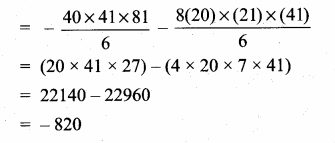
Aliter. 12 – 22 + 32 – 42 + …….. + 392 – 402
= 12 + 32 + 52 + ……. + 392
(22 + 42 + 62 + ……….. + 402)
= 12 + 22 + 32 + 42 + …. + 402
– (22 + 42 + 62 + …. + 402)
– (22 + 42 + 62 + …. + 402)
= 12 + 22 + 32 + …. + 402
= 2 × 22 (12 + 22 + ….. + 202)
Samacheer Kalvi 10th Maths Guide Chapter 2 Numbers and Sequences Additional Questions 8

Samacheer Kalvi 10th Maths Guide Chapter 2 Numbers and Sequences Additional Questions

Question 10.
Find the sum of first 24 terms of the list of numbers whose nth term is given by
an = 3 + 2n.
Solution:
an = 3 + 2n
a1 = 3 + 2 = 5
a2 = 3 + 2 × 2 = 7
a3 = 3 + 2 × 3 = 9
List of numbers becomes 5, 7, 9. 11, ……….
Here,7 – 5 = 9 – 7 = 11 – 9 = 2 and soon. So, it forms an A.P. with common difference d = 2.
To find S24, we have n = 24, a = 5, d = 2.
S24 = \(\frac { 24 }{ 2 } \) [2 × 5 + (24 – 1) × 2 ]
= 12 [10 + 46] = 672
So, sum of first 24 terms of the list of numbers is 672.

Question 11.
If a clock strikes once at 1 o’clock, twice at 2 o’clock and so on, how many times will it strike in a day?
Answer:
Number of times the clock strikes each hour form an A.P.
Number of times strike in 12 hours is
1 + 2 + 3 + …….. + 12
Here, a = 1, d = 1, n = 12, l = 12
Sn = \(\frac { n }{ 2 } \) (a + l) = \(\frac { 12 }{ 2 } \) (1 + 12)
= 6 × 13 = 78 times
∴ Number of times the clock strike in 24 hours
= 78 × 2 = 156 times.

Samacheer Kalvi 10th Maths Guide Chapter 2 Numbers and Sequences Additional Questions

Question 12.
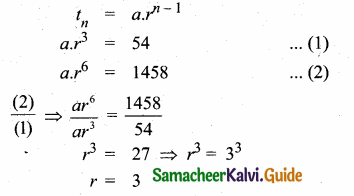
If the 4th and 7th terms of a G.P. are 54 and 1458 respectively, find the G.P.
Answer:
Given, t4 = 54 and t7 = 1458
Samacheer Kalvi 10th Maths Guide Chapter 2 Numbers and Sequences Additional Questions 9
Substituting the value of r = 3 in (1)
a × 27 = 54
a = \(\frac { 54 }{ 27 } \) = 2
∴ The Geometric sequence is 2, 6, 18, 54 ………

Samacheer Kalvi 10th Maths Guide Chapter 2 Numbers and Sequences Additional Questions

Question 13.
Which term of the geometric sequence,
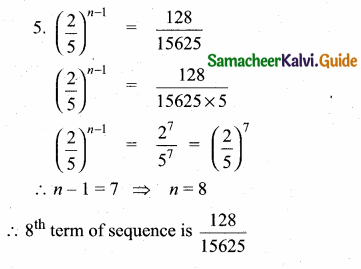
(i) 5, 2, \(\frac { 4 }{ 5 } \), \(\frac { 8 }{ 25 } \), ……… is \(\frac { 128 }{ 15625 } \)?
Answer:
The given G.P. is 5, 2, \(\frac { 4 }{ 5 } \),\(\frac { 8 }{ 25 } \), …….., is \(\frac { 128 }{ 15625 } \)
Here a = 5, r = \(\frac { 2 }{ 5 } \), tn = \(\frac { 128 }{ 15625 } \)
tn = a.rn-1
Samacheer Kalvi 10th Maths Guide Chapter 2 Numbers and Sequences Additional Questions 10

Question 14.
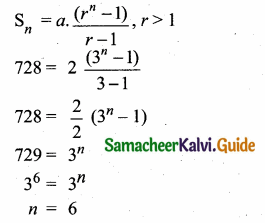
How many consecutive terms starting from the first term of the series 2 + 6 + 18 + … would sum to 728?
Answer:
The given series is
2 + 6 + 18 + …. + tn = 728
Here a = 2, r = = 3, Sn = 728
Samacheer Kalvi 10th Maths Guide Chapter 2 Numbers and Sequences Additional Questions 11
∴ Required number of terms = 6

Samacheer Kalvi 10th Maths Guide Chapter 2 Numbers and Sequences Additional Questions

Question 15.
A geometric series consists of four terms and has a positive common ratio. The sum of the first two terms is 9 and sum of the last two terms is 36. Find the series.
Answer:
Let the four terms of the G.P. be a, ar, ar2 and ar3 ……….
Given, a + ar = 9 ……(1)
ar2 + ar3 = 36
r2 (a + ar) = 36
r2 (9) = 36
[from (1)]
r2 = =4
r = ± 2
then r = 2
(given common positive ratio)
a + a (2) = 9 from (1)
3a = 9
a = 3
∴ The required series
= 3 + 3(2) + 3 (22) + 3 (23) + ……
= 3 + 6 + 12 + 24 + ……..

Question 16.
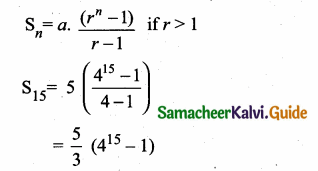
Suppose that five people are ill during the first week of an epidemic and each sick person spreads the contagious disease to four other people by the end of the second week and so on. By the end of 15th week, how many people will be affected by the epidemic?
Answer:
Number of people affected by the epidemic during each week form a geometric series.
S15 = 5 + (4 × 5) + (4 × 20) + (4 × 80) + …. 15 terms
= 5 + 20 + 80 + 320 + … 15 terms
Here a = 5, r = 4, n = 15
Samacheer Kalvi 10th Maths Guide Chapter 2 Numbers and Sequences Additional Questions 12

Samacheer Kalvi 10th Maths Guide Chapter 2 Numbers and Sequences Additional Questions

Question 17.
A gardener wanted to reward a boy for his good deeds by giving some mangoes. He gave the boy two choices. He could either have 1000 mangoes at once or he could get 1 mango on the first day, 2 on the second day, 4 on the third day, 8 mangoes on the fourth day and so on for ten days. Which option should the boy choose to get the maximum number of mangoes?
Answer:
I choice
The boy could get 1000 mangoes at once
II choice
The boy receives mangoes daily for ten days
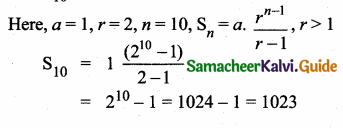
S10 = 1 + 2 + 4 + 8 + ……… 10 terms
Samacheer Kalvi 10th Maths Guide Chapter 2 Numbers and Sequences Additional Questions 13

Question 18.
Find the value of k if
13 + 23 + 33 + ….. + K3 = 2025
Answer:
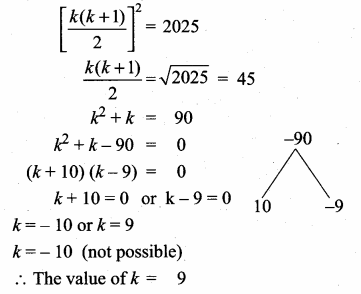
Given, 13 + 23 + 33 + … + K3 = 2025
Samacheer Kalvi 10th Maths Guide Chapter 2 Numbers and Sequences Additional Questions 14

Samacheer Kalvi 10th Maths Guide Chapter 2 Numbers and Sequences Additional Questions

Question 19.
If 13 + 23 + 33 + …… + K3 = 8281, then find 1 + 2 + 3 + … + K.
Answer:
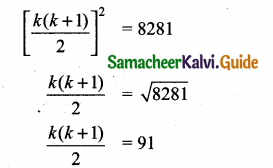
Given, 13 + 23 + 33 + …… + K3 = 8281
Samacheer Kalvi 10th Maths Guide Chapter 2 Numbers and Sequences Additional Questions 15
1 + 2 + 3 + …… + K = 91

Question 20.
Find the sum of all 11 term of an AP whose middle most term in 30.
Answer:
Let ‘a’ be the first term and ‘d’ be the common difference of the give A.P.
Middle most term = (\(\frac { 11+1 }{ 2 } \))th = 6th term
tn = a + (n – 1)d
t6 = a + 5d
a + 5d = 30
Sn = \(\frac { n }{ 2 } \) [2a + (n – 1)d]
S11 = \(\frac { 11 }{ 2 } \) [2a + 10d]
= \(\frac { 11 }{ 2 } \) × 2 [a + 5d]
= 11 × 30
= 330
Sum of 11 terms = 330

Samacheer Kalvi 10th Maths Guide Chapter 2 Numbers and Sequences Additional Questions

III. Answer the following.

Question 1.
Use Euclid’s division algorithm to find the HCF of 867 and 255.
Answer:
Here 867 > 255
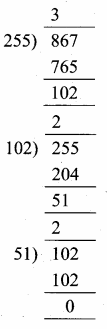
Applying Euclid’s Lemma to 867 and 255 we get
Samacheer Kalvi 10th Maths Guide Chapter 2 Numbers and Sequences Additional Questions 16
867 = (255 × 3) + 102
The remainder 102 ≠ 0
Again applying Euclid’s
Lemma to 255 and 102
255 = 102 × 2 + 51
The remainder 51 ≠ 0
Again applying Euclid’s
Lemma to 102 and 51 we get
102 = 51 × 2 + 0
The remainder is 0
∴ HCF of 867 and 255 is 51

Question 2.
Find the number of integer solutions of 5x = 2 (mod 13)
Answer:
5x ≡ 2 (mod 13) can be written as
5x – 2 = 13 k for some integer
5x = 13 k + 2
x = \(\frac{13 k+2}{5}\)
Since 5k is an integer \(\frac{13 k+2}{5}\) cannot be an inter.
There is no integer solution.

Samacheer Kalvi 10th Maths Guide Chapter 2 Numbers and Sequences Additional Questions

Question 3.
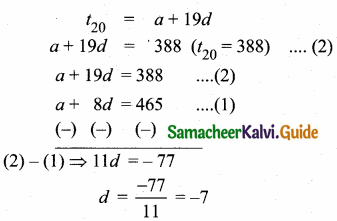
Find the 40th term of A.P. whose 9th term is 465 and 20th term is 388.
Answer:
tn = a + (n – 1) d
t9 = a + 8d (t9 = 465)
a + 8d = 465 ……(1)
Samacheer Kalvi 10th Maths Guide Chapter 2 Numbers and Sequences Additional Questions 17
Substitute the value of d = -7 in (1)
a + 8(-7) = 465
a – 56 = 465
a = 465 + 56 = 521
a = 521, d = -7, n = 40
t40 = 521 + 39(-7)
= 521 – 273
= 248
40th term of an A.P. is 248

Samacheer Kalvi 10th Maths Guide Chapter 2 Numbers and Sequences Additional Questions

Question 4.
Find the three consecutive terms in an A.P. whose sum is 18 and the sum of their squares is 140.
Answer:
Let the three consecutive terms in an
A.P. be m – d,m,m + d
By the given data,
Sum of threee terms = 18
m – d + m + m + d = 18
3m = 18
m = \(\frac { 18 }{ 3 } \) = 6
Again by the given data,
Sum of their squares = 140
(m – d)2 + m2 + (m + d)2 = 140
m2 + d2 – 2md + m2 + m2 + d2 + 2md = 140
3m2 + 2d2 = 140
3(62) + 2d2 = 140
3(36) + 2d2 = 140
2d2 = 140 – 108
2d2 = 32
d2 = \(\frac { 32 }{ 2 } \) = 16
∴ d = ± 4
when, m = 6, d = + 4
m – d = 6 – 4 = 2
m = 6
m + d = 6 + 4 = 10
when, m = 6, d = -4
m – d = 6-(-4) = 6 + 4= 10
m = 6
m + d = 6 +(-4) = 6 – 4 = 2
∴ The three numbers are 2, 6 and 10 or 10, 6,2.

Samacheer Kalvi 10th Maths Guide Chapter 2 Numbers and Sequences Additional Questions

Question 5.
If m times the mth term of an A.P. is equal to n times its nth term, then show that the (m + n)th term of the A.P. is zero.
Answer:
Given, mtm = ntn
m[a + (m – 1) d] = n [a + (n – 1) d]
[we know that tn = a + (n – 1)d]
m[a + md – d] = n[a + nd – d]
ma + m2d – md = na + n2d – nd
ma – na + m2d – n2d = md – nd
a (m – n) + d (m2 – n2) = d(m – n)
a (m – n) + d(m + n)(m – n) = d(m – n) ÷ by (m – n) on both sides,
a + d (m + n) = d
a + d(m + n) – d = 0
a + d(m + n – 1) = 0 ….. (1)
To prove, t(m+n) = 0
t(m+n) = a + (m + n – 1)d
t(m+n) = 0(from(1))
Hence it is proved.

Question 6.
If a, b, c are in A.P. then prove that (a – c)2 = 4 (b2 – ac).
Answer:
Given a, b, c are in A.P.
∴ b – a = c – b
2 b = a + c
Squaring on both sides,
(a + c)2 = (2b)2
a2 + c2 + 2 ac = 4 b2
(a – c)2 + 2 ac + 2 ac = 4 b2
[a2 + c2 = (a – c)2 + 2 ac]
(a – c)2 = 4b2 – 4ac
(a – c)2 = 4 (b2 – ac)
Hence it is proved.
Aliter: Given a, b, c are in A.P.
b – a = c – b
2 b = a + c
To prove, (a – c)2 = 4(b2 – ac)
L.H.S. = (a – c)2
= a2 + c2 – 2ab
= (a + c)2 – 2ac – 2ac
= (a + c)2 – 4ac
= (2b)2 – 4ac (2b = a + c)
= 4 b2 – 4ac = 4 (b2 – ac) = R.H.S
∴ L.H.S = R.H.S., Hence proved.

Samacheer Kalvi 10th Maths Guide Chapter 2 Numbers and Sequences Additional Questions

Question 7.
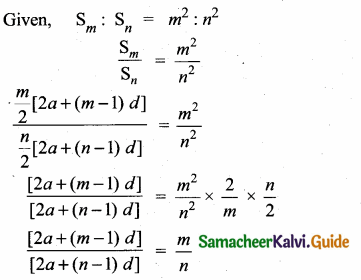
The ratio of the sums of first m and first n terms of an arithmetic series is m2 : n2 show that the ratio of the mth and nth terms is (2m – 1) : (2n -1).
Answer:
Samacheer Kalvi 10th Maths Guide Chapter 2 Numbers and Sequences Additional Questions 18
n[2a + (m – 1) d] = tn[2a + nd-d]
2 an + mnd- nd = 2 am + mnd— md 2an-2am = nd- md 2 a (n-m) = d(n- m)
÷ by (n – m) on both sides,
2a = d
To prove, tm : tn = (2m – 1) : (2n – 1)
L.H.S = tm : tn
= a + (m – 1) d : a + (n – 1)d
= a + (m – 1) 2a : a + (n – 1)2a
[Substitute the value of d = 2a]
= a + 2 am – 2 a: a + 2 am – 2a
= 2am – a : 2an – a
= a (2m – 1) : a (2n – 1)
= (2m – 1) : (2n – 1) = R. H. S
= (2m – 1) : (2n – 1)
∴ tm : tn
L.H.S = R.H.S
Hence it is proved.

Samacheer Kalvi 10th Maths Guide Chapter 2 Numbers and Sequences Additional Questions

Question 8.
A construction company will be penalised each day for delay in construction of a bridge. The penalty will be ₹4000 for the first day and will increase by ₹1000 for each following day. Based on its budget, the company can afford to pay a maximum of ₹1,65,000 towards penalty. Find the maximum number of days by which the completion of work can be delayed.
Solution:
Penalty for the first day (a) = ₹ 4000
Increased rate for every day (d) = ₹ 1000
Maximum amount of penalty (Sn)
= ₹ 1,65,000
Sn = \(\frac { n }{ 2 } \) [2a + (n-1) 1000]
165000 = \(\frac { n }{ 2 } \) [2(4000) + (n – 1) 1000]
= \(\frac { n }{ 2 } \) [8000 + 1000 n – 1000]
165000 = \(\frac { n }{ 2 } \) (7000 + 1000n)
330000 = 7000 n + 1000 n2
0 = 1000 n2 + 7000 n – 330000 ÷ 1000 on both sides,
n2 + 7n – 330 = 0
(n + 22) (n – 15) = 0
n = -22 or n = 15
n = -22 (not possible)
∴ Maximum number of days for which the work can be delayed is 15 days.

Question 9.
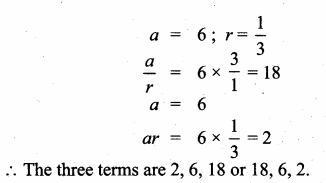
If the product of three consecutive terms in G.P. is 216 and sum of their products in pairs is 156, find them.
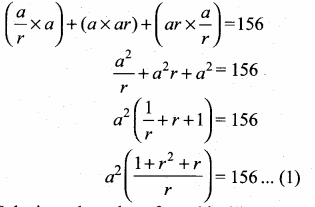
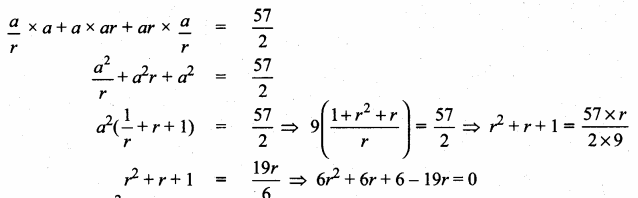
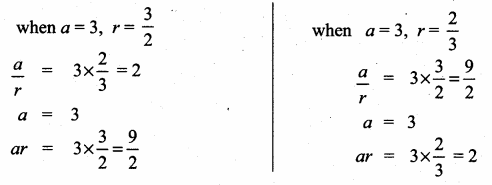
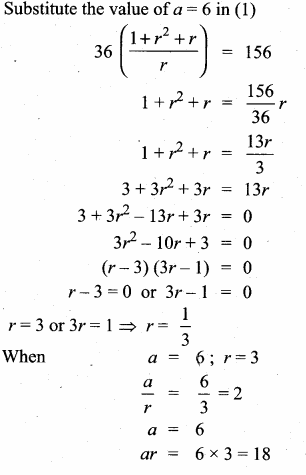
Let the three consecutive terms of G.P. be \(\frac { a }{ r } \), a, ar.
Product of three terms = 216
\(\frac { a }{ r } \) × a × ar = 216
a3 = 216
a3 = 63
a = 6
Sum of their products in pairs = 156
Samacheer Kalvi 10th Maths Guide Chapter 2 Numbers and Sequences Additional Questions 19
Samacheer Kalvi 10th Maths Guide Chapter 2 Numbers and Sequences Additional Questions 191
Samacheer Kalvi 10th Maths Guide Chapter 2 Numbers and Sequences Additional Questions 192

Samacheer Kalvi 10th Maths Guide Chapter 2 Numbers and Sequences Additional Questions

Question 10.
If a, b, c, d are in a geometric sequence, then show that
(a – b + c) (b + c + d) = ab + bc + cd.
Answer:
Given, a, b, c, d are in a geometric sequence.
Let a = a, b = ar, c = ar2, d = ar3
To prove, (a – b + c) (b + c + d) = ab + bc + cd
L.H.S. = (a – b + c)(b + c + d)
= (a – ar + ar2) (ar + ar2 + ar3 )
= a (1 – r + r2)ar (1 + r + r2)
= a2r (1 – r + r2) (1 + r + r2)
= a2r (1 + r2 + r4)
= a2r + a2r3 + a2r5
= a (ar) + ar (ar2) + ar2 (ar3)
= ab + bc + cd
= R.H.S.
L.H.S. = R.H.S., Hence proved.

Question 11.
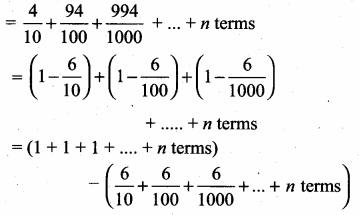
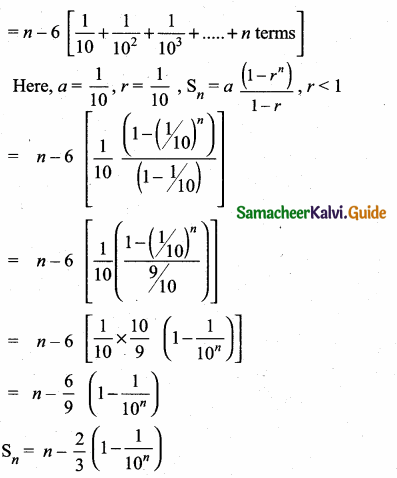
Find the sum of the first n terms of the series 0.4 + 0.94 + 0.994 + ………..
Answer:
Given series is 0.4 + 0.94 + 0.994 + ……………. + n terms.
Sn = 0.4 + 0.94 + 0.994 + ……….. + n terms
Samacheer Kalvi 10th Maths Guide Chapter 2 Numbers and Sequences Additional Questions 20
Samacheer Kalvi 10th Maths Guide Chapter 2 Numbers and Sequences Additional Questions 21

Samacheer Kalvi 10th Maths Guide Chapter 2 Numbers and Sequences Additional Questions

Question 12.
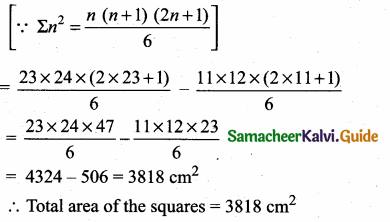
Find the total area of 12 squares whose sides are 12 cm, 13 cm,… 23 cm respectively.
Answer:
Given, the sides of 12 squares are 12 cm, 13 cm, 14 cm,… 23 cm
Total area of 12 squares
= 122 + 132 + 142 + … + 232
= (12 + 22 + 32 … + 232) – (12 + 22 + … + 112)
Samacheer Kalvi 10th Maths Guide Chapter 2 Numbers and Sequences Additional Questions 22

Samacheer Kalvi 10th Maths Guide Chapter 3 Algebra Ex 3.4

Students can download Maths Chapter 3 Algebra Ex 3.4 Questions and Answers, Notes, Samacheer Kalvi 10th Maths Guide Pdf helps you to revise the complete Tamilnadu State Board New Syllabus, helps students complete homework assignments and to score high marks in board exams.

Tamilnadu Samacheer Kalvi 10th Maths Solutions Chapter 3 Algebra Ex 3.4

Question 1.
Reduce each of the following rational expression to its lowest form.
(i) \(\frac{x^{2}-1}{x^{2}+x}\)
Answer:
\(\frac{x^{2}-1}{x^{2}+x}\) = \(\frac{(x+1)(x-1)}{x(x+1)}\) = \(\frac { x-1 }{ x } \)

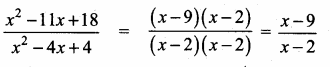
(ii) \(\frac{x^{2}-11 x+18}{x^{2}-4 x+4}\)
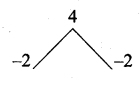
Samacheer Kalvi 10th Maths Guide Chapter 3 Algebra Ex 3.4 1
x2 – 11x + 18 = (x – 9) (x – 2)
x2 – 4x + 4 = (x – 2) (x – 2)
Samacheer Kalvi 10th Maths Guide Chapter 3 Algebra Ex 3.4 2
Samacheer Kalvi 10th Maths Guide Chapter 3 Algebra Ex 3.4 3

Samacheer Kalvi 10th Maths Guide Chapter 3 Algebra Ex 3.4

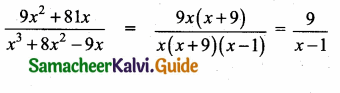
(iii) \(\frac{9 x^{2}+81 x}{x^{3}+8 x^{2}-9 x}\)
9x2 + 81x = 9x(x + 9)
x3 + 8x2 – 9x = x(x2 + 8x – 9)
= x (x + 9) (x – 1)
Samacheer Kalvi 10th Maths Guide Chapter 3 Algebra Ex 3.4 4

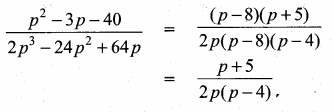
(iv) \(\frac{p^{2}-3 p-40}{2 p^{3}-24 p^{2}+64 p}\)
p2 – 3p – 40 = (p – 8) (p + 5)
2p3 – 24p2 + 64p = 2p (p2 – 12p + 32)
= 2p (p – 8) (p – 4)
Samacheer Kalvi 10th Maths Guide Chapter 3 Algebra Ex 3.4 5
Samacheer Kalvi 10th Maths Guide Chapter 3 Algebra Ex 3.4 6

Samacheer Kalvi 10th Maths Guide Chapter 3 Algebra Ex 3.4

Question 2.
Find the excluded values , if any of the following expressions.

(i) \(\frac{y}{y^{2}-25}\)
Answer:
The expression \(\frac{y}{y^{2}-25}\) is undefined
when y2 – 25 = 0
y2 – 52 = 0
(y + 5) (y – 5) = 0
y + 5 = 0 or y – 5 = 0
∵ y = -5 or y = 5
The excluded values are -5 and 5

Samacheer Kalvi 10th Maths Guide Chapter 3 Algebra Ex 3.4

(ii) \(\frac{t}{t^{2}-5 t+6}\)
Answer:
The expression \(\frac{t}{t^{2}-5 t+6}\) is undefined
when t2 – 5t + 6 = 0
(t – 3) (t – 2) = 0
Samacheer Kalvi 10th Maths Guide Chapter 3 Algebra Ex 3.4 7
t – 3 = 0 or t – 2 = 0
t = 3 or t = 2
The excluded values are 2 and 3

(iii) \(\frac{x^{2}+6 x+8}{x^{2}+x-2}\)
Answer:
x2 + 6x + 8 = (x + 4) (x + 2)
x2 + x – 2 = (x + 2) (x – 1)
Samacheer Kalvi 10th Maths Guide Chapter 3 Algebra Ex 3.4 8
Samacheer Kalvi 10th Maths Guide Chapter 3 Algebra Ex 3.4 9
The expression \(\frac { x+4 }{ x-1 } \) is undefined
when x – 1 = 0
∵ x = 1
The excluded value is 1

Samacheer Kalvi 10th Maths Guide Chapter 3 Algebra Ex 3.4

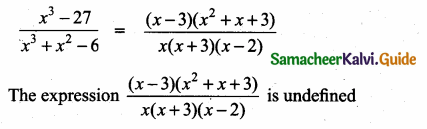
(iv) \(\frac{x^{3}-27}{x^{3}+x^{2}-6 x}\)
x3 – 27 = x3 – 33
= (x – 3) (x2 + x + 3)
x3 + x2 – 6x = x(x2 + x – 6) = x (x + 3) (x – 2)
Samacheer Kalvi 10th Maths Guide Chapter 3 Algebra Ex 3.4 10
Samacheer Kalvi 10th Maths Guide Chapter 3 Algebra Ex 3.4 11
when x (x + 3) (x – 2) = 0
x = 0 or x + 3 = 0 or x – 2 = 0
x = 0 or x = -3 or x = 2
The excluded values are 0 , -3 and 2

Samacheer Kalvi 10th Maths Guide Chapter 3 Algebra Ex 3.3

Students can download Maths Chapter 3 Algebra Ex 3.3 Questions and Answers, Notes, Samacheer Kalvi 10th Maths Guide Pdf helps you to revise the complete Tamilnadu State Board New Syllabus, helps students complete homework assignments and to score high marks in board exams.

Tamilnadu Samacheer Kalvi 10th Maths Solutions Chapter 3 Algebra Ex 3.3

Question 1.
Find the LCM and GCD for the following and verify that f(x) × g(x) = LCM × GCD

(i) 21x2y, 35xy2
Answer:
p(x) = 21 x2y = 3 × 7 × x2 × y
g(x) = 35xy2 = 5 × 7 × x × y2
G.C.D = 7 xy
L.C.M = 3 × 5 × 7 x2 × y2
= 105 x2y2
L.C.M × G.C.D = 105x2y2 × 7xy
= 735 x3y3 ….(1)
p(x) × g(x) = 21x2y × 35xy2
= 735x3y3 ….(2)
From (1) and (2) we get
L.C.M × G.C.D. = p(x) × g(x)

Samacheer Kalvi 10th Maths Guide Chapter 3 Algebra Ex 3.3

(ii) (x3 – 1)(x + 1),(x3 + 1)
Answer:
p(x) = (x3 – 1) (x + 1) = (x – 1) (x2 + x + 1) (x + 1)
g(x) = x3 + 1 = (x + 1) (x2 – x + 1)
G.C.D = (x + 1)
L.C.M = (x + 1) (x – 1) (x2 + x + 1) (x2 – x + 1)
L.C.M × G.C.D = (x + 1) (x – 1)(x2 + x + 1)(x2 – x + 1)x(x + 1)
= (x + 1)2 (x – 1) (x2 + x + 1) (x2 – x + 1) ……….(1)
p(x) × g(x) = (x – 1) (x2 + x + 1) (x + 1) (x + 1) (x2 – x + 1)
= (x + 1)2 (x – 1) (x2 + x + 1) (x2 – x + 1) ……….(2)
From (1) and (2) we get
L.C.M × G.C.D. = p(x) × g(x)

(iii) (x2y + xy2), (x2 + xy)
Answer:
p(x) = x2y + xy2 = xy(x + y)
g(x) = x2 + xy = x(x + y)
G.C.D = x(x+y)
L.C.M = xy (x +y).
L.C.M × G.C.D = xy(x + y) × x(x + y)
= x2y(x + y)2 …..(1)
p(x) × g(x) = xy(x + y) × x(x + y)
= x2y(x + y)2
From (1) and (2) we get
L.C.M × G.C.D. = p(x) × g(x)

Samacheer Kalvi 10th Maths Guide Chapter 3 Algebra Ex 3.3

Question 2.
Find the LCM of each pair of the following polynomials
(i) a2 + 4a – 12, a2 – 5a + 6 whose GCD is a – 2
Answer:
p(x) = a2 + 4a – 12
= a2 + 6a – 2a – 12
= a (a + 6) – 2(a + 6)
= (a + 6) (a – 2)
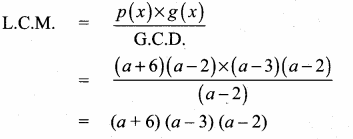
Samacheer Kalvi 10th Maths Guide Chapter 3 Algebra Ex 3.3 1
g(x) = a2 – 5a + 6
= a2 – 3a – 2a + 6
Samacheer Kalvi 10th Maths Guide Chapter 3 Algebra Ex 3.3 2
= a(a – 3) – 2 (a – 3)
= (a – 3) (a – 2)
Samacheer Kalvi 10th Maths Guide Chapter 3 Algebra Ex 3.3 3

(ii) x4 – 27a3x, (x – 3a)2 whose GCD is (x – 3a)
Answer:
p(x) = x4 – 27a3x = x[x3 – 27a3]
= x[x3 – (3a)3]
= x(x – 3a) (x2 + 3ax + 9a2)
g(x) = (x – 3a)2
G.C.D. = x – 3a
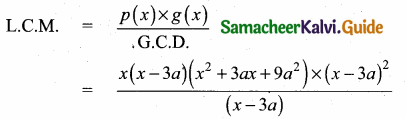
Samacheer Kalvi 10th Maths Guide Chapter 3 Algebra Ex 3.3 4
L.C.M. = x (x – 3a)2 (x2 + 3ax + 9a2)

Samacheer Kalvi 10th Maths Guide Chapter 3 Algebra Ex 3.3

Question 3.
Find the GCD of each pair of the following polynomials
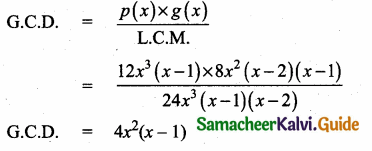
(i) 12(x4 – x3), 8(x4 – 3x3 + 2x2) whose LCM is 24x3 (x – 1)(x – 2)
Answer:
p(x) = 12(x4 – x3)
= 12x3(x- 1)
g(x) = 8(x4 – 3x3 + 2x2)
Samacheer Kalvi 10th Maths Guide Chapter 3 Algebra Ex 3.3 5
= 8x2(x2 – 3x + 2)
= 8x2(x – 2)(x – 1)
L.C.M. = 24x3 (x – 1) (x – 2)
Samacheer Kalvi 10th Maths Guide Chapter 3 Algebra Ex 3.3 6

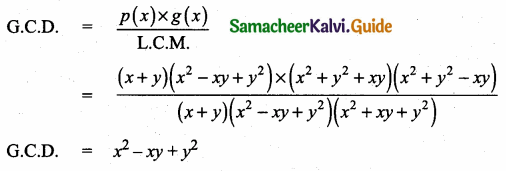
(ii) (x3 + y3), (x4 + x2y2 + y4) whose LCM is (x3 + y3) (x2 + xy + y2)
Answer:
p(x) = x3 + y3
= (x + y)(x2 – xy + y2)
g(x) = x4 + x2y2 + y4 = [x2 + y2]2 – (xy)2
= (x2 + y2 + xy) (x2 + y2 – xy)
L.C.M. = (x3 + y3) (x2 + xy + y2)
(x + y) (x2 – xy + y2) (x2 + xy + y2)
Samacheer Kalvi 10th Maths Guide Chapter 3 Algebra Ex 3.3 7
G.C.D. = x2 – xy + y2

Samacheer Kalvi 10th Maths Guide Chapter 3 Algebra Ex 3.3

Question 4.
Given the L.C.M and G.C.D of the two polynomials p(x) and q(x) find the unknown polynomial in the following table
Samacheer Kalvi 10th Maths Guide Chapter 3 Algebra Ex 3.3 8
Answer:
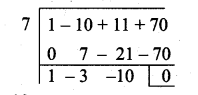
L.C.M. = a3 – 10a2 + 11a + 70
= (a – 7) (a2 – 3a – 10)
= (a – 7) (a – 5) (a + 2)
Samacheer Kalvi 10th Maths Guide Chapter 3 Algebra Ex 3.3 9
G.C.D. = (a – 7)
p(x) = a2 -12a + 35
= (a – 5)(a – 7)
Samacheer Kalvi 10th Maths Guide Chapter 3 Algebra Ex 3.3 10
q(x) = \(\frac{\mathrm{LCM} \times \mathrm{GCD}}{p(x)}\)
Samacheer Kalvi 10th Maths Guide Chapter 3 Algebra Ex 3.3 11

Samacheer Kalvi 10th Maths Guide Chapter 3 Algebra Ex 3.3

(ii) L.C.M (x2 + y2)(x4 + x2y2 + y4)
(x2 + y2)[(x2 + y2)2-(xy)2]
(x2 + y2) (x2 + y2 + xy) (x2 + y2 – xy)
G.C.D. = x2 – y2
(x + y)(x – y)
q(x) = (x4 – y4) (x2 + y2 – xy)
= [(x2)2 – (y2)2](x2 + y2 – xy)
= (x2 + y2) (x2 – y2) (x2 + y2 – xy)
(x2 + y2) (x + y) (x – y) (x2 + y2 – xy)
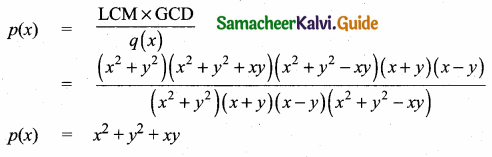
P(x) = x2 + y2 + xy
Samacheer Kalvi 10th Maths Guide Chapter 3 Algebra Ex 3.3 12

Samacheer Kalvi 10th Maths Guide Chapter 3 Algebra Ex 3.2

Students can download Maths Chapter 3 Algebra Ex 3.2 Questions and Answers, Notes, Samacheer Kalvi 10th Maths Guide Pdf helps you to revise the complete Tamilnadu State Board New Syllabus, helps students complete homework assignments and to score high marks in board exams.

Tamilnadu Samacheer Kalvi 10th Maths Solutions Chapter 3 Algebra Ex 3.2

Question 1.
Find the GCD of the given polynomials by Division Algorithm
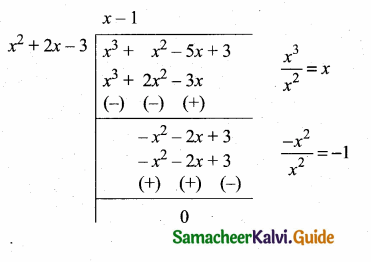
(i) x4 + 3x3 – x – 3, x3 + x2 – 5x + 3
Answer:
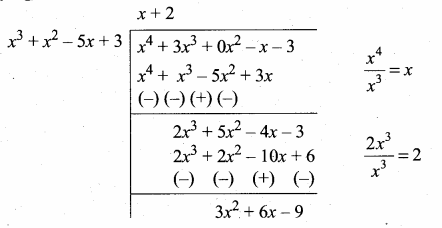
p(x) = x4 + 3x3 – x – 3
g(x) = x3 + x2 – 5x + 3
Samacheer Kalvi 10th Maths Guide Chapter 3 Algebra Ex 3.2 1

3x2 + 6x – 9 = 3(x2 + 2x – 3)
Now dividing g(x) = x3 + x2 – 5x + 3
by the new remainder
(leaving the constant 3)
we get x2 + 2x – 3
G.C.F. = x2 + 2x – 3
Samacheer Kalvi 10th Maths Guide Chapter 3 Algebra Ex 3.2 2

Samacheer Kalvi 10th Maths Guide Chapter 3 Algebra Ex 3.2

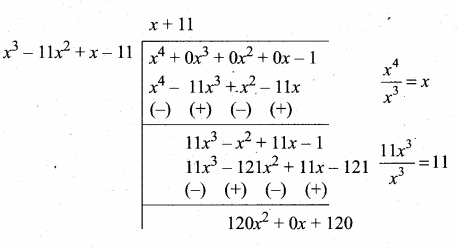
(ii) x4 – 1, x3 – 11x2 + x – 11
p(x) = x4 – 1
g(x) = x3 – 11x2 + x – 11
Samacheer Kalvi 10th Maths Guide Chapter 3 Algebra Ex 3.2 3

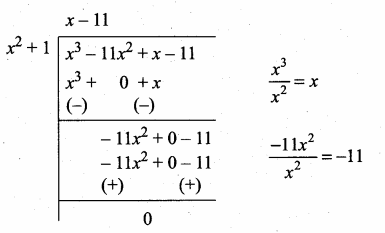
120x2 + 120 = 120 (x2 + 1)
Now dividing g(x) = x3 – 11x2 + x – 11 by the new remainder (leaving the constant) we get x2 + 1
Samacheer Kalvi 10th Maths Guide Chapter 3 Algebra Ex 3.2 4
G.C.D. = x2 + 1

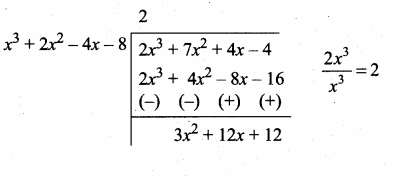
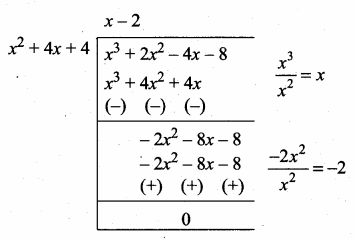
(iii) 3x4 + 6x3 – 12x2 – 24x, 4x4 + 14x3 + 8x2 – 8x
Answer:
p(x) = 3x4 + 6x3 – 12x2 – 24x
= 3x (x3 + 2x2 – 4x – 8)
g(x) = 4x4 + 14x3 + 8x2 – 8x
= 2x (2x3 + 7x2 + 4x – 4)
G.C.D. of 3x and 2x = x
Now g(x) is divide by p(x) we get
Samacheer Kalvi 10th Maths Guide Chapter 3 Algebra Ex 3.2 5

Samacheer Kalvi 10th Maths Guide Chapter 3 Algebra Ex 3.2

3x2 + 12x + 12 = 3 (x2 + 4x + 4)
Now dividing p(x) = x3 + 2x2 – 4x – 8
by the new remainder
(leaving the constant)
x2 + 4x + 4
Samacheer Kalvi 10th Maths Guide Chapter 3 Algebra Ex 3.2 6
G.C.D. = x(x2 + 4x + 4) [Note x is common for p(x) and g(x)]

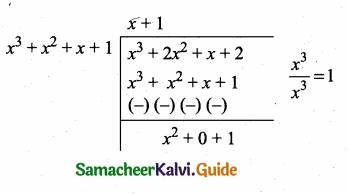
(iv) 3x3 + 3x2 + 3x + 3, 6x3 + 12x2 + 6x+12
p(x) = 3x3 + 3x2 + 3x + 3
= 3(x3 + x2 + x + 1)
g(x) = 6x3 + 12x2 + 6x + 12
= 6(x3 + 2x2 + x + 2)
G.C.D. of 3 and 6 = 3
Now g(x) is divided by p(x)
Samacheer Kalvi 10th Maths Guide Chapter 3 Algebra Ex 3.2 7
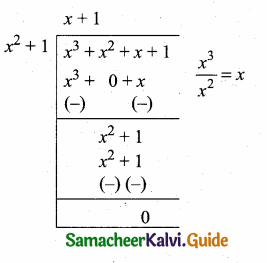
Now dividing p(x) by the remainder x2 + 1
we get x + 1
Samacheer Kalvi 10th Maths Guide Chapter 3 Algebra Ex 3.2 8
∴ G.C.D. = 3(x2 + 1) [3 is the G.C.D. of 3 and 6]

Samacheer Kalvi 10th Maths Guide Chapter 3 Algebra Ex 3.2

Question 2.
Find the LCM of the given polynomials
(i) 4x2y, 8x3y2
Answer:
4x2 y = 2 × 2 × x2 × y
8 x3 y2 = 2 × 2 × 2 × x3 × y2
L.C.M. = 23 × x3 × y2
= 8x3y2

Aliter: L.C.M of 4 and 8 = 8
L.C.M. of x2y and x3y2 = x3y2
∴ L.C.M. = 8x3y2

(ii) -9a3b2, 12a2b2c
Answer:
-9a3b2 = -(32 × a3 × b2)
12a2b2c = 22 × 3 × a2 × b2 × c
L.C.M. = -(22 × 32 × a3 × b2 × c)
= -36 a3b2c

Samacheer Kalvi 10th Maths Guide Chapter 3 Algebra Ex 3.2

(iii) 16m, -12m2n2, 8n2
Answer:
16m = 24 × m
-12 m2n2 = -(22 × 3 × m2 × n2)
8n2 = 23 × n2
L.C.M. = -(24 × 3 × m2 × n2)
= -48 m2n2

(iv) p2 – 3p + 2, p2 – 4
Answer:
P2 – 3p + 2 = p2 – 2p – p + 2
= p(p – 2) – 1 (p – 2)
= (p – 2) (p – 1)
Samacheer Kalvi 10th Maths Guide Chapter 3 Algebra Ex 3.2 9
p2 – 4 = p2 – 22 (using a2 – b2 = (a + b) (a – b)]
= (p + 2) (p – 2)
L.C.M. = (p – 2) (p + 2) (p – 1)

Samacheer Kalvi 10th Maths Guide Chapter 3 Algebra Ex 3.2

(v) 2x2 – 5x – 3,4.x2 – 36
Answer:
2x2 – 5x – 3 = 2x2 – 6x + x – 3
= 2x (x – 3) + 1 (x – 3)
= (x – 3) (2x + 1)
Samacheer Kalvi 10th Maths Guide Chapter 3 Algebra Ex 3.2 10
= 4x2 – 36 = 4 [x2 – 9]
= 4 [x2 – 32]
= 4(x + 3) (x – 3)
L.C.M. = 4(x – 3) (x + 3) (2x + 1)

Samacheer Kalvi 10th Maths Guide Chapter 3 Algebra Ex 3.2

(vi) (2x2 – 3xy)2,(4x – 6y)3,(8x3 – 27y3)
Answer:
(2x2 – 3xy)2 = x2 (2x – 3y)2
(4x – 6y)3 = 23 (2x – 3y)3
= 8 (2x – 3y)3
8x3 – 27y3 = (2x)3 – (3y)3
= (2x – 3y) [(2x)2 + 2x × 3y + (3y2)]
[using a3 – b3 = (a – b) (a2 + ab + b2)
(2x – 3y) (4x2 + 6xy + 9y2)
L.C.M. = 8x2 (2x – 3y)3 (4x2 + 6xy + 9y)2

Samacheer Kalvi 10th Maths Guide Chapter 3 Algebra Ex 3.1

Students can download Maths Chapter 3 Algebra Ex 3.1 Questions and Answers, Notes, Samacheer Kalvi 10th Maths Guide Pdf helps you to revise the complete Tamilnadu State Board New Syllabus, helps students complete homework assignments and to score high marks in board exams.

Tamilnadu Samacheer Kalvi 10th Maths Solutions Chapter 3 Algebra Ex 3.1

Question 1.
Solve the following system of linear equations in three variables
(i) x + y + z = 5
2x – y + z = 9
x – 2y + 3z = 16
Answer:
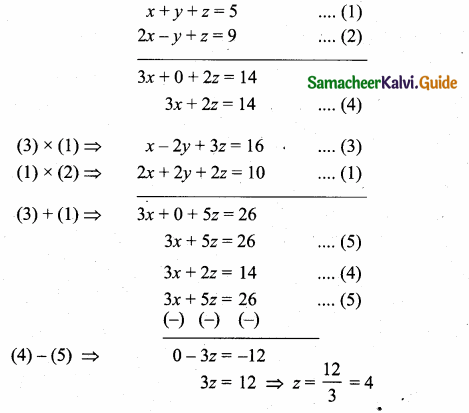
x + y + z = 5 ….(1)
2x – y + z = 9 ….(2)
x – 2y + 3z = 16 ….(3)
by adding (1) and (2)
Samacheer Kalvi 10th Maths Guide Chapter 3 Algebra Ex 3.1 1
Substituting z = 4 (4)
3x + 2(-4) = 14
3x – 8 = 14
3x = 14 – 8
3x = 6
x = \(\frac { 6 }{ 3 } \) = 2

Samacheer Kalvi 10th Maths Guide Chapter 3 Algebra Ex 3.1

Substituting x = 2 and z = 4 in (1)
2 + y + 4 = 5
y + 6 = 5
y = 5 – 6
= -1
∴ The value of x = 2, y = -1 and z = 4

(ii) \(\frac { 1 }{ x } \) – \(\frac { 2 }{ y } \) + 4 = 0, \(\frac { 1 }{ y } \) – \(\frac { 1 }{ z } \) + 1 = 0, \(\frac { 2 }{ z } \) + \(\frac { 3 }{ x } \) = 14
Answer:
Let \(\frac { 1 }{ x } \) = p, \(\frac { 1 }{ y } \) = q and \(\frac { 1 }{ z } \) = r
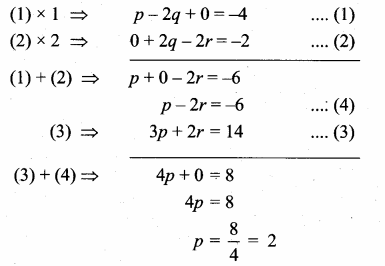
p – 2q + 4 = 0
p – 2q = -4 ……(1)
q – r + 1 = 0
q – r = -1 ……(2)
3p + 2r = 14 ……(3)
Samacheer Kalvi 10th Maths Guide Chapter 3 Algebra Ex 3.1 3
Substituting the value of p = 2 in (1)
2 – 2q = -4
-2q = – 4 – 2
-2q = -6
q = \(\frac { 6 }{ 2 } \) = 3
Substituting the value of q = 3 in (2)
3 – r = 1
– r = – 1 – 3
r = 4
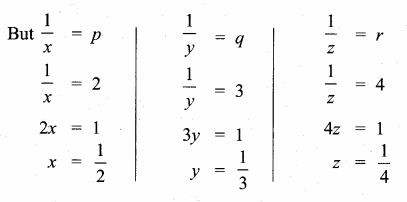
Samacheer Kalvi 10th Maths Guide Chapter 3 Algebra Ex 3.1 4
The value of x = \(\frac { 1 }{ 2 } \), y = \(\frac { 1 }{ 3 } \) and z = \(\frac { 1 }{ 4 } \)

Samacheer Kalvi 10th Maths Guide Chapter 3 Algebra Ex 3.1

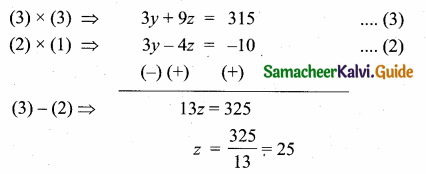
(iii) x + 20 = \(\frac { 3y }{ 2 } \) + 10 = 2z + 5 = 110 – (y + z)
Answer:
x + 20 = \(\frac { 3y }{ 2 } \) + 10
Multiply by 2
2x + 40 = 3y + 20
2x – 3y = -40 + 20
2x – 3y = -20 ……(1)

\(\frac { 3y }{ 2 } \) + 10 = 2z + 5
Multiply by 2
3y + 20 = 4z + 10
3y – 4z = 10 – 20
3y – 4z = -10 ……(2)

2z + 5 = 110 – (y + z)
2z + 5 = 110 – y – z
y + 3z = 110 – 5
y + 3z = 105 ….(3)
Samacheer Kalvi 10th Maths Guide Chapter 3 Algebra Ex 3.1 5
Substitute the value of z = 25 in (2)
3y – 4(25) = -10
3y – 100 = – 10
3y = – 10 + 100
3y = 90
y = \(\frac { 90 }{ 3 } \) = 30
∴ The value of x = 35, y = 30 and z = 25

Substitute the value of y = 30 in (1)
2x – 3(30) = -20
2x – 90 = -20
2x = -20 + 90
2x = 70
x = \(\frac { 70 }{ 2 } \) = 35

Samacheer Kalvi 10th Maths Guide Chapter 3 Algebra Ex 3.1

Question 2.
Discuss the nature of solutions of the following system of equations
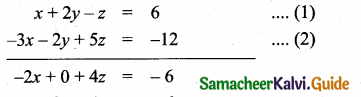
(i) x + 2y – z = 6, – 3x – 2y + 5z = -12 , x – 2z = 3
Answer:
x + 2y – z = 6 …..(1)
-3x – 2y + 5z = -12 …..(2)
x – 2z = 3 ……(3)
Adding (1) and (2) we get
Samacheer Kalvi 10th Maths Guide Chapter 3 Algebra Ex 3.1 6
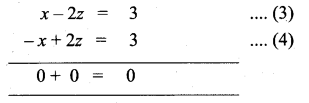
Adding (3) and (4) we get
Samacheer Kalvi 10th Maths Guide Chapter 3 Algebra Ex 3.1 7
The above statement tells us that the system has an infinite number of solutions.

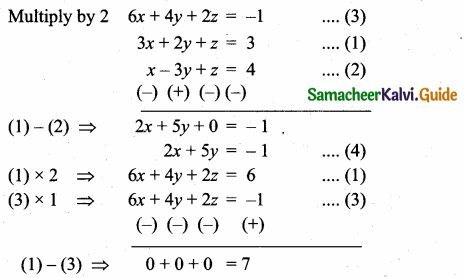
(ii) 2y + z = 3(- x + 1) ,-x + 3y – z = -4, 3x + 2y + z = –\(\frac { 1 }{ 2 } \)
2y + z = 3 (- x + 1)
2y + z = -3x + 3 ……(1)
3x + 2y + z = –\(\frac { 1 }{ 2 } \)

-x + 3y – z = – 4
x – 3y + z = 4 …..(2)

3x + 2y + z = – \(\frac { 1 }{ 2 } \)
Samacheer Kalvi 10th Maths Guide Chapter 3 Algebra Ex 3.1 8
Hence we arrive at a contradiction as 0 ≠ 7
This means that the system is inconsistent and has no solution.

Samacheer Kalvi 10th Maths Guide Chapter 3 Algebra Ex 3.1

(iii) \(\frac { y+z }{ 4 } \) = \(\frac { z+x }{ 3 } \) = \(\frac { x+y }{ 2 } \), x + y + z = 27
Answer:
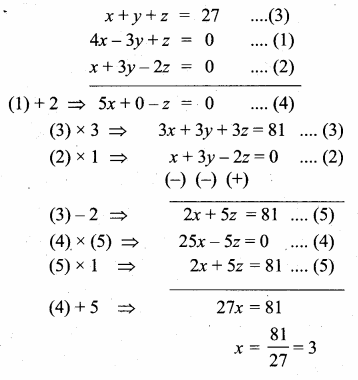
\(\frac { y+z }{ 4 } \) = \(\frac { z+x }{ 3 } \)
3y + 3z = 4z + 4x
-4x + 3y + 3z – 4z = 0
-4x + 3y – z = 0
4x – 3y + z = 0 ………(1)

\(\frac { z+x }{ 3 } \) = \(\frac { x+y }{ 2 } \)
2z + 2x = 3x + 3y
-3x + 2x – 3y + 2z = 0
-x – 3y + 2z = 0
x + 3y – 2z = 0 ………(2)
Samacheer Kalvi 10th Maths Guide Chapter 3 Algebra Ex 3.1 9
Substituting the value of x in (5)
6 + 5z = 81
5z = 81 – 6
5z = 75
z = \(\frac { 75 }{ 5 } \) = 15
Substituting the value of x = 3
and z = 15 in (3)
3 + y + 15 = 27
y + 18 = 27
y = 27 – 18
= 9
The value of x = 3, y = 9 and z = 15
This system of equations have unique solution.

Samacheer Kalvi 10th Maths Guide Chapter 3 Algebra Ex 3.1

Question 3.
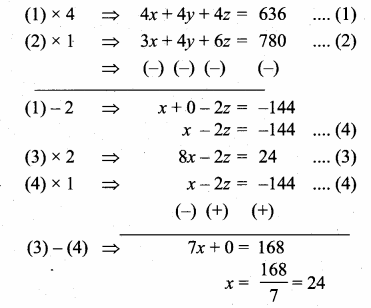
Vani, her father and her grand father have an average age of 53. One-half of her grand father’s age plus one-third of her father’s age plus one fourth of Vani’s age is 65. If 4 years ago Vani’s grandfather was four times as old as Vani then how old are they all now?
Answer:
Let the age of Vani be”x” years
Vani father age = “y” years
Vani grand father = “z” years
By the given first condition.
\(\frac { x+y+z }{ 3 } \) = 53
x + y + z = 159 ….(1)
By the given 2nd Condition.
\(\frac { 1 }{ 2 } \) z + \(\frac { 1 }{ 3 } \)y + \(\frac { 1 }{ 4 } \)x = 65
Multiply by 12
6z + 4y + 3x = 780
3x + 4y + 6z = 780 ….(2)
By the given 3rd condition
z – 4 = 4 (x – 4) ⇒ z – 4 = 4x – 16
– 4x + z = – 16 + 4
4x – z = 12 ……(3)
Samacheer Kalvi 10th Maths Guide Chapter 3 Algebra Ex 3.1 10
Vani age = 24 years
Vani’s father age = 51 years
Vani grand father age = 84 years
Substitute the value of x = 24 in (3)
4 (24) – z = 12
96 – z = 12
-z = 12 – 96
z = 84
Substitute the value of
x = 24 and z = 84 in (1)
24 + y + 84 = 159
y + 108 = 159
y = 159 – 108
= 51

Samacheer Kalvi 10th Maths Guide Chapter 3 Algebra Ex 3.1

Question 4.
The sum of the digits of a three-digit number is 11. If the digits are reversed, the new number is 46 more than five times the old number. If the hundreds digit plus twice the tens digit is equal to the units digit, then find the original three digit number ?
Answer:
Let the hundreds digit be x and the tens digit be ”y” and the unit digit be “z”
∴ The number is 100x + 10y + z
If the digits are reversed the new number is 100z + 10y + x
By the given first condition
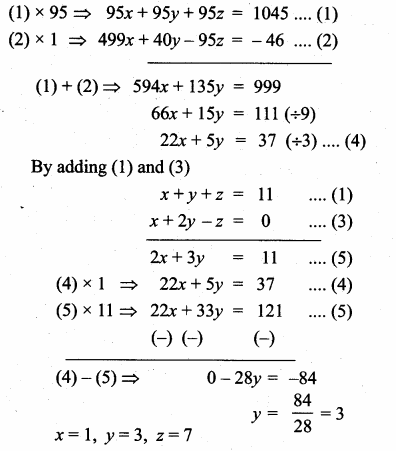
x + y + z = 11 ….(1)
By the given second condition
100z + 10y + x = 5 (100x + 10y + z) + 46
= 500x + 50y + 5z + 46
x – 500x + 10y – 50y + 100z – 5z = 46
– 499x – 40y + 95z = 46
499x + 40y – 95z = -46 ….(2)
By the given third condition
x + 2y = z
x + 2y – z = 0 ….(3)
Samacheer Kalvi 10th Maths Guide Chapter 3 Algebra Ex 3.1 11
∴ The number is 137
Subtituting the value of y = 3 in (5)
2x + 3(3) = 11
2x = 11 – 9
2x = 2
x = \(\frac { 2 }{ 2 } \) = 1
Subtituting the value of x = 1, y = 3 in (1)
1 + 3 + z = 11
z = 11 – 4
= 7

Samacheer Kalvi 10th Maths Guide Chapter 3 Algebra Ex 3.1

Question 5.
There are 12 pieces of five, ten and twenty rupee currencies whose total value is ₹105. But when first 2 sorts are interchanged in their numbers its value will be increased by ₹20. Find the number of currencies in each sort.
Answer:
Let the number of ₹5 currencies be “x”
Let the number of ₹10 currencies be “y”
and the number of ₹20 currencies be “z”
By the given first condition
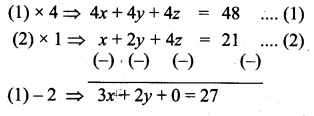
x + y + z = 12 ………(1)
By the given second condition
5x + 10y + 20z = 105
x + 2y + 4z = 21 (÷5) ……….(2)
By the given third condition
10x + 5y + 20z = 105 + 20
10x + 5y + 20z = 125
2x + y + 4z = 25 ………..(3)
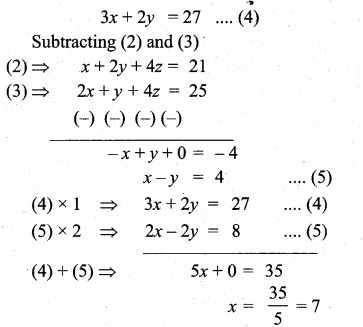
Samacheer Kalvi 10th Maths Guide Chapter 3 Algebra Ex 3.1 12
Samacheer Kalvi 10th Maths Guide Chapter 3 Algebra Ex 3.1 13
Substituting the value of x = 7 in (5)
7 – y = 4 ⇒ -y = 4 – 7
-y = -3 ⇒ y = 3
Substituting the value of x = 7, y = 3 in …. (1)
7 + 3 + z = 12
z = 12 – 10 = 2
x = 7, y = 3, z = 2
Number of currencies in ₹ 5 = 7
Number of currencies in ₹ 10 = 3
Number of currencies in ₹ 20 = 2

Samacheer Kalvi 10th Maths Guide Chapter 2 Numbers and Sequences Ex 2.6

Students can download Maths Chapter 2 Numbers and Sequences Ex 2.6 Questions and Answers, Notes, Samacheer Kalvi 10th Maths Guide Pdf helps you to revise the complete Tamilnadu State Board New Syllabus, helps students complete homework assignments and to score high marks in board exams.

Tamilnadu Samacheer Kalvi 10th Maths Solutions Chapter 2 Numbers and Sequences Ex 2.6

Question 1.
Find the sum of the following
(i) 3, 7, 11,… up to 40 terms.
Answer:
3,7,11,… up to 40 terms
First term (a) = 3
Common difference (d) = 7 – 3 = 4
Number of terms (n) = 40
Sn = \(\frac { n }{ 2 } \) [2a + (n – 1) d]
S40 = \(\frac { 40 }{ 2 } \) [6 + 39 × 4] = 20 [6 + 156]
= 20 × 162
S40 = 3240

Samacheer Kalvi 10th Maths Guide Chapter 2 Numbers and Sequences Ex 2.6

(ii) 102,97, 92,… up to 27 terms.
Answer:
Here a = 102, d = 97 – 102 = -5
n = 27
Sn = \(\frac { n }{ 2 } \) [2a + (n – 1)d]
S27 = \(\frac { 27 }{ 2 } \) [2(102) + 26(-5)]
= \(\frac { 27 }{ 2 } \) [204 – 130]
= \(\frac { 27 }{ 2 } \) × 74
= 27 × 37 = 999
S27 = 999

Samacheer Kalvi 10th Maths Guide Chapter 2 Numbers and Sequences Ex 2.6

(iii) 6 + 13 + 20 + …. + 97
Answer:
Here a = 6, d = 13 – 6 = 7, l = 97
n = \(\frac { l-a }{ d } \) + 1
= \(\frac { 97-6 }{ 7 } \) + 1
= \(\frac { 91 }{ 7 } \) + 1 =
13 + 1 = 14
Sn = \(\frac { n }{ 2 } \) (a + l)
Sn = \(\frac { 14 }{ 2 } \) (a + l)
Sn = \(\frac { 14 }{ 2 } \) (6 + 97)
= 7 × 10³
Sn = 721

Question 2.
How many consecutive odd integers beginning with 5 will sum to 480?
Answer:
First term (a) = 5
Common difference (d) = 2
(consecutive odd integer)
Sn = 480
\(\frac { n }{ 2 } \) [2a + (n-1) d] = 480
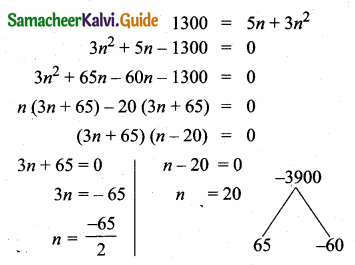
\(\frac { n }{ 2 } \) [10 + (n-1)2] = 480
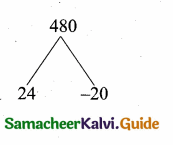
Samacheer Kalvi 10th Maths Guide Chapter 2 Numbers and Sequences Ex 2.6 1
n + 24 = 0 or n – 20 = 0
n = -24 or n = 20
[number of terms cannot be negative]
∴ Number of consecutive odd integers is 20

Samacheer Kalvi 10th Maths Guide Chapter 2 Numbers and Sequences Ex 2.6

Question 3.
Find the sum of first 28 terms of an A.P. whose nth term is 4n – 3.
Solution:
n = 28
tn = 4n – 3
t1 = 4 × 1 – 3 = 1
t2 = 4 × 2 – 3 = 5
t28 = 4 × 28 – 3
= 112 – 3 = 109
∴ a = 1, d = t2 – t1 = 5 – 1 = 4
l = 109.
Sn = \(\frac{n}{2}\) (2a+(n – 1)d)
S28 = \(\frac{28}{2}\) (2 × 1 + 27 × 4)
= 14(2 + 108)
= 14 × 110
= 1540

Question 4.
The sum of first n terms of a certain series is given as 2n2 – 3n . Show that the series is an A.P.
Answer:
Let tn be nth term of an A.P.
tn = Sn – Sn-1
= 2n2 – 3n – [2(n – 1)2 – 3(n – 1)]
= 2n2 – 3n – [2(n2 – 2n + 1) – 3n + 3]
= 2n2 – 3n – [2n2 – 4n + 2 – 3n + 3]
= 2n2 – 3n – [2n2 – 7n + 5]
= 2n2 – 3n – 2n2 + 7n – 5
tn = 4n – 5
t1 = 4(1) – 5 = 4 – 5 = -1
t2 = 4(2) -5 = 8 – 5 = 3
t3 = 4(3) – 5 = 12 – 5 = 7
t4 = 4(4) – 5 = 16 – 5 = 11
The A.P. is -1, 3, 7, 11,….
The common difference is 4
∴ The series is an A.P.

Samacheer Kalvi 10th Maths Guide Chapter 2 Numbers and Sequences Ex 2.6

Question 5.
The 104th term and 4th term of an A.P are 125 and 0. Find the sum of first 35 terms?
Answer:
104th term of an A.P = 125
t104 = 125
[tn = a + (n – 1) d]
a + 103d = 125 …..(1)
4th term = 0
t4 = 0
a + 3d = 0 …..(2)
Samacheer Kalvi 10th Maths Guide Chapter 2 Numbers and Sequences Ex 2.6 2
Samacheer Kalvi 10th Maths Guide Chapter 2 Numbers and Sequences Ex 2.6 3
Samacheer Kalvi 10th Maths Guide Chapter 2 Numbers and Sequences Ex 2.6 33Sum of 35 terms = 612.5
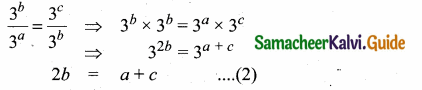
Samacheer Kalvi 10th Maths Guide Chapter 2 Numbers and Sequences Ex 2.6

Question 6.
Find the sum of ail odd positive integers less than 450.
Answer:
Sum of odd positive integer less than 450
1 + 3 + 5 + …. 449
Here a = 1, d = 3 – 1 = 2,l = 449
Samacheer Kalvi 10th Maths Guide Chapter 2 Numbers and Sequences Ex 2.6 4
Aliter: Sum of all the positive odd intergers
= n2
= 225 × 225
= 50625
Sum of the odd integers less than 450
= 50625

Samacheer Kalvi 10th Maths Guide Chapter 2 Numbers and Sequences Ex 2.6

Question 7.
Find the sum of all natural numbers between 602 and 902 which are not divisible by 4?
Answer:
First find the sum of all the natural’s number between 602 and 902
Here a = 603, d = 1, l = 901
Samacheer Kalvi 10th Maths Guide Chapter 2 Numbers and Sequences Ex 2.6 5
Find the sum of all the numbers between 602 and 902 which are divisible by 4.
Here a = 604; l = 900; d = 4
Samacheer Kalvi 10th Maths Guide Chapter 2 Numbers and Sequences Ex 2.6 6
Sum of the numbers which are not divisible
by 4 = Sn1 – Sn2
= 224848 – 56400
= 168448
Sum of the numbers = 168448

Samacheer Kalvi 10th Maths Guide Chapter 2 Numbers and Sequences Ex 2.6

Question 8.
Raghu wish to buy a laptop. He can buy it by paying ₹40,000 cash or by giving it in 10 installments as ₹4800 in the first month, ₹4750 in the second month, ₹4700 in the third month and so on. If he pays the money in this fashion, find
(i) total amount paid in 10 installments.
(ii) how much extra amount that he has to pay than the cost?
Solution:
4800 + 4750 + 4700 + … 10 terms
Here a = 4800
(i) d = t2 – t1 = 4750 – 4800 = -50
n = 10
Sn = \(\frac{n}{2}\) (2a + (n – 1)d)
S10 = \(\frac{10}{2}\)  (2 × 4800 + 9 × -50)
= 5 (9600 – 450)
= 5 × 9150 = 45750
Total amount paid in 10 installments = ₹ 45750.
(ii) The extra amount he pays in installments
= ₹ 45750 – ₹ 40,000
= ₹ 5750

Samacheer Kalvi 10th Maths Guide Chapter 2 Numbers and Sequences Ex 2.6

Question 9.
A man repays a loan of ₹ 65,000 by paying ₹ 400 in the first month and then increasing the payment by ₹ 300 every month. How long will it take for him to clear the loan?
Answer:
(i) Total loan amount = ₹ 65,000
Sn = 65,000
First month payment (a) = 400
Every month increasing ₹ 300
d = 300
Sn = \(\frac { n }{ 2 } \) [2a + (n-1)d]
65000 = \(\frac { n }{ 2 } \) [2(400) + (n – 1)300]
130000 = n [800 + 300n – 300]
= n [500 + 300n]
13000 = 500n + 300n2
Dividing by (100)
Samacheer Kalvi 10th Maths Guide Chapter 2 Numbers and Sequences Ex 2.6 10
Number of installments will not be negative
∴ Time taken to pay the loan is 20 months.

Question 10.
A brick staircase has a total of 30 steps. The bottom step requires 100 bricks. Each successive step requires two bricks less than the previous step.
(i) How many bricks are required for the top most step?
(ii) How many bricks are required to build the stair case?
Solution:
100 + 98 + 96 + 94 + … 30 steps.
Here
a = 100
d = -2
n = 30
∴ Sn = \(\frac{n}{2}\)  (2a + (n – 1)d)
S30 = \(\frac{30}{2}\)  (2 × 100 + 29 × -2)
= 15(200 – 58)
= 15 × 142
= 2130
t30 = a + (n – 1)d
= 100 + 29 × -2
= 100 – 58
= 42
(i) No. of bricks required for the top step are 42.
(ii) No. of bricks required to build the stair case are 2130.

Samacheer Kalvi 10th Maths Guide Chapter 2 Numbers and Sequences Ex 2.6

Question 11.
If S1, S2 , S3, ….Sm are the sums of n terms of m A.P.,s whose first terms are 1,2, 3…… m and whose common differences are 1,3,5,…. (2m – 1) respectively, then show that (S1 + S2 + S3 + ……. + Sm) = \(\frac { 1 }{ 2 } \) mn(mn + 1)
Answer:
First terms of an A.P are 1, 2, 3,…. m
The common difference are 1, 3, 5,…. (2m – 1)
Samacheer Kalvi 10th Maths Guide Chapter 2 Numbers and Sequences Ex 2.6 9
Samacheer Kalvi 10th Maths Guide Chapter 2 Numbers and Sequences Ex 2.6 99
By adding (1) (2) (3) we get
S1 + S2 + S3 + …… + Sm = \(\frac { n }{ 2 } \) (n + 1) + \(\frac { n }{ 2 } \) (3n + 1) + \(\frac { n }{ 2 } \) (5n + 1) + ….. + \(\frac { n }{ 2 } \) [n(2m – 1 + 1)]
= \(\frac { n }{ 2 } \) [n + 1 + 3n + 1 + 5n + 1 ……. + n (2m – 1) + m)]
= \(\frac { n }{ 2 } \) [n + 3n + 5n + ……. n(2m – 1) + m]
= \(\frac { n }{ 2 } \) [n (1 + 3 + 5 + ……(2m – 1)) + m
= \(\frac { n }{ 2 } \) [n(\(\frac { m }{ 2 } \)) (2m) + m]
= \(\frac { n }{ 2 } \) [nm2 + m]
S1 + S2 + S3 + ……….. + Sm = \(\frac { mn }{ 2 } \) [mn + 1]
Hint:
1 + 3 + 5 + ……. + 2m – 1
Sn = \(\frac { n }{ 2 } \) (a + l)
= \(\frac { m }{ 2 } \) (1 + 2m -1)
= \(\frac { m }{ 2 } \) (2m)

Samacheer Kalvi 10th Maths Guide Chapter 2 Numbers and Sequences Ex 2.6

Question 12.
Find the sum
Samacheer Kalvi 10th Maths Guide Chapter 2 Numbers and Sequences Ex 2.6 8
Answer:
Samacheer Kalvi 10th Maths Guide Chapter 2 Numbers and Sequences Ex 2.6 7

Samacheer Kalvi 10th Maths Guide Chapter 2 Numbers and Sequences Ex 2.7

Students can download Maths Chapter 2 Numbers and Sequences Ex 2.7 Questions and Answers, Notes, Samacheer Kalvi 10th Maths Guide Pdf helps you to revise the complete Tamilnadu State Board New Syllabus, helps students complete homework assignments and to score high marks in board exams.

Tamilnadu Samacheer Kalvi 10th Maths Solutions Chapter 2 Numbers and Sequences Ex 2.7

Question 1.
Which of the following sequences are in G.P?
(i) 3,9,27,81,…
(ii) 4,44,444,4444,…
(iii) 0.5,0.05,0.005,
(iv) \(\frac { 1 }{ 3 } \),\(\frac { 1 }{ 6 } \),\(\frac { 1 }{ 12 } \), ………….
(v) 1, -5, 25,-125,…
(vi) 120, 60, 30, 18,…
(vii) 16, 4, 1, \(\frac { 1 }{ 4 } \), ……….
Answer:
Samacheer Kalvi 10th Maths Guide Chapter 2 Numbers and Sequences Ex 2.7 1
Samacheer Kalvi 10th Maths Guide Chapter 2 Numbers and Sequences Ex 2.7 2
Samacheer Kalvi 10th Maths Guide Chapter 2 Numbers and Sequences Ex 2.7 3
Samacheer Kalvi 10th Maths Guide Chapter 2 Numbers and Sequences Ex 2.7 4
Samacheer Kalvi 10th Maths Guide Chapter 2 Numbers and Sequences Ex 2.7 5

Samacheer Kalvi 10th Maths Guide Chapter 2 Numbers and Sequences Ex 2.7

Question 2.
Write the first three terms of the G.P. whose first term and the common ratio are given below.
(i) a = 6, r = 3
Answer:
a = 6, r = 3
ar = 6 × 3 = 18,
ar2 = 6 × 9 = 54
The three terms are 6, 18 and 54

(ii) a = \(\sqrt { 2 }\), r = \(\sqrt { 2 }\).
Answer:
ar = \(\sqrt { 2 }\) × \(\sqrt { 2 }\) = 2,
ar2 = \(\sqrt { 2 }\) × 2 = 2 \(\sqrt { 2 }\)
The three terms are \(\sqrt { 2 }\), 2 and 2\(\sqrt { 2 }\)

(iii) a = 1000, r = \(\frac { 2 }{ 5 } \)
Answer:
ar = 1000 × \(\frac { 2 }{ 5 } \) = 400,
ar2 = 1000 × \(\frac { 4 }{ 25 } \) = 40 × 4 = 160
The three terms are 1000,400 and 160.

Question 3.
In a G.P. 729, 243, 81,… find t7.
Answer:
The G.P. is 729, 243, 81,….
Samacheer Kalvi 10th Maths Guide Chapter 2 Numbers and Sequences Ex 2.7 7

Question 4.
Find x so that x + 6, x + 12 and x + 15 are consecutive terms of a Geometric Progression
Solution:
G.P = x + 6, x + 12, x + 15
In G.P r = \(\frac{t_{2}}{t_{1}}=\frac{t_{3}}{t_{2}}\)
\(\frac{x+12}{x+6}=\frac{x+15}{x+12}\)
(x + 12)2 = (x + 6) (x + 5)
x2 + 24x + 144 = x2 + 6x + 15x + 90
24x – 21x = 90 – 144
3x = -54
x = \(\frac { -54 }{ 3 } \) = -18
x = -18

Samacheer Kalvi 10th Maths Guide Chapter 2 Numbers and Sequences Ex 2.7

Question 5.
Find the number of terms in the following G.P.

(i) 4,8,16,…,8192?
Answer:
Here a = 4; r = \(\frac { 8 }{ 4 } \) = 2
tn = 8192
Samacheer Kalvi 10th Maths Guide Chapter 2 Numbers and Sequences Ex 2.7 8
a . rn-1 = 8192 ⇒ 4 × 2n-1 = 8192
2n-1 = \(\frac { 8192 }{ 4 } \) = 2048
2n-1 = 211 ⇒ n – 1 = 11
n = 11 + 1 ⇒ n = 12
Number of terms = 12

(ii) \(\frac { 1 }{ 3 } \), \(\frac { 1 }{ 9 } \), \(\frac { 1 }{ 27 } \), ……………, \(\frac { 1 }{ 2187 } \)
Answer:
a = \(\frac { 1 }{ 3 } \) ; r = \(\frac { 1 }{ 9 } \) ÷ \(\frac { 1 }{ 3 } \) = \(\frac { 1 }{ 9 } \) × \(\frac { 3 }{ 1 } \) = \(\frac { 1 }{ 3 } \)
Samacheer Kalvi 10th Maths Guide Chapter 2 Numbers and Sequences Ex 2.7 9
tn = \(\frac { 1 }{ 2187 } \)
a. rn-1 = \(\frac { 1 }{ 2187 } \)
Samacheer Kalvi 10th Maths Guide Chapter 2 Numbers and Sequences Ex 2.7 10
n – 1 = 6 ⇒ n = 6 + 1 = 7
Number of terms = 7

Samacheer Kalvi 10th Maths Guide Chapter 2 Numbers and Sequences Ex 2.7

Question 6.
In a G.P. the 9th term is 32805 and 6th term is 1215. Find the 12th term.
Answer:
Given, 9th term = 32805
a. rn-1 = \(\frac { 1 }{ 2187 } \)
t9 = 32805 [tn = arn-1]
a.r8 = 32805 …..(1)
6th term = 1215
a.r5 = 1215 …..(2)
Divide (1) by (2)
\(\frac{a r^{8}}{a r^{5}}\) = \(\frac { 32805 }{ 1215 } \) ⇒ r3 = \(\frac { 6561 }{ 243 } \)
= \(\frac { 2187 }{ 81 } \) = \(\frac { 729 }{ 27 } \) = \(\frac { 243 }{ 9 } \) = \(\frac { 81 }{ 3 } \)
r3 = 27 ⇒ r3 = 33
r = 3
Substitute the value of r = 3 in (2)
a. 35 = 1215
a × 243 = 1215
a = \(\frac { 1215 }{ 243 } \) = 5
Here a = 5, r = 3, n = 12
t12 = 5 × 3(12-1)
= 5 × 311
∴ 12th term of a G.P. = 5 × 311

Samacheer Kalvi 10th Maths Guide Chapter 2 Numbers and Sequences Ex 2.7

Question 7.
Find the 10th term of a G.P. whose 8th term is 768 and the common ratio is 2.
Solution:
t8 = 768 = ar7
r = 2
t10 = ar9 = ar7 × r × r
= 768 × 2 × 2 = 3072

Samacheer Kalvi 10th Maths Guide Chapter 2 Numbers and Sequences Ex 2.7

Question 8.
If a, b, c are in A.P. then show that 3a, 3b, 3c are in G.P.
Answer:
a, b, c are in A.P.
t2 – t1 = t3 – t2
b – a = c – b
2b = a + c …..(1)
3a, 3b, 3c are in G.P.
Samacheer Kalvi 10th Maths Guide Chapter 2 Numbers and Sequences Ex 2.7 11
From (1) and (2) we get
3a, 3b, 3c are in G.P.

Question 9.
In a G.P. the product of three consecutive terms is 27 and the sum of the product of two terms taken at a time is \(\frac { 57 }{ 2 } \). Find the three terms.
Answer:
Let the three terms of the G.P. be \(\frac { a }{ r } \), a, ar
Product of three terms = 27
\(\frac { a }{ r } \) × a × ar = 27
a3 = 27 ⇒ a3 = 33
a = 3
Sum of the product of two terms taken at a time is \(\frac { 57 }{ 2 } \)
Samacheer Kalvi 10th Maths Guide Chapter 2 Numbers and Sequences Ex 2.7 12
6r2 – 13r + 6 = 0
6r2 – 9r – 4r + 6 = 0
3r (2r – 3) -2(2r – 3) = 0
(2r – 3) (3r – 2) = 0
2r – 3 = 0 or 3r – 2 = 0
2r = 3 (or) 3r – 2 = 0
r = \(\frac { 3 }{ 2 } \) (or) r = \(\frac { 2 }{ 3 } \)
Samacheer Kalvi 10th Maths Guide Chapter 2 Numbers and Sequences Ex 2.7 13
∴ The three terms are 2, 3 and \(\frac { 9 }{ 2 } \) or \(\frac { 9 }{ 2 } \), 3 and 2

Samacheer Kalvi 10th Maths Guide Chapter 2 Numbers and Sequences Ex 2.7

Question 10.
A man joined a company as Assistant Manager. The company gave him a starting salary of ₹60,000 and agreed to increase his salary 5% annually. What will be his salary after 5 years?
Answer:
Starting salary (a) = ₹ 60000
Increased salary = 5% of starting salary
= \(\frac { 5 }{ 100 } \) × 60000
= ₹ 3000
Starting salary for the 2nd year = 60000 + 3000
= ₹ 63000
Year increase = 5% of 63000
= \(\frac { 5 }{ 100 } \) × 63000
= ₹ 3150
Starting salary for the 3rd year = 63000 + 3150
= ₹ 66150
60000, 63000, 66150,…. form a G.P.
a = 60000; r = \(\frac { 63000 }{ 60000 } \) = \(\frac { 63 }{ 60 } \) = \(\frac { 21 }{ 20 } \)
tn = ann-1
t5 = (60000) (\(\frac { 21 }{ 20 } \))4
= 60000 × \(\frac { 21 }{ 20 } \) × \(\frac { 21 }{ 20 } \) × \(\frac { 21 }{ 20 } \) × \(\frac { 21 }{ 20 } \)
= \(\frac{6 \times 21 \times 21 \times 21 \times 21}{2 \times 2 \times 2 \times 2}\)
= 72930.38
5% increase = \(\frac { 5 }{ 100 } \) × 72930.38
= ₹ 3646.51
Salary after 5 years = ₹ 72930.38 + 3646.51
= ₹ 76576.90
= ₹ 76577

Samacheer Kalvi 10th Maths Guide Chapter 2 Numbers and Sequences Ex 2.7

Question 11.
Sivamani is attending an interview for a job and the company gave two offers to him. Offer A: ₹20,000 to start with followed by a guaranteed annual increase of 6% for the first 5 years.
Offer B: ₹22,000 to start with followed by a guaranteed annual increase of 3% for the first 5 years.
What is his salary in the 4th year with respect to the offers A and B?
Answer:
Starting salary (a) = ₹ 20,000
Annual increase = 6% of 20000
= \(\frac { 5 }{ 100 } \) × 20000
= ₹ 1200
Salary for the 2nd year = ₹ 20000 + 1200
= ₹ 21200
Here a = 20,000; r = \(\frac { 21200 }{ 20000 } \) = \(\frac { 212 }{ 200 } \) = \(\frac { 106 }{ 100 } \) = \(\frac { 53 }{ 50 } \)
n = 4 years
tn = arn-1
Samacheer Kalvi 10th Maths Guide Chapter 2 Numbers and Sequences Ex 2.7 14
Salary at the end of 4th year = 23820

For B
Starting salary = ₹ 22000
(a) = 22000
Annual increase = 3% of 22000
= \(\frac { 3 }{ 100 } \) × 22000
= ₹ 660
Salary for the 2nd year = ₹ 22000 + ₹ 660
= ₹ 22,660
Here a = 22000; r = \(\frac { 22660 }{ 22000 } \)
= \(\frac { 2266 }{ 2200 } \) = \(\frac { 1133 }{ 1100 } \) = \(\frac { 103 }{ 100 } \)
Salary at the end of 4th year = 22000 × (\(\frac { 103 }{ 100 } \))4-1
= 22000 × (\(\frac { 103 }{ 100 } \))3
= 22000 × \(\frac { 103 }{ 100 } \) × \(\frac { 103 }{ 100 } \) × \(\frac { 103 }{ 100 } \)
Samacheer Kalvi 10th Maths Guide Chapter 2 Numbers and Sequences Ex 2.7 15
= 24039.99 = 24040
4th year Salary for A = ₹ 23820 and 4th year Salary for B = ₹ 24040

Samacheer Kalvi 10th Maths Guide Chapter 2 Numbers and Sequences Ex 2.7

Question 12.
If a, b, c are three consecutive terms of an A.P. and x, y, z are three consecutive terms of a G.P. then prove that xb-c × yc-a × za-b = 1
Answer:
a, b, c are three consecutive terms of an A.P
∴ a = a, b = a + dand c = a + 2d respectively ….(1)
x, y, z are three consecutive terms of a G.P
∴ x = x, y = xr, z = xr2 respective ……(2)
L.H.S = xb-c × yc-a × za-b ( Substitute the values from 1 and 2 we get)
Samacheer Kalvi 10th Maths Guide Chapter 2 Numbers and Sequences Ex 2.7 16
L.H.S = R.H.S
Hence it is proved

Samacheer Kalvi 10th Maths Guide Chapter 2 Numbers and Sequences Ex 2.5

Students can download Maths Chapter 2 Numbers and Sequences Ex 2.5 Questions and Answers, Notes, Samacheer Kalvi 10th Maths Guide Pdf helps you to revise the complete Tamilnadu State Board New Syllabus, helps students complete homework assignments and to score high marks in board exams.

Tamilnadu Samacheer Kalvi 10th Maths Solutions Chapter 2 Numbers and Sequences Ex 2.5

Question 1.
Check whether the following sequences are in A.P.?

(i) a – 3, a – 5, a – 7,…
Answer:
a – 3, a – 5, a – 7…….
t2 – t1 = a – 5 – (a – 3)
= a – 5 – a + 3
= -2
t3 – t2 = a – 7 – (a – 5)
= a – 7 – a + 5
= -2
t2 – t1 = t3 – t2
(common difference is same)
The sequence is in A.P.

Samacheer Kalvi 10th Maths Guide Chapter 2 Numbers and Sequences Ex 2.5

(ii) \(\frac { 1 }{ 2 } \), \(\frac { 1 }{ 3 } \), \(\frac { 1 }{ 4 } \), \(\frac { 1 }{ 5 } \), ……….
Answer:
t2 – t1 = \(\frac { 1 }{ 3 } \) – \(\frac { 1 }{ 2 } \) = \(\frac { 2-3 }{ 6 } \) = \(\frac { -1 }{ 6 } \)
t3 – t2 = \(\frac { 1 }{ 4 } \) – \(\frac { 1 }{ 3 } \) = \(\frac { 3-4 }{ 12 } \) = \(\frac { -1 }{ 12 } \)
t2 – t1 ≠ t3 – t2
The sequence is not in A.P.

(iii) 9, 13, 17, 21, 25,…
Answer:
t2 – t1 = 13 – 9 = 4
t3 – t2 = 17 – 13 = 4
t4 – t3 = 21 – 17 = 4
t5 – t4 = 25 – 21 = 4
Common difference are equal
∴ The sequence is in A.P.

(iv) \(\frac { -1 }{ 3 } \), 0, \(\frac { 1 }{ 3 } \), \(\frac { 2 }{ 3 } \)
t2 – t1 = 0 – (-\(\frac { 1 }{ 3 } \))
= 0 + \(\frac { 1 }{ 3 } \) = \(\frac { 1 }{ 3 } \)
t3 – t2 = \(\frac { 1 }{ 3 } \) – 0 = \(\frac { 1 }{ 3 } \)
t2 – t1 = t3 – t2
The sequence is in A.P.

(v) 1,-1, 1,-1, 1, -1, …
t2 – t1 = -1 – 1 = -2
t3 – t2 = 1 – (-1) = 1 + 1 = 2
t4 – t3 = -1-(1) = – 1 – 1 = – 2
t5 – t4 = 1 – (-1) = 1 + 1 = 2
Common difference are not equal
∴ The sequence is not an A.P.

Samacheer Kalvi 10th Maths Guide Chapter 2 Numbers and Sequences Ex 2.5

Question 2.
First term a and common difference d are given below. Find the corresponding A.P. ?
(i) a = 5 ,d = 6
Answer:
Here a = 5,d = 6
The general form of the A.P is a, a + d, a + 2d, a + 3d….
The A.P. 5, 11, 17, 23 ….

(ii) a = 7, d = -5
Answer:
The general form of the A.P is a, a + d,
a + 2d, a + 3d… .
The A.P. 7, 2, -3, -8 ….

(iii) a = \(\frac { 3 }{ 4 } \), d = \(\frac { 1 }{ 2 } \)
Answer:
The general form of the A.P is a, a + d, a + 2d, a + 3d….
\(\frac { 3 }{ 4 } \),\(\frac { 3 }{ 4 } \) + \(\frac { 1 }{ 2 } \),\(\frac { 3 }{ 4 } \) + 2(\(\frac { 1 }{ 2 } \)), \(\frac { 3 }{ 4 } \) + 3 (\(\frac { 1 }{ 2 } \))
The A.P. \(\frac { 3 }{ 4 } \), \(\frac { 5 }{ 4 } \), \(\frac { 7 }{ 4 } \), …….

Samacheer Kalvi 10th Maths Guide Chapter 2 Numbers and Sequences Ex 2.5

Question 3.
Find the first term and common difference of the Arithmetic Progressions whose nth terms are given below
(i) tn = -3 + 2n
(ii) tn = 4 – 7n
Solution:
(i) a = t1 = -3 + 2(1) = -3 + 2 = -1
d = t2 – t1
Here t2 = -3 + 2(2) = -3 + 4 = 1
∴ d = t2 – t1 = 1 – (-1) = 2
(ii) a = t1 = 4 – 7(1) = 4 – 7 = -3
d = t2 – t1
Here t2 = 4 – 7(2) = 4 – 14 – 10
∴ d = t2 – t1 = 10 – (-3) = -7

Samacheer Kalvi 10th Maths Guide Chapter 2 Numbers and Sequences Ex 2.5

Question 4.
Find the 19th term of an A.P. -11, -15, -19,…
Answer:
First term (a) = -11
Common difference (d) = -15 -(-11)
= -15 + 11 = -4
n = 19
tn = a + (n – 1) d
tn = -11 + 18(-4)
= -11 – 72
t19 = -83
19th term of an A.P. is – 83

Question 5.
Which term of an A.P. 16, 11, 6,1, ……….. is -54?
Solution:
A.P = 16, 11,6, 1, ………..
It is given that
tn = -54
a = 16, d = t2 – t1 = 11 – 16 = -5
∴ tn = a + (n – 1)d
-54 = 16 + (n – 1) (-5)
-54 = 16 – 5n + 5
21 – 5n = -54
-5n = -54 -21
-5n = -75
n = \(\frac { 75 }{ 5 } \) =15
∴ 15th term is -54.

Samacheer Kalvi 10th Maths Guide Chapter 2 Numbers and Sequences Ex 2.5

Question 6.
Find the middle term(s) of an A.P. 9, 15, 21, 27, …, 183.
Answer:
First term (a) = 9
Last term (l) = 183
Common difference (d) = 15 – 9 = 6
n = \(\frac { l-a }{ d } \) + 1
= \(\frac { 183-9 }{ 6 } \) + 1
= \(\frac { 174 }{ 6 } \) + 1
= 29 + 1
= 30
middle term = 15th term of
16th term
tn = a + (n – 1)d
t15 = 9 + 14(6)
= 9 + 84 = 93
t16 = 9 + 15(6)
= 9 + 90 = 99
The middle term is 93 or 99

Question 7.
If nine times ninth term is equal to the fifteen times fifteenth term, show that six times twenty fourth term is zero.
Solution:
Nine times ninth term = Fifteen times fifteenth term
9t9 = 15t15
9(a + 8d) = 5(a + 14d)
9a + 72d = 15a + 210
15a + 210d – 9a – 72d = 0
⇒ 6a + 138 d = 0
⇒ 6(a + 23 d) = 0
⇒ 6(a + (24 – 1)d) = 0
⇒ 6t24 = 0. Hence it is proved.

Samacheer Kalvi 10th Maths Guide Chapter 2 Numbers and Sequences Ex 2.5

Question 8.
If 3 + k, 18 – k, 5k + 1 are in A.P. then find k?
Answer:
3 + k, 18 – k, 5k + 1 are in AP
∴ t2 – t1 = t3 – t2 (common difference is same)
18 – k – (3 + k) = 5k + 1 – (18 – k)
18 – k – 3 – k = 5k + 1 – 18 + k
15 – 2k = 6k – 17
32 = 8k
k = \(\frac { 32 }{ 8 } \) = 4
The value of k = 4

Question 9.
Find x, y and z, given that the numbers x, 10, y, 24, z are in A.P.
Solution:
A.P = x, 10, y, 24, z,…
d = t2 – t1 = 10 – x ………….. (1)
= t3 – t2 = y – 10 ………….. (2)
= t4 – t3 = 24 – y …………. (3)
= t5 – t4 = z – 24 ………….. (4)
(2) and (3)
⇒ y – 10 = 24 – y
2y = 24 + 10 = 34
y = \(\frac { 34 }{ 2 } \) = 17
(1) and (2)
⇒ 10 – x = y – 10
10 – x = 17 – 10 = 7
-x = 7 – 10
-x = -3 ⇒ x = 3
From (3) and (4)
24 – y = z – 24
24 – 17 = z – 24
7 = z – 24
∴ z = 7 + 24 = 31
∴ Solutions x = 3
y = 17
z = 31

Samacheer Kalvi 10th Maths Guide Chapter 2 Numbers and Sequences Ex 2.5

Question 10.
In a theatre, there are 20 seats in the front row and 30 rows were allotted. Each successive row contains two additional seats than its front row. How many seats are there in the last row?
Answer:
Number of seats in the first row
(a) = 20
∴ t1 = 20
Number of seats in the second row
(t2) = 20 + 2
= 22
Number of seats in the third row
(t3) = 22 + 2
= 24
Here a = 20 ; d = 2
Number of rows
(n) = 30
tn = a + (n – 1)d
t30 = 20 + 29(2)
= 20 + 58
t30 = 78
Number of seats in the last row is 78

Samacheer Kalvi 10th Maths Guide Chapter 2 Numbers and Sequences Ex 2.5

Question 11.
The sum of three consecutive terms that are in A.P. is 27 and their product is 288. Find the three terms.
Solution:
Let the three consecutive terms be a – d, a, a + d
Their sum = a – d + a + a + d = 27
3a = 27
a = \(\frac{27}{3}\) = 9
Their product = (a – d)(a)(a + d) = 288
= 9(a2 – d2) = 288
⇒ 9(9 – d2) = 288
⇒ 9(81 – d2) = 288
81 – d2 = 32
-d2 = 32 – 81
d2 = 49
⇒ d = ± 7
∴ The three terms are if a = 9, d = 7
a – d, a , a + d = 9 – 7, 9 + 7
A.P. = 2, 9, 16
if a = 9, d = -7
A.P. = 9 – (-7), 9, 9 + (-7)
= 16, 9, 2

Samacheer Kalvi 10th Maths Guide Chapter 2 Numbers and Sequences Ex 2.5

Question 12.
The ratio of 6th and 8th term of an A.P is 7:9. Find the ratio of 9th term to 13th term.
Answer:
Given : t6 : t8 = 7 : 9 (using tn = a + (n – 1)d
a + 5d : a + 7d = 7 : 9
9 (a + 5 d) = 7 (a + 7d)
9a + 45 d = 7a + 49d
9a – 7a = 49d – 45d
2a = 4d
a = 2d
To find t9 : t13
t9 : t13 = a + 8d : a + 12d
= 2d + 8d : 2d + 12d
= 10d : 14d
= 5 : 7
∴ t9 : t13 = 5 : 7

Question 13.
In a winter season, the temperature of Ooty from Monday to Friday to be in A.P. The sum of temperatures from Monday to Wednesday is 0° C and the sum of the temperatures from Wednesday to Friday is 18° C. Find the temperature on each of the five days.
Answer:
Let the five days temperature be
(a – 2d), (a – d), a,(a + d) and (a + 2d)
Sum of first three days temperature = 0
a – 2d + a – d + a = 0
3a – 3d = 0
a – d = 0 …..(1)
Sum of the last three days temperature = 18°C
a + a + d + a + 2d = 18
3a + 3d = 18
(÷ by 3) ⇒ a + d = 6 ……(2)
By adding (1) and (2)
Samacheer Kalvi 10th Maths Guide Chapter 2 Numbers and Sequences Ex 2.5 1
Substitute to value of a = 3 in (2)
d = 3
The temperature in 5 days are
(3 – 6), (3 – 3), 3, (3 + 3) and (3 + 6)
-3°C, 0°C, 3°C, 6°C, 9°C

Samacheer Kalvi 10th Maths Guide Chapter 2 Numbers and Sequences Ex 2.5

Question 14.
Priya earned ₹15,000 in the first month. Thereafter her salary increases by ₹1500 per year. Her expenses are ₹13,000 during the first year and the expenses increases by ₹900 per year. How long will it take her to save ₹20,000 per month.
Answer:
Tabulate the given table
Samacheer Kalvi 10th Maths Guide Chapter 2 Numbers and Sequences Ex 2.5 2
Monthly savings form an A.P.
2000, 2600, 3200 …..
a = 2000; d = 2600 – 2000 = 600
Given tn = 20,000
tn = a + (n – 1) d
20000 = 2000 + (n – 1) 600
20000 = 2000 + 600n – 600
= 1400 + 600n
20000 – 1400 = 600n
18600 = 600n
n = \(\frac { 18600 }{ 600 } \) = 31
He will take 31 years to save ₹ 20,000 per month