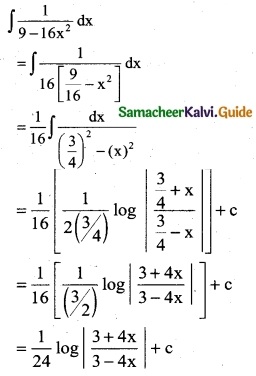
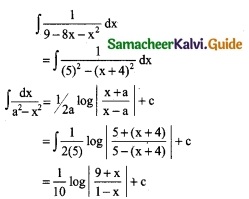
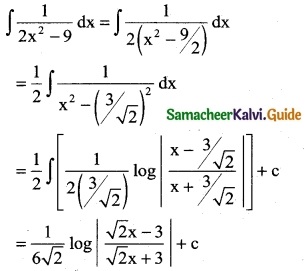
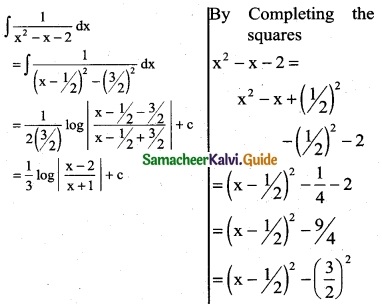
Samacheer Kalvi 12th History Guide Chapter 1 இந்தியாவில் தேசியத்தின் எழுச்சி

Tamilnadu State Board New Syllabus Samacheer Kalvi 12th History Guide Pdf Chapter 1 இந்தியாவில் தேசியத்தின் எழுச்சி Text Book Back Questions and Answers, Notes.

Tamilnadu Samacheer Kalvi 12th History Solutions Chapter 1 இந்தியாவில் தேசியத்தின் எழுச்சி

12th History Guide இந்தியாவில் தேசியத்தின் எழுச்சி Text Book Questions and Answers

I. சரியான விடையைத் தேர்ந்தெடுக்கவும்

Question 1.
காந்தியடிகள் தென்னாப்பிரிக்காவிலிருந்து எந்த ஆண்டு இந்தியா திரும்பினார்?
அ) 1915
ஆ) 1916
இ) 1917
ஈ) 1918
Answer:
அ) 1915

Samacheer Kalvi 12th History Guide Chapter 1 இந்தியாவில் தேசியத்தின் எழுச்சி

Question 2.
இந்தியாவில் ஆங்கிலக் கல்வி எந்த ஆண்டு அறிமுகப்படுத்தப்பட்டது? (மார்ச் 2020 )
அ) 1825
ஆ) 1835
இ) 1845
ஈ) 1855
Answer:
ஆ) 1835

Question 3.
மாறுபட்ட ஒன்றைத் தேர்வு செய்க.
அ) வில்லியம் ஜோன்ஸ்
ஆ) சார்லஸ் வில்கின்ஸ்
இ) மாக்ஸ் முல்லர்
ஈ) அரவிந்த கோஷ்
Answer:
ஈ) அரவிந்த கோஷ்

Question 4.
“சுயராஜ்யம் எனது பிறப்புரிமை, அதை அடைந்தே தீருவேன்” – எனக் கூறியவர்.
அ) பாலகங்காதர திலகர்
ஆ) தாதாபாய் நௌரோஜி
இ) சுபாஷ் சந்திர போஸ்
ஈ) பாரதியார்
Answer:
அ) பாலகங்காதர திலகர்

Samacheer Kalvi 12th History Guide Chapter 1 இந்தியாவில் தேசியத்தின் எழுச்சி

Question 5.
பின்வருவனவற்றை பொருத்தி சரியான விடையைத் தேர்வு செய்க.

அ) பாலகங்காதர திலகர் – 1 இந்தியாவின் குரல்
ஆ) தாதாபாய் நௌரோஜி – 2. மெட்ராஸ் டைம்ஸ்
இ) மெக்காலே – 3. கேசரி
ஈ) வில்லியம் டிக்பை – 4 இந்தியக் கல்விக் குறித்த குறிப்புகள்

அ) 2, 4, 1, 3
ஆ) 3, 1, 4, 2
இ) 1, 3, 2, 4
ஈ) 4, 2, 3,1
Answer:
ஆ) 3, 1, 4, 2

Question 6.
பின்வரும் எது ஒன்று சரியாகப் பொருந்தியுள்ளது?
அ)  ஆங்கிலக் கல்விச் சட்டம் – 1843
ஆ)  அடிமைமுறை ஒழிப்பு – 1859
இ) சென்னைவாசிகள் சங்கம் – 1852
ஈ) இண்டிகோ கலகம் –  1835
Answer:
இ) சென்னைவாசிகள் சங்கம் – 1852

Question 7.
பின்வரும் அமைப்புகள் தொடங்கப்பட்ட சரியான கால வரிசையைத் தேர்வு செய்க.
(i) கிழக்கிந்தியக் கழகம்
(ii) மெட்ராஸ் மகாஜன சங்கம்
(iii) சென்னைவாசிகள் சங்கம்
(iv) இந்தியச் சங்கம்
அ) ii, i, iii, iv
ஆ) ii, iii, i, iv
இ) iii, iv, i, ii
ஈ) iii, iv, ii, i
Answer:
இ) iii, iv,i,ii

Question 8.
இந்திய தேசிய காங்கிரஸை நிறுவியவர் –
அ) சுபாஷ் சந்திர போஸ்
ஆ) காந்தியடிகள்
இ) A.O.ஹியூம்
ஈ) பாலகங்காதர திலகர்
Answer:
இ) A.O.ஹியூம்

Samacheer Kalvi 12th History Guide Chapter 1 இந்தியாவில் தேசியத்தின் எழுச்சி

Question 9.
இந்திய தேசிய காங்கிரஸின் முதல் தலைவர் (மார்ச் 2020 )
அ) சுரேந்திரநாத் பானர்ஜி
ஆ) பத்ருதீன் தியாப்ஜி
இ) A.O.ஹியூம்
ஈ) W.C.பானர்ஜி
Answer:
ஈ) W.C.பானர்ஜி

Question 10.
“இந்தியாவின் முதுபெரும் மனிதர் ” என அழைக்கப்படுபவர்
அ) பாலகங்காதர திலகர்
ஆ) M.K.காந்தி
இ) தாதாபாய் நௌரோஜி
ஈ) சுபாஷ் சந்திர போஸ்
Answer:
இ) தாதாபாய் நௌரோஜி

Question 11.
“வறுமையும் பிரிட்டனுக்கொவ்வாத இந்திய ஆட்சியும் ” (Povertyand Un-British Rule in India) என்ற நூலை எழுதியவர்
அ) பால கங்காதர திலகர்
ஆ) கோபால கிருஷ்ண கோகலே
இ) தாதாபாய் நௌரோஜி
ஈ) எம்.ஜி.ரானடே
Answer:
இ) தாதாபாய் நௌரோஜி

Question 12.
கூற்று : ஆங்கில அரசாங்கம் தடையற்ற வணிகக் கொள்கையைப் பின்பற்றியது. –
காரணம்: இங்கிலாந்தின் தடையற்ற வணிகக் கொள்கையினால் இந்தியா நன்மையைப் பெற்றது.
அ) கூற்று சரி, ஆனால் காரணம் கூற்றை விளக்கவில்லை .
ஆ) கூற்று சரி, காரணம் கூற்றை விளக்குகிறது.
இ) கூற்று சரி; காரணம் தவறு
ஈ) கூற்று காரணம் இரண்டும் தவறு
Answer:
இ) கூற்று சரி; காரணம் தவறு

Samacheer Kalvi 12th History Guide Chapter 1 இந்தியாவில் தேசியத்தின் எழுச்சி

Question 13.
ஒரிசா பஞ்சம் குறித்த பின்வரும் கூற்றுக்களில் சரியானவை எவை/எது?

கூற்று 1: 1866 ஆம் ஆண்டில் ஒன்றரை மில்லியன் மக்கள் ஓரிசாவில் பட்டினியால் இறந்தனர்.
கூற்று 2: பஞ்ச காலத்தில் 200 மில்லியன் பவுண்ட் அரிசியை பிரிட்டனுக்கு ஆங்கில அரசு ஏற்றுமதி செய்தது.
கூற்று 3: ஓரிசா பஞ்சமானது தாதாபாய் நௌரோஜியை இந்திய வறுமை குறித்து வாழ்நாள் ஆய்வை மேற்கொள்ள தூண்டியது.

அ) 1, 2
ஆ) 1, 3
இ) இவற்றுள் எதுவுமில்லை
ஈ) இவை அனைத்தும்
Answer:
ஈ) இவை அனைத்தும்

Question 14.
கூற்று : தாதாபாய் நௌரோஜி இந்திய தேசிய காங்கிரஸின் தலைவராக மூன்று முறை தேர்வு செய்யப்பட்டார்.
காரணம் : 1905 ஆம் ஆண்டு வரையில் இந்திய விடுதலை இயக்கம் அரசமைப்;பஸவாதிகளின்
கட்டுபாட்டிலிருந்தது.
அ) கூற்று காரணம் இரண்டும் சரி, காரணம் கூற்றை விளக்குகிறது
ஆ) கூற்று காரணம் இரண்டும் சரி, ஆனால் காரணம் கூற்றை விளக்கவில்லை
இ) கூற்று சரி ஆனால் காரணம் தவறு
ஈ) கூற்று தவறு ஆனால் காரணம் சரி
Answer:
இ) கூற்று சரி ஆனால் காரணம் தவறு

II. சுருக்கமான விடையளிக்கவும்

Question 1.
தேசியம் என்றால் என்ன?
Answer:

  • தேசியம் என்பது ஒரு நாட்டிற்கு விசுவாசமாகவும், பக்தியோடும் இருத்தல் எனப்பொருள்.
  • தனது நாட்டை ஏனைய நாடுகளைக் காட்டிலும் உயர்வான இடத்தில் வைத்து பார்ப்பது அல்லது
  • ஏனைய நாடுகளுக்கு போட்டியாக தனது நாட்டின் பண்பாடு மற்றும் விருப்பங்களின் வளர்ச்சியில் சிறப்பு கவனம் செலுத்தும் ஒரு தேசிய உணர்வு ஆகும்.

Question 2.
புதிய நிலவுடைமை உரிமைகளால் ஏற்பட்ட பாதிப்புகளை எழுதுக?
Answer:

  • இந்தியாவின் மரபு சார்ந்த நிலவுடைமை முறையை ஆங்கிலேயர் சிதைத்தனர்.
  • நிலத்தை விற்பனை பொருளாக்குவது, இந்தியாவில் வேளாண்மையை வணிகமயமாக்குவது ஆகியவற்றால் விவசாயிகளின் வாழ்க்கை நிலையில் எந்த ஒரு முன்னேற்றத்தையும் ஏற்படுத்தவில்லை.
  • ஒரு புதுவகையான நிலபிரபுக்கள் வர்க்கம் உருவானது.
  • விவசாயிகளிடையே மன நிறைவின்மையை ஏற்படுத்தி அமைதி இழந்தவர்களாகவும், கட்டுப்பாடுகளை மீறுபவர்களாகவும் ஆக்கியது.

Samacheer Kalvi 12th History Guide Chapter 1 இந்தியாவில் தேசியத்தின் எழுச்சி

Question 3.
” அவுரி கலகம்” குறித்து குறிப்பு வரைக.
Answer:

  • 1859-60ல் நடைபெற்ற இண்டிகோ புரட்சியே அவுரி புரட்சியாகும்.
  • ஐரோப்பியர்களுக்குச் சொந்தமான நிலங்களில் இந்திய குத்தகை விவசாயிகள் அவுரியை பயிரிட கட்டாயப்படுத்தப்பட்டனர்.
  • சிறிய தொகையை முன்பணமாக பெற்றுக் கொண்டு, சாதகமற்ற ஒப்பந்தங்களை ஏற்றுக் கொள்ள விவசாயிகள் கட்டாயப்படுத்தப்பட்டனர்.
  • அவரிபண்ணையார் விவசாயிகளுக்கு சந்தை விலையை விட குறைவாக கொடுத்தனர். இது நிலங்களுக்கான வரி பாக்கியை கூட விவசாயிகளால் செலுத்த முடியவில்லை .
  • ஆட்சியாளர்கள் தங்களது குறைகளை நிவர்த்தி செய்வார்கள் என பலமுறை மனுக்கள் எழுதுவதன் மூலம் தங்களது எதிர்ப்புகளை தெரிவித்தனர்.
  • அமைதியான முறையில் போராடி பயனற்று போனதால் முன் பணம் பெறவும், புது ஒப்பந்தக் போடவும் மறுத்து கலகத்தில் இறங்கினர்.
  • இப்புரட்சியின் மூலம் விவசாயிகள் பண்ணையார்களை வடக்கு வங்காளத்திலிருந்து விரட்டினர்

Question 4.
இல்பர்ட் மசோதாவின் முக்கியத்துவத்தை விவாதி?
Answer:

  • 1833ல் இல்பர்ட் மசோதாவிற்கு ஆதரவாக 1883ல் கிளர்ச்சிகள் நடைபெற்றன.
  • இப்போராட்டங்களும் கிளர்ச்சிகளும் ஒருங்கிணைக்கப்படாமல் அங்கொன்றும் இங்கொன்றுமாகவே நடைபெற்றன.
  • தேசிய அளவிலான ஒரு அரசியல் சார் அமைப்பு உருவாக்கப்படாத நிலையில் ஆட்சியாளர் மீது தாக்கத்தை ஏற்படுத்தாது என கிளர்ச்சியாளர்கள் உணர்ந்தனர்.
  • இந்த உணர்வில் இருந்து உதித்ததே இந்திய தேசிய காங்கிரஸ் இந்தியா ஒரே நாடு என்னும் கருத்து இவ்மைப்பின் பெயரில் உதித்தது.

Question 5.
நவீன கல்வியில் சமயப்பரப்புக் குழுக்களின் பங்கினை விளக்குக?
Answer:

  • இந்திய மக்களிடையே நவீனக் கல்வியைக் கற்றுக் கொடுக்க கிறித்துவ சமய பரப்பு நிறுவனங்களால் முன்னெடுக்கப்பட்டது.
  • நவீன மதமாற்ற கல்வியின் மூலமாக கிறித்துவத்தை போதிப்பது என்பதை சமய பரப்புக்குழுக்கள் கையாண்டன.
  • மரபு சார்ந்த கல்வி முறையில், கல்வி கற்பதற்கான உரிமைகள் மறுக்கப்பட்ட அடித்தட்டு மக்களும் விளிம்பு நிலை மக்களும் கல்வி பெறுவதற்கான வாய்ப்பை இவை வழங்கின.

Samacheer Kalvi 12th History Guide Chapter 1 இந்தியாவில் தேசியத்தின் எழுச்சி

Question 6.
ஆங்கிலப் பாராளுமன்றத்திற்குச் சென்னைவாசிகள் சங்கத்தினர் அளித்த கோரிக்கைகள் என்ன?
Answer:

  • 1852 பிப்ரவரி 26ல் சென்னைவாசிகள் சங்கம்’ என்னும் அமைப்பு உருவாக்கப்பட்டது.
  • இவ்வமைப்பு தனது குறைகளை இங்கிலாந்து பாராளுமன்றத்தின் முன் வைத்தது.
  • 1852 டிசம்பரில் சமர்ப்பித்த மனுவில் ரயத்துவரி, ஜமீன்தாரி முறைகள் வேளாண் வர்க்கத்தினரை கடும் துன்பங்களுக்கு உள்ளாக்கியதை சுட்டிக் காட்டியது.
  • பண்டைய கிராமமுறையை மீட்டெடுக்கப்பட வேண்டும் என வற்புறுத்தியது.
  • வட்டார மொழிகளில் திறமையின்மையினால் நீதிபதிகளின் தாமத செயல்பாடு பற்றியும், நீதித்துறையின் – திறமை பாதிக்கப்படுவதையும் சுட்டிக் காட்டியது.

Question 7.
இந்திய தேசிய காங்கிரசுக்கு முன்னர் தொடங்கப்பட்ட அமைப்புகளின் பட்டியலைத் தயார் செய்க.
Answer:

  • 1852 பிப்ரவரி 26 – சென்னைவாசிகள் சங்கம்
  • சென்னை மகாஜன சங்கம் – 1884
  • இந்திய சீர்திருத்த கழகம்
  • கிழக்கிந்தியக் கழகம் – 1866
  • லண்டனில் இந்திய சங்கம்’ – 1865

ஆகிய அமைப்புகள் இந்திய தேசிய காங்கிரசுக்கு முன்னர் தொடங்கப்பட்டவைகளாகும்.

Question 8.
தொடக்க கால முக்கிய தேசியவாதிகளைக் கண்டறிக?
Answer:

  • தாதாபாய் நௌரோஜி
  • கோபாலகிருஷ்ண கோகலே
  • பிபின்சந்திரபால்
  • லாலாலஜபதிராய்
  • பால கங்காதரதிலகர்
  • சுரேந்திர நாத்பானர்ஜி
  • பெரோஷா மேத்தா ஆகியோர் தொடக்ககால தேசிய வாதிகள் ஆவர்.

III. குறுகிய விடையளிக்கவும்

Question 1.
மெக்காலேயின் ‘இந்தியக் கல்வி’ குறித்த குறிப்புகளை ஆய்க.
Answer:

  • 1835ல் தனது புகழ் பெற்ற “இந்திய கல்வி குறித்த குறிப்புகள்” என்பதை வெளியிட்டார்.
  • இக்குறிப்பு, “ஆங்கில வழியில் மேற்கத்தியக் கல்வி கற்பிக்கப்பட வேண்டும்.
  • ரத்தத்திலும் நிறத்திலும் இந்தியராகவும் விருப்பத்தில், கருத்தில் ,  ஒழுக்கநெறிகளில், அறிவில் ஆங்கிலேயராய் இருக்கும் ஒருமக்கள் பிரிவினரை இந்தியாவிற்குள்ளேயே உருவாக்கவேண்டும். எனகுறிப்பிடப்பட்டுள்ளது.

Question 2.
1853ல் இந்தியச் சீர்திருத்தக் கழக தலைவரின் சென்னை வருகையைக் குறித்து நீ அறிந்தது என்ன?
Answer:

  • சென்னைவந்த இந்திய சீர்திருத்தக் கழக தலைவரான H.D செய்மோர் குண்டூர், கடலூர், திருச்சிராப்பள்ளி, சேலம், திருநெல்வேலி ஆகிய இடங்களை பார்வையிட்டார்.
  • 1853 ஆம் ஆண்டு பட்டயச்சட்டம் ஆங்கில கிழக்கிந்திய கம்பெனியின் ஆட்சி தொடர அனுமதி வழங்கியது.
  • இதனை இக்கழகம் எதிர்த்தது. இந்தியாவில் உள்ள ஆங்கிலேயருக்குசொந்தமான பகுதிகள் மகாராணியாரின் நேரடிகட்டுப்பாட்டில் வரவேண்டும் என போராடியது.
  • இந்தியாவில் கம்பெனியின் ஆட்சி ஒழிக்கப்படவேண்டும் என கோரியது.

Question 3.
பிரிட்டிஷ் இந்தியாவில் தேசிய உணர்வினை உருவாக்கியதில் பத்திரிக்கைகளின் பங்கினை எழுதுக. (மார்ச் 2020 )
Answer:

  • பத்திரிக்கைகள் நாட்டினை பாதிக்கும் பல்வேறு பிரச்சனைகள் மற்றும் அரசியல் குறித்து மக்களிடம் பேசின.
  • ராஜாராம் மோகன்ராயின் சம்வத் கௌமுதி, மிராத்-உல்-அக்பர் ஆகியவை மக்கள் நலன் காக்க முற்போக்காக செயல்பட்டன.
  • மக்கள் கருத்தை உருவாக்க எண்ணற்ற தேசிய, பிராந்திய மொழி பத்திரிக்கைகள் தொடங்கப்பட்டன.
  • தேசிய உணர்வைப் பேணுவதில் அவை மிகப்பெருந்தொண்டாற்றின.
  • அவைகளுள் அமிர்தபஜார்பத்திரிகா, தி பாம்பே கிரானிக்கல், திட்ரிப்யூன், தி இண்டியன் மிர்ரர், தி இந்து, சுதேசமித்திரன் ஆகியவை முக்கியமானவையாகும்.

Question 4.
பிரிட்டிஷ் இந்தியாவில் ஒப்பந்தக் கூலி தொழிலாளர் முறை எவ்வழியில் ஏற்படுத்தப்பட்டது?
Answer:

  • ஆங்கிலேயப் பேரரசின் காலணிநாடுகளில் பெரும் தோட்டப்பயிர்களான காபி, தேயிலை. கரும்பு, ஆகியனஅறிமுகமானபோது பணி செய்ய அதிக தொழிலாளர்கள் தேவைப்பட்டனர்.
  • உழைப்புடன் கூடிய கடுங்காவல் தண்டனை போன்ற இவ்வொப்பந்தக் கூலித்தொழிலாளர் முறையின் கீழ் தொழிலாளர்கள் 5 வருட காலத்திற்கு ஒப்பந்தம் செய்யப்பட்டனர்.
  • வறுமையில் உழன்றபல விவசாயிகளும் நெசவாளர்களும் ஓரளவுப்பணம் சம்பாதிக்கும் நம்பிக்கையுடன் சென்றனர். ஆனால் அது அடிமைத் தொழிலைவிடவும் மோசமாக அமைந்தது.

Question 5.
மே 1884இல் நடைபெற்ற சென்னை மகாஜன சங்கத்தின் தொடக்கவிழாவில் பங்கேற்ற முக்கியத் தலைவர்களின் பெயர்களை எழுதுக.
Answer:

  • 1884 மே 16ல் நடைபெற்ற சென்னை மகாஜனசங்கம் தொடக்கவிழாவில் பங்கேற்ற முக்கிய தலைவர்கள்,
  • G.சுப்பிரமணியம், விஜயராகவாச்சாரி. அனந்தாசார்லு. ரங்கையா, பாலாஜிராவ், சேலம் ராமசாமி ஆகியோராவர்.

Question 6.
தொடக்க காலத்தில் இலங்கைக்குத் தொழிலாளர்களை அனுப்பிவைக்கப்பட்டது குறித்து எழுதுக.
Answer:

  • ஆங்கிலேயப் பேரரசின் காலனி நாடான இலங்கையில் காபி, தேயிலை, கரும்பு ஆகிய தோட்டப்பகுதிக்கு பணியாளர்கள் தேவைப்பட்டனர்.
  • 1815ல் சிலோன் ஆளுநர் சென்னை மாகான ஆளுநருக்கு எழுதிய கடிதத்தில் பெருந்தோட்டங்களில் வேலைசெய்யக் கூலிகளை” அனுப்பிவைக்கக் கேட்டுக்கொண்டார்.
  • ஒப்பந்த கூலித் தொழிலாளர் முறையின் கீழ் இலங்கையின் காபி, தேயிலை தோட்டங்களில் இந்தியர்கள் கூலிகளாக வேலை செய்யச் சென்றனர்.
  • 1843ல் பிரிட்டிஷ் இந்தியாவில் அடிமை முறை ஒழிக்கப்பட்டதால் பேரரசின் காலணிகளுக்கு குடிபெயரும்
    செயல்பாடுகள் ஊக்கம் பெற்றனர்.
  • 1873ல் தமிழகத்திலிருந்து இலங்கைக்கு கூலித் தொழிலாளியாக சென்றவர்கள் 10,000 பேர். 1846ல் 80,000 பேர், 1855ல் 1,28,000 பேர், 1877ல் 3,80,000 பேர், இலங்கையில் கூலித் தொழிலாளர்களாக அமர்த்தப்பட்டனர்.

Samacheer Kalvi 12th History Guide Chapter 1 இந்தியாவில் தேசியத்தின் எழுச்சி

Question 7.
இந்திய நிர்வாகச் செலவின விவரங்களைக் கூறுக.
Answer:
எந்த நாடாக இருந்தாலும் வசூலிக்கப்பட்ட வரியை அந்நாட்டு மக்களின் நல்வாழ்விற்காகவே செலவழிக்கவேண்டும். ஆனால் பிரிட்டிஷ் இந்தியாவில் ஆங்கிலேயர் வசூலிக்கும் வரி இங்கிலாந்தின் நலனுக்காகச் செலவு செய்யப்பட்டது.

1835 முதல் 1872 முடிய ஒவ்வொரு ஆண்டும் சராசரியாக 13 மில்லியன் பவுண்டுகள் மதிப்புடையப் பொருட்கள் இங்கிலாந்திற்கு ஏற்றுமதி செய்யப்பட்டதாகவும் ஆனால் அந்த அளவிற்கானப் பணம் இந்தியா வந்து சேரவில்லை.

லண்டனில் வாழும் கம்பெனியின் பங்குதாரர்களுக்கு லாபத்தில் வழங்கப்பட வேண்டிய பங்கு, இருப்புப்பாதைத் துறையில் (Railways) முதலீடு செய்தவர்களுக்கு உத்திரவாதம் அளிக்கப்பட்டவாறு தரப்பட வேண்டிய வட்டி, பணி நிறைவு பெற்றுவிட்ட அதிகாரிகளுக்கும் தளபதிகளுக்கும் வழங்கப்பட வேண்டிய ஓய்வூதியம் இந்தியாவிலும் இந்தியாவிற்கு வெளியிலும் நாடுகளைக் கைப்பற்ற மேற்கொள்ளப்பட்டப் போர்களுக்காக இங்கிலாந்திடமிருந்து பெற்ற கடனுக்கு செலுத்த வேண்டிய வட்டி ஆகிய இவையனைத்துக்கும் பதிலாகவே அப்பொருட்கள் ஏற்றுமதி செய்யப்பட்டது.

இவையனைத்தும் தாயகக் கட்டணம் (Home Charges) எனும் பெயரில் ஆண்டொன்றுக்கு 30 மில்லியன் பவுண்டுகள் நஷ்டம் ஏற்படுத்துவதாக நௌரோஜி உறுதிபடக் கூறினார்.

IV. விரிவான விடையளிக்கவும்

Question 1.
இந்திய நடுத்தர வர்க்கத்தில் மேற்கத்தியக் கல்வியின் தாக்கத்தையும், பின்னர் அது இந்திய சமூகத்தைச் சீர்திருத்தவும் மற்றும் மீட்டுருவாக்கம் செய்திட ஆற்றிய பங்கினை விவாதிக்கவும்.
Answer:

  • மேற்கத்திய கல்வியின் வளர்ச்சி ஒரு நவீன இந்திய கற்றறிந்தோம் பிரிவை உருவாக்கியது.
  • இந்த நவீன சமூக வர்க்கம் “இந்தியாவின் வணிக வர்த்தக சமூகங்கள், நிலபிரபுக்கள், பேவாதேவி செய்யவும்,
    ஆங்கிலம் பயின்ற ஏகாதிபத்திய அரசில் நிர்வாகப்பிரிவில் பணி
  • அமர்த்தப்பட்டோர், மருத்துவர்கள், வழக்கறிஞர்கள் ஆகியோரை உள்ளடக்கியதால் இருந்தது.
  • ஆரம்பகாலத்தில் இவர்கள் ஆங்கிலேய நிர்வாகத்தோடு இனக்கமான அணுகுமுறையை கொண்டிருந்தனர்.
  • மக்களிடையே நாட்டுப்பற்றை வளர்ப்பதில் சிறப்பாக பங்காற்றினர்.
  • நவீன இந்திய கற்றறிந்தோம் பிரிவைச்சார்ந்த ராஜாராம் மோகன்ராய். ஈஸ்வரசந்திர வித்யாசாகர் சுவாமி விவேகானந்தர், அரவிந்தகோஷ், கோபாலகிருஷ்ண கோகலே. பிபிபாய் நௌரோஜி, பெரோஷா மேத்தா, சுரேந்திரநாத்பானர்ஜி ஆகியோரும் மற்றோரும் இந்திய அரசியல். சமுதாய மத இயக்கங்களுக்கு தலைமையேற்றனர்.
  • மேலைநாட்டு அறிஞர்களான ஜான்லாக், ஜேம்ஸ் ஸ்டுவர்ட்மில், மாஜினி, கரிபால்டி, ரூசோ, தாமஸ்பெயின், மார்க்ஸ் ஆகியோராளும் மற்றவர்களாலும் கூறப்பட்ட தேசியம், மக்களாட்சி, சோசலிசம் போன்ற தத்துவக் கருத்துக்களைக் கற்றறிந்த இந்தியர்கள் அறிந்து கொண்டனர்.
  • சுதந்திரமான பத்திரிகை உரிமை, பொதுக்கூட்டங்களில் சுதந்திரமாய் பேசும் உரிமை, சுதந்திரமாக ஒன்று கூடும் உரிமை ஆகிய இயக்கையான உரிமைகளை கற்றறிந்த இந்தியரின் ஐரோப்பியக் கூட்டாளிகள் தங்கள் நெஞ்சுக்கு நெருக்கமாக வைத்து கடைபிடிக்கவிரும்பினர்.
  • அதற்கு பல அமைப்புகள் உருவாக்கப்பட்டன.
  • இச்செயல் போக்குவரத்து வசதியின் மிகப்பெரும் விரிவாக்கம்.
  • இந்தியாமுழுவதும் நிறுவப்பட்ட அஞ்சல், தந்தி சேவைகள் ஆகியன இதுபோன்ற விவசாயங்களை சாத்தியமாக்கின.

Samacheer Kalvi 12th History Guide Chapter 1 இந்தியாவில் தேசியத்தின் எழுச்சி

Question 2.
பிரிட்டிஷ் இந்தியாவில் தேசிய உணர்வு தோன்ற காரணமான சமூகப் பொருளாதார காரணிகளை ஆய்க.
Answer:
சமூகம்:

  • அரசியல் செயல்பாடுகளில் மக்களை ஈடுபடுத்தும் முன்னர் சமூகத்தை சீர்திருத்த வேண்டியதை ஆங்கிலக் கல்வியை கற்றறிந்தோம் உணர்ந்தனர்.
  • 19ஆம் நூற்றாண்டை சேர்ந்த சீர்திருத்தவாதிகள் மூலம் தூண்டப்பட்ட சிந்தனையின் விளைவே இந்திய – தேசிய உணர்வு உதயமானது.
  • காலப்போக்கில் அரசியல் தன்மை கொண்ட அமைப்புகளும் கழகங்களும் பிரிட்டிஷ் இந்தியாவின் பல 1 பகுதிகளில் தோன்றி மக்களின் குறைகளைப் பேசத் தொடங்கினர்.

பொருதாதாரக் காரணங்கள்:

  • ஆங்கிலேயர் இந்தியாவிலிருந்து கச்சாப் பொருள்களை மிகக்குறைந்த விலையில் பெற்றனர் இவை செய்பொருளாக மாற்றப்பட்டு இந்தியாவில் மீண்டும் அதிக விலைக்கு விற்கப்பட்டன
  • இறக்குமதி பொருள்களுக்கு சுங்கவரி விதிக்கப்படவில்லை. ஆனால் இந்தியாவிலிருந்து ஏற்றுமதி செய்யப்படும் பொருளுக்கு அதிக சுங்கவரி விதிக்கப்பட்டது.
  • இந்தியாவில் ஆங்கிலேயர் பின்பற்றிய நிலவரித்திட்டம் இந்திய விவசாயிகளை பெரிதும் பாதித்தது.
  • புதிய நிலவுடமை உரிமைகளால் ஏற்பட்ட பாதிப்புகள்
  • ஆங்கில அரசு கட்டுபாடுகளற்ற சுதந்திர வணிகத்தை பின்பற்றியது.
  • இங்கிலாந்தின் தொழிற்சாலைகளுக்குத் தேவையான தொழிற்சாலை பயிர்களான அவரி மற்றும் ஏனைய பயிர்களை உற்பத்தி செய்ய விவசாயிகள் வற்புறுத்தப்பட்டனர். இதன் விளைவாக இந்தியர்களிடையே பொருளாதாரம் பாதிக்கப்பட்டது.
    இது பிரிட்டிஷ் இந்திய பகுதியில் தேசிய உணர்வை ஏற்படுத்தியது.

Question 3.
இந்தியாவில் தேசிய விழிப்புணர்வுக்குப் பிரிட்டிஷாரின் அடக்குமுறை மற்றும் இனவெறிக் கொள்கைகள், எந்த அளவிற்குக் காரணமாக இருந்தன? (மார்ச் 2020 )
Answer:
அ) இந்தியர்களுக்கு எதிரான அடக்குமுறை:

  • அரசுக்கு எதிரான வெறுப்புணர்வைத் தூண்டும் முயற்சிகளை மேற்கொள்வோரை தண்டனைக்குள்ளாக்கும் இந்திய தண்டனைச் சட்டம் (1870) பிரிவு 124A அடக்கு முறைச் சட்டம்
  • பத்திரிகைகளைத் தணிக்கைக்கு உட்படுத்திய பிராந்திய மொழிச் சட்டம் (1878) ஆகியன எதிர்ப்புகளைத் தூண்டின.
  • இங்கிலாந்திலிருந்து இறக்குமதி செய்யப்படும் பருத்தியிழைத் துணிகளின் மீதான சுங்கவரி குறைக்க பட்டதும், இந்தியாவில் உற்பத்தி செய்யப்படும் பருத்தியிழைத் துணிகள் மீதான உள்நாட்டுத் தீர்வை உயர்த்தப்பட்டதும் நாடுமுழுவதும் மனநிறைவின்மையை ஏற்படுத்தியது.

Samacheer Kalvi 12th History Guide Chapter 1 இந்தியாவில் தேசியத்தின் எழுச்சி

ஆ) இனவெறிக் கொள்கைகள்:

  • ஆங்கிலேயர் இனப்பாகுபாட்டுக் கொள்கையைப் பின்பற்றினர்.
  • அரசு உயர்பதவிகளில் இந்தியர்களைப் பணியமர்த்தாமல் திட்டமிட்டு விலக்கி வைக்கப்பட்டதை மக்கள் இந்திய எதிர்ப்புக் கொள்கையின் நடவடிக்கையாக கருதினர்.
  • இதன் விளைவாக இந்திய உயர் வகுப்பாரிடையே ஏற்பட்ட வெறுப்பு ஆங்கிலேயர் ஆட்சிக்கு எதிராக
    இந்தியர்கள் புரட்சி செய்ய இட்டுச் சென்றது.
  • குடிமைப் பணிக்காணத் தேர்வுகள் அறிமுகமானபோது இந்தியர்கள் அத்தேர்வுகள் அதிகம் பேர் வெற்றிபெற்றனர்.
  • இதனைத்தடுக்கும் விதமாக வயது வரம்பு 21லிருந்து 19 ஆகக் குறைந்தது.
  • இதைப்போலவே குடிமைப் பணித்தேர்வுகளை ஒரே நேரத்தில் இந்தியாவிலும் நடத்த வேண்டுமேன இந்தியாவின் கற்றறிந்த நடுத்தர வர்க்கம் வைத்த வேண்டுகோளை ஆங்கில அரசு ஏற்றுக் கொள்ள மறுத்தது.

Question 4.
இந்திய தேசிய காங்கிரசின் நோக்கங்களையும் பிரிட்டிஷ் ஆட்சியிலிருந்து விடுதலை பெறுவதற்கு ஆரம்ப கால தேசியவாதிகள் அளித்த பங்கினையும் விளக்குக.
Answer:
இந்திய தேசிய காங்கிரஸின் நோக்கங்கள்:

  • நாடெங்குமுள்ள தேசிய உணர்வுள்ள தொண்டர்களை இணைத்து நட்புறவை வளர்த்தல்.
  • இனம், மதம் மற்றும் வாழுமிடம் ஆகிய வேறுபாடு இல்லாது தேசிய உணர்வை பெருக்குதல் மற்று ஒருமைபாட்டுணர்வை வளர்த்தல்.
  • திட்டங்களை முறையுடன் வகுத்து மக்களின் தேவைகளை அரசு அறியும்படி செய்தல்.
  • நீதித்துறையையும், நிர்வாகத்துறையையும் தனித்தனியாகப்பிரித்தல் .
  • இந்திய மாகாணங்களில் பிரதிநிதித்துவ சட்டசபை நிறுவி சுயாட்சி வளர்த்தல்.
  • இராணுவ செலவினங்களைக் குறைத்தல், பத்திரிக்கைகளுக்குச் சுதந்திரம் வழங்குதல்.
  • சட்ட சபைகளை விரிவுபடுத்துதல், ஆகியனவாகும்.

தொடக்ககால தேசியவாதிகளின் பங்களிப்பு:

  • நாம் ஒரே நாடாக என்ற கருத்து வடிவம் பெற உதவியவர்கள் இத்தொடக்ககால தேசியவாதிகளே.
  • அவர்கள் உண்மையாகவே இம்மண்சார்ந்த காலணிய எதிர்ப்புச் சித்தாந்தத்தையும் தாங்களாகவே தங்களுக்கென ஒரு செயல்திட்டத்தையும் உருவாக்கி கொண்டனர்.
  • பிபின் சந்திரபால், பாலகங்காதரதிலகர், லாலா லஜபதிராய் போன்ற தலைவர்கள் தீவரமான அணுகுமுறைகளை பரிந்துரைந்தனர். இவர்கள் தீவிரதேசியவாதிகள்’ என்று அழைக்கப்பட்டனர்.
  • “சுயராஜ்ஜியம் எனது பிறப்புரிமை அதை அடைந்தே தீருவேன்” என திலகர் முழங்கினார்.
  • 1905 இல் வங்கப்பரிவினையை ஆவேசமாக எதிர்த்தனர். சுதேசியக்கம் ஆங்கிலேய ஆட்சியை நேரடியாக எதிர்த்ததோடு, சுதேசித்தொழில்கள், தேசியக்கல்வி, சுய உதவி, இந்திய மொழிகளை பயன்படுத்துதல் ஆகிய கருத்துகளை ஊக்குவித்தது.
  • மித தேசியவாதிகள், தீவிர தேசியவாதிகள் ஆகிய இருதரப்பினரும் அவர்கள் வழிகாட்டிகளாகப் பொறுப்புவகித்து பத்திரிக்கைகள் முதலான பல்வேறு வகைகளில் தேசிய உணர்வை ஊட்டினர்.

Samacheer Kalvi 12th History Guide Chapter 1 இந்தியாவில் தேசியத்தின் எழுச்சி

V. செயல்பாடுகள் (மாணவர்களுக்கானது)

1. இந்தியாவில் மேற்கத்தியக் கல்வி அறிமுகப்படுத்தப்படாமலிருந்தால் என்ன நடந்திருக்கும் என்பதை விவரிக்கவும்.
2. தமிழ்நாட்டிலிருந்த ஆரம்ப கால தேசியவாதிகளின் வாழ்க்கை வரலாறு மற்றும் உருவப் படங்களைத் தொகுக்கவும்.

VI. வரைபடம்

Question 1.
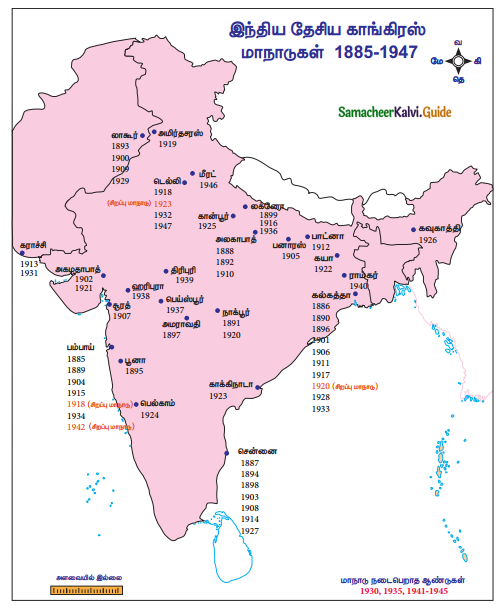
இந்திய தேசிய காங்கிரஸ் மாநாடுகள் நடைபெற்ற பின்வரும் இடங்களை இந்திய வரைபடத்தில் குறிக்கவும்.
1. பம்பாய் 2. கல்கத்தா 3. சென்னை |4. அகமதாபாத் 5. லக்னோ 6. கான்பூர் 7. சூரத் 8. லாகூர் 9. பூனா 10. அலகாபாத்
Answer:
Samacheer Kalvi 12th History Guide Chapter 1 இந்தியாவில் தேசியத்தின் எழுச்சி 1

Samacheer Kalvi 12th History Guide Chapter 1 இந்தியாவில் தேசியத்தின் எழுச்சி

12th History Guide இந்தியாவில் தேசியத்தின் எழுச்ச Additional Questions and Answers

1. சரியான விடையைத் தேர்ந்தெடுக்கவும்

Question 1.
“இந்தியாவின் குரல் என்ற பத்திரிக்கையின் ஆசிரியர் ………..
அ) சுரேந்திர நாத் பானர்ஜி
ஆ) அன்னி பெசன்ட் அம்மையார்
இ)தாதாபாய் நௌரோஜி
ஈ) லோகமான்ய திலகர்
Answer:
இ) தாதாபாய் நௌரோஜி

Question 2.
இந்திய தேசிய காங்கிரஸ் உருவாக்கப்பட்டது …………….
அ) 1885 டிசம்பர் 28
ஆ) 1885 நவம்பர் 28
இ)1885 அக்டோபர் 28
ஈ) 1884 டிசம்பர் 26
Answer:
அ) 1885 டிசம்பர் 28

Samacheer Kalvi 12th History Guide Chapter 1 இந்தியாவில் தேசியத்தின் எழுச்சி

Question 3.
மாறுபட்ட ஒன்றை தேர்வு செய்க.
அ) டல்ஹௌசி பிரபு
ஆ) கானிங் பிரபு
இ)வாரன் ஹேஸ்டிங்ஸ்
ஈ) சுப்பிரமணிய பாரதியார்
Answer:
ஈ) சுப்பிரமணிய பாரதியார்

Question 4.
பாலகங்காதர திலகர் வெளியிட்ட பத்திரிக்கை …………
அ) இந்தியாவின் குரல்
ஆ) பெங்காலி
இ)ஆனந்தமடம்
ஈ) மராட்டா
Answer:
ஈ) மராட்டா

Question 5.
பின்வருவன பொருத்தி சரியான விடையைத் தேர்வு செய்க …….
அ) சூரத்பிளவு – 1878
ஆ) வங்கப் பரிவினை – 1852
இ)  வட்டார மொழி பத்திரிக்கை சட்டம் – 1907
ஈ) சென்னை வாசிகள் சங்கம் – 1905
அ) 3,2,1,4
ஆ) 3,4,1,2
இ) 4,3,1,2
ஈ) 4,1,3,2
Answer:
ஆ) 3,4,1,2

Question 6.
பின்வரும் எது ஒன்று சரியாகப் பொருந்தியுள்ளது?

அ) சென்னை மகாஜன சங்கம் – 1852
ஆ) இந்திய தேசிய காங்கிரஸ் – 1884
இ) திலகர் கைது – 1897
ஈ) இலபர் மசோதா கிளர்ச்சி – 1885
Answer:
இ) திலகர் கைது – 1897

Samacheer Kalvi 12th History Guide Chapter 1 இந்தியாவில் தேசியத்தின் எழுச்சி

Question 7.
பின்வரும் அமைப்புகள் தொடங்கப்பட்ட சரியான காலவரிசையை தேர்வு செய்க.
அ) இன்டிகோ புரட்சி
ஆ) பிரிட்டிஷ் இந்தியா அடிமை முறை ஒழிப்பு
இ) சென்னை பல்கலைக்கழகம்
ஈ) இந்திய தேசிய காங்கிரஸ்
அ) iv, ii, iii, i
ஆ) iv, iii, ii, i
இ) ii, iii, i, iv
ஈ) i, iii, ii, iv
Answer:
இ) ii, iii, i, iv

Question 8.
இராஜாராம் மோகன்ராயின் வங்க மொழி பத்திரிக்கை
அ) மிராத்-உல்- அக்பர்
ஆ) சம்வத்கௌமதி
இ)மராத்தா
ஈ) சுதேசமித்திரன்
Answer:
ஆ) சம்வத்கௌமதி

Question 9.
‘மெட்ராஸ் டைம்ஸ்’ பத்திரிக்கையின் ஆசிரியர்
அ) T.B மெக்காலே
ஆ) பாரதியார்
இ) கேசவசந்திரசென்
ஈ) வில்ப்பா டிக்பை
Answer:
ஈ) வில்லியம் டிக்பை

Question 10.
‘பெங்காலி’ என்னும் நூலின் ஆசிரியர் ……………
அ) தாதாபாய் நௌரோஜி
ஆ) சுரேந்திரநாத் பானர்ஜி
இ)W.C. பானர்ஜி
ஈ) திலகர்
Answer:
ஆ) சுரேந்திரநாத் பானர்ஜி

Samacheer Kalvi 12th History Guide Chapter 1 இந்தியாவில் தேசியத்தின் எழுச்சி

Question 11.
1835ல் புகழ்பெற்ற இந்தியக் கல்வி குறித்த குறிப்புகள்” எனும் குறிப்புகளை வெளியிட்டவர் …….
அ) சார்லஸ் உட்ஸ்
ஆ) வில்லியம் டிக்பை
இ)T.B. மெக்காலே
ஈ) எல்பின்ஸ்ட ன்
Answer:
இ) T.B.மெக்காலே

Question 12.
1856-57ல் கல்கத்தாவிலிருந்து டிரினிடாட் சென்ற கப்பலில் பயணம் செய்தவர்கள் குறித்த
பின்வரும் கூற்றுகளில் சரியானவை எவை/எது?
கூற்று 1 : நீண்ட கடல் பயணத்தில் தொழிலாளர்கள் பலர் வழியிலேயே இறந்தனர்.
கூற்று 2 : ஆண்கள் 12.3 விழுக்காட்டினரும், பெண்களில் 18.5 விழுக்காட்டினரும் இறந்துவிட்டனர்.
கூற்று 3 : சிறுவர்கள், சிறுமிகள், குழந்தைகள் 40 விழுக்காட்டினர் இறந்துவிட்டனர்.
அ) 1,2
ஆ) 1,3
இ) 2,3
ஈ) இவை அனைத்தும்
Answer:
அ) 1,2

Question 13.
கூற்று : இல்பர்ட் மசோதாவிற்கு ஆதரவாக 1883ல் கிளர்ச்சிகள் நடைபெற்றன.
காரணம் : ஆனால் இப்போராட்டங்களும் கிளாச்சிகளும் ஒருங்கிணைக்கப்படாமல் அங்கொன்றும்
இங்கொன்றுமாகவே நடைபெற்றன.
அ) கூற்று காரணம் இரண்டும் சரி. காரணம் கூற்றை விளக்குகிறது. ஆ)கூற்று காரணம் இரண்டும் சரி. ஆனால் காரணம் கூற்றை விளக்கவில்லை.
இ) கூற்று சரி. காரணம் தவறு
ஈ) கூற்று தவறு ஆனால் காரணம் சரி
Answer:
ஆ) கூற்று காரணம் இரண்டும் சரி. ஆனால் காரணம் கூற்றை விளக்கவில்லை

II. சுருக்கமான விடையளிக்கவும்

Question 1.
இந்திய தேசிய இயக்கம் மிகப்பெரும் மக்கள் இயக்கமாக எப்போது மாறியது?
Answer:
1915ல் மோகன்தாஸ் கரம்சந் காந்தி தென்னாப்பிரிக்காவிலிருந்து இந்தியா திரும்பி தலைமையேற்றதிலிருந்து இந்திய தேசியம் மிகப்பெரும் மக்கள் இயக்கமாக மாறியது.

Samacheer Kalvi 12th History Guide Chapter 1 இந்தியாவில் தேசியத்தின் எழுச்சி

Question 2.
1857ல் ஆங்கிலப் படைகளால் டெல்லி முற்றுகை குறித்து பம்பாய் மாகாண முன்னாள் ஆளுநர் எல்பின்ஸ்டனின் கூற்றுகளை ஆய்க.
Answer:

  • 1857 ஜூன் – செப்டம்பர் மாதங்களில் ஆங்கிலப்படைகளால் டெல்லி முற்றுகையிடப்பட்டது.
  • இதனைகுறித்து பம்பாய் மாகாணத்தின் முன்னாள் ஆளுநர் எல்பின்ஸ்டன் அப்போதைய இந்தியாவின் எதிர்கால வைஸ்ராய் சார்ஜான் லாரன்சுக்கு கீழ்க்கண்டவாறு எழுதியிருக்கிறார்.
  • நண்பன் பகைவன் என்று வேறுபாடின்றி முழுவீச்சிலான பழிவாங்குதல் மேற்கொள்ளப்பட்டுள்ளது.
  • கொள்ளையடிப்பதைப் பொறுத்தமட்டில் நாம் உண்மையாகவே நாதிர்ஷாவை மிஞ்சிவிட்டோம்” என – கூறியுள்ளார்.

Question 3.
இந்தியாவின் பழம் பெருமையை வணங்குதல் – ஆய்க.
Answer:
வில்லியம் ஜோன்ஸ் சார்லஸ் வில்கின்ஸ், மேக்ஸ்முல்லம் போன்ற கீழையுலக அறிஞர்கள் ஆய்வுகளை மேற்கொண்டு அராபிய, பாரசீக சமஸ்கிருத மொழிகளிலிருந்து மத வரலாற்று இலக்கிய நூல்களை ஆங்கிலத்தில் மொழிபெயர்த்தனர்.

இந்தியாவின் மரபு, புலமை ஆகியவற்றின் செழுமையால் கவரப்பட்ட பல தொடக்க கால தேசியவாதிகள்
இந்தியாவின் பண்டையப் பெருமையை மீட்டெடுக்க ஆர்வத்துடன் வேண்டினர்.

“தேசியத்தின் குறிக்கோளானது இந்தியச் சிந்தனையை, இந்திய குறைநலன்களை, இந்திய உணர்வுகளை, இந்திய ஆற்றலை, இந்தியாவின் உன்னதத்தை மீட்டெடுப்பதாகும்.

மேலும் உலகைத் தடுமாறச் செய்யும் பிரச்சனைகளை இந்திய மனப்பாங்குடன் இந்திய நிலைப்பாட்டில் தீர்த்து வைப்பதாகும்” என அரவிந்கோஷ் எழுதியுள்ளார்.

III. குறுகிய விடையளிக்கவும்

Question 1.
ஆங்கிலேயருக்கு முந்தைய இந்தியாவில் கல்வியின் நிலை எவ்வாறு இருந்தது?
Answer:

  • காலனிய காலத்திற்கு முந்திய இந்தியாவில் கல்வியானது சாதி, மத அடிப்படையில் இருந்தது.
  • இந்துக்களிடையே பிராமணர்கள் உயர்நிலை சார்ந்த சமய, தத்துவ அறிவினைப்பெறும் தனி உரிமை பெற்றிருந்தனர்.
  • புனிதமான மொழி என கருதப்பட்ட சமஸ்கிருத மொழி வழியில் கல்விகற்றனர்.
  • கட்டடக்கலை – உலோகவியல் சார்ந்த அறிவுத்திறன் பரம்பரை ஆக்கப்பட்டது.
  • பெண்களும் ஒடுக்கப்பட்டோரும் ஏனைய ஏழை மக்களும் கல்வி கற்க தடை இருந்தது.

Question 2.
பாலகங்காதர திலகரின் ஆங்கிலேய ஏகாதிபத்திய எதிர்ப்பு பற்றி கூறுக.
Answer:

  • தேசிய இயக்கத்தில் மத்தியதர வகுப்பினரும் விவசாயிகளும், கைவினைஞர்களும் தொழிலாளர்களும் ப மிக முக்கியமான பங்கினை வகிக்கமுடியும் என பாலகங்காதரதிலகர் உறுதியாக நம்பினார்.
  • இந்தியாவில் ஆங்கிலேயரின் ஏகாதிபத்திய ஆட்சிக்கு எதிராக தேசந்தழுவிய எதிர்ப்புக்கு அவர் அழைப்பு விடுத்தார்.
  • “சுயராஜ்ஜியம் எனது பிறப்புரிமை அதை அடைந்தே தீருவேன்” என முழங்கினார்.
  • 1897 ஜூலை 27ல் திலகர் கைது செய்யப்பட்டு இந்திய தண்டனைச் சட்டம் பிரிவு 124A யின் கீழ் குற்றம் சாட்டப்பட்டார்.
  • திலகர் தீவிர காங்கிரஸ் தேசவாதியாக இருந்தாலும் இவர் கைது செய்யப்பட்டதை அனைவரும் எதிர்த்தனர்.
  • கருத்துச் சுதந்திரம், பத்திரிக்கைச் சுதந்திரம் ஆகிய இரு உரிமைகளும் இந்திய விடுதலைப்போராட்டத்தின் முக்கிய கூறுகளாய் விளங்கின.

Samacheer Kalvi 12th History Guide Chapter 1 இந்தியாவில் தேசியத்தின் எழுச்சி

Question 3.
சமூக, சமய சீர்திருத்த இயக்கங்களின் வகைகளை கூறுக.
Answer:
1. சீர்திருத்த இயக்கங்கள் :

  1. ராஜாராம் மோகன்ராயால் நிறுவப்பட்ட பிரம்ம சமாஜம்,
  2. டாக்டர் ஆத்மராம் பாண்டுரங் உருவாக்கிய பிரார்த்தனை சமாஜம்
  3. சர் சையத் அகமது கானால் பிரதிநிதித்துவம் பட்ட அலிகார் இயக்கம் ஆகியவை சீர் திருத்த இயக்கங்கள் ஆகும்.

II. மீட்பு இயக்கங்கள் :

  1. ஆரியசமாஜம்
  2. ராமகிருஷ்ண இயக்கங்கள்
  3. தியோபந்த் இயக்கங்கள்

III. சமூக இயக்கங்கள் :

  1. புனேயில் ஜோதிபா பூலே,
  2. கேரளாவில் நாராயணகுரு, அய்யன்காளி
  3. தமிழ்நாட்டில் இராமலிங்க அடிகள், வைகுண்டசாமிகள்
  4. அயோத்திதாசர்

Samacheer Kalvi 12th History Guide Chapter 1 இந்தியாவில் தேசியத்தின் எழுச்சி

IV. விரிவான விடையளிக்கவும்

Question 1.
“தாதாபாய் ” நௌரோஜியும் அவர் முன்வைத்த சுரண்டல் கோட்பாடும் பற்றி விவரி?
Answer:
முதுபெரும் தலைவர்:

  • இந்திய தேசியத்தின் முதுபெரும் தலைவர் என அறியப்படும் தாதாபாய் நௌரோஜி தொடக்க கால
  • தேசிய இயக்கத்தின் முக்கியத் தலைவர்களில் ஒருவர் ஆவார்.
  • 1870 இல் பம்பாய் நகராட்சி கழகத்திற்கும், நகரசபைக்கும் தேர்ந்தெடுக்கப்பட்டார்.
  • 1892 ல் இங்கிலாந்து பாராளுமன்றத்திற்கு தேர்ந்தெடுக்கப்பட்ட நிலையில் அவர் லண்டனில் ‘இந்தியச்சங்கம்’ (1865), ‘கிழக்கிந்திய கழகம்’ (1866) எனும் அமைப்புகளை உருவாக்கினார்.
  • மூன்று முறை இந்திய தேசிய காங்கிரஸின் தலைவராக தேர்ந்தெடுக்கப்பட்டார்.

செல்வச்சுரண்டல் கோட்பாடு:

  • 1901ல் “வறுமையும் பிரிட்டனுக்கொவ்வாத இந்திய ஆட்சியும்” என்னும் புத்தகமே இந்திய
    போராட்டத்திற்கு அவர் செய்த முக்கிய பங்களிப்பு ஆகும்.
  • இதில் செல்யச் சுரண்டல் எனும் கோட்பாட்டை முன் வைத்தார்.
  • வசூலிக்கப்பட்டவரியை அந்நாட்டு மக்களின் நல்வாழ்விற்கே செலவழிக்கவேண்டும் ஆனால் பிரிட்டிஷ் இந்தியாவில் வசூலிக்கப்பட்டவரி இங்கிலாந்தின் நலனுக்காகச் செலவு செய்யப்படுகிறது என்றார்.
  • 1835 முதல் 1872 முடிய ஒவ்வொரு ஆண்டும் சராசரியாக 13 மில்லியன் பவுண்டுகள் மதிப்புடையப்
    பொருட்கள் இங்கிலாந்திற்கு ஏற்றுமதி செய்யப்பட்டது.
  • ஆனால் அந்த அளவிற்கு பணம் இந்தியா வந்து சேரவில்லை எனவும் கூறினார்.
  • லாபத்தில் வழங்கப்பட வேண்டியபங்கு இருப்பு பாதைத் துறையில் முதலீடு செய்தவர்களுக்கு உத்திரவாதம் அளிக்கப்பட்டவாறு தரப்படவில்லை .
  • பணிநிறைவு பெற்றுவிட்ட அதிகாரிகளுக்குள் தளபதிகளுக்கும் வழங்கப்பட வேண்டிய ஓய்வூதியம், இந்தியாவிலும் இந்தியாவிற்கு வெளியிலும் நாடுகளைக் கைப்பற்ற நடைபெற்ற போர்களுக்காக இங்கிலாந்திடம் செலுத்த வேண்டிய வட்டி எல்லாவற்றிற்கும் பதிலாகவே பொருட்கள் ஏற்றுமதி
    செய்யப்பட்டதாக கூறினார்.
  • தாயகக்கட்டணம் என்னும் பெயரில் ஆண்டொன்றுக்கு 30 மில்லியன் பவுண்டுகள் நஷ்டம் ஏற்படுத்துவதாக நௌரோஜி உறுதிபடக் கூறினார்.
  • தாதாபாய் நௌரோஜியால் முன்வைக்கப்பட்ட செல்வச் சுரண்டல் கோட்பாடு இந்தியாவின் செல்வவளத்தை ஆங்கிலேயர் கொள்ளையடிப்பதை வெட்ட வெளிச்சமாக்கியது.

Samacheer Kalvi 12th Business Maths Guide Chapter 2 Integral Calculus I Ex 2.4

Tamilnadu State Board New Syllabus Samacheer Kalvi 12th Business Maths Guide Pdf Chapter 2 Integral Calculus I Ex 2.4 Text Book Back Questions and Answers, Notes.

Tamilnadu Samacheer Kalvi 12th Business Maths Solutions Chapter 2 Integral Calculus I Ex 2.4

Question 1.
Integrate the following with respect to x.
2 cos x – 3 sin x + 4 sec² x – 5 cosec² x
Solution:
∫2 cos x – 3 sin x + 4 sec2 x – 5 cosec2 x
= 2 ∫ cos x dx – 3 ∫ sin x dx + 4 ∫ sec2 x – 5 ∫ cosec2 x dx
= 2 sin x + 3 cos x + 4 tan x + 5 cot x + c

Samacheer Kalvi 12th Business Maths Guide Chapter 2 Integral Calculus I Ex 2.4

Question 2.
sin³x
Solution:
sin³x = 3 sin x – 4sin³x
4sin³x = 3 sin x – sin3x
⇒ sin³x = \(\frac { 1 }{4}\) [3 sin x – sin 3x]
∫sin³x dx = \(\frac { 1 }{4}\) ∫(3 sin x – sin3x) dx
= \(\frac { 1 }{4}\) [3(-cos x) – (\(\frac { -cos3x }{2}\)) + c
= \(\frac { -3 }{4}\) [cos x] + \(\frac { 1 }{12}\) (cos 3x) + c

Samacheer Kalvi 12th Business Maths Guide Chapter 2 Integral Calculus I Ex 2.4

Question 3.
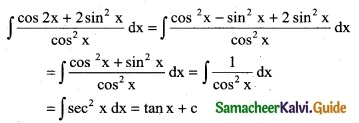
\(\frac { cos 2x+2sin^2x }{cos^2x}\)
Solution:
Samacheer Kalvi 12th Business Maths Guide Chapter 2 Integral Calculus I Ex 2.4 1

Samacheer Kalvi 12th Business Maths Guide Chapter 2 Integral Calculus I Ex 2.4

Question 4.
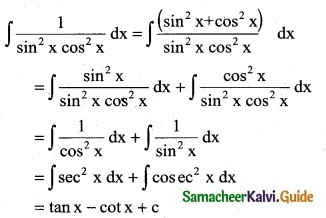
\(\frac { 1} {sin^2x cos^2x}\)
Solution:
Samacheer Kalvi 12th Business Maths Guide Chapter 2 Integral Calculus I Ex 2.4 2

Samacheer Kalvi 12th Business Maths Guide Chapter 2 Integral Calculus I Ex 2.4

Question 5.
\(\sqrt { 1-sin 2x }\)
Solution:
\(\sqrt { 1-sin 2x }\) dx = ∫\(\sqrt { sin^2x+cos^2x-2sinx cos x dx }\)
∫\(\sqrt { (sin x-cos x)^2 }\) dx
∫(sin x – cos x) dx = ∫sin x dx – ∫cos x dx
= -cos x – sin x + c
= -[cos x + sin x] + c

Samacheer Kalvi 12th Business Maths Guide Chapter 2 Integral Calculus I Ex 2.4

Samacheer Kalvi 12th Business Maths Guide Chapter 2 Integral Calculus I Ex 2.3

Tamilnadu State Board New Syllabus Samacheer Kalvi 12th Business Maths Guide Pdf Chapter 2 Integral Calculus I Ex 2.3 Text Book Back Questions and Answers, Notes.

Tamilnadu Samacheer Kalvi 12th Business Maths Solutions Chapter 2 Integral Calculus I Ex 2.3

Question 1.
Integrate the following with respect to x.
∫(ex log a + ea log a – en log x
Solution:
(ex log a + ea log a – ea log x) dx
= ∫(elog ax + elog aa – ea log xn) dx
= ∫(a1 + aa – xⁿ) dx
= [\(\frac { a^x }{log|a|}\) + aa (x) – \(\frac { x^{n+1} }{(n+1)}\)] + c

Samacheer Kalvi 12th Business Maths Guide Chapter 2 Integral Calculus I Ex 2.3

Question 2.
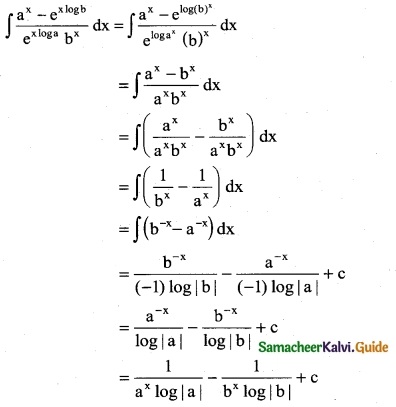
\(\frac { a^x-e^{x log b} }{e^{x log a} b^x}\)
Solution:
Samacheer Kalvi 12th Business Maths Guide Chapter 2 Integral Calculus I Ex 2.3 1

Samacheer Kalvi 12th Business Maths Guide Chapter 2 Integral Calculus I Ex 2.3

Question 3.
(ex + 1)² ex
Solution:
∫(ex + 1)² ex dx = ∫[(ex)² + 2ex + 1]ex dx
= ∫(e2x. ex + 2ex. ex + ex) dx
= ∫(e3x + 2e2x + ex) dx
= \(\frac { e^{3x} }{3}\) + \(\frac { 2e^{2x} }{2}\) + ex + c
= \(\frac { e^{3x} }{3}\) + e2x + ex + c

Question 4.
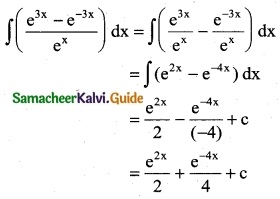
\(\frac { e^{3x}-e^{-3x} }{e^{x}}\)
Solution:
Samacheer Kalvi 12th Business Maths Guide Chapter 2 Integral Calculus I Ex 2.3 2

Samacheer Kalvi 12th Business Maths Guide Chapter 2 Integral Calculus I Ex 2.3

Question 5.
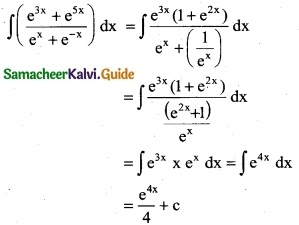
\(\frac { e^{3x}+e^{5x} }{e^{x}+e^{-x}}\)
Solution:
Samacheer Kalvi 12th Business Maths Guide Chapter 2 Integral Calculus I Ex 2.3 3

Question 6.
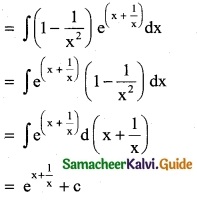
[1 – \(\frac { 1 }{x^2}\)] e[x + \(\frac { 1 }{x}\)]
Solution:
Samacheer Kalvi 12th Business Maths Guide Chapter 2 Integral Calculus I Ex 2.3 4

Question 7.
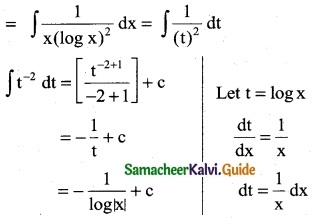
\(\frac { 1 }{x(log x)^2}\)
Solution:
Samacheer Kalvi 12th Business Maths Guide Chapter 2 Integral Calculus I Ex 2.3 5

Samacheer Kalvi 12th Business Maths Guide Chapter 2 Integral Calculus I Ex 2.3

Question 8.
Given f'(x) = ex and f(0) = 2 then find f(x)
Solution:
f'(x) = ex
Integrating both sides of the equation,
∫ f'(x) dx = ∫ ex dx
⇒ f(x) = ex + c
given f(0) = 2
2 = e0 + c
⇒ c = 1
Thus f(x) = ex + 1

Samacheer Kalvi 12th Business Maths Guide Chapter 2 Integral Calculus I Ex 2.3

Samacheer Kalvi 12th Commerce Guide Chapter 17 Rights, Duties & Responsibilities of Consumers

Tamilnadu State Board New Syllabus Samacheer Kalvi 12th Commerce Guide Pdf Chapter 17 Rights, Duties & Responsibilities of Consumers Text Book Back Questions and Answers, Notes.

Tamilnadu Samacheer Kalvi 12th Commerce Solutions Chapter 17 Rights, Duties & Responsibilities of Consumers

12th Commerce Guide Rights, Duties & Responsibilities of Consumers Text Book Back Questions and Answers

I. Choose the correct answers.

Question 1.
The final aim of modern marketing is …………….
a. Maximum profit
b. Minimum profit
c. Consumer satisfaction
d. Service to the society
Answer:
c. Consumer satisfaction

Question 2.
…………………. is the king of modern marketing.
a. Consumer
b. Wholesaler
c. Producer
d. Retailer
Answer:
a. Consumer

Samacheer Kalvi 12th Commerce Guide Chapter 17 Rights, Duties & Responsibilities of Consumers

Question 3.
As the consumer is having the rights, they are also having …………….
a. Measures
b. Promotion
c. Responsibilities
d. Duties
Answer:
c. Responsibilities

Question 4.
Which of the following is not a consumer right summed up by John F. Kennedy
a. Right to safety
b. Right to choose
c. Right to consume
d. Right to informed
Answer:
c. Right to consume

Samacheer Kalvi 12th Commerce Guide Chapter 17 Rights, Duties & Responsibilities of Consumers

II. Very Short Answer Questions

Question 1.
Write short notes on “Right to be informed”
Answer:
Consumers should be given all the relevant facts about the product. This implies that the manufacturer and the dealer are expected to disclose all the material facts relevant and relating to the product.

Question 2.
What do you understand about the “Right to safety”?
Answer:
“Right to safety” or “right to protection” against the marketing of goods which are hazardous and dangerous to consumer health, lives, and property.

Question 3.
What are the rights of consumers according to John F. Kennedy?
Answer:
The former president of U.S.A Mr. John F. Kennedy defined the basic consumer rights as “The Right of Safety“ the Right to be informed, the Right to choose and the Right to be heard.”

Question 4.
Which is the supreme objective of a business?
Answer:
The prime and supreme objective of the business is to satisfy the consumer’s wants.

Question 5.
What are the important aspects to be kept in mind by consumers while purchasing goods related to the quality of goods?
Answer:
The consumer has to have the knowledge about the quality from his own experiences or from the experiences of other persons who used the product or by browsing the website.

Samacheer Kalvi 12th Commerce Guide Chapter 17 Rights, Duties & Responsibilities of Consumers

III. Short Answer Questions

Question 1.
What do you understand by “Right to redressal”?
Answer:

  •  Right to seek redressal against unfair trade practices or unscrupulous exploitation of consumers.
  • The complaints and protests of the aggrieved consumer is to be settled and compensated within a reasonable time.
  • There should be fair and just settlement of deserving claims in a definite time frame.

Question 2.
What do you understand about “Right to protection of health and safety”?
Answer:

  •  Right to safety or right to protection against marketing of goods which are hazardous and dangerous to consumers health, lives and property.
  • The health hazards which are likely to arise have to be eradicated.
  • Both life saving and life sustaining safety is to be guaranteed in case of food items drugs.

Samacheer Kalvi 12th Commerce Guide Chapter 17 Rights, Duties & Responsibilities of Consumers

IV. Long Answer Questions

Question 1.
What are the rights of consumers? [HIS] [CR|
Answer:
Right to be heard:
Consumers have right to show and register their dissatisfaction.
Right to be heard and to be assured that the consumer’s interest will receive due consideration b\ the sellers

Right to be informed:
The manufacturers and the sellers are expected to disclose (inform ) all the material facts regarding to the products [Quality, Quantity, potency, purity, price etc.|

Right to safety:[Right to protection of health and safety]
Right to safety or right to protection against marketing of goods which are hazardous and dangerous to consumer health, lies and properly.

Right to choose:
Right to access [choose] variety of goods [quality and brands] at reasonable price.

Right to redressal:

  • Right to seek redress against unfair trade practices or unscrupulous exploitations or
  • The complaints and protests of the aggrieved consumer is to be settled and compensated
  • There should be fair and just settlement of deserving claims in a definite lime frame.

Right to consumer education:
The Consumer has to acquire knowledge and stay well informed although his life
He should be aware about his rights and the reliefs granted to him where a product or service falls short or his expectations.

Samacheer Kalvi 12th Commerce Guide Chapter 17 Rights, Duties & Responsibilities of Consumers

Question 2.
Explain the duties of consumers. [BEEBI] [N]
Answer:
Apart from rights, there are certain duties imposed on the consumer. The following are the duties of consumers

  1. Buying Quality Products at Reasonable Price: It is the duty of a consumer to purchase a product after gaining a thorough knowledge of its price, quality, and other terms and conditions.
  2. Ensure the Weights and Measurement before Purchase: The consumer should ensure that he/she is getting the product of exact weight and measure.
  3. Reading the Label Carefully: It is the duty of the consumer to read the label of the product thoroughly.
  4. Beware of False and Attractive Advertisements: It is the prime duty of the consumer about the genuineness of the advertisement, before purchasing the product.
  5. Ensuring the Receipt of Cash Bill: It is a legitimate duty of consumers to get the cash receipt and warranty card supplied along with the bill.

Samacheer Kalvi 12th Commerce Guide Chapter 17 Rights, Duties & Responsibilities of Consumers

Question 3.
What are the responsibilities of consumers?
Answer:

  • The consumer must pay the price of the goods according to the terms and conditions of the sale contract.
  • The duty of the consumer to apply to the seller for the delivery of goods. Otherwise, goods will not be delivered
  • He is responsible to take delivery of goods on the due date and time.
  • The consumer has to bear any loss which may arise to the seller when the consumer refuses to take delivery or delays in taking delivery in time.
  • The consumer is bound to pay any interest or special damages caused to the seller in case if there is a delay in the payment.
  • The consumer must ask and collect the invoice, cash receipt, delivery note, guarantee card.
  • The consumer has to follow and observe strictly the instruction and precautions while using the products.
  • He has to follow the prescriptions and directions of Doctors and such other professionals.
  • He has a responsibility to tell the seller of his requirements and expectations from the product.
  • He must file a complaint with the seller concerned about defects or shortcoming noticed in their products and services.
  • The consumer should never compromise on the quality of goods. He must watch for ISO, Agmark, FPO, the standard quality certification marks on the label.

12th Commerce Guide Rights, Duties & Responsibilities of Consumers Additional Important Questions and Answers

I. Choose the Correct Answers

Question 1.
The consumer is to be protected against any __________
(a) unfair practices of trade
(b) family functions
(c) profit-making firm
(d) loss in business
Answer:
(a) unfair practices of trade

Question 2.
…………………………. Should be conscious of his duties.
a. Producer
b. Consumer
c. Seller
d. NOTA
Answer:
b. Consumer

Samacheer Kalvi 12th Commerce Guide Chapter 17 Rights, Duties & Responsibilities of Consumers

Question 2.
The consumer is the __________ of the modem marketing.
(a) Manager
(b) Director
(c) King
(d) None of these
Answer:
(c) King

II. Match the following.

Question 1.

List – I

List -II

i. Right to choose 1. Prompt settlement
ii. Right to heard 2. Offering the widest range
iii. Right to be informed 3. Register their satisfaction
iv. Right to seek redressal 4. Relevant facts

a. i-2, ii-3, iii-4, iv-1
b. i-1, ii-2, iii-3, iv-4
c. i-3, ii-4, iii-1, iv-2
d. i-4, ii-1, iii-2, iv-3
Answer:
a. i-2, ii-3, iii-4, iv-1

Samacheer Kalvi 12th Commerce Guide Chapter 17 Rights, Duties & Responsibilities of Consumers

III. Assertion and Reason

Question 1.
Assertion (A) : Every consumer has a right to get basic necessities of life such as food, clothing, water and a pure and healthy environment.
Reason (R) : Community life should be free from various modes of pollution
a. Both (A) and (R) are true
b. Both (A) and (R) false
c. (A) is true (R) is false
d. (A) is false (R) is true
Answer:
a. Both (A) and (R) are true

IV. Short Answer Questions

Question 1.
What do you mean by Rights to quality of life?
Answer:

  • Quality of life refers to the perceived well-being of people in groups and individually and well being of the environment in which these people live.
  • Consumerism has been defined as an improved quality of life.

Samacheer Kalvi 12th Commerce Guide Chapter 17 Rights, Duties & Responsibilities of Consumers

Question 2.
How the consumer got the basic needs, as per the right of the consumer?
Answer:
Every consumer has a right to get basic necessities of life such as food, clothing, and water, and the right to pine and a healthy environment. It is the latest addition to the consumer bill of rights.

Question 3.
Define “consumer rights”.
Answer:

  • The Right to have information about the Quality, Quantity, potency, purity, price and standard of goods or services.
  • It is mandatory for the consumer to know these rights.

Samacheer Kalvi 12th Commerce Guide Chapter 16 Consumerism

Tamilnadu State Board New Syllabus Samacheer Kalvi 12th Commerce Guide Pdf Chapter 16 Consumerism Text Book Back Questions and Answers, Notes.

Tamilnadu Samacheer Kalvi 12th Commerce Solutions Chapter 16 Consumerism

12th Commerce Guide Consumerism Text Book Back Questions and Answers

I. Choose The Correct Answer.

Questions 1.
The term ‘consumerism’ came into existence in the year …………
a) 1960
b) 1957
c) 1954
d) 1958
Answer:
a) 1960

Question 2.
Who is the father of consumer movement?
a) Mahatma Gandhi
b) Mr.John F. Kennedy
c) Ralph Nader
d) Jawaharlal Nehru
Answer:
c) Ralph Nader

Samacheer Kalvi 12th Commerce Guide Chapter 16 Consumerism

Question 3.
Sale of goods act was passed in the year?
a) 1962
b) 1972
c) 1930
d) 1985
Answer:
c) 1930

Question 4.
The main objective of all business enterprises is ………….
a) Providing service
b) Providing better standard of life
c) Providing necessities to the society
d) Earn profit
Answer:
d) Earn profit

Samacheer Kalvi 12th Commerce Guide Chapter 16 Consumerism

Question 5.
The consumer protection act came into force with effect from
a) 1.1.1986
b) 1.4.1986
c) 15.4.1987
d) 15.4.1990
Answer:
c) 15.4.1987

Question 6.
……………………… of every year is declared as a consumer protection day to educate the public about their rights and responsibilities.
a) August 15
b) April 15
c) March 15
d) September 15
Answer:
c) March 15

Samacheer Kalvi 12th Commerce Guide Chapter 16 Consumerism

Question 7.
Any person who buys any goods or avails services for personal use, for a consideration is called as …………..
a) Customer
b) Consumer
c) Buyers
d) User
Answer:
b) Consumer

Question 8.
The General Assembly of United Nations passed resolution of consumer protection guidelines on
a) 1985
b) 1958
c) 1986
d) 1988
Answer:
a) 1985

Samacheer Kalvi 12th Commerce Guide Chapter 16 Consumerism

II. Very Short Answer Questions

Question 1.
Who is a consumer?
Answer:
A consumer is one who consumes goods manufactured and sold by others or created (air, water, natural resources) by nature and sold by others.

Question 2.
Define consumerism.
Answer:
“Consumerism is an attempt to enhance the rights and powers by buyers in relation to sellers”. L. Massie.

Samacheer Kalvi 12th Commerce Guide Chapter 16 Consumerism

Question 3.
Give two examples of adulteration.
Answer:

  1. Powdered rice/wheat is adulterated with starch.
  2. Coffee powder is adulterated with tamarind seed.

Question 4.
What is caveat emptor?
Answer:
‘Caveat emptor’ is a Latin term that means “let the buyer beware.” Similar to the phrase”sold as is” this term means that the buyer assumes the risk that a product fails to meet expectations or have defects.

Samacheer Kalvi 12th Commerce Guide Chapter 16 Consumerism

Question 5.
What is Caveat Venditor?
Answer:

  • “Caveat Venditor” or “let the seller Beware” means by which goods are covered by an implied warranty of merchantability.
  • Unless or otherwise advertised [sold as is ] with the buyer nearly all consumer products are guaranteed to work if used for their intended purpose.

Question 6.
Write short notes on Consumer Protection Act, 1986
Answer:
The Central Government enacted a comprehensive law called the Consumer Protection Act in 1986. This Act came into force with effect from 15.04.1987. This Act was further amended in 1993. The Act is referred to in short as ‘COPRA’.

Samacheer Kalvi 12th Commerce Guide Chapter 16 Consumerism

III. Short Answer Questions

Question 1.
What are the important legislations related to consumerism in India?
Answer:

  •  Sale of goods act -1930
  •  The agricultural products grading and marketing act -1937
  •  The drugs and cosmetics act -1940
  •  The prevention of food Adulteration act -1954
  •  The essential commodities act -1955
  •  Weight and measures act -1958

Question 2.
What is meant by artificial scarcity?
Answer:

  • Even in times of plenty of stock, the sellers create artificial scarcity in the market to push up the prices to earn more profit.(e.g) “No stock” – Board in front of shops. “House full” – Board in front of theaters.
  • But goods and cinema tickets are available at a higher price in the black market.

Samacheer Kalvi 12th Commerce Guide Chapter 16 Consumerism

Question 3.
Write the importance of consumerism. [APP DEAD]
Answer:
Consumer Legislation:

  1. The Indian Contract Act, 1982
  2. The Sale of Goods Act, 1982
  3. The Essential Commodities Act, 1955
  4. The Agricultural Products Grading and Marketing Act, 1937
  5. The Prevention of Food Adulteration Act, 1954
  6. Weights and Measures Act, 1958
  7. The Trademark Act, 1999

IV. Long Answer Questions

Question 1.
How consumers are Exploited? [FD PASS]
Answer:
False advertisement:
Producers make false claims and bogus presentations about their products in the media, [quality, price, grade etc.]
With a view to mislead the consumers [eg] A ‘pinch of Rin’ ad ’23 components of complaint ad

Duplication [Spurious goods]:

  •  Duplicates of popular brands of products are produced and sold.
  •  A consumer is not in a position to differentiate the duplicate from the original thus consumer is exploited.
  •  [eg] Watches – TITAN – TITTAN
  •  Shoes – ADIDAS – ADITAS

Product risk:

  •  Harmful and banned drugs, Electrical appliances with inadequate safety provisions are sold in the market.
  •  Such goods are dangerous and injurious to the lives of the customers.
  •  eg: Electrical Gadgets with inadequate insulation.

Adulteration:

  •  Adulteration is quite common in food articles.
  •  It means mixing or substituting undesirable materials in food
  •  It spoils the health of the consumer
  •  It is a crime which cannot be pardoned
  •  eg: Mixing of stone with rice
  •  Mixing of water with milk
  •  Mixing of brick powder with chilli powder
  •  Papaya seeds added to black pepper.

Selling at a higher price:

  • The price charged by the seller for a product or service is not proportionate to the quality but at times it is more than the fair price.
  • eg: Price printed in the book X 200
  • But it is sold for X 240

Sub-standard:

  •  On opening a packed and sealed container one finds the contents with poor quality and quantity [damaged and low weight]
    eg: Ice creams -Zandubalm – Colgate paste.

Samacheer Kalvi 12th Commerce Guide Chapter 16 Consumerism

Question 2.
Explain the role of business in consumer protection?
Answer:
Business enterprises should do the following towards protecting consumers.

  1. Avoidance of Price Hike: Business enterprises should desist from hiking the price in the context of acute shortage of goods.
  2. Avoidance of Hoarding: Business enterprises should not indulge in hoarding and black marketing to earn maximum profit.
  3. Guarantees for Good Quality: Business enterprises should not give false warranty for the products.
  4. Product Information: Business enterprises should disclose correct, complete and accurate information about the product viz. size, quality, quantity, weight etc.
  5. The in advertising: Business enterprises should not convey false, untrue, bogus information relating to the product through the advertisement.
  6. Money Refund Guarantee: Where the product becomes defective, business enterprises should replace it with new one or refund the purchase price.

Samacheer Kalvi 12th Commerce Guide Chapter 16 Consumerism

Question 3.
What are the needs for consumer protection?
Answer:
Though consumer is said to be the king of modern marketing his interests are virtually

  •  Shortage of goods makes the consumers to be content with whatever is offered for sales, v Quality is sacrificed.
  •  Warranty of performance has no meaning. v Health hazard is never considered.
  •  The main aim of business concerns is to earn more profit.
  •  In such a context consumer protection remains a vital importance.

Question 4.
Explain the role of consumers in Consumer Protection.
Answer:

  • The consumer who alone can put an end to all their unethical trade practices.
  • Consumer action councils established at village levels should educate consumers of the
  • It should regulate business enterprises according to the rules of the industry.
  • It should organize movement against the mal practice of manufacturers and traders.
  • It should contact the legislators to raise consumer issues in Assembly and Parliament,
  • VCO should publicise the malpractices of manufacturers and traders.
  • Consumers cooperatives need to be strengthened.

Question 5.
What are the objectives of the Consumer Protection Act, 1986?
Answer:
The Central Government enacted a comprehensive law called the Consumer Protection Act in 1986. This Act came into force with effect from 15.04.1987. It is in short, called as ‘COPRA’.
Objectives:

  1. Consumer Protection Act protects the interests of the consumers.
  2. This Act provides safeguards against defective goods and deficient services, untrade practices.
  3. It also gives settlement of consumer disputes.
  4. It is applicable to the public sector, financial and co-operative enterprises.

Question 6.
Write about five important consumer legislation.
Answer:
To protect the consumers from unfair traders, the government passed various legislative Acts.
They are as follows:

  1. The Indian Contract Act, 1982 was passed to bind the people on the promise made in the contract.
  2. The Essential Commodities Act, 1955 protects the consumers against artificial shortages created by the sellers by hoarding the goods.
  3. The Prevention of Food Adulteration Act, 1954 checks the adulteration of food articles and ensures the purity of goods supplied.
  4. Weights and Measures Act, 1958 protects the consumer against malpractices of underweight or under measurement.

Samacheer Kalvi 12th Commerce Guide Chapter 16 Consumerism

12th Commerce Guide Consumerism Additional Important Questions and Answers

I. Choose The Correct Answer.

Question 1.
In the practical world, a ……………………………….. is a slave and not the sovereign as described.
a) Consumer
b) Producer
c) Wholesaler
d) Retailer
Answer:
a) Consumer

Question 2.
The consumer protection act was amended in the year …………………
a) 1986
b) 1987
c) 1993
d) 2000
Answer:
c) 1993

Samacheer Kalvi 12th Commerce Guide Chapter 16 Consumerism

Question 2.
The term ‘Caveat emptor’ is a Latin term, which means _________
(a) Let the seller beware.
(b) Let the buyer beware
(c) Consumer
(d) Marketer
Answer:
(b) Let the buyer beware

Question 4.
Which one of the following is not the correct method?
a) The trademark act – 1999
b) The essential commodities act – 1955
c) ISI act – 1952
d) The drugs and cosmetics act – 1900
Answer:
d) The drugs and cosmetics act – 1900

Samacheer Kalvi 12th Commerce Guide Chapter 16 Consumerism

Question 5.
Pick the odd one out.
a) Adulteration
b) Sub-standard
c) False advertisement
d) Sold as is
Answer:
d) Sold as is

Question 6.
Pick the odd one out.
a) The drugs and magic remedies act -1954
b) The Indian companies act -1956
c) Public liability insurance act -1991
d) The Narcotic drugs and psychotropic substances act -1985
Answer:
b) The Indian companies act-1956

Samacheer Kalvi 12th Commerce Guide Chapter 16 Consumerism

Question 7.
Choose the correct statement.
i) Significance of consumerism – Awakening and uniting consumers
ii) Encouraging unfair trade practices
iii) Awakening the government.
a) (i) is correct
b) (i) and) (ii) are correct
c) (i) and (iii) are correct and (ii) is incorrect
d) (i) (ii) (iii) are correct
Answer:
c) (i) and (iii) are correct and (ii) is incorrect

Samacheer Kalvi 12th Commerce Guide Chapter 16 Consumerism

II. Match The Following

Question .1

List-I

List-II

(i) Indian contract act 1. 1930
(ii) Sales of goods act 2. 2009
(iii) Metrology act 3. 2002
(iv) Competition act 4. 1982

a) i-4, ii-1, iii-2, iv-3
b) i-4, ii-2, iii-1, iv-3
c) i-4, ii-3, iii-2, iv-1
d) i-3, ii-4, iii-1, iv-2
Answer:
a) i-4, ii-1, iii-2, iv-3

Question 2.

List – I

List – II

i. Caveat Emptor 1. Malpractices
ii. Caveat Venditor 2. House full
iii. Artificial Scarcity 3. Let the buyer beware
iv. Weights and Measures act 4. Let the seller beware

a) i-3, ii-4, iii-2, iv-1
b) i-4, ii-3, iii-1, iv-2
c) i-1, ii-2, iii-4, iv-3
d) i-2, ii-1, iii-3, iv-4
Answer:
a) i-3, ii-4, iii-2, iv-1

Samacheer Kalvi 12th Commerce Guide Chapter 16 Consumerism

III. Assertion and Reason

Question 1.
Assertion (A) : Duplicate products of popular products are illegally produced and sold.
Reason (R) : A consumer is not in a position to distinguish duplicates from the originals
a) (A) and (R) are true
b) (A) and (R) false
c) (A) is true (R) is false
d) (A) is false (R) is true
Answer:
a) (A) and (R) are true

Samacheer Kalvi 12th Commerce Guide Chapter 16 Consumerism

IV. Short Answer Questions

Question 1.
Write a short note on False Advertisements.
Answer:
The main motive of advertisements is to educate the consumers regarding various aspects of the products and services. Sometimes it makes a false representation of the quality, price, grade, composition, and utility of products. Often the products are not as attractive as shown in the advertisement by the sellers. Consumers who buy the products on the faith of claims made in advertisements are cheated.

Question 2.
Which are the three constituent elements of business?
Answer:

  •  Government
  •  Business
  •  Consumer

Samacheer Kalvi 12th Commerce Guide Chapter 16 Consumerism

Question 3.
What is the role of the Government in consumer protection?
Answer:

  • The government should assure an active role in safeguarding the consumers.
  • Governments [central and state] have brought out more legislation to protect the consumers in the country.
  • Most of the consumers [ including educated] are illiterate about their rights and passive
  • Mere statute book [law book] will not address the problems.
  • Law enforcement authorities should sting the offenders mercilessly.

V. Long Answer Questions

Question 1.
Explain the Evolution and growth of consumerism
Answer:
Evolution:
The major causes of consumerism in India have been identified as rising prices, poor product performance and service quality product shortages, and deceptive advertising and inflation.

Growth:

  • Consumerism or consumer movement is an outcome of the sufferings and exploitations of consumers.
  • It intends to shield the consumers from commercial terrorism and exploitative practices.
  • Its aim is to safeguard consumer interests by establishing their rights and powers in relation to products and sellers.
  • Ralph Nader fought against the monopoly and unethical trade practices of large companies in the USA.
  • He is considered to be the father of the consumer movement.
  • He initially fought against the automobile industry for violating safety standards and pollution control norms
  • Countries like Britain, Sweden, Demark, Netherlands, and even in Kenya have stringent laws against consumer exploitation in their respective countries.
  • The united nations general assembly has adopted a set of general guidelines for consumer protection.

Samacheer Kalvi 12th Commerce Guide Chapter 16 Consumerism

Question 2.
What are the salient features of the Consumer Protection Act, 1986?
Answer:

  • Protecting consumers against products and services which are harmful to the health of consumers.
  • Protecting consumers from the breach of contract by sellers /manufacturers.
  • Ensuring consumers with a supply of goods at fair quality.

  • Ensuring that consumers are charged a fair price.
  • Ensuring an uninterrupted supply of goods.
  • Protecting the consumers against unfair trade practices of unscrupulous traders.
  • Protecting the consumers against pollution of various kinds
  • Protecting consumers against the effect of competition.

Question 3.
What are the objectives of the united nations Guidelines for consumer protection?
Answer:

  • To facilitate production and distribution patterns responsive to the needs and desires of consumers.
  • To facilitate the development of independent consumer groups.
  • To encourage high levels of ethical conduct for those engaged in the production and distribution of goods and services to the consumers.
  • To encourage the development of market conditions that provide consumers with greater choice at lower prices.
  • To further international co-operative in the field of consumer protection.

Samacheer Kalvi 12th History Guide Book Answers Solutions

Subject Matter Experts at SamacheerKalvi.Guide have created Tamilnadu State Board Samacheer Kalvi 12th History Answers Solutions Guide Pdf Free Download in English Medium and Tamil Medium are part of Samacheer Kalvi 12th Books Solutions.

Let us look at these TN Board Samacheer Kalvi 12th Std History Guide Pdf of Text Book Back Questions and Answers, Notes, Chapter Wise Important Questions, Model Question Papers with Answers, Study Material, Question Bank and revise our understanding of the subject.

Students can also read Tamil Nadu 12th History Model Question Papers 2020-2021 English & Tamil Medium.

Samacheer Kalvi 12th History Book Solutions Answers Guide

Tamilnadu State Board Samacheer Kalvi 12th History Book Back Answers Solutions Guide.

Samacheer Kalvi 12th History Book Back Answers

We hope these Tamilnadu State Board Class 12th History Book Solutions Answers Guide Pdf Free Download in English Medium and Tamil Medium will help you get through your subjective questions in the exam.

Let us know if you have any concerns regarding TN State Board New Syllabus Samacheer Kalvi 12th Standard History Guide Pdf Text Book Back Questions and Answers, Notes, Chapter Wise Important Questions, Model Question Papers with Answers, Study Material, Question Bank, Formulas, drop a comment below and we will get back to you as soon as possible.

Samacheer Kalvi 12th Business Maths Guide Chapter 2 Integral Calculus I Ex 2.2

Tamilnadu State Board New Syllabus Samacheer Kalvi 12th Business Maths Guide Pdf Chapter 2 Integral Calculus I Ex 2.2 Text Book Back Questions and Answers, Notes.

Tamilnadu Samacheer Kalvi 12th Business Maths Solutions Chapter 2 Integral Calculus I Ex 2.2

Question 1.
Integrate the following with respect to x.
[\(\sqrt { 2x}\) – \(\frac { 1 }{\sqrt { 2x}}\)]²
Solution:
Samacheer Kalvi 12th Business Maths Guide Chapter 2 Integral Calculus I Ex 2.2 1

Samacheer Kalvi 12th Business Maths Guide Chapter 2 Integral Calculus I Ex 2.2

Question 2.
\(\frac { x^4+x^2+2 }{(x-1)}\)
Solution:
Samacheer Kalvi 12th Business Maths Guide Chapter 2 Integral Calculus I Ex 2.2 2

Question 3.
\(\frac { x^3 }{x+2}\)
Solution:
Samacheer Kalvi 12th Business Maths Guide Chapter 2 Integral Calculus I Ex 2.2 3

Samacheer Kalvi 12th Business Maths Guide Chapter 2 Integral Calculus I Ex 2.2

Question 4.
\(\frac { x^3+3x^2-7x+11 }{x+5}\)
Solution:
Samacheer Kalvi 12th Business Maths Guide Chapter 2 Integral Calculus I Ex 2.2 4

Question 5.
\(\frac { 3x+2 }{(x-2)(x-3)}\)
Solution:
By partial fraction
Samacheer Kalvi 12th Business Maths Guide Chapter 2 Integral Calculus I Ex 2.2 5

Samacheer Kalvi 12th Business Maths Guide Chapter 2 Integral Calculus I Ex 2.2

Question 6.
\(\frac { 4x^2+2x+6 }{(x+1)^2(x-3)}\)
Solution:
By partial fraction
Samacheer Kalvi 12th Business Maths Guide Chapter 2 Integral Calculus I Ex 2.2 6
⇒ 4x² + 2x + 6 = A (x + 1)² + B (x – 3) (x + 1) + c (x – 3)
Put x = 3
4(9) + 2(3) + 6 = A(4)²
36 + 6 + 6 = 16A ⇒ A = \(\frac { 48 }{16}\)
A = 3
Put x = -1
4(1) + 2(-1) + 6 = C(-4)
4 – 2 + 6 = -4C ⇒ -4c = 8
C = -2
Put x = 0
6 = A(1) + B(-3) + C(-3)
6 = 3(1) – 3B + (-2) (-3)
6 = 3 – 3B + 6 ⇒ 3B = 3
B = 1
Samacheer Kalvi 12th Business Maths Guide Chapter 2 Integral Calculus I Ex 2.2 7

Samacheer Kalvi 12th Business Maths Guide Chapter 2 Integral Calculus I Ex 2.2

Question 7.
\(\frac { 3x^2-2x+5}{(x-1)(x^2+5)}\)
Solution:
Samacheer Kalvi 12th Business Maths Guide Chapter 2 Integral Calculus I Ex 2.2 8

Samacheer Kalvi 12th Business Maths Guide Chapter 2 Integral Calculus I Ex 2.2

Question 8.
Given f'(x) = \(\frac { 1 }{x}\) and f (1) = \(\frac { 1 }{π}\), then find f(x)
Solution:
f'(x) = \(\frac { 1 }{x}\)
f(x) = ∫f'(x) dx = ∫\(\frac { 1 }{x}\) dx
f(x) = log|x| + c
f(1) = π/4 ⇒ log|1| + c = π/4.
⇒ 0 + c = π/4
∴ c = π/4
∴ Required f (x) = log |x| + π/4

Samacheer Kalvi 12th Business Maths Guide Chapter 2 Integral Calculus I Ex 2.2

Samacheer Kalvi 12th Chemistry Guide Chapter 11 Hydroxy Compounds and Ethers

Tamilnadu State Board New Syllabus Samacheer Kalvi 12th Chemistry Guide Pdf Chapter 11 Hydroxy Compounds and Ethers Text Book Back Questions and Answers, Notes.

Tamilnadu Samacheer Kalvi 12th Chemistry Solutions Chapter 11 Hydroxy Compounds and Ethers

12th Chemistry Guide Hydroxy Compounds and Ethers Text Book Questions and Answers

Part – I Text Book Evaluation

I. Choose the correct answer

Question 1.
An alcohol (x) gives blue colour in victormayer’s test and 3.7g of X when treated with metallic sodium liberates 560 mL of hydrogen at 273 K and 1 atm pressure what will be the possible structure of X?
(a) CH3 CH (OH) CH2CH3
(b) CH3 – CH(OH) – CH3
(c) CH3 – C (OH) (CH3)2
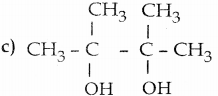
(d) CH3 – CH2 – CH (OH) – CH2 – CH3
Answer:
(a) CH3 CH (OH) CH2CH3
Hint:
2R – OH + Na → 2RONa + 2H2 ↑ 2 moles of alcohol gives 1 mole of H2 which occupies
22.4L at 273K and 1 atm
number of moles of alcohol = \(\frac{2 \text { moles of } \mathrm{R}-\mathrm{OH}}{22.4 \mathrm{L} \text { of } \mathrm{H}_{2}}\) x 560 mL = 0.05 moles
number of moles = \(\frac{\text { mass }}{\text { molar mass }}\)
= molar mass = \(\frac{3.7}{0.05}\) = 74 g mol-1
General formula for
R – OH Cn H2n+1 – OH
n(12) + (2n+1) (1) + 16 +1 = 74
14n = 74 – 18
14n = 56
n = \(\frac { 56 }{ 4 }\) = 4
The 2° alcohol which contains 4 carbon is CHn CH(OH)CH2 CH3

Samacheer Kalvi 12th Chemistry Guide Chapter 11 Hydroxy Compounds and Ethers

Question 2.
Which of the following compounds on reaction with methyl magnesium bromide will give tertiary alcohol.
(a) benzaldehyde
(b) propanoic acid
(c) methyl propanoate
(d) acetaldehyde
Answer:
(c) methyl propanoate
Solution:
Samacheer Kalvi 12th Chemistry Guide Chapter 11 Hydroxy Compounds and Ethers 1

Question 3.
Samacheer Kalvi 12th Chemistry Guide Chapter 11 Hydroxy Compounds and Ethers 2
Samacheer Kalvi 12th Chemistry Guide Chapter 11 Hydroxy Compounds and Ethers 3
Answer:
a
Solution:
hydro boration – Anti markownikoff product
i.e CH3 – CH2 – CH – CH2 – CH2 – OH

Samacheer Kalvi 12th Chemistry Guide Chapter 11 Hydroxy Compounds and Ethers

Question 4.
In the reaction sequence, Ethane
Samacheer Kalvi 12th Chemistry Guide Chapter 11 Hydroxy Compounds and Ethers 4
Ethan – 1, 2 – diol. A and X respectively are ………….
(a) Chioroethane and NaOH
(b) ethanol and H2SO4
(c) 2 – chloroethan – 1 – ol and NaHCO3
(d) ethanol and H2O
Answer:
(c) 2 – chloroethan – 1 – ol and NaHCO3\
Samacheer Kalvi 12th Chemistry Guide Chapter 11 Hydroxy Compounds and Ethers 5
Solution:
Samacheer Kalvi 12th Chemistry Guide Chapter 11 Hydroxy Compounds and Ethers 6

Question 5.
Which one of the following is the strongest acid ………..
(a) 2 – nitrophenol
(b) 4 – chlorophenol
(c) 4 – nitrophenol
(d) 3 – nitrophenol
Answer:
(c) 4 – nitrophenol

Samacheer Kalvi 12th Chemistry Guide Chapter 11 Hydroxy Compounds and Ethers

Question 6.
Samacheer Kalvi 12th Chemistry Guide Chapter 11 Hydroxy Compounds and Ethers 7
on treatment with Con. H2SO4, predominately gives ……………..
Samacheer Kalvi 12th Chemistry Guide Chapter 11 Hydroxy Compounds and Ethers 8
Samacheer Kalvi 12th Chemistry Guide Chapter 11 Hydroxy Compounds and Ethers 9
Answer:
b
Solution:
Samacheer Kalvi 12th Chemistry Guide Chapter 11 Hydroxy Compounds and Ethers 10

Question 7.
Carbolic acid is …………..
(a) Phenol
(b) Picric acid
(c) benzoic acid
(d) phenylacetic acid
Answer:
(a) Phenol

Samacheer Kalvi 12th Chemistry Guide Chapter 11 Hydroxy Compounds and Ethers

Question 8.
Which one of the following will react with phenol to give salicyladehyde after hydrolysis …………..
(a) Dichioro methane
(b) trichioroethane
(c) trichloro methane
(d) CO2
Answer:
(c) trichloro methane (Riemer Tiemann reaction)

Question 9.
Samacheer Kalvi 12th Chemistry Guide Chapter 11 Hydroxy Compounds and Ethers 11
(a) (CH3)3 CCH = CH2
(b) (CH3)2 C = C (CH3)2
(c) CH2 = C(CH3)CH2 – CH2 – CH3
(d) CH2 = C (CH3) – CH2 – CH2 – CH3
Answer:
(b) (CH3)2 C = C (CH3)2
Solution:
Samacheer Kalvi 12th Chemistry Guide Chapter 11 Hydroxy Compounds and Ethers 12

Samacheer Kalvi 12th Chemistry Guide Chapter 11 Hydroxy Compounds and Ethers

Question 10.
The correct IUPAC name of the compound,
Samacheer Kalvi 12th Chemistry Guide Chapter 11 Hydroxy Compounds and Ethers 13
(a) 4 – chloro – 2, 3 – dimethyl pentan – 1 – ol
(b) 2, 3 – dimethyl – 4 – chloropentan – 1 – ol
(c) 2, 3, 4 – trimethyl – 4 – chiorobutan – 1 – ol
(d) 4 – chioro – 2, 3, 4 – trimethyl pentan – 1 – ol
Answer:
(a) 4 – chloro – 2, 3 – dimethyl pentan – 1 – ol

Question 11.
Assertion: Phenol is more acidic than ethanol
Reason: Phenoxide ion is resonance stabilized
(a) if both assertion and reason are true and reason is the correct explanation of assertion.
(b) if both assertion and reason are true but reason is not the correct explanation of assertion.
(c) assertion is true but reason is false
(d) both assertion and reason are false.
Answer:
if both assertion and reason are true and reason is the correct explanation of assertion.

Question 12.
In the reaction Ethanol
Samacheer Kalvi 12th Chemistry Guide Chapter 11 Hydroxy Compounds and Ethers 14
is ………………
(a) ethane
(b) ethoxyethane
(c) ethylbisuiphite
(d) ethanol
Answer:
(d) ethanol
Solution:
Samacheer Kalvi 12th Chemistry Guide Chapter 11 Hydroxy Compounds and Ethers 15

Samacheer Kalvi 12th Chemistry Guide Chapter 11 Hydroxy Compounds and Ethers

Question 13.
The reaction
Samacheer Kalvi 12th Chemistry Guide Chapter 11 Hydroxy Compounds and Ethers 16
can be classified as
(a) dehydration
(b) Williams on alcohol synthesis
(c) Williamson ether synthesis
(d) dehydrogenation of alcohol
Answer:
(c) Williamson ether synthesis
Solution:
Cyclic alcohol → sodium cyclic alkoxide → Williamson ether synthesis

Question 14.
Isoprophylbcnzene on air oxidation in the presence of dilute acid gives …………
(a) C6H5COOH
(b) C6H5COCH3
(c) C6H5COC6H5
(d) C6H5 – OH
Answer:
(a) C6H5 – OH (phenol)

Question 15.
Assertion: Phenol is more reactive than benzene towards electrophilic substitution reaction
Reason: In the case of phenol. the intermediate arenium ion is more stabilized by resonance.
(a) if both assertion and reason are true and reason is the correct explanation of assertion.
(b) if both assertion and reason are true but reason is not the correct explanation of assertion.
(c) assertion is true but reason is false
(d) both assertion and reason are false,.
Answer:
(a) if both assertion and reason are true and reason is the correct explanation of assertion.

Samacheer Kalvi 12th Chemistry Guide Chapter 11 Hydroxy Compounds and Ethers

Question 16.
HO CH2 CH2 – OH on heating with periodic acid gives ………..
(a) methanoic acid
(b) Glyoxal
(c) methanol
(d) CO2
Answer:
(c) methanol

Question 17.
Which of the following compound can be used as artireeze in automobile radiators?
(a) methanol
(b) ethanol
(c) Neopentyl alcohol
(d) ethan -1, 2-diol
Answer:
(d) ethan -1, 2-diol

Question 18.
The reaction
Samacheer Kalvi 12th Chemistry Guide Chapter 11 Hydroxy Compounds and Ethers 17
is an example of …………..
(a) Wurtz reaction
(b) cyclic reaction
(c) Williamson reaction
(d) Kolbe reactions
Answer:
(c) Kolbe reactions

Samacheer Kalvi 12th Chemistry Guide Chapter 11 Hydroxy Compounds and Ethers

Question 19.
One mole of an organic compound (A) with the formula C3H8O reacts completely with two moles of HI to form X and Y. When Y is boiled with aqueous alkali it forms Z. Z answers the iodoform test. The compound (A) is ……………
(a) propan – 2 – ol
(b) propan- 1- ol
(c) ethoxy ethane
(d) methoxy ethane
Answer:
(d) methoxy ethane
Solution:
Samacheer Kalvi 12th Chemistry Guide Chapter 11 Hydroxy Compounds and Ethers 18

Samacheer Kalvi 12th Chemistry Guide Chapter 11 Hydroxy Compounds and Ethers

Question 20.
Among the following ethers which one will produce methyl alcohol on treatment with hot HI?
Samacheer Kalvi 12th Chemistry Guide Chapter 11 Hydroxy Compounds and Ethers 19
Answer:
a
Solution:
Samacheer Kalvi 12th Chemistry Guide Chapter 11 Hydroxy Compounds and Ethers 20

Samacheer Kalvi 12th Chemistry Guide Chapter 11 Hydroxy Compounds and Ethers

Question 21.
Williamson synthesis of preparing dimethyl ether is a / an
(a) SN1 reactions
(b) SN2 reaction
(c) electrophilic addition
(d) electrophilic substitution
Answer:
(b) SN2 reaction

Question 22.
On reacting with neutral ferric chloride, phenol gives
(a) red colour
(b) violet colour
(c) dark green colour
(d) no colouration
Answer:
(b) violet colour

II. Short Answer

Question 1.
IdentIfy the product (s) is/are formed when 1 – methoxy propane is heated with excess HI. Name the mechanism involved in the reaction.
Answer:
Samacheer Kalvi 12th Chemistry Guide Chapter 11 Hydroxy Compounds and Ethers 21
Ethers having primary alkyl group undergo \(\mathrm{S}_{\mathrm{N}}^{2}\) reaction

Question 2.
Draw the major product formed when 1 – ethoxyprop – 1 – ene is heated with one equivalent of HI
Answer:
Samacheer Kalvi 12th Chemistry Guide Chapter 11 Hydroxy Compounds and Ethers 22

Question 3.
Suggest a suitable reagent to prepare secondary alcohol with an identical groups using a Grignard reagent.
Answer:
Samacheer Kalvi 12th Chemistry Guide Chapter 11 Hydroxy Compounds and Ethers 23

Samacheer Kalvi 12th Chemistry Guide Chapter 11 Hydroxy Compounds and Ethers

Question 4.
What is the major product obtained when two moles of ethyl magnesium bromide is treated with methyl benzoate followed by acid hydrolysis
Answer:
Samacheer Kalvi 12th Chemistry Guide Chapter 11 Hydroxy Compounds and Ethers 24

Question 5.
Predict the major product, when 2-methyl but – 2 – ene is converted into alcohol in each of the following methods.

  1. Acid-catalyzed hydration
  2. Hydroboration
  3. Hydroxylation using bayers reagent

Answer:
Samacheer Kalvi 12th Chemistry Guide Chapter 11 Hydroxy Compounds and Ethers 25

Samacheer Kalvi 12th Chemistry Guide Chapter 11 Hydroxy Compounds and Ethers

Question 6.
Arrange the following in the increasing order of their boiling point and give a reason for your ordering

  1. Butan – 2 – ol, Butan – 1 – SI, 2 – methylpropan – 2 – ol
  2. Propan – 1 – ol, propan – 1, 2, 3 – triol, propan – 1, 3 – diol, propan – 2 – ol

Answer:
1. Boiling points increases regularly as the molecular mass increases due to a corresponding increase in their Van der Waal’s force of attraction. Among isomeric alcohols, 2° – alcohols have lower boiling points than 1° – alcohols due to a corresponding decrease in the extent

of H-bonding because of steric hindrance. Thus the boiling point of Butan – 2 – ol is lower than that of Butan – 1 – ol. Overall increasing order of boiling points is, 2 – methyl propane – 2 – ol < Butan – 2 – ol < Butan – 1 – ol

2. 2°-alcohols have lower boiling points than 1° – alcohols due to a corresponding decrease in the extent of H – bonding because of steric hindrance. Therefore Propan – 1 – ol has higher boiling point than Propan – 2 – ol. The hydrogen group increases, boiling point also increases. Overall increasing order of boiling points is, propan – 2 – ol < Propan – 1 – ol < propan – 1, 3 – diol < propan -1, 2, 3 – triol

Question 7.
Can we use nucleophiles such as NH3, CH3O for the Nucleophilic substitution of alcohols
Answer:
1. Increasing order of nucleophilicity,
NH3 < – OH < CH3O⊖-

2. Higher electron density will increase the nucleophilicity.
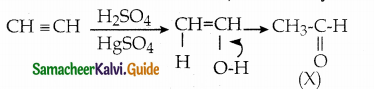
3. Negatively charged species are almost always more nucleophiles than neutral species.

4. RO has an alkyl group attached, allowing a greater amount of polarizability. This means oxygen’s lone pairs will be more readily available to reach in RO than in OH. Hence CH3O – is the better nucleophile for the nucleophilic substitution of alcohols. NH3 cannot act as nucleophiles for the nucleophilic substitution of alcohols.

Samacheer Kalvi 12th Chemistry Guide Chapter 11 Hydroxy Compounds and Ethers

Question 8.
Is it possible to oxidise t – butyl alcohol using acidified dichromate to form a carbonyic compound.
Answer:
3° – alcohols do not undergo oxidation reaction under normal conditions, but at elevated temperature, under strong oxidising agent cleavage of C – C bond takes place to give a mixture of carboxylic acid.

Yes, it is possible. t – butyl alcohol is readily oxidsing in acidic solution (K2Cr2O7 / H2SO4) to a mixture of a ketone and an acid each containing lesser number of carbon atoms than the original alcohol. The oxidation presumably occur via alkenes formed through dehydration of alcohols under acidic conditions.
Samacheer Kalvi 12th Chemistry Guide Chapter 11 Hydroxy Compounds and Ethers 26

Question 9.
What happens when 1 – phenyl ethanol is treated with acidified KMnO4.
Answer:
1 – phenyl ethanol reacts with acidified KMnO4 to give Acetophenone.
Samacheer Kalvi 12th Chemistry Guide Chapter 11 Hydroxy Compounds and Ethers 27

Question 10.
Write the mechanism of acid catalysed dehydration of ethanol to give ethene.
Answer:
Samacheer Kalvi 12th Chemistry Guide Chapter 11 Hydroxy Compounds and Ethers 28

Question 11.
How is phenol prepared form

  1. chloro benzene
  2. isopropyl benzene

Answer:
Samacheer Kalvi 12th Chemistry Guide Chapter 11 Hydroxy Compounds and Ethers 29

Samacheer Kalvi 12th Chemistry Guide Chapter 11 Hydroxy Compounds and Ethers

Question 12.
Explain Kolbe’s reaction
Answer:
Kolbe’s (or) Kolbe’s Schmitt reaction:
In this reaction, phenol is first converted into sodium phenoxide which is more reactive than phenol towards electrophilic substitution reaction with CO2. Treatment of sodium phenoxide with CO2 at 400K, 4 -7 bar pressure followed by acid hydrolysis gives salicylic acid.
Samacheer Kalvi 12th Chemistry Guide Chapter 11 Hydroxy Compounds and Ethers 30

Question 13.
Writes the chemical equation for Williamson synthesis of 2 – ethoxy – 2 – methyl pentane starting from ethanol and 2 – methyl pentan – 2 – ol
Answer:
A tertiary alkoxide and primary alkyl halide easily undergo williamson ether synthesis
Samacheer Kalvi 12th Chemistry Guide Chapter 11 Hydroxy Compounds and Ethers 31

Question 14.
Write the structure of the aldehyde, carboxylic acid and ester that yield 4 – methylpent – 2 – en – 1 – ol.
Answer:
Samacheer Kalvi 12th Chemistry Guide Chapter 11 Hydroxy Compounds and Ethers 32

Samacheer Kalvi 12th Chemistry Guide Chapter 11 Hydroxy Compounds and Ethers

Question 15.
What is metamerism? Give the structure and IUPAC name of metamers of 2 – methoxy propane
Answer:
Metamerism:
It is a special type of isomerism in which molecules with same formula, same functional group, but different only in the nature of the alkyl group attached to oxygen.

Samacheer Kalvi 12th Chemistry Guide Chapter 11 Hydroxy Compounds and Ethers 33

Question 16.
How are the following conversions effected

  1. benzyl chlorjde to benzyl alcohol
  2. benzyl alcohol to benzoic acid

Answer:
Samacheer Kalvi 12th Chemistry Guide Chapter 11 Hydroxy Compounds and Ethers 34

Question 17.
Complete the following reactions
Samacheer Kalvi 12th Chemistry Guide Chapter 11 Hydroxy Compounds and Ethers 35
Answer:
Samacheer Kalvi 12th Chemistry Guide Chapter 11 Hydroxy Compounds and Ethers 36

Samacheer Kalvi 12th Chemistry Guide Chapter 11 Hydroxy Compounds and Ethers

Question 18.
O.44g of a monohydric alcohol when added to methyl magnesium iodide in ether liberates at STP 112 cm3 of methane with PCC the same alcohol form a carbonyl compound that answers silver mirror test. Identify the compound.
Samacheer Kalvi 12th Chemistry Guide Chapter 11 Hydroxy Compounds and Ethers 37
CnH2n+1+OH
⇒ n x 12+ (2n + 1) x 1 + 1 x 16 + 1 x 1 = 88
12n + 2n + 1 + 16 + 1 = 88
14n + 18 = 88
14n = 88 – 18
14n = 70
n = 70/14 = 5
Answer:
Samacheer Kalvi 12th Chemistry Guide Chapter 11 Hydroxy Compounds and Ethers 38

Question 19.
Complete the following reactions
Samacheer Kalvi 12th Chemistry Guide Chapter 11 Hydroxy Compounds and Ethers 39
Answer:
Samacheer Kalvi 12th Chemistry Guide Chapter 11 Hydroxy Compounds and Ethers 40 Samacheer Kalvi 12th Chemistry Guide Chapter 11 Hydroxy Compounds and Ethers 41
(According to Saytzeff s rule, during intramolecular dehydration, if there is a possibility to form C = C bond at different locations, the preferred location is the one that gives the more substituted alkene je, the stable alkene).

Question 20.
Phenol is distilled with Zn dust gives (A) followed by Friedel – crafts alkylation with propyl chloride to give a compound B, B on oxidation gives (C). Identify A,B and C.
Answer:
Samacheer Kalvi 12th Chemistry Guide Chapter 11 Hydroxy Compounds and Ethers 42
Note:
Carbon directly attached to the aromatic riñg is called benzylic carbon.
If there is hydrogen attached to benzylic carbon it will undergo oxidation.

Question 21.
Samacheer Kalvi 12th Chemistry Guide Chapter 11 Hydroxy Compounds and Ethers 43
Identify A, B, C, D and write the complete equation.
Answer:
Samacheer Kalvi 12th Chemistry Guide Chapter 11 Hydroxy Compounds and Ethers 44 Samacheer Kalvi 12th Chemistry Guide Chapter 11 Hydroxy Compounds and Ethers 45

Samacheer Kalvi 12th Chemistry Guide Chapter 11 Hydroxy Compounds and Ethers

Question 22.
What will be the product for the following reaction
Samacheer Kalvi 12th Chemistry Guide Chapter 11 Hydroxy Compounds and Ethers 46
Answer:
Samacheer Kalvi 12th Chemistry Guide Chapter 11 Hydroxy Compounds and Ethers 47

Question 23.
How will you convert acetylene into n – butyl alcohol.
Answer:
Samacheer Kalvi 12th Chemistry Guide Chapter 11 Hydroxy Compounds and Ethers 48

Question 24.
Predict the product A, B, X and Y in the following sequence of reaction
Samacheer Kalvi 12th Chemistry Guide Chapter 11 Hydroxy Compounds and Ethers 49
Answer:
Samacheer Kalvi 12th Chemistry Guide Chapter 11 Hydroxy Compounds and Ethers 50

Samacheer Kalvi 12th Chemistry Guide Chapter 11 Hydroxy Compounds and Ethers

Question 25.
3,3 – dimethyl butane – 2 – ol on treatment with conc. H2SO4 to give tetramethyl ethylene as a major product. Suggest suitable mechanisms.
Answer:
Samacheer Kalvi 12th Chemistry Guide Chapter 11 Hydroxy Compounds and Ethers 51

III. Evaluate yourself

Question 1.
Classify the following alcohols as 10, 20, and 30 and give their IUPAC Names.
Samacheer Kalvi 12th Chemistry Guide Chapter 11 Hydroxy Compounds and Ethers 52
Answer:

a 2° alcohol 5- bromo -5- methyl -3 hexanol
b 3° alcohol 3 – ethyl -3- pentanol
c 2° alcohol 3- chiorobut -3- en – 1 – o!
d 2°alcohol 6-bromohept-3-en-2-ol
e 3° alcohol 3- phenyl -3 – pentanol

Samacheer Kalvi 12th Chemistry Guide Chapter 11 Hydroxy Compounds and Ethers

Question 2.
Write all the possible isomers of alcohol having the molecular formula C15H12O and their IUPAC names.
Answer:
Eight isomers are possible for C15H12O. They are,
Samacheer Kalvi 12th Chemistry Guide Chapter 11 Hydroxy Compounds and Ethers 53 Samacheer Kalvi 12th Chemistry Guide Chapter 11 Hydroxy Compounds and Ethers 54

Samacheer Kalvi 12th Chemistry Guide Chapter 11 Hydroxy Compounds and Ethers

Question 3.
Suggest a suitable carbonyl compound for the preparation of pent – 2 – en – 1 ol using LiAlH4.
Answer:
Samacheer Kalvi 12th Chemistry Guide Chapter 11 Hydroxy Compounds and Ethers 55

Question 4.
2 – methylpropan – 2 – ene
Samacheer Kalvi 12th Chemistry Guide Chapter 11 Hydroxy Compounds and Ethers 56
Answer:
Samacheer Kalvi 12th Chemistry Guide Chapter 11 Hydroxy Compounds and Ethers 57

Samacheer Kalvi 12th Chemistry Guide Chapter 11 Hydroxy Compounds and Ethers

Question 5.
How will you prepare the following using a Grignard reagent?

  1. t – butyl alcohol
  2. allyl alcohol

Answer:
Samacheer Kalvi 12th Chemistry Guide Chapter 11 Hydroxy Compounds and Ethers 58

Question 6.
Identify the products in the following reactions. Write their IUPAC names and mention the mechanism involved in the reactions.
Samacheer Kalvi 12th Chemistry Guide Chapter 11 Hydroxy Compounds and Ethers 59
Answer:
Samacheer Kalvi 12th Chemistry Guide Chapter 11 Hydroxy Compounds and Ethers 60

Samacheer Kalvi 12th Chemistry Guide Chapter 11 Hydroxy Compounds and Ethers

Question 7.
What is the major product obtained when 2, 3 – dimethyl pentan – 3 – ol is heated in the presence of H2SO4
Answer:
Samacheer Kalvi 12th Chemistry Guide Chapter 11 Hydroxy Compounds and Ethers 61 Samacheer Kalvi 12th Chemistry Guide Chapter 11 Hydroxy Compounds and Ethers 62

Question 8.
Which of the following set of reactants will give 1 – methoxy – 4 – nitrobenzene.
Samacheer Kalvi 12th Chemistry Guide Chapter 11 Hydroxy Compounds and Ethers 63
Answer:
Samacheer Kalvi 12th Chemistry Guide Chapter 11 Hydroxy Compounds and Ethers 64

Question 9.
What happens when m – cresol is treated with an acidic solution of sodium dichromate?
Answer:
Samacheer Kalvi 12th Chemistry Guide Chapter 11 Hydroxy Compounds and Ethers 65

Question 10.
When phenol is treated with propan – 2 – ol in the presence of HF, Friedel – Craft reaction takes place. Identify the products.
Answer:
Samacheer Kalvi 12th Chemistry Guide Chapter 11 Hydroxy Compounds and Ethers 66

Samacheer Kalvi 12th Chemistry Guide Chapter 11 Hydroxy Compounds and Ethers

Question 11.
Given the IUPAC name for the following ethers and classify them as simple or mixed.
Answer:
Samacheer Kalvi 12th Chemistry Guide Chapter 11 Hydroxy Compounds and Ethers 67

Question 12.
1. Which of the following reaction will give 1 – methoxy – 4 – nitrobenzene.

  1. 4 – nitro – 1 – bromobenzene + sodium methoxide.
  2. 4 – nitrosodium phenoxide + bromomethane

Answer:
4-nitrosodium phenoxide + bromo methane → 1 – methoxy – 4 – nitrobenzene
Samacheer Kalvi 12th Chemistry Guide Chapter 11 Hydroxy Compounds and Ethers 68
Reason: 4 – nitro -1- brornobnzene + sodium methoxide can not be used, because bromine is strongly bonded to carbon atom of hcnzcne ring and it can not be replaced easily.

Question 13.
Arrange the following compounds in the increasing order of their acid strength. propan – 1 – ol, 2, 4, 6 – trinitroptienol, 3 – nitrophenol, 3,5 – dinitrophenol, phenol, 4 – methyl phenol.
Answer:
Phenols are stronger acids than alcohols because the phenoxide ion left after the removal of proton is stabilized by resonance while the alkoxide ion left after the removal of a proton from alcohol is not stabilized. Thus propan – 1 – ol is much weaker acid than any phenol.

Thus propan- 1 – ol is a much weaker acid than any phenol. We know that electron-donating groups decrease the acidic character and stronger is the electron-donating group, weaker is the phenol.

Compare to propan – 1 – ol, 4 – methyl phenol is a stronger acidic character. But comparing phenol and 4-methyl phenol, phenol is stronger acidic. Since electron-withdrawing groups increase the acidic character of phenols and the effect is more pronounced at the para position than at the meta position.

Therefore 4 – nitrophenol is a stronger acid than 3 – nitro phenol. Further as the number of electron-withdrawing groups increases the acidic strength further increases. Therefore 2, 4, 6 – trinitrophenol is a stronger acid than 3, 5 – dinitrophenol. It may be noted here that although the two nitro groups in 3, 5 – dinitrophenol are at m – position with respect to OH group,

their combined effect is however greater than one nitro group at p – position. Therefore 3, 5 – dinitrophenol is a stronger acid than 4-nitro phenol. Thus, the overall increasing order of acid strength is. Propan – 1 – 01 < 4 – methyl phenol < phenol < 3 – nitrophenol < 3, 5 – dinitrophenol < 2, 4, 6 – trinitrophenol.

Samacheer Kalvi 12th Chemistry Guide Chapter 11 Hydroxy Compounds and Ethers

Question 14.
1 mole of HI is allowed to react with t – butyl methylether. Identify the product and write down the mechanism of the reaction.
Answer:
Samacheer Kalvi 12th Chemistry Guide Chapter 11 Hydroxy Compounds and Ethers 69
The reaction involves the protonation of oxygen which is followed by the SN1 mechanism.
The products are t-butvl iodide and methyl alcohol.

12th Chemistry Guide Hydroxy Compounds and Ethers Additional Questions and Answers

Part – II – Additional Questions

I. Choose the correct answer

Question 1.
In ethanol the – OH group is attached to hybridised carbon
a) sp
b) sp2
c) sp3
d) dsp2
Ans :
c) sp3

Question 2.
In Vinyl alcohol the -OH group is attached to hvbridised carbon
a) sp
b) sp2
c) sp3
d) dsp2
Ans :
b) sp2

Samacheer Kalvi 12th Chemistry Guide Chapter 11 Hydroxy Compounds and Ethers

Question 3.
Sorbitol is
a) monohydric alcohol
b) dihydric alcohol
c) trihydric alcohol
d) hexa hydric alcohol
Answer:
d) hexa hydric alcohol

Question 4.
The IUPAC name of sorbitol is
a) Ethan -1, 2 – diol
b) Propan – 1, 2, 3 – triol
c) Hexan – 1, 2, 3, 4, 5, 6 – hexol
d) Ethenol
Answer:
c) Hexan – 1, 2, 3,4, 5, 6 – hexol

Question 5.
Samacheer Kalvi 12th Chemistry Guide Chapter 11 Hydroxy Compounds and Ethers 70
a) prop – 2 – en – 1 – ol
b) 2 – methyl but – 3 – en – 2 ol
c) 3 – methyl but – 1 – en – 3 – ol
d) 1,1 – di methyl prop – 2 – en – 1 – ol
Answer:
b) 2 – methyl but – 3 – en – 2 ol

Question 6.
The C – O – H bond angle in methanol is
a) 107°
b) 109°.5°
c) 108.9°
d) 104°
Answer:
c) 108.9°

Samacheer Kalvi 12th Chemistry Guide Chapter 11 Hydroxy Compounds and Ethers

Question 7.
CH3-CH2-a + NaOH → CH3-CH2-OH + NaCl This reaction follows mechanism
a) \(S_{N}^{1}[latex]
b) [latex]S_{N}^{2}\)
c) E1
d) E2
Answer:
b) \(S_{N}^{2}\)

Question 8.
Conversion of isobutyl chloride and isopropyl chloride into isobutyl alcohol and isopropyl alcohol respectively using dilute aquous NaOH follow the mechnisms
Samacheer Kalvi 12th Chemistry Guide Chapter 11 Hydroxy Compounds and Ethers 71
Answer:
c)
Reason : Isobutylchloride – Primary alkyl halide – \(S_{N}^{2}\) mechanism.
Iso propyl chloride – Secondary alkyl halide – Sjsj mechanism.
\(S_{N}^{1}\)

Samacheer Kalvi 12th Chemistry Guide Chapter 11 Hydroxy Compounds and Ethers

Question 9.
Addition of water across the double bond
of an unsymmetrical alkene follows
a) Saytzeffs rule
b) Markownikoff’s rule
c) anti Markownikoff’s rule
d) Popoff’s rule
Answer:
b) Markownikoff’s rule

Question 10.
Hydroboration of an alkene follows
a) Saytzeff’s rule
b) Markownikoff’s rule
c) anti Markownikoff’s rule
d) Popoff’s rule
Answer:
c) anti – Markownikoff’s rule

Question 11.
Addition of water to 2-methyl propene in
presence of cone, sulphuric acid gives
a) 2-propanol
b) 2 – methyl – 2 – propanol
c) 2 – methyl – 1 – propanol
d) 2 – butanol
Answer:
b) 2 – methyl – 2 – propanol
Samacheer Kalvi 12th Chemistry Guide Chapter 11 Hydroxy Compounds and Ethers 72

Question 12.
2 – methyl propene reacts with diborane followed by H2O2 in presence of NaOH gives
a) 2 – proponol
b) 2 – methyl – 2 – propanol
c) 2 – methyl – 1 – propanol
d) 2 – butanol
Answer:
c) 2 – methyl -1 – propanol
Samacheer Kalvi 12th Chemistry Guide Chapter 11 Hydroxy Compounds and Ethers 73

Samacheer Kalvi 12th Chemistry Guide Chapter 11 Hydroxy Compounds and Ethers

Question 13.
To prepare a primary alcohol a Grignard reagent must be reacted with
a) HCHO
b) RCHO
c) RCOR
d) RNH2
Answer:
a) HCHO

Question 14.
To prepare a secondary alcohol a
Grignard reagent must be reacted with
a) HCHO
b) RCHO
c) RCOR
d) RNH2
Answer:
b) RCHO

Question 15.
To prepare a tertiary alcohol a Grignard reagent must be reacted with
a) HCHO
b) RCHO
c) RCOR
d) RNH2
Ans:
b) RCOR

Question 16.
Phenyl magnesium bromide reacts with formaldehyde followed by hydrolysis gives
a) phenol
b) Benzyl alcohol
c) Benzaldehyde
d) Benzoic acid
Answer:
b) Benzyl alcohol
Samacheer Kalvi 12th Chemistry Guide Chapter 11 Hydroxy Compounds and Ethers 74

Samacheer Kalvi 12th Chemistry Guide Chapter 11 Hydroxy Compounds and Ethers

Question 17.
Name the product obtained when 1 mole of methyl magnesium bromide reacts with ethyl methanoate
a) propan -2- ol
b) propan – 1 – ol
c) ethanal
d) ethanol
Answer:
c) ethanal
Samacheer Kalvi 12th Chemistry Guide Chapter 11 Hydroxy Compounds and Ethers 75

Question 18.
Samacheer Kalvi 12th Chemistry Guide Chapter 11 Hydroxy Compounds and Ethers 76
The reducing agent X is
a) Ramey Ni
b) NaBH4
c) LiA/H4
d) Na – Hg
Answer:
b) NaBH4

Question 19.
The best reducing agent to prepare unsaturated alcohols from unsaturated carbonyl compounds is
a) Raney Ni
b) NaBH4
c) LiA/H4
d) both (b) & (c)
Answer:
d) both (b) & (c)

Question 20.
Ethene is converted into ethylene glycol by treating with
a) acidified potassium dichromate
b) alkaline potassium permanganate
c) Chromyl chloride
d) nitric acid
Answer:
b) alkaline potassium permanganate

Samacheer Kalvi 12th Chemistry Guide Chapter 11 Hydroxy Compounds and Ethers

Question 21.
Cold dilute alkaline potassium permanganate is called as
a) Fenton’s reagent
b) Tollen’s reagent
c) Baeyer’s reagent
d) Schiff’s reagent
Answer:
c) Baeyer’s reagent

Question 22.
Glyceryl palmitate on alkaline hydrolysis gives
a) glycerol and soap
b) glycerol and sodium palmitate
c) glycerol and sodium hexadentate
d) all the above
Answer:
d) all the above

Question 23.
The preparation of glycerol and soap from oils and fats is known as
a) esterification
b) saponification
c) hydroboration
d) transesterification
Answer:
b) saponification

Samacheer Kalvi 12th Chemistry Guide Chapter 11 Hydroxy Compounds and Ethers

Question 24.
Lucas reagent is
a) dil HCl & ZnCl2
b) Cone. HCl & anhydrous ZnCl2
c) dil H2SO4 & AlCl3
d) Conc. H2SO4 & anhydrous AlCl3
Answer:
b) Cone. HCl & anhydrous ZnCl2

Question 25.
Which among the following will give immediate turbidity with Lucas reagent?
a) propan – 2 – ol
b) propan – 1 – ol
c) 2 – methyl propan – 2 – ol
d) 2 – methyl propan – 1 – ol
Answer:
c) 2 – methyl propan – 2 – ol
Hint: A teritary alcohol gives immediate turbidity

Question 26.
In Victor Meyer’s test, the alcohol which
gives blue colour is
a) propan – 2 – ol
b) propan – 1 – ol
c) 2 – methyl propan – 2 – ol
d) 2 – methyl propan – 1 – ol
Answer:
a) propan – 2 – ol
Hint: A secondary alcohol gives blue colour.

Samacheer Kalvi 12th Chemistry Guide Chapter 11 Hydroxy Compounds and Ethers

Question 27.
In the given equation
Samacheer Kalvi 12th Chemistry Guide Chapter 11 Hydroxy Compounds and Ethers 77
Samacheer Kalvi 12th Chemistry Guide Chapter 11 Hydroxy Compounds and Ethers 78
Answer:
c

Question 28.
Among butyl alcohols which one have the lowest boiling point?
a) n-butyl alcohol
b) isobutyl alcohol
c) sec-butyl alcohol
d) ter – butyl alcohol
Answer:
d) ter – butyl alcohol Hint: Increasing order of boiling point is 30 < 2° < 1°

Question 29.
Which among the alcohol has a higher boiling point?
a) n-butyl alcohol
b) n-propyl alcohol
c) ethyl alcohol
d) methyl alcohol
Answer:
a) n-butyl alcohol
Hint: As molecular weight of the alcohol increases, boiling point increases.

Question 30.
Which among the following is less soluble in water?
a) n-butyl alcohol
b) n-propyl alcohol
c) ethyl alcohol
d) methyl alcohol
Answer:
a) n-butyl alcohol Hint: As the molecular weight increases, the solubility of alcohol decreases.

Samacheer Kalvi 12th Chemistry Guide Chapter 11 Hydroxy Compounds and Ethers

Question 31.
Conversion of alcohols into alkyl halide is an example of
a) Nucleophilic addition
b) Nucleophilic substitution
c) Electrophilic addition
d) Electrophilic substitution
Answer:
b) Nucleophilic substitution

Question 32.
Conversion of 2 – methyl – 1 – propanol into 2 – methyl – 1 – bromopropane is …………. reaction
a) SN2
b) SN1
c) E2
d) E1
Answer:
a) SN2

Question 33.
Primary alcohols undergo dehydration by mechanism
a) SN2
b) SN1
c) E2
d) E1
Ans:
d) E1

Question 34.
2 – methyl – 2 – propanol when reacted with cone. H2SO4 gives 2 – methyl propene. This reaction follows mechanism
a) SN2
b) SN1
c) E2
d) E1
Answer:
d) E1

Samacheer Kalvi 12th Chemistry Guide Chapter 11 Hydroxy Compounds and Ethers

Question 35.
During intramolecular dehydration of 3, 3 – dimethyl – 2 – butanol the major product obtained is
a) 2, 3 – dimethyl but – 1 – ene
b) 2, 3 – dimethyl but – 2 – ene
c) 3, 3 – dimethyl but – 1 – ene
d) 3, 3 – dimethyl but – 2 – ene
Answer:
b) 2, 3 – dimethyl but – 2 – ene

Question 36.
The major product obtained when phenol reacts with con.H2SO4 at 280 K is
a) Salicyclic acid
b) picric acid
c) o-phenol sulphonic acid
d) p-phenol sulphonic acid
Answer:
c) o-phenol sulphonic acid

Question 37.
During intramolecular dehydration of alcohols say tzeff’s rule favours the formation of
a) unstable alkenes
b) less substituted alkenes
c) more substituted alkenes
d) none of the above
Answer:
c) more substituted alkenes

Question 38.
To stop the oxidation reaction of alcohols at the aldehyde / ketone stage…………..is used as an oxidising agent
a) Pottassium permanganate
b) Py ridinium chloro chromate (PCC)
c) Potassium di chromate
d) Sodium di chromate
Answer:
b) pyridinium chloro chromate (PCC)

Samacheer Kalvi 12th Chemistry Guide Chapter 11 Hydroxy Compounds and Ethers

Question 39.
In Swern oxidation of alcohols into aldehydes/ketones the oxidising agent used is
a) Pyridinium chlorochromate (PCC)
b) Dimethyl sulfoxide (DMSO)
c) Alkaline potassium permanganate (Baeyer’s reagent)
d) Ferrous sulphate / H2O2 (Fenton’s reagent)
Answer:
b) Dimethyl sulfoxide (DMSO)

Question 40.
To detoxify the alcohol produced in animals by the fermentaion of food, the oxidising agent used is
a) ADH
b) ADP
c) NAD
d) ATP
Answer:
c) NAD

Question 41.
The catalyst which catalyses the oxidation of toxic alcohols into non-toxic aldehyde in animals is
a) ADH
b) ADP
c) NAD
d) ATP
Answer:
a) ADH

Samacheer Kalvi 12th Chemistry Guide Chapter 11 Hydroxy Compounds and Ethers

Question 42.
When ethan-1, 2-diol is heated with anhydrous ZnCl2 under pressure it gives
a) Ethanol
b) Ethanal
c) Ethanoic acid
d) Ethene
Ans:
b) Ethanal

Question 43.
Glycerol can be oxidised to meso oxalic acid by
a) dii HNO3
b) HIO4
c) Bismuth nitrate
d) Fenton’s reagent
Answer:
c) Bismuth nitrate

Question 44.
The alcohol used in the manufacture of dynamite is
a) methanol
b) ethanol
c) ethv lene glycol
d) glycerol
Answer:
d) glycerol

Question 45.
The correct order of acidic nature of alcohols is
a) Ethanol < propan – 2 – ol < 2 – methyl propan – 2- ol
b) Propan – 2 – ol < Ethanol < 2 – methyl propan — 2 — ol
c) 2 – methyl propan – 2 – ol < Ethanol < propan – 2 – ol
d) 2 – methyl propan – 2 — ol Answer:
d) 2 – methyl propan – 2 – ol

Samacheer Kalvi 12th Chemistry Guide Chapter 11 Hydroxy Compounds and Ethers

Question 46.
1, 3 – dihydroxy benzene is commonly
known as
a) Cresol
b) Catechol
c) Resorcinol
d) Quinol
Answer:
c) Resorcinol

Question 47.
The JUPAC name of pyrogallol is
a) 1, 2, 3 — trthydroxy benzene
h) 1, 2, 4 — trihydroxy beneze
c) 1, 3, 5 — trihydroxv benzene
d) 1, 4, 5 — tri hydroxy benzene .
Answer:
a) 1, 2, 3 — trihydroxy benzene

Question 48.
Oricinol is
a) 1, 2 – dihydroxy benzene
h) 3 — methyl phenol :
c) 3, 5 — dihydroxy toluene
d) 3, 5 — dimethyl toluene
Answer:
c) 3, 5 – dihydroxy toluene

Samacheer Kalvi 12th Chemistry Guide Chapter 11 Hydroxy Compounds and Ethers

Question 49.
Which of the following reaction will give ether?
Samacheer Kalvi 12th Chemistry Guide Chapter 11 Hydroxy Compounds and Ethers 79
Ans:
d) All of the above

Question 50.
Phenol on oxidation with acidified K2Cr2O7gives
a) 1, 4 – dihydroxy benzene
b) 1,4- benzoquinone
c) cyclohexanol
d) cumene
Answer:
b) 1,4- benzoquinone

Question 51.
Which among the following is a simple ether?
a) 1 – methoxy propane
b) 2 – methoxy propane
c) methoxy methane
d) methoxv benzene
Answer:
c) methoxy methane

Question 52.
The oxygen atom of ether is
hybridised
a) sp
b) sp2
c) sp3
d) dsp2
Answer:
c) sp3

Samacheer Kalvi 12th Chemistry Guide Chapter 11 Hydroxy Compounds and Ethers

Question 53.
Williamson’s synthesis is an example of
a) nucleophilic addition
b) nucleophilic substitution
c) electrophilic addition
d) electrophilic substitution
Answer:
b) nucleophilic substitution

Question 54.
Which among the following is more reactive
towards ethers?
a) HF
b) HCl
c) HBr
d) HI
Answer:
d) HI

Question 55.
The products obtained when methoxy
ethane reacted with one mole of HI are
a) methanol & iodoethane
h) iodomethane & ethanol
c) iodomethane & jodo ethane
d) Methanol & ethanol
Answer:
b) iodomethane & ethanol

Samacheer Kalvi 12th Chemistry Guide Chapter 11 Hydroxy Compounds and Ethers

Question 56.
Which is used as a precursor to the synthesis of perfumes and insecticide pheromones?
a) Phenol
b) Phenoxy methane
c) methoxy benzene
d) Ethoxy benzene
Answer:
c) methoxy benzene

Question 57.
According to Lewis concept of acids and bases an ether is
a) acidic
b) basic
c) neutral
d) amphoteric
Answer:
b) basic

Question 58.
Samacheer Kalvi 12th Chemistry Guide Chapter 11 Hydroxy Compounds and Ethers 80
a) CH3COCH3
b) C2H5OH
c) CH3-CH(OH)CH3
d) CH3CHO
Answer:
c) CH3-CH(OH)CH3
Samacheer Kalvi 12th Chemistry Guide Chapter 11 Hydroxy Compounds and Ethers 81

Question 59.
Samacheer Kalvi 12th Chemistry Guide Chapter 11 Hydroxy Compounds and Ethers 82
a)Propan-1,3-diol
b) Ethan -1,2- diol
c) Propan -1,2,3- Triol
d) Ethanal
Answer:
b) Ethan -1,2- diol
Samacheer Kalvi 12th Chemistry Guide Chapter 11 Hydroxy Compounds and Ethers 83

Question 60.
Which of the following has lowest boiling point?
a) phenol
b) O-nitro phenol
c) m-nitro phenol
d) p-nitro phenol
Answer:
b) O-nitro phenol
Hint: O – nitrophenol has intramolecular hydrogen bonding while others intermolecular hydrogen bonding.

Samacheer Kalvi 12th Chemistry Guide Chapter 11 Hydroxy Compounds and Ethers

II. Assertion and Reason

Question 1.
Assertion : Tertiary alcohols undergo dehydration more readily than primary alcohol.
Reason : Tertiary alcohols are less acidic than primary alcohol.
a) Both assertion and reason are true and reason is the correct explanation of assertion
b) Both assertion and reason are true but reason is not the correct explanation of assertion
c) Assertion is true but reason is false.
d) Both assertion and reason are false.
Answer:
b) Both assertion and reason are true but reason is not the correct explanation of assertion

Samacheer Kalvi 12th Chemistry Guide Chapter 11 Hydroxy Compounds and Ethers

Question 2.
Assertion (A) : Alcohols can act as Bronsted acids
Reason (R) : It is due to the presence of unshared electron pairs on oxygen which make them proton acceptors.
a) Both (A) and (R) are correct, R explain A.
b) Both (A) and (R) are correct, R does not explain A.
c) (A) is correct but R is correct.
d) (A) is wrong but R is correct.
Answer:
d) (A) is wrong but R is correct Correct Reason (A) : Alcohols can act as Bronsted bases.

Question 3.
Assertion (A) : Phenol is more acidic than aliphatic alcohols
Reason (R) : Alkyl substituted phenols show a decreased acidity due to the electron releasing +1 effect of alkyl group.
a) Both (A) and (R) are correct, R explain A.
b) Both (A) and (R) are correct, R does not explain A.
c) (A) is correct but R is correct.
d) (A) is wrong but R is correct.
Answer:
b) Both (A) and (R) are correct, R does not explain A.
Correct Reason (R) : The phenoxide ion is more stabilised by resonance than phenol.

Question 4.
Assertion (A): Orthonitro phenol is slightly soluble in water and more volatile whereas p – nitro phenol is more soluble in water and less volatile.
Reason (R) : Orthonitro phenol forms intramolecular hydrogen bonding and p-nitro phenol forms intermolecular hydrogen bonding.
a) Both (A) and (R) are correct, R explains A.
b) Both (A) and (R) are correct, R does not explain A.
c) (A) is correct but R is correct.
d) (A) is wrong but R is correct.
Answer:
a) Both (A) and (R) are correct, R explains A.

Samacheer Kalvi 12th Chemistry Guide Chapter 11 Hydroxy Compounds and Ethers

III. Pick out the correct statements

Question 1.
(i) The structure of – OH group attached to a sp3– hybridised carbon in alcohol is similar to the structure of – OH group attached to a hydrogen in water.
(ii) Due to lone pair – lone pair repulsion, the – C – O – H bond angle in methanol is reduced to 104° from the regular tetrahedral bond angle of 109.5°.
(iii) With Grignard reagent formaldehyde gives primary alcohol and other aldehydes give secondary alcohols.
(iv) Reaction of Grignard reagent with aldehydes and ketones to form alcohols is an example for nucleophilic substitution reaction.
a) (i) & (ii)
b) (ii) & (iii)
c) (i) & (iii)
d) (i) & (iv)
Answer:
c) (i) & (iii)
Correct statements : (ii) Due to lone pair – lone pair repulsion, the – C – O – H bond anlge in methanol is reduced to 108.9° from the regular tetrahedral bond angle of 109.5°.
(iv) Reaction of Grignard reagent with adlehydes and ketones to form alcohols is an example for nucleophilic addition reaction.

Question 2.
(i) Lower alcohols are waxy solids and the higher members are colourless liquids.
(ii) Due to the presence of intermolecular hydrogen bonding alcohols have higher boiling point than the corresponding alkanes, aldehydes, ethers etc.
(iii) Due to the formation of intermolecular hydrogen bonding with water lower alcohols are highly soluble in water.
(iv) Among isomeric alcohols primary alcohols have lower boiling point and tertiary alcohols have higher boiling points.
a) (i) & (ii)
b) (ii) & (iii)
c) (iii) & (iv)
d) (i) & (iv)
Answer:
b) (ii) & (iii)
Correct statements : (i) Lower alcohols are colourless liquids and the higher members are waxy solids.
(iv) Among isomeric alcohols primary alcohols have higher boiling point and the tertiary alcohols have lower boiling points.

Samacheer Kalvi 12th Chemistry Guide Chapter 11 Hydroxy Compounds and Ethers

Question 3.
(i) In Swern Oxidation DMSO, oxalyl chloride and triethylamine are used to convert alcohols into aldehydes / ketones.
(ii) Vapours of primary alcohol passed over heated copper at 573 K undergoes dehydration. .
(iii) Methanol reacts with ethanoic acid in presence of an acid to form ethylethanoate.
(iv) Vapours of tertiary alcohols react with heated copper at 573 K to give alkenes.
a) (i) & (ii)
b) (ii) & (iii)
c) (iii) & (iv)
d) (i) & (iv)
Answer:
d) (i) & (iv)
Correct statements : (ii) Vapours of primary alcohol passed over heated copper at 573 K undergoes dehydrogenation.
(iii) Methanol reacts with ethanoic acid in presence of an acid to form methyl ethanoate. (or)
Ethanol reacts with ethanoic acid in presence of an acid to form ethyl ethanoate.

Samacheer Kalvi 12th Chemistry Guide Chapter 11 Hydroxy Compounds and Ethers

Question 4.
(i) Glycerol contains two primary alcoholic group and one secondry alcoholic group.
(ii) Oxidation of glycerol with cone. HNO3 gives mainly formic acid.
(iii) Glycerol is used in making printing inks, and stamp pad ink.
(iv) Glycerol is used as a preservative for biological specimens
a) (i) & (ii)
b) (ii) & (iii)
c) (i) & (iii)
d) (i) & (iv)
Answer:
c) (i) & (iii)
Correct statements : (ii) Oxidation of glycerol with cone. HNO3 gives mainly glyceric acid
(iii) Ethanol is used as a preservative for biological specimens

Samacheer Kalvi 12th Chemistry Guide Chapter 11 Hydroxy Compounds and Ethers

IV. Pick out the incorrect statements

Question 1.
(i) The overall reaction of hydroboration is hydration of an alkene.
(ii) Hydroboration reaction occurs according to Markownikoff’s rule.
(iii) Raney Ni does not reduce the Carbon – Carbon double bond present in the Carbonyl compound to form unsaturated alcohols.
(iv) When two or more functional groups are present in a molecule sodium borohydride to used as a reducing agent to reduce the more reactive group
a) (i) & (ii)
b) (ii) & (iii)
c) (iii) & (iv)
d) (i) & (iv)
Answer:
b) (ii) & (iii)
Correct statements : (ii) Hydroboration reaction occurs against Markownikoff’s rule.
(iii) Lithium aluminium hydride does not reduce the Carbon – Carbon double bond present in the Carbonyl compound to form unsaturated alchols.

Question 2.
(i) Ethanol forms a turbidity with Lucas reagent within 10 minutes.
(ii) 2 – Methyl propan – 2 – ol forms immediate turbidity with Lucas reagent due to the formation of insoluble 2 – chloro – 2 – methyl propane.
(iii) Ehanol forms red colour in Victor Meyer’s test.
(iv) 2 – 2 – dimethyl propan – 1 – ol gives a colourless solution in victor Meyer’s test,
a) (i) & (ii)
b) (ii) & (iii)
c) (iii) & (iv)
d) (i) & (iv)
Answer:
d) (i) & (iv)
Correct statements : (i) Ethanol forms no tubridity with lucas reagent at room temperature.
(iv) 2,2 – dimethyl propan -1 – ol gives red colour in victor mayer’s test.

Samacheer Kalvi 12th Chemistry Guide Chapter 11 Hydroxy Compounds and Ethers

Question 3.
(i) Alcohols undergo nucleophilic substitution reaction with hydrohaloacids to form alkyl halides.
(ii) Alkyl halide formation from primary alchols follow E2 mechanism.
(iii) Alkyl halide formation from tertiary alcohols follow SN2 mechanism.
(iv) The conversion of methanol into chloromethane with thionyl chloride in the presence of pyridine follows SN2 mechanism.
a) (i) & (ii)
b) (ii) & (iii)
c) (iii) & (iv)
d) (i) & (iv)
Answer:
b) (ii) & (iii)
Correct statements : (ii) Alkyl halide formation from primary alcohols follow \(\mathrm{S}_{\mathrm{N}}^{2}\) mechanism.
(iii) Alkyl halide formation from tertiary alcohols follow \(\mathrm{S}_{\mathrm{N}}^{1}\) mechanism.

Question 4.
(i) In phenol the carbon bearing the – OH group is sp2 hybridised.
(ii) Unlike alcohols phenol reactswith sodium hydroxide to form sodium phenoxide.
(iii) In substituted phenols, the electron with drawing groups decreases the acidic nature of phenol.
(iv) Alkyl substituted phenols show increased acidity due to electron releasing +1 effect of alkvl group.
a) (i) & (ii)
b) (ii) & (iii)
c) (iii) & (iv)
d) (i) & (iv)
Answer:
c) (iii) & (iv)
Correct statements: (iii) In substituted phenols, the electron withdrawing groups increases the acidic
nature of phenol.
(iv) Alkyl substituted phenols show a decreased acidity due to electron releasing + I effect of alkyl
group.

V. Match the Following

Question 1.

Oxidising agent

Oxidation product of glycerol

i) dil HNO3 a meso oxalic acid
ii) Conc. HNO3 b formaldehyde & formic acid
iii) Bismuth nitrate c oxalic acid
iv) Fenton’s reagent d glyceric acid & tartronic acid
v) HIO4 e glyceric acid
vi) Acidified KMnO4 f glycerose

Answer:
i) d glyceric acid & tartronic acid
ii) e glyceric acid
iii) a meso oxalic acid
iv) f glycerose
v) b formaldehyde & formic acid
vi) c oxalic acid

Samacheer Kalvi 12th Chemistry Guide Chapter 11 Hydroxy Compounds and Ethers

Question 2.

Example Type of Phenol
i) Orcinol a Monohydric pheno
ii) Catechol b Trihydric phenol
iii) Cresol c Dihydric phenol
iv) Phioroglucinol d Substituted phenol

Answer:
i) d Substituted phenol
ii) c Dihydric phenol
iii) a Monohydric phenol
iv) b Trihydric phenol

Question 3.

Compound Uses
i) Phenol a Antifreeze
ii) Glycerol b Perfumery
iii Glycol c Carbolic soaps
iv Anisole d Refrigerant
v) Diethyl ether e Cordite

Answer:
i) c Carbolic soaps
ii) e Cordite
iii) a Antifreeze
iv) b Perfumery
v) d Refrigerant

Samacheer Kalvi 12th Chemistry Guide Chapter 11 Hydroxy Compounds and Ethers

Question 4.

Type of Alcohol Example
i 1° alcohol a Glycerol
ii 2° alcohol b Sorbitol
iii 3° alcohol c Ethylene glycol
iv Dihydric alcohol d Isopropyl alcohol
v Trihydric alcohol e Neo pentyl alcohol
vi Polyhydric alcohol f 2-phenyl propan-2-ol

Answer:
i) e Neo pentyl alcohol
ii) d Isopropyl alcohol
iii) f 2-phenyl propan-2-ol
iv) c Ethylene glycol
v) a Glycerol
vi) b Sorbitol

VI. Two Marks Questions

Question 1.
Illustrate Markownikoff’s rule in the addition of water to an alkene
Answer:
Markownikoff’s rule states that the negative part of the adding molecules gets attached with the carbon containing least number of hydrogen atoms across the double bond.
Samacheer Kalvi 12th Chemistry Guide Chapter 11 Hydroxy Compounds and Ethers 84

Samacheer Kalvi 12th Chemistry Guide Chapter 11 Hydroxy Compounds and Ethers

Question 2.
Write a note on hydroboration reaction
Answer:
Diborane reacts with an alkene to form trialkyl borane which on treatment with H2O2 in presence of NaOH gives an alcohol.
The overall reaction is hydration of an alkene.
This reaction gives an anti MarkowniKoff’s product
Samacheer Kalvi 12th Chemistry Guide Chapter 11 Hydroxy Compounds and Ethers 85

Question 3.
Convert crotonaldehyde into crotylalcohol
Answer:
LiAlH4 does not reduce C = C bond present in the carbonyl compound.
Hence it is the best reagent to prepare unsaturated alcohols.
Samacheer Kalvi 12th Chemistry Guide Chapter 11 Hydroxy Compounds and Ethers 86

Question 4.
An organic compound (A) – C3H8O3 used as sweetening agent, which on oxidation with Fenton’s reagent gives a mixture of compounds B and C. Identify A, B & C. Write possible reactions.
Answer:
An organic compound (A) – C3H8O3 is glycerol.
Oxidation of glycerol with Br2/H2O (or) NiaOBr (or) Fenton’s reagent (FeSO4 + H2O2) gives a mixture of glyceraldehvde and dihydroxv acetone ( This mixture is named as glvcerose)
Samacheer Kalvi 12th Chemistry Guide Chapter 11 Hydroxy Compounds and Ethers 87

Samacheer Kalvi 12th Chemistry Guide Chapter 11 Hydroxy Compounds and Ethers

Question 5.
What is saponification?
Answer:
The alkaline hydroysis of naturally occurring oils and fats into glycerol and soap is called saponification.
Samacheer Kalvi 12th Chemistry Guide Chapter 11 Hydroxy Compounds and Ethers 88

Question 6.
What is Saytzeff’s rule
Answer:
During intramolecular dehydration of an alcohol if there is a possibility to form a carbon- carbon double bond at different locations, the preferred location is the one that gives the more substituted alkene ie., the stable alkene.

Question 7.
Convert propan -1 – ol to propanal.
Answer:
To stop the oxidation reaction of alcohols at the aldehyde / ketone stage, pyridinium chloro chromate (PCC) is used as an oxidising agent.
Samacheer Kalvi 12th Chemistry Guide Chapter 11 Hydroxy Compounds and Ethers 89

Question 8.
Write a note on Swern Oxidation
Answer:
In Swern oxidation dimethvl sulfoxide (DMSO) is used as the oxidising agent.
It converts alcohols to ketones / aldehydes.
Alcohol is treated with DMSO and oxah I chloride followed by the addition of triethylarnine.
Samacheer Kalvi 12th Chemistry Guide Chapter 11 Hydroxy Compounds and Ethers 90

Samacheer Kalvi 12th Chemistry Guide Chapter 11 Hydroxy Compounds and Ethers

Question 9.
Write note on biological oxidation that occurs in animals.
Answer:

  • The fermentation of the food consumed by an animal produces alcohol.
  • To detoxify the alcohol, liver produces an enzyme called alcohol dehydrogenase (ADH)
  • Nicotinamide adenine dinucleotide (NAD) present in animals acts as an oxidising agent.
  • ADH catalyses the oxidation of toxic alcohols into non-toxic aldehyde.

Samacheer Kalvi 12th Chemistry Guide Chapter 11 Hydroxy Compounds and Ethers 91

Question 10.
What happens when ethylene glycol is reacted with PI3 ?
Answer:
Samacheer Kalvi 12th Chemistry Guide Chapter 11 Hydroxy Compounds and Ethers 92

Question 11.
What happens when ethylene glycol is heated with conc. HNO3 and conc. H2SO4?
Answer:
Samacheer Kalvi 12th Chemistry Guide Chapter 11 Hydroxy Compounds and Ethers 93

Question 12.
How is nitroglycerine prepared
Answer:
Glycerol reacts with nitric acid in the presence of cone. H2SO4 to form nitroglycerine (TNG)
Samacheer Kalvi 12th Chemistry Guide Chapter 11 Hydroxy Compounds and Ethers 94

Samacheer Kalvi 12th Chemistry Guide Chapter 11 Hydroxy Compounds and Ethers

Question 13.
Write about the dehydration of glycerol
Answer:
When glycerol is heated with dehydrating agents such as H2SO4, KHSO4 etc., it undergoes dehvration to form acrolein.
Samacheer Kalvi 12th Chemistry Guide Chapter 11 Hydroxy Compounds and Ethers 95

Question 14.
Convert aniline into phenol
Answer:
Samacheer Kalvi 12th Chemistry Guide Chapter 11 Hydroxy Compounds and Ethers 96

Question 15.
What is Schotten – Baumann reaction
Answer:
Benzovlation of phenol with benzoyl chloride in presence of NaOH is known as Schotten Baumann reaction.
Samacheer Kalvi 12th Chemistry Guide Chapter 11 Hydroxy Compounds and Ethers 97

Question 16.
Write a note on williamson ether synthesis?
Answer:
Methyl iodide undergoes nucleophilic substitution by phenoxide ion to form anisole
Samacheer Kalvi 12th Chemistry Guide Chapter 11 Hydroxy Compounds and Ethers 98

Samacheer Kalvi 12th Chemistry Guide Chapter 11 Hydroxy Compounds and Ethers

Question 17.
Convert phenol into (i) 1, 4 – benzoquionone (ii) cyclo hexanol
Answer:
Samacheer Kalvi 12th Chemistry Guide Chapter 11 Hydroxy Compounds and Ethers 99

Question 18.
How is picric acid prepared?
Answer:
Phenol undergoes nitration with cone HNO3 and cone H2SO4 at 298 K to form 2, 4/ 6 – trinitrophenol known as picric acid
Samacheer Kalvi 12th Chemistry Guide Chapter 11 Hydroxy Compounds and Ethers 100

Question 19.
Differentiate phenol and ethanol
Answer:

Reaction

Phenol

Ethanol

With benzene diazonium chloride forms a red orange dye No reaction
With neutral ferric chloride forms a purple coloration does not form purple colouration
WithNaOH gives sodium phenoxide does not react

Question 20.
Give four uses or diethyl ether.
Answer:

  1. Diethyl ether is used as a surgical anaesthetic agent in surgery.
  2. It is a good solvent for organic reactions and extraction.
  3. It is used as a volatile starting fluid for diesel and gasoline engine.
  4. It is used as a refrigerant.

Question 21.
Write the mechanism of intermolecular dehydration of alcohols?
Answer:
Samacheer Kalvi 12th Chemistry Guide Chapter 11 Hydroxy Compounds and Ethers 101

Samacheer Kalvi 12th Chemistry Guide Chapter 11 Hydroxy Compounds and Ethers

Question 22.
Write the mechanism of nucleophilic substitution of ethers
Answer:
Mechanism:
Ethers having primary alkyl group undergo SN2 reaction while tertiary alkyl ether undergo SN1 reaction.Protonation of ether is followed by the attack of halide ion.The halide ion preferentially attacks the less sterically hindered of the two alkyl groups which are attached to etherial oxygen.
Samacheer Kalvi 12th Chemistry Guide Chapter 11 Hydroxy Compounds and Ethers 102

When excess HBr or HI is used, the alcohol formed will further react with HBr or HI to form alkyl halides.
Samacheer Kalvi 12th Chemistry Guide Chapter 11 Hydroxy Compounds and Ethers 103

Question 23.
What is autooxidation of ethers?
Answer:

  • Ethers stored in the presence of atmospheric oxygen slowly oxidise to form hydroperoxides and dialkyl peroxides.
  • These are explosive in nature.
  • This spontaneous oxidation by atmospheric oxygen is called auto oxidation

Samacheer Kalvi 12th Chemistry Guide Chapter 11 Hydroxy Compounds and Ethers 104

Question 24.
Samacheer Kalvi 12th Chemistry Guide Chapter 11 Hydroxy Compounds and Ethers 105
Answer:
Samacheer Kalvi 12th Chemistry Guide Chapter 11 Hydroxy Compounds and Ethers 106

Samacheer Kalvi 12th Chemistry Guide Chapter 11 Hydroxy Compounds and Ethers

Question 25.
Complete the reaction
Samacheer Kalvi 12th Chemistry Guide Chapter 11 Hydroxy Compounds and Ethers 107
Answer:
Samacheer Kalvi 12th Chemistry Guide Chapter 11 Hydroxy Compounds and Ethers 108
The bond of oxygen with phenyl ring is strong, hence it can not be broken and iodo benzene is not formed.

VII. Three Mark Questions

Question 1.
Explain the structure of the functional group of alcohol
Answer:

  • The structure of – O – H group attached to a SP3 hybridised carbon is similar to the structure of – O – H group attached to a hydrogen in water, ie., ‘V! shaped.
  • In such alcohols, one of the sp3 hybridised orbital of oxygen linearly overlap with the sp3 hybridised orbital of carbon to form a C – O, ‘σ’ bond.
  • Another SP3 hybridised orbital linearly overlap with IS orbital of hydrogen to form a O-H, a’ bond.
  • Remaining two sp3 hybridized orbitals of oxygen are occupied by two lone pairs of electrons.
  • Due to lone pair – lone pair repulsion, the C – O – H bond angle in methanol is reduced to 108.9C from the regular tetrahedral bond angle of 109.5°.

Samacheer Kalvi 12th Chemistry Guide Chapter 11 Hydroxy Compounds and Ethers 109

Question 2.
Convert acetaldehyde into crotyl alc0hol
Answer:
Samacheer Kalvi 12th Chemistry Guide Chapter 11 Hydroxy Compounds and Ethers 110
LiAlH4 selectively reduces the carbonyl group leaving the C = C bond.

Samacheer Kalvi 12th Chemistry Guide Chapter 11 Hydroxy Compounds and Ethers

Question 3.
Explain Lucas test of differentiating three types of alcohols
Answer:
Samacheer Kalvi 12th Chemistry Guide Chapter 11 Hydroxy Compounds and Ethers 111
The alkyl chloride formed in this reaction is insoluble in water, hence it appears as turbidity.
Samacheer Kalvi 12th Chemistry Guide Chapter 11 Hydroxy Compounds and Ethers 112

Samacheer Kalvi 12th Chemistry Guide Chapter 11 Hydroxy Compounds and Ethers

Question 4.
Write a note on catalytic dehydrogenation of three types of alcohols.
Answer:
Catalytic dehydrogenation :
When the vapours of a primary or a secondary alcohol are passed over heated copper at 573K, dehydrogenation takes place to form aldehyde or ketone.
Samacheer Kalvi 12th Chemistry Guide Chapter 11 Hydroxy Compounds and Ethers 113 Samacheer Kalvi 12th Chemistry Guide Chapter 11 Hydroxy Compounds and Ethers 114

Question 5.
Write about the oxidation of ethylene glycol
Oxidation of glycol
Answer:
On oxidation, glycol gives a variety of products depending on the nature of oxidizing agent and
other reaction conditions.
i) When nitric acid (or) alkaline potassium permanganate is used as the oxidizing agent, the following products are obtained.
Samacheer Kalvi 12th Chemistry Guide Chapter 11 Hydroxy Compounds and Ethers 115

ii) Oxidation of glycol with periodic acid :
Ethylene glycol on treatment with periodic acid gives formaldehyde. This reaction is selective for vicinal 1,2 – diols and it proceeds through a cyclic periodate ester intermediate.
Samacheer Kalvi 12th Chemistry Guide Chapter 11 Hydroxy Compounds and Ethers 116

Question 6.
Why is C-O-C bond angle in ether slightly greater than the tetrahedral bond angle.
Answer:

  • Structure of ethereal oxygen attached to two alkyl groups is similar to the structure of – O – H group of alcohol.
  • Oxygen atom is sp3 hybridised.
  • Two sp3 hybridised orbitals of oxygen linearly overlap with two sp3 hybrid orbitals of the two carbon atoms attached directly to the oxygen forming two C – O ‘o ‘ bonds.
  • C-O-C bond angle is slightly greater than the tetrahedral bond angle due to the repulsive interaction between the two bulkier alkyl group.

Samacheer Kalvi 12th Chemistry Guide Chapter 11 Hydroxy Compounds and Ethers 117

Samacheer Kalvi 12th Chemistry Guide Chapter 11 Hydroxy Compounds and Ethers

Question 7.
For the preparation of mixed ether having primary and tertiary alkyl group, primary alkyl halide and alkoxide are used. Why?
Answer:
Primary alkyl halides are more susceptible for SN2 reaction.
Hence for the preparation of mixed ether having primary and tertiary alkyl group, primary alkyl halide
Samacheer Kalvi 12th Chemistry Guide Chapter 11 Hydroxy Compounds and Ethers 118

On the other hand, if tertiary’ alkyl halide and primary alkoxide are used elimination reaction dominates and succeeds over substitution reaction to form an alkene.
Samacheer Kalvi 12th Chemistry Guide Chapter 11 Hydroxy Compounds and Ethers 119

Question 8.
How do you convert anisole into (i) Methoxy toluene (ii) methoxy acetophenone
Answer:
Samacheer Kalvi 12th Chemistry Guide Chapter 11 Hydroxy Compounds and Ethers 120

Question 9.
375 mg of an alcohol reacts with required amount of methyl magnesium bromide and releases 140 mL of methane gas at STP. What is the formula of the alcohol?
Solution:
Samacheer Kalvi 12th Chemistry Guide Chapter 11 Hydroxy Compounds and Ethers 121
(1 mole) 22,400 mL of methane can be produced from 1 mole of alcohol.
140 ml of methane is liberated from 1/22400 x 140 mole of alcohol = 6.25 x 10⁻³ mole of alcohol
w = 375 mg = 375 x 10-3 g; n = 6.25 x 10⁻³
Samacheer Kalvi 12th Chemistry Guide Chapter 11 Hydroxy Compounds and Ethers 122
Molar mass of alcohol is 60 gmol-1
CnH2n+1 -OH=>nxl2 + (2n + 1)xl + lxi6+1xl=60
12n + 2n + 1 + 16 + 1 = 60 14n + 18 = 60
14n = 60 – 18
Hence the formula of the alcohol is C3H7OH .
n = 42/14 ⇒ n = 3

Samacheer Kalvi 12th Chemistry Guide Chapter 11 Hydroxy Compounds and Ethers

Question 10.
How will you convert methanol into ethanol?
Answer:
Samacheer Kalvi 12th Chemistry Guide Chapter 11 Hydroxy Compounds and Ethers 123

VIII. Five Mark Questions

Question 1.
Convert methyl magnesium iodide into
(i) ethanol
(ii) propan – 2 – ol
(iii) 2 – methyl propan – 2 – ol
Answer:
Samacheer Kalvi 12th Chemistry Guide Chapter 11 Hydroxy Compounds and Ethers 124

Question 2.
Bring about the following conversion using Grignard reagents
i) Methanal into phenyl methanol
ii) Ethanal into butan – 2 – ol
iii) Propanone into 2 – methyl hexan – 2 -ol
iv) Ethyl methanoate into propan – 2 – ol
v) Formaldehyde into propan-l-ol
Answer:
Samacheer Kalvi 12th Chemistry Guide Chapter 11 Hydroxy Compounds and Ethers 125

Samacheer Kalvi 12th Chemistry Guide Chapter 11 Hydroxy Compounds and Ethers

Question 3.
A ether (A) C5H12O when heated with excess of hot concentration HI, produced two alkyl halides, which on hydrolysis forms compound (B) and (C). Oxidation of (B) gives an acid (D) where as oxidation of (C) gives ketone (E). Identify A, B, C, D and E and write the chemical equation.
Answer:
A ether (A) C5H12O when heated with excess of hot concentration HI, produced two alkyl halides.
Samacheer Kalvi 12th Chemistry Guide Chapter 11 Hydroxy Compounds and Ethers 126 Samacheer Kalvi 12th Chemistry Guide Chapter 11 Hydroxy Compounds and Ethers 127

Compound Name
A 2- ethoxy propane
B ethanol
C 2- propanol
D Acetic acid
E Propanone

Question 4.
Explain E1mechanism involved in the dehydration of tertiary butyl alcohol
Answer:
Tertiary alcohols undergo dehydration by E1 mechanism. It involves the formation of a carbocation.
Protonation of alcohol
Samacheer Kalvi 12th Chemistry Guide Chapter 11 Hydroxy Compounds and Ethers 128 Samacheer Kalvi 12th Chemistry Guide Chapter 11 Hydroxy Compounds and Ethers 129

Samacheer Kalvi 12th Chemistry Guide Chapter 11 Hydroxy Compounds and Ethers

Question 5.
An organic compound C2H6O (A) heated with Cone. H2SO4 at 443K to give and unsaturated hydrocarbon C2H4 (B), which on treatment with Baeyer’s reagent to give compound C2H6O2 (C). Which is used as antifreeze in automobile radiator. Compound (C) distilled with cone. H2SO4 to give cyclic compound (C4H8O2) (D). Compound (A) is heated with cone H2SO4 at 413K to give compound C4H10O (E). Identify compounds (A) to (E) and write equations Compound (A) is Ethanol heated with Cone. H2SO4 at 443K to give compound (B) is Ethene
Answer:
Samacheer Kalvi 12th Chemistry Guide Chapter 11 Hydroxy Compounds and Ethers 130

Compound (B) on treatment with Baeyer’s reagent to give compound (C) is Ethylene glycol
Samacheer Kalvi 12th Chemistry Guide Chapter 11 Hydroxy Compounds and Ethers 131

Compound ( C) distilled with cone. H2SO4 to give cyclic compound (D) 1,4- dioxene
Samacheer Kalvi 12th Chemistry Guide Chapter 11 Hydroxy Compounds and Ethers 132

Compound (A) is heated with cone. H2SO4 at 413K to give compound (E) is diethylether
Samacheer Kalvi 12th Chemistry Guide Chapter 11 Hydroxy Compounds and Ethers 133

Compound Name
A Ethanol
B Ethene
C Ethane 1,2-diol
D 1,4 dióxane
E Diethylether

Samacheer Kalvi 12th Chemistry Guide Chapter 11 Hydroxy Compounds and Ethers

Question 6.
Explain the oxidation of glycerol
Answer:

Oxidising agent Product formed
i) dil HNO3 glyceric acid & tartronic acid
ii) Cone HNO3 glyceric acid
iii) bismuth nitrate meso oxalic acid
iv) BD/H2O (or) NaOBr
(or) Fenton’s reagent (FeSO4 + H2O2)
a mixture of glyceraldehyde and dihydroxyacetone knew as glycerose
v) HIO4 (or) Lead tetraacetate (LTA) formaldehyde & formic acid?
vi) acidified KMnO4 Oxalic acid

Samacheer Kalvi 12th Chemistry Guide Chapter 11 Hydroxy Compounds and Ethers 134

Question 7.
Write a note on (i) Riemer Tiemann reaction (ii) Phthalein reaction (iii) coupling reaction
Answer:
i) Riemer Tiemann Reaction:
On treating phenol with CHCl3 /NaOH, a -CHO group is introduced at ortho position This reaction proceeds through the formation of substituted benzal chloride intermediate.
Samacheer Kalvi 12th Chemistry Guide Chapter 11 Hydroxy Compounds and Ethers 135

(ii) Phthalein reaction:
On heating phenol with phthalic anhydride in presence of con.H2SO4 phenolphthalein is obtained.
Samacheer Kalvi 12th Chemistry Guide Chapter 11 Hydroxy Compounds and Ethers 136

iii) Coupling reaction:
Phenol couples with benzene diazonium chloride in an alkaline solution to form p-hydroxy azobenzene (a red-orange dye).
Samacheer Kalvi 12th Chemistry Guide Chapter 11 Hydroxy Compounds and Ethers 137

Samacheer Kalvi 12th Chemistry Guide Chapter 11 Hydroxy Compounds and Ethers

Question 8.
Write any three methods of preparing ethers
Answer:
(i) Intermolecular dehydration of alcohol
Ethanol undergoes intermolecular dehydration with conc. H2SO4 at 413 K to form diethyl ether. Conc. H2SO4
Samacheer Kalvi 12th Chemistry Guide Chapter 11 Hydroxy Compounds and Ethers 138

(ii) Williamson ether synthesis
When an alkyl halide is heated with an alcoholic solution of sodium alkoxide, the corresponding ether is obtained. This involves SN2 mechanism.
Samacheer Kalvi 12th Chemistry Guide Chapter 11 Hydroxy Compounds and Ethers 139

(iii) Methylation of alcohol
Methyl ethers can be prepared by treating alcohol with diazomethane in presence of catalyst fluoroboric acid
Samacheer Kalvi 12th Chemistry Guide Chapter 11 Hydroxy Compounds and Ethers 140

Question 9.
How does diethylether react with the following
(i) Cl2/light
(ii) PCl5
(iii) dilH2SO4
(iv) CH3COCl/anhy.ZnCl2
Answer:
Samacheer Kalvi 12th Chemistry Guide Chapter 11 Hydroxy Compounds and Ethers 141

Question 10.
Convert
(i) methanol into tertiary butyl alcohol
(ii) ethanol into 1- butanol
Answer:
Samacheer Kalvi 12th Chemistry Guide Chapter 11 Hydroxy Compounds and Ethers 142 Samacheer Kalvi 12th Chemistry Guide Chapter 11 Hydroxy Compounds and Ethers 143

Samacheer Kalvi 12th Chemistry Guide Chapter 11 Hydroxy Compounds and Ethers

Question 11.
Complete the reaction
Samacheer Kalvi 12th Chemistry Guide Chapter 11 Hydroxy Compounds and Ethers 144
Answer:
Samacheer Kalvi 12th Chemistry Guide Chapter 11 Hydroxy Compounds and Ethers 145
(y) Reduction to pinacols: Ketones, on reduction with magnesium amalgam and water, are reduced to symmetrical diols known as pinacol.
Samacheer Kalvi 12th Chemistry Guide Chapter 11 Hydroxy Compounds and Ethers 146

Samacheer Kalvi 12th Business Maths Guide Chapter 2 Integral Calculus I Ex 2.1

Tamilnadu State Board New Syllabus Samacheer Kalvi 12th Business Maths Guide Pdf Chapter 2 Integral Calculus I Ex 2.1 Text Book Back Questions and Answers, Notes.

Tamilnadu Samacheer Kalvi 12th Business Maths Solutions Chapter 2 Integral Calculus I Ex 2.1

Question 1.
Integrate the following with respect to x.
\(\sqrt { 3x+5 }\)
Solution:
Samacheer Kalvi 12th Business Maths Guide Chapter 2 Integral Calculus I Ex 2.1 1

Samacheer Kalvi 12th Business Maths Guide Chapter 2 Integral Calculus I Ex 2.1

Question 2.
(9x² – \(\frac { 4 }{x^2}\))²
Solution:
A = \( \left[\begin{array}{cccc}
-2 & 1 & 3 & 4 \\
0 & 1 & 1 & 2 \\
1 & 3 & 4 & 7
\end{array}\right]\)
The order of A is 3 × 4
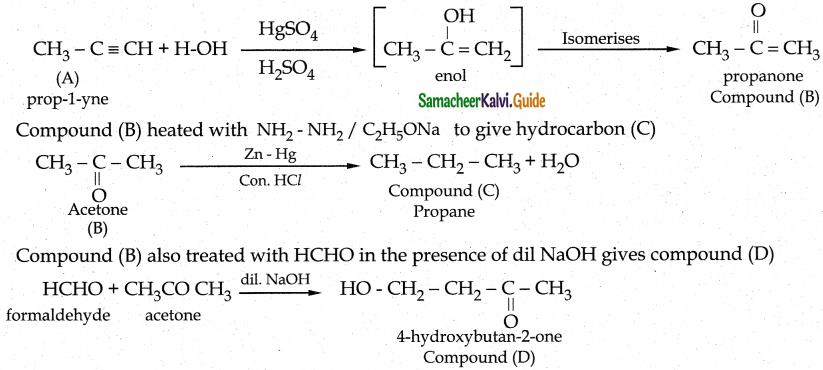
∴ P(A) < 3
Let us transform the matrix A to an echelon form
Samacheer Kalvi 12th Business Maths Guide Chapter 2 Integral Calculus I Ex 2.1 2
The number of non-zero rows = 3
∴ P(A) = 3

Samacheer Kalvi 12th Business Maths Guide Chapter 2 Integral Calculus I Ex 2.1

Question 3.
(3 + x) (2 – 5x)
Solution:
∫(3 + x) (2 – 5x) dx
= ∫(6 – 15x + 2x – 5x²) dx
= ∫(6 – 13x – 5x²) dx
= 6x – \(\frac { 13x^2 }{2}\) – \(\frac { 5x^3 }{3}\) + c

Question 4.
√x (x³ – 2x + 3)
Solution:
Samacheer Kalvi 12th Business Maths Guide Chapter 2 Integral Calculus I Ex 2.1 3

Samacheer Kalvi 12th Business Maths Guide Chapter 2 Integral Calculus I Ex 2.1

Question 5.
\(\frac { 8x+13 }{\sqrt{4x+7}}\)
Solution:
Samacheer Kalvi 12th Business Maths Guide Chapter 2 Integral Calculus I Ex 2.1 4

Samacheer Kalvi 12th Business Maths Guide Chapter 2 Integral Calculus I Ex 2.1

Question 6.
\(\frac { 1 }{\sqrt{x+1}+\sqrt{x-1}}\)
Solution:
Samacheer Kalvi 12th Business Maths Guide Chapter 2 Integral Calculus I Ex 2.1 5

Samacheer Kalvi 12th Business Maths Guide Chapter 2 Integral Calculus I Ex 2.1

Question 7.
Given f'(x) = x + b, f(1) = 5 and f(2) = 13, then find f(x)
Solution:
f(x) = ∫f'(x) dx
f(x) = ∫(x + b) dx = \(\frac { x^2 }{2}\) + bx + c
f (1) = 5 ⇒ \(\frac { (1)^2 }{2}\) + b(1) + c = 5
\(\frac { 1 }{2}\) + b + c = 5 ⇒ b + c = 5 – 1/2
b + c = \(\frac { 9 }{2}\) ⇒ 2b + 2c = 9 …….. (1)
f(2) = 13 ⇒ \(\frac { (2)^2 }{2}\) + b(2) + c = 13
2 + 2b + c = 13
2b + c = 11 ……… (2)
Solving eqn (1) & (2)
Samacheer Kalvi 12th Business Maths Guide Chapter 2 Integral Calculus I Ex 2.1 6
Substitute c = -2 in eqn (2)
2b – 2 = 11 ⇒ 2b = 11 + 2
b = 13/2
f(x) = \(\frac { x^2 }{2}\) + \(\frac { 13x }{2}\) – 2

Samacheer Kalvi 12th Business Maths Guide Chapter 2 Integral Calculus I Ex 2.1

Question 8.
Given f'(x) = 8x³ – 2x and f (2) = 8, then find f(x)
Solution:
f(x) = ∫f'(x)dx
= ∫(8x³ – 2x)dx = 8(\(\frac { x^4 }{4}\)) -2(\(\frac { x^2 }{2}\)) + c
f(x) = 2x4 – x² + c
f (2) = 8 ⇒ 2(2)4 – (2)² + c = 8
32 – 4 + c = 8 ⇒ c = -20
∴ f (x) = 2x4 – x² – 20

Samacheer Kalvi 12th Business Maths Guide Chapter 2 Integral Calculus I Ex 2.1

Samacheer Kalvi 12th Business Maths Guide Chapter 1 Applications of Matrices and Determinants Miscellaneous Problems

Tamilnadu State Board New Syllabus Samacheer Kalvi 12th Business Maths Guide Pdf Chapter 1 Applications of Matrices and Determinants Miscellaneous Problems Text Book Back Questions and Answers, Notes.

Tamilnadu Samacheer Kalvi 12th Business Maths Solutions Chapter 1 Applications of Matrices and Determinants Miscellaneous Problems

Question 1.
Find the rank of the matrix
A = \(\left(\begin{array}{cccc}
1 & -3 & 4 & 7 \\
9 & 1 & 2 & 0
\end{array}\right)\)
Solution:
\(\left(\begin{array}{cccc}
1 & -3 & 4 & 7 \\
9 & 1 & 2 & 0
\end{array}\right)\)
The order of A is 2 × 4
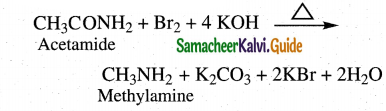
∴ P(A) ≤ 2
Let us transform the matrix A to an echelon form
Samacheer Kalvi 12th Business Maths Guide Chapter 1 Applications of Matrices and Determinants Miscellaneous Problems 1
The number of non-zero rows is 2
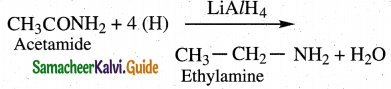
∴ P(A) = 2

Samacheer Kalvi 12th Business Maths Guide Chapter 1 Applications of Matrices and Determinants Miscellaneous Problems

Question 2.
Find the rank of the matrix
A = \( \left[\begin{array}{cccc}
-2 & 1 & 3 & 4 \\
0 & 1 & 1 & 2 \\
1 & 3 & 4 & 7
\end{array}\right]\)
Solution:
A = \( \left[\begin{array}{cccc}
-2 & 1 & 3 & 4 \\
0 & 1 & 1 & 2 \\
1 & 3 & 4 & 7
\end{array}\right]\)
The order of A is 3 × 4
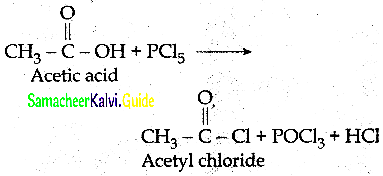
∴ P(A) < 3
Let us transform the matrix A to an echelon form
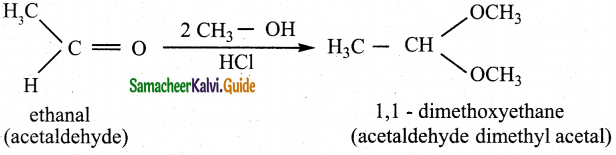
Samacheer Kalvi 12th Business Maths Guide Chapter 1 Applications of Matrices and Determinants Miscellaneous Problems 2
The number of non-zero rows = 3
∴ P(A) = 3

Samacheer Kalvi 12th Business Maths Guide Chapter 1 Applications of Matrices and Determinants Miscellaneous Problems

Question 3.
Find the rank of the matrix
A = \(\left[\begin{array}{llll}
4 & 5 & 2 & 2 \\
3 & 2 & 1 & 6 \\
4 & 4 & 8 & 0
\end{array}\right]\)
Solution:
A = \(\left[\begin{array}{llll}
4 & 5 & 2 & 2 \\
3 & 2 & 1 & 6 \\
4 & 4 & 8 & 0
\end{array}\right]\)
The order of A is 3 × 4
∴ p(A) < 3
Let us transform the matrix A to an echelon form
Samacheer Kalvi 12th Business Maths Guide Chapter 1 Applications of Matrices and Determinants Miscellaneous Problems 3
Samacheer Kalvi 12th Business Maths Guide Chapter 1 Applications of Matrices and Determinants Miscellaneous Problems 4
The last equivalent matrix is in the echelon form.
Number of non-zero rows = 3
∴ P(A) = 3

Samacheer Kalvi 12th Business Maths Guide Chapter 1 Applications of Matrices and Determinants Miscellaneous Problems

Question 4.
Examine the consistency of the system of equations;
x + y + z = 7, x + 2y + 3z = 18, y + 2z = 6
Solution:
x + y + z = 7
x + 2y + 3z = 18
y + 2z = 6
The matrix form of the equations
Samacheer Kalvi 12th Business Maths Guide Chapter 1 Applications of Matrices and Determinants Miscellaneous Problems 5
Here p(A) ≠ p(A, B)
∴ The given system is inconsistent and has no solution.

Question 5.
Find k if the equations 2x + 3y – z = 5, 3x – y + 4z = 2, x + 7y – 6z = k are consistent.
Solution:
2x + 3y – z = 5
3x – y + 4z = 2
x + 7y – 6z = k
The matrix form of these equations
Samacheer Kalvi 12th Business Maths Guide Chapter 1 Applications of Matrices and Determinants Miscellaneous Problems 6
Obviously, the last equivalent matrix is in the ech-elon form.
Since the equations are consistent
P(-A) = p(A, B)
p(A) = 2 and p (A, B) = 2 then
k = 8

Samacheer Kalvi 12th Business Maths Guide Chapter 1 Applications of Matrices and Determinants Miscellaneous Problems

Question 6.
Find k if the equations x + y + z = 1, 3x – y – z = 4, x + 5y + 5z = k are inconsistent.
Solution:
x + y + z = 1
3x – y – z = 4
x + 5y + 5z = k
The matrix equation corresponding to the given system is
Samacheer Kalvi 12th Business Maths Guide Chapter 1 Applications of Matrices and Determinants Miscellaneous Problems 7
Obviously, the last equivalent matrix is in the ech-elon form.
Since the equations are inconsistent
p(A) ≠ p (A, B)
Here p(A) = 2 but p(A, B) should not equal to 2
∴ k ≠ 0
The equations are inconsistent when k assume any real value other than 0.

Samacheer Kalvi 12th Business Maths Guide Chapter 1 Applications of Matrices and Determinants Miscellaneous Problems

Question 7.
Solve the equations x + 2y + z = 7, 2x – y + 2z = 4, x + y – 2z = -1 by using Cramer’s rule.
Solution:
x + 2y + z = 7
2x – y + 2z = 4
x + y – 2z = -1
Here Δ = \(\left|\begin{array}{ccc}
1 & 2 & 1 \\
2 & -1 & 2 \\
1 & 1 & -2
\end{array}\right|\)
= 1(2 – 2)-2 (-4 – 2) + 1(2 + 1)
= 1(0) -2 (-6) + 1(3)
= 12 + 3 = 15 ≠ 0
∴ We can apply Cramer’s Rule and the system is consistent and it has unique solution.
Δx = \(\left|\begin{array}{ccc}
7 & 2 & 1 \\
4 & -1 & 2 \\
-1 & 1 & -2
\end{array}\right|\)
= 7 (2 – 2) -2 (-8 + 2) + 1(4 – 1)
= 7(0)-2 (-6) + 1(3)
= 12 + 3
= 15
Δy = \(\left|\begin{array}{ccc}
1 & 7 & 1 \\
2 & 4 & 2 \\
1 & -1 & -2
\end{array}\right|\)
= 1(-8 + 2) -7 (-4 – 2) + 1(-2 – 4)
= 1 (-6) – 7 (-6) + 1 (-6)
= -6 + 42 – 6 = 30
Δz = \(\left|\begin{array}{ccc}
1 & 2 & 7 \\
2 & -1 & 4 \\
1 & 1 & -1
\end{array}\right|\)
= 1(1 – 4) -2 (-2 – 4) + 7 (2 + 1)
= 1 (-3) -2 (-6) + 7 (3)
= -3 + 12 + 21 = 30
∴ By cramer’s rule
Samacheer Kalvi 12th Business Maths Guide Chapter 1 Applications of Matrices and Determinants Miscellaneous Problems 8
∴ The Solution is (x, y, z) = (1, 2, 2)

Samacheer Kalvi 12th Business Maths Guide Chapter 1 Applications of Matrices and Determinants Miscellaneous Problems

Question 8.
The cost of 2kg. of wheat and 1kg. of sugar is Rs 100. The cost of 3kg. of wheat, 2kg. of sugar and 1kg of rice is Rs 220. Find the cost of each per kg. using Cramer’s rule.
Solution:
Let cost of 1 kg of wheat be x; cost of 1kg of sugar be y and cost of 1 kg of rice be z.
2x + y = 100
x + z = 80
3x + 2y + z = 220
Here Δ = \(\left|\begin{array}{ccc}
2 & 1 & 0 \\
1 & 0 & 1 \\
3 & 2 & 1
\end{array}\right|\)
= 2 (0 – 2) -1 (1 – 3)
= – 4 + 2 = -2
≠ 0
∴ We can apply Cramer’s Rule and the system is consistent and it has unique solution.
Δx = \(\left|\begin{array}{ccc}
100 & 1 & 0 \\
80 & 0 & 1 \\
220 & 2 & 1
\end{array}\right|\)
= 100 (0 – 2) -1 (80 – 220)
= – 200 -1 (-140)
= – 200 +140
= -60
Δy = \(\left|\begin{array}{ccc}
2 & 100 & 0 \\
1 & 80 & 0 \\
3 & 220 & 1
\end{array}\right|\)
= 2 (80 – 220) -100 (1 – 3)
= 2 (-140) – 100 (-2)
= – 280 + 200
= -80
Δx = \(\left|\begin{array}{ccc}
2 & 1 & 100 \\
1 & 0 & 80 \\
3 & 2 & 220
\end{array}\right|\)
= 2 (0 -160) -1 (220 – 240) + 100 (2 – 0)
= 2 (-160) -1 (-20) + 100 (2)
= -320 + 20 + 200
= -100
∴ By cramer’s rule
Samacheer Kalvi 12th Business Maths Guide Chapter 1 Applications of Matrices and Determinants Miscellaneous Problems 9
The solution is (x, y, z) = (30, 40, 50)
∴ The cost of 1 kg of wheat is Rs 30; the cost of 1 kg of sugar is Rs 40 and the cost of 1 kg of rice is Rs 50.

Samacheer Kalvi 12th Business Maths Guide Chapter 1 Applications of Matrices and Determinants Miscellaneous Problems

Question 9.
A salesman has the following record of sales during three items A, B, and C, which has different rates of commission.
Samacheer Kalvi 12th Business Maths Guide Chapter 1 Applications of Matrices and Determinants Miscellaneous Problems 10
Find out the rate of commission on items A, B, and C by using Cramer’s rule.
Solution:
Let x, y, and z be the commission on items A, B, and C respectively.
90x + 100y + 20z = 800 ⇒ 9x + 10y + 2z = 80 ……… (1)
130x + 50y + 40z = 900 ⇒ 13x + 5y + 4z = 90 ………. (2)
60x + 100y + 30z = 850 ⇒ 6x + 10y + 3z = 85 ………. (3)
Here Δ = \(\left|\begin{array}{ccc}
9 & 10 & 2 \\
13 & 5 & 4 \\
6 & 10 & 3
\end{array}\right|\)
= 9 (15 – 40) -10 (39 – 24) + 2 (130 – 30)
= 9 (-25) – 10 (15) + 2 (100)
= -225 – 150 + 200
= -175
≠ 0
∴ We can apply Cramer’s Rule and the system is consistent and it has unique solution.
Δx = \(\left|\begin{array}{ccc}
80 & 10 & 2 \\
90 & 5 & 4 \\
85 & 10 & 3
\end{array}\right|\)
= 80 (15 – 40) -10 (270 – 340) + 2 (900 – 425)
= 80 (-25) -10 (-70) + 2 (475)
= -2000 + 700 + 950
= -350
Δy = \(\left|\begin{array}{ccc}
9 & 80 & 2 \\
13 & 90 & 4 \\
6 & 85 & 3
\end{array}\right|\)
= 9 (270 – 340) – 80 (39 – 24) + 2 (1105 – 540)
= 9 (-70)-80 (15) + 2 (565)
= -630 – 1200 + 1130
= -700
Δz = \(\left|\begin{array}{ccc}
9 & 10 & 80 \\
13 & 5 & 90 \\
6 & 10 & 85
\end{array}\right|\)
= 9 (425 – 900) -10 (1105 – 540) + 80 (130 – 30)
= 9 (-475) -10 (565) + 80 (100)
= – 4275 – 5650 + 8000
= -1925
∴ By cramer’s rule
Samacheer Kalvi 12th Business Maths Guide Chapter 1 Applications of Matrices and Determinants Miscellaneous Problems 11
The solution is (x, y, z) = (2, 4, 11)
∴ The rates of commission for A, B and C are Rs 2, Rs 4 and Rs 11 respectively.

Samacheer Kalvi 12th Business Maths Guide Chapter 1 Applications of Matrices and Determinants Miscellaneous Problems

Question 10.
The subscription department of a magazine sends out a letter to a large mailing list inviting subscriptions for the magazine. Some of the people receiving this letter already subscribe to the magazine while others do not. From this mailing list, 60% of those who already subscribe will subscribe again while 25% of those who do not now subscribe will subscribe. In the last letter, it was found that 40% of those receiving it ordered a subscription. What percent of those receiving the current letter can be expected to order a subscription?
Solution:
The transition probability matrix is S
Samacheer Kalvi 12th Business Maths Guide Chapter 1 Applications of Matrices and Determinants Miscellaneous Problems 12
∴ 39% of those receiving the current letter can be expected to order a subscription.

Samacheer Kalvi 12th Business Maths Guide Chapter 1 Applications of Matrices and Determinants Miscellaneous Problems