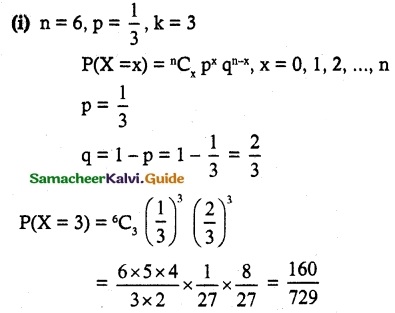
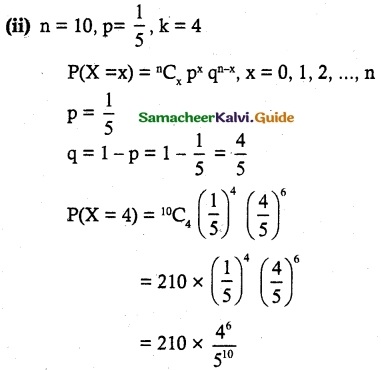
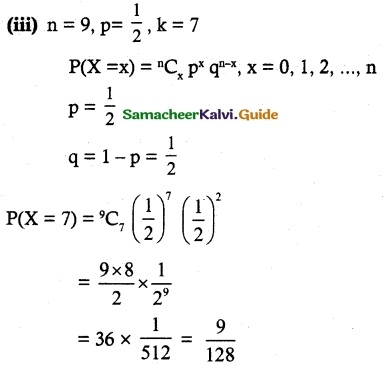
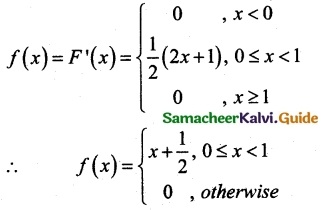
Samacheer Kalvi 12th Maths Guide Chapter 11 Probability Distributions Ex 11.4

Tamilnadu State Board New Syllabus Samacheer Kalvi 12th Maths Guide Pdf Chapter 11 Probability Distributions Ex 11.4 Textbook Questions and Answers, Notes.

Tamilnadu Samacheer Kalvi 12th Maths Solutions Chapter 11 Probability Distributions Ex 11.4

Question 1.
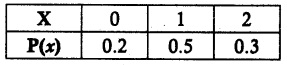
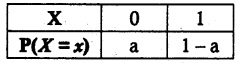
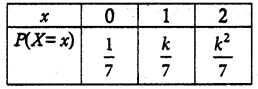
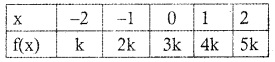
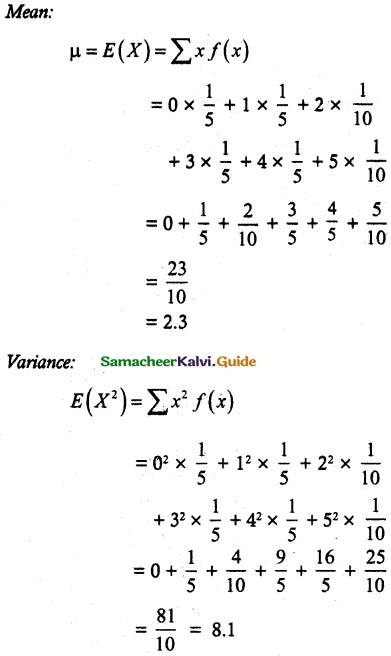
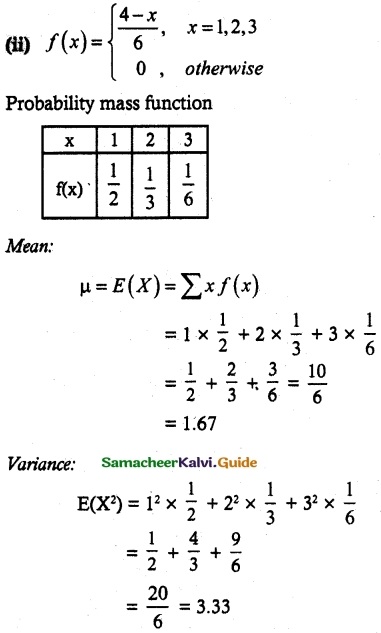
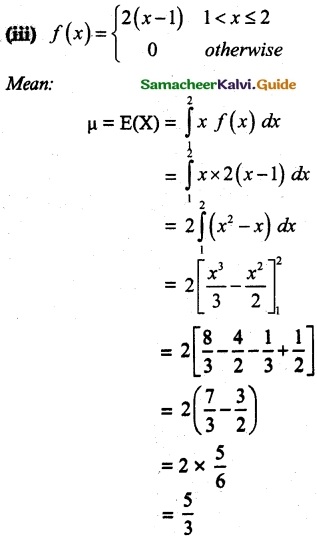
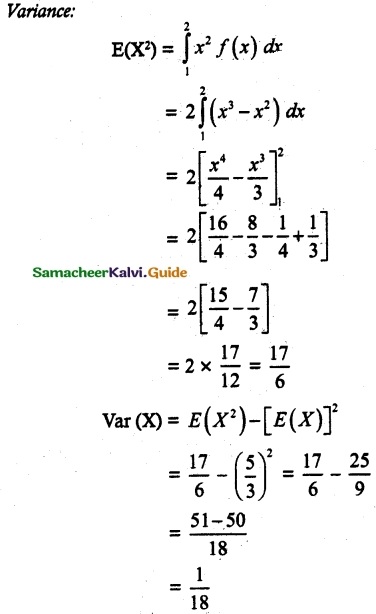
For the random variable X with the given prob-ability mass function as below, find the mean and variance.
Samacheer Kalvi 12th Maths Guide Chapter 11 Probability Distributions Ex 11.4 1
Solution:
Samacheer Kalvi 12th Maths Guide Chapter 11 Probability Distributions Ex 11.4 2
Samacheer Kalvi 12th Maths Guide Chapter 11 Probability Distributions Ex 11.4 3
Var(X)= E(X²) – [E(X)]²
= 8.1 – (2.3)²
= 8.1 – 5.29
= 2.81
Samacheer Kalvi 12th Maths Guide Chapter 11 Probability Distributions Ex 11.4 4
Var (X) = E(X²) – [E(X)]²
= 3.33 – (1.67)²
= 3.33 – 2.79
= 0.54
Samacheer Kalvi 12th Maths Guide Chapter 11 Probability Distributions Ex 11.4 5
Samacheer Kalvi 12th Maths Guide Chapter 11 Probability Distributions Ex 11.4 6
Samacheer Kalvi 12th Maths Guide Chapter 11 Probability Distributions Ex 11.4 7
Samacheer Kalvi 12th Maths Guide Chapter 11 Probability Distributions Ex 11.4 8
Var (X) = E(X²) – [E(X)]²
= 8 – 4
= 4

Samacheer Kalvi 12th Maths Guide Chapter 11 Probability Distributions Ex 11.4

Question 2.
Two balls are drawn in succession without replacement from an urn containing four red balls and three black balls. Let X be the possible outcomes drawing red balls. Find the probability mass function and mean for X.
Solution:
Let X be the random variable that denotes the number of red balls.
X = {0, 1, 2}
Sample space consist of 7C2 = 21
X= 0, X-1 (BB) = 3C2
X= 1, X-1 (BR) = 3C1 × 4C1 = 12
X = 2, X-1 (RR) 4C2 = 6
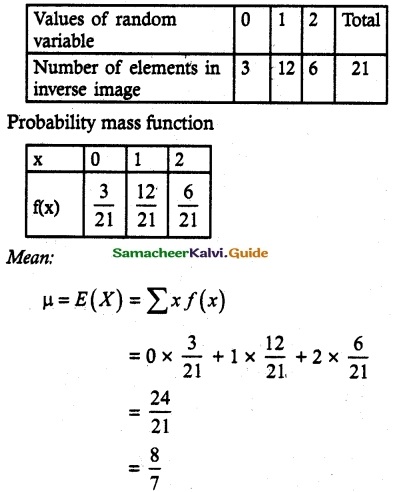
Samacheer Kalvi 12th Maths Guide Chapter 11 Probability Distributions Ex 11.4 9

Samacheer Kalvi 12th Maths Guide Chapter 11 Probability Distributions Ex 11.4

Question 3.
If µ and σ² are the mean and variance of the discrete random variable X and E(X + 3) = 10 and E(X + 3)² = 116, find µ and σ²
Solution:
Given E(X + 3) = 10
E(aX + b) = aE(X) + b
E(X + 3) = 10 ⇒ E(X) + 3 = 10
⇒ µ = E(X) = 7
E(X + 3)² = 116
E(X² + 6X + 9) = 116
E(X²) + 6E(X) + 9 = 116
E(X²) + 6(7) + 9 = 116
E(X²) = 65
σ² = Var (X) = E(X²) – [E(X)]²
= 65 – 49
= 16

Samacheer Kalvi 12th Maths Guide Chapter 11 Probability Distributions Ex 11.4

Question 4.
Four fair coins are tossed once. Find the probability mass function, mean and variance for a number of heads that occurred.
Solution:
Let X be the random variable that denotes the number of heads when four coins are tossed once.
X ={0, 1, 2, 3}
n(S) = 16
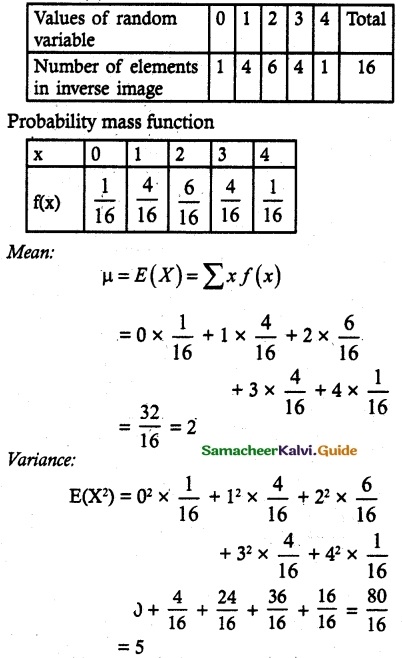
Samacheer Kalvi 12th Maths Guide Chapter 11 Probability Distributions Ex 11.4 10
Var (X) = E(X²) – [E(X)]²
= 5 – 4
= 1

Samacheer Kalvi 12th Maths Guide Chapter 11 Probability Distributions Ex 11.4

Question 5.
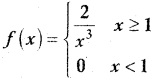
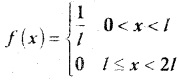
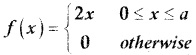
A commuter train arrives punctually at a station every half hour. Each morning, a student leaves his house to the train station. Let X denote the amount of time, in minutes, that the student waits for the train from the time he reaches the train station. It is known that the pdf of X is
Samacheer Kalvi 12th Maths Guide Chapter 11 Probability Distributions Ex 11.4 11
Obtain and interpret the expected value of the random variable X.
Solution:
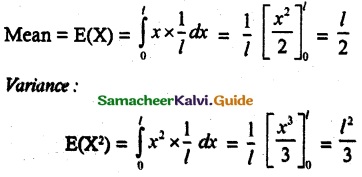
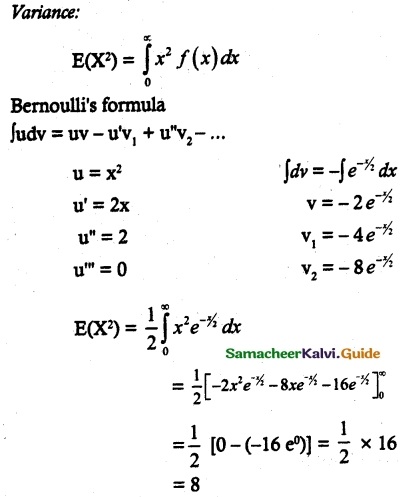
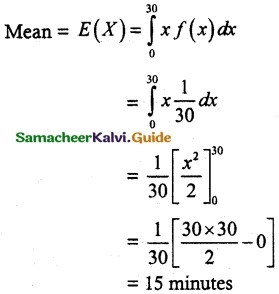
Samacheer Kalvi 12th Maths Guide Chapter 11 Probability Distributions Ex 11.4 12
The average waiting time for the student is 15 minutes.

Samacheer Kalvi 12th Maths Guide Chapter 11 Probability Distributions Ex 11.4

Question 6.
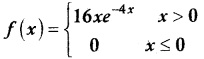
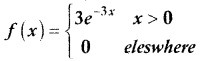
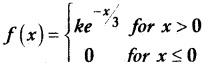
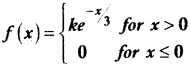
The time to failure in thousands of hours of an electronic equipment used in a manufactured computer has the density function
Samacheer Kalvi 12th Maths Guide Chapter 11 Probability Distributions Ex 11.4 13
Find the expected life of this electronic equipment.
Solution:
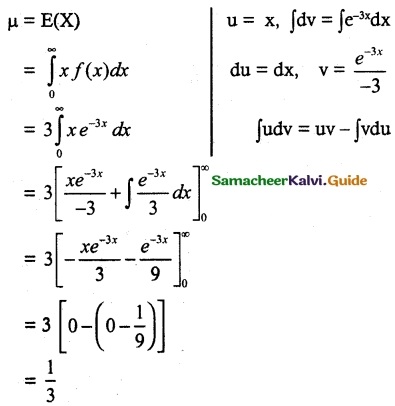
Samacheer Kalvi 12th Maths Guide Chapter 11 Probability Distributions Ex 11.4 14
Expected life of the electronic equipment = \(\frac { 1 }{ 3 }\)

Samacheer Kalvi 12th Maths Guide Chapter 11 Probability Distributions Ex 11.4

Question 7.
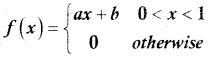
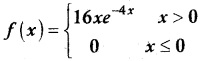
The probability density function of the random variable X is given by
Samacheer Kalvi 12th Maths Guide Chapter 11 Probability Distributions Ex 11.4 15
find the mean and variance of X.
Solution:
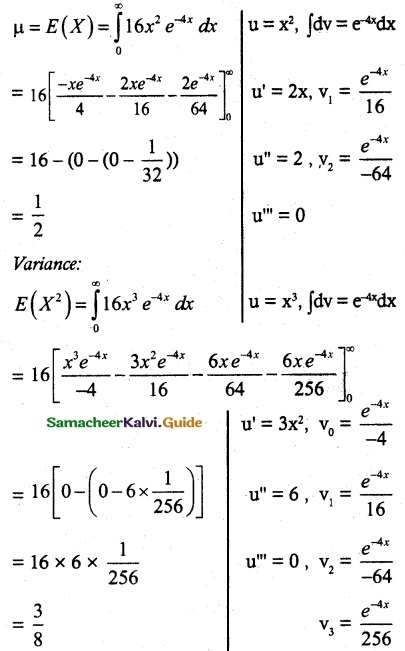
Mean:
Samacheer Kalvi 12th Maths Guide Chapter 11 Probability Distributions Ex 11.4 16
Var (X) = E(X²) – [E(X)]²
\(\frac { 3 }{ 8 }\) – \(\frac { 1 }{ 4 }\)
= \(\frac { 1 }{ 8 }\)

Samacheer Kalvi 12th Maths Guide Chapter 11 Probability Distributions Ex 11.4

Question 8.
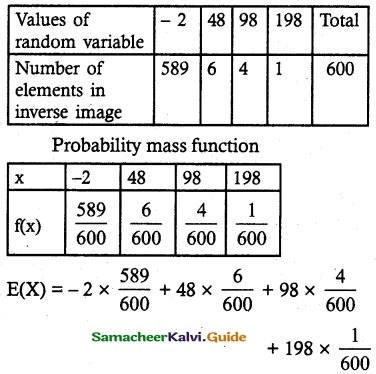
A lottery with 600 tickets gives one prize of Rs 200, four prizes of Rs 100 and six prizes of Rs 50. If the ticket costs is Rs 2, find the expected winning amount of a ticket.
Solution:
Let X be the random variable denotes the amount win in the lottery
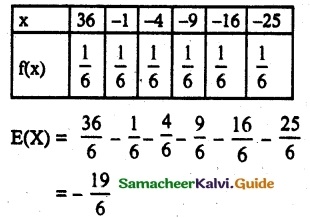
Samacheer Kalvi 12th Maths Guide Chapter 11 Probability Distributions Ex 11.4 17
= 0.5
Loss = Rs 0.5

Samacheer Kalvi 12th Maths Guide Chapter 11 Probability Distributions Ex 11.4

Samacheer Kalvi 12th Commerce Guide Chapter 9 Human Resource Management

Tamilnadu State Board New Syllabus Samacheer Kalvi 12th Commerce Guide Pdf Chapter 9 Human Resource Management Text Book Back Questions and Answers, Notes.

Tamilnadu Samacheer Kalvi 12th Commerce Solutions Chapter 9 Human Resource Management

12th Commerce Guide Human Resource Management Text Book Back Questions and Answers

I. Choose The Correct Answer.

Question. 1
Human resource is a …………. asset.
a) Tangible
b) Intangible
c) Fixed
d) Current
Answer:
b) Intangible

Question 2.
Human Resource management is both ………………….. and ………………..
a) Science and art
b) Theory and practice
c) History and Geography
d) None of the above
Answer:
a) Science and art

Samacheer Kalvi 12th Commerce Guide Chapter 8 Securities Exchange Board of India

Question 3.
Planning is a …………. Function.
a) selective
b) pervasive
c) both a and b
d) none of the above
Answer:
b) pervasive

Question 4.
Human resource management determines the ……………………….. relationship.
a) internal, external
b) employer, employee
c) Owner, Servant
d) Principle, Agent
Answer:
b) employer, employee

Question 5.
Labour turnover is the rate at which employees ………….. the organisation.
a) enter
b)leave
c) salary
d)None of the above
Answer:
b) leave

Samacheer Kalvi 12th Commerce Guide Chapter 8 Securities Exchange Board of India

II. Very Short Answer Questions.

Question 1.
Give the meaning of Human Resource.
Answer:
In an organisation, the human resource is the employees who are inevitable for the survival and success of the enterprise.

Question 2.
What is Human Resource Management?
Answer:
The Branch of Management that deals with managing resource is known as “Human Resource Management (HRM)

Samacheer Kalvi 12th Commerce Guide Chapter 8 Securities Exchange Board of India

Question 3.
State two features of HRM.
Answer:
Features of Human Resource Management.
Universally relevant: Human Resource Management has universal relevance.
Goal-oriented: The accomplishment of organisational goals is made possible through the best utilisation of human resources in an organisation.

Question 4.
Mention two characteristics of Human Resource. [OWE]
Answer:

  • HR is Only factor of production that lives.
  • HR can be Work as a team.
  • HR – Exhibits innovations and creativity.

Samacheer Kalvi 12th Commerce Guide Chapter 8 Securities Exchange Board of India

Question 5.
What are the managerial functions of HRM.
Answer:
The functions of human resource management may be classified as under: I Managerial function – Planning, Organising, Directing, Controlling.
II Operative function – Procurement, Development, Compensation, Retention, Integration, Maintenance.

III. Short Answer Questions.

Question 1.
Define the term Human Resource Management.
Answer:
HRM – Definition:
“HRM as that part of management process which is primarily concerned with the human constituents of an organisation”. E.F.L. BRECH

Samacheer Kalvi 12th Commerce Guide Chapter 8 Securities Exchange Board of India

Question 2.
What are the characteristics of Human resources? [OWE] [MOM]
Answer:

  1. Human resource exhibits innovation and creativity.
  2. Human resources alone can think, act, analyse and interpret.
  3. Human resources are emotional beings.
  4. Human resources can be motivated either financially or non-financially.
  5. The behaviour of human resources is unpredictable.
  6. Over the years human resources gain value and appreciation.
  7. Human resources are movable.
  8. Human resources can work as a team.

Question 3.
What is the significance of Human resource?
Answer:

  • HR is possible only through human relations.
  • HR managers all other factors of production.
  • HR can be utilised at all levels of management.
  • HR is helpful to utilise all other resources.
  • HR helps in industrial relation.
  • HR well protected by legal frame works.

Samacheer Kalvi 12th Commerce Guide Chapter 8 Securities Exchange Board of India

Question 4.
State the functions of Human Resource Management.
Answer:
The functions of human resource management may be classified as under: I Managerial function – Planning, Organising, Directing, Controlling.
II Operative function – Procurement, Development, Compensation, Retention, Integration, Maintenance.

  1. Planning: Planning is deciding in advance what to do, how to do and who is to do it. It bridges the gap between where we are and where we want to go.
  2. Organising: It includes division of work among employees by assigning each employee their duties, delegation of authority as required.
  3. Procurement: Acquisition deals with job analysis, human resource planning, recruitment, selection, placement, transfer and promotion.
  4. Development: Development includes performance appraisal, training, executive development, career planning and development, organisational development.
  5. Compensation: It deals with job evaluation, wage and salary administration, incentives, bonuses, fringe benefits and social security schemes.

IV. Long Answer Questions.

Question 1.
Explain the characteristics of Human Resource. [OWE] [MOM] [LACE] (any 5) Characteristics
Answer:

  •  HR is the Only factor of production that lives.
  •  HR can Work as a team.
  •  HR Exhibits innovation and creativity.
  •  HR is Movable.
  •  HR Over years – gain values.
  •  HR can Motivated either in cash or in kind.
  •  HR the Labour of employees that is hired and not the employee himself.
  •  HR alone Act, Analyse, Think and interpret.
  •  HR Create all other resources.
  •  HR are Emotional beings.

Samacheer Kalvi 12th Commerce Guide Chapter 8 Securities Exchange Board of India

Question 2.
Describe the significance of Human Resource Management. (MEERA) (JCE) (any 5)
Answer:
The role of human resource management is the process of acquiring, training, appraising, and compensating employees. The significance of human resource management is given below:

  1. To identify manpower needs: Determination of manpower needs in an organisation is very important as it is a form of investment.
  2. To ensure the correct requirement of manpower: At any time the organisation should
    not suffer from shortage or surplus manpower which is made possible through human resource management
  3. To select the right man for the right job: Human resource management ensures the right talent to select the right employee for the right job.
  4. To update the skill and knowledge: Human resource management enables employees to remain up-to-date through training and development programmes.
  5. To appraise the performance of employees: A periodical appraisal of the performance of employees through human resource management activities boosts up good performers and motivates slow performers.

Samacheer Kalvi 12th Commerce Guide Chapter 8 Securities Exchange Board of India

Question 3.
Elaborate on the Managerial functions of Human Resource Management.
Answer:
Managerial Functions : [COP] [D]
Controlling”

  • It is comparing the actuals with the standards and to check whether activities are going on as per plan and rectify deviations.
  • The control process includes fixing the standards, measuring actual performance, comparing the actual with standard laid down, measuring deviations and taking corrective decisions.
  • This is made possible through observation, supervision, reports, records and audit.

Organising:

  • It includes division of work among employees assigning duties to each employee.
  • Delegation of authority as required, creation of accountability to make employees responsible.

Planning:

  • Planning is thinking before doing.
  • Planning is deciding in advance What to do, How to do, Who is to do it.
  • It bridges the gap between where we are and where we want to go.
  • It involves determination of objectives, policies, procedures, rules, strategies, programmes and budgets.

Directing:

  • It involves issue of orders and instructions along with supervision, guidance and motivation to get the best out of employees.
  • This reduces waste of time, energy and money and early attainment of organisational objectives.

Question 4.
Discuss the Operative functions HRM.
Answer:
Operating functions of HRM:

  1. Procurement: Acquisition deals with job analysis, human resource planning, recruitment, selection, placement and promotion.
  2. Development: It includes performance appraisal, training, executive development, and organizational development.
  3. Compensation: It deals with job evaluation, wage and salary administration, incentives, bonus schemes.
  4. Retention: This is made possible through health and safety, social security, job satisfaction and quality of work life.
  5. Maintenance: This encourages employees to work with job satisfaction, reducing labour turnover, for human resource.

Samacheer Kalvi 12th Commerce Guide Chapter 8 Securities Exchange Board of India

12th Commerce Guide Human Resource Management Additional Important Questions and Answers

I. Choose the correct answer.

Question 1.
create all other resources.
a) Skill
b) workforce
c) Natural resources
d) Human resource
Answer:
d) Human resources

Question 2.
The function of HRM concerned with …………………………
a) Motivating
b) Maintaining
c) Hiring
d) All of these
Answer:
d) All of those

Samacheer Kalvi 12th Commerce Guide Chapter 8 Securities Exchange Board of India

Question 3.
How to encourage the best performer in an organisation?
a) Bonus
b) incentives
c) Both (a) and (b)
d) NOTA
Answer:
c) Both (a) and (b)

Question 4.
Human Resource Exbhits ……………………
a) Talent
b) Creativity
c) Innovation
d) All of those
Answer:
d) All of those

Question 5.
Who are inevitable for the survival and success of the enterprise?
a) Employee
b) Proprietors
c) Debtors
d) Creditors
Answer:
a) Employee

Samacheer Kalvi 12th Commerce Guide Chapter 8 Securities Exchange Board of India

Question 6.
HR is ………………
a) Im-morable
b) In-tangble
c) Movable
d) NOTA
Answer:
c) Movable

II. Match the following

Question 1.
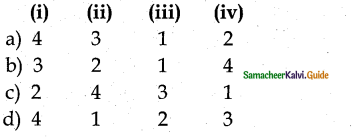
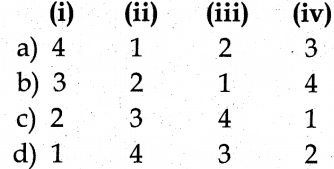
Match List I with List – II

List -i

List – ii

(i) HR 1.Right man Right Job
(ii) HRM 2.Integration
(iii) Operative Function 3. Planning
(iv) Managerial Function 4. Employers

Samacheer Kalvi 12th Commerce Guide Chapter 9 Human Resource Management 1
Answer:
a) (i) 4,(ii) 1,(iii) 2,(iv) 3

Samacheer Kalvi 12th Commerce Guide Chapter 8 Securities Exchange Board of India

III. Very short answer questions.

Question 1.
Define the term Human Resource.
Answer:
Man of all sources available to him, can grow and develop”.

Question 2.
Give two points of difference between HR and HRM .[MO]
Answer:

Basis of Difference

HR
Human Resource

HRM
Human Resource Management

1.Motivation HR can be motivated in cash or kind. HR goal is achieved and employers are satisfied.
2. Organisational Goal Formulate policies by giving individual needs and organisational needs. HRM goal is achieved both employers and employees are satisfied.

Samacheer Kalvi 12th Commerce Guide Chapter 8 Securities Exchange Board of India

IV. Long Answer Questions.

Question 1.
Explain the features of HRM? [CUGAI]
Answer:
Continuous Process:
As long as there is HR in the running of an organisation, the activities relating to managing , HR exists.

Universal Relevent:

  • HRM has universal relevance.
  • The approach and style varies depending the nature of organisation structure and is applicable at all levels.

Goal Oriented :
The accomplishment of organisational goals is made possible through best utilisation of HR is an organisation.

A Systematic Approach:
HRM lavs emphasis on a systematic approaching in managing the tasks performed by HR of an organisation.

Intangible:
HRM is an intangible function which can be measured only by results.
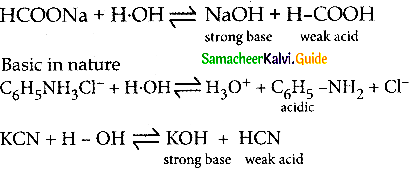
Samacheer Kalvi 12th Commerce Guide Chapter 8 Securities Exchange Board of India

Question 2.
Differentiate HR from HRM.[MOPET]
Answer:

Basis of Difference

HR
Human Resource

HRM
Human Resource Management

1. Motivation HR can be motivated in cash or kind. Formulate policies by giving individual needs and organisational needs.
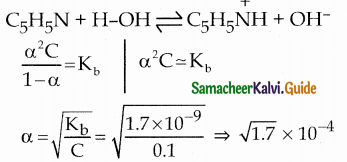
2. Organisational Goal HR goal is achieved and employers are satisfied. HRM goal is achieved both employers and employees are satisfied.
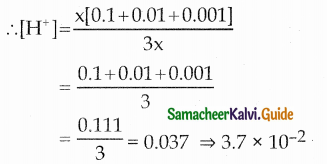
3. Production HR is the only factor of production. HRM has universal relevance.
4. Exhibits HR exhibits innovation and creativity. HRM is strategic function.
5. Think HR alone think, act, analyse and interpret. HRM is development oriented. It provides space for employee involvement, performance and growth.


Samacheer Kalvi 12th Maths Guide Chapter 11 Probability Distributions Ex 11.3

Tamilnadu State Board New Syllabus Samacheer Kalvi 12th Maths Guide Pdf Chapter 11 Probability Distributions Ex 11.3 Textbook Questions and Answers, Notes.

Tamilnadu Samacheer Kalvi 12th Maths Solutions Chapter 11 Probability Distributions Ex 11.3

Question 1.
The probability density function of X is given by
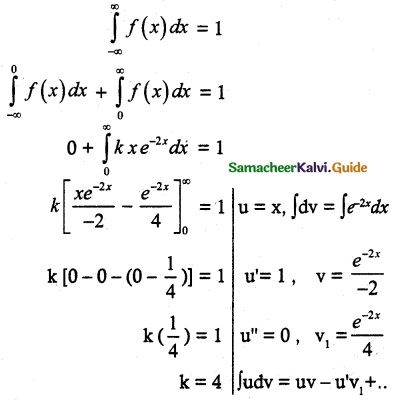
Samacheer Kalvi 12th Maths Guide Chapter 11 Probability Distributions Ex 11.3 1
Find the value of k.
Solution:
Since f(x) is a probability density function
Samacheer Kalvi 12th Maths Guide Chapter 11 Probability Distributions Ex 11.3 2

Samacheer Kalvi 12th Maths Guide Chapter 11 Probability Distributions Ex 11.3

Question 2.
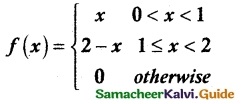
The probability density function of X is
Samacheer Kalvi 12th Maths Guide Chapter 11 Probability Distributions Ex 11.3 3
Find
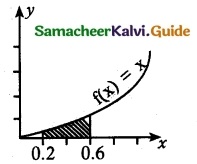
(i) P(0.2 ≤ X < 0.6)
(ii) P(1.2 ≤ X < 1.8)
(iii) P(0.5 ≤ X < 1.5)
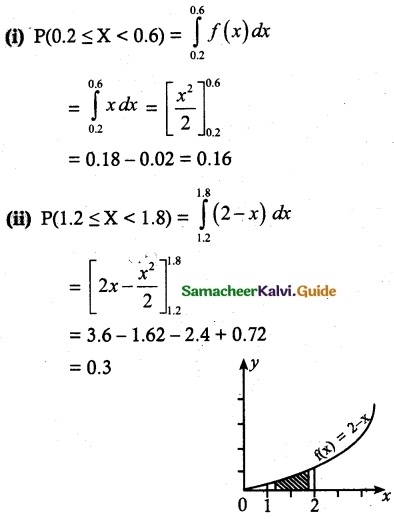
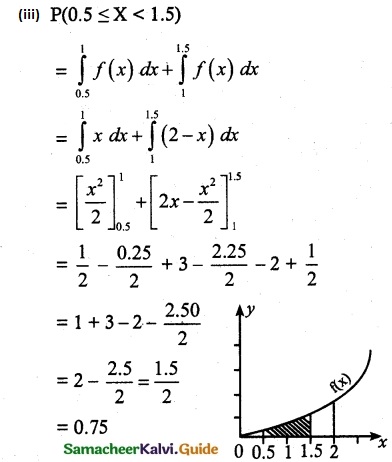
Solution:
Samacheer Kalvi 12th Maths Guide Chapter 11 Probability Distributions Ex 11.3 4
Samacheer Kalvi 12th Maths Guide Chapter 11 Probability Distributions Ex 11.3 5

Samacheer Kalvi 12th Maths Guide Chapter 11 Probability Distributions Ex 11.3

Question 3.
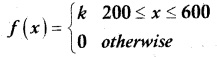
Suppose the amount of milk sold daily at a milk booth is distributed with a minimum of 200 litres and a maximum of 600 litres with probability density function
Samacheer Kalvi 12th Maths Guide Chapter 11 Probability Distributions Ex 11.3 6
Find
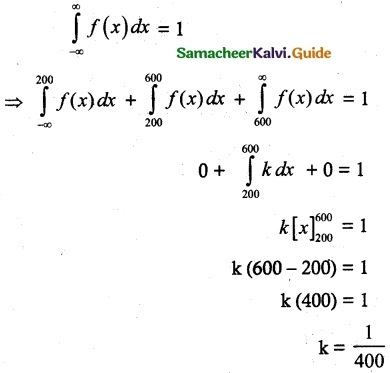
(i) the value of k
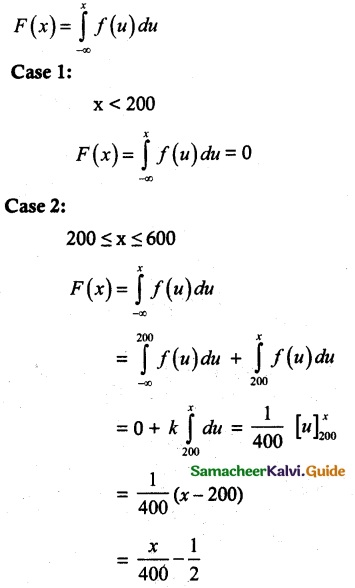
(ii) the distribution function
(iii) the probability that daily sales will fall between 300 litres and 500 litres?
Solution:
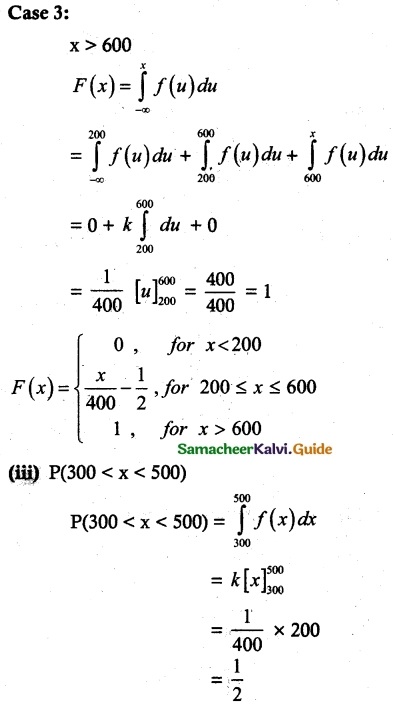
Samacheer Kalvi 12th Maths Guide Chapter 11 Probability Distributions Ex 11.3 21
(i) Since f(x) is a probability density function
Samacheer Kalvi 12th Maths Guide Chapter 11 Probability Distributions Ex 11.3 7
Samacheer Kalvi 12th Maths Guide Chapter 11 Probability Distributions Ex 11.3 8
Samacheer Kalvi 12th Maths Guide Chapter 11 Probability Distributions Ex 11.3 9

Samacheer Kalvi 12th Maths Guide Chapter 11 Probability Distributions Ex 11.3

Question 4.
The probability density function of X is given by
Samacheer Kalvi 12th Maths Guide Chapter 11 Probability Distributions Ex 11.3 10
Find
(i) the value of k
(ii) the distribution function
(iii) P(X < 3)
(iv) P(5 ≤ X)
(v) P(X ≤ 4)
Solution:
(i) Since f is a probability density function
Samacheer Kalvi 12th Maths Guide Chapter 11 Probability Distributions Ex 11.3 11

Samacheer Kalvi 12th Maths Guide Chapter 11 Probability Distributions Ex 11.3

(ii) The distribution function F(x) = \(\int_{-\infty}^{x}\) f(u) du
Samacheer Kalvi 12th Maths Guide Chapter 11 Probability Distributions Ex 11.3 12
Samacheer Kalvi 12th Maths Guide Chapter 11 Probability Distributions Ex 11.3 13

Samacheer Kalvi 12th Maths Guide Chapter 11 Probability Distributions Ex 11.3

Question 5.
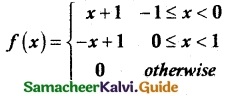
If X is the random variable with probability density function f(x) given by,
Samacheer Kalvi 12th Maths Guide Chapter 11 Probability Distributions Ex 11.3 14
then find
(i) the distribution function F(x)
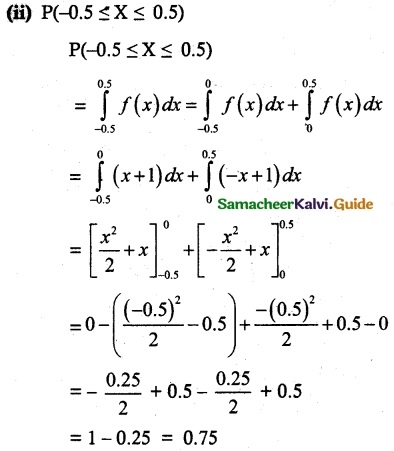
(ii) P(-0.5 ≤ x ≤ 0.5)
Solution:
Distribution function F(x) = \(\int_{-\infty}^{x}\) f(u) du
case 1.
x < -1
F(x) = \(\int_{-\infty}^{x}\) f(u) du = 0
Samacheer Kalvi 12th Maths Guide Chapter 11 Probability Distributions Ex 11.3 15
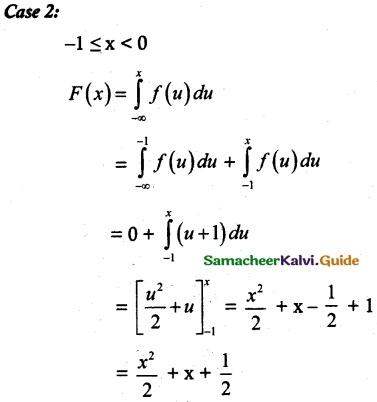
Samacheer Kalvi 12th Maths Guide Chapter 11 Probability Distributions Ex 11.3 16
Samacheer Kalvi 12th Maths Guide Chapter 11 Probability Distributions Ex 11.3 17
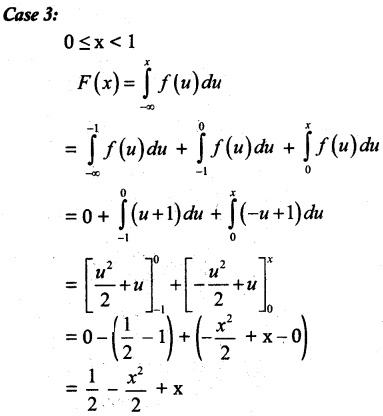
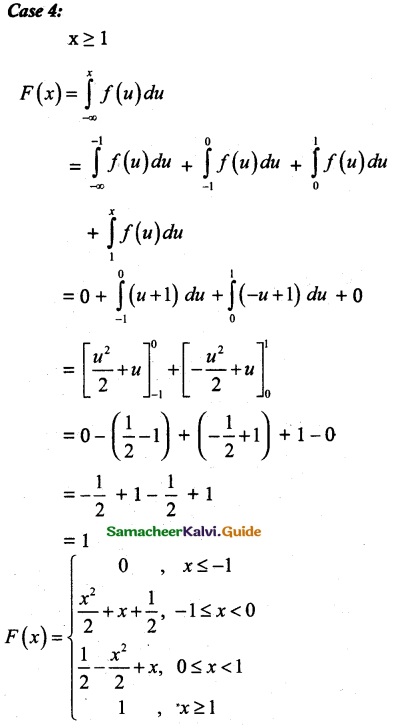
Samacheer Kalvi 12th Maths Guide Chapter 11 Probability Distributions Ex 11.3 18

Samacheer Kalvi 12th Maths Guide Chapter 11 Probability Distributions Ex 11.3

Question 6.
If X is the random variable with distribution function F(x) given by,
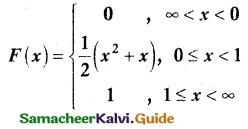
Samacheer Kalvi 12th Maths Guide Chapter 11 Probability Distributions Ex 11.3 19
Find
(i) the probability density function f(x)
(ii) P(0.3 ≤ X ≤ 0.6)
Solution:
(i) Probability density function
Samacheer Kalvi 12th Maths Guide Chapter 11 Probability Distributions Ex 11.3 20

(ii) P(0.3 ≤ X ≤ 0.6)
P(a ≤ X ≤ b) = F(b) – F(a)
P(0.3 ≤ X ≤ 0.6) = F(0.6) – F(0.3)
= \(\frac { 1 }{ 2 }\) [(0.6)² + (0.6)] – \(\frac { 1 }{ 2 }\) [(0.3)² + (0.3)]
= \(\frac { 1 }{ 2 }\) (0.96 – 0.39)
= 0.285

Samacheer Kalvi 12th Maths Guide Chapter 11 Probability Distributions Ex 11.3

Samacheer Kalvi 12th Maths Guide Chapter 11 Probability Distributions Ex 11.2

Tamilnadu State Board New Syllabus Samacheer Kalvi 12th Maths Guide Pdf Chapter 11 Probability Distributions Ex 11.2 Textbook Questions and Answers, Notes.

Tamilnadu Samacheer Kalvi 12th Maths Solutions Chapter 11 Probability Distributions Ex 11.2

Question 1.
Three fair coins are tossed simultaneously. Find the probability mass function for a number of heads that occurred.
Solution:
When three coins are tossed, the sample space is
S = {HHH, HHT, HTH, HTT, THH, THT, TTH, TTT}
‘X’ is the random variable that denotes the number of heads.
∴ ‘X’ can take the values of 0, 1, 2 and 3Sample space S = {HHH, HHT, HTH, THH, HTT, THT, TTH, TTT}
Samacheer Kalvi 12th Maths Guide Chapter 11 Probability Distributions Ex 11.2 1
Probability mass function
Samacheer Kalvi 12th Maths Guide Chapter 11 Probability Distributions Ex 11.2 2

Samacheer Kalvi 12th Maths Guide Chapter 11 Probability Distributions Ex 11.2

Question 2.
A six sided die is marked ‘1’ on one face, ‘3’ on two of its faces and ‘5’ on remaining three faces. The die is thrown twice. If X denotes the total score in two throws, find
(i) the probability mass function
(ii) the cumulative distribution function
(iii) P(4 ≤ X < 10)
(iv) P(X ≥ 6)
Solution:
Let X be the random variable denotes the total score in two thrown of a die.
Sample space S
Samacheer Kalvi 12th Maths Guide Chapter 11 Probability Distributions Ex 11.2 3
n (S) = 36
X = {2, 4, 6, 8, 10}
Samacheer Kalvi 12th Maths Guide Chapter 11 Probability Distributions Ex 11.2 4

(i) Probability mass function
Samacheer Kalvi 12th Maths Guide Chapter 11 Probability Distributions Ex 11.2 5

Samacheer Kalvi 12th Maths Guide Chapter 11 Probability Distributions Ex 11.2

(ii) Cumulative distribution function
Samacheer Kalvi 12th Maths Guide Chapter 11 Probability Distributions Ex 11.2 6
= \(\frac { 36 }{ 36 }\)
= 1
Samacheer Kalvi 12th Maths Guide Chapter 11 Probability Distributions Ex 11.2 7
Samacheer Kalvi 12th Maths Guide Chapter 11 Probability Distributions Ex 11.2 8

Samacheer Kalvi 12th Maths Guide Chapter 11 Probability Distributions Ex 11.2

Question 3.
Find the probability mass function and cumulative distribution function of a number of girl children in families with 4 children, assuming equal probabilities for boys and girls.
Solution:
Let X be the random variable denotes the number of girl child among 4 children
X = {0, 1, 2, 3, 4}
Samacheer Kalvi 12th Maths Guide Chapter 11 Probability Distributions Ex 11.2 9
(i) Probability mass function
Samacheer Kalvi 12th Maths Guide Chapter 11 Probability Distributions Ex 11.2 10

(ii) Cumulative distribution
Samacheer Kalvi 12th Maths Guide Chapter 11 Probability Distributions Ex 11.2 11
Samacheer Kalvi 12th Maths Guide Chapter 11 Probability Distributions Ex 11.2 12

Samacheer Kalvi 12th Maths Guide Chapter 11 Probability Distributions Ex 11.2

Question 4.
Suppose a discrete random variable can only take the values 0, 1, and 2. The probability mass function is defined by
Samacheer Kalvi 12th Maths Guide Chapter 11 Probability Distributions Ex 11.2 13
Find (i) the value of k.
(ii) cumulative distribution function
(iii) P(X ≥ 1)
Solution:
Samacheer Kalvi 12th Maths Guide Chapter 11 Probability Distributions Ex 11.2 14
(i) Given f is a probability mass function
\(\sum_{x}\) f(x) = 1
Probability mass function is
Samacheer Kalvi 12th Maths Guide Chapter 11 Probability Distributions Ex 11.2 15

(ii) Cumulative distribution function
F(0) = P(x ≤ 0)
= P(x = 0)
= \(\frac { 1 }{ 8 }\)
F(1) = P(x ≤ 1)
= P(x = 0) + P(x = 1)
= \(\frac { 1 }{ 8 }\) + \(\frac { 2 }{ 8 }\) = \(\frac { 3 }{ 8 }\)
F(2) = P(x ≤ 2)
= P(x = 0) + P(x = 1) + P(x = 2)
= \(\frac { 1 }{ 8 }\) + \(\frac { 2 }{ 8 }\) + \(\frac { 5 }{ 8 }\) = 1
Samacheer Kalvi 12th Maths Guide Chapter 11 Probability Distributions Ex 11.2 16

(iii) P(X ≥ 1)
= P(X = 1) + P(X = 2)
= \(\frac { 2 }{ 8 }\) + \(\frac { 5 }{ 8 }\) + \(\frac { 7 }{ 8 }\)

Samacheer Kalvi 12th Maths Guide Chapter 11 Probability Distributions Ex 11.2

Question 5.
The cumulative distribution function of a discrete random variable is given by
Samacheer Kalvi 12th Maths Guide Chapter 11 Probability Distributions Ex 11.2 17
Find
(i) the probability mass function
(ii) P(X < 1)
(iii) P(X ≥ 2)
Solution:
Samacheer Kalvi 12th Maths Guide Chapter 11 Probability Distributions Ex 11.2 18
f(-1) = P(X = -1) = F(-1) – F(-1) = 0.15 – 0 = 0.15
f(0) = P(X = 0) = F(0) – F(-1) = 0.35 – 0.15 = 0.20
f(1) = P(X = 1) = F(1) – F(0) = 0.60 – 0.35 = 0.25
f(2) = P(X = 2) = F(2) – F(1) = 0.85 – 0.60 = 0.25
f(3) = P(X = 3) = F(3) – F(2) = 1 – 0.85 = 0.15
Samacheer Kalvi 12th Maths Guide Chapter 11 Probability Distributions Ex 11.2 19
(ii) P(X < 1)
P(X < 1) = P(X = -1) + P(X = 0)
= 0.15 + 0.20
= 0.35

(iii) P(X ≥ 2)
P(X ≥ 2) = P(X = 2) + P(X = 3)
= 0.25 + 0.15
= 0.40

Samacheer Kalvi 12th Maths Guide Chapter 11 Probability Distributions Ex 11.2

Question 6.
A random variable X has the following probability mass function.
Samacheer Kalvi 12th Maths Guide Chapter 11 Probability Distributions Ex 11.2 20
Find
(i) the value of k
(ii) P(2 ≤ X < 5)
(iii) P(3 < X)
Solution:
(i) Given f(x) in a probability mass function
\(\sum_{x}\) f(x) = 1
k² + 2k² + 3k² + 2k + 3k = 1
6k² + 5k = 1
6k² + 5k – 1 = 0
(k + 1) (6k – 1) = 0
k = \(\frac { 1 }{ 6 }\)
(k ≠ -1 neglecting negative terms)
Probability mass function
Samacheer Kalvi 12th Maths Guide Chapter 11 Probability Distributions Ex 11.2 21

(ii) P(2 ≤ X < 5)
P(2 ≤ X < 5) = P(X = 2) + P(X = 3) + P(X = 4)
= \(\frac { 2 }{ 36 }\) + \(\frac { 3 }{ 36 }\) + \(\frac { 2 }{ 6 }\)
= \(\frac { 2+3+12 }{ 36 }\) + \(\frac { 17 }{ 36 }\)

(iii) P(X > 3) = P(X = 4) + P(X = 5)
= \(\frac { 2 }{ 6 }\) + \(\frac { 3 }{ 6 }\)
= \(\frac { 5 }{ 6 }\)

Samacheer Kalvi 12th Maths Guide Chapter 11 Probability Distributions Ex 11.2

Question 7.
The cumulative distribution function of a discrete random variable is given by
Samacheer Kalvi 12th Maths Guide Chapter 11 Probability Distributions Ex 11.2 22
Find
(i) the probability mass function
(ii) P(X < 3) and (iii) P(X ≥ 2)
Solution:
(i) Probability mass function
Samacheer Kalvi 12th Maths Guide Chapter 11 Probability Distributions Ex 11.2 23

(ii) P(X < 3)
P(X < 3) = P(X = 0) + P(X = 1) + P(X = 2)
= \(\frac { 1 }{ 2 }\) + \(\frac { 1 }{ 10 }\) + \(\frac { 1 }{ 5 }\)
= \(\frac { 4 }{ 5 }\)

(ii) P(X ≥ 2)
P(X ≥ 2) = P(X = 2) + P(X = 3) + P(X = 4)
= \(\frac { 1 }{ 5 }\) + \(\frac { 1 }{ 10 }\) + \(\frac { 1 }{ 10 }\)
= \(\frac { 4 }{ 10 }\) = \(\frac { 2 }{ 5 }\)

Samacheer Kalvi 12th Maths Guide Chapter 11 Probability Distributions Ex 11.2

Samacheer Kalvi 12th Maths Guide Chapter 11 Probability Distributions Ex 11.1

Tamilnadu State Board New Syllabus Samacheer Kalvi 12th Maths Guide Pdf Chapter 11 Probability Distributions Ex 11.1 Textbook Questions and Answers, Notes.

Tamilnadu Samacheer Kalvi 12th Maths Solutions Chapter 11 Probability Distributions Ex 11.1

Question 1.
Suppose X is the number of tails that occurred when three fair coins are tossed once simultaneously. Find the values of the random variable X and number of points in it. inverse – images.
Solution:
Let X is the random variable that denotes the number of tails when three coins are tossed simultaneously.
Sample space S = {HHH, HHT, HTH, HTT, THH, THT, TTH, TTT}
∴ ‘X’ takes the values 0,1, 2, 3
i.e., X (HHH) = 0 ; X (HHT, HTH, THH) = 1 ; X (HTT, THT, TTH) = 2 ; X (TTT) = 3
Samacheer Kalvi 12th Maths Guide Chapter 11 Probability Distributions Ex 11.1 1

Samacheer Kalvi 12th Maths Guide Chapter 11 Probability Distributions Ex 11.1

Question 2.
In a pack of 52 playing cards, two cards are drawn at random simultaneously. If the number of black cards drawn is a random variable, find the values of the random variable and number of points in its inverse images.
Solution:
Let X be the random variable of number of black cards occur.
∴ X = {0, 1, 2}
The sample space consists of 52C2 = 1326
X = 0, X (both are white cards) = 26C2 = 325
X = 1, X (one black and one white cards)
= 26C1 × 26C1
= 676
X = 2, X (both are black cards) = 26C2 = 325
Samacheer Kalvi 12th Maths Guide Chapter 11 Probability Distributions Ex 11.1 2

Samacheer Kalvi 12th Maths Guide Chapter 11 Probability Distributions Ex 11.1

Question 3.
An urn contains 5 mangoes and 4 apples. Three fruits are taken at random. If the number of apples taken is a random variable, then find the values of the random variable and number of points in its inverse images.
Solution:
Number of mangoes = 5
Number of Apples = 4
Total number of fruits = 9
Let ‘X’ be the random variable that denotes the number of apples taken, then it takes the values 0, 1, 2, 3
X (MMM) = 0
X (AMM (or) MAM (or) MMA) = 1
X (AAM (or) AMA (or) MAA) = 2
X (AAA) = 3
Samacheer Kalvi 12th Maths Guide Chapter 11 Probability Distributions Ex 11.1 3

Samacheer Kalvi 12th Maths Guide Chapter 11 Probability Distributions Ex 11.1

Question 4.
Two balls are chosen randomly from an urn containing 6 red and 8 black balls. Suppose that we win Rs 15 for each red ball selected and we lose Rs 10 for each black ball selected. If X denotes the winning amount, then find the values of X and the number of points in its inverse images.
Solution:
Let X be the random variable that denotes the j winning amount.
X (Both are black balls) = Rs 2 (-10) = -Rs 20
X (one red and one black ball) = Rs 15 – Rs 10 = Rs 5
X (both are red ball) = Rs 2 (15) = Rs 30
∴ X = {-20, 5, 30}
The sample space consists of 14C2 = 91
X = – 20, Both black balls = 8C2 = 28
X = 5, One black, one red ball = 8C1 × 6C1
= 8 × 6 = 48
X = 30, Both are white balls = 6C2 = 15
Samacheer Kalvi 12th Maths Guide Chapter 11 Probability Distributions Ex 11.1 4

Samacheer Kalvi 12th Maths Guide Chapter 11 Probability Distributions Ex 11.1

Question 5.
A six-sided die is marked ‘2’ on one face, ‘3’ on two of its faces, and ‘4’ on the remaining three faces. The die is thrown twice. If X denotes the total score in two throws, find the values of the random variable and number of points in its inverse images.
Solution:
Let X be the random variable denotes the total score is two throws of a die.
Sample Space S
Samacheer Kalvi 12th Maths Guide Chapter 11 Probability Distributions Ex 11.1 5
n (S) = 36
X = {4, 5, 6, 7, 8}
From the sample space
Samacheer Kalvi 12th Maths Guide Chapter 11 Probability Distributions Ex 11.1 6

Samacheer Kalvi 12th Maths Guide Chapter 11 Probability Distributions Ex 11.1

Samacheer Kalvi 12th Commerce Guide Chapter 8 Securities Exchange Board of India

Tamilnadu State Board New Syllabus Samacheer Kalvi 12th Commerce Guide Pdf 8 Securities Exchange Board of India Text Book Back Questions and Answers, Notes.

Tamilnadu Samacheer Kalvi 12th Commerce Solutions Chapter 8 Securities Exchange Board of India

I. Choose The Correct Answer.

Question 1.
Securities Exchange Board of India was first established in the year…………………
a) 1988
b) 1992
c) 1995
d) 1998
Answer:
a) 1988

Samacheer Kalvi 12th Commerce Guide Chapter 8 Securities Exchange Board of India

Question 2.
The headquarters of SEBI is…………..
a) Calcutta
b) Bombay
c) Chennai
d) Delhi
Answer:
b) Bombay

Question 3.
In which year SEBI was constituted as the regulator of capital markets in India?
a) 1988
b) 1992
c) 2014
d) 2013
Answer:
a) 1988

Samacheer Kalvi 12th Commerce Guide Chapter 7 Stock Exchange

Question 4.
Registering and controlling the functioning of collective investment schemes as………….
a) Mutual Funds
b) Listing
c) Rematerialisation
d) Dematerialization
Answer:
d) Dematerialization

Question 5.
SEBI is empowered by the Finance ministry to nominate ………………….. members on the Governing body of every stock exchange.
a) 5
b) 3
c) 6
d) 7
Answer:
b) 3

Question 6.
The process of converting physical shares into electronic form is called ………………
a) Dematerialisation
b) Delisting
c) Materialisation
d) Debarring
Answer:
a) Dematerialisation

Samacheer Kalvi 12th Commerce Guide Chapter 7 Stock Exchange

Question 7.
Trading is dematerialized shares commenced on the NSE is ………………………
a) January 1996
b) June 1998
c) December 1996
d) December 1998
Answer:
c) December 1996

Question 8.
…………..was the first company to trade its shares in Demat form.
a) Tata Industries
b) Reliance Industries
c) Infosys
d) Birla Industries
Answer :
b) Reliance Industries

Samacheer Kalvi 12th Commerce Guide Chapter 7 Stock Exchange

Question 9.
…………….. enables small investors to participate in the investment on the share capital of large companies.
a) Mutual Funds
b) Shares
c) Debentures
d) Fixed deposits
Answer:
a) Mutual Funds

Question 10.
PAN stands for …………………
a) Permanent Amount Number
b) Primary Account Number
c) Permanent Account Number
d)Permanent Account Nominee
Answer:
c) Permanent Account Number

II. Very Short Answer Questions.

Question 1.
Write short notes on SEBI.
Answer:
Securities and Exchange Board of India (SEBI) was first established in the year 1988 as a non-statutory body for regulating the securities market.

Samacheer Kalvi 12th Commerce Guide Chapter 7 Stock Exchange

Question 2.
Write any two objectives of SEBI.
Answer:
Control Over Brokers:
The important object is to supervise or check the activities of the Brokers, and other intermediaries in order to control the capital market.

Regulation of Stock Exchange :

  • The first objective of SEBI is to regulate the Stock Exchange.
  • So that efficient services may be provided to all the parties operating there.

Question 3.
What is a Demat Account?
Answer:
A Demat account holds all the shares that are purchased in electronic or dematerialized form.

Samacheer Kalvi 12th Commerce Guide Chapter 7 Stock Exchange

Question 4.
Mention the headquarters of SEBI.
Answer:
Head Quarters – Mumbai [Bandra Kurla – Complex]
Samacheer Kalvi 12th Commerce Guide Chapter 8 Securities Exchange Board of India 1.
Question 5.
What are the various ID proofs?
Answer:
Proof of identity: PAN card, voter’s ID, passport, driver’s license, bank attestation, IT returns, electricity bill, telephone bill, ID cards with applicant’s photo issued by the central or state government are the ID proofs.

Samacheer Kalvi 12th Commerce Guide Chapter 7 Stock Exchange

III. Short Answer Questions.

Question 1.
What is meant by Dematerialization?
Answer:

  •  Dematerialization [DEMAT] is the process by which physical share certificates of an investor are taken back by the Company or Register and destroyed.
  • Then an equivalent number of securities in the Electronic form is credited to the investor’s account with his Depository Participant. [DP]
  •  DEMAT is done at the request of the Investor.
  •  He has to open an account with a DP.
  •  In DEMAT A/c – Purchase – Credited his account.
  •  In DEMAT A/ c – Sales – Debited his account

Question 2.
What are the documents required for a Demat account?
Answer:

  • For opening a Demat account, we submit proof of identity and address along with a passport size photo and the account opening form.
  • Documents for Identity: Pan card, Voters ID, Passport, Driver’s License, IT Returns, Electricity and Telephone Bills are the Identity documents.
  • Documents for Address: Ration card, Passport, Voter’s ID card, Driving License, Telephone Bills, Electricity bills are the address documents.
Samacheer Kalvi 12th Commerce Guide Chapter 7 Stock Exchange

Question 3.
What is the power of SEBI under the Securities Contract Act?
Answer:

  •  Power to grant License to the new stock exchange.
  •  Power to direct any stock exchange to amend the rules.
  •  Power to supersede governing body of any stock exchange.
  •  Power to ask for information and accounts of the stock exchange.
  •  Power to suspend the business of the stock exchange.
  •  Power to prohibit contracts of the stock exchange.

Question 4.
What is meant by Insider trading?
Answer:
Insider trading means the buying and selling of securities by directors, promoters, etc., who have access to some confidential information about the company. This affects the interests of the general investors and is essential to check this tendency.

Question 5.
Draw the organizational structure of SEBI.
Answer:
Organization Structure of SEBI

Samacheer Kalvi 12th Commerce Guide Chapter 8 Securities Exchange Board of India 2

IV. Long Answer Questions.

Question 1.
What are the functions of SEBI?
Answer:
functions:

  •  SEBI is the NODAL agency which safeguards the interests of an investor in the Indian Financial Market.
    SEBI performs:
    https://samacheer-kalvi.com/wp-content/uploads/2021/01/img-4.png
  • Safeguarding the interest of the investors by means of adequate education and guidance.
  • SEBI makes Rules and Regulations that must be strictly followed by the participants of the financial market.
  • Regulating and Controlling the business on Stock Exchange.
  • Registration of Brokers and sub-brokers is made mandatory.
  • Conduct inspection and inquiries of stock exchanges, intermediaries, and self-regulating organizations.
  • Barring insider trading in securities.
  • Prohibiting deceptive and unfair methods by intermediaries.
  • Registering and Controlling share agents, bankers, trustees, registrars, merchant bankers, underwriters, managers, etc.
  • SEBI regulates mergers and amalgamation as a way to protect the interest of the investors. Registering and Controlling the function of collective investment schemes such as mutual funds.
  • Promoting self-regulatory organizations intermediaries.
    Carrying out steps in order to develop the capital markets by having an accommodating approach.

Samacheer Kalvi 12th Commerce Guide Chapter 7 Stock Exchange

Question 2.
Explain the powers of SEBI.
Answer:

The various powers of a SEBI are explained below:

  1. Powers Relating to Stock Exchanges and Intermediaries: SEBI has wide powers to get the information from the stock exchange and intermediaries regarding their business transactions for inspection.
  2. Power to Impose Monetary Penalties: SEBI has the power to impose monetary penalties on capital market intermediaries for violations.
  3. Power to Initiate Actions in Functions Assigned
  4. Power to Regulate Insider Trading: SEBI has the power to regulate insider trading or can regulate the functions of merchant bankers.
  5. Powers Under Securities Contracts Act: For the regulation of the stock exchange, the Ministry of Finance issued a notification, for delegating several of its powers under the securities contract Act.

Question 3.
What are the benefits of Dematerialisation? (advantages)
Answer:
Benefits of Dematerialisation:

  1. The risks relating to physical certificates like loss, theft, forgery are eliminated completely with a Demat Account.
  2. The risk of paperwork enables quicker transactions and higher efficiency in trading.
  3. The shares which are created through mergers and consolidation of companies are credited automatically in the Demat account.
  4. There is no stamp duty for the transfer of securities.
  5. Certain banks also permit holding of both equity and debt securities in a single account
  6. A Demat account holder can buy or sell any amount of shares.

Samacheer Kalvi 12th Commerce Guide Chapter 7 Stock Exchange

12th Commerce Guide Securities Exchange Board of India Additional Important Questions and Answers

I.Choose the correct answer.

Question 1.
In which year is SEBI Act being passed by the Indian Parliament?
a) 1990
b) 1991
c) 1992
d) 1993
Answer:
c) 1992

Question 2.
…………….. is the foremost objective of SEBI.
a) Security
b) Regulate
c) Control
d) NOTA
Answer:
a) Security

Samacheer Kalvi 12th Commerce Guide Chapter 8 Securities Exchange Board of India

Question 1.
SEBI got the statutory powers in the year _____
(a) 1988
(b) 1992
(c) 1969
(d) 1980
Answer:
(b) 1992

Question 4.
Which is an Apex body that maintains and Regulates the capital market?
a) Stock Exchange
b) SEBI
c) OTCEI
d) NSE
Answer:
b) SEBI

Samacheer Kalvi 12th Commerce Guide Chapter 8 Securities Exchange Board of India

Question 5.
Name the three key functions of SEBI.
Answer:
SEBI performs three key functions.
They are:

  1. quasi-legislative
  2. quasi-judicial
  3. quasi-executive

Question 6.
SEBI has the following number of members including the chairman.
a) 4
b) 5
c) 6
d) 7
Answer:
c) 6

Samacheer Kalvi 12th Commerce Guide Chapter 8 Securities Exchange Board of India

Question 7.
Pick the odd one out:
a) Voter ID
b) PAN
c) ID card
d) PostCard
Answer:
d) Post Card

Question 8.
which one of the following is not correctly matched?
a) DEMAT – Dematerialisation
b) PAN – Proof
c) SEBI -12 members
d) HQ – Bendrakurla
Answer :
c) SEBI -12 members

Samacheer Kalvi 12th Commerce Guide Chapter 8 Securities Exchange Board of India

Question 9.
Choose the correct statement.
(i) SEBI Act was passed in the year 1992 in Indian Parliament.
(ii) It protects the interest of the Investors.
(iii) It Regulates and controls the stock exchange.
a) (i) is correct
b) (ii) is correct
c) (iii) is correct
d) All (i), (ii) and (iii) are correct
Answer :
d) All (i), (ii) and (iii) are correct
Samacheer Kalvi 12th Commerce Guide Chapter 8 Securities Exchange Board of India

II. Match the following

Question 1.

List-I

List-II

i. SEBI 1. Dematerialization
ii. DEMAT 2. A Supervisory Body
iii. PAN 3. Buying and Selling by director
iv. Insider Trading 4. Permanent Account Number

Samacheer Kalvi 12th Commerce Guide Chapter 8 Securities Exchange Board of India 5
Answer :
a) (i) – 2, (ii) – 1, (iii) – 4, (iv) – 3

Samacheer Kalvi 12th Commerce Guide Chapter 8 Securities Exchange Board of India

III. Assertion and Reason :

Question 1. Assertion (A): DEMAT is done at the request of the investor.
Reason (R): A DEMAT A/c holder can buy or sell any amount of shares.
a) (A) is True (R) is True
b) (A) and (R) are False
c) (A) is True (R) is False
d) (A) is False (R) is True
Answer :
a) (A) is True (R) is True

Question 2.
Assertion (A): SEBI is a supervisory (Apex) Body.
Reason (R): So, It cannot regulates and control the stock exchange.
a) (A) is True (R) is False
b) (A) is False (R) is True
c) Both (A) and (R) are True
d) Both (A) and (R) are False
Answer :
a) (A) is True (R) is False|

Samacheer Kalvi 12th Commerce Guide Chapter 8 Securities Exchange Board of India

IV. Very Short answer questions.

Question 1.
Write a note on PAN.
Answer:
PAN, or permanent account number, is a unique 10-digit alphanumeric identity allotted to each taxpayer by the Income Tax Department. It also serves as identity proof.

Samacheer Kalvi 12th Maths Guide Chapter 10 Ordinary Differential Equations Ex 10.9

Tamilnadu State Board New Syllabus Samacheer Kalvi 12th Maths Guide Pdf Chapter 10 Ordinary Differential Equations Ex 10.9 Textbook Questions and Answers, Notes.

Tamilnadu Samacheer Kalvi 12th Maths Solutions Chapter 10 Ordinary Differential Equations Ex 10.9

Choose the most suitable answer from the given four alternatives:

Question 1.
The order and degree of the differential equation \(\frac { d^2y }{ dx^2 }\) + (\(\frac { dy }{ dx }\))1/3 + x1/4 = o are respectively
(a) 2, 3
(b) 3, 3
(c) 2, 6
(d) 2, 4
Solution:
(a) 2, 3
Hint:
Samacheer Kalvi 12th Maths Guide Chapter 10 Ordinary Differential Equations Ex 10.9 1
In this equation, the highest order derivative is \(\frac { d^2y }{ dx^2 }\) & its power is 3.
∴ Its order = 2 & degree = 3

Samacheer Kalvi 12th Maths Guide Chapter 10 Ordinary Differential Equations Ex 10.9

Question 2.
The differential equation representing the family of curves y = A cos (x + B), where A and B are parameters, is
(a) \(\frac { d^2y }{ dx^2 }\) – y = 0
(b) \(\frac { d^2y }{ dx^2 }\) + y = 0
(c) \(\frac { d^2y }{ dx^2 }\) = 0
(d) \(\frac { d^2x }{ dy^2 }\) = 0
Solution:
(b) \(\frac { d^2y }{ dx^2 }\) + y = 0
Hint:
Given equation is y = A cos (x + B) …….. (1)
where A & B are parameters.
Differentiating equation (1) twice successively, because we have two arbitrary constants.
\(\frac { dy }{ dx }\) = A sin (x + B)
Again differentiating \(\frac { d^2y }{ dx^2 }\) = -A cos(x + B) = -y
∵ y = A cos (x + B
∵ \(\frac { d^2y }{ dx^2 }\) + y = 0 as the required differential equation.

Question 3.
The order and degree of the differential equation, \(\sqrt { sin x }\) (dx + dy) = \(\sqrt { cos x }\) (dx – dy) is
(a) 1, 2
(b) 2, 2
(c) 1, 1
(d) 2, 1
Solution:
(c) 1, 1
Hint:
Given \(\sqrt { sin x }\) (dx + dy) = \(\sqrt { cos x }\) (dx – dy)
divide by dx on both sides, we get
Samacheer Kalvi 12th Maths Guide Chapter 10 Ordinary Differential Equations Ex 10.9 2
In this equation, the highest, order derivative is \(\frac { dy }{ dx }\) & its power is 1.
∴ Its order = 1 & degree = 1

Question 4.
The order of the differential equation of all circles with centre at (h, k) and radius ‘a’ is
(a) 2
(b) 3
(c) 4
(d) 1
Solution:
(a) 2
Hint:
We know that equation of a circle be (x – h)² + (y – k)² = a².
Here we have two constants. Therefore, Its order is 2.

Samacheer Kalvi 12th Maths Guide Chapter 10 Ordinary Differential Equations Ex 10.9

Question 5.
The differential equation of the family of curves y = Aex + Be-x, where A and B are arbitrary constants is
(a) \(\frac { d^2y }{ dx^2 }\) + y = 0
(b) \(\frac { d^2y }{ dx^2 }\) – y = 0
(c) \(\frac { dy }{ dx }\) + y = 0
(d) \(\frac { dy }{ dx }\) – y = 0
Solution:
(b) \(\frac { d^2y }{ dx^2 }\) – y = 0
Hint:
Given y = Aex + Be-x ……… (1)
where A & B are arbitrary constants.
Differentiate equation(1) twice continuously, we get
(∵ Two constants so differentiate twice)
Samacheer Kalvi 12th Maths Guide Chapter 10 Ordinary Differential Equations Ex 10.9 3
\(\frac { d^2y }{ dx^2 }\) – y = 0 as the required differential equation.

Question 6.
The general solution pf the differential equation \(\frac { dy }{ dx }\) = \(\frac { y }{ x }\) is
(a) xy = k
(b) y = k log x
(c) y = kx
(d) log y = kr
Solution:
(c) y = kx
Hint:
Given \(\frac { dy }{ dx }\) = \(\frac { y }{ x }\)
The equation can be written as
\(\frac { dy }{ y }\) = \(\frac { dx }{ x }\)
Integrating on both sides, we get
∫\(\frac { dy }{ y }\) = ∫\(\frac { dy }{ x }\)
log y = log x + log k
log y = log k x [∵ log m + log n = log mn]
Remove log, we get
y = kx is a required differential equation

Question 7.
The solution of the differential equation 2x\(\frac { dy }{ dx }\) – y = 3 represents
(a) straight lines
(b) circles
(c) parabola
(d) ellipse
Solution:
(c) parabola
Hint:
Samacheer Kalvi 12th Maths Guide Chapter 10 Ordinary Differential Equations Ex 10.9 4
2 log (3 + y) = log x + log k
log (3 + y)² = log kx
Remove log, we get
(3 + y)² = kx is a solution of the differential equation which is a Parabola.

Samacheer Kalvi 12th Maths Guide Chapter 10 Ordinary Differential Equations Ex 10.9

Question 8.
The solution of \(\frac { dy }{ dx }\) + p(x) y = 0 is
(a) y = ce∫pdx
(b) y = ce-∫pdx
(c) x = ce-∫pdy
(d) x = ce∫pdy
Solution:
(b) y = ce-∫pdx
Hint:
Given \(\frac { dy }{ dx }\) + p(x) y = 0
\(\frac { dy }{ dx }\) = -p(x)y
The equation can be written as
\(\frac { dy }{ y }\) = -p(x) dx
Taking integration on both sides, we get
Samacheer Kalvi 12th Maths Guide Chapter 10 Ordinary Differential Equations Ex 10.9 5
∴ y = ce-∫pdx is a solution of the given differential equation.

Question 9.
The integrating factor of the differential equation \(\frac { dy }{ dx }\) + y = \(\frac { 1+y }{ x }\) is
(a) \(\frac { x }{ e^x }\) + y = 0
(b) \(\frac { e^x }{ x }\) – y = 0
(c) λex
(d) ex
Solution:
(b) \(\frac { e^x }{ x }\) – y = 0
Hint:
Given differential equation is
Samacheer Kalvi 12th Maths Guide Chapter 10 Ordinary Differential Equations Ex 10.9 6

Question 10.
The Integrating factor of the differential equation \(\frac { dy }{ dx }\) + p(x) y = Q(x) is x, then p(x)
(a) x
(b) \(\frac { x^2 }{ 2 }\)
(c) \(\frac { 1 }{ x }\)
(d) \(\frac { 1 }{ x^2 }\)
Solution:
(c) \(\frac { 1 }{ x }\)
Hint:
The given differential equation is
\(\frac { dy }{ dx }\) + p(x) y = Q(x)
Integrating factor e∫pdx = x
Taking log on both sides, we get ∫p dx = log x
Now differentiating, we get I
\(\frac { d }{ dx }\) [∫p dx]= \(\frac { d }{ dx }\) [log x]
∴ p = \(\frac { 1 }{ x }\)

Samacheer Kalvi 12th Maths Guide Chapter 10 Ordinary Differential Equations Ex 10.9

Question 11.
The degree of the differential equation
y(x) = 1 + \(\frac { dy }{ dx }\) + \(\frac { 1 }{ 1.2 }\) (\(\frac { dy }{ dx }\))² + \(\frac { 1 }{ 1.2.3 }\) (\(\frac { dy }{ dx }\))³ + ……. is
(a) 2
(b) 3
(c) 1
(d) 4
Solution:
(c) 1
Hint:
Given
y(x) = 1 + \(\frac { dy }{ dx }\) + \(\frac { 1 }{ 1.2 }\) (\(\frac { dy }{ dx }\))² + \(\frac { 1 }{ 1.2.3 }\) (\(\frac { dy }{ dx }\))³ + ……
Here the highest derivative term is \(\frac { dy }{ dx }\) and its power is 1.
∴ Degree of the differential equation is 1.

Question 12.
If p and q are the order and degree of the differential equation y \(\frac { dy }{ dx }\) +x³ (\(\frac { d^2y }{ dx^2 }\)) + xy = cos x, when
(a) p < q
(b) p = q
(c) p > q
(d) p exists and q does not exist
Solution:
(c) p > q
Hint:
Given equation is y\(\frac { dy }{ dx }\) +x³ (\(\frac { d^2y }{ dx^2 }\)) + xy = cos x
The highest order derivative of the differential equation is \(\frac { d^2y }{ dx^2 }\) and its degree is 1.
∴ Its order is p = 2 and degree q = 1
∴ p > q

Question 13.
The solution of the differential equation \(\frac { dy }{ dx }\) + \(\frac { 1 }{ \sqrt{1-x^2} }\) = 0 is
(a) y + sin-1 x = c
(b) x + sin-1 y = 0
(c) y² + 2sin-1 x = c
(d) x² + 2sin-1 y = 0
Solution:
(a) y + sin-1 x = c
Hint:
The given equation is \(\frac { dy }{ dx }\) = –\(\frac { 1 }{ \sqrt{1-x^2} }\)
The equation can be written as
dy = \(\frac { 1 }{ \sqrt{1-x^2} }\)
Integrating on both sides, we get
∫dy = -∫\(\frac { dx }{ \sqrt{1-x^2} }\)
y = -sin-1 (x) + C
y + sin-1 (x) = C
∴ y + sin-1 (x) = C is a solution of the given differential equation.

Samacheer Kalvi 12th Maths Guide Chapter 10 Ordinary Differential Equations Ex 10.9

Question 14.
The solution of the differential equation \(\frac { dy }{ dx }\) = 2xy is
(a) y = Ce
(b) y = 2x² + C
(c) y = Ce-x² + C
(d) y = x² + C
Solution:
(a) y = Ce
Hint:
Given
\(\frac { dy }{ dx }\) = 2xy
The equation can be written as
\(\frac { dy }{ y }\) = 2xdx
Taking integration on both sides, we get
Samacheer Kalvi 12th Maths Guide Chapter 10 Ordinary Differential Equations Ex 10.9 7
∴ y = Ce is a solution to the differential equation.

Question 15.
The general solution of the differential equation log(\(\frac { dy }{ dx }\)) = x + y is
(a) ex + ey = C
(b) ex + e-y = C
(c) e-x + ey = C
(d) e-x + e-y = C
Solution:
(b) ex + e-y = C
Hint:
Given differential equation is log \(\frac { dy }{ dx }\) = x + y,
log \(\frac { dy }{ dx }\) = x + y
\(\frac { dy }{ dx }\) = ex+y = ex ey
\(\frac { dy }{ dx }\) = ex ey
The given equation can be written as
\(\frac { dy }{ dx }\) = ex ey
e-y dy = ex dx
Taking integration on both sides, we get
∫ e-y dy = ∫ ex dx
\(\frac { e^{-y} }{ -1 }\) = ex + C
-e-y = ex + C
-ex – e-y = C
-(ex + e-y) = C
ex + e-y = -C
∴ ex + e-y = C Where – C = C
∴ ex + e-y = C is a solution of the given differential equation.

Question 16.
The solution of \(\frac { dy }{ dx }\) = 2y-x is
(a) 2x + 2y = C
(b) 2x – 2y = C
(c) \(\frac { 1 }{ 2^x }\) – \(\frac { 1 }{ 2^y }\) = C
(d) x + y = C
Solution:
(c) \(\frac { 1 }{ 2^x }\) – \(\frac { 1 }{ 2^y }\) = C
Hint:
Given
\(\frac { dy }{ dx }\) = 2y-x
The equation can be written as
Samacheer Kalvi 12th Maths Guide Chapter 10 Ordinary Differential Equations Ex 10.9 8
\(\frac { 1 }{ 2^x }\) – \(\frac { 1 }{ 2^y }\) = C is a solution of the given differential equation.

Samacheer Kalvi 12th Maths Guide Chapter 10 Ordinary Differential Equations Ex 10.9

Question 17.
The solution of the differential equation
\(\frac { dy }{ dx }\) = \(\frac { y }{ x }\) + \(\frac { ∅(\frac { y }{ x }) }{ ∅(\frac { y }{ x }) }\) is
(a) x∅(\(\frac { y }{ x }\)) = k
(b) ∅(\(\frac { y }{ x }\)) = kx
(c) y∅(\(\frac { y }{ x }\)) = k
(d) ∅(\(\frac { y }{ x }\)) = ky
Solution:
(b) ∅\(\frac { y }{ x }\) = kx
Hint:
Samacheer Kalvi 12th Maths Guide Chapter 10 Ordinary Differential Equations Ex 10.9 9
log ∅(v) = log x + log k
log ∅(v) = log xk
∅(v) = kx
∅(y/x) = kx

Question 18.
If sin x is the integrating factor of the linear differential equation \(\frac { dy }{ dx }\) + Py = Q, then P is
(a) log sin x
(b) cos x
(c) tan x
(d) cot x
Solution:
(d) cot x
Hint:
Given integrating factor
e∫pdx = sin x
∫pdx = log sin x ……. (1)
Differential equation (1) with respect to x, we get
Samacheer Kalvi 12th Maths Guide Chapter 10 Ordinary Differential Equations Ex 10.9 10
∴ The value of P is cot x

Question 19.
The number of arbitrary constants in the general solutions of order n and n + 1 is respectively.
(a) n – 1, n
(b) n, n + 1
(c) n + 1, n + 2
(d) n + 1, n
Solution:
(b) n, n + 1
Hint:
If one arbitrary constant, Differentiate one time, so order is 1.
If two arbitrary constants, Differentiate two times, so order is 2.
.
.
.
If n arbitrary constants, Differentiate n times, so the order is n.
If n + 1 arbitrary constants, Differentiate n + 1 times, so order is n + 1.

Samacheer Kalvi 12th Maths Guide Chapter 10 Ordinary Differential Equations Ex 10.9

Question 20.
The number of arbitrary constants in the particular solution of a differential equation of third order is
(a) 3
(b) 2
(c) 1
(d) 0
Solution:
(d) 0

Question 21.
Integrating factor of the differential equation
\(\frac { dy }{ dx }\) = \(\frac { x+y+1 }{ x+1 }\) is
(a) \(\frac { 1 }{ x+1 }\)
(b) x+ 1
(c) \(\frac { 1 }{ \sqrt{x+1} }\)
(d) \(\sqrt { x+1 }\)
Solution:
(a) \(\frac { 1 }{ x+1 }\)
Hint:
Samacheer Kalvi 12th Maths Guide Chapter 10 Ordinary Differential Equations Ex 10.9 11

Question 22.
The population P in any year t is such that the rate of increase in the population is proportional to the population. Then
(a) P = Cekt
(b) P = Ce-kt
(c) P = Ckt
(d) Pt = C
Solution:
(a) \(\frac { 1 }{ x+1 }\)
Hint:
Samacheer Kalvi 12th Maths Guide Chapter 10 Ordinary Differential Equations Ex 10.9 12

Samacheer Kalvi 12th Maths Guide Chapter 10 Ordinary Differential Equations Ex 10.9

Question 23.
P is the amount of certain substance left in after time t. If the rate of evaporation of the substance is proportional to the amount remaining, then
(a) P = Cekt
(b) P = Ce-kt
(c) P = Ckt
(d) Pt = C
Solution:
(b) P = Ce-kt
Hint:
Samacheer Kalvi 12th Maths Guide Chapter 10 Ordinary Differential Equations Ex 10.9 13

Question 24.
If the solution of the differential equation \(\frac { dy }{ dx }\) = \(\frac { ax+3 }{ 2y+f }\) represents a circle, then the value of a is
(a) 2
(b) -2
(c) 1
(d) -1
Solution:
(b) -2
Hint:
Given \(\frac { dy }{ dx }\) = \(\frac { ax+3 }{ 2y+f }\)
The equation can be written as
(2y + f) dy = (ax + 3) dx ……. (1)
Integrating equation (1) on both sides, we get
Samacheer Kalvi 12th Maths Guide Chapter 10 Ordinary Differential Equations Ex 10.9 14
It is solution of the given differential equation.
Since this solution represents a circle,
co-efficient of x² = co-efficient of y²
i.e) \(\frac { a }{ 2 }\) = -1
a = -2

Question 25.
The slope at any point of a curve y = f(x) is given by \(\frac { dy }{ dx }\) = 3x² and it passes through (-1, 1). Then the equation of the curve is
(a) y = x³ + 2
(b) y = 3x² + 4
(c) y = 3x³ + 4
(d) y = x³ + 5
Solution:
(a) y = x³ + 2
Hint:
Given differential equation is \(\frac { dy }{ dx }\) = 3x²
The equation can be written as dy = 3x² dx ……… (1)
Integrating equation (1) on both sides, we get
∫dy = ∫ 3x²dx
y = \(\frac { 3x^3 }{ 3 }\) + C
y = x³ + C …….. (2)
Since it passes through (-1, 1)
So, y = x³ + C becomes
1 =(-1)³ + C
1 = -1 + C
1 + 1 = C
∴ C = 2
Substituting C value in equation (2), We get The equation of the curve is y = x³ + 2

Samacheer Kalvi 12th Maths Guide Chapter 10 Ordinary Differential Equations Ex 10.9

Samacheer Kalvi 12th Chemistry Guide Chapter 14 Biomolecules

Tamilnadu State Board New Syllabus Samacheer Kalvi 12th Chemistry Guide Pdf Chapter 14 Biomolecules Text Book Back Questions and Answers, Notes.

Tamilnadu Samacheer Kalvi 12th Chemistry Solutions Chapter 14 Biomolecules

12th Chemistry Guide Biomolecules Text Book Back Questions and Answers

Part – I Text Book Evaluation

I. Choose the Correct Answer

Question 1.
Which one of the following rotates the plane polarized light towards left? (NEET Phase – II)
a) D(+) Glucose
b) L(+) Glucose
c) D(-) Fructose
d) D(+) Galactose
Answer:
c) D(-) Fructose

Question 2.
The correct corresponding order of names of four aldoses with configuration given below Respectively is, (NEET Phase I)1551
a) L-Erythrose, L-Threose, L-Erythrose, D-Threose
b) D-Threose,D-Ervthrose, L-Threose, L-Erythrose
c) L-Erythrose, L-Threose, D-Erythrose, D-Threose
d) D-Erythrose, D-Threose, L-Erythrose, L-Threose
Answer:
d) D-Erythrose, D-Threose, I-Erythrose, L-Threose
 Samacheer Kalvi 12th Chemistry Guide Chapter 14 Biomolecules

Question 3.
Which one given below is a non-reducing sugar? (NEET Phase – I)
a) Glucose
b) Sucrose
c) maltose
d) Lactose
Answer:
b) Sucrose

Question 4.
Glucose(HCN) → Product (hydroIysis) → Product (HI + Heat) A, the compoundA is
a) Heptanoic acid
b) 2-lodohexane
c)Heptane
d) Hep tanol

Answer:
a) Heptanoic acid

Question 5.
Assertion: A solution of sucrose in water is dextrorotatory. But on hydrolysis in the presence of little hydrochloric acid, it becomes levorotatory. (AIIMS)
Reason: Sucrose hydrolysis gives unequal amounts of glucose and fructose. As a result of this change in sign of rotation is observed.
a) If both assertion and reason are true and reason is the correct explanation of assertion
b) If both assertion and reason are true but reason is not the correct explanation of assertion
c) If assertion is true but reason is false
d) If both assertion and reason is false
Answer:
a) If both assertion and reason are true and reason is the correct explanation of assertion

 Samacheer Kalvi 12th Chemistry Guide Chapter 14 Biomolecules

Question 6.
The central dogma of molecular genetics states that the genetic information flows from (NEET Phase-II)
a) Amino acids Protein DNA
b) DNA Carbohydrates Proteins
c) DNA RNA Proteins
d) DNA RNA Carbohydrates
Answer:
c) DNA RNA Proteins

Question 7.
In a protein, various amino acids linked together by (NEET Phase – I)
a) Peptide bond
b) Dative bond
c) α – Glycosidic bond
d) β- Glycosidic bond
Answer:
a) Peptide bond

Question 8.
Among the following, the achiral amino acid is (AIIMS)
a) 2-ethylalanine
b) 2-methyl glycine
c) 2-hydroxymethylserine
d) Tryptophan
Solution:
Samacheer Kalvi 12th Chemistry Guide Chapter 14 Biomolecules 2
Answer:
c) 2-hydroxymethylserine

 Samacheer Kalvi 12th Chemistry Guide Chapter 14 Biomolecules

Question 9.
The correct statement regarding RNA and DNA respectively is (NEET Phase – I)
a) the sugar component in RNA is arabinose and the sugar component in DNA is ribose
b) the sugar component in RNA is 2′- deoxyribose and the sugar component in DNA is arabinose
c) the sugar component in RN A is arabinose and the sugar component in DNA is 2‘- deoxyribose
d) the sugar component in RNA is ribose and the sugar component in DNA is 2 – deoxyribose
Answer:
d) the sugar component in RNA is ribose and the sugar component in DNA is 2′-deoxyribose

Question 10.
In aqueous solution amino acids mostly exist in,
a) NH2-CH(R)-COOH
b) NH2-CH(R)-COO-
c) H3N+-CH(R)-COOH
d) H3N+-CH(R)-COO-
Answer:
d) H3N+-CH(R)-COO-

Question 11.
Which one of the following is not produced by the body?
a) DNA
b) Enzymes
c) Hormones
d) Vitamins
Answer:
d) Vitamins

 Samacheer Kalvi 12th Chemistry Guide Chapter 14 Biomolecules

Question 12.
The number of sp2 and sp 3 hybridised carbon in fructose are respectively
a) 1 and 4
b) 4 and 2
c) 5 and 1
d) 1 and 5
Answer:
d) 1 and 5

Question 13.
Vitamin B2 is also known as
a) Riboflavin
b) Thiamine
c) Nicotinamide
d) Pyridoxine
Answer:
a) Riboflavin

Question 14.
The pyrimidine bases present in DNA are
a) Cytosine and Adenine
b) Cytosine and Guanine
c) Cytosine and Thiamine
d) Cytosine and Uracil
Answer:
c) Cytosine and Thiamine

 Samacheer Kalvi 12th Chemistry Guide Chapter 14 Biomolecules

Question 15.
Among the following L-serine is
Samacheer Kalvi 12th Chemistry Guide Chapter 14 Biomolecules 3
Samacheer Kalvi 12th Chemistry Guide Chapter 14 Biomolecules 4
Answer:
Samacheer Kalvi 12th Chemistry Guide Chapter 14 Biomolecules 5

Question 16.
The secondary structure of a protein refers to
a) fixed configuration of the polypeptide backbone
b) hydrophobic interaction
c) sequence of a-amino acids
d) α -the helical backbone
Answer:
d) α helical backbone

 Samacheer Kalvi 12th Chemistry Guide Chapter 14 Biomolecules

Question 17.
Which of the following vitamins is water-soluble?
a) Vitamin E
b) Vitamin K
c) Vitamin A
d) Vitamin B
Answer:
d) Vitamin B

Question 18.
Complete hydrolysis of cellulose gives
a) L-Glucose
b) D-Fructose
c) D-Ribose
d) D-Glucose
Answer:
d) D-Glucose

Question 19.
Which of the following statement is incorrect?
a) Ovalbumin is a simple food reserve in the egg- white
b) Blood proteins thrombin and fibrinogen are involved in blood clotting
c) Denaturation makes the protein more active
d) Insulin maintains the sugar level in the human body.
Answer:
c) Denaturation makes the protein more active

 Samacheer Kalvi 12th Chemistry Guide Chapter 14 Biomolecules

Question 20.
Glucose is an aldose. Which one of the following reactions is not expected with glucose?
a) It does not form an oxime
h) It does not react with the Grignard reagent
c) It does not form osazones
d) It does not reduce tollens reagent
Answer:
b) It does not react with the Grignard reagent

Question 21.
If one strand of the DNA has the sequence ‘ATGCTTGA’, then the sequence of complementary strand would be
a) TACGAACT
b) TCCGAACT
c) TACGTACT
d) TACGRAGT
Answer:
a) TACGAACT

Question 22.
Insulin, a hormone chemically is
a) Fat
b) Steroid
c) Protein
d) Carbohydrates
Answer:
c) Protein

 Samacheer Kalvi 12th Chemistry Guide Chapter 14 Biomolecules

Question 23.
α -D (+) Glucose and β -D (+) glucose are
a) Epimers
b) Anomers
c) Enantiomers
d) Conformational isomers
Answer:
b) Anomers

Question 24.
Which of the following are epimers
a) D(+)-Glucose and D(+)-Galactose
b) D(+)-Glucose and D(+)-Mannose
c) Neither (a) nor (b)
d) Both (a) and (b)
Answer:
d) Both (a) and (b)

Question 25.
Which of the following amino acids is achiral?
a) Alanine
b) Leucine
c) Proline
d) Glycine
Answer:
d) Glycine

 Samacheer Kalvi 12th Chemistry Guide Chapter 14 Biomolecules

II. Short Answer

Question 1.
What type of linkages holds together monomers of DNA?
Answer:

  1. Phospho diester linkages hold together monomers of DNA
  2. Phosphoric acid forms phospho diester bond between neucleotides
  3. The sugar – phosphate linkage forms the backbone of each strand of DNA.

Question 2.
Give the differences between primary and secondary structure of proteins
Answer:

Primary structure of Proteins Secondary Structure of Proteins
i) Linear Sequence of amino acids Folding of the peptide chain into an α – helix or β- sheet
ii) Linear Either an α- helix or β – sheet
iii) Composed of peptide bonds formed between amino acids Amino acids in the polypeptide chain forms highly regular shapes through hydrogen bonds between the – C = O and – NH2 groups

Question 3.
Name the Vitamins whose deficiency cause

  1. rickets
  2. scurvy

Answer:

  1. Rickets – deficiency of Vitamin D
  2. Scurvy – deficiency of Vitamin C

 Samacheer Kalvi 12th Chemistry Guide Chapter 14 Biomolecules

Question 4.
Write the Zwitter ion structure of alanine
Answer:
Samacheer Kalvi 12th Chemistry Guide Chapter 14 Biomolecules 6

Question 5.
Give any three difference between DNA and RNA
Answer:

DNA RNA
i) Mainly present in nucleus, mitochondria and chloroplast  Mainly present in cytoplasm, nucleolous and ribosomes
ii) Contains deoxyribose sugar Contains ribose sugar
iii) Base pair A = T G  ≡ C Base pair A = U C  ≡ G

Question 6.
Write a short note on peptide bond
Answer:

  • Amino acids are linked covalently by peptide bonds.
  • The carboxyl group of the first amino acid reacts with the amino group of the second amino acid to give an amide linkage between these two amino acids.
  • This amide linkage is called a peptide bond.
  • Peptide bond is –

Samacheer Kalvi 12th Chemistry Guide Chapter 14 Biomolecules 7

  • The resulting compound is called a dipeptide

  • If the number of amino acids attached is less it is called a polypeptide.
  • If the number of amino acids attached is large it is called a protein.

 Samacheer Kalvi 12th Chemistry Guide Chapter 14 Biomolecules

Question 7.
Give two difference between Hormones and vitamins
Answer:

Hormones Vitamins
i) They are organic substances (eg. peptide or a steroid) that is secreted by one tissue into the bloodstream, They are small organic compounds that cannot he synthesised by our body but must be obtained through diet.
ii) Induce physiological response. (eg) growth and metabolism in other tissues Essential for certain functions, their deficiency or excess can cause diseases.

Question 8.
Write a note on the denaturation of proteins.
Answer:
Denaturation of proteins.
1. In general, protein has a unique three – dimensional structure formed by interactions such as disuiphide bond, hydrogen bond, hydrophobic and electrostatic interactions.

2. These interactions can be disturbed when the protein is exposed to a higher temperature in certain chemicals such urea, alternation of pH, ionic strength, etc. It leads to the loss of the three – dimensional structure.

3. The process of a protein-losing its higher-order structure without losing the primary structure, It is called denaturation of the protein. When a protein denatures, its biological function is also lost.

4. Since the primary structure is intact, this process can be reversed in certain proteins. This can happen spontaneously upon restoring the original conditions or with the help of special enzymes called chaperons.

5. Example: Coagulation of egg white by the action of heat.

 Samacheer Kalvi 12th Chemistry Guide Chapter 14 Biomolecules

Question 9.
What is reducing and non – reducing sugars?
Answer:

Reducing Sugars Non – Reducing Sugars
Carbohydrates in which the aldehyde carbon is not involved in the glycosidic bond retain their reducing property are called reducing sugars Carbohydrates in which the carbonyl carbons are involved in the glycosidic bonding lose their reducing property are called non – reducing sugars.

Question 10.
Why carbohydrates are generally optically active?
Answer:

  • Almost all carbohydrates are optically active because the’ have one or more chiral carbon.
  • The number of optical isomers = 2n
    where n = the total number of chiral carbons.

Question 11.
Classify the following into monosaccharides, oligosaccharides and polysaccharides.
i) starch
ii) fructose
iii) sucrose
iv) lactose
v) maltose
Answer:

Monosaccharides Oligo saccharides Polysaccharides
Fructose Sucrose
Lactose
Maltose
Starch

 Samacheer Kalvi 12th Chemistry Guide Chapter 14 Biomolecules

Question 12.
How are vitamins classified?
Answer:
Vitamins are classified into two groups based on their solubility in water and in fat. They are,

  1. Water-soluble vitamins
  2. Oil or fat-soluble vitamins

Water-soluble vitamins – Vitamins which dissolve in water are called water-soluble vitamins. Examples – Vitamins of B group and Vitamin C Oil or fat-soluble vitamins: Vitamins which dissolve in oils or fat are called oil or fat-soluble vitamins. Examples – Vitamin A, D, E and K.

Question 13.
What are hormones? Give Examples.
Answer:
The hormone is an organic substance that is sëcreted by one tissue into the bloodstream and induces a physiological response in other tissues. It is an intercellular signaling molecule. Virtually every process is a complex organism is regulated by one or more hormones. Examples: insulin, epinephrine, estrogen, androgen etc.

Question 14.
Write the structure of all possible dipeptides which can be obtained from glycine and alanine.
Answer:
Samacheer Kalvi 12th Chemistry Guide Chapter 14 Biomolecules 9

 Samacheer Kalvi 12th Chemistry Guide Chapter 14 Biomolecules

Question 15.
Define enzymes.
Answer:
There are many biochemical reactions that occur in our living cells. Digestion of food and harvesting the energy from them, and synthesis of necessary molecules required for various – cellular functions are examples for such reactions. All these reactions are catalysed by special proteins called enzymes.
(or)
Enzymes are biocatalysts produced by the living cells which catalyse many biochemical reactions in animal and plant bodies. They are more specific in their action.

Question 16.
Write the structure of α – D (+) glucophyranos
Answer:
Samacheer Kalvi 12th Chemistry Guide Chapter 14 Biomolecules 10

Question 17.
What are different types of RNA which are found in cell?
Answer:

  • Ribosomal RNA (rRNA)
  • Messenger RNA (rnRNA)
  • Transfer RNA (tRNA)

Question 18.
Write a note on formation of α – helix
Answer:

  • In the α – helix sub – structure, the aminoacids are arranged in a right handed helical (spiral) structure.
  • This structure is stabiised by hydrogen bond between the carhonyl oxygen of one amino acid (nth residue) with amino hydrogen of the fifth residue (n + 4th residue).
  • The side chains of the residues protrude outside of the helix.
  • Each turn of an helix contains about 3.6 residues and in about 5.4 A long.
  • The amino acid proline produces a kink in the helical structure and often called as a helix breaker due to its rigid cyclic structure.

 Samacheer Kalvi 12th Chemistry Guide Chapter 14 Biomolecules

Question 19.
What are the functions of lipids in living organisms?
Answer:

  • Lipids are the integral component of cell membrane. They are necessary for the structural integrity of the cell.
  • The main function of triglycerides in animals is as an energy reserve.
  • They yield more energy than carbohydrates and proteins.
  • They act as a protective coating in aquatic organisms.
  • Lipids of connective tissue give protection to internal organs.
  • Lipids help in the absorption and transport of fat-soluble vitamins.
  • They are essential for the activation of enzymes such as lipases.
  • Lipids act as emulsifiers in fat metabolism.

Question 20.
Is the following sugar, D – sugar or L – sugar?
Answer:
Samacheer Kalvi 12th Chemistry Guide Chapter 14 Biomolecules 11
Because the H and OH on C4 carbon are in the same configuration as the H and OH on C2
carbon in L — Glyceraldehyde.

 Samacheer Kalvi 12th Chemistry Guide Chapter 14 Biomolecules

12th Chemistry Guide Biomolecules Additional Questions and Answers

Part – II – Additional Questions

Question 1.
Polyhydroxy aldehydes or ketones are called
a) Vitamins
b) Enzymes
c) Carbohydrates
d) Lipids
Answer:
c) Carbohydrates

Question 2.
The general molecular formula of Carbohydrates is
a) Cn(H2)O2n
b) Cn(H2O)n
c) Cn(H2O)2n + 2
d) Cn(H2O)2n -2
Answer:
b) Cn(H2O)n

Question 3.
Green leaves of plants, during photosynthesis synthesise
a) Vitamins
b) Enzymes
c) Carbohydrates
d) Lipids
Answer:
c) Carbohydrates

 Samacheer Kalvi 12th Chemistry Guide Chapter 14 Biomolecules

Question 4.
During photosynthesis, carbondioxide and water are converted into
a) Sucrose
b) Fructose
c) Maltose
d) Glucose
Answer:
d) Glucose

Question 5.
The number of optical isomers of a carbohydrate is given by the formula 2n, where n is the number of
a) Carbon atoms
b) Chiral carbon atoms
c) achiral carbon atom
d) hydroxy group
Answer:
b) Chiral Carbon atoms

Question 6.
Which among the following is not a monosaccharide?
a) Fructose
b) Erythrose
c) Maltose
d) Ribose
Answer:
c) Maltose – Disaccharide

 Samacheer Kalvi 12th Chemistry Guide Chapter 14 Biomolecules

Question 7.
The medicinal value of a drug is measured in terms of its
a) Deoxyribose
b) Goldnumber
c) Therapeutic index
d) Equilibrium constant
Answer:
c) Therapeutic index

Question 8.
Fructose is a
a) aldopentose
b) ketopentose
c) aldohexose
d) ketohexose
Answer:
d) ketohexose

Question 9.
Which is known as blood sugar?
a) Glucose
b) fructose
c) sucrose
d) maltose
Answer:
a) Glucose

 Samacheer Kalvi 12th Chemistry Guide Chapter 14 Biomolecules

Question 10.
Sucrose undergoes hydrolysis when boiled with dil.H2So4 to give
a) Glucose
b) fructose
c) both (a) & (b)
d) maltose
Answer:
c) both (a) & (b)

Question 11.
The number of asymmetric carbon atoms present in glucose are
a) 3
b) 4
c) 5
d) 6
Answer:
b) 4

Question 12.
Glucose is
a) dextro rotatory
b) laevorotatory
c) optically inactive
d) non – reducing sugar
Answer:
a) dextro rotatory

 Samacheer Kalvi 12th Chemistry Guide Chapter 14 Biomolecules

Question 13.
GlucoseSamacheer Kalvi 12th Chemistry Guide Chapter 14 Biomolecules 12
a) Saccharic acid, Gluconic acid
b) Gluconic acid, Saccharic acid
c) Glycollic acid, Tartaric acid
d) Tartaric acid, Glycollic acid
Answer:
b) Gluconic acid, Saccharic acid

Question 14.
The isomers called anomers differ in the configuration of
a) C1 carbon
b) C2 carbon
c) C4 carbon
d) C5 carbon
Answer:
a) C1 carbon

Question 15.
The cyclic structure of glucose is similar to
a) furan
b) pyran
c) pyridine
d) pyrrole
Answer:
(b) pyran

 Samacheer Kalvi 12th Chemistry Guide Chapter 14 Biomolecules

Question 16.
Sugars differing in configuration at an asymmetric centre are known as
a) anomers
b) epimers
c) enantimoers
d) diasteromers
Answer:
(b) epimers

Question 17.
D – mannose and D – glucose are
a) C – 2 epimers
b) C – 3 epimers
c) C – 4 epimers
d) C – 5 epimers
Answer:
a) C – 2 epimers

Question 18.
D – glucose and D – galactose are
a) C – 2 epimers
b) C – 3 epimers
c) C – 4 epimers
d) C- 5 epimers
Answer:
c) C – 4 epimers

 Samacheer Kalvi 12th Chemistry Guide Chapter 14 Biomolecules

Question 19.
In our body galactose is coverted into glucose by
a) hydrolysis
b) mutrarotation
c) fermentation
d) epimerisation
Answer:
d) epimerisation

Question 20.
Fructose is .
a) dexto rotatory
b) laevo rotatory
c) optically inactive
d) disaccharide
Answer:
b) laevo rotatory

Question 21.
Glucose and fructose are
a) Chain isomers
b) Position isomers
c) Functional isomers
d) tautomers
Answer:
c) Functional isomers
Hint: Glucose – Aldohexose
Fructose – Ketohexose

 Samacheer Kalvi 12th Chemistry Guide Chapter 14 Biomolecules

Question 22.
Fruit sugar is
a) glucose
b) fructose
c) ribose
d) erythrose
Answer:
b) fructose

Question 23.
Equal amount of glucose and fructose is termed as
a) Fruit sugar
b) blood sugar
c) invert sugar
d) cane sugar
Answer:
c) invert sugar

Question 24.
Sucrose is converted into glucose and fructose by the enzyme
a) Zymase
b) invertase
c) lactase
d) fructase
Answer:
b) invertase

 Samacheer Kalvi 12th Chemistry Guide Chapter 14 Biomolecules

Question 25.
Partial reduction of fructose with sodium amalgam and water produces mixture of
a) D – Glucose and D – mannose
b) Sorbitol and Mannitol
c) GIvcollic acid and Tartaric acid
d) D – Glucose and D – Galactose
Answer:
b) Sorbitol and Mannitol

Question 26.
Sorbitol and Mannitol are
a) enantiomers
b) tautomers
c) epimers
d) functional isomers
Answer:
c) epimers

Question 27.
Which of the following statement incorrect?
a) Nucleoside + Phosphate → Nucleotide
b) Nucleoside + Base → Nucleotide
c) Sugar + Base → Nucleoside
d) n Nucleoside → Polynucleotide
Answer:
b) Nucleoside + Base → Nucleotide

 Samacheer Kalvi 12th Chemistry Guide Chapter 14 Biomolecules

Question 28.
The number of asymmetric carbon atom present in fructose is
a) 2
b) 3
c) 4
d) 5
Answer:
b) 3

Question 29.
Fructose forms a five membered ring similar to
a) Furan
b) Pyran
c) Pyridime
d) Pyrrole
Answer:
a) Furan

Question 30.
The general formula of disaccharides is
a) Cn(H2O)2n
b) Cn(H2O)n
c) Cn(H2O)n-1
d) Cn(H2O)2n + 2
Answer:
c) Cn(H2O)n-1

 Samacheer Kalvi 12th Chemistry Guide Chapter 14 Biomolecules

Question 31.
In disaccharides, two monosaccharides are linked by
a) hydrogen bond
b) ionic bond
c) peptide linkage
d) glvcosidic linkage
Answer:
d) glycosidic linkage

Question 32.
Honey is a mixture of
i) glucose
ii) fructose
iii) sucrose
iv) Maltose
a) (i) & (ii)
b) (ii) & (iii)
c) (i (ii) & (iii)
d) (i), (ii), (iv)
Answer:
c) (i), (ii), (iii)

Question 33.
Which carbon atoms of α -D – glucose and β – D – fructose are joined together in sucrose?
a) C1 and C2
b) C1 and C4
c) C1 and C5
d) C2 and C4
Answer:
a) C1 and C2

 Samacheer Kalvi 12th Chemistry Guide Chapter 14 Biomolecules

Question 34.
The disaccharide present in milk of mammals is
a) glucose
b) lactose
c) maltose
d) sucrose
Answer:
b) lactose

Question 35.
Which among the following is a non-reducing sugar
a) Lactose
b) Maltose
c) Sucrose
d) Glucose
Answer:
c) sucrose

Question 36.
On hydrolysis lactose gives
i) galactose
ii) glucose
iii) fructose
iv) maltose
a) (i) & (ii) h) (ii) & (iii)
b)(ii) & (iii)
c) (iii) & (iv) d) (i) & (iv)
d)(i)&(iv)
Answer:
a) (i) & (ii)

 Samacheer Kalvi 12th Chemistry Guide Chapter 14 Biomolecules

Question 37.
Which is produced during digestion of starch by the enzyme a – amylase?
a) Glucose
b) Maltose
c) Lactose
d) Sucrose
Answer:
b) Maltose

Question 38.
Which carbon atoms of a -D glucose are linked to form maltose?
a) C1 and C2
b) C1 and C3
c) C1 and C4
d) C3 and C4
Answer:
c) C1 and C4

Question 39.
Which among the following is a non-sugar?
a) glucose
b) cellulose
c) sucrose
d) fructose
Answer:
b) cellulose – polysaccharide which is a non – sugar

 Samacheer Kalvi 12th Chemistry Guide Chapter 14 Biomolecules

Question 40.
Starch contains
a) 80% amylopectin and 20% arnylose
b) 80% amylose and 20% arnylopectin
c) 50% amvlopectin and 50% amylose
d) 80% glucose and 20% fructose
Answer:
a) 80% amylopectin and 20% arnylose

Question 41.
Starch is a polymer of glucose molecules linked by
a) α (1, 2) glycosidic bonds
b) α (1, 3) glycosidic bonds
c) α (1, 4) glycosidic bonds
d) α (1, 5) glycosidic bonds
Answer:
c) α (1, 4) glycosidic bonds

Question 42.
Number of α- D glucose molecules joined by α (1,4) glycosidic bonds in amylose and amylopectin are respectively
a) up to 10,000 and 4000
b) up to 4000 and 10,000
c) up to 1000 and 400
d) up to 400 and 1000
Answer:
b) up to 4000 and 10,000

 Samacheer Kalvi 12th Chemistry Guide Chapter 14 Biomolecules

Question 43.
With iodine solution amylose and amylopectin give respectively
a) blue and red colour
b) violet and red colour
c) blue and purple colour
d) violet and yellow colour
Answer:
c) blue and purple colour

Question 44.
Major constituent of plant cell walls is
a) starch
b) cellulose
c) glycogen
d) amylose
Answer:
b) cellulose

Question 45.
In cellulose, glucose molecules are linked by
a) α (1, 2) glucosidic bond
b) α (1, 4) glycosidic bond
c) β (1, 2) glycosodic bond
d) β (1,4) glycosidic bond
Answer:
d) β (1,4) glycosidic bond

 Samacheer Kalvi 12th Chemistry Guide Chapter 14 Biomolecules

Question 46.
Cotton is almost pure
a) glucose
b) starch
c) cellulose
d) amylose
Answer:
c) cellulose

Question 47.
Gun cotton is
a) cellulose acetate
b) cellulose nitrate
c) ethyl cellulose
d) cellulose bromide
Answer:
b) cellulose nitrate

Question 48.
Animal starch is
a) glucose
b) glycogen
c) amylose
d) amylopectin
Answer:
b) glycogen

 Samacheer Kalvi 12th Chemistry Guide Chapter 14 Biomolecules

Question 49.
Protein are polymers of
a) α – amino acids
b) β – amino acids
c) α – hydroxy acids
d) β – hydroxy acids
Answer:
a) α – amino acids

Question 50.
The amino acids that can be synthesised by humans are called
a) essential amino acids
b) non – essential amino acids
c) polar amino acids
d) non – polar amino acids
Answer:
b) non – essential amino acids

Question 51.
At isoelectric point an amino acid exists as
a) positive ion
b) negative ion
c) zwitter ion
d) protein
Answer:
c) Zwitter ion

 Samacheer Kalvi 12th Chemistry Guide Chapter 14 Biomolecules

Question 52.
The amino acid which contains achiral carbon is
a) alanine
b) gylcine
c) phenyl alanine
d) valine
Answer:
b) glycine

Question 53.
Which is optically inactive?
a) alanine
b) glycine
c) phenyl alanine
d) valine
Answer:
b) glycine

 Samacheer Kalvi 12th Chemistry Guide Chapter 14 Biomolecules

Question 54.
A peptide bond is
Samacheer Kalvi 12th Chemistry Guide Chapter 14 Biomolecules 13
Answer:
Samacheer Kalvi 12th Chemistry Guide Chapter 14 Biomolecules 14

Question 55.
Number of peptide bonds present in a dipeptide is
a) 1
b) 2
c) 3
d) 4
Answer:
a) 1

Question 56.
In proteins α – helix and β – strands are two most common substructures present in
a) Primary structure
b) Secondary structure
c) Tertiary structure
d) Quaternary structure
Answer:
b) Secondary structure

 Samacheer Kalvi 12th Chemistry Guide Chapter 14 Biomolecules

Question 57.
Enzymes are
a) antibodies
b) transporters
e) bio catalysts
d) receptors
Answer:
c) bio catalysts

Question 58.
Which among the following is water soluble vitamin?
a) Vitamin A
b) Vitamin B
c) Vitamin D
d) Vitamin
Answer:
b) Vitamin B

Question 59.
Which is essential for blood clotting?
a) Vitamin A
b) Vitamin B
c) Vitamin D
d) Vitamin K
Answer:
d) Vitamin K

 Samacheer Kalvi 12th Chemistry Guide Chapter 14 Biomolecules

Question 60.
The chemical name of vitamin B6 is
a) Niacin
b) Biotin
c) Pyridoxine
d) Folic acid
Answer:
c) Pyridoxine

Question 61.
Glucose is an aldose. Which one of the following reactions is not expected with glucose?
a) It does not form oxime
b) It does not react with Grignard reagent
c) It does not form osazones
d) It does not reduce tollens reagent
Answer:
b) It does not react with Grignard reagent

Question 62.
The pyrimdine bases present in DNA are
(i) Cytosine
(ii) Thymine
(iii) Uracil
a) (i) & (ii)
b) (i) & (iii)
c) (ii) & (iii)
d) (i), (ii) & (iii)
Answer:
a) (i) & (ii)

 Samacheer Kalvi 12th Chemistry Guide Chapter 14 Biomolecules

Question 63.
A nucleotide is derived from a nucleoside by the addition of a molecule of
a) ribose
b) deoxy ribose
c) phosphoric acid
d) purine
Answer:
c) phosphoric acid

Question 64.
Which of the following is an intercellular signalling molecule?
a) Enzymes
b) Hormone
c) Protein
d) Vitamin
Answer:
b) Hormone

Question 65.
Which among the following is a steroidal hormone?
a) insulin
b) epinephrine
c) estrogen
d) adenine
Answer:
c) estrogen

 Samacheer Kalvi 12th Chemistry Guide Chapter 14 Biomolecules

Question 66.
The sweetest of all known sugars is
a) glucose
b) sucrose
c) fructose
d) ribose
Answer:
c) fructose

II. Pick out the Correct Statement

Question 1.
i) D – glucose is so named because the H and OH on C5 carbon are in the same configuration as the H and OH on C2
carbon in D – Glycerldehyde.
ii) Dextro rotatory compounds rotate the plane of polarised light in anti clock wise direction.
iii) Leavo rotatory compounds rotate the plane of polarised light in clockwise direction.
iv) The D or L isomers can either be dextro or leavo rotatory compounds.
a) (i) & (ii)
b) (ii) & (iii)
c) (iii) & (iv)
d) (i) & (iv)
Correct statements:
Answer:
d) (i) & (iv)
(ii) Dextro rotatory compounds rotate the plane of polarised light in clockwise direction.
(iii) Laevo rotatory compounds rotate the plane of polarised light in anti clockwise direction.

Question 2.
i) During hydrolysis of sucrose the optical rotation of the reaction mixture changes from levo to dextro.
ii) Honey bees have the enzyme invertase that catalyzes the hydrolysis of sucrose to glucose and fructose.
iii) In sucrose Cl of α – D – glucose is joined to C2 of β – D fructose
iv) Sucrose is a reducing sugar.
a) (i) & (ii)
b) (ii) & (iii)
c) (iii) & (iv)
d) (i) & (iv)
Correct statements :
Answer:
b) (ii) & (iii)
(i) During hydrolysis of sucrose the optical rotation of the reaction mixture changes from dextro to levo.
(iv) Sucrose is a non-reducing sugar.

 Samacheer Kalvi 12th Chemistry Guide Chapter 14 Biomolecules

Question 3.
i) Fibrous proteins are linear molecules similar to fibres.
ii) Fibrous proteins are generally soluble in water and are held together by disulphide bridges and weak intermolecular hydrogen bonds.
iii) Globular proteins have an over all spherical shape.
iv) Globular proteins are usually insoluble in water and have many functions including catalysis.
a) (i) & (ii)
b) (i) & (iii)
c) (ii) & (iii)
d) (iii) & (iv)
Answer:
b) (i) & (iii)
Correct statements :
(ii) Fibrous proteins are together by disulphide bridges and weak intermolecular hydrogen bonds.
(iv) Globular proteins are usually soluble in water and have many functions including catalysis.

Question 4.
i) Enzymes activate a reaction by increasing the activation energy by destabilizing the transition state.
ii) Many biochemical reactions are catalyzed by special proteins called enzymes.
iii) Sucrase enzyme catalyses the hydrolysis of lactose into glucose and galactose
iv) Enzymes are specific.
a) (i) & (ii)
b) (ii) & (iii)
c) (ii) & (iv)
d) (i) & (iv)
Answer:
c) (ii) & (iv)
Correct statements :
(i) Enzymes activate a reaction by reducing the activation energy’- by stabilising the transition state.
(iii) Lactase enzyme catalyses the hydrolysis of lactose into glucose and galactose.

 Samacheer Kalvi 12th Chemistry Guide Chapter 14 Biomolecules

III. Pick out the InCorrect Statement

Question 1.
i) Mono-saccharides are carbohydrates that cannot be hydrolysed further and are called simple sugars.
ii) Glucose is a ketohexose.
iii) Glucose contain one primary alcoholic group and four secondary alcoholic group.
iv) Glucose is levulose
a) (i) & (ii)
b) (ii) & (iii)
c) (ii) & (iv)
d) (iii) & (iv)
Answer:
c) (ii) & (iv)
Correct statements:
(ii) Glucose is an Aldohexose
(iv) Glucose is dextrose.

Question 2.
i) Amino acids obtained through diet are called non-essential amino acids.
ii) Amino acids have amphoteric behaviour.
iii) Iso electric point is the pH value at which the Zwitter ion of amino acid won’t move towards an electrode.
iv) pH above the isoelectric point the amino acid is positively charged.
a) (i) & (ii)
b) (ii) & (iii)
c)(iii) & (iv)
d) (i) & (iv)
Answer:
d) (i) & (iv)
Correct statements :
(i) Amino acids obtained through diet are called essential amino acids.
(iv) pH above the isoelectric point the amino acid is negatively charged.

 Samacheer Kalvi 12th Chemistry Guide Chapter 14 Biomolecules

Question 3.
i) The relative arrangement of the amino acids in the poly peptide chain is called the primary structure of the protein,
ii) α- Helix and ( β – strands are two most common sub structures formed by proteins.
iii) In the α- helix sub structure, the amino acids are arranged in a left handed helical structure.
iv) Each turn of an α- helix contains about 6.3 residues and is about 4.5 A long.
a) (i) & (ii)
b) (ii) & (iii)
c) (iii) & (iv)
d) (i) & (iv)
Answer:
c) (iii) & (iv)
Correct statements :
(iii) In the α-helix sub structure, the amino acids are arranged in a right handed helical structure.
(iv) Each turn of an α- helix contains about 3.6 residues and is about 5.4 A long.

Question 4.
i) Each vitamin has a specific function in the living system, mostly as co-enzymes.
ii) Water soluble vitamins can be stored in fatty tissues and livers.
iii) Excess of fat soluble vitamins will be excreted through urine and not stored in our body.
iv) Vitamins are small organic compounds that can not be synthesised by our body.
a) (i) & (ii)
b) (ii) & (iii)
c) (iii) & (iv)
d) (i) & (iv)
Answer:
b) (ii) & (iii)
Correct statements :
(ii) Fat soluble vitamins can be stored in fatty tissues and livers.
(iii) Excess of water soluble vitamins will be excreted through urine and not stored in our body.

 Samacheer Kalvi 12th Chemistry Guide Chapter 14 Biomolecules

IV. Assertion & Reason

Question 1.Assertion : Thymine pairs with Adenine whereas Cytosine pairs with Guanine in DNA molecule.
Reason : The hydrogen bonding between bases of two strands is highly specific.
a) Both assertion and reason are true and reason is the correct explanation of assertion.
b) Both assertion and reason are true but reason is not the correct explanation of assertion.
c) Assertion is true and reason is false.
d) Both assertion and reason are false.
Answer:
c) Assertion is true and reason is false.

Question 2.
Assertion (A): Glycyl alanine is a dipeptide
Reason (R): In glycyl alanine the amino group of glycine react with the carboxyl group of alanine to form a peptide linkage.
a) Both A and R are correct, R explains A.
b) Both A and R are correct but R does not explain A.
c) A is correct but R is wrong.
d) A is wrong but R is correct
Answer:
c) A is correct but R is wrong.
Correct Reason (R): In glycyl alanine the carbonyl group of glycine react with the amino group of alanine to form a peptide linkage.

 Samacheer Kalvi 12th Chemistry Guide Chapter 14 Biomolecules

Question 3.
Assertion (A) : A nucleotide is derived from a nucleoside by the addition of a molecule of phosphoric acid.
Reason (R) : A nucleoside is a molecule without the phosphate group.
a) Both A and R are correct, R explains A.
b) Both A and R are correct but R does not explain A.
c) A is correct but R is wrong.
d) A is wrong but R is correct
Answer:
a) Both A and R are correct, R explains A.

Question 4.
Assertion (A) : The specific association of bases A and T, C and G of the two chains of the double helix is known as complementary base pairing.
Reason (R): There are 10.5 base pairs per turn of the helix of DNA.
a) Both A and R are correct, R explains A.
b) Both A and R are correct but R does not explain A.
c) A is correct but R is wrong.
d) A is wrong but R is correct
Answer:
b) Both A and R are correct, R does not explain A.

V. Match the following

Question 1.

Type of Sugar Example
i. Aldotetrose Glucose
ii. Ketotriose Ribose
iii. Aldotetrose Fructose
iv. Ketotetrose Ribulose
v. Aldopentose Glyceraldehyde
vi. Keto pentose Erythrulose
vii. Aldo hexose Dihydroxy acetone
viii. Keto hexose Erythrose

Answer:
i. – Glyceraldehyde
ii – Dihydroxy acetone
iii – Erythrose
iv – Erythrulose
v – Ribose
vi – Ribulose
vii – Glucose
viii – Fructose

 Samacheer Kalvi 12th Chemistry Guide Chapter 14 Biomolecules

Question 2.

Vitamin Deficiency disease
i. Thiamine Depression
ii. Ribo florin Scurvy
iii. Cobalamin Beri – beri
iv. Biotin Pernicious anaemia
v. Ascorbic acid Cheilosis

Answer:
i. – Beri – beri
ii. – Cheilosis
iii – Pernicious anaemia
iv. -Depression
v. – Scurvy

Question 3.

Vitamin Chemical Name
i. B1 Pyridoxine
ii. B2 Folic acid
iii. B3 Riboflovin
iv. B6 Thiamine
v. B9 Niacin

Answer:
i. – Thiamine
ii. – Riboflovin
iii. – Niacin
iv. – Pyridoxine
v. – Folic acid

 Samacheer Kalvi 12th Chemistry Guide Chapter 14 Biomolecules

Question 4.

Biomolecule Example
Homo polysaccharide heparin
ii. Hetero poly saccharide phylloquinone
iii. α – amino acid androgen
iv. Vitamin glycogen
v. Hormone histidine

Answer:
i. – glycogen
ii. – heparin
iii. – histidine
iv. – phylloquinone
v. – androgen

VI. Two Mark Questions

Question 1.
How do plants synthesise glucose?
Answer:

  • Plants synthesise glucose by a complex process called photosynthesis.
  • During photosynthesis green leaves of plants use sunlight to convert carbon-dioxide and water into glucose and oxygen.
  • Glucose is then converted into other carbohydrates

Samacheer Kalvi 12th Chemistry Guide Chapter 14 Biomolecules 43

 Samacheer Kalvi 12th Chemistry Guide Chapter 14 Biomolecules

Question 2.
What is muta rotation?
Answer:

  • The specific rotation of β – and (3- D glucose are 1120 and 18.70 respectively.
  • When pure form of any one of these sugars is dissolved in water, slow inter conversion of α- D Glucose and (β – D Glucose via open chain structure occurs until equilibrium is established with constant specific
  • rotation + 530.
  • This phenomenon is called muta rotation.

Samacheer Kalvi 12th Chemistry Guide Chapter 14 Biomolecules 15

Question 3.
What are epimers? What is epimerisation?
Answer:

  • Sugars differing in configuration at an asymmetric centre are known as epimers.
  • The process by which one epimer is converted into other is called epimerisation.
  • It requires the enzymes epimerase.
  • (ex) Galactose is converted into glucose by this manner in our body.

Samacheer Kalvi 12th Chemistry Guide Chapter 14 Biomolecules 16
Epimers: glucose and mannose are epimers at C2 carbon and glucose and galactose are epimers at C4 carbon

 Samacheer Kalvi 12th Chemistry Guide Chapter 14 Biomolecules

Question 4.
What is inversion of sucrose?
Answer:

  • Fructose is obtained from sucrose by heating with dilute H2SO4 or with the enzyme invertase

Samacheer Kalvi 12th Chemistry Guide Chapter 14 Biomolecules 44

  • The solution having equal amount of Glucose and Fructose is termed as invert sugar and the process is known as inversion of sucrose.

Question 5.
What happens when Inulin is hydrolyzed?
Answer:
Fructose is prepared commercially by the hydrolysis of Inuiin in acidic medium
Samacheer Kalvi 12th Chemistry Guide Chapter 14 Biomolecules 45

 Samacheer Kalvi 12th Chemistry Guide Chapter 14 Biomolecules

Question 6.
Why sucrose is called as invert sugar?
Answer:

  • On hydrolysis sucrose yields equal amount of glucose and fructose units.

Samacheer Kalvi 12th Chemistry Guide Chapter 14 Biomolecules 46

  • Sucrose ( + 66.60) and glucose (+ 52.50) are dextrorotatory.
  • Fructose is levorotatory (- 92.40)
  • During hydrolysis of sucrose the optical rotation of the reaction mixture changes from dextro to levo.
  • Hence, sucrose is called invert sugar.

Question 7.
Write about the structure of sucrose?
Answer:

  • In sucrose C – 1 of α – D – Glucose is joined to C – 2 of β- D fructose
  • The glycosidic bond thus formed is called a -1, 2- glycosidic bond.
  • Since both the carbonyl carbons (reducing groups) are involved in the glycosidic bonding, sucrose is a non – reducing sugar.

Samacheer Kalvi 12th Chemistry Guide Chapter 14 Biomolecules 17

 Samacheer Kalvi 12th Chemistry Guide Chapter 14 Biomolecules

Question 8.
Write notes on lactose.
Answer:

  • Lactose is a disaccharide which on hydrolysis yields galactose and glucose.
  • It is found in the milk of mammals and hence called as milk sugar.
  • The β-D- Galactose and β -D-Glucose are linked by b-1, 4 – glycosidic bond.
  • The aldehyde carbon is not involved in the glycosidic bond.
  • Hence it retains its reducing property and is called a reducing sugar.

Samacheer Kalvi 12th Chemistry Guide Chapter 14 Biomolecules 18

(β-D-galactopyranosyl-( 1 → 4) β-D-glucopyranose)
Structure of Lactose

Question 9.
Write a note on maltose?
Answer:

  • Maltose is extracted from malt and hence called as malt sugar.
  • Malt from sprouting barley is the major source of maltose.
  • Maltose is produced during digestion of starch by the enzyme a- amylase.
  • Maltose consists of two units of α -D-glucose linked by an α -1, 4 – glycosidic bond between anomeric carbon of one unit and C – 4 of the other unit.
  • Since one of the glucose has the aldehydic group intact it acts as a reducing sugar.

Samacheer Kalvi 12th Chemistry Guide Chapter 14 Biomolecules 19Maltose
(α -D-glucopymnosyl-( 1 → 4) α -D-glucopyranose)
Structure of Maltose

 Samacheer Kalvi 12th Chemistry Guide Chapter 14 Biomolecules

Question 10.
What are Polysaccharides? How are they classified?
Answer:

  • Polysaccharides consist of largo number of monosaccharide units bonded together by glycosidic bonds.
  • They are tire most common form of carbohs drates.
  • They do not have sweet taste and are called as non – sugars.
  • They form linear and branched chain molecules.
  • They are of two types.

i) Homopolysaccharides :
They are composed of only one type of monosaccharides, (ex) Starch, cellulose, glycogen.
ii) Hetero polysaccharide:
They are composed of more than one type of monosacchardes. (ex) hyaluronic acid, heparin.

Question 11.
Write about starch.
Answer:

  • Starch is used for energy storage in plants.
  • Potatoes, corn, wheat and rice are the rich sources of starch.
  • It is a polymer of glucose in which glucose molecules are linked by α-(1, 4) – glycosidic bonds.
  • Starch can be separated into twro fractions namely water soluble amylose and water insoluble amylopectin.
  • Starch contains 20% of amylose and about 80% of amylopectin.
  • Amylose is composed of unbranched chains upto 4000 α-D-Glucose molecules joined by α -(1, 4) – glycosidic bonds.
  • Amylopectin contains chains upto 10000 α- D-Glucose molecules linked by a-(1, 4) – glycosidic bonds.
  • In addition, there is a branching from linear chain.
  • At branch points, new chains of 24 to 30 glucose molecules are linked by α -(1, 6)- glycosidic bonds.
  • With iodine solution amylose give blue colour and amylopectin gives a purple colour.

 Samacheer Kalvi 12th Chemistry Guide Chapter 14 Biomolecules

Question 12.
Write briefly about cellulose.
Answer:

  • Cellulose is the major constituent of plant cell walls.
  • Cotton is almost pure cellulose.
  • On hydrolysis cellulose gives D- glucose molecules.
  • Cellulose is a straight chain polysaccharide.
  • Glucose molecules are linked by (3 (1, 4) glycosidic bond.
  • Cellulose is used in the manufacture of paper., cellulose fibres, rayon, explosive gun cotton.

Samacheer Kalvi 12th Chemistry Guide Chapter 14 Biomolecules 20

Question 13.
Write a short notes on glycogen.
Answer:

  • Glycogen is the storage polysaccharide of animals.
  • It is present in the liver and muscles of animals.
  • Glycogen is also called as animal starch.
  • On hydrolysis it, gives glucose molecules.
  • Structurally, glycogen resembles amylopectin with more branching.
  • In glycogen the branching occurs every 8 – 14 glucose units opposed to 24 – 30 units in amylopectin.
  • The excessive glucose in the body is stored in the form of glycogen

 Samacheer Kalvi 12th Chemistry Guide Chapter 14 Biomolecules

Question 14.
What are essential and non – essential amino acids?
Answer:

Essential amino acids Non Essential amino acids
1. These cannot be synthesised by our body and must be supplied through diet These can be synthesised by our body
2. (ex) Phenyl alanine, Valine, Threonine (ex) Glycine, Alanine, Glutamic acid

Question 15.
What is isoelectric point?
Answer:
The pH value at which the net charge of an amino acid is neutral is called isoelectric point.

Question 16.
What are Zwitter ions?
Answer:

  • In aqueous solution the proton from carboxyl group can be transferred to the amino group of an amino acid leaving these groups with opposite charges.
  • Despite having both positive and negative charges this molecule is neutral and has amphoteric behaviour.
  • These ions are called Zwitter ions.

Samacheer Kalvi 12th Chemistry Guide Chapter 14 Biomolecules 21

 Samacheer Kalvi 12th Chemistry Guide Chapter 14 Biomolecules

Question 17.
What are proteins? How are they classified?
Answer:

  • Proteins are polymers of amino acids.
  • They are classified into two major types based on their structure.
Fibrous Proteins Globular Proteins
i) Linear molecules similar to fibres. Have an overall spherical shape
ii) Generally insoluble in water Usually soluble in water
iii) Held together by disulfide bridges and weak inter molecular hydrogen bonds  Have many functions including catalysis


iv) (ex) Keratin, Collagen (ex) enzymes, myoglobin, insulin

Question 18.
What is complementary base pairing in DNA?
Answer:

  • In the double helix of DNA each base is hydrogen bonded to a base in opposite strand to form a planar base pair.
  • Two hydrogen bonds are formed between adenine and thymine.
  • Three hydrogen bonds are formed between guanine and cytosine.
  • This specific association of the two chains of the double helix is known as complementary base pairing.
  • Other pairing tends to destabilize the double helical structure.

 Samacheer Kalvi 12th Chemistry Guide Chapter 14 Biomolecules

Question 19.
Name the biological functions of nucleotides.
Answer:

  • Energy carriers (ATP)
  • Components of enzyme cofactors (co- enzyme A, NAD+, FAD)
  • Chemical messengers (cyclic AMP, cAMP)

Question 20.
Name the vitamins whose deficiency cause
i) Pellagra
ii) Beri – Beri
iii) Night blindness
Answer:

  • Pellagra (photo sensitive dermatitis) – Vitamin B3 (Niacin)
  • Ben – Ben – Vitamin B1 (Thiamine)
  • Night blindness – Vitamin A (Retinol)

Question 21.
What is glycosidic linkage?
Answer:

  • The oxide linkage by which two monosaccharides are linked in disaccharides is called as a
    glycosidic linkage.
  • A glycosidic linkage is formed by the reaction of the hydroxyl group of the anomeric carbon of one
    mono saccharide with a hydroxyl group of another mono saccharide.

 Samacheer Kalvi 12th Chemistry Guide Chapter 14 Biomolecules

VII. Three Mark Questions

Question 1.
Write about the configuration of carbohydrates.
Answer:

  • Almost all carbohydrates are optically active as they have one or more chiral carbon.
  • Number of optical isomers = 2n (where n = no of chiral carbons)
  • Fischer has devised a projection formula to relate the structure of a carbohydrate to one
    of the two enatiomeric forms of glyceraldehyde.

Samacheer Kalvi 12th Chemistry Guide Chapter 14 Biomolecules 22

Samacheer Kalvi 12th Chemistry Guide Chapter 14 Biomolecules 23

  • Based on the above structures, carbohydrates are named as D or L.
  • For example D – Glucose is so named because the H and OH on C5 carbon are in the same configuration as H and OH on C2 carbon is D – glyceraldehyde.
  • Dextro rotatory compounds rotate the plane of plane polarised light in clockwise direction and represented as (+)
  • Laevo rotatory compounds rotate the plane of plane polarised light in anticlockwise direction and represented as (-).
  • D or L isomers can be dextro or laevo rotatory.
  • Dextro rotatory compounds are represented as D (+) or L (+) and the laevo rotatory compounds as D (-) or L ( -).

Question 2.
Explain the cyclic structure of glucose.
Answer:

  • Glucose was found to crystallise in two different forms depending upon the crystallisation conditions with different melting points (419 and 423 K).
  • In order to explain these it was proposed that one of the hydroxyl group reacts with the aldehyde group to form a cyclic structure (hemiacetal form) as shown in figure.

Samacheer Kalvi 12th Chemistry Guide Chapter 14 Biomolecules 24

  • This also results in the conversion of the achiral aldehyde carbon into a chiral one with the possibility of two isomers.
  • These two isomers which differ only in the configuration of C1 carbon are called anomers.
  • The two anomeric forms of glucose are called α – and β – forms.
  • This cyclic structure is similar to pyran, a cyclic compound with 5 carbon and one oxygen atom, and hence is called pyranose form.
  • The specific rotation of α- and (β- (D) Glucose are 1120 and 18.70 respectively.
  • When pure form of any one of these sugars is dissolved in water, slow interconversion of α- D Glucose and β- D Glucose via open chain structure occurs until equilibrium is established with constant specific rotation +530
  • This phenomenon is called mutarotation.

 Samacheer Kalvi 12th Chemistry Guide Chapter 14 Biomolecules

Question 3.
Write about the cyclic structure of fructose.
Answer:

  • Like glucose, fructose also forms a cyclic structure.
  • Unlike glucose, fructose forms a five membered ring similar to furan.
  • Hence it is called furanose form.
  • When fructose is a component of a saccharide as in sucrose, it usually occurs in furanose form.

Samacheer Kalvi 12th Chemistry Guide Chapter 14 Biomolecules 25

Question 4.
What is a peptide bond? How is it formed?
Answer:

  • The carboxyl group of the first amino acid react with the amino group of the second amino acid to give an amide linkage between these amino acids.
  • This amide linkage is called peptide bond.
  • The resulting compound is called a dipeptide.
  • Peptide bond is

Samacheer Kalvi 12th Chemistry Guide Chapter 14 Biomolecules 26
(ex) Glycine and alanine combine to form glycyl alanine a dipeptide through one peptide bond.
Samacheer Kalvi 12th Chemistry Guide Chapter 14 Biomolecules 27

 Samacheer Kalvi 12th Chemistry Guide Chapter 14 Biomolecules

Question 5.
Differentiate tertiary and quaternary structure of proteins
Answer:

Tertiary structure of proteins

Quaternary structure of proteins

i. Secondary structure elements a-helix and b-sheets further folds to form the three dimensional structure called tertiary structure In some proteins with more than one polypeptide chain the individual poh peptide units interact with eac li other to form multimeric structure known as quaternary structure.
ii. Stabilised by interactions between the side chains of the amino acids. (ex) haemoglobin contains four polypeptide chains.
iii. nteractions include the disulfide bridges between cysteine residues, electrostatic, hydrophobic, hydrogen bonds and vanderwaals interactions


Iinteractions include the disulfide bridges between cysteine residues, electrostatic,

hydrophobic, hydrogen bonds and vender waals interactions.


Question 6.
What are lipids? How are they classified?
Answer:

  • The word lipids is derived from the Greek word ‘lipos’ meaning fat.
  • Lipids are organic molecules that are soluble in organic solvents such as chloroform and methanol.
  • Lipids are insoluble in water.
  • They are the principal components of cell membranes including cell walls.
  • They act as energy source for living systems.
  • Fat, a lipid provide 2-3 fold higher energy compared to carbohydrates or proteins.
    Types : Simple lipids, compound lipids and derived lipids.

Samacheer Kalvi 12th Chemistry Guide Chapter 14 Biomolecules 28

 Samacheer Kalvi 12th Chemistry Guide Chapter 14 Biomolecules

Question 7.
How are hormones classified?
Answer:
Hormones are classified according to the distance over which they act as endocrine, paracrine and autocrine hormones.

Endocrine Hormones Paracrine Hormones Autocrine Hormones
Act on cells distant from the site of their release Act only on cells close to the cell that released them  Act on the same cell that released them
(ex) Insulin, epinephrine Interleukin -1 (IL-1) Interleukin – 2 (IL – 2)

VIII. Five Mark Questions

Question 1.
What are carbohydrates? How are they classified?
Answer:

  • Carbohydrates are defined as polyhydroxy aldehydes or Ketones.
  • General formula Cn(H2O)nCarbohydrates

Samacheer Kalvi 12th Chemistry Guide Chapter 14 Biomolecules 29
Monosaccharides : These are simple sugars that cannot be hydrolysed further.
Aldoses : Contain aldehyde functional group (ex) Glucose
ketoses : Contain Ketone functional group (ex) Fructose

Trioses Tetrose Pen tose Hexose
3C – atoms 4C – atoms 5C – atoms 6C – atoms

Disaccharides : On hydroysis give two monosaccharides. (ex) Sucrose.
Polysaccharides : On hydrolysis give large number of monosaccharides. (ex) Starch.
Homo polysaccharides : Consist of only one type of monosaccharides. (ex) Starch.
Hetero polysaccharides: Consist of more than one type of monosaccharides. (ex) heparin.

 Samacheer Kalvi 12th Chemistry Guide Chapter 14 Biomolecules

Question 2.
Elucidate the structure of glucose.
Answer:

  • The molecular formula of glucose is C6H1206.
  • On reduction with conc.HI and red phosphorus at 373K, glucose gives a mixture of n-hexane and 2-
    iodohexane. This indicates that the six carbon atoms are bonded linearly.
    Samacheer Kalvi 12th Chemistry Guide Chapter 14 Biomolecules 30
  • Glucose reacts with hydroxyl amine forms oxime, with HCN to form cyanohydrin. This shows the presence of carbonyl of group

Samacheer Kalvi 12th Chemistry Guide Chapter 14 Biomolecules 31

  • Glucose is oxidîzed by bromine water to form glucoriic acid. This suggests that glucose contains an aldehyde
    group. With strong oxidising agent like con.HNO3 Saccharic acid is obtained. This shows the presence of primary alcoholic group at one end

Samacheer Kalvi 12th Chemistry Guide Chapter 14 Biomolecules 32

  • Glucose reduces Tollens reagent, and Fehling’s solution – Hence it contains an aldehyde group.
  • Glucose forms penta acetate with acetic anhydride. This shows the presence of – OH groups in glucose.
  • Glucose is a stable compound and does not undergo dehydration. This shows the presence of 5 – OH groups on different carbons.
  • The glucose is referred to as D(+) glucose.
  • Thus the structure of D(+) Glucose can be written as

Samacheer Kalvi 12th Chemistry Guide Chapter 14 Biomolecules 33

 Samacheer Kalvi 12th Chemistry Guide Chapter 14 Biomolecules

Question 3.
Elucidate the structure of fructose.
Answer:

  • The molecular formula of fructose is C6H12O6.
  • On reduction with HI and red phosphorus gives a mixture of n-hexane and 2-iodohexane. This indicates that the six carbon atoms are bonded linearly.
    Samacheer Kalvi 12th Chemistry Guide Chapter 14 Biomolecules 34
  • Fructose reacts with NH2OH and HCN to form Oxime and cyanohydrin respectively. This shows the presence of carbonyl group.
  • Fructose reacts with acetic anhydride in the presence of pyridine to form pentaacetate. This shows the presence of five hydroxyl groups.
  • Fructose is not oxidised by bromine water. This shows the absence of aldehyde group.
    Fructose reduced with Sodium amalgam and water.
  • Partial reduction with sodium amalgam and water gives epimeric alcohols sorbitol and mannitol. New asymmetric carbon is formed at C2. This confirms the presence of Keto group at C2.

Samacheer Kalvi 12th Chemistry Guide Chapter 14 Biomolecules 35
Samacheer Kalvi 12th Chemistry Guide Chapter 14 Biomolecules 36
Oxidation with nitric acid gives glycollic acid and tartaric acid which contain
smaller number of carbon atoms than in fructose.
Samacheer Kalvi 12th Chemistry Guide Chapter 14 Biomolecules 37

 Samacheer Kalvi 12th Chemistry Guide Chapter 14 Biomolecules

Question 4.
Explain the composition and structure of nucleic acids.
Answer:

  • Particles in nucleus of the cell are responsible for the transmission of inherent characteristics of each and every species form one generation to the next.
  • They are called chromosomes.
  • They are made up of proteins and a type of molecules called nucleic acids.
  • Nucleic acids are biopolymers of nucleotides.
  • They are of two types (i) deoxyribonucleic acid (DNA) (ii) ribonucleic acid (RNA).
  • They are the molecular repositories that carry genetic information in every organism.

Composition and structure :

Controlled hydrolysis of DNA and RNA yields three components namely a nitrogenous base, a pentose sugar and phosphate group.

Nitrogen base:
These are organic nitrogen compounds which are derivatives of two parent compounds, pyrimidine and purine.

DNA                 RNA
Contains purine bases adenine (A) and guanine (G) Contains purine bases adenine (A) and guanine (G)
Contains pyrimidine bases cytosine (C) and thymine (T) Contains pyrimidine bases cytosine (C) and uracil (U)

Samacheer Kalvi 12th Chemistry Guide Chapter 14 Biomolecules 38
Pentose Sugar:

  • DNA contains 2 – deoxy – D – ribose.
  • RNA contains D – ribose.
  • In nucleotides both the types of pentoses are in their b- Furanose (closed five membered ring) form.

Samacheer Kalvi 12th Chemistry Guide Chapter 14 Biomolecules 39

Phosphate group:

  • Phosphoric acid forms phosphor diester bond between nucleotides.
  • Based on the number of phosphate group present in the nucleotides, they are classified into mono nucleotide, dinucleotide and trinucleotide.

Nucleosides and nucleotides :

  • The molecule without the phosphate group is called a nucleoside.
  • A nucleotide is derived from a nucleoside by the addition of a molecule of phosphoric acid.
  • Phosphorylation occurs generally in the 5′ OH group of the sugar.
  • Nucleotides are linked in DNA and RNA by phospho diester bond between 5′ OH group of one nucleotide and 3′ OH group on another nucleotide.
    Sugar + base → Nucleoside
    Nucleoside + Phosphate → Nucleotide
    n Nucleotide → Polynucleotide (Nucleic acid)

 Samacheer Kalvi 12th Chemistry Guide Chapter 14 Biomolecules

Question 5.
Explain the double strand helix structure of DNA.

  • The structure elucidation of DNA by Watson and Crick in 1953 was a momentous event in science.
  • They postulated a 3 – dimensional model of DNA structure.
  • This model consisted of two anti-parallel helical DNA chains wound around the same axis to form
    a right – handed double helix.
  • The hydrophilic back bones of alternating deoxyribose and phosphate groups are on the outside of the double helix, facing the surrounding water.
  • The purine and pyrimidine bases of both strands are stacked inside the double helix, with their hydrophobic and ring structures very close together and perpendicular to the long axis.

Samacheer Kalvi 12th Chemistry Guide Chapter 14 Biomolecules 40

  • This reduces the repulsions between the charged phosphate groups.
  • The offset pairing of the two strands creates a major groove and minor groove on the surface of the duplex.
  • This model revealed that, there are 10.5 base pairs (36A0) per turn of the helix and 3.4 AO between the stacked bases.
  • Each base is hydrogen bonded to a base in opposite strand to form a planar base pair.
  • Two hydrogen bonds are formed between adenine and thymine.
  • Three hydrogen bonds are formed between guanine and cytosine.
  • Other pairing tends to destabilise the double helical structure.
  • This specific association of the two chains of the double helix is known as complementary base pairing.
  • The DNA double helix or duplex is held together by two forces.
    a) Hydrogen bonding between complementary base pairs.
    b) Base – stacking interactions.

Samacheer Kalvi 12th Chemistry Guide Chapter 14 Biomolecules 41
Samacheer Kalvi 12th Chemistry Guide Chapter 14 Biomolecules 42

 Samacheer Kalvi 12th Chemistry Guide Chapter 14 Biomolecules

Question 6.
What are the differences between DNA and RNA?
Answer:

DNA RNA
Double-stranded molecules Single-stranded molecules
Its lifetime is high  It is short-lived
It is stable and not hydrolysed easily by alkalis It is unstable and hydrolyzed easily by alkalis
It can replicate itself It is formed from DNA.

Question 7.
Explain DNA fingerprinting.
Answer:

  • DNA fingerprinting was first invented by Sir Alec Jeffreys in 1984.
  • The DNA fingerprint is unique for every person.
  • It can be extracted from traces of samples from blood, saliva, hair, etc.
  • By using this method the individual-specific variation in human DNA can be detected.
  • The extracted DNA is cut at specific points along the strand with restriction enzymes.
  • This results in the formation of DNA fragments of varying lengths which were analysed by a technique called gel electrophoresis.
  • This method separates the fragments based on their size.
  • The gel containing the DNA fragments are then transferred to a nylon sheet using a technique called blotting.
  • Then the fragments will undergo auto-radiography in which they were exposed to DNA probes (pieces of synthetic DNA that were made radioactive and that bound to the fragments)
  • A piece of X-ray film was then exposed to the fragments, and a dark mark was produced at any point where a radioactive probe had become attached.
  • The resultant pattern of marks could then be compared with other samples.
  • DNA fingerprinting is based on slight sequence differences (usually single base – pair changes) between individuals.
  • These methods are proving decisive in court cases worldwide

Samacheer Kalvi 12th Maths Guide Chapter 10 Ordinary Differential Equations Ex 10.8

Tamilnadu State Board New Syllabus Samacheer Kalvi 12th Maths Guide Pdf Chapter 10 Ordinary Differential Equations Ex 10.8 Textbook Questions and Answers, Notes.

Tamilnadu Samacheer Kalvi 12th Maths Solutions Chapter 10 Ordinary Differential Equations Ex 10.8

Question 1.
The rate of increase in the number of bacteria in a certain bacteria culture is proportional to the number present. Given that the number triples in 5 hours, find how many bacteria will be present after 10 hours?
Solution:
Let x denote the number of bacteria at time t hours.
Given = \(\frac { dx }{ dt }\) = kx hence \(\frac { dx }{ x }\) = kdt
∴ x = C ekt
Suppose x = x0 at time t = 0
x0 = C ek(0) = C e° = C
∴ C = x0
Hence x = x0 ekt
At time 5, x = 3x0
(∵ Number triple in 5 hrs)
∴ Hence 3x0 = x0 e5k
∴ e5k = 3
when t = 10, x = x0 e10k = x0 (e5k
= x0 3² = 9x0
∴ After 10 hours, the number of bacteria as 9 times the original number of bacteria.

Samacheer Kalvi 12th Maths Guide Chapter 10 Ordinary Differential Equations Ex 10.8

Question 2.
Find the population of a city at any time t, given that the rate of increase of population is proportional to the population at that instant and that in a period of 40 years, the population increased from 3,00,000 to 4,00,000.
Solution:
Let P denote the population of a city
Given \(\frac { dP }{ dt }\) = kP
This equation can be written as
\(\frac { dP }{ P }\) = kdt
Taking integration on both sides, we get
∫ \(\frac { dP }{ P }\) = k∫ dt
log P = kt + log c
log P – log c = kt
log (\(\frac { P }{ c }\)) = kt
\(\frac { P }{ c }\) = ekt
P = cekt …….. (1)
Initial condition:
Given when t = 0 ; P = 3,00,000
Equation (1) becomes,
3.0. 000 = cek(0) = ce°
3,00,000 = c [∵ e° = 1]
∴ (1) ⇒ P = 3,00,000 ekt ………. (2)
Again when t = 40; P = 4,00,000
Equation (2) becomes,
4,00,000 = 3,00,000 e40k
\(\frac { 4,00,000 }{ 3,00,000 }\) = e40k
\(\frac { 4 }{ 3 }\) = e40k
Taking log,
log(\(\frac { 4 }{ 3 }\)) = 40k
k = \(\frac { 1 }{ 40 }\) log \(\frac { 4 }{ 3 }\)
k = log(\(\frac { 4 }{ 3 }\))\(\frac { 1 }{ 40 }\) [∵ n log m = log mⁿ]
Substituting k values in equation (2), we get
P = 3,00,000 elog(\(\frac { 4 }{ 3 }\))\(\frac { 1 }{ 40 }\)
P = 3,00,000 (\(\frac { 4 }{ 3 }\))\(\frac { 1 }{ 40 }\) [∵ elog a x = ax]

Samacheer Kalvi 12th Maths Guide Chapter 10 Ordinary Differential Equations Ex 10.8

Question 3.
The equation of electromotive force for an electric circuit containing resistance and self-inductance is E = Ri + L\(\frac { di }{ dt }\), where E is the electromotive force is given to the circuit, R the resistance and L, the coefficient of induction. Find the current i at time t when E = 0.
Solution:
Samacheer Kalvi 12th Maths Guide Chapter 10 Ordinary Differential Equations Ex 10.8 1
This is a linear differential equation.
Integrating factor I.F = e∫ \(\frac { R }{ L }\)dt = e\(\frac { R }{ L }\)t
Its solution is given by
Samacheer Kalvi 12th Maths Guide Chapter 10 Ordinary Differential Equations Ex 10.8 2

Samacheer Kalvi 12th Maths Guide Chapter 10 Ordinary Differential Equations Ex 10.8

Question 4.
The engine of a motorboat moving at 10 m/s is shut off. Given that the retardation at any subsequent time (after shutting off the engine) equal to the velocity at that time. Find the velocity after 2 seconds of switching off the engine.
Solution:
Let v be the velocity
Given the engine of a motorboat moving 10 m/s.
After that the engine is shut off then the acceleration is negative.
So it be \(\frac { -dv }{ dt }\)
i.e., \(\frac { dv}{ dt}\) = -v
The equation can be written as taking integration on both sides, we get
\(\frac { dv}{ dt}\) = -dt
∫ \(\frac { dv}{ v }\) = ∫-dt
log v = -t + log c
log v – log c = -t
log (\(\frac { v }{ c }\)) = -t
\(\frac {v}{c}\) = e-t
v = ce-t ……….. (1)
Initial condition
Given that when t = 0, v = 10 m/sec i
substituting in equation (1), we get !
10 = ce-0
10 = ce°
10 = c
∴ c = 10
(1) ⇒ v = 10e-t
when t = 2 find v
v = 10 e-2
v = \(\frac {10}{e^2}\)
The velocity after 2 seconds is \(\frac {10}{e^2}\)
i.e., v = \(\frac {10}{e^2}\)

Samacheer Kalvi 12th Maths Guide Chapter 10 Ordinary Differential Equations Ex 10.8

Question 5.
Suppose a person deposits 10,000 Indian rupees in a bank account at the rate of 5% per annum compounded continuously. How much money will be in his bank account 18 months later?
Solution:
Let P be the principal amount
Given Rate of interest = 5% per annum.
∴ \(\frac {dp}{dt}\) = p(\(\frac {5}{100}\)) = 0.05P
The equation can be written as,
\(\frac {dP}{P}\) = 0.05 dt
Taking Integration on both sides, we get
∫\(\frac {dP}{P}\) = 0.051 ∫dt
log P = 0.05 t + log c
log P – log C = 0.05t
log (\(\frac {P}{C}\)) = 0.05 t
\(\frac {P}{C}\) = e0.05t
P = C e0.05t ………. (1)
Initial condition:
Given when t = 0; P = 10,000
Substituting these values in equation (1), we get
P = C e0.05t
10,000 = C e0.05 (0)
10,000 = C e°
C = 10,000
∴ Substituting the C value in equation (1), we get
P = 10,000 e0.05t ……. (2)
When t= 18 months = 1\(\frac {1}{2}\)yr =3/2 years, we get
(2) ⇒ P = 10,000 e0.05 (3/2)
P = 10,000 e0.075
The amount in a bank account be
P = 10,000 e0.075

Samacheer Kalvi 12th Maths Guide Chapter 10 Ordinary Differential Equations Ex 10.8

Question 6.
Assume that the rate at which radioactive nuclei decay is proportional to the number of such nuclei that are present in a given sample. In a certain sample, 10% of the original number of radioactive nuclei have undergone disintegration in a period of 100 years. What percentage of the original radioactive nuclei will remain after 1000 years?
Solution:
Let N be the sample radioactive nuclei at any time t & N0 be the radioactive nuclei at the initial time.
Given \(\frac {dN}{dt}\) = -kN
Where k > 0 is a constant
The equation can be written as
\(\frac {dN}{N}\) = -kdt
Taking integration on both sides, we get
∫\(\frac {dN}{N}\) = ∫-kdt
log N = -kt + log C
log N – log C = -kt
log(\(\frac {N}{C}\)) = -kt
\(\frac {N}{C}\) = e-kt
N = Ce-kt ……… (1)
Initial condition:
when t = 0 we have N = N0
N0 = Ce-k(0)
N0 = Ce0
N0 = C
Substituting C value in equation (1), we get ;
N = N0 e-kt ……… (2)
Given: In a certain sample 10% of the original number of radioactive nuclei have undergone disintegration in a period of 100 years be when t = p0
Samacheer Kalvi 12th Maths Guide Chapter 10 Ordinary Differential Equations Ex 10.8 3
Equation (2) becomes
Samacheer Kalvi 12th Maths Guide Chapter 10 Ordinary Differential Equations Ex 10.8 4
The percentage of the original radioactive nuclei of remain after 1000 years is
\(\frac {N}{N_0}\) × 100 = (\(\frac {9}{10}\))10 × 100 = \(\frac {9^{10}}{10^{10}}\) × 10²
= \(\frac {9^{10}}{10^{8}}\) %

Samacheer Kalvi 12th Maths Guide Chapter 10 Ordinary Differential Equations Ex 10.8

Question 7.
Water at temperature 100°C cools in 10 minutes to 80° C at a room temperature of 25°C. Find
(i) The temperature of the water after 20 minutes
(ii) The time when the temperature is 40° C
[log, \(\frac {11}{15}\) = -0.3101; loge 5 = 1.6094]
Solution:
We apply “Newton’s law of cooling” while states that the rate of decrease of the temperature of a body is proportional to the difference between the temperature of the body and that of the medium.
\(\frac {dT}{dt}\) = -k(T – T0)
Where T is the temperature of the body at time t & T0 the constant temperature of the medium.
Thus \(\frac {dT}{dt}\) = -k(T – 25) or
\(\frac {dT}{T-25}\) = -kdt
On Integrating equation (1), we get
∫\(\frac {dT}{T-25}\) = ∫-kdt
log (T – 25) = -kt + c1
Now T = 100, t = 0
log (100 – 25) = -k (0) + c1
∴ log 75 = c1
Substituting c1 value in equation (1), we get
log (T – 25) = -kt + log 75
∵ log m – log n = log m/n
log \(\frac {T-25}{75}\) = kt ……. (2)
Also T = 80 when t = 10 minutes
Samacheer Kalvi 12th Maths Guide Chapter 10 Ordinary Differential Equations Ex 10.8 5
Substituting k value in equation (2), we get
Samacheer Kalvi 12th Maths Guide Chapter 10 Ordinary Differential Equations Ex 10.8 6
T = 75 (0.5378) + 25
T = 40.33 + 25
T = 65.33°C

Samacheer Kalvi 12th Maths Guide Chapter 10 Ordinary Differential Equations Ex 10.8

Question 8.
At 10.00 A.M. a woman took a cup of hot instant coffee from her microwave oven and placed it on a nearby kitchen counter to cool. At this instant, the temperature of the coffee was 180° F and 10 minutes later it was 160° F. Assume that the constant temperature of the kitchen was 70° F.
(i) What was the temperature of the coffee at 10.15 AM?
The woman likes to drink coffee when its temperature is between 130° F and 140° F. Between what times should she have drunk the coffee?
Solution:
Let T be the temperature of a coffee at time t.
Tk be the temperature of the kitchen
By Newton’s law of cooling
Samacheer Kalvi 12th Maths Guide Chapter 10 Ordinary Differential Equations Ex 10.8 7
Initial condition:
when t = 0; T = 180°F
180 = cek(0) + 70
180 = ce° + 70
180 – 70 = c
∴ c = 110°
Substituting c value in equation (1), we get
T = ce+kt + 70
T = 100 ekt + 70 …….. (2)
Second condition:
when t = 10, T = 160
(2) ⇒ 160 = 110 e10k + 70
160 – 70= 110 e10k
Samacheer Kalvi 12th Maths Guide Chapter 10 Ordinary Differential Equations Ex 10.8 8
T = 81.33 + 70
T = 151.3 F
∴ The temperature of the coffee at 10.15 A.M is 151.3° F

(ii) Woman’s like to drink a coffee between 130°F and 140°F.
(a) when T = 130°F
(2) ⇒ T = 110 ekt + 70
130 – 70 = 110 ekt
\(\frac { 60 }{ 110 }\)
\(\frac { 6 }{ 11 }\) = ekt
Samacheer Kalvi 12th Maths Guide Chapter 10 Ordinary Differential Equations Ex 10.8 9

b) When T = 140°
(2) ⇒ T = 110ekt + 70
160 – 70 = 110 ekt
Samacheer Kalvi 12th Maths Guide Chapter 10 Ordinary Differential Equations Ex 10.8 10
t = 22.6 min
She drinks coffee between 10.22 & 10.30 approximately.

Samacheer Kalvi 12th Maths Guide Chapter 10 Ordinary Differential Equations Ex 10.8

Question 9.
A pot of boiling water at 100° C is removed from a stove at time t = 0 and left to cool in the kitchen. After 5 minutes, the water temperature has decreased to 80° C and another 5 minutes later it has dropped to 65° C. Determine the temperature of the kitchen.
Solution:
Let T be the temperature of the boiling water.
Tm is the temperature of the kitchen.
By Newton’s law of cooling, we get
\(\frac { dT }{ dt }\) = k (T – Tm)
The equation can be written as
Taking Integration on both sides, we get
Samacheer Kalvi 12th Maths Guide Chapter 10 Ordinary Differential Equations Ex 10.8 11
Samacheer Kalvi 12th Maths Guide Chapter 10 Ordinary Differential Equations Ex 10.8 12
(a – b)² = a² + b² – 2ab
a = 80 b = Tm
6400 + T\(_{m}^{2}\) – 160 Tm = 6500 – 100 Tm – 65 Tm + T\(_{m}^{2}\)
6400 – 6500 = 160 Tm – 165 Tm
– 100 = – 5Tm
Tm = \(\frac { 100 }{ 5 }\)
Tm = 20°C
Hence the temperature of the kitchen be 20° C

Samacheer Kalvi 12th Maths Guide Chapter 10 Ordinary Differential Equations Ex 10.8

Question 10.
A tank initially contains 50 litres of pure water. Starting at time t = 0 a brine containing 2 grams of dissolved salt per litre flows into the tank at the rate of 3 litres per minute. The mixture is kept uniform by stirring and the well-stirred mixture simultaneously flows out of the tank at the same rate. Find the amount of salt present in the tank at any time t > 0.
Solution:
Let x be the amount of salt in the tank at time t.
∴ \(\frac { dx }{ dt }\) = inflow rate – outflow rate ……… (1)
Given 2 grams of dissolved salt per litre flows into the tank at the rate of 3 litres per minute.
(i.e) inflow rate contain = 6 gram salt
[∵ for one litre = 2 gram salt]
[for 3 litre = 6 gram salt]
tank contain 50 litres of water
∴ out flow of rate of salt = \(\frac { 3x }{ 50 }\)
substitute inflow rate and outflow rate in equation (1), we get
Samacheer Kalvi 12th Maths Guide Chapter 10 Ordinary Differential Equations Ex 10.8 13
Samacheer Kalvi 12th Maths Guide Chapter 10 Ordinary Differential Equations Ex 10.8 14

Samacheer Kalvi 12th Maths Guide Chapter 10 Ordinary Differential Equations Ex 10.8

Samacheer Kalvi 12th Chemistry Guide Chapter 7 Chemical Kinetics

Tamilnadu State Board New Syllabus Samacheer Kalvi 12th Chemistry Guide Pdf Chapter 7 Chemical Kinetics Text Book Back Questions and Answers, Notes.

Tamilnadu Samacheer Kalvi 12th Chemistry Solutions Chapter 7 Chemical Kinetics

12th Chemistry Guide Chemical Kinetics Text Book Questions and Answers

Part – I Text Book Evaluation

I. Choose the correct answer

Question 1.
For a first order reaction A → B the rate constant is x min-1. If the initial concentration of A is 0.01 M, the concentration of A after one hour is given by the expression.
(a) 0.01 e-x
(b) 1 × 10⁻² (1 – e-60x)
(c) (1 × 10⁻²) e-60x
(d) none of these
Answer:
(c) (1 × 10⁻²) e-60x
Solutions:
Samacheer Kalvi 12th Chemistry Guide Chapter 7 Chemical Kinetics 1
In this case
k = x min-1 and
[A0] = 0.01 M = 1 × 10⁻² M
t = 1 hour = 60 min
[A] = 1 × 10⁻²(e-60x)

Samacheer Kalvi 12th Chemistry Guide Chapter 7 Chemical Kinetics

Question 2.
A zero order reaction X → Product. with an initial concentration 0.02M has a half life of 10 min. If one starts with concentration 0.04M, then the half life is …………….
(a) 10 s
(b) 5 min
(c) 20 min
(d) cannot be predicted using the given information
Answer:
(c) 20 min
Solutions:
Given,
[A0] = 0.02 M ; t1/2 = 10 min
[A0] = 0.04 M ; t1/2 = ?
Substitute in (1)
10 min ∝ 0.02 M ……………………..(2)
t1/2 ∝ 0.04 M ……………………..(3)
Dividing Eq.(3) by Eq. (2) we get,
\(\frac { { t }^{ 1/2 } }{ 10min }\) = \(\frac { 0.04M }{ 0.02M }\)
t1/2 = 2 × 10 min = 20 min

Question 3.
Among the following graphs showing variation of rate constant with temperature (T) for a reaction, the one that exhibits Arrhenius behavior over the entire temperature range is ……………

Answer:
b
Solution:
\(\text { Ae }\left(\frac{\mathrm{Ea}}{\mathrm{RT}}\right)\)
In k = In A – \(\left( \frac { { E }_{ a } }{ R } \right)\) \((\frac { 1 }{ T })\)
this equation is in the form of a straight line equation
y = c + m x
a plot of ink vs \((\frac { 1 }{ T })\) is a straight line with negative slope.

Samacheer Kalvi 12th Chemistry Guide Chapter 7 Chemical Kinetics

Question 4.
For a first order react ion A → product with initial concentration x mol L-1, has a half life period of 2.5 hours. For the same reaction with initial concentration mol L-1 the half life is
(a) (2.5 × 2) hours
(b) \((\frac { 2.5 }{ 2 })\) hours
(c) 2.5 hours
(d) Without knowing the rate constant, t1/2 cannot be determined from the given data
Answer:
(c) 2.5 hours
Solutions:
For a first order reaction
t1/2 = \(\frac { 0.693 }{ k }\) t1/2 does not depend on the initial concentration and it remains constant (whatever may be the initial concentration)
t1/2 = 2.5 hrs .

Question 5.
For the reaction, 2NH3 → N2 + 3H2, if
Samacheer Kalvi 12th Chemistry Guide Chapter 7 Chemical Kinetics 3
then the relation between
k1, k2 and k3 is
(a) k1 = k2 = k3
(b) k1 = 3k2 = 2k3
(c) 1.5k1 = 3k2 = k3
(d) 2k1 = k2 = 3k3
Answer:
(c) 1.5k1 = 3 k2 = k3
Solution:
Samacheer Kalvi 12th Chemistry Guide Chapter 7 Chemical Kinetics 4

Samacheer Kalvi 12th Chemistry Guide Chapter 7 Chemical Kinetics

Question 6.
The decomposition of phosphine (PH3) on tungsten at low pressure is a first order reaction. It is because the …………….
(a) rate is proportional to the surface coverage
(b) rate is inversely proportional to the surface coverage
(c) rate is independent of the surface coverage
(d) rate of decomposition is slow
Answer:
(c) rate is independent of the surface coverage
Solution:
Given:
At low pressure, the reaction follows first-order, therefore
Rate ∝ [reactant]1
Rate ∝ (surface area)
At high pressure due to the complete coverage of the surface area, the reaction follows zero-order.
Rate ∝ [reactant]°.
Therefore the rate is independent of surface area.

Question 7.
For a reaction Rate = k [acetone]3/2 then a unit of the rate constant and rate of reaction respectively is …………..
(a) (mol L-1 s-1), (mol-1/2 L1/2 s-1)
(b) (mol-1/2 L1/2 s-1), (mol L-1 s-1)
(c) (mol1/2 L1/2 s-1), (mol L-1 s-1)
(d) (mol L s-1), (mol1/2 L1/2 s)
Answer:
(b) (mol1/2 L1/2 s-1), (mol L-1 s-1)
Solution:
Rate = k [A]n
Rate = \(\frac { -d[A] }{ dt } \)
unit of rate = \(\frac { mol{ L }^{ -1 } }{ s }\) = mol L-1 s-1
unit of rate constant = \(\frac { (mol{ L }^{ -1 }{ S }^{ -1 }) }{ { (mol{ L }^{ -1 }) }^{ n } }\)
= mol1-n Ln-1 S-1
rate = k [Acetone]3/2
n = 3/2
mol1-(3/2) L(3/2)-1 s-1
mol-(1/2) L(1/2) s-1

Question 8.
The addition of a catalyst during a chemical reaction alters which of the following quantities?
(a) Enthalpy
(b) Activation energy
(c) Entropy
(d) Internal energy
Answer:
(b) Activation energy
Solution:
Activation energy:
A catalyst provides a new path to the reaction with low activation energy. i.e, it lowers the activation energy.

Samacheer Kalvi 12th Chemistry Guide Chapter 7 Chemical Kinetics

Question 9.
Consider the following statements:
(i) increase in the concentration of the reactant increases the rate of a zero-order reaction.
(ii) rate constant k is equal to collision frequency A if Ea = ∞
(iii) rate constant k is equal to collision frequency A if Ea = o
(iv) a plot of ln (k) vs T is a straight line.
(v) a plot of ln (k) vs \((\frac { 1 }{ T })\) is a straight line with a positive slope.

Correct statements are
(a) (ii) only
(b) (ii) and (iv)
(c) (ii) and (v)
(d) (i), (ii) and (v)
Answer:
(a) (ii) only
Solutions:
In zero order reactions, an increase in the concentration of reactant does not alter the rate, So statement (i) is wrong.
Samacheer Kalvi 12th Chemistry Guide Chapter 7 Chemical Kinetics 5
this equation is in the form of a straight line equation yc + mx. a plot of Ink vs \(\frac { 1 }{ T }\) is a straight line with negative slope so statements (iv) and (v) are wrong.

Samacheer Kalvi 12th Chemistry Guide Chapter 7 Chemical Kinetics

Question 10.
In a reversible reaction, the enthalpy change and the activation energy in the forward direction are respectively – x kJ mol-1 and y kJ mol-1. Therefore, the energy of activation in the backward direction is ………..
(a) (v – x) kJ mol-1
(b) (x + y) J mol-1
(c) (x – y)  kJ mol-1
(d) (x + y) × 103 J mol-1
Answer:
(d) (x + y) × 103 J mol-1
Solution:
Samacheer Kalvi 12th Chemistry Guide Chapter 7 Chemical Kinetics 6
(x + y)kJmol-1
(x + y) × 103Jmol-1

Samacheer Kalvi 12th Chemistry Guide Chapter 7 Chemical Kinetics

Question 11.
What is the activation energy for a reaction if its rate doubles when the temperature is raised from 200K to 400K? (R 8.314 JK-1 mol-1)
(a) 234.65 kJ mol-1
(b) 434.65 kJ mol-1
(c) 2.305 KJ mol-1
(d) 334.65 J mol-1
Answer:
(c) 2.305 KJ mol-1
Solutions:
Samacheer Kalvi 12th Chemistry Guide Chapter 7 Chemical Kinetics 7
Samacheer Kalvi 12th Chemistry Guide Chapter 7 Chemical Kinetics 8

Question 12.
Samacheer Kalvi 12th Chemistry Guide Chapter 7 Chemical Kinetics 9
This reaction follows first order kinetics. The rate constant at particular temperature is 2.303 × 10⁻² hour-1. The initial concentration of cyclopropane is 0.25 M. What will be the concentration of cyclopropane after 1806 minutes? (Log 2 = 0.30 10)
(a) 0.125 M
(b) 0.215 M
(c) 0.25 × 2.303 M
(d) 0.05 M
Answer:
(b) 0.2 15 M
Solution:
Samacheer Kalvi 12th Chemistry Guide Chapter 7 Chemical Kinetics 10

Samacheer Kalvi 12th Chemistry Guide Chapter 7 Chemical Kinetics

Question 13.
For a first-order reaction, the rate constant is 6.909 min-1. The time taken for 75% conversion in minutes is …………
(a) \((\frac { 3 }{ 2 })\) log 2
(b) \((\frac { 3 }{ 2 })\) log 2
(c) \((\frac { 3 }{ 2 })\) log \((\frac { 3 }{ 4 })\)
(d) \((\frac { 2 }{ 3 })\) log \((\frac { 4 }{ 3 })\)
Answer:
(b) \((\frac { 3 }{ 2 })\) log 2
Solution:
k = \((\frac { 2.303 }{ t })\) log \(\left( \frac { \left[ { A }_{ 0 } \right] }{ \left[ A \right] } \right)\)
[A0]= 100; [A]=25
6.909 = \((\frac { 2.303 }{ t })\) log \((\frac { 100 }{ 25 })\)
t = \((\frac { 2.303 }{ 6.909 })\) log (4)
⇒ t = \((\frac { 1 }{ 3 })\) log 22
t = \((\frac { 2 }{ 3 })\) log 2

Question 14.
In a first-order reaction x → y; if k is the rate constant and the initial concentration of the reactant x is 0.1 M, then, the half-life is ……..
(a) \((\frac { log2 }{ k })\)
(b) \((\frac { 0.693 }{ (0.1)k })\)
(c) \((\frac { In2 }{ k })\)
(d) none of these
Answer:
(c) \((\frac { In2 }{ k })\)
Solution:
k = \((\frac { 1 }{ t })\) In \(\left( \frac { \left[ { A }_{ 0 } \right] }{ \left[ A \right] } \right)\)
[A0] = 0.1
[A] = 0.05
k = \(\left( \frac { 1 }{ { t }_{ 1/2 } } \right)\) In \((\frac { 0.1 }{ 0.05 })\)
k = \(\left( \frac { 1 }{ { t }_{ 1/2 } } \right)\) In (2) ⇒ t1/2 = \((\frac { In(2) }{ k })\)

Samacheer Kalvi 12th Chemistry Guide Chapter 7 Chemical Kinetics

Question 15.
Predict the rate law of the following reaction based on the data given below:
2A + B → C + 3D
Samacheer Kalvi 12th Chemistry Guide Chapter 7 Chemical Kinetics 11
(a) rate = k [A]2 [B]
(b) rate = k [A][B]2
(c) rate = k [A][B]
(d) rate = k [A]1/2 [B]3/2
Answer:
(b) rate = k [A][B]2
Solution:
rate1 = k [0.1]n [0.1]m ……………(1)
rate2 = k [0.2]n [0.1]m …………(2)
Dividing Eq.(2) by Eq.(1)
Samacheer Kalvi 12th Chemistry Guide Chapter 7 Chemical Kinetics 12
\(\frac { 2x }{ x }\) = 2n
∴ n = 1
rate3 = k [0.1]n [0.2]m …………..(3)
rate4 = k [0.2]n [0.2]m …………..(4)
Dividing Eq.(4) by Eq.(2)
Samacheer Kalvi 12th Chemistry Guide Chapter 7 Chemical Kinetics 13
\(\frac { 8 }{ 2 } \) = 2m
∴ m = 2
∴ rate = k [A]1 [B]2

Question 16.
Assertion: rate of reaction doubles when the concentration of the reactant is doubled if it is a first-order reaction.
Reason: rate constant also doubles
(a) Both assertion and reason are true and reason is the correct explanation of assertion.
(b) Both assertion and reason are true but reason is not the correct explanation of assertion.
(c) Assertion is true but reason is false.
(d) Both assertion and reason are false.
Answer:
(c) Assertion is true but the reason is false.
Solution:
For a first reaction, when the concentration of reactant is doubled, then the rate of reaction also doubled. Rate constant is independent of concentration and is a constant at a constant temperature, i.e., it depends on the temperature, and hence, it will not be doubled and when the concentration of the reactant is doubled.

Samacheer Kalvi 12th Chemistry Guide Chapter 7 Chemical Kinetics

Question 17.
The rate constant of a reaction is 5.8 × 10⁻² s-1. The order of the reaction is ………….
(a) First order
(b) zero-order
(c) Second-order
(a) Third order
Answer:
(a) First order
Solution:
The unit of the rate constant is s-1 and it indicates that the reaction is first order.

Question 18.
For the reaction N2 O5(g) → 2NO2(g) +\(\frac { 1 }{ 2 }\) O2(g) the value of rate of disappearance of N2O5 is given as 6.5 × 10⁻² mol L-1s-1 The rate of formation of NO2 and O2 is given respectively as
(a) (3.25 × 10⁻² mol L-1s-1) and (1.3 × 10⁻² mol L-1s-1)
(b) (1.3 × 10⁻² mol L-1s-1) and (3.25 × 10² mol L-1s-1)
(c) (1.3 × 10⁻¹ mol L-1s-1) and (3.25 × 10⁻² mol L-1s-1)
(d) None of these
Answer:
(c) (1.3 × 10⁻¹ mol L-1s-1) and (3.25 × 10⁻² mol L-1s-1)
Solution:
Samacheer Kalvi 12th Chemistry Guide Chapter 7 Chemical Kinetics 14
Samacheer Kalvi 12th Chemistry Guide Chapter 7 Chemical Kinetics 15

Question 19.
During the decomposition of H2O2 to give dioxygen, 48g O2 is formed per minute at a certain point in time. The rate of formation of water at this point is …………….
(a) 0.75 mol min-1
(b) 1.5 mol min-1
(c) 2.25 mol min-1
(d) 3.0 mol min-1
Answer:
(d) 3.0 mol min-1
Solution:
Samacheer Kalvi 12th Chemistry Guide Chapter 7 Chemical Kinetics 16
No. of moles of oxygen = \((\frac { 48 }{ 32 })\) = 1.5 mol
Rate of formation of oxygen = 2 × 1.5 = 3 mol min-1

Samacheer Kalvi 12th Chemistry Guide Chapter 7 Chemical Kinetics

Question 20.
If the initial concentration of the reactant is doubled, the time for half-reaction is also doubled. Then the order of the reaction is …………
(a) Zero
(b) one
(c) Fraction
(d) none
Answer:
(a) Zero
Solution:
For a first order reaction t1/2 is independent of initial concentration .i.e., n \(\neq\) 1 for such cases
Samacheer Kalvi 12th Chemistry Guide Chapter 7 Chemical Kinetics 17
Samacheer Kalvi 12th Chemistry Guide Chapter 7 Chemical Kinetics 18

Question 21.
In a homogeneous reaction A → B + C + D, the initial pressure was P0 and after time t it was P. Expression for rate constant in terms of P0, P and t will be
Samacheer Kalvi 12th Chemistry Guide Chapter 7 Chemical Kinetics 19
Answer:
(a)
Samacheer Kalvi 12th Chemistry Guide Chapter 7 Chemical Kinetics 20
Solution:
Samacheer Kalvi 12th Chemistry Guide Chapter 7 Chemical Kinetics 21
Samacheer Kalvi 12th Chemistry Guide Chapter 7 Chemical Kinetics 22

Samacheer Kalvi 12th Chemistry Guide Chapter 7 Chemical Kinetics

Question 22.
If 75% of a first-order reaction was completed in 60 minutes, 50% of the same reaction under the same conditions would be completed in ………
(a) 20 minutes
(b) 30 minutes
(c) 35 minutes
(d) 75 minutes
Answer:
(b) 30 minutes
Solution:
Samacheer Kalvi 12th Chemistry Guide Chapter 7 Chemical Kinetics 23

Question 23.
The half-life period of a radioactive element is 140 days. After 560 days, 1 g of the element will be reduced to
(a) \(\frac { 1 }{ 2 }\) g
(b) \(\frac { 1 }{ 4 }\) g
(c) \(\frac { 1 }{ 8 }\) g
(d) \(\frac { 1 }{ 16 }\) g
Answer:
(d) \(\frac { 1 }{ 16 }\) g
Solution:
in 140 days ⇒ initial concentration reduced to \(\frac { 1 }{ 2 }\) g
in 280 days ⇒ initial concentration reduced to \(\frac { 1 }{ 4 }\) g
in 420 days ⇒ initial concentration reduced to \(\frac { 1 }{ 8 }\) g
in 560 days ⇒ initial concentration reduced to \(\frac { 1 }{ 8 }\) g

Question 24.
The correct difference between first and second-order reactions is that …………
(a) A first-order reaction can be catalysed a second-order reaction cannot be catalysed.
(b) The half-life of a first-order reaction does not depend on [A0] the half-life of a second-order reaction does depend on [A0].
(c) The rate of a first-order reaction does not depend on reactant concentrations; the rate of a second-order reaction does depend on reactant concentrations.
(d) The rate of a first-order reaction does depend on reactant concentrations; the rate of a second-order reaction does not depend on reactant concentrations,
Answer:
(b) The half-life of a first-order reaction does not depend on [A0]; the half-life of a second-order reaction does depend on [A0].
Solution:
For a first order reaction
t1/2 = \(\frac { 0.6932 }{ k }\)
For a second order reaction
Samacheer Kalvi 12th Chemistry Guide Chapter 7 Chemical Kinetics 24

Samacheer Kalvi 12th Chemistry Guide Chapter 7 Chemical Kinetics

Question 25.
After 2 hours, a radioactive substance becomes \((\frac { 1 }{ 16 })\)th of original amount. Then the half life (in mm) is ………………
(a) 60 minutes
(b) 120 minutes
(c) 30 minutes
(d) 15 minutes
Answer:
(c) 30 minutes
Solution:
Samacheer Kalvi 12th Chemistry Guide Chapter 7 Chemical Kinetics 25

II. Answer the following questions:

Question 1.
Define average rate and instantaneous rate.
Answer:
1. Average rate:
The average rate of a reaction is defined as the rate of change of concentration of a reactant (or of a product) over a specified measurable period of time.

2. instantaneous rate:
Instantaneous rate of reaction gives the tendency of the reaction at a particular point of time during its course (or) The time derivative of the concentration of a reactant (or product) converted to a positive number is called the instantaneous rate of reaction.

Question 2.
Define rate law and rate constant.
Answer:
1. Rate law: The expression in which reaction rate is given in terms of molar concentration of the reactants with each term raised to some power, which may or may not be same as the Stoichiometric coefficient of the reacting species in a balanced chemical equation.
x A + y B → products
Rate = k [A]m [B]m
k = Rate constant

Rate constant is the proportionality constant equal to the rate of the reaction when the concentration of each reactant is unity.
In above rate law if [A] [B] = 1, rate constant k = Rate .

Question 3.
Derive integrated rate law for a zero-order reaction A → product.
Answer:
A reaction in which the rate is independent of the concentration of the reactant over a wide range of concentrations is called zero-order reactions. Such reactions are rare. Let us consider the following hypothetical zero-order reaction.
A → Product
The rate law can be written
Rate = k [A]°
(∴[A]° = 1)
– d [A] = k (1)
\(\frac { -d[A] }{ dt }\) = k(1)
-d[A] = k dt
Integrate the above equation between the limits of [A0] at zero time and [A] at some later time ‘t’,
Samacheer Kalvi 12th Chemistry Guide Chapter 7 Chemical Kinetics 27

Samacheer Kalvi 12th Chemistry Guide Chapter 7 Chemical Kinetics

Question 4.
Define the half-life of a reaction. Show that for a first-order reaction half-life is independent of initial concentration.
Answer:
The half-life of a reaction is defined as the time required for the reactant concentration to reach one half of its initial value.
For a first-order reaction, the half-life is a constant i.e., it does not depend on the initial concentration. The rate constant for a first-order reaction is given by,
For a first-order reaction
Samacheer Kalvi 12th Chemistry Guide Chapter 7 Chemical Kinetics 28

Question 5.
What is an elementary reaction? Give the differences between the order and molecularity of a reaction.
Answer:
Elementary reaction – Each and every single step in a reaction mechanism is called an elementary reaction. Differences between order and molecularity:
Order of a reaction:

  1. It is the sum of the powers of concentration terms involved in the experimentally determined rate law.
  2. It can be zero (or) fractional (or) integer.
  3. It is assigned for an overall reaction.

Molecularity of a reaction:

  1. It is the total number of reactant species that are involved in an elementary step.
  2. It is always a whole number, cannot be zero or a fractional number.
  3. It is assigned for each elementary step of the mechanism.

Samacheer Kalvi 12th Chemistry Guide Chapter 7 Chemical Kinetics

Question 6.
Explain the rate-determining step with an example.
Answer:
Consider the decomposition of hydrogen peroxide catalysed by I
2H2O2(aq) → 2H2O(l) + O2(g)
Experimentally it is found that the reaction is first order with respect to both H2O2 and I, which indicates that I is also involved in the reaction.
The mechanism involves two steps.
Samacheer Kalvi 12th Chemistry Guide Chapter 7 Chemical Kinetics 29
These two are elementary reactions. Adding step 1 and step 2 gives the overall reaction.
Step 1: is the rate-determining slow step, since it involves both H2O2 and I. The overall reaction is bimolecular.

Question 7.
Describe the graphical representation of first order reaction.
Answer:
Rate constant for first order reaction is,
kt = ln\(\left( \frac { \left[ { A }_{ 0 } \right] }{ \left[ A \right] } \right)\)
kt = In [A0] – In [A]
In[A] = In [A0] – kty
y = c + mx
If we follow the reaction by measuring the concentration of the reactants at regular time interval ‘t’, a plot of ln[A] against ‘t’ yields a straight line with a negative slope. From this, the rate constant is calculated.
Samacheer Kalvi 12th Chemistry Guide Chapter 7 Chemical Kinetics 30

Samacheer Kalvi 12th Chemistry Guide Chapter 7 Chemical Kinetics

Question 8.
Write the rate law for the following reactions.
a) A reaction that is 3/2 order in x and zero-order in y.
b) A reaction that is second order in NO and first order in Br2.
Answer:
Rate =k[x]3/2[y]o
b) Rate = k[NO]2[Br2]1
Rate = k[x]3/2

Question 9.
Explain the effect of a catalyst on reaction rate with an example.
Answer:

  • Significant changes in the reaction can be brought out by the addition of a substance called a catalyst.
  • A catalyst is a substance which alters the rate of a reaction without itself undergoing any permanent chemical change.
  • They may participate in the reaction, but again regenerate and the end of the reaction.
  • In the presence of a catalyst, the energy of activation is lowered and hence, the greater number of molecules can cross the energy barrier and change over to products, thereby increasing the rate of the reaction.
  • For example, the decomposition of potassium chlorate is enhanced by the addition of MnO2.
    Samacheer Kalvi 12th Chemistry Guide Chapter 7 Chemical Kinetics 31

Question 10.
The rate law for a reaction of A, B, and C have been found to be rate = k[A]2 [B][L]3/2. How would the rate of reaction change when

  1. The concentration of [L] is quadrupled
  2. The concentration of both [A] and [B] are doubled
  3. The concentration of [A] is halved
  4. The concentration of [A] is reduced to(1/3) and the concentration of [L] is quadrupled.

Solution:
Rate = k [A]2 [B] [L]3/2 ………….(1)
1. when [L] = [4L]
Rate = k [A]2 [B] [4L]3/2
Rate = 8 (k[A]2 [B] [L]3/2) …………………..(2)
Comparing (1) and (3) rate is increased by 8 times.

2. when [A] = [2A] and [B] = [2B]
Rate = k[2A]2 [2B ] [L]3/2
Rate = 8 (k[A]2 [B] [L]3/2 …………….(3)
Comparing (1) and (3); rate is increased by 8 times.

3. when [A] = \([\frac { A }{ 2 }]\)
Rate = k \([\frac { A }{ 2 }]\)2 [L]\(\frac { 3 }{ 2 }\)
Rate = \(\frac { 1 }{ 4 }\) (k[A]2 [B] [L]3/2) ……………..(4)
Comparing (1) and ( 4); rate is reduced to \(\frac { 1 }{ 4 }\) times.

4. when [A] = \([\frac { A }{ 3 }]\) and [L] = [4L]
Rate k\(\frac { A }{ 3 }\)2 [B] [4L]3/2
Rate = \([\frac { 8 }{ 9 }]\) (k[A]2 [B] [L]3/2) ……………….(5)
Comparing (1) and (5); rate is reduced to 8/9 times.

Samacheer Kalvi 12th Chemistry Guide Chapter 7 Chemical Kinetics

Question 11.
The rate of formation of a dimer in a second order reaction is 7.5 x 10⁻³ mol L-1s-1 at 0.05 mol L-1 monomer concentration. Calculate the rate constant.
Solution:
Let us consider the dimensation of a monomer M
2M → (M)2
Rate = k [M]n
Given that n =2 and [M] = 0.05 mol L-1
Rate = 7.5 x 10⁻³ mol L-1s-1
Rate 7.5 x 10³ mol L-1 s-1
k = \(\frac { Rate }{ { \left[ M \right] }^{ n } }\)
k= =\(\frac { 7.5\times { 10 }^{ -3 } }{ { \left( 0.05 \right) }^{ 2 } }\) = 3 mol-1 Ls-1

Question 12.
For a reaction x +y + z → products, the rate law is given by rate = k [x]3/2 [y]1/2 what is the overall order of the reaction and what is the order of the reaction with respect to z.
Solution:
Rate = k [x]3/2 [y]1/2
overall order = \(\left( \frac { 3 }{ 2 } +\frac { 1 }{ 2 } \right)\) = 2
i.e., second order reaction.
Since the rate expression does not contain the concentration of Z , the reaction is zero order with respect to Z.

Samacheer Kalvi 12th Chemistry Guide Chapter 7 Chemical Kinetics

Question 13.
Explain briefly the collision theory of bimolecular reactions.
Answer:

  • Collision theory was proposed independently by Max Trautz in 1916 and William Lewis in 1918.
  • According to this theory, chemical reactions occur as a result of collisions between the reacting molecules.
  • Consider the reaction A2(g) + B2(g) 4 2AB(8)
  • The rate of this reaction would be proportional to the number of collisions per second between A2 and B2.
    Rate α number of molecules colliding per second (collision rate)
  • The number of collisions is directly proportional to the concentration of both A2 and B2.
    Collision rate α [A2] [B2]
    Collision rate = Z [A2] [B2] where Z is a constant.
  • Collision rate in gases can be calculated from kinetic theory of gases.
  • For a gas at room temperature (298K) and 1 atm. pressure each molecule undergoes approximately 109 collisions per second. i.e. 1 collision in 10-9 second.
  • Thus if every collision resulted in reaction, the reaction would he complete in 10-9 second.
  • But in actual practice this does not happen.
  • It implies that all collisions are not effective to lead to the reaction.
  • In order to react the colliding molecules must possess minimum energy called activation energy.
  • The molecules that collide with less energy than activation energy will remain intact and no reaction occurs.
  • Fraction of effective collisions f = Ea/RT
  • For a reaction having activation energy 100 KJ mol at 300 K collision factor f is \(\mathrm{f}=\mathrm{e}^{-40} \cong 4 \times 10^{-18}=\frac{4}{10^{18}}\)
  • Thus out of 10 collision only 4 collisions are sufficiently energetic to convert reactants to products.
  • This fraction of collision is further reduced due to orientation factor.
  • That is even if the reactant collide with sufficient energy, they will not react unless the orientation of the reactant molecules is suitable for the formation of the transition state.

Samacheer Kalvi 12th Chemistry Guide Chapter 7 Chemical Kinetics 32

Fraction of effective collisions (O having proper orientation is given by the steric factor P.
Rate = p x f x Collision rate
Rate = pe Ea/RT [A2] [B2] …………… (1)
Rate law is Rate = k [A2] [B2] ………………..(2)
Comparing (1) & (2) k = pze Ea/RT

Samacheer Kalvi 12th Chemistry Guide Chapter 7 Chemical Kinetics

Question 14.
Write Arrhenius equation and explains the terms involved.
Answer:
Arrhenius equation:
k = A\({ e }^{ \frac { { -E }_{ a } }{ RT } }\)
A = Arrhenius factor (frequency factor)
R = Gas constant
k = Rate constant
Ea = Activation energy
T = Absolute temperature (in K)

Question.15.
The decomposition of Cl2O7 at 500K in the gas phase to Cl2 and O2 is a first order reaction. After 1 minute at 500K, the pressure of Cl2O7 falls from 0.08 to 0.04 atm. Calculate the rate constant in s-1.
Answer:
Solution:
k = \(\frac { 2.303 }{ t }\) log \(\frac{\left[\mathrm{A}_{0}\right]}{[\mathrm{A}]}\)
k = \(\frac { 2.303 }{ 1 min }\) log \(\frac { [0.08] }{ [0.04] }\)
k = 2.303 log 2
k = 2.303 x 0.3010
k = 0.693 2 min-1
k = \((\frac { 0.6932 }{ 60 })\) s-1
k = 1.153 x 10⁻² s-1

Question 16.
Give examples for a zero-order reaction.
Answer:
Examples for a zero-order reaction:
1. Photochemical reaction between H2 and Cl
H2(g) + Cl2(g) \(\underrightarrow { h\nu }\) 2HCI(g)

2. Decomposition of N2O on hot platinum surface
N2 O(g) \(\rightleftharpoons\) N2(g) + \(\frac { 1 }{ 2 }\) O2(g)

3. iodination of acetone in acid medium is zero-order with respect to iodine.
CH3COCH3 + I2 \(\underrightarrow { { H }^{ + } } \) ICH2COCH3 + HI
Rate k [CH3COCI3] [H+]

Samacheer Kalvi 12th Chemistry Guide Chapter 7 Chemical Kinetics

Question 17.
Explain pseudo-first-order reaction with an example.
Answer:
A second-order reaction can be altered to a first-order reaction by taking one of the reactants in large excess, such reaction is called pseudo-first-order reaction. Let us consider the acid hydrolysis of an ester,
CH3COOCH3(aq) +H2 O(1) \(\underrightarrow { { H }^{ + } } \) CH3COOH(aq) + CH3OH(aq)
Rate = k [CH3COOCH3] [H2O]

If the reaction is carried out with a large excess of water, there is no significant change in the concentration of water during hydrolysis. i.e., the concentration of water remains almost constant. Now we can define k [H2O] = k
∴ The above rate equation becomes
Rate k [CHCOOCH] Thus it follows first-order kinetics.

Question 18.
Identify the order for the following reactions
i) Rusting of Iron
ii) Radioactive disintegration of 92U23
iii) 2A+ B → products; rate = k [A]1/2 [B]2
Answer:
i) Order of Rusting of iron.
Since Rusting of iron is a very slow reaction, it is difficult to determine its rate. Hence it is difficult to write the rate law and difficult to predict the order of rusting of iron.
ii) radioactive disintegrations 92U238 first order reactions
iii) 2A + 3B → products:
rate = k[A]1/2 [B]2
Order = \(\frac { 1 }{ 2 }\) + 2 = \(\frac { 5 }{ 2 }\) = 2.5

Samacheer Kalvi 12th Chemistry Guide Chapter 7 Chemical Kinetics

Question 19.
A gas phase reaction has energy of activation 200 kJ mol-1. If the frequency factor of the reaction is 1.6 x 10¹³ s-1. Calculate the rate constant at 600 K. (e-40.09 = 3.8 x I0-18 )
Solution:
Ea = 200KJmol-1 = 200 x 103Jmol-1
A = 1.6 x 10¹³s-1
T= 600K
R = 8.314Jkmol-1
e-40.09= 3.8 x 10⁻¹⁸
k=Ae -Ea/RT
\(=1.6 \times 10^{13} \times \mathrm{e}^{\frac{-200 \times 10^{3}}{8.314 \times 600}}\)
= 1.6 x 10¹³ x e-40.09
=1.6 x 1013 X 3.8 x 10-18
k = 6.08 x 10⁻⁵s-1

Question 20.
For the reaction 2x +y → L find the rate law from the following data.
Samacheer Kalvi 12th Chemistry Guide Chapter 7 Chemical Kinetics 33
Solution:
Rate = k [x]n [y]m
0.15 = k [0.2]n [0.02]m ……………..(1)
0.30 = k [0.4]n [0.02]m ……………… (2)
1.20 = k [0.4]n [0.08]m ……………… (3)
Samacheer Kalvi 12th Chemistry Guide Chapter 7 Chemical Kinetics 34

Samacheer Kalvi 12th Chemistry Guide Chapter 7 Chemical Kinetics

Question 21.
How do concentrations of the reactant influence the rate of reaction?
Answer:
The rate of a reaction increases with the increase in the concentration of the reactants. The effect of concentration is explained on the basis of the collision theory of reaction rates.

According to this theory, the rate of a reaction depends upon the number of collisions between the reacting molecules. The higher the concentration, the greater is the possibility for collision and hence the rate.

Question 22.
How does the nature of the reactant influence rate of reaction?
Answer:
Rate ∝ Concentration of reactants.
Rate ∝ number of collisions between the reacting molecules.
∴ Concentration reactants a number of collisions.

As the concentration of reactants increases, the number of collisions between the reacting molecules increases, and hence the rate of reaction increases.
A chemical reaction involves breaking of certain existing bonds of the reactant and forming new bonds which lead to the product.

Net energy involved in this process is dependent on the nature of the reactant.
Hence the rates of reaction are different for different reactants.
(eg.) Redox reaction between ferrous ammonium sulphate and KMnO4 is fast and the pink colour of KMnO4 disappears immediately.

But the redox reaction between Oxalic acid and KMnO4 is relatively slow compared to the above reaction. In fact, heat is required for this reaction and the reaction is carried out at 60°C. On heating, the pink colour of KMnO4 disappears.
Hence the rate of the reaction depends on the nature of the reactant.

Question 23.
The rate constant for a first order reaction is 1.54 x 10 s-1. Calculate its half life time.
Solution:
We know that, t1/2 = 0.693 k
t1/2 = 0.693/1.54 x 10-3 = 450 s

Samacheer Kalvi 12th Chemistry Guide Chapter 7 Chemical Kinetics

Question 24.
The half life of the homogeneous gaseous reaction SO2Cl2 → SO2 + Cl2 which obeys first order kinetics Is 8.0 minutes. How long will it take for the concentration of SO2Cl2 to be reduced to 1% of the initial value?
Answer:
We know that, k = 0.693/ t1/2
k = 0.693/8.0 minutes = 0.087 minutes -1
For a first order reaction,
k = \(\frac { 2.303 }{ k }\) log \(\left( \frac { \left[ { A }_{ 0 } \right] }{ \left[ A \right] } \right)\)
t = \(\frac { 2.303 }{ 0.087{ min }^{ -1 } }\) log\(\frac { 100 }{ 1 }\)
t = 52.93 mm

Question 25.
The time for half change in the first-order decomposition of a substance A is 60 seconds. Calculate the rate constant. How much of A will be left after 180 seconds?
Answer:
1. Order of a reaction = 1
t1/2 = 60
seconds, k = ?
k = \(\frac { 2.303 }{ 60 }\)
We know that, k = \(\frac { 2.303 }{ { t }_{ 1/2 } }\)
k = \(\frac { 2.303 }{ 60 }\) = 0.01155 s-1

2. [A0] = 100%
t = 180 s
k = 0.01155 seconds-1
[A] = ?
For the first order reaction k = \(\frac { 2.303 }{ 60 }\) log \(\left( \frac { \left[ { A }_{ 0 } \right] }{ \left[ A \right] } \right)\)
0.9207 = log 100 – log [A]
log [A] = log 100 – 0.9207
log [A] = 2 – 0.9207
log[A] = 1.0973
[A] = antilog of (1.0973)
[A] = 12.5%
After 180 seconds 12.5% of A will be left over.

Question 26.
A zero-order reaction is 20% complete in 20 minutes. Calculate the value of the rate constant. In what time will the reaction be 80% complete?
Answer:
1. A = 100%, x = 20%, Therefore, a – x =100 – 20 = 80
For the zero order reaction k= \((\frac { x }{ t })\) ⇒
k = \((\frac { 20 }{ 20 })\) = 1
Rate constant for a reaction = 1

2. To calculate the time for 80% of completion
k = 1, a = l00, x = 80%, t = ?
Therefore, t = \((\frac { x }{ k })\) = \((\frac { 80 }{ 1 })\) = 80 min

Samacheer Kalvi 12th Chemistry Guide Chapter 7 Chemical Kinetics

Question 27.
The activation energy of a reaction is 225 k cal mol-1 and the value of rate constant at 40°C is 1.8 x 10⁻⁵ s-1. Calculate the frequency factor, A. Here, we arc given that
Answer:
Ea = 22.5 kcal mol-1 = 22500 cal mol-1
T = 40°C = 40 + 273 = 313 K
k = 1.8 x 10⁻⁵ sec-1
Substituting the values in the equation
log A = log k + \(\left( \frac { { E }_{ a } }{ 2.303RT } \right)\)
log A = log (l .8 x 10-5) + \(\left( \frac { 22500 }{ 2.303\times 1.987\times 313 } \right)\)
log A = log (l.8) – 5 + (15.7089)
log A = (10.9642)
A = antilog ( 10.9642)
A = 9.208 x 10¹⁰ collisions s-1

Question 28.
Benzene diazonium chloride in aqueous solution decomposes according to the equation C6H5N2CI → C6H5CI + N2. Starting with an initial concentration of 10 g L-1 volume of N2. gas obtained at 50°C at different intervals of time was found to be as under:
Samacheer Kalvi 12th Chemistry Guide Chapter 7 Chemical Kinetics 35
Show that the above reaction follows the first order kinetics. What is the value of the rate constant ?
Solution:
For a first order reaction
k = \(\frac { 2.303 }{ t }\) log \(\frac { a }{ (a-x) }\)
k = \(\frac { 2.303 }{ t }\) log \(\frac { { V }_{ \infty } }{ { V }_{ \infty }-{ V }_{ t } }\)
In this case, V = 58.3 ml
The value of k at different time can be calculated as follows:
Samacheer Kalvi 12th Chemistry Guide Chapter 7 Chemical Kinetics 36
Since the value of k comes out to be nearly constant, the given reaction is of the first order. The mean value of k = 0.0674 min-1

Samacheer Kalvi 12th Chemistry Guide Chapter 7 Chemical Kinetics

Question 29.
From the following data, show that the decomposition of hydrogen peroxide is a reaction of the first order:
Samacheer Kalvi 12th Chemistry Guide Chapter 7 Chemical Kinetics 37
Where t is the volume of standard KMnO4 solution required for titrating the same volume of the reaction mixture.
Solution:
Volume of KMnO4 solution used Amount of H2O2 present. Hence if the given reaction is of the first order, it must obey the equation
k = \(\frac { 2.303 }{ t }\) log \(\frac { a }{ (a-x) }\)
k = \(\frac { 2.303 }{ t }\) log \(\frac { { V }_{ 0 } }{ { V }_{ t } }\)
In this case,V0 = 46.1 ml
The value of k at each instant can be calculated as follows:
Samacheer Kalvi 12th Chemistry Guide Chapter 7 Chemical Kinetics 38
Thus, the value of k comes out to be nearly constant. Hence it is a reaction of the first order. The mean value of k = 0.04355min-1

Question 30.
A first order reaction is 40% complete in 50 minutes. Calculate the value of the rate constant. in what time will the reaction be 80% complete?
Answer:
1. For the first order reaction k = \(\frac { 2.303 }{ t }\) log \(\frac { a }{ (a-x) }\)
Assume, a = 100 %, x = 40%, t = 50 minutes
Therefore, a – x = 100 – 40 = 60
k = (2.303/50) log (100/60)
k = 0.010216 min-1
Hence the value of the rate constant is 0.010216 min-1

2. t = ?, when x = 8O%
Therefore, a – x = 100 – 80 = 20
From above, k = 0.0102 16 min-1
t = (2.303 / 0.010216) log (100 / 20)
t = 157.58 min
The time at which the reaction will be 80% complete is 157.58 min.

III. Evaluate Yourself

Question 1.
Write the rate expression for the following reactions, assuming them as elementary reactions.
i) 3A + 5B2 → 4CD
ii) X2 + Y2 → 2XY
Answer:
1. 3A + 5B2 → 4CD
Rate = – \(\frac { 1 }{ 3 }\) \(\frac { \triangle [A] }{ dt }\)
= – \(\frac { 1 }{ 5 }\) \(\frac { \triangle [{ B }_{ 2 }] }{ dt }\)
= + \(\frac { 1 }{ 4 }\) \(\frac { \triangle [CD] }{ dt }\)

2. X2 + Y2 → 2XY
Rate = – \(\frac { \triangle [{ X }_{ 2 }] }{ dt }\)
= + \(\frac { 1 }{ 2 }\) \( [latex]\frac { \triangle [{ XY }_{ 2 }] }{ dt }\)

Samacheer Kalvi 12th Chemistry Guide Chapter 7 Chemical Kinetics

Question 2.
Consider the decomposition of N2O5(g) to form NO2(g) and O2(g). At a particular instant N2O5 disappears at a rate of 2.5 x 10⁻² mol dm-3 s-1. At what rates are NO2 and O2 formed? What is the rate of the reaction?
Solution:
2N2O5(g) → 4NO2(g) + O2(g)
from the stoichiometry of the reaction.
– \(\frac { 1 }{ 2 }\) \(\frac { d[{ N }_{ 2 }{ O }_{ 5 }] }{ dt }\)
= \(\frac { 1 }{ 4 }\) \(\frac { d[{ N }{ O }_{ 2 }] }{ dt }\)
= –\(\frac { d[{ N }{ O }_{ 2 }] }{ dt }\)
= 2 –\(\frac { d[{ N }_{ 2 }{ O }_{ 5 }] }{ dt }\)
Rate of disappearance of N2O5 is 2.5 x 10⁻² mol dm-3 s-1
∴ The rate of formation of NO2 at this temperature is 2 x 2.5 x 10-2 = 5 x 10⁻² mol dm-3 s-1.
– \(\frac { 1 }{ 2 }\) \(\frac { d[{ N }_{ 2 }{ O }_{ 5 }] }{ dt }\)
= – \(\frac { d[{ O }_{ 2 }] }{ dt }\)
∴ \(\frac { d[{ O }_{ 2 }] }{ dt }\) = \(\frac { 1 }{ 2 }\) x 2.5 x 10⁻² mol dm-3 s-1
= 1.25 x 10⁻² mol dm-3 s-1

Question 3.
For a reaction, X + Y → Product quadrupling [x], increases the rate by a factor of 8. Quailrupling both [x] and [y] increases the rate by a factor of 16. Find the order of the reaction with respect to x and y. what is the overall order of the reaction?
Solution:
X + Y → Product
Rate of Law is Rate = k[x]m[y]n
Let us take rate = 1 ∴ k[x]m [y]n …..(1)
Quailrupling [x] ie [4x], Rate = 8
∴ k[4x]m[y]n = 8
∴ km4m [x]m[y]n = 8 ……………..(2)
Quadrupling [x] and [y] ie [4x] and [4y], Rate = 16
k[4x]m[y]n = 16
k4mxm4n[y]n = 16 …………..(3)
Dividing (2) by (1)
Samacheer Kalvi 12th Chemistry Guide Chapter 7 Chemical Kinetics 39
(22)m = 23
(22m ) = 23
∴ 2m = 3
m = 3/2 = 1.5
∴ Order of the reaction w.r.t. x is 1.5
Dividing (3) by (2)
Samacheer Kalvi 12th Chemistry Guide Chapter 7 Chemical Kinetics 40
4n = 2
(22)n = 21
22n = 21
∴ 2n=1
n = 1/2
n =0.5
∴ Order of the reaction w.r.t. y is 0.5
∴ Overall order of the reaction = m + n
=1.5 + 0.5 = 2

Samacheer Kalvi 12th Chemistry Guide Chapter 7 Chemical Kinetics

Question 4.
Find the individual and overall order of the following reaction using the given data.
2NO(g) + Cl2 (g) → 2NOCl(g)
Samacheer Kalvi 12th Chemistry Guide Chapter 7 Chemical Kinetics 41
Solution:
Rate = k [NO]m [CI2]
For experiment 1, the rate law is,
Rate1 = k [NO]m [CI2]n
7.8 x 10⁻⁵ k[0.1]m [0.1]n ………………(1)

For experiment 2, the rate law is.
Rate2 = k [NO]m [CI2]n
3.12 x 10-4 = k[O.2]m [0.1]n ……………….(2)

For experiment 3, the rate law is,
Rate3 = k [NO]m [CI2]n
9.36 x 10-4 = k [O.2]m [0.3]m ……………(3)
Dividing Eq (2) by Eq (l) we get,
Samacheer Kalvi 12th Chemistry Guide Chapter 7 Chemical Kinetics 42
4 = \(\frac { 0.2 }{ 0.1 }\)m
⇒ 22 = 2m
∴ m = 2
Therefore the reaction is secondary order with respect to NO.
Dividing Eq (3) by Eq (2) we get,
Samacheer Kalvi 12th Chemistry Guide Chapter 7 Chemical Kinetics 43
Therefore the reaction is first order with respect to Cl2
The rate law is, Rate = k [NO]2 [Cl2]1
The overall order of the reaction (2 +1) = 3.

Samacheer Kalvi 12th Chemistry Guide Chapter 7 Chemical Kinetics

Question 5.
In a first order reaction A → products, 60% of the given sample of A decomposes in 40 min. what is the half life of the reaction?
Solution:
k = \(\frac { 2.303 }{ t }\) log \(\frac{\left[\mathrm{A}_{0}\right]}{[\mathrm{A}]}\)
k = \(\frac { 2.303 }{ 40min }\) log \(\frac { 100 }{ (100-60) }\)
k = 0.0575 (0.3979) ⇒ k = 0.02287 min-1
t1/2 = \(\frac { 0.6932 }{ k }\) log \(\frac { 0.6932 }{ 0.02287 }\)
t1/2 = 30.31 min.

Question 6.
The rate constant for a first order reaction is 2.3 x 10⁻⁴ s-1. If the initial concentration of the reactant is 0.01 M. what concentration will remain after 1 hour?
Solution:
Samacheer Kalvi 12th Chemistry Guide Chapter 7 Chemical Kinetics 44

Question 7.
Hydrolysis of an ester in an aqueous solution was studied by titrating the liberated carboxylic acid against sodium hydroxide solution. The concentrations of the ester at different time intervals are given below.
Samacheer Kalvi 12th Chemistry Guide Chapter 7 Chemical Kinetics 45
Show that, the reaction follows first order kinetics.
Solution:
Samacheer Kalvi 12th Chemistry Guide Chapter 7 Chemical Kinetics 46
Since all the k values are constant
This value shows that reaction follws first order kinetics.

Samacheer Kalvi 12th Chemistry Guide Chapter 7 Chemical Kinetics

Question 8.
For a first order reaction the rate constant at 500K is 8 x 10⁻⁴ s-1. Calculate the frequency factor, if the energy of activation for the reaction is 190 kJ mol-1.
k = 8 x 10⁻⁴s
T = 500K
Ea = 190 kJ mol-1 A = ?
Solution:
Samacheer Kalvi 12th Chemistry Guide Chapter 7 Chemical Kinetics 47

12th Chemistry Guide Chemical Kinetics Elements Additional Questions and Answers

I. Match the following 

Question 1.

Rate constant Unit
i. Zero order reaction a. mol-2L-2s-1
ii. First order reaction b. molL-1s-1
iii. Second order reaction c. s-1
iv. Third order reaction d. mol-1Ls-1

Answer:
i. b. molL-1s-1
ii. c. s-1
iii. d. mol-1Ls-1
iv. a. mol-2L-2s-1

Question 2.

I II
I Catalyst a. can be negative
ii Order b. independent of initial concentration
iii Molecularity c. lowers the activation energy
iv Half life of first order reaction d. can not be fraction

Answer:
i) c. lowers the activation energy
ii) a. can be negative
iii) d. can not be fraction
iv) b. independent of initial concentration

II. Assertion and Reason

i) Both A and R are correct and R explains A.
ii) A is correct but R is wrong.
iii) A is wrong but R is correct.
iv) Both A and R are correct but R does not explain A.

Question 1.
Assertion (A): Rate of a reaction can be
\(\text { written as }-\frac{\mathrm{d}[\text { Reactant }]}{\mathrm{dt}}\)
Reason (R): As time increases concentration of reactant decreases.
Answer:
(i) Both A and R are correct and R explains A.

Samacheer Kalvi 12th Chemistry Guide Chapter 7 Chemical Kinetics

Question 2.
Assertion (A) : For a gas phase reaction the unit of reaction rate is atm s-1
Reason (R) : For a gas phase reaction, the concentration of the gaseous species is expressed in terms of mole per litre.
Answer:
(ii) A is correct but R is wrong.
Correct R: For a gas phase reaction, the concentration of the gaseous species is expressed in atm.

Question 3.
Assertion (A) : For a general reaction xA + yB → products, rate law is Rate = k[A]m [B]n
Reason (R) : The values of m and n can be deduced from the stoichiometry of the reaction.
Answer:
(ii) A is correct but R is wrong.
Correct R: The values of m and n can be deduced from experiments.

Question 4.
Assertion (A) : Acid hydrolysis of an ester is a pseudo first order reaction.
Reason (R) : The rate of the reaction does not depend on the concentration of one of the reactants water.
Answer:
i) Both A and R are correct and R explains A.

III. Choose the correct statements.

Question 1.
(i) During the reaction the concentration of the reactant increases.
(ii) Unit of rate = Unit of concentration (iii) For a gas phase reaction the unit of rate is atm s-1
(a) (i) & (ii) (b) (i) & (iii) c) (ii) &(iii) d) (iii) only
Answer:
(d) (iii) only
Correct statement: (i) During the reaction the concentration of the reactant decrease.
Unit of concentration Unit of time

Samacheer Kalvi 12th Chemistry Guide Chapter 7 Chemical Kinetics

Question 2.
(i) The rate of a reaction decreases with time as the reaction proceeds.
(ii) The average rate can be used to predict the rate of the reaction at any instant.
(iii) The rate of the reaction at a particular instant during the reaction is called the instantaneous rate.
(a) (i) & (ii)
(b) (i) & (iii)
c)) (ii) & (iii)
(d) (i), (ii) & (iii)
Answer:
(b) (i) & (iii)
Correct statement:
(ii) The average rate cannot be used to predict the rate of the reaction at any instant.

Question 3.
(i) Rate constant is a proportionality constant
(ii) Rate of a reaction depends on the initial concentration of the reactants.
(iii) Rate constant does not depend on the initial concentration of the reactants.
(a) (i) & (ii)
(b) (i) & (iii)
(c) (ii) & (iii)
(d) (i), (ii) & (iii)
Answer:
(d) (i), (ii) & (iii)

Samacheer Kalvi 12th Chemistry Guide Chapter 7 Chemical Kinetics

Question 4.
(i) Order is assigned for each elementary step of mechanism.
(ii) Order can be fractional.
(iii) Molecularity can not be fractional.
(a) (i) & (ii)
(b) (i) & (iii)
(c) (ii) & (iii)
(d) (i), (ii) & (iii)
Answer:
(c) (ii) & (iii)
Correct statement: (i) Molecularity is assigned for each elementary step of mechanism.

IV. Choose the incorrect statements.

Question 1.
(i) All radio active reactions are first order
reaction.
(ii) Half life of first order reaction depends on the initial concentration of the reactants.
(iii) For a first order reaction a plot of ln[A] against t gives a straight line with positive slope.
a) (i) & (ii)
b) (i) & (iii)
c) (ii) & (iii)
d) (i), (ii) & (iii)
Answer:
(c) (ii) & (iii)
Correct statement:
(ii) Half life of first order reaction does not depend on the initial concentration of the reactants.
(iii) For a first order reaction a plot of ln[A] against t gives a straight line with negative slope.

Samacheer Kalvi 12th Chemistry Guide Chapter 7 Chemical Kinetics

Question 2.
(i) Acid hydrolysis of an ester is a second order reaction.
(ii) Iso merisation of cyclo propane to propene is a zero order reaction.
(iii) In acid hydrolysis of ester the concentration of ester remains constant.
a) (i) & (ii)
b) (i) & (iii)
c) (ii) & (iii)
d) (i), (ii) & (iii)
Answer:
d) (i), (ii) & (iii)
Correct statement:
(i) Acid hydrolysis of an ester is a Pseudo first order reaction
(ii) Isomerisation of cyclo propane to propene is a first order reaction.
(iii) In acid hydrolysis of ester the concentration of water remains constant.

Question 3.
(i) A zero order reaction is independent of the
concentration of the reactants.
(ii) Iodination of acetone in acid medium is zero order with respect to acetone.
(iii) Zero order reactions are quite common.
(a) (i) & (ii)
(b) (i) & (iii)
(c) (ii) & (iii)
(d) (i), (ii) & (iii)
Answer:
(c) (ii) & (iii)
Correct statement:
(ii) Iodination of acetone in acid medium in zero order with respective to iodine.
(iii) Zero order reaction are rare.

Samacheer Kalvi 12th Chemistry Guide Chapter 7 Chemical Kinetics

Question 4.
(i) Rate of a reaction is inversely propor-tional
to the number of collisions per second.
(ii) Collision rate in gases can be calculated from kinetic theory of gases.
(iii) Number of collisions is inversely proportional to the concentration of the reactants.
(a) (i) & (ii)
(b) (i) & (iii)
(c) (ii) & (iii)
(d) (i), (ii) & (iii)
Answer:
(b) (i) & (iii)
Correct statement:
(i) Rate of a reaction is directly proportional to the number of collision per second.
(iii) Number of collisions is directly proport¬ional to the concentration of the reactants.

V. Choose the best Answer

Question 1.
As the reaction proceeds the concentration of the reactant
a) increases
b) decreases
c) remains the same
d) tends to be maximum
Answer:
b) decreases

Samacheer Kalvi 12th Chemistry Guide Chapter 7 Chemical Kinetics

Question 2.
For a general reaction xA + yB → Ic + mD regarding its rate which is incorrect
Samacheer Kalvi 12th Chemistry Guide Chapter 7 Chemical Kinetics 48
Answer:
b

Question 3.
The rate constant of a reaction is 2.3 x 10⁻² lit mol-1 S-1
The order of the reaction is
a) Zero order
b) First order
c) Second order
d) Third order
Answer:
c) Second order

Question 4.
The sum of exponential terms in the rate law is called as
a) Molecularity
b) Rate constant
c) Order
d) Rate
Answer:
c) order

Question 5.
The value of order of a reaction can be
a) Zero
b) Fractional
c) Integer
d) all the above
Answer:
d) all the above

Samacheer Kalvi 12th Chemistry Guide Chapter 7 Chemical Kinetics

Question 6.
The value of molecularity of a reaction can be
a) Zero
b) Fractional
c) whole number
d) all the above
Answer:
c) whole number

Question 7.
During the decomposition of H2O2 (H2O2 → 2H2O + O2). 48g of O2 is formed per Minute at particular instant. The rate of formation of water at this instant in mol min-1 is
a) 1
b) 2
c) 3
d) 4
Answer:
c) 3

Question 8.
If the rate law of a reaction is Rate = k[A]3/2[B]1 the order of the reaction with respect to A is
a) 1.5
b) 1
c) 2.5
d) 3
Answer:
a) 1.5

Samacheer Kalvi 12th Chemistry Guide Chapter 7 Chemical Kinetics

Question 9.
If the rate law of a reaction is Rate = k[A]3/2[B]1 the order of the reaction with respect to B is
a) 1.5
b) 1
c) 2.5
d) 3
Ans:
b) 1

Question 10.
If the rate law of a reaction is Rate = k[A]3/2[B]1 the overall order of the reaction is
a) 1.5
b) 1
c) 2.5
d) 3
Answer:
c) 2.5

Question 11.
If the rate law for a reaction is Rate = k[A]2 [B]°, the unit of rate constant k for the
overall reaction is
(a) molL-1V
(b) mol-1LS-1
(c) mol-2L-2S-1
(d) S-1
Answer:
(b) mol-1LS-1

Question 12.
Which among the following is the unit of k of a zero order reaction ?
(a) mol-1L-1S-1
(b) mol-1LS-1
(c) mol-2L-2S-1
(d) S-1
Answer:
(a) mol-1L-1S-1

Samacheer Kalvi 12th Chemistry Guide Chapter 7 Chemical Kinetics

Question 13.
The rate law of a reaction is Rate = k[A] [B], if the concentration of B is taken in large excess, the order of the reaction is
a) zero order
b) first order
c) pseudo first order
d) second order
Answer:
c) pseudo first order

Question 14.
The rate determining step of a reaction is ……………. step.
a) fast
b) slow
c) equilibrium
d) intermediate
Answer:
b) slow

Question 15.
From the following which is a second order rate constant?
a) k = 5.47 x 10⁻⁴s-1
b) k = 3.9 x 10⁻³mol lit s-1
c) k = 3.94 x 10⁻⁴ lit mol -1 s-1
d) k = 3.98 x 10⁻⁵ lit mol-2s-1
Answer:
c) k = 3.94 x 10⁻⁴ lit mol -1 s-1

Question 16.
Total number of reactant species that are involved in an elementary step is called as
a) order
b) molecularity
c) rate
d) rate constant
Answer:
b) molecularity

Samacheer Kalvi 12th Chemistry Guide Chapter 7 Chemical Kinetics

Question 17.
For an elementary reaction 2A + B → C + D the molecularity is
a) zero
b) one
c) two
d) three
Answer:
d) three

Question 18.
Which is correct for first order reactions,
a) t 1/2 ∝ (concn)-1
b) t 1/2 ∝ (concn)
c) t 1/2 ∝ (concn)0
d) t 14/2 ∝ (concn)1/2
Answer:
c)

Question 19.
Time required for the reactant concentration to reach one half of its initial value is called
a) Half life period
b) First order
c) zero order
d) Second order
Answer:
a) Half life period

Question 20.
Molecularity can be determined by
a) Stoichiometry
b) experiment
c) mechanism
d) none of the above
Answer:
c) mechanism

Samacheer Kalvi 12th Chemistry Guide Chapter 7 Chemical Kinetics

Question 21.
Rate constant of a reaction is equal to the rate of the reaction when the concentration of the reactants is
a) zero
b) unity
c) infinity
d) fractional
Answer:
b) unity

Question 22.
For a first order reaction a plot of /n[A] against Y yields a straight line with a slope which is
a) positive
b) negative
c) zero
d) at infinity
Answer:
b) negative

Question 23
Which of the following is not a first order reaction ?
i) Decomposition of dinitrogen pentoxide.
ii) Decomposition of N20 on hot platinum surface.
iii) Decomposition of thionyl chloride.
a) (i) only
b) (i) & (ii)
c) (ii) only d) (ii) & (iii)
Answer :
c) (ii) only

Question 24.
Which of the following are zero order reaction ?
i) Isomerisation of cyclo propane to propene.
ii) Iodination of acetone in acid medium with respect to Iodine.
iii) Photo chemical reaction between H2 and Cl2
a) (i) only
b) (i) & (ii)
c) (ii) only
d) (ii) & (iii)
Answer:
d) (ii) & (iii)

Samacheer Kalvi 12th Chemistry Guide Chapter 7 Chemical Kinetics

Question 25.
Acid hydrolysis of an ester is an example for ……………. order reaction.
a) zero
b) first
c) pseudo first
d) second
Answer:
c) pseudo first

Question 26.
Base hydrolysis of an ester is an example for ………….. order reaction
a) zero
b) first
c) pseudo first
d) second
Answer:
d) Second

Question 27.
The half life period of a first order reaction is
Samacheer Kalvi 12th Chemistry Guide Chapter 7 Chemical Kinetics 49
Answer:
d) All the above

Samacheer Kalvi 12th Chemistry Guide Chapter 7 Chemical Kinetics

Question 28.
If the initial concentration of the reactant is doubled, the half life period of a first order reaction is
a) doubled
b) tripled
c) quadrupled
d) remains the same
Answer:
d) remains the same

Question 29.
The half life period of a zero order reaction is
Samacheer Kalvi 12th Chemistry Guide Chapter 7 Chemical Kinetics 50
Answer:
c)

Question 30.
If tiie initial concentration of the reactant is doubled, the half life period of a zero order reaction is
a) doubled
b) tripled
c) quadrupled
d) remains the same
Answer:
a) doubled

Question 31.
The half life period of a second order reaction is
Samacheer Kalvi 12th Chemistry Guide Chapter 7 Chemical Kinetics 51
Answer:
c)

Samacheer Kalvi 12th Chemistry Guide Chapter 7 Chemical Kinetics

Question 32.
The half life period of a first order reaction is 5 minutes, the time required for 99.9% completion is nearly equal to
a) 99.9 minu tes
b) 49.95 minutes
c) 50 minutes
d) 10 minutes
Answer:
c) 50 minutes

Question 33.
The time required for 99.9% completion of a first-order reaction is equal to
a) 2t1/2
b) 5t1/2
c) 10t1/2
d) 100t1/2
Answer:
c) 10t1/2

Question 34.
Collision theory was proposed independently by
a) MaxTrautz
b) William Lewis
c) both (a) & (b)
d) none of the above
Answer:
c) both (a) & (b)

Question 35.
Collision theory is based on
a) Arrhenius theory
b) Kinetic theory of gases
c) Ostwald theory
d) Gas laws
Answer:
b) Kinetic theory of gases

Samacheer Kalvi 12th Chemistry Guide Chapter 7 Chemical Kinetics

Question 36.
In order to react the colliding molecules must possess a minimum energy called
a) Kinetic energy
b) activation energy
c) potential energy
d) bond energy
Answer:
b) activation energy

Question 37.
The rate of a reaction ………… with increasing temperature
a) increases
b) decreases
c) becomes zero
d) remains the same
Answer:
a) increases

Question 38.
For many reactions near room temperature, reaction rate tends to …………….. when the temperature is increased by 10 C.
a) decreases
b) double
c) triple
d) quaruple
Answer:
b) double

Question 39.
The slope for the straight line obtained from the plot of Ink Vs 1/T is T
Samacheer Kalvi 12th Chemistry Guide Chapter 7 Chemical Kinetics 52
Answer:
b)

Samacheer Kalvi 12th Chemistry Guide Chapter 7 Chemical Kinetics

Question 40.
The y intercept of the straight line obtained from the plot of Ink vs 1/T is
a) In k
b) \(-\frac{\mathrm{Ea}}{\mathrm{R}}\)
c) In A
d) \(-\frac{\mathrm{Ea}}{\mathrm{RT}}\)
Answer:
c) In A

Question 41.
Rate of a reaction …………….. with increase in concentration of the reactants
a) decreases
b) increases
c) remains the same
d) is slower
Answer:
b) increases

Question 42.
As concentration of the reactant increases the number of collisions between the molecules
a) decreases
b) increases
c) rem a ins the same
d) is slower
Answer:
b) increases

Question 43.
Increase in surface area of the reactant…………….the rate of the reaction
a) increases
b) decreases
c) no change
d) is slower
Answer:
a) increases

Question 44.
Increase in surface area of the reactant ………….. the number of collisions between the molecules.
a) increases
b) decreases
c) no change
d) is slower Ans :
a) increases

Samacheer Kalvi 12th Chemistry Guide Chapter 7 Chemical Kinetics

Question 45.
Generally addition of a catalyst ……………. the rate of a reaction
a)increases
b)decreases
c) inhibits
d) has no change
Answer:
a) increases

Question 46.
A catalyst ……………. the activation energy of a reaction.
a) increases
b) decreases
c) has no change
d) none of the above
Answer:
b) decreases

Question 47.
What is the rate law of the reaction 2A + 2B → C + 2D. If the concentration of A is doubled at constant [B] the rate of the reaction increases by factor 4. If the concentration of B is doubled at constant [A], the rate is doubled.
a) Rate = k [A] [B]2
b) Rate = k [A] [B]
c) Rate = k [A] 1/2 [B]2
d) Rate = k [A]2[B]
Answer:
d) Rate = k [A]2[B]

Question 48.
The concentration of a reactant decreases from 0.5 M to 0.3 M in 10 minutes. The rate of the reaction is
a) 0.01mol L-1 S-1
b) 0.02 mol L-1 S-1
c) 0.08mol L-1 S-1
d) 0.15mol L-1 S-1
Answer:
b) 0.02 mol L-1 S-1
Samacheer Kalvi 12th Chemistry Guide Chapter 7 Chemical Kinetics 53

Samacheer Kalvi 12th Chemistry Guide Chapter 7 Chemical Kinetics

Question 49.
The rate of a reaction is doubled for every 10°C rise in temperature. The increase in reaction rate as a result of temperature rise from 10 C to 50°C is
a) 4
b) 8
c) 16
d) 32
Answer:
c) 16 Increase in reaction rate = 2No 10°C rise
Froml0°C to 10°C = 4 times 10°C rise
∴ 24 = 16

Question 50.
For the reaction 2N2o5 → 4N02 + O2
Samacheer Kalvi 12th Chemistry Guide Chapter 7 Chemical Kinetics 54
a) k1 = k2 = k3
b) k1 = 2k2 = 4k3
c) 2k1 = 4k2 = k3
d) 2k1 = k2 = 4k3
Answer:
d) 2k1 = k2 = 4k3
Samacheer Kalvi 12th Chemistry Guide Chapter 7 Chemical Kinetics 55

Samacheer Kalvi 12th Chemistry Guide Chapter 7 Chemical Kinetics

Question 51.
Rate law of a reaction A + B → C is Rate = k[A] [B] . If the concentration A and B are doubled at constant volume then the rate of the reaction will be increased by
a) two times
b) four times
c) eight times
d) sixteen times
Answer:
c) eight times
Rate = k[A][B]2
[A] & [B] are doubled
Rate = k[2A][2B]2
Rate = k2[A]22[B]2
Rate = 8 x k[A][B]2

Question 52.
If 60% of a first order reaction is complete in 60 minutes, its half life period is approximately (log4 = 0.6)
a) 50 minutes
b) 45 minutes
c) 60 minutes
d) 40 minutes
Answer:
b) 45 minutes
Samacheer Kalvi 12th Chemistry Guide Chapter 7 Chemical Kinetics 56

Samacheer Kalvi 12th Chemistry Guide Chapter 7 Chemical Kinetics

Question 53.
Half life period of a first order reaction is 1386 seconds. The rate constant of the reaction is
a) 5.0 x 10⁻³s-1
b) 0.5 x 10⁻²s-1
c) 0.5 x 10⁻³s-1
d) 5.0 x 10⁻²s-1
Answer:
c) 0.5 x 10⁻³s-1
Samacheer Kalvi 12th Chemistry Guide Chapter 7 Chemical Kinetics 57

Question 54.
For the reaction 2A + B → 3C + D
Which of the following does not express the reaction rate?
Samacheer Kalvi 12th Chemistry Guide Chapter 7 Chemical Kinetics 58
Answer:
c

Question 55.
The half life period of a first order reaction is 10 minutes. If the initial concentration is 0.08 mol L-1 at what time the concentration will become 0.01 mol L -1
a) 10 minutes
b) 20 minutes
c) 30 minutes
d) 40 minutes
Answer:
c) 30 minutes
t1/2 = 10minutes
Samacheer Kalvi 12th Chemistry Guide Chapter 7 Chemical Kinetics 59

Question 56.
For a reaction the rate law is Rate = k [A]3/2[B]-1/2 , the over all order of reaction is
a) 2
b) 1
c) -1/2
d) 3/2
Answer:
b) 1

Samacheer Kalvi 12th Chemistry Guide Chapter 7 Chemical Kinetics

Question 57.
A first order reaction is half completed in 45 minutes . How long does it need 99.9% of the reaction to be completed?
a) 5 hours
b) 7.5 hours
c) 10 hours
d) 20 hours
Answer:
b) 7.5 hours
t99.9% = 10t1/2 = 10 x 45
= 450 minutes = 450/60 = 7.5hours

Question 58.
If the activation energy for a reaction at TK is 2.303 RT J mol-1, the ratio of rate constant to frequency factor is
a) 2 x 10⁻³
b) 2 x 10⁻²
c) 10-1
d) 10-2
Answer:
c) 10-1
logk = log A – \(\frac{\mathrm{Ea}}{2.303 \mathrm{RT}}\)
l°gk = logA – \(\frac{2.303 \mathrm{RT}}{2.303 \mathrm{RT}}\)
logk = log A – 1
logk – log A = -1
\(\log _{10}\left(\frac{\mathrm{k}}{\mathrm{A}}\right)=-1\)
\(\therefore\left(\frac{\mathrm{k}}{\mathrm{A}}\right)=10^{-1}\)

Question 59.
Chemical reactions with very high Ea values are generally
a) very fast
b) very slow
c) moderately fast
d) spontaneous
Answer:
b) very slow

Samacheer Kalvi 12th Chemistry Guide Chapter 7 Chemical Kinetics

Question 60.
If the activation energy of a reaction is zero, the rate constant of this reaction
a) increases with increase in temperature
b) decreases with increase in temperature
c) decreases with decrease in temperature
d) is independent of temperature
Answer:
d)is independent of temperature
Ea = 0; k = \(\mathrm{Ae}^{\frac{-\mathrm{Ea}}{\mathrm{RT}}}\)
k = \(\mathrm{Ae}^{\frac{-\mathrm{O}}{\mathrm{RT}}}\)
k = Ae°
k = A.
Hence k is independent of temperature

VI. Two mark Questions

Question 1.
Define rate of a reaction.
Answer:
The change in concentration of a species involved in a chemical reaction per unit time is called the rate of the reaction.

Samacheer Kalvi 12th Chemistry Guide Chapter 7 Chemical Kinetics

Question 2.
Write the rate expression of the following reaction.
N2 + 3H2 → 2NH3
Answer:
Samacheer Kalvi 12th Chemistry Guide Chapter 7 Chemical Kinetics 60

Question 3.
Why a negative sign is introduced in the rate expression ?
Answer:
Samacheer Kalvi 12th Chemistry Guide Chapter 7 Chemical Kinetics 61
During the reaction, the concentration of the reactant decreases ie. [A2] < [A1] and hence the change in concentration [A2] – [A1] gives a negative value. By convention the reaction rate is positive one and hence a negative sign is introduced in the rate expression.

Question 4.
Define Order of a reaction.
Answer:
Order of a reaction is the sum of powers of concentration terms involved in the experimentally determined rate law.

Question 5.
Define molecularity of a reaction.
Answer:
Molecularity of a reaction is the total number of reactant species that are involved in an elementary step of a reaction.

Samacheer Kalvi 12th Chemistry Guide Chapter 7 Chemical Kinetics

Question 6.
Mention the factors that affect the rate of the reaction.
Answer:

  1. Nature and state of the reactant
  2. Concentration of the reactant
  3. Surface area of the reactant
  4. Temperature of the reaction
  5. Presence of a catalyst.

VII. Three mark Questions

Question 1.
Write the differences between rate and rate constant of a reaction.
Answer:
Rate of a reaction :

  1. It represents the speed | at which the reactants I are converted into products at any instant.
  2. It is measured as decre-ase in the concentration of the reactants or increase in the concentration of products.
  3. It depends on the initial concentration of reactants.

Rate constant of a reaction:

  1. It is a proportionality constant.
  2. It is equal to the rate of reaction, when the concentration of each of the reactants is unity.
  3. It does not depend on the initial concentration of reactants.

Samacheer Kalvi 12th Chemistry Guide Chapter 7 Chemical Kinetics

Question 2.
Give three examples for first order reaction.
i) Decomposition of dinitrogen pentoxide
N2O5(g) → 2NO2(g) + \(\frac{1}{2}\)O2(g)

ii) Decomposition of sulphuryl chloride
SO2Cl2(I) → SO2(g) + Cl(g)

iii) Decomposition of hydrogen peroxide in aqueous solution
H2O2( aq) → H2O2(I) + \(\frac{1}{2}\)O2

Samacheer Kalvi 12th Chemistry Guide Chapter 7 Chemical Kinetics

Question 3.
Calculate the half -life period of zero order reaction.
Answer:
Let us calculate the half life period for a zero order reation.
Samacheer Kalvi 12th Chemistry Guide Chapter 7 Chemical Kinetics 62

Question 4.
For the general reaction A → B, Plot of concentration of A Vs time is given in the graph below.
Samacheer Kalvi 12th Chemistry Guide Chapter 7 Chemical Kinetics 63
Answer the following questions on the basis of this graph.
(i) What is the order of reaction?
(ii) What is the slope of the curve?
(iii) What is the unit of rate constant?
Answer:
(i) It is a zero order reaction as the graph is satisfying the equation [A] = [A0] – kt
(ii) The slope of the curve is the negative of the rate constant that is denoted bv -k.
(iii) Unit of rate constant is Ms-1 or mol L-1 s-1

Samacheer Kalvi 12th Chemistry Guide Chapter 7 Chemical Kinetics

VIII.Five mark Questions

Question 1.
Derive the integrated rate law for a first order reaction.
Answer:
Let us consider a first order reaction.
A → products
The rate of first order reaction depends on the reactant concentration raised to the first power.
∴ Rate law can be written as. Rate = k [A]1
k is the first order rate constant
Samacheer Kalvi 12th Chemistry Guide Chapter 7 Chemical Kinetics 64
Integrating between the limits t = 0 to t t [A]
and concentration [A0] to [A]
Samacheer Kalvi 12th Chemistry Guide Chapter 7 Chemical Kinetics 65
Samacheer Kalvi 12th Chemistry Guide Chapter 7 Chemical Kinetics 66
Converting natural logarithm to usual logarithm
Samacheer Kalvi 12th Chemistry Guide Chapter 7 Chemical Kinetics 67

Question 2.
Derive Arrhenius equation to calculate activation energy from the rate constant k1 and k2 temperature T1 and T2 respectively.
Answer:

  • The rate of reaction generally increases with increase in temperature.
  • For many reactions near room temperature, reaction rate tends to double when the temperature is increased by 10°C.
  • Arrhenius suggested that the rates of most reactions vary with temperature.

He proposed that the rate constant is directly proportional to e RT
\\(\mathrm{e} \frac{-\mathrm{Ea}}{\mathrm{RT}}\)
k ∝ \(\mathrm{e} \frac{-\mathrm{Ea}}{\mathrm{RT}}\)
k = A\(\mathrm{e} \frac{-\mathrm{Ea}}{\mathrm{RT}}\)
k = Rate constant
A = Frequency factor
Ea = activation energy
R = Gas constant
T = Temperature in KelvinFrequency factor A is related to the frequency of collisions between the reactant molecules.

  • Frequency factor A does not vary significantly with temperature and hence it may be taken as a constant.
  • Ea the activation energy is the minimum energy that a molecule must have to posses to react.

k = A\(\mathrm{e} \frac{-\mathrm{Ea}}{\mathrm{RT}}\) ……… (1)
Taking logarithm Ln k = lnA+ lne \(\mathrm{e} \frac{-\mathrm{Ea}}{\mathrm{RT}}\)
lnk= ln A – \(\frac{-\mathrm{Ea}}{\mathrm{RT}}\) (∵ lne = 1)
T = T1 , k = k1
T = T2 , k = k2
Samacheer Kalvi 12th Chemistry Guide Chapter 7 Chemical Kinetics 68
This equation can be used to calculate F.a from rate constant k1 and k2 at temperature T1 and T2

Samacheer Kalvi 12th Chemistry Guide Chapter 7 Chemical Kinetics

Question 3.
Explain the factors affecting reaction rate.
Answer:
i) Nature and state of the reactant.

  • A chemical reaction involves breaking of certain existing bonds of the reactant and forming new bonds which lead to the product. The net energy involved in this process is dependent on the nature of the reactant and hence the rates are different for different reactants.
  • (eg)- Redox reaction between ferrous ammonium sulphate and KMnO4 is fast and the pink colour of KMnO4 disappears on cold.
  • Redox reaction between oxalic acid and KMn04 is slow and on heating the reaction proceeds faster and the pink colour of KMn04 disappears on heating.
  • Physical state of the reactant plays an important role on the rate of the reaction. Gas phase reactions are faster as compared to the reactions involving solid or liquid reactants.
  • (eg). Sodium metal with iodine vapours react faster than solid sodium and solid iodine. Solid lead nitrate and solid potassium iodide react slowly than aqueous solution of both which gives yellow precipitate immediately.

ii) Concentration of the reactants.

  • Rate of the reaction increases with increase in the concentration of the reactants.
  • This can be explained on the basis of collision theory of reaction rates.
  • Rate of reaction depends upon the number of collisions between the reacting molecules.
  • As the concentration increases, the number of collisions increases and hence rate increases.

iii) Effect of surface area of the reactant.

  • When the particle size decreases surface area increases.
  • Increase in surface area of reactant leads to more collisions per litre per second.
  • Hence the rate of reaction is increased.
  • (eg) Powdered calcium carbonate reacts much faster with dilute HC1 than with the same mass of CaCO3 marble.

iv) Effect of temperature

  • The rate of reaction generally increases with increase in temperature.
  • For many reactions near room temperature reaction rate tends to double when the temperature is increased by 10°C.
  • (cg) Magnesium reacts readily with hot water resulting in a basic solution indicated by the pink colour of phcnolphthalein than cold water.

v) Effect of Catalyst.

  • A catalyst is a substance which alters the rate of a reaction without itself undergoing any permanent chemical change.
  • A catalyst may participate in the reaction, but again regenerated at the end of the reaction.
  • A catalyst lowers the activation energy hence greater number of molecules can cross the energy barrier and change over to products. Thus the rate of the reaction is increased.

Samacheer Kalvi 12th Chemistry Guide Chapter 7 Chemical Kinetics

IX. Problems based on rate constant

Question 1.
From the following data on N2O5 decomposition in CCl4 at 298K show that the reaction is first order. Also evaluate the rate constant of the reaction.
Samacheer Kalvi 12th Chemistry Guide Chapter 7 Chemical Kinetics 69
Solution:
Samacheer Kalvi 12th Chemistry Guide Chapter 7 Chemical Kinetics 86
Samacheer Kalvi 12th Chemistry Guide Chapter 7 Chemical Kinetics 70
Since k values are nearly constant for different timings, this is a first order reaction.

Question 2.
From the following data, show that decomposition of H2O2 in aqueous solution follows first order reaction, what is the value of rate constant ?
Samacheer Kalvi 12th Chemistry Guide Chapter 7 Chemical Kinetics 71
Answer:
Samacheer Kalvi 12th Chemistry Guide Chapter 7 Chemical Kinetics 72
Since all the k values are nearly constant the reaction is first order.

Samacheer Kalvi 12th Chemistry Guide Chapter 7 Chemical Kinetics

Question 3.
In a first order reaction, it takes the reactant 40.5 minutes to be 25% decomposed. Calculate the rate constant
of the reaction.
Solution:
[A0] = 100%
[A] = 100 – 25 = 75%
t = 40.5 mins
k = ?
Samacheer Kalvi 12th Chemistry Guide Chapter 7 Chemical Kinetics 73

Question 4.
The rate of formation of a dimer in a second order reaction is 7.5 x 10⁻³ mol L-1S-1 at 0.05 mol L-1 monomer concentration. Calculate the rate constant.
Solution:
Let us consider the dimerisation of a monomer M
2M → (M)2
Rate = k[M]n
Given that n = 2 and [M]=0.05 mol L-1
Rate = 7.5 x 10⁻³mol L-1 S-1
Samacheer Kalvi 12th Chemistry Guide Chapter 7 Chemical Kinetics 74

Samacheer Kalvi 12th Chemistry Guide Chapter 7 Chemical Kinetics

X. Problems based on half life period

At 25°C the rate constant of a first order reaction is 0.45 s-1. What is its half life? Calculate the time required for 12.5% of the reactant to remain.
Solution:
k = 0.45 s-1
t1/2 = ?
\(\mathrm{t}_{1 / 2}=\frac{0.6932}{\mathrm{k}}=\frac{0.6932}{0.45}=1.54 \mathrm{sec}\)
Samacheer Kalvi 12th Chemistry Guide Chapter 7 Chemical Kinetics 75
time needed to 12.5% of reactant to remain= 3t1/2 = 3 x 1.54 = 4.62 sec

Question 2.
The rate constant of a first order reaction is 1.54 x 10⁻³ s-1. What is its half life?
k = 1.54 x 10⁻³ sec-1, t1/2 = ?
Solution:
t1/2 = \(\frac{0.6932}{1.54 \times 10^{-3}}\) = 450 sec

Question 3.
The half life period of a first order reaction is 10 mins, what percentage of the reactant will remain after one hour?
Solution:
t1/2 = 10mins
t = 1hour = 60 mins = 6×10 min = 6 x t1/2
Samacheer Kalvi 12th Chemistry Guide Chapter 7 Chemical Kinetics 76
After one hour 1.5625% of the reactant will remain.

Samacheer Kalvi 12th Chemistry Guide Chapter 7 Chemical Kinetics

Question 4.
A first order reaction is 25% complete in 100 minutes. Calculate its rate constant and half life.
Solution:
t =100mins
[A0] = 100%
[A] = 100 – 25 = 75%
k = ?
t1/2 = ?
Samacheer Kalvi 12th Chemistry Guide Chapter 7 Chemical Kinetics 77

Question 5.
75% of a first order reaction is completed in 48 minutes. What is its half life ?
Solution:
t = 48 mins
[A0] =100%
[A] = 100-75 = 25% k = 25%
k = ?
t1/2 = ?
Samacheer Kalvi 12th Chemistry Guide Chapter 7 Chemical Kinetics 78
Samacheer Kalvi 12th Chemistry Guide Chapter 7 Chemical Kinetics 79

Samacheer Kalvi 12th Chemistry Guide Chapter 7 Chemical Kinetics

Question 6.
Show that for a first order reaction the time required for 99% completion of the reaction is twice the time required for 90% completion of the reaction.
Solution:
Samacheer Kalvi 12th Chemistry Guide Chapter 7 Chemical Kinetics 80

Samacheer Kalvi 12th Chemistry Guide Chapter 7 Chemical Kinetics

XI. Problems based on activation energy

Question 1.
For a first order reaction if the rate constant at 25°C is 3.46 x 10⁻⁵ s-1 and the rate constant at 35°C is 13.50 x 10⁻⁵ s-1, calculate the activation energy Ea and frequency factor A.
Solution:
T1 = 25°C + 273 = 298K
k1 = 3.46 x 10⁻⁵s-1
T1 = 35°C + 273 = 308K
k1 = 3.46 x 10⁻⁵s-1
Samacheer Kalvi 12th Chemistry Guide Chapter 7 Chemical Kinetics 81
= log3.46 x log 10-5 + 18.21
= log 3.46 + log 10-5 + 18.21
= Iog3.46 – 51og10 + 18.21
= 0.5391-5 + 18.21
logA = 13.7491
A = Anti log 13.7491
A = 5.611 x 10¹³

Samacheer Kalvi 12th Chemistry Guide Chapter 7 Chemical Kinetics

Question 2.
The activation energy of a certain reaction is 100 kj mol-1. What is the change in the rate constant of the reaction if the temperature is changed from 25°C to 35°C ? Let the rate constants at 25°C be k1 and at 35°C be k2 respectively.
Answer:
T1 = 25°C + 273 = 298K =>K = k1
T2 = 35°C + 273 = 308K =>K = k2
Ea = 100kjmol-1 = 100 x 103 Jmol-1
R = 8.314Jk-1mol-1
Samacheer Kalvi 12th Chemistry Guide Chapter 7 Chemical Kinetics 82
∴ k2, the rate constant at 35°C will be 3.70 times the rate constant k1 at 25°c.

Question 3.
Decomposition of ethyl bromide and propyl bromide follow first order kinetics and have the same frequency factor ‘A’. The rate constant for decomposition of ethyl bromide at 390°C is same as that for propyl bromide at 320’C. If Ea of ethyl bromide reaction is 230 kj mol-1. What is the Ea of propyl bromide reaction?
Solution:
log k = log A – \(\frac{\mathrm{E}_{\mathrm{a}}}{2.303 \mathrm{RT}}\)
For ethyl bromide decomposition at 390°C ie 663k
log k = log A – \(\frac{230 \times 10^{3}}{2.303 \times 8.314 \times 663}\) ………….(1)
For propyl bromide decomposition at 320°C ie 593k
logk = logA – \(\frac{\mathrm{E}_{\mathrm{a}}}{2.303 \times 8.314 \times 593} …………………. (2)
Since k values for both reactions are equal equation (1) & (2) are equal.
Samacheer Kalvi 12th Chemistry Guide Chapter 7 Chemical Kinetics 83

Samacheer Kalvi 12th Chemistry Guide Chapter 7 Chemical Kinetics

Question 4.
The rate constant k values of a reaction were determined at several temperatures. A plot of In k vs 1/T gave a straight line with the slope – 2.6 x 10⁴ K. What is the activation energy Ea of the reaction?
Solution:
slope = [latex]-\frac{E_{a}}{R}\)
Ea = -Rslope
= -8.3 14 x (-2.6 x 10⁴)
= 21.61 x 10⁴ Jmol-1
Ea = 216.1 kJmol-1

Question 5.
The rate constant for a first order reaction at 45°C is twice that at 35°C. Find the activation energy of the reaction.
At T1 = 35°C + 273 = 308K
rate constant k1
T2 =45°C + 273 = 318K rateconstanf k2 =2k1
R= 8.3 14Jk-1 mol-1  Ea = ?
Solution:
Samacheer Kalvi 12th Chemistry Guide Chapter 7 Chemical Kinetics 84