Samacheer Kalvi 12th Commerce Notes Chapter 3 Management By Objectives (MBO) and Management By Exception (MBE)

Samacheer Kalvi 12th Commerce Notes Chapter 3 Management By Objectives (MBO) and Management By Exception (MBE)

→ Management by objectives is a management system in which each member of the organization effectively participates and involves himself. This system gives full scope to the individual strength and responsibility.

→ Prof. Reddin defines MBO as “the establishment of effective standards for managerial positions and the periodic conversion of those into measurable time bound objectives linked vertically and horizontally and with future planning”.

→ An attempt is made by the management to integrate the goals of an organization and individuals. This will lead to effective management, MBO tries to combine the long run goals with shortrun goals. It increases the organizational capability of achieving goals at all levels. It encourages a climate of trust, goodwill and a will to perform.

→ The process of MBO is defining organizational objectives, goals of each section, fixing key result areas, targets, matching resources. Periodical review meeting and appraisal of activities.

→ Management by exception is an important principle of managerial control suggested by the classical writers on management. It is style of business management that focuses on identifying and handling cases that deviate from the norm.

→ Management by exception provides the following benefits. It saves the , time of managers because they deal only with exceptional matters. Routine problems are left to sub-ordinates. It facilitates delegation of authority. It provides better yardstick for judging results. It is helpful in objective performance appraisal.

Discussion on the various functions of management, how it helps to MBE

  1. A process of continuing and related activities.
  2. Involving and concentration on organisational goals.
  3. Achieves organizational goals by working with people and resources management by exception is a way of separating tasks between staff and management.
  4. To reduce managerial load.
  5. Exception management also has an IT application.
  6. The management that gives employees the responsibility to take decisions and fulfill their work or projects by themselves.

State your own view about MBO and MBE need to the management

  1. Manager should create a action plan aimed at organisational goals.
  2. How to distribute the resources and to organise their employees according to the plan.
  3. Time to spend with their employees on interpersonal managing task communicating motivating and encouraging employees to achieve higher level of productivity.
  4. MBO is a practice of management that empower employees take part in goal setting process.
  5. MBE is method of control. It is helpful in objective performance appraisal.

Make your own project about MBO and MBE with some examples
Online Marketing:
MBO:
It is a tool for know the behaviour of non-sales related activities. Those in digital or online marketing are tasked with something to increasing site traffic conversion. A broader organisational goal in this regard “Increase brand authority” and become an industry influence.

MBE:
MBE with project management. It is well organised meeting. To conduct regular meeting to keep up with the progress of project.

Sales Management:
To solving the problems, improving marketing the product and product development.

The company gets 30% of marginal profit for every year, but not increasing the salary of the employees for last three years. The employees conduct the indefinite strike against the company. Assume you are the manager of the company. How to solve the problem with using MBO or MBE?

To solve the problem using MBO to motivates the employees and to make them to understand their responsibilities and their role to achieve their goal with organisational goal. The strike may be stopped through this system (MBO) to give full strength of the organisation.

Samacheer Kalvi 12th Commerce Notes

Samacheer Kalvi 12th Commerce Notes Chapter 2 Functions of Management

Samacheer Kalvi 12th Commerce Notes Chapter 2 Functions of Management

→ Managerial functions are time specific institution specific and country specific. To explain the management functions of 20th century and after.

→ Management functions are called as managerial process. This process is 24 hours non-stop process for attaining the objectives again and again for reaching the highest level.

→ Functions of management can be classified into two categories, they are
(a) Main functions
(b) Subsidiary functions.

→ Planning, organizing, staffing, directing, motivating, controlling and co-ordination are the main functions of management.

→Innovation representations, decision making and communication are the subsidiary functions of management.

→Scholars in the field of management have their own classification of functions of management. Some scholars add few functions and delete some other functions.

Check for the criterias that add cost in the absence of planning

Resource availability includes information about what resources we can use on our project when they are available to us and the conditions of their availability. The goal of activity resource estimating is to assign resources to each activity in the activity list.

Every company faces unique set of risk and it needs to plan for to identifying a through risk assessment, contingency planning is one response to risk. In some cases it may be safer or more cost effective to tackle it or to avoid risk by investing in new equipment.

Design a communication network that speeds up the work

Communication design can also refer to a system based approach in which totally of media and messages within a culture or organisation are designed a single integrated process rather than a series of discrete efforts.

Communication help the regulation of job and co-ordinates the activities (printed, crafted electronic media, all of these communicate with people).

Identify the need for financial and non-financial motivators relating to Gen Z

The generation “Z” study or Technology initimates an arrival study created to better understand the emerging technology network and communication needs to todays sawiest generation. The generation will be work from different locations, travel more for their jobs and want to stay, connected 24/7 they plan to work so many countries so employers recognize and emerging social media and networking technologies (smart phones).

What kind of control measures can be planned for minimal waste for future organisations

  1. Refusing, reducing, reusing, recycling and composting waste.
  2. By reducing or eliminating the generation of harmful and persistent wastes, waste minimisation,
  3. Effort should be taken to promote more sustainable society.
  4. To carry out proper waste management, proper waste disposal, in an effective safe and sustainable manner.

Samacheer Kalvi 12th Commerce Notes

Samacheer Kalvi 12th Commerce Notes Chapter 1 Principles of Management

Samacheer Kalvi 12th Commerce Notes Chapter 1 Principles of Management

→ Management is part and parcel of our day to day life. Management is goal oriented and it is an art of getting things done with and through others. The practise of management helps to achieve the organisational mission and determines the future of the business enterprises. It is a global and universal concept.

→ In management, we have planning action – control cycle. Management of human resources inorder to secure co operation and teamwork from the people in their performance.

→ “To manage is to forecast, to plan to organise to command, to coordinate and to control” – Henry Fayol. It attempts to describe management in terms of what a manager does and not what management is.

→ Druckes stresses three jobs of management:

  1. Managing a business
  2. Managing manager and
  3. Managing workers and work

→ A discussion about the nature of management whether it is an art of doing things or it is a pure science of getting things done.

→ Management is all about plans and actions but the administration is concerned with framing policies and setting objectives. The manager looks after the management of the organisation where as administrator is responsible for the administration of the organisation. Management focuses on managing people and their work.

→ A process is something that what a person does in the context of his individual duties and responsibilities assigned by his or her immediate higher authority. There are twin purposes of the management process.

  1. Profitability
  2. Maximum human welfare and satisfaction.

→ Principles of scientific management propounded by Taylor are:

  1. Science, not rule of thumb
  2. Harmony, not discard
  3. Co-operation, not individualism
  4. Mental revolution
  5. Development of each and every person to his or her greatest efficiency and prosperity.

→ The father of modem management is Mr Henry fayol and according to him, there are 14 major principles of management which every manager has to practise for the success of the organisation.

→ The span of management refers to the number of subordinates who can be managed efficiently by a superior, similarly the manager having the group of subordinates who report him directly is called as the span of management.

→ The span of management is related to the horizontal levels of the organisation structure. There is a wide and a narrow span of management.

Imagine yourself to be a manager and chart down the functions to be performed,

If I am to be a manager following will be functions that I need to be perform. Planning organizing staffing directing and controlling. First I will be plan already then to organise and create structure for daily tasks and allotment of work in each and every department of my company.

After plan I must be organize my team to motivating and guiding and encouraging the employees to do the best way. Then I will assist to give guidance how to solve the problem in my company. There is need to check the result against the goal. If it is necessary to take correct actions to make sure that immediately to take steps against the employee. I am always to be control over all the aspects of my company.

Formulate a new policy relating to timing of employees
A new policy to timing of employees:

(i) Flexible working hours makes employees more productive.
(ii) Time Policy – The company must insist that every employee should be regular and punctual in attendance. The basic advantage of fixed timing is that there is a very appropriate coordination among the employees. Flexible working hours makes employees more productive.

Write an e-mail to all the employees informing them about the office timing. This is done to ensure the availability of employee in the office. Departments may wish to consider allowing some employees to perform job responsibilities from home (or) from other alternative work sites. Spending time with their families and getting enough sleep lets the employees feel refreshed they are very happy to come to work.

The changes in management and administration of a school growing into a college

Hire and supervise teachers to create school rules, policies and plan academic calendars. School offering college administration may be different in the policy making, researchers, consultant to help evaluate and to develop way to enrich and enhance the educational system at all levels.

Application of management process in accomplishing work life balance

Work life balance is a concept that describe the idea of splitting onetime and energy between work and other important aspects of their life. To make time for family, friends relatives and community participations. Personnel growth, self care and other personal activity keep our energy flowing ear mind and bodies healthy. Track your time and determine yourpriorities work smarter and not harder. Measurable goals and set specific goals.

Samacheer Kalvi 12th Commerce Notes

TN Board 12th Commerce Important Questions Chapter 28 Company Secretary

TN State Board 12th Commerce Important Questions Chapter 28 Company Secretary

Question 1.
Who is a Secretary?
Answer:
The person who is responsible for the general performance of an organization is called company secretary. The person who steers the company holding the administrative financial and overall performance of the company is called company secretary.

Question 2.
Define Meeting.
Answer:
A meeting is a gathering of two or more people that has been convened for the purpose of achieving a common goal through verbal interaction such as sharing information or reaching agreement.

Samacheer Kalvi TN State Board 12th Commerce Notes Chapter 28 Company Secretary

Question 3.
What is Resolution.
Answer:
As per the companies act 2013, for taking any decision or executing any transaction, the consent of the share holders, the board of directors and other specified required. The decisions taken at a meeting are called resolution.

Question 4.
Write short note on ‘Proxy’.
Answer:
Proxy means a person being the representative of a share holder at the meeting of the company who may be described as his agent to carry out which the share holder has himself decide upon. Proxy can be present at the meeting and he cannot vote.

Question 5.
What is Vote?
Answer:
The word vote originated in Latin word “Votum” indicating one’s wishes or desire by casting his vote one formally declaring his opinion or wish in favour of or against a proposal or a candidate to be elected for an office. The proposals passed across the table of any company depend mainly on the votes cast by the board directors.

Samacheer Kalvi TN State Board 12th Commerce Notes Chapter 28 Company Secretary

Question 6.
What is Special Resolution?
Answer:
A special resolution is the one which is passed by a not less than 75% of majority. The number of votes, cast infavour of the resolution should be three times the number of vote cast against it. The intention of proposing a resolution as a special resolution must be specially mentioned in the notice of the general meeting.

Question 7.
What do you mean by Statutory Meeting?
Answer:
According to companies act, every public company should hold a meeting of the share holders within 6 months but not earlier than one month from the date of commencement of business of the company. This is the first general meeting of the public company is called the statutory meeting.

Question 8.
What do you understand by ‘Poll’?
Answer:
Poll means tendering or offering vote by ballot to a specially appointed officer called the polling officer under the companies act, poll means exercising.

Samacheer Kalvi TN State Board 12th Commerce Notes Chapter 28 Company Secretary

Question 9.
Give any three cases in which an ordinary resolution need to be passed.
Answer:
An ordinary resolution is one which can be passed by a simple majority. If the members of votes cast by members, entitled to vote infavour of the resolution is more than the vote cast against the resolution.

  1. To change or rectify the name of the company.
  2. To alter the share capital of the company.
  3. To redeem the debentures.
  4. To approve annual accounts and balance sheet.

Question 10.
What resolution is requires special notice?
Answer:
There are certain matters specified in the companies act 2013 which may be discussed at a general meeting only if a special notice is given at least 14 days before the meeting. The following matters require special notice before they are discussed in the meeting.

  1. To appoint an auditor, a person other than a retiring auditor.
  2. To provide expressly that a retiring auditor shall not be reappointed.
  3. To remove a director before the expiry of his period of office.
  4. To appoint a director in the place of a director so removed.

Samacheer Kalvi TN State Board 12th Commerce Notes Chapter 28 Company Secretary

Question 11.
Elaborate the functions of the Company Secretary.
Answer:
(i) Statutory functions:

(a) According to companies Act 2013:
(i) To sign document and proceedings requiring authentication by the company.
(ii) To give notice to register for increase in the share capital.
(iii) To deliver share certificate of allotment within two months after transfer.
(iv) To sign and send annual return.

(b) Under the income tax act:
Secretary has to submit and verify various forms for timely filling income tax returns to the authorities in accordance with the law. He has to see that the certificate of tax deducted at source (TDS) is issued to every employees and share holders.

(c) Under Indian stamp act:
The company secretary has to ensure that whatever proper stamps are affixed on the company’s documents like letter of allotment and share certificate or not.

(d) Under the sales tax act:
He must ensure timely submission of tax returns to the sales tax authorities and payment of tax.

(e) Under other act:
He must see that the provisions of any other act applicable to the company. Eg: Foreign Exchange Regulation Act.

(ii) Non-statutory functions:
Secretary has to discharge non statutory functions in relation to directors, share holders and office and staff. These functions are briefly mentioned.

(a) Functions as agent of directors:
A company secretary acts under the full control of the board of directors and carry out the instruction of the directors. It is the secretary’s duty to implement the decisions taken by the board of directors.

(b) Functions towards share holders:
The company secretary must serve in the best interest of the shareholders under the companies act 2013. Secretary should act link between the board of directors and the share holders and ensure that the share holders rights are violated.

(c) Functions towards office and staff:
The secretary is the king pin of the whole corporate machinery. He is responsible for smooth functioning of the office work. He exercises an overall supervision control and coordinate of all clerical activities in the office.

Samacheer Kalvi TN State Board 12th Commerce Notes Chapter 28 Company Secretary

Question 12.
Discuss the liabilities of Company Secretary.
Answer:
As the principal officer of the company, the secretary must observe all the legal formalities in respect of the provision of the companies act and other laws (Income tax, Stamp act, Sales tax acts etc.).
According to companies act 2013

  1. To sign document and proceedings requiring authentication by the company.
  2. To maintaining share register and register of directors and of contracts.
  3. To give notice to register for increase in the share capital.
  4. To deliver share certificate of allotment within two months after transfer.
  5. To sign and send annual return.
  6. To sent notice of general meeting to every member of the company.
  7. To make statutory book.
  8. To prepare minute of every general meeting and board meeting within 30 days.
  9. To file a resolution with the registrar.
  10. To assist in preparing the statement of affairs in a winding up.

Question 13.
Briefly state different types of company meetings.
Answer:
Under the companies act 2013, company meetings can be classified as under

(i) Meetings of share holders:
(a) Statutory meeting
(b) Annual General Meetings (AGM)
(c) Extra ordinary General Meetings (EGM)

(ii) Meetings of the directors:
(a) Board meetings
(b) Committees meetings

(iii) Special meetings:
(a) Class meetings
(b) Creditors and of debenture / bond holders meetings

(iv) Share holders meeting:
The meeting held with the shareholders of the company is called shareholder meeting.
(a) Statutory Meetings:
This is the first general meeting of the public company is called the Statutory meeting. This meeting is conducted only once in the life time of the company. The company gives the circular to share holders before 21 days of the meeting.

(b) Annual General Meeting (AGM):
Company is bound to invite the first general meeting within 18 months from the date of registration. Every annual general meeting shall be held during business hours, on a day which is not a public holiday.

(c) Extra-ordinary general meetings:
All other general meetings other than statutory and annual general meetings are called extra¬ordinary general meetings. If any meeting conducted in between two annual general meeting to deal with some urgent or special or extra-ordinary nature of business is called as extra-ordinary general meetings.

(v) Meeting of the board of directors:
Regarding administration of the company lies in the hands of the board of directors, they should meet frequently for the proper conduct of business and to decide policy matters of the company.
(a) Board meetings:
Meetings of directors are called as board meetings. First meeting of directors should be convened within 30 days from the date of incorporation of the company.

(b) Committee meetings:
This committee should meet at least four times in a year. In case of other companies, the board of directors shall nominate a director to play the role of audit committee which is functioning as a vigil mechanism.

(vi) Special meetings:
(a) Class meeting:
Meetings, which are held by a particular class of share or debenture holders. Eg: preference share holders or debenture holders is known as class meeting. These meetings are held according to the rules and regulations laid by the trust deed.

(b) Meeting of the creditors:
Strictly speaking, these are not meetings of a company. A situation in which a company may wish to arrive at a consensues with the creditors to avoid any crisis or to evolve compromise or introduce any new proposals.

Samacheer Kalvi TN State Board 12th Commerce Notes Chapter 28 Company Secretary

Question 14.
Describe the different types of resolutions which company may pass with suitable matters required for each type of resolution.
Answer:
There are broadly three types of resolutions namely ordinary resolution, special resolution and resolution special notice.
(i) Ordinary resolution:
An ordinary resolution is one which can be passed by simple majority. Ordinary resolution is required for the following matters.
(a) To change or rectify the name of the company.
(b) To redeem the debentures.
(c) To declare the dividends.
(d) To appoint the directors.
(e) To alter the share capital of the company.

(ii) Special resolutions:
A special resolution is the one which is passed by a not less than 75% of the majority. Special resolutions is required for the following methods.
(a) To change the registered office of the company from one state to another.
(b) To change the objective of the company.
(c) To commence any new business.
(d) To alter the articles of association.
(e) To change the name of the company.

(iii) Resolution requiring special notice:
There are certain matters specified in the companies act 2013, which may be discussed at a general meeting only if a special notice is given at least 14 days before the meeting. The following matters require special notice before they are discussed in the meeting.
(a) To appoint an auditor, a person other than a retiring auditor.
(b) To provide expressly that a retiring auditor shall not be reappointed.
(c) To remove a director before the expiry of his period of office.
(d) To appoint a director in the place of a director so removed.

Question 15.
Explain different types of open and secret types of voting.
Answer:
(i) Open procedure:
This type of voting has no secrecy as the all the members assembled can see voting. There are two popular methods of open voting namely voice voting and voting by show of hands.
(a) By voice: Voice voting in which the chairman allows the members to raise their voice in favour or against an issue “yes” for approval and “no” for rejection.

(b) By show of hands: Under this method, the chairman requests the members to raise their hands of those who are in favour of the proposal or candidate and then requests those are against.

(ii) Secret procedure:
Secret procedure is adopted to decide certain vital issues. It is a popular voting method that could maintain the secrecy of the voter.
(a) By ballot:
Under this system, ballot paper bearing serial number is given to the members to record their opinion by marking with the symbol or share holders have to cast their vote in a secret chamber and put the ballot paper into the ballot box. The chairman opens the ballot box in the presence of tellers or scrutinizers and counts the votes. The votes are counted and the results are announced.

(b) Postal ballot:
Under this method, serially numbered ballot papers are sent by post in sealed covers to the members, who living at a distance place, are unable to attend the meeting physically. The members or voters fill in the ballot papers and return them in sealed covers which are opened when the ballot box is opened for counting the votes.

Samacheer Kalvi TN State Board 12th Commerce Notes Chapter 28 Company Secretary

Choose the correct answer:

Question 1.
Mention the status of a Company Secretary in a company:
(a) A member
(b) A director
(c) An independent
(d) An employee contractor
Answer:
(d) An employee contractor

Question 2.
Who can become a secretary for a company?
(a) Individual person
(b) Partnership firm
(c) Co-operative societies
(d) Trade unions
Answer:
(a) Individual person

Question 3.
Which meeting will be held only once in the life time of the company?
(a) Statutory
(b) Annual General
(c) Extra – ordinary
(d) Class General
Answer:
(a) Statutory

Samacheer Kalvi TN State Board 12th Commerce Notes Chapter 28 Company Secretary

Question 4.
Board Meetings to be conducted minimum ________ times in a year.
(a) 2
(b) 3
(c) 4
(d) 5
Answer:
(c) 4

Question 5.
Who is not entitled to speak at the annual general meeting of the company?
(a) Auditor
(b) Shareholder
(c) Proxy
(d) Directors
Answer:
(c) Proxy

Question 6.
Mention the company which need not convene the Statutory Meeting:
(a) Widely held public
(b) Private Limited
(c) Public Limited
(d) Guarantee having a share capital
Answer:
(b) Private Limited

Samacheer Kalvi TN State Board 12th Commerce Notes Chapter 28 Company Secretary

Question 7.
From the date of its incorporation the First Annual General Meeting is to be conducted within months.
(a) Twelve
(b) Fifteen
(c) Eighteen
(d) Twenty one
Answer:
(b) Fifteen

Question 8.
What percentage of shareholders is needed to pass special resolution?
(a) It must be unanimous
(b) Not less than 90%
(c) Not less than 75%
(d) More than 50%
Answer:
(c) Not less than 75%

Question 9.
A special resolution must be filed with the Registrar within:
(a) 7 days
(b) 14 days
(c) 30 days
(d) 60 days
Answer:
(c) 30 days

Samacheer Kalvi TN State Board 12th Commerce Notes Chapter 28 Company Secretary

Question 10.
A special resolution is required to:
(a) redeem the debentures
(b) declare dividend
(c) appoint directors
(d) appoint auditor
Answer:
(d) appoint auditor

TN Board 12th Commerce Important Questions

TN Board 12th Commerce Important Questions Chapter 27 Company Management

TN State Board 12th Commerce Important Questions Chapter 27 Company Management

Question 1.
Define Director.
Answer:
The companies act 2013 section 2(34) defines a director appointed to the board of company is “ A person who is appointed or elected member of the board of directors of a company and has the responsibility of determining and implementing policies along with others in the board. It is not necessary, to hold any shares in the company or be an employee. Directors act on the basis of resolutions made in the board of directors meeting according to their powers stated in the articles of association of the company”.

Question 2.
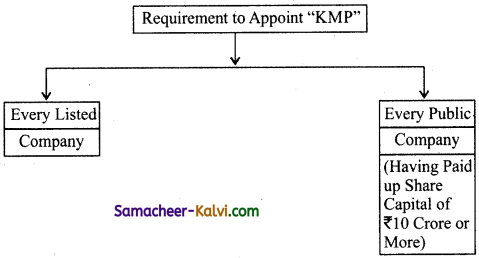
Name the companies required to appoint KMP.
Answer:

TN State Board 12th Commerce Important Questions Chapter 27 Company Management 1

Requirement to appoint “KMP”:
(i) Every listed
(ii) Every public company(Having paid up share capital of ₹ 10 crore or more).

Samacheer Kalvi TN State Board 12th Commerce Notes Chapter 27 Company Management

Question 3.
Who is whole time Director?
Answer:
A director is one who devotes whole of his time of working hours to the company and has a significant personal interest in the company as the source of his income.

Question 4.
Who is called as Managing Director?
Answer:
A director is one who is employed by the company and has substantial powers of management over the affairs of the company subject to superintendence direction and control of the board.

Question 5.
Who can be Executive Director?
Answer:
An executive director is a chief executive officer (CEO) or managing director of an organization, company or corporation who is responsible for making decisions to complete the mission and for the success of the organization. In the globalized business world the title of president or of chief executive officer is used instead of managing director.

Samacheer Kalvi TN State Board 12th Commerce Notes Chapter 27 Company Management

Question 6.
Differentiate Executive and Non-Executive Directors.
Answer:

Executive Director

 Non – Executive director

An executive director can be either a whole time director of the company or a managing director. Non – executive director is a director who is neither a whole time director nor a managing director.
He is responsible for making decisions to complete mission and for the success of the organization. Non – executive director’s responsibilities include the monitoring of the executive directors and acting in the interest of the company shareholders.

Question 7.
When are alternative directors appointed?
Answer:
Alternate director is appointed by the board of directors, as a substitute to a director who may be absent from India for a period which is not less than three months. The appointment must be authorized either by the articles of association of the company or by passing a resolution in the general meeting.

Question 8.
Who is a shadow director?
Answer:
A person who is not the member of board but has some power to run it can be appointed as the director but according to his/her wish. A shadow director is a person in accordance with whose directions or instructions the directors of a company are accustomed to act.

Samacheer Kalvi TN State Board 12th Commerce Notes Chapter 27 Company Management

Question 9.
What is causal Vacancy?
Answer:
Vacancy arising due to death of director, his resignation or insolvency and not by efflux of time or retirement by rotation. Failure an elected director to accept the office may also constitute a casual vacancy.

Question 10.
State the minimum number of Directors for a Private company.
Answer:

  1. In case of one person company – the requirement of directors is one.
  2. Other private companies – the minimum requirement of directors is two. B.

Question 11.
Who are the KMP?
Answer:
The definition of the term key managerial personnel is contained in section 2(51) of the companies act 2013. This section states

  1. The chief executive officer
  2. The managing director or the manager
  3. The company secretary
  4. The whole-time director
  5. The chief financial officer and
  6. Such other officer as may be prescribed.

Samacheer Kalvi TN State Board 12th Commerce Notes Chapter 27 Company Management

Question 12.
Explain composition of the board of directors.
Answer:
General optimum combination:
Board of directors shall have an optimum combination of executive and non-executive directors with at least one woman director and not less than fifty percent of the board of directors shall comprise of non-executive directors.

When the non-executive director is the chair person:
In this case, at least one third of the board of directors shall comprise of independent directors and where the company does not have a regular non-executive chairperson, at least half of the board of directors shall comprise independent directors.

When the non-executive chairperson is a promoter or is related to any promoter or person occupying management positions at the level of board of director or at one level below the board of directors. In this case, at least one half of the board of directors of the company shall consist of independent directors.

Question 13.
Brief different types of Directors.
Answer:
Residential director:
According to section 149(3) of companies act 2013, every company should appoint a director who has stayed in India for a total period of not less than 182 days in the previous calendar year.

Independent director:
According to section 149(6) an independent director is an alternate director other than a managing director who is known as whole time director or nominee director.

Small shareholders directors:
small share holders can appoint a single director in a listed company. But this action needs a proper procedure like handling oyer a notice to at least 1000 share holders or 1/10 of the total share holders.

Nominee director:
A director nominated by any financial institution in pursuance of the provisions of any law for the time being in force or of any agreement or appointed by any government or any other person to represent its interests.

Women director:
As per section 149(1) (a) there are certain categories according to which there should be at least one woman as a director on the board.

Additional directors:
Any individual can be appointed as additional directors by a company.

Alternative directors:
Alternative director is appointed by the board of directors, as a substitute to a director who may be absent from India for a period which is not less than three months.

Shadow director:
A person who is not the member of board but has some power to run it can be appointed as the director but according to his/her wish.

Samacheer Kalvi TN State Board 12th Commerce Notes Chapter 27 Company Management

Question 14.
State the qualification of Directors.
Answer:
In general a director shall possess appropriate skills, experience and knowledge is one or more fields of finance, law, management, sales marketing administration, research corporate governance, technical operations related to company business. According to the different provisions relating to the directors the following qualifications may be mentioned.

  1. A director must be a person of sound mind
  2. A director must hold share qualifications of the article of association . provides such
  3. A director must be an individual
  4. A director should be a solvent person
  5. A director should not be convicted by the court for any offence etc.

Question 15.
List the disqualification of a directors.
Answer:
Section 164 of companies Act 2013, has mentioned the disqualification as mentioned below
A person shall not be capable of being appointed director of a company if the director is

  1. Of unsound mind.
  2. An undercharged insolvent.
  3. Has been convicted by a court for any offence involving moral turpitude and sentenced in respect there of to imprisonment for not less than six months.
  4. Has not paid any cell in respect of shares of the company held by him, whether alone or jointly with others.
  5. An order disqualifying him for appointment as director has been passed by a court in pursuance of section 203.
  6. He has been convicted of the offence dealing with related party transactions under section 188.
  7. He has not got the director identification number.

Samacheer Kalvi TN State Board 12th Commerce Notes Chapter 27 Company Management

Question 16.
Explain how director of a company can be removed from the office.
Answer:
A director of company can be removed from his office before the expiry of his term by.
(a) Removal by share holders:
A company (whether public or private) may by giving a. special notice and passing an ordinary resolution, remove a director before the expiry of his period of office without the proof of mismanagement, breach of trust, misfeasance or other misconduct on the part of the director. If the shareholders feel that the policies pursued by the director are not appropriate, then director can be removed.

(b) Removal by the Central Government:
The central government has been empowered to remove managerial personnel from office on the recommendation of the company law board under the following circumstances.
(i) Where a person concerned in the conduct and management of the affairs of a company has been guilty of fraud, misfeasance, persistent negligence in carrying out his obligations.
(ii) Business company managed by a person inaccordance with sound business principles or prudent commercial practices.
(iii) A person in a manner which is likely to cause injury or damage to the interest of trade industry or business.
(iv) A person with the intent to defraud its creditors, members or any other person.

(c) Removal by the company law board:
If an application has been made to the company law board against the oppression and mismanagement of the company affairs by a director, then the company law board may order for the termination of the directors tenure.

Question 17.
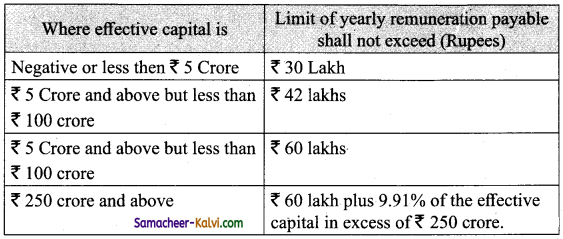
What is the maximum limit for the Managerial remuneration?
Answer:
Managerial remuneration is payable to a person appointed as 196 of the Act. The term remuneration means any money or its equivalent given or passed to any person for services rendered by him and include perquisites.

Maximum remuneration payable by a company to its managerial personnel:
Remuneration payable by a company in case where is’no profit or inadequacy of profit without central government and to pay remuneration in excess of the above limit is detailed below.

TN State Board 12th Commerce Important Questions Chapter 27 Company Management 2

Samacheer Kalvi TN State Board 12th Commerce Notes Chapter 27 Company Management

Question 18.
What are the duties of a directors?
Answer:
Collective duties of directors:
Directors as a part of board perform certain duties collectively. The following are some of those duties exercised collectively.

  1. Approval of annual accounts and authentication of annual accounts
  2. Appointment of first auditors
  3. Issue of notice and holding of board meetings and shareholders meetings or by circulations.

General duties of Directors:

  1. Structuring or new policy to reach the objectives of a company
  2. Issuing instructions to employees for implementation of policy to review company’s progress
  3. Appointing their subordinates like managing director, manager, secretary and other employees.

Specific duties of directors:

  1. Duty to disclose his name, address and occupation
  2. Duty to hold minimum qualification shares within two months after his appointment.
  3. Duty to issue prospectus and fix the minimum subscription
  4. Duty to take care that prospectus should not contain any false or misleading statement
  5. Duty to forfeit and transfer shares
  6. Duty to call on a extraordinary general meeting if necessary
  7. Duty to call statutory and annual general meeting of the company.

Samacheer Kalvi TN State Board 12th Commerce Notes Chapter 27 Company Management

Question 19.
State the powers of the directors.
Answer:
The power of the Directors are grouped into four different heads.
Statutory powers of Directors:

  1. Power to make calls on shareholders in respect of money unpaid on their shares
  2. Power to issue debentures
  3. Power to borrow moneys otherwise than on debentures.
  4. Power to make loan
  5. Power to approve financial statement and board reports

Managerial powers of Directors:

  1. Power to contract with the third party.
  2. Power to allot forfeit or transfer shares of company
  3. Power to decode the terms and conditions to issue debentures
  4.  Power to appoint manager, managing director, secretary of the company
  5. Power of control supervision of work of subordinates

Power only with a resolution:

  1. To sell or lease any asset of the company
  2. To allow time to the Director for repayment of the loan
  3. To appoint a sole agent for more than 5 years.
  4. To issue bonus shares and for reorganization of share capital

Other powers:

  1. Power to fill casual vacancy
  2. Power to remove key managerial personnel
  3. Power to declare solvency position of the company (iv) Power to make political contribution.

Question 20.
State the Criminal liabilities of Directors.
Answer:
Directors will be liable with a fine and imprisonment or both for fraud of non-compliance of any statutory provisions in the following situations where:

  1. There is mis-statement in prospectus
  2. There is failure to file return on allotment with the registrar.
  3. There is failure to give notice to the registrar for conversion of share into stock.
  4. There is failure to issue share certificate and debenture certificate
  5. There is default in holding annual general meeting
  6. There is failure to provide financial statement
  7. There is failure to maintain, registrar of the members and registrar of debenture holders.

Samacheer Kalvi TN State Board 12th Commerce Notes Chapter 27 Company Management

Choose the correct answer:

Question 1.
A person Shall hold office as a director in ________ companies as per the Companies Act, 2013.
(a) 5 companies
(b) 10 companies
(c) 20 companies
(d) 15 companies
Answer:
(c) 20 companies

Question 2.
Which _________ Director is appointed by a Financial institution.
(a) Nominee
(b) Additional
(c) Women
(d) Shadow
Answer:
(a) Nominee

Question 3.
A Private Company shall have a minimum of:
(a) Seven directors
(b) Five directors
(c) Three directors
(d) Two directors
Answer:
(d) Two directors

Samacheer Kalvi TN State Board 12th Commerce Notes Chapter 27 Company Management

Question 4.
A Public Company shall have a minimum of _________ Directors.
(a) Twelve
(b) Seven
(c) Three
(d) Two
Answer:
(c) Three

Question 5.
A Public Company having a paid up Share Capital of ₹ _________ or more may have a Director, elected by such small shareholders.
(a) One
(b) Three
(c) Five
(d) Seven
Answer:
(c) Five

Question 6.
Under the companies Act, which one of the following powers can be exercised by the Board of Directors?
(a) Power to sell the company’s undertakings.
(b) Power to make call.
(c) Power to borrow money in excess of the paid up capital.
(d) Power to reappoint an auditor.
Answer:
(b) Power to make call.

Samacheer Kalvi TN State Board 12th Commerce Notes Chapter 27 Company Management

Question 7.
Which director need not hold qualifying shares?
(a) Directors appointed to Central Government
(b) Directors appointed to Shareholders.
(c) Directors appointed to Managing Director
(d) Directors appointed to Board of Directors
Answer:
(a) Directors appointed to Central Government

Question 8.
What is the statue of Directors who regulate money of the company?
(a) Banker
(b) Holder
(c) Agent
(d) Trustees
Answer:
(d) Trustees

Question 9.
According to Companies Act, the Directors must be appointed by the:
(a) Central Government
(b) Company Law Tribunal
(c) Company in General Meeting
(d) Board of Directors
Answer:
(c) Company in General Meeting

Samacheer Kalvi TN State Board 12th Commerce Notes Chapter 27 Company Management

Question 10.
The Board of Directors can exercise the power to appoint directors in the case of:
(a) Additional Directors
(b) Filling up the Casual vacancy
(c) Alternate Directors
(d) All the above
Answer:
(d) All the above

TN Board 12th Commerce Important Questions

TN Board 12th Commerce Important Questions Chapter 26 Companies Act, 2013

TN State Board 12th Commerce Important Questions Chapter 26 Companies Act, 2013

Question 1.
Who is called as Promoters?
Answer:
The person who envisage the idea is called a promoter section 2 (69) of the companies Act 2013 defines the term promoter as follows who has been named as such in a prospectus or is identified by the company in the annual return referred to in section 92.

Question 2.
What is Shares?
Answer:
The term share is viewed by a layman as a fraction or portion of total capital of the company which have equal denomination. In simple, the total capital of the company is shared by many person and each share is having equal value.

Samacheer Kalvi TN State Board 12th Commerce Notes Chapter 26 Companies Act, 2013

Question 3.
What do you mean by Equity Share?
Answer:
Those shares which are not called as preference share are known as equity share or the share of a company which do not have any preferential rights with regard to dividend and repayment of share capital at the time of liquidation of a company. Share are part of the capital of a company.

Question 4.
What do you understand by Preference Share?
Answer:
Section 42 of the companies Act, 2013 the term “Preference shares” mean that part of the share capital the holders of which have preferential right over payment of dividend (fixed amount or rate) and repayment of share capital in the event of winding up of the company.

Question 5.
What is Sweat Equity Shares?
Answer:
Sweat equity shares means issue of shares to employees or directors at a lower price for cash or other than cash, in lieu of providing know how or making available rights in the nature of intellectual property rights or any value additions.

Samacheer Kalvi TN State Board 12th Commerce Notes Chapter 26 Companies Act, 2013

Question 6.
What is Bonus Shares?
Answer:
Bonus shares, means to utilize the company’s reserves and surpluses, issue of shares to existing share holders without taking any consideration is known as bonus share.

Question 7.
What is Right Shares?
Answer:
Right shares are the shares which are issued by the company within the aim of increasing the subscribed share capital of the company by further issue if it is authorized by its articles.
The right shares are primarily issued to the existing equity share holders through a letter of an issue, on pro rata basis.

Question 8.
What is Private placement?
Answer:
Private placement means offer of securities or invitation to subscribe to securities to select group of persons through private placement offer letter. The number of subscribers under private placement should not exceed 50 members or such numbers prescribed.

Samacheer Kalvi TN State Board 12th Commerce Notes Chapter 26 Companies Act, 2013

Question 9.
Define Share Warrant.
Answer:
A share warrant is a negotiable instrument issued by the public limited company only against fully paid up shares. It is also termed as a document of title because the holder of the share warrant is entitled to the number of shares mentioned in it.

Question 10.
What is Debentures?
Answer:
When a company needs funds for extension and extension and development purpose without increasing its share capital, it can borrow from the general public by issuing certificates for a fixed period of time and at a fixed rate of interest. Such a loan certificate is called a benture.

Question 11.
Distinguish between shares and stocks.
Answer:

Shares

 Stock

Share are part of the capital of a company.  A company can convert it share into stock.
A share is the smallest unit into which the company’s capital is divided representing the ownership of share holders.  The denomination of stock differs.
Share can be partly or fully paid up.  Stock can only be fully paid up shares.
Shares are of equal denomination.  When share are transformed into stock

Samacheer Kalvi TN State Board 12th Commerce Notes Chapter 26 Companies Act, 2013

Question 12.
What do you understand by Issue of Securities at Premium?
Answer:

  1. The amount of share premium has to be transferred to an account called the “Securities premium account”. This account is capital in nature and can only be utilized for the purposes specified by the Act (under section 78), Issue of fully paid bonus shares to members of the company.
  2. Securities premium Account cannot be treated as a revenue reserve for distributing dividends. It can only be used for the above mentioned purposes and also for buying back of securities (section 77A). It must be noted that security premium is not available for the distribution of dividend.

Question 13.
What is issue of shares at discount? What conditions should be fulfilled?
Answer:

  1. When shares are issued at a price above the face value or nominal value they are said to be issued at a premium.
  2. When the shares are issued at a price below the face value they are said to be issued at a discount.
  3. Issue of fully paid bonus shares to members of the company.
    (a) To write preliminary expenses.
    (b) To write off the expenses of issue or commission paid or discount allowed on issue of shares or debentures of the company.

Samacheer Kalvi TN State Board 12th Commerce Notes Chapter 26 Companies Act, 2013

Question 14.
State condition stipulated for capital subscription at the time of promotion.
Answer:

  1. The fulfilling formalities to raise necessary capital.
  2. Adhering to SEBI guidelines in this regard.
  3. Observing guidelines for disclosure and investor protection issued by SEBI.
  4. Issuing prospectus
  5. Fulfilling the condition for valid allotment by director.
  6. Ensuring collection of minimum subscription.

Question 15.
Explain different Kinds of Preference shares.
Answer:
There are eight types of preference shares. Incase of dissolution of the company any of the eight types would be paid out before other types of equity.
(i) Cumulative preference shares:
As the word indicates, all dividends are carried forward until specified and paid out only at the end of the specific period.

(ii) Non-cumulative preference shares:
Dividends are paid out of profits for every year. There are no arrears carried over a time period to be paid at the end of term.

(iii) Non redeemable preference shares:
Such shares cannot be redeemed during the life time of the company, but can only be obtained at the time of winding up (liquidation) of assets.

(iv) Redeemable preference shares:
Such preference shares can be claimed after a fixed period or after giving due notice.

(v) Convertible preference shares:
The shares can be converted into equity shares after a time period or as per the conditions laid down in the terms.

(vi) Non-convertible preference shares:
Non-convertible preference shares cannot be at anytime converted into equity shares.

Samacheer Kalvi TN State Board 12th Commerce Notes Chapter 26 Companies Act, 2013

Question 16.
Write the difference between Debentures and Shares.
Answer:

Debentures

 Shares

Debentures constitute a loan.  Shares are part of the capital of a company
Middle and lower level  Top level
Debenture holder gets fixed rate of interest which carries a priorities over dividend.  Shareholders gets dividends with a varying rate.
Debentures generally have a charge on the assets of the company.  Shares do not carry any such charge.
Debentures can be issued at a discount without restrictions.  Shares cannot be issued at a discount.
The rate of interest is fixed in the case of debentures.  Whereas on equity shares, the dividend varies from year to year depending upon the profit of the company and the Board of directors decision to declare dividends or not.
Debenture holders do not have any voting right.  Share holders enjoy voting right.
Interest on debenture is payable even if there are no profits i.e., even out of capital.  Dividend can be paid to shareholders only out of the profits of the company and not otherwise.
Interest paid on debenture is a business expenditure and allowable deduction from profits.  Dividend is not allowable deduction as business expenditure.
Return of allotment is not required for allotment of debentures.  Return of allotment in e Form No.2 is to be filed for allotment of shares.

Question 17.
Brief different stages in Formation of a Company.
Answer:
Formation of a company has been divided into four stages,
(i) Promotion
(ii) Registration
(iii) Capital Subscription
(iv) Commencement of business
Out of the four stages the first two stages promotion and registrations are necessary for both public and private companies.
(a) A private company can start operating its business immediately after the registration, but a public company has to pass through two more stages capital subscription and commencement of business.
(b) A public company can raise the funds from the public by issuing shares. After following all the legal provision of public issue, which are specified in the Company’s Act, a public company can start operating of its business.

Samacheer Kalvi TN State Board 12th Commerce Notes Chapter 26 Companies Act, 2013

Question 18.
What are the various kinds of Debentures?
Answer:
Debentures are generally classified into different categories on the basis of,
(i) Convertibility of the instrument
(ii) Security of the instrument
(iii) Redemption ability
(iv) Registration of Instrument

(i) On the basis of convertibility:
(a) Non-convertible debentures:
These instruments retain the debt character and cannot be converted in to equity shares

(b) Partly convertible debentures:
A part of these instruments are converted into equity shares in the future at notice of the issuer.

(c) Fully convertible debentures:
These are fully convertible into equity shares at the issuer’s notice. The ratio of conversion is decided by the issuer.

(d) Optional convertible debentures:
The investor has the option to either convert these debentures into shares at a price decided by the issuer agreed upon at the time of issue.

(ii) On the basis of security debentures:
(a) Secured debentures:
These instruments are secured by a charge on the fixed assets of the issuer company.

(b) Unsecured debentures:
These instruments are unsecured in the sense that if the issuer defaults on payment of the interest or principal amount the investor has to be included as unsecured creditors of the company.

(c) Redeemable debentures:
It refers to debentures which are issued with a condition that the debentures will be redeemable at a fixed date or upon demand.

(d) Perpetual or irredeemable debentures:
A debenture in which no specific time is specified by the companies to pay back the money is called irredeemable debenture on the basis of registration.

(e) A registered debentures:
Registered debentures are issued in the name of a particular person whose name appears on the debenture certificate and who is registered by the company as holder on the register of debenture holders.

(f) Bearer debentures:
Bearer debentures are issued to bearer, and are negotiable instruments and so transferable by mere delivery like share warrants.

Samacheer Kalvi TN State Board 12th Commerce Notes Chapter 26 Companies Act, 2013

Question 19.
What formalities need to be fulfilled for a companies having share capital to commence business?
Answer:
As per section 11 of the Act a company having share capital should file with registrar declaration stating that
(i) Every subscriber to the memorandum has paid the value of shares agreed to be taken by him.
(ii) Paid up capital is not less than ? 5 lakhs in the case of public limited company and ? 1 lakh in the case of private limited company.
(iii) It has filed the Registrar the verification of the registered office.
These restriction in section 11 are applicable to companies having share capital. It can commence business only after fulfilling all the formalities mentioned above and exercise borrowing powers immediately after incorporation.

Question 20.
Write the difference between Share Certificate and Share Warrant.
Answer:

Share certificate

 Share warrant

It is a written document prepared by the company under its common seal.  It is an instrument which signifies that the holder of the instrument is entitle to the shares mentioned in it.
Sent to the members it containing the number of shares held by him/ her the amount paid thereon.  It is a bearer document which can be transferred by mere delivery.
Document work as an evidence for the ownership of shares of the shareholder.  Only public limited companies have the right to issue share warrant.

Samacheer Kalvi TN State Board 12th Commerce Notes Chapter 26 Companies Act, 2013

Choose the correct answer:

Question 1.
The Company will have to issue the notice of situation of Registered Office to the Registrar of Companies within ___________ days from the date of incorporation.
(a) 14 days
(b) 21 days
(c) 30 Days
(d) 60 Days
Answer:
(c) 30 Days

Question 2.
How does a person who envisages the idea to form a company called?
(a) Director
(b) Company Secretary
(c) Registrar
(d) Promoter
Answer:
(d) Promoter

Question 3.
For which type of capital a company pays the prescribed fees at the time of registration?
(a) Subscribed Capital
(b) Authorised Capital
(c) Paid-up Capital
(d) Issued Capital
Answer:
(b) Authorised Capital

Samacheer Kalvi TN State Board 12th Commerce Notes Chapter 26 Companies Act, 2013

Question 4.
Which of the following types of shares are issued by a company to raise capital from the existing shareholders?
(a) Equity Shares
(b) Rights Shares
(c) Preference Shares
(d) Bonus Shares
Answer:
(b) Rights Shares

Question 5.
Specify the type of resolution to be passed to choose the location of Registered Office of the company within the town or village or city:
(a) Ordinary
(b) Special
(c) Either Ordinary
(d) Board or Special
Answer:
(d) Board or Special

Question 6.
Who can issue stock?
(a) Public
(b) Private
(c) One Person
(d) Small
Answer:
(a) Public

Samacheer Kalvi TN State Board 12th Commerce Notes Chapter 26 Companies Act, 2013

Question 7.
Specify the document which comes under the Negotiable Instrument Act.
(a) Share Certificate
(b) Share
(c) Share Warrant
(d) Stock
Answer:
(c) Share Warrant

Question 8.
The shares which are offered to the existing shareholder at free of cost is known as:
(a) Bonus Share
(b) Equity Share
(c) Right Share
(d) Preference Share
Answer:
(a) Bonus Share

Question 9.
The shares which are offered first to the existing shareholder at reduced price is known as:
(a) Bonus Share
(b) Equity Share
(c) Right Share
(d) Preference Share
Answer:
(c) Right Share

Samacheer Kalvi TN State Board 12th Commerce Notes Chapter 26 Companies Act, 2013

Question 10.
The Companies Act 2013 Prohibits the issue of shares at to the public.
(a) Premium
(b) Par
(c) Discount
(d) Both at par and Premium
Answer:
(c) Discount

TN Board 12th Commerce Important Questions

TN Board 12th Commerce Important Questions Chapter 25 Government Schemes for Entrepreneurial Development

TN State Board 12th Commerce Important Questions Chapter 25 Government Schemes for Entrepreneurial Development

Question 1.
Name any four Governmental Entrepreneurial schemes.
Answer:

  1. Modified Special Incentive Package Scheme(M-SIPS)
  2. New Gen Innovation and Entrepreneurship Development Centre(New Gen IEDc) .
  3. Dairy Entrepreneurship Development Scheme (iv) Single Point Registration Scheme (SPRS).

Question 2.
Give a note on ‘Digital India’.
Answer:
The Digital India initiative has been launched to modernize the Indian economy to make all Government services available electronically. The initiatives aims at transforming India into a digitally empowered society and knowledge economy with universal access to goods and services.

Samacheer Kalvi TN State Board 12th Commerce Notes Chapter 25 Government Schemes for Entrepreneurial Development

Question 3.
State any three entrepreneurial development schemes of Government of Tamil Nadu.
Answer:
The three schemes among the entrepreneurial schemes of Government of Tamilnadu is

  1. Micro, Small and Medium Enterprises (MSMEs)
  2. Self – Help Group (SHG)
  3. New Entrepreneur – Cum – Enterprise Development Scheme (NEEDS)

Question 4.
List down the two types of finance.
Answer:

  1. Long term: which are needed for acquiring fixed assets.
  2. hort term: which are meant for meeting working capital needs.

Question 5.
Mention the time period of Provision Registration Certificate.
Answer:
Entrepreneur has to apply for provisional registration certificate. It will be issued to entrepreneur after the fulfilment of certain conditions for a period of 12 months duration subject to renewal of two periods of six months.

Samacheer Kalvi TN State Board 12th Commerce Notes Chapter 25 Government Schemes for Entrepreneurial Development

Question 6.
What is ‘Startup India’?
Answer:
Through the start up India initiative, Government of India promotes entrepreneurship by monitoring, nurturing and facilitating startups through out their life cycle. Since its launch in January 2016, the initiative has successfully given a head start to numerous aspiring entrepreneurs. A “Fund of Funds” has been created to help startups gain access to funding.

Question 7.
Expand the following: STEP, JAM, TREAD, NI-SIPS, SEED and New Gen IEDC.
Answer:
STEP- Support to Training and Employment Program for Women
JAM – Jan dhan – Aadhaar – Mobile
TREAD – Trade Related Entrepreneurship Assistance and Development
M-SIPS – Modified Special Incentive Package Scheme
SEED – Science for Equity Empowerment and Development
New Gen IEDC – New Gen Innovation and Entrepreneurship Development Centre.

Question 8.
Write a short note on the following:
(a) Dairy Entrepreneurship Development Scheme.
(b) Project report.
Answer:
(a) Dairy Entrepreneurship Development Scheme aims at helping entrepreneurs in the field of Agriculture, pets and animals, and social impact to set up small diary farms and incentives are provided to cover the cost of the required equipment or establishment of the facility.

(b) Project reports needs to be prepared according to the format prescribed in the loan application form of term lending institutions. An entrepreneur can get the report prepared either by technical consultancy organization or by auditors or by consultants or by development agencies. This report should cover aspects like sources of labour and raw materials, market potential and profitability.

Samacheer Kalvi TN State Board 12th Commerce Notes Chapter 25 Government Schemes for Entrepreneurial Development

Question 9.
What is the procedure for getting power connection for an Entrepreneurial venture?
Answer:
An entrepreneur has to make application to assistant divisional engineer of state electricity board for power connection after paying Security Deposit and fulfiling the official formalities prescribed.

Question 10.
Explain any five Government Entrepreneurial schemes.
Answer:
In order to support and strengthen, the start up culture in India, the Government has launched various schemes. They are as follows:

Modified Special Incentive Package Scheme (M-SIPS):
The M-SIPS scheme provides capital subsidy of 20% in SEZ and 25% subsidy in non – SEZ for business units engaged in manufacturing of electronics in the fields of the internet of things, aeronautical, aerospace and defence, automotive, renewable energy, non – renewable energy, technology, green technology and nano – technology.

New Gen Innovations and Entrepreneurship Development Centre (New Geh IEDC):
New Gen IEDC provides a limited one – time, non – recurring financial assistance to entrepreneurs upto 25 Lakhs in the field of chemicals, technology hardware, healthcare and life sciences, aeronautics/aerospace and defence, agriculture, AI ( artificial intelligence) , AR/VR ( augmented + virtual reality), automotive, telecommunication and networking.

Dairy Entrepreneurship Development Scheme (DEDS):
Dairy Entrepreneurship Development Scheme aims at helping entrepreneurs in the field of agriculture, pets and animals, and social impact to set up small dairy farms and incentives are provided to cover the cost of the required equipment or establishment of the facility.

Single Point Registration Scheme (SPRS):
A great scheme for micro and small enterprises, which provides an exemption from payment of Earnest Money Deposit (EMD). Under this scheme, the tenders are issued free of cost.

Atal incubation centres (AIC):
The Government of India has setup the AIC scheme at NITI Aayog in 2016 with the over arching purpose of promoting a culture of innovation and entrepreneurship in the country. This has been set up to provide high class incubation facilities across various parts of India in terms of capital equipment, operating facilities, along with sectoral experts for monitoring startups, especially in transport.

Samacheer Kalvi TN State Board 12th Commerce Notes Chapter 25 Government Schemes for Entrepreneurial Development

Question 11.
Describe the steps promoting Entrepreneurial venture.
Answer:
(i) Selection of the Product:
An entrepreneur may select a product according to his aspiration, capacity and motivation after a thorough scrutinity of micro and macro environment of business. He/she may select a brand, new product or may like to select imitation one or he/she may improve upon an existing product in terms of additional features like comforts, convenience, ease of operation, lower price etc., An entrepreneur has to conduct economic viability of the project.

(ii) Selection of Form of Ownership:
Entrepreneur has to choose the form of organization suitable and appropriate for his venture namely family ownership, partnership and private limited company. Family ownership and partnership forms of organization are suited for exercising unified control over the venture while the company form of organization may be preferred for pooling of more financial resources, managerial and technical skills and business experience for carrying on medium to large venture.

(iii) Selection of Site:
Entrepreneur has to choose suitable plot for accommodating his venture. He has four options open to him for housing his venture. They are as below:
(a) State Development Corporation like SIDCO, SIPCOT, MMDA, TNHB and Directorate of industries may allot plot of entrepreneur.
(b) Entrepreneur can have a factory sheds constructed by State Industrial Development Agency.
(c) Entrepreneur can start ventures in the land development by private developers.
(d) Entrepreneur may buy private land and develop it for industrial use.

(iv) Following things may be considered in choosing the site namely:
(a) Nearness to Native place.
(b) Incentives provided by the Government.
(c) Nearness to Market
(d) Availability of Labour and Raw Materials in a particular area
(e) Infrastructure facilities.

(v) Designing Capital Structure:
Entrepreneur has to determine the source of finance for funding the venture. He/she may mobilize funds from his own savings, loans from friends and relatives, term loans from banks and financial institutions.

(vi) Acquisition of Manufacturing Know-How:
Entrepreneur can acquire manufacturing know-how from Government research laboratories, research and development divisions of industries, and individual consultants. At times, main units may supply manufacturing know-how to entrepreneurs starting ancillary units or plant and machinery suppliers may provide this facility to entrepreneurs.

(vii) Preparation of Project Reports:
Project reports needs to be prepared according to the format prescribed in the loan application form of term lending institutions.

Samacheer Kalvi TN State Board 12th Commerce Notes Chapter 25 Government Schemes for Entrepreneurial Development

Question 12.
Discuss the preparation of a project report.
Answer:
An entrepreneur can get the report prepared either by technical consultancy organization or by auditors or by consultants or by development agencies. This report should cover aspects like sources of finance, technical know-
how, sources of labour and raw materials, market potential and profitability.
The project report should include the following.

(i) Technical feasibility: It should mention the following:
(a) Description of product specification
(b) Raw materials availability
(c) Manufacturing process
(d) Quality control measures
(e) Availability of water, power, transport and communicate facilities.

(ii) Economic Viability:
It is essentially involves compilation of demand for domestic and export market installed capacity of machines, market, share, revenue expected and suitable price structure.

(iii) Financial Viability: It should cover the aspect like
(a) Non-recurring cost such as Land and Building, Plant and Machinery etc.
(b) Recurring expenses like wages, salaries and overheads etc.
(c) Probable cost of production
(d) Profit on expected sales

(iv) Managerial competency:
Entrepreneur has to include the mechanism for managing the venture in the project report. In the case of small sized ventures, the owners or partners may take care of managerial activities while a team of managerial personnel is to be brought in for manning various managerial positions across different levels of management in the case of corporate form of organization.

(v) Provisional Regional Certificate:
Entrepreneur has to apply for Provisional Regional Certificate. It will be issued to entrepreneur after the fulfilment of certain conditions for a period of one year subject to renewal of two periods of six months duration further extension will not be granted.

(vi) Permanent Registration Certificate:
Once the venture has commenced production or when it is ready to commence production, it is eligible to get permanent registration certificate.

(vii) Statutory License:
Entrepreneur has to obtain Municipal License from the authority concerned. Then the entrepreneur has to register the unit with the Central and Sales Tax Department. If a unit comes within the provisions of factories act, he/she has to register the unit under the shops and Establishment Act.

(viii) Power Connection:
Entrepreneurs has to make application to Assistant Divisional Engineer of State Electricity Board for power connection after paying Security Deposit and fillfiling the official formalities prescribed. (ix) Arrangement of finance: Entrepreneurs requires two types of finance namely long and short term while long term requirements are needed for acquiring fixed assets, short term requirement are meant for making meeting working capital needs.

Samacheer Kalvi TN State Board 12th Commerce Notes Chapter 25 Government Schemes for Entrepreneurial Development

Choose the correct answer:

Question 1.
The _________ initiative was launched to modernize the Indian economy to make all Governments services available electronically.
(a) Standup India
(b) Startup India
(c) Digital India
(d) Make in India
Answer:
(c) Digital India

Question 2.
___________ is designed to transform India to a global design and manufacturing hub.
(a) Digital India
(b) Make in India
(c) Startup India
(d) Design India.
Answer:
(b) Make in India

Samacheer Kalvi TN State Board 12th Commerce Notes Chapter 25 Government Schemes for Entrepreneurial Development

Question 3.
__________ is the Government of India’s endeavour to promote culture of innovation and entrepreneurship.
(a) AIM
(b) STEP
(c) SEED
(d) AIC
Answer:
(a) AIM

Question 4.
__________ should cover aspects like sources of finance, technical know-how, source of labour and raw material, market potential and profitability.
(a) Technical Report
(b) Finance Report
(c) Project Report
(d) Progress Report
Answer:
(c) Project Report

Samacheer Kalvi TN State Board 12th Commerce Notes Chapter 25 Government Schemes for Entrepreneurial Development

Question 5.
_________ has to include the mechanism for managing venture in the project
report.
(a) Banker
(b) Government
(c) Lending Institutions
(d) Entrepreneur
Answer:
(d) Entrepreneur

TN Board 12th Commerce Important Questions

TN Board 12th Commerce Important Questions Chapter 24 Types of Entrepreneurs

TN State Board 12th Commerce Important Questions Chapter 24 Types of Entrepreneurs

Question 1.
What is the other name of business entrepreneur?
Answer:
Business entrepreneur is called solo entrepreneur. He / she is the one who conceives an idea for a new product or service and establishes a business enterprise.

Question 2.
Mention the other name for corporate entrepreneur.
Answer:
Corporate entrepreneur is called promoter. He / she takes initiative necessary to start an entity under corporate format.

Samacheer Kalvi TN State Board 12th Commerce Notes Chapter 24 Types of Entrepreneurs

Question 3.
Who are agricultural entrepreneur?
Answer:
Agricultural entrepreneurs are those entrepreneurs who raise farm products and market them. Those who raise allied products like poultry, meat, fish, honey, skin, flower, silk, fruits, agricultural implements, prawn, etc., are called agricultural entrepreneur.

Question 4.
State the name of the following ventures:

(a) Started by individuals for profit motive
Answer:
Private entrepreneur.

(b Started by Government
Answer:
State entrepreneur.

(c) Started by individuals and Government together
Answer:
Joint entrepreneur.

(d) Started as a family business
Answer:
Classical entrepreneur.

Question 5.
Give some examples of pure entrepreneurs.
Answer:
Dhirubaai Ambani, Jamshadji Tata, T.V. Sundaramn Iyengar, Birla, Seshadriji, Narayana Murthi, Aziz Premji and so on.

Samacheer Kalvi TN State Board 12th Commerce Notes Chapter 24 Types of Entrepreneurs

Question 6.
Who is a private entrepreneur?
Answer:

  1. Ventures started by individual either singly or collectively at their own risk after mobilizing various resources in order to earn profit are called private ownership.
  2. Profit is only motive of private ownership.
  3. Production decisions involving high risks are taken by individual only for profit motive.

Question 7.
What is political environment?
Answer:

  1. The success of a business lies in its ability to adapt and sustain to political changes.
  2. The legislative, executives and judiciary are the three institutions which directs and influences a business.
  3. Political organizations refers to the ideology and philosophy of the political parties, the Government, the role and degree of authority of bureaucracy the level of political consciousness among citizens.

Question 8.
List down few examples of pure entrepreneurship.
Answer:

  1. Dhirubai Ambani
  2. Jamshadji Tata
  3. T.V. Sundaram Iyengar,
  4. Seshadriji
  5. Birla
  6. Narayana murthi
  7. Aziz premji.

Samacheer Kalvi TN State Board 12th Commerce Notes Chapter 24 Types of Entrepreneurs

Question 9.
How does a professional entrepreneur operate?
Answer:

  1. He is having a rich expertise in starting a venture.
  2. They keep on conceiving new ideas to develop alternative projects.
  3. He/she simply sells out the venture started by him to some one else after its successful take off.
  4. These entrepreneurs, have got professional expertise in starting the venture and exciting it after the establishment.

Question 10.
Explain about the agricultural entrepreneur.
Answer:

  1. Agricultural entrepreneurs are those entrepreneurs who raise farm products and market them.
  2. They use various inputs like labour, fertilizer, insecticide, water technology etc., to raise the products.
  3. Market their products either directly or through co-bperative entities or through brokers or through tie up with large retailers. Those who raise allied products like poultry, meat, fish, honey, skin, agricultural implements, flower, silk, fruits, prawn etc., are called as agricultural entrepreneur.

Samacheer Kalvi TN State Board 12th Commerce Notes Chapter 24 Types of Entrepreneurs

Question 11.
Explain in detail on classification according to the type of business.
Answer:
(i) Business entrepreneur:
Business entrepreneur is called solo entrepreneur. He / she is the one who receives an idea for a new product or service and establishes a business enterprise. He /she takes, up production, operations and pursues marketing activities.

(ii) Trading entrepreneurs:
Trading entrepreneur are those who restrict themselves to buying and selling finished goods. They may be engaged in domestic and international trade. They get their income by way of commission and marketing. .

(iii) Industrial entrepreneur:
These are entrepreneurs who manufacture products to cater the needs of consuming public after identifying the need left unfulfilled by the manufacture. They may be small, medium and large entrepreneurs. They add utility to products rolled out by them which is termed as value addition.

(iv) Corporate entrepreneur:
Corporate entrepreneur is called promoter. He/she takes initiate necessary to start an entity under corporate format. Corporate entrepreneurs install a team of experts to manage the entity on a day to day basis.

(v) Agricultural entrepreneurs:
Agricultural entrepreneurs are those entrepreneurs who raise farm products and market them. These entrepreneurs pursue their venture in agriculture and allied sector.

(vi) Retail entrepreneurs:
Retail entrepreneurs are those who enter into venture of distributing the end product to final consumer while wholesale entrepreneurs take up the venture of distributing the products to retailer. They used to buy the goods in small quantities from numerous wholesalers and make it available different products of different brands under one roof to end consumer.

Samacheer Kalvi TN State Board 12th Commerce Notes Chapter 24 Types of Entrepreneurs

Question 12.
Discuss the nature of functional entrepreneurs.
Answer:

  1. Innovative entrepreneur for used an introducing a new product a new project or something new is the venture already started.
  2. Innovation may be the form of brand new product, upgraded product, discovering untapped market. New method of production, simplification of complex process, adoption of a distinct process and so on. Initiative entrepreneur is one who simply initiates existing skill, knowledge or technology already in place in advanced countries.
  3. Initiative entrepreneur is one who simply initiates existing skill, knowledge or technology already in place in advanced countries.
  4. Fabian entrepreneurs are said to be conservatives and sceptical about plasticizing any change in their organization. They are of risk averse type.
  5. Drone entrepreneurs are those who are totally who are totally opposed to changes unfolding in the environment. They used to operate in the niche market.

Question 13.
Distinguish between the rural and urban entrepreneur.
Answer:

Rural entrepreneur

 Urban entrepreneurs

These are people to start venture in rural locations.  Entrepreneur who commences his entrepreneurial activity in urban areas.
They are doing business in village and towns.  They are doing business in state, capital district, district Headquarter town, municipalities.
They may be agricultural and trading entrepreneur.  They may be industrial corporate entrepreneurs (or) retail entrepreneurs
The cost of operation of rural ventures tends to be low.  The cost of operation of urban ventures tends to be high.

Samacheer Kalvi TN State Board 12th Commerce Notes Chapter 24 Types of Entrepreneurs

Choose the correct answer:

Question 1.
Choose the type of entrepreneur that isn’t based on function:
(a) Innovative
(b) Classical
(c) Fabian
(d) Drone
Answer:
(c) Fabian

Question 2.
Choose the type of Entrepreneur that is not based on Motivation:
(a) Pure
(b) Corporate
(c) Spontaneous
(d) Induced
Answer:
(c) Spontaneous

Samacheer Kalvi TN State Board 12th Commerce Notes Chapter 24 Types of Entrepreneurs

Question 3.
Which of the following is the Activity of a Business Entrepreneur?
(a) Production
(b) Marketing
(c) Operation
(d) All of the above
Answer:
(d) All of the abov

Question 4.
Find the odd one out in context of Trading Entrepreneur:
(a) Selling
(b) Commission
(c) Buying
(d) Manufacturing
Answer:
(d) Manufacturing

Samacheer Kalvi TN State Board 12th Commerce Notes Chapter 24 Types of Entrepreneurs

Question 5.
Corporate Entrepreneur is also called as:
(a) Intrapreneur
(b) Promoter
(c) Manager
(d) Shareholder
Answer:
(c) Manager

Question 6.
Poultry, Flowers, Fruits etc., are called allied Products of _________ entrepreneur.
(a) Corporate
(b) Retail
(c) Trading
(d) Agricultural
Answer:
(d) Agricultural

Samacheer Kalvi TN State Board 12th Commerce Notes Chapter 24 Types of Entrepreneurs

Question 7.
________ Entrepreneur Supply Services Unlike.
(a) Hoteliers
(b) Banking
(c) Airlines
(d) Livestock
Answer:
(d) Livestock

Question 8.
Motive of a Pure Entrepreneur is:
(a) Rendering service
(b) Earning profit
(c) Attaining status
(d) Both (b) and (c)
Answer:
(d) Both (b) and (c)

Samacheer Kalvi TN State Board 12th Commerce Notes Chapter 24 Types of Entrepreneurs

Question 9.
Which of these is based on Technology?
(a) Modem
(b) Professional
(c) Corporate
(d) Industrial
Answer:
(c) Corporate

Question 10.
Which of the below is not a Characteristic of a Fabian Entrepreneur?
(a) Conservative
(b) Risk averse
(c) Sceptical
(d) Adaptive
Answer:
(d) Adaptive

TN Board 12th Commerce Important Questions

TN Board 12th Commerce Important Questions Chapter 23 Elements of Entrepreneurship

TN State Board 12th Commerce Important Questions Chapter 23 Elements of Entrepreneurship

Question 1.
Mention any two features of entrepreneurs.
Answer:

  1. Spirit of enterprise
  2. Innovation
  3. Resource mobilization

Question 2.
List down the managerial functions of entrepreneurs.
Answer:

  1. Planning
  2. Organising
  3. Directing
  4. Controlling
  5. Coordination

Samacheer Kalvi TN State Board 12th Commerce Notes Chapter 23 Elements of Entrepreneurship

Question 3.
List down the promotional functions of entrepreneurs.
Answer:

  1. Discovery of Idea
  2. Determining the Business Objectives
  3. Detailed Investigation
  4. Choice of form of Enterprise
  5. Fulfillment of the Formalities
  6. Preparation of Business Plan
  7. Mobilization of Funds
  8.  Procurement of machines and materials.

Question 4.
Define Intrapreneur.
Answer:
Intrapreneur is one who thinks and acts like an entrepreneur for the firm’s development during the course of employment in an organization. An intrapreneur is described to be an inside entrepreneur or an entrepreneur.

Samacheer Kalvi TN State Board 12th Commerce Notes Chapter 23 Elements of Entrepreneurship

Question 5.
List the problems faced by the women entrepreneurs.
Answer:

  1. Problem, of Finance
  2. Limited Mobility
  3. Lack of Education
  4. Lack of Network support
  5. Stiff Competition
  6. Sensitivity
  7. Lack of Information
  8. Dependent Culture

Question 6.
Define Entrepreneur.
Answer:

  1. Entrepreneurship generates employment opportunities for many people besides providing self employment to the entrepreneur.
  2. The concept of entrepreneur is intimately connected with three core elements namely risks bearing, organizing and innovating.
  3. In the words of A.H.Cole, “The purposeful activity of an individual or group of associated individuals, undertaken to initiate, maintain or earn profits by production and distribution of economic goods and services”.

Samacheer Kalvi TN State Board 12th Commerce Notes Chapter 23 Elements of Entrepreneurship

Question 7.
Distinguish between entrepreneur and Manager.
Answer:

TN State Board 12th Commerce Important Questions Chapter 23 Elements of Entrepreneurship 1

Question 8.
List down the commercial functions of Entrepreneur and explain them shortly.
Answer:
(i) Production or manufacturing:
The efficient and effective performance of production function depends on the proper production planning and control to a major extent.

(ii) Marketing:
The very success of marketing function is very much linked with selection of appropriate marketing mix.

(iii) Accounting:
Entrepreneur has to arrange to prepare trading and profit and loss account inorder to know the profit or loss incurred out of operation of the business.

(iv) Finance:
Entrepreneur has to take decisions like choosing the right type of financing.

(v) Human resource management:
He has to estimate the man power needs of the enterprises.

Samacheer Kalvi TN State Board 12th Commerce Notes Chapter 23 Elements of Entrepreneurship

Question 9.
Explain the promotional functions of entrepreneur.
Answer:
(i) Discovery of Idea:
A person may conceive his own ideas or develop the ideas contributed by others.

(ii) Determining the Business Objectives:
He has to develop objectives in the backdrop of nature of business and type of business activity.

(iii) Detailed Investigation:
He has to analyze in detail the product purpose to produce.

(iv) Choice of form of Enterprise:
There are various forms of organization. He has to choose the appropriate form of organization.

(v) Fulfillment of the formalities:
He has to take necessary step to establish the form of organization chosen.

(vi) Preparation of Business Plan:
Business plan helps entrepreneur to achieve various objectives formulated within specified period of time.

(vii) Mobilization of Funds:
He has to take steps to mobilize capital needed to implement the venture.

(viii) Procurement of machines and materials:
He has to locate the various sources of supply of machineries, equipments and materials.

Samacheer Kalvi TN State Board 12th Commerce Notes Chapter 23 Elements of Entrepreneurship

Question 10.
Explain the commercial functions of entrepreneur.
Answer:
(i) Production or manufacturing:
Entrepreneur has to take decision relating to selection of factory site and layout, type of products to be manufactured, research and development.

(ii) Marketing:
Entrepreneur has to carry out following functions pertaining to marketing aspects namely consumer research, product planning, standardization packaging, pricing, warehousing, distribution, promotion.

(iii) Accounting:
Entrepreneur has to arrange to prepare trading and profit and loss account in order to know profit or loss. He is also prepared to ensure the adequacy of funds and cash for meeting various working capital needs of the business.

(iv) Finance:
An entrepreneur has to take decisions like choosing the right ‘ type of financing, framing the best dividend policy, wealth etc.

(v) Human resource management:
After determining the required man power, the entrepreneur has to organize the performance of following functions pertaining to human resources namely recruitment, selecting, compensation structure and incentives and safety mechanism and social security programmes.

Question 11.
How do you Classify entrepreneurs.
Answer:
Entrepreneurs are now broadly classified into three groups namely risk bearer, organizer and innovator.
(i) Entrepreneur as a risk bearer:
Entrepreneur act as an agent combining all factors of production to produce a product or service in order to sell at uncertain price in future.

(ii) Entrepreneur as an organizer:
An entrepreneur faces a deal of obstacles and misfortunes and undergoes mental agony and anxieties in the process of organizing any venture. In sum, entrepreneur is described to be an organizer.

(iii) Entrepreneur as an innovator:
Joseph A. Schumpter, in the year 1934, used innovation as a criterion to define an individual as entrepreneur. According to him, entrepreneur is one who,
(a) Introduces a brand new product in the market.
(b) Institutes a new technology to produce a product.
(c) Discovers new course of supply of new materials.
In all the concept of entrepreneur is intimately connected with three core elements namely risk bearing, organizing and innovating.

Samacheer Kalvi TN State Board 12th Commerce Notes Chapter 23 Elements of Entrepreneurship

Question 12.
What are the characteristics of an entrepreneur?
Answer:
(i) Spirit of enterprise:
Entrepreneur should not get discouraged by setbacks or frustrations emerging during the course of entrepreneurial journey.

(ii) Self confidence:
Entrepreneur should have a self confidence in order to achieve high goals in the business.

(iii) Flexibility:
Entrepreneur should change the decisions made already in the light of ever changing business environment.

(iv) Innovation:
Entrepreneurs should contribute something new or something unique to meet the changing requirements of customers namely new product, new method of production or distribution etc.

(v) Resource mobilization:
Entrepreneur should have capability to mobilize both tangible inputs like manpower, technology, market, method etc.

(vi) Leadership:
Entrepreneur should be able to influence team members by showing sympathy and empathy. So as to enable them to contribute positively towards the goals of the venture.

(vii) Analytical ability:
Entrepreneur should take rational decisions after examining the various aspects of a problem.

(viii) Decision making:
Entrepreneur has to take timely and correct decision with regard to nature and type of product to be produced, type of technology to be adapted, location of the enterprises, size of the unit, volume of production and so on.

Samacheer Kalvi TN State Board 12th Commerce Notes Chapter 23 Elements of Entrepreneurship

Question 13.
Distinguish between an Entrepreneur and an Intrapreneur.
Answer:

TN State Board 12th Commerce Important Questions Chapter 23 Elements of Entrepreneurship 2

TN State Board 12th Commerce Important Questions Chapter 23 Elements of Entrepreneurship 3

Question 14.
Discuss the problems faced by Women Entrepreneurs.
Answer:
(i) Problem of finance:
Because of the limited funds, women entrepreneurs are not able to effectively and efficiently run and expand their business.

(ii) Limited mobility:
The domestic responsibilities do not allow women entrepreneurs to freely move out of business enterprises in connection with business activities.

(iii) Lack of education:
Illiterate and semiliterate women entrepreneurs encounter a lot of challenges in their entrepreneurial jqumey

(iv) Lack of network support:
Women entrepreneurs need much psychological support and wiser counselling especially during the time they actually encounter challenges.

(v) Staff competition:
Women entrepreneurs have to face acute competition for their goods from organized sector and from their male counter parts.

(vi) Sensitivity:
Womens are more prone to a variety of emotions. Being mother, women are vulnerable to many emotions. This trait doesn’t allow women entrepreneurs to take objective decisions in many contacts during the course of running the entrepreneurial venture.

(vii) Dependent culture:
In India, women however educated and talented are groomed to be dependent on their parents, life partners and children during the various phases of their life cycle.

Samacheer Kalvi TN State Board 12th Commerce Notes Chapter 23 Elements of Entrepreneurship

Question 15.
Explain in detail the various functions of an entrepreneur.
Answer:

TN State Board 12th Commerce Important Questions Chapter 23 Elements of Entrepreneurship 4

Samacheer Kalvi TN State Board 12th Commerce Notes Chapter 23 Elements of Entrepreneurship

Choose the correct answer:

Question 1.
Which of the below is a factor of production?
(a) Land
(b) Labour
(c) Entrepreneurship
(d) All of the above
Answer:
(d) All of the above

Question 2.
Entrepreneur is not classified as:
(a) Risk Bearer
(b) Innovator
(c) Employee
(d) Organizer
Answer:
(b) Innovator

Question 3.
What are the characteristics of an entrepreneur?
(a) Spirit of enterprise
(b) Flexibility
(c) Self Confidence
(d) All of the above
Answer:
(d) All of the above

Samacheer Kalvi TN State Board 12th Commerce Notes Chapter 23 Elements of Entrepreneurship

Question 4.
Which of the below is not classified into managerial functions?
(a) Planning
(b) Marketing
(c) Organizing
(d) Controlling
Answer:
(c) Organizing

Question 5.
Which of the below is a commercial function?
(a) Accounting
(b) Coordination
(c) Discovery of idea
(d) Planning
Answer:
(a) Accounting

TN Board 12th Commerce Important Questions

TN Board 12th Commerce Important Questions Chapter 22 The Negotiable Instruments Act, 1881

TN State Board 12th Commerce Important Questions Chapter 22 The Negotiable Instruments Act, 1881

Question 1.
What is meant by Negotiable Instrument?
Answer:
According to section 13 of the Negotiable Instrument Act 1881, a Negotiable Instrument means a promissory note, bill of exchange or cheque payable either to order or to bearer.

Question 2.
Define Bill of Exchange.
Answer:
According to section 5 of the Negotiable Instrument Act, “a bill of exchange is an instrument in writing containing an unconditional order, signed by the maker directing a certain person to pay a certain sum of money only to or to the order of a certain person or to the bearer of the instrument”.

Samacheer Kalvi TN State Board 12th Commerce Notes Chapter 22 The Negotiable Instruments Act, 1881

Question 3.
List three characteristics of a Promissory Note.
Answer:

  1. A Promissory note must be in writing an oral promise to pay does not constitute a promissory note.
  2. It must containing a promise or undertaking to pay a mere acknowledgement of indebtedness will not make it a promissory note.
  3. It must be signed by the maker the signature must be in any part of the instrument and it need not be at the bottom.

Question 4.
What is meant by a cheque?
Answer:
According to section 6 of the Negotiable Instrument Act 1881 defines a cheque as a “bill of exchange drawn on a specified banker and not expressed to be payable otherwise than on demand”.

Question 5.
Define Endorsement.
Answer:
Section 15 of the Negotiable Instrument Act 1881 defines endorsement as follows, “when the maker or holder of a negotiable instrument signs the name, otherwise that as such maker for the purpose of negotiation on the back or face thereof, or on a slip of paper annexed thereto or so signs for the purpose a stamped paper intended to be completed as a negotiable instrument; he is said to endorse the same and is called the endorsee”.

Samacheer Kalvi TN State Board 12th Commerce Notes Chapter 22 The Negotiable Instruments Act, 1881

Question 6.
Explain the nature of a Negotiable Instrument.
Answer:
(i) Transferability:
Anegotiable instrument is transferable from one person to another without any formality, such as affixing stamp, registration etc.

(ii) Title of the holders free from all defects:
A person taking the instrument in good faith and for the value is known as holder in due course. When the instrument is held by holder in due course in the process of negotiation, it is cured of all defects in the instrument with respect to ownership.

(iii) Right of the transferee to sue:
Though a bill a promissory note or a cheque represents debt, the transferee is entitled to sue on the instrument in his own name in case of dishonour, without giving notice to the debtor that he has become its holder.

Question 7.
Distinguish between Negotiability and Assignability.
Answer:

TN State Board 12th Commerce Important Questions Chapter 22 The Negotiable Instruments Act, 1881 1

Samacheer Kalvi TN State Board 12th Commerce Notes Chapter 22 The Negotiable Instruments Act, 1881

Question 8.
What are the characteristics of a bill of exchange?
Answer:

  1. A bill of exchange is a document in writing.
  2. The document must contain an order to pay.
  3. The order must be unconditional.
  4. The instrument must be signed by the person who draws it.
  5. The name of the person on whom the bill is drawn must be specified in the bill itself.
  6. The amount that is required to be paid must also be specified in the bill.
  7. The bill may be payable on demand or after a specified period.
  8. It must comply with formalities regarding date, consideration, stamps etc.

Question 9.
Distinguish between Bill of Exchange & Promissory Note.
Answer:

TN State Board 12th Commerce Important Questions Chapter 22 The Negotiable Instruments Act, 1881 2

Samacheer Kalvi TN State Board 12th Commerce Notes Chapter 22 The Negotiable Instruments Act, 1881

Question 10.
Discuss the two different types of crossing.
Answer:
Types of crossing:
(i) General crossing
(ii) Special crossing

(i) General crossing:
According to section 123 of the Negotiable Instrument Act 1881 “where a cheque bears across its face an addition of the words “and company” or any abbreviation thereof between to parallel transverse lines or of two parallel transverse line simply either with or without the words “not negotiable that addition shall be deemed a crossing and the cheque shall be deemed to be crossed generally”.

(ii) Special crossing:
Section 124 defines special crossing as follows: “Where a cheque bears across its face an addition of the name of a banker with or without the words “not negotiable” that addition shall be deemed a crossing and the cheque shall be deemed to be crossed specially and to be crossed to that banker”.

Question 11.
Mention the presumptions of Negotiable Instruments.
Answer:
Instrument: Certain presumptions as briefly mentioned below:

  1. Every negotiable instrument is presumed to have been drawn accepted etc., for consideration.
  2. A negotiable instrument is presumed to have been accepted.
  3. Every negotiable instrument bearing a date is presumed to have been made or drawn on such a date.
  4. It is presumed to have been accepted within a reasonable time after the date and before its maturity.
  5. It is presumed to have been accepted within a reasonable time after the date and before its maturity.
  6. When a negotiable instrument has been loss, it is presumed to have been duly stamped.
  7. The holder of a negotiable instrument is presumed to be a holder is due course.


Samacheer Kalvi TN State Board 12th Commerce Notes Chapter 22 The Negotiable Instruments Act, 1881

Question 12.
Distinguish a cheque and a bill of exchange.
Answer:

TN State Board 12th Commerce Important Questions Chapter 22 The Negotiable Instruments Act, 1881 3

TN State Board 12th Commerce Important Questions Chapter 22 The Negotiable Instruments Act, 1881 4

Question 13.
Discuss in detail the features of a cheque.
Answer:
(i) Instrument in writings:
A cheque or a bill or a promissory note must be an instrument in writing. Though the law does not prohibit a cheque being written in pencil, bankers never accept it because of risk involved.

(ii) Unconditional orders:
The instrument must contain an order to pay money. It is not necessary that the word “order” or its equivalent must be used to make the document a cheque. It does not cease to be a cheque just because the word “please” is used before the world pay.

(iii) Drawn on a specific banker only:
The cheque is always drawn on a specified banker. The customer of a banker can draw the cheque only on the particular branch of the bank where he has an account.

(iv) A certain sum of money only:
The order must be for payment of only money. If the banker is asked to deliver securities, the document cannot be called cheque. Further the sum of money must be certain.

(v) Payee to be certain:
The cheque must be made payable to a certain person or to the order of a certain person or to the bearer of the instrument.

(vi) Signed by drawer:
The cheque is to be signed by the drawer. Further it should tally with specimen signature furnished to the bank at the time of opening the account.

(vii) Payable always on demand:
A cheque is always payable on demand. The. words on demand are not used when the drawee bank is asked to pay and the time for its payment is not specified, it is considered to be payable on demand.

Samacheer Kalvi TN State Board 12th Commerce Notes Chapter 22 The Negotiable Instruments Act, 1881

Question 14.
What are the requisites for a valid endorsement?
Answer:
If an endorsement is to be valid it must possess the following requisites.

  1. Endorsement is to be made on the face of the instrument or on its back. It is usually made on the back of a negotiable instrument.
  2. When there is no space for making further endorsements, a piece of paper can be attached to the negotiable instrument for this purpose. This piece of paper is called “Allonge”.
  3. If the endorsee’s name is wrongly spelt the endorsee should sign the same as spelt in the instrument and write the correct spelling within brackets after his endorsement.
  4. Endorsement for only a part of the amount of the instrument invalid. It can be made only for their entire amount.
  5. Endorsement is complete only when delivery of the instrument is made.
  6. Signing in block letter does not constitute regular endorsement.
  7. Endorsement must be in link.
  8. A person duly authorized to endorse a cheque or a bill must indicate that he is signing in it on behalf of his principal by using such word as “for”, “on behalf’ or “per pro”.

Question 15.
Explain the different kinds of endorsements.
Answer:
Endorsement in blank or general:
(i) Instrument:
When the endorser puts his mere signature on the back of an instrument without mentioning name of the person to whom the endorsement is made it is called general endorsement.

(ii) Endorsement in full or special endorsement:
Where the endorser in addition to his signature, specifies the person to whom or to whose order the instrument is payable, the endorsement is called endorsement in full.

(iii) Conditional or qualified endorsement:
Where the endorser of a negotiable instrument makes his liability dependent upon the happening of an event which may or may not happen, it is called conditional endorsement.

(iv) Restrictive endorsement:
When an endorsement restricts or prohibits further negotiability of the instrument, it is called restrictive endorsement

(v) Sans Recourse endorsement:
Ordinarily the endorser becomes liable to subsequent parties in the event of dishonour of the instrument. But if he makes it clear that the subsequent holders should not look to him for payment in case it is dishonoured, the endorsement is called Sans Recourse endorsement.

(vi) Facultative endorsement:
To make an endorser liable on the instrument, notice of dishonour must be given to him. But if the endorser waives this right by a writing “Notices of dishonour waived” at the time of endorsing. It is called facultative endorsement.

(vii) Partial endorsement:
Where the endorsement seeks to transfer only a part of amount payable under the instrument, the endorsement is called partial endorsement. Partial endorsement does not operate as a negotiation of the instrument.

Samacheer Kalvi TN State Board 12th Commerce Notes Chapter 22 The Negotiable Instruments Act, 1881

Choose the correct answer:

Question 1.
Negotiable Instrument Act was passed in the year:
(a) 1981
(b) 1881
(c) 1994
(d) 1818
Answer:
(b) 1881

Question 2.
Negotiable Instrument is freely transferable by delivery if it is a _______ instrument.
(a) Order
(b) earer
(c) Both (a) & (b)
(d) None of the above
Answer:
(b) earer

Question 3.
The transferee of a Negotiable Instrument is the one:
(a) Who transfer the instrument
(b) On whose name it is transferred
(c) Who enchases it
(d) None of the above
Answer:
(b) On whose name it is transferred

Samacheer Kalvi TN State Board 12th Commerce Notes Chapter 22 The Negotiable Instruments Act, 1881

Question 4.
Number of parties in a bill of exchange are:
(a) 2
(b) 6
(c) 3
(d) 4
Answer:
(c) 3

Question 5.
Section 6 of Negotiable Instruments Act 1881 deals with:
(a) Promissory Note
(b) Bills of exchange
(c) Cheque
(d) None of the above
Answer:
(c) Cheque

Question 6.
________ cannot be a bearer instrument.
(a) Cheque
(b) Promissory Note
(c) Bills of exchange
(d) None of the above
Answer:
(a) Cheque

Samacheer Kalvi TN State Board 12th Commerce Notes Chapter 22 The Negotiable Instruments Act, 1881

Question 7.
When crossing restrict further negotiation:
(a) Not negotiable crossing
(b) General Crossing
(c) A/c payee crossing
(d) Special crossing
Answer:
(a) Not negotiable crossing

Question 8.
Which endorsement relieves the endorser from incurring liability in the event of dishonour?
(a) Restrictive
(b) Faculative
(c) Sans recourse
(d) Conditional
Answer:
(b) Faculative

Question 9.
A cheque will become stale after ______ months of its date.
(a) 3
(b) 4
(c) 5
(d) 1
Answer:
(a) 3

Samacheer Kalvi TN State Board 12th Commerce Notes Chapter 22 The Negotiable Instruments Act, 1881

Question 10.
Document of title to the goods exclude:
(a) Lorry receipt
(b) Railway receipt
(c) Airway bill
(d) Invoice
Answer:
(d) Invoice

TN Board 12th Commerce Important Questions