TN Board 12th Economics Important Questions Chapter 5 Monetary Economics

TN State Board 12th Economics Important Questions Chapter 5 Monetary Economics

Question 1.
Define Money.
Answer:
“Money is, what money does” – Walker.
“Money can be anything that is generally acceptable as a means of exchange and at the same time act as a measure and on store of value” – Crowther.

Question 2.
What is barter?
Answer:
Commodities and services were directly exchanged for another commodities and services.

Samacheer Kalvi TN Board 12th Economics Important Questions Chapter 5 Monetary Economics

Question 3.
What is commodity money?
Answer:
It is the value from the commodity by which it is made. Commodity money has value in itself and value in its use of money.

Question 4.
What is gold standard?
Answer:
Gold Standard is a system in which the standard currency (the value of money) is directly linked with Gold.

Question 5.
What is plastic money? Give example.
Answer:
It is advanced forms of Financial Products. It is an alternative to cash. They aim at removing the need for carrying cash to make transactions. Eg: Cash Cards, Credit-Cards, Debit Cards etc.

Samacheer Kalvi TN Board 12th Economics Important Questions Chapter 5 Monetary Economics

Question 6.
Define inflation.
Answer:
“To much of money chasing too few goods” – Coulboum.
“A state of abnormal increase in the quality of purchasing power” – Gregorye.

Question 7.
What is Stagflation?
Answer:
Stagflation is a combination of stagnant Economic growth, high Employment and high Inflation.

Question 8.
Write a note on metallic money.
Answer:

  1. Metallic standard is a premier one after the introduction of modem money system.
  2. In metallic standard metals like good or silver is used to determine the standard value of the money and currency.
  3. Standard coins made out of the metal used under metallic standard.
  4. The face value of metal money is equal to the intrinsic metal value.

Samacheer Kalvi TN Board 12th Economics Important Questions Chapter 5 Monetary Economics

Question 9.
What is money supply?
Answer:

  1. The total amount of money in an economy is known as money supply.
  2. It is the amount of money which is in circulation in an economy at any given time.
  3. Money supply plays an very important role in determining the price level and interest rate.

Question 10.
What are the determinants of money supply?
Answer:
(i) Currency Deposit Ratio (CDR):
The ratio of money held by the public in currency to that they hold in back deposits.

(ii) Reserve Deposit Ratio (RDR):
RM consists of (a) Vault Cash in Banks (b) Deposits of Commercial Banks with RBI.

(iii) Cash Reserve Ratio (CRR):
It is the fraction of deposits the Commercial Bank must have with RBI.

(iv) Statutory Liquidity Ratio (SLR):
It is the fraction of the total demand and time deposits of the commercial banks in the form of specified liquid Assets.

Samacheer Kalvi TN Board 12th Economics Important Questions Chapter 5 Monetary Economics

Question 11.
Write the types of inflation.
Answer:
There are four types of inflation.

(i) Creeping Inflation:
This inflation is very mild and not dangerous to the economy, it will spread over a long period its also known as mild or moderate inflation

(ii) Walking Inflation:
Moderate price rice and when annual inflation rate is a single digit, then its called as walking or trolling inflation

(iii) Running Inflation:
When the price increases like a running of horse at a speed of 10-20% per annum its called as running inflation

(iv) Galloping Inflation:
The unmanagable high inflation. The inflation rates will run into 2 or 3 digits. The percentage will be from 20 to 100 %.

Question 12.
Explain Demand-pull and Cost push inflation.
Answer:
Demand-Pull Inflation:
At all points of time in the Economy, the demand and supply play an important role.
Eg: Where the is more demand and supply is less, the price of the product increases.

Cost-Push Inflation:
When the cost of the raw material and the input increases, this inflation occur. Increase in wages paid to the labour also leads to Inflation.

Samacheer Kalvi TN Board 12th Economics Important Questions Chapter 5 Monetary Economics

Question 13.
State Cambridge equations of value of money.
Answer:
(Cash Balance Approach)
The Marshall Equation is M = KPY
M – Quality of money
Y – Aggregate real income of the community
P – Purchasing power of money
K – Fraction of real Income Public desires to hold in the form of money.
The Price level
P – M/KY or The value of money (The reciprocal of price level) is
1/P = KY/M

According to Cambridge Equation, the value of money:
Dividing the total quality of goods which the public desires to hold out of the Total Income by Total Supply of Money.
According to Marshall’s Equation, The value of money is influenced not only by changes in M, but also changes in K.

Keynes Equation:
n = pk or p = n/k Where,
n = Total supply of money,
p = general price level of consumption goods,
k = total consumption units people decide to keep as cash.
Keynes says k is a real balance, because it is measured in terms of consumer goods.

According to Keynes, people’s desire to hold money is unaltered by Monetary authority. So price level and value of money can be stablised through regulating quantity of money (n) by Monetary Authority.

Samacheer Kalvi TN Board 12th Economics Important Questions Chapter 5 Monetary Economics

Question 14.
Explain disinflation.
Answer:
Disinflation is the slowing down the rate of inflation by controlling the amount of credit.
Eg: Bank Loan, hire purchase available to consumers without causing more unemployment.

Definition of Disinflation:
Disinflation may be defined as the process of revesing Inflation without creating unemployment or reducing output in the Economy.

Question 15.
Illustrate Fisher’s Quantity theory of money.
Answer:
This theory explains the relationship between Quality of money and value of money.
Fisher’s Theory:
He gave a quantitative form in terms of his famous “Equation of Exchange”
MV = PT
The total quantity of money (MV)
Will be equal to
The total value of all goods and services bought and sold (PT)
MV = PT
Supply of Money = Demand for Money (Cash Transaction Equation)
M = Money Supply/Quantity of Money
V = Velocity of Money
P = Price Level
T = Volume of Transaction

P = MV/T
[Note: That is Quantity of money determines the price level and price level values directly with the quantity of money, but provided ‘V’ and ‘T’ remain constant]
Extended Equation of Exchange by Fisher He included Bank deposits M, and its Velocity V’
PT = MV + M’V’
P = MV = MV + M’V’

The price level is determined by:
(i) Quantity of money incirculation ‘M’
(ii) The Velocity of incirculation of money ‘ V’
(iii) The Volume of Bank credit money M<sub>1</sub>
(iv) The Velocity of circulation of credit money V, and the volume of Trade (T)

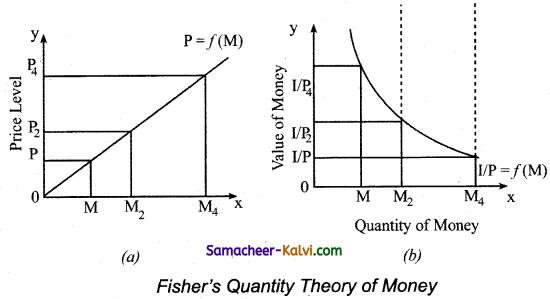
TN Board 12th Economics Important Questions Chapter 5 Monetary Economics 1

Diagramatic Illustration:
(i) Figure (a) shows the effect of changes in the Quantity of money on the price level. When Quantity of money is OM, the price level is OP.
(ii) When the quantity of money is doubled to OM2, the price level is also doubled to OP2.
(iii) When the quantity of money is increased to OM4 the price level also increases to OP2.
(iv) This is expressed by the curve OP = f (M) from the origin at 45°.
(v) Figure (b) – It gives the inverse relationship between Quantity and Value of money. Value of money on vertical axis and Quantity of money OM, on Horizontal axis, when value of money.
(vi) Is OI/P, the quantity of money is doubled OM2.
(vii) When the value of money becomes \(1 \frac{1}{2} \frac{\mathrm{OI}}{\mathrm{P}_{2}}\) then quantity increases by 4 fold OM4.
(viii) When value of money is reduced by OI/P4, then the inverse relationship between the quantity and value of money is shown by downward sloping curve OI/P = f (M).

Samacheer Kalvi TN Board 12th Economics Important Questions Chapter 5 Monetary Economics

Question 16.
Explain the functions of money.
Answer:
Primary Function:
(i) Money as a medium of exchange:
It is a basic function of money. It is accepted by all and all exchanges takes place in terms of money. Money is obtained through sales and purchases.

(ii) Money as a Measure Value:
Prices of all goods and services are expressed in terms of money. It is a collective measure value. So it is easier to determine the rate of exchange between various goods.

Secondary Functions:
(i) Money as Store Value:
The invention of money made storage easy. It is a store of wealth and it can be easily converted into other marketable assets like land, machinery etc.

(ii) Money as a Standard of Deferred Payments:
In the modem Economy due to invention of money borrowing and rending process are made easy because money act as a standard of deferred payments (Cheques).

(iii) Money as a Means of Transferring Purchasing Power:
The exchange of goods are made easy due to the Transfer of purchasing power of money from one place to another.

Contingent Functions:
(i) Basis of Credit System:
Business transactions are done on the basis of credit system. Money is at the back of all credit.

(ii) Money facilitate distribution of National Income:
Due to the invention of money, the distribution of money as rent, wages and profit are made easy.

(iii) Money helps to Equalize Marginal utilities and Marginal Productivities:
Equalising marginal utilities have become easy because the prices of all commodities are expressed in money.

(iv) Money Increases productivity of capital:
Capital in the form of money can be put to any use. It can be transferred from less to more productive use.

Other Functions:
(i) Money helps to maintain Repayment Capacity:
To Maintain repayment capacity banks and Insurance and Governments have to keep some liquid each to maintain repayment capacity.,

(ii) Money represents Generalised Purchasing Power:
Purchasing power kept in terms of money can be put to any use.

(iii) Money gives Liquidity to capital:
Money is the most liquid form of capital. It can be put to any use.

Samacheer Kalvi TN Board 12th Economics Important Questions Chapter 5 Monetary Economics

Question 17.
What are the causes and effects of inflation on the economy?
Answer:
Causes:
(i) Increase in Money Supply: Inflation is caused by an increase in supply and increases aggregate demand.
(ii) Increase in Disposable Income: Disposable income increases National Income and reduction of taxes.
(iii) Increase in Public Expenditure: Government activities like welfare programmes are expanding it also cause increase in price.
(iv) Increase in consumer spending: The demand for goods and services increases on hire purchases.
(v) Cheap Money Policy: This leads to increase in money supply and demand.
(vi) Deficit Financing: Borrowing from public by the Government due to this aggregate demand and supply increases and rise in price.
(vii) Black assets, activities and Money: The Black money increases Aggregate demand because people spend that money lavishly. But supply of goods are reduced.
(viii) Repayment of Public Debt: When the government repay the past debt to public, money supply with the public increases.
(ix) Increase in Exports: When exports are encouraged, domestic supply of goods and services increases.

Effects of Inflation:

Effects of Production:
When resources are not fully utilised, the profit induces business class to
increase their investments in production.
(i) Hyper-inflation results in depreciation of value of money.
(ii) When value of money depreciate, foreign capital reduces.
(iii) With the reduced capital, investment setbacks will discourage entrepreneurs.
(iv) Inflation leads to hoarding of essential goods.
(v) Inflation encourages investment in speculative activities.

Effects on Distribution:
(i) Debtors and Creditors: During inflation debtors gain and creditors lose because of high purchasing power of money.
(ii) Fixed-Income groups: The Fixed Income groups are worst hit during Inflation.
(iii) Entrepreneurs: Inflation is a boon to the entrepreneurs like Traders, merchants.
(iv) Investors: Those who invest in Fixed interest lose during inflation but who invest on shares gain by rich dividend.

Samacheer Kalvi TN Board 12th Economics Important Questions Chapter 5 Monetary Economics

Question 18.
Describe the phases of Trade cycle.
Answer:
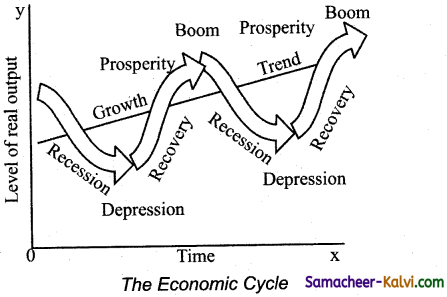
There are four different Phases of Trade Cycle.
(i) Boom or Prosperity Phase:
Movement of Economy beyond full employment is called boom phase during this phase profits increase, interest rate group. The Demand for bank credit increases.

TN Board 12th Economics Important Questions Chapter 5 Monetary Economics 2

(ii) Recession:
The turning point from boom is called recession. Failure of a company or bank brings this phase. Investments are reduced and production comes down income and profit decline panic in stock market and money market becomes tight.

(iii) Depression:
The Level of Economic activity becomes low. Firms will close because of losses and it will result in unemployment. Agriculture will decline. It is a worst phase of business cycle. Extreme depression is called as ‘Trough’.

(iv) Recovery:
After depression, its recovery. It brings the demand for capital goods and Autonomous investment, the demand slowly increases. Recovery may be initiated by investment by government Expenditure.

Samacheer Kalvi TN Board 12th Economics Important Questions Chapter 5 Monetary Economics

Multiple Choice Questions:

Question 1.
The RBI Headquarters is located at:
(a) Delhi
(b) Chennai
(c) Mumbai
(d) Bengaluru
Answer:
(c) Mumbai

Question 2.
Money is:
(a) acceptable only when it has intrinsic value
(b) constant in purchasing power
(c) the most liquid of all assets
(d) needed for allocation of resources
Answer:
(c) the most liquid of all assets

Question 3.
Paper currency system is managed by the:
(a) Central Monetary authority
(b) State Government
(c) Central Government
(d) Banks
Answer:
(a) Central Monetary authority

Samacheer Kalvi TN Board 12th Economics Important Questions Chapter 5 Monetary Economics

Question 4.
The basic distinction between M1 and M2 is with regard to:
(a) post office deposits
(b) time deposits of banks
(c) saving deposits of banks
(d) currency
Answer:
(b) time deposits of banks

Question 5.
Irving Fisher’s Quantity Theory of Money was popularized in:
(a) 1908
(b) 1910
(c) 1911
(d) 1914
Answer:
(c) 1911

Question 6.
MV stands for:
(a) demand for money
(b) supply of legal tender money
(c) Supply of bank money
(d) Total supply of money
Answer:
(b) supply of legal tender money

Samacheer Kalvi TN Board 12th Economics Important Questions Chapter 5 Monetary Economics

Question 7.
Inflation means:
(a) Prices are rising
(b) Prices are falling
(c) Value of money is increasing
(d) Prices are remaining the same
Answer:
(a) Prices are rising

Question 8.
______ inflation results in a serious depreciation of the value of money.
(a) Creeping
(b) Walking
(c) running
(d) Hyper
Answer:
(d) Hyper

Question 9.
________ inflation occurs when gengeneral prices of commodities increases due
(a) Cost-push
(b) demand pull
(c) running
(d) galloping
Answer:
(a) Cost-push

Samacheer Kalvi TN Board 12th Economics Important Questions Chapter 5 Monetary Economics

Question 10.
During inflation, who are the gainers?
(a) Debtors
(b) Creditors
(c) Wage and salary earners
(d) Government
Answer:
(a) Debtors

Question 11.
_______ is a decrease in the rate of inflation.
(a) Disinflation
(b) Deflation
(c) Stagflation
(d) Depression
Answer:
(a) Disinflation

Question 12.
Stagflation combines the rate of inflation with:
(a) Stagnation
(b) employment
(c) output
(d) price
Answer:
(a) Stagnation

Samacheer Kalvi TN Board 12th Economics Important Questions Chapter 5 Monetary Economics

Question 13.
The study of alternating fluctuations in business activity is referred to in Economics as:
(a) Boom
(b) Recession
(c) Recovery
(d) Trade cycle
Answer:
(d) Trade cycle

Question 14.
During depression the level of economic activity becomes extremely:
(a) high
(b) bad
(c) low
(d) good
Answer:
(c) low

Question 15.
“Money can be anything that is generally acceptable as a means of exchange and that the same time acts as a measure and a store of value”. This definition was given by:
(a) Crowther
(b) A.C.Pigou
(c) F.A.Walker
(d) Francis Bacon
Answer:
(a) Crowther

Samacheer Kalvi TN Board 12th Economics Important Questions Chapter 5 Monetary Economics

Question 16.
Debit card is an example of:
(a) currency
(b) paper currency
(c) plastic money
(d) money
Answer:
(c) plastic money

Question 17.
Fisher’s Quantity Theory of money is based on the essential function of money as:
(a) measure of value
(b) store of value
(c) medium of exchange
(d) standard of deferred payment
Answer:
(c) medium of exchange

Question 18.
V in MV = PT equation stands for:
(a) Volume of trade
(b) Velocity of circulation of money
(c) Volume of transaction
(d) Volume of bank and credit money
Answer:
(b) Velocity of circulation of money

Samacheer Kalvi TN Board 12th Economics Important Questions Chapter 5 Monetary Economics

Question 19.
When prices rise slowly, we call it:
(a) galloping inflation
(b) mild inflation
(c) hyper inflation
(d) deflation
Answer:
(b) mild inflation

Question 20.
_________ inflation is in no way dangerous to the economy.
(a) walking
(b) running
(c) creeping
(d) galloping
Answer:
(c) creeping

Samacheer Kalvi TN Board 12th Economics Important Questions Chapter 5 Monetary Economics

Samacheer Kalvi 12th Economics Notes Chapter 5 Monetary Economics

→ Broad Money: It is post office savings plus time deposits with commercial and co-operative banks excluding inter bank time deposits.

→ Cost-Push Inflation: General price level increases in the cost of wages and raw materials.

→ Contingent Functions: Making use of money as cheques.

→ Demand-Pull Inflation: Inflation due to excess demand.

→ Dead Money: A situation in which money or loans are very difficult to obtain in a given country, the rate of Interest rate to be pushed up due to the forces of demand and supply.

→ Call Money: Low rate of Interest and paid back at short notice.

→ Cheap Money: The maintenance of low interest rate during a period of depression to encourage investment.

→ Galloping Inflation: Very rapid Inflation.

→ Inflationary Gap: “An excess of anticipated of expenditure over available output at base prices”.

→ Monetary Policy: Control of Central Bank on money supply to Influence Economy.

→ Over Draft: A negative balance in a Bank account and customer owes the money to the Bank.

→ Purchasing Power Parity: An exchange rate between two currencies, that same amount of products can be bought for same amount in each country if the cost were converted at that exchange rate.

Samacheer Kalvi TN Board 12th Economics Important Questions Chapter 5 Monetary Economics

→ Definitions of Money:
Many economists developed definition for money. Among these, definitions of Walker and Crowther are given below:
“ Money is, what money does ” – Walker.
“Money can be anything that is generally acceptable as a means of exchange and at the same time acts as a measure and a store of value”. – Crowther.

→ Definition of Inflation:
“7oo much of Money chasing too few goods” – Coulboum.
“A state if abnormal decrease in the quantity ofpurchasing power” – Gregorye.

→ Definition of Trade Cycle:
“A trade cycle is composed ofperiods of good trade characerised by rising prices and low unemployment percentages. altering with periods of bad trade characterised by falling prices and high unemployment percentages ” – J.M. Keynes

→ Definition of Marshall’s Value of Money:
According to Marshall’s equation, the value of money is influenced not only by changes in M, but also by changes in K. where,
M – Quantity of money
K – The fraction of the real income which the public desires to hold in the form of money.

→ General Equation of Fisher MV = PT
i. e. Supply of Money = Demand for Money.

→ Revised Equation of Fisher
PT = MV + M’V’
P = MV + M’V’

→ Marshall’s Equation,
(i) M = KPY
(ii) Keynes Equation n = pk (or) p = n/k
(iii) Extended Equation of Keynes n = p(k + rk’) or p = n/(k + rK’)

TN Board 12th Economics Important Questions

TN Board 12th Economics Important Questions Chapter 4 Consumption and Investment Functions

TN State Board 12th Economics Important Questions Chapter 4 Consumption and Investment Functions

Question 1.
What is Consumption function?
Answer:
The consumption function is the functional relationship between consumption expenditure and the National income = C = f(Y), C = Consumption, Y = Income, f = Function.

Question 2.
What do you mean by Propensity to Consume?
Answer:
Propensity to consume income and consumption relationship, that is when Income increases, consumption also increases.

Samacheer Kalvi TN Board 12th Economics Important Questions Chapter 4 Consumption and Investment Functions

Question 3.
Define Average Propensity to Consume (APC).
Answer:
“It is the ratio of consumption expenditure to any particular level of income”.
APC = C / Y
Where C = Consumption and Y = Income

Question 4.
Define Marginal Propensity to Consume (MPC).
Answer:
“It is the ratio of change in the consumption to change in income”
MPC = ∆C/∆Y
Where ∆C = change in consumption
∆Y = change in income
MPC is positive but less than unity.

Question 5.
What do you mean by Propensity to Save?
Answer:
It is the proportion of total income or increase in income that consumers save rather than spend on consumption.

Samacheer Kalvi TN Board 12th Economics Important Questions Chapter 4 Consumption and Investment Functions

Question 6.
Define Average Propensity to Save (APS).
Answer:
APS is the quotient obtained by dividing the total saving by the total income. It is the ratio of total savings to total income. It can be expressed in the form of APS = S/Y Where S = savings Y= income

Question 7.
Define Marginal Propensity to Save (MPS).
Answer:
It is the ratio of change in saving to a change in income MPS = ∆S / ∆Y
∆S = change in saving
∆Y = change in income
MPC + MPS =1
MPS = 1 – MPC and MPC = 1 – MPS

Question 8.
Define Multiplier.
Answer:
Multiplier is defined as the ratio of the change in National income to change in income
K = ∆Y / ∆I
Where K = multiplexer
∆I = Increase in investment
∆Y = Resultant increase in income

Samacheer Kalvi TN Board 12th Economics Important Questions Chapter 4 Consumption and Investment Functions

Question 9.
Define Accelerator.
Answer:
It is the numerical value of the relation between an increase in consumption and the resulting increase in investment.
Accelerator β = ∆I / ∆C
∆I = change in investment outlays
∆C = change in consumption demand.

Question 10.
State the propositions of Keynes’s Psychological Law of Consumption.
Answer:

  1. When income increases, consumption expenditure also increases but by a smaller amount.
  2. The increased income will be divided in some proportion between consumption expenditure and saving.
  3. Increase in income always leads to an increase in both consumption and saving.

Question 11.
Differentiate autonomous and induced investment.
Answer:

Autonomous investment

 Induced investment

It is independent Planned
Income is inelastic Income is elastic
Welfare motive Profit motive
The curve is horizontal parallel to x axis It is positively sloped

Samacheer Kalvi TN Board 12th Economics Important Questions Chapter 4 Consumption and Investment Functions

Question 12.
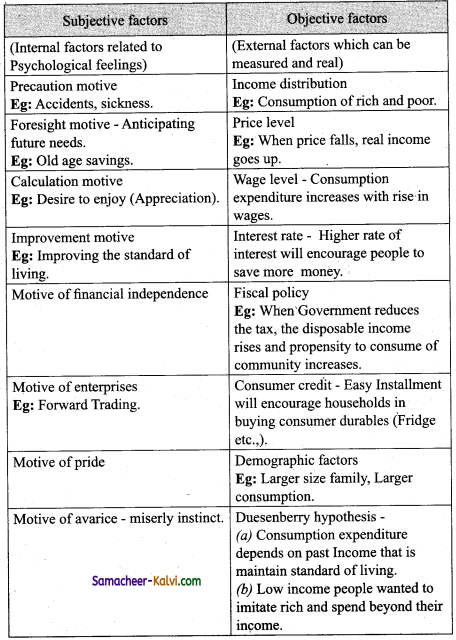
Explain any three subjective and objective factors influencing the consumption function.
Answer:
Subjective and Objective factors influencing the consumption function are:

Subjective factor

 Objective factor

The motive of precaution Income distribution
The motive of foresight Price level
The motive of calculation Wage level
The motive of improvement Interest rate
The motive of financial independence Fiscal policy
The motive of enterprise Consumer credit
The motive of pride Demographic factors
The motive of avarice Duesenberry hypothesis

Question 13.
Mention the differences between accelerator and multiplier effect.
Answer:

Accelerator

 Multiplier

The numerical value of the relation between an increase in consumption and the resulting increase in investment. It is the ratio of the change in National income to change in investment.
Accelerator p = ∆I / ∆C Multiplier K = ∆Y / ∆I

Samacheer Kalvi TN Board 12th Economics Important Questions Chapter 4 Consumption and Investment Functions

Question 14.
State the concept of super multiplier.
Answer:
The super multiplier is worked out by combining both induced consumption and induced investment. It is greater than simple multiplier. It is K and P interaction. J.R.Hicks has combined mathematically K and P and given the name of super multiplier.

Question 15.
Specify the limitations of the multiplier.
Answer:

  1. The assumption of constant capital output ratio is unrealistic.
  2. Resources are available only before full employment.
  3. Excess capacity is capital goods industries is assumed.
  4. Accelerator will work only if the increased demand in permanent.
  5. Accelerator will work only when credit is available easily.
  6. If there is unused or excess capacity is the consumer goods industry, the accelerator principle would not work.

Samacheer Kalvi TN Board 12th Economics Important Questions Chapter 4 Consumption and Investment Functions

Question 16.
Explain Keynes psychological law of consumption function with diagram.
Answer:
This law of consumption which forms the basis of the consumption function. This law Implies that there is a tendency on the part of the people to spend in consumption less than the full increment of income.

Assumptions:

  1. Ceteris paribus: The other variable like tastes, habits etc., do not change.
  2. Existence of normal conditions: The law holds goods under normal conditions.
  3. Existence of a Laissez-Faire Capitalist: This law operates in a rich capitalist economy where there is no government interventions.

Propositions to the law:

  1. Consumption expenditure increases in a smaller amount when the income increases.
  2. The increased income will be divided in some proportion between consumption, expenditure and saving.
  3. Consumption and savings increases when income increases.

Three proportions of the law:

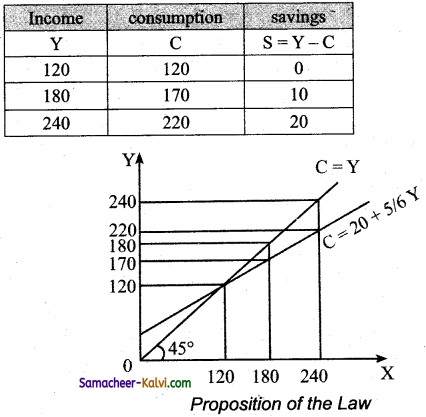
TN Board 12th Economics Important Questions Chapter 4 Consumption and Investment Functions 1

(i) Proposition (1):
When income increases from 120 to 180, consumption also increases from 120 to 170, but the increase in consumption is less than the increase in income.

(ii) Proposition (2):
When income increases to 180 and 240, it divided between consumption by 170 and 220 by the saving by 10 and 20.

(iii) Proposition(3): Increases in income to 180 and 240 lead to increased consumption 170 and 220 and increased saving 20 and 10 than before.

Samacheer Kalvi TN Board 12th Economics Important Questions Chapter 4 Consumption and Investment Functions

Question 17.
Briefly explain the subjective and objective factors of consumption function.
Answer:

TN Board 12th Economics Important Questions Chapter 4 Consumption and Investment Functions 2

Question 18.
Illustrate the working of Multiplier.
Answer:
Working of multiplier – Numerical example:
(i) Investment expenditure undertaken by government is ₹ 100cr (on public work). It is from wages prices of material etc.,
(ii) So income of labourers and suppliers of materials increases by ₹ 100 cr.
(iii) If the marginal propensity to consume is 0.8 that is 80%.
(iv) (A sum of ₹ 80cr is spent on consumption and a sum of ₹ 20cr is saved).

On these basis:
(i) Suppliers of goods get an income of ₹ 80cr
(ii) They spent (80% on ₹ 80cr) ₹ 64cr
(iii) The consumption expenditure and income gives a chain reaction.
The final results is ∆Y = 100 + 100 × 4/5 +100 × [4/5]<sup>2</sup> + 100 × [4/5]<sup>3</sup>or,
∆Y = 100+ 100 × 0.8 + 100 × (0.8)<sup>2</sup> + 100 × (0.8)<sup>3</sup>
= 100 + 80 + 64 + 51.2 = 500

that is 100 × 1/1-4/5 100 × 1 / 1 – 4 / 5
100 × 5 = ₹ 500 crores
For instance if C = 100 + 0.8Y, I = 100,
Then Y =100 + 0.8Y+ 100
0.2Y =200
Y = 200 / 0.2= 1000 → Point B
If I is increased to 110, then ,
0.2Y = 210
Y = 210 / 0.2 = 1050 → Point D

For ₹ 10 increase in I, Y has increased by ₹ 50.
This is due to multiplier effect.
At point A, Y = C = 500
C = 100 + 0.8 (500) = 500; S = 0
At point B, Y = 1000
C = 100 + 0.8 (1000) = 900; S = 100 = I
At point D, Y = 1050
C =100 + 0.8 (1050) = 940; S= 110 = I
When I is increased by 10, Y increases by ₹ 50.
This is multiplier effect (K = 5)
K = \(\frac{1}{0.2}\) = 5

Samacheer Kalvi TN Board 12th Economics Important Questions Chapter 4 Consumption and Investment Functions

Question 19.
Explain the operation of the Accelerator.
Answer:
(i) To produce 1000 consumer goods 100 machines are required and the life of machine is 10 years, (that is for every 10 years, the machine has to be replaced to maintain to produce 1000 consumer goods). This is called a Replacement Demand.
(ii) If the demand for consumer increases by 10% [ 1000 to 1100] is that case 10 more machines
are needed and the total demand for machines becomes [10 + 10 = 20 ] that is 10 for replacement and 10 for meeting the increased demand.

Note: [The important aspect is 10% increase in demand for consumer goods causes a 100% increase for machines from 10 to 20 No. of machines].

The result derived is:
Even a small change is demand for consumer goods will lead to a big change in investment.

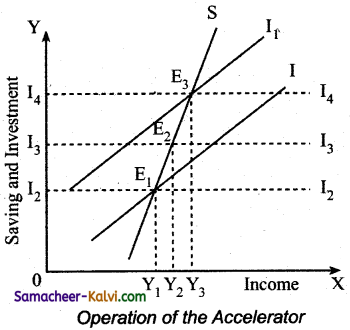
TN Board 12th Economics Important Questions Chapter 4 Consumption and Investment Functions 3

Explanation of accelerator:
→ SS is the saving curve(SS).
→ II is the investment curve (II).
→ A is the point E1 the economy is in equilibrium with OY1, income [OY1].
→ Saving and investment are equal at OI2.
→ When investment is increased from OI2 to OI4, the income also increases from OY, to OY3 and the equilibrium point is E3.
→ If the increase in investment by I2I4 is purely exogenous, then the increase in income by Y1 and Y3 would have been due to multiplier effect.
→ According to this diagram, it is assumed that exogeneous investment is only by I2I3 and induced investment is by I3I4.
→ To conclude, the increase in income by Y1 Y3 is due to the multiplier effect and.
→ The increase in income by Y2Y3 is due to the accelerator effect.

Samacheer Kalvi TN Board 12th Economics Important Questions Chapter 4 Consumption and Investment Functions

Question 20.
What are the differences between MEC and MEI?
Answer:

Marginal Efliciency of Capital(MEC)

 Marginal Efficiency of Investment(MEI)

It is based on a given supply price for capital. It is based on the induced change in the price due to change in the demand for capital..
It represents the rate of return on all successive units of capital without regard to existing capital. It shows the rate of return on just those units of capital over and above the existing capital stock.
The capital stock is taken on the X axis of diagram. The amount of investment is taken on the X – axis of diagram.
It is a “stock” concept. It is a “flow” concept.
It determines the optimum capital stock in an economy at each level of interest rate. It determines the net investment of the economy at each interest rate given the capital stock.

Samacheer Kalvi TN Board 12th Economics Important Questions Chapter 4 Consumption and Investment Functions

Multiple Choice Questions:

Question 1.
The average propensity to consume is measured by:
(a) C / Y
(b) C × Y
(c) Y / C
(d) C + Y
Answer:
(a) C / Y

Question 2.
An increase in the marginal propensity to consume will:
(a) Lead to consumption function becoming steeper.
(b) Shift the consumption function upwards.
(c) Shift the consumption function downwards.
(d) Shift savings function upwards.
Answer:
(a) Lead to consumption function becoming steeper.

Question 3.
If the Keynesian consumption function is C = 10 + 0.8 Y then, if disposable income is ₹ 1000, what is amount of total consumption?
(a) ₹ 0.8
(b) ₹ 800
(c) ₹ 810
(d) ₹ 0.81
Answer:
(c) ₹ 810

Samacheer Kalvi TN Board 12th Economics Important Questions Chapter 4 Consumption and Investment Functions

Question 4.
If the Keynesian consumption function is C = 10 + 0.8Y then, when disposable income is ₹ 100, what is the marginal propensity to consume?
(a) ₹ 0.8
(b) ₹ 800
(c) ₹ 810
(d) ₹ 0.81
Answer:
(a) ₹ 0.8

Question 5.
If the Keynesian consumption function is C = 10 + 0.8 Y then, and disposable income is ₹ 100, what is the average propensity to consume?
(a) ₹ 0.8
(b) ₹ 800
(c) ₹ 810
(d) ₹ 0.9
Answer:
(d) ₹ 0.9

Question 6.
As national income increases:
(a) The APC falls and gets nearer in value to the MPC.
(b) The APC increases and diverges in value from the MPC.
(c) The APC stays constant.
(d) The APC always approaches infinity.
Answer:
(a) The APC falls and gets nearer in value to the MPC.

Samacheer Kalvi TN Board 12th Economics Important Questions Chapter 4 Consumption and Investment Functions

Question 7.
As increase in consumption at any given level of income is likely to lead:
(a) Higher aggregate demand
(b) An increase in exports
(c) A fall in taxation revenue
(d) A decrease in import spending
Answer:
(a) Higher aggregate demand

Question 8.
Lower interest rates are likely to:
(a) Decrease in consumption
(b) Increase cost of borrowing
(c) Encourage saving
(d) Increase borrowing and spending
Answer:
(d) Increase borrowing and spending

Question 9.
The MPC is equal to:
(a) Total spending / total consumption
(b) Total consumption/total income
(c) Change in consumption /change in income
(d) None of the above
Answer:
(c) Change in consumption /change in income

Samacheer Kalvi TN Board 12th Economics Important Questions Chapter 4 Consumption and Investment Functions

Question 10.
The relationship between total spending on consumption and the total income is the:
(a) Consumption function
(b) Savings function
(c) Investment function
(d) Aggregate demand function
Answer:
(a) Consumption function

Question 11.
The sum of the MPC and MPS is:
(a) 1
(b) 2
(c) 0.1
(d) 1.1
Answer:
(a) 1

Question 12.
As income increases, consumption will:
(a) fall
(b) not change
(c) fluctuate
(d) increase
Answer:
(d) increase

Samacheer Kalvi TN Board 12th Economics Important Questions Chapter 4 Consumption and Investment Functions

Question 13.
When investment is assumed autonomous the slope of the AD schedule is determined by the:
(a) marginal propensity to invest
(b) disposable income
(c) marginal propensity to consume
(d) average propensity to consume
Answer:
(c) marginal propensity to consume

Question 14.
The multiplier tells us how much changes after a shift in
(a) Consumption, income
(b) investment, output
(c) savings, investment
(d) output, aggregate demand
Answer:
(d) output, aggregate demand

Question 15.
The multiplier is calculated as:
(a) 1 / (1- MPC)
(b) 1 / MPS
(c) 1 / MPC
(d) (a) and (b)
Answer:
(d) (a) and (b)

Samacheer Kalvi TN Board 12th Economics Important Questions Chapter 4 Consumption and Investment Functions

Question 16.
If the MPC is 0.5, the multiplier is:
(a) 2
(b) 1/2
(c) 0.2
(d) 20
Answer:
(a) 2

Question 17.
In an open economy import ________ the value of the multiplier.
(a) reduces
(b) increase
(c) does not change
(d) changes
Answer:
(a) reduces

Question 18.
According to Keynes, investment is a function of the MEC and:
(a) Demand
(b) Supply
(c) Income
(d) Rate of interest
Answer:
(d) Rate of interest

Samacheer Kalvi TN Board 12th Economics Important Questions Chapter 4 Consumption and Investment Functions

Question 19.
The term super multiplier was first used by:
(a) J.R.Hicks
(b) R.G.D. Allen
(c) Kahn
(d) Keynes
Answer:
(a) J.R.Hicks

Question 20.
The term MEC was introduced by:
(a) Adam Smith
(b) J.M. Keynes
(c) Ricardo
(d) Malthus
Answer:
(b) J.M. Keynes

Samacheer Kalvi TN Board 12th Economics Important Questions Chapter 4 Consumption and Investment Functions

Samacheer Kalvi 12th Economics Notes Chapter 4 Consumption and Investment Functions

→ Ceteris paribus: All other things remaining equal.

→ Extraneous: Calculation of the value of a function outside the range of known values.

→ Hyper inflation: Very rapid inflation, monetary authorities will lose control over the situation.

→ Averice: Miserly instinct.

→ Windfall gains or losses: Unexpected changes in the stock market.

→ Investment multiplier: Refers to the multiple increase in income due to a given increase in investment.

→ The minimum value of multiplier: It is one (1) and maximum value is infinity.

→ Ex-ante: Intended or planned

→ Ex-post: Actual or realised

→ Break eveb point: The point at which the volume of sales yields revenue equal to the entire fixed and variable cost. At this point profit is zero.

Samacheer Kalvi TN Board 12th Economics Important Questions Chapter 4 Consumption and Investment Functions

→ CF – Consumption function

→ AC – Autonomous Consumption

→ APC – Average Propensity to Consume

→ APS – Average Propensity to Save

→ MPC – Marginal Propensity to Consume

→ MPS – Marginal Propensity to Save

→ Y – Income, C – Consumption, S – Savings,

→ Investment function:
I = f(R)
I – Investment (dependent variable)
R – Rate of interest (independent variable)

→ MEC – Marginal Efficiency of Capital

→ MEI Marginal Efficiency of Investment

Samacheer Kalvi TN Board 12th Economics Important Questions Chapter 4 Consumption and Investment Functions

→ Consumption function symbolically C = f(Y).
C – Consumption, Y – Income,f- Function

→ Marginal propensity to consume = \(\frac{\Delta \mathrm{C}}{\Delta \mathrm{Y}}\)

→ Average propensity to consume = \(\frac{C}{Y}\)

→ Average propensity to save = \(\frac{\mathrm{S}}{\mathrm{Y}}\)

→ Marginal propensity to save = \(\frac{\Delta \mathrm{S}}{\Delta \mathrm{Y}}\)

→ Multiplier K = \(\frac{\Delta \mathrm{Y}}{\Delta \mathrm{I}}\) (or)
K = \(\frac{1}{1}\) – MPC (or) \(\frac{1}{\text { MPS }}\)

→ Accelerator Effect β = \(\frac{\Delta I}{\Delta C}\)

→ Leverage Effect Y = C + IA + Ip

TN Board 12th Economics Important Questions

TN Board 12th Economics Important Questions Chapter 3 Theories of Employment and Income

TN State Board 12th Economics Important Questions Chapter 3 Theories of Employment and Income

Question 1.
Define full employment.
Answer:
Full employment refers to a situation in which every able person willing to work at the prevailing wage rate is employed or that person who are willing to work and able to work must have employment.

Question 2.
What is the main feature of rural unemployment?
Answer:
Main feature of rural unemployment – The major feature of rural unemployment is the existence of unemployment in the form of disguised unemployment and seasonal unemployment.

Question 3.
Give short note onfrictional unemployment.
Answer:
It is also known as Temporary unemployment. It occurs because of the imbalance between the demand and supply of labour. It is also because of immobility of labour, lack of skills, shortages of raw materials and break down of machineries.

Samacheer Kalvi TN Board 12th Economics Important Questions Chapter 3 Theories of Employment and Income

Question 4.
Give reasons for labour retrenchment at present situation.
Answer:
In recent years new techniques are- adopted. Modem technology introduces inventions and innovations. Due to technical improvements, the need for labourers becomes less and the existing workers are retrenched.

Question 5.
List out the assumptions of Say’s law.
Answer:

  1. The price cannot be affected by single seller, buyer of commodity.
  2. There is full employment.
  3. No single buyer or seller of commodity or an input can affect price.
  4. Full employment.
  5. People are motivated by self interest and self – interest determines economic decisions.
  6. The laissez faire policy is essential for an automatic and self adjusting process of full employment equilibrium. Market forces determine everything right.
  7. There will be a perfect competition in labour and product market.
  8. There is wage-price flexibility.
  9. Money acts only as a medium of exchange.
  10. Long – run analysis.
  11. There is no possibility for over production or unemployment.

Samacheer Kalvi TN Board 12th Economics Important Questions Chapter 3 Theories of Employment and Income

Question 6.
What is effective demand?
Question
It is the money spent actually on products of industry by the people.

Question 7.
What are the components of aggregate supply?
Answer:

  1. Aggregate (desired) consumption expenditure (C)
  2. Aggregate (desired) private savings (S)
  3. Net Tax payments (T) –
  4. Personal (desired) transfer payments to the foreigners (Rf)
    Aggregate supply =C + S + T + Rf = Aggregate income generated in the economy.

Question 8.
Explain the following in short:
(i) Seasonal unemployment,
(ii) Frictional unemployment,
(iii) Educated unemployment.
Answer:
(i) Seasonal unemployment:
Unemployment during seasons. People are unemployed during off season. Seasonal unemployment happens from demand side.
Eg: Ice cream industry, holiday resorts etc., it is common in agriculture and agro based industries.

(ii) Frictional unemployment:
It is due to imbalance between supply and demand of labour. Eg: people who lose their job in search of new jobs.

(iii) Educated unemployment:
When the qualification of the people do not match with their job, educational system, lack of technical skills, mass student turn out, preference for white collar job are responsible for educated unemployment.

Samacheer Kalvi TN Board 12th Economics Important Questions Chapter 3 Theories of Employment and Income

Question 9.
According to classical theory of employment, how wage reduction solve the problem of unemployment diagramatically explain.
Answer:
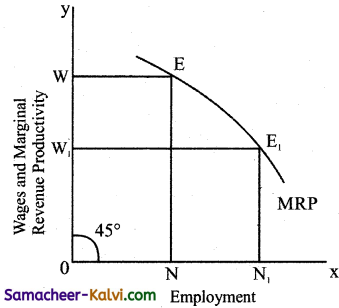
According to Classical Economist, full employment condition can be achieved by cutting down the wage rate unemployment would be eliminated when wages are determined by the mechanism of Economy itself.

TN Board 12th Economics Important Questions Chapter 3 Theories of Employment and Income 1

Explanation of the Diagram:

  1. When the wage rate is OW, then employment is ON.
  2. As the wage rate is reduced to OW, then the employment has increased to ON.
  3. According to A.C. Pigou, this theory has a base for developing the solution of unemployment problem.
  4. The condition of unemployment cannot exist in normal economic conditions.
  5. This is because as the unemployment arises, wages would fall. In such a case, organisations would prefer to hire new employees, which would result in eliminating unemployment.
  6. “The law also assumes that there should neither be any intervention of government to regulate the rate of wages nor any role of trade unions.”
  7. According to Say’s law, the condition of unemployment exists only under some specific conditions. But this condition is momentary.

Question 10.
Write short note on the implications of Say’s law.
Answer:

  1. Over production or unemployment is not possible.
  2. The unutilized resources are employed when factors accept rewards according to their productivity under full employment.
  3. No government intervention due to automatic price mechanism in the economy.
  4. Equality between savings and investment due to flexibility in interest
  5. Money serves as a medium of exchange only because people will not hold idle money.

Samacheer Kalvi TN Board 12th Economics Important Questions Chapter 3 Theories of Employment and Income

Question 11.
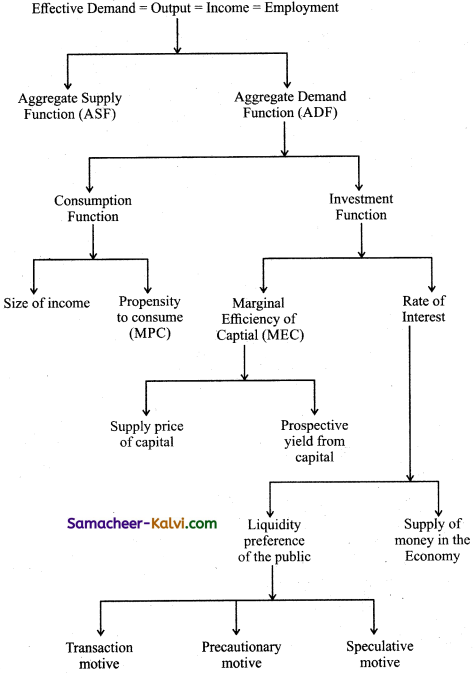
Explain Keynes’ theory in the form of flow chart.
Answer:

TN Board 12th Economics Important Questions Chapter 3 Theories of Employment and Income 2

Samacheer Kalvi TN Board 12th Economics Important Questions Chapter 3 Theories of Employment and Income

Question 12.
What do you mean by aggregate demand ? Mention its components.
Answer:
The aggregate demand is the amount of money which entrepreneurs expect to get by selling the output produced by the number, of labourers employed. So it is the expected income or revenue from the sale of output at different levels of employment.
Four components of aggregate demand

  1. Consumption demand
  2. Investment demand
  3. Government expenditure and
  4. Net export (Export – Import)

Question 13.
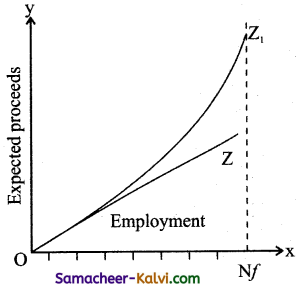
Explain about aggregate supply with the help of diagram.
Answer:
Aggregate supply is the value of total output of goods and services produced in a year. It is equal to the value of national product i.e., National income. It is the required amount of labourers and materials to produce the necessary output.
Aggregate supply = C + S + T + Rf = Aggregate income generated in the economy.

TN Board 12th Economics Important Questions Chapter 3 Theories of Employment and Income 3

Explanation of the Diagram:
Aggregate supply curves are drawn for the assumption of fixed money wages and variable wages.
Z curve is Linear and money wages are fixed, curve is non-linear, wage rate increases with employment. When full employment level of Nf is reached, it is impossible to increase output by employing more men. So aggregate supply curve becomes inelastic. (Vertical straight line)

Samacheer Kalvi TN Board 12th Economics Important Questions Chapter 3 Theories of Employment and Income

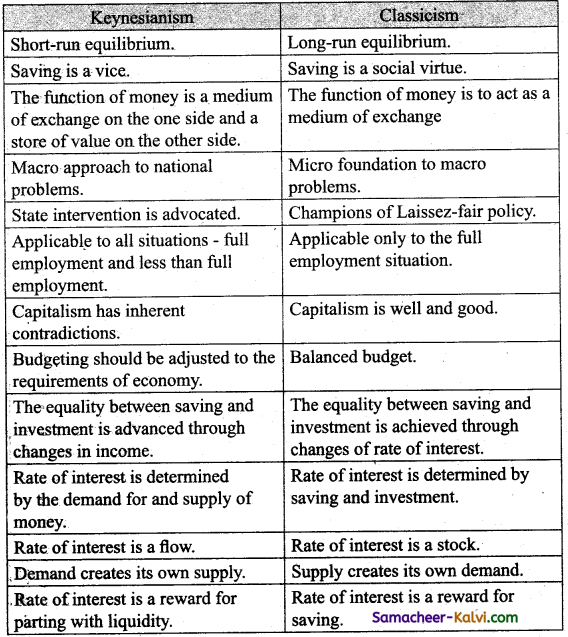
Question 14.
Write any five differences between classicim and Keynesianism.
Answer:

TN Board 12th Economics Important Questions Chapter 3 Theories of Employment and Income 4

Question 15.
Describe the types of unemployment.
an:
In the developing countries like India, the nature of unemployment is different.
(i) Cyclical unemployment:
It occurs during die (town phase -of trade cycle that is during the period of recession and depression income ami output fall leading to widespread unemployment It can be cured by public investment.

(ii) Seasonal unemployment:
Unemployment during seasons. People are . unemployed during off season. Seasonal unemployment happens fromm demand side.
Eg: Ice cream industry, holiday resorts etc., it is common in agriculture and agro based industries.

(iii) Frictional unemployment:
It is due to imbalance between supply and demand of labour. Eg: people who lose their job in search of new jobs.

(iv) Educated unemployment:
When the qualification of the people do not match with their job, educational system, lack of technical skills, mass student turn out, preference for white collar job are responsible for educated unemployment.

(v) Technical unemployment:
In recent years new techniques are adopted. Modem technology introduces inventions and innovations. Due to technical improvements, the need for labourers becomes less and the existing workers are retrenched.

(vi) Structural unemployment:
It is due to the drastic change in the structure of the society. This unemployment is due to lack of demand for the product or shift in demand.

(vii) Disguised unemployment:
This type of unemployment occurs in agriculture. A person is said to be disguisedly unemployed if his contribution to output is less than what he can produce by working for normal hours per day.

Samacheer Kalvi TN Board 12th Economics Important Questions Chapter 3 Theories of Employment and Income

Question 16.
Critically explain Say’s law of market.
Answer:
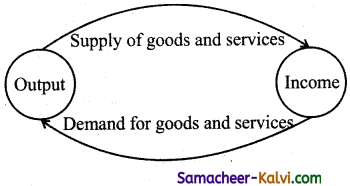
It is the core of classical theory of employment J.B. say enunciated the proposition that “ supply creates its own demand”. Hence there cannot be general over production or the problem of unemployment in the economy. According to say “ when goods are produced by firms in the economy, they pay reward to the factors of production. So each product produced in the economy creates demand equal to its value in the market”.

TN Board 12th Economics Important Questions Chapter 3 Theories of Employment and Income 5

Assumptions of the Say’s law of market:

  1. The price cannot be affected by single seller, buyer of commodity.
  2. There is full employment.
  3. No single buyer or seller of commodity or an input can affect price.
  4. Full employment.
  5. People are motivated by self interest and self-interest determines economic decisions.
  6. The laissez faire policy is essential for an automatic and self adjusting process of full employment equilibrium. Market forces determine everything right.
  7. There will be a perfect, competition in labour and product market.
  8. There is wage-price flexibility.
  9. Money acts only as a medium of exchange.
  10. Long – run analysis.
  11.  There is no possibility for over production or unemployment.

Implications of the Say’s law of market:

  1. Over production or unemployment is not possible.
  2. The unutilized resources are employed when factors accept rewards according to their productivity under full employment.
  3. No government intervention due to automatic price mechanism in the economy.
  4. Equality between savings and investment due to flexibility in interest.
  5. Money serves as a medium of exchange only because people will not hold idle money.

Criticisms of Say’s law:

  1. According to Keynes supply does not create its demand. It is not applicable where demand does not increase as much as production increases.
  2. Unemployment can be removed by increase in the rate of investment. Automatic adjustment process will not remove unemployment.
  3. Individuals hold money for unforeseen expenses and businessmen keep cash reserve for future activities. So money is not neutral.
  4. According to say there is no over production but according to Keynes over production is possible.
  5. Because of under employment in capitalist economies, Keynes regards full employment as a special case.
  6. The government intervention arises in the case of general over production and mass unemployment.

Samacheer Kalvi TN Board 12th Economics Important Questions Chapter 3 Theories of Employment and Income

Question 17.
Narrate the equilibrium between ADF and ASF with diagram.
Answer:
Equilibrium between ADF and ASF could be explained with household and business sector (Two sector economy). It is assumed that consumption function is linear and planned investment is autonomous.
There are two approaches
(i) Aggregate demand – Aggregate supply approach
(ii) Saving – Investment approach
AD and AS approach is only taken to explain the determination of equilibrium level of income and employment.

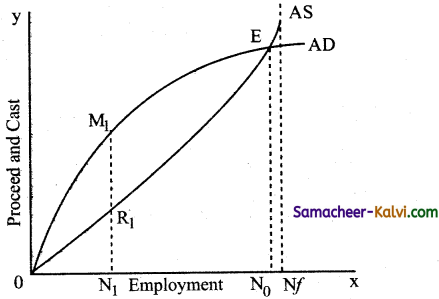
TN Board 12th Economics Important Questions Chapter 3 Theories of Employment and Income 6

At the point ‘E’ the AD and AS reach equilibrium. The employment level is N0 at that point. At ON1, employment, the aggregate is N1, R1. But they are able to produce M1, N1.The expected level of profit is M1, R1.

At this level, entrepreneurs will employ more labourers. At the point E, the employment of labour will reach max and it will stop. At the level of beyond ON0 the aggregate demand curve is below the aggregate supply curve. But it will indicate loss to the producers. So they will not employ more than ON0 labour. Equilibrium level of employment need not be the full employment level (N1) the difference between N0 – Nf is the level of unemployment. Sa the concept of effective demand is significant in explaining the under employment equilibrium.

Question 18.
Explain the differences between classical theory and keynes theory.
Answer:
For answer refer q.no : 14

Samacheer Kalvi TN Board 12th Economics Important Questions Chapter 3 Theories of Employment and Income

Multiple Choice Questions:

Question 1.
Every able bodied person who is willing to work at the prevailing wage rate is employed called as:
(a) Full employment
(b) Under employment
(c) Unemployment
(d) Employment opportunity
Answer:
(a) Full employment

Question 2.
Structural unemployment is a feature in a:
(a) Static society
(b) Socialist society
(c) Dynamic society
(d) Mixed economy
Answer:
(c) Dynamic society

Question 3.
In disguised unemployment, the marginal productivity of labour is:
(a) Zero
(b) One
(c) Two
(d) Positive
Answer:
(a) Zero

Samacheer Kalvi TN Board 12th Economics Important Questions Chapter 3 Theories of Employment and Income

Question 4.
The main concention of the Classical Economic Theory is:
(a) Under employment
(b) Economy is always in the state of equilibrium
(c) Demand creates its supply
(d) Imperfect competition
Answer:
(b) Economy is always in the state of equilibrium

Question 5.
J.B. Say is a:
(a) Neo Classical Economist
(b) Classsical Economist
(c) Modern Economist
(d) New Economist
Answer:
(b) Classsical Economist

Question 6.
According to Keynes, which type of unemployment prevails in capitalist economy ?
(a) Full employment
(b) Voluntary unemployment
(c) Involuntary unemployment
(d) Under employment
Answer:
(d) Under employment

Samacheer Kalvi TN Board 12th Economics Important Questions Chapter 3 Theories of Employment and Income

Question 7.
The core of the classical theory of employment is:
(a) Law of Diminishing Return
(b) Law of Demand
(c) Law of Markets
(d) Law of Consumption
Answer:
(c) Law of Markets

Question 8.
Keynes attributes unemployment to:
(a) A lack of effective supply
(b) A lock of effective demand
(c) A lack of both
(d) None of the above
Answer:
(b) A lock of effective demand

Question 9.
__________ Flexibility brings equality between saving and investment.
(a) Demand
(b) Supply
(c) Capital
(d) Interest
Answer:
(d) Interest

Samacheer Kalvi TN Board 12th Economics Important Questions Chapter 3 Theories of Employment and Income

Question 10.
_____ theory is a turning point in the development of modern economic theory.
(a) Keynes
(b) Say’s
(c) Classical
(d) Employment
Answer:
(a) Keynes

Question 11.
The basic concept used in Keynes Theory of Employment and Income is:
(a) Aggregate demand
(b) Aggregate supply
(c) Effective demand
(d) Marginal Propensity Consume
Answer:
(c) Effective demand

Question 12.
The component of aggregate demand is:
(a) Personal demand
(b) Government Expenditure
(c) Only export
(d) Only import
Answer:
(b) Government Expenditure

Samacheer Kalvi TN Board 12th Economics Important Questions Chapter 3 Theories of Employment and Income

Question 13.
Aggregate supply is equal to:
(a) C +1 + G
(b) C + S + G + (X – M)
(c) C + S + T + (X – M)
(d) C + S + T + Rf
Answer:
(d) C + S + T + Rf

Question 14.
Keynes theory pursues to replace laissez faire by:
(a) No government intervention
(b) Maximum intervention
(c) State intervention in certain situation
(d) Private sector intervention
Answer:
(c) State intervention in certain situation

Question 15.
In Keynes theory of employment and income, _________ is the basic cause of economic depression.
(a) Less production
(b) More demand
(c) Inelastic supply
(d) Less aggregate demand in relation to productive capacity
Answer:
(d) Less aggregate demand in relation to productive capacity

Samacheer Kalvi TN Board 12th Economics Important Questions Chapter 3 Theories of Employment and Income

Question 16.
Classical theory advocates:
(a) Balanced budget
(b) Unbalanced budget
(c) Surplus budget
(d) Deficit budget
Answer:
(a) Balanced budget

Question 17.
Keynes theory emphasized on equilibrium.
(a) Very short run
(b) Short run
(c) Very long run
(d) Long run
Answer:
(b) Short run

Question 18.
According to classical theory, rate of interest is a reward for:
(a) Investment
(b) Demand
(c) Capital
(d) Saving
Answer:
(d) Saving

Samacheer Kalvi TN Board 12th Economics Important Questions Chapter 3 Theories of Employment and Income

Question 19.
In Keynes theory, the demand for and supply of money are determined by:
(a) Rate of interest
(b) Effective demand
(c) Aggregate demand
(d) Aggregate supply
Answer:
(a) Rate of interest

Question 20.
Say’s law stressed the operation of ______ in the economy.
(a) Induced price mechanism
(b) Automatic price mechanism
(c) Induced demand
(d) Induced investment
Answer:
(b) Automatic price mechanism

Samacheer Kalvi TN Board 12th Economics Important Questions Chapter 3 Theories of Employment and Income

Samacheer Kalvi 12th Economics Notes Chapter 3 Theories of Employment and Income

→ Seasonal unemployment: Occurs during seasons and happens from demand side also.

→ Frictional unemployment: (Temporary unemployment) – Imbalance between supply of and demand for labour. ,

→ Educated unemployment: The qualification does not match the job (Highly responsible jobs)

→ Technical unemployment: Less labour is required and technological improvement creates this

→ Structural unemployment: Change in the structure of the society is drastic.

→ Laissez Faire policy: Literally translated from French (Let it be) – A policy of complete non – intervention by Government in the economy.

→ Wage: Price spiral (Flexibility) – A macro economic theory to explain the cause – and effect relationship between rising prices or inflation.

Samacheer Kalvi TN Board 12th Economics Important Questions Chapter 3 Theories of Employment and Income

→ ED – Effective Demand

→ AD – Aggregate Demand

→ AS – Aggregate Supply

→ ADF – Aggregate Demand Function

→ ASF – Aggregate Supply Function

→ MPC – Marginal Propensity to Consume

→ MEC – Marginal Efficiency of Capital.

Samacheer Kalvi TN Board 12th Economics Important Questions Chapter 3 Theories of Employment and Income

→ Effective demand = ED = Y = C + I = output + Employment

→ Aggregate Demand = AD = C + I + G + (X – M)

→ Aggregate supply = C + S + T + Rf

→ Rf = Aggregate Income generated in the economy.

TN Board 12th Economics Important Questions

TN Board 12th Economics Important Questions Chapter 2 National Income

TN State Board 12th Economics Important Questions Chapter 2 National Income

Question 1.
Define National Income.
Answer:
“The labour and capital of a country acting on its natural resources produce annually a certain net aggregate of commodities, material and immaterial including services of all kinds. This is the true net annual income or revenue of the country or national dividend”. – Alfred Marshall.
(or)
“The net output of the commodities and services flowing during the year from the country’s productive system into the hands of the ultimate consumers or into net addition to the country’s stock of capital goods – Simon Kuznets.

Question 2.
Write the formula for calculating GNP.
Answer:
GNP at Market Prices = GDP at market prices + Net Factor Income from Abroad
Gross National Product = Gross Domestic Product + NFIA

Samacheer Kalvi TN Board 12th Economics Important Questions Chapter 2 National Income

Question 3.
What is the difference between NNP and NDP?
Answer:

NNP

 NDP

It is the value of the net output of the economy during the year. It is the value of net output of the economy during the year.
It is the Net National Product. It is the Net Domestic Product.
NNP = GNP – Depreciation NDP = GDP – Depreciation

Depreciation is also called as capital consumption allowance.

Question 4.
Trace the relationship between GNP and NNP.
Answer:
GNP is the total measure of the flow of final goods and services at market value resulting from current production in a country during a year, including net income from abroad, where as NNP is the net output of the economy during the year.

NNP is the replacement allowance of the capital assets from the GNP i.e., NNP = GNP – depreciation allowance (Depreciation is also called as capital consumption allowance).

Question 5.
What do you mean by the term ‘Personal Income’?
Answer:
Personal Income is the Total Income received by the Individuals before paying direct Taxes from all sources. It also includes Transfer Payments.

Samacheer Kalvi TN Board 12th Economics Important Questions Chapter 2 National Income

Question 6.
Define GDP deflator.
Answer:
It is an index of price changes of goods and services included in GDP.

GDP deflator = (Nominal GDP) / (Real GDP) × 100

Question 7.
Why is self consumption difficult in measuring national income?
Answer:
Measuring of National Income through product method is done by measuring the final goods and services. But farmers keep a large portion of food and other goods for self consumption. So, the unsold product remains undecided as whether to include or not

Question 8.
Write a short note on per capita income.
Answer:
Per Capita Income is an annual average Income of a person. It is income per head of population. Its the average income of person of a country in a particular year.

Per capita income = (National Income) / (Population)

Samacheer Kalvi TN Board 12th Economics Important Questions Chapter 2 National Income

Question 9.
Differentiate between personal and disposable income
Answer:

Personal income

 Disposable income

Total income received by the individual of a country from all sources before payment of direct taxes in a year. It is also known as disposable personal income. It is the individual income after payment of income tax.
Personal Income = NI – Undistributed Corporate Profit + Transfer Payments. Disposable Income = Personal Income – Direct Tax and Disposable Income = Consumption + saving

Question 10.
Explain briefly NNP at factor cost.
Answer:
It is the cost of total income of payment made to the factors of production. The amount of indirect taxes are deducted and subsidies are added to the money value of NNP at market price to arrive at the NNP FC.
NNP at factor cost = NNP at Market prices – Indirect taxes + Subsidies.

Question 11.
Give short note on Expenditure Method.
Answer:
In this method the total expenditure by the society in a year is added that is personal consumption expenditure, net domestic investment, government expenditure on consumption. Under expenditure method, National Income is measured at the point of actual expenditure. It measures the final expenditure on Gross domestic product at market price during a period of account.

Samacheer Kalvi TN Board 12th Economics Important Questions Chapter 2 National Income

Question 12.
What is the solution to the problem of double counting jn the estimation of national income?
Answer:
The problem of double counting can be solved by value added method. In this method instead of taking value of final products, value added by each firm at each stage of production is included, that is cost of raw materials is not included. So there is no scope for double counting in this method. Value added method is also known as Industry of origin method. This method is used to avoid double counting in calculating national income.

Question 13.
Write briefly about national income and welfare.
Answer:
National income is an indicator of the country’s Economic progress when the country’s GDP increases, then there is increase in standard of living of the people. But the rise in GDP need not always promote economic welfare because welfare is affected by a wide range of factors like economic and .non-economic factors.

Economic factors:
Eg: national income, consumption etc can be expressed in money.

Non – Economic factors:
Eg: environmental hazards and law and order situation cannot be expressed in money. Therefore PQLI Physical Quality of Life Index is considered better indicator of economic welfare. It includes standard of living, life expectancy at birth and literacy.

Question 14.
List out the uses of national income.
Answer:

  1. It describes the economic or production performance of a country.
  2. The National Income data is used by the economists, planners, government, businessmen and International agencies like IMF, world bank etc., for various analytical purposes. ‘
  3. National Income Data helps to note the changes in standard of living of a country over a period of time and to compare with other countries.
  4. The National Income figures are used to measure the level of development of a country.

Samacheer Kalvi TN Board 12th Economics Important Questions Chapter 2 National Income
Question 15.
Explain the importance of national income.
Answer:
(i) National Income is known as the accounts of the economy. It helps to facilitate the task of measurement as it provides a set of procedures and techniques for measurement of income and output of aggregate level.

(ii) National Income provides:
(a) Model of Macro Economic Model and
(b) Enable us to learn few hall mark numbers which help characterize the economy.

(iii) Gives relative importance of the various sectors of the economy. It also enables us to know how income is produced, distributed, saved and spent.
(iv) It indicates performance of the Economy, Structural changes in the Economy, making comparison among Nations.
(v) The National Income data helps to formulate National Policies like monetary and Fiscal policies. It also helps to. build economic models.
(vi) It helps to formulate planning and evaluate progress, to know the distribution of income for various factors of production.
(vii) It enables us to arrive at Macro-economic variables namely Tax – GDP ratio, Current Account Deficit – GDP ratio etc.
(viii) It enables us to know a country’s per capita income which reflects the economic welfare of the country.
(ix) It is helpful to UNO which formulates welfare plans for different countries especially for underdeveloped countries.
(x) National Income data is manifestation of material results of human activity in an economy.

Question 16.
Discuss the various methods of estimating the national income of a country.
Answer:
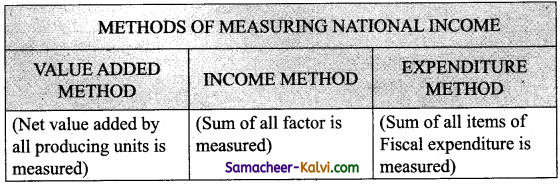
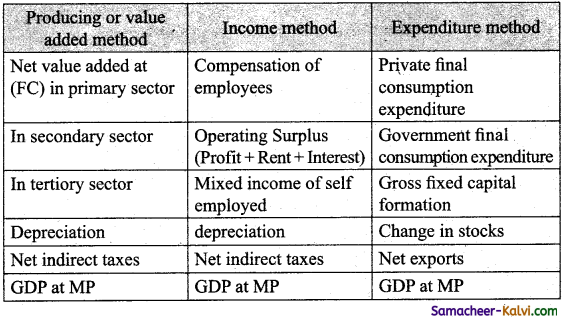
All goods and services produced in the country must be counted and converted against money value during a year. Whatever is produced is used for consumption or saved. There are three methods that are used to measure National Income.
(i) Production or Value Added Method
(ii) Income or Factor Earning Method (Hi) Expenditure Method
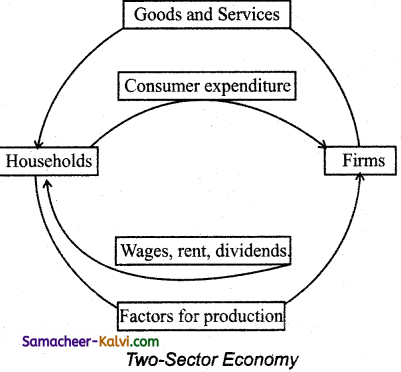
The three methods originate from three different phases in circular flow of National Income.

TN Board 12th Economics Important Questions Chapter 2 National Income 2

National income may be measured by any method, the equation is
Output = income = expenditure

GDP: By sum of spending, Factor incomes or output in all methods, net flow of goods and services which is being looked at from three different angles. Each method provides different view of the economy and also provides a check in the accuracy of the other methods.

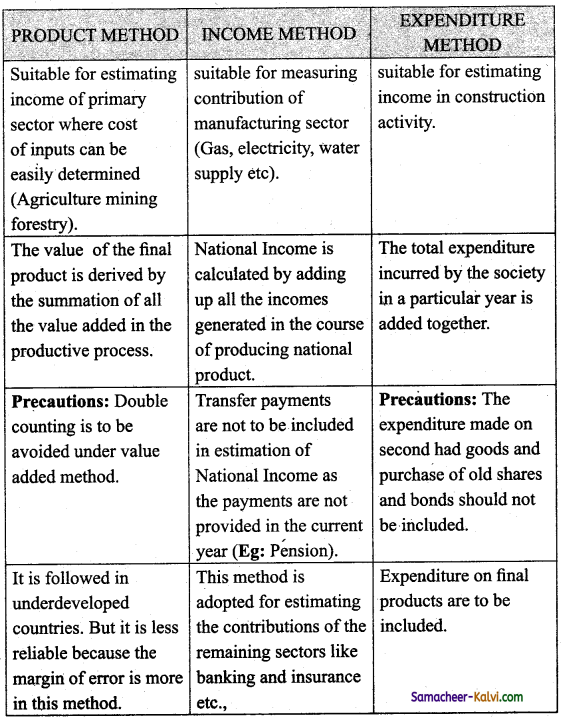
TN Board 12th Economics Important Questions Chapter 2 National Income 3

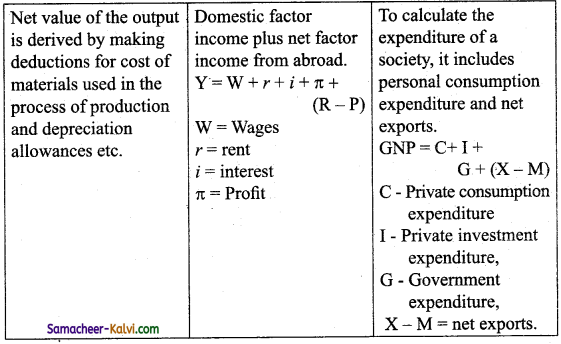
TN Board 12th Economics Important Questions Chapter 2 National Income 4

Samacheer Kalvi TN Board 12th Economics Important Questions Chapter 2 National Income

Question 17.
What are the difficulties involved in the measurement of national income?
Answer:
In India, because of unorganized and non-monetized subsistence sector where the barter system still prevails for transacting goods and services. So proper valuation of output is very difficult.
Difficulties:
(i) Transfer payments:
The government expenditures are not included in National Income because they are paid without adding anything to the production process.

(ii) Difficulties in assessing depreciation / allowence:
It is also difficult to deduct depreciation allowances like accidental damages because it is very difficult to judge.

(iii) Unpaid services:
There are no. of goods and services which are difficult to be assessed in money terms.
Eg: services of house wife;

(iv) Income from illegal activities:
Income earned from gambling, smuggling etc are also not included.

(v) Production for self-consumption and changing price:
Farmers keep a large portion of food and other goods produced on the farm for self consumption and that is not included in the National Income.

(vi) Capital gains:
Capital gains are excluded from National Income. Eg: Property sold at higher price than the purchase price.

(vii) Statistical problems:
Statistical datas are not perfectly reliable co- operaion of people and efficiency of statistical staff is also needed.
Eg: Production in Animal husbandary.

National Income estimate in India are not accurate because of difficulties faced at different levels.

Question 18.
Discuss the importance of social accounting in economic analysis.
Answer:
Measuring National Income by social accounting method. The translations are recorded and the inter relationships are traced. It is very useful for economists and policy makers.
The economy is divided into several sectors in social accounting method.
(i) Firms:
These are organisations which employ the factors of production.

(ii) Households:
It receive payments for their services to the firms, so the firms make payment to households for their services.

(iii) Government sector:
The economic transactions of public bodies at all levels. The main function of the government is to provide social goods like defence, education etc.

(iv) Rest of the world sector:
It is international economic transactions of the country.

(v) Capital sector is saving and investment activities like transactions of banks, insurance etc. these agencies provide financial assistance to the firms activities.

When the sectoral contribution are assessed to GDP, the economy is divided into primary, secondary and tertiary sectors.

Social accounting method is important for economic analysis because it represents the major economic flows and statistical relationships among .various sectors of economic system and it is useful to forecast the trends of economy more accurately.

Samacheer Kalvi TN Board 12th Economics Important Questions Chapter 2 National Income

Multiple Choice Questions:

Question 1.
Net National product at factor cost is also known as:
(a) National Income
(b) Domestic Income
(c) Per capita Income
(d) Salary
Answer:
(a) National Income

Question 2.
Primary sector is:
(a) Industry
(b) Trade
(c) Agriculture
(d) Construction
Answer:
(c) Agriculture

Question 3.
National income is measured by using _________ methods.
(a) Two
(b) Three
(c) Five
(d) Four
Answer:
(b) Three

Samacheer Kalvi TN Board 12th Economics Important Questions Chapter 2 National Income

Question 4.
Income method is measured by summing up of all forms of:
(a) Revenue
(b) Taxes
(c) Expenditure
(d) Income
Answer:
(d) Income

Question 5.
Which is the largest figure?
(a) Disposable income
(b) Personal Income
(c) NNP
(d) GNP
Answer:
(d) GNP

Question 6.
Expenditure method is used to estimate national income in:
(a) Construction sector
(b) Agricultural Sector
(c) Service sector
(d) Banking sector
Answer:
(a) Construction sector

Samacheer Kalvi TN Board 12th Economics Important Questions Chapter 2 National Income

Question 7.
Tertiary sector is also called as ________ sector.
(a) Service
(b) Income
(c) Industrial
(d) Production
Answer:
(a) Service

Question 8.
National income is a measure of the ________ performance of an economy.
(a) Industrial
(b) Agricultural
(c) Economic
(d) Consumption
Answer:
(c) Economic

Question 9.
Per capita income is obtained by dividing the National income by:
(a) Production
(b) Population of a country
(c) Expenditure
(d) GNP
Answer:
(b) Population of a country.

Samacheer Kalvi TN Board 12th Economics Important Questions Chapter 2 National Income

Question 10.
GNP = ______ + Net factor income from abroad.
(a) NNP
(b) NDP
(c) GDP
(d) Personal income
Answer:
(c) GDP

Question 11.
NNP stands for:
(a) Net National Product
(b) National Net product
(c) National Net Provident
(d) Net National Provident
Answer:
(a) Net National Product

Question 12.
_______ is deducted from gross value to get the net value.
(a) Income
(b) Depreciation
(c) Expenditure
(d) Value of final goods
Answer:
(b) Depreciation

Samacheer Kalvi TN Board 12th Economics Important Questions Chapter 2 National Income

Question 13.
The financial year in India is:
(a) April 1 to March 31
(b) March 1 to April 30
(c) March 1 to March 16
(d) January 1 to, December 31
Answer:
(c) March 1 to March 16

Question 14.
When net factor income from abroad is deducted from NNP, the net value is:
(a) Gross National Product
(b) Disposable Income
(c) Net Domestic Product
(d) Personal Income
Answer:
(b) Disposable Income

Question 15.
The value of NNP at production point is called:
(a) NNP at factor cost
(b) NNP at market cost
(c) GNP at factor cost
(d) Per capita income
Answer:
(c) GNP at factor cost

Samacheer Kalvi TN Board 12th Economics Important Questions Chapter 2 National Income

Question 16.
The average income of the country is:
(a) Personal Income
(b) Per capita income
(c) Inflation Rate
(d) Disposal Income
Answer:
(b) Per capita income

Question 17.
The value of national income adjusted for inflation is called:
(a) Inflation Rate
(b) Disposal Income
(c) GNP
(d) Real national income
Answer:
(d) Real national income

Question 18.
Which is a flow concept?
(a) Number of shirts
(b) Total wealth
(c) Monthly income
(d) Money supply
Answer:
(c) Monthly income

Samacheer Kalvi TN Board 12th Economics Important Questions Chapter 2 National Income

Question 19.
PQLI stands for:
(a) Economic growth
(b) Economic welfare
(c) Economic progress
(d) Economic development
Answer:
(b) Economic welfare

Question 20.
The largest proportion of national income comes from:
(a) Private sector
(b) Local sector
(c) Public sector
(d) None of the above
Answer:
(a) Private sector

Samacheer Kalvi TN Board 12th Economics Important Questions Chapter 2 National Income

Samacheer Kalvi 12th Economics Notes Chapter 2 National Income

→ Depreciation: Fall in value of fixed assets due to normal wear and tear and foreseen obsolescene.

→ Intermediate products: Goods and services purchased by one unit from another, used or resold during the same year.

→ COE: Total remuneration in cash and in the form of social security contributions by employers to their employees.

→ Royalty: Amount payable to the landlord for granting the leasing rights of subsoil assets.

→ PFCE: The sum of final consumption expenditure by households and private non-profit institutions serving households.

→ GFCE: Expenditure incurred by general government on producing free services to the people.

→ GDCF: Addition to the stock of capital undertaken by the production units located within economic or domestic territory of the country.

→ Personal Disposable Income: Sum of factor and non-factor incomes occurring to the households after payment of direct taxes.

Samacheer Kalvi TN Board 12th Economics Important Questions Chapter 2 National Income

→ Private Income: Sum of factor and non-factor incomes before payment of direct-taxes occurring to houselholds.

→ Economic Welfare: Welfare affected by economic factors like Income and Consumption is called Economic Welfare.

→ GDP: Gross Domestic Product – Aggregate value of goods and services produced within the domestic territory of a country.

→ Gross Fiscal Deficit: The excess of total government expenditure over revenue receipts and capital receipts that do not create debt.

→ National Disposable Income: Net National Product at Market Price + other Current Transfers from the rest of the world.

→ Net Domestic Product (NDP): Aggregate value of goods and services produced within the domestic territory of a country which does not include the depreciation of capital stock.

→ NNP: (At factor cost) or National Income (NI)
NNP at market price – Indirect taxes + subsidies.

Samacheer Kalvi TN Board 12th Economics Important Questions Chapter 2 National Income

→ IC – Intermediate Consumption
→ D – Depreciation (or Consumption of Fixed Capital)
→ NFIA – Net Factor Income from Abroad.
→ NIT – Net Indirect Taxes (T-S)
→ COE – Compensation of Employees
→ R, I & P – Rent and Royalty, Interest and Profits.
→ MI – Mixed Income
→ PFCE – Private Final Consumption Expenditure
→ GFCE – Government Final Consumption Expenditure
→ GDCF – Gross Domestic Capital Formation
→ (X – M) – Net Exports
→ ∆S – (Delta) change in stock.

Samacheer Kalvi TN Board 12th Economics Important Questions Chapter 2 National Income

Chart showing Reconciliation of three methods of measuring:

TN Board 12th Economics Important Questions Chapter 2 National Income 1

→ Depreciation: (Gross = Net + Depreciation)
(Difference between Gross and Net)
(a) Net Product = Gross value added – Depreciation
(b) Net Value added = Gross value added – Depreciation.
(c) Net Investment = Gross Investment – Depreciation.

Samacheer Kalvi TN Board 12th Economics Important Questions Chapter 2 National Income

→ Net Indirect Taxes (Market Price = Factor Cost + NIT)
(Difference between Market Price and Factor Cost)
(a) Market Price = Factor Cost + Indirect Taxes – Subsidies.
(b) Market Price = Factor Price + Net Indirect Taxes
(c) Factor Cost = Market Price – Indirect Taxes
(d) GDP at Factor Cost = GDP at MP – Net Indirect-Taxes.
(e) Net Value added at Factor Cost = Net Value added at Market Price – Net Indirect Tax.
(f) GDP at MP = GNP at Factor Cost + Net Indirect Taxes.
(g) National Income = Domestic Income + Net Factor Income from Abroad
(h) Domestic Income = National Income – NFLA
GNP = GDP + NFIA
NDPMP = GDPMP – Depreciation
GNPMP = GDPMP – NFIA
NNPMP = GNPMP – Depreciation
TN Board 12th Economics Important Questions

TN Board 12th Economics Important Questions Chapter 1 Introduction to Macro Economics

TN State Board 12th Economics Important Questions Chapter 1 Introduction to Macro Economics

Question 1.
Define Macro Economics.
Answer:
It is the study of aggregates covering the entire economy such as total employment, national income, national output, total consumption, total investment, total savings, ag gregate demand and supply general price level, wage level, and cost structure.
[OR]
Macro economics is the study of the economy as a whole. It deals with aggregates such as national income, employment and output.

Question 2.
Define the term ‘Inflation’.
Answer:
Inflation refers to steady increase in general price level.

Samacheer Kalvi TN Board 12th Economics Important Questions Chapter 1 Introduction to Macro Economics

Question 3.
What is meant by an ‘Economy’?
Answer:
Definition by AJ.Brown- “A system by which people earn their living”

“An economy is a cooperation of producers and workers to make goods and services that satisfy the wants of the consumers”. – J.R.Hicks

Question 4.
Classify the economies based on status of development.
Answer:
Economies can be classified into different types based on the status of development as developed, under developed, undeveloped and developing economies. .

Question 5.
What do you mean by Capitalism?
Answer:
Capitalism- It means there is total freedom and private ownership of means of production.

Samacheer Kalvi TN Board 12th Economics Important Questions Chapter 1 Introduction to Macro Economics

Question 6.
Define ‘Economic Model’.
Answer:
A model is an explanation of how the economy, or part of the economy, works.

Question 7.
‘Circular Flow of Income’ – Define.
Answer:
It is a model of an economy showing connections between different sectors of an economy.

Question 8.
State the importance of Macro Economics.
Answer:

  1. The basic problems is an economy can be solved using suitable strategies if we understand the functioning of an economy at the aggregate level i.e., Macro economics.
  2. It is important to know macro economics so that to take precautionary . measures for future problems and for the needs and challenges of an economy.
  3. It provides opportunities to understand the reality and to use scientific investigations.
  4. It helps to compare and analyses the economic indicators.
  5. It helps us to predict about future economic crises and to form suitable policies.

Samacheer Kalvi TN Board 12th Economics Important Questions Chapter 1 Introduction to Macro Economics

Question 9.
Describe the different types of economic systems.
Answer:
It is the methodology of doing economic activities to meet the needs of the society. The three economic systems are:
(i) Capitalist economy:
Total freedom and private ownership of means of production.

(ii) Socialist economy:
There is public ownership means of production.

(iii) Mixed economy:
Co-existence of capitalism and socialism.

Question 10.
Outline the major merits of capitalism.
Answer:

  1. Automatic working: The economic works automatically without any interventions of government.
  2. Efficient use of resources: Resources are used to its maximum.
  3. Incentives for hard work: The entrepreneurs earn maximum profit for their efficiency.
  4. Economic progress: Productivity level is maximum.
  5. Consumer’s sovereignty: Production aims to give maximum satisfaction to the consumers.
  6. Higher rate of capital formation: Because of increase in savings and investment.
  7. Development of new technologies: The producers invest on new technologies to produce quality products and to maximise profit.

Samacheer Kalvi TN Board 12th Economics Important Questions Chapter 1 Introduction to Macro Economics

Question 11.
Indicate the demerits of socialism.
Answer:
Demerits of socialism:
(i) Red tapism and bureaucracy:
The decisions are taken by the government, there are chances of corruptions and delay.

(ii) Absence of incentive:
In socialism, efficiency is not encouraged so there is reduction in production also.

(iii) Limited freedom of choice:
Consumers choices are limited on goods and services.

(iv) Concentration of Power:
Major decisions are taken only by the Government so, in many cases, the power can be misused.

Question 12.
Enumerate the features of mixed economy.
Answer:
Ownership of property and means of production:
Because of the co¬existence of public and private sectors, production, properties are owned by both and they have the right to use and transfer resources.

Co-existence of public and private sectors:
Private industries are for profit and public sector work for social welfare.

Economic planning:
Economic and national planning is done in common by central planning authority of the Government and it is abided by all sectors.

Solution to economic problems:
The basic economic problems are solved through price mechanism and Government intervention.

Freedom and control:
The overall control on the economic activities are with the government.

Samacheer Kalvi TN Board 12th Economics Important Questions Chapter 1 Introduction to Macro Economics

Question 13.
Distinguish between Capitalism and Globalism.
Answer:

Capitalism

 Globalism

In capitalism the role of the government is minimum and the market determines the economic activities. In globalism, the new market ideology of globalization connects nations together through international trade and aiming at global development.
Capitalist economy is also known as market economy. Globalism is also termed as extended capitalism.

Question 14.
Briefly explain the two sector circular flow model.
Answer:
The circular flow of income is a model of an economy showing connections between different sectors of an economy. There are two sectors i.e., household and firms.
(i) The household sector receives income from firm sector by providing the factors of productions owned by it.
(ii) The firm gets its income by selling goods and services to the household sector. It sells the entire output of households. In the two sector economy, production and sales are equal.
Diagram of two sector economy

TN State Board 12th Economics Important Questions Chapter 1 Introduction to Macro Economics 4

(i) Outer circle – Real flow [factors and goods]
(ii) Inner circle – Monetary flow[factor and commodity prices]
Y = C + 1 → basic identity
Y = income, C = Consumption, I = Investment
(a) Factor services flow from household to firm and
(b) Goods and services flow from firm to household

Samacheer Kalvi TN Board 12th Economics Important Questions Chapter 1 Introduction to Macro Economics

Question 15.
Discuss the scope of Macro Economics.
Answer:
Macro economic study has a wide scope and it covers major areas of economics such as:

(i) National income:
The growth process of an economy depends on the composition and measurement of its national income.

(ii) Inflation:
The general price level is estimated by constructing various price index numbers such as whole sale price index, consumer price index. This is given by macro economics.

(iii) Business cycle:
The cyclical movements such as boom, recession, depression and recovery in the economy are studied as business fluctuations under macro economics.

(iv) Poverty and unemployment:
It is the most important economic paradoxes of rich nations. Macro economic studies gives a clear understanding about the magnitude of poverty and unemployment and the corrective measures.

(v) Economic growth:
Macro economic analysis study helps to understand the growth and development of an economy.

(vi) Economic policies:
The basic problems of an economy are solved by economic policies. Economic policies are framed through macro economic studies. These are the scope of macro economic studies.

Question 16.
Illustrate the functioning of an economy based on its activities.
Answer:
Economy is a system where the Economic activities are carried out. The economic functions and activities varies according to the character of each economy. [Refer to flowchart given in III (B) -1]
Explanation:
The fundamental economic activities of an economy are

  1. Production and
  2. Consumption.

The aim of the activities are to achieve growth. The production and consumption activities are known as fundamental economic activities. They are supported by exchange activity Economic and Non – Economic activities.

The economic activities are:
Transportation, banking, advertising, planning and Government Policies.

The Non-Economic activities are:
Environment, Education, Entertainment, Government regulations etc.

The Supporting activities or External activities are:
Import, Export, international relations, Emigration, Immigration, Foreign investment, Foreign exchange earnings etc., These activities also influence the entire functioning of the economy.

Samacheer Kalvi TN Board 12th Economics Important Questions Chapter 1 Introduction to Macro Economics

Question 17.
Compare the features of capitalism and socialism.
Answer:

TN State Board 12th Economics Important Questions Chapter 1 Introduction to Macro Economics 1

Question 18.
Compare the feature among Capitalism, Socialism and Mixedism.
Answer:

TN State Board 12th Economics Important Questions Chapter 1 Introduction to Macro Economics 2

TN State Board 12th Economics Important Questions Chapter 1 Introduction to Macro Economics 3

Samacheer Kalvi TN Board 12th Economics Important Questions Chapter 1 Introduction to Macro Economics

Multiple Choice Questions:

Question 1.
The branches of the subject Economics is:
(a) Wealth and welfare
(b) Production and consumption
(c) Demand and supply
(d) Micro and macro
Answer:
(d) Micro and macro

Question 2.
Who coined the word ‘Macro’?
(a) Adam Smith
(b) J M Keynes
(c) Ragnar Frisch
(d) Karl Marx
Answer:
(c) Ragnar Frisch

Question 3.
Who is regarded as Father of Modern Macro Economics?
(a) Adam Smith
(b) J M Keynes
(c) Ragnar Frisch
(d) Karl Marx
Answer:
(b) J M Keynes

Samacheer Kalvi TN Board 12th Economics Important Questions Chapter 1 Introduction to Macro Economics

Question 4.
Identify the other name for Macro Economics:
(a) Price Theory
(b) Income Theory
(c) Market Theory
(d) Micro Theory
Answer:
(b) Income Theory

Question 5.
Macro economics is a study of:
(a) individuals
(b) firms
(c) a nation
(d) aggregates
Answer:
(d) aggregates

Question 6.
Indicate the contribution of J M Keynes to economics.
(a) Wealth of Nations
(b) General Theory
(c) Capital
(d) Public Finance
Answer:
(b) General Theory

Samacheer Kalvi TN Board 12th Economics Important Questions Chapter 1 Introduction to Macro Economics

Question 7.
A steady increase in general price level is termed as:
(a) Wholesale price index
(b) Business Cycle
(c) Inflation
(d) National Income
Answer:
(c) Inflation

Question 8.
Identify the necessity of Economic policies.
(a) to solve the basic problems
(b) to overcome the obstacles
(c) to achieve growth
(d) all the above
Answer:
(d) all the above

Question 9.
Indicate the fundamental economic activities of an economy.
(a) Production and Distribution
(b) Production and Exchange
(c) Production and Consumption
(d) Production and Marketing
Answer:
(c) Production and Consumption

Samacheer Kalvi TN Board 12th Economics Important Questions Chapter 1 Introduction to Macro Economics

Question 10.
An economy consists of:
(a) Consumption sector
(b) Production Sector
(c) Government sector
(d) All of the above
Answer:
(d) All of the above

Question 11.
Identify the economic system where only private ownership of production exists.
(a) Capitalistic Economy
(b) Socialistic Economy
(c) Globalistic Economy
(d) Mixed Economy
Answer:
(a) Capitalistic Economy

Question 12.
Economic system representing equality in distribution is:
(a) Capitalism
(b) Globalism
(c) Mixedism
(d) Socialism
Answer:
(d) Socialism

Samacheer Kalvi TN Board 12th Economics Important Questions Chapter 1 Introduction to Macro Economics

Question 13.
Who is referred as ‘Father of Capitalism’?
(a) Adam Smith
(b) Karl Marx
(c) Thackeray
(d) J M Keynes
Answer:
(a) Adam Smith

Question 14.
The country following Capitalism is:
(a) Russia
(b) America
(c) India
(d) China
Answer:
(b) America

Question 15.
Identify The Father of Socialism.
(a) J M Keynes
(b) Karl Marx
(c) Adam Smith
(d) Samuelson
Answer:
(b) Karl Marx

Samacheer Kalvi TN Board 12th Economics Important Questions Chapter 1 Introduction to Macro Economics

Question 16.
An economic system where the economic activities of a nation are done both by the private and public together is termed as:
(a) Capitalistic Economy
(b) Socialistic Economy
(c) Globalistic Economy
(d) Mixed Economy
Answer:
(d) Mixed Economy

Question 17.
Quantity of a commodity accumulated at a point of time is termed as:
(a) production
(b) stock
(c) variable
(d) flow
Answer:
(b) stock

Question 18.
Identify the flow variable:
(a) money supply
(b) assets
(c) income
(d) foreign exchange reserves
Answer:
(c) income

Samacheer Kalvi TN Board 12th Economics Important Questions Chapter 1 Introduction to Macro Economics

Question 19.
Identify the sectors of a Two Sector Model:
(a) Households and Firms
(b) Private and Public
(c) Internal and External
(d) Firms and Government
Answer:
(a) Households and Firms

Question 20.
The Circular Flow Model that represents an open Economy:
(a) Two Sector Model
(b) Three Sector Model
(c) Four Sector Model
(d) All the above
Answer:
(c) Four Sector Model

Samacheer Kalvi 12th Economics Notes Chapter 1 Introduction to Macro Economics

→ National Income: Total Income of residents of a Country.

→ Inflation: A sustained rise in general Price level

→ Business Level: The recurring and fluctuating level of Economic Activity.

→ Balance of Payment: A statement of Countries Economic Transaction with the rest of the world.

→ Foreign Exchange Reserves: Assets held by Central bank (RBI) and monetary authorities usually in different reserve currencies.

→ Laissez Faire: A policy of complete Non-Intervention by Government in the Economy leaving all decisions to the market.

→ Exchange Rate: The price (rate) at which one currency is exchanged for another.

→ Economic Growth: Economic growth is a process of sustained increase in Country’s real income over a long period of time.

→ Balance of Trade: It is the difference between the money value of Exports and Imports of material goods.

→ External Sector: It refers to the Economic transaction of the domestic country with the rest of the world.

TN Board 12th Economics Important Questions

Samacheer Kalvi 12th Commerce Notes Chapter 28 Company Secretary

Samacheer Kalvi 12th Commerce Notes Chapter 28 Company Secretary

→ The person who is responsible for the general performance of an organization is called company secretary. The Key Managerial Personnel (KMP) who run a company is called with a different titles, directors, managers or secretary.

→ The person who steers the company holding the administrative financial and overall performance of the company is called company secretary.

→ Apart from statutory qualifications, he should also have other qualifications as may be necessary to conduct the affairs of the company. The secretary must be smart, unbiased and must have high IQ besides presence of mind and amiable personality.

→ Only an individual who is a member of institute of company secretaries of India can be appointment as a company secretary.

Functions of the company secretary may be classified under two headings:

  • Statutory function or duties
  • Non-statutory functions or duties

→ A company secretary is a high level officer. He enj oys certain rights and power as per contract made with the company which are as follows. Supervision and control, signing authority, exercise power, issuing testimonial, claiming salary and damages, preferential creditor and attending meeting.

→ The board of directors of a company has absolute direction to remove a company secretary or to terminate his services at any time for any reason or without any reason.

Under the companies act, 2013, company meetings can be classified as under,

  1. Meeting of share holders
  2. Meeting of directors
  3. Special meetings

→ As per the Companies act 2013, for taking any decision or executing any transaction, the consent of the share holders, the board of directors and other specified is required. The decision taken at a meeting are called resolutions.

→ There are broadly three types of resolutions namely ordinary resolutions, special resolution and resolution requiring special notice.

→ By casting his vote one formally declaring his opinion or wish infavour of or against a proposal or a candidate to be elected for an office. The proposals passed across the table of any company depend mainly on the vote cast by the board of directors. There are two distinct procedures of voting. Open and secret procedures.

Study the websites which are related to company functions www.bseindia. com

Free Domin – Contact Forms, E-mail account, e- commerce website, youtube, advertisement mobile app, Facebook advertisement website is a collection of related network, web resources such as web pages, multi media or Google, com, Amazon.com

→ Mr R. as the secretary of the Muraliviki Co., signed a letter to its bank, forwarding a ‘resolution’ of the board of directors. The resolution named three directors and instructed the bank to pay cheques signed by any two of them and countersigned by the secretary. Specimen signatures were attached. The instruction was entirely in accordance with the company’s memorandum and articles.

However, there had never been any proper appointment of directors or a secretary by the company. Those who had formed the company had assumed their roles. Following the letter, the bank had honoured cheques in accordance with the instructions contained in the letter. The question was, whether, the company was bound by the cheques. Comment.

Yes, the company was bound by the cheques given. Because the company has already instructed the bank to pay cheques signed by two of the directors and counter signed by the secretary. So the bank honoured the cheques issued by the company.

→ A contract between Muthumani Ltd and Mr. V, one of its director is referred to a general meeting for its approval. At the meeting, Mr. V voted for the resolution and all others against it. But as V held majority of shares and was entitled to majority of votes, the resolution was passed. Is the contract binding on the company?

No, the contract is not binding the company. Because the director Mr. V is having majority of shares and majority of votes he has to passed the resolution.

Samacheer Kalvi 12th Commerce Notes

Samacheer Kalvi 12th Commerce Notes Chapter 27 Company Management

Samacheer Kalvi 12th Commerce Notes Chapter 27 Company Management

→ The group of human beings who undertake the responsibility to run the business of the company are known as board of directors and the members of the board individually called as directors. The directors play a vital role in the functioning of the company by controlling, guiding, directing and managing the affairs of the company.

→ In the company management board of directors get nucleus position and their selection is according to the procedure prescribed lay down in the act and the articles of association.

→ The success of any company depends on the efficient functioning of its directors, they can be called as eyes, ears, brain, hands, nerves and other essential parts of a company.

→ The governing body of a company incorporated under companies act called board. They are empowered to take decisions on the major issues to lead the company in the right way.

→ Types of directors as per companies act 2013 are residential director, independent director, small share holders, nominee additional, alternative and shadow director.

→ Directors are the person duly appointed by the company to lead and manage its affairs and their legal position. At times they have to act as agents, managing partner, trustees, employee and officer.

→ Directors are appointed to lead the company in relation to third parties. They can enjoy the rights and privileges of an agent.

→ A director of company can be removed from his office the expiry of his term by:

  1. The share holders,
  2. The Central Government
  3. The company law board

→ The powers of directors grouped into four different heads.

  1. Statutory powers of directors
  2. Managerial powers of directors
  3. Powers only with a resolution
  4. Other powers

→ Director as a part of board perform certain duties collectively the liabilities of directors may be discussed under three heads, liability to outsiders, liability to company and criminal liability.

→ In corporate law, the director register refers to a list of the directors elected by the share holders generally recorded in the company’s minute book.

Samacheer Kalvi 12th Commerce Notes

Samacheer Kalvi 12th Commerce Notes Chapter 26 Companies Act, 2013

Samacheer Kalvi 12th Commerce Notes Chapter 26 Companies Act, 2013

→ The concept of “company” or corporation in business is not new, but was dealt with, in 4th century BC itself during Arthashastra days. The earliest business associations in England were the merchant guilds. Some of the merchant Associations or guilds who have regulated the company.

→ A royal charter established the East India company in the year 1600.

→ The Joint Stock Companies Act was passed in India by introducing the concept of limited liability in the year 1857.

→ In 1913 the Indian companies Act of 1913 was passed. The Act introduce the institution of private companies in the corporate sector.

→ Body corporate means a corporate entity which has a legal existence. According to section 2 (11) “Body Corporate” or corporation includes private company, public company and small company, limited liability partnership and foreign company incorporated outside India but does not include a co-operative society.

→ Promotion stage begins when the idea to form a company comes in the mind of a person. The person who envisage the idea is called a promoter. The memorandum of association is the charter of a company. It is a document, which amongst other things, defines the area within which the company can operate. It contain the name clause, liability clause and subscription clause.

→ A business person invest in the business and in case of company raise the capital by issue of shares. They use this money to meet its requirements by way of acquiring business premises and stock in Trade.

→ A share certificate is an instrument in writing that is a legal proof of the ownership of the number of shares stated in it.

→ A share warrant is a negotiable instrument, issued by the public limited company only against fully paid up shares.

→ When a company needs funds for extension and development purpose without increase its share capital, it can borrow from the general public by issuing certificates for a fixed period of time and at fixed rate of interest. Such a loan certificate is called debenture.

Samacheer Kalvi 12th Commerce Notes

Samacheer Kalvi 12th Commerce Notes Chapter 25 Government Schemes for Entrepreneurial Development

Samacheer Kalvi 12th Commerce Notes Chapter 25 Government Schemes for Entrepreneurial Development

→ Job creation is a foremost challenge facing India. It has immense potential to innovate, raise entrepreneurs and create jobs for the benefit of the nation and the world. Financial assistance, insurance, subsidy, training helps early stage tech startup and business loans, special incentive is provided to set up a new enterprises for entrepreneurs.

→ India’s efforts at promoting entrepreneurship and innovations as startup India, Make in India, Atal Innovation Mission (AIM), Support to Training and Employment Program for women (STEP), Jandhan – Aadhaar – Mobile (JAM), Digital India, Stand-Up India etc., The other specific entrepreneurship schemes are M-SIPS, New Gen IEDC, AIC, SPRS etc.

→ Steps in promoting an entrepreneurial venture are selection of the product, selection of form of ownership, selection of site, designing capital structure, acquisition of manufacturing know-how and preparation of project report.

→ Meanwhile the project report should include technical feasibility, economic viability, financial viability, managerial competency, provisional registration certificate, permanent registration certificate, statutory license, power connection and arrangement of finance.

Samacheer Kalvi 12th Commerce Notes Chapter 25 Government Schemes for Entrepreneurial Development 1

  1. Women will became a self employed women owned business are playing a pivotal role in entrepreneurial activity.
  2. Take off of women from a low development path to achieving higher level a self sustaining economic growth. Freedom to work and live on your own terms work life balance, strong skill and social intelligence .
  3. Women can Network.
  4. Women have tolerance.
  5. Women can Multi-task.
  6. Women have patience and can adjust and have leadership qualities. Women can take control over their careers.

How an Entrepreneur will make use of the various schemes Governments?

Samacheer Kalvi 12th Commerce Notes Chapter 25 Government Schemes for Entrepreneurial Development 2

Pradhan Mantri Kaushal Vikas Yojana (PMKVY):

Youth people to get training in relevant skills to enhance employment opportunities for their livelihood.

Dairy Entrepreneurship Development Scheme:

Entrepreneur can set up small diary farm to get incentives and cost from this scheme of the Government. The M – SIPS schemes provides capital subsidy of 20% in SEZ and 25 % subsidy in Non-SEZ.

Samacheer Kalvi 12th Commerce Notes

Samacheer Kalvi 12th Commerce Notes Chapter 24 Types of Entrepreneurs

Samacheer Kalvi 12th Commerce Notes Chapter 24 Types of Entrepreneurs

→ The word entrepreneur is a general term they are called by different names depending upon the function they perform business they engaged in technology they adopt, the area, they start, the venture, type of ownership held and motivation given to them.

→ Innovating entrepreneur is one who always focused on introducing a new product or introducing something new in the venture already started.

→ Initiative entrepreneur is one who simply initiates existing skill, knowledge or technology already in place in advanced countries. A simply reengineer or redesign the products developed in advanced countries and produce a version suited to their local conditions.

→ Entrepreneurs are said to be conservatives and sceptical about plasticizing any change in their organization. They are of risk averse type.

→ Drone entrepreneur are those who are totally opposed to changes unfolding in the environment. They used to operate in the niche market.

→ Classification according to type of business is, business entrepreneur, trading, industrial, corporate, agricultural retail and service entrepreneurs.

→ Classification based on technology based is technical, non-technical and professional entrepreneur. Classification in terms of motivation is pure induced, motivated and spontaneous entrepreneur.

→ Classification based on development stage is first generation. Modem and classical entrepreneur classification according to area is urban and rural entrepreneur classification according ownership is private, state and joint entrepreneurship.

Students are instructed to visit and interview a successful entrepreneur in your locality. Present a report about the factors that leads to the success of the entrepreneur based on the interview

The success of the entrepreneur.

  1. Willingness to take action.
  2. Entrepreneurial knowledge.
  3. Entrepreneurial skill.
  4. Intelligence, patience
  5. Persistence and the ability for team work.
  6. Great Talent and Honesty.
  7. Self-confidence

Scan the products that are available in your market. Imagine an innovative product with multiple uses. Make a survey about the innovative products success among the locality

Finding innovation new uses for successful product or services can clearly increase your market size and as results “sales” product innovation either new or new version of a previous goods. It includes invention of new product size shape colour usage and benefits of consumers, sales, price of be product and profitability product development through research and testing whether the product functions properly and all the necessary arrangement are made to enhance the product as much as possible.

Observe the small shops and outlets in and around your locality. Think about new ideas for the future outlets in your area

New ideas – In store innovation.
(i) To improve customer experience with technology. .
(ii) Integrate a customer experience with augmented reality and virtual reality. Data on your customer. Interactive on item connected to your social media in the store and you can send picture directly to you instagram. Innovative ideas that will shape the future of Retail.

Sri Krishna Integrated Farm

Founder: Mr. R. Govindaraj, Sri Krishna Integrated Farm,
Neppathur Village, SirkazhiT.K. Nagapattinam.
Products: Supply of produced items like Cattle Farm, Fish Farm, Rabbit Breeder, Country chicken, Organic Paddy, Organic Fertiliser, Organic
Vegetables, Eggs, Milk, Livestock Feed and organic grass seeds, Vellimasa!, Hedgelucem and Concentrating maggots for fish and poultry.

Achievements:

  1. Giving training to SHG
  2. Supply of Farm Products to Star Hotels and many traders for Breeding Purpose.
  3. Supply to other states like Andhrapradesh, Karnataka and Kerala.
  4. Above 15 lakhs Turnover
  5. Size of Employment
  6. Training to unemployed Youth
  7. To reduce migration

Samacheer Kalvi 12th Commerce Notes Chapter 24 Types of Entrepreneurs 1

The main purpose of integrated farming is that farming components support one another hence reducing external inputs. Mixed farming system recycles all wastes. So that one’s waste is indeed another’s food. Self help group people have to get training through this company and to start his / her own business (own farm). The company turnover 15 lakhs and provide employment opportunities particularly in rural areas to avoid migration people moving from rural to urban to be reduced. The company will provide more employment opportunity to young people in the field of integrated farm.

Samacheer Kalvi 12th Commerce Notes