Samacheer Kalvi 4th Science Guide Term 3 Chapter 2 Life of Animals

Tamilnadu State Board New Syllabus Samacheer Kalvi 4th Science Guide Pdf Term 3 Chapter 2 Life of Animals Text Book Back Questions and Answers, Notes.

Tamilnadu Samacheer Kalvi 4th Science Solutions Term 3 Chapter 2 Life of Animals

Samacheer Kalvi 4th Science Guide Life of Animals Text Book Back Questions and Answers

Samacheer Kalvi 4th Science Guide Term 3 Chapter 2 Life of Animals

I. WHO AM I?

Question 1.
My group is called colony __________
Answer:
Ant

Question 2.
Our home is nest ____________
Answer:
Birds

Question 3.
My feet are broad to help me walk in the sand __________
Answer:
Camel

Question 4.
I use sound navigation to find the objects in my path ___________
Answer:
Bats

Question 5.
I am active during day time as well as night time ___________
Answer:
Lion

Samacheer Kalvi 4th Science Guide Term 3 Chapter 2 Life of Animals

II. Fill In the blanks :

Question 1.
The animals which are active at night are called ___________
Answer:
Nocturnal animals

Question 2.
____________ is best known for parental care.
Answer:
Kangaroo

Question 3.
The group of owls are called __________
Answer:
Parliament

Question 4.
___________ lives in hives.
Answer:
Bees

Question 5.
___________ bites us and sucks our blood.
Answer:
Vampire bats

Samacheer Kalvi 4th Science Guide Term 3 Chapter 2 Life of Animals

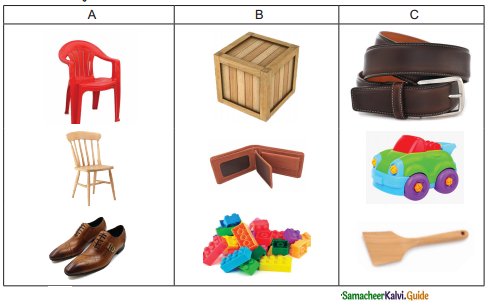
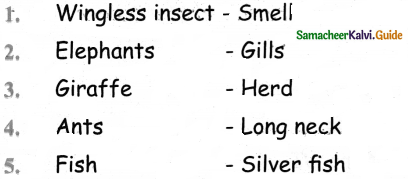
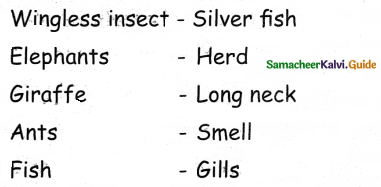
III. Match the following :

Question 1.
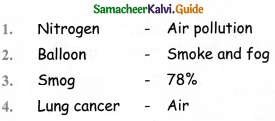
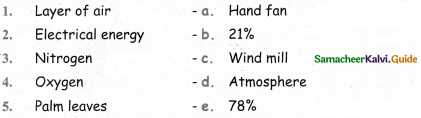
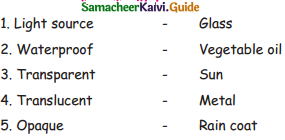
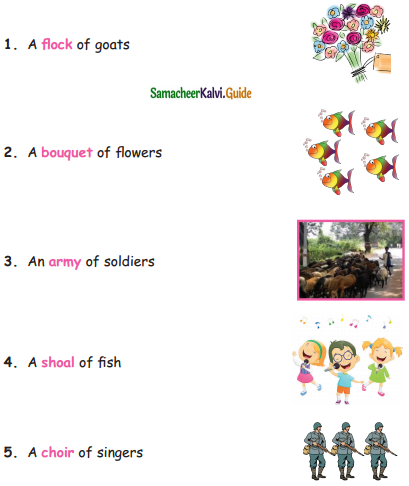
Samacheer Kalvi 4th Science Guide Term 3chapter 2 Life of animals 1
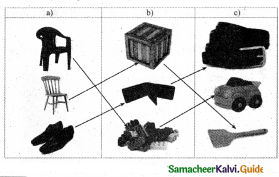
Answer:
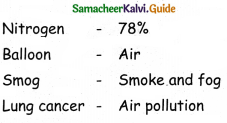
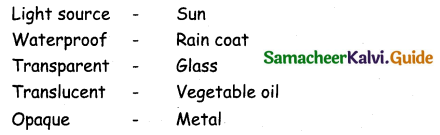
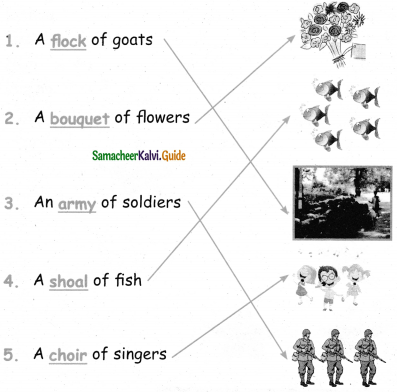
Samacheer Kalvi 4th Science Guide Term 3chapter 2 Life of animals 2

Samacheer Kalvi 4th Science Guide Term 3 Chapter 2 Life of Animals

IV. Answer the following questions In brief :

Question 1.
Why do birds build nests?
Answer:
Birds build nests for their young ones.

Question 2.
What is meant by structural adaptation?
Answer:
Changes in the physical features of the animal are called structural ‘ adaptations.
Example: Polar bears living in cold climate have physical adaptations, such as thick fur and short ears to reduce heat loss.

Question 3.
Define echolocation.
Answer:
Bats produce ultrasonic sound which helps the bats find their way at night and find out the objects on their path. This is called “Echolocation”.

Question 4.
How do ants feel the vibration?
Answer:
Ants feel the vibrations in the ground through their feet.

Question 5.
List out any three animals that live in groups.
Answer:

  1. Lion
  2. Elephants
  3. Wild beast

Question 6.
Why do birds fly in ‘V’ shape?
Answer:
Birds fly in “V” shape to reduce wind resistance.

Samacheer Kalvi 4th Science Guide Term 3 Chapter 2 Life of Animals

V. Give short answers :

Question 1.
Why do animals live in groups?
Answer:
Animals live in groups for

  • Procuring food
  • Taking care of young ones
  • Protection from predators.
  • Division of labour
  • Energy conservation
  • Finding mate easily

Question 2.
Explain the three main body regions of insect.
Answer:
Insects have three main body regions. They are; Head, thorax, and the abdomen. All parts of the insect are inside an exoskeleton.

  1. Head: The main visible parts on the head are the large compound eyes, the antennae (feelers) and the mouth parts.
  2. Thorax; It is the middle region of the body. It bears three pairs of legs and two pairs of wings.
  3. Abdomen It is the last part of the insect body. Abdomen of most of the insects have clear segmentation.

Question 3.
What are nocturnal animals?
Answer:

  • Some animals sleep in the day time and are very active at night. Such animals are called nocturnal animals.
    Example: Owl.

Samacheer Kalvi 4th Science Guide Term 3 Chapter 2 Life of Animals

Samacheer Kalvi 4th Science Guide Life of Animals In Text Questions and Answers

Activity (Text Book Page No. 77)

Question 1.
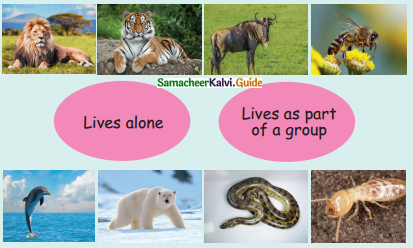
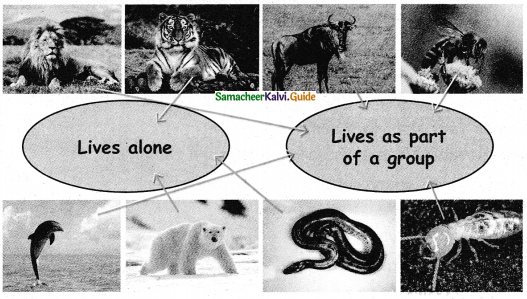
Match the animals to their group behaviour

Samacheer Kalvi 4th Science Guide Term 3chapter 2 Life of animals 15

Answer:
Samacheer Kalvi 4th Science Guide Term 3chapter 2 Life of animals 3

Samacheer Kalvi 4th Science Guide Term 3 Chapter 2 Life of Animals

Activity (Text Book Page No. 80)

Question 1.
Observe any animal in your surrounding and write a creative short story about it.
Answer:
I have a little dog named Tommy. He is a faithful dog to our family. He used to take care of me and my family. Mother always trust Tommy because he never allow anyone to touch me. Tommy is a really happy dog and loves going for walks and runs on the beach.

One unlucky day, he was hit by a car. One of his leg was severely injured. The doctors could not heal the injury. But the physical handicap does not make anyone useless, still he used to take care of me and my family with love.

Samacheer Kalvi 4th Science Guide Term 3 Chapter 2 Life of Animals

Activity (Text Book Page No. 82)

Question 1.
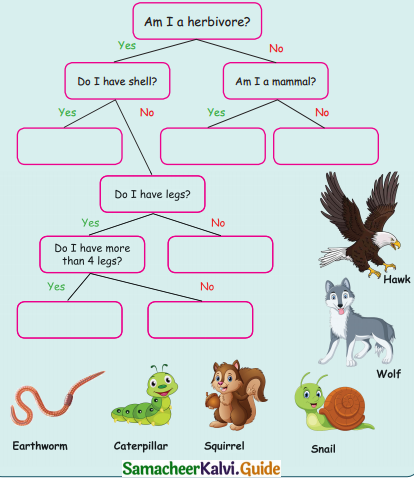
Who am I ?
Answer:
Samacheer Kalvi 4th Science Guide Term 3chapter 2 Life of animals 16

Samacheer Kalvi 4th Science Guide Term 3 Chapter 2 Life of Animals

Activity (Text Book Page No. 83)

Question 1.
Fill in the missing words.
Answer:
Butterfly has three body parts like all other insects the head, the thorax (chest), and the abdomen (bottom). The butterfly has four wings and six legs are attached to the thorax. Butterfly use its two antenna to smell.

Samacheer Kalvi 4th Science Guide Term 3 Chapter 2 Life of Animals

Activity (Text Book Page No. 84)

Question 1.
Place a few sugar cubes in a plate. After sometime, you can see some ants visiting the plate.
Answer:
Because ants have sense of sight, smell, taste & touch.

Samacheer Kalvi 4th Science Guide Term 3 Chapter 2 Life of Animals

Activity (Text Book Page No. 85)

Question 1.
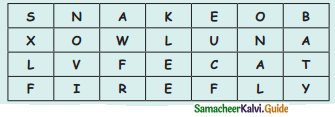
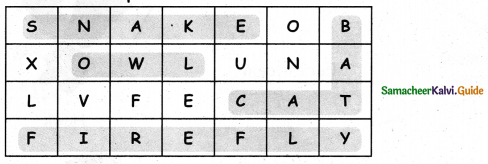
Word search puzzle – Nocturnal Animals

Samacheer Kalvi 4th Science Guide Term 3chapter 2 Life of animals 17
Answer:
Samacheer Kalvi 4th Science Guide Term 3chapter 2 Life of animals 5

Samacheer Kalvi 4th Science Guide Term 3 Chapter 2 Life of Animals

Activity (Text Book Page No. 86)

Question 1.
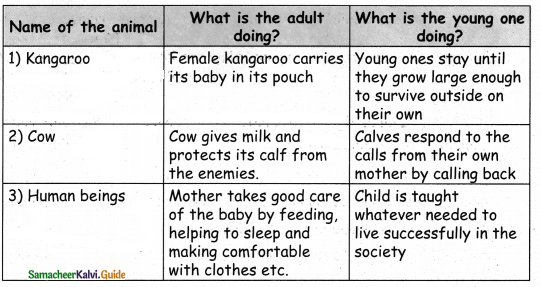
Animal Observations

Name of the animalWhat is the adult doing?

What is the young one doing?

Answer:
Samacheer Kalvi 4th Science Guide Term 3chapter 2 Life of animals 6

Samacheer Kalvi 4th Science Guide Life of Animals Additional Questions and Answers

Samacheer Kalvi 4th Science Guide Term 3 Chapter 2 Life of Animals

I. Choose the correct answers :
Question 1.
___________ have sensitive skin wich can feel even small vibrations in the water.
Answer:
(a) Dolphins
(b) Fish
(c) Alligator
Answer:
(c) Alligator

Question 2.
__________ hold hands while they are sleeping so that they don’t draft apart.
(a) sea horse
(b) sea otters
(c) sea monsters
Answer:
(b) sea otters

Question 3.
Giraffes have developed very long necks because of their _____________.
(a) environmental demands
(b) caring nature
(c) to protect from predators
Answer:
(a) environmental demands

Question 4.
The compound eyes of ___________ are made up of small units called ommatidia.
(a) birds
(b) insects
(c) fishes
Answer:
(b) insects

Question 5.
____________ have thorns on their body to fight against their enemies.
(a) Tiger
(b) Deer
(c) Porcupines
Answer:
(c) Porcupines

Samacheer Kalvi 4th Science Guide Term 3 Chapter 2 Life of Animals

II. Fill in the blanks :

Question 1.
Tigers and Zebras have lines so they can __________ themselves (admire / hide)
Answer:
Hide

Question 2.
___________ behaviour includes the activities of an animal and its interactions with other organisms. (Wild / animal)
Answer:
Animal

Question 3.
__________ dont build individual nests. (Social weavers / birds)
Answer:
Social weavers

Question 4.
Animals that are active during day time are known as _____________ animals. (diurnal animals / nocturnal animals)
Answer:
Diurnal animals

Question 5.
____________ increases the survival rate and improves the quality of young one. (parental care / education)
Answer:
Parental care

Samacheer Kalvi 4th Science Guide Term 3 Chapter 2 Life of Animals

III. True or False :

Question 1.
Animals like elephants, squirrels do dream during sleep.
Answer:
True

Question 2.
All birds are the same in all activities
Answer:
False

Question 3.
Birds fly in V shape to reduce wind resistance.
Answer:
True

Question 4.
Adaptation is the best essential factor of all living beings
Answer:
False

Question 5.
Dog shivers to generate more heat.
Answer:
True

Samacheer Kalvi 4th Science Guide Term 3 Chapter 2 Life of Animals

IV. Match the following :

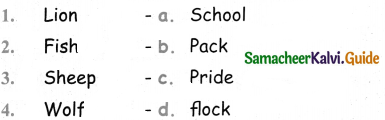
Question 1.
Samacheer Kalvi 4th Science Guide Term 3chapter 2 Life of animals 18
Answer:

  1. – c
  2. – a
  3. – d
  4. – b

V. Answer the following :

Question 1.
Do all birds build nest?
Answer:
Not all the bird species build nests. Some of them lay their eggs on the ground or in gap between rocks.

Question 2.
Though green heron cannot swim, it stills cats fish from the water. How?
Answer:
It drops colourful leaves and fruits into the water. When the fishes pop out to investigate, the heron catches them.

Question 3.
What is group behavior?
Answer:

  • Group behaviour is also called social behaviour.
  • Members of the group work together to find food, defend themselves and look after the young ones.

Question 4.
Name the 3 main body segments of an insect.
Answer:
Insects have three main body regions. They are; Head, thorax and the abdomen.

Question 5.
What does the thorax contain?
Answer:
The thorax is the middle region of the body. It bears three pairs of legs and two pairs of wings.

Question 6.
How do vampire bats detect their prey?
Answer:
Vampire bats have heat-detecting noses which allow them to find their prey.

Samacheer Kalvi 4th Science Guide Term 3 Chapter 2 Life of Animals

VI. Answer in detail :

Question 1.
Explain the three types of adaptations in animals.
Answer:
Three types of adaptations seen in animals. They are:

  • Structural adaptations:
    Changes in the physical features of the animal are called structural adaptations.
    Example: Polar bears Jiving in cold climate have physical adaptations, such as thick fur and short ears to reduce heat loss.
  • Physiological adaptations:
    Changes in the functions of the animal’s body are called physiological adaptations.
    Example: Dog shivers to generate more heat when it is cold and pants when it is hot.
  • Behavioural adaptations:
    Changes in the activities of the animal are behavioural adaptations.
    Example: Birds migrate to avoid adverse conditions.

Question 2.
Do animals have special sense? How does it help them? Give one example.
Answer:
Some animals have special senses and help the animals experience the world around them.
Ants

  • Ants have sense of sight, smell, taste and touch.
  • Ants have organs of smell and taste in their antennae.
  • They feel the vibrations in the ground through their feet.
  • Ants have a good sense of smell.

Question 3.
Write about bats
Answer:

  • Bats have a good sense of hearing.
  • They produce ultrasonic sound which helps the bats find their way at night and find out the objects on their path. This is called “Echolocation”.
  • Vampire bats feed on the blood of their prey.
  • Vampire bats have heat-detecting noses which allow them to find their prey.

Samacheer Kalvi 5th English Guide Term 1 Prose Chapter 3 The Guardians of the Nation

Tamilnadu State Board New Syllabus Samacheer Kalvi 5th English Guide Pdf Term 1 Prose Chapter 3 The Guardians of the Nation Text Book Back Questions and Answers, Summary, Notes.

Tamilnadu Samacheer Kalvi 5th English Solutions Term 1 Prose Chapter 3 The Guardians of the Nation

5th English Guide The Guardians of the Nation Text Book Back Questions and Answers

In-Text Question (Think):

Question 1.

Why do the soldiers (people) die? When will it be stopped?
Answer:
Soldiers are the persons who vigorously support their countries and are prepared to defend it against enemies or detractors. They have true patriotism. So, when a war breaks out, due to conflicts between two countries on the border issue, soldiers fight for their respective countries. Ultimately a quite number of soldiers die.

It will be stopped only when peace prevails in all the countries in the world.

Samacheer Kalvi 5th English Guide Term 1 Prose Chapter 3 The Guardians of the Nation

Let us understand:

A. Choose the best answer:

Question 1.
Karmugilan went to ______ for higher studies.
(a) London
(b) Australia
(c) USA
(d) New Zealand
Answer:
(c) USA

Question 2.
______ broke out in the near by villages.
(a) malaria
(b) cholera
(c) dengue
(d) flu
Answer:
(c) Dengue

Question 3.
He got _______ the disease.
(a) infected by
(b) cured off
(c) upset
(d) remedy for
Answer:
(a) Infected by

Question 4.
The villagers, built a ______ on his memory.
(a) statue
(b) memorial
(c) library
(d) hospital
Answer:
(d) Hospital

Samacheer Kalvi 5th English Guide Term 1 Prose Chapter 3 The Guardians of the Nation

B. Fill in the blanks:

Question 1.
They ate a bowl of ______.
Answer:
chickpea sundal

Question 2.
______ is the memorial for the soldiers.
Answer:
Amar Jawan Jyoti

Question 3.
Flag day is observed on the ______.
Answer:
7th December

Question 4.
A ______ dies for the nation.
Answer:
Soldier

Question 5.
______ was a young talented doctor.
Answer:
Karmugilan

Samacheer Kalvi 5th English Guide Term 1 Prose Chapter 3 The Guardians of the Nation

Answer the following questions:

Question 1.
What were Anandhan and Yazhini watching in the television?
Answer:
Anandhan and Yazhini were watching a ceremony at Amar Jawan Jyoti, where people were paying respect to a helmet on top of a gun.

Question 2.
What is Amar Jawan Jyoti?
Answer:
Amar Jawan Jyoti is a memorial for the soldiers who died for our country.

Question 3.
What did Anandhan want to become?
Answer:
Anandhan wanted to become a doctor.

Question 4.
Why did Yazhini want to join the military?
Answer:
Yazhini wanted to serve the nation. So she wanted to join the military

Question 5.
What happened to Dr. Karmugilan in the story?
Answer:
Dr. Karumugilan served the people who were infected with dengue. Finally he was also affected by the disease and died.

Question 6.
What was the epidemic that broke out in the story?
Answer:
Dengue was the epidemic that broke out in the story.

Samacheer Kalvi 5th English Guide Term 1 Prose Chapter 3 The Guardians of the Nation

Let us Build:

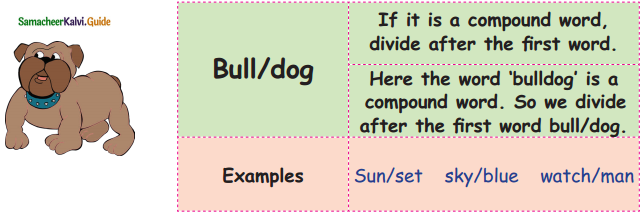
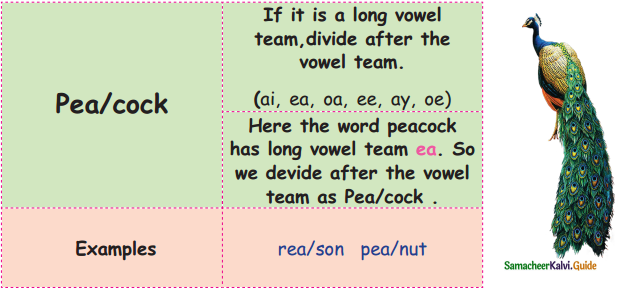
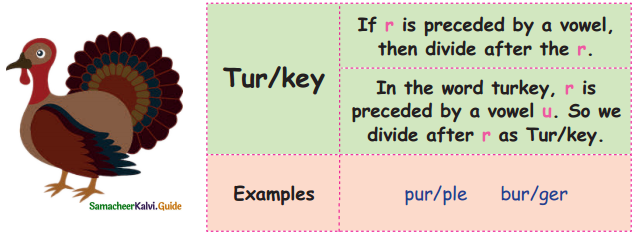
We divide the words to pronounce them easier. Here are some tips to divide.
உச்சரிப்பதற்கு வசதியாக நாம் வார்த்தைகளைப்பிரிக்கிறோம். எவ்வாறுவார்த்தைளைப் பிரிப்பது என்பதற்கான குறிப்புகளை இங்கு காண்போம்.

Samacheer Kalvi 5th English Guide Term 1 Prose Chapter 3 The Guardians of the Nation 1

Samacheer Kalvi 5th English Guide Term 1 Prose Chapter 3 The Guardians of the Nation 2

Samacheer Kalvi 5th English Guide Term 1 Prose Chapter 3 The Guardians of the Nation 3

Samacheer Kalvi 5th English Guide Term 1 Prose Chapter 3 The Guardians of the Nation

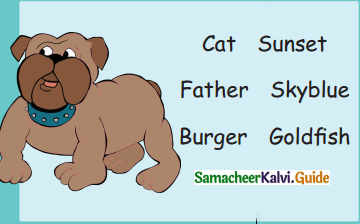
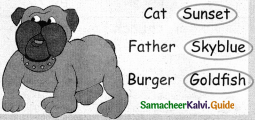
A. Circle and divide the bulldog pattern words:

Question 1.
Samacheer Kalvi 5th English Guide Term 1 Prose Chapter 3 The Guardians of the Nation 4
Answer:
Out of six given words, the bulldog pattern words are – Sunset, Skyblue, Goldfish

Samacheer Kalvi 5th English Guide Term 1 Prose Chapter 3 The Guardians of the Nation 5

  • sun/set
  • sky/blue
  • gold/fish.

Samacheer Kalvi 5th English Guide Term 1 Prose Chapter 3 The Guardians of the Nation

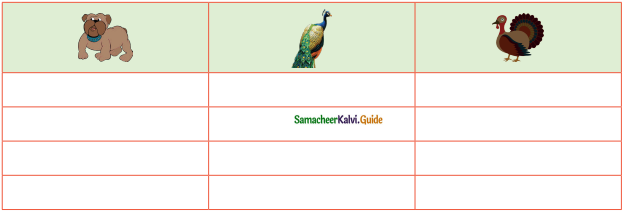
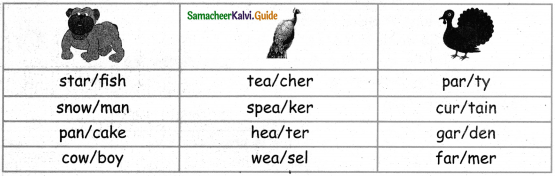
B. Divide and list out the word under each pattern:

Samacheer Kalvi 5th English Guide Term 1 Prose Chapter 3 The Guardians of the Nation 6

Samacheer Kalvi 5th English Guide Term 1 Prose Chapter 3 The Guardians of the Nation 7
Answer:
Samacheer Kalvi 5th English Guide Term 1 Prose Chapter 3 The Guardians of the Nation 8

Samacheer Kalvi 5th English Guide Term 1 Prose Chapter 3 The Guardians of the Nation

C. Write some Samacheer Kalvi 5th English Guide Term 1 Prose Chapter 3 The Guardians of the Nation 9 pattern words and divide them:
Answer:

  • airport – air/port
  • headlight – head/light
  • breakfast – break/fast
  • landmark – land/mark
  • moonlight – moon/light
  • wheelchair – wheel/chair

Samacheer Kalvi 5th English Guide Term 1 Prose Chapter 3 The Guardians of the Nation

5th English Guide The Guardians of the Nation Additional Questions and Answers

Question 1.
Write some Samacheer Kalvi 5th English Guide Term 1 Prose Chapter 3 The Guardians of the Nation 10 pattern words and divide them.
Answer:

  • reach – rea/ch
  • board – boa/rd
  • deal – dea/l
  • oap – soa/p
  • ecise – plea/se
  • roast – roa/st

Question 2.
Write some Samacheer Kalvi 5th English Guide Term 1 Prose Chapter 3 The Guardians of the Nation 11 pattern words and divide them.
Answer:

  • march – mar/ch
  • nurse – nur/se
  • target – tar/get
  • purse – pur/se
  • interest inter/est
  • church – chur/ch

Samacheer Kalvi 5th English Guide Term 1 Prose Chapter 3 The Guardians of the Nation

Answer the following Questions:

Question 1.
What was Anand’s father doing when Anand came from school?
Answer:
Anand’s father was watching the news on the television.

Question 2.
What is the importance of 7th December?
Answer:
Armed Forces Flag Day is observed on 7th December every year.

Question 3.
Why did Karmugilan go to the USA?
Answer:
Karmugilan went to the USA for studying.

Question 4.
What did Karmugilan’s parents think of him?
Answer:
Karmugilan’s parents thought that he would live in the USA and continue his practice.

Question 5.
Why did Karmugilan come back to India?
Answer:
Karmugilan came back to India to treat the poor people at free of cost.

Question 6.
What is the real service to the nation?
Answer:
We should treat everyone around us with love and respect. That is the real service to the nation.

Samacheer Kalvi 5th English Guide Term 1 Prose Chapter 3 The Guardians of the Nation

The Guardians of the Nation Summary in English and Tamil

Anand and Yazhini came home from school. After washing their face, hands, and legs, they sat down next to their Father Their Father was watching the news on the television. There were two bowls of chickpea sundal. They ate and watched a ceremony where people were paying respect to a helmet on top of a gun. “Dad, what is this place? What are they doing?” asked Anandhan. Dad replied, “This is Amar Jawan Jyoti, a memorial for the soldiers who died for our country.

ஆனந்தும், யாழினியும் பள்ளியிலிருந்து வீட்டிற்கு வந்தார்கள். முகம், கை, கால்களைக் கழுவிய பிறகு, அவர்களது தந்தைக்கு அருகே வந்து அமர்ந்த னர். அவர்களது தந்தை தொலைகாட்சியில் செய்திகளை பார்த்துக் கொண்டிருந்தார். அங்கு இரு கிண்ணங்களில் சுண்டல் இருந்தது. அவர்கள் சாப்பிட்டுக் கொண்டே தொலைகாட்சியில் ஒரு நிகழ்ச்சியைப் பார்த்தார்கள். ஒரு துப்பாக்கியின் மீது வைக்கப்பட் வைக்கப்பட்டிருந்த ஒரு தலைக்கவசத்திற்கு மக்கள் மரியாதை செய்து கொண்டிருந்த காட்சி அது. “அப்பா, இது என்ன இடம்? அவர்கள் என்ன செய்கிறார்கள்?”, என்று ஆனந்தன் கேட்டான். “இதுதான் அமர் ஜவான் ஜோதி. நமது நாட்டிற்காக உயிரிழந்த படைவீரர்களின் நினைவுச்சின்னம்.

Every year, 7th December is observed as Armed Forces Flag Day. On that day, we remember the sacrifices of our soldiers for guarding our nation. It is a great honour to serve the nation by joining the army.”

ஒவ்வொரு ஆண்டும் டிசம்பர் 7-ஆம் தேதி இராணுவக் கொடிநாளாக அனுசரிக்கப்படுகிறது.அன்றைய நாளில், நம் தேசத்தைக் காத்த வீரர்களின் தியாகங்களை நாம் நினைவு கூர்கிறோம். இராணுவத்தில் சேர்ந்து தேசத்திற்கு சேவை செய்வது ஒரு பெரிய கௌரவமாகும்”, என அவனது தந்தை பதிலளித்தார்.

Yazhini proudly declared, “When I grow up, I will join the army and serve the nation.” Anandhan said,”I will become a doctor, and treat the people.” Yazhini asked, “Why don’t you join the army and serve the nation like me?”

யாழினி பெருமையுடன், “நான் வளர்ந்த பிறகு இராணுவத்தில் சேர்ந்து தேசத்திற்கு பணியாற்றுவேன்”, என அறிவித்தாள். “நான் ஒரு மருத்துவராகி, மக்களுக்கு சிகிச்சையளிப்பேன்”, என்றான் ஆனந்தன். “நான் சொன்ன மாதிரி, நீயும் ஏன் இராணுவத்தில் சேர்ந்து தேசத்திற்கு பணியாற்றக்கூடாது?”, என யாழினி கேட்டாள்.

Father intervened her and said, “Joining the army is not the only way to serve the nation. Each one of us can serve the nation in our own way.” Yazhini asked, “Really dad? How can we serve the .nation?” Father said, “Serving in the army is a grace, but not everyone gets a chance to serve. But, each of us has a role in our society and, by doing that role we are serving our nation.”

Samacheer Kalvi 5th English Guide Term 1 Prose Chapter 3 The Guardians of the Nation

அப்போது அவளது தந்தை குறுக்கிட்டு, “இராணுவத்தில் சேர்வது மட்டுமே தேசத்திற்கு சேவை செய்யும் ஒரே வழி என்று நினைக்கக் கூடாது”, என்று கூறினார். “உண்மையாகவா அப்பா? தேசத்திற்கு நாம் எப்படி சேவை புரியலாம்?”, என்று யாழினி கேட்டாள். “இராணுவத்தில் சேவை புரிவது என்பது ஒரு வரம். ஆனால் ஒவ்வொருவரும் அந்த வாய்ப்பை பெறுவதில்லை ஆனால் சமூகத்தில் நம் ஒவ்வொருவருக்கும் ஒரு பொறுப்பு இருக்கிறது. அதைச் செய்தாலே நமது தேசத்திற்கு சேவை செய்த மாதிரி தான்”, என்றார் அவள் தந்தை.

Father continued, “I will tell you the story of Karmugilan. He was a doctor. who died, serving the people. He was young and talented. He went to the USA for studying. His parents were very proud of him. They thought that he would live in the USA and continue his practice. But to everyone’s surprise, he came back to India and started treating poor people free of cost.”

“நான் உங்களிருவருக்கும் கார்முகிலனின் கதையைச் சொல்கிறேன். அவர் ஒரு மருத்துவர். மக்களுக்காவே சேவை செய்து இறந்துபோனார். அவர் இளமையானவர், மற்றும் திறமைசாலி. படிப்பதற்காக அமெரிக்கா போனார். அவரது பெற்றோர் அவரை நினைத்து பெருமை பட்டனர். அவர் அமெரிக்காவிலேயே வாழ்ந்து, அங்கேயே மருத்துவத்தைத் தொடருவார் என
அவர்கள் நினைத்தனர். ஆனால் எல்லோரும் ஆச்சர்யப்படும் வகையில் அவர் இந்தியாவுக்கு திரும்பிவந்து ஏழை மக்களுக்கு இலவசமாக மருத்துவம் பார்க்கத் தொடங்கினார்”, என்றார் யாழினியின் தந்தை.

Yazhini asked, “Were his parents not angry with him?” Dad said, “They were anary. But, they knew he was happy.”

அப்போது யாழினி கேட்டாள்: “அவரது பெற்றோர்கள் அவர் மீது கோபப்பட வில்லையா?” தந்தை சொன்னார் : “ஆம், அவர்களுக்கு கோபம் வந்தது. ஆனால் கார்முகிலன் மகிழ்ச்சியாக இருந்ததை அவர்கள் அறிந்தனர்”.

Samacheer Kalvi 5th English Guide Term 1 Prose Chapter 3 The Guardians of the Nation

One day, dengue broke out in the nearby villages. He left to those villages to treat the people. He saved the lives of many. He was soon well known in the village, and people poured known in the village and people poured in to get treated.

ஒரு நாள், பக்கத்து கிராமங்களில் டெங்கு காய்ச்சல் பரவத்தொடங்கியது. அந்த மக்களுக்கு சிகிச்சை அளிக்க கார்முகிலன் அந்த கிராமங்களுக்குச் சென்றார். பலருடைய உயிரை அவர் காப்பாற்றினார். அந்த கிராமத்தில் அவர் மிகவும் பிரபலமடைந்து விட்டார். அவரிடம் சிகிச்சை பெறுவதற்காக மக்கள் வந்து குவிந்தனர்.

But, one day he got infected by the disease and was taken to the city hospital. He was in critical condition. His parents were upset and worried. He told his parents that he had done his duty to the country and, was happy. In a couple of days, he died. In his memory, the people of the village have built a hospital and treat people at free of cost.”

ஆனால் ஒரு நாள் அவரையும் அந்த நோய் தாக்கியது. அவர் நகர மருத்துவமனைக்கு எடுத்துச்செல்லப்பட்டார். அவர் மிக ஆபத்தான நிலையில் இருந்தார். அவரது பெற்றோர் வருத்தப்பட்டனர். தான் இந்த நாட்டிற்கு தன் கடமையை செய்துவிட்டதாகவும், அதனால் மகிழ்ச்சியுடன் இருப்பதாகவும் கார்முகிலன் தன் பெற்றோரிடம் கூறினார். அடுத்த சில நாட்களில் அவர் இறந்துவிட்டார். அவரது நினைவாக அந்த கிராமத்து மக்கள் ஒரு மருத்துவமனையைக் கட்டினார். அங்கு மக்களுக்கு இலவச வைத்தியம் கிடைக்கிறது”.

“That’s really great, dad. He is a real hero.”, said Yazhini.

“அது உண்மையிலேயே சிறப்பான ஒன்று தான், அப்பா. அவர்தான் உண்மையான நாயகன்”, என்றாள் யாழினி.

Father replied, “Each one of us should love and respect our country.” we should treat everyone around us with love and respect. That’s the real service to the nation.”

நாம் ஒவ்வொருவரும் நம் நாட்டை நேசித்து மதிக்க வேண்டும். நம்மை சுற்றியுள்ள ஒவ்வொருவரையும் அன்போடும், மரியாதையுடனும் | நடத்த வேண்டும். அதுவே தேசத்திற்கு செய்யும் உண்மையான சேவை”, என்றார் அவளது தந்தை.

Samacheer Kalvi 5th English Guide Term 1 Prose Chapter 3 The Guardians of the Nation

The Guardians of the Nation Glossary:

Ceremony – A formal event to celebrate an anniversary (ஆண்டுவிழா )
Critical – Serious/dangerous (ஆபத்தான நிலை)
Declared – Said / stated (அறிவித்த ல்)
Grace – Blessing (வரம்)
Guarding – To watch over to protect or control (பாதுகாத்தல்)
Honour – Respect (மரியாதை)
Infected – Contaminated with harmful things (கேடுகளால் பாதிக்கப்படுதல்)
Intervened – Interrupt a conversation (குறுக்கிட்டு பேசுதல்)
Memorial – A structure established to remind of a person or event (நினைவுச் சின்னம்)
Munching – Eating something steadily (தொடர்ந்து கொறித்தல்)
Observed – Commemorated (அனுசரிக்கப்படுதல்)
Poured in – Came in great numbers (அதிக அளவில் வருவது)
Proudly – With pride (பெருமையுடன்)
Remember – Recall (நினைவுபடுத்துதல்)
Sacrifices – Giving up something more valuable (தியாகங்க ள்)
Serve – To work for (சேவை)
Talented – Skilled/expert (திறமையாளர்)
Upset – Unhappy (வருத்தப்படுதல்)
Worried – Distressed (கவலையடைதல்)
Wreath – Flowers arranged in a ring, for lying on a grave (கல்லறையில் வைக்கப்படும் மலர் வளையம் )

Samacheer Kalvi 4th Science Guide Term 3 Chapter 1 Green Environment

Tamilnadu State Board New Syllabus Samacheer Kalvi 4th Science Guide Pdf Term 3 Chapter 1 Green Environment Text Book Back Questions and Answers, Notes.

Tamilnadu Samacheer Kalvi 4th Science Solutions Term 3 Chapter 1 Green Environment

Samacheer Kalvi 4th Science Guide Green Environment Text Book Back Questions and Answers

Samacheer Kalvi 4th Science Guide Term 3 Chapter 1 Green Environment

I. Choose the correct answer :

Question 1.
What is the first step in waste management?
(a) Waste disposal
(b) Waste separation
(c) Waste collection
Answer:
(b) Waste separation

Question 2.
Which is an example for non-biodegradable waste?
(a) Paper cup
(b) Plastic cup
(c) Coconut shell
Answer:
(b) Plastic cup

Question 3.
Picking up the waste is called ____________
(a) Waste collection
(b) The environment
(c) Litter
Answer:
(a) Waste collection

Question 4.
___________ is the first ‘R’ in the Three R’s.
(a) Reuse
(b) Reduce
(c) Recycle
Answer:
(b) Reduce

Samacheer Kalvi 4th Science Guide Term 3 Chapter 1 Green Environment

II. Fill in the blanks :

Question 1.
_____________ is an example of reusing waste. (Using old jars for pickle / Saying not to a plastic bag)
Answer:
Using old jars for pickle

Question 2.
____________ is used to make bags, dustbins and tooth brushes. (Rose / Bamboo)
Answer:
Bamboo

Question 3.
____________ is a big threat to our environment. (Plastic pollution / Light pollution)
Answer:
Plastic pollution

Question 4.
___________ is a non-recyclable item. (Glass / Multilayer plastics)
Answer:
Multilayer -plastics

Samacheer Kalvi 4th Science Guide Term 3 Chapter 1 Green Environment

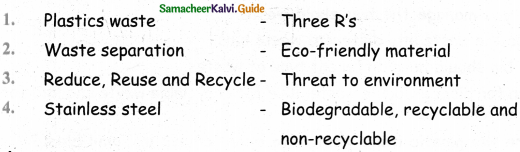
III. Match the following :

Question 1.
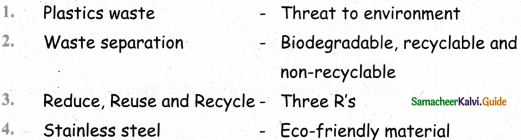
Samacheer Kalvi 4th Science Guide Term 3chapter 1 Green environment 1
Answer:
Samacheer Kalvi 4th Science Guide Term 3chapter 1 Green environment 2

Samacheer Kalvi 4th Science Guide Term 3 Chapter 1 Green Environment

IV. Write True or False :

Question 1.
3R method reduces the amount of waste that goes to landfills.
Answer:
True

Question 2.
Eco-friendly material is harmful to the environment.
Answer:
False

Question 3.
Plastic bag, thermocol and multilayer plastics are recyclable.
Answer:
False

Question 4.
We should not separate our waste.
Answer:
False

Samacheer Kalvi 4th Science Guide Term 3 Chapter 1 Green Environment

V. Answer in one or two sentences :

Question 1.
What are the Three R’s?
Answer:
The three R’s stand for REDUCE, REUSE, RECYCLE.

Question 2.
What is bio-degradable waste?
Answer:
Bio-degradable waste is a form of waste, originating naturally from plant
or animal sources, which may be degraded by other living organisms.

Question 3.
Write the different steps in waste management.
Answer:

  • Separation of waste
  • Waste collection and transportation
  • Waste recycling and composting
  • Waste disposal

Question 4.
Name five items which are recyclable.
Answer:
Paper, glass, metal, cardboard and plastic covers.
Samacheer Kalvi 4th Science Guide Term 3 Chapter 1 Green Environment

VI. Answer the following :

Question 1.
How will you manage the household waste?

  • Divide the waste into different waste bins.
  • Each bin should have different type of wastes.
  • Green for biodegradable waste, Blue for recyclable waste and Red for non-recyclable waste.

Question 2.
What are the plastic items that have been banned in Tamil Nadu?
Answer:
Plastic bags, plastic plates, water pouches, plastic straws, plastic sheets.

Question 3.
Write the benefits of recycling.
Answer:

  • Old newspapers, note books and magazines are sold to a scrap dealer. They will be made into new paper.
  • PET bottles are recycled into plastic threads and used to make sports T-shirts.
  • Old glass bottles and broken glass pieces are melted to make new glass.
  • Broken metal items like tiffin boxes and plates are melted and made into new metal products like toys.

Question 4.
What is known as eco-friendly material?
Answer:
Materials which are beneficial to the environment and do not cause harm are called eco-friendly materials

Samacheer Kalvi 4th Science Guide Term 3 Chapter 1 Green Environment

Samacheer Kalvi 4th Science Guide Green Environment In Text Questions and Answers

Activity (Text Book Page No. 65)

Question 1.
Write the waste management process in the correct order.
(Waste disposal, Waste collection and transportation, Waste separation, Waste recycling and composting)
Answer:

  1. Waste separation
  2. Waste collection & transportation
  3. Waste recycling A composting
  4. Taste disposal

Samacheer Kalvi 4th Science Guide Term 2 Chapter 3 Plants

Activity (Text Book Page No. 67)

Question 1.
List out four things that you can reduce, reuse and recycle at home or school.

ReduceReuse

Recycle

Answer:

ReduceReuseRecycle
Use of plastic carry bagsOld clothes to clean home & cycleOld newspapers, notebook, magazine
Buy food in bulk & avoid plastic bagsUse jam & pickle jars to store things.Old glass bottles to make new bottles
Buy a refill instead of a penClothes that look good can be donated to poorBroken metal items to make toys
Turn off lights and fans when you leave a roomReuse waste & make something newPet bottle to make plastic thread

Samacheer Kalvi 4th Science Guide Term 2 Chapter 3 Plants

Activity (Text Book Page No. 70)

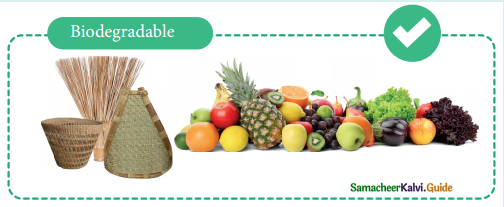
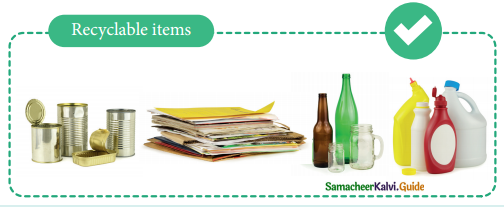
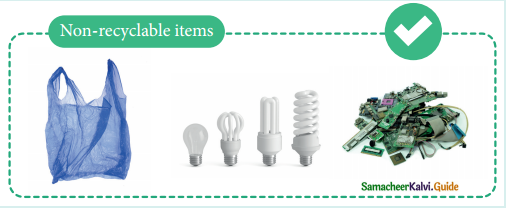
Study the images below and write down three items you have at home in each category of waste.

Question 1.
Samacheer Kalvi 4th Science Guide Term 3chapter 1 Green environment 15
Answer:
Biodegradable: Vegetable peels, fruit peels, mat

Question 2.
Samacheer Kalvi 4th Science Guide Term 3chapter 1 Green environment 16
Answer:
Recyclable: Glass, metal, paper & cardboards

Question 3.
Samacheer Kalvi 4th Science Guide Term 3chapter 1 Green environment 17
Answer:
Non-recyclable : Plastic baas, CFL lights, mixed electronic wastes

Samacheer Kalvi 4th Science Guide Term 3 Chapter 1 Green Environment

Activity (Text Book Page No. 74)

Question 1.
Write any five non-recyclable items that you use or*have seen in shop.
Answer:
CFL lights, plastic bags, mixed electronic wastes, medical wastes, polyester.

Samacheer Kalvi 4th Science Guide Green Environment Additional Questions and Answers

Samacheer Kalvi 4th Science Guide Term 3 Chapter 1 Green Environment

I. Choose the correct answers :

Question 1.
Unwanted materials pollute our ___________
(a) Land
(b) Air
(c) Both a and b
Answer:
(c) Both a and b

Question 2.
____________ is the very important step in waste management.
(a) Separation of waste
(b) Waste disposal
(c) Waste collection
Answer:
(a) Separation of waste

Question 3.
_______________ is to take materials from things you throw away and make new products with them.
(a) Reduce
(b) Reuse
(c) Recycle
Answer:
(c) Recycle

Question 4.
____________ can return back to the soil and become food for plants.
(a) Biodegradable
(b) Non-degradable
(c) Recyclable
(d) None
Answer:
(a) Biodegradable

Question 5.
_____________ is an example for eco-friendly material.
(a) Leaf plate
(b) Plastic plate
(c) Thermocol plate
Answer:
(a) Leaf plate

Samacheer Kalvi 4th Science Guide Term 3 Chapter 1 Green Environment

II. Fill in the blanks :

Question 1.
Picking up the waste is called ___________ (waste disposal / waste collection)
Answer:
waste collection

Question 2.
____________ waste can be turned into something new which is valuable. (Recyclable / Non – recyclable)
Answer:
Recyclable

Question 3.
is using something repeated for the same or for another purpose. (Reuse / Reduce)
Answer:
Reuse

Question 4.
___________ of our environment means to protect all things found in nature. (Observation / Conservation)
Answer:
Conservation

Question 5.
Plastic bags and food packaging is a _____________ item. (non-recyclable / recyclable)
Answer:
Non-recyclable

Samacheer Kalvi 4th Science Guide Term 2 Chapter 3 Plants

III. True or false :

Question 1.
It is best to separate waste into 3 different bins.
Answer:
True

Question 2.
Reuse is to make or use less
Answer:
False

Question 3.
Broken glass pieces are melted to make new glass.
Answer:
True

Question 4.
We should conserve our natural resources and energy
Answer:
True

Samacheer Kalvi 4th Science Guide Term 3 Chapter 1 Green Environment

IV. Answer the following :

Question 1.
What is separation of waste?
Answer:
It means to sort or divide the waste into different waste bins.

Question 2.
What is waste collection?
Answer:
Picking up the waste by our municipality or corporation is called waste collection.

Question 3.
What is transportation?
Answer:
Moving the waste from one place to another is called transportation.

Question 4.
What is compost?
Answer:

  1. Compost is the decayed organic material which is obtained from the biodegradable waste.
  2. Compost makes the soil fertile.

Question 5.
What is waste disposal or final disposal?
Answer:
The waste that cannot be recycled (non-recyclable waste) needs to be sent for final disposal.

Question 6.
What is Reduce?
Answer:
Reduce is to make or use less materials.

Question 7.
What is Reuse?
Answer:
Reuse is using a thing repeatedly for the same or for another purpose.

Question 8.
What is Recycle?
Answer:
Recycle is to take materials from things you throw away and make new products by using them.

Question 9.
Name some materials that you can at home recycle?
Answer:

  • PET bottles
  • Old glass bottles and broken glass pieces
  • Broken metal items

Samacheer Kalvi 4th Science Guide Term 3 Chapter 1 Green Environment

V. Answer in detail :

Question 1.
Write down the eco-friendly activities.
Answer:

  • Reduce your paper use by writing on both sides of every sheet.
  • Stop using plastic straws.
  • Use reusable bag.
  • Give up chewing gum.
  • Buy stainless steel bottles instead of plastic water bottles.
  • Reuse containers for storing left overs.

Question 2.
What is meant by conservation of environment?
Answer:

  • Conservation of environment means to protect all things found in nature.
  • It means that we have to use our Earth’s natural resources (like water, soil, minerals, wildife and forests) carefully.
  • Everyone can conserve the environment by good waste management habits.

Samacheer Kalvi 5th English Guide Term 1 Prose Chapter 2 Trip to My Grandparents Village

Tamilnadu State Board New Syllabus Samacheer Kalvi 5th English Guide Pdf Term 1 Prose Chapter 2 Trip to My Grandparents Village Text Book Back Questions and Answers, Summary, Notes.

Tamilnadu Samacheer Kalvi 5th English Solutions Term 1 Prose Chapter 2 Trip to My Grandparents Village

5th English Guide Trip to My Grandparents Village Text Book Back Questions and Answers

In-Text Question (Think):

Question 1.
Is TV and video game the only way to pass time? Can we do something else?
Answer:
Time is a non-renewable resource. Many people wasted their time playing video games and they regretted it in their later stage: Instead of playing video games, we can spend our time playing outdoor games, learning to play musical instruments like guitar etc., learning photography, painting etc.

Television is an easy and cheap source of entertainment. By watching the news, we can improve our general knowledge. Watching TV too much is not good for our health. It contributes to some health issues like obesity, sleep difficulties, etc.

Samacheer Kalvi 5th English Guide Term 1 Prose Chapter 2 Trip to My Grandparents Village

Let us Understand:

A. Match the following:

1. cuckooa. blows
2. breezeb. sings
3.  riverc. swims
4.  fishd. flows

Answer:

1.cuckooa. sings
2. breezeb. blows
3. riverc. flows
4. fishd. swims

Samacheer Kalvi 5th English Guide Term 1 Prose Chapter 2 Trip to My Grandparents Village

B. Answer the following questions:

Question 1.
How did Santhosh record his diary?
Answer:
Santhosh recorded his diary using his mother’s phone.

Question 2.
Name some of the activities that the village children were doing on their vacation.
Answer:
Playing with a tyre and a stick, milking cows, breaking groundnut pods and piling them, splashing in the pond, climbing to the top of a tamarind tree, playing hide and seek are the activities that the village children were doing on their vacation.

Question 3.
Why did Santhosh forget to watch television or play video games?
Answer:
Santhosh ‘trip to his grandparents’ home was so enjoyable to him. So he forgot to watch television or play video games.

Question 4.
Did Santhosh enjoy his morning walk? How do you know?
Answer:
Yes, Santhosh enjoyed his morning walk. He enjoyed the cool breeze and he felt that the air was also filled with the sweet sound of birds.

Question 5.
How did Santhosh spend his time when he went to the river?
Answer:
As he could not swim, Santhosh sat on a big smooth rock. He watched his friends swam like experts. He saw the pebbles in the riverbed and colourful fish swim by.

Question 6.
How did Santhosh know that the river was clean?
Answer:
The river is so clean as Santhosh could see the pebbles in the riverbed and colourful fish swim by.

Samacheer Kalvi 5th English Guide Term 1 Prose Chapter 2 Trip to My Grandparents Village

Let us Build:

Let us learn some more tips to change singular to plural.
ஒருமையைப் பன்மையாக மாற்றுவதைப் பற்றி இங்கு காண்போம்.

Try this:

Question 1.
Samacheer Kalvi 5th English Guide Term 1 Prose Chapter 2 Trip to My Grandparents Village 1
Answer:
Samacheer Kalvi 5th English Guide Term 1 Prose Chapter 2 Trip to My Grandparents Village 2

Samacheer Kalvi 5th English Guide Term 1 Prose Chapter 2 Trip to My Grandparents Village

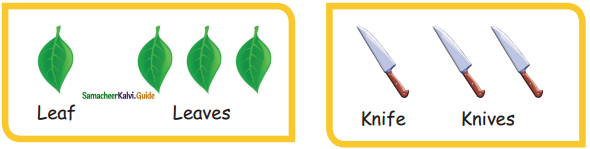
1. Change -f and -fe, into -ves.
Samacheer Kalvi 5th English Guide Term 1 Prose Chapter 2 Trip to My Grandparents Village 3

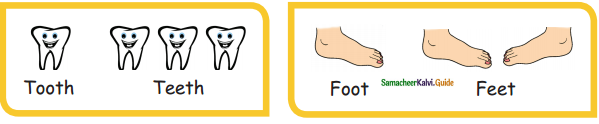
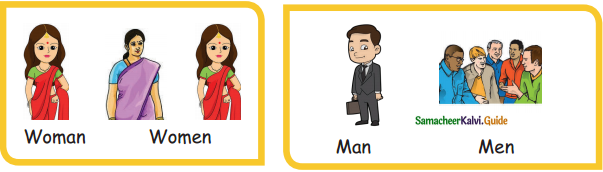
2. By changing their vowels, such as oo to ee or an to en.
Samacheer Kalvi 5th English Guide Term 1 Prose Chapter 2 Trip to My Grandparents Village 4
Samacheer Kalvi 5th English Guide Term 1 Prose Chapter 2 Trip to My Grandparents Village 5

3. Irregular plurals
Samacheer Kalvi 5th English Guide Term 1 Prose Chapter 2 Trip to My Grandparents Village 6

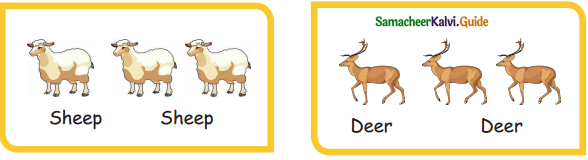
4. Some nouns are identical in both the singular and the plural forms. Many of these are names of animals.
Samacheer Kalvi 5th English Guide Term 1 Prose Chapter 2 Trip to My Grandparents Village 7

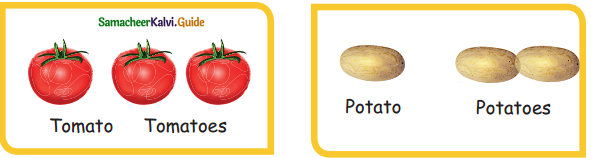
5. Add es for some words ending with o.
Samacheer Kalvi 5th English Guide Term 1 Prose Chapter 2 Trip to My Grandparents Village 8

Samacheer Kalvi 5th English Guide Term 1 Prose Chapter 2 Trip to My Grandparents Village

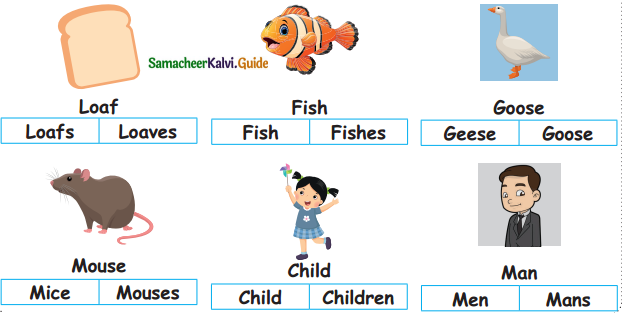
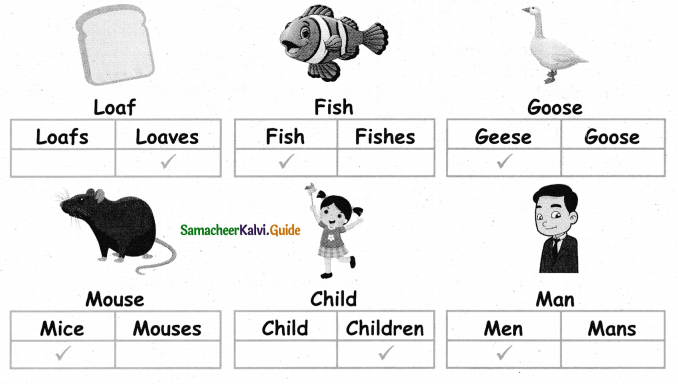
A. Look at the picture and tick (✓) the correct plural word:

Question 1.
Samacheer Kalvi 5th English Guide Term 1 Prose Chapter 2 Trip to My Grandparents Village 9
Answer:
Samacheer Kalvi 5th English Guide Term 1 Prose Chapter 2 Trip to My Grandparents Village 10

Samacheer Kalvi 5th English Guide Term 1 Prose Chapter 2 Trip to My Grandparents Village

B. Write the plural form:

Question 1.
Samacheer Kalvi 5th English Guide Term 1 Prose Chapter 2 Trip to My Grandparents Village 11
Answer:
Leaves

Question 2.
Samacheer Kalvi 5th English Guide Term 1 Prose Chapter 2 Trip to My Grandparents Village 12
Answer:
Mangoes

Samacheer Kalvi 5th English Guide Term 1 Prose Chapter 2 Trip to My Grandparents Village

5th English Guide Earth, The Desolated Home Additional Questions and Answers

Question 1.
Where did Santhosh go for his vacation?
Answer:
Santhosh went to his grandparents’ village, called Sirumalai.

Question 2.
How was the roadside look like?
Answer:
There were numerous trees with yellow flowers on both sides of the road.

Question 3.
What was the use of scarecrows?
Answer:
The scarecrows had managed to scare away the crows in the fields.

Question 4.
Name the birds that were seen in the paddy fields.
Answer:
Many white cranes were seen in the green paddy fields.

Question 5.
Write down the names of Paavai’s friends.
Answer:
Amir, Peter, and Umaiyal were Paavai’s friends.

Question 6.
Who took Santhosh to the river?
Answer:
Santhosh’ mother and his aunties took him to the river for a refreshing bath.

Samacheer Kalvi 5th English Guide Term 1 Prose Chapter 2 Trip to My Grandparents Village

Write the plural form:

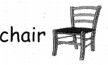
Question 1.
Samacheer Kalvi 5th English Guide Term 1 Prose Chapter 2 Trip to My Grandparents Village 13= ________
Answer:
Chairs

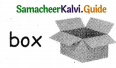
Question 2.
Samacheer Kalvi 5th English Guide Term 1 Prose Chapter 2 Trip to My Grandparents Village 14  = ________
Answer:
Boxes

Question 3.
Samacheer Kalvi 5th English Guide Term 1 Prose Chapter 2 Trip to My Grandparents Village 15 = ________
Answer:
Spectacles

Question 4.
Samacheer Kalvi 5th English Guide Term 1 Prose Chapter 2 Trip to My Grandparents Village 16 = ________
Answer:
Donkeys

Question 5.
Samacheer Kalvi 5th English Guide Term 1 Prose Chapter 2 Trip to My Grandparents Village 17 = ________
Answer:
Radios

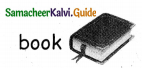
Question 6.
Samacheer Kalvi 5th English Guide Term 1 Prose Chapter 2 Trip to My Grandparents Village 18 = ________
Answer:
Books.

Samacheer Kalvi 5th English Guide Term 1 Prose Chapter 2 Trip to My Grandparents Village

Trip to My Grandparents Village Summary in English and Tamil

It is summer. Santhosh’ vacation has started. His parents are going to Sirumalai, his parents’ village. Santhosh is excited. He records an audio diary on his mother’s phone. He records all his feelings during the visit. Later, he writes down in his diary what he had recorded. Let’s read his diary to know his experiences during this visit.

இது கோடைக்காலம். சந்தோஷின் விடுமுறை | தொடங்கிவிட்டது. அவனது பெற்றோரின் கிராமமான சிறுமலைக்கு அவனது பெற்றோர் போகிறார்கள். சந்தோஷ் உற்சாகமாக ப’ இருந்தான். அவனது அம்மாவின் போனில் ஒலி வடிவில் நிகழ்வுகளை பதிவு செய்கிறான். அவனது பயணத்தின் போது அவனது எல்லா உணர்வுகளை பதிவு செய்கிறான். பின்னர் தனது டைரியில், தான் பதிவு செய்திருந்ததை எழுதிக் கொள்கிறான். அவனது விஜயத்தின் போது, அவனது அனுபவங்களை அறிந்து கொள்ள, அவனது டைரியை நாம் படிக்கலாம்.
28

10th April: 10 ஏப்ரல் :
I am very eager to visit my grand parents’ village. I will meet my grand parents and cousins. I have packed my clothes and tab for playing video games. We will be travelling in a bus. I am so excited.

என் தாத்தா பாட்டியின் கிராமத்திற்குப் போக நான் வெகு ஆர்வமாக இருக்கிறேன். அங்கு என் தாத்தா பாட்டியையும், உறவினர்களையும் நான் சந்திப்பேன். வீடியோவில் விளையாட்டுக்களை விளையாட ‘டேப்’ எனப்படும் கருவியையும், எனது
உடைகளையும் எடுத்துக் கொண்டேன். நாங்கள் ஒரு பேருந்தில் பயணிப்போம். நான் மிகவும் உற்சாகமாக இருக்கிறேன்.

11th April:11 ஏப்ரல்:
Today we are travelling. Though it is summer, the weather is pleasant in the morning. There are numerous trees with yellow flowers on both sides of the road. There is greenery all around. There are many white cranes in the lush green paddy fields. The scarecrows have managed to scare away the crows in the fields. There is no traffic, noise and air pollution in the village.

Samacheer Kalvi 5th English Guide Term 1 Prose Chapter 2 Trip to My Grandparents Village

இன்று நாங்கள் பயணம் செல்கிறோம். கோடைக்காலமாக இருந்தாலும், காலையில் வானிலை இதமாக இருக்கிறது. சாலையின்
இருபுறங்களிலும் எண்ணற்ற மரங்கள் மஞ்சள் மலர்களுடன் உள்ளன. சுற்று வட்டாரம் முழுதும் பசுமையாக இருந்தது. பசுமையான நெல்வயல்களில் பல வெள்ளை கொக்குகள் இருந்தன. வயல்களில் காகங்களை பயமுறுத்தி விரட்ட மனித உருவ பொம்மைகள் இருந்தன. வாகனப் போக்குவரத்து, இரைச்சல், காற்று மாசு என்று எதுவும் கிராமத்தில் இல்லை.

I get off the bus and run to meet my grandparents. They are deliahted to see me. The house is surrounded by many big trees. There are a few jackfruit, mango, neem, banana, pomearanate and coconut trees. The trees have abundant fruits. My grandfather has plucked some ripe mangoes for me. The mangoes are so juicy and sweet.

நான் பேருந்திலிருந்து இறங்கி, என் தாத்தா பாட்டியைச் சந்திக்க ஓடினேன். அவர்கள் என்னைப் பார்த்ததில் பெரு மகிழ்ச்சியடைந்தனர். பல பெரிய மரங்கள் வீட்டைச் சூழ்ந்து இருந்தன. சில பலா, மா, வேம்பு, வாழை, மாதுளை, தென்னை மரங்கள் இருந்தன. மரங்களில் அதிக அளவில் பழங்களும் இருந்தன. சில பழுத்த மாம்பழங்களை என் தாத்தா எனக்காக பறித்தார். மாம்பழங்கள் மிகவும் சாறுடனும், சுவையுடனும் இருந்தன.

12th April: 12 ஏப்ரல் :
I have woken up early today. I am out for a walk in the morning. The cool breeze is pleasing. The coconut palms are swaying lazily. The farmers are already in their fields. Some of them are cutting the crops and some of them are threshing the paddy. The air is filled with the sweet sound of birds singing in the trees and the bushes. The cuckoo’s song is perhaps the most enchanting.

இன்று நான் சீக்கிரமாக எழுந்துவிட்டேன். காலையில் வெளியே நடைபயிற்சிக்காக.சென்றேன். குளிர்ந்த காற்று இதமாக இருந்தது.
தென்னை, பனை மரங்கள் சோம்பலுடன் அசைந்து கொண்டிருந்தன. விவசாயிகள் ஏற்கனவே அவர்களது வயல்களில் இருந்தனர். அவர்களில் சிலர் அறுவடை செய்தனர். சிலர் கதிர் அடித்தனர். மரங்களிலும், புதர்களிலும் இருந்த பறவைகளின் இனிமையான சத்தம், காற்றுடன் கலந்திருந்தது. குயிலின் பாட்டு மிகவும் மயங்க

When I come home, I freshen up and eat the tastiest breakfast in my life. Later, my grandmother introduces a girl, Paavai. She goes to the village school. She lives down the street. She is very eager to show me around the village. Paavai shows me how to play with a tyre and a stick. We happily run down the lanes balancing the tyre with a small stick. We stop to talk to Paavai’s friends, Amir, Peter and Umaiyal.

Samacheer Kalvi 5th English Guide Term 1 Prose Chapter 2 Trip to My Grandparents Village

நான் வீட்டுக்கு வந்து, புத்துணர்வு பெற்று, என் வாழ்விலேயே சுவையான காலை உணவை சாப்பிட்டேன். பின்னர், பாவை என்ற ஒரு சிறுமியை என் பாட்டி என்னிடம் அறிமுகப்படுத்தினார். அவர் அங்கு கிராம பள்ளயில் படிக்கிறாள். அதே தெருவில் அவள் வாழ்கிறாள். எனக்கு கிராமத்தை சுற்றிக் காட்ட அவள் வெகு ஆர்வமாக இருந்தாள். ஒரு டயரையும், ஒரு தடியையும் கொண்டு எப்படி விளையாடுவது என அவள் காண்பித்தாள். சிறு தடியால் டயரை லாவகமாக ஒட்டிக் கொண்டு | நாங்கள் மகிழ்ச்சியுடன் தெருக்களில் ஓடினோம். பாவையின் நண்பர்களான அமீர், பீட்டர் மற்றும். உமையாள் ஆகியோரிடம் நாங்கள் பேசினோம்.

All children here too have their summer vacation. Amir is helping his father in milking their cows. He let me pat his black calf peter and Umaiyal are sitting with their grandmother breaking groundnut pods and piling them neatly. Later they will take the nuts to the village market to sell them. I help them for some time.

இங்கு எல்லா குழந்தைகளும் கோடை விடுமுறையை கொண்டாடினர். பசுக்களிடமிருந்து பால் கறப்பதற்கு அமீர் தன் தந்தைக்கு உதவியாக இருந்தான். அவனது கறுப்பு நிற கன்று குட்டியை 5C4025 தா பாivale c++ine + +oin தட்டிக் கொடுக்க என்னை அனுமதித்தான். பீட்டரும் உமையாளும் அவர்களது பாட்டியுடன் அமர்ந்தபடி வேர்க்கடலையின் மேல் தோலை உடைத்து, அதனை குவியலாக சேர்த்து வைத்தனர். பிறகு அவர்கள் வேர்க்கடலையை கிராம – சந்தைக்கு எடுத்துச் சென்று விற்றுவிடுவர். நானும் அவர்களுக்கு சற்று நேரம் உதவி செய்தேன்.

13th April:13 ஏப்ரல் :
Paavai takes me to the village pond There are many children splashing around in the pond. Some boys are climbing to the top of the tall tamarind tree. Girls are playing hide and seek near the big banyan tree.

கிராமத்தின் குளத்திற்கு பாவை என்னை அழைத்துச் சென்றாள். அந்த குளத்தில் பல குழந்தைகள் நீரில் விளையாடிக் கொண்டிருந்தனர். சில சிறுவர்கள் அங்கிருந்த உயரமான புளிய மரத்தின் உச்சிக்குச் செல்ல, மரத்தில் ஏறிக் கொண்டிருந்தனர். அங்கிருந்த பெரிய ஆலமரத்தின் அருகில் சிறுமிகள் கண்ணாமூச்சி’ விளையாடிக் கொண்டிருந்தனர்.

My mother and my aunties take me to the river for a refreshing bath. I play for some time in the cool water but I cannot swim. So, I sit on a smooth rock and watch my friends swim like experts. They talk and laugh a lot as they wash their clothes and dry their hair in the Sun. The river is so clean that I can see the pebbles in the riverbed and colourful fish swim by. I love the scenery.

என் அம்மாவும், என் அத்தைகளும் என்னை ஆற்றுக்கு அழைத்துச்சென்றனர், புத்துணர்வூட்டும் bia குளியலுக்காக. அந்த குளிர்ந்த நீரில் நான் சற்று நேரம் விளையாடினேன். ஏனெனில் என்னால் நீந்த முடியாது. ஆகவே, நான் ஒரு பெரிய வழுவழுப்பான பாறையின் மீது அமர்ந்து, எனது நண்பர்கள் (திறமைசாலிகளைப் போல) நீந்துவதை பார்த்துக் கொண்டிருந்தேன். அவர்கள் அதிகமாக பேசியபடியும், சிரித்தபடியும் இருந்தனர். அவர்கள் தங்கள் துணிகளை துவைத்தனர். சூரிய ஒளியில் தலைமுடிளை உலர்த்திக் கொண்டனர். அந்த ஆறு மிகவும் சுத்தமாக இருந்ததால், அங்கு கூழாங்கற்களையும், வண்ணமயமான மீன்கள் நீந்திச் செல்வதையும் என்னால் பார்க்க முடிந்தது. அந்த இயற்கைக் காட்சியை நான் விரும்பினேன்.

We are back to our home in the city. The trip to our grandparents home was so enjoyable. Those two days flew by so fast. I realised that during this stay. I had neither watched television nor played video games. I eagerly looking forward to our next visit.

சென்று வந்த பயணம் மிகவும் மகிழ்ச்சியைத் நான் டெலிவிஷன் பார்க்காததையும், வீடியோ விளையாட்டு விளையாடாததையும் உணர்ந்தேன். எனது அடுத்த பயணத்திற்காக நான் ஆவலுடன் எதிர்பார்த்து காத்திருக்கிறேன்.

Samacheer Kalvi 5th English Guide Term 1 Prose Chapter 2 Trip to My Grandparents Village

Trip to My Grandparents Village Glossary:

Abundant – Plentiful (ஏராளமாக)
Crane – Large long-necked long-legged wading bird (கொக்கு )
Delighted – Happy (மகிழ்ச்சியடைதல்)
Eager – Keen (ஆர்வம்)
Enchanting – Attractive (மயங்க வைக்கிற)
Excited – Thrilled (உற்சாகமாக)
Experience – Knowledge or practical wisdom gained (அனுபவம் )
Expert – Well skilled (திறமைசாலி)
Feelings – General impressions/ emotions (உணர்வுகள்)
Later – Afterwards (பிறகு)
Lush – Plentiful (அதிகமாக)
Numerous – Great in number (எண்ண ற்ற)
Pebble – A kind of stone (கூழாங்கல்)
pile – Heap (up) (குவியல்)
pleasant – Nice (இனிமையான)
Pleasing – Giving pleasure (மகிழ்வூட்டும்)
Plucked – Pulled out (பறித்த ல்)
Pod – Shell (மேல் தோல்)
Pollution – Contamination (மாசு)
Pond – Tank/pool (குளம்)
Summer – The warmest season of the year (கோடை)
Surrounding – Encircled (சுற்றி சூழ்ந்த )
Swaying – Swinging (அசைந்தாடுதல்)
Threshing – Separating the grains (from plants) (கதிரடித்தல்)
Vacation – Holiday (விடுமுறை)

Samacheer Kalvi 4th Science Guide Term 2 Chapter 3 Plants

Tamilnadu State Board New Syllabus Samacheer Kalvi 4th Science Guide Pdf Term 2 Chapter 3 Plants Text Book Back Questions and Answers, Notes.

Tamilnadu Samacheer Kalvi 4th Science Solutions Term 2 Chapter 3 Plants

Samacheer Kalvi 4th Science Guide Plants Text Book Back Questions and Answers

Samacheer Kalvi 4th Science Guide Term 2 Chapter 3 Plants

I. Choose the correct answer :

Question 1.
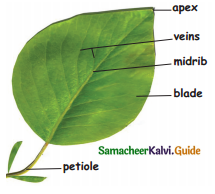
The tip of the leaf is
(a) Blade
(b) Apex
(c) Midrib
(d) Veins
Answer:
(b) Apex

Question 2,
Which one of the following is a primary producer?
(a) Plant
(b) Animal
(c) Human
(d) None of the above
Answer:
(a) Plant

Question 3.
Which flower blooms during winter?
(a) Jasmine
(b) Tulip
(c) December
(d) Fire cracker
Answer:
(c) December

Question 3.
Choose the ornamental plant from the list.
(a) Parthenium
(b) Mango
(c) Travellers palm
(d) Groundnut
Answer:
(c) Travellers palm

Question 4.
Which plant flower is edible?
(a) Cauliflower
(b) Potato
(c) Mint
(d) Cabbage
Answer:
(a) Cauliflower

Samacheer Kalvi 4th Science Guide Term 2 Chapter 3 Plants

II. Fill in the blanks :

Question 1.
During photosynthesis ____________ is produced and stored in the leaf.
Answer:
Food

Question 2.
Green plants have ____________ pigment.
Answer:
Green

Question 3.
Onion is a ____________ part of a plant.
Answer:
Stem

Question 4.
The male part of the flower is ___________.
Answer:
Stamen

Question 5.
An example for edible seed is _____________ .
Answer:
Rice

Samacheer Kalvi 4th Science Guide Term 2 Chapter 3 Plants

III. Answer the following in one or two words :

Question 1.
Which is the female part of the plant?
Answer:
Pistil.

Question 2.
Write the name of any one of the leaf that is used as a food.
Answer:
Cabbage.

Question 3.
Which flower bud is used as spices in food?
Answer:
Cloves.

Question 4.
What are the nutrients present in the seeds?
Answer:
Carbohydrates and proteins.

Question 5.
Write any one of the flower that blooms in summer.
Answer:
Sunflower.

Samacheer Kalvi 4th Science Guide Term 2 Chapter 3 Plants

IV. Answer briefly :

Question 1.
Write the parts of the leaf.
Answer:

  1. Apex
  2. Veins
  3. Midrib
  4. Blade
  5. Petiole

Question 2.
Define – Photosynthesis.
Answer:
Photosynthesis is a process by which plants make their food using chlorophyll, water, carbon dioxide in the presence of sunlight.

Question 3.
Write the names of the exotic plants.
Answer:

  1. Sago palm (Cycas)
  2. Fern
  3. Crotons
  4. Travelers palm
  5. Boat lily
  6. Aloevera

Question 4.
Write the names of any two underground stem plant.
Answer:
Potato and Onion are underground stem plants.

Question 5.
Why should we not touch parthenium plant?
Answer:
The pollen of parthenium plant is allergic in nature, so, we do not touch this plant.

Samacheer Kalvi 4th Science Guide Term 2 Chapter 3 Plants

V. Answer detail :

Question 1.
Mask any four parts and describe the parts of a leaf.
Answer:
Samacheer Kalvi 4th Science Guide Term 2 chapter 3 Plants 17
Blade: The broad flat part of the leaf (Lamina).
Apex: The tip of the leaf.
Midrib: The midrib runs along the centre of the leaf.
veins: Veins are branch out from the midrib. They are the framework of hollow tubes that carry water and minerals.
Petiole: This part joins the leaf to the main stem.

Question 2.
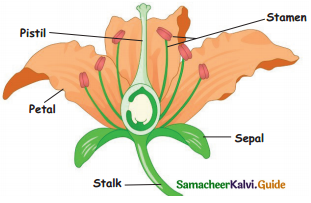
Draw a diagram of a flower and explain the parts of a flower.
Answer:
Samacheer Kalvi 4th Science Guide Term 2 chapter 3 Plants 21
the four visible parts of a flower are explained below.
Sepal: Sepals are leaves that protect the flower while it is still a bud. Sepals are usually green in colour.
Petal: Petals are often bright coloured. Their main job is to attract insects such as bees or butterflies, to the flower. The insects help the flowers in the transfer of pollen grains.
Stamen: Stamen can be seen at the centre of a flower. They contain pollen grains that help the plants to multiply. It is the male part of a flower.
Pistil: Pistil is also seen at the centre of the flower. The pistil uses the pollen to help the flower become the fruit. It is the female part of a flower.

Samacheer Kalvi 4th Science Guide Term 2 Chapter 3 Plants

Samacheer Kalvi 4th Science Guide Plants InText Questions and Answers

Think and Answer (Text Book Page No. 78)

Question 1.
Which part of the leaf collects carbon dioxide?
Answer:
Stomata, the small pores, found at the base of the leaf, collects carbon dioxide.

Question 2.
Which part of the leaf transports water?
Answer:
The vascular tissues, called xylem, transports water from the roots to the leaves.

Samacheer Kalvi 4th Science Guide Term 2 Chapter 3 Plants

Think and Answer (Text Book Page No. 79)

Question 1.
Why would living things not be able to live without plants?
Answer:
Humans and animals depend on plants for their food either directly or indirectly. So, things would not be able to live without plants.

Samacheer Kalvi 4th Science Guide Term 2 Chapter 3 Plants

Try to Answer (Text Book Page No. 79)

Fill in the blanks by rearranging the letters in the bracket :

Question 1.
During photosynthesis plants releases __________ (egxyno).
Answer:
Oxygen

Question 2.
___________ is a primary producer, (tanpl).
Answer:
Plant

Question 3.
Stomata are seen in the ___________ (owler) surface of the leaf.
Answer:
Lower

Question 4.
Pigment involved in the food synthesis is ______ . (phllylochor).
Answer:
Chlorophyll

Samacheer Kalvi 4th Science Guide Term 2 Chapter 3 Plants

Let us do (Text Book Page No. 79)

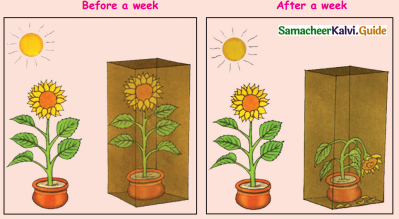
Take two potted plants. Keep one in sunlight and other in a fully covered box. Water them regularly. After a week observe the plants.
Samacheer Kalvi 4th Science Guide Term 2 chapter 3 Plants 18

Samacheer Kalvi 4th Science Guide Term 2 chapter 3 Plants 19
Answer:
Samacheer Kalvi 4th Science Guide Term 2 chapter 3 Plants 4

Samacheer Kalvi 4th Science Guide Term 2 Chapter 3 Plants

Let us do (Text Book Page No. 81)

Question 1.
List out the flowering and Non-flowering plants in your surrounding.

Flowering plants

Non-flowering plants

Answer:

Flowering plantsNon-flowering plants
Tomato plantFern
Mango treeMosses
Coconut treeRedwood tree

Samacheer Kalvi 4th Science Guide Term 2 Chapter 3 Plants

Let us do (Text Book Page No. 82)

Question 1.
List out the places where you see the non-green plants
Answer:
Non-green plants grow on decaying organic matters such as cow-dung, wood, bread, etc. Mushroom, Bracket fungi grow in such places.

Samacheer Kalvi 4th Science Guide Term 2 Chapter 3 Plants

Try to Answer (Text Book Page No. 82)

Fill in the blanks :

Question 1.
__________ is an example for non flowering plant.
Answer:
Algae/Fungi /Fern

Question 2.
Plants are classified based on pigment and ___________ of the plant.
Answer:
Flower

Question 3.
______ depend on other organism to live and get their food.
Answer:
Plants

Question 4.
Autotrophs use _________ , __________ and chlorophyll to prepare their own food.
Answer:
Atmosphere,light

Samacheer Kalvi 4th Science Guide Term 2 Chapter 3 Plants

III. Part of Flower :

Have you seen flowers? Try to answer the questions given below

Question 1.
Which is your favourite flower?
Answer:
Jasmine

Question 2.
What is the colour of the flower?
Answer:
White

Question 3.
How does it smell?
Answer:
A sharp, sweet smell

Samacheer Kalvi 4th Science Guide Term 2 Chapter 3 Plants

Try to Answer (Text Book Page No. 83)

Fill in the blanks :

Question 1.
Sepals _____________ the flower while it is still a bud.
Answer:
Protect

Question 2.
Stamen contains _____________ grains.
Answer:
Pollen

Question 3.
Pistil is ___________ part of a flower.
Answer:
Centre

Samacheer Kalvi 4th Science Guide Term 2 Chapter 3 Plants

Let us do (Text Book Page No. 83)

Bring few hibiscus flowers to the classroom. Distribute the flowers to children. Introduce the parts of the flower to them. Then, ask them to observe and feel the different parts of the flower and tell them to record their observation.

Parts of flower

What is its colour?


Answer:

Parts of flowerWhat is its colour?
petalOrange – Red
SepalGreen
PistilLight Green
StamenRed – Anther

Green – Filament

Samacheer Kalvi 4th Science Guide Term 2 Chapter 3 Plants

Think and Answer (Text Book Page No. 84)

Question 1.
Can you name the four seasons?
Answer:
Spring, Summer, Autumn and Winter.

Samacheer Kalvi 4th Science Guide Term 2 Chapter 3 Plants

Try to Answer (Text Book Page No. 86)

Find the odd one :

Question 1.
December, Tuberose, Tulip.
Answer:
Tulip

Question 2.
Saffron, Tulip, Rose.
Answer:
Rose

Question 3.
Crotons, Boat lily, Rose.
Answer:
Rose

Samacheer Kalvi 4th Science Guide Term 2 Chapter 3 Plants

Try to Answer (Text Book Page No. 88)

Fill in the blanks :

Question 1.
____________ flower is used as food.
Answer:
Banana

Question 2.
____________ part of the potato plant is used as food.
Answer:
Stem

Question 3.
Stem of the stores ____________ food in it.
Answer:
plant

Question 4.
Seeds are rich in ___________ and___________ .
Answer:
Carbohydrates, proteins

Samacheer Kalvi 4th Science Guide Term 2 Chapter 3 Plants

Let us do (Text Book Page No. 89)

Complete the table to show which parts of the plant we eat.
Question 1.

Food itemsParts of the plants eaten

Answer:

Food itemsParts of the plants eaten
CarrotRoot
Bananafruit
Mangofruit
Cauliflowerflower
Riceseed
Dhalseed
Moringoleaves
Turmericstem
Onionstem
Cabbageleaves
Jackfruitfruit
Beetrootroot


Samacheer Kalvi 4th Science Guide Plants Additional Questions and Answers

Samacheer Kalvi 4th Science Guide Term 2 Chapter 3 Plants

I. Choose the correct answer :

Question 1.
The ____________ runs along the centre of the leaf
(a) Veins
(b) Midrib
(c) petiole
(d) Lamina
Answer:
(b) Midrib

Question 2.
The largest flower in the world is found in the rain forests of ____________.
(a) India
(b) Australia
(c) Indonesia
(d) South Africa
Answer:
(c) Indonesia

Question 3.
Bamboo plants can grow upto __________ in one day.
(a) 60 cm
(b) 70 cm
(c) 80 cm
(d) 90 cm
Answer:
(d) 90 cm

Samacheer Kalvi 4th Science Guide Term 2 Chapter 3 Plants

II. Fill in the blanks with suitable answer :

Question 1.
The broad flat part of the leaf _____________.
Answer:
Lamina

Question 2.
___________ helps the plants to breathe.
Answer:
Stomata

Question 3.
___________ food is made in their green stems.
Answer:
Cactus

Question 4.
The largest flower in the world is __________.
Answer:
Rafflesia

Samacheer Kalvi 4th Science Guide Term 2 Chapter 3 Plants

III. Write True or False :

Question 1.
The seasons are four.
Answer:
True

Question 2.
Bamboo plants can grow upto 70cm in the day.
Answer:
False

Samacheer Kalvi 4th Science Guide Term 2 Chapter 3 Plants

IV. Answer briefly :

Question 1.
What are primary producers?
Answer:
As plants prepare food for themselves and also for other living things, they are called primary producers.

Question 2.
How are plants classified?
Answer:
Plants are classified in many ways based on stems, life span, seeds, flower and colour. In this session we will study about the classification of plants based on the flower and colour.

Samacheer Kalvi 4th Science Guide Term 2 Chapter 3 Plants

V. Answer briefly :

Question 1.
Differentiate : Flowering plants and Non-flowering plants
Answer:

Flowering plantsNon-flowering plants
1.      Plants bearing flowers are called flowering plants.Plants without flower that can reproduce are called non-flowering plants
2.      It reproduce by sex cells or gametes and produce seeds. Seeds produce new plants.They reproduce by a special structure called spores.


3.      Example: Mango, Neem, groundnut, paddy.Algae, Fungi, fern.

Samacheer Kalvi 4th Science Guide Term 2 Chapter 2 Water

Tamilnadu State Board New Syllabus Samacheer Kalvi 4th Science Guide Pdf Term 2 Water 1 Food Text Book Back Questions and Answers, Notes.

Tamilnadu Samacheer Kalvi 4th Science Solutions Term 2 Chapter 2 Water

Samacheer Kalvi 4th Science Guide Water Text Book Back Questions and Answers

Samacheer Kalvi 4th Science Guide Term 2 Chapter 2 Water

I. Choose the correct answer :

Question 1.
Water is the most _____________ resource on the Earth.
(a) Precious
(b) Solid
(c) Gas
Answer:
(a) Precious

Question 2.
Water exists in _____________ states.
(a) Two
(b) Three
(c) Four
Answer:
(b) Three

Question 3.
At temperature below ____________ water freezes to form ice.
(a) 10°C
(b) 100°C
(c) 0° C
Answer:
(c) 0°C

Question 4.
___________ is the process by which water becomes water vapour.
(a) Condensation
(b) Evaporation
(c) Freezing
Answer:
(b) Evaporation

Question 5.
Which controls the ecological functions of life?
(a) Bicycle
(b) Water cycle
(c) Recycle water
Answer:
(b) Water cycle

Samacheer Kalvi 4th Science Guide Term 2 Chapter 2 Water

II. Fill in the blanks with suitable answer :

Question 1.
Water is converted into ____________ when it is heated. (ice cube/water vapour).
Answer:
water vapour

Question 2.
Water becomes ice on ____________. (heating/freezing).
Answer:
Freezing

Question 3.
Water droplets combine to form _____________. (rain/clouds).
Answer:
Clouds

Question 4.
Water cycle increases the availability of ______________. (water tank/ground water).
Answer:
Ground water

Question 5.
___________ is a type of rainwater harvesting. (Roof top harvesting/Watercycle).
Answer:
Roof top harvesting

Samacheer Kalvi 4th Science Guide Term 2 Chapter 2 Water

III. Write True or False :

Question 1.
Water is a good example for all states of matter.
Answer:
True

Question 2.
Water cycle controls Earth’s temperature.
Answer:
True

Question 3.
Water becoming water vapour on heating is called evaporation.
Answer:
True

Question 4.
37% of our brain’s mass consists of water.
Answer:
False

Question 5.
Roof top harvesting method is used in agriculture field.
Answer:
False

Samacheer Kalvi 4th Science Guide Term 2 Chapter 2 Water

IV. Answer briefly :

Question 1.
Write the states of water.
Answer:
Water occurs naturally in three forms: ice, water and water vapour. These forms are also called states of water. Ice is in solid form, water is in liquid form and water vapour is in gaseous form.

Question 2.
What is freezing?
Answer:
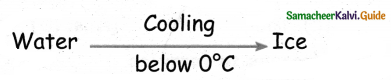
Ice is a solid form of water. At temperature below 0° C water becomes ice. This process is called freezing.
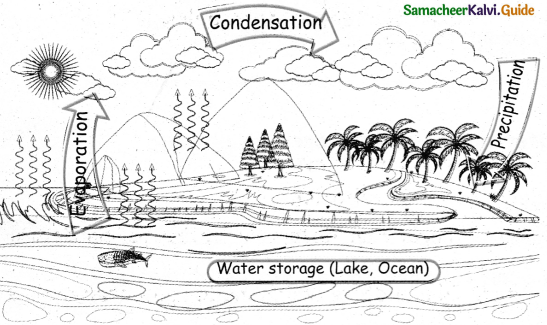
Samacheer Kalvi 4th Science Guide Term 2 chapter 2 Water 1

Question 3.
Name the processes involved in water cycle.
Answer:
Evaporation, Condensation, Precipitation.

Question 4.
Which state government made rain water harvesting as mandatory in the year 2001?
Answer:
Tamil Nadu is the first Indian state which made rainwater harvesting as mandatory in 2001.

Question 5.
What is needed to construct a rain water harvesting pit?
Answer:
Boulders, gravels and Coarse sand are needed to construct a rain water harvesting pit.

Samacheer Kalvi 4th Science Guide Term 2 Chapter 2 Water

V. Answer in detail :

Question 1.
What is water cycle? Write any three importances of water cycle.
Answer:
The continuous cycle through which water is circulated by different processes like evaporation, condensation and precipitation is called water cycle.
Importances of water cycle :

  • To improve the availability of ground water.
  • To control the Earth’s temperature.
  • To provide water to plants and animals especially humans.
  • To recycle the Earth’s supply of water constantly.

Question 2.
What is rain water harvesting? List out the advantages of rain water harvesting.
Answer:
‘Rainwater harvesting’ is the process of collecting and storing rainwater for future use. Rainwater can be collected in natural reservoirs or artificial tanks. Roof top harvesting is also a type of rainwater harvesting. The rainwater on the top of the building is collected and passed into the ground through pipes.

Water passing thrcugh the pipes enters the pit which consist of gravels and Coarse sand. As it passes impurities are filtered and stored as ground water.
Advantages of rain water harvesting:

  • It increases the ground water level
  • It can be used for agriculture
  • It increases the availability of water for living things.

Samacheer Kalvi 4th Science Guide Term 2 Chapter 2 Water

V. Colour the given picture and write the correct name in the given blanks :

Question 1.
Samacheer Kalvi 4th Science Guide Term 2 chapter 2 Water 2
Answer:
Activity to be done by the students themselves

Samacheer Kalvi 4th Science Guide Term 2 Chapter 2 Water

Samacheer Kalvi 4th Science Guide Water InText Questions and Answers

Let us do (Text Book page No. 69)

Question 1.
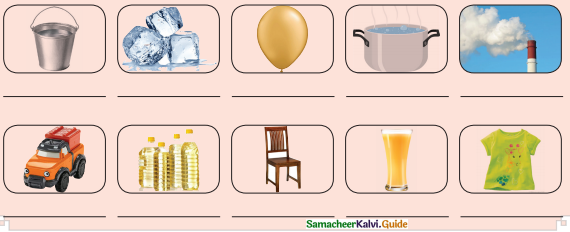
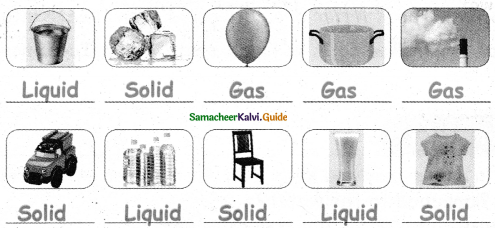
See the given pictures and write down the state of each objects.(Solid, Liquid, Gas)

Samacheer Kalvi 4th Science Guide Term 2 chapter 2 Water 15
Answer:
Samacheer Kalvi 4th Science Guide Term 2 chapter 2 Water 3

Samacheer Kalvi 4th Science Guide Term 2 Chapter 2 Water

Let us do (Text Book page No. 70)

Question 1.
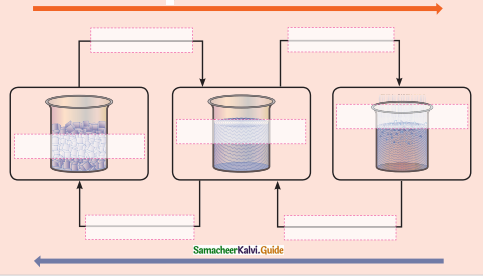
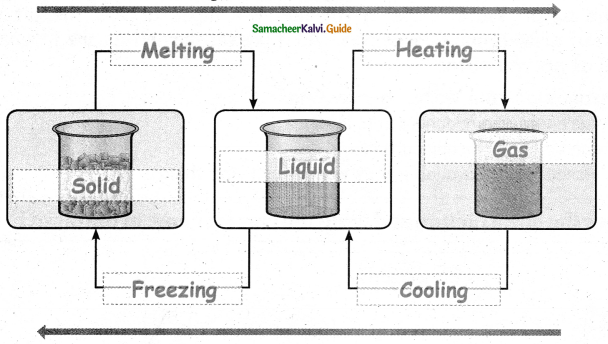
Fill in the boxes given below with correct answers.
(Liquid, Solid, Melting, Freezing, Cooling, Heating, Gas)

Samacheer Kalvi 4th Science Guide Term 2 chapter 2 Water 16
Answer:
Change of states in water
Samacheer Kalvi 4th Science Guide Term 2 chapter 2 Water 4

Question 2.
Write any two water bodies in your area
Answer:
River, lake

Samacheer Kalvi 4th Science Guide Term 2 Chapter 2 Water

Try to Answer (Text Book page No. 71)

Question 1.
Why water is a good example for all states of matter?
Answer:
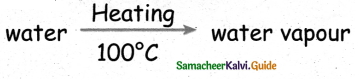
Water is unique because it is the only natural substance that can exist in all three states of matter at the temperatures normally found on Earth! Water is usually a liquid, but when it reaches to 0° C (32° Fahrenheit (F)), it freezes into ice. (Ice is the solid state of water.) When water reaches 100° C (212° F), it boils.

When it begins to boil, some of the water turns into steam. (Steam is the gas state of water, and is also called water vapour.) When steam comes into contact with cool air (which reduces energy), it can condense back into water droplets (liquid again). Those water droplets could then freeze into (solid) ice.

Question 2.
Which of the following is in liquid state? Rain/Ice/Snow
Answer:
Rain.

Samacheer Kalvi 4th Science Guide Term 2 Chapter 2 Water

Let us do (Text Book page No. 71)

Question 1.
Fill water in an ice tray and keep it in the freezer. After few hours, take it out. What happened to the water?
Answer:
Water turns into Ice (Solid state).

Question 2.
Now keep this ice tray on a table for some time. What happens to the ice?
Answer:
Ice melts and turns into liquid.

Question 3.
Pour water from the ice tray into a kettle. Ask an elder at your home to heat the kettle and observe the mouth of the kettle when the water starts boiling. What do you see?
Answer:
I see the water turns into vapour and bubbles are formed.

Samacheer Kalvi 4th Science Guide Term 2 Chapter 2 Water

Think and Answer (Text Book page No. 72)

Question 1.
What happens to the water in a wet cloth?
Answer:
The water, in a wet cloth, gets evaporated. The cloth will be dried up.

Samacheer Kalvi 4th Science Guide Term 2 Chapter 2 Water

Try to Answer (Text Book page No. 72)

Choose the correct answer.

Question 1.
In the water cycle ____________.
(a) Only evaporation is involved
(b) Only condensation is involved
(c) Evaporation and condensation are involved
Answer:
(c) Evaporation and condensation are involved

Samacheer Kalvi 4th Science Guide Term 2 Chapter 2 Water

Try to Answer (Text Book page No. 72)

Question 1.
Unscramble the words and fill in the blanks.
(a) ondencsaonti
Answer:
Condensation

(b) vaeionorpat
Answer:
evaporation

c) ecippitatrino
Answer:
(c) precipitation

Question 2.
Is water cycle important for farming? ____________
Answer:
Yes

Question 3.
Why is water cycle important to human? ________________
Answer:
The water cycle is constantly recycling the Earth’s supply of water. As humans need water to service, Water cycle is important.

Question 4.
Name the process which is responsible for the formation of droplets on the surface of a glass of cold drink. _______
Answer:
Condensation

Samacheer Kalvi 4th Science Guide Term 2 Chapter 2 Water

Try to Answer (Text Book page No. 74)

Question 1.
List out some other benefits of rain water harvesting.
Answer:

  • It reduces flooding and erosion.
  • It can be used for non-drinking purposes, liking bathing, washing clothes, etc.
  • It can improve plant Growth.

Question 2.
Suggest some ideas to save rainwater in your school.
Answer:

  • Create awareness about the benefits of Rainwater Harvesting.
  • Collect excess water by placing huge plastic drums.
  • Install aerators on taps. Aerators reduce the amount of water flowing from the tap by upto 50%.
  • Install rainwater tanks. Then connect the tanks to toilets or to the garden.

Samacheer Kalvi 4th Science Guide Term 2 Chapter 2 Water

Let us do (Text Book page No. 74)

Question 1.
Discuss with your friends.
Rain water harvesting has an important role to protect our environment.
Answer:
Importance of Rainwater Harvesting :
Rainwater harvesting can be a permanent solution to the problem of the water crisis. This is particularly applicable in hilly areas where rainwater harvesting can be utilized for human consumption, for animals and also for farming.
A bad monsoon means low crop yield and shortage of food.

Even animals suffer from a scarcity of water. We face acute water crisis during the summer months. The farmers are the most affected because they do not get sufficient water for their fields. Rainwater harvesting, therefore, is an ideal solution for farmers who depend on monsoon for consistent water supply.

Unavailability of clean water compels the consumption of polluted water, giving rise to water-borne diseases and a high rate of infant mortality.

If rainwater, which comes for free, can be collected and stored, instead of letting it run off, it could be an alternative to back up the main water supply especially during dry spells.

Its importance will not be limited to an individual family but can be used by a community as well. It also creates a sense of social responsibility and awareness about the environment.

The importance of rainwater harvesting lies in the fact that it can be stored for future use. Harvesting rainwater checks surface runoff of water and reduce soil erosion.

In areas having sparse and irregular rainfall, scarcity of water is a persistent problem. It cannot be completely resolved but can be mitigated through rainwater harvesting.

Samacheer Kalvi 4th Science Guide Water Additional Questions and Answers

Samacheer Kalvi 4th Science Guide Term 2 Chapter 2 Water

I. Choose the best answer :

Question 1.
Ice is in form of ____________.
(a) Gas
(b) Liquid
(c) Solid
(d) Vapour
Answer:
(c) Solid

Question 2.
____________ of our brain’s mass consists of water
(a) 43%
(b) 53%
(c) 63%
(d) 73%
Answer:
(d) 73%

Question 3.
The Antartic region has about ___________ of the worlds fresh water.
(a) 70%
(b) 60%
(c) 50%
(d) 40%
Answer:
(a) 70%

Question 4.
__________ is the chemical formula of water.
(a) H2O
(b) HO
(c) H3O2
(d) O2.
Answer:
(a) H2O

Samacheer Kalvi 4th Science Guide Term 2 Chapter 2 Water

II. Fill in the blanks with suitable answer :

Question 1.
Human body consists of _____________ of water. Water( 65% / 75%)
Answer:
75%

Question 2.
_____________ is the only way to conserve rain water. (Condensation/Rainwater harvesting)
Answer:
Rain water harvesting

Question 3.
Each day, we lose a little more than a cup of water when we exhale.(inhale/ exhale)
Answer:
Exhale

Samacheer Kalvi 4th Science Guide Term 2 Chapter 2 Water

III. Write True or False :

Question 1.
The rainwater harvesting was launched by the Tamil Nadu government in 2011.
Answer:
False

Question 2.
1 inch of rainfall on a 2000 sq.ft. roof is equal to 4,800 litres of water.
Answer:
True

Samacheer Kalvi 4th Science Guide Term 2 Chapter 2 Water

IV. Answer the following questions in one or two sentences :

Question 1.
Where is water available in the liquid state?
Answer:
Water in liquid state is available in water bodies such as oceans, river, waterfalls etc.

Question 2.
How will you get water vapour from water?
Answer:
Water becomes water vapour as the temperature increases due to heat. Heating forms a white mist of extremely small water droplets in the air known as water vapour.
Samacheer Kalvi 4th Science Guide Term 2 chapter 2 Water 5

Samacheer Kalvi 4th Science Guide Term 2 Chapter 2 Water

V. Answer in detail :

Question 1.
How will you construct a rainwater harvesting pit?
Answer:
Tips to construct a rainwater harvesting pit at school/home. Construct a pit of any shape or size. It may be generally constructed, 1-2 metre wide and 2-3 metre depth. The pits can be filled with boulders, gravels and Coarse sand. Put the boulders in the bottom, sand in the top and gravels in the middle.

Samacheer Kalvi 5th English Guide Term 1 Prose Chapter 1 Earth, The Desolated Home

Tamilnadu State Board New Syllabus Samacheer Kalvi 5th English Guide Pdf Term 1 Prose Chapter 1 Earth, The Desolated Home Text Book Back Questions and Answers, Summary, Notes.

Tamilnadu Samacheer Kalvi 5th English Solutions Term 1 Prose Chapter 1 Earth, The Desolated Home

5th English Guide Earth, The Desolated Home Text Book Back Questions and Answers

In-Text Question (Think):

Question 1.
What actions destroy the Earth? How will you change it?
Answer:
Human beings are responsible for deteriorating nature. The following activities destroy the Earth:

  1. Industrialisation : Industries release poisonous gases into the environment. Solid waste is discharged into land and water bodies, polluting the land and water.
  2. Emission of harmful gases: Vehicles emit a huge amount of harmful gases that pollute the air.
  3. Construction: Agricultural lands are used for construction.
  4. Deforestation: We destroy forests for urbanisation. It leads to the destruction of the natural habitat of many wild animals and birds.
  5. Nuclear testing: Uncontrolled release of radioactive materials cause several harmful health effects on human beings and animals. We can change it by not polluting the air, water, and land.

Samacheer Kalvi 5th English Guide Term 1 Prose Chapter 1 Exploring Space

Let us understand:

A. Choose the correct option:

(astronomer, Earth,sol, fuels, Mars)

Question 1.
A day in Mars is called ______.
Answer:
Alien

Question 2.
______ is called the red planet..
Answer:
Mars

Question 3.
Our planet is called the ______.
Answer:
Earth

Question 4.
We get water by burning ______.
Answer:
Fuels

Question 5.
The ______ are trying to terraform Mars.
Answer:
Scientists

Samacheer Kalvi 5th English Guide Term 1 Prose Chapter 1 Exploring Space

B. Fill in the blanks:

Question 1.
The man destroyed ______.
Answer:
The Earth

Question 2.
In the Earth, we get water from ______.
Answer:
Rain

Question 3.
In Mars ______ Earth days make a year.
Answer:
687

Question 4.
You don’t need ___ and __ in the Earth.
Answer:
A space suit; an Oxygen Cylinder

Question 5.
Fruits, vegetables, and water in Mars are not __
Answer:
Real

Samacheer Kalvi 5th English Guide Term 1 Prose Chapter 1 Exploring Space

C. Answer the following questions:

Question 1.
What is the setting of the story?
Answer:
Life on Mars is the setting of the story.

Question 2.
Name the vegetables harvested in the vegetation hab.
Answer:
Crops and Carrots are harvested in the vegetarian hub.

Question 3.
What is a sol? How many sols make a year?
Answer:
A sol is Martian solar day. 687 sols make a year.

Question 4.
How water is produced in Mars?
Answer:
Water is produced by burning fuels on Mars.

Question 5.
In this story, what happened to the earth?
Answer:
Humans had destroyed the Earth.

Question 6.
What should be done to save the earth?
Answer:
To save the Earth, we should not pollute the air, water, and land.

Samacheer Kalvi 5th English Guide Term 1 Prose Chapter 1 Exploring Space

Let us build:

Hi friends, we will show you magic. When we combine these two words, we will get a new word with a different meaning. These words are called compound words.
இரு வார்த்தைகள் இணைந்து ஒரு புதிய வார்த்தைக் கொடுத்தால் அது Compound word எனப்படும்.

Question 1.
Samacheer Kalvi 5th English Guide Term 1 Prose Chapter 1 Earth, The Desolated Home 1 = ______
Answer:
Samacheer Kalvi 5th English Guide Term 1 Prose Chapter 1 Earth, The Desolated Home 2

Question 2.
Samacheer Kalvi 5th English Guide Term 1 Prose Chapter 1 Earth, The Desolated Home 3 =________
Answer:
Samacheer Kalvi 5th English Guide Term 1 Prose Chapter 1 Earth, The Desolated Home 4

Question 3.
Samacheer Kalvi 5th English Guide Term 1 Prose Chapter 1 Earth, The Desolated Home 5 = ________
Answer:
Samacheer Kalvi 5th English Guide Term 1 Prose Chapter 1 Earth, The Desolated Home 6

Samacheer Kalvi 5th English Guide Term 1 Prose Chapter 1 Exploring Space

A. Write the compound words from the picture:

Question 1.
Samacheer Kalvi 5th English Guide Term 1 Prose Chapter 1 Earth, The Desolated Home 7
Answer:
Samacheer Kalvi 5th English Guide Term 1 Prose Chapter 1 Earth, The Desolated Home 8

Question 2.
Samacheer Kalvi 5th English Guide Term 1 Prose Chapter 1 Earth, The Desolated Home 9
Answer:
Samacheer Kalvi 5th English Guide Term 1 Prose Chapter 1 Earth, The Desolated Home 12

Question 3.
Samacheer Kalvi 5th English Guide Term 1 Prose Chapter 1 Earth, The Desolated Home 11
Answer:
Samacheer Kalvi 5th English Guide Term 1 Prose Chapter 1 Earth, The Desolated Home 10

Question 4.
Samacheer Kalvi 5th English Guide Term 1 Prose Chapter 1 Earth, The Desolated Home 13
Answer:
Samacheer Kalvi 5th English Guide Term 1 Prose Chapter 1 Earth, The Desolated Home 14

Samacheer Kalvi 5th English Guide Term 1 Prose Chapter 1 Exploring Space

B. Use the clues to complete the compound words:

Question 1.
Samacheer Kalvi 5th English Guide Term 1 Prose Chapter 1 Earth, The Desolated Home 15
Answer:
Samacheer Kalvi 5th English Guide Term 1 Prose Chapter 1 Earth, The Desolated Home 16

Question 2.
Samacheer Kalvi 5th English Guide Term 1 Prose Chapter 1 Earth, The Desolated Home 17
Answer:
Samacheer Kalvi 5th English Guide Term 1 Prose Chapter 1 Earth, The Desolated Home 18

Question 3.
Samacheer Kalvi 5th English Guide Term 1 Prose Chapter 1 Earth, The Desolated Home 19
Answer:
Samacheer Kalvi 5th English Guide Term 1 Prose Chapter 1 Earth, The Desolated Home 20

Samacheer Kalvi 5th English Guide Term 1 Prose Chapter 1 Exploring Space

C. Match the compound words:

Question 1.
Samacheer Kalvi 5th English Guide Term 1 Prose Chapter 1 Earth, The Desolated Home 21
Answer:
Samacheer Kalvi 5th English Guide Term 1 Prose Chapter 1 Earth, The Desolated Home 22

Samacheer Kalvi 5th English Guide Term 1 Prose Chapter 1 Exploring Space

D. Draw and write your own compound words:

Question 1.
Samacheer Kalvi 5th English Guide Term 1 Prose Chapter 1 Earth, The Desolated Home 23 = ______.
Answer:
Samacheer Kalvi 5th English Guide Term 1 Prose Chapter 1 Earth, The Desolated Home 24

Question 2.
Samacheer Kalvi 5th English Guide Term 1 Prose Chapter 1 Earth, The Desolated Home 25 = ______.
Answer:
Samacheer Kalvi 5th English Guide Term 1 Prose Chapter 1 Earth, The Desolated Home 26

Question 3.
Samacheer Kalvi 5th English Guide Term 1 Prose Chapter 1 Earth, The Desolated Home 27 = ______.
Answer:
Samacheer Kalvi 5th English Guide Term 1 Prose Chapter 1 Earth, The Desolated Home 28

Question 4.
Samacheer Kalvi 5th English Guide Term 1 Prose Chapter 1 Earth, The Desolated Home 29 = ______.
Answer:
Samacheer Kalvi 5th English Guide Term 1 Prose Chapter 1 Earth, The Desolated Home 30

Question 5.
Samacheer Kalvi 5th English Guide Term 1 Prose Chapter 1 Earth, The Desolated Home 31 = ______.
Answer:
Samacheer Kalvi 5th English Guide Term 1 Prose Chapter 1 Earth, The Desolated Home 32

Samacheer Kalvi 5th English Guide Term 1 Prose Chapter 1 Exploring Space

E. Connect the compound words and create a new word:

Question 1.
Samacheer Kalvi 5th English Guide Term 1 Prose Chapter 1 Earth, The Desolated Home 33
Answer:
Samacheer Kalvi 5th English Guide Term 1 Prose Chapter 1 Earth, The Desolated Home 34

Question 2.
Samacheer Kalvi 5th English Guide Term 1 Prose Chapter 1 Earth, The Desolated Home 35
Answer:
Samacheer Kalvi 5th English Guide Term 1 Prose Chapter 1 Earth, The Desolated Home 36

Question 3.
Samacheer Kalvi 5th English Guide Term 1 Prose Chapter 1 Earth, The Desolated Home 37
Answer:
Samacheer Kalvi 5th English Guide Term 1 Prose Chapter 1 Earth, The Desolated Home 38

Question 4.
Samacheer Kalvi 5th English Guide Term 1 Prose Chapter 1 Earth, The Desolated Home 39
Answer:
Samacheer Kalvi 5th English Guide Term 1 Prose Chapter 1 Earth, The Desolated Home 40

5th English Guide Earth, The Desolated Home Additional Questions and Answers

Question 1.
Write down the year in which the story was set.
Answer:
The story was set in the year 2068.

Question 2.
How many colonies did India establish on Mars?
Answer:
India established three colonies on Mars.

Question 3.
Who travelled more than 1500 km to meet Arivumathi?
Answer:
Arivumathi’s grandfather travelled more than 1500 km to meet her.

Question 4.
Where was Arivumathi sleeping?
Answer:
Arivumathi was sleeping in her capsule.

Question 5.
What is meant by dust storm?
Answer:
A dust storm is a storm in which strong winds carry a lot of dust.

Samacheer Kalvi 5th English Guide Term 1 Prose Chapter 1 Exploring Space

Question 6.
How many sols did her grandfather take to reach her colony?
Answer:
Her grandfather took three sols to reach her colony.

Question 7.
What is the reason for the tastiness of fruits and vegetables grown in the Earth?
Answer:
The Earth had fertile soil. So the fruits and vegetables grown were tasty.

Question 8.
According to Arivu in which planet survival was very difficult?
Answer:
According to Arivu, survival was very difficult in Mars.

Question 9.
What would be the age of Arivu, if she lived on the Earth?
Answer:
Arivu would be 18 years old if she lived on the Earth.

Question 10.
Who is trying to Terraform the planet Mars?
Answer:
The scientists are trying to Terraform the planet Mars.

Question 11.
What is meant by Terraform?
Answer:
Terraform is a process by which the surface and climate would be changed to make the environment suitable to humans.

Earth, The Desolated Home Summary in English and Tamil

Let us Learn:

Earth, the Desolated Home பூமி, பாழாக்கப்பட்ட வீடு

It was the year 2068, humans had 2068 destroyed the Earth, and started colonizing the red planet Mars. India established three colonies; Arivumathi’s family lived in one such colony. On her birthday, her grandfather travelled more than 1500 km to meet her. When he reached, he saw her sleeping in her capsule.

2068 ஆம் வருடம். பூமியை (வாழ வழியற்றதாக) அழித்துவிட்ட மனிதர்கள் சிவப்பு கோளான செவ்வாய் கோளில் வாழ்விடங்களை ஏற்படுத்த தொடங்கினர். இந்தியா மூன்று காலனிகளை அமைத்திருந்தது. அத்தகைய ஒரு காலனியில் அறிவுமதியின் குடும்பமும் வசித்தது. அவளது பிறந்த நாளுக்காக 1500 கி.மீ. தொலைவிற்கும் அதிகமாக அவளது தாத்தா பயணம் செய்து அவளைக் காண வந்தார். அவர் அங்கு வந்தபோது, உருளை வடிவ படுக்கையில் அவள் உறங்கிக் கொண்டிருந்தாள்.

He said, “Wake up, Arivu.” Arivumathi was surprised, “Grandpa! When did you come? I was thinking” that you won’t be coming for my birthday.” He sighed, “Don’t you know about the dust storm of Mars? Sometimes, it even lasts for a month. But this time it did not. So I am on time. It still took me three sols to reach here. Now come on, let’s not waste time. We will go to harvest the vegetation.

எழுந்திரு அறிவு”, என்றபடி அவர் அவளை எழுப்பினார். அறிவுமதி ஆச்சரியமடைந்தாள். “தாத்தா, எப்போது வந்தீர்கள்? என் பிறந்த நாளுக்கு நீங்கள் வரமாட்டீர்கள் என்று நான் நினைத்துக் கொண்டிருந்தேன்”, என்றாள் அவள். அவர் பெருமூச்சு விட்டார். “செவ்வாய் கோளில் உள்ள புழுதிப் புயல் பற்றி உனக்குத் தெரியாதா? சில சமயம் அது ஒரு மாதம் வரையிலும் கூட நீடிக்கும். ஆனால் இந்த முறை அப்படியல்ல. ஆகவே நான் சரியான hab for vegetables.”. நேரத்திற்கு வந்து விட்டேன். இங்கு வர எனக்கு மூன்று நாட்கள் ஆகிவிட்டன. சரி, வா. நேரத்தை வீணாக்க வேண்டாம், நாம் காய்கறி தோட்டத்திற்குச் சென்று காய்கறிகளை அறுவடை செய்வோம்” என்றார் அவர்.

Samacheer Kalvi 5th English Guide Term 1 Prose Chapter 1 Exploring Space

In the hab, he said, “Hmm, these carrots are not tasty anymore, like the ones I ate in my childhood.” She asked, “Why do you say so, Grandpa?” Grandfather explained, “The vegetables we grow here do not taste like the ones on the Earth. I really wish you had tasted the carrots from the Earth.” Arivu asked eagerly, “How did they grow the crops and vegetables on The Earth?”

காய்கறி தோட்டத்திற்கு வந்த அவர், “நான் குழந்தைப் பருவத்தில் சாப்பிட்டது போல, இந்த கேரட்கள் சுவையாக இல்லை” என்றார். “ஏன் அப்படிச் சொல்கிறீர்கள்,” என்று கேட்டாள் அவள். “இங்கு நாம் வளர்க்கும் காய்கறிகள், பூமியில் பூமியில் இருந்தது போல சுவையாக இல்லை. பூமியில் விளைந்த கேரட்களை நீ சாப்பிட்டுப் பார்த்திருக்க வேண்டும் என விரும்பினேன்,” என்றார் அவர். “பூமியில் பயிர்களையும், காய்கறிகளையும் அவர்கள் எவ்வாறு வளர்த்தார்கள்?”, என அறிவு ஆர்வத்துடன் கேட்டாள்.

Now, the grandfather was sad, like he is missing the Earth. He said, “The Earth had fertile soil, so the fruits and vegetables grown were healthy and tasty.” She asked, “But, I learnt that humans used chemical fertilizers, and polluted the soil. Here, we get unpolluted food and water. Is that correct?”

பூமியில் தான் வாழ முடியாததற்கு தாத்தா இப்போது வருத்தப்பட்டார். “பூமியில் வளமான மண் இருந்தது. ஆகவே அதில் விளைந்த பழங்களும், காய்கறிகளும் சுவையாகவும், ஆரோக்யம் தருவதாகவும் இருந்தன ,” என்றார் அவர். “ஆனால், மனிதர்கள் இரசாயன உரங்களைப் பயன்படுத்தி நிலத்தை மாசுபடுத்தியதாக நான் அறிந்தேன். இங்கே மாசுபடாத உணவும் தண்ணீ ரும் நமக்கு கிடைக்கிறது. சரிதானே?”, என்றாள் அறிவுமதி.

Grandfather laughed, “Already, I told you. These fruits, vegetables, and water are not the same as in the Earth. They are not real.” Arivu exclaimed, “Even the water?” He said “Of course! In Mars, we get water from burning fuels. On the Earth, we used to get water from rain, it was natural, and it was free!” She said “Grandpa, enough of your stories about the Earth. I know that life there was easy but, here survival is very difficult.” He replied, “Yes my dear, adapting to Mars is difficult. Today, we are fighting for things which we got easily.”

Samacheer Kalvi 5th English Guide Term 1 Prose Chapter 1 Exploring Space

தாத்தா சிரித்தபடி, “ஏற்கனவே நான் உனக்குச் சொன்னேன், இந்த பழங்கள், காய்கறிகள் மற்றும் நீர் ஆகியன பூமியில் இருந்தது போல இல்லை. இவை இயற்கையானதல்ல, என்றார். அறிவு வியந்தபடி, “தண்ணீ ர் கூடவா?”, என்று கேட்டாள். அவர் சொன்னார், “ஆம்! செவ்வாயில் எரிபொருள்களை எரிப்பதால் நமக்கு தண்ணீர் கிடைக்கிறது. பூமியிலோ, இயற்கையாகப் பெய்யும் மழையால் நாம் நீர் பெற்றோம், அதுவும் இலவசமாக. “தாத்தா, பூமியைப் பற்றிய உங்கள் கதைகள் போதும். அங்கு வாழ்க்கை எளிதாக இருந்ததென எனக்குத் தெரியும். ஆனால் இங்கு வாழ்வது மிகவும் சிரமம்,” என்றாள் அவள். “ஆம், என் செல்லம்! செவ்வாய் கோளுக்கு ஏற்றபடி நாம் மாறுவது சிரமம்தான். முன்பு சுலபமாக நமக்கு கிடைத்தவைகளுக்கொல்லாம் இப்போது நாம் சண்டையிட்டுக் கொண்டிருக்கிறோம்,” என்று அவர் பதிலளித்தார்.

He continued, “In the Earth, you did not need a spacesuit or an oxygen cylinder. Also, the years are longer here.” Arivu said, “Yes, grandpa. In Mars, 687 days make a year.” He smiled, “Ha! Ha! Yes, you would be 18 years old on the Earth now.”

“விண்வெளி ஆடையோ, ஆக்ஸிஜன் சிலிண்டரோ பூமியில் உனக்கு தேவைப்படாது. என்று தாத்தா கூறினார். “ஆம், தாத்தா, செவ்வாயில் ஓர் ஆண்டுக்கு 687 நாட்கள்,” 18என்றாள் அறிவு. தாத்தா புன்னகைத்தபடி, “ஆம், பூமியில் உன் வயது இப்போது 18 ஆக இருந்திருக்கும்,” என்றார்.

Grandpa thought to himself, “We destroyed our home. The home that nature had offered us. Now, we are trying to make this our home.”

தாத்தா தன் மனதிற்குள் நினைத்துக் கொண்டார், “நாம் நமது வீட்டை அழித்து விட்டோம். அது இயற்கை நமக்கு அளித்த வீடு. இப்போது, இதனை நமது வீடாக மாற்ற முயற்சிக்கிறோம்.

Arivu looked at him and said, “Don’t, worry grandpa, the scientists are “trying to Terraform the Mars.” He said, “True, but nothing can be the Earth. Earth is our home. Ah, let us leave this for now. Today we should celebrate.”

நாம் வாழ்வதற்கு வசதியாக இருக்கும்படி விஞ்ஞானிகள் – மாற்ற முயற்சி செய்து கொண்டிருக்கிறார்கள்,” என்றாள். விட்டுவிடுவோம். இன்று நாம் கொண்டாட வேண்டும்,” என்றார் அவர்.

Earth, The Desolated Home Space Glossary

Adapting – Modify, readjust (வாழ்வதற்கு ஏற்றவாறு தன்னை மாற்றிக் கொள்ளுதல்)
Capsule – A small cylinder-shaped bed (உருளை வடிவ படுக்கை )
Celebrate – Rejoice (கொண்டாடு)
Crops – cultivated plants (பயிர்கள்)
Destroyed – Ruined, spoiled (அழித்த ல்)
Eagerly – Excitedly (ஆர்வத்துடன்)
Established – Set up (அமைத்தல்)
Exclaimed – Cry out suddenly with surprise (வியப்புடன் சத்தமிடுதல்)
Fertile – Productive (செழிப்பான / வளமான)
Fuels – An energy source for engines, power plants, or reactors (எரிபொருட்கள்)
Grow – Develop, rise (வளர்த்த ல்)
Hab – Habitat, human settlement (தங்குமிடம்)
Harvest – Reap (அறுவடை)
Last – Continue (நீடித்தல் / தொடருதல்)
Offered – Provided (வழங்குதல்)
Polluted – Contaminated (மாசுபடுத்துதல்)
Sad – Unhappy (வருத்தம்)
Scientist – An expert in science (விஞ்ஞானி)
Sighed – To exhale audibly in a long deep breath, as in weariness or relief (பெருமூச்சு விடுதல்)
Soil – Land (மண் / நிலம்)
Sol – Martian solar Day, A Martian day (செவ்வாய் கோளில் ஒரு நாள் ஒரு நாள்)
Started – Began (ஆரம்பித்தல்)
Storm – Tempest (புயல்)
Surprised – Amazed (வியப்படைதல்)
Survival – To remain alive (உயிர் வாழ்வது)
Terraform – A process by which the surface and climate would be changed to make the environment suitable to humans
(வாழ்வதற்கு ஏற்றபடி மாற்றியமைக்கும் முறை)
Travelled – To go from place to place (பயணித்த ல்)
Unpolluted – Clean (மாசுபடாத, சுத்தமான)

Samacheer Kalvi 4th Science Guide Term 2 Chapter 1 Food

Tamilnadu State Board New Syllabus Samacheer Kalvi 4th Science Guide Pdf Term 2 Chapter 1 Food Text Book Back Questions and Answers, Notes.

Tamilnadu Samacheer Kalvi 4th Science Solutions Term 2 Chapter 1 Food

Samacheer Kalvi 4th Science Guide Food Text Book Back Questions and Answers

Samacheer Kalvi 4th Science Guide Food Text Book Back Questions and Answers

I. Choose the heat answer :

Question 1.
Which one can be eaten as raw food?
(a) Meat
(b) Carrot
(c) Fish
(d) Potato
Answer:
(b) Carrot

Question 2.
Uncooked food is called
(a) Junk food
(b) Hygienic food
(c) Raw food
(d) Cooked food
Answer:
(c) Row food

Question 3.
Solar cooker reduces _____________.
(a) Air pollution
(b) Water pollution
(c) Air pollution
(d) Noise pollution
Answer:
(c) Air pollution

Question 4.
Which one cannot be preserved by drying method?
a) Rice
b) Cereals
c) Fish
d) Fruits
Answer:
(a) Rice

Question 5.
We can avoid food wastage by
(a) Giving to the needy
(b) Eating more than we need
(c) Buying extra food
(d) Throwing in a dust bin
Answer:
(a) Giving to the needy

Samacheer Kalvi 4th Science Guide Food Text Book Back Questions and Answers

II. Fill in the blanks :

Question 1.
__________ gives us energy to work and play. (Raw food / Junk food)
Answer:
Raw food

Question 2.
Cooked food is easily ___________. (digested / undigested)
Answer:
Digested

Question 3.
Pressure cooker is one of the ____________ utensils, (modern / olden)
Answer:
Modern

Question 4.
We need pure air, protected water and ____________ food for our healthy life. (junk / hygienic)
Answer:
Hygienic

Samacheer Kalvi 4th Science Guide Food Text Book Back Questions and Answers

III. Match the following :

Question 1.
Samacheer Kalvi 4th Science Guide Term 2 chapter 1 food 1
Answer:
Samacheer Kalvi 4th Science Guide Term 2 chapter 1 food 2

Samacheer Kalvi 4th Science Guide Food Text Book Back Questions and Answers

IV. Write Yes or No :

Question 1.
Biriyani is a raw food.
Answer:
No

Question 2.
Frying is a method of cooking.
Answer:
Yes

Question 3.
We can cook rice on a tawa.
Answer:
No

Question 4.
Cooking in a solar oven needs sunlight.
Answer:
Yes

Question 5.
Consuming too much oily food is bad for our health.
Answer:
Yes

Samacheer Kalvi 4th Science Guide Food Text Book Back Questions and Answers

V. Answer briefly :

Question 1.
Name any three cooking methods.
Answer:

  1. Boiling
  2. Steaming
  3. Baking

Question 2.
Write any two food items you should eat when you are sick?
Answer:

  • Porridge of rice or cereals.
  • Fruit juice, tender coconut.
  • Steamed foods like idly.

Question 3.
Draw one of your favourite raw food and colour it.
Answer:
Raw foods : Mango,Apple, Banana, Carrot, Onion, etc.
Student has to draw any one item and colour it.

Question 4.
Write about any two preservation methods.
Answer:

  • Pickling – Mixing fruits and vegetables with oil and salt. Example- Pickle
  • Refrigerating – Keeping food in the refrigerators (fridge) to preserve them for a short time. Example-Fruits,Vegetables

Question 5.
How can you reduce wastage of food in your home?
Answer:
We should not waste food. Food that is not eaten is called leftover food. That is discarded as waste. Following are the simple ways to avoid food wastage.

  1. Take what you’ll eat and eat what you take.
  2. Share the excess food.
  3. Give the excess food to hungry animals.

Samacheer Kalvi 4th Science Guide Food Text Book Back Questions and Answers

V. Answer in detail :

Question 1.
Explain some food preservation methods.
Answer:
We can preserve the food for long time by using the following methods.

  • Pickling – Mixing fruits and vegetables with oil and salt.
    Example: Pickle
  • Refrigerating – Keeping food in the refrigerators (fridge) to preserve them for a short time.
    Example: Fruits,Vegetables
  • Drying – Removing the water content of the food.
    Example: Fish, Red chillies
  • Canning – Storing food in air tight containers.
    Example: Jam

Samacheer Kalvi 4th Science Guide Food Text Book Back Questions and Answers

Question 2.
Explain any four cooking methods.
Answer:
Some of the commonly used cooking methods are given below.
Samacheer Kalvi 4th Science Guide Term 2 chapter 1 food 3

  1. Boiling: It is a method of cooking food by immersing it in boiling water. So that the food becomes soft.
    Example: Rice, Egg.
  2. Steaming: It is a method of cooking food in steam by immersing the vessel in a container with boiling water.
    Example: Idli, Idiyappam.
  3. Pressure cooking: It is a method of cooking food in a pressure cooker. Example: Rice, Dhal.
  4. Roasting: It is a method of cooking food by heating on a tawa or frying pan without covering it.
    Example: Groundnuts, Cashew nut.
  5. Frying: It is a method of cooking food in hot oil.
    Example: Chips, Poori.

Question 3.
What are the hygenic ways of cooking food?
Answer:

  • Wash your hands with soap before cooking.
  • Wash vegetables and fruits before cutting.
  • Wash cooking vessels and knives.
  • Don’t cook food for a long time because it destroys the nutrients present in the food.
  • Don’t use the same oil for cooking food many times.
  • Using the food items after their expiry date is not good for health.

Samacheer Kalvi 4th Science Guide Food Text Book Back Questions and Answers

Let us do (Text Book Page No. 57)

Question 1.
Classify the following food items.

Samacheer Kalvi 4th Science Guide Term 2 chapter 1 food 15
(Carrot, Egg, Coconut oil, Milk, Radish, Meat, Potato, Curd, Brinjal, Lady’sfinger, Fish, Drumstick, Butter, Onion, Buttermilk, Cucumber, Ghee)

   Food items from Plants

Food items from animals

CarrotEgg
Coconut oilMilk
RadishMeat
PotatoCurd
BrinjalFish
Lady’s fingerButter
DrumstickButtermilk
OnionGhee
Cucumber    –

Samacheer Kalvi 4th Science Guide Food Text Book Back Questions and Answers

Samacheer Kalvi 4th Science Guide Food In Text Questions and Answers

Think and Answer (Text Book Page No. 58)

Question 1.
Which food do you eat without cooking?
Answer:
We eat fruits, some vegetables, tubers and nuts in the raw form. Some pulses ind cereals are also eaten as without cooking.

Samacheer Kalvi 4th Science Guide Term 2 chapter 1 food 16

Samacheer Kalvi 4th Science Guide Food Text Book Back Questions and Answers

Try to Answer (Text Book Page No. 59)

Question 1.
Write any five raw and cooked food.
Answer:
(a) Raw food: Carrot ,Gooseberry ,Cucumber, Mango and Banana
(b) Cooked food: Rice , puttu , Idiyappam , Idli , and Dosal.

Samacheer Kalvi 4th Science Guide Food Text Book Back Questions and Answers

Think and Answer (Text Book Page No. 59)

Question 1.
Children, look at the menu card given here. Do you see food items on this menu? Do you think all these items are cooked the same way?
Samacheer Kalvi 4th Science Guide Term 2 chapter 1 food 17
Answer:
No, All are not cooked in the same way.

Samacheer Kalvi 4th Science Guide Food Text Book Back Questions and Answers

Let us do (Text Book Page No. 61)

Question 1.
Tabulate the given food items according to the cooking methods.
Samacheer Kalvi 4th Science Guide Term 2 chapter 1 food 18
Answer:
(Rice, Poori, Murukku, Pop-corn, Idli, Milk, Fish, Puttu, Dhal, Idiyappam, Groundnut)
Samacheer Kalvi 4th Science Guide Term 2 chapter 1 food 6

Samacheer Kalvi 4th Science Guide Food Text Book Back Questions and Answers

Try to Answer (Text Book Page No. 61)

Question 1.
Write any two cooking methods that your mother follows:
Answer:
Boiling, Steaming.

Question 2.
Say True or False.
(a) You should wash your hands before cooking.
Answer:
True
(b) Vegetables and fruits should be washed after cutting.
Answer:
False

Samacheer Kalvi 4th Science Guide Food Text Book Back Questions and Answers

Let us do (Text Book Page No. 62)

Question 1.
Write the cooking utensils used for preparing given food items.

Samacheer Kalvi 4th Science Guide Term 2 chapter 1 food 19
Answer:
(Pan, Pot, Rice cooker, Tawa, Idli cooker)

Food ItemsName the cooking utensils
RiceRice cooker
Idiyappam, PuttuIdli cooker
VadaTawa
SambarPot
DosaPan

Samacheer Kalvi 4th Science Guide Food Text Book Back Questions and Answers

Try to Answer (Text Book Page No. 62)

Write True or False.

Question 1.
Earlier people cooked their food in pressure cooker.
Answer:
False

Question 2.
Solar cooker reduces the use of fuel.
Answer:
True

Question 3.
Pressure cooker is not a cooking utensil.
Answer:
False

Samacheer Kalvi 4th Science Guide Food Text Book Back Questions and Answers

Think and Answer (Text Book Page No. 63)

Question 1.
Look at the pictures given below. Which one is good for health? Why?
Samacheer Kalvi 4th Science Guide Term 2 chapter 1 food 20
Answer:
Food items, in the right side picture, are good for health. The food items are neatly kept in a closed containers. The place is also free from mosquitoes, flies, etc.

Samacheer Kalvi 4th Science Guide Food Text Book Back Questions and Answers

Let us do (Text Book Page No. 64)

Tick (✓) the appropriate one.

Question 1.

FoodHygienic foodJunk food
Fresh fruits
Burger
Nuts
Panipoori
Vegetable salad

Answer:

FoodHygienic foodJunk food
Fresh fruits
Burger
Nuts
Panipoori
Vegetable salad

Samacheer Kalvi 4th Science Guide Food Text Book Back Questions and Answers

Try to Answer (Text Book Page No. 64)

Question 1.
Junk food is good for health. _____________
Answer:
No

Question 2.
You should wash your hands before and after eating. ______________
Answer:
Yes

Samacheer Kalvi 4th Science Guide Food Text Book Back Questions and Answers

Let us discuss (Text Book Page No. 64)

Question 1.
Here is Nandini’s lunch box.
Samacheer Kalvi 4th Science Guide Term 2 chapter 1 food 22
Answer:
(a) Are all the items healthy?
No. Chips are not healthy.
(b) Suggest her to remove one food which is not healthy and add one food which is healthy. Give reasons for change.
Answer:
Remove the chips item. Add ground nuts.

Samacheer Kalvi 4th Science Guide Food Text Book Back Questions and Answers

Think and answer (Text Book Page No. 63)

Question 1.
When you are sick, what kind of food your mother serves you?
Answer:
Idly, Porridge of rice, and fruit juices.

Samacheer Kalvi 4th Science Guide Food Text Book Back Questions and Answers

Try to Answer (Text Book Page No. 65)

Fill in the blanks.

Question 1.
___________ is an easily digested food. (Idly / Biriyani)
Answer:
Idly

Question 2.
We should avoid eating ___________ food, (junk/ fresh)
Answer:
Junk

Samacheer Kalvi 4th Science Guide Food Text Book Back Questions and Answers

Think and Answer (Text Book Page No. 65)

Question 1.
Do you usually eat your lunch without wasting anything? If you say no, why do you waste?
Answer:
Yes, I usually eat my lunch without wasting anything.

Question 2.
Can you suggest few ways to reduce food waste in your schools and houses?
Answer:

  1. We should not take excess quantity of food in our plate.
  2. We should serve others smaller portions of food on smaller dishes.
  3. While purchasing the food products, we have to take care about the quantity

Samacheer Kalvi 4th Science Guide Food Text Book Back Questions and Answers

Try to answer (Text Book Page No. 65)

Fill the blanks :

Question 1.
World Hunger Day is observed on ____________
Answer:
May 28

Question 2.
We can preserve pickle by ___________
Answer:
pickling

Samacheer Kalvi 4th Social Science Guide Food Additional Questions and Answers

Samacheer Kalvi 4th Science Guide Food Text Book Back Questions and Answers

I. Choose the correct answer :

Question 1.
Healthy food
(a) Fruit
(b) chips
(c) chocolate
(d) ice cream
Answer:
(a) Fruit

Question 2.
Unhealthy food
(a) Nuts
(b) Milk
(c) Burger
(d) vegetables
Answer:
(c) Burger

Question 3.
Which one can be preserved by drying method?
(a) Pickles
(b) Vegetables
(c) Red chillies
(d) Jam
Answer:
(c) Red chillies

Samacheer Kalvi 4th Science Guide Food Text Book Back Questions and Answers

II. Fill in the blanks :

Question 1.
Cooking in ________ improves the quality and taste of food. (Aluminium Utensil/ clay pot)
Answer:
clay pot

Question 2.
____________ is one of the basic needs of life. (Clothes/ Food)
Answer:
Food

Samacheer Kalvi 4th Science Guide Food Text Book Back Questions and Answers

III. Match the following :

Question 1.
Samacheer Kalvi 4th Science Guide Term 2 chapter 1 food 11
Answer:
Samacheer Kalvi 4th Science Guide Term 2 chapter 1 food 12

Samacheer Kalvi 4th Science Guide Food Text Book Back Questions and Answers

VI. Answer tn brief :

Question 1.
Write a note on cooking utensils.
Answer:
Utensils are in different shapes and sizes. We use specific utensils for each cooking method. Clay pots were used earlier. Stainless steel and aluminum vessels are now generally used for cooking.

Question 2.
What is a Solar cooker?
Answer:
It is an appliance which is used to cook food using sunlight. It saves fuel and reduces air pollution.

Question 3.
What is Raw food?
Answer:
Food that we eat directly without cooking is called raw food. We eat fruits, some vegetables, tubers and nuts in the raw form. Some pulses and cereals are also eaten as raw food.

Question 4.
How to make Salad?
Answer:
Collect some raw food items available in our locality. Clean them with fresh water, cut them into small pieces (keep the nuts whole), put them in a bowl then add salt, spices and mix it well. Now, our tasty salad is ready.

Question 5.
Why should we cook food?
Answer:

  • Cooked food is digested easily.
  • Cooking softens the food materials.
  • Cooking kills germs.
  • Cooking adds taste and flavour to food.

Samacheer Kalvi 4th Science Guide Food Text Book Back Questions and Answers

VI. Answer in detail :

Question 1.
List out the benefits of clay pot cooking.
Answer:

  • Easy to digest.
  • Preserves the nutrients. m Needs less oil for cooking.
  • Adds flavour to the dish.
  • Keeps the food warm for a long time.
  • Keeps the food from becoming stale soon.
  • Alkaline property in the pot neutralizes the acidic property in the food.

Question 2.
What are the hygienic ways of taking food ?
Answer:

  • Always cover food to protect them from dust and insects.
  • Eat fresh food always.
  • Avoid taking food that is too cold or too hot.
  • Avoid fast food and fried food.
  • Always wash your hands with soap before and after eating.

Samacheer Kalvi 5th Science Guide Term 3 Chapter 3 Air

Tamilnadu State Board New Syllabus Samacheer Kalvi 5th Science Guide Pdf Term 3 Chapter 3 Air Text Book Back Questions and Answers, Notes.

Tamilnadu Samacheer Kalvi 5th Science Solutions Term 3 Chapter 3 Air

Samacheer Kalvi 5th Science Guide Air Text Book Back Questions and Answers

Evaluation

I. Choose the correct answer:

Question 1.
Chlorofluorocarbon is used in
a) refrigerator
b) air conditioners
c) Both a & b
d) None
Answer:
(c) Both a & b

Samacheer Kalvi 5th Science Guide Term 3 Chapter 3 Air

Question 2.
Which of the following gas is released by automobiles?
a) Carbon monoxide
b) Oxygen
c) Hydrogen
d) Nitrogen
Answer:
(a) Carbon monoxide

Question 3.
A wind mill is used to produce .
a) chemical energy
b) mechanical energy
c) electric energy
d) All of these
Answer:
(c) electric energy

Question 4.
Influenza is caused by
a) fungus
b) bacteria
c) virus
d) protozoa
Answer:
(c) virus

Question 5.
Height of mesosphere which lies after troposphere is
a) 70 to 75km
b) 75to 80 km
c) 80 to 85 km
d) 85to 90 km
Answer:
(c) 80 to 85 km

Samacheer Kalvi 5th Science Guide Term 3 Chapter 3 Air

II. Fill in the blanks:

Question 1.
Second highest layer of Earth’s atmosphere is _______.
Answer:
Thermosphere

Question 2.
Releasing substances like chemical compounds into the atmosphere is known as _______.
Answer:
Air pollution

Question 3.
Airborne diseases can be caused by _______.
Answer:
Microorganisms

Question 4.
The _______ layer protects us from the harmful UV rays coming from the sun.
Answer:
Ozone

Question 5.
________ is used by plants as nitrates.
Answer:
Nitrogen

Samacheer Kalvi 5th Science Guide Term 3 Chapter 3 Air

III. Match the following:

1. Tropospherea. Satellite
2. Stratosphereb. Ozone layer
3. Exospherec. Weather change
4. Thermosphered. Spacecraft
5. Mesospheree. Meteors

Answer:

1. Tropospherea. Weather change
2. Stratosphereb. Ozone layer
3. Exospherec. Satellite
4. Thermosphered. Space craft
5. Mesospheree. Meteors

Samacheer Kalvi 5th Science Guide Term 3 Chapter 3 Air

IV. Answer briefly:

Question 1.
What are the different layers of atmosphere?
Answer:

  • Atmosphere is divided into five different layers.
  • The layers from the bottom upwards are called Troposphere, Stratosphere, Mesosphere, Thermosphere, and Exosphere.

Question 2.
What is air pollution?
Answer:
The presence of harmful substances in the air which can have an adverse effect on living beings and the environment is called air pollution.

Question 3.
Name some of the airborne diseases.
Answer:
Diphtheria, Whooping Cough, and Tuberculosis are some of the common airborne diseases caused by bacteria.

Question 4.
What is global warming?
Answer:

  • Air pollution results in the accumulation of carbon dioxide in the atmosphere.
  • When gases like carbon dioxide are present in the atmosphere in a large amounts, they increase the atmospheric temperature.

Question 5.
Mention two ways of controlling air pollution.
Answer:

  • Using public modes of transport can reduce the rate of pollution.
  • By reducing the usage of fossil fuels for burning.

Samacheer Kalvi 5th Science Guide Term 3 Chapter 3 Air

V. Answer in detail:

Question 1.
List the importance of air.
Answer:

  • Air is important for all living organisms.
  • Without air no life can exist on the Earth.
  • We take in oxygen from the air and release carbon dioxide. :
  • Plants in turn use carbon dioxide present in the air to produce their food.
  • The gases such as oxygen, nitrogen, carbon dioxide, and hydrogen present in the air are important to us for many reasons.

Water Cycle:
Water vapour present in the air is important for the formation of water cycle.

Supplies Energy:

  • We breathe oxygen present in the air and it is supplied to the cells in our body.
  • Body cells burn the food molecules with the help of oxygen and produce energy.

Sound travels through air:
Sound travels from the point of generation to the listener through air.

Useful for plants:

  • Nitrogen present in the air is useful for plants.
  • The nitrogen in the atmosphere is converted into easily absorbable nitrates by plants with the help of some microbes.

Transport:

  • Movement of air is called wind.
  • This is helpful for the ships and boats to sail on the water. Airplanes and helicopters travel through air.

Sports:

  • Paragliding and hang gliding are air sports and they are possible with the help of air.
  • Other sports like windsurfing, kite surfing, and sailing are also possible with the help of air.

Parachutes and Hot air balloons:

  • Parachutes and hot air balloons are used to land from above.
  • In case of emergency, people use parachutes and come down slowly and safely with the help of air.

Wind energy:

  • Air flows from a region of high pressure to low pressure.
  • This flow of air at high speed is called wind.
  • This wind is used to generate electric power with the help of windmills.

Samacheer Kalvi 5th Science Guide Term 3 Chapter 3 Air

Question 2.
Explain any three airborne diseases.
Answer:
Common cold:

  • Common cold is an infectious disease which affects the upper respiratory system like the nose and throat and it is easily spread.
  • Symptoms of the common cold include cough, painful throat, running nose, and sometimes fever.
  • Though many viruses can cause this, it is generally caused by Rhinovirus.

Influenza:

  • Influenza is commonly found during childhood.
  • It is caused by the virus, Myxo virus, and results in inflammation of nasal mucosa and pharynx.
  • It is also known as flu.

Mumps:

  • It is caused by Myxovirus parotitis and it affects the upper respiratory tract.
  • Some of the common symptoms of mumps include fever, headaches, sore throat, and swelling of parotid glands which makes jaw movement difficult.

Samacheer Kalvi 5th Science Guide Term 3 Chapter 3 Air

VI. Higher-order Thinking Questions:

Question 1.
If there is no atmosphere, what will be the condition of Earth?
Answer:
Without atmosphere means no life as there will be no oxygen which is essential for Earth’s organism to thrive on the planet Earth.

Question 2.
Give some suggestions to prevent air pollution.
Answer:

  • Planting more trees can reduce the amount of carbon dioxide in the atmosphere.
  • Reduce the use of automobiles and use public transports.
  • Avoid aerosol spray products.

Activities:

Activity 1.
Find out the places where wind energy is produced. Also, discuss about the importance of wind energy in the classroom and make a report on your discussion.
Answer:
Tamil Nadu – First place in wind energy production.
Maharashtra – Second place in wind energy production.
Gujarat – Third place in wind energy production.
Rajasthan, Karnataka, Madhya Pradesh, Andhra Pradesh, Telangana, Kerala, Odisha, West Bengal, Jammu and Kashmir are the states producing wind power energy in India.

Importance of wind energy:

  • Wind energy is a source of renewable energy.
  • It does not contaminate.
  • It is inexhaustible and reduces the use of fossil fuels.
  • Wind energy does not generate waste and contaminated water.

Activity 2.
Find out the common air pollutants present in your area. Discuss about the effects of these pollutants. Record your observation in your notebook.
Answer:

Common air pollutantsEffects
Carbon MonoxideIt is harmful to the body and inhibits the blood’s ability to deliver oxygen to the organs.
Sulfur DioxideIt is extremely harmful to the respiratory system, causing asthma.
Nitrogen oxidesCausing respiratory distress and a number of other health issues.

Samacheer Kalvi 5th Science Guide Term 3 Chapter 3 Air

Samacheer Kalvi 5th Science Guide Air Additional Questions and Answers

I. Choose the correct answer:

Question 1.
Atmosphere is composed of________ nitrogen.
(a) 68%
(b) 78%
(c) 58%
(d)21%
Answer:
(b) 78%

Question 2.
Atmosphere is divided into _______ different layers.
(a) 5
(b) 4
(c) 6
(d) 3
Answer:
(a) 5

Question 3.
__________ is the lowest layer of the atmosphere.
(a) Troposphere
(b) Stratosphere
(c) Mesosphere
(d) Exosphere
Answer:
(a) Troposphere

Question 4.
Nitrogen fixation occur in ______.
(a) Humans
(b) animals
(c) plants
(d) All the above
Answer:
(c) plants

Question 5.
__________ is an air sport.
(a) Paragliding
(b) Hang gliding
(c) both a & b
(d) None of these
Answer:
(c) both a & b

Samacheer Kalvi 5th Science Guide Term 3 Chapter 3 Air

II. Fill in the blanks:

Question 1.
_______ is known as paragliding capital of India.
Answer:
Himachal Pradesh

Question 2.
The movement of air is called ______.
Answer:
wind

Question 3.
________ found above the mesosphere.
Answer:
Thermosphere

Question 4.
The word pollution is derived from the Latin word ______.
Answer:
Polluere

Question 5.
Extraction of minerals from the Earth is ______.
Answer:
Mining

Samacheer Kalvi 5th Science Guide Term 3 Chapter 3 Air

III. Say True or False. If false, correct the statement:

Question 1.
World Tuberculosis Day is observed on 24th March.
Answer:
True

Question 2.
Causative organism of Tuberculosis is Cornebacterium.
Answer:
False
Correct statement:
Causative organism of Tuberculosis is Mycobacterium.

Question 3.
Influenza is commonly found in adults.
Answer:
False
Correct statement:
Influenza is commonly found in childhood.

Question 4.
Mumps affects the upper respiratory tract.
Answer:
True

Question 5.
Air pollutants cause pneumonia.
Answer:
True

Samacheer Kalvi 5th Science Guide Term 3 Chapter 3 Air

IV. Match the following:

1. Acid raina. Bordetalla pertusis
2. Eutrophicationb. Airborne disease
3. Diphtheriac. Green algae
4. Whooping coughd. Nitrogen oxides

Answer:

  1. d
  2. c
  3. b
  4. a

Samacheer Kalvi 5th Science Guide Term 3 Chapter 3 Air

V. Answer briefly:

Question 1.
What is mesosphere?
Answer:

  • The region above the stratosphere is called the mesosphere.
  • It extends upward to a height of about 85km from the ground.
  • The temperature in this layer decreases with height and it is -1100 C.

Question 2.
What is wind?
Answer:

  • Air flows from a region of high pressure to low pressure.
  • This flow of air at high speed is called wind.

Question 3.
Why do plants need nitrogen?
Answer:

  • Nitrogen present in the air is useful for plants.
  • The nitrogen in the atmosphere is converted into easily absorbable nitrates by plants with the help of some microbes.
  • It is known as nitrogen fixation. These nitrates are useful for the growth of plants.

Question 4.
Write a short note on chickenpox.
Answer:

  • It is common among children but adults also may get it.
  • Affected people will have blisters or spots in the body and face along with fever.
  • Those blisters with fluid will drain but sometimes it may leave scars.

Question 5.
Why mountain climbers carry oxygen while climbing?
Answer:

  • As the height increases, the amount of air in the atmosphere decreases and so the oxygen level will decrease.
  • That is why mountain climbers carry oxygen cylinders while climbing mountains.

Question 6.
How is acid rain formed?
Answer:

  • Harmful gases like nitrogen oxides and sulfur oxides are released into the atmosphere while burning fossil fuels.
  • When it rains, the water droplets combine with these gases and fall on the ground in the form of acid rain.

Samacheer Kalvi 5th Science Guide Term 3 Chapter 3 Air

VI. Answer in detail:

Question 1.
How can we prevent airborne disease?
Answer:

  • Avoid close contact with people who have active symptoms of disease.
  • Maintain personal hygiene.
  • Keep the patient in complete isolation.
  • Cover nose and mouth while sneezing or coughing.
  • Avoid touching the face or other people with unwashed hands.
  • Wash your hands thoroughly.
  • Timely vaccination can prevent the diseases.

Samacheer Kalvi 5th Science Guide Term 3 Chapter 3 Air

Question 2.
What are the common diseases caused by bacteria?
Answer:
Diphtheria, Whooping Cough, and Tuberculosis are some of the common airborne diseases caused by bacteria.

Diphtheria:

  • It is caused by bacteria, Corynebacterium diphtheria.
  • It generally affects the upper respiratory tract (nose and throat) and causes fever, sore throat, and choking of air passage.

Whooping Cough:

  • Whooping cough is caused by Bordetalla pertusis.
  • It also affects the respiratory tract and causes mild fever, severe cough ending in a whoop.

Tuberculosis:

  • Tuberculosis is caused by the bacteria, Microbacterium tuberculosis.
  • When we breathe, the bacteria present in the air gets into the lungs and affect it.
  • Infected person has to be treated with anti-tubercular drugs for a period of 6 months to one year.

Samacheer Kalvi 4th Science Guide Term 1 Chapter 4 Science in Everyday life

Tamilnadu State Board New Syllabus Samacheer Kalvi 4th Science Guide Pdf Term 1 Chapter 4 Science in Everyday life Text Book Back Questions and Answers, Notes.

Tamilnadu Samacheer Kalvi 4th Science Solutions Term 1 Chapter 4 Science in Everyday life

Samacheer Kalvi 4th Science Guide Science in Everyday life Text Book Back Questions and Answers

Samacheer Kalvi 4th Science Guide Science in everyday life Text Book Back Questions and Answers

I. Choose the correct answer :

Question 1.
Primary source of energy for the young ones of some animals is
(a) Water
(b) Fruits
(c) Milk
Answer:
(c) Milk

Question 2.
Vitamin present in milk that helps us to maintain our bones is
(a) Vitamin-E
(b) Vitamin-C
(c) Vitamin-D
Answer:
(b) Vitamin-C

Question 3.
One of the ancient food items made by human is
(a) Noodles
(b) Cake
(c) Bread
Answer:
(c) Bread

Question 4.
_____________ is a raw food.
(a) Cucumber
(b) Chappatti
(c) Bread
Answer:
(a) Cucumber

Question 5.
A gadget that plays songs is called
(a) Pen drive
(b) Camera
(c) Music player
Answer:
(c) Music player

Samacheer Kalvi 4th Science Guide Science in everyday life Text Book Back Questions and Answers

II. Fill in the blanks :

1. Cheese and paneer are made from _____________.
Answer:
Milk

Question 2.
Nutrients are made ready for digestion by ____________.
Answer:
Cooking

Samacheer Kalvi 4th Science Guide Science in everyday life Text Book Back Questions and Answers

III. Match the following :

Question 1.
Samacheer Kalvi 4th Science Guide Term 1 Chapter 4 science in everyday life 1
Answer:
Samacheer Kalvi 4th Science Guide Term 1 Chapter 4 science in everyday life 2

Samacheer Kalvi 4th Science Guide Science in everyday life Text Book Back Questions and Answers

IV. Answer in a sentence or two :

Question 1.
Name the food products derived from milk.
Answer:
Milk gives curd, butter, butter milk and ghee, cheese, paneer, milk sweets, ice cream and chocolates. ”

Question 2.
Write the names of any three baked foods.
Answer:
Bread, biscuit and cakes are the baked foods.

Question 3.
In what ways a smart phone will help you?
Answer:
Smart phone helps us to communicate, access the internet, store files, take photos and track locations.

Question 4.
What is food?
Answer:

  • Food is one of the basic needs of life. Food provides energy and it contains essential nutrients to keep our body healthy.
  • It is usually made by cooking plants and animals.

Samacheer Kalvi 4th Science Guide Science in everyday life Text Book Back Questions and Answers

V. Answer in detail :

Question 1.
Cooking removes harmful microbes. Write down other benefits of cooking.
Answer:

  • Cooking causes many useful changes in food.
  • It makes nutrients ready for digestion.
  • It helps to make food in the desired texture, flavour and taste,
  • It destroys harmful microbes.

Question 2.
Why should we drink milk?
Answer:
Following are the benefits of milk.

  • It strengthens bones and teeth.
  • It maintains blood pressure.
  • It reduces the risk of heart disease.
  • It is a source of energy.

Samacheer Kalvi 4th Science Guide Science in everyday life Text Book Back Questions and Answers

VI. Projects :

Question 1.
List the gadgets you have used.
Answer:
Some of the electronic gadgets used are;

  • Laptop
  • Mobile phones
  • Camera
  • Speaker
  • Tablets
  • Computers
  • Electric torch
  • Pen drive
  • Remote
  • Television

Question 2.
Tabulate different kinds of milk products.
Answer:

  • Butter
  • Cheese
  • Yogurt
  • Frozen desserts
  • Milk chocolates
  • Milk sweets
  • Paneer

Samacheer Kalvi 4th Science Guide Science in everyday life Text Book Back Questions and Answers

Try to Answer (Text Book Page No. 115)

Question 1.
Milk is a rich source of __________ (Calcium / Iron)
Answer:
Calcium

Question 2.
Milk contains _____________ , __________ , and ___________
Answer:
prof In, fat, vitamin D

Samacheer Kalvi 4th Science Guide Science in everyday life Text Book Back Questions and Answers

Try to Answer (Text Book Page No. 117)

Question 1.
_____________ , ____________ are examples of raw food.
Answer:
Carrot, Cucumber

Question 2.
_____________ , ____________ are examples of cooked food.
Answer:
vegetable curry, bread

Samacheer Kalvi 4th Science Guide Science in everyday life Text Book Back Questions and Answers

Try to Answer (Text Book Page No. 119)

Question 1.
Bread is ___________ (low / high) fat food.
Answer:
low

Question 2.
Biscuits are made from _____________ (wheat flour / rice flour).
Answer:
wheat flour

Question .3.
____________ is associated with birthday celebrations (cake / biscuit).
Answer:
cake

Samacheer Kalvi 4th Science Guide Science in everyday life Text Book Back Questions and Answers

Samacheer Kalvi 4th Science Guide Science in Everyday life InText Questions and Answers

Try to Answer (Text Book Page No. 121)

Question 1.
Samacheer Kalvi 4th Science Guide Term 1 Chapter 4 science in everyday life 3
Answer:
Samacheer Kalvi 4th Science Guide Term 1 Chapter 4 science in everyday life 4

Samacheer Kalvi 4th Science Guide Science in Everyday life Additional Questions and Answers

Samacheer Kalvi 4th Science Guide Science in everyday life Text Book Back Questions and Answers

I. Pick out the odd one :

Question 1.
butter, curd, sugar, milk.
Answer:
Suger

Question 2.
fruits, carrot, ground nuts, rice.
Answer:
Rice

Question 3.
chocolate, bread, biscuit, cake.
Answer:
Chocolate

Question 4.
cutting, boiling, steaming, frying.
Answer:
Cutting

Question 5.
Laptop, T.V., Smart phone, Milk.
Answer:
T.V.

Samacheer Kalvi 4th Science Guide Science in everyday life Text Book Back Questions and Answers

II. Say true or false :

Question 1.
Calcium helps to build healthy bones and teeth
Answer:
True

Question 2.
Bread is an example of baked food items.
Answer:
True

Question 3.
Yeast is used to make biscuits.
Answer:
False

Question 4.
Biscuit is a baked food
Answer:
True

Question 5.
Tablets used to read books
Answer:
True

Question 6.
Pen drive is not a gadget
Answer:
False

Samacheer Kalvi 4th Science Guide Science in everyday life Text Book Back Questions and Answers

III. Match the following :
Question 1.
Samacheer Kalvi 4th Science Guide Term 1 Chapter 4 science in everyday life 5
Answer:

  1.  (c)
  2.  (a)
  3.  (d)
  4.  (b)

Question 2.
Samacheer Kalvi 4th Science Guide Term 1 Chapter 4 science in everyday life 6
Answer:

  1.  (b)
  2.  (a)
  3.  (d)
  4.  (c)

Samacheer Kalvi 4th Science Guide Science in everyday life Text Book Back Questions and Answers

IV. Choose the correct answer :

Question 1.
Milk has _____________ taste.
(a) Sweet
(b) Sour
(c) Bitter
(d) Tasteless
Answer:
(a) Sweet

Question 2.
Milk has a special sugar called
(a) Lactose
(b) Glucose
(c) Fructose
(d) Galactose
Answer:
(a) lactose

Question 3.
___________ in milk helps to maintain the bones.
(a) Vitamin-D
(b) Vitamin-C
(c) Vitamin-A
(d) Vitamin-B
Answer:
(a) Vitamin-D

Question 4.
Bread spoils ______________ faster when kept in fridge.
(a) 6 times
(b) 2 times
(c) 4 times
(d) None of the above
Answer:

(a) 6 times

Samacheer Kalvi 4th Science Guide Science in everyday life Text Book Back Questions and Answers

IV. Fill in the blanks :

Question 1.
Milk helps to build _____________.
Answer:
Muscles

Question 2.
Fat present in the milk is called ____________.
Answer:
Butter

Samacheer Kalvi 4th Science Guide Science in everyday life Text Book Back Questions and Answers

VI. Answer the following questions in one or two sentences :

Question 1.
What are the sources of milk?
Answer:
Milk is primarily obtained from mammals. They are obtained from other sources too.
Examples: Soya milk, nut and seed based milk.

Question 2.
Write 4 health benefits of milk.
Answer:

  • It strengthens bones and teeth.
  • It maintains blood pressure.
  • It reduces the risk of heart disease.
  • It is a source of energy.

Question 3.
What are the main ingredients of biscuit?
Answer:
The main ingredients of biscuit are flour, sugar, butter, water, milk, baking powder and flavours.

Question 4.
What is the use of pen drive?
Answer:
It is a small gadget used for storing and transferring any type of file in / from a computer.

Question 5.
Write the classification of milk.
Answer:
Based on the amount of fat present in the milk, it can be classified as Whole milk, Low fat milk and Fat free milk.

Question 6.
What is meant by raw food?
Answer:
Raw food is the food that does not have to be cooked to eat.
Examples: Fruits, carrot, ground nut seeds.

Question 7.
What is a gadget?
Answer:
A gadget is a small electronic machine or device which does something useful. They make our life enjoyable.
Examples: Laptop, Phone.

Question 8.
What is the use of the portable music player?
Answer:
It stores and plays thousands of songs. We can listen to songs anywhere, anytime.

Samacheer Kalvi 4th Science Guide Science in everyday life Text Book Back Questions and Answers

VII. Answer the detail :

Question 1.
Write a note on Bread.
Answer:

  • Bread is a common food product prepared from dough by baking. It is an important source of energy for sick people. It is also one of the ancient foods made by humans. Bread is a low fat food.
  • Bread has the nutrients required for normal development and good health.
  • To make bread we need wheat flour, yeast, water, sugar and salt.