Samacheer Kalvi 10th Maths Guide Chapter 4 Geometry Ex 4.5

Students can download Maths Chapter 4 Geometry Ex 4.5 Questions and Answers, Notes, Samacheer Kalvi 10th Maths Guide Pdf helps you to revise the complete Tamilnadu State Board New Syllabus, helps students complete homework assignments and to score high marks in board exams.

Tamilnadu Samacheer Kalvi 10th Maths Solutions Chapter 4 Geometry Ex 4.5

Question 1.
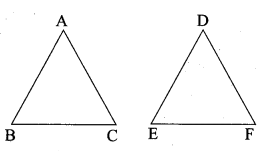
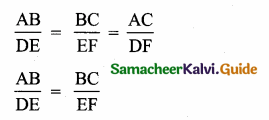
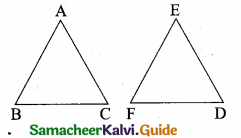
If in triangles ABC and EDF, \(\frac { AB }{ DE } \) = \(\frac { BC }{ FD } \) then they will be similar, when ……….
(1) ∠B = ∠E
(2) ∠A = ∠D
(3) ∠B = ∠D
(4) ∠A = ∠F
Answer:
(3) ∠B = ∠D
Hint:
Samacheer Kalvi 10th Maths Guide Chapter 4 Geometry Ex 4.5 1

Samacheer Kalvi 10th Maths Guide Chapter 4 Geometry Ex 4.5

Question 2.
In ∆LMN, ∠L = 60°, ∠M = 50°. If ∆LMN ~ ∆PQR then the value of ∠R is ……………
(1) 40°
(2) 70°
(3) 30°
(4) 110°
Answer:
(2) 70°
Hint:
Since ∆LMN ~ ∆PQR
∠N = ∠R
∠N = 180 – (60 + 50)
= 180 – 110°
∠N = 70° ∴ ∠R = 70°
Samacheer Kalvi 10th Maths Guide Chapter 4 Geometry Ex 4.5 2

Samacheer Kalvi 10th Maths Guide Chapter 4 Geometry Ex 4.5

Question 3.
If ∆ABC is an isosceles triangle with ∠C = 90° and AC = 5 cm, then AB is ………
(1) 2.5 cm
(2) 5 cm
(3) 10 cm
(4) 5 \(\sqrt { 2 }\) cm
Answer:
(4) 5 \(\sqrt { 2 }\) cm
Hint:
Samacheer Kalvi 10th Maths Guide Chapter 4 Geometry Ex 4.5 3
AB2 = AC2 + BC2
AB2 = 52 + 52
(It is an isosceles triangle)
AB = \(\sqrt { 50 }\) = \(\sqrt{25 \times 2}\)
AB = 5 \(\sqrt { 2 }\)

Samacheer Kalvi 10th Maths Guide Chapter 4 Geometry Ex 4.5

Question 4.
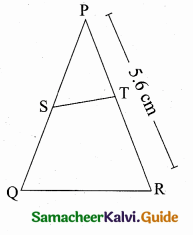
In a given figure ST || QR, PS = 2 cm and SQ = 3 cm. Then the ratio of the area of ∆PQR to the area of ∆PST is …………….
Samacheer Kalvi 10th Maths Guide Chapter 4 Geometry Ex 4.5 4
(1) 25 : 4
(2) 25 : 7
(3) 25 : 11
(4) 25 : 13
Answer:
(1) 25 : 4
Hint. Area of ∆PQR : Area of ∆PST
\(\frac{\text { Area of } \Delta \mathrm{PQR}}{\text { Area of } \Delta \mathrm{PST}}=\frac{\mathrm{PQ}^{2}}{\mathrm{PS}^{2}}=\frac{5^{2}}{2^{2}}=\frac{25}{4}\)
Area of ∆PQR : Area of ∆PST = 25 : 4

Question 5.
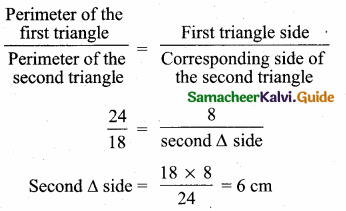
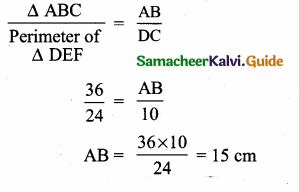
The perimeters of two similar triangles ∆ABC and ∆PQR are 36 cm and 24 cm respectively. If PQ =10 cm, then the length of AB is ………….
(1) 6 \(\frac { 2 }{ 3 } \) cm
(2) \(\frac{10 \sqrt{6}}{3}\)
(3) 66 \(\frac { 2 }{ 3 } \) cm
(4) 15 cm
Answer:
(4) 15 cm
Hint:
Samacheer Kalvi 10th Maths Guide Chapter 4 Geometry Ex 4.5 5

Samacheer Kalvi 10th Maths Guide Chapter 4 Geometry Ex 4.5

Question 6.
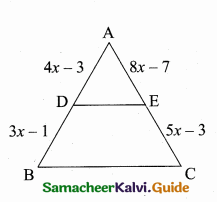
If in ∆ABC, DE || BC. AB = 3.6 cm, AC = 2.4 cm and AD = 2.1 cm then the length of AE is ………..
(1) 1.4 cm
(2) 1.8 cm
(3) 1.2 cm
(4) 1.05 cm
Answer:
(1) 1.4 cm
Hint:
Samacheer Kalvi 10th Maths Guide Chapter 4 Geometry Ex 4.5 6

Question 7.
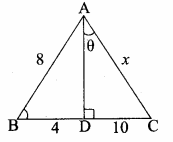
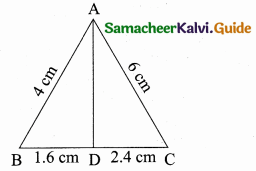
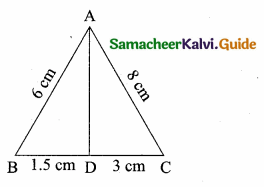
In a ∆ABC, AD is the bisector of ∠BAC. If AB = 8 cm, BD = 6 cm and DC = 3 cm.
The length of the side AC is ………….
(1) 6 cm
(2) 4 cm
(3) 3 cm
(4) 8 cm
Answer:
(2) 4 cm
Hint:
Samacheer Kalvi 10th Maths Guide Chapter 4 Geometry Ex 4.5 7

Samacheer Kalvi 10th Maths Guide Chapter 4 Geometry Ex 4.5

Question 8.
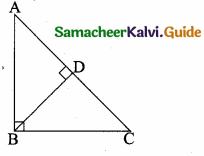
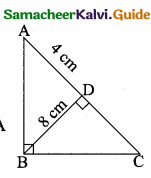
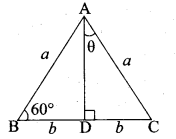
In the adjacent figure ∠BAC = 90° and AD ⊥ BC then ………..
Samacheer Kalvi 10th Maths Guide Chapter 4 Geometry Ex 4.5 8
(1) BD.CD = BC2
(2) AB.AC = BC2
(3) BD.CD = AD2
(4) AB.AC = AD2
Answer:
(3) BD CD = AD2
Hint:
Samacheer Kalvi 10th Maths Guide Chapter 4 Geometry Ex 4.5 9

Samacheer Kalvi 10th Maths Guide Chapter 4 Geometry Ex 4.5

Question 9.
Two poles of heights 6 m and 11m stand vertically on a plane ground. If the distance between their feet is 12 m, what is the distance between their tops?
(1) 13 m
(2) 14 m
(3) 15 m
(4) 12.8 m
Answer:
(1) 13 m
Hint:
Samacheer Kalvi 10th Maths Guide Chapter 4 Geometry Ex 4.5 10
AC2 (Distance between the two tops)
= AE2 + EC2
= 52 + 122
= 25 + 144= 169
AC = \(\sqrt { 169 }\) = 13 cm

Samacheer Kalvi 10th Maths Guide Chapter 4 Geometry Ex 4.5

Question 10.
In the given figure, PR = 26 cm, QR = 24 cm, ∠PAQ = 90°, PA = 6 cm and QA = 8 cm. Find ∠PQR.
Samacheer Kalvi 10th Maths Guide Chapter 4 Geometry Ex 4.5 11
(1) 80°
(2) 85°
(3) 75°
(4) 90°
Answer:
(4) 90°
Hint.
PR = 26 cm, QR = 24 cm, ∠PAQ = 90°
In the ∆PQR,
Samacheer Kalvi 10th Maths Guide Chapter 4 Geometry Ex 4.5 12
In the right ∆ APQ
PQ2 = PA2 + AQ2
= 62 + 82
= 36 + 64 = 100
PQ = \(\sqrt { 100 }\) = 10
∆ PQR is a right angled triangle at Q. Since
PR2 = PQ2 + QR2
∠PQR = 90°

Question 11.
A tangent is perpendicular to the radius at the
(1) centre
(2) point of contact
(3) infinity
(4) chord
Solution:
(2) point of contact

Samacheer Kalvi 10th Maths Guide Chapter 4 Geometry Ex 4.5

Question 12.
How many tangents can be drawn to the circle from an exterior point?
(1) one
(2) two
(3) infinite
(4) zero
Answer:
(2) two

Question 13.
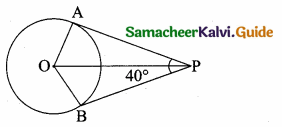
The two tangents from an external points P to a circle with centre at O are PA and PB.
If ∠APB = 70° then the value of ∠AOB is ……….
(1) 100°
(2) 110°
(3) 120°
(4) 130°
Answer:
(2) 110°
Hint.
Samacheer Kalvi 10th Maths Guide Chapter 4 Geometry Ex 4.5 13
∠OAP = 90°
∠APO = 35°
∠AOP = 180 – (90 + 35)
= 180 – 125 = 55
∠AOB = 2 × 55 = 110°

Samacheer Kalvi 10th Maths Guide Chapter 4 Geometry Ex 4.5

Question 14.
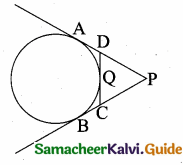
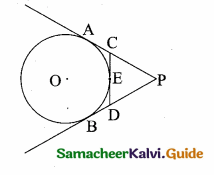
In figure CP and CQ are tangents to a circle with centre at 0. ARB is another tangent touching the circle at R. If CP = 11 cm and BC = 7 cm, then the length of BR is …….
Samacheer Kalvi 10th Maths Guide Chapter 4 Geometry Ex 4.5 14
(1) 6 cm
(2) 5 cm
(3) 8 cm
(4) 4 cm
Answer:
(4) 4 cm
Hint.
BQ = BR = 4 cm (tangent of the circle)
PC = QC = 11 cm (tangent of the circle)
QC = 11 cm
QB + BC = 11
QB + 7 = 11
QB = 11 – 7 = 4 cm
BR = BQ = 4 cm

Samacheer Kalvi 10th Maths Guide Chapter 4 Geometry Ex 4.5

Question 15.
In figure if PR is tangent to the circle at P and O is the centre of the circle, then ∠POQ is ………….
Samacheer Kalvi 10th Maths Guide Chapter 4 Geometry Ex 4.5 15
(1) 120°
(2) 100°
(3) 110°
(4) 90°
Answer:
(1) 120°
Hint.
Since PR is tangent of the circle.
∠QPR = 90°
∠OPQ = 90° – 60° = 30°
∠OQB = 30°
In ∆OPQ
∠P + ∠Q + ∠O = 180°
30 + 30° + ∠O = 180°
(OP and OQ are equal radius)
∠O = 180° – 60° = 120°

Samacheer Kalvi 9th Maths Guide Chapter 9 Probability Ex 9.1

Students can download Maths Chapter 9 Probability Ex 9.1 Questions and Answers, Notes, Samacheer Kalvi 9th Maths Guide Pdf helps you to revise the complete Tamilnadu State Board New Syllabus, helps students complete homework assignments and to score high marks in board exams.

Tamilnadu Samacheer Kalvi 9th Maths Solutions Chapter 9 Probability Ex 9.1

Question 1.
You are walking along a street. If you just choose a stranger crossing you, what is the probability that his next birthday will fall on a Sunday?
Solution:
Sample space = {M, T, W, Th, F, S, Sun}
n(S) = 7
Let E be the event of getting birthday on Sunday
n(E) = 1
p(E) = \(\frac{n(E)}{n(S)}\)
= \(\frac{1}{7}\)

Samacheer Kalvi 9th Maths Guide Chapter 9 Probability Ex 9.1

Question 2.
What is the probability of drawing a King or a Queen or a Jack from a deck of cards?
Solution:
The outcomes n(S) = 52
Let E be the event of getting a king or a queen or a jack
= 4 + 4 + 4
n(E) = 12
P(E) = \(\frac{n(E)}{n(S)}\)
= \(\frac{12}{52}\)
= \(\frac{3}{13}\)

Question 3.
What is the probability of throwing an even number with a single standard dice of six faces?
Solution:
Sample space (S) = {1, 2, 3, 4, 5, 6}
n(S) = 6
Let E be the event of getting an even number
E = {2, 4, 6}
n(E) = 3
P(E) = \(\frac{n(E)}{n(S)}\)
= \(\frac{3}{6}\)
= \(\frac{1}{2}\)

Samacheer Kalvi 9th Maths Guide Chapter 9 Probability Ex 9.1

Question 4.
There are 24 balls in a pot. If 3 of them are Red, 5 of them are Blue and the remaining are Green then, what is the probability of picking out (i) a Blue ball,
(ii) a Red ball and
(ii) a Green ball?
Solution:
Sample space n(S) = 24
Number of green ball = 24 – (3 + 5)
= 24 – 8
= 16

(i) Let E1 be the event of getting a blue ball
n(E1) = 5
p(E1) = \(\frac{n(E_{1})}{n(S)}\)
= \(\frac{5}{24}\)

(ii) Let E2 be the event of getting a red ball
n(E2) = 3
p(E2) = \(\frac{n(E_{2})}{n(S)}\)
= \(\frac{3}{24}\)
= \(\frac{1}{8}\)

(iii) Let E3 be the event of getting a green ball
n(E3) = 16
p(E3) = \(\frac{n(E_{3})}{n(S)}\)
= \(\frac{16}{24}\)
= \(\frac{2}{3}\)

Samacheer Kalvi 9th Maths Guide Chapter 9 Probability Ex 9.1

Question 5.
When two coins are tossed, what is the probability that two heads are obtained?
Solution:
Sample space (S) = {(H, H), (H, T), (T, H), (T, T)}
n(S) = 4
Let E be the event of getting two heads
n(E) = 1
p(E) = \(\frac{n(E)}{n(S)}\)
= \(\frac{1}{4}\)

Samacheer Kalvi 9th Maths Guide Chapter 9 Probability Ex 9.1

Question 6.
Two dice are rolled, find the probability that the sum is
Samacheer Kalvi 9th Maths Guide Chapter 9 Probability Ex 9.1 1
(i) equal to 1
(ii) equal to 4
(iii) less than 13
Solution:
Sample space (S) = {(1, 1) (1, 2) (1, 3) (1, 4) (1, 5) (1, 6)
(2, 1) (2, 2) (2, 3) (2, 4) (2, 5) (2, 6)
(3, 1) (3, 2) (3, 3) (3, 4) (3, 5) (3, 6)
(4, 1) (4, 2) (4, 3) (4, 4) (4, 5) (4, 6)
(5, 1) (5, 2) (5, 3) (5, 4) (5, 5) (5, 6)
(6, 1) (6, 2) (6, 3) (6, 4) (6, 5) (6, 6)}
n(S) = 36

(i) Let E1 be the event of getting the sum is equal to 1
n(E1) = 0
p(E1) = \(\frac{n(E_{1})}{n(S)}\)
= \(\frac{0}{36}\)
= 0

(ii) Let E2 be the event of getting the sum is equal to 4
E2 = {(1,3), (2, 2) (3, 1)}
n(E2) = 3
p(E2) = \(\frac{n(E_{2})}{n(S)}\)
= \(\frac{3}{36}\)
= \(\frac{1}{12}\)

(iii) Let E3 be the event of getting the sum is less than 13
n(E3) = 36
p(E3) = \(\frac{n(E_{3})}{n(S)}\)
= \(\frac{36}{36}\)
= 1

Samacheer Kalvi 9th Maths Guide Chapter 9 Probability Ex 9.1

Question 7.
A manufacturer tested 7000 LED lights at random and found that 25 of them were defective. If a LED light is selected at random, what is the probability that the selected LED light is a defective one.
Solution:
Sample space n(S) = 7000
Let E1 be the event of getting selected LED light is a defective one
n(E1) = 25
p(E1) = \(\frac{n(E_{1})}{n(S)}\)
= \(\frac{25}{7000}\)
= \(\frac{1}{280}\)

Samacheer Kalvi 9th Maths Guide Chapter 9 Probability Ex 9.1

Question 8.
In a football match, a goalkeeper of a team can stop the goal, 32 times out of 40 attempts tried by a team. Find the probability that the opponent team can convert the attempt into a goal.
Solution:
Sample space n(S) = 40
Opponent team trying to attempt the goal = 40 – 32 = 8
Let E be the event of getting opponent team convert the attempt into a goal
n(E) = 8
P(E) = \(\frac{n(E)}{n(S)}\)
= \(\frac{8}{40}\)
= \(\frac{1}{5}\)

Question 9.
What is the probability that the spinner will not land on a multiple of 3?
Samacheer Kalvi 9th Maths Guide Chapter 9 Probability Ex 9.1 2
Solution:
Sample space (S) = {1, 2, 3, 4, 5, 6, 7, 8}
n(S) = 8
Land in a multiple of 3 = {3, 6}
Land not a multiple of 3 = 8 – 2
= 6
Let E be the event of getting not a multiple of 6
n(E) = 6
P(E) = \(\frac{n(E)}{n(S)}\)
= \(\frac{6}{8}\)
= \(\frac{3}{4}\)

Samacheer Kalvi 9th Maths Guide Chapter 9 Probability Ex 9.1

Question 10.
Frame two problems in calculating probability, based on the spinner shown here.
Samacheer Kalvi 9th Maths Guide Chapter 9 Probability Ex 9.1 3
Solution:
(i) What is the probability that the spinner will get an odd number?
(ii) What is the probability that the spinner will not land on a multiple of 2?

Samacheer Kalvi 9th Maths Guide Chapter 8 Statistics Additional Questions

Students can download Maths Chapter 8 Statistics Additional Questions and Answers, Notes, Samacheer Kalvi 9th Maths Guide Pdf helps you to revise the complete Tamilnadu State Board New Syllabus, helps students complete homework assignments and to score high marks in board exams.

Tamilnadu Samacheer Kalvi 9th Maths Solutions Chapter 8 Statistics Additional Questions

I. Choose the Best Answer

Question 1.
The Arithmetic mean of all the factors of 10 is ………
(a) 4.5
(b) 5.5
(c) 10
(d) 55
Solution:
(a) 4.5

Question 2.
The mean of five numbers is 27, if one number is excluded, then mean is 25. Then the excluded number is ……..
(a) 0
(b) 15
(c) 25
(d) 35
Solution:
(d) 35

Samacheer Kalvi 9th Maths Guide Chapter 8 Statistics Additional Questions

Question 3.
The mean of 8 numbers is 15. If each number is multiplied by 2, then the new mean will be ……..
(a) 7.5
(b) 30
(c) 10
(d) 25
Solution:
(b) 30

Question 4.
The median of 11, 8, 4, 9, 7, 5, 2, 4, 10 is ……..
(a) 1
(b) 8
(c) 4
(d) 11
Solution:
(a) 1

Samacheer Kalvi 9th Maths Guide Chapter 8 Statistics Additional Questions

Question 5.
Median is …….
(a) the most frequent value
(b) the least frequent value
(c) middle most value
(d) mean of first and last values
Solution:
(c) middle most value

Question 6.
The mode of the distribution is …….
Samacheer Kalvi 9th Maths Guide Chapter 8 Statistics Additional Questions 1
(a) 3
(b) 4
(c) 6
(d) 14
Solution:
(b) 4

Samacheer Kalvi 9th Maths Guide Chapter 8 Statistics Additional Questions

Question 7.
Mode is …….
(a) the middle value
(b) extreme value
(c) minimum value
(d) the most repeated value
Solution:
(d) the most repeated value

Question 8.
The mode of the data 72, 33, 44, 72, 81, 72, 15 is ……..
(a) 12
(b) 33
(c) 81
(d) 15
Solution:
(a) 12

Samacheer Kalvi 9th Maths Guide Chapter 8 Statistics Additional Questions

Question 9.
The Arithmetic mean of 10 number is -7. If 5 is added to every number, then the new arithmetic mean is ……..
(a) 17
(b) 12
(c) -2
(d) -7
Solution:
(c) -2

Question 10.
The Arithmetic mean of integers from -5 to 5 is ……..
(a) 25
(b) 10
(c) 3
(d) 0
Solution:
(d) 0

Samacheer Kalvi 9th Maths Guide Chapter 8 Statistics Additional Questions

II. Answer the Following Questions

Question 1.
Find the Arithmetic mean for the following data.
Samacheer Kalvi 9th Maths Guide Chapter 8 Statistics Additional Questions 2
Solution:
Samacheer Kalvi 9th Maths Guide Chapter 8 Statistics Additional Questions 3
Arithmetic mean (\(\bar { X }\)) = \(\frac{Σfx}{Σf}\)
= \(\frac{5540}{96}\)
= 57.7
∴ Arithmetic mean = 57.7

Question 2.
Calculate the Arithmetic mean of the following data using step deviation method.
Samacheer Kalvi 9th Maths Guide Chapter 8 Statistics Additional Questions 4
Solution:
Assumed mean = 35
Samacheer Kalvi 9th Maths Guide Chapter 8 Statistics Additional Questions 5
Arithmetic mean (\(\bar { X }\)) = A + \(\frac{Σfd}{Σf}\) × c
= 35 + \(\frac{(-20)}{100}\) × 10
= 35 – 2
= 33
∴ Arithmetic mean = 33

Samacheer Kalvi 9th Maths Guide Chapter 8 Statistics Additional Questions

Question 3.
Find the median for the following data.
Samacheer Kalvi 9th Maths Guide Chapter 8 Statistics Additional Questions 6
Solution:
The given class intervals is inclusive type we convert it into exclusive type.
Samacheer Kalvi 9th Maths Guide Chapter 8 Statistics Additional Questions 7
\(\frac{N}{2}\) = \(\frac{70}{2}\)
= 35
Median class is 25.5 – 30.5
Here l = 25.5, f = 26, m = 30, c = 5
Median = l + \(\frac{\frac{N}{2}-m}{f}\) × c
= 25.5 + \(\frac{35-30}{26}\) × 5
= 25.5 + \(\frac{5×5}{26}\)
= 25.5 + 0.96
= 26.46
∴ Median = 26.46

Samacheer Kalvi 9th Maths Guide Chapter 8 Statistics Additional Questions

Question 4.
Calculate the mode of the following data.
Samacheer Kalvi 9th Maths Guide Chapter 8 Statistics Additional Questions 8
Solution:
Samacheer Kalvi 9th Maths Guide Chapter 8 Statistics Additional Questions 9
The highest frequency is 30. Corresponding class interval is the modal class.
Here l = 25, f = 30, f1 = 18, f2 = 20 and c = 5
Mode
Samacheer Kalvi 9th Maths Guide Chapter 8 Statistics Additional Questions 10
∴ Arithmetic mean = 25 + 2.727
= 25 + 2.73
= 27.73
mode = 27.73

Samacheer Kalvi 9th Maths Guide Chapter 8 Statistics Additional Questions

Question 5.
Find the mean, median and mode of marks obtained by 20 students in an examination. The marks are given below.
Samacheer Kalvi 9th Maths Guide Chapter 8 Statistics Additional Questions 11
Solution:
Samacheer Kalvi 9th Maths Guide Chapter 8 Statistics Additional Questions 12
Arithmetic mean:
Here Σfx = 560, Σf = 20
\(\bar { X }\) = \(\frac{Σfx}{Σf}\)
= \(\frac{560}{20}\)

Median:
Median class is 20 – 30
Here l = 20, \(\frac{N}{2}\) = 10, m = 5, c = 10, f = 5
Median
Samacheer Kalvi 9th Maths Guide Chapter 8 Statistics Additional Questions 13
= 20 + 10
= 30

Mode:
The highest frequency is 8
Modal class is 30 – 40
Here, l = 30, f = 8, f1 = 5, f2 = 2, c = 10
Mode
Samacheer Kalvi 9th Maths Guide Chapter 8 Statistics Additional Questions 14
= 33.33
Mean = 28, median = 30, mode = 33.33

Samacheer Kalvi 9th Maths Guide Chapter 8 Statistics Additional Questions

Samacheer Kalvi 6th Maths Guide Term 1 Chapter 2 Introduction to Algebra Ex 2.1

Students can download Maths Chapter 2 Introduction to Algebra Ex 2.1 Questions and Answers, Notes, Samacheer Kalvi 6th Maths Guide Pdf helps you to revise the complete Tamilnadu State Board New Syllabus, helps students complete homework assignments and to score high marks in board exams.

Tamilnadu Samacheer Kalvi 6th Maths Solutions Term 1 Chapter 2 Introduction to Algebra Ex 2.1

Question 1.
Fill in the blanks:
(i) The letters a, b, c, .., x, y, z are used to represent _____
(ii) A quantity that takes _____ values is called a variable.
(iii) If there are 5 students on a bench, then the number of students in ‘n’ benches is ‘5 × n’. Here _____ is a variable.
Solution:
(i) Variables
(ii) Different
(iii) n

Samacheer Kalvi 6th Maths Guide Term 1 Chapter 2 Introduction to Algebra Ex 2.1

Question 2.
Say True or False.
Samacheer Kalvi 6th Maths Guide Term 1 Chapter 2 Introduction to Algebra Ex 2.1 1
(iii) If there are 11 players in a team, then there will be ’11 + q’ players in ‘q’ teams.
Solution:
(i) False
(ii) True
(iii) False

Question 3.
Draw the next two patterns and complete the table
Samacheer Kalvi 6th Maths Guide Term 1 Chapter 2 Introduction to Algebra Ex 2.1 2
Solution:
Samacheer Kalvi 6th Maths Guide Term 1 Chapter 2 Introduction to Algebra Ex 2.1 3

Question 4.
Use a variable to write the rule, which gives the number of ice candy sticks required to make the following patterns.
Samacheer Kalvi 6th Maths Guide Term 1 Chapter 2 Introduction to Algebra Ex 2.1 4
Solution:
(a) No of ice candy sticks used = 3 × n = 3n
(b) No of ice candy sticks used = 4 × n = 4n

Question 5.
The teacher forms groups of five students in a class. How many students will be there in ‘p’ groups?
Solution:
No of students in a group = 5
No of students in ‘p’ groups = 5 × p = 5p

Question 6.
Arivazhagan is 30 years younger than his father. Write Arivazhagan’s age in terms of his father’s age.
Solution:
Let Arivazhagan’s father’s age be x years
According to the problem,
Arivazhagan’s age = (x – 30) years

Question 7.
If ‘u’ is an even number, how would you represent
(i) the next even number?
(ii) the previous even number?
Solution:
(i) Difference between two even numbers = 2
Given that ‘u’ is an even number.
Next, the even number is u + 2.
(ii) Previous even number is u – 2.

Objective Type Questions

Question 8.
Variable means that it
(a) can take only a few values
(b) has a fixed value
(c) can take different values
(d) can take only 8 values
Solution:
(c) can take different values

Question 9.
‘6y’ means
(a) 6 + y
(b) 6 – y
(c) 6 × y
(d) \(\frac{6}{7}\)
Solution:
(c) 6 × y

Question 10.
Radha is ‘x’ years of age now. 4 years ago, her age was
(a) x – 4
(b) 4 – x
(c) 4 + x
(d) 4x
Solution:
(a) x – 4

Question 11.
The number of days in ‘w’ weeks is
(a) 30 + w
(b) 30w
(c) 7 + w
(d) 7w
Solution:
(d) 7w

Question 12.
The value of ‘x’ in the circle is
Samacheer Kalvi 6th Maths Guide Term 1 Chapter 2 Introduction to Algebra Ex 2.1 5
(a) 6
(b) 8
(c) 21
(d) 22
Solution:
(d) 22

Samacheer Kalvi 9th Maths Guide Chapter 8 Statistics Ex 8.4

Students can download Maths Chapter 8 Statistics Ex 8.4 Questions and Answers, Notes, Samacheer Kalvi 9th Maths Guide Pdf helps you to revise the complete Tamilnadu State Board New Syllabus, helps students complete homework assignments and to score high marks in board exams.

Tamilnadu Samacheer Kalvi 9th Maths Solutions Chapter 8 Statistics Ex 8.4

Question 1.
Let m be the mid point and b be the upper limit of a class in a continuous frequency distribution. The lower limit of the class is …….
(a) 2m – b
(b) 2m + b
(c) m – b
(d) m – 2b
Solution:
(a) 2m – b

Question 2.
The mean of a set of seven numbers is 81. If one of the numbers is discarded, the mean of the remaining numbers is 78. The value of discarded number is ……..
(a) 101
(b) 100
(c) 99
(d) 98
Solution:
(c) 99
Hint:
Total of 8 numbers = 81 × 7 = 567
Total of 7 numbers = 78 × 6 = 468
The number is = 567 – 468
= 99

Samacheer Kalvi 9th Maths Guide Chapter 8 Statistics Ex 8.4

Question 3.
A particular observation which occurs maximum number of times in a given data is called its ………
(a) frequency
(b) range
(c) mode
(d) median
Solution:
(c) mode

Question 4.
For which set of numbers do the mean, median and mode all have the same values?
(a) 2, 2, 2, 4
(b) 1, 3, 3, 3, 5
(c) 1, 1, 2, 5, 6
(d) 1, 1, 2, 1, 5
Solution:
(b) 1, 3, 3, 3, 5

Samacheer Kalvi 9th Maths Guide Chapter 8 Statistics Ex 8.4

Question 5.
The algebraic sum of the deviations of a set of n values from their mean is ……..
(a) 0
(b) n – 1
(c) n
(d) n + 1
Solution:
(a) 0

Samacheer Kalvi 9th Maths Guide Chapter 8 Statistics Ex 8.4

Question 6.
The mean of a, b, c, d and e is 28. If the mean of a, c and e is 24, then mean of b and d is ……..
(a) 24
(b) 36
(c) 26

(d) 34
Solution:
(d) 34
Hint:
Mean = 28
a + b + c + d + e = 28 × 5 = 140
= 140 …… (1)
But \(\frac{a+c+e}{3}\) = 24
a + c + e = 72
a + b + c + d + e = 140
b + d + 72 = 140
b + d = 140 – 72
= 68
Mean = \(\frac{68}{2}\)
= 34

Samacheer Kalvi 9th Maths Guide Chapter 8 Statistics Ex 8.4

Question 7.
If the mean of five observations x, x + 2, x + 4, x + 6, x + 8, is 11, then the mean of first three observations is …….
(a) 9
(b) 11
(c) 13
(d) 15
Solution:
(a) 9
Hint:
Mean = \(\frac{x+x+2+x+4+x+6+x+8}{5}\)
11 = \(\frac{5x+20}{5}\)
5x + 20 = 55
5x = 55 – 20
= 35
x = \(\frac{35}{5}\)
= 7
Mean of first 3 observation is = \(\frac{7+9+11}{3}\)
= 9

Samacheer Kalvi 9th Maths Guide Chapter 8 Statistics Ex 8.4

Question 8.
The mean of 5, 9, x, 17 and 21 is 13, then find the value of x.
(a) 9
(b) 13
(c) 17
(d) 21
Solution:
(b) 13
Hint:
Mean = \(\frac{5+9+x+17+21}{5}\)
13 = \(\frac{52+x}{5}\)
65 = 52 + x
x = 65 – 52
= 13

Question 9.
The mean of the square of first 11 natural numbers is
(a) 26
(b) 46
(c) 48
(d) 52
Solution:
(b) 46
Hint:
Samacheer Kalvi 9th Maths Guide Chapter 8 Statistics Ex 8.4 1
= 46

Samacheer Kalvi 9th Maths Guide Chapter 8 Statistics Ex 8.4

Question 10.
The mean of a set of numbers is \(\bar { X }\). If each number is multiplied by z, the mean is ……..
(a) \(\bar { X }\) + z
(b) \(\bar { X }\) – z
(c) z\(\bar { X }\)
(d) \(\bar { X }\)
Solution:
(c) z\(\bar { X }\)
Hint:
If each observation is multiplied by k, k ≠ 0 then the arithmetic mean is also multiplied by the same quantity.

Samacheer Kalvi 10th Maths Guide Chapter 4 Geometry Ex 4.4

Students can download Maths Chapter 4 Geometry Ex 4.4 Questions and Answers, Notes, Samacheer Kalvi 10th Maths Guide Pdf helps you to revise the complete Tamilnadu State Board New Syllabus, helps students complete homework assignments and to score high marks in board exams.

Tamilnadu Samacheer Kalvi 10th Maths Solutions Chapter 4 Geometry Ex 4.4

Question 1.
The length of the tangent to a circle from a point P, which is 25 cm away from the centre is 24 cm. What is the radius of the circle?
Solution:
Let the radius AB be r. In the right ∆ ABO,
OB2 = OA2 + AB2
252 = 242 + r2
Samacheer Kalvi 10th Maths Guide Chapter 4 Geometry Ex 4.4 1
252 – 242 = r2
(25 + 24) (25 – 24) = r2
r = \(\sqrt { 49 }\) =7
Radius of the circle = 7 cm

Samacheer Kalvi 10th Maths Guide Chapter 4 Geometry Ex 4.4

Question 2.
∆ LMN is a right angled triangle with ∠L = 90°. A circle is inscribed in it. The lengths of the sides containing the right angle are 6 cm and 8 cm. Find the radius of the circle.
Solution:
LN = 6; ML = 8. In the right ∆ LMN,
MN2 = LN2 + LM2
= 62 + 82 = 36 + 64 = 100
MN = \(\sqrt { 100 }\) = 10
Samacheer Kalvi 10th Maths Guide Chapter 4 Geometry Ex 4.4 2
OA= OB = OC = r
AN = CN (Tangent of the circle)
LN – AL= CN
LN – r = CN
8 – r = CN ……(1)
MC = MB (tangent of the circle)
MC = ML – LB
MC = 6 – r …….(2)
Samacheer Kalvi 10th Maths Guide Chapter 4 Geometry Ex 4.4 3
Add (1) and (2)
MC + CN = (6 – r) + (8 – r)
MN = 14 – 2r
10 = 14 – 2r
2r = 14 – 10 = 4
r = \(\frac { 4 }{ 2 } \) = 2 cm
radius of the circle = 2 cm

Samacheer Kalvi 10th Maths Guide Chapter 4 Geometry Ex 4.4

Question 3.
A circle is inscribed in ∆ ABC having sides 8 cm, 10 cm and 12 cm as shown in figure, Find AD, BE and CF.
Samacheer Kalvi 10th Maths Guide Chapter 4 Geometry Ex 4.4 4
Solution:
AD = AF = x (tangent of the circle)
BD = BE = y (tangent of the circle)
CE = CF = z (tangent of the circle)
AB = AD + DB
x + y = 12 ……(1)
BC = BE + EC
y + z= 8 …….(2)
AC = AF + FC
x + z = 10 ……(3)
Add (1) (2) and (3)
2x + 2y + 2z = 12 + 8 + 10
x + y + z = \(\frac { 30 }{ 2 } \) = 15 …….(4)
By x + y = 12 in (4)
z = 3
y + z = 8 in (4)
x = 7
x + z = 10 in (4)
y = 5
AD = 7 cm; BE = 5 cm and CF = 3 cm

Samacheer Kalvi 10th Maths Guide Chapter 4 Geometry Ex 4.4

Question 4.
PQ is a tangent drawn from a point P to a circle with centre O and QOR is a diameter of the circle such that ∠POR = 120° . Find ∠OPQ.
Solution:
∠POQ = 180° – 120° = 60°
In ∆OPQ, we know
Samacheer Kalvi 10th Maths Guide Chapter 4 Geometry Ex 4.4 5
∠POQ + ∠OQP + ∠OPQ = 180°
(Sum of the angles of a ∆ is 180°)
60° + 90° + ∠OPQ = 180°
∠OPQ = 180° – 150° = 30°
∠OPQ = 30°

Samacheer Kalvi 10th Maths Guide Chapter 4 Geometry Ex 4.4

Question 5.
A tangent ST to a circle touches it at B. AB is a chord such that ∠ABT = 65°. Find ∠AOB, where “O” is the centre of the circle.
Solution:
Given ∠ABT = 65°
∠OBT = 90°(TB is the tangent of the circle)
∠ABO = 90° – 65° = 25°
∠ABO + ∠BOA + ∠OAB = 180°
25° + x + 25° = 180° (Sum of the angles of a ∆)
Samacheer Kalvi 10th Maths Guide Chapter 4 Geometry Ex 4.4 6
(OA and OB are the radius of the circle.
∴ ∠ABO = ∠BAO = 25°
x + 50 = 180°
x = 180° – 50° = 130°
∴ ∠BOA = 130°

Question 6.
In figure, O is the centre of the circle with radius 5 cm. T is a point such that OT = 13 cm and OT intersects the circle E, if AB is the tangent to the circle at E, find the length of AB.
Samacheer Kalvi 10th Maths Guide Chapter 4 Geometry Ex 4.4 7
Solution:
In the right ∆ OTP,
PT2 = OT2 – OP2
= 132 – 52
= 169 – 25
= 144
PT = \(\sqrt { 144 }\) = 12 cm
Since lengths of tangent drawn from a point to circle are equal.
∴ AP = AE = x
AT = PT – AP
= (12 – x) cm
Since AB is the tangent to the circle E.
∴ OE ⊥ AB
∠OEA = 90°
∠AET = 90°
In ∆AET, AT2 = AE2 + ET2
In the right triangle AET,
AT2 = AE2 + ET2
(12 – x)2 = x2 + (13 – 5)2
144 – 24x + x2 = x2 + 64
24x = 80 ⇒ x = \(\frac { 80 }{ 24 } \) = \(\frac { 20 }{ 6 } \) = \(\frac { 10 }{ 3 } \)
BE = \(\frac { 10 }{ 3 } \) cm
AB = AE + BE
= \(\frac { 10 }{ 3 } \) + \(\frac { 10 }{ 3 } \) = \(\frac { 20 }{ 3 } \)
Lenght of AB = \(\frac { 20 }{ 3 } \) cm

Samacheer Kalvi 10th Maths Guide Chapter 4 Geometry Ex 4.4

Question 7.
In two concentric circles, a chord of length 16 cm of larger circle becomes a tangent to the smaller circle whose radius is 6 cm. Find the radius of the larger circle.
Solution:
Here AP = PB = 8 cm
In ∆OPA,
OA2 = OP2 + AP2
Samacheer Kalvi 10th Maths Guide Chapter 4 Geometry Ex 4.4 8
= 62 + 82
= 36 + 64
= 100
OA = \(\sqrt { 100 }\) = 10 cm
Radius of the larger circle = 10 cm

Samacheer Kalvi 10th Maths Guide Chapter 4 Geometry Ex 4.4

Question 8.
Two circles with centres O and O’ of radii 3 cm and 4 cm, respectively intersect at two points P and Q, such that OP and O’ P are tangents to the two circles. Find the length of the common chord PQ.
Solution:
In ∆ OO’P
(O’O)2 = OP2 + O’P2
= 32 + 42
Samacheer Kalvi 10th Maths Guide Chapter 4 Geometry Ex 4.4 9
= 9 + 16
(OO’)2 = 25
∴ OO’ = 5cm
Since the line joining the centres of two intersecting circles is perpendicular bisector of their common chord.
OR ⊥ PQ and PR = RQ
Let OR be x, then O’R = 5 – x again Let PR = RQ = y cm
In ∆ ORP, OP2 = OR2 + PR2
9 = x2 + y2 …(1)
In ∆ O’RP, O’P2 = O’R2 + PR2
16 = (5 – x)2 + y2
16 = 25 + x2 – 10x + y2
16 = x2 + y2 + 25 – 10x
16 = 9 + 25 – 10x (from 1)
16 = 34 – 10x
10x = 34 – 16 = 18
x = \(\frac { 18 }{ 10 } \) = 1.8 cm
Substitute the value of x = 1.8 in (1)
9 = (1.8)2 + y2
y2 = 9 – 3.24
y2 = 5.76
y = \(\sqrt { 5.76 }\) = 2.4 cm
Hence PQ = 2 (2.4) = 4.8 cm
Length of the common chord PQ = 4.8 cm

Samacheer Kalvi 10th Maths Guide Chapter 4 Geometry Ex 4.4

Question 9.
Show that the angle bisectors of a triangle are concurrent.
Solution:
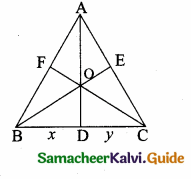
Given: ABC is a triangle. AD, BE and CF are the angle bisector of ∠A, ∠B, and ∠C.
To Prove: Bisector AD, BE and CF intersect
Proof: The angle bisectors AD and BE meet at O. Assume CF does not pass through O. By angle bisector theorem.
AD is the angle bisector of ∠A
\(\frac { BD }{ DC } \) = \(\frac { AB }{ AC } \) …..(1)
BE is the angle bisector of ∠B
Samacheer Kalvi 10th Maths Guide Chapter 4 Geometry Ex 4.4 10
\(\frac { CE }{ EA } \) = \(\frac { BC }{ AB } \) …….(2)
CF is the angle bisector ∠C
\(\frac { AF }{ FB } \) = \(\frac { AC }{ BC } \) …….(3)
Multiply (1) (2) and (3)
\(\frac { BD }{ DC } \) × \(\frac { CE }{ EA } \) × \(\frac { AF }{ FB } \) = \(\frac { AB }{ AC } \) × \(\frac { BC }{ AB } \) × \(\frac { AC }{ BC } \)
So by Ceva’s theorem.
The bisector AD, BE and CF are concurrent.

Samacheer Kalvi 10th Maths Guide Chapter 4 Geometry Ex 4.4

Question 10.
In ∆ABC , with ∠B = 90° , BC = 6 cm and AB = 8 cm, D is a point on AC such that AD = 2 cm and E is the midpoint of AB. Join D to E and extend it to meet at F. Find BF.
Solution:
Consider ∆ABC. Then D, E and F are respective points on the sides AC, AB and BC.
By construction D, E, F are collinear.
By Menelaus’ theorem \(\frac { AE }{ EB } \) × \(\frac { BF }{ FC } \) × \(\frac { CD }{ DA } \) = 1 ……(1)
AD = 2 cm; AE = EB = 4 cm; BC = 6 cm; FC = FB + BC = x + 6
In ∆ABC, By Pythagoras theorem.
Samacheer Kalvi 10th Maths Guide Chapter 4 Geometry Ex 4.4 11
AC2= AB2 + BC2
AC2 = 82 + 62 = 64 + 36 = 100
AC = \(\sqrt { 100 }\) = 10
CD = AC – AD
= 10 – 2 = 8 cm
Substituting the values in (1) we get
\(\frac { 4 }{ 4 } \) × \(\frac { x }{ x+6 } \) × \(\frac { 8 }{ 2 } \) = 1
\(\frac { x }{ x+6 } \) × 4 = 1
4x = x + 6
3x = 6 ⇒ x = \(\frac { 6 }{ 3 } \) = 2
The value of BF = 2 cm

Question 11.
An artist has created a triangular stained glass window and has one strip of small length left before completing the window. She needs to figure out the length of left out portion based on the lengths of the other sides as shown in the figure.
Samacheer Kalvi 10th Maths Guide Chapter 4 Geometry Ex 4.4 12
Solution:
Given that AE = 3 cm, EC = 4 cm, CD = 10 cm, DB = 3 cm, AF = 5 cm.
Let FB be x
Using Ceva’s theorem we have
\(\frac { AE }{ EC } \) × \(\frac { CD }{ DB } \) × \(\frac { BF }{ AF } \) = 1
\(\frac { 3 }{ 4 } \) × \(\frac { 10 }{ 3 } \) × \(\frac { x }{ 5 } \) = 1
\(\frac { 2x }{ 4 } \) = 1
2x = 4 ⇒ x = \(\frac { 4 }{ 2 } \) = 2
The value of BF = 2

Samacheer Kalvi 10th Maths Guide Chapter 4 Geometry Ex 4.4

Question 12.
Draw a tangent at any point R on the circle of radius 3.4 cm and centre at P ?
Answer:
Given Radius = 3.4 cm
Samacheer Kalvi 10th Maths Guide Chapter 4 Geometry Ex 4.4 13
Samacheer Kalvi 10th Maths Guide Chapter 4 Geometry Ex 4.4 14
Steps of construction:

  1. Draw a circle with centre “O” of radius 3.4 cm.
  2. Take a point P on the circle Join OP.
  3. Draw a perpendicular line TT’ to OP which passes through P.
  4. TT’ is the required tangent.

Samacheer Kalvi 10th Maths Guide Chapter 4 Geometry Ex 4.4

Question 13.
Draw a circle of radius 4.5 cm. Take a point on the circle. Draw the tangent at that point using the alternate segment theorem.
Answer:
Radius of the circle = 4.5 cm
Samacheer Kalvi 10th Maths Guide Chapter 4 Geometry Ex 4.4 15
Samacheer Kalvi 10th Maths Guide Chapter 4 Geometry Ex 4.4 16
Steps of construction:

  1. With O as centre, draw a circle of radius 4.5 cm.
  2. Take a point L on the circle. Through L draw any chord LM.
  3. Take a point M distinct from L and N on the circle, so that L, M, N are in anti-clockwise direction. Join LN and NM.
  4. Through “L” draw tangent TT’such that ∠TLM = ∠MNL
  5. TT’ is the required tangent.

Samacheer Kalvi 10th Maths Guide Chapter 4 Geometry Ex 4.4

Question 14.
Draw the two tangents from a point which is 10 cm away from the centre of a circle of radius 5 cm. Also, measure the lengths of the tangents.
Answer:
Radius = 5 cm; Distance = 10 cm
Samacheer Kalvi 10th Maths Guide Chapter 4 Geometry Ex 4.4 17
Samacheer Kalvi 10th Maths Guide Chapter 4 Geometry Ex 4.4 18
Steps of construction:

  1. With O as centre, draw a circle of radius 5 cm.
  2. Draw a line OP =10 cm.
  3. Draw a perpendicular bisector of OP, which cuts OP at M.
  4. With M as centre and MO as radius draw a circle which cuts previous circle at A and B.
  5. Join AP and BP. AP and BP are the required tangents.

Samacheer Kalvi 10th Maths Guide Chapter 4 Geometry Ex 4.4

Verification: In the right ∆ OAP
PA2 = OP2 – OA2
= 102 – 52 = \(\sqrt { 100-25 }\) = \(\sqrt { 75 }\) = 8.7 cm
Lenght of the tangent is = 8.7 cm

Question 15.
Take a point which is 11 cm away from the centre of a circle of radius 4 cm and draw the two tangents to the circle from that point.
Answer:
Radius = 4 cm; Distance = 11 cm
Samacheer Kalvi 10th Maths Guide Chapter 4 Geometry Ex 4.4 19
Samacheer Kalvi 10th Maths Guide Chapter 4 Geometry Ex 4.4 20
Steps of construction:

  1. With O as centre, draw a circle of radius 4 cm.
  2. Draw a line OP = 11 cm.
  3. Draw a perpendicular bisector of OP, which cuts OP at M.
  4. With M as centre and MO as radius, draw a circle which cuts previous circle A and B.
  5. Join AP and BP. AP and BP are the required tangents.

This the length of the tangents PA = PB = 10.2 cm
Verification: In the right angle triangle OAP
PA2 = OP2 – OA2
= 112 – 42 = 121 – 16 = 105
PA = \(\sqrt { 105 }\) = 10.2 cm
Length of the tangents = 10.2 cm

Samacheer Kalvi 10th Maths Guide Chapter 4 Geometry Ex 4.4

Question 16.
Draw the two tangents from a point which is 5 cm away from the centre of a circle of diameter 6 cm. Also, measure the lengths of the tangents.
Answer:
Radius = 3cm; Distance = 5cm.
Samacheer Kalvi 10th Maths Guide Chapter 4 Geometry Ex 4.4 21
Samacheer Kalvi 10th Maths Guide Chapter 4 Geometry Ex 4.4 22
Steps of construction:

  1. With O as centre, draw a circle of radius 3 cm.
  2. Draw a line OP = 5 cm.
  3. Draw a perpendicular bisector of OP, which cuts OP at M.
  4. With M as centre and MO as radius draw a circle which cuts previous circles at A and B.
  5. Join AP and BP, AP and BP are the required tangents.

The length of the tangent PA = PB = 4 cm
Verification: In the right angle triangle OAP
PA2 = OP2 – OA2
= 52 – 32
= 25 – 9
= 16 PA
= \(\sqrt { 16 }\) = 4 cm
Length of the tangent = 4 cm

Samacheer Kalvi 10th Maths Guide Chapter 4 Geometry Ex 4.4

Question 17.
Draw a tangent to the circle from the point P having radius 3.6 cm, and centre at O. Point P is at a distance 7.2 cm from the centre.
Answer:
Radius = 3.6; Distance = 7.2 cm.
Samacheer Kalvi 10th Maths Guide Chapter 4 Geometry Ex 4.4 23
Samacheer Kalvi 10th Maths Guide Chapter 4 Geometry Ex 4.4 24
Steps of construction:

  1. With O as centre, draw a circle of radius 3.6 cm.
  2. Draw a line OP = 7.2 cm.
  3. Draw a perpendicular bisector of OP which cuts OP at M.
  4. With M as centre and MO as radius draw a circle which cuts the previous circle at A and B.
  5. Join AP and BP, AP and BP are the required tangents.

Samacheer Kalvi 10th Maths Guide Chapter 4 Geometry Ex 4.4

Length of the tangents PA = PB = 6.26 cm
Verification: In the right triangle ∆OAP
PA2 = OP2 – OA2
= 7.22 – 3.62 =(7.2 + 3.6) (7.2 – 3.6)
PA2 = 10.8 × 3.6 = \(\sqrt { 38.88 }\)
PA = 6.2 cm
Length of the tangent = 6.2 cm

Samacheer Kalvi 9th Maths Guide Chapter 8 Statistics Ex 8.3

Students can download Maths Chapter 8 Statistics Ex 8.3 Questions and Answers, Notes, Samacheer Kalvi 9th Maths Guide Pdf helps you to revise the complete Tamilnadu State Board New Syllabus, helps students complete homework assignments and to score high marks in board exams.

Tamilnadu Samacheer Kalvi 9th Maths Solutions Chapter 8 Statistics Ex 8.3

Question 1.
The monthly salary of 10 employees in a factory are given below:
Rs 5000, Rs 7000, Rs 5000, Rs 7000, Rs 8000, Rs 7000, Rs 7000, Rs 8000, Rs 7000, Rs 5000
Find the mean, median and mode.
Solution:
Samacheer Kalvi 9th Maths Guide Chapter 8 Statistics Ex 8.3 1
Mean = 6600
Median:
Arrange in ascending order we get.
5000, 5000, 5000, 7000, 7000, 7000, 7000, 7000, 8000, 8000
The number of values = 10
Median = Average of (\(\frac{10}{2})^{th}\) and (\(\frac{10}{2}+1)^{th}\)
= Average of 5th value and 6th value
= \(\frac{7000+7000}{2}\)
∴ Median = 7000
Mode: 7000 repeated 5 times
∴ Mode = 7000

Question 2.
Find the mode of the given data: 3.1, 3.2, 3.3, 2.1, 1.3, 3.3, 3.1
Solution:
3.1 occuring two times
3.3 occuring two times
∴ 3.1 and 3.3 are the mode (bimodal)

Samacheer Kalvi 9th Maths Guide Chapter 8 Statistics Ex 8.3

Question 3.
For the data 11, 15, 17, x + 1, 19, x – 2, 3 if the mean is 14, find the value of x. Also find the mode of the data.
Solution:
Arithmetic mean
Samacheer Kalvi 9th Maths Guide Chapter 8 Statistics Ex 8.3 2
∴ 2x + 64 = 14 × 7
2x = 98 – 64
2x = 34
x = \(\frac{34}{2}\)
= 17
The given numbers are 11, 15, 17, 18, 19, 15 and 3
15 occuring two times
∴ Mode = 15
The value of x = 17 and mode = 15

Samacheer Kalvi 9th Maths Guide Chapter 8 Statistics Ex 8.3

Question 4.
The demand of track suit of different sizes as obtained by a survey is given below:
Samacheer Kalvi 9th Maths Guide Chapter 8 Statistics Ex 8.3 3
Which size is demanded more?
Solution:
The highest frequency is 37
The corresponding value is the mode
∴ Mode = 40
Size 40 is demanded more.

Samacheer Kalvi 9th Maths Guide Chapter 8 Statistics Ex 8.3

Question 5.
Find the mode of the following data:
Samacheer Kalvi 9th Maths Guide Chapter 8 Statistics Ex 8.3 4
Solution:
Samacheer Kalvi 9th Maths Guide Chapter 8 Statistics Ex 8.3 5
The highest frequency is 46
20 – 30 is the modal class
Here l = 20, f = 46, f1 = 38, f2 = 34 and c = 10
Mode
Samacheer Kalvi 9th Maths Guide Chapter 8 Statistics Ex 8.3 6
= 20 + 4
= 24
∴ Mode = 24

Samacheer Kalvi 9th Maths Guide Chapter 8 Statistics Ex 8.3

Question 6.
Find the mode of the following distribution
Samacheer Kalvi 9th Maths Guide Chapter 8 Statistics Ex 8.3 7
Solution:
In the given table the class intervals are in inclusive form; convert them into exclusive form.
Samacheer Kalvi 9th Maths Guide Chapter 8 Statistics Ex 8.3 8
The highest frequency is 14
Modal class is 54.5 – 64.5
Here l = 54.5, f = 14, f1 = 10, f2 = 8 and c = 10
mode
Samacheer Kalvi 9th Maths Guide Chapter 8 Statistics Ex 8.3 9
= 58.5
∴ Mode = 58.5

Samacheer Kalvi 9th Maths Guide Chapter 8 Statistics Ex 8.3

Samacheer Kalvi 9th Maths Guide Chapter 8 Statistics Ex 8.2

Students can download Maths Chapter 8 Statistics Ex 8.2 Questions and Answers, Notes, Samacheer Kalvi 9th Maths Guide Pdf helps you to revise the complete Tamilnadu State Board New Syllabus, helps students complete homework assignments and to score high marks in board exams.

Tamilnadu Samacheer Kalvi 9th Maths Solutions Chapter 8 Statistics Ex 8.2

Question 1.
Find the median of the given values: 47, 53, 62, 71, 83, 21, 43, 47, 41
Solution:
Arrange the values in ascending order we get
21, 41, 43, 47, 47, 53, 62, 71, 83
The number of values = 9 which is odd
Median = (\(\frac{9+1}{2})^{th}\) variable
= 5th variable
∴ Median = 47

Samacheer Kalvi 9th Maths Guide Chapter 8 Statistics Ex 8.2

Question 2.
Find the median of the given data: 36, 44, 86, 31, 37, 44, 86, 35, 60, 51
Solution:
Arrange the values in ascending order we get
31, 35, 36, 37, 44, 44, 51, 60, 86, 86
The number of values = 10 which is even
Median = Average of (\(\frac{10}{2})^{th}\) and (\(\frac{10}{2}+1)^{th}\) value
= Average of 5th and 6th value
= \(\frac{44+44}{2}\)
= \(\frac{88}{2}\)
= 44
∴ Median = 44

Samacheer Kalvi 9th Maths Guide Chapter 8 Statistics Ex 8.2

Question 3.
The median of observation 11, 12, 14, 18, x + 2, x + 4, 30, 32, 35, 41 arranged in ascending order is 24. Find the values of x.
Solution:
The given observation is 11, 12, 14, 18, x + 2, x + 4, 30, 32, 35, 41 (is ascending order)
The number of values =10
Median = Average of (\(\frac{10}{2})^{th}\) and (\(\frac{10}{2}+1)^{th}\) value
= Average of 5th and 6th value
24 = \(\frac{x+2.+x+4}{2}\)
24 = \(\frac{2x+6}{2}\)
2x + 6 = 48
2x = 48 – 6
2x = 42
x = \(\frac{42}{2}\)
= 21
The value of x = 21

Samacheer Kalvi 9th Maths Guide Chapter 8 Statistics Ex 8.2

Question 4.
A researcher studying the behavior of mice has recorded the time (in seconds) taken by each mouse to locate its food by considering 13 different mice as 31, 33, 63, 33, 28, 29, 33, 27, 27, 34, 35, 28, 32. Find the median time that mice spent in searching its food.
Solution:
Arrange the value in ascending order we get
27, 27, 28, 28, 29, 31, 32, 33, 33, 33, 34, 35, 63
The number of values = 13 which is odd
Median = (\(\frac{13+1}{2})^{th}\) value
= (\(\frac{14}{2})^{th}\)
= 7th value
7th value is = 32
∴ Median = 32

Samacheer Kalvi 9th Maths Guide Chapter 8 Statistics Ex 8.2

Question 5.
The following are the marks scored by the students in the Summative Assessment exam.
Samacheer Kalvi 9th Maths Guide Chapter 8 Statistics Ex 8.2 1
Calculate the median.
Solution:
Samacheer Kalvi 9th Maths Guide Chapter 8 Statistics Ex 8.2 2
\(\frac{N}{2}\) = \(\frac{50}{2}\)
= 25
Here l = 30, f = 10; m = 24 and c = 10
Median = l + \(\frac{(\frac{N}{2}-m)×c}{f}\)
= 30 + \(\frac{(25-24)10}{10}\)
= 30 + 1
= 31
∴ Median = 31

Samacheer Kalvi 9th Maths Guide Chapter 8 Statistics Ex 8.2

Question 6.
The mean of five positive integers is twice their median. If four of the integers are 3, 4, 6, 9 and median is 6, then find the fifth integer.
Solution:
Let the 5th positive integer be x
\(\bar { x }\) = \(\frac{3+4+6+9+x}{5}\)
= \(\frac{22+x}{5}\)
Median = 6
Mean = 2 × median
\(\frac{22+x}{5}\) = 2 × 6
22 + x = 60
x = 60 – 22
= 38
The fifth integer is 38.

Samacheer Kalvi 9th Maths Guide Chapter 8 Statistics Ex 8.2

Samacheer Kalvi 9th Maths Guide Chapter 4 Geometry Ex 4.2

Students can download Maths Chapter 4 Geometry Ex 4.2 Questions and Answers, Notes, Samacheer Kalvi 9th Maths Guide Pdf helps you to revise the complete Tamilnadu State Board New Syllabus, helps students complete homework assignments and to score high marks in board exams.

Tamilnadu Samacheer Kalvi 9th Maths Solutions Chapter 4 Geometry Ex 4.2

Question 1.
The angles of a quadrilateral are in the ratio 2 : 4 : 5 : 7. Find all the angles.
Solution:
Let the angles of a quadrilateral be 2x, 4x, 5x, and 7x.
Total angle of a quadrilateral = 360°
2x + 4x + 5x + 7x = 360°
18° = 360°
x = \(\frac{360°}{18}\)
= 20°
2x = 2 × 20° = 40°; 4x = 4 × 20° = 80°;
5x = 5 × 20° = 100°; 7x = 7 × 20° = 140°
The angles of a quadrilateral are 40°, 80°, 100° and 140°.

Samacheer Kalvi 9th Maths Guide Chapter 4 Geometry Ex 4.2

Question 2.
In a quadrilateral ABCD, ∠A = 72° and ∠C is the supplementary of ∠A. The other two angles are 2x – 10 and x + 4. Find the value of x and the measure of all the angles.
Solution:
Samacheer Kalvi 9th Maths Guide Chapter 4 Geometry Ex 4.2 1
∠A = 72°
∠C = 180° – 12° (∠A and ∠C are supplementary)
= 108°
∠A + ∠B + ∠C + ∠D = 360° (Total angles of quadrilateral)
72° + 2x – 10 + 108° + x + 4 = 360°
3x + 174° = 360°
x = \(\frac{186°}{3}\)
= 62°
The value of x is 62°
∠B = 2x – 10
= 2(62°) – 10
= 124° – 10°
= 114°
∠D = x + 4
= 62° + 4
= 66°
The other angles are 114°, 62° and 66°.

Samacheer Kalvi 9th Maths Guide Chapter 4 Geometry Ex 4.2

Question 3.
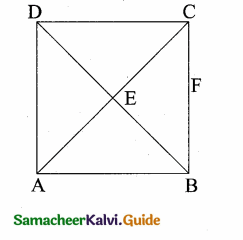
ABCD is a rectangle whose diagonals AC and BD intersect at O. If ∠OAB = 46°, find ∠OBC.
Solution:
Since the diagonals of a rectangle AC and BD are equal and bisect each other
Samacheer Kalvi 9th Maths Guide Chapter 4 Geometry Ex 4.2 2
∴ OA = OB
∠OAB = ∠OBA = 46°
Each angle of a rectangle measures 90°
∠ABC = 90°
∠ABO + ∠OBC = 90°
46° + ∠OBC = 90°
∠OBC = 90°-46°
∴ ∠OBC = 44°

Samacheer Kalvi 9th Maths Guide Chapter 4 Geometry Ex 4.2

Question 4.
The lengths of the diagonals of a Rhombus are 12 cm and 16 cm. Find the side of the rhombus.
Solution:
Since the diagonals of a rhombus bisect each other at right angles
Samacheer Kalvi 9th Maths Guide Chapter 4 Geometry Ex 4.2 3
AO = \(\frac{1}{2}\)AC = \(\frac{1}{2}\) × 12 = 6 cm
BO = \(\frac{1}{2}\)BD = \(\frac{1}{2}\) × 16 = 8 cm
In the right triangle AOD
AD² = AO² + DO²
= 6² + 8²
= 36 + 64
= 100
∴ AD = \(\sqrt{100}\)
= 10
∴ AB = BC = CD = AD = 10 cm.

Samacheer Kalvi 9th Maths Guide Chapter 4 Geometry Ex 4.2

Question 5.
Show that the bisectors of angles of a parallelogram form a rectangle.
Solution:
Given: A parallelogram in which bisector of angle A, B, C, D intersect at P, Q, R, S to form a quadrilateral PQRS.
To prove: Quadrilateral PQRS is a rectangle.
Proof: Since ABCD is a parallelogram. Therefore, AB || DC.
Samacheer Kalvi 9th Maths Guide Chapter 4 Geometry Ex 4.2 4
Now, AB || DC, and transversal AD cuts them, so we have
∠A + ∠D = 180°
\(\frac{1}{2}\)∠A + \(\frac{1}{2}\)∠D = \(\frac{180°}{2}\)
∠DAS + ∠ADS = 90°
But in ΔASD, we have
∠ADS + ∠DAS + ∠ASD = 180°
90° + ∠ASD = 180°
∠ASD = 90°
∠RSP = ∠ASD (vertically opposite angle)
∠RSP = 90°
Similarly, we can prove that
∠SRQ = 90°, ∠RQP = 90° and ∠QPS = 90°
Thus, PQRS is a quadrilateral each of whose angle is 90°.
Hence, PQRS is a rectangle.

Samacheer Kalvi 9th Maths Guide Chapter 4 Geometry Ex 4.2

Question 6.
If a triangle and a parallelogram lie on the same base and between the same parallels then prove that the area of the triangle is equal to half of the area of parallelogram.
Solution:
Let ΔAPB and parallelogram ABCD lie on base AB and between parallels AB and PC.
To show area ΔAPB = \(\frac{1}{2}\) Area (ABCD)
Now, draw BQ || AP. Then ABQP is a parallelogram.
Now area ABQP = Area ABCD
(They are on same base AB and between same parallels AB and PC)
Samacheer Kalvi 9th Maths Guide Chapter 4 Geometry Ex 4.2 5
⇒ ΔPAB ≅ ΔBQP
Area PAB = Area BQP
= \(\frac{1}{2}\) Area ABQP
= \(\frac{1}{2}\) Area ABCD

Samacheer Kalvi 9th Maths Guide Chapter 4 Geometry Ex 4.2

Question 7.
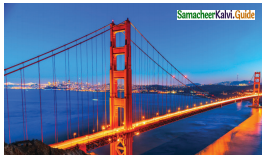
Iron rods a, b, c, d, e, and f are making a design in a bridge as shown in the figure.
Samacheer Kalvi 9th Maths Guide Chapter 4 Geometry Ex 4.2 6
If a || b, c || d, e || f, find the marked angles between
(i) b and c
(ii) d and e
(iii) d and f
(iv) c and f
Solution:
(i) Angle between b and c = 30°
(vertically opposite angles)

(ii) Angle between d and e = 180° – 75° = 105°
(sum of the adjacent angles of a parallelogram is 180°)

(iii) Angle between d and f = 75°
(opposite angles of a parallelogram)

(iv) Angle between c and f = 180° – 75° = 105°
(Adjacent angles of a parallelogram)

Samacheer Kalvi 9th Maths Guide Chapter 4 Geometry Ex 4.2

Question 8.
In the given figure, ∠A = 64°, ∠ABC = 58°. If BO and CO are the bisectors of ∠ABC and ∠ACB respectively of ΔABC, find x° and y°.
Samacheer Kalvi 9th Maths Guide Chapter 4 Geometry Ex 4.2 7
Solution:
In the given ΔABC
∠A = 64° and ∠B = 58°
∠C = 180°- (64° + 58°)
= 180° – 122°
= 58°
Since OC is the bisector of ∠C
y = \(\frac{58°}{2}\)
= 29°
Given ΔOBC
∠OCB = \(\frac{58°}{2}\) = 29°
∠OCB = 29°
∴ ∠BOC = 180°- (29° + 29°)
x = 180° – 58°
x = 122°
∠x = 122° and ∠y = 29°.

Samacheer Kalvi 9th Maths Guide Chapter 4 Geometry Ex 4.2

Question 9.
In the given figure, if AB = 2, BC = 6, AE = 6, BF = 8, CE = 7 and CF = 7, compute the ratio of the area of quadrilateral ABDE to the area of ΔCDF.
Samacheer Kalvi 9th Maths Guide Chapter 4 Geometry Ex 4.2 8
Solution:
Given: AB = 2 cm, BC = 6 cm, AE = 6 cm, BF = 8 cm, CE = 7 cm and CF = 7 cm
Consider ΔAEC and ΔBCF.
In ΔAEC, AE = 6 cm, EC = 7 cm and AC = 8 cm (2 + 6 = 8)
In ΔBCF, BC = 6 cm, CF = 7 cm and BF = 8 cm
∴ ΔAEC s ΔBCF
∴ Area of ΔAEC = Area of ΔBCF (Two triangles are similar areas are equal)
Subtract area of ΔBDC on both sides we get,
Area of ΔAEC – Area of ΔBDC = Area of ΔBCF – Area of ΔBDC
Area of quadrilateral ABDE = Area of ΔCDF

Samacheer Kalvi 9th Maths Guide Chapter 4 Geometry Ex 4.2

Question 10.
In the given figure, ABCD is a rectangle and EFGH is a parallelogram. Using the measurements given in the figure, what is the length ”d” of the segment that is perpendicular to \(\overline { HE }\) and \(\overline { FG }\)?
Samacheer Kalvi 9th Maths Guide Chapter 4 Geometry Ex 4.2 9
Solution:
In the given figure ABCD is a rectangle and EFGH is a parallelogram.
In the right triangle AEH
HE = \(\sqrt{AH^{2} + AE^{2}}\)
= \(\sqrt{3^{2} + 4^{2}}\)
= \(\sqrt{9 + 16}\)
= \(\sqrt{25}\)
HE = 5
∴ GF = 5 (HE and Gf are opposite sides of a parallelogram)
In the right triangle
GC = \(\sqrt{GF^{2} – FC^{2}}\)
= \(\sqrt{5^{2} – 3^{2}}\)
= \(\sqrt{25 – 9}\)
= \(\sqrt{16}\)
∴ DG = 10 – 6 = 4
Area of ΔAEH + Area of ΔBEF + Area of ΔFCG + Area of ΔHDG
= \(\frac{1}{2}\) × 3 × 4 + \(\frac{1}{2}\) × 6 × 5 + \(\frac{1}{2}\) × 3 × 4 + \(\frac{1}{2}\) × 5 × 6
= (6 + 15 + 6 + 15)
= 42
∴ Area of 4 triangles = 42
Area of the parallelogram = Area of the rectangle ABCD – Area of 4 triangles.
= 10 × 8 – 42
= 80 – 42
= 38
b × h = 38
5 × d = 38
d = \(\frac{38}{5}\)
= 7\(\frac{3}{5}\)
Length of d = 7\(\frac{3}{5}\) or 7.6

Samacheer Kalvi 9th Maths Guide Chapter 4 Geometry Ex 4.2

Question 11.
In parallelogram ABCD of the accompanying diagram, line DP is drawn bisecting BC at N and meeting AB (extended) at P. From vertex C, line CQ is drawn bisecting side AD at M and meeting AB (extended) at Q. Lines DP and CQ meet at O. Show that the area of triangle QPO is \(\frac{9}{8}\) of the area of the parallelogram ABCD.
Samacheer Kalvi 9th Maths Guide Chapter 4 Geometry Ex 4.2 10
Solution:
Draw OX perpendicular to QP.
In ΔADP, MN = \(\frac{1}{2}\) AP,
In ΔBCQ, MN = \(\frac{1}{2}\) QB
So, AP = BQ (or) AB + BP = AB + QA
∴ PB = QA
∴ QA = AB = BP (or) QP = QA + AB + BP = 3 AB
Area of ΔOQP = \(\frac{1}{2}\) × QP × OX
= \(\frac{1}{2}\) × 3 AB × OX
= \(\frac{3}{2}\) × AB × OX
= \(\frac{3}{2}\) AB (OY + YX)
= \(\frac{3}{2}\) × AB × OY + \(\frac{3}{2}\) × AB × YX (AB = MN)
= \(\frac{3}{2}\) × MN × OY + \(\frac{3}{2}\) × AB × YX
= 3 Area ΔOMN + \(\frac{3}{2}\) + Area ΔBNM
= 3[\(\frac{1}{4}\) area of MNCD] + \(\frac{3}{2}\)[\(\frac{1}{2}\) area of ABCD]
= \(\frac{3}{4}\)[\(\frac{1}{2}\) area of ABCD] + \(\frac{3}{4}\)[area of ABCD]
= \(\frac{3}{8}\) area of ABCD + \(\frac{3}{4}\) area of ABCD
= area of ABCD [\(\frac{3}{8}\) + \(\frac{3}{4}\)]
= area of ABCD (\(\frac{3+6}{8}\))
= \(\frac{9}{8}\) area of ABCD.
Hence it is proved.

Samacheer Kalvi 9th Maths Guide Chapter 4 Geometry Ex 4.2

Samacheer Kalvi 10th Maths Guide Chapter 3 Algebra Ex 3.13

Students can download Maths Chapter 3 Algebra Ex 3.13 Questions and Answers, Notes, Samacheer Kalvi 10th Maths Guide Pdf helps you to revise the complete Tamilnadu State Board New Syllabus, helps students complete homework assignments and to score high marks in board exams.

Tamilnadu Samacheer Kalvi 10th Maths Solutions Chapter 3 Algebra Ex 3.13

Question 1.
Determine the nature of the roots for the following quadratic equations
(i) 15x2 + 11x + 2 = 0
Answer:
Here a = 15, b = 11, c = 2
∆ = b2 – 4ac
∆ = 112 – 4(15) × 2
= 121 – 120
∆ = 1 > 0
So the equation will have real and unequal roots

(ii) x2 – x – 1 = 0
Answer:
Here a = 1, b = -1, c = -1
∆ = b2 – 4ac
= (-1)2 – 4(1)(-1)
= 1 + 4 = 5
∆ = 1 > 0
So the equation will have real and unequal roots.

Samacheer Kalvi 10th Maths Guide Chapter 3 Algebra Ex 3.13

(iii) \(\sqrt { 2 }\) t2 – 3t + 3\(\sqrt { 2 }\) = 0
Answer:
Here a = \(\sqrt { 2 }\) , b = -3, c = 3\(\sqrt { 2 }\)
∆ = b2 – 4ac
= (-3)2 – 4(\(\sqrt { 2 }\)) (3\(\sqrt { 2 }\))
= 9 – 24 = -15
∆ = -15 < 0
So the equation will have no real roots.

(iv) 9y2 – 6\(\sqrt { 2y }\) + 2 = 0
Answer:
Here a = 9, b = -6\(\sqrt { 2 }\), c = 2
∆ = b2 – 4ac
= (-6\(\sqrt { 2 }\))2 – 4(9) (2)
= 72 – 72
= 0
So the equation will have real and equal roots.

(v) 9a2b2x2 – 24abcdx + 16c2d2 = 0, a ≠ 0, b ≠ 0
Answer:
Here a = 9a2b2; b = -24 abed, c = 16c2d2
∆ = b2 – 4ac
= (-24abcd)2 – 4(9a2b2) (16c2d2)
= 576a2b2c2d2 – 576a2b2c2d2
∆ = 0
So the equation will have real and equal roots.

Samacheer Kalvi 10th Maths Guide Chapter 3 Algebra Ex 3.13

Question 2.
Find the value(s) of ‘k’ for which the roots of the following equations are real and equal.
(i) (5k – 6)2 + 2kx + 1 = 0
(ii) kx2 + (6k + 2)x + 16 = 0
Solution:
(5k – 6)x2 + 2kx + 1 :
a = (5k – 6), b = 2, c = 1
Δ = b2 – 4ac
⇒ (2k)2 – 4 (5k – 6)(1)
⇒ 4k2 – 20k + 24 = 0 [∵ Since the roots are real and equal)
⇒ k2 – 5k + 6 = 0
⇒ (k – 3)(k – 2) = 0
k = 3, 2

(ii) kx2 + (6k + 2)x + 16 = 0
a = k, b = (6k + 2), c = 16
Δ = b2 – 4ac [∵ the roots are real and equal)
⇒ (6k + 2)2 – 4 × k × 16 = 0
⇒ 36k2 + 24k + 4 – 64k = 0
⇒ 36k2 – 40k + 4 =0
⇒ 36k2 – 36k – 4k + 4 =0
⇒ 36k (k – 1) – 4 (k – 1) = 0
⇒ 4 (k – 1) (9k – 1) =0
⇒ k = 1 or k = \(\frac{1}{9}\)

Samacheer Kalvi 10th Maths Guide Chapter 3 Algebra Ex 3.13

Question 3.
If the roots of (a – b)x2 + (b – c)x + (c – a) = 0 are real and equal, then prove that b, a, c are in arithmetic progression.
Answer:
(a – b) x2 + (b – c) x + (c – a) = 0
Here a = (a – b);b = b – c ; c = c – a
Samacheer Kalvi 10th Maths Guide Chapter 3 Algebra Ex 3.13 1
Since the equation has real and equal roots ∆ = 0
∴ b2 – 4ac = 0
(b – c)2 – 4(a – b)(c – a) = 0
b2 + c2 – 2bc -4 (ac – a2 – bc + ab) = 0
b2 + c2 – 2bc – 4ac + 4a2 + 4bc – 4ab = 0
b2 + c2 + 2bc -4a (b + c) + 4a2 = 0
(b + c)2 – 4a (b + c) + 4a2 = 0
[(b+c) – 2a]2 = 0 [using a2 – 2ab + b2 = (a – b)2]
b + c – 2a = 0
b + c = 2a
b + c = a + a
c – a = a – b (t2 – t1 = t3 – t2)
b,a,c are in A.P.

Samacheer Kalvi 10th Maths Guide Chapter 3 Algebra Ex 3.13

Question 4.
If a, b are real then show that the roots of the equation (a – b)2 – 6(a + b)x – 9(a – b) = 0 are real and unequal.
Solution:
(a – b)x2 – 6(a + b)x – 9(a – b) = 0
Δ = b2 – 4ac
= (-6(a + b)2 – 4(a – b)(-9(a – b))
= 36(a + b)2 + 36(a – b)2
= 36 (a2 + 2ab + b2) + 36(a2 – 2ab + b2)
= 72a2 + 12b2
= 72(a2 + b2) > 0
∴ The roots are real and unequal.

Samacheer Kalvi 10th Maths Guide Chapter 3 Algebra Ex 3.13

Question 5.
If the roots of the equation (c2 – ab)x2 – 2(a2 – bc)x + b2 – ac = 0 are real and equal prove that either a = 0 (or) a3 + b3 + c3 = 3abc
Answer:
(c2 – ab)x2 – 2(a2 – bc)x + b2 – ac = 0
Here a = c2 – ab ; b = – 2 (a2 – bc); c = b2 – ac
Since the roots are real and equal
∆ = b2 – 4ac
[-2 (a2 – bc)]2 – 4(c2 – ab) (b2 – ac) = 0
4(a2 – bc)2 – 4[c2 b2 – ac3 – ab3 + a2bc] = 0
Divided by 4 we get
(a2 – bc)2 – [c2 b2 – ac3 – ab3 + a2bc] = 0
a4 + b2 c2 – 2a2 bc – c2b2 + ac3 + ab3 – a2bc = 0
a4 + ab3 + ac3 – 3a2bc = 0
= a(a3 + b3 + c3) = 3a2bc
a3 + b3 + c3 = \(\frac{3 a^{2} b c}{a}\)
a3 + b3 + c3 = 3 abc
Hence it is proved