Samacheer Kalvi 9th Maths Guide Chapter 4 Geometry Ex 4.7

Students can download Maths Chapter 4 Geometry Ex 4.7 Questions and Answers, Notes, Samacheer Kalvi 9th Maths Guide Pdf helps you to revise the complete Tamilnadu State Board New Syllabus, helps students complete homework assignments and to score high marks in board exams.

Tamilnadu Samacheer Kalvi 9th Maths Solutions Chapter 4 Geometry Ex 4.7

Multiple Choice Questions

Question 1.
The exterior angle of a triangle is equal to the sum of two ……….
(a) Exterior angles
(b) Interior opposite angles
(c) Alternate angles
(d) Interior angles
Solution:
(b) Interior opposite angles

Samacheer Kalvi 9th Maths Guide Chapter 4 Geometry Ex 4.7

Question 2.
In the quadrilateral ABCD, AB = BC and AD = DC Measure of ∠BCD is …………..
Samacheer Kalvi 9th Maths Guide Chapter 4 Geometry Ex 4.7 1
(a) 150°
(b) 30°
(c) 105°
(d) 72°
Solution:
(c) 105°
Hint:
Join BD
∠DBC = 54°; ∠BDC = 21°
∴ ∠BCD = 180° – (54° + 21°)
= 180° – 75°
= 105°

Samacheer Kalvi 9th Maths Guide Chapter 4 Geometry Ex 4.7

Question 3.
ABCD is a square, diagonals AC and BD meet at O. The number of pairs of congruent triangles with vertex O are ……….
Samacheer Kalvi 9th Maths Guide Chapter 4 Geometry Ex 4.7 2
(a) 6
(b) 8
(c) 4
(d) 12
Solution:
(a) 6

Question 4.
In the given figure CE || DB then the value of x° is ………
Samacheer Kalvi 9th Maths Guide Chapter 4 Geometry Ex 4.7 3
(a) 45°
(b) 30°
(c) 75°
(d) 85°
∠B = 360° – (∠A + ∠D + ∠BCD)
= 360° – (110° + 75° + 60°)
= 360° – 245°
= 115°
∠DBC = 115° – 30°
= 85°
∴ ∠x = 85° (BD || CE) Alternate angles are equal

Samacheer Kalvi 9th Maths Guide Chapter 4 Geometry Ex 4.7

Question 5.
The correct statement out of the following is ……..
Samacheer Kalvi 9th Maths Guide Chapter 4 Geometry Ex 4.7 4
(a) ΔABC ≅ ΔDEF
(b) ΔABC ≅ ΔEDF
(c) ΔABC ≅ ΔFDE
(d) ΔABC ≅ ΔFED
Solution:
(d) ΔABC ≅ ΔFED

Question 6.
If the diagonal of a rhombus are equal, then the rhombus is a ……..
(a) Parallelogram but not a rectangle
(b) Rectangle but not a square
(c) Square
(d) Parallelogram but not a square
Solution:
(c) Square

Samacheer Kalvi 9th Maths Guide Chapter 4 Geometry Ex 4.7

Question 7.
If bisectors of ∠A and ∠B of a quadrilateral ABCD meet at O, then ∠AOB is ……..
(a) ∠C + ∠D
(b) \(\frac{1}{2}\) (∠C + ∠D)
(c) \(\frac{1}{2}\) ∠C + \(\frac{1}{3}\) ∠D
(d) \(\frac{1}{3}\) ∠C + \(\frac{1}{2}\) ∠D
Solution:
(b) \(\frac{1}{2}\) (∠C + ∠D)

Question 8.
The interior angle made by the side in a parallelogram is 90° then the parallelogram is a …….
(a) rhombus
(b) rectangle
(c) trapezium
(d) kite
Solution:
(b) rectangle
Hint:
Opposite sides are equal and each angle is 90° then it is a rectangle.

Samacheer Kalvi 9th Maths Guide Chapter 4 Geometry Ex 4.7

Question 9.
Which of the following statement is correct?
(a) Opposite angles of a parallelogram are not equal
(b) Adjacent angles of a parallelogram are complementary.
(c) Diagonals of a parallelogram are always equal.
(d) Both pairs of opposite sides of a parallelogram are always equal.
Solution:
(d) Both pairs of opposite sides of a parallelogram are always equal.

Question 10.
The angles of the triangle are 3x – 40, x + 20 and 2x – 10 then the value of x is ………
(a) 40°
(b) 35°
(c) 50°
(d) 45°
Solution:
(b) 35°
Hint:
3x – 40 + x + 20 + 2x – 10 = 180° (Sum of the angles of a triangle is 180°)
6x – 30 = 180°
6x = 180°+ 30°
x = \(\frac{210°}{6°}\)
= 35°

Samacheer Kalvi 9th Maths Guide Chapter 4 Geometry Ex 4.7

Question 11.
PQ and RS are two equal chords of a circle with centre O such that ∠POQ = 70°, then ∠ORS = ……….
(a) 60°
(b) 70°
(c) 55°
(d) 80°
Solution:
(c) 55°
Hint:
Samacheer Kalvi 9th Maths Guide Chapter 4 Geometry Ex 4.7 5
∠POQ = 70° (Vertically opposite Angle)
∠ORS and ∠OSR are equal. (OR = OS radius of the circle)
∠ORS + ∠OSR + ∠ROS = 180°
x° + x° + 70° = 180°
2x + 70° = 180°
2x = 180° – 70° = 110°
x = \(\frac{110°}{2}\) = 55°
∴ ∠ORS = 55°

Samacheer Kalvi 9th Maths Guide Chapter 4 Geometry Ex 4.7

Question 12.
A chord is at a distance of 15cm from the centre of the circle of radius 25cm. The length of the chord is ……….
(a) 25cm
(b) 20cm
(c) 40cm
(d) 18cm
Solution:
(c) 40cm
Hint:
Samacheer Kalvi 9th Maths Guide Chapter 4 Geometry Ex 4.7 6
In the right triangle OAC,
AC² = OA² – OC²
= 25² – 15²
= (25 + 15) (25 – 15)
= 40 × 10
AC² = 400
AC = \(\sqrt{400}\)
= 20
Length of the chord AB = 20 + 20 = 40 cm.

Samacheer Kalvi 9th Maths Guide Chapter 4 Geometry Ex 4.7

Question 13.
In the figure, O is the centre of the circle and ∠ACB = 40° then ∠AOB = ………
Samacheer Kalvi 9th Maths Guide Chapter 4 Geometry Ex 4.7 7
(a) 80°
(b) 85°
(c) 70°
(d) 65°
Solution:
(a) 80°
Hint:
∠AOB = 2∠ACB (The angle subtended by an arc of the circle at the centre is double the angle subtended at the remaining part of the circle.)
= 2 × 40° = 80°

Question 14.
In a cyclic quadrilaterals ABCD, ∠A = 4x, ∠C = 2x the value of x is ……..
(a) 30°
(b) 20°
(c) 15°
(d) 25
Solution:
(a) 30°
Hint:
Samacheer Kalvi 9th Maths Guide Chapter 4 Geometry Ex 4.7 8
∠A + ∠C = 180° (Sum of the opposite angle of cyclic quadrilateral is 180°)
4x + 2x = 180°
x = \(\frac{180°}{6}\)
= 30°

Samacheer Kalvi 9th Maths Guide Chapter 4 Geometry Ex 4.7

Question 15.
In the figure, O is the centre of a circle and diameter AB bisects the chord CD at a point E such that CE = ED = 8 cm and EB = 4cm. The radius of the circle is ………
Samacheer Kalvi 9th Maths Guide Chapter 4 Geometry Ex 4.7 9
(a) 8cm
(b) 4cm
(c) 6cm
(d) 10cm
Solution:
(i) 10cm
Hint:
Samacheer Kalvi 9th Maths Guide Chapter 4 Geometry Ex 4.7 10
Let the radius OD be x.
OE = OB – BE
= x – 4 (OB radius of the circle)
In the ΔOED,
OD² = OE² + ED²
x² = (x – 4)² + 8²
x² = x² + 16 – 8x + 64
8x = 80
x = \(\frac{80}{8}\)
= 10 cm
Radius of the circle = 10 cm.

Samacheer Kalvi 9th Maths Guide Chapter 4 Geometry Ex 4.7

Question 16.
In the figure, PQRS and PTVS are two cyclic quadrilaterals, If ∠QRS = 80°, then ∠TVS = ………
Samacheer Kalvi 9th Maths Guide Chapter 4 Geometry Ex 4.7 11
(a) 80°
(b) 100°
(c) 70°
(d) 90°
Solution:
(a) 80°
Hint:
∠SPQ = 180° – 80° (Opposite angles of a cyclic quadrilateral PQRS)
= 100°
In the cyclic quadrilateral PVTS,
∠V = 180° – 100° = 80° (Opposite angles of a cyclic quadrilateral)

Question 17.
If one angle of a cyclic quadrilateral is 75°, then the opposite angle is ………
(a) 100°
(b) 105°
(c) 85°
(d) 90°
Solution:
(b) 105°
Hint:
Opposite angles = 180° – 75°
= 105° (Sum of the opposite angle is 180°)

Samacheer Kalvi 9th Maths Guide Chapter 4 Geometry Ex 4.7

Question 18.
In the figure, ABCD is a cyclic quadrilateral in which DC produced to E and CF is drawn parallel to AB such that ∠ADC = 80° and ∠ECF = 20°, then BAD = ?
Samacheer Kalvi 9th Maths Guide Chapter 4 Geometry Ex 4.7 12
(a) 100°
(b) 20°
(c) 120°
(d) 110°
Solution:
(c) 120°
Hint:
∠BAD = ∠ABC + ∠ECF (By exterior angle property)
= 100° + 20°
= 120°

Samacheer Kalvi 9th Maths Guide Chapter 4 Geometry Ex 4.7

Question 19.
AD is a diameter of a circle and AB is a chord If AD = 30cm and AB = 24cm then the distance of AB from the centre of the circle is ………
(a) 10cm
(b) 9cm
(c) 8cm
(d) 6cm
Solution:
(b) 9cm
Hint:
Samacheer Kalvi 9th Maths Guide Chapter 4 Geometry Ex 4.7 13
In ΔAOC,
AO = 15 cm
AC = \(\frac{1}{2}\) AB
= \(\frac{1}{2}\) × 24
= 12 cm
In ΔAOC,
OC² = AO² – AC²
= 15² – 12²
= 225 – 144
= 81
OC = \(\sqrt{81}\)
= 9 cm

Samacheer Kalvi 9th Maths Guide Chapter 4 Geometry Ex 4.7

Question 20.
In the given figure, If OP = 17cm, PQ = 30cm and OS is perpendicular to PQ, then RS is ……….
Samacheer Kalvi 9th Maths Guide Chapter 4 Geometry Ex 4.7 14
(a) 10cm
(b) 6cm
(c) 7cm
(d) 9cm
Solution:
(d) 9cm
Hint:
In ΔOPR, OP = 17cm, PR = 30/2 = 15 cm.
OR² = OP² – PR²
= 17² – 15²
= (17 + 15) (17 – 15)
= 32 × 2
OR² = \(\sqrt{64}\)
= 8 cm
RS = OS – OR
= 17 – 8
= 9 cm

Samacheer Kalvi 9th Maths Guide Chapter 4 Geometry Ex 4.7

Samacheer Kalvi 10th Maths Guide Chapter 3 Algebra Ex 3.12

Students can download Maths Chapter 3 Algebra Ex 3.12 Questions and Answers, Notes, Samacheer Kalvi 10th Maths Guide Pdf helps you to revise the complete Tamilnadu State Board New Syllabus, helps students complete homework assignments and to score high marks in board exams.

Tamilnadu Samacheer Kalvi 10th Maths Solutions Chapter 3 Algebra Ex 3.12

Question 1.
If the difference between a number and its reciprocal is \(\frac { 24 }{ 5 } \), find the number.
Answer:
Let the number be “x” and its reciprocal is \(\frac { 1 }{ x } \)
By the given condition
x – \(\frac { 1 }{ x } \) = \(\frac { 24 }{ 5 } \)
\(\frac{x^{2}-1}{x}\) = \(\frac { 24 }{ 5 } \)
5x2 – 5 = 24x
5x2 – 24x – 5 = 0
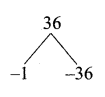
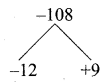
Samacheer Kalvi 10th Maths Guide Chapter 3 Algebra Ex 3.12 1
5x2 – 25x + x – 5 = 0 ⇒ 5x (x – 5) + 1(x – 5) = 0
(x – 5) (5x – 1) = 0 ⇒ x – 5 = 0 or 5x + 1 = 0
x = 5 or 5x = -1 ⇒ x = \(\frac { -1 }{ 5 } \)
The number is 5 or \(\frac { -1 }{ 5 } \)

Samacheer Kalvi 10th Maths Guide Chapter 3 Algebra Ex 3.12

Question 2.
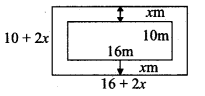
A garden measuring 12m by 16m is to have a pedestrian pathway that is meters wide installed all the way around so that it increases the total area to 285 m2. What is the width of the pathway?
Answer:
Let the width of the rectangle be “ω”
Length of the outer rectangle = 16 + (ω + ω)
16 + 2ω
Breadth of the outer rectangle = 12 + 2ω
Samacheer Kalvi 10th Maths Guide Chapter 3 Algebra Ex 3.12 2
By the given condition
(16 + 2ω) (12 + 2ω) = 285
192 + 32 ω + 24 ω + 4 ω2 = 285
4 ω2 + 56ω = 285 – 192
4 ω2 + 56 ω = 93
4 ω2+ 56 ω – 93 = 0
Here a = 4, b = 56, c = -93
Samacheer Kalvi 10th Maths Guide Chapter 3 Algebra Ex 3.12 3
= 1.5 or -15.5 (Width is not negative)
∴ Width of the path way = 1.5 m

Samacheer Kalvi 10th Maths Guide Chapter 3 Algebra Ex 3.12

Question 3.
A bus covers a distance of 90 km at a uniform speed. Had the speed been 15 km/hour more it would have taken 30 minutes less for the journey. Find the original speed of the journey.
Answer:
Let the original speed of the bus be “x” km/hr
Time taken to cover 90 km = \(\frac { 90 }{ x } \)
After increasing the speed by 15 km/hr
Time taken to cover 90 km = \(\frac { 90 }{ x+15 } \)
By the given condition
\(\frac { 90 }{ x } \) – \(\frac { 90 }{ x+15 } \) = \(\frac { 1 }{ 2 } \)
\(\frac{90(x+15)-90 x}{x(x+15)}\) = \(\frac { 1 }{ 2 } \)
90x + 1350 – 90x = \(\frac{x^{2}+15 x}{2}\)
1350 = \(\frac{x^{2}+15 x}{2}\)
2700 = x2 + 15x
Samacheer Kalvi 10th Maths Guide Chapter 3 Algebra Ex 3.12 4
x2 + 15x – 2700 = 0
(x + 60) (x – 45) = 0
x + 60 = 0 or x – 45 = 0
x = – 60 or x = 45
The speed will not be negative
∴ Original speed of the bus = 45 km/hr

Samacheer Kalvi 10th Maths Guide Chapter 3 Algebra Ex 3.12

Question 4.
A girl is twice as old as her sister. Five years hence, the product of their ages – (in years) will be 375. Find their present ages.
Answer:
Let the age of the sister be “x”
The age of the girl = 2x
Five years hence
Age of the sister = x + 5
Age of the girl = 2x + 5
By the given condition
(x + 5) (2x + 5) = 375
2x2 + 5x + 10x + 25 = 375
2x2 + 15x – 350 = 0
a = 2, b = 15, c = -350
Samacheer Kalvi 10th Maths Guide Chapter 3 Algebra Ex 3.12 5
Age will not be negative
Age of the girl = 10 years
Age of the sister = 20 years (2 × 10)

Samacheer Kalvi 10th Maths Guide Chapter 3 Algebra Ex 3.12

Question 5.
A pole has to be erected at a point on the boundary of a circular ground of diameter 20 m in such a way that the difference of its distances from two diametricallyopposite fixed gates P and Q on the boundary is 4 m. Is it possible to do so? If answer is yes at what distance from the two gates should the pole be erected?
Answer:
Let “R” be the required location of the pole
Let the distance from the gate P is “x” m : PR = “x” m
The distance from the gate Q is (x + 4)m
∴ QR = (x + 4)m
In the right ∆ PQR,
Samacheer Kalvi 10th Maths Guide Chapter 3 Algebra Ex 3.12 6
PR2 + QR2 = PQ2 (By Pythagoras theorem)
x2 + (x + 4)2 = 202
x2 + x2 + 16 + 8x = 400
2x2 + 8x – 384 = 0
Samacheer Kalvi 10th Maths Guide Chapter 3 Algebra Ex 3.12 7
x2 + 4x – 192 = 0(divided by 2)
(x + 16) (x – 12) = 0
x + 16 = 0 or x – 12 = 0 [negative value is not considered]
x = -16 or x = 12
Yes it is possible to erect
The distance from the two gates are 12 m and 16 m

Samacheer Kalvi 10th Maths Guide Chapter 3 Algebra Ex 3.12

Question 6.
From a group of 2x2 black bees , square root of half of the group went to a tree. Again eight-ninth of the bees went to the same tree. The remaining two got caught up in a fragrant lotus. How many bees were there in total?
Answer:
Total numbers of black bees = 2x2
Half of the group = \(\frac { 1 }{ 2 } \) × 2x2 = x2
Square root of half of the group = \(\sqrt{x^{2}}\) = x
Eight – ninth of the bees = \(\frac { 8 }{ 9 } \) × 2x2 = \(\frac{16 x^{2}}{9}\)
Number ofbees in the lotus = 2
By the given condition
x + \(\frac{16 x^{2}}{9}\) + 2 = 2x2
(Multiply by 9) 9x + 16×2 + 18 = 18x2
Samacheer Kalvi 10th Maths Guide Chapter 3 Algebra Ex 3.12 8
18x2 – 16x2 – 9x – 18 = 0 ⇒ 2x2 – 9x – 18 = 0
2x2 – 12x + 3x – 18 = 0
2x(x – 6) + 3 (x – 6) = 0
(x – 6) (2x + 3) = 0
x – 6 = 0 or 2x + 3 = 0
x = 6 or 2x = -3 ⇒ x = \(\frac { -3 }{ 2 } \) (number of bees will not be negative)
Total number of black bees = 2x2 = 2(6)2
= 72

Samacheer Kalvi 10th Maths Guide Chapter 3 Algebra Ex 3.12

Question 7.
Music is been played in two opposite galleries with certain group of people. In the first gallery a group of 4 singers were singing and in the second gallery 9 singers were singing. The two galleries are separated by the distance of 70 m. Where should a person stand for hearing the same intensity of the singers voice?
(Hint: The ratio of the sound intensity is equal to the square of the ratio of their corresponding distances).
Answer:
Number of singers in the first group = 4
Number of singers in the second group = 9
Distance between the two galleries = 70 m
Let the distance of the person from the first group be x
and the distance of the person from the second group be 70 – x
By the given condition
4 : 9 = x2 : (70 – x)2 (by the given hint)
\(\frac { 4 }{ 9 } \) = \(\frac{x^{2}}{(70-x)^{2}}\)
\(\frac { 2 }{ 3 } \) = \(\frac { x }{ 70-x } \) [taking square root on both sides]
3x = 140 – 2x
5x = 140
x = \(\frac { 140 }{ 5 } \) = 28
The required distance to hear same intensity of the singers voice from the first galleries is 28m
The required distance to hear same intensity of the singers voice from the second galleries is (70 – 28) = 42 m

Samacheer Kalvi 10th Maths Guide Chapter 3 Algebra Ex 3.12

Question 8.
There is a square field whose side is 10 m. A square flower bed is prepared in its centre leaving a gravel path all round the flower bed. The total cost of laying the flower bed and gravelling the path at ₹3 and ₹4 per square metre respectively is ₹364. Find the width of the gravel path.
Answer:
Let the width of the gravel path be ‘x’
Side of the flower bed = 10 – (x + x)
= 10 – 2x
Samacheer Kalvi 10th Maths Guide Chapter 3 Algebra Ex 3.12 9
Area of the path way = Area of the field – Area of the flower bed
= 10 × 10 – (10 – 2x) (10 – 2x) sq.m
= 100 – (100 + 4x2 – 40x)
= 100 – 100 – 4x2 + 40x
= 40x – 4x2 sq.m
Area of the flower bed = (10 – 2x) (10 – 2x) sq.m.
= 100 + 4x2 – 40x
By the given condition
Samacheer Kalvi 10th Maths Guide Chapter 3 Algebra Ex 3.12 10
3(100 + 4x2 – 40x) + 4(40x – 4x2) = 364
300 + 12x2 – 120x + 160x – 16x2 = 364
-4x2 + 40x + 300 – 364 = 0
-4x2 + 40x – 64 = 0
(÷ by 4) ⇒ x2 – 10x + 16 = 0
[The width must not be equal to 8 m since the side of the field is 10m]
(x – 8) (x – 2) = 0
x – 8 = 0 or x – 2 = 0 x = 8 or x = 2
Width of the gravel path = 2 m

Samacheer Kalvi 10th Maths Guide Chapter 3 Algebra Ex 3.12

Question 9.
Two women together took 100 eggs to a market, one had more than the other. Both sold them for the same sum of money. The first then said to the second: “If I had your eggs, I would have earned ₹ 15”, to which the second replied: “If I had your eggs, I would have earned ₹ 6 \(\frac{2}{3}\) How many eggs did each had in the beginning?
Solution:
Let the no. of eggs with woman 1 be x and woman 2 be y.
∴ x + y = 100
Let w1 sell the eggs at ₹ ‘a’ per egg.
Let w2 sell the eggs at ₹ ‘b’ per egg.
Case 1:
They sold them for same money.
∴ ax = by
Case 2:
ay = 15 and bx = \(\frac{20}{3}\)
∴ One woman had 40 eggs and the other had 60 eggs.

Samacheer Kalvi 10th Maths Guide Chapter 3 Algebra Ex 3.12

Question 10.
The hypotenuse of a right angled triangle is 25 cm and its perimeter 56 cm. Find the length of the smallest side.
Answer:
Perimeter of a right angle triangle = 56 cm
Sum of the two sides + hypotenuse = 56
Sum of the two sides = 56 – 25
= 31 cm
Let one side of the triangle be “x”
Samacheer Kalvi 10th Maths Guide Chapter 3 Algebra Ex 3.12 11
The other side of the triangle = (31 – x) cm
By Pythagoras theorem
AB2 + BC2 = AC2
x2 + (31 – x)2 = 252
x2 + 961 + x2 – 62x = 625
Samacheer Kalvi 10th Maths Guide Chapter 3 Algebra Ex 3.12 12
2x2 – 62x + 961 – 625 = 0
2x2 – 62x + 336 = 0 ⇒ x2 – 31x + 168 = 0
(x – 24) (x – 7) = 0
x – 24 = 0 (or) x – 7 = 0
x = 24 (or) x = 7
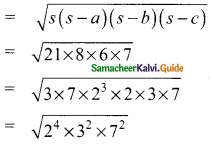
Length of the smallest side is 7 cm

Samacheer Kalvi 9th Maths Guide Chapter 4 Geometry Ex 4.6

Students can download Maths Chapter 4 Geometry Ex 4.6 Questions and Answers, Notes, Samacheer Kalvi 9th Maths Guide Pdf helps you to revise the complete Tamilnadu State Board New Syllabus, helps students complete homework assignments and to score high marks in board exams.

Tamilnadu Samacheer Kalvi 9th Maths Solutions Chapter 4 Geometry Ex 4.6

Question 1.
Draw a triangle ABC, where AB = 8 cm, BC = 6 cm and ∠B = 70° and locate its circumcentre and draw the circumcircle.
Solution:
Samacheer Kalvi 9th Maths Guide Chapter 4 Geometry Ex 4.6 1
Steps for construction:
Step 1: Draw the ΔABC with the given measures.
Step 2: Construct the perpendicular bisector of (AB and BC) any two sides and let them, meet at S which is the circumcenter.
Step 3: With S as centre and SA = SB = SC as radius draw the circumcircle to passes through A, B and C.
Circum radius = 4.3 cm.

Samacheer Kalvi 9th Maths Guide Chapter 4 Geometry Ex 4.6

Question 2.
Construct the right triangle PQR whose perpendicular sides are 4.5 cm and 6 cm. Also locate its circumcentre and draw circumcircle.
Solution:
Samacheer Kalvi 9th Maths Guide Chapter 4 Geometry Ex 4.6 2
Steps for construction:
Step 1: Draw the ΔPQR with the given measures.
Step 2: Construct the perpendicular bisector of (PQ and PR) any two sides and let them meet at S which is the circumcenter.
Step 3: With S as centre and SP = SQ = SR as radius draw the circumcircle to passes through P, Q and R.
Circum radius = 3.8 cm.

Samacheer Kalvi 9th Maths Guide Chapter 4 Geometry Ex 4.6

Question 3.
Construct ΔABC with AB = 5 cm ∠B = 100° and BC = 6 cm. Also locate its circumcentre draw circumcircle.
Solution:
Samacheer Kalvi 9th Maths Guide Chapter 4 Geometry Ex 4.6 3
Steps for construction:
Step 1: Draw the ΔABC with the given measures.
Step 2: Construct the perpendicular bisector of any two sides (AB and BC) and let them meet at S which is the circumcenter.
Step 3: With S as centre and SA = SB = SC as radius draw the circumcircle to passes through A, B and C.
Circum radius = 4.3 cm.

Samacheer Kalvi 9th Maths Guide Chapter 4 Geometry Ex 4.6

Question 4.
Construct an isosceles triangle PQR where PQ = PR and ∠Q = 50°, QR = 7cm. Also draw its circumcircle.
Solution:
Samacheer Kalvi 9th Maths Guide Chapter 4 Geometry Ex 4.6 4
Given PQ = PR
∴ ∠R = 50° (opposite angles are equal)
Steps for construction:
Step 1: Draw the ΔABC with the given measures.
Step 2: Construct the perpendicular bisector of any two sides (QR and PR) and let them meet at S. S is the circumcenter of ΔPQR.
Step 3: With S as centre SP = SQ = SR as radius. Draw the circumcircle.
Circum radius = 3.5 cm.

Samacheer Kalvi 9th Maths Guide Chapter 4 Geometry Ex 4.6

Question 5.
Draw an equilateral triangle of side 6.5 cm and locate its incentre. Also draw the incircle.
Solution:
Samacheer Kalvi 9th Maths Guide Chapter 4 Geometry Ex 4.6 5
Steps for construction:
Step 1: Draw the ΔABC with the each side measure 6.5 cm.
Step 2: Construct the angles bisectors of any two angles (A and B) and let them meet at I. Then I is the incentre of ΔABC.
Step 3: Draw perpendicular from I to any one of the side (AB) to meet AB at D.
Step 4: With I as centre and ID as radius draw the circle. This circle touches all the sides of the triangle internally.
Step 5: Measure of In-radius = 1.5 cm.

Samacheer Kalvi 9th Maths Guide Chapter 4 Geometry Ex 4.6

Question 6.
Draw a right triangle whose hypotenuse is 10 cm and one of the legs is 8 cm. Locate its incentre and also draw the incircle
Solution:
Samacheer Kalvi 9th Maths Guide Chapter 4 Geometry Ex 4.6 6
Steps for construction:
Step 1: Draw the ΔABC with AB = 8cm, BC = 10 cm and ∠A = 90°.
Step 2: Construct the angle bisectors of any two angles (∠B and ∠C) and let them meet at I. Then I is the incentre of ΔABC.
Step 3: Draw perpendicular from I to any one of the side to meet AB at D.
Step 4: With I as centre and ID as radius draw the circle. This circle touches all the sides of the triangle internally.
Step 5: Measure of In-radius = 1.8 cm.

Samacheer Kalvi 9th Maths Guide Chapter 4 Geometry Ex 4.6

Question 7.
Draw ΔABC given AB = 9 cm, ∠CAB = 115° and ∠ABC = 40°. Locate its incentre and also draw the incircle. (Note: You can check from the above examples that the incentre of any triangle is always in its interior).
Solution:
Samacheer Kalvi 9th Maths Guide Chapter 4 Geometry Ex 4.6 7
Step 1: Draw the ΔABC with AB = 9cm, ∠B = 40° and ∠A = 115°.
Step 2: Construct the angle bisectors of any two angles (A and B) and let them meet at I. Then I is the incentre of ΔABC.
Step 3: Draw perpendicular from I to any one of the side (AB) to meet AB at D.
Step 4: With I as centre and ID as radius draw the circle. This circle touches all the sides of the triangle internally.
Step 5: Measure of In-radius = 2.7 cm.

Samacheer Kalvi 9th Maths Guide Chapter 4 Geometry Ex 4.6

Question 8.
Construct ΔABC in which AB = BC = 6cm and ∠B = 80°. Locate its incentre and draw the incircle.
Solution:
Samacheer Kalvi 9th Maths Guide Chapter 4 Geometry Ex 4.6 8
Steps for construction:
Step 1: Draw the ΔABC with AB = 6 cm, ∠B = 80° and BC = 6 cm.
Step 2: Construct the angle bisectors of any two angles (A and B) and let them meet at I. Then I is the incentre of ΔABC.
Step 3: Draw perpendicular from I to any one of the side (AB) to meet AB at D.
Step 4: With I as centre and ID as radius draw the circle. This circle touches all the sides of the triangle internally.
Step 5: Measure of In-radius = 1.9 cm.

Samacheer Kalvi 9th Maths Guide Chapter 4 Geometry Ex 4.6

Samacheer Kalvi 9th Maths Guide Chapter 4 Geometry Ex 4.5

Students can download Maths Chapter 4 Geometry Ex 4.5 Questions and Answers, Notes, Samacheer Kalvi 9th Maths Guide Pdf helps you to revise the complete Tamilnadu State Board New Syllabus, helps students complete homework assignments and to score high marks in board exams.

Tamilnadu Samacheer Kalvi 9th Maths Solutions Chapter 4 Geometry Ex 4.5

Question 1.
Construct the ΔLMN such that LM = 7.5 cm, MN = 5cm and LN = 8cm. Locate its centroid.
Solution:
Samacheer Kalvi 9th Maths Guide Chapter 4 Geometry Ex 4.5 1
Steps for construction:
Step 1: Draw the ΔLMN using the given measurement LM = 7.5 cm, MN = 5cm and LN = 8cm.
Step 2: Construct the perpendicular bisectors of any two sides LM and MN intersect LM at P and MN at Q respectively.
Step 3: Draw the median LQ and PN meet at G.
The point G is the centroid of the given ΔLMN.

Samacheer Kalvi 9th Maths Guide Chapter 4 Geometry Ex 4.5

Question 2.
Draw and locate the centroid of the triangle ABC where right angle at A, AB = 4cm and AC = 3 cm.
Solution:
Samacheer Kalvi 9th Maths Guide Chapter 4 Geometry Ex 4.5 2
Steps for construction:
Step 1: Draw the ΔABC using the given measurement AB = 4cm and AC = 3 cm and ZA = 90°.
Step 2: Construct the perpendicular bisectors of any two sides AB and AC to find the mid-points P and Q of AB and AC.
Step 3: Draw the medians PC and BQ intersect at G.
The point G is the centroid of the given ΔABC.

Samacheer Kalvi 9th Maths Guide Chapter 4 Geometry Ex 4.5

Question 3.
Draw the ΔABC, where AB = 6cm, ∠B = 110° and AC = 9cm and construct the centroid.
Solution:
Samacheer Kalvi 9th Maths Guide Chapter 4 Geometry Ex 4.5 3
Steps for construction:
Step 1: Draw the ΔABC using the given measurement AB = 6cm, AC = 9cm and ∠B =110°.
Step 2: Construct the perpendicular bisectors of any two sides AB and BC to find the mid-points P and Q of AB and BC.
Step 3: Draw the medians PC and AQ intersect at G.
The point G is the centroid of the given ΔABC.

Samacheer Kalvi 9th Maths Guide Chapter 4 Geometry Ex 4.5

Question 4.
Construct the ΔPQR such that PQ = 5cm, PR = 6cm and ∠QPR = 60° and locate its centroid.
Solution:
Samacheer Kalvi 9th Maths Guide Chapter 4 Geometry Ex 4.5 4
Steps for construction:
Step 1 : Draw ΔPQR using the given measurements PQ = 5cm, PR = 6cm and ∠P = 60°.
Step 2 : Construct the perpendicular bisectors of any two sides PQ and QR to find the mid-points of M and N respectively.
Step 3 : Draw the median PN and MR and let them meet at G.
The point G is the centroid of the given ΔPQR.

Samacheer Kalvi 9th Maths Guide Chapter 4 Geometry Ex 4.5

Question 5.
Draw ΔPQR with sides PQ = 7 cm, QR = 8 cm and PR = 5 cm and construct its Orthocentre.
Solution:
Samacheer Kalvi 9th Maths Guide Chapter 4 Geometry Ex 4.5 5
Steps for construction:
Step 1: Draw the ΔPQR with the given measurements.
Step 2: Construct altitudes from any two vertices P and Q to their opposite sides QR and PR respectively.
Step 3: The point of intersection of the altitude H is the orthocentre of the given ΔPQR.

Samacheer Kalvi 9th Maths Guide Chapter 4 Geometry Ex 4.5

Question 6.
Draw an equilateral triangle of sides 6.5 cm and locate its Orthocentre.
Solution:
Samacheer Kalvi 9th Maths Guide Chapter 4 Geometry Ex 4.5 6
Steps for construction:
Step 1: Draw the ΔABC with the given measurements.
Step 2: Construct altitudes from any two vertices A and C to their opposite sides BC and AB respectively.
Step 3: The point of intersection of the altitude H is the orthocentre of the given ΔABC.

Samacheer Kalvi 9th Maths Guide Chapter 4 Geometry Ex 4.5

Question 7.
Draw ΔABC, where AB = 6 cm, ∠B = 110° and BC = 5 cm and construct its Orthocentre.
Solution:
Samacheer Kalvi 9th Maths Guide Chapter 4 Geometry Ex 4.5 7
Steps for construction:
Step 1: Draw the ΔABC with the given measurements.
Step 2: Construct altitudes from any two vertices B and C to their opposite sides AC and BC respectively.
Step 3: The point of intersection of the altitude H is the orthocentre of the given ΔABC.

Samacheer Kalvi 9th Maths Guide Chapter 4 Geometry Ex 4.5

Question 8.
Draw and locate the Orthocentre of a right triangle PQR where PQ = 4.5 cm, QR = 6 cm and PR = 7.5 cm.
Solution:
Samacheer Kalvi 9th Maths Guide Chapter 4 Geometry Ex 4.5 8
Steps for construction:
Step 1: Draw the ΔPQR with the given measures.
Step 2: Construct altitude from any two vertices Q and R to their opposite side PR and PQ respectively.
Step 3: The point of intersection of the altitude H is the orthocentre of the given ΔPQR.

Samacheer Kalvi 9th Maths Guide Chapter 4 Geometry Ex 4.5

Samacheer Kalvi 9th Maths Guide Chapter 4 Geometry Ex 4.4

Students can download Maths Chapter 4 Geometry Ex 4.4 Questions and Answers, Notes, Samacheer Kalvi 9th Maths Guide Pdf helps you to revise the complete Tamilnadu State Board New Syllabus, helps students complete homework assignments and to score high marks in board exams.

Tamilnadu Samacheer Kalvi 9th Maths Solutions Chapter 4 Geometry Ex 4.4

Question 1.
Find the value of x in the given figure.
Samacheer Kalvi 9th Maths Guide Chapter 4 Geometry Ex 4.4 1
Solution:
∠B = 180° – 120°
(Sum of the opposite angles of a quadrilateral are supplementary)
∠B = 60°
∠BCA = 90° (Angle in a semicircle)
∠BAC + ∠B + ∠BCA = 180°
x + 60° + 90° = 180°
x + 150° = 180°
x = 180° – 150°
= 30°
The value of x = 30°

Samacheer Kalvi 9th Maths Guide Chapter 4 Geometry Ex 4.4

Question 2.
In the given figure, AC is the diameter of the circle with centre O.
Samacheer Kalvi 9th Maths Guide Chapter 4 Geometry Ex 4.4 2
If ∠ADE = 30°; ∠DAC = 35° and ∠CAB = 40°.
Find (i) ∠ACD
(ii) ∠ACB
(iii) ∠DAE
Solution:
(i) ∠ADC = 90° (Angle in a semi-circle)
∠ADC + ∠ACD + ∠DAC = 180° (Sum of the angles of a triangle is 180°)
90° + ∠ACD + 35° = 180°
∠ACD = 180° – 125°
∠ACD = 55°

(ii) ∠ABC = 90° (Angle in a semi-circle)
∠ACB + ∠CBA + ∠BAC = 180° (Sum of the angles of a triangle is 180°)
∠ACB + 90 °+ 40° = 180°
∠ACB = 180° – 130°
= 50°

(iii) In the cyclic quadrilateral ACDE,
∠AED = 180° – 55°
= 125°
In ΔAED,
∠DAE + ∠AED + ∠EDA = 180° (Sum of the angles of a triangle is 180°)
∠DAE + 125° + 30° = 180°
∠DAE = 180°- 155°
= 25°
∴ ∠DAE = 25°

Samacheer Kalvi 9th Maths Guide Chapter 4 Geometry Ex 4.4

Question 3.
Find all the angles of the given cyclic quadrilateral ABCD in the figure.
Samacheer Kalvi 9th Maths Guide Chapter 4 Geometry Ex 4.4 3
Solution:
In a cyclic quadrilateral ABCD,
∠B + ∠D = 180° (Sum of the opposite angles of a cyclic quadrilateral is 180°)
6x – 4° + 7x + 2° = 180°
13x – 2° = 180°
13x = 182°
x = 182°
x = \(\frac{182°}{13}\)
x = 14°
∠B = 6x – 4°
= 6(14) – 4°
= 84 – 4
= 80°
∠D = 7x + 2°
7(14) + 2°
98 + 2
= 100°
180°
2y + 4° + 4y – 4° = (Sum of the opposite angles of a cyclic quadrilateral is 180°)
6y = 180°
y = \(\frac{180°}{6}\)
= 30°
∠A = 2y + 4°
= 2(30) + 4°
= 64°
∠C = 4y – 4°
= 4(30) – 4°
= 120° – 4°
= 116°
∴ ∠A = 64°, ∠B = 80°, ∠C = 116°, ∠D = 100°.

Samacheer Kalvi 9th Maths Guide Chapter 4 Geometry Ex 4.4

Question 4.
In the given figure, ABCD is a cyclic quadrilateral where diagonals intersect at P such that ∠DBC = 40° and ∠BAC = 60° find
Samacheer Kalvi 9th Maths Guide Chapter 4 Geometry Ex 4.4 4
(i) ∠CAD
(ii) ∠BCD
Solution:
(i) ∠CAD = ∠DBC = 40° [Angles at the circumference to the same segment]
(ii) ∠BAC – ∠BDC = 60° [Angles at the circumference to the same segment]
∠BCD + ∠BDC + ∠CBD = 180° (Sum of the three angles of A is 180°)
∠BCD + 60° + 40° = 180°
∠BCD = 180° – 100°
= 80°

Samacheer Kalvi 9th Maths Guide Chapter 4 Geometry Ex 4.4

Question 5.
In the given figure, AB and CD are the parallel chords of a circle with centre O. Such that AB = 8 cm and CD = 6 cm. If OM ⊥ AB and OL ⊥ CD distance between LM is 7cm. Find the radius of the circle?
Samacheer Kalvi 9th Maths Guide Chapter 4 Geometry Ex 4.4 5
Solution:
Let OM be x.
∴ OL = 7 – x
In the right ΔAOM,
OA² = AM² + OM²
= 4² + x²
OA² = 16 + x²
r² = 16 + x² ……… (1) [r is the radius]
In the right ΔOCL,
OC² = OL² + CL²
r² = (7 – x)² + 3²
= 49 + x² – 14x + 9
= 58 + x² – 14x …….. (2)
From (1) and (2) we get,
16 + x² = 58 + x² – 14x
14x = 58 – 16
14x = 42
x = \(\frac{42}{14}\)
x = 3 cm
r² = 16 + x²
= 16 + 9
= 25
∴ r = \(\sqrt{25}\)
= 5
∴ radius of the circle = 5 cm.

Samacheer Kalvi 9th Maths Guide Chapter 4 Geometry Ex 4.4

Question 6.
The arch of a bridge has dimensions as shown, where the arch measure 2 m at its highest point and its width is 6 cm. What is the radius of the circle that contains the arch?
Samacheer Kalvi 9th Maths Guide Chapter 4 Geometry Ex 4.4 6
Solution:
AD = \(\frac{6}{2}\)
= 3 m
In the right ΔADC,
Samacheer Kalvi 9th Maths Guide Chapter 4 Geometry Ex 4.4 7
AC² = AD² + DC²
= 32 + 22
= 9 + 4
= 13
AC = \(\sqrt{13}\)
= 3.6m
radius = 3.6 m

Samacheer Kalvi 9th Maths Guide Chapter 4 Geometry Ex 4.4

Question 7.
In figure ∠ABC = 120°, where A, B and C are points on the circle with centre O. Find ∠OAC?
Samacheer Kalvi 9th Maths Guide Chapter 4 Geometry Ex 4.4 8
Solution:
Reflex ∠AOC = 2∠ABC
= 20 × 120°
= 240°
∴ ∠AOC = 360° – 240°
= 120°
∠OCA + ∠OAC = 180° – 120°
= 60°
∴ ∠OAC = \(\frac{60}{2}\)
= 30° (Since OA = OC)

Samacheer Kalvi 9th Maths Guide Chapter 4 Geometry Ex 4.4

Question 8.
A school wants to conduct tree plantation programme. For this a teacher allotted a circle of radius 6m ground to nineth standard students for planting sapplings. Four students plant trees at the points A, B, C and D as shown in figure. Here AB = 8m, CD = 10m and AB ⊥ CD. If another student places a flower pot at the point P, the intersection of AB and CD, then find the distance from the centre to P.
Samacheer Kalvi 9th Maths Guide Chapter 4 Geometry Ex 4.4 9
Solution:
OA = OD = 6 m
AB = 8 m (chord)
CD = 10 m (chord)
In Δ AOM, OM = \(\sqrt{6² – 4²}\) (∴ OM bisects the chord and ⊥ to the chord)
= \(\sqrt{36 – 16}\)
= \(\sqrt{20}\)m
In Δ CON, ON = \(\sqrt{6² – 5²}\)
= \(\sqrt{36 – 25}\)
= \(\sqrt{11}\)m (ON bisects the chord and ⊥ to the chord)
ONPM is a rectangle with all the angles 90° and with length \(\sqrt{20}\) m, breadth \(\sqrt{11}\)l m.
We need to find OP which is the diagonal of the rectangle ONPM.
∴ OP = \(\sqrt{ON² + NP²}\) = \(\sqrt{(\sqrt{11})² + (\sqrt{20})²}\)
(∴ OM = NP, opposite sides of the rectangle)
= \(\sqrt{11 + 20}\)
= \(\sqrt{31}\)
= 5.56 m

Samacheer Kalvi 9th Maths Guide Chapter 4 Geometry Ex 4.4

Question 9.
In the given figure, ∠POQ = 100° and ∠PQR° = 30°, then find ∠RPO.
Samacheer Kalvi 9th Maths Guide Chapter 4 Geometry Ex 4.4 10
Solution:
∠PRQ = \(\frac{1}{2}\) ∠POQ (Angles at the circumference)
= \(\frac{1}{2}\) × 100°
= 50°
∠OPQ + ∠OQP = 180° – 100° (Total angles of A is 180°)
= 80°
∴ ∠OPQ = \(\frac{80}{2}\)
= 40° (Since OP = OQ, radius of the circle)
∠RPQ = 180°- (30 + 50)°
= 100°
∴ ∠RPO = ∠RPQ – ∠OPQ
= 100° – 40°
= 60°

Samacheer Kalvi 9th Maths Guide Chapter 4 Geometry Ex 4.4

Samacheer Kalvi 10th Maths Guide Chapter 3 Algebra Ex 3.11

Students can download Maths Chapter 3 Algebra Ex 3.11 Questions and Answers, Notes, Samacheer Kalvi 10th Maths Guide Pdf helps you to revise the complete Tamilnadu State Board New Syllabus, helps students complete homework assignments and to score high marks in board exams.

Tamilnadu Samacheer Kalvi 10th Maths Solutions Chapter 3 Algebra Ex 3.11

Question 1.
Solve the following quadratic equations by completing the square method
(i) 9x2 – 12x + 4 = 0
Answer:
9x2 – 12x + 4 = 0
x2 – \(\frac { 12x }{ 9 } \) + \(\frac { 4 }{ 9 } \) = 0 (Divided by 9)
x2 – \(\frac { 4x }{ 3 } \) = \(\frac { -4 }{ 9 } \)
Add [\(\frac { 1 }{ 2 } \) (\(\frac { 4 }{ 3 } \))]2 on both sides
Samacheer Kalvi 10th Maths Guide Chapter 3 Algebra Ex 3.11 1
The solution is \(\frac { 2 }{ 3 } \)

Samacheer Kalvi 10th Maths Guide Chapter 3 Algebra Ex 3.11

(ii) \(\frac { 5x+7 }{ x-1 } \) = 3x + 2
Answer:
(3x + 2) (x – 1) = 5x + 7
3x2 – 3x + 2x – 2 = 5x + 7 ⇒ 3x2 – x – 5x – 2 – 7 = 0
3x2 – 6x – 9 = 0 ⇒ x2 – 2x – 3 = 0 (divided by 3)
x2 – 2x = 3
Adding (\(\frac { 1 }{ 2 } \) × 2)2 on both sides
x2 – 2x + 1 = 3 + 1
(x – 1)2 = 4 ⇒ x – 1 = \(\sqrt { 4 }\)
x – 1 = ±2
x – 1 = 2 or x – 1 = -2
x = 3 or x = -1
The solution set is -1 and 3

Samacheer Kalvi 10th Maths Guide Chapter 3 Algebra Ex 3.11

Question 2.
Solve the following quadratic equations by formula method
(i) 2x2 – 5x + 2 = 0
Answer:
a = 2, b = -5, c = 2
Samacheer Kalvi 10th Maths Guide Chapter 3 Algebra Ex 3.11 2
The solution set is \(\frac { 1 }{ 2 } \) and 2

(ii) \(\sqrt { 2 }\) f2 – 6 f + 3 \(\sqrt { 2 }\) = 0
Answer:
Here a = \(\sqrt { 2 }\), b = -6 and c = 3\(\sqrt { 2 }\)
Samacheer Kalvi 10th Maths Guide Chapter 3 Algebra Ex 3.11 3
The solution set is \(\frac{3+\sqrt{3}}{\sqrt{2}}\) and \(\frac{3-\sqrt{3}}{\sqrt{2}}\)

(iii) 3y2 – 20y – 23 = 0
Answer:
a = 3, b = -20, c = -23
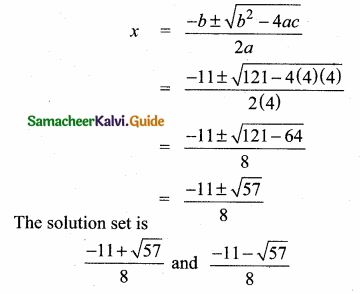
Samacheer Kalvi 10th Maths Guide Chapter 3 Algebra Ex 3.11 4
The solution set is -1 and \(\frac { 23 }{ 3 } \)

(iv) 36y2 – 12ay + (a2 – b2) = 0
Answer:
Here a = 36, b = -12a, c = a2 – b2
Samacheer Kalvi 10th <img class=
The solution set is \(\frac { (a+b) }{ 6 } \) and \(\frac { (a-b) }{ 6 } \)

Samacheer Kalvi 10th Maths Guide Chapter 3 Algebra Ex 3.11

Question 3.
A ball rolls down a slope and travels a distance d = t2 – 0.75t feet in t seconds. Find the time when the distance travelled by the ball is 11.25 feet.
Answer:
Distance = t2 – 0.75t
11.25 = t2 – 0.75t
Multiply by 100
1125 = 100t2 – 75t
100t2 – 75t – 1125 = 0 (Divided by 25)
4t2 – 3t – 45 = 0
a = 4,
b = -3,
c = -45
Samacheer Kalvi 10th Maths Guide Chapter 3 Algebra Ex 3.11 7
(time will not be negative)
The required time = \(\frac { 15 }{ 4 } \) seconds
= 3 \(\frac { 3 }{ 4 } \) second or 3.75 seconds

Samacheer Kalvi 9th Maths Guide Chapter 4 Geometry Ex 4.3

Students can download Maths Chapter 4 Geometry Ex 4.3 Questions and Answers, Notes, Samacheer Kalvi 9th Maths Guide Pdf helps you to revise the complete Tamilnadu State Board New Syllabus, helps students complete homework assignments and to score high marks in board exams.

Tamilnadu Samacheer Kalvi 9th Maths Solutions Chapter 4 Geometry Ex 4.3

Question 1.
The diameter of the circle is 52 cm and the length of one of its chord is 20 cm. Find the distance of the chord from the centre.
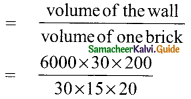
Radius of a circle = \(\frac{56}{2}\) = 26 cm
Solution:
Samacheer Kalvi 9th Maths Guide Chapter 4 Geometry Ex 4.3 1
Length of the chord = 20 cm
AC = \(\frac{20}{2}\)
= 10 cm
In ΔOAC, OC² = OA² – AC²
= 26² – 10²
= (26 + 10) (26 – 10)
= 36 × 16
OC = \(\sqrt{30×16}\)
= 6 × 4 cm
= 24 cm
Distance of the chord from the centre = 24 cm.
Samacheer Kalvi 9th Maths Guide Chapter 4 Geometry Ex 4.3

Question 2.
The chord of length 30 cm is drawn at the distance of 8 cm from the centre of the circle. Find the radius of the circle.
Solution:
Samacheer Kalvi 9th Maths Guide Chapter 4 Geometry Ex 4.3 2
Distance AC = \(\frac{1}{2}\) × Length of chord
= \(\frac{1}{2}\) × 30
= 15 cm
Distance from the centre = 8 cm
In ΔOAC Radius (OA) = \(\sqrt{AC² + OC²}\)
= \(\sqrt{15² + 8²}\)
= \(\sqrt{224 + 64}\)
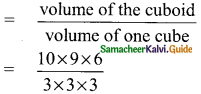
= \(\sqrt{289}\)
= 17
Radius of the circle = 17 cm.

Samacheer Kalvi 9th Maths Guide Chapter 4 Geometry Ex 4.3
Question 3.
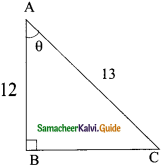
Find the length of the chord AC where AB and CD are the two diameters perpendicular to each other of a circle with radius 4√2 cm and also find ∠OAC and ∠OCA.
Solution:
Radius of a circle = 4√2 cm
In the right ΔAOC,
Samacheer Kalvi 9th Maths Guide Chapter 4 Geometry Ex 4.3 3
AC² = OA² + OC²
AC² = (4√2)² + (4√2)²
= 32 + 32 = 64
AC = \(\sqrt{64}\)
= 8
Length of the chord = 8 cm,
∠OAC = ∠OCA = 45°
Since OAC is an isosceles right angle triangle.

Samacheer Kalvi 9th Maths Guide Chapter 4 Geometry Ex 4.3

Question 4.
A chord is 12 cm away from the centre of the circle of radius 15cm. Find the length of the chord.
Solution:
Radius of a circle (OA) = 15 cm
Distance from centre to the chord (OC) = 12 cm
In the right ΔOAC,
Samacheer Kalvi 9th Maths Guide Chapter 4 Geometry Ex 4.3 4
AC² = OA² – OC²
= 15² – 12²
= 225 – 144
= 81
AC = \(\sqrt{81}\)
= 9
Length of the chord (AB) = AC + CB
= 9 + 9 = 18 cm.

Samacheer Kalvi 9th Maths Guide Chapter 4 Geometry Ex 4.3

Question 5.
In a circle, AB and CD are two parallel chords with centre O and radius 10 cm such that AB = 16 cm and CD = 12 cm determine the distance between the two chords?
Solution:
Length of the chord (AB) = 16 cm
∴ AF = \(\frac{1}{2}\) × 16
= 8 cm
Length of the chord (CD) = 12 cm
∴ CE = \(\frac{1}{2}\) × 12
= 6 cm
Samacheer Kalvi 9th Maths Guide Chapter 4 Geometry Ex 4.3 5
In the right ΔOCE,
OE² = OC² – CE²
= 10² – 6²
= 100 – 36
= 64
OE = \(\sqrt{64}\)
= 8 cm
In the right ΔOAF,
OF² = OA² – AF²
= 10² – 8²
= 100 – 64
= 36
OE = \(\sqrt{36}\)
= 6 cm
Distance between the two chords = OE + OF
= 8 + 6
= 14 cm.

Samacheer Kalvi 9th Maths Guide Chapter 4 Geometry Ex 4.3

Question 6.
Two circles of radii 5 cm and 3 cm intersect at two points and the distance between their centres is 4 cm. Find the length of the common chord.
Ans
Samacheer Kalvi 9th Maths Guide Chapter 4 Geometry Ex 4.3 6
Two circules intersect at C and D
CD is the common chord.
CD = AC + AD
= 3 + 3
= 6 cm
Length of the common chord = 6 cm.

Samacheer Kalvi 9th Maths Guide Chapter 4 Geometry Ex 4.3

Question 7.
Find the value of x° in the following figures:
Samacheer Kalvi 9th Maths Guide Chapter 4 Geometry Ex 4.3 7
Solution:
(i) ∠BOC = 30° + 60°
= 90°
∠BAC (x) = \(\frac{1}{2}\) ∠BOC (By theorem)
= \(\frac{1}{2}\) × 90°
x = 45°

(ii) Join OP
∠QPR = \(\frac{80}{2}\) = 40° (Angle of the circumference is \(\frac{1}{2}\) the angle at the centre)
∠RPO = 30° (OP and OR are equal sides)
∠OPQ = 40° – 30°
= 10°
∠OQP = 10° (OQ and OP are equal sides)
∴ x = 10°

Samacheer Kalvi 9th Maths Guide Chapter 4 Geometry Ex 4.3

(iii) ∠OPN = ∠ONP (ON and OP are the radius of the circle)
= 90°
In ΔOPN
∠PON + ∠ONP + ∠NPO = 180° (Sum of the angles of a triangle)
70° + x° + x° = 180°
2x° + 70° = 180°
2x = 180° – 70°
2x = 110°
X = \(\frac{110°}{2}\)
= 55°
The value of x = 55°

(iv) Reflex ∠YOZ = 2∠YXZ
= 2(120°)
= 240°
∠YOZ = 360° – reflex ∠YOZ
= 360° – 240°
= 120°
∴ x = 120°

(v) ∠OAC + ∠OCA = 180° – 100°
= 80°
∠OAC = \(\frac{1}{2}\) × 80° [Since OA = OC, (∴ ∠OAC = ∠OCA)]
= 40°
∠OBA + ∠OAB = 180° – 140°
= 40° [Since ∠OBA = ∠OAB, since OB = OA]
∴∠OAB = \(\frac{40°}{2}\)
= 20°
∠BAC = ∠OAB + ∠OAC
= 20° + 40°
x = 60°

Samacheer Kalvi 9th Maths Guide Chapter 4 Geometry Ex 4.3

Question 8.
In the given figure, ∠CAB = 25°, find ∠BDC, ∠DBA and ∠COB.
Samacheer Kalvi 9th Maths Guide Chapter 4 Geometry Ex 4.3 8
Solution:
In ΔACP,
∠ACP = 180° – (25° + 90°)
= 180° – 115°
= 65°
∠CBA = ∠CAB = 25° [Both the angles are standing in the same base]
∠DBA = 65° [∠DBA and ∠BCA standing in the same base]
∠COB = 50°
Samacheer Kalvi 9th Maths Guide Chapter 4 Geometry Ex 4.3 9

Samacheer Kalvi 10th Maths Guide Chapter 3 Algebra Ex 3.10

Students can download Maths Chapter 3 Algebra Ex 3.10 Questions and Answers, Notes, Samacheer Kalvi 10th Maths Guide Pdf helps you to revise the complete Tamilnadu State Board New Syllabus, helps students complete homework assignments and to score high marks in board exams.

Tamilnadu Samacheer Kalvi 10th Maths Solutions Chapter 3 Algebra Ex 3.10

Question 1.
Solve the following quadratic equations by factorization method
(i) 4x2 – 7x – 2 = 0
Answer:
4x2 – 7x – 2 = 0
4x2 – 8x + x – 2 = 0
4x(x – 2) + 1(x – 2) = 0
(x – 2) + (4x + 1) = 0
Samacheer Kalvi 10th Maths Guide Chapter 3 Algebra Ex 3.10 1
x – 2 = 0 or 4x + 1 = 0 (equate the product of factors to zero)
x = 2 or 4x = -1 ⇒ x = \(\frac { -1 }{ 4 } \)
The roots are 2; \(\frac { -1 }{ 4 } \)

Samacheer Kalvi 10th Maths Guide Chapter 3 Algebra Ex 3.10

(ii) 3(p2 – 6) = p(p + 5)
Answer:
3p2 – 18 = p2 + 5p
Samacheer Kalvi 10th Maths Guide Chapter 3 Algebra Ex 3.10 2
2p2 – 5p – 18 = 0
2p2 – 9p + 4p – 18 = 0
p(2p – 9) + 2(2p – 9) = 0
(2p – 9)(p + 2) = 0
2p – 9 = 0 or p + 2 =
The roots are p = \(\frac { 9 }{ 2 } \), -2

(iii) \(\sqrt{a(a-7)}\) = 3 \(\sqrt{2}\)
Answer:
Squaring on both sides
a(a – 7) = (3\(\sqrt{2}\))2
Samacheer Kalvi 10th Maths Guide Chapter 3 Algebra Ex 3.10 3
a2 – 7a = 18
a2 – 7a – 18 = 0
(a – 9) (a + 2) = 0
a – 9 = 0 or a + 2 = 0
The roots are -2 and 9

Samacheer Kalvi 10th Maths Guide Chapter 3 Algebra Ex 3.10

(iv) \(\sqrt { 2 }\) x2 + 7x + 5\(\sqrt { 2 }\) = 0
Answer:
\(\sqrt { 2 }\) x2 + 7x + 5 \(\sqrt { 2 }\) = 0
\(\sqrt { 2 }\) x2 + 2x + 5x + 5\(\sqrt { 2 }\) = 0
\(\sqrt { 2 }\) x (x + \(\sqrt { 2 }\)) + 5(x + \(\sqrt { 2 }\)) = 0
Samacheer Kalvi 10th Maths Guide Chapter 3 Algebra Ex 3.10 4
(x + \(\sqrt { 2 }\)) + (\(\sqrt { 2 }\)x + 5) = 0 (equate the product of factors to zero)
x + – \(\sqrt { 2 }\) = 0 or \(\sqrt { 2 }\)x + -5
x = \(\frac{-5}{\sqrt{2}}\)
The roots are – \(\sqrt { 2 }\), \(\frac{-5}{\sqrt{2}}\)

(v) 2x2 – x + \(\frac { 1 }{ 8 } \) = 0
Answer:
2x2 -x + \(\frac { 1 }{ 8 } \) = 0
16x2 – 8x + 1 = (multiply by 8)
Samacheer Kalvi 10th Maths Guide Chapter 3 Algebra Ex 3.10 5
16x2 – 4x – 4x + 1
4x(4x – 1) – 1 (4x – 1) = 0
(4x- 1) (4x- 1) = 0
4x = 1, 4x = 1
x = \(\frac { 1 }{ 4 } \), x = \(\frac { 1 }{ 4 } \)
The roots are \(\frac { 1 }{ 4 } \) and \(\frac { 1 }{ 4 } \)

Samacheer Kalvi 10th Maths Guide Chapter 3 Algebra Ex 3.10

Question 2.
The number of volleyball games that must be scheduled in a league with n teams is given by G(n) = \(\frac{n^{2}-n}{2}\) where each team plays with every other team exactly once. A league schedules 15 games. How many teams are in the league?
Solution:
G(n) = \(\frac{n^{2}-n}{2}\)
⇒ 15 = \(\frac{n^{2}-n}{2}\) ⇒ 30 = n2 – n
n2 – n – 30 = 0
⇒ n2 – 6n + 5n – 30 = 0
n(n – 6) + 5 (n – 6) = 0
(n – 6)(n + 5) = 0 ⇒ n = 6, -5
As n cannot be (-ve), n = 6.
∴ There are 6 teams in the league.

Samacheer Kalvi 9th Maths Guide Chapter 5 Coordinate Geometry Additional Questions

Students can download Maths Chapter 5 Coordinate Geometry Additional Questions and Answers, Notes, Samacheer Kalvi 9th Maths Guide Pdf helps you to revise the complete Tamilnadu State Board New Syllabus, helps students complete homework assignments and to score high marks in board exams.

Tamilnadu Samacheer Kalvi 9th Maths Solutions Chapter 5 Coordinate Geometry Additional Questions

I. Multiple Choice Questions.

Question 1.
On which quadrant does the point (- 4, 3) lie?
(a) I
(b) II
(c) III
(d) IV
Solution:
(b) II

Question 2.
The point whose abscissa is 5 and lies on the x-axis is …….
(a) (-5, 0)
(b) (5, 5)
(c) (0, 5)
(d) (5, 0)
Solution:
(d) (5, 0)

Samacheer Kalvi 9th Maths Guide Chapter 5 Coordinate Geometry Additional Questions

Question 3.
A point which lies in the III quadrant is ……..
(a) (5, 4)
(b) (5, -4)
(c) (-5, -4)
(d) (-5, 4)
Solution:
(c) (-5, -4)

Question 4.
A point on the y-axis is ……..
(a) (1, 1)
(b) (6, 0)
(c) (0, 6)
(d) (-1, -1)
Solution:
(c) (0, 6)

Question 5.
The distance between the points (4, -1) and the origin is ……..
(a) \(\sqrt{24}\)
(b) \(\sqrt{37}\)
(c) \(\sqrt{26}\)
(d) \(\sqrt{17}\)
Solution:
(d) \(\sqrt{17}\)

Question 6.
The distance between the points (-1, 2) and (3, 2) is ……..
(a) \(\sqrt{14}\)
(b) \(\sqrt{15}\)
(c) 4
(d) 0
Solution:
(c) 4

Samacheer Kalvi 9th Maths Guide Chapter 5 Coordinate Geometry Additional Questions

Question 7.
The centre of a circle is (0, 0). One end point of a diameter is (5, -1), then the radius is …….
(a) \(\sqrt{24}\)
(b) \(\sqrt{37}\)
(c) \(\sqrt{26}\)
(d) \(\sqrt{17}\)
Solution:
(c) \(\sqrt{26}\)

Question 8.
The point (0, -3) lies on
(a) + ve x-axis
(b) + ve y-axis
(c) – ve x-axis
(d) – ve y-axis
Solution:
(d) – ve y-axis

Question 9.
The point which is on y-axis with ordinate -5 is ……..
(a) (0, -5)
(b) (-5, 0)
(c) (5, 0)
(d) (0, 5)
Solution:
(a) (0, -5)

Question 10.
The diagonal of a square formed by the points (1, 0), (0, 1), (-1, 0) and (0, -1) is …….
(a) 2
(b) 4
(c) √2
(d) 8
Solution:
(a) 2

Samacheer Kalvi 9th Maths Guide Chapter 5 Coordinate Geometry Additional Questions

Question 11.
The distance between the points (-2, 2) and (3, 2) is ……..
(a) 10 units
(b) 5 units
(c) 5√3 units
(d) 20 units
Solution:
(b) 5 units

Question 12.
The midpoint of the line joining the points (1, -1) and (-5, 3) is ……..
(a) (2, 1)
(b) (2, -1)
(c) (-2, -1)
(d) (-2, 1)
Solution:
(d) (-2, 1)

Question 13.
If the centroid of a triangle is at (1, 3) and two of its vertices are (-7, 6) and (8, 5) then the third vertex is ……..
(a) (-2, 2)
(b) (2, -2)
(c) (-2, -2)
(d) (2, 2)
Solution:
(b) (2, -2)

Question 14.
The ratio in which the X-axis divides the line segment joining the points (6, 4) and (1, -7) is ……..
(a) 1 : 2
(b) 2 : 3
(c) 4 : 7
(d) 7 : 4
Solution:
(c) 4 : 7

Samacheer Kalvi 9th Maths Guide Chapter 5 Coordinate Geometry Additional Questions

Question 15.
The centroid of a triangle (3, -5), (-7, 4) and (10, -2) is …….
(a) (2, -1)
(b) (2, 1)
(c) (-2, 1)
(d) (1, -2)
Solution:
(a) (2, -1)

II. Answer the Following Questions.

Question 1.
Show that the given points (1, 1), (5, 4), (-2, 5) are the vertices of an isosceles right angled triangle.
Solution:
Let A (1, 1), B (5, 4) and G (-2, 5)
Samacheer Kalvi 9th Maths Guide Chapter 5 Coordinate Geometry Additional Questions 1
AB = 5, AC = 5
∴ ABC is an isosceles triangle …….. (1)
BC² = AB² + AC²
50 = 25 + 25 ⇒ 50 = 50
∴ ∠A = 90° ……… (2)
From (1) and (2) we get ABC is an isosceles right angle triangle.

Question 2.
Show that the point (3, -2), (3, 2), (-1, 2) and (-1, -2) taken in order are the vertices of a square.
Solution:
Samacheer Kalvi 9th Maths Guide Chapter 5 Coordinate Geometry Additional Questions 2
= \(\sqrt{16}\)
= 4
AB = BC = CD = DA = 4. All the four sides are equal.
∴ ABCD is a Rhombus ……..(1)
Samacheer Kalvi 9th Maths Guide Chapter 5 Coordinate Geometry Additional Questions 3
Diagonal AC = Diagonal BD = \(\sqrt{32}\) ……..(2)
From (1) and (2) we get ABCD is a square.

Samacheer Kalvi 9th Maths Guide Chapter 5 Coordinate Geometry Additional Questions

Question 3.
Show that the point A (3, 7) B (6, 5) and C (15, -1) are collinear.
Solution:
Samacheer Kalvi 9th Maths Guide Chapter 5 Coordinate Geometry Additional Questions 4
AB + BC = AC ⇒ \(\sqrt{13}\) + 3\(\sqrt{13}\) = 4\(\sqrt{13}\)
∴ The points A, B, C are collinear.

Question 4.
Find the type of triangle formed by (-1, -1), (1, 1) and (-√, √3)
Solution:
Let the point A (-1, -1), B (1, 1) and C (-√3, √3)
Samacheer Kalvi 9th Maths Guide Chapter 5 Coordinate Geometry Additional Questions 5
AB = BC = AC = √8
∴ ABC is an equilateral triangle.

Question 5.
Find x such that PQ = QR where P(6, -1) Q(1, 3) and R(x, 8) respectively.
Solution:
Samacheer Kalvi 9th Maths Guide Chapter 5 Coordinate Geometry Additional Questions 6
But PQ = QR
\(\sqrt{(x-1)^{2}+25}\) = \(\sqrt{41}\)
Squaring on both sides
(x – 1)² + 25 = 41
(x – 1)² = 41 – 25 = 16
x – 1 = \(\sqrt{16}\) = ± 4
x – 1 = 4 (or) x – 1 = – 4
x = 5 (or) x = -4 + 1 = -3
The value of x = 5 or – 3

Samacheer Kalvi 9th Maths Guide Chapter 5 Coordinate Geometry Additional Questions

Question 6.
Find the coordinate of the point of trisection of the line segment joining (4, -1) and
Solution:
Let A (4, -1) and B (-2, -3) are the given points
Let P (a, b) and Q (c, d) be the points of trisection of AB.
∴ AP = PQ = QB
Samacheer Kalvi 9th Maths Guide Chapter 5 Coordinate Geometry Additional Questions 7
The required coordinate P is (2, –\(\frac{5}{3}\)) and Q is (0, –\(\frac{7}{3}\))

Question 7.
Find the ratio in which the line segment joining the points (-3, 10) and (6, -8) is divided by (-1, 6).
Solution:
Given points are A(-3, 10), B(6, -8) and P(-1, 6)
divides AB internally in the ratio m : n
By section formula.
A line divides internally in the ratio m : n the point P =
Samacheer Kalvi 9th Maths Guide Chapter 5 Coordinate Geometry Additional Questions 8
∴ \(\frac{6m-3n}{m+n}\) = -1
6m – 3n = -m – n
6m + m = 3n – n
7m = 2n ⇒ \(\frac{m}{n}\) = \(\frac{2}{7}\)
∴ m : n = 2 : 7
and
\(\frac{-8m+10n}{m+n}\) = 6
-8m + 10n = 6m + 6n
-8m – 6m = 6n – 10n
14m = 4n
∴ \(\frac{m}{n}\) = \(\frac{14}{4}\) = \(\frac{2}{7}\)
Hence P divides AB internally in the ratio 2 : 7

Samacheer Kalvi 9th Maths Guide Chapter 5 Coordinate Geometry Additional Questions

Question 8.
If (1, 2) (4, y), (x, 6) and (3, 5) are the vertices of a parallelogram taken in order, find “x” and “y”.
Solution:
Let A(1, 2), B(4, y), C(x, 6) and D(3, 5)
Samacheer Kalvi 9th Maths Guide Chapter 5 Coordinate Geometry Additional Questions 9
Since ABCD is a parallelogram the diagonal bisect each other
Mid point of AC = Mid point of BD
(\(\frac{1+x}{2}\), 4) = (\(\frac{7}{2}\), \(\frac{y+5}{2}\))
\(\frac{1+x}{2}\) = \(\frac{7}{2}\)
1 + x = 7
x = 7 – 1
= 6
and
\(\frac{y+5}{2}\) = 4
y + 5 = 8
y = 8 – 5
= 3
∴ The value of x = 6 and y = 3

Samacheer Kalvi 10th Maths Guide Chapter 3 Algebra Ex 3.19

Students can download Maths Chapter 3 Algebra Ex 3.19 Questions and Answers, Notes, Samacheer Kalvi 10th Maths Guide Pdf helps you to revise the complete Tamilnadu State Board New Syllabus, helps students complete homework assignments and to score high marks in board exams.

Tamilnadu Samacheer Kalvi 10th Maths Solutions Chapter 3 Algebra Ex 3.19

Question 1.
A system of three linear equations in three variables is inconsistent if their planes
(1) intersect only at a point
(2) intersect in a line
(3) coincides with each other
(4) do not intersect
Answer:
(4) do not intersect

Question 2.
The solution of the system x + y -3z = -6, -7y + 7z = 7,3z = 9 is
(1) x = 1, y = 2, z = 3
(2) x = -1, y = 2, z = 3
(3) x = -1, y = -2, z = 3
(4) x = 1, y = 2, z = 3
Solution:
(4) x = 1, y = 2, z = 3
Hint:
x + y – 3z = -6
-7y + 7z = 7
3z = 9
z = 3
-7y + 21 = 7
-7y = -14
y = 2
x + 2 -3 × 3 = -6
x + 2 – 9 = -6 .
x = -6 + 7 = 1

Samacheer Kalvi 10th Maths Guide Chapter 3 Algebra Ex 3.19

Question 3.
If (x – 6) is the HCF of x2 – 2x – 24 and x2 – kx – 6 then the value of k is ……………..
(1) 3
(2) 5
(3) 6
(4) 8
Answer:
(2) 5
Hint.
HCF = x – 6
p(x) = x2 – 2x – 24
= (x – 6) (x + 4)
g(x) = x2 – kx – 6
∴ x – 6 is the common factor.
g (6) = 62 – k(6) – 6
= 36 – 6k – 6
= 30 – 6k
g(6) = 0
30 – 6k = 0
30 = 6k ⇒ k = \(\frac { 30 }{ 6 } \) = 5
The value of k = 5

Samacheer Kalvi 10th Maths Guide Chapter 3 Algebra Ex 3.19

Question 4.
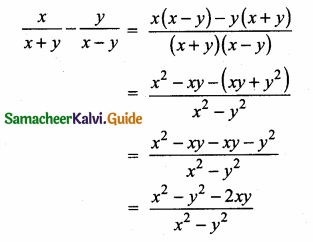
\(\frac { 3y-3 }{ y } \) + \(\frac { 7y-7 }{ 3y2 } \) is …………
Samacheer Kalvi 10th Maths Guide Chapter 3 Algebra Ex 3.19 1
Answer:
(1) \(\frac{9 y}{7}\)
Samacheer Kalvi 10th Maths Guide Chapter 3 Algebra Ex 3.19 2

Question 5.
y2 + \(\frac{1}{y^{2}}\) is not equal to ………….
(1) \(\frac{y^{4}+1}{y^{2}}\)
(2) (y + \(\frac { 1 }{ y } \))2
(3) (y – \(\frac { 1 }{ y } \))2
(4) (y + \(\frac { 1 }{ y } \))2 – 2
Answer:
(2) (y + \(\frac { 1 }{ y } \))2
Hint.
Samacheer Kalvi 10th Maths Guide Chapter 3 Algebra Ex 3.19 4

Samacheer Kalvi 10th Maths Guide Chapter 3 Algebra Ex 3.19

Question 6.
\(\frac{x}{x^{2}-25}-\frac{8}{x^{2}+6 x+5}\) gives …………..
Samacheer Kalvi 10th Maths Guide Chapter 3 Algebra Ex 3.19 5
Answer:
Samacheer Kalvi 10th Maths Guide Chapter 3 Algebra Ex 3.19 6
Hint.
Samacheer Kalvi 10th Maths Guide Chapter 3 Algebra Ex 3.19 7

Samacheer Kalvi 10th Maths Guide Chapter 3 Algebra Ex 3.19

Question 7.
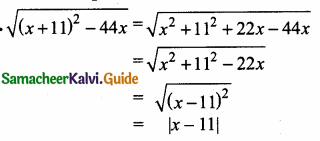
The square root of \(\frac{256 x^{8} y^{4} z^{10}}{25 x^{6} y^{6} z^{6}}\) is equal to ………….
Samacheer Kalvi 10th Maths Guide Chapter 3 Algebra Ex 3.19 8
Answer:
Samacheer Kalvi 10th Maths Guide Chapter 3 Algebra Ex 3.19 9
Hint.
Samacheer Kalvi 10th Maths Guide Chapter 3 Algebra Ex 3.19 10

Question 8.
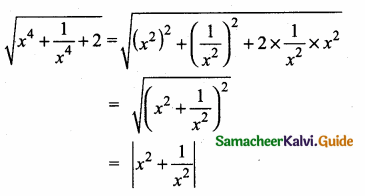
Which of the following should be added to make x4 + 64 a perfect square
(1) 4x2
(2) 16x2
(3) 8x2
(4) -8x2
Solution:
(2) 16x2
Hint:
x4 + 64 = (x2)2 + 82 + 2 × 8x2
= (x2 + 8)2

Samacheer Kalvi 10th Maths Guide Chapter 3 Algebra Ex 3.19

Question 9.
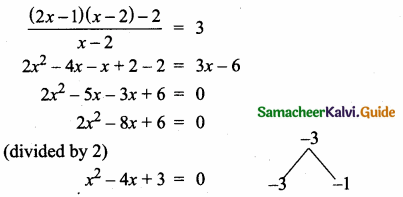
The solution of (2x – 1)2 = 9 is equal to ………..
(1) -1
(2) 2
(3) -1, 2
(4) None of these
Answer:
(3) -1, 2
Hint.
(2x – 1)2 = 9 ⇒ (2x – 1) = \(\sqrt { 9 }\)
2x – 1 = ± 3 ⇒ 2x – 1 = 3 or 2x – 1 = 3
2x – 1 = 3
2x = 4 ⇒ x = \(\frac { 4 }{ 2 } \) = 2
2x – 1 = -3 ⇒ 2x = -3 + 1
x = -1

Samacheer Kalvi 10th Maths Guide Chapter 3 Algebra Ex 3.19

Question 10.
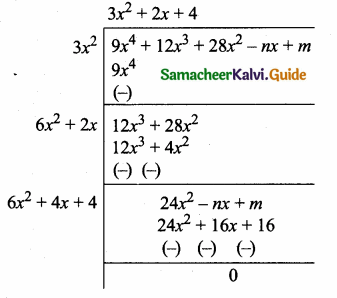
The values of a and b if 4x4 – 24x3 + 76x2 + ax + b is a perfect square are ………..
(1) 100,120
(2) 10,12
(3) -120,100
(4) 12,10
Answer:
(3) -120,100
Hint.
Since it is a perfect square
a + 120 = 0
a = -120
b – 100 = 0
b = 100
Samacheer Kalvi 10th Maths Guide Chapter 3 Algebra Ex 3.19 11

Samacheer Kalvi 10th Maths Guide Chapter 3 Algebra Ex 3.19

Question 11.
If the roots of the equation q2x2 + p2x + r2 = 0 are the squares of the roots of the equation qx2 + px + r = 0 , then q,p,r are in ……………..
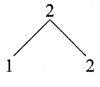
(1) A.P.
(2) G.P.
(3) Both A.P and G.P
(4) none of these
Answer:
(2) G.P.
Hint.
q2x2 + p2x + r2 = 0
Let the roots be α2 + β2
α2 + β2 = \(\frac{-p^{2}}{q^{2}}\)
α2β2 = \(\frac{r^{2}}{q^{2}}\)
qx2 + px + r = 0
Let the root be α and β
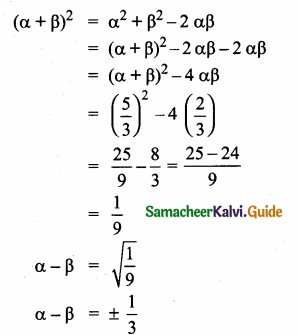
Samacheer Kalvi 10th Maths Guide Chapter 3 Algebra Ex 3.19 12
Samacheer Kalvi 10th Maths Guide Chapter 3 Algebra Ex 3.19 13

Question 12.
Graph of a linear polynomial is a
(1) straight line
(2) circle
(3) parabola
(4) hyperbola
Solution:
(1) straight line

Samacheer Kalvi 10th Maths Guide Chapter 3 Algebra Ex 3.19

Question 13.
The number of points of intersection of the quadratic polynomial x2 + 4x + 4 with the X axis is …………….
(1) 0
(2) 1
(3) 0 or 1
(4) 2
Answer:
(2) 1
Hint:
(x + 2)2 = 0 ⇒ (x + 2) (x + 2) = 0
x + 2 = 0 or x + 2 = 0 ⇒ x = -2 or x = -2
Number of points of intersection is 1 (both the values are same)

Question 14.
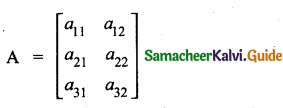
For the given matrix
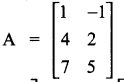
Samacheer Kalvi 10th Maths Guide Chapter 3 Algebra Ex 3.19 14
the order of the matrix AT is ……………
(1) 2 × 3
(2) 3 × 2
(3) 3 × 4
(4) 4 × 3
Answer:
(3) 3 × 4

Question 15.
If A is a 2 × 3 matrix and B is a 3 × 4 matrix, how many columns does AB have ………..
(1) 3
(2) 4
(3) 2
(4) 5
Answer:
(2) 4
Hint.
The order of AB is 2 × 4
∴ Number of columns is 4.

Samacheer Kalvi 10th Maths Guide Chapter 3 Algebra Ex 3.19

Question 16.
If the number of columns and rows are not equal in a matrix then it is said to be a
(1) diagonal matrix
(2) rectangular matrix
(3) square matrix
(4) identity matrix
Solution:
(2) rectangular matrix

Question 17.
Transpose of a column matrix is …………..
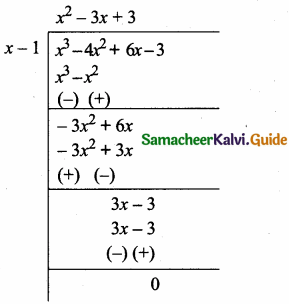
(1) unit matrix
(2) diagonal matrix
(3) column matrix
(4) row matrix
Answer:
(4) row matrix

Question 18.
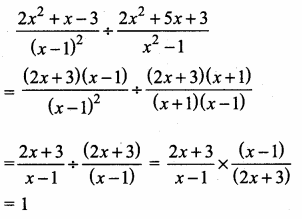
Find the matrix X if
Samacheer Kalvi 10th Maths Guide Chapter 3 Algebra Ex 3.19 15
Samacheer Kalvi 10th Maths Guide Chapter 3 Algebra Ex 3.19 16
Answer:
Samacheer Kalvi 10th Maths Guide Chapter 3 Algebra Ex 3.19 17
Hint.
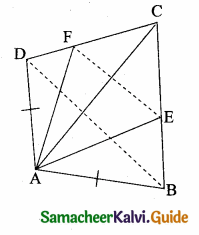
Samacheer Kalvi 10th Maths Guide Chapter 3 Algebra Ex 3.19 18

Samacheer Kalvi 10th Maths Guide Chapter 3 Algebra Ex 3.19

Question 19.
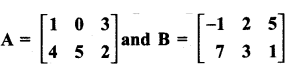
Which of the following can be calculated from the given matrices?
Samacheer Kalvi 10th Maths Guide Chapter 3 Algebra Ex 3.19 19
(i) A2
(ii) B2
(iii) AB
(iv) BA
(1) (i) and (ii) only
(2) (ii) and (iii) only
(3) (ii) and (iv) only
(4) all of these
Answer:
(3) (ii) and (iv) only
Hint: (i) A2 is possible to find
(ii) B2 is also possible to find
(iii) not possible: order of A= (3 × 2) order of B is (3 × 3). AB is not possible number of column of matrix A ≠ number of rows of the matrix B.
(iv) Possible number column of the matrix is equal to the number of the matrix A.

Question 20.
Samacheer Kalvi 10th Maths Guide Chapter 3 Algebra Ex 3.19 20
Which of the following statements are correct?
Samacheer Kalvi 10th Maths Guide Chapter 3 Algebra Ex 3.19 21
(1) (i) and (ii) only
(2) (ii) and (iii) only
(3) (iii) and (iv)
(4) all of these
Answer:
(1) (i) and (ii) only
Hint.
(i) AB + C : order of A = 2 × 3
order of B = 3 × 2
order of AB = 2 × 2
order of C = 2 × 2
It is possible to add AB + C

Samacheer Kalvi 10th Maths Guide Chapter 3 Algebra Ex 3.19

(ii) BC :
order of B = 3 × 2
order of C = 2 × 2
It is possible to find BC

(iii) BA is not possible
order of B = 3 × 2
order of A = 3 × 2
BA does not exist.
BA + C is not a correct statement

(iv) ABC is not possible
order of A = 2 × 3 order of
B = 3 × 2
order of AB = 2 × 2
order of C = 3 × 2
It is not possible to multiply AB and C.
∴ The statement ABC is not correct.