Samacheer Kalvi 5th Maths Guide Term 1 Chapter 5 Time Ex 5

Students can download 5th Maths Term 1 Chapter 5 Time Ex 5 Questions and Answers, Notes, Samacheer Kalvi 5th Maths Guide Pdf helps you to revise the complete Tamilnadu State Board New Syllabus, helps students complete homework assignments and to score high marks in board exams.

Tamilnadu Samacheer Kalvi 5th Maths Solutions Term 1 Chapter 5 Time Ex 5

Question 1.
Write down your school time table of the following:
a. Morning school break time to morning school ending time.
b. Morning school working time.
c. Afternoon school working time.
d. Afternoon Lunch break time.
Answer:
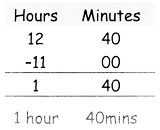
a. Morning school break time to morning school ending time
Morning school ending time = 12 hours 40 minutes
Morning School break time = 11 : 00 hours
Morning school break time to Morning school ending time
= 12 hours 40 minutes – 11:00 Hrs
= 1 hour 40 minutes
Samacheer Kalvi 5th Maths Guide Term 1 Chapter 5 Time Ex 1

Samacheer Kalvi 5th Maths Guide Term 1 Chapter 5 Time Ex 5

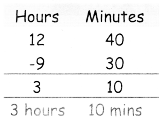
b. Morning school working time
Morning school class time = 12 hours 40 minutes
Morning school first bell = 9 hours 30 minutes
Morning school working time
= 12 hours 40 minutes – 9 hours 30 minutes
= 3 hours 10 minutes
Samacheer Kalvi 5th Maths Guide Term 1 Chapter 5 Time Ex 2

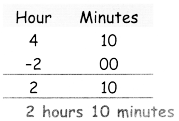
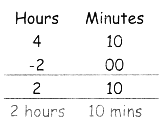
c. Afternoon school working time
Evening school closing time = 4 hours 10 minutes
Starting time = 2 : 00 hours
Afternoon school working time
= 4 hours 10 min – 2 : 00 hours
= 2 hours 10 minutes
Samacheer Kalvi 5th Maths Guide Term 1 Chapter 5 Time Ex 3

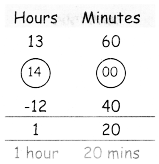
d. Afternoon Lunch break time
Lunch time = 14 hours
Samacheer Kalvi 5th Maths Guide Term 1 Chapter 5 Time Ex 4
Afternoon Lunch break time = 1 hour 20 minutes

Samacheer Kalvi 5th Maths Guide Term 1 Chapter 5 Time Ex 5

Question 2.
Match the following

12 hours Clock24 hours clock
9:40 a.m23:40 hours
3:20 p.m6:25 hours
6:25 p.m15:20 hours
11:40 p.m9:40 hours
6:25 a.m18:25 hours

Answer:

12 hours Clock24 hours clock
9:40 a.m9:40 hours
3:20 p.m15:20 hours
6:25 p.m18:25 hours
11:40 p.m23:40 hours
6:25 a.m6:25 hours

Samacheer Kalvi 5th Maths Guide Term 1 Chapter 5 Time Ex 5

Question 3.
Addition
a. 4 hours 30 minutes + 2 hours 50 minutes = ________
b. 4 hours 50 minutes + 2 hours 30 minutes = ________
c. 3 hours 45 minutes + 1 hours 35 minutes = ________
d. 1 hours 50 minutes + 3 hours 45 minutes = ________
e. 2 hours 25 minutes + 4 hours 50 minutes = ________
Answer:
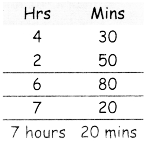
a. 4 hours 30 minutes + 2 hours 50 minutes
Samacheer Kalvi 5th Maths Guide Term 1 Chapter 5 Time Ex 5
4 hours 30 minutes + 2 hours 50 minutes = 7 hours 20 minutes

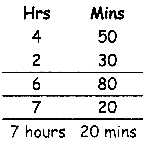
b. 4 hours 50 minutes + 2 hours 30 minutes
Samacheer Kalvi 5th Maths Guide Term 1 Chapter 5 Time Ex 6
4 hours 50 minutes + 2 hours 30 minutes = 7 hours 20 minutes

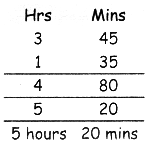
c. 3 hours 45 minutes + 1 hours 35 minutes
Samacheer Kalvi 5th Maths Guide Term 1 Chapter 5 Time Ex 7
3 hours 45 minutes + 1 hours 35 minutes = 5 hours 20 minutes

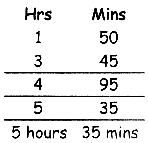
d. 1 hours 50 minutes + 3 hours 45 minutes
Samacheer Kalvi 5th Maths Guide Term 1 Chapter 5 Time Ex 8
1 hours 50 minutes + 3 hours 45 minutes = 5 hours 25 minutes

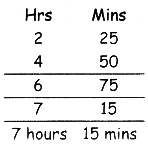
e. 2 hours 25 minutes + 4 hours 50 minutes
Samacheer Kalvi 5th Maths Guide Term 1 Chapter 5 Time Ex 9
2 hours 25 minutes + 4 hours 50 minutes = 7 hours 15 minutes

Samacheer Kalvi 5th Maths Guide Term 1 Chapter 5 Time Ex 5

Question 4.
Subtract
a. 5 hours 10 minutes – 2 hours 35 minutes = ________
b. 4 hours 20 minutes – 2 hours 40 minutes = ________
c. 4 hours 25 minutes – 1 hours 20 minutes = ________
d. 6 hours 55 minutes – 2 hours 20 minutes = ________
e. 5 hours 45 minutes – 3 hours 55 minutes = ________
Answer:
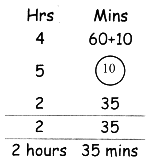
a. 5 hours 10 minutes – 2 hours 35 minutes
Samacheer Kalvi 5th Maths Guide Term 1 Chapter 5 Time Ex 10
5 hours 10 minutes – 2 hours 35 minutes = 2 hours 35 minutes

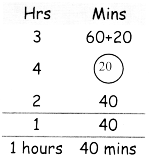
b. 4 hours 20 minutes – 2 hours 40 minutes
Samacheer Kalvi 5th Maths Guide Term 1 Chapter 5 Time Ex 11
4 hours 20 minutes – 2 hours 40 minutes = 1 hours 40 minutes

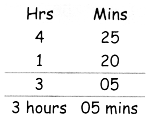
c. 4 hours 25 minutes – 1 hours 20 minutes
Samacheer Kalvi 5th Maths Guide Term 1 Chapter 5 Time Ex 12
4 hours 25 minutes – 1 hours 20 minutes = 3 hours 05 minutes

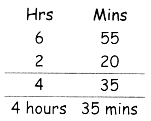
d. 6 hours 55 minutes – 2 hours 20 minutes
Samacheer Kalvi 5th Maths Guide Term 1 Chapter 5 Time Ex 13
6 hours 55 minutes – 2 hours 20 minutes = 4 hours 35 minutes

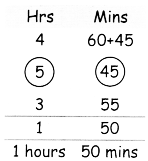
e. 5 hours 45 minutes – 3 hours 55 minutes
Samacheer Kalvi 5th Maths Guide Term 1 Chapter 5 Time Ex 14
5 hours 45 minutes – 3 hours 55 minutes = 1 hour 50 minutes

Samacheer Kalvi 5th Maths Guide Term 1 Chapter 5 Time Ex 5

Question 5.
Answer the following:
a. An office works from 10 a.m working hours? to 6 p.m What is the durati<
Answer:
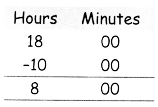
Office works closing time = 18 : 00 hours
Office works starting time = 10 : 00 hours
Office working hours = 18 : 00 hours – 10 : 00 hours
= 8 : 00 hours
Samacheer Kalvi 5th Maths Guide Term 1 Chapter 5 Time Ex 15

b. A school works from morning 9 O’clock to evening 4 O’ Clock. What is the duration of working hours of the school
Answer:
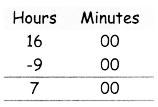
School closing time = 16 : 00 hours
Starting time = 9 : 00 hours
Working hours = = 16 : 00 hours – 9 : 00 hours
= 7 hours 00 minutes
Samacheer Kalvi 5th Maths Guide Term 1 Chapter 5 Time Ex 16

c. A circus starts at 12:15 pm and ends by 2:30 pm. what is the duration of circus?
Answer:
Circus ending time = 14 hours 30 minutes
Circus Starting time = 12 hours 15 minutes
Duration = 14 hours 30 minutes – 12 hours 15 minutes
= 2 hours 15 minutes

Samacheer Kalvi 5th Maths Guide Term 1 Chapter 5 Time Ex 5

d. A bank works from morning 9:30 a.m. to 4:30 p.m. working time of the bank?
[Subtract afternoon lunch break 1 hour to 2 hours]
Answer:
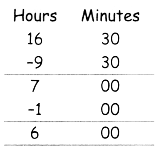
Bank closing time = 16 hours 30 minutes
Bank starting time = 9 hours 30 minutes
= 16 hours 30 minutes – 9 hours 30 minutes
= 7 : 00 hours
lunch break = 1 : 00 hour
= 7 : 00 hours – 1 : 00 hour
= 6 : 00 hour
working hour = 6 hours
Samacheer Kalvi 5th Maths Guide Term 1 Chapter 5 Time Ex 17

e. A man comes to his village in Tamilnadu from Ahmedabad. He travels 2 hours 15 minutes in Aeroplane and 4 hours 40 minutes in Car. What is the total time of travel?
Answer:
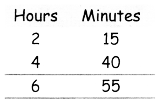
Hours taken by Aeroplane = 2 hours 15 minutes
Hours taken by car = 4 hours 40 minutes
Travelling time = 2 hours 15 minutes – 4 hours 40 minutes
= 6 hours 55 minutes
Samacheer Kalvi 5th Maths Guide Term 1 Chapter 5 Time Ex 18

Samacheer Kalvi 5th Maths Guide Term 1 Chapter 5 Time Ex 5

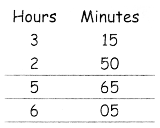
f. A painter paints a house for 3 hours 15 minutes in morning and 2 hours 50 minutes in evening. What is the total time he painted?
Answer:
Morning painting time = 3 hours – 15 minutes
Evening painting time = 2 hours – 50 minutes
total hours = 3 hours – 15 minutes + 2 hours – 50 minutes
= 5 hours – 65 minutes
Bank starting time = 5 hours – 65 minutes
Total Working hours = 2 hours – 50 minutes + 5 hours – 65 minutes
= 6 hours – 05 minutes
Samacheer Kalvi 5th Maths Guide Term 1 Chapter 5 Time Ex 19

Samacheer Kalvi 9th Tamil Guide Chapter 4.3 உயிர்வகை

Students can Download 9th Tamil Chapter 4.3 உயிர்வகை Questions and Answers, Summary, Notes, Samacheer Kalvi 9th Tamil Guide Pdf helps you to revise the complete Tamilnadu State Board New Syllabus, helps students complete homework assignments and to score high marks in board exams.

Tamilnadu Samacheer Kalvi 9th Tamil Solutions Chapter 4.3 உயிர்வகை

கற்பவை கற்றபின்

Samacheer Kalvi 9th Tamil Guide Chapter 4.3 உயிர்வகை

Question 1.
அ) தட்டான் பூச்சி தாழப்பறந்தால் தப்பாமல் மழை வரும்.
ஆ) வானில் பறக்குது குதிரை
பறக்கப் பறக்க வால் குறையும் குதிரை – அது என்ன?
Answer:
விமானம்

இவை போன்ற அறிவியல் செய்திகள் கொண்ட பழமொழிகள், விடுகதைகளைப் படித்தும் கேட்டும், அவற்றின் அறிவியல் அடிப்படையை வகுப்பறையில் கலந்துரையாடுக.

அறிவியல் சார்ந்த பழமொழிகள் விடுகதைகள்

விடுகதைகள்

1. செல்லும் இடமெல்லாம் நானும் வருவேன், கையிலும் வைக்கலாம், பையிலும் வைக்கலாம், நானின்றி இன்று மனித உயிர்கள் இல்லை. நான் யார்?
Answer:
அலைபேசி

Samacheer Kalvi 9th Tamil Guide Chapter 4.3 உயிர்வகை

2. காற்றுப் புக முடியாத இடத்திலும் நான் புகுவேன். எங்கெங்கு சென்றாலும் அங்குள்ள தன்மையை செய்தியாகப் புகைப்படமாக அனுப்புவேன். ஆராய உகந்தவன். நான் யார்?
Answer:
செயற்கைக்கோள்

பழமொழிகள்

1. அறிவை மேம்படுத்துவது அறிவியல்.
2. அறிவியல் இல்லாத ஆன்மீகம் முடமாகும்.
3. ஆறாவது அறிவே அறிவியல்.
4. அறிவியல் அறிவை மேம்படுத்தும்; அறிவு வாழ்வை மேம்படுத்தும்.
5. இன்றைய அறிவியலே நாளைய தொழில்நுட்ப வளர்ச்சி.

Question 2.
‘விமான நிலையத்தில் நான்’ – கற்பனையாகக் கதை ஒன்றினை எழுதுக.
Answer:

விமான நிலையத்தில் நான்
(கற்பனைக் கதை)

அன்று காலையில் இருந்தே எனக்குள் ஒரே பரபரப்பு… இனம் புரியாத குதூகலம் என மனதுக்குள் கொஞ்சம் மகிழ்ச்சி பதற்றம் என ஒரு மாதிரியான உணர்வுகள் வந்து போய்க் கொண்டிருந்தன.
ஏன் தெரியுமா. நான் முதன் முதலில் விமான நிலையம் சென்று விமானத்தில் ஏறி சுற்றுலா செல்லப் போகிறேன் குடும்பத்தில் எல்லோரும் என்னைப் போன்றே இருந்தனர்.

என் தந்தை, என் பெரிய சகோதரர் எல்லாரும் முன்பே விமானத்தில் பயணம் செய்து இருக்கிறார்கள். நான் மட்டும் தான் முதன்முதலில் விமானத்திலும் பயணம் செய்ய போகப் போகிறேன் விமான நிலையத்துக்குள்ளும் செல்லப் போகிறேன்.

புறப்படும் வேளை வந்தது …… ஆர்வத்துடன் அவரவர் பயணச் சுமைகளுடன் வாகனத்தில் ஏறினோம். வாகனம் விரைந்து சென்றது விமான நிலையம் நோக்கி……

குறிப்பிட்ட எல்லை வரைதான் வாகனத்தை அனுமதித்தார்கள் உள்ளே மெதுவாக படபடப்புடன் நுழைந்தேன்…..

Samacheer Kalvi 9th Tamil Guide Chapter 4.3 உயிர்வகை

ஒலி பெருக்கியில் அறிவிப்பு ஒரு புறம். மின் எழுத்துகளில் அறிவிப்பு பலகைகள் ஒரு புறமாய் ஆரவாரமாய் இருந்தது.

நுழைவுவாயிலைக் கடந்தேன்… சோதனையிடுவதற்கு அழைத்தார்கள் அனுமதிக்கப்படாத பொருள்கள் நாம் வைத்திருந்தால் அவற்றை அப்புறப்படுத்தி விடுகிறார்கள்.

எங்கள் விமானம் வருவதற்கு இரண்டு மணிநேரத்திற்கு முன்பே சென்று விட்டோம். ஒவ்வொரு காட்சியும் ஒவ்வொரு நிகழ்வும் என்னை மிகவும் ஆச்சரியப் படுத்துவதாய் இருந்தது.

திடீரென்று விமானநிலையத்தில் பரபரப்பு …… செய்தியாளர்கள் தடதடவென ஓடி வந்தனர். என்னவென்று விசாரித்தால் தற்பொழுது வந்து தரை இறங்கிய விமானத்தில் இருந்து பிரபல தமிழ் கவிஞர் ஒருவரும், அரசியல் தலைவர் ஒருவரும் வருகிறார்களாம்…. அவர்களுள் அரசியல் தலைவரை நேர் காணல் செய்வதற்காக செய்தியாளர்கள் ஓடிவந்தனர்…. அதனையும் கண்டு களித்தேன்……

நாங்கள் பயணம் செய்ய வேண்டிய விமானம் வருவதற்கான அறிவிப்பு வந்தது, ஓடு தளத்தில் நின்ற விமானத்தில் ஏறுவதற்கான ஆயத்தப் பணிகளாக முதலில் எங்கள் கூடுதல் சுமைகளை எடுத்தனர்.
பின்னர் வாகனத்தில் எங்களை ஏறச்செய்து, பிரம்மாண்டமான ஓடுதளத்தில் கம்பீரமாக நின்ற விமானத்தின் அருகில் கொண்டு நிறுத்தினார்கள்.

வாகனத்தில் இருந்து இறங்கி விமானத்தில் விமானப்பணிப் பெண்ணின் இனிய வரவேற்போடு விமானத்துக்குள் ஏறி அவரவர் இருக்கையில் அமர்ந்து…. மிகுந்த மகிழ்ச்சியுடன் பயணம் செய்தோம்.

Samacheer Kalvi 9th Tamil Guide Chapter 4.3 உயிர்வகை

பாடநூல் வினாக்கள்

பலவுள் தெரிக

Question 1.
ஒன்றறிவதுவே உற்றறிவதுவே இரண்டறிவதுவே அதனொடு நாவே இவ்வடிகளில் அதனோடு என்பது எதைக் குறிக்கிறது?
அ) நுகர்தல்
ஆ) தொடு உணர்வு
இ) கேட்டல்
ஈ) காணல்
Answer:
ஆ) தொடு உணர்வு

Samacheer Kalvi 9th Tamil Guide Chapter 4.3 உயிர்வகை

குறுவினா

Question 1.
மூன்றறிவதுவே அவற்றோடு மூக்கே
நான்கறிவதுவே அவற்றொடு கண்ணே
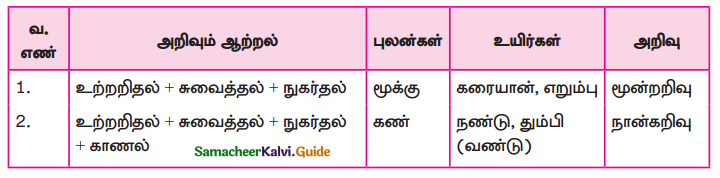
ஐந்தறிவதுவே அவற்றொடு செவியே – இவ்வடிகளில் தொல்காப்பியர் குறிப்பிடும், மூவறிவு, நான்கறிவு, ஐந்தறிவு உயிர்கள் யாவை?
Answer:
Samacheer Kalvi 9th Tamil Guide Chapter 4.3 உயிர்வகை - 1
Samacheer Kalvi 9th Tamil Guide Chapter 4.3 உயிர்வகை - 2

சிறுவினா

Question 1.
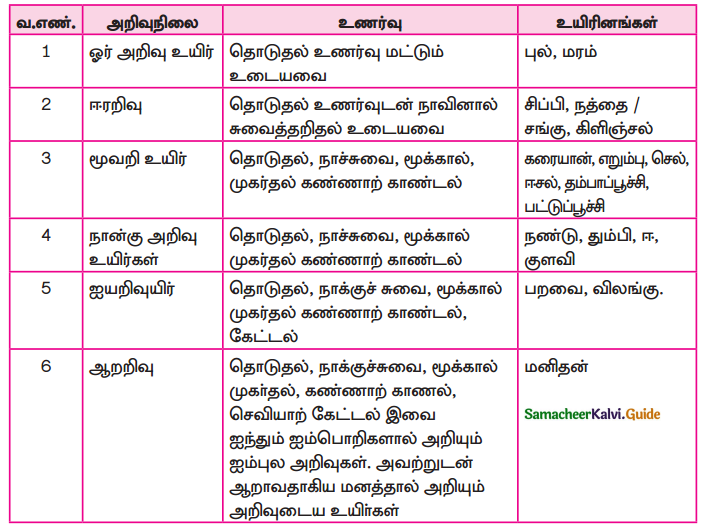
அறிவையும் உயிரினங்களையும் தொல்காப்பியர் எவ்வாறு தொடர்பு படுத்துகிறார்?
Asnwer:
Samacheer Kalvi 9th Tamil Guide Chapter 4.3 உயிர்வகை - 3

கூடுதல் வினாக்கள்

பலவுள் தெரிக

Question 1.
பொருந்தாத இணையைத் தேர்ந்தெடு.
அ) ஈரறிவு உயிர் – சிப்பி, நத்தை
ஆ) நான்கறிவு உயிர் – நண்டு, தும்பி
இ) ஐந்தறிவு உயிர் – புல், மரம்
ஈ) மூவறிவு உயிர் – கரையான், எறும்பு
Answer:
இ) ஐந்தறிவு உயிர் – புல், மரம்

Samacheer Kalvi 9th Tamil Guide Chapter 4.3 உயிர்வகை

Question 2.
பொருந்தாதனைத் தேர்ந்தெடு.
அ) சுவைத்தல்
ஆ) உறங்குதல்
இ) நுகர்தல்
ஈ) கேட்டல்
Asnwer:
ஆ) உறங்குதல்

Question 3.
சரியானதைத் தேர்ந்தெடு.
i) தமிழில் கிடைக்கப்பெற்ற முதல் நூல் தொல்காப்பியம்.
ii) தொல்காப்பியத்தில் எழுத்து, சொல், பொருள் என மூன்று அதிகாரங்கள் உண்டு.
iii) தொல்காப்பியத்தில் அகம், புறம் சார்ந்த வாழ்வியல் நெறிகள் விளக்கப்பட்டுள்ளன.
iv) கடைச்சங்கக் காலத்தில் இயற்றப்பட்டது தொல்காப்பியம்.
அ) i, ii, iii, iv – நான்கும் சரி.
ஆ) i, ii, iii-சரி, iv-தவறு.
இ) i, ii – சரி, iii, iv – தவறு.
ஈ) i, ii-தவறு iii, iv-சரி.
Answer:
ஆ) i, ii, iii-சரி, iv-தவறு.

Samacheer Kalvi 9th Tamil Guide Chapter 4.3 உயிர்வகை

Question 4.
தொல்காப்பியத்தில் உள்ள இயல்கள் …………
அ) 30
ஆ) 33
இ) 24
ஈ) 27
Answer:
ஈ) 27

Question 5.
ஆறறிவு உடைய உயிரினம் …………..
அ) நத்தை
ஆ) மனிதன்
இ) விலங்கு
ஈ) தும்பி
Answer:
ஆ) மனிதன்

Question 6.
தமிழ்மொழியில் கிடைத்த முதல் இலக்கண நூல் எது?
Answer:
தொல்காப்பியம்

Question 7.
தொல்காப்பியத்தின் அதிகாரங்கள் யாவை?
Answer:
எழுத்து, சொல், பொருள்

Samacheer Kalvi 9th Tamil Guide Chapter 4.3 உயிர்வகை

Question 8.
தொல்காப்பியத்தின் மொத்த இயல்கள் யாவை?
Answer:
27

Question 9.
எழுத்துகள் பிறக்கும் இடங்களை உடற் கூற்றியல் அடிப்படையில் விளக்கும் நூல் எது?
Answer:
தொல்காப்பியம்

Samacheer Kalvi 9th Tamil Guide Chapter 4.3 உயிர்வகை

Question 10.
ஈரறிவு உயிர்களுக்குச் சான்று.
Answer:
சிப்பி, நத்தை

Samacheer Kalvi 6th Tamil Guide Chapter 1.3 வளர்தமிழ்

Students can Download 6th Tamil Chapter 1.3 வளர்தமிழ் Questions and Answers, Summary, Notes, Samacheer Kalvi 6th Tamil Guide Pdf helps you to revise the complete Tamilnadu State Board New Syllabus, helps students complete homework assignments and to score high marks in board exams.

Tamilnadu Samacheer Kalvi 6th Tamil Solutions Chapter 1.3 வளர்தமிழ்

கற்பவை கற்றபின்

Samacheer Kalvi 6th Tamil Guide Chapter 1.3 வளர்தமிழ்

Question 1.
மாற்றங்களுக்கு ஏற்பத் தன்னைப் புதுப்பித்துக்கொள்ளும் மொழி தமிழ் என்பது பற்றிக் கலந்துரையாடுக.
Answer:
மாணவர்களைக் கால மாற்றத்திற்கேற்ப தன்னைப் புதுப்பித்துக்கொள்ளும் மொழி தமிழ்மொழி பற்றிப் பேசச் செய்தல்.
மாணவன் 1 : வணக்கம். நம் தமிழ்மொழியானது காலத்திற்கேற்றார்போல் தன்னைப் புதுப்பித்துக் கொள்ளும் என்பதில் எவ்வித ஐயமுமில்லை . ‘வடவேங்கடம் தென்குமரி ஆயிடைத் தமிழ் கூறு நல்லுலகம்’ எனப் புகழப்படும் தமிழ் உலகில் பல இலக்கியங்கள் தோன்றிக் கொண்டே தான் உள்ளன. தமிழ் மொழியில் உள்ள இலக்கிய இலக்கண வளங்களால்தான் அழியா நிலை பெற்றுள்ளது எனலாம்.

மாணவன் 2 : அதுமட்டுமா? ஒலியாகத் திரிந்து சித்திரமாய் மாறி பல மொழிகளுடன் இணைந்து உருக்கள் பலப்பல எடுத்தும் காலம் பல கடந்து கல்வெட்டுகளில் செதுக்கப்பட்டும் ஓலைச்சுவடிகளில் வரையப்பட்டும் தற்போது காகிதங்களில் மிளிர்ந்து கொண்டும் உள்ளது நம்தாய் மொழியாம் தமிழ். இது காலச்சூழல் மாற்றங்களுக்கேற்ப தன்னைப் புதுப்பித்துக் கொள்ளும் சிறப்பு பெற்றது.

மாணவன் 1 : பிறமொழிகள் தங்கள் தொன்மை மாறாமலும் அவை இருந்த இடத்திலிருந்து இறங்கி வராமலும் காலத்திற்கேற்ப மாற்றம் கொள்ளாமலும் இருந்ததால் வழக்கொழிந்துவிட்டன. ஆனால் நம் தமிழானது கற்றவர் கல்லாதவர் என அனைவருடைய நாவிலும் நடனமாடுகிறது. இதனால் அழியாப் புகழுடன் விளங்குகிறது. கன்னித்தமிழாய் இருப்பதோடல்லாமல் மொழிகளுக்கெல்லாம் தாயாகவும் விளங்குகிறது.

மாணவன் 2 : சரியாகச் சொன்னாய். தமிழ் மேடைத் தமிழ், எழுத்துத் தமிழ், பேச்சுத் தமிழ் என்று வெவ்வேறு உருவத்தில் தன்னை வளைத்துக் கொடுக்கும் தன்மையால்தான் இன்றும் வளர்ந்து கொண்டே வருகிறது.

மாணவன் 1 : இன்றைய நடைமுறைக்கு ஏற்ப ஊடகங்களில் பயன்படுத்தப்படுகிறது. தமிழ்மொழியானது தனியாக வளர்க்கப்படவில்லை. பக்தி இலக்கியக் காலத்தில் பக்திப் பாடல்கள், சுதந்திரப் போராட்டக் காலத்தில் தேசப்பக்திப் பாடல்கள் என மக்கள் மனதில் வளர்ந்து செழுமை பெற்றுள்ளது.

மாணவன் 2 : சரியாகச் சொன்னாய். இவ்வாறு வளரும் தமிழ்மொழியானது இன்றைய அறிவியல் தொழில்நுட்ப வளர்ச்சியுடன் இணைந்து செல்லும் வகையில் புதிய கலைச் சொற்களை உருவாக்கிக் கொண்டு தமிழ்மொழி தன்னை நாள்தோறும் புதுப்பித்துக் கொண்டே வருகிறது. தமிழ் இணையம், முகநூல், புலனம், குரல் தேடல், தேடுபொறி, செயலி, தொடுதிரை முதலிய சொற்களை உருவாக்குகிறது.

மாண்வன் 1 : அதுமட்டுமா? சமூக ஊடங்களிலும் பயன்படத்தக்க திறன் கொண்ட புது மொழியாகவும் தமிழ் திகழ்ந்து வருகிறது எனலாம். தமிழ் மூத்த மொழியாக மட்டுமின்றி இனிமை, எளிமை, சீர்மை, வளமை, இளமை மிக்க வளர்மொழியாகவும் நாளும் சிறந்து விளங்கும் புதுமொழியாகவும் திகழ்கிறது. தற்போது தமிழ்மொழி அறிவியல் தமிழ், கணினித் தமிழ், மாற்றங்களுக்கு ஏற்றவாறு மேலும் தன்னைப் புதுப்பித்துக் கொள்கிறது. காலத்தின் தேவைக்கேற்ப சரியான சொற்கள் தமிழில் புகுந்து தொடர்ந்து இன்றும் இயங்கி வருகின்றது.

Question 2.
தமிழ் பேசத்தெரியாத குடும்பத்தினர் உங்கள் பக்கத்து வீட்டில் உள்ளனர் அவர்களுக்கு நீங்கள் கற்றுத் தர விரும்பும் பத்துத் தமிழ்ச் சொற்களைப் பட்டியலிடுக.
Answer:
மாணவர்கள் நம் அன்றாட வாழ்வில் பயன்படுத்தும் தமிழ்ச் சொற்களைக் கற்றுத் தருதல்.
தமிழ்சொற்கள் :
1. வணக்கம்
2. வாருங்கள்
3. அமருங்கள்
4. சாப்பிடுங்கள்
5. எப்படி இருக்கிறீர்கள்?
6. உங்கள் பெயர் என்ன?
7. தண்ணீ ர்
8. நன்றி
9. பொறுத்துக்கொள்ளுங்கள்
10. வாழ்க வளர்க

Samacheer Kalvi 6th Tamil Guide Chapter 1.3 வளர்தமிழ்

Question 3.
வாழ்த்துகளைத் தமிழில் கூறுவோம்.
Answer:
மாணவர்கள் தமிழில் வாழ்த்துகளை அறிந்து வந்து எழுதச் செய்தல்.
திருமண வாழ்த்து
பதினாறுப் பெற்று பெறு வாழ்வு வாழ்க!
இரட்டைக்கிளவிபோல் என்றும் சேர்ந்தே வாழ வேண்டும்.
இன்றுபோல் என்றும் இன்முகத்துடன் வாழ்க!
அன்பு, அறிவு, பண்பு, பணிவுடன் வாழ்க பல்லாண்டு!
என்றெல்லாம் அறத்துடன் வாழ வேண்டும்.
எட்டுத்திசைக்கும் புகழ் பரவ வாழ வேண்டும்.
எடுத்துக்காட்டாய் வாழ வேண்டும் என வாழ்த்துகிறோம்.
என் மனமார்ந்த திருமண நல்வாழ்த்துகள்!
என் அன்பான திருமண நல்வாழ்த்துகள்!

மதிப்பீடு

சரியான விடையைத் தேர்ந்தெடுத்து எழுதுக.
Question 1.
‘தொன்மை’ என்னும் சொல்லின் பொருள் ………………..
அ) புதுமை
ஆ) பழமை
இ) பெருமை
ஈ) சீர்மை
Answer:
(விடை: ஆ) பழமை)

Question 2.
‘இடப்புறம்’ என்னும் சொல்லைப் பிரித்து எழுதக் கிடைப்பது ………………..
அ) இடன் + புறம்
ஆ) இடது + புறம்
இ) இட + புறம்
ஈ) இடப் + புறம்
AnsL
(விடை : ஆ) இடது + புறம்)

Question 3.
‘சீரிளமை’ என்னும் சொல்லைப் பிரித்து எழுதக் கிடைப்பது …………….
அ) சீர் + இளமை
ஆ) சீர்மை + இளமை
இ) சீரி + இளமை
ஈ) சீற் + இளமை
Answer:
(விடை: ஆ) சீர்மை + இளமை) .

Question 4.
சிலம்பு + அதிகாரம் என்பதைச் சேர்த்து எழுதக் கிடைக்கும் சொல் …….
அ) சிலம்பதிகாரம்
ஆ) சிலப்பதிகாரம்
இ) சிலம்புதிகாரம்
ஈ) சில பதிகாரம்
Answer:
(விடை: ஆ) சிலப்பதிகாரம்)

Question 5.
கணினி + தமிழ் என்பதைச் சேர்த்து எழுதக் கிடைக்கும் சொல் ……..
அ) கணினிதமிழ்
ஆ) கணினித்தமிழ்
இ) கணிணிதமிழ்
ஈ) கனினிதமிழ்
Answer:
(விடை: ஆ) கணினித்தமிழ்)

Samacheer Kalvi 6th Tamil Guide Chapter 1.3 வளர்தமிழ்

Question 6.
“தமிழ்மொழி போல் இனிதாவது எங்கும் காணோம்” என்று பாடியவர்………….
அ) கண்ண தாசன்
ஆ) பாரதியார்
இ) பாரதிதாசன்
ஈ) வாணிதாசன்
Answer:
(விடை: ஆ) பாரதியார்)

Question 7.
‘மா’ என்னும் சொல்லின் பொருள் ………..
அ) மாடம்
ஆ) வானம்
இ) விலங்கு
ஈ) அம்மா
Answer:
[விடை: இ) விலங்கு)

கோடிட்ட இடத்தை நிரப்புக

1. நாம் சிந்திக்கவும் சிந்தித்ததை வெளிப்படுத்தவும் உதவுவது …………… [விடை : மொழி]
2. தமிழில் நமக்குக் கிடைத்துள்ள மிகப் பழைமையான இலக்கண நூல் …………… [விடை : தொல்காப்பியம்]
3. மொழியைக் கணினியில் பயன்படுத்த வேண்டும் எனில் அது ………. அடிப்படையில் வடிவமைக்கப்பட வேண்டும். [விடை: எண்களின்]

சொற்களைத் சொந்தத் தொடரில் அமைத்து எழுதுக

1. தனிச்சிறப்பு ………………………………..
விடை : திருக்குறள் பல மொழிகளில் மொழிபெயர்ப்பு செய்யப்பட்டுள்ளது அதனின் தனிச்சிறப்பு ஆகும்.
2. நாள்தோறும் …………………………….
விடை : நாம் நாள்தோறும் நல்ல பழக்கவழக்கத்தைக் கடைபிடிப்பது நல்லது.

குறுவினா

Question 1.
தமிழ் மூத்தமொழி எனப்படுவது எதனால்?
Answer:
தமிழ்மொழி – மூத்தமொழி :
(i) இலக்கியங்கள் தோன்றிய பிறகே அவற்றிற்கு இலக்கணம் தோன்றியிருக்க வேண்டும். தமிழில் நமக்குக் கிடைத்துள்ள மிகப் பழமையான இலக்கணநூல் தொல்காப்பியம்.
(ii) இந்நூல் சில ஆயிரம் ஆண்டுகளுக்கு முற்பட்டதாக அறியப்படுகிறது. அதற்கும் முன்னதாகவே தமிழில் இலக்கியங்கள் பல இருந்திருக்க வேண்டும். இதனைக்
கொண்டு தமிழ் தொன்மைமிக்க மூத்த மொழி என்பதை அறியலாம்.

Question 2.
நீங்கள் அறிந்த தமிழ்க் காப்பியங்களின் பெயர்களை எழுதுக.
Answer:
சிலப்பதிகாரம், மணிமேகலை, சீவக சிந்தாமணி, குண்டலகேசி, வளையாபதி, யசோதர காப்பியம், சூளாமணி, நாககுமார காவியம், உதயகுமார காவியம், நீலகேசி.

சிறுவினா

Question 1.
அஃறிணை, பாகற்காய் என்னும் சொற்களின் பொருள் சிறப்பு யாது?
Answer:
அஃறிணை, பாகற்காய் என்னும் சொற்களின் பொருள் சிறப்பு :
(i) திணை – உயர்திணை, அஃறிணை என இருவகைப்படும்.
(ii) உயர்திணையின் எதிர்ச்சொல் தாழ்திணை என அமையவேண்டும்.
(iii) ஆனால் நம் முன்னோர் தாழ்திணை என்று கூறாமல் உயர்வு அல்லாத திணை (அல் + திணை) அஃறிணை என்று பெயரிட்டனர்.

பாகற்காய் :
பாகற்காய் கசப்புச் சுவை உடையது. அதனைக் கசப்புக்காய் என்று கூறாமல், இனிப்பு அல்லாத காய் (பாகு + அல் + காய்) பாகற்காய் என வழங்கினர்.

Question 2.
தமிழ் இனிய மொழி என்பதற்கான காரணம் தருக.
Answer:
தமிழ் இனிய மொழி என்பதற்கான காரணம்:
(i) ஓசை இனிமை, சொல் இனிமை, பொருள் இனிமை ஆகியவை ஒருங்கே அமைந்த இலக்கியங்கள் பலவற்றைக் கொண்டது தமிழ்மொழி.

(ii) பன்மொழி கற்ற கவிஞராகிய பாரதியார், தமிழ் மொழியின் இனிமையை
”யாமறிந்த மொழிகளிலே தமிழ்மொழிபோல்
இனிதாவது எங்கும் காணோம்” என்று பாடுகிறார்.

Samacheer Kalvi 6th Tamil Guide Chapter 1.3 வளர்தமிழ்

Question 3.
தமிழ் மொழியின் சிறப்பைக் குறித்து ஐந்து வரிகளில் எழுதுக.
Answer:
(i) உலக மொழிகள் பலவற்றுள் இலக்கண, இலக்கியவளம் பெற்றுத் திகழும் மொழிகள் மிகச்சிலவே. அவற்றுள் செம்மை மிக்க மொழி என ஏற்றுக் கொள்ளப்பட்டவை ஒரு சில மொழிகளே! தமிழ்மொழி அத்தகு சிறப்பு மிக்க செம்மொழியாகும்.

(ii) தமிழ் இலக்கியங்கள் ஓசை இனிமை, சொல் இனிமை, பொருள் இனிமை கொண்டவை.

(iii) தமிழ் மொழி பேசவும், படிக்கவும், எழுதவும் உகந்த மொழி. தமிழ் எழுத்துகளின் ஒலிப்பு முறை மிக எளிமையானது. தமிழ் எழுத்துகள் பெரும்பாலும் வலஞ்சுழி எழுத்துகளாகவே அமைந்துள்ளன.

(iv) இயல், இசை, நாடகம் என்ற முத்தமிழைக் கொண்ட மொழியாகும். தமிழ் மொழி சொல்வளம் மிக்கது. ஒரு பொருளின் பல நிலைகளுக்கும் வெவ்வேறு பெயர் சூட்டுவது தமிழ்மொழியின் சிறப்பாகும்.

சிந்தனை வினா

Question 1.
தமிழ் மொழி படிக்கவும் எழுதவும் எளியது என்பது பற்றி உங்கள் கருத்து யாது?
Answer:
தமிழ் மொழி படிக்கவும் எழுதவும் எளியமொழி :
(i) தமிழ் எழுத்துகள் வாயைத் திறத்தல், உதடுகளை விரித்தல், குவித்தல் ஆகிய மூன்று எளிய இயக்கங்களால் உயிர் ஒலிகள் பன்னிரண்டையும் எளிமையாக ஒலிக்க . இயலும்.

(ii) நாக்கு, உதடு, பல், அண்ண ம் ஆகிய பேச்சுறுப்புகளின் உதவியால் காற்றை அடைத்தும் வெளியேற்றியும் மெய்யொலிகளை ஒலிக்க இயலும்.

(iii) உயிரும் மெய்யும் இணைவதால் தோன்றுபவை உயிர்மெய் ஒலிகள். உயிர், மெய் ஆகியவற்றின் அடிப்படை ஒலிப்பு முறைகளை அறிந்தால் 216 உயிர்மெய் எழுத்துகளையும் எளிதாகக் கற்கலாம். எழுத்துகளைக் கூட்டி ஒலித்தால் தமிழ் படித்தல் இயல்பாக நிகழும்.

(iv) தமிழ்மொழியை எழுதும் முறையும் மிக எளிமையானது இடப்புறமிருந்து வலப்புறமாகச் சுழித்து எழுதுவது குழந்தைகளின் இயல்பு. இதற்கேற்ப, தமிழ் எழுத்துகள் பெரும்பாலும் வலஞ்சுழி எழுத்துகளாகவே அமைந்துள்ளன. இதன் மூலம் தமிழ்மொழி படிக்கவும் எழுதவும் எளியது என்பதை அறியலாம்.

Question 2.
தமிழ் மொழி வளர்மொழி என்பதை உணர்கிறீர்களா? காரணம் தருக.
Answer:

  • தமிழில் காலந்தோறும் பல வகையான இலக்கிய வடிவங்கள் புதிது புதிதாக உருவாகி வருகின்றன.
  • துளிப்பா, புதுக்கவிதை, கவிதை, செய்யுள் போன்றன தமிழ்க் கவிதை வடிவங்கள், கட்டுரை, புதினம், சிறுகதை போன்றன உரைநடை வடிவங்கள்.
  • தற்போது அறிவியல் தமிழ், கணினித் தமிழ் என்று மேலும் மேலும் வளர்ந்து கொண்டே வருகிறது. எனவே தமிழ்மொழி வளர்மொழி என்பதை உணர்கிறேன்.

Samacheer Kalvi 6th Tamil Guide Chapter 1.2 தமிழ்க்கும்மி

Students can Download 6th Tamil Chapter 1.2 தமிழ்க்கும்மி Questions and Answers, Summary, Notes, Samacheer Kalvi 6th Tamil Guide Pdf helps you to revise the complete Tamilnadu State Board New Syllabus, helps students complete homework assignments and to score high marks in board exams.

Tamilnadu Samacheer Kalvi 6th Tamil Solutions Chapter 1.2 தமிழ்க்கும்மி

கற்பவை கற்றபின்

Samacheer Kalvi 6th Tamil Guide Chapter 1.2 தமிழ்க்கும்மி

Question 1.
தமிழ்க்கும்மி பாடலை இசையோடு பாடி மகிழ்க.
Answer:
தமிழ்க்கும்மி பாடலை இசை நயத்தோடு பாடச் செய்தல்
கொட்டுங்கடி கும்மி கொட்டுங்கடி இளங்
கோதையரே கும்மி கொட்டுங்கடி – நிலம்
எட்டுத் திசையிலும் செந்தமிழின் புகழ்
எட்டிடவே கும்மி கொட்டுங்கடி!
ஊழி பலநூறு கண்டதுவாம் அறிவு
ஊற்றெனும் நூல்பல கொண்டதுவாம் – பெரும்
ஆழிப் பெருக்கிற்கும் காலத்திற்கும் முற்றும்
அழியாமலே நிலை நின்றதுவாம்!
பொய் அகற்றும் உள்ளப் பூட்டறுக்கும் — அன்பு
பூண்டவரின் இன்பப் பாட்டிருக்கும் – உயிர்
மெய்புகட்டும் அறமேன்மை கிட்டும் இந்த
மேதினி வாழவழி காட்டிருக்கும்! பெருஞ்சித்திரனார்

Question 2.
பின்வரும் கவிதை அடிகளைப் படித்து மகிழ்க.
Answer:
வான்தோன்றி வளி தோன்றி நெருப்புத் தோன்றி
மண் தோன்றி மழைதோன்றி மலைகள் தோன்றி
ஊன் தோன்றி உயிர் தோன்றி உணர்வு தோன்றி
ஒளி தோன்றி ஒலி தோன்றி வாழ்ந்த அந்நாள்
தேன் தோன்றியது போல மக்கள் நாவில்
செந்தமிழே! நீ தோன்றி வளர்ந்தாய்! வாழி!
முதல் பருவம்

மதிப்பீடு

சரியான விடையைத் தேர்ந்தெடுத்து எழுதுக.
Question 1.
தாய் மொழியில் படித்தால் …………. அடையலாம்.
அ) பன்மை
ஆ) மேன்மை
இ) பொறுமை
ஈ) சிறுமை
Answer:
(விடை: ஆ) மேன்மை)

Question 2.
தகவல் தொடர்பு முன்னேற்றத்தால் …………… சுருங்கிவிட்டது.
அ) மேதினி
ஆ) நிலா
இ) வானம்
ஈ) காற்று
Answer:
(விடை: இ) வானம்)

Question 3.
‘செந்தமிழ்’ என்னும் சொல்லைப் பிரித்து எழுதக் கிடைப்பது ………….
அ) செந் + தமிழ்
ஆ) செம் + தமிழ்
இ) சென்மை + தமிழ்
ஈ) செம்மை + தமிழ்
Answer:
(விடை: ஈ) செம்மை + தமிழ்)

Samacheer Kalvi 6th Tamil Guide Chapter 1.2 தமிழ்க்கும்மி

Question 4.
பொய்யகற்றும் என்னும் சொல்லைப் பிரித்து எழுதக் கிடைப்பது…………..
அ) பொய் + அகற்றும்
ஆ) பொய் + கற்றும்
இ) பொய்ய + கற்றும்
ஈ) பொய் + யகற்றும்
Answer:
(விடை: அ) பொய் + அகற்றும்)

Question 5.
பாட்டு + இருக்கும் என்பதைச் சேர்த்து எழுதக் கிடைக்கும் சொல் …………
அ) பாட்டிருக்கும்
ஆ) பாட்டுருக்கும்
இ) பாடிருக்கும்
ஈ) பாடியிருக்கும்
Answer:
(விடை: அ) பாட்டிருக்கும்)

Question 6.
எட்டு + திசை என்பதைச் சேர்த்து எழுதக் கிடைக்கும் சொல் ……………
அ) எட்டுத்திசை
ஆ) எட்டிதிசை
இ) எட்டுதிசை
ஈ) எட்டிஇசை
Answer:
(விடை: அ) எட்டுத்திசை)

நயம் உணர்ந்து எழுதுக

Question 1.
பாடல் அடிகளில் முதல் எழுத்து ஒன்றுபோல் வரும் (மோனை) சொற்களை எடுத்து
Answer:
சீர்மோனை :
கொட்டுங்கடி – கோதையரே
ட்டுத்திசை – ட்டிடவே
ழி – ற்று
ழிப் – ழியாமல்
பொய் – பூண்டவரின்
மெய்புகட்டும் – மேதினி

Question 2.
பாடல் அடிகளில் இரண்டாம் எழுத்து ஒன்றுபோல் வரும் (எதுகை) சொற்களை எடுத்து எழுதுக.
Answer:
அடிஎதுகை :
கொட்டுங்கடி – எட்டு
ழி – ஆழி
பொய் – மெய்

சீர் எதுகை :
ட்டுங்கடி – எட்டிடவே
ஆழி – அழியாமலே

Question 3.
பாடல் அடிகளில் இறுதி எழுத்து ஒன்றுபோல் வரும் (இயைபு) சொற்களை எடுத்து எழுதுக.
Answer:
இயைபு :
கொட்டுங்கடி – கொட்டுங்கடி,
கொண்டதுவாம் – நின்றதுவாம்,
பாட்டிருக்கும் – காட்டிருக்கும்.

குறுவினா

Question 1.
தமிழ் மொழியின் செயல்களாகக் கவிஞர் கூறுவன யாவை?
Answer:
தமிழ் மொழியின் செயல்கள் :
(i) பொய்மை அகற்றும், மனதில் உள்ள அறியாமை என்ற இருளை நீக்கும்.
(ii) அன்பு உடையவருக்கு இன்பம் தரும். பாடல்கள் நிறைந்த மொழி. உயிர் போன்ற உண்மையைக் கற்பித்து அறத்தின் உயர்வை உணர்த்தும். இவ்வுலக மக்கள்
வாழ்வதற்கு வழிகாட்டும்.

Samacheer Kalvi 6th Tamil Guide Chapter 1.2 தமிழ்க்கும்மி

Question 2.
செந்தமிழின் புகழ் எங்கெல்லாம் பரவ வேண்டும் என்று கவிஞர் கூறுகிறார்?
Answer:
செந்தமிழின் புகழ் எட்டுத்திசைகளிலும் பரவ வேண்டும் என்று கவிஞர் கூறுகிறார்.

சிறுவினா

Question 1.
கால வெள்ளத்தை எதிர்த்து நிற்கும் மொழி தமிழ் என்று கவிஞர் கூறுவதன் காரணம் என்ன ?
Answer:
(i) நம் தமிழ்மொழி பல்லாயிரம் ஆண்டுகளுக்கு முன்பே தோன்றிய மொழி, அறிவைப் பெருக்கும் விதமாகப் பல சிறந்த நூல்களைப் பெற்றுள்ள மொழி.
(ii) இப்புகழ் பெற்ற மொழி இயற்கை மாற்றங்களான கடல் சீற்றங்களினாலும் கால மாற்றங்களினாலும் அழியாமல் என்றும் நிலைத்து நிற்கும். இந்த உலகம் சிறந்து வாழ வழிகாட்டும் மொழி.

Question 2.
தமிழ்க் கும்மி பாடலின்வழி நீங்கள் அறிந்துகொண்டவற்றை உம் சொந்த நடையில் தருக.
Answer:
(i) நம் தமிழ்மொழி பல்லாயிரம் ஆண்டுகளுக்கு முன்பே தோன்றிய மொழி, அறிவைப் பெருக்கும் விதமாகப் பல சிறந்த நூல்களைப் பெற்றுள்ள மொழி.
(ii) இப்புகழ் பெற்ற மொழி இயற்கை மாற்றங்களான கடல் சீற்றங்களினாலும் கால மாற்றங்களினாலும் அழியாமல் என்றும் நிலைத்து நிற்கும்.

சிந்தனை வினா

Question 1.
தமிழ்மொழி அறியாமையை எவ்வாறு அகற்றும்?
Answer:
பொய்மை அகற்றி மனதில் உள்ள அறியாமையை அகற்றும் அன்புடைய பலரின் இன்பம் நிறைந்த மொழி, உயிர்போன்ற உண்மையை ஊட்டி உயர்ந்த அறத்தைத் தந்து, இந்த உலகம் சிறந்து வாழ்வதற்கான வழிகளையும் காட்டும் மொழியாக தமிழ்மொழி விளங்குகிறது.

கூடுதல் வினாக்கள்

எதிர்சொல் தருக.
1. பல × சில
2. முற்றும் × தொடரும்
3. பொய் × மெய்
4. அழிவு × ஆக்கம்

வினா

Question 1.
பெருஞ்சித்திரனார் பற்றி சிறுகுறிப்பு எழுதுக.
Answer:
பெயர் : பெருஞ்சித்திரனார்
இயற்பெயர் : மாணிக்கம்
ஊர் : சேலம் மாவட்டம் – சமுத்திரம்
பெற்றோர் : துரைசாமி – குஞ்சம்மாள்
மனைவி : தாமரை அம்மையார்
காலம். : 10-03-1933 முதல் 11-06-1995 வரை
சிறப்புப் பட்டம் : “பாவலரேறு”
இயற்றிய நூல்கள் : கனிச்சாறு, கொய்யாக்கனி, பாவியக்கொத்து, நூறாசிரியம்
இதழ்கள் : தென்மொழி, தமிழ்ச்சிட்டு, தமிழ்நிலம்.

Samacheer Kalvi 6th Tamil Guide Chapter 1.2 தமிழ்க்கும்மி

நூல் வெளி
இப்பாடல் “கனிச்சாறு” என்னும் நூலில் இடம் பெற்றுள்ளது, இந்நூல் எட்டுத் தொகுதிகளைக் கொண்டது. இது தமிழுணர்வு செறிந்த பாடல்களைக் கொண்டது.

பொருளுரை
இளம்பெண்களே! எட்டுத் திசைகளிலும் தமிழின் புகழ் பரவவிடுமாறு கைகளைக் கொட்டிக் கும்மியடிப்போம்.
பல நூறு ஆண்டுகளைக் கண்டது தமிழ்மொழி. அறிவைப் பெருக்கும் பல நூல்களைப் பெற்றுள்ள மொழி. பெரும் கடல் சீற்றங்களினாலும், கால மாற்றங்களினாலும் அழியாமல் நிலை பெற்ற மொழி.
தமிழ் பொய்யை அகற்றும் மொழி; தமிழ் மனத்தின் அறியாமையை நீக்கும் மொழி; அன்பு உடையவருக்கு இன்பம் தரும் பாடல்கள் நிறைந்த மொழி. உயிர் போன்ற உண்மையைப் புகட்டி அறத்தின் உயர்வை உணர்த்தும் மொழி. இந்த உலகம் சிறந்து வாழ வழிகாட்டும் மொழி தமிழ்மொழி.

விளக்கவுரை
தமிழ் இளம் பெண்கள் விரும்பிப் பாடியப் பாடல் கும்மிப்பாடல்.
கிழக்கு, மேற்கு, வடக்கு, தெற்கு, தென்மேற்கு, வடகிழக்கு, வடமேற்கு, தென்கிழக்கு என எட்டுத் திசைகளிலும் தமிழ் மற்றும் தமிழரின் புகழ் உலகம் முழுக்க பரவுமாறு கைகொட்டிக் கும்மியடித்தனர்.
பல்லாயிரம் ஆண்டுகளுக்கு முன்பே தோன்றிய மொழி. அறிவைப் பெருக்க இலக்கண, இலக்கியம் எனப் பல நூல்களைப் பெற்றுள்ள மொழி நம் தமிழ்மொழி. பல பெரும் கடல் சீற்றங்களினாலும், காலநிலை மாற்றங்களினாலும் அழியாமல் நிலை பெற்ற மொழி.
பொய்மைகளை அகற்றி மனத்தின் அறியாமை என்னும் இருளைப்போக்கும் மொழி. அன்புள்ளம் கொண்டவர்களுக்கு இன்பம் தரும் மொழி. உயிர்போன்ற உண்மையைப் புகட்டி ஒழுக்கம் தவறாமல் அறத்தோடுநின்று உயர்வை உணர்த்தும் மொழி. இந்த உலகம் சிறந்து வாழ வழிகாட்டும் மொழியாகத் தமிழ்மொழி விளங்குகிறது.

சொல்லும் பொருளும்

1. ஆழிப்பெருக்கு – கடல் கோள்
2. ஊழி – நீண்டதொருகாலப்பகுதி
3. மேதினி – உலகம்
4. உள்ளப்பூட்டு – அறிய விரும்பாமை

Samacheer Kalvi 11th Business Maths Guide Chapter 2 Algebra Ex 2.5

Students can download 11th Business Maths Chapter 2 Algebra Ex 2.5 Questions and Answers, Notes, Samcheer Kalvi 11th Business Maths Guide Pdf helps you to revise the complete Tamilnadu State Board New Syllabus, helps students complete homework assignments and to score high marks in board exams.

Tamilnadu Samacheer Kalvi 11th Business Maths Solutions Chapter 2 Algebra Ex 2.5

Samacheer Kalvi 11th Business Maths Algebra Ex 2.5 Text Book Back Questions and Answers

By the principle of mathematical induction, prove the following:

Question 1.
13 + 23 + 33 + ….. + n3 = \(\frac{n^{2}(n+1)^{2}}{4}\) for all x ∈ N.
Solution:
Let P(n) be the statement 13 + 23 + …… + n3 = \(\frac{n^{2}(n+1)^{2}}{4}\) for all n ∈ N.
i.e., p(n) = 13 + 23 + …… + n3 = \(\frac{n^{2}(n+1)^{2}}{4}\), for all n ∈ N
Put n = 1
LHS = 13 = 1
RHS = \(\frac{1^{2}(1+1)^{2}}{4}\)
= \(\frac{1 \times 2^{2}}{4}\)
= \(\frac{4}{4}\)
= 1
∴ P(1) is true.
Assume that P(n) is true n = k
P(k): 13 + 23 + …… + k3 = \(\frac{k^{2}(k+1)^{2}}{4}\)
To prove P(k + 1) is true.
i.e., to prove 13 + 23 + ……. + k3 + (k + 1)3 = \(\frac{(k+1)^{2}((k+1)+1)^{2}}{4}=\frac{(k+1)^{2}(k+2)^{2}}{4}\)
Consider 13 + 23 + …… + k3 + (k + 1)3 = \(\frac{k^{2}(k+1)^{2}}{4}\) + (k + 1)3
= (k + 1)2 [\(\frac{k^{2}}{4}\) + (k + 1)]
= (k + 1)2 \(\left[\frac{k^{2}+4(k+1)}{4}\right]\)
= \(\frac{(k+1)^{2}(k+2)^{2}}{4}\)
⇒ P(k + 1) is true, whenever P(k) is true.
Hence, by the principle of mathematical induction P(n) is true for all n ∈ N.

Question 2.
1.2 + 2.3 + 3.4 + …… + n(n + 1) = \(\frac{n(n+1)(n+2)}{3}\), for all n ∈ N.
Solution:
Let P(n) denote the statement
1.2 + 2.3 + 3.4 + …… + n(n + 1) = \(\frac{n(n+1)(n+2)}{3}\)
Put n = 1
LHS = 1(1 + 1) = 2
RHS = \(\frac{1(1+1)(1+2)}{3}=\frac{1(2)(3)}{3}\) = 2
∴ P(1) is true.
Now assume that the statement be true for n = k
(i.e.,) assume P(k) be true
(i.e.,) assume 1.2 + 2.3 + 3.4 + …… + k(k + 1) = \(\frac{k(k+1)(k+2)}{3}\) be true
To prove: P(k + 1) is true
(i.e.,) to prove: 1.2 + 2.3 + 3.4 + …… + k(k + 1) + (k + 1) (k + 2) = \(\frac{(k+1)(k+2)(k+3)}{3}\)
Consider 1.2 + 2.3 + 3.4 + ……. + k(k + 1) + (k + 1) (k + 2)
= [1.2 + 23 + …… + k(k + 1)] + (k + 1) (k + 2)
= \(\frac{k(k+1)(k+2)}{3}\) + (k + 1) (k + 2)
= \(\frac{k(k+1)(k+2)+3(k+1)(k+2)}{3}\)
= \(\frac{(k+1)(k+2)(k+3)}{3}\)
∴ P(k + 1) is true.
Thus if P(k) is true, P(k + 1) is true.
By the principle of Mathematical ‘induction, P(n) is true for all n ∈ N.
1.2 + 2.3 + 3.4 + …… + n(n + 1) = \(\frac{n(n+1)(n+2)}{3}\)

Samacheer Kalvi 11th Business Maths Guide Chapter 2 Algebra Ex 2.5

Question 3.
4 + 8 + 12 + ……. + 4n = 2n(n + 1), for all n ∈ N.
Solution:
Let P(n) denote the statement 4 + 8 + …….. + 4n = 2n(n + 1)
i.e., P(n) : 4 + 8 + 12 + … + 4n = 2n(n + 1)
Put n = 1,
P(1): LHS = 4
RHS = 2 (1)(1 + 1) = 4
P(1) is true.
Assume that P(n) is true for n = k
P(k): 4 + 8 + 12 + ……. + 4k = 2k(k + 1)
To prove P(k + 1)
i.e., to prove 4 + 8 + 12 + ……. + 4k + 4(k + 1) = 2(k + 1) (k + 1 + 1)
4 + 8 + 12 + …… + 4k + (4k + 4) = 2(k + 1) (k + 2)
Consider, 4 + 8 + 12 + …….. + 4k + (4k + 4) = 2k(k + 1) + (4k + 4)
= 2k(k + 1) + 4(k + 1)
= 2k2 + 2k + 4k + 4
= 2k2 + 6k + 4
= 2(k + 1)(k + 2)
P(k + 1) is also true.
∴ By Mathematical Induction, P(n) for all value n ∈ N.

Question 4.
1 + 4 + 7 + ……. + (3n – 2) = \(\frac{n(3 n-1)}{2}\) for all n ∈ N.
Solution:
Let P(n) : 1 + 4 + 7 + ……. + (3n – 2) = \(\frac{n(3 n-1)}{2}\)
Put n = 1,
LHS = 1
RHS = \(\frac{1(3-1)}{2}\) = 1
∴ P(1) is true.
Assume P(k) is true for n = k
P(k): 1 + 4 + 7 + ……. + (3k – 2) = \(\frac{k(3 k-1)}{2}\)
To prove P(k + 1) is true, i.e., to prove
1 + 4 + 7 + ……. + (3k – 2) + (3(k + 1) – 2) = \(\frac{(k+1)(3(k+1)-1)}{2}\)
1 + 4 + 7 + ……. + (3k – 2) + (3k + 3 – 2) = \(\frac{(k+1)(3 k+2)}{2}\)
1 + 4 + 7 + …… + (3k + 1) = \(\frac{(k+1)(3 k+2)}{2}\)
1 + 4 + 7 + …… + (3k – 2) + (3k + 1) = \(\frac{k(3 k-1)}{2}\) + (3k + 1)
= \(\frac{k(3 k-1)+2(3 k+1)}{2}\)
= \(\frac{3 k^{2}-k+6 k+2}{2}\)
= \(\frac{3 k^{2}+5 k+2}{2}\)
= \(\frac{(k+1)(3 k+2)}{2}\)
∴ P(k + 1) is true whenever P(k) is true.
∴ By the Principle of Mathematical Induction, P(n) is true for all n ∈ N.

Samacheer Kalvi 11th Business Maths Guide Chapter 2 Algebra Ex 2.5

Question 5
32n – 1 is divisible by 8, for all n ∈ N.
Solution:
Let P(n) denote the statement 32n – 1 is divisible by 8 for all n ∈ N
Put n = 1
P(1) is the statement 32(1) – 1 = 32 – 1 = 9 – 1 = 8, which is divisible by 8
∴ P(1) is true.
Assume that P(k) is true for n = k.
i.e., 32k – 1 is divisible by 8 to be true.
Let 32k – 1 = 8m
To prove P(k + 1) is true.
i.e., to prove 32(k+1) – 1 is divisible by 8
Consider 32(k+1) – 1 = 32k+2 – 1
= 32k . 32 – 1
= 32k (9) – 1
= 32k (8 + 1) – 1
= 32k × 8 + 32k × 1 – 1
= 32k (8) + 32k – 1
= 32k (8) + 8m (∵ 32k – 1 = 8m)
= 8(32k + m), which is divisible by 8.
∴ P(k + 1) is true wherever P(k) is true.
∴ By principle of Mathematical Induction, P(n) is true for all n ∈ N.

Question 6.
an – bn is divisible by a – b, for all n ∈ N.
Solution:
Let P(n) denote the statement an – bn is divisible by a – b.
Put n = 1. Then P(1) is the statement: a1 – b1 = a – b is divisible by a – b
∴ P(1) is true. Now assume that the statement be true for n = k
(i.e.,) assume P(k) be true, (i.e.,) ak – bk is divisible by (a – b) be true.
⇒ \(\frac{a^{k}-b^{k}}{a-b}\) = m (say) where m ∈ N
⇒ ak – bk = m(a – b)
⇒ ak = bk + m(a – b) ……. (1)
Now to prove P(k + 1) is true, (i.e.,) to prove: ak+1 – bk+1 is divisible by a – b
Consider ak+1 – bk+1 = ak . a – bk . b
= [bk + m(a – b)] a – bk . b [∵ ak = bm + k(a – b)]
= bk . a + am(a – b) – bk . b
= bk . a – bk . b + am(a – b)
= bk(a – b) + am(a – b)
= (a – b) (bk + am) is divisible by (a – b)
∴ P(k + 1) is true.
By the principle of Mathematical induction. P(n) is true for all n ∈ N.
∴ an – bn is divisible by a – b for n ∈ N.

Samacheer Kalvi 11th Business Maths Guide Chapter 2 Algebra Ex 2.5

Question 7.
52n – 1 is divisible by 24, for all n ∈ N.
Solution:
Let P(n) be the proposition that 52n – 1 is divisible by 24.
For n = 1, P(1) is: 52 – 1 = 25 – 1 = 24, 24 is divisible by 24.
Assume that P(k) is true.
i.e., 52k – 1 is divisible by 24
Let 52k – 1 = 24m
To prove P(k + 1) is true.
i.e., to prove 52(k+1) – 1 is divisible by 24.
P(k): 52k – 1 is divisible by 24.
P(k + 1) = 52(k+1) – 1
= 52k . 52 – 1
= 52k (25) – 1
= 52k (24 + 1) – 1
= 24 . 52k + 52k – 1
= 24 . 52k + 24m
= 24 [52k + 24]
which is divisible by 24 ⇒ P(k + 1) is also true.
Hence by mathematical induction, P(n) is true for all values n ∈ N.

Question 8.
n(n + 1) (n + 2) is divisible by 6, for all n ∈ N.
Solution:
P(n): n(n + 1) (n + 2) is divisible by 6.
P(1): 1 (2) (3) = 6 is divisible by 6
∴ P(1) is true.
Let us assume that P(k) is true for n = k
That is, k (k + 1) (k + 2) = 6m for some m
To prove P(k + 1) is true i.e. to prove (k + 1) (k + 2)(k + 3) is divisible by 6.
P(k + 1) = (k + 1) (k + 2) (k + 3)
= (k + 1)(k + 2)k + 3(k + 1)(k + 2)
= 6m + 3(k + 1)(k + 2)
In the second term either k + 1 or k + 2 will be even, whatever be the value of k.
Hence second term is also divisible by 6.
∴ P (k + 1) is also true whenever P(k) is true.
By Mathematical Induction P (n) is true for all values of n.

Samacheer Kalvi 11th Business Maths Guide Chapter 2 Algebra Ex 2.5

Question 9.
2n > n, for all n ∈ N.
Solution:
Let P(n) denote the statement 2n > n for all n ∈ N
i.e., P(n): 2n > n for n ≥ 1
Put n = 1, P(1): 21 > 1 which is true.
Assume that P(k) is true for n = k
i.e., 2k > k for k ≥ 1
To prove P(k + 1) is true.
i.e., to prove 2k+1 > k + 1 for k ≥ 1
Since 2k > k
Multiply both sides by 2
2 . 2k > 2k
2k+1 > k + k
i.e., 2k+1 > k + 1 (∵ k ≥ 1)
∴ P(k + 1) is true whenever P(k) is true.
∴ By principal of mathematical induction P(n) is true for all n ∈ N.

Samacheer Kalvi 11th Business Maths Guide Chapter 2 Algebra Ex 2.4

Students can download 11th Business Maths Chapter 2 Algebra Ex 2.4 Questions and Answers, Notes, Samcheer Kalvi 11th Business Maths Guide Pdf helps you to revise the complete Tamilnadu State Board New Syllabus, helps students complete homework assignments and to score high marks in board exams.

Tamilnadu Samacheer Kalvi 11th Business Maths Solutions Chapter 2 Algebra Ex 2.4

Samacheer Kalvi 11th Business Maths Algebra Ex 2.4 Text Book Back Questions and Answers

Question 1.
If nPr = 1680 and nCr = 70, find n and r.
Solution:
Given that nPr = 1680, nCr = 70
We know that nCr = \(\frac{n \mathrm{P}_{r}}{r !}\)
70 = \(\frac{1680}{r !}\)
r! = \(\frac{1680}{70}\) = 24
r! = 4 × 3 × 2 × 1 = 4!
∴ r = 4

Samacheer Kalvi 11th Business Maths Guide Chapter 2 Algebra Ex 2.4

Question 2.
Verify that 8C4 + 8C3 = 9C4.
Solution:
LHS = 8C4 + 8C3
= \(\frac{8 \cdot 7 \cdot 6 \cdot 5}{4 \cdot 3 \cdot 2 \cdot 1}+\frac{8 \cdot 7 \cdot 6}{3 \cdot 2 \cdot 1}\)
= 7 × 2 × 5 + 8 × 7
= 70 + 56
= 126
RHS = 9C4
= \(\frac{9 \times 8 \times 7 \times 6}{4 \times 3 \times 2 \times 1}\)
= 9 × 7 × 2
= 126
∴ LHS = RHS
Hence verified.

Question 3.
How many chords can be drawn through 21 points on a circle?
Solution:
To draw a chord we need two points on a circle.
∴ Number chords through 21 points on a circle = 21C2 = \(\frac{21 \times 20}{2 \times 1}\) = 210.

Samacheer Kalvi 11th Business Maths Guide Chapter 2 Algebra Ex 2.4

Question 4.
How many triangles can be formed by joining the vertices of a hexagon?
Solution:
A hexagon has six vertices. By joining any three vertices of a hexagon we get a triangle.
∴ Number of triangles formed by joining the vertices of a hexagon = 6C3 = \(\frac{6 \times 5 \times 4}{3 \times 2 \times 1}\) = 20.

Question 5.
Out of 7 consonants and 4 vowels, how many words of 3 consonants and 2 vowels can be formed?
Solution:
In this problem first, we have to select consonants and vowels.
Then we arrange a five-letter word using 3 consonants and 2 vowels.
Therefore here both combination and permutation involved.
The number of ways of selecting 3 consonants from 7 is 7C3.
The number of ways of selecting 2 vowels from 4 is 4C3.
The number of ways selecting 3 consonants from 7 and 2 vowels from 4 is 7C3 × 4C2.
Now with every selection number of ways of arranging 5 letter word
= 5! × 7C3 × 4C2
= 120 × \(\frac{7 \times 6 \times 5}{3 \times 2 \times 1} \times \frac{4 \times 3}{2 \times 1}\)
= 25200

Samacheer Kalvi 11th Business Maths Guide Chapter 2 Algebra Ex 2.4

Question 6.
If four dice are rolled, find the number of possible outcomes in which atleast one die shows 2.
Solution:
When a die is rolled number of possible outcomes is selecting an event from 6 events = 6C1
When four dice are rolled number of possible outcomes = 6C1 × 6C1 × 6C1 × 6C1
When a die is rolled number of possible outcomes in which ‘2’ does not appear is selecting an event from 5 events = 5C1
When four dice are rolled number of possible outcomes in which 2 does not appear = 5C1 × 5C1 × 5C1 × 5C1
Therefore the number of possible outcomes in which atleast one die shows 2
= 6C1 × 6C1 × 6C1 × 6C15C1 × 5C1 × 5C1 × 5C1
= 6 × 6 × 6 × 6 – 5 × 5 × 5 × 5
= 1296 – 625
= 671
Note: when two dice are rolled number of possible outcomes is 36 and the number of possible outcomes in which 2 doesn’t appear = 25. When two dice are rolled the number of possible outcomes in which atleast one die shows 2 = 36 – 25 = 11. Use the sample space, S = {(1, 1), (1, 2),… (6, 6)}.

Question 7.
There are 18 guests at a dinner party. They have to sit 9 guests on either side of a long table, three particular persons decide to sit on one side and two others on the other side. In how many ways can the guests to be seated?
Solution:
Let A and B be two sides of the table 9 guests sit on either side of the table in 9! × 9! ways.
Out of 18 guests, three particular persons decide to sit namely inside A and two on the other side B. remaining guest = 18 – 3 – 2 = 13.
From 13 guests we can select 6 more guests for side A and 7 for the side.
Selecting 6 guests from 13 can be done in 13C6 ways.
Therefore total number of ways the guest to be seated = 13C6 × 9! × 9!
= \(\frac{13 !}{6 !(13-6) !} \times 9 ! \times 9 !\)
= \(\frac{13 !}{6 ! \times 7 !} \times 9 ! \times 9 !\)

Samacheer Kalvi 11th Business Maths Guide Chapter 2 Algebra Ex 2.4

Question 8.
If a polygon has 44 diagonals, find the number of its sides.
Solution:
A polygon of n sides has n vertices. By joining any two vertices of a polygon, we obtain either a side or a diagonal of the polygon.
A number of line segments obtained by joining the vertices of a n sided polygon taken two at a time = Number of ways of selecting 2 out of n.
= nC2
= \(\frac{n(n-1)}{2}\)
Out of these lines, n lines are the sides of the polygon, Sides can’t be diagonals.
∴ Number of diagonals of the polygon = \(\frac{n(n-1)}{2}\) – n = \(\frac{n(n-3)}{2}\)
Given that a polygon has 44 diagonals.
Let n be the number of sides of the polygon.
\(\frac{n(n-3)}{2}\) = 44
⇒ n(n – 3) = 88
⇒ n2 – 3n – 88 = 0
⇒ (n + 8) (n – 11)
⇒ n = -8 (or) n = 11
n cannot be negative.
∴ n = 11 is number of sides of polygon is 11.

Question 9.
In how many ways can a cricket team of 11 players be chosen out of a batch of 15 players?
(i) There is no restriction on the selection.
(ii) A particular player is always chosen.
(iii) A particular player is never chosen.
Solution:
(i) Number of ways choosing 11 players from 15 is 15C11 = 15C4
= \(\frac{15 \times 14 \times 13 \times 12}{4 \times 3 \times 2 \times 1}\)
= 15 × 7 × 13
= 1365.

(ii) If a particular is always chosen there will be only 14 players left put, in which 10 are to selected in 14C10 ways.
14C10 = 14C4
= \(\frac{14 \times 13 \times 12 \times 11}{4 \times 3 \times 2 \times 1}\)
= \(\frac{14 \times 13 \times 11}{2}\)
= 91 × 11
= 1001 ways

(iii) If a particular player is never chosen we have to select 11 players out of remaining 14 players in 14C11 ways.
i.e., 14C3 ways = \(\frac{14 \times 13 \times 12}{3 \times 2 \times 1}\) = 364 ways.

Samacheer Kalvi 11th Business Maths Guide Chapter 2 Algebra Ex 2.4

Question 10.
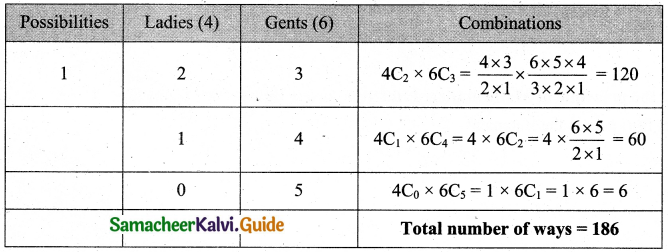
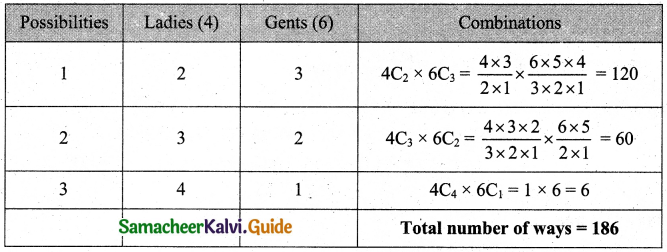
A committee of 5 is to be formed out of 6 gents and 4 ladies. In how many ways this can be done when
(i) atleast two ladies are included.
(ii) atmost two ladies are included.
Solution:
(i) A committee of 5 is to be formed.
Samacheer Kalvi 11th Business Maths Guide Chapter 2 Algebra Ex 2.4 Q10.1

(ii) Almost two ladies are included means maximum of two ladies are included.
Samacheer Kalvi 11th Business Maths Guide Chapter 2 Algebra Ex 2.4 Q10

Samacheer Kalvi 11th Business Maths Guide Chapter 2 Algebra Ex 2.3

Students can download 11th Business Maths Chapter 2 Algebra Ex 2.3 Questions and Answers, Notes, Samcheer Kalvi 11th Business Maths Guide Pdf helps you to revise the complete Tamilnadu State Board New Syllabus, helps students complete homework assignments and to score high marks in board exams.

Tamilnadu Samacheer Kalvi 11th Business Maths Solutions Chapter 2 Algebra Ex 2.3

Samacheer Kalvi 11th Business Maths Algebra Ex 2.3 Text Book Back Questions and Answers

Question 1.
If nP4 = 12(nP2), find n.
Solution:
Given that nP4 = 12(nP2)
n(n – 1) (n – 2) (n – 3) = 12n(n – 1)
Cancelling n(n – 1) on both sides we get
(n – 2) (n – 3) = 4 × 3
We have product of consecutive number on both sides with decreasing order.
n – 2 = 4
∴ n = 6

Samacheer Kalvi 11th Business Maths Guide Chapter 2 Algebra Ex 2.3

Question 2.
In how many ways 5 boys and 3 girls can be seated in a row so that no two girls are together?
Solution:
5 boys can be seated among themselves in 5P5 = 5! Ways. After this arrangement, we have to arrange the three girls in such a way that in between two girls there atleast one boy. So the possible places girls can be placed with the × symbol given below.
× B × B × B × B × B ×
∴ There are 6 places to seated by 3 girls which can be done 6P3 ways.
∴ Total number of ways = 5! × 6P3
= 120 × (6 × 5 × 4)
= 120 × 120
= 14400

Question 3.
How many 6-digit telephone numbers can be constructed with the digits 0, 1, 2, 3, 4, 5, 6, 7, 8, 9 if each number starts with 35 and no digit appears more than once?
Solution:
Given that each number starts with 35. We need a 6 digit number. So we have to fill only one’s place, 10’s place, 100th place, and 1000th places. We have to use 10 digits.

In these digits, 3 and 5 should not be used as a repetition of digits is not allowed. Except for these two digits, we have to use 8 digits. One’s place can be filled by any of the 8 digits in different ways, 10’s place can be filled by the remaining 7 digits in 7 different ways.

100th place can be filled by the remaining 6 different ways and 1000th place can be filled by the remaining 5 digits in 5 different ways.

∴ Number of 6 digit telephone numbers = 8 × 7 × 6 × 5 = 1680

Samacheer Kalvi 11th Business Maths Guide Chapter 2 Algebra Ex 2.3

Question 4.
Find the number of arrangements that can be made out of the letters of the word “ASSASSINATION”.
Solution:
The number of letters of the word “ASSASSINATION” is 13.
The letter A occurs 3 times
The letter S occurs 4 times
The letter I occur 2 times
The letter N occurs 2 times
The letter T occurs 1 time
The letter O occurs 1 time
∴ Number of arrangements = \(\frac{13 !}{3 ! 4 ! 2 ! 2 ! 1 ! 1 !}=\frac{13 !}{3 ! 4 ! 2 ! 2 !}\)

Question 5.
(a) In how many ways can 8 identical beads be strung on a necklace?
(b) In how many ways can 8 boys form a ring?
Solution:
(a) Number of ways 8 identical beads can be stringed by \(\frac{(8-1) !}{2}=\frac{7 !}{2}\)
(b) Number of ways 8 boys form a ring = (8 – 1)! = 7!

Samacheer Kalvi 11th Business Maths Guide Chapter 2 Algebra Ex 2.3

Question 6.
Find the rank of the word ‘CHAT’ in the dictionary.
Solution:
The letters of the word CHAT in alphabetical order are A, C, H, T. To arrive the word CHAT, first, we have to go through the word that begins with A. If A is fixed as the first letter remaining three letters C, H, T can be arranged among themselves in 3! ways. Next, we select C as the first letter and start arranging the remaining letters in alphabetical order. Now C and A is fixed remaining two letters can be arranged in 2! ways. Next, we move on H with C, A, and H is fixed the letter T can be arranged in 1! ways.
∴ Rank of the word CHAT = 3! + 2! + 1! = 6 + 2 + 1 = 9

Note: The rank of a given word is basically finding out the position of the word when possible words have been formed using all the letters of the given word exactly once and arranged in alphabetical order as in the case of dictionary. The possible arrangement of the word CHAT are (i) ACHT, (ii) ACTH, (iii) AHCT, (iv) AHTC, (v) ATCH, (vi) ATHC, (vii) CAHT, (viii) CATH, (ix) CHAT. So the rank of the word occurs in the ninth position.
∴ The rank of the word CHAT is 9.

Samacheer Kalvi 11th Business Maths Guide Chapter 2 Algebra Ex 2.2

Students can download 11th Business Maths Chapter 2 Algebra Ex 2.2 Questions and Answers, Notes, Samcheer Kalvi 11th Business Maths Guide Pdf helps you to revise the complete Tamilnadu State Board New Syllabus, helps students complete homework assignments and to score high marks in board exams.

Tamilnadu Samacheer Kalvi 11th Business Maths Solutions Chapter 2 Algebra Ex 2.2

Samacheer Kalvi 11th Business Maths Algebra Ex 2.2 Text Book Back Questions and Answers

Question 1.
Find x if \(\frac{1}{6 !}+\frac{1}{7 !}=\frac{x}{8 !}\)
Solution:
Given that \(\frac{1}{6 !}+\frac{1}{7 !}=\frac{x}{8 !}\)
\(\frac{1}{6 !}+\frac{1}{7 \cdot 6 !}=\frac{x}{8 \cdot 7 \cdot 6 !}\)
Cancelling all 6! we get
\(\frac{1}{1}+\frac{1}{7}=\frac{x}{8 \times 7}\)
\(\frac{7+1}{7}=\frac{x}{8 \times 7}\)
\(\frac{8}{7}=\frac{x}{8 \times 7}\)
x = \(\frac{8}{7}\) × 7 × 8 = 64

Question 2.
Evaluate \(\frac{n !}{r !(n-r) !}\) when n = 5 and r = 2.
Solution:
\(\frac{n !}{r !(n-r) !}=\frac{5 !}{2 !(5-2) !}=\frac{5 !}{2 ! \times 3 !}=\frac{5 \times 4 \times 3 \times 2 \times 1}{2 \times 1 \times 3 \times 2 \times 1}=10\)

Samacheer Kalvi 11th Business Maths Guide Chapter 2 Algebra Ex 2.2

Question 3.
If (n + 2)! = 60[(n – 1)!], find n.
Solution:
Given that (n + 2)! = 60(n – 1)!
(n + 2) (n + 1) n (n – 1)! = 60(n – 1)!
Cancelling (n – 1)! we get,
(n + 2)(n + 1)n = 60
(n + 2)(n + 1)n = 5 × 4 × 3
Both sides we consecutive product of integers
∴ n = 3

Question 4.
How many five digits telephone numbers can be constructed using the digits 0 to 9 If each number starts with 67 with no digit appears more than once?
Solution:
Given that each number starts at 67, we need a five-digit number. So we have to fill only one’s place, 10’s place, and 100th place. From 0 to 9 there are 10 digits. In these digits, 6 and 7 should not be used as a repetition of digits is not allowed. Except for these two digits, we have 8 digits. Therefore one’s place can be filled by any of the 8 digits in 8 different ways. Now there are 7 digits are left.

Therefore 10’s place can be filled by any of the 7 digits in 7 different ways. Similarly, 100th place can be filled in 6 different ways. By multiplication principle, the number of telephone numbers constructed is 8 × 7 × 6 = 336.

Samacheer Kalvi 11th Business Maths Guide Chapter 2 Algebra Ex 2.2

Question 5.
How many numbers lesser than 1000 can be formed using the digits 5, 6, 7, 8, and 9 if no digit is repeated?
Solution:
The required numbers are lesser than 1000.
They are one digit, two-digit or three-digit numbers.
There are five numbers to be used without repetition.
One digit number: One-digit numbers are 5.
Two-digit number: 10th place can be filled by anyone of the digits by 5 ways and 1’s place can be 4 filled by any of the remaining four digits in 4 ways.
∴ Two-digit number are 5 × 4 = 20.
Three-digit number: 100th place can be filled by any of the 5 digits, 10th place can be filled by 4 digits and one’s place can be filled by 3 digits.
∴ Three digit numbers are = 5 × 4 × 3 = 60
∴ Total numbers = 5 + 20 + 60 = 85.

Samacheer Kalvi 11th Business Maths Guide Chapter 2 Algebra Ex 2.1

Students can download 11th Business Maths Chapter 2 Algebra Ex 2.1 Questions and Answers, Notes, Samcheer Kalvi 11th Business Maths Guide Pdf helps you to revise the complete Tamilnadu State Board New Syllabus, helps students complete homework assignments and to score high marks in board exams.

Tamilnadu Samacheer Kalvi 11th Business Maths Solutions Chapter 2 Algebra Ex 2.1

Samacheer Kalvi 11th Business Maths Algebra Ex 2.1 Text Book Back Questions and Answers

Resolve into partial fractions for the following:

Question 1.
\(\frac{3 x+7}{x^{2}-3 x+2}\)
Solution:
Here the denominator x2 – 3x + 2 is not a linear factor.
So if possible we have to factorise it then only we can split up into partial fraction.
x2 – 3x + 2 = (x – 1) (x – 2)
\(\frac{3 x+7}{(x-1)(x-2)}=\frac{A}{x-1}+\frac{B}{x-2}\) …….. (1)
Multiply both side by (x – 1) (x – 2)
3x + 7 = A(x – 2) + B(x – 1) …….. (2)
Put x = 2 in (2) we get
3(2) + 7 = A(2 – 2) + B(2 – 1)
6 + 7 = 0 + B(1)
∴ B = 13
Put x = 1 in (2) we get
3(1) + 7 = A(1 – 2) + B(1 – 1)
3 + 7 = A (-1) + 0
10 = A(-1)
∴ A = -10
Using A = -10 and B = 13 in (1) we get
Samacheer Kalvi 11th Business Maths Guide Chapter 2 Algebra Ex 2.1 Q1
Note: When the denominator is only two linear factors we can adopt the following method.
Samacheer Kalvi 11th Business Maths Guide Chapter 2 Algebra Ex 2.1 Q1.1

Question 2.
\(\frac{4 x+1}{(x-2)(x+1)}\)
Solution:
Let \(\frac{4 x+1}{(x-2)(x+1)}=\frac{A}{x-2}+\frac{B}{x+1}\) ……… (1)
Multiply both sides by (x – 2) (x + 1) we get
4x + 1 = A(x + 1) + B(x – 2) ……. (2)
Put x = -1 in (2) we get
4(-1) + 1 = A(-1 + 1) + B(-1 – 2)
-4 + 1 = A(0) + B(-3)
-3 = B(-3)
B = \(\frac{-3}{-3}\) = 1
Put x = 2 in (2) we get
4(2) + 1 = A(2 + 1) + B(2 – 2)
8 + 1 = A(3) + B(0)
9 = 3A
A = 3
Using A = 3, B = 1 in (1) we get
\(\frac{4 x+1}{(x-2)(x+1)}=\frac{3}{x-2}+\frac{1}{x+1}\)

Samacheer Kalvi 11th Business Maths Guide Chapter 2 Algebra Ex 2.1

Question 3.
\(\frac{1}{(x-1)(x+2)^{2}}\)
Solution:
Here the denominator has repeated factors. So we write
\(\frac{1}{(x-1)(x+2)^{2}}=\frac{A}{x-1}+\frac{B}{(x+2)}+\frac{C}{(x+2)^{2}}\) …… (1)
Multiply both sides by (x – 1) (x + 2)2 we get
1 = A(x + 2)2 + B(x – 1) (x + 2) + C(x – 1) …… (2)
Put x = 1 in (2) we get
1 = A(1 + 2)2 + B(1 – 1) (1 + 2) + C(1 – 1)
1 = A(32) + 0 + 0
1 = 9A
A = \(\frac{1}{9}\)
Put x = -2 in (2) we get
1 = A(-2 + 2)2 + B(-2 – 1) (-2 + 2) + C(-2 – 1)
1 = 0 + 0 + C(-3)
C = \(\frac{-1}{3}\)
From (2) we have
1 = A(x + 2)2 + B(x – 1) (x + 2) + C(x – 1)
0x2 + 1 = A(x2 + 4x + 4) + B(x2 + x – 2) + C(x – 1)
Equating coefficient of x2 on both sides we get
0 = A + B
0 = \(\frac{1}{9}\) (∴ A = \(\frac{1}{9}\))
B = \(-\frac{1}{9}\)
Using A = \(\frac{1}{9}\), B = \(-\frac{1}{9}\), C = \(-\frac{1}{3}\) in (1) we get,
Samacheer Kalvi 11th Business Maths Guide Chapter 2 Algebra Ex 2.1 Q3

Question 4.
\(\frac{1}{x^{2}-1}\)
Solution:
Samacheer Kalvi 11th Business Maths Guide Chapter 2 Algebra Ex 2.1 Q4
1 = A(x – 1) + B(x + 1) ……. (2)
Put x = 1 in (2) we get
1 = 0 + B(1 + 1)
1 = B(2)
B = \(\frac{1}{2}\)
Put x = -1 in (2) we get
1 = A(-1 – 1) + B(-1 + 1)
1 = -2A + 0
A = \(\frac{-1}{2}\)
Using A = \(\frac{-1}{2}\), B = \(\frac{1}{2}\) in (1) we get
Samacheer Kalvi 11th Business Maths Guide Chapter 2 Algebra Ex 2.1 Q4.1

Question 5.
\(\frac{x-2}{(x+2)(x-1)^{2}}\)
Solution:
Samacheer Kalvi 11th Business Maths Guide Chapter 2 Algebra Ex 2.1 Q5
x – 2 = A(x – 1)2 + B(x + 2) (x – 1) + C(x + 2) ……(2)
Put x = 1 in (2) we get
1 – 2 = A(1 – 1)2 + B(1 + 2) (1 – 1) + C(1 + 2)
-1 = 0 + 0 + 3C
C = \(-\frac{1}{3}\)
Put x = -2 in (2) we get
-2 – 2 = A(-2 – 1)2 + B(-2 + 2) (-2 – 1) + C(-2 + 2)
-4 = A(-3)2 + 0 + 0
-4 = 9A
A = \(\frac{-4}{9}\)
From (2) we have,
0x2 + x – 2 = A(x – 1)2 + B(x + 2) (x – 1) + C(x + 2)
Equating coefficients of x2 on both sides we get
0 = A + B
0 = \(\frac{-4}{9}\) + B (∵ A = \(\frac{-4}{9}\))
B = \(\frac{4}{9}\)
Using A = \(\frac{-4}{9}\), B = \(\frac{4}{9}\), C = \(-\frac{1}{3}\) in (1) we get
Samacheer Kalvi 11th Business Maths Guide Chapter 2 Algebra Ex 2.1 Q5.1

Samacheer Kalvi 11th Business Maths Guide Chapter 2 Algebra Ex 2.1

Question 6.
\(\frac{2 x^{2}-5 x-7}{(x-2)^{3}}\)
Solution:
Samacheer Kalvi 11th Business Maths Guide Chapter 2 Algebra Ex 2.1 Q6
2x2 – 5x – 7 = A(x – 2)2 + B(x – 2) + C
2x2 – 5x – 7 = A(x2 – 4x + 4) + B(x – 2) + C …….. (2)
Put x = 2 in (2) we get
2(22) – 5(2) – 7 = A(0) + B(0) + C
8 – 10 – 7 = 0 + 0 + C
-9 = C
C = -9
Equating coefficient of x2 on both sides of (2) we get
2 = A
A = 2
Equating coefficient of x on both sides of (2) we get
-5 = A(-4) + B(1)
-5 = 2(-4) + B(∵ A = 2)
-5 = -8 + B
B = 8 – 5 = 3
Using A = 2, B = 3, C = -9 in (1) we get
Samacheer Kalvi 11th Business Maths Guide Chapter 2 Algebra Ex 2.1 Q6.1

Question 7.
\(\frac{x^{2}-6 x+2}{x^{2}(x+2)}\)
Solution:
Here the denominator has three factors. So given fraction can be expressed as a sum of three simple fractions.
Let \(\frac{x^{2}-6 x+2}{x^{2}(x+2)}=\frac{A}{x}+\frac{B}{x^{2}}+\frac{C}{x+2}\) …… (1)
Multiply both sides by x2 (x + 2) we get
Samacheer Kalvi 11th Business Maths Guide Chapter 2 Algebra Ex 2.1 Q7
x2 – 6x + 2 = Ax(x + 2) + B(x + 2) + C(x2) ……… (2)
Put x = 0 in (2) we get
0 – 0 + 2 = 0 + B(0 + 2) + 0
2 = B(2)
B = 1
Put x = -2 in (2) we get
(-2)2 – 6(-2) + 2 = 0 + 0 + C(-2)2
4 + 12 + 2 = C(4)
18 = 4C
C = \(\frac{9}{2}\)
Comparing coefficient of x2 on both sides of (2) we get,
1 = A + C
1 = A + \(\frac{9}{2}\)
A = 1 – \(\frac{9}{2}\) = \(\frac{2-9}{2}=\frac{-7}{2}\)
Using A = \(\frac{-7}{2}\), B = 1, C = \(\frac{9}{2}\) in (1) we get,
\(\frac{\left(x^{2}-6 x+2\right)}{x^{2}(x+2)}=\frac{-7}{2 x}+\frac{1}{x^{2}}+\frac{9}{2(x+2)}\)

Samacheer Kalvi 11th Business Maths Guide Chapter 2 Algebra Ex 2.1

Question 8.
\(\frac{x^{2}-3}{(x+2)\left(x^{2}+1\right)}\)
Solution:
Here the quadratic factor x2 + 1 is not factorisable.
Let \(\frac{x^{2}-3}{(x+2)\left(x^{2}+1\right)}=\frac{A}{x+2}+\frac{(B x+C)}{x^{2}+1}\) ….. (1)
Multiply both sides by (x + 2) (x2 + 1) we get,
x2 – 3 = A(x2 + 1) + (Bx + C) (x + 2)
Put x = -2 we get
(-2)2 – 3 = [A(-2)2 + 1] + 0
4 – 3 = A(4 + 1)
1 = 5A
A = \(\frac{1}{5}\)
Equating coefficient of x2 on both sides of (2) we get
1 = A + B
1 = \(\frac{1}{5}\) + B
B = 1 – \(\frac{1}{5}\) = \(\frac{4}{5}\)
Equating coefficients of x on both sides of (2) we get
0 = 2B + C
0 = 2(\(\frac{4}{5}\)) + C
C = \(\frac{-8}{5}\)
Using A, B, C’s values in (1) we get
Samacheer Kalvi 11th Business Maths Guide Chapter 2 Algebra Ex 2.1 Q8

Question 9.
\(\frac{x+2}{(x-1)(x+3)^{2}}\)
Solution:
Here the denominator has three factors. So given fraction can be expressed as a sum of three simple fractions.
Let \(\frac{x+2}{(x-1)(x+3)^{2}}=\frac{A}{x-1}+\frac{B}{x+3}+\frac{C}{(x+3)^{2}}\) ……. (1)
Multiply both sides by (x – 1) (x + 3)2 we get
\(\frac{x+2}{(x-1)(x+3)^{2}}\) (x – 1) (x + 3)2 = \(\frac{A}{x-1}\) (x – 1) (x + 3)2 +
\(\frac{B}{x+3}\) (x – 1) (x + 3)2 + \(\frac{C}{(x+3)^{2}}\) (x – 1) (x + 3)2
x + 2 = A(x + 3)2 + B(x – 1) (x + 3) + C(x – 1) ……. (2)
Put x = 1 in (2) we get
1 + 2 = A(1 + 3)2 + 0 + 0
3 = A(4)2
A = \(\frac{3}{16}\)
Put x = -3 in (2) we get
-3 + 2 = 0 + 0 + C(-3 – 1)
-1 = C(-4)
C = \(\frac{1}{4}\)
Comparing coefficient of x2 on both sides of (2) we get,
0 = A + B
0 = \(\frac{3}{16}\) + B
B = \(-\frac{3}{16}\)
Using A = \(\frac{3}{16}\), B = \(-\frac{3}{16}\), C = \(\frac{1}{4}\) in (1) we get,
\(\frac{x+2}{(x-1)(x+3)^{2}}=\frac{3}{16(x-1)}-\frac{3}{16(x+3)}+\frac{1}{4(x+3)^{2}}\)

Samacheer Kalvi 11th Business Maths Guide Chapter 2 Algebra Ex 2.1

Question 10.
\(\frac{1}{\left(x^{2}+4\right)(x+1)}\)
Solution:
Here the quadratic factor x2 + 4 is not factorisable.
Let \(\frac{1}{(x+1)\left(x^{2}+4\right)}=\frac{A}{x+1}+\frac{B x+C}{x^{2}+4}\) ……. (1)
Multiply both sides by (x + 1) (x2 + 4) we get
1 = A(x2 + 4) + (Bx + C) (x + 1) ……. (2)
Put x = -1 in (2) we get
1 = A((-1)2 + 4) + 0
1 = A(1 + 4)
A = \(\frac{1}{5}\)
Equating coefficient of x2 on both sides of (2) we get,
0 = A + B
0 = \(\frac{1}{5}\) + B
B = \(\frac{-1}{5}\)
Equating coefficient of x on both sides of (2) we get,
{∵ (Bx + C) (x + 1) = Bx2 + Cx = Bx + C}
0 = B + C
0 = \(\frac{-1}{5}\) + C
C = \(\frac{1}{5}\)
Using A = \(\frac{1}{5}\), B = \(\frac{-1}{5}\), C = \(\frac{1}{5}\) we get,
Samacheer Kalvi 11th Business Maths Guide Chapter 2 Algebra Ex 2.1 Q10

Samacheer Kalvi 11th Business Maths Guide Chapter 1 Matrices and Determinants Ex 1.5

Students can download 11th Business Maths Chapter 1 Matrices and Determinants Ex 1.5 Questions and Answers, Notes, Samcheer Kalvi 11th Business Maths Guide Pdf helps you to revise the complete Tamilnadu State Board New Syllabus, helps students complete homework assignments and to score high marks in board exams.

Tamilnadu Samacheer Kalvi 11th Business Maths Solutions Chapter 1 Matrices and Determinants Ex 1.5

Samacheer Kalvi 11th Business Maths Matrices and Determinants Ex 1.5 Text Book Back Questions and Answers

Choose the Correct Answer.

Question 1.
The value of x if \(\left|\begin{array}{lll}
0 & 1 & 0 \\
x & 2 & x \\
1 & 3 & x
\end{array}\right|=0\) is
(a) 0, -1
(b) 0, 1
(c) -1, 1
(d) -1, -1
Answer:
(b) 0, 1
Hint:
0 – 1[x2 – x] + 0 = 0
⇒ x2 – x = 0
⇒ x(x – 1) = 0
⇒ x = 0 (or) x = 1

Question 2.
The value of \(\left|\begin{array}{lll}
2 x+y & x & y \\
2 y+z & y & z \\
2 z+x & z & x
\end{array}\right|\) is
(a) xyz
(b) x + y + z
(c) 2x + 2y + 2z
(d) 0
Answer:
(d) 0
Hint:
= \(\left|\begin{array}{lll}
2 x & x & y \\
2 y & y & z \\
2 z & z & x
\end{array}\right|\) C1 → C1 – C3
= 0 (C1 and C2 are proportional)

Samacheer Kalvi 11th Business Maths Guide Chapter 1 Matrices and Determinants Ex 1.5

Question 3.
The cofactor of -7 in the determinant \(\left|\begin{array}{rrr}
2 & -3 & 5 \\
6 & 0 & 4 \\
1 & 5 & -7
\end{array}\right|\) is
(a) -18
(b) 18
(c) -7
(d) 7
Answer:
(b) 18
Hint:
A cofactor of -7 = \(\left|\begin{array}{rr}
2 & -3 \\
6 & 0
\end{array}\right|\)
= 0 + 18
= 18

Question 4.
If Δ = \(\left|\begin{array}{lll}
1 & 2 & 3 \\
3 & 1 & 2 \\
2 & 3 & 1
\end{array}\right|\) then \(\left|\begin{array}{lll}
3 & 1 & 2 \\
1 & 2 & 3 \\
2 & 3 & 1
\end{array}\right|\) is
(a) Δ
(b) -Δ
(c) 3Δ
(d) -3Δ
Answer:
(b) -Δ
Hint:
\(\left|\begin{array}{lll}
3 & 1 & 2 \\
1 & 2 & 3 \\
2 & 3 & 1
\end{array}\right|=-\left|\begin{array}{lll}
1 & 2 & 3 \\
3 & 1 & 2 \\
2 & 3 & 1
\end{array}\right|\) R1 ↔ R2
= -Δ

Samacheer Kalvi 11th Business Maths Guide Chapter 1 Matrices and Determinants Ex 1.5

Question 5.
The value of the determinant \(\left|\begin{array}{lll}
a & 0 & 0 \\
0 & b & 0 \\
0 & 0 & c
\end{array}\right|^{2}\) is
(a) abc
(b) 0
(c) a2b2c2
(d) -abc
Answer:
(c) a2b2c2
Hint:
\(a^{2} b^{2} c^{2}\left|\begin{array}{ccc}
1 & 0 & 0 \\
0 & 1 & 0 \\
0 & 0 & 1
\end{array}\right|\)
= a2b2c2 × 12
= a2b2c2

Question 6.
If A is square matrix of order 3 then |kA| is:
(a) k|A|
(b) -k|A|
(c) k3|A|
(d) -k3|A|
Answer:
(c) k3|A|

Samacheer Kalvi 11th Business Maths Guide Chapter 1 Matrices and Determinants Ex 1.5

Question 7.
adj (AB) is equal to:
(a) adj A adj B
(b) adj AT adj BT
(c) adj B adj A
(d) adj BT adj AT
Answer:
(c) adj B adj A

Question 8.
The inverse matrix of \(\left(\begin{array}{cc}
\frac{4}{5} & \frac{5}{12} \\
\frac{2}{5} & \frac{1}{2}
\end{array}\right)\) is
(a) \(\frac{7}{30}\left(\begin{array}{cc}
\frac{1}{2} & \frac{5}{12} \\
\frac{2}{5} & \frac{4}{5}
\end{array}\right)\)
(b) \(\frac{7}{30}\left(\begin{array}{cc}
\frac{1}{2} & \frac{-5}{12} \\
\frac{-2}{5} & \frac{1}{5}
\end{array}\right)\)
(c) \(\frac{30}{7}\left(\begin{array}{rr}
\frac{1}{2} & \frac{5}{12} \\
\frac{2}{5} & \frac{4}{5}
\end{array}\right)\)
(d) \(\frac{30}{7}\left(\begin{array}{rr}
\frac{1}{2} & \frac{-5}{12} \\
\frac{-2}{5} & \frac{4}{5}
\end{array}\right)\)
Answer:
(c) \(\frac{30}{7}\left(\begin{array}{rr}
\frac{1}{2} & \frac{5}{12} \\
\frac{2}{5} & \frac{4}{5}
\end{array}\right)\)

Samacheer Kalvi 11th Business Maths Guide Chapter 1 Matrices and Determinants Ex 1.5

Question 9.
If A = \(\left[\begin{array}{ll}
a & b \\
c & d
\end{array}\right]\) such that ad – bc ≠ 0 then A-1 is:
(a) \(\frac{1}{a d-b c}\left[\begin{array}{cc}
d & b \\
-c & a
\end{array}\right]\)
(b) \(\frac{1}{a d-b c}\left[\begin{array}{ll}
d & b \\
c & a
\end{array}\right]\)
(c) \(\frac{1}{a d-b c}\left[\begin{array}{cc}
d & -b \\
-c & a
\end{array}\right]\)
(d) \(\frac{1}{a d-b c}\left[\begin{array}{ll}
d & -b \\
c & a
\end{array}\right]\)
Answer:
(c) \(\frac{1}{a d-b c}\left[\begin{array}{cc}
d & -b \\
-c & a
\end{array}\right]\)
Hint:
Samacheer Kalvi 11th Business Maths Guide Chapter 1 Matrices and Determinants Ex 1.5 Q9

Question 10.
The number of Hawkins-Simon conditions for the viability of input-output analysis is:
(a) 1
(b) 3
(c) 4
(d) 2
Answer:
(d) 2

Samacheer Kalvi 11th Business Maths Guide Chapter 1 Matrices and Determinants Ex 1.5

Question 11.
The inventor of input-output analysis is:
(a) Sir Francis Galton
(b) Fisher
(c) Prof. Wassily W. Leontief
(d) Arthur Cayley
Answer:
(c) Prof. Wassily W. Leontief

Question 12.
Which of the following matrix has no inverse?
(a) \(\left(\begin{array}{rr}
-1 & 1 \\
1 & -4
\end{array}\right)\)
(b) \(\left(\begin{array}{rr}
2 & -1 \\
-4 & 2
\end{array}\right)\)
(c) \(\left(\begin{array}{cc}
\cos a & \sin a \\
-\sin a & \cos a
\end{array}\right)\)
(d) \(\left(\begin{array}{rr}
\sin a & \sin a \\
-\cos a & \cos a
\end{array}\right)\)
Answer:
(b) \(\left(\begin{array}{rr}
2 & -1 \\
-4 & 2
\end{array}\right)\)
Hint:
So \(\left(\begin{array}{rr}
2 & -1 \\
-4 & 2
\end{array}\right)\) has no inverse.

Samacheer Kalvi 11th Business Maths Guide Chapter 1 Matrices and Determinants Ex 1.5

Question 13.
Inverse of \(\left(\begin{array}{ll}
3 & 1 \\
5 & 2
\end{array}\right)\) is:
(a) \(\left(\begin{array}{rr}
2 & -1 \\
-5 & 3
\end{array}\right)\)
(b) \(\left(\begin{array}{rr}
-2 & 5 \\
1 & -3
\end{array}\right)\)
(c) \(\left(\begin{array}{rr}
3 & -1 \\
-5 & -3
\end{array}\right)\)
(d) \(\left(\begin{array}{rr}
-3 & 5 \\
1 & -2
\end{array}\right)\)
Answer:
(a) \(\left(\begin{array}{rr}
2 & -1 \\
-5 & 3
\end{array}\right)\)
Hint:
Let A = \(\left(\begin{array}{ll}
3 & 1 \\
5 & 2
\end{array}\right)\)
|A| = [6 – 5] = 1
adj A = \(\left[\begin{array}{rr}
2 & -1 \\
-5 & 3
\end{array}\right]\)
∴ A-1 = \(\left[\begin{array}{rr}
2 & -1 \\
-5 & 3
\end{array}\right]\)

Question 14.
If A = \(\left(\begin{array}{rr}
-1 & 2 \\
1 & -4
\end{array}\right)\) then A (adj A) is:
(a) \(\left(\begin{array}{ll}
-4 & -2 \\
-1 & -1
\end{array}\right)\)
(b) \(\left(\begin{array}{rr}
4 & -2 \\
-1 & 1
\end{array}\right)\)
(c) \(\left(\begin{array}{ll}
2 & 0 \\
0 & 2
\end{array}\right)\)
(d) \(\left(\begin{array}{ll}
0 & 2 \\
2 & 0
\end{array}\right)\)
Answer:
(c) \(\left(\begin{array}{ll}
2 & 0 \\
0 & 2
\end{array}\right)\)
Hint:
A = \(\left(\begin{array}{rr}
-1 & 2 \\
1 & -4
\end{array}\right)\)
|A| = 4 – 2 = 2
We know that A (adj A) = |A| I
⇒ 2 \(\left(\begin{array}{ll}
1 & 0 \\
0 & 1
\end{array}\right)=\left(\begin{array}{ll}
2 & 0 \\
0 & 2
\end{array}\right)\)

Samacheer Kalvi 11th Business Maths Guide Chapter 1 Matrices and Determinants Ex 1.5

Question 15.
If A and B non-singular matrix then, which of the following is incorrect?
(a) A2 = I implies A-1 = A
(b) I-1 = I
(c) If AX = B then X = B-1A
(d) If A is square matrix of order 3 then |adj A| = |A|2
Answer:
(c) If AX = B then X = B-1A
Hint:
If AX = B then X = A-1B so, X = B-1A is incorrect.

Question 16.
The value of \(\left|\begin{array}{rrr}
5 & 5 & 5 \\
4 x & 4 y & 4 z \\
-3 x & -3 y & -3 z
\end{array}\right|\) is:
(a) 5
(b) 4
(c) 0
(d) -3
Answer:
(c) 0
Hint:
= 4 × (-3) \(\left|\begin{array}{lll}
5 & 5 & 5 \\
x & y & z \\
x & y & z
\end{array}\right|\)
[Take out 4 from R2 and -3 from R3]
= 0 (∵ R2 ≡ R3)

Samacheer Kalvi 11th Business Maths Guide Chapter 1 Matrices and Determinants Ex 1.5

Question 17.
If A is an invertible matrix of order 2 then det (A-1) be equal
(a) det (A)
(b) \(\frac{1}{{det}(A)}\)
(c) 1
(d) 0
Answer:
(b) \(\frac{1}{{det}(A)}\)
Hint:
AA-1 = I
|AA-1| = |I|
|A| |A-1| = 1
|A-1| = \(\frac{1}{|\mathrm{A}|}\)
det A-1 = \(\frac{1}{\det (A)}\)

Question 18.
If A is 3 × 3 matrix and |A| = 4 then |A-1| is equal to:
(a) \(\frac{1}{4}\)
(b) \(\frac{1}{16}\)
(c) 2
(d) 4
Answer:
(a) \(\frac{1}{4}\)
Hint:
|A-1| = \(\frac{1}{|A|}=\frac{1}{4}\)

Samacheer Kalvi 11th Business Maths Guide Chapter 1 Matrices and Determinants Ex 1.5

Question 19.
If A is a square matrix of order 3 and |A| = 3 then |adj A| is equal to:
(a) 81
(b) 27
(c) 3
(d) 9
Answer:
(d) 9
Hint:
|adj A| = |A|2 = 32 = 9

Question 20.
The value of \(\left|\begin{array}{ccc}
x & x^{2}-y z & 1 \\
y & y^{2}-z x & 1 \\
z & z^{2}-x y & 1
\end{array}\right|\) is:
(a) 1
(b) 0
(c) -1
(d) -xyz
Answer:
(b) 0
Hint:
Samacheer Kalvi 11th Business Maths Guide Chapter 1 Matrices and Determinants Ex 1.5 Q20
Samacheer Kalvi 11th Business Maths Guide Chapter 1 Matrices and Determinants Ex 1.5 Q20.1

Samacheer Kalvi 11th Business Maths Guide Chapter 1 Matrices and Determinants Ex 1.5

Question 21.
If A = \(\left[\begin{array}{rr}
\cos \theta & \sin \theta \\
-\sin \theta & \cos \theta
\end{array}\right]\), then |2A| is equal to:
(a) 4 cos 2θ
(b) 4
(c) 2
(d) 1
Answer:
(b) 4
Hint:
|2A| = 22 |A|
= 4 \(\left|\begin{array}{rr}
\cos \theta & \sin \theta \\
-\sin \theta & \cos \theta
\end{array}\right|\)
= 4 [cos2θ + sin2θ]
= 4 × 1
= 4

Question 22.
If Δ = \(\left|\begin{array}{lll}
a_{11} & a_{12} & a_{13} \\
a_{21} & a_{22} & a_{23} \\
a_{31} & a_{32} & a_{33}
\end{array}\right|\) and Aij is cofactor of aij, then value of Δ is given by:
(a) a11A31 + a12A32 + a13A33
(b) a11A11 + a12A21 + a13A31
(c) a21A11 + a22A12 + a23A13
(d) a11A11 + a21A21 + a31A31
Answer:
(d) a11A11 + a21A21 + a31A31

Samacheer Kalvi 11th Business Maths Guide Chapter 1 Matrices and Determinants Ex 1.5

Question 23.
If \(\left|\begin{array}{ll}
x & 2 \\
8 & 5
\end{array}\right|=0\) then the value of x is:
(a) \(\frac{-5}{6}\)
(b) \(\frac{5}{6}\)
(c) \(\frac{-16}{5}\)
(d) \(\frac{16}{5}\)
Answer:
(d) \(\frac{16}{5}\)
Hint:
\(\left|\begin{array}{ll}
x & 2 \\
8 & 5
\end{array}\right|=0\)
5x – 16 = 0
⇒ x = \(\frac{16}{5}\)

Question 24.
If \(\left|\begin{array}{ll}
4 & 3 \\
3 & 1
\end{array}\right|\) = -5 then the value of \(\left|\begin{array}{rr}
20 & 15 \\
15 & 5
\end{array}\right|\) is:
(a) -5
(b) -125
(c) -25
(4) 0
Answer:
(b) -125
Hint:
\(\left|\begin{array}{rr}
20 & 15 \\
15 & 5
\end{array}\right|\)
= 5 × 5 \(\left|\begin{array}{ll}
4 & 3 \\
3 & 1
\end{array}\right|\)
= 5 × 5 × (-5)
= -125

Samacheer Kalvi 11th Business Maths Guide Chapter 1 Matrices and Determinants Ex 1.5

Question 25.
If any three rows or columns of a determinant are identical then the value of the determinant is:
(a) 0
(b) 2
(c) 1
(d) 3
Answer:
(a) 0