Samacheer Kalvi 5th Maths Guide Term 2 Chapter 1 Geometry Ex 1.1

Students can download 5th Maths Term 2 Chapter 1 Geometry Ex 1.1 Questions and Answers, Notes, Samacheer Kalvi 5th Maths Guide Pdf helps you to revise the complete Tamilnadu State Board New Syllabus, helps students complete homework assignments and to score high marks in board exams.

Tamilnadu Samacheer Kalvi 5th Maths Solutions Term 2 Chapter 1 Geometry Ex 1.1

Question 1.
Write the measures of the complementary angles of the following angles.
i) 45°
ii) 30°
iii) 72°
iv) 88°
V) 38°
Answer:
i) 45°
= 90°- 45°
= 45°

Samacheer Kalvi 5th Maths Guide Term 2 Chapter 1 Geometry Ex 1.1

ii) 30°
= 90° – 30°
= 60°

(iii) 72°
= 90° – 72°
= 18°

iv) 88°
= 90° – 88°
= 2°

V) 38°
= 90°- 38°
= 52°

Samacheer Kalvi 5th Maths Guide Term 2 Chapter 1 Geometry Ex 1.1

Question 2.
Write the measures of the supplementary angles of the following angles
i) 80°
ii) 95°
iii) 110°
iv) 1350
v) 15
Answer:
(i) 80°
= 180° – 80°
= 100°

(ii) 95°
= 180° – 95°
= 85°

(iii) 110°
= 180° – 110°
= 70°

(iv) 135°
= 180° – 1350
= 45°

Samacheer Kalvi 5th Maths Guide Term 2 Chapter 1 Geometry Ex 1.1

(V) 150°
= 1800 – 150°
= 30°

Samacheer Kalvi 11th Business Maths Guide Chapter 3 Analytical Geometry Ex 3.2

Students can download 11th Business Maths Chapter 3 Analytical Geometry Ex 3.2 Questions and Answers, Notes, Samcheer Kalvi 11th Business Maths Guide Pdf helps you to revise the complete Tamilnadu State Board New Syllabus, helps students complete homework assignments and to score high marks in board exams.

Tamilnadu Samacheer Kalvi 11th Business Maths Solutions Chapter 3 Analytical Geometry Ex 3.2

Samacheer Kalvi 11th Business Maths Analytical Geometry Ex 3.2 Text Book Back Questions and Answers

Question 1.
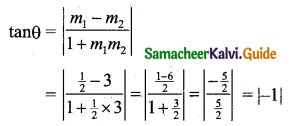
Find the angle between the lines whose slopes are \(\frac{1}{2}\) and 3.
Solution:
Given that m1 = \(\frac{1}{2}\) and m2 = 3.
Let θ be the angle between the lines then
Samacheer Kalvi 11th Business Maths Guide Chapter 3 Analytical Geometry Ex 3.2 Q1
tan θ = 1
tan θ = tan 45°
∴ θ = 45°

Samacheer Kalvi 11th Business Maths Guide Chapter 3 Analytical Geometry Ex 3.2

Question 2.
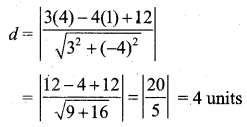
Find the distance of the point (4, 1) from the line 3x – 4y + 12 = 0.
Solution:
The length of perpendicular from a point (x1, y1) to the line ax + by + c = 0 is d = \(\left|\frac{a x_{1}+b y_{1}+c}{\sqrt{a^{2}+b^{2}}}\right|\)
∴ The distance of the point (4, 1) to the line 3x – 4y + 12 = 0 is
[Here (x1, y1) = (4, 1), a = 3, b = -4, c = 12]
Samacheer Kalvi 11th Business Maths Guide Chapter 3 Analytical Geometry Ex 3.2 Q2

Question 3.
Show that the straight lines x + y – 4 = 0, 3x + 2 = 0 and 3x – 3y + 16 = 0 are concurrent.
Solution:
The lines a1x + b1y + c1 = 0, a2x + b2y + c2 = 0, a3x + b3y + c3 = 0 are concurrent if
\(\left|\begin{array}{lll}
a_{1} & b_{1} & c_{1} \\
a_{2} & b_{2} & c_{2} \\
a_{3} & b_{3} & c_{3}
\end{array}\right|=0\)
The given lines x + y – 4 = 0, 3x + 0y + 2 = 0, 3x – 3y + 16 = 0
\(\left|\begin{array}{lll}
a_{1} & b_{1} & c_{1} \\
a_{2} & b_{2} & c_{2} \\
a_{3} & b_{3} & c_{3}
\end{array}\right|=\left|\begin{array}{rrr}
1 & 1 & -4 \\
3 & 0 & 2 \\
3 & -3 & 16
\end{array}\right|\)
= 1(0 + 6) – 1(48 – 6) – 4(-9 – 0)
= 6 – (42) + 36
= 42 – 42
= 0
The given lines are concurrent.

Samacheer Kalvi 11th Business Maths Guide Chapter 3 Analytical Geometry Ex 3.2

Question 4.
Find the value of ‘a’ for which the straight lines 3x + 4y = 13; 2x – 7y = -1 and ax – y – 14 = 0 are concurrent.
Solution:
The lines 3x + 4y = 13, 2x – 7y = -1 and ax – y – 14 = 0 are concurrent.
\(\left|\begin{array}{rrr}
3 & 4 & -13 \\
2 & -7 & 1 \\
a & -1 & -14
\end{array}\right|=0\)
⇒ 3(98 + 1) – 4(-28 – a) – 13(-2 + 7a) = 0
⇒ 3(99) + 112 + 4a + 26 – 91a = 0
⇒ 297 + 112 + 26 + 4a – 91a = 0
⇒ 435 – 87a = 0
⇒ -87a = -435
⇒ a = \(\frac{-435}{-87}\) = 5

Question 5.
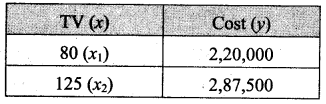
A manufacturer produces 80 TV sets at a cost of ₹ 2,20,000 and 125 TV sets at a cost of ₹ 2,87,500. Assuming the cost curve to be linear, find the linear expression of the given information. Also, estimate the cost of 95 TV sets.
Solution:
Let x represent the TV sets, andy represent the cost.
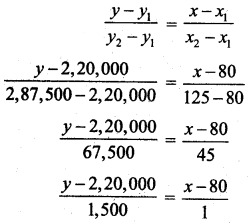
Samacheer Kalvi 11th Business Maths Guide Chapter 3 Analytical Geometry Ex 3.2 Q5
The equation of straight line expressing the given information as a linear equation in x and y is
Samacheer Kalvi 11th Business Maths Guide Chapter 3 Analytical Geometry Ex 3.2 Q5.1
1(y – 2,20,000) = (x – 80)1500
y – 2,20,000 = 1500x – 80 × 1500
y = 1500x – 1,20,000 + 2,20,000
y = 1500x + 1,00,000 which is the required linear expression.
When x = 95,
y = 1,500 × 95 + 1,00,000
= 1,42,500 + 1,00,000
= 2,42,500
∴ The cost of 95 TV sets is ₹ 2,42,500.

Samacheer Kalvi 6th Tamil Guide Chapter 2.4 கிழவனும் கடலும்

Students can Download 6th Tamil Chapter 2.4 கிழவனும் கடலும் Questions and Answers, Summary, Notes, Samacheer Kalvi 6th Tamil Guide Pdf helps you to revise the complete Tamilnadu State Board New Syllabus, helps students complete homework assignments and to score high marks in board exams.

Tamilnadu Samacheer Kalvi 6th Tamil Solutions Chapter 2.4 கிழவனும் கடலும்

கற்பவை கற்றபின்

Samacheer Kalvi 6th Tamil Guide Chapter 2.4 கிழவனும் கடலும்

Question 1.
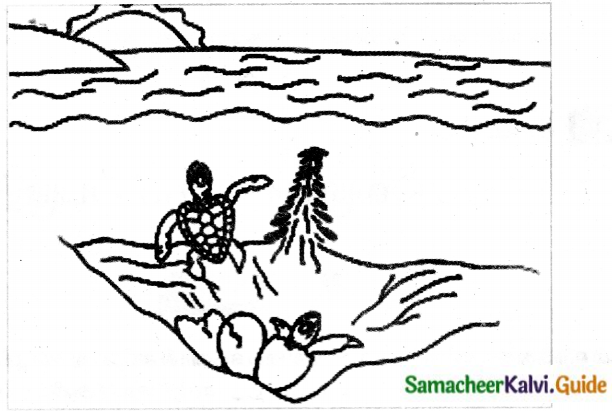
கடல் காட்சி ஒன்றைப் படம் வரைந்து வண்ணம் தீட்டுக. அப்படத்திற்குப் பொருத்தமாக நான்கு வரிகளுக்குள் குறிப்பு எழுதுக.
Answer:
மாணவர்கள் கடல் காட்சி ஒன்றைப் படம் வரைந்து வண்ணம் தீட்டுதல்.
Samacheer Kalvi 6th Tamil Guide Chapter 2.4 கிழவனும் கடலும் 1
படத்திற்கு பொருத்தமான தலைப்பு : கடல் வாழ் உயிரினங்கள்.
குறிப்பு : கடல் அலை – நண்டுகள் – மணல்வீடு – கடற்கரை மணல் – சூரியன் மறைதல்.

Question 2.
இக்கதையின் வழியாக நீங்கள் உணர்ந்தவற்றை வகுப்பில் பகிர்க.
Answer:
(i) முயற்சி செய்வதற்கு வயது வேறுபாடு இல்லை. எவ்வயதினராக இருந்தாலும் விடா முயற்சியுடன் செயல்பட்டால் வெற்றி பெறலாம் என்பதை இக்கதை மூலம் உணரலாம்.

(ii) எண்பத்து நான்கு நாட்கள் கிழவர் தினமும் கடலுக்குச் சென்று மீன் பிடிக்காமல் வந்தார். எண்பத்தைந்தாவது நாள் ஒரு பெரிய மீன் கிடைத்தது. அதனையும் எளிதில் அவரால் பிடிக்க இயலவில்லை. பல மணி நேரப் போராட்டத்திற்குப் பின்புதான் அதனையும் பிடிக்க முடிந்தது.

Samacheer Kalvi 6th Tamil Guide Chapter 2.4 கிழவனும் கடலும்

(iii) அந்த மீனையும் அவரால் முழுமையாக காப்பாற்ற முடியவில்லை சுறாமீன்களுக்கு இரையாக்கிவிட்டு தலையும் எலும்பும்தான் மிஞ்சியது. இவ்வளவு இடையூறுகள் ஏற்பட்டாலும் மனம் தளராமல் இருந்தார்.

(iv) இனிமேல் தன்னைப் பழித்துப் பேசமுடியாது என்று கூறினார். முயற்சி செய்து பயன் கிடைக்கவில்லை என்றாலும் உலகம் குறை கூறாது. ஆனால் முயற்சியே செய்யாமல் இருந்தால் பழிச் சொற்களைக் கேட்கும்படியதான சூழல் உண்டாகும்.

Question 3.
சாண்டியாகோ குறித்து உங்கள் கருத்து யாது?
Answer:
(i) சாண்டிய கோவயதில் முதிர்ந்தவர். பல நாட்கள் மீன்பிடிக்கச்சென்று மீன் கிடைக்காமல் கரையை அடைந்தவர். ஆனால் எண்பத்தைந்தாவது நாளில் ஒரு பெரிய மீன் கிடைக்கிறது. பலமணி நேரப் போராட்டத்திற்குப் பிறகு அதனைப் பிடிக்கிறார். அதையும் சுறாமீன்களிடமிருந்து காப்பாற்ற முடியாமல் தலையும் எலும்பும் மட்டுமே எஞ்சியது.

(ii) இவ்வளவு இடையூறுகள் ஏற்பட்டும் தன்னை யாரும் பழித்துப் பேசக்கூடாது என்பதில் உறுதியுடன் இருந்தார். தன்மானம் மிக்கவராகத் திகழ்ந்தார்.
(iii) சாண்டியாகோ விடா முயற்சியும், ஊக்கமும் ஒருங்கே பெற்றவர். தன்மானம்மிக்கவர்.

மதிப்பீடு

Question 1.
கிழவனும் கடலும் படக்கதையை உங்கள் சொந்த நடையில் கதையாக எழுதுக.
Answer:
சாண்டியாகோ என்பவர் வயது முதிர்ந்த மீனவர். அவர் கடலுக்குச் சென்றால் மீன் இல்லாமல், திரும்ப மாட்டார். ஆனால் கடந்த எண்பத்து நான்கு நாள்களாக அவருக்கு ஒரு மீனும் கிடைக்கவில்லை . மனோலின் என்னும் சிறுவன் மீன் பிடிக்கக் கற்றுக் கொள்வதற்காக முதல் நாற்பது நாள்களும் அவருடன் கடலுக்கு வந்தான்.

அவன் அவருக்கு வேண்டிய உதவிகள் செய்ததோடு பேச்சுத் துணையாகவும் இருந்தான். அவரோடு கடலுக்குச் சென்றால் ஒரு மீனும் கிடைப்பதில்லை என்று அவனை அவனது பெற்றோர் வேறு படகிற்கு அனுப்பிவிட்டனர். அதிலிருந்து சாண்டியாகோ தனியாகவே மீன் பிடிக்கச் செல்கிறார்.

எண்பத்தைந்தாவது நாள் தனக்கு மீன்கள் கிடைக்கவே கிடைக்காது என்று எல்லோரும் சொல்கிறார்கள். அதை எப்படியாவது மாற்றிக் காட்ட வேண்டும் என எண்ணியபடி கடலில் தூண்டிலைப் போட்டுவிட்டுக் காத்துக் கொண்டிருந்தார். தூண்டிலில் சூரைமீனை மாட்டி வைத்திருந்தார். இரவு முழுவதும் காத்திருந்தார். மறுநாள் காலையிலும் மீன் இல்லாமல் திரும்பப் போவதில்லை என்ற முடிவுடன் இருந்தார்.

மதிய வேளையில் தூண்டில் கயிற்றை ஏதோ இழுப்பது போல் தெரிந்தது. மீன்தான் வந்திருக்கும் என நினைத்து மகிழ்ந்தார். தூண்டலில் சிக்கிய தூண்டிலை மீன் வேகமாக இழுத்தது. சாண்டியாகோவும் விடாமல் இழுக்கிறார். மீனோ சாண்டியாகோவைக் கடலுக்குள் இழுத்துத் தள்ளிவிடுவது போல் இழுத்தது. இப்படியாக நாலுமணி நேரம் போராட்டத்திற்குப் பிறகு களைத்துப் போய் சற்று கண்ணயர்ந்து விட்டார் சாண்டியாகோ.

மீன் மீண்டும் தூண்டிலை இழுத்தபோது சாண்டியாகோவின் உறக்கம் கலைந்தது. மீண்டும் சுறுசுறுப்பாக தூண்டிலை இழுத்தார். நீண்ட நேரம் போராடி ஒருவழியாக மீனைப் பிடிக்க முடியாமல் அதனை ஈட்டியில் குத்திக் கொன்று விடுகிறார். பிறகு பெரிய மீனாக இருந்ததனால் படகுக்குள் போட இயலாமல் படகின் பக்கவாட்டில் இழுத்துக் கட்டினார். தன்னுடைய விடாமுயற்சியின் பயனை உணர்ந்தார். படகைக் கரையை நோக்கிச் செலுத்தினார். அப்போது சுறாமீன்கள் இவர் படகில் கட்டி வைக்க மீனைச் சாப்பிடுவதற்காகச் சூழ்ந்தன. அவற்றைத் தன் ஈட்டியால் வீழ்த்தினார்.

Samacheer Kalvi 6th Tamil Guide Chapter 2.4 கிழவனும் கடலும்

ஒரு வழியாகக் கரை சேர்ந்தார். இன்று நடந்த எல்லாவற்றையும் மனோலினுக்குச் சொல்ல வேண்டும் என்று எண்ணியபடி படகை இழுத்துக் கட்டினார். பிறகு படகோடு கட்டிய மீனைப் பார்த்தார். அது சுறாமீன்களால் உண்ணப்பட்டு அதன் தலையும் எலும்பும் தாம் மிஞ்சியிருந்தன.

சாண்டியாகோவைப் பார்க்க மனோலின் வந்தார். “அடேயப்பா! எவ்வளவு பெரிய மீன் அது! மீன் பிடிப்பதில் பெரிய வீரன் தாத்தா நீ!” என்றான் மனோலின். கிழவர் “நான் பிடித்த மீனைப் பார்த்தாயா?” கடைசியில் எலும்பும் தலையும்தான் மிச்சம்!” என்றார்.

மனோலின் “அதனால் என்ன தாத்தா? உன் திறமையும் விடாமுயற்சியும் வென்றுவிட்டதே! .9 இனி உன்னை யாரும் பழித்துப் பேச முடியாது தாத்தா! உன்னிடம் கற்றுக் கொள்ள வேண்டியது நிறைய இருக்கிறது. இனி நான் உன்னோடுதான் மீன் பிடிக்க வருவேன்” 9 என்று கூறினான். இக்கதை மூலம் நாம் உணர்வது ‘விடாமுயற்சி வெற்றியைத் தரும்’ என்பதாகும்.
முதல் பருவம்

Samacheer Kalvi 9th Tamil Guide Chapter 5.3 சிறுபஞ்சமூலம்

Students can Download 9th Tamil Chapter 5.3 சிறுபஞ்சமூலம் Questions and Answers, Summary, Notes, Samacheer Kalvi 9th Tamil Guide Pdf helps you to revise the complete Tamilnadu State Board New Syllabus, helps students complete homework assignments and to score high marks in board exams.

Tamilnadu Samacheer Kalvi 9th Tamil Solutions Chapter 5.3 சிறுபஞ்சமூலம்

கற்பவை கற்றபின்

Samacheer Kalvi 9th Tamil Guide Chapter 5.3 சிறுபஞ்சமூலம்

Question 1.
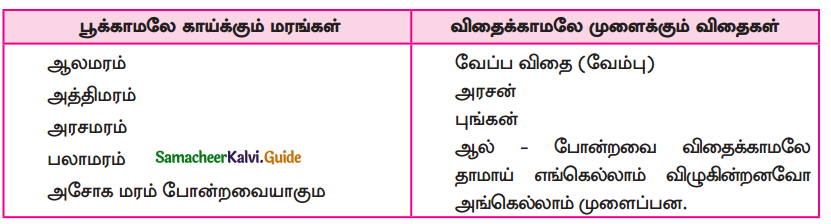
பூக்காமலே காய்க்கும் மரங்கள், விதைக்காமலே முளைக்கும் விதைகள் எவையெனக் கேட்டறிந்து வகுப்பறையில் கூறுக.
Answer:
Samacheer Kalvi 9th Tamil Guide Chapter 5.3 சிறுபஞ்சமூலம் - 1

Question 2.
மூவாது மூத்தவர், காணாது கண்டவர்
இவை போல நயம் அமைந்த தொடர்களை உருவாக்குக.
Answer:
மூவாது மூத்தவர்
வாராது வந்தவர்
தேடாது கிடைத்தவர்

காணாது கண்டவர்
பெறாஅது பெற்றவர்
சூடாது சூடியவள்

பாடநூல் வினாக்கள்

பலவுள் தெரிக

Question 1.
கீழ்க்காண்பவற்றுள் உணர்ச்சித் தொடர் எது?
அ) சிறுபஞ்சமூலத்தில் உள்ள பாடல்கள் பெரும்பாலும் மகடூஉ முன்னிலையில் அமைந்துள்ளன.
ஆ) இந்திய நூலகவியலின் தந்தையென அறியப்படுபவர் யார்?
இ) என்னண்ணே ! நீங்கள் சொல்வதை நம்பவே முடியவில்லை!
ஈ) வாழ்க்கையில் அடிப்படைத் தேவைகளுக்கு அடுத்த இடத்தைப் புத்தகசாலைக்குத் தருக.
Answer:
இ) என்னண்ணே ! நீங்கள் சொல்வதை நம்பவே முடியவில்லை!

Question 2.
பூவாது காய்க்கும், மலர்க்கை அடிக்கோடிட்ட சொற்களுக்குரிய இலக்கணம் யாது?
அ) பெயரெச்சம், உவமைத்தொகை
ஆ) எதிர்மறைப் பெயரெச்சம், உருவகம்
இ) வினையெச்சம், உவமை
ஈ) எதிர்மறை வினையெச்சம், உவமைத்தொகை
Answer:
ஈ) எதிர்மறை வினையெச்சம், உவமைத்தொகை.

குறுவினா

Question 1.
மூவாது மூத்தவர் – நூல் வல்லார் – இத்தொடர் உணர்த்தும் பொருளைக் குறிப்பிடுக.
Answer:
இத்தொடரின் பொருளாவது, நன்மை, தீமை உணர்ந்த நூல்வல்லோர், வயதில் இளையோராக இருப்பினும் மூத்தவரோடு வைத்து எண்ணத்தக்கவர் ஆவார்.

சிறுவினா

Question 1.
விதைக்காமலே முளைக்கும் விதைகள்- இத்தொடரின் வழிச் சிறுபஞ்சமூலம் தெரிவிக்கும் கருத்துகளை விளக்குக.
Answer:
விதைக்காமலே முளைக்கும் விதை:

  • • கழனியிலே பாத்தி அமைத்து, விதை விதைக்காமலே தானே முளைத்து வரும் விதைகளும் உள்ளன.
  • தானே முளைப்பதுடன் உயிர்களுக்குப் பயனும் நல்குவன.
  • அதைப்போலவே, அறிவுடைய மேதையரும் பிறர் உணர்த்தாமலே, எதையும் தாமே உணர்ந்து உயரிய செயலாற்றுவதோடு, பிறருக்கும் பயன் நல்கி பெருமையுறுவர்.
    “விதையாமை நாறுவ வித்து உள; மேதைக்கு
    உரையாமை செல்லும் உணர்வு.”

கூடுதல் வினாக்கள்

பலவுள் தெரிக

Question 1.
“விதையாமை நாறுவ” நாறுவ என்பதன் பொருள் யாது?
அ) கெடாதிருத்தல்
ஆ) முதுமையடையாது இருத்தல்
இ) முளைப்ப
ஈ) இளைப்ப
Answer:
இ) முளைப்ப

Question 2.
உரையாமை என்பதன் இலக்கணக் குறிப்பு யாது?
அ) ஈறுகெட்ட எதிர்மறைப் பெயரெச்சம்
ஆ) வினையாலணையும் பெயர்
இ) பெயரெச்சம்
ஈ) எதிர்மறைத் தொழிற்பெயர்
Answer:
ஈ) எதிர்மறைத் தொழிற்பெயர்

Question 3.
சிறுபஞ்சமூலம் இயற்றியவர் …………….
அ) பூதஞ்சேதனார்
ஆ) கணிமேதாவியார்
இ) கபிலர்
ஈ) காரியாசான்
Answer:
ஈ) காரியாசான்

Question 4.
காரியாசானின் ஆசிரியர் …………….
அ) மாங்குடி மருதனார்
ஆ) மாக்காயனார்
இ) கணிமேதாவியார்
ஈ) பூதஞ்சேதனார்
Answer:
ஆ) மாக்காயனார்

Question 5.
சிறுபஞ்சமூலம் பாடல்கள் ஒவ்வொன்றிலும் இடம் பெறும் கருத்துகள் ………….. ஆகும்.
அ) இரண்டு
ஆ) மூன்று
இ) ஐந்து
ஈ) ஆறு
Answer:
இ) ஐந்து

Question 6.
சிறுபஞ்சமூலம் ……………. நூல்க ளுள் ஒன்று.
அ) எட்டுத்தொகை
ஆ) பத்துப்பாட்டு
இ) பதினெண்கீழ்க்கணக்கு
ஈ) பதினெண்மேற்கணக்கு
Answer:
இ) பதினெண்கீழ்க்கணக்கு

Question 7.
தமிழில் சங்க இலக்கியங்களைத் தொடர்ந்து தோன்றியவை ………….. ஆகும்.
அ) காப்பியங்கள்
ஆ) சிற்றிலக்கியங்கள்
இ) மறுமலர்ச்சி இலக்கியங்கள்
ஈ) நீதிநூல்கள்
Answer:
ஈ) நீதிநூல்கள்

Question 8.
சரியான கூற்றினைத் தேர்க
1) காரி என்பது இயற்பெயர் ஆகும்.
2) ஆசான் என்பது மரபின் அடிப்படையில் அமைந்த பெயர்.
அ) 1 சரி, 2 தவறு
ஆ) 2 சரி, 1 தவறு
இ) இரண்டும் சரி
ஈ) இரண்டும் தவறு
Answer:
அ) 1 சரி, 2 தவறு

Question 9.
பாரதியார் ………….. வயதிலேயே அரசவையில் கவிதை எழுதினார்.
அ) 10
ஆ) 12
இ) 11
ஈ) 14
Answer:
இ) 11

Question 10.
16 வயதிலே படைத்தளபதி ஆனவர் யார் …………..
அ) அலெக்சாண்டர்
ஆ) நெப்போலியன்
இ) அகஸ்டஸ்
ஈ) அக்பர்
Answer:
அ) அலெக்சாண்டர்

Question 11.
பொருத்தமான விடையைத் தேர்க.
1. வள்ளலார் – 16 வயதில் தந்தையின் போர்ப்படை தளபதி
2. பாரதி – 15 வயதில் பிரெஞ்சு இலக்கியக்கழகத்துக்குத் தமது கவிதைகளை அனுப்பியவர்.
3. விக்டர்ஹியூகோ – 11 வயதில் அரசவையில் கவிதை எழுதி பட்டம் பெற்றவர்
4. அலெக்சாண்டர் – 10 வயதிற்குள்ளாகவே சொற்பொழிவாளர்.
அ) 4, 3, 2, 1
ஆ) 3, 2, 1, 4
இ) 4, 3, 1, 2
ஈ) 2, 3, 1, 4
Answer:
அ) 4, 3, 2, 1

Question 12.
பைசா நகர கோபுரத்தின் விளக்கைக் குறித்து ஆராய்ந்தவர்
அ) நியூட்டன்
ஆ) தாமஸ் ஆல்வா எடிசன்
இ) கலீலியோ
ஈ) விக்டர் ஹியூகோ
Answer:
இ) கலீலியோ

குறுவினா

Question 1.
சிறுபஞ்சமூலத்தின் பாடல்கள் எவ்வகையில் வாழ்வியல் உண்மைகளை எடுத்துக்காட்டுகின்றன?
Answer:

  • நன்மை தருவன
  • தீமை தருவன
  • நகைப்புக்கு உரியன
    என்னும் வகையில் வாழ்வியல் உண்மைகளைச் சிறுபஞ்சமூலத்தின் பாடல்கள் எடுத்துக்காட்டுகின்றன.

Question 2.
“சிறுபஞ்சமூலம்” என்பதன் பொருள் யாது? அது எவற்றைக் குறிக்கும்?
Answer:

  • சிறுபஞ்சமூலம் என்பதற்கு “ஐந்து சிறிய வேர்கள்” என்பது பொருள் ஆகும்.
  • கண்டங்கத்தரி, சிறுவழுதுணை, சிறுமல்லி, பெருமல்லி, நெருஞ்சி ஆகியவற்றின் வேர்களைக் குறிக்கும்.

Question 3.
மூத்தவரோடு வைத்து எண்ணத்தக்கவர் யார்?
Answer:
நன்மை, தீமைகளை நன்குணர்ந்தவர்; வயதில் இளையவராக இருந்தாலும், அவர் மூத்தவரோடு வைத்து எண்ணத் தக்கவரே ஆவார்.

Question 4.
பிறர் உணர்த்தாமல் எதையும் தாமே உணர்ந்து கொள்பவரைப் பற்றி சிறுபஞ்சமூலம் குறிப்பிடுவது யாது?
Answer:
பாத்தி அமைத்து விதை விதைக்காமலே, தாமே முளைத்து வளரும் விதைகளும் உள்ளன. அதைப் போலவே மேதையரும் பிறர் உணர்த்தாமல் எதையும் தாமே உணர்ந்து கொள்வர்.

சிறுவினா

Question 1.
சிறுபஞ்சமூலம் குறிப்பு வரைக.
Answer:

  • பதினெண்கீழ்க்கணக்கு நூல்களுள் ஒன்று சிறுபஞ்சமூலம்.
  • சிறுபஞ்சமூலம் என்பதற்கு ஐந்து சிறிய வேர்கள் என்பது பொருள்.
  • அவை கண்டங்கத்திரி, சிறுவழுதுணை, சிறுமல்லி, பெருமல்லி, நெருஞ்சி ஆகியன
  • இவ்வேர்களால் ஆன மருந்து உடலின் நோயைப் போக்குகின்றன.
  • அதுபோலச் சிறுபஞ்சமூலம் பாடல்களில் உள்ள ஐந்தைந்து கருத்துகள்
  • மக்களின் அறியாமையைப் போக்கி நல்வழிப்படுத்துவனவாய் அமைந்துள்ளன.
  • இந்நூலின் ஆசிரியர் காரியாசான்.

Question 2.
காரியாசான் – குறிப்பு வரைக.
Answer:

  • சிறுபஞ்சமூலத்தின் ஆசிரியர் காரியாசான்,
  • மதுரைத் தமிழாசிரியர் மாக்காயனாரின் மாணாக்கர்.
  • காரி என்பது இயற்பெயர்.
  • ஆசான் என்பது தொழிலின் அடிப்படையில் அமைந்தபெயர்.
  • மாக்காரியாசான் என்று பாயிரச் செய்யுள் இவரைச் சிறப்பிக்கிறது.

Question 3.
எடுத்துக்காட்டு உவமையணி – விளக்குக.
Answer:
அணிவிளக்கம் : ஒரு செய்யுளில் உவமைத் தொடரும், உவமேயத் தொடரும் அமைந்து, உவம உருபு மறைந்து வருமாயின் அஃது எடுத்துக்காட்டு உவமை அணி ஆகும்.
சான்று : “விதையாமை நாறுவ வித்து உள; மேதைக்கு
உரையாமை செல்லும் உணர்வு”
உவமைத்தொடர் : விதையாமை நாறுவ வித்து உள.
உவமேயத்தொடர் : மேதைக்கு உரையாமை செல்லும் உணர்வு
உவம உருபு : (அது போல) மறைந்து வருதல்
பொருத்தம் : விதை விதைக்காமல் தானே முளைத்து வரும் விதைகள் உள்ளன. அது போல
மேதையரும் பிறர் உணர்த்தாமல் தாமே உணர்ந்து செயலாற்றுவர்.
இப்பாடலில் “உவமஉருபு” மறைந்து வந்துள்ளதால் எடுத்துக்காட்டு உவமையணிக்குச் சான்றாகிறது.

பாடலின் பொருள்

அறிவுடையார் தாமே உணர்வார்

பூக்காமலே சில மரங்கள் காய்ப்பதுண்டு. அவற்றைப் போல இளையவரான போதும், நன்மை தீமைகளை நன்குணர்ந்து செய்யும் இயல்புடையவர்கள் மூத்தவரோடு வைத்து எண்ணத்தக்கவர் ஆவார்.

பாத்தி அமைத்து, விதை விதைக்காமலே, தானே முளைத்து வளரும் விதைகளும் உள்ளன. அதைப் போலவே அறிவிற் சிறந்த மேதையரும் பிறர் உணர்த்தாமலே, எச்செயலையும் தாமே உணர்ந்து செய்து கொள்ளும் செயல்வல்லோராய் இருப்பர்.

“பூவாது காய்க்கும் மரம் போல
விதையாது முளைக்கும் வித்து போல”

Samacheer Kalvi 6th Tamil Guide Chapter 2.3 சிறகின் ஓசை

Students can Download 6th Tamil Chapter 2.3 சிறகின் ஓசை Questions and Answers, Summary, Notes, Samacheer Kalvi 6th Tamil Guide Pdf helps you to revise the complete Tamilnadu State Board New Syllabus, helps students complete homework assignments and to score high marks in board exams.

Tamilnadu Samacheer Kalvi 6th Tamil Solutions Chapter 2.3 சிறகின் ஓசை

கற்பவை கற்றபின்

Samacheer Kalvi 6th Tamil Guide Chapter 2.3 சிறகின் ஓசை

Question 1.
உங்கள் பகுதியில் காணப்படும் பறவைகளின் பெயர்களைப் பட்டியலிடுக.
Answer:
Samacheer Kalvi 6th Tamil Guide Chapter 2.3 சிறகின் ஓசை 1
1. காகம்
2. சிட்டுக்குருவி
3. குயில்
4. மைனா
5. இட்டைவால் குருவி
6. கொக்கு
7. நாரை
8. பருந்து
9. கழுகு
10. மயில்
11. மரங்கொத்தி
12. பச்சைக் கிளி

Question 2.
உங்கள் வீட்டுக்கு அருகில் பறவைகள் வருவதற்கு என்னென்ன செய்யலாம் என்பது பற்றி வகுப்பறையில் கலந்துரையாடுக.
Answer:
குமரன் : முகிலா! இன்று எங்கள் வீட்டு மொட்டைமாடியில் நான்கைந்து குருவிகள் இருந்தன. பார்க்கவே அழகாக இருந்தன.

முகிலன் : அப்படியா? இப்போதெல்லாம் பறவைகளைப் பார்ப்பதே அரிதாகிவிட்டது. முன்பெல்லாம் எங்கள் வீட்டிற்கருகில் பெரிய மரம் ஒன்று இருந்தது. அதனால் நிறைய பறவைகள் இருக்கும். இப்போதெல்லாம் வருவதே இல்லை. மரத்தையும் வெட்டிவிட்டார்கள். பெரிய தொழிற்சாலை கட்டிவிட்டார்கள். அந்த இரைச்சலுக்குப் பறவைகள் அச்சப்படுவதால் வருவதில்லை .

குமரன் : நீ சொல்வதும் சரிதான். நகரங்களின் வளர்ச்சியினால் இயற்கைச்சூழல் மாறிவிட்டது. இயற்கையை விற்று செயற்கையை வாங்கிவிட்டோம். அதன் விளைவுதான் இந்நிலைக்குக் காரணம்.

முகிலன் : பறவைகள் நமது நண்பன் என்பதை மறந்துவிட்டோம். அதை நாம் மாற்ற வேண்டும். அதற்கு என்ன செய்யலாம் எனச் சிந்திக்க வேண்டும்.

குமரன் : மாடிகளில் தானியங்களைத் தூவி விட வேண்டும். அருகில் சிறு சிறு து பாத்திரத்தில் தண்ணீர் ஊற்றி வைக்கலாம். வீட்டிற்கு ஒரு மரம் என்ற தொடரை மெய்ப்பிக்கும் படி மரம் நடுவோம். மாடியில் செயற்கையாகக் கூடுகள் அமைப்போம். அட்டைப் பெட்டிகளைப் பறவைகள் தங்குவதற்கு ஏதுவாகப் பயன்படுத்தலாம். குடியிருப்புகளின் நடுவில் உள்ள செல்பேசி கோபுரங்களை அகற்றுவதற்கு வழி செய்யலாம்.

முகிலன் : கோவில் திருவிழாக்கள், திருமண நிகழ்வுகள் போன்றவற்றில் பட்டாசுகள் வெடிப்பதைத் தவிர்க்கலாம். கேழ்வரகு, நெல், கம்பு போன்ற சிறுதானியங்களை மாடிகளில் போட்டு வைக்கலாம். இவற்றைச் செய்தால் பறவைகள் தினமும் வரும். செயற்கைக் கூடுகள் இருப்பதால் இரவில் தங்குவதற்கும் வரும்.

குமரன் : இனிமேல் நாம் பேசியபடி செய்து பறவைகளின் வரவை அதிகரிக்கச் செய்வோம். நம் நண்பர்களிடம் கூறி அவர்களை இவ்வாறு செய்யச் சொல்லலாம்.

Question 3.
பறவைகள் தொடர்பான பழமொழிகளைத் தொகுத்து எழுதுக.
Answer:
பறவைகள் தொடர்பான பழமொழிகள் :
(i) கங்கையில் மூழ்கினாலும் காக்கை அன்னம் ஆகுமா?
(ii) காக்கைக்கும் தன் குஞ்சு பொன் குஞ்சு
(iii) உயர உயர பறந்தாலும் ஊர்க்குருவி பருந்தாகுமா?
(iv) எச்சில் கையால் காக்கை ஓட்டாதவன் பிச்சை கொடுப்பானா?
(v) எருது நோய் காக்கைக்குத் தெரியுமா?
(vi) கூரை மேலே சோறு போட்டால் ஆயிரம் காகம்.
(vii) சேற்றிலே புதைந்த யானையைக் காக்கையுங் கொத்தும்.
(viii) சொன்னதைச் சொல்லும் கிளிப்பிள்ளை .

Samacheer Kalvi 6th Tamil Guide Chapter 2.3 சிறகின் ஓசை

Question 4.
இயற்கையைப் பாதுகாக்கும் வகையில் முழக்கத் தொடர்களை எழுதுக.
எ.கா. காப்போம் காப்போம்! பறவைகளைக் காப்போம்!
Answer:
இயற்கையைப் பாதுகாக்கும் முழக்கங்கள் :
(i) காப்போம்! காப்போம் ! பறவைகளைக் காப்போம்!
(ii) காப்போம் ! காப்போம் ! விளைநிலங்களைக் காப்போம்!
(iii) சேமிப்போம் ! சேமிப்போம்! மழைநீரைச் சேமிப்போம்!
(iv) செய்வோம்! செய்வோம்! இயற்கை விவசாயம் செய்வோம்!
(v) தவிர்ப்போம் ! தவிர்ப்போம் ! நெகிழியைத் தவிர்ப்போம்!
(vi) மரங்களை நடுவோம்! இயற்கையை பாதுகாப்போம்!

மதிப்பீடு

சரியான விடையைத் தேர்ந்தெடுத்து எழுதுக.
Question 1.
‘தட்பவெப்பம்’ என்னும் சொல்லைப் பிரித்து எழுதக் கிடைப்பது ……………
அ) தட்பம் + வெப்பம்
ஆ) தட்ப + வெப்பம்
இ) தட் + வெப்பம்
ஈ) தட்பு + வெப்பம்
Answer:
அ) தட்பம் + வெப்பம்

Question 2.
வேதியுரங்கள் என்னும் சொல்லைப் பிரித்து எழுதக் கிடைப்பது …………..
அ) வேதி + யுரங்கள்
ஆ) வேதி + உரங்கள்
இ) வேத் + உரங்கள்
ஈ) வேதியு + ரங்கள்
Answer:
ஆ) வேதி + உரங்கள்

Question 3.
தரை + இறங்கும் என்பதைச் சேர்த்து எழுதக் கிடைக்கும் சொல் ………….
அ) தரையிறங்கும்
ஆ) தரை இறங்கும்
இ) தரையுறங்கும்
ஈ) தரைய்றங்கும்
Answer:
அ) தரையிறங்கும்

Question 4.
வழி + தடம் என்பதைச் சேர்த்து எழுதக் கிடைக்கும் சொல் ………….
அ) வழிதடம்
ஆ) வழித்தடம்
இ) வழிதிடம்
ஈ) வழித்திடம்
Answer:
ஆ) வழித்தடம்

Question 5.
சிட்டுக்குருவி வாழ முடியாத பகுதி ……………….
அ) துருவப்பகுதி
ஆ) இமயமலை
இ) இந்தியா
ஈ) தமிழ்நாடு
Answer:
அ) துருவப்பகுதி

கோடிட்ட இடங்களை நிரப்புக

1. மிக நீண்ட தொலைவு பறக்கும் பறவை ………
2. பறவைகள் வலசை போவதைப் பற்றிப் பாடிய தமிழ்ப்புலவர் ………..
3. பறவைகள் இடம்பெயர்வதற்கு ……………. என்று பெயர்.
4. இந்தியாவின் பறவை மனிதர் ………….
5. பறவைகள் வலசை போகக் காரணங்களுள் ஒன்று …….
Answer:
[விடை: ஆர்டிக் ஆலா]
(விடை: சத்தி முத்தப் புலவர்)
(விடை: வலசை போதல்)
(விடை: டாக்டர். சலீம் அலி)
(விடை: தட்ப வெப்ப நிலை மாற்றம்)

Samacheer Kalvi 6th Tamil Guide Chapter 2.3 சிறகின் ஓசை

சொற்றொடர் அமைத்து எழுதுக

1. வெளிநாடு …………………
விடை : நம் நாட்டில் படித்துவிட்டு வெளிநாடு சென்று வேலை செய்வது நல்லது அன்று.
2. வாழ்நாள் …………………
விடை : வாழ்நாள் முழுவதும் உண்மை மட்டுமே பேசி வாழ்ந்தவன் அரிச்சந்திரன்.
3. செயற்கை ……………….
விடை : விவசாயத்தில் செயற்கை உரங்களை இடுவது மண்ணிற்குக் கேடு.

பொருத்தமான சொல்லைக் கொண்டு நிரப்புக

1. மரங்களை வளர்த்து ………… யைக் காப்போம் ………. உரங்களைத் தவிர்த்து நிலவளம் காப்போம் (செயற்கை / இயற்கை)
2. வலசைப் பறவைகள் வருகை தமிழகத்தில் ……… தற்போது சிட்டுக்குருவிகள் எண்ணிக்கை …………….. (குறைந்துள்ளது / மிகுந்துள்ளது)
Answer:
1. (விடை: இயற்கை, செயற்கை)
2. (விடை: மிகுந்துள்ளது, குறைந்துள்ளது)

குறுவினா

Question 1.
பறவைகள் எக்காரணங்களுக்காக இடம் பெயர்கின்றன?
Answer:
பறவைகள் இடம் பெயர்வதற்கான காரணங்கள் :
பறவைகள் உணவு, இருப்பிடம், தட்பவெப்பநிலை மாற்றம், இனப்பெருக்கம்
போன்றவற்றிற்காக இடம்பெயர்கின்றனள.

Question 2.
வலசையின்போது பறவையின் உடலில் ஏற்படும் மாற்றங்கள் யாவை?
Answer:
வலசையின்போது பறவையின் உடலில் ஏற்படும் மாற்றங்கள் :
(i) தலையில் சிறகுகள் வளர்தல்.
(ii) இறகுகளின் நிறம் மாறுதல்.
(iii) உடலில் கற்றையாக முடி வளர்தல்.

சிறுவினா

Question 1.
சிட்டுக் குருவியின் வாழ்க்கை பற்றிச் சிறு குறிப்பு எழுதுக.
Answer:
(i) சிட்டுக்குருவி கூடுகட்டி வாழும் பறவையினத்தைச் சார்ந்தது. கூடுகட்டும் காலங்களில் சத்தமிட்டுக் கொண்டே இருக்கும்.

(ii) கூடுகட்டிய பின் மூன்று முதல் ஆறு முட்டைகள் வரை இடும். பதினான்கு நாள்கள் அடைகாக்கும். பதினைந்தாம் நாளில் குஞ்சுகள் வெளிவரும்.

(iii) துருவப் பகுதிகள் தவிர மனிதன் வாழும் இடங்களில் எல்லாம் சிட்டுக்குருவிகளும் வாழ்கின்றன. இந்தியா முழுவதும் சிட்டுக்குருவிகளைக் காணலாம். இமயமலைத் தொடரில் 4000 மீட்டர் உயரத்தில் கூட இவை வாழ்கின்றன.

Samacheer Kalvi 6th Tamil Guide Chapter 2.3 சிறகின் ஓசை

Question 2.
வலசைப் பறவைகளின் பயணம் பற்றி நீங்கள் அறிந்தவை யாவை?
Answer:
(i) பறவைகள் கண்டம் விட்டுக் கண்டம் பறக்கின்றன. அவை பெருங்கடல்களையும் மலைகளையும் கடந்து போகின்றன. குறிப்பிட்ட காலத்திற்குப் பிற்கு புறப்பட்ட இடத்திற்கே வந்து சேர்கின்றன. பறவைகள் தங்களுக்கென ஒரு வழித்தடத்தைத் தேர்ந்தெடுத்து, அந்தப் பாதையிலேயே பறக்கின்றன.

(ii) சில பறவை இனங்கள் அதே பாதையில் தாய்நிலங்களுக்குத் திரும்புகின்றன. சில பறவை இனங்கள் போவதற்கும் வருவதற்கும் இருவேறு பாதைகளைப் பயன்படுத்துகின்றன.

சிந்தனை வினா

Question 1.
பறவை இனங்கள் அழியாமல் காப்பாற்றப்பட நாம் செய்ய வேண்டியவை பற்றிச் சிந்தித்து எழுதுக.
Answer:
(i) அழியும் நிலையில் உள்ள பறவைகளை அறிந்து அவற்றிற்குத் தேவையான உணவு, மருத்துவ உதவி செய்து இனப்பெருக்கத்தை அதிகப்படுத்த வேண்டும்
(ii) ஆல், அரசு போன்ற மரங்களையும் அவரை, புடலை போன்ற செடி, கொடிகளையும் வளர்க்கலாம்.
(iii) நமது மண்ணுக்கேற்ற பிறவகை உள்ளூர் தாவரங்களையும் வளர்க்கலாம்.
(iv) தோட்டங்களிலும் வயல்வெளிகளிலும் செயற்கை உரங்கள், பூச்சிக்கொல்லி மருந்துகள் ஆகியவற்றைத் தெளிப்பதைத் தவிர்க்கலாம்.

Samacheer Kalvi 11th Business Maths Guide Chapter 3 Analytical Geometry Ex 3.1

Students can download 11th Business Maths Chapter 3 Analytical Geometry Ex 3.1 Questions and Answers, Notes, Samcheer Kalvi 11th Business Maths Guide Pdf helps you to revise the complete Tamilnadu State Board New Syllabus, helps students complete homework assignments and to score high marks in board exams.

Tamilnadu Samacheer Kalvi 11th Business Maths Solutions Chapter 3 Analytical Geometry Ex 3.1

Samacheer Kalvi 11th Business Maths Analytical Geometry Ex 3.1 Text Book Back Questions and Answers

Question 1.
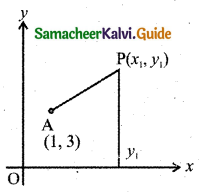
Find the locus of a point which is equidistant from (1, 3) and x-axis.
Solution:
Samacheer Kalvi 11th Business Maths Guide Chapter 3 Analytical Geometry Ex 3.1 Q1
Let P(x1, y1) be any point on the locus.
Let A be the point (1, 3)
The distance from the x-axis on the moving pint P(x1, y1) is y1.
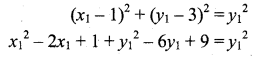
Given that AP = y1
AP2 = \(y_{1}^{2}\)
Samacheer Kalvi 11th Business Maths Guide Chapter 3 Analytical Geometry Ex 3.1 Q1.1
∴ The locus of the point (x1, y1) is x2 – 2x – 6y + 10 = 0

Question 2.
A point moves so that it is always at a distance of 4 units from the point (3, -2).
Solution:
Let P(x1, y1) be any point on the locus.
Let A be the point (3, -2)
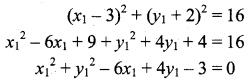
Given that PA = 4
PA2 = 16
Samacheer Kalvi 11th Business Maths Guide Chapter 3 Analytical Geometry Ex 3.1 Q2
∴ The locus of the point (x1, y1) is x2 + y2 – 6x + 4y – 3 = 0

Question 3.
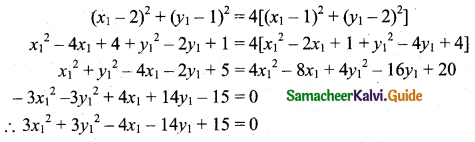
If the distance of a point from the points (2, 1) and (1, 2) are in the ratio 2 : 1, then find the locus of the point.
Solution:
Let P(x1, y1) be any point on the locus.
Let A(2, 1) and B(1, 2) be the given point.
Given that PA : PB = 2 : 1
i.e., \(\frac{P A}{P B}=\frac{2}{1}\)
PA = 2PB
PA2 = 4PB2
Samacheer Kalvi 11th Business Maths Guide Chapter 3 Analytical Geometry Ex 3.1 Q3
∴ The locus of the point (x1, y1) is 3x2 + 3y2 – 4x – 14y + 15 = 0

Question 4.
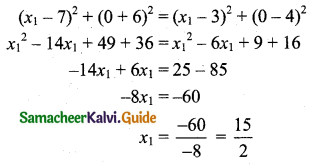
Find a point on the x-axis which is equidistant from the points (7, -6) and (3, 4).
Solution:
Let P(x1, 0) be any point on the x-axis.
Let A(7, -6) and B(3, 4) be the given points.
Given that PA = PB
PA2 = PB2
Samacheer Kalvi 11th Business Maths Guide Chapter 3 Analytical Geometry Ex 3.1 Q4
∴ The required point is \(\left(\frac{15}{2}, 0\right)\)

Question 5.
If A(-1, 1) and B(2, 3) are two fixed points, then find the locus of a point P so that the area of triangle APB = 8 sq.units.
Solution:
Let the point P(x1, y1).
Fixed points are A(-1, 1) and B(2, 3).
Given area (formed by these points) of the triangle APB = 8
⇒ \(\frac{1}{2}\) [x1(y2 – y3) + x2(y3 – y1) + x3(y1 – y2)] = 8
⇒ \(\frac{1}{2}\) [x1(1 – 3) + (-1) (3 – y1) + 2(y1 – 1)] = 8
⇒ \(\frac{1}{2}\) [-2x1 – 3 + y1 + 2y1 – 2] = 8
⇒ \(\frac{1}{2}\) [-2x1 + 3y1 – 5] = 8
⇒ -2x1 + 3y1 – 5 = 16
⇒ -2x1 + 3y1 – 21 = 0
⇒ 2x1 – 3y1 + 21 = 0
∴ The locus of the point P(x1, y1) is 2x – 3y + 21 = 0.

Samacheer Kalvi 5th Maths Guide Term 1 Chapter 6 Information Processing Intext Questions

Students can download 5th Maths Term 1 Chapter 6 Information Processing Intext Questions and Answers, Notes, Samacheer Kalvi 5th Maths Guide Pdf helps you to revise the complete Tamilnadu State Board New Syllabus, helps students complete homework assignments and to score high marks in board exams.

Tamilnadu Samacheer Kalvi 5th Maths Solutions Term 1 Chapter 6 Information Processing Intext Questions

Activity (Text Book Page No.86)

The Fifth standard students were given a task of collecting mathematical shapes in a competition. Team named shakuntaladevi won the competition.
Samacheer Kalvi 5th Maths Guide Term 1 Chapter 6 Information Processing InText Questions 1
Let us count the shapes collected by the winning team.
Samacheer Kalvi 5th Maths Guide Term 1 Chapter 6 Information Processing InText Questions 2
Answer:
Samacheer Kalvi 5th Maths Guide Term 1 Chapter 6 Information Processing InText Questions 3

Samacheer Kalvi 5th Maths Guide Term 1 Chapter 6 Information Processing Intext Questions

Activity (Text Book Page No.87)

Total stock of household articles at the end of the month in a mart is given below. Answer the following questions.
Samacheer Kalvi 5th Maths Guide Term 1 Chapter 6 Information Processing InText Questions 4

Questions and Answers
Question 1.
How many chairs are there in the stock list?
Answer:
9

Question 2.
Name the articles that are lesser in count than the count of cots.
Answer:
Tri footed stools

Question 3.
What is the total number of things in the stock?
Answer:
27

Question 4.
How many tri footed stools were there?
Answer:
3

Question 5.
Mention the articles which is 3 greater than tri footed stool?
Answer:
Table mat

Samacheer Kalvi 5th Maths Guide Term 1 Chapter 6 Information Processing Intext Questions

Activity (Text Book Page No.89)

The following information shows the number ofliterates ¡n a village of 200 people. braw a pictograph for that data.

EducationNumbers
Up to Eight standard20
Up to Tenth standard50
Up to Twelveth standard70
Under graduate10
Post graduate10
Up to fifth standard10
Illiterates30

Answer:
Samacheer Kalvi 5th Maths Guide Term 1 Chapter 6 Information Processing InText Questions 5
Samacheer Kalvi 5th Maths Guide Term 1 Chapter 6 Information Processing InText Questions 6

Samacheer Kalvi 5th Maths Guide Term 1 Chapter 6 Information Processing Intext Questions

Activity (Text Book Page No.91)

The number of Two Wheeler sold in a week ¡n a showroom is given below. Represent the data using tally marks.

Sunday – 6Wednesday – 5
Monday – 11Thursday – 16
Tuesday – 3Friday – 16
Saturday – 4

Answer:
Samacheer Kalvi 5th Maths Guide Term 1 Chapter 6 Information Processing InText Questions 7

Samacheer Kalvi 5th Maths Guide Term 1 Chapter 6 Information Processing Intext Questions

Activity (Text Book Page No.92)

In a mathematics test, the following marks were obtained by 30 students. Arrange these marks in a table using tally marks.
Samacheer Kalvi 5th Maths Guide Term 1 Chapter 6 Information Processing InText Questions 8
(a) Find how many students obtained marks equal to or more than 8 ?
(b) How many students obtained marks below 4 ?
Answer:
Samacheer Kalvi 5th Maths Guide Term 1 Chapter 6 Information Processing InText Questions 9

(a) Find how many students obtained marks equal to or more than 8 ?
Answer:
6 Students

(b) How many students obtained marks below 4 ?
Answer:
9 students

Samacheer Kalvi 5th Maths Guide Term 1 Chapter 6 Information Processing Intext Questions

Activity (Text Book Page No.94)

The following information iS collected from 50 students of class V about their grades in exams. Complete the following table from the bar graph.
Samacheer Kalvi 5th Maths Guide Term 1 Chapter 6 Information Processing InText Questions 10

Samacheer Kalvi 5th Maths Guide Term 1 Chapter 6 Information Processing InText Questions 11

Samacheer Kalvi 5th Maths Guide Term 1 Chapter 6 Information Processing Intext Questions
Answer:
Samacheer Kalvi 5th Maths Guide Term 1 Chapter 6 Information Processing InText Questions 12

Samacheer Kalvi 5th Maths Guide Term 1 Chapter 6 Information Processing Additional Questions

Students can download 5th Maths Term 1 Chapter 6 Information Processing Additional Questions and Answers, Notes, Samacheer Kalvi 5th Maths Guide Pdf helps you to revise the complete Tamilnadu State Board New Syllabus, helps students complete homework assignments and to score high marks in board exams.

Tamilnadu Samacheer Kalvi 5th Maths Solutions Term 1 Chapter 6 Information Processing Additional Questions

I.

Question 1.
Can you spot the duplicate ?
ABC, BCA, CAB, CBA, CAB, ACB, BAC
Answer:
CAB

Question 2.
Can you find the mistake? Explain.
PQR, RPQ, QRP, QRR, PRQ, RQP
Answer:
QRR; Two letters are same.

Samacheer Kalvi 5th Maths Guide Term 1 Chapter 6 Information Processing Additional Questions

II. The following table shows the number of cricket balls produce in a factory between 2001 and 2006

Samacheer Kalvi 5th Maths Guide Term 1 Chapter 6 Information Processing Additional Questions 1

Observe the pictograph and answer the following questions

Question 1.
In which year the ball manufacturing was maximum?
Answer:
2006

Samacheer Kalvi 5th Maths Guide Term 1 Chapter 6 Information Processing Additional Questions

Question 2.
In which year the ball manufactured were equal?
Answer:
2001, 2003 and 2002, 2004

Question 3.
Find the ball production in 2006?
Answer:
500

Question 4.
Find the total quantity at bail manufactured in 2003, 2004 and 2005.
Answer:
900

Samacheer Kalvi 5th Maths Guide Term 1 Chapter 6 Information Processing Additional Questions

III. The bar chart represents the number of students in different standard.

Samacheer Kalvi 5th Maths Guide Term 1 Chapter 6 Information Processing Additional Questions 2

Observe the bar chart and answer the following questions.
Question 1.
Which standard has more number of students?
Answer:
V

Question 2.
How many students are there in standard III?
Answer:
30

Samacheer Kalvi 5th Maths Guide Term 1 Chapter 6 Information Processing Additional Questions

Question 3.
Which class has the least number of students?
Answer:
IIII

Question 4.
How many students are in standard V?
Answer:
50

Samacheer Kalvi 5th Maths Guide Term 1 Chapter 6 Information Processing Ex 6.3

Students can download 5th Maths Term 1 Chapter 6 Information Processing Ex 6.3 Questions and Answers, Notes, Samacheer Kalvi 5th Maths Guide Pdf helps you to revise the complete Tamilnadu State Board New Syllabus, helps students complete homework assignments and to score high marks in board exams.

Tamilnadu Samacheer Kalvi 5th Maths Solutions Term 1 Chapter 6 Information Processing Ex 6.3

Question 1.
The bar chart represents the number of students using different modes of transport. Observe and answer the following questions.
Samacheer Kalvi 5th Maths Guide Term 1 Chapter 6 Information Processing Ex 6.3 1

Questions and Answers
a. Which mode of transport is mostly used by the students?
Answer:
Bicycle.

b. How many students come to school by walking?
Answer:
40 students.

c. Which mode of transport is used the least?
Answer:
car.

d. How many students come to school by Bus?
Answer:
40 students.

Samacheer Kalvi 5th Maths Guide Term 1 Chapter 6 Information Processing Ex 6.3

Question 2.
The following information shows the grades of science and maths of 30 students of class 5.
Samacheer Kalvi 5th Maths Guide Term 1 Chapter 6 Information Processing Ex 6.3 2

Answer the following question.
a. How many students got equal grades in both subjects.
Answer:
Two

b. How many students got a higher grade in science than in maths?
Answer:
Eight

c. Which was the most common grade in science?
Answer:
c.

Samacheer Kalvi 5th Maths Guide Term 1 Chapter 6 Information Processing Ex 6.3

Question 3.
Mr. binesh collected the information about the rainfall of a particular city in a week from the newspaper and recorded his information in the pictograph.
Samacheer Kalvi 5th Maths Guide Term 1 Chapter 6 Information Processing Ex 6.3 3

Answer the following question.
a. On which day, the rain was most?
Answer:
Friday (20 mm).

b. On which day, the rain was least?
Answer:
Sunday & Wednesday (6 mm).

c. How much rain was there on Sunday?
Answer:
6 mm.

d. How much rain was there on Monday?
Answer:
12 mm.

e. Find total rainfall of the city in that week?
Answer:
74 mm.

Samacheer Kalvi 5th Maths Guide Term 1 Chapter 6 Information Processing Ex 6.3

Question 4.
NeeIa, Mala, Kola and Balo were neighbours. The following dato shows the number of fish in each of their fish tank, brow pictogroph to represent the data and Answer the questions.
Samacheer Kalvi 5th Maths Guide Term 1 Chapter 6 Information Processing Ex 6.3 4
Samacheer Kalvi 5th Maths Guide Term 1 Chapter 6 Information Processing Ex 6.3 5

Answer the following question.
a. How many fishes did bala have? ________
Answer:
24.

b. Who has 16 fishes? ________
Answer:
Neela.

c. How many fewer fish did Kala have than Mala? ________
Answer:
8.

d. How many fish did Neela and Bala have altogether? ________
Answer:
40 fish.

Samacheer Kalvi 11th Business Maths Guide Chapter 2 Algebra Ex 2.7

Students can download 11th Business Maths Chapter 2 Algebra Ex 2.7 Questions and Answers, Notes, Samcheer Kalvi 11th Business Maths Guide Pdf helps you to revise the complete Tamilnadu State Board New Syllabus, helps students complete homework assignments and to score high marks in board exams.

Tamilnadu Samacheer Kalvi 11th Business Maths Solutions Chapter 2 Algebra Ex 2.7

Samacheer Kalvi 11th Business Maths Algebra Ex 2.7 Text Book Back Questions and Answers

Choose the correct answer.

Question 1.
If nC3 = nC2 then the value of nC4 is:
(a) 2
(b) 3
(c) 4
(d) 5
Answer:
(d) 5
Hint:
Given that nC3 = nC2
We know that if nCx = nCy then x + y = n or x = y
Here 3 + 2 = n
∴ n = 5

Question 2.
The value of n, when np2 = 20 is:
(a) 3
(b) 6
(c) 5
(d) 4
Answer:
(c) 5
Hint:
nP2 = 20
n(n – 1) = 20
n(n – 1) = 5 × 4
∴ n = 5

Samacheer Kalvi 11th Business Maths Guide Chapter 2 Algebra Ex 2.7

Question 3.
The number of ways selecting 4 players out of 5 is:
(a) 4!
(b) 20
(c) 25
(d) 5
Answer:
(d) 5
Hint:
5C4 = 5C1 = 5

Question 4.
If nPr = 720(nCr), then r is equal to:
(a) 4
(b) 5
(c) 6
(d) 7
Answer:
(c) 6
Hint:
Given nPr = 720(nCr)
\(\frac{n !}{(n-r) !}=720 \frac{n !}{r !(n-r) !}\)
1 = \(\frac{720}{r !}\)
r! = 720
r! = 6 × 5 × 4 × 3 × 2 × 1
r! = 6!
r = 6

Samacheer Kalvi 11th Business Maths Guide Chapter 2 Algebra Ex 2.7

Question 5.
The possible outcomes when a coin is tossed five times:
(a) 25
(b) 52
(c) 10
(d) \(\frac{5}{2}\)
Answer:
(a) 25
Hint:
Number of possible outcomes When a coin is tossed is 2
∴ When five coins are tossed (same as a coin is tossed five times)
Possible outcomes = 2 × 2 × 2 × 2 × 2 = 25

Question 6.
The number of diagonals in a polygon of n sides is equal to:
(a) nC2
(b) nC2 – 2
(c) nC2 – n
(d) nC2 – 1
Answer:
(c) nC2 – n

Samacheer Kalvi 11th Business Maths Guide Chapter 2 Algebra Ex 2.7

Question 7.
The greatest positive integer which divide n(n + 1) (n + 2) (n + 3) for all n ∈ N is:
(a) 2
(b) 6
(c) 20
(d) 24
Answer:
(d) 24
Hint:
Put n = 1 in n(n + 1) (n + 2) (n + 3)
= 1 × 2 × 3 × 4
= 24

Question 8.
If n is a positive integer, then the number of terms in the expansion of (x + a)n is:
(a) n
(b) n + 1
(c) n – 1
(d) 2n
Answer:
(b) n + 1

Samacheer Kalvi 11th Business Maths Guide Chapter 2 Algebra Ex 2.7

Question 9.
For all n > 0, nC1 + nC2 + nC3 + …… + nCn is equal to:
(a) 2n
(b) 2n – 1
(c) n2
(d) n2 – 1
Answer:
(b) 2n – 1
Hint:
Sum of binomial coefficients 2n
i.e., nC0 + nC1 + nC2 + nC3 + ……. + nCn = 2n
nC1 + nC2 + nC3 + ……. + nCn = 2n – nC0 = 2n – 1

Question 10.
The term containing x3 in the expansion of (x – 2y)7 is:
(a) 3rd
(b) 4th
(c) 5th
(d) 6th
Answer: (c) 5th
Hint:
First-term contains x7.
The second term contains x6.
The fifth term contains x3.

Samacheer Kalvi 11th Business Maths Guide Chapter 2 Algebra Ex 2.7

Question 11.
The middle term in the expansion of \(\left(x+\frac{1}{x}\right)^{10}\) is:
(a) 10C4 \(\left(\frac{1}{x}\right)\)
(b) 10C5
(c) 10C6
(d) 10C7 x2
Answer:
(b) 10C5
Hint:
x is x, a = \(\frac{1}{x}\), n = 10 which is even.
So the middle term is
Samacheer Kalvi 11th Business Maths Guide Chapter 2 Algebra Ex 2.7 Q11

Question 12.
The constant term in the expansion of \(\left(x+\frac{2}{x}\right)^{6}\) is:
(a) 156
(b) 165
(c) 162
(d) 160
Answer:
(d) 160
Hint:
Here x is x, a is \(\frac{2}{x}\) (Note that each term x will vanish)
∴ Constant term occurs only in middle term
n = 6
∴ middle term = \(t_{\frac{6}{2}+1}\) = t3+1
Samacheer Kalvi 11th Business Maths Guide Chapter 2 Algebra Ex 2.7 Q12

Samacheer Kalvi 11th Business Maths Guide Chapter 2 Algebra Ex 2.7

Question 13.
The last term in the expansion of (3 + √2 )8 is:
(a) 81
(b) 16
(c) 8
(d) 2
Answer:
(b) 16
Hint:
(√2)8 = \(\left(2^{\frac{1}{2}}\right)^{8}\) = 24 = 16

Question 14.
If \(\frac{k x}{(x+4)(2 x-1)}=\frac{4}{x+4}+\frac{1}{2 x-1}\) then k is equal to:
(a) 9
(b) 11
(c) 5
(d) 7
Answer:
(a) 9
Hint:
\(\frac{k x}{(x+4)(x-1)}=\frac{4}{x+4}+\frac{1}{2 x-1}\)
kx = 8x – 4 + x + 4
kx = 9x
k = 9

Samacheer Kalvi 11th Business Maths Guide Chapter 2 Algebra Ex 2.7

Question 15.
The number of 3 letter words that can be formed from the letters of the word ‘NUMBER’ when the repetition is allowed are:
(a) 206
(b) 133
(c) 216
(d) 300
Answer:
(c) 216
Hint:
Number of letters in NUMBER is 5
From 5 letters we can form 3 letter ways = 6 × 6 × 6 = 216.

Question 16.
The number of parallelograms that can be formed from a set of four parallel lines intersecting another set of three parallel lines is:
(a) 18
(b) 12
(c) 9
(d) 6
Answer:
(a) 18
Hint:
Samacheer Kalvi 11th Business Maths Guide Chapter 2 Algebra Ex 2.7 Q16
To form a parallelogram we need 2 parallel lines from 4 and 2 intersecting lines from 3.
Number of parallelograms = 4C2 × 3C2
= \(\frac{4 \times 3}{2 \times 1} \times 3\)
= 18

Samacheer Kalvi 11th Business Maths Guide Chapter 2 Algebra Ex 2.7

Question 17.
There are 10 true or false questions in an examination. Then these questions can be answered in
(a) 240 ways
(b) 120 ways
(c) 1024 ways
(d) 100 ways
Answer:
(c) 1024 ways
Hint:
For each question, there are two ways of answering it.
for 10 questions the numbers of ways to answer = 2 × 2 × 2 × 2 × 2 × 2 × 2 × 2 × 2 × 2
= 210
= 1024 ways

Question 18.
The value of (5C0 + 5C1) + (5C1 + 5C2) + (5C2 + 5C3) + (5C3 + 5C4) + (5C4 + 5C5) is:
(a) 26 – 2
(b) 25 – 1
(c) 28
(d) 27
Answer:
(a) 26 – 2
Hint:
(5C0 + 5C1 + 5C2 + 5C3 + 5C4 + 5C5) + (5C1 + 5C2 + 5C3 + 5C4)
= 25 + (5C0 + 5C1 + 5C2 + 5C3 + 5C4 + 5C5) – (5C0 + 5C5)
= 25 + 25 – (1 + 1) (∵ Adding and subtracting of 5C0 and 5C5)
= 2(25) – 2 (∵ 5C0 = 5C5 = 1)
= 26 – 2

Samacheer Kalvi 11th Business Maths Guide Chapter 2 Algebra Ex 2.7

Question 19.
The total number of 9 digit number which has all different digit is:
(a) 10!
(b) 9!
(c) 9 × 9!
(d) 10 × 10!
Answer:
(c) 9 × 9!
Hint:
Here we can use the digits 0, 1, 2, 3, 4, 5, 6, 7, 8, 9.
They are in 10 in total. We have to form a nine-digit number.
Samacheer Kalvi 11th Business Maths Guide Chapter 2 Algebra Ex 2.7 Q19
The first place from the left can be filled up by anyone of the digits other than zero in 9 ways. The second place can be filled up by anyone of the remaining (10 – 1) digits (including zero) in 9 ways, the third place in 8 ways, fourth place in 7 ways, fifth place in 6 ways, sixth place in 5 ways, seventh place in 4 ways, eighth place in 3 ways and ninth place in 2 ways.
∴ The number of ways of making 9 digit numbers = 9 × 9 × 8 × 7 × 6 × 5 × 4 × 3 × 2 = 9 × 9!

Question 20.
The number of ways to arrange the letters of the word “CHEESE”:
(a) 120
(b) 240
(c) 720
(d) 6
Answer:
(a) 120
Hint: Here there are 6 letters.
The letter C occurs one time
The letter H occurs one time
The letter E occurs three times
The letter S occurs one time
Number of arrangements = \(\frac{6 !}{1 ! 1 ! 3 ! 1 !}=\frac{6 !}{3 !}=\frac{6 \times 5 \times 4 \times 3 !}{3 !}\) = 120

Samacheer Kalvi 11th Business Maths Guide Chapter 2 Algebra Ex 2.7

Question 21.
Thirteen guests have participated in a dinner. The number of handshakes that happened in the dinner is:
(a) 715
(b) 78
(c) 286
(d) 13
(b) 78
Hint:
To handshakes, we need two guests.
Number of selecting 2 guests from 13 is 13C2 = \(\frac{13 \times 12}{2 \times 1}\) = 78

Question 22.
The number of words with or without meaning that can be formed using letters of the word “EQUATION”, with no repetition of letters is:
(a) 7!
(b) 3!
(c) 8!
(d) 5!
Answer:
(c) 8!
Hint:
There are 8 letters.
From 8 letters number of words is formed = 8P8 = 8!

Samacheer Kalvi 11th Business Maths Guide Chapter 2 Algebra Ex 2.7

Question 23.
Sum of binomial coefficient in a particular expansion is 256, then number of terms in the expansion is:
(a) 8
(b) 7
(c) 6
(d) 9
Answer:
(a) 8
Hint:
Sum of binomial coefficient = 256
i.e., 2n = 256
2n = 28
n = 8

Question 24..
The number of permutation of n different things taken r at a time, when the repetition is allowed is:
(a) rn
(b) nr
(c) \(\frac{n !}{(n-r) !}\)
(d) \(\frac{n !}{(n+r) !}\)
Answer:
(b) nr

Samacheer Kalvi 11th Business Maths Guide Chapter 2 Algebra Ex 2.7

Question 25.
The sum of the binomial coefficients is:
(a) 2n
(b) n2
(c) 2n
(d) n + 17
Answer:
(a) 2n