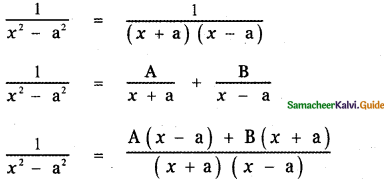
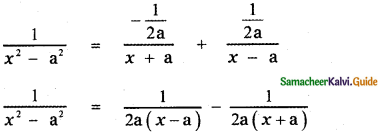
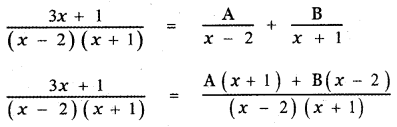
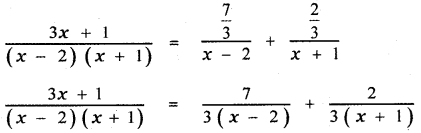
Samacheer Kalvi 11th Maths Guide Chapter 2 Basic Algebra Ex 2.8

Tamilnadu State Board New Syllabus Samacheer Kalvi 11th Maths Guide Pdf Chapter 2 Basic Algebra Ex 2.8 Text Book Back Questions and Answers, Notes.

Tamilnadu Samacheer Kalvi 11th Maths Solutions Chapter 2 Basic Algebra Ex 2.8

Question 1.
Find all values of x for which \(\frac{x^{3}(x-1)}{x-2}\) > 0
Answer:
The given inequality is f(x) = \(\frac{x^{3}(x-1)}{x-2}\) > 0
[The critical numbers of f(x) are those values of x for which f(x) = 0, and those values of x for which f(x) is not defined.
When x = 2 , f(x) = ∞ ⇒ f(x) is not defined.]
The critical numbers are x = 0, 1, 2
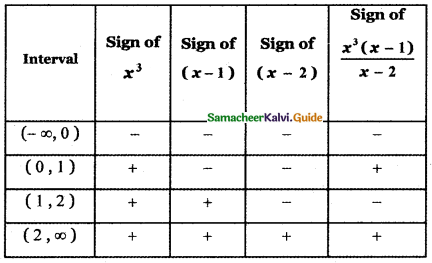
Divide the number line into 4 intervals
(- ∞, 0), (0, 1), (1, 2) and (2, ∞)
Samacheer Kalvi 11th Maths Guide Chapter 2 Basic Algebra Ex 2.8 1

Samacheer Kalvi 11th Maths Guide Chapter 2 Basic Algebra Ex 2.8

(1) (- ∞, 0)
When x < 0 say x = – 1
The factor x3 = (- 1)3 = – 1 < 0
The factor x – 1 = – 1 – 1 = – 2 < 0
The factor x – 2 = – 1 – 2 = – 3 < 0
∴ \(\frac{x^{3}(x-1)}{x-2}\) < 0
Thus \(\frac{x^{3}(x-1)}{x-2}\) > 0 is not true in the interval (- ∞, 0)
Therefore, it has no solution in the interval (- ∞, 0)

(2) (0, 1)
When 0 < x < 1 say x = 0.5
The factor x3 = (0.5 )3 > 0
The factor x – 1 = 0.5 – 1 = – 0.5 < 0
The factor x – 2 = 0.5 – 2 = – 1.5 < 0
Thus x3 > 0, x – 1 < 0 and x – 2 < 0
∴ \(\frac{x^{3}(x-1)}{x-2}\) > 0
Thus \(\frac{x^{3}(x-1)}{x-2}\) > 0 is true in the interval (0, 1)
Therefore it has solution in (0,1)

(3) (1, 2)
When 1 < x < 2 say x = 1.5
The factor x3 = 0
The factor x – 1 = 1.5 – 1 = 0.5 > 0
The factor x – 2 = 1.5 – 2 = – 0.5 < 0
Thus x3 > 0, x – 1 > 0 and x – 2 < 0
∴ \(\frac{x^{3}(x-1)}{x-2}\) < 0
Thus \(\frac{x^{3}(x-1)}{x-2}\) > 0 is not true in the interval (1, 2).
Therefore it has no solution in (1, 2).

Samacheer Kalvi 11th Maths Guide Chapter 2 Basic Algebra Ex 2.8

(4) (2, ∞)
When x > 2 say x = 3
The factor x3 = 33 > 0
The factor x – 1 = 3 – 1 = 2 > 0
The factor x – 2 = 3 – 2 = 1 > 0
Thus x3 > 0, x – 1 > 0 and x – 2 > 0
∴ \(\frac{x^{3}(x-1)}{x-2}\) > 0
Thus \(\frac{x^{3}(x-1)}{x-2}\) > 0 is true in the interval (2, ∞).
Therefore it has a solution in (2, ∞)
Samacheer Kalvi 11th Maths Guide Chapter 2 Basic Algebra Ex 2.8 2
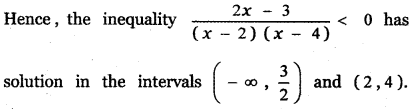
∴ \(\frac{x^{3}(x-1)}{x-2}\) > 0 has solution in the intervals (0, 1) and (2, ∞)
∴ The solution set is given by (0, 1) ∪ (2, ∞)
Samacheer Kalvi 11th Maths Guide Chapter 2 Basic Algebra Ex 2.8 3

Samacheer Kalvi 11th Maths Guide Chapter 2 Basic Algebra Ex 2.8

Question 2.
Find all values of x that satisfies the inequality \(\frac{2 x-3}{(x-2)(x-4)}\) < 0.
Answer:
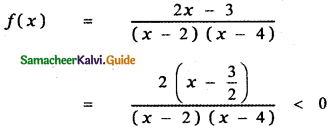
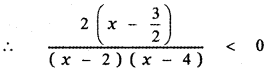
The given inequality is
Samacheer Kalvi 11th Maths Guide Chapter 2 Basic Algebra Ex 2.8 4
[The critical numbers of f(x) are those values of x for which f(x) = 0, and those values of x for which f(x) is not defined. When x = 2, f(x) = ∞ ⇒ f(x) is not defined.]
The critical numbers are x = \(\frac{3}{2}\), x = 2 , x = 4
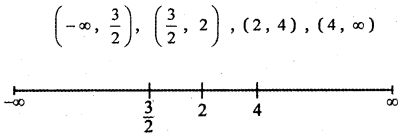
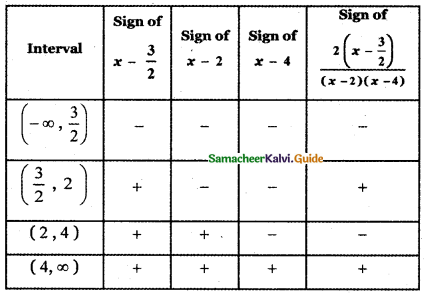
Divide the number into 4 intervals
Samacheer Kalvi 11th Maths Guide Chapter 2 Basic Algebra Ex 2.8 5

Samacheer Kalvi 11th Maths Guide Chapter 2 Basic Algebra Ex 2.8

(1) \(\left(-\infty, \frac{3}{2}\right)\)
When x < \(\frac{3}{2}\) say x = 0
The factor x – \(\frac{3}{2}\) = 0 – \(\frac{3}{2}\) < 0
The factor x – 2 = 0 – 2 < 0
The factor x – 4 = 0 – 4 < 0
Thus x – \(\frac{3}{2}\) < 0, x – 2 < 0 and x – 4 < 0
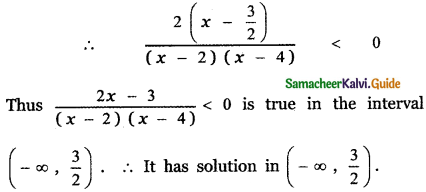
Samacheer Kalvi 11th Maths Guide Chapter 2 Basic Algebra Ex 2.8 6

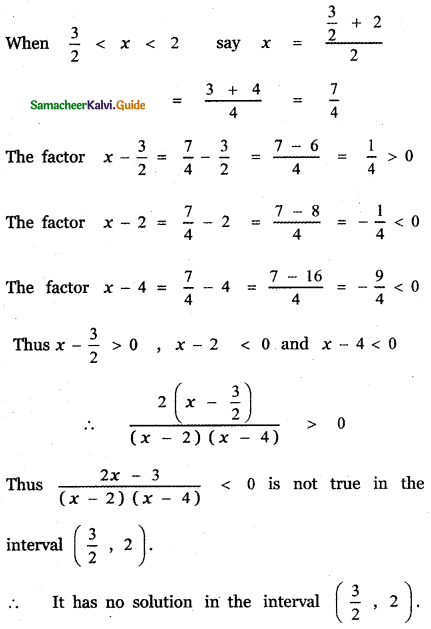
(2) \(\left(\frac{3}{2}, 2\right)\)
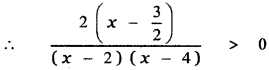
Samacheer Kalvi 11th Maths Guide Chapter 2 Basic Algebra Ex 2.8 7

Samacheer Kalvi 11th Maths Guide Chapter 2 Basic Algebra Ex 2.8

(3) (2, 4)
When 2 < x < 4 say x = 3 The factor x – \(\frac{3}{2}\) = 3 – \(\frac{3}{2}\) = \(\frac{3}{2}\) > 0
The factor x – 2 = 3 – 2 = 1 > 0
The factor x – 4 = 3 – 4 = – 1 < 0 Thus x – \(\frac{3}{2}\) > 0, x – 2 > 0 and x – 4 < 0
Samacheer Kalvi 11th Maths Guide Chapter 2 Basic Algebra Ex 2.8 8
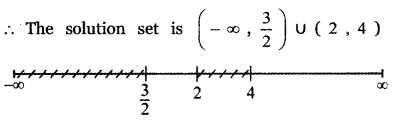
Thus \(\frac{2 x-3}{(x-2)(x-4)}\) < 0 is true in the interval (2, 4) ∴ It has solution in (2, 4). (4) (4, ∞) When x > 4 say x = 5
The factor x – \(\frac{3}{2}\) = 5 – \(\frac{3}{2}\) = \(\frac{7}{2}\) > 0
The factor x – 2 = 5 – 2 = 3 >0
The factor x – 4 = 5 – 4 = 1 > 0
Thus x – \(\frac{3}{2}\) > 0, x – 2 > 0 and x – 4 > 0
Samacheer Kalvi 11th Maths Guide Chapter 2 Basic Algebra Ex 2.8 9
Thus \(\frac{2 x-3}{(x-2)(x-4)}\) < 0 is not true in the interval (4, ∞)
∴ It has a solution in (4, ∞)
Samacheer Kalvi 11th Maths Guide Chapter 2 Basic Algebra Ex 2.8 10
Samacheer Kalvi 11th Maths Guide Chapter 2 Basic Algebra Ex 2.8 11
Samacheer Kalvi 11th Maths Guide Chapter 2 Basic Algebra Ex 2.8 12

Samacheer Kalvi 11th Maths Guide Chapter 2 Basic Algebra Ex 2.8

Question 3.
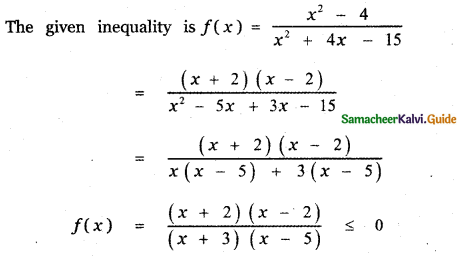
Solve: \(\frac{x^{2}-4}{x^{2}+4 x-15}\) ≤ 0
Answer:
Samacheer Kalvi 11th Maths Guide Chapter 2 Basic Algebra Ex 2.8 13
[The critical numbers of f(x) are those values of x for which f(x) = 0, and those values of x for which f(x) is not defined. When x = – 3, 5. f(x) = ∞ ⇒ f(x) is not defined.]

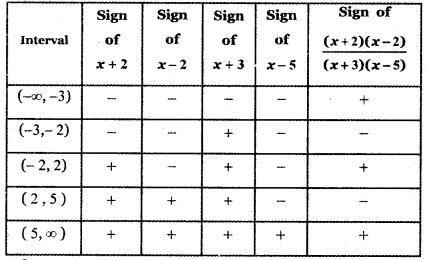
The critical numbers are x = – 2 , 2, – 3, 5
Divide the number line into five intervals
(- ∞, – 3), (- 3, – 2), (- 2, 2), (2, 5) ,(5, ∞)
Samacheer Kalvi 11th Maths Guide Chapter 2 Basic Algebra Ex 2.8 14

Samacheer Kalvi 11th Maths Guide Chapter 2 Basic Algebra Ex 2.8

(a) (- ∞, – 3)
When x <- 3 say x = – 4
The factor x + 2 = – 4 + 2 = – 2 < 0
The factor x – 2 = – 4 – 2 = 6 < 0
The factor x + 3 = – 4 + 3 = – 1 < 0
The factor x – 5 = – 4 – 5 = – 9 < 0
Thus x + 2 < 0, x + 3 < 0, x – 2 < 0, x – 5 < 0
∴ \(\frac{x^{2}-4}{x^{2}+4 x-15}\) > 0
Thus \(\frac{x^{2}-4}{x^{2}+4 x-15}\) ≤ 0 is not true in the interval (- ∞, – 3).
∴ It has no solution in (- ∞, – 3)

(b) (- 3, – 2)
When – 3 < x ≤ – 2 say x = – 2.5
The factor x + 2 = – 2.5 + 2 = – 0.5 < 0
The factor x – 2 = – 2.5 – 2 = – 4.5 < 0 The factor x + 3 = – 2.5 + 3 = 0.5 > 0
The factor x – 5 = – 2.5 – 5 = – 7.5 < 0
Thus x + 2 < 0, x + 3 > 0
and
x – 2 < 0
x – 5 < 0
∴ \(\frac{x^{2}-4}{x^{2}+4 x-15}\) < 0
Thus \(\frac{x^{2}-4}{x^{2}+4 x-15}\) ≤ 0 is not true in the interval (- 3, – 2).
∴ It has no solution in (- 3, – 2)

Samacheer Kalvi 11th Maths Guide Chapter 2 Basic Algebra Ex 2.8

(c) (-2, 2)
When – 2 ≤ x ≤ 2 say x = 0
The factor x + 2 = 0 + 2 = 2 > 0
The factor x – 2 = 0 – 2 = – 2 < 0
The factor x + 3 = 0 + 3 = 3 > 0
The factor x – 5 = 0 – 5 = – 5 < 0
Samacheer Kalvi 11th Maths Guide Chapter 2 Basic Algebra Ex 2.8 15
Thus x + 2 > 0 ,
x + 3 > 0
and
x – 2 < 0
x – 5 < 0
∴ \(\frac{x^{2}-4}{x^{2}+4 x-15}\) > 0
Thus \(\frac{x^{2}-4}{x^{2}+4 x-15}\) ≤ 0 is not true in the interval (- 2, – 2).
∴ It has no solution in (- 2, – 2)

(d) (2, 5)
When 2 ≤ x < 5 say x = 3 The factor x + 2 = 3 = 3 + 2 = 5 > 0
The factor x – 2 = 3 – 2 = 1 > 0
The factor x + 3 = 3 + 3 = 6 > 0
The factor x – 5 = 3 – 5 = – 2 < 0 Thus x + 2 > 0,
x + 3 > 0
and
x – 2 > 0
x – 5 < 0
∴ \(\frac{x^{2}-4}{x^{2}+4 x-15}\) < 0
Thus \(\frac{x^{2}-4}{x^{2}+4 x-15}\) ≤ 0 is not true in the interval (2, 5).
∴ It has no solution in (2, 5)

Samacheer Kalvi 11th Maths Guide Chapter 2 Basic Algebra Ex 2.8

(e) (5, ∞)
When 5 < x < ∞ say x = 6 The factor x + 2 = 6 + 2 = 8 > 0
The factor x – 2 = 6 – 2 = 4 > 0
The factor x + 3 = 6 + 3 = 9 > 0
The factor x – 5 = 6 – 5 = 1 > 0
Thus
x + 2 > 0,
x + 3 > 0
and
x – 2 > 0,
x – 5 > 0
∴ \(\frac{x^{2}-4}{x^{2}+4 x-15}\) > 0
Thus \(\frac{x^{2}-4}{x^{2}+4 x-15}\) ≤ 0 is not true in the interval (5, ∞).
∴ It has no solution in (5, ∞)
The given inequality f(x) = \(\frac{x^{2}-4}{x^{2}+4 x-15}\) ≤ 0 has solution in the intervals (-3, – 2]
∴ The solution set is (-3, 2] ∪ [2, 5)
Samacheer Kalvi 11th Maths Guide Chapter 2 Basic Algebra Ex 2.8 16

Samacheer Kalvi 11th Maths Guide Chapter 2 Basic Algebra Ex 2.7

Tamilnadu State Board New Syllabus Samacheer Kalvi 11th Maths Guide Pdf Chapter 2 Basic Algebra Ex 2.7 Text Book Back Questions and Answers, Notes.

Tamilnadu Samacheer Kalvi 11th Maths Solutions Chapter 2 Basic Algebra Ex 2.7

Question 1.
Factorize x4 + 1
Answer:
The given equation is x4 + 1
x4 + 1 = (x2)2 + 12
= (x2 + 1)2 – 2 (x2) (1)
[ a2 + b2 = (a + b)2 – 2ab]
= (x2 + 1)2 – (√2x)2
= (x2 + 1 + √2x) (x2 + 1 – √2x)
x4 + 1 = (x2 + 2x + 1) (x2 – √2x + 1)

Samacheer Kalvi 11th Maths Guide Chapter 2 Basic Algebra Ex 2.7

Question 2.
If x4 + x + 1 is a factor of the polynomial 3x3 + 8x2 + 8x + a, then find the value of a.
Answer:
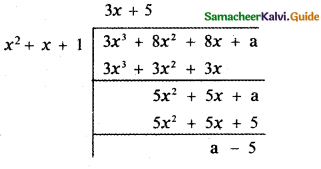
Given that x2 + x + 1 is a factor of the polynomial 3x3 + 8x2 + 8x + a.
∴ 3x3 + 8x2 + 8x + a is divisible by x2 + x + 1
Samacheer Kalvi 11th Maths Guide Chapter 2 Basic Algebra Ex 2.7 1
Since 3x3 + 8x2 + 8x + a is divisible by x2 + x + 1, the remainder must be zero.
a – 5 = 0
⇒ a = 5

Samacheer Kalvi 11th Maths Guide Chapter 2 Basic Algebra Ex 2.6

Tamilnadu State Board New Syllabus Samacheer Kalvi 11th Maths Guide Pdf Chapter 2 Basic Algebra Ex 2.6 Text Book Back Questions and Answers, Notes.

Tamilnadu Samacheer Kalvi 11th Maths Solutions Chapter 2 Basic Algebra Ex 2.6

Question 1.
Find the zeros of the polynomial function f(x) = 4x2 – 25
Answer:
Given f(x) = 4x2 – 25
To find the zeors of f(x), put f(x) = 0
∴ 4x2 – 25 = 0
⇒ 4x2 = 25
⇒ x2 = \(\frac{25}{4}\)
⇒ x = ±\(\sqrt{\frac{25}{4}}\) = ±\(\frac{5}{2}\)
Hence the zeros of f(x) are \(-\frac{5}{2}, \frac{5}{2}\)

Samacheer Kalvi 11th Maths Guide Chapter 2 Basic Algebra Ex 2.6

Question 2.
If x = – 2 is one root of x3 – x2 – 17x = 22, then find the other roots of equation.
Answer:
Let f(x) = x3 – x2 – 17x – 22 = 0 —– (1)
Given that x = – 2 is a root of f(x).
∴ x + 2 is a factor of f (x)
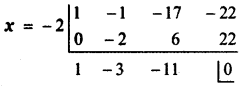
Using synthetic division
Samacheer Kalvi 11th Maths Guide Chapter 2 Basic Algebra Ex 2.6 1
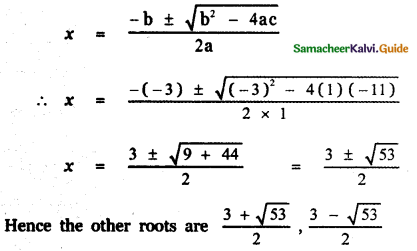
Comparing equation (1) with the equation ax2 + bx + c = 0 we have
a = 1, b = – 3 , c = – 11
Samacheer Kalvi 11th Maths Guide Chapter 2 Basic Algebra Ex 2.6 2

Samacheer Kalvi 11th Maths Guide Chapter 2 Basic Algebra Ex 2.6

Question 3.
Find the real roots of x4 = 16.
Answer:
x4 = 16
⇒ x4 – 16 = 0
(i.e.,) x4 – 42 = 0
⇒ (x2 + 4)(x2 – 4) = 0
x2 + 4 = 0 will have no real roots
so solving x2 – 4 = 0
x2 = 4
Samacheer Kalvi 11th Maths Solutions Chapter 2 Basic Algebra Ex 2.6 14

Samacheer Kalvi 11th Maths Guide Chapter 2 Basic Algebra Ex 2.6

Question 4.
Solve (2x + 1)2 – (3x + 2)2 = 0
Answer:
The given equation is (2x + 1)2 (3x + 2)2 = 0
(2x + 1 + 3x + 2) [(2x + 1) – (3x + 2)] = 0
[a2 – b2 = (a + b) (a – b)]
(5x + 3) (2x + 1 – 3x – 2) = 0
(5x + 3)(- x – 1) = 0
– (5x + 3)(x + 1) = 0
5x + 3 = 0 or x + 1 = 0
x = – \(\frac{3}{5}\) or x = – 1
∴ Solution set is { – 1, \(\frac{3}{5}\)}

Samacheer Kalvi 11th Maths Guide Chapter 2 Basic Algebra Ex 2.5

Tamilnadu State Board New Syllabus Samacheer Kalvi 11th Maths Guide Pdf Chapter 2 Basic Algebra Ex 2.5 Text Book Back Questions and Answers, Notes.

Tamilnadu Samacheer Kalvi 11th Maths Solutions Chapter 2 Basic Algebra Ex 2.5

Question 1.
Solve 2x2 + x – 15 ≤ 0
Answer:
The given inequality is
2x2 + x – 15 ≤ 0 ——— (1)
2x2 + x – 15 = 2x2 + 6x – 5x – 15
= 2x (x + 3) – 5 (x + 3)
= (2x – 5)(x + 3)
2x2 + x – 15 = 2\(\left(x-\frac{5}{2}\right)\))(x + 3) ——— (2)
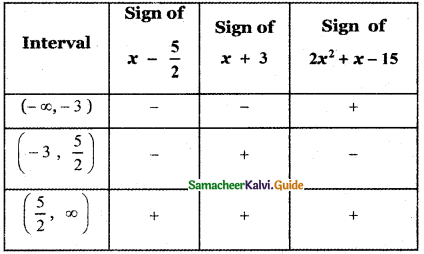
The critical numbers are x – \(\frac{5}{2}\) = 0 or x + 3 = 0
The critical numbers are x = \(\frac{5}{2}\) or x = – 3
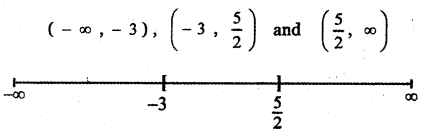
Divide the number line into three intervals
Samacheer Kalvi 11th Maths Guide Chapter 2 Basic Algebra Ex 2.5 1

Samacheer Kalvi 11th Maths Guide Chapter 2 Basic Algebra Ex 2.5

(i) (- ∞, – 3)
When x < – 3 say x = – 4
The factor x – \(\frac{5}{2}\) = – 4 – \(\frac{5}{2}\) < 0 and
x + 3 = – 4 + 3 = – 1 < 0
x – \(\frac{5}{2}\) < 0 and x + 3 < 0
⇒ \(\left(x-\frac{5}{2}\right)\) (x + 3) > 0
Using equation (2) 2x2 + x – 15 > 0
∴ 2x2 + x – 15 ≤ 0 is not true in (- ∞, – 3)

(ii) \(\left(-3, \frac{5}{2}\right)\)
When – 3 < x < \(\frac{5}{2}\) say x = 0
The factor x – \(\frac{5}{2}\) = 0 – \(\frac{5}{2}\) = – \(\frac{5}{2}\) < 0 and
x + 3 = 0 + 3 = 3 > 0
x – \(\frac{5}{2}\) < 0 and x + 3 > 0
⇒ \(\left(x-\frac{5}{2}\right)\) (x + 3) < 0
using equation (2) 2x2 + x – 15 < 0
∴ 2x2 + x – 15 ≤ 0 is true in \(\left(-3, \frac{5}{2}\right)\)

Samacheer Kalvi 11th Maths Guide Chapter 2 Basic Algebra Ex 2.5

(iii) \(\left(\frac{5}{2}, \infty\right)\)
When x > \(\frac{5}{2}\) say x = 3
The factor x – \(\frac{5}{2}\) = 3 – \(\frac{5}{2}\) > 0 and
x + 3 = 3 + 3 > 0
x – \(\frac{5}{2}\) > 0 and x + 3 > 0
= \(\left(x-\frac{5}{2}\right)\) (x + 3) > 0
Using equation (2) 2x2 + x – 15 > 0
∴ 2x2 + x – 15 ≤ 0 is not true in \(\left(\frac{5}{2}, \infty\right)\)
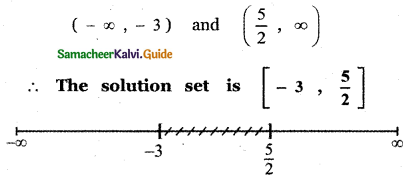
Samacheer Kalvi 11th Maths Guide Chapter 2 Basic Algebra Ex 2.5 2
We have proved the inequality 2x2 + x – 15 ≤ 0 is true in the interval \(\left(-3, \frac{5}{2}\right)\)
But it is not true in the interval
Samacheer Kalvi 11th Maths Guide Chapter 2 Basic Algebra Ex 2.5 3

Samacheer Kalvi 11th Maths Guide Chapter 2 Basic Algebra Ex 2.5

Question 2.
Solve x2 + 3x – 2 ≥ 0
Answer:
The given inequality is
– x2 + 3x – 2 ≥ 0
x2 – 3x + 2 < 0 ——– (1)
x2 – 3x + 2 = x2 – 2x – x + 2
= x(x – 2) – 1(x – 2)
x2 – 3x + 2 = (x – 1) (x – 2) ——— (2)
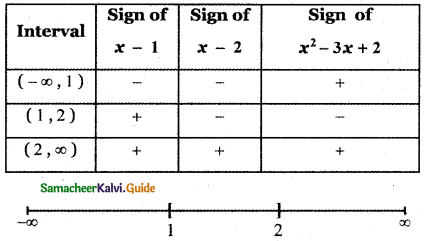
The critical numbers are
x – 1 = 0 or x – 2 = 0
The critical numbers are
x = 1 or x = 2
Divide the number line into three intervals
(- ∞, 1), (1, 2) and (2, ∞).
Samacheer Kalvi 11th Maths Guide Chapter 2 Basic Algebra Ex 2.5 4

(i) (- ∞, 1)
When x < 1 say x = 0
The factor x – 1 = 0 – 1 = – 1 < 0 and
x – 2 = 0 – 2 = – 2 < 0
x – 1 < 0 and x – 2 < 0
⇒ (x – 1)(x – 2) > 0
Using equation (2) x2 – 3x + 2 > 0
∴ The inequality x2 – 3x + 2 ≤ 0 is not true in the interval (- ∞, 1 )

Samacheer Kalvi 11th Maths Guide Chapter 2 Basic Algebra Ex 2.5

(ii) (1, 2)
When x lies between 1 and 2 say x = \(\frac{3}{2}\)
The factor x – 1 = \(\frac{3}{2}\) – 1 = \(\frac{1}{2}\) > 0 and
x – 2 = \(\frac{3}{2}\) – 2 = – \(\frac{1}{2}\) – < 0
x – 1 > 0 and x – 2 < 0
⇒ (x – 1)(x – 2) < 0
Using equation (2) x2 – 3x + 2 < 0
∴ The inequality x2 – 3x + 2 ≤ 0 is true in the interval (1, 2 )

Samacheer Kalvi 11th Maths Guide Chapter 2 Basic Algebra Ex 2.5

(iii) (2, ∞)
When x > 2 say x = 3
The factor x – 1 = 3 – 1 = 2 > 0 and
x – 2 = 3 – 2 = 1 > 0
x – 1 > 0 and x – 2 > 0
= (x – 1)(x – 2) > 0
Using equation (2) x2 – 3x + 2 > 0
∴ The inequality x2 – 3x + 2 ≤ 0 is not true in the interval (2, ∞)
We have proved the inequality x2 – 3x + 2 ≤ 0 is true in the interval [ 1, 2 ].
But it is not true in the interval
(- ∞, 1) and (2, ∞)
∴ The solution set is [1, 2]
Samacheer Kalvi 11th Maths Guide Chapter 2 Basic Algebra Ex 2.5 5

Samacheer Kalvi 11th Maths Guide Chapter 2 Basic Algebra Ex 2.4

Tamilnadu State Board New Syllabus Samacheer Kalvi 11th Maths Guide Pdf Chapter 2 Basic Algebra Ex 2.4 Text Book Back Questions and Answers, Notes.

Tamilnadu Samacheer Kalvi 11th Maths Solutions Chapter 2 Basic Algebra Ex 2.4

Question 1.
Construct a quadratic equation with roots 7 and – 3.
Answer:
The given roots are 7 and -3
Let α = 7 and β = -3
α + β = 7 – 3 = 4
αβ = (7)(-3) = -21
The quadratic equation with roots α and β is x2 – (α + β) x + αβ = 0
So the required quadratic equation is
x2 – (4) x + (-21) = 0
(i.e.,) x2 – 4x – 21 = 0

Samacheer Kalvi 11th Maths Guide Chapter 2 Basic Algebra Ex 2.4

Question 2.
A quadratic polynomial has one of its zero 1 + √5 and it satisfies p(1) = 2. Find the quadratic polynomial.
Answer:
Let p(x) = ax2 + bx + c be the required quadratic polynomial.
Given p (1) = 2 , we have
a × 12 + b × 1 + c = 2
a + b + c = 2 ——— (1)
Also given 1 + √5 is a zero of p(x)
∴ a(1 + √5)2 + b (1 + √5) + c = 0
a( 1 + 5 + 2√5) + b (1 + √5) + c = 0
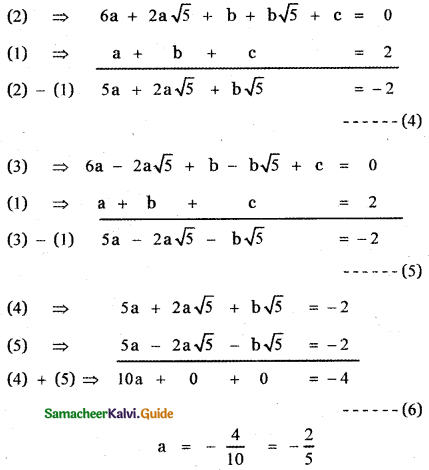
6a + 2a√5 + b + b√5 + c = 0 ——— (2)
If 1 + √5 is zero then 1 – √5 is also a zero of p (x).
∴ a(1 – √5)2 + b (1 – √5) + c = 0
a( 1 – 2√5 + 5) + b (1 – √5) + c = 0
6a – 2a√5 + b – b√5 + c = 0 ——— (3)
Samacheer Kalvi 11th Maths Guide Chapter 2 Basic Algebra Ex 2.4 1
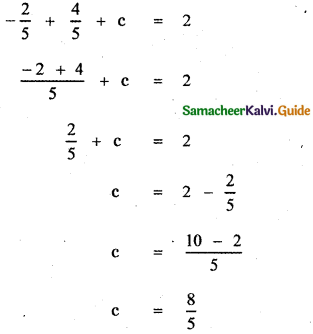
Substituting the value of a in equation (4)
5 × – \(\frac{2}{5}\) + 2 × – \(\frac{2}{5}\) × √5 + b√5 = – 2
– 2 – \(\frac{4}{5}\)√5 + b√5 = – 2
b√5 = – 2 + 2 + \(\frac{4}{5}\) . √5
b√5 = \(\frac{4}{5}\) . √5
b = \(\frac{4}{5}\)
Substituting the value of a and b in equation (1), we have

Samacheer Kalvi 11th Maths Guide Chapter 2 Basic Algebra Ex 2.4 2
∴ The required quadratic polynomial is
p(x) = \(-\frac{2}{5}\)x2 + \(\frac{4}{5}\)x + \(\frac{8}{5}\)
p(x) = \(-\frac{2}{5}\)(x2 – 2x – 4)

Samacheer Kalvi 11th Maths Guide Chapter 2 Basic Algebra Ex 2.4

Question 3.
If α and β are the roots of the quadratic equation x2 + √2x + 3 = 0 form a quadratic polynomial with zeros \(\frac{1}{\alpha}, \frac{1}{\beta}\).
Answer:
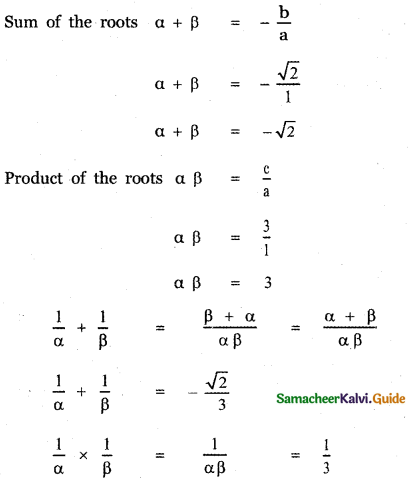
Given α and β are the roots of the quadratic polynomial
x2 + √2x + 3 = 0 ——— (1)
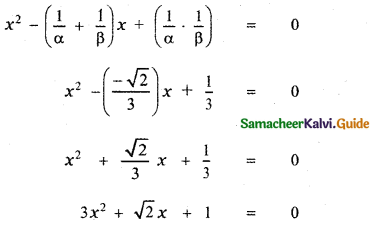
Samacheer Kalvi 11th Maths Guide Chapter 2 Basic Algebra Ex 2.4 3
∴ The required quadratic equation whose roots are \(\frac{1}{\alpha}, \frac{1}{\beta}\) is
x2 – (sum of the roots)x + product of the roots = 0
Samacheer Kalvi 11th Maths Guide Chapter 2 Basic Algebra Ex 2.4 4

Samacheer Kalvi 11th Maths Guide Chapter 2 Basic Algebra Ex 2.4

Question 4.
If one root of k (x – 1)2 = 5x – 7 is double the other root, show that k = 2 or – 25
Answer:
The given quadratic equation is

k(x – 1)2 = 5x – 7
k(x2 – 2x + 1) – 5x + 7 = 0
kx2 – 2kx + k – 5x + 7 = 0
kx2 – (2k + 5)x + k + 7 = 0 ———- (1)
Let the roots be α and 2α
Sum of the roots α + 2α = –\(\frac{b}{a}\)
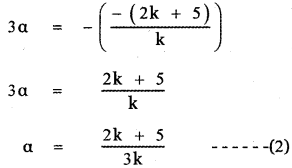
Samacheer Kalvi 11th Maths Guide Chapter 2 Basic Algebra Ex 2.4 5
Product of te roots α(2α) = \(\frac{c}{a}\)
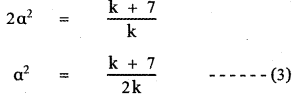
Samacheer Kalvi 11th Maths Guide Chapter 2 Basic Algebra Ex 2.4 6
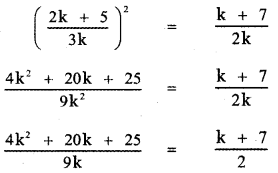
Using equation (2) and (3) we have
Samacheer Kalvi 11th Maths Guide Chapter 2 Basic Algebra Ex 2.4 7
2(4k2 + 20k + 25) = 9k(k + 7)
8k2 + 40k + 50 = 9k2 + 63k
9k2 + 63k – 8k2 – 40k – 50 = 0
k2 + 23k – 50 = 0
k2 + 25k – 2k – 50 = 0
k(k + 25) – 2(k + 25) = 0
(k – 2) (k + 25) = 0
k – 2 = 0 or k + 25 = 0
k = 2 or k = – 25

Samacheer Kalvi 11th Maths Guide Chapter 2 Basic Algebra Ex 2.4

Question 5.
If the difference of the roots of the equation 2x2 – (a + 1)x + a – 1 = 0 is equal to their product then prove that a = 2.
Answer:
The given quadratic equation is
2x2 – (a + 1) x + a – 1 = 0 ———– (1)
Let α and β be the roots of the given equation
Given that α – β = αβ —— (2)
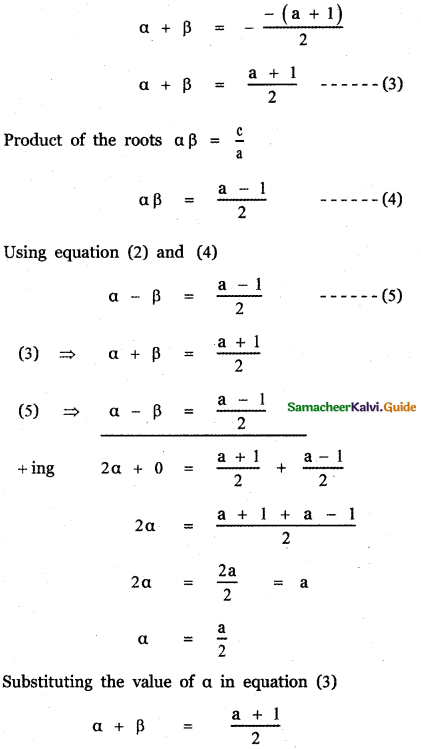
Sum of the roots α + β = – \(\frac{b}{a}\)
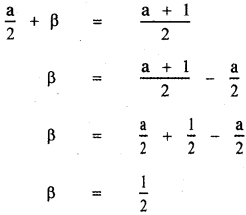
Samacheer Kalvi 11th Maths Guide Chapter 2 Basic Algebra Ex 2.4 8
Samacheer Kalvi 11th Maths Guide Chapter 2 Basic Algebra Ex 2.4 9
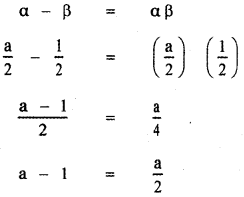
Substituting the values of α and β in equation (2)
Samacheer Kalvi 11th Maths Guide Chapter 2 Basic Algebra Ex 2.4 10
2(a – 1) = a
2a – 2 – a = 0
a – 2 = 0
⇒ a = 2

Samacheer Kalvi 11th Maths Guide Chapter 2 Basic Algebra Ex 2.4

Question 6.
Find the condition that one of the roots of ax2 + bx + c may be
(a) negative of the other
(b) thrice the other
(c) reciprocal of the other.
Answer:
The given quadratic equation is
ax2 + bx + c = 0 ——- (1)
Let α and β be the roots of the equation (1) then
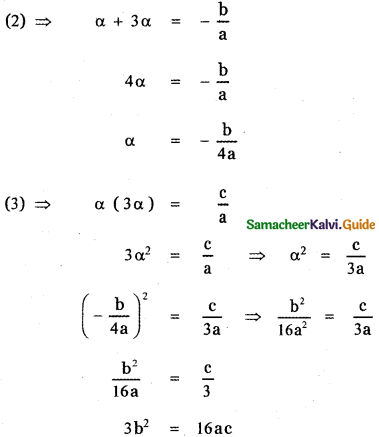
Sum of the roots α + β = ——- (2)
Product of the roots αβ = ——- (3)

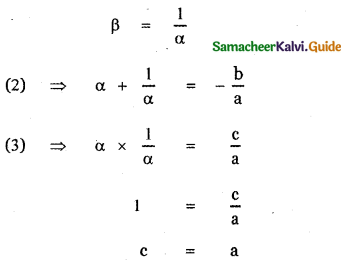
(a) Given one root is the negative of the other
β = – α
(2) ⇒ α + (-α) = – \(\frac{b}{a}\)
0 = – \(\frac{b}{a}\)
⇒ b = 0
(3) ⇒ α(-α) = \(\frac{c}{a}\)
– α2 = \(\frac{c}{a}\)
Hence the required condition is b = 0

(b) Given that one root is thrice the other
β = 3α
Samacheer Kalvi 11th Maths Guide Chapter 2 Basic Algebra Ex 2.4 11
When is the required condition?

(c) One root is reciprocal of the other
Samacheer Kalvi 11th Maths Guide Chapter 2 Basic Algebra Ex 2.4 12
When is the required condition?

Samacheer Kalvi 11th Maths Guide Chapter 2 Basic Algebra Ex 2.4

Question 7.
If the equations x2 – ax + b = 0 and x2 – ex + f = 0 have one root in common and if the second equation has equal roots then prove that ae = 2(b + f).
Answer:
The given quadratic equations are
x2 – ax + b = 0 ———- (1)
x2 – ex + f = 0 ——— (2)
Let α be the common root of the given quadratic equations (1) and (2)
Let α, β be the roots of x2 – ax + b = 0
Sum of the roots α + β = \(-\left(-\frac{a}{1}\right)\)
α + β = a ———- (3)
Product of the roots αβ = \(\frac{b}{1}\)
αβ = b ——– (4)
Given that the second equation has equal roots.
∴ The roots of the second equation are a, a
Sum of the roots α + α = \(-\left(-\frac{e}{1}\right)\)
2α = e ——— (5)
Product of the roots α.α = \(\frac{f}{1}\)
α2 = f ———- (6)
ae = (α + β)2α (Multiplying equations (3) and (5))
ae = 2α2 + 2αβ
ae= 2 (f) + 2b From equations (4) and (6)
ae= 2(f + b) Hence proved.

Samacheer Kalvi 11th Maths Guide Chapter 2 Basic Algebra Ex 2.4

Question 8.
Discuss the nature of roots of
(i) – x2 + 3x + 1 = 0
(ii) 4x2 – x – 2 = 0
(iii) 9x2 + 5x = 0.
Answer:
(i) -x2 + 3x + 1 = 0
⇒ comparing with ax2 + bx + c = 0
∆ = b2 – 4ac = (3)2 – 4(1)(-1) = 9 + 4 = 13 > 0
⇒ The roots are real and distinct

(ii) 4x2 – x – 2 = 0
a = 4, b = -1, c = -2
∆ = b2 – 4ac = (-1)2 – 4(4)(-2) = 1 + 32 = 33 >0
⇒ The roots are real and distinct

(iii) 9x2 + 5x = 0
a = 9, b = 5, c = 0
∆ = b2 – 4ac = 52 – 4(9)(0) = 25 > 0
⇒ The roots are real and distinct

Samacheer Kalvi 11th Maths Guide Chapter 2 Basic Algebra Ex 2.4

Question 9.
Without sketching the graphs, find whether the graphs of the following functions will intersect the x-axis and if so in how many points.
(i) y = x2 + x + 2
(ii) y = x2 – 3x – 7
(iii) y = x2 + 6x + 9
Answer:
(i) y = x2 + x + 2
y = x2 + x + 2 ——— (1)
Compare this equation with the equation
ax2 + bx + c = 0
we have a = 1 , b = 1, c = 2
b2 – 4ac = 12 – 4 × 1 × 2 = 1 – 8
b2 – 4ac = – 7 < 0
Since the discriminant is negative the quadratic equation has no real roots and therfore the graph does not meet x-axis.

(ii) y = x2 – 3x – 7
y = x2 – 3x – 7 ——— (2)
Compare this equation with the equation ax2 + bx + c = 0
we have a = 1 , b = – 3 , c = – 1
b2 – 4ac = (-3)2 – 4(1)(-1)
= 9 + 4
b2 – 4ac = 13 > 0
Since the discriminant is positive the quadratic equation has real and distinct roots and therefore the graph intersect the x – axis at two different points,

(iii) y = x2 + 6x + 9
y = x2 + 6x + 9 ——— (3)
Compare this equation with the equation
ax2 + bx + c = 0
we have a = 1 , b = 6, c = 9
b2 – 4ac = 62 – 4 × 1 × 9
= 36 – 36 =0
Since the discriminant is zero the quadratic equation has real and equal roots and therefore the graph touches the x-axis at one point.

Samacheer Kalvi 11th Maths Guide Chapter 2 Basic Algebra Ex 2.4

Question 10.
Write f(x) = x2 + 5x + 4 in completed square form.
Answer:
The given quadratic equation is
f(x) = x2 + 5x + 4
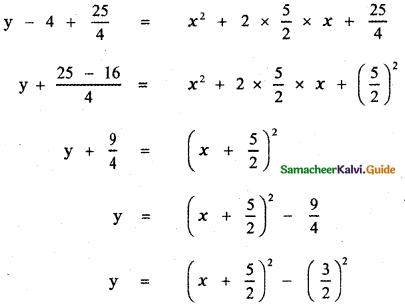
Let y = x2 + 5x + 4
y – 4 = x2 + 5x
Samacheer Kalvi 11th Maths Guide Chapter 2 Basic Algebra Ex 2.4 13

Samacheer Kalvi 5th English Guide Term 3 Poem 3 Social Responsibility

Tamilnadu State Board New Syllabus Samacheer Kalvi 5th English Guide Pdf Term 3 Poem 3 Social Responsibility Text Book Back Questions and Answers, Summary, Notes.

Tamilnadu Samacheer Kalvi 5th English Solutions Term 3 Poem 3 Social Responsibility

5th English Guide Social Responsibility Text Book Back Questions and Answers

A. Answer the following questions:

Question 1.
When does the world become green?
Answer:
The world becomes green when we keep our surroundings clean.

Question 2.
Who is responsible for society?
Answer:
Everyone is responsible for society.

Question 3.
When do you feel proud?
Answer:
I feel proud when I keep the surroundings clean, putting the litter in a trash can.

Question 4.
What should we vow for?
Answer:
We should vow to do social welfare.

Question 5.
Are you the first to protect nature?
Answer:
Yes.

Samacheer Kalvi 5th English Guide Term 3 Poem 3 Social Responsibility

B. Pick out the rhyming words and write:

Question 1.

1.green
2.human
3.will
4.welfare

Answer:

1.greena. clean
2.humanb. can
3.willc. ill
4.welfared. care

Samacheer Kalvi 5th English Guide Term 3 Poem 3 Social Responsibility

Let Us Know:

Past Perfect Tense (கடந்தகால வினைமுற்று):

The past perfect tense is used to show that something happened before another action in the past.
கடந்த காலத்தில் ஒரு செயலுக்கு முன்பே இன்னொரு செயல் நடந்து முடிந்து விட்டதை குறிப்பது கடந்தகால வினைமுற்று ஆகும். It can also be used to show that something happened before a specific time in the past.

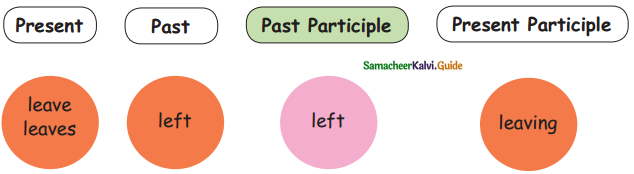
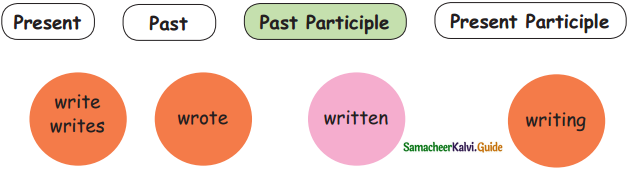
We know the forms of the verbs, they are:
Samacheer Kalvi 5th English Guide Term 3 poem 3 Social Responsibility 1

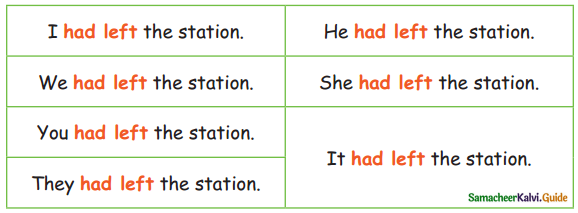
The past participle form is used in past perfect tense with auxiliary had.
Samacheer Kalvi 5th English Guide Term 3 poem 3 Social Responsibility 2

Samacheer Kalvi 5th English Guide Term 3 Poem 3 Social Responsibility

A. Fill in the blanks:

Example:
I had given him the book.

Question 1.
We ______ to the park. (go)
Answer:
We had gone to the park.

Question 2.
You ______ to your uncle’s house. (be)
Answer:
You had been to your uncle’s house.

Question 3.
He ______ before 5 ‘o’ clock. (sleep).
Answer:
He had slept before 5 ‘o’clock.

Question 4.
She ______ the bill. (pay)
Answer:
She had paid the bill.

Question 5.
They ______ him before the party. (meet)
Answer:
They had met him before the party.

Question 6.
It ______ before I touch it. (break)
Answer:
It had broken before I touched it.

Samacheer Kalvi 5th English Guide Term 3 Poem 3 Social Responsibility

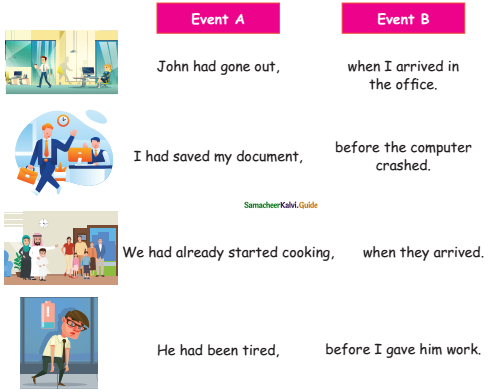
Let us see when to use past perfect tense:
Event happened before another in the past:

Samacheer Kalvi 5th English Guide Term 3 poem 3 Social Responsibility 3

Samacheer Kalvi 5th English Guide Term 3 Poem 3 Social Responsibility

B. Complete the following sentences using past perfect tense:

Question 1.
The bus _____ the bus stop before I went. (leave)
Answer:
The bus had left the bus stop before I went.

Question 2.
The exam _____ when I reached the exam hall. (start)
Answer:
The exam had started when I reached the exam hall.

Question 3.
She _____ the apple as I told her to stop. (eat)
Answer:
She had eaten the apple as I told her to stop.

Question 4.
The satellite ______ on the moon before they gave the command. (land)
Answer:
The satellite had landed on the moon before they gave the command.

Question 5.
Raju ______ to the ground before others arrived. (arrive)
Answer:
Raju had arrived to the ground before others arrived. (arrive)

Samacheer Kalvi 5th English Guide Term 3 Poem 3 Social Responsibility

Future Perfect Tense (எதிர்கால வினைமுற்று):

Future perfect tense is used for actions that will be completed before some other point in the future.
எதிர்காலத்தில் ஒரு செயலை முடிப்பதற்கு முன்னால், இன்னொரு செயலை செய்து முடிக்கப்போவதை குறிப்பது எதிர்கால வினைமுற்று ஆகும்.
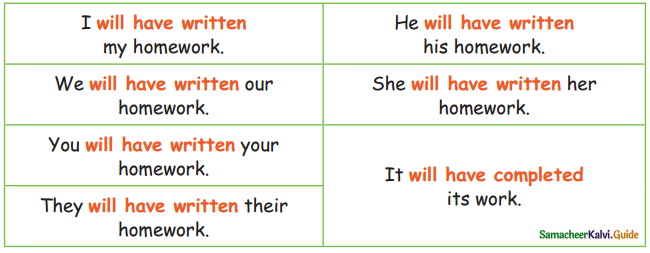
Samacheer Kalvi 5th English Guide Term 3 poem 3 Social Responsibility 4

The past participle form is used in future perfect tense with auxiliary will have. Come let us use it:
Samacheer Kalvi 5th English Guide Term 3 poem 3 Social Responsibility 5

Samacheer Kalvi 5th English Guide Term 3 Poem 3 Social Responsibility

A. Fill in the blanks using future perfect tense:

Example :
I will have reached the place by 6 pm.

Question 1.
We ______ the painting by tomorrow. (complete)
Answer:
We will have completed the painting by tomorrow.

Question 2.
You ______ the match by this time tomorrow. (win)
Answer:
You will have won the match by this time tomorrow.

Question 3.
They ______ everyone to the marriage by next week. (invite)
Answer:
They will have invited everyone to the marriage by next week.

Question 4.
He ______ all the money within an hour. (spend)
Answer:
He will have spent all the money within an hour.

Question 5.
She ______ job in America by next year. (get)
Answer:
She will have got job in America by next year.

Question 6.
It ______ all the candies. (eat)
Answer:
It will have eaten all the candies.

Samacheer Kalvi 5th English Guide Term 3 Poem 3 Social Responsibility

B. Mark (✓) if it is past perfect tense or (x) Future perfect tense:

Question 1.
I had gone to my grandma’s home.
Answer:
(✓) Past perfect

Question 2.
The boy will have grown up like a man in a few years.
Answer:
(X) Future perfect

Question 3.
She will have made the cake by 8 ‘o’clock.
Answer:
(X) Future perfect

Question 4.
They had cooked the vegetables.
Answer:
(✓) Past perfect

Question 5.
Muthu will have returned from Srilanka by next month.
Answer:
(X) Future perfect.

Samacheer Kalvi 5th English Guide Term 3 Poem 3 Social Responsibility

C. Change the sentence into past perfect tense and future perfect tense:

Question 1.
I have posted the letter.
Answer:
Past perfect: I had posted the letter.
Future perfect: I will have posted the letter.

Question 2.
She has bought a violin.
Answer:
Past perfect: She had bought a violin.
Future perfect: She will have bought a violin.

Question 3.
Akash has jumped into the well.
Answer:
Past perfect: Akash had jumped into the well.
Future perfect: Akash will have jumped into the well.

Question 4.
We have built a house in our village.
Answer:
Past perfect: We had built a house in our village.
Future perfect: we will have built a house in our village.

Question 5.
They have cooked their meal.
Answer:
Past perfect: They had cooked the meal.
Future perfect: They will have cooked the meal.

Samacheer Kalvi 5th English Guide Term 3 Poem 3 Social Responsibility

D. Fill the sentences with the appropriate Auxilliary:
(had), (will have)

Question 1.
Maha ______ asked a question to his father.
Answer:
Maha had asked a question to his father.

Question 2.
She ______ attended the meeting by tomorrow.
Answer:
She will have attended the meeting by tomorrow.

Question 3.
The fly ______ sat in the food before she covered it.
Answer:
The fly had sat in the food before she covered it.

Question 4.
Niru ______ joined her family in 2 years.
Answer:
Niru will have joined her family in 2 years.

Question 5.
The book ______ won him the award.
Answer:
The book had won him the award.

Samacheer Kalvi 5th English Guide Term 3 Poem 3 Social Responsibility

Let us listen:

Listen to the audio and tick (✓) if the statements are true:

Question 1.
Chennai is the fourth largest city in India to receive more rain.
Answer:
True

Question 2.
The airport is not closed.
Answer:
False

Question 3.
People were not able to get their food.
Answer:
True

Question 4.
The power supply in many areas is normal.
Answer:
False

Question 5.
It rained because of a depression in Bay of Bengal.
Answer:
True

Samacheer Kalvi 5th English Guide Term 3 Poem 3 Social Responsibility

Let us speak:

Storry Telling:

The following steps are involved in Story-telling:
Step 1: Choose the story you want to tell.
Step 2: Tell the place where the story is happening.
Step 3: Tell who the characters are.
Step 4: Tell three events that lead to the end of the story.
Step 5: End the story.

Example:
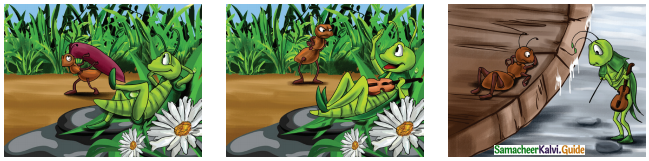
The Ant and the Grasshopper:
Samacheer Kalvi 5th English Guide Term 3 poem 3 Social Responsibility 6

In a deep forest near the mountains, lived an ant and a grasshopper. The ant worked hard in the summer and saved food for the winter. The grasshopper played in the Sun without collecting food. The grasshopper always called the ant to play, but the ant wanted to save food for winter. It was now winter, the ant had food to eat but the grasshopper did not. We should work hard and save.

Try to tell your friend a story on your own.

Samacheer Kalvi 5th English Guide Term 3 Poem 3 Social Responsibility

5th English Guide Social Responsibility Additional Questions and Answers

I. Answer the following:

Question 1.
List any four social responsibility given in the poem.
Answer:

  1. Keep your surroundings clean.
  2. Save electricity and do not waste.
  3. Put the litter in the trash can.
  4. Take care of nature.

II. Story telling:

Title: Wise King Solomon

King Solomon was known for his wisdom. Queen Sheeba wanted to test his wisdom. She took two identical flower garlands to Solomon. One was real and the other a paper garland. She asked the king to identify the real one. Solomon asked to open the windows. Soon a swarm of bees settled on the real garland. Solomon handed the real garland to Sheeba and she was happy.

Samacheer Kalvi 5th English Guide Term 3 Poem 3 Social Responsibility

Social responsibility Summary in English and Tamil

Our world becomes green,
When you keep the surroundings clean.
All of us are responsible for our society,
To take care of it is our duty.
Be proud of yourself as a human,
When you put the litter in a trash can.
Reduce the use of electricity by will,
And help the Earth grow without any
All should vow to do social welfare,
I will start with nature’s care.

நம் உலகம் பச்சை பசேல் என மாறுகிறது,
சுற்றுப்புறத்தை நீங்கள் சுத்தமாக வைத்திருக்கும்
போது நமது சமுதாயத்திற்கு நாம் அனைவரும் பொறுப்பானவர்கள்
அதை கவனித்துக் கொள்வது நமது கடமை.
ஒரு மனிதர் என்பதற்காக உங்களைப் பற்றி பெருமிதம் கொள்ளுங்கள்,
நீங்கள் குப்பையை அதற்கான குப்பைத்தொட்டியில் போடும் போது.
மின்சார பயன்பாட்டை ஓர் உறுதியுடன்,
குறையுங்கள் எந்த பாதிப்பும் இல்லாமல் இந்த பூமி வளர.
உதவுங்கள் சமூக நலனுக்கு ஏதேனும் செய்ய அனைவரும் உறுதிமொழி எடுப்போம்,
இயற்கையை பாதுகாத்து பராமரிப்பதுடன் நான் தொடங்குவேன்.

Samacheer Kalvi 5th English Guide Term 3 Poem 3 Social Responsibility

Social responsibility Glossary:

Litter – Waste (குப்பை)
Proud – Glad (பெருமிதம், மகிழ்ச்சி)
Reduce – Make something less (குறைத்தல்)
Responsible – In charge of (பொறுப்பு)
Society – Community (சமுதாயம்)
Trash can – Dust bin (குப்பைத் தொட்டி)
Vow – Pledge, promise (உறுதி மொழி)
Welfare – Comfort and security (பொதுநலன்)
Will – Determination (உறுதி)

Samacheer Kalvi 7th Social Science Guide History Term 2 Chapter 1 Vijayanagar and Bahmani Kingdoms

Tamilnadu State Board New Syllabus Samacheer Kalvi 7th Social Science Guide Pdf History Term 2 Chapter 1 Vijayanagar and Bahmani Kingdoms Text Book Back Questions and Answers, Notes.

Tamilnadu Samacheer Kalvi 7th Social Science Solutions History Term 2 Chapter 1 Vijayanagar and Bahmani Kingdoms

7th Social Science Guide Vijayanagar and Bahmani Kingdoms Text Book Back Questions and Answers

I. Choose the correct answer:

Question 1.
Who was the greatest ruler of Sangama Dynasty?
a) Bukka
b) Devaraya II
c) Harihara II
d) Krishna Devaraya
Answer:
b). Devaraya II

Samacheer Kalvi 7th Social Science Guide History Term 2 Chapter 1 Vijayanagar and Bahmani Kingdoms

Question 2.
Which was the most common animal depicted on the pillars of Vijayanagara style?
a) Elephant
b) Horse
c) Cow
d) Deer
Answer:
b) Hors

Question 3.
Who was the last ruler of the Sangama Dynasty?
a) Rama Raya
b) Tirumaladeva Raya
c) Devaraya II
d) Virupaksha Raya II
Answer
d) Virupaksha Raya II

Samacheer Kalvi 7th Social Science Guide History Term 2 Chapter 1 Vijayanagar and Bahmani Kingdoms

Question 4.
Who ended the Sultanate in Madurai?
a) Saluva Narasimha
b) Devaraya II
c) Kumara Kampana
d) Tirumaladeva Raya
Answer:
c) Kumara Kampana

Question 5.
Name the Bahmani King who was a linguist and a poet.
a) Ala-ud-din Hasan Shah
b) Muhammad I
c) Sultan Firoz
d) Mujahid
Answer:
c) Sultan Firoz

Samacheer Kalvi 7th Social Science Guide History Term 2 Chapter 1 Vijayanagar and Bahmani Kingdoms

II. Fill in the blanks:

1. ………..was the capital of the Aravidu dynasty.
Answer:
Penukonda

2. Vijayanagar emperor’s issued a large number of gold coins called …………………….
Answer:
Varaha’s

Samacheer Kalvi 7th Social Science Guide History Term 2 Chapter 1 Vijayanagar and Bahmani Kingdoms

3. Mahmud Gawan used …………………. chemists to teach the preparation and use of gunpowder.
Answer:
Persian

4. In Vijayanagara administration ……………… looked after the affairs of villages.
Answer:
Gauda

Samacheer Kalvi 7th Social Science Guide History Term 2 Chapter 1 Vijayanagar and Bahmani Kingdoms

III. Match the following:

1. Vijayanagaraa) Ruler of Odisha
2. Prataparudrab) Astadiggajas
3. KrishnaDevarayac) Pandurangamahatyam
4. Abdur Razzaqd) City of victory
5. Tenali Ramakrishnae) Persian emissary

Answer:

1. Vijayanagarad) City of victory
2. Prataparudraa) Ruler of Odisha
3. KrishnaDevarayab) Astadiggajas
4. Abdur Razzaqe) Persian emissary
5. Tenali Ramakrishnac)Pandurangamahatyam

IV.Match the statement with the reason. Tick (✓) the appropriate answer:

Question 1.
Assertion (A) : The Vijayanagar army was considered one of the feared armies in India.
Reason (R) : Vijayanagar armies used both firearms and cavalry.
a) R is not the correct explanation of A
b) R is correct explanation of A
c) A is correct and R is wrong
d) (A) and (R) are Correct
Answer:
b) R is correct explanation of A

Samacheer Kalvi 7th Social Science Guide History Term 2 Chapter 1 Vijayanagar and Bahmani Kingdoms

Question 2.
Find out the wrong pair
a) Silk – China
b)Spices – Arabia
c) Precious stone – Burma
d)Madurai Vijayam – Gangadevi
Answer:
b) Spices – Arabia

Question 3.
Find the odd one out
Harihara II, Muhammad I, Krishnadeva Raya, Devaraya I.
Answer:
Samacheer Kalvi 7th Social Science Guide History Term 2 Chapter 1 Vijayanagar and Bahmani Kingdoms 1

Question 4.
Consider the following statements and find out which is/are correct
I) Turquoise throne is one of the bejeweled royal seats of Persian kings described in Firdausi’s Shah Nama.
II) The fertile regions between the rivers Krishna and Tungabhadra and Krishna-Godavari delta were the zones of conflict among the rulers of Vijayanagar, and Bahmani.
III) Muhammad I was educated at Multan.
IV) Mahmud Gawan served with great distinction as the Prime Minister under Muhammad III.
a) i), ii) are correct
b) i), ii), iii) are correct
c) ii), iii), iv) are correct
d) iii), iv) are correct
Answer:
i), ii) are correct

Samacheer Kalvi 7th Social Science Guide History Term 2 Chapter 1 Vijayanagar and Bahmani Kingdoms

V.True or False:

Question 1.
Harihara and Bukka were the founders of the Bahmani kingdom.
Answer:
False

Question 2.
Krishnadeva Raya, who reigned for 20 years, was the most illustrious ruler of the Sangama dynasty.
Answer:
False

Samacheer Kalvi 7th Social Science Guide History Term 2 Chapter 1 Vijayanagar and Bahmani Kingdoms

Question 3.
Alasani Peddana was the greatest of all Astadiggajas.
Answer:
True

Question 4.
Kingship of Vijayanagar administration was hereditary, based on the principle of primogeniture.
Answer:
True

Samacheer Kalvi 7th Social Science Guide History Term 2 Chapter 1 Vijayanagar and Bahmani Kingdoms

Question 5.
There were 18 monarchs of the Bahmani dynasty.
Answer:
True

VI.Answer in one or two sentences:

Question 1.
The four dynasties of the Vijayanagara kingdom with reference to prominent rulers of each dynasty.
Answer:
Four dynasties of the Vijayanagara kingdom and its prominent rulers are:

  1. Sangama Dynasty – Devaraya II
  2. Saluva Dynasty – Saluva Narasimha
  3. Tuluva Dynasty – Krishnadevaraya
  4. Aravidu Dynasty – Tirumaladeva

Question 2.
Battle of Talikota.
Answer:

  • The Sultans of Deccan kingdoms forming a league to fight against the Vijayanagar Empire.
  • The battle is known as ‘Rakasa Tangadi’ or ‘Battle of Talikota’.
  • They fought at Talikota in 1565 A.D. Vijayanagar was defeated.
  • All the buildings, Palaces and temples were destroyed in the capital city Hampi.

Samacheer Kalvi 7th Social Science Guide History Term 2 Chapter 1 Vijayanagar and Bahmani Kingdoms

Question 3.
The structure of governance in the Vijayanagar kingdom.
Answer:

  • The Vijayanagar empire was divided into different mandalams, nadus, sthalas and gramas.
  • Each province was administered by Mandalesvara.
  • Each village had a grama sabha. Gauda, village headman, looked after the affairs of the village.
  • They maintained the army consisted of the infantry, cavalry with a firearm, and elephant corps.

Question 4.
The five independent kingdoms of Deccan Sultanate.
Answer:
The five independent kingdoms of Deccan were Bidar, Bijapur, Ahmednagar, Berar and Golconda.

Samacheer Kalvi 7th Social Science Guide History Term 2 Chapter 1 Vijayanagar and Bahmani Kingdoms

Question 5.
The educational reforms of Ala-ud-din Hasan Shah.
Answer:

  • Hasan Shah took special care in founding a school to educate his sons.
  • He opened institutions for the children of noble families in the art of soldiery.

VII. Answer in detail:

Question 1.
Discuss the career and achievements of Krishna Devaraya.
Answer:
(i) Krishnadevaraya who reigned for 20 years was the most illustrious ruler of the Tuluva dynasty.

(ii) He brought under control the independent chieftains in the Tungabhadra river basin.

(iii) The Bahmani sultan, Mahmud Shah, had been overthrown and kept in imprisonment by his minister. Krishnadevaraya freed the sultan and restored him to the throne. Prataparudra negotiated for peace and offered to marry off his daughter to him.

(iv) Accepting the offer, Krishnadevaraya returned the territory he had conquered from Prataparudra.

(v) Krishnadevaraya, with the assistance of the Portuguese gunners, could easily defeat the Sultan of Golconda and subsequently take over Raichur from the ruler of Bijapur.

A Great Builder:

(i) Krishnadevaraya built huge irrigation tanks and reservoirs for harvesting rainwater.

(ii) He built the famous temples of Krishnaswamy, Hazara Ramaswamy and Vithalaswamy in the capital city of Hampi.

(iii) He distributed the wealth he gained in wars to all major temples of South India for the purpose of constructing temple gateways (gopura), called ‘Rayagopuram,’ in his honour.

(iv) He had good friendly relationship with the Portuguese and Arabian traders, which increased the Empire’s income through customs.

Patron of Literature, Art and Architecture:
Krishnadevaraya patronised art and literature. Eight eminent luminaries in literature known as astadiggajas adorned his court.

Samacheer Kalvi 7th Social Science Guide History Term 2 Chapter 1 Vijayanagar and Bahmani Kingdoms

VIII. HOTs:

Question 1.
Discuss the causes for the decline of the Vijayanagar rule. To what extent the Bahmani sultans contributed to it?
Answer:

  • After Krishna Devaraya, the rulers were inefficient in the Vijayanagar empire. Making use of the situation the commanders declared independence.
  • There were frequent wars between Vijayanagar and Bahmani Kingdom which made the country economically weak.
  • Finally, the sultans of Deccan Kingdoms formed a league against Vijayanagar. The combined forces of the enemies defeated Vijayanagar in the Battle of Talikota in 1565 A.D.
  • These sultans destroyed the buildings, palaces, temples and the capital city of Hampi.

X. Answer Grid:

Samacheer Kalvi 7th Social Science Guide History Term 2 Chapter 1 Vijayanagar and Bahmani Kingdoms 2

1. Name the kingdom ruled by 18 monarchs which lasted for nearly 180 years.
Answer:
Bahmani Kingdom

2. Name the Bahmani Sultan who was restored to the throne by Krishna Devaraya?
Answer:
Mahmud Shah

3. Name the book written by Krishna Devaraya in Sanskrit.
Answer:
Jambavati Kaiyanam

4. Where did Hasan Bahman Shah shift his capital.
Answer:
Gulbarga

Samacheer Kalvi 7th Social Science Guide History Term 2 Chapter 1 Vijayanagar and Bahmani Kingdoms

7th Social Science Guide Vijayanagar and Bahmani Kingdoms Additional Important Questions and Answers

I. Choose the Correct answer:

Question 1.
The repressive measures of which Muslim king led to the rise of newly independent states?
a) Balban
b) Ala – ud – din Khilji
c) Muhammed – bin – Tughlaq
d) Firoz Tuglagq
Answer:
c) Muhammed – bin – Tughlaq

Samacheer Kalvi 7th Social Science Guide History Term 2 Chapter 1 Vijayanagar and Bahmani Kingdoms

Question 2.
Battle of TaliKota was fought in the year.
a) 1550
b) 1555
c) 1560
d) 1565
Answer:
d) 1565

Question 3.
The poem Madura Vijayam composed by
a) Kumara Kampana
b) Ganga Devi
c) Ibn Battuta
d) Abdur Razzaq
Answer:
b) Ganga Devi

Samacheer Kalvi 7th Social Science Guide History Term 2 Chapter 1 Vijayanagar and Bahmani Kingdoms

Question 4.
The Eight Eminent Luminaries in Literature were known as
a) Ashoka Pradhan
b) Navaratnas
c) Anju Vannathar
d) Astadiggajas
Answer:
d) Astadiggajas

Question 5.
A Persian emissary who visited the court of Krishna Devaraya was
a) Wassuf
b) Marcopolo
c) IbnBattuta
d) Abdur Razzaq
Answer:
d) Abdur Razzaq

Samacheer Kalvi 7th Social Science Guide History Term 2 Chapter 1 Vijayanagar and Bahmani Kingdoms

Question 6.
Who wrote a Telugu epic Amuktamalyada
a) Krishna Devaraya
b) Tenali Ramakrishna
c) Allasani Pethana
d) Tukkanna
Answer:
a) Krishna Devaraya

Question 7.
The Bahmani Kingdom was established in the year …………………………
a) 1327
b) 1337
c) 1347
d) 1350
Answer:
c) 1347

Samacheer Kalvi 7th Social Science Guide History Term 2 Chapter 1 Vijayanagar and Bahmani Kingdoms

Question 8.
The territorial divisions of Bhamani Kingdom was …………………………
a) District
b) City
c) Tarafs
d) Capital
Answer:
Tarafs

Question 9.
Wasir – i – ashraf was the minister of in the Bahmani Kingdom
a) Finance
b) Deputy finance
c) Foreign affairs
d) Police affairs
Answer:
c) Foreign affairs

Samacheer Kalvi 7th Social Science Guide History Term 2 Chapter 1 Vijayanagar and Bahmani Kingdoms

Question 10.
The eighth Bahmani king was……………………….
a) Mahmud bavan
b) Muhammad
c) Zahan khan
d) Sultan firoz
Answer:
d) sultan firoz

Samacheer Kalvi 7th Social Science Guide History Term 2 Chapter 1 Vijayanagar and Bahmani Kingdoms

II. Fill in the blanks:

1. In South India, ……….. and ………… are the two great kingdoms.
Answer:
Vijayanagar, Bahmani

2. Vijayanagar means ………….
Answer:
the city of victory

Samacheer Kalvi 7th Social Science Guide History Term 2 Chapter 1 Vijayanagar and Bahmani Kingdoms

3. ……………., head of Saivite Sringeri mutt instructed to establish the Vijayanagar kingdom.
Answer:
Vidyaranya

4. The Vijayanagar ruler who recruited Muslim fighters in their army was ……………
Answer:
Devaraya II

Samacheer Kalvi 7th Social Science Guide History Term 2 Chapter 1 Vijayanagar and Bahmani Kingdoms

5. Saluva Dynasty was founded by …………………
Answer:
Saluva Narasimha

6. Tuluva Dynasty was founded by …………………
Answer:
Naras Nayaka

Samacheer Kalvi 7th Social Science Guide History Term 2 Chapter 1 Vijayanagar and Bahmani Kingdoms

7. Krishna deva Raya, with the assistance of the ……………….. easily defeated the Sultan of Golconda.
Answer:
Portuguese gunners

8. Rayagopuram were built by …………….
Answer:
Krishna Devaraya

Samacheer Kalvi 7th Social Science Guide History Term 2 Chapter 1 Vijayanagar and Bahmani Kingdoms

9. The notable in Krishnadevaraya Patron was ………………….
Answer:
Tenali Ramakrishna

10. Battle of Talikota also known as ……………………
Answer:
Rakasa Tangadi

Samacheer Kalvi 7th Social Science Guide History Term 2 Chapter 1 Vijayanagar and Bahmani Kingdoms

11. Krishna Devaraya was succeeded by …………………….
Answer:
Achtyuda Deva Raya

12. Vijayanagar Empire collapsed in the year ……………………
Answer:
1646

Samacheer Kalvi 7th Social Science Guide History Term 2 Chapter 1 Vijayanagar and Bahmani Kingdoms

13. Vijayanagar Provinces were administered by …………………
Answer:
Mandalesvara

14. The new style of temple building temple was introduced by Vijayanagar rulers is called …………………..
Answer:
Vijayanagara style

Samacheer Kalvi 7th Social Science Guide History Term 2 Chapter 1 Vijayanagar and Bahmani Kingdoms

15. ………………contributed extensively to the development of the bhamani kingdom
Answer:
Mahamud Gawan

III. Match the following:

AB
1. Bidara) Madura Vijayan
2. Ganga Devib) Vijaya Nagar
3. Goda Devic) Madrasa
4. Hampid) Amukta malyada

Answer:

AB
1. Bidarc) Madrasa
2. Ganga Devia) Madura Vijayam
3. Goda Devid) Amukta malyada
4. Hampib) Vijaya Nagar

lV. Match the statement with the reason. Tick (✓) the appropriate answer:

Question 1.
Assertion (A) : Several foreign nobles of the state to leave for their Provinces.
Reason (R) : Gawan was executed.
a) R is not the correct explanation of A
b) R is the correct explanation of A
c) A is correct and R is wrong
d) (A) and (R) are Correct
Answer:
b) R is the correct explanation of

Samacheer Kalvi 7th Social Science Guide History Term 2 Chapter 1 Vijayanagar and Bahmani Kingdoms

Question 2.
Find the odd one out
a) Muhammad -1
b) Mujahid
c) Gawan
d) Shihab – ud – din Mahmud
Answer:
c) Gawan

V. State true or false:

Question 1.
Vijayanagar temple architecture belonged to the Dravidian style of Architecture
Answer:
False

Samacheer Kalvi 7th Social Science Guide History Term 2 Chapter 1 Vijayanagar and Bahmani Kingdoms

Question 2.
The Capturing fertile regions between the rivers Krishna and Tungabhadra was the major cause for the wars between Vijayanagar and Bahmani Kingdom
Answer:
True

Question 3.
The Delhi Sultanate was gradually broken up into six independent Deccan Kingdoms
Answer:
False

Samacheer Kalvi 7th Social Science Guide History Term 2 Chapter 1 Vijayanagar and Bahmani Kingdoms

Question 4.
Amir – i – Jumla was the finance minister of the Bahmani Kingdom.
Answer:
True

VI. Answer in one or two sentences:

Question 1.
What is Astadiggajas?
Answer:

  • Astadiggajas were the eight eminent luminaries in literature adorned in the court of Krishnadevaraya
  • Alasani Peddana and Tenali Ramakrishnan were the notable persons in Astadiggajas.

Question 2.
What are countries did Vijayanagar had trade contact?
Answer:
Vijayanagar traded with Persia, South Africa, Portugal, Arabia, China, Burma, South East Asia, and Sri Lanka.

Samacheer Kalvi 7th Social Science Guide History Term 2 Chapter 1 Vijayanagar and Bahmani Kingdoms

Question 3.
Who were the important scholars in Vijayanagar Empire?
Answer:
Srinatha, Pothana, Jakkama, Duggana, Tenali Ramakrishna and Allasani Peddana were important scholars in the Vijayanagar Empire.

Question 4.
What is Turquoise?
Answer:

  • Turquoise is a semi-precious stone sky blue in colour.
  • It is one of the bejewelled royal seats of Persian kings described in Firdausi’s Shah Nama.

Samacheer Kalvi 7th Social Science Guide History Term 2 Chapter 1 Vijayanagar and Bahmani Kingdoms

Question 5.
What is the Special feature of Golconda fort?
Answer:

  • The Golconda Fort is located about 11 kilometers from Hyderabad.
  • The fort is popular for its acoustic architecture.
  • The highest point of the fort is Bala Hissar.
  • There is a secret underground tunnel, which leads from the Durbar Hall to one of the palaces at the foot of the hills.

VII. Answer in detail:
Question 1.
Describe the eight ministers of the Bahmani state.
Eight ministers of the Bahmani state:
Answer:

  1.  Vakil-us-saltana – Lieutenant of the Kingdom.
  2.  Peshwa – He was associated with the lieutenant.
  3.  Waziri – kull-He supervised the work of all other ministers.
  4.  Amir-i-jumla – Minister for finance.
  5.  Nazir – Assistant minister for finance.
  6.  Wasir-i-ashraf – Minister of foreign affairs.
  7.  Kotwal – Chief of police and city magistrate.
  8. Sadr-i-jahan – Chief justice and minister of religious affairs and endowments.

Samacheer Kalvi 7th Social Science Guide History Term 2 Chapter 1 Vijayanagar and Bahmani Kingdoms

Question 2.
Explain the life and achievements of Mahmud Gawan.
Answer:
Life of Mahmud Gawan:

  • Mahmud Gawan was a Persian and prime minister of Muhammad HI, the sultan of Bahmani Kingdom.
  • He well versed in Islamic theory, Persian, and mathematics.
  • He was also a poet and a prose writer.

Achievements:

  • Gawan was known for his military campaigns as well as administrative reforms.
  • He used gun powder in the battle against the Vijayanagar kings in Belgaum.
  • To control the provincial governors. Gawan divided the four provinces of the Sultanate into eight provinces.
  • The administrative reforms introduced by Gawan improved the efficiency of the Government.

Samacheer Kalvi 4th English Guide Term 2 Poem 1 The Real Wealth

Tamilnadu State Board New Syllabus Samacheer Kalvi 4th English Guide Pdf Term 2 Poem 1 The Real Wealth Text Book Back Questions and Answers, Summary, Notes.

Tamilnadu Samacheer Kalvi 4th English Solutions Term 2 Poem 1 The Real Wealth

4th English Guide The Real Wealth Text Book Back Questions and Answers

Samacheer Kalvi 4th English Guide Term 2 Poem 1 The Real Wealth

A. Fill in the blanks.

Question 1.
Parents never let us get _________.
Answer:
Spoilt

Question 2.
Parents help us to overcome our __________.
Answer:
Problems

Question 3.
_________ is next to parents in care.
Answer:
Sister

Question 4.
___________ are the real wealth.
Answer:
Relationships

Question 5.
___________ always stays to the last in our needs.
Answer:
A good friend

Samacheer Kalvi 4th English Guide Term 2 Poem Chapter 1 The Real Wealth

B. Answer the following questions.

Question 1.
Who brought us to this world?
Answer:
Parents brought us to this world.

Question 2.
Which is as important as our health?
Answer:
Relationships are as important as our health.

Question 3.
How does a friend support us?
Answer:
A good friend is with us in all our deeds and stays last for all our needs.

Question 4.
Why relationships are more important than wealth?
Answer:
Relationships are real wealth. So they are more important than our wealth.

Samacheer Kalvi 4th English Guide Term 2 Poem Chapter 1 The Real Wealth

C. Match the rhyming words.

Question 1.
Share – dare
Answer:
Share – bear

Question 2.
Bread – rest
Answer:
Bread – ahead

Question 3.
Care – needs
Answer:
Care – dare

Question 4.
Deeds – ahead
Answer:
Deeds – needs

Question 5.
Zest – bear
Answer:
Zest – rest

Samacheer Kalvi 4th English Guide Term 2 Poem Chapter 1 The Real Wealth

Additional Questions and Answers

I. Answer the following questions

Question 1.
Who will never let us get spoilt?
Answer:
Our parents will never let us.get spoilt.

Question 2.
What do our parents do?
Answer:
Our parents earn our daily bread and wish to see us to grow successfully.

Question 3.
How should we nurture relationships?
Answer:
We should nurture relationships like our health.

Samacheer Kalvi 4th English Guide Term 2 Poem Chapter 1 The Real Wealth

II. Fill in the blanks.

Question 1.
Brother always fights for his ___________
Answer:
Share

Question 2.
If someone hurts us, our brother can’t ___________
Answer:
Bear

Question 3.
Our parents wish to see us __________ ahead.
Answer:
Shoot

Samacheer Kalvi 4th English Guide Term 2 Poem Chapter 1 The Real Wealth

Tick (✓) the correct place of the apple

Question 1.
Samacheer Kalvi 4th English Guide Term 2 poem Chapter 1 The real Wealth 1
behind / between
Answer:
Samacheer Kalvi 4th English Guide Term 2 poem Chapter 1 The real Wealth 4

Question 2.
Samacheer Kalvi 4th English Guide Term 2 poem Chapter 1 The real Wealth 2
behind / in front of
Answer:
Samacheer Kalvi 4th English Guide Term 2 poem Chapter 1 The real Wealth 5

Question 3.
Samacheer Kalvi 4th English Guide Term 2 poem Chapter 1 The real Wealth 3
in front of / between
Answer:
Samacheer Kalvi 4th English Guide Term 2 poem Chapter 1 The real Wealth 6

Samacheer Kalvi 4th English Guide Term 2 Poem Chapter 1 The Real Wealth

Write the correct prepositions.

Question 1.
Samacheer Kalvi 4th English Guide Term 2 poem Chapter 1 The real Wealth 7
The doll is __________ of the box
Answer:
In front of

Question 2.
Samacheer Kalvi 4th English Guide Term 2 poem Chapter 1 The real Wealth 8
The doll is __________ the boxes.
Answer:
Between

Question 3.
Samacheer Kalvi 4th English Guide Term 2 poem Chapter 1 The real Wealth 9
The doll is __________ the box.
Answer:
Behind

Samacheer Kalvi 4th English Guide Term 2 Poem Chapter 1 The Real Wealth

Imagine yourself as the rabbit and tell your friend deer where you are.

Question 1.
Samacheer Kalvi 4th English Guide Term 2 poem Chapter 1 The real Wealth 10
I am _________ the rock.
Answer:
In front of

Question 2.
Samacheer Kalvi 4th English Guide Term 2 poem Chapter 1 The real Wealth 11
I am _________ the tree.
Answer:
behind

Question 3.
Samacheer Kalvi 4th English Guide Term 2 poem Chapter 1 The real Wealth 12
I am _________ the bushes.
Answer:
Between

Samacheer Kalvi 4th English Guide Term 2 Poem Chapter 1 The Real Wealth

Fill in the blanks with before or after.

Samacheer Kalvi 4th English Guide Term 2 poem Chapter 1 The real Wealth 13

Question 1.
1 is _________ 2.
Answer:
Before

Question 2.
3 is _________ 4.
Answer:
Before

Question 3.
6 is ________ 5.
Answer:
After

Question 4.
A is _________ B.
Answer:
Before

Question 5.
5 is ________ 4.
Answer:
After

Question 6.
E is _________ F.
Answer:
Before

Question 7.
D is ________ C.
Answer:
After

Question 8.
D) B is _________ C.
Answer:
Before

Question 9.
Samacheer Kalvi 4th English Guide Term 2 poem Chapter 1 The real Wealth 14
Athithya is standing ________ Devi.
Answer:
Before

Question 10.
Vishali is standing __________ Anish.
Answer:
After

Question 11.
Samacheer Kalvi 4th English Guide Term 2 poem Chapter 1 The real Wealth 15
Watermelon is __________ pineapple.
Answer:
Before

Question 12.
Banana is __________ apple.
Answer:
After

Samacheer Kalvi 4th English Guide Term 2 Poem Chapter 1 The Real Wealth

Let us listen

Listen to the conversation and answer the following.

Question 1.
How many variety of dosa did the waiter say?
(a) One
(b) Two
(c) Three

Question 2.
Name the special dish.
(a) Adai
(b) Idly
(c) Dosai

Question 3.
How long will it take to make Adai?
(a) 5 minutes
(b) 10 minutes
(c) 15 minutes

Question 4.
What type of coffee did the customer order?
(a) Instant
(b) Black
(c) Filter
Answer:
Activity to be done by the students

Samacheer Kalvi 4th English Guide Term 2 Poem Chapter 1 The Real Wealth

Let us speak

Question 1.
See how they speak at this situation and practise as if you were in that situation.
Answer:
Samacheer Kalvi 4th English Guide Term 2 poem Chapter 1 The real Wealth 16
Passenger : Hello sir. Give me ticket to Trichy.
Conductor : How many tickets do you need?
Passenger : Only one ticket sir.
Conductor : It costs 120 rupees
Passenger : Here it is.
Conductor : Here is your ticket and the change.
Passenger : What time does the bus leave?
Conductor : The bus leaves in 5 minutes.
Passenger : Will you stop the bus for breakfast?
Conductor : Yes, we will stop in Alathur for breakfast.
Passenger : When will we reach Trichy?
Conductor : We will reach Trichy by 12:30 pm
Passenger : Thank you sir.

Samacheer Kalvi 4th English Guide Term 2 Poem Chapter 1 The Real Wealth

The Real Wealth  Summary in English and Tamil

Parent brings us to this soil,and will never let us get spoilt. They earn our daily bread and wish to see us shoot ahead
நம்மை பூமிக்கு கொண்டு வந்த பெற்றோர். நாம் கெட்டுப் போக எப்போதும் விடமாட்டார்கள். நம் தினசரி உணவிற்கு அவர்கள் சம்பாதிக்கிறார்கள். நாம் வாழ்க்கையில் வளர விரும்புகிறார்கள்.

Brother always fights for his share, but, if someone hurts us, he can’t bear.Sister’s words you never dare, she is next to parents, in care.

சகோதரன் தன் பங்கிற்காக நம்முடன் எப்போதும் சண்டையிடுவான், ஆனால், நம்மை யாராவது காயப்படுத்தினால் அவனால்தாங்க முடியாது. சகோதரியின் வார்த்தைகளை எப்போதும் எதிர்க்காதே, அவள் அக்கறை காட்டுவதில், பெற்றோருக்கு அடுத்தவள்.

Samacheer Kalvi 4th English Guide Term 2 Poem Chapter 1 The Real Wealth

A good friend is with you in all deeds and stays last for all your needs. Relationships are the real wealth, nurture them like your health.

உன் எல்லா செயல்களிலும் ஒரு நல்ல நண்பன் துணை நிற்பான் உன் எல்லா தேவைகளுக்கும், இறுதிவரை அவன் உடன்இருப்பான், உறவுகளே நம் உண்மையான செல்வம்உன் ஆரோக்கியம் போல் அதைப் பேணு.

Show care and affection, with all your It will take care of the rest.

அக்கறையையும், அன்பையும் உன் அனுபவத்திலzest, (ஆற்றலில்) காட்டு அது மற்ற அனைத்தையும் கவனித்துக் கொள்ளும்.

Samacheer Kalvi 4th English Guide Term 2 Poem Chapter 1 The Real Wealth

The Real Wealth Glossary

Spoilt – destroy the value or quality of (மதிப்பையோ, தரத்தையோ அழித்தல் )
Bear – to withstand (தாக்குபிடித்தல் )
Deeds – an action performed intentionally (தெரிந்து செய்யும் செயல்கள்)
Zest – happiness or energy (சந்தோஷம் (அல்லது) ஆற்றல் )
Nurture – care for and protect (அக்கறை காட்டுதல் மற்றும் பாதுகாத்தல்)

Samacheer Kalvi 7th Social Science Guide Civics Term 2 Chapter 2 Media and Democracy

Tamilnadu State Board New Syllabus Samacheer Kalvi 7th Social Science Guide Pdf Civics Term 2 Chapter 2 Media and Democracy Text Book Back Questions and Answers, Notes.

Tamilnadu Samacheer Kalvi 7th Social Science Solutions Civics Term 2 Chapter 2 Media and Democracy

7th Social Science Guide Media and Democracy Text Book Back Questions and Answers

I. Choose the correct answer:

Question 1.
Which one of the following comes under print media?
a) Radio
b) Television
c) Newspaper
d) Internet
Answer:
c) Newspaper

Samacheer Kalvi 7th Social Science Guide Civics Term 2 Chapter 2 Media and Democracy

Question 2.
Which one of the following is the broadcast media?
a) Magazines
b) Journals
c) Newspaper
d) Radio
Answer:
d) Radio

Question 3.
Which invention has brought the world closure?
a) Typewriter
b) Television
c) Telex
d) none of these
Answer:
b) Television

Samacheer Kalvi 7th Social Science Guide Civics Term 2 Chapter 2 Media and Democracy

Question 4.
Which is mass media?
a) Radio
b) Television
c) Both a & b
d) None of these
Answer:
c) Both a &b

Question 5.
Why is it necessary for media to be independent?
a) to earn money
b) to encourage company
c) to write balanced report
d) none of these
Answer:
c) to write balanced report

II. Fill in the blanks:

1. ……………………have made the world smaller and closer.
Answer:
Mass Media

Samacheer Kalvi 7th Social Science Guide Civics Term 2 Chapter 2 Media and Democracy

2. Every individual person is a medium of……………………
Answer:
expression

3. Printing press was invented by……………………
Answer:
Johannes Gutenberg

4. ……………………is a code of values which govern our lives.
Answer:
Mass Media

5. ……………………is the radio broadcast of the Government of India.
Answer:
Akashvani /All India Radio

Samacheer Kalvi 7th Social Science Guide Civics Term 2 Chapter 2 Media and Democracy

III. Match the following:

1. Narrowcast mediaa) Films
2. Social mediab) posters
3. Print mediac) Seminar
4. Web mediad) google web site
5. Broadcast mediae) facebook

Answer:

1. Narrowcast mediac) Seminar
2. Social mediae) facebook
3. Print mediab) posters
4. Web mediad) google web site
5. Broadcast mediaa) Films

IV. Consider the following statements: Tick the appropriate answer:

Question 1.
Assertion (A) : Print media has been referred to as people’s university
Reason (R) : They perform the role of public informer, educate, custodian of public interest.
a) A is correct and R is the correct explanation of A
b) A is correct and R is not the correct explanation of A
c) A is wrong and R is Correct
d) Both are wrong
Answer:
a) A is correct and R is the correct explanation of A

Samacheer Kalvi 7th Social Science Guide Civics Term 2 Chapter 2 Media and Democracy

Question 2.
Find the odd one
a) newspapers
b) magazine
c) journals
d) twitter
e) posters
Answer:
d) twitter

Question 3.
Consider the following statements and choose the correct answer from the codes given below.
a) Media is generally the agency for interpersonal communication.
b) Media is very powerful entity on the earth.
c) Media plays a prominent role in the formation of public opinion.
d) Media does not have any responsibility
i) a, b and c are correct ii) a, c and d are correct
iii) b, c and d are correct iv) a, b and d are correct
Answer:
i) a, b and c are correct

Samacheer Kalvi 7th Social Science Guide Civics Term 2 Chapter 2 Media and Democracy

V. Answer in one or two sentences.

Question 1.
What is media?
Answer:

  • Media is the agency for inter-personal communication.
  • It includes every broadcasting and narrowcasting medium.
  • It allows communicating messages, thoughts, ideas, views, etc.

Question 2.
How does the public get the news about the decision that is taken in the Legislative Assembly?
Answer:

  • Media carry every report of the action of the Legislative Assembly.
  • Based on the information the people can learn about the functioning of the government and the decision taken in the Legislative Assembly.

Question 3.
What is the importance of local media?
Answer:
Local Media in each locality gives importance to the local problem of the public.

Samacheer Kalvi 7th Social Science Guide Civics Term 2 Chapter 2 Media and Democracy

Question 4.
Media is the fourth pillar of democracy. Justify.
Answer:

  • The fourth pillar of democracy Media ensures that all the people should aware of happenings in the country.
  • It also ensures transparency in the working of all the other three Pillars.

Question 5.
State any two responsibilities of media.
Answer:

  • The media has a massive responsibility in providing facts.
  • The media should help people to express their opinion on important social issues.

VI. Answer the following in detail:

Question 1.
How can we classify media?
Answer:
Classification of Media:

  • Narrowcast Media – Cable Television, Direct mail, Seminar
  • Broadcast Media – Films, Television, Radio
  • Print Media – Newspapers, Magazine, Journals, Books, Posters, Reports.
  • Web Media – Google website and Blogs
  • Social Media – Twitter, Facebook, WhatsApp and Instagram

Question 2.
In what ways does the media play an important role in a democracy?
Answer:

  • Media is the backbone of democracy.
  • In our democratic society mass media is the driving force of public opinion
  • Media strengthens democratic value. It enlightens and empowers people.
  • It can educate the voters and ensures that government is transparently accountable.
  • Media carry every report of the action of administration of the government
  • Based on the information, the citizen can learn about the functioning of the government and day to day happenings taking place around them.

Samacheer Kalvi 7th Social Science Guide Civics Term 2 Chapter 2 Media and Democracy

Question 3.
What are the advantages of media?
Answer:

  • People get the latest news in a very short time
  • People get to bring out their hidden talents.
  • Great in promoting mass consumer products.
  • Serves as a good source of entertainment
  • Media leads to the diffusion of different cultures.

VII. HOTs:

Question 1.
Is Media necessary? Why?
Answer:
Yes, Media is necessary. In today’s society, the use of social media has become necessary for daily social interaction and access to news and information and decision making. It is a valuable communication tool with others locally and worldwide, as well as to share, create, and spread information.

Question 2.
What do you know about the term press conference?
Answer:
A press conference is an event organized to officially distribute information and answer questions from the media. Press conferences are held by corporations and other businesses, politicians, and other government officials.

Samacheer Kalvi 7th Social Science Guide Civics Term 2 Chapter 2 Media and Democracy

Question 3.
In what ways media affects our daily lives?
Answer:
Media is considered as the best source to know about the happenings of the world. Newspaper, magazine, radio, television and the internet are the different types of media. It greatly affects our lives because media has the power to influence our thoughts. This influence is sometimes positive and sometimes negative.

Question 4.
Media is a boon or bane.
Answer:
The media can be both boon or bane, depending on our usage. If we use it intelligently, it will be useful in gaining knowledge and for the best impact. Also, some stunts in movies and television are copied by people, which leads to major accidents in our society.

Question 5.
Name Some Local Media of your locality.
Answer:
News Papers and magazine:
Deccan Chronicle, The Hindu, Dinamalar, Dina Thanthi, Malai Malar, Kumudam, Ananda Vikadan, etc.

Samacheer Kalvi 7th Social Science Guide Civics Term 2 Chapter 2 Media and Democracy

7th Social Science Guide Media and Democracy Additional Important Questions and Answers

 I. Choose the Correct answer.

Question 1.
Television belongs to which media?
a) Broadcast
b) Narrowcast
c) Print
d) Social
Answer:
a) Broadcast

Question 2.
Instagram belonged to which media?
a) Broadcast
b) Narrowcast
c) Print
d) Social
Answer:
d) Social

Samacheer Kalvi 7th Social Science Guide Civics Term 2 Chapter 2 Media and Democracy

Question 3.
Printing Press was invented in the year
a) 1400
b) 1450
c) 1453
d) 1460
Answer:
c) 1453

Question 4.
The backbone of Democracy.
a) Media
b) resources
c) Transport
d) Minerals
Answer:
a) Media

Samacheer Kalvi 7th Social Science Guide Civics Term 2 Chapter 2 Media and Democracy

Question 5.
……………………media has been referred to as people’s university
a) Broadcast media
b) Print media
c) Social media
d) Web Media
Answer:
b) Print media

II. Fill in the blanks.

1. …………………… is generally the agency for inter-personal Communication.
Answer:
Media

2. A …………………… or …………………… allows communicating messages, thoughts, ideas, views, etc.
Answer:
medium, media

Samacheer Kalvi 7th Social Science Guide Civics Term 2 Chapter 2 Media and Democracy

3. An awakened and free media is very much essential for the function of the
Answer:
government

4. Akashvani means……………………
Answer:
voice from the sky

5. Twitter belongs to ……………………
Answer:
social media

6. …………………… media and …………………… media helps the people to express their opinion on important social issues.
Answer:
Print, electronic

7. Parliamentary democracy can flourish only under the watchful eyes of ……………………
Answer:
media

Samacheer Kalvi 7th Social Science Guide Civics Term 2 Chapter 2 Media and Democracy

8. Democracy means ……………………
Answer:
rule by people

9. Films comes under the …………………… media.
Answer:
broadcast

10. …………………… provides transparency of the government.
Answer:
Media

Samacheer Kalvi 7th Social Science Guide Civics Term 2 Chapter 2 Media and Democracy

III. Match the following:

1. Harikathaa) E-Mail
2. Personal communicationb) Seminar
3. Mass communicationc) Religious stories
4. Narrowcast Mediad) Television

Answer:

1. Harikathac) Religious stories
2. Personal communicationa) E-Mail
3. Mass communicationd) Television
4. Narrowcast Mediab) Seminar

IV. Consider the following statement: Tick the appropriate answer:

Question 1.
a) Media does not interfere in democracy
b) Media broadcast national and international News
c) Media is working for the welfare of a particular area
d) Media educates masses in rural areas
i) a, b, and c are correct
ii) a, c and d are correct
iii) b, c, and d are correct
iv) a, b and d are correct
Answer:
iii) b, c, and d are correct

Samacheer Kalvi 7th Social Science Guide Civics Term 2 Chapter 2 Media and Democracy

V. Answer in one or two sentences:

Question 1.
Why Print Media referred to as People’s University?
Answer:
Print media has been referred to as People’s university because they perform the role of public informer, educate and custodian of public interest.

Question 2.
What are the Four Pillars of Democracy?
Answer:
The four pillars of Democracy are the Legislature, Executive, Judiciary, and Media.

Question 3.
Define Democracy.
Answer:
Democracy means rule by the people. It combines two Greek words ‘Demos’ refers to citizens. ‘Kratos’ means either power or rule.

Samacheer Kalvi 7th Social Science Guide Civics Term 2 Chapter 2 Media and Democracy

VI. Answer the following in detail:

Question 1.
Explain the classifications of communication?
Answer:

  • Communication can be classified into two types.
  • They are personal and mass communication.

Personal communication:

  • These are personal use like cell phones, telephones, fax, and letters.

Mass communication:

  • These are used for communicating with the masses.
  • Ex. T.V. radio and newspaper.

Samacheer Kalvi 7th Social Science Guide Civics Term 2 Chapter 1 State Government

Tamilnadu State Board New Syllabus Samacheer Kalvi 7th Social Science Guide Pdf Civics Term 2 Chapter 1 State Government Text Book Back Questions and Answers, Notes.

Tamilnadu Samacheer Kalvi 7th Social Science Solutions Civics Term 2 Chapter 1 State Government

7th Social Science Guide State Government Text Book Back Questions and Answers

I. Choose the correct answer:

Question 1.
What is the minimum age for becoming a member of the State Legislative Council?
a) 18 Years
b) 21 Years
c) 25 Years
d) 30 Years
Answer:
c) 25 Years

Samacheer Kalvi 7th Social Science Guide Civics Term 2 Chapter 1 State Government

Question 2.
How many states does India have?
a) 26
b) 27
c) 28
d) 29 .
Answer:
d) 29

Question 3.
The word state government refers to
a) Government departments in the states
b) Legislative Assembly
c) Both a and b
d) None of the above
Answer:
c) Both a and b

Question 4.
The overall head of the government in the state is the
a) President
b) Prime Minister
c) Governor
d) Chief Minister
Answer:
c) Governor

Samacheer Kalvi 7th Social Science Guide Civics Term 2 Chapter 1 State Government

Question 5.
Who appoints the Chief Minister and other Ministers?
a) President
b) Prime Minister
c) Governor
d) Chief Minister
Answer:
c) Governor

Question 6.
Who becomes the Chief Minister?
a) Leader of the majority party
b) Leader of the opposition party
c) Both
d) None
Answer:
a) Leader of the majority party

Samacheer Kalvi 7th Social Science Guide Civics Term 2 Chapter 1 State Government

Question 7.
What are the three branches of the state Government?
a) Mayor, Governor, MLA
b) Panchayat, Municipality, Corporation
c) Village, City, State
d) Legislative, Executive and Judiciary
Answer:
d) Legislative, Executive and Judiciary

II. Fill in the blanks.

1. The Governor is appointed by the ………………..
Answer:
President

2.The leader of the majority party is appointed as ……………….. in the State Assembly.
Answer:
Chief Minister

3. ………………..is the highest judicial organ of the state.
Answer:
High Court

4. Mia stands for ………………..
Answer:
Member of the Legislative Assembly.

Samacheer Kalvi 7th Social Science Guide Civics Term 2 Chapter 1 State Government

5. ………………..is a particular area form were all the voters living there choose their representatives.
Answer:
Constituency

6. The elected representatives who are not the member of ruling party are called ………………..
Answer:
Opposition party

III. Match the following.

1. MLAsa) Chennai
2. Governorb) 7
3. Chief Ministerc) Head of the State
4. Union Territoriesd) Legislative Assembly
5. Fort St. Georgee) Leader of the Majority party

Answer:

1. MLAsd) Legislative Assembly
2. Governorc) Head of the State
3. Chief Ministere) Leader of the Majority party
4. Union Territories b) 7
5. Fort St. Georgea) Chennai

IV. Consider the following statement: Tick the appropriate answer.

Question 1.
Which of the following statement is/are not correct?
To become a governor, one
a) Should be the citizen of India
b) Should have completed 25 years of age
c) Should have sound mind
d) Should not hold any office of profit,
i) A & b ii) C & d iii) A iv) B
Answer:
iv) B

Samacheer Kalvi 7th Social Science Guide Civics Term 2 Chapter 1 State Government

Question 2.
Consider the following statements and state true or false

a) MLAs are together responsible for the work of government.
Answer:
True

b) All the MLAs of other political party who do not belong to the ruling party are called opposition.
Answer:
True

c) MLAs are not the representatives of people.
Answer: False

Question 3.
Find out the correct meaning of bicameral legislature
a) It means that there are cameras in the legislature.
b) It means that the legislature has men and women members.
c) It means that there are two houses like upper house and lower house.
d) It means that the governor is the leader over the members of the legislature.
Answer:
c) It means that there are two houses like upper house and lower house.

Samacheer Kalvi 7th Social Science Guide Civics Term 2 Chapter 1 State Government

Question 4.
Assertion (A) : India has a federal system of government.
Reason (R) : According to our constitution the power is divided between central and state governments
a) A is correct and R explains A
b) A is correct and R does not explain A
c) A is correct and R is wrong
d) Both are wrong
Answer:
a) A is correct and R explains A

V. Answer in one or two sentences.

Question 1.
What are the qualifications to become the Governor of a state?
Answer:
A person to be eligible for the post of Governor should be:

  • The Governor should be the citizen of India.
  • They should have completed 35 years of age.
  • The Governor should have a sound mind and should not hold any public office of profit.

Question 2.
Who are called oppositions?
Answer:
The party which gets the total number of seats next to the majority party was called the opposition party.

Question 3.
Write a note on Lok Adalat.
Answer:
Lok Adalat is the people’s court established by the Government of India to settle disputes through conciliation and compromise.

Samacheer Kalvi 7th Social Science Guide Civics Term 2 Chapter 1 State Government

Question 4.
What is a constituency?
Answer:
The constituency is the division in the state on the basis of the population. The entire state divided into several constituencies.

Question 5.
Who appoints the Chief Minister and other Ministers?
Answer:
The Governor appoints the Chief Minister and other Ministers.

VI. Answer the following in detail.

Question 1.
Describe the powers of the Governor.
Answer:

  • Governor is the head of the State executive.
  • All the administration works are carried out by his name.
  • All bills become law only after his assent.
  • He appoints important officials of the State Government such as Advocate General, Chairman, State Public Service Commision, State Election Commissioner, Vice-Chancellors of the State Universities etc.

Question 2.
Who is an MLA?
Answer:

  1. The Member of the Legislative Assembly is called MLA.
  2. They are elected by the people through general election.
  3. The candidate who gets the more number of votes becomes MLA.
  4. MLAs are the representatives of the people.

Question 3.
What is the role of the Chief Minister and other Council of Ministers at the state level?
Answer:

  • The Chief Minister is the real executive head of the state administration.
  • He allocated the portfolios among the ministers.
  • The Chief Minister formulate programmes and policies for the welfare of the people of the state.
    Council of Ministers:
  • All the ministers work as a team under the Chief Minister.
  • The Council of Ministers is collectively responsible to the State Legislature and Legislative Assembly of state.

Samacheer Kalvi 7th Social Science Guide Civics Term 2 Chapter 1 State Government

VII. HOTs.

Question 1.
Name some departments of the government.
Answer:
Some departments of the Government:

  1. Agriculture Department
  2. Energy Department
  3. Health and Family Welfare Department
  4. Industries Department
  5. Law Department
  6. Public works Department
  7. School Education Department
  8. Transport Department
  9. Youth Welfare and Sports Department
  10. Finance Department etc.

Question 2.
Tabulate: qualification, appointment and any two powers of Governor, Chief Minister and MLAs
Answer:
Samacheer Kalvi 7th Social Science Guide Civics Term 2 Chapter 1 State Government 1

VIII. Activity.

Question 1.
Make a list of the name of the Governor, Chief Minister, and other Ministers with their departments
Answer:
State of Tamil Nadu Governor – Banwarilal Purohit
Chief Minister – EdappadiK., Palaniswami

Minsters:

  1. Dindigul C. Sreenivasan – Minister for forests
  2. SenkottaiyanK.A – Minister of School education
  3. SelIur K. Raju – Minister of Co-Operation
  4. Thangamani. P – Minister for Electricity
  5. Velumani – Minister for Municipal & Rural administration
  6. D. Jayakumar – Minister for Fisheries
  7. K.P.Anbalagan – Minister of Higher Education
  8. V. Saroja – Minister for Social Welfare and Nutritious Noon Meal Programme etc.

Samacheer Kalvi 7th Social Science Guide Civics Term 2 Chapter 1 State Government

Question 2.
Write an essay on ‘If you were the Chief Minister of the state’
Answer:
If I will be the Chief Minister of the state:

  1. I would pass a strong law banning the cutting of trees. For cutting every single tree he would be forced to plant 100 trees.
  2. All the factory’s manufacturing units would be forced to install smoke and effluent treatment plants.
  3. I would implement anti-corruption law.

7th Social Science Guide State Government Additional Important Questions and Answers

I. Choose the Correct answer.

Question 1.
Which is our capital territory?
a) Chennai b) Mumbai
c) Newdelhi
d) Calcutta
Answer:
c) Newdelhi

Question 2.
The completed age of the people to cast their note in India
a) 15
b) 18
c) 20
d) 21
Answer:
b) 25

Samacheer Kalvi 7th Social Science Guide Civics Term 2 Chapter 1 State Government

Question 3.
The term of the chief minister office is
a) 4 year
b) 5 years
c) 6 years
d) 7 years
Answer:
b) 5 years

Question 4.
The chief minister should have completed which years
a) 21
b) 23
c) 25
d) 30
Answer:
c) 25

Question 5.
Who appointed the Vice-Chancellors?
a) Governor
b) Chief minister
c) Register
d) High court judge
Answer:
a) Governor

Samacheer Kalvi 7th Social Science Guide Civics Term 2 Chapter 1 State Government

II. Fill in the blanks.

1. Fort ………………….. is the first English fortress in India.
Answer:
St.George

2. A Legislative Assembly is the ……………….. house
Answer:
Lower

3 ………………..is the head of the union.
Answer:
President

4. The Member of the Parliament is called………………..
Answer:
MP

5. ………………..parties play a vital role in the election.
Answer:
Political

Samacheer Kalvi 7th Social Science Guide Civics Term 2 Chapter 1 State Government

6 ………………..of India conducts the election.
Answer:
The Election Commission

7. ML A should have completed ……………….. years of age.
Answer:
30

8. Tamil Nadu has ………………..cameral Legislature.
Answer:
Uni

9. The lower house is called ………………..
Answer:
Legislative Assembly

10. The Council of Ministers are collectively responsible for the State ………………..Assembly.
Answer:
Legislative

Samacheer Kalvi 7th Social Science Guide Civics Term 2 Chapter 1 State Government

11. ……………….Courts are to settle disputes relating to marriages.
Answer:
Family

12. Lok Adalat also called as
Answer:
People’s Court

III. Match the following:

1. High Courta) 29
2. Statesb) Highest Judicial Organ
3. New Delhic) State capital
4. Chennaid) National Capital

Answer:

1. High Courta) 29
2. Statesb) Highest Judicial Organ
3. New Delhic) State capital
4. Chennaid) National Capital

IV. Consider the following statements: Tick the appropriate answer:

Question 1.
1. There was no separate system of administration for the union, states, and union territories.
2. MLA’s are appointed by the governor
3. The central and state government work, together according to the Indian constitution
Answer:
3. The central and state government work together according to the Indian constitution

Question 2.
1. Vellore Fortress is the first English fortress in India.
2. St. George Fort houses the Tamil Nadu legislative assembly and secretariat of Tamil Nadu
3. Redfort is in Chennai
Answer:
2. St George Fort houses the Tamil Nadu legislative assembly and secretariat of Tamil Nadu

V. Answer in one or two sentences:

Question 1.
Where is Tamil Nadu State Legislative Assembly?
Answer:
Tamil Nadu State Legislative Assembly is at Fort St. George, Chennai.

Samacheer Kalvi 7th Social Science Guide Civics Term 2 Chapter 1 State Government

Question 2.
Define the Legislative Assembly.
Answer:
A Legislative Assembly is the Lower house where all the MLAs meet to discuss various matters related to the welfare of the state.

Question 3.
Define the Federal system.
Answer:
The power is divided into two sets of governments – the Central Government and State Government. This is called as Federal system.

Question 4.
Explain Central Government.
Answer:

  • India is a parliamentary democratic republic country.
  • The President of India is the head of the Indian Union and the Prime Minister and all the ministers are responsible to run the Government. This is called the Central Government.

Question 5.
Who conducts elections in India?
Answer:
The Election Commission of India conducts and monitors the elections.

Question 6.
What is Bi-cameral Legislature?
Answer:
A state has two houses – an Upper house and a Lower house. This is called the Bi-cameral Legislature.

Question 7.
What is Unicameral Legislature?
Answer:

  • In India, states have two houses in their Legislature.
  • But some states have a Lower house only. This is called Uni-cameral Legislature.
  • Ex: Tamil Nadu.

Samacheer Kalvi 7th Social Science Guide Civics Term 2 Chapter 1 State Government

Question 8.
For what purpose courts have been established?
Answer:
The courts have been established to ensure justice to the people without any bias.

Question 9.
What are the duties of the three main branches of Government?
Answer:

  • The three main branches or organs of Government are the legislative, executive, and Judiciary.
  • The Legislative branch makes laws, the executive branch enforces the laws and the judiciary interprets the laws.

Samacheer Kalvi 7th Social Science Guide Civics Term 2 Chapter 1 State Government

VI. Answer the following in detail:

Question 1.
Explain the Judicial System of States in India.
Answer:

  • The Hight courts are the highest judicial organ in the state.
  • It is an independent body.
  • The State high court consists of a Chief Judge and other Judges.
  • Chief Judges are appointed by the President and hold office till the age of 62.
  • District courts and tribunals, family Courts, and Lok Adalat also ensure justice to the people and settle the disputes through conciliation and compromise.