Samacheer Kalvi 7th Social Science Guide History Term 2 Chapter 3 Rise of Marathas and Peshwas

Tamilnadu State Board New Syllabus Samacheer Kalvi 7th Social Science Guide Pdf History Term 2 Chapter 3 Rise of Marathas and Peshwas Text Book Back Questions and Answers, Notes.
Tamilnadu Samacheer Kalvi 7th Social Science Solutions History Term 2 Chapter 3 Rise of Marathas and Peshwas

7th Social Science Guide Rise of Marathas and Peshwas Text Book Back Questions and Answers

Samacheer Kalvi 7th Social Science Guide History Term 2 Chapter 3 Rise of Marathas and Peshwas

I. Choose the correct answer:

Question 1.
1. Who was the teacher and guardian of Shivaji?
a) Dadaji Kondadev
b) Kavi Kalash
c) Jijabai
d) Ramdas
Answer:
a) Dadaji Kondadev

Question 2.
How was the Prime Minister of Maratha kings known?
a) Deshmukh
b) Peshwa
c) Panditrao
d) Patil
Answer:
b) Peshwa

Samacheer Kalvi 7th Social Science Guide History Term 2 Chapter 3 Rise of Marathas and Peshwas

Question 3.
Name the family priest of Shambhuji who influenced him in his day-to-day administration.
a) Shahu
b) Anaji Datto
c) Dadaji Kondadev
d) KaviKalash
Answer
c) Dadaji Kondadev

Question 4.
What was the backbone of Shivaji’s army in the beginning?
a) Artillery
b) Cavalry
c) Infantry
d) Elephantry
Answer:
c) Infantry

Samacheer Kalvi 7th Social Science Guide History Term 2 Chapter 3 Rise of Marathas and Peshwas

Question 5.
Who proclaimed wars and freed Malwa and Gujarat from Mughal domination?
a) Balaji Vishwanath
b) Bajirao
c) Balaji Bajirao
d) Shahu
Answer:
Bajirao

II. Fill in the blanks:

1. The spread of the …………….. movement in Maharashtra helped the Maratha people to develop
consciousness and oneness.
Answer:
Bhakti

2. …………… was the key official of the revenue administration of Peshwa.
Answer:
Kamavisdar

Samacheer Kalvi 7th Social Science Guide History Term 2 Chapter 3 Rise of Marathas and Peshwas

3. The imperial moment of the Marathas sadly ended at ………………. in 1761.
Answer:
Panipat

4. ……………… was the foreign minister in the Ashtapradhan.
Answer:
Sumant / Dubeer

5. Shambhuji succeeded Shivaji after a succession tussle with ………………..
Answer:
Anaji Datto

Samacheer Kalvi 7th Social Science Guide History Term 2 Chapter 3 Rise of Marathas and Peshwas

III. Match the following.

1. Shahji Bhonslea) Mother of Shivaji
2. Shambhujib) General of Bijapur
3. Shahuc) Shivaji’s father
4. Jijabaid) Son of Shivaji
5. Afzal khane) Shambhuji’s grandson

Answer:

1. Shahji Bhonslec) Shivaji’s father
2. Shambhujid) Son of Shivaji
3. Shahue) Shambhuji’s grandson
4. Jijabaia) Mother of Shivaji
5. Afzal khanb) General of Bijapur

IV. State true or false:

1. The rocky and mountainous terrain gave protection to the Marathas from invaders.
Answer:
True

2. Hymns composed in Sanskrit by the Bhakti saints were sung by people of all castes and classes.
Answer:
False

Samacheer Kalvi 7th Social Science Guide History Term 2 Chapter 3 Rise of Marathas and Peshwas

3. Shivaji captured Puranthar from the Mughals.
Answer:
True

4. Deshmukhs held sway over rural regions and their control was over between twenty and a hundred villages.
Answer:
True

5. Abdali invaded ten times before finally marching on Delhi.
Answer:
False

Samacheer Kalvi 7th Social Science Guide History Term 2 Chapter 3 Rise of Marathas and Peshwas

V. Consider the following statements. Tick (✓) the appropriate answer:

Question 1.
Assertion (A) : Soldiers were to live in forts and towns far away from home
Reason (R) : Maratha soldiers were not permitted to retire from battlefields each year for the
purpose of cultivating their land.
a) R is correct explanation of A
b) R is not the correct explanation of A
c) A is Wrong and R is correct
d)A and R are wrong
Answer:
a) R is the correct explanation of A

Question 2.
Statement I: Judging from the ledgers of correspondence and account books, Peshwas were keen on accurate record-keeping.
Statement II: Artillery decided the battle at Panipat in 1761.
a) I is correct
b) II is correct
c) I and II are correct
d) I and II are false
Answer:
a) R is the correct explanation of A

Samacheer Kalvi 7th Social Science Guide History Term 2 Chapter 3 Rise of Marathas and Peshwas

Question 3.
Find the odd one out
Shahji, Shivaji, Shambuji, Shahu, Rahuji Bhonsle
Answer:
Samacheer Kalvi 7th Social Science Guide History Term 2 Chapter 3 Rise of Marathas and Peshwas 2

Question 4.
Find out the wrong pair
1. Gaikwad – Baroda
2. Peshwa – Nagpur
3. Holkar – Indore
4. Shinde – Gwalior
Answer:
2. Peshwa – Nagpur

Question 5.
Arrange the events in chronological order
I) Shivaji became totally independent after the death of his guardian Kondadev.
II) Emperor Shahu died when Balaji Bajirao was Peshwa.
III) Shivaji resumed his military raids after his father’s death and conquered Javali.
IV) Balaji Vishwanath became Peshwa.
Answer:
I), III), IV), II)

Samacheer Kalvi 7th Social Science Guide History Term 2 Chapter 3 Rise of Marathas and Peshwas

VI. Answer in one or two sentences:

Question 1.
The impact of the Bhakti movement on Marathas.
Answer:

  • The Bhakti movement in Maharastra helped the Maratha people to develop consciousness of their identity and oneness.
  • It promoted a feeling of unity and social equality among the Marathas.

Question 2.
Chauth and Sardeshmukhi
Answer:
Chauth:
It is one-fourth of the revenue collected as the protection money collected from the people by Shivaji.

Sardeshmukhi:
It was an extra one-tenth, as the chieftain’s due collected by Shivaji.

Samacheer Kalvi 7th Social Science Guide History Term 2 Chapter 3 Rise of Marathas and Peshwas

Question 3.
Role of Kamavisdar in Maratha revenue administration.
Answer:

  • The revenue administration of Peshwas was headed by Kamavisdar.
  • He had to maintain a small body of soldiers to police the administrative area, from where they collected tribute or tax.

Question 4.
Execution of Shambhuji by Mughal Army.
Answer:

  • Shambhuji was in no position to resist the Mughals.
  • But Aurangzeb himself arrived to Deccan and captured Shambhuji and after torture, hanged them put to death.

Samacheer Kalvi 7th Social Science Guide History Term 2 Chapter 3 Rise of Marathas and Peshwas

Question 5.
Battle of Panipat fought in 1761.
Answer:
The imperial moment of the Marathas sadly ended at Panipat near Delhi in 1761. The king of the Afghans, Ahmad Shah Abdali, invaded eight times before finally marching onto Delhi. The Marathas were now divided among several commanders, who approached the battle with different tactics. Artillery decided the battle in January 1761. The mobile artillery of the Afghans proved lethal against both Maratha cavalry and infantry.

VII. Answer the following:

Question 1.
Examine the essential features of the Maratha administration under Shivaji.
Answer:
Village Administration:

  • Deshmukh control twenty and a hundred villages.
  • Each village was administered by village headman ‘Patil’, who was assisted by village accountant ‘Kulkami’.

Military Administration:

  • Shivaji gave utmost attention to his army and the training of its personnel.
  • Every soldier was selected by Shivaji.
  • Retired captains holding in charge of guarding the forts.

Ashtapradhan:
Shivaji designated eight ministers as ‘Ashtapradhan’. Peshwa was the Prime minister and Amatya was the finance minister.

Revenue Administration:

  • He collected Chauth and Sardeshmukhi taxes.
  • The assessments were made 3/5 left to the cultivator and 2/5 taken by the Government.

Judicial Administration:

  • Civil cases decided by the Panchayat and village council.
  • Criminal laws were based on the shastras of Hindu law books.

Samacheer Kalvi 7th Social Science Guide History Term 2 Chapter 3 Rise of Marathas and Peshwas

VIII. HOTs:

Question 1.
Compare the revenue administration of the Peshwas with that of Shivaji.
Answer:

  • Peshwas appointed Kamavisdar to collect the tax.
  • A small staff of clerks and servants were employed to maintain revenue records.
  • The contract for revenue collection auctioned.
  • A prospective tax or Revenue required to pay one third to one – half of the revenue.
  • While Shivaji required to pay Chauth (1/4 of revenue) as protection money, and Sardeshmukhi (extra 1/10 of revenue) chieftain’s due.
  • The assessment was made on three fifths (3/5) left to the cultivator and two fifths (2/5) taken by the government.

Samacheer Kalvi 7th Social Science Guide History Term 2 Chapter 3 Rise of Marathas and Peshwas

X. Student Activity:

I. Match the responsibilities of Ashtapradhan

AB
1. Amatyaa) Foreign Minister
2. Waqiab) Commander-in-chief
3. Sumantc) Finance Minister
4. Senapatid) Interior Minister

Answer:

AB
1. Amatyaa) Foreign Minister
2. Waqiad) Interior Minister
3. Sumantc) Finance Minister
4. Senapatib) Commander-in-chief

2. Group Activity

Question
Collect information about the Thanjavur Marathas with special reference to their contribution to education, art, and architecture.
Answer:

  •  Venkoji, a half-brother of great Maratha king Shivaji established the Maratha Kingdom at Tanjore in April 1674 A.D.
  •  Shahuji I, Serfoji I, Serfoji II were important rulers of Tanjore Maratha place, Saraswathi Mahal Library were important buildings built by them.
  • They favoured, Sanskrit, and Telugu literature.
  • Tanjore paintings are added beauty to their palaces.

Samacheer Kalvi 7th Social Science Guide History Term 2 Chapter 3 Rise of Marathas and Peshwas

7th Social Science Guide Rise of Marathas and Peshwas Additional Important Questions and Answers

I. Choose the Correct answer.

Question 1.
The welfare system followed by Shivaji was
a) Tulughama
b) Guerilla
c) Tank System
d) Bluewater policy
Answer:
b) Guerilla

Question 2.
The major Mughal port in the Arabian sea was
a) Karachi
b) Cochin
c) Goa
d) Surat
Answer:
d) Surat

Samacheer Kalvi 7th Social Science Guide History Term 2 Chapter 3 Rise of Marathas and Peshwas

Question 3.
Shivaji assumed the title Chhatrapathi in the year.
a)1654
b)1664
c)1674
d)1684
Answer:
b) 1664

Question 4.
The village accountant and a keeper of records in the Maratha empire was
a) Kulkarni
b) Patil
c) Nyayadhish
d) Senapathi
Answer:
a) Kulkarni

Samacheer Kalvi 7th Social Science Guide History Term 2 Chapter 3 Rise of Marathas and Peshwas

Question 5.
Eight ministers council of Shivaji was known as
a) Astadiggajas
b) Ashta Pradhan
c) Navarathnas
d) Triratnas
Answer:
b) Ashta Pradhan

Question 6.
The name of the Gwalior Maratha family is ……………..
a) Gaikuvar
b) Bhosle
c) Holkan
d) Scindhia
Answer:
d) Scindhia

Samacheer Kalvi 7th Social Science Guide History Term 2 Chapter 3 Rise of Marathas and Peshwas

Question 7.
Shivaji conquered Javali from the Maratha chief …………………..
a) Chandra Rao More
b) Shaisha Khan
c) Afzal khan
d) Kondadev
Answer:
a) Chandra Rao More

Question 8.
………………was the major port of Mughals.
a) Bijapur
b) Javali
c) Pune
d) Surat
Answer:
d) Surat

Samacheer Kalvi 7th Social Science Guide History Term 2 Chapter 3 Rise of Marathas and Peshwas

Question 9.
In Maratha administration ……………… held sway over rural regions.
a) Patil
b) Kulkami
c) Deshmukkhs
d) All of these
Answer:
c) Deshmukkhs

Question 10.
In Maratha Administration Waqia – navis was responsible for …………….. ministry.
a) Finance
b) External affairs
c) Interior
d) Law
Answer:
c) Interior

Samacheer Kalvi 7th Social Science Guide History Term 2 Chapter 3 Rise of Marathas and Peshwas

II. Fill in the blanks:

1. ……………. was the father of Shivaji.
Answer:
Shaji Bhonsle

2. Shivaji’s mother ……………….
Answer:
Jijabal.

3. Two great Hindu epics are ……………. and the ……………
Answer:
Ramé yana, Mahabharatha.

Samacheer Kalvi 7th Social Science Guide History Term 2 Chapter 3 Rise of Marathas and Peshwas

4. The strength of Shivaji’s army was …………….. Soldiers.
Answer:
Mavali foot

5. Shivaji conquered Javali in …………………
Answer:
1656

6. Aurangzeb’s uncle and the Mughal general were…………….
Answer:
Shaista Khan

Samacheer Kalvi 7th Social Science Guide History Term 2 Chapter 3 Rise of Marathas and Peshwas

7. Shivaji plundered Surat in ………………
Answer:
1664.

8. Chatrapati means ……………….
Answer:
Parasolpati

9. The village headman in Maratha kingdom was …………………..
Answer:
Patil.

Samacheer Kalvi 7th Social Science Guide History Term 2 Chapter 3 Rise of Marathas and Peshwas

10. ………………… was the chief Justice in the Marathon empire.
Answer:
Nyayadhish

11. Shahu mean …………….
Answer:
honest

12.Two prominent Maratha families are …………….., …………….
Answer:
Gaikwad, Peshwa

Samacheer Kalvi 7th Social Science Guide History Term 2 Chapter 3 Rise of Marathas and Peshwas

13. During the period of the ……………….. the northern frontiers of the Maratha state extended
Answer:
Peshwa Balaji Bajiro

14. The revenue administration of Peshwa was headed by a key official called ………………….
Answer:
Kamavisdar

15. the Third Battle of Panipat was fought in the year …………………
Answer:
1761 A.D

Samacheer Kalvi 7th Social Science Guide History Term 2 Chapter 3 Rise of Marathas and Peshwas

III. Match the following:

1. Peshuraa) Village accountant
2. Patilb) Finance Minister
3. Amatyac) Prime minister
4. Kulkamid) Village head man

Answer:

1. Peshurac) Prime minister
2. Patild) Village head man
3. Amatyab) Finance Minister
4. Kulkamia) Village accountant

IV. State true or false:

1. The Bhakti Movement in Maharastra helped the Maratha people develop consciousness of their identity and oneness
Answer:
True

2. The forces of Shivaji Plundered Surat in 1674.
Answer:
False

Samacheer Kalvi 7th Social Science Guide History Term 2 Chapter 3 Rise of Marathas and Peshwas

V. Consider the following statements. Tick (✓) the appropriate answer:

Question 1.
Assertion (A) : Shivaji’s father captivated by the Sultan of Bijapur.
Reason (R) : Shivaji’s Military raids angered the Sultan of Bijapur.
a) R is not the correct explanation of A
b) R is the correct explanation of A
c) A is correct and R is wrong
d) (A) and (R) are Correct
Answer:
b) R is the correct explanation of A

Question 2.
Assertion (A) : Bajirao assumed the powers of the commands in chief
Reason (R) : He didn’t want to depend on Deshmukh’s
a) R is not the correct explanation of A
b) R is the correct explanation of A
c) A is correct and R is wrong
d) (A) and (R) are Correct
Answer:
a) R is not the correct explanation of A

Samacheer Kalvi 7th Social Science Guide History Term 2 Chapter 3 Rise of Marathas and Peshwas

Question 3.
Find the odd one out.
1. Shurunavis, Waqia – Navis, Sumant, Kamavisdar
Answer:
Samacheer Kalvi 7th Social Science Guide History Term 2 Chapter 3 Rise of Marathas and Peshwas 1

VI. Answer in one or two sentences:

Question 1.
Who were the notable saints of the Bhakthi movement?
Answer:
Eknath, Tukaram, and Ramdas were the notable saints of the Bhakti Movement

Question 2.
What is the meaning of Chhatrapati?
Answer:
Chhatra means ‘parasol’, pati means ‘master or lord’ is the Sanskrit equivalent of King or Emperor. It was used by the Marathas, especially Shivaji.

Question 3.
Name the prominent Maratha families.
Answer:

  • Gaekwad at Baroda
  • Bhonsle at Nagpur
  • Holkar at Indore
  • Shinde or Scindhia at Gwalior
  • Peshwa at Pune.

Samacheer Kalvi 7th Social Science Guide History Term 2 Chapter 3 Rise of Marathas and Peshwas

VII. Answer the following:

Question 1.
What were the factors responsible for the rise of Marathas?
Answer:
Geographical Features:
The rocky and mountainous terrain proved to be advantageous in guerrilla warfare for Marathas.

Bhakti Movement and the Marathas:
The Bhakthi Movement in Maharashtra helped the Maratha people develop consciousness of their identity and oneness. It promoted a feeling of unity and social equality among the Marathas.

Literature and Language of the Marathas:
Marathi Language and literature also served to develop unity among the people.

Samacheer Kalvi 4th English Guide Term 2 Supplementary Chapter 2 Save Wisely

Tamilnadu State Board New Syllabus Samacheer Kalvi 4th English Guide Pdf Term 2 Supplementary Chapter 2 Save Wisely Text Book Back Questions and Answers, Summary, Notes.

Tamilnadu Samacheer Kalvi 4th English Solutions Term 2 Supplementary Chapter 2 Save Wisely

4th English Guide Save Wisely Text Book Back Questions and Answers

Samacheer Kalvi 4th English Guide Term 2 Supplementary Chapter 2 Save Wisely

A. Fill in the blanks.

Question 1.
Every year the children visit their _____________.
Answer:
Grandparents

Question 2.
At the end of the festival , Kamali and Senthil saved ___________.
Answer:
Some amount

Question 3.
Savings is done after fulfilling the ____________
Answer:
Basic needs

Question 4.
Senthil bought a ___________ from his savings.
Answer:
Camera

Question 5.
Kamali gave her savings to _____________.
Answer:
Her father

Samacheer Kalvi 4th English Guide Term 2 Supplementary Chapter 2 Save Wisely

B. Answer the following questions.

Question 1.
What did the children buy with money they have?
Answer:
The children bought sweets, toys, chocolates or packed food items.

Question 2.
What did the grandfather announce?
Answer:
He announced that the children should save the money they get over the course of a year and spend it purposefully.

Question 3.
What happened to Jayan?
Answer:
Jayan got sick due to food poisoning.

Question 4.
What did Kamali get as gift?
Answer:
Kamali got a brand new fulte as gift.

Question 5.
What will you do with your savings?
Answer:
I will buy a gift for my mother and father.

Samacheer Kalvi 4th English Guide Term 2 Supplementary Chapter 2 Save Wisely

Answer the following Additional Questions and Answers.

Question 1.
Why did the children visit their native village?
Answer:
They visited their native village for the car festival that lasted for three days.

Question 2.
What did the family members and relatives would give their children?
Answer:
They would give them money to buy sweets and toys.

Question 3.
What would the children do with that money?
Answer:
They would spend all the money and never saved the money at all.

Question 4.
Were the children excited by the announcement?
Answer:
No, the children were not excited by the announcement.

Question 5.
What did Jayan and Kauvery decide to do?
Answer:
Jayan and Kauvery decided to enjoy the festival to the fullest. They bought every single type of food available across the shops.

Question 6.
Who were the eldest of the kids?
Answer:
The eldest of the kids were Kamali and Senthil.

Question 7.
How did Senthil and Kamali save every rupee they got?
Answer:
They controlled their desires and saved every rupee they got.

Question 8.
How much did they manage to save by the end of the festival?
Answer:
They managed to save around three hundred rupees by the end of the festival.

Question 9.
What did Senthil do?
Answer:
He opened savings account in the nearest post office.

Question 10.
What was Senthil’s dream?
Answer:
Senthil’s dream was to buy a camera.

Samacheer Kalvi 4th English Guide Term 2 Supplementary Chapter 2 Save Wisely

Let us read aloud

Read the passage three times on your own. Colour a Piggy bank each time you read.

Piggy bank is a coin box used by children. The real use of a piggy bank is to store coins. Piggy banks look like pigs. They come in many shapes and sizes. In Tamil, they are known as Hundial. It is a red, mud pot. We can drop the coins into the pot. Once the pot is full, we must break the pot and use they coins. Start saving with your hundial today!
Samacheer Kalvi 4th English Guide Term 2 Supplementary Chapter 2 Save Wisely 1

Question 1.
Samacheer Kalvi 4th English Guide Term 2 Supplementary Chapter 2 Save Wisely 2Samacheer Kalvi 4th English Guide Term 2 Supplementary Chapter 2 Save Wisely 3
Hundial is a ____________ pot.
Answer:
Red, mud

Question 2.
Samacheer Kalvi 4th English Guide Term 2 Supplementary Chapter 2 Save Wisely 5 Samacheer KalSSamacheer Kalvi 4th English Guide Term 2 Supplementary Chapter 2 Save Wisely 4amacheer Kalvi 4th English Guide Term 2 Supplementary Chapter 2 Save Wisely 4vi 4th English Guide Term 2 Supplementary Chapter 2 Save Wisely 4
Mostly piggy banks looks like ___________
Answer:
Pigs.

Question 3.
The main idea of the passage is ___________
(a) To buy a piggy bank.
(b) To save.
Answer:
(b) To save

Samacheer Kalvi 4th English Guide Term 2 Supplementary Chapter 2 Save Wisely

Let us write

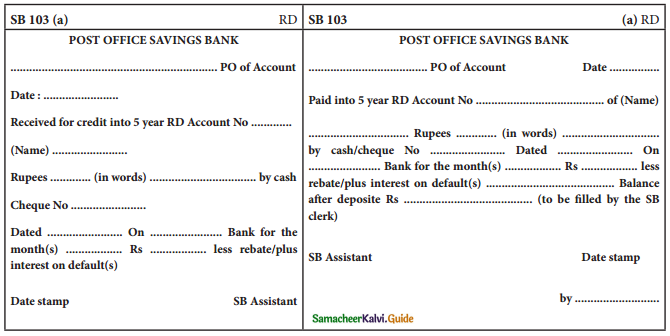
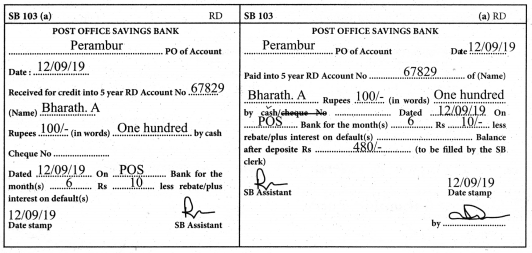
This month you have managed to save Rs. 100 from your pocket money. Fill out the challan to deposit it in your Savings Account at the post office.

Question 1.
Samacheer Kalvi 4th English Guide Term 2 Supplementary Chapter 2 Save Wisely 6
Answer:
Samacheer Kalvi 4th English Guide Term 2 Supplementary Chapter 2 Save Wisely 8

Samacheer Kalvi 4th English Guide Term 2 Supplementary Chapter 2 Save Wisely

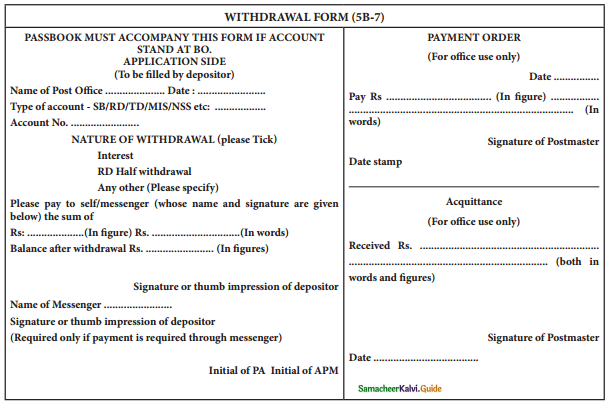
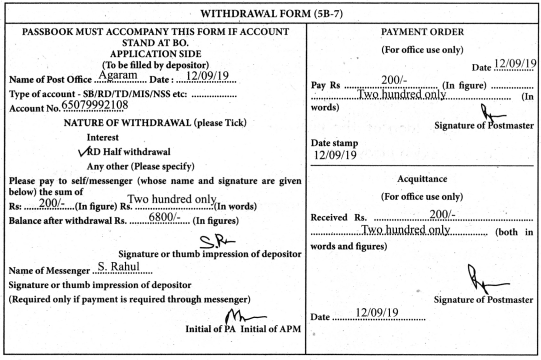
Fill up the withdrawal form to withdraw Rs.200 from your Savings Account.

Question 1.
Samacheer Kalvi 4th English Guide Term 2 Supplementary Chapter 2 Save Wisely 14
Answer:
Samacheer Kalvi 4th English Guide Term 2 Supplementary Chapter 2 Save Wisely 15

Samacheer Kalvi 4th English Guide Term 2 Supplementary Chapter 2 Save Wisely

I can do

A. Fill in the blanks.

Question 1.
Moles dig __________ to catch worms.
Answer:
Long and wide tunnel

Question 2.
Leaf cutter ants drink ___________
Answer:
Leaf sap

Question 3.
Kamali gave her savings to ____________.
Answer:
Her father

Samacheer Kalvi 4th English Guide Term 2 Supplementary Chapter 2 Save Wisely

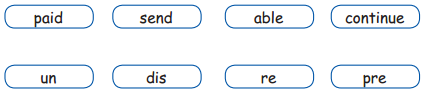
B. Join the word with the correct prefix.

Question 1.
Samacheer Kalvi 4th English Guide Term 2 Supplementary Chapter 2 Save Wisely 10
Answer:

  1. Prepaid
  2. Resend
  3. Unable
  4. Discontinue

Samacheer Kalvi 4th English Guide Term 2 Supplementary Chapter 2 Save Wisely

C. Match the rhyming words.

Question 1.
Save ___________
Answer:
Gave

Question 2.
Countries __________
Answer:
Pantries

Question 3.
larder ___________
Answer:
Starter

Samacheer Kalvi 4th English Guide Term 2 Supplementary Chapter 2 Save Wisely

D. Recite the poem with correct intonation.
Answer:
Activity to be done by the students

Samacheer Kalvi 4th English Guide Term 2 Supplementary Chapter 2 Save Wisely

E. Write the words given in the bracket in correct tenses.

Question 1.
I __________ (see) him accidently.
Answer:
Saw

Question 2.
We ____________ (move) back to city yesterday.
Answer:
Answer:
Moved

Question 3.
Rani ____________ (meet) Rita tomorrow.
Answer:
Wil meet

Samacheer Kalvi 4th English Guide Term 2 Supplementary Chapter 2 Save Wisely

F. Write the past form of the verbs.

Question 1.
Samacheer Kalvi 4th English Guide Term 2 Supplementary Chapter 2 Save Wisely 11
run ____________
Answer:
Ran

Question 2.
Samacheer Kalvi 4th English Guide Term 2 Supplementary Chapter 2 Save Wisely 12
eat ____________
Answer:
Ate

Question 3.
Samacheer Kalvi 4th English Guide Term 2 Supplementary Chapter 2 Save Wisely 13
swim ____________
Answer:
Swam

Samacheer Kalvi 4th English Guide Term 2 Supplementary Chapter 2 Save Wisely

Save Wisely Summary in English and Tamil

Every year, Kamali and her cousins would visit their grandparents in their native village for the car festival that lasted for three days. The entire village will be in a festive mood. The children were the most excited. The family members and relatives would give the children money to buy sweets and toys.

ஒவ்வொரு வருடமும் கமலியும், அவனுடைய ஒன்றுவிட்ட உறவுகளும் (சகோதர/ சகோதரிகள்) தங்கள் பூர்வீக கிராமத்தில் உள்ள தாத்தா, பாட்டியை காணவும் அங்கு மூன்று நாட்கள் நடைபெறும் தேர்த்திருவிழாவை காணவும் செல்வர். மொத்த கிராமமுமே பண்டிகைக்கால கொண்டாட்டத்தில் இருக்கும். குழந்தைகள் தான் இதில் மிக உற்சாகமாக இருப்பர். குடும்பத்தாரும், உறவினரும் தங்கள் குழந்தைகளுக்கு இனிப்புகளும், பொம்மைகளும்
வாங்க பணம் தருவர்.

The children would buy toys, chocolates, sweets or packed food items. They would spend all the money, and never saved the money at all. Their grandfather felt that the children should learn to save and use their money wisely. So, this year, he announced that the children should save the money they get over the course of a year, and spend it purposefully.

பொம்மைகள், சாக்லேட்கள், இனிப்புகள் அல்லது பாக்கெட்டுகளில் அடைக்கப்பட்ட உணவுகளை, குழந்தைகள் வாங்குவர். அவர்கள் பணத்தை சேமிக்காமல் அனைத்தையும் செலவு செய்வர். அவர்களுஅவர்களுடைய பாட்டனார், குழந்தைகள் சேமிக்க கற்க வேண்டுமெனவும் பணத்தை விவேகமாக செலவு செய்ய அறிய வேண்டுமெனவும் நினைத்தார். அதனால், இந்த வருடம் முழுவதும் அவர்கள் சேமிக்கும் பணத்தை உபயோகமாக செலவழிக்க வேண்டுமென அறிவித்தார்.

The children werenot at all excited by the announcement. Rajan and Mala were the youngest of the kids.They did not take the grandfather seriously. They spent their money on sweets and toys. The other siblings, Jayan and Kavery, decided to enjoy the festival to the fullest.

இந்த அறிவிப்பால் குழந்தைகள் மகிழவில்லை ராஜனும், மாலாவும் தான் இருப்பதிலேயே இளையவர்கள். அவர்கள் தாத்தா கூறியதை பெரிதாக எடுத்துக் கொள்ளவில்லை . அவர்கள் தங்கள் பணத்தை இனிப்புகள் மற்றும் பொம்மைகள் வாங்குவதில் செலவிட்டனர். அவர்களின் உடன்பிறப்புகள் ஜெயனும், காவேரியும் கூட அந்த திருவிழாவை முழுமையாய், சந்தோஷமாய் அனுபவிக்க முடிவெடுத்தனர்.

Samacheer Kalvi 4th English Guide Term 2 Supplementary Chapter 2 Save Wisely

They bought every single type of food available across the shops. On the second day, Jayan got sick due to poisoning. So he decided to spend food the money only on toys. The eldest of the kids were Kamali and Senthil. They were determined to save the money and use it purposefully. So they controlled their desires and saved every rupee they got.

எந்தவிதமான உணவு கடைகளில் கிடைத்தாலும் அதை வாங்கினர். மறு நாள் ஜெயன் உண்ட உணவு நஞ்சேற்றம் கண்டதால், அவன் பணத்தைக் கொண்டு பொம்மைகள் வாங்க சிட்டமிட்டான். அந்த கமந்கைகளிலேயே கமலியம். செந்திலும் தான் பெரியவர்கள். அவர்கள் தங்கள் ஆசைகளை அடக்கிக் கொண்டு, கிடைத்த ஒவ்வொரு ரூபாயையும் சேமித்தனர்.

By the end of the festival, they managed to save around three hundred rupees. Grandfather was so happy to see their effort.

திருவிழா முடிவடையும் நேரத்தில், அவர்களால் முந்நூறு ரூபாய் சேமிக்க முடிந்தது. அவர்கள் முயற்சியில் பாட்டனார் ஆனந்தமடைந்தார்.

Senthil, when he went home, took his father to the nearest post office and opened a savinas account. He saved all his pocket money and found new ways to save money like he started to walk instead of taking the bus. He kept his stationeries safely so that he did not have to keep buying them. He re-used his old books to save money.

செந்தில் வீடு திரும்பியதும் தன் தந்தையை அழைத்துக் கொண்டு அருகிலுள்ள தபால் ஆபீசுக்கு சென்று, ஒரு சேமிப்புகணக்கு துவங்கினான். தன் கைச்
செலவுக்கு தரப்படும் பணத்தை சேமித்து வைத்தவுடன், பணம் சேமிக்க புதுப்புது வழிகளை கண்டுபிடித்தான். அவன் பேருந்தில் செல்வதற்கு பதில் நடந்து செல்ல ஆரம்பித்தான். தன் எழுது பொருட்களை பத்திரமாக ne வைத்திருந்து, மேலும் வாங்குவதை தவிர்த்தான். தன் பழைய புத்தகங்களை மறுபடி உபயோகித்து பணத்தை சேமித்தான்.

Soon, his father made him understand that savings is done after using the money for basic needs. So Senthil bought new books to take notes in his class. Senthil’s dream was to buy a camera. At the end of the year, his father checked his savings and bought him the latest camera with
his savings!

ஆனால், அவன் தந்தையார் அவனிடம் அடிப்படை தேவைகளுக்கு பயன்படுத்திய பிறகுதான், பணத்தை சேமிக்க வேண்டுமென உணர வைத்தார். அதனால் செந்தில் புதிய புத்தகங்களை வாங்கி வகுப்பில் குறிப்பெடுத்தான் செந்திலுக்கு வருட இறுதியில் ஒரு காமெரா வாங்க எண்ண ம் இருந்தது. வருட இறுதியில் அவன் சேமிப்பை சோதித்த அவனுடைய தந்தையார் அவனுக்கு, அவனுடைய சேமிப்பில் இருந்தே ஒரு சமீபத்திய காலத்திற்குரிய காமெரா வாங்கித் தந்தார்.

Kamali had a clear plan. She had a friend named Anandhi. Anandhi’s father was a futist. They lived in the same street, so the girls used to visit each other often. On many of these occasions, Anandhi used to teach her to play the flute. Kamali always wanted to buy a fute.

கமலிக்கு ஒரு தெளிவான திட்டம் இருந்தது. அவள் தோழியின் பெயர் ஆனந்தி என்பதாகும். ஆனந்தியின் அப்பா ஒரு புல்லாங்குழல் கலைஞர். அவர்கள் இருவரும் ஒரே தெருவில் வசித்ததால், ஒருவரை ஒருவர் அடிக்கடி சந்தித்துக் கொள்வர். பல சமயங்களில்’ கமலிக்கு, ஆனந்தி புல்லாங்குழல் வாசிக்க கற்றுத் தருவாள். கமலி எப்போதும் ஒரு புல்லாங்குழல் வாங்கவேண்டுமென்ற எண்ண த்தோடு இருந்தாள்.

Samacheer Kalvi 4th English Guide Term 2 Supplementary Chapter 2 Save Wisely

At the end of one year, she managed to save some amount. At that time,her father needed money urgently asked if he could use her savings. He promised to return the money soon. Kamali gave her savings to her father. Although she was proud of helping her father, she still wanted to buy the flute. She was disappointed.

ஒரு வருட முடிவில் அவளால் சிறிது பணம் சேமிக்க முடிந்தது. அந்த நேரத்தில் அவள் தந்தைக்கு அவசரமாக and பணம் தேவைப்பட்டதால், அவளுடைய பணத்தை உபயோகப்படுத்திக் கொள்ளலாமா என்று கேட்டார். அந்த பணத்தை விரைவில் திருப்பி தந்து விடுவதாகவும்கூறினார். தன் தந்தைக்கு உதவியதற்காக அவள் மகிழ்ந்தாலும் அவளுக்கு புல்லாங்குழல் வாங்குவது எண்ணமாக இருந்ததால் அவள் ஏமாற்றமடைந்தாள்.

Soon it was time to visit the village. Everyone was happy to meet each other after one year. On the day of the car festival, the whole family gathered in the village. Everyone in the family shared about the year gone one by one. After dinner, Senthil brought his new camera and told grandpa how he had saved and bought the camera. Grandpa was very proud and happy. He congratulated him.

கிராமத்துக்கு செல்லும் நேரமும் வந்துவிட்டது. ஒரு வருடத்திற்கு பின்னர் ஒருவரை ஒருவர் சந்தித்து ஆனந்தம் அடைந்தனர். திருவிழா அன்று மொத்த குடும்பமும் கிராமத்தில் குழுமி இருந்தது. குடும்பத்தில் இருந்தஒவ்வொருவரும் கடந்த வருடத்தை பற்றி, ஒவ்வொருவராக அனுபவங்களை பகிர்ந்து கொண்டனர். உணவிற்கு பிறகு,செந்தில் தாத்தாவிடம், தான் வாங்கிய புது காமெராவை காட்டினான். தாத்தா பெருமையும், மகிழ்ச்சியும் பொங்க அவனை பாராட்டினார்.

Meanwhile, Kamali’s father gave grandpa a gift and said something in his ears. Grandpa smiled and called Kamali. He gave her the aift. Her savings were used to buy the gift. Kamali eagerly opened the box and found a brand new flute. Her eyes were moist with tears. The whole family asked her to play the flute.

இதனிடையே கமலியின் தந்தையார், தாத்தாவின் காதுகளில் ரகசியமாக எதையோ கூறி ஒரு பரிசை அளித்தார். தாத்தா புன்னகையுடன் கமலியை அழைத்து அந்த பரிசை கொடுத்தார். அவளுடைய. சேமிப்பை கொண்டு அந்த பரிசை வாங்கியதாக, தெரிவிக்கப்பட்டது. கமலி ஆவலுடன் அந்த பெட்டியை திறந்து பார்த்ததும் அதில் ஒரு புத்தம் புதிய புல்லாங்குழல் இருந்தது. அவள் கண்கள் அதைக் கண்டதும் கண்ணீரால் ஈரமானது. மொத்த குடும்பமும் அவளை புல்லாங்குழல் வாசிக்கக் கேட்டுக் கொண்ட னர்.

Kamali played a song that her friend had taught her. Senthil started clicking pictures of the event with his camera.

தன் தோழி கற்றுக் கொடுத்த ஒரு பாடலை, கமலி வாசித்துக் காட்டினாள். செந்தில் காமெராவில் அதை படங்களாக எடுத்தான்.

Samacheer Kalvi 7th Social Science Guide Geography Term 3 Chapter 1 Exploring Continents – North America and South America

Tamilnadu State Board New Syllabus Samacheer Kalvi 7th Social Science Guide Pdf Geography Term 3 Chapter 1 Exploring Continents – North America and South America Text Book Back Questions and Answers, Notes.

Tamilnadu Samacheer Kalvi 7th Social Science Solutions Geography Term 3 Chapter 1 Exploring Continents – North America and South America

7th Social Science Guide Exploring Continents – North America and South America Text Book Back Questions and Answers

I. Choose the correct answer:

Question 1.
The ………………….. separates North America from Asia.
a) Bering Strait
b) Palk Strait
c) Malacca Strait
d) Gibraltar straits
Answer:
a) Bering Strait

Samacheer Kalvi 7th Social Science Guide Geography Term 3 Chapter 1 Exploring Continents – North America and South America

Question 2.
………………….. is known as the “sugar bowl of the world”.
a) Mexico
b) USA
c) Canada
d) Cuba
Answer:
d) Cuba

Question 3.
………………….. are the longest rivers in North America.
a) The Mississippi and Missouri rivers
b) The Mackenzie river
c) The St. Lawrence river
d) The Colorado river
Answer:
a) The Mississippi and Missouri rivers

Question 4.
………………….. is the longest mountain chain in the world.
a) The Andes
b) The Rockies
c) The Himalayas
d) The Alps
Answer:
a) The Andes

Samacheer Kalvi 7th Social Science Guide Geography Term 3 Chapter 1 Exploring Continents – North America and South America

Question 5.
………………….. basin gets rainfall every day because of its equatorial location
a) The Mackenzie
b) The Orinoco
c) The Amazon
d) The Parana
Answer:
c) The Amazon

II. Fill in the blanks:

1. ………………….. 86 m below the sea level is the lowest part of the continent of North America.
Answer:
Death valley

2.
………………….. is one of the world’s best fishing grounds.
Answer:
Grand bank

Samacheer Kalvi 7th Social Science Guide Geography Term 3 Chapter 1 Exploring Continents – North America and South America

3. The highest peak in the Andes is ………………….. on the Chile – Argentina border.
Answer:
Mount Aconcagua

4. ………………….. of the equatorial regions are called the “lungs of the world”.
Answer:
The selvas

5. …………………. is also known as the “coffee pot” of the world.
Answer:
Minas Gersals and Sao paulo

Samacheer Kalvi 7th Social Science Guide Geography Term 3 Chapter 1 Exploring Continents – North America and South America

III. Match the following:

AB
1. Mount McKinleya) Tropical forests
2. Grand Canyonb) The flightless bird
3. Ebonyc) The Colorado River
4. 4’o Clock Rainsd) 6194 m
5. Rheae) The equatorial regions

Answer:

AB
1. Mount McKinleyd) 6194 m
2. Grand Canyonc) The Colorado River
3. Ebonya) Tropical forests
4. 4’o Clock Rainse) The equatorial regions
5. Rheab) The flightless bird

IV. Give the Reasons:

Question 1.
The eastern coast of North America particularly the USA enjoys a mild climate.
Answer:
The South and east are usually warm all the year round and regions around the mouth of the Mississippi – Missouri and the Gulf Coast have summer rain from the North East Trades which blow onshore in summer.

Samacheer Kalvi 7th Social Science Guide Geography Term 3 Chapter 1 Exploring Continents – North America and South America

Question 2.
The United States of America is known as “Melting Pot”.
Answer:
The United States of America is known as a “Melting pot” where hundreds of different cultures meet, blend, and create a new culture.

Question 3.
Though Quito and Amazon basin are in the same latitude Quito enjoys eternal Spring. Whereas the Amazon basin is hot.
Answer:

  1. The Climatic of the continent of South America has been closely influenced by the latitudes, altitudes, and the proximity of the Pacific and Atlantic Oceans.
  2. It is hot in the Amazon basin as the equator passes through it whereas Quito situated almost on the
    same latitude on the Andes has Eternal Spring
  3. That is, it has a pleasant climate throughout the year because of its high altitude at 9,350 feet or 2849.88 the meter above the sea level.

Question 4.
Peru is one of the world’s largest producers of tròpical fish.
Answer:

  • Peru is one of the world’s largest producers of tropical fish. Here the cool Humboldt Current helps in bring planicton, which is the main food for fishes.
  • Commercial deep-sea fishing off of Peru’s coastal belt over 3000 km.

V. Distinguish between

Question 1.
The Rocky Mountain and the Appalachian mountain.
Answer:
Rocky mountain

  1. The western part of North America is occupied by long ranges of young fold mountains known as Rocky mountains
  2. The Width varies from 110 to 480 Kms.
  3. The Rocky Mountains are west of the Mississippi River.

Samacheer Kalvi 7th Social Science Guide Geography Term 3 Chapter 1 Exploring Continents – North America and South America

Appalachian mountain

  1. The eastern part of North America formed of old fold Appalachian which is not continuous like the Rockies.
  2. There are few peaks more than 1800m high.
  3. The Appalachian Mountain is east of the river.

Question 2.
The Prairies and the Pampas grassland.
Answer:
Prairies grassland:

  1. The temperature grasslands of North America are known as prairies.
  2. Region – Central USA and Central Canada.
  3. Winter is very cold, Summer is hot and rainfall is moderate.

Pampas grassland:

  1. The temperature grasslands of South America are known as pampas.
  2. Region – North of Eastern part of Argentina, Uruguay and Southernmost Brazil.
  3. Summer is quite warm and winter is cold and moderate rainfall.

Question 3.
Tundra and Taiga.
Answer:
Tundra

  1. Region – Northern coast of Canada and the Northern islands.
  2. Climate – Winter is long and Severely cold, Summer is short and cool. Rainfall is scanty.
  3. Flora – Mosses, Lichens, and Dwarf willows.

Taiga :

  1. Region – The coniferous forests are found in Alaska and Canada, South Central Alaska and North Eastern Canada.
  2. Climate – Winter is very cold, Summer is warm and short. Heavy snowfall in winter.
  3. Flora – Pine, Fir, Cedar and Spruce.

Samacheer Kalvi 7th Social Science Guide Geography Term 3 Chapter 1 Exploring Continents – North America and South America

VI. Put (✓) for the correct option:

Question 1.
Assertion (A) : Cotton grows well in southern and western states of North America.
Reason (R) : Warm summer with frequent rainfall and fertile soil which provide favourable condition.
a) Both A and R is correct.
b) A is correct and R is wrong,
c) A is wrong and R is correct
d) Both A and R is wrong
Answer:
a) Both A and R is correct.

Question 2.
Assertion (A) : Industries in South America have developed rapidly.
Reason (R) : The continent lacks infrastructure (especially transport) need for industrialization,
a) Both A and R are correct
b) A is correct and R is wrong,
c) A is wrong and R is correct
d) Both A and R are wrong
Answer:
c) A is wrong and R is correct

Samacheer Kalvi 7th Social Science Guide Geography Term 3 Chapter 1 Exploring Continents – North America and South America

VII. Answer the following:

Question 1.
Name the boundaries of North America.
Answer:
North America is surrounded by the Pacific Ocean in the West, the Atlantic Ocean in the east, the Arctic Ocean in the north and South America in the south.

Question 2.
Write a note on Mackenzie River.
Answer:

  • The Mackenzie River is the second-largest drainage basin of North America.
  • It has its source from Great Slave Lake and drains into the Arctic Ocean.

Question 3.
What type of fruits are cultivated in North America? Name some of them.
Answer:
The important Fruits of North America are Cranberries, Blueberries, Concord Grapes, Strawberries, Gooseberries and other fruit.

Question 4.
Give a short note about the lifestyle of Eskimos.
Answer:

  • Eskimos live in a very cold and hospitable region where plenty of fish varieties are available.
  • They were able to dress in thick warm clothes made of further life in igloos.
  • Their lives were very simple and they could not alter the environment to any extent.
  • The specially designed a house by ice and is known as igloos.

Samacheer Kalvi 7th Social Science Guide Geography Term 3 Chapter 1 Exploring Continents – North America and South America

Question 5.
Which are the densely populated areas of North America?
Answer:
The Eastern part of North America, the Great Lakes region, Florida, California, Mexico, and Central America are the most densely populated areas.

Question 6.
Name the physiographic divisions of South America.
Answer:

  • The Andes Mountains.
  • The River Basin or Central Plains.
  • The Eastern High land.

Question 7.
What is called “4’o clock rains”?
Answer:

  • The Amazon basin gets rainfall every day because of its equatorial location.
  • The regions around the Equator get what is called“4’o Clock Rains” which are convectional rains.

Question 8.
Name the flora and fauna of equatorial forest in South America.
Answer:
FLORA:
Rubber, Mahogany, Ebony, Logwood, Brazil, nuts and Ceiba.

FAUNA:
Anaconda, Armadillo, Piranha, Monkey, Snake, Crocodile and Parrot.

Samacheer Kalvi 7th Social Science Guide Geography Term 3 Chapter 1 Exploring Continents – North America and South America

Question 9.
What is known as “Estancias”?
Answer:

  • The Breeds raised on large pasture lands is known as Estancias.
  • These are divided into several paddocks.
  • Besides this, there are small yards known as corrals where animals are sorted and branded.
  • The owner is the Estanciera who has a number of gauchos.

Question 10.
Name the major export of South America.
Answer:

  • South America’s major exports are mostly primary commodities such as sugar, coffee, cocoa, tobacco,
  • beef, com, wheat, petroleum, natural gas, linseed, cotton, iron ore, tin and copper.
  • South America’s products are mostly exported to North America and Europe.

VIII. Answer the following in a paragraph:

Question 1.
Give an account of the climate of North America.
Answer:

  • The vast latitudinal extent from the Tropics to the Polar Regions makes the climate of North America as varied as that of Asia.
  • Unlike the Himalayas, the Rockies run north to south which do not form a climatic barrier and do not prevent the icy winds from the Arctic region and penetrating the central plains which therefore have a very long cold winter and very short hot summer.
  • Precipitation occurs due to cyclonic storms.
  • The Arctic region is cold and mostly dry and has very short summers and a very long bitterly cold winter.
  • As one proceeds southwards the short summers become warm but the winters are very cold.
  • The central plains have extreme climates from freezing conditions in winter to tropical heat in summer.
  • The South is usually warm all the year-round and the regions around the month of the Mississippi-Missouri and the Gulf Coast have summer rain from the North East Trades which blow on-shore in summer.
  • The warm moist South-Western lies not only bring rainfall to the North West coast and also keep it warm.
  • The warm Alaskan Current keeps the North West coast ice-free.
  • The State of California in the USA has a Mediterranean Climate with moist winter and dry summers.

Question 2.
Describe the Heavy Engineering Industries in North America.
Answer:

  1. Industries which require heavy and bulky raw materials using enormous amounts of power, the involvement of huge investment, and large transport costs are called heavy industries.
  2. These industries depend heavily on the Iron and Steel industry.
  3. The important Heavy Industries are automobile industries, aircraft industries, shipbuilding industries, Railway Wagon industries, and farm equipment industries.
  4. The USA is the largest producer of automobiles.
  5. The important Centres of heavy engineering industries are Detroit, Chicago, Buffalo, Indianapolis, Los Angeles, Saint-Louis, Philadelphia, New York, Baltimore, and Atlanta in the USA and Windsor in Canada.

Question 3.
Describe the drainage system in South America.
Answer:

  • Owing to the position of the Andes all the great rivers of the continent drain into the Atlantic.
  • The Pacific streams are short and swift but along the coastlands of Peru their waters are used for irrigation and to some extent for hydro-electric power.
  • Amazon is the longest river in South America (6,450km) and is the largest river system in the world.
  • This river has over at housand of tributaries.
  • The rivers Rio Negro, Madeira, and Tapajos are important tributaries.
  • At the point where it enters the sea, the river is so wide and powerful that it flows even at a distance of 80km into the high seas.
  • The Orinoco River originates in the Guiana Highlands and flows northwards into the Caribbean Sea.
  • The river Paraguay has the Parana and Uruguay rivers as the main tributaries which together form and known as the Platte River system.
  • All the rivers are navigable for quite some distance in the interior.

Samacheer Kalvi 7th Social Science Guide Geography Term 3 Chapter 1 Exploring Continents – North America and South America

Question 4.
Write briefly about the major races in South America.
Answer:

  • South America contains the world’s most mixed population.
  • Many people in South America are descended from Europeans, especially the Spanish and Portuguese, who begin to arrive during the 15th century.
  • The descendants of African slaves brought over by the European native people still live in the mountain and the rainforests and keeping their own languages.
  • The mixed population of native Indians and Europeans is known as ‘Mestizo’
  • The mixed population of Europeans and Blacks is called ‘Mulato’ mixture of Native Indians and Blacks is called ‘Zambo’.

X. Activity:

Question 1.
Given below are some important cities with industries placed in brackets. Pick out the correct answer from them.

  1. Pittsburgh (Textile, Iron and steel, Shipping)
  2. Chicago (Meat Packing, Woolen textile, Heavy Engineering)
  3. Ontario (Automobile, Paper, Cement)
  4. Chile (Oil refinery, Sugar, Cotton textile)
  5. Uruguay (Leather processing, Copper smelting, Dairy products)

Answer:

  1. Pittsburgh (Textile, Iron and steel, Shipping)
  2. Chicago (Meat Packing, Woolen textile, Heavy Engineering)
  3. Ontario (Automobile, Paper, Cement)
  4. Chile (Oil refinery, Sugar, Cotton textile)
  5. Uruguay (Leather processing, Copper smelting, Dairy products)

Samacheer Kalvi 7th Social Science Guide Geography Term 3 Chapter 1 Exploring Continents – North America and South America

Question 2.
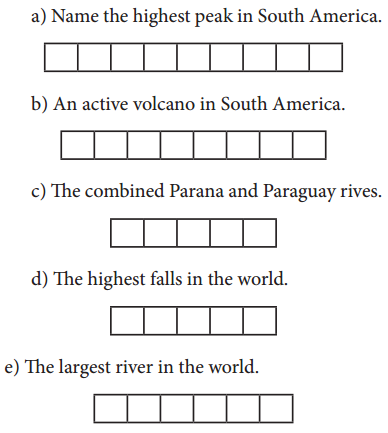
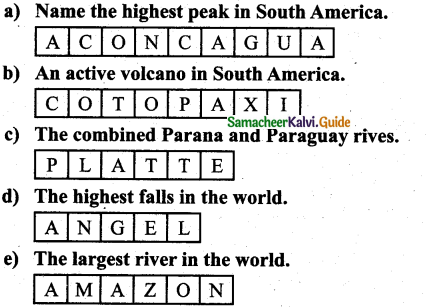
Write down the answers to the question given in blocks:
Samacheer Kalvi 7th Social Science Guide Geography Term 3 Chapter 1 Exploring Continents – North America and South America 2
Answer:
Samacheer Kalvi 7th Social Science Guide Geography Term 3 Chapter 1 Exploring Continents – North America and South America 1

7th Social Science Guide Exploring Continents – North America and South America Additional Important Questions and Answers

I. Choose the Correct answer.

Question 1.
………………….. North America was discovered by Christopher Columbus.
a) 1492
b) 1592
c) 1493
d) 1595
Answer:
a) 1492

Samacheer Kalvi 7th Social Science Guide Geography Term 3 Chapter 1 Exploring Continents – North America and South America

Question 2.
………………….. was introduced by European settlers in North America.
a) Maize
b) Barley
c) Sugarcane
d) Wheat
Answer:
d) Wheat

Question 3.
………………….. is the native Food Crop of North America.
a) Maize
b) Barley
c) Sugarcane
d) Wheat
Answer:
a) Maize

Samacheer Kalvi 7th Social Science Guide Geography Term 3 Chapter 1 Exploring Continents – North America and South America

Question 4.
…………………..grows well in Southern and Western States
a) Maize
b) Barley
c) Sugarcane
d) Cotton
Answer:
d) Cotton

Question 5.
………………….. beet is used for making Sugar.
a) Sugar
b) Flour
c) Chips
d) Fries
Answer:
a) Sugar

Question 6.
The USA is the largest producer of …………………..
a) Atomic power
b) Solar power
c) Automobile
d) Tyre
Answer:
c) Automobile

Samacheer Kalvi 7th Social Science Guide Geography Term 3 Chapter 1 Exploring Continents – North America and South America

Question 7.
Toronto, Cornwell, and Kingston are the major ………………….. in Canada.
a) Textile industry
b) Iron and steel industry
c) Paper industry
d) none
Answer:
a) Textile industry

Question 8.
………………….. are important ports on the West Coast of North America.
a) San Francisco
b) Newyork
c) Philadelphia
d) puledra
Answer:
a) San Francisco

Samacheer Kalvi 7th Social Science Guide Geography Term 3 Chapter 1 Exploring Continents – North America and South America

Question 9.
………………….. are animals typically found only in South America.
a) Anaconda
b) Llamas
c) Piranha
d) Raccoons
Answer:
b) Llamas

Question 10.
…………………..are the most important crops in South America.
a) Coffee and Cocoa
b) Tea
c) Brazil
d) Rubber
Answer:
a) Coffee and Cocoa

Samacheer Kalvi 7th Social Science Guide Geography Term 3 Chapter 1 Exploring Continents – North America and South America

II. Fill in the blanks:

1. ………………….. is a narrow stretch of land joining two large landmasses.
Answer:
Isthmus

2. …………………..is a narrow stretch of water joining two large water bodies.
Answer:
Strait

3. The Rockies and the Coast Range are together called the …………………..
Answer:
Western Cordilleras

Samacheer Kalvi 7th Social Science Guide Geography Term 3 Chapter 1 Exploring Continents – North America and South America

4. The Mississippi and Missouri rivers are the longest rivers in …………………..
Answer:
North America

5. ………………….. erodes a lot of sand and mud as it rushes down the Mountains.
Answer:
The Big Muddy

6. Both Canada and the USA are the major exporter of ………………….. than the other countries of the world.
Answer:
wheat

7. Barley and Oats is used as …………………..
Answer:
cattle fodder

8. ………………….. is used for extraction of edible oil.
Answer:
Soya beans

Samacheer Kalvi 7th Social Science Guide Geography Term 3 Chapter 1 Exploring Continents – North America and South America

9. The Isthmus of ………………….. in the North West connects South America with North America.
Answer:
Panama

10. ………………….. is the greatest river of South America.
Answer:
Amazon

11. The ………………….. found in the Amazon is a fierce flesh-eating fish.
Answer:
Piranha

12. …………………..has the second-largest iron ore deposits in the world after Russia.
Answer:
Brazil

13. …………………..is the third-largest producer of copper in the world.
Answer:
Chile

Samacheer Kalvi 7th Social Science Guide Geography Term 3 Chapter 1 Exploring Continents – North America and South America

14. …………………..is the third-largest bauxite producing country.
Answer:
Brazil

15. …………………..areas are Paraguay, Chile, and Uruguay.
Answer:
Moderate populated

III. Match the following:

AB
1. Antarcticaa) active Volcano
2. Mississippib) Great lakes
3. Grand Banksc) Biggest bird
4. Cordillerasd) Petroleum reserves
5. Condore) Mount Vinson Massif

Answer:

AB
1. Antarcticae) Mount Vinson Massif
2. Mississippib) Great lakes
3. Grand Banksd) Petroleum reserves
4. Cordillerasa) active Volcano
5. Condorc) Biggest bird

IV. Give Reasons:

Question 1.
Mississippi River has been given the nickname “The Big Muddy”.
Answer:
The Mississippi River has been given the nickname “The Big Muddy” because it erodes a lot of sand and mud as it rushes down the Mountains.

Samacheer Kalvi 7th Social Science Guide Geography Term 3 Chapter 1 Exploring Continents – North America and South America

Question 2.
South America is also known as Latin America.
Answer:
Together with Central America, South America is also known as Latin America, having been discovered and colonized mostly by the Latin’s i.e., The Spanish the Portuguese.

V. Distinguish between:

Question 1.
North America and South America
Answer:
North America

  1. It lies between 7°N and 84°N latitude which lie entirely in the Northern Hemisphere.
  2. The Largest lake superior is located.
  3. Highest peak – Mount Mckinley

South America

  1. It lies between 12°N and 55°S latitude and 35°A and 81°W longitudes.
  2. The Largest lake Maracaibo is Located.
  3. Highest Peak highest peak Andes mountain

Samacheer Kalvi 7th Social Science Guide Geography Term 3 Chapter 1 Exploring Continents – North America and South America

Question 2.
Savanna Grassland and The Pampas Grasslands
Answer:
Savanna Grassland

  1. Located in Guiana Highland, Brazilan Highland.
  2. Tall coarse grass
  3. Summer in hot and moist

The Pampas Grasslands

  1. Located in Uruguay and Southernmost Brazil.
  2. Short grass
  3. Summer is quite warm

VI. Put (✓) for the correct option:

Question 1.
1. Joining two large landmasses – Isthmus
2. Africa – Mount Kilimanjaro
3. America Prairie Grassland – High production of wheat
4. Bagland island – Goat
5. Argentina – samba dance
Answer:
1. Joining two large landmasses – Isthmus

Samacheer Kalvi 7th Social Science Guide Geography Term 3 Chapter 1 Exploring Continents – North America and South America

VII. Answer the following:

Question 1.
What is “The Big Muddy”?
Answer:
The Mississippi River has been given the nickname “The Big Muddy” because it erodes a lot of sand and mud as it rushes down the Mountains.

Question 2.
Name the physical divisions of North America?
Answer:

  1. The Rocky Mountains,
  2. The Great Plains,
  3. The Appalachian Highlands and
  4. The Coastal Plain.

Question 3.
Write a short note on Mississippi Rivers.
Answer:

  • The Mississippi and Missouri rivers are the longest rivers in North America
  • They form the fourth longest river system in the world and stretching more than 6114 km from Montana to the Gulf of Mexico.
  • The Mackenzie River is the second-largest drainage basin of North America.
  • It drains into the Arctic Ocean.

Samacheer Kalvi 7th Social Science Guide Geography Term 3 Chapter 1 Exploring Continents – North America and South America

VIII. Answer the following in a paragraph:

Question 1.
Name the types of forests in North America.
Answer:
i. Tundra:

  • Winter is long and severely cold.
  • The northern coast of Canada.
  • Mosses, lichens and dwarf willows.
  • Arctic Fox, Polar Bears, Wolverin, Sable, and Blue Fox.

ii. Taiga or the Cold temperate Coniferous Forest:

  • Summer is warm and short. Heavy snowfall in winter.
  • Southcentral Alaska
  • Pine, Fir, Cedar, and Spruce
  • Beaver, Fox, Moose, Black Bears, and Grizzly Bears.

iii. Temperate Prairie Grasslands:

  • winter is very cold, rainfall is moderate.
  • Central USA and Central Canada.
  • Grasses shrubs, Coyote, Gophers.
  • Rabbits, Prairie Dogs and Bison.

Samacheer Kalvi 7th Social Science Guide Geography Term 3 Chapter 1 Exploring Continents – North America and South America

iv. The Mediterranean forest:

  • Summer is hot and dry, cool wet winter.
  • western Coastal margin and Southern California
  • Olive, Grapes, Oak, Walnut, and Fig.

v. Desert forest:

  • The rainfall is very little.
  • Southwest USA northern Mexico Desert.
  • Cactus, Saguaro Cholla Cacti and yucca.
  • Desert Fox, Gazelles, Scorpions, Lizards, and Rattle Snakes.

Samacheer Kalvi 4th English Guide Term 2 Supplementary Chapter 1 A True Friend

Tamilnadu State Board New Syllabus Samacheer Kalvi 4th English Guide Pdf Term 2 Supplementary Chapter 1 A True Friend Text Book Back Questions and Answers, Summary, Notes.

Tamilnadu Samacheer Kalvi 4th English Solutions Term 2 Supplementary Chapter 1 A True Friend

4th English Guide A True Friend Text Book Back Questions and Answers

Samacheer Kalvi 4th English Guide Term 2 Supplementary Chapter 1 A True Friend

A. Name the character or speaker.

Question 1.
“Do you have a fever?” ____________
Answer:
Teacher

Question 2.
“Did someone scold you?” ___________
Answer:
One of Nandhini’s friends

Question 3.
“Why does Nandhini look so sad?” ____________
Answer:
Nandhini’s friends

Question 4.
“Are you alright?” ____________
Answer:
Teacher

Samacheer Kalvi 4th English Guide Term 2 Supplementary Chapter 1 A True Friend

B. Answer the following questions.

Question 1.
Who were the friends referred in the story?
Answer:
Nandhini and Pandi were the friends, referred in the story.

Question 2.
How did they go to school?
Answer:
They both go to school by walk. They played and chatted on their way.

Question 3.
Why was the teacher annoyed?
Answer:
The teacher was annoyed because Nandhini did not answer her, when she called her name.

Question 4.
Did Nandhini have fever?
Answer:
No, Nandhini did not have fever.

Question 5.
What was the reason behind Nandhini’s dullness?
Answer:
Two of Nandhini’s front teeth were missing. That was the reason behind Nandhini’s dullness.

Samacheer Kalvi 4th English Guide Term 2 Supplementary Chapter 1 A True Friend

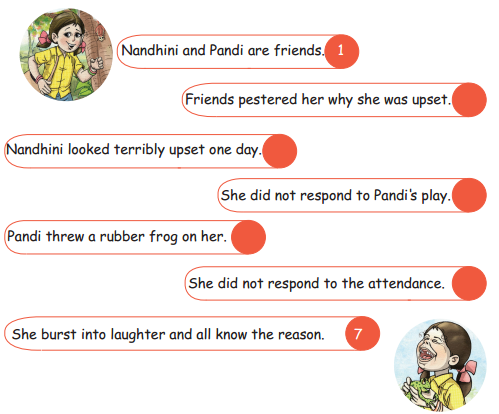
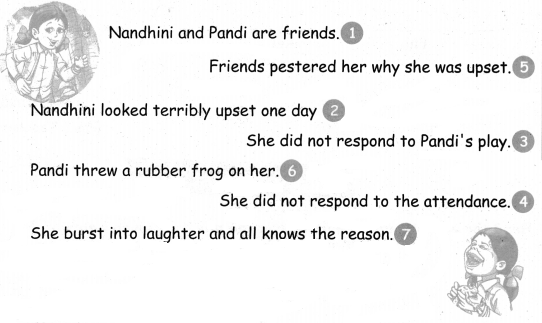
C. Number the actions of Pandi and Nandhini in order.

Question 1.
Samacheer Kalvi 4th English Guide Term 2 Supplementary Chapter 1 A True Friend 1
Answer:
Samacheer Kalvi 4th English Guide Term 2 Supplementary Chapter 1 A True Friend 2

Samacheer Kalvi 4th English Guide Term 2 Supplementary Chapter 1 A True Friend

II. Name the character or speaker.

Question 1.
“Why are you sad?”.
Answer:
Pandi

Question 2.
“Catch me if you can”
Answer:
Pandi

Question 3.
“Shall I call your parents?”
Answer:
Teacher

Samacheer Kalvi 4th English Guide Term 2 Supplementary Chapter 1 A True Friend

Answer the following questions

Question 1.
What is the advertisement about?
Answer:
It is about a branded new LED TV.

Question 2.
What is free, for LED TV?
Answer:
A camera is free for the LED TV.

Question 3.
What is the size of the screen of the TV?
Answer:
The size of the screen of the TV is 43 inches.

Question 4.
When does the offer end?
Answer:
The offer ends by 30th August.

Question 5.
What is the name of the dealer?
Answer:
The name of the dealer is “Bright Vision Televisions”

Samacheer Kalvi 4th English Guide Term 2 Supplementary Chapter 1 A True Friend

Additional Questions And Answers.

I. Answer the following.

Question 1.
Where did Nandhini and Pandi live?
Answer:
Nandhini and Pandi lived in the same street.

Question 2.
What do they sometimes do?
Answer:
Sometimes they would race home from school.

Question 3.
What did they do together?
Answer:
They always took part in school activities and helped each other in their lessons.

Question 4.
What happened one day, when Pandi came to Nandhini’s home?
Answer:
When Pandi came to Nandhini’s home, she looked upset and sad.

Question 5.
What did the teacher do, on entering the class?
Answer:
On entering the class, the teacher started calling out the names for attendance.

Question 6.
Did Nandhini answer the teacher, when she called out her name?
Answer:
No, she did not answer her teacher, when she called out her name.

Question 7.
What did the teacher ask her?
Answer:
The teacher touched her forehead and asked her if she was feeling alright.

Question 8.
What did her friends do?
Answer:
Her friends pestered her with a hundred questions about everything.

Question 9.
What did Pandi do to make her smile?
Answer:
Pandi took out something from his bag and ran to show it to her. He tumbled and it slipped from his hands. Nandhini got scared, as it was flying straight to her. She caught it and it was a rubber frog. She burst out laughing.

Samacheer Kalvi 4th English Guide Term 2 Supplementary Chapter 1 A True Friend

Let us write

Write a narrative paragraph o Kamarajar, using the given information and add more information on your own.
Question 1.
Samacheer Kalvi 4th English Guide Term 2 Supplementary Chapter 1 A True Friend 5
Answer:
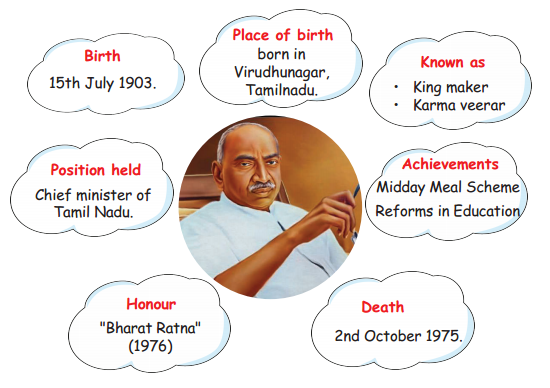
Kamarajar was born on 15th July 1903 in Virudhunagar, Tamilnadu. He was born to Kumaraswami Nadar and Sivakami ammal. His name was originally Kamatchi. Later it changed to Kamarajar. He was known as the “King maker” and “Karma Veerar”. He was the 3rd Chief Minister of Tamilnadu from 1954 to 1963. His achievements were Mid-day meal scheme and reforms in education. He was given the “Bharat Ratna Award” in 1976 after he died on 2nd October 1975.

Samacheer Kalvi 4th English Guide Term 2 Supplementary Chapter 1 A True Friend

I can do

A. Fill in the blanks.

Question 1.
Meena went to ___________ her father.
Answer:
The sea shore to see off

Question 2.
Meena studies in _________ standard.
Answer:
Twelfth

Question 3.
Meena met the official after __________
Answer:
Not given in the text

Samacheer Kalvi 4th English Guide Term 2 Supplementary Chapter 1 A True Friend

B. Punctuate the following sentences.

Question 1.
i play kabadi daily,
Answer:
I play Kabadi daily.

Question 2.
kaviya bought onion tomato and cucumber
Answer:
Kaviya bought onion, tomato and cucumber.

Question 3.
who took care of meena
Answer:
Who took care of Meena?

Samacheer Kalvi 4th English Guide Term 2 Supplementary Chapter 1 A True Friend

C. Match the rhyming word.

Question 1.
deeds – wealth
Answer:
deeds – needs

Question 2.
health – care
Answer:
health – wealth

Question 3.
bare – needs
Answer:
bare – care

Samacheer Kalvi 4th English Guide Term 2 Supplementary Chapter 1 A True Friend

D. Recite the poem with correct intonation.
Answer:
Activity to be done by the students

Samacheer Kalvi 4th English Guide Term 2 Supplementary Chapter 1 A True Friend

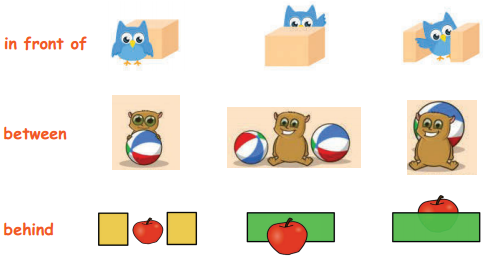
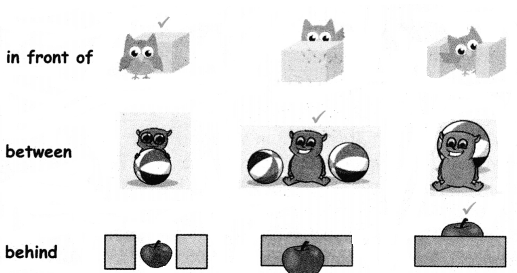
E. Tick (✓) the correct pictures.

Question 1.
Samacheer Kalvi 4th English Guide Term 2 Supplementary Chapter 1 A True Friend 3
Answer:
Samacheer Kalvi 4th English Guide Term 2 Supplementary Chapter 1 A True Friend 4

Samacheer Kalvi 4th English Guide Term 2 Supplementary Chapter 1 A True Friend

 A True Friend Summary in English and Tamil

Nandhini and Pandi were good friends since childhood. They lived in the same street, so they were always together. Every day Pandi would stop at her home on the way to school. Both would walk to school chatting and playing. Sometimes, they would race home from school.They always took part in school activities together. They helped each other in their lessons.

நந்தினியும், பாண்டியும் சிறுவயதிலிருந்தே நல்ல நண்பர்கள். ஒரே தெருவில் வசித்து வந்த அவர்கள் இருவரும் எப்போதும் ஒன்றாகவே இருப்பார்கள். எப்போதும் பள்ளிக்கு செல்லும் வழியில், பாண்டி அவள் வீட்டின் முன் நிற்பான். இருவரும் நன்றாக பேசிக்கொண்டும், விளையாடிக் கொண்டும் பள்ளிக்கு செல்வர். சில நேரம் பள்ளியிலிருந்து அவர்கள் ஓட்டமாய் வீட்டிற்கு வந்து சேருவர். பள்ளி நடவடிக்கைகளில்இருவரும் இணைந்து பங்கு பெறுவர். பாடங்களில் ஒருவருக்கு ஒருவர் உதவிக் கொள்வர்.

One day, as usual, Pandi came to Nandhini’s home. She looked upset and sad Pandi asked her “Why are you sad?”, she did not answer. Instead, she shook her head. “Did your parents scold you?”, asked Pandi. She did not answer him. He grabbed her bag and said excitedly, “Catch me if you can.” But she did not respond. Pandi stopped and gave the bag back. They walked silently to the school.

ஒரு நாள் வழக்கம் போல் பாண்டி, நந்தினியின்வீட்டிற்கு வந்தான். அவள் வருத்தமும், சோகமுமாக இருப்பதைக் கண்டு பாண்டி அவளிடம், “நீ ஏன் வருத்தமாய் இருக்கிறாய்?” என கேட்க, அதற்கு அவள் பதிலளிக்கவில்லை . அதற்கு பதில், தலையை குலுக்கினாள். “உன் பெற்றோர் உன்னை திட்டினரா?” என்று பாண்டி கேட்டான். அதற்கும் அவள் பதில் தரவில்லை . அவன் அவளுடைய பையை பிடித்து இழுத்துக் கொண்டு “முடிந்தால் என்னை பிடி பார்ப்போம்” என உற்சாகமாக கூறினான். அதற்கும் அவள் பதிலளிக்கவில்லை. பாண்டி நின்று பையை அவளிடம் கொடுத்தான். பின்னர் இருவரும் அமைதியாக பள்ளிக்குச் சென்றனர்.

Samacheer Kalvi 4th English Guide Term 2 Supplementary Chapter 1 A True Friend

Nandhini walked into the classroom slowly. Her eyes glued to the ground. She looked sad, “Did someone scold you?”, asked one of her friends in class.’Nandhini shook her head. She sat down, with her head bowed down. The teacher entered the classroom and started calling out the names for attendance. Nandhini did not answer when the teacher called her name.

நந்தினி மெதுவாக வகுப்பிற்கு நடந்து சென்றாள். அவள் கண்கள் தரையை நோக்கியே இருந்தன. சோகமாக இருந்த அவளிடம், தோழிகளில் ஒருத்தி “உன்னையாராவது திட்டினாரா?” என்று கேட்டாள். நந்தினி தலையை குலுக்கினாள். பின்னர் தலை குனிந்து கீழே அமர்ந்தாள். ஆசிரியர் வகுப்பில் நுழைந்து வருகைப் பதிவை பார்த்து பெயர்களை அழைக்க ஆரம்பித்தார். அவளது பெயரை அழைத்த போது நந்தினி பதிலளிக்கவில்லை

The teacher was annoyed. This time she called her name louder, “Nandhini!” and then, she raised her hand but did not answer. The teacher went near Nandhini. She touched her forehead and asked, “Are you feeling okay?” Nandhini shook her head. Her cheeks were red, and it looked like she had a fever. “Do you have a fever? Shall I call your parents?” asked the teacher. She shook her head, but she still did not look at anyone. Her head was still bowed down.

எரிச்சல் அடைந்த ஆசிரியர் இந்த முறை அவள் பெயரை உரக்க “நந்தினி” என அழைத்தார். அவள் கையை உயர்த்தினாளே தவிர, பதிலளிக்கவில்லை . ஆசிரியர், நந்தினியின் அருகில் சென்று அவள் முன் நெற்றியை தொட்டு “நீ நன்றாக இருக்கிறாயா?” என்று கேட்டதும், நந்தினி தலையை குலுக்கினாள். அவள் கன்னங்கள் சிவந்திருந்தன, அவளுக்கு ஜூரம் வந்தது போல காணப்பட்டாள். “உனக்கு ஜூரமா, நான் உன் பெற்றோரை அழைக்கட்டுமா?” என்று ஆசிரியர் கேட்டார். அவள் தலையை மட்டும் குலுக்கினாள். யாரையும்|பார்க்கவில்லை . அவள் தலை குனிந்தபடியே இருந்தது.

“Why does Nandhini look so sad?” exclaimed her friends. Her friends pestered her with a hundred questions! The questions were about you think about, they asked her family, her house, her shoes and even about her street pets. Each question that she was asked, Nandhini only answered by shaking her head.

“நந்தினி ஏன் சோகமாக இருக்கிறாள்?” என நண்பர்கள் ஆச்சிரியப்பட்டனர். அவள் நண்பர்கள் அவளிடம் நூறு கேள்விகள் கேட்டனர்! வீடு, குடும்பம், காலணிகள், பிடித்த தெரு விலங்குகள் உட்பட அவர்களுக்கு தோன்றிய அனைத்தைப் பற்றியும் கேள்வி கேட்டனர். கேட்கப்பட்ட ஒவ்வொரு கேள்விக்கும் நந்தினி தலையை மட்டும் குலுக்கினாள்.

Samacheer Kalvi 4th English Guide Term 2 Supplementary Chapter 1 A True Friend

Pandi had enough of Nandhini’s silence. He had never seen her so dull. He wanted an idea to make her smile. He thought and thought for many hours. Finally, he had an idea! He took out something from bag and ran to show it to her. He tumbled, and his it slipped from his hands. It was flying straight to Nandhini. She saw something flying towards her and screamed with fear. She closed her eyes and tried to catch it. THUD! She caught it. It was a biggreen frog. Everyone ran away as they were scared of the frog.

நந்தினியின் மௌனம் பாண்டியை வருத்தியது. அவன் எப்போதுமே நந்தினி மந்தமாக இருந்து பார்த்ததில்லை. அவளை சிரிக்க வைக்க அவன் யோசித்தான். பல மணி நேரம் யோசித்ததில் ஓர் எண்ண ம் தோன்றியது. தன் பையில் இருந்து ஒரு பொருளை எடுத்து நந்தினியிடம் காட்ட ஒடினான். அதற்குள் அவன் தடுமாறி விழுந்து விடவே, அவனது கையிலிருந்து அது நழுவி நேராக நந்தினியை நோக்கிப் பறந்தது. ஏதோ ஒன்று தன்னை நோக்கி பறந்து வருவதை கண்ட நந்தினி பயத்தில் கூச்சலிட்டாள். தன் கண்களை மூடிக் கொண்டு, | அதை பிடிக்க முற்பட்டாள். அதை பிடித்தே விட்டாள்! அது ஒரு பெரிய பச்சை தவளை. அனைவரும் அந்த தவளையைப் பார்த்து பயந்து ஓட்டம் பிடித்தனர்.

Nandhini’s eyes were wide open with surprise. Then, she burst into laughter.It was a rubber frog! As soon as she laughed, her friends and teacher knew why she did not smile or talk to anyone all day. Two of her front teeth were missing!

நந்தினியின் கண்கள் ஆச்சரியத்தால் விரிந்தன. உடனே அவள் பலமாக சிரித்தாள். அது ஒரு ரப்பர் தவளை ஆகும். அவள் சிரித்தவுடன்தான் ஆசிரியர் மற்றும் அவளது நண்பர்களுக்கு அவள் ஏன் யாருடனும் பேசவில்லை , சிரிக்கவில்லை என தெரிந்தது. அது என்ன வென்றால், அவளது முன்பற்களில் இரண்டைக் காணவில்லை!

Samacheer Kalvi 5th English Guide Term 3 Supplementary Chapter 1 The Witty Sparrow

Tamilnadu State Board New Syllabus Samacheer Kalvi 5th English Guide Pdf Term 3 Supplementary Chapter 1 The Witty Sparrow Text Book Back Questions and Answers, Summary, Notes.

Tamilnadu Samacheer Kalvi 5th English Solutions Term 3 Supplementary Chapter 1 The Witty Sparrow

5th English Guide The Witty Sparrow Text Book Back Questions and Answers

In-Text Question:

Question 1.
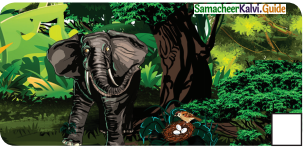
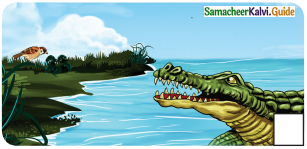
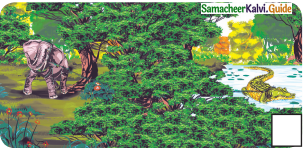
Guess how would the sparrow pull the elephant and the crocodile.
Answer:
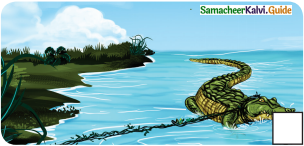
The sparrow would not pull the elephant and the crocodile by itself. It took a strong creeper and tied the elephant with one end of the creeper. Then it tied the crocodile with the other end of the creeper. When it told them to pull, the elephant and the crocodile pulled each other at the same time.

Samacheer Kalvi 5th English Guide Term 3 Supplementary Chapter 1 The Witty Sparrow

A. Choose the best answer:

Question 1.
All the animals called the sparrow _______.
a) queen
b) madam
c) princess
Answer:
b) madam

Question 2.
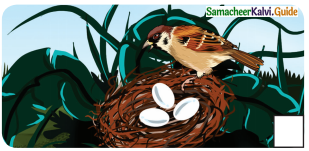
The brown sparrow laid _______ eggs.
a) four
b) six
c) three
Answer:
c) three

Question 3.
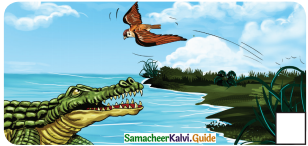
_______ lies stretching in the river.
a) crocodile
b) snake
c) tortoise
Answer:
a) Crocodile

Question 4.
Sparrow tied the elephant and the crocodile with a _______.
a) rope
b) cloth
c) creeper
Answer:
c) creeper

Question 5.
The sparrow solves the problem with her _______.
a) cunningness
b) intelligence
c) braveness
Answer:
b) intelligence

Samacheer Kalvi 5th English Guide Term 3 Supplementary Chapter 1 The Witty Sparrow

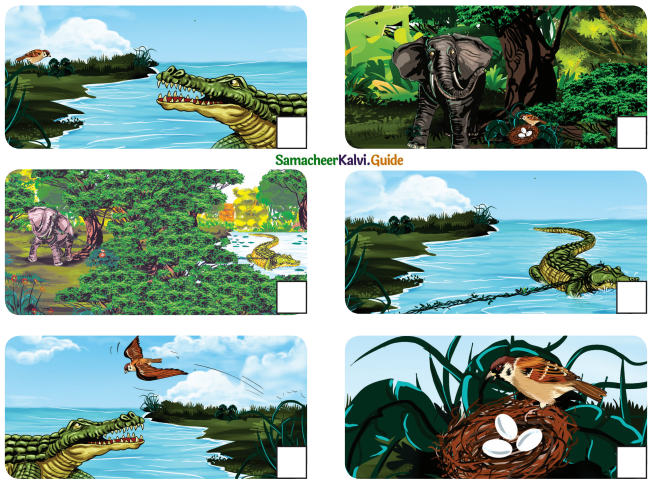
B. Number the pictures and incorrect order of the story:

Question 1.
Samacheer Kalvi 5th English Guide Term 3 Supplementary Chapter 1 The Witty Sparrow 1
Answer:
Samacheer Kalvi 5th English Guide Term 3 Supplementary Chapter 1 The Witty Sparrow 2
Samacheer Kalvi 5th English Guide Term 3 Supplementary Chapter 1 The Witty Sparrow 3
Samacheer Kalvi 5th English Guide Term 3 Supplementary Chapter 1 The Witty Sparrow 4
Samacheer Kalvi 5th English Guide Term 3 Supplementary Chapter 1 The Witty Sparrow 5
Samacheer Kalvi 5th English Guide Term 3 Supplementary Chapter 1 The Witty Sparrow 6
Samacheer Kalvi 5th English Guide Term 3 Supplementary Chapter 1 The Witty Sparrow 7

Samacheer Kalvi 5th English Guide Term 3 Supplementary Chapter 1 The Witty Sparrow

C. Try your own:

Question 1.
Samacheer Kalvi 5th English Guide Term 3 Supplementary Chapter 1 The Witty Sparrow 8
Answer:
Samacheer Kalvi 5th English Guide Term 3 Supplementary Chapter 1 The Witty Sparrow 9

Samacheer Kalvi 5th English Guide Term 3 Supplementary Chapter 1 The Witty Sparrow

D. Speak and win:

Join in either group and speak using 4 to 5 sentences to win.
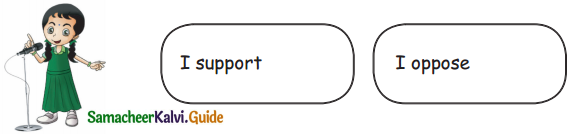
Samacheer Kalvi 5th English Guide Term 3 Supplementary Chapter 1 The Witty Sparrow 10

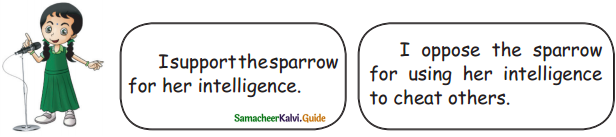
I support the sparrow for her intelligence:

  1. The sparrow was worried that the elephant might crack the eggs.
  2. The crocodile was blocking the way and asked the sparrow to drink muddy water.
  3. The sparrow gave a warning to the elephant and also to the crocodile.
  4. But both ignored the sparrow’s warnings.
  5. So, the sparrow tied both the animals with a strong creeper.
  6. So, nothing wrong in punishing both the animals, using intelligence.

I oppose the sparrow for using her intelligence to cheat others:

  1. Sparrow is a very small bird.
  2. It is not possible to tie both animals with a creeper.
  3. If the sparrow wanted to safeguard its eggs, it should shift its nest to a safer place.

Samacheer Kalvi 5th English Guide Term 3 Supplementary Chapter 1 The Witty Sparrow

Let us read aloud:

Read the passage 3 times and colour a camel for each time:

Once two merchants lost a camel. They met a boy who was passing by and asked him if he had seen it. The boy said he had not seen the camel. He asked, “Was your camel blind in the right eye?”. “Yes, he was”, said the merchants. “Was it lame in one left foot?”, asked the boy. It was!”, said the merchants. “Was it’s front tooth missing?” asked the boy.” yes,” they said. “Did it have honey on one side and wheat on the other?”. “yes!,” they answered. “Please take us to it.”

“But, I have not seen your camel,” said the boy “and I do not know where it is”. The merchants got angry and said, “Really! How could you tell us everything about our camel?” “That is my secret”. said the boy.

The merchants took him to the king. The boy told the king that he had not seen it. Then, the king asked him how he knew so much about it. The boy said that the camel had eaten grass only on the left side of the path. So he knew that it was blind. The marks of its one left foot were faint.

This showed that the camel was lame. While eating grass, it had not eaten the grass in the middle. So he learnt that it had lost its front teeth. There were ants carrying grains of wheat on one side of the path and flies eating honey on the other.”
Samacheer Kalvi 5th English Guide Term 3 Supplementary Chapter 1 The Witty Sparrow 11

Samacheer Kalvi 5th English Guide Term 3 Supplementary Chapter 1 The Witty Sparrow

Find and write the clues:

Question 1.
Clue for blind eye _______.
Answer:
The camel had eaten grass only on the left side of the path.

Question 2.
Clue for lame _______.
Answer:
The marks of its one left foot were faint.

Question 3.
Clue for lost teeth _______.
Answer:
While eating grass, the camel had not eaten the grass in the middle.

Question 4.
Clue for the load on the camel _______.
Answer:
There were ants carrying grains of wheat on one side of the path and flies eating honey on the other.

Samacheer Kalvi 5th English Guide Term 3 Supplementary Chapter 1 The Witty Sparrow

Let us write:

Dialogue Writing:

Write the dialogue and complete the story.

Samacheer Kalvi 5th English Guide Term 3 Supplementary Chapter 1 The Witty Sparrow 12
Rabbit: Lion King, as I was coming to give myself as lunch for you, another lion blocked me on the way.

Samacheer Kalvi 5th English Guide Term 3 Supplementary Chapter 1 The Witty Sparrow 13
Lion: How can another lion live in this forest, when I am here? Take me immediately to his place.

Samacheer Kalvi 5th English Guide Term 3 Supplementary Chapter 1 The Witty Sparrow 14
Lion: Ah! yes, he looks like me. Here I will jump into the well and kill him.

Samacheer Kalvi 5th English Guide Term 3 Supplementary Chapter 1 The Witty Sparrow 15
Rabbit: Oh foolish lion. It was not another lion, it was your own image reflection.

Samacheer Kalvi 5th English Guide Term 3 Supplementary Chapter 1 The Witty Sparrow


I can do:

A. Answer the following:
Samacheer Kalvi 5th English Guide Term 3 Supplementary Chapter 1 The Witty Sparrow 16

Question 1.
Name of the object
Answer:
Toffee

Question 2.
In your mother tongue.
Answer:
மிட்டாய்

Question 3.
Use in a sentence
Answer:
I like to eat a toffee.

Samacheer Kalvi 5th English Guide Term 3 Supplementary Chapter 1 The Witty Sparrow

B. Fill in the blanks with to, too and two:

Question 1.
I need _______ write _______ pages on this topic.
Answer:
I need to write two pages on this topic.

Question 2.
These clothes are _______ expensive.
Answer:
These clothes are too expensive.

Question 3.
Donald ran _______ kilometers.
Answer:
Donald ran two kilometers.

Samacheer Kalvi 5th English Guide Term 3 Supplementary Chapter 1 The Witty Sparrow

C. Tick the correct word:

Question 1.
Samacheer Kalvi 5th English Guide Term 3 Supplementary Chapter 1 The Witty Sparrow 17
Answer:
too

Question 2.
Samacheer Kalvi 5th English Guide Term 3 Supplementary Chapter 1 The Witty Sparrow 18
Answer:
two

Samacheer Kalvi 5th English Guide Term 3 Supplementary Chapter 1 The Witty Sparrow

D. Recite any four lines of the poem with correct intonation:

Activity to be done by students.

E. Match the rhyming words:

1. softa. week
2. blowb. know
3. growc. hot
4. seekd. flow

Answer:

1. softa. hot
2. blowb. flow
3. growc. know
4. seekd. week

Samacheer Kalvi 5th English Guide Term 3 Supplementary Chapter 1 The Witty Sparrow

F. Circle and write the adverbs from the sentences:

Question 1.
The boy speaks loudly.
Answer:
loudly

Question 2.
She speaks English fluently.
Answer:
fluently

Question 3.
Our mum spoke to us angrily.
Answer:
angrily

Question 4.
The painter paints wonderfully.
Answer:
wonderfully

Samacheer Kalvi 5th English Guide Term 3 Supplementary Chapter 1 The Witty Sparrow

5th English Guide The Witty Sparrow Additional Questions and Answers

I. Choose the correct answer:

Question 1.
The sparrow’s nest was in a _______.
(a) hut
(b) tower
(c) bush
Answer:
(c) bush

Question 2.
Gullu is the name of the _______.
(a) crocodile
(b) elephant
(c) Sparrow
Answer:
(b) elephant

Question 3.
The crocodile told the sparrow to drink the _______ water.
(a) clean
(b) well
(c) muddy
Answer:
(c) muddy

Question 4.
At last, the elephant ran into the _______.
(a) village
(b) forest
(c) town
Answer:
(b) forest

Question 5.
The sparrow went to the _______ of the creeper.
(a) center
(b) left end
(c) right end
Answer:
(a) center

Samacheer Kalvi 5th English Guide Term 3 Supplementary Chapter 1 The Witty Sparrow

II. Identify the Speaker:

Question 1.
“Today, I will let you be.”
Answer:
The sparrow

Question 2.
“Move on, did you say?”
Answer:
The crocodile

Question 3.
“Let us see if you can move an inch.”
Answer:
The sparrow

Question 4.
“Please let me go..”
Answer:
The elephant

Question 5.
“Don’t you dare to move.”
Answer:
The sparrow

Question 6.
“I won’t stand in your way.”
Answer:
The crocodile

Question 7.
“I won’t disturb you again…”
Answer:
The elephant

Question 8.
“I warned you yesterday.”
Answer:
The sparrow

Samacheer Kalvi 5th English Guide Term 3 Supplementary Chapter 1 The Witty Sparrow

III. Say True or False:

Question 1.
Once, a very foolish sparrow lived in a forest.
Answer:
False

Question 2.
All the animals respected the sparrow except the elephant.
Answer:
True

Question 3.
The sparrow had two eggs in her nest.
Answer:
False

Question 4.
The elephant came thumping towards the bush.
Answer:
True

Question 5.
That morning, the sparrow went to the river bank to drink water.
Answer:
False

Samacheer Kalvi 5th English Guide Term 3 Supplementary Chapter 1 The Witty Sparrow

IV. Answer the following:

Question 1.
How did the elephant walk?
Answer:
The elephant walked past the bush purposefully, making a “thud, thud” sound.

Question 2.
Why was the sparrow worried?
Answer:
The sparrow was worried because the elephant might crack the eggs.

Question 3.
Why did the sparrow warn the crocodile?
Answer:
The sparrow warned the crocodile because the crocodile was stretching in the spot, where the sparrow used to drink water.

Question 4.
Why were the elephant and the crocodile exhausted?
Answer:
The elephant and the crocodile were tied with a strong creeper by the sparrow. They pulled each other at the same time. That process of pulling went on all day. So, both the animals were exhausted.

Samacheer Kalvi 5th English Guide Term 3 Supplementary Chapter 1 The Witty Sparrow

The Witty Sparrow Summary in English and Tamil

Once, a very clever brown sparrow lived in a forest had three eggs in her nest. The nest was in a bush. All the animals greeted her ‘Madam’ with respect. Gullu, the young elephant never did so. THUD! THUD! Gullu walked past the bush purposefully. It rattled the nest. Madam was worried that Gullu might crack the eggs.

ஒரு காலத்தில் ஒரு புத்திசாலியான பழுப்புநிறக் குருவி காட்டில் வாழ்ந்து வந்தது. புதரில் இருந்த அதன் கூட்டில் மூன்று முட்டைகள் இருந்தன. எல்லா விலங்குகளும் மரியாதையாக அந்தக்குருவியை ‘மேடம்’ என்று அழைத்தனர். ஆனால் குல்லு என்ற இளம் யானை ஒருபோதும் அப்படி செய்யவில்லை. வேண்டுமென்றே குல்லு தட தட வென்று புதரைக் கடந்து செல்லும். அதனால் கூடு அதிரும். இதனால் முட்டைகள் கீறல் விழுந்துவிடுமோ என குருவி கவலைப்பட்டது.

Sparrow to Elephant: If you do this tomorrow. I will tie you up with a strong rope and then, You can’t move at all. I warn you.

குருவி யானையிடம்: நாளை இதேமாதிரி நீ தடதடவென நடந்தால், நான் உன்னை பலமான கயிற்றைக் கொண்டு கட்டிவைத்து ”விடுவேன். உன்னால் அசையவே முடியாது. நான் உன்னை எச்சரிக்கிறேன்.

Elephant (யானை):
Tie me up!
Ha…ha…ha…
We will see.

ஹா! ஹா! என்னை கட்டி வைப்பாயா? பார்ப்போம்.

Samacheer Kalvi 5th English Guide Term 3 Supplementary Chapter 1 The Witty Sparrow

That afternoon, she went to the river bank to drink water. A crocodile was stretching in the spot she was drinking water.
Sparrow to Crocodile: Blocking me again? You have done it twice this week. Move on, I don’t want to drink muddy water.
Crocodile to Sparrow: Move on, did you say? I will stay put, you better go elsewhere to drink water.

மத்தியானம் குருவி ஆற்றங்கரைக்கு நீர் குடிக்க சென்றது. அது நீர் அருந்தும் இடத்தில் ஒரு முதலை படுத்து இருந்தது.
குருவி: மறுபடி என்னை வழிமறிக்கிறாயா? இந்த வாரத்தில் இரண்டு முறை இப்படி செய்துவிட்டாய். விலகு, நான் சேற்று நீரை குடிக்க விரும்பவில்லை.
முதலை: விலகு என்றா சொன்னாய்? நான் இங்கு தான் இருப்பேன். நீ வேறு இடத்திற்கு சென்று தண்ணீ ர் குடி.

Sparrow to Crocodile: Today, I will let you be. But if I find you in the same place tomorrow. I will tie you up with a strong rope.
Crocodile to Sparrow: The sparrow went to her nest and started thinking furiously.

குருவி முதலையிடம்: இன்று உன்னை விட்டுவிடுகிறேன். ஆனால் நாளை உன்னை இதே இடத்தில் நான் பார்த்தால், பலமான கயிற்றால் உன்னை கட்டிவிடுவேன்.
முதலை: சிறு ஜீவனான நீ என்னைக் கட்டுவாயா? ஹா… ஹா….
குருவி தன் கூட்டிற்கு சென்றது. அதற்கு புத்திசாலித்தனமான ஒரு யோசனை கிடைத்தது.

The next morning, Gullu came thumping towards the bush.
Elephant to Sparrow: HEY! Are you not tying me up?
Sparrow to Elephant: How dare you! Aren’t you afraid of me? Just wait.

மறுநாள் காலை, யானை தடதடவென்று புதரை நோக்கி வந்தது.
என்னிடம் உனக்கு பயம் இல்லையா? இங்கே சிறிது
யானை குருவியிடம்: “ஏய் நீ என்னை கட்டவில்லையா?”
குருவி யானையிடம்: “என்ன தைரியம் உனக்கு? காத்திரு”.

Samacheer Kalvi 5th English Guide Term 3 Supplementary Chapter 1 The Witty Sparrow

The sparrow took a strong creeper and tied the elephant on one end. USHHHHH! Don’t you dare to move? Stay here, until I fly and reach the other end of the rope to pull you. When I say ‘pull’, pull with all your strength. Let us see if you can move an inch.

குருவி ஒரு பலமான தாவரக் கொடியை எடுத்து வந்து அதன் ஒரு முனையில் யானையை கட்டியது.
குருவி யானையிடம்: “உஷ்! உன்னை இழுக்க கயிற்றின் மறுமுனைக்கு நான் பறந்து செல்லும் வரை, நீ அசையாமல் இங்கேயே இரு. நான் இழு என்று சொல்லும் போது உன் முழு பலத்துடன் இழு. உன்னால் ஓர் அங்குலமாவது நகர முடிகிறதா என்று பார்ப்போம்.

It went to the river, saw the crocodile blocking its way.
Crocodile to Sparrow: I will not move! Just like yesterday, drink the muddy water.

குருவி ஆற்றுக்கு சென்றது. முதலை மறுபடியும் அதன் வழியில் குறுக்கிடுவதைக் கண்டது.
முதலை குருவியிடம்: “நான் நேற்றுப் போலவே சிறிது கூட அசைய மாட்டேன். நீ சேற்று நீரை குடி.”

Sparrow took the other end of the creeper and tied the crocodile.
Sparrow to Crocodile: I warned you yesterday. Now stay still, until I grab the other end. When I say ‘Pull’, let’s see if you are able to pull or not.

குருவி, தாவரக் கொடியின் மறுமுனையை எடுத்து வந்து முதலையை கட்டியது.
குருவி முதலையிடம்: “நான் நேற்றே உன்னை எச்சரித்தேன். இப்பொழுது நான் மறு முனையை பற்றி, இழுக்கும்வரை அசையாமல் இரு. நான் ‘இழு’ என்று சொல்லும்போது உன்னால் இழுக்க முடிகிறதா இல்லையா என பார்க்கலாம்.”

Sparrow went to the center of the creeper. Pull The elephant and the crocodile pulled each other at the same time.

Samacheer Kalvi 5th English Guide Term 3 Supplementary Chapter 1 The Witty Sparrow

குருவி, கொடியின் மையப் பகுதிக்கு சென்றது. ‘இழு’ என்று சத்தமிட்டது. யானையும், முதலையும் ஒரே சமயத்தில் ஒன்றையொன்று இழுத்தன.

This went on all day. Both the animals were exhausted.
Elephant to Sparrow: Please let me go. I won’t disturb you again…
Crocodile to Sparrow: Untie me! I won’t stand in your way.
Sparrow : Good, I will remove the rope. Gullu ran into the forest and the crocodile dived into the river. Soon the eggs hatched. Madam Sparrow lived happily with her three little babies.

நாள் முழுவதும் இப்படியே இழுத்துக் கொண்டு இருந்தன. முடிவில் இரண்டு விலங்குகளும் களைப்படைந்தன.
யானை குருவியிடம்: “தயவு செய்து என்னை விட்டுவிடு. நான் மறுபடியும் உன்னை தொந்தரவு செய்யமாட்டேன்,
முதலை குருவியிடம்: “என்னை கட்டவிழ்த்து விடு நான் மறுபடியும் உன் வழியில் குறுக்கிடமாட்டேன்”.

குருவி: இப்பொழுது நான் கொடி கயிற்றை எடுத்து விடுகிறேன். யானை குல்லு காட்டிற்குள் ஓடிவிட்டது. முதலையும் ஆற்றில் நீந்திச் சென்றுவிட்டது. விரைவில் குருவியின் முட்டைகள் பொறிந்தன. குருவி தன் மூன்று குருவிக்குஞ்சுகளுடன் மகிழ்ச்சியாக வாழ்ந்தது.

Samacheer Kalvi 7th Social Science Guide History Term 3 Chapter 3 Jainism, Buddhism and Ajivika Philosophy in Tamil Nadu

Tamilnadu State Board New Syllabus Samacheer Kalvi 7th Social Science Guide Pdf History Term 1 Chapter 1 Sources of Medieval India Text Book Back Questions and Answers, Notes.

Tamilnadu Samacheer Kalvi 7th Social Science Solutions History Term 3 Chapter 3 Jainism, Buddhism and Ajivika Philosophy in Tamil Nadu

7th Social Science Guide Jainism, Buddhism and Ajivika Philosophy in Tamil Nadu Text Book Back Questions and Answers

I. Choose the correct answer:

Question 1.
Where was the first Jain Council held to codify the Jaina canon?
a) Pataliputra
b) Vallabhi
c) Mathura
d) Kanchipuram
Answer:
a) Pataliputra

Samacheer Kalvi 7th Social Science Guide History Term 3 Chapter 3 Jainism, Buddhism and Ajivika Philosophy in Tamil Nadu

Question 2.
In which language was Agama sutras written?
a) Ardha-Magadhi Prakrit
b) Hindi
c) Sanskrit
d) Pali
Answer:
a) Ardha-Magadhi Prakrit

Question 3.
Which of the following was patronised by the Kalabhras?
a) Buddhism
b) Jainism
c)Ajivikas
d) Hinduism
Answer:
b) Jainism

Samacheer Kalvi 7th Social Science Guide History Term 3 Chapter 3 Jainism, Buddhism and Ajivika Philosophy in Tamil Nadu

Question 4.
Where are the Rock beds found with no head-rests?
a) Vellore
b) Kanchipuram
c) Sittanavasal
d) Madurai
Answer:
a) Vellore

Question 5.
Who is believed to have built the Kazhugumalai Rock-Cut Temple?
a) Mahendra Varman
b) Parantaka Nedunchadayan
c) Parantaka Veera Narayana Pandyan
d) Harihara II
Answer:
b) Parantaka Nedunchadayan

II. Fill in the blanks:

1. The image of………………. is considered to be the tallest Jain image in Tamil Nadu.
Answer:
Neminatha

Samacheer Kalvi 7th Social Science Guide History Term 3 Chapter 3 Jainism, Buddhism and Ajivika Philosophy in Tamil Nadu

2. Buddhacarita was written by……………….
Answer:
Asvaghosa

3. Chinese traveller Huein Tsang visited Pallava country in ……………….century.
Answer:
7th

4. ……………….describes Buddhism as a religion in decay.
Answer:
Mattavilasa prahasana

5. The Mauryan emperor Asoka and his grandson Dasaratha patronised……………….
Answer:
Ajivikas

Samacheer Kalvi 7th Social Science Guide History Term 3 Chapter 3 Jainism, Buddhism and Ajivika Philosophy in Tamil Nadu

III. Match the following:

AB
1. Kalpa sutraa) Tiruthakkathevar
2. Jivaka Chintamanib) Madurai
3. Neminathac) Nagasena
4. Milinda Panhad) Bhadrabahu
5. Kizha Kuyil Kudie) 22ndTirthankara

Answer:

AB
1. Kalpa sutrad) Bhadrabahu
2. Jivaka Chintamania) Tiruthakkathevar
3. Neminathae) 22ndTirthankara
4. Milinda Panhac) Nagasena
5. Kizha Kuyil Kudib) Madurai

IV. Answer the following:

Question 1.
Find out the odd one
Tiruparuttikunram, Kizha Kuyil Kudi, Kazhugumalai, Nagapattinum, Sittanavasal.
Answer:
Samacheer Kalvi 7th Social Science Guide History Term 3 Chapter 3 Jainism, Buddhism and Ajivika Philosophy in Tamil Nadu 2

Samacheer Kalvi 7th Social Science Guide History Term 3 Chapter 3 Jainism, Buddhism and Ajivika Philosophy in Tamil Nadu

Question 2.
Assertion (A) : Gautama found that he had nothing to learn from the teachers of the old religions. Reason (R) : The religions proclaimed that the only way to salvation was through living the life of an ascetic.
a) A is correct. R is the correct explanation of A.
b) A is correct. R is not the correct explanation of A.
c) Both A and R are wrong.
d) A is wrong. But R is correct.
Answer:
a) A is correct. R is the correct explanation of A.

Question 3.
Find out the correct statement/s
i) During the 6th century B.C. as many as 62 religious schools flourished in India.
ii) ‘Palli’is an educational centre of Buddhists.
iii) Royal patronage allowed pre-Muslim India to become a land of vihars.
iv) The Ajivikas continued to exist till 15th century.
a) i) and iii) are correct
b) i), ii) and iv) are correct
c) i) and ii) are correct
d) ii), iii) and iv) are correct
Answer:
a) i) and iii) are correct

Samacheer Kalvi 7th Social Science Guide History Term 3 Chapter 3 Jainism, Buddhism and Ajivika Philosophy in Tamil Nadu

Question 4.
Find out the wrong pair/s
1. Parshvanatha – 22nd Tirthankara
2. Mahabhasya – the Ceylonese Chroniclei
3. Visuddhimagga – Buddhagosha
4. Buddha – Eight-fold Path
Answer:
1. Parshvanatha – 22nd Tirthankara
2. Mahabhasya – the Ceylonese Chroniclei

V. True or False:

1. The 12th Agama Sutra is said to have been lost.
Answer:
True

2. Throughout history, Ajivikas had to face persecution everywhere.
Answer:
True

Samacheer Kalvi 7th Social Science Guide History Term 3 Chapter 3 Jainism, Buddhism and Ajivika Philosophy in Tamil Nadu

3. Education was imparted in institutions of Jains irrespective of caste and creed.
Answer:
True

4. Nalanda, Taxila and Vikramashila gained reputation as pilgrim centres.
Answer:
False

5. Buddhism faced challenges from Saiva and Vaishnava sects from the Chola period onwards.
Answer:
False

VI. Answer the following:

Question 1.
Make a list of the Five Great Vows of Jainism.
Answer:

  • Non-violence – Ahimsa
  • Truth – Satya
  • Non-stealing – Acharya
  • Celibacy/Chastity – Brahmacharya
  • Non-possession – Aparigraha

Question 2.
What are the four noble truths of Buddha?
Answer:

  • Life includes pain, getting the old, disease, and ultimately death.
  • Suffering is caused by craving and aversion.
  • Suffering can be overcome and happiness attained.
  • True happiness and contentment are possible if one pursues the eight-fold path.

Samacheer Kalvi 7th Social Science Guide History Term 3 Chapter 3 Jainism, Buddhism and Ajivika Philosophy in Tamil Nadu

Question 3.
Explain the three divisions of Tripitaka.
Answer:

  1. Vinaya Pitaka contains the rules of the order of Buddhist monks, which must be observed for achieving purity of conduct.
  2. Sutta Pitaka lays down the principles of religion by citing discourses as evidence.
  3. Abhidhamma Pitaka is the latest in the Tripitaka. It deals with ethics, philosophy, and metaphysics.

Question 4.
Highlight the importance of Sittanavasal.
Answer:

  • Sittanavasal cave in Pudukkottai district is located on a prominent rock that stands 70 m above the ground.
  • It has a natural cavern, known as Eladipattam, at one end, and a rock-cut cave temple at the other.
  • Behind the fenced cavern,there are 17 rock beds marked on the floor.
  • The largest of these ascetic beds contains a Tamil-Brahmi inscription that dates to the 2nd century B.C.

VII. Answer in detail:

Question 1.
Enumerate the sources of study for Jainism and Buddhism
Answer:
Sources and Literature: Jainism:

  • Agama Sutras consists of many sacred books of the Jain religion.
  • They have been written in the Ardha-magadhi Prakrit language.
  • Stories of Kalpasutra of Bhadrabah, Panchatantra.
  • The Jainacharitha of Kalpa Sutra, Jivaka Chintamani, a Tamil epic poem.
  • These are written by Jain Monk.

Temples and Cave temples of Jainism:

  • Sittanavasal cave in Pudukkottai district-Rock Beds,The stone berths, ascetic beds.
  • Jain temples in Kanchipuram are Trilokyanatha.
  • Jinaswamy Temple at Tiruparutti kunram
  • The Chandra Prabha temple dedicated to the Tirthankara named Chandraprabha.
  • Kazhugumalai Jain Rock-Cut Temple. Areas are Vellore, Tirumala, Arai, Madurai.

Buddhist Literature:
Tripitaka was written in the Pali language.

Literary works in Buddhism include:

  • Jatakas
  • Buddhavamsa
  • Milindapanha-which means questions of Milinda’.
  • The two’ famous Ceylonese chronicles are
  • Mahavamsa and Dipavamsa.
  • Buddhagosha’s Visuddhimagga is work.
  • Buddhacharita, written by Asvaghosa.

Question 2.
Give an account of relics of Jainism and Buddhism that have come to light in Tamil Nadu.
Answer:
Relics of Jainism:

  • Sittanavasl cave in Pudukkottai district. It consists of Rock Beds, stone berths, ascetic beds.
  • The largest of these ascetic beds contains a Tamil-Brahmi inscription.
  • Arivar Koil was built during the period of pandas.
  • Jain Temples in Kanchipuram, Thirupattikunram.
  • Kazhugumalai temple rock-cut temple.
  • The beds are found at the Bhairavamalai in Latheri, Katpadi taluk, Vellore district.
  • Tirumala is a Jain temple in a cave complex located near Aranitown.
  • There are 26 caves, 200 stone beds, 60 inscriptions, and over 100 sculptures in and around Madurai.

Relics of Buddhism:

  • The discovery of 13th century Buddhist bronzes in Nagapattinam.
  • The sculptures of Buddha inThiyaganur village in Salem district.
  • The evidence in support of this is some monuments of the Pandya country, which are assigned to the 3rd century B.C. (BCE).
  • Excavations of Buddhist Vihara and a temple at Kaveripoompattinam.
  • Buddha statue in padmasana’ pose in remote Tirunattiyattankudi village in Tiruvarur district.

Samacheer Kalvi 7th Social Science Guide History Term 3 Chapter 3 Jainism, Buddhism and Ajivika Philosophy in Tamil Nadu

Question 3.
Discuss the essence of Ajivika philosophy and its presence in Tamil Nadu.
Answer:

  • The Ajivikas believed in the doctrine of karma, transmigration of the soul, and determinism.
  • The head of the Ajivika sect was Gosala Makhaliputta.
  • The Ajivikas practiced asceticism of a severe type.
  • The Ajivika religious order and school of philosophy are known from the Vedic hymns, the Brahmanas, the Aryankas, and other ancient Sanskrit compilations and treatises of the pre-Jaina and pre-Buddhi stage.

Presence in TamilNadu:

  • Ajivikas continued to have influence along the Palar river in the modem states of Karnataka and TamilNadu (Vellore, Kanchipuram, and Tiruvallur districts) till about the 14th century.
  • In the end, they seemed to have been absorbed into Vaishnavism.

VIII. Hots:

Question 1.
Analyze the commonalities and differences between heterodox religions and Vedic religion.
Answer:
Heterodox religious and Vedic religion commonalities.

  • Heterodox religious like. Buddhism and Jainism co-existence peacefully with various sects of Hinduism.
  • All the religious doctrine and codified into texts to be followed by their devotees and practitioners.
  • All the religions shared their key concepts.
Heterodox ReligiousVedic Religion
No virtues and PracticeRituals and practice had become elaborate and extensive
Ahimsa was preachedAnimal Sacrifice existed.

Samacheer Kalvi 7th Social Science Guide History Term 3 Chapter 3 Jainism, Buddhism and Ajivika Philosophy in Tamil Nadu

Question 2.
Why did these heterodox religions fail to become mainstream religion in India?
Answer:

  1. Though Buddhism faced challenges from Saiva and Vaishnava sects from the Pallava period onwards.
  2. Since the time of the Bhakthi Movement, Buddhism came to be challenged by its exponents.
  3. In the case of Jainism lack of patronage lack of efforts to spread the religion, Jain adopted many Hindu faiths.
  4. Jain’s stater of differentiating people in the name of caste and classes.

7th Social Science Guide Jainism, Buddhism and Ajivika Philosophy in Tamil Nadu Additional Important Questions and Answers

I. Choose the Correct answer:

Question 1.
After two hundred years of Maveeran dead, Jain Scholars assembled at ……………………
a) Kosalam
b) Kovalam
c) Mauvnam
d) Pataliputra
Answer:
d) Pataliputra

Question 2.
Agama Sutras consists of many sacred books of the ……………………religion.
a) Hindu
b) Buddha
c) Jain
d) French
Answer:
c) Jain

Samacheer Kalvi 7th Social Science Guide History Term 3 Chapter 3 Jainism, Buddhism and Ajivika Philosophy in Tamil Nadu

Question 3.
The …………………… has a great amount of Jain influence.
a) Jivaka Sinthamani
b) Panchatantra
c) Thirukkural
d) Kalpa Sutram
Answer:
b) Panchatantra

Question 4.
……………………, a Tamil epic poem, is composed in Sangam literature
a) Naladiyar
b) Thirukkural
c)Nallaru
d) Jivaka Chintamani
Answer:
d) Jivaka Cintamani

Question 5.
It is believed that the …………………… were the patrons of Jainism.
a) Cheran
b) Cholan
c) Pandiyan
d) Kalabhras
Answer:
d) Kalabhras

Samacheer Kalvi 7th Social Science Guide History Term 3 Chapter 3 Jainism, Buddhism and Ajivika Philosophy in Tamil Nadu

Question 6.
Most of the Pallava rulers were ……………………
a) Hindu
b) Sikkism
c) Jain
d) Buddhism
Answer:
c) Jain

Question 7.
The …………………… century Kazhugumalai temple in Kovilpatti taluk marks the revival of Jainism.
a) 6th
b) 7th
c) 8th
d) 9th
Answer:
c) 8th

Question 8.
Jaina monasteries and temples also served as seats of ……………………
a) Monks
b) Yoga
c) Learning
d) Painting
Answer:
c) Learning

Samacheer Kalvi 7th Social Science Guide History Term 3 Chapter 3 Jainism, Buddhism and Ajivika Philosophy in Tamil Nadu

Question 9.
…………………… contains the rules of the order of Buddhist monks.
a) Vinaya Pitaka
b) Sutha Pitaka
c) Abhidhamma Pitaka
d) Buddha Pitaka
Answer:
a) Vinaya Pitaka

Question 10.
The two famous Ceylonese chronicles are …………………… and ……………………
a) Vinaya, Sutta
b) Mahavamsa, Dipavamsa
c) Buddha vamsa
d) Milindapanha
Answer:
b) Mahavamsa, Dipavamsa

II. Fill in the blanks:

1. Mahavira’s preaching was orally transmitted by his ……………………over the course of about one thousand years.
Answer:
disciples

2. In 1st century B.C., a major split occurred in Jainism namely …………………… and ……………………
Answer:
Digambaras, Svetambaras

3. Agama Sutras have been written in the …………………… Prakrit language.
Answer:
Ardha-magadhi

Samacheer Kalvi 7th Social Science Guide History Term 3 Chapter 3 Jainism, Buddhism and Ajivika Philosophy in Tamil Nadu

4. The …………………… of Kalpa Sutra is a Jain text containing the biographies of the Jain.
Answer:
Jainacharitha

5. Another scholarly work in Tamil, ……………………, is also attributed to a Jain monk.
Answer:
Naladiyar

6. Tamils broadly come under ……………………sect.
Answer:
Digambara

7. ……………………flourished during the Pallava reign.
Answer:
Jainism

8. ……………………on the banks of the river Palar.
Answer:
Trilokyanatha Janaswamy temple

9. ……………………in a cave complex located near Arani town in Tiruvannamalai district.
Answer:
Tirumala cave Jain temple

10. Buddha’s teachings for a long time were transmitted through the memory of …………………… and disciples.
Answer:
teachers

Samacheer Kalvi 7th Social Science Guide History Term 3 Chapter 3 Jainism, Buddhism and Ajivika Philosophy in Tamil Nadu

11. ……………………was various stories of the lives of the Buddha found in Buddhist literature.
Answer:
Jatakas

12. Buddhagosha’s …………………… is a later Work in Buddhist literature.
Answer:
Visuddhimagga

13. ……………………, the Chinese traveller, visited south India in the 7th century.
Answer:
Hieun Tsang

14. …………………… was a Buddist monk who skilled in tantric rituals.
Answer:
Vajrabodhi

15. …………………… gained a reputation as great educational centres of Buddist.
Answer:
Nalanda, Taxila, and Vikramshila

Samacheer Kalvi 7th Social Science Guide History Term 3 Chapter 3 Jainism, Buddhism and Ajivika Philosophy in Tamil Nadu

III. Match the following:

AB
1. Agama Sutrasa) Both Male and Female Attendants
2. Jain Templeb) Visuddhimagga
3. Yakshas and yakshisc) karma, transmigration of the soul
4. Buddhagoshad) books of the Jain
5. Ajivika Philosophye) Tiruparuttikunram2.

Answer:

AB
1. Agama Sutrasd) books of the Jain
2. Jain Templee) Tiruparuttikunram2.
3. Yakshas and yakshisa) Both Male and Female Attendants
4. Buddhagoshab) Visuddhimagga
5. Ajivika Philosophyc) karma, transmigration of the soul

IV. Answer the following:

Question 1.
Find out the odd one
Vinaya Pitaka, Sutta Pitaka, Abhidhamma Pitaka, Agama Sutras
Answer:
Samacheer Kalvi 7th Social Science Guide History Term 3 Chapter 3 Jainism, Buddhism and Ajivika Philosophy in Tamil Nadu 1

Samacheer Kalvi 7th Social Science Guide History Term 3 Chapter 3 Jainism, Buddhism and Ajivika Philosophy in Tamil Nadu

Question 2.
Assertion (A) : A Vihara in Sanskrit means ‘dwelling’ or ‘house’.
Reason (R) : Viharas were dwelling places used by wandering monks during the rainy season.
a) A is correct. R is the correct explanation of A.
b) A is correct. R is not the correct explanation of A.
c) Both A and R are wrong.
d) A is wrong. But R is correct.
Answer:
a) A is correct. R is the correct explanation of A.

Question 3.
Find out the correct statement/s
1. Agama sutras have been written in the Artha – magathi prakrit language .
2. Jivaka Chinthamani, a Tamil epic poem is composed is the Tradition of sangam literature by Thiruthakkathevar.
3. The Archaeological survey of Tamilnadu took over the Sittanavasal caves.
4. Tirumala jain temple located in vellore District.
Answer:
1. Agama sutras have been written in the Artha – magathi prakrit language.
2. Jivaka Chinthamani, a Tamil epic poem is composed is the Tradition of sangam literature by Thiruthakkathevar.

V. True or False:

1. Bigha Nitaya is an ancient Buddhist tract and it has a religious school that flourished in India.
Answer:
True

Samacheer Kalvi 7th Social Science Guide History Term 3 Chapter 3 Jainism, Buddhism and Ajivika Philosophy in Tamil Nadu

2. There was eight popular pledges in Buddhism.
Answer:
False

3. There is a movement of the Jains from Karnataka to the Kongu region and the Kaveri Delta.
Answer:
True

4. According to 2011, the census of Buddist is 63,359.
Answer:
False

5. In Tamilnadu, Buddhism was spread from Srilanka.
Answer:
True

VI. Answer the following:

Question 1.
Define Jaina monasteries.
Answer:

  • Jaina monasteries and temples also served as seats of learning.
  • Education was imparted in these institutions to the people irrespective of caste and creed.
  • The Bhairavamalai, Kukkara Palli is an educational centre of Jains.

Samacheer Kalvi 7th Social Science Guide History Term 3 Chapter 3 Jainism, Buddhism and Ajivika Philosophy in Tamil Nadu

Question 2.
Write a short note on Buddha Vamsa.
Answer:

  • A legend in verse, containing a narration of the life and activities of the 24 Buddhas who are believed to have preceded Gautama.
  • Most of the literature was written only in the Pali language.

Question 3.
Write a short note on Buddha Viharam.
Answer:

  • A Vihara in Sanskrit means ‘dwelling’ or ‘house’.
  • Originally, viharas were dwelling places used by wandering monks during the rainy season.
  • Later they transformed into centres of learning through the donations of wealthy lay Buddhists.

Question 4.
What is the reason for the failure of Ajivika’s philosophy?
Answer:

  • Village communities under Pallavas, Cholas, and Hoysalas imposed special taxes on them.
  • Despite such obstacles, Ajivikas continued to have influence along the Palar river.
  • In the end, they seemed to have been absorbed into Vaishnavism.

VII. Answer in detail:

Question 1.
Explain briefly, about Jain Literature.
Answer:
Jain literature is generally classified into two major categories.
1. Agama Sutras:

  • Agama Sutras consists of many sacred books of the Jain religion.
  • They have been written in the Ardha-magadhi Prakrit language.
  • Containing the direct preaching of Mahavira, consisting of 12 texts, they were originally compiled by immediate disciples of Mahavira.
  • The 12th Agama Sutra is said to have been lost.

Samacheer Kalvi 7th Social Science Guide History Term 3 Chapter 3 Jainism, Buddhism and Ajivika Philosophy in Tamil Nadu

2. Non-Agama Literature:

  • Non-Agama literature includes commentary and explanation of Agama Sutras, and independent works, compiled by ascetics and scholars.
  • They are written in many languages such as Prakrit, Sanskrit, old Marathi, Rajasthani, Gujarati, Hindi, Kannada, Tamil, German and English.

Samacheer Kalvi 11th Maths Guide Chapter 2 Basic Algebra Ex 2.9

Tamilnadu State Board New Syllabus Samacheer Kalvi 11th Maths Guide Pdf Chapter 2 Basic Algebra Ex 2.9 Text Book Back Questions and Answers, Notes.

Tamilnadu Samacheer Kalvi 11th Maths Solutions Chapter 2 Basic Algebra Ex 2.9

Question 1.
Resolve the following rational expressions into partial fractions : \(\frac{1}{x^{2}-a^{2}}\)
Answer:
Samacheer Kalvi 11th Maths Guide Chapter 2 Basic Algebra Ex 2.9 1
1 = A (x – a) + B (x + a) ——– (1)
Put x = a in equation (1)
1 = A (0) + B (a + a)
1 = B(2a)
⇒ B = \(\frac{1}{2 a}\)
Put x = – a in equation (1)
1 = A(- a – a) + B(- a + a)
1 = – 2a A + 0
⇒ A = \(-\frac{1}{2 a}\)
∴ The required partial fraction is
Samacheer Kalvi 11th Maths Guide Chapter 2 Basic Algebra Ex 2.9 2

Samacheer Kalvi 11th Maths Guide Chapter 2 Basic Algebra Ex 2.9

Question 2.
\(\frac{3 x+1}{(x-2)(x+1)}\)
Answer:
Samacheer Kalvi 11th Maths Guide Chapter 2 Basic Algebra Ex 2.9 3
3x + 1 = A(x + 1) + B (x – 2) ——— (1)
Put x = 2 in equation (1)
3(2) + 1 = A (2 + 1) + B (2 – 2)
6 + 1 = 3A + 0
⇒ A = \(\frac{7}{3}\)
Put x = – 1 in equation (1)
3(-1) + 1 = A (-1 + 1 ) + B (- 1 – 2)
– 3 + 1 = A × 0 – 3B
– 2 = 0 – 3B
⇒ B = \(\frac{2}{3}\)
∴ The required partial fractions are
Samacheer Kalvi 11th Maths Guide Chapter 2 Basic Algebra Ex 2.9 4

Samacheer Kalvi 11th Maths Guide Chapter 2 Basic Algebra Ex 2.9

Question 3.
\(\frac{x}{\left(x^{2}+1\right)(x-1)(x+2)}\)
Answer:
Samacheer Kalvi 11th Maths Guide Chapter 2 Basic Algebra Ex 2.9 5
x = Ax (x + 1) (x + 2) + B(x – 1)(x + 2) + C(x2 + 1)(x + 2) + D(x2 + 1)(x – 1) ——— (1)
Put x = 1 in equation (1)
1 = A(1)(1 – 1) (1 + 2) + B ( ( 1 – 1 ) (1 + 2) + C(12 + 1 ) ( 1 + 2) + D(12 + 1) (1 – 1)
1 = A × 0 + B × 0 + C(2)(3) + D × 0
1 = 6C
⇒ C = \(\frac{1}{6}\)

Put x = – 2 in equation (1)
-2 = A(- 2)(- 2 – 1)(- 2 + 2) + B(- 2 – 1)(- 2 + 2) + C ((- 2)2 + 1) (- 2 + 2) + D((-2)2 + 1 ) (- 2 – 1)
– 2 = A × 0 + B × 0 + C × 0 + D(4 + 1)(-3)
-2 = D(5)(-3)
⇒ – 2 = – 15 D
⇒ D = \(\frac{2}{15}\)

Put x = 0 in equation (1)
0 = A(0) (0 – 1) (0 + 2) + B(0 – 1)(0 + 2)+ C(02 + 1) (0 + 2) + D(02 + 1) (0 – 1)
0 = 0 + B (- 2 ) + C (2) + D (- 1)
0 = – 2B + 2C – D
Samacheer Kalvi 11th Maths Guide Chapter 2 Basic Algebra Ex 2.9 6
In equation (1), equate the coefficient of x3 on both sides
0 = A + C + D
Samacheer Kalvi 11th Maths Guide Chapter 2 Basic Algebra Ex 2.9 7

Samacheer Kalvi 11th Maths Guide Chapter 2 Basic Algebra Ex 2.9

Question 4.
\(\frac{x}{(x-1)^{3}}\)
Answer:
Samacheer Kalvi 11th Maths Guide Chapter 2 Basic Algebra Ex 2.9 8
X = A(x – 1)2 + B(x – 1) + C ——— (1)
Put x = 1 in equation (1)
⇒ 1 = A(1 – 1)2 + B(1 – 1) + C
1 = 0 + 0 + C
⇒ C = 1

In equation (1), equating the coefficient of x2 on both sides
0 = A ⇒ A = 0
Put x = 0 in equation (1) ⇒ 0 = A(0 – 1)2 + B(0 – 1) + C
⇒ 0 = A – B + C
0 = 0 – B + 1
⇒ B = 1
Samacheer Kalvi 11th Maths Guide Chapter 2 Basic Algebra Ex 2.9 9

Samacheer Kalvi 11th Maths Guide Chapter 2 Basic Algebra Ex 2.9

Question 5.
\(\frac{1}{x^{4}-1}\)
Answer:
Samacheer Kalvi 11th Maths Guide Chapter 2 Basic Algebra Ex 2.9 10
1 = Ax (x + 1)(x – 1) + B (x + 1) (x – 1) + C (x<sup2 + 1)(x – 1) + D(x + 1)(x2 + 1) —— (1)
Put x = 1 in equation (1)
1 = A(1 ) (1 + 1) (1 – 1) + B(1 + 1) (1 – 1) + C(1<sup2 + 1) (1 – 1) + D(1 + 1) (1<sup2 + 1)
1 = A × 0 + B × 0 + C × 0 + D(2)(2)
⇒ 1 = – 4D
⇒ D = \(\frac{1}{4}\)

Put x = -1 in equation (1)
1 = A(- 1)(- 1 + 1)(- 1 – 1) + B(- 1 + 1)(- 1 – 1) + C ((- 1)2 + 1)(- 1 + 1) + D(- 1 + 1)((-1)2 + 1)
1 = A × 0 + B × 0 + C (2) (-2) + D × 0
⇒ 1 = -4C
⇒ C = \(-\frac{1}{4}\)

Put x = 0 in equation (1)
I = A(0) (0 + 1 )(0 – 1) + B(0 + 1 )(0 – 1) + C(02 + 1 )(0 – 1) + D(0 + 1)(02 + 1)
1 = A × O + B(-1) + C(- 1) + D(1)
⇒ 1 = – B – C + D
1 = – B + \(\frac{1}{4}\) + \(\frac{1}{4}\)
⇒ B = \(\frac{1}{2}\) – 1 = – \(\frac{1}{2}\)
⇒ B = – \(\frac{1}{4}\)
In equation (1), equate the coefficient of x3 on both sides
0 = A + C + D
⇒ 0 = A – \(\frac{1}{4}+\frac{1}{4}\)
⇒ A = 0
Samacheer Kalvi 11th Maths Guide Chapter 2 Basic Algebra Ex 2.9 11

Samacheer Kalvi 11th Maths Guide Chapter 2 Basic Algebra Ex 2.9

Question 6.
\(\frac{(x-1)^{2}}{x^{3}+x}\)
Answer:
Samacheer Kalvi 11th Maths Guide Chapter 2 Basic Algebra Ex 2.9 12
(x – 1)2 = A(x2 + 1) + Bx2 + Cx ——- (1)
Put x = 0 in equation (I)
(0 – 1)2 = A(02 + 1) + B × 0 + C × 0
1 = A + 0 + 0
⇒ A = 1
Equating the coefficient of x2 on both sides
1 = A + B
1 = 1 + B
⇒ B = 0
Put x = 1 in equation (1)
(1 – 1)2 = A(12 + 1) + B × 12 + C × 1
0 = 2A + B + C
0 = 2 × 1 + 0 + C
⇒ C = – 2
∴ The required partial fraction is
Samacheer Kalvi 11th Maths Guide Chapter 2 Basic Algebra Ex 2.9 13

Samacheer Kalvi 11th Maths Guide Chapter 2 Basic Algebra Ex 2.9

Question 7.
\(\frac{x^{2}+x+1}{x^{2}-5 x+6}\)
Answer:
\(\frac{x^{2}+x+1}{x^{2}-5 x+6}\)
Here the degree of the numerator is equal to the degree of the denominator. Let us divide the numerator by the

Samacheer Kalvi 11th Maths Guide Chapter 2 Basic Algebra Ex 2.9 14
Samacheer Kalvi 11th Maths Guide Chapter 2 Basic Algebra Ex 2.9 15
6x – 5 = A(x – 3) + B(x – 2) ——- (3)
Put x = 3 in equation (3)
6(3) – 5 = A(3 – 3) + B(3 – 2)
18 – 5 = 0 + B
⇒ B = 13
Put x = 2 in equation (3)
6(2) – 5 = A(2 – 3) + B(2 -2)
12 – 5 = – A + 0
7 = -A
⇒ A = – 7
Substituting the values of A and B in equation (2)
Samacheer Kalvi 11th Maths Guide Chapter 2 Basic Algebra Ex 2.9 16

Samacheer Kalvi 11th Maths Guide Chapter 2 Basic Algebra Ex 2.9

Question 8.
\(\frac{x^{3}+2 x+1}{x^{2}+5 x+6}\)
Answer:
\(\frac{x^{3}+2 x+1}{x^{2}+5 x+6}\)
Since the numerator is of degree greater than that of the denominator divide the numerator by the denominator.
Samacheer Kalvi 11th Maths Guide Chapter 2 Basic Algebra Ex 2.9 17
21x + 31 = A(x + 3) + B(x + 2) ——- (3)
Put x = – 3 . in equation (3)
21(- 3) + 31 = A(- 3 + 3) + B(- 3 + 2)
– 63 + 31 = 0 – B
– 32 = – B
⇒ B = 32
Put x = – 2 , in equation (3)
21(- 2) + 31 = A(- 2 + 3) + B(- 2 + 2)
– 42 + 31 = A + 0
⇒ A = – 11
Substituting the values of A and B in equation (2)
Samacheer Kalvi 11th Maths Guide Chapter 2 Basic Algebra Ex 2.9 18

Samacheer Kalvi 11th Maths Guide Chapter 2 Basic Algebra Ex 2.9

Question 9.
\(\frac{x+12}{(x+1)^{2}(x-2)}\)
Answer:
Samacheer Kalvi 11th Maths Guide Chapter 2 Basic Algebra Ex 2.9 19
x + 12 = A(x + 1 ) (x – 2) + B(x – 2) + C(x + 1)2 ——– (1)
Put x = 2 in equation (l)
2 + 12 = A(2 + 1 ) (2 – 2) + B(2 – 2) + C(2 + 1)2
14 = A(3) (0) + B × 0 + C (3 )2
4 = 0 + 0 + 9C
⇒ C = \(\frac{14}{9}\)

Put x = – 1 in equation (1)
-1 + 12 = A(- 1 + 1)(- 1 – 2) + B(- 1 – 2) + C(- 1 + 1)2
11 = A × 0 + B (- 3 ) + C × 0
11 = -3 B
⇒ B = \(-\frac{11}{3}\)

Put x = 0 in equation (1)
0 + 12 = A (0 + 1)(0 – 2) + B(0 – 2) + C(0 + 1)2
12 = – 2A – 2B + C
Samacheer Kalvi 11th Maths Guide Chapter 2 Basic Algebra Ex 2.9 20
Samacheer Kalvi 11th Maths Guide Chapter 2 Basic Algebra Ex 2.9 21

Samacheer Kalvi 11th Maths Guide Chapter 2 Basic Algebra Ex 2.9

Question 10.
\(\frac{6 x^{2}-x+1}{x^{3}+x^{2}+x+1}\)
Answer:
Samacheer Kalvi 11th Maths Guide Chapter 2 Basic Algebra Ex 2.9 22
6x2 – x + 1 = Ax (x + 1) + B (x + 1) + C(x2 + 1) ——— (1)
Put x = – 1 in equation (1)
6 x (- 1)2 – (- 1) + 1 = A (- 1 ) (- 1 + 1 ) + B(- 1 + 1) + C ( (- 1)2 + 1 )
6 + 1 + 1 = A × 0 + B × 0 + C (2)
8 = 2C
⇒ C = 4

Put x = 0 in equation (1)
6 × 02 – 0 + 1 = A(0)(0 + 1 ) + B(0 + 1) + C(02 + 1)
1 = 0 + B + C
1 = B + 4
B = 1 – 4 = – 3
Equating the coefficient of x2 in equation (1) we have
6 = A + C
6 = A + 4
⇒ A = 6 – 4
⇒ A = 2
∴ The required partial fraction is
Samacheer Kalvi 11th Maths Guide Chapter 2 Basic Algebra Ex 2.9 23

Samacheer Kalvi 11th Maths Guide Chapter 2 Basic Algebra Ex 2.9

Question 11.
\(\frac{2 x^{2}+5 x-11}{x^{2}+2 x-3}\)
Answer:
\(\frac{2 x^{2}+5 x-11}{x^{2}+2 x-3}\)
Since the degree of the numerator is equal to the degree of the denominator divide the numerator by the denominator
Samacheer Kalvi 11th Maths Guide Chapter 2 Basic Algebra Ex 2.9 24
Put x = 1 in equation (3)
1 – 5 = A(1 + 3) + B(1 – 1)
– 4 = 4A + 0
⇒ A = – 1

Put x = – 3 in equation (3)
– 3 – 5 = A (- 3 + 3) + B(- 3 – 1)
– 8 = 0 – 4B
⇒ B = 2

Substituting the values of A and B in equation (2) we have
Samacheer Kalvi 11th Maths Guide Chapter 2 Basic Algebra Ex 2.9 25
∴ The required partial fraction is
Samacheer Kalvi 11th Maths Guide Chapter 2 Basic Algebra Ex 2.9 26

Samacheer Kalvi 11th Maths Guide Chapter 2 Basic Algebra Ex 2.9

Question 12.
\(\frac{7+x}{(1+x)\left(1+x^{2}\right)}\)
Answer:
Samacheer Kalvi 11th Maths Guide Chapter 2 Basic Algebra Ex 2.9 27
7 + x = A( 1 + x2) + Bx (1 + x) + C(1 + x) ——- (1)
Put x = -1 , in equation (1)
7 – 1 = A(1 + (-1)2) + B (- 1) (1 – 1) + C(1 – 1)
6 = A(1 + 1) + 0 + 0
A = \(\frac{6}{2}\) = 3
⇒ A = 3
Put x = 0 , in equation (1)
7 + 0 = A(1 + 02) + B × 0 (1 + 0) + C(1 + 0)
7 = A + 0 + C
7 = 3 + C
⇒ C = 4
Equating the coefficient of x2 in equation (I) we have
0 = A + B
0 = 3 + B
⇒ B = – 3
∴ The required partial fraction is
Samacheer Kalvi 11th Maths Guide Chapter 2 Basic Algebra Ex 2.9 28

Samacheer Kalvi 7th Social Science Guide History Term 2 Chapter 2 The Mughal Empire

Tamilnadu State Board New Syllabus Samacheer Kalvi 7th Social Science Guide Pdf History Term 2 Chapter 2 The Mughal Empire Text Book Back Questions and Answers, Notes.

Tamilnadu Samacheer Kalvi 7th Social Science Solutions History Term 2 Chapter 2 The Mughal Empire

7th Social Science Guide The Mughal Empire Text Book Back Questions and Answers

I. Choose the correct answer:

Question 1.
Who introduced the Persian style of architecture in India?
a) Humayun
b) Babur
c) Jahangir
d) Akbar
Answer:
b) Babur

Samacheer Kalvi 7th Social Science Guide History Term 2 Chapter 2 The Mughal Empire

Question 2.
In which battle did Akbar defeat Rana Pratap?
a) Panipat
b) Chausa
c) Haldighati
d) Kanauj
Answer:
c) Haldighati

Question 3.
Whose palace in Delhi was destroyed by Sher Shah?
a) Babur
b) Humayun
c) Ibrahim Lodi
d) Alam Khan
Answer:
b) Humayun

Samacheer Kalvi 7th Social Science Guide History Term 2 Chapter 2 The Mughal Empire

Question 4.
Who introduced Mansabdari system?
a) Sher Sha
b) Akbar
c) Jahangir
d) Shah Jahan
Answer:
b) Akbar

Question 5.
Who was the revenue minister of Akbar?
a) Birbal
b) Raja Bhagwan Das
c) Raja Todarmal
d) Raja Man Singh
Answer:
c) Raja Todarmal

Samacheer Kalvi 7th Social Science Guide History Term 2 Chapter 2 The Mughal Empire

II. Fill in the blanks:

1. ………………was the name of the horse of Rana Pratap.
Answer:
Chetak

2. ……………….was a hall at FatehpurSikri where scholars of all religions met for a discourse.
Answer:
Ibadat Khana

Samacheer Kalvi 7th Social Science Guide History Term 2 Chapter 2 The Mughal Empire

3. The Sufi saint who received Akbar’s utmost respect was ………………..
Answer:
Salim Chishti

4. During the reign of ……………. the Zabti system was extended to the Deccan provinces.
Answer:
Shahjahan

Samacheer Kalvi 7th Social Science Guide History Term 2 Chapter 2 The Mughal Empire

5. ……………..were tax-free lands given to scholars and religious institutions.
Answer:
Suyurghal

III. Match the following

1. Babura) Ahmednagar
2. Durgavatib) Jaipur
3. Rani chand Bibic) Akbar
4. Din Ilahid) Chanderi
5. Raja Man Singhe) Central Province

Answer:

1. Baburd) Chanderi
2. Durgavatie) Central Province
3. Rani chand Bibia) Ahmednagar
4. Din Ilahic) Akbar
5. Raja Man Singhb) Jaipur

IV. Write True or False :

1. Babur inherited Farghana, a small kingdom in Central Asia.
Answer:
True

Samacheer Kalvi 7th Social Science Guide History Term 2 Chapter 2 The Mughal Empire

2. Humayun succeeded in recapturing Delhi in 1565.
Answer:
False

3. Aurangzeb married a girl of a notable Rajput family.
Answer:
False

Samacheer Kalvi 7th Social Science Guide History Term 2 Chapter 2 The Mughal Empire

4. Jahangir ordered the execution of Sikh leader Guru Aijun for helping his son Khusrau.
Answer:
True

5. During Aurangzeb’s reign, architecture received much patronage.
Answer:
False

Samacheer Kalvi 7th Social Science Guide History Term 2 Chapter 2 The Mughal Empire

V. Consider the following statements. Tick (✓) the appropriate answer:

Question 1.
Assertion (A) : The British established their first factory at Surat.
Reason (R) : Jahangir granted trading rights to the English.
a) R is the correct explanation of A.
b) R is not the correct explanation of A.
c) A is wrong and R is correct.
d) (A) and (R) are wrong.
Answer:
a) R is the correct explanation of A.

Question 2.
Assertion (A) : Aurangzeb’s intolerance towards other religions made him unpopular among people.
Reason (R) : Aurangzeb re-imposed the jizya and pilgrim tax on the Hindus.
a) R is the correct explanation of A.
b) R is not the correct explanation of A.
c) A is wrong and R is correct.
d) (A) and (R) are wrong.
Answer:
a) R is the correct explanation of A.

Samacheer Kalvi 7th Social Science Guide History Term 2 Chapter 2 The Mughal Empire

Question 3.
Find out the correct statements
I) Kamran was the son of Afghan noble, Hasan Suri, ruler of Sasaram in Bihar.
II) Akbar abolished the jizya poll tax on non-Muslims and the tax on Hindu pilgrims.
III) Aurangzeb acceded the throne after killing his three brothers.
IV) Prince Akbar entered into a pact with Shivaji’s son Shambuji in the Deccan,
a) I), II) and III) are correct
b) II), III) and IV) are correct
c) I), III) and IV) are correct
d) III), IV) and I) are correct
Answer:
b) II), III) and IV) are correct

Question 4.
Arrange the battles in chronological order.
i) Battle of Khanwa
ii) Battle of Chausa
iii) Battle of Kanauj
iv) Battle of Chanderi
Answer:
i), iv), ii), iii)

Samacheer Kalvi 7th Social Science Guide History Term 2 Chapter 2 The Mughal Empire

Question 5.
Arrange the following administrative divisions in descending order
I)  Sarkars
II) Parganas
III) Subhas
Answer:
II), III), I)

VI. Match the father and son.

FatherSon
1. Akbara) Dilawar Khan
2. Daulat Khan Lodib) Rana Pratap
3. Hasan Suric) Humayun
4. Baburd) Sher Shah
5. Uday Singhe) Jahangir

Answer:

FatherSon
1. Akbare) Jahangir
2. Daulat Khan Lodia) Dilawar Khan
3. Hasan Surid) Sher Shah
4. Baburc) Humayun
5. Uday Singhb) Rana Pratap

VII. Answer the following:

Question 1.
Write the circumstance that led to the Battle of Panipat in 1526.
Answer:
Babur did not have any ambition beyond Punjab till 1524. Then a greater opportunity came knocking. Dilawar Khan, who was Daulat Khan Lodi’s son, and Alam Khan, who was the uncle of Sultan of Delhi, arrived in Kabul to seek Babur’s help in removing Ibrahim Lodi from power. Babur defeated Ibrahim Lodi in the famous Battle of Panipat in 1526.

Samacheer Kalvi 7th Social Science Guide History Term 2 Chapter 2 The Mughal Empire

Question 2.
Mention did Humayun recapture the Delhi throne in 1555?
Answer:
With the help of the Persian ruler Shah Tahmasp of the Safavid dynasty, Humayun recaptured the Delhi throne in 1555.

Question 3.
Write a note on the Mansabdari system.
Answer:

  • Akbar introduced the Mansabdari system.
  • The nobles, civil and military officials were combined to form one single service in this system.
  • A Mansabdar, hold such a rank which was dependent on Zat and Sawar.

Samacheer Kalvi 7th Social Science Guide History Term 2 Chapter 2 The Mughal Empire

VIII. Answer the following:

Question 1.
Describe the land revenue administration of the Mughals.
Answer:

  • Land Revenue was the main income source during the Mughal Period.
  • It was toned up during the reign of Akbar.
  • Raja Todar Mai, the Revenue Minister of Akbar, adopted and refined the system introduced by Sher Shah.

Zabt System:

  • According to this system, after the survey, lands were classified based on the nature and fertility of the soil.
  • The share of the state was 1/3 of average produce for 10 years.
  • During the reign of Shah Jahan, the zabt system was extended to the Deccan provinces.

Jagir:

  • The Mughal emperors enforced the old iqta system, renaming it a ‘Jagir’.
  • The collection of revenue of an area and the power of governing were bestowed upon military or civil official named Jagirdar.
  • The revenue collector was assisted by Potdar, Qanungo, the Patwari, and the Muqaddams.

Zamindars:
Zamindars collected taxes and maintained law and order with the help of Mughal officials and soldiers. Thus, they maintained the land revenue system.

Samacheer Kalvi 7th Social Science Guide History Term 2 Chapter 2 The Mughal Empire

Question 2.
Estimate Akbar as a patron of learning.
Answer:

  • Akbar was a great patron of learning.
  • He had a personal library that had more than 4000 manuscripts.
  • He patronized scholars of all beliefs and all shades of opinions.
  • He extended his benevolence to authors such as Abul Fazl, Abul Faizi, and Abdur Rahim khan-i-khanan and Birbal.

IX. HOTs:

Question 1.
Shah Jahan’s time witnessed the climax of Mughal splendour. Support this statement in comparison with the times of other Mughal rulers.
Answer:

  • Shah Jahan’s time witnessed the climax of Mughal splendour.
  • Because the famous Peacock throne, Tajmahal, Moti Masjid, the Pearl Mosque, the great Jama Masjid, Diwan-i-Khas, and Diwan – i – am were built during the reign of Shah Jahan.
  • Other Mughal rulers Babur, Akbar, and Jahangir also lovers of architecture.
  • But after Shahjahan’s reign, architecture did not receive much patronge.
  • So in his reign came the climax of Mughal Splendour.

Samacheer Kalvi 7th Social Science Guide History Term 2 Chapter 2 The Mughal Empire

7th Social Science Guide The Mughal Empire Additional Important Questions and Answers

I. Choose the Correct answer:

Question 1.
The founder of Mughal Empires
a) Babur
b) Humayan
c) Shershah
d) Akbar
Answer:
a) Babur

Question 2.
Babur led his first expedition towards India in
a) 1500
b) 1505
c) 1525
d) 1526
Answer:
b) 1505

Samacheer Kalvi 7th Social Science Guide History Term 2 Chapter 2 The Mughal Empire

Question 3.
Who was defeated Babur in the First Battle of Panipat?
a) Rana Sanga
b) Prithiviraj
c) Ibrahim Lodi
d) Daulatkhan Lodi
Answer:
c) Ibrahim Lodi

Question 4.
The Second Battle of Panipat was held in the year.
a) 1516
b) 1526
c) 1556
d) 1761
Answer:
c) 1556

Samacheer Kalvi 7th Social Science Guide History Term 2 Chapter 2 The Mughal Empire

Question 5.
South Indian women Ruler ………….. of Ahmed Nagar Glad to confront against Askbarf
a) Chand Bibi
b) Durgavati
c) Nurjahan
d) LakshmiBai
Answer:
a) Chand Bibi

6. The great composes and Musician in Akbar’s Court was ………………
a) Daswant
b) Tansen
c)Abdul Fazal
d) Birbal
Answer:
b) Tansen

Samacheer Kalvi 7th Social Science Guide History Term 2 Chapter 2 The Mughal Empire

Question 7.
Jahangir executed the Sikh leader
a) Ramadas
b) TejBahdaur
c) Govind Singh
d) Arjun
Answer:
d) Arjan

Question 8.
Purana Qila was built by
a) Akbar
b) Sher Shah Sur
e) Shan Jahan
d) Shivaji
Answer:
b) Sher Shah Sur

Samacheer Kalvi 7th Social Science Guide History Term 2 Chapter 2 The Mughal Empire

Question 9.
The Prime minister of the Mughal Government was called as
a) Wakil
b) Kotwals
e) Sawar
d) Peshuwa
Answer:
a) Wakil

Question 10.
Aurangzeb means
a) King of the world
b) light of the world
e) The Conqueror of the world
d) Tiger of the world
Answer:
c) The Conqueror of the world

Samacheer Kalvi 7th Social Science Guide History Term 2 Chapter 2 The Mughal Empire

II Fill in the blanks:

1. Mughal rule statted in India from …………….
Answer:
1526 A.D

2. …………….. and ……….. invited Babur to invade India.
Answer:
Dilawar Khan, Alam khan

Samacheer Kalvi 7th Social Science Guide History Term 2 Chapter 2 The Mughal Empire

3. The autobiography of Babur is ………………..
Answer:
Tuzuk-i-Baburi

4. Babur defeated Rana Sanga in the Battle of ……………. in 1527.
Answer:
Khanwa

Samacheer Kalvi 7th Social Science Guide History Term 2 Chapter 2 The Mughal Empire

5. Sher Shah Sur defeated Humayun in the Battle of ………… in 1539 and …………….. in 1540.
Answer:
Chausa, Kannauj

6. Persian ruler ………………….. helped Humayun to defeat Sher Shah.
Answer:
Shah Tahmasp

7. Sher Shah started the rule ……………….. of the dynasty at Agra.
Answer:
Sur

8. Akbar abolished the Poll tax named…………….
Answer:
Jizya

Samacheer Kalvi 7th Social Science Guide History Term 2 Chapter 2 The Mughal Empire

9. Sikh shrine Harmandir Sahib was built at ………..
Answer:
Amritsar

10. ……………, a hail of worship was built by Akbar.
Answer:
Ibadat Khana

11. The Sufi saint …………… was respected by Akbar.
Answer:
Salim Chishti

12. The artist in Akbar’s court was …………..
Answer: Daswant

Samacheer Kalvi 7th Social Science Guide History Term 2 Chapter 2 The Mughal Empire

13. ………………, a representative 01 King iames i or tngianci visiteo ianangirs cou
Ans:
Thomas Roe

14 ……………. maintained law and order in the Mughal Empire.
Answer:
Kotwals

15. Din Ilahi means ………………
Answer:
Divine faith

III. Match the following:

1. Babura) Battle of Chausa
2. Humayunb) Battle of Ahom
3. Akbarc) Battle of Chanderi
4. Aurangzebd) Battle of Haldighati

Answer:

1. Baburc) Battle of Chanderi
2. Humayuna) Battle of Chausa
3. Akbard) Battle of Haldighati
4. Aurangzebb) Battle of Ahom

IV Write true or false:

1. Humayun fell down the stairs of his library in Delhi and died.
Answer:
True

2. Babur led his First expedition to India in 1524 A.D
Answer:
False

Samacheer Kalvi 7th Social Science Guide History Term 2 Chapter 2 The Mughal Empire

3. Akbar treated all the religious groups fairly with the generosity of spirit.
Answer:
True

4. Humavun granted tradin2 ri2hts to the Portuguese and English.
Answer:
False

Samacheer Kalvi 7th Social Science Guide History Term 2 Chapter 2 The Mughal Empire

V. Consider the Following statements. (✓) Tick the appropriate answer.

Question 1.
Assertion (A) : Mughals had to lose control over the trade routes to Afghanistan, Persia, and central Asia.
Reason (R) : There was a prolonged fight between Mughals and Sikhs
a) R is not the correct explanation of A b) R is the correct explanation of A
c) A is correct and R is wrong d) (A) and (R) are Correct
Answer:
b) R is the correct explanation of A

Question 2.
Assertion (A) : Jahangir ordered the execution of Sikhs leader Guru Aijun
Reason (R) : For religious causes, Jahangir ordered the execution of guru Aijun
a) R is not the correct explanation of A b) R is the correct explanation of A
c) A is correct and R is wrong d) (A) and (R) are Correct
Answer:
a) R is not the correct explanation of A

Samacheer Kalvi 7th Social Science Guide History Term 2 Chapter 2 The Mughal Empire

VI. Circle the odd one out:

Babur, Humayun, Sher Shah, Jahangir
Answer:
Samacheer Kalvi 7th Social Science Guide History Term 2 Chapter 2 The Mughal Empire 1

VII. Answer the following:

Question 1.
Who is Sher Shah?
Answer:

  • Sher Shah was the son of an Afghan noble, Hasan Suri, the ruler of Sasaram in Bihar.
  • He started the rule of the Sur dynasty at Agra.

Question 2.
Write a note on the Second Battle of Panipat.
Answer:

  • The Second Battle of Panipat was fought between Hemu, a general of the Sur dynasty, and Akbar at Panipat in 1556.
  • In this battle, Akbar’s general Bairam Khan defeated and killed Hemu.

Samacheer Kalvi 7th Social Science Guide History Term 2 Chapter 2 The Mughal Empire

Question 3.
Which women rulers fought against Akbar?
Answer:

  • Rani Durgavati of Central Province.
  • Rani Chand Bibi of Ahmed Nagar.

Question 4.
What is Din Ilahi?
Answer:
Akbar tried to include the good principles in all religions and formulated them into one single faith called Divine faith or Din -I – lahi.

Samacheer Kalvi 7th Social Science Guide History Term 2 Chapter 2 The Mughal Empire

Question 5.
Give a short note on Redfort.
Answer:

  • Redfort also called Lai Qila is situated at Delhi.
  • It was the residence of the Mughal emperors.
  • It was constructed in 1639 by Shah Jahan.
  • It has massive enclosing walls of red sandstone.

VIII. Answer the following:

Question 1.
Estimate the Contribution of Mughal rulers towards art and architecture.
Answer:
All the Mughal Emperors show their keen interest in Art and Architecture.
Babur:

  • Babur introduced the Persian style of architecture in India.
  • He built many structures at Agra. Biana, Dholpur Gwalior, and Kiul.

Humayun:
Humayun built his royal palace Din-i-Panah and Delhi.

Akbar:
The Diwan-i-Khas, Diwan-i-Am, Panch – Mahal, Rang Mahal, Salim Chishti’s Tomb and Buland Darwaza were built during Akbar’s time.

Jahangir:
Akbar’s tomb at Sikandara, Tomb of Itmad-ud-doula at Agra (father of Nur Jahan) was built by Jahangir.

Shahjahan:
The famous Peacock throne, Tajmahal, Moti Masjid, Pearl Mosque at Agra, Red Fort, Jamma Masjid of Delhi, Diwan-i-Khas, and Diwan-i-am in Delhi were built by Shah Jahan.

Aurangzeb:

  • The Bibi ka Maqbara a mausoleum was built during Aurangzeb. period.
  • Shahjahan’s Period witnessed the Mughal splendour in architecture.


Samacheer Kalvi 7th Social Science Guide History Term 3 Chapter 2 Art and Architecture of Tamil Nadu

Tamilnadu State Board New Syllabus Samacheer Kalvi 7th Social Science Guide Pdf History Term 3 Chapter 2 Art and Architecture of Tamil Nadu Text Book Back Questions and Answers, Notes.

Tamilnadu Samacheer Kalvi 7th Social Science Solutions History Term 3 Chapter 2 Art and Architecture of Tamil Nadu

7th Social Science Guide Art and Architecture of Tamil Nadu Text Book Back Questions and Answers

I. Choose the correct answer:

Question 1.
Which is the oldest structural temple in south India?
a) Shore Temple
b) Mandagapattu
c) Kailasanatha Temple
d) Vaikuntha Perumal Temple
Answer:
a) Shore Temple

Samacheer Kalvi 7th Social Science Guide History Term 3 Chapter 2 Art and Architecture of Tamil Nadu

Question 2.
In which year were the Mamallapuram monuments and temples notified as a UNESCO world Heritage site?
a) 1964
b) 1994
c) 1974
d) 1984
Answer:
d) 1984

Question 3.
What was the special feature of the architecture of early Chola period?
a) bas-reliefs
b) vimanas
c) corridors
d) gopurams .
Answer:
b) Vimanas

Samacheer Kalvi 7th Social Science Guide History Term 3 Chapter 2 Art and Architecture of Tamil Nadu

Question 4.
Where is the Azhakiya Nambi Temple situated?
a) Tirukkurungudi
b) Madurai
c) Tirunelveli
d) Srivilliputhu
Answer:
a) Tirukkurungudi

Question 5.
Who built the Vaikuntha Perumal Temple?
a) Mahendravarman
b) Narasimhavarman
c) Rajasimha
d) Rajaraja II
Answer:
d) Rajaraja II

II. Fill in the Blanks:

1. …………………. was the first rock-cut cave temple built by the Pallava king Mahendravarman.
Answer:
Mandagapattu

Samacheer Kalvi 7th Social Science Guide History Term 3 Chapter 2 Art and Architecture of Tamil Nadu

2. The early Chola architecture followed the style of………………….
Answer:
Sembian Mahadevi

3. The most celebrated mandapam in Madurai Meenakshiamman temple is the………………….
Answer:
Pudumandapam

4. Later Chola period was known for beautiful………………….
Answer:
gopurams

5. Vijayanagar period’s unique feature is the………………….
Answer:
mandapam

III. Match the following:

AB
1. Seven Pagodasa) Madurai
2. Rathi mandapamb) Darasuram
3. Iravatheswara templec) Tirukkurungudi
4. Adinatha Templed) Shore temple
5. Pudumandapame) Azhwar Tirunagari

Answer:

AB
1. Seven Pagodasd) Shore temple
2. Rathi mandapamc) Tirukkurungudi
3. Iravatheswara templeb) Darasuram
4. Adinatha Templee) Azhwar Tirunagari
5. Pudumandapama) Madurai

IV. Find out the wrong pair/pairs:

Question 1.
1. Krishnapuram Temple – Tirunelveli
2. Kudalazhagar Temple – Azhwar Tirunagari
3. Sethupathis – Feudatories of Madurai Nayaks
4. Jalagandeshwara temple – Vellore
Answer:
2. Kudalazhagar Temple – Azhwar Tirunagari

Samacheer Kalvi 7th Social Science Guide History Term 3 Chapter 2 Art and Architecture of Tamil Nadu

Question 2.
Assertion (A) : The predominance of corridors of Rameswaram Temple is striking. Reason (R) : The Temple has the largest set of corridors in the world,
a) R is not the correct explanation of A
b) R is the correct explanation of A
c) A is correct but R is wrong
d) Both A arid R are wrong
Answer:
b) R is the correct explanation of A

Question 3.
Find out the odd one out:
Srivilliputhur, Azhaharkoil, Srirangam, Kanchipuram Tiruvannamalai.
Answer:
Samacheer Kalvi 7th Social Science Guide History Term 3 Chapter 2 Art and Architecture of Tamil Nadu 1

Question 4.
Name the epoch of the following:
a) A.D. 600 to 850 – ………………………………………………
b) A.D. 850 to 1100 – ………………………………………………
c) A.D. 1100 tol350 – ………………………………………………
d) A.D. 1350 tol600 – ………………………………………………
Answer:
a) A.D. 600 to 850 – The Pallava Epoch
b) A.D. 850 to 1100 – Early Chola Epoch
c) A.D. 1100 tol350 – Later Chola Epoch
d) A.D. 1350 tol600 – Vijaynagara /Nayak Epoch

Samacheer Kalvi 7th Social Science Guide History Term 3 Chapter 2 Art and Architecture of Tamil Nadu

Question 5.
Find out the correct statement/s:
1. The Arjuna’s Penance is carved out of a granite boulder.
2. Meenakshi Amman temple in Madurai represents Pallava’s architectural style.
3. The cave temple at Pillayarpatti is a contribution of Later Pandyas.
4. The Sethupathis as feudatories of Madurai Nayaks contributed to Madurai Meenakshiamman Temple.
Answer:
1. The Arjuna’s Penance is carved out of a granite boulder.
3. The cave temple at Pillayarpatti is a contribution of Later Pandyas.

V. State true or false:

1. Rajasimha built the Kanchi Kailasanatha temple.
Answer:
True

2. Early Pandyas were the contemporaries of Later Cholas.
Answer:
False

3. Rock-cut and structural temples are significant parts of the Pandya architecture.
Answer:
True

Samacheer Kalvi 7th Social Science Guide History Term 3 Chapter 2 Art and Architecture of Tamil Nadu

4. Brahadeeshwara temple was built by Rajendra Chola.
Answer:
True

5. Vijayanagar and Nayak paintings are seen at temple at Dadapuram.
Answer:
False

VI. Give short answers:

Question 1.
Write a note on Pancha Pandava Rathas.
Answer:

  1. The Tamil Dravid tradition is exemplified by rock-cut- monuments.
  2. Such as Draupadiratha, Dharmarajaratha, Bheemaratha, Arjunaratha, and Nagula – Sahadeva Ratha.

Question 2.
Throw light on the paintings of Sittanavasal
Answer:

  • Sittanavasal is located at Pudukkottai district.
  • It have outstanding early Pandya paintings.
  • They painted the walls with fresh painting.
  • Among the surviving ones,the lot of pond is not able for its excellent execution of colours and exposition of the scene.

Samacheer Kalvi 7th Social Science Guide History Term 3 Chapter 2 Art and Architecture of Tamil Nadu

Question 3.
Point out the special features of Thanjavur Big temple.
Answer:

  1. The Thanjavur BigTemple completed around A.D.1010 was built by Rajaraja.
  2. It was a huge temple complex.
  3. The 216 feet vimana is not able as it is one of the tallest man-made shikaras in the world.
  4. The huge bull statue (Nandi) is carved out of a single rock.

Question 4.
Highlight the striking features of Rameswaram Temple.
Answer:

  • The Sethupathis ruled Ramanathapuram was built the temple.
  • In the temple, the predominance of the corridor striking.
  • It is claimed that this temple has the longest set of corridors in the world.
  • The temple has three sets of corridors.
  • The outer set of the corridors has a height of almost 7metres and stretches for about 120 metres.
  • Many of these pillar sare decorated by ornate carvings. .

VII. Answer the following in detail:

Question 1.
The Pallava epoch witnessed a transition from rock-cut to free-standing temples – Explain.
Answer:

  • The Pallava king Mahendravarman was a pioneer in rock-cut architecture.
  • Rock-cut temples were initially built by carving a rock to the required design and then rocks were cut to build temples.
  • Mandaga pattu temple was the first trock-cut temple built by him.
  • The rock-cut cave structure has two pillar sin the front that hold it.
  • All the cave temple shaves implesanctum cut on there a side of the wall with a front age – projecting mandapa(pavilion).
  • The structural temples provided a wider scope to the sculptor to use his skill.

Samacheer Kalvi 7th Social Science Guide History Term 3 Chapter 2 Art and Architecture of Tamil Nadu

Question 2.
Discuss how the architecture of the Vijayanagara and Nayak period was different from the one of Pallavas and Later Cholas.
Answer:

  • During the Vijayanagara epoch,a new form of construction emerged.
  • The main features of the Vijayanagar and Nayak architecture are:
  • Decorated mandapas
  • Ornamental pillars
  • Life-size images
  • Gopuras
  • Prakaras
  • Music pillars
  • Floral works and stone windows
  • Tanks are attached to the temple
  • Massive gopurarrts at four sides.
  • niches with sculptures.
  • These as found at
  • Alakiya Nambi temple atTirukkurungudi
  • Ranganatha temple complex at Srirangam
  • Adinatha temple – Azhwar Tirunagari
  • Nellaiyappar temple -Tirunelveli
  • The 1000-pillar mandapam – Madurai
  • Meenakshi Amman temple – madurai
  • Rathi Mandapam – Tirukkurungudi
  • Vanamamalai Temple – Nanguneri
  • The Jalagandeshwara temple – Vellore,
  • The temples at Thadikompu near Dindugal.

VIII. Hots:

Question 1.
Dravidian architecture is of indigenous origin – Explain.
Answer:

  • Dravidian architecture is of indigenous origin.
  • It advanced overtime by a process of evolution.
  • The earliest examples of the Tamil Dravidian architectural tradition were the 7th-century rock-cut shrines at Mahabalipuram.
  • The absence of monuments in South India prior to the 7th century is attributed by scholars to temples that ought to have been built in wood, which was eventually destroyed by forces of nature.
  • In TamilNadu, the evolution of temple architecture took place in five stages:
    • The Pallava Epoch.
    • Early Chola Epoch.
    • Later Chola Epoch.
    • Vijayanagara / Nayak Epoch.
    • Modem Epoch.

Samacheer Kalvi 7th Social Science Guide History Term 3 Chapter 2 Art and Architecture of Tamil Nadu

Question 2.
Temple art was at its best during the Nayak Period – Elucidate.
Answer:

  • The main features of the Vijayanagar and Nayak architecture are decorated, mandapas,ornamental pillars,life-size images, gopuras, prakaras, music pillars,
  • Floral works and stone windows during the 15th to 17th centuries.
  • Tanks are attached to the temples. Gateways to temple are constructed from Four directions with massive gopurams.
  • The practice of fitting then inches with sculptures continued during the Nayak period.
  • There was an increased use of major sculpted figures(relief sculpturejas found at the Alakiya Nambite mpleat Tirukkurungudi (Tirunelveli district) and the Gopalakrishna temple in the Ranganatha temple complex at Srirangam.
  • The southern festival mandapam of Adinatha temple at AzhwarTirunagari and the porch of the Nellaiyappar temple at Tirunelveli are other notable examples.

7th Social Science Guide Art and Architecture of Tamil Nadu Additional Important Questions and Answers

I. Choose the Correct answer:

Question 1.
The Pallava Epoch in Tamilnadu is ………………
a) A.D 600-850
b) A.D 850-1100
c) A.D 1350-1850
d) A.D 1100-1350
Answer:
a) A.D 600-850

Samacheer Kalvi 7th Social Science Guide History Term 3 Chapter 2 Art and Architecture of Tamil Nadu

Question 2.
The Pallava king ………………was a pioneer in rock-cut architecture.
a) Narasimma varman
b) Mahendravarman
c) Simha Varman
d) Vaathabi Kondan
Answer:
b) Mahendravarman

Question 3.
The ……………… Penance, carved on the face of a granite boulder, is a magnificent relief.
a) Arjun’s
b) Sivam
c) Vishnu
d) Thirumal
Answer:
a) Arjun’s

Question 4.
In the Siva temple of Pandyas, the ……………… is carved out of the mother rock.
a)Vimanam
b) Gopuram
c) lutes
d) linga
Answer:
d) linga

Samacheer Kalvi 7th Social Science Guide History Term 3 Chapter 2 Art and Architecture of Tamil Nadu

Question 5.
Meenakshi Amman Temple in Madurai and Nellaiappar Temple in Tirunelveli represent examples of ……………… architectural style.
a) Pandya’s
b) Cheran
c) Chola
d) Vijaynagar
Answer: a) Pandya’s

Question 6.
The maturity attained by ……………… architecture is reflected in the two magnificent temples of Thanjavur and Gangaikonda Cholapuram.
a) Cheran
b) Cholas
c) Pandiyas
d) Vijayanagar
Answer:
b) Cholas

Samacheer Kalvi 7th Social Science Guide History Term 3 Chapter 2 Art and Architecture of Tamil Nadu

Question 7.
………………, near Kumbakonam, is a Later Chola period temple.
a) Kalugumalai
b) Arykkudi
c) Dharasuram
d) Thiruvadalan
Answer:
c) Dharasuram

Question 8.
The cave temple at ………………(near Karaikudi, TamilNadu) belonging to 13th century.
a) Irrukkaikudi
b) Aryakkudi
c) Varalanpadi
d) Pillayarpatti
Answer:
d) Pillayarpatti

Samacheer Kalvi 7th Social Science Guide History Term 3 Chapter 2 Art and Architecture of Tamil Nadu

Question 9.
The practice of fitting the with sculptures continued during the Nayak period.
a) Mandapam
b) Gopuram
c) lutes
d) niches
Answer:
d) niches

Question 10.
The Later Chola period was known for beautiful
a) Mandapam
b) Gopuram
c) Nandi
d) Theppakulam
Answer:
b) Gopuram

II. Fill in the Blanks:

1. The ……………… epoch witnessed a transition from rock-cut to free-standing temples.
Answer:
Pallava

Samacheer Kalvi 7th Social Science Guide History Term 3 Chapter 2 Art and Architecture of Tamil Nadu

2. Mandagapattu temple was the first rock-cut temple built by ……………….
Answer:
Mahendravarman

3. TheKanchi ………………was built by the Pallava king, Rajasimha.
Answer:
Kailasanatha Temple

4. The monolithic sculpture made at Mahabalipuram is ………………
Answer:
Pancha Pandava Rathas.

5. The Mamallapuram monuments and temples were notified as a ……………… in 1984.
Answer:
UNESCO

Samacheer Kalvi 7th Social Science Guide History Term 3 Chapter 2 Art and Architecture of Tamil Nadu

6. Early Pandyas were the contemporaries of the ………………
Answer:
Pallavas

7. The Vettuvankoil, a monolithic temple at ………………, is hewn out of a huge boulder on four sides.
Answer:
Kazhugumalai

8. Many early Pandya images are unearthed now in ……………… museum at Madurai.
Answer:
Tirumalai Nayakkar

Samacheer Kalvi 7th Social Science Guide History Term 3 Chapter 2 Art and Architecture of Tamil Nadu

9. Sittanavasal was a residential cave of the ………………
Answer:
Jain monks

10. For the early Chola epoch, the temple at ……………… Tamilnadu is worth mentioning.
Answer:
Tindivanam, Dadapuram

11. At the time the Big Temple of ……………… was constructed, it was a huge temple complex.
Answer:
Thanjavur

12. The Brihadeeshwara temple of ………………, is undoubtedly as worthy a successor to the Brihadeeshwara
temple of Thanjavur.
Answer:
Gangaikonda Cholapuram

Samacheer Kalvi 7th Social Science Guide History Term 3 Chapter 2 Art and Architecture of Tamil Nadu

13. The Kalyana mandapam at ………………, Jalagandeshwar temple are notable examples.
Answer:
Vellore

14. At Vijayanagar epoch, the mandapam and port of ……………… at Adinatha are special features.
Answer:
Azhwar temple

15. The Sethupathis ruled ………………and contributed to the Ramanathaswamy temple architecture.
Answer:
Ramanathapuram

III. Match the following:

AB
1. Dwarapalasa) Mandivarman-II
2. Vaigunda Perumal Kovilb) Monolithic temple
3. Arjuna’s Penancec) Sittanavasal paintings
4. Kazhugumalaid) Gate Keepers
5. Pudukottaie) 100ft long, 45ft wide

Answer:

AB
1. Dwarapalasd) Gate Keepers
2. Vaigunda Perumal Kovila) Mandivarman-II
3. Arjuna’s Penancee) 100ft long, 45ft wide
4. Kazhugumalaib) Monolithic temple
5. Pudukottaic) Sittanavasal paintings

IV. Find out the wrong pair/pairs:

Question 1.
Find out the wrong pair/pairs
1. Iravatheswara – Indira’s elephant
2. Pillayarpatti – A beautiful Ganesha
3. Rameshwaram Temple – Theppakulam
4. 1000 pillar mandapams – Meenakshi Amman Temple
5. Gangai Konda Solapuram – Chola Capital
Answer:
3. Rameshwaram Temple – Theppakulam

Samacheer Kalvi 7th Social Science Guide History Term 3 Chapter 2 Art and Architecture of Tamil Nadu

Question 2.
Assertion (A) : The Thanjavur Big Temple is one of the highest temple in the World.
Reason (R) : Due to its massive height, the shikhara is called the Dakshina Meru.
a) R is not the correct explanation of A
b) R is the correct explanation of A
c) A is correct but R is wrong
d) Both A and R are wrong
Answer:
b) R is the correct explanation of A

Question 3.
Find the odd one out:
Arjuna’s Penance, Rock, cut, temple, Kailasanathar temple, Palani Malai temple
Answer:
Samacheer Kalvi 7th Social Science Guide History Term 3 Chapter 2 Art and Architecture of Tamil Nadu 2

Samacheer Kalvi 7th Social Science Guide History Term 3 Chapter 2 Art and Architecture of Tamil Nadu

Question 4.
Find out the correct statement/s.
1. In Dharasuaram near Kumbakonam Vyayanagar King’s temple is situated.
2. Rock-cut and structural temples are significant part of Pandya architecture.
3. The maturity attained by Pallava’s architecture is reflected in the two magnificent temples of Thanjavur and Gangai Konda Cholapuram.
4. The Temple at Dadapuram, near Tindivanam in Tamilnadu is worth mentioning of Later Chola Epoch.
Answer:
2. Rock-cut and structural temples are significant part of Pandya architecture.

V. State true or false:

1. Mahabalipuram (Mamallapuram) is built of cut stones rather than carved out of caves.
Answer:
True

2. Pandyas installed Nandi in the sanctums in their cave temples.
Answer:
false

3. The Puddukottai Sittanavasal Lotus Pond is the excellent execution.
Answer:
True

Samacheer Kalvi 7th Social Science Guide History Term 3 Chapter 2 Art and Architecture of Tamil Nadu

4. Tanjavur served as the Chola capital for about 250 years, until the decline of the Cholas and the rise of the Pandyas.
Answer:
False

VI. Give short answers:

Question 1.
Write short note about the specialities of Mamallapuram.
Answer:
The Mamallapuram monuments and temples, including the Shore Temple complex, were notified as a UNESCO World Heritage Site in 1984.

Samacheer Kalvi 7th Social Science Guide History Term 3 Chapter 2 Art and Architecture of Tamil Nadu

Question 2.
Write about Kazhugumalai sculpture.
Answer:

  • The Vettuvankoil, a monolithic temple at Kazhugumalai, is hewn out of a huge boulder on four sides.
  • At the top of the temple, sculptures of Uma Maheswarar, Dakshinamoorthy, Vishnu and Brahma are found.

Question 3.
Write about Pillayarpatti Karpaka Vinayagar temple.
Answer:

  • The cave temple at Pillayarpatti (near Karaikudi, TamilNadu) belonging to 13th century.
  • This temple is important both for its sculptures and for an inscription.
  • A beautiful Ganesha is carved facing the entrance. .

Question 4.
What are the specialities of Ganga – kondacholapuram?
Answer:

  • Gangaikonda Cholapuram served as the Chola capital.
  • It was built by Rajendra Chola.
  • The height of the temple is 5 5 metres.
  • The sanctum has two storeys.
  • The outer wall has many projections with niches and recesses on three sides.

VII. Answer the following in detail:

Question 1.
Mention the places of Pallavas Creation.
Answer:

  • Mahendravadi – Pallavaram
  • Mahabalipuram – Thirukazhukundram
  • Vallam – Mammandur
  • Mandagapattu – Melaiserri
  • Kanchi – Chengalpattu.

Samacheer Kalvi 7th Social Science Guide History Term 3 Chapter 2 Art and Architecture of Tamil Nadu

Question 2.
List out the Vijayanagar temple of Tamilnadu Architecture.
Answer:

  • Kanchi – Vaikuntha Perumal Temple.
  • Tirunelveli – Nellaiappar Temple Corridor.
  • Vellore – Jalagandeshwar Temple.
  • Azhwar Tirunagari – Adinatha Temple.
  • Thanjavur – Brihadeeshwara Temple.
  • Madurai – Meenakshi Amman Temple

Samacheer Kalvi 4th English Guide Term 2 Poem 2 What Do Humans Save?

Tamilnadu State Board New Syllabus Samacheer Kalvi 4th English Guide Pdf Term 2 Poem 2 What Do Humans Save? Text Book Back Questions and Answers, Summary, Notes.

Tamilnadu Samacheer Kalvi 4th English Solutions Term 2 Poem 2 What Do Humans Save?

4th English Guide What Do Humans Save? Text Book Back Questions and Answers

Samacheer Kalvi 4th English Guide Term 2 Poem 2 What Do Humans Save?

A. Match with their storing places.

Question 1.
Samacheer Kalvi 4th English Guide Term 2 poem Chapter 2 what do human save 1
Answer:
Samacheer Kalvi 4th English Guide Term 2 poem Chapter 2 what do human save 2

Samacheer Kalvi 4th English Guide Term 2 Poem 2 What Do Humans Save?

B. Fill in the blanks with rhyming words.

Question 1.
Anthill  __________
Answer:
Winter’s chill

Question 2.
Tunnels  __________
Answer:
Channels

Question 3.
Larder  __________
Answer:
Starter

Question 4.
Tree  __________
Answer:
Free

Samacheer Kalvi 4th English Guide Term 2 Poem 2 What Do Humans Save?

C. Answer the following questions.

Question 1.
Where do ants pile their food?
Answer:
Ants pile their food in the anthill.

Question 2.
Where do the crocodiles save?
Answer:
The crocodiles save food in their pantries.

Question 3.
What do you save? Why it is needed?
Answer:
We have to save everything that nature gave. It is needed for our future generations.

Samacheer Kalvi 4th English Guide Term 2 Poem 2 What Do Humans Save?

Answer the following Additional Questions and Answers.

Question 1.
Where do squirrels reserve food?
Answer:
Squirrels reserve food in a larder.

Question 2.
What do they store?
Answer:
They store a seven course meal.

Question 3.
When do the leopards eat their prey?
Answer:
Leopards eat their prey when they are free.

Question 4.
Where do the farmers store their harvest?
Answer:
The farmers store their harvest in a granary.

Question 5.
Why do ants pile food in the anthill?
Answer:
Ants pile food in the anthill to eat it during the winter.

Samacheer Kalvi 4th English Guide Term 2 Poem 2 What Do Humans Save?

A. Write was or were to complete the sentence.

Question 1.
I ________ the leader of my class.
Answer:
Was

Question 2.
We ________ in New York, last week.
Answer:
Were

Question 3.
You _________ a baby.
Answer:
Were

Question 4.
Raju ________ my junior in school.
Answer:
Was

Question 5.
Kavi  _________ kind to me.
Answer:
Was

Question 6.
The bus _________ brand new.
Answer:
Was

Question 7.
They _________ friends.
Answer:
Were

Samacheer Kalvi 4th English Guide Term 2 Poem 2 What Do Humans Save?

B. Write the past form of the verbs.

Question 1.
Samacheer Kalvi 4th English Guide Term 2 poem Chapter 2 what do human save 3
read – _________
Answer:
read

Question 2.
Samacheer Kalvi 4th English Guide Term 2 poem Chapter 2 what do human save 4
sing – ___________
Answer:
Sang

Question 3.
Samacheer Kalvi 4th English Guide Term 2 poem Chapter 2 what do human save 5
sleep – __________
Answer:
Slept

Samacheer Kalvi 4th English Guide Term 2 Poem 2 What Do Humans Save?

C. Complete the sentence with the simple past form of the given verbs.

Question 1.
It _________ (snow) last winter.
Answer:
Snowed

Question 2.
The rain ___________ (continue) all day.
Answer:
Continued

Question 3.
I __________ (lose) my balance.
Answer:
Lost

Question 4.
We __________ (stand) for hours.
Answer:
Stood

Question 5.
Tom __________ (come) home from school.
Answer:
Came

Samacheer Kalvi 4th English Guide Term 2 Poem 2 What Do Humans Save?

D. Circle the sentences that is in simple future tense.

Question 1.

  1. They washed the van.
  2. Kamal will meet you at the shop.
  3. My dad helps me read.
  4. It will rain tomorrow.
  5. He ate many mangoes.

Answer:
Samacheer Kalvi 4th English Guide Term 2 poem Chapter 2 what do human save 6

Samacheer Kalvi 4th English Guide Term 2 Poem 2 What Do Humans Save?

E. Fill in the blanks with simple future tense of the verb.

Question 1.
Sakthi _________ (earn) a lot of money.
Answer:
Will earn

Question 2.
You _________ (travel) around the world.
Answer:
Will travel

Question 3.
Everybody ___________ (adore) you.
Answer:
Will adore

Question 4.
Many people _________ (serve) you.
Answer:
Will serve

Question 5.
They ________ (anticipate) your wishes.
Answer:
Will anticipate

Samacheer Kalvi 4th English Guide Term 2 Poem 2 What Do Humans Save?

Let us listen

Listen to the advertisement and answer the questions given.

Question 1.
How many accounts can a parent open at most?
a. 3
b.2
c. 3

Question 2.
When does the deposit mature?
a. Both
b. 21 years
C. 14 years

Question 3.
The minimum deposit for an account is _________
a. 1000
b. 2000
c. 500

Question 4.
Income tax exemption given under the section ___________
a. 80C
b. 18C
C. 16A

Question 5.
The name of the savings scheme is ___________
(a) Public Provident Fund
(b) Selvamagal
(c) Postal Life Insurance
Answer:
Activity to be done by the students

Samacheer Kalvi 4th English Guide Term 2 Poem 2 What Do Humans Save?

Let us speak

Question 1.
Learn how they speak in the bank and practise as if you were in that situation.
Answer:
Samacheer Kalvi 4th English Guide Term 2 poem Chapter 2 what do human save 7
Bank Manager : How can I help you?
Customer : I am here to deposit money.
Bank Manager : Ok, let me fill the form for you.
Customer : Thanks sir. But I can fill it myself.
Bank Manager : Good. Here is your pay-in-slip.
Customer : Which counter should I go to?
Bank Manager : Let me check your pay-in-slip.
Customer : Here it is, sir.
Bank Manager : Good, you have filled it correctly. You can deposit your money in counter 3.
Customer : Thank you sir.

Samacheer Kalvi 4th English Guide Term 2 Poem 2 What Do Humans Save?

What Do Humans Save? Summary in English and Tamil

Ants pile food in the anthill They eat it during the winter’s chill

எறும்புகள் உணவை எறும்புக் கூட்டில் சேமிக்கின்றன. குளிர்காலத்தில் அவை அவற்றை உண்ணுகின்றன.

Moles dig long and winding tunnels And save worms in the channels

எலிகள் நீளமான சுழல் குகைகளை அமைக்கின்றன. அவற்றில் மண்புழுக்களை சேமிக்கின்றன.

Crocodiles are found in many countries They store food in their pantries

முதலைகள் பல நாடுகளில் காணப்படுகின்றன.அவை தம் உணவை அவற்றின் கிடங்குகளில்(நீருக்கு அடியில் ஓரிடம்) சேமிக்கின்றன.

Squirrels reserve food in a larder They store a seven course meal with starter

அணில்கள் தங்கள் உணவை அலமாரி போன்ற அமைப்பில் ஒதுக்கி வைக்கின்றன.அவை ஏழு வகை உணவுகளை, துவக்க உணவுடன் சேர்த்து வைக்கின்றன.

Leopards keep their prey on a tree And eat them when they are free Farmers store the harvest in a granary Soon to be packed in the cannery

சிறுத்தைகள் தங்கள் உணவை மரத்தில் வைக்கின்றன. அதை பின்னர் நிதானமாய், ஓய்வில் உண்ணுகின்றன விவசாயிகள் தங்கள் அறுவடையை களஞ்சியத்தில் சேமிக்கின்றனர்.பிறகு அவற்றை கோணிகளில் அடைக்கின்றனர்.

What do you save? everything that nature gave.

நீங்கள் என்ன சேமிக்கின்றீர்கள்? இயற்கை கொடுக்கும் அனைத்தையும் தான்.

Samacheer Kalvi 4th English Guide Term 2 Poem 2 What Do Humans Save?

What Do Humans Save? Glossary

Cannery – a place where the food is packed in cans or tins  (உணவை தகர குவளைகளில் அடைக்கும் இடம்)
Granary – a storehouse for threshed grain   (போரடிக்கப்பட்ட உதிர்க்கப்பட்ட) தானியங்களை சேமிக்கும் இடம் (களஞ்சியம்)
Pantries – a storage room  (ஒரு சேமிக்கும் இடம்)
pile – to collect   (சேகரித்தல்)
prey – an animal that is hunted and killed by another for food  (ஒரு மிருகம் மற்றொன்றால் உணவுக்காக வேட்டையாடப்படுவது.)