Samacheer Kalvi 11th Maths Guide Chapter 2 Basic Algebra Ex 2.2

Tamilnadu State Board New Syllabus Samacheer Kalvi 11th Maths Guide Pdf Chapter 2 Basic Algebra Ex 2.2 Text Book Back Questions and Answers, Notes.

Tamilnadu Samacheer Kalvi 11th Maths Solutions Chapter 2 Basic Algebra Ex 2.2

Question 1.
Solve for x
(i) |3 – x| < 7
Answer:
-7 < 3 – x < 7 3 – x > -7
-x > -7 -3 (= -10)
-x > -10 ⇒ x < 10
3 – x < 7
– x < 7 – 3 (= 4)
– x < 4x > -4 … .(2)
From (1) and (2)
⇒ x > -4 and x < 10
⇒ -4 < x < 10
Samacheer Kalvi 11th Maths Guide Chapter 2 Basic Algebra Ex 2.2 1

Samacheer Kalvi 11th Maths Guide Chapter 2 Basic Algebra Ex 2.2

(ii) |4x – 5| ≥ – 2
Answer:
|4x – 5| ≥ -2
(4x – 5) ≤ -(-2) or (4x – 5) ≥ -2
(4x – 5) ≤ 2 or (4x – 5) ≥ -2
4x ≤ 2 + 5 or 4x ≥ -2 + 5
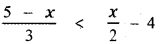
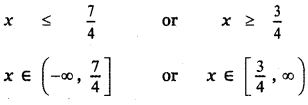
Samacheer Kalvi 11th Maths Guide Chapter 2 Basic Algebra Ex 2.2 2
∴ x ∈ (-∞, ∞) = R

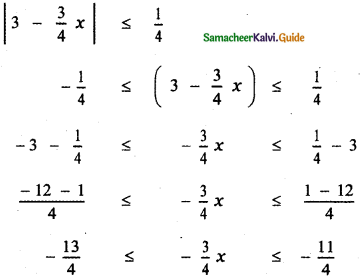
(iii) |3 – \(\frac{3}{4}\)x| ≤ \(\frac{1}{4}\)
Answer:
Samacheer Kalvi 11th Maths Guide Chapter 2 Basic Algebra Ex 2.2 3
Multiplying by 4, we have
– 13 ≤ – 3x ≤ – 11 ——– (1)
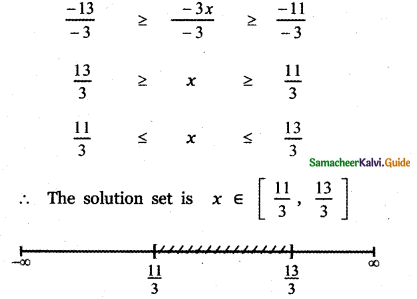
We know that a < b ⇒ \(\frac{\mathrm{a}}{\mathrm{y}}\) > \(\frac{\mathrm{b}}{\mathrm{y}}\) when y < 0
Divide equation (1) by – 3, we have
Samacheer Kalvi 11th Maths Guide Chapter 2 Basic Algebra Ex 2.2 4

Samacheer Kalvi 11th Maths Guide Chapter 2 Basic Algebra Ex 2.2

(iv) |x| – 10 < – 3
Answer:
|x| – 10 < – 3
|x| < – 3 + 10
|x| < 7
– 7 < x < 7
∴ The solution set is (-7, 7)
Samacheer Kalvi 11th Maths Guide Chapter 2 Basic Algebra Ex 2.2 5

Question 2.
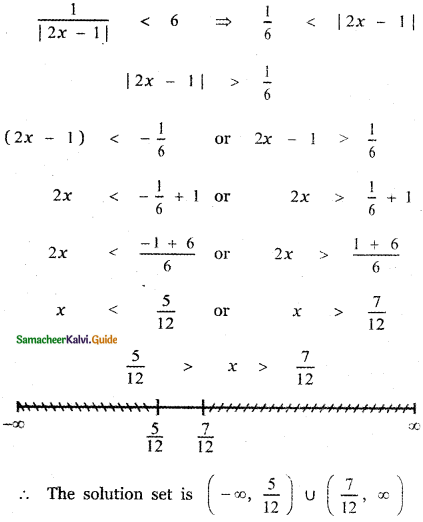
Solve \(\frac{1}{|2 x-1|}\) < 6 and express the solution using the interval notation.
Answer:
Samacheer Kalvi 11th Maths Guide Chapter 2 Basic Algebra Ex 2.2 6

Samacheer Kalvi 11th Maths Guide Chapter 2 Basic Algebra Ex 2.2

Question 3.
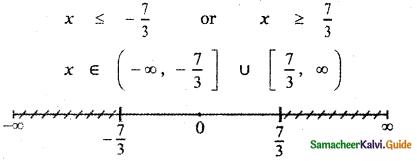
Solve – 3 |x| + 5 ≤ – 2 and graph the solution set in a number line.
Answer:
-3|x| + 5 ≤ – 2
⇒ -3 |x| ≤ – 2 – 5 (= -7)
-3|x| ≤ – 7 ⇒ 3 |x| ≥ 7
Samacheer Kalvi 11th Maths Guide Chapter 2 Basic Algebra Ex 2.2 7

Question 4.
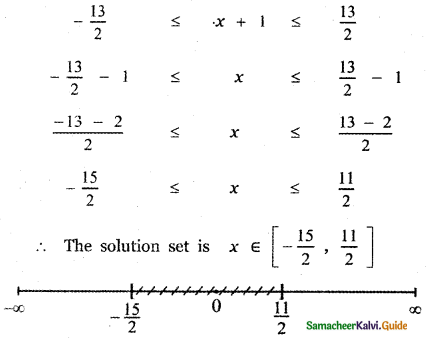
SoIve 2|x + 1| – 6 ≤ 7 and graph the solution set in a number line.
Answer:
Given 2|x + 1| – 6 ≤ 7
2|x + 1| ≤ 7 + 6
2|x + 1| ≤ 13
|x + 1| ≤ \(\frac{13}{2}\)
Samacheer Kalvi 11th Maths Guide Chapter 2 Basic Algebra Ex 2.2 8

Samacheer Kalvi 11th Maths Guide Chapter 2 Basic Algebra Ex 2.2

Question 5.
Solve \(\frac{1}{5}\) |10x – 2| < 1
Answer:
Given \(\frac{1}{5}\) |10x – 2| < 1
|10x – 2| < 5
-5 < (10x – 2) < 5
– 5 + 2 < 10x < 5 + 2
– 3 < 10x < 7
\(-\frac{3}{10}\) < x < \(\frac{7}{10}\)
∴ The solution set is x ∈ \(\left(-\frac{3}{10}, \frac{7}{10}\right)\)
Samacheer Kalvi 11th Maths Guide Chapter 2 Basic Algebra Ex 2.2 9

Samacheer Kalvi 11th Maths Guide Chapter 2 Basic Algebra Ex 2.2

Question 6.
Solve |5x – 12| < – 2
Answer:
By the definition of modulus function. |5x – 12| always positive.
∴ |5x – 12| < -2 is not possible.
∴ Solution does not exist.

Samacheer Kalvi 11th Maths Guide Chapter 2 Basic Algebra Ex 2.1

Tamilnadu State Board New Syllabus Samacheer Kalvi 11th Maths Guide Pdf Chapter 2 Basic Algebra Ex 2.1 Text Book Back Questions and Answers, Notes.

Tamilnadu Samacheer Kalvi 11th Maths Solutions Chapter 2 Basic Algebra Ex 2.1

Question 1.
Classify each element of {√7, \(-\frac{1}{4}\), 0, 3.14 , 4, \(\frac{22}{7}\)} as a member of N, Q, R – Q or Z.
Answer:
√7 is an irrational number. ∴ √7 ∈ R – Q
\(-\frac{1}{4}\) is a negative rational number. ∴ \(-\frac{1}{4}\) ∈ Q
0 is an integer. ∴ 0 ∈ Z , Q
3.14 is a rational number. ∴ 3.14 ∈ Q
4 is a positive integers. ∴ 4 ∈ Z, N, Q
\(\frac{22}{7}\) is an rational number. ∴ \(\frac{22}{7}\) ∈ Q

Samacheer Kalvi 11th Maths Guide Chapter 2 Basic Algebra Ex 2.1

Question 2.
Prove that √3 is an irrational number.
Answer:
Suppose that √3 is rational. Let √3 = \(\frac{\mathrm{m}}{\mathrm{n}}\) where m and n are positive integers with no common factors greater than 1.
√3 = \(\frac{\mathrm{m}}{\mathrm{n}}\)
⇒ √3n = m
⇒ 3n2 = m2 ——– (1)
By assumption n is an integer
∴ n2 is an integer. Hence 3n2 is an integral multiple of 3.
∴ From equation (1) m2 is an integral multiple of 3
⇒ m is an intergral multiple of 3

[Here m is an integer and m2 is an integral multiple of 3. That m2 is cannot take all integral multiples of 3. For example suppose m2 = 3 = 1 × 3 which is an integral multiple of 3. In this case m = √3 which is not an integer. Suppose m2 = 6 = 2 × 3 which is an integer multiple of 3 , but m = √2 √3 which is an integer. Hence m2 is an integral multiple of 3. Such that m is an integer.
Examples: m2 = 4 × 9,
m2 = 9,
m2 = 9 × 9 etc.]

Let m = 3k
where k is an integer
Using equation (1) we have
3n2 = (3k)2
⇒ 3n2 = 9k2
⇒ n2 = 3k2
∴ n2 is an integral multiple of 3. Since, n is an integer, we have n is also an integral multiple of 3.

Thus we have proved both m and n are integral multiple of 3. Hence both m and n have common factor 3, which is a contradiction to our assumption that m and n are integers with no common factors greater than 1.

Hence our assumption that √3 is a rational number is wrong.
∴ √3 is an irrational number.

Samacheer Kalvi 11th Maths Guide Chapter 2 Basic Algebra Ex 2.1

Question 3.
Are there two distinct irrational numbers such that their difference is a rational number? Justify.
Answer:
Taking two irrational numbers as 3 + \(\sqrt{2}\) and 1 + \(\sqrt{2}\)
Their difference is a rational number. But if we take two irrational numbers as 2 – \(\sqrt{3}\) and 4 + \(\sqrt{7}\).
Their difference is again an irrational number. So unless we know the two irrational numbers we cannot say that their difference is a rational number or irrational number.

Question 4.
Find two irrational numbers such that their sum is a rational number. Can you find two irrational numbers whose product is a rational number?
Answer:
(i) Let the two irrational numbers as 2 + \(\sqrt{3}\) and 3 – \(\sqrt{3}\)
Their sum is 2 + \(\sqrt{3}\) + 3 – 3\(\sqrt{3}\) which is a rational number.
But the sum of 3 + \(\sqrt{5}\) and 4 – \(\sqrt{7}\) is not a rational number. So the sum of two irrational numbers is either rational or irrational.

(ii) Again taking two irrational numbers as π and \(\frac{3}{\pi}\) their product is \(\sqrt{3}\) and \(\sqrt{2}\) = \(\sqrt{3}\) × \(\sqrt{2}\) which is irrational, So the product of two irrational numbers is either rational or irrational.

Samacheer Kalvi 11th Maths Guide Chapter 2 Basic Algebra Ex 2.1

Question 5.
Find a positive number smaller than \(\frac{1}{2^{1000}}\) Justify.
Answer:
The given number is \(\frac{1}{2^{1000}}\)
We have 1000 < 1001
⇒ 21000 < 21001
⇒ \(\frac{1}{2^{1000}}\) > \(\frac{1}{2^{1001}}\)
∴ A positive number smaller than \(\frac{1}{2^{1000}}\) is \(\frac{1}{2^{1001}}\)

Samacheer Kalvi 5th English Guide Term 3 Poem 2 The Dreamer

Tamilnadu State Board New Syllabus Samacheer Kalvi 5th English Guide Pdf Term 3 Poem 2 Why Questions Text Book Back Questions and Answers, Summary, Notes.

Tamilnadu Samacheer Kalvi 5th English Solutions Term 3 Poem 2 The Dreamer

5th English Guide The Dreamer Text Book Back Questions and Answers

A. Answer the following questions:

Question 1.
How are we divided in real world?
Answer:
In the real world, we are divided by caste, religion, race, and wealth.

Question 2.
Does the poet want diversity? why?
Answer:
No, the poet does not want diversity. Due to diversity, wars occur and people have to die.

Question 3.
Do you like this kind of world?
Answer:
Yes, I like this kind of world, that is without any diversity, to live peacefully.

Samacheer Kalvi 5th English Guide Term 3 Poem 2 The Dreamer

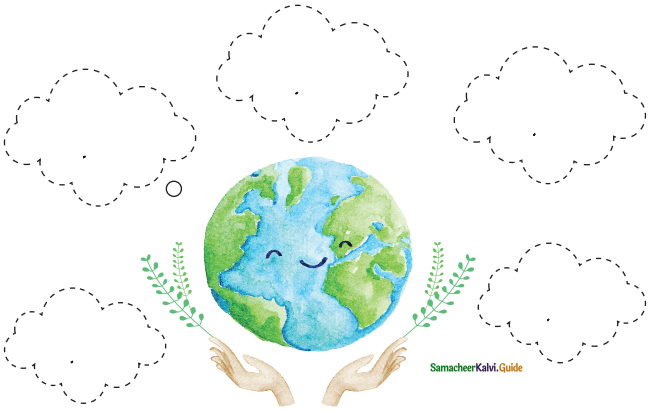
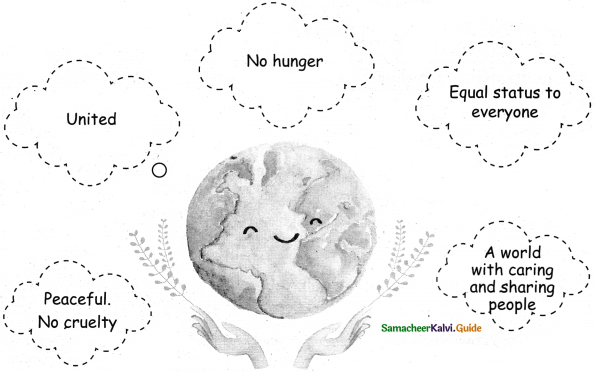
B. Imagine your world and write its qualities in the cloud:

Samacheer Kalvi 5th English Guide Term 3 poem 2 The Dreamer 1
Answer:
Samacheer Kalvi 5th English Guide Term 3 poem 2 The Dreamer 2

Samacheer Kalvi 5th English Guide Term 3 Poem 2 The Dreamer

Let Us Know:

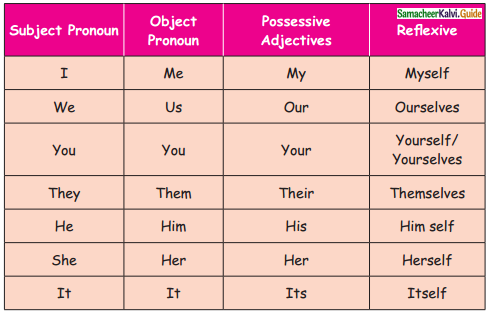
Pronouns:

Pronouns are used in the place of a noun. When we have to repeat a noun, we should use a pronoun instead of a noun.

Types of Pronouns:

1. Subjective Pronoun:
Acts as the subject of a sentence. It performs the action of the verb.
Subjective Pronouns:
I, We, You, They, He, She, It
Example :

  1. I went to the post office yesterday.
  2. She talked to her friend on the cell phone.
  3. You walked 3 miles yesterday.
  4. They live near my house.
  5. We work together as a team.
  6. It is a beautiful scene on the wall.
  7. He likes tomato soup.

2. Objective Pronoun:
Replaces a noun and functions as an object in the sentence.
Objective Pronouns:
Me, Us, You, Him, Her, It, Them
Example :

  1. she walked out to meet them.
  2. They said that it was good to see her.
  3. She told me all about it:
  4. Prem called Sheela and me for lunch.
  5. Grandma came to the hospital with us.
  6. The teacher gave him an answer.
  7. I bought these gifts for you.

Samacheer Kalvi 5th English Guide Term 3 Poem 2 The Dreamer

3. Possessive Pronoun:
Takes the place of a noun phrase to show ownership.
Possessive Pronouns:
My, Our, Your, Their, His Her, Its
Example :

  1. Your lunch is ready.
  2. Go to her birthday party.
  3. The dog is licking its bone.
  4. This is my sister’s house.
  5. This is his computer.
  6. Their dog barks all time.
  7. You can use our car.

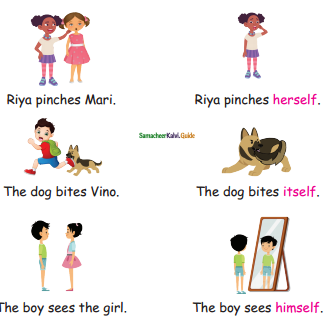
4. Reflexive Pronoun:

Samacheer Kalvi 5th English Guide Term 3 poem 2 The Dreamer 7
In the above examples, the coloured words represent Reflexive Pronouns.
A Reflexive Pronoun is used when something does something to itself.
Reflexive Pronouns:
Myself, Ourselves, Yourself, Yourselves, Themselves, Himself, Herself, Itself
Example:

  1. She took herself to the hospital.
  2. I whistled to myself to pass time.
  3. We thought to ourselves we have made the best decision.
  4. Pull yourselves together, the warden is coming.
  5. The students decorated their classrooms by themselves.
  6. Balu introduced himself to his workers.
  7. We can make a good team ourselves.
  8. Don’t blame yourself for the mistake.

Samacheer Kalvi 5th English Guide Term 3 poem 2 The Dreamer 3

Samacheer Kalvi 5th English Guide Term 3 Poem 2 The Dreamer

Text Book Excercise:

Try this:

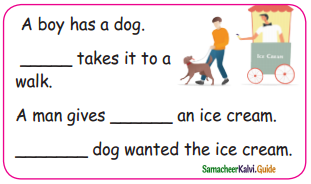
Fill up with the correct Pronouns:

Question 1.
Samacheer Kalvi 5th English Guide Term 3 poem 2 The Dreamer 4
Answer:
A boy has a dog. He takes it for a walk. A man gives it ice cream. His dog wanted the ice cream.

Question 2.
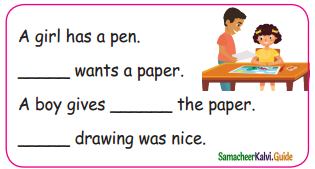
Samacheer Kalvi 5th English Guide Term 3 poem 2 The Dreamer 5
Answer:
A girl has a pen. She wants paper. A boy gives her the paper. Their drawing was nice.

Question 3.
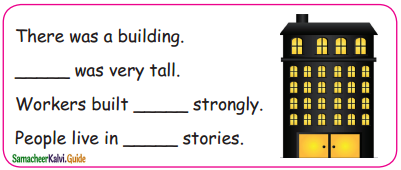
Samacheer Kalvi 5th English Guide Term 3 poem 2 The Dreamer 6
Answer:
There was a building. It was very tall. Workers built themselves strongly. People live in their stories.

Samacheer Kalvi 5th English Guide Term 3 Poem 2 The Dreamer

A. Choose the correct reflexive pronoun:

Question 1.
Each morning, I brush my teeth and stare at ______ in the mirror.
(a) himself
(b) herself
(c) myself
(d) itself
Answer:
(c) myself

Question 2.
Dad and I painted the trailer ______.
(a) myself
(b) himself
(c) itself
(d) ourselves
Answer:
(d) ourselves

Question 3.
The children made holiday decorations by ______.
(a) itself
(b) ourselves
(c)themselves
(d) their selves
Answer:
(c) themselves

Question 4.
Paul copies his friend’s homework instead of doing it ______.
(a) itself
(b) himself
(c) myself
(d) yourself
Answer:
(b) himself

Question 5.
Please make at home while you wait for ______.
(a) themselves
(b) himself
(c) yourselves
(d) herself
Answer:
(c) yourselves

Samacheer Kalvi 5th English Guide Term 3 Poem 2 The Dreamer

B. Complete the sentence with the correct reflexive pronoun:
(Myself, yourself, himself, herself, itself, ourselves, themselves)

Question 1.
I like ______.
Answer:
I like myself.

Question 2.
She put ______ into trouble.
Answer:
She put herself into trouble.

Question 3.
Teachers teach ______ a new lesson every day.
Answer:
Teachers teach themselves a new lesson every day.

Question 4.
The machine will destroy ______ once its task is done.
Answer:
The machine will destroy itself once its task is done.

Question 5.
You made it harder for ______.
Answer:
You made it harder for yourself.

Samacheer Kalvi 5th English Guide Term 3 Poem 2 The Dreamer

Let us listen:

C. Listen to the audio and tick where the following statements are true or false:

Question 1.
It is the first day at School.
Answer:
True

Question 2.
All the children are coming only by bus.
Answer:
False

Question 3.
There are many children outside.
Answer:
False

Question 4.
She hold her mom’s hand very tight.
Answer:
False

Question 5.
The teacher smiles at Rani.
Answer:
True

Samacheer Kalvi 5th English Guide Term 3 Poem 2 The Dreamer

Let us speak:

Samacheer Kalvi 5th English Guide Term 3 poem 2 The Dreamer 8
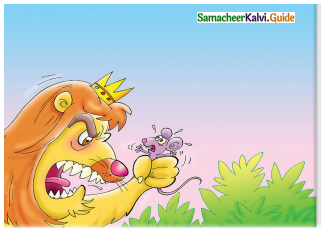
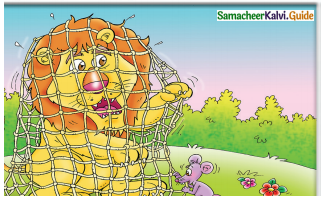
Lion: “I am going to eat you”.
Mouse: “Oh! lion! Please leave me. I can save you in danger”.

Samacheer Kalvi 5th English Guide Term 3 poem 2 The Dreamer 9
Lion: “How will you save me? Now run away before I eat you”
Mouse: “Thank you, Mr. Lion!”

Samacheer Kalvi 5th English Guide Term 3 poem 2 The Dreamer 10
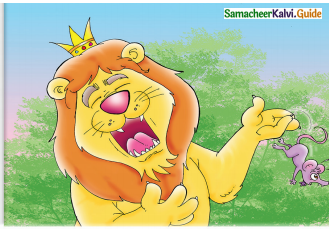
Lion: “Help, Help! I have caught in a net”.
Mouse: “Oh king, I am happy I could help you”.

Samacheer Kalvi 5th English Guide Term 3 poem 2 The Dreamer 11
Lion: “Thank you rat for saving me”.
Rat: “Let us help each other and live happily”.

Samacheer Kalvi 5th English Guide Term 3 Poem 2 The Dreamer

5th English Guide The Dreamer Additional Questions and Answers

I. Look at the pictures. Make simple sentences and tell the story:

Samacheer Kalvi 5th English Guide Term 3 poem 2 The Dreamer 12
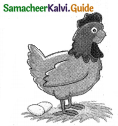
A hen laid her eggs on alternate days.

Samacheer Kalvi 5th English Guide Term 3 poem 2 The Dreamer 13
She sat patiently on her eggs to hatch.

Samacheer Kalvi 5th English Guide Term 3 poem 2 The Dreamer 14
The eggs break and the chicks peep out.

Samacheer Kalvi 5th English Guide Term 3 poem 2 The Dreamer 15
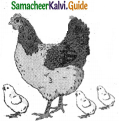
The hen and its chicks went to the fields happily.

Samacheer Kalvi 5th English Guide Term 3 Poem 2 The Dreamer

II. Answer the following:

Question 1.
What does the poet think about diversity?
Answer:
The poet thinks that diversity will bring hatred, fight, and killing among people of different castes and religions.

Question 2.
How can we remove inequality in this world?
Answer:
We can remove inequality by sharing our belongings with others.

Question 3.
What will be the result of inequality?
Answer:
Inequality among people will lead to greed, hunger, poverty, and hatred.

Question 4.
Does only the poet dreams? What does he dream?
Answer:
No, not only the poet but the others also dream. He dreams, of a united world without any diversity or inequality.

Samacheer Kalvi 5th English Guide Term 3 Poem 2 The Dreamer

The Dreamer Summary in English and Tamil

Imagine!
There are no diversity,
It isn’t hard to do,
Nothing to kill or die for.

கற்பனை செய்து பாருங்கள்…
(மக்களிடம் இனம், மொழி போன்ற
வேற்றுமைகளே இல்லாத ஒரு நிலையை)
இதைச் செய்வது கடினமல்ல.
இது யாரையும் கொல்வதற்கோ, யாரும் சாவதற்கோ செய்யப்படுவதல்ல

Am I a dreamer?
I hope not the only one,
Will you join me?
To make the world as one.

நான் ஒரு கனவு காண்பவனா?
நான் ஒருவன் மட்டுமே கனவு காண்பவன் என்பதில் எனக்கு நம்பிக்கை இல்லை.
நீங்கள் என்னுடன் சேருவீர்களா?
உலகை ஒற்றுமையாக (ஒன்றுபட்டதாக) மாற்ற.

Samacheer Kalvi 5th English Guide Term 3 Poem 2 The Dreamer

Imagine!
All that belongs to you isshared,
I wonder if you can,
No need for greed or hunger.

கற்பனை செய்து பாருங்கள்
உங்களுக்குச் சொந்தமானவை எல்லாமே பகிர்ந்து கொள்ளப்படுகின்றன என்ற நிலையை.
இதை உங்களால் செய்ய முடியுமா என்று நான் கேட்கிறேன்.
இதில் பேராசைப்படுதல் அல்லது பட்டினி கிடத்தல் என்பதற்கான தேவையே இருக்காது

Am I a dreamer?
I hope not the only one,
Will you join me?
To make the world as one.

நான் கனவு காண்பவனா?
நான் ஒருவன் மட்டுமே கனவுகாண்பவன் என்பதில் எனக்கு நம்பிக்கை இல்லை.
நீங்கள் என்னுடன் சேருவீர்களா?
உலகை ஒற்றுமையாக (ஒன்றுபட்டதாக) மாற்ற.

Samacheer Kalvi 5th English Guide Term 3 Poem 2 The Dreamer

The Dreamer Glossary:

Belong – To be a part (சொந்தமானது)
Greed – Excessive desire (பேராசை)
Hunger – Desire for food (பட்டினி)
Hope – Confident (நம்பிக்கை)
Imagine – Think (கற்பனை செய்தல்/நினைத்தல்)
Share – Distribute (பகிர்ந்து கொள்வது)
Wonder – Surprise (ஆச்சர்யம் (Here, inquire, question/கேட்டல்)

Samacheer Kalvi 7th Social Science Guide Geography Term 1 Chapter 2 Landforms

Tamilnadu State Board New Syllabus Samacheer Kalvi 7th Social Science Guide Pdf Geography Term 1 Chapter 2 Landforms Text Book Back Questions and Answers, Notes.

Tamilnadu Samacheer Kalvi 7th Social Science Solutions Geography Term 1 Chapter 2 Landforms

7th Social Science Guide Landforms Text Book Back Questions and Answers

I. Choose the correct answer:

Question 1.
…………………… is a deposition of river sediments along the foot-hills.
a) Plung pool
b) Alluvial fan
c) Flood plain
d) Delta
Answer:
b) Alluvial fan

Samacheer Kalvi 7th Social Science Guide Geography Term 1 Chapter 2 Landforms

Question 2.
Courtallam falls is located across the ………………………….river.
a) Cauvery
b) Pennar
c) Chittar
d) Vaigai
Answer:
c) Chittar

Question 3.
The landform created by glacial deposition is …………..
a) Cirque
b) Arete
c) Moraine
d) Tam lake
Answer:
c) Moraine

Question 4.
Large deposits of loess are found in …………..
a) the USA
b) India
c) China
d) Brazil
Answer:
c) China

Samacheer Kalvi 7th Social Science Guide Geography Term 1 Chapter 2 Landforms

Question 5.
Landform which is not associated with wave erosion
a) Cliffs
b) Sea arch
c) Stacks
d) Beaches
Answer:
d) Beaches

II. Fill in the blanks:

1. The process of breaking and crumbling of rocks is ………………………….
Answer:
weathering

2. The place where the river joins a lake or a sea is known as ………………………….
Answer:
River mouth

3. Inselbergs are found in the …………………………. desert in South Africa.
Answer:
Kalahari

4. A cirque is known as ………………………….in Germany.
Answer:
Kar

Samacheer Kalvi 7th Social Science Guide Geography Term 1 Chapter 2 Landforms

5. The longest beach in the world is ………………………….
Answer:
Miami Beach in the U.S.A

III. Match the following:

1. Breaking and crumbling of rocksa) Glacier
2. Abandoned meander loopsb) Barchans
3. Large body of moving icec) Lagoon
4. Crescent-shaped sand dunesd) Weathering
5.Vembanad lakee) Oxbow lake

Answer:

1. Breaking and crumbling of rocksd) Weathering
2. Abandoned meander loopse) Oxbow lake
3. Large body of moving icea) Glacier
4. Crescent-shaped sand dunesb) Barchan
5.Vembanad lakec) Lagoon

IV. Consider the following statement and tick (✓) the appropriate answer:

Question 1.
Assertion (A): The deltas are formed near the mouth of the river.
Reason (R): The velocity of the river becomes slow when it approaches the sea.
a) Both A and R are correct
b) A is correct and R is wrong
c) A is wrong and R is correct
d) Both A and R are wrong
Answer:
a) Both A and R are correct

Samacheer Kalvi 7th Social Science Guide Geography Term 1 Chapter 2 Landforms

Question 2.
Assertion (A) : Sea arches in turn become Sea Stacks.
Reason (R) : Sea Stacks are the results of wave deposition,
a) Both A and R are correct
b) A is correct and R is wrong
c) A is wrong and R is correct
d) Both A and R are wrong
Answer:
b) A is correct and R is wrong

V. Answer the following:

Question 1.
Define erosion.
Answer:
Erosion is the wearing away of the landscape by water, wind, ice and sea waves, etc.

Samacheer Kalvi 7th Social Science Guide Geography Term 1 Chapter 2 Landforms

Question 2.
What is a plunge pool?
Answer:
The plunge pool is a hollow feature at the base of a waterfall formed by cavitation.

Question 3.
How are Oxbow lakes formed?
Answer:
Due to continuous erosion and deposition, the meander loop cuts off from the river and forms a cut-off lake is called an Ox-bow lake.

Question 4.
Name the major landforms formed by glacial erosion.
Answer:
Mountain or valley Glacier, cirque, Tam Lake, Arets, TJ’ shaped Valley.

Question 5.
Give a note on Mushroom rocks.
Answer:
In deserts, the rocks in the shape of a mushroom are commonly called mushroom rocks.

Samacheer Kalvi 7th Social Science Guide Geography Term 1 Chapter 2 Landforms

Question 6.
What is a lagoon? Give an example.
Answer:

  • A lagoon is a shallow stretch of water partially or completely separated from the sea.
  • Ex: Chilkalake, Pulikat lake, and Vembad lake.

VI. Distinguish the following:

Question 1.
Tributary and Distributary
Answer:
Tributary: A Stream or river that flows into and joins the main river.

Distributary: A stream that branches off and flows away from the mainstream.

Question 2.
‘V’ shaped valley and ‘U’ shaped valley
Answer:
‘V’ Shaped Valley

  • formed by the river erosion.
  • The landscape creates a steep-sided valley like the letter ‘V’ is ‘V’ shaped valley.

Samacheer Kalvi 7th Social Science Guide Geography Term 1 Chapter 2 Landforms

‘U’Shaped Valley:

  1. formed by Glacier erosion.
  2. The landscape deepened and widened by the lateral and vertical erosion is like a letter TJ’ is TJ1 shaped valley.

Question 3.
Continental glacier and Mountain glacier
Answer:
Continental Glacier:

  1. The Glacier covering vast areas of a continent with thick ice sheets.
  2. Ex: Antarctica, Greenland

Mountain Glacier:

  1. Mountain Glacier is a stream of ice flowing along a valley and bounded by steep sides.
  2. Ex: The Himalayas and the Alps

VII. Give Reason:

Question 1.
The ends of the meander loops come closer and closer.
Answer:
Due to continuous erosion and deposition of rivers along the sides of the meander, the ends of the meander loop comes closer and closer.

Question 2.
Flood plains are very fertile.
Answer:

  • As the river floods, it deposits layers of fine soil and other materials called sediments along its banks.
  • This leads to the formation of a flat fertile flood plain. So the flood plains are very fertile.

Samacheer Kalvi 7th Social Science Guide Geography Term 1 Chapter 2 Landforms

Question 3.
Sea caves are turned into stacks.
Answer:
As the cavities of sea caves become bigger, only the roof of the caves remains to form sea Arches. When erosion further breaks the roof, only walls are left, thus forming stacks.

VIII. Answer in a paragraph:

Question 1.
Explain different landforms produced by river erosion.
Answer:
The running water in the river erodes the landscape and formed different kinds of land. They are:

  • ’V’Shaped Valley: The river erosion creates a steep-sided valley like the letter ‘V’ is known as ‘V’ Shaped Valley.
  • Waterfall: When the soft rocks are removed by river erosion formed a waterfall. E.g: Courtallam falls
  • Plunge Pool: It is a hollow feature at the base of a waterfall which is formed by cavitation.
  • Oxbow lake: Due to continuous erosion along the sides of the meander, the loop cuts off from the river and forms a cutoff lake is called Oxbow lake.

Samacheer Kalvi 7th Social Science Guide Geography Term 1 Chapter 2 Landforms

Question 2.
Describe the landforms associated with wind.
Answer:
By the wind, erosion, and deposition the different types of land formed.

Mushroom Rocks:
In deserts, the rocks in the shape of Mushroom commonly called Mushroom Rocks.

Inselbergs:
The eroded hill standing like a pillar with rounded tops are called Inselbergs.

Sand Dunes:
As the wind blows the sand transformed and deposited in low hill like structures called sand Dunes.

Barchans.
The crescent-shaped sand dunes are called Barchans.

Loess:
Very fine and light sand is deposited in large areas is called Loess.

Samacheer Kalvi 7th Social Science Guide Geography Term 1 Chapter 2 Landforms

Question 3.
How are aretes formed?
Answer:

  1. When two adjacent cirques erode towards each other, the previously rounded landscape is transformed into narrow rocky, steep-sided ridges called Aretes.
  2. Thus by the erosion of Glacier, the Aretes are formed.

Activity:

Question 1.
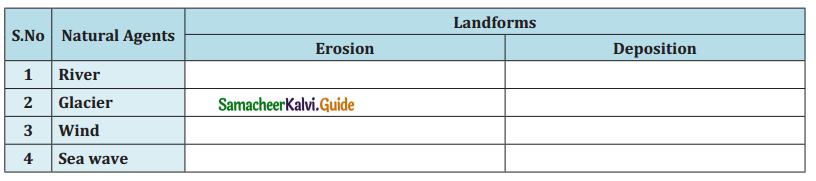
Fill in the corresponding columns with reference to the landform feature given below:
Samacheer Kalvi 7th Social Science Guide Geography Term 1 Chapter 2 Landforms 1Answer:

S.NoNatural Agents                Landforms
ErosionDeposition
1.RiverV-Shaped ValleyAlluvial Fan
2.GlacierAreteMoraine
3.WindnselbergBarchan
4.Sea waveCliffLagoon

[Barchan, ‘V’ Shaped valley, Cliff, Arete, Inselberg, Moraine, Alluvial fan, Lagon]

Samacheer Kalvi 7th Social Science Guide Geography Term 1 Chapter 2 Landforms

Question 2.
Identify any one of the following features near your home town and write a note on them.
Answer:

  1. Hill – The rocks, mountains are known as hills. The rivers originate from hills.
  2. Waterfall – The falling of water over a vertical step in the river bed is called a waterfall.
  3. River (or) stream – The water flowing in a definite course is called a river or stream.
  4. Beach – The sea waves deposit sediments of sand and gravel along shores forming beaches.

Activity:

Find out the names of a few rivers of the world that form a delta with the help of the Atlas.

  1. Amazon Delta
  2. Danube Delta
  3. Ebro Delta
  4. Fly Delta
  5. Ganges-Brahmaputra Delta
  6. Godavari Delta
  7. Irrawaddy Delta
  8. Indus River Delta
  9. Nile Delta
  10. Yellow River Delta.

7th Social Science Guide Landforms Additional Important Questions and Answers

I. Choose the Correct answer:

Question 1.
The place of the origin of the river is ………………..
a) Source
b) mouth
c) Lake
d) delta
Answer:
a) Source

Samacheer Kalvi 7th Social Science Guide Geography Term 1 Chapter 2 Landforms

Question 2.
The highest waterfalls in South America is
a) Niagara
b)joke
c) Angel
d)Kuttralam
Answer:
c) Angel

Question 3.
………………..falls is located on the border between Canada and U.S.A.
a) Jake
b) Niagara
c) Angel
d) contra lame
Answer:
b) Niagara

Question 4.
Victoria Falls located in which continent
a) Bengal
b) pern
c) Asia minor
d) Africa
Answer:
Africa

Samacheer Kalvi 7th Social Science Guide Geography Term 1 Chapter 2 Landforms

Question 5.
Meander River flows in
a) Bengal
b) Peru
c) Asia minor
d) England
Answer: Asia minor

Question 6.
Corride cirque is located in
a) Holland
b) Scotland
c) Iceland
d) New Zealand
Answer:
Scotland

Samacheer Kalvi 7th Social Science Guide Geography Term 1 Chapter 2 Landforms

Question 7.
The crescent shaped sand dunes are called
a) Barchens
b) Meander
c) Lagoon
d) delta
Answer:
a) Barchens

Question 8.
The collection of sediments from all the mouths of river forms
a) Lagoons
b) delta
c) Meander
d) Valley
Answer: delta

Question 9.
The largest beach in the world is ………………..
a) Marina
b) vembanad
c) Silica
d) Miami
Answer:
d) Miami

Samacheer Kalvi 7th Social Science Guide Geography Term 1 Chapter 2 Landforms

Question 10.
A shallow stretch of water partially separated from the sea is
a) Lagoon
b) delta
c) Meander
d) Barchens
Answer:
a) lagoon

II. Fill in the blanks:

1. Rivers generally originate from a ……………….. or ………………..
Answer:
mountain, hill

Samacheer Kalvi 7th Social Science Guide Geography Term 1 Chapter 2 Landforms

2. The raised river banks are called ………………..
Answer:
Levees

3. An active agent of erosion and deposition in the deserts is ………………..
Answer:
wind

4. An isolated residual hill, stand like a pillar with rounded tops are ………………..
Answer:
Inselbergs

5. Northern China loess deposits are brought from the ……………….. Desert.
Answer:
Gobi

6. A part of land adjoining near the sea is called ………………..
Answer:
sea coast

Samacheer Kalvi 7th Social Science Guide Geography Term 1 Chapter 2 Landforms

7. The boundary of the sea coast, where land meets water is ………………..
Answer:
coastline

8. ………………..are steep rockfaces formed when the sea waves dash against them.
Answer:
sea cliffs

9. The wall-like feature in the sea is ………………..
Answer:
stacks

10. The second largest beach in the world is the ……………….. beach in Chennai.
Answer:
Marina

11. Moraines are ………………..deposition.
Answer:
glacial

12. ……………….is a stream or river that flow into and joins the main river.
Answer:
Tributary

Samacheer Kalvi 7th Social Science Guide Geography Term 1 Chapter 2 Landforms

13. The collection of sediments from all the months of river forms ………………..
Answer:
Delta

14. ………………..is the armchair shaped depression formed by glacial erosion.
Answer:
Cirque

15. The process of leveling of highlands is called ………………..
Answer:
Gradation

Samacheer Kalvi 7th Social Science Guide Geography Term 1 Chapter 2 Landforms

III. Match the following.

1.Meander Rivera) Antarctica
2.Valley Glacierb) River curves
3.Contimental Glacierc) Corrie cirque
4.Scotlandd) Alps mountain

Answer:

1. Meander River b) River curves
2.Valley Glacierd) Alps mountain
3.Continental Glaciera) Antarctica
4.Scotlandc) Corrie cirque

IV. Consider the following statement and tick (✓) the appropriate answer:

Question 1.
Assertion (A) : The coastal areas are subject to change.
Reason (R) : Wave erosion and wave deposition frequently happened on sea coasts
a) A and R are correct explanations of A
b) A and R are correct but A does not explain R
c) A is incorrect but R is correct
d) Both A and R are incorrect
Answer:
a) A and R are correct explanations of A

Samacheer Kalvi 7th Social Science Guide Geography Term 1 Chapter 2 Landforms

Question 2.
Assertion (A) : Sand is deposited in large areas is called loess
Reason (R) : The wind can carry the sand are very long distances
a) A and R are correct explanations of A
b) A and R are correct but A does not explain R
c) A is incorrect but R is correct
d) Both A and R are correct
Answer:
d) Both A and R are correct

V. Answer the following:

Question 1.
Define River.
Answer:
The water flowing from its source to the river mouth, along a definite course is called River.

Question 2.
How waterfalls are formed?
Answer:

  • The falling of river water over a vertical step in the river bed is called a waterfall. It is formed when the soft rocks are removed by erosion.
  • E.g. courtallam falls.

Samacheer Kalvi 7th Social Science Guide Geography Term 1 Chapter 2 Landforms

Question 3.
Bring out the feature of Meanders with examples.
Answer:

  • As the river enters the plain it twists and turns to form large bends known as Meanders.
  • E.g. Meanders along the River Vellar in Tamil Nadu.

Question 4.
Define Glacier.
Answer:
A large body of ice moving slowly down a slope or valley due to gravity is called Glacier.

Question 5.
What is inselberg?
Answer:

  • An isolated residual hill, standing like a pillar with rounded tops are called Inselbergs.
  • E.g. Inselberg in the Kalahari Desert.

Question 6.
What is a Sand bar?
Answer:
Sandbar is an elongated deposition of sand or mud found in the sea, parallel to the coast.

Samacheer Kalvi 7th Social Science Guide Geography Term 1 Chapter 2 Landforms

VIII. Answer in a paragraph:

Question 1.
What are the forces of landforms – Explain.
Answer:
There are two processes in the force of landforms.

  1. The endogenic process (internal): The endogenic process leads to the upliftment and sinking of the earth’s surface at several places.
  2. The exogenic process (external): The Exogenic process is the continuous wearing down and rebuilding of the land surface.

Question 2.
Describe Delta.
Answer:

  • Each River distributary forms its own mouth.
  • The collection of sediments from all the mouths form Delta.
  • Deltas are excellent productive lands. They have more minerals which favours cultivation.
  • Eg: Cauvery Delta, Ganga Delta.

Samacheer Kalvi 7th Social Science Guide Geography Term 1 Chapter 2 Landforms

Question 3.
How sea caves are formed?
Answer:

  • Sea waves continuously strike at the rocks. Cracks develop.
  • Over time they become larger and wider. Thus, hollow like caves are formed on the rocks in the sea.
  • Thus, sea caves are formed.

Samacheer Kalvi 4th English Guide Term 1 Supplementary Chapter 3 Bujju’s Brave Adventure

Tamilnadu State Board New Syllabus Samacheer Kalvi 4th English Guide Pdf Term 1 Supplementary Chapter 3 Bujju’s Brave Adventure Text Book Back Questions and Answers, Summary, Notes.

Tamilnadu Samacheer Kalvi 4th English Solutions Term 1 Supplementary Chapter 3 Bujju’s Brave Adventure

4th English Guide Bujju’s Brave Adventure Text Book Back Questions and Answers

Samacheer Kalvi 4th English Guide Term 1 Supplementary Chapter 3 Bujju's Brave Adventure

A. Choose the correct answer.

Question 1.
Bala and Janani acted like the _________.
(a) Lion
(b) Monkey
(c) Tiger
Answer:
(b) Monkey

Question 2.
Appu felt hungry and ate a _________.
(a) Guava
(b) Mango
(c) Banana
Answer:
(a) Guava

Question 3.
All the children wished to go to the ___________.
(a) Park
(b) Beach
(c) Waterfall
Answer:
(c) waterfall

Question 4.
__________ helped Bujju to reach his family.
(a) Footprints
(b) Sound
(c) Shadow
Answer:
(a) Footprints

Samacheer Kalvi 4th English Guide Term 1 Supplementary Chapter 3 Bujju's Brave Adventure

B. Answer the following yes or no questions.

Question 1.
Did Appu share guava?
Answer:
No, Appu did not share guava.

Question 2.
Did all visit the waterfall?
Answer:
No, all did not visit the waterfall.

Question 3.
Did Bujju realise his mistake?
Answer:
Yes, Bujju realised his mistake.

Samacheer Kalvi 4th English Guide Term 1 Supplementary Chapter 3 Bujju's Brave Adventure

Answer the following yes or no Additional Questions and Answers.

Question 1.
Why did Bujju get hiccups?
Answer:
Bujju got hiccups because he swallowed guava in a hurry.

Question 2.
When did Bujju’s family set out on a trip?
Answer:
On a nice winter morning, Bujju’s family set out on a trip.

Question 3.
What was the mistake committed by Bujju?
Answer:
The mistake was that Bujju went alone without informing his parents.

Samacheer Kalvi 4th English Guide Term 1 Supplementary Chapter 3 Bujju's Brave Adventure

Read the statement and write true or false:

Question 1.
Bujju’s mother started packing the food.
Answer:
False

Question 2.
Surya asked Appu what he was eating.
Answer:
True

Question 3.
Bujju saw a lion near the waterfalls.
Answer:
False

Samacheer Kalvi 4th English Guide Term 1 Supplementary Chapter 3 Bujju's Brave Adventure

B. Answer the following questions.

Question 1.
What is the name of the girl?
Answer:
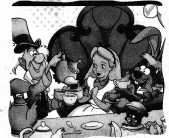
The name of the girl is Alice.

Question 2.
Where does the scene take place?
Answer:
The scene takes place in Wonderland.

Question 3.
What party is that?
Answer:
It is a tea party.

Question 4.
What does the man have?
Answer:
The man has a pot in his hand.

Samacheer Kalvi 4th English Guide Term 1 Supplementary Chapter 3 Bujju's Brave Adventure

C. Choose the correct picture for the passage.

Question 1.
Samacheer Kalvi 4th English Guide Term 1 supplementary Chapter 3 Bajju's brave Adventure 1
Answer:
Samacheer Kalvi 4th English Guide Term 1 supplementary Chapter 3 Bajju's brave Adventure 4

Question 2.
Samacheer Kalvi 4th English Guide Term 1 supplementary Chapter 3 Bajju's brave Adventure 2
Answer:
Samacheer Kalvi 4th English Guide Term 1 supplementary Chapter 3 Bajju's brave Adventure 5

Question 3.
Samacheer Kalvi 4th English Guide Term 1 supplementary Chapter 3 Bajju's brave Adventure 3
Answer:
Samacheer Kalvi 4th English Guide Term 1 supplementary Chapter 3 Bajju's brave Adventure 6

Samacheer Kalvi 4th English Guide Term 1 Supplementary Chapter 3 Bujju's Brave Adventure

Let us write

Question 1.
This, it, is, tastes, smells, mango, yellow, fresh, sour, juicy.
Answer:

Samacheer Kalvi 4th English Guide Term 1 supplementary Chapter 3 Bajju's brave Adventure 10

  1. This is a mango.
  2. It is yellow.
  3. It is juicy.
  4. It tastes sour.
  5. It smells fresh.

Samacheer Kalvi 4th English Guide Term 1 Supplementary Chapter 3 Bujju's Brave Adventure

Write some sentences about the picture:

Question 1.
She, is, has, girl, shirt, pants, beautiful, pink, blue, long, hair.
Answer:

Samacheer Kalvi 4th English Guide Term 1 supplementary Chapter 3 Bajju's brave Adventure 11

  1. She is a beautiful girl.
  2. She has long hair.
  3. She appears with a pink shirt and blue pant.

Samacheer Kalvi 4th English Guide Term 1 Supplementary Chapter 3 Bujju's Brave Adventure

Question 2.
It, is, has, walks, elephant, legs, tusk, trunk, big, long, slowly, strong.
Answer:

Samacheer Kalvi 4th English Guide Term 1 supplementary Chapter 3 Bajju's brave Adventure 12

  1. It is an elephant.
  2. It is strong.
  3. It has big tusks.
  4. It has long trunk.
  5. It walks slowly.

Samacheer Kalvi 4th English Guide Term 1 Supplementary Chapter 3 Bujju's Brave Adventure

I can do

A. Choose the correct option.

Question 1.
Robinson named the boy ___________.
(a) Sunday
(b) Friday
(c) Monday
Answer:
(b) Friday

Question 2.
__________ was with Robinson.
(a) Dog
(b) Tiger
(c) Lion
Answer:
(a) Dog

Question 3.
Robinson sailed England after __________ years.
(a) 25
(b) 28
(c) 30
Answer:
(b) 28

Samacheer Kalvi 4th English Guide Term 1 Supplementary Chapter 3 Bujju's Brave Adventure

B. Divide the following words.

Question 1.
Circle
Answer:
Cir/cle

Question 2.
Man
Answer:
Man

Question 3.
Butter
Answer:
But/ter

Question 4.
Hotel
Answer:
Ho/tel

Samacheer Kalvi 4th English Guide Term 1 Supplementary Chapter 3 Bujju's Brave Adventure

C. Write the word under the correct group and divide it.

Bullet     Candle     Bat     Title     Ball      Tiffin

Question 1.
Samacheer Kalvi 4th English Guide Term 1 supplementary Chapter 3 Bajju's brave Adventure 7
Answer:

  • Bat
  • Ball

Question 2.
Samacheer Kalvi 4th English Guide Term 1 supplementary Chapter 3 Bajju's brave Adventure 8
Answer:

  • Tif/fin
  • Bul/let

Question 3.
Samacheer Kalvi 4th English Guide Term 1 supplementary Chapter 3 Bajju's brave Adventure 9

  • Can/dle
  • Ti/tle

Samacheer Kalvi 4th English Guide Term 1 Supplementary Chapter 3 Bujju's Brave Adventure

D. Recite the poem ‘A Voyage with correct intonation.

Answer:
Activity to be done by the students

Samacheer Kalvi 4th English Guide Term 1 Supplementary Chapter 3 Bujju's Brave Adventure

E. Match the rhyming words.

Question 1.
pale – knows
Answer:
pale – gale

Question 2.
boat – gale
Answer:
boat – goat

Question 1.
goes – goat
Answer:
Goes – knows

Samacheer Kalvi 4th English Guide Term 1 Supplementary Chapter 3 Bujju's Brave Adventure

f. Fill in the blanks with and, but, or

Question 1.
Do you like apple __________ orange?
Answer:
Or

Question 2.
He has bat __________ ball.
Answer:
And

Question 3.
He is rich __________ he looks simple.
Answer:
But

Samacheer Kalvi 4th English Guide Term 1 Supplementary Chapter 3 Bujju's Brave Adventure

Bujju’s Brave Adventure Summary in English and Tamil

On a nice winter morning, Bujju family set out on a trip to the nearby hill. Bujju cousins Appu, Bala, Surya and Janani accompanied him. The kids were so excited to explore the place.

ஒரு இதமான குளிர்கால காலைப்பொழுதில் புஜ்ஜூவின் குடும்பம் அருகிலுள்ள மலைப்பகுதிக்கு பயணம் செய்ய புறப்பட்டார்கள். புஜ்ஜூவின் மாமாவின் பிள்ளைகளான அப்பு, பாலா, சூர்யா, ஜனனி ஆகியோரும் அவனுடன் சென்றனர். அந்த இடத்தைச் சுற்றிப் பார்க்க அந்தக் குழந்தைகள் மிகவும் உற்சாகம் கொண்டிருந்தனர்.

Mother : Look kids! Be around us. Never go anywhere alone

அம்மா : குழந்தைகளே கவனியுங்கள்! எங்களருகே இருங்கள். தனியாக எங்கேயும் எப்போதும் போகக்கூடாது.

Bujju : Yes ma!

புஜ்ஜு : சரி அம்மா!

Mother : First have your breakfast then, we will go there.

அம்மா : முதலில் காலை உணவை சாப்பிடுங்கள். பிறகு நாம் அங்கு போகலாம்.

Bujju : Ma! See the waterfall.

புஜ்ஜு : அம்மா! நீர்வீழ்ச்சியைப் பாருங்கள்!

Bujju mother started unpacking the food. Meanwhile, the kids could not wait for the parents to take them to the waterfall. So they ran away without informing the parents.

புஜ்ஜூவின் அம்மா உணவை எடுத்துவைக்க ஆரம்பித்தார். இதற்கு நடுவே, பெற்றோர் அவர்களை நீர்வீழ்ச்சிக்கு அழைத்துச் செல்லும் வரையில் குழந்தைகளால் காத்திருக்க முடியவில்லை. ஆகவே, பெற்றோருக்கு தெரியப்படுத்தாமல், அவர்கள் ஓடிவிட்டனர்.

Appu : Run… Run… Run….

அப்பு : ஓடு…… ஓடு……. ஓடு……

Appu : Oh! I feel too hungry. I have only one guava. I shall eat it myself.

அப்பு : ஓ! எனக்கு பசிக்கிறது. ஒரே ஒரு கொய்யா என்னிடம் இருக்கிறது. நானே அதை சாப்பிட்டுவிடப் போகிறே.

Surya : Hey Appu! What are you eating?

சூர்யா : ஹேய் அப்பு! நீ என்ன சாப்பிடுகிறாய்?

Appu : Nothing Surya

அப்பு : ஒன்றுமில்லை சூர்யா.

Appu swallowed and got hiccups. So, Surya and Appu returned to parents.

அப்பு கொய்யாவை விழுங்கினான். விக்கல் வந்தது. ஆகவே சூர்யாவும், அப்புவும் பெற்றோரிடம் திரும்பினர்.

Appa : Where did you go? What about others?

அப்பா : எங்கே போனீர்கள்? மற்றவர்கள் எல்லாம் எங்கே?

Surya : Don’t worry pa. They are playing nearby.

ஆர்யா : கவலைப்படாதீர்கள் – அப்பா . அவர்கள் அருகில்தான் விளையாடிக் கொண்டிருக்கிறார்கள்.

Without noticing, the other three kept running towards the waterfall. There Bala and Janani got diverted on seeing a naughty monkey.

எதையும் கவனிக்காமல் மற்ற மூவரும் நீர்வீழ்ச்சியை நோக்கி ஓடிக்கொண்டிருந்தனர். அங்கே குறும்புத்தனம் கொண்ட ஒரு குரங்கைப்பார்த்த பாலாவும் ஜனனியும் பாதையிலிருந்து திசை மாறினர்.

Janani : Look at that naughty monkey! Let us act like it and have fun!

ஜன்னி : அந்த குறும்புக்கார குரங்கைப்பார்.அது செய்வது போலவே நாமும் செய்து மகிழலாம்!

Bala : I feel very hungry. Let’s go.

பாலா : எனக்கு பசிக்கிறது. வா, போகலாம்.

As Bala and Janani felt hunary, they returned to parents. But Bujju sped towards the waterfall. He was shocked to see that no one was there.

பாலாவும், ஜனனியும் பசி காரணமாக பெற்றோரிடம் திரும்பினர். ஆனால் புஜ்ஜு நீர்வீழ்ச்சியை நோக்கி வேகமாக ஓடினான். அங்கே யாருமே இல்லாததைப்பார்த்துஅதிர்ச்சியடைந்தான.

Samacheer Kalvi 4th English Guide Term 1 Supplementary Chapter 3 Bujju's Brave Adventure

Bujju : Oh! No… I am alone. Surya, Appu, Janani, Bala… Where are you guys?

புஜ்ஜு : ஓ! நான் தனியாக இருக்கிறேன். சூர்யா, அப்பு, ஜனனி, பாலா…. நீங்கள் எல்லாம் எங்கே இருக்கிறீர்கள்?

Bujju : Is that a ROAR of a lion? Mummy!
புஜ்ஜு : அது என்ன, சிங்கத்தின் கர்ஜனையா? அம்மா!

Bujju : I shouldn’t be afraid. Let me find a way. I think these footprints will help me.

புஜ்ஜு : நான் பயப்படக்கூடாது. போகிற வழியை கண்டுபிடிக்க வேண்டும். இந்த காலடித்தடங்கள் எனக்கு உதவும் என நினைக்கிறேன்.

On his way he finds big footprints.

அவன் சென்ற வழியில் பெரிய காலடித்தடங்களை அவன் கண்டான்.

Bujju : I think these should be Appu’s footprints.

புஜ்ஜு : இவையெல்லாம் அப்புவின் காலடித்தடங்களாக இருக்க வேண்டுமென நினைக்கிறேன்.

Mother : Bujju, where were you? I was so worried.

அம்மா : புஜ்ஜு, எங்கே போனாய்? நான் மிகவும் கவலைப்பட்டுவிட்டேன்.

Bujju : Yes ma… I have found you all at last.

புஜ்ஜி : ஆம், அம்மா …. கடைசியில் நான் உன்னை கண்டுபிடித்துவிட்டேன்.

Now Bujju realised his mistake that he should not go alone without informing parents.

புஜ்ஜு தன் தவறை உணர்ந்தான், பெற்றோரிடம் சொல்லாமல் தனியாக எங்கேயும் போகக் கூடாது.

Samacheer Kalvi 7th Social Science Guide Geography Term 1 Chapter 1 Interior of the Earth

Tamilnadu State Board New Syllabus Samacheer Kalvi 7th Social Science Guide Pdf Geography Term 1 Chapter 1 Interior of the Earth Text Book Back Questions and Answers, Notes.

Tamilnadu Samacheer Kalvi 7th Social Science Solutions Geography Term 1 Chapter 1 Interior of the Earth

7th Social Science Guide Interior of the Earth Text Book Back Questions and Answers

I. Choose the correct answer:

Question 1.
Nife is made up of …………..
a) Nickel and ferrous
b) Silica and aluminum
c) Silica and magnesium
d) Iron and magnesium
Answer:
a) Nickel and ferrous

Samacheer Kalvi 7th Social Science Guide Geography Term 1 Chapter 1 Interior of the Earth

Question 2.
Earthquake and volcanic eruption occur near the edges of ……………..
a) Mountain
b) Plains
c) Plates
d) Plateaus
Answer:
c) Plates

Question 3.
The magnitude of an earthquake is measured by ……………..
a) Seismograph
b) Richter scale
c) Ammeter
d) Rotameter
Answer:
b) Richter scale

Question 4.
The narrow pipe through which magma flow out is called a ………………..
a) Vent
b) Crater
c) Focus
d) Caldera
Answer:
a) Vent

Samacheer Kalvi 7th Social Science Guide Geography Term 1 Chapter 1 Interior of the Earth

Question 5.
………….. Volcano is known as light house of Mediterranean Sea.
a) Stromboli
b) Krokota
c) Fujiyana
d) Kilinanjaro
Answer:
a) Stromboli

Question 6.
………………. belt is known as the “Ring of Fire”.
a) Circum – Pacific
b) Mid – Atlantic
c) Mid – Continental
d) Antarctic
Answer:
a) Circum – Pacific

II. Fill in the blanks:

1. The core is separated from the mantle by a boundary called……………….
Answer:
Weichart – Gutenberg discontinuity

2. The earthquake waves are recorded by an instrument known as ……………….
Answer:
Seismograph

Samacheer Kalvi 7th Social Science Guide Geography Term 1 Chapter 1 Interior of the Earth

3. Magma rises to the surface and spreads over a vast area is known as ……………….
Answer:
Lava

4. An example for active volcano ……………….
Answer:
Mauna Loa in Hawaii /Mt. Strampoli / St. Helens / Pinatubo

5. Seismology is the study of ……………….
Answer:
Earthquakes

III. Circle the odd one:

Samacheer Kalvi 7th Social Science Guide Geography Term 1 Chapter 1 Interior of the Earth 01
Answer:
Samacheer Kalvi 7th Social Science Guide Geography Term 1 Chapter 1 Interior of the Earth 1

IV. Match the following:

1. Earth quakea) Japanese term
2. Simab) Africa
3. Pacific Ring of Firee) Sudden movement
4. Tsunamid) Silica and magnesium
5. Mt. Kenyae) World volcanoes

Answer:

1. Earth quakec) Sudden movement
2. Simad) Silica and magnesium
3. Pacific Ring of Firee) World volcanoes
4. Tsunamia) Japanese term
5. Mt. Kenyab) Africa

V. Consider the foiiowirig statementand (✓) Tick the appropriate answer:

Question 1.
Assertion (A) : There structure of the earth may be compared to that of an Apple.
Reason (R) : The interior of the earth consists of crust, mantle and core.
a) A and R are correct and A explains R
b) A and R are correct but A does not explain R
c) A is incorrect but R is correct
d) Both A and R are incorrect
Answer:
b) A and R are correct but A does not explain R

Samacheer Kalvi 7th Social Science Guide Geography Term 1 Chapter 1 Interior of the Earth

Question 2.
Assertion (A) : The Pacific Ocean includes two thirds of the world’s volcanoes.
Reason (R) : The boundary along the Eastern and Western coast areas of the Pacific Ocean is known as the Pacific Ring of Fire.
a) A and R are correct and A explains R
b) A and R are correct but A does not explain R
c) A is incorrect but R is correct
d) Both A and R are incorrect A
Answer:
a) A and R are correct and A explains R

VI. Answer in a word:

Question 1.
Name the outermost layer of the earth.
Answer:
The crust

Question 2.
What is SIAL?
Answer:
The upper part of the crust i.e., Silica and Alumina.

Samacheer Kalvi 7th Social Science Guide Geography Term 1 Chapter 1 Interior of the Earth

Question 3.
Name the movement of the Earth’s lithospheric plates?
Answer:
Techtonic Movements

Question 4.
Give an example of an extinct volcano
Answer:
Mt. Popa of Myanmar

VII. Answer the following briefly:

Question 1.
What is the mantle?
Answer:
The layer of the earth beneath the crust is called the mantle. It is separated from the crust by a boundary called Mohorovicic discontinuity.

Question 2.
Write a note on the core of the earth?
Answer:
The innermost layer of the earth is called the core. It is also known as the barysphere. It is separated from the mantle by a boundary called Weichart-Gutenberg discontinuity. The core is also divided into two parts.

  1. The outer core, which is rich in iron, is in the liquid state.
  2. The inner core, composed of Nickel and Ferrous (Nife), is solid in the state.

Samacheer Kalvi 7th Social Science Guide Geography Term 1 Chapter 1 Interior of the Earth

Question 3.
Define an Earthquake.
Answer:
A sudden movement of a portion of the earth’s crust which produces a shaking or trembling is known as an earthquake.

Question 4.
What is Seismograph?
Answer:
The earthquake waves are recorded by an instrument known as a seismograph.

Question 5.
What is a Volcano?
Answer:
A volcano is a vent or an opening in the earth’s crust through which hot magma erupts from deep below the surface. The opening is usually circular in form.

Question 6.
Name the three types of volcanoes based on the periodicity of the eruption.
Answer:
On the basis of shape, there are three types of volcanoes. They are:

  1. Shield volcano
  2. Cinder-cone volcano
  3. Composite volcano

Samacheer Kalvi 7th Social Science Guide Geography Term 1 Chapter 1 Interior of the Earth

VIII. Give reason:

Question 1.
No one has been able to take samples from the interior of the earth
Answer:
The innermost layer of the earth is called the core. The central core has very high temperature and pressure. So no one has been able to take samples from the interior of the earth.

Question 2.
The Continent crust is less dense than the oceanic crust.
Answer:
Despite the greater thickness, the continental crust is less dense than the oceanic crust because it is made of both light and dense rock types.

IX. Distinguish between:

Question 1.
SIAL and SIMA
Answer:
SIAL

  1. SIAL is the upper part of the crust
  2. Consists of granite rocks
  3. Forms the continents
  4. Silica and Alumina are the main mineral constituents.

SIMA

  1. SIMA is the lower part of the crust
  2. Consists of denser basaltic rocks
  3. Forming the ocean floors.
  4. Silica and Magnesium are the main mineral constituents.

Samacheer Kalvi 7th Social Science Guide Geography Term 1 Chapter 1 Interior of the Earth

Question 2.
Active volcano and a dormant volcano
Answer:
Active Volcano

  1. Volcanoes that erupt frequently are called active volcanoes.
  2. 600 active volcanoes in the world.
  3. Ex: Mt. Stromboli, St. Helens, Pinatubo, Mauna Loa

DormantVolcano

  1. Volcanoes have no sign of activity for many years but may become active at any time.
  2. Also called sleeping Volcano
  3. Ex: Vesuvius Mountain, Mt. Fujiyama, Mt. Krakatoa

Samacheer Kalvi 7th Social Science Guide Geography Term 1 Chapter 1 Interior of the Earth

X. Answer the following questions in detail:

Question 1.
Write about the effects of an earthquake?
Answer:
Earthquakes may cause changes in the earth’s surface. They are

  • Vibrations often set landslides in mountainous regions.
  • Falling of buildings is another danger of earthquakes.
  • Most of the houses which collapsed were made of mud and bricks and proved to be death traps.
  • Fire is another great danger.
  • The underground water system is disturbed.
  • Causes great disturbance in the water.
  • The floods and waves cause great loss of life.

Question 2.
Describe the classification of volcanoes based on the eruptions.
Answer:
There are three types of Volcanoes based on eruptions.

  • Active Volcanoes
  • Dormant Volcanoes
  • Extinct Volcanoes

Active Volcanoes:

  • It erupts frequently. Most of them lie in the Pacific Ring of Fire belt.
  • There are about 600 active Volcanoes in the world. Mauna Loa in Hawaii is the world’s biggest active Volcano.
  • Ex: Mt. Stromnoli, St. Helens, Pinatubo.

Dormant Volcanoes:

  • It has shown no sign of activity for many years but they may become active at any time.
  • It is also called a sleeping Volcano.
  • Ex: Vesuvius mountain, Mt. Fujiyama, Mt. Krakatoa.

Extinct Volcanoes

  • The top of extinct Volcanic mountains has been eroded.
  • Ex: Mt. Popa, Mt. Kilimanjaro and Mt. Kenya.

Samacheer Kalvi 7th Social Science Guide Geography Term 1 Chapter 1 Interior of the Earth

Question 3.
Name the major zones of volcanic activity and explain anyone.
Answer:
There are three major zones of volcanic activities in the world. They are:

  1. The Circum – Pacific belt
  2. The Midcontinental belt
  3. The Mid Atlantic belt

Circum Beit
This is the volcanic zone of the convergent oceanic plate boundary. It includes the volcanoes of the eastern and western coastal areas of the Pacific Ocean. This zone is popularly termed as the Pacific Ring of Fire which has been estimated to include two-thirds of the world’s volcanoes

XI. HOTs:

Question 1.
The earth’s interior is very hot. Why?
Answer:

  • The innermost layer of the earth, called the core has two parts, the outer core, and the inner core.
  • The outer core is rich in iron and is in a liquid state.
  • The inner core is made of Nickel and Ferrous which are in a solid-state.
  • The central core has a very high temperature and pressure

Question 2.
Are Volcones Destructive (or) Constructive?
Answer:
Volcanoes are constructive and Destructive.
Constructive effects:

  1. Volcanoes provide nutrients to the surrounding soil as volcanic ash contains minerals beneficial to plants.
  2. Some plateaus and plains are formed due to volcanic eruptions.
  3. They cool off the earth removing heat from the interior.

Destructive effects:

  1. They cause earthquakes, fast floods, mudslides, and rockfalls.
  2. Dust and Ash that come out of volcanoes are very harmful to living things.

Samacheer Kalvi 7th Social Science Guide Geography Term 1 Chapter 1 Interior of the Earth

Question 3.
How do volcanoes make on Island?
Answer:
Some volcanoes are found under oceans. If an underwater volcano keeps erupting, it can rise above the ocean’s surface and thus as Island is formed.

7th Social Science Guide Interior of the Earth Additional Important Questions and Answers

I. Choose the Correct answer:

Question 1.
The structure of the earth is compared to ………………
a) Apple
b) Orange
c) Grapes
d) Pomegranate
Answer:
a) Apple

Samacheer Kalvi 7th Social Science Guide Geography Term 1 Chapter 1 Interior of the Earth

Question 2.
Which is called a blue planet?
a) Mercury
b) Venus
c) Earth
d) Jupiter
Answer:
c) Earth

Question 3.
The earth is covered by water at
a) 60%
b) 71%
c) 15 %
d) 10%
Answer:
b) 71%

Question 4.
The outer core is rich in
a) Iron
b) Zinc
c) Aluminium
d) Copper
Answer:
a) Iron

Samacheer Kalvi 7th Social Science Guide Geography Term 1 Chapter 1 Interior of the Earth

Question 5.
The radius of the earth is ………………kms.
a) 6731
b) 6421
c)6371
d) 6571
Answer:
c) 6371

Question 6.
The mantle forms ……………… of the earth’s volume
a) 1 %
b) 15 %
c) 75%
d) 84 %
Answer:
d) 84 %

Samacheer Kalvi 7th Social Science Guide Geography Term 1 Chapter 1 Interior of the Earth

Question 7.
The crust forms ………………makes the core
a) 15%
b) 1 %
c) 84 %
d) 54%
Answer:
15 %

Question 8.
How many active volcanoes in the world?
a) 500
b) 600
c) 700
d) 800
Answer:
b) 600

Question 9.
How many major zones of volcanic activities in the world?
a) one
b) two
c) three
d) Four
Answer:
c) three

Samacheer Kalvi 7th Social Science Guide Geography Term 1 Chapter 1 Interior of the Earth

Question 10.
The upper part of the earth’s crust
a) SIMA
b) core
c) SIAL
d) Mantle
Answer:
c) SIAL

II. Fill in the blanks:

1. The oceanic crust is composed mostly of …………………. rocks.
Answer:
dense

2. The upper part of the crust consists of …………………rocks.
Answer:
granite

Samacheer Kalvi 7th Social Science Guide Geography Term 1 Chapter 1 Interior of the Earth

3. The sial and the sima together form the earth…………………
Answer:
Crust

4. Mantle is separated from the crust by a boundary called…………………
Answer:
Mohorovicic discontinuity

5. The core is also known as …………………
Answer:
barysphere

6. The outer core is rich in …………………
Answer:
iron

Samacheer Kalvi 7th Social Science Guide Geography Term 1 Chapter 1 Interior of the Earth

7. The crust forms ………………… of the earth’s volume.
Answer:
1%

8. The movement of the Earth’s lithospheric plates is termed as ………………… movements.
Answer:
tectonic

9. A………………… is formed between two plates.
Answer:
trench

10. The earthquake is measured by the ………………… scale.
Answer:
Richter

Samacheer Kalvi 7th Social Science Guide Geography Term 1 Chapter 1 Interior of the Earth

11. The earthquake is a ………………… activity.
Answer:
Volcanic

12. Tsunami is a ………………… term.
Answer:
Japanese

13. On ………………… A tsunami occured in Tamil Nadu.
Answer:
26th Dec 2004

14. The opening of the Volcano is usually ………………… in form,
Answer:
circular

Samacheer Kalvi 7th Social Science Guide Geography Term 1 Chapter 1 Interior of the Earth

15. The semi-molten state of interior earth is called…………………
Answer:
Magma

III. Circle the odd one:

Samacheer Kalvi 7th Social Science Guide Geography Term 1 Chapter 1 Interior of the Earth 2

IV. Match the following:

1. Mantlea) Lighthouse of mediterranean sea
2. Strombolib) blue planet
3. The conec) Japanese term
4. Earthd) Weichart countenberg discount
5. Tsunami e) Mohorocvicic discontinuity

Answer:

1. Mantlee) Mohorocvicic discontinuity
2. Strombolia) Lighthouse of mediterranean sea
3. The coned) Weichart countenberg discount
4. Earthb) blue planet
5. Tsunamic) Japanese term

Samacheer Kalvi 7th Social Science Guide Geography Term 1 Chapter 1 Interior of the Earth

V. Consider the following statement and (✓) Tick the appropriate answer:

Question 1.
Assertion (A) : A greater danger in an Earthquake is the falling of buildings.
Reason (R) : Earthquake may cause changes in the earth’s surface
a) A and R are correct and A explains R
b) A and Rare correct but A does not explain.R
e) A is incorrect but R is correct
d) Both A and R are incorrect
Answer:
a) A and R are correct and A explain R.

Question 2.
Assertion (A) : The Himalayan region and the Ganga Brahmaputra valley are prone to earthquakes.
Reason (R) : A number of earthquakes have been experiencing in Brahmaputra valley,
a) A and R are correct and A explains R
b) A and R are correct but A does not explain R
c) A is incorrect but R is correct
d) Both A and R are incorrect
Answer:
a) A and R are correct and A explain R

Samacheer Kalvi 7th Social Science Guide Geography Term 1 Chapter 1 Interior of the Earth

VI. Answer in a word:

Question 1.
What is the three concentric layers of the earth?
Answer:

  • The crust
  • The mantle and
  • The core

Question 2.
What are the causes of the Earthquake?
Answer:

  • The chief cause of the Earthquake is the sudden slipping of the portion of the earth’s crust along with fractures or faults.
  • The sudden shifting of landmass causes upheavals.
  • Volcanic activity

Samacheer Kalvi 7th Social Science Guide Geography Term 1 Chapter 1 Interior of the Earth

Question 3.
What are the types of earthquake waves?
Answer:
There are three types of earthquake waves:

  1. P waves or longitudinal waves
  2. S waves or transverse waves
  3. L waves or surface waves

Question 4.
What is Magma?
Answer:
The molten rock material within the earth, together with gases, is called magma.

Question 5.
What is a caldera?
Answer:
The crater of a volcano is of great size and is shaped like a basin it is called a caldera. These are caused by violent explosions that blow away entire tops of great cones.

Samacheer Kalvi 7th Social Science Guide Geography Term 1 Chapter 1 Interior of the Earth

VII. Answer the following briefly:

Question 1.
What is the crust?
Answer:

  • The crust is the outermost layer of the earth.
  • It is about 35 km on the continental masses and 5 km on the oceanic floors.

The crust comprises two parts:

  1. The upper part called SIAL and
  2. The lower part called SIMA. SIAL is lighter than SIMA.

Question 2.
What is tectonic Movement?
Answer:

  • Each lithospheric continental or oceanic plate moves over the asthenosphere.
  • This movement is termed as tectonic movements.

Samacheer Kalvi 7th Social Science Guide Geography Term 1 Chapter 1 Interior of the Earth

Question 3.
What is Asthenosphere?
Answer:
The Asthenosphere is the part of the mantle that flows and moves the plates of the earth.

Question 4.
How the earthquake can be recorded?
Answer:

  • The earthquake waves are recorded by an instrument known as a seismograph and measured by the Richter Scale. An earthquake of 2.0 on the Richter Scale or less can be little.
  • Over 5.0 on the Richter Scale cause damage from things falling. Above 6.0 on the Richter Scale is considered as very Strong and 7.0 on the Richter Scale is classified as a major earthquake.

Question 5.
Give a note on Tsunami 2004
Answer:

  • On 26th December 2004, Tsunami in the Indian Ocean swept the coastal area of Indonesia, India, Srilanka, Thailand, etc.
  • They caused immense damage to life and property in the coastal area.

Samacheer Kalvi 7th Social Science Guide Geography Term 1 Chapter 1 Interior of the Earth

Question 6.
What is a Tsunami?

  • Tsunami, a Japanese term is a name given to the huge wave caused in the sea by an earthquake.
  • Tsunamis are quite common along the coasts of Japan and other regions in the Pacific Ocean.

Question 7.
Write a note on Barren Island.

  • Barren Island is situated in the Andaman Sea and lies about 138 km Northeast of the territory’s capital.
  • It is the only active volcano from Sumatra to Myanmar. The last eruption occured in 2017.

X. Answer the following questions in detail:

Question 1.
Explain the divisions of Earth Movements?
Answer:

  • The movement of the Lithospheric plates causes changes and force on the surface of the earth. They are
    1. Endogenic forces
    2. Exogenic forces

Endogenic forces:

  • The forces which act in the interior of the earth are called Endogenic forces.
  • Ex: Earthquakes and volcanoes.

Exogenic forces:
The forces that work on the surface of the earth are called Exogenic forces.

Samacheer Kalvi 7th Social Science Guide Geography Term 1 Chapter 1 Interior of the Earth

Question 2.
What are the causes of Volcanic Activity?
Answer:

  • The temperature increases at the rate of 10°C for every 35 meters with pressure.
  • So the interior of the earth is in a semi-molten state called magma.
  • The magma under great pressure dissolves great volume and combustible gases.
  • This makes volcanic material burst forth through the weak spots in the earth’s crust.

Question 3.
Describe the distribution of Earthquakes and Volcanoes in the world.
Answer:
Distribution of Earthquakes:

  1. In the pacific ring of fire 68% of earthquakes occur. Another 31% of earthquakes take place in the Mediterranean – Himalayan belt and Asia minor.
  2. The remaining percent of earthquakes occur in NorthemAfrica and Rift Valley areas, Ganga – Brahmaputra Valley.

Samacheer Kalvi 7th Social Science Guide Geography Term 1 Chapter 1 Interior of the Earth

Distribution of Volcanoes:

  1. Volcanoes are located in regions which are intensely folded or faulted.
  2. They are about 600 active volcanoes and thousands of dormant and extinct ones.
  3. They occur along with the coastal mountain ranges, like offshore islands and the midst of oceans.
  4. The Volcanic belts are the principal earthquake belts of the world.

Samacheer Kalvi 5th English Guide Term 3 Poem 1 Why Questions

Tamilnadu State Board New Syllabus Samacheer Kalvi 5th English Guide Pdf Term 3 Poem 1 Why Questions Text Book Back Questions and Answers, Summary, Notes.

Tamilnadu Samacheer Kalvi 5th English Solutions Term 3 Poem 1 Why Questions

5th English Guide Why Questions Text Book Back Questions and Answers

A. Match the rhyming words:

1. flowa. know
2. growb. week
3. seekc. blow

Answer:

1. flowa. blow
2. growb. know
3. seekc. week

Samacheer Kalvi 5th English Guide Term 3 Poem 1 Why Questions

B. List questions to which you seek answer using ‘Why?’:

Samacheer Kalvi 5th English Guide Term 3 poem 1 Why Questions 1
Answer:
Samacheer Kalvi 5th English Guide Term 3 poem 1 Why Questions 2

Samacheer Kalvi 5th English Guide Term 3 Poem 1 Why Questions

C. Answer the following:

Question 1.
Why should we ask questions?
Ans :
We should ask questions to know the answers. Thus we can improve our knowledge.

Question 2.
Do you love to seek answers to the questions?
Answer:
Yes.

Samacheer Kalvi 5th English Guide Term 3 Poem 1 Why Questions

Let Us Know:

Adverb:

Words that describe an action or verb are called adverbs.

How:
Samacheer Kalvi 5th English Guide Term 3 poem 1 Why Questions 3

Samacheer Kalvi 5th English Guide Term 3 poem 1 Why Questions 4

When:
Samacheer Kalvi 5th English Guide Term 3 poem 1 Why Questions 5

Samacheer Kalvi 5th English Guide Term 3 poem 1 Why Questions 6

Where:
Samacheer Kalvi 5th English Guide Term 3 poem 1 Why Questions 7

Samacheer Kalvi 5th English Guide Term 3 poem 1 Why Questions 8

How Often:
Samacheer Kalvi 5th English Guide Term 3 poem 1 Why Questions 9

Samacheer Kalvi 5th English Guide Term 3 poem 1 Why Questions 10

Samacheer Kalvi 5th English Guide Term 3 Poem 1 Why Questions

A. Choose the correct answer:

Question 1.
Samacheer Kalvi 5th English Guide Term 3 poem 1 Why Questions 11
Answer:
Samacheer Kalvi 5th English Guide Term 3 poem 1 Why Questions 12

Question 2.
Samacheer Kalvi 5th English Guide Term 3 poem 1 Why Questions 13
Answer:
Samacheer Kalvi 5th English Guide Term 3 poem 1 Why Questions 14

Question 3.
Samacheer Kalvi 5th English Guide Term 3 poem 1 Why Questions 15
Answer:
Samacheer Kalvi 5th English Guide Term 3 poem 1 Why Questions 16

Question 4.
Samacheer Kalvi 5th English Guide Term 3 poem 1 Why Questions 17
Answer:
Samacheer Kalvi 5th English Guide Term 3 poem 1 Why Questions 18

Question 5.
Samacheer Kalvi 5th English Guide Term 3 poem 1 Why Questions 19
Answer:
Samacheer Kalvi 5th English Guide Term 3 poem 1 Why Questions 20

Samacheer Kalvi 5th English Guide Term 3 Poem 1 Why Questions

B. Circle and write the adverbs:

Question 1.
He laughed merrily.
Answer:
Merrily

Question 2.
We will leave today.
Answer:
Today

Question 3.
Suddenly the old man fainted.
Answer:
Suddenly

Question 4.
I’m waiting here.
Answer:
Here

Question 5.
I drink coffee thrice.
Answer:
Thrice

Samacheer Kalvi 5th English Guide Term 3 Poem 1 Why Questions

C. Pick and write the adverbs to complete the sentences:
(loudly, beautifully, brilliantly, bravely, cunningly)

Question 1.
Samacheer Kalvi 5th English Guide Term 3 poem 1 Why Questions 21
My dog barks _______.
Answer:
My dog barks loudly.

Question 2.
Samacheer Kalvi 5th English Guide Term 3 poem 1 Why Questions 22
She won the game _______.
Answer:
She won the game brilliantly.

Question 3.
Samacheer Kalvi 5th English Guide Term 3 poem 1 Why Questions 23
She coloured the picture _______.
Answer:
She coloured the picture beautifully.

Question 4.
Samacheer Kalvi 5th English Guide Term 3 poem 1 Why Questions 24
The lion fought _______.
Answer:
The lion fought bravely.

Question 5.
Samacheer Kalvi 5th English Guide Term 3 poem 1 Why Questions 25
A jackal cheated the crow _______.
Answer:
A jackal cheated the crow cunningly.

Samacheer Kalvi 5th English Guide Term 3 Poem 1 Why Questions

Let us Listen:

Listen to the audio and fill in the blanks:

Question 1.
In North America football is known as _______.
Answer:
soccer

Question 2.
It is a game with two teams of _______ players.
Answer:
eleven

Question 3.
Fouls usually lead to a _______.
Answer:
yellow card

Question 4.
Two yellow cards are equal to one _______.
Answer:
red card

Question 5.
Yellow card is known as _______.
Answer:
caution

Samacheer Kalvi 5th English Guide Term 3 Poem 1 Why Questions

Let us speak:

How to deliver a speech?

There are 3 important steps to learn to deliver a speech.

Step 1: Connect

  • Maintain eye contact with all.
  • Move your hands to express
  • Maintain your volume (everyone should be able to hear you)

Step 2: Construct

  • Topic: Good day to one and all. Today, I am going to speak about _______.
  • Opinion: I feel ___ (Express your opinion of the topic.)
  • Examples: Give three examples to strengthen your opinion.
  • Opinion: Tell your opinion again.
  • Closing: Thank you all.

Step 3: Content

  • Topic: _______ (What is your topic?)
  • Opinion: _______ (How do you feel about the topic?)
  • Example 1: _______ (Why do you feel so?)
  • Example 2: _______ (Why do you feel so?)
  • Example 3: _______ (Why do you feel so?)
  • Opinion: _______ (How do you feel about the topic?)
  • Closing: _______.

Samacheer Kalvi 5th English Guide Term 3 Poem 1 Why Questions

Pair up and speak to your partner on the topic “My favourite hero” for 30 seconds:

My favourite hero

Good day to one and all. Today, I am going to speak about my favourite hero, Dr. A.P.J. Abdul Kalam.

He was a man from Rameshwaram who dreamt of touching the sky by becoming a pilot. He ended up being one of the most popular Presidents of India.

He was well known for his contributions to science. He was a motivational speaker. He was also an academician and wrote many inspirational books.

He developed missiles AGNI ( a ballistic missile) and PRITHVI (surface to surface missile). Thus he was known as the Missile Man of India.

He received doctorates from nearly 40 universities, including Edinburg University and Oakland University.
Switzerland commemorates May 26 as Science Day in memory of APJ Abdul Kalam as it was on this day in 2005 when he visited the country.

Even in his death, Dr. Kalam gave us a message worth remembering. He died doing what he loved the most – teaching and igniting young people’s minds with his words of wisdom. Thank you all for listening to my speech.

Samacheer Kalvi 5th English Guide Term 3 Poem 1 Why Questions

5th English Guide Why Questions Additional Questions and Answers

A. Match the following:

1. Skya. soft
2. Earthb. blue
3. Silkc. hot
4. Fired. round

Answer:

1. Skya. blue
2. Earthb. round
3. Silkc. soft
4. Fired. hot

B.

1. Rivera. blow
2. Windb. shine
3. Sunc. pour
4. Raind. flow

Answer:

1. Rivera. flow
2. Windb. blow
3. Sunc. shine
4. Raind. pour

Samacheer Kalvi 5th English Guide Term 3 Poem 1 Why Questions

Additional Grammar:

Adverb:

  1. Most adverbs are formed by adding ” – ly” to an adjective.
    regular + ly → regularly
    (adjective) (adverb)
  2. If the adjective already ends in “-ly”, the “-y” usually changes to “-i”.
    heavy → heavily (adjective) (adverb)
  3. There are many common adverbs that do not end in “-ly”.
    e.g. again, also, just, never, often, soon, today, too, very, well.

I. Use the adverbs and fill in the blanks:
(normally, never, gradually, always, regularly, generally)

Question 1.
Police men are _______ trained well.
Answer:
generally

Question 2.
Story books have _______ a fascinated me.
Answer:
always

Question 3.
I go to college _______.
Answer:
regularly

Question 4.
Mom _______ lets me stay up late.
Answer:
never

Question 5.
My fever _______ reduced.
Answer:
gradually

Samacheer Kalvi 5th English Guide Term 3 Poem 1 Why Questions

Additional Delivering A Speech:

Deliver a speech on “Healthy foods”:

Healthy foods

A very good morning to all present here. Today I am going to speak about healthy foods.

Eating the right foods keeps us healthy, without disease, and gives us long life. So it is essential to know about healthy foods.

Healthy foods are all naturally available foods around us. Most of them are cheap. Cereals, fruits, and vegetables are available everywhere. Most of them may be eaten raw to get all the nutrients present in them.

When natural foods are cooked in too much water, the nutrients are lost. When we remove the outer coats of fruits and vegetables, the high nutrients in them are lost.

There should be variety in the foods we eat. Seasonal fruits and vegetables are easily available and cheap too. They strengthen our organs.

When natural foods are healthy and tasty, we need not go for junk foods that are harmful and brings in problems like indigestion.

Let’s take a pledge today to eat healthy foods and keep away junk foods.

Samacheer Kalvi 5th English Guide Term 3 Poem 1 Why Questions

Why Questions Summary in English and Tamil

Why is the sky blue?
Why is the earth round?
Why is silk soft?
Why is fire hot?
Think! Why is it so?

வானம் ஏன் நீல நிறமாக உள்ளது?
பூமி ஏன் உருண்டையாக உள்ளது?
பட்டு ஏன் மென்மையாக உள்ளது?
நெருப்பு ஏன் சூடாக உள்ளது?
சிந்தியுங்கள்! அது ஏன் அப்படி உள்ளது?

Why does the river flow?
Why does the wind blow?
Why does the sun shine?
Why does the rain pour?
Think! Why is it so?

ஆறு ஏன் ஓடுகிறது?
காற்று ஏன் வீசுகிறது?
சூரியன் ஏன் ஒளி வீசுகிறது?
மழை ஏன் பெய்கிறது?
சிந்தியுங்கள் ! அது ஏன் அப்படி?

Let us seek,
With questions all week,
As we grow,
With answers to know,
Think!

நாம் தேடுவோமாக,
வாரம் முழுவதும் வினாக்களுடன்.
நாம் வளரும் போது,
விடைகளை அறிந்து கொள்ள,
சிந்தியுங்கள்!

Samacheer Kalvi 5th English Guide Term 3 Poem 1 Why Questions

Why Questions Glossary:

Blow – to move along (வீசுதல்)
Pour – flowing (பெய்தல்)
Shine – bright (ஒளிருதல்)
Soft – smooth (மென்மையான)

Samacheer Kalvi 11th Maths Guide Chapter 1 Sets, Relations and Functions Ex 1.5

Tamilnadu State Board New Syllabus Samacheer Kalvi 11th Maths Guide Pdf Chapter 1 Sets, Relations and Functions Ex 1.5 Text Book Back Questions and Answers, Notes.

Tamilnadu Samacheer Kalvi 11th Maths Solutions Chapter 1 Sets, Relations and Functions Ex 1.5

Choose the correct or the most suitable answer.

Question 1.
If A = {(x,y): y = ex, x ∈ R} and B = {(x, y): y = e-x, x ∈ R},then n(A ∩ B) is
(1) Infinity
(2) 0
(3) 1
(4) 2
Answer:
(3) 1

Samacheer Kalvi 11th Maths Guide Chapter 1 Sets, Relations and Functions Ex 1.5

Explaination:
Given
A = {(x,y): y = ex, x ∈ R}
B = {(x,y): y = e-x, x ∈ R}
Consider the curve y = ex
When x = 0 ⇒ y = e-0 = 1
When x = ∞ ⇒ y = e-∞ = ∞
When x = -∞ ⇒ y = e = 0

Consider the curve y = e-x.
When x = 0 ⇒ y = e-0 = 1
When x = ∞ ⇒ y = e-∞ = 0
When x = -∞ ⇒ y = e = ∞
Samacheer Kalvi 11th Maths Guide Chapter 1 Sets, Relations and Functions Ex 1.5 1
Samacheer Kalvi 11th Maths Guide Chapter 1 Sets, Relations and Functions Ex 1.5 2
(0, 1) is the only point common to y = e<sup.x and y = e-x
∴ A ∩ B = {(0,1)} ⇒ n (A ∩ B ) = 1

Samacheer Kalvi 11th Maths Guide Chapter 1 Sets, Relations and Functions Ex 1.5

Question 2.
If A = { ( x, y): y = sin x, x ∈ R } and B = { ( x, y): y = cos x, x ∈ R} then A ∩ B contains
(1) no element
(2) infinitely many elements
(3) only one element
(4) cannot be determined
Answer:
(2) infinitely many elements

Explaination:
Given A = { (x, y): y = sin x, x ∈ R}
B = {(x, y): y = cos x, x ∈ R }
Consider the equations y = sin x and y = cos x
sin x = cos x ⇒ \(\frac{\sin x}{\cos x}\) = 1
tan x = 1 ⇒ x = nπ + \(\) for n ∈ z
There are infinite number of common points for the sets A and B
Samacheer Kalvi 11th Maths Guide Chapter 1 Sets, Relations and Functions Ex 1.5 3

Question 3.
The relation R defined on a set A = {0, -1, 1, 2} by x R y if |x2 + y2| ≤ 2,
then which one of the following is true.
(1) R = {(0,0), (0,-1), (0,1), (-1,0), (-1,1), (1,2), (1,0)}
(2) R-1 = {(0, 0), (0, -1), (0, 1), (-1, 0), (1, 0)}
(3) Domain of R is {0,- 1, 1, 2}
(4) Range of R is {0, -1, 1}
Answer:
(4) Range of R is {0, -1, 1}

Explaination:
A= {0, -1, 1, 2}
|x2 + y2| ≤ 2
The values of x and y can be 0, -1 or 1
So range = {0, -1, 1}

Samacheer Kalvi 11th Maths Guide Chapter 1 Sets, Relations and Functions Ex 1.5

Question 4.
If f(x) = |x – 2 | + |x + 2| x ∈ R then
(1) Samacheer Kalvi 11th Maths Guide Chapter 1 Sets, Relations and Functions Ex 1.5 19
(2) Samacheer Kalvi 11th Maths Guide Chapter 1 Sets, Relations and Functions Ex 1.5 20
(3) Samacheer Kalvi 11th Maths Guide Chapter 1 Sets, Relations and Functions Ex 1.5 21
(4) Samacheer Kalvi 11th Maths Guide Chapter 1 Sets, Relations and Functions Ex 1.5 22

Answer:
(1) Samacheer Kalvi 11th Maths Guide Chapter 1 Sets, Relations and Functions Ex 1.5 19

Explaination:
f(x) = |x – 2| + |x + 2|, x ∈ R
Divide the Real line into three intervals
Samacheer Kalvi 11th Maths Guide Chapter 1 Sets, Relations and Functions Ex 1.5 5
In the interval (2, ∞), both the factors x – 2 and x + 2 are positive.
∴ f(x) = x – 2 + x + 2 = 2x
f(x) = 2x for all x ∈ (2, ∞)
Samacheer Kalvi 11th Maths Guide Chapter 1 Sets, Relations and Functions Ex 1.5 6
In the interval (- ∞, – 2 ] both the factors x – 2 and x + 2 are negative.
∴ f(x) = – (x – 2) – (x + 2)
= – x + 2 – x – 2 = – 2x
∴ f(x) = – 2x for all x ∈ (- ∞,- 2]
Samacheer Kalvi 11th Maths Guide Chapter 1 Sets, Relations and Functions Ex 1.5 7
In the interval (—2, 2], the factor x – 2 is negative and the factor x + 2 is positive.
∴ f(x) = – (x – 2) + (x + 2)
f(x) = – x + 2 + x + 2 = 4
Thus f(x) = 4 for all x ∈ (- 2, – 2]
Samacheer Kalvi 11th Maths Guide Chapter 1 Sets, Relations and Functions Ex 1.5 8

Samacheer Kalvi 11th Maths Guide Chapter 1 Sets, Relations and Functions Ex 1.5

Question 5.
Let R be the set of all real numbers. Consider the following subsets of the plane R × R:
S = { (x, y): y = x + 1 and 0 < x < 27 and
T = {(x, y): x – y is an integer} Then which of the following is true?
(1) T is an equivalence relation but S Is not an equivalence relation
(2) Neither S nor T is an equivalence relation
(3) Both S and T are equivalence relation
(4) S is an equivalence relation but T is not an equivalence relation.
Answer:
(1) T is an equivalence relation but S Is not an equivalence relation

Explanation:
(0, 1), (1, 2) it is not an equivalence relation
T is an equivalence relation

Samacheer Kalvi 11th Maths Guide Chapter 1 Sets, Relations and Functions Ex 1.5

Question 6.
Let A and B be subsets of the universal set N, the set of natural numbers. Then A’ ∪ [(A ∩ B) ∪ B’] is
(1) A
(2) A’
(3) B
(4) N
Answer:
(4) N

Explaination:
Let N = {1, 2, 3, ……….. 10}
A = { 1, 2, 3, 4, 5 }
B = {6, 7, 8, 9, 10}
A’ = {6, 7, 8, 9, 10 }
B’ = { 1 , 2, 3, 4, 5 }
A ∪ B = {1, 2, 3, 4, 5} ∪ {6, 7, 8, 9, 10}
A ∪ B = {1, 2, 3, 4, 5, 6, 7, 8, 9, 10}
(A ∪ B) ∩ B’ = {1,2, 3, 4, 5, 6,7, 8, 9,10} ∩ { 1, 2, 3, 4 , 5 }
(A ∪ B) ∩ B’= {1,2, 3,4, 5}
A’ ∪ [(A ∪ B ) ∩ B’] = { 6, 7, 8, 9 , 10 } ∪ {1, 2, 3, 4, 5 }
= {1, 2, 3, 4,5, 6, 7, 8, 9, 10}
A’ ∪ [(A ∪ B) ∩ B’] = N

Samacheer Kalvi 11th Maths Guide Chapter 1 Sets, Relations and Functions Ex 1.5

Question 7.
The number of students who take both the subjects Mathematics and Chemistry is 70. This represents 10% of the enrollment in Mathematics and 14% of the enrollment in Chemistry. The number of students takes atleast one of these two subjects, is
(1) 1120
(2) 1130
(3) 1100
(4) Insufficient data
Answer:
(2) 1130

Explanation:
n(M ∪ C) = n(M) + n(C) – n(M ∩ C)
= 700 + 500 – 70
= 1130

Samacheer Kalvi 11th Maths Guide Chapter 1 Sets, Relations and Functions Ex 1.5

Question 8.
If n[ (A × B) n (A × C) ] = 8 and n(B ∩ C) = 2 then n(A) is
(1) 6
(2) 4
(3) 8
(4) 16
Answer:
(2) 4

Explaination:
Given n[(A × B) n (A × C)] = 8
n(B ∩ C) = 2
n[(A × B) ∩ (A × C)] = 8
A × (B ∩ C) = (A × B) ∩ (A × C) ]
⇒ n [A × (B ∩ C)] = 8
⇒ n(A) . n (B ∩ C) = 8
⇒ n(A). 2 = 8
⇒ n(A) = \(\frac{8}{2}\) = 4

Question 9.
If n(A) = 2 and n(B ∪ C) = 3,then n[(A × B) ∪ (A × C)] is
(1) 23
(2) 32
(3) 6
(4) 5
Answer:
(3) 6

Explaination:
n[(A × B) ∪ (A × C)] = n[ A × (B ∪ C)] = n(A) × n(B ∪ C)
= 2 × 3
= 6

Samacheer Kalvi 11th Maths Guide Chapter 1 Sets, Relations and Functions Ex 1.5

Question 10.
If two sets A and B have 17 elements in common, then the number of elements common to the set A × B and B × A is
(1) 217
(2) 172
(3) 34
(4) Insufficient data
Answer:
(2) 172

Explanation:
If two sets A and B have 17 elements in common, then the number of elements common to the set A × B
and B × A is 172

Question 11.
For non-empty sets A and B, if A ⊂ B then (A × B) ∩ (B × A) is equal to
(1) A ∩ B
(2) A × A
(3) B × B
(4) None of these
Answer:
(2) A × A

Explanation:
When A ⊂ B, (A × B) ∩ (B × A) = A × A

Samacheer Kalvi 11th Maths Guide Chapter 1 Sets, Relations and Functions Ex 1.5

Question 12.
The number of relations on a set containing 3 elements is
(1) 9
(2) 81
(3) 512
(4) 1024
Answer:
(3) 512

Explanation:
The number of relations on a set containing n elements is 2n2. Here n = 3
∴ Required number = 232 = 29
= 512

Question 13.
Let R be the universal relation on a set X with more than one element. Then R is
(1) not reflexive
(2) not symmetric
(3) transitive
(4) none of the above
Answer:
(3) transitive

Explanation:
Given R is a universal relation on the set X.
The universal relation is always an equivalence relation.
R is reflexive, symmetric, and transitive.

Samacheer Kalvi 11th Maths Guide Chapter 1 Sets, Relations and Functions Ex 1.5

Question 14.
Let X = { 1, 2, 3, 4 } and R = { ( 1, 1 ), (1, 2), (1, 3), (2, 2), (3, 3), (2, 1), (3, 1), (1, 4), ( 4, 1) } . Then R is
(1) Reflexive
(2) Symmetric
(3) Transitive
(4) Equivalence
Answer:
(2) Symmetric

Explanation:
(4, 4} ∉ R ⇒ R is not reflexive
(1, 4), (4, 1) ∈ R ⇒ R is symmetric
(1, 4), (4, 1) ∈ R but (4, 4) ∉ R
So R is not transitive

Question 15.
The range of the function \(\frac{1}{1-2 \sin x}\) is
(1) (- ∞, – 1) ∪ (\(\frac{1}{3}\), ∞)
(2) (-1, \(\frac{1}{3}\))
(3) [-1, \(\frac{1}{3}\)]
(4) (- ∞, – 1] ∪ [\(\frac{1}{3}\), ∞)
Answer:
(4) (- ∞, – 1] ∪ [\(\frac{1}{3}\), ∞)

Explaination:
Samacheer Kalvi 11th Maths Guide Chapter 1 Sets, Relations and Functions Ex 1.5 9

Samacheer Kalvi 11th Maths Guide Chapter 1 Sets, Relations and Functions Ex 1.5

Question 16.
The range of the function
f(x) = |[x] – x|, x ∈ R is
(1) [0, 1]
(2) [0, ∞)
(3) [0, 1)
(4) (0, 1)
Answer:
(3) [0, 1)

Explaination:
f(x) = |[x] – x|
When x = 1 ,
we have [x] = [1] = 1
f(1) = |1 – 1| = o

When x = 1.5
we have [x} = [1.5] = 1
f(1.5) = |1 – 1.5| = |- 0.5| = 0.5

When x = 2.5
we have [x] = [2.5] = 2
f (2.5) = |2 – 2.5| = |- 0.5| = 0.5

When x = – 2.5
we have [x] = [- 2.5] = – 3
f (-2.5) = |- 3 – (-2.5| = |- 3 + 0.5| = |- 0.5| = 0.5
∴ Range of f(x) = |[x] – x| is [0, 1)

Samacheer Kalvi 11th Maths Guide Chapter 1 Sets, Relations and Functions Ex 1.5

Question 17.
The rule f(x) = x2 is a bijection if the domain and the co – domain are given by
(1) R, R
(2) R,(0, ∞)
(3) (0, ∞)R
(4) [0, ∞), [0, ∞)
Answer:
(4) [0, ∞), [0, ∞)

Explaination:
Let x ∈ R, then x can be negative or zero or positive.
Given f(x) = x2
The image of x under f is always positive since x2 is positive for x = 1 and x = – 1 ∈ R
f(1) = 12 = 1
f(-1) = (-1)2 = 1
∴ 1, – 1 have the same image
∴ f is not one – one if the domain is R.
Suppose the domain is [0, ∞) then f is one – one and onto.
Domain = [0, ∞)
Co-domain = [0, ∞)

Samacheer Kalvi 11th Maths Guide Chapter 1 Sets, Relations and Functions Ex 1.5

Question 18.
The number of constant functions from a set containing m elements to a set containing n elements is
(1) mn
(2) m
(3) n
(4) m + n
Answer:
(3) n

Explanation:
Let A be a set having m elements and B be a set having n elements.
When all the elements of A mapped onto the first element of B we get the first constant function. When all the elements of A mapped onto the second element of B we get the second constant function.
Samacheer Kalvi 11th Maths Guide Chapter 1 Sets, Relations and Functions Ex 1.5 11
When all the elements of A mapped on to the nth element of B, we get the nth constant function.
∴ The number of constant functions possible is n.

Samacheer Kalvi 11th Maths Guide Chapter 1 Sets, Relations and Functions Ex 1.5

Question 19.
The function f:[0, 2π] → [- 1, 1] defined by f(x) = sin x is
(1) one to one
(2) onto
(3) bijection
(4) cannot be defined
Answer:
(2) onto

Explaination:
f : [0, 2π] → [- 1, 1]
Defined by f (x) = sin x
f(0) = sin 0 = 0
Samacheer Kalvi 11th Maths Guide Chapter 1 Sets, Relations and Functions Ex 1.5 11

Samacheer Kalvi 11th Maths Guide Chapter 1 Sets, Relations and Functions Ex 1.5

Question 20.
If the function f : [-3, 3] → S defined by f(x ) = x2 is onto, then S is
(1) [-9, 9]
(2) R
(3) [-3, 3]
(4) [0, 9]
Answer:
(4) [0, 9]

Explaination:
f: [-3, 3] → S defined by f(x) = x2
f(-3) = (-3)2 = 9
f(0) = 02 = o
f(3) = 32 = 9
∴ S = [0, 9]

Question 21.
Let X = {1, 2, 3, 4}, Y = { a, b , c, d } and f = {(1, a), (4, b), (2, c), (3, d), (2, d)}. Then f is
(1) an one – to – one function
(2) an onto function
(3) a function which is not one to one
(4) not a function
Answer:
(4) not a function

Explaination:
X = {1, 2, 3, 4}, Y = {a, b, c, d>
f = {(1, a), (4, b), (2, c), (3, d), (2, d)}
Samacheer Kalvi 11th Maths Guide Chapter 1 Sets, Relations and Functions Ex 1.5 12
f is not a function since 2 ∈ X has two images c and d.

Samacheer Kalvi 11th Maths Guide Chapter 1 Sets, Relations and Functions Ex 1.5

Question 22.
The inverse of
Samacheer Kalvi 11th Maths Guide Chapter 1 Sets, Relations and Functions Ex 1.5 23
(1) Samacheer Kalvi 11th Maths Guide Chapter 1 Sets, Relations and Functions Ex 1.5 24
(2) Samacheer Kalvi 11th Maths Guide Chapter 1 Sets, Relations and Functions Ex 1.5 25
(3) Samacheer Kalvi 11th Maths Guide Chapter 1 Sets, Relations and Functions Ex 1.5 26
(4) Samacheer Kalvi 11th Maths Guide Chapter 1 Sets, Relations and Functions Ex 1.5 27
Answer:
(1) Samacheer Kalvi 11th Maths Guide Chapter 1 Sets, Relations and Functions Ex 1.5 24

Samacheer Kalvi 11th Maths Guide Chapter 1 Sets, Relations and Functions Ex 1.5

Explaination:
Samacheer Kalvi 11th Maths Guide Chapter 1 Sets, Relations and Functions Ex 1.5 15
Let f(x) = x if x < 1 —— (1)
Put y = x then
(1) ⇒ f(x) = y
⇒ x = f-1(y) if y < 1
⇒ y = f-1(y) if y < 1
⇒ f-1(x) = x if x < 1
Let f(x) = x2 if 1 ≤ x ≤ 4 —– (2)
Put y = x2 ⇒ x = √y, if 1 ≤ y ≤ 16
then (2) ⇒ f(x) = y
⇒ x = f-1(y) if 1 ≤ y ≤ 16
⇒ √(y) = f-1(y) if 1 ≤ y ≤ 16
⇒ √x = f-1(y) if 1 ≤ x ≤ 16
Let f(x) = 8√x if x > 4 ———– (3)
Put y = 8√x ⇒ y2 = 64 x
⇒ x = \(\frac{y^{2}}{64}\) if y>16
then (3) ⇒ f(x) = y
⇒ x = f-1(y) if y > 16
⇒ √y = f-1(y) if y > 16
⇒ \(\frac{y^{2}}{64}\) = f-1(x) if x > 16
Samacheer Kalvi 11th Maths Guide Chapter 1 Sets, Relations and Functions Ex 1.5 16

Samacheer Kalvi 11th Maths Guide Chapter 1 Sets, Relations and Functions Ex 1.5

Question 23.
Let f: R → R be defined by f(x) = 1 – |x|. Then the range of f is
(1) R
(2) (1, ∞)
(3) (-1, ∞)
(4) (- ∞, 1)
Answer:
(4) (- ∞, 1)

Explaination:
f: R ➝ R defined by
f(x) = 1 – |x|
For example,
f(1) = 1 – 1 = 0
f(8) = 1 – 8 = -1
f(-9) = 1 – 9 = -8
f(-0.2) = 1 – 0.2 = 0.8
so range = (-∞, 1]

Question 24.
The function f : R → R be defined by f(x) = sin x + cos x is
(1) an odd function
(2) neither an odd function nor an even function
(3) an even function
(4) both odd function and even function
Answer:
(2) neither an odd function nor an even function

Explaination:
f : R → R is defined by f(x) = sin x + cos x
f(-x) = sin (-x) + cos (-x) = -sin x + cos x ≠ f (x)
If f(-x) = -f(x) then f(x) is an odd function.
If f(-x) = f(x) then f(x) is an even function.
∴ f (x) is neither odd function nor an even function.

Samacheer Kalvi 11th Maths Guide Chapter 1 Sets, Relations and Functions Ex 1.5

Question 25.
The function f : R → R be defined by
Samacheer Kalvi 11th Maths Guide Chapter 1 Sets, Relations and Functions Ex 1.5 17
(1) an odd function
(2) neither an odd function nor an even function
(3) an even function
(4) both odd function and even function.
Answer:
(3) an even function

Explanation:
Samacheer Kalvi 11th Maths Guide Chapter 1 Sets, Relations and Functions Ex 1.5 18

Samacheer Kalvi 11th Maths Guide Chapter 1 Sets, Relations and Functions Ex 1.4

Tamilnadu State Board New Syllabus Samacheer Kalvi 11th Maths Guide Pdf Chapter 1 Sets, Relations and Functions Ex 1.4 Text Book Back Questions and Answers, Notes.

Tamilnadu Samacheer Kalvi 11th Maths Solutions Chapter 1 Sets, Relations and Functions Ex 1.4

Question 1.
For the curve y = x3 given in figure below, draw
(i) y = – x3
(ii) y = x3 + 1
(iii) y = x3 – 1
(iv) y = (x + 1)3 with the same scale.
Samacheer Kalvi 11th Maths Guide Chapter 1 Sets, Relations and Functions Ex 1.4 1
Answer:
(i) y = – x3
Samacheer Kalvi 11th Maths Guide Chapter 1 Sets, Relations and Functions Ex 1.4 2
The graph y = – x3 is the reflection of the graph y = x3 about x-axis.
The graph of y = – f( x) is the reflection of the graph of y = f( x) about x – axis.

Samacheer Kalvi 11th Maths Guide Chapter 1 Sets, Relations and Functions Ex 1.4

(ii) y = x3 + 1
Samacheer Kalvi 11th Maths Guide Chapter 1 Sets, Relations and Functions Ex 1.4 3
The graph of y = x3 + 1, causes the graph y = x3 a shift to the upward by 1 unit.
The graph of y = f(x) + d, d > 0 causes the graph y = f(x) a shift to the upward by d units.

(iii) y = x3 – 1
Samacheer Kalvi 11th Maths Guide Chapter 1 Sets, Relations and Functions Ex 1.4 4
The graph of y = x3 – 1, causes the graph y = x3 a shift to the downward by 1 unit.
The graph of y = f(x) – d, d > 0 causes the graph y = f(x) a shift to the downward by d units.

Samacheer Kalvi 11th Maths Guide Chapter 1 Sets, Relations and Functions Ex 1.4

(iv) y = (x + 1)0033
Samacheer Kalvi 11th Maths Guide Chapter 1 Sets, Relations and Functions Ex 1.4 5
The graph y = (x + 1)3 causes the graph of y = x3 a shift to the left by 1 unit.
The graph of y = f(x + c), c > 0 causes the graph y = f(x) a shift to the left by c units.

Question 2.
For the given curve y = x1/3 given in figure draw
(i) y = – x1/3
(ii) y = x1/3 + 1
(iii) y = x1/3 – 1
(iv) y = (x + 1)1/3
Answer:
Samacheer Kalvi 11th Maths Guide Chapter 1 Sets, Relations and Functions Ex 1.4 6

Samacheer Kalvi 11th Maths Guide Chapter 1 Sets, Relations and Functions Ex 1.4
(i) y = – x1/3
-y = x1/3
(-y)3 = x
-y3 = x
When y = 0 ⇒ – 03 ⇒ x = 0
y = 1 ⇒ – 13 = x ⇒ x = – 1
y = 2 ⇒ – 23 = x ⇒ x = – 8
y = 3 ⇒ – 33 = x ⇒ x = – 27
y = -1 ⇒ – (-1)3 = x ⇒ x = 1
y = -2 ⇒ – (-2)3 = x ⇒ x = 8
y = -3 ⇒ – (- 3)3 = x ⇒ x = 27
Samacheer Kalvi 11th Maths Guide Chapter 1 Sets, Relations and Functions Ex 1.4 7
The graph of y = – x1/3 is the reflection of the graph of y = x1/3 about the x-axis.
The graph of y = – f(x) is the reflection of the graph of y = f(x) about x – axis.

Samacheer Kalvi 11th Maths Guide Chapter 1 Sets, Relations and Functions Ex 1.4

(ii) y = x1/3 + 1
y – 1 = x1/3
⇒ (y – 1)3 = x

When
y = 0 ⇒ (0 – 1 )3 = x ⇒ x = – 1
y = 1 ⇒ (1 – 1)3 = x ⇒ x = 0
y = 2 ⇒ ( 2 – 1 )3 = x ⇒ x = 1
y = 3 ⇒ (3 – 1)3 = x ⇒ x = 8
y = -1 ⇒ (-1 – 1)3 = x ⇒ x = – 8
y = -2 ⇒ (-2 – 1)3 = x ⇒ x = – 27
Samacheer Kalvi 11th Maths Guide Chapter 1 Sets, Relations and Functions Ex 1.4 8
The graph of y = x1/3 + 1 causes the graph y = x1/3 a shift to the upward by 1 unit.
The graph of y = f(x) + d, d > 0 causes the graph y = f(x) a shift to the upward by d units.

Samacheer Kalvi 11th Maths Guide Chapter 1 Sets, Relations and Functions Ex 1.4

(iii) y = x1/3 – 1
y + 1 = x1/3
( y + 1)3 = x
When
y = 0 ⇒ (0 + 1)3 = x ⇒ x = 1
y = 1 ⇒ ( 1 + 1)3 = x ⇒ x = 8
y = 2 ⇒ (2 + 1)3 = x ⇒ x = 27
y = – 1 ⇒ (-1 + 1)3 = x ⇒ x = 0
y = – 2 ⇒ (-2 + 1)3 = x ⇒ x = – 1
y = – 3 ⇒ (-3 + 1)3 = x ⇒ x = – 8
Samacheer Kalvi 11th Maths Guide Chapter 1 Sets, Relations and Functions Ex 1.4 9
The graph of y = x1/3 – 1 causes the graph y = x1/3 a shift to the downward by 1 unit.
The graph of y = f(x) – d, d > 0 causes the graph y = f(x) a shift to the downward by d units.

Samacheer Kalvi 11th Maths Guide Chapter 1 Sets, Relations and Functions Ex 1.4

(iv) (x + 1)1/3
y3 = x + 1
When
y = 0 ⇒ 03 = x + 1 ⇒ x = -1
y = 1 ⇒ 13 = x + 1 ⇒ x = 0
y = 2 ⇒ 23 = x + 1 ⇒ x = 8 – 1 = 7
y = 3 ⇒ 33= x + 1 ⇒ x = 27 – 1 = 26
y = – 1 ⇒ (-1)3 = x + 1 ⇒ x = – 1 – 1 = – 2
y = -2 ⇒ (-2)3 = x + 1 ⇒ x = – 8 – 1 = – 9
Samacheer Kalvi 11th Maths Guide Chapter 1 Sets, Relations and Functions Ex 1.4 10
The graph of y = (x + 1)3 causes the graph y = x1/3 a shift to the left by 1 unit.
The graph of y = f(x + c), c > 0 causes the graph y = f(x) a shift to the left by c units.

Samacheer Kalvi 11th Maths Guide Chapter 1 Sets, Relations and Functions Ex 1.4

Question 3.
Graph the functions f(x) = x3 and g (x) = \(\sqrt[3]{x}\) on the same coordinate plane. Find fog and the graph it on the plane as well. Explain your results.
Answer:
Given functions are f(x) = x3 and g(x) = x1/3
fog (x) = f(g(x))
= f\(\left(x^{\frac{1}{3}}\right)\)
= \(\left(x^{\frac{1}{3}}\right)^{3}\) = x
f(x) = x3
Samacheer Kalvi 11th Maths Guide Chapter 1 Sets, Relations and Functions Ex 1.4 11
g(x) = x1/3
Samacheer Kalvi 11th Maths Guide Chapter 1 Sets, Relations and Functions Ex 1.4 12
Samacheer Kalvi 11th Maths Guide Chapter 1 Sets, Relations and Functions Ex 1.4 13

Graph of fog(x) = x
Samacheer Kalvi 11th Maths Guide Chapter 1 Sets, Relations and Functions Ex 1.4 14
Since fog(x) = x is symmetric about the line y = x, g(x) is the inverse image of f(x).
∴ g(x) = f-1(x)

Samacheer Kalvi 11th Maths Guide Chapter 1 Sets, Relations and Functions Ex 1.4

Question 4.
Write steps to obtain the graph of the function y = 3 (x – 1 )2 + 5 from the graph y = x2
Answer:
Step 1:
Draw the graph y = x2
Samacheer Kalvi 11th Maths Guide Chapter 1 Sets, Relations and Functions Ex 1.4 15
Samacheer Kalvi 11th Maths Guide Chapter 1 Sets, Relations and Functions Ex 1.4 16

Step 2:
The graph of y = (x – 1)2 shifts to the right for one unit.
Samacheer Kalvi 11th Maths Guide Chapter 1 Sets, Relations and Functions Ex 1.4 17
The graph of y = (x – 1 )2 shifts the graph
y = x2 to the right by 1 unit.
The graph of y = f(x – c), c > 0 causes the graph y = f(x) a shift to the right by c units.

Samacheer Kalvi 11th Maths Guide Chapter 1 Sets, Relations and Functions Ex 1.4

Step 3:
The graph of y = 3 (x – 1)2 compresses towards y – axis that is moves away from the x – axis since the multiplying factor is which is greater than 1.
Samacheer Kalvi 11th Maths Guide Chapter 1 Sets, Relations and Functions Ex 1.4 19
The graph of y = 3 (x – 1)2 compresses the graph y = (x – 1)2 towards the y-axis that is moving away from the x-axis since the multiplying factor is greater than 1.

For the graph y = kf(x), If k is a positive constant greater than one, the graph moves away from the x-axis. If k is a positive constant less than one, the graph moves towards the x-axis.

Step 4:
The graph of y = 3(x – 1)2 + 5 causes the shift to the upward for 5 units.
Samacheer Kalvi 11th Maths Guide Chapter 1 Sets, Relations and Functions Ex 1.4 19
Samacheer Kalvi 11th Maths Guide Chapter 1 Sets, Relations and Functions Ex 1.4 20
The graph of y = 3(x – 1)2 + 5 causes the graph y = 3(x – 1)2 shifts to the upward for 5 units.

The graph of y = f(x) + d, d > 0 causes the graph y = f(x) a shift to the upward by d units.

Samacheer Kalvi 11th Maths Guide Chapter 1 Sets, Relations and Functions Ex 1.4

Question 5.
From the curve y = sin x, graph the functions.
(i) y = sin (- x)
(ii) y = -sin(-x)
(iii) y = sin\(\left(\frac{\pi}{2}+x\right)\) which is cos x
(iv) y = sin\(\left(\frac{\pi}{2}-x\right)\) which is also cos x
(Refer Trigonometry )
Answer:
y = sin x
Samacheer Kalvi 11th Maths Guide Chapter 1 Sets, Relations and Functions Ex 1.4 21
Samacheer Kalvi 11th Maths Guide Chapter 1 Sets, Relations and Functions Ex 1.4 22

(i) y = sin(-x)
y = – sin x
Samacheer Kalvi 11th Maths Guide Chapter 1 Sets, Relations and Functions Ex 1.4 23
The graph of y = sin (- x) is the reflection of the graph of y = sin x about y-axis.
The graph of y = f(- x) is the reflection of the graph of y = f(x) about y – axis.

Samacheer Kalvi 11th Maths Guide Chapter 1 Sets, Relations and Functions Ex 1.4

(ii) y = – sin (-x)
y = sin x
Samacheer Kalvi 11th Maths Guide Chapter 1 Sets, Relations and Functions Ex 1.4 24
Samacheer Kalvi 11th Maths Guide Chapter 1 Sets, Relations and Functions Ex 1.4 25
y = – sin (-x) is the reflection of y = sin (-x) about the x – axis.
The graph of y = – f( x) is the reflection of the graph of y = f( x) about x – axis.

(iii) y = sin\(\left(\frac{\pi}{2}+x\right)\)
Samacheer Kalvi 11th Maths Guide Chapter 1 Sets, Relations and Functions Ex 1.4 26
Samacheer Kalvi 11th Maths Guide Chapter 1 Sets, Relations and Functions Ex 1.4 27
The graph of y = sin \(\left(\frac{\pi}{2}+x\right)\) causes y = sin x a shift to the left by \(\frac{\pi}{2}\) units.
The graph of y = f(x + c), c > 0 causes the graph y = f(x) a shift to the left by c units.

Samacheer Kalvi 11th Maths Guide Chapter 1 Sets, Relations and Functions Ex 1.4

(iv) y = sin\(\left(\frac{\pi}{2}-x\right)\)
Samacheer Kalvi 11th Maths Guide Chapter 1 Sets, Relations and Functions Ex 1.4 28
Samacheer Kalvi 11th Maths Guide Chapter 1 Sets, Relations and Functions Ex 1.4 29
Samacheer Kalvi 11th Maths Guide Chapter 1 Sets, Relations and Functions Ex 1.4 30
The graph of sin \(\left(\frac{\pi}{2}-x\right)\) causes the graph y = sin x a shift to the right by \(\frac{\pi}{2}\) unit.

The graph of y = f(x – c), c > 0 causes the graph y = f(x) a shift to the right by c units.

Samacheer Kalvi 11th Maths Guide Chapter 1 Sets, Relations and Functions Ex 1.4

Question 6.
From the curve y = x draw
(i) y = -x
(ii) y = 2x
(iii) y = x + 1
(iv) y = \(\frac{1}{2}\)x + 1
(v) 2x + y + 3 = 0
Answer:
Samacheer Kalvi 11th Maths Guide Chapter 1 Sets, Relations and Functions Ex 1.4 31

(i) y = -x
Samacheer Kalvi 11th Maths Guide Chapter 1 Sets, Relations and Functions Ex 1.4 32
Graph of y = – x is the reflection of the graph of y = x about the x – axis.
The graph of y = – f(x) is the reflection of the graph of y = f(x) about x – axis.

Samacheer Kalvi 11th Maths Guide Chapter 1 Sets, Relations and Functions Ex 1.4

(ii) y = 2x
Samacheer Kalvi 11th Maths Guide Chapter 1 Sets, Relations and Functions Ex 1.4 33
The graph of y = 2x compresses the graph y = x towards the y-axis that is moving away from the x-axis since the multiplying factor is 2 which is greater than 1.

The graph of y = k f(x), k > 0 moves away from the x-axis if k is greater than 1.

Samacheer Kalvi 11th Maths Guide Chapter 1 Sets, Relations and Functions Ex 1.4

(iii) y = x + 1
Samacheer Kalvi 11th Maths Guide Chapter 1 Sets, Relations and Functions Ex 1.4 34
Samacheer Kalvi 11th Maths Guide Chapter 1 Sets, Relations and Functions Ex 1.4 35
The graph of y = x + 1 causes the graph y = x shift to upward by 1 unit.

The graph of y = f(x) + d, d > 0 causes the graph y = f(x) a shift to the upward by d units.

Samacheer Kalvi 11th Maths Guide Chapter 1 Sets, Relations and Functions Ex 1.4

(iv) y = \(\frac{1}{2}\)x + 1
When
x = 0 ⇒ y = \(\frac{1}{2}\) × 0 + 1 = 1
x = 2 ⇒ y = \(\frac{1}{2}\) × 2 + 1 = 2
x = 4 ⇒ y = \(\frac{1}{2}\) × 4 + 1 = 2 + 1 = 3
x = 6 ⇒ y = \(\frac{1}{2}\) × 6 + 1 = 3 + 1 = 4
x = – 2 ⇒ y = \(\frac{1}{2}\) × – 2 +1= – 1 + 1 = 0
x = – 4 ⇒ y = \(\frac{1}{2}\) × – 4 + 1 = – 2 + 1 = – 1
x = – 6 ⇒ y = \(\frac{1}{2}\) × – 6 + 1 = – 3 + 1 = – 2
Samacheer Kalvi 11th Maths Guide Chapter 1 Sets, Relations and Functions Ex 1.4 36
Samacheer Kalvi 11th Maths Guide Chapter 1 Sets, Relations and Functions Ex 1.4 37
The graph of y = \(\frac{1}{2}\)x + 1 stretches the graph y = x towards the x – axis since the multiplying factor is \(\frac{1}{2}\) which is less than 1 and shifts to the upward by 1 unit.

The graph of y = kf(x), k > 0 moves towards the x-axis if k is less than 1.
The graph of y = f(x) + d, d >0 causes the graph y = f(x) a shift to the upward by d units.

Samacheer Kalvi 11th Maths Guide Chapter 1 Sets, Relations and Functions Ex 1.4

(v) 2x + y + 3 = 0
y = -2x – 3
When
x = 0 ⇒ y = -2 × 0 – 3 = -3
x = 1 ⇒ y = -2 × 1 – 3 = -5
x = \(\frac{1}{2}\) ⇒ y = – 2 × \(\frac{1}{2}\) – 3 = – 1 – 3 = – 4
x = 2 ⇒ y = -2 × 2 – 3 = – 4 – 3 = – 7
x = – 1 ⇒ y = -2 × – 1 – 3 = 2 – 3 = – 1
x = – 2 ⇒ y = 2 × – 2 – 3 = 4 – 3 = 1
x = – 3 ⇒ y = -2 × -3 – 3 = 6 – 3 = 3
Samacheer Kalvi 11th Maths Guide Chapter 1 Sets, Relations and Functions Ex 1.4 38
Samacheer Kalvi 11th Maths Guide Chapter 1 Sets, Relations and Functions Ex 1.4 39
The graph of y = – 2x – 3 stretches the graph y = x towards the x-axis since the multiplying factor is – 2 which is less than 1 and causes the shift to the downward by 3 units.5

The graph of y = kf(x), k > 0 moves towards the x-axis if k is less than 1.
The graph of y = f(x) – d, d >0 causes the graph y = f(x) a shift to the downward by d units.

Samacheer Kalvi 11th Maths Guide Chapter 1 Sets, Relations and Functions Ex 1.4

Question 7.
From the curve y = |x| draw
(i) y = |x – 1| + 1
(ii) y = |x + 1| – 1
(iii) y = |x + 2| – 3
Answer:
y = |x|
Samacheer Kalvi 11th Maths Guide Chapter 1 Sets, Relations and Functions Ex 1.4 40

(i) y = |x – 1| + 1
(a) Consider y = |x – 1|
Samacheer Kalvi 11th Maths Guide Chapter 1 Sets, Relations and Functions Ex 1.4 41
x = 0 ⇒ y = – x + 1 ⇒ y = 1
x = 1 ⇒ y = x – 1 ⇒ y = 0
x = 2 ⇒ y = x – 1 ⇒ y = 1
x = 3 ⇒ y = x – 1 ⇒ y = 2
x = – 1 ⇒ y = – x + 1 ⇒ y = 2
x = – 2 ⇒ y = – x + 1 ⇒ y = 3
Samacheer Kalvi 11th Maths Guide Chapter 1 Sets, Relations and Functions Ex 1.4 42
The graph of y = |x – 1| causes the graph y = |x| a shift to the right by 1 unit.

The graph of y = f(x – c), c > 0 causes the graph y = f(x) a shift to the right by c units.

Samacheer Kalvi 11th Maths Guide Chapter 1 Sets, Relations and Functions Ex 1.4

(b) Consider y = |x – 1| + 1
Samacheer Kalvi 11th Maths Guide Chapter 1 Sets, Relations and Functions Ex 1.4 43
Samacheer Kalvi 11th Maths Guide Chapter 1 Sets, Relations and Functions Ex 1.4 44
x = 0 ⇒ y = – x + 2 ⇒ y = 2
x = 1 ⇒ y = x ⇒ y = 1
x = 2 ⇒ y = x ⇒ y = 2
x = 3 ⇒ y = x ⇒ y = 3
x = – 1 ⇒ y = – x + 2 ⇒ y = 3
x = – 2 ⇒ y = – x + 2 ⇒ y = 4
Samacheer Kalvi 11th Maths Guide Chapter 1 Sets, Relations and Functions Ex 1.4 45
The graph of y = |x – 1| + 1 shift the graph y = |x| to the right by 1 unit and causes a shift to the upward by 1 unit.

The graph of y = f( x – c), c > 0 causes the graph y = f(x) a shift to the right by c units.
The graph of y = f(x) + d, d > 0 causes the graph y = f(x) a shift to the upward by d units.

Samacheer Kalvi 11th Maths Guide Chapter 1 Sets, Relations and Functions Ex 1.4

(ii) y = |x + 1| – 1
(a) Consider y = |x + 1|
Samacheer Kalvi 11th Maths Guide Chapter 1 Sets, Relations and Functions Ex 1.4 46
x = 0 ⇒ y = x + 1 ⇒ y = 1
x = 1 ⇒ y = x + 1 ⇒ y = 2
x = 2 ⇒ y = x + 1 ⇒ y = 3
x = 3 ⇒ y = x + 1 ⇒ y = 4
x = – 1 ⇒ y = x + 1 ⇒ y = 0
x = – 2 ⇒ y = – (x + 1) ⇒ y = 1
x = – 3 ⇒ y = – (x + 1) ⇒ y = 2
Samacheer Kalvi 11th Maths Guide Chapter 1 Sets, Relations and Functions Ex 1.4 47
The graph of y = |x + 1| shifts the graph y = |x| to the left by 1 unit.

The graph of y = f( x + c), c > 0 causes the graph y = f(x) a shift to the left by e units.

Samacheer Kalvi 11th Maths Guide Chapter 1 Sets, Relations and Functions Ex 1.4

(b) Consider y = |x + 1| – 1
Samacheer Kalvi 11th Maths Guide Chapter 1 Sets, Relations and Functions Ex 1.4 48
x = 0 ⇒ y = x ⇒ y = 0
x = 1 ⇒ y = x ⇒ y = 1
x = 2 ⇒ y = x ⇒ y = 2
x = 3 ⇒ y = x ⇒ y = 3
x = – 1 ⇒ y = x ⇒ y = – 1
x = – 2 ⇒ y = – x – 2 ⇒ y = 0
x = – 3 ⇒ y = – x – 2 ⇒ y = 1
x = – 4 ⇒ y = – x – 5 ⇒ y = -1
Samacheer Kalvi 11th Maths Guide Chapter 1 Sets, Relations and Functions Ex 1.4 49
The Graph of y = |x + 1 | – 1 shift the graph y = |x| to the left by 1 unit and causes a shift downward by 1 unit.

The graph of y = f(x + c), c > 0 causes the graph y = f(x) a shift to the left by c units.

The graph of y = f(x) – d, d > 0 causes the graph y = f(x) a shift to the downward by d units.

Samacheer Kalvi 11th Maths Guide Chapter 1 Sets, Relations and Functions Ex 1.4

(iii) y = |x + 2| – 3
(a) Consider the curve y = |x + 2|
Samacheer Kalvi 11th Maths Guide Chapter 1 Sets, Relations and Functions Ex 1.4 50
x = 0 ⇒ y = x + 2 ⇒ y = 2
x = 1 ⇒ y = x + 2 ⇒ y = 3
x = 2 ⇒ y = x + 2 ⇒ y = 4
x = 3 ⇒ y = x + 2 ⇒ y = 5
x = – 1 ⇒ y = x + 2 ⇒ y = 1
x = – 2 ⇒ y = x + 2 ⇒ y = 0
x = – 3 ⇒ y = – x – 2 ⇒ y = 1
Samacheer Kalvi 11th Maths Guide Chapter 1 Sets, Relations and Functions Ex 1.4 51
The graph of y = |x + 2| shifts the graph y = |x| to the left by 2 units.

The graph of y = f(x + c), c > 0 causes the graph y = f(x) a shift to the left by c units.

Samacheer Kalvi 11th Maths Guide Chapter 1 Sets, Relations and Functions Ex 1.4

(b) Consider the curve y = |x + 2| – 3
Samacheer Kalvi 11th Maths Guide Chapter 1 Sets, Relations and Functions Ex 1.4 52
x = 0 ⇒ y = x – 1 ⇒ y = – 1
x = 1 ⇒ y = x – 1 ⇒ y = 0
x = 2 ⇒ y = x – 1 ⇒ y = 1
x = 3 ⇒ y = x – 1 ⇒ y = 2
x = – 1 ⇒ y = x – 1 ⇒ y = – 2
x = – 2 ⇒ y = x – 1 ⇒ y = – 3
x = – 3 ⇒ y = – x – 5 ⇒ y = – 2
Samacheer Kalvi 11th Maths Guide Chapter 1 Sets, Relations and Functions Ex 1.4 53
Samacheer Kalvi 11th Maths Guide Chapter 1 Sets, Relations and Functions Ex 1.4 54
The graph of y = |x + 2| – 3 shifts the graph y = |x| to the left by 2 units and causes a shift downward by 3 units.

The graph of y = f(x + c), c > 0 causes the graph y = f(x) a shift to the left by c units.
The graph of y = f(x) – d, d > 0 causes the graph y = f(x) a shift to the down ward by d units.

Samacheer Kalvi 11th Maths Guide Chapter 1 Sets, Relations and Functions Ex 1.4

Question 8.
From the curve y = sin x, draw y = sin |x| (Hint: sin(- x) = – sin x)
Answer:
y = sin |x|
(a) y = sin x
Samacheer Kalvi 11th Maths Guide Chapter 1 Sets, Relations and Functions Ex 1.4 55

(b) Consider y = sin |x|
Samacheer Kalvi 11th Maths Guide Chapter 1 Sets, Relations and Functions Ex 1.4 56
Samacheer Kalvi 11th Maths Guide Chapter 1 Sets, Relations and Functions Ex 1.4 57

Samacheer Kalvi 11th Maths Guide Chapter 1 Sets, Relations and Functions Ex 1.4

Samacheer Kalvi 11th Maths Guide Chapter 1 Sets, Relations and Functions Ex 1.4 58
Samacheer Kalvi 11th Maths Guide Chapter 1 Sets, Relations and Functions Ex 1.4 59

Samacheer Kalvi 11th Maths Guide Chapter 1 Sets, Relations and Functions Ex 1.3

Tamilnadu State Board New Syllabus Samacheer Kalvi 11th Maths Guide Pdf Chapter 1 Sets, Relations and Functions Ex 1.3 Text Book Back Questions and Answers, Notes.

Tamilnadu Samacheer Kalvi 11th Maths Solutions Chapter 1 Sets, Relations and Functions Ex 1.3

Question 1.
Suppose that 120 students are studying in 4 sections of eleventh standard in a school. Let A denote the set of students and B denote the set of the sections. Define a relation from A to B as “x related to y if the student x belongs to the section y”. Is this relation a function? What can you say about the inverse relation? Explain your answer.
Answer:
Given A denotes the set of students and B denotes the set of sections. Aslo given there 120 students and 4 sections.

Let f be a relation from A to B as “x related to y if the student x belongs to the section y”
Samacheer Kalvi 11th Maths Guide Chapter 1 Sets, Relations and Functions Ex 1.3 1
Two are more students in A may belong to same section in B. But one student in A cannot belong to two or more sections in B. Every student in A can belong to any one of the section in B. Therefore / is a function.

In B we can have sections without students. Every element in B need not have preimage in A.
∴ f need not be onto.
Thus, f is a function and inverse relation for f need not exist.

Samacheer Kalvi 11th Maths Guide Chapter 1 Sets, Relations and Functions Ex 1.3

Question 2.
Write the values of f at – 4, 1, -2, 7, 0 if
Samacheer Kalvi 11th Maths Guide Chapter 1 Sets, Relations and Functions Ex 1.3 2
Answer:
Samacheer Kalvi 11th Maths Guide Chapter 1 Sets, Relations and Functions Ex 1.3 3
When x = -4
f(x) = – x + 4
f(-4) = – (-4) + 4
= 4 + 4 = 8

When x = 1
f(x) = x – x2
f(1) = 1 – 12
= 1 – 1 = 0

Samacheer Kalvi 11th Maths Guide Chapter 1 Sets, Relations and Functions Ex 1.3

When x = -2
f(x) = x2 – x
f(-2) = (-2)2 – (-2)
= 4 + 2 = 6

When x – 7
f(x) = 0
⇒ f(7) = 0

When x = 0
f(x) = x2 – x
⇒ f(0) = 02 – 0 = 0

Question 3.
Write the values of f at – 3, 5, 2, – 1, 0 if
Samacheer Kalvi 11th Maths Guide Chapter 1 Sets, Relations and Functions Ex 1.3 4
Answer:
Samacheer Kalvi 11th Maths Guide Chapter 1 Sets, Relations and Functions Ex 1.3 5

When x = – 3
f(x) = x2 + x – 5
f(-3) = (-3)2 + (-3) – 5
= 9 – 3 – 5
= 9 – 8 = 1

When x = 5
f(x) = x2 + 3x – 2
f(5) = 52 + 3(5) – 2
= 25 + 15 – 2
= 40 – 2 = 38

Samacheer Kalvi 11th Maths Guide Chapter 1 Sets, Relations and Functions Ex 1.3

When x = 2
f(x) = x2 – 3
f(2) = 22 – 3 = 4 – 3 = 1

When x = – 1
f(x) = x2 + x – 5
f(-1) = (-1)2 – 1 – 5 = 1 – 1 – 5 = – 5

When x = 0
f(x) = x2 – 3
f(0) = 02 – 3

Question 4.
State whether the following relations are functions or not. If it is a function, check for one – to – oneness and ontoness. If it is not a function, state why?
(i) If A = { a, b, c } and f = { (a, c), (b, c), (c, b) }; (f : A → A)
Answer:
A = { a, b, c }
f = {(a, c), (b, c), (c, b)}; f : A → A
Samacheer Kalvi 11th Maths Guide Chapter 1 Sets, Relations and Functions Ex 1.3 6
f is a function since every element in the domain has a unique image in the codomain.
f is not one-one.
a, b belonging to the domain A has the same image in the codomain A. f is not onto since belonging to the codomain A does not have preimage in the domain A Thus the relation / is a function from A to A and it is neither one-one nor onto.

(ii) If X = { x, y, z } and f = { (x, y), (x, z), (z, x) }; (f: X → X)
Answer:
X = { x, y, z }
f = {(x, y), (x, z), (z , x) } f : X → X
Samacheer Kalvi 11th Maths Guide Chapter 1 Sets, Relations and Functions Ex 1.3 7
The relation f: X → X is not a function since the element x in the domain has two images in the co-domain.

Samacheer Kalvi 11th Maths Guide Chapter 1 Sets, Relations and Functions Ex 1.3

Question 5.
Let A = {1, 2, 3, 4} and B = { a, b , c, d } Give a function from A → B for each of the following.
(i) neither one-to-one nor onto.
Answer:
Samacheer Kalvi 11th Maths Guide Chapter 1 Sets, Relations and Functions Ex 1.3 8
f = { (1, b) , (2, c) , (3, d) , (4, d)
f is a function, it not one to one and not onto.

(ii) not one – to – one but onto
Answer:
Does not exists

(iii) one – to – one but not onto
Answer:
Does not exist

(iv) one – to – one and onto
Answer:
Samacheer Kalvi 11th Maths Guide Chapter 1 Sets, Relations and Functions Ex 1.3 9
f = { (1, a) , (2, b) , (3, c) , (4, d) }
f is a function which is one – to – one and onto.

Samacheer Kalvi 11th Maths Guide Chapter 1 Sets, Relations and Functions Ex 1.3

Question 6.
Find the domain of \(\frac{1}{1-2 \sin x}\)
Answer:
Let f(x) = \(\frac{1}{1-2 \sin x}\)
When 1 – 2 sin x = 0
⇒ 1 = 2 sin x
sin x = \(\frac{1}{2}\)
⇒ sin x = sin \(\left(\frac{\pi}{6}\right)\)
x = nπ + (- 1)n\(\frac{\pi}{6}\), n ∈ Z
sin x = sin α ⇒ x = nπ + (-1)nd, n ∈ Z
∴ Domain of f(x) is
Samacheer Kalvi 11th Maths Guide Chapter 1 Sets, Relations and Functions Ex 1.3 10

Question 7.
Find the largest possible domain of the real valued function f(x) = \(\frac{\sqrt{4-x^{2}}}{\sqrt{x^{2}-9}}\)
Answer:
Samacheer Kalvi 11th Maths Guide Chapter 1 Sets, Relations and Functions Ex 1.3 11
∴ For no real values of x, f (x) is defined.
∴ Domain of f(x) = { }

Samacheer Kalvi 11th Maths Guide Chapter 1 Sets, Relations and Functions Ex 1.3

Question 8.
Find the range of the function \(\frac{1}{2 \cos x-1}\)
Answer:
Let f(x) = \(\frac{1}{2 \cos x-1}\)
Range of cosine function is
– 1 ≤ cos x ≤ 1
– 2 ≤ 2 cos x ≤ 2
– 1 ≤ 2 cos x – 1 ≤ 2 – 1
– 3 ≤ 2 cos x – 1 ≤ 1
\(-\frac{1}{3}\) ≥ \(\frac{1}{2 \cos x-1}\) ≥ 1
Samacheer Kalvi 11th Maths Guide Chapter 1 Sets, Relations and Functions Ex 1.3 12

Question 9.
Show that the relation xy = – 2 is a function for a suitable domain. Find the domain and the range of the function.
Answer:
xy = – 2 ⇒ y = -2/x
which is a function
The domain is (-∞, 0) ∪ (0, ∞) and range is R – {0}

Samacheer Kalvi 11th Maths Guide Chapter 1 Sets, Relations and Functions Ex 1.3

Question 10.
If f, g : R → R are defined by f(x) = |x| + x and g(x) = |x| – x find gof and fog.
Answer:
Given
Samacheer Kalvi 11th Maths Guide Chapter 1 Sets, Relations and Functions Ex 1.3 13

Samacheer Kalvi 11th Maths Guide Chapter 1 Sets, Relations and Functions Ex 1.3

Question 11.
If f, g, h are real-valued functions defined on R, then prove that (f + g)oh = foh + goh what can you say about fo(g + h )? Justify your answer.
Answer:
Given f : R → R , g : R → R and h : R → R (f + g) oh: R → R and (f o h + g o h) : R → R for any x ∈ R.
[(f + g)oh] (x) = (f + g) h(x)
= f(h(x)) + g(h(x))
= foh(x) + goh(x)
∴ (f + g)oh = foh + goh
Also fo(g + h)(x) = f((g + h)(x)) for any x ∈ R
= f(g(x) + h(x))
= f(g(x)) + f(h(x))
= fog (x) + foh(x)
∴ fo(g + h) = fog +foh

Question 12.
If f : R → R is defined by f( x ) = 3x – 5, Prove that f is a bijection and find its inverse.
Answer:
Given f(x) = 3x – 5
Let y = 3x – 5
y + 5 = 3x
⇒ \(\frac{y+5}{3}\) = x
Let g(y) = \(\frac{y+5}{3}\)
gof (x) = g(f(x))
= g(3x – 5)
= \(\frac{3 x-5+5}{3}\) = \(\frac{3 x}{3}\) = x
gof (x) = x
fog (y) = f(g(y))
= f\(\left(\frac{y+5}{3}\right)\)
= 3\(\left(\frac{y+5}{3}\right)\) – 5
= y + 5 – 5
fog(y) = y
∴ gof = Ix and fog = IY
Hence f and g are bijections and inverses to each ot1er.
Hence f is a bijection and f-1(y) = \(\frac{y+5}{3}\)
Replacing y by x we get f-1(x) = \(\frac{x+5}{3}\)

Samacheer Kalvi 11th Maths Guide Chapter 1 Sets, Relations and Functions Ex 1.3

Question 13.
The weight of the muscles of a man is a function of his bodyweight x and can be expressed as W ( x ) = 0.35x. Determine the domain of this function.
Answer:
W(x) = 0.35x
Since bodyweight x is positive and if it increases then W(x) also increases.
Domain is (0, ∞) i.e.,x > 0

Question 14.
The distance of an object falling is a function of time t and can be expressed as s ( t) = – 16t2. Graph the function and determine if it is one – to – one.
Answer:
Given s (t) = – 16t2
s (t1) = s (t2) ⇒ – 16t12 = – 16t22
⇒ t12 = t22
⇒ ± t1 = ± t2
Since s (t1) = s (t1) Samacheer Kalvi 11th Maths Guide Chapter 1 Sets, Relations and Functions Ex 1.3 14 14 t1 = t2
∴ The function s(t) is not one-one
Graph of s(t) = – 16t2
Take the time along x – axis and distance along y – axis.
Samacheer Kalvi 11th Maths Guide Chapter 1 Sets, Relations and Functions Ex 1.3 15

Samacheer Kalvi 11th Maths Guide Chapter 1 Sets, Relations and Functions Ex 1.3

Question 15.
The total cost of airfare on a given route is comprised of the base cost C and the fuel Surcharge S in rupee. Both C and S are functions of the mileage m; C ( m ) = 0.4 m + 50 and S ( m ) = 0.03m. Determine a function for the total cost of a ticket in terms of the mileage and find the airfare for flying 1600 miles.
Answer:
C – base cost,
S = fuel surcharge,
m = mileage
C(m) = 0.4 m + 50
S(m) = 0.03 m
Total cost = C(m) + S(m)
= 0.4 m + 50 + 0.03 m
= 0.43 m + 50
for 1600 miles
T(c) = 0.43 (1600) + 50 = 688 + 50 = ₹ 738

Question 16.
A salesperson whose annual earnings can be represented by the function A (x) = 30,000 + 0.04 x, where x is the rupee value of the merchandise, he sells. His son is also in sales and his earnings are represented by the function S(x) = 25,000 + 0.05 x. Find (A + S)(x) and determine the total family income if they each sell Rs. 1,50,00,000 worth of merchandise.
Answer:
Given A (x) = 30,000 + 0.04 x
S (x) = 25,000 + 0.05x
A(x) + S(x) = 30,000 + 0.04 x + 25,000 + 0.05x
(A + S)(x) = 55,000 + 0.09 x
Given x = 1,50,00,000
Then (A + S)(x) = 55000 + 0.09 × 1,50,00,000
= 55000 + 1,35000000
Total family income = Rs. 14,05,000

Samacheer Kalvi 11th Maths Guide Chapter 1 Sets, Relations and Functions Ex 1.3

Question 17.
The function for exchanging American dollars for Singapore Dollar on a given day is f (x) = 1.23x, where x represents the number of American dollars. On the same day, the function for exchanging Singapore Dollar to Indian Rupee is g(y) = 50.50y, where y represents the number of Singapore dollars. Write a function which will give the exchange rate of American dollars in terms of Indian rupee.
Answer:
Given f(x) = 1.23x
where x represents the number of American dollars
g(y) = 50.50y
where y represents the number of Singapore dollars.
Samacheer Kalvi 11th Maths Guide Chapter 1 Sets, Relations and Functions Ex 1.3 16
To convert American dollars to Indian rupees, we must find
gof (x) = g(f(x))
= g (1.23x)
= 50.50 (1.23x)
= 62.115x
∴ The function for the exchange rate of American can dollars in terms of Indian rupees is
gof (x) = 62.1 15x

Question 18.
The owner of a small restaurant can prepare a particular meal at a cost of Rs. 100. He estimates that if the menu price of the meal is x rupees, then the number of customers who will order that meal at that price in an evening is given by the function D (x) = 200 – x. Express his day revenue total cost and profit on this meal as functions of x.
Answer:
cost of one meal = ₹ 100
Total cost = ₹ 100 (200 – x)
Number of customers = 200 – x
Day revenue = ₹ (200 – x) x
Total profit = day revenue – total cost
= (200 – x) x – (100) (200 – x)

Samacheer Kalvi 11th Maths Guide Chapter 1 Sets, Relations and Functions Ex 1.3

Question 19.
The formula for converting from Fahrenheit to Celsius temperature is y = \(\). Find the inverse of this function and determine whether the inverse is also a function?
Answer:
Samacheer Kalvi 11th Maths Guide Chapter 1 Sets, Relations and Functions Ex 1.3 17
Samacheer Kalvi 11th Maths Guide Chapter 1 Sets, Relations and Functions Ex 1.3 18

Samacheer Kalvi 11th Maths Guide Chapter 1 Sets, Relations and Functions Ex 1.3

Question 20.
A simple cipher takes a number and codes it, using the function f( x) = 3x – 4. Find the inverse of this function, determine whether the inverse is also a function and verify the symmetrical property about the line y = x (by drawing the lines)
Answer:
Given f(x) = 3x – 4
Let y = 3x – 4
⇒ y + 4 = 3x
⇒ x = \(\frac{y+4}{3}\)
Let g(y) = \(\frac{y+4}{3}\)
gof (x) = g (f(x) )
= g(3x – 4)
= \(\frac{3 x-4+4}{3}=\frac{3 x}{3}\)
gof(x) = x
and fog(y) = f(g(y))
= f\(\left(\frac{y+4}{3}\right)\)
= 3\(\left(\frac{y+4}{3}\right)\)
= y + 4 – 4 = y
fog (y) = y
Hence g of = Ix and fog = Iy
This shows that f and g are bijections and inverses of each other.
Hence f is bijection and f-1(y) = \(\frac{y+4}{3}\)
Replacing y by x we get f-1(x) = \(\frac{x+4}{3}\)
The line y = x
Samacheer Kalvi 11th Maths Guide Chapter 1 Sets, Relations and Functions Ex 1.3 19
f(x) =
The line y =3x-4
When x = 0 ⇒ y = 3 × 0 – 4 = -4
When x = 1 ⇒ y = 3 × 1 – 4 = -1
When x = -1 ⇒ y = 3 × -1 – 4 = -7
When x = 2 ⇒ y = 3 × 2 – 4 = 2
When x = -2 ⇒ y = 3 × -2 – 4 = -10
When x = 3 ⇒ y = 3 × 3 – 4 = 5
When x = -3 ⇒ y = 3 × -3 – 4 = -13
Samacheer Kalvi 11th Maths Guide Chapter 1 Sets, Relations and Functions Ex 1.3 20

Samacheer Kalvi 11th Maths Guide Chapter 1 Sets, Relations and Functions Ex 1.3

The line y = \(\frac{x+4}{3}\)
Samacheer Kalvi 11th Maths Guide Chapter 1 Sets, Relations and Functions Ex 1.3 21
Samacheer Kalvi 11th Maths Guide Chapter 1 Sets, Relations and Functions Ex 1.3 22