Samacheer Kalvi 9th English Guide Prose Chapter 7 A Birthday Letter

Tamilnadu State Board New Syllabus Samacheer Kalvi 9th English Guide Pdf Prose Chapter 7 A Birthday Letter Text Book Back Questions and Answers, Summary, Notes.

Tamilnadu Samacheer Kalvi 9th English Solutions Prose Chapter 7 A Birthday Letter

9th English Guide From A Birthday Letter InText Questions and Answers

Question 1.
From which prison did Nehru write this letter?
Answer:
Nehru wrote the letter from Central Prison, Naini, in Uttar Pradesh.

Samacheer Kalvi 9th English Guide Prose Chapter 7 A Birthday Letter

Question 2.
Did Nehru send any presents to Indira?
Answer:
No, Nehru did not send any present to Indira.

Question 3.
Which historical character inspired young Indira?
Answer:
The historical character who inspired young Indira was Joan of Arc.

Samacheer Kalvi 9th English Guide Prose Chapter 7 A Birthday Letter

Question 4.
What helps ordinary men and women to become heroes?
Answer:
History helps ordinary men and women to become heroes.

Question 5.
Who is addressed as ‘Babuji’?
Answer:
Mahatma Gandhiji is addressed as Bapuji.

Samacheer Kalvi 9th English Guide Prose Chapter 7 A Birthday Letter

Question 6.
What should the soldiers of India respect?
Answer:
The soldiers of India should respect India’s honour.

9th English Guide From A Birthday Letter TextBook Questions and Answers

A. Answer the following questions in one or two sentences.

Question 1.
Why could not Nehru send any present to Indira?
Answer:
Nehru could not send any presents to Indira because he was in prison.

Samacheer Kalvi 9th English Guide Prose Chapter 7 A Birthday Letter

Question 2.
What cannot be stopped even by the high walls of prisons?
Answer:
Nehru’s letters cannot be stopped even by the high walls of prisons.

Question 3.
Why did Nehru dislike sermonizing?
Answer:
Nehru has always thought that the best way to find what is right is not by giving a sermon but by talking and discussing.

Samacheer Kalvi 9th English Guide Prose Chapter 7 A Birthday Letter

Question 4.
What does history tell us?
Answer:
“History tells us that whole person become interested in a great cause”.

Question 5.
What do ordinary men and women usually think of?
Answer:
Ordinary men and women are not usually heroic. They think of their bread and butter, of their children, of their household worries, and the like.

Samacheer Kalvi 9th English Guide Prose Chapter 7 A Birthday Letter

Question 6.
When do ordinary men and women become heroes?
Answer:
Ordinary men and women become heroes when history helps them.

Question 7.
What does the phrase ‘great drama’ refer to?
Answer:
The great drama refers to India’s freedom movements.

Samacheer Kalvi 9th English Guide Prose Chapter 7 A Birthday Letter

Question 8.
Why are the freedom fighters under Gandhi not afraid of anything?
Answer:
The freedom fighters under Gandhi do everything with no room for secrecy or hiding. So they are not afraid of anything.

B. Answer the following in about 80-100 words each.

Question 1.
Explain the important elements of Nehru’s letter?
Answer:
Pandit Nehru was imprisoned in Naini jail. As he was not able to send a gift to Indira on her birthday, he sends her a letter. Though presents are appreciated, letters can equally be cherished as gifts. Nehru did not like to sermonize or give advice. We have learned that it is important to do things without fear. We should recognize right from wrong. While facing problems, we can resolve them by discussing them with near and dear ones.

The value of the contribution of our leaders to fight for freedom and the value of qualities exhibited by these leaders. The two factors that make ordinary men heroes are, (i) full faith in a great cause and (ii) love and respect for the nation. Mahatma Gandhi inspired millions of people to fight for freedom. Nehru wants Indira to develop qualities like respect for her country’s honour, trust, patriotism, etc.

(OR)

Jawaharlal Nehru is in Naini prison. He usually gives a present to his young daughter Indira who is 13. But now he cannot do so. He writes a birthday letter to her as her present. He reminds of the historical character Joan of Arc. He empasises the significance of historical events. History even helps common people to become heroes. Great leaders inspire ordinary people to do noble deeds.

He admires Babuji whose magic message from the prison has stolen the hearts of India’s millions. It has made all to participate in the freedom movement. He sites the people working with no secrecy or hiding. Nehru wishes Indira to do anything not secretly. If she does so she will group up unafraid serene and unruffled, whatever may happen. Finally, he blesses her that she may grow into a brave soldier in India’s service.

“Openness can bring happiness, courage, and success”.

Samacheer Kalvi 9th English Guide Prose Chapter 7 A Birthday Letter

Question 2.
Imagine yourself as Indira and write a reply letter to your father, Nehru for the letter you received on your birthday?
Answer:

Mussoorie,
October 27, 1930.

My dear dad,
My joy has no bounds to receive your Letter. I am amazed to have it as my birthday present. I feel as if you are sitting beside me and talking to me.

I am thrilled to read about the historic events how history has made simple, ordinary people to become heroes. It is overwhelming to know how Babuji’s magic message has stolen the hearts of India’s millions. As you say, we too take some part in this great drama of the freedom movement.

Your words are so powerful and I shall respect India’s honour which is a secret trust. I am grateful dad for imparting so much about the history of India. Like Babuji, I shall be truthful and have no room for secrecy or hiding. I’m sure to make friends with the sun and work in the lights.

With your hearty wish, I’ll grow up unafraid serene, and unruffled, whatever may happen. I’ve read the letter completely and energized very much. I’ll be a brave soldier in India’s service fulfilling your dreams.

With much love and deep regards.

Yours loving daughter,
Indira Priyadarshini.

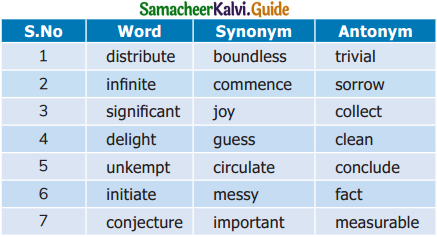
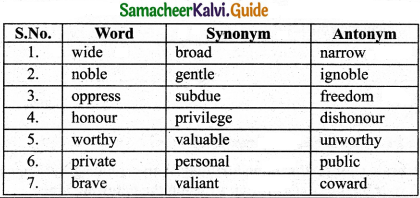
C. Match the words with correct synonym and Antonym from the table.
Samacheer Kalvi 9th English Guide Prose Chapter 7 A Birthday Letter img 1a
Answer:

Think and answer:

Question 1.
What is the difference between an opinion and a fact?
Answer:

  • An opinion is one’s feelings or thoughts about somebody.
  • A fact is a piece of information that can be proved to be true.

D. Identify, whether the following statements are of OPINION or FACT.

Question 1.
On your birthday you have been in the habit of receiving presents and good wishes.
Answer:
Fact

Question 2.
I have liked my talks with you.
Answer:
Fact

Samacheer Kalvi 9th English Guide Prose Chapter 7 A Birthday Letter

Question 3.
The best way to find what is wrong and right is by discussing.
Answer:
Fact

Question 4.
A letter can hardly take the place of a talk.
Answer:
Opinion

Samacheer Kalvi 9th English Guide Prose Chapter 7 A Birthday Letter

Question 5.
For the desire to hide anything means that you are afraid.
Answer:
Opinion

Listening:

E. Listen to the dialogue and answer the following questions.

Question 1.
Aadhav and Raghav are ……………..
(a) brothers
(b) friends
(c) colleagues
(d) classmates
Answer:
(a) brothers

Samacheer Kalvi 9th English Guide Prose Chapter 7 A Birthday Letter

Question 2.
The brothers are planning to celebrate their ………………….. wedding anniversary.
(a) uncle’s
(b) parents’
(c) grandparents’
(d) sister’s
Answer:
(b) parents’

Question 3.
The wedding anniversary is on ………………….
(a) March 2nd
(b) April 2nd
(c) May 2nd
(d) June 2nd
Answer:
(b) April 2nd

Samacheer Kalvi 9th English Guide Prose Chapter 7 A Birthday Letter

Question 4.
As part of the celebration, the brothers have planned to make their parents to …………………….
(a) visit an orphanage
(b) donate some money
(c) plant a mango sapling
(d) conduct a game
Answer:
(c) plant a mango sapling

Question 5.
State whether the statement is true or false.
Answer:
The brothers have decided to borrow money for the wedding anniversary celebration. – False

Reading:

F. Answer the following questions based on the given reading passage.

Question 1.
What is the name of her diary?
Answer:
The name is Anne Frank’s Diary Entry.

Samacheer Kalvi 9th English Guide Prose Chapter 7 A Birthday Letter

Question 2.
Why did Anne want to exchange the book ‘Camera Obscura’?
Answer:
Anne wanted to exchange the book Camera Obscura’ as her sister Margot already had it.

Question 3.
Who baked the homemade cookies?
Answer:
Anne Frank herself baked the homemade cookies.

Samacheer Kalvi 9th English Guide Prose Chapter 7 A Birthday Letter

Question 4.
What game did Anne choose to play?
Answer:
Anne chose volleyball to play.

Question 5.
Which gift did Anne value the most?
Answer:
Anne valued the gift from Kitty the most.

Speaking:

G. Imagine you are going to celebrate your forthcoming birthday at an orphanage/ old-age home. Deliver a short speech about your birthday celebration by using the following hints.

“Be brave and all the rest follows”.

Short Speech:
Respect Headmaster, teachers, and my dear friends. I would like to deliver a short speech about celebrating my birthday in an orphanage. It was really an interesting day, as it was my first time going to an orphanage. Since it was my birthday, I decided to do something different this year. I decided to celebrate my birthday at an orphanage. My parents were really happy with the idea.

As we entered the place, we were welcomed by a friendly old lady in a green saree. She took us to the room where the inmates were waiting for us. We entered the room and were welcomed by smiling faces. There were many children who were young to me and some of them were of my own age. They too were excited like me.

My parents asked me to cut the cake. I cut the cake. All sang the birthday chorus and greeted me. I gifted all of them with little presents which I had bought for them. They had prepared a handmade card for me. I was moved.

We sang and danced after that and even played games like musical chairs and passing the parcel. There was a girl named Angeline. She was the smallest of them all. She was only three years old. She was cute and chubby. I gave her a teddy bear which she hugged and thanked me.

Children of my age were very friendly, we talked about our favourite shows and hobbies. Some of them even showed their talents by playing the guitar and drums. The children seemed happy that they had such a nice time. It was indeed a nice day after all and I was really happy that I could spend some time pleasantly with such wonderful children whom God loves so much.

Thank you one and all.

Writing:

H. Write a meaningful paragraph using the hints given below.

Mahesh – celebrates – 14th birthday – an old-age home – family, friends – informs home in advance – delegates tasks – friends buy things necessary – arrives home early – decorates place – balloons, colour papers – inmates gathered – cuts cake – sing-song, claps – distributes cakes – expresses his feelings – gets blessings – offers things – bedsheets, footwear, etc. needed – fun, entertainment – happy and content.

Birthday Celebration:

There was a boy named Mahesh. He wanted to celebrate his birthday at an old home. It was his 14th birthday. His parents agreed with his suggestion. Mahesh informed his friends and relatives well in advance. He delegated various tasks to his friends. His friends became active and they bought all the necessary things.

On that day they arrived at the home early. They decorated with balloons and colour papers. Mahesh came there with his parents. Mahesh cut his birthday cake amidst grand applause. There were singing and clapping.

Mahesh expressed his joyful feelings. He gave the cakes to all. He offered the aged people bedsheets, footwear, etc. He got the blessings from the old people at home. There were enough fun and entertainment at the function. The inmates thanked Mahesh for his kindness and goodwill. All were happy and contented.

Grammar:

A. Choose the correct determiner.

  1. Could you bring me …………………. tools I left in the garden? (this, those, these)
  2. ……………….. Earth revolves around the sun. (the, a, an)
  3. I found …………………… one rupee coin in the playground while playing, (a, an, the)
  4. There aren’t ………………… students in the library, (much, many, a lot)
  5. It was ……………………. unforgettable experience, (a, an, the)
  6. I haven’t got ………………….. pictures in my bedroom, (some, any, many)
  7. He said that he wanted to become ………………….. engineer, (a, an, the)
  8. Kokila gave a pen to …………………….. child in the classroom on her birthday, (any, all, each)
  9. I’ve got to solve ………………….. maths problems before I go to sleep, (all, some, any)
  10. India is …………………. largest democracy in the world, (a, an, the)
  11. My father doesn’t drink …………………… coffee, (much, many, a lot)
  12. I always keep ………………….. money in my wallet for emergencies, (any, every, some)
  13. This year we are celebrating my sister’s ……………………. birthday, (a, two, second)
  14. I have ………………….. pencils with me. (a, three, third)
  15. ‘What is that noise?’ I think it is ………………….. airplane, (a, an, the)

Answers:

  1. those
  2. the
  3. a
  4. many
  5. an
  6. any
  7. an
  8. each
  9. some
  10. the
  11. much
  12. some
  13. second
  14. three
  15. an

Reported speech. (Indirect speech). Conversion of direct speech into indirect speech.

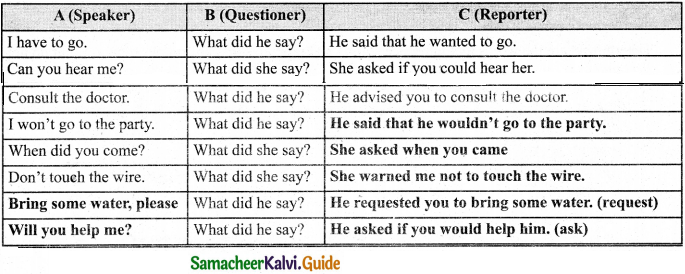
B. Observe the following call-outs. Reporter (C) has reported the sentences of Speaker (A). Now, help Reporter (C) report the rest of the sentences of Speaker(A).

C. Report the following sentences.

Question 1.
Banu said, “Do not spoil the eco-system.” Banu advised not to spoil the ecosystem.
Answer:
Banu advised if he had booked the tickets to Delhi.

Samacheer Kalvi 9th English Guide Prose Chapter 7 A Birthday Letter

Question 2.
Pranav said, “Have you booked the tickets to Delhi?”
Answer:
Pranav asked if he had booked the tickets to Delhi.

Question 3.
Rekha said to Tilak, “When are we leaving to our native?”
Answer:
Rekha asked Tilak when they were leaving to their native.

Samacheer Kalvi 9th English Guide Prose Chapter 7 A Birthday Letter

Question 4.
Sujith said, “Ryan, you should get up early in the morning.”
Answer:
Sujith told Ryan that he should get up early in the morning.

Question 5.
Vivaan said to his mother, “Can you, please, buy me a hot chocolate?”
Answer:
Vivaan requested his mother if she could buy him a hot chocolate.

Samacheer Kalvi 9th English Guide Prose Chapter 7 A Birthday Letter

Question 6.
“Tomorrow 1 have to take a test in English”, said Sudar.
Answer:
Sudar said that he had to take a test in English the next day.

Question 7.
Pragathi said to her sister, “I need your help to arrange the books in the shelf.” Pragathi told her sister that she needed her help to arrange the book in the shelf?
Answer:
Pragathi told her sister that she needed her help to arrange the book in the self.

Samacheer Kalvi 9th English Guide Prose Chapter 7 A Birthday Letter

Question 8.
“Why don’t you use crayons for colouring?” said Philip to his son.
Answer:
Philip asked his son why he didn’t use crayons for colouring.

Samacheer Kalvi 8th Maths Guide Chapter 7 Information processing Ex 7.3

Tamilnadu State Board New Syllabus Samacheer Kalvi 8th Maths Guide Pdf Chapter 7 Information processing Ex 7.3 Text Book Back Questions and Answers, Notes.

Tamilnadu Samacheer Kalvi 8th Maths Solutions Chapter 7 Information processing Ex 7.3

Question 1.
Fill in the blanks (Use Atbash Cipher that is given in code 3)
Hint:
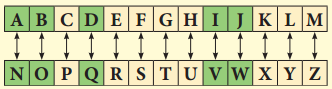
For this question, we need to use Atbash cipher. For Atbash cipher, first we write the alphabets from A to Z and then in reverse from Z to A below that.
A B C D E F G H I J K L M N O P Q R S T U V W X Y Z
Z Y X W V U T S R Q P O N M L K J I H G F E D C B A

Samacheer Kalvi 8th Maths Guide Chapter 7 Information processing Ex 7.3

(i) G Z N R O = _________
Answer:
TAMIL
Hint:
Now to solve, we look up the corresponding letter from the table to replace in code to get the actual word.
So, for G Z N R O, from table,
for G, it is T
for Z, it i sA
for N, it is M
for R, it is i
for 0, it is L
So, the actual word is TAMIL

(ii) V M T O R H S = ________
Answer:
ENGLISH

Hint:
VMTORHS
To solve, we look up the corresponding letter from table to replace in code to get the actual word.
For V, it is E
for M, it is N
for T, it is G
for O, it is L
for R, it is I,
for H, it is S
for S, it is H
Therefore we get E N G L I S H = ENGLISH

Samacheer Kalvi 8th Maths Guide Chapter 7 Information processing Ex 7.3

(iii) N Z G S V N Z G R X H _________
Answer:
MATHEMATICS
Hint:
Similarly as above for
Samacheer Kalvi 8th Maths Guide Answers Chapter 7 Information Processing Ex 7.3 1

(iv) H X R V M X V __________
Answer:
SCIENCE
Hint:
For
Samacheer Kalvi 8th Maths Guide Answers Chapter 7 Information Processing Ex 7.3 2

(v) H L X R Z O H X R V M X V = __________
Answer:
SOCIAL SCIENCE
Hint:
Samacheer Kalvi 8th Maths Guide Answers Chapter 7 Information Processing Ex 7.3 3

Samacheer Kalvi 8th Maths Guide Chapter 7 Information processing Ex 7.3

Question 2.
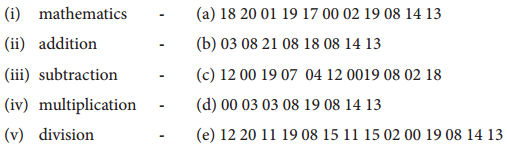
Match the following (a = 00 ………… Z = 25).
Samacheer Kalvi 8th Maths Guide Answers Chapter 7 Information Processing Ex 7.3 4
Answer:
(i) – c
(ii) – d
(iii) – a
(iv) – e
(v) – b
Hint:
(i) Mathematics is
Samacheer Kalvi 8th Maths Guide Answers Chapter 7 Information Processing Ex 7.3 5
So matching option is c

(ii) addition is
Samacheer Kalvi 8th Maths Guide Answers Chapter 7 Information Processing Ex 7.3 6
Matching option is d

Samacheer Kalvi 8th Maths Guide Chapter 7 Information processing Ex 7.3

(iii) Subtraction is
Samacheer Kalvi 8th Maths Guide Answers Chapter 7 Information Processing Ex 7.3 7
multiplication is a

(iv) multiplication is
Samacheer Kalvi 8th Maths Guide Answers Chapter 7 Information Processing Ex 7.3 8
Matching option is e
however instead of 25, it should be 08

(v) division is
Samacheer Kalvi 8th Maths Guide Answers Chapter 7 Information Processing Ex 7.3 9
Matching option is b

Question 3.
Frame Additive cipher table (key = 4).
Answer:
Step 1 : write all alphabets
Step 2 : Assign numbers to each alphabet starting from 00 till 25.
Step 3 : add key value (here it is 4) to the numbers assigned in step 2 to form cipher table
Samacheer Kalvi 8th Maths Guide Answers Chapter 7 Information Processing Ex 7.3 10

Samacheer Kalvi 8th Maths Guide Chapter 7 Information processing Ex 7.3

Question 4.
A message like “Good Morning” written in reverse would instead be “Doog Gninrom” In the same way decode the sentence given below:
“Ot dnatsrednu taht scitamehtam nac eb decneirepxe erehwreve ni erutan dna laer efil”
Answer:
Given that good morning written in reverse is doog gninrom.
We have to decode the below by reversing, so,
Ot dnatsrednu taht scitamehtam nac eh decneirepxe erehwreve ni erutan dna laer efil.

Ans: to understand that mathematics can be experienced everywhere in nature and real life.

Question 5.
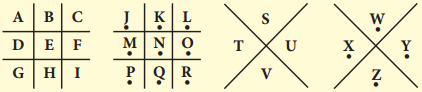
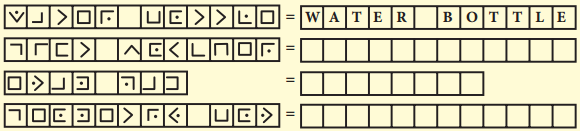
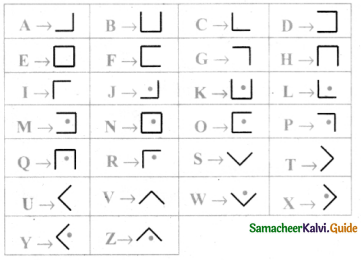
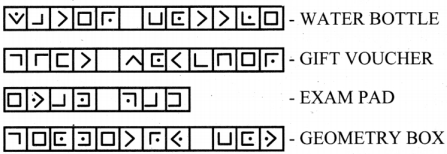
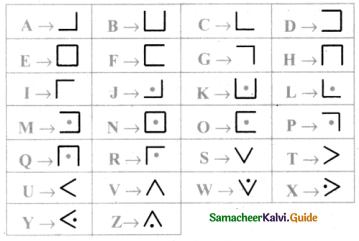
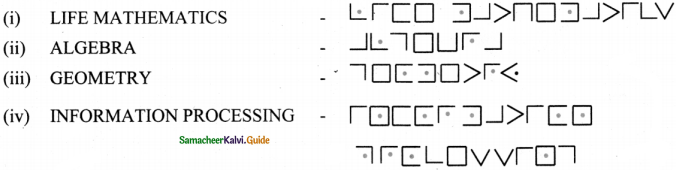
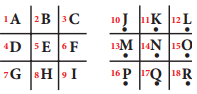
Decode the given Pigpen Cipher text and compare your answer to get result.

Samacheer Kalvi 8th Maths Guide Answers Chapter 7 Information Processing Ex 7.3 12
I. The room number in which the treasure took place

Answer:
The room in which the treasure took place = 28

II. Place of the treasure

Answer:
The place of treasure = Chair

III. The name of the treasure
Samacheer Kalvi 8th Maths Guide Answers Chapter 7 Information Processing Ex 7.3 15
Answer:
Identity of treasure = Gift voucher.

Samacheer Kalvi 8th Maths Guide Chapter 7 Information processing Ex 7.3

Question 6.
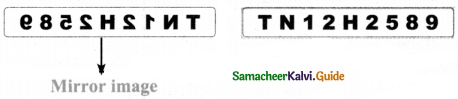
Praveen recently got the registration number for his new two-wheeler. Here, the number is given in the form of mirror-image. Encode the image and find the correct registration number of praveen’s two-wheeler.
T N 1 2 H 2 5 8 9
(a)
Samacheer Kalvi 8th Maths Guide Answers Chapter 7 Information Processing Ex 7.3 16
(b)
Samacheer Kalvi 8th Maths Guide Answers Chapter 7 Information Processing Ex 7.3 17
(c)
Samacheer Kalvi 8th Maths Guide Answers Chapter 7 Information Processing Ex 7.3 18
(d)
Samacheer Kalvi 8th Maths Guide Answers Chapter 7 Information Processing Ex 7.3 19
Answer:
The mirror image is
Samacheer Kalvi 8th Maths Guide Answers Chapter 7 Information Processing Ex 7.3 18
When we place an imaginary mirror & visualize the image seen in the mirror, we will get the below.
Samacheer Kalvi 8th Maths Guide Answers Chapter 7 Information Processing Ex 7.3 20
∴ The answer option c

Samacheer Kalvi 8th Maths Guide Chapter 7 Information processing Ex 7.3

Objective Type Questions

Question 7.
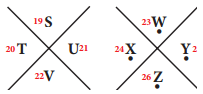
In questions (i) and (ii), there are four groups of letters in each set. Three of these sets are alike in some way while one is different. Find the one which is different.
(i).(A) C R D T
(B) A P B Q
(C) E U F V
(D) G W H X
Answer:
(i) (A) C R D T
Hint:
The four groups of letters are
CRDT APBQ EUFV GWHX
The above can be written as
Samacheer Kalvi 8th Maths Guide Answers Chapter 7 Information Processing Ex 7.3 21
We find that when we take 1st & 3rd letter & 2nd & 4th letter as 2 pairs, the 3 letter is the next letter alphabetically to the 1st letter.
Similarly the 4th letter is alphabetically the next letter of the 2nd letter.
i.e CD, AB, EF, GH & PQ, UV, WX
Only in CRDT, we have T instead of ‘S’
So, Ans: in CRDT ⇒ Option (a)

Samacheer Kalvi 8th Maths Guide Chapter 7 Information processing Ex 7.3

(ii). (A) H K N Q
(B) I L O R
(C) J M P S
(D) A D G J
Answer:
(D) A D G J
Hint:
The four groups of letters are
HKNQ ILOR IMPS ADGI
If we notice, we find that 2 letters are missing in the sequence. le.
HIJ KLI NOP Q
IJK LMN OPQ R
JKL MNO PQR S
ABC DEF GH I
We find that only in ADGI, the difference is only one letter between G & I.
Hence it is the odd one out.

Samacheer Kalvi 8th Maths Guide Chapter 7 Information processing Ex 7.3

Question 8.
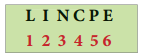
A group of letters are given. A numerical code has been given to each letter. These letters have to be unscrambled into a meaningful word. Find out the code for the word so formed from the 4 answers given.
Samacheer Kalvi 8th Maths Guide Answers Chapter 7 Information Processing Ex 7.3 22
(A) 2 3 4 1 5 6
(B) 5 6 3 4 2 1
(C) 6 1 3 5 2 4
(D) 4 2 1 3 5 6
Answer:
(B) 5 6 3 4 2 1

Hint:
Given code is
Samacheer Kalvi 8th Maths Guide Answers Chapter 7 Information Processing Ex 7.3 22
Option (a) is 234156. When we substitute number for each letter from code, we get,
Samacheer Kalvi 8th Maths Guide Answers Chapter 7 Information Processing Ex 7.3 23

Option (b) is 563421, similarly, we get
Samacheer Kalvi 8th Maths Guide Answers Chapter 7 Information Processing Ex 7.3 24

Option (c) is
Samacheer Kalvi 8th Maths Guide Answers Chapter 7 Information Processing Ex 7.3 25

Option d) is
Samacheer Kalvi 8th Maths Guide Answers Chapter 7 Information Processing Ex 7.3 26

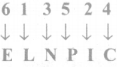
So, only in option b, we get a meaningful word, i.e PENCIL.
Hence, answer is Option b.

Samacheer Kalvi 8th Maths Guide Chapter 7 Information processing Ex 7.3

Question 9.
Questions (iii) and (iv) are based on code language. Find the correct answer from the four alternatives given.
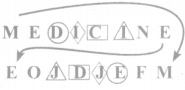
(iii)Inacertain code, ‘M E D I C I N E’ is coded as ‘E O J D J E F M’,then how is ‘C O M P U T E R’ written in the same code?
(A) C N P R V U F Q
(B) C M N Q T U D R
(C) R F I J V Q N P C
(D) R N V F T U D Q
Answer:
(C) R F I J V Q N P C
Hint:
lt is given that in a certain code MEDlClNE is coded as E O J D J E F M
When we observe the word & the code, we find that, there is a pattern.
Samacheer Kalvi 8th Maths Guide Answers Chapter 7 Information Processing Ex 7.3 27
[to understand, see the matching shapes]
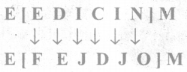
To get the code from the word, we follow the below steps

1.
Samacheer Kalvi 8th Maths Guide Answers Chapter 7 Information Processing Ex 7.3 28
E [E D I C I N] M

2. For the middle letters, replace the letters with their alphabetically next letters, so we get
Samacheer Kalvi 8th Maths Guide Answers Chapter 7 Information Processing Ex 7.3 29

3. Now we have to reverse the order of the middle letters in the bracket, so we get
E [O J D J E F] M = E O J D J E F M
Thus we get the code
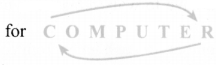
So similarly, we have to follow the 3 steps to get code, therefore:
Samacheer Kalvi 8th Maths Guide Answers Chapter 7 Information Processing Ex 7.3 30
Step 1: Swap 1st & last letters, so we get
R [O M P U T E] C

Step 2: For the middle letters, replace the letters with alphabetically next letters, so we get
R [P N Q V L F] C

Step 3: Reverse the word of letters in the bracket to we get
R [F U V Q N P] C
∴ Ans is R F U V Q N P C ⇒ option c

Samacheer Kalvi 8th Maths Guide Chapter 7 Information processing Ex 7.3

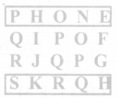
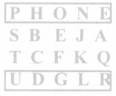
(iv) lf the word ’P H O N E’ is coded as ’S K R Q H’, how will ’R A D I O’ be coded?
(A) S C G N H
(B) V R G N G
(C) U D G L R
(D) S D H K Q
Answer:
(C) U D G L R
Hint:
If PHONE is coded as S K R Q H
Find that code for R A D I O

We find that we get the code, by 3 letter alphabetically so. from P. skipping Q & R. we get S
Samacheer Kalvi 8th Maths Guide Answers Chapter 7 Information Processing Ex 7.3 31
Similarly, from H, skipping I & J, we get K
Like wise for R A D I O. skipping the 2 alphabets,
From R skip S & T → U
From A skip B & C → D
From D skip E & F → G
From l skip J & K → L
From O skip P & Q → R
Samacheer Kalvi 8th Maths Guide Answers Chapter 7 Information Processing Ex 7.3 32
∴ Ans is UDGLR ⇒ option c

Samacheer Kalvi 8th Maths Guide Chapter 7 Information processing Ex 7.2

Tamilnadu State Board New Syllabus Samacheer Kalvi 8th Maths Guide Pdf Chapter 7 Information processing Ex 7.2 Text Book Back Questions and Answers, Notes.

Tamilnadu Samacheer Kalvi 8th Maths Solutions Chapter 7 Information processing Ex 7.2

Question 1.
Using repeated division method, find the HCF of the following:
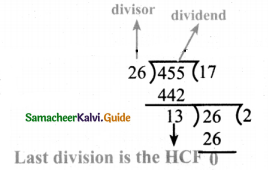
(i) 455 and 26
Answer:
Samacheer Kalvi 8th Maths Guide Answers Chapter 7 Information Processing Ex 7.2 1
Step 1: The larger number should be dividend 455 & smaller number should be divisor = 26
Step 2: After 1st division, the remainder becomes new divisor & the previous divisor becomes next dividend.
Step 3: This is done till remainder is zero.
Step 4: The last divisor is the HCF L.
∴ Ans: HCF is 13.

Samacheer Kalvi 8th Maths Guide Chapter 7 Information processing Ex 7.2

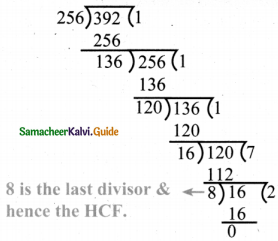
(ii) 392 and 256
Answer:
256 is smaller, so it is the 1st divisor
Samacheer Kalvi 8th Maths Guide Answers Chapter 7 Information Processing Ex 7.2 2
∴ HCF = 8

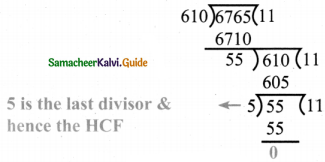
(iii) 6765 and 610
Answer:
Samacheer Kalvi 8th Maths Guide Answers Chapter 7 Information Processing Ex 7.2 3
∴ HCF = 5

Samacheer Kalvi 8th Maths Guide Chapter 7 Information processing Ex 7.2

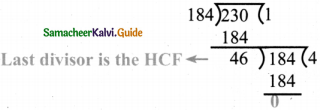
(iv) 184, 230 and 276
Answer:
First let us take 184 & 230
Samacheer Kalvi 8th Maths Guide Answers Chapter 7 Information Processing Ex 7.2 4
∴ 46 is the HCF of 184 and 230
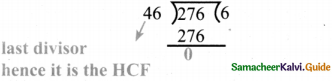
Now the HCF of the first two numbers is the dividend for the third number.
Samacheer Kalvi 8th Maths Guide Answers Chapter 7 Information Processing Ex 7.2 5
∴ Ans: HCF of 184, 230 & 276 is 46

Question 2.
Using repeated subtraction method, find the HCF of the following:
(i) 42 and 70
Answer:
Let number be m & n m > n
We do, m – n & the result of subtraction becomes new ‘m’. if m becomes less than n,
we do n – m and then assign the result as n. We should do this till m n. When m = n then ‘m’ is the HCF.
42 and 70
m = 70 n = 42
70 – 42 = 28

now m = 42, n = 28
42 – 28 = 14.

now m = 28, n = 14
28 – 14 = 14.

now m = 14. n = 14;
we stop here as m = n
∴ HCF of 42 & 70 is 14

Samacheer Kalvi 8th Maths Guide Chapter 7 Information processing Ex 7.2

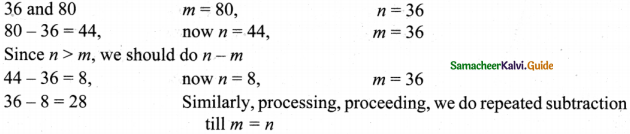
(ii) 36 and 80
Answer:
Samacheer Kalvi 8th Maths Guide Answers Chapter 7 Information Processing Ex 7.2 8
28 – 8 = 20
20 – 8 = 12
12 – 8 = 4
8 = 4 = 4
now m = n = 4
∴ HCF is 4

(iii) 280 and 420
Answer:
Let m = 420, n = 280
m – n = 420 – 280 = 140
now m = 280, n = 140
m – n = 280 – 140 = 140
now m = n = 140
∴ HCF is 140

Samacheer Kalvi 8th Maths Guide Chapter 7 Information processing Ex 7.2

(iv) 1014 and 654
Answer:
Let m = 1014, n = 654
m – n = 1014 – 654 = 360
now m = 654, n = 360
m – n = 654 – 360 = 294
now m = 360, n = 294
m – n = 360 – 294 = 66
now m = 294 n = 66
m – n = 294 – 66 = 228
now m = 66, n = 228
n – m = 228 – 66 = 162
now m = 162, n = 66
= 162 – 66 = 96
n – m = 96 – 66 = 30
Similarly, 66 – 30 = 36
36 – 30 = 6
30 – 6 = 24
24 – 6 = 18
18 – 6 = 12
12 – 6 = 6 now m = n
∴ HCF of 1014 and 654 is 6

Samacheer Kalvi 8th Maths Guide Chapter 7 Information processing Ex 7.2

Question 3.
Do the given problems by repeated subtraction method and verify the result.
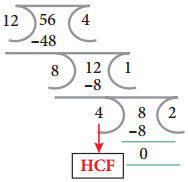
(i) 56 and 12
Samacheer Kalvi 8th Maths Guide Answers Chapter 7 Information Processing Ex 7.2 9
Answer:
Let n = 56 & n = 12
m – n = 56 – 12 = 44
now m = 44, n = 12
m – n = 44 – 12 = 32
m – n = 32 – 12 = 20
m – n = 20 – 12 = 8
n – m = 12 – 84
m – n = 8 – 4 = 4. now m = n
∴ HCF of 56 & 12 is 4

Samacheer Kalvi 8th Maths Guide Chapter 7 Information processing Ex 7.2

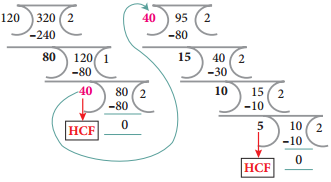
(ii) 320, 120 and 95
Samacheer Kalvi 8th Maths Guide Answers Chapter 7 Information Processing Ex 7.2 10
Answer:
Let us take 320 & 120 first m = 320, n = 120
m – n = 320 – 120 = 200
m = 200, n = 120
∴ m – n = 200 – 120 = 80
120 – 80 = 40
80 – 40 = 40
∴ m = n = 40 → HCF of 320, 120
Now let us find HCF of 40 & 95
m = 95, n = 40
∴ m – n = 95 – 40 = 55
55 – 40 = 15
40 – 15 = 25
25 – 15 = 10
15 – 10 = 5
HCF of 40 & 95 is 5
10 – 5 = 5
∴ HCF of 320 120 & 95 is 5

Samacheer Kalvi 8th Maths Guide Chapter 7 Information processing Ex 7.2

Question 4.
Kalai wants to cut identical squares as big as she can, from a piece of paper measuring 168mm and by 196mm. What is the length of the side of the biggest square? (To find HCF using repeated subtraction method)
Answer:
Sides are 168 & 196
To find HCF of 168 & 196, we are to use repeated subtraction method.
∴ m = 196, n = 168
m – n = 196 – 168 = 28

now n = 28, m = 168
m – n = 168 – 28 = 140

now m = 140, n = 28
m – n = 140 – 28 = 112

now m = 112, n = 28
m – n = 112 – 28 = 84

now m = 84, n = 28
m – n = 84 – 28 = 56

now m = 56, n = 28
m – n = 56 – 28 = 28
∴ HCF is 28
∴ Length of biggest square is 28

Samacheer Kalvi 8th Maths Guide Chapter 7 Information processing Ex 7.2

Objective Type Questions

Question 5.
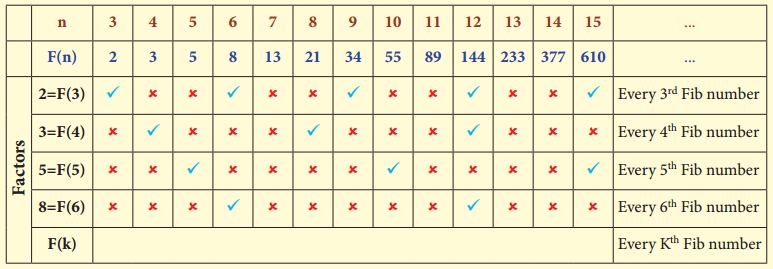
What is the eleventh Fibonacci number?
(a) 55
(b) 77
(c) 89
(d) 144
Answer:
(c) 89
Hint:
Samacheer Kalvi 8th Maths Guide Answers Chapter 7 Information Processing Ex 7.2 11
∴ 11th Fibonacci number is 89

Question 6.
If F(n) is a Fibonacci number and n = 8, which of the following is true?
(a) F(8) = F(9) + F( 10)
(b) F(8) = F(7) + F(6)
(c) F(8) = F(10) × F(9)
(d) F(8) = F(7) – F(6)
Answer:
(b) F(8) = F(7) + F(6)
Hint:
Given F(n) is a Fibonacci number & n = 8
∴ F(8) = F(7) + F (6) as any term in Fibonacci series is the sum of preceding 2 terms

Samacheer Kalvi 8th Maths Guide Chapter 7 Information processing Ex 7.2

Question 7.
Every 3rd number of the Fibonacci sequence is a multiple of_______
(a) 2
(b) 3
(c) 5
(d) 8
Answer:
(a) 2
Hint:
Every 3rd number in Fibonacci sequence is a multiple of 2

Question 8.
Every _____ number of the Fibonacci sequence is a multiple of 8
(a) 2th
(b) 4th
(c) 6th
(d) 8th
Answer:
(c) 6th

Samacheer Kalvi 8th Maths Guide Chapter 7 Information processing Ex 7.2

Question 9.
The difference between the 18th and 17th Fibonacci number is
(a) 233
(b) 377
(c) 610
(d) 987
Answer:
(d) 987
Hint:
F(18) = F(17) + F(16)
F(18) – F(17) = F(16) = F(15) + F(14)
= 610 + 377 = 987

Question 10.
Common prime factors of 30 and 250 are
(a) 2 × 5
(b) 3 × 5
(c) 2 × 3 × 5
(d) 5 × 5
Answer:
(a) 2 × 5
Prime factors of 30 are 2 × 3 × 5
Prime factors of 250 are 5 × 5 × 5 × 2
∴ Common prime factors are 2 × 5

Samacheer Kalvi 8th Maths Guide Chapter 7 Information processing Ex 7.2

Question 11.
Common prime factors of 36,60 and 72 are
(a) 2 × 2
(b) 2 × 3
(c) 3 × 3
(d) 3 × 2 × 2
Answer:
(d) 3 × 2 × 2
Hint:
Prime factors of 36 are 2 × 2 × 3 × 3
Prime factors of 60 are 2 × 2 × 3 × 5
Prime factors of 72 are 2 × 2 × 2 × 3 × 3
∴ Common prime factors are 2 × 2 × 3

Question 12.
Two numbers are said to be co-prime numbers if their HCF is
(a) 2
(b) 3
(c) 0
(d) 1
Answer:
(d) 11

Samacheer Kalvi 8th Maths Guide Chapter 7 Information processing Ex 7.1

Tamilnadu State Board New Syllabus Samacheer Kalvi 8th Maths Guide Pdf Chapter 7 Information processing Ex 7.1 Text Book Back Questions and Answers, Notes.

Tamilnadu Samacheer Kalvi 8th Maths Solutions Chapter 7 Information processing Ex 7.1

Question 1.
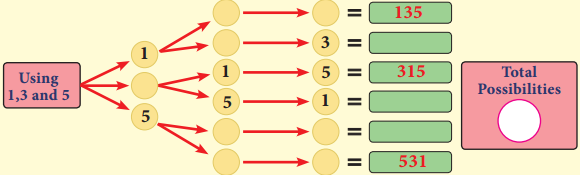
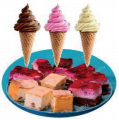
You want to have an ice cream or a cake. There are three flavours (chocolate, strawberry and vanilla) in ice creams, and two flavours (orange and red velvet) in the cakes. In how many possible ways can you choose an ice cream or a cake?
Samacheer Kalvi 8th Maths Guide Answers Chapter 7 Information Processing Ex 7.1 1
Answer:
We are going to have either a ice cream or a cake.
Ice cream can be selected from 3 flavors and cake from two flavors. Both the events cannot
occur simultaneously selecting ice cream and cake.
∴ Number of possible ways = 3 + 2
= 5 ways

Samacheer Kalvi 8th Maths Guide Chapter 7 Information processing Ex 7.1

Question 2.
Shanthi has 5 chudithar sets and 4 frocks. In how many possible ways, can she wear either a chudithar or a frock?
Answer:
Shanthi her 5 chudidhar sets and 4 frocks.
She wear either chudidhar or a frock.
∴ Total possible ways = 5 + 4 = 9 ways

Question 3.
In a Higher Secondary School, the following groups are available in XI standard
I. Science Group:
(i) Physics, Chemistry, Biology and Mathematics
(ii) Physics, Chemistry, Mathematics and Computer Science.
(iii) Physics, Chemistry, Biology and Home Science

Il. Arts Group:
(i) Accountancy, Commerce, Economics and Business Maths
(ii) Accountancy, Commerce, Economics and Computer Science
(iii) History, Geography, Economics and Commerce

III. Vocational Group:
(i) Biology, Nursing Theory, Nursing Practical I and Nursing Practical II
(ii) Home Science, Textiles and Dress Designing Theory, Textiles and Dress
Designing Practical I and Textiles and Dress Designing Practical Il
In how many possible ways, can a student choose a group?
Answer:
The student either select any one of science group in 3 ways or any of the arts group in 3
ways or any of the vocational group in 2 ways.
∴ Total possible ways = 3 + 3 + 2 = 8 ways

Samacheer Kalvi 8th Maths Guide Chapter 7 Information processing Ex 7.1

Question 4.
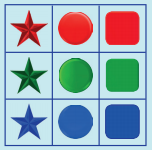
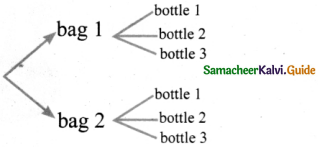
If you have 2 school bags and 3 water bottles then, in how many different ways can you choose each one of them, while going to school?
Answer:
We can select one school bag from 2 and one bottle from 3 as follows.
Samacheer Kalvi 8th Maths Guide Answers Chapter 7 Information Processing Ex 7.1 2
∴ A bag and a water bottle can be selected in 2 × 3 = 6 ways.

Question 5.
Roll numbers are created with a letter followed by 3 digits in it, from the letters A, B, C, D and E and any 3 digits from 0 to 9. In how many possible ways can the roll numbers be generated? (except A000, B000, C000, D000 and E000)
Answer:
We have a letter followed by 3 digits in the roll number.
The letter is selected from the five letters A, B, C, D, E.
For these 5 letters we have to select a 3 digit number using the digits O to 9.
Ones place can be formed using any one of the 10 number 0 to 9 in 10 ways.
Tens place can be formed in I O ways.
∴ A two digit number can be formed in 10 × 10 = 100 ways.
Thousands place can be formed in lo ways
∴ A 3 digit number can be formed in 10 × 10 × 10 = 1000 ways.
∴ 5 letters can be attached in 5 × 1000 = 5000 ways.
∴ The roll number can be formed in 5000 – 5 = 4995 ways.

Samacheer Kalvi 8th Maths Guide Chapter 7 Information processing Ex 7.1

Question 6.
A safety locker in a jewel shop requires a 4 digit unique code. The code has the digits from 0 to 9. How many unique codes are possible?
Samacheer Kalvi 8th Maths Guide Answers Chapter 7 Information Processing Ex 7.1 3
Answer:
The unique code has 4 digits.
Each digit is formed using any of the 10 numbers from 0 to 9.
∴ Single digit number can be formed in 10 ways.
A double digit number can be formed in 10 × 10 ways.
A three digit number can be formed in 10 × 10 × 10 ways.
A four digit number can be formed in 10 × 10 × 10 × 10 ways. = 10,000 ways

Samacheer Kalvi 8th Maths Guide Chapter 7 Information processing Ex 7.1

Question 7.
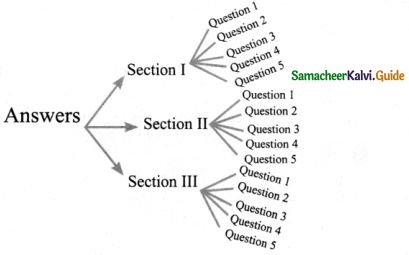
An examination paper has 3 sections, each with five questions and students are instructed to answer one question from each section. In how many different ways of can the questions be answered?
Answer:
The tree diagram for this may be
Samacheer Kalvi 8th Maths Guide Answers Chapter 7 Information Processing Ex 7.1 4
∴ Number of possible ways to select one questions from each of 3 sections is 3 × 5 = 15 ways

Samacheer Kalvi 8th Maths Guide Chapter 7 Information processing Ex 7.1

Question 8.
The given spinner is spun twice and the two numbers got are used to form a 2 digit number. How many different 2 digits numbers are possible?
Samacheer Kalvi 8th Maths Guide Answers Chapter 7 Information Processing Ex 7.1 5
Answer:
On the first spin we get any of the five numbers to form ones place then insecond spin the number got will fill 10’s place.
∴ Number of ways = 5 × 5 = 25 ways.
Removing the repetitions (11, 22, 33, 44, 55) once we get 25 – 5 = 20 ways.
20 different two digit numbers are possible

Question 9.
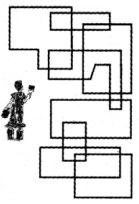
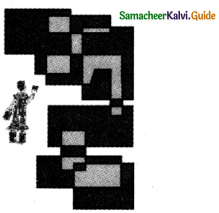
Ramya wants to paint a pattern in her living room wall with minimum budget. Help her to colour the pattern with 2 colours but make sure that no two q adjacent boxes are the same colour. The pattern is shown in the picture.
Samacheer Kalvi 8th Maths Guide Answers Chapter 7 Information Processing Ex 7.1 6
Answer:
Samacheer Kalvi 8th Maths Guide Answers Chapter 7 Information Processing Ex 7.1 7

Samacheer Kalvi 8th Maths Guide Chapter 7 Information processing Ex 7.1

Question 10.
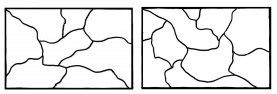
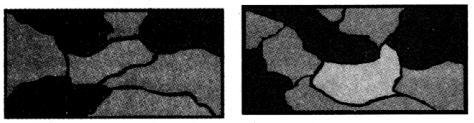
Colour the regions in the maps with few colours as possible but make sure that no two adjacent countries are of the same colour.
Samacheer Kalvi 8th Maths Guide Answers Chapter 7 Information Processing Ex 7.1 8
Answer:
Samacheer Kalvi 8th Maths Guide Answers Chapter 7 Information Processing Ex 7.1 9

Objective Type Questions

Question 11.
In a class there are 26 boys and 15 girls. The teacher wants to select a boy or a girl to represent a quiz competition. In how many ways can the teacher make this selection?
(A) 41
(B) 26
(C) 15
(D) 390
Answer:
41

Question 12.
How many outcomes can you get when you toss three coins once?
(A) 6
(B) 8
(C) 3
(D) 2
Answer:
8

Samacheer Kalvi 8th Maths Guide Chapter 7 Information processing Ex 7.1

Question 13.
In how many ways can you answer 3 multiple choice questions, with the choices A,B,C and D?
(A) 4
(B) 3
(C) 12
(D) 64
Answer:
64

Question 14.
How many 2 digit numbers contain the number 7?
(A) 10
(B) 18
(C) 19
(D) 20
Answer:
18

Samacheer Kalvi 8th Maths Guide Chapter 6 Statistics InText Questions

Tamilnadu State Board New Syllabus Samacheer Kalvi 8th Maths Guide Pdf Chapter 6 Statistics InText Questions Text Book Back Questions and Answers, Notes.

Tamilnadu Samacheer Kalvi 8th Maths Solutions Chapter 6 Statistics InText Questions

Try These (Text Book page No. 212)

Question 1.
Arrange the given data in ascending and descending order: 9, 34, 4, 13, 42, 10, 25, 7, 31, 4, 40
Answer:
Ascending order: 4, 4, 7, 9, 10, 13, 25, 31, 34, 40, 42.
Descending order: 42, 40, 34, 31, 25, 13, 10, 9, 7, 4, 4

Samacheer Kalvi 8th Maths Guide Chapter 6 Statistics InText Questions

Question 2.
Find the_range of the given data: 53, 42,61, 9, 39, 63, 14, 20,06, 26, 31, 4, 57
Answer:
Ascending order of the given data:
4, 6, 9, 14, 20, 26, 31, 39, 42, 53, 57, 61, 63
Here largest value = 63
Smallest value = 4
∴ Range = Largest value – smallest value
= 63 – 4 = 59

Try These (Text Book page No. 217)

Question 1.
Prepare a frequency table for the data:
3, 4, 2, 4, 5, 6, 1, 3, 2, 1, 5, 3, 6, 2, 1, 3, 2, 4
Answer:
Ascending order of the given data.
1, 1, 1, 2, 2, 2, 2, 3, 3, 3, 3, 4, 4, 4, 5, 5, 6, 6
The distribution table:

DataTally marksFrequency
1|||3
2||||4
3||||4
4|||3
5||2
6||2

∴ Frequency Table:
Samacheer Kalvi 8th Maths Guide Answers Chapter 6 Statistics InText Questions 1

Samacheer Kalvi 8th Maths Guide Chapter 6 Statistics InText Questions

Question 2.
Prepare a grouped frequency table for the data:
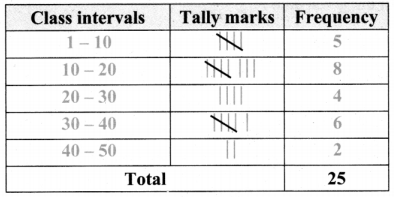
10, 9, 3, 29, 17, 34, 23, 20, 39, 42, 5, 12, 19, 47, 18, 19, 27, 7, 13, 40, 38, 24,34,15,40
Answer:
Largest value = 47
Smallest value = 3
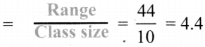
Range = Largest value – Smallest value
= 47 – 3 = 44
Suppose we take class size as 10, then Number of class intervals possible
Samacheer Kalvi 8th Maths Guide Answers Chapter 6 Statistics InText Questions 2
Apppbcnmxdfsmadnksa 5
Samacheer Kalvi 8th Maths Guide Answers Chapter 6 Statistics InText Questions 3

Samacheer Kalvi 8th Maths Guide Chapter 6 Statistics Ex 6.3

Tamilnadu State Board New Syllabus Samacheer Kalvi 8th Maths Guide Pdf Chapter 6 Statistics Ex 6.3 Text Book Back Questions and Answers, Notes.

Tamilnadu Samacheer Kalvi 8th Maths Solutions Chapter 6 Statistics Ex 6.3

Miscellaneous Practice Problems

Question 1.
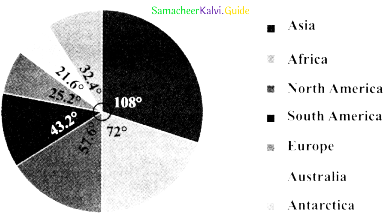
Draw a pie chart for the given table.
Samacheer Kalvi 8th Maths Guide Answers Chapter 6 Statistics Ex 6.3 1
Answer:
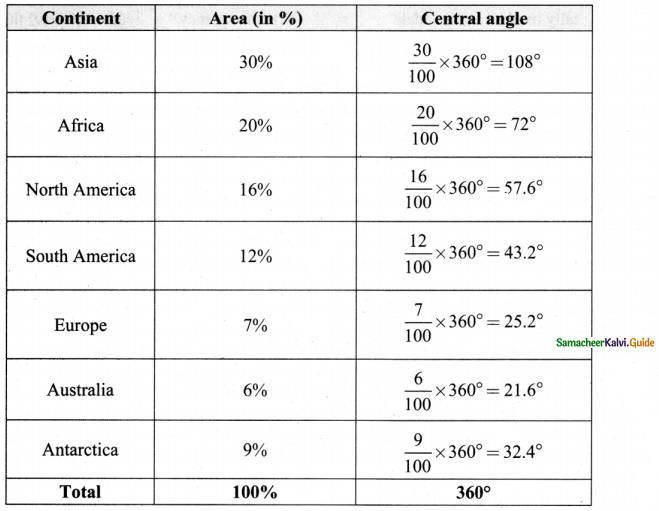
Converting the area in percentage into components parts of 360°. we have.
Samacheer Kalvi 8th Maths Guide Answers Chapter 6 Statistics Ex 6.3 2
Continental Area.
Samacheer Kalvi 8th Maths Guide Answers Chapter 6 Statistics Ex 6.3 3

Samacheer Kalvi 8th Maths Guide Chapter 6 Statistics Ex 6.3

Question 2.
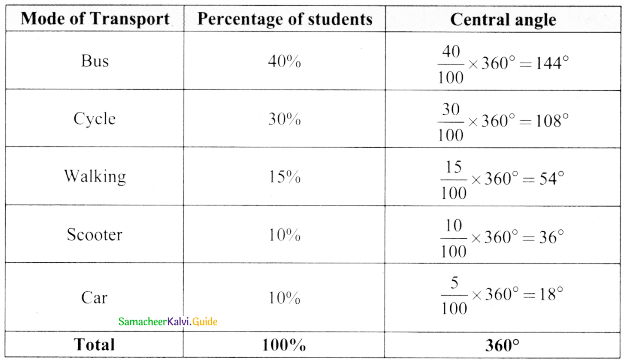
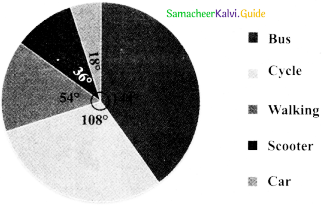
The data on modes of transport used by the students to come to school are given below. Draw a pie chart for the data.
Samacheer Kalvi 8th Maths Guide Answers Chapter 6 Statistics Ex 6.3 4
Answer:
Converting the percentage into components parts of 360°. we have
Samacheer Kalvi 8th Maths Guide Answers Chapter 6 Statistics Ex 6.3 5
Mode of Transport by students.
Samacheer Kalvi 8th Maths Guide Answers Chapter 6 Statistics Ex 6.3 6

Samacheer Kalvi 8th Maths Guide Chapter 6 Statistics Ex 6.3

Question 3.
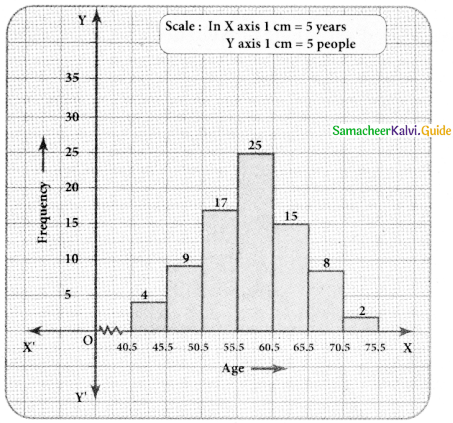
Draw a histogram for the given frequency distribution.
Samacheer Kalvi 8th Maths Guide Answers Chapter 6 Statistics Ex 6.3 7
Answer:
The given distribution is discontinuous.
Lower boundary = lower limit – \(\frac { 1 }{ 2 }\) (gap between the adjacent class interval)
= 41 – \(\frac { 1 }{ 2 }\)(1) = 40.5
Upper boundary = Upper limit + \(\frac { 1 }{ 2 }\) (gap between the adjacent class interval)
= 45 + \(\frac { 1 }{ 2 }\)(1) = 45.5
Now continuous frequency table is as below
Samacheer Kalvi 8th Maths Guide Answers Chapter 6 Statistics Ex 6.3 8
Samacheer Kalvi 8th Maths Guide Answers Chapter 6 Statistics Ex 6.3 9

Samacheer Kalvi 8th Maths Guide Chapter 6 Statistics Ex 6.3

Question 4.
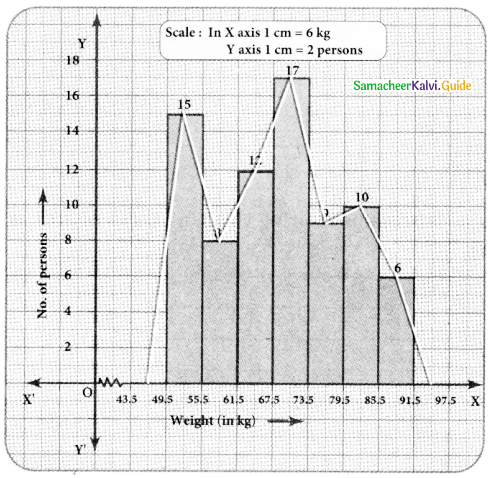
Draw a histogram and the frequency polygon in the same diagram to represent the following data.
Samacheer Kalvi 8th Maths Guide Answers Chapter 6 Statistics Ex 6.3 10
Answer:
The given distribution is discontinuous.
Lower boundary = lower limit – \(\frac { 1 }{ 2 }\) (gap between the adjacent class interval)
= 50 – \(\frac { 1 }{ 2 }\)(1) = 49.5
Upper boundary = Upper limit + \(\frac { 1 }{ 2 }\)(gap between the adjacent class interval)
= 55 + \(\frac { 1 }{ 2 }\)(1) = 55.5
∴ The continuous frequency table is as below.
Samacheer Kalvi 8th Maths Guide Answers Chapter 6 Statistics Ex 6.3 11
Samacheer Kalvi 8th Maths Guide Answers Chapter 6 Statistics Ex 6.3 12

Samacheer Kalvi 8th Maths Guide Chapter 6 Statistics Ex 6.3

Challenging problems

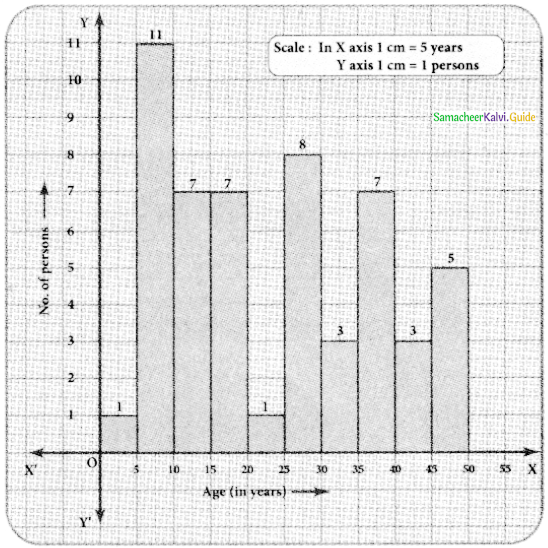
Question 5.
Form a continuous frequency distribution table and draw histogram from the following data.

Age (in years)No of persons
Under 51
Under 1012
Under 1519
Under 2026
Under 2527
Under 3035
Under 3538
Under 4045
Under 4548
Under 5053

Answer:
Converting into continuous distribution we have

Class intervalNo. of persons
0 – 51
5 – 1011
10 – 157
15 – 207
20 – 251
25 – 308
30 – 353
35 – 407
40 – 453
45 – 505
Total53

Samacheer Kalvi 8th Maths Guide Answers Chapter 6 Statistics Ex 6.3 13

Samacheer Kalvi 8th Maths Guide Chapter 6 Statistics Ex 6.3

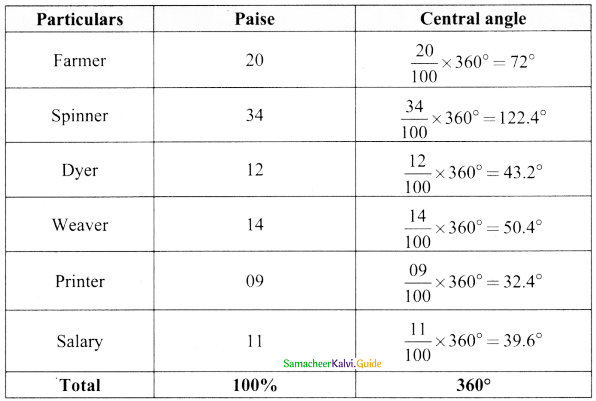
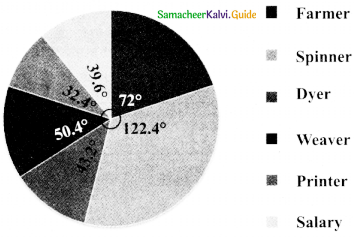
Question 6.
A rupee spent in a cloth manufacturing company is distributed as follows. Represent this in a pie chart.

ParticularsPaise
Farmer20
Spinner35
Dyer15
Weaver15
Printer05
Salary10

Answer:
1 Rupee = 100 paise.
Samacheer Kalvi 8th Maths Guide Answers Chapter 6 Statistics Ex 6.3 14
Expenditure of a cloth manufacturing company.
Samacheer Kalvi 8th Maths Guide Answers Chapter 6 Statistics Ex 6.3 15

Samacheer Kalvi 8th Maths Guide Chapter 6 Statistics Ex 6.3

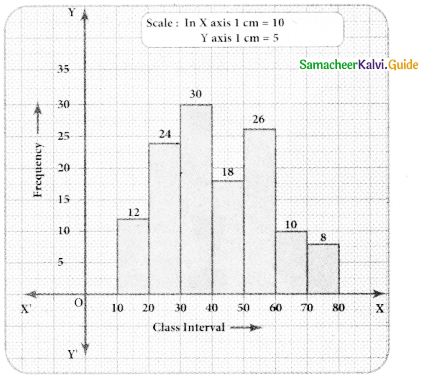
Question 7.
Draw a histogram for the following data.
Samacheer Kalvi 8th Maths Guide Answers Chapter 6 Statistics Ex 6.3 16
Answer:
Since mid values are given, the given distributors is discontinuous.
Lower boundary lower limit – \(\frac { 1 }{ 2 }\)(gap between the adjacent class interval)
= 15 – \(\frac { 1 }{ 2 }\)(10) = 10
Upper boundary = Upper limit + (gap between the adjacent class interval)
= 15 + \(\frac { 1 }{ 2 }\)(10) = 20
The continuous distribution will he as folIows.
Samacheer Kalvi 8th Maths Guide Answers Chapter 6 Statistics Ex 6.3 17
Samacheer Kalvi 8th Maths Guide Answers Chapter 6 Statistics Ex 6.3 18

Samacheer Kalvi 8th Maths Guide Chapter 6 Statistics Ex 6.2

Tamilnadu State Board New Syllabus Samacheer Kalvi 8th Maths Guide Pdf Chapter 6 Statistics Ex 6.2 Text Book Back Questions and Answers, Notes.

Tamilnadu Samacheer Kalvi 8th Maths Solutions Chapter 6 Statistics Ex 6.2

Question 1.
Which of the following data can be represented in a histogram?
(i) The number of mountain climbers in the age group 20 to 60 in TamilNadu.
Answer:
Yes

(ii) Production of cycles in different years.
Answer:
No

Samacheer Kalvi 8th Maths Guide Chapter 6 Statistics Ex 6.2

(iii) The number of students in each class of a school.
Answer:
No

(iv) The number votes polled from 7 am to 6 pm in an election.
Answer:
Yes

(v) The wickets fallen from 1 over to 50th over in a one day cricket match.
Answer:
Yes

Samacheer Kalvi 8th Maths Guide Chapter 6 Statistics Ex 6.2

Question 2.
Fill in the blanks:
(i) The total area of the histogram is _________ to the total frequency of the given data.
Answer:
proportional

(ii) A graph that displays data that changes continuously over the periods of time is _________ .
Answer:
Histogram

(iii) Histogram is a graphical representation of_________ data.
Answer:
grouped

Samacheer Kalvi 8th Maths Guide Chapter 6 Statistics Ex 6.2

Question 3.
In a village, there are 570 people who have cell phones. An NGO survey their cell phone usage. Based on this survey a histogram is drawn. Answer the following questions.
Samacheer Kalvi 8th Maths Guide Answers Chapter 6 Statistics Ex 6.2 1

(i) How many people use the cell phone for less than 3 hours?
Answer:
330 people (110 + 220)

(ii) How many of them use the cell phone for more than 5 hours?
Answer:
150 of them (100 + 50)

(iii) Are people using cell phone for less than 1 hour?
Answer:
No

Samacheer Kalvi 8th Maths Guide Chapter 6 Statistics Ex 6.2

Question 4.
Draw a histogram for the following data.
Samacheer Kalvi 8th Maths Guide Answers Chapter 6 Statistics Ex 6.2 2
Answer:
The given (tata IS continuous frequency distribution taking class intervals on X axis and No. of students on Y-axis, the histogram is given below.
Samacheer Kalvi 8th Maths Guide Answers Chapter 6 Statistics Ex 6.2 3

Samacheer Kalvi 8th Maths Guide Chapter 6 Statistics Ex 6.2

Question 5.
Construct a histogram from the following distribution of total marks of 40 students in a class.
Samacheer Kalvi 8th Maths Guide Answers Chapter 6 Statistics Ex 6.2 4
Answer:
The given distribution is continuous taking marks on X axis and No. of students on Y-axis the histogram is constructed.
Samacheer Kalvi 8th Maths Guide Answers Chapter 6 Statistics Ex 6.2 5

Samacheer Kalvi 8th Maths Guide Chapter 6 Statistics Ex 6.2

Question 6.
The distribution of heights (in cm ) of loo people is given below. Construct a histogram and the frequency polygon imposed on it.
Samacheer Kalvi 8th Maths Guide Answers Chapter 6 Statistics Ex 6.2 6
Answer:
The given distribution is discontinuous.
Converting into continuous distribution we have
Lower boundary = lower limit – \(\frac { 1 }{ 2 }\) (gap between adjacent class interval)
= 125 – \(\frac { 1 }{ 2 }\) (1) = 124.5
Upper boundary = Upper limit + \(\frac { 1 }{ 2 }\) (gap between the adjacent class interval)
= 135 + \(\frac { 1 }{ 2 }\) = 135.5
∴ The new frequency table is
Samacheer Kalvi 8th Maths Guide Answers Chapter 6 Statistics Ex 6.2 7
Samacheer Kalvi 8th Maths Guide Answers Chapter 6 Statistics Ex 6.2 8

Samacheer Kalvi 8th Maths Guide Chapter 6 Statistics Ex 6.2

Question 7.
In a study of dental problem, the following data were obtained.
Samacheer Kalvi 8th Maths Guide Answers Chapter 6 Statistics Ex 6.2 9
Represent the above data by a frequency polygon.
Answer:
Finding the midpoints of the class interval we get.

AgesMid point (x)No. of patients
0 – 1055
10 – 201513
20 – 302525
30 – 403514
40 – 504530
50 – 605535
60 – 706543
70 – 807550

The points tobe plotted are A(5,5), B(15, 13), C(25, 25), D(35, 14), E(45, 30), G(65, 43.), H(75, 50) to obtain the frequency polygon ZABCDEFGHI.
Where I imagined class between 80 and 90.
Samacheer Kalvi 8th Maths Guide Answers Chapter 6 Statistics Ex 6.2 10

Samacheer Kalvi 8th Maths Guide Chapter 6 Statistics Ex 6.2

Question 8.
The marks obtained by 50 students in Mathematics are given below (j) Make a frequency distribution table taking a class size of 10 marks (ii) Draw a histogram and a frequency polygon.
Samacheer Kalvi 8th Maths Guide Answers Chapter 6 Statistics Ex 6.2 11
Answer:
Maximum marks obtained = 89
Minimum marks obtained = 08
Range = Maximum marks – Minimim marks
= 89 – 08
= 81
Taking the class size = 10, then
Samacheer Kalvi 8th Maths Guide Answers Chapter 6 Statistics Ex 6.2 12
= \(\frac{81}{10}\) = 8.1 = 9
Samacheer Kalvi 8th Maths Guide Answers Chapter 6 Statistics Ex 6.2 13
Now we have the continuous frequency table.
Samacheer Kalvi 8th Maths Guide Answers Chapter 6 Statistics Ex 6.2 14
We will draw the histogram taking class interval in x-axis and frequency in y-axis as follows.
Samacheer Kalvi 8th Maths Guide Answers Chapter 6 Statistics Ex 6.2 15

Samacheer Kalvi 8th Maths Guide Chapter 6 Statistics Ex 6.2

Objective Type Questions

Question 9.
Data is a collection of _________
(A) numbers
(B) words
(C) measurements
(D) all the three
Answer:
(D) all the three

Question 10.
The number of times an observation occurs in the given data is called _________
(A) tally marks
(B) data
(C) frequency
(D) none of these
Answer:
(C) frequency

Samacheer Kalvi 8th Maths Guide Chapter 6 Statistics Ex 6.2

Question 11.
The difference between the largest value and the smallest value of the given data is ________
(A) range
(B) frequency
(C) variable
(D) none of these
Answer:
(A) range

Question 12.
The data that can take values between a certain range is called_________
(A) ungrouped
(B) grouped
(C) frequency
(D) none of these
Answer:
(B) grouped

Samacheer Kalvi 8th Maths Guide Chapter 6 Statistics Ex 6.2

Question 13.
Inclusive series is a _________series.
(A) continuous
(B) discontinuous
(C) both
(D) none of these
Answer:
(B) discontinuous

Question 14.
In a class interval the upper limit of one class is the lower limit of the other class. This is _________ series.
(A) Inclusive
(B) exclusive
(C) ungrouped
(D) none of these
Answer:
(B) exclusive

Samacheer Kalvi 8th Maths Guide Chapter 6 Statistics Ex 6.2

Question 15.
The graphical representation of ungrouped data is ________
(A) histogram
(B) frequency polygon
(C) pie chart
(D) all the three
Answer:
(C) pie chart

Question 16.
Histogram is a graph of a ________ frequency distribution.
(A) continuous
(B) discontinuous
(C) discrete
(D) none of these
Answer:
(A) continuous

Samacheer Kalvi 8th Maths Guide Chapter 6 Statistics Ex 6.2

Question 17.
A _________ is a line graph for the graphical representation of the continuous frequency
distribution.
(A) frequency polygon
(B) histogram
(C) pie chart
(D) bar graph
Answer:
(A) frequency polygon

Question 18.
The graphical representation of grouped data is _________
(A) bar graph
(B) pictograph
(C) pie chart
(D) histogram
Answer:
(D) histogram

Samacheer Kalvi 8th Maths Guide Chapter 6 Statistics Ex 6.1

Tamilnadu State Board New Syllabus Samacheer Kalvi 8th Maths Guide Pdf Chapter 6 Statistics Ex 6.1 Text Book Back Questions and Answers, Notes.

Tamilnadu Samacheer Kalvi 8th Maths Solutions Chapter 6 Statistics Ex 6.1

Question 1.
Fill in the blanks:
(i) Data has already been collected by some other person is ________ data.
Answer:
Secondary

Samacheer Kalvi 8th Maths Guide Chapter 6 Statistics Ex 6.1

(ii) The upper limit of the class interval (25-35) is ________ .
Answer:
35

(iii) The range of the data 200, 15, 20, 103, 3, 196, is ________ .
Answer:
197

(iv) If a class size is 10 and range is 80 then the number of classes are ________ .
Answer:
8

(v) Pie chart is a ________ graph.
Answer:
circular

Samacheer Kalvi 8th Maths Guide Chapter 6 Statistics Ex 6.1

Question 2.
Say True or False:
(i) Inclusive series is a continuous series.
Answer:
False

(ii) Comparison of parts of a whole may be done by a pie chart.
Answer:
True

(iii) Media and business people use pie charts.
Answer:
True

(iv) A pie diagram is a circle broken down into component sectors.
Answer:
True

Samacheer Kalvi 8th Maths Guide Chapter 6 Statistics Ex 6.1

Question 3.
Represent the following data in ungrouped frequency table which gives the number of children in 25 families.
1, 3, 0, 2, 5, 2, 3, 4, 1, 0, 5, 4, 3, 1, 3, 2, 5, 2, 1, 1, 2, 6, 2, 1, 4
Answer:
The data given is raw data.
Ascending order : 0, 1, 2, 3, 4, 5, 6
Samacheer Kalvi 8th Maths Guide Answers Chapter 6 Statistics Ex 6.1 1
∴ Tabulating in frequency distribution table we get
Samacheer Kalvi 8th Maths Guide Answers Chapter 6 Statistics Ex 6.1 2

Samacheer Kalvi 8th Maths Guide Chapter 6 Statistics Ex 6.1

Question 4.
Form a continuous frequency distribution table for the marks obtained by 30 students in a X std public examination.
328, 470, 405, 375, 298, 326, 276, 362, 410, 255, 391, 370, 455, 229, 300, 183, 283, 366, 400, 495, 215, 157, 374, 306, 280, 409, 321, 269, 398, 200.
Answer:
Maximum mark obtained = 495
Minimum marks obtained = 157
Range = Maximum value – Minimum value
Range = 495 – 157
= 338

If we take the class size as 50 then the number of class intervals possible
Samacheer Kalvi 8th Maths Guide Answers Chapter 6 Statistics Ex 6.1 3
= \(\frac{338}{50}\) = 6.76
≅ 7

Samacheer Kalvi 8th Maths Guide Chapter 6 Statistics Ex 6.1

Question 5.
A paint company asked a group of students about their favourite colours and made a pie chart of their findings. Use the information to answer the following questions.
(i) What percentage of the students like red colour?
(ii) How many students liked green colour?
(iii) What fraction of the students liked blue?
(iv) How many students did not like red colour?
(v) How many students liked pink or blue?
(vi) How many students were asked about their favourite colours?
Samacheer Kalvi 8th Maths Guide Answers Chapter 6 Statistics Ex 6.1 5
Answer:
Total percentage of students = 100 %
∴ 50students = 100% – (30% + 20% + 25% + 15%)
= 100% – 90%
50 students = 10%
10% of total students = 50
∴ \(\frac { 10 }{ 100 }\) (Total students) = 50
Total students = \(\frac{50 \times 100}{10}\) = 500.
Total students = 500.

(i) 20% of the students like red colour.

(ii) 15% of the students liked green colour.
\(\frac{15}{100}\) × 500 = 75 students liked green colour.

Samacheer Kalvi 8th Maths Guide Chapter 6 Statistics Ex 6.1

(iii) 25% students liked blue students liked blue.
⇒ \(\frac{25}{100}\) students liked blue.
⇒ \(\frac{1}{4}\) students liked blue.

(iv) Percentage of students liked red colour
= 20%
Percentage of students did not like red colour
= 100% – 20%
= 80%
∴ Number of students did not like red colour
= 80% of 500
= \(\frac{80}{100}\) × 500 = 400
400 students did not like red colour.

(v) Students liked pink or blue = students liked pink + students liked blue.
= 30% of 500 + 25% of 500
= \(\frac{30}{100}\) × 500 + \(\frac{25}{100}\) × 500
= 150 + 125
= 275

Samacheer Kalvi 8th Maths Guide Chapter 6 Statistics Ex 6.1

(vi) Total number of students = 500
500 students were asked about their favourite colour.
Samacheer Kalvi 8th Maths Guide Answers Chapter 6 Statistics Ex 6.1 6

Question 6.
A survey gives the following information of food items preferred by people. Draw a Pie chart.
Samacheer Kalvi 8th Maths Guide Answers Chapter 6 Statistics Ex 6.1 7
Answer:
Total number of people = 160 + 90 + 80 + 50 + 30 + 40 = 450
Converting the number of people prefer various food items into components part of 360°
Samacheer Kalvi 8th Maths Guide Answers Chapter 6 Statistics Ex 6.1 8Samacheer Kalvi 8th Maths Guide Answers Chapter 6 Statistics Ex 6.1 9
Food items are preferred by people.
Samacheer Kalvi 8th Maths Guide Answers Chapter 6 Statistics Ex 6.1 10

Samacheer Kalvi 8th Maths Guide Chapter 6 Statistics Ex 6.1

Question 7.
Income from various sources for Government of India from a rupee is given below. raw a pie chart.
Samacheer Kalvi 8th Maths Guide Answers Chapter 6 Statistics Ex 6.1 11
Answer:
Samacheer Kalvi 8th Maths Guide Answers Chapter 6 Statistics Ex 6.1 12
Income from various sources for Government of India in a rupee.
Samacheer Kalvi 8th Maths Guide Answers Chapter 6 Statistics Ex 6.1 13

Samacheer Kalvi 8th Maths Guide Chapter 6 Statistics Ex 6.1

Question 8.
Monthly expenditure of Kumaran’s family is given below. Draw a suitable Pie chart.
Samacheer Kalvi 8th Maths Guide Answers Chapter 6 Statistics Ex 6.1 14
Also
1. Find the amount spent for education if Kumaran spends ₹ 6000 for Rent.
2. What is the total salary of Kumaran?
3. How much did he spend more for food than education?
Answer:
Samacheer Kalvi 8th Maths Guide Answers Chapter 6 Statistics Ex 6.1 15
Monthly expenditure of kumaran’s family.
Samacheer Kalvi 8th Maths Guide Answers Chapter 6 Statistics Ex 6.1 16

1. Given Kumaran spends ₹ 6000 for Rent.
∴ 15% of’ total expenditure = 6000
\(\frac{15}{100}\) (Total Expenditure) = 6000
Total Expenditure = \(\frac{6000 \times 100}{15}\)
Total Expenditure = ₹ 40,000
Amount spend l’or education = 20% of total expenditure.
\(\frac{20}{100}\) × 40,000
= ₹ 8000

Samacheer Kalvi 8th Maths Guide Chapter 6 Statistics Ex 6.1

2. Total salary of Kumaran = ₹ 40,000

3. Amount spend for food = 50% of (40,000)
Amount spend for the food than education
= 20,000 – 8,000
= ₹ 12,000

Samacheer Kalvi 8th Maths Guide Chapter 5 Geometry InText Questions

Tamilnadu State Board New Syllabus Samacheer Kalvi 8th Maths Guide Pdf Chapter 5 Geometry InText Questions Text Book Back Questions and Answers, Notes.

Tamilnadu Samacheer Kalvi 8th Maths Solutions Chapter 5 Geometry InText Questions

Answer the following questions by recalling the properties of triangles:

Question 1.
The sum of the three angles of a triangle is _________ .
Answer:
180°

Question 2.
The exterior angle of a triangle is equal to the sum of the _______ angles to it.
Answer:
interior

Samacheer Kalvi 8th Maths Guide Chapter 5 Geometry InText Questions

Question 3.
In a triangle, the sum of any two sides is ________ than the third side.
Answer:
greater

Question 4.
Angles opposite to equal sides are ________ and vice – versa.
Answer:
Equal

Question 5.
What is ∠A in the triangle ABC?
Samacheer Kalvi 8th Maths Guide Answers Chapter 5 Geometry InText Questions 1
Answer:
The exterior angle = sum of interior opposite angles.
∴ ∠A + ∠C = 1500 in ∆ABC
But ∠C = 40°
[∵Vertically opposite angler are equal]
∴ ∠A + ∠C = 150°
⇒ ∠A + ∠40° = 150°
∠A = 150° – 40°
∠A = 1100

Samacheer Kalvi 8th Maths Guide Chapter 5 Geometry InText Questions

Try These (Text Book page No. 157)

Identify the pairs of figures which are similar and congruent and write the letter pairs.
Samacheer Kalvi 8th Maths Guide Answers Chapter 5 Geometry InText Questions 2
Answer:
Similar shapes:
(i) Wand L
(ii) B and J
(iii) A and G
(iv) B and J
(v) B and Y
(vi) E and N
(vii) H and Q
(viii) R and T
(ix) S and T

Congruent shapes:
(i) Z and I
(ii) J and Y
(iii) C and P
(iv) B and K
(v) R and S
(vi) I and Z
You can find more.

Samacheer Kalvi 8th Maths Guide Chapter 5 Geometry InText Questions

Try These (Text Book page No. 158)

Question 1.
Match the following by their congruence property
Samacheer Kalvi 8th Maths Guide Answers Chapter 5 Geometry InText Questions 3
Answer:
1. – (iv),
2. – (iii),
3. – (i),
4. – (ii)

Samacheer Kalvi 8th Maths Guide Chapter 5 Geometry InText Questions

Think (Text Book page No. 160)

In the figure, DA = DC and BA = BC. Are the triangles DBA and DBC congruent? Why?
Samacheer Kalvi 8th Maths Guide Answers Chapter 5 Geometry InText Questions 4
Answer:
Here AD = CD
AB = CB
DB = DB (common)
∆DB ≡ ∆DBC
[∵ By SSS congruency]
Also RHS rule also bind here to say their congruency.

Samacheer Kalvi 8th Maths Guide Chapter 5 Geometry InText Questions

Activity (Text Book page No. 169)

Question 1.
We can construct sets of Pythagorean triplets as follows.
Let m and n be any two positive integers (m > n):
(a, b, c) is a Pythagorean triplet if a = m2 – n2, b = 2mn and c = m2 + n2 (Think, why?)
Complete the table.
Samacheer Kalvi 8th Maths Guide Answers Chapter 5 Geometry InText Questions 5
Answer:
Samacheer Kalvi 8th Maths Guide Answers Chapter 5 Geometry InText Questions 6

Samacheer Kalvi 8th Maths Guide Chapter 5 Geometry InText Questions

Question 2.
Find all integer-sided right angled triangles with hypotenuse 85.
Answer:
(x + y)2 – 2xy = 852
Samacheer Kalvi 8th Maths Guide Answers Chapter 5 Geometry InText Questions 7

Think (Text Book page No. 173)

Question 1.
In any acute angled triangle, all three altitudes are inside the triangle. Where will be the orthocentre? In the interior of the triangle or in its exterior?
Samacheer Kalvi 8th Maths Guide Answers Chapter 5 Geometry InText Questions 8
Answer:
Interior of the triangle

Question 2.
In any right angled triangle, the altitude perpendicular to the hypotenuse is inside the triangle; the other two altitudes are the legs of the triangle. Can you identify the orthocentre in this case?
Samacheer Kalvi 8th Maths Guide Answers Chapter 5 Geometry InText Questions 9
Answer:
Vertex containing 90°

Samacheer Kalvi 8th Maths Guide Chapter 5 Geometry InText Questions

Question 3.
In any obtuse angled triangle, the altitude connected to the obtuse vertex is inside the triangle, and the two altitudes connected to the acute vertices are outside the triangle. Can you identify the orthocentre in this case?
Samacheer Kalvi 8th Maths Guide Answers Chapter 5 Geometry InText Questions 10
Answer:
Exterior of the triangle.

Try These (Text Book page No. 177)

Identify the type of segment required in each triangle:
(median, altitude, perpendicular bisector, angle bisector)

(i)
Samacheer Kalvi 8th Maths Guide Answers Chapter 5 Geometry InText Questions 11
AD = _______
Answer:
AD = Altitude

(ii)
Samacheer Kalvi 8th Maths Guide Answers Chapter 5 Geometry InText Questions 12
l1 = _______
Answer:
l1 = perpendicular bisector

Samacheer Kalvi 8th Maths Guide Chapter 5 Geometry InText Questions

(iii)
Samacheer Kalvi 8th Maths Guide Answers Chapter 5 Geometry InText Questions 13
BD = _______
Answer:
BD = Median

(iv)
Samacheer Kalvi 8th Maths Guide Answers Chapter 5 Geometry InText Questions 14
CD = _______
Answer:
CD = Angular bisector

Think (Text Book page No. 187)

Is it possible to construct a quadrilateral PQRS with PQ = 5 cm, QR = 3cm, RS = 6cm, PS = 7cm and PR = 10cm. If not,why?
Answer:
Samacheer Kalvi 8th Maths Guide Answers Chapter 5 Geometry InText Questions 15
The lower triangle cannot be constructed as the sum of two sides 5 + 3 = 8 < 10 cm. So this quadrilateral cannot be constructed,

Samacheer Kalvi 8th Maths Guide Chapter 5 Geometry InText Questions

Try These (Text Book page No. 187)

Question 1.
The area of the trapezium is ________ .
Answer:
\(\frac { 1 }{ 2 }\) × h × (a + b) sq. units

Question 2.
The distance between the parallel sides of a trapezium is called as ________ .
Answer:
its height

Question 3.
If the height and parallel sides of a trapezium are 5cm, 7cm and 5cm respectively, then
its area is ________ .
Answer:
30

Hints:
= \(\frac { 1 }{ 2 }\) × h × (a + b) sq. units
= \(\frac { 1 }{ 2 }\) × 5 × (7 + 5) = \(\frac { 1 }{ 2 }\) × 5 × 12 = 30 sq. cm

Samacheer Kalvi 8th Maths Guide Chapter 5 Geometry InText Questions

Question 4.
In an isosceles trapezium, the non-parallel sides are _________ in length.
Answer:
equal

Question 5.
To construct a trapezium, _________ measurements are enough.
Answer:
Four

Question 6.
If the area and sum of the parallel sides are 60 cm2 and 12 cm, its height is ________ .
Answer:
10 cm
Hint:
Area of the trapezium = \(\frac { 1 }{ 2 }\) × h (a + b)
60 = \(\frac { 1 }{ 2 }\) × h × (12)
∴ h = \(\frac{60 \times 2}{12}\) = 10cm

Samacheer Kalvi 8th Maths Guide Chapter 5 Geometry InText Questions

Activity (Text Book page No. 193 & 194)

Question 1.
A pair of identical 30° – 60° – 90° set-squares are needed for this activity. Place them as shown in the figure.
Samacheer Kalvi 8th Maths Guide Answers Chapter 5 Geometry InText Questions 16
(i) What is the shape we get? It is a parallelogram.
Answer:

(ii) Are the opposite sides parallel?
Answer:
Yes

(iii) Are the opposite sides equal?
Ans:
Yes

(iv) Are the diagonals equal?
Answer:
No

(v) Can you get this shape by using any other pair of identical set-squares?
Answer:
Yes

Samacheer Kalvi 8th Maths Guide Chapter 5 Geometry InText Questions

Question 2.
We need a pair of 30° – 60° – 90° set- squares for this activity. Place them as shown in the figure.
Samacheer Kalvi 8th Maths Guide Answers Chapter 5 Geometry InText Questions 17
(i) What is the shape we get’?
Ans:
Rectangle

(ii) Is it a parallelogram?
Answer:
Yes

(iii) It is a quadrilateral; infact it is a rectangle. (How?)
Ans:
Opposits sides are equal.
All angles = 90°

(iii) What can we say about its lengths of sides, angles and diagonals?
Discuss and list them out.
Answer:
Opposite sides are equal
All angles are equal and are = 90°
Diagonals arc equal

Samacheer Kalvi 8th Maths Guide Chapter 5 Geometry InText Questions

Question 3.
Repeat the above activity, this time with a pair of 45° – 45° – 90° set-squares.
Samacheer Kalvi 8th Maths Guide Answers Chapter 5 Geometry InText Questions 18
(i) How does the figure change now? Is it a parallelogram? It becomes a square! (How did it happen?)
Ans:
All sides are equal

(ii) What can we say about its lengths of sides, angles and diagonals? Discuss and list them out.
Answer:
All sides are equal
All angles = 90°
Diagonals equal

(iii) How does it differ from the list we prepared for the rectangle?
Answer:
All sides are equal.
Diagonals bisects each other.

Samacheer Kalvi 8th Maths Guide Chapter 5 Geometry InText Questions

Question 4.
We again use four Identical 30° – 60° – 90° set- squares for this activity.
Note carefully how they are placed touching one another.
Samacheer Kalvi 8th Maths Guide Answers Chapter 5 Geometry InText Questions 19
(j) Do we get a parallelogram now?
Answer:
Yes

(ii) What can we say about its lengths of sides, angles and diagonals’?

Answer:
All sides equal.

opposite sides arc equal and parallel.

(iii) What is special about their diagonals?
Answer:
Diagonals bisects perpendicularly.

Samacheer Kalvi 8th Maths Guide Chapter 5 Geometry InText Questions

Try These (Text Book Page No. 195 & 196)

Question 1.
Say True or False:
(a) A square is a special rectangle.
Answer:
True

(b) A square is a parallelogram.
Answer:
True

(c) A square is a special rhombus.
Answer:
True

(d) A rectangle is a parallelogram
Answer:
True

Samacheer Kalvi 8th Maths Guide Chapter 5 Geometry InText Questions

Question 2.
Name the quadrilaterals

(a) Which have diagonals bisecting each other.
Answer:
Square, rectangle, parallelogram, rhombus.

(b) In which the diagonals are perpendicular bisectors of each other.
Answer:
Rhombus and square.

(c) Which have diagonals of different lengths.
Answer:
Parallelogram and Rhombus

(d) Which have equal diagonals.
Answer:
Rectangle, square.

(e) Which have parallel opposite sides.
Answer:
Square, Rectangle. Rhombus, parallelogram.

(f) In which opposite angles are equal.
Answer:
Square, rectangle. rhombus, parallelogram

Samacheer Kalvi 8th Maths Guide Chapter 5 Geometry InText Questions

Question 3.
Two sticks are placed on a ruled sheet as shown. What figure is formed if the four corners of the sticks are joined?

(a)
Samacheer Kalvi 8th Maths Guide Answers Chapter 5 Geometry InText Questions 20
Two unequal sticks. Placed such that their midpoints coincide.
Answer:
parallelogram

(b)
Samacheer Kalvi 8th Maths Guide Answers Chapter 5 Geometry InText Questions 21
Two equal sticks. Placed such that their midpoints coincide.
Answer:
Rectangle

(c)
Samacheer Kalvi 8th Maths Guide Answers Chapter 5 Geometry InText Questions 22
Two unequal sticks. Placed intersecting at mid points perpendicularly.
Answer:
Rhombus

Samacheer Kalvi 8th Maths Guide Chapter 5 Geometry InText Questions

(d)
Samacheer Kalvi 8th Maths Guide Answers Chapter 5 Geometry InText Questions 23
Two equal sticks. Placed intersecting at mid points perpendicularly.
Answer:
Square

(e)
Samacheer Kalvi 8th Maths Guide Answers Chapter 5 Geometry InText Questions 24
Two unequal sticks. Tops are not on the same ruling. Bottoms on the same ruling. Not cutting at the mid point of either.
Answer:
Quadrilateral

Samacheer Kalvi 8th Maths Guide Chapter 5 Geometry InText Questions

(f)
Samacheer Kalvi 8th Maths Guide Answers Chapter 5 Geometry InText Questions 25
Two unequal sticks. Tops on the same ruling. Bottoms on the same ruling. Not necessarily cutting at
the mid point of either.
Answer:
Trapezium

Samacheer Kalvi 8th Maths Guide Chapter 5 Geometry Ex 5.5

Tamilnadu State Board New Syllabus Samacheer Kalvi 8th Maths Guide Pdf Chapter 5 Geometry Ex 5.5 Text Book Back Questions and Answers, Notes.

Tamilnadu Samacheer Kalvi 8th Maths Solutions Chapter 5 Geometry Ex 5.5

I. Construct the following parallelograms with the given measurements and find their area.

Question 1.
ARTS, AR = 6cm, RT = 5cm and ∠ART = 70°.
Answer:
Given : In the Parallelogram ARTS,
AR = 6 cm, RT = 5 cm, and ∠ART = 70°

Rough Diagram
Samacheer Kalvi 8th Maths Guide Answers Chapter 5 Geometry Ex 5.5 1

Samacheer Kalvi 8th Maths Guide Answers Chapter 5 Geometry Ex 5.5 2

Construction:
Steps:

  • Draw a line segment AR = 6 cm.
  • Make an angle ∠ART = 70° at R on AR
  • With R as centre, draw an arc of radius 5 cm cutting RX at T
  • Draw a line TY parallel to AR through T.
  • With T as centre, draw an arc of radius 6 cm cutting TY at S. Join AS
  • ARTS is the required parallelogram.

Calculation of area:
Area of the parallelogram ARTS = b × h sq. units
= 6 × 4.7 = 28.2 sq.cm

Samacheer Kalvi 8th Maths Guide Chapter 5 Geometry Ex 5.5

Question 2.
CAMP, CA = 6cm, AP = 8cm and CP = 5.5cm.
Answer:
Given : In the parallelogram CAMP,
CA = 6 cm, AP = 8 cm, and CP = 5.5cm

Rough Diagram
Samacheer Kalvi 8th Maths Guide Answers Chapter 5 Geometry Ex 5.5 3

Samacheer Kalvi 8th Maths Guide Answers Chapter 5 Geometry Ex 5.5 4

Construction:
Steps:

  • Draw a line segment CA = 6 cm.
  • With C as centre, draw an arc of length 5.5 cm
  • With A as centre, draw an arc of length 8 cm
  • Mark the intersecting point of these two arcs as P
  • Draw a line PX parallel to CA
  • With P as centre draw an arc of radius 6 cm cutting PX at M. Join AM
  • CAMP is the required parallelogram.

Calculation of area:
Area of the Parallelogram CAMP = b × h sq. units
= 6 × 5.5 = 33 sq.cm

Samacheer Kalvi 8th Maths Guide Chapter 5 Geometry Ex 5.5

Question 3.
EARN, ER = 10cm, AN = 7cm and ∠EOA = 110° where \(\overline{\mathrm{ER}}\) and \(\overline{\mathrm{AN}}\) intersect at O.
Answer:
Given: In the parallelogram EARN,
ER = 10 cm, AN = 7 cm, and LEOA = 1100
Where \(\overline{\mathrm{ER}}\) and \(\overline{\mathrm{AN}}\) intersect at 0

Rough diagram
Samacheer Kalvi 8th Maths Guide Answers Chapter 5 Geometry Ex 5.5 5

Samacheer Kalvi 8th Maths Guide Answers Chapter 5 Geometry Ex 5.5 6

Construction:
Steps:

  • Draw a line segment PX. Mark a point O on PX
  • Make an angle ∠EOA = 1100 on PX at O
  • Draw arcs of radius 3.5 cm with O as centre on either side of PX. Cutting YZ on A and N
  • With A as centre, draw an arc of radius 10 cm, cutting PX at E. Join AE
  • Draw a line parallel to AE at N cutting PX at R. Join EN and AR
  • EARN is the required parallelogram

Calculation of area:
Area of the Parallelogram EARN = b × h sq. units
= 10 × 5.5 = 55 sq.cm

Samacheer Kalvi 8th Maths Guide Chapter 5 Geometry Ex 5.5

Question 4.
GAIN, GA = 7.5cm, GI = 9cm and ∠GAI = 100°.
Answer:
Given : In the parallelogram GAIN,
GA = 7.5 cm, GI = 9 cm, and ∠GAI = 100°
Samacheer Kalvi 8th Maths Guide Answers Chapter 5 Geometry Ex 5.5 7

Samacheer Kalvi 8th Maths Guide Answers Chapter 5 Geometry Ex 5.5 8

Construction:
Steps:

  • Draw a line segment GA = 7.5 cm.
  • Make an angle GAI = 100° at A.
  • With G as centre, draw an arc of radius 9 cm cutting AX at I. Join GI.
  • Draw a line IY parallel to GA through I.
  • With I as centre, draw an arc of radius 7.5 cm on IY cutting at N. Join GN
  • GAIN is the required parallelogram.

Construction of area:
Area of the Parallelogram GAIN = b × h sq. units
= 7.5 × 39 = 29.25 sq. cm

Samacheer Kalvi 8th Maths Guide Chapter 5 Geometry Ex 5.5

II. Construct the following rhombuses with the given measurements and also find their area.

(i) FACE, FA = 6 cm and FC = 8 cm
Answer:
Given FA = 6 cm and FC = 8 cm

Rough Diagram
Samacheer Kalvi 8th Maths Guide Answers Chapter 5 Geometry Ex 5.5 9

Samacheer Kalvi 8th Maths Guide Answers Chapter 5 Geometry Ex 5.5 10

Steps:

  • Drawn a line segment FA = 6 cm.
  • With F and A as centres, drawn arcs of radii 8 cm and 6 cm respectively and let them cut at C.
  • Joined FC and AC.
  • With F and C as centres, drawn arcs of radius 6 cm each and let them cut at E.
  • Joined FE and EC.
  • FACE is the required rhombus.

Calculation of Area :
Area of the rhombus = \(\frac { 1 }{ 2 }\) × d1 × d2 sq.units = \(\frac { 1 }{ 2 }\) × 8 × 9 sq.units = 36 cm

Samacheer Kalvi 8th Maths Guide Chapter 5 Geometry Ex 5.5

(ii) CAKE, CA = 5 cm and ∠A = 65°
Answer:
Given CA = 5 cm and ∠A = 65°

Rough Diagram
Samacheer Kalvi 8th Maths Guide Answers Chapter 5 Geometry Ex 5.5 11

Samacheer Kalvi 8th Maths Guide Answers Chapter 5 Geometry Ex 5.5 12

Steps:

  • Drawn a line segment CA = 5 cm.
  • At A on AC, made ∠CAX = 65°
  • With A as centre, drawn arc of radius 5 cm. Let it cut AX at K.
  • With K and C as centres, drawn arcs of radius 5 cm each and let them cut at E.
  • Joined KE and CE.
  • CAKE is the required rhombus.

Calculation of Area:
Area of the rhombus = \(\frac { 1 }{ 2 }\) × d1 × d2 sq.units
= \(\frac { 1 }{ 2 }\) × 54 × 85cm2
= 22.95 cm2

Samacheer Kalvi 8th Maths Guide Chapter 5 Geometry Ex 5.5

(iii) LUCK, LC = 7.8 cm and UK = 6 cm
Answer:
Given LC = 7.8 cm and UK = 6 cm

Rough Diagram
Samacheer Kalvi 8th Maths Guide Answers Chapter 5 Geometry Ex 5.5 13

Samacheer Kalvi 8th Maths Guide Answers Chapter 5 Geometry Ex 5.5 14

Steps:

  • Drawn a line segment LC = 7.8 cm.
  • Drawn the perpendicular bisector XY to LC. Let it cut LC at ‘O’
  • With O as centres, drawn arc of radius 3 cm on either side of O which cut OX at K and OY at U.
  • Joined LU, UC, CK and LK.
  • UCK is the required rhombus.

Calculation of Area:
Area of the rhombus = \(\frac { 1 }{ 2 }\) × d1 × d2 sq.units
= \(\frac { 1 }{ 2 }\) × 7.8 × 6 cm2 = 23.4 cm2

Samacheer Kalvi 8th Maths Guide Chapter 5 Geometry Ex 5.5

(iv) PARK, PR = 9 cm and ∠P = 70°
Answer:
Given PR = 9 cm and ∠P = 70°

Rough Diagram
Samacheer Kalvi 8th Maths Guide Answers Chapter 5 Geometry Ex 5.5 15

Samacheer Kalvi 8th Maths Guide Answers Chapter 5 Geometry Ex 5.5 16

Steps:

  • Drawn a line segment PR = 9 cm.
  • At P, made ∠RPX ∠RPY = 35° on either side of PR.
  • At R, made ∠PRQ = ∠PRS = 35° on either side of PR
  • Let PX and RQ cut at A and PY and RS at K.
  • PARK is the required rhombus

Constructon of Area:
Area of the rhombus = \(\frac { 1 }{ 2 }\) × d1 × d2 sq.units = \(\frac { 1 }{ 2 }\) × 9 × 6.2 cm2
= 27.9 cm2

Samacheer Kalvi 8th Maths Guide Chapter 5 Geometry Ex 5.5

III. Construct the following rectangles with the given measurements and also find their area.

(i) HAND,HA = 7cm and AN = 4 cm
Answer:
Given HA = 7cm and AN = 4 cm

Rough Diagram
Samacheer Kalvi 8th Maths Guide Answers Chapter 5 Geometry Ex 5.5 17

Samacheer Kalvi 8th Maths Guide Answers Chapter 5 Geometry Ex 5.5 18

Steps:

  • Drawn a line segment HA = 7 cm.
  • At H, constructed HX ⊥ HA.
  • With H as centre, drawn an arc of radius 4 cm and let it cut at HX at D.
  • With A and D as centres, drawn arcs of radii 4 cm and 7 cm respectively and let them cut at N.
  • Joined AN and DN.
  • HAND is the required rectangle.

calculation of’ area :
Area of the rectangle HAND = l × b sq.units
= 7 × 4 cm2
= 28 cm2

Samacheer Kalvi 8th Maths Guide Chapter 5 Geometry Ex 5.5

(ii) LAND, LA = 8cm and AD = 10 cm
Answer:
Given LA = 8cm and AD = 10 cm
Samacheer Kalvi 8th Maths Guide Answers Chapter 5 Geometry Ex 5.5 19

Samacheer Kalvi 8th Maths Guide Answers Chapter 5 Geometry Ex 5.5 20

Sleps :

  • Drawn a line segment LA = 8 cm.
  • At L, constructed LX ⊥ LA.
  • With A as centre, drawn an arc of radius 10 cm and let it cut at LX at D.
  • With A as centre and LD as radius drawn an arc. Also with D as centre and LA as radius drawn another arc. Let then cut at N.
  • Joined DN and AN.
  • LAND is the required rectangle.

Calcualtion of arca :
Area of the rectangle LAND = l × b sq.units
= 8 × 5.8 cm2
= 46.4 cm2

Samacheer Kalvi 8th Maths Guide Chapter 5 Geometry Ex 5.5

IV. Construct the following squares with the given measurements and also find their area.

(i) EAST, EA = 6.5 cm
Answer:
Given side = 6.5 cm

Rough diagram
Samacheer Kalvi 8th Maths Guide Answers Chapter 5 Geometry Ex 5.5 21

Samacheer Kalvi 8th Maths Guide Answers Chapter 5 Geometry Ex 5.5 22

Steps:

  • Drawn a line segment EA = 6.5 cm.
  • At E, constructed EX⊥ EA.
  • With E as centre, drawn an arc of radius 6.5 cm and let it cut EX at T.
  • With A and T as centre drawn an arc of radius 6.5 cm each and let them cut at S.
  • Joined TS and AS.
  • EAST is the required square.

Calcualtion of Area:
Area of the square EAST = a2 sq.units
= 6.5 × 6.5 cm2
= 42.25 cm2

Samacheer Kalvi 8th Maths Guide Chapter 5 Geometry Ex 5.5

(ii) WEST, WS = 7.5 cm
Answer:
Given diagonal = 7.5 cm

Rough Diagram
Samacheer Kalvi 8th Maths Guide Answers Chapter 5 Geometry Ex 5.5 23

Samacheer Kalvi 8th Maths Guide Answers Chapter 5 Geometry Ex 5.5 24

Steps:

  • Drawn a line segment WS = 7.5 cm.
  • Drawn the perpendicular bisector XY to WS. Let it bisect BS at O.
  • With O as centre, drawn an arc of radius 3.7 cm on either side of O which cut OX at T and OY at E
  • Joined BE, ES, ST and BT.
  • WEST is the required square.

Calculation of Area:
Area of the square WEST = a2 sq.units
= 5.3 × 53 cm2
= 28.09 cm2.