Samacheer Kalvi 8th Maths Guide Chapter 5 Geometry Ex 5.4

Tamilnadu State Board New Syllabus Samacheer Kalvi 8th Maths Guide Pdf Chapter 5 Geometry Ex 5.4 Text Book Back Questions and Answers, Notes.

Tamilnadu Samacheer Kalvi 8th Maths Solutions Chapter 5 Geometry Ex 5.4

I. Construct the following quadrilaterals with the given measurements and also find their area.

Question 1.
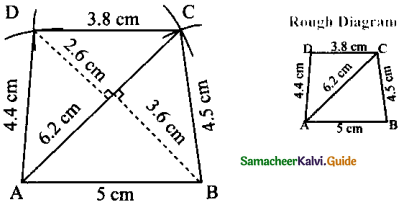
ABCD, AB = 5 cm, BC = 4.5 cm, CD = 3.8 cm, DA = 4.4 cm and AC = 6.2 cm.
Answer:
Given ABCD, AB = 5 cm, BC = 4.5 cm, CD = 3.8 cm, DA = 4.4 cm and AC = 6.2 cm.
Samacheer Kalvi 8th Maths Guide Answers Chapter 5 Geometry Ex 5.4 1
Steps:

  • Draw a line segment AB = 5 cm
  • With A and B as centers drawn arcs of radii 6.2 cm and 4.5cm respectively and let them cut at C.
  • Joined AC and BC.
  • With A and C as centrers drawn arcs of radii 4.4cm and 3.8 cm respectively and let them at D.
  • Joined AD and CD.
  • ABCD is the required quadrilateral.

Calculation of Area:
Area of the quadrilateral ABCD = \(\frac { 1 }{ 2 }\) × d × (h11 + h2) sq. units
= \(\frac { 1 }{ 2 }\) × 6.2 × (2.6 + 3.6)cm2 = 3.1 × 6.2 = 19.22 cm2

Samacheer Kalvi 8th Maths Guide Chapter 5 Geometry Ex 5.4

Question 2.
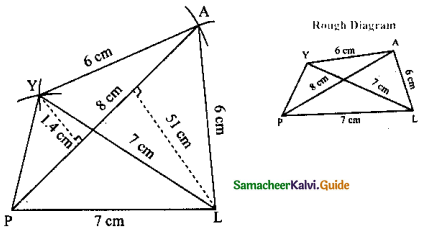
PLAY, PL = 7cm, LA = 6cm, AY = 6cm, PA = 8cm and LY = 7cm.
Answer:
Given PLAY, PL = 7cm, LA = 6cm, AY = 6cm, PA = 8cm and LY = 7cm
Samacheer Kalvi 8th Maths Guide Answers Chapter 5 Geometry Ex 5.4 2
Steps:

  • Drawn a line segment PL = 7 cm
  • With P and L as centers, drawn arcs of radii 8 cm and 6 cm respectively, let them cut at A.
  • Joined PA and LA.
  • With L and A as centers, drawn arcs of radii 7 cm and 6 cm respectively and let them cut at Y.
  • Joined LY, PY and AY.
  • PLAY is the required quadrilateral.

Calculation of Area:
Area of the quadrilateral PLAY = \(\frac { 1 }{ 2 }\) × d × (h1 + h2) sq. units = \(\frac { 1 }{ 2 }\) × 8 × (5.1 + 1.4) cm2
\(\frac { 1 }{ 2 }\) × 8 × 6.5 cm2 = 26 cm2
Area of the quadrilateral = 26 cm2

Samacheer Kalvi 8th Maths Guide Chapter 5 Geometry Ex 5.4

Question 3.
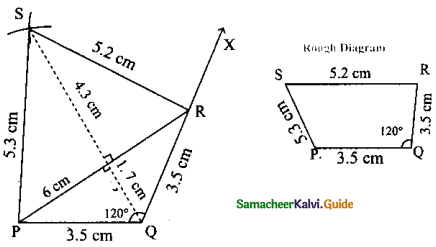
PQRS, PQ = QR = 3.5 cm, RS = 5.2 cm, SP = 5.3 cm and ∠Q = 120°.
Answer:
Given PQ = QR = 3.5 cm, RS = 5.2 cm, SP = 5.3 cm and ∠Q = 120°
Samacheer Kalvi 8th Maths Guide Answers Chapter 5 Geometry Ex 5.4 3
Steps:

  • Draw a line segment PQ = 3.5 cm
  • Made ∠Q = 120°. Drawn the ray QX.
  • With Q as centre drawn an arc of radius 3.5 cm. Let it cut the ray QX at R.
  • With R and P as centres drawn arcs of radii 5.2cm and 5.5 cm respectively and let them cut at S.
  • Joined PS and RS.
  • PQRS is the required quadrilateral.

Calculation of Area:
Area of the quadrilateral PQRS = \(\frac { 1 }{ 2 }\) × d × (h1 + h2) sq. units
= \(\frac { 1 }{ 2 }\) × 6 × (4.3 + 17)cm2
= 3 × 6cm2
= 18 cm2
Area of the quadrilateral PQRS = 18 cm2

Samacheer Kalvi 8th Maths Guide Chapter 5 Geometry Ex 5.4

Question 4.
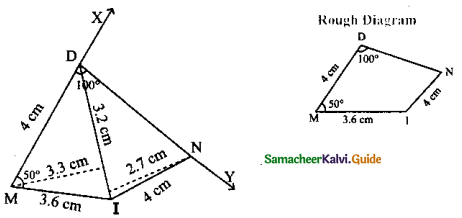
MIND, MI = 3.6 cm, ND = 4 cm, MD = 4 cm, ∠M = 50° and ∠D = 100°.
Answer:
Given MI = 3.6 cm, ND = 4 cm, MD = 4 cm, ∠M = 50° and ∠D = 100°
Samacheer Kalvi 8th Maths Guide Answers Chapter 5 Geometry Ex 5.4 4

Steps:

  • Drawn a line segment MI = 3.6 cm
  • At M on MI made an angle ∠IMX = 500
  • Drawn an arc with center M and radius 4 cm let it cut MX it D
  • At D on DM made an angle ∠MDY = 100°
  • With I as center drawn an arc of radius 4 cm, let it cut DY at N.
  • Joined DN and IN.
  • MIND is the required quadrilateral.

Calculation of Area:
Area of the quadrilateral MIND = \(\frac { 1 }{ 2 }\) × d × (h1 + h2) sq. units = \(\frac { 1 }{ 2 }\) × 3.2 × (2.7 + 33) cm2
= \(\frac { 1 }{ 2 }\) × 3.2 × 6 cm2 = 9.6 cm2
Area of the quadrilateral = 9.6 cm2

Samacheer Kalvi 8th Maths Guide Chapter 5 Geometry Ex 5.4

Question 5.
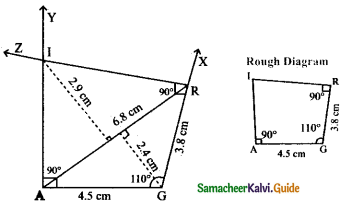
AGRI, AG = 4.5 cm, GR = 3.8 cm, ∠A = 60°, ∠G = 110° and ∠R = 90°.
Answer:
AG = 4.5 cm, GR = 3.8 cm, ∠A = 60°, ∠G = 110° and ∠R = 90°.
Samacheer Kalvi 8th Maths Guide Answers Chapter 5 Geometry Ex 5.4 5
Steps:

  • Draw a line segment AG = 4.5 cm
  • At G on AG made ∠AGX = 110°
  • With G as centre drawn an arc of radius 3.8 cm let it cut GX at R.
  • At R on GR made ∠GRZ = 90°
  • At A on AG made ∠GAY = 90°
  • AY and RZ meet at I.
  • AGRI is the required quadrilateral.

Calculation of Area:
Area of the quadrilateral AGRI = \(\frac { 1 }{ 2 }\) × d × (h1 + h2) sq. units = × 6.8 × (2.9 + 2.4) cm2
= \(\frac { 1 }{ 2 }\) × 6.8 × 5.3 × cm2
Area of the quadrilateral = 18.02 cm2

Samacheer Kalvi 8th Maths Guide Chapter 5 Geometry Ex 5.4

II. Construct the following trapeziums with the given measures and also find their area.

Question 1.
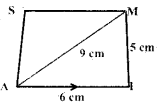
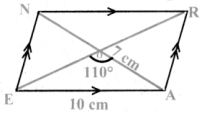
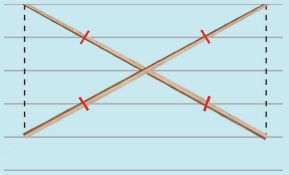
AIMS with \(\overline{\mathrm{AI}}\) || \(\overline{\mathrm{SM}}\), AI = 6cm, IM = 5cm, AM = 9cm and MS = 6.5cm.
Answer:
Given AI = 6 cm, IM = 5 cm
AM = 9 cm, and \(\overline{\mathrm{AI}}\) || \(\overline{\mathrm{SM}}\)
MS = 6.5 cm

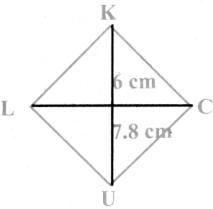
Rough Diagram
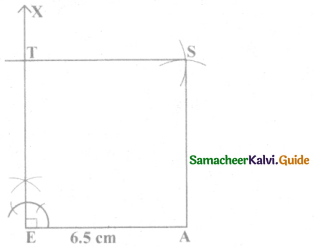
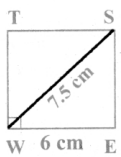
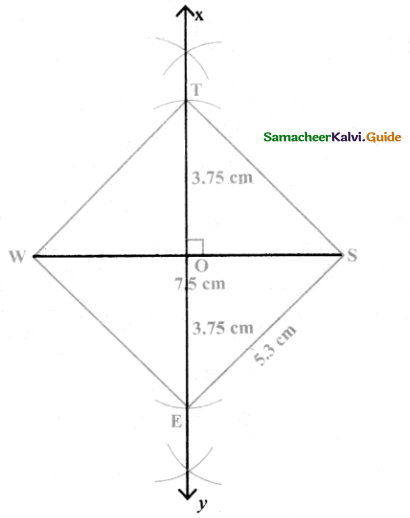
Samacheer Kalvi 8th Maths Guide Answers Chapter 5 Geometry Ex 5.4 6

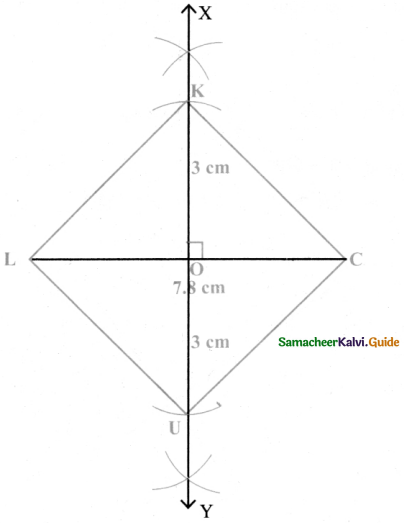
Samacheer Kalvi 8th Maths Guide Answers Chapter 5 Geometry Ex 5.4 7
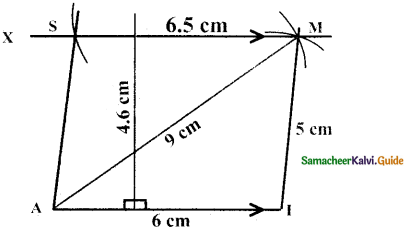
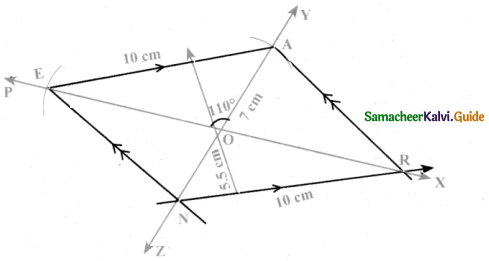
Construction:
Steps:

  • Draw a line segment AI = 6cm.
  • With A and I as centres, draw arcs of radii 9 cm and 5 cm respectively and let them cut at M
  • Join AM and IM.
  • Draw MX parallel to AI
  • With M as centre, draw an arc of radius 6.5 cm cutting MX at S.
  • Join AS AIMS is the required trapezium.

Calculation of Area
Area of the trapezium AIMS = \(\frac { 1 }{ 2 }\) × h × (a + b) sq.units
= \(\frac { 1 }{ 2 }\) × 4.6 × (6 + 6.5)
= \(\frac { 1 }{ 2 }\) × 4.6 × 12.5
= 28.75 Sq.cm

Samacheer Kalvi 8th Maths Guide Chapter 5 Geometry Ex 5.4

Question 2.
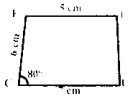
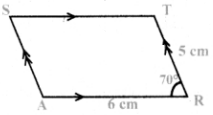
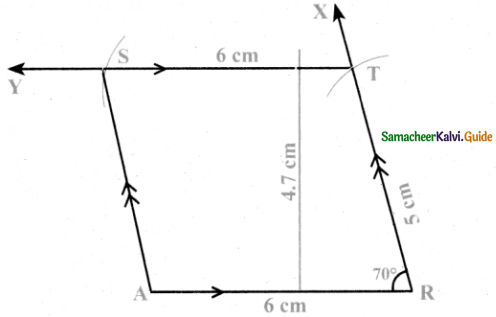
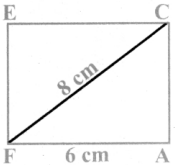
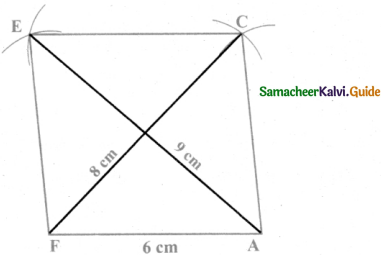
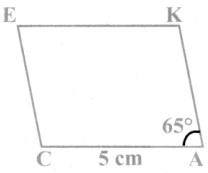
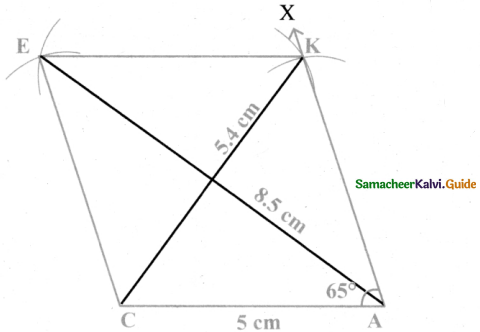
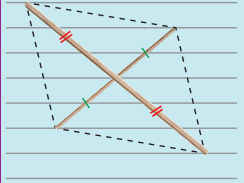
CUTE with \(\overline{\mathrm{CD}}\) || \(\overline{\mathrm{ET}}\), CU = 7cm, ∠ UCE = 80° CE = 6cm and TE = 5cm.
Answer:
Given: In the trapezium CUTE,
CU = 7cm, ∠UCE = 80°,
CE = 6cm,TE = 5cm and \(\overline{\mathrm{CD}}\) || \(\overline{\mathrm{ET}}\)

Rough Diagram
Samacheer Kalvi 8th Maths Guide Answers Chapter 5 Geometry Ex 5.4 8

Samacheer Kalvi 8th Maths Guide Answers Chapter 5 Geometry Ex 5.4 9
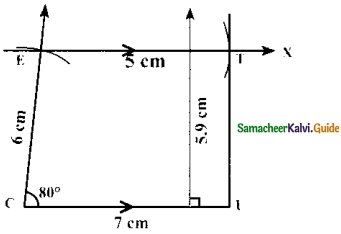
Construction:
Steps:

  • Draw a line segment CU = 7cm.
  • Construct an angle ∠UCE = 80° at C
  • With C as centre, draw an arc of radius 6 cm cutting CY at E
  • Draw EX parallel to CU
  • With E as centre, draw an arc 7 cm of radius 5 cm cutting EX at T
  • Join UT. CUTE is the required trapezium.

Calculation of area:
Area of the trapezium CUTE = \(\frac { 1 }{ 2 }\) × h × (a + b) sq. units
= \(\frac { 1 }{ 2 }\) × 5.9 × (7 + 5)sq. units
= 35.4 sq.cm

Samacheer Kalvi 8th Maths Guide Chapter 5 Geometry Ex 5.4

Question 3.
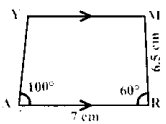
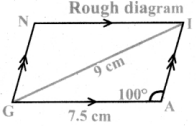
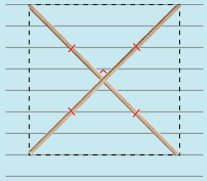
ARMY with \(\overline{\mathrm{AR}}\) || \(\overline{\mathrm{YM}}\), AR = 7cm, RM = 6.5 cm ∠RAY = 100° and ∠ARM = 60°
Answer:
Given: In the trapezium ARMY
AR = 7cm,RM = 6.5cm,
∠RAY = 100° and ARM 60°, \(\overline{\mathrm{AR}}\) || \(\overline{\mathrm{YM}}\)

Rough Diagram
Samacheer Kalvi 8th Maths Guide Answers Chapter 5 Geometry Ex 5.4 10

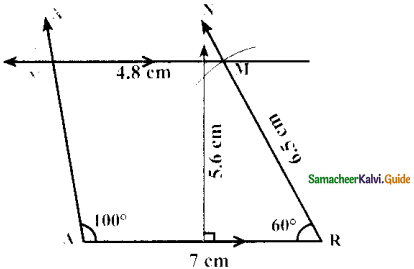
Samacheer Kalvi 8th Maths Guide Answers Chapter 5 Geometry Ex 5.4 11

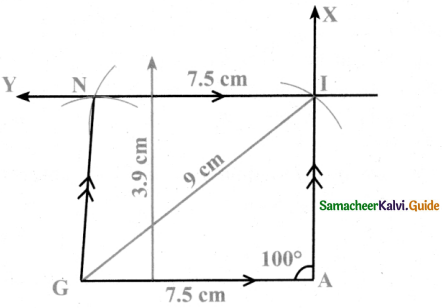
Construction:
Steps:

  • Draw a line segment AR = 7 cm.
  • Construct an angle ∠RAX = 100° at A
  • Construct an angle ∠ARN = 60° at R
  • With R as centre, draw an arc of radius 6.5 cm cutting RN at M
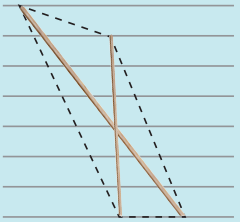
  • Draw MY parallel to AR
  • ARMY is the required trapezium.

Calcualtion of Area:
Area of the trapezium ARMY = \(\frac { 1 }{ 2 }\) × h × (a + b) sq. units
= \(\frac { 1 }{ 2 }\) × 5.6 × (7 + 4.8) sq. units
= \(\frac { 1 }{ 2 }\) × 5.6 × 1.18
= 33.04 sq.cm

Samacheer Kalvi 8th Maths Guide Chapter 5 Geometry Ex 5.4

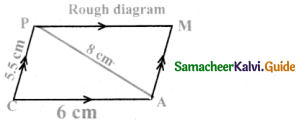
Question 4.
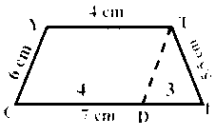
CITY with \(\overline{\mathrm{CI}}\) || \(\overline{\mathrm{YT}}\), CI = 7cm, IT = 5 .5 cm, TY = 4cm and YC = 6cm.
Answer:
Given: In the trapezium CITY,
CI = 7cm,IT = 5.5cm, TY = 4cm
YC = 6cm, and \(\overline{\mathrm{CI}}\) || \(\overline{\mathrm{YT}}\)

Rough Diagram

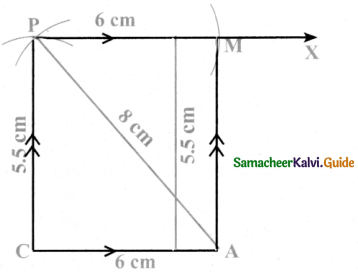
Samacheer Kalvi 8th Maths Guide Answers Chapter 5 Geometry Ex 5.4 12

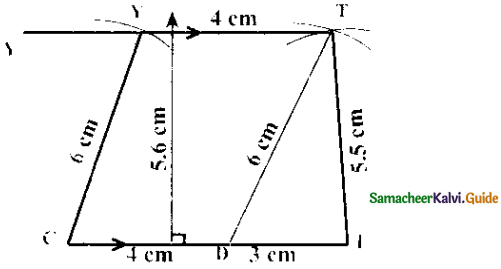
Samacheer Kalvi 8th Maths Guide Answers Chapter 5 Geometry Ex 5.4 13

Construction:
Steps:

  • Draw a line segment CI = 7 cm.
  • Mark a point D on CI such that CD = 4cm
  • With D and I as centres, draw arcs of radii 6 cm and 5.5 cm respectively.
    Let them cut at T. Join DT and IT.
  • With C as centre, draw an arc of radius 6 cm.
  • Draw TY parallel to Cl. Let the line cut the previous arc at Y.
  • Join CY. CITY is the required trapezium.

Construction of area:
Area of the trapezium CITY = \(\frac { 1 }{ 2 }\) × h × (a + b) sq. units
= \(\frac { 1 }{ 2 }\) × 5.5 × (7 + 4)sq.units
= \(\frac { 1 }{ 2 }\) × 5.5 × 11
= 30.25 sq.cm

Samacheer Kalvi 9th English Guide Prose Chapter 6 From Zero to Infinity

Tamilnadu State Board New Syllabus Samacheer Kalvi 9th English Guide Pdf Prose Chapter 6 From Zero to Infinity Text Book Back Questions and Answers, Summary, Notes.

Tamilnadu Samacheer Kalvi 9th English Solutions Prose Chapter 6 From Zero to Infinity

9th English Guide From Zero to Infinity InText Questions and Answers

Question 1.
What was the reaction of the classmates to Ramanujan’s question?
Answer:
The classmates laughed at Ramanujan’s question.

Samacheer Kalvi 9th English Guide Prose Chapter 6 From Zero to Infinity

Question 2.
What did the Indian mathematician Bhaskara prove?
Answer:
The Indian mathematician Bhaskara proved that zero divided by zero is infinity.

Question 3.
Where did Ramanujan get “Loney’s Trignometry” book from?
Answer:
Ramanujan got Loney’s “Trigonometry” book from a college library.

Samacheer Kalvi 9th English Guide Prose Chapter 6 From Zero to Infinity

Question 4.
Where did Ramanujan do his mathematical problems?
Answer:
Ramanujan did his mathematical problems on loose sheets of paper or on a slate and jot the results down in notebooks.

Question 5.
What were the subjects neglected by Ramanujan in college?
Answer:
History, English, Physiology were the subjects neglected by Ramanujan in college.

Samacheer Kalvi 9th English Guide Prose Chapter 6 From Zero to Infinity

Question 6.
Which university granted him a fellowship of 75 a month?
Answer:
The University of Madras granted him a fellowship 75 of a month.

Question 7.
What did Ramanujan sent to G.H. Hardy?
Answer:
Ramanujan sent a letter in which he set out 120 theorems and formulae to G.H Hardy.

Samacheer Kalvi 9th English Guide Prose Chapter 6 From Zero to Infinity

Question 8.
Who discovered a rare mathematical genius in Ramanujan?
Answer:
G.H. Hardy and his colleague, J.E.Little wood discovered a rare mathematical genius in Ramanujan.

9th English Guide From Zero to Infinity TextBook Questions and Answers

A. Answer the following questions in a sentence or two Why did the students laugh at Ramanujan?

Question 1.
Why did the students laugh at Ramanujan?
Answer:
Ramanujan asked a silly question in the class. So the children laughed at him.

Samacheer Kalvi 9th English Guide Prose Chapter 6 From Zero to Infinity

Question 2.
Why did the teacher compliment Ramanujan?
Answer:
The students laughed at Ramanujan because he asked if no banana was distributed among no one, would everyone get one banana.

Question 3.
What did Ramanujan do after reading the book on Trignometrv?
Answer:

After reading the book on Trigonometry, Ramanujan began his own research. He came forth with many mathematical theorems and formulae not given in the book

Samacheer Kalvi 9th English Guide Prose Chapter 6 From Zero to Infinity

Question 4.
What disappointed Ramanujan’s father?
Answer:
Ramanujan failed twice in his first-year arts examination in college. This disappointed his father.

Question 5.
How did Ramanujan manage his paper crisis?
Answer:
Ramanujan needed about 2,000 sheets of paper every month. He started using even scraps of paper he found lying on the streets. Sometimes he used a red pen to write over what was written in blue ink.

Samacheer Kalvi 9th English Guide Prose Chapter 6 From Zero to Infinity

Question 6.
Why was Ramanujan’s application for jobs rejected?
Answer:
Ramanujan showed his notebooks and told everyone that he knew mathematics and he could do the clerical job. But no one understood what was written in the notebooks. So his applications for jobs were rejected.

Question 7.
Why was Ramanujan sent back to India?
Answer:
While Ramanujan continued his research work, Tuberculosis, then an incurable disease, was devouring him. So, he was sent back to India.

Additional Questions & Answers

Question 1.
Where was Ramanujan sitting in the class?
Answer:
Ramanujan was sitting in one corner of the class room.

Samacheer Kalvi 9th English Guide Prose Chapter 6 From Zero to Infinity

Question 2.
Why did he raise his hand and stand up?
Answer:
He raised his hand and stood up to ask a question to his teacher.

Question 3.
What was that the boys could not understand?
Answer:
The boys could not understand why the teacher complimented the boy who had asked an absurd question.

Samacheer Kalvi 9th English Guide Prose Chapter 6 From Zero to Infinity

Question 4.
How was Ramanujan either in his native Kumbakonam or Cambridge, through out his life?

Answer:
Throughout his life, Ramanujan was always ahead of his mathematics teachers either in his native Kumbakonam or Cambridge.
Question 5.
When and whertf was Ramanujan born?
Answer:
Ramanujan was born on December 22, 1887 in Erode in Tamilnadu.

Samacheer Kalvi 9th English Guide Prose Chapter 6 From Zero to Infinity

Question 6.
What was Ramanujan’s father?
Answer:
Ramanujan’s father was a petty clerk in a cloth shop.

Question 7.
How was Ramanujan from his early childhood?
Answer:
From early childhood, it was evident that Ramanujan was prodigy.

Samacheer Kalvi 9th English Guide Prose Chapter 6 From Zero to Infinity

Question 8.
Why did the senior students visit Ramanujan’s dingy house?
Answer:
The senior students visited Ramanujan’s dingy house to get their difficulties in Mathematics solved. ’

Question 9.
Which book triggered the mathematical genius in him?
Answer:
The book “Synopsis of Elementany Results in Pure Applied Mathematics” by George Shoobridge Car triggered the mathematical genius in him.

Samacheer Kalvi 9th English Guide Prose Chapter 6 From Zero to Infinity

Question 10.
What happened to the three filled note books of Ramanujan later?
Answer:
The three filled note books of Ramanujan later became famous as Ramanujan’s Frayed Notebooks

Question 11.
What scholarship was awarded to Ramanujan when he secured a first class in Mathematics in the matriculation examination?
Answer:
When Ramanujan secured a first class in Mathematics in the matriculation examintaion he was awarded the Subramanian Scholarship.

Samacheer Kalvi 9th English Guide Prose Chapter 6 From Zero to Infinity

Question 12.
Who was impressed by Ramanujan’s note books?
Answer:
The Director of Madras Port Trust, Francis Spring was impressed by Ramanujan’s note books.

Question 13.
What did the Director of Madras Port Trust give him?
Answer:
The Director of Madras Port Trurt gave him a clerical job on a monthly salary of ₹25.

Question 14.
Who initiated a move to provide Ramanujan with a research fellowship?
Answer:
Some teachers and educationists interested in Mathematics initiated a move to provide Ramanujan with a research fellowship.

Samacheer Kalvi 9th English Guide Prose Chapter 6 From Zero to Infinity

Question 15.
When did the University of Madras grant him a fellowship of ₹75?
Answer:
On May 1,1913 the University of Madras granted him a fellowship of ₹75, though he had no qualifying degree.

Question 16.
When did Ramanujan sail for Britain?
Answer:
On March 17, 1914, Ramanujan sailed for Britain.

Samacheer Kalvi 9th English Guide Prose Chapter 6 From Zero to Infinity

Question 17.
How did Ramanujan play with numbers?
Answer:
Ramanujan played with numbers as a child with a toy.

Question 18.
What was Ramanujan elected on February 28,1918?
Answer:
Ramanujan was elected, Fellow of the Royal Society on February 28, 1918.

Samacheer Kalvi 9th English Guide Prose Chapter 6 From Zero to Infinity

Question 19.
What did Ramanujan become in October 1918?
Answer:
In October 1918, Ramanujan became the first Indian to be elected Fellow of Trinity College, Cambridge.

Question 20.
Name any two Ramanujan’s achievements at Cambridge?
Answer:
Ramanujan’s achievements at Cambridge are the Hardy – Ramanujan – Little wood circle method in number theory.
Roger – Ramanujan’s identities in partition of integers.

B. Answer the following questions in about 80 – 100 words.

Question 1.
Describe the life of Srinivasa Ramanujan in India.
Answer:
Title: From zero to Infinity
Author: Anonymous (Biography of Ramanujan)
Characters: Ramanujan, Classmates, Teachers and Ramanujan’s Father
Theme: Inborn intelligence with dilegence leads to excellence

Srinivasa Ramanujan was bom in Erode in Tamil Nadu on December 22, 1887. His father was a petty clerk in a cloth shop. From his early childhood, Ramanujan was evidently a prodigy. A question that he had asked as a boy had taken mathematician several centuries to answer. Through out his life in his native Kumbakonam he was always ahead of his mathematics teachers.

Senior students went to his dingy house to get their difficulties in Mathematics solved. At the age of 13, Ramanujan got Loney’s Trignometry from a college library. He mastered the book and began his own research. Ramanujan secured a first class in Mathematics in the Matriculation examination. He was awarded the Subramanyan Scholarship. His father was disappointed when he failed twice in his first year arts examination.

Ramanujan was always scribbling numbers and his father thought that he had gone mad. He began to look for a job. He needed money for food and papers to do his calculations. He started using even scraps of paper lying on the streets. Luckily the Director of Madras Port Trust, Francis Spring was impressed by his note books.

He gave him a clerical job on a monthly salary of ₹25. Later some teachers and educationist interested in Mathematics helped him get a research fellowship. The University of Madras granted him a fellowship of ₹75 even thQugh he had no qualifying degree.

“Genius does what it must, and talent does what it can”

(OR)

Srinivasa Ramanujan was bom on December 22, 1887, in Erode in Tamil Nadu. His father was a petty clerk in a cloth shop. From early childhood, he was a prodigy. Even Mathematicians had taken several centuries to answer his question. He was always ahead of his mathematics teachers.

Senior students went to his house to get their difficulties in Mathematics solved. When he was 13, he got Loney’s Trignometry from a college library. He began his own research, having mastered the book. He secured a first class in Mathematics in the matriculation examination. He was awarded the Sub-Ramayan Scholarship. But he failed twice in his first year arts examination. His father was upset.

As he was always scribbling numbers his father thought that he had gone mad. Ramanujan needed money for food and papers. He started using scraps of paper lying on the streets.

Luckily his note books impressed the Director of Madras Port Trust, Francis Spring. He gave him a clerical job on a salary of ₹25 a month. Later he got a research fellowship. The University of Madras granted him a fellowship of ₹75, though he had no qualifying degree. “There is no great genius without some touch of madness.

Samacheer Kalvi 9th English Guide Prose Chapter 6 From Zero to Infinity

Question 2.
Narrate the association of Ramanujan with G.H. Hardy.
Answer:
Title: From zero to Infinity.
Author: Anonymous (Biography of Ramanujan).
Characters: Ramanujan and G.H. Hardy.
Theme: “Fellowship happens when mercy wins over justice”

Earlier:
Ramanujan had sent a letter to the great mathematician G.H. Hardy of Cambridge University. He had set out 120 theorems and formulae in it. Very soon Hardy and Littlewood realised that they had discovered a rare mathematical genius. They made arrangements for Ramanujan’s passage andr ay at Cambridge university.

Ramanujan found himself a stranger at Cambridge. In the company oi Hardy and Littlewood he could forget much of the hardship he had to endure. In Ramanujan, Hardy found an unsystematic mathematician similar to one who knows the Pythagorus theorem without knowing what a congruent triangle means. It was due to his lack of formal education. It was sheer genius that led him to mathematical ‘Truths’ Ramanujan was elected, Fellow of the Royal Society on February 28, 1918.

He was the youngest Indian who received this distinguished fellowship. In October that year he became the first Indian to be elected fellow of Trinity College, Cambridge. His achievements.

At Cambridge include the Hardy Ramanujan – Littlewood circle method in number theory. Besides being a mathematician, Ramanujan was an astrologer of repute and a good speaker. He used to give lectures on subjects like “God, zero and infinity”.
“Attitude is greatly shaped by influence and association”.

(OR)

Earlier Ramanujan had sent a letter to G.H. Hardy with 120 theorems and formulae. Soon Hardy and Littlewood discovered a rare mathematical genius. They arranged for Ramanujan’s passage and stay at Cambridge university. He found himself a stranger at Cambridge. In their company he could forget the hardship he endured.

In him, Hardy found an unsystematic mathematician lacking formal education. Only sheer genius led him to mathematical ‘truths’. He was elected Fellow of the Royal – Society on February 28, 1918. He was the youngest Indian to receive this distinguished fellowship.

In October that year he became the first Indian to be elected Fellow of Trinity College, Cambridge. His achievements include the Hardy Ramanujan Littlewood circle method in number theory. Due to an incurable disease then, Tuberculosis, he was sent back to India. To forget the agonising pain he continued to play with numbers even on his death bed.

“A good communication is the best medicine for healthy association”.

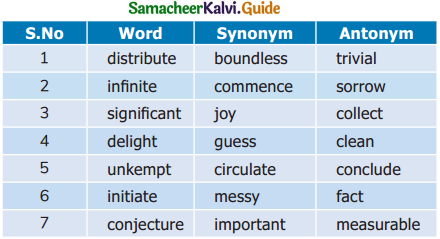
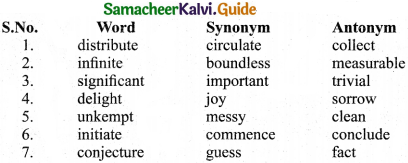
C. Match the words with correct Synonym and Antonym from the table.
Samacheer Kalvi 9th English Guide Prose Chapter 6 From Zero to Infinity img 1
Answer:

D. Listening:

Listen to the anecdote ‘Two Geniuses’ and narrate it in your own words.

‘Two Geniuses’

The story tells about Einstein’s great sense of humour. There was a young man, by name Einstein, with a growing reputation. He was invited by universities to explain his theories. A man called Hans was always his driver on these trips. Hans often told Einstein that it was a pleasure to drive a genius like him.

One evening, on their way to a remote university, Einstein told Hans that he wished he had not to give his lecture that night. He said that he was very tired. But he did not want to let his audience down.

Hans said that he didn’t need to do so. Hans said that they would change places and we would give the lecture for him. Hans had listened to it a dozen times. He didn’t understand it but knew it by heart. Moreover no one knew him at the university. Hans was sure that no one would find it. Eventually, Einstein agreed with Hans. But Einstein told Hans not to try to answer any questions, whatever he did.

They changed places, and at the university, Hans was greeted and led to the platform in a great hall crowded with professors and students. Einstein joined the audience and listened to Hans give his lecture perfectly and joined in the applause at the end.

Hans was about to get off the platform. Before that, a professor shouted from the audience. He wanted to ask a question. He said that it was very difficult but he requested him to answer it. Then he asked the very hard question for which Hans had no answer. He didn’t understand what he was talking about.

Einstein thought that they were in trouble. But Hans just laughed and said that, wasn’t a difficult question. Hans said that it was so easy and even his driver knew how to answer it. Hans asked Einstein to stand up. Einstein stood up and answered the question perfectly. They left the university, with Einstein driving the car. A little later, Hans offered to take over him. Einstein laughed and told no to his friend. He said that it was his pleasure to drive a genius like him (Hans).

E. Speaking:

Divide the students into a group of five and conduct a group discussion on the topic. “Importance of mathematics in our everyday life”. The teacher will act as a moderator.

Topic: Importance of mathematics in our everyday life.

Moderator: Today we have assembled here in five groups to discuss on the topic “Importance of Mathematics in our Everyday life. We shall begin with group A.

Group A: Mathematics is a methodical application of matter. It makes a man systematic. Mathematics makes our life orderly and prevents chaos. Certain qualities that are nurtured by mathematics are power of reasoning, creativity, abstract thinking, problem solving ability and effective communication skills.

Group B: Mathematics is the cradle of all creations, without which the world cannot move an inch. Even insects use mathematics in their everyday life for existence. There are countless examples of mathematical patterns in natures fabric. A good curriculum of mathematics is helpful in effective teaching and learning of the subject.

Group C: Experience says learning mathematics can be made easier and enj oyable if our curriculum includes mathematical activities and games. Mathematics puzzles and riddles encourage and attract an alert and open minded attitude among youngsters and help them develop clarity in their thinking.

Emphasis must be laid in development of clear concept in mathematics in a child, right from the primary classes itself. The child must be appreciated for every correct attempt. And the mistakes must be corrected then and there without any criticism.

Group D: The greatest hurdle in the process of learning mathematics is lack of practice. Students must work out some problems from different areas to master the basic concept and develop speed and accuracy in solving a problem.

Another very effective means of spreading the knowledge of mathematics among children is through peer teaching. In the process their doubts on the topic and clear them through discussions in a group.

Group E: The present age is one of skill development and innovations. We are more mathematical in our approach the more successful we will be. Mathematics offers rationality to our thoughts. It is a tool in our hands to make our life easier. We must appreciate the beauty of the subject and embrace it with all our heart.

Moderator: From the discussions, it is clear that maths has become inseparable part of our lives and whether work in an office or spend most of our time at home, each one of us uses mathematics as a part of our everyday life. No matter where we are as well as whatever we are doing mathematics is always there whether we notice it or not. Let us have a deep look at this universal subject how we use it in our everyday life.

F. Reading:

Answer the following questions based on the given passage.

Question 1.
What made John Shepherd Barron come up with the idea of ATM?
Answer:
When Shepherd Barron had arrived one minute late, he found the bank doors locked against him. This incident made him come up with the idea of an ATM.

Samacheer Kalvi 9th English Guide Prose Chapter 6 From Zero to Infinity

Question 2.
When and where was the first ATM installed?
Answer:
The first ATM was installed on June 27, 1967, in the North London suburb of Enfield.

Question 3.
Who was the first person to withdraw cash from the ATM?
Answer:
Actor Reg Vamey, a celebrity resident of Enfield was the first person to withdraw cash from the ATM.

Samacheer Kalvi 9th English Guide Prose Chapter 6 From Zero to Infinity

Question 4.
Why did Shepherd Barron reduce the PIN number from six digits to four?
Answer:
Shepherd Barron reduced the PIN number from six digits to four when his wife, Caroline complained that six was too many.

Question 5.
Which theory of Ramanujan helps the ATMs to dispense cash?
Answer:
Partition theory of Ramanujan helps the ATMs to dispense cash.

G. Writing
Paragraph Writing:

Question 1.
Write a paragraph of 100 – 120 words about a memorable anecdote/incident of your life. “A memorable incident in my life”
Answer:
It was my epic moment of my life. When I remember that moment it makes me laugh easily. It was an incident when I was in class 8.1 was not very much interested in studies. It was November when our school had provided us with teacher trainees for various subjects and we all were playing rather than studying.

The third period began and a teacher entered our class. We all decided to play a game called ‘Pen fighting game’. It was my turn to make a shot. When I was on the verge to make a shot, the trainee teacher came from behind all on a sudden. She asked me, ‘Where do you live?’ At that moment knocking the other pen down I told the teacher, ‘I live in my house’.

My voice was so loud and there was a roar of laughter in the class. When the game was over, I realized that I misbehaved in the class. I was very much embarrassed at that moment. Then I decided to apologize to her for my wrongdoing. I went to her room and asked for her pardon. She smiled at me gently. That gave me great relief in my heart. Now I am very attentive in my class and never mischievous any more.

Samacheer Kalvi 9th English Guide Prose Chapter 6 From Zero to Infinity

Question 2.
Write a paragraph of 100 -120 words about your favourite personality. “My favourite personality”
Answer:
Every one has his or her own favourite personality and so I do. My favourite personality is William Henru Bill Gates III. He is popularly called Bill Gates. He was bom on October 28, 1955. He was a local resident of Seattle, Washington, United States. In his early ages, he began to show interest in computer programming.

Gates excelled in Mathematics and Science. Because of his excellence, he enrolled in Lakeside, an exclusive preparatory school. Most of his professions involved computer software. He held the position of Technology advisor of Microsoft Corporation. Besides, he is the co-chairperson of Bill and Melinda Gates foundation, an organisation which named after him and his sister, he is the CEO of Cascade Investment. He holds the highest position as the Chairman of Corbis.

He and his partner, Paul Allen built the world’s largest software business. Due to his excellent software invention and his contribution to the world, Gates has received many big awards and achievements. He was the most powerful person in the world in 2012. He and his wife were awarded. The order of the Extec Eagle for their philanthropic works around the world in the areas of health and education.

Grammar:

A. Complete the following sentences using appropriate connectors from the box.

Question 1.
She felt cold ………………. she was wearing a winter coat.
Answer:
although

Samacheer Kalvi 9th English Guide Prose Chapter 6 From Zero to Infinity

Question 2.
This restaurant has some of the best chefs in the town …………………. their service is excellent.
Answer:
above all

Question 3.
I’m not going to the party tonight …………………. I didn’t get an invitation.
Answer:
because

Samacheer Kalvi 9th English Guide Prose Chapter 6 From Zero to Infinity

Question 4.
You can set the table ………………… I’ll start making dinner.
Answer:
mean while

Question 5.
I can play quite a few instruments ……………………., the flute, the guitar and piano.
Answer:
for instance

Question 6.
The store was out of chocolate chips; ………………….. they would need to make different type of cookies.
Answer:
more over

Samacheer Kalvi 9th English Guide Prose Chapter 6 From Zero to Infinity

Question 7.
The stores are open daily …………………. Sundays.
Answer:
except

Question 8.
I’ll stay …………………. you need me.
Answer:
as long as

Question 9.
This detergent is highly concentrated and …………………. you will need to dilute.
Answer:
therefore

Samacheer Kalvi 9th English Guide Prose Chapter 6 From Zero to Infinity

Question 10.
It was the thing he prized …………………
Answer:
thus

Active voice and Passive Voice

Active Voice: The subject is the doer of the action.
Passive Voice: The subject is not the doer of the action.

B. Convert the following active sentences into passive sentences by supplying an appropriate passive verb form.

Question 1.
She will not recognise us. / We ……………… by her.
(a) will not recognise
(b) will not being recognised
(c) will not be recognised
Answer:
(c) will not be recognised

Samacheer Kalvi 9th English Guide Prose Chapter 6 From Zero to Infinity

Question 2.
They didn’t invite me. but I went that way. / I ……………… but I went that way.
(a) wasn’t invited
(b) wasn’t being invited
(c) wasn’t inviting
Answer:
(b) wasn’t being invited

Question 3.
They broke up the table for firewood. / The table ……………… up for firewood.
(a) broke
(b) had broken
(c) was broken
Answer:
(c) was broken

Samacheer Kalvi 9th English Guide Prose Chapter 6 From Zero to Infinity

Question 4.
She has won the first prize. / The first prize ……………….. by her.
(a) has won
(b) has been won
(c) had been won
Answer:
(b) has been won

Question 5.
A friend of mine is repairing the car. / The car ………………….. by a friend of mine.
(a) is repairing
(b) is repaired
(c) is being repaired
Answer:
(c) is being repaired

Samacheer Kalvi 9th English Guide Prose Chapter 6 From Zero to Infinity

Question 6.
Begin the work tomorrow. / Let the work ……………… tomorrow.
(a) be begun
(b) begin
(c) is beginning
Answer:
(a) be begun

Question 7.
They speak English in New Zealand. / English ………………… in New Zealand.
(a) is speaking
(b) is spoken
(c) is being spoken
Answer:
(b) is spoken

Samacheer Kalvi 9th English Guide Prose Chapter 6 From Zero to Infinity

Question 8.
His attitude shocked me. / I …………………. by his attitude.
(a) had shocked
(b) had been shocked
(c) was shocked
Answer:
(c) was shocked

Question 9.
She had already sent the parcel. / The parcel ………………… by her.
(a) has already been sent
(b) had already been sent
(c) was already sent
Answer:
(b) had already been sent

Samacheer Kalvi 9th English Guide Prose Chapter 6 From Zero to Infinity

Question 10.
Her silence worries me. / I ………………….. her silence.
(a) am worrying by
(b) am worried by
(c) have worried by
Answer:
(b) am worried by

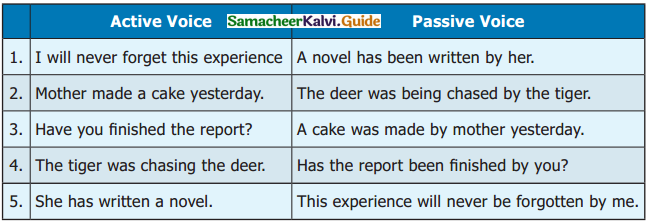
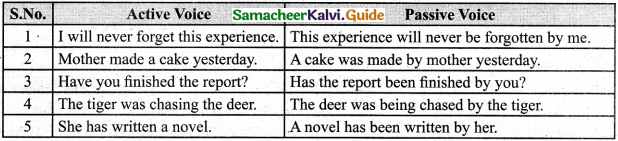
C. Match the following Active Voice sentences with Passive Voice.

Answer:

D. Change the following into passive voice.

Question 1.
Stanley will inform you later.
Answer:
You will be informed by Stanley later.

Samacheer Kalvi 9th English Guide Prose Chapter 6 From Zero to Infinity

Question 2.
People speak Portuguese in Brazil.
Answer:
Portuguese is spoken by people in Brazil.

Question 3.
My grandfather built this house in 1943.
Answer:
This house was built in 1943 by my grandfather.

Samacheer Kalvi 9th English Guide Prose Chapter 6 From Zero to Infinity

Question 4.
Do not hurt the animals.
Answer:
Let the animals not be hurt.

Question 5.
You must not drop litter in the streets.
Answer:
Litter must not be dropped in the streets.

Question 6.
Carry it home.
Answer:
You are asked to carry it home.

Samacheer Kalvi 9th English Guide Prose Chapter 6 From Zero to Infinity

Question 7.
They are decorating the wall.
Answer:
The wall is being decorated by them.

Question 8.
He has already mended the TV set.
Answer:
The TV set has already been mended by him.

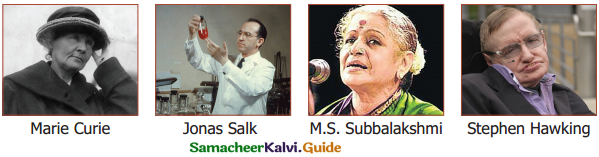
E. Project

Make a scrapbook of ‘Famous Biographies’ by collecting at least five biographies of famous scientists, mathematicians, inventors, artists etc., of your choice. You may also collect the pictures related to their achievements, inventions etc.

Samacheer Kalvi 9th English Guide Prose Chapter 5 Water – The Elixir of Life

Tamilnadu State Board New Syllabus Samacheer Kalvi 9th English Guide Pdf Prose Chapter 5 Water – The Elixir of Life Text Book Back Questions and Answers, Summary, Notes.

Tamilnadu Samacheer Kalvi 9th English Solutions Prose Chapter 5 Water – The Elixir of Life

9th English Guide Water – The Elixir of Life InText Questions and Answers

Question 1.
What is the imaginary elixir of life?
Answer:
The divine Amrita is the imaginary elixir of life.

Question 2.
What according to the writer (author) is the real elixir of life?
Answer:
According to the writer (author), water is the real elixir of life.

Samacheer Kalvi 9th English Guide Prose Chapter 5 Water - The Elixir of Life

Question 3.
What is the wonderful difference the writer (author) talks about in the passage?
Answer:
On one side, was the visible sea of billowing sand without a speck of green or a single living thing anywhere on it. On the other side lay one of the greatest, most fertile and densely populated areas to be found anywhere on the earth, teeming with life and vegetation. This is the ‘wonderful difference’ that the writer talks about in the passage.

Question 4.
What is the cheering sight’ mentioned in the paragraph?
Answer:
The rain fed tanks which are full is the ‘cheering sight’ mentioned in this paragraph.

Samacheer Kalvi 9th English Guide Prose Chapter 5 Water - The Elixir of Life

Question 5.
What does the writer (author) compare water in a landscape to?
Answer:
The writer compares the water in a landscape to the eyes in a human face.

Question 6.
How does the water in the rain fed tanks get its colour?
Answer:
Water carries silt or finely divided soil in suspension. This is the origin of the characteristic colour of the rain fed tanks.

Question 7.
What is the main cause of soil erosion?
Answer:
The sudden burst of excessively heavy rain resulting in a large run of surplus water is the main cause of soil erosion.

Samacheer Kalvi 9th English Guide Prose Chapter 5 Water - The Elixir of Life

Question 8.
What other factors add to the erosion of precious soil?
Answer:
The other factors which add to the erosion of precious soil are the slope of the land, removal of the natural protective coat of vegetation, the existence of ruts along which the water can flow with rdpidly gathering moments and the absence of any checks of such flow.

Question 9.
How can soil erosion be prevented?
Answer:
The terracing of land, construction of bunds to check the flow of water, the practice of contour cultivation and the planting of appropriate types of vegetation are the measures that can prevent soil erosion.

Question 10.
How does the prevention of soil erosion cene a double purpose?
Answer:
The adoption of techniques preventing soil erosion would also help to conserve and keep the water in and on the soil serves a double measure.

Samacheer Kalvi 9th English Guide Prose Chapter 5 Water - The Elixir of Life

Question 11.
What are the two sources of water?
Answer:
The two sources of water are rain and snowfall.

Question 12.
What happens to the rain water?
Answer:
The rain water flows down into the streams and rivers and ultimately finds its way to the sea.

Question 13.
What is the idea of civilized forest?
Answer:
The civilized forests would, directly and indirectly, prove a source of untold wealth to the country. They would check soil erosion and conserve the rainfall of the country from flowing away to waste and would provide the necessary supplies of cheap fuel, and thus render unnecessary the wasteful conversion of farmyard manure into a form of fuel.

Samacheer Kalvi 9th English Guide Prose Chapter 5 Water - The Elixir of Life

Question 14.
How can you check soil erosion?
Answer:
The creation of civilized forests planting trees at all places would check soil erosion.

Question 15.
What are the cheapest means of transport?
Answer:
The cheapest means of transport is by boats and barges through canals and rivers.

Question 16.
How can you make a difference in the country side?
Answer:
The availability of electric power would make a tremendous difference to the life of the country side and enable rural economy to be improved in various directions.

9th English Guide Water – The Elixir of Life TextBook Questions and Answers

A. Answer the following questions briefly in one or two sentences.

Question 1.
What makes water one of the most powerful and wonderful things on earth?
Answer:
Water played a role of vast significance in shaping the course of the earth’s history and continues to play the leading role in the drama of life on the surface of our planet.

Samacheer Kalvi 9th English Guide Prose Chapter 5 Water - The Elixir of Life

Question 2.
How does water help in the formation of fertile lands?
Answer:
Water carries silt or finely divided soil in suspension. The land which is formed by silt is proved to be fertile.

Question 3.
How does soil erosion happen and what are its main causes?
Answer:
The flow of water under certain conditions causes soil erosion. Sudden bursts of excessively heavy rain resulting in large run of surplus water are the principal factors in causing soil erosion.

Samacheer Kalvi 9th English Guide Prose Chapter 5 Water - The Elixir of Life

Question 4.
What are some measures that are used to prevent soil erosion?
Answer:
The terracing of the land, the construction of bunds to check the flow of water, the practice of contour cultivation and planting of appropriate types of vegetation are the measures used to prevent the flow water and the soil erosion.

Question 5.
How, according to Sir C. V. Raman, can rainwater as well as the water of rivers be prevented from going to waste?
Answer:
The systematic planting of suitable trees can prevent rainwater from going to waste.

Additional Questions and Answers

Question 1.
Why does C.V. Raman compare water to Amrita?
Answer:
Sir C.V. Raman compares water to Amrita because of its immense properties to maintain human, animal and plant life.

Samacheer Kalvi 9th English Guide Prose Chapter 5 Water - The Elixir of Life

Question 2.
Why does the author say that Egypt was made by Nile?
Answer:
The author gives the thought of the geologist that the soil of the Nile Valley is the creation of the river itself. It has brought down the finest silt in its flood and thus created the Nile Valley.

Question 3.
How does water add beauty to the countryside?
Answer:
Water adds to the beauty of the country side. The cattle quench their thirst in the evening. There are many raid-fed tanks common in south India. These are a cheering sight of the countryside.

Samacheer Kalvi 9th English Guide Prose Chapter 5 Water - The Elixir of Life

Question 4.
How does the water in rain-fed tanks get its colour?
Answer:
Water is powerful to carry silt or finely divided soil in suspension. This is the origin of the characteristic colour of the water in rain-fed tanks.

Question 5.
What is meant by soil erosion?
Answer:
The geological process under appropriate conditions can play a destructive part and wash away the soil. The washing away of soil by the flow of water is called soil erosion.

Samacheer Kalvi 9th English Guide Prose Chapter 5 Water - The Elixir of Life

Question 6.
How can we tackle the problem of destruction?
Answer:
The systematic planting of suitable trees is in every possible or even in impossible areas, and the development of civilized forests are the ways to tackle the problem of deforestation.

Question 7.
Which form of transport, according to Sir. C.V. Raman, is the cheapest?
Answer:
According to Sir. C.V. Raman, is the cheapest form of internal transport in a country is by boats and barges through canals and rivers.

Samacheer Kalvi 9th English Guide Prose Chapter 5 Water - The Elixir of Life

Question 8.
What are the uses of rain fed-tanks?
Answer:
The rain-fed tanks are so common in South India play a vital role in Agriculture. In Mysore, for example, much of the rice is grown under them.

Question 9.
What in India’s urgent need as far as conservation of water is concerned?
Answer:
The systematic planting of suitable trees in every possible or in impossible areas, and the development of civilized forests are India’s urgent need as far as conservation of water is concerned.

Samacheer Kalvi 9th English Guide Prose Chapter 5 Water - The Elixir of Life

Question 10.
How does conservation of water serve rural India?
Answer:
The conservation and utilization of water is fundamental for human welfare. Much of Indian agriculture depends on seasonal rainfall. Conservation of water helps rural India to carry on with agricultural activities.

Question 11.
Why does the author compare the water in a landscape to the human eyes?
Answer:
The water in a landscape reflects the mood of the hour, being bright and gay when the sun shines. It turns dark and gloomy when the sky is overcast. Thus he compares (the water in a landscape) it to the human eyes.

Samacheer Kalvi 9th English Guide Prose Chapter 5 Water - The Elixir of Life

Question 12.
Make a list of the places where hydro-electric power is generated in Tamil Nadu.
Answer:
The places where hydro-electric power is generated in Tamil Nadu are Mettur (Salem), Kundah, Siva samudrum, and Pykara.

B. Answer the following in about 80 – 100 words.

Question 1.
How does C.V.Raman show that “Water is the real elixir of life”?
Answer:
Raman tries to bring about the importance of water, which has a unique power of maintaining animal and plant life. Water, the elixir of life, is the commonest of all liquids. Without water, the land will be barren like the deserts in Egypt. On one side it is a sea of sand. On the other side laid one of the greatest, most fertile, densely populated areas the valley of Nile.

It is separated by the river Nile flowing down thousands of miles away. The entire soil is the creation of river Nile. Egypt, in fact was made by its river. Water is the basis of all life. Every animal and plant contains water in its body. Water is essential for the body, moisture in the soil is equally important for the life and growth of plants and trees. The conservation and utilization of water is fundamental for human welfare.

(OR)

According to Sir C.V. Raman, water is the elixir of life. In ancient times civilization developed near the rivers. Water is played an important role in life. Water adds the beauty of the countryside. Water carries slit and makes the land fertile.

Water is the basis of all life. It is necessary for animal life and growth of plants and trees. Water is the commonest of liquids. But it is an uncommon of liquids with amazing properties. They are responsible for maintaining human, animal and plant life. Thus without water life is impossible.

“Make hay while the sun shines”

Samacheer Kalvi 9th English Guide Prose Chapter 5 Water - The Elixir of Life

Question 2.
Water exists in all plant and animal forms. Explain.
Answer:
Title: Water – The Elixir of Life
Author: Sir CV.Raman
Theme: Water exists in all plant and animal forms.

“World without water is unimaginable”

According to Sir C.V. Raman, water is the basis of life. Every animal or plant contains a substantial proportion of free or combined water in its body. No kind of physiological activity is possible in which the fluid does not play an essential part. Water is necessary for animal life.

Moisture in the soil is equally imperative for the life and growth of plants and trees. But the quantity necessary varies largely with the species. Much of our agriculture also depends on seasonal rainfall and is therefore very sensitive to any failure or irregularity of the same. Thus water is the elixir of all life.

“No life is without water
To save water is a serious matter”.

(OR)

According to Sir C.V. Raman, water is the basis of life. Every animal or plant contains a large proportion of water in its body. All physiological activities are possible only when the fluid play its essential part. Water is necessary for animal life, It is equally essential for plants and trees to grow. Only the quantity necessary varies with species. Thus existence of every animal or plant is possible only with water. Therefore, it is clear for water is the elixir of all life.

“No rain, no gain
No rain, more pain”

Samacheer Kalvi 9th English Guide Prose Chapter 5 Water - The Elixir of Life

Question 3.
Life cannot exist on earth without water – Explain?
Answer:
Water is the basis of all life. Every animal and plant contains water in its body. Water is essential for the body, moisture in the soil is equally important for the life and growth of plants and trees. The conservation and utilization of water is fundamental for human welfare. Much of Indian agriculture depends on monsoon.

It is clear that the adoption of techniques preventing soil erosion would help to conserve and keep the water where it is wanted. Without water, nothing is possible on earth. The collection of rainwater and utilizing them is very important. Vast areas of land which at present are scrub jungle could be turned into fertile and prosperous country by courageous and well-planned action.

(OR)

“There is no life without water”
Water is the elixir of life. Water is the basis of life. This common substance plays a vital role in the life of human, animal and plant. It is the most potent and most powerful thing on the earth. It has sharpened the history and continues the key role in the drama of life.

Every animal or plant contains a large proportions of water in its body. Physiological activity is which the fluid plays no essential part. Water is necessary for animal life. It also is a must for the growth of plant and tree. The quantity varies enormously with the species. Water is essentia] in human life. Thus it is clear that water exists in all life.
“Where there is water, there is life”

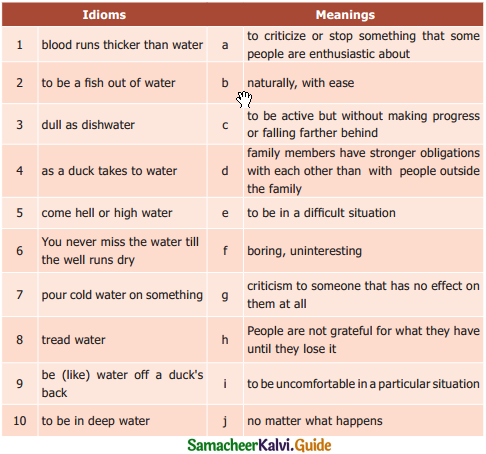
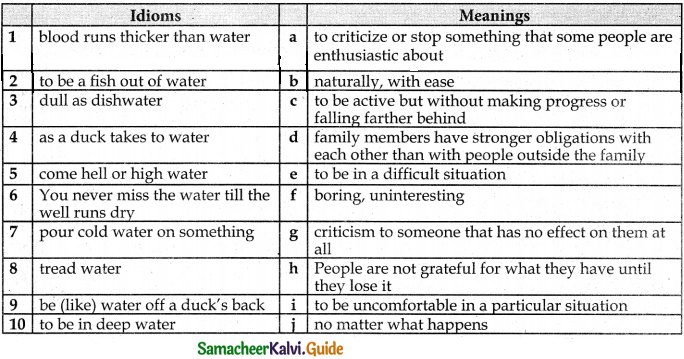
C. Given below are some idioms related to water. Match the idioms with it’s meaning
Samacheer Kalvi 9th English Guide Prose Chapter 5 Water - The Elixir of Life img 1
Answer:

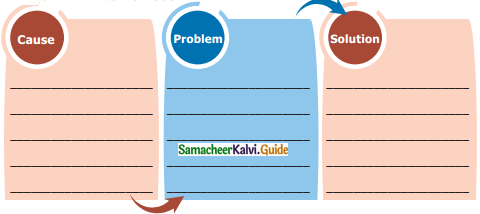
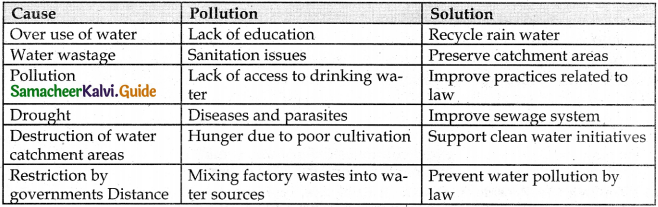
D. Water is a scarce resource. Discuss the causes, problems and solutions to water scarcity and write them below.

Answer:

Listening:

E. On the basis of the listening passage, choose the correct answer from the given options.

Question 1.
Severn Suzuki represents an organization called ECO which stands for …………………..
(a) Ecological Cooperation
(b) Environmental Coordinating Organization.
(c) Environmental Children’s Organization.
(d) Ecological Children’s Organization.
Answer:
(c) Environmental Children’s Organization.

Samacheer Kalvi 9th English Guide Prose Chapter 5 Water - The Elixir of Life

Question 2.
“I am fighting for my future.” The ‘fight’ refers to her ……………………
(a) fight to win an election
(b) fight to gain a few points in share market
(c) fight against corruption
(d) fight against environmental pollution.
Answer:
(a) fight to win an election

Question 3.
Animals and fish are becoming extinct because ……………………
(a) they have no place to go
(b) they die of diseases
(c) their food and habitat are polluted
(d) all the above
Answer:
(d) all the above

Samacheer Kalvi 9th English Guide Prose Chapter 5 Water - The Elixir of Life

Question 4.
It is evident that Severn Suzuki is concerned about all other species too as ………………….
(a) she considers them all belonging to one world
(b) they have nobody except her to speak for
(c) they belong to her
(d) they are all children
Answer:
(a) she considers them all belonging to one world

Question 5.
Severn Suzuki condemns the people of her country for ……………………
(a) contributing large amounts of waste and not sharing the excess with the needy
(b) being afraid of the poor
(c) being angry with the poor belonging to other countries
(d) being wealthy
Answer:
(a) contributing large amounts of waste and not sharing the excess with the needy

Samacheer Kalvi 9th English Guide Prose Chapter 5 Water - The Elixir of Life

Question 6.
Which of the following statements is not true?
(a) Canada is a rich country and people have in plenty
(b) Canadian children are privileged
(c) A Brazilian child was willing to share because she was rich
(d) Northern countries will not share with the needy
(c) A Brazilian child was willing to share because she was rich

F. Answer the following questions briefly.

Question 1.
What is the humble request of the twelve- year -old to the elders?
Answer:
The elders must change their ways.

Question 2.
The dream of Severn Suzuki is
Answer:
that all species of- living things must exist.

Samacheer Kalvi 9th English Guide Prose Chapter 5 Water - The Elixir of Life

Question 3.
The fear and agony of Severn Suzuki is …………………..
Answer:
that the people waste a lot and are afraid to share.

Question 4.
How does she proclaim that she represents the future generation?
Answer:
She proclaims that she represents as a child.

Samacheer Kalvi 9th English Guide Prose Chapter 5 Water - The Elixir of Life

Question 5.
The duties and responsibilities of the parents are …………….
(a) to comfort their children saying that everything will be all righ
(b) ………………..
(c) …………………
Answer:
(b) it is not the end of the world.
(c) and we are doing the best we can.

Speaking:

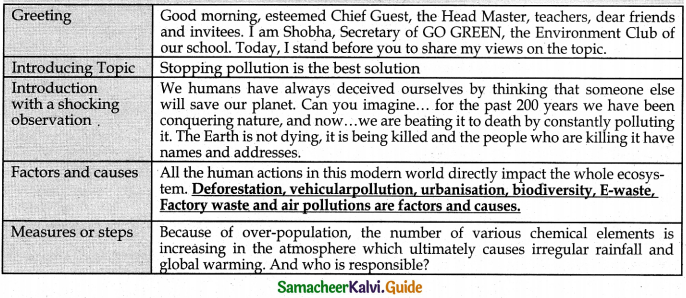
G. You are the President of GO GREEN, the Environment Club of your school. On the occasion of World Environment Day, you have been asked to address the school on the topic,‘The Nature of Our Future Depends on the Future of Our Nature’.

Answer:

Grammar:
Simple Present Tense:

A. Choose the correct form of the present tense verb from.

  1. All children ………………….. something new every day. (learn/ learns/ learned)
  2. A good student always …………………. hard. (work/ works/ worked)
  3. Engineers ………………… bridges. (build/ builds/ built)
  4. My sister is an architect. She ………………….. skyscrapers. (design/ designs/ desingned)
  5. The Himalayas …………………. India from the cold winds. (protect/ protects/ protected)
  6. It always …………………. here in the afternoon. (drizzle/ drizzles/ drizzled)
  7. My mother …………………. in a factory. (work/ works/ worked)
  8. Chella ……………….. English very well, but she doesn’t understand Hindi. (speak/ speaks/ spoke)
  9. Cows …………………. us milk. (give/ gives/ gave)
  10. The trains to Chennai always ………………….. on time. (run/ runs/ ran)

Answer:

  1. learn
  2. works
  3. build
  4. desingns
  5. protect
  6. drizzles
  7. works
  8. speaks
  9. give
  10. run

Present Continuous Tense:

B. Make sentences in the present continuous tense using the verb given in brackets.

Question 1.
Who is that boy on the table? (stand)
Answer:
standing

Samacheer Kalvi 9th English Guide Prose Chapter 5 Water - The Elixir of Life

Question 2.
What are you ……………….? (do) I ………………… (listen) to music.
Answer:
doing, am listening

Question 3.
My brother ………………….. (work) in London now.
Answer:
is working

Samacheer Kalvi 9th English Guide Prose Chapter 5 Water - The Elixir of Life

Question 4.
I …………………. (wait) for my mother.
Answer:
am waiting

Question 5.
It is better not to disturb her, she …………………. (work).
Answer:
is working

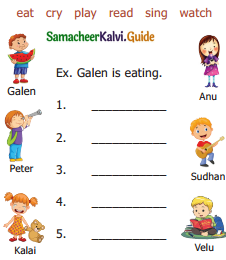
C. What are they doing? Use the verbs below and write sentences.

Answers:

  1. Peter is watching
  2. Sudan is playing
  3. Velu is reading
  4. Anu is singing
  5. Kalai is crying

D. Look at the picture again and answer the questions.

Question 1.
Is Tom reading? ………………
Answer:
No, Tom is not reading

Samacheer Kalvi 9th English Guide Prose Chapter 5 Water - The Elixir of Life

Question 2.
Is Velu eating? ………………
Answer:
No, Velu is not eating

Question 3.
Is Kalai dancing? ……………….
Answer:
No, Kalai is not dancing

Samacheer Kalvi 9th English Guide Prose Chapter 5 Water - The Elixir of Life

Question 4.
Is Peter watching TV? …………………..
Answer:
Yes, Peter is watching TV

Question 5.
Is Anu crving? ……………………
Answer:
No, Anu is not crying

E. Write the -ing form of the verbs.

  1. Come …………….
  2. Take
  3. Fly …………….
  4. Swim ………………
  5. Study ……………….
  6. Read ……………….

Answers:

  1. Coming
  2. Taking
  3. Flying
  4. Swimming
  5. Studying
  6. Reading

F. Write negative sentences.

Question 1.
He is learning to read ………………….
Answer:
He isn’t learning to read

Question 2.
I am having a bath.
Answer:
I am not having a bath

Samacheer Kalvi 9th English Guide Prose Chapter 5 Water - The Elixir of Life

Question 3.
I’m reading a fantastic book.
Answer:
I’m not reading a fantastic book

Question 4.
Raja is driving a new car.
Answer:
Raja is not driving a new car

Samacheer Kalvi 9th English Guide Prose Chapter 5 Water - The Elixir of Life

Question 5.
I’m looking for mv bag.
Answer:
I’m not looking for my bag

G. Write questions for the answers.

  1. ………………… ? No, they aren’t singing?
  2. ……………….. ? Yes, She is writing a new book.
  3. ……………….. ? Yes, It is working.
  4. ………………… ? No, he isn’t doing the project.
  5. ……………….. ? Yes, We are planing to go.

Answers:

  1. Are they singing?
  2. Is she writing a new book?
  3. Is it working
  4. Is he doing the project
  5. Are you/ we planning to go?

H. Fill in the blanks with verbs in the present continuous.

Question 1.
You ………………… (listen) to the music.
Answer:
are listening

Samacheer Kalvi 9th English Guide Prose Chapter 5 Water - The Elixir of Life

Question 2.
He ……………….. (cry).
Answer:
is crying

Question 3.
I ………………… (swim) in the pool.
Answer:
is swimming

Samacheer Kalvi 9th English Guide Prose Chapter 5 Water - The Elixir of Life

Question 4.
Latha ……………….. (wait) for her daughter.
Answer:
is waiting

Question 5.
……………….. she ………………. (watch) TV?
Answer:
Is, watching

Samacheer Kalvi 9th English Guide Prose Chapter 5 Water - The Elixir of Life

Question 6.
Who ………………… he ………………… (help)?
Answer:
is, helping

Question 7.
Her father ………………….. (not/cook) dinner.
Answer:
is not cooking

Question 8.
Akila ………………… (not/ sing) a song.
Answer:
is not singing

Samacheer Kalvi 9th English Guide Prose Chapter 5 Water - The Elixir of Life

Question 9.
My brother ……………… (not/ do) his homework.
Answer:
is not doing

Question 10.
……………….. your mother …………………. (work) todav?
Answer:
Is, working

Question 11.
Amutha and Praba …………………. (play) tennis.
Answer:
are playing

Samacheer Kalvi 9th English Guide Prose Chapter 5 Water - The Elixir of Life

Question 12.
Amith and Ravi …………………. (not/swim) in the lake.
Answer:
are not swimming

I. Make sentences in the present perfect tense using the verbs in brackets.

Question 1.
She ………………… to anybody, (never apologized, has never apologized, have never apologized)
Answer:
has never apologized

Question 2.
My mother ………………… to London, (has been, being in, have been)
Answer:
has been

Samacheer Kalvi 9th English Guide Prose Chapter 5 Water - The Elixir of Life

Question 3.
I ………………… all the plays of Shakespeare, (read, had read, have read)
Answer:
have read

Question 4.
Have you ………………….. your lunch? (finish, finished, had finished)
Answer:
finished

Samacheer Kalvi 9th English Guide Prose Chapter 5 Water - The Elixir of Life

Question 5.
…………………. he brought his bike? (Had, Has, Have)
Answer:
Has

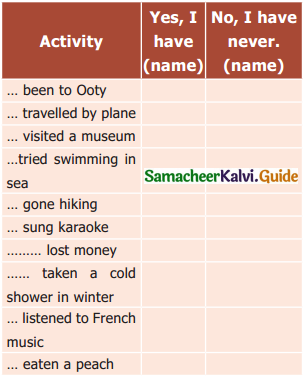
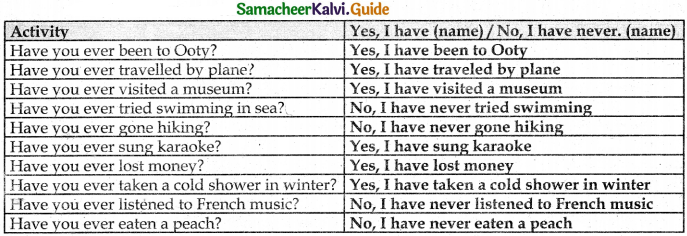
J. Present perfect with “ever and never”. Have you ever … ?

Question: Have you ever eaten a kiwi fruit?
Answer: Yes, I have eaten a kiwi fruit.
No, I have never eaten a kiwi fruit.

Answer:

K. Present Perfect Continuous Tense. Make sentences in the present perfect continuous tense using the verbs in brackets.

Question 1.
How long ……………….. ? (are you waiting, have you been waiting, have you waited)
Answer:
have you been waiting

Samacheer Kalvi 9th English Guide Prose Chapter 5 Water - The Elixir of Life

Question 2.
She ………………… in the garden since morning, (is working, has been working, work)
Answer:
has been working

Question 3.
I ………………….. this mobile for three years, (am using, has used, have been using)
Answer:
have been using

Samacheer Kalvi 9th English Guide Prose Chapter 5 Water - The Elixir of Life

Question 4.
The children ………………… in the park, (has been playing, have been playing, had been playing)
Answer:
have been playing

Question 5.
The workers ………………….. higher wages for a long time, (has been demanding, have been demanding, demand)
Answer:
have been demanding

Past Tense:

L. Complete the story using the past tense of the verbs.

The Hare and the Tortoise

One day a hare and a tortoise decided to have a race. The tortoise (1) …………….. (know) that the hare (2) …………….. (can) run faster than him. But the tortoise (3) ……………….. (be) more intelligent than the hare . ‘Yes, I’ll race you (4) ……………… (say) the tortoise. The tortoise (5) ………………. (have) a clever plan. He (6) ……………. (find) his brothers and sisters and he (7) ………………. (tell) them to wait in different places along the path of the race. So they all (8) ……………… (hide) behind the trees along the path. The race (9) …………… (begin)! The tortoise (10) ……………. (run) as fast as possible. But the hare (11) ……………. (be) faster, of course. ‘This will be a very easy race’, (12) ………………. (think) the hare. So the hare (13) …………….. (decide) to rest, and he quickly (14) …………….. (fall) asleep at the side of the road. Suddenly, the hare (15) ………………. (wake up) and he (16) (see) a tortoise ahead of him! ‘How did he get ahead of me?’ the hare asked himself. In fact, it (17) ……………. (be) not his friend the tortoise: it (18) ……………….. (be) the tortoise’s sister. But to a hare all tortoises look the same. The hare (19) ……………… (run) past the tortoise easily. Soon, he (20) ……………… (cannot) see the tortoise, so he (21) ……………… (sit) down to rest. Then the hare (22) …………….. (get up) and continued the race. But as the hare (23) ……………… (turn) around the last comer before the finish line, his friend the tortoise crossed the line and (24) …………….. (win) the race!
Answers:

  1. Knew
  2. could
  3. was
  4. said
  5. had
  6. found
  7. told
  8. had
  9. began
  10. ran
  11. was
  12. though
  13. decided
  14. fell
  15. woke
  16. saw
  17. was
  18. was
  19. ran
  20. could not
  21. sat
  22. got up
  23. turned
  24. won

M. Finish each clue by changing the verb within brackets to an irregular past-tense verb. Complete the crooswaord puzzle.

Answer:

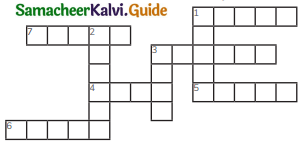
Across:

Question 1.
The lake (freeze) ……………… overnight.
Answer:
froze

Samacheer Kalvi 9th English Guide Prose Chapter 5 Water - The Elixir of Life

Question 2.
Hema (buy) …………….. a new bicvcle.
Answer:
bought

Question 3.
Aravind (give) ……………….. me a slice of pizza.
Answer:
gave

Samacheer Kalvi 9th English Guide Prose Chapter 5 Water - The Elixir of Life

Question 4.
We (drink) ……………… milk.
Answer:
drank

Question 5.
The dog (sleep) ………………… on the sofa.
Answer:
slept

Question 6.
He (write) …………………. a letter to his cousin in America.
Answer:
wrote

Down:

Question 1.
I (find) …………………. a coin on the ground.
Answer:
found

Samacheer Kalvi 9th English Guide Prose Chapter 5 Water - The Elixir of Life

Question 2.
Tony (teach) ………………. his cat to use the litter box.
Answer:
taught

Question 3.
Selvi (blow) ………………… out the candle.
Answer:
blew

Past Continuous Tense:

N. Make sentences in the past continuous tense using the verb in brackets.

  1. The children ………………. (wait) for the bus.
  2. The girls ……………… (learn) their lessons.
  3. I ………………. (play) in the rain all evening.
  4. Vijay ……………….. (repair) his car.
  5. Hari ………………. (work) hard to pass the entrance examination.

Answers:

  1. were waiting
  2. were learning
  3. was playing
  4. was repairing
  5. was working

O. Complete the sentence using the past perfect tense.

  1. Kalai didn’t complete his homework because …………………..
  2. By the time Sundar got up …………………..
  3. When we reached the park, …………………
  4. Saralah didn’t want to see her …………………..
  5. Manohar was laughing because ……………………

Answers:

  1. he had become tired
  2. he had heard a loud noise
  3. we had been asked to buy our entry coupons
  4. as she had decided to avoid her
  5. he had liked the joke very much

Past Perfect Continuous Tense:

P. Circle the correct verb form in each of the following sentences.

Question 1.
Ezhil baked / had been baking a cake when they came.
Answer:
had been baking

Samacheer Kalvi 9th English Guide Prose Chapter 5 Water - The Elixir of Life

Question 2.
Veeran cleaned / had been cleaning the room since morning.
Answer:
had been cleaning

Question 3.
We worked / had been working in the city for ten years before we moved to the village.
Answer:
had been working

Samacheer Kalvi 9th English Guide Prose Chapter 5 Water - The Elixir of Life

Question 4.
The cat had been waiting/ was waiting for the mice to come out of its hole.
Answer:
had been waiting

Question 5.
Kannan had been looking/have been looking for a job for a long time.
Answer:
had been looking

Simple Future Tense:

Q. Complete the sentences using the correct form of the verbs in brackets.

Question 1.
We hope you ………………… (have) a great time in Ooty.
Answer:
will have

Samacheer Kalvi 9th English Guide Prose Chapter 5 Water - The Elixir of Life

Question 2.
I think Manju ……………………. (visit) her grandparents during the vacation.
Answer:
will visit

Question 3.
Be careful, that mirror ………………….. (fall) on the floor.
Answer:
will fall

Samacheer Kalvi 9th English Guide Prose Chapter 5 Water - The Elixir of Life

Question 4.
As soon as my father arrives, we ……………….. (go) to watch the film.
Answer:
shall go

Question 5.
When your train arrives, I …………………… (wait) for you at the station.
Answer:
shall wait

Future Continuous Tense

R. Make sentences in the future continuous tense using the verb in brackets.

Question 1.
Ashwin (complete) M.B.A. in another two years.
Answer:
will be completing

Samacheer Kalvi 9th English Guide Prose Chapter 5 Water - The Elixir of Life

Question 2.
I …………………. (go) to Thanjavur by this time tomorrow.
Answer:
will be going

Question 3.
Prabha …………………. (receive) the beststudent award in six months’ time.
Answer:
will be receiving

Samacheer Kalvi 9th English Guide Prose Chapter 5 Water - The Elixir of Life

Question 4.
The plane ……………………. (leave) at 3 o’clock.
Answer:
will be leaving

Question 5.
He ………………… (attend) the conference.
Answer:
will be attending

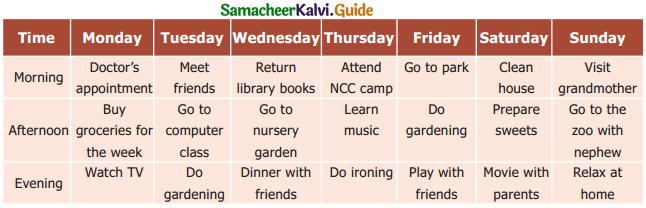
S. What is Amala going to do? Given below is Amala’s schedule for next week. Read it and answer the questions using the future continuous tense.
Amala’s Schedule

Question 1.
What will Amala do on Sunday morning?
Answer:
Amala will be visiting her grandmother on Sunday morning.

Question 2.
What is Amala planning to do on Saturday afternoon?
Answer:
Amala will be preparing sweets on Saturday afternoon.

Samacheer Kalvi 9th English Guide Prose Chapter 5 Water - The Elixir of Life

Question 3.
Where is Amala going on Wednesday morning?
Answer:
Amala will be going to the library to return the library books on Wednesday morning.

Question 4.
Who is Amala meeting on Tuesday morning?
Answer:
On Tuesday morning, Amala will be meeting her friends.

Samacheer Kalvi 9th English Guide Prose Chapter 5 Water - The Elixir of Life

Question 5.
What will she buy on Monday afternoon?
Answer:
Amala will be buying groceries for the week on Monday afternoon.

Future Perfect Tense

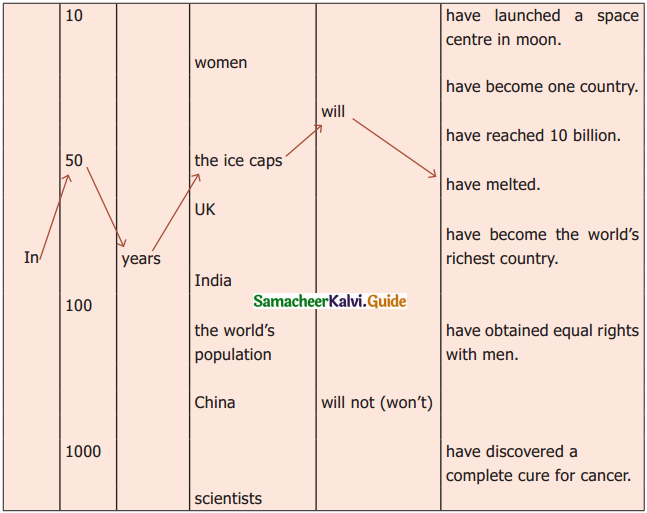
T. Match words from the different columns to make reasonable predictions.

Write the sentences.
Answers:

  1. In 50 years the ice cap will have melted.
  2. In 100 years India will have become the world’s richest country.
  3. In 50 years China will have launched a space centre in moon.
  4. In 10 years the world’s population will have reached 10 billion.
  5. In 50 years scientists will have invented a complete cure to cancer.
  6. In 1000 years India will have become one country.
  7. In 50 years women will have obtained equal rights with men.

Samacheer Kalvi 4th Tamil Guide Chapter 12 யானைக்கும் பானைக்கும் சரி

Tamilnadu State Board New Syllabus Samacheer Kalvi 4th Tamil Guide Pdf Chapter 12 யானைக்கும் பானைக்கும் சரி Text Book Back Questions and Answers, Summary, Notes.

Tamilnadu Samacheer Kalvi 4th Tamil Solutions Chapter 12 யானைக்கும் பானைக்கும் சரி

Samacheer Kalvi 4th Tamil Guide Chapter 12 யானைக்கும் பானைக்கும் சரி

வாங்க பேசலாம்

Question 1.
யானைக்கும் பானைக்கும் சரி என்ற கதையை உம் சொந்தநடையில் கூறுக.
Asnwer:
மரியாதை இராமனிடம் வந்த விசித்திரமான வழக்கு இது.
உழவரின் மீது அரபு வணிகர் தொடுத்த வழக்கு.

ஓர் உழவர் தம் மகன் திருமண விழாவில் ஊர்வலம் விடுவதற்காக அரபு வணிகர் ஒருவரிடம் யானையை இரவல் கேட்டார். அவரும் கொடுத்தார். ஊர்வலத்தின்போது யானை இறந்துவிட்டது.

அரபு வணிகர் யானையைத் திருப்பித் தரும்படி கேட்கிறார்.
உழவரோ, “யானை ஊர்வலத்தில் தற்செயலாக இறந்துவிட்டதாகவும், மாற்றாக வேறு யானை வாங்கித் தருவதாகவும் அல்லது யானைக்குரிய விலையைத் தருவதாகவும் நான் கூறினேன். ஆனால் வணிகர் ஏற்றுக் கொள்ளாமல் அடம்பிடிக்கிறார்,” என்று கூறினார்.

Samacheer Kalvi 4th Tamil Guide Chapter 12 யானைக்கும் பானைக்கும் சரி

உண்மையை அறிந்த மரியாதை இராமன், இருவரையும் பார்த்து, “நீங்கள் இருவரும் நாளை நீதிமன்றத்திற்கு வாருங்கள்” என்று கூறி அனுப்பினார். பின்னர் உழவரைத் தனியாக அழைத்து, தான் ஆள் அனுப்பும்போது வந்தால் போதும் என்றார். பிறகு அவரிடம், “வீட்டுக் கதவிற்குப் பின் பழைய பானைகளை அடுக்கி வைத்து, கதவைத் தாழ்ப்பாள் போடாமல் வைத்திருங்கள்” என்று கூறி அனுப்பி விட்டார்.

மரியாதை இராமன் கூறியபடி உழவர் செய்தார். வணிகர் உழவரை நீதிமன்றத்திற்கு அழைப்பதற்காக வேகமாக வந்து கதவைத் திறந்தார். பானைகள் விழுந்து உடைந்தன. உழவர் வணிகரிடம், “அப்பானைகள் காலங்காலமாக வைத்திருந்த பழம் பானைகள். இவற்றை உடைத்துவிட்டீரே, எனக்கு இதே பானைகளைத் திருப்பித் தாருங்கள்,” என்று சத்தமிட்டார். வணிகர் செய்வதறியாமல் திகைத்தார்.

வணிகர் நடந்ததை மரியாதை இராமனிடம் கூறினார். மரியாதை ராமன் வணிகரிடம் “நீங்கள் இறந்துபோன யானையை உயிருடன் திருப்பிக் கேட்கிறீர். அவர் உடைந்த பழம்பானைகள் வேண்டும் என்று கேட்கிறார். நீங்கள் பானையைக் கொடுத்தால் அவர் யானையைக் கொடுத்துவிடுவார்” என்று கூறினார். வணிகர் தன்னால் பழைய பானைகளைத் தரமுடியாது என்றார்.

மரியாதை இராமன் ”உங்களால் திருப்பித் தர முடியாது என்றால் அவரால் மட்டும் எப்படித் திருப்பித் தர முடியும்” என்றார். ஆதலால் யானைக்கும் பானைக்கும் சரியாகப் போய்விட்டது’ என்று தீர்ப்பளித்தார்.

Samacheer Kalvi 4th Tamil Guide Chapter 12 யானைக்கும் பானைக்கும் சரி

சிந்திக்கலாமா?

உன் நண்பன் உன்னைத் தவறாகப் புரிந்துகொண்டு உன்மீது சினம் கொண்டால் நீ என்ன செய்வாய்?
Answer:
நான் அவனைச் சமாதானப்படுத்துவேன். என்ன நடந்திருந்தாலும் அவனிடம் உண்மை கூறிப் புரிய வைப்பேன். சினம் கொள்வதற்கான அவசியமில்லை என்று கூறுவேன். சினத்தை விடுத்து சிந்திக்க முயற்சி செய்யும்படி கூறுவேன்.

வினாக்களுக்கு விடையளிக்க

Question 1.
உழவர் யானையை எதற்காக இரவல் கேட்டார்?
Answer:
உழவர், தம் மகன் திருமண விழாவில் ஊர்வலம் விடுவதற்காக யானையை இரவல் கேட்டார்.

Samacheer Kalvi 4th Tamil Guide Chapter 12 யானைக்கும் பானைக்கும் சரி

Question 2.
ஊர்வலம் சென்ற யானைக்கு என்ன நேர்ந்தது?
Answer:
ஊர்வலம் சென்ற யானை இறந்துவிட்டது.

Question 3.
மரியாதை இராமன் உழவரைத் தனியே அழைத்து என்ன கூறினார்?
Answer:
மரியாதை இராமன் உழவரை தனியாக அழைத்து “நாளை நீங்களாகவே நீதிமன்றத்திற்கு வரவேண்டாம். அந்த வணிகரை உங்கள் வீட்டிற்கு அனுப்புகிறேன். அவர் வரும்போது உங்கள் வீட்டுக் கதவிற்குப் பின் பழைய பானைகளை அடுக்கி வைத்து, கதவைத் தாழ்ப்பாள் போடாமல் வைத்திருங்கள். பின்னர், நடப்பதை நீதிமன்றத்தில் பார்த்துக் கொள்ளலாம்” என்று கூறினார்.

Question 4.
யானைக்கும் பானைக்கும் சரி என்ற கதை உணர்த்தும் நீதி என்ன?
Answer:
ஆத்திரக்காரனுக்குப் புத்திமட்டு.

Samacheer Kalvi 4th Tamil Guide Chapter 12 யானைக்கும் பானைக்கும் சரி

பூக்களில் உள்ள எழுத்துகளைக் கொண்டு கோடிட்ட இடங்களை நிரப்புக

1. வணிகர் ………………. நாட்டைச் சேர்ந்த வர்.
Answer:
அரபு

2. உழவர், வணிகர் இருவரின் வழக்கை எதிர்கொண்டவர்………….
Answer:
மரியாதை ராமன்

3. திருமண ஊர்வலத்தில் …………….. இறந்து விட்டது.
Answer:
யானை

4. பழைய …………. கீழே விழுந்து நொறுங்கின.
Answer:
பானைகள்

Samacheer Kalvi 4th Tamil Guide Chapter 12 யானைக்கும் பானைக்கும் சரி

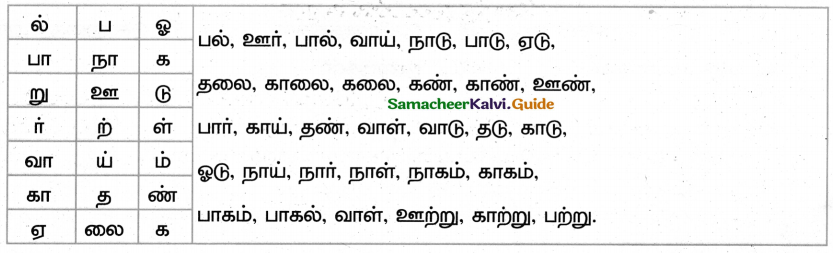
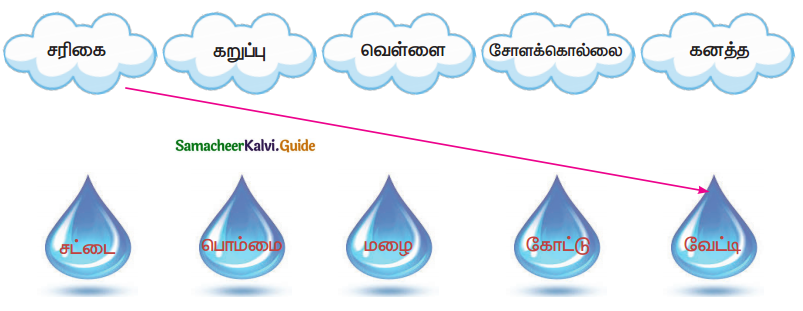
Samacheer Kalvi 4th Tamil Guide Chapter 12 யானைக்கும் பானைக்கும் சரி - 1

சொல்லிப் பழகுவோம்

1. பட்டம் விட்ட பட்டாபி, பெட்டிக் கடையில் பொட்டலம் போட்டான்.
2. கன்று மென்று தின்றது.
3. வாழைப்பழத் தோலால் வழுக்கி விழுந்தான்.

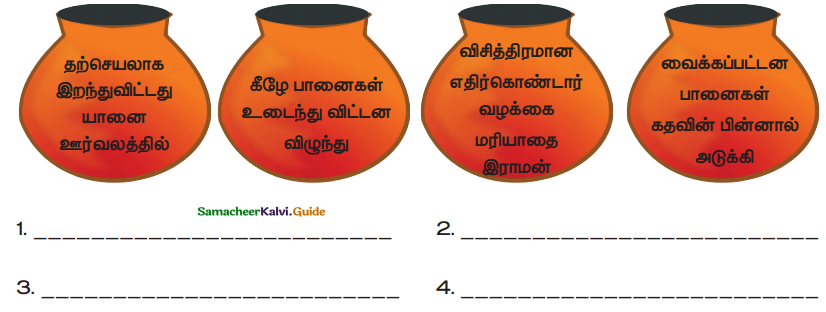
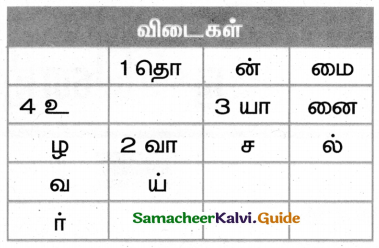
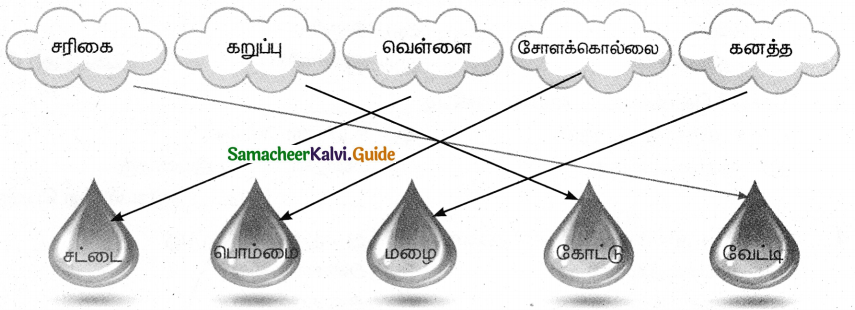
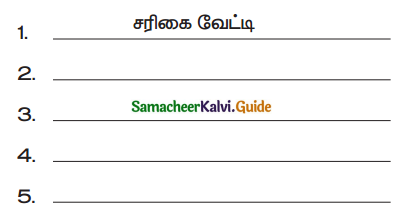
சொற்களை முறைப்படுத்திச் சரியான தொடரமைத்து எழுதுக.
Samacheer Kalvi 4th Tamil Guide Chapter 12 யானைக்கும் பானைக்கும் சரி - 2
Answer:
Samacheer Kalvi 4th Tamil Guide Chapter 12 யானைக்கும் பானைக்கும் சரி - 3
1. மரியாதை இராமன் விசித்திரமான வழக்கை எதிர்கொண்டார்.
2. ஊர்வலத்தில் யானை தற்செயலாக இறந்துவிட்டது.
3. கதவின் பின்னால் பானைகள் அடுக்கி வைக்கப்பட்டன.
4. பானைகள் கீழே விழுந்து உடைந்து விட்டன.

Samacheer Kalvi 4th Tamil Guide Chapter 12 யானைக்கும் பானைக்கும் சரி

குறிப்புகளைப் பயன்படுத்திக் கதை உருவாக்குக. பொருத்தமான தலைப்பிடுக.

நான்கு எருதுகள் – ஒற்றுமையாக வாழ்தல் – சிங்கம் – பிரிக்க நினைத்தல் – எருதுகள் எதிர்த்தல் – சிங்கத்தின் சூழ்ச்சி – எருதுகள் பிரிதல் – சிங்கம் வேட்டையாடுதல்.
Answer:
ஒற்றுமையே பலம்
ஒரு காட்டில் நான்கு எருதுகள் ஒற்றுமையுடன் வாழ்ந்து வந்தன. அவை நான்கும் வலிமையுடன் இருந்தன. அக்காட்டில் வாழ்ந்த சிங்கம் இவர்களின் ஒற்றுமையைப் பார்த்து, எப்படியாவது இவைகளைப் பிரித்துவிட வேண்டும் என்று எண்ணியது. முதலில் ஒரு எருதைக் கொல்லலாம் என்று சிங்கம் சீறிப் பாய்ந்தது.

ஆனால் மற்ற எருதுகள் சேர்ந்து சிங்கத்தைத் தம் கொம்புகளால் குத்தித் தாக்கின. வலியால் துன்புற்ற சிங்கத்திடம் நரி வந்து பேசியது. தந்திரமாக எப்படியாவது நான்கு எருதுகளையும் பிரிப்பதாகக் நரி கூறியது. அதேபோல் ஓர் எருதிடம் சென்று “உன் வலிமையால்தான் சிங்கம் பயந்து ஓடியது.

மற்ற எருதுகளால் இல்லை ” என்று கூறியது. இதேபோல் ஒவ்வொரு எருதிடமும் கூறியது. எருதுகள் ஒன்றுக்கொன்று சண்டையிட்டுப் பிரிந்தன. அச்சமயம் பார்த்து சிங்கம் ஒவ்வொரு எருதாய்க் கொன்றது. எருதுகள் ஒற்றுமையாய் இல்லாததால் கொல்லப்பட்டன.

Samacheer Kalvi 4th Tamil Guide Chapter 12 யானைக்கும் பானைக்கும் சரி

குறிப்புகளைக் கொண்டு கட்டத்திலிருந்து விடை காண்போமா?
Samacheer Kalvi 4th Tamil Guide Chapter 12 யானைக்கும் பானைக்கும் சரி - 4
Answer:
இடமிருந்து வலம்
Samacheer Kalvi 4th Tamil Guide Chapter 12 யானைக்கும் பானைக்கும் சரி - 5

Samacheer Kalvi 4th Tamil Guide Chapter 12 யானைக்கும் பானைக்கும் சரி

செயல் திட்டம்

வார இதழ்கள், செய்தித்தாள்கள், தகவல் தொடர்பு சாதனங்கள் மூலம் கிடைக்கும் யானை பற்றிய செய்திகளைத் தொகுத்து, செய்தித் தொகுப்பு உருவாக்குக.
Answer:
மாணவர்கள் தாங்களாகவே செய்ய வேண்டும்.

கூடுதல் வினாக்கள்

வினாக்களுக்கு விடையளிக்க.

Question 1.
உழவர், மரியாதை இராமனிடம் என்ன கூறினார்?
Answer:
“ஐயா, இரவலாக வாங்கிய யானை ஊர்வலத்தில் தற்செயலாக இறந்துபோய்விட்டது. அதற்குரிய விலையையாவது, மாற்றாக வேறு யானையையாவது, வாங்கித் தருகிறேன் என்று எத்தனையோ முறை கூறிவிட்டேன். ஆனால், இந்த வணிகர் ஏற்றுக்கொள்ள மறுக்கிறார். இறந்துபோன அதே யானைதான் வேண்டுமென அடம்பிடித்தால் நான் என்ன செய்வேன்?” என்று வருத்தத்துடன் உழவர் கூறினார்.

Samacheer Kalvi 4th Tamil Guide Chapter 12 யானைக்கும் பானைக்கும் சரி

Question 2.
உழவருக்கு மரியாதை இராமன் சொன்ன யோசனை யாது?
Answer:

  • வீட்டுக் கதவிற்குப் பின் பழைய பானைகளை அடுக்கி வைத்தல்.
  • கதவைத் தாழ்ப்பாள் போடாமல் வைத்தல். இவற்றைச் செய்தால் போதும் என்று உழவருக்கு மரியாதை இராமன் கூறினார்.

Samacheer Kalvi 4th Tamil Guide Chapter 12 யானைக்கும் பானைக்கும் சரி

Question 3.
மரியாதை இராமன் என்ன தீர்ப்பு அளித்தார்?
Answer:

  • வணிகர் இறந்துபோன தனது யானையைக் கேட்டார். உழவர் உடைந்துபோன பானைகளைக் கேட்டார்.
  • இரண்டுமே திரும்பப் பெற முடியாதவை. இறந்துபோன யானை மீண்டும் உயிர்பெற்று வர இயலாது என்பதை மரியாதை இராமன் உணர வைத்தார்.
  • யானைக்கும் பானைக்கும் சரியாகப் போய்விட்டது என்று அவர் தீர்ப்பு அளித்தார்.

Samacheer Kalvi 4th Tamil Guide Chapter 11 எல்லாரும் இப்படியே இருந்துவிட்டால்!

Tamilnadu State Board New Syllabus Samacheer Kalvi 4th Tamil Guide Pdf Chapter 11 எல்லாரும் இப்படியே இருந்துவிட்டால்! Text Book Back Questions and Answers, Summary, Notes.

Tamilnadu Samacheer Kalvi 4th Tamil Solutions Chapter 11 எல்லாரும் இப்படியே இருந்துவிட்டால்!

Samacheer Kalvi 4th Tamil Guide Chapter 9 கரிகாலன் கட்டிய கல்லணை

வாங்க பேசலாம்

Question 1.
“பணத்தையா சாப்பிடமுடியும்?” என்ற இளமாறனுக்கு நீங்களாக இருந்தால் என்ன விடை சொல்வீர்கள்?
Answer:
நான் கூறும் விடை :
பணத்தைச் சாப்பிட முடியாது. ஆனால் விவசாயத்தை மேம்படுத்த முடியும். உழவுத்தொழில் சிறப்பதற்கான பணியைச் செய்வேன். வீட்டில் கால்நடைகளை வளர்த்து இயற்கை உரத்தைப் பயன்படுத்துவேன். செயற்கை உரம், பூச்சிக்கொல்லிகள் போன்றவற்றைப் பயன்படுத்தமாட்டேன் என்று உறுதிமொழியேற்பேன்.

சிந்திக்கலாமா?

நம் நாட்டில் பல தொழில்கள் நடைபெறுகின்றன. உழவுத்தொழில் செய்ய யாரும் விரும்பவில்லையெனில், உலகம் என்னவாகும்?
Answer:
சுழன்றும் ஏர்ப்பின்னது உலகம்’ என்று திருவள்ளுவரே கூறியுள்ளார். பல தொழில்களைச் செய்து சுழன்று கொண்டிருக்கும் இந்த உலகம், ஏர்த்தொழிலின் பின்னேதான் சுற்ற வேண்டியிருக்கிறது. எனவே எவ்வளவுதான் துன்பம் இருப்பினும், உழவுத்தொழிலே சிறந்தது. அத்தகைய உழவுத்தொழில் நடைபெறவில்லையெனில் நம் அனைவருக்கும் உண்ண உணவு இருக்காது. உணவுக்குப் பதிலாக காலை, மாலை, இரவு என மூன்று வேளைகளுக்கும் மாத்திரையை விழுங்கி உயிர் வாழ வேண்டிய நிலைதான் ஏற்படும்.

Samacheer Kalvi 4th Tamil Guide Chapter 9 கரிகாலன் கட்டிய கல்லணை

படிப்போம்! சிந்திப்போம்! எழுதுவோம்!

சரியான சொல்லைத் தெரிவு செய்து எழுதுவோமா?

Question 1.
‘பாய்ந்தோடும்’ இச்சொல்லைப் பிரித்து எழுதக் கிடைப்பது…………………
அ) பாய் + தோடும்
ஆ) பாய்ந்து + ஓடும்
இ) பயந்து + ஓடும்
ஈ) பாய் + ஓடும்
Answer:
ஆ) பாய்ந்து + ஓடும்

Question 2.
காலை + பொழுது – இச்சொற்களைச் சேர்த்து எழுதினால் கிடைப்பது……………….
அ) காலைப்பொழுது
ஆ) காலைபொழுது
இ) காலபொழுது
ஈ) காலப்பொழுது
Answer:
அ) காலைப்பொழுது

Samacheer Kalvi 4th Tamil Guide Chapter 9 கரிகாலன் கட்டிய கல்லணை

Question 3.
பின்வருவனவற்றுள் எது இயற்கை இல்லை?……………………..
அ) மலை
ஆ) காடு
இ) நெகிழி
ஈ) நிலம்
Answer:
இ) நெகிழி

Question 4.
குனிந்து – இச்சொல் குறிக்கும் பொருள்……………………
அ) வியந்து
ஆ) விரைந்து
இ) துணிந்து
ஈ) வளைந்து
Answer:
ஈ) வளைந்து

Samacheer Kalvi 4th Tamil Guide Chapter 9 கரிகாலன் கட்டிய கல்லணை

Question 5.
தன் + உடைய இச்சொற்களைச் சேர்த்து எழுதக் கிடைப்பது……………………………………..
அ) தன்னுடைய
ஆ) தன்உடைய
இ) தன்னுடைய
ஈ) தன்உடையை
Answer:
அ) தன்னுடைய

வினாக்களுக்கு விடையளிக்க

Question 1.
செயற்கை உரங்களைப் பயன்படுத்துவதால் ஏற்படும் விளைவுகள் யாவை?
Answer:

  • நோய் எதிர்ப்புச்சக்தி குறைந்து நோய்கள் வருகின்றன.
  • உணவுகள் உயிர்ச்சத்தின்றி இருக்கின்றன.
  • மண் வளம் அழிக்கப்படுகிறது.

Samacheer Kalvi 4th Tamil Guide Chapter 9 கரிகாலன் கட்டிய கல்லணை

Question 2.
நிலத்தைத் தெய்வமாக வணங்கவேண்டும் எனத் தாத்தா கூறக் காரணம் என்ன?
Answer:
நெல், கம்பு, கேழ்வரகு, உளுந்து, துவரம்பருப்பு, எண்ணெய் வித்துகள், காய்கள், பழங்கள் எனப் பலவகையான உணவுப் பொருள்களை நிலம் கொடுப்பதால், நிலத்தைத் தெய்வமாக வணங்க வேண்டும்.

Question 3.
‘எல்லாரும் இப்படியே இருந்துவிட்டால்’ என இளமாறன் ஏன் கூறினான்?
Answer:
இளமாறன் தன் தாத்தா கூறியவற்றைச் சிந்தித்துக் கொண்டிருந்தான். அப்போது அவனுடைய அப்பா ”வயலுக்குச் சென்று வந்தாயா? உன் தாத்தாவை வயலுக்குப் போக வேண்டாம் என்று சொன்னால் அவர் எங்கே கேட்கிறார்?” என்று கூறினார்.

அதற்கு இளமாறன் “யாருமே வயலுக்குப் போகவில்லை என்றால் என்னவாகும்?” என்று கேட்டான். “எல்லாரும் இப்படியே இருந்து விட்டால் விவசாயத்தை யார் செய்வது?” என்று கேட்டுத் தன் தந்தையின் தவற்றைச் சுட்டிக் காட்டினான்.

Samacheer Kalvi 4th Tamil Guide Chapter 9 கரிகாலன் கட்டிய கல்லணை

சொந்த நடையில் கூறுக

உமக்குப் பிடித்த காய்கள், பழங்கள் எவை? ஏன்?
Answer:
எனக்குப் பிடித்த காய்கள், பழங்கள் : கத்தரிக்காய், வெண்டைக்காய், அவரைக்காய், பாகற்காய், முள்ளங்கி, காரட், பீன்ஸ், உருளைக்கிழங்கு, பீட்ரூட், பூசணிக்காய், எல்லா வகையான கீரைகள், அன்னாசிப்பழம், கொய்யாப்பழம், மாம்பழம், திராட்சைப்பழம், பப்பாளிப்பழம் ஆகிய அனைத்தும் எனக்குப் பிடித்தவை.

இவற்றை உண்பதற்கான தனித்தனிக் காரணங்கள் ஏதும் இல்லை. காய்கறிகளிலும் பழங்களிலும் தனித்தனி மருத்துவக்குணம் உள்ளது.

பொதுவாகக் காய்கறிகளையும் பழங்களையும் உண்பதால் நம் உடலுக்குத் தேவையான ஊட்டச்சத்து கிடைக்கிறது. உயிர்ச்சத்து மற்றும் தாது உப்புகள் கிடைக்கும். நோய் எதிர்ப்புச் சக்தி கூடுகிறது. அதனால் நோயற்ற வாழ்வு வாழ இயலும்.

Samacheer Kalvi 4th Tamil Guide Chapter 9 கரிகாலன் கட்டிய கல்லணை

அகரமுதலிப் பார்த்துப் பொருளறிக

மாசு – ………………………..
வேளாண்மை – ……………………
Answer:
மாசு – அழுக்கு, குற்றம், மாறுபாடு
வேளாண்மை – உழவு

சொற்களை இணைத்துத் தொடரை நீடித்து எழுதுக
Samacheer Kalvi 4th Tamil Guide Chapter 11 எல்லாரும் இப்படியே இருந்துவிட்டால்! - 1
Answer:
Samacheer Kalvi 4th Tamil Guide Chapter 11 எல்லாரும் இப்படியே இருந்துவிட்டால்! - 2

Samacheer Kalvi 4th Tamil Guide Chapter 9 கரிகாலன் கட்டிய கல்லணை

நிறுத்தக் குறியிடுக

Question 1.
நெல் கம்பு கேழ்வரகு போன்றவை தானியங்கள்
Answer:
நெல், கம்பு, கேழ்வரகு போன்றவை தானியங்கள்.

Question 2.
வெண்டைக்காய் உடலுக்கு நல்லது
Answer:
‘வெண்டைக்காய் உடலுக்கு நல்லது.

Samacheer Kalvi 4th Tamil Guide Chapter 9 கரிகாலன் கட்டிய கல்லணை

Question 3.
ஆகா பயிர் அழகாக உள்ளதே
Answer:
ஆகா, பயிர் அழகாக உள்ளதே!

Question 4.
அடப்பாவமே அப்படின்னா நாம எதைத்தான் சாப்பிடுவது
Answer:
அடப்பாவமே! அப்படின்னா, நாம எதைத்தான் சாப்பிடுவது?

புதிய சொற்களை உருவாக்கலாமா?
Samacheer Kalvi 4th Tamil Guide Chapter 11 எல்லாரும் இப்படியே இருந்துவிட்டால்! - 3
Answer:
Samacheer Kalvi 4th Tamil Guide Chapter 11 எல்லாரும் இப்படியே இருந்துவிட்டால்! - 4

Samacheer Kalvi 4th Tamil Guide Chapter 9 கரிகாலன் கட்டிய கல்லணை

படத்தைப் பார்த்து விடுகதைகள் உருவாக்குக.
Samacheer Kalvi 4th Tamil Guide Chapter 11 எல்லாரும் இப்படியே இருந்துவிட்டால்! - 5
Answer:
Samacheer Kalvi 4th Tamil Guide Chapter 11 எல்லாரும் இப்படியே இருந்துவிட்டால்! - 6

Samacheer Kalvi 4th Tamil Guide Chapter 9 கரிகாலன் கட்டிய கல்லணை

அகர வரிசைப்படுத்துக

தேன், தாளம், தௌவை, துடுப்பு, தென்னை , தையல், தோழமை, தீ, தூய்மை, தொகை, திட்பம், தளிர்.
Samacheer Kalvi 4th Tamil Guide Chapter 11 எல்லாரும் இப்படியே இருந்துவிட்டால்! - 7
Answer:
Samacheer Kalvi 4th Tamil Guide Chapter 11 எல்லாரும் இப்படியே இருந்துவிட்டால்! - 8

Samacheer Kalvi 4th Tamil Guide Chapter 9 கரிகாலன் கட்டிய கல்லணை

சொல்லக்கேட்டு எழுதுக

1. இயற்கை வேளாண்மை
2. உயிர்ச்சத்துகள்
3. செயற்கை உரங்கள்
4. நெல் மணிகள்
5. நண்டுகள்

கலையும் கைவண்ணமும்

Samacheer Kalvi 4th Tamil Guide Chapter 11 எல்லாரும் இப்படியே இருந்துவிட்டால்! - 9
Answer:
Samacheer Kalvi 4th Tamil Guide Chapter 11 எல்லாரும் இப்படியே இருந்துவிட்டால்! - 10

Samacheer Kalvi 4th Tamil Guide Chapter 9 கரிகாலன் கட்டிய கல்லணை

செயல் திட்டம்

உங்கள் வீட்டில் உருவாகும் காய்கறிக் கழிவுகளையும் மட்கும் குப்பைகளையும் பயன்படுத்தி, இயற்கை உரம் தயார் செய்க. அந்த உரத்தை வீட்டிலோ பள்ளியிலோ உள்ள தாவரங்களுக்குப் பயன்படுத்துக.

குழுவாக விளையாடலாமா?

Samacheer Kalvi 4th Tamil Guide Chapter 11 எல்லாரும் இப்படியே இருந்துவிட்டால்! - 11

(i) படத்தில் உள்ளதுபோல் அட்டைகளைத் தயார் செய்து கொள்க.
(ii) முதல் அட்டையை அசையாமல் இருக்குமாறு வைத்துக்கொள்க.
(iii) இரண்டாவது அட்டை மட்டும் சுழலுவதற்கு ஏற்ற வகையில் இருக்க வேண்டும். மேல் பக்கமாகக் கடிகார முள் போன்று செய்துவைத்துக் கொள்க.

(iv) மாணவர் ஒருவரை அழைத்து, முதல் அட்டையிலிருந்து ஏதாவது ஒரு படத்தின் பெயரைக் கூறச் சொல்லவேண்டும். அந்த மாணவரையே இரண்டாவது அட்டையையும் சுழற்றச் சொல்ல வேண்டும். கடிகார முள்ளிற்கு நேராக முதல் அட்டையில் கூறிய படத்திற்குப் பொருத்தமான படம் வந்தால் அவர் வெற்றி பெற்றதாகவும், இல்லையெனில் அடுத்தடுத்த சுற்றுக்கு வாய்ப்பு வழங்கியும் விளையாட்டைத் தொடரலாம்.

Samacheer Kalvi 4th Tamil Guide Chapter 9 கரிகாலன் கட்டிய கல்லணை

அறிந்து கொள்வோம்

திருக்குறள்

உழுதுண்டு வாழ்வாரே வாழ்வார்மற் றெல்லாம்
தொழுதுண்டு பின்செல் பவர்.
– உழவு, குறள் 1033

கூடுதல் வினாக்கள்

வினாக்களுக்கு விடையளிக்க.

Question 1.
இளமாறன் மாடியிலிருந்து பார்த்தக் காட்சிகள் யாவை?
Answer:

  • மாமரத்திலிருந்த கிளிகள் கீச் கீச் எனக் குரலெழுப்பி அங்குமிங்கும் பறந்து கொண்டிருந்தன.
  • வைக்கோல்போரின் மீது சேவலொன்று மெதுவாக நடைபயின்று கொண்டிருந்தது.
  • தோட்டத்தில் துள்ளிக்குதித்துக் கொண்டிருந்த கன்றைக் கண்டு பசு, “ம்மா…” எனக் குரலெழுப்பியது.

Samacheer Kalvi 4th Tamil Guide Chapter 9 கரிகாலன் கட்டிய கல்லணை

Question 2.
இளமாறன் வயலுக்கு ஏன் சென்றான்?
Answer:
இளமாறன் தன் தாத்தாவிற்கு சாப்பாடு கொடுப்பதற்காக வயலுக்குச் சென்றான்.

Question 3.
நெல்மணிகள் எவ்வாறு இருந்தன?
Answer:
நெல்மணிகள் கற்றறிந்த சான்றோர் போலக் குனிந்து நின்றன.

Question 4.
இளமாறன் எதைப் பார்த்து வியப்படைந்தான்?
Answer:
வளையிலிருந்து நண்டுகள் எட்டிப் பார்த்து, தம் கொடுக்குகளை மேலும் கீழுமாக அசைத்து நகர்ந்தன. அதைப் பார்த்து இளமாறன் வியப்படைந்தான்.

Question 5.
நிலத்தில் வேலை செய்வது பற்றி இளமாறன் கேட்ட கேள்விக்குத் தாத்தா என்ன பதில் கூறினார்?
Answer:
வயலில் வேலை செய்ததால்தான் தன் உடல் வலிமையாக உள்ளது என்றும், வலிமையாக இருப்பதால் நோய்நொடியின்றி இருப்பதாகவும் கூறினார்.

Samacheer Kalvi 4th Tamil Guide Chapter 9 கரிகாலன் கட்டிய கல்லணை

Question 6.
வயலைப் பற்றி இளமாறனின் தாத்தா கூறியது யாது?
Answer:
வயல்தான் தமக்குச் சொத்து. இங்கு விளைகின்ற பயிர்கள் மக்களை வாழவைக்கின்றன. உண்ணுகின்ற உணவுப் பொருள்களெல்லாம் தம்மைப் போன்ற உழவர்களின் உழைப்பின் மூலமாகவே கிடைப்பதாக தாத்தா கூறினார்.

Question 7.
உழவர்கள் விளைவிப்பவை யாவை?
Answer:
நெல், கம்பு, கேழ்வரகு, உளுந்து, துவரம்பருப்பு, எண்ணெய்வித்துகள், காய்கள், பழங்கள்.

Question 8.
ஈடு இணை இல்லாதது என்று தாத்தா குறிப்பிட்டது என்ன?
Answer:
உழவர்களின் தேவைக்குப் போக விளைந்ததைப் பிறருக்குக் கொடுக்கும் போது கிடைக்கிற மகிழ்ச்சிக்கு ஈடு இணை இல்லை என தாத்தா குறிப்பிட்டார்.

Samacheer Kalvi 4th Tamil Guide Chapter 9 கரிகாலன் கட்டிய கல்லணை

சிறுவினா:

Question 1.
தாத்தா இயற்கை உரம், செயற்கை உரம் பற்றிக் கூறியனவற்றை எழுதுக.
Answer:
இயற்கை உரம்:

  • ஆடு மாடுகளின் சாணத்தை ஒன்று சேர்த்து எருவாக்கி, நிலத்தில் போடுதல்.
  • தாவரங்களின் தழைகளை மண்ணிலிட்டு மட்கச் செய்தல்.
  • இந்த இயற்கை உரங்களைப் பயன்படுத்தினால் நல்ல விளைச்சல் கிடைக்கும். நாம் நல்ல உடல் நலத்தோடும் நோய் எதிர்ப்புச் சக்தியோடும் வாழலாம்.

செயற்கை உரம்:

  • செயற்கை உரங்களைத் தெளிப்பதனால் தேனீ, வண்ணத்துப்பூச்சி, மண்புழு போன்றவை அழிந்து விடுகிறது. அதனால் மண் மாசடைகிறது.
  • செயற்கை உரம், பூச்சிக்கொல்லிகள் போன்றவற்றை மண்ணில் தெளிப்பதனால் தண்ணீர் மாசடைகிறது. தொழிற்சாலைக் கழிவுகளை அப்படியே நிலத்தில் விடுவதால் நிலத்தடிநீர் மாசடைகிறது.
  • இவற்றைப் பயன்படுத்தி விளைவிக்கப்படும் உணவுகளை உண்பதால் நோய் எதிர்ப்புச்சக்தி குறைந்து புதிய புதிய நோய்கள் வருகின்றன.

Samacheer Kalvi 4th Tamil Guide Chapter 10 காவல்காரர்

Tamilnadu State Board New Syllabus Samacheer Kalvi 4th Tamil Guide Pdf Chapter 10 காவல்காரர் Text Book Back Questions and Answers, Summary, Notes.

Tamilnadu Samacheer Kalvi 4th Tamil Solutions Chapter 10 காவல்காரர்

Samacheer Kalvi 4th Tamil Guide Chapter 10 காவல்காரர்

வாங்க பேசலாம்

Question 1
கதைப்பாடலை ஓசைநயத்துடன் பாடி மகிழ்க.
Answer:
மாணவர்கள் தாங்களாகவே கதைப் பாடலை ஓசை நயத்துடன் பாட வேண்டும்.

Question 2.
பாடலின் பொருளைப் புரிந்து கொண்டு பாடுக.
Answer:
மாணவர்கள் தாங்களாகவே பாடலின் பொருள் புரிந்து பாட வேண்டும்.

Samacheer Kalvi 4th Tamil Guide Chapter 10 காவல்காரர்

Question 3.
பாடல் பொருளை உமது சொந்த நடையில் கூறுக.
Answer:
தோட்டத்தின் நடுவில் மேலே கோட்டுடனும் சரிகை வேட்டியுடனும் காவல்காரர் நின்றிருந்தார். இரவும் பகலும் காவல் காத்து வந்தார். காக்கை குருவிகள் அங்குள்ள காவல்காரரைப் பார்த்து பயந்து கொண்டு திரும்பி ஓடிவிடும். ஒருமுறை பலத்த மழை பெய்தபோது காவல்காரரின் ஆடைகள் கிழிந்திருந்தது.

காவல்காரருக்கு உதவி செய்தால் தான் அச்சமின்றி உலா வரலாம் என எண்ணிய காகம் அருகில் இருந்த வீட்டிற்குச் சென்று கறுப்புக் கோட்டு, வெள்ளைச் சட்டை, கட்டிக் கொள்ள சரிகை வேட்டி எடுத்து வந்து காவல்காரரிடம் கொடுத்து உடுத்திக் கொள்ளச் சொன்னது.

காவல்காரர் புதிய ஆடையை ஆவலோடு பார்க்கவில்லை, பழைய ஆடையைக் கழற்றிப் போடவில்லை. கொஞ்சம்கூட அசையவில்லை. காகம் அருகில் சென்று உற்றுப் பார்த்தவுடன்தான் அங்கிருந்தது சோளக்கொல்லை பொம்மை என்று அப்போது தெரிந்தது. வைக்கோலினால் ஆன பொம்மை என்பதைத் தன் நண்பர்களிடம் சொல்வதாகக் கூறிப் பொம்மையின் தலையில் நின்று மற்ற பறவைகளையும் கூவி அழைக்கிறது.

சிந்திக்கலாமா?

சூழல் -1 மீனாவின் அம்மா மீனாவுக்கு மட்டுமின்றி மீனாவின் நண்பர்களுக்கும் பிறந்த நாள் வாழ்த்துகள் தெரிவிக்கிறார்.
சூழல் – 2 வளவனின் அப்பா யார் எந்த உதவி கேட்டாலும் நீ செய்யக் கூடாது என்று கூறுகிறார். இதுபற்றி உங்கள் கருத்து என்ன?
Answer:
சூழல் ஒன்றுதான் போற்றத்தக்கது. மீனாவின் அம்மாவைப் போல் நாமும் அனைவரிடமும் அன்புடனும் நட்புடனும்பழகவேண்டும். அப்போதுதான் ஒருவருக்கொருவர் விட்டுக் கொடுத்து வாழும் பண்பைப் பெறுவர். வளரும் குழந்தைகளுக்கு நற்பண்புகளைக் கற்றுக் கொடுக்க வேண்டும்.

சூழல் இரண்டு யாரும் பின்பற்றக் கூடாத குணம். உதவி செய்து வாழ்வதைப் பற்றி முதலில் வளவனின் அப்பா அறிய வேண்டும்.

படிப்போம்! சிந்திப்போம்! எழுதுவோம்!

சரியான சொல்லைத் தெரிவு செய்து எழுதுவோமா?

Question 1.
‘பெயரில்லாத’ – இச்சொல்லைப் பிரித்து எழுதக் கிடைப்பது………………….
அ) பெயர் + இலாத
ஆ) பெயர் + இல்லாத
இ) பெயரில் + இல்லாத
ஈ) பெயரே + இல்லாத
Answer:
ஆ) பெயர் + இல்லாத

Samacheer Kalvi 4th Tamil Guide Chapter 10 காவல்காரர்

Question 2.
வைக்கோல் மேலே துணியைச் சுற்றி வைத்திருக்கும் பொம்மை இத்தொடரில் அடிக்கோடிட்ட சொல்லின் எதிர்ச்சொல்…………………
அ) கீழே
ஆ) அருகில்
இ) தொலைவில்
ஈ) வளைவில்
Answer:
அ) கீழே

Question 3.
‘சோளக்கொல்லைப் பொம்மை’ என்பது……………………
அ) உயிருள்ள பொருள்
ஆ) உயிரற்ற பொருள்
இ) இயற்கையானது
ஈ) மனிதன் செய்ய இயலாதது
Answer:
ஆ) உயிரற்ற பொருள்

Samacheer Kalvi 4th Tamil Guide Chapter 10 காவல்காரர்

Question 4.
அசைய + இல்லை – இச்சொற்களைச் சேர்த்து எழுதக் கிடைப்பது……………….
அ) அசைய இல்லை
ஆ) அசைவில்லை
இ) அசையவில்லை
ஈ) அசையில்லை
Answer:
இ) அசையவில்லை

Question 5.
நித்தம் – இச்சொல்லுக்குரிய பொருள்…………………….
அ) நாளும்
ஆ) இப்பொழுதும்
இ) நேற்றும்
ஈ) எப்பொழுதும்
Answer:
அ) நாளும்

Samacheer Kalvi 4th Tamil Guide Chapter 10 காவல்காரர்

வினாக்களுக்கு விடையளிக்க

Question 1.
தோட்டத்தின் நடுவே ராஜா போல் நின்றவர் யார்?
Answer:
தோட்டத்தின் நடுவே ராஜா போல் நின்றவர் சோளக்கொல்லைப் பொம்மையாகிய காவல்காரர்.

Question 2.
காவல்காரருக்குத் தோட்டத்தில் உள்ள பணி யாது?
Answer:
காவல்காரருக்குத் தோட்டத்தில் உள்ள பணி, இரவும் பகலும் வயலில் நின்று காவல் காப்பதாகும்.

Samacheer Kalvi 4th Tamil Guide Chapter 10 காவல்காரர்

Question 3.
பொம்மைக்குக் கறுப்புக்கோட்டு, வெள்ளைச்சட்டை கொடுத்தது யார்?
Answer:
பொம்மைக்குக் கறுப்புக்கோட்டு, வெள்ளைச்சட்டை கொடுத்தது காகம்.

Question 4.
காகம் கொடுத்த ஆடைகளைக் காவல்காரர் ஏன் அணியவில்லை?
Answer:
காவல்காரர் உயிரற்ற பொருள் என்பதால் காகம் கொடுத்த ஆடைகளைக் காவல்காரர் அணியவில்லை.

Samacheer Kalvi 4th Tamil Guide Chapter 10 காவல்காரர்

முதலெழுத்து ஒன்று போல் வரும் சொற்களை எழுதுக
Samacheer Kalvi 4th Tamil Guide Chapter 10 காவல்காரர் - 1
Answer:
Samacheer Kalvi 4th Tamil Guide Chapter 10 காவல்காரர் - 2

மேகங்களுக்குப் பொருத்தமான மழைத்துளிகளை இணைக்க
Samacheer Kalvi 4th Tamil Guide Chapter 10 காவல்காரர் - 3
Answer:
Samacheer Kalvi 4th Tamil Guide Chapter 10 காவல்காரர் - 4

இணைத்த சொற்களைக் கீழே எழுதுக.
Samacheer Kalvi 4th Tamil Guide Chapter 10 காவல்காரர் - 5
Answer:
1. சரிகை வேட்டை
2. கறுப்புக் கோட்டு
3. வெள்ளைச் சட்டை
4. சோளக் கொல்லைப் பொம்மை
5. கனத்த மழை.

பாடலைத் தொடர்ந்து பாடுவோமா?
Samacheer Kalvi 4th Tamil Guide Chapter 10 காவல்காரர் - 6
Answer:
மக்கள் ஒன்று கூடியே
மகிழ விரும்பும் திருவிழா
குழந்தைச் செல்வம் யாவுமே
கூடிஆடும் திருவிழா
குமரிப் பெண்கள் யாவரும்
கூடிமகிழும் திருவிழா
கடைத் தெருக்கள் முழுவதும்
கலைகட்டும் திருவிழா.

உரைப் பகுதியைப் படித்து வினாக்களுக்கு விடை எழுதுக

நமக்குப் பயன்தரும் பல மரங்களுள் வாழையும் ஒன்று. வாழையின் பூ, காய், கனி, தண்டு ஆகியவற்றை நாம் சமைத்து உண்கிறோம். வாழைநாரைக் கொண்டு பூக்களைத் தொடுக்கிறோம். திருமண விழாக்களிலும் வீட்டில் நடைபெறும் விழாக்களிலும் வாழையிலையில் விருந்து படைக்கின்றனர். வாழையில் செவ்வாழை, பூவன் வாழை, மலை வாழை எனப் பலவகைகள் உள்ளன.

வினாக்கள் :
Samacheer Kalvi 4th Tamil Guide Chapter 10 காவல்காரர் - 7

Question 1.
வாழையின் எப்பகுதிகள் உணவாகப் பயன்படுகின்றன?
Answer:
பூ, காய், கனி, தண்டு

Samacheer Kalvi 4th Tamil Guide Chapter 10 காவல்காரர்

Question 2.
வாழைநார் எதற்குப் பயன்படுகிறது?
Answer:
வாழைநார் பூத்தொடுக்கப் பயன்படுகிறது.

Question 3.
வாழையின் வகைகளுள் இரண்டை எழுதுக.
Answer:
செவ்வாழை, பூவன் வாழை

Samacheer Kalvi 4th Tamil Guide Chapter 10 காவல்காரர்

Question 4.
வாழையிலை – இச்சொல்லைப் பிரித்து எழுதுக.
Answer:
வாழை + இலை

Question 5.
பலவகை – இச்சொல்லுக்கு எதிர்ச்சொல் எழுதுக.
Answer:
சிலவகை.

செயல் திட்டம்

உங்கள் இருப்பிடத்திற்கு அருகிலிருந்து கீழ்க்காணும் செய்திகளைத் திரட்டுக.

Question 1.
தோட்டத்தின் பெயர்
Answer:
இயற்கைத் தோட்டம்.

Samacheer Kalvi 4th Tamil Guide Chapter 10 காவல்காரர்

Question 2.
உரிமையாளர் பெயர்.
Answer:
சிவராமன்.

Question 3.
தோட்டம் அமைந்திருக்கும் ஊர்
Answer:
பருத்திப்பட்டு

Samacheer Kalvi 4th Tamil Guide Chapter 10 காவல்காரர்

Question 4.
நீர்வசதி: கிணறு /அடிகுழாய்/ ஆறு/குளம்.
Answer:
கிணறு.

Question 5.
தோட்டத்தில் விளையும் காய்கறி/பழம் பெயரைக் குறிப்பிடுக.
Answer:
கீரை வகை, கத்தரிக்காய், வெண்டைக்காய், மாதுளம் பழம், சப்போட்டாப் பழம்.

Question 6.
தோட்டம் பற்றிய உனது கருத்து நன்றாக உள்ளது/ஓரளவு/ வளர்ச்சி தேவை.
Answer:
நன்றாக உள்ளது.

Samacheer Kalvi 4th Tamil Guide Chapter 10 காவல்காரர்

அறிந்து கொள்வோம்

  1. தோட்டத்தில் பூச்சி தாக்குதலைத் தடுக்க முட்டை ஓட்டுத் தூளுடன், சிறிது உப்பைக் கலந்து செடியைச் சுற்றிலும் வளையம் போட வேண்டும்.
    2. வேளாண்மைக்குப் பயன்படுத்தப்படும் பூச்சிக்கொல்லிகள் மற்றும் களைகொல்லிகள் தாவரங்களின் கனிம வளங்களைக் குறைக்கின்றன.
    3. மண் அரிப்பைத் தடுக்க மரங்கள் நட்டு வளர்த்தல் இன்றியமையாதது.

கூடுதல் வினாக்கள்

வினாக்களுக்கு விடையளிக்க.

Question 1.
தோட்டத்தில் இருந்த பொம்மையைக் காகம் என்ன என்று நினைத்தது?
Answer:
தோட்டத்தின் நடுவில் நின்றிருந்த சோளக்கொல்லைப் பொம்மையை காவல் காக்கும் உயிருள்ள மனிதர்’ என்று காகம் நினைத்தது.

Samacheer Kalvi 4th Tamil Guide Chapter 10 காவல்காரர்

Question 2.
காகம் பொம்மைக்கு ஏன் புதிய ஆடைகளைக் கொடுத்தது?
Answer:
பொம்மை அணிந்திருந்த ஆடைகள் கனத்த மழையால் கிழிந்திருந்தன. அதனால் காகம் பொம்மைக்குப் புதிய ஆடைகளைக் கொடுத்தது.

Question 3.
காகம், மற்ற பறவைகளை ஏன் கூவி அழைத்தது?
Answer:
தோட்டத்தில் இருந்த பொம்மை ‘உயிருள்ள மனிதர்’ என்று எண்ணி பறவைகள் அங்கு வராமலிருந்தன. அது உயிரற்ற பொருள் என்பதை உணர்ந்ததால் காகம், மற்ற பறவைகளையும் கூவி அழைத்தது.

Question 4.
அழ.வள்ளியப்பா, குழந்தைக்கவிஞர் என அழைக்கப்படுவதன் காரணம் என்ன?
Answer:
அழ.வள்ளியப்பா அவர்கள் குழந்தைகளுக்கான கதைகளையும் பாடல்களையும் மிகுதியாகப் பாடியுள்ளமையால், குழந்தைக்கவிஞர் என அழைக்கப்படுகிறார்.

Samacheer Kalvi 4th Tamil Guide Chapter 10 காவல்காரர்

Question 5.
‘மலரும் உள்ளம்’ நூலை எழுதியவர் யார்?
Answer:
‘மலரும் உள்ளம்’ நூலை எழுதியவர் குழந்தைக்கவிஞர் அழ. வள்ளியப்பா ஆவார்.

Samacheer Kalvi 4th Tamil Guide Chapter 9 கரிகாலன் கட்டிய கல்லணை

Tamilnadu State Board New Syllabus Samacheer Kalvi 4th Tamil Guide Pdf Chapter 9 கரிகாலன் கட்டிய கல்லணை Text Book Back Questions and Answers, Summary, Notes.

Tamilnadu Samacheer Kalvi 4th Tamil Solutions Chapter 9 கரிகாலன் கட்டிய கல்லணை

Samacheer Kalvi 4th Tamil Guide Chapter 9 கரிகாலன் கட்டிய கல்லணை

வாங்க பேசலாம்

Question 1.
கல்லணை பற்றி உனக்குத் தெரிந்த செய்திகளை உன் சொந்த நடையில் கூறு.
Answer:
(i) கல்லணையின் நீளம் 1080 அடி, அகலம் 66 அடி, உயரம் 18 அடியாகும். இது நெளிந்து வளைந்த அமைப்புடன் காணப்படுகிறது.

(ii) கல்லும் களிமண்ணும் மட்டுமே சேர்ந்த ஓர் அமைப்பு. 1900 ஆண்டுகளுக்கு மேலாக காவிரி வெள்ளத்தைத் தடுத்து நிறுத்தி வருவது அதிசயம் ஆகும். 1839-இல் அணையின் மீது பாலம் ஒன்று கட்டப்பட்டது.

(iii) பல இடங்களிலிருந்து தினந்தோறும் ஏராளமானோர் இவ்வணையைக் காண வருவதால், இது ஒரு சுற்றுலாத் தலமாகவும் விளங்குகிறது.

(iv) இநத் அணையைக் கரிகாலன் என்ற சோழமன்னன் கட்டினான். தற்போதுள்ள அணைகளில் கல்லணையே மிக பழமையானது எனவும், தற்போது புழக்கத்தில் உள்ளது எனவும் அறியப்படுகிறது. இதுவே உலகின் மிகப்பழமையான நீர்ப்பாசனத்திட்டம் என்றும் கூறப்படுகிறது.

(v) இவ்வணை தஞ்சாவூர் மாவட்டத்தில் உள்ளது. பூதலூர் வட்டத்தில் உள்ள தோகூர் கோவிலடி கிராமத்தில் அமைந்துள்ளது. ஆங்கிலேயர் ஆட்சியில் மேலணை கட்டப்பட்டது. கல்லணையைப் பற்றிய செய்தி சங்க இலக்கியங்களில் கூறப்பட்டுள்ளன.

Samacheer Kalvi 4th Tamil Guide Chapter 8 விடியும் வேளை

Question 2.
உமது ஊரில் உள்ள மிகப் பழைமையான இடம் எது? அதுபற்றி வகுப்பறையில் கலந்துரையாடுக.
Answer:
கலை :
பாண்டி! நமது ஊரில் உள்ள மிகப்பழமையான இடம் என்று எதை நினைக்கிறாய்?
விமல் : மதுரை மீனாட்சியம்மன் கோவில் தான் என்று நினைக்கின்றேன்.
கலை : சரி, கோவிலைப்பற்றி உனக்கு ஏதாவது தெரியுமா?
விமல் : தெரியுமே. மதுரை மீனாட்சி சுந்தரேசுவரர் கோயில் என்பது வைகை ஆற்றின் கரையில் அமைந்துள்ள கோயில் நகரமான மதுரையின் மத்தியில் அமைந்துள்ள சிவாலயமாகும். இச்சிவாலயத்தின் மூலவர் சுந்தரேசுவரர் மற்றும் அம்பிகை மீனாட்சியம்மன். இக்கோயிலை மதுரை மீனாட்சியம்மன் கோயில் என்றும் அழைக்கின்றனர்.

கலை : ஆமாம், இக்கோயிலே தமிழகத்தில் உள்ள 366 மீனாட்சி சுந்தரேசுவரர் கோயில்களின் மூலகோயிலாக உள்ளது.
விமல் : இக்கோயில் திராவிடக் கட்டக்கலைக்கு ஓர் எடுத்துக்காட்டாவும் விளங்குகிறது. 2000 ஆண்டுகள் தொன்மை வாய்ந்ததாகவும் கருதப்படுகின்றது.

கலை : தேவலோகத்தின் அரசனான இந்திரனால் கட்டப்பட்டது என்பது நம்பிக்கையாக உள்ளது.
கலை : இக்கோயில் 15 ஏக்கர் பரப்பளவில் அமைந்துள்ளது. எட்டு கோபுரங்களையும் இரண்டு விமானங்களையும் உடையது. இங்குள்ள கருவறை விமானங்கள், இந்திர விமானம் என்று அழைக்கப்படுகிறது. 32 சிங்கங்களும், 64 சிவகணங்களும் 8 வெள்ளை யானைகளும் இந்த கருவறை விமானங்களைத் தாங்குகின்றன.

விமல் : இக்கோயில் கிழக்கு மேற்காக 847 அடியும், தெற்கு வடக்காக 792 அடியும் உடையது. இக்கோயிலின் ஆடி வீதிகளில் நான்கு புறமும் ஒன்பது நிலைகளை உடைய நான்கு கோபுரங்கள் மிக உயர்ந்த நிலையில் இருக்கிறது.
கலை : அவற்றுள் தெற்குக் கோபுரம் மிக உயரமானதாகும். இதன் உயரம் 160 அடியாக இருக்கிறது.
விமல் : உண்மையிலேயே இக்கலந்துரையாடல் மிகவும் பயனுள்ளதாக அமைந்துள்ளது. நன்றி பாண்டி!

Samacheer Kalvi 4th Tamil Guide Chapter 9 கரிகாலன் கட்டிய கல்லணை

சிந்திக்கலாமா?

கோடைக்காலங்களில் நீர்ப்பற்றாக்குறை ஏற்படக் காரணம் என்ன?
Answer:
கோடைக்காலங்களில் நீர்ப்பற்றாக்குறை ஏற்படக்காரணம், கோடைக் காலங்களில் மழை பொழிவது இல்லை. அதனால் நீர்நிலைகளில் நீர் வற்றி விடுகிறது வறண்டும் போய் விடுகிறது. இந்த நேரங்களில் தான் அதிகமாக நீர்ப்பற்றாக்குறை ஏற்படுகிறது. மனிதனின் பேராசையாலும் நீர் சுரண்டப்படுவதாலும் நீர்ப்பற்றாக்குறை ஏற்படுகிறது. பெரும்பாலான ஆறுகள், குளங்கள், ஏரிகள் தூர்வாரப்படாமல் இருப்பதும் காரணமாகும். இங்கு அதிகமான நீர்நிலைகள் இல்லாததும் இருப்பதை முறையாக பராமரிக்காமல் விட்டதாலும் பற்றாக்குறை ஏற்படுகிறது.

நீர்ப்பற்றாக்குறைறைப் போக்க என்ன செய்வாய்?
Answer:
நீர்ப்பற்றாக்குறையைப் போக்க பல அணைகள் கட்டலாம். ஆற்றின் குறுக்கே பல தடுப்பணைகளைக் கட்டலாம். நீர்நிலைகளைக் கோடைக்காலங்களில் முறையாக தூர்வாரி பராமரித்து, மழைக்காலங்களில் அதிக நீரை சேகரித்து வைக்கலாம். புதிய புதிய நீர்நிலைகளை உருவாக்கி நீரைச் சேமித்து நிலத்தடி நீரையும் உயர்த்தலாம். இருக்கின்ற நீரை முறையாகப் பயன்படுத்த வேண்டும்.

Samacheer Kalvi 4th Tamil Guide Chapter 9 கரிகாலன் கட்டிய கல்லணை

படிப்போம்! சிந்திப்போம்! எழுதுவோம்!

சரியான பழத்தைத் தேர்ந்தெடுக்க

Samacheer Kalvi 4th Tamil Guide Chapter 9 கரிகாலன் கட்டிய கல்லணை - 1
Answer:

1. துயரம் இச்சொல் குறிக்கும் பொருள் துன்பம்
2. வியத்தகு இச்சொல் குறிக்கும் பொருள் ஆச்சரியம் தரும்.
3. முறியடித்து இச்சொல் குறிக்கும் பொருள் தகர்த்து
4. சூழ்ச்சி இச்சொல் குறிக்கும் பொருள் தந்திரம்

Samacheer Kalvi 4th Tamil Guide Chapter 9 கரிகாலன் கட்டிய கல்லணை

சரியான சொல்லைத் தெரிவு செய்து எழுதுவோமா?

Question 1.
பெருவெள்ளம் இச்சொல்லைப் பிரித்து எழுதக் கிடைப்பது …………………………
அ) பெருமை + வெள்ளம்
ஆ) பெரு + வெள்ளம்
இ) பெரு + வுள்ளம்
ஈ) பெரிய + வெள்ளம்
Answer:
அ) பெருமை + வெள்ளம்

Question 2.
தங்கியிருந்த இச்சொல்லைப் பிரித்து எழுதக் கிடைப்பது …………………………
அ) தங்கி + இருந்த
ஆ) தங்கி + யிருந்த
இ) தங்கியி + ருந்த
ஈ) தங்கு + இருந்த
Answer:
அ) தங்கி + இருந்த

Question 3.
அமைந்துள்ளது இச்சொல்லைப் பிரித்து எழுதக் கிடைப்பது …………………………
அ) அமைந் + துள்ளது
ஆ) அமைந்து + உள்ளது
இ) அமைந்து + ள்ளது
‘ஈ) அமைந் + உள்ளது
Answer:
ஆ) அமைந்து + உள்ளது

Samacheer Kalvi 4th Tamil Guide Chapter 9 கரிகாலன் கட்டிய கல்லணை

Question 4.
அரசு + ஆட்சி என்பதைச் சேர்த்து கிடைக்கும் சொல் …………………………
அ) அரசஆட்சி
ஆ) அரசாட்சி
இ) அரசுசாட்சி
ஈ) அரசு ஆட்சி
Answer:
ஆ) அரசாட்சி

Question 5.
நீர் + பாசனம் என்பதைச் சேர்த்து எழுதக் கிடைக்கும் சொல் …………………………
அ) நீர்பாசனம்
ஆ) நீர்ப்பாசனம்
இ) நீரப்பசனம்
ஈ) நீர்பாசனம்
Answer:
ஆ) நீர்ப்பாசனம்

பந்தை அதன் எதிர்ச்சொல் கூடையில் போடலாமா?
Samacheer Kalvi 4th Tamil Guide Chapter 9 கரிகாலன் கட்டிய கல்லணை - 2
Answer:
Samacheer Kalvi 4th Tamil Guide Chapter 9 கரிகாலன் கட்டிய கல்லணை - 3

Samacheer Kalvi 4th Tamil Guide Chapter 9 கரிகாலன் கட்டிய கல்லணை

சரியானதை எடுத்து எழுதுக

1. கல்லணை அமைந்துள்ள மாவட்டம் ………………………… (திருச்சி/ தஞ்சாவூர்)
Answer:
தஞ்சாவூர்

2. தமிழ்நாட்டில் காவிரியின் முக்கிய துணையாறு ………………………… (வைகை / கொள்ளிடம்)
Answer:
கொள்ளிடம்

3. கல்லணையைக் கட்டிய அரசன் ………………………… . (கரிகாலன்/இராசராசன்)
Answer:
கரிகாலன்

Samacheer Kalvi 4th Tamil Guide Chapter 9 கரிகாலன் கட்டிய கல்லணை

4. கல்லணை ………………………… தொழில்நுட்பத்திற்குச் சிறந்த சான்றாகத் திகழ்கிறது. (பழந்தமிழர்/இன்றைய)
Answer:
பழந்தமிழர்

வினாக்களுக்கு ஏற்ற விடையளிக்க

Question 1.
கரிகாலனின் இயற்பெயர் என்ன?
Answer:
கரிகாலனின் இயற்பெயர் வளவன்.

Question 2.
கரிகாலன் என்று பெயர் வரக் காரணம் என்ன?
Answer:
கரிகாலன் என்பதற்குக் கருகிய காலை உடையவன் என்பது பொருள். இளம் வயதில் இவருக்கு ஏற்பட்ட தீவிபத்தின் காரணமாக இப்பெயர் இவருக்கு வழங்கலாயிற்று.

Question 3.
கரிகாலன் கல்லணையைக் கட்ட காரணம் யாது?
Answer:
காவிரியில் அடிக்கடி பெருவெள்ளம் வரும். ஆனால் அந்த நீர் எதற்கும் பயன்படாமல் கடலுக்குச் சென்றுவிடும். மக்கள் மழைக்காலத்தில் வெள்ளப்பெருக்காலும், கோடைக்காலத்தில் நீர் இன்றியும் மக்கள் துயரப்பட்டதைக் கண்டு அதனைத் தடுக்கும் பொருட்டு பெரியதோர் அணையைக் கட்டினான்.

Samacheer Kalvi 4th Tamil Guide Chapter 9 கரிகாலன் கட்டிய கல்லணை

Question 4.
கல்லணையின் சிறப்பாக நீ நினைப்பதை எழுதுக.
Answer:
தற்போது பயன்பாட்டில் உள்ள மிகப்பழமையான ஒரே அணை கல்லணை. இதுவே உலகின் மிகப்பழமையான நீர்ப்பாசனத்திட்டம் எனவும் கூறப்படுகிறது. மணலில் அடித்தளம் அமைத்துக் கட்டியுள்ளார்கள். இது பழந்தமிழரின் தொழில் நுட்பத்திற்குச் சான்றாகும். இன்று வரை இது வியத்தகு சாதனையாக உள்ளது.

மொழியோடு விளையாடு

ஒரே எழுத்தைக் கண்டுபிடி, நான்கு சொல்லைப் பெறலாம்
Samacheer Kalvi 4th Tamil Guide Chapter 9 கரிகாலன் கட்டிய கல்லணை - 4
Asnwer:
Samacheer Kalvi 4th Tamil Guide Chapter 9 கரிகாலன் கட்டிய கல்லணை - 5

Samacheer Kalvi 4th Tamil Guide Chapter 9 கரிகாலன் கட்டிய கல்லணை

செயல் திட்டம்

Question 1.
நூலகத்திற்குச் சென்று வரலாற்று நூல்களைப் படித்து யாரேனும் ஐந்து அரசர்களின் பெயர்களையும், அவர்கள் செய்த நற்செயல்களையும் தெரிந்து கொண்டு அட்டவணையை நிரப்பி வருக.
Samacheer Kalvi 4th Tamil Guide Chapter 9 கரிகாலன் கட்டிய கல்லணை - 6
Answer:
Samacheer Kalvi 4th Tamil Guide Chapter 9 கரிகாலன் கட்டிய கல்லணை - 7

Samacheer Kalvi 4th Tamil Guide Chapter 9 கரிகாலன் கட்டிய கல்லணை

கூடுதல் வினாக்கள்

சரியான சொல்லைத் தெரிவு செய்து எழுதுக

Question 1.
கல்லணை திருச்சியிலிருந்து ………………………… கி.மீ. தொலைவில் உள்ளது.
அ) 15
ஆ) 20
இ) 10
ஈ) 25
Answer:
ஆ) 20

Question 2.
மணிமொழியும், கனிமொழியும் ………………….. க்குச் சென்றனர்.
அ) திருச்சி
ஆ) பெரியகோவில்
இ) கல்லணை
ஈ) வேலூர்
Answer:
இ) கல்லணை

Samacheer Kalvi 4th Tamil Guide Chapter 9 கரிகாலன் கட்டிய கல்லணை

Question 3.
கரிகாலன் ………………………… யின் மகன் ஆவான்
அ) வீரய்ய ன்
ஆ) பொம்மு நாயக்கர்
இ) இராஜராஜன்
ஈ) இளஞ்சேட் சென்னி
Answer:
ஈ) இளஞ்சேட் சென்னி

Question 4.
உலகின் மிகப் பழமையான ஆணை …………………..ஆகும்.
அ) மேட்டூர் அணை
ஆ) பவானி சாகர் அணை
இ) கல்லணை
ஈ) வைகை அணை
Answer:
இ) கல்லணை

Samacheer Kalvi 4th Tamil Guide Chapter 9 கரிகாலன் கட்டிய கல்லணை

Question 5.
காவிரி ஆறு ………………….. ஆகப் பிரிகிறது.
அ) 3
ஆ) 5
இ) 4
ஈ) 6
Answer:
இ) 4

வினாக்களுக்கு விடையளிக்க.

Question 1.
கல்லணை எங்கு உள்ளது?
Answer:
கல்லணை தஞ்சாவூர் மாவட்டத்தில் உள்ளது. இது திருச்சியிலிருந்து 20 கி.மீ. தொலைவில் உள்ளது.

Samacheer Kalvi 4th Tamil Guide Chapter 9 கரிகாலன் கட்டிய கல்லணை

Question 2.
கல்லணை கட்டப்பட்ட முறையை எழுதுக.
Answer:

  • காவிரி ஆற்றின் மீது பெரிய பாறைகளைக் கொண்டு வந்து போட்டனர். அந்தப் பாறைகளும் நீர் அரிப்பின் காரணமாகக் கொஞ்சம் கொஞ்சமாக மண்ணுக்குள் சென்றன.
  • அந்தப் பாறையின் மேல் வேறொரு பாறையை வைத்து நடுவே தண்ணீரில் கறையாத ஒரு வித ஒட்டும் களிமண்ணைப் பூசி, இரண்டும் ஒன்றோடும் ஒன்று ஒட்டிக் கொள்ளும்படி செய்தனர்.

Question 3.
கல்லணை எப்போது கட்டப்பட்டது?
Answer:
கல்லணை இரண்டாம் நூற்றாண்டில் கட்டப்பட்டது.

Question 4.
காவிரி ஆறு எந்தெந்த ஆறுகளாகப் பிரிகிறது?
Answer:

  • காவிரி
  • கொள்ளிடம்
  • வெண்ணாறு
  • புது ஆறு.

Samacheer Kalvi 4th Tamil Guide Chapter 9 கரிகாலன் கட்டிய கல்லணை

Question 5.
கல்லணை பயன்பெறும் மாவட்டங்கள் யாவை?
Answer:
திருச்சி, தஞ்சாவூர்.

அகர முதலி

Samacheer Kalvi 4th Tamil Guide Chapter 9 கரிகாலன் கட்டிய கல்லணை - 8

Samacheer Kalvi 4th Tamil Guide Chapter 9 கரிகாலன் கட்டிய கல்லணை - 9

Samacheer Kalvi 4th Tamil Guide Chapter 8 விடியும் வேளை

Tamilnadu State Board New Syllabus Samacheer Kalvi 4th Tamil Guide Pdf Chapter 8 விடியும் வேளை Text Book Back Questions and Answers, Summary, Notes.

Tamilnadu Samacheer Kalvi 4th Tamil Solutions Chapter 8 விடியும் வேளை

Samacheer Kalvi 4th Tamil Guide Chapter 8 விடியும் வேளை

வாங்க பேசலாம்

Question 1.
மன்னவனூர் கிராம வருணனையை உன் சொந்த நடையில் கூறுக.
Answer:
மன்னவனூர் ஓரு அழகான மலைக்கிராமம். எங்குப் பார்த்தாலும் பச்சை பட்டு உடுத்தியது போல் பச்சைப்சேலேன காட்சியளிக்கும். பஞ்சுப் பொதிகள் போன்ற மேகக்கூட்டங்கள் வளைந்து நெளிந்து சொல்லும் பாதைகள். பனைஓலை வேய்ந்த குடிசைகள், மரங்களும் செடிகளும் சூழ்ந்த இடத்தில் பசுங்கன்றென ஓடியாடிக் கொண்டிருக்கும் பிள்ளைகள் இதுப் போன்ற காட்சிகள் மன்னவனூர் கிராமத்தில் நாம் காணலாம்.

Samacheer Kalvi 4th Tamil Guide Chapter 8 விடியும் வேளை

Question 2.
உமது ஊரின் மாலை நேரக் காட்சிகளை வருணித்துக் கூறுக.
Answer:
மாலை நேரத்தில் சூரியன் தன் சிவந்த கதிர்களை வீசிக்கொண்டிருந்தான். அந்தக் கதிர்கள் குளத்து நீரில் படவே, குளத்து நீர் தகதகவெனதங்கம் போல் மிளிர்ந்தன. சூரியனை மறைக்க கருமேகங்கள் படையெடுத்து வந்தன. சூரியனும் தன் கதிர்களை மறைத்துக் கொண்டிருந்தான். பறவைகள் தங்கள் இருப்பிடம் தேடி பறந்த வண்ணமாய் இருந்தன. பறவைகளின் கூச்சல் பழைய இசைகளை எழுப்பின.

வண்டுகள் ரீங்காரமிட்டு பறந்தன. இளந்தென்றல் வீசிக்கொண்டிருந்தன. மக்களும் மாக்களும் தம் இருப்பிடங்களை நோக்கி நகர ஆரம்பித்தன. நிலவும் கண்ணில் பட தொடங்கியது. ஊரே அமைதி காத்தது. மலைகள் கரு நிறத்தில் தோன்ற ஆரம்பித்தது. மரங்கள், செடிகள், கொடிகள், பூக்கள் தென்றலின் போக்கிற்கு ஏற்ப நடனமாடின. இப்படியாக இனிய இரவும் வந்து சேர்ந்தது.

Question 3.
பாடப் பகுதியை வாய்விட்டுச் சரியான உச்சரிப்புடன் படித்துக் காட்டுக.
Answer:
மாணவர்களே தாங்களாகவே பாடப் பகுதியை வாய்விட்டுச் சரியான உச்சரிப்புடன் படித்து காட்ட வேண்டும்.

Samacheer Kalvi 4th Tamil Guide Chapter 8 விடியும் வேளை

சிந்திக்கலாமா?

படத்திலுள்ள எந்தக் கிராமத்தில் நீ வாழ விரும்புகிறாய் ஏன்? உனது ஊரைச் சுத்தமாக்க என்ன செய்யலாம்? திட்டமிடுக.
Samacheer Kalvi 4th Tamil Guide Chapter 8 விடியும் வேளை - 1
Answer:
Samacheer Kalvi 4th Tamil Guide Chapter 8 விடியும் வேளை - 2

இவற்றில் பசுமையான கிராமத்தில் வாழ விரும்புகிறேன்.
நம் முன்னோர்கள் பசுமையான கிராமத்தில் வாழ்ந்ததனால், இயற்கையோடு இணைந்த வாழ்வு வாழ்ந்தனர். பருவமாற்றங்களையும் முன்கூட்டியே அறிந்து கொண்டு எச்சரிக்கையுடன் செயல்பட்டனர். ஆரோக்கியமாகவும் வாழ்ந்தனர். நீண்ட ஆயுளோடும் வாழ்ந்தனர். சுத்தமான காற்றையே சுவாசித்தனர். இயற்கையை மிகவும் நேசித்தனர். இயற்கையும் அவர்களை நேசித்தது. கூட்டு வாழ்வு வாழ்ந்தனர். இல்லங்களிலும், ஊர்களிலும் மகிழ்ச்சியும் அமைதியும் நிலவின. சத்தான உணவுகளையே உண்டனர். இயற்கை உரங்களையே பயன்படுத்தினர். மரங்களையும் செடி கொடிகளையும் அதிகம் வளர்த்தனர். இத்தகைய கிராமத்தில் வாழவே நான் விரும்புகிறேன்.

Samacheer Kalvi 4th Tamil Guide Chapter 8 விடியும் வேளை

எனது ஊரைச் சுத்தமாக்க மக்களுக்குத் தேவையான விழிப்புணர்வை முதலில் கொடுக்க வேண்டும். சுத்தத்தின் மேன்மையை உணர்த்த வேண்டும். சுத்தம் உள்ள இடத்தில் தான் சுகம் இருக்கும் என்பதைக் கடைப்பிடிக்க வழி வகை செய்ய வேண்டும். தெருக்கள் தோறும் குப்பைத்தொட்டிகளை வைக்க வேண்டும். அதிலேயே குப்பைகளைப் போட அறிவுறுத்த வேண்டும். மக்களை ஊரை நேசிக்கச்செய்தாலே ஊர் சுத்தமாகி விடும்.

படிப்போம்! சிந்திப்போம்! எழுதுவோம்!

சரியான பலூன்களை எடுத்துப் பொருத்துக.
Samacheer Kalvi 4th Tamil Guide Chapter 8 விடியும் வேளை - 3
Answer:
Samacheer Kalvi 4th Tamil Guide Chapter 8 விடியும் வேளை - 4

சரியான சொல்லைத் தெரிவு செய்து எழுதுவோமா?

Question 1.
சாலையெங்கும் இச்சொல்லைப் பிரித்து எழுதக் கிடைப்பது ………………………..
அ) சாலை + யெங்கும்
ஆ) சாலை + எங்கும்
இ) சால + எங்கும்
ஈ) சால + யெங்கும்
Answer:
ஆ) சாலை + எங்கும்

Samacheer Kalvi 4th Tamil Guide Chapter 8 விடியும் வேளை

Question 2.
சுண்டியிழுக்கும் இச்சொல்லைப் பிரித்து எழுதக்கிடைப்பது ………………………..
அ) சுண்டி + யிழுக்கும்
ஆ) சுண் + டியிழுக்கும்
இ) சுண்டு + இழுக்கும்
ஈ) சுண்டி + இழுக்கும்
Answer:
ஈ) சுண்டி + இழுக்கும்

Question 3.
ஓடி + ஆடி என்பதைச் சேர்த்து எழுதக் கிடைக்கும் சொல் …………………………
அ) ஓடிஆடி
ஆ) ஓடியோடி
இ) ஓடியாடி
ஈ) ஓடியாடி
Answer:
இ) ஓடியாடி

Question 4.
காலை + பொழுது என்பதைச் சேர்த்து எழுதக் கிடைக்கும் சொல் ……………………
அ) காலை பொழுது
ஆ) கால்பொழுது
இ) காலைப்பொழுது
ஈ) காலப்பொழுது
Answer:
இ) காலைப்பொழுது

Samacheer Kalvi 4th Tamil Guide Chapter 8 விடியும் வேளை

Question 5.
வரகு + அரிசி என்பதைச் சேர்த்து எழுதக் கிடைக்கும் சொல் …………..
அ) வரகரிசி
ஆ) வரகு அரிசி
இ) வரக்கரிசி
ஈ) வரகுகரிசி
Answer:
அ) வரகரிசி

Question 6.
உணவு + அளிக்க என்பதைச் சேர்த்து எழுதக் கிடைக்கும் சொல் ……………………
அ) உணவு அளிக்க
ஆ) உணவளிக்க
இ) உணவுவளிக்க
ஈ) உணவ்வளிக்க
Answer:
ஆ) உணவளிக்க

Samacheer Kalvi 4th Tamil Guide Chapter 8 விடியும் வேளை

வினாக்களுக்கு விடையளி

Question 1.
அழகிய மலைக் கிராமத்தின் பெயர் என்ன?
Answer:
அழகிய மலைக்கிராமத்தின் பெயர் மன்னவனூர் ஆகும்.

Question 2.
கிராமத்தில் உனக்குப் பிடித்த இயற்கைக் காட்சிகளை எழுதுக.
Answer:
மழை பெய்து ஓய்ந்திருந்தது, சாலையெங்கும் தண்ணீர் நிறைந்திருந்தது. மரங்கள் நனைந்து கிளைகள் இலைகள் முழுக்க நீர்த்திவலைகள் தெரிந்தன. பச்சைப்பசேல் என்ற வயல்வெளிகள்.

Question 3.
பிள்ளைகள் காலை உணவாக என்ன உண்டார்கள்?
Answer:
பிள்ளைகள் காலை உணவாக, வரகரிசிச் சோறும் பருப்புக் கடையலும் பிரண்டைத் துவையலும் சாப்பிட்டனர்.

Samacheer Kalvi 4th Tamil Guide Chapter 8 விடியும் வேளை

பாடப்பகுதியில் இடம்பெற்றுள்ள வருணனைச் சொற்களை எடுத்து எழுதுக

எ.கா:
பச்சைப்பசேல் என்ற வயல்வெளி
சிலுசிலுப்பான காற்று கூடவே எழுந்தது.
வாய்க்காலும் வரப்பும் நிறைந்த வயல்
கருத்த மண்சட்டியில் வெள்ளை வெளேரென வரகரிசிக்சோறு கொதித்துக் கொண்டிருந்தது.

உரைப்பகுதியை படித்து வினாக்களுக்கு விடையளிக்க

சிறு தானிய உணவுகளே நம் உடல் நலத்திற்கு ஏற்றவை. குதிரை வாலி அரிசி, தினை, வரகரிசி, கேழ்வரகு, கம்பு, சோளம், பனிவரகு அரிசி, மாப்பிள்ளை சம்பா அரிசி, போன்றவை சிறு தானியங்கள் ஆகும். இந்தச் சிறு தானியங்களைக் கொண்டு பல உணவு வகைகளை மண் பானைகளில் சமைத்துப் பயன்படுத்துவது மிகவும் நல்லது. நாம் உண்ட உணவு முழுமையாகச் செரித்தபிறகுதான் அடுத்த வேளை உணவை உண்ண வேண்டும். இதைத் தான் நம் முன்னோர் “பசித்துப் புசி” என்றனர். இவற்றைத் தவிர்த்துவிட்டுத் துரித உணவுகளைச் சாப்பிடத் தொடங்கியதே பல்வேறு நோய்கள் ஏற்படக் காரணமாகிறது. சிறு தானிய உணவுகளை உண்போம்!
வளமான வாழ்வைப் பெறுவோம்!
Samacheer Kalvi 4th Tamil Guide Chapter 8 விடியும் வேளை - 5

Samacheer Kalvi 4th Tamil Guide Chapter 8 விடியும் வேளை

Question 1.
எவ்வகை உணவு முறை நமக்கு ஏற்புடையது?
Answer:
சிறுதானிய உணவுகளே நமக்கு ஏற்புடையது.

Question 2.
சிறு தானியங்களுள் எவையேனும் நான்கு எழுதுக.
Answer:
தினை, வரகரசி, கேழ்வரகு, கம்பு.

Question 3.
துரித உணவு வகைகளை உண்ணக் கூடாது, ஏன்?
Answer:
துரித உணவு வகைகள் பல்வேறு நோய்கள் ஏற்படுவதற்குக் காரணமாக அமைவதால் அவைகளை உண்ணக் கூடாது.

Samacheer Kalvi 4th Tamil Guide Chapter 8 விடியும் வேளை

கூடுதல் வினாக்கள்

சரியான சொல்லைத் தெரிவு செய்து எழுதுக

Question 1.
அறிவுமதி அரைத்த துவையல் …………….. துவையலாகும்.
அ) கடலை
ஆ) பிரண்டை
இ) தேங்காய்
ஈ) தக்காளி
Answer:
ஆ) பிரண்டை

Question 2.
கொடியடுப்பில் பருப்புடன் ……………….. வெந்து கொண்டிருந்தது.
அ) வெங்காயம்
ஆ) தக்காளி
இ) பூண்டு
ஈ) காயம்
Answer:
இ) பூண்டு

Question 3.
பிள்ளைகள் ……………………..செல்ல தங்களை ஆயத்தப்படுத்திக் கொண்டனர்.
அ) கோவிலுக்கு
ஆ) பள்ளிக்கு
இ) வீட்டிற்கு
ஈ) வயலுக்கு
Answer:
ஆ) பள்ளிக்கு

Samacheer Kalvi 4th Tamil Guide Chapter 8 விடியும் வேளை

வினாக்களுக்கு விடையளிக்க.

Question 1.
அம்மாவின் பொட்டு எதைப் போல் இருந்தது?
Answer:
அம்மாவின் நெற்றியில் சிவப்பாக குங்குமப் பொட்டு வட்ட நிலா போல இருந்தது.

Question 2.
பிள்ளைகள் எதில் அமர்ந்து உணவு உண்டனர்?
Answer:
பிள்ளைகள், பசுஞ்சாணம் மெழுகிய தரையில் மனைப் பலகையில் அமர்ந்து உணவு உண்ட னர்.

Samacheer Kalvi 4th Tamil Guide Chapter 8 விடியும் வேளை

Question 3.
அறிவுமதி எப்பாத்திரத்தில் சமைத்தாள்?
Answer:
அறிவுமதி விறகு அடுப்பில் கருத்த மண்சட்டியில் சமைத்தாள்.

Samacheer Kalvi 4th Tamil Guide Chapter 7 வெற்றி வேற்கை

Tamilnadu State Board New Syllabus Samacheer Kalvi 4th Tamil Guide Pdf Chapter 7 வெற்றி வேற்கை Text Book Back Questions and Answers, Summary, Notes.

Tamilnadu Samacheer Kalvi 4th Tamil Solutions Chapter 7 வெற்றி வேற்கை

Samacheer Kalvi 4th Tamil Guide Chapter 7 வெற்றி வேற்கை

வாங்க பேசலாம்

Question 1.
பாடலின் பொருளை உமது சொந்த நடையில் கூறுக.
Answer:
மாணவர்கள் தாங்களாகவே பாடலின் பொருளை தன் சொந்த நடையில் கூற வேண்டும்.

Question 2.
உனக்கு உனது நண்பன் செய்த சிறிய உதவி, அந்த நேரத்தில் பெரியதாக இருந்த அனுபவத்தைப் பற்றிப் பேசு.
Answer:
ஒருமுறை நான் பேருந்து நிறுத்தத்தில் ஒரு முதியவரைப் பார்த்தேன். அவர் வெகு நேரமாய் ஒவ்வொரு நபரிடமும் ஏதோ கேட்டுக்கொண்டிருந்தார். ஆனால் அவருக்கு எந்தப் பதிலும் யாரும் சரியாக தராததைப் பார்த்து, அவர் அருகில் சென்று காரணம் கேட்டேன். அவர் அருகில் உள்ள ஊருக்குச் செல்ல வேண்டுமாம். பையில் வைத்திருந்த காசு எங்கேயோ விழுந்து விட்டதாம்.

Samacheer Kalvi 4th Tamil Guide Chapter 7 வெற்றி வேற்கை

அதனால் ஊருக்குச் செல்லக் காசு கேட்டுக்கொண்டிருப்பதாகக் கூறினார். நான் எவ்வளவு தேவை என்று கேட்டபோது, ரூபாய் 15 என்று கூறினார் வருத்தத்துடன். நான் வேகமாக வீட்டிற்குச் சென்று என் அம்மாவிடம் செய்தியைச் சொல்லி 15 ரூபாய் வாங்கி வந்து அந்த முதியவரிடம் கொடுத்தேன்.

அவர் கண் கலங்கியபடியே வாங்கிக் கொண்டு, எனக்கு நன்றி கூறி வாழ்த்தியும் சென்றார். நான் செய்தது சிறிய உதவியாக இருந்தாலும், அது அவருக்குப் பெரியதாக தோன்றியது.

சிந்திக்கலாமா?

சிறு சிறு உதவிகளை பிறருக்குச் செய்வது பற்றி உனது கருத்து என்ன? வகுப்பில் கலந்துரையாடுக.
Answer:
கமலன் : ராமு! சிறு சிறு உதவிகளைப் பிறருக்குச் செய்வது பற்றி நீ என்ன நினைக்கிறாய்?
மாறன் : கட்டாயம் நாம் அவற்றை நாம் செய்ய வேண்டும். நீ என்ன நினைக்கிறாய்?
கமலன் : செய்ய வேண்டும் என்று தான் நினைக்கிறேன்.
மாறன் : சரி, அப்படி நீ செய்யும் போது உன் மனநிலை எப்படியிருக்கும்?
கமலன் : அப்படி உதவி செய்யும் போது மகிழ்ச்சியாகவும், திருப்தியாகவும் இருக்கும். ஏதோ பெரிய சாதனை புரிந்தது போல மனதில் தோன்றும். உனக்கு எப்படியிருக்கும்?

Samacheer Kalvi 4th Tamil Guide Chapter 7 வெற்றி வேற்கை

மாறன் : ராமு எனக்கும் அதே மனநிலைதான் இருக்கும். நமக்குள் பல ஒற்றுமை இருக்கிறதே!
கமலன் : நமக்கு மட்டுமல்ல, நம்மைப்போல உதவி செய்கின்ற அனைவருக்குள்ளும் இதே ஒற்றுமையிருக்கும். இப்படி உதவி செய்கிறவர்களால்தான் இன்றளவும் உலகம் இயங்கிக் கொண்டிருக்கிறது.
மாறன் : ஆமாம், ராஜா! சரியாகச் சொன்னாய். மனிதர்கள் மனிதருக்கு உதவி செய்வதுதான் மானுடத்தின் மாண்பு. ஆனால் இதைப் புரிந்து எல்லோரும் நடந்தால் எவ்வளவு சிறப்பாக இருக்கும்.

கமலன் : ஆமாம்பா சரியாக சொல்கிறாய். நாம் செய்கிற சிறிய உதவிகூட பலருக்குப் பேருதவியாக அமைந்து விடுகிறது.
மாறன் : நாம் இருவரும் இணைந்து செயல்பட நான் விரும்புகிறேன். நீ என்ன நினைக்கிறாய்?
கமலன் : நல்லது செய்ய இணைவது தப்பேயில்லை நண்பா- இணைவோம் – செயல்படுவோம் – நன்றி நண்பா!

படிப்போம்! சிந்திப்போம்! எழுதுவோம்!

சரியான சொல்லைத் தெரிவு செய்து எழுதுவோமா?

Question 1.
தெள்ளிய – இச்சொல்லின் பொருள்
அ) மெல்லி
ஆ) இளகிய
இ) முதிர்ந்த
ஈ) அழகிய
Answer:
இ) முதிர்ந்த

Samacheer Kalvi 4th Tamil Guide Chapter 7 வெற்றி வேற்கை

Question 2.
ஆல் இச்சொல்லின் பொருள் ……
அ) வேல மரம்
ஆ) ஆல மரம்
இ) அரச மரம்
ஈ) வேப்ப மரம்
Answer:
ஆ) ஆல மரம்

Question 3.
கயம் இச்சொல்லின் பொருள் ….
அ) நீர் நிலை
ஆ) பயம்
இ) வானிலை
ஈ) பருவநிலை
Answer:
அ) நீர்நிலை

Samacheer Kalvi 4th Tamil Guide Chapter 7 வெற்றி வேற்கை

Question 4.
புரவி இச்சொல்லின் பொருள் ……………
அ) யானை
ஆ) பூனை
இ) ஆள்
ஈ) குதிரை
Answer:
ஈ) குதிரை

Question 5.
பெரும்படை இச்சொல்லைப் பிரித்து எழுதக் கிடைப்பது …………
அ) பெருமை + படை
ஆ) பெரும் + படை
இ) பெரு + படை
ஈ) பெரிய + படை
Answer:
அ) பெருமை + படை

Question 6.
நிழல் + ஆகும் என்பதைச் சேர்த்து எழுதக் கிடைக்கும் சொல் ……………
அ) நிழல் ஆகும்
ஆ) நிழலாகும்
இ) நிழல்லாகும்
ஈ) நிழலாஆகும்
Answer:
ஆ) நிழலாகும்

Samacheer Kalvi 4th Tamil Guide Chapter 7 வெற்றி வேற்கை

வினாக்களுக்கு விடையளி

Question 1.
ஆலமரத்தின் விதை எவ்வாறு இருக்கும் என்று அதிவீரராம பாண்டியர் குறிப்பிடுகிறார்?
Answer:
ஆலமரத்தின் விதை தெரிந்த நீர் கொண்ட குளத்தின் சிறிய மீனின் முட்டையை விடவும் சிறியதாக இருக்கும் என்று அதிவீரராம பாண்டியர் குறிப்பிடுகிறார்.

Question 2.
ஆலமரத்தின் நிழலில் தங்கும் படைகள் யாவை?
Answer:
ஆலமரத்தின் நிழலில் யானைப்படை, தேர்ப்படை, குதிரைப்படை, காலாட்படை போன்ற படைகள் தங்கும்.

Samacheer Kalvi 4th Tamil Guide Chapter 7 வெற்றி வேற்கை

Question 3.
இப்பாடலின் பொருள் எதனுடன் ஒப்பிட்டுக் கூறப்படுகிறது?
Answer:
இப்பாடலின் பொருள் பிறருக்குச் செய்யும் உதவியுடன் ஒப்பிட்டுக் கூறப்படுகிறது.

பொருத்தமான நிறுத்தக்குறி இடுக

Question 1.
ஆகா என்ன சுகம் தெரியுமா
Answer:
ஆகா! என்ன சுகம் தெரியுமா!

Question 2.
என்னைக் கட்டிப் போடுகிறார்கள்
Answer:
என்னைக் கட்டிப் போடுகிறார்கள்.

Samacheer Kalvi 4th Tamil Guide Chapter 7 வெற்றி வேற்கை

Question 3.
ஆகா இது என்ன பிரமாதம்
Answer:
ஆகா! இது என்ன பிரமாதம்!

Question 4.
நான் என்ன வேலை செய்ய வேண்டும்
Answer:
நான் என்ன வேலை செய்ய வேண்டும்?

Question 5.
காய்கறிக்கடையில் வேண்டிய தக்காளி கத்தாரி புடலை ஆகியவற்றை வாங்கி வந்தேன்.
Answer:
காய்கறிக்கடையில் வேண்டிய தக்காளி, கத்தரி, புடலை ஆகியவற்றை வாங்கி வந்தேன்.

Samacheer Kalvi 4th Tamil Guide Chapter 7 வெற்றி வேற்கை

மொழியோடு விளையாடு

சொல் ஒன்று, பொருள் இரண்டு – கண்டுபிடி.
Samacheer Kalvi 4th Tamil Guide Chapter 7 வெற்றி வேற்கை - 1
Answer:
Samacheer Kalvi 4th Tamil Guide Chapter 7 வெற்றி வேற்கை - 2

Samacheer Kalvi 4th Tamil Guide Chapter 7 வெற்றி வேற்கை

கலையும், கைவண்ண மும்
Samacheer Kalvi 4th Tamil Guide Chapter 7 வெற்றி வேற்கை - 3

இணைந்து செய்வோம்

Samacheer Kalvi 4th Tamil Guide Chapter 7 வெற்றி வேற்கை - 4
Answer:
Samacheer Kalvi 4th Tamil Guide Chapter 7 வெற்றி வேற்கை - 5

Samacheer Kalvi 4th Tamil Guide Chapter 7 வெற்றி வேற்கை

இணைப்புச் சொற்களை அறிவோமா?

இரண்டு தொடர்களை இணைக்கப் பயன்படும் சொற்கள் இணைப்புச் சொற்கள் ஆகும். சில இணைப்புச் சொற்களையும், அவற்றைப் பயன்படுத்தும் முறைகளையும் அறிவோம்.

அதனால், ஆகவே, ஆனால், எனினும், ஆகையால், எனவே போன்றவை.

1. பருவ மழை பெய்தது …………………… ஏரி, குளங்கள் நிரம்பின.
2. காற்று பலமாக வீசியது ……………………  மரங்கள் வேரோடு சாய்ந்தன.
3. அப்பா விரைவாக வந்துவிடுகிறேன் என்றார் ஆனால் வரவில்லை.
4. பூக்கள் அழகாகப் பூத்திருந்தன ……………………  பறிக்க மனமில்லை .
5. நான் தாய் நாட்டிலேயே பணிபுரிய விரும்புகிறேன்  ……………………  வெளிநாடு செல்ல மாட்டேன்.
6. தினமும் காலையில் எழுந்து நன்றாகப் படித்தேன்  …………………… நான் தேர்வில் நல்ல மதிப்பெண் பெற்றேன்.
Answer:
1. பருவ மழை பெய்தது அதனால் ஏரி, குளங்கள் நிரம்பின.
2. காற்று பலமாக வீசியது ஆகவே மரங்கள் வேரோடு சாய்ந்தன.
3. அப்பா விரைவாக வந்துவிடுகிறேன் என்றார் ஆனால் வரவில்லை.
4. பூக்கள் அழகாகப் பூத்திருந்தன எனினும் பறிக்க மனமில்லை .
5. நான் தாய் நாட்டிலேயே பணிபுரிய விரும்புகிறேன் ஆகையால் வெளிநாடு செல்ல மாட்டேன்.
6. தினமும் காலையில் எழுந்து நன்றாகப் படித்தேன் எனவே நான் தேர்வில் நல்ல மதிப்பெண் பெற்றேன்.

Samacheer Kalvi 4th Tamil Guide Chapter 7 வெற்றி வேற்கை

பயிற்சி

ஆகவே, எனவே, ஆகையால், ஆனால் ஆகிய இணைப்புச் சொற்களைப் பயன்படுத்திச் சொற்றொடர்களை உருவாக்குக.

Samacheer Kalvi 4th Tamil Guide Chapter 7 வெற்றி வேற்கை - 6
Answer:
1. அரசுத் தேர்வுகள் கடினமாக இருக்கும் ஆகவே விடாமுயற்சியுடன் படித்து வெற்றி பெற வேண்டும்.
2. தீண்டாமை தீயைப் போன்றது எனவே அதனை உலகைவிட்டே ஓட்டுவது நம் கடமை.
3. நான் நல்லவனாக வாழ விரும்புகிறேன், ஆகையால் தீயோரிடம் நட்பு பாராட்ட மாட்டேன்.
4. காந்தியடிகள் லண்டனில் படித்தார் ஆனால் ஆங்கிலேயர்களுக்கு அடிபணிந்து போகவில்லை

Samacheer Kalvi 4th Tamil Guide Chapter 7 வெற்றி வேற்கை

கூடுதல் வினாக்கள்

சரியான சொல்லைத் தெரிவு செய்து எழுதுக

Question 1.
சின்ன இச்சொல்லின் பொருள்
அ) தட்டை
ஆ) கட்டை
இ) முட்டை
ஈ) காய்
Answer:
இ) முட்டை

Question 2.
வெற்றி வேற்கையின் ஆசிரியர்
அ) கபிலர்
ஆ) அதிவீரராம பாண்டியன்
இ) ஔவையார்
ஈ) பாரதியார்
Answer:
ஆ) அதிவீரராம பாண்டியன்

Samacheer Kalvi 4th Tamil Guide Chapter 7 வெற்றி வேற்கை

Question 3.
அண்ணல் இச்சொல்லின் பொருள்
அ) கருணையுடையவர்
ஆ) பாசமுடையவர்
இ) அன்புடையவர்
ஈ) கோபமுடையவர்
Answer:
அ) கருணையுடையவர்

வினாக்களுக்கு விடையளிக்க.

Question 1.
வெற்றி வேற்கை நூலின் ஆசிரியர் யார்? இந்நூலின் பெயர் என்ன?
Answer:
வெற்றி வேற்கை நூலின் ஆசிரியர் அதிவீரராமபாண்டியர் இந்நூலின் வேறு பெயர் நறுந்தொகை.

Samacheer Kalvi 9th English Guide Prose Chapter 4 Seventeen Oranges

Tamilnadu State Board New Syllabus Samacheer Kalvi 9th English Guide Pdf Prose Chapter 4 Seventeen Oranges Text Book Back Questions and Answers, Summary, Notes.

Tamilnadu Samacheer Kalvi 9th English Solutions Prose Chapter 4 Seventeen Oranges

9th English Guide Seventeen Oranges InText Questions and Answers

Question 1.
Where did the narrator work?
Answer:
The narrator worked in Swift Delivery Company.

Samacheer Kalvi 9th English Guide Prose Chapter 4 Seventeen Oranges

Question 2.
What was the narrator’s job in the docks?
Answer:
The narrator went in and out of the docks to carry and deliver the goods.

Question 3.
What was Clem Jones carrying in the box?
Answer:
Clem Jones was carrying a ship’s cat in the box.

Samacheer Kalvi 9th English Guide Prose Chapter 4 Seventeen Oranges

Question 4.
What happened when the box was opened?
Answer:
When the box was opened a ship’s cat jumped out and ran back into the docks.

Question 5.
Did the narrator believe Clem’s story?
Answer:
No, the narrator did not believe Clem’s story because he knew that Clem was planning for a theft.

Samacheer Kalvi 9th English Guide Prose Chapter 4 Seventeen Oranges

Question 6.
What was the narrator carrying in his pockets?
Answer:
The narrator was carrying oranges in his pockets.

Question 7.
Who is Pongo?
Answer:
Pongo is a policeman.

Samacheer Kalvi 9th English Guide Prose Chapter 4 Seventeen Oranges

Question 8.
Why did Pongo want to bring another policeman?
Answer:
Pongo wanted a witness against the narrator when he brought up the case in the court. So he brought another policeman.

Question 9.
What did the voice in the narrator’s head tell him to do?
Answer:
The voice in the narrator’s head asked him to eat all the oranges so that there will be no evidence of his theft.

Samacheer Kalvi 9th English Guide Prose Chapter 4 Seventeen Oranges

Question 10.
Why did the policemen arrive a little late to the cabin?
Answer:
The policemen had seen some carts at the gate. They went and talked to the drivers. So they arrived a little late to the cabin.

Question 11.
What did the narrator do with the pips and peels?
Answer:
The narrator swallowed the pips and peels too.

9th English Guide Seventeen Oranges TextBook Questions and Answers

A. From your reading of the text, choose the correct answers from the options given below.

Question 1.
The narrator was very fond of …………………
(a) eating oranges
(b) driving a pony-and-cart
(c) reading detective stories
(d) munching away at something
Answer:
(a) eating oranges

Samacheer Kalvi 9th English Guide Prose Chapter 4 Seventeen Oranges

Question 2.
The narrator was searched by the policeman, because ………………….
(a) his pockets were bulging
(b) he was singing songs
(c) he was carrying a box
(d) the oranges could be smelt
Answer:
(a) his pockets were bulging

Question 3.
The narrator kept his mouth shut when questioned by Pongo, because ………………….
(a) anything said would be held as evidence against him.
(b) the oranges would fall out
(c) he did not steal the oranges
(d) he was scared of Pongo
Answer:
(a) anything said would be held as evidence against him.

Samacheer Kalvi 9th English Guide Prose Chapter 4 Seventeen Oranges

Question 4.
The voice in the narrator’s head advised him to ………………….
(a) confess the truth to Pongo
(b) eat all the oranges
(c) deny his guilt
(d) hide all the oranges
Answer:
(b) eat all the oranges

Question 5.
Pongo found no trace of the oranges on the table, because …………………
(a) Pongo’s mate had stolen them
(b) all the oranges were sold
(c) the narrator had eaten them all
(d) they disappeared mysteriously
Answer:
(d) they disappeared mysteriously

B. Answer the following questions briefly in one or two sentences.

Question 1.
Why did the narrator call Clem Jones a careful planner?
Answer:
Clem Jones planned a theft carefully and executed it well.

Samacheer Kalvi 9th English Guide Prose Chapter 4 Seventeen Oranges

Question 2.
What was Clem Jones carrying in the box during his second attempt?
Answer:
During the second attempt, Clem Jones was carrying a large Dutch cheese in the box.

Question 3.
Why did the policeman suspect the narrator?
Answer:
The policeman caught the narrator red-handed because the string of the narrator’s apron broke and the cop noticed that the narrator’s pockets were bulging.

Samacheer Kalvi 9th English Guide Prose Chapter 4 Seventeen Oranges

Question 4.
What did Pongo consider as evidence against the narrator?
Answer:
Pongo considered the oranges to be evidence against the narrator.

Question 5.
How did the narrator feel when he was alone in Pongo’s cabin?
Answer:
When the narrator was locked in the cabin, he lost hope in life and felt afraid that he would lose his job.

Samacheer Kalvi 9th English Guide Prose Chapter 4 Seventeen Oranges

Question 6.
What did the narrator do to get rid of the evidence?
Answer:
The narrator swallowed the pips and peels of the oranges beside the fruits to get rid of the evidence.

Question 7.
What did Pongo do when he found no oranges on the table?
Answer:
Pongo looked everywhere for the oranges. He looked in the narrator’s pockets and in his apron. He became angry and shouted at the narrator.

Samacheer Kalvi 9th English Guide Prose Chapter 4 Seventeen Oranges

Question 8.
Why were the policemen not able to bring any charges against the narrator?
Answer:
As there was no evidence, the policemen could not bring any charges against the narrator.

Question 9.
How did the narrator feel after eating seventeen oranges?
Answer:
The narrator felt sick for a week and the oranges kept working away in his stomach.

Samacheer Kalvi 9th English Guide Prose Chapter 4 Seventeen Oranges

Question 10.
What happened to the narrator’s love for oranges after the incident?
Answer:
The oranges worked away in the narrator’s stomach. He lost his love for oranges after the incident.

Additional Questions and Answers

Question 1.
What made the narrator be quiet when pongo enquired him?
Answer:
The narrator’s fear made him be quiet for Pongo’s enquiry.

Question 2.
Where did Pongo lock the narrator?
Answer:
Pongo locked the narrator in the cabin.

Samacheer Kalvi 9th English Guide Prose Chapter 4 Seventeen Oranges

Question 3.
Where did Pongo go, after locking the narrator in the cabin?
Answer:
Pongo went to bring another policeman to be a witness to the narrator’s case.

Question 4.
How did the narrator get the idea of eating all the oranges?
Answer:
The voice in the narrator’s head told him to eat the oranges and to destroy the evidence.

Samacheer Kalvi 9th English Guide Prose Chapter 4 Seventeen Oranges

Question 5.
Did the voice tell him anything else?
Answer:
Yes, the voice told him to eat the pips and peels (seeds and skins) of the oranges.

Question 6.
Why did the voice tell him to eat the seeds and peels?
Answer:
The voice told him to do so in order to leave no evidence for the theft.

Samacheer Kalvi 9th English Guide Prose Chapter 4 Seventeen Oranges

Question 7.
How did the narrator eat the pips and peels?
Answer:
The narrator swallowed the pips and peels.

Question 8.
Why did the narrator swallow everything?
Answer:
The narrator swallowed everything as the time was running out.

Samacheer Kalvi 9th English Guide Prose Chapter 4 Seventeen Oranges

Question 9.
How did the narrator eat the remaining oranges after the first one?
Answer:
After the first one, the narrator cut the oranges into large chunks. He swallowed the pieces one after the other.

Question 10.
When did the narrator’s love for the orange vanish?
Answer:
The editor had to finish off all the oranges in order to destroy the evidence. Fie felt bad and fell sick upsetting his stomach. Thus his love for oranges vanished.

C. Answer the following in about 80 – 100 words.

Question 1.
Narrate the clever strategy followed by Clem Jones to deceive Pongo.
Answer:
Clem Jones was one of the narrator’s friends who worked with him at the dock. Clem was amazingly smart about stealing things from the docks and boats that he easily fooled the policemen with his great cunningness. Once, he carried a box and came out of the docks. The cop Pongo stopped him and investigated the box. Clem told that it had a cat. The cop insisted on opening it.

When Clem did so, a ship’s cat jumped off and escaped into the docks. When Clem Jones returned with the box of cheese, he looked angrily at the policeman Pongo to make the policeman feel guilty of his previous act of opening the box, in which the cat was kept inside. By making Pongo feel guilty, Clem was able to avoid any more security checks and thus was able to steal a large Dutch Cheese.

(OR)

There are expect thieves who plan it carefully. Clem was a good planner of theft. One day, while Clem was coming out of the docks with a box, Pongo stopped him. Fie asked him to open the box. She told Pongo that the cat would run away. Pongo did not believe him. So he made Clem open the box.

Suddenly the cat jumped up and ran away. It was a ship’s cat. Clem ran after it shouting angrily. After two minutes, he came back with the same box. She held the lid down tightly. Pongo laughed at him but Clem looked at him angrily. He looked angry all the way home. Then he smiled. He opened the box and took out a large Dutch cheese.

“A clever fox can even deceive a dog”

Samacheer Kalvi 9th English Guide Prose Chapter 4 Seventeen Oranges

Question 2.
Describe the confrontation between the narrator and Fongo.
Answer:
Title: Seventeen Oranges
Author: Bill Naughton
Characters: Narrator, Pongo, and another policeman.
Theme: “Too much of anything is good for nothing”

The narrator used to work in the docks, carrying cargo from the docks. He had an irresistible love for oranges. He stole them, from the boats and ships and chew them for hours.

However one day he was caught by Pongo, the policeman. He wanted to make the narrator’s case an example for all the other workers and frighten them off the consequences of dishonesty and stealing.

The police officer locked him in a cabin and went out to bring another police officer to be a witness. The narrator ate up the seventeen oranges with their pips and peels. He damaged all the evidence against him. That was a very bitter experience for him. The policemen could not do anything against him. The narrator was never crazy about oranges anymore.

“Look before you leap”
Paragraph for Slow Learners

The narrator had a great love for oranges. He could eat oranges all day and every day. He worked in the shipyard. His irresistible love for oranges tempted him to steal the oranges from the boats and ships. One day Pongo, the policeman caught him. He had oranges in his pockets. Pongo wanted to make a case in order to frighten the other workers also.

He locked the narrator in a cabin. He went out to get another policeman as a witness. The narrator decided to damage the evidence. He ate all the oranges with the pips and peels. It was a bitter experience for him. The policemen could not do anything. They had to let him free. The narrator was never crazy about oranges thereafter.

“Covet all, Lose all”

Vocabulary:

D. Find the synonyms for the underlined words given in the passage.

Question 1.
The voice in his head asked the narrator to eat the evidence.
(a) proof
(b) contradict
(c) disprove
(d) refute
Answer:
(a) proof

Samacheer Kalvi 9th English Guide Prose Chapter 4 Seventeen Oranges

Question 2.
Clem looked at Pongo furiously.
(a) politely
(b) gently
(c) angrily
(d) calmly
Answer:
(c) angrily

Question 3.
When Pongo caught the narrator with the oranges, he was very frightened.
(a) undaunted
(b) afraid
(c) valiant
(d) brave
Answer:
(b) afraid

Samacheer Kalvi 9th English Guide Prose Chapter 4 Seventeen Oranges

Question 4.
The narrator was quiet when Pongo questioned him.
(a) calm
(b) noisy
(c) silent
(d) agitated
Answer:
(c) silent

Question 5.
The narrator was in trouble because he took the oranges.
(a) peace
(b) difficulty
(c) harmony
(d) comfort
Answer:
(b) difficulty

E. Find the antonyms for the underlined words in the following sentences.

Question 1.
Seventeen oranges were hidden in the narrator’s pockets.
(a) exposed
(b) masked
(c) concealed
(d) buried
Answer:
(a) exposed

Samacheer Kalvi 9th English Guide Prose Chapter 4 Seventeen Oranges

Question 2.
Clem Jones was ordered to open the box.
(a) prepared
(b) arranged
(c) forced
(d) requested
Answer:
(d) requested

Question 3.
Pongo locked the narrator inside the cabin.
(a) closed
(b) sealed
(c) released
(d) chocked
Answer:
(c) released

Samacheer Kalvi 9th English Guide Prose Chapter 4 Seventeen Oranges

Question 4.
Pongo carefully searched the narrator’s pockets.
(a) attentively
(b) carelessly
(c) cautiously
(d) strictly
Answer:
(b) carelessly

Question 5.
The narrator of the story felt very sick for a week
(a) healthy
(b) disordered
(c) feeble
(d) unhealthy
Answer:
(a) healthy

Listening:

F. Complete the table with suitable responses.

Samacheer Kalvi 9th English Guide Prose Chapter 4 Seventeen Oranges img 1
Answer:

G. Answer the following questions based on your listening.

Question 1.
Why did Chatur Pandit ask the king for 1000 gold coins?
Answer:
Chatur Pandit said that he had spent 1000 gold coins to catch the red peacock.

Samacheer Kalvi 9th English Guide Prose Chapter 4 Seventeen Oranges

Question 2.
Where did Chatur Pandit find the ‘red peacock’?
Answer:
According to Chatur Pandit, he found the peacock in the jungle.

Question 3.
What sort of person was Chatur Pandit?
Answer:
He was a greedy minister.

Samacheer Kalvi 9th English Guide Prose Chapter 4 Seventeen Oranges

Question 4.
State whether the statement is True or False.
Answer:
Tenali was given three weeks to bring more red peacocks. This statement is ‘False’.

Question 5.
Why did the people feel that they were lucky to have Krishna Deva Raya as their king?
Answer:
The people felt that they were lucky to have a king who would not afraid to admit his mistake.

Speaking:

H. Work in groups of four. Choose one of the situations given below. Discuss how the story would have been different if,

Question 1.
Pongo had pardoned the narrator after scolding him.
Answer:
The narrator was not a thief. He was in the habit of stealing something whenever he left the docks. He used to hide them under his apron. One day, there was a banana boat in the docks. He picked up the bananas which fell off the boat and quickly hid them under his apron.

But the bananas were not his craze. He loved to eat oranges very much. When he came out from the docks with the oranges hidden in his pockets. Pongo, the policeman caught him. The pockets were bulging as the apron string was broken. There were seventeen oranges. A lot of people were stealing from the docks.

The narrator kept quiet and was frightened. Pongo found him very innocent. He sympathised with the narrator. He did not want any action to be taken against him. He was a kind man. He advised the narrator very politely not to steal anymore. Pongo pardoned the narrator. The narrator thanked the policeman and went home happily.

Samacheer Kalvi 9th English Guide Prose Chapter 4 Seventeen Oranges

Question 2.
Pongo had arrived on the scene before the last orange was eaten.
Answer:
The narrator was got red-handed when he came out from the docks. As his apron string was broken, the policeman, Pongo could find out his bulging pockets. The seventeen oranges in his pockets. Pongo caught him for his theft and locked him in a cabin. He kept the narrator in the cabin, he went out to bring another policeman to be a witness to the case.

The narrator was fear-stricken. A voice from the narrator’s head told him to eat away all the oranges. It forced him to eat the seeds and the peels. The narrator had to eat them to destroy the evidence. He ate the oranges quickly. But only one orange was left. At that time, the policemen had come near the cabin.

The narrator heard the sound of their arrival. They opened the cabin and found only one orange left on the table. They understood the narrator’s attempt to destroy the evidence. They seized the last orange and warned him of his criminal act of destroying the evidence. Both of them decided to produce the narrator before the court to get him punished, thereby teaching a lesson to others.

Samacheer Kalvi 9th English Guide Prose Chapter 4 Seventeen Oranges

Question 3.
Pongo had forgotten to lock the door properly but the narrator only discovered it just before pongo returned.
Answer:
The narrator was a lover of oranges. He liked to eat oranges one after the other all day and everyday. In fact, he was not a thief. But he used to steal something whenever he left the docks. He had put the oranges in his pockets and came out. Pongo, the policeman noticed his bulging pockets as his apron string was broken.

The narrator was calm and he did not say anything. Pongo locked him in a cabin. Pongo went out to bring another policeman to be a witness to take up the case to the court. The narrator was in the cabin. He looked at the walls. He was afraid that he would lose his job and be imprisoned. The policemen were returning to the cabin. Before their arrival, the narrator was surprised to notice the cabin unlocked.

The narrator had enough chance to escape from the cabin. But the narrator did not attempt to go out. He remained in the cabin, till Pongo’s arrival. On return, Pongo found the narrator unmoved despite the door was not locked. Pongo and the other policeman remained to dumbfound. They bowed before the narrator for his honesty and discipline. They released him at once. The narrator thanked them heartily and went back hope peacefully.

Writing:

I. Work in groups and discuss. Then write a diary entry in about 60-80 words describing your feelings and emotions for the given situations. Imagine, you are Pongo.

Question 1.
Your feelings when you caught the boy?
Answer:
I am pongo, the policeman. I work as the security guard in the shipyard. One day I was on duty. I saw a boy riding a cart and coming out of the docks. His pockets were bulging. He had hidden them under his apron. As usual I stopped him for a casual check. I found seventeen oranges hidden in his pocket.

But he was not a thief. However he had stolen the oranges and taken them home. He kept quiet. He could speak nothing. He was very scared. He was only a teenager and crazy of oranges. So I took pity on him. I had no intention to punish him. I let him go after counselling him. It was quiet obvious that he was free from fear and worry. I just went ahead on my duty with the spirit of gentleness and forgiveness.

Samacheer Kalvi 9th English Guide Prose Chapter 4 Seventeen Oranges

Question 2.
Your feelings and emotions when you came back and found oranges gone?
Answer:
I never thought that I would get a case that day. It was quiet unfortunate that I caught a boy red-handed with seventeen oranges. This occured in the shipyard. Wishing to warn other people against stealing, 1 decided to take action against this boy. I locked him in a cabin. He was frightened and upset.

He thought that he would lose his job and be imprisoned. I went out to bring another policeman to be a witness against the boy. The policeman and I returned to the cabin. We entered the cabin and found that the oranges were finished off. The oranges were the only evidence we had. Now there was no evidence to punish, him. I was sheer disappointed. We became helpless. We could not keep the boy in the cabin. So we released the boy and he went home cheerfully, “It is always true that man proposes but God disposes of”.

j. Complete the following table with information from the anecdote about Mr. Scotti’s short trip.

Answer:

K. Circle the best option.

Question 1.
In New York Mr. Scotti left the plane because he thought he
(a) had to change the plane
(b) was in Rome
(c) had to phone his cousins
(d) had to look at the airport
Answer:
(b) was in Rome

Samacheer Kalvi 9th English Guide Prose Chapter 4 Seventeen Oranges

Question 2.
He decided to find his cousins home without their help. He asked the policeman for information in Italian because he ………………..
(a) thought he was in Italy
(b) knew the policeman
(c) didn’t speak any other language
(d) liked the language.
Answer:
(c) didn’t speak any other language

Question 3.
On the next day, Mr. Scotti was …………………. at how the local people responded to the queries.
(a) Surprised
(b) unhappy
(c) glad
(d) upset
Answer:
(a) Surprised

Samacheer Kalvi 9th English Guide Prose Chapter 4 Seventeen Oranges

Question 4.
Circle three words that best describe Mr. Scotti clever
clever/ unlucky/ stupid/ successful/ miserable/ happy
Answer:
unlucky/ stupid/ miserable

L. Have you experienced any unexpected turn of events in your life? what happened? How did you feel about it at that moment? How do you feel about it now?

Write an article for your school magazine describing your experience in about 150 words.
Answer:
A Memorable Day in my life:
The happiest day in my life was the day of our tour to Ooty, We went for a trip to the beautiful hill station last month. The trip was very nice. We enjoyed it a lot. On a breezy Saturday we started the trip. We hired a vehicle to accommodate our family and my uncle’s family too. We entered a lodge at 10 O’clock in the morning.

The weather was chill and we were breezing like statues. After a while we got ready wearing our warm clothes. We went to the thunder world which was a very different theme zone I have ever seen. The botanical garden and the rose garden were so amazing. It was a great scene to see the millions of flowers all together.

They all looked as if they were welcoming us with smiling faces. The next day we visited Pykara. The boating was a thrilling experience. On the same afternoon we went to Mudhumalai forests and saw wildlife directly. The trip was very wonderful, informative and educative. It was really one of the most memorable ones in my life.

Grammar:

A. Given below in Column A are some phrasal verbs taken from the text. Find the meanings by using a dictionary and complete Column B.


Answer:

B. Can You do It?

  1. Talking about the abilities of your class members is a great way to review the use of the modal can.
  2. Work in pairs and discuss things a person might be able to do.
  3. Include things that some people can do and others cannot do, and make a list on the board.


Answer:

C. Do’s and Don’ts (Necessity, Obligation and Permission)

Choose the correct option:

  1. We use ……………. (should/must/ ought) when something is compulsory, obligatory and important.
  2. We use …………… (should/must/ought) when something is the right thing to do.
  3. We use …………… (should/must/ought) when something is suggested or recommended.

Answers:

  1. must
  2. should
  3. ought to

D. Complete the sentences with one of the modal verbs given below.

  1. Students ……………….. be quiet when they write the examination.
  2. You ……………… were a coat, it’s quite warm
  3. ………………. open the window? It is very hot in the room.
  4. I ……………….. go to school yesterday because I was ill.
  5. When she was eighteen, she run fast.
  6. You ……………. drive fast, it’s no safe.
  7. He is a famous cricketer. He …………….. bat well.

Answers:

  1. may
  2. shouldn’t
  3. could
  4. couldn’t
  5. could
  6. shouldn’t
  7. can

E. You are Andhav. While you were away on a holiday, your house was burgled. Use appropriate models and complete the letter to your friend telling him/her about it/

No. 36, Gandhi
Road Chennai – 45
04 August 2018
Dear Ramesh,

How are you? I feel sad to inform you that my house was burgled last week when I was on a holiday. Burglars (1) …………….. have known from the accumulated newspaper pile that I had gone away. When I came back last Sunday, I found the back-door lock broken. I (2) …………….. have forgotten to bolt the back-door from inside and they ………………. have entered through it. My room was ransacked. They took my laptop and other valuables. I (3) …………….. have deposited the jewellery in a bank locker to avoid this loss. I (4) ………………. have informed my neighbours about my week-long trip. Well, I have registered an FIR with the police. They are investigating the case. They have assured that I (5) ……………… get my jewels back. The Bulgars (6) ……………… be caught very soon. Convey my regards to all at home.

Your lovingly,
Aadhav
Answers:

  1. should
  2. should
  3. must
  4. should
  5. should
  6. must

F. Match the squares to form proper sentences.


Answers:

  1. I/She should take some pills
  2. She/They shouldn’t wear warm clothes
  3. She/They shouldn’t go home
  4. Sam and Jai should see a doctor.

G. Fill in the blanks with appropriate modals.
(will / shall, would / should, can / could, may / might, ought to)

Milk is a nutritious food enriched with vitamins and proteins. We (1) ………………. take milk regularly so that we (2) ……………. not develop deficiencies in our body. Aged persons, children and patients (3) …………. take milk in sufficient quantities as it provides strength to their body. We (4) ……………. supplement it with fruits, vegetables, and pulses for proper growth of the body. But we (5) ………………. consume the milk of good quality. Otherwise it (6) ………….. cause harm to the body. We (7) ………………. be very careful while selecting our food items because there are chances that these (8) …………….. be adulterated. We (9) ………………. protect our health.
Answers:

  1. should
  2. shall
  3. can
  4. ought to
  5. should
  6. may
  7. should
  8. could
  9. should