Samacheer Kalvi 10th Maths Guide Chapter 2 Numbers and Sequences Ex 2.7

Students can download Maths Chapter 2 Numbers and Sequences Ex 2.7 Questions and Answers, Notes, Samacheer Kalvi 10th Maths Guide Pdf helps you to revise the complete Tamilnadu State Board New Syllabus, helps students complete homework assignments and to score high marks in board exams.

Tamilnadu Samacheer Kalvi 10th Maths Solutions Chapter 2 Numbers and Sequences Ex 2.7

Question 1.
Which of the following sequences are in G.P?
(i) 3,9,27,81,…
(ii) 4,44,444,4444,…
(iii) 0.5,0.05,0.005,
(iv) \(\frac { 1 }{ 3 } \),\(\frac { 1 }{ 6 } \),\(\frac { 1 }{ 12 } \), ………….
(v) 1, -5, 25,-125,…
(vi) 120, 60, 30, 18,…
(vii) 16, 4, 1, \(\frac { 1 }{ 4 } \), ……….
Answer:
Samacheer Kalvi 10th Maths Guide Chapter 2 Numbers and Sequences Ex 2.7 1
Samacheer Kalvi 10th Maths Guide Chapter 2 Numbers and Sequences Ex 2.7 2
Samacheer Kalvi 10th Maths Guide Chapter 2 Numbers and Sequences Ex 2.7 3
Samacheer Kalvi 10th Maths Guide Chapter 2 Numbers and Sequences Ex 2.7 4
Samacheer Kalvi 10th Maths Guide Chapter 2 Numbers and Sequences Ex 2.7 5

Samacheer Kalvi 10th Maths Guide Chapter 2 Numbers and Sequences Ex 2.7

Question 2.
Write the first three terms of the G.P. whose first term and the common ratio are given below.
(i) a = 6, r = 3
Answer:
a = 6, r = 3
ar = 6 × 3 = 18,
ar2 = 6 × 9 = 54
The three terms are 6, 18 and 54

(ii) a = \(\sqrt { 2 }\), r = \(\sqrt { 2 }\).
Answer:
ar = \(\sqrt { 2 }\) × \(\sqrt { 2 }\) = 2,
ar2 = \(\sqrt { 2 }\) × 2 = 2 \(\sqrt { 2 }\)
The three terms are \(\sqrt { 2 }\), 2 and 2\(\sqrt { 2 }\)

(iii) a = 1000, r = \(\frac { 2 }{ 5 } \)
Answer:
ar = 1000 × \(\frac { 2 }{ 5 } \) = 400,
ar2 = 1000 × \(\frac { 4 }{ 25 } \) = 40 × 4 = 160
The three terms are 1000,400 and 160.

Question 3.
In a G.P. 729, 243, 81,… find t7.
Answer:
The G.P. is 729, 243, 81,….
Samacheer Kalvi 10th Maths Guide Chapter 2 Numbers and Sequences Ex 2.7 7

Question 4.
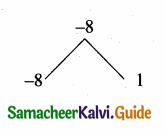
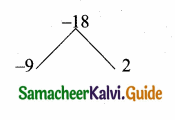
Find x so that x + 6, x + 12 and x + 15 are consecutive terms of a Geometric Progression
Solution:
G.P = x + 6, x + 12, x + 15
In G.P r = \(\frac{t_{2}}{t_{1}}=\frac{t_{3}}{t_{2}}\)
\(\frac{x+12}{x+6}=\frac{x+15}{x+12}\)
(x + 12)2 = (x + 6) (x + 5)
x2 + 24x + 144 = x2 + 6x + 15x + 90
24x – 21x = 90 – 144
3x = -54
x = \(\frac { -54 }{ 3 } \) = -18
x = -18

Samacheer Kalvi 10th Maths Guide Chapter 2 Numbers and Sequences Ex 2.7

Question 5.
Find the number of terms in the following G.P.

(i) 4,8,16,…,8192?
Answer:
Here a = 4; r = \(\frac { 8 }{ 4 } \) = 2
tn = 8192
Samacheer Kalvi 10th Maths Guide Chapter 2 Numbers and Sequences Ex 2.7 8
a . rn-1 = 8192 ⇒ 4 × 2n-1 = 8192
2n-1 = \(\frac { 8192 }{ 4 } \) = 2048
2n-1 = 211 ⇒ n – 1 = 11
n = 11 + 1 ⇒ n = 12
Number of terms = 12

(ii) \(\frac { 1 }{ 3 } \), \(\frac { 1 }{ 9 } \), \(\frac { 1 }{ 27 } \), ……………, \(\frac { 1 }{ 2187 } \)
Answer:
a = \(\frac { 1 }{ 3 } \) ; r = \(\frac { 1 }{ 9 } \) ÷ \(\frac { 1 }{ 3 } \) = \(\frac { 1 }{ 9 } \) × \(\frac { 3 }{ 1 } \) = \(\frac { 1 }{ 3 } \)
Samacheer Kalvi 10th Maths Guide Chapter 2 Numbers and Sequences Ex 2.7 9
tn = \(\frac { 1 }{ 2187 } \)
a. rn-1 = \(\frac { 1 }{ 2187 } \)
Samacheer Kalvi 10th Maths Guide Chapter 2 Numbers and Sequences Ex 2.7 10
n – 1 = 6 ⇒ n = 6 + 1 = 7
Number of terms = 7

Samacheer Kalvi 10th Maths Guide Chapter 2 Numbers and Sequences Ex 2.7

Question 6.
In a G.P. the 9th term is 32805 and 6th term is 1215. Find the 12th term.
Answer:
Given, 9th term = 32805
a. rn-1 = \(\frac { 1 }{ 2187 } \)
t9 = 32805 [tn = arn-1]
a.r8 = 32805 …..(1)
6th term = 1215
a.r5 = 1215 …..(2)
Divide (1) by (2)
\(\frac{a r^{8}}{a r^{5}}\) = \(\frac { 32805 }{ 1215 } \) ⇒ r3 = \(\frac { 6561 }{ 243 } \)
= \(\frac { 2187 }{ 81 } \) = \(\frac { 729 }{ 27 } \) = \(\frac { 243 }{ 9 } \) = \(\frac { 81 }{ 3 } \)
r3 = 27 ⇒ r3 = 33
r = 3
Substitute the value of r = 3 in (2)
a. 35 = 1215
a × 243 = 1215
a = \(\frac { 1215 }{ 243 } \) = 5
Here a = 5, r = 3, n = 12
t12 = 5 × 3(12-1)
= 5 × 311
∴ 12th term of a G.P. = 5 × 311

Samacheer Kalvi 10th Maths Guide Chapter 2 Numbers and Sequences Ex 2.7

Question 7.
Find the 10th term of a G.P. whose 8th term is 768 and the common ratio is 2.
Solution:
t8 = 768 = ar7
r = 2
t10 = ar9 = ar7 × r × r
= 768 × 2 × 2 = 3072

Samacheer Kalvi 10th Maths Guide Chapter 2 Numbers and Sequences Ex 2.7

Question 8.
If a, b, c are in A.P. then show that 3a, 3b, 3c are in G.P.
Answer:
a, b, c are in A.P.
t2 – t1 = t3 – t2
b – a = c – b
2b = a + c …..(1)
3a, 3b, 3c are in G.P.
Samacheer Kalvi 10th Maths Guide Chapter 2 Numbers and Sequences Ex 2.7 11
From (1) and (2) we get
3a, 3b, 3c are in G.P.

Question 9.
In a G.P. the product of three consecutive terms is 27 and the sum of the product of two terms taken at a time is \(\frac { 57 }{ 2 } \). Find the three terms.
Answer:
Let the three terms of the G.P. be \(\frac { a }{ r } \), a, ar
Product of three terms = 27
\(\frac { a }{ r } \) × a × ar = 27
a3 = 27 ⇒ a3 = 33
a = 3
Sum of the product of two terms taken at a time is \(\frac { 57 }{ 2 } \)
Samacheer Kalvi 10th Maths Guide Chapter 2 Numbers and Sequences Ex 2.7 12
6r2 – 13r + 6 = 0
6r2 – 9r – 4r + 6 = 0
3r (2r – 3) -2(2r – 3) = 0
(2r – 3) (3r – 2) = 0
2r – 3 = 0 or 3r – 2 = 0
2r = 3 (or) 3r – 2 = 0
r = \(\frac { 3 }{ 2 } \) (or) r = \(\frac { 2 }{ 3 } \)
Samacheer Kalvi 10th Maths Guide Chapter 2 Numbers and Sequences Ex 2.7 13
∴ The three terms are 2, 3 and \(\frac { 9 }{ 2 } \) or \(\frac { 9 }{ 2 } \), 3 and 2

Samacheer Kalvi 10th Maths Guide Chapter 2 Numbers and Sequences Ex 2.7

Question 10.
A man joined a company as Assistant Manager. The company gave him a starting salary of ₹60,000 and agreed to increase his salary 5% annually. What will be his salary after 5 years?
Answer:
Starting salary (a) = ₹ 60000
Increased salary = 5% of starting salary
= \(\frac { 5 }{ 100 } \) × 60000
= ₹ 3000
Starting salary for the 2nd year = 60000 + 3000
= ₹ 63000
Year increase = 5% of 63000
= \(\frac { 5 }{ 100 } \) × 63000
= ₹ 3150
Starting salary for the 3rd year = 63000 + 3150
= ₹ 66150
60000, 63000, 66150,…. form a G.P.
a = 60000; r = \(\frac { 63000 }{ 60000 } \) = \(\frac { 63 }{ 60 } \) = \(\frac { 21 }{ 20 } \)
tn = ann-1
t5 = (60000) (\(\frac { 21 }{ 20 } \))4
= 60000 × \(\frac { 21 }{ 20 } \) × \(\frac { 21 }{ 20 } \) × \(\frac { 21 }{ 20 } \) × \(\frac { 21 }{ 20 } \)
= \(\frac{6 \times 21 \times 21 \times 21 \times 21}{2 \times 2 \times 2 \times 2}\)
= 72930.38
5% increase = \(\frac { 5 }{ 100 } \) × 72930.38
= ₹ 3646.51
Salary after 5 years = ₹ 72930.38 + 3646.51
= ₹ 76576.90
= ₹ 76577

Samacheer Kalvi 10th Maths Guide Chapter 2 Numbers and Sequences Ex 2.7

Question 11.
Sivamani is attending an interview for a job and the company gave two offers to him. Offer A: ₹20,000 to start with followed by a guaranteed annual increase of 6% for the first 5 years.
Offer B: ₹22,000 to start with followed by a guaranteed annual increase of 3% for the first 5 years.
What is his salary in the 4th year with respect to the offers A and B?
Answer:
Starting salary (a) = ₹ 20,000
Annual increase = 6% of 20000
= \(\frac { 5 }{ 100 } \) × 20000
= ₹ 1200
Salary for the 2nd year = ₹ 20000 + 1200
= ₹ 21200
Here a = 20,000; r = \(\frac { 21200 }{ 20000 } \) = \(\frac { 212 }{ 200 } \) = \(\frac { 106 }{ 100 } \) = \(\frac { 53 }{ 50 } \)
n = 4 years
tn = arn-1
Samacheer Kalvi 10th Maths Guide Chapter 2 Numbers and Sequences Ex 2.7 14
Salary at the end of 4th year = 23820

For B
Starting salary = ₹ 22000
(a) = 22000
Annual increase = 3% of 22000
= \(\frac { 3 }{ 100 } \) × 22000
= ₹ 660
Salary for the 2nd year = ₹ 22000 + ₹ 660
= ₹ 22,660
Here a = 22000; r = \(\frac { 22660 }{ 22000 } \)
= \(\frac { 2266 }{ 2200 } \) = \(\frac { 1133 }{ 1100 } \) = \(\frac { 103 }{ 100 } \)
Salary at the end of 4th year = 22000 × (\(\frac { 103 }{ 100 } \))4-1
= 22000 × (\(\frac { 103 }{ 100 } \))3
= 22000 × \(\frac { 103 }{ 100 } \) × \(\frac { 103 }{ 100 } \) × \(\frac { 103 }{ 100 } \)
Samacheer Kalvi 10th Maths Guide Chapter 2 Numbers and Sequences Ex 2.7 15
= 24039.99 = 24040
4th year Salary for A = ₹ 23820 and 4th year Salary for B = ₹ 24040

Samacheer Kalvi 10th Maths Guide Chapter 2 Numbers and Sequences Ex 2.7

Question 12.
If a, b, c are three consecutive terms of an A.P. and x, y, z are three consecutive terms of a G.P. then prove that xb-c × yc-a × za-b = 1
Answer:
a, b, c are three consecutive terms of an A.P
∴ a = a, b = a + dand c = a + 2d respectively ….(1)
x, y, z are three consecutive terms of a G.P
∴ x = x, y = xr, z = xr2 respective ……(2)
L.H.S = xb-c × yc-a × za-b ( Substitute the values from 1 and 2 we get)
Samacheer Kalvi 10th Maths Guide Chapter 2 Numbers and Sequences Ex 2.7 16
L.H.S = R.H.S
Hence it is proved

Samacheer Kalvi 9th Maths Guide Chapter 2 Real Numbers Ex 2.8

Students can download Maths Chapter 2 Real Numbers Ex 2.8 Questions and Answers, Notes, Samacheer Kalvi 9th Maths Guide Pdf helps you to revise the complete Tamilnadu State Board New Syllabus, helps students complete homework assignments and to score high marks in board exams.

Tamilnadu Samacheer Kalvi 9th Maths Solutions Chapter 2 Real Numbers Ex 2.8

Question 1.
Represent the following numbers in the scientific notation:
(i) 569430000000
(ii) 2000.57
(iii) 0.0000006000
(iv) 0.0009000002
Solution:
(i) 569430000000 = 5.6943 × 10¹¹
(ii) 2000.57 = 2.00057 × 10³
(iii) 0.0000006000 = 6.0 × 10⁻⁷
(iv) 0.0009000002 = 9.000002 × 10⁻⁴

Samacheer Kalvi 9th Maths Guide Chapter 2 Real Numbers Ex 2.8

Question 2.
Write the following numbers in decimal form:
(i) 3.459 × 10⁶
(ii) 5.678 × 10⁴
(iii) 1.00005 × 10⁻⁵
(iv) 2.530009 × 10⁻⁷
Solution:
(i) 3.459 × 106
= 3459000
(ii) 5.678 × 104
= 56780
(iii) 1.00005 × 10-5
= 0.0000100005
(iv) 2.530009 × 10-7
= 0.0000002530009

Samacheer Kalvi 9th Maths Guide Chapter 2 Real Numbers Ex 2.8

Question 3.
Represent the following numbers in scientific notation:
(i) (300000)2 × (20000)4
(ii) (0.000001)11 ÷ (0.005)3
(iii) {(0.00003)6 × (0.00005)4} ÷ {(0.009)3 × (0.05)2}
Solution:
(i) (300000)2 × (20000)4 = (3 × 10⁵)2 × (2 × 104)4
= 32 × (105)2 × 24 × (104)4
= 9 × 1010 × 16 × 1016
= 9 × 16 × 1010-16
= 144 × 1026
= 1.44 × 1028

(ii) (0.000001)11 ÷ (0.005)3
Samacheer Kalvi 9th Maths Guide Chapter 2 Real Numbers Ex 2.8 1
0.008 × 10-66+9
= 8.0 × 10-3 × 10-57
= 8.0 × 10⁻³-57
= 8.0 × 10-60

(iii) {(0.00003)6 × (0.00005)4} ÷ {(0.009)3 × (0.05)2}
Samacheer Kalvi 9th Maths Guide Chapter 2 Real Numbers Ex 2.8 2
= 2.5 × 10-49+13
= 2.5 × 10-36

Samacheer Kalvi 9th Maths Guide Chapter 2 Real Numbers Ex 2.8

Question 4.
Represent the following information in scientific notation:
(i) The world population is nearly 7000,000,000.
(ii) One light year means the distance 9460528400000000 km.
(iii) Mass of an electron is 0.000 000 000 000 000 000 000 000 000 00091093822 kg.
Solution:
(i) World population = 7.0 × 10⁹
(ii) Distance = 9.4605 × 10¹⁵ km.
(iii) Mass of an electron = 9.1093822 × 10⁻³¹ kg

Samacheer Kalvi 9th Maths Guide Chapter 2 Real Numbers Ex 2.8

Question 5.
Simplify:
(2.75 × 10⁷) + (1.23 × 10⁸)
(ii) (1.598 × 10¹⁷) – (4.58 × 10¹⁵)
(iii) (1.02 × 1010) × (1.20 × 10-3)
(iv) (8.41 × 10⁴) ÷ (4.3 × 10⁵)
Solution:
(i) (2.75 × 10⁷) + (1.23 × 10⁸) = 27500000 + 123000000
Samacheer Kalvi 9th Maths Guide Chapter 2 Real Numbers Ex 2.8 3
= 150500000
= 1.505 × 10⁸

(ii) (1.598 × 10¹⁷) – (4.58 × 10¹⁵) = 1552,20000000000000
Samacheer Kalvi 9th Maths Guide Chapter 2 Real Numbers Ex 2.8 4
= 1.5522 × 10¹⁷

Samacheer Kalvi 9th Maths Guide Chapter 2 Real Numbers Ex 2.8

(iii) (1.02 × 1010) × (1.20 × 10-3) = 1.02 × 1.20 × 1010 × 10-3
=1.224 × 10⁷

(iv) (8.41 × 10⁴) ÷ (4.3 × 10⁵) = \(\frac{8.41×10^{4}}{4.3×10^{5}}\)
= \(\frac{8.41}{4.3}\) × 104-5
= \(\frac{8.41}{4.3}\) × 10-1
= 1.9558139 × 10⁻¹

Samacheer Kalvi 9th Maths Guide Chapter 2 Real Numbers Ex 2.7

Students can download Maths Chapter 2 Real Numbers Ex 2.7 Questions and Answers, Notes, Samacheer Kalvi 9th Maths Guide Pdf helps you to revise the complete Tamilnadu State Board New Syllabus, helps students complete homework assignments and to score high marks in board exams.

Tamilnadu Samacheer Kalvi 9th Maths Solutions Chapter 2 Real Numbers Ex 2.7

Question 1.
Rationalise the denominator:
(i) \( \frac{1}{\sqrt{50}}\)
(ii) \( \frac{5}{3\sqrt{5}}\)
(iii) \( \frac{\sqrt{75}}{\sqrt{18}}\)
(iv) \( \frac{3\sqrt{5}}{\sqrt{6}}\)
Solution:
(i) \( \frac{1}{\sqrt{50}}\) = \(\frac{1}{\sqrt{25 \times 2}}=\frac{1}{5 \sqrt{2}}=\frac{1}{5 \sqrt{2}} \times \frac{\sqrt{2}}{\sqrt{2}}=\frac{\sqrt{2}}{5 \times 2}=\frac{\sqrt{2}}{10}\)

(ii) \( \frac{5}{3\sqrt{5}}\) = \(\frac{5}{3 \sqrt{5}} \times \frac{\sqrt{5}}{\sqrt{5}}=\frac{5 \sqrt{5}}{3 \times 5}=\frac{\sqrt{5}}{3}\)

(iii) \( \frac{\sqrt{75}}{\sqrt{18}}\) = \(\frac{\sqrt{3 \times 25}}{\sqrt{2 \times 9}}=\frac{5 \sqrt{3}}{3 \sqrt{2}}=\frac{5 \sqrt{3}}{3 \sqrt{2}} \times \frac{\sqrt{2}}{\sqrt{2}}=\frac{5 \sqrt{6}}{3 \times 2}=\frac{5 \sqrt{6}}{6}\)

(iv) \( \frac{3\sqrt{5}}{\sqrt{6}}\) = \( \frac{3 \sqrt{5}}{\sqrt{6}} \times \frac{\sqrt{6}}{\sqrt{6}}=\frac{3 \sqrt{30}}{6}=\frac{\sqrt{30}}{2} \)

Samacheer Kalvi 9th Maths Guide Chapter 2 Real Numbers Ex 2.7

Question 2.
Rationalise the denominator and simplify:
(i) \(\frac{\sqrt{48}+\sqrt{32}}{\sqrt{27}-\sqrt{18}}\)
Solution:
Samacheer Kalvi 9th Maths Guide Chapter 2 Real Numbers Ex 2.7 1

(ii) \(\frac{5\sqrt{3}+\sqrt{2}}{\sqrt{3}+\sqrt{2}}\)
Solution:
Samacheer Kalvi 9th Maths Guide Chapter 2 Real Numbers Ex 2.7 2

(iii) \(\frac{2\sqrt{6}-\sqrt{5}}{3\sqrt{5}-2\sqrt{6}}\)
Solution:
Samacheer Kalvi 9th Maths Guide Chapter 2 Real Numbers Ex 2.7 3

(iv) \(\frac{\sqrt{5}}{\sqrt{6}+2} – \frac{\sqrt{5}}{\sqrt{6}-2}\)
Solution:
Samacheer Kalvi 9th Maths Guide Chapter 2 Real Numbers Ex 2.7 4

Samacheer Kalvi 9th Maths Guide Chapter 2 Real Numbers Ex 2.7

Question 3.
Find the value of a and b if \(\frac{\sqrt{7}-2}{\sqrt{7}+2} = a\sqrt{7} + b\).
Solution:
Samacheer Kalvi 9th Maths Guide Chapter 2 Real Numbers Ex 2.7 5

Samacheer Kalvi 9th Maths Guide Chapter 2 Real Numbers Ex 2.7

Question 4.
If x = \(\sqrt{7}\) + 2, then find the value of x² + \(\frac{1}{x^2}\)
Solution:
\(\sqrt{7}\) + 2 ⇒ x² = \((\sqrt{5}+2)^{2}\)
= \((\sqrt{5})^{2}\) + 2 × 2 × \(\sqrt{5}\) + 2² = 5 + 4 \(\sqrt{5}\) + 4 = 9 + 4\(\sqrt{5}\)
\(\frac{1}{x}=\frac{1}{\sqrt{5}+2}=\frac{\sqrt{5}-2}{(\sqrt{5}+2)(\sqrt{5}-2)}=\frac{\sqrt{5}-2}{(\sqrt{5})^{2}-2^{2}}=\frac{\sqrt{5}-2}{5-4}=\sqrt{5}-2\)
\(\frac{1}{x^{2}}\) = (\(\sqrt{5} – 2)^{2}\)
= \((\sqrt{5})^{2}\) – 2 × \(\sqrt{5}\) × 2 + 2² = 5 – 4 \(\sqrt{5}\) + 4 = 9 – 4 \(\sqrt{5}\)
∴ x² + \(\frac{1}{x^{2}}\) = 9 + \(4\sqrt{5}\) + 9 – \(4\sqrt{5}\) = 18
The value of x² + \(\frac{1}{x^{2}}\) = 18

Samacheer Kalvi 9th Maths Guide Chapter 2 Real Numbers Ex 2.7

Question 5.
Given \(\sqrt{2}\) = 1.414, find the value of \(\frac{8 – 5\sqrt{2}}{3 – 2\sqrt{2}}\) (to 3 places of decimals).
Solution:
Samacheer Kalvi 9th Maths Guide Chapter 2 Real Numbers Ex 2.7 6
= 4 + \(\sqrt{2}\) = 4 + 1.414 = 5.414

Samacheer Kalvi 9th Maths Guide Chapter 2 Real Numbers Ex 2.7

Samacheer Kalvi 10th Maths Guide Chapter 2 Numbers and Sequences Ex 2.5

Students can download Maths Chapter 2 Numbers and Sequences Ex 2.5 Questions and Answers, Notes, Samacheer Kalvi 10th Maths Guide Pdf helps you to revise the complete Tamilnadu State Board New Syllabus, helps students complete homework assignments and to score high marks in board exams.

Tamilnadu Samacheer Kalvi 10th Maths Solutions Chapter 2 Numbers and Sequences Ex 2.5

Question 1.
Check whether the following sequences are in A.P.?

(i) a – 3, a – 5, a – 7,…
Answer:
a – 3, a – 5, a – 7…….
t2 – t1 = a – 5 – (a – 3)
= a – 5 – a + 3
= -2
t3 – t2 = a – 7 – (a – 5)
= a – 7 – a + 5
= -2
t2 – t1 = t3 – t2
(common difference is same)
The sequence is in A.P.

Samacheer Kalvi 10th Maths Guide Chapter 2 Numbers and Sequences Ex 2.5

(ii) \(\frac { 1 }{ 2 } \), \(\frac { 1 }{ 3 } \), \(\frac { 1 }{ 4 } \), \(\frac { 1 }{ 5 } \), ……….
Answer:
t2 – t1 = \(\frac { 1 }{ 3 } \) – \(\frac { 1 }{ 2 } \) = \(\frac { 2-3 }{ 6 } \) = \(\frac { -1 }{ 6 } \)
t3 – t2 = \(\frac { 1 }{ 4 } \) – \(\frac { 1 }{ 3 } \) = \(\frac { 3-4 }{ 12 } \) = \(\frac { -1 }{ 12 } \)
t2 – t1 ≠ t3 – t2
The sequence is not in A.P.

(iii) 9, 13, 17, 21, 25,…
Answer:
t2 – t1 = 13 – 9 = 4
t3 – t2 = 17 – 13 = 4
t4 – t3 = 21 – 17 = 4
t5 – t4 = 25 – 21 = 4
Common difference are equal
∴ The sequence is in A.P.

(iv) \(\frac { -1 }{ 3 } \), 0, \(\frac { 1 }{ 3 } \), \(\frac { 2 }{ 3 } \)
t2 – t1 = 0 – (-\(\frac { 1 }{ 3 } \))
= 0 + \(\frac { 1 }{ 3 } \) = \(\frac { 1 }{ 3 } \)
t3 – t2 = \(\frac { 1 }{ 3 } \) – 0 = \(\frac { 1 }{ 3 } \)
t2 – t1 = t3 – t2
The sequence is in A.P.

(v) 1,-1, 1,-1, 1, -1, …
t2 – t1 = -1 – 1 = -2
t3 – t2 = 1 – (-1) = 1 + 1 = 2
t4 – t3 = -1-(1) = – 1 – 1 = – 2
t5 – t4 = 1 – (-1) = 1 + 1 = 2
Common difference are not equal
∴ The sequence is not an A.P.

Samacheer Kalvi 10th Maths Guide Chapter 2 Numbers and Sequences Ex 2.5

Question 2.
First term a and common difference d are given below. Find the corresponding A.P. ?
(i) a = 5 ,d = 6
Answer:
Here a = 5,d = 6
The general form of the A.P is a, a + d, a + 2d, a + 3d….
The A.P. 5, 11, 17, 23 ….

(ii) a = 7, d = -5
Answer:
The general form of the A.P is a, a + d,
a + 2d, a + 3d… .
The A.P. 7, 2, -3, -8 ….

(iii) a = \(\frac { 3 }{ 4 } \), d = \(\frac { 1 }{ 2 } \)
Answer:
The general form of the A.P is a, a + d, a + 2d, a + 3d….
\(\frac { 3 }{ 4 } \),\(\frac { 3 }{ 4 } \) + \(\frac { 1 }{ 2 } \),\(\frac { 3 }{ 4 } \) + 2(\(\frac { 1 }{ 2 } \)), \(\frac { 3 }{ 4 } \) + 3 (\(\frac { 1 }{ 2 } \))
The A.P. \(\frac { 3 }{ 4 } \), \(\frac { 5 }{ 4 } \), \(\frac { 7 }{ 4 } \), …….

Samacheer Kalvi 10th Maths Guide Chapter 2 Numbers and Sequences Ex 2.5

Question 3.
Find the first term and common difference of the Arithmetic Progressions whose nth terms are given below
(i) tn = -3 + 2n
(ii) tn = 4 – 7n
Solution:
(i) a = t1 = -3 + 2(1) = -3 + 2 = -1
d = t2 – t1
Here t2 = -3 + 2(2) = -3 + 4 = 1
∴ d = t2 – t1 = 1 – (-1) = 2
(ii) a = t1 = 4 – 7(1) = 4 – 7 = -3
d = t2 – t1
Here t2 = 4 – 7(2) = 4 – 14 – 10
∴ d = t2 – t1 = 10 – (-3) = -7

Samacheer Kalvi 10th Maths Guide Chapter 2 Numbers and Sequences Ex 2.5

Question 4.
Find the 19th term of an A.P. -11, -15, -19,…
Answer:
First term (a) = -11
Common difference (d) = -15 -(-11)
= -15 + 11 = -4
n = 19
tn = a + (n – 1) d
tn = -11 + 18(-4)
= -11 – 72
t19 = -83
19th term of an A.P. is – 83

Question 5.
Which term of an A.P. 16, 11, 6,1, ……….. is -54?
Solution:
A.P = 16, 11,6, 1, ………..
It is given that
tn = -54
a = 16, d = t2 – t1 = 11 – 16 = -5
∴ tn = a + (n – 1)d
-54 = 16 + (n – 1) (-5)
-54 = 16 – 5n + 5
21 – 5n = -54
-5n = -54 -21
-5n = -75
n = \(\frac { 75 }{ 5 } \) =15
∴ 15th term is -54.

Samacheer Kalvi 10th Maths Guide Chapter 2 Numbers and Sequences Ex 2.5

Question 6.
Find the middle term(s) of an A.P. 9, 15, 21, 27, …, 183.
Answer:
First term (a) = 9
Last term (l) = 183
Common difference (d) = 15 – 9 = 6
n = \(\frac { l-a }{ d } \) + 1
= \(\frac { 183-9 }{ 6 } \) + 1
= \(\frac { 174 }{ 6 } \) + 1
= 29 + 1
= 30
middle term = 15th term of
16th term
tn = a + (n – 1)d
t15 = 9 + 14(6)
= 9 + 84 = 93
t16 = 9 + 15(6)
= 9 + 90 = 99
The middle term is 93 or 99

Question 7.
If nine times ninth term is equal to the fifteen times fifteenth term, show that six times twenty fourth term is zero.
Solution:
Nine times ninth term = Fifteen times fifteenth term
9t9 = 15t15
9(a + 8d) = 5(a + 14d)
9a + 72d = 15a + 210
15a + 210d – 9a – 72d = 0
⇒ 6a + 138 d = 0
⇒ 6(a + 23 d) = 0
⇒ 6(a + (24 – 1)d) = 0
⇒ 6t24 = 0. Hence it is proved.

Samacheer Kalvi 10th Maths Guide Chapter 2 Numbers and Sequences Ex 2.5

Question 8.
If 3 + k, 18 – k, 5k + 1 are in A.P. then find k?
Answer:
3 + k, 18 – k, 5k + 1 are in AP
∴ t2 – t1 = t3 – t2 (common difference is same)
18 – k – (3 + k) = 5k + 1 – (18 – k)
18 – k – 3 – k = 5k + 1 – 18 + k
15 – 2k = 6k – 17
32 = 8k
k = \(\frac { 32 }{ 8 } \) = 4
The value of k = 4

Question 9.
Find x, y and z, given that the numbers x, 10, y, 24, z are in A.P.
Solution:
A.P = x, 10, y, 24, z,…
d = t2 – t1 = 10 – x ………….. (1)
= t3 – t2 = y – 10 ………….. (2)
= t4 – t3 = 24 – y …………. (3)
= t5 – t4 = z – 24 ………….. (4)
(2) and (3)
⇒ y – 10 = 24 – y
2y = 24 + 10 = 34
y = \(\frac { 34 }{ 2 } \) = 17
(1) and (2)
⇒ 10 – x = y – 10
10 – x = 17 – 10 = 7
-x = 7 – 10
-x = -3 ⇒ x = 3
From (3) and (4)
24 – y = z – 24
24 – 17 = z – 24
7 = z – 24
∴ z = 7 + 24 = 31
∴ Solutions x = 3
y = 17
z = 31

Samacheer Kalvi 10th Maths Guide Chapter 2 Numbers and Sequences Ex 2.5

Question 10.
In a theatre, there are 20 seats in the front row and 30 rows were allotted. Each successive row contains two additional seats than its front row. How many seats are there in the last row?
Answer:
Number of seats in the first row
(a) = 20
∴ t1 = 20
Number of seats in the second row
(t2) = 20 + 2
= 22
Number of seats in the third row
(t3) = 22 + 2
= 24
Here a = 20 ; d = 2
Number of rows
(n) = 30
tn = a + (n – 1)d
t30 = 20 + 29(2)
= 20 + 58
t30 = 78
Number of seats in the last row is 78

Samacheer Kalvi 10th Maths Guide Chapter 2 Numbers and Sequences Ex 2.5

Question 11.
The sum of three consecutive terms that are in A.P. is 27 and their product is 288. Find the three terms.
Solution:
Let the three consecutive terms be a – d, a, a + d
Their sum = a – d + a + a + d = 27
3a = 27
a = \(\frac{27}{3}\) = 9
Their product = (a – d)(a)(a + d) = 288
= 9(a2 – d2) = 288
⇒ 9(9 – d2) = 288
⇒ 9(81 – d2) = 288
81 – d2 = 32
-d2 = 32 – 81
d2 = 49
⇒ d = ± 7
∴ The three terms are if a = 9, d = 7
a – d, a , a + d = 9 – 7, 9 + 7
A.P. = 2, 9, 16
if a = 9, d = -7
A.P. = 9 – (-7), 9, 9 + (-7)
= 16, 9, 2

Samacheer Kalvi 10th Maths Guide Chapter 2 Numbers and Sequences Ex 2.5

Question 12.
The ratio of 6th and 8th term of an A.P is 7:9. Find the ratio of 9th term to 13th term.
Answer:
Given : t6 : t8 = 7 : 9 (using tn = a + (n – 1)d
a + 5d : a + 7d = 7 : 9
9 (a + 5 d) = 7 (a + 7d)
9a + 45 d = 7a + 49d
9a – 7a = 49d – 45d
2a = 4d
a = 2d
To find t9 : t13
t9 : t13 = a + 8d : a + 12d
= 2d + 8d : 2d + 12d
= 10d : 14d
= 5 : 7
∴ t9 : t13 = 5 : 7

Question 13.
In a winter season, the temperature of Ooty from Monday to Friday to be in A.P. The sum of temperatures from Monday to Wednesday is 0° C and the sum of the temperatures from Wednesday to Friday is 18° C. Find the temperature on each of the five days.
Answer:
Let the five days temperature be
(a – 2d), (a – d), a,(a + d) and (a + 2d)
Sum of first three days temperature = 0
a – 2d + a – d + a = 0
3a – 3d = 0
a – d = 0 …..(1)
Sum of the last three days temperature = 18°C
a + a + d + a + 2d = 18
3a + 3d = 18
(÷ by 3) ⇒ a + d = 6 ……(2)
By adding (1) and (2)
Samacheer Kalvi 10th Maths Guide Chapter 2 Numbers and Sequences Ex 2.5 1
Substitute to value of a = 3 in (2)
d = 3
The temperature in 5 days are
(3 – 6), (3 – 3), 3, (3 + 3) and (3 + 6)
-3°C, 0°C, 3°C, 6°C, 9°C

Samacheer Kalvi 10th Maths Guide Chapter 2 Numbers and Sequences Ex 2.5

Question 14.
Priya earned ₹15,000 in the first month. Thereafter her salary increases by ₹1500 per year. Her expenses are ₹13,000 during the first year and the expenses increases by ₹900 per year. How long will it take her to save ₹20,000 per month.
Answer:
Tabulate the given table
Samacheer Kalvi 10th Maths Guide Chapter 2 Numbers and Sequences Ex 2.5 2
Monthly savings form an A.P.
2000, 2600, 3200 …..
a = 2000; d = 2600 – 2000 = 600
Given tn = 20,000
tn = a + (n – 1) d
20000 = 2000 + (n – 1) 600
20000 = 2000 + 600n – 600
= 1400 + 600n
20000 – 1400 = 600n
18600 = 600n
n = \(\frac { 18600 }{ 600 } \) = 31
He will take 31 years to save ₹ 20,000 per month

Samacheer Kalvi 9th Maths Guide Chapter 2 Real Numbers Ex 2.6

Students can download Maths Chapter 2 Real Numbers Ex 2.6 Questions and Answers, Notes, Samacheer Kalvi 9th Maths Guide Pdf helps you to revise the complete Tamilnadu State Board New Syllabus, helps students complete homework assignments and to score high marks in board exams.

Tamilnadu Samacheer Kalvi 9th Maths Solutions Chapter 2 Real Numbers Ex 2.6

Question 1.
Simplify the following using addition and subtraction properties of surds:
(i) 5\(\sqrt{3}\) + 18\(\sqrt{3}\) – 2\(\sqrt{3}\)
(ii) 4\(\sqrt[3]{5}\) + 2\(\sqrt[3]{5}\) – 3\(\sqrt[3]{5}\)
(iii) 3\(\sqrt{75}\) + 5\(\sqrt{48}\) – \(\sqrt{243}\)
(iv) 5\(\sqrt[3]{40}\) + 2\(\sqrt[3]{625}\) – 3\(\sqrt[3]{320}\)
Solution:
(i) 5\(\sqrt{3}\) + 18\(\sqrt{3}\) – 2\(\sqrt{3}\) = (5 + 18 – 2)\(\sqrt{3}\)
= (23 – 2) \(\sqrt{3}\) = 21\(\sqrt{3}\)

(ii) 4\(\sqrt[3]{5}\) + 2\(\sqrt[3]{5}\) – 3\(\sqrt[3]{5}\) = (4 + 2 – 3) \(\sqrt[3]{5}\)
= (6 – 3) \(\sqrt[3]{5}\) = 3\(\sqrt[3]{5}\)

Samacheer Kalvi 9th Maths Guide Chapter 2 Real Numbers Ex 2.6

(iii) 3\(\sqrt{75}\) + 5\(\sqrt{48}\) – \(\sqrt{243}\) = \(3\sqrt{5^{2}×3} + 5\sqrt{2^{4}×3} – \sqrt{3^{5}}\)
Samacheer Kalvi 9th Maths Guide Chapter 2 Real Numbers Ex 2.6 1
= 3 × 5\(\sqrt{3}\) + 5 × 2²\(\sqrt{3}\) – 3²\(\sqrt{3}\) = 15\(\sqrt{3}\) + 20\(\sqrt{3}\) – 9\(\sqrt{3}\)
= (15 + 20 – 9)\(\sqrt{3}\)
= (35 – 9)\(\sqrt{3}\)
= 26 \(\sqrt{3}\)

(iv) 5\(\sqrt[3]{40}\) + 2\(\sqrt[3]{625}\) – 3\(\sqrt[3]{320}\)
Samacheer Kalvi 9th Maths Guide Chapter 2 Real Numbers Ex 2.6 2
= 5\(\sqrt[3]{2^{3}×5} + 2\sqrt[3]{5^{3}×5} – 3\sqrt[3]{2^{3}×2^{3}×5}\)
5 × 2\(\sqrt[3]{5} + 2 × 5\sqrt[3]{5} – 3 × 2 × 2\sqrt[3]{5} \)
= 10\(\sqrt[3]{5} + 10\sqrt[3]{5} – 12\sqrt[3]{5} \)
= 20\(\sqrt[3]{5} – 12\sqrt[3]{5}\)
= 8\(\sqrt[3]{5}\)

Samacheer Kalvi 9th Maths Guide Chapter 2 Real Numbers Ex 2.6

Question 2.
Simplify the following using multiplication and division properties of surds:
(i) \(\sqrt{3}\) × \(\sqrt{5}\) × \(\sqrt{2}\)
(ii) \(\sqrt{35}\) ÷ \(\sqrt{7}\)
(iii) \(\sqrt[3]{27}\) × \(\sqrt[3]{8}\) × \(\sqrt[3]{125}\)
(iv) (7\(\sqrt{a}\) – 5\(\sqrt{b}\)) (7\(\sqrt{a}\) + 5\(\sqrt{b}\))
(v) (\(\sqrt{\frac{225}{729}} – \sqrt{\frac{25}{144}}\)) ÷ \(\sqrt{\frac{16}{81}}\)
Solution:
(i) \(\sqrt{3}\) × \(\sqrt{5}\) × \(\sqrt{2}\) = \(\sqrt{3×5×2} = \sqrt{30}\)

(ii) \(\sqrt{37} ÷ \sqrt{7} = \frac{\sqrt{35}}{\sqrt{7}} = \sqrt{\frac{35}{7}} = \sqrt{5}\)

(iii) \(\sqrt[3]{27}\) × \(\sqrt[3]{8}\) × \(\sqrt[3]{125}\) = \(\sqrt[3]{27×8×125}\)
= \(\sqrt[3]{3^{3}×2^{3}×5^{3}}\) = 3 × 2 × 5 = 30

(iv) (7\(\sqrt{a}\) – 5\(\sqrt{b}\)) (7\(\sqrt{a}\) + 5\(\sqrt{b}\))
[using a2 – b2 = (a + b) (a – b)]
(7\(\sqrt{a}\) – 5\(\sqrt{b}\)) (7\(\sqrt{a}\) + 5\(\sqrt{b}\)) = \((7\sqrt{a})^{2} – (5\sqrt{b})^{2}\) = 49a – 25b

(v) (\(\sqrt{\frac{225}{729}} – \sqrt{\frac{25}{144}}\)) ÷ \(\sqrt{\frac{16}{81}}\)
Samacheer Kalvi 9th Maths Guide Chapter 2 Real Numbers Ex 2.6 3
Samacheer Kalvi 9th Maths Guide Chapter 2 Real Numbers Ex 2.6 4
= \(\frac{5}{36}\) × \(\frac{9}{4}\)
= \(\frac{5×1}{4×4}\)
= \(\frac{5}{16}\)

Samacheer Kalvi 9th Maths Guide Chapter 2 Real Numbers Ex 2.6

Question 3.
If \(\sqrt{2}\) = 1.414, \(\sqrt{3}\) = 1.732, \(\sqrt{5}\) = 2.236, \(\sqrt{10}\) = 3.162, then find the values of the following correct to 3 places of decimals.
(i) \(\sqrt{40}\) – \(\sqrt{20}\)
(ii) \(\sqrt{300}\) + \(\sqrt{90}\) – \(\sqrt{8}\)
Solution:
(i) \(\sqrt{40}\) – \(\sqrt{20}\) = \(\sqrt{4×10} – \sqrt{4×5} = 2\sqrt{10} – 2\sqrt{5}\)
= 2 × 3.162 – 2 × 2.236 = 6.324 – 4.472 = 1.852

(ii) \(\sqrt{300}\) + \(\sqrt{90}\) – \(\sqrt{8}\) = \(\sqrt{3×100} + \sqrt{9×10} – \sqrt{4×2}\)
= 10\(\sqrt{3}\) + 3\(\sqrt{10}\) – 2\(\sqrt{2}\)
= 10 × 1.732 + 3 × 3.162 – 2 × 1.414
= 17.32 + 9.486 – 2.828
= 26.806 – 2.828
= 23.978

Samacheer Kalvi 9th Maths Guide Chapter 2 Real Numbers Ex 2.6

Question 4.
Arrange surds in descending order
(i) \(\sqrt[3]{5}\), \(\sqrt[9]{4}\), \(\sqrt[6]{3}\)
Solution:
LCM of 3, 9 and 6 is 18
Samacheer Kalvi 9th Maths Guide Chapter 2 Real Numbers Ex 2.6 5
\(\sqrt[3]{5}\) = \(\sqrt[3×6]{5^{6}}\) = \(\sqrt[18]{15625}\)
\(\sqrt[9]{4}\) = \(\sqrt[2×9]{4^{2}}\) = \(\sqrt[18]{16}\)
\(\sqrt[6]{3}\) = \(\sqrt[3×6]{3^{3}}\) = \(\sqrt[18]{27}\)
\(\sqrt[18]{15625}\) > \(\sqrt[18]{27}\) > \(\sqrt[18]{16}\)
\(\sqrt[3]{5}\) > \(\sqrt[6]{3}\) > \(\sqrt[9]{4}\)

Samacheer Kalvi 9th Maths Guide Chapter 2 Real Numbers Ex 2.6

(ii) \(\sqrt[2]{\sqrt[3]{5}}\), \(\sqrt[3]{\sqrt[4]{7}}\), \(\sqrt{\sqrt{3}}\)
Solution:
\(\sqrt[2]{\sqrt[3]{5}}\) = \(\sqrt[6]{5}\); \(\sqrt[3]{\sqrt[4]{7}}\) = \(\sqrt[12]{7}\); \(\sqrt{\sqrt{3}}\) = \(\sqrt[4]{3}\)
LCM of 6, 12 and 4 is 12
Samacheer Kalvi 9th Maths Guide Chapter 2 Real Numbers Ex 2.6 6
\(\sqrt[2]{\sqrt[3]{5}}\) = \(\sqrt[6]{5}\) = \(\sqrt[12]{5^{2}}\) = \(\sqrt[12]{25}\)
\(\sqrt[3]{\sqrt[4]{7}}\) = \(\sqrt[12]{7}\) = \(\sqrt[12]{7}\)
\(\sqrt{\sqrt{3}}\) = \(\sqrt[4]{3}\) = \(\sqrt[12]{3^{3}}\) = \(\sqrt[12]{27}\)
\(\sqrt[12]{27}\) > \(\sqrt[12]{25}\) > \(\sqrt[12]{7}\)
\(\sqrt{\sqrt{3}}\) > \(\sqrt[2]{\sqrt[3]{5}}\) > \(\sqrt[3]{\sqrt[4]{7}}\)

Question 5.
Can you get a pure surd when you find:
(i) the sum of two surds
(ii) the difference of two surds
(iii) the product of two surds
(iv) the quotient of two surds
Justify each answer with an example.
Solution:
(i) Yes we can get a surd.
Example:
(a) 3\(\sqrt{2}\) + 5\(\sqrt{2}\) = (3 + 5)\(\sqrt{2}\) = 8\(\sqrt{2}\)
(b) 3\(\sqrt{6}\) + 2\(\sqrt{6}\) = (3 + 2)\(\sqrt{6}\) = 5\(\sqrt{6}\)

(ii) Yes we can get a surd.
Example:
(a) \(\sqrt{75}\) – \(\sqrt{48}\) = \(\sqrt{25×3}\) – \(\sqrt{16×3}\) = (5 – 4) \(\sqrt{3}\) = \(\sqrt{3}\)
(b) \(\sqrt{98}\) – \(\sqrt{72}\) = \(\sqrt{49×2}\) – \(\sqrt{36×2}\) = (7 – 6) \(\sqrt{2}\) = \(\sqrt{2}\)

Samacheer Kalvi 9th Maths Guide Chapter 2 Real Numbers Ex 2.6

(iii) Yes we can get a surd.
Example:
(a) \(\sqrt{8}\) × \(\sqrt{6}\) = \(\sqrt{8×6}\) = \(\sqrt{48}\)
(b) \(\sqrt{11}\) × \(\sqrt{3}\) = \(\sqrt{11×3}\) = \(\sqrt{33}\)

(iv) Yes we can get a surd.
Example:
(a) \(\sqrt{55}\) ÷ \(\sqrt{5}\) = \(\frac{\sqrt{11×5}}{\sqrt{5}} = \sqrt{11}\)
(b) \(\sqrt{65}\) ÷ \(\sqrt{5}\) = \(\frac{\sqrt{13×5}}{\sqrt{13}} = \sqrt{5}\)

Question 6.
Can you get a rational number when you compute:
(i) the sum of two surds
(ii) the difference of two surds
(iii) the product of two surds
(iv) the quotient of two surds
Justify each answer with an example.
Solution:
(i) Yes, the sum of two surds will give a rational number.
Example:
(a) (2 + \(\sqrt{3}\)) + (2 – \(\sqrt{3}\)) = 4
(b) (\(\sqrt{5}\) + 4) + (7 – \(\sqrt{5}\)) = 11

(ii) Yes, the difference of two surds will give a rational number.
Example:
(a) (5 + \(\sqrt{7}\)) – (- 5 + \(\sqrt{7}\)) = 10
(b) (\(\sqrt{11}\) + 5) – (-3 + \(\sqrt{11}\)) = 8

Samacheer Kalvi 9th Maths Guide Chapter 2 Real Numbers Ex 2.6

(iii) Yes, the product of two surds will give a rational number.
Example:
(a) \(\sqrt{125}\) × \(\sqrt{45}\) = \(\sqrt{25×5}\) × \(\sqrt{9×5}\) = 5\(\sqrt{5}\) × 3\(\sqrt{5}\) = 15 × 5 = 75
(b) \(\sqrt{150}\) × \(\sqrt{6}\) = \(\sqrt{25×6}\) × \(\sqrt{6}\) = 5\(\sqrt{6}\) × \(\sqrt{6}\) = 5 × 6 = 30

(iv) Yes. The quotient of two surds will give a rational number.
Example:
(a) \(\sqrt{32}\) ÷ \(\sqrt{8}\) = \(\frac{\sqrt{8×4}}{\sqrt{8}} = \sqrt{4}\) = 2
(b) \(\sqrt{50}\) ÷ \(\sqrt{2}\) = \(\frac{\sqrt{25×2}}{\sqrt{2}} = \sqrt{25}\) = 5

Samacheer Kalvi 10th Maths Guide Chapter 2 Numbers and Sequences Ex 2.4

Students can download Maths Chapter 2 Numbers and Sequences Ex 2.4 Questions and Answers, Notes, Samacheer Kalvi 10th Maths Guide Pdf helps you to revise the complete Tamilnadu State Board New Syllabus, helps students complete homework assignments and to score high marks in board exams.

Tamilnadu Samacheer Kalvi 10th Maths Solutions Chapter 2 Numbers and Sequences Ex 2.4

Question 1.
Find the next three terms of the following sequence.
(i) 8, 24, 72,…
(ii) 5, 1, -3, …
(iii) \(\frac { 1 }{ 4 } \), \(\frac { 2 }{ 9 } \), \(\frac { 3 }{ 16 } \)
(i) 216, 648, 1944 (This sequence is multiple of 3)
Next three terms are 216, 648, 1944
(ii) Next three terms are -7, -11, -15
(adding -4 with each term)
(iii) Next three terms are \(\frac { 4 }{ 25 } \),\(\frac { 5 }{ 36 } \) and \(\frac { 6 }{ 49 } \)
[using \(\frac{n}{(n+1)^{2}}\)]

Samacheer Kalvi 10th Maths Guide Chapter 2 Numbers and Sequences Ex 2.4

Question 2.
Find the first four terms of the sequences whose nth terms are given by
(i) an = n3 – 2
(ii) an = (-1)n+1 n(n+1)
(iii) an = 2n2 – 6
Solution:
tn = an = n3 -2
(i) a1 = 13 – 2 = 1 – 2 – 1
a2 = 23 – 2 = 8 – 2 = 6
a3 = 33 – 2 = 27 – 2 = 25
a4 = 43 – 2 = 64 – 2 = 62
∴ The first four terms are -1, 6, 25, 62, ……….

(ii) an = (-1)n+1 n(n + 1)
a1 = (-1)1+1 (1) (1 +1)
= (-1)2 (1) (2) = 2
a2 = (-1)2+1 (2) (2 + 1)
= (-1)3 (2) (3)= -6
a3 = (-1)3+1 (3) (3 + 1)
= (-1)4 (3) (4) = 12
a4 = (-1)4+1 (4) (4 + 1)
= (-1)5 (4) (5) = -20
∴ The first four terms are 2, -6, 12, -20,…

(iii) an = 2n2 – 6
a1 = 2(1)2 – 6 = 2 – 6 = -4
a2 = 2(2)2 – 6 = 8 – 6 = 2
a3 = 2(3)2 – 6 = 18 – 6 = 12
a4 = 2(4)2 – 6 = 32 – 6 = 26
∴ The first four terms are -4, 2, 12, 26, …

Samacheer Kalvi 10th Maths Guide Chapter 2 Numbers and Sequences Ex 2.4

Question 3.
Find the nth term of the following sequences
(i) 2, 5, 10, 17, ……
Answer:
(12 + 1);(22 + 1),(32 + 1),(42 + 1)….
nth term is n2 + 1
an = n2 + 1

(ii) 0,\(\frac { 1 }{ 2 } \),\(\frac { 2 }{ 3 } \) ……
Answer:
(\(\frac { 1-1 }{ 1 } \)), (\(\frac { 2-1 }{ 2 } \)), (\(\frac { 3-1 }{ 3 } \)) …..
nth term is \(\frac { n-1 }{ n } \)
an = \(\frac { n-1 }{ n } \)

(iii) 3,8,13,18,…….
Answer:
[5(1) -2], [5(2) – 2], [5(3) – 2], [5(4) – 2] ….
The nth term is 5n – 2
an = 5n – 2

Samacheer Kalvi 10th Maths Guide Chapter 2 Numbers and Sequences Ex 2.4

Question 4.
Find the indicated terms of the sequences whose nth terms are given by

(i) an = \(\frac { 5n }{ n+2 } \) ; a6 and a13
Answer:
an = \(\frac { 5n }{ n+2 } \)
a6 = \(\frac { 5(6) }{ 6+2 } \) = \(\frac { 30 }{ 8 } \) = \(\frac { 15 }{ 4 } \)
a13 = \(\frac { 5(13) }{ 13+2 } \) = \(\frac{5 \times 13}{15}\) = \(\frac { 13 }{ 3 } \)
a6 = \(\frac { 15 }{ 4 } \), a13 = \(\frac { 13 }{ 3 } \)

(ii) an = – (n2 – 4); a4 and a11
Answer:
an = -(n2 – 4)
a4 = -(42 – 4)
= – (16 – 4)
= -12
a11 = -(112 – 4)
= – (121 – 4)
= – 117
a4 = -12 and a11 = -117

Question 5.
Find a8 and a15 whose nth term is an
Samacheer Kalvi 10th Maths Guide Chapter 2 Numbers and Sequences Ex 2.4 1
Answer:
Samacheer Kalvi 10th Maths Guide Chapter 2 Numbers and Sequences Ex 2.4 2
Samacheer Kalvi 10th Maths Guide Chapter 2 Numbers and Sequences Ex 2.4 3

Samacheer Kalvi 10th Maths Guide Chapter 2 Numbers and Sequences Ex 2.4

Question 6.
If a1 = 1, a2 = 1 and an = 2an-1 + an-2, n > 3, n ∈ N, then find the first six terms of the sequence.
Solution:
a1 = 1, a2 = 1, an = 2an-1 + an-2
a3 = 2a(3-1) + a(3-2)
= 2a2 + a1
= 2 × 1 + 1 = 3
a4 = 2a(4-1) + a(4-2)
= 2a3 + a2
= 2 × 3 + 1 = 7
a5 = 2a(5-1) + a(5-2)
= 2a4 + a3
= 2 × 7 + 3 = 17
a6 = 2a(6-1) + a(6-2)
= 2a5 + a4
= 2 × 17 + 7
= 34 + 7
= 41
∴ The first six terms of the sequence are 1, 1, 3, 7, 17, 41 ………..

Samacheer Kalvi 10th Maths Guide Chapter 2 Numbers and Sequences Ex 2.8

Students can download Maths Chapter 2 Numbers and Sequences Ex 2.8 Questions and Answers, Notes, Samacheer Kalvi 10th Maths Guide Pdf helps you to revise the complete Tamilnadu State Board New Syllabus, helps students complete homework assignments and to score high marks in board exams.

Tamilnadu Samacheer Kalvi 10th Maths Solutions Chapter 2 Numbers and Sequences Ex 2.8

Question 1.
Find the sum of first n terms of the G.P.
(i) 5, -3, \(\frac { 9 }{ 5 } \),-\(\frac { 27 }{ 25 } \), ……
(ii) 256,64,16,…….
Answer:
(i) 5,-3,\(\frac { 9 }{ 5 } \),\(\frac { 27 }{ 55 } \), ….. n terms
Samacheer Kalvi 10th Maths Guide Chapter 2 Numbers and Sequences Ex 2.8 1

Samacheer Kalvi 10th Maths Guide Chapter 2 Numbers and Sequences Ex 2.8

(ii) 256,64,16,…….
Answer:
Here a = 256, r = \(\frac { 64 }{ 256 } \) = \(\frac { 1 }{ 4 } \)
Samacheer Kalvi 10th Maths Guide Chapter 2 Numbers and Sequences Ex 2.8 2
Samacheer Kalvi 10th Maths Guide Chapter 2 Numbers and Sequences Ex 2.8 3

Question 2.
Find the sum of first six terms of the G.P. 5,15,45,…
Answer:
Here a = 5, r = \(\frac { 15 }{ 3 } \) = 3, n = 6
Samacheer Kalvi 10th Maths Guide Chapter 2 Numbers and Sequences Ex 2.8 4
Sum of first 6 terms = 1820

Question 3.
Find the first term of the G.P. whose common ratio 5 and whose sum to first 6 terms is 46872.
Answer:
Common ratio (r) = 5
S6 = 46872
Samacheer Kalvi 10th Maths Guide Chapter 2 Numbers and Sequences Ex 2.8 5
The first term of the G.P. is 12.

Samacheer Kalvi 10th Maths Guide Chapter 2 Numbers and Sequences Ex 2.8

Question 4.
Find the sum to infinity of (i) 9 + 3 + 1 + ….(ii) 21 + 14 + \(\frac { 28 }{ 3 } \) ……
Answer:
(i) 9 + 3 + 1 + ….
a = 9, r = \(\frac { 3 }{ 9 } \) = \(\frac { 1 }{ 3 } \)
Sum of infinity term = \(\frac { a }{ 1 – r } \) = \(\frac{9}{1-\frac{1}{3}}\)
Samacheer Kalvi 10th Maths Guide Chapter 2 Numbers and Sequences Ex 2.8 6

Samacheer Kalvi 10th Maths Guide Chapter 2 Numbers and Sequences Ex 2.8

Question 5.
If the first term of an infinite G.P. is 8 and its sum to infinity is \(\frac { 32 }{ 3 } \) then find the common ratio.
Answer:
Here a = 8, S∞ = \(\frac { 32 }{ 3 } \)
\(\frac { a }{ 1-r } \) = \(\frac { 32 }{ 3 } \)
\(\frac { 8 }{ 1-r } \) = \(\frac { 32 }{ 3 } \)
32 – 32 r = 24 ⇒ 32 r = 8
r = \(\frac { 8 }{ 32 } \) = \(\frac { 1 }{ 4 } \)
Common ration = \(\frac { 1 }{ 4 } \)

Question 6.
Find the sum to n terms of the series
(i) 0.4 + 0.44 + 0.444 + …… to n terms
Answer:
Samacheer Kalvi 10th Maths Guide Chapter 2 Numbers and Sequences Ex 2.8 7
Samacheer Kalvi 10th Maths Guide Chapter 2 Numbers and Sequences Ex 2.8 8
(ii) 3 + 33 + 333 + ………… to n terms
Answer:
Sn = 3 + 33 + 333 + …. to n terms
= 3[1 + 11 + 111 + …. to n terms]
= \(\frac { 3 }{ 9 } \) [9 + 99 + 999 + …. n terms]
= \(\frac { 1 }{ 3 } \) [(10 – 1) + (100 – 1) + (1000 – 1) + …… n terms]
= \(\frac { 1 }{ 3 } \) [10 + 100 + 1000 + ….. n terms – (1 + 1 + 1 ….. n terms)]
Samacheer Kalvi 10th Maths Guide Chapter 2 Numbers and Sequences Ex 2.8 9

Samacheer Kalvi 10th Maths Guide Chapter 2 Numbers and Sequences Ex 2.8

Question 7.
Find the sum of the Geometric series 3 + 6 + 12 + …….. + 1536
Answer:
3 + 6 + 12 …. +1536
a = 3, r = \(\frac { 6 }{ 3 } \) = 2
tn = 1536
Samacheer Kalvi 10th Maths Guide Chapter 2 Numbers and Sequences Ex 2.8 10
Samacheer Kalvi 10th Maths Guide Chapter 2 Numbers and Sequences Ex 2.8 11
∴ Sum of the series is 3069

Samacheer Kalvi 10th Maths Guide Chapter 2 Numbers and Sequences Ex 2.8

Question 8.
Kumar writes a letter to four of his friends. He asks each one of them to copy the letter and mail to four different persons with the instruction that they continue the process similarly. Assuming that the process is unaltered and it costs ₹2 to mail ong letter, find the amount spent on postage when 8th set of letters is mailed.
Answer:
When kumar writes a letter to his friend.Friend writes a letter to another person.
It form a G.P
The G.P is 4, 16, 64,………
Here a = 4, r = 4
The last term is 4 (4)8-1 = 4(4)7
Samacheer Kalvi 10th Maths Guide Chapter 2 Numbers and Sequences Ex 2.8 12

Question 9.
Find the rational form of the number 0.123 .
Answer:
Let x = \(\overline { 0.123 } \)
= 0.123123123….
= 0.123 + 0.000123 + 000000123 + ….
This is an infinite G.P
Samacheer Kalvi 10th Maths Guide Chapter 2 Numbers and Sequences Ex 2.8 13

Samacheer Kalvi 10th Maths Guide Chapter 2 Numbers and Sequences Ex 2.8

Question 10.
If Sn = (x + y) + (x2 + xy + y2) + (x3 + x2y + xy2 + y3) + ………… n terms then prove that
Answer:
Sn = (x + y) + (x2 + xy + y2) + (x3 + x2y + xy2 + y3) + …….. n
Multiply by x
x Sn = x(x + y) + x(x2 + xy + y2) + x(x3 + x2y + xy2 + y3) + ……….. n
= x2 + xy + x3 + x2y + xy2 + x4 + x3y + x2y2 + xy3 + …… n terms ……(1)
Multiply by y
ySn = y(x + y) + y(x2 + xy + y2) + y(x3 + x2y + xy2 + y3) + ….. n
= xy + y2 + x2y + xy2 + y3 + x3y + x2y2 + xy3 + y4 + ….. n terms
Subtract (1) and (2)
x Sn – y Sn = x2 + xy + x3 + x2y + xy2 + x4 + x3y + x2y2 + xy3 + …….
– xy + y2 + x2y + xy2 + y3 + x3y + x2y2 + xy3 + y4 + ……
(x – y) Sn = (x2 + x3 + x4 + ……) – (y2 + y3 + y4 + ……)
[ a = x2; r = x and a = y2; r = y, Sn = \(\frac{a\left(r^{n}-1\right)}{r-1}\)]
Samacheer Kalvi 10th Maths Guide Chapter 2 Numbers and Sequences Ex 2.8 14
Hence it is proved.

Samacheer Kalvi 9th Maths Guide Chapter 2 Real Numbers Ex 2.9

Students can download Maths Chapter 2 Real Numbers Ex 2.9 Questions and Answers, Notes, Samacheer Kalvi 9th Maths Guide Pdf helps you to revise the complete Tamilnadu State Board New Syllabus, helps students complete homework assignments and to score high marks in board exams.

Tamilnadu Samacheer Kalvi 9th Maths Solutions Chapter 2 Real Numbers Ex 2.9

Question 1.
If n is a natural number then √n is……….
(a) always a natural number
(b) always an irrational number
(c) always a rational number
(d) may be rational or irrational
Solution:
(d) may be rational or irrational

Samacheer Kalvi 9th Maths Guide Chapter 2 Real Numbers Ex 2.9

Question 2.
Which of the following is not true?
(a) Every rational number is a real number
(b) Every integer is a rational number
(c) Every real number is an irrational number
(d) Every natural number is a whole number
Solution:
(c) Every real number is an irrational number

Question 3.
Which one of the following, regarding sum of two irrational numbers, is true?
(a) always an irrational number
(b) may be a rational or irrational number
(c) always a rational number
(d) always an integer
Solution:
(b) may be a rational or irrational number

Samacheer Kalvi 9th Maths Guide Chapter 2 Real Numbers Ex 2.9

Question 4.
Which one of the following has a terminating decimal expansion?
(a) \(\frac{5}{64}\)
(b) \(\frac{8}{9}\)
(c) \(\frac{14}{15}\)
(d) \(\frac{1}{12}\)
Solution:
(a) \(\frac{5}{64}\)
Hint:
\(\frac{5}{64}\) = \(\frac{5}{2^{6}}\)

Question 5.
Which one of the following is an irrational number?
(a) \(\sqrt{25}\)
(b) \(\sqrt{\frac{9}{4}}\)
(c) \(\frac{7}{11}\)
(d) π
Solution:
(d) π
Hint:
We take frequently π as \(\frac{22}{7}\) (which gives the value of 3.1428571428571…….) to be its correct value, but in reality these are only approximations

Samacheer Kalvi 9th Maths Guide Chapter 2 Real Numbers Ex 2.9

Question 6.
An irrational number between 2 and 2.5 is………
(a) \(\sqrt{11}\)
(b) √5
(c) \(\sqrt{2.5}\)
(d) √8
Solution:
(b) √5
Hint:
√5 = 2.236, it lies between 2 and 2.5

Question 7.
The smallest rational number by which \(\frac{1}{3}\) should be multiplied so that its decimal expansion terminates with one place of decimal is ………
(a) \(\frac{1}{10}\)
(b) \(\frac{3}{10}\)
(c) 3
(d) 30
Solution:
(b) \(\frac{3}{10}\)
Hint:
\(\frac{1}{3}\) × \(\frac{3}{10}\) = \(\frac{1}{10}\) = \(\frac{1}{2×5}\) it has terminating decimal expansion.

Samacheer Kalvi 9th Maths Guide Chapter 2 Real Numbers Ex 2.9

Question 8.
If \(\frac{1}{7}\) = 0.\(\overline { 142857 }\) then the value of \(\frac{5}{7}\) is ………..
(a) 0.\(\overline { 142857 }\)
(b) 0.\(\overline { 714285 }\)
(c) 0.\(\overline { 571428 }\)
(d) 0.714285
Solution:
(b) 0.\(\overline { 714285 }\)

Question 9.
Find the odd one out of the following.
(a) \(\sqrt{32}×\sqrt{2}\)
(b) \(\frac{\sqrt{27}}{\sqrt{3}}\)
(c) \(\sqrt{72}×\sqrt{8}\)
(d) \(\frac{\sqrt{54}}{\sqrt{18}}\)
Solution:
(b) \(\frac{\sqrt{27}}{\sqrt{3}}\)
Hint:
\(\frac{\sqrt{27}}{\sqrt{3}}\) = \(\frac{\sqrt{27}}{\sqrt{3}}\) = √9 = 3. It is an odd number

Samacheer Kalvi 9th Maths Guide Chapter 2 Real Numbers Ex 2.9

Question 10.
0.\(\overline { 34 }\) + 0.3\(\overline { 4 }\) = ……….
(a) 0.6\(\overline { 87 }\)
(b) 0.\(\overline { 68 }\)
(c) 0.6\(\overline { 8 }\)
(d) 0.68\(\overline { 7 }\)
Solution:
(a) 0.6\(\overline { 87 }\)
Hint:
0.34343434
0.34444444
0.68787878

Question 11.
Which of the following statement is false?
(a) The square root of 25 is 5 or -5
(b) \(-\sqrt{25}\) = -5
(c) \(\sqrt{25}\) = 5
(d) \(\sqrt{25}\) = ±5
Solution:
(d) \(\sqrt{25}\) = ±5

Question 12.
Which one of the following is not a rational number?
(a) \(\sqrt{\frac{8}{18}}\)
(b) \(\frac{7}{3}\)
(c) \(\sqrt{0.01}\)
(d) \(\sqrt{13}\)
Solution:
(d) \(\sqrt{13}\)

Samacheer Kalvi 9th Maths Guide Chapter 2 Real Numbers Ex 2.9

Question 13.
\(\sqrt{27}\) + \(\sqrt{12}\) = ……….
(a) \(\sqrt{39}\)
(b) 5√6
(c) 5√3
(d) 3√5
Solution:
(d) 3√5
Hint:
\(\sqrt{27}\) + \(\sqrt{12}\) = \(\sqrt{9×3}\) + \(\sqrt{3×4}\) = 3√3 + 2√3 = 5√3

Question 14.
If \(\sqrt{80}\) = k√5, then k = ………
(a) 2
(b) 4
(c) 8
(d) 16
Solution:
(b) 4
Hint:
\(\sqrt{80}\) = k√5
\(\sqrt{16×5}\) = k√5
4√5 = k√5
∴ k = 4

Samacheer Kalvi 9th Maths Guide Chapter 2 Real Numbers Ex 2.9

Question 15.
4√7 × 2√3 = ……….
(a) 6\(\sqrt{10}\)
(b) 8\(\sqrt{21}\)
(c) 8\(\sqrt{10}\)
(d) 6\(\sqrt{21}\)
Solution:
(b) 8\(\sqrt{21}\)
Hint:
4√7 × 2√3 = 4 × 2\(\sqrt{7×3}\) = 8\(\sqrt{21}\)

Question 16.
When written with a rational denominator, the expression \(\frac {2\sqrt{3}}{3\sqrt{2}}\) can be simplified as……..
(a) \(\frac {\sqrt{2}}{3}\)
(b) \(\frac {\sqrt{3}}{2}\)
(c) \(\frac {\sqrt{6}}{3}\)
(d) \(\frac {2}{3}\)
Solution:
(c) \(\frac {\sqrt{6}}{3}\)

Samacheer Kalvi 9th Maths Guide Chapter 2 Real Numbers Ex 2.9

Question 17.
When (2√5 – √2)² is simplified, we get………
(a) 4√5 + 2√2
(b) 22 – 4\(\sqrt{10}\)
(c) 8 – 4\(\sqrt{10}\)
(d) 2\(\sqrt{10}\) – 2
Solution:
(b) 22 – 4\(\sqrt{10}\)
Hint:
(2√5 – √2)² = (2√5)² + (√2)² – 2 × 2√5 × √2
= 20 – 4\(\sqrt{10}\) + 2
= 22 – 4\(\sqrt{10}\)

Samacheer Kalvi 9th Maths Guide Chapter 2 Real Numbers Ex 2.9

Question 18.
\((0.000729)^\frac{-3}{4}\) × \((0.09)^\frac{-3}{4}\) = ……..
(a) \(\frac {10^3}{3^3}\)
(b) \(\frac {10^5}{3^5}\)
(c) \(\frac {10^2}{3^2}\)
(d) \(\frac {10^6}{3^6}\)
Solution:
(d) \(\frac {10^6}{3^6}\)
Hint:
Samacheer Kalvi 9th Maths Guide Chapter 2 Real Numbers Ex 2.9 1

Question 19.
If √9x = \(\sqrt[3]{9^2}\), then x = …….
(a) \(\frac {2}{3}\)
(b) \(\frac {4}{3}\)
(c) \(\frac {1}{3}\)
(d) \(\frac {5}{3}\)
Solution:
(b) \(\frac {4}{3}\)
Hint:
Samacheer Kalvi 9th Maths Guide Chapter 2 Real Numbers Ex 2.9 2

Samacheer Kalvi 9th Maths Guide Chapter 2 Real Numbers Ex 2.9

Question 20.
The length and breadth of a rectangular plot are 5 × 10⁵ and 4 × 10⁴ metres respectively. Its area is ……….
(a) 9 × 101 m2
(b) 9 × 10⁹ m2
(c) 2 × 10¹⁰ m2
(d) 20 × 1020 m2
Solution:
(c) 2 × 10¹⁰ m2
Hint:
Area of a rectangle = l × b = 5 × 105 × 4 × 104
= 5 × 4 × 105+4
= 20 × 109
= 2.0 × 10 × 109
= 2 × 10¹⁰ m2

Samacheer Kalvi 9th Maths Guide Chapter 4 Geometry Additional Questions

Students can download Maths Chapter 4 Geometry Additional Questions and Answers, Notes, Samacheer Kalvi 9th Maths Guide Pdf helps you to revise the complete Tamilnadu State Board New Syllabus, helps students complete homework assignments and to score high marks in board exams.

Tamilnadu Samacheer Kalvi 9th Maths Solutions Chapter 4 Geometry Additional Questions

I. Multiple Choice Questions.

Question 1.
The angle sum of a convex polygon with number of sides 7 is ………
(a) 900°
(b) 1080°
(c) 1444°
(d) 720°
Solution:
(a) 900°

Question 2.
What is the name of a regular polygon of six sides?
(a) Square
(b) Equilateral triangle
(c) Regular hexagon
(d) Regular octagon
Solution:
(c) Regular hexagon

Samacheer Kalvi 9th Maths Guide Chapter 4 Geometry Additional Questions

Question 3.
One angle of a parallelogram is a right angle. The name of the quadrilateral is ………
(a) square
(b) rectangle
(c) rhombus
(d) kite
Solution:
(b) rectangle

Question 4.
If all the four sides of a parallelogram are equal and the adjacent angles are of 120° and 60°, then the name of the quadrilateral is ………
(a) rectangle
(b) square
(c) rhombus
(d) kite
Solution:
(c) rhombus

Question 5.
In a parallelogram ∠A : ∠B = 1 : 2. Then ∠A ………
(a) 30°
(b) 60°
(c) 45°
(d) 90°
Solution:
(b) 60°

Samacheer Kalvi 9th Maths Guide Chapter 4 Geometry Additional Questions

Question 6.
Which of the following is a formula to find the sum of interior angles of a quadrilateral of w-sides?
(a) \(\frac{n}{2}\) × 180°
(b) (\(\frac{n+1}{2}\)) 180°
(c) (\(\frac{n-1}{2}\)) 180°
(d) (n – 2) 180°
Solution:
(d) (n – 2) 180°

Question 7.
Diagonal of which of the following quadrilaterals do not bisect it into two congruent triangles?
(a) rhombus
(b) trapezium
(c) square
(d) rectangle
Solution:
(b) trapezium

Question 8.
The point of concurrency of the medians of a triangle is known as ………
(a) circumcentre
(b) incentre
(c) orthocentre
(d) centroid
Solution:
(d) centroid

Samacheer Kalvi 9th Maths Guide Chapter 4 Geometry Additional Questions

Question 9.
Orthocentre of a triangle is the point of concurrency of ………
(a) medians
(b) altitudes
(c) angle bisectors
(d) perpendicular bisectors of side
Solution:
(b) altitudes

Question 10.
ABCD is a parallelogram as shown. Find x and y.
Samacheer Kalvi 9th Maths Guide Chapter 4 Geometry Additional Questions 1
(a) 1, 7
(b) 2, 6
(c) 3, 5
(d) 4, 4
Solution:
(c) 3, 5

Question 11.
A circle divides the plane into part ………
(a) 1
(b) 2
(c) 3
(d) 4
Solution:
(c) 3

Samacheer Kalvi 9th Maths Guide Chapter 4 Geometry Additional Questions

Question 12.
The longest chord of a circle is a of the circle……….
(a) radius
(b) diameter
(c) chord
(d) secant
Solution:
(b) diameter

Question 13.
Opposite angles of a cyclic quadrilateral are ………
(a) supplementary
(b) complementary
(c) equal
(d) none of these
Solution:
(a) supplementary

Question 14.
The value of x from figure is if ‘O’ is the centre of the circle ………
Samacheer Kalvi 9th Maths Guide Chapter 4 Geometry Additional Questions 2
(a) 20 cm
(b) 15 cm
(c) 12 cm
(d) 5 cm
Solution:
(d) 5 cm

Samacheer Kalvi 9th Maths Guide Chapter 4 Geometry Additional Questions

Question 15.
If PQ = x and ‘O’ is the centre of the circle, then x= ………
Samacheer Kalvi 9th Maths Guide Chapter 4 Geometry Additional Questions 3
(a) 7 cm
(b) 14 cm
(c) 8 cm
(d) 13 cm
Solution:
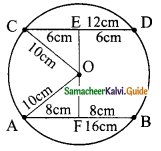
(b) 14 cm

Question 16.
In figure OM = ON = 8cm and AB = 30 cm, then CD = ………
Samacheer Kalvi 9th Maths Guide Chapter 4 Geometry Additional Questions 4
(a) 15 cm
(b) 30 cm
(c) 40 cm
(d) 10 cm
Solution:
(b) 30 cm

Question 17.
O is the centre of a circle, ∠AOB = 100°. Then angle ∠ ACB = ………
Samacheer Kalvi 9th Maths Guide Chapter 4 Geometry Additional Questions 5
(a) 80°
(b) 40°
(c) 50°
(d) 60°
Solution:
(c) 50°

Samacheer Kalvi 9th Maths Guide Chapter 4 Geometry Additional Questions

Question 18.
In,a circle, with center O, ∠AOB = 20°, ∠BOC = 40°, arc BC = 4 Then length of arc AB will be ………
Samacheer Kalvi 9th Maths Guide Chapter 4 Geometry Additional Questions 6
(a) 8 cm
(b) 6 cm
(c) 2 cm
(d) 1 cm
Solution:
(c) 2 cm

Question 19.
In the figure , OC = 3cm and radius of circle is 5 cm. Then AB = ………
Samacheer Kalvi 9th Maths Guide Chapter 4 Geometry Additional Questions 7
(a) 4 cm
(b) 5 cm
(c) 6 cm
(d) 8 cm
Solution:
(d) 8 cm

Question 20.
O is the centre of the circle. The value of x in the given diagram is ………
Samacheer Kalvi 9th Maths Guide Chapter 4 Geometry Additional Questions 8
(a) 100°
(b) 160°
(c) 200°
(d) 80°
Solution:
(d) 80°

Samacheer Kalvi 9th Maths Guide Chapter 4 Geometry Additional Questions

II. Answer the following questions.

Question 1.
In the figure find x° and y°.
Solution:
∠ACD = ∠A + ∠B
(An exterior angle of a triangle is sum of its interior opposite angles)
120° = 50° + x°
x° = 120° – 50°
= 70°
In the triangle ABC
Samacheer Kalvi 9th Maths Guide Chapter 4 Geometry Additional Questions 9
∠A + ∠B + ∠ACB = 180° (Sum of the angles of a Δ)
50° + x + ∠ACB = 180°
50° + 70° + ∠ACB = 180°
∠ACB = 180° – 120°
y = 60°
(OR)
∠ACD + ∠ACB = 180° (Angles of a linear pair)
∠ACB = 180° – 120°
= 60°
The value of x = 70° and y = 60°.

Samacheer Kalvi 9th Maths Guide Chapter 4 Geometry Additional Questions

Question 2.
The angles of quadrilateral are in the ratio 3 : 5 : 9 : 13. Find all the angles of the quadrilateral.
Solution:
Let the angles of the quadrilateral be 3x, 5x, 9x and 13x.
Sum of all the angles of quadrilateral = 360°.
3x + 5x + 9x + 13x = 360°
30x = 360°
x = \(\frac{360°}{30}\)
= 12°
3x = 3 × 12 = 36°
5x = 5 × 12 = 60°
9x = 9 × 12 = 108°
13x = 13 × 12 = 156°
The required angles of quadrilateral are 36°, 60°, 108° and 156°.

Question 3.
Diagonal AC of a parallelogram ABCD bisects ∠A. Show that
Samacheer Kalvi 9th Maths Guide Chapter 4 Geometry Additional Questions 10
(i) it bisects ∠C also
(ii) ABCD is a rhombus.
Solution:
We have a parallelogram ABCD in which diagonals AC bisect ∠A.
∠DAC = ∠BAC
(i) To prove that AC bisects ∠C
∴ ABCD is a parallelogram
Samacheer Kalvi 9th Maths Guide Chapter 4 Geometry Additional Questions 11
∴ AB || DC and AC is a transversal
∴ ∠1 = ∠3 (Alternate interior angle) …….(1)
Also BC || AD and AC is a transversal
∴ ∠2 = ∠4 (Alternate interior angle) …….(2)
But AC bisects ∠A
∴ ∠1 = ∠2 ……… (3)
From (1), (2) and (3) we get
∠3 = ∠4
∴ AC bisects ∠C.

Samacheer Kalvi 9th Maths Guide Chapter 4 Geometry Additional Questions

(ii) To prove that ABCD is a rhombus.
In ΔABC, we have ∠1 = ∠4 [∴ ∠ 1 = ∠2 = ∠4]
∴ BC = AB (side opposite to equal angles are equal) ……..(4)
Similarly AD = DC …….. (5)
But ABCD is a parallelogram AB = DC (Opposite sides of a parallelogram) ………(6)
From (4), (5) and (6) we have AB = BC = CD = DA.
Thus ABCD is a rhombus.

Question 4.
ABCD is a parallelogram and AP and CQ are perpendiculars from vertex A and C on diagonal BD.
Show that
Samacheer Kalvi 9th Maths Guide Chapter 4 Geometry Additional Questions 12
(i) ΔAPB ≅ ΔCQD
(ii) AP = CQ.
Solution:
(i) In ΔAPB and ΔCQD we have
∠APB = ∠CQD (90° each)
AB = CD (opposite sides of parallelogram ABCD)
∠ABP = ∠CDQ (AB || CD and AD is a transversal)
Using ASA congruency we have,
ΔAPB ≅ ΔCQD

(ii) Since ΔAPB ≅ ΔCQD
∴ Their corresponding parts are equal.
∴ AP = CQ.

Samacheer Kalvi 9th Maths Guide Chapter 4 Geometry Additional Questions

Question 5.
ABCD is a rectangle and P, Q, R and S are the mid-points of the sides AB, BC, CD and DA respectively. Show that the quadrilateral PQRS is a rhombus.
Samacheer Kalvi 9th Maths Guide Chapter 4 Geometry Additional Questions 13
Solution:
In rectangle ABCD, P is the mid-point of AB.
Q is the mid-point of BC. R is the mid-point of CD.
S is the mid-point of DA. AC is the diagonal.
Now in ΔABC,
PQ = \(\frac{1}{2}\) AC and PQ || AC ……. (1)
Similarly in ΔACD,
SR = \(\frac{1}{2}\) AC and SR || AC ……. (2)
From (1) and (2) we get,
PQ = SR and PQ || SR
Similarly by joining BD, we have
PS = QR and PS || QR
i.e. Both pairs of opposite sides of quadrilateral PQRS are equal and parallel.
∴ PQRS is a parallelogram.

Samacheer Kalvi 9th Maths Guide Chapter 4 Geometry Additional Questions

Question 6.
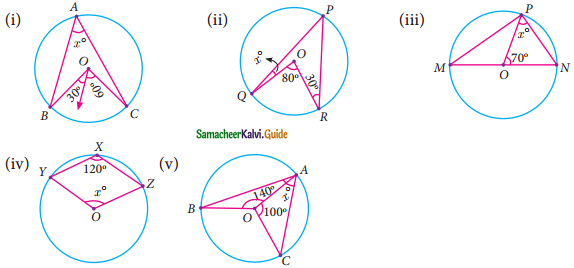
In the figure A, B and C are three points on a circle with centre O such that ∠BOC = 30° and ∠AOB = 60°. If D is a point on the circle other than the arc ABC, find ∠ADC.
Solution:
Samacheer Kalvi 9th Maths Guide Chapter 4 Geometry Additional Questions 14
O is the centre of the circle. ∠AOB = 60° and ∠BOC = 30°
Sum of all the angles of quadrilateral = 360°.
∠AOB + ∠BOC = ∠AOC
∴ ∠AOC = 30° + 60°

= 90°
∠ADC = \(\frac{1}{2}\) × 90°
= 45°

Question 7.
In the given figure A, B, C and D are four points on a circle, AC and BD intersect at a point E such that ∠BEC = 130° and ∠ECD = 20°. Find ∠BAC.
Solution:
In ΔCDE,
Samacheer Kalvi 9th Maths Guide Chapter 4 Geometry Additional Questions 15
Exterior ∠BEC = Sum of interior opposite angle
130° = ∠EDC + ∠ECD
130° = ∠EDC + 20°
130° – 20° = ∠EDC
110° = ∠EDC
∴ ∠BAC = ∠BDC = 110° (Both the triangles are standing on the same base)
∠BAC = 110°

Samacheer Kalvi 9th Maths Guide Chapter 4 Geometry Additional Questions

Question 8.
In the given figure KLMN is a cyclic quadrilateral. KD is the tangent at K. If ∠N is a diameter ∠NLK = 40° and ∠LNM = 50°. Find ∠MLN and ∠DKL.
Samacheer Kalvi 9th Maths Guide Chapter 4 Geometry Additional Questions 16
Solution:
LN is a diameter
∠LMN = ∠LKN = 90° (Angle in a semi-circle)
∴ ∠MLN = 90° – 50°
= 40°
∠LNK = 90° – 40°
= 50°
∠DKL = ∠LKN = 50° (angles in the alternate segment)
∴ ∠DKL = 50°
∠MLN = 40° and ∠DKL = 50°

Question 9.
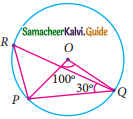
In the given figure ∠PQR = 100°, where P, Q and R are points on a circle with centre ‘O’. Find ∠OPR.
Samacheer Kalvi 9th Maths Guide Chapter 4 Geometry Additional Questions 17
Solution:
∠PQR is the angle subtended by the chord PR in the minor segment.
reflex ∠POR = 2∠PQR
= 2 × 100°
= 200°
Now ∠POR + reflex ∠POR = 360°
∠POR + 200° = 360°
∠POR = 360° – 200°
= 160°
From the given diagram, POR is an isosceles triangle (∴ PO = OR = radii)
∴ ∠OPR = ∠ORP (angles opposite to equal sides)
In ΔOPR,
∠OPR + ∠ORP + ∠POR = 180°
∠OPR + ∠OPR + 160° = 180°
2∠OPR = 180° – 160°
2∠OPR = 20°
∠OPR = \(\frac{20°}{2}\)
= 10°
∴ ∠OPR = 10°

Samacheer Kalvi 9th Maths Guide Chapter 4 Geometry Additional Questions

Question 10.
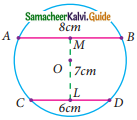
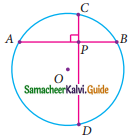
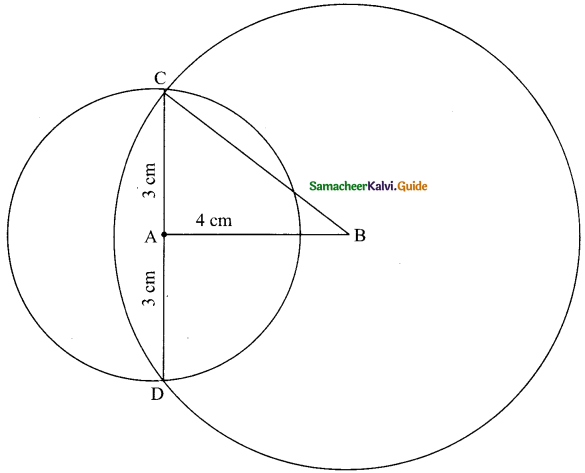
AB and CD are two parallel chords of a circle which are on either sides of the centre such that AB = 10 cm and CD = 24 cm. Find the radius if the distance between AB and CD is 17 cm.
Solution:
Samacheer Kalvi 9th Maths Guide Chapter 4 Geometry Additional Questions 18
Given AB = 10 cm, CD = 24 cm and PQ = 17 cm.
PC = PD = \(\frac{24}{2}\)
= 12 cm
AQ = QB = \(\frac{10}{2}\)
= 5 cm
Let OP be x; OQ = (17 – x)
In the ΔOPC,
OC² = OP² + PC²
= x² + 12²
In the ΔOAQ,
OA² = AQ² + QO²
= 5² + (17 – x)²
= 25 + 289 + x² – 34x
= 314 + x² – 34x
But OA² = OC²
314 + x² – 34x = x² + 144
-34x = 144 – 314
-34x = -170
34x = 170
x = \(\frac{170}{34}\)
= \(\frac{10}{2}\)
= 5
We know,
OC² = x²+ 144
= 5² + 144
= 25 + 144
OC² = 169
But OC = \(\sqrt{169}\)
= 13
Radius of the circle = 13 cm
= x² + 144

Samacheer Kalvi 9th Maths Guide Chapter 4 Geometry Additional Questions

Samacheer Kalvi 10th Maths Guide Chapter 3 Algebra Ex 3.9

Students can download Maths Chapter 3 Algebra Ex 3.9 Questions and Answers, Notes, Samacheer Kalvi 10th Maths Guide Pdf helps you to revise the complete Tamilnadu State Board New Syllabus, helps students complete homework assignments and to score high marks in board exams.

Tamilnadu Samacheer Kalvi 10th Maths Solutions Chapter 3 Algebra Ex 3.9

Question 1.
Determine the quadratic equations, whose sum and product of roots are
(i) -9, 20
Answer:
Sum of the roots = -9 and Product of the roots = 20
The Quadratic equation is
x2 – (sum of the roots) x + product of the roots = 0
x2 – (-9) x + 20 = 0 ⇒ x2 + 9x + 20 = 0

(ii) \(\frac { 5 }{ 3 } \), 4
Answer:
Sum of the roots = \(\frac { 5 }{ 3 } \); Product of the roots = 4
The Quadratic equation is
x2 – (sum of the roots) x + product of the roots = 0
x2 – (\(\frac { 5 }{ 3 } \)) x + 4 = 0 ⇒ x2 – \(\frac { 5 }{ 3 } \) x + 4 = 0
3x2 – 5x + 12 = 0

Samacheer Kalvi 10th Maths Guide Chapter 3 Algebra Ex 3.9

(iii) \(\frac { -3 }{ 2 } \), -1
Answer:
Sum of the roots = \(\frac { -3 }{ 2 } \); Product of the roots = -1
The Quadratic equation is
x2 – (sum of the roots) x + product of the roots = 0
x2 – (-\(\frac { 3 }{ 2 } \)) x + (-1) = 0 ⇒ x2 + \(\frac { 3 }{ 2 } \) x – 1 = 0
2x2 + 3x – 2 = 0

(iv) – (2 – a)2, (a + 5)2
Answer:
Sum of the roots = – (2 – a)2; Product of the roots = (a + 5)2
x2 – (sum of the roots) x + product of the roots = 0
x2 – [-(2 – a)2] x + (a + 5)2 = 0
x2 + (2 – a)2 x + (a + 5)2 = 0

Question 2.
Find the sum and product of the roots for each of the following quadratic equations
(i) x2 + 3x – 28 = 0
(ii) x2 + 3x = 0
(iii) 3 + \(\frac{1}{a}=\frac{10}{a^{2}}\)
(iv) 3y2 – y – 4 = 0
Solution:
(i) x2 – (-3)x + (-28) = 0.
Comparing this with x2 – (α + β)x + αβ = 0.
(α + β) = Sum of the roots = -3
αβ = product of the roots = -28

(ii) x2 + 3x = 0 = x2 – (-3)x + 0 = 0
x2 – (α + β)x + αβ = 0
Sum of the roots α + β = -3
Products of the roots αβ =0

(iii) 3 + \(\frac { 1 }{ a } \) = \(\frac{10}{a^{2}}\)
Answer:
Multiply by a2
3a2 + a = 10
3a2 + a – 10 = 0
Sum of the roots (α + β) = \(\frac { -1 }{ 3 } \)
Product of the roots (α β) = \(\frac { -10 }{ 3 } \)

Samacheer Kalvi 10th Maths Guide Chapter 3 Algebra Ex 3.9

(iv) 3y2 – y – 4 = 0
Answer:
Sum of the roots (α + β) = \(\frac { -(-1) }{ 3 } \) = \(\frac { 1 }{ 3 } \)
Product of the roots (α β) = \(\frac { -4 }{ 3 } \)