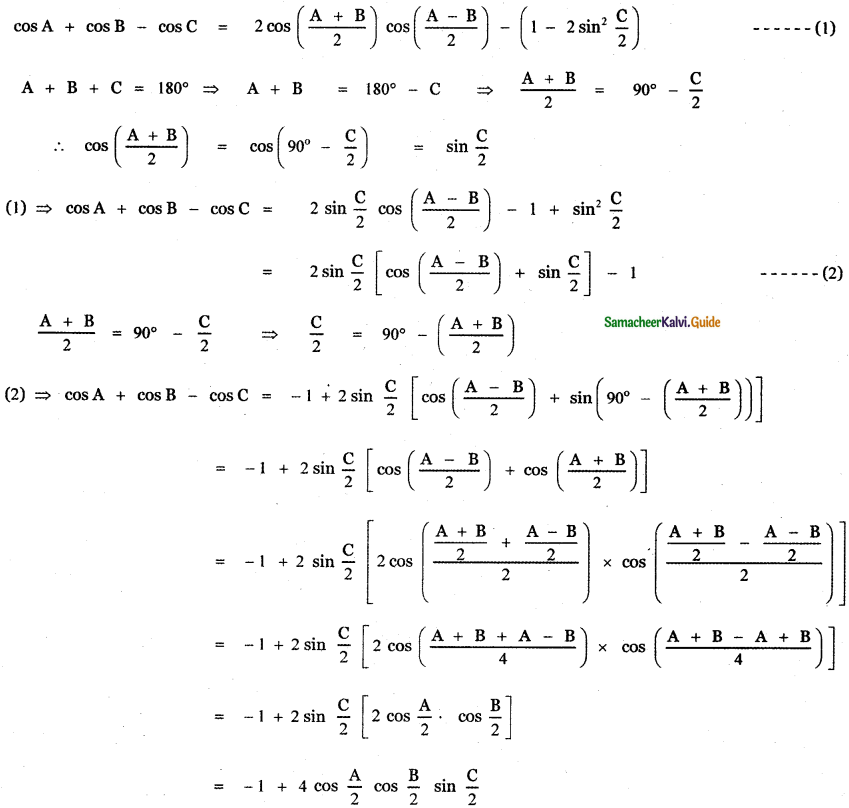
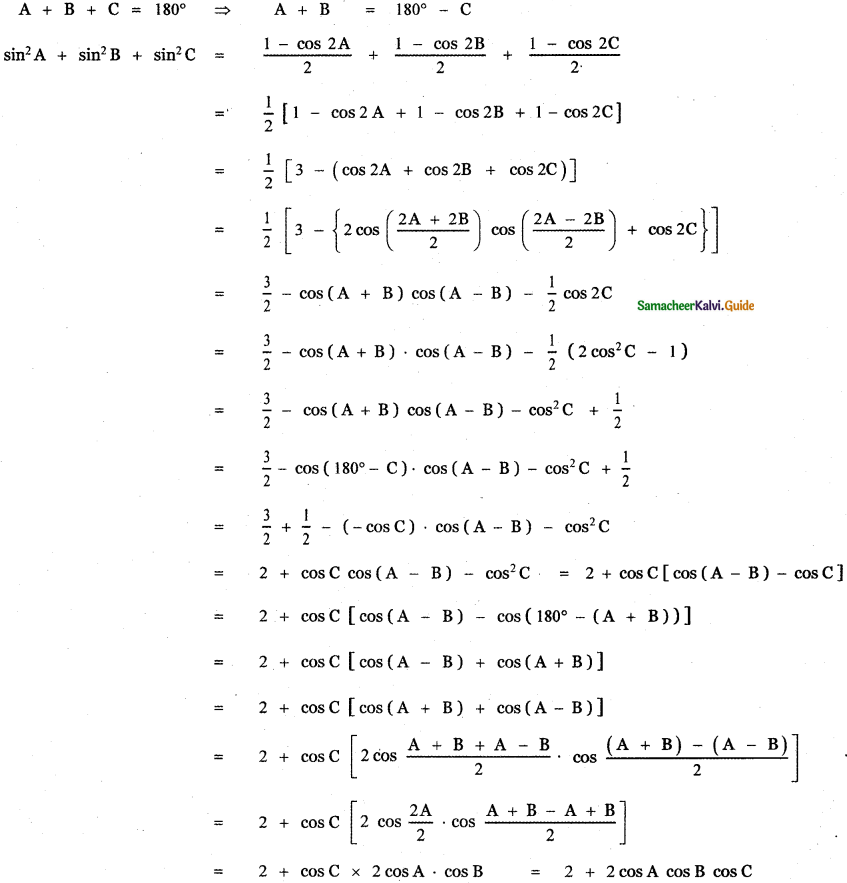
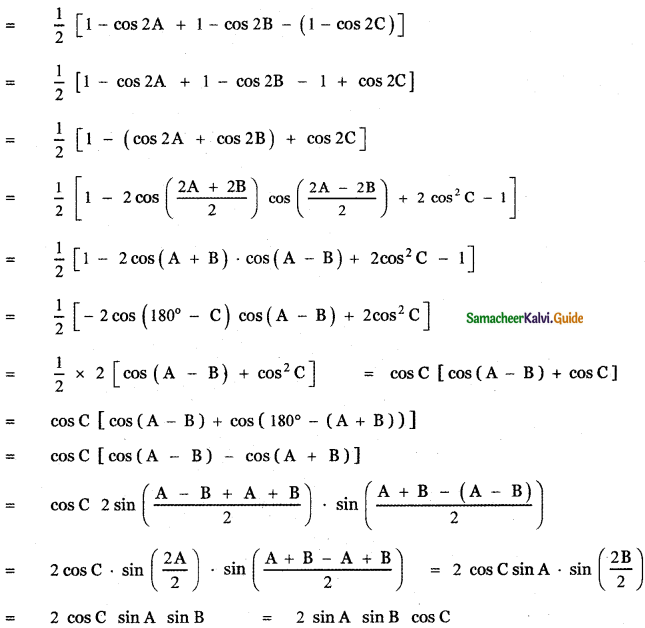
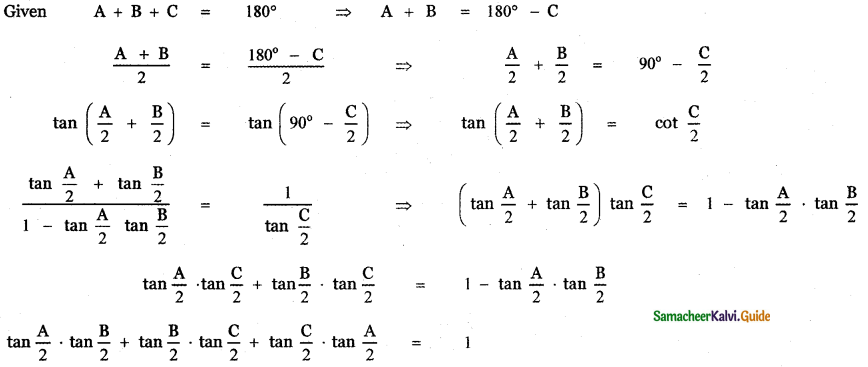
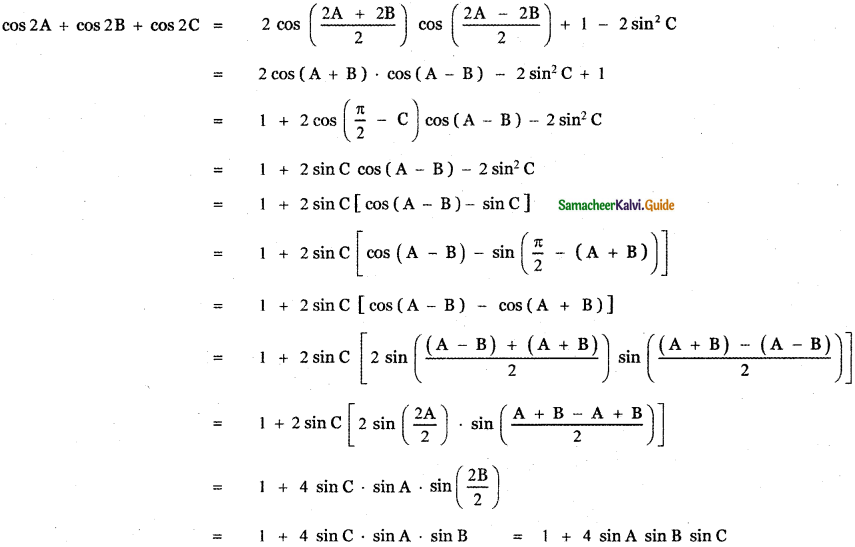
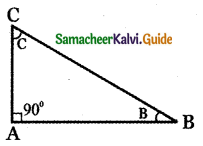
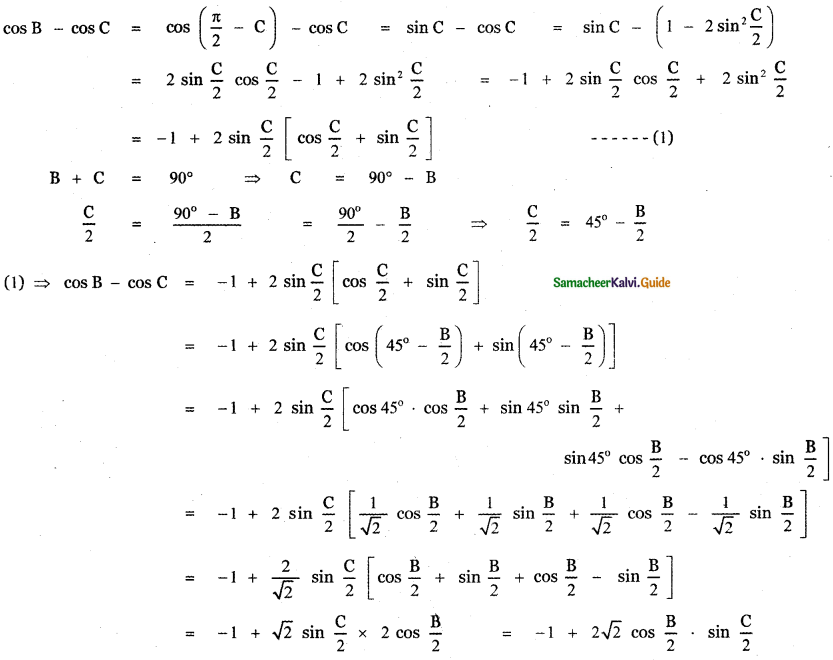
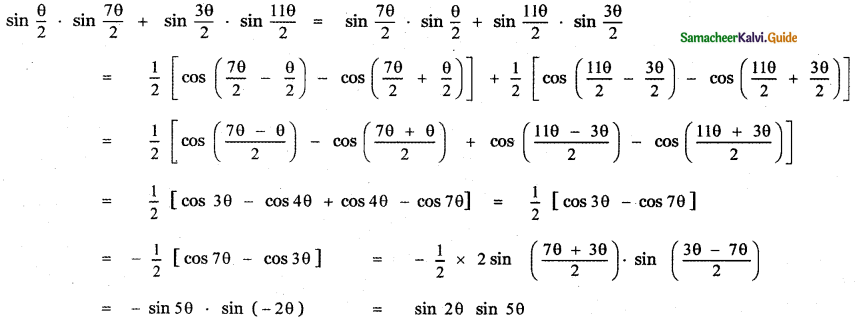
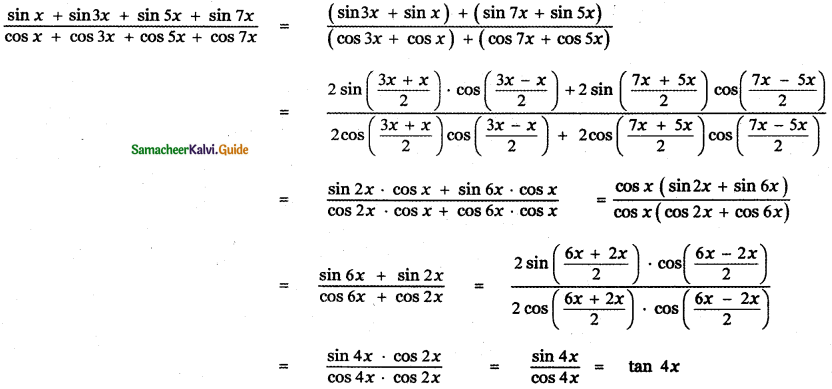
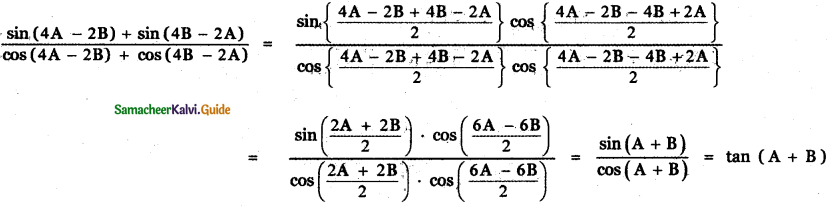
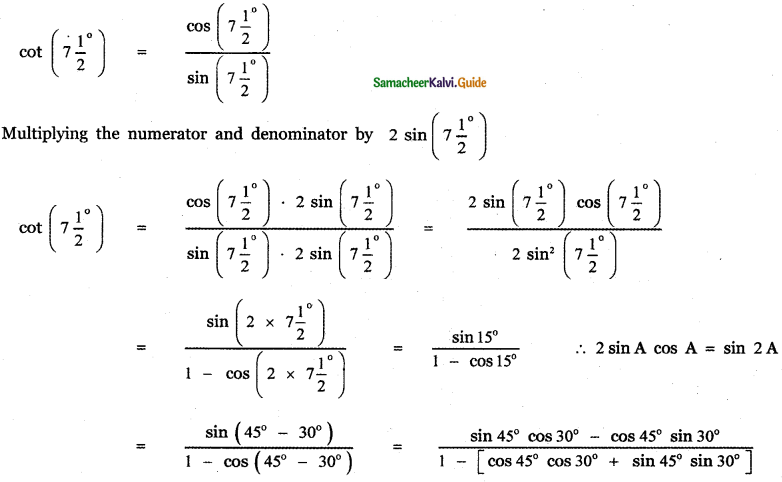
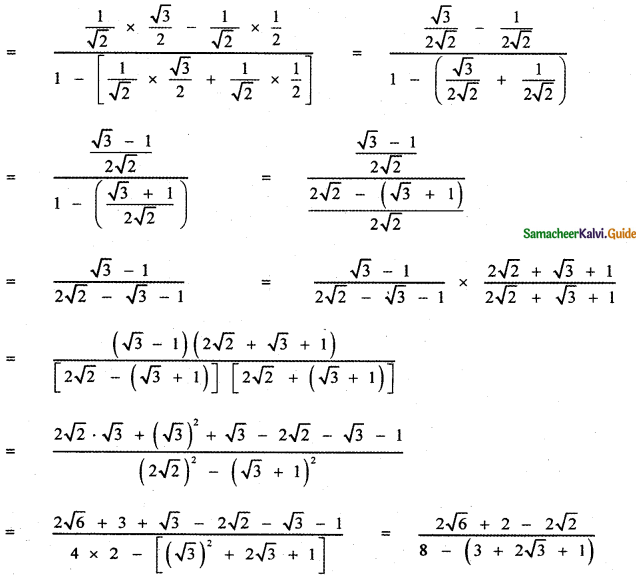
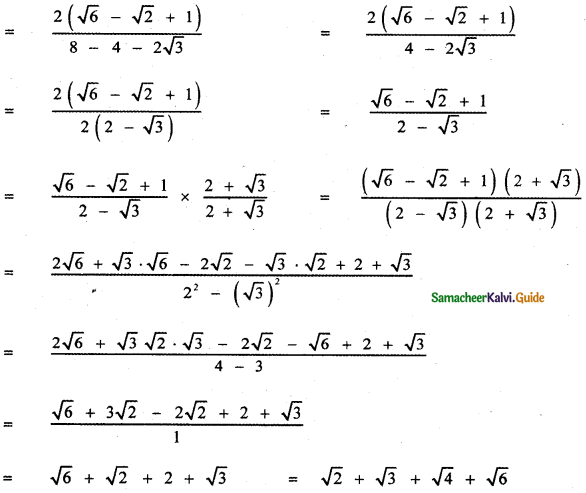
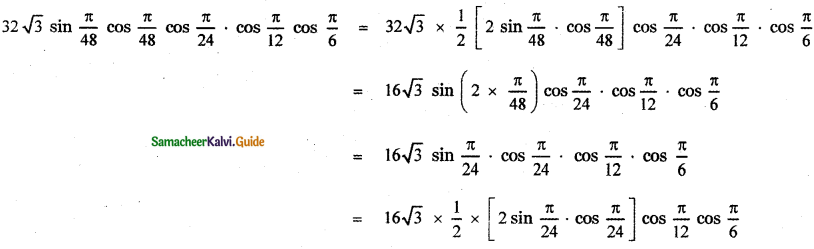
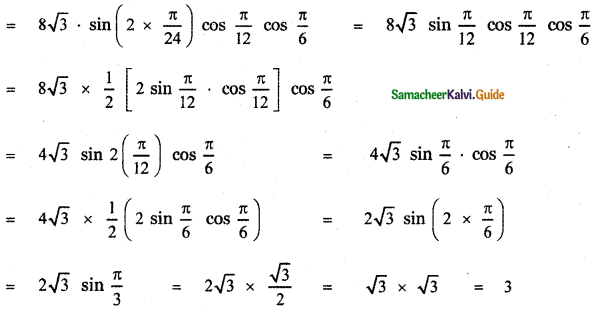
Samacheer Kalvi 11th Maths Guide Chapter 3 Trigonometry Ex 3.6

Tamilnadu State Board New Syllabus Samacheer Kalvi 11th Maths Guide Pdf Chapter 3 Trigonometry Ex 3.6 Text Book Back Questions and Answers, Notes.

Tamilnadu Samacheer Kalvi 11th Maths Solutions Chapter 3 Trigonometry Ex 3.6

Question 1.
Express each of the following as a sum or difference.
(i) sin 35°. cos 28°
(ii) sin 4x cos 2x
(iii) 2 sin 10θ . cos 2θ
(iv) cos 5θ . cos 2θ
(v) sin 5θ . sin 4θ
Answer:
(i) sin 35°. cos 28°
We know
sin A cos B = \(\frac { 1 }{ 2 }\) [sin (A + B) + sin (A – B)]
Take A = 35° and B = 28°
sin 35°cos 28° = \(\frac { 1 }{ 2 }\)[sin(35° + 28°) + sin(35° – 28°)]
sin 350 cos 28° = \(\frac { 1 }{ 2 }\)[sin 63° + sin 7°]

Samacheer Kalvi 11th Maths Guide Chapter 3 Trigonometry Ex 3.6

(ii) sin 4x cos 2x
We know
sin A cos B = \(\frac { 1 }{ 2 }\) [sin (A + B) + sin (A – B )]
Take A = 4x , B = 2x
sin 4x . cos 2x = \(\frac { 1 }{ 2 }\)[sin(4x + 2x) + sin(4x – 2x)]
sin 4x . cos 2x = \(\frac { 1 }{ 2 }\)[sin 6x + sin 2x]

(iii) 2 sin 10θ . cos 2θ
We know
2 sin A cos B = sin (A + B) + sin (A – B)
Take A = 10θ, B = 2θ
2 sin 10θ . cos 2θ = sin (10θ + 2θ) + sin (10θ – 2θ)
2 sin 10θ. cos 2θ = sin 12 θ + sin 8θ
2 sin 10θ . cos 2θ = \(\frac { 1 }{ 2 }\)[sin 12θ + sin 8θ]

(iv) cos 5θ . cos 2θ
We know .
cosA cosB = \(\frac { 1 }{ 2 }\) [cos (A + B) + cos (A – B)]
Take A = 5θ, B = 2θ
cos 5θ . cos 2θ = \(\frac { 1 }{ 2 }\) [cos (5θ + 2θ) + cos(5θ – 2θ)]
cos 5θ . cos 2θ = \(\frac { 1 }{ 2 }\) [cos 7θ + cos 3θ]

(v) sin 5θ . sin 4θ
we know
sin A sin B = \(\frac { 1 }{ 2 }\) [cos (A – B) – cos (A + B)]
Take A = 5θ, B = 4θ
sin 5θ . sin 4θ = \(\frac { 1 }{ 2 }\) [cos (5θ – 4θ) – cos (5θ + 4θ)]
sin 5θ . sin 4θ = \(\frac { 1 }{ 2 }\) [cos θ – cos 9θ]

Samacheer Kalvi 11th Maths Guide Chapter 3 Trigonometry Ex 3.6

Question 2.
Express each of the following as a product.
(i) sin 75° sin 35°
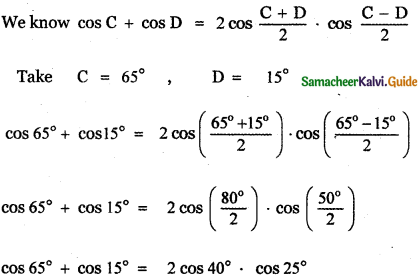
(ii) cos 65° + cos 15°
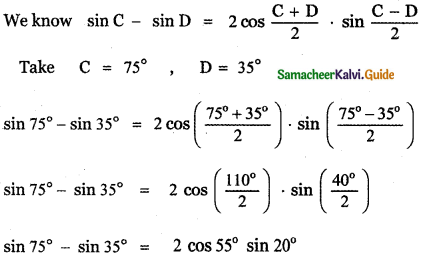
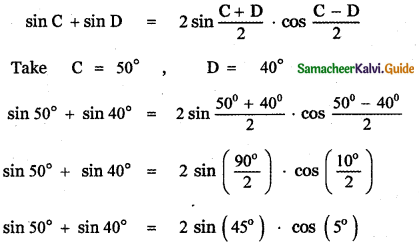
(iii) sin 50° + sin 40°
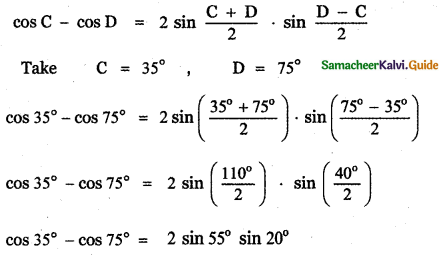
(iv) cos 35° – cos 75°
Answer:
(i) sin 75° sin 35°
Samacheer Kalvi 11th Maths Guide Chapter 3 Trigonometry Ex 3.6 1

(ii) cos 65° + cos 15°
Samacheer Kalvi 11th Maths Guide Chapter 3 Trigonometry Ex 3.6 2

Samacheer Kalvi 11th Maths Guide Chapter 3 Trigonometry Ex 3.6

(iii) sin 50° + sin 40°
We know
Samacheer Kalvi 11th Maths Guide Chapter 3 Trigonometry Ex 3.6 3

(iv) cos 35° – cos 75°
We know
Samacheer Kalvi 11th Maths Guide Chapter 3 Trigonometry Ex 3.6 4

Samacheer Kalvi 11th Maths Guide Chapter 3 Trigonometry Ex 3.6

Question 3.
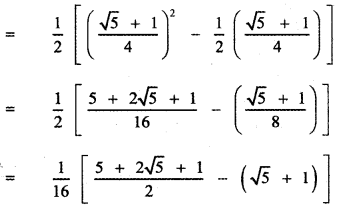
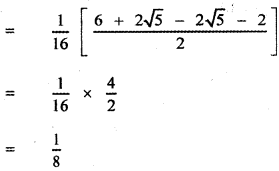
Show that sin 12° . sin 48° . sin 54° = \(\frac{1}{8}\)
Answer:
sin 12° . sin 48° . sin 54° = sin 48° . sin 12°. sin (90° – 36°)
= \(\frac { 1 }{ 2 }\) [cos (48° – 12°) – cos (48° + 12°)] cos 36°
= \(\frac { 1 }{ 2 }\) [cos 36° – cos 6o°] cos 36°
= \(\frac { 1 }{ 2 }\) [cos 36° – \(\frac { 1 }{ 2 }\)] cos 36°
= \(\frac { 1 }{ 2 }\) [cos236° – \(\frac { 1 }{ 2 }\) cos 36°]
Samacheer Kalvi 11th Maths Guide Chapter 3 Trigonometry Ex 3.6 5
Samacheer Kalvi 11th Maths Guide Chapter 3 Trigonometry Ex 3.6 6

Samacheer Kalvi 11th Maths Guide Chapter 3 Trigonometry Ex 3.6

Question 4.
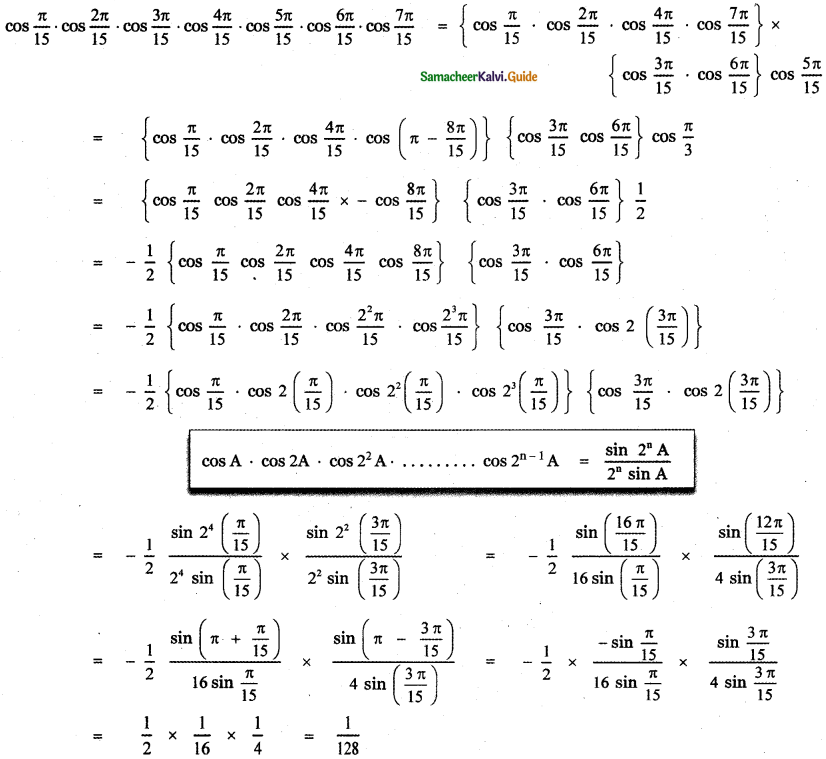
Show that
Samacheer Kalvi 11th Maths Guide Chapter 3 Trigonometry Ex 3.6 7
Answer:
Samacheer Kalvi 11th Maths Guide Chapter 3 Trigonometry Ex 3.6 8

Samacheer Kalvi 11th Maths Guide Chapter 3 Trigonometry Ex 3.6

Question 5.
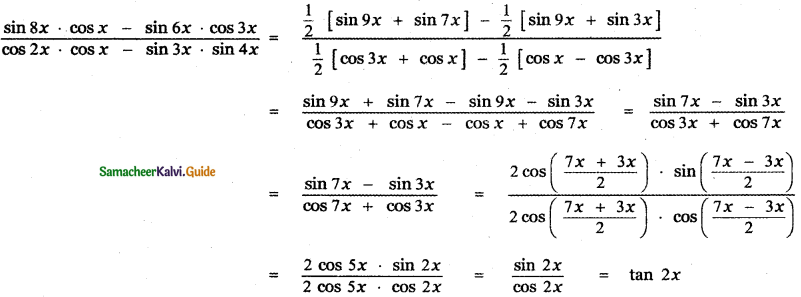
Show that
Samacheer Kalvi 11th Maths Guide Chapter 3 Trigonometry Ex 3.6 9
Answer:
Samacheer Kalvi 11th Maths Guide Chapter 3 Trigonometry Ex 3.6 10

Samacheer Kalvi 11th Maths Guide Chapter 3 Trigonometry Ex 3.6

Question 6.
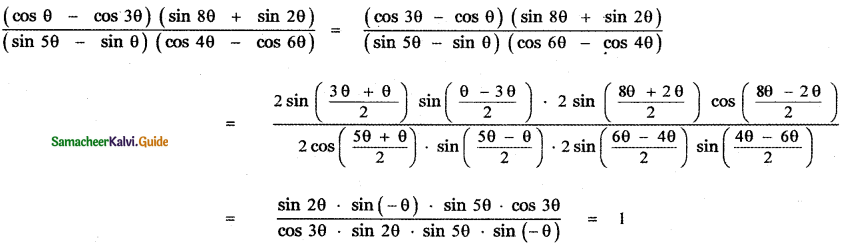
Show that
Samacheer Kalvi 11th Maths Guide Chapter 3 Trigonometry Ex 3.6 11
Answer:
Samacheer Kalvi 11th Maths Guide Chapter 3 Trigonometry Ex 3.6 12

Question 7.
Prove that sin x + sin 2x + sin 3x = sin 2x (1 + 2 cos x)
Answer:
sin x + sin 2x + sin 3x = sin x + 2 sin x cos x + 3 sin x – 4 sin3 x
= sin x [1 + 2 cos x + 3 – 4 sin2 x]
= sin x [2 cos x + 4 – 4 sin2 x ]
= sin x [2 cosx + 4(1 – sin2x)]
= sin x [2 cos x + 4 cos2x]
= 2 sin x cos x [1 + 2 cos x]
= sin 2x (1 + 2 cosx)

Samacheer Kalvi 11th Maths Guide Chapter 3 Trigonometry Ex 3.6

Question 8.
Prove that
Samacheer Kalvi 11th Maths Guide Chapter 3 Trigonometry Ex 3.6 13
Answer:
Samacheer Kalvi 11th Maths Guide Chapter 3 Trigonometry Ex 3.6 14

Question 9.
Prove that 1 + cos 2x + cos 4x + cos 6x = 4 cos x . cos 2x . cos 3x
Answer:
4 cos x cos 2x . cos 3x = 4 cos x . cos 3x . cos 2x = 4 cos x . [cos (3x + 2x) + cos (3x – 2x)]
2 cos x. [cos 5x + cos x] = 2 cos 5x . cos x + 2 cos2 x
= 2 × \(\frac { 1 }{ 2 }\) [cos (5x + x) + cos (5x – x)] + 1 + cos 2x
= cos 6x + cos 4x + 1 + cos 2x
= 1 + cos 2x + cos 4x + cos 6x

Samacheer Kalvi 11th Maths Guide Chapter 3 Trigonometry Ex 3.6

Question 10.
Prove that
Samacheer Kalvi 11th Maths Guide Chapter 3 Trigonometry Ex 3.6 15
Answer:
Samacheer Kalvi 11th Maths Guide Chapter 3 Trigonometry Ex 3.6 16

Question 11.
Prove that cos (30°- A) cos (30° + A) + cos (45° – A). cos(45° + A) = cos 2A + \(\frac { 1 }{ 4 }\)
Answer:
cos(30° – A) cos(30° + A) + cos(45° – A) . cos(45° + A)
= cos (30° + A) cos (30°- A) + cos (45° + A) cos (45° – A)
= \(\frac { 1 }{ 2 }\) [cos (30° + A + 30° – A) + cos ( 30° + A – (30° + A ))] + \(\frac { 1 }{ 2 }\) [cos (45° + A + 45° – A) + cos (45° + A – (450 + A))
= \(\frac { 1 }{ 2 }\) [cos 60° + cos (30° + A – 30° + A)] + \(\frac { 1 }{ 2 }\)[cos 90° + cos(45° + A – 45° + A)]
= \(\frac { 1 }{ 2 }\)[cos 60° + cos 2A] + \(\frac { 1 }{ 2 }\)[cos 90° + 2A]
= \(\frac { 1 }{ 2 }\) cos 60° + \(\frac { 1 }{ 2 }\) cos 2A + \(\frac { 1 }{ 2 }\) cos 90° + \(\frac { 1 }{ 2 }\) cos 2A
= \(\frac { 1 }{ 2 }\) × \(\frac { 1 }{ 2 }\) + cos 2A + \(\frac { 1 }{ 2 }\) × o
= \(\frac { 1 }{ 4 }\) + cos 2A

Samacheer Kalvi 11th Maths Guide Chapter 3 Trigonometry Ex 3.6

Question 12.
Show that
Samacheer Kalvi 11th Maths Guide Chapter 3 Trigonometry Ex 3.6 17
Answer:
Samacheer Kalvi 11th Maths Guide Chapter 3 Trigonometry Ex 3.6 18

Question 13.
Prove that
Samacheer Kalvi 11th Maths Guide Chapter 3 Trigonometry Ex 3.6 19
Answer:
Samacheer Kalvi 11th Maths Guide Chapter 3 Trigonometry Ex 3.6 20

Samacheer Kalvi 11th Maths Guide Chapter 3 Trigonometry Ex 3.6

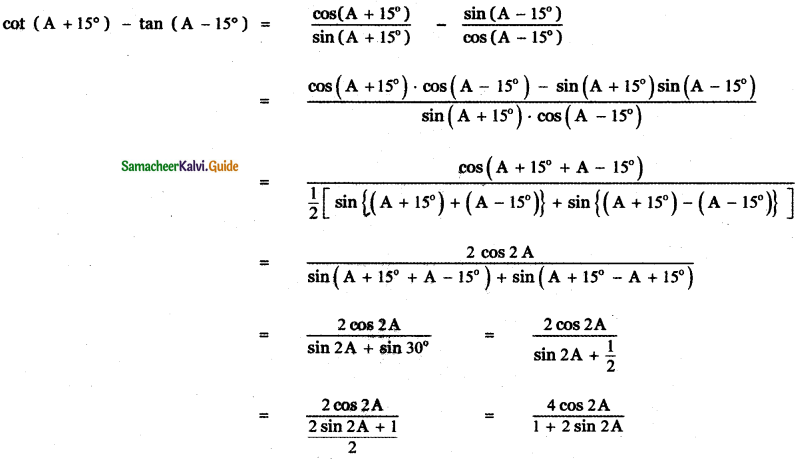
Question 14.
Show that cot (A + 15°) – tan (A – 15°) = \(\frac{4 \cos 2 A}{1+2 \sin 2 A}\)
Answer:
Samacheer Kalvi 11th Maths Guide Chapter 3 Trigonometry Ex 3.6 21

Samacheer Kalvi 9th Science Guide Chapter 1 Measurement

Tamilnadu State Board New Syllabus Samacheer Kalvi 9th Science Guide Pdf Chapter 1 Measurement Text Book Back Questions and Answers, Notes.

Tamilnadu Samacheer Kalvi 9th Science Solutions Chapter 1 Measurement

9th Science Guide Measurement Text Book Back Questions and Answers

Samacheer Kalvi 9th Science Guide Chapter 1 Measurement

I. Choose the correct answer :

Question 1.
Choose the correct one.
(a) mm < cm < m < km
(b) mm > cm > m > km
(c) km < m < cm < mm
d) mm > m > cm > km
Answer :
(a) mm < cm < m < km

Question 2.
Rulers, measuring tapes and metre scales are used to measure
(a) mass
(b) weight
(c) time
(d) length
Answer:
(d) length

Samacheer Kalvi 9th Science Guide Chapter 1 Measurement

Question 3.
1 metric ton is equal to
(a) 100 quintals
(b) 10 quintals
(c) 1/10 quintals
(d) 1/100 quintals
Answer :
(b) 10 quintals

Question 4.
Which among the following is not a device to measure mass?
(a) Spring balance
(b) Beam balance
(c) Physical balance
(d) Digital balance
Answer :
(a) Spring balance

Samacheer Kalvi 9th Science Guide Chapter 1 Measurement

II. Fill in the blanks :

1. Metre is the unit of …………..
Answer :
length

2. 1 kg of rice is weighed by ……………
Answer :
beam balance

3. Thickness of a cricket ball is measured by ……………..
Answer :
vernier caliper

Samacheer Kalvi 9th Science Guide Chapter 1 Measurement

4. Radius of a thin wire is measured by …………………
Answer :
screw gauge

5. A physical balance measures small differences in mass up to ……………….
Answer :
1mg or less

III. State whether true or false. If false, correct the statement :

1. The SI unit of electric current is kilogram.
Answer:
False.
Correct statement: The SI unit of electric current is ampere.

Samacheer Kalvi 9th Science Guide Chapter 1 Measurement

2. Kilometre is one of the SI units of measurement.
Answer:
True.

3. In everyday life, we use the term weight instead of mass.
Answer:
True.

4. A physical balance is more sensitive than a beam balance.
Answer:
True.

Samacheer Kalvi 9th Science Guide Chapter 1 Measurement

5. One Celsius degree is an interval of IK and zero degree Celsius is 273.15 K.
Answer:
True.

6 . With the help of vernier caliper we can have an accuracy of 0.1 mm and with screw gauge we can have an accuracy of 0.01 mm.
Answer:
True.

IV. Match the following:

Question 1.

Column IColumn II
Lengthkelvin
Massmetre
Timekilogram
Temperaturesecond

Answer:

Column IColumn II
Lengthmetre
Masskilogram
Timesecond
Temperaturekelvin

Question 2.

Column IColumn II
Screw gaugeVegetables
Vernier caliperCoins
Beam balanceGold ornaments
Digital balanceCricket ball

Answer:

Column IColumn II
Screw gaugeCoins
Vernier caliperCricket ball
Beam balanceVegetables
Digital balanceGold ornaments

Samacheer Kalvi 9th Science Guide Chapter 1 Measurement

V. Assertion and reason type :

Mark the correct answer as :
(a) Both A and R are true but R is not the correct reason.
(b) Both A and R are true and R is the correct reason.
(c) A is true but R is false.
(d) A is false but R is true

Question 1.
Assertion (A) : The scientifically correct expression is “The mass of the bag is 10 kg”
Reason (R) : In everyday life, we use the term weight instead of mass.
Answer :
(a) Both A and R are true but R is not the correct reason

Question 2.
Assertion (A) : 0° C = 273.16 K. For our convenience we take it as 273K after rounding off the decimal.
Reason (R) : To convert a temperature on the Celsius scale we have to add 273 to the given temperature.
Answer :
(b) Both A and R are true and R is the correct reason

Samacheer Kalvi 9th Science Guide Chapter 1 Measurement

Question 3.
Assertion (A) : Distance between two celestial bodies is measured in terms of light year.
Reason (R) : The distance travelled by the light in one year is one light year.
Answer:
(d) A is false but R is true
Distance between two celestial bodies is measured in terms of unit.

VI. Answer very briefly.

Question 1.
Define measurement.
Answer :
Measurement is the process of comparison of the given physical quantity with the known standard quantity of the same nature.

Question 2.
Define a standard unit.
Answer:
Unit is the quantity of a constant magnitude which is used to measure the magnitudes of other quantities of the same nature.

Samacheer Kalvi 9th Science Guide Chapter 1 Measurement

Question 3.
What is the full form of SI system?
Answer:
The full form of S.I. system is the International System of Units.

Question 4.
Define least count of any device.
Answer:
Least count is the least measurement possible in a given device.
It is the distance moved by the tip of the screw for a rotation of one division on the head scale.
Least count = [Pitch / No. of head scale divisions]

Samacheer Kalvi 9th Science Guide Chapter 1 Measurement

Question 5.
What do you know about pitch of screw gauge?
Answer:
Pitch of the screw gauge is the distance between two successive screw threads. It is measured by the ratio of distance travelled on the pitch scale to the number of rotations of the head scale.

Question 6.
Can you find the diameter of a thin wire of length 2 m using the ruler from your instrument box?
Answer:
No, I can not find the diameter of a thin wire of length 2 m using the ruler.

Samacheer Kalvi 9th Science Guide Chapter 1 Measurement

VII. Answer briefly :

Question 1.
Write the rules that are followed in writing the symbols of units in SI system.
Answer:

  •  The units named after scientists are not written with a capital initial letter.
    E.g. newton, henry, ampere, and watt.
  • The symbols of the units named after scientists should be written by the initial capital letter.
    E.g. N for newton, H for Henry, A for ampere, and W for watt.
  • Small letters are used as symbols for units not derived from a proper noun.
    E.g. m for metre, kg for kilogram.
  •  No lull stop or other punctuation marks should be used within or at the end of symbols.
    E.g. 50 m and not as 50 m.
  •  The symbols of the units are not expressed in plural form.
    E.g. 10 kg not as kgs.

Question 2.
Write the need of a standard unit.
Answer:
A Standard Unit is needed to maintain uniformity in measurements like length, weight, size and distance. Eg: Standard Unit of length is metre.

Samacheer Kalvi 9th Science Guide Chapter 1 Measurement

Question 3.
Differentiate mass and weight.
Answer:
Mass:

  1.  Fundamental quantity
  2.  Has magnitude alone – scalar quantity
  3.  It is the amount of matter contained in a body
  4.  Remains the same
  5.  It is measured using physical balance
  6.  Its unit is kilogram

Weight:

  1.  Derived quantity
  2.  Has magnitude and direction – vector quantity
  3.  It is the normal force exerted by the surface on the object against gravitational pull
  4.  Varies from place to place
  5.  It is measured using spring balance
  6.  Its unit is newton

Question 4.
How will you measure the least count of vernier caliper?
Answer:
The least count of Vernier Caliper is the ratio of the value of one smallest main scale division to total
a number of Vernier scale divisions.
i.e., L.C. = 0.1mm = 0.01cm
(or) L.C. = 1MD – 1VSD = 1.0 mm – 0.9 mm = 0. 1mm = 0.01 cm

Samacheer Kalvi 9th Science Guide Chapter 1 Measurement

VIII. Answer in detail :

Question 1.
Explain a method to find the thickness of a hollow teacup.
Answer:
Step 1 : The Pitch, Least count and the type of zero error of the screw gauge are determined.
Step 2 : The given cup is placed in between two studs.
Step 3 : The head screw using the ratchet arrangement is freely rotated until the given cup is held firmly, but not tightly.
Step 4 : Pitch scale reading (PSR) by the head scale and head scale coincidence (HSC) with the axis of the pitch scale, are found.
Step 5 : The readings are recorded and the experiment for different positions of the given cup is repeated.
Step 6 : The thickness of the cup is calculated using the formula P.S.R + (HSC × L.C)
Step 7 : Then the average of the last column of the table, is found. Hence the thickness of a hollow tea cup = ………….. mm.

Question 2.
How will you find the thickness of a one rupee coin?
Answer:
Step 1 : The Pitch, Least count and the type of zero error of the screw gauge are determined.
Step 2 : The given coin is placed in between two studs.
Step 3 : The head screw using the ratchat arrangement is freely rotated until given one rupee coin is held firmly, but not tightly.
Step 4 : Pitch scale reading (PSR) by the head scale and head scale coincidence (HSC) with are axis of the pitch scale are found.
Step 5 : The reading are recorded and the experiment for different positions of the given coin is repeated.
Step 6 : The thickness of the coin is computed using the formula P.S.R + (HSC x L.C )
Step 7 : Then the average of the last column of the table is found.

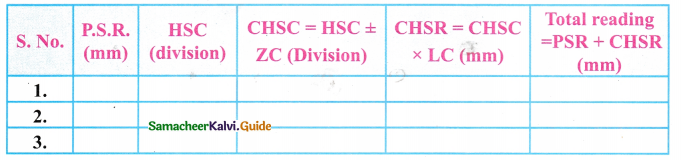
Samacheer Kalvi 9th Science Guide Chapter 1 Measurement 1
mean = …………….. mm
Hence the thickness of a one rupee coin = ……………….. mm

Samacheer Kalvi 9th Science Guide Chapter 1 Measurement

IX. Numerical Problems :

Question 1.
Inian and Ezhilan argue about the light year. Inian tells that it is 9.46 x 10¹⁵m and Ezhilan argues that it is 9.46 x 10¹² km. Who is right? Justify your answer.
Answer:
(Inian is correct)
Light travels 3 × 10⁸m in one second or 3 Lakhs kilometre in one second.
In one year we have 365 days.
The total number of second in one year is equal to 365 x 24 x 60 x 60
Distance travelled by light in 1 year = (3.153 x 107) x (3 x 108)
= 9.46 x 10¹⁵m

Question 2.
The main scale reading while measuring the thickness of a rubber ball using Vernier caliper is 7 cm and the Vernier scale coincidence is 6. Find the radius of the ball.
Answer:
MSR = 7 cm
VC = 6cm
LC = 0.1mm = 0.1cm
Diameter = DR = MSR + (VC X LC)
= 7 + 0.06 cm
Diameter D = 7.06 cm
Radius R = \(\frac{D}{2}=\frac{7.06}{2}\) = 0.035 m
The radius of the ball = 0.0353 m.

Samacheer Kalvi 9th Science Guide Chapter 1 Measurement

Question 3.
Find the thickness of a five rupee coin with the screw gauge, if the pitch scale reading is 1 mm and its head scale coincidence is 68.
Answer:
PSR = 1 mm = 1 x 10⁻³m
HSC = 68
LC = 0.01 mm =0.01 × 10⁻³m
Total reading = PSR + (HSC × LC)
∴Thickness of the five rupee coin = 1 × 10⁻³ + (68 × 0.01 × 10-3 )m
∴ Thickness of the five rupee coin = 1.68 × 10⁻³m = 1.68mm

Question 4.
Find the mass of an object weighing 98 N.
Answer:
W = mg
W =98 N
g = 9.8 m/s2
m = \(\frac{\mathrm{W}}{\mathrm{g}}=\frac{98}{9.8}\) = 10 kg

Samacheer Kalvi 9th Science Guide Chapter 1 Measurement

Intext Activities

ACTIVITY – 1

Using Vernier caliper find the outer diameter of your pen cap.
Samacheer Kalvi 9th Science Guide Chapter 1 Measurement 2
Aim : To find the outer diameter of the pen cap.
Materials required : Vernier caliper, pen cap.
Answer:
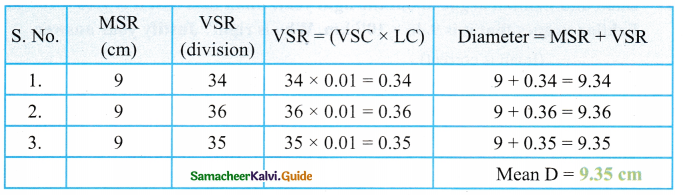
Samacheer Kalvi 9th Science Guide Chapter 1 Measurement 3
Result: The outer diameter of the pen cap = 9.35 cm
[End of the activity]

Samacheer Kalvi 9th Science Guide Chapter 1 Measurement

ACTIVITY – 2

Determine the thickness of a single sheet of your science textbook with the help of a Screw gauge.
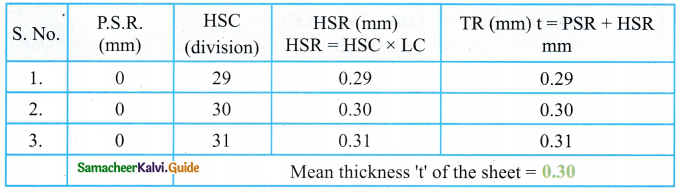
Samacheer Kalvi 9th Science Guide Chapter 1 Measurement 4

LC = Least Count
PSR = Pitch Scale Reading
HSC = Head Scale Coincidence
HSR = Head Scale Reading
TR = Total Reading
Result : The thickness of the single sheet = 0.30
End of the activity

9th Science Guide Measurement Additional Important Questions and Answers

I. Choose the correct answer :

Question 1.
Length is ……………….
(a) The amount of matter in an object
(b) The amount of space an object takes up.
(c) The distance between two points.
(d) The amount of stuff in an object
Answer:
(c) The distance between two points

Question 2.
Mass is ………………….
(a) The distance between two points
(b) The distance between three points
(c) The amount of matter contained in an object
(d) The amount of space an object occupies.
Answer:
(c)The amount of matter contained in an object

Samacheer Kalvi 9th Science Guide Chapter 1 Measurement

Question 3.
Unit used to measure length
(a) metre
(b) litre
(c) gram
(d) cubic metre (m3)
Answer:
(a) metre

Question 4.
Unit which is used to measure mass
(a) ml
(b) 1
(c) cm
(d) gram
Answer:
(d) gram

Samacheer Kalvi 9th Science Guide Chapter 1 Measurement

Question 5.
How many metres are there in 1 nanometer?
(a) 10-10m
(b) 10-9m
(c) 109m
(d) 1010m
Answer:
(b) 10-9m

Question 6.
What unit will you use to measure the length of our classroom?
(a) km
(b) m
(c) cm
(d) mm
Answer :
(b) m

Samacheer Kalvi 9th Science Guide Chapter 1 Measurement

Question 7.
The Kelvin is the basic unit of ………………..
(a) temperature
(b) mass
(c) length
(d) volume
Answer :
(a) temperature

Question 8.
……………….consists of ‘U’ shape metal frame
(a) Screw gauge
(b) Vernier caliper
(c) Beam balance
(d) Spring balance
Answer :
(a) screw gauge

Samacheer Kalvi 9th Science Guide Chapter 1 Measurement

Question 9.
Least count of a vernier caliper is ……………. cm.
(a) 1
(b) 0.1
C) 0.01
(d) 0.001
Answer:
(c) 0.01

Question 10.
If no object is placed on the hook, then the pointer of the spring balance reads ………………….
(a) 3
(b) 2
(c) 1
(d) 0
Answer :
(d) 0

Samacheer Kalvi 9th Science Guide Chapter 1 Measurement

Question 11.
SI unit of mass and weights are ………………….
(a) kg, N
(b) N, kg
(c) K, N
(d) N, K
Answer:
(a) kg, N

Question 12.
Units named after scientists …………………..
(a) lowercase
(b) upper case
(c) both (a) and (b)
(d) neither (a) or (b)
Answer:
(a) lower case

Samacheer Kalvi 9th Science Guide Chapter 1 Measurement

Question 13.
An instrument that is used to measure the diameter of a cricket ball is ………………….
(a) Screw gauge
(b) Meter scale
(c) Vernier caliper .
(d) Spring balance
Answer:
(a) Vernier caliper

Question 14.
Distance between Chennai and Kanyakumari can be found in
(a) Kilometres
(b) Metres
(c) Centimetres
(d) Millimetres.
Answer:
(a) Kilometres

Samacheer Kalvi 9th Science Guide Chapter 1 Measurement

II. Fill in the blanks :

1. The precision of vernier calipers is ……………. mm.
Answer:
(a) 0.1mm

2. The gravity accelerates an object, the distance fallen is proportional to …………………
Answer:
time squared

3. SI unit of electric current is ………………
Answer:
ampere

Samacheer Kalvi 9th Science Guide Chapter 1 Measurement

4. Larger unit for measuring time is ………………..
Answer:
millennium

5. The value of an astronomical unit is ……………………
Answer:
1.496 x 10¹¹

6. Mass is a …………….. quantity.
Answer:
scalar

Samacheer Kalvi 9th Science Guide Chapter 1 Measurement

III. State whether true or false. If false, correct the statement:

1. The precision of screw gauge is 0.001 cm.
Answer:
True.

2. The unit of amount of substance is candela
Answer:
False.
Correct statement: The unit of amount of substance is mole.

3. The symbol for the units derived from the names of scientists are written in capital letter
Answer:
True.

Samacheer Kalvi 9th Science Guide Chapter 1 Measurement

4. Yard was used as the unit of length.
Answer:
True

5. Micron is also known as micro-metre
Answer:
True

6. A vemier caliper using the scale invented by Galileo.
Answer:
False.
Correct statement: A vernier caliper using the scale invented by Pierre Vernier.

Samacheer Kalvi 9th Science Guide Chapter 1 Measurement

7. The SI unit of mass is kg.
Answer:
True.

8. Weight has both magnitude and direction.
Answer:
True.

Samacheer Kalvi 9th Science Guide Chapter 1 Measurement

IV. Match the following:

Question 1.

Column IColumn II
FPSMetre, kilogram and second
CGSFoot, pound and second
MKS or SIcentimetre, gram and second

Answer:

Column IColumn II
FPSFoot, pound and second
CGScentimetre, gram and second
MKS or SIMetre, kilogram and second

Question 2.

Column-IColumn-II
10 years1 year
10 centuries1century(100 years)
10 decades1 millennium
365.24 days1 decade

Answer:

Column-IColumn-II
10 years1 decade
10 centuries1 millennium
10 decade1century(100 years)
365.24 days1 year

Samacheer Kalvi 9th Science Guide Chapter 1 Measurement

Question 3.

Column-IColumn-II
Electric Currentradian
Luminous intensityampere
Anglesteradian
Solid anglecandela

Answer:

Column-IColumn-II
Electric Currentampere
Luminous intensitycandela
Angleradian
Solid anglesteradian

Question 4.

Column-IColumn-II
Lengths
Massm
Timek
Temperaturekg

Answer:

Column-IColumn-II
Lengthm
Masskg
Times
Temperaturek

Samacheer Kalvi 9th Science Guide Chapter 1 Measurement

Question 5.

Column-IColumn-II
Millimeter10-15 m
Nanometer10-3m
Angstrom10-9m
Fermi10-10m

Answer:

Column-I

Column-II
Millimeter10-3m
Nanometer10-9m
Angstrom10-10m
Fermi10-15 m

Question 6.

Column-IColumn-II
TemperatureBearm balance
MassRuler
LengthDigital clock
TimeThermometer

Answer:

Column-IColumn-II
TemperatureThermometer
MassBearm balance
LengthRuler
TimeDigital clock

Samacheer Kalvi 9th Science Guide Chapter 1 Measurement

V. Assertion and reason type :

Question 1.
Assertion (A) : Light year and wave length both measure distance
Reason (R) : Both have dimensions of time.
(a) Both A and R are true but R is not the correct explanation of A.
(b) Both A and R are true and R is the correct explanation of A.
(c) A is true but R is false.
(d) A is false but R is true.
Answer :
(c) A is true but R is false

Question 2.
Assertion (A) : Density is a derived physical quantity
Reason (R) : Density cannot be derived from the fundamental physical quantities.
(a) Both A and R are true but R is not the correct explanation of A.
(b) Both A and R are true and,R-is the correct explanation of A.
(c) A is true but R is false. .
(d) A is false but R is true.
Answer :
(c) A is true but R is false
Correct statement: Density can be derived from mass and volume.

Samacheer Kalvi 9th Science Guide Chapter 1 Measurement

Question 3.
Assertion (A) : Mass, Length and Time are fundamental physical quantities.
Reason (R) : They are independent of each other.
(a) Both A and R are true but R is not the correct explanation of A.
(b) Both A and R are true and R is the correct explanation of A.
(c) A is true but R is false.
(d) A is false but R is true.
Answer :
b) Both A and R are true and R is the correct explanation of A

Question 4.
Assertion (A) : The SI system of units is the improved system of units for measurement.
Reason (R) : The SI unit of mass is kilogram.
(a) Both A and R are true but R is not the correct reason.
(b) Both A and R are true and R is the correct reason.
(c) A is true but R is false.
(d) A is false but R is true.
Answer :
(b) Both A and R are true and R is the correct reason

Samacheer Kalvi 9th Science Guide Chapter 1 Measurement

Question 5.
Assertion (A) : The skill of estimation is important for all of us in our daily life.
Reason (R) : The skill of estimation reduces our consumption of time.
a) Both A and R are true but R is not the correct reason.
b) Both A and R are true and R is the correct reason.
c) A is true but R is false. ,
d) A is false but R is true.
Answer :
(b) Both A and R are true and R is the correct reason

VI. Comprehensive type :

(a) The speed of a body gives us an idea of how slow or fast that a body is moving. Speed of a body is the distance travelled by it per unit time. The SI unit of speed is metre per second. It is a scalar quantity. The speed of a running cab at any instant of time is shown by an instrument called, ’speedometer’ and the distance travelled by a car is measured by another instrument called, ‘odometer’.

Question 1.
Which the following is not a correct unit of speed?
(a) cm/s
(b) m/s
(e) km/h
(d) km/s.
Answer :
(d) km/s

Question 2.
If the distance travelled by the cab in 3 hours is 120 km, then its speed will be
(a) 40 m/s
(b) 40 km/s
(c) 40 km/h
(d) 40 km/min
Answer :
(c) 40 km/h

Samacheer Kalvi 9th Science Guide Chapter 1 Measurement

Question 3.
The formula for finding the speed of the cab is
(a) Distance = speed x time
(b) velocity = distance x time
(c) time = distance x velocity
(d) None of these.
Answer:
(a) Distance = speed x time

(b) Read the passage and answer the questions given below.

Mass is the amount of matter contained in an object. Measurement of mass helps us to distinguish between lighter and a heavier body. Beam-Balance, spring balance and electronic balance are used to measure mass of different objects. The SI unit of mass is kilogram (kg). But different units are Used to measure the mass of different objects depending upon their weight, e.g. weight (mass) of a tablet is measured in milligrams (mg), weight of a student is measured in kilogram (kg), and weight of a truck with goods is measured in metric tons. 1 metric ton is equal to 10 quintals and 1 quintal is equal to 100 kg. 1 gram is equal to 1000 mg.

Question 1.
The value of 1 metric ton is equal to
(a) 1000 kg
(b) 10 quintals
(c) 1000,000 g
(d) 100 kg
Answer :
(a) 1000 kg (or) (b) 10 quintals

Samacheer Kalvi 9th Science Guide Chapter 1 Measurement

Question 2.
How will you measure weight of a tablet?
(a) kg
(b) g
(c) mg
(d) none of these.
Answer:
(c) mg

VII. Answer very briefly :

Question 1.
Write the units which are used to measure long distances.
Answer:
km, AU, light-year, parsec.

Question 2.
Define Astronomical unit.
Answer:
AU is defined as the average distance between the earth and the sun.
1 AU = 1.496 × 10¹¹m.

Question 3.
Define the light year.
Answer:
The distance travelled by light in one year in vacuum. 1 light-year = 9.46 × 10¹⁵m.

Samacheer Kalvi 9th Science Guide Chapter 1 Measurement

Question 4.
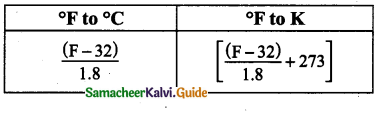
Convert the temperature from Fahrenheit into Celsius & Kelvin.
Answer:
Samacheer Kalvi 9th Science Guide Chapter 1 Measurement 5

Question 5.
Convert 100°C into Kelvin.
Answer:
100 + 273 = 373 K. ie. °C + 273

Question 6.
Convert 112°F into K.
Answer:
Samacheer Kalvi 9th Science Guide Chapter 1 Measurement 6

Question 7.
Write the principle of screw gauge.
Answer:

  • When a screw is rotated in a nut, the distance moved by the tip of the screw is directly proportional to the number of rotations given.
  • Hence the principle of the screw is considered as the principle of screw gauge.

Question 8.
What are the kinds of units?
Answer:

  1. Fundamental or basic units
  2. Derived units

Samacheer Kalvi 9th Science Guide Chapter 1 Measurement

Question 9.
Give some examples of fundamental units.
Answer:
The examples of fundamental units are kg for mass,m for length, s for time.

Question 10.
Give some examples of derived units.
Answer:
The units of area, volume, density.

Question 11.
What is the standard unit of weight?
Answer:
Newton is the standard unit of weight.

Samacheer Kalvi 9th Science Guide Chapter 1 Measurement

Question 12.
What is the standard unit of mass?
Answer:
kilogram is the standard unit of mass.

Question 13.
Define Mass.
Answer:
Mass is the amount of matter contained in a body.

Question 14.
Define Weight.
Answer:
The force with which the earth attracts a body towards its center is called weight.

Samacheer Kalvi 9th Science Guide Chapter 1 Measurement

Question 15.
What is the SI unit of temperature?
Answer:
Kelvin is the SI unit of temperature.

Question 16.
What is the measuring unit of the thickness of a plastic carry bag?
Answer:
1 micron = 10-6m (or) μm.

Samacheer Kalvi 9th Science Guide Chapter 1 Measurement

VIII. Answer briefly :

Question 1.
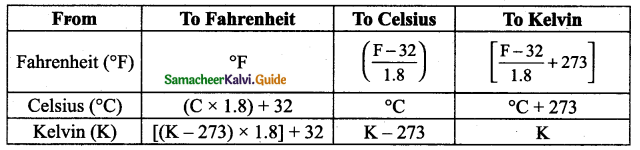
Write temperature conversion.
Answer:
Temperature Conversion (Exact)
Samacheer Kalvi 9th Science Guide Chapter 1 Measurement 7

Question 2.
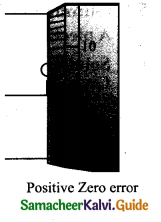
Write about the positive zero error in screw gauge instrument.
Answer:
When the plane surface of the screw and the opposite plane stud on the frame are brought into contact, if the zero of the head scale lies below the pitch scale axis, the zero error is positive. For example, the 5th division of the head scale coincides with the pitch scale axis, then the zero error is positive and is given by Z.E = + (n × LC) where ‘n’ is the head scale coincidence. In this case, Zero error = + (5 × 0.01) = 0.05 mm. So the zero correction is – 0.05 mm
Samacheer Kalvi 9th Science Guide Chapter 1 Measurement 8

Question 3.
Write SI units for the fundamental quantity.
Answer:

Basic QuantityUnit
Lengthmetre
Masskilogram
Timesecond
Electric currentampere
Temperaturekelvìn
Amount of substancemole
Luminous intensitycandela

Question 4.
Convert the following units in metre.
Answer:

Smaller unitsValue in metre
Centimeter (cm)10-2 m
Millimeter (mm)10-3 m
micron or µm10-6 m
nanometre (nm)10-9 m
angstrom (A)10-10 m
fermi (f)10-15 m

Samacheer Kalvi 9th Science Guide Chapter 1 Measurement

Question 5.
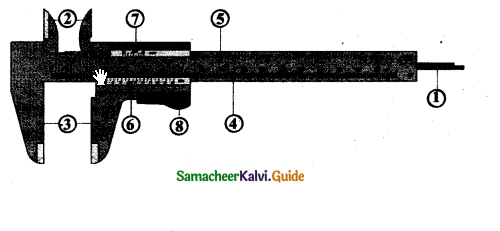
Draw and mark the parts of vernier caliper
Answer:
PARTS Marked in the Vernier caliper

  1. Lower fixed jaw
  2. Upper fixed jaw
  3. Lower movable jaw
  4. Vernier scale
  5. Retainer
  6. Main scale
  7. Depth probe.

Samacheer Kalvi 9th Science Guide Chapter 1 Measurement 8

IX. Numerical Problems :

Question 1.
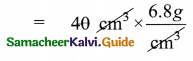
A piece of iron of volume 40cm3 whose density is 6.8g/cm3. Find the mass of iron.
Answer:
Given, density of iron, D = 6.8g/cm3
volume of iron, V = 40 cm3
mass of iron, M = V × D [∴ mass = volume × density]
Samacheer Kalvi 9th Science Guide Chapter 1 Measurement 10
m = 272.0g.

Question 2.
Solve : The mass of 40 apples in a box is 5 kg.
(i) Find the mass of a dozen of them.
(ii) Express the mass of one apple in gram.
Answer:
(i)  40 apple = 5 kg 5000 g
1 apple =\(\frac{500 \not 0}{4 \not \emptyset}\)
1 apple 125 g
∴ 1 dozen 12 apples
12 apples 125 × 12 g
12 apples 1500 g.

(ii)  40 apples = 5000 g

1 apple = \(\frac{5000}{40} \mathrm{~g}\)

1 apple = 125 g
The mass of 1 apple = 125 g

Samacheer Kalvi 9th Science Guide Chapter 1 Measurement

X. Answer in detail :

Question 1.
How will you find Zero Error of the screw gauge?
Answer:
Zero Error of a screw gauge :
When the plane surface of the screw and the opposite plane stud on the frame area brought into contact, if the zero of the head scale coincides with the pitch scale axis there is no zero error.

Positive zero error:
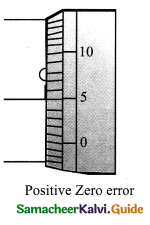
When the plane surface of the screw and the opposite plane stud on the frame are brought into contact, if the zero of the head scale lies below the pitch scale axis, the zero error is positive. For example, the 5th division of the head scale coincides with the pitch scale axis, then the zero error is positive and is given by
Z.E = + (n x LC) where ‘n’ is the head scale coincidence. In this case, Zero error = + (5 x 0.01) = 0.05mm. So the zero correction is -0.05 mm.
Samacheer Kalvi 9th Science Guide Chapter 1 Measurement 11

Negative zero error:
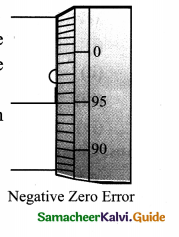
When the plane surface of the screw and the opposite plane stud on the frame are brought into contact, if the zero of the head scale lies above the pitch scale axis, the zero error is negative. For example, the 95th division coincides with the pitch scale axis, then the zero error is negative and is given by
ZE = -(100-n) × LC
ZE = – (100 – 95) × LC
= -(5 × 0.01)
= – 0.05 mm
The zero correction is + 0.05mm
Samacheer Kalvi 9th Science Guide Chapter 1 Measurement 12

Samacheer Kalvi 9th Science Guide Chapter 1 Measurement

Question 2.
How will you find Zero Error of Vernier Caliper? Explain.
Answer:
Zero error:

  • Unscrew the slider and move it to the left, such that both the jaws touch each other. Check whether the zero marking of the main scale coincides with that of the Vernier scale.
  • If they are not coinciding with each other, the instrument is said to posses zero error. Zero error may be positive or negative.
  • If the zero mark of the Vernier is shifted to the right, it is called positive error.
  • On the other hand, if the Vernier zero is shifted to the left of the main scale zero marking, then the error is negative.

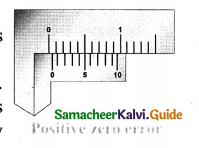
Positive zero error:

  • From the figure you can see that zero of the vernier scale is shifted to the right of zero of the main scale.
  • In this case the reading will be more than the actual reading.
  • Hence, this error should be corrected. In order to correct this error, find out which vernier division is coinciding with any of the main scale divisions.
  • Here, fifth vernier division is coinciding with a main scale division.
  • So, positive zero error = +5 × LC = +5 × 0.01 = 0.05 cm.
    Samacheer Kalvi 9th Science Guide Chapter 1 Measurement 13

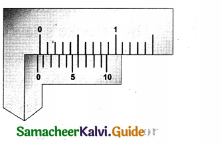
Negative zero error:

  • You can see that zero of the vernier scale is shifted to the left of the zero of the main scale.
  • So, the obtained reading will be less than the actual reading.
  • To correct this error we should first find which vernier division is coinciding with any of the main scale divisions, as we found in the previous case.
  • In this case, you can see that sixth line is coinciding. But, to find the negative error, we can count backward (from 10).
  • So, the 4th line is coinciding. Therefore, negative zero error = -4 x LC = -4 x 0.01 = -0.04 cm.
    Samacheer Kalvi 9th Science Guide Chapter 1 Measurement 14

Samacheer Kalvi 9th Science Guide Chapter 1 Measurement

Question 3.
Write short note on the following :
(i) Common balance
(ii) Physical balance Digital balance Spring balance
Answer:
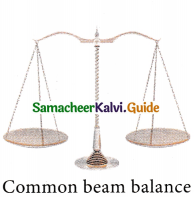
Common (beam) balance :
A beam balance compares the sample mass with a standard reference mass (Standard reference masses are 5g, 10g, 20g, 50g, 100g, 200g, 500g, 1kg, 2kg, 5kg). This balance can measure mass accurately up to 5 g
Samacheer Kalvi 9th Science Guide Chapter 1 Measurement 15

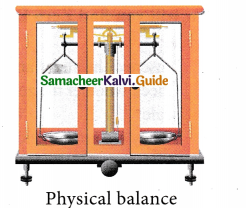
Physical balance:
This balance is used in labs and is similar to the beam balance but it is a lot more sensitive and can measure mass of an object correct to a milligram.
The standard, reference masses used in this physical balance are 10 mg, 20 mg, 50 mg, 100 mg, 200 mg, 500 mg, 1 g, 2g, 5 g, 10 g, 20 g, 50 g, 100g, and 200 g.
Samacheer Kalvi 9th Science Guide Chapter 1 Measurement 16

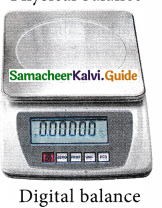
Digital balance:
Nowadays, for accurate measurements digital balances are used, which measure mass accurately even up to a few milligrams, the least value being 10 mg (Figure 1.11). This electrical device is easy to handle and commonly used in jewellery shops and labs.
Samacheer Kalvi 9th Science Guide Chapter 1 Measurement 17

Spring balance:
This balance helps us to find the weight of an object. It consists of a spring fixed at one end and a hook attached to a rod at the other end. It works by ‘Hooke’s law’ which states that the addition of weight produces a proportional increase in the length of the spring. A pointer is attached to the rod which slides over a graduated scale on the right. The spring extends according to the weight attached to the hook and the pointer reads the weight of the object on the scale.
Samacheer Kalvi 9th Science Guide Chapter 1 Measurement 18

Samacheer Kalvi 4th English Guide Term 3 Poem 3 Never Give Up

Tamilnadu State Board New Syllabus Samacheer Kalvi 4th English Guide Pdf Term 3 Poem 3 Never Give Up Text Book Back Questions and Answers, Summary, Notes.

Tamilnadu Samacheer Kalvi 4th English Solutions Term 3 Poem 3 Never Give Up

4th English Guide Never Give Up Book Back Questions and Answers

Samacheer Kalvi 4th English Guide Term 3 Poem 3 Never Give Up

A. Match the following rhyming words.

Question 1.
Earn – glow
Answer:
earn – learn

Question 2.
Fend – day
Answer:
Fend – end

Question 3.
Slow – learn
Answer:
slow – glow

Question 4.
Play – end
Answer:
Play – day

Samacheer Kalvi 4th English Guide Term 3 Poem 3 Never Give Up

B. Fill in the blanks.

Question 1.
If the fisher draws his net soon, he won’t get _________ in the net.
Answer:
Any fish

Question 2.
The child won’t __________ anything, if he closes his ears.
Answer:
Have the chance to learn

Question 3.
A person who overcomes problems, will get _________ at the end.
Answer:
The world

Question 4.
Keep moving though your progress is ___________
Answer:
Slow

Question 5.
Work or play, let us ___________
Answer:
Persevere

Samacheer Kalvi 4th English Guide Term 3 Poem 3 Never Give Up

C. Appreciation questions.

Question 1.
Why should a fisherman wait?
Answer:
A fisherman should wait because he had to get a lot of fish in his net.

Question 2.
Who wins the world at the end?
Answer:
A person who overcomes problems wins the world at the end.

Question 3.
What happen to a child who shuts his ears?
Answer:
The child who shuts his ears cannot have the chance to learn.

Question 4.
Do we worry when the progress is slow?
Answer:
Yes, we worry when the progress is slow.

Question 5.
What should we do for success?
Answer:
We should go on persevering to be successful.

Samacheer Kalvi 4th English Guide Term 3 Poem 3 Never Give Up

Use “watch” in correct verb form to complete sentences.

Question 1.
We _________ the show.
Answer:
Are watching

Question 2.
You _________ his dance.
Answer:
Are watching

Question 3.
He _________ TV with his friends.
Answer:
Is watching

Question 4.
She __________ her father cook.
Answer:
Is watching

Question 5.
It __________ the sky.
Answer:
Is watching

Question 6.
They _________ the match.
Answer:
Are watching

Samacheer Kalvi 4th English Guide Term 3 Poem 3 Never Give Up

Say what they are doing now?

Question 1.
Samacheer Kalvi 4th English Guide Term 2 poem 3 Never give up 2
She is ____________
Answer:
Skipping

Question 2.
Samacheer Kalvi 4th English Guide Term 2 poem 3 Never give up 3
Leema is ____________
Answer:
Singing

Question 3.
Samacheer Kalvi 4th English Guide Term 2 poem 3 Never give up 4
Nalini is ___________
Answer:
Walking

Question 4.
Samacheer Kalvi 4th English Guide Term 2 poem 3 Never give up 5
Peter is ____________
Answer:
Playing

Question 5.
Samacheer Kalvi 4th English Guide Term 2 poem 3 Never give up 6
He is __________
Answer:
Painting

Samacheer Kalvi 4th English Guide Term 3 Poem 3 Never Give Up

Change the sentence into present continuous tense.

Question 1.
I read the story.
Answer:
I am reading the story.

Question 2.
She plays the piano.
Answer:
She is playing the piano.

Question 3.
Pinku works in a power plant.
Answer:
Pinku is working in a power plant.

Question 4.
Ananthi helps her friend Janu.
Answer:
Ananthi is helping her friend Janu.

Question 5.
They draw picture of a boy.
Answer:
They are drawing picture of a boy.

Samacheer Kalvi 4th English Guide Term 3 Poem 3 Never Give Up

Complete the story using present continuous tense.
Samacheer Kalvi 4th English Guide Term 2 poem 3 Never give up 1
Question 1.
Shaheen : Hello, Varun?
Varun : Tell me Shaheen.
Shaheen : What are you doing?
Varun : I ____________________________
Shaheen : Good. What is your Dad doing?
Varun : He _________________________
Shaheen : Your mom?
Varun : She ________________________
Answer:
Shaheen : Hello, Varun?
Varun : Tell me Shaheen.
Shaheen : What are you doing?
Varun : I am studying.
Shaheen : Good. What is your Dad doing?
Varun : He is cutting the vegetables.
Shaheen : Your mom?
Varun : She is cooking.

Samacheer Kalvi 4th English Guide Term 3 Poem 3 Never Give Up

Let us listen

Listen to the audio and respond to the following questions.

Question 1.
It is _________ in Canada.
(a) Rainy
(b) Snowy
(c) Foggy
Answer:
(b) Snowy

Question 2.
The weather is sunny in ___________
(a) Mexico
(b) Canada
(c) Japan
Answer:
(a) Mexico

Question 3.
The weather in England is ___________
(a) Cloudy
(b) Cold
(c) Foggy
Answer:
(c) Foggy

Question 4.
The weather is hot in ___________
(a) Australia
(b) France
(c) Russia
Answer:
(a) Australia

Question 5.
It is so cloudy in ____________.
(a) Canada
(b) Japan
(c) Mars
Answer:
(b) Japan

Samacheer Kalvi 4th English Guide Term 3 Poem 3 Never Give Up

Additional Questions and Answers.

Grammar – Present Continuous Tense

Choose the verbs from the box and use them in the present continuous tense to make meaningful sentences.

Samacheer Kalvi Samacheer Kalvi 4th English Guide Term 2 poem 3 Never give up 74th English Guide Term 2 poem 3 Never give up 7
Question 1.
The tailor ____________ the clothes.
Answer:
Is stitching

Question 2.
The children ______________ in the play ground.
Answer:
Are playing

Question 3.
My mother ___________ the water bottles.
Answer:
Is filling

Question 4.
The driver ____________ the lorry.
Answer:
Is driving

Question 5.
The birds _____________
Answer:
Are singing.

Question 6.
The birthday girl ____________ a cake.
Answer:
Is cutting

Question 7.
The boy ____________ a bicycle.
Answer:
Is riding

Question 8.
The porter ______________ the luggage.
Answer:
Is carrying

Question 9.
The man ___________ a letter.
Answer:
Is writing

Question 10.
The old woman ____________ the gate.
Answer:
Is closing

Samacheer Kalvi 4th English Guide Term 3 Poem 3 Never Give Up

Let us speak

Question 1.
A boy and a girl are talking about their holiday.
Answer:
Samacheer Kalvi 4th English Guide Term 2 poem 3 Never give up 8
Boy : Hey, there is no school from tomorrow.
Girl : Yeah, it is a holiday. What are you going to do?
Boy : I will first finish my homework, then I will play with my friends all day.
Girl : What will you play?
Boy : I am sure we will race with our cycles and play kabaddi. What are you going to do?
Girl : First, we will go to our village.
Boy : Wow. How will you go?
Girl : We will go by train.
Boy : What else will you do?
Girl : Next, we will visit our temple there and come back. I am waiting to meet all my relatives there.
Boy : What about your homework?
Girl : I will come back and do it in morning.
Boy : Okay. Make sure you have time to finish it. .
Girl : Sure will. See you after the holidays!
Boy : See you!

Samacheer Kalvi 4th English Guide Term 3 Poem 3 Never Give Up

When you want to talk about things to do in the holiday, you should always ask your friends and get to know more.

Question 1.
Where are you going?
Answer:
I am going to Coimbatore.

Question 2.
What are you going to do?
Answer:
I will travel by bus.

Question 3.
What will you do after that?
Answer:
It takes two hours to reach.

Question 4.
What will you before that?
Answer:
First, I will go to Erode. Then,

Question 5.
When will you go?
Answer:
I will go to Coimbatore.

Question 6.
How will you reach there?
Answer:
I will also go to Kovai Kutralam Water

Question 7.
How long does it take to reach there?
Answer:
Falls

Samacheer Kalvi 4th English Guide Term 3 Poem 3 Never Give Up

Never Give Up Summary in English and Tamil

The fisher who draws his net soon,
Won’t have any fish to earn.
The child who shuts up his ears soon
Won’t have the chance to learn
One who tackles the huddles to fend
May win the world at the end.
Don’t feel down when you are slow
Keep moving and let your life glow
Let us persevere at work or play,
And never give up all day.

விரைவாய் வலையை இழுக்கும் மீனவருக்கு,
சம்பாதிக்கும் அளவுக்கு மீன்கள் கிடைப்பதில்லை.
தன் காதுகளை விரைவாக மூடிக்கொள்ளும் குழந்தைக்கு
கற்கும் சந்தர்ப்பம் கிட்டாது
நெருக்கமாகக் குவிந்த கூட்டத்தினரிடமிருந்து தன்னை தற்காத்து சமாளிப்பவர்,
இறுதியில் இந்த உலகத்தையே வென்று விடலாம்.
உங்கள் முன்னேற்றம் மெதுவாக இருந்தால் தளராதீர்
நகர்ந்துகொண்டே இருந்து உங்கள் வாழ்வை ஒளிர வையுங்கள்
அது வேலையோ அல்லது விளையாட்டோ விடாமுயற்சியுடன் ஈடுபடுங்கள்
எப்போதும் (தளர்ந்து) விட்டுவிடாதீர்.

Samacheer Kalvi 4th English Guide Term 3 Poem 3 Never Give Up

Never Give Up Glossary

Chance – opportunity (சந்தர்ப்பம் )
Fend – to defend (தற்காத்து கொள்ளுதல்)
Persevere – put effort continuously (விடாமுயற்சி)
Tackle – deal with (சமாளித்தல்)
Sincere – truthfull (உண்மையாக)

Samacheer Kalvi 11th Maths Guide Chapter 3 Trigonometry Ex 3.5

Tamilnadu State Board New Syllabus Samacheer Kalvi 11th Maths Guide Pdf Chapter 3 Trigonometry Ex 3.5 Text Book Back Questions and Answers, Notes.

Tamilnadu Samacheer Kalvi 11th Maths Solutions Chapter 3 Trigonometry Ex 3.5

Samacheer Kalvi 11th Maths Guide Chapter 3 Trigonometry Ex 3.5

Question 1.
Find the value of cos 2A , A lies in the first quadrant when
(i) cos A = \(\frac{15}{17}\)
Answer:
we know sin2 A + cos2 A = 1
sin2 A = 1 – cos2 A
Samacheer Kalvi 11th Maths Guide Chapter 3 Trigonometry Ex 3.5 1
Since A lies in the first quadrant, sin A is positive
∴ sin A = \(\frac{8}{17}\)
cos 2A = cos2 A – sin2 A
Samacheer Kalvi 11th Maths Guide Chapter 3 Trigonometry Ex 3.5 2

Samacheer Kalvi 11th Maths Guide Chapter 3 Trigonometry Ex 3.5

(ii) sin A = \(\frac{4}{5}\)
Answer:
we know sin2 A + cos2 A = 1
cos2 A = 1 – sin2A
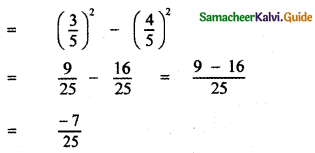
Samacheer Kalvi 11th Maths Guide Chapter 3 Trigonometry Ex 3.5 3
Samacheer Kalvi 11th Maths Guide Chapter 3 Trigonometry Ex 3.5 4
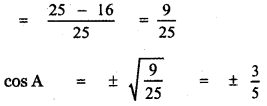
Since A lies in the first quadrant, cos A is positive
∴ cos A = \(\frac{3}{5}\)
cos 2A = cos2 A – sin2 A
Samacheer Kalvi 11th Maths Guide Chapter 3 Trigonometry Ex 3.5 5

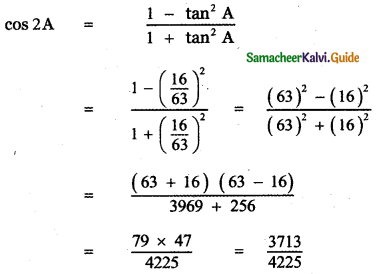
(iii) tan A = \(\frac{16}{63}\)
Answer:
Samacheer Kalvi 11th Maths Guide Chapter 3 Trigonometry Ex 3.5 6

Samacheer Kalvi 11th Maths Guide Chapter 3 Trigonometry Ex 3.5

Question 2.
If θ be an acute angle, find
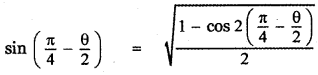
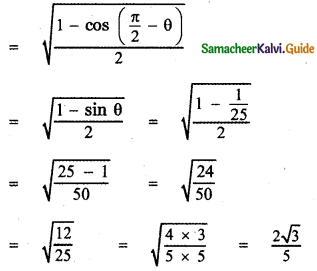
(i) sin \(\left(\frac{\pi}{4}-\frac{\theta}{2}\right)\), when sin θ = \(\frac{1}{25}\)
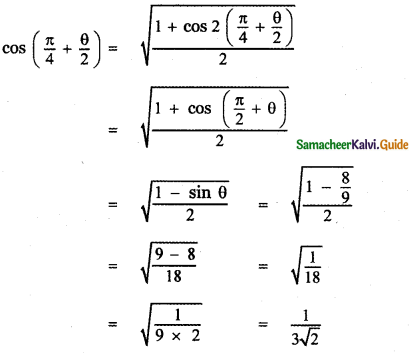
(ii) cos \(\left(\frac{\pi}{4}+\frac{\theta}{2}\right)\), when sin θ = \(\frac{8}{9}\)
Answer:
(i) sin \(\left(\frac{\pi}{4}-\frac{\theta}{2}\right)\), when sin θ = \(\frac{1}{25}\)
Samacheer Kalvi 11th Maths Guide Chapter 3 Trigonometry Ex 3.5 7
Samacheer Kalvi 11th Maths Guide Chapter 3 Trigonometry Ex 3.5 8

(ii) cos \(\left(\frac{\pi}{4}+\frac{\theta}{2}\right)\), when sin θ = \(\frac{8}{9}\)
Samacheer Kalvi 11th Maths Guide Chapter 3 Trigonometry Ex 3.5 9

Samacheer Kalvi 11th Maths Guide Chapter 3 Trigonometry Ex 3.5

Question 3.
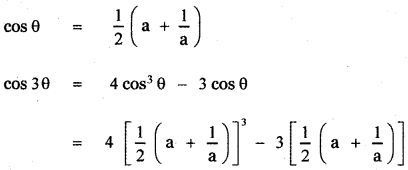
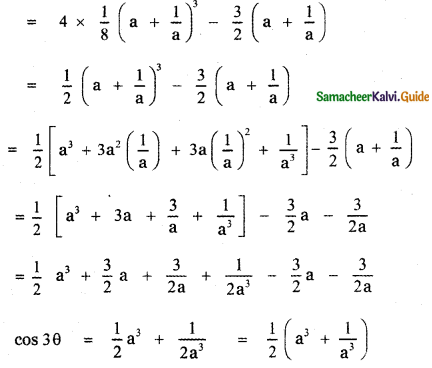
If cos θ =\(\frac{1}{2}\left(a+\frac{1}{a}\right)\), show that cos 3θ = \(\frac{1}{2}\left(a^{3}+\frac{1}{a^{3}}\right)\)
Answer:
Samacheer Kalvi 11th Maths Guide Chapter 3 Trigonometry Ex 3.5 10
Samacheer Kalvi 11th Maths Guide Chapter 3 Trigonometry Ex 3.5 11

Samacheer Kalvi 11th Maths Guide Chapter 3 Trigonometry Ex 3.5

Question 4.
Prove that
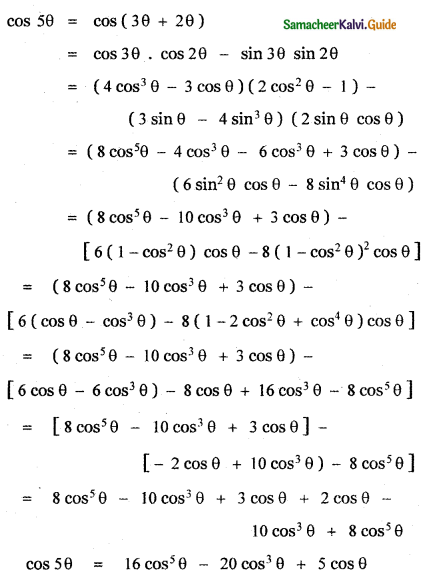
cos 5θ = 16 cos5θ – 20 cos3θ + 5 cos θ
Answer:
Samacheer Kalvi 11th Maths Guide Chapter 3 Trigonometry Ex 3.5 12

Samacheer Kalvi 11th Maths Guide Chapter 3 Trigonometry Ex 3.5

Question 5.
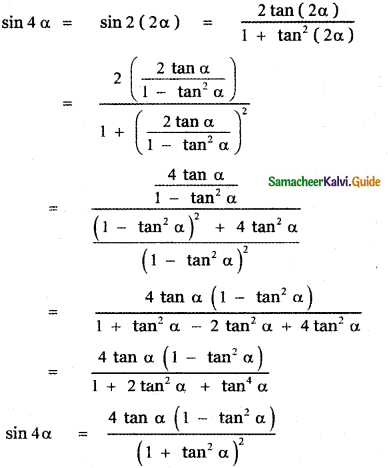
Prove that sin 4α = 4 tan α \(\frac{1-\tan ^{2} \alpha}{\left(1+\tan ^{2} \alpha\right)^{2}}\)
Answer:
Samacheer Kalvi 11th Maths Guide Chapter 3 Trigonometry Ex 3.5 13

Samacheer Kalvi 11th Maths Guide Chapter 3 Trigonometry Ex 3.5

Question 6.
If A + B = 45°, show that (1 + tan A) (1 + tan B) = 2
Answer:
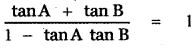
Given A + B = 45°
tan(A + B) = tan 45°
Samacheer Kalvi 11th Maths Guide Chapter 3 Trigonometry Ex 3.5 14
tan A + tan B = 1 – tan A . tan B —— (1)
(1 + tan A)(1 + tan B) = 1 + tan B + tan A + tan A tan B
= 1 + (tan A + tan B) + tan A tan B
= 1 + 1 – tan A tan B + tan A tan B (By equation (1))
= 2

Samacheer Kalvi 11th Maths Guide Chapter 3 Trigonometry Ex 3.5

Question 7.
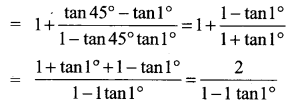
Prove that (1 + tan 1°) (1 + tan 2°) (1 + tan 3°) …….. (1 + tan 44°) is a multiple of 4.
Answer:
1 + tan 44° = 1 + tan (45° – 1°)
Samacheer Kalvi 11th Maths Solutions Chapter 3 Trigonometry Ex 3.5 23
(1 + tan 1°)(1 + tan 44°) = 2
Similarly (1 + tan 2°) (1 + tan 43°) = 2
(1 + tan 3°) (1 + tan 42°) = 2
(1 + tan 22°) (1 + tan 23°) = 2
= (1 + tan 1°) (1 + tan 2°)… (1 + tan 44°) = 2 × 2 × … 22 times
It is a multiple of 4.

Samacheer Kalvi 11th Maths Guide Chapter 3 Trigonometry Ex 3.5

Question 8.
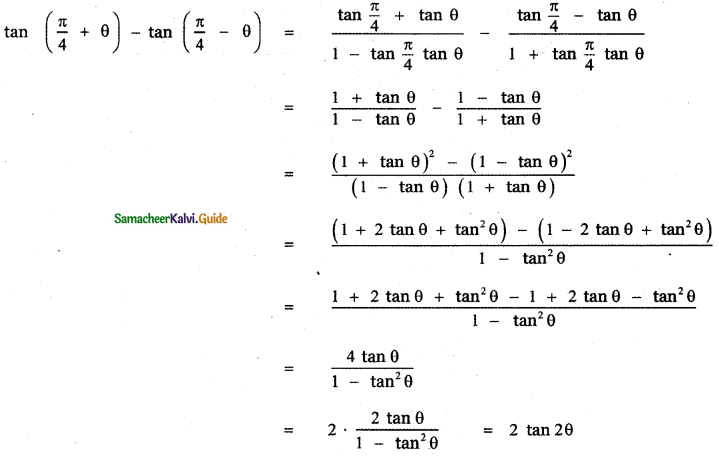
Prove that tan \(\left(\frac{\pi}{4}+\theta\right)\) – tan \(\left(\frac{\pi}{4}-\theta\right)\) = 2 tan 2θ
Answer:
Samacheer Kalvi 11th Maths Guide Chapter 3 Trigonometry Ex 3.5 15

Samacheer Kalvi 11th Maths Guide Chapter 3 Trigonometry Ex 3.5

Question 9.
Show that
Samacheer Kalvi 11th Maths Guide Chapter 3 Trigonometry Ex 3.5 16
Answer:
Samacheer Kalvi 11th Maths Guide Chapter 3 Trigonometry Ex 3.5 17

Samacheer Kalvi 11th Maths Guide Chapter 3 Trigonometry Ex 3.5

Samacheer Kalvi 11th Maths Guide Chapter 3 Trigonometry Ex 3.5 18
Samacheer Kalvi 11th Maths Guide Chapter 3 Trigonometry Ex 3.5 19

Samacheer Kalvi 11th Maths Guide Chapter 3 Trigonometry Ex 3.5

Question 10.
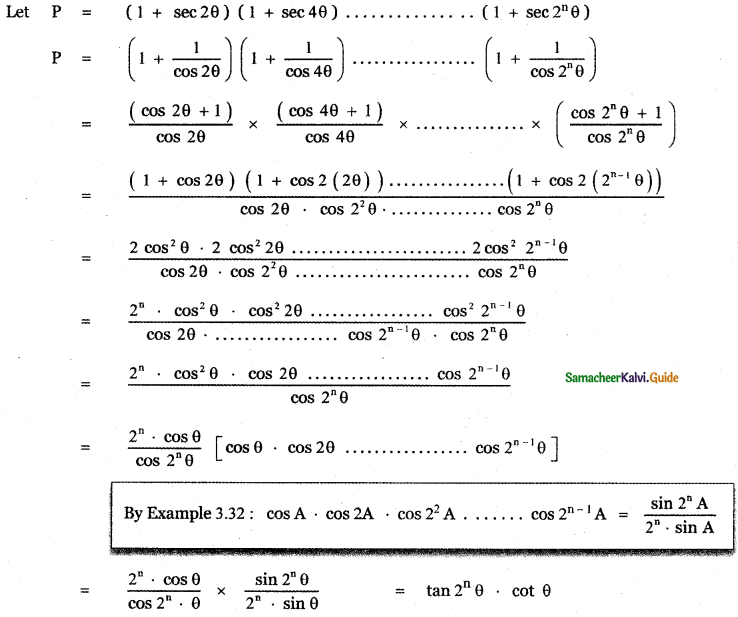
prove that (1 + sec 2θ) (1 + sec 4θ) …………….. (1 + sec 2nθ) = tan 2nθ . cot θ.
Answer:
Samacheer Kalvi 11th Maths Guide Chapter 3 Trigonometry Ex 3.5 20

Samacheer Kalvi 11th Maths Guide Chapter 3 Trigonometry Ex 3.5

Question 11.
Prove that
Samacheer Kalvi 11th Maths Guide Chapter 3 Trigonometry Ex 3.5 21
Answer:
Samacheer Kalvi 11th Maths Guide Chapter 3 Trigonometry Ex 3.5 22
Samacheer Kalvi 11th Maths Guide Chapter 3 Trigonometry Ex 3.5 23

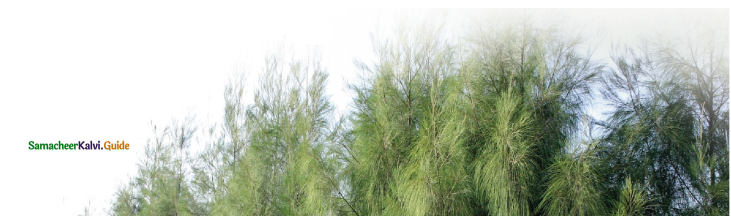
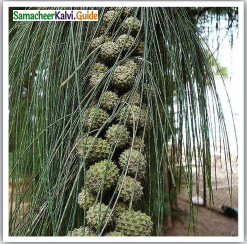
Samacheer Kalvi 12th English Guide Poem 2 Our Casuarina Tree

Tamilnadu State Board New Syllabus Samacheer Kalvi 12th English Guide Pdf Poem 2 Our Casuarina Tree Text Book Back Questions and Answers, Summary, Notes.

Tamilnadu Samacheer Kalvi 12th English Solutions Poem 2 Our Casuarina Tree

12th English Guide Our Casuarina Tree Text Book Back Questions and Answers

Textual Questions:

1. Fill in the blanks choosing the words from the box given and complete the summary of the poem:
(Text Book Page No. 54)

Question 1.
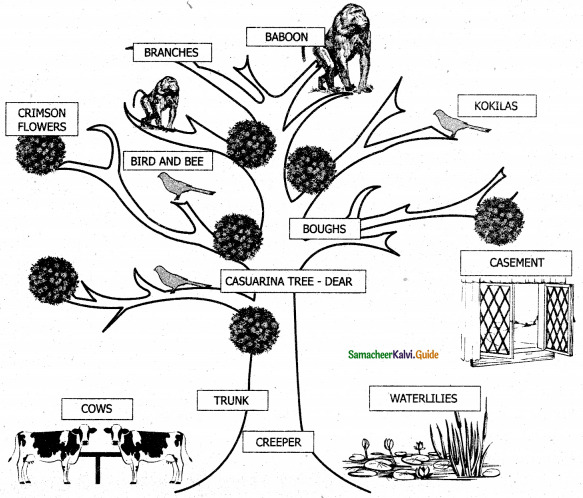
The casuarina tree is tall and strong, with a creeper winding around it like a (1)_______. The tree stands like a (2) ________ with a colourful scarf of flowers. Birds surround the garden and the sweet song of the birds is heard. The poet is delighted to see the casuarina tree through her (3)_______. She sees a grey monkey sitting like a (4) ________ on top of the tree, the cows grazing, and the water lilies (5) ________ in the pond. The poet feels that the tree is dear to her not for its (6) appearance but for the (7) _______ memories of her happy childhood that it brings to her. She strongly believes that (8) _________ communicates with human beings. The poet could communicate with the tree even when she was in a far-off land as she could hear the tree (9) ________ her absence. The poet (10) ________ the tree’s memory to her loved ones, who are not alive. She immortalizes the tree through her poem like the poet Wordsworth who (11)________ the yew tree of Borrowdale in verse. She expresses her wish that the tree should be remembered out of love and not just because it cannot be (12)_______.

Answer:

  1. python
  2. giant
  3. casement
  4. statue
  5. springing
  6. impressive
  7. nostalgic
  8. nature
  9. lamenting
  10. consecrates
  11. sanctified
  12. forgotten

Samacheer Kalvi 12th English Guide Poem 2 Our Casuarina Tree

2. Based on your understanding of the poem, answer the following question in one or two sentences each:
(Text Book Page No. 55)

Question a)
What is the creeper compared to? Which tree is referred to here?
Answer:
The creeper is compared to a lady’s love.

Question b)
How does the creeper appear on the tree? Who is the giant here?
Answer:
The creepers appear like a rugged trunk with deep scars. The tree is the giant here.

Question c)
Describe the garden during the night.
Answer:
At night, the garden overflows with an endless melodious song sung by the dark king from the Casuarina Tree when the men are sleeping.

Question d)
How does the poet spend her winter?
Answer:
The poet spends her winter by seeing a gray monkey sitting like a statue on top of the tree and watching the activities of the younger monkey on the tree.

Question e)
Name the bird that sings in the poet’s garden?
Answer:
Nightingale sings in the poet’s garden.

Samacheer Kalvi 12th English Guide Poem 2 Our Casuarina Tree

Question f)
Why is the Casuarina tree dear to the poet’s heart?
Answer:
The poet feels that the tree is dear to her not for its impressive appearance but for the nostalgic memories of her happy childhood that it brings.

Question g)
Does nature communicate with human beings?
Answer:
Yes, nature communicates with human beings. William Wordsworth is a strong advocate of this communication.

Question h)
What has Wordsworth sanctified in his poem?
Answer:
The poet Wordsworth has sanctified the yew tree of Borrowdale in verse.

Question i)
To whom does Toru Dutt want to consecrate the tree’s memory?
Answer:
Torn Dutt wants to consecrate the memories of the tree to her loved ones.

Question j)
The casuarina tree will be remembered forever why?
Answer:
Because of the poet’s love for the tree.

Samacheer Kalvi 12th English Guide Poem 2 Our Casuarina Tree

3. Read the lines given below and answer the questions that follow: (Text Book Page No. 55)

“A creeper climbs, in whose embraces bound
No other tree could live”.

i) Which tree is referred to in the above lines?
Answer:
Casuarina tree is referred to in the above line.

ii) How does the tree survive the tight hold of the creeper?
Answer:
The tree is so strong that it bears the tight hold of the creeper.

iii) Why does Toru Dutt use the expression ‘a creeper climbs’?
Answer:
A creeper cannot grow without the support of another tree or a pole. While climbing, it tries to sap the energy from the living tree. If the creeper doesn’t climb, it would die without sunlight. So, the poet says the creeper climbs. It twines its body around the tree and keeps climbing.

b) The giant wears the scarf, and flowers are hung to her.
In crimson clusters all the bough among!

i) Who is the giant here?
Answer:
Casuarina tree’ is the giant here.

ii) Why is the scarf colourful?
Answer:
The crimson flowers are bright and colourful in the tree. So the scarf (crimson flower around the tree seems like a scarf) is colourful.

“Fear, trembling Hope, and Death, the Skeleton,
And time the shadow”, and though weak the
verse
That would thy beauty fain, oh, fain rehearse
May love to defend thee from oblivion’s curse.

i) What does the poet mean by the expression ‘May love defend thee from oblivion’s curse’?
Answer:
It means that the tree should be remembered out of love and not just because it cannot be forgotten.

ii) What does the expression ‘fain’ convey?
Answer:
The expression ‘fain’ means eagerness. Here, the poet is very happy and proud to remember the tree which is very dose to her heart.

iii) What does the poet convey through the expression ‘fear, trembling hope’?
Answer:
The poet conveys the deep feeling of her love towards the tree through the expression ‘fear, trembling hope’. The poet hopes that the tree will be remembered forever as the yew trees of Borrowdale immortalized by Wordsworth are still remembered.

Samacheer Kalvi 12th English Guide Poem 2 Our Casuarina Tree

Additional Questions:

a) “And oft at nights the garden overflows
with one sweet song that seems to have no close,
Sung darkling from our tree, while men repose”.

i) Hoe does the garden overflow?
Answer:
The garden overflows with sweet songs of the bird from the tree.

ii) When do the birds sing?
Answer:
The birds sing at night while men are taking rest.

b. “When first my casement is wide open thrown
At dawn, My eyes delighted on it rest?

i) What does ‘casement’ mean?
Answer:
Casement means window.

ii) What brings her delight?
Answer:
By seeing the sight of the Casuarina tree, She feels happy and her heart fulfilled. That tree brings her delight.

c. Sometimes and most in winter – on its crest
A gray baboon sits statue-like alone”

i) Who is sitting like a statue?/Where is the baboon sitting?
Answer:
A gray baboon is sitting like a statue. The baboon is sitting on the Casuarina tree.

ii) When does it come to the tree?
Answer:
During winter it comes to the tree.

Samacheer Kalvi 12th English Guide Poem 2 Our Casuarina Tree

d. “But not because of its magnificence
Dear is the Casuarinas to my soul
Beneath it, we have played, though the year may roll”,

i) How does the poet hold the Casuarina tree?
Answer:
The poet holds the Casuarina tree so dear, which brings her sweet memories.

ii) Who do ‘we’ refer to?
Answer:
‘We’ refer to the poet Torn Dutt and her siblings and friends.

e. “Unknown, yet well known to the eye of faith!
Ah, I have heard that wail far, far away”

i) Can the poet communicate with the tree?
Answer:
Yes, the poet can communicate with the tree even when she is in a far off land.

Poem linesAlliteration poetic device
1. Like a huge python, winding round and round The rugged thing, indented deep with scars”.Simile / zoomorphism
2. A creeper climbs, in whose embraces bound

No other tree could live. But gallantly

The giant wears the scarf, and flower and hung….”

Personification
3. “A gray baboon sits statue-like alone”Simile
4. The water lilies spring, like snow enmassed”.Simile
5. “What is that dirge-like murmur that I hear Like the sea breaking on a shingle-beach?Simile / Personification
6. ‘Thy form, trees, as in my happy prime/Personification
7. ‘A creeper climbs, in whose embarrasses boundAlliteration
8. ‘In crimson clusters all the boughs among’Alliteration / Imagery
9. ‘Where on all day are gathered bird and bee’Alliteration
10. ‘With one sweet song that seems to have no close/Alliteration
11. “At dawn, my eyes delighted on its rest,”Alliteration
12. “For your sakes, shall the tree be ever clear”.Alliteration
13.” Ah, I have heard that wail for, far away”.Alliteration
14. “When slumbered in his cave the water-wraith”Alliteration
15. “It is the tree’s lament, an eerie speech”Personification
16. “With deathless trees-like those in Borrow dale”Simile
17. Up to its very summit near the stars,Flyperbole
18. Unknown, yet well-known to the eye of faith!Personification
19. When earth lay tranced in a dreamless swoon:Personification
20. Dearer than life to me, alas, were they!Simile
21. And the waves gently kissed the classic shorePersonification

Samacheer Kalvi 12th English Guide Poem 2 Our Casuarina Tree

4. Explain the following lines with reference to the context:(Text Book Page No. 56)

a) “Dear is the Casuarina to my soul”

Reference :
This line is taken from Poem – “Our Casuarina tree” Poet – “Torn Dutt”
Context:
The poet expresses her great love for the tree.
Explanation:
The poet feels that the tree is dear to her not for its impressive appearance but for the nostalgic memories of her happy childhood that it brings to her

b) It is the tree’s lament, an eerie speech.

Reference:
This line is taken from the Poem – “Our Casuarina Tree”, Poet – “Toru Dutt”
Context:
The poet brings out the great love of trees towards the poet.
Explanation:
The poet could communicate with the tree even when she was in a far off land. She could hear the tree lamenting her absence as there was a strong bond between her and the tree.

c) “Unto thy honor, Tree, beloved of those
who now in blessed sleep for eye repose,”

Reference:
This line is taken from the Poem – “Our Casuarina Tree”, Poet – “Toru Dutt”.
Context:
The poet brings out her honour and respect towards the tree
Explanation:
The poet consecrates the tree’s memory to her loved ones, who are not alive. She honors it with full of love and affection that shows how much the tree is beloved to her.

Samacheer Kalvi 12th English Guide Poem 2 Our Casuarina Tree

6. Answer each of the following questions in a paragraph of 100-150 words: (Text Book Page No. 56)

a) Describe the reminiscences of the poet, when she sees the Casuarina tree.
b) How does nature communicate with the poet?
c) The poet immortalizes the tree. Elucidate

Introduction:
The poem is an attempt by the poet to recapture her past and immortalize it.

Appearance and Comparison of the tree:
The tree is presented both as a symbol and as an object of nature where the poet project both time and eternity. The poem is filled with memories of the past and happy childhood days. She remembers her companions how much she loved them and was loved in return. The giant creeper is compared with a huge python. Water lilies are compared with enmassed snow. She loved the tree very much that’s why she noticed everything keenly and carefully.

Lasting impression:
The Poet describes the lasting impression that the tree has left on her mind. She describes the baboon sitting like a statue on the top of the tree while its young ones play on the lower branches. She also describes the sleepy cows moving slowly to their pastures.

Remembrance of the poet:
She links up the tree with the memories of her dead brother, Abju, and her sister, Aru. She feels great pain when she remembers the happy time that she had with them. The Casuarina tree connects her past with her present.

Communication with the tree:
The poet could communicate with the tree even when she was in a far off land as she could hear the tree lamenting her absence. The poet immortalizes the tree through her poem like poet Wordsworth who sanctified the yew tree of Borrowdale in verse.

Conclusion:
She expresses her wish that the tree should be remembered out of love and not just because it cannot be forgotten. Thus it holds a special place in the poetess’ heart.

Samacheer Kalvi 12th English Guide Poem 2 Our Casuarina Tree

Listening:

First, read the questions given below, then listen to the poem, read aloud by the teacher, or played on an audio player. Then answer the questions based on your listening of the poem:

Question 1.
The poet was tossing in the bed awake because of ______.
a) he was worried
b) he was struggling to sleep
C) it was day time
d) he was tired
Answer:
b) he was struggling to sleep

Question 2.
The ______ were ‘sparkling as pearls’.
a) moon
b) sun
c) stars
d) meteoroids
Answer:
c) stars

Question 3.
The ______ gave the poet a motherly smile.
a) sun
b) stars
c) moon
d) sky
Answer:
c) moon

Question 4.
________ made the poet’s eyelids droop.
a) nature
b) rosy lips
c) songs
d) tiredness
Answer:
a) nature

Question 5.
_________ is the title of the poem.
a) Wonders
b) Midnight Wonders
c) Nature
d) Midnight dreams
Answer:
b) Midnight Wonders

Samacheer Kalvi 12th English Guide Poem 2 Our Casuarina Tree

நமது சவுக்கு மரம்:

கவிஞரைப் பற்றி டோரு டட் (1856-77) ஒரு வங்காளக் கவிஞர். இந்திய துணைக் கண்டத்தைச் சார்ந்த இவர் ஆங்கிலம் மற்றும் பிரெஞ்சு மொழி எழுத்தாளரும் கூட. இவர் அவரது பெற்றோருக்கு மூன்றாவது பெண் குழந்தை. இவரது குடும்பத்தினர் அனைவரும் கல்வியில் சிறந்தவர்களாகவும், புலவர்களாகவும் உள்ளனர். இவளுக்கு ஆங்கிலம் கற்றுத்தர சிறந்த ஆசிரியர்கள் வீட்டிற்கே வரவழைக்கப்பட்டனர். பின் இவளுக்கு ஐரோப்பாவிலும், இங்கிலாந்திலும் நீண்ட நாட்கள் வாழ வாய்ப்பு கிடைத்தது.

இவ்வாறு மேற்கத்திய வாழ்க்கையிலும் கலாச்சாரத்திலும் இருந்தாலும் அவர் ஒரு இந்தியர் என்ற உணர்வு மாறாமல் இருந்தார். “பழம்பெரும் பாடல்கள்” மற்றும் “தலைசிறந்த இந்துஸ்தானியர்” போன்ற பிரபல பாடல்தொகுப்புகளோட “Sheaf Gleaned in French Fields” என்ற தலைப்பில் பிரெஞ்சுக் கவிதைத் தொகுப்பினையும் எழுதியுள்ளார். இவரது கவிதைகளிலேயே சிறந்த எங்கள் சவுக்கு மரம் என்ற இந்த பாடல் இவரது மேலும் பல பாடல்கள் என்ற தொகுப்பில் இடம்பெற்றுள்ளது.

கவிதையைப் பற்றி:

கவிஞர் தன் வீட்டின் முற்றத்தில் வளர்ந்திருக்கும் சவுக்கு மரத்தை பற்றியும் அதன் உருவமைப்பு, வளர்ந்திருக்கும் விதத்தைப் பற்றியும் இந்த கவிதையில் அழகாய் வர்ணிக்கிறார். சவுக்கு மரத்திற்கும் தனக்கும் உள்ள அன்பு பிணைப்பை எடுத்துரைப்பதோடு, அதை பார்க்கும்போதெல்லாம் தன் கடந்த கால குழந்தைப் பருவத்தை நினைவிற்கு கொண்டுவந்ததை நமக்கு இக்கவிதை வழியாக எடுத்துரைக்கிறார்.

அவர் அவ்விடத்தில் இல்லாமல் போனதற்காக அம்மரம் புலம்புவதை அவரால் கேட்க முடிகிறது. அவரின் (மூதாதையரின் நினைவாக அந்த மரத்திற்கு உயிர் கொடுத்து அதை அதிகமாக நேசிக்கிறார். அதைப்பற்றி விரிவாக கீழே காண்போம்.

Samacheer Kalvi 12th English Guide Poem 2 Our Casuarina Tree

Our Casuarina Tree Summary in Tamil

Samacheer Kalvi 12th English Guide Poem 2 Our Casuarina Tree 1

தமிழாக்கம் மிகப்பெரிய தழும்புகள் நிறைந்த
முரட்டு உடல் படைத்த மலைப்பாம்பு (சவுக்கு மரம்) ஒன்று சுருண்டு கிடப்பது போல்
விண்மீன்களுடன் சந்திப்பு நிகழ்த்தப்போவது போல்,
ஒரு கொடி ஏறுகின்றது, அதன் தழுவல் பிணைப்பில்
வேறெந்த மரமும் வாழ இயலாது.

ஆனால் கம்பீரமாக அந்த ராட்சசன் (the giant) தாவணி அணிந்திருக்க,
செந்நிற மலர்கள் அம்மரத்தின் கிளையெங்கும் கொத்துக்களாய் பூத்துக் குலுங்க,
அந்நேரம் பறவைகளும் தேனீக்களும் அவற்றை மொய்க்க,
அடிக்கடி இரவில் அந்த தோட்டத்தில் ஓர் இனிய பாடல் நெருக்கமின்றி,
அம்மரத்திலிருந்து மக்கள் உறங்கும்போது பாடப்பட்டது.

Samacheer Kalvi 12th English Guide Poem 2 Our Casuarina Tree 2

மாலை மங்கும் போது எனது பை திறந்த நிலையில் எறியப்பட்டிருப்பதை
முதலில் பார்த்த போது எம்மனதில் மகிழ்ச்சி, சிலசமயம், மழைக்காலத்தில்,
அதன் முகட்டின் மேல் ஒரு சாம்பல் நிறக்குரங்கு சிலைபோல்
தனியே அமர்ந்து சூரிய உதயம் காண,
கீழ் கிளையில் அக்குரங்கின் இளவல் தாவிக் குதித்து விளையாடுகிறது.

Samacheer Kalvi 12th English Guide Poem 2 Our Casuarina Tree

அருகிலும் தொலைவிலும் சிட்டுக் குருவிகள் புகழ் பாட
அதன் புல்வெளிகளுக்கு நமது பசுக்கள் படையெடுக்க
அம்மர நிழல் அருகிருந்த பெரிய தண்ணீ ர் தொட்டியில் படர
அவ்வளவு அழகாக அவ்வளவு பெரிதாக – நீர்
அல்லிப் பூக்கள் மலர்ந்து குவிந்திருக்கிறது பனிபோல்.

Samacheer Kalvi 12th English Guide Poem 2 Our Casuarina Tree 3

ஆனால் இம்மரத்தின் மீதான எனது அன்பு
அதன் பிரம்மாண்ட தோற்றத்தினால் அல்ல,
அதனடியில் நாங்கள் விளையாடியிருக்கிறோம்.
வருடங்கள் உருண்டாலும் இனிய உறவுகளே, ஆழமான அன்போடு நேசித்தவர்களே,
உங்களால் தான் இம்மரம் எனது நெருக்கமானது.
உங்கள் உருவங்கள் கலந்து இது மேலெழட்டும் நினைவில்,
கதகதப்பான கண்ணீர் என் கண்களை மறைக்கும் வரை!
இறுதியஞ்சலி போல் என் காதினில் ஒலிப்பது என்னவோ
பாறை நிறை கடற்கரையில் உடையும் கடல் போல்?
இது அம்மரத்தின் ஓலம், ஓர் விந்தை பேச்சு,
ஒருவேளை யாரும் அறியா தீவினை சென்றடைவதற்கோ?

Samacheer Kalvi 12th English Guide Poem 2 Our Casuarina Tree 4

யாருமறியாதது இருந்தும் நம்பிக்கையின் கண்கள் நன்கறிந்தது.
ஆ! நான் அந்த புலம்பலை தொலைவினின்று கேட்டிருக்கிறேன்.
தூரத்து நாடுகளில், பிரான்ஸிலும் இத்தாலியிலும் கடற்கரை ஓரங்களை
நெருங்கும் போதெல்லாம் கேட்டிருக்கிறேன்.
நிலவொளியில் நான் நடந்து செல்லும்போது கேட்டிருக்கிறேன்.
நிலமகள் மயங்கும் வேளையிலும் கேட்டிருக்கிறேன்.
ஒவ்வொரு முறை இந்த பாடல் கேட்கும் போதும் ஓயாமல் நினைவூட்டுகிறது
ஒரு பிரம்மாண்ட உருவத்தை உன் உருவமே,
ஓ மரமே! என் மகிழ்ச்சி தருணத்தில் உன்னைக் காண்கிறேன்,
எனது அன்பு காலநிலையில் என் உள்ளம் காண்பது உன் உருவமே.

Samacheer Kalvi 12th English Guide Poem 2 Our Casuarina Tree

ஆகவே நான் ஆர்வமாய் உனக்கொரு சிலை நிறுவுவேன்.
உனது மகிமைக்காக, மரமே! என் உயிருக்கும் மேலான என் அன்புக்குரியவர்கள்
நித்திய இளைப்பாறுதல் பெற்றவர்கள்.
அவர்களது அன்பிற்கும் பாத்திரமான உனக்காக!
பாரோடேலில் (Borrowdale) உள்ள அழிவற்ற மரங்களோடு சேர்த்து நீயும் எண்ணப்படுவாயாக,
என் காலம் முடிந்த பின்னும் உன் வலுவிழந்த கிளையடியில் உலாவுகிறது என் மனது,
“பயம், நடுங்கும் நம்பிக்கை மற்றும் இறப்பு, எலும்புக்கூடு நேர நிழல்,
வலுவற்ற வார்த்தைகளாய் இருந்தாலும் அதுவே அழகானது,
அழகான பாடலானது மறதியின் சாபத்திலிருந்து காக்கப்படும் என் அன்பு”.

Samacheer Kalvi 4th English Guide Term 3 Poem 2 The Painter

Tamilnadu State Board New Syllabus Samacheer Kalvi 4th English Guide Pdf Term 3 Poem 2 The Painter Text Book Back Questions and Answers, Summary, Notes.

Tamilnadu Samacheer Kalvi 4th English Solutions Term 3 Poem 2 The Painter

4th English Guide The Painter Book Back Questions and Answers

Samacheer Kalvi 4th English Guide Term 3 Poem 2 The Painter

A. Name the pictures and match it with the rhyming words.

Question 1.
_________  will
Answer:
Hill

Question 2.
________  rush
Answer:
Brush

Question 3.
________  floor
Answer:
Shore

Question 4.
________  dancer
Answer:
Panther

Samacheer Kalvi 4th English Guide Term 3 Poem 2 The Painter

B. Answer the following questions.

Question 1.
What does she paint?
Answer:
She paints valley and hill.

Question 2.
Does the brush bend to her will?
Answer:
Yes, her brush bends to her will.

Question 3.
How does she move the brush?
Answer:
She moves the brush like a dancer.

Samacheer Kalvi 4th English Guide Term 3 Poem 2 The Painter

I. Answer the following Additional Questions and Answers.

Question 1.
Where does the painter sit while painting?
Answer:
The painter was sitting on the cold mud floor while she was painting.

Question 2.
How does she paint on the canvas?
Answer:
She painted on the canvas by holding the brush in her toes on the leg and moving it gently.

Question 3.
What does she draw?
Answer:
She draws a big black panther.

Samacheer Kalvi 4th English Guide Term 3 Poem 2 The Painter

A) Match the adjective with the appropriate picture.
Samacheer Kalvi 4th English Guide Term 2 poem 3 The painter 1

Question 1.
Samacheer Kalvi 4th English Guide Term 2 poem 3 The painter 8
Answer:
Spicy

Question 2.
Samacheer Kalvi 4th English Guide Term 2 poem 3 The painter 9
Answer:
Fast

Question 3.
Samacheer Kalvi 4th English Guide Term 2 poem 3 The painter 10
Answer:
shady

Question 4.
Samacheer Kalvi 4th English Guide Term 2 poem 3 The painter 11
Answer:
sweet

Question 5.
Samacheer Kalvi 4th English Guide Term 2 poem 3 The painter 12
Answer:
Brave

Question 6.
Samacheer Kalvi 4th English Guide Term 2 poem 3 The painter 13
Answer:
Long

Samacheer Kalvi 4th English Guide Term 3 Poem 2 The Painter

B. Use the picture and the words to write the adjective.
Samacheer Kalvi 4th English Guide Term 2 poem 3 The painter 2

Question 1.
The giraffe is ________.
Answer:
Tall

Question 2.
Its neck is ________.
Answer:
Long

Question 3.
Its eyes are ________.
Answer:
Round

Question 4.
Its skin is ________.
Answer:
Yellow

Question 5.
Its tail is ________.
Answer:
Short

Samacheer Kalvi 4th English Guide Term 3 Poem 2 The Painter

Samacheer Kalvi 4th English Guide Term 2 poem 3 The painter 7
Question 1.
There are ________ birds.
Answer:
Three

Question 2.
The birds feather is very ________.
Answer:
Soft.

Question 3.
The colour of the birds is _________.
Answer:
Blue

Question 4.
It is __________ in size.
Answer:
Small

Question 5.
The babies are ___________.
Answer:
Hungry

Samacheer Kalvi 4th English Guide Term 3 Poem 2 The Painter

C. Use adjectives you think for each of these words. You can write more than one adjectives.

Question 1.
A __________ boy.
Answer:

  1. A Clever boy
  2. A good boy
  3. A fat boy
  4. A tall boy

Question 2.
A __________ wind.
Answer:

  1. A stormy wind
  2. A dusty wind

Question 3.
A ___________ flower.
Answer:

  1. A beautiful flower
  2. A lovely flower

Question 4.
A __________ friend.
Answer:
A good friend

Question 5.
A ___________ sun.
Answer:

  1. A hot sun
  2. A bright sun

Samacheer Kalvi 4th English Guide Term 3 Poem 2 The Painter

D. Match each sentence to the correct picture by writing the number in the box.

Question 1.
Samacheer Kalvi 4th English Guide Term 2 poem 3 The painter 4
Answer:
Samacheer Kalvi 4th English Guide Term 2 poem 3 The painter 4

  1. A brown and white puppy is having fun.
  2. Wild animals are in the thick forest.
  3. A cute boy is painting with green colour.
  4. A naughty boy is riding horse with his sleepy dog.

Samacheer Kalvi 4th English Guide Term 3 Poem 2 The Painter

Let us speak

Phrases in a dialogue

Question 1.
Borrowing a book from public library.
Answer:
Samacheer Kalvi 4th English Guide Term 2 poem 3 The painter 6
Librarian : How can I help you?
Myself : I couldn’t find the book I was looking for.
Librarian : Did you search the correct shelf?
Myself : Yes. It should have been there, but it isn’t.
Librarian : Someone may have taken it.
Myself : Will you be getting another copy anytime soon?
Librarian : I’m sure we will.
Myself : Would you be able to reserve it for me?
Librarian : I will reserve it.
Myself : Thank you very much.

Samacheer Kalvi 4th English Guide Term 3 Poem 2 The Painter

Phrases in a dialogue Additional Questions and Answers.

Question 1.
Going to a textile shop to buy a dress.
Answer:
Shop keeper : Welcome to our shop.
Myself : I want to buy a dress for myself. Can you help me?
Shop keeper : Sure sir. Do you look for formal wear?
Myself  : Yes sir.
Shop keeper : Can you look in the shelf opposite?
Myself : Thank you! But these cost above my budget.
Shop keeper : Please choose sir; we will offer a discount.
Myself : OK then it is fine.
Shop keeper : You have chosen a good one sir. Shall I make the bill?
Myself : Please do.

Samacheer Kalvi 4th English Guide Term 3 Poem 2 The Painter

Additional Questions

More Adjectives

Underline the adjectives in the sentences and substitute it with another suitable adjective.

Question 1.
His shirt is _________ in colour.
Answer:
Yellow
(Another adjective) – Green

Question 2.
My pillow is ___________ in shape.
Answer:
Round
(Another adjective) – Rectangle

Question 3.
She lives in a __________ house.
Answer:
Big
(Another adjective) – Small

Question 4.
There are __________ birds on the branch.
Answer:
Two
(Another adjective) – Five

Question 5.
She has a __________ complexion.
Answer:
Black
(Another adjective) – Wheatish

Question 6.
The hall is __________ in shape.
Answer:
Rectangle
(Another adjective) – Square

Question 7.
The building occupies a ___________ area of land.
Answer:
Huge
(Another adjective) – Vast

Question 8.
I am __________ years old.
Answer:
ten
(Another adjective) – Nine

Samacheer Kalvi 4th English Guide Term 3 Poem 2 The Painter

Let us listen

Listen to the audio and tick (✓) true or false.

Question 1.
It is a breakable pencil.
Answer:
False

Question 2.
It has double spring mechanism.
Answer:
True

Question 3.
It absorbs the pressure.
Answer:
True

Question 4.
You can’t hold the pencil hard.
Answer:
False

Question 5.
It gives confident and peace of mind.
Answer:
True

Samacheer Kalvi 4th English Guide Term 3 Poem 2 The Painter

The Painter Summary in English and Tamil

Sitting on the cold mud floor,
She paints the valley and hill,
Giving life to the canvas shore,
Sees the brush bend to her will.
Her canvas used to be colourless,
Until she learnt that her brush’s strokes,
Are not always aimless,
The flow of paint never chokes!
She dips her brush,
To draw the big black panther,
Her legs never in a rush,
She moves them like a dancer!

ஈரமான மண் தரையில் அமர்ந்து
அவள் பள்ளத்தாக்கையும், மலையையும் வரைகிறாள்.
ஓவிய துணிக்கு உயிர் கொடுத்தபடி
தூரிகை அவள் விருப்பத்திற்கேற்ப வளைவதைப் பார்க்கிறாள்.!
அவளுடைய ஓவியத்துணி நிறமற்று இருந்தது
அவளது தூரிகை அசைந்து, அசைந்து வண்ண ம்தீட்டுவதை அவள் அறியும் வரை!
அவை எப்போதும் இலக்கு அற்றதாக இருந்ததில்லை
வண்ண வீச்சு ஒருபோதும் தடைப்பட்டதில்லை!
அவள் தூரிகையைத் தோய்க்கிறாள்,
பெரிய கறுப்பு சிறுத்தையை வரைவதற்காக
அவள் கால்கள் எப்போதும் அவசரப்படவில்லை ,
அவள் அவற்றை (கால்களை) ஒரு நடனக்காரியை போல நகர்த்துகிறாள்!

Samacheer Kalvi 4th English Guide Term 3 Poem 2 The Painter

The Painter Glossary

Bend – shape into a curve (வளைவாக வடிவம் அடைதல்)
Bend to her will – moves to her directions (அவள் விரும்பியபடி நகர்தல்)
Chokes – stops (தடைப்படுத்துதல்)
Giving life – making realistic (ஓவியத்திற்கு உயிரூட்டுதல்)
Colourless – without any drawing on it (ஓவியம் வரையப்படாமல்) நிறமற்ற நிலை)
Dip – put something in liquid (ஒரு (வண்ண ) திரவத்தில் எதையாவது தோய்த்தல்)
Never in a rush – always did not hurry (ஒருபோதும் அவசரப்படவில்லை)
Strokes – gentle movement of hand (மென்மையான அசைவுகளுடன் வரைதல்)

Samacheer Kalvi 11th Maths Guide Chapter 3 Trigonometry Ex 3.1

Tamilnadu State Board New Syllabus Samacheer Kalvi 11th Maths Guide Pdf Chapter 3 Trigonometry Ex 3.1 Text Book Back Questions and Answers, Notes.

Tamilnadu Samacheer Kalvi 11th Maths Solutions Chapter 3 Trigonometry Ex 3.1

Question 1.
Identify the quadrant in which an angle of each given measure lies,
(i) 25°
(ii) 825°
(iii) – 55°
(iv) 328°
(v) – 230°
Answer:
(i) 25°
Samacheer Kalvi 11th Maths Guide Chapter 3 Trigonometry Ex 3.1 1
25° First quadrant

Samacheer Kalvi 11th Maths Guide Chapter 3 Trigonometry Ex 3.1

(ii) 825°
Samacheer Kalvi 11th Maths Guide Chapter 3 Trigonometry Ex 3.1 2
825° = 9 × 90° + 15°
825° = 2 × 360° + 105°
∴ 825° lies in the second quadrant.

iii) -55°
Samacheer Kalvi 11th Maths Guide Chapter 3 Trigonometry Ex 3.1 3
-55° lies in the fourth quadrant

iv) 328°
Samacheer Kalvi 11th Maths Guide Chapter 3 Trigonometry Ex 3.1 4
328° = 270° + 58° lies in the fourth quadrant.

v) -230°
Samacheer Kalvi 11th Maths Guide Chapter 3 Trigonometry Ex 3.1 5
– 230° = – 180° + (- 50°) lies in the second quadrant.

Samacheer Kalvi 11th Maths Guide Chapter 3 Trigonometry Ex 3.1

Question 2.
For each given angle, find a co-terminal angle with a measure of 9 such that 0 ≤ θ < 360°.
(i) 395°
(ii) 525°
(iii) 1150°
(iv) – 270°
(v) – 450°
Answer:
(i) 395°
395° = 360° + 35°
395° – 35° = 360°
∴ Coterminal angle for 395° is 35°

(ii) 525°
525° = 360° + 165°
360° – 165° = 360°
∴Coterminal angle for 525° is 165°

(iii) 1150°
1150° = 360° + 360° + 360° + 70°
1150° = 3 × 360° + 70°
1150° – 70° = 3 × 360°
∴ Coterminal angle for 1150° is 70°.

(iv) – 270°
– 270° = 360° + 90°
– 270° – 90° = 360°
∴ Coterminal angle for -270° is 90°

(v) – 450°
– 450° = – 720° + 270°
– 450° – 270° = – 2 × 360°
∴ Coterminal angle for – 450° is 270°

Samacheer Kalvi 11th Maths Guide Chapter 3 Trigonometry Ex 3.1

Question 3.
If a cos θ – b sin θ = c , show that a sin θ + b cos θ = ± \(\sqrt{\mathbf{a}^{2}+\mathbf{b}^{2}-\mathbf{c}^{2}}\)
Answer:
a cos θ – b sin θ = c
(a cos θ – b sin θ)2 + (a sin θ + b cos θ)2 = a2 cos2 θ – 2 ab sin θ cos θ + b2 sin2θ + a2 sin2 θ + b2 cos2 θ + 2 ab sin θ cos θ
c2 + (a sin 0 + b cos θ )2 = a2 cos2 θ + a2 sin2 θ + b2 sin2 θ + b2cos2θ
= a2 (cos2θ + sin2θ) + b2(sin2θ + cos2θ)
c2 + (a sin θ + b cos θ )2 = a2 + b2
(a sin θ + b cos θ)2 = a2 + b2 – c2
a sin θ + b cos θ = ± \(\sqrt{\mathbf{a}^{2}+\mathbf{b}^{2}-\mathbf{c}^{2}}\)

Question 4.
If sin θ + cos θ = m , show that cos6 θ + sin6 θ = \(\frac{4-3\left(m^{2}-1\right)^{2}}{4}\) where m2 ≤ 2.
Answer:
sin θ + cos θ = m
(sin θ + cos θ)2 = m2
Samacheer Kalvi 11th Maths Guide Chapter 3 Trigonometry Ex 3.1 6

Samacheer Kalvi 11th Maths Guide Chapter 3 Trigonometry Ex 3.1

Question 5.
Samacheer Kalvi 11th Maths Guide Chapter 3 Trigonometry Ex 3.1 7
Answer:
Samacheer Kalvi 11th Maths Guide Chapter 3 Trigonometry Ex 3.1 8
Samacheer Kalvi 11th Maths Guide Chapter 3 Trigonometry Ex 3.1 9

Samacheer Kalvi 11th Maths Guide Chapter 3 Trigonometry Ex 3.1

Samacheer Kalvi 11th Maths Guide Chapter 3 Trigonometry Ex 3.1 10
Samacheer Kalvi 11th Maths Guide Chapter 3 Trigonometry Ex 3.1 11
Samacheer Kalvi 11th Maths Guide Chapter 3 Trigonometry Ex 3.1 12

Samacheer Kalvi 11th Maths Guide Chapter 3 Trigonometry Ex 3.1

Question 6.
Samacheer Kalvi 11th Maths Guide Chapter 3 Trigonometry Ex 3.1 13
Answer:
Samacheer Kalvi 11th Maths Guide Chapter 3 Trigonometry Ex 3.1 14
Samacheer Kalvi 11th Maths Guide Chapter 3 Trigonometry Ex 3.1 15

Samacheer Kalvi 11th Maths Guide Chapter 3 Trigonometry Ex 3.1

Question 7.
Samacheer Kalvi 11th Maths Guide Chapter 3 Trigonometry Ex 3.1 16
Answer:
Samacheer Kalvi 11th Maths Guide Chapter 3 Trigonometry Ex 3.1 17
Samacheer Kalvi 11th Maths Guide Chapter 3 Trigonometry Ex 3.1 18
Samacheer Kalvi 11th Maths Guide Chapter 3 Trigonometry Ex 3.1 19

Samacheer Kalvi 11th Maths Guide Chapter 3 Trigonometry Ex 3.1

Question 8.
If tan2 θ = 1 – k2, show that sec θ + tan3 θ cosec θ = ( 2 – k2)3/2. Also, find the values of k for which this result holds.
Answer:
tan2 θ = 1 – k2
1 + tan2 θ = 1 + 1 – k2
sec2θ = (2 – k2)
sec2θ = (2 – k2)1/2
Samacheer Kalvi 11th Maths Guide Chapter 3 Trigonometry Ex 3.1 20
Samacheer Kalvi 11th Maths Guide Chapter 3 Trigonometry Ex 3.1 21
tan2 θ = 1 – k2
When θ = \(\frac{\pi}{2}\), tan \(\frac{\pi}{2}\) = ∞, not defined 2
When θ = 0, tan2 0 = 1 – k2
1 – k2 = 0 ⇒ k2 = 1 ⇒ k = ± 1
When θ = 45°, tan2 45° = 1 – k2
1 – k2 = 1 ⇒ – k2 = 0 ⇒ k = 0
When θ > 45°, say θ = 60°
tan2 60° = 1 – k2 = (√3)2 = 1 – k2
3 = 1 – k2 ⇒ k2 = 1 – 3 = – 2
∴ θ > 45°, k2 is negative ⇒ k is imaginary
∴ k lies between -1 and 1 ⇒ k ∈ [-1 , 1]

Samacheer Kalvi 11th Maths Guide Chapter 3 Trigonometry Ex 3.1

Question 9.
If sec θ + tan θ = p, obtain the values of sec θ, tan θ and sin θ in terms of p.
Answer:
Given sec θ + tan θ = p
We have sec2 θ – tan2 θ = 1
(sec θ + tan θ) (sec θ – tan θ) = 1
p (sec θ – tan θ) = 1
sec θ – tan θ = \(\frac{1}{p}\)
(sec θ – tan θ) + (sec θ – tan θ) = p + \(\frac{1}{p}\)
Samacheer Kalvi 11th Maths Guide Chapter 3 Trigonometry Ex 3.1 22

Samacheer Kalvi 11th Maths Guide Chapter 3 Trigonometry Ex 3.1

Question 10.
If cot θ(1 + sin θ) = 4m and cot θ (1 – sin θ) = 4n then prove that (m2 – n2)2 = mn.
Answer:
Samacheer Kalvi 11th Maths Guide Chapter 3 Trigonometry Ex 3.1 23

Samacheer Kalvi 11th Maths Guide Chapter 3 Trigonometry Ex 3.1 24

Samacheer Kalvi 11th Maths Guide Chapter 3 Trigonometry Ex 3.1

Question 11.
If cosec θ – sin θ = a3, sec θ – cos θ = b3 then prove that a2b2(a2 + b2) = 1.
Answer:
Samacheer Kalvi 11th Maths Guide Chapter 3 Trigonometry Ex 3.1 25
Samacheer Kalvi 11th Maths Guide Chapter 3 Trigonometry Ex 3.1 26

Samacheer Kalvi 11th Maths Guide Chapter 3 Trigonometry Ex 3.1

Question 12.
Eliminate θ from the equations a sec θ – c tan θ = b, b sec θ + d tan θ = c.
Answer:
Samacheer Kalvi 11th Maths Guide Chapter 3 Trigonometry Ex 3.1 27

Samacheer Kalvi 11th Maths Guide Chapter 3 Trigonometry Ex 3.4

Tamilnadu State Board New Syllabus Samacheer Kalvi 11th Maths Guide Pdf Chapter 3 Trigonometry Ex 3.4 Text Book Back Questions and Answers, Notes.

Tamilnadu Samacheer Kalvi 11th Maths Solutions Chapter 3 Trigonometry Ex 3.4

Question 1.
If sin x = \(\frac{15}{17}\) and cos y = \(\frac{12}{13}\), 0 < x < \(\frac{\pi}{2}\), 0 < y <\(\frac{\pi}{2}\), find the value of
(i) sin(x + y)
(ii) cos(x – y)
(iii) tan(x + y)
Answer:
Given sin x = \(\frac{15}{17}\), 0 < x < \(\frac{\pi}{2}\)
we have cos2x + sin2x = 1
∴ cos2x = 1 – sin2x
= 1 – \(\left(\frac{15}{17}\right)^{2}\)
= 1 – \(\frac{225}{289}\)
Samacheer Kalvi 11th Maths Guide Chapter 3 Trigonometry Ex 3.4 1

Samacheer Kalvi 11th Maths Guide Chapter 3 Trigonometry Ex 3.4

Given that 0 < x < \(\frac{\pi}{2}\), that is x lies in the first quadrant ∴ cos x is positive.
cos x = \(\frac{8}{17}\)
Also given cos y = \(\frac{12}{13}\), 0 < x < \(\frac{\pi}{2}\)
we have cos2y + sin2y = 1
sin2y = 1 – cos2y
Samacheer Kalvi 11th Maths Guide Chapter 3 Trigonometry Ex 3.4 2
Since 0 < y < \(\frac{\pi}{2}\), y lies in the first quadrant
Samacheer Kalvi 11th Maths Guide Chapter 3 Trigonometry Ex 3.4 3

Samacheer Kalvi 11th Maths Guide Chapter 3 Trigonometry Ex 3.4

(i) sin (x + y)
sin (x + y) = sin x cos y + cos x sin y
Samacheer Kalvi 11th Maths Guide Chapter 3 Trigonometry Ex 3.4 4

(ii) cos (x – y)
cos (x – y) = cos x cos y + sin x sin y
Samacheer Kalvi 11th Maths Guide Chapter 3 Trigonometry Ex 3.4 5

(iii) tan (x + y)
Samacheer Kalvi 11th Maths Guide Chapter 3 Trigonometry Ex 3.4 6

Samacheer Kalvi 11th Maths Guide Chapter 3 Trigonometry Ex 3.4

Question 2.
If sin A = \(\frac{3}{5}\) and cos B = \(\frac{9}{41}\) 0 < A < \(\frac{\pi}{2}\), 0 < B < \(\frac{\pi}{2}\), find the value of
(i) sin (A + B)
(ii) cos (A – B)
Answer:
Given sin A = \(\frac{3}{5}\) 0 < A < \(\frac{\pi}{2}\)
we have sin2A + cos2A = 1
cos2A = 1 – sin2A
Samacheer Kalvi 11th Maths Guide Chapter 3 Trigonometry Ex 3.4 7
Since 0 < A < \(\frac{\pi}{2}\), A lies in the first quadrant cos A is positive. ∴ cos A = \(\frac{4}{5}\)
Also given cos B = \(\frac{9}{41}\), 0 < B < \(\frac{\pi}{2}\)
We have cos2B + sin2B = 1
Samacheer Kalvi 11th Maths Guide Chapter 3 Trigonometry Ex 3.4 8

Samacheer Kalvi 11th Maths Guide Chapter 3 Trigonometry Ex 3.4

(i) sin (A + B)
sin (A + B) = sin A cos B + cos A sin B
Samacheer Kalvi 11th Maths Guide Chapter 3 Trigonometry Ex 3.4 9

(ii) cos (A – B)
cos (A – B) = cos A cos B + sin A sin B
Samacheer Kalvi 11th Maths Guide Chapter 3 Trigonometry Ex 3.4 10

Samacheer Kalvi 11th Maths Guide Chapter 3 Trigonometry Ex 3.4

Question 3.
Find cos(x – y),given that cos x = –\(\frac{4}{5}\) with π < x < \(\frac{3 \pi}{2}\) and sin y = –\(\frac{24}{25}\) with π < y < \(\frac{3 \pi}{2}\)
Answer:
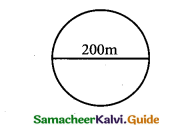
Given cos x = –\(\frac{4}{5}\), π < x < \(\frac{3 \pi}{2}\)
we have cos2 x + sin2 x = 1
Samacheer Kalvi 11th Maths Guide Chapter 3 Trigonometry Ex 3.4 11
Since π < x < \(\frac{3 \pi}{2}\), x lies in the third quadrant.
Since x is negative in the third quadrant. ∴ sin x = –\(\frac{3}{5}\)
Samacheer Kalvi 11th Maths Guide Chapter 3 Trigonometry Ex 3.4 12

Samacheer Kalvi 11th Maths Guide Chapter 3 Trigonometry Ex 3.4

Question 4.
Find sin(x – y) , given that sin x = \(\frac{8}{17}\) with 0< x < \(\frac{\pi}{2}\), and cos y = –\(\frac{24}{25}\), x < y < \(\frac{3 \pi}{2}\)
Answer:
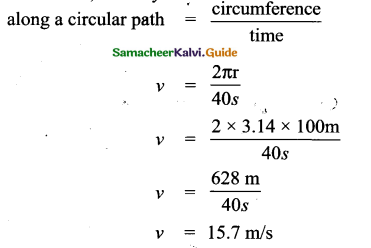
Samacheer Kalvi 11th Maths Guide Chapter 3 Trigonometry Ex 3.4 13
Samacheer Kalvi 11th Maths Guide Chapter 3 Trigonometry Ex 3.4 14
Samacheer Kalvi 11th Maths Guide Chapter 3 Trigonometry Ex 3.4 15

Samacheer Kalvi 11th Maths Guide Chapter 3 Trigonometry Ex 3.4

Question 5.
Find the value of
(i) cos 105°
Answer:
cos 105° = cos(90° + 150)
= -sin 15°
= -sin(45°- 30°)
= -[sin 45° cos 30° – cos 45° sin 30°]
Samacheer Kalvi 11th Maths Guide Chapter 3 Trigonometry Ex 3.4 16

(ii) sin 105°
Answer:
sin 105° = sin (90° + 15°)
= cos 15°
= cos (45° – 30°)
= cos 45° cos 30° + sin 45° sin 30°
Samacheer Kalvi 11th Maths Guide Chapter 3 Trigonometry Ex 3.4 17

Samacheer Kalvi 11th Maths Guide Chapter 3 Trigonometry Ex 3.4

(iii) tan \(\frac{7 \pi}{12}\)
Answer:
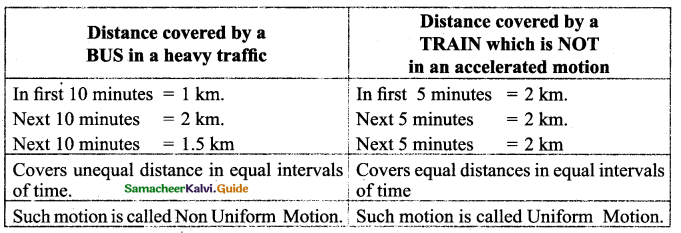
Samacheer Kalvi 11th Maths Guide Chapter 3 Trigonometry Ex 3.4 18
Samacheer Kalvi 11th Maths Guide Chapter 3 Trigonometry Ex 3.4 19

Samacheer Kalvi 11th Maths Guide Chapter 3 Trigonometry Ex 3.4

Question 6.
prove that
(i) cos (30° + x) = \(\frac{\sqrt{3} \cos x-\sin x}{2}\)
(ii) cos (π + θ) = – cos θ
(iii) sin (π + θ) = – sin θ
Answer:
(i) cos (30° + x) = \(\frac{\sqrt{3} \cos x-\sin x}{2}\)
cos ( 30° + x) = cos 30°. cos x – sin 30° sin x
Samacheer Kalvi 11th Maths Guide Chapter 3 Trigonometry Ex 3.4 20

(ii) L.HS = cos(π + θ) = cos(180° + θ)
= cos 180° cos θ – sin 180° sin θ
= (-1) cos θ – (0) sin θ
= – cos θ = RHS

(iii) LHS = sin (π + θ) = sin π cos θ + cos π sin θ
= (0) cos θ + (-1) sin θ
= -sin θ = RHS

Samacheer Kalvi 11th Maths Guide Chapter 3 Trigonometry Ex 3.4

Question 7.
Find a quadratic equation whose roots are sin 15° and cos 15°.
Answer:
sin 15° = sin (45° – 30°)
= sin 45°. cos 30° – cos 45°. sin 30°
Samacheer Kalvi 11th Maths Guide Chapter 3 Trigonometry Ex 3.4 21
cos 15° = cos(45° – 30°)
= cos 45° . cos 30° + sin 45° . sin 30°
Samacheer Kalvi 11th Maths Guide Chapter 3 Trigonometry Ex 3.4 22
The quadratic whose roots cos 15° and sin 15° is
x2 – (cos 15° + sin 15°)x + (cos 15°) (sin 15°) = 0 ——— (3)
Samacheer Kalvi 11th Maths Guide Chapter 3 Trigonometry Ex 3.4 23
Samacheer Kalvi 11th Maths Guide Chapter 3 Trigonometry Ex 3.4 24
Samacheer Kalvi 11th Maths Guide Chapter 3 Trigonometry Ex 3.4 25
Substituting in equation (3) we have
Samacheer Kalvi 11th Maths Guide Chapter 3 Trigonometry Ex 3.4 26

Samacheer Kalvi 11th Maths Guide Chapter 3 Trigonometry Ex 3.4

Question 8.
Expand cos(A + B + C). Hence prove that cos A cos B cos C = sin A sin B cos C + sin B sin C cos A + sin C sin A cos B if A + B + C = \(\frac{\pi}{2}\)
Answer:
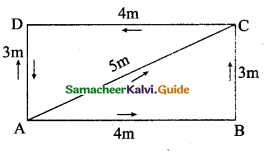
Taking A + B = X and C = Y
We get cos (X + Y) = cos X cos Y – sin X sin Y
(i.e) cos (A + B + C) = cos (A + B) cos C – sin (A + B) sin C
= (cos A cos B – sin A sin B) cos C – [sin A cos B + cos A sin B] sin C
cos (A + B + C) = cos A cos B cos C – sin A sin B cos C – sin A cos B sin C – cos A sin B sin C If (A + B + C) = π/2 then cos (A + B + C) = 0
⇒ cos A cos B cos C – sin A sin B cos C – sin A cos B sin C – cos A sin B sin C = 0
⇒ cos A cos B cos C = sin A sin B cos C + sin B sin C cos A + sin C sin A cos B

Question 9.
Prove that
(i) sin (45° + θ) – sin (45° – θ) = √2 sin θ
(ii) sin (30° + θ) + cos (60° + θ) = cos θ
Answer:
(i) sin (45° + θ) – sin (45° – θ) = √2 sin θ
sin(45° + θ) – sin(45° – θ) = (sin 45° cos θ + cos 45° sin θ) – (sin 45° cos θ + cos 45° sin θ)
= sin 45° cos θ + cos 45° sin θ – sin 45° cos θ + cos 45° sin θ
= 2 cos 45° sin θ
= 2 × \(\frac{1}{\sqrt{2}}\) sin θ
= \(\frac{2}{\sqrt{2}} \times \frac{\sqrt{2}}{\sqrt{2}}\) × sin θ
sin (45° + θ) – sin (45° – θ) = \(\frac{2 \sqrt{2}}{2}\) sin θ
= √2 sin θ

(ii) sin (30° + θ) + cos (60° + θ) = cos θ
sin (30° + θ) + cos (60° + θ)
= sin 30° cos θ + cos 30° sin θ + cos 60° cos θ – sin 60° sin θ
= \(\frac{1}{2}\) cos θ + \(\frac{\sqrt{3}}{2}\) sin θ + \(\frac{1}{2}\) cos θ – \(\frac{\sqrt{3}}{2}\) sin θ
= cos θ

Samacheer Kalvi 11th Maths Guide Chapter 3 Trigonometry Ex 3.4

Question 10.
If a cos (x + y) = b cos(x – y), show that (a + b) tan x = (a – b) cot y.
Answer:
a cos (x + y) = b cos (x – y)
a [cos x cos y – sin x sin y] = b [cos x cos y + sin x sin y]
a cos x cos y – a sin x sin y = b cos x cos y + b sin x sin y
a cos x cos y – b cos x cos y = a sin x sin y + b sin x sin y
(a – b) cos x cos y = (a + b) sin x sin y
(a – b) \(\frac{\cos y}{\sin y}\) = (a + b) \(\frac{\sin x}{\cos x}\)
(a – b) cot y = (a + b) tan x
(a + b) tan x = (a – b) cot y .

Question 11.
Prove that sin 105° + cos 105° = cos 45°
Answer:
sin 105° + cos 105° = sin (90° + 15°) + cos ( 90° + 15°)
= cos 15° – sin 15°
= cos (45° – 30°) sin (45° – 30°)
= (cos 45° . cos30° + sin 45° sin 30°) – (sin 45° cos 30° – cos 45° sin 30°)
Samacheer Kalvi 11th Maths Guide Chapter 3 Trigonometry Ex 3.4 27

Samacheer Kalvi 11th Maths Guide Chapter 3 Trigonometry Ex 3.4

Question 12.
Prove that sin 75° – sin 15° = cos 105° + cos 15°
Answer:
RHS = cos 105° + cos 15° = cos (90° + 15°) + cos (90° – 75°)
= -sin 15° + sin 75°
= sin 75° – sin 15°
= LHS

Samacheer Kalvi 11th Maths Guide Chapter 3 Trigonometry Ex 3.4

Question 13.
Show that tan 75° + cot 75° = 4
Answer:
tan 75° = tan (45° + 30°)
Samacheer Kalvi 11th Maths Guide Chapter 3 Trigonometry Ex 3.4 29
Samacheer Kalvi 11th Maths Guide Chapter 3 Trigonometry Ex 3.4 30

Samacheer Kalvi 11th Maths Guide Chapter 3 Trigonometry Ex 3.4

Question 14.
Prove that cos(A + B). cos C – cos(B + C) cos A = sin B sin (C – A)
Answer:
LHS = (cos A cos B – sin A sin B) cos C – (cos B cos C – sin B sin C) cos A
= cos A cos B cos C – sin A sin B cos C – cos A cos B cos C + cos A sin B sin C
= cos A sin B sin C – sin A sin B cos C
= sin B [sin C cos A – cos C sin A]
= sin B [sin (C – A)] = RHS

Question 15.
Prove that sin (n + 1)θ . sin(n – 1)θ + cos(n + 1)θ . cos(n – 1)θ = cos 2θ, n ∈ Z
Answer:
Taking (n + 1) θ = A and (n – 1) θ = B
LHS = sin A sin B + cos A cos B
= cos (A – B)
= cos[(n + 1) – (n – 1)]θ
= cos (n + 1 – n + 1)θ = cos 2θ = RHS

Samacheer Kalvi 11th Maths Guide Chapter 3 Trigonometry Ex 3.4

Question 16.
If x cos θ = y cos\(\left(\theta+\frac{2 \pi}{3}\right)\) = z cos \(\left(\theta+\frac{4 \pi}{3}\right)\) find the value of xy + yz + zx.
Answer:
Samacheer Kalvi 11th Maths Guide Chapter 3 Trigonometry Ex 3.4 31
= cos θ + cos (θ + 120°) + cos (θ + 240°)
= cos θ + cos θ cos 120° – sin θ sin 120° + cos θ . cos 240° – sin θ sin 240°
= cos θ + cos θ cos (180° – 60°) – sin θ sin( 180°- 60°) + cos θ cos (180°+ 60°) – sin θ sin (180° + 60°)
= cos θ + cos θ × – cos 60° – sin θ × sin 60° + cos θ × – cos 60°- sin θ (- sin 60°)
= cos θ – cos θ cos 60° – sin θ sin 60° – cos θ cos60° + sin θ sin 60°
= cos θ – 2 cos θ cos 60°
= cos θ – 2 cos θ × \(\frac { 1 }{ 2 }\) = cos θ – cos θ = 0
Samacheer Kalvi 11th Maths Guide Chapter 3 Trigonometry Ex 3.4 32

Samacheer Kalvi 11th Maths Guide Chapter 3 Trigonometry Ex 3.4

Question 17.
Prove that
(i) sin(A + B) . sin(A – B) = sin2A – sin2B
Answer:
LHS = sin (A + B) sin (A – B)
= (sin A cos B + cos A sin B) (sin A cos B – cos A sin B)
= sin2A cos2 B – cos2 A sin2 B
= sin2 A (1 – sin2 B) – (1 – sin2 A) sin2 B
= sin2 A – sin2 A sin2 B – sin2 B + sin2 A sin2 B
= sin2 A – sin2 B = RHS

(ii) cos (A + B) . cos (A – B) = cos2A – sin2B = cos2B – sinA
Answer:
cos(A + B) . cos(A – B) = (cos A cos B – sin A sin B) (cos A cos B + sin A sin B)
= (cos A cos B )2 – (sin A sin B )2 = cos2 A cos2 B – sin2 A sin2 B
= cos2A(1 – sin2B) – (1 – cos2A) sin2B
= cos2A – cos2A sin2B – sin2B + cos2A sin2B
cos(A + B) . cos(A – B) = cos2A – sin2B
Also cos(A + B) . cos(A – B) = cos2A cos2B – sin2A sin2B
= (1 – sin2A)cos2B – sin2A(1 – cos2B)
= cos2B – sin2A cos2B – sin2A + sin2A cos2B
cos(A + B) . cos(A – B) = cos2B – sin2A

Samacheer Kalvi 11th Maths Guide Chapter 3 Trigonometry Ex 3.4

(iii) sin2 (A + B) – sin2(A – B) = sin 2 A sin 2 B
Answer:
sin2 A – sin2 B = sin (A + B) sin (A – B)
LHS = sin2 (A + B) – sin2 (A – B) = sin [(A + B) + (A – B)] [sin (A + B) – (A – B)]
= sin 2A sin 2B = RHS

(iv) cos 8θ . cos 2θ = cos2 5θ – sin2
Answer:
cos8θ . cos2θ = cos(5θ + 3θ) cos(5θ – 3θ)
= (cos 5θ . cos 3θ – sin 5θ sin 3θ) (cos 5θ . cos3θ + sin 5θ sin 3θ)
= (cos 5θ . cos 3θ)2 – (sin 5θ sin 3θ)2
= cos2 5θ cos23θ – sin2 5θ sin2
= cos2 5θ (1 – sin2 3θ) – (1 – cos2 5θ) sin2
= cos2 5θ – cos2 5θ sin2 3θ – sin2 3θ + cos2 5θ sin2
cos 8θ . cos 2θ = cos2 5θ – sin2

Question 18.
Show that cos2A + cos2B – 2 cos A cos B cos (A + B) = sin2(A + B)
Answer:
LHS = cos2 A + cos2 B – 2 cos A cos B [cos A cos B – sin A sin B]
= cos2 A + cos2 B – 2 cos2 A cos2 B + 2 sin A cos A sin B cos B
= (cos2 A – cos2 A cos2 B) + (cos2 B – cos2 A cos2 B) + 2 sin A cos A sin B cos B
= cos2 A (1 – cos2 B) + cos2 B (1 – cos2 A) + 2 sin A cos A sin B cos B
= cos2 A sin2 B + cos2 B sin2 A + 2 sin A cos B sin B cos A
= (sin A cos B + cos A sin B)2
= sin2 (A + B) = RHS

Question 19.
If cos (α – β) + cos(β – γ) + cos(γ – α) = [lαtex]-\frac{3}{2}[/lαtex],then prove thαt
cos α + cos β + cos γ = sin α + sin β + sin γ = 0
Answer:
Given cos( α – β) + cos (β – γ) + cos (γ – α) = [lαtex]-\frac{3}{2}[/lαtex]
cos α cos β + sin α sin β + cos β cos γ + sin β sin γ + cos γ cos α + sin γ sin α = [lαtex]-\frac{3}{2}[/lαtex]
2 [cos α cos β + sin α sin β + cos β cos γ + sin β sin γ + cos γ cos α + sin γ sin α] = – 3
(2 cos α cos β + 2 cos β cos γ + 2 cos γ cos α) + (2 sin α sin β + 2sin β sin γ + 2 sin γ sin α) + 3 = 0
(2 cos α cos β + 2 cos β cos γ + 2cos γ cos α) + (2 sin α sin β + 2 sin β sin γ + 2 sin γ sin α)+
(cos2 α + sin2 α) + (cos2β + sin2 β) + (cos2 γ + sin2 γ) = 0
(cos2 α + cos2β + cos2γ + 2 cos α cos β + 2 cos β cos γ + 2 cos γ cos α) + (sin2α + sin2β + sin2γ + 2 sin α sin β + 2 sin β sin γ + 2 sin γ sin α) = 0
(cos α + cos + cos γ)2 + (sin α + sin β + sin )2 = 0
cos α + cos β + cos γ = 0 and sin α + sin β + sin γ = 0
cos α + cos β + cos γ = sin α + sin + sin γ = 0

Samacheer Kalvi 11th Maths Guide Chapter 3 Trigonometry Ex 3.4

Question 20.
Show that
(i) Samacheer Kalvi 11th Maths Guide Chapter 3 Trigonometry Ex 3.4 33
Answer:
Samacheer Kalvi 11th Maths Guide Chapter 3 Trigonometry Ex 3.4 35

(ii) Samacheer Kalvi 11th Maths Guide Chapter 3 Trigonometry Ex 3.4 34
Answer:
Samacheer Kalvi 11th Maths Guide Chapter 3 Trigonometry Ex 3.4 36

Samacheer Kalvi 11th Maths Guide Chapter 3 Trigonometry Ex 3.4

Question 21.
Prove that cot (A + B) = \(\frac{\cot A \cot B-1}{\cot A+\cot B}\)
Answer:
Samacheer Kalvi 11th Maths Guide Chapter 3 Trigonometry Ex 3.4 37
Samacheer Kalvi 11th Maths Guide Chapter 3 Trigonometry Ex 3.4 38

Samacheer Kalvi 11th Maths Guide Chapter 3 Trigonometry Ex 3.4

Question 22.
If tan x = \(\frac{n}{n+1}\) and tan y = \(\frac{1}{2 n+1}\) find tan (x + y).
Answer:
Samacheer Kalvi 11th Maths Guide Chapter 3 Trigonometry Ex 3.4 39

Samacheer Kalvi 11th Maths Guide Chapter 3 Trigonometry Ex 3.4

Question 23.
Prove that tan \(\left(\frac{\pi}{4}+\theta\right)\) tan \(\left(\frac{3 \pi}{4}+\theta\right)\) = -1
Answer:
Samacheer Kalvi 11th Maths Guide Chapter 3 Trigonometry Ex 3.4 40

Samacheer Kalvi 11th Maths Guide Chapter 3 Trigonometry Ex 3.4

Question 24.
Find the value of tan (α + β), given that cot α = \(\frac{1}{2}\), α ∈ \(\left(\pi, \frac{3 \pi}{2}\right)\) and sec β = –\(\frac{5}{3}\) β ∈ \(\left(\frac{\pi}{2}, \pi\right)\)
Answer:
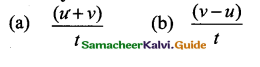
Samacheer Kalvi 11th Maths Guide Chapter 3 Trigonometry Ex 3.4 42

Samacheer Kalvi 11th Maths Guide Chapter 3 Trigonometry Ex 3.4

Question 25.
If θ + Φ = α and tan θ = k tan Φ, then prove that sin (θ – Φ ) = \(\frac{k-1}{k+1}\) sin α
Answer:
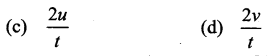
Samacheer Kalvi 11th Maths Guide Chapter 3 Trigonometry Ex 3.4 43
Samacheer Kalvi 11th Maths Guide Chapter 3 Trigonometry Ex 3.4 44

Samacheer Kalvi 11th Maths Guide Chapter 3 Trigonometry Ex 3.3

Tamilnadu State Board New Syllabus Samacheer Kalvi 11th Maths Guide Pdf Chapter 3 Trigonometry Ex 3.3 Text Book Back Questions and Answers, Notes.

Tamilnadu Samacheer Kalvi 11th Maths Solutions Chapter 3 Trigonometry Ex 3.3

Question 1.
Find the values of
(i) sin 480°
(ii) sin (-1110°)
(iii) cos 300°
(iv) tan (1050°)
(v) cot 660°
(vi) tan \(\left(\frac{19 \pi}{3}\right)\)
(vii) sin \(\left(\frac{-11 \pi}{3}\right)\)
Answer:
(i) sin(480°) = sin(360° + 120°) = sin 120°
= sin(90° + 30°) = cos 30° = \(\sqrt{3}\)/2

(ii) sin(-1110°) = -sin(1110°)
= – sin (360° × 3 + 30°)
= -sin 30° = -1/2

(iii) cos(300°) = cos(270° + 30°) = sin 30° = 1/2

(iv) tan (1050°)
tan (1050°) = tan(12 × 90 – 30°)
= – tan30° = – \(\frac{1}{\sqrt{3}}\)

(v) cot 660°
cot 660° = cot (7 × 90 + 30°)
= – tan 30° = – \(\frac{1}{\sqrt{3}}\)

(vi) tan \(\left(\frac{19 \pi}{3}\right)\)
Samacheer Kalvi 11th Maths Guide Chapter 3 Trigonometry Ex 3.3 1

(vii) sin \(\left(\frac{-11 \pi}{3}\right)\)
Samacheer Kalvi 11th Maths Guide Chapter 3 Trigonometry Ex 3.3 2

Samacheer Kalvi 11th Maths Guide Chapter 3 Trigonometry Ex 3.3

Question 2.
\(\left(\frac{5}{7}, \frac{2 \sqrt{6}}{7}\right)\) is a point on the terminal side of an angle θ in standard position. Determine the six trigonometric function values of angle θ.
Answer:
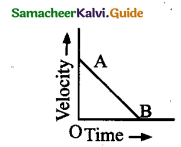
Given \(\left(\frac{5}{7}, \frac{2 \sqrt{6}}{7}\right)\) is a point on the terminal side of an angle θ in standard position.
Samacheer Kalvi 11th Maths Guide Chapter 3 Trigonometry Ex 3.3 3
Samacheer Kalvi 11th Maths Guide Chapter 3 Trigonometry Ex 3.3 4

Samacheer Kalvi 11th Maths Guide Chapter 3 Trigonometry Ex 3.3

Question 3.
Find the values of the other five trigonometric functions of the following
(i) cos θ = –\(\frac{1}{2}\), θ lies in the III quadrant
(ii) cos θ = \(\frac{2}{3}\), θ lies in the I quadrant
(iii) sin θ = –\(\frac{2}{3}\), θ lies in the IV quadrant
(iv) tan θ = – 2, θ lies in the II quadrant
(v) sec θ = \(\frac{13}{5}\), θ lies inthe IVquadrant
Answer:
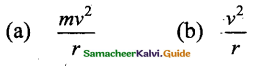
(i) cos θ = –\(\frac{1}{2}\), θ lies in the III quadrant
Samacheer Kalvi 11th Maths Guide Chapter 3 Trigonometry Ex 3.3 6

Samacheer Kalvi 11th Maths Guide Chapter 3 Trigonometry Ex 3.3

(ii) cos θ = \(\frac{2}{3}\), θ lies in the I quadrant
We know that cos2θ + sin2θ = 1
\(\left(\frac{2}{3}\right)^{2}\) + sin2θ = 1
\(\frac{4}{9}\) + sin2θ = 1
Samacheer Kalvi 11th Maths Guide Chapter 3 Trigonometry Ex 3.3 7
Since θ lies in the I quadrant all trigonometric functions are positive.
Samacheer Kalvi 11th Maths Guide Chapter 3 Trigonometry Ex 3.3 8
Samacheer Kalvi 11th Maths Guide Chapter 3 Trigonometry Ex 3.3 9

Samacheer Kalvi 11th Maths Guide Chapter 3 Trigonometry Ex 3.3

(iii) sin θ = –\(\frac{2}{3}\), θ lies in the IV quadrant
We know that cos2θ + sin2θ = 1
cos2θ + \(\left(-\frac{2}{3}\right)^{2}\) = 1
cos2θ + \(\frac{4}{9}\) = 1
Samacheer Kalvi 11th Maths Guide Chapter 3 Trigonometry Ex 3.3 10
Since θ lies in the fourth quadrant cos θ is positive.
Samacheer Kalvi 11th Maths Guide Chapter 3 Trigonometry Ex 3.3 11

Samacheer Kalvi 11th Maths Guide Chapter 3 Trigonometry Ex 3.3

(iv) tan θ = – 2, θ lies in the II quadrant
We know that sec2θ – tan2θ = 1
sec2θ – (-2)2 = 1
sec2θ – 4 = 1
sec2θ = 1 + 4 = 5
sec θ = ± √5
Since θ lies in the second quadrant sec θ is negative.
Samacheer Kalvi 11th Maths Guide Chapter 3 Trigonometry Ex 3.3 12

Samacheer Kalvi 11th Maths Guide Chapter 3 Trigonometry Ex 3.3

(v) sec θ = \(\frac{13}{5}\), θ lies inthe IVquadrant
We know that sec2θ – tan2θ = 1
\(\left(\frac{13}{5}\right)^{2}\) – tan2θ = 1
\(\frac{169}{25}\) – 1 = tan2θ
Samacheer Kalvi 11th Maths Guide Chapter 3 Trigonometry Ex 3.3 13

Samacheer Kalvi 11th Maths Guide Chapter 3 Trigonometry Ex 3.3

Question 4.
Prove that
Samacheer Kalvi 11th Maths Guide Chapter 3 Trigonometry Ex 3.3 14
Answer:

Samacheer Kalvi 11th Maths Guide Chapter 3 Trigonometry Ex 3.3 15
Samacheer Kalvi 11th Maths Guide Chapter 3 Trigonometry Ex 3.3 16

Samacheer Kalvi 11th Maths Guide Chapter 3 Trigonometry Ex 3.3

Question 5.
Find all the angles between 0° and 360° which satisfy the equation sin2θ = \(\frac{3}{4}\)
Answer:
sin2θ = \(\frac{3}{4}\) ⇒ sin θ = ± \(\frac{\sqrt{3}}{2}\)
sin 60° = \(\frac{\sqrt{3}}{2}\)
sin 120° = sin (180° – 60°)
= sin 60° = \(\frac{\sqrt{3}}{2}\)
∴ θ = 60° and 120°

Samacheer Kalvi 11th Maths Guide Chapter 3 Trigonometry Ex 3.3

Question 6.
Show that
Samacheer Kalvi 11th Maths Guide Chapter 3 Trigonometry Ex 3.3 17
Answer:

Samacheer Kalvi 11th Maths Guide Chapter 3 Trigonometry Ex 3.3 18
= sin2 10° + sin2 20° + [cos 20°]2 + [cos 10°]2
= sin2 10° + sin2 20° + cos2 20° + cos2 10°
= sin2 10° + cos2 10° + sin2 20° + cos2 20°
= 1 + 1 = 2

Samacheer Kalvi 11th Maths Guide Chapter 3 Trigonometry Ex 3.2

Tamilnadu State Board New Syllabus Samacheer Kalvi 11th Maths Guide Pdf Chapter 3 Trigonometry Ex 3.2 Text Book Back Questions and Answers, Notes.

Tamilnadu Samacheer Kalvi 11th Maths Solutions Chapter 3 Trigonometry Ex 3.2

Question 1.
Express each of the following in radian measure.
(i) 30°
(ii) 135°
(iii) -205°
(iv) 150°
(v) 330°
Answer:
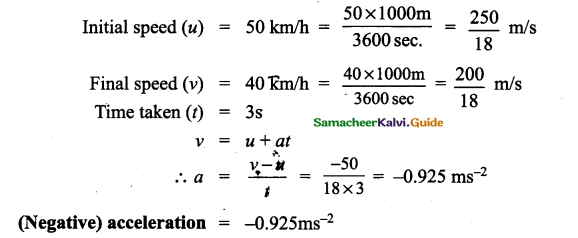
(i) 30°
Samacheer Kalvi 11th Maths Guide Chapter 3 Trigonometry Ex 3.2 1

Samacheer Kalvi 11th Maths Guide Chapter 3 Trigonometry Ex 3.2

(ii) 135°
Samacheer Kalvi 11th Maths Guide Chapter 3 Trigonometry Ex 3.2 2
Samacheer Kalvi 11th Maths Guide Chapter 3 Trigonometry Ex 3.2 3

(iii) – 205°
Samacheer Kalvi 11th Maths Guide Chapter 3 Trigonometry Ex 3.2 4

(iv) 150°
Samacheer Kalvi 11th Maths Guide Chapter 3 Trigonometry Ex 3.2 5

Samacheer Kalvi 11th Maths Guide Chapter 3 Trigonometry Ex 3.2

(v) 330°
Samacheer Kalvi 11th Maths Guide Chapter 3 Trigonometry Ex 3.2 6

Question 2.
Find the degree measure corresponding to the following radian measures.
(i) \(\frac{\pi}{3}\)
(ii) \(\frac{\pi}{9}\)
(iii) \(\frac{2 \pi}{5}\)
(iv) \(\frac{7 \pi}{3}\)
(v) \(\frac{10 \pi}{9}\)
Answer:

(i) \(\frac{\pi}{3}\) radians
Samacheer Kalvi 11th Maths Guide Chapter 3 Trigonometry Ex 3.2 7
Samacheer Kalvi 11th Maths Guide Chapter 3 Trigonometry Ex 3.2 8

Samacheer Kalvi 11th Maths Guide Chapter 3 Trigonometry Ex 3.2

(ii) \(\frac{\pi}{9}\) radians
Samacheer Kalvi 11th Maths Guide Chapter 3 Trigonometry Ex 3.2 9

(iii) \(\frac{2 \pi}{5}\) radians
Samacheer Kalvi 11th Maths Guide Chapter 3 Trigonometry Ex 3.2 10

(iv) \(\frac{7 \pi}{3}\) radians
Samacheer Kalvi 11th Maths Guide Chapter 3 Trigonometry Ex 3.2 11

(v) \(\frac{10 \pi}{9}\) radians
Samacheer Kalvi 11th Maths Guide Chapter 3 Trigonometry Ex 3.2 12

Samacheer Kalvi 11th Maths Guide Chapter 3 Trigonometry Ex 3.2

Question 3.
What must be the radius of a circular running path, around which an athlete must run 5 times in order to describe 1 km?
Answer:

Let the radius of the circular path be = r m.
Length of the circular path s = 1 k. m
s = 1000 m.
Athlete runs 5 times around the path to cover 1 k. m distance
∴ θ = 360° × 5
θ = 360° × 5 × \(\frac{\pi}{180}\) radians
θ = 10 π radians
s = r θ
1000 = r 10 π
r = \(\frac{1000}{10 \pi}\)
r = \(\frac{1000 \times 7}{10 \times 22}=\frac{350}{11}\)
r = 31 .818 meters
Radius of the circular path = 31 .82 meters

Samacheer Kalvi 11th Maths Guide Chapter 3 Trigonometry Ex 3.2

Question 4.
In a circle of diameter 40 cm a chord is of length 20 cm. Find the length of the minor arc of the chord.
Answer:
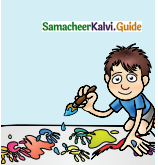
Samacheer Kalvi 11th Maths Guide Chapter 3 Trigonometry Ex 3.2 13

Given Diameter AB = 40 cm
∴ Radius r = 20 cm
Chord CD = 20 cm
O – Centre of the circle
OC = OD = radius = 20 cm.
∴ Triangle OCD is an equilateral triangle.
Samacheer Kalvi 11th Maths Guide Chapter 3 Trigonometry Ex 3.2 14
To find the length of the minor arc CD.
Let s = minor arc CD.
The arc CD subtends 60° at the centre.
θ = 60°
θ = 60° × \(\frac{\pi}{180}\) radians.
θ = \(\frac{\pi}{3}\) radians
We have s = rθ
Samacheer Kalvi 11th Maths Guide Chapter 3 Trigonometry Ex 3.2 15

Samacheer Kalvi 11th Maths Guide Chapter 3 Trigonometry Ex 3.2

Question 5.
Find the degree measure of the angle subtended at the centre of the circle of radius 100 cm by an arc of length 22 cm.
Answer:
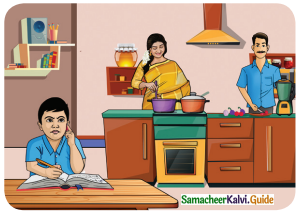
Given radius r = 100 cm.
Length of arc s = 22 cm.
Angle subtended by the arc at the centre = θ radians
Samacheer Kalvi 11th Maths Guide Chapter 3 Trigonometry Ex 3.2 16

Question 6.
What is the length of the arc intercepted by a central angle of measure 41° in a circle of radius of 10 feet?
Answer:

Central angle subtended by the arc θ = 41°
θ = 41 × \(\frac{\pi}{180}\) Radians
The radius of the circle r = 10 feet
Length of the arc = s
s = rθ
Samacheer Kalvi 11th Maths Guide Chapter 3 Trigonometry Ex 3.2 17

Samacheer Kalvi 11th Maths Guide Chapter 3 Trigonometry Ex 3.2

Question 7.
If in two circles, arcs of the same length subtend angles 60° and 75° at the centre, find the ratio of their radii.
Answer:
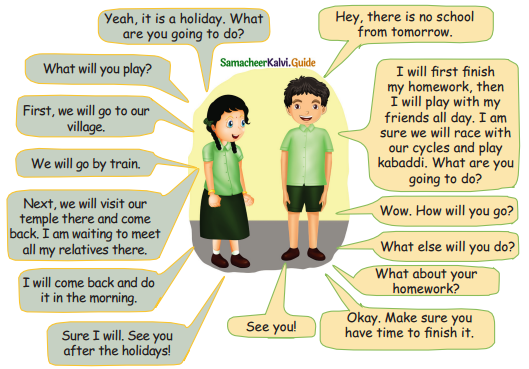
Let r1 and r2 be the radii of the two circles and l be the length of the arc.
Given central angle θ1 = 60°
Samacheer Kalvi 11th Maths Guide Chapter 3 Trigonometry Ex 3.2 18

Samacheer Kalvi 11th Maths Guide Chapter 3 Trigonometry Ex 3.2

Question 8.
The perimeter of a certain sector of a circle is equal to the length of the arc of a semi-circle having the same radius. Express the angle of the sector in degrees, minutes, and seconds.
Answer:
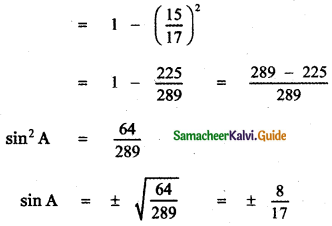
Let OAB be the sector of a circle of radius r.
The angle of the sector is θ.
Samacheer Kalvi 11th Maths Guide Chapter 3 Trigonometry Ex 3.2 19
Perimeter of the sector = OA + arc AB + OB arc AB = rθ
∴ Perimeter of the sector = r + r θ + r
= 2r + rθ
= r(2 + θ) ———- (1)
Length of the arc of the semi – circle of radius
l = nπ ——– (2)
Given that perimeter the circular sector = Length of the arc of the semi circle of radius r
From equations (1) and (2), we have
r(2 + θ) = πr
2 + θ = π
θ = π – 2
Samacheer Kalvi 11th Maths Guide Chapter 3 Trigonometry Ex 3.2 20
Samacheer Kalvi 11th Maths Guide Chapter 3 Trigonometry Ex 3.2 21

Samacheer Kalvi 11th Maths Guide Chapter 3 Trigonometry Ex 3.2

Question 9.
An airplane propeller rotates 1000 times per minute. Find the number of degrees that a point on the edge of the propeller will rotate in 1 second.
Answer:
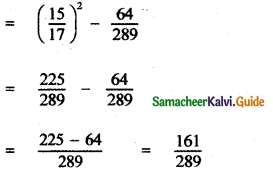
Given An airplane, the propeller rotates 1000 times per minute.
∴ A point on the edge of the propeller also rotates 1000 times in 1 minute.
∴ In 1 minute the point describes 1000 × 2π radians angle at the centre.
In 60 seconds the point describes 1000 × 2π radians angle.
∴ In 1 second the angle described = \(\frac{1000 \times 2 \pi}{60}\) radians
Samacheer Kalvi 11th Maths Guide Chapter 3 Trigonometry Ex 3.2 22

Question 10.
A train is moving on a circular track of a 1500 m radius at the rate of 66 km/hr. What angle will it turn in 20 seconds?
Answer:
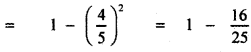
Radius of the circular track r = 1500 m.
Speed of the train = 66 km/hr
Let θ be the angle made by the path of train at the centre in 20 seconds.
In 1 hr distance moved by train along the circular path = 66 km
In 60 × 60 seconds distance moved = 66 km
∴ In 20 seconds distance moved s = \(\frac{66}{60 \times 60}\) × 20
Samacheer Kalvi 11th Maths Guide Chapter 3 Trigonometry Ex 3.2 23

Samacheer Kalvi 11th Maths Guide Chapter 3 Trigonometry Ex 3.2

Question 11.
A circular metallic plate of radius 8 cm and thickness 6 nuns is melted and molded into a pie (a sector of the circle with thickness) of radius 16 cm and thickness 4 mm. Find the angle of the sector.
Answer:
Radius of the circular metallic plate r = 8 cm
Thickness of the plate h = 6 mm = \(\frac{6}{10}\)
Radius of the Pie l = 16 cm
Thickness of the Pie ( h) = 4mm = \(\frac{4}{10}\) cm
Given volume of the cylinder = Volume of the sector
Samacheer Kalvi 11th Maths Guide Chapter 3 Trigonometry Ex 3.2 24