Samacheer Kalvi 12th Business Maths Guide Chapter 4 Differential Equations Ex 4.5

Tamilnadu State Board New Syllabus Samacheer Kalvi 12th Business Maths Guide Pdf Chapter 4 Differential Equations Ex 4.5 Text Book Back Questions and Answers, Notes.

Tamilnadu Samacheer Kalvi 12th Business Maths Solutions Chapter 4 Differential Equations Ex 4.5

Question 1.
\(\frac { d^2y }{dx^2}\) – 6\(\frac { dy }{dx}\) + 8y = 0
Solution:
Given (D2 – 6D + 8) y = 0, D = \(\frac{d}{d x}\)
The auxiliary equations is
m2 – 6m + 8 = 0
(m – 4)(m – 2) = 0
m = 4, 2
Roots are real and different
The complementary function (C.F) is (Ae4x + Be2x)
The general solution is y = Ae4x + Be2x

Samacheer Kalvi 12th Business Maths Guide Chapter 4 Differential Equations Ex 4.5

Question 2.
\(\frac { d^2y }{dx^2}\) – 4\(\frac { dy }{dx}\) + 4y = 0
Solution:
The auxiliary equations A.E is m2 – 4m + 4 = 0
(m – 2)2 = 0
m = 2, 2
Roots are real and equal
The complementary function (C.F) is (Ax + B) e2x
The general solution is y = (Ax + B) e2x

Samacheer Kalvi 12th Business Maths Guide Chapter 4 Differential Equations Ex 4.5

Question 3.
(D² + 2D + 3) y = 0
Solution:
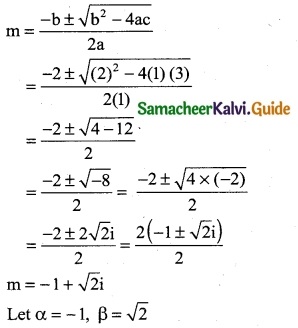
The auxiliary equation is m² + 2m + 3 = 0
Here a = 1, b = 2, c = 3
Samacheer Kalvi 12th Business Maths Guide Chapter 4 Differential Equations Ex 4.5 1
The complementary function is
eax (Acosßx + Bsinßx)
∴ C.F = e-x [Acos√2x + Bsin √2x]
∴ The general solution is
y = e-x (Acos√2x + Bsin√2x)

Question 4.
\(\frac { d^2y }{dx^2}\) – 2k\(\frac { dy }{dx}\) + k²y = 0
Solution:
Given (D2 – 2kD + k2)y = 0, D = \(\frac{d}{d x}\)
The auxiliary equations is m2 – 2km + k = 0
⇒ (m – k)2 = 0
⇒ m = k, k
Roots are real and equal
The complementary function (C.F) is (Ax + B) ekx
The general solution is y = (Ax + B) ekx

Samacheer Kalvi 12th Business Maths Guide Chapter 4 Differential Equations Ex 4.5

Question 5.
(D² – 2D – 15) y = 0
Solution:
The auxiliary equation is
m² – 2m + 15 = 0
m² + 3m – 5m – 15 = 0
m (m + 3) – 5 (m + 3) = 0
(m + 3) (m – 5) = 0
m = -3, 5
Roots are real and different
∴ The complementary function is
Aem1x + Bem2x
C.F = Ae-3x + Be5x
∴ The general solution is
y = (Ae-3x + Be5x) ………… (1)
\(\frac { dy }{dx}\) = Ae-3x (-3) + Be5x (5)
\(\frac { dy }{dx}\) = -3Ae-3x + 5Be5x ………… (2)
\(\frac { d^2y }{dx^2}\) = 9Ae-3x + 25Be5x ……….. (3)
when x = 0; \(\frac { dy }{dx}\) = 0
-3 Ae° + 5Be° = 0
-3A + 5B = 0 ………. (4)
when x = 0; \(\frac { d^2y }{dx^2}\) = 2
Eqn (3) ⇒ 9Ae° + 25Be° = 2
9A + 25B = 2 ……… (5)
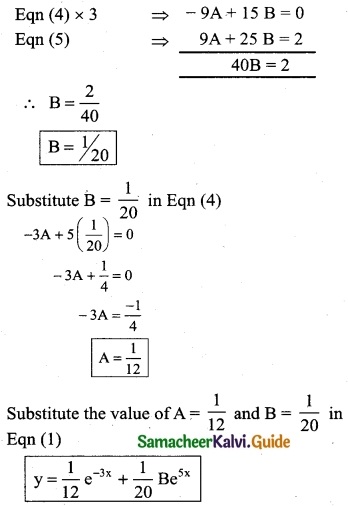
Solving equation (4) & (5)
Samacheer Kalvi 12th Business Maths Guide Chapter 4 Differential Equations Ex 4.5 2

Samacheer Kalvi 12th Business Maths Guide Chapter 4 Differential Equations Ex 4.5

Question 6.
(4D² + 4D – 3) y = e2x
Solution:
The auxiliary equation is
4m² + 4m – 3 = 0
4m² + 6m – 2m – 3 = 0
2m (2m + 3) – 1 (2m + 3) = 0
(2m + 3) (2m – 1) = 0
2m = -3; 2m = 1
m = -3/2, 1/2
Roots are real and different
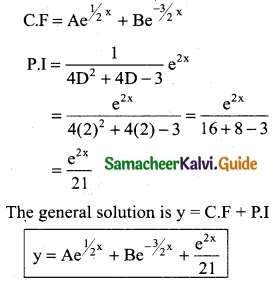
The complementary function is
Aem1x + Bem2x
Samacheer Kalvi 12th Business Maths Guide Chapter 4 Differential Equations Ex 4.5 3

Samacheer Kalvi 12th Business Maths Guide Chapter 4 Differential Equations Ex 4.5

Question 7.
\(\frac { d^2y }{dx^2}\) + 16y = 0
Solution:
Given (D2 + 16) y =0
The auxiliary equation is m2 + 16 = 0
⇒ m2 = -16
⇒ m = ± 4i
It is of the form α ± iβ, α = 0, β = 4
The complementary function (C.F) is e0x [A cos 4x + B sin 4x]
The general solution is y = [A cos 4x + B sin 4x]

Samacheer Kalvi 12th Business Maths Guide Chapter 4 Differential Equations Ex 4.5

Question 8.
(D² – 3D + 2) y = e3x which shall vanish for x = 0 and for x = log 2
Solution:
(D² – 3D + 2) y = e3x
The auxiliary equation is
m² – 3m + 2 =0
(m – 1) (m – 2) = 0
m = 1, 2
Roots are real and different
The complementary function is
C.F = Aem1x + Bem2x
C.F = Ax + Be2x
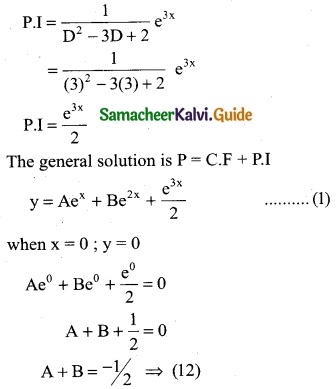
Samacheer Kalvi 12th Business Maths Guide Chapter 4 Differential Equations Ex 4.5 4
when x = log 2; y = 0
Aelog 2 + Be2log 2 + \(\frac { e^{3xlog2} }{2}\) = 0
Aelog 2 + Belog (2)² + \(\frac { e^{log2³} }{2}\) = 0
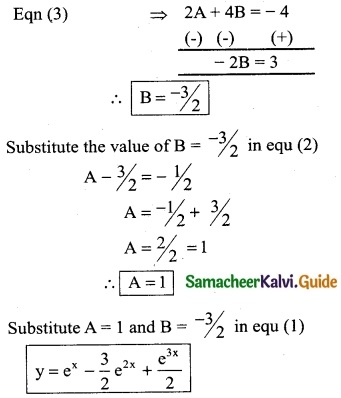
2A + 4B + \(\frac { 8 }{2}\) = 0
2A + 4B + 4 = 0
2A + 4B = -4 ……… (3)
Solving equation (2) & (3)
Eqn (2) × 2 ⇒ 2A + 2B = -1
Samacheer Kalvi 12th Business Maths Guide Chapter 4 Differential Equations Ex 4.5 5

Samacheer Kalvi 12th Business Maths Guide Chapter 4 Differential Equations Ex 4.5

Question 9.
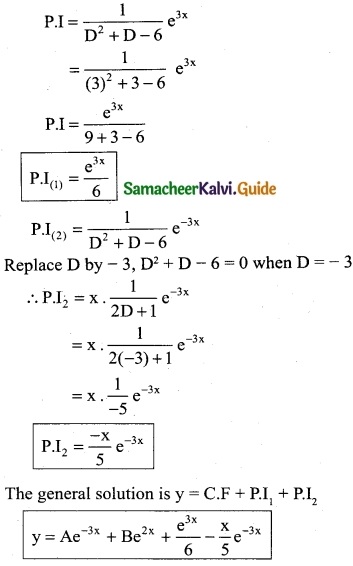
(D² + D – 2) y = e3x + e-3x
Solution:
The auxiliary equation is
m² + m – 6 = 0
(m + 3) (m – 2) = 0
Roots are real and different
The complementary function is
C.F = Aem1x + Bem2x
C.F = Ae-3x + Be2x
Samacheer Kalvi 12th Business Maths Guide Chapter 4 Differential Equations Ex 4.5 6

Question 10.
(D² – 10D + 25) y = 4e5x + 5
Solution:
The auxiliary equation is
m² – 10m + 25 = 0
(m – 5) (m – 5) = 0
m = 5, 5
Roots are real and equal
C.F = (Ax + B) emx
C.F = (Ax + B) e5x
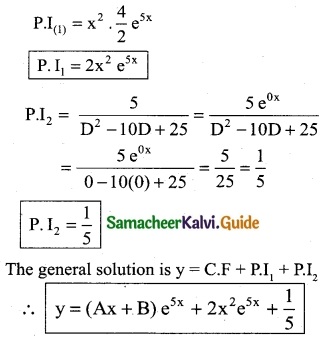
P.I(1) = x. \(\frac { 4 }{2D-10}\) e5x
Replace D by 5, 2D – 10 = 0 when D = 5
Samacheer Kalvi 12th Business Maths Guide Chapter 4 Differential Equations Ex 4.5 7

Samacheer Kalvi 12th Business Maths Guide Chapter 4 Differential Equations Ex 4.5

Question 11.
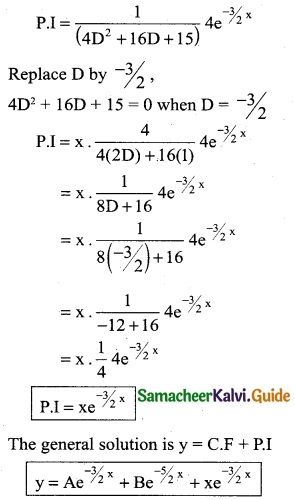
(4D² + 16D +15) y = 4e\(\frac { -3 }{2}\)x
Solution:
The auxiliary equation is 4m² + 16m + 15 = 0
4m² + 16m + 10m + 15 = 0
2m (2m + 3) + 5 (2m + 3) = 0
(2m + 3) (2m + 5) = 0
2m = -3, -5
∴ m = -3/2, -5/2
Roots are real and different
C.F = (Ax + B) em1x + Bem2x
C.F = Ae-3/2 x + Be-5/2 x
Samacheer Kalvi 12th Business Maths Guide Chapter 4 Differential Equations Ex 4.5 8

Question 12.
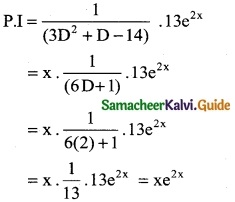
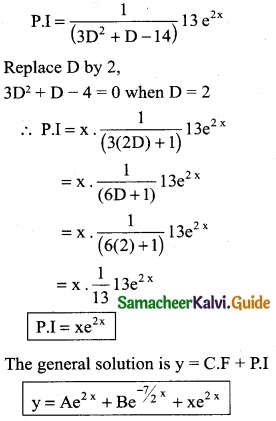
(3D² + D – 14) y – 13 e2x
Solution:
The auxiliary equation is 3m² + m – 14 = 0
3m² – 6m + 7m – 14 = 0
3m (m – 2) + 7 (m – 2) = 0
(m – 2) (3m + 7) = 0
m = 2; 3m = -7
m = 2, -7/3
Roots are real and different
C.F = (Ax + B) em1x + Bem2x
C.F = Ae2x + Be-7/3 x
Samacheer Kalvi 12th Business Maths Guide Chapter 4 Differential Equations Ex 4.5 9

Samacheer Kalvi 12th Business Maths Guide Chapter 4 Differential Equations Ex 4.5

Question 13.
Suppose that the quantity demanded Qd = 13 – 6p + 2\(\frac { dp }{dt}\) + \(\frac { d^2p }{dt^2}\) = and quantity supplied Qd = -3 + 2p where is the price. Find the equilibrium price for market clearence.
Solution:
For market clearance, the required condition is Qd = Qs
Samacheer Kalvi 12th Business Maths Guide Chapter 4 Differential Equations Ex 4.5 10
The auxiliary equation is
m² + 2m – 8 = 0
(m + 4) (m – 2) = 0
m = -4, 2
Roots are real and different
Samacheer Kalvi 12th Business Maths Guide Chapter 4 Differential Equations Ex 4.5 11

Samacheer Kalvi 12th Business Maths Guide Chapter 4 Differential Equations Ex 4.5

Tamil Nadu 12th Computer Science Model Question Papers 2020-2021 English Tamil Medium

Subject Matter Experts at SamacheerKalvi.Guide have created Samacheer Kalvi Tamil Nadu State Board Syllabus New Paper Pattern 12th Computer Science Model Question Papers 2020-2021 with Answers Pdf Free Download in English Medium and Tamil Medium of TN 12th Standard Computer Science Public Exam Question Papers Answer Key, New Paper Pattern of HSC 12th Class Computer Science Previous Year Question Papers, Plus Two +2 Computer Science Model Sample Papers are part of Tamil Nadu 12th Model Question Papers.

Let us look at these Government of Tamil Nadu State Board 12th Computer Science Model Question Papers Tamil Medium with Answers 2020-21 Pdf. Students can view or download the Class 12th Computer Science New Model Question Papers 2021 Tamil Nadu English Medium Pdf for their upcoming Tamil Nadu HSC Board Exams. Students can also read Tamilnadu Samcheer Kalvi 12th Computer Science Guide.

TN State Board 12th Computer Science Model Question Papers 2020 2021 English Tamil Medium

Tamil Nadu 12th Computer Science Model Question Papers English Medium 2020-2021

Tamil Nadu 12th Computer Science Model Question Papers Tamil Medium 2020-2021

  • Tamil Nadu 12th Computer Science Model Question Paper 1 Tamil Medium
  • Tamil Nadu 12th Computer Science Model Question Paper 2 Tamil Medium
  • Tamil Nadu 12th Computer Science Model Question Paper 3 Tamil Medium
  • Tamil Nadu 12th Computer Science Model Question Paper 4 Tamil Medium
  • Tamil Nadu 12th Computer Science Model Question Paper 5 Tamil Medium

12th Computer Science Model Question Paper Design 2020-2021 Tamil Nadu

Types of Questions Marks No. of Questions to be Answered Total Marks
Part-I Objective Type 1 15 15
Part-II Very Short Answers
(Totally 9 questions will be given. Answer any Six. Any one question should be answered compulsorily)
2 6 12
Part-III Short Answers
(Totally 9 questions will be given. Answer any Six. Any one question should be answered compulsorily)
3 6 18
Part-IV Essay Type 5 5 25
Total 70
Practical Marks + Internal Assessment (20+10) 30
Total Marks 100

Tamil Nadu 12th Computer Science Model Question Paper Weightage of Marks

Purpose Weightage
1. Knowledge 30%
2. Understanding 40%
3. Application 20%
4. Skill/Creativity 10%

It is necessary that students will understand the new pattern and style of Model Question Papers of 12th Standard Computer Science Tamilnadu State Board Syllabus according to the latest exam pattern. These Tamil Nadu Plus Two 12th Computer Science Model Question Papers State Board Tamil Medium and English Medium are useful to understand the pattern of questions asked in the board exam. Know about the important concepts to be prepared for TN HSLC Board Exams and Score More marks.

We hope the given Samacheer Kalvi Tamil Nadu State Board Syllabus New Paper Pattern Class 12th Computer Science Model Question Papers 2020 2021 with Answers Pdf Free Download in English Medium and Tamil Medium will help you get through your subjective questions in the exam.

Let us know if you have any concerns regarding the Tamil Nadu Government 12th Computer Science State Board Model Question Papers with Answers 2020 21, TN 12th Std Computer Science Public Exam Question Papers with Answer Key, New Paper Pattern of HSC Class 12th Computer Science Previous Year Question Papers, Plus Two +2 Computer Science Model Sample Papers, drop a comment below and we will get back to you as soon as possible.

Samacheer Kalvi 12th Economics Guide Chapter 4 Consumption and Investment Functions

Tamilnadu State Board New Syllabus Samacheer Kalvi 12th Economics Guide Pdf Chapter 4 Consumption and Investment Functions Text Book Back Questions and Answers, Notes.

Tamilnadu Samacheer Kalvi 12th Economics Solutions Chapter 4 Consumption and Investment Functions

12th Economics Guide Consumption and Investment Functions Text Book Back Questions and Answers

PART – A

Multiple Choice questions

Question 1.
The average propensity to consume is measured by
a) C\Y
b) C x Y
c) Y\C
d) C + Y
Answer:
a) C\Y

Question 2.
An increase in the marginal propensity to consume will:
a) Lead to consumption function becoming steeper
b) Shift the consumption function upwards
c) Shift the consumption function downwards
d) Shift savings function upwards
Answer:
a) Lead to consumption function becoming steeper

Samacheer Kalvi 12th Economics Guide Chapter 4 Consumption and Investment Functions

Question 3.
If the Keynesian consumption function is C = 10 + 0.8 Y then, if the disposable income is Rs 1000, What is the amount of total consumption?
a) ₹ 0.8
b) ₹ 800
c) ₹ 810
d) ₹ 081
Answer:
c) ₹ 810

Question 4.
If the Keynesian consumption function is C = 10 + 0.8 Y then when disposable income is Rs 100, What is the marginal propensity to consume?
a) ₹ 0.8
b) ₹ 800
c) ₹810
d) ₹0.81
Answer:
a) ₹ 0.8

Samacheer Kalvi 12th Economics Guide Chapter 4 Consumption and Investment Functions

Question 5.
If the Keynesian consumption function is C = 10 + 0.8 Y then, and disposable income is ₹ 100, what is the average propensity to consume?
a) ₹ 0.8
b) ₹ 800
c) ₹ 810
d) ₹ 50.9
Answer:
d) ₹ 50.9

Question 6.
As national income increases
a) The APC fall’s and gets nearer in value to the MPC
b) The APC increases and diverges in value from the MPC
c) The APC stays constant
d) The APC always approaches infinity.
Answer:
a) The APC fall’s and gets nearer in value to the MPC

Samacheer Kalvi 12th Economics Guide Chapter 4 Consumption and Investment Functions

Question 7.
An increase in consumption at any given level of income is likely to lead
a) Higher aggregate demand
b) An increase in exports
c) A fall in taxation revenue
d) A decrease in import spending
Answer:
a) Higher aggregate demand

Question 8.
Lower interest rates are likely to :
a) Decrease in consumption
b) increase the cost of borrowing
c) Encourage saving
d) increase borrowing and spending
Answer:
d) increase borrowing and spending

Samacheer Kalvi 12th Economics Guide Chapter 4 Consumption and Investment Functions

Question 9.
The MPC is equal to :
a) Total spending / total consumption
b) Total consumption / total income
c) Change in consumption/ change in income.
d) none of the above.
Answer:
c) Change in consumption/ change in income.

Question 10.
The relationship between total spending on consumption and the total income is the ………………………
a) Consumption function
b) Savings function
c) Investment function
d) aggregate demand function
Answer:
a) Consumption function

Samacheer Kalvi 12th Economics Guide Chapter 4 Consumption and Investment Functions

Question 11.
The sum of the MPC and MPS is ……………..
a) 1
b) 2
c) 0.1
d) 1.1
Answer:
a) 1

Question 12.
As income increases, consumption will ……………..
a) Fall
b) not change
c) fluctuate
d) increase
Answer:
d) increase

Samacheer Kalvi 12th Economics Guide Chapter 4 Consumption and Investment Functions

Question 13.
When the investment is assumed autonomous the slope of the AD schedule is determined by the …………………
a) marginal propensity to invest
b) disposable income
c) marginal propensity to consume
d) average propensity to consume.
Answer:
c) marginal propensity to consume

Question 14.
The multiplier tells us how many…………………… changes after a shift in
a) Consumption, income
b) investment, output
c) savings, investment
d) output, aggregate demand
Answer:
d) output, aggregate demand

Samacheer Kalvi 12th Economics Guide Chapter 4 Consumption and Investment Functions

Question 15.
The multiplier is calculated as
a) 1(1-MPC)
b) 1/ MPS
c) 1/ MPC
d) a and b
Answer:
d)a and b

Question 16.
If the MPC is 0.5, the multiplier is …………………
a) 2
b) 1/2
c) 0.2
d) 20
Answer:
a) 2

Samacheer Kalvi 12th Economics Guide Chapter 4 Consumption and Investment Functions

Question 17.
In an open economy import …………….. the value of the multiplier.
a) Reduces
b) increase
c) does not change
d) Changes
Answer:
a) Reduces

Question 18.
According to Keynes, investment is a function of the MEC and …………………
a) Demand
b) Supply
c) Income
d) Rate of interest
Answer:
d) Rate of interest

Samacheer Kalvi 12th Economics Guide Chapter 4 Consumption and Investment Functions

Question 19.
The term Super multiplier was first used by
a) J.R. Hicks
b) R.G.D Allen
c) Kahn
d) J.M. Keynes
Answer:
a) J.R. Hicks

Question 20.
The term MEC was introduced by.
a) Adam smith
b) J.M. Keynes
c) Ricardo
d) Malthus
Answer:
b) J.M. Keynes

Samacheer Kalvi 12th Economics Guide Chapter 4 Consumption and Investment Functions

PART – B (Two Mark Questions)

Answer the following questions in one or two sentences.

Question 21.
What is consumption function?
Answer:
The consumption function is a functional relationship between total consumption and gross national income.

Question 22.
What do you mean by a propensity to Consume?
Answer:
The propensity to consume refers to the income consumption relationship.

Samacheer Kalvi 12th Economics Guide Chapter 4 Consumption and Investment Functions

Question 23.
Define average propensity to consume (APC)
Answer:
Average Propensity to Consume: The average propensity to consume is the ratio of consumption expenditure to any particular level of income.” Algebraically it may be expressed as under:
Where, C = Consumption; Y = Income
APC = \(\frac{C}{Y}\)
Where, C = Consumption; Y = Income.

Question 24.
Define marginal propensity to consume (MPC)
Answer:
MPC may be defined as the ratio of the change in consumption to the change in income.
(°r)
MPC =ΔC / ΔY
ΔC = Change in consumption
ΔY = change in income

Samacheer Kalvi 12th Economics Guide Chapter 4 Consumption and Investment Functions

Question 25.
What do you mean by a propensity to save?
Answer:

  1. Thus the consumption function measures not only the amount spent on consumption but also the amount saved.
  2. This is because the propensity to save is merely the propensity not to consume.
  3. The 45° line may therefore be regarded as a zero – saving line, and the shape and position of the C curve indicate the division of income between consumption and saving.

Question 26.
Define average propensity to save (APS)
Answer:
The average propensity to save is the ratio of saving to income.

Question 27.
Define marginal propensity to save (MPS).
Answer:
Marginal Propensity to Save (MPS): Marginal Propensity to Save is the ratio of change in saving to a change in income.
MPS is obtained by dividing change in savings by change in income. It can be expressed algebraically as MPS = \(\frac { \Delta S }{ \Delta Y } \)
∆S = Change in Saving; ∆Y = Change in Income
Since MPC + MPS = 1
MPS = 1 – MPC and MPC = 1 – MPS.

Samacheer Kalvi 12th Economics Guide Chapter 4 Consumption and Investment Functions

Question 28.
Define Multiplier.
Answer:
The multiplier is defined as the ratio of the change in national income to change in investment.
\(K=\frac{\Delta Y}{\Delta I}\)

Question 29.
Define Accelerator.
Answer:

  1. “The accelerator coefficient is the ratio between induced investment and an initial change in consumption.”
  2. Assuming the expenditure of ₹50 crores on consumption goods, if industries lead to an investment of ₹100 crores in investment goods industries, we can say that the accelerator is 2.
  3. Accelerator = \(\frac { 100 }{ \Delta Y } \) = 2

PART – C

Answer the following questions in one paragraph.

Question 30.
State the propositions of Keynes’s psychological law of consumption.
Answer:
This law has three propositions:

  1. when income increases, consumption expenditure also increases but by a smaller amount.
  2. The increased income will be divided in some proportion between consumption expenditure and saving.
  3. Increases in income always lead to an increase in both consumption and saving.

Samacheer Kalvi 12th Economics Guide Chapter 4 Consumption and Investment Functions

Question 31.
Differentiate autonomous and induced investment.
Answer:

Autonomous Investment

Induced Investment

 1. Independent Planned
2. Íncome inelastic Income elastic
3. Welfare motive Profit motive

Autonomous Investment

Induced Investment

  • Independent Planned
  •  Íncome inelastic Income elastic
  • Welfare motive Profit motive

Question 32.
Explain any three subjective and objective factors influencing the consumption function.
Answer:
Subjective Factors:

  1. The motive of precaution: To build up a reserve against unforeseen contingencies. e.g. Accidents, sickness. ,
  2. The motive of foresight: The desire to provide for anticipated future needs. e.g. Old age.
  3. The motive of calculation: The desire to enjoy interest and appreciation. Consumption and Investment Functions.

Objective Factors:
1. Income Distribution:
If there is large disparity between rich and poor, the consumption is low because the rich people have low propensity to consume and high propensity to save.

2. Price level:
Price level plays an important role in determining the consumption function. When the price falls, real income goes up; people will consume more and the propensity to save of society increases.

3. Wage level:
Wage level plays an important role in determining the consumption function and there is a positive relationship between wage and consumption. Consumption expenditure increases with the rise in wages. Similar is the effect with regard to windfall gains.

Samacheer Kalvi 12th Economics Guide Chapter 4 Consumption and Investment Functions

Question 33.
Mention the differences between accelerator and multiplier effect.
Answer:

Accelerator

Multiplier

1. The ratio of the net change in investment to changes in consumption. The ratio of the change in national income to change in investment.
2. \(K=\frac{\Delta Y}{\Delta I}\) \(\beta=\frac{\Delta I}{\Delta C}\)

Question 34.
State the concept of the super multiplier.
Answer:

  • The concept of a super multiplier was developed by Hicks. He has combined multiplier and accelerator mathematically and named it the super multiplier.
  • The super multiplier is worked out by combining both consumption and induced investment.
  • The super multiplier which includes induced investment is greater than the simple multiplier.

Question 35.
Specify the leakages of the multiplier.
Answer:

  • There is a change in autonomous investment.
  • There is no induced investment
  • The marginal propensity to consume is constant.
  • Consumption is a function of current income.
  • There are no time lags in the multiplier process.
  • Consumer goods are available in response to effective demand for them.
  • There is a closed economy unaffected by foreign influences.
  • There are no changes in prices.
  • There is less than a full-employment level in the economy.

PART – D

Answer the following questions on a page.

Question 36.
Explain Keynes’s psychological law of consumption function with a diagram.
Answer:
Keynes’s psychological law of consumption function implies that there is a tendency on the part of the people to spend on consumption less than the full increment of income.
Assumptions:

  1. Ceteris paribus
  2. Existence of Normal conditions
  3. Existence of a laissez-faire capitalist Economy

Propositions of the law:

  1. When income increases, consumption expenditure also increases but by a smaller amount.
  2. The increased income will be divided in some proportion between consumption expenditure and saving.
  3. An increase in income always leads to an increase in both consumption and saving.
    Samacheer Kalvi 12th Economics Guide Chapter 4 Consumption and Investment Functions 1

The three propositions are explained in the figure. Income is measured horizontally and consumption and saving on the vertical axis.  is the consumption function curve and 45°  line represents income consumption equality.

Proposition (1):
When income increases from 120 to 180 consumption also increases from 120 to 170 but the increase in consumption is less than the increase in income. 10 is saved.

Proposition (2):
When income increases to 18 and 240 it is divided in some proportion between consumption by 170 and 220 and saving by 10 and 20 respectively.

Proposition (3):
Increases in income to 180 and 240 lead to increased consumption 170 and 220 and increased saving 20 and 10 than before. It is clear from the widening area below the C curve and the saving gap between 45° line and the C curve.

Samacheer Kalvi 12th Economics Guide Chapter 4 Consumption and Investment Functions

Question 37.
Briefly explain the subjective and objective factors of consumption function?
Answer:
Subjective Factors:

  1. The motive of precaution: To build up a reserve against unforeseen contingencies. e.g. Accidents, sickness
  2. The motive of foresight: The desire to provide for anticipated future needs, e.g. Old age
  3. The motive of calculation: The desire to enjoy interest and appreciation.
  4. The motive of improvement: The desire to enjoy for improving the standard of living.
  5. The motive of financial independence.
  6. The motive of the enterprise (desire to do forward trading).
  7. The motive of pride.(desire to bequeath a fortune)
  8. The motive of avarice.(purely miserly instinct)

Objective Factors:
1. Income Distribution:
If there is large disparity between rich and poor, the consumption is low because the rich people have low propensity to consume and high propensity to save.

2. Price level:

  1. Price level plays an important role in determining the consumption function.
  2. When the price falls, real income goes up; people will consume more and propensity to save of the society increases.

3. Wage level:

  1. Wage level plays an important role in determining the consumption function and there is positive relationship between wage and consumption.
  2. Consumption expenditure increases with the rise in wages.
  3. Similar is the effect with regard to windfall gains.

4. Interest rate:

  1. Rate of interest plays an important role in determining the consumption function.
  2. Higher rate of interest will encourage people to save more money and reduces consumption.

5. Fiscal Policy:
When the government reduces the tax the disposable income rises and the propensity to consume of community increases.

6. Consumer credit:

  1. The availability of consumer credit at easy installments will encourage households to buy consumer durables like automobiles, fridges, computers.
  2. This pushes up consumption.

7. Demographic factors:

  1. Ceteris paribus, the larger the size of the family, the grater is the consumption.
  2. Besides size of the family, stage in family life cycle, place of residence and occupation affect the consumption function.

8. Duesenberry hypothesis:
Duesenberry has made two observations regarding the factors affecting consumption.

  1. The consumption expenditure depends not only on his current income but also past income and standard of living.
  2. Consumption is influenced by the demonstration effect. The consumption standards of low-income groups are influenced by the consumption standards of high-income groups.

9. Windfall Gains or losses:
Unexpected changes in the stock market leading to gains or losses tend to shift the consumption function upward or downward.

Question 38.
Illustrate the working of Multiplier.
Answer:
Suppose the Government undertakes investment expenditure equal to Rs.100 crore on some public works, by way of wages, price of materials etc. Thus income of labourer and suppliers increases by Rs. 100 crore.

Suppose the MPC is 0.8 that is 80% A Sum of Rs. 80.crores is spent on consump¬tion. As a result, suppliers get an income of Rs. 80 crores. They in turn spend Rs. 64 crores. In this manner consumption expenditure and increase in income act in a chain-like manner.

The final result is Δy = 100 + 100 x \(\frac { 4 }{ 5 }\) + 100 x \(\left(\frac{4}{5}\right)^{2}\) + 100 x \(\left(\frac{4}{5}\right)^{3}\) or,
= 100 + 100 x 0.8 + 100 (0.8)2 + 100 x (0.8)3
100 +80 + 64 + 51.2
500
(ie) 100 x 1/1 – 4/5
= 100 x 1/1/5
1000 x 5 = Rs. 500 crores
For instance if C = 100 + 0.8Y, I = 100,
Then Y = 100 + 0.8y + 100
0.2y = 200
Y = 200/ 0.2 = 1000 …………….. Point B
If I is increased to 110, then
0.2 Y = 210
Y – 210 / 0.2 = 1050 ………………….Point D
For Rs 10 increase in I, Y has increased by Rs,50
This is due to multiplier effect.
At point A, Y = C= 500
C = 100 + 0.8 (500) = 500; S = 0
At point B, Y = 1000
C = 100 + 0.8 (1000) = 900 : S = 100 = I
At point D, Y = 1050
C= 100 + 0.8 (1050) = 940 : S = 110 = I

when I is increased by 10, Y increases by 50
This is multiplier effect (K = 5)
k = \(\frac{1}{0.2}\) = 5

Samacheer Kalvi 12th Economics Guide Chapter 4 Consumption and Investment Functions

Question 39.
Explain the operation of the Accelerator.
Answer:
Operation of the Acceleration Principle:

  1. Let us consider a simple example. The operation of the accelerator may be illustrated as follows.
  2. Let us suppose that in order to produce 1000 consumer goods, 100 machines are required.
  3. Also, suppose that the working life of a machine is 10 years.
  4. This means that every year 10 machines have to be replaced in order to maintain the constant flow of 1000 consumer goods. This might be called replacement demand.
  5. Suppose that demand for consumer goods rises by 10 percent (i.e. from 1000 to 1100).
  6. This results in an increase in demand for 10 more machines.
  7. So that total demand for machines is 20. (10 for replacement and 10 for meeting increased demand).
  8. It may be noted here a 10 percent increase in demand for consumer goods causes a 100 percent increase in demand for machines (from 10 to 20).
  9. So we can conclude even a mild change in demand for consumer goods will lead to wide change in investment.

Diagrammatic illustration:
Operation of Accelerator.

  1. SS is the saving curve. II is the investment curve. At point E1 the economy is in equilibrium with OY1 income. Saving and investment are equal at OY1 Now, investment is increased from OI2 to OI4.
  2. This increases income from OY1 to OY3, the equilibrium point being E3 If the increase in investment by I2 I4 is purely exogenous, then the increase in income by Y1 Y3 would have been due to the multiplier effect.
  3. But in this diagram it is assumed that exogenous investment is only by I, I3 and induced investment is by I3I4.
  4. Therefore, the increase in income by Y1 Y2 is due to the multiplier effect and the increase in income by Y2 Y3 is due to the accelerator effect.

Samacheer Kalvi 12th Economics Guide Chapter 4 Consumption and Investment Functions

Question 40.
What are the differences between MEC and MEI?
Answer:

Marginal Efficiency of capital

Marginal Efficiency of Investment

1. It is based on a given supply price of capital It is based on the induced change in the price due to a change in the demand for capital
2. It represents the rate of return on all successive units of capital without regard to existing capital It shows the rate of return on just those units of capital over and above the existing capital stock
3. The capital stock is taken on the X-axis of the diagram The amount of investment is taken on the Y-axis of the diagram
4. It is a “stock” concept It is a “flow” concept
5. It determines the optimum capital stock in an economy at each level of interest rate It determines the net investment of the economy at each interest rate given the capital stock.

12th Economics Guide Consumption and Investment Functions Additional Important Questions and Answers

I. Match the following

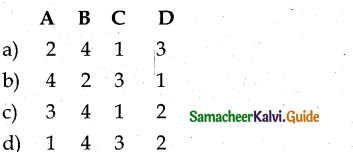
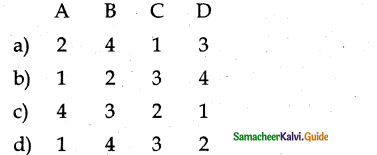
Question 1.
a) Y – 1) Consumption
b) C – 2) Income
c) S – 3) Investment
d) I – 4) Savings
Samacheer Kalvi 12th Economics Guide Chapter 4 Consumption and Investment Functions 2

Answer:
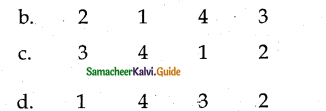
b) 2 1 4 3

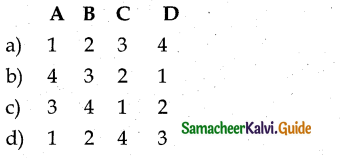
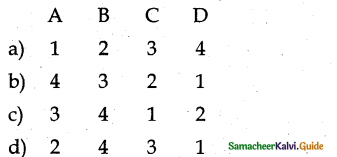
Question 2.
a) MPC – 1) C+S
b) K – 2) ΔI/Δ\C
c) Y – 3) ΔC/ΔY
d) 13 – 4) 1
\(\text { 4) } \frac{1}{1-M P C}\)
Samacheer Kalvi 12th Economics Guide Chapter 4 Consumption and Investment Functions 3.1
Samacheer Kalvi 12th Economics Guide Chapter 4 Consumption and Investment Functions 3
Answer :
c) 3 4 1 2

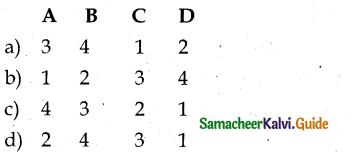
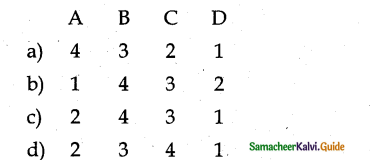
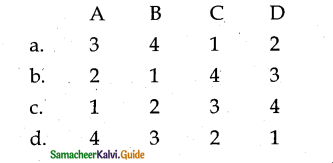
Question 3.
a) APC – 1) ∆S/∆Y
b) MPC – 2) S/Y
c) APS – 3) ∆C/∆Y
d) MPS – 4) C/Y
Samacheer Kalvi 12th Economics Guide Chapter 4 Consumption and Investment Functions 4
Answer:
d) 4 3 2 1

II. Choose the correct pair.

Question 1.
a) Multiplier – Dusenberry
b) Psychological Law of Consumption – M.F.Khan
c) Consumption function – Constant in Longrun
d) Income Multiplier – J.M.Keynes
Answer:
d) Income Multiplier – J.M.Keynes

Question 2.
a) K – Accelerator
b) β – Multiplier
c) Consumption function – C= f (y)
d) Investment function – I = f (s)
Answer:
c) Consumption function – C= f (y)

Question 3.
a) K – ∆Y/∆I
b) K – \(\frac{1}{1-\mathrm{MPS}}\)
c) MEC – Flow concept
d) MEl – Stock concept
Answer :
a) K – ∆Y/∆I

Samacheer Kalvi 12th Economics Guide Chapter 4 Consumption and Investment Functions

Question 4.
a) MPS = ∆Y/∆S
b) APS = C/Y
c) MPC = ∆C/∆Y
d) APC = S/Y
Answer:
MPC = \(\mathrm{MPC}=\frac{\Delta \mathrm{C}}{\Delta \mathrm{Y}}\)

III. Choose the incorrect pair

Question 1.
a) Multiplier concept – – Mf.khan
b) Investment Multiplier – J.M.Clark
c) Income Multiplier – J.M.Keynes
d) Accelerator concept – J.B.Say
Answer:
b) Investment Multiplier – J.B.Say

Question 2.
a) Y – Total Income
b) C – Savings expenditure
c) IA – Autonomous Investment
d) IP – Induced private investment
Answer:
b) C – Savings expenditure

Question 3.
a) Consumption function – relation between income and consumption
b) Autonomous Investment – investment independent of change in Income
c) Super Multiplier – K and β interaction.
d) Investment function – relation between consumption and investment.
Answer:
d) Investment function – relation between consumption and investment.

IV. Choose the correct statement

Question 1.
a) The primary microeconomic objective is the acceleration of the growth of national income.
b) MPC is expressed in percentage and the MPC infraction.
c) Laissez-Faire exists in a Capitalist Economy.
d) Increase in rate of interest reduces savings.
Answer:
c) Laissez – Faire exists in capitalist Economy.

Question 2.
a) When the government reduces the tax the disposable income falls.
b) Autonomous investment does not depend on the national income.
c) There exists a negative relationship between the national income and induced investment.
d) Investment depended exclusively on the rate of interest.
Answer:
b) Autonomous investment does not depend on the national income.

Question 3.
a) In times of economic depression, the governments try to boost the induced investment.
b) Induced investment is not profit-motivated.
c) Autonomous investment is profit-motivated.
d) Marginal Efficiency of capital refers to the annual percentage yield earned by the last additional unit of capital.
Answer:
d) Marginal Efficiency of capital refers to the annual percentage yield earned by the last additional unit of capital.

Samacheer Kalvi 12th Economics Guide Chapter 4 Consumption and Investment Functions

V. Choose the incorrect statement

Question 1.
a) Multiplier is classified as static and Dynamic multiplier.
b) The accelerator expresses the ratio of the net change in investment to change in consumption.
c) The concept of super multiplier was introduced by J.M.Keynes.
d) The combined effect of the multiplier and the accelerator is also called the leverage effect.
Answer:
c) The concept of super multiplier was introduced by J.M.Keynes.

Question 2.
a) Marginal propensity to consume is the ratio of consumption to income.
b) Marginal propensity to consume is the ratio of change in consumption to change in income.
c) Average propensity to save is the Ratio of the saving to income.
d) Marginal propensity to save is the ratio of change in saving to change in income.
Answer:
a) Marginal propensity to consume is the ratio of consumption to income.

Samacheer Kalvi 12th Economics Guide Chapter 4 Consumption and Investment Functions

Question 3.
a) Super multiplier is the combined effect of the interaction of multiplier and accelerator.
b) Super multiplier includes both autonomous and induced investment.
c) The desire to secure liquid resources to meet emergencies is called liquidity preference.
d) The subjective factors that determine consumption function are real and measurable.
Answer:
d) The subjective factors that determine consumption function are real and measurable.

VI. Pick the odd one out:

Question 1.
a) The motive of precaution
b) The motive of transaction
c) The motive of enterprise
d) The motive of avarice
Answer:
b)The motive of transaction

Question 2.
a) Multiplier
b) Accelerator
c) Super multiplier
d) Consumption function
Answer:
d) Consumption function

Samacheer Kalvi 12th Economics Guide Chapter 4 Consumption and Investment Functions

Question 3.
a) Income multiplier
b) Tax multiplier
c) Investment multiplier
d) Employment multiplier
Answer:
a) Income multiplier

VII. Analyse the reason.

Question 1.
Assertion (A): The relationship between income and consumption is called as consumption function.
Reason (R): Change in Income should be equal to change in consumption.
Answer:
c) (A) is true but (R)is false.

Question 2.
Assertion (A): Keynes propounded the fundamental psychological law of consumption which forms the basis of the consumption function.
Reason (R): There is a tendency on the part of the people to spend on consumption less than the full increment of income.
Answer :
a) Assertion (A) and Reason (R) both are true, and (R) is the correct explanation of (A).

Options:
a) Assertion (A) and Reason (R) both are true, and (R) is the correct explanation of (A).
b) Assertion (A) and Reason (R) both are true, and (R) is not the correct explanation of (A).
c) (A) is true but (R)is false.
d) Both (A) and (R) are false.

Samacheer Kalvi 12th Economics Guide Chapter 4 Consumption and Investment Functions

VIII. Choose the best Answer.

Question 1.
Price level plays an important role in determining the ……………………
(a) Consumption function
(b) Income function
(c) Finance function
(d) Price function
Answer:
(a) Consumption function

Question 2.
Objective factors are the ………………………………………… factors which are real and measurable.
a) Internal
b) External
c) Capital
d) Production
Answer:
b) External

Samacheer Kalvi 12th Economics Guide Chapter 4 Consumption and Investment Functions

Question 3.
Keynes has divided factors influencing the consumption function into …………….
a) 4
b) 1
c) 2
d) 3
Answer:
c) 2

Question 4.
…………………… is influenced by demonstration effect.
(a) Investment
(b) Interest
(c) Expenditure
(d) Consumption
Answer:
(d) Consumption

Samacheer Kalvi 12th Economics Guide Chapter 4 Consumption and Investment Functions

Question 5.
…………………… is one of the key concepts in welfare economics.
a) Induced investment
b) Autonomous Investment
c) Motivated Investment
d) None of the above
Answer:
b) Autonomous Investment

Question 6.
In times of economic depression, the governments try to boost the ……………….
a) Induced investment
b) Induced Investment
c) Motivated Investment
d) All the above
Answer:
c) Motivated Investment

Samacheer Kalvi 12th Economics Guide Chapter 4 Consumption and Investment Functions

Question 7.
The formula for Multiplier
Samacheer Kalvi 12th Economics Guide Chapter 4 Consumption and Investment Functions 5
Answer:
\(K=\frac{\Delta Y}{\Delta I}}\)

Question 8.
The formula for accelerator
E:\imagess\ch 10\Samacheer Kalvi 12th Economics Guide Chapter 4 Consumption and Investment Functions 6.png
Answer:
\(\beta=\frac{\Delta I}{\Delta C}\)

Question 9.
The combined effect of the interaction of multiplier and accelerator is called ……………………
(a) Super accelerator
(b) Super multiplier
(c) Accelerator
(d) Multiplier
Answer:
(b) Super multiplier

Question 10.
The systematic development of the simple accelerator model was made by …………..
a) J.M.Clark
b) Hawtrey
c) J.R.Hicks
d) J.M.Keynes
Answer:
a) J.M.Clark

Samacheer Kalvi 12th Economics Guide Chapter 4 Consumption and Investment Functions

IX. Fill in the Blanks.

Question 1.

Income Y

Consumption (C)

Savings S = Y – C

1. 120 120 0
2. 180 ? 10
3. 240 180 ?

Answer :
C = 170, S = 60

Question 2.

MPC

MPS

K

1) 0.00 1.00 1
2) 0.10 0.90 ?a
3) 0.50 ?b 2.00
4) 0.75 0.25 ?c
5) ?d 0.10 10.00
6) 1.00 0.00 ?e

Answer:
a) 1.11 b) 0.5 c) 4 d) 0.90 e) 0

Samacheer Kalvi 12th Economics Guide Chapter 4 Consumption and Investment Functions

X. 2 Mark Questions

Question 1.
Write “Propensity to consume” Equations?
Answer:

  • The Average Propensity to Consume = \(\frac{c}{y}\)
  • The Marginal Propensity to Consume = \(\frac{∆c}{∆y}\)
  • The Average Propensity to Save = \(\frac{x}{y}\)
  • The Marginal Propensity to Save = \(\frac{∆s}{∆y}\)

Question 2.
What is the investment function?
Answer:
The investment function refers to investment – interest rate relationship. There is a functional and inverse relationship between rate of interest and investment.

Question 3.
Define “Laissez-Faire” – Capitalist Economy?
Answer:
Existence of a Laissez-faire Capitalist Economy:
The law operates in a rich capitalist economy where there is no government intervention. People should be free to spend increased income. In the case of regulation of private enterprise and consumption expenditures by the State, the law breaks down.

Question 4.
What is the Marginal Efficiency of Capital?
Answer:
MEC refers to the annual percentage yield earned by the last additional unit of capital.

Question 5.
Mention the factors that MEC depends on.

  • The prospective yield from a capital asset.
  • The supply price of a capital asset.

Question 6.
What is autonomous consumption?
Answer:
Autonomous consumption is the minimum level of consumption or spending that must take place even if a consumer has no disposable income, such as spending for basic necessities.

Question 7.
Define “Autonomous consumption”?
Answer:
Autonomous Consumption:
Autonomous consumption is the minimum level of consumption or spending that must take place even if a consumer has no disposable income, such as spending for basic necessities.

Samacheer Kalvi 12th Economics Guide Chapter 4 Consumption and Investment Functions

Question 8.
Name the factors affecting MEC.
Answer:

  • The cost of the capital asset.
  • The expected rate of return during its lifetime.
  • The market rate of interest.

Question 9.
State Keynes psychological law of consumption.
Answer:
The law implies that there is a tendency on the part of the people to spend on consumption less than the full increment of income.

Question 10.
What are objective factors?
Answer:
Objective factors are the external factors which are real and measurable.

Question 11.
What is the Leverage Effect?
Answer:
The combined effect of the multiplier and the accelerator is called the leverage effect.

Samacheer Kalvi 12th Economics Guide Chapter 4 Consumption and Investment Functions

Question 12.
What is the Marginal Efficiency of Investment?
Answer:
MEI is the expected rate of return on investment as additional units of investment are made under specified conditions and over a period of time.

Question 13.
Differentiate Positive and Negative Multiplier Effects.
Answer:
Positive Multiplier: When an initial increase in an injection leads to a greater final increase in real GDP.
Negative Multiplier: When an initial increase is an injection leads to a greater final decrease in real GDP.

Question 14.
Mention the uses of Multiplier.
Answer:

  • Multiplier highlights the importance of investment in income and employment theory.
  • The process throws light on the different stages of the trade cycle.
  • It also helps is bringing equality between S and I.
  • It helps in formulating Government Policies.
  • It helps to reduce unemployment and achieve full employment.

Samacheer Kalvi 12th Economics Guide Chapter 4 Consumption and Investment Functions

XI. 5 Mark Questions

Question 1.
Name the determinants of investment functions?
Answer:

  • Rate of Interest
  • Level of Uncertainty
  • Political Environment
  • Rate of growth of population
  • The stock of Capital goods
  • The necessity of new products
  • Level of income of investors
  • Inventions and innovations
  • Consumer demand
  • The policy of the state.

Samacheer Kalvi 12th Economics Guide Chapter 4 Consumption and Investment Functions

Question 2.
Explain the Keynes Psychological Law’ of consumption assumptions?
Answer:
Keynes’s Law is based on the following assumptions:
1. Ceteris paribus (constant extraneous variables):
The other variables such as income distribution, tastes, habits, social customs, price movements, population growth, etc. do not change and consumption depends on income alone.

2. Existence of Normal Conditions:

  • The law holds good under normal conditions.
  • If, however, the economy is faced with abnormal and extraordinary circumstances like war, revolution, or hyperinflation, the law will not operate.
  • People may spend the whole of increased income on consumption.

3. Existence of a Laissez-faire Capitalist Economy:

  • The law operates in a rich capitalist economy where there is no government intervention.
  • People should be free to spend increased income.
  • In the case of regulation of private enterprise and consumption expenditures by the State, the law breaks down.

Samacheer Kalvi 12th Business Maths Guide Chapter 4 Differential Equations Ex 4.4

Tamilnadu State Board New Syllabus Samacheer Kalvi 12th Business Maths Guide Pdf Chapter 4 Differential Equations Ex 4.4 Text Book Back Questions and Answers, Notes.

Tamilnadu Samacheer Kalvi 12th Business Maths Solutions Chapter 4 Differential Equations Ex 4.4

Question 1.
\(\frac { dy }{dx}\) – \(\frac { dy }{dx}\) = x
Solution:
Samacheer Kalvi 12th Business Maths Guide Chapter 4 Differential Equations Ex 4.4 1
The required solution is
Samacheer Kalvi 12th Business Maths Guide Chapter 4 Differential Equations Ex 4.4 2

Samacheer Kalvi 12th Business Maths Guide Chapter 4 Differential Equations Ex 4.4

Question 2.
\(\frac { dy }{dx}\) + y cos x = sin x cos x
Solution:
It is of the form \(\frac { dy }{dx}\) + Py = Q
Here P = cos x; Q = sin x cos x
∫Pdx = ∫cos x dx = sin x
I.F = e∫pdx = esinx
The required solution is
Y(I.F) = ∫Q (IF) dx + c
Y(esinx) = ∫Q (I-F) dx + c
y (esinx) = ∫sin x cos x esinx dx + c
Samacheer Kalvi 12th Business Maths Guide Chapter 4 Differential Equations Ex 4.4 3

Samacheer Kalvi 12th Business Maths Guide Chapter 4 Differential Equations Ex 4.4

Question 3.
x\(\frac { dy }{dx}\) + 2y = x4
Solution:
The given equation can be reduced to
\(\frac { dy }{dx}\) + \(\frac { 2y }{x}\) = x³
It is of the form \(\frac { dy }{dx}\) + Py = Q
Here P = \(\frac { 2 }{x}\); Q = x³
∫pdx = ∫\(\frac { 2 }{x}\)dx = 2∫\(\frac { 1 }{x}\)dx = 2log x – log x²
I.F = e∫Pdx = elogx² = x²
The required solution is
y(I.F) = ∫Q (IF) dx + c
y(x²) = ∫x³ (x²) dx + c
x²y = ∫x5 dx + c
x²y = \(\frac { x^6 }{6}\) + c

Samacheer Kalvi 12th Business Maths Guide Chapter 4 Differential Equations Ex 4.4

Question 4.
\(\frac { dy }{dx}\) + \(\frac { 3x^2 }{1+x^3}\) = \(\frac { 1+x^2 }{1+x^3}\)
Solution:
Samacheer Kalvi 12th Business Maths Guide Chapter 4 Differential Equations Ex 4.4 4

Question 5.
\(\frac { dy }{dx}\) + \(\frac { y }{x}\) = xex
Solution:
\(\frac { dy }{dx}\) + py = Q
Here P = \(\frac { 1 }{x}\); Q = xex
∫Pdx = ∫\(\frac { 1 }{x}\) dx = log x
I.F = e∫Pdx = elog = x
The required solution is
y (I.F) = ∫Q (I.F) dx + c
Samacheer Kalvi 12th Business Maths Guide Chapter 4 Differential Equations Ex 4.4 5

Samacheer Kalvi 12th Business Maths Guide Chapter 4 Differential Equations Ex 4.4

Question 6.
\(\frac { dy }{dx}\) + y tan x = cos³ x
Solution:
It is of the form \(\frac { dy }{dx}\) + Py = Q
Here P = tan x; Q = cos³ x
∫Pdx = ∫tan x dx = ∫\(\frac { sin x }{cos x}\) dx = -∫\(\frac { -sin x }{cos x}\) dx
= -log cos x = log sec x
I.F = e∫Pdx = elog sec x = sec x
The required solution is
y(I.F) = ∫Q(I.F) dx + c
y (sec x) = ∫cos³x (sec x) dx + c
y(sec x) = ∫cos³x \(\frac { 1 }{cos x}\) dx + c
y (sec x) = ∫cos²x dx + c
y (sec x)= ∫(\(\frac { 1+cos 2x }{2}\)) dx + c
y (sec x) = \(\frac { 1 }{2}\) ∫(1 + cos2x) dx + c
y (sec x) = \(\frac { 1 }{2}\) [x + \(\frac { sin2x }{2}\)] + c

Samacheer Kalvi 12th Business Maths Guide Chapter 4 Differential Equations Ex 4.4

Question 7.
If \(\frac { dy }{dx}\) + 2y tan x = sinx and if y = 0 when x = π/3 express y in terms of x
Solution:
\(\frac { dy }{dx}\) + 2y tan x = sinx
It is of the form \(\frac { dy }{dx}\) + Py = Q
Here P = 2tan x ; Q = sin x
∫Pdx = ∫2 tan x dx = 2∫tan xdx = 2 log sec x
log sec² x
I.F = e∫Pdx = elog(sec²x) = sec² x
The required solution is
y(I.F) = ∫Q(I.F) dx + c
y (sec² x) = ∫sin x (sec²x) dx + c
y(sec²x) = ∫sin x(\(\frac { 1 }{cos x}\)) sec x dx + c
y sec²x = ∫(\(\frac { sin x }{cos x}\)) sec x dx + c
y(sec²x) = ∫tan x sec x dx + c
⇒ y(sec²x) = sec x + c ………. (1)
If y = 0 when x = /3, then (1) ⇒
0(sec²(π/3)) = sec(π/3) + c
0 = 2 + c
⇒ c = -2
∴ Eqn (1) ⇒ y sec²x = sec x – 2

Question 8.
\(\frac { dy }{dx}\) + \(\frac { y }{x}\) = xex
Solution:
It is of the form \(\frac { dy }{dx}\) + Py = Q
Here P = \(\frac { 1 }{x}\); Q = xex
∫Pdx = ∫\(\frac { 1 }{x}\) dx = log x
I.F = e∫Pdx = elog x = x
The required solution is
Samacheer Kalvi 12th Business Maths Guide Chapter 4 Differential Equations Ex 4.4 6

Samacheer Kalvi 12th Business Maths Guide Chapter 4 Differential Equations Ex 4.4

Question 9.
A bank pays interest by contionous compounding, that is by treating the interest rate as the instantaneous rate of change of principal. A man invests Rs 1,00,000 in the bank deposit which accures interest, 8% over year compounded continuously. How much will he get after 10 years?
Solution :
Let P(t) denotes the amount of money in the account at time t. Then the differential equation govemning the growth of money is
\(\frac { dp }{dt}\) = \(\frac { 8 }{100}\)p = 0.08 p
⇒ \(\frac { dp }{p}\) = 0.08 dt
Integrating on both sides
∫\(\frac { dp }{p}\) = ∫0.08 dt
loge P = 0.08 t + c
P = e0.08 t + c
P = e0.08 t. ec
P = C1 e0.08 t ………. (1)
when t = 0, P = Rs 1,00,000
Eqn (1) ⇒ 1,00,000 = C1
C1 = 1,00,000
∴ P = 100000 e0.08 t
At t = 10
P= 1,00,000 . e0.08(10)
= 1,00,000 e0.8 {∵ e0.8 = 2.2255}
= 100000 (2.2255)
p = Rs 2,25,550

Samacheer Kalvi 12th Business Maths Guide Chapter 4 Differential Equations Ex 4.4

Samacheer Kalvi 12th Economics Guide Chapter 3 Theories of Employment and Income

Tamilnadu State Board New Syllabus Samacheer Kalvi 12th Economics Guide Pdf Chapter 3 Theories of  Employment and Income Text Book Back Questions and Answers, Notes.

Tamilnadu Samacheer Kalvi 12th Economics Solutions Chapter 3 Theories of Employment and Income

12th Economics Guide Theories of Employment and Income Text Book Back Questions and Answers

PART – A

Multiple Choice questions

Question 1.
Every able bodied person who is willing to work at the prevailing wage rate is employed called as ……………..
a) Full employment
b) Under employment
c) Unemployment
d) Employment opportunity
Answer:
a) Full employment

Question 2.
Structural unemployment is a feature in a ……………
a) Static society
b) Socialist society
c) Dynamic society
d) Mixed economy
Answer:
c) Dynamic society

Samacheer Kalvi 12th Economics Guide Chapter 3 Theories of Employment and Income

Question 3.
In disguised unemployment, the marginal productivity of labour is ……………..
a) Zero
b) One
c) Two
d) Positive
Answer:
a) Zero

Question 4.
The main concention of the classical Economic Theory is …………..
a) Under employment
b) Economy is always in the state of equilibrium
c) Demand creates its supply
d) Imperfect competition
Answer:
b) Economy is always in the state of equilibrium

Samacheer Kalvi 12th Economics Guide Chapter 3 Theories of Employment and Income

Question 5.
J.B. say is a ……………
a) New classical Economist
b) Classical Economist
c) Modern Economist
d) New Economist
Answer:
b) Classical Economist

Question 6.
According to keynes, which type of unemployment prevails in capitalist economy?
a) Full employment
b) Voluntary unemployment
c) Involuntary unemployment
d) Under employment
Answer:
d) Under employment

Samacheer Kalvi 12th Economics Guide Chapter 3 Theories of Employment and Income

Question 7.
The core of the classical theory of employment is
a) Law of Diminishing Return
b) Law of demand
c) Law of markets
d) Law of consumption
Answer:
c) Law of markets

Question 8.
Keynes attributes unemployment to ……………………..
a) A lack of effective supply
b) A lack of effective demand
c) A lack of both
d) None of the above
Answer:
b) A lack of effective demand

Samacheer Kalvi 12th Economics Guide Chapter 3 Theories of Employment and Income

Question 9.
………………………….. Flexibility brings equality between saving and investment.
a) Demand
b) Supply
c) Capital
d) Interest
Answer:
d) Interest

Question 10.
…………………. theory is a turning point in the development of modern economic theory.
a) Keynes
b) Say’s
c) Classical
d) Employment
Answer:
a) Keynes

Samacheer Kalvi 12th Economics Guide Chapter 3 Theories of Employment and Income

Question 11.
The basic concept used in keynes Theory of Employment and Income is ……………….
a) Aggregate demand
b) Aggregate supply
c) Effective demand
d) Marginal propensity to consume
Answer:
d) Marginal propensity to consume

Question 12.
The component of aggregate demand is …………………
a) Personal demand
b) Government expenditure
c) Only export
d) Only import
Answer:
b) Government expenditure

Samacheer Kalvi 12th Economics Guide Chapter 3 Theories of Employment and Income

Question 13.
Aggregate supply is equal to ………….
a) ‘C + I + G
b) C+S+T + (x-m)
c) C+ S+ T+ (x – m)
d) C+ S+ T+ Rf
Answer:
d) C+ S+ T+ Rf

Question 14.
Keynes theory pursues to replace Laissez Faire by ………………….
a) No government intervention
b) Maximum intervention
c) State intervention in certain situation .
d) Private Sector Intervention
Answer:
c) State intervention in a certain situation

Samacheer Kalvi 12th Economics Guide Chapter 3 Theories of Employment and Income

Question 15.
In Keynes theory of employment and income ……………………… is the basic cause of economic depression.
a) Less production
b) More demand
c) Inelastic supply
d) Less aggregate demand in relation to productive capacity
Answer:
d) Less aggregate demand in relation to productive capacity

Question 16.
Classical theory advocates ………………
a) Balanced budget
b) Unbalanced budget
c) Surplus budget
d) Deficit budget
Answer:
a) Balanced budget

Samacheer Kalvi 12th Economics Guide Chapter 3 Theories of Employment and Income

Question 17.
Keynes theory emphasized on ………………….. equilibrium.
a) Very short run
b) Short-run
c) Very long run
d) Long run
Answer:
b) Short-run

Samacheer Kalvi 12th Economics Guide Chapter 3 Theories of Employment and Income

Question 18.
According to classical theory, the rate of interest is a reward for …………….
a) Investment
b) Demand
c) Capital
d) Saving
Answer:
d) Saving

Samacheer Kalvi 12th Economics Guide Chapter 3 Theories of Employment and Income

Question 19.
In Keynes theory, the demand for and supply of money are determined by …………………..
a) Rate of interest
b) Effective demand
c) Aggregate demand
d) Aggregate supply
Answer:
a) Rate of interest

Question 20.
Say’s law stressed the operation of ……………………. in the economy.
a) Induced price mechanism
b) Automatic price mechanism
c) Induced demand
d) Induced investment
Answer:
b) Automatic price mechanism

Samacheer Kalvi 12th Economics Guide Chapter 3 Theories of Employment and Income

PART -B

Answer the following questions in one or two sentences.

Question 21.
Define full employment.
Answer:
Full employment refers to a situation in which every able-bodied person who is willing to work at the prevailing wage rate, is employed. In other words, full employment means that persons who are willing to work and able to work must have employment or a job.

Question 22.
What is the main feature of rural unemployment?
Answer:
The existence of disguised unemployment and seasonal unemployment is the main feature of rural unemployment.

Samacheer Kalvi 12th Economics Guide Chapter 3 Theories of Employment and Income

Question 23.
Give a short note on frictional unemployment.
Answer:
Frictional Unemployment (Temporary Unemployment):

  1. Frictional unemployment arises due to an imbalance between the supply of labour and demand for labour.
  2. This is because of immobility of labour, lack of necessary skills, break down of machinery, shortage of raw materials etc.
  3. The persons who lose jobs and in search of jobs are also included under frictional unemployment.

Question 24.
Give reasons for labour retrenchment at the present situation.
Answer:

  • Capital intensive techniques.
  • Invention and innovations
  • Labour saving devices are reasons for retrenchment.

Samacheer Kalvi 12th Economics Guide Chapter 3 Theories of Employment and Income

Question 25.
List out the assumptions of Say’s law.
Answer:
The Say’s Law of the market is based on the following assumptions:

  1. No single buyer or seller of commodity or input can affect the price.
  2. Full employment.
  3. People are motivated by self-interest and self-interest determines economic decisions.
  4. The laissez-faire policy is essential for an automatic and self-adjusting process of full employment equilibrium. Market forces determine everything right.
  5. There will be perfect competition in labour and product market.
  6. There is wage-price flexibility.
  7. Money acts only as a medium of exchange.
  8. Long-run analysis.
  9. There is no possibility for overproduction or unemployment.

Question 26.
What is effective demand?
Answer:

  • Effective demand denotes money actually spent by the people on products of industry.
  • Effective demand equals national income.

Samacheer Kalvi 12th Economics Guide Chapter 3 Theories of Employment and Income

Question 27.
What are the components of aggregate supply?
Answer:
Aggregate demand has the following four components:

  1. Consumption demand
  2. Investment demand
  3. Government expenditure and
  4. Net Export (export-import)

PART – C

Answer the following questions in a paragraph.
Question 28.
Explain the following in short
Answer:
(i) Seasonal unemployment
This type of unemployment occurs during certain seasons of the year.
(ii) Frictional unemployment
This type of unemployment arises due to an imbalance between supply and demand for labour.
iii) Educated unemployment
Sometimes educated people are underemployed or unemployed when qualification does not match the job.

Samacheer Kalvi 12th Economics Guide Chapter 3 Theories of Employment and Income

Question 29.
Write a short note on the implications of Say’s law.
Answer:
Implications of Say’s Law:

  1. There is no possibility for overproduction or unemployment.
  2. If there exist unutilized resources in the economy, it is profitable to employ them up to the point of full employment. This is true under the condition that factors are willing to accept rewards on a par with their productivity.
  3. As an automatic price mechanism operates in the economy, there is no need for government intervention. (However, J.M. Keynes emphasized the role of the State)
  4. Interest flexibility brings about equality between saving and investment.
  5. Money performs only the medium of exchange function in the economy, as people will not hold idle money.

Question 30.
Explain Keynes theory in the form of a flow chart.
Answer:
Samacheer Kalvi 12th Economics Guide Chapter 3 Theories of Employment and Income 1

Question 31.
What do you mean by aggregate demand? Mention its components.
Answer:

  1. The aggregate demand is the amount of money which entrepreneurs expect to get by selling the output produced by the number of labourers employed.
  2. Therefore, it is the expected income or revenue from the sale of output at different levels of employment.
  3. Aggregate demand has the following four components:
    • Consumption demand
    • InvestmenTdemand
    • Government expenditure and
    • Net Export (export-import)

Samacheer Kalvi 12th Economics Guide Chapter 3 Theories of Employment and Income

Question 32.
Explain aggregate supply with the help of a diagram.
Answer:
In figure two aggregate supply curves are drawn with the assumption of fixed money wages and variable wages…
Samacheer Kalvi 12th Economics Guide Chapter 3 Theories of Employment and Income 2

  • Z curve is linear where money wages remain fixed; Z1.curve is non-linear since wage rate increases with employment.
  • At full employment level (Nf) aggregate supply curve becomes inelastic.
  • The slope of the aggregate supply curve depends on the relationship between employment and productivity.
  • Based on this relation, the aggregate supply curve is expected to slope upwards. In reality, the aggregate supply curve will be like Z1.
  • Therefore, the aggregate supply depends on the relationship between price and wages.

Question 33.
Write any five differences between classicism and Keynesianism.
Answer:

S.No

Keynesianism

Classicism

1. Short-run equilibrium Long-run equilibrium
2. Saving is a vice Saving is a social virtue
3. State intervention is advocated Laissez-faire policy
4. Rate of interest is a flow Rate of interest is a stock
5. Demand creates its own supply Supply creates its own demand

PART – D

Answer the following questions on the about page.

Question 34.
Describe the types of unemployment.
Answer:
1. Cyclical unemployment:
In a business cycle during the period of recession and depression, income and output fall leading to widespread unemployment. It can be cured by public investment or expansionary monetary policy.

2. Seasonal unemployment:
This type of unemployment occurs during certain seasons of the year.
Eg : Agriculture and Agro-based industries.

3. Frictional unemployment:
This type of unemployment arises due to an imbalance between supply and demand for labour.

4. Educated unemployment:
Sometimes educated people are underemployed or unemployed when qualification does not match the job.

5. Technical unemployment:
Modern technology being capital intensive requires less labourers and con-tributes to technological unemployment.

6. Structural unemployment:
Structural unemployment is due to a drastic change in the structure of society.

7. Disguised unemployment:
A person is said to be disguisedly unemployed if his contribution top out-put is less than what he can produce by working for normal hours per day. In this situation, the marginal productivity of labour is zero or less or negative.

Samacheer Kalvi 12th Economics Guide Chapter 3 Theories of Employment and Income

Question 35.
Critically explain Say’s law of the market.
Answer:
Criticisms of Say’s Law: The following are the criticisms against Say’s law:

  1. According to Keynes, supply does not create its demand. It is not applicable where demand does not increase as much as production increases.
  2. The automatic adjustment process will not remove unemployment. Unemployment can be removed by an increase in the rate of investment.
  3. Money is not neutral. Individuals hold money for unforeseen contingencies while businessmen keep a cash reserves for future activities.
  4. Say’s law is based on the proposition that supply creates its own demand and there is no overproduction. Keynes said that overproduction is possible.
  5. Keynes regards full employment as a special case because there is underemployment in capitalist economies.
  6. The need for state intervention arises in the case of general overproduction and mass unemployment.

Samacheer Kalvi 12th Economics Guide Chapter 3 Theories of Employment and Income

Question 36.
Narrate the equilibrium between ADF and ASF with a diagram.
Answer:

  • Under the Keynes theory of employment, a simple two-sector economy is taken to understand the equilibrium between ADF and ASF.
  • All the decisions concerning consumption expenditure are taken by the house-holds, while the business firms take decisions concerning investment.
  • It is also assumed that the consumption function is linear and planned investment is autonomous.
    Samacheer Kalvi 12th Economics Guide Chapter 3 Theories of Employment and Income 3
  • In the figure, the aggregate demand and aggregate supply reach equilibrium at point E. The employment level is No at that point.
  • At ON1 employment, the aggregate supply is N1R1 But they are able to produce M1N1  M1 R1To the expected level of profit is M1R1 attain this level of profit, entrepreneurs will employ more labourers.
  • The tendency to employ more labour will stop once they reach E. At all levels of employment beyond, ONo, the AD curve is below the AS curve indicating loss to the producers.
  • Hence they will never employ more than ONo labor. Thus effective demand concept becomes a crucial point in determining the equilibrium level of output in the capitalist economy in the Keynesian system.
  • The equilibrium level of employment need not be the full employment level (N)1. The difference between (No –  Nf )is the level of unemployment.
  • Thus Effective demand is significant to explain the under-employment equilibrium.

Question 37.
Explain the differences between classical theory and Keynes theory:
Answer:

Keynesianism

Classicism

1.Short- run equilibrium Long-run equilibrium
2. Saving is a vice Saving is a social virtue
3. The function of money as a medium of exchange and store of value The function of money is to act as a medium of exchange
4. Macro approach to the national problem Micro foundation to macro problems
5. State intervention is advocated Champions of Laissez-faire policy
6. Applicable to both full employment and less than full employment level Applicable only to the full employment situation.
7. Capitalism has inherent contradictions Capitalism is well and good
8. Unbalanced budget Balanced Budget
9. Rate of interest is a flow Rate of interest is a stock
10. Demand creates its own supply Supply creates its own demand.

12th Economics Guide Theories of Employment and Income Additional Important Questions and Answers

I. Match the following

Question 1.
a) J.B. Say – 1) Classical Economists
b) Adam Smith – 2) Law of Market
c) AC. Pigou – 3) Effective Demand
d) J.M.Keynes – 4) Wealth of Nations
Samacheer Kalvi 12th Economics Guide Chapter 3 Theories of Employment and Income 4

Answer:
b) 2 4 1 3

Question 2.
a) Rural Areas – 1) Educated unemployment
b) Urban Areas – 2) Seasonal unemployment
c) Lack of employable skills – 3) Structural unemployment
d) Lack of demand – 4) Frictional unemployment
Samacheer Kalvi 12th Economics Guide Chapter 3 Theories of Employment and Income 5
Answer:
a) 2 4 13

Question 3.
a) MPC – 1) C + I + G + (X – M)
b) MEC – 2) C + S + T + Rf
c) AD – 3) Marginal propensity to consume ’
d) AS – 4) Marginal Efficiency of capital
Samacheer Kalvi 12th Economics Guide Chapter 3 Theories of Employment and Income 5
Answer :
d) 3 4 1 2.

Samacheer Kalvi 12th Economics Guide Chapter 3 Theories of Employment and Income

II. Choose the correct pair

Question 1.
a) Long-run – Full employment
b) Market Economy – Government control
c) Keynes theory – Long run
d) Structural unemployment – Agriculture
Answer:
a) Long-run – Full employment

Question 2.
a) C – Private savings
b) S – Consumption Expenditure
c)T – Net tax payments ‘
d) Rf – Tax rate
Answer:
c) T – Net tax payments

Samacheer Kalvi 12th Economics Guide Chapter 3 Theories of Employment and Income

Question 3.
a) Effective demand – Percapita Income
b) Equilibrium – Full employment
c) Aggregate supply function – Elastic
d) Say’s law – Underemployment
Answer:
b) Equilibrium – Full employment

III. Choose the incorrect pair

Question 1.
a) Price Mechanism- Lassiez faire Economy
b) J.B. Say – Classical theory
c) J.M. Keynes – Macro Economics
d) Law of the market – Underemployment
Answer:
d) Law of the market – Underemployment

Question 2.
a) Business cycle
b) Seasonal unemployment
c) New technology
d) Disguised unemployment
Answer:
b) Seasonal unemployment – Industrial sector

Samacheer Kalvi 12th Economics Guide Chapter 3 Theories of Employment and Income

Question 3.
a) Aggregate supply price – Income
b) Consumption function – Straight line
c) Keynes theory – Induced Investment
d) Equilibrium – Underemployment
Answer:
d) Equilibrium – Underemployment

IV. Choose the correct statement

Question 1.
a) Equilibrium level of employment refers to full employment.
b) According to Say’s law demand creates its own supply.
c) Adam smith published his books “An enquiry into the nature and causes of the wealth of nations” in the year 1776.
d) Technical unemployment is due to drastic change in the structure of the society
Answer:
c) Adam smith published his books “An enquiry into the nature and causes of wealth of nations” in the year 1776.

Samacheer Kalvi 12th Economics Guide Chapter 3 Theories of Employment and Income

Question 2.
Assumptions of Say’s law of markets :
a) Existence of underemployment.
b) Money is a prominent force in the economy.
c) Government interference is a must.
d) Long-run analysis.
Answer: Long run analysis.

Question 3.
a) Keynes supported the ideas of classical Economists.
b) An increase in the aggregate effective demand would increase the level of employment.
c) Effective Demand is less than National income.
d) Price refers to the cost of production.
Answer:
b) An increase in the aggregate effective demand would increase the level of employment.

Samacheer Kalvi 12th Economics Guide Chapter 3 Theories of Employment and Income

V. Choose the incorrect statement

Question 1.
a) Keynes defines full employment as the absence of involuntary unemployment.
b) Full employment generally refers to the full employment of labour force of a country.
c) In developed countries the unemployment is purely structural.
d) Disguised unemployment occurs when more people are than what is actually required.
Answer:
c) In developed countries the unemployment is purely structural.

Question 2.
a) In Disguised unemployment and seasonal unemployment are seen in rural areas.
b) Due to Globalisation, a large number of people move from rural areas to urban areas.
c) Cyclical unemployment can be cured by public investment or expansionary monetary policy.
d) Seasonal unemployment occurs during certain seasons of the year.
Answer:
b) Due to Globalisation, a large number of people move from rural areas to urban areas.

Samacheer Kalvi 12th Economics Guide Chapter 3 Theories of Employment and Income

Question 3.
a) In disguised unemployment marginal productivity of labour is positive.
b) Laissez-faire is a situation found in Market Economy.
c) According to J.B.Say “supply creates its own demand”.
d) Aggregate supply curve is inelastic.
Answer:
c) According to J.B.Say “supply creates its own demand”.

VI. Pick the odd one out:

Question 1.
The components of Aggregate supply are
a) Total Expenditure
b) Private savings
c) Net tax payments
d) Transfer payments to the foreigners
Answer:
a) Total Expenditure

Question 2.
The components of Aggregate Demand are
a) Consumption demand
b) Investment demand
c) Government expenditure
d) Net Import
Answer:
d) Net Import

Samacheer Kalvi 12th Economics Guide Chapter 3 Theories of Employment and Income

VII. Analyse the reason:

Question 1.
Assertion (A): Aggregate supply is equal to the value of the national product.
Reason (R): Aggregate supply refers to the value of the total output of goods and services produced in an economy in a year.
Answer :
a) Assertion (A) and Reason (R) both are true and (R) is the correct explanation of (A)

Question 2.
Assertion (A): Supply creates its own demand.
Reason (R): Each product produced in the economy creates demand equal to its value in the market.
Answer:
a) Assertion (A) and Reason (R) both are true and (R) is the correct explanation of (A)

Question 3.
Assertion (A) : Seasonal unemployment occurs during certain seasons of the year.
Reason (R) : Seasonal unemployment exists during the downturn phase of the trade cycle in the economy.
Answer:
c) Assertion (A) is true, Reason (R) is false Options.

Question 4.
Assertion (A): Seasonal unemployment occurs during certain seasons of the year.
Reason (R): Seasonal unemployment exists during the downturn phase of the trade cycle in the economy.
Answer:
c) Assertion (A) is true, Reason (R) is false.
Options:
a)Assertion (A) and Reason (R) both are true and (R) is the correct explanation of (A).
b) Assertion (A) and Reason (R) both are true, but (R) is not the correct, explanation of (A).
c) Assertion (A) is true, Reason (R) is false.
d) Both (A) and (R) are false.

Samacheer Kalvi 12th Economics Guide Chapter 3 Theories of Employment and Income

VIII. Choose the best Answer

Question 1.
Who is one of the greatest and most influential economists?
(a) J.M. Keynes
(b) Adam Smith
(c) Marshall
(d) Simon Kuznets
Answer:
(a) J.M. Keynes

Question 2.
Aggregate demand can be expressed as
a) AD = C + G + I + (M – X)
b) AD = I + G + C + (X – M)
c) AD = C + I + G + (X – M)
d) AD = C + I + G +(x – M)
Answer:
c) AD = C+I+G+(X-M)

Samacheer Kalvi 12th Economics Guide Chapter 3 Theories of Employment and Income

Question 3.
The total stock of money circulating in an Economy is called –
(a) Money
(b) Capital
(c) Money Supply
(d) Finance
Answer:
(c) Money Supply

Question 4.
Capital intensive technology and innovations lead to ………………….. Unemployment.
a) Structural
b) Technical
c) Seasonal
d) Disguised
Answer:
b) Technical

Samacheer Kalvi 12th Economics Guide Chapter 3 Theories of Employment and Income

Question 5.
How many components are there in the aggregate supply
a) 3
b) 4
c) 1
d) 2
Answer:
b) 4

Question 6.
…………………… is an increasing function of the level of employment –
(a) Aggregate supply function
(b) Aggregate demand function
(c) Aggregate consumption function
(d) Aggregate consumption expenditure
Answer:
(a) Aggregate supply function

Samacheer Kalvi 12th Economics Guide Chapter 3 Theories of Employment and Income

Question 7.
Keynes defines full employment as the absence of ………………….. unemployment.
a) Structural
b) Involuntary
c) Seasonal
d) Voluntary
Answer:
b) Involuntary

Question 8.
…………………… Unemployment arises due to an imbalance between the supply of and demand for labour.
a) Frictional
b) Educated
c) Seasonal
d) Technical
Answer:
a) Frictional

Samacheer Kalvi 12th Economics Guide Chapter 3 Theories of Employment and Income

Question 9.
Adam Smith published his book ‘An enquiry into the Nature and Causes of the Wealth of Nations” in ’ ……………………
a) 1767
b) 1776
c) 1676
d) 1176
Answer:
b) 1776

Question 10.
Frictional unemployment another name is called –
(a) Educated unemployment
(b) Seasonal unemployment
(c) Temporary unemployment
(d) Technical unemployment
Answer:
(c) Temporary unemployment

Samacheer Kalvi 12th Economics Guide Chapter 3 Theories of Employment and Income

IX. Answer the following questions (2 Marks)

Question 1.
Write two approaches of the equilibrium level of Income in Keynesian theory?
Answer:
There are two approaches to the determination of the equilibrium level of income in Keynesian theory. These are:

  1. Aggregate demand – Aggregate supply approach
  2. Saving – An investment approach

Question 2.
What is marginal propensity to consume?
Answer:
Marginal propensity to consume is the additional consumption due to an additional unit of income.

Samacheer Kalvi 12th Economics Guide Chapter 3 Theories of Employment and Income

Question 3.
Define “Marginal propensity to consume”?
Answer:
Marginal Propensity to Consume is the additional consumption due to an additional unit of income.

Question 4.
What is Underemployment?
Answer:
Underemployment is a situation where resources are not fully utilized in production.

Samacheer Kalvi 12th Economics Guide Chapter 3 Theories of Employment and Income

Question 4.
Write the types of unemployment?
Answer:
Types of unemployment:

  1. Cyclical Unemployment
  2. Frictional Unemployment
  3. Technical Unemployment
  4. Disguised Unemployment
  5. Seasonal Unemployment
  6. Educated Unemployment
  7. Structural Unemployment

Question 6.
State J.B.Say’s law of Market.
Answer:
J.B. Say enunciated the proposition that” Supply creates its own demand”.

Samacheer Kalvi 12th Economics Guide Chapter 3 Theories of Employment and Income

X. Answer the following questions (3 Marks)

Question 1.
Mention the types of Unemployment.
Answer:
There are seven types of unemployment. They are

  1. Cyclical Unemployment
  2. Seasonal Unemployment
  3. Frictional Unemployment
  4. Educated Unemployment
  5. Technical Unemployment
  6. Structural Unemployment
  7. Disguised Unemployment

Samacheer Kalvi 12th Economics Guide Chapter 3 Theories of Employment and Income

Question 2.
Aggregate Supply Function meaning and components?
Answer:

  1. Aggregate supply function is an increasing function of the level of employment.
  2. Aggregate supply refers to the value of the total output of goods and services produced in an economy in a year.
  3. In other words, aggregate supply is equal to the value of the national product, i.e., national income.

The components of aggregate supply are:

  1. Aggregate (desired) consumption expenditure (C)
  2. Aggregate (desired) private savings (S)
  3. Net tax payments (T) (Total tax payment to be received by the government minus transfer payments, subsidy and interest payments to be incurred by the government)
  4. Personal (desired) transfer payments to the foreigners (Rf) (e.g. Donations to international relief efforts)

Question 3.
What is the Marginal Efficiency of Capital?
Answer:

  • Marginal Efficiency of Capital is the expected rate of return over costs of a new capital good.
  • MEC depends on two factors namely prospective yield of a capital asset and sup-ply price of capital.

Samacheer Kalvi 12th Economics Guide Chapter 3 Theories of Employment and Income

Question 4.
Name the Motives of Liquidity Preference.
Answer:
Liquidity preference is based on three motives namely

  • Transaction Motive
  • Precautionary Motive
  • Speculative Motive

Samacheer Kalvi 12th Economics Guide Chapter 3 Theories of Employment and Income

Samacheer Kalvi 12th Business Maths Guide Chapter 4 Differential Equations Ex 4.3

Tamilnadu State Board New Syllabus Samacheer Kalvi 12th Business Maths Guide Pdf Chapter 4 Differential Equations Ex 4.3 Text Book Back Questions and Answers, Notes.

Tamilnadu Samacheer Kalvi 12th Business Maths Solutions Chapter 4 Differential Equations Ex 4.3

Question 1.
Solve:
x\(\frac { dy }{dx}\) = x + y
Solution:
x\(\frac { dy }{dx}\) = x + y
x\(\frac { dy }{dx}\) = x + y ⇒ \(\frac { dy }{dx}\) = \(\frac { x+y }{x}\) ……… (1)
It is a homogeneous differential equation, Same degree in x and y
Samacheer Kalvi 12th Business Maths Guide Chapter 4 Differential Equations Ex 4.3 1
Integrating on both sides
∫\(\frac { 1 }{x}\) dx = ∫dv
log x = v + c ⇒ x = e(v+c)
x = ev.ec
x = ev. c ⇒ x = cev [⇒ v = \(\frac { y }{x}\)]
⇒ x = cey/x

Samacheer Kalvi 12th Business Maths Guide Chapter 4 Differential Equations Ex 4.3

Question 2.
(x – y) \(\frac { dy }{dx}\) = x + 3y
Solution:
(x – y) \(\frac { dy }{dx}\) = x + 3y
\(\frac { dy }{dx}\) = \(\frac { x+3y }{(x-y)}\) ……… (1)
It is a homogeneous differential equation same degree in x and y
Samacheer Kalvi 12th Business Maths Guide Chapter 4 Differential Equations Ex 4.3 2
Integrating on both sides
Samacheer Kalvi 12th Business Maths Guide Chapter 4 Differential Equations Ex 4.3 3

Samacheer Kalvi 12th Business Maths Guide Chapter 4 Differential Equations Ex 4.3

Question 3.
x\(\frac { dy }{dx}\) – y = \(\sqrt { x^2+y^2}\)
Solution:
Samacheer Kalvi 12th Business Maths Guide Chapter 4 Differential Equations Ex 4.3 4
It is a homogeneous differential equation, same degree in x and y
Samacheer Kalvi 12th Business Maths Guide Chapter 4 Differential Equations Ex 4.3 5

Samacheer Kalvi 12th Business Maths Guide Chapter 4 Differential Equations Ex 4.3

Question 4.
\(\frac { dy }{dx}\) = \(\frac { 3x-2y }{2x-3y}\)
Solution:
\(\frac { dy }{dx}\) = \(\frac { 3x-2y }{2x-3y}\) …….. (1)
It is a homogeneous differential equation same degree in x and y
Samacheer Kalvi 12th Business Maths Guide Chapter 4 Differential Equations Ex 4.3 6
Integrating on both sides
Samacheer Kalvi 12th Business Maths Guide Chapter 4 Differential Equations Ex 4.3 7
Squaring on both sides
Samacheer Kalvi 12th Business Maths Guide Chapter 4 Differential Equations Ex 4.3 8

Samacheer Kalvi 12th Business Maths Guide Chapter 4 Differential Equations Ex 4.3

Question 5.
(y² – 2xy) dx = (x² – 2xy)dy
Solution:
(y² – 2xy) dx = (x² – 2xy)dy
Samacheer Kalvi 12th Business Maths Guide Chapter 4 Differential Equations Ex 4.3 9
Integrating on both sides
Samacheer Kalvi 12th Business Maths Guide Chapter 4 Differential Equations Ex 4.3 10
Cubing on both sides
Samacheer Kalvi 12th Business Maths Guide Chapter 4 Differential Equations Ex 4.3 11

Samacheer Kalvi 12th Business Maths Guide Chapter 4 Differential Equations Ex 4.3

Question 6.
The slope of the tangent to a curve at any point (x, y) on it is given by (y³ – 2yx²) dx + (2xy² – x³) dy = 0 and the curve passes throngh (1, 2). Find the equation of the curve.
Solution:
Given that equation of the slope of tangent
(y³ – 2yx²) dx + (2xy² – x²) dy = 0
(2xy² – x³) dy = – (y³ – 2yx²) dx
(2xy² – x³) dy = (2yx² – y³) dx
\(\frac { dy }{dx}\) = \(\frac { (2yx^2-y^3) }{(2xy^2-x^3)}\) ………. (1)
It is a homogeneous differential equation same degree in x and y.
Samacheer Kalvi 12th Business Maths Guide Chapter 4 Differential Equations Ex 4.3 12
⇒ 2v² – 1 = A(v² – 1) + B(v) (v + 1) + C(v) (v – 1) ………. (4)
Put v = 0 in (2)
-1 = A(-1) ⇒ A = 1
Put v = -1
2(-1)² – 1 = [A(-1)² -1] + B(0) + C(-1) (-1 -1)
2 – 1 = A(0) + B(0) + C(-1) (-2)
1 = 2C ⇒ C = 1/2
Put v = 1
2(1)² – 1 = [A(1)² – 1] + B(1) (1 +1) + C(1)(1 – 1)
2 – 1 = A(0) + B(2) + C(0)
2B = 1 ⇒ B = 1/2
Substitute A = 1, B = 1/2 and C = 1/2 in (1)
Samacheer Kalvi 12th Business Maths Guide Chapter 4 Differential Equations Ex 4.3 13

Samacheer Kalvi 12th Business Maths Guide Chapter 4 Differential Equations Ex 4.3

Question 7.
An electric manufacturing company makes small household switchs. The company estimates the marginal revenue function for these switches to be (x² + y²) dy = xy dx where x represents the number of units (in thounsands). What is the total revenue function?
Solution:
Given
Marginal revenue for the switches
(x² + y²) dy = xy dx
\(\frac { dy }{dx}\) = \(\frac { xy }{(x^2+y^2)}\) ……… (1)
It is a homogeneous differential equation same degree in x and y.
Samacheer Kalvi 12th Business Maths Guide Chapter 4 Differential Equations Ex 4.3 14
Integrating on both sides
Samacheer Kalvi 12th Business Maths Guide Chapter 4 Differential Equations Ex 4.3 15
The total revenue function is
⇒ y = ce\(\frac { x^2 }{2y^2}\)

Samacheer Kalvi 12th Business Maths Guide Chapter 4 Differential Equations Ex 4.3

Samacheer Kalvi 12th Economics Guide Chapter 2 National Income

Tamilnadu State Board New Syllabus Samacheer Kalvi 12th Economics Guide Pdf Chapter 2 National Income Text Book Back Questions and Answers, Notes.

Tamilnadu Samacheer Kalvi 12th Economics Solutions Chapter 2 National Income

12th Economics Guide National Income Text Book Back Questions and Answer

PART – A

Multiple Choice questions

Question 1.
Net National Product at factor cost is also known as
a) National Income
b) Domestic Income
c) Per capita Income
d) Salary
Answer:
a) National Income

Question 2.
Primary sector is
a) Industry
b) Trade
c) Agriculture
d) Construction
Answer:
c) Agriculture

Samacheer Kalvi 12th Economics Guide Chapter 2 National Income

Question 3.
National income is measured by using ………… methods.
a) Two
b) Three
c) Five
d) Four
Answer:
b) Three

Question 4.
Income method is measured by summing up of all forms of
a) Revenue
b) Taxes
c) expenditure
d) Income
Answer:
d) Income

Question 5.
Which is the largest figure?
a) Disposable income
b) Personal Income
c) NNP
d) GNP
Answer:
d) GNP

Question 6.
Expenditure method is used to estimate national income in
a) Construction sector
b) Agriculture sector
c) Service sector
d) Banking sector
Answer:
a) Construction sector

Samacheer Kalvi 12th Economics Guide Chapter 2 National Income

Question 7.
Tertiary sector is also called as …………… sector
a) Service
b) Income
c) Industrial
d) Production
Answer:
c) Industrial

Question 8.
National income is a measure of the …………………. performance of an economy.
a) Industrial
b) Agricultural
c) Economic
d) Consumption
Answer:
c) Economic

Samacheer Kalvi 12th Economics Guide Chapter 2 National Income

Question 9.
Percapita income is obtained by dividing the National income by …………………..
a) Production
b) Population of a country
c) Expenditure
d) GNP
Answer:
b) Population of a country

Question 10.
GNP = ……………… + Net factor income from abroad.
a) NNP
b) NDP
c) GDP
d) Personal income
Answer:
c) GDP

Samacheer Kalvi 12th Economics Guide Chapter 2 National Income

Question 11.
NNP stands for ……………
a) Net National Product
b) National Net Product
c) National Net Provident
d) Net National Provident
Answer:
a) Net National Product

Question 12.
……………………. is deducted from gross value to get the net value.
a) Income
b) Depreciation
c) Expenditure
d) Value of final goods.
Answer:
b) Depreciation

Samacheer Kalvi 12th Economics Guide Chapter 2 National Income

Question 13.
The financial year in India is………………
a) April 1 to March 31
b) March 1 to April 30
c) March 1 to March 16
d) January 1 to December 31
Answer:
a) April 1 to March 31

Question 14.
When net factor income from abroad is deducted from NNP, the net value is ……………..
a) Gross National Product
b) Disposable Income
c) Net Domestic Product
d) Personal Income
Answer:
c) Net Domestic Product

Samacheer Kalvi 12th Economics Guide Chapter 2 National Income

Question 15
The value of NNP at the production point is called …………..
a) NNP at factor cost
b) NNP at market cost
c) GNP at factor cost
d) Per capita income
Answer:
a) NNP at factor cost

Question 16.
The average income of the country is …………….
a) Personal Income
b) Per capita Income
c) Inflation Rate
d) Disposal Income
Answer:
b) Per capita Income

Samacheer Kalvi 12th Economics Guide Chapter 2 National Income

Question 17.
The value of national income adjusted for inflation is called ………………..
a) Inflation Rate
b) Disposal income
c) GNP
d) Real national income
Answer:
d) Real national income

Question 18.
Which is a flow concept?
a) Number of shirts
b) Total wealth
c) Monthly income
d) Money supply
Answer:
c) Monthly income

Samacheer Kalvi 12th Economics Guide Chapter 2 National Income

Question 19.
PQLI is the indicator of
a) Economic growth
b) Economic welfare
c) Economic progress
d) Economic development
Answer:
b) Economic welfare

Question 20.
The largest proportion of national income comes from …………
a) Private sector
b) Local sector
c) Public sector
d) None of the above
Answer:
a) Private sector

Samacheer Kalvi 12th Economics Guide Chapter 2 National Income

PART-B

Answer the following questions in one or two sentences.

Question 21.
Define National Income.
Answer:
National Income means the total money value of all final goods and services produced in a country during a particular period of time (one year).

Question 22.
Write the formula for calculating GNP.
Answer:
GNP at market prices = C + I + G + (X – M) + (R-P) .
C – consumption
I – Investment
G-Government
X – M – Net export
R-P – net factor income from abroad.

Samacheer Kalvi 12th Economics Guide Chapter 2 National Income

Question 23.
What is the difference between NNP and NDP?
Answer:
NNP:

  1. NNP refers to the market value of output.
  2. NNP at factor cost is the total income payment made to factors of production.

NDP:

  1. NDP is the value of the net output of the economy during the year.
  2. The country’s capital equipment wears out of becomes outdated each year during the production process.

Question 24.
Trace the relationship between GNP and NNP
Answer:

  • GNP is the total measure of the flow of final goods and services at market value during a year.
  • NNP is the value of the net output of the economy during the year.
  • NNP = GNP – depreciation

Samacheer Kalvi 12th Economics Guide Chapter 2 National Income

Question 25.
What do you mean by the term Personal Income?
Answer:
Personal income is the total income received by the individuals of a country from all sources before payment of direct taxes in a year.

Question 26.
Define GDP deflator.
Answer:
The GDP deflator is an index of price changes of goods and services included in GDP.

Samacheer Kalvi 12th Economics Guide Chapter 2 National Income

Question 27.
Why is self-consumption difficult in measuring national income?
Answer:

  1. Farmers keep a large portion of food and other goods produced on the farm for self-consumption.
  2. The problem is whether that part of the product which is not sold in the market can be included in national income or not.

PART-C

Answer the following questions in one paragraph.

Question 28.
Write a short note on per capita income
Answer:
The average income of a person of a country in a particular year is called per capita income, per capita income is obtained by dividing national income by population.
Per capita income = \(\frac{\text { National Income }}{\text { Population }}\).

Question 29.
Differentiate between personal and disposable income.
Answer:
Personal income:
Personal income is the total income received by the individuals of a country from all sources before payment of direct taxes in a year.

Disposable income:
Disposable Income is also known as Disposable personal income. It is the individual’s income after the payment of income tax. This is the amount available for households for consumption.

Samacheer Kalvi 12th Economics Guide Chapter 2 National Income

Question 30.
Explain briefly NNP at factor cost.
Answer:
NNP refers to the market value of output, whereas NNP at factor cost is the total income payment made to the factor of production.
NNP at factor cost = NNP at market prices – Indirect taxes + subsidies

Question 31.
Give a short note on the Expenditure method.
Answer:
The Expenditure Method (Outlay method):

  1. The total expenditure incurred by the society in a particular year is added together.
  2. To calculate the expenditure of a society, it includes personal consumption expenditure, net domestic investment, government expenditure on consumption as well as capital goods and net exports.

Samacheer Kalvi 12th Economics Guide Chapter 2 National Income

Question 32.
What is the solution to the problem of double counting in the estimation of national income?
Answer:

  • Double counting is to be avoided under the value-added method. Any commodity
    which is either raw material or intermediate good for the final product should not be included. ‘
  • For example, value of cotton enters value of yarn as cost, and value of yam in cloth and that of cloth in garments. At every stage value-added only should be calculated.

Question 33.
Write briefly about national income and welfare.
Answer:
National Income and Welfare:
National Income is considered as an indicator of the economic wellbeing of a country. The per capita income as an index of economic welfare suffers from limitations which are stated below:

  1. Economic welfare depends upon the composition of goods and services provided. The greater the proportion of capital goods over consumer goods, the improvement in economic welfare will be lesser.
  2. Higher GDP with greater environmental hazards such as air, water, and soil pollution will be little economic welfare.
  3. The production of war goods will show an increase in national output but not welfare.
  4. An increase in per capita income may be due to the employment of women and children or forcing workers to work for long hours. But it will not promote economic welfare.

Samacheer Kalvi 12th Economics Guide Chapter 2 National Income

Question 34.
List out the uses of national income.
Answer:

  • To know the sectoral contribution.
  • To formulate the national policies.
  • To formulate planning and evaluate plan progress. !
  • To build economic – models.
  • To make international comparison.
  • To know a country’s per capita income for various factors of production.
  • To know the distribution of income for various factors of production.
  • To arrive at many macroeconomic variables.

Question 35.
Explain the importance of national income.
Answer:
National income is of great importance for the economy of a country. Nowadays the national income is regarded as accounts of the economy, which are known as social accounts. It enables us:
1. To know the relative importance of the various sectors of the economy and their contribution towards national income; from the calculation of national income, we could find how income is produced, how it is distributed, how much is spent, saved or taxed.

2. To formulate the national policies such as monetary policy, fiscal policy and other policies; the proper measures can be adopted to bring the economy to the right path with the help of collecting national income data.

3. To formulate planning and evaluate plan progress; it is essential that the data pertaining to a country’s gross income, output, saving, and consumption from different sources should be available for economic planning.

4. To build economic models both in the short-run and long-run.

5. To make an international comparison, inter-regional comparison, and intertemporal comparison of growth of the economy during different periods.

6. To know a country’s per capita income which reflects the economic welfare of the country (Provided income is equally distributed)

7. To know the distribution of income for various factors of production in the country.

8. To arrive at many macroeconomic variables namely, Tax – GDP ratio, Current Account Deficit – GDP ratio, Fiscal Deficit – GDP ratio, Debt – GDP ratio, etc.

Samacheer Kalvi 12th Economics Guide Chapter 2 National Income

Question 36.
Discuss the various methods of estimating the national income of a country.
Answer:
There are three methods that are used to measure national income.
Product Method:

  • Product method measures the output of the country. It is also called inventory
    method. Under this method, the gross value of output from different sectors are obtained for the entire economy during a year. The value obtained is actually the GNP at market prices.
  • In this method Double counting should be carefully avoided.

Income Method:
This method approaches national income from the distribution side. Under this method, national income is calculated by adding up all the incomes generated in the course of producing national product.
Y = W + r + i + π + (R-P)
W – wages  r – rent
i – interest  π – profit
R- P – net factor income from abroad.
The Expenditure Method:
In this method, the total expenditure incurred by the society in a particular year is added together. To calculate the expenditure of a society, it includes personal consumption expenditure (c) net domestic investment (I), government expenditure on consumption (G) as well as capital goods and net export (X-M)
GNP = C+I+G+(X-M)
If the above methods are done correctly, the following equation must hold
Output = Income = Expenditure

Samacheer Kalvi 12th Economics Guide Chapter 2 National Income

Question 37.
What are the difficulties involved in the measurement of national income?
Answer:
In India because of various problems posed, a valuation of output is very difficult.

Transfer payments:
The government expenditure like pensions, unemployment allowance, subsidies etc are not included in the national income, Because they are paid without adding anything to the production process. Interest on national debt is also considered as transfer payment

Difficulties in assessing depreciation allowance :
It requires high degree of judgment to assess the depreciation allowance and other charges. Deduction of these from national income is not an easy task.

Unpaid services:
The service of housewife are not included in National income whereas the similar service performed by paid servants are included. Similarly there are number of goods and services which are difficult to be assessed in money terms are not included.

Income from illegal activities :
Income earned through illegal activities are not included in national income.

Production for self-consumption and changing price :
Farmers keep a large portion of their produce for self-consumption. The problem is whether they can be included in national income or not. National income by-product method is measured by the value of final goods and services at current market prices. But prices do not remain stable. To solve this constant price level is considered.

Capital Gains:
Capital gains arise when a capital asset is sold at higher price than was paid for it at the time of purchase, capital gains are excluded from national income.

Statistical problems:
Statistical data may not be perfectly reliable, when they are compiled from numerous sources, skill and efficiency of the statistical staff and cooperation of people at large are also equally important in estimating national income.

Question 38.
Discuss the importance of social accounting in economic analysis.
Answer:
National Income and Social Accounting:

  1. National income is also being measured by the social accounting method.
  2. Under this method, the transactions among various sectors such as firms, households, government, etc., are recorded and their interrelationships traced.
  3. The social accounting framework is useful for economists as well as policy makers, because it represents the major economic flows and statistical relationships among various sectors of the economic system.
  4. It becomes possible to forecast the trends of economy more accurately.

Social Accounting and Sector:

  1. Under this method, the economy is divided into several sectors.
  2. A sector is a group of individuals or institutions having common interrelated economic transactions.
  3. The economy is divided into the following sectors:
    1. Firms
    2. Households
    3. Government
    4. Rest of the world and
    5. Capital sector.
  4. “Firms” undertake productive activities. Thus, they are all organizations which employ the factors of production to produce goods and services.
  5. “Households” are consuming entities and represent the factors of production, who receive payment for services rendered by them to firms. Households consume the goods and services that are produced by the firms.
  6. “The Government sector” refers to the economic transactions of public bodies at all levels, centre, state and local.
  7. The main function of the government is to provide social goods like defence, public health, education, etc.
  8. “Rest of the world sector” relates to international economic transactions of the country. It contains income, export and import transactions, external loan transaction, and allied overseas investment income and payments.
  9. “Capital sector” refers to saving and investment activities. It includes the transactions of banks, insurance corporations, financial houses, and other agencies of the money market.

Samacheer Kalvi 12th Economics Guide Chapter 2 National Income

12th Economics Guide National Income Additional Important Questions and Answers

I. Match the following

Question 1.
A) Noble laureate – 1. Banking
B) Primary sector – 2. Simon kuznet
C) Secondary sector – 3. Agriculture
D) Tertiary sector – 4. Industry
Samacheer Kalvi 12th Economics Guide Chapter 2 National Income 1
Answer:
d) 2 3 4 1

Question 2.
A) PQLI – 1. C + I + G + (X-M)
B) GNPMP – 2. GNP- depreciation allowance
C) NNP – 3. Economic welfare
D) GNP – 4. C + I + G + (X – M) + (R – P)
Samacheer Kalvi 12th Economics Guide Chapter 2 National Income 2
Answer:
b) 3 4 2 1

Question 3.
A) Disposable Income – 1. \(\text { 1. } \frac{\text { Nominal GDP }}{\text { Real GDP }} \times 100\)
B) Per capita Income – 2. GDP – Depreciation
c) GDP deflator – 3. Personal income – Direct Tax
D) NDP –  \(\text { 4. } \frac{\text { National Income }}{\text { Population }}\)Samacheer Kalvi 12th Economics Guide Chapter 2 National Income 3
Answer:
a) 3 4 1 2

Samacheer Kalvi 12th Economics Guide Chapter 2 National Income

II. Choose the correct pair

Question 1.
a) Disposable income – Consumption + saving
b) Per capita income – \(\frac{\text { National Income }}{\text { Disposable Income }}\)
c) Capital gains – Included in National Income
d) National income – Four methods
Answer:
a) Disposable income – Consumption + saving

Question 2.
a) Expenditure method – Value method
b) Income method – Output method
c) Product method – Factor Earning Method
d) Inputs – Factors of production
Answer :
d) Inputs – Factors of production

Samacheer Kalvi 12th Economics Guide Chapter 2 National Income

Question 3.
a)Transfer payment – Purchase of shares
b) Double counting – Value added method
c) National income – Y = w+r+i+(R-P)
d) Value of output – Cost x Quantity sold
Answer :
b) Double counting – Value added method

III. Choose the incorrect pair

Question 1.
a)Labour income – wages and salaries
b) Capital income – profit, dividend
c) National income – domestic factor income + gross factor income
d) Mixed income – farming, sole proprietorship
Answer:
c) National income – domestic factor income + gross factor income

Samacheer Kalvi 12th Economics Guide Chapter 2 National Income

Question 2.
a) w – wages
b) π – loss
c) r – rent
d) i – interest
Answer :
b) π – loss

Question 3.
a) C – Private consumption expenditure
b) I – Private Investment Expenditure
c) G – Government expenditure.
d) X-M – Net import
Answer:
d) X-M – Net import

Choose the best answer

Question 1.
Personal Income is
a) National Income – Direct taxes
b) National Income – Indirect taxes
c) National Income – (Social security “contribution and undistributed corporate profits) +Transfer payments
d) National Income – Net Income from abroad
Answer:
c) National Income – (Social security contribution and undistributed corporate profits) +Transfer payments

Samacheer Kalvi 12th Economics Guide Chapter 2 National Income

Question 2.
Real income is
a) National Income at current price + P1 /PO
b) National Income at the current price – P1/PO
c) National Income at current price x P1 /PO
d) National Income at current price ÷ P1/P0
Answer :
d) National Income at current price ÷ P1/P0

Question 3.
National income by income method is
a) Y = w + r + i + π + (R – P)
b) Y = w + r + i + π – (R – P)
c) Y = w + r + i + π + (R + P)
d) Y = w + r + π – i – (R – P)
Answer:
a)Y = w + r + i + π + (R-P)

Question 4.
………………………. is of great importance for the economy of a country?
(a) Personal Income
(b) National Income
(c) Industry Income
(d) Village Income
Answer:
(b) National Income

Question 5.
Transfer payments are
a) Pensions, unemployment allowance, and subsidies given by Government.
b) Pension, unemployment allowance, and subsidies given by private.
c) Pension, unemployment allowance, and subsidies given by N. G. O. S.
d) None of the above.
Answer:
a) Pensions, unemployment allowance, and subsidies given by Government.

Samacheer Kalvi 12th Economics Guide Chapter 2 National Income

Question 6.
Percapita income is
a) National income – Population
b) National income – Real income
c) National income – Population
d) National income – Disposable income .
Answer :
c) National income – Population

Question 7.
The Economy is divided into the ………………….. sectors?
(a) two
(b) three
(c) four
(d) five
Answer:
(d) five

Samacheer Kalvi 12th Economics Guide Chapter 2 National Incomev

Question 8.
Which method of calculating National income is called as Factor Earning Method?
a) Product method
b) Expenditure method
c) Income method
d) Inventory method
Answer:
c) Income method

Question 9.
NDP is
a) GNP – Depreciation
b) GNP – Taxes
c) GDP – Depreciation
d)GDP -NNP
Answer:
c) GDP – Depreciation

Samacheer Kalvi 12th Economics Guide Chapter 2 National Income

Question 10.
While assessing sectoral contribution to GDP, the economy is Sectors?
(a) two
(b) three
(c) four
(d) five
Answer:
(b) three

V. Choose the correct statement

Question 1.
a) J.M.Keynes introduced the concept of national income.
b) GDP is the total market value of final goods and services produced within the country during a year.
c) NDPis the value of net exports of the economy during the year.
d) Net National product refers to the value of the net imports of the economy during the year.
Answer:
b) GDP is the total market value of final goods and services produced within the country during a year.

Samacheer Kalvi 12th Economics Guide Chapter 2 National Income

Question 2.
a) Disposable Income is the amount available for households for investment.
b) The average income of a person of a country in a particular year is called National Income.
c) Real income is the buying power of nominal income.
d) Entire disposable income is spent on consumption.
Answer:
c) Real income is the buying power of nominal income.

Question 3.
a) There are three methods that are used to measure National Income.
b) Factor incomes are grouped as labour income, capital income, and national income.
c) Double counting is avoided under the Income method.
d) Capital sector relates to international economic transactions of the country.
Answer:
a) There are three methods that are used to measure National Income.

Samacheer Kalvi 12th Economics Guide Chapter 2 National Income

IV. Choose the incorrect statement

Question 1.
a) National income denotes the country’s purchasing power.
b) Product method measures the output of the country.
c) Double counting is avoided under the value-added method.
d) Income method is also called as inventory method.
Answer:
d) Income method is also called as inventory method.

Question 2.
a) Transfer payments are to be included in the estimation of national income.
b) Expenditure on intermediate goods is to be excluded from national income.
c) Interest on the national debt is considered as transfer payments.
d) PQLI includes standard of living, life expectancy at birth, and literacy.
Answer:
a) Transfer payments are to be included in the estimation of national income.

Samacheer Kalvi 12th Economics Guide Chapter 2 National Income

Question 3.
a) The Government sector refers to the economic transactions of public bodies at all levels.
b) Households undertake productive activities.
c) Rest of the world sector relates to the international economic transaction of the country.
d) Capital sector refers to saving and investment activities.
Answer:
b) Households undertake productive activities.

VII. Pick the odd one out:

Question 1.
a) Product method
b) Income method
c) Investment method
d) Expenditure method
Answer:
c) Investment method

Question 2.
a) Transfer payments
b) Social Accounting
c) Unpaid services
d) Capital gains
Answer:
a) Transfer payments

Samacheer Kalvi 12th Economics Guide Chapter 2 National Income

Question 3.
a) Factor income
b) Labour income
c) Capital income
d) Mixed income
Answer:
a) Factor income

VIII. Analyse the reason

Question 1.
Assertion (A): National income estimates are not very accurate in our country.
Reason (R): Proper valuation of output is very difficult because of the existence of a largely unorganised and non-monetized subsistence sector.
a) Both A and R are true and R is the correct explanation of A.
b) Both A and R are true but R is not the correct explanation of A.
c) Both A and R are false.
d) A is true but R is false
Answer:
a) Both A and R are true and R is the correct explanation of A.

Samacheer Kalvi 12th Economics Guide Chapter 2 National Income

Question 2.
Assertion (A): The income method approaches national income from the distribution side.
Reason(R): In this method, national income is calculated by adding up all the incomes generated in the course of producing the national products.
a) Both A and R are true and R is the correct explanation of A
b) Both A and R are true but R is not the correct explanation of A
c) A is true but R is false
d) A is false but R is true
Answer:
b) Both A and R are true but R is not the correct explanation of A

IX. Answer the following questions (2 Marks)

Question 1.
Write the Factor Incomes group?
Answer:
Factor incomes are grouped under labour income, capital income, and mixed-income.

  1. Labour income – Wages and salaries, fringe benefits, employer’s contribution to social security.
  2. Capital income – Profit, interest, dividend, and royalty.
  3. Mixed-income – Farming, sole proprietorship, and other professions.

Question 2.
Name some of the concepts used in measuring national income.
Answer:

  1. Gross Domestic Product (GDP)
  2. Gross National Product (GNP)
  3. Net National Product (NNP)
  4. Personal Income
  5. Per Capita Income

Samacheer Kalvi 12th Economics Guide Chapter 2 National Income

Question 3.
Define “Capital Gains”?
Answer:
The problem also arises with regard to capital gains. Capital gains arise when a capital asset such as a house, other property, stocks or shares, etc. is sold at a higher price than was paid for it at the time of purchase. Capital gains are excluded from national income.

Question 4.
What is per capita Income?
Answer:
The average income of a person of a country is a particular year is called per capita income.
per capita Income = \(\frac{\text { National Income }}{\text { Population }}\)

Question 5.
Define “National Income & Erosion of National Wealth”?
Answer:
For achieving higher GDP, larger natural resources are being depleted or damaged. This means a reduction of potential for future growth. Hence, it is suggested that while assessing national income, loss of natural resources should be subtracted from national income.

Samacheer Kalvi 12th Economics Guide Chapter 2 National Income

Question 6.
What are transfer payments?
Answer:

  • Transfer payments are payments of the Government that are paid without adding anything to the production processes.
  • Eg: Unemployment allowances, subsidies

Question 7.
What is Market Price?
Answer:
The Market Price is the price that consumers will pay for the product when they purchase it from the sellers.
Market Price = Factor Cost – Subsidies

Question 8.
What is meant by income from illegal activities?
Answer:
Illegal activities like gambling, smuggling, etc have value and satisfy the wants of the people but they are not considered as productive.
Income from these illegal activities is not included in National income.

Samacheer Kalvi 12th Economics Guide Chapter 2 National Income

Question 9.
What are capital gains?
Answer:
Capital gains arise when a capital asset such as a house, other property, stocks or shares, etc. is sold at higher price than was paid for it at the time of purchase.

Question 10.
What is meant by PQLI?
Answer:
The Physical Quality of Life Index (PQLI) is considered a better indicator of economic welfare. It includes standard of living, life expectancy at birth, and literacy.

Samacheer Kalvi 12th Economics Guide Chapter 2 National Income

Answer the following questions (3 Marks)

Question 1.
How is Gross National Product measured?
Answer:

  • GNP is the total measure of the flow of final goods and services at market value resulting from current production in a country during a year, including net income from abroad.
  • GNP = C + I+G + (X-M) + (R-P)
  • C – Consumption
  • I – Gross Investment G – Government expenditure
  • X-M – Net export
  • R-P – Net factor income from abroad

Question 2.
Explain the Expenditure Method (Outlay Method) precautions?
Answer:
Precautions:

  1. Second-hand goods:
    The expenditure made on second-hand goods should not be included.
  2. Purchase of shares and bonds:
    Expenditures on the purchase of old shares and bonds in the secondary market should not be included.
  3. Transfer payments:
    Expenditures towards payment incurred by the government like old age pension should not be included.
  4. Expenditure on intermediate goods:
    Expenditure on seeds and fertilizers by farmers, cotton, and yam by textile industries are not to be included to avoid double counting. That is only expenditure on final products are to be included.

Samacheer Kalvi 12th Economics Guide Chapter 2 National Income

Question 3.
Write a note National Income in terms of US $?
Answer:

  • The national income of a country in money terms describes the economic performance of a country.
  • When Indian national Income is expressed in terms of US $, the former looks very low.
  • If purchasing power parity (PPP) method is adopted India looks better.

Question 4.
What is a sector? Name its divisions.
Answer:

  • A sector is a group of individuals or institutions having common interrelated economic transactions. The economy is divided into the following sectors:
  • Firms: The organizations which employ the factors of production to produce goods and services.
  • Households: They are consuming entities and represent the factors of production.
  • The government sector: It refers to the economic transactions of public bodies at all levels, centre, state and local.
  • Rest of the world sector: It relates to international economic transactions of the country.
  • Capital sector: It refers to saving and investment activities.

Question 5.
Explain the precautionary measures taken while calculating National income in the expenditure method.
Answer:
Second-hand goods:
The expenditure made on secondhand goods should not be included.

Purchase of shares and bonds:
Expenditures on the purchase of old shares and bonds in the secondary market should not be included.

Transfer payments:
Expenditures towards payment incurred by the government like old-age pensions should not be included.

Expenditure on intermediate goods:
Expenditure on seeds and fertilizers by farmers, cotton, and yarn by textile industries are not to be included to avoid double counting only expenditure on final products are to be included.

Samacheer Kalvi 12th Economics Guide Chapter 2 National Income

Question 6.
Explain the steps involved in the Income method.
Answer:
1. The enterprises are classified into various industrial groups.
2. Factor incomes are grouped under labour income, capital income, and mixed-income.

  • Labour Income – Wages and salaries, fringe benefits, employer’s contribution to social security.
  • Capital Income – Profit, internet, dividend, and royalty.
  • Mixed-Income – Farming, sole proprietorship, and other professions.

3. National income is calculated as domestic factor income plus net factor income from abroad.
In short Y = w + r + i + n + (R-P)
W = Wages,
r – rent,
i = interest,
FI – Profits,
R = Export,
P=Import

XII. Answer the following questions (5 Marks)

Question 1.
How is National income calculated under the product method?
Answer:
The product method measures the output of the country. It is also called the inventory method. Under this method, the gross value of output from different sectors like agriculture, industry, trade and commerce etc., is obtained for the entire economy during a year.

To avoid double-counting, either the value of the final output should be taken into the estimate of GNP or the sum of values added should be taken.
In India, the gross value of the farm output is obtained as follows.

  • Total production of 64 agriculture commodities is estimated. The output of each crop is measured by multiplying the area shown by the average yield per hectare.
  • The total output of each commodity is valued at market prices.
  • The aggregate value of total output of these 64 commodities is taken to measure the gross value of agricultural output.
  • The net value of the agricultural output is measured by making deductions for the cost of seed, manures and fertilizers, market charge, repairs and depreciation from the gross value.
  • Similarly, the gross values of the output of animal husbandry, forestry, fishery, mining and factory establishments are obtained by multiplying their estimates of total production with market prices.

Net value of the output in these sectors is derived by making deductions for cost of materials used in the process of production and depreciation allowances, etc., from gross value of output.

Samacheer Kalvi 12th Economics Guide Chapter 2 National Income

Question 2.
Explain the basic concepts of measuring National income.
Answer:
The following are some of the concepts used in measuring national income.
1. Gross Domestic Product (GDP)
GDP is the total market value of final goods and services produced within the country during a year.
GDP = C + 1 + G + (X-M)

2. Net Domestic Product (NDP)
NDP is the value of net output of the economy during the year.
NDP = GDP – Depreciation

3. Gross National Product (GNP)
GNP is the total measure of the flow of final goods and services at market value resulting from current production in a country during a year, including net income from abroad.
GNP = C+I+G+(X-M)+(R-P)

4. Net National Product (NNP)
NNP refers to the value of the net output of the economy during the year.
NNP = GNP – depreciation allowance

5. Personal Income:
Personal income is the total income received by the individuals of a country from all sources before payment of direct taxes in a year.
Personal Income = National Income – (Social security contribution and undistributed corporate profits) + Transfer Payments

6. Per Capita Income :
The average income of a person of a country in a particular year is called per capita income.
Per Capita income =\(\frac{\text { National Income }}{\text { Population }}\)

Questions 3.
Explain Gross Domestic Product by the sum of Expenditure, Factor Incomes, or Output.
Answer:

(Expenditure)

(Factor Incomes) GDP

(Value of Output)

1. Consumption Income from people in jobs and in self-employment. (eg. Wages and salaries) 1. Value added from each of the main economic sectors
2. Government Spending Profits of private-sector business 2. These sectors are

  • Primary
  • Secondary
  • Manufacturing
  • Quaternary
3. Investment Spending 3. Rent income from the ownership of land
4. Change in value of stocks
5. Exports
6. Imports
7. = GDP (Known as aggregate demand)

Samacheer Kalvi 12th Economics Guide Chapter 2 National Income

Samacheer Kalvi 12th Business Maths Guide Chapter 4 Differential Equations Ex 4.2

Tamilnadu State Board New Syllabus Samacheer Kalvi 12th Business Maths Guide Pdf Chapter 4 Differential Equations Ex 4.2 Text Book Back Questions and Answers, Notes.

Tamilnadu Samacheer Kalvi 12th Business Maths Solutions Chapter 4 Differential Equations Ex 4.2

Question 1.
Solve:
(i) \(\frac { dy }{dx}\) = aey
Solution:
\(\frac { dy }{dx}\) = aey
\(\frac { dy }{e^y}\) = adx ⇒ e-y dy = adx
Integrating on both sides
∫e-y dy = ∫adx
\(\frac { e^y }{(-1)}\) = ax + c
-e-y = ax + c ⇒ e-y + ax + c = 0

Samacheer Kalvi 12th Business Maths Guide Chapter 4 Differential Equations Ex 4.2

(ii) \(\frac { 1+x^2 }{1+y}\) = xy \(\frac { dy }{dx}\)
Solution:
Samacheer Kalvi 12th Business Maths Guide Chapter 4 Differential Equations Ex 4.2 1

Question 2.
y(1 – x) – x \(\frac { dy }{dx}\) = 0
Solution:
Samacheer Kalvi 12th Business Maths Guide Chapter 4 Differential Equations Ex 4.2 2

Samacheer Kalvi 12th Business Maths Guide Chapter 4 Differential Equations Ex 4.2

Question 3.
(i) ydx – xdy = 0 dy
Solution:
ydx – xdy = 0
ydx = xdy
\(\frac { 1 }{x}\) dx = \(\frac { 1 }{y}\) dy
Integrating on both sides
∫\(\frac { 1 }{x}\)dx = ∫\(\frac { 1 }{y}\)dy
log x = log y + log c
log x = log cy
⇒ x = cy

(ii) \(\frac { dy }{dx}\) + ex + yex = 0
Solution:
Samacheer Kalvi 12th Business Maths Guide Chapter 4 Differential Equations Ex 4.2 3

Samacheer Kalvi 12th Business Maths Guide Chapter 4 Differential Equations Ex 4.2

Question 4.
Solve : cosx (1 + cosy) dx – siny (1 + sinx) dy = 0
Solution:
cos x (1 + cos y) dx – sin y (1 + sin x) dy = 0
cos x (1 + cos y) dx = sin y (1 + sin x) dy
Samacheer Kalvi 12th Business Maths Guide Chapter 4 Differential Equations Ex 4.2 4

Question 5.
Solve: (1 – x) dy – (1 + y) dx = 0
Solution:
(1 – x) dy – (1 + y) dx = 0
(1 – x) dy = (1 + y) dx
\(\frac { dy }{(1+y)}\) = \(\frac { dx }{(1-x)}\)
Integrating on both sides
Samacheer Kalvi 12th Business Maths Guide Chapter 4 Differential Equations Ex 4.2 5

Samacheer Kalvi 12th Business Maths Guide Chapter 4 Differential Equations Ex 4.2

Question 6.
Solve:
(i) \(\frac { dy }{dx}\) = y sin 2x
Solution:
Samacheer Kalvi 12th Business Maths Guide Chapter 4 Differential Equations Ex 4.2 6

(ii) log(\(\frac { dy }{dx}\)) = ax + by
Solution:
Samacheer Kalvi 12th Business Maths Guide Chapter 4 Differential Equations Ex 4.2 7

Samacheer Kalvi 12th Business Maths Guide Chapter 4 Differential Equations Ex 4.2

Question 7.
Find the curve whose gradient at any point P (x, y) on it is \(\frac { x-a }{y-b}\) and which passes through the origin.
Solution:
The gradient of the curve at P (x, y)
\(\frac { dy }{dx}\) = \(\frac { x-a }{y-b}\)
(y – b) dy = (x – a) dx
Integrating on both sides
∫(y – b)dy = ∫(x – a)dx
⇒ \(\frac { (y-b)^2 }{2}\) = \(\frac { (x-a)^2 }{2}\) + c
(Multiply each term by 2)
∴ (y – b)² = (x – a)² + 2c ……… (1)
Since the curve passes through the origin (0, 0)
eqn (1) (0 – b)² = (0 – a)² + 2c
b² = a² + 2c
b² – a² = 2c ………. (2)
Substitute eqn (2) in eqn (1)
(y – b)² = (x – a)² + b² – a²

Samacheer Kalvi 12th Business Maths Guide Chapter 4 Differential Equations Ex 4.2

Samacheer Kalvi 12th Business Maths Guide Chapter 4 Differential Equations Ex 4.1

Tamilnadu State Board New Syllabus Samacheer Kalvi 12th Business Maths Guide Pdf Chapter 4 Differential Equations Ex 4.1 Text Book Back Questions and Answers, Notes.

Tamilnadu Samacheer Kalvi 12th Business Maths Solutions Chapter 4 Differential Equations Ex 4.1

Question 1.
Find the order and degree of the following differential equations.
(i) \(\frac { dy }{dx}\) + 2y = x³
Solution:
Highest order derivative is \(\frac { dy }{dx}\)
∴ order = 1
Power of the highest order derivative \(\frac { dy }{dx}\) is 1
∴ degree = 1

Samacheer Kalvi 12th Business Maths Guide Chapter 4 Differential Equations Ex 4.1

(ii) \(\frac { d^3y }{dx^3}\) + 3(\(\frac { dy }{dx}\))³+ 2\(\frac { dy }{dx}\) = 0
Solution:
Highest order derivative is \(\frac { d^3y }{dx^3}\)
∴ order = 3
Power of the highest order derivative \(\frac { d^3y }{dx^3}\) is 1
∴ degree = 1

(iii) \(\frac { d^2y }{dx^2}\) = \(\sqrt{y – \frac { dy }{dx}}\)
Solution:
[ \(\frac { d^2y }{dx^2}\) ]² = y – \(\frac { dy }{dx}\)
Highest order derivative is \(\frac { d^2y }{dx^2}\)
∴ order = 2
Power of the highest order derivative \(\frac { d^2y }{dx^2}\) is 2
∴ degree = 2

Samacheer Kalvi 12th Business Maths Guide Chapter 4 Differential Equations Ex 4.1

(iv) \(\frac { d^3y }{dx^3}\) = 0
Solution:
Highest order derivative is \(\frac { d^3y }{dx^3}\)
∴ order = 3
Power of the highest order derivative \(\frac { d^3y }{dx^3}\) is 1
∴ degree = 1

(v) \(\frac { d^3y }{dx^3}\) + y + [ \(\frac { dy }{dx}\) – \(\frac { d^3y }{dx^3}\) ]3/2 = 0
Solution:
Samacheer Kalvi 12th Business Maths Guide Chapter 4 Differential Equations Ex 4.1 1
Highest order derivative is \(\frac { d^3y }{dx^3}\)
∴ order = 3
Power of the highest order derivative \(\frac { d^3y }{dx^3}\) is 3
∴ degree = 3

(vi) (2 – y”)2 = y”² + 2y’
Solution:
(2)² – 2(2) (y”) + (y”)² = (y”)² + 2y’
4 – 4y” = 2y’
Highest order derivative is y”
∴ order = 2
Power of the highest order derivative y” is 2
∴ degree = 2

Samacheer Kalvi 12th Business Maths Guide Chapter 4 Differential Equations Ex 4.1

(vii) (\(\frac { dy }{dx}\))³ + y = x – \(\frac { dx }{dy}\)
Solution:
Samacheer Kalvi 12th Business Maths Guide Chapter 4 Differential Equations Ex 4.1 2
Highest order derivative is \(\frac { dy }{dx}\)
∴ order = 1
Power of the highest order derivative \(\frac { dy }{dx}\) is 4
∴ degree = 4

Question 2.
Find the differential equation of the following
(i) y = cx + c – c³
(ii) y = c (x – c)²
(iii) xy = c²
(iv) x² + y² = a²
Solution:
(i) y = cx + c – c3 ……. (1)
Here c is a constant which has to be eliminated
Differentiating w.r.t x, \(\frac{d y}{d x}\) = c …… (2)
Using (2) in (1) we get,
\(y=\left(\frac{d y}{d x}\right) x+\frac{d y}{d x}-\left(\frac{d y}{d x}\right)^{3}\) which is the required differential equation.

Samacheer Kalvi 12th Business Maths Guide Chapter 4 Differential Equations Ex 4.1

(ii) y = c (x – c)² ……… (1)
y = c (x² – 2cx + c²)
y = cx² – 2c²x + c³
Differentiating w.r. to x
Samacheer Kalvi 12th Business Maths Guide Chapter 4 Differential Equations Ex 4.1 3
Substituting this value of c and (x – c) in (1), we get
Samacheer Kalvi 12th Business Maths Guide Chapter 4 Differential Equations Ex 4.1 4

(iii) xy = c²
Differentiating w.r. to x
x(\(\frac { dy }{dx}\)) + y(1) = 0
∴ x(\(\frac { dy }{dx}\)) + y = 0

(iv) x² + y² = a²
Differentiating w.r. to x
Samacheer Kalvi 12th Business Maths Guide Chapter 4 Differential Equations Ex 4.1 5

Samacheer Kalvi 12th Business Maths Guide Chapter 4 Differential Equations Ex 4.1

Question 3.
Form the differential equation by eliminating α and ß from (x – α)² + (y – α)² = γ²
Solution:
(x – α)² + (y – α)² = γ² ……… (1)
where α and ß are parameters.
Since equation (1) contains two orbitary constants,
We differentiate it two times w.r.t. x
Differentiating (1) w.r.t. x, we get
Samacheer Kalvi 12th Business Maths Guide Chapter 4 Differential Equations Ex 4.1 6
Substituting the value of (x – α) and (y – ß) in (5) we get
Samacheer Kalvi 12th Business Maths Guide Chapter 4 Differential Equations Ex 4.1 7
This is the required differential equation.

Samacheer Kalvi 12th Business Maths Guide Chapter 4 Differential Equations Ex 4.1

Question 4.
Find the differential equation of the family of all straight lines passing through the origin.
Solution:
The general equation for a family of lines passing through the origin is
y = mx ……. (1)
Differentiating w.r.t x,
\(\frac{d y}{d x}\) = m ……. (2)
Using (2) in (1)
y = (\(\frac{d y}{d x}\)) x is the required differential equation

Samacheer Kalvi 12th Business Maths Guide Chapter 4 Differential Equations Ex 4.1

Question 5.
Form the differential equation that represents all parabolas each of which has a latus rectum 4a and whose axes are parallel to the x-axis.
Solution:
The equation of the family of the parabola is
(y – k)² = 4a (x – h) ……. (1)
where h and k are arbitrary constants,
[we have to differentiate the equation twice to eliminate h and k]
Differentiating equation (1) w.r.t. x
Samacheer Kalvi 12th Business Maths Guide Chapter 4 Differential Equations Ex 4.1 8

Samacheer Kalvi 12th Business Maths Guide Chapter 4 Differential Equations Ex 4.1

Question 6.
Find the differential equation of all circles passing through the origin and having their centers on the y axis, x² + (y – k)² = r²
Solution:
Equation of circle whose centre is (h, k)
(x – h)² + (y – k)² = r²
since the centre is on the y-axis (ie) (0, k) be the centre
(x – 0)² + (y – k)² = r²
x² + (y – k)² = r² ………. (1)
since the circle passing the origin (0, 0)
Eqn (1) becomes
0 + (0 – k)² = r²
k² = r² ⇒ r = k
Eqn (1) ⇒ x² + (y – k)² = k²
x² + y² – 2yk + k² = k²
x² + y² – 2yk = 0
x² + y² = 2yk ……….. (2)
Differentiating w.r.t. x
Samacheer Kalvi 12th Business Maths Guide Chapter 4 Differential Equations Ex 4.1 9

Samacheer Kalvi 12th Business Maths Guide Chapter 4 Differential Equations Ex 4.1

Question 7.
Find the differential equation of the family of parabola with foci at the origin and axis along the x axis, y² = 4a (x + a)
Solution:
Equation of parabola with foci at the origin and axis along the x-axis is
y² = 4a(x + a) ……… (1)
Differentiate w.r.t. x
2y \(\frac { dy }{dx}\) = 4a (1 + 0)
2y = \(\frac { dy }{dx}\) = 4a ⇒ a = \(\frac { y }{2}\), \(\frac { dy }{dx}\)
Substitute the value of a = \(\frac { y }{2}\) \(\frac { dy }{dx}\) in equ (1)
Samacheer Kalvi 12th Business Maths Guide Chapter 4 Differential Equations Ex 4.1 10

Samacheer Kalvi 12th Business Maths Guide Chapter 4 Differential Equations Ex 4.1

Samacheer Kalvi 12th Physics Guide Chapter 5 Electromagnetic Waves

Tamilnadu State Board New Syllabus Samacheer Kalvi 12th Physics Guide Pdf Chapter 5 Electromagnetic Waves Text Book Back Questions and Answers, Notes.

Tamilnadu Samacheer Kalvi 12th Physics Solutions Chapter 5 Electromagnetic Waves

12th Physics Guide Electromagnetic Waves Text Book Back Questions and Answers

Part I:

Text Book Evaluation:

I. Multiple Choice Questions:

Question 1.
The dimension of \(\frac{1}{\mu_{0} \varepsilon_{0}}\)
(a) [LT-1]
(b) [L2 T-2]
(c) [L-1T]
(d) [L-2 T2]
Answer:
(b) [L2 T-2]
Solution:
Dimension of µ0 = MLT-2A-2
Dimension of ε0 = M-1L-3 T4A2
∴ Dimension of = 1 µ0ε0
Samacheer Kalvi 12th Physics Guide Chapter 5 Electromagnetic Waves 1

Question 2.
If the amplitude of the magnetic field is 3 × 10⁻⁶ T, then amplitude of the electric field for a electromagnetic waves is
(a) 100 Vm-1
(b) 300 Vm-1
(c) 600 Vm-1
(d) 900 Vm-1
Ans:
(d) 900 Vm-1
Solution:
Velocity of em wave C = \(\frac{\mathrm{E}_{0}}{\mathrm{~B}_{0}}\)
E0 = C × B0 = 3 × 108 × 3 × 10-6 = 900 Vm-1

Question 3.
Which of the following electromagnetic radiation is used for viewing objects through fog
(a) Micro wave
(b) gamma rays
(c) x-rays
(d) infrared
Answer:
(d) infrared
Solution:
Infrared ray can pass through mist, fog, cloud etc.,

Question 4.
Which of the following is false for electromagnetic waves
(a) transverse
(b) mechanical waves
(c) longitudinal
(d) produced by accelerating charges
Answer:
(c) longitudinal
Solution:
Electromagnetic wave does not need any medium for its propagation. So it is non-mechanical, transverse wave.

Question 5.
Consider an oscillator which has a charged particle oscillating about its mean position with a frequency of 300 MHz. The wavelength of electro magnetic waves produced by this oscillator is
(a) 1 m
(b) 10 m
(c) 100 m
(d) 1000 m
Answer:
(a) 1 m
Solution:
f = 300MHz = 3 × 10⁸ HZ
Velocity of electromagnetic wave
Samacheer Kalvi 12th Physics Guide Chapter 5 Electromagnetic Waves 2

Samacheer Kalvi 12th Physics Guide Chapter 5 Electromagnetic Waves

Question 6.
The electric and the magnetic fields, associated with an electromagnetic wave, propagating along negative x axis can be represented by
(a) \(\overrightarrow{\mathrm{E}}\) = E0 î and B = B0
(b) \(\overrightarrow{\mathrm{E}}\) = E0 k̂ and B = B0
(c) \(\overrightarrow{\mathrm{E}}\) = E0 î and B = B0
(d) \(\overrightarrow{\mathrm{E}}\) = E0 ĵ and B = B0
Answer:
(d) \(\overrightarrow{\mathrm{E}}\) = E0 ĵ and B = B0
Solution:

Samacheer Kalvi 12th Physics Guide Chapter 5 Electromagnetic Waves 9

Question 7.
In an electromagnetic wave in free space the rms value of the electric field is 3 Vm-1. The peak value of the magnetic field is
(a) 1.414 × 10⁻⁸ T
(b) 1.0 × 10⁻⁸ T
(c) 2.828 × 10⁻⁸ T
(d) 2.0 × 10⁻⁸ T
Answer:
(a) 1.414 × 10⁻⁸ T
Solution:
Samacheer Kalvi 12th Physics Guide Chapter 5 Electromagnetic Waves 4

Question 8.
An e.m. wave is propagating in a medium with a velocity \(\overrightarrow{\mathrm{v}}\) = vî . The instantaneous oscillating electric field of this e.m. wave is along +y-axis, then the direction of oscillating magnetic field of the e.m. wave will be along.
(a) – y direction
(b) – x direction
(c) + z direction
(d) – z direction
Answer:
(c) + z direction

Question 9.
If the magnetic monopole exists, then which of the Maxwell’s equation to be modified?
(a) Samacheer Kalvi 12th Physics Guide Chapter 5 Electromagnetic Waves 5
(b) Samacheer Kalvi 12th Physics Guide Chapter 5 Electromagnetic Waves 6
(c) Samacheer Kalvi 12th Physics Guide Chapter 5 Electromagnetic Waves 7
(d) Samacheer Kalvi 12th Physics Guide Chapter 5 Electromagnetic Waves 8
Answer:
(b) Samacheer Kalvi 12th Physics Guide Chapter 5 Electromagnetic Waves 6
Solution:
In this equation displacement current not taken into account. So it should be modified.

Question 10.
Fraunhofer lines are an example of ………… spectrum.
(a) line emission
(b) line absorption
(c) band emission
(d) band absorption
Answer:
(b) line absorption

Samacheer Kalvi 12th Physics Guide Chapter 5 Electromagnetic Waves

Question 11.
Which of the following is an electromagnetic wave?
(a) α – rays
(b) β – rays
(c) γ – rays
(d) all of them
Answer:
(c) y – rays
Solution:
α – rays – Helium Nucleus (2He4)
β – rays – Electron (e-1)
γ – rays – Quantum of electromagnetic energy

Question 12.
Which one of them is used to produce a propagating electromagnetic wave?
(a) an accelerating charge
(b) a charge moving with constant velocity
(c) a stationary charge
(d) an uncharged particle
Answer:
(a) an accelerating charge
Solution:
By changing the electric field at a point alone can produce a change in the magnetic field at that point. Hence, an electromagnetic wave can propagate.

(b) a charge moving at constant velocity has no acceleration. So, the electric field will not charge

Question 13.
Let E = E0 sin [106x – ωt] be the electric field of plane electromagnetic wave, the value of ω is
(a) 0.3 × 10⁻⁴ rad s-1
(b) 3 × 10-14 rad s-1
(c) 0.3 × 10¹⁴ rad s-1
(d) 3 × 10¹⁴ rad s-1
Answer:
(d) 3 × 10¹⁴ rad s-1
Solution:
Samacheer Kalvi 12th Physics Guide Chapter 5 Electromagnetic Waves 9

Question 14.
Which of the following is NOT true for electromagnetic waves?
(a) it transports energy
(b) it transports momentum
(c) it transports angular momentum
(d) in a vacuum, it travels at different speeds which depend on its frequency
Answer:
(d) in a vacuum, it travels at different speeds which depend on its frequency
Solution:
Reason:
All electromagnetic waves with different frequencies travel with the same velocity 3 × 10⁸ ms-1 in a vacuum. But in medium depending upon their wavelength the speed varies. Cm α \(\frac{1}{\lambda}\)

Question 15.
The electric and magnetic fields of an electromagnetic wave are
(a) in phase and perpendicular to each other
(b) out of phase and not perpendicular to each other
(c) in phase and not perpendicular to each other
(d) out of phase and perpendicular to each other
Answer:
(a) in phase and perpendicular to each other
Solution:
In electromagnetic wave Ey = E0 sin (ky – ωt) Bz = B0 sin (kz – ωt) phase difference between electric and magnetic components in electromagnetic wave is zero ∆Φ = 0

Samacheer Kalvi 12th Physics Guide Chapter 5 Electromagnetic Waves

II. Short Questions and Answers:

Question 1.
What is displacement current?
Answer:
The displacement current can be defined as the current which comes into play in the region in which the electric field and the electric flux are changing with time.

Question 2.
What are electromagnetic waves?
Answer:
1. Electromagnetic waves are non-mechanical waves that move with speed equals to the speed of light (in a vacuum).
2. It is a transverse wave.

Question 3.
Write down the integral form of modified Ampere’s circuital law.
Answer:
This law relates the magnetic field around any closed path to the conduction current and displacement current through that path.
Samacheer Kalvi 12th Physics Guide Chapter 5 Electromagnetic Waves 10

Question 4.
Write notes an Gauss’ law in magnetism.
Answer:
The surface integral of magnetic field over a closed surface is zero mathematicaly,
\(\oint\)\(\vec{B}\).d\(\vec{A}\) = 0 where B is the magnetic field.

Question 5.
Give two uses for each of the following.
(i) IR radiation
(ii) Microwaves and
(iii) UV radiation.
Answer:
(i) IR radiation:

  1. To produce dehydrated fruits
  2. TV remote as a signal comer.

(ii) Microwaves:

  1. In radar system for aircraft navigation
  2. Microwave oven for cooking

(iii) UV radiation:

  1. To destroy bacteria
  2. To burglar alarm.

Samacheer Kalvi 12th Physics Guide Chapter 5 Electromagnetic Waves

Question 6.
What are Fraunhofer lines? How are they useful in the identification elements present in the sun?
Answer:
When the spectrum obtained from the Sun is examined, it consists of a large number of dark lines (line absorption spectrum). These dark lines in the solar spectrum are known as Fraunhofer lines.

Question 7.
Write notes on Ampere – Maxwell law.
Answer:
Maxwell modified Ampere’s law as
Samacheer Kalvi 12th Physics Guide Chapter 5 Electromagnetic Waves 11
where the total current enclosed by the surface becomes the sum of conduction current and displacement current. The equation (1) is known as Ampere – Maxwell law.

Question 8.
Why are e.m waves non-mechanical?
Answer:
Electromagnetic waves are produced by an accelerated charge and do not require any medium for propagation. So electromagnetic wave is a non-mechanical wave.

Samacheer Kalvi 12th Physics Guide Chapter 5 Electromagnetic Waves

III. Long Questions and Answers:

Question 1.
White down Maxwell equations in integral form.
Answer:
1. Electrodynamics can be summarized into four basic equations, known as Maxwell’s Equations.
2. First equation is Gauss Law, it relates net electric flux and net charge
Samacheer Kalvi 12th Physics Guide Chapter 5 Electromagnetic Waves 12

3. Second equation has no name but can be called Gauss Law in magnetism. It states that the surface integral of the magnetic field over a closed surface is zero.
\(\vec{B}\) . d\(\vec{A}\) = 0

4. Third equation is Faraday’s Laws of electromagnetic induction.
\(\oint\) \(\vec{E}\) . d\(\vec{l}\) = – \(\frac{d}{d t}\) ΦB

5. The line integral of the electric field ground any closed path is equal to the rate of change of magnetic flux through the closed path bounded by the surface.

6. Fourth Equation is modified Ampere’s Circuital Law known as Ampere – Maxwell’s Law
Samacheer Kalvi 12th Physics Guide Chapter 5 Electromagnetic Waves 13

7. This law relates the magnetic field around any closed path to the conduction current and displacement current through the path. These four equations are known as Maxwell’s Equation in electrodynamics.

Question 2.
Write short notes on
(a) Microwave
(b) X – Ray
(c) Radio Waves
(d) Visible Spectrum
Answer:
Microwaves:
It is produced by electromagnetic oscillators in electric circuits. The wavelength range is 1 x 10⁻³ m to 3 x 10⁻¹ m and frequency range is 3 x 10¹¹ Hz to 1 x 10⁹ Hz. It obeys reflection and polarization. It is used in radar system for aircraft navigation, speed of the vehicle, microwave oven for cooking and very long-distance wireless communication through satellites.

X-rays:
It is produced when there is a sudden deceleration of high speed electrons at high- atomic number target, and also by electronic transitions among the innermost orbits of atoms. The wavelength range 10-13 m to 10-8 m and frequency range are 3 x 10²¹ Hz to 1 x 10¹⁶ Hz. X-rays have more penetrating power than ultraviolet radiation.

X-rays are used extensively in studying structures of inner atomic electron shells and crystal structures. It is used in detecting fractures, diseased organs, formation of bones and stones, observing the progress of healing bones. Further, in a finished metal product, it is used to detect faults, cracks, flaws and holes.

Radio waves:
It is produced by oscillators in electric circuits. The wavelength range is 1 x 10⁻¹ m to 1 x 10⁴ m and the frequency range is 3 x 10⁹ Hz to 3 x 10⁴ Hz. It obeys reflection and diffraction. It is used in radio and television communication systems and also in cellular phones to transmit voice communication in the ultrahigh-frequency band.

Visible light:
It is produced by incandescent bodies and also it is radiated by excited atoms in gases. The wavelength range is 4 x 10⁻⁷ m to 7 x 10⁻⁷ m and the frequency range is 7 x 10¹⁴ Hz to 4 x 10¹⁴Hz. It obeys the laws of reflection, refraction, interference, diffraction, polarization, photoelectric effect, and photographic action. It can be used to study the structure of molecules, the arrangement of electrons in external shells of atoms, and the sensation of our eyes.

Samacheer Kalvi 12th Physics Guide Chapter 5 Electromagnetic Waves

Question 3.
Discuss the Hertz experiment.
Answer:
Samacheer Kalvi 12th Physics Guide Chapter 5 Electromagnetic Waves 14
The existence of electromagnetic waves was experimentally confirmed by Hertz in 1888.

Construction:

  1. It consists of two metal electrodes (S1, S2) which are made of small spherical metals.
  2. These are connected to large spheres (A, B) and the ends of them are connected to an induction coil with a very large number of turns (H.T. Coil)

Working:

  1. The induction coil produces a very high electromotive force (emf)
  2. Since the coil is maintained at very high potential are between the electrodes (S1, S2) get ionized and spark is produced.
  3. The gap between the ring type electrode kept at a distance also gets spark.
  4. This implies that energy is transmitted from an electrode (S1, S2) to the receiver (x, y)
  5. If the receiver (x, y) is rotated by 90° no spark is observed by the receiver.
  6. This confirms that electromagnetic waves are transverse.
  7. Hertz produced radio wave which also travels with the velocity of light (3 × 10⁸ ms-1).

Question 4.
Explain the Maxwell’s modification Ampere’s circuital law.
Answer:
Ampere’s circuital law is \(\oint\)\(\vec{B}\).d\(\vec{s}\) = µ0I
Modification by J.C. Maxwell on Ampere’s circuital law

Samacheer Kalvi 12th Physics Guide Chapter 5 Electromagnetic Waves 14

1. Due to external source applied between the plates, the increasing current flowing through the capacitor produce an increasing electric field between the plates.
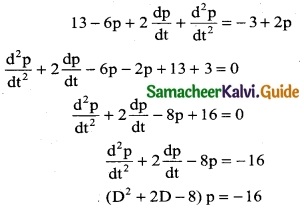
2. This change in the electric field between the capacitor plate produce a current between the plates.
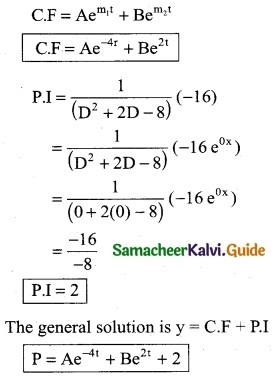
3. The time varying electric flux between the plate of the capacitor produce a current known as displacement current.
Samacheer Kalvi 12th Physics Guide Chapter 5 Electromagnetic Waves 16
Id is the displacement current.

4. The displacement current is defined as the current which comes into play in the region in which the electric field and the electric flux are changing with time.

5. So, Maxwell modified Ampere’s Law
Samacheer Kalvi 12th Physics Guide Chapter 5 Electromagnetic Waves 17
Total current I = conduction current Ic + displacement current Id

Samacheer Kalvi 12th Physics Guide Chapter 5 Electromagnetic Waves

Question 5.
Explain the importance of Maxwell’s correction.
Answer:
1. Ampere’s law says that only an electric current can produce a magnetic field. If Ampere’s law alone is true, there will not be anv radiation.

2. Maxwell’s correction term \(\left(\mu_{0} \varepsilon_{0} \frac{\mathrm{d} \phi_{E}}{\mathrm{dt}}\right)\)

3. In ampere’s law ensures that time varying electric field or displacement current can also produce magnetic field.

4. Though conduction current is zero in an empty space displacement current does exist. So Maxwell equation becomes
Samacheer Kalvi 12th Physics Guide Chapter 5 Electromagnetic Waves 18

5. Faraday’s law this time-varying magnetic field produces again time-varying electric field and so on.

6. The coupled time varying electric and magnetic fields travel through empty space with the speed of light and is called electromagnetic wave.

7. Even though Maxwell initially started with a purely symmetry argument his correction term explains one of the important aspects of the universe namely the existence of electro magnetic waves.
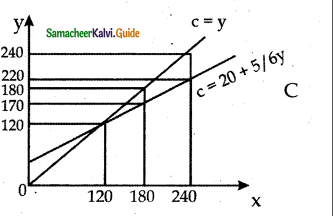
Question 6.
Write down the properties of electromagnetic waves.
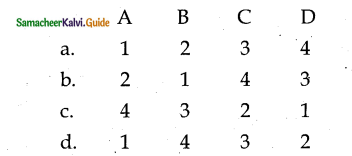
Answer:
1. Electromagnetic waves are produced bv any accelerated charges.

2. Do not require any medium for propagation. They are non-mechanical wave.

3. Electric field vector, magnetic field vector and direction of propagation of electromagnetic waves are mutually perpendicular to each other. Hence they are transverse in nature.

4. They travel in free space or vacuum with a velocity C = 3 × 10⁸ ms-1 and it is given by the expression C = \(\frac{1}{\sqrt{\mu_{0} \varepsilon_{o}}}\)

5. In medium electromagnetic wave travel with velocity less than speed in free space or vacuum.
velocity in medium V = \(\frac{C}{\mu}=\frac{1}{\sqrt{\varepsilon_{\mathrm{r}} \mu_{\mathrm{r}}}}\)

6. They are not deflected by electric and magnetic fields.

7. They can undergo interference, diffraction and polarisation.

8. The energy density of electromagnetic wave is
U = εoE2 = \(\frac{1}{\mu_{\mathrm{o}}}\) B2

9. The average energy’ density’ of electromagnetic wave (U) = \(\frac{1}{2} \varepsilon_{\mathrm{o}} \mathrm{E}^{2}=\frac{1}{2} \frac{1}{\mathrm{\mu}_{\mathrm{O}}} \mathrm{B}^{2}\)

10. They carry’ energy’ and linear momentum which is equal to Samacheer Kalvi 12th Physics Guide Chapter 5 Electromagnetic Waves 19

11. If electromagnetic waves of energy’ U in completely absorbed by a surface, the momentum imparted on the surface is
P = \(\frac{\mathrm{U}}{\mathrm{C}}\)

12. If an electromagnetic wave of energy U is completely reflected by the surface, momentum delivered to the surface is
Δp = \(\frac{2 \mathrm{U}}{\mathrm{C}}\)

13. Rate of flow of energy crossing per unit area is known as pointing vector for electromagnetic wave
Samacheer Kalvi 12th Physics Guide Chapter 5 Electromagnetic Waves 20

14. Along with energy, linear momentum of the electromagnetic wave also has angular momentum.

Question 7.
Discuss the source of electromagnetic waves.
Answer:
The source of electromagnetic wave is accelerating electric charges.

Explanation:
1. Stationary charges produce only electric field.
2. All oscillatory motions are accelerating motion.
3. If a charge is accelerated along x-axis, it produce a change in electric field along y-axis Ey = E0 sin (kz – ωt)
4. A linked magnetic field produced mutually perpendicular to electric field direction, so it point along x-axis, Bx = B0 sin (kz – ωt)
5. Now both the electric field vectors and magnetic field vectors have the property of a wave and propagate along z-axis with the velocity of light.
6. n free space or in vacuum, the ratio between E0 and B0 is equal to the speed of

Propagation of an Electromagnetic wave
Samacheer Kalvi 12th Physics Guide Chapter 5 Electromagnetic Waves 13

Oscillating charges – sources of electromagnetic waves

electromagnetic wave C = \(\frac{E_{0}}{B_{0}}\)
But in medium velocity v = \(\frac{E_{0}}{B_{0}}\) < C
7. Energy of electromagnetic waves comes from the energy of oscillating charge.

Samacheer Kalvi 12th Physics Guide Chapter 5 Electromagnetic Waves

Question 8.
Explain the types of emission spectrum.
Answer:
1. Emission spectra:
When the spectrum of self luminous source is taken, we get emission spectrum. Each source has its own characteristic emission spectrum.
Types:
1. Continuous Emission Spectra
2. Line emission spectra
3. Band emission spectra

1. Continuous Emission Spectra:
It consist of wavelength containing all the visible colours ranging from violet to red. Example: Spectrum from carbon arc, incandescent solids, liquids.

Samacheer Kalvi 12th Physics Guide Chapter 5 Electromagnetic Waves 10
2. Line Emission Spectra:
1. Line spectra are sharp lines of definite wave length or frequencies.
2. Light from hot gas is allowed to pass through a prism, we get line spectrum (or) discontinuous spectrum.
3. Line spectra arises due to excited atoms of element.
4. They are the characteristics of the element. Example: Spectra of atomic hydrogen, helium etc.

Samacheer Kalvi 12th Physics Guide Chapter 5 Electromagnetic Waves 11

3. Band Emission Spectra:
1. Band spectrum consists of several numbers of very closely spaced spectral lines which overlapped together forming specific bands which are separated by dark spaces known as band spectra.

2. This spectrum has a sharp edge at one end and fades out at the other end.

3. This spectrum arises when molecules are excited so, they are the characteristics of molecules. Used to study the structure of molecules.
Example: Spectra of hydrogen gas, ammonia gas in the discharge tube.

Question 9.
Explain the types of the absorption spectrum.
Answer:
Absorption Spectra: When light is allowed to pass through an absorbing substance then the spectrum obtained is known as absorption spectra. This spectrum is the characteristic of absorbing substances.

Types:

  1. Continuous absorption spectrum
  2. Line absorption spectrum
  3. Band absorption spectrum

1. Continuous absorption spectrum:
When light is passed through a medium then if it is dispersed by a prism, we get continuous absorption spectrum.
Example: When white light passes through a blue glass plate, it absorbs everything except blue.

2. Line absorption spectrum:
When white light from the incandescent lamp is passed through cold gas, the spectrum obtained through the dispersion due to prism is line absorption spectrum.
Example:
When light from carbon arc made to pass through sodium vapour lamp; a continuous spectrum of carbon arc with two dark line in the yellow region is obtained.
Samacheer Kalvi 12th Physics Guide Chapter 5 Electromagnetic Waves 12

3. Band absorption spectrum:
When white light is pass through iodine vapour or diluted solution of blood or chlorophyll or through certain solutions of organic and inorganic compounds dark bands as the continuous bright background is obtained.

Samacheer Kalvi 12th Physics Guide Chapter 5 Electromagnetic Waves

IV. Numerical Problems:

Question 1.
Consider a parallel plate capacitor whose plates are closely spaced. Let R be the radius of the plates and the current in the wire connected to the plates is 5 A, calculate the displacement current through the surface passing between the plates by directly calculating the rate of change of flux of electric field through the surface.
Answer:
Id = Ic = 5A
Id = \(\frac{\mathrm{d} \phi}{\mathrm{dt}}\)
Id = 5 A

Question 2.
A transmitter consists of an LC circuit with an inductance of 1 µH and capacitance of 1 µF. What is the wavelength of the electromagnetic waves it emits?
Answer:
18.84 × 10⁻⁶m
Samacheer Kalvi 12th Physics Guide Chapter 5 Electromagnetic Waves 25
= C × 2π × √LC
= 3 × 108 × 6.28 × 10-6 × 10-6
= 3 × 108 × 6.28 × 10-6
= 18.86 × 10² m

Question 3.
A pulse of light of duration 10-6 s is absorbed completely by a small object initially at rest. If the power of the pulse is 60 × 10-3 W, calculate the final momentum of the object.
Answer:
Samacheer Kalvi 12th Physics Guide Chapter 5 Electromagnetic Waves 26

Question 4.
Let an electromagnetic wave propagation along the x-direction, the magnetic field oscillates at a frequency of 1010 Hz and has an amplitude of 10-5 T, acting along the y-direction. Then, compute the wavelength of the wave. Also, write down the expression for the electric field in this case.
Answer:
Given Data:
f = 1010 Hz
B0 = 10-5T
1. Wavelength λ = ?
2. Expression for electric field Ex = ?
The velocity of Electromagnetic wave in free space
C = \(\frac{\mathrm{E}_{0}}{\mathrm{~B}_{0}}\)
∴ E0 = C × B0 = 3 × 108 × 10-5
E0 = 3 × 10³ NC-1
Wavelength λ = \(\frac{C}{f}=\frac{3 \times 10^{8}}{10^{10}}\) = 3 × 10⁻² m

(i) wavelength of electromagnetic wave λ = 3 × 10⁻² m

(ii) Expression for electric field:
Ez = E0 sin (kz – ωt)
wave number k = \(\frac{2 \pi}{\lambda}\) = 2π/3 × 10-2 = 0.66π × 102 A
k = 66π m-1 = 2.09 × 10²
Angular frequency ω = 2πf = 2π × 1010 rad s-1
= 3 × 10³ sin (2.09 × 10²x – 6.28 × 10¹⁰t)

Samacheer Kalvi 12th Physics Guide Chapter 5 Electromagnetic Waves

Question 5.
If the relative permeability and relative permittivity of a medium is 1.0 and 2.25, respectively. Find the speed of the electromagnetic wave in this medium.
Answer:
Given Data:
µr = 1.0, εr = 2.25
Velocity of electromagnetic wave in medium
v = ?
The velocity of an electromagnetic wave in a medium
V = \(\frac{C}{\mu}\)
Refractive index µ = \(\sqrt{\varepsilon r \mu r}\)
Samacheer Kalvi 12th Physics Guide Chapter 5 Electromagnetic Waves 27

Part II:

12th Physics Guide Electromagnetic Waves Additional Questions and Answers

I. Matching Type Questions:

Question a.

Samacheer Kalvi 12th Physics Guide Chapter 5 Electromagnetic Waves 28
(1) A → b, B → c, C → d, D → a
(2) A → d, B → a, C → b, D → c
(3) A → c, B → d, C → b, D → a
(4) A → c, B → a, C → d, D → b
Answer:
(3) A → c, B → d, C → b, D → a

Question b.

Samacheer Kalvi 12th Physics Guide Chapter 5 Electromagnetic Waves 29
(1) A → d, B → C, C → a, D → b
(2) A → c, B → a, C → d, D → b
(3) A → b, B → C, C → d, D → a
(4) A → d, B → a, C → b, D → C
Answer:
(1) A → d, B → C, C → a, D → b

Samacheer Kalvi 12th Physics Guide Chapter 5 Electromagnetic Waves

Question c.

(A)  Microwave a. Night vision photography
(B) Ultraviolet radiation b. Crystal structure
(C) X-rays c. Molecular structure
(D) Infrared radiation d. Aircraft navigation

(1) A → c, B → d, C → b, D → a
(2) A → b, B → c, C → d, D → a
(3) A → d, B →c, C → b, D → a
(4) A → d, B → a, C → b, D → c
Ans:
(3) A → d, B →c, C → b, D → a

Question d.

Samacheer Kalvi 12th Physics Guide Chapter 5 Electromagnetic Waves 30
(1) A → d, B → a, C → b, D → c
(2) A → c, B → a, C → d, D → b
(3) A → d, B → c, C → a, D → b
(4) A → b, B → d, C → a, D → c
Answer:
(4) A → b, B → d, C → a, D → c

Question e.

(A) Carbon arc a. Line emission spectrum
(B) Spectra of atomic helium b. Band emission spectra
(C) Molecular structure c. Line absorption spectra
(D) Spectrum obtained from sun d. Continuous emission spectrum

(1) A → d, B → a, C → b, D → c
(2) A → c, B → a, C → d, D → b
(3) A → c, B → d, C → b, D → a
(4) A → b, B → d, C → a, D → c
Answer:
(1) A → d, B → a, C → b, D → c

Samacheer Kalvi 12th Physics Guide Chapter 5 Electromagnetic Waves

II. Fill in the blanks:

Question 1.
Electromagnetic wave are _________ in nature.
Answer:
Transverse

Question 2.
The phase difference between electric and magnetic field vectors in an electromagnetic wave _________.
Answer:
Zero

Question 3.
The angle between electric and magnetic component in an electromagnetic wave is _________.
Answer:
\(\pi / 2\) (or) 90°

Question 4.
Linear momentum of electromagnetic wave is _________.
Answer:
Samacheer Kalvi 12th Physics Guide Chapter 5 Electromagnetic Waves 32

Question 5.
The rate of flow of energy crossing in unit area is known as _________.
Answer:
Pointing vector

Samacheer Kalvi 12th Physics Guide Chapter 5 Electromagnetic Waves

Question 6.
The expression for intensity of electromagnetic wave is equal to _________.
Answer:
Samacheer Kalvi 12th Physics Guide Chapter 5 Electromagnetic Waves 31

Question 7.
The electromagnetic wave from the sun which is absorbed by atmospheric ozone is _________.
Answer:
Ultraviolet rays

Question 8.
The electromagnetic wave produced by Hertz is _________.
Answer:
Radio waves

Question 9.
When white light passing through chlorophyll it gives _________.
Answer:
Band absorption spectrum

Question 10.
The wavelength range of visible light is _________ to _________.
Answer:
4 × 10⁻⁷m to 7 × 10⁻⁷ m

Samacheer Kalvi 12th Physics Guide Chapter 5 Electromagnetic Waves

III. Choose the Odd One Out:

Question 1.
a) Velocity of light in vacuum
b) 3 × 10⁸ ms-1
c) \(\frac{1}{\sqrt{\mu_{0}} \varepsilon_{0}}\)
d) \(\sqrt{\mu_{\mathrm{r}} \varepsilon_{\mathrm{r}}}\)
Answer:
d) \(\sqrt{\mu_{\mathrm{r}} \varepsilon_{\mathrm{r}}}\)

Question 2.
a) Fraunhofer
b) J.C. Maxwell
c) Hertz
d) Michael
Answer:
a) Fraunhofer

Question 3.
a) x-ray
b) Gamma rays
c) Microwave
d) Ultraviolet ray
Answer:
c) Microwave

Question 4.
a) Ampere – Maxwell law

b) \(\oint \overrightarrow{\mathrm{E}} \cdot \overrightarrow{\mathrm{d} \mathrm{t}}=\frac{\mathrm{d} \phi_{\mathrm{B}}}{\mathrm{dt}}\)

c) \(\oint \overrightarrow{\mathrm{B}} \cdot \overrightarrow{\mathrm{d} s}=\mu_{0}\left(\mathrm{I}_{\mathrm{c}}+\mathrm{I}_{\mathrm{d}}\right)\)

d) \(\oint \overrightarrow{B .} \overrightarrow{d l}\) = \(\mu_{0} \quad I_{0}+\mu_{0} \varepsilon_{0} \frac{d}{d t} \int_{S} \vec{E} \cdot d \vec{A}\)
Answer:
b) \(\oint \overrightarrow{\mathrm{E}} \cdot \overrightarrow{\mathrm{d} \mathrm{t}}=\frac{\mathrm{d} \phi_{\mathrm{B}}}{\mathrm{dt}}\)

Question 5.
a) \(\varepsilon_{0}=\frac{\mathrm{d} \phi_{\mathrm{B}}}{\mathrm{dt}}\)
b) Displacement current
c) μ0I0
d) \(\varepsilon_{0} \frac{\mathrm{d}}{\mathrm{dt}} \int_{\mathrm{S}} \overrightarrow{\mathrm{E} \cdot \mathrm{d}} \overrightarrow{\mathrm{A}}\)
Answer:
c) μ0I0

Samacheer Kalvi 12th Physics Guide Chapter 5 Electromagnetic Waves

IV. Choose the Incorrect Pair:

Question 1.
a) Electromagnetic wave – Transverse
b) The ratio between the amplitude of the electric wave and magnetic components is an electromagnetic wave – Speed of electromagnetic wave
c) Hertz – Ultraviolet radiation
d) Momentum imparted by electromagnetic p = \(\frac{\mathrm{U}}{\mathrm{C}}\)
Answer:
c) Hertz produced radio waves.

Question 2.
a) Atomic spectrum – pure line spectrum
b) Solar spectrum – line spectrum
c) Molecules – Band Spectrum
d) Carbon arc – Continuous emission spectrum
Answer:
b) Solar spectrum is the line absorption spectrum

Question 3.
a) Refractive index of a medium – μ = \(\sqrt{\varepsilon_{\mathrm{r}} \mathrm{H}_{\mathrm{r}}}\)
b) Pointing vector – \(\vec{S}=C^{2} \varepsilon_{0}(\vec{B} \times \vec{E})\)
c) To detect faults, cracks, flaws, and holes – X-rays
d) Fraunhofer lines – Sun’s atmosphere
Answer:
b) Pointing vector – \(\vec{S}=C^{2} \varepsilon_{0}(\vec{B} \times \vec{E})\)

Question 4.
a) Net electric flux and net charge – Gauss law
b) Electric field and magnetic flux – Faraday’s law
c) Magnetic field around any closed path to the conduction current – Maxwell’s law
d) Magnetic field around any closed path to the conduction current and displacement current through that path – Ampere – Maxwell’s law
Answer:
c) Magnetic field around any closed path to the conduction current

Samacheer Kalvi 12th Physics Guide Chapter 5 Electromagnetic Waves

V. Choose the correct pair:

Question 1.
a) Wavelength range of radio wave – 3 × 10⁹ m to 3 × 10⁴ m
b) Wavelength range of ultraviolet radiation – 5 × 10¹⁷ m to 7 × 10¹⁴ m
c) Wavelength range of Gamma radiation – 10-14 m to 1 × 10⁻¹⁰ m
d) Wavelength range of Infrared radiation – 4 × 10¹⁴ to 6 × 10¹⁰ m
Answer:
c) Wavelength range of Gamma radiation – 10-14 cm to 1 × 10⁻¹⁰ m

Question 2.
a) Incandescent solids – Band absorption spectra
b) Spectrum from carbon arc – Line spectrum
c) Spectra of atomic hydrogen – Line absorption spectrum
d) the characteristics of substance – Absorption spectrum
Answer:
d) the characteristics of substance – Absorption spectrum

Question 3.
a) Maxwell’s prediction on the electromagnetic wave was verified by – Ampere
b) Rate of change in the magnetic field produces electric field – Gauss
c) Total electric flux is equal to 1 ε/0 times net charge enclosed by the surface – Gauss law
d) An example of mechanical wave – Electromagnetic waves
Answer:
c) Total electric flux is equal to 1 ε/o times net charge enclosed by the surface – Gauss law

Question 4.
a) Velocity of x-ray in vacuum is – 3 × 10⁸ ms-1
b) Velocity of x-ray in medium – 3 × 10⁸ ms-1
c) Electromagnetic waves – Deflected by both electric and magnetic field
d) The electric component of electromagnetic wave – Ez = E0 Sin (kz – ωt) ms-1
Answer:
a) Velocity of x-ray in vacuum is – 3 × 10⁸ ms-1

Samacheer Kalvi 12th Physics Guide Chapter 5 Electromagnetic Waves

VI. Assertion and Reason:

Question 1.
Assertion (A):
The velocity of electromagnetic waves in a medium is always less than the velocity of electromagnetic wave in free space (or) vacuum
Reason (R):
The wavelength of the electromagnetic wave decreases when traveling into a denser medium but frequency does not change
a) A is correct R is wrong
b) A is wrong R is correct
c) A and R are correct
d) A and R are wrong
Answer:
c) A and R are correct

Question 2.
Assertion (A):
Refractive index of air is \(\mu=\sqrt{\mu_{0}}\)
Reason (R):
Since the dielectric constant of air equal to one (εr = 1 for air). The Refractive index of air \(\mu=\sqrt{\mu_{r}}\)
a) A is correct R is wrong
b) A is wrong R is correct
c) A and R are correct
d) A and R are wrong
Answer:
b) A is wrong R is correct

Question 3.
Assertion (A):
\(\oint \overrightarrow{\mathrm{E}} \cdot \overrightarrow{\mathrm{d} A}=\frac{\mathrm{Q}_{\text {enclosed }}}{\epsilon_{0}}\)
\(\oint_{\vec{B}} \cdot \overrightarrow{\mathrm{d} A}\) (Gauss law in electrostatics)
Reason (R):
\(\oint \overrightarrow{\mathrm{E}} \cdot \overrightarrow{\mathrm{d} A}=\frac{\mathrm{Q}_{\text {enclosed }}}{\epsilon_{0}}\)
\(\oint_{\vec{B}} \cdot \overrightarrow{\mathrm{d} A}\) since isolated charges cannot exist since isolated magnetic monopole exist.
a) A is correct R is wrong
b) A is wrong R is correct
c) A and R are correct
d) Aand Rare wrong
Answer:
a) A is correct R is wrong

Question 4.
Assertion (A):
All medium other than air has relative permittivity less than one
Reason (R):
Electromagnetic wave travels faster in a medium than in air
a) A is correct R is wrong
b) A is wrong R is correct
c) A and R are correct
d) A and R are wrong
Answer:
d) A and R are wrong

Samacheer Kalvi 12th Physics Guide Chapter 5 Electromagnetic Waves

VII. Choose the correct statement:

Question 1.
a) Maxwell’s law of induction states that Time-varying electric field produces a magnetic field
b) Faraday’s law of induction states that Time-varying electric field produces a magnetic field
c) Hertz experimentally proved accelerated charges produce an only magnetic field
d) Ampere’s law states that total flux over any surface enclosing a charge q is always zero.
Answer:
a) Maxwell’s law of induction states that Time-varying electric field produces a magnetic field

Question 2.
a) Electromagnetic waves need a medium for its propagation
b) Electromagnetic waves are mostly transverse, it can also longitudinal wave
c) Electromagnetic waves are produced by any accelerated charges
d) The ratio between electric energy and magnetic energy in an electromagnetic wave is 2:1
Answer:
c) Electromagnetic waves are produced by any accelerated charges

Question 3.
a) Electromagnetic waves have only linear momentum no angular momentum.
b) The energy density of the electromagnetic wave is u = \(\frac{\beta^{2}}{2 \mu_{0}}\)
c) The average energy density of electromagnetic wave is u = \(\frac{\beta^{2}}{\mu_{0}}\)
d) If the electromagnetic wave incident on a surface, the momentum imparted as the surface is p = \(\frac{\mathrm{u}}{\mathrm{c}}\)
Answer:
d) If the electromagnetic wave incident on a surface, the momentum imparted as the surface is p = \(\frac{\mathrm{u}}{\mathrm{c}}\)

Question 4.
a) Cellular phones used infrared radiation.
b) Molecular spectrum is sharp at one end and fades out at the other end.
c) When light from the incandescent lamp passed through cold gas, the spectrum obtained is the Band absorption spectrum.
d) Fraunhofer lines help to identify the elements in the earth’s atmosphere.
Answer:
b) Molecular spectrum is sharp at one end and fades out at the other end.

Samacheer Kalvi 12th Physics Guide Chapter 5 Electromagnetic Waves

VIII. Choose the Incorrect Statement:

Question 1.
a) According to Faraday change in the magnetic field at a point with respect to time produces an electric field at that point
b) Amperes law is the line integral of the magnetic field \(\vec{B}\) around any closed loop is equal to iiü times the net current I threading through the area enclosed by the loop.
c) Total current enclosed by a surface is the sum of conduction current and displacement current
I = Ic + Id
d) When a constant current is applied between the plates of capacitor Ic = 0 and hence I = Id
Answer:
d) When a constant current is applied between the plates of capacitor Ic = 0 and hence I = Id

Question 2.
a) Velocity of an electromagnetic wave in a medium of refractive index 1.5 is 2.25 × 10⁸ ms-1
b) If the velocity of the electromagnetic wave is 2 × 10⁸ ms-1 the refractive index of the medium is 2
c) If the velocity of light is 2.25 x 10⁸ ms-1 the medium must have a refractive index of 1.33
d) If the refractive index of a medium increases the velocity of electromagnetic wave decreases.
Answer:
c) If the velocity of light is 2.25 x 10⁸ ms-1 the medium must have a refractive index of 1.33

Question 3.
a) Intensity of electromagnetic wave I = \(\frac{\text { Energy }(\mathrm{U})}{\text { Area }(\mathrm{A}) \times \text { Time }(\mathrm{T})}\)
b) Intensity of electromagnetic wave I = \(\frac{\text { Power }(\mathrm{P})}{\text { Surface Area }(\mathrm{A})}\)
c) Energy density in an electric field is \(\frac{1}{2}\) ε0 E2
d) Energy density in a magnetic field is \(\frac{1}{2}\) µ0 B2
Answer:
d) Energy density in a magnetic field is \(\frac{1}{2}\) µ0 B2

Question 4.
a) Electromagnetic waves carry not only energy and momentum but also angular momentum in
b) The dark line in the solar spectrum are known as Fraunhofer lines
c) Solar spectrum is the best example for line absorption spectrum
d) The instantaneous magnitude of the electric and magnetic field vectors in an electromagnetic wave are related by
B = Ec
Answer:
d) The instantaneous magnitude of the electric and magnetic field vectors in an electromagnetic wave are related by
B = Ec

Samacheer Kalvi 12th Physics Guide Chapter 5 Electromagnetic Waves

IX. Choose the best answer:

Question 1.
The speed of electromagnetic waves in vacuum is given by
(a) μ0ε0
(b) \(\sqrt { { \mu }_{ 0 }{ \varepsilon }_{ 0 } } \)
(c) \(\frac { 1 }{ { \mu }_{ 0 }{ \varepsilon }_{ 0 } } \)
(d) \(\frac { 1 }{ \sqrt { { \mu }_{ 0 }{ \varepsilon }_{ 0 } } } \)
Answer:
(d) \(\frac { 1 }{ \sqrt { { \mu }_{ 0 }{ \varepsilon }_{ 0 } } } \).

Question 2.
Electromagnetic waves are
a) Neither longitudinal nor transverse
b) Longitudinal
c) transverse
d) both longitudinal and transverse
Answer:
c) transverse

Question 3.
If E and B be the electric and magnetic field vectors of an electromagnetic wave, then the propagation of the wave is along the direction of
(a) E
(b) B
(c) E x B
(d) Bx E
Answer:
(c) E x B.

Question 4.
To produce a displacement of 8.854 mA between the parallel plate capacitor in 0.2 μs, the change in electric flux must be
a) 200 Wb
b) 20 Wb
c) 2 Wb
d) 0.2 Wb
Answer:
a) 200 Wb
Solution:
Samacheer Kalvi 12th Physics Guide Chapter 5 Electromagnetic Waves 1

Question 5.
Maxwell’s modified Ampere’s Law is
a) \(\oint \overrightarrow{\mathrm{E}} \cdot \overrightarrow{\mathrm{d} s}=\mu_{0}\left(\mathrm{I}_{\mathrm{c}}+\mathrm{I}_{\mathrm{d}}\right)\)

b) \(\oint \overrightarrow{\mathrm{E}} \cdot \overrightarrow{\mathrm{d} s}=\mu_{0} \mathrm{I}_{\mathrm{c}}\)

c) \(\oint \overrightarrow{\mathrm{B}} \cdot \overrightarrow{\mathrm{d} s}=\mu_{0} \mathrm{I}_{\mathrm{c}}\)

d) \(\oint \overrightarrow{\mathrm{B}} \cdot \overrightarrow{\mathrm{d} s}=\mu_{0}\left(\mathrm{I}_{\mathrm{c}}+\mathrm{I}_{\mathrm{d}}\right)\)
Answer:
d) \(\oint \overrightarrow{\mathrm{B}} \cdot \overrightarrow{\mathrm{d} s}=\mu_{0}\left(\mathrm{I}_{\mathrm{c}}+\mathrm{I}_{\mathrm{d}}\right)\)

Samacheer Kalvi 12th Physics Guide Chapter 5 Electromagnetic Waves

Question 6.
Hertz produced an electromagnetic wave of frequency 5 × 10⁷ Hz means, the wavelength of
the wave is
a) 150 m
b) 15 m
c) 6 m
d) 60 m
Answer:
c) 6 m
Solution:
λ = \(\frac{C}{\gamma}=\frac{3 \times 10^{8}}{5 \times 10^{7}}=\frac{30}{5}\) = 6 m

Question 7.
In Hertz experiment, the energy of the electromagnetic wave is
a) Kinetic energy of the oscillating charge
b) Potential energy of the charge
c) Electric energy between plates
d) Magnetic energy of the connecting wires
Answer:
a) Kinetic energy of the oscillating charge

Question 8.
A medium has a refractive index of 1.5 with relative permittivity of 2 has a relative magnetic permeability
a) 11.25
b) 112.5
c) 1.125
d) 2.125
Answer:
c) 1.125
Solution:
Samacheer Kalvi 12th Physics Guide Chapter 5 Electromagnetic Waves 2

Question 9.
The electromagnetic radiation most prevalent in the atmosphere is
(a) Visible light
(b) Infrared
(c) UV
(d) Radio waves
Answer:
(b) Infrared.

Question 10.
An electromagnetic wave of energy U is completely transferred to a surface, the momentum imparted on the surface is
a) U
b) Uc
c) U/c
d) c/U
Answer:
c) U/c

Samacheer Kalvi 12th Physics Guide Chapter 5 Electromagnetic Waves

Question 11.
The average energy density of an electromagnetic wave of magnetic field 4π × 10-7 T is
a) 2π × 10-7 Jm-3
b) 4π × 10-7 Jm-3
c) 19.878 × 10⁻⁶ Jm-3
d) 6.626 × 10⁻⁷ Jm-3
Answer:
a) 2π × 10-7 Jm-3
Solution:
Samacheer Kalvi 12th Physics Guide Chapter 5 Electromagnetic Waves 3

Question 12.
The greenhouse effect is caused by
(a) UV rays
(b) X-rays
(c) Gamma rays
(d) IR rays
Answer:
(d) IR rays.

Question 13.
The velocity of electromagnetic wave in free space or vacuum is
a) 3 × 10⁻⁸ ms-1
b) \(\sqrt{\mu_{\mathrm{o}} \varepsilon_{\mathrm{o}}}\) ms-1
c) \(\frac{1}{\mu_{r} \varepsilon_{r}}\) ms-1
d) \(\left(\varepsilon_{0} \mu_{0}\right)^{-1 / 2}\) ms-1
Answer:
d) \(\left(\varepsilon_{0} \mu_{0}\right)^{-1 / 2}\) ms-1

Question 14.
The velocity of an electromagnetic wave through a medium which a permeability in free space 4π × 10-7 Hm-1 and permittivity in free space of 8.854 × 10⁻¹² C2N-1m2 is
a) 2 × 10⁸ ms-1
b) 3 × 10⁸ ms-1
c) 2.25 × 10⁸ ms-1
d) 1.5 × 10⁸ ms-1
Answer:
b) 3 × 10⁸ ms-1
Solution:
Samacheer Kalvi 12th Physics Guide Chapter 5 Electromagnetic Waves 4

Question 15.
The peak value of an electric field in an electromagnetic wave is 3√2 Vm-1. The peak value of the magnetic field is
a) 1.414 × 10⁻⁸ T
b) 1.0 × 10⁻⁸ T
c) 2.828 × 10⁻⁸ T
d) 2.0 × 10⁻⁸ T
Answer:
a) 1.414 × 10⁻⁸ T
Solution:
Samacheer Kalvi 12th Physics Guide Chapter 5 Electromagnetic Waves 5

Samacheer Kalvi 12th Physics Guide Chapter 5 Electromagnetic Waves

Question 16.
Which of the following is not an electromagnetic wave
a) x-ray
b) u-v ray
c) β-ray
d) γ-ray
Answer:
c) β-ray

Question 17.
The ratio of amplitude of magnetic field to the amplitude of electric field for an electromagnetic wave propagating in vacuum is equal to
(a) the speed of light in vacuum
(b) reciprocal of the speed of light in vacuum
(c) the ratio of magnetic permeability to electric susceptibility in vacuum
(d) unity
Answer:
(b) reciprocal of the speed of light in vacuum.

Question 18.
The current in the electric circuit which arises due to the flow of electrons in the connecting wires of the circuit in a defined closed path is called
a) alternating current
b) direct current
c) conduction current
d) displacement current
Answer:
c) conduction current

Question 19.
The conduction current is the same as the displacement current when the source is
a) ac only
b) dc only
c) either ac or dc
d) neither dc nor ac
Answer:
c) either ac or dc

Question 20.
If a variable frequency ac source connected to a capacitor then with a decrease in frequency, the displacement current will
a) increase
b) decrease
c) remains constant
d) first decrease then increase
Answer:
b) decrease
Solution:
Current through capacitor,
I = \(\frac{E}{X_{C}}\) = \(\begin{array}{c}
\mathrm{E} \\
\hline 1 \\
\hline \omega C
\end{array}\)
= ωCE
= 2πυ CE or I ∝ υ.
decrease in frequency υ of ac source decreases the conduction current. As displacement current is equal to conduction current, decrease in υ decreases displacement current in circuit.

Samacheer Kalvi 12th Physics Guide Chapter 5 Electromagnetic Waves

Question 21.
An electromagnetic wave has a wavelength of 10 cm. It is in the
(a) Visible region
(b) Radio region
(c) UV region
(d) X-ray region
Answer:
(b) Radio region.

Question 22.
The displacement current was first postulated by
a) Maxwell
b) Marconi
c) Ampere
d) Hertz
Answer:
a) Maxwell

Question 23.
Ampere’s circuital law holds good for
a) conduction current
b) displacement current
c) both (a) and (b)
d) None of these
Answer:
c) both (a) and (b)
Solution:
In the steady-state \(\oint\) B.dl = μ0(I) where I is conduction current.
(In non steady state \(\oint\) B di = (I + Id) where Id is displacement current.)

Question 24.
Which of the following has maximum frequency?
(a) X-rays
(b) IR rays
(c) UV rays
(d) Radio waves
Answer:
(a) X-rays.

Question 25.
Displacement current is due to
a) continuous when an electric field is changing in the circuit
b) continuous when the magnetic field is changing in the circuit
c) continuous in both types of fields
d) continuous through wires and resistance only
Answer:
a) continuous when an electric field is changing in the circuit
Solution:
The displacement current is set up in a region where the electric field is changing with time.

Samacheer Kalvi 12th Physics Guide Chapter 5 Electromagnetic Waves

Question 26.
The displacement current is
a) εoE / dt
b) \(\frac{\varepsilon_{0}}{\mathrm{R}} \frac{\mathrm{d} \phi_{\mathrm{E}}}{\mathrm{dt}}\)
c) εoE / R
d) εoqC / R
Answer:
a) Id = εoE / dt

Question 27.
The frequency of a wave is 6 x 10¹⁵ Hz. The wave is
(a) Radio wave
(b) Microwave
(c) X-ray
(d) UV rays
Answer:
(d) UV rays.

Question 28.
If \(\overrightarrow{\mathbf{E}}\) and \(\overrightarrow{\mathbf{B}}\) represent the electric and magnetic field vectors of an electromagnetic wave, then the direction of propagation of the electromagnetic wave, is along
a) \(\overrightarrow{\mathbf{E}}\)
b) \(\overrightarrow{\mathbf{B}}\)
c) \(\overrightarrow{\mathbf{B}}\) × \(\overrightarrow{\mathbf{E}}\)
d) \(\overrightarrow{\mathbf{E}}\) × \(\overrightarrow{\mathbf{B}}\)
Answer:
d) \(\overrightarrow{\mathbf{E}}\) × \(\overrightarrow{\mathbf{B}}\)

Question 29.
According to Maxwell’s by hypothesis, a changing electric field gives rise to
a) an e.m.f
b) electric displacement field
c) magnetic field
d) pressure gradient
Answer:
c) magnetic field
Solution:
According to Maxwell, a changing electric field is a source of the magnetic field.

Question 30.
An electromagnetic wave propagating along the north has its electric field vector upwards. Its magnetic field vector point towards
a) north
b) east
c) west
d) downwards
Answer:
b) east

Samacheer Kalvi 12th Physics Guide Chapter 5 Electromagnetic Waves

Question 31.
Vertical straight conduct carries a current vertically upwards. A point P lies to the east of it at a small distance and another point Q lies to the west at the same distance. The magnetic field at P is
a) Greater than that at Q
b) Same as at Q
c) Less than at Q
d) Greater or less than at Q depending upon the strength of the current.
Answer:
b) Same as at Q

Question 32.
Gamma rays are used in the treatment of
a) Cancer
b) Polio
c) AIDS
d) Tuberculosis
Answer:
a) Cancer

Question 33.
Which of the following types of radiations are radiated by an oscillating electric charge?
a) Electric
b) Magnetic
c) Thermoelectric
d) Electromagnetic
Answer:
d) Electromagnetic

Question 34.
If \(\overrightarrow{\mathbf{E}}\) and \(\overrightarrow{\mathbf{B}}\) are the electric and magnetic field vectors of e.m. waves then the direction of propagation of e.m. wave is along the direction of
a) \(\overrightarrow{\mathbf{E}}\)
b) \(\overrightarrow{\mathbf{B}}\)
c) \(\overrightarrow{\mathbf{E}}\) × \(\overrightarrow{\mathbf{B}}\)
d) None of these
Answer:
c) \(\overrightarrow{\mathbf{E}}\) × \(\overrightarrow{\mathbf{B}}\)
SoIution:
The direction of propagation of electromagnetic wave is perpendicular to the varia Lion of electric field \(\overrightarrow{\mathbf{E}}\) as well as to the magnetic field \(\overrightarrow{\mathbf{B}}\).

Question 35.
According to Maxwell’s equation, the velocity of light in any medium is expressed as
a) \(\frac{1}{\sqrt{\mu_{o} \varepsilon_{o}}}\)
b) \(\frac{1}{\sqrt{\mu \varepsilon}}\)
c) \(\sqrt{\frac{\mu}{\varepsilon}}\)
d) \(\sqrt{\frac{\mu_{0}}{\varepsilon}}\)
Answer:
b) \(\frac{1}{\sqrt{\mu \varepsilon}}\)
Solution:
Velocity of light in a medium,
c = \(\frac{1}{\sqrt{\mu_{0} \varepsilon_{0} \mu_{r} \varepsilon_{r}}}=\frac{1}{\sqrt{\mu \varepsilon}}\)

Samacheer Kalvi 12th Physics Guide Chapter 5 Electromagnetic Waves

Question 36.
The electromagnetic waves do not transport
a) energy
b) charge
c) momentum
d) information
Answer:
b) charge

Question 37.
The amplitudes of electric and magnetic fields related to each other are
a) E0 = B0
b) E0 = cB0
c) E0 = \(\frac{B_{0}}{c}\)
d) E0 = \(\frac{c}{B_{0}}\)
Answer:
b) E0 = cB0

Question 38.
In an electromagnetic wave, the direction of the magnetic induction \(\overrightarrow{\mathbf{B}}\) is
a) parallel to the electric field \(\overrightarrow{\mathrm{E}}\)
b) perpendicular to the electric field \(\overrightarrow{\mathrm{E}}\)
c) antiparallel to the pointing vector \(\overrightarrow{\mathrm{S}}\)
d) random
Answer:
b) perpendicular to the electric field \(\overrightarrow{\mathrm{E}}\)

Question 39.
The speed of the electromagnetic wave is the same for
a) odd frequencies
b) even frequencies
c) all frequencies
d) all intensities
Answer:
d) all intensities
Solution:
The speed of the electromagnetic waves in a region is the same for all intensities but different for different frequencies.

Question 40.
A plane electromagnetic wave is incident on a material surface. If the wave delivers momentum p and energy E, then
a) p = 0,E = 0
b) p ≠ 0,E ≠ 0
c) p ≠ 0,E = 0
d) p = 0,E ≠ 0
Answer:
b) p ≠ 0,E ≠ 0
Solution:
An electromagnetic wave has both energy and momentum.

Samacheer Kalvi 12th Physics Guide Chapter 5 Electromagnetic Waves

Question 41.
We consider the radiation emitted by the human body. Which one of the following statements is true?
a) The radiation emitted is in the infrared region
b) The radiation is emitted only during the day
c) The radiation is emitted during the summers and absorbed during winters
d) The radiation is emitted lies in the ultraviolet region and hence is not visible
Answer:
a) The radiation emitted is in the infrared region
Solution:
Everybody at all time, at all temperature, emit radiating (except at T = O), which fall in the infrared region.

Question 42.
The decreasing order of the wavelength of the infrared, microwave, ultraviolet, and gamma rays are
a) microwave, infrared, ultraviolet, gamma ray s
b) infrared, microwave, ultraviolet, gamma rays
c) gamma rays, ultraviolet, infrared, microwaves
d) microwaves, gamma rays, infrared, ultraviolet
Answer:
a) microwave, infrared, ultraviolet, gamma rays

Question 43.
Name the Em waves used for studying the molecular structure and also in forensic investigations.
a) UV rays
b) Gamma rays
c) λ – rays
d) IR rays
Answer:
a) UV rays

Question 44.
Radio waves diffract around the building, although light waves do not, The reason is that radio waves
a) travel with a speed larger than c
b) have a much larger wavelength than light
c) are not electromagnetic waves
d) None of these
Answer:
b) have a much larger wavelength than light
Solution:
The wavelength of radio waves being much larger than light has a size comparable to those of buildings, hence diffract from them.

Question 45.
Microwaves are detected by
a) bolometer
b) point contact diodes
c) thermopiles
d) the eye
Answer:
b) point contact diodes

Samacheer Kalvi 12th Physics Guide Chapter 5 Electromagnetic Waves

Question 46.
Which of the following electromagnetic waves has the longest wavelength?
a) UV-rays
b) visible light
c) radio waves
d) microwaves
Answer:
b) visible light

Question 47.
Which of the following is of the shortest wavelength?
a) X-rays
b) γ-rays
c) microwaves
d) radio waves
Answer:
b) γ-rays

Question 48.
The range of wavelength of visible light is
a) 10 \(\dot{A}\) to 100 \(\dot{A}\)
b) 4000 \(\dot{A}\) to 8000 \(\dot{A}\)
c) 8000 \(\dot{A}\) to 10,000 \(\dot{A}\)
d) 10,000 \(\dot{A}\) to 15,000 \(\dot{A}\)
Answer:
b) 4000 \(\dot{A}\) to 8000 \(\dot{A}\)

Question 49.
Which of the following rays has minimum frequency?
a) U.V. rays
b) X-rays
c) γ-rays
d) infrared rays
Answer:
c) γ-rays

Question 50.
An accelerated electron would produce
a) γ-rays
b) β-rays
c) α-rays
d) e.m. waves
Answer:
d) e.m. waves

Samacheer Kalvi 12th Physics Guide Chapter 5 Electromagnetic Waves

Question 51.
Which of the following is the infrared wavelength?
a) 10-4 cm
b) 10-5cm
c) 10-6 cm
d) 10-7 cm
Answer:
a) 10-4 cm
Solution:
The wavelength of the infrared region is 8 × 10⁻⁵ cm to 3 × 10⁻³ cm.
So maximum wavelength of infrared region = 8 × 10⁻⁵ ≈ 10-4 cm

Question 52.
The wavelength of X-rays is of the order of
a) 1 meter
b) 1 cm
c) 1 micron
d) 1 angstrom
Answer:
d) 1 angstrom

Question 53.
Maxwell’s modified form of Ampere’s circuital law is
a) \(\oint \overrightarrow{\mathrm{B}} \cdot \overrightarrow{\mathrm{d} s}=0\)

b) \(\oint \vec{B} \cdot \overrightarrow{d l}=\mu_{0} I\)

c) \(\oint \overrightarrow{\mathrm{B}} \cdot \overrightarrow{\mathrm{d}}=\mu_{0} \mathrm{I}+\frac{1}{\varepsilon_{0}} \frac{\mathrm{d} q}{\mathrm{dt}}\)

d) \(\oint \overrightarrow{\mathrm{B}} \cdot \overrightarrow{\mathrm{d} l}=\mu_{0} \mathrm{I}+\mu_{0} \varepsilon_{0} \frac{\mathrm{d} \varphi}{\mathrm{d} t}\)
Answer:
d) \(\oint \overrightarrow{\mathrm{B}} \cdot \overrightarrow{\mathrm{d} l}=\mu_{0} \mathrm{I}+\mu_{0} \varepsilon_{0} \frac{\mathrm{d} \varphi}{\mathrm{d} t}\)

Question 54.
Radio waves do not penetrate the band of
a) ionosphere
b) mesosphere
c) troposphere
d) stratosphere
Answer:
a) ionosphere
Solution:
Radio waves are reflected by the ionosphere.

Question 55.
What is the cause of the “Greenhouse effect”?
a) infrared rays
b) ultraviolet rays
c) X-rays
d) radio waves
Answer:
a) infrared rays

Samacheer Kalvi 12th Physics Guide Chapter 5 Electromagnetic Waves

X. Two Mark Questions:

Question 1.
Name the scientist who first predicted the existence of electromagnetic waves.
Answer:
James Clerk Maxwell has first predicted the existence of EM waves.

Question 2.
Give the uses of IR?
Answer:

  1. Provides electrical energy to satellites by means of solar cells.
  2. To produce dehydrated fruits
  3. In greenhouses to keep the plants warm
  4. Heat therapy for muscular pain
  5. TV remote as signal corner
  6. In night vision photography

Question 3.
What oscillates in electromagnetic waves?
Answer;
In EM waves, electric and magnetic fields oscillate in mutually perpendicular directions. These waves are transverse in nature.

Question 4.
Explain the concept of the intensity of electromagnetic waves.
Answer:
The energy crossing per unit area per unit time and perpendicular to the direction of propagation of the electromagnetic wave is called the intensity.
I = \(\frac{\text { Power }(\mathrm{P})}{\text { Surface area }(\mathrm{A})}\)

Question 5.
What is the electromagnetic spectrum?
Answer:
The orderly distribution of electromagnetic radiations of all types according to their wavelength or frequency into distinct groups having widely differing properties is called the electromagnetic spectrum.

Samacheer Kalvi 12th Physics Guide Chapter 5 Electromagnetic Waves

Question 6.
What is the role of ozone in the atmosphere?
Answer:
The ozone layer absorbs ultraviolet radiation from the sun and prevents it from reaching the earth and causing damage to life.

Question 7.
Write down the uses of radio waves?
Answer:
It is used in radio and television communication systems and also in cellular phones to transmit voice communication in the ultra-high frequency band.

XI. Three Mark Questions:

Question 1.
Write short notes on (a) Infrared radiation (b) Ultraviolet radiation (c) Gamma radiation).
Answer:
(a) Infrared radiation:
It is produced from hot bodies (also known as heat waves) and also when the molecules undergo rotational and vibrational transitions. The wavelength range is 8 x 10⁻⁷ m to 5 x 10³ m and the frequency range is 4 x 10¹⁴ Hz to 6 x 10¹⁰ Hz. It provides electrical energy to satellites by means of solar cells. It is used to produce dehydrated fruits, in greenhouses to keep the plants warm, heat therapy for muscular pain or sprain, TV remote as a signal carrier, to look through haze fog or mist, and used in night vision or infrared photography.

(b) Ultraviolet radiation:
It is produced by Sun, arc, and ionized gases. The wavelength range is 6 x 10⁻¹⁰ m to 4 x 10⁻⁷ m and the frequency range is 5 x 10¹⁷Hz to 7 x 10¹⁴ Hz. It has less penetrating power. It can be absorbed by atmospheric ozone and harmful to the human body. It is used to destroy bacteria, sterilizing surgical instruments, burglar alarms, detect invisible writing, fingerprints, and also in the study of molecular structure.

(c) Gamma rays:
It is produced by transitions of atomic nuclei and the decay of certain elementary particles. They produce chemical reactions on photographic plates, fluorescence, ionisation, diffraction. The wavelength range is 1 x 10-14 m to 1 x 10⁻¹⁰ m and the frequency range is 3 x 10²² Hz to 3 x 10¹⁸ Hz. Gamma rays have high penetrating power than X-rays and ultraviolet radiations; it has no charge but harmful to the human body. Gamma rays provide information about the structure of atomic nuclei. It is used in radiotherapy for the treatment of cancer and tumour, in the food industry to kill pathogenic microorganisms.

Samacheer Kalvi 12th Physics Guide Chapter 5 Electromagnetic Waves

Question 2.
Give four basic properties of electromagnetic waves.
Answer:
The basic properties of electromagnetic waves are:
(i) The e.m. waves are produced by accelerated charges and do not require any medium for
propagation.
(ii) The oscillations of \(\vec{E}\) and \(\vec{B}\) fields are perpendicular to each other as well as to the direction of propagation of the wave. So the e.m. waves are transverse in nature.
(iii) All e.m. waves travel in free space with the same speed,
C = \(\frac{1}{\sqrt{\mu_{0} \varepsilon_{o}}}\) = 3 × 10⁸ ms-1
(iv) The oscillations of \(\vec{E}\) and \(\vec{B}\) are in same phase.
(v) The amplitude ratio of electric and magnetic fields is
\(\frac{\mathrm{E}_{0}}{\mathrm{~B}_{0}}=C \frac{1}{\sqrt{\mu_{\mathrm{o}} \varepsilon_{\mathrm{o}}}}\)

Question 3.
Radio waves and gamma rays both are transverse in nature and electromagnetic in character and have the same speed in vacuum. In what respects are they different?
Answer:

Radio waves y-rays
1. These waves have an atomic origin These waves have a nuclear origin
2. These have small penetrating power due to low frequency These have large penetrating power due to high frequency

Question 4.
A plane electromagnetic wave travels, in a vacuum, along the y-direction. Write
(i) the ratio of the magnitudes, and
(ii) the directions of its electric and magnetic field vectors.
Answer:
(i) \(\frac{E}{B}\) = c, speed of light
(ii) For an electromagnetic wave travelling along y-direction, its electric and magnetic field vectors are along z-axis and x-axis respectively. The direction of \(\vec{E}\) × \(\vec{B}\) is same as that of direction of wave propagation and k̂ × î= ĵ

Question 5.
How does a charge q oscillating at a certain frequency produce electromagnetic waves?
Answer:
1. Electric and magnetic fields of an electromagnetic wave propagating along the z-direction.
2. A charge q oscillating at a frequency v produces an oscillating electric field, which produces an oscillating magnetic field, which in turn produces an oscillating electric field, and so on.
3. Hence an electromagnetic wave of frequency v originates from the charge q.
4. An electromagnetic wave propagating along the z-axis is shown below.
5. Directions of \(\vec{E}\) and \(\vec{B}\) are perpendicular to each other and also perpendicular to the direction of propagation of the e.m. wave.
Samacheer Kalvi 12th Physics Guide Chapter 5 Electromagnetic Waves 6

Samacheer Kalvi 12th Physics Guide Chapter 5 Electromagnetic Waves

Question 6.
Two students A and B prepare the following table about the electromagnetic waves. Rewrite this table in its corrected form:

Student Direction of Peak value of
Electric field Magnetic field Propagation Electric field Magnetic field
A Along x-axis Along x-axis Along y-axis E B = cE
B Along y-axis Along z-axis Along x-axis E = cB B

Answer:
Correction for Student ‘A’

Electric field Magnetic field Peak value of
Electric field Magnetic field
Along the x-axis or Along the z-axis Along the z-axis or Along the x-axis E B = \(\frac{\mathrm{E}}{\mathrm{C}}\)

No correction for student ‘B’

XII. Conceptual Questions:

Question 1.
Why can light travel in a vacuum, whereas sound cannot do so?
Answer:

  1. Light waves are electromagnetic in nature in which the electric and magnetic field variations do not require a medium for their propagation.
  2. Sound waves are mechanical in nature which require an inertial medium, for their propagation.

Question 2.
State the reason why microwaves are best suited for long-distance transmission of signals.
Answer:

  1. Microwaves have wavelengths of the order of a few millimeters. Due to their short wavelengths, these are not diffracted (bent) much by objects of normal dimensions.
  2. So they can be used to transmit signals in a particular direction as required in a radar system.

Question 3.
Welders wear special goggles or face masks with glass windows to protect their eyes from electromagnetic radiation. Name the radiations and write the range of their frequency.
Answer:
To protect their eyes from large amounts of harmful UV radiation produced by the welding arc. The wavelength of UV radiation is from 1 nm to 400 nm.

Question 4.
How do you convince yourself that electromagnetic waves carry energy and momentum?
Answer:

  1. When an electromagnetic wave interacts with matter, its electric and magnetic fields set in oscillation the charges present in the matter.
  2. The charges thus acquire energy and momentum from the e.m. wave showing that it carries energy and momentum.
  3. When the sun shines on our hands, the energy absorbed from the e.m. waves warms our hands.
  4. An e.m. wave carries momentum. When it falls on a surface, it exerts pressure called radiation pressure.

Question 5.
State the condition under which a microwave oven heats up a food item containing water molecules most efficiently.
Answer:

  1. In a microwave oven, the frequency of the microwaves must match the resonant frequency of the water molecules so that energy from the waves is transferred efficiently to the kinetic energy of the molecules.
  2. This increases the temperature of the food item sufficiently.

Samacheer Kalvi 12th Physics Guide Chapter 5 Electromagnetic Waves

Question 6.
Long-distance radio broadcasts use short-wave bands. Why?
Answer:
It is because the radio waves of short wave band are easily reflected back to the earth by the ionosphere

Question 7.
It is necessary to use satellites for long-distance TV transmission. Why?
Answer:

  1. TV signals being of high frequency are not reflected by the ionosphere.
  2. Also, ground wave transmission is possible only upto a limited range.
  3. That is why satellites are used for long-distance TV transmission.

Question 8.
Optical and radio telescopes are built on the ground but x-ray astronomy is possible only from satellites orbiting the earth. Why?
Answer:

  1. The earth’s atmosphere is transparent to visible light and radio waves but it absorbs x- rays.
  2. X-ray astronomy is possible only from satellites orbiting the earth.
  3. These satellites orbit at a height of 36,000 km, where the atmosphere is very thin and x-rays are not absorbed.

Question 9.
The small ozone layer on top of the stratosphere is crucial for human survival. Why?
Answer:
The ozone layer absorbs ultraviolet radiation from the sun and prevents it from reaching the earth and causing damage to life.

Question 10.
If the earth did not have an atmosphere, would its average surface temperature be higher or lower than what it is now?
Answer:

  1. The earth radiates infrared waves which are reflected by the gases in the lower atmosphere. This phenomenon, called the Greenhouse effect, keeps the earth warm.
  2. So if the earth did not have an atmosphere, its average temperature would be low due to the absence of the Greenhouse effect.

Question 11.
Some scientists have predicted that a global nuclear war on the earth would be followed by a severe nuclear winter’ with a devastating effect on life on earth. What might be the basis of this prediction?
Answer:
The clouds produced by a global nuclear war would perhaps cover substantial parts of the sky preventing solar light from reaching many parts of the globe. This would cause a ‘nuclear winter’.

Samacheer Kalvi 12th Physics Guide Chapter 5 Electromagnetic Waves

XIII. Additional Problems (Two Marks):

Question 1.
A parallel plate capacitor has circular plates, each of radius 5.0 cm. It is being charged so that the electric field in the gap between its plates rises steadily at the rate of 1012 V m-1 s-1. What is the displacement current?
Solution:
Radius, r = 5cm = 5 x 10⁻² m
The rate okf electric frield, \(\frac { dE }{ dt }\) = 1012 V m-1 s-1
Displacement current, Id = ε0 \(\frac {{ dφ }_{E}}{ dt }\) =ε0 \(\frac { d }{ dt }\) (EA) = ε0 (πr2) \(\frac { dE }{ dt }\)
= 8.85 x 10-12 x 3.14 x (5 x 10-2)2 x 10¹²
Id= 0.069
Id = 0.07 (or) 70 mA

Question 2.
The oscillating magnetic field in a plane electromagnetic wave is given by By = (8 × 10⁻⁶) sin [2 × 10¹¹t + 300πx] T
(i) calculate the wavelength of the electromagnetic wave.
(ii) Write down the expression for the oscillating electric field.
Answer:
Given By = (8 × 10⁻⁶) sin [2 × 10¹¹t + 300πx] T
Standard equation is By = B0 sin (sin 2π \(\left(\frac{x}{\lambda}+\frac{t}{T}\right)\)]
on comparing, \(\frac{2 \pi}{\lambda}\) = 300π and B0 = 8 × 10⁻⁶ T

(i) wavelength, λ = \(\frac{2 \pi}{300 \pi}=\frac{1}{150}\) m = 0.67 cm.

(ii) E0 = cB0 = 3 × 108 ×8 × 10-6 = 2400 Vm-1
The electric field is perpendicular to the direction of propagation (x-axis) and the direction of magnetic field (y-axis). Hence the expression for the oscillating electric field is
Ez = 2400 sin [2 × 10¹¹t + 300πx] Vm-1

Question 3.
The oscillating electric field of an electromagnetic wave is given by:
Ey = 30 sin [2 × 10¹¹t + 300πx] Vm-1
(a) Obtain the value of the wavelength of the electromagnetic wave.
(b) Write down the expression for the oscillating magnetic field.
Answer:
Given data:
Ey = 30 sin [2 × 10¹¹t + 300πx] Vm-1
Standard equation is Ey = E0 sin [2π\(\left(\frac{x}{\lambda}+\frac{t}{T}\right)\)]
on comparing, \(\frac{2 \pi}{\lambda}\) = 300π and E0 = 30 Vm-1

(i) wavelength, \(\frac{2 \pi}{\lambda}\) = 300π = \(\frac{1}{150}\) m = 0.67 cm

(ii) B0 = \(\frac{E_{0}}{c}=\frac{30}{3 \times 10^{8}}\) = 10-7 T

The magnetic field is perpendicular to the direction of propagation (x-axis) and the direction of the electric field (y-axis). So the expression for the magnetic field is
Bz = 10-7 sin [2 × 10¹¹t + 300πx] T

Question 4.
Radiation of energy E falls normally on a perfectly reflecting surface. Find the momentum transferred to the surface.
Solution:
Momentum of radiation of energy E is P = \(\frac { E }{ C }\)
Since the radiation is completely reflected, its momentum changes by \(\frac { 2E }{ C }\)
Therefore, by the law of conservation of momentum the momentum transferred to the surface is \(\frac { 2E }{ C }\).

Samacheer Kalvi 12th Physics Guide Chapter 5 Electromagnetic Waves

Question 5.
A charged particle oscillates about its mean equilibrium position with a frequency of 109 Hz. What is the frequency of the electromagnetic waves produced by the oscillator?
Answer:
According to Maxwell, a charged particle oscillating with a frequency of 109 Hz, produces electromagnetic waves of the same frequency 109 Hz.

Question 6.
The amplitude of the magnetic field part of a harmonic electromagnetic wave in a vacuum is B0 = 510 nT. What is the amplitude of the electric field part of the wave?
Answer:
Here B0 = 510 nT = 510 × 10-9 T
Amplitude of the electric field, E0 = cB0
= 3 × 108 × 510 × 10-9
= 153 NC-1.

Question 7.
Suppose that the electric field amplitude of an electromagnetic wave is E0 = 120 NC-1 and that its frequency is v = 50.0 MHz.
(a) Determine, B0, ω, k and λ,
(b) Find expressions for \(\overrightarrow{\vec{E}}\) and \(\vec{B}\)
Answer:
Here E0 = 120 NC-1
v = 50.0 MHz = 50 × 106 Hz

a) B0 = \(\frac{E_{0}}{c}=\frac{120 \mathrm{NC}^{-1}}{3 \times 10^{8} \mathrm{~ms}^{-1}}\) = 4 × 10⁷ T

ω = 2πv = 2 × 3.14 × 50 × 106 = 3014 × 108 rad s-1

\(\kappa=\frac{\omega}{c}=\frac{3.14 \times 10^{8}}{3 \times 10^{8}}=\) = 1.05 ms-1

λ = \(\frac{c}{v}=\frac{3 \times 10^{8}}{50 \times 10^{6}}\) = 6.00 m

(b) If the wave is propagating along x-axis, then field \(\overrightarrow{\vec{E}}\) will be along y-axis and field \(\vec{B}\) along z-axis.
E0 = 120 sin (1.05x – 3.14 × 10⁸t) ĵ NC-1
Where x is in metre and t in second.
B = B0 sin (kx – ωt) k̂.
= 4 × 10⁻⁷ sin (1.05x – 3.14 × 10⁸t) ĵ tesla.

Question 8.
About 5% of the power of a 100 W light bulb is converted to visible radiation. What is the average intensity of visible radiation:
a) at a distance of 1 m from the bulb?
b) at a distance of 10 m
Answer:
The bulb, as a point source, radiates light in all directions. At a distance of r m, the surface area of the surrounding sphere,
A = 4πr²
∴ Average Intensity = \(\frac{\text { Energy / time }}{\text { Area }}=\frac{\text { Power }}{\text { Area }}=\frac{\text { Power }}{4 \pi \mathrm{r}^{2}}\)

(a) Average intensity of visible radiation at a distance of 1 m = \(\frac{5 \% \text { of } 100 \mathrm{~W}}{4 \pi(1 \mathrm{~m})^{2}}\) = 0.4 Wm-2

(b) Average intensity of visible radiation at a distance of 10 m = \(\frac{5 \% \text { of } 100 \mathrm{~W}}{4 \pi(10 \mathrm{~m})^{2}}\) = 0.004 Wm-2

Samacheer Kalvi 12th Physics Guide Chapter 5 Electromagnetic Waves

XIV. Five Marks:

Question 1.
Considering the case of a parallel plate capacitor being charged, show how one is required to generalize Ampere’s circuital law to include the term due to displacement current.
Answer:
1. According to Amperes circuited law,

\(\oint_{\mathrm{C}} \overrightarrow{\mathrm{B}} \cdot \overrightarrow{\mathrm{d} l}=\mu_{0} \mathrm{I}\) ………..(1)
2. As the current I flows across the area bounded by loop C1, so

\(\oint_{\mathrm{C}_{1}} \overrightarrow{\mathrm{B}} \cdot \overrightarrow{\mathrm{d} l}=\mu_{0} \mathrm{I}\) ………(2)
3. But the area bounded by C2 lies in the region between the capacitor plates, so no current flows across it.

\(\oint_{\mathrm{C}_{2}} \overrightarrow{\mathrm{B}} \cdot \overrightarrow{\mathrm{d}}=0\) ………..(3)
4. Imagine the loops C1 and C2 to he infinitesimally close to each othcr. Then we must have

\(\oint_{\mathrm{C}_{1}} \overrightarrow{\mathrm{B}} \cdot \overrightarrow{\mathrm{d} l}=\oint_{\mathrm{C}_{2}} \overrightarrow{\mathrm{B}} \cdot \overrightarrow{\mathrm{d} l}\) …………(4)

This result is inconsistent with the eqns. (2) and (3). To remove this inconsistency, Maxwell argued that a changing electric field (during charging) between the capacitor plates must induce a magnetic field which, in turn,
must be associated with a current. Maxwell called this current as the displacement current. It is given by
ID = ε0 \(\frac{d \phi_{E}}{d t}\)
The total current must be,
I = Iconduction + Idisplacement = IC ε0 \(\frac{d \phi_{E}}{d t}\)
Hence, the generalised form of the Ampere’s circuit law is
\(\oint_{\mathrm{B}} \overrightarrow{\mathrm{d} l}=\mu_{0} \mathrm{I}\left[I_{\mathrm{C}}+\varepsilon_{0} \frac{d \phi_{E}}{d t}\right]\)

Question 2.
Show that during the charging of a parallel plate capacitor, the rate of change of charge on each plate equals ε0 times the rate of change of electric flux (φE) linked with it. what is the name given to the term ε0 \(\frac{d \phi_{E}}{d t}\)?
Answer:
If A be the area of the capacitor plates and q be the charge on the plates at any instant t during the charging process, then the electric field in the gap will be
Samacheer Kalvi 12th Physics Guide Chapter 5 Electromagnetic Waves 7
The term ε0 \(\frac{d \phi_{E}}{d t}\) is called displacement vector.

Samacheer Kalvi 12th Physics Guide Chapter 5 Electromagnetic Waves

Question 3.
Consider a plane em. a wave traveling with speed c in the positive z-direction.
(i) Use Faraday’s law to show the E = cB
(ii) Use modified Ampere’s circuital law to show that \(c=\frac{1}{\sqrt{\mu_{0} \varepsilon_{0}}}\).
Answer:
Let \(\vec{E}\) be in the x-direction and B in the y-direction.
(i) consider a rectangular loop in the x-z plane with one side of length 1 parallel to E Suppose at any instant, the rectangle is partially on the left of the wavefront and partially on the right of the wavefront.
Samacheer Kalvi 12th Physics Guide Chapter 5 Electromagnetic Waves 8

Question 4.
A capacitor, made of two parallel plates each of plate area A and separation d, is being charged by an external ac source. Show that the displacement current inside the capacitor is the same as the current charging the capacitor.
Answer:
Electric field between the capacitor plates is given by
E = \(\frac{\sigma}{\varepsilon_{0}}=\frac{q}{\varepsilon_{0} A}\)

Where q is the charge accumulated on the positive plate. The electric flux through this plate is
\(\phi_{E}=E A=\frac{q}{\varepsilon_{0} A} \cdot A \frac{q}{\varepsilon_{0}}\)

Displacement current:
ID = \(\varepsilon_{0} \frac{\mathrm{d} \phi}{\mathrm{dt}}=\varepsilon_{0} \frac{\mathrm{d}}{\mathrm{dt}}\left[\frac{\mathrm{q}}{\varepsilon_{0}}\right]=\frac{\mathrm{dq}}{\mathrm{dt}}\)
But \(\frac{\mathrm{dq}}{\mathrm{dt}}\) = rate at which charge flows to positive plate through the conducting wire.
Hence ID = IC
i.e., Displacement current between capacitor plates = Conduction current in connecting wires.