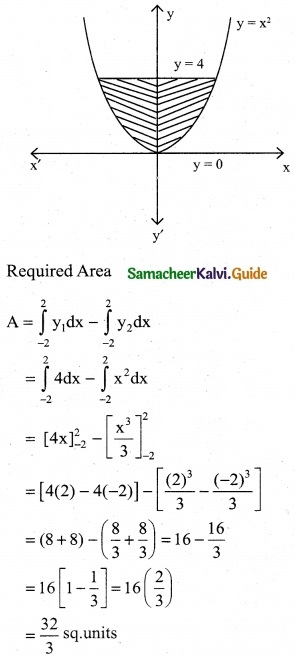
Samacheer Kalvi 12th Business Maths Guide Chapter 3 Integral Calculus II Ex 3.4

Tamilnadu State Board New Syllabus Samacheer Kalvi 12th Business Maths Guide Pdf Chapter 3 Integral Calculus II Ex 3.4 Text Book Back Questions and Answers, Notes.

Tamilnadu Samacheer Kalvi 12th Business Maths Solutions Chapter 3 Integral Calculus II Ex 3.4

Choose the most suitable answer from the given four alternatives:

Question 1.
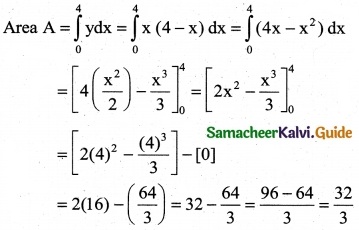
Area bounded by the curve y = x (4 – x) between the limits 0 and 4 with x-axis is
(a) \(\frac { 30 }{3}\) sq.unit
(b) \(\frac { 31 }{2}\) sq.unit
(c) \(\frac { 32 }{3}\) sq.unit
(d) \(\frac { 15 }{3}\) sq.unit
Solution:
(c) \(\frac { 32 }{3}\) sq.unit
Hint:
Samacheer Kalvi 12th Business Maths Guide Chapter 3 Integral Calculus II Ex 3.4 1

Samacheer Kalvi 12th Business Maths Guide Chapter 3 Integral Calculus II Ex 3.4

Question 2.
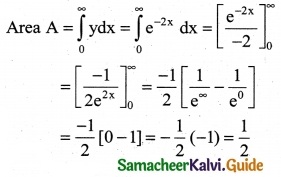
Area bounded by the curve y = e-2x between the limits 0 < x < ∞ is
(a) 1 sq.units
(b) \(\frac { 1 }{2}\) sq.units
(c) 5 sq.units
(d) 2 sq.units
Solution:
(b) \(\frac { 1 }{2}\) sq.units
Hint:
Samacheer Kalvi 12th Business Maths Guide Chapter 3 Integral Calculus II Ex 3.4 2

Question 3.
Area bounded by the curve y = \(\frac { 1 }{x}\) between the limits 1 and 2 is
(a) log 2 sq.units
(b) log 5 sq.units
(c) log 3 sq.units
(d) log 4 sq.units
Solution:
(a) log 2 sq.units
Hint:
Area = \(\int_{1}^{2} \frac{1}{x} d x\)
= \((\log x)_{1}^{2}\)
= log 2 – log 1
= log 2 (Since log 1 = 0)

Samacheer Kalvi 12th Business Maths Guide Chapter 3 Integral Calculus II Ex 3.4

Question 4.
If the marginal revenue function of a firm is MR = e\(\frac { -x }{10}\) then revenue is
(a) 1 – e-x/10
(b) e-x/10 + 10
(c) 10(1 – e-x/10)
(d) -10e-x/10
Solution:
(c) 10(1 – e-x/10)
Hint:
MR = e\(\frac { -x }{10}\) then R = ∫MR dx
R = ∫e-x/10 dx = \(\frac { e^{-x/10} }{(-1/10)}\) + k
R = -10e-x/10 + k when x = 0, R = 0
⇒ 0 = -10e0 + k
0 = -10(1) + k
∴ k = 10
R = -10e-x/10 + 10 = 10(1 – e-x/10)

Question 5.
If MR and MC denotes the marginal revenue and marginal cost functions, then the profit functions is
(a) P = ∫(MR – MC) dx + k
(b) P = ∫(R – C) dx + k
(c) P = ∫(MR + MC)dx + k
(d) P = ∫(MR) (MC) dx + k
Solution:
(a) P = ∫(MR – MC) dx + k
Hint:
Profit = Revenue – Cost

Question 6.
The demand and supply functions are given by D(x) = 16 – x² and S(x) = 2x² + 4 are under perfect competition, then the equilibrium price x is
(a) 2
(b) 3
(c) 4
(d) 5
Solution:
(a) 2
Hint:
D(x) =16 – x² and S(x) = 2x² + 4
Under perfect competition D(x) = S(x)
16 – x² = 2x² + 4; 16 – 4 = 2x² + x²
3x² = 12 ⇒ x² = \(\frac { 12 }{3}\) = 4
∴ x = ± 2, x cannot be in negative
∴ x = 2

Samacheer Kalvi 12th Business Maths Guide Chapter 3 Integral Calculus II Ex 3.4

Question 7.
The marginal revenue and marginal coast functions of a company are MR = 30 – 6x and MC = -24 + 3x where x is the product, profit function is
(a) 9x² + 54x
(b) 9x² – 54x
(c) 54x – \(\frac { 9x^2 }{2}\)
(d) 54x – \(\frac { 9x^2 }{2}\) + k
Solution:
(d) 54x – \(\frac { 9x^2 }{2}\) + k
Hint:
Profit = ∫(MR – MC) dx + k
= ∫(30 – 60) – (-24 + 3x) dx + k
= ∫(54 – 9x) dx + k
= 54x – \(\frac{9 x^{2}}{2}\) + k

Question 8.
The given demand and supply function are given by D(x) = 20 – 5x and S(x) = 4x + 8 if they are under perfect competition then the equilibrium demand is
(a) 40
(b) \(\frac { 41 }{2}\)
(c) \(\frac { 40 }{3}\)
(d) \(\frac { 41 }{5}\)
Solution:
(c) \(\frac { 40 }{3}\)
Hint:
Under perfect competition D(x) = S(x)
20 – 5x = 4x + 8
20 – 8 = 4x + 5x ⇒ 9x = 12
x = \(\frac { 4 }{3}\)
when x = \(\frac { 4 }{3}\); D(x) = 20 – 5(\(\frac { 4 }{3}\)) = 20 – \(\frac { 20 }{3}\)
= \(\frac { 40 }{3}\)

Question 9.
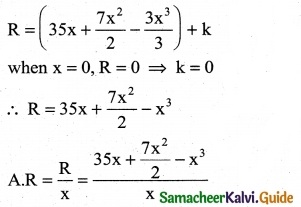
If the marginal revenue MR = 35 +7x – 3x², then the average revenue AR is.
(a) 35x + \(\frac { 7x^2 }{2}\) – x³
(b) 35x + \(\frac { 7x }{2}\) – x²
(c) 35x + \(\frac { 7x }{2}\) + x²
(d) 35x + 7x + x²
Solution:
(c) \(\frac { 40 }{3}\)
Hint:
R = ∫MR dx = ∫(35 + 7x – 3x²) dx
Samacheer Kalvi 12th Business Maths Guide Chapter 3 Integral Calculus II Ex 3.4 3

Samacheer Kalvi 12th Business Maths Guide Chapter 3 Integral Calculus II Ex 3.4

Question 10.
The profit of a function p(x) is maximum when
(a) MC – MR = 0
(b) MC = 0
(c) MR = 0
(d) MC + MR = 0
Solution:
(a) MC – MR = 0
Hint:
P = Revenue – Cost
P is maximum when \(\frac{d p}{d x}\) = 0
\(\frac{d p}{d x}\) = R'(x) – C'(x) = MR – MC = 0

Question 11.
For the demand function p(x), the elasticity of demand with respect to price is unity then.
(a) revenue is constant
(b) a cost function is constant
(c) profit is constant
(d) none of these
Solution:
(a) Revenue is constant

Question 12.
The demand function for the marginal function MR = 100 – 9x² is
(a) 100 – 3x²
(b) 100x – 3x²
(c) 100x – 9x²
(d) 100 + 9x²
Solution:
(a) 100 – 3x²
Hint:
R = ∫(MR) dx + c1
R = ∫(100 – 9x2) dx + c1
R = 100x – 3x3 + c1
When R = 0, x = 0, c1 = 0
R = 100x – 3x3
Demand function is \(\frac{R}{x}\) = 100 – 3x2

Samacheer Kalvi 12th Business Maths Guide Chapter 3 Integral Calculus II Ex 3.4

Question 13.
When x0 = 5 and p0 = 3 the consumer’s surplus for the demand function pd = 28 – x²
(a) 250 units
(b) \(\frac { 250 }{3}\) units
(c) \(\frac { 251 }{2}\) units
(d) \(\frac { 251 }{3}\) units
Solution:
(b) \(\frac { 250 }{3}\) units
Hint:
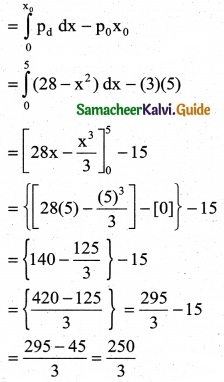
Samacheer Kalvi 12th Business Maths Guide Chapter 3 Integral Calculus II Ex 3.4 4

Question 14.
When x0 = 2 and P0 = 12 the producer’s surplus for the supply function P0 = 2x² + 4 is
(a) \(\frac { 31 }{5}\) units
(b) \(\frac { 31 }{2}\) units
(c) \(\frac { 32 }{2}\) units
(d) \(\frac { 30 }{7}\) units
Solution:
(c) \(\frac { 32 }{2}\) units
Hint:
Producer’s Surplus
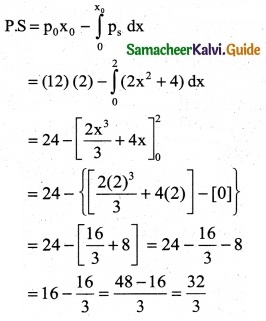
Samacheer Kalvi 12th Business Maths Guide Chapter 3 Integral Calculus II Ex 3.4 5

Question 15.
Area bounded by y = x between the lines y = 1, y = 2 with y = axis is
(a) \(\frac { 1 }{2}\) sq units
(b) \(\frac { 5 }{2}\) sq units
(c) \(\frac { 3 }{2}\) sq units
(d) 1 sq units
Solution:
(c) \(\frac { 3 }{2}\) sq units
Hint:
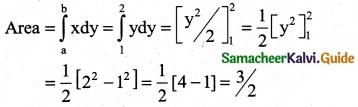
Samacheer Kalvi 12th Business Maths Guide Chapter 3 Integral Calculus II Ex 3.4 6

Samacheer Kalvi 12th Business Maths Guide Chapter 3 Integral Calculus II Ex 3.4

Question 16.
The producer’s surplus when supply the function for a commodity is p = 3 + x and x0 = 3 is
(a) \(\frac { 1 }{2}\)
(b) \(\frac { 9 }{2}\)
(c) \(\frac { 3 }{2}\)
(d) \(\frac { 7 }{2}\)
Solution:
(b) \(\frac { 9 }{2}\)
Hint:
p = 3 + x and x0 = 3
then p0 = 3 + 3 = 6
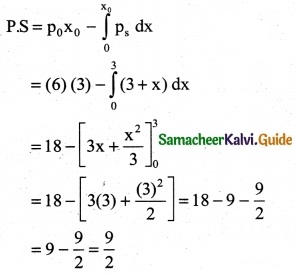
Samacheer Kalvi 12th Business Maths Guide Chapter 3 Integral Calculus II Ex 3.4 7

Question 17.
The marginal cost function is MC = 100√x find AC given that TC = 0 when the out put is zero is
(a) \(\frac { 200 }{3}\) x1/2
(b) \(\frac { 200 }{3}\) x3/2
(c) \(\frac { 200 }{3x^{3/2}}\)
(d) \(\frac { 200 }{3x^{1/2}}\)
Solution:
(a) \(\frac { 200 }{3}\) x1/2
Hint:
TC = ∫MC dx = ∫100√x dx = 100 ∫(x)1/2 dx
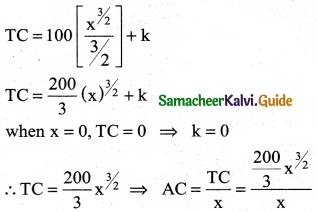
Samacheer Kalvi 12th Business Maths Guide Chapter 3 Integral Calculus II Ex 3.4 8

Question 18.
The demand and supply function of a commodity are P(x) = (x – 5)² and S(x) = x² + x + 3 then the equilibrium quantity x0 is
(a) 5
(b) 2
(c) 3
(d) 10
Solution:
(b) 2
Hint:
At equilibrium, P(x) = S(x)
⇒ (x – 5)2 = x2 + x + 3
⇒ x2 – 10x + 25 = x2 + x + 3
⇒ 11x = 22
⇒ x = 2

Samacheer Kalvi 12th Business Maths Guide Chapter 3 Integral Calculus II Ex 3.4

Question 19.
The demand and supply function of a commodity are D(x) = 25 – 2x and S(x) = \(\frac { 10+x }{2}\) then the equilibrium price P0 is
(a) 2
(b) 2
(c) 3
(d) 10
Solution:
(a) 2
Hint:
At equilibrium, D(x) = S(x)
25 – 2x = \(\frac{10+x}{4}\)
⇒ 100 – 8x = 10 + x
⇒ x = 10
That is x0 = 10
P0 = 25 – 2(x0) = 25 – 20 = 5

Question 20.
If MR and MC denote the marginal revenue and marginal cost and MR – MC = 36x – 3x² – 81, then maximum profit at x equal to
(a) 3
(b) 6
(c) 9
(d) 10
Solution
(c) 9
Hint:
Profit P = ∫(MR – MC) dx = ∫(36x – 3x² – 81) dx
P = [\(\frac { 36x^2 }{2}\) – \(\frac { 3x^3 }{3}\) – 81x] = 18x² – x³ – 81x
when p = 0; 18x² – x³ – 81x = 0 ⇒ x² – 18x + 81 = 0
(x – 9)² = 0 ⇒ x – 9 = 0
∴ x = 9

Question 21.
If the marginal revenue of a firm is constant, then the demand function is
(a) MR
(b) MC
(c) C(x)
(d) AC
Solution:
(a) MR
Hint:
MR = k (constant)
Revenue function R = ∫(MR) dx + c1
= ∫kdx + c1
= kx + c1
When R = 0, x = 0, ⇒ c1 = 0
R = kx
Demand function p = \(\frac{R}{x}=\frac{k x}{x}\) = k constant
⇒ p = MR

Samacheer Kalvi 12th Business Maths Guide Chapter 3 Integral Calculus II Ex 3.4

Question 22.
For a demand function p, if ∫\(\frac { dp }{p}\) = k ∫\(\frac { dx }{x}\) then k is equal to
(a) nd
(b) -nd
(c) \(\frac { -1 }{n_d}\)
(d) \(\frac { 1 }{n_d}\)
Solution:
(c) \(\frac { -1 }{n_d}\)

Question 23.
The area bounded by y = ex between the limits 0 to 1 is
(a) (e – 1) sq.units
(b) (e + 1) sq.units
(c) (1 – \(\frac { 1 }{e}\)) sq.units
(d) (1 + \(\frac { 1 }{e}\)) sq.units
Solution:
(a) (e – 1) sq.units
Hint:
Area A = \(\int_{a}^{b}\)ydx = \(\int_{0}^{1}\)exdx = [ex]\(_{0}^{1}\)
= [ex – e°] = [e – 1]

Question 24.
The area bounded by the parabola y² = 4x bounded by its latus rectum is
(a) \(\frac { 16 }{3}\) sq units
(b) \(\frac { 8 }{3}\) sq units
(c) \(\frac { 72 }{3}\) sq units
(d) \(\frac { 1 }{3}\) sq units
Solution:
(b) \(\frac { 8 }{3}\) sq units
Hint:
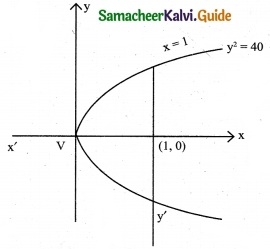
Samacheer Kalvi 12th Business Maths Guide Chapter 3 Integral Calculus II Ex 3.4 9
y² = 4x ⇒ y = \(\sqrt { 4x}\) 2√x = 2(x)1/2
In this parabola 4a = 4 ⇒ a = 1 and vertex V(0, 0)
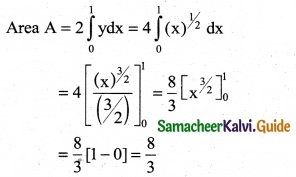
Samacheer Kalvi 12th Business Maths Guide Chapter 3 Integral Calculus II Ex 3.4 10

Samacheer Kalvi 12th Business Maths Guide Chapter 3 Integral Calculus II Ex 3.4

Question 25.
The area bounded by y = |x| between the limits 0 and 2 is
(a) 1 sq.units
(b) 3 sq.units
(c) 2 sq.units
(d) 4 sq.units
Solution:
(c) 2 sq.units
Hint:
Area A = \(\int_{a}^{b}\)ydx = \(\int_{0}^{2}\)x dx = [ \(\frac { x^2 }{2}\) ]\(_{0}^{2}\)
= \(\frac { (2)^2 }{2}\) – (0) = \(\frac { 4 }{2}\) = 2

Must Read:
Icici Bank Pivot Point

Samacheer Kalvi 12th Business Maths Guide Chapter 3 Integral Calculus II Ex 3.3

Tamilnadu State Board New Syllabus Samacheer Kalvi 12th Business Maths Guide Pdf Chapter 3 Integral Calculus II Ex 3.3 Text Book Back Questions and Answers, Notes.

Tamilnadu Samacheer Kalvi 12th Business Maths Solutions Chapter 3 Integral Calculus II Ex 3.3

Question 1.
Calculate consumer’s surplus if the demand function p = 50 – 2x and x = 20
Solution:
Demand function p = 50 – 2x and x = 20
when x = 20, p = 50 – 2(20)
p = 50 – 40 = 10
∴ p0 = 10
CS = \(\int _{0}^{x}\) (demand function) dx – (Price × quantity demanded)
= \(\int _{0}^{20}\) (50 – 2x)dx – (10 × 20)
= [50x – 2(\(\frac { x^2 }{2}\))]\( _{0}^{20}\) – 200
= [50x – x²]\( _{0}^{20}\) – 200
= {50(20) – (20)² – [0]} – 200
= (1000 – 400) – 200
= 600 – 200
∴ C.S = 400 units

Samacheer Kalvi 12th Business Maths Guide Chapter 3 Integral Calculus II Ex 3.3

Question 2.
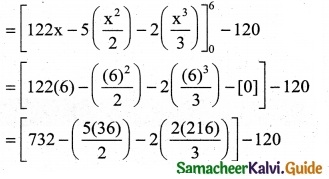
Calculate consumer’s surplus if the demand function p = 122 – 5x – 2x² and x = 6.
Solution:
Demand function p = 122 – 5x – 2x² and x = 6
when x = 6; p = 122 – 5(6) – 2(6)²
= 122 – 30 – 2 (36)
= 122 – 102 = 20
∴ p0 = 20
C.S = \(\int _{0}^{x}\) (demand function) dx – (Price × quantity demanded)
= \(\int _{0}^{6}\)(122 – 5x – 2x²) dx – (20 × 6)
Samacheer Kalvi 12th Business Maths Guide Chapter 3 Integral Calculus II Ex 3.3 1
[732 – 5(18) – 2(72)] – 120
= 732 – 90 – 144 – 120
= 732 – 354 = 378
∴ CS = 378 units

Samacheer Kalvi 12th Business Maths Guide Chapter 3 Integral Calculus II Ex 3.3

Question 3.
The demand function p = 85 – 5x and supply function p = 3x – 3. Calculate the equilibrium price and quantity demanded. Also calculate consumer’s surplus.
Solution:
Demand function p = 85 – 5x
Supply function p = 3x – 35
W.K.T. at equilibrium prices pd = ps
85 – 5x = 3x – 35
85 + 35 = 3x + 5x
120 = 8x ⇒ x = \(\frac { 120 }{8}\)
∴ x = 15
when x = 15 p0 = 85 – 5(15) = 85 – 75 = 10
C.S = \(\int _{0}^{x}\) f(x) dx – x0p0
= \(\int _{0}^{x}\) (85 – 5x) dx – (15)(10)
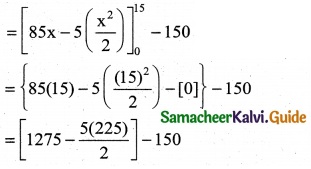
Samacheer Kalvi 12th Business Maths Guide Chapter 3 Integral Calculus II Ex 3.3 2
= 1275 – \(\frac { 1125 }{2}\) – 150
= 1275 – 562.50 – 150
= 1275 – 712.50
∴ CS = 562.50 units

Question 4.
The demand function for a commodity is p = e-x. Find the consumer’s surplus when p = 0.5
Solution:
The demand function p = e-x
when p = 0.5 ⇒ 0.5 = e-x
\(\frac { 1 }{2}\) = \(\frac { 1 }{e^x}\) ⇒ ex = 2
∴ x = log 2
∴ Consumer’s surplus
C.S = \(\int _{0}^{x}\) (demand function) dx – (Price × quantity demanded)
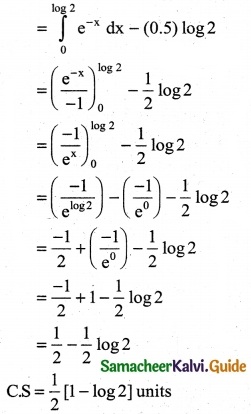
Samacheer Kalvi 12th Business Maths Guide Chapter 3 Integral Calculus II Ex 3.3 3

Samacheer Kalvi 12th Business Maths Guide Chapter 3 Integral Calculus II Ex 3.3

Question 5.
Calculate the producer’s surplus at x = 5 for the supply function p = 7 + x
Solution:
The supply function p = 7 + x
when x = 5 ⇒ p = 7 + 5 = 12
∴ x0 = 5 and p0 = 12
Producer’s surplus
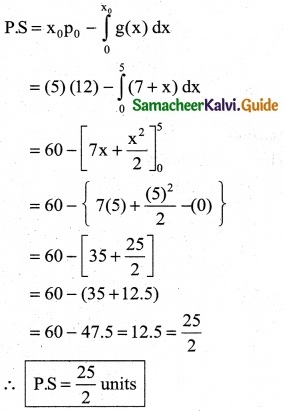
Samacheer Kalvi 12th Business Maths Guide Chapter 3 Integral Calculus II Ex 3.3 4

Question 6.
If the supply function for a product is p = 3x + 5x². Find the producer’s surplus when x = 4
Solution:
The supply function p = 3x + 5x²
when x = 4 ⇒ p = 3(4) + 5(4)²
p = 12 + 5(16)= 12 + 80
p = 92
∴ x0 = 4 and p0 = 92
Producer’s Surplus
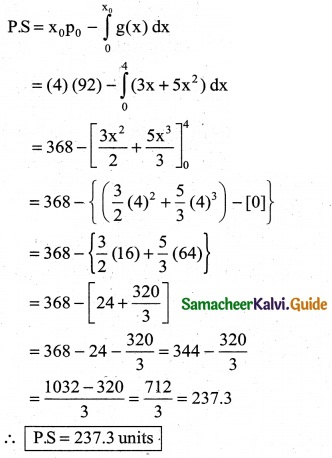
Samacheer Kalvi 12th Business Maths Guide Chapter 3 Integral Calculus II Ex 3.3 5

Samacheer Kalvi 12th Business Maths Guide Chapter 3 Integral Calculus II Ex 3.3

Question 7.
The demand function for a commodity is p = \(\frac { 36 }{x+4}\) Find the producer’s surplus when the prevailing market price is Rs 6.
Solution:
The demand function for a commodity
p = \(\frac { 36 }{x+4}\)
when p = 6 ⇒ 6 = \(\frac { 36 }{x+4}\)
x + 4 = \(\frac { 36 }{6}\) ⇒ x + 4 = 6
x = 2
∴ p0 = 6 and x0 = 2
The consumer’s surplus
C.S = \(\int _{0}^{x}\) f(x) dx – x0p0
= \(\int _{0}^{2}\) (\(\frac { 36 }{x+4}\)) dx – 2(6)
= 36 [log (x + 4)]\(_{0}^{2}\) – 12
= 36 [log (2 + 4) – log (0 + 4)] – 12
= 36 [log6 – log4] – 12
= 36[log(\(\frac { 6 }{4}\))] – 12
∴ CS = 36 log(\(\frac { 6 }{4}\)) – 12 units

Samacheer Kalvi 12th Business Maths Guide Chapter 3 Integral Calculus II Ex 3.3

Question 8.
The demand and supply functions under perfect competition are pd = 1600 – x² and ps = 2x² + 400 respectively, find the producer’s surplus.
Solution:
pd = 1600 – x² and ps = 2x² + 400
Under the perfect competition pd = ps
1600 – x² = 2x² + 400
1600 – 400 = 2x² + x² ⇒ 1200 = 3x²
⇒ x² – 400 ⇒ x = 20 or -20
The value of x cannot be negative, x = 20 when x0 = 20;
p0 = 1600 – (20)² = 1600 – 400
P0 = 1200
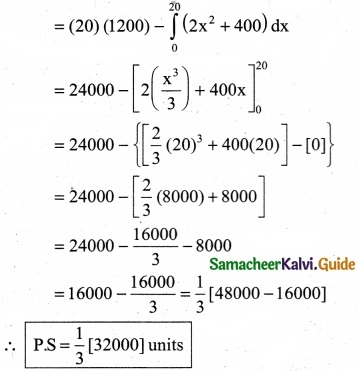
PS = x0p0 – \(\int _{0}^{x_0}\) g(x) dx
Samacheer Kalvi 12th Business Maths Guide Chapter 3 Integral Calculus II Ex 3.3 6

Samacheer Kalvi 12th Business Maths Guide Chapter 3 Integral Calculus II Ex 3.3

Question 9.
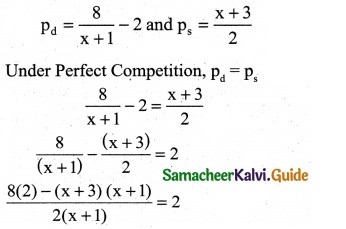
Under perfect competition for a commodity the demand and supply laws are Pd = \(\frac { 8 }{x+1}\) – 2 and Ps = \(\frac { x+3 }{2}\) respectively. Find the consumer’s and producer’s surplus.
Solution:
Samacheer Kalvi 12th Business Maths Guide Chapter 3 Integral Calculus II Ex 3.3 7
16 – (x² + 3x + x + 3) = 2 [2(x + 1)]
16 – (x² + 4x + 3) = 4(x + 1)
16 – x² – 4x – 3 = 4x + 4
x² + 4x + 4x + 4 + 3 – 16 = 0
x² + 8x – 9 = 0
(x + 9) (x – 1) = 0 ⇒ x = -9 (or) x = 1
The value of x cannot be negative x = 1 when x0 = 1
p0 = \(\frac { 8 }{1+1}\) – 2 ⇒ p0 = \(\frac { 8 }{2}\) – 2
p0 = 4 – 2 ⇒ p0 = 2
CS = \(\int _{0}^{x}\) f(x) dx – x0p0
= \(\int _{0}^{1}\) (\(\frac { 8 }{x+1}\) – 2) dx – (1) (2)
= {8[log(x + 1)] – 2x}\(\int _{0}^{1}\) – 2
= 8 {[log (1 + 1) – 2(1)] – 8 [log (0 + 1) – 2(0)]} – 2
= [8 log (2) – 2 – 8 log1] – 2
= 8 log(\(\frac { 8 }{2}\)) – 2 – 2
C.S = (8 log 2 – 4) units
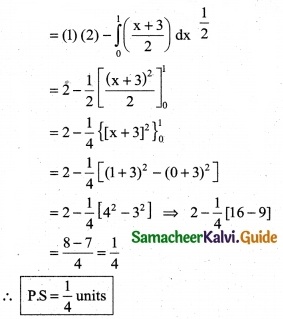
P.S = x0p0 – \(\int _{0}^{x_0}\) g(x) dx
Samacheer Kalvi 12th Business Maths Guide Chapter 3 Integral Calculus II Ex 3.3 8

Samacheer Kalvi 12th Business Maths Guide Chapter 3 Integral Calculus II Ex 3.3

Question 10.
The demand equation for a products is x = \(\sqrt {100-p}\) and the supply equation is x = \(\frac {p}{2}\) – 10. Determine the consumer’s surplus and producer’s, under market equilibrium.
Solution:
pd = \(\sqrt {100-p}\) and ps = \(\sqrt {100-p}\)
Under market equilibrium, pd = ps
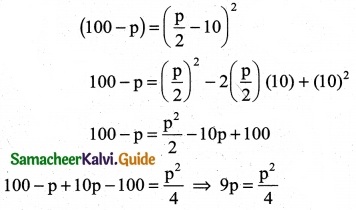
\(\sqrt {100-p}\) = \(\frac {p}{2}\) – 10
Squaring on both sides
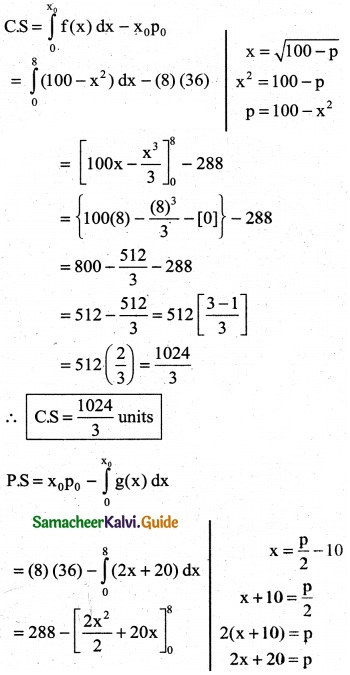
Samacheer Kalvi 12th Business Maths Guide Chapter 3 Integral Calculus II Ex 3.3 9
36p = p² ⇒ p² – 36 p = 0
p (p – 36) = 0 ⇒ p = 0 or p = 36
The value of p cannot be zero, ∴p0 = 36 when p0 = 36
x0 = \(\sqrt {100-36}\) = \(\sqrt {64}\)
∴ x0 = 8
Samacheer Kalvi 12th Business Maths Guide Chapter 3 Integral Calculus II Ex 3.3 10
= 288 – [x² + 20x]\( _{0}^{8}\)
= 288 – { [(8)² + 20(8)] – [0]}
= 288 – [64 + 160]
= 288 – 224 = 64
PS = 64 Units

Samacheer Kalvi 12th Business Maths Guide Chapter 3 Integral Calculus II Ex 3.3

Question 11.
Find the consumer’s surplus and producer’s surplus for the demand function pd = 25 – 3x and supply function ps = 5 + 2x
Solution:
pd = 25 – 3x and ps = 5 + 2x
Under market equilibrium, pd = ps
25 – 3x = 5 + 2x
25 – 5 = 2x + 3x ⇒ 5x = 20
∴ x = 4
when x = 4
P0 = 25 – 3(4)
= 25 – 12 = 13
p0 = 13
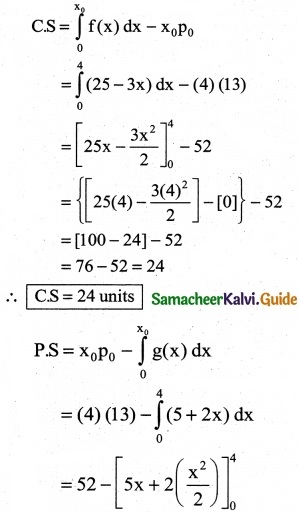
Samacheer Kalvi 12th Business Maths Guide Chapter 3 Integral Calculus II Ex 3.3 11
= 52 – [5x + x²]\( _{0}^{4}\)
= 52 – (5(4) + (4)²) – (0)}
= 52 – [20 + 16]
= 52 – 36
∴ PS = 16 units

Samacheer Kalvi 12th Business Maths Guide Chapter 3 Integral Calculus II Ex 3.3

Try More:

What Is Nr7 Candle

Samacheer Kalvi 12th Business Maths Guide Chapter 3 Integral Calculus II Ex 3.2

Tamilnadu State Board New Syllabus Samacheer Kalvi 12th Business Maths Guide Pdf Chapter 3 Integral Calculus II Ex 3.2 Text Book Back Questions and Answers, Notes.

Tamilnadu Samacheer Kalvi 12th Business Maths Solutions Chapter 3 Integral Calculus II Ex 3.2

Question 1.
The cost of an overhaul of an engine is Rs 10,000 The Operating cost per hour is at the rate of 2x-240 where the engine has run x km. find out the total cost of the engine run for 300 hours after overhaul.
Solution:
Given that the overhaul cost is Rs. 10,000.
The marginal cost is 2x – 240
MC = 2x – 240
C = ∫ MC dx + k
C = x2 – 240x + k
k is the overhaul cost
⇒ k = 10,000
So C = x2 – 240x + 10,000
When x = 300 hours, total cost is
C = (300)2 – 240(300) + 10,000
⇒ C = 90,000 – 72000 + 10,000
⇒ C = 28,000
So the total cost of the engine run for 300 hours after the overhaul is ₹ 28,000.

Question 2.
Elasticity of a function \(\frac { Ey }{Ex}\) is given by \(\frac { Ey }{Ex}\) = \(\frac { -7x }{(1-2x)(2+3x)}\). Find the function when x = 2, y = \(\frac { 3 }{8}\)
Solution:
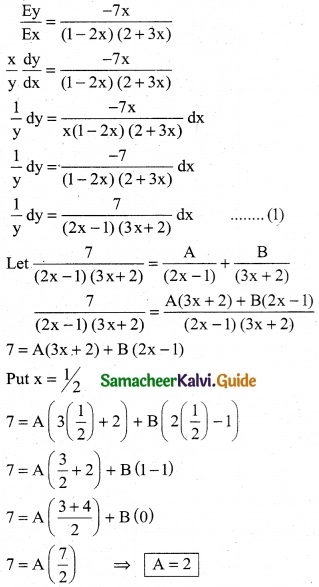
Samacheer Kalvi 12th Business Maths Guide Chapter 3 Integral Calculus II Ex 3.2 1
Put x = 0
7 = A (3(0) + 2) + B (2(0) – 1)
7 = A (2) + B (-1)
7 = (2) (2) – B
B = 4 – 7
B = -3
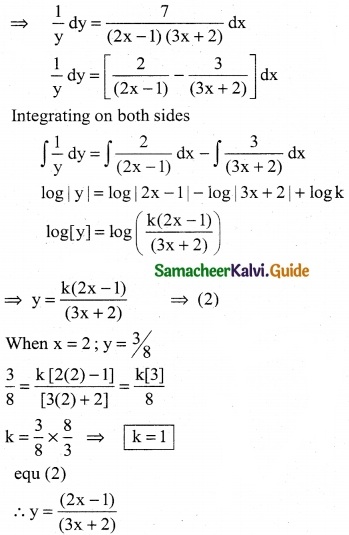
Samacheer Kalvi 12th Business Maths Guide Chapter 3 Integral Calculus II Ex 3.2 2

Samacheer Kalvi 12th Business Maths Guide Chapter 3 Integral Calculus II Ex 3.2

Question 3.
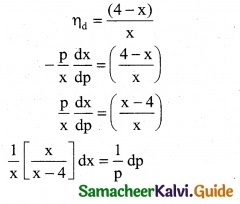
The Elasticity of demand with respect to price for a commodity is given by where \(\frac { (4-x)}{x}\) p is the price when demand is x. find the demand function when the price is 4 and the demand is 2. Also, find the revenue function
Solution:
The elasticity at the demand
Samacheer Kalvi 12th Business Maths Guide Chapter 3 Integral Calculus II Ex 3.2 3
Integrating on both sides
∫\(\frac { 1}{(x-4)}\) = ∫\(\frac { 1}{p}\) dp
log |x – 4| = log |p| + log k
log |x – 4| = log |pk| ⇒ (x – 4) = pk ……… (1)
when p = 4 and x = 2
(2 – 4) = 4k ⇒ -2 = 4k
k = -1/2
Eqn (1) ⇒ (x – 4) = p(-1/2)
-2 (x – 4) = p ⇒ p = 8 – 2x
Revenue function R = px = (8 – 2x)x
R = 8x – 2x²

Question 4.
A company receives a shipment of 500 scooters every 30 days. From experience it is known that the inventory on hand is related to the number of days x. Since the shipment, I (x) = 500 – 0.03 x², the daily holding cost per scooter is Rs 0.3. Determine the total cost for maintaining inventory for 30 days
Solution:
Here I (x) = 500 – 0.03 x²
C1 = Rs 0.3
T = 30
Total inventory carrying cost
= C1 \(\int _{0}^{T}\) I(x) dx
= 0.3 \(\int _{0}^{30}\) (500 – 0.03 x²)dx
= 0.3 [500 x – 0.03(\(\frac { x^3 }{3}\))]\( _{0}^{30}\)
= 0.3 [ 500 x – 0.01 x³]\( _{0}^{30}\)
= 0.3 [500(30) – 0.01 (30)³] – [0]
= 0.3 [15000 – 0.01 (27000)]
= 0.3 [15000 – 270] = 0.3 [14730]
= Rs 4,419

Samacheer Kalvi 12th Business Maths Guide Chapter 3 Integral Calculus II Ex 3.2

Question 5.
An account fetches interest at the rate of 5% per annum compounded continuously an individual deposits Rs 1000 each year in his account. how much will be in the account after 5 years (e0.25 = 1.284)
Solution:
P = 1000
r = \(\frac { 5 }{1000}\) = 0.05
N = 5
Annuity = \(\int _{0}^{5}\) 1000 e0.05t dt
= 1000 [ \(\frac { e^{0.05t} }{0.05}\) ] \(_{0}^{5}\)
= \(\frac { 1000 }{0.05}\) [e0.05(5) – e0]
= 20000 [e0.25 – 1]
= 20000 [1.284 – 1]
= 20000 [0.284]
= Rs 5680

Question 6.
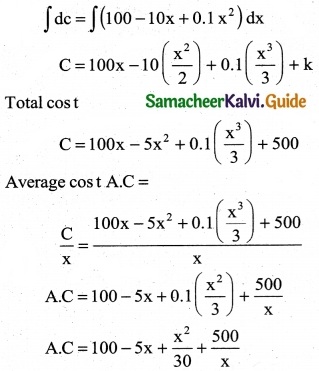
The marginal cost function of a product is given by \(\frac { dc }{dx}\) = 100 – 10x + 0.1 x² where x is the output. Obtain the total and average cost function of the firm under the assumption, that its fixed cost is t 500
Solution:
\(\frac { dc }{dx}\) = 100 – 10x + 0.1 x² and k = Rs 500
dc = (100 – 10x + 0.1 x²) dx
Integrating on both sides,
Samacheer Kalvi 12th Business Maths Guide Chapter 3 Integral Calculus II Ex 3.2 4

Samacheer Kalvi 12th Business Maths Guide Chapter 3 Integral Calculus II Ex 3.2

Question 7.
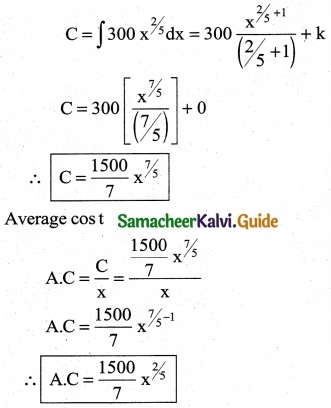
The marginal cost function is M.C = 300 x2/5 and the fixed cost is zero. Find the total cost as a function of x
Solution:
M.C = 300 x2/5 and fixed cost K = 0
Total cos t = ∫M.C dx
Samacheer Kalvi 12th Business Maths Guide Chapter 3 Integral Calculus II Ex 3.2 5

Question 8.
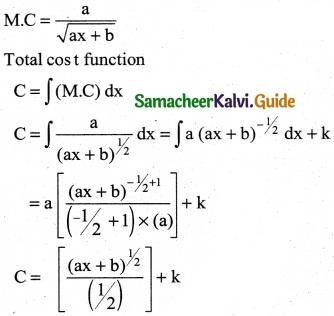
If the marginal cost function of x units of output is \(\frac { a }{\sqrt {ax+b}}\) and if the cost of output is zero. Find the total cost as a function of x.
Solution:
Samacheer Kalvi 12th Business Maths Guide Chapter 3 Integral Calculus II Ex 3.2 6
∴ C(x) = 2(ax + b)1/2 + k …….. (1)
When x = 0
eqn (1) ⇒ 0 = 2 [a(0) + b]1/2 + k
k = -2(b)1/2 ⇒ k = -2√b
Required cost function
C(x) = 2(ax + b)1/2 – 2√b
∴ C = 2\(\sqrt { ax + b}\) – 2√b

Samacheer Kalvi 12th Business Maths Guide Chapter 3 Integral Calculus II Ex 3.2

Question 9.
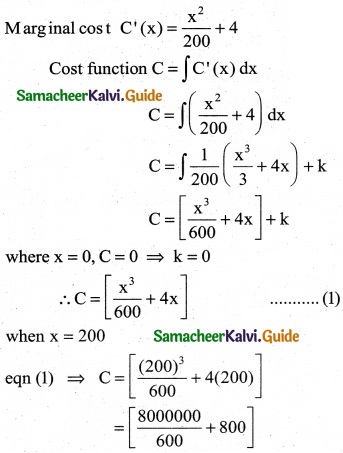
Determine the cost of producing 200 air conditioners if the marginal cost (is per unit) is C'(x) = \(\frac { x^2 }{200}\) + 4
Solution:
Samacheer Kalvi 12th Business Maths Guide Chapter 3 Integral Calculus II Ex 3.2 7
= 13333.33 + 800
∴ Cost of producing 200 air conditioners
= Rs 14133.33

Question 10.
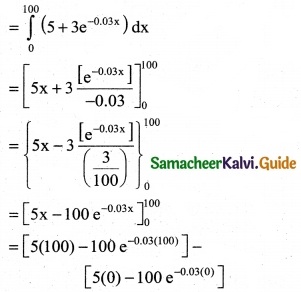
The marginal revenue (in thousands of Rupees) function for a particular commodity is 5 + 3 e-0.03x where x denotes the number of units sold. Determine the total revenue from the sale of 100 units (given e-3 = approximately)
Solution:
The marginal Revenue (in thousands of Rupees) function
M.R = 5 + 3-0.03x
Total Revenue from sale of 100 units is
Total Revenue T.R = \(\int _{0}^{ 100}\) M.R dx
Samacheer Kalvi 12th Business Maths Guide Chapter 3 Integral Calculus II Ex 3.2 8
= [500 – 100 e-3] – [0 – 100 e°]
= [500 -100 (0.05)] – [-100 (1)]
= [500 – 5]+ 100
= 495 + 100 = 595 thousands
= 595 × 1000
∴ Revenue R = Rs 595000

Samacheer Kalvi 12th Business Maths Guide Chapter 3 Integral Calculus II Ex 3.2

Question 11.
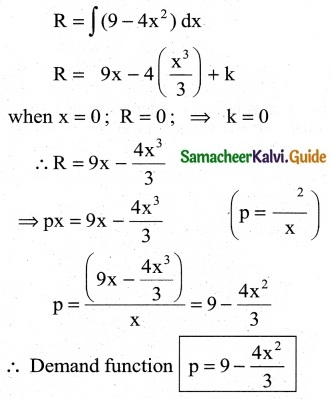
If the marginal revenue function for a commodity is MR = 9 – 4x². Find the demand function.
Solution:
Marginal Revenue function MR = 9 – 4x²
Revenue function R = ∫MR dx
Samacheer Kalvi 12th Business Maths Guide Chapter 3 Integral Calculus II Ex 3.2 9

Question 12.
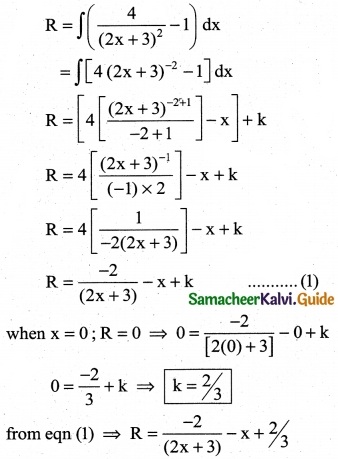
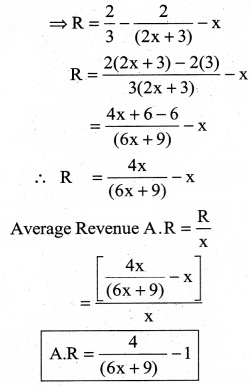
Given marginal revenue function \(\frac { 4 }{(2x+3)^2}\) -1, show that the average revenue function is P = \(\frac { 4 }{6x+9}\) -1
Solution:
M.R = \(\frac { 4 }{(2x+3)^2}\) -1
Total Revenue R = ∫M.R dx
Samacheer Kalvi 12th Business Maths Guide Chapter 3 Integral Calculus II Ex 3.2 10
Samacheer Kalvi 12th Business Maths Guide Chapter 3 Integral Calculus II Ex 3.2 11

Samacheer Kalvi 12th Business Maths Guide Chapter 3 Integral Calculus II Ex 3.2

Question 13.
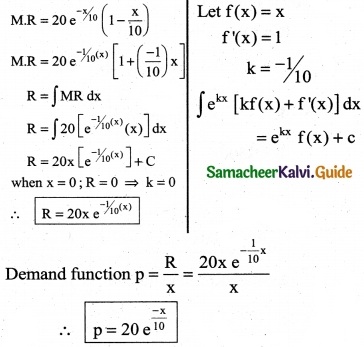
A firms marginal revenue functions is M.R = 20 e-x/10 Find the corresponding demand function.
Solution:
Samacheer Kalvi 12th Business Maths Guide Chapter 3 Integral Calculus II Ex 3.2 12

Question 14.
The marginal cost of production of a firm is given by C’ (x) = 5 + 0.13 x, the marginal revenue is given by R’ (x) = 18 and the fixed cost is Rs 120. Find the profit function.
Solution:
MC = C'(x) = 5 + 0.13x
C(x) = ∫C'(x) dx + k1
= ∫(5 + 0.13x) dx + k1
= 5x + \(\frac{0.13}{2} x^{2}\) + k1
When quantity produced is zero, fixed cost is 120
(i.e) When x = 0, C = 120 ⇒ k1 = 120
Cost function is 5x + 0.065x2 + 120
Now given MR = R'(x) = 18
R(x) = ∫18 dx + k2 = 18x + k2
When x = 0, R = 0 ⇒ k2 = 0
Revenue = 18x
Profit P = Total Revenue – Total cost = 18x – (5x + 0.065x2 + 120)
Profit function = 13x – 0.065x2 – 120

Samacheer Kalvi 12th Business Maths Guide Chapter 3 Integral Calculus II Ex 3.2

Question 15.
If the marginal revenue function is R'(x) = 1500 – 4x – 3x². Find the revenue function and average revenue function.
Solution:
Given marginal revenue function
MR = R’(x)= 1500 – 4x – 3x2
Revenue function R(x) = ∫R'(x) dx + c
R = ∫(1500 – 4x – 3x2) dx + c
R = 1500x – 2x2 – x3 + c
When x = 0, R = 0 ⇒ c = 0
So R = 1500x – 2x2 – x3
Average revenue function P = \(\frac{R}{x}\) ⇒ 1500 – 2x – x2

Question 16.
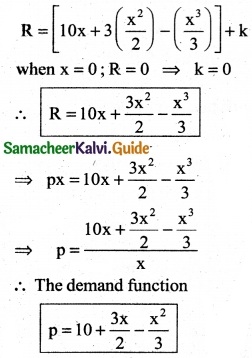
Find the revenue function and the demand function if the marginal revenue for x units MR = 10 + 3x – x
Solution:
The marginal revenue function
MR = 10 + 3x – x²
The Revenue function
R = ∫(MR) dx
= ∫(10 + 3x – x²)dx
Samacheer Kalvi 12th Business Maths Guide Chapter 3 Integral Calculus II Ex 3.2 13

Samacheer Kalvi 12th Business Maths Guide Chapter 3 Integral Calculus II Ex 3.2

Question 17.
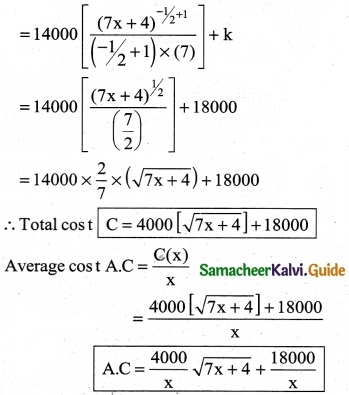
The marginal cost function of a commodity is given by Mc = \(\frac { 14000 }{\sqrt{7x+4}}\) and the fixed cost is Rs 18,000. Find the total cost average cost.
Solution:
The marginal cost function of a commodity
Mc = \(\frac { 14000 }{\sqrt{7x+4}}\) = 14000 (7x + 4)-1/2
Fixed cost k = Rs 18,000
Total cost function C = ∫(M.C) dx
= ∫14000 (7x + 4)-1/2 dx
Samacheer Kalvi 12th Business Maths Guide Chapter 3 Integral Calculus II Ex 3.2 14

Question 18.
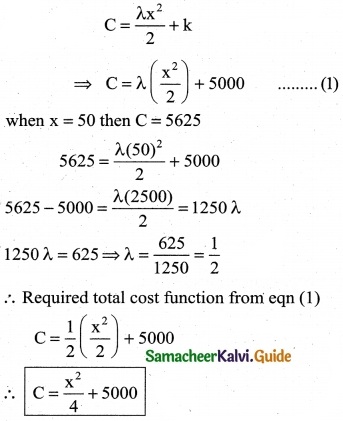
If the marginal cost (MC) of production of the company is directly proportional to the number of units (x) produced, then find the total cost function, when the fixed cost is Rs 5,000 and the cost of producing 50 units is Rs 5,625.
Solution:
M.C αx
M.C = λx
fixed cost k = Rs 5000
Cost function C = ∫(M.C) dx
= ∫λx dx
Samacheer Kalvi 12th Business Maths Guide Chapter 3 Integral Calculus II Ex 3.2 15

Samacheer Kalvi 12th Business Maths Guide Chapter 3 Integral Calculus II Ex 3.2

Question 19.
If MR = 20 – 5x + 3x², Find total revenue function
Solution:
MR = 20 – 5x + 3x²
Total Revenue function
R = ∫(MR) dx = ∫(20 – 5x + 3x²) dx
R = 20x – \(\frac { 5x^2 }{2}\) + \(\frac {3x^3 }{3}\) + k
when x = 0; R = 0 ⇒ k = 0
∴ R = 20x – \(\frac { 5 }{2}\) x² + x³

Question 20.
If MR = 14 – 6x + 9x², Find the demand function.
Solution:
MR = 14 – 6x + 9x2
R = ∫(14 – 6x + 9x2) dx + k
= 14x – 3x2 + 3x3 + k
Since R = 0, when x = 0, k = 0
So revenue function R = 14x – 3x2 + 3x3
Demand function P = \(\frac{R}{x}\) = 14 – 3x + 3x2

Samacheer Kalvi 12th Business Maths Guide Chapter 3 Integral Calculus II Ex 3.2

Must Try:

Nifty Resistance Support Levels Calculator

Samacheer Kalvi 12th Business Maths Guide Chapter 2 Integral Calculus I Ex 2.12

Tamilnadu State Board New Syllabus Samacheer Kalvi 12th Business Maths Guide Pdf Chapter 2 Integral Calculus I Ex 2.12 Text Book Back Questions and Answers, Notes.

Tamilnadu Samacheer Kalvi 12th Business Maths Solutions Chapter 2 Integral Calculus I Ex 2.12

Choose the most suitable answer from the given four alternatives:

Question 1.
∫\(\frac { 1 }{x^3}\) dx is
(a) \(\frac { -3 }{x^2}\) + c
(b) \(\frac { -1 }{2x^2}\) + c
(c) \(\frac { -1 }{3x^2}\) + c
(d) \(\frac { -2 }{x^2}\) + c
Solution:
(b) \(\frac { -1 }{2x^2}\) + c
Hint:
∫\(\frac { 1 }{x^3}\) dx = ∫x-3 dx = [ \(\frac { x^{-3+1} }{-3+1}\) ] + c
= (\(\frac { x^{-2} }{-2}\)) + c = \(\frac { -1 }{2x^2}\) + c

Question 2.
∫2x dx is
(a) 2x log 2 + c
(b) 2x + c
(c) \(\frac { 2^x }{log 2}\) + c
(d) \(\frac { log 2 }{2^x}\) + c
Solution:
(c) \(\frac { 2^x }{log 2}\) + c
Hint:
∫2x dx = ∫ax dx = \(\frac { a^x }{log a}\) + c

Samacheer Kalvi 12th Business Maths Guide Chapter 2 Integral Calculus I Ex 2.12

Question 3.
∫\(\frac { sin 2x }{2 sin x}\) dx is
(a) sin x + c
(b) \(\frac { 1 }{2}\) sin x + c
(c) cos x + c
(d) \(\frac { 1 }{2}\) cos x + c
Solution:
(a) sin x + c
Hint:
∫\(\frac { sin 2x }{2 sin x}\) dx = ∫\(\frac { 2sin x cos x }{2 sin x}\) dx
= ∫cos x dx
= sin x + c

Question 4.
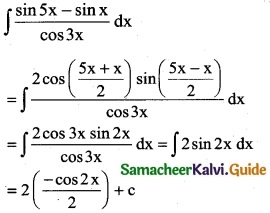
∫\(\frac { sin 5x-sin x }{cos 3x}\) dx is
(a) -cos 2x + c
(b) -cos 2x – c
(c) –\(\frac { 1 }{4}\) cos 2x + c
(d) -4 cos 2x + c
Solution:
(a) -cos 2x + c
Hint:
Samacheer Kalvi 12th Business Maths Guide Chapter 2 Integral Calculus I Ex 2.12 1

Samacheer Kalvi 12th Business Maths Guide Chapter 2 Integral Calculus I Ex 2.12

Question 5.
∫\(\frac { log x}{x}\) dx, x > 0 is
(a) \(\frac { 1 }{2}\) (log x)² + c
(b) –\(\frac { 1 }{2}\) (log x)²
(c) \(\frac { 2 }{x^2}\) + c
(d) \(\frac { 2 }{x^2}\) – c
Solution:
(a) \(\frac { 1 }{2}\) (log x)² + c
Hint:
∫\(\frac { log x}{x}\) dx, x > 0
∫ tdt = [ \(\frac { t^2 }{2}\) ] + c
= \(\frac { (log x)^2 }{2}\) + c
let t = log x
\(\frac { dt }{dx}\) = \(\frac { 1 }{x}\)
dt = \(\frac { 1 }{x}\) dx

Question 6.
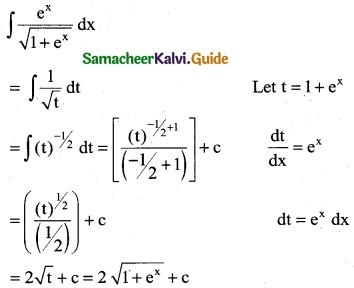
∫\(\frac { e^x }{\sqrt{1+e^x}}\) dx is
(a) \(\frac { e^x }{\sqrt{1+e^x}}\) + c
(b) 2\(\sqrt{1+e^x}\) + c
(c) \(\sqrt{1+e^x}\) + c
(d) ex\(\sqrt{1+e^x}\) + c
Solution:
(b) 2\(\sqrt{1+e^x}\) + c
Hint:
Samacheer Kalvi 12th Business Maths Guide Chapter 2 Integral Calculus I Ex 2.12 2

Samacheer Kalvi 12th Business Maths Guide Chapter 2 Integral Calculus I Ex 2.12

Question 7.
∫\(\sqrt { e^x}\) dx is
(a) \(\sqrt { e^x}\) + c
(b) 2\(\sqrt { e^x}\) + c
(c) \(\frac { 1 }{2}\) \(\sqrt { e^x}\) + c
(d) \(\frac { 1 }{2\sqrt { e^x}}\) + c
Solution:
(b) 2\(\sqrt { e^x}\) + c
Hint:
∫\(\sqrt { e^x}\) dx
= ∫\(\sqrt { e^x}\) dx = ∫(ex)1/2 dx = ∫ ex/2 dx
= \(\frac { e^{x/2} }{1/2}\) + c = 2ex/2 + c
= 2(ex)1/2 + c = 2\(\sqrt { e^x}\) + c

Question 8.
∫e2x [2x² + 2x] dx
(a) e2x x² + c
(b) xe2x + c
(c) 2x²e² + c
(d) \(\frac { x^2e^x }{2}\) + c
Solution:
(a) e2x x² + c
Hint:
∫e2x (2x² + 2x) dx
Let f(x) = x²; f'(x) = 2x and a = 2
= ∫eax [af(x),+ f ’(x)] = eax f(x) + c
= ∫e2x (2x² + 2x) dx = e2x (x²) + c

Question 9.
\(\frac { e^x }{e^x+1}\) dx is
(a) log |\(\frac { e^x }{e^x+1}\)| + c
(b) log |\(\frac { e^x+1 }{e^x}\)| + c
(c) log |ex| + c
(d) log |ex + 1| + c
Solution:
(d) log |ex + 1| + c
Hint:
∫\(\frac { e^x }{e^x+1}\) dx
= ∫\(\frac { dt }{t}\)
= log |t| + c
= log |ex + 1| + c
take t = ex + 1
\(\frac { dt }{dx}\) = ex
dt = ex dx

Samacheer Kalvi 12th Business Maths Guide Chapter 2 Integral Calculus I Ex 2.12

Question 10.
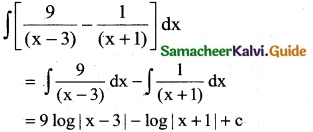
∫\(\frac { 9 }{x-3}-\frac { 1 }{x+1}\) dx is
(a) log |x – 3| – log|x + 1| + c
(b) log|x – 3| + log|x + 1| + c
(c) 9 log |x – 3| – log |x + 1| + c
(d) 9 log |x – 3| + log |x + 1| + c
Solution:
(c) 9 log |x – 3| – log |x + 1| + c
Hint:
Samacheer Kalvi 12th Business Maths Guide Chapter 2 Integral Calculus I Ex 2.12 3

Question 11.
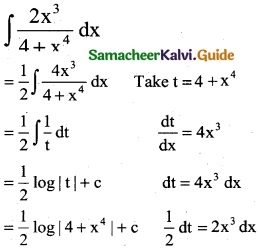
∫\(\frac { 2x^3 }{4+x^4}\) dx is
(a) log |4 + x4| + c
(b) \(\frac { 1 }{2}\) log |4 + x4| + c
(c) \(\frac { 1 }{2}\) log |4 + x4| + c
(d) log |\(\frac { 2x^3 }{4+x^4}\) + c
Solution:
(b) \(\frac { 1 }{2}\) log |4 + x4| + c
Hint:
Samacheer Kalvi 12th Business Maths Guide Chapter 2 Integral Calculus I Ex 2.12 4

Question 12.
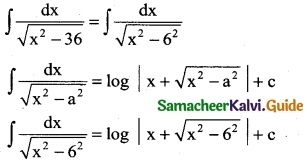
∫\(\frac { dx }{\sqrt{x^2-36}}\) is
(a) \(\sqrt{x^2-36}\) + c
(b) log |x + \(\sqrt{x^2-36}\)| + c
(c) log |x – \(\sqrt{x^2-36}\)| + c
(d) log |x² + \(\sqrt{x^2-36}\)| + c
Solution:
(b) log |x + \(\sqrt{x^2-36}\)| + c
Hint:
Samacheer Kalvi 12th Business Maths Guide Chapter 2 Integral Calculus I Ex 2.12 5

Samacheer Kalvi 12th Business Maths Guide Chapter 2 Integral Calculus I Ex 2.12

Question 13.
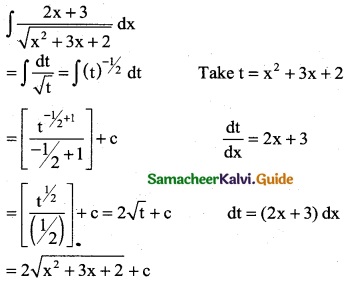
∫\(\frac { 2x+3 }{\sqrt{x^2+3x+2}}\) dx is
(a) \(\sqrt{x^2+3x+2}\) + c
(b) 2\(\sqrt{x^2+3x+2}\) + c
(c) \(\sqrt{x^2+3x+2}\) + c
(d) \(\frac { 2 }{3}\) (x² + 3x + 2) + c
Solution:
(b) 2\(\sqrt{x^2+3x+2}\) + c
Hint:
Samacheer Kalvi 12th Business Maths Guide Chapter 2 Integral Calculus I Ex 2.12 6

Question 14.
\(\int_{0}^{4}\) (2x + 1) dx is
(a) 1
(b) 2
(c) 3
(d) 4
Solution:
(b) 2
Hint:
\(\int_{0}^{4}\) (2x + 1) dx
= [2(\(\frac { x^2 }{2}\)) + x]\(_{0}^{1}\) = [x² + x]\(_{0}^{1}\)
= [(1)² + (1)] – [0] = 2

Question 15.
\(\int_{2}^{4}\) \(\frac { dx }{x}\) is
(a) log 4
(b) 0
(c) log 2
(d) log 8
Solution:
(c) log 2
Hint:
\(\int_{2}^{4}\) \(\frac { dx }{x}\)
\(\int_{2}^{4}\) \(\frac { dx }{x}\) = [log |x|]\(_{0}^{1}\) = log |4| – log |2|
= log[ \(\frac { 4}{2}\) ] = log 2

Samacheer Kalvi 12th Business Maths Guide Chapter 2 Integral Calculus I Ex 2.12

Question 16.
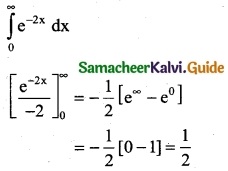
\(\int_{0}^{∞}\) e-2x dx is
(a) 0
(b) 1
(c) 2
(d) \(\frac { 1 }{2}\)
Solution:
(d) \(\frac { 1 }{2}\)
Hint:
Samacheer Kalvi 12th Business Maths Guide Chapter 2 Integral Calculus I Ex 2.12 7

Question 17.
\(\int_{-1}^{1}\) x³ ex4 dx is
(a) 1
(b) 2\(\int_{0}^{1}\) x³ ex4
(c) 0
(d) ex4
Solution:
(c) 0
Hint:
\(\int_{-1}^{1}\) x³ ex4 dx
Let f (x) = x³ex4
f(-x) = (-x)² e(-x)4
= -x² ex4
f(-x) = -f(x)
⇒ f(x) is an odd function
∴ \(\int_{-1}^{1}\) x³ ex4 dx = 0

Question 18.
If f(x) is a continuous function and a < c < b, then \(\int_{a}^{c}\) f(x) dx + \(\int_{c}^{b}\) f(x) dx is
(a) \(\int_{a}^{b}\) f(x) dx – \(\int_{a}^{c}\) f(x) dx
(b) \(\int_{a}^{c}\) f(x) dx – \(\int_{a}^{b}\) f(x) dx
(c) \(\int_{a}^{b}\) f(x) dx
(d) 0
Solution:
(c) \(\int_{a}^{b}\) f(x) dx

Samacheer Kalvi 12th Business Maths Guide Chapter 2 Integral Calculus I Ex 2.12

Question 19.
The value of \(\int_{-π/2}^{π/2}\) cos x dx is
(a) 0
(b) 2
(c) 1
(d) 4
Solution:
(b) 2
Hint:
\(\int_{-π/2}^{π/2}\) cos x dx
Let f(x) = cos x
f(-x) = cos (-x) = cos (x) = f(x)
∴ f(x) is an even function
\(\int_{-π/2}^{π/2}\) cos x dx = 2 × \(\int_{0}^{π/2}\) cos x dx
= 2 × [sin x]\(_{0}^{-π/2}\) = 2 [sin π/2 – sin 0]
= 2 [1 – 0] = 2

Question 20.
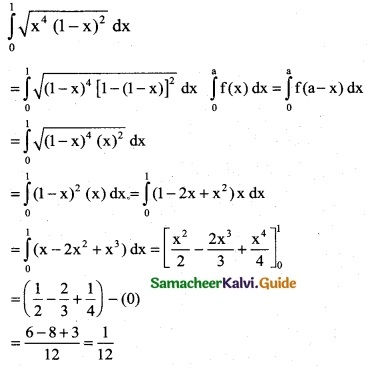
\(\int_{-π/2}^{π/2}\) \(\sqrt {x^4(1-x)^2}\) dx
(a) \(\frac { 1 }{12}\)
(b) \(\frac { -7 }{12}\)
(c) \(\frac { 7 }{12}\)
(d) \(\frac { -1 }{12}\)
Solution:
(a) \(\frac { 1 }{12}\)
Hint:
Samacheer Kalvi 12th Business Maths Guide Chapter 2 Integral Calculus I Ex 2.12 8

Question 21.
If \(\int_{0}^{1}\) f(x) dx = 1, \(\int_{0}^{1}\) x f(x) dx = a and \(\int_{0}^{1}\) x² f(x) dx = a², then \(\int_{0}^{1}\) (a – x)² f(x) dx is
(a) 4a²
(b) 0
(c) a²
(d) 1
Solution:
(b) 0
Hint:
\(\int_{0}^{1}\) (a – x)² f(x) dx
= \(\int_{0}^{1}\) [a² +x² – 2ax] f(x) dx
= \(\int_{0}^{1}\) a² + f (x) dx + \(\int_{0}^{1}\) x² f (x) dx – 2a\(\int_{0}^{1}\) x f(x) dx
= a²(1) + a² – 2a(a) – 2a² – 2a² = 0

Samacheer Kalvi 12th Business Maths Guide Chapter 2 Integral Calculus I Ex 2.12

Question 22.
The value of \(\int_{2}^{3}\) f(5 – x) dx – \(\int_{2}^{3}\) f(x) dx is
(a) 1
(b) 0
(c) -1
(d) 5
Solution:
(b) 0
Hint:
\(\int_{2}^{3}\) f(5 – x) dx – \(\int_{2}^{3}\) f(x) dx
Using the property
= \(\int_{2}^{3}\) f(x) dx = \(\int_{a}^{b}\) f(a + b – x) dx
= \(\int_{2}^{3}\) f (5 – x) – \(\int_{2}^{3}\) f (5 – x) dx
= 0

Question 23.
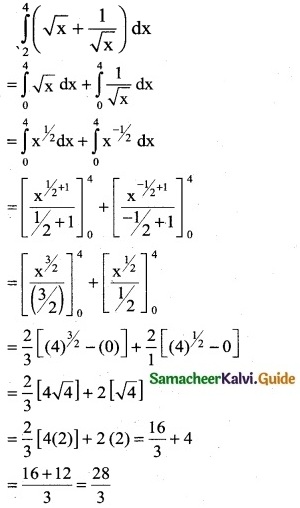
\(\int_{0}^{4}\) (√x + \(\frac { 1 }{√x}\)), dx is
(a) \(\frac { 20 }{3}\)
(b) \(\frac { 21 }{3}\)
(c) \(\frac { 28 }{3}\)
(d) \(\frac { 1 }{3}\)
Solution:
(c) \(\frac { 28 }{3}\)
Hint:
Samacheer Kalvi 12th Business Maths Guide Chapter 2 Integral Calculus I Ex 2.12 9

Question 24.
\(\int_{0}^{π/3}\) tan x dx is
(a) log 2
(b) 0
(c) log √2
(d) 2 log 2
Solution:
(a) log 2
Hint:
\(\int_{0}^{π/3}\) tan x dx
= ∫tan x dx
= ∫\(\frac { sin x }{cos x}\) dx
= -∫\(\frac { -sin x }{cos x}\) dx
= -log |cos x| + c
= log sec x + c
= [log (sec x)]\(_{0}^{π/3}\)
= log [(sec π/3) – log (sec 0)]
= log (2) – log (1)
= log 2 – (0) = log 2

Samacheer Kalvi 12th Business Maths Guide Chapter 2 Integral Calculus I Ex 2.12

Question 25.
Using the factorial representation of the gamma function, which of the following is the solution for the gamma function Γ(n) when n = 8
(a) 5040
(b) 5400
(c) 4500
(d) 5540
Solution:
(a) 5040
Hint:
\(\Upsilon\) (8) = 7! = 7 × 6 × 5 × 4 × 3 × 2 × 1 = 5040

Question 26.
Γ(n) is
(a) (n – 1)!
(b) n!
(c) n Γ (n)
(d) (n – 1) Γ(n)
Solution:
(a) (n – 1)!
Hint:
Γ(n) = Γ(n – 1) + 1 = (n – 1)!

Question 27.
Γ(1) is
(a) 0
(b) 1
(c) n
(d) n!
Solution:
(b) 1
Hint:
\(\Upsilon\) (1) = 0! = 1

Samacheer Kalvi 12th Business Maths Guide Chapter 2 Integral Calculus I Ex 2.12

Question 28.
If n > 0, then Γ(n) is
(a) \(\int_{0}^{1}\) e-x xn-1 dx
(b) \(\int_{0}^{1}\) e-x xⁿ dx
(c) \(\int_{0}^{∞}\) ex x-n dx
(d) \(\int_{0}^{∞}\) e-x xn-1 dx
Solution:
(d) \(\int_{0}^{∞}\) e-x xn-1 dx

Question 29.
Γ(\(\frac { 3 }{2}\))
(a) √π
(b) \(\frac { √π }{2}\)
(c) 2√π
(d) \(\frac { 3 }{2}\)
Solution:
(b) \(\frac { √π }{2}\)
Hint:
\(\Upsilon\) (3/2) = \(\frac { 2 }{2}\) \(\Upsilon\) [ \(\frac { 3 }{2}\) ]
= \(\frac { 3 }{2}\) √π

Question 30.
\(\int_{0}^{∞}\) x4 e-x dx is
(a) 12
(b) 4
(c) 4!
(d) 64
Solution:
(b) \(\frac { √π }{2}\)
Hint:
\(\int_{0}^{∞}\) x4 e-x dx
= ∫xⁿ e-ax dx = \(\frac { n! }{a{n+1}}\)
= \(\frac { 4! }{(1)^{n+1}}\)
= \(\frac { 4! }{(1)^5}\)
= 4!

Samacheer Kalvi 12th Business Maths Guide Chapter 2 Integral Calculus I Ex 2.12

Must Read:
Gann Square Calculator

Samacheer Kalvi 12th Business Maths Guide Chapter 2 Integral Calculus I Miscellaneous Problems

Tamilnadu State Board New Syllabus Samacheer Kalvi 12th Business Maths Guide Pdf Chapter 2 Integral Calculus I Miscellaneous Problems Text Book Back Questions and Answers, Notes.

Tamilnadu Samacheer Kalvi 12th Business Maths Solutions Chapter 2 Integral Calculus I Miscellaneous Problems

Question 1.
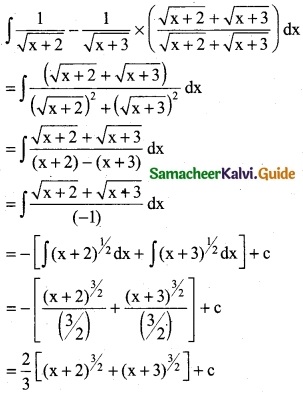
∫\(\frac { 1 }{\sqrt{x-1}-\sqrt{x+3}}\) dx
Solution:
∫\(\frac { 1 }{\sqrt{x+2}-\sqrt{x+3}}\) dx
Conjugating the Denominator
Samacheer Kalvi 12th Business Maths Guide Chapter 2 Integral Calculus I Miscellaneous Problems 1

Samacheer Kalvi 12th Business Maths Guide Chapter 2 Integral Calculus I Miscellaneous Problems

Question 2.
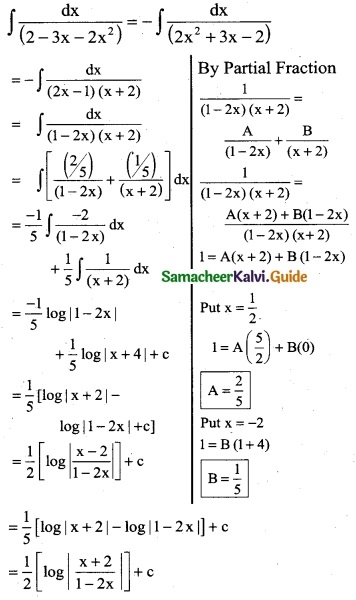
∫\(\frac { dx }{2-3x-2x^2}\)
Solution:
Samacheer Kalvi 12th Business Maths Guide Chapter 2 Integral Calculus I Miscellaneous Problems 2

Question 3.
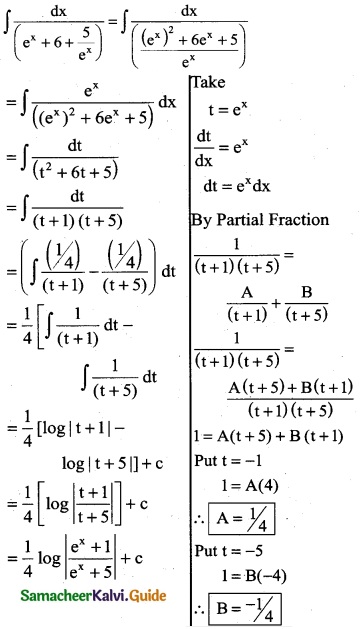
∫\(\frac { dx }{e^x+6+5e^{-x}}\)
Solution:
Samacheer Kalvi 12th Business Maths Guide Chapter 2 Integral Calculus I Miscellaneous Problems 3

Samacheer Kalvi 12th Business Maths Guide Chapter 2 Integral Calculus I Miscellaneous Problems

Question 4.
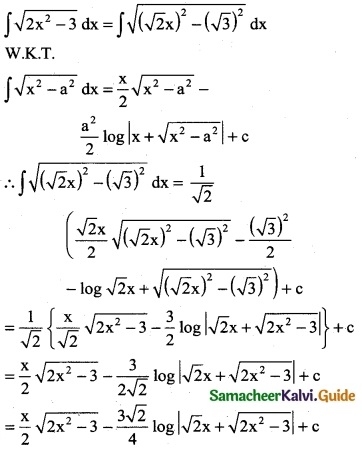
∫\(\sqrt { 2x^2-3}\) dx
Solution:
Samacheer Kalvi 12th Business Maths Guide Chapter 2 Integral Calculus I Miscellaneous Problems 4

Question 5.
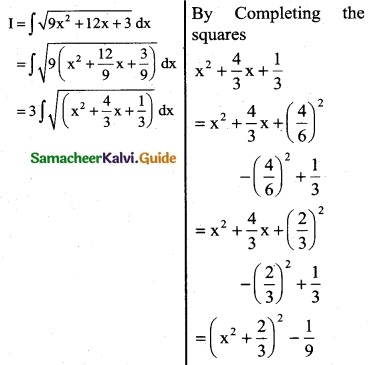
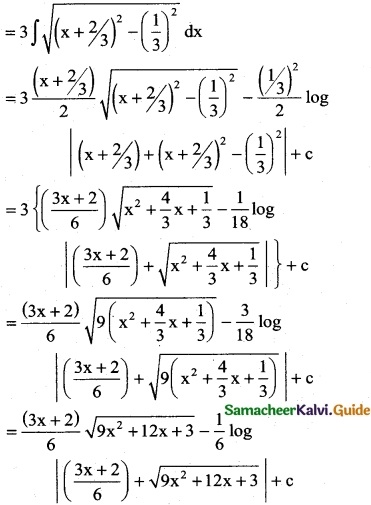
∫\(\sqrt { 9x^2+12x+3}\) dx
Solution:
Samacheer Kalvi 12th Business Maths Guide Chapter 2 Integral Calculus I Miscellaneous Problems 5
Samacheer Kalvi 12th Business Maths Guide Chapter 2 Integral Calculus I Miscellaneous Problems 6

Samacheer Kalvi 12th Business Maths Guide Chapter 2 Integral Calculus I Miscellaneous Problems

Question 6.
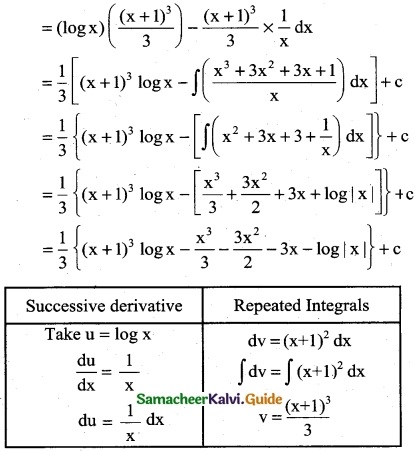
∫(x + 1)² log x dx
Solution:
∫udv = uv – ∫vdu
∫(x + 1)² log x dx
Samacheer Kalvi 12th Business Maths Guide Chapter 2 Integral Calculus I Miscellaneous Problems 7

Question 7.
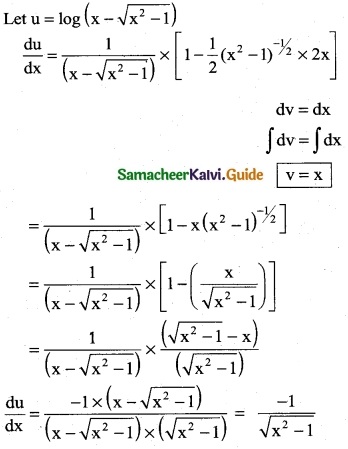
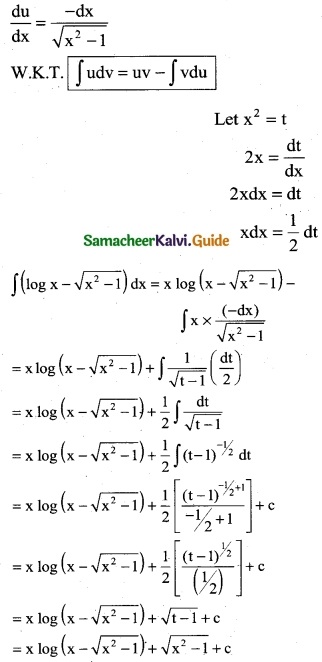
∫log (x – \(\sqrt { x^2-1}\)) dx
Solution:
Samacheer Kalvi 12th Business Maths Guide Chapter 2 Integral Calculus I Miscellaneous Problems 8
Samacheer Kalvi 12th Business Maths Guide Chapter 2 Integral Calculus I Miscellaneous Problems 9

Samacheer Kalvi 12th Business Maths Guide Chapter 2 Integral Calculus I Miscellaneous Problems

Question 8.
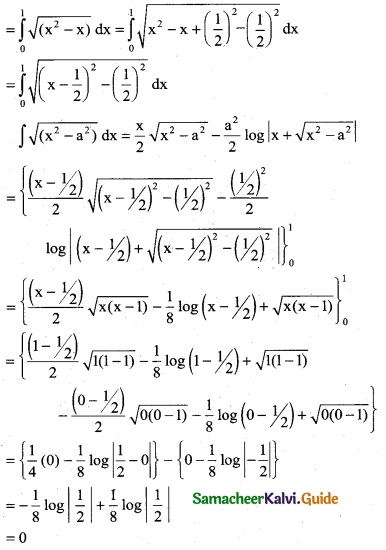
\(\int_{0}^{1}\) \(\sqrt { x(x-1)}\) dx
Solution:
Samacheer Kalvi 12th Business Maths Guide Chapter 2 Integral Calculus I Miscellaneous Problems 10

Question 9.
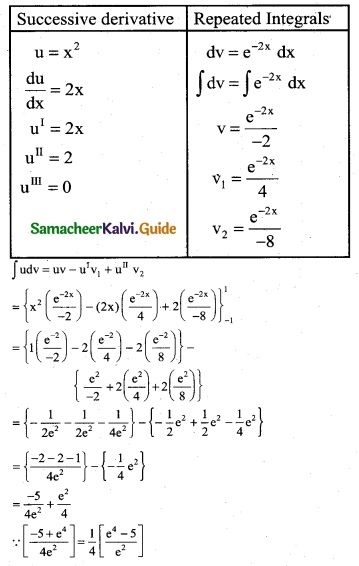
\(\int_{-1}^{1}\) x² e-2x dx
Solution:
Samacheer Kalvi 12th Business Maths Guide Chapter 2 Integral Calculus I Miscellaneous Problems 11

Samacheer Kalvi 12th Business Maths Guide Chapter 2 Integral Calculus I Miscellaneous Problems

Question 10.
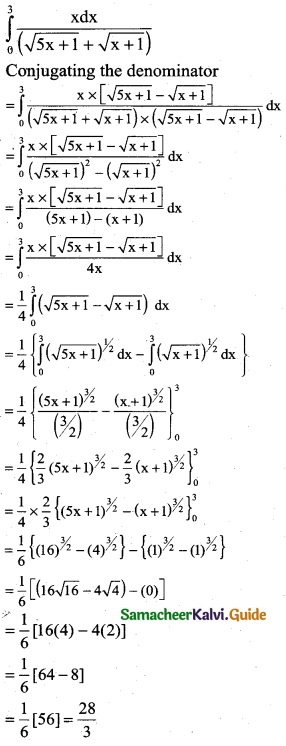
\(\int_{0}^{3}\) \(\frac { xdx }{\sqrt {x+1} + \sqrt{5x+1}}\)
Solution:
Samacheer Kalvi 12th Business Maths Guide Chapter 2 Integral Calculus I Miscellaneous Problems 12

Samacheer Kalvi 12th Business Maths Guide Chapter 2 Integral Calculus I Miscellaneous Problems

Try More:

MARICO Pivot Point Calculator

Samacheer Kalvi 12th Business Maths Guide Chapter 2 Integral Calculus I Ex 2.11

Tamilnadu State Board New Syllabus Samacheer Kalvi 12th Business Maths Guide Pdf Chapter 2 Integral Calculus I Ex 2.11 Text Book Back Questions and Answers, Notes.

Tamilnadu Samacheer Kalvi 12th Business Maths Solutions Chapter 2 Integral Calculus I Ex 2.11

Evaluate the following integrals as the limit of the sum:

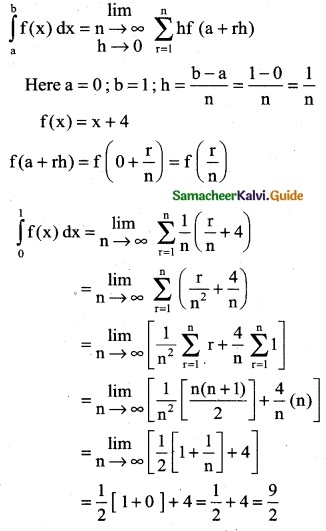
Question 1.
\(\int_{0}^{1}\) (x + 4) dx
Solution:
Samacheer Kalvi 12th Business Maths Guide Chapter 2 Integral Calculus I Ex 2.11 1

Samacheer Kalvi 12th Business Maths Guide Chapter 2 Integral Calculus I Ex 2.11

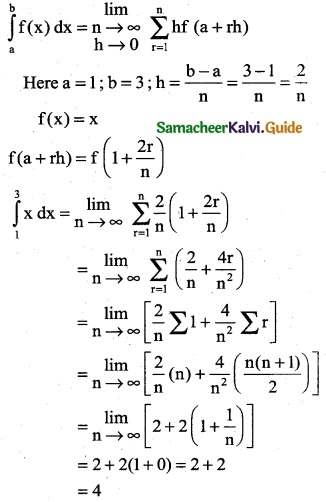
Question 2.
\(\int_{1}^{3}\) x dx
Solution:
Samacheer Kalvi 12th Business Maths Guide Chapter 2 Integral Calculus I Ex 2.11 2

Samacheer Kalvi 12th Business Maths Guide Chapter 2 Integral Calculus I Ex 2.11

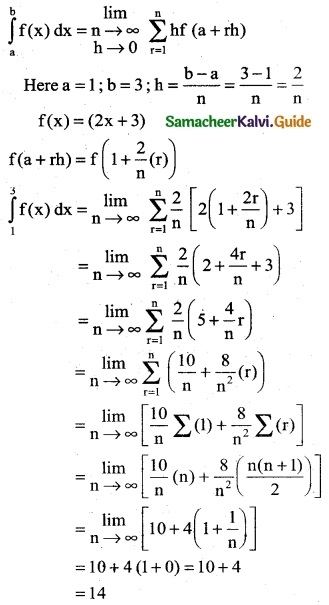
Question 3.
\(\int_{1}^{3}\) (2x + 3) dx
Solution:
Samacheer Kalvi 12th Business Maths Guide Chapter 2 Integral Calculus I Ex 2.11 3

Samacheer Kalvi 12th Business Maths Guide Chapter 2 Integral Calculus I Ex 2.11

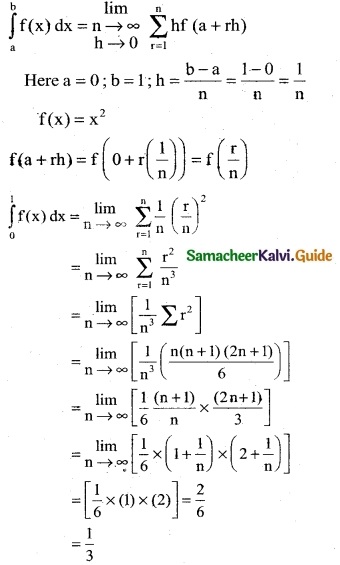
Question 4.
\(\int_{0}^{1}\) x² dx
Solution:
Samacheer Kalvi 12th Business Maths Guide Chapter 2 Integral Calculus I Ex 2.11 4

Samacheer Kalvi 12th Business Maths Guide Chapter 2 Integral Calculus I Ex 2.11

Try More:

MANAPPURAM Pivot Point Calculator

Samacheer Kalvi 12th Business Maths Guide Chapter 3 Integral Calculus II Miscellaneous Problems

Tamilnadu State Board New Syllabus Samacheer Kalvi 12th Business Maths Guide Pdf Chapter 3 Integral Calculus II Miscellaneous Problems Text Book Back Questions and Answers, Notes.

Tamilnadu Samacheer Kalvi 12th Business Maths Solutions Chapter 3 Integral Calculus II Miscellaneous Problems

Question 1.
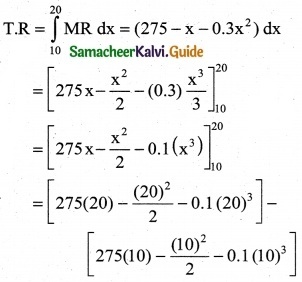
A manufacture’s marginal revenue functional is given by MR = 275 – x – 0.3x². Find the increase in the manufactures total revenue if the production increased from 10 to 20 units.
Solution:
MR = 275 – x – 0.3x²
The increase in the manufactures total revenue 20
T.R = ∫MR dx = (275 – x – 0.3x²) dx
Samacheer Kalvi 12th Business Maths Guide Chapter 3 Integral Calculus II Miscellaneous Problems 1
= [5500 – 200 – 0.1 (8000)] – [2750 – 50 – 0.1(1000)]
= [5500 – 200 – 800] – [2750 – 50 – 100]
= 4500 – 2600
= Rs 1900

Samacheer Kalvi 12th Business Maths Guide Chapter 3 Integral Calculus II Miscellaneous Problems

Question 2.
A company has determined that marginal cost function for product of a particular commodity is given by MC = 125 + 10x – \(\frac { 8 }{3}\). Where C is the cost of producing x units of the commodity. If the fixed cost Rs 250 what is cost of producing 15 units.
Solution:
MC = 125 + 10x – \(\frac { x^2 }{9}\)
Fixed cos t K = Rs 250
C = ∫MC dx – ∫(125 + 10x – \(\frac { x^2 }{9}\)) dx
C = 125x + \(\frac { 10x^2 }{9}\) – \(\frac { x^3 }{9×3}\) + k
C = 125x + 5x² – \(\frac { x^3 }{27}\) + 250
when x = 15
C = 125(15) + 5(15)² – \(\frac { (15)^3 }{27}\) + 250
= 1875 + 1125 – 125 + 250
C = Rs 3,125

Question 3.
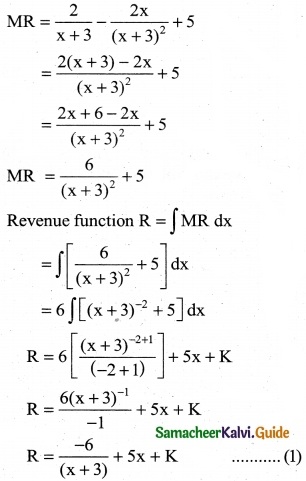
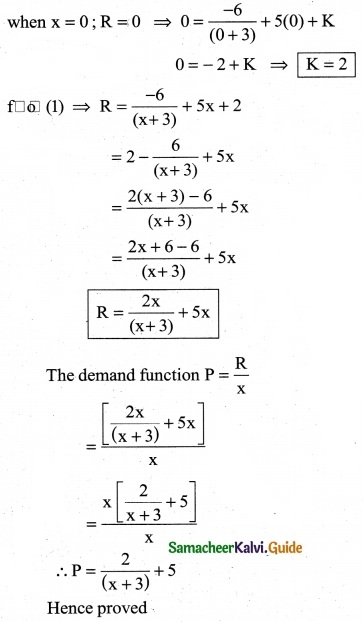
The marginal revenue function for a firm given by MR = \(\frac { 2 }{x+3}\) – \(\frac { 2x }{(x+3)^2}\) + 5. Show that the demand function is P = \(\frac { 2x }{(x+3)^2}\) + 5
Solution:
Samacheer Kalvi 12th Business Maths Guide Chapter 3 Integral Calculus II Miscellaneous Problems 1
Samacheer Kalvi 12th Business Maths Guide Chapter 3 Integral Calculus II Miscellaneous Problems 2

Samacheer Kalvi 12th Business Maths Guide Chapter 3 Integral Calculus II Miscellaneous Problems

Question 4.
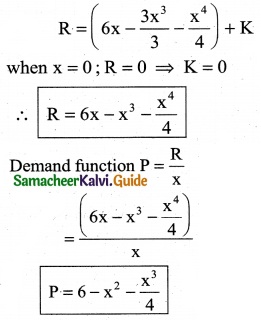
For the marginal revenue function MR = 6 – 3x² – x³, Find the revenue function and demand function
Solution:
MR = 6 – 3x² – x³
Revenue function R = ∫MR dx
R = ∫(6 – 3x² – x³)dx
Samacheer Kalvi 12th Business Maths Guide Chapter 3 Integral Calculus II Miscellaneous Problems 3

Question 5.
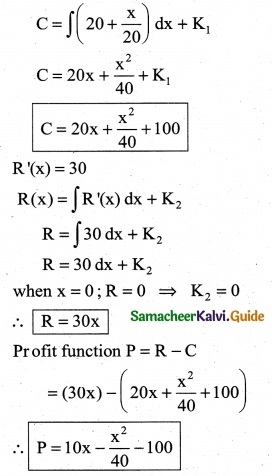
The marginal cost of production of a firm is given by C'(x) = 20 + \(\frac { x }{20}\) the marginal revenue is given by R’(x) = 30 and the fixed cost is Rs 100. Find the profit function.
Solution:
C'(x) = 20 + \(\frac { x }{20}\)
Fixed cost k1 = Rs 100
C(x) = ∫C1(x) dx + k1
Samacheer Kalvi 12th Business Maths Guide Chapter 3 Integral Calculus II Miscellaneous Problems 4

Samacheer Kalvi 12th Business Maths Guide Chapter 3 Integral Calculus II Miscellaneous Problems

Question 6.
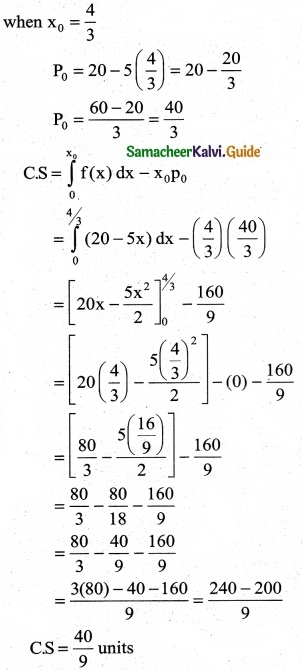
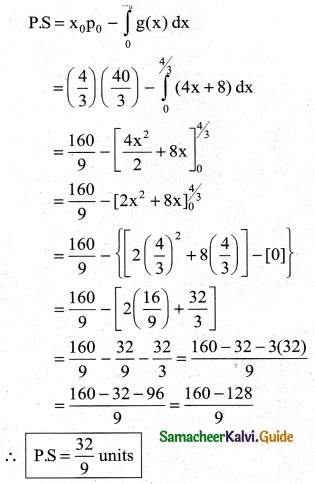
The demand equation for a product is Pd = 20 – 5x and the supply equation is Ps = 4x + 8. Determine the consumers surplus and producer’s surplus under market equilibrium.
Solution:
Pd = 20 – 5x and Ps = 4x + 8
At market equilibrium
Pd = Pd
20 – 5x = 4x + 8 ⇒ 20 – 8 = 4x + 5x
9x = 12 ⇒ x = \(\frac { 12 }{9}\)
∴ x = \(\frac { 4 }{3}\)
Samacheer Kalvi 12th Business Maths Guide Chapter 3 Integral Calculus II Miscellaneous Problems 5
Samacheer Kalvi 12th Business Maths Guide Chapter 3 Integral Calculus II Miscellaneous Problems 6

Samacheer Kalvi 12th Business Maths Guide Chapter 3 Integral Calculus II Miscellaneous Problems

Question 7.
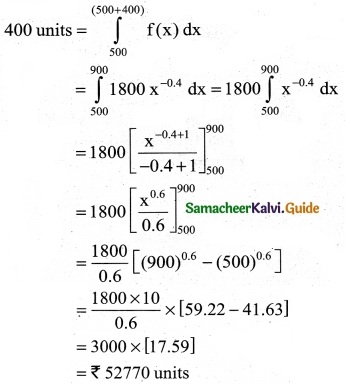
A company requires f(x) number of hours to produce 500 units. lt is represented by f(x) = 1800x-0.4. Find out the number of hours required to produce additional 400 units. [(900)0.6 = 59.22, (500)0.6 = 41.63]
Solution:
f(x) number of hours to produce 500
f(x) = 1800 x-0.4
The number of hours required to produce additions
Samacheer Kalvi 12th Business Maths Guide Chapter 3 Integral Calculus II Miscellaneous Problems 7

Question 8.
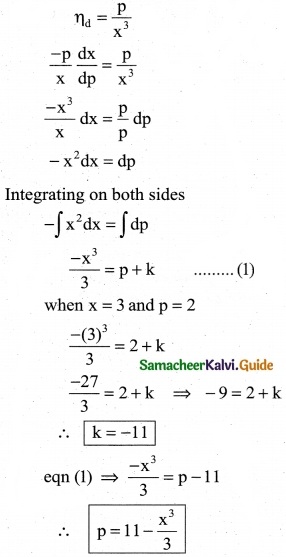
The price elasticity of demand for a commodity is \(\frac { p }{x^3}\). Find the demand function if the quantity of demand is 3, When the price is Rs 2.
Solution:
Price elasticity of demand
Samacheer Kalvi 12th Business Maths Guide Chapter 3 Integral Calculus II Miscellaneous Problems 8

Samacheer Kalvi 12th Business Maths Guide Chapter 3 Integral Calculus II Miscellaneous Problems

Question 9.
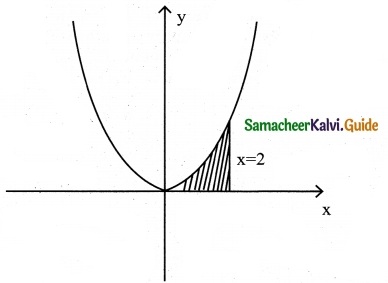
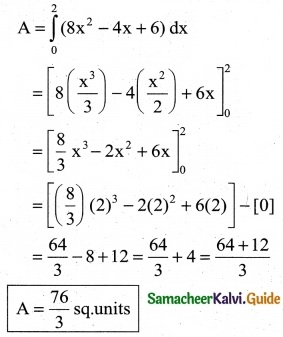
Find the area of the region bounded by the curve between the parabola y = 8x² – 4x + 6 the y-axis and the ordinate at x = 2.
Solution:
Equation of the parabola
y = 8x² – 4x + 6
Samacheer Kalvi 12th Business Maths Guide Chapter 3 Integral Calculus II Miscellaneous Problems 9
The required region is bounded by the y-axis and the ordinate at x = 2.
∴ Required Area A = \(\int_{0}^{2}\)ydx
Samacheer Kalvi 12th Business Maths Guide Chapter 3 Integral Calculus II Miscellaneous Problems 10

Question 10.
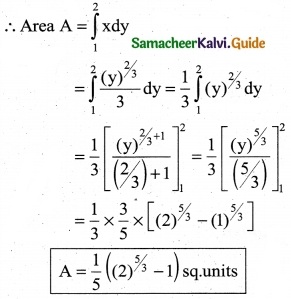
Find the area of the region bounded by the curve y² = 27x³ and the line x = 0, y = 1 and y = 2
Solution:
Equation of the curve is y² = 27x³
⇒ x³ = \(\frac { y^2 }{27}\) = \(\frac { y^3 }{3^3}\)
∴ x = \(\frac { (y)^{2/3} }{3}\)
Since the Area of the region bounded by the given curve and the lines x = 0, y = 1 and y = 2
Samacheer Kalvi 12th Business Maths Guide Chapter 3 Integral Calculus II Miscellaneous Problems 11

Samacheer Kalvi 12th Business Maths Guide Chapter 3 Integral Calculus II Miscellaneous Problems

Read More:

IGL Pivot Point Calculator

Samacheer Kalvi 12th Business Maths Guide Chapter 3 Integral Calculus II Ex 3.1

Tamilnadu State Board New Syllabus Samacheer Kalvi 12th Business Maths Guide Pdf Chapter 3 Integral Calculus II Ex 3.1 Text Book Back Questions and Answers, Notes.

Tamilnadu Samacheer Kalvi 12th Business Maths Solutions Chapter 3 Integral Calculus II Ex 3.1

Question 1.
Using Interation, find the area of the region bounded the line given is 2y + x = 8, the x axis and the lines x = 2, x = 4.
Solution:
The equation of the line given is 2y + x = 8
⇒ 2y = 8 – x ⇒ y = \(\frac { 8-x }{2}\)
y = 4 – \(\frac { x }{2}\)
Also x varies from 2 to 4
The required Area
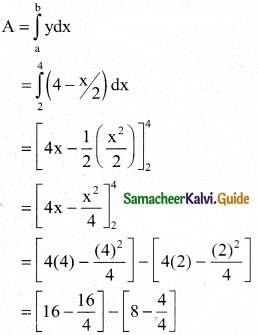
Samacheer Kalvi 12th Business Maths Guide Chapter 3 Integral Calculus II Ex 3.1 1
= (16 – 4) – (8 – 1)
= 12 – 7 = 5 sq.units

Samacheer Kalvi 12th Business Maths Guide Chapter 3 Integral Calculus II Ex 3.1

Question 2.
Find the area bounded by the lines y – 2x – 4 = 0, y = 0, y = 3 and the y-axis.
Solution:
The equation of the line given is y – 2x – 4 = 0
⇒ 2x = y – 4 ⇒ x = \(\frac { y-4 }{2}\)
∴ x = \(\frac { y }{2}\) – 2
Also y varies from 1 to 3
Required Area
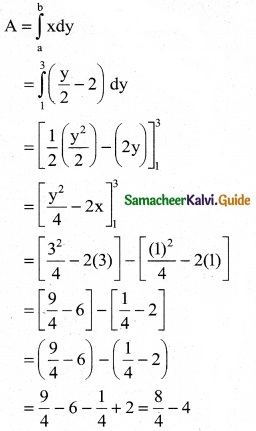
Samacheer Kalvi 12th Business Maths Guide Chapter 3 Integral Calculus II Ex 3.1 2
= 2 – 4 = -2
Area can’t be in negative.
∴ Area = 2 sq.units

Samacheer Kalvi 12th Business Maths Guide Chapter 3 Integral Calculus II Ex 3.1

Question 3.
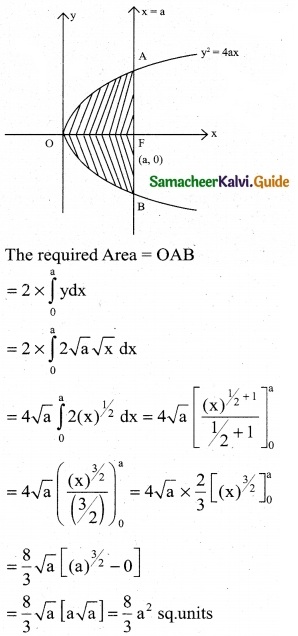
Calculate the area bounded by the parabola y² = 4ax and its latus rectum.
Solution:
Given parabola is y2 = 4ax
Its focus is (a, 0)
Equation of latus rectum is x = a
The parabola is symmetrical about the x-axis
Samacheer Kalvi 12th Business Maths Guide Chapter 3 Integral Calculus II Ex 3.1 3

Samacheer Kalvi 12th Business Maths Guide Chapter 3 Integral Calculus II Ex 3.1

Question 4.
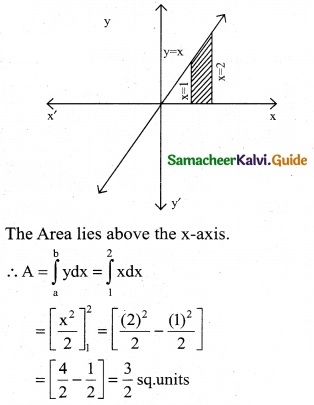
Find the area bounded by the line y = x and x-axis and the ordinates x = 1, x = 2
Solution:
The equation of the given line is y = x and x varies from 1 to 2
Samacheer Kalvi 12th Business Maths Guide Chapter 3 Integral Calculus II Ex 3.1 4

Question 5.
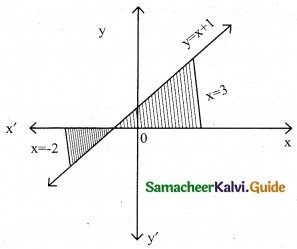
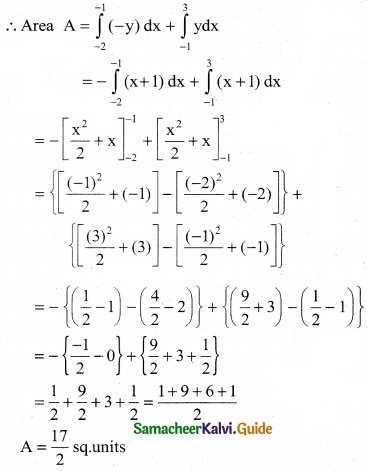
Using integration, find the area of the region bounded by the line y – 1 = x, the x-axis and the ordinates x = -2, x = 3.
Solution :
The equation of given line is y – 1 = x
y = x + 1
Samacheer Kalvi 12th Business Maths Guide Chapter 3 Integral Calculus II Ex 3.1 5
The line y = x + 1 meets the x-axis at x = -1
Since x varies from -2 to 3
Hence a part of lies below the x-axis and the other part lies above the x-axis.
Samacheer Kalvi 12th Business Maths Guide Chapter 3 Integral Calculus II Ex 3.1 6

Samacheer Kalvi 12th Business Maths Guide Chapter 3 Integral Calculus II Ex 3.1

Question 6.
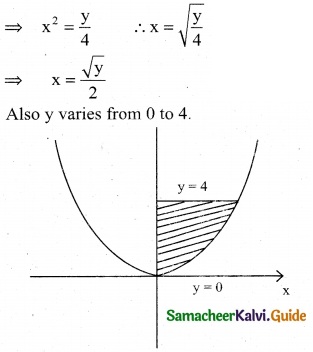
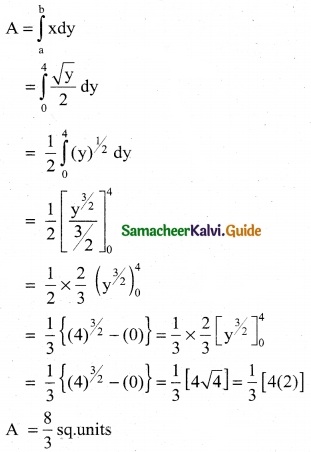
Find the area of the region lying in the first quadrant bounded by the region y = 4x², x = 0, y = 0 and y = 4
Solution:
The equation of a parabola given is y = 4x²
Samacheer Kalvi 12th Business Maths Guide Chapter 3 Integral Calculus II Ex 3.1 7
Area of the region lying in the first quadrant
Samacheer Kalvi 12th Business Maths Guide Chapter 3 Integral Calculus II Ex 3.1 8

Samacheer Kalvi 12th Business Maths Guide Chapter 3 Integral Calculus II Ex 3.1

Question 7.
Find the area bounded by the curve y = x² and the line y = 4
Solution:
Equation of the curve y = x² ………. (1)
Equation of the line y = 4 ………. (2)
Solving equation (1) & (2)
x² = 4 ⇒ x = ± 2
Samacheer Kalvi 12th Business Maths Guide Chapter 3 Integral Calculus II Ex 3.1 9

Samacheer Kalvi 12th Business Maths Guide Chapter 3 Integral Calculus II Ex 3.1

Read More:

How Gift Nifty Is Calculated

Tamil Nadu 12th Tamil Model Question Paper 2

Students can Download Tamil Nadu 12th Tamil Model Question Paper 2 Pdf, Tamil Nadu 12th Tamil Model Question Papers helps you to revise the complete Tamilnadu State Board New Syllabus, helps students complete homework assignments and to score high marks in board exams.

TN State Board 12th Tamil Model Question Paper 2

நேரம்: 2.30 மணி 
மதிப்பெண்கள் : 90

குறிப்புகள்:

  • இவ்வினாத்தாள் ஐந்து பகுதிகளைக் கொண்டது. அனைத்து பகுதிகளுக்கும் விடையளிக்க வேண்டும். தேவையான இடங்களில் உள் தேர்வு வினாக்கள் கொடுக்கப்பட்டுள்ளது.
  • பகுதி I, II, III, IV மற்றும் Vல் உள்ள அனைத்து வினாக்களுக்கும் தனித்தனியே விடையளிக்க வேண்டும்.
  • வினா எண் 1 முதல் 14 வரை பகுதி-1ல் தேர்வு செய்யும் வினாக்கள் தரப்பட்டுள்ளன.
    ஒவ்வொரு வினாவிற்கும் ஒரு மதிப்பெண். சரியான விடையைத் தேர்ந்தெடுத்துக் குறியீட்டுடன் விடையினையும் சேர்த்து எழுதவும்.
  • வினா எண் 15 முதல் 30 வரை பகுதி-பால் இரண்டு மதிப்பெண் வினாக்கள் தரப்பட்டுள்ளன. –
  • வினா எண் 31 முதல் 43 வரை பகுதி-IIIல் நான்கு மதிப்பெண் வினாக்கள் தரப்பட்டுள்ளன.
  • வினா எண் 44 முதல் 46 வரை பகுதி-IVல் ஆறு மதிப்பெண் வினாக்கள் தரப்பட்டுள்ளன.அனைத்து வினாவிற்கும் விடையளிக்கவும்.
  • வினா எண் 47-ல் பகுதி-Vல் மனப்பாடப்பகுதி தரப்பட்டுள்ளன.

பகுதி – I

அனைத்து வினாக்களுக்கும் விடை தருக. [14 × 1 = 14]

(விடைகள் தடித்த எழுத்தில் தரப்பட்டுள்ளன)

Question 1.
காளைகளின் பல இனங்களைக் காட்டும் நூல் …………………..
(அ) குறிஞ்சிக்கலி
(ஆ) முல்லைக்கலி
(இ) மருதக்கலி
(ஈ) நெய்தற்கலி
Answer:
(ஆ) முல்லைக்கலி

Question 2.
கிடை என்பது ……….ன் அடையாளங்களைப் பல பெயர்கள் சொல்லி அறைக்கும் குறுநாவல்.
(அ) ஆடு
(ஆ) மாடு
(இ) மான்
(ஈ) மிளா
Answer:
(அ) ஆடு

Question 3
………….. ஆண்டுதான் வெப்பமான ஆண்டு என இந்திய வானிலை அறிவித்தது.
(அ) 2008
(ஆ) 2009
(இ) 2010
(ஈ) 2012
Answer:
(ஆ) 2009

Question 4.
சங்க காலத்தில் இல்லாத சொற்களான………… சங்ககாலச் சமூகத்தில் நடைமுறையில் இருந்துள்ளன.
(அ) திருமணம், மறுமணம்
ஆ) நிதியம், சங்கம்
(இ) அறவோர், துறவோர்
(ஈ) அவை, மன்றம்
Answer:
(இ) அறவோர், துறவோர்

Tamil Nadu 12th Tamil Model Question Paper 2

Question 5.
கவிச்சக்ரவர்த்தி கம்பன் வாழ்ந்த காலம்…….. நூற்றாண்டு ஆகும்.
(அ) 10-ம்
(ஆ) 11-ம்
(இ) 12-ம்
(ஈ) 15-ம்
Answer:
(இ) 12-ம்

Question 6.
பழங்காலத்தில் ‘கணக்கு’ என …………ஐ அழைத்தனர்.
(அ) ஆசிரியர்
(ஆ) நூல்
(இ) குடும்பம்
(ஈ) மரம்
Answer:
(ஆ) நூல்

Question 7.
ஓலைச்சுவடிகளில் துளையிட்டுக் கட்டும் முறைக்கு………. என்று பெயர்.
(அ) தூக்கு
(ஆ) நாராசம்
(இ) பானையேடு
(ஈ) முறைமை
Answer:
(ஆ) நாராசம்

Question 8.
மனித மனங்களில் நின்று நிலைக்க வேண்டியவற்றுள் முதன்மையானது……….. ஆகும்.
(அ) அறங்க ள்
(ஆ) புகழ்
(இ) செல்வம்
(ஈ) உறவுகள்
Answer:
(அ) அறங்க ள்

Question 9.
துறவுக்கு எதிரானது………. ஆசை என வள்ளலார் கூறுகிறார்.
ஆ) மண்
ஆ) பொன்
(இ) பெண்
(ஈ) பணம்
Answer:
(இ) பெண்

Tamil Nadu 12th Tamil Model Question Paper 2

Question 10.
பாரதியார் இராமலிங்கரை…………. எனப் புகழ்ந்தார்.
(அ) புதுமுதுநெறிகண்ட புலவர்
(ஆ) புதுவழி தந்த வள்ளல்
(இ) நிறைமொழி தந்த செம்மல்
(ஈ) ஆன்மிகம் தந்தசோதி
Answer:
(அ) புதுமுதுநெறிகண்ட புலவர்

Question 11.
அகநானூறு என்ற சொல்லை ………… எனப் பிரிப்பதே சரி.
(அ) அக + நானூறு
(ஆ) அகம் + நான்கு + நூறு
(இ) அகநான்கு + நூறு
(ஈ) அகம் + நானூறு
Answer:
(ஆ) அகம் + நான்கு + நூறு

Question 12.
அம்மூவனார்………. திணை பாடுவதில் சிறந்தவர்.
(அ) குறிஞ்சி
(ஆ) முல்லை
(இ) மருதம்
(ஈ) நெய்தல்
Answer:
(ஈ) நெய்தல்

Question 13.
ரயிலின் வருகை என்ற படத்தினை கிராண்ட்க பே விடுதியின் திரையிட்டவர்கள்……….. சகோதரர்கள் ஆவர்.
அ) ரைட்
(ஆ) லூமியர்
(இ) மார்டன்
(ஈ) சார்லி
Answer:
(ஆ) லூமியர்

Question 14.
பாட்டும், உரைநடையும் கலந்து வந்த காப்பியம் ……….
(அ) மணிமேகலை
(ஆ) சீவகசிந்தாமணி
(இ) வளையாபதி
(ஈ) சிலப்பதிகாரம்
Answer:
(ஈ) சிலப்பதிகாரம்

பகுதி-1

இரண்டு அல்லது மூன்று வரிகளில் விடை தருக.[12 x 2 = 24]

பிரிவு – 1

எவையேனும் மூன்றனுக்கு விடை தருக.

Question 15.
காப்பியத்தின் சிறப்பு யாது?
Answer:

  • ஒரு மொழியின் வளத்தைக் காப்பியங்களே புலப்படுத்தும் என்பர்.
  • எளிய நடை, இனிய கதை, அழகியல், கற்பனை ஆகியவை ஒருசேர அமைந்த இலக்கிய வடிவமே காப்பியமாகும்.
  • காவியமானாலும், ஓவியமானாலும் இன்பம் தந்து வாழ்க்கையை உயர்த்த வேண்டும்.
  • இன்றைக்கு மனிதனுடைய எண்ணங்களும் சுவையுணர்ச்சியும் கற்பனை ஆற்றலும் விரிந்திருக்கின்றன.
  • பண்பாட்டிற்கேற்ற மரபைத் தெரிந்துகொண்டு பழமைக்குப் புதிய உருவமும் புதுமைக்குப் பழைய உரமும் இணைந்த காப்பியங்கள் காலந்தோறும் தோன்ற வேண்டும்.

Question 16.
தமிழ்நதி இயற்றிய படைப்புகள் யாவை?
Answer:

  • நந்தகுமாரனுக்கு மாதங்கி எழுதியது (சிறுகதைகள்)
  • சூரியன் தனித்தலையும் பகல், இரவுகளில் பொழியும் துயரப்பனி (கவிதைகள்)
  • கானல் வரி (குறுநாவல்)
  • ஈழம்: கைவிட்ட தேசம், பார்த்தீனியம் (நாவல்)

Question 17.
ஒவ்வொருவருக்கும் ஒரு தனித்தன்மை உண்டு என்பதை விளக்குக.
Answer:

  • ஒவ்வொருவருக்கும் ஒரு தனித்தன்மை உண்டு. அத்தனித்தன்மை அடையாளம் காணப்படுகையில் எழுச்சியும் ஊக்கமும் உடன் இணைந்துகொள்கிறது.
  • அடையாளம் இழந்த ஒருவர், முகத்தைத் தொலைத்தவராகிறார். சமூகத்தின் இறுக்கமான குடும்பக் கட்டுமானத்தில் சிக்கித் திணரும் பெண்களும் இதற்கு விதிவிலக்கல்ல. தொலைத்ததை மீட்கும் வேட்கை ஒவ்வொருவருக்குள்ளும் இருக்கிறது.

Question 18.
மஸ்னவி என்றால் என்ன?
Answer:
ஜலாலுத்தீன் ரூமியின் சூஃபி தத்துவப் படைப்பு நூலே ‘மஸ்னவி ‘ ஆகும். இந்த மஸ்னவி படைப்பில் 25,600 பாடல்களைக் கொண்டதாகச் சொல்லப்படுகிறது. மஸ்னவி என்பது ஆழமான ஆன்மீகக் கருத்துகள் நிரம்பிய இசைக்கவிதைகளின் தொகுப்பு ஆகும்.

Tamil Nadu 12th Tamil Model Question Paper 2

பிரிவு – 2

எவையேனும் ஏழனுக்கு விடை தருக.

Question 19.
தனிக்குடும்பம் என்றால் என்ன?
Answer:
தாய், தந்தை, குழந்தை மூவருமுள்ள தனிக்குடும்பம் மிகவும் நெருக்கமானது என்பதால் இது தொடக்கநிலை மற்றும் எளிய நிலை மற்றும் நெருக்கமான தனிக்குடும்பம் எனப்படுகிறது.

Question 20.
தமிழாய்வு நூலகங்கள் எவை?
Answer:

  • உலகத் தமிழாராய்ச்சி நிறுவன நூலகம்
  • ரோஜா முத்தையா ஆராய்ச்சி நூலகம்
  • மறைமலையடிகள் நூலகம்
  • செம்மொழி தமிழாய்வு நூலகம்

Question 21.
சேய்மைக் காட்சித்துணிப்பு என்றால் என்ன?
Answer:

  • பேருந்தைப் பிடிக்க, சாலையைக் கடக்கும் போது சாலைகளின் இரு பக்கங்களிலும் பார்க்கிறோம்.
  • அப்போது நம் கண்கள் இன்னும் கொஞ்சம் சுருங்கி, பொருள்கள் அசைவதைத் தொலைவிலிருந்து பார்த்துப் பதிவுசெய்கின்றன.
  • திரைப்படத்தில் இதனைச் சேய்மைக் காட்சித்துணிப்பு எனலாம்.

பிரிவு – 3

எவையேனும் ஏழனுக்கு விடை தருக.

Question 22.
ஏதேனும் ஒன்றனுக்கு மட்டும் பகுபத உறுப்பிலக்கணம் தருக.
(அ) வியர்த்த னர் (ஆ) வாழியர்
Answer:
(அ) வியர் + த் + த் + அன் + அர் – வியர்த்த னர்
வியர் – பகுதி
த் – சந்தி
த் – இறந்தகால இடைநிலை
அன் – சாரியை
அர் – பலர்பால் வினைமுற்று விகுதி

(ஆ) வாழ் + இயர் – வாழியர்
வாழ் – பகுதி
இயர் – வியங்கோள் வினைமுற்று விகுதி

Question 23.
ஏதேனும் ஒன்றனுக்கு மட்டும் இலக்கணக்குறிப்பு தருக.
(அ) புக்க
(ஆ) அறியாத
Answer:
(அ) புக்க – பெயரெச்சம்
(ஆ) அறியாத – எதிர்மறைப் பெயரெச்சம்

Question 24.
மரபுப்பிழை நீக்குக.
சோளந்தோப்பிற்குள் மாட்டிக் கொண்ட எருமைக்குட்டி வெளியேற முடியாமல் தவித்தது.
Answer:
சோளக் கொல்லைக்குள் மாட்டிக் கொண்ட எருமைக்கன்று வெளியேற முடியாமல் தவித்தது.

Question 25.
ஏதேனும் ஒன்றிற்குப் பிரித்து புணர்ச்சி விதி தருக.
(அ) விண்ணுலகு
(ஆ) மலையருவி
Answer:
(அ) விண் + உலகு – விண்ணுலகு
விண் + ண் + உலகு – விண்ணுலகு
விதி : (1) தனிக்குறில் முன் ஒற்று உயிர்வரின் இரட்டும்.
(2) உடல்மேல் உயிர்வந்து ஒன்றுவது இயல்பே.

(ஆ) மலை + அருவி – மலையருவி
மலை + ய் + அருவி – மலையருவி
விதி : இ ஈஐ வழி யவ்வும்; உடல்மேல் உயிர்வந்து ஒன்றுவது இயல்பே.

Question 26.
தனித்தமிழில் எழுதுக.
டயாபடிக் பேஷண்ட் இனிப்பு சாப்பிடுவதை ஸ்டாப் செய்ய வேண்டும்.
Answer:
நீரிழிவு நோயாளி இனிப்பு சாப்பிடுவதை நிறுத்த வேண்டும்.

Question 27.
மயங்கொலிச் சொற்களின் பொருள் வேறுபடுமாறு ஒரே தொடரை அமைக்கவும்.
பனி – பணி
Answer:
பனிப்பொழிவு அதிகமாக இருந்தபோதிலும் அதிகாலையிலேயே பணிக்குச் சென்றேன்.

Question 28.
விடைக்கேற்ற வினா எழுதுக.
ஸ்ரீகிருஷ்ணரால் நரகாசுரன் கொல்லப்பட்டான்.
Answer:
நரகாசுரன் யாரால் கொல்லப்பட்டான்?

Tamil Nadu 12th Tamil Model Question Paper 2

Question 29.
உரிய இடங்களில் வல்லினம் சேர்த்து எழுதுக.
புறநானூறு நூலின் சிறப்பு கருதி இதனை பலரும் ஆங்கிலத்திலும் பிறமொழிகளிலும் மொழி ஆக்கம் செய்துள்ளனர்.
Answer:
புறநானூறு நூலின் சிறப்புக் கருதி இதனைப் பலரும் ஆங்கிலத்திலும் பிறமொழிகளிலும் மொழி ஆக்கம் செய்துள்ளனர்.

Question 30.
மரபுச் சொற்களைத் தொடரில் அமை.
வழிவழியாக
Answer:
ஆண்டுதோறும் எங்கள் குடும்பத்தினர் வழிவழியாகக் குலதெய்வ வழிபாடுகள் நிகழ்த்துகின்றார்கள்.

பகுதி – III

ஐந்து அல்லது ஆறு வரிகளில் விடை தருக. [7 x 4 = 28]

பிரிவு – 1

எவையேனும் இரண்டனுக்கு மட்டும் விடை தருக.

Question 31.
‘செம்பரிதி மலைமேட்டில் தலையைச் சாய்ப்பான் செந்நிறத்துப் பூக்காடாம் வான மெல்லாம்’ தொடர் வெளிப்படுத்தும் காட்சி நயத்தை விளக்குக.
Answer:

  • செம்பரிதி மலைமேட்டில் தலையைச் சாய்ப்பான் – செம்மையான சூரியன் அதாவது மாலைப் பொழுதில் தோன்றும் சிவப்பு நிற சூரியன் மலைகளின் மேடு அதாவது மலையின் உச்சியில் சென்று மறைந்து போவான்.
  • செந்நிறத்துப் பூக்காடாம் வானமெல்லாம் – செம்மையான நிறம் கொண்ட பூக்கள் போல அத்தருணத்தில் வானம் எல்லாம் சிவப்பு வண்ணமாய் அந்த மாலைப் பொழுதில் நிறம் மாறி
    நிற்கும்.

Question 32.
சடாயுவைத் தந்தையாக ஏற்று, இராமன் ஆற்றிய கடமைகளை எழுதுக.
Answer:

  • இராமன், தன் தந்தையின் நண்பனான அக்கழுகு வேந்தனையும் தன் தந்தையாகவே கருதி, மகன் நிலையில் அவனுக்குரிய இறுதிச் சடங்குகளைச் செய்கிறான்.
  • எப்படிப்பட்ட சிறப்பான விறகுகள் இவை என்று கண்டவர் வியக்கும்படியான கரிய அகில் கட்டைகளையும், சந்தனக் கட்டைகளையும் இராமன் கொண்டுவந்து வைத்தான்.
  • தேவையான அளவு தருப்பைப் புற்களையும் ஒழுங்குபட அடுக்கினான். பூக்களையும் கொண்டுவந்து தூவினான். மணலினால், மேடையைத் திருத்தமாக அமைத்தான்.
  • நன்னீரையும் எடுத்து வந்தான். இறுதிச்சடங்கு செய்யப்படக் கூடிய மேடைக்குத் தன் தந்தையாகிய சடாயுவைப் பெரிய கைகளில் தூக்கிக் கொண்டு வந்தான்.

Question 33.
புதுக்கவிதையின் சிறப்பைக் கூறுக.
Answer:

  • பாரதிக்குப் பின்னர் வந்த காலகட்டத்துக் கவிதைகள், பலவற்றையும் பற்றிய சிந்தனைகளைச்
    செறிவாக, குறிப்பாக, முரணாக, அழகிய தொடராகத் தருவதற்கு முயன்றன.
  • புதுக்கவிதை வடிவம் இதற்கு ஏற்றதாக இருந்தது; இருக்கிறது.
  • புதுக்கவிதை, புதிய வடிவம் கொண்ட கவிதை என்ற பொருள் மட்டும் கொண்டதல்ல புதிய சிந்தனைகளையும் புதிய கருத்துகளையும் புதுமையாகச் சொல்வதையும் குறிப்பது.

Question 34.
ஆசிரியர் தமிழ் நதி குறிப்பு வரைக.
Answer:

  • தமிழ்நதி (கலைவாணி) ஈழத்தின் திருக்கோணமலையைப் பிறப்பிடமாகக் கொண்ட பெண்கவிஞர்.
  • இவர் யாழ்ப்பாணப் பல்கலைக்கழகத்தில் கலைத்துறையில் பட்டம் பெற்றவர். தற்போது – புலம்பெயர்ந்து கனடாவில் வாழ்ந்து வருகிறார்.
  • நந்தகுமாரனுக்கு மாதங்கி எழுதியது (சிறுகதைகள்), சூரியன் தனித்தலையும் பகல், இரவுகளில்
    பொழியும் துயரப்பனி (கவிதைகள்), கானல் வரி (குறுநாவல்) ஈழம்: கைவிட்ட தேசம். பார்த்தீனியம் (நாவல்) முதலிய பல்வேறு படைப்புகளைப் படைத்துள்ளார்.
  • புலம் பெயர்ந்து வாழும் இருப்புகளையும் வலிகளையும் சொல்லும் காத்திரமான மொழி இவருடையது.

Tamil Nadu 12th Tamil Model Question Paper 2

பிரிவு – 2

எவையேனும் இரண்டனுக்கு மட்டும் விடை தருக.

Question 35.
தொடக்கத்தில் நாடகத்தை எவ்வாறு நடத்தினர்?
Answer:

  • திரைப்படம் என்பது ஒருவகையில் பார்த்தால் நாடகத்தின் குழந்தை எனலாம்.
  • தொடக்க காலங்களில் நாடகங்களை அப்படியே திரைப்படமாக எடுப்பது வழக்கம். நாடகம்
    என்பது ஒரு காட்சியை ஒன்றைக் கோணத்தில் மட்டும் நேரிடையாகக் காண்பது. இதனால்தான் நாடகத்தை ஒற்றைக் கோணக்கலை எனக் கூறுவர்.
  • நாடகங்களின் காலத்தில் ஒலிபரப்புக் கருவிகள் இல்லாததால் வசனங்களை உரக்கப் பேச வேண்டிய தேவையிருந்தது.
  • அதே போலத் தொலைவிலிருப்பவர்களும் நடிகர்களின் நடிப்பைப் பார்க்க வேண்டும் என்பதால் அதிக ஒப்பனை செய்துகொண்டு கை – கால்கள், கண்களின் அசைவுகள் நன்றாகத் தெரியும் வகையில் அசைத்து உரக்கப்பேசி இயல்பில் நாம் செய்வதைவிடச் சற்றுக் கூடுதலாகச் செய்து நடித்தார்கள்.
  • திரையரங்கில் மவுனப்படங்கள் ஓடிக்கொண்டிருக்க, திரைக்கு அருகே ஒருவர் மைக்கைப் பிடித்து, கதை சொல்லும் காலமும் இருந்தது. அவருக்கு ஆங்கிலத்தில் நேரேட்டர் என்று பெயர்.
  • ஒரு கதாநாயகன் போல மிடுக்காக உடை அணிந்து ‘நேரேட்டர்’ எனும் அக்கதைச்சொல்லி வந்து நின்றாலே அனைவரும் கைதட்டத் தொடங்கினர்.

Question 36.
மயிலை சீனி, வேங்கடசாமி நினைவுச் சிறப்பிதழுக்குச் செய்திகள் உருவாக்கித் தருக.
Answer:

  • ஒவ்வொரு தேசிய இனமும் தன்னுடைய கடந்த கால வரலாற்றை அறிந்திருந்தால் மட்டுமே எதிர்கால இலக்கை அடைய முடியும் என்ற நம்பிக்கை ஊட்டக்கூடியது இவரது வார்த்தைகள்.
  • தமிழில் ‘தமிழர் அழகுக்கலைகள்’ குறித்து முழுமையான நூல் வெளியிட்டவர்.
  • இந்நூல் தமிழக அரசின் முதற்பரிசு பெற்ற நூல் ஆகும்.
  • வட்டெழுத்து, கோலெழுத்து, தமிழ் பிரம்மி போன்றவற்றில் புலமை பெற்றவர்.
    சமயம், மானுடவியல் தொல் பொருள் போன்ற துறையில் மொழி ஆய்வு செய்தவர்.
  • இன வரலாற்றை எழுதிய ஆளுமைகளில் முக்கியமானவர்.

Question 37.
பண்டைய விரிந்த குடும்பத்தின் தொடர்ச்சியே இன்றைய கூட்டுக் குடும்பம் – எவ்வாறு?
Answer:

  • சங்ககாலக் குடும்ப அமைப்பில் முதல்நிலை உறவினர்களை மட்டும் ஓரளவு இனம் காண முடிகிறது.
  • நற்றாய் (பெற்ற தாய்) ஒருபுறம் இருந்தாலும் செவிலித்தாயும் அவளது மகளாகிய தோழியும் குடும்ப அமைப்பில் முதன்மைப் பங்கு பெறுகின்றனர்.
  • சமூகத் தாயாக விளங்கிய செவிலித்தாய் முறை பண்டைய இனக்குழு மரபின் மாறுபட்ட தொடர்ச்சியாகச் சங்ககாலத்தில் வருவதை அறிய முடிகிறது. சங்க காலத்தில் ஒவ்வொரு ஆயத்துக்கும் செவிலித்தாயே பொறுப்பேற்றிருந்தாள்.
  • இல்லற வாழ்வின் இறுதிக் காலத்தில் பெருமைகள் நிறைந்த மக்களுடன் நிறைந்து, அறத்தினை விரும்பிய சுற்றத்தோடு சேர்ந்து, தலைவனும் தலைவியும் மனையறம் காத்தலே இல்வாழ்வின் பயனாகும் எனச் சங்ககால மக்கள் எண்ணினார்கள். விரிந்த குடும்பம் பற்றிய இக்கருத்தினைத் தொல்காப்பியமும் பதிவு செய்கிறது.
  • சங்கச் சமூகம் குடும்பம் என்ற அமைப்பை அடிப்படை அலகாகக் கொண்டிருந்த நிலையைச்சங்க இலக்கியங்கள் காட்டுகின்றன.
  • அதன் தொடர்ச்சியாகவே இன்றைய சமூக அமைப்பும் கூட்டுக்குடும்பம், தனிக்குடும்பம் என்ற அலகுகளைக் கொண்டதாகவும் தந்தை வழிக்குடும்ப அமைப்பை கொண்டதாகவும் இருக்கிறது.
  • தொன்மைமிக்க இக்குடும்ப அமைப்பு முறை தமிழ்ச் சமூகத்தின் அடையாளப் பெருமிதமாகும்.

Question 38.
தி. சு. நடராசன் குறிப்பு வரைக.
Answer:

  • தி. சு நடராசன் எழுதிய தமிழ் அழகியல்’ என்ற நூலிலிருந்து சில பகுதிகள் தொகுக்கப்பட்டுப் பாடமாகக் கொடுக்கப்பட்டுள்ளது.
  • திறனாய்வுக் கலையைத் தமிழுக்கு அறிமுகப்படுத்தியவர்களில் தி. சு. நடராசன் குறிப்பிடத்தக்கவர்.
  • திறனாய்வாளராகப் பரவலாக அறியப்படும் இவர், மதுரை காமராசர் பல்கலைக்கழகம், போலந்து நாட்டின் வார்சா பல்கலைக்கழகம், திருநெல்வேலி மனோன்மணீயம் சுந்தரனார் பல்கலைக்கழகம் ஆகியவற்றில் தமிழ்ப் பேராசிரியராகப் பணிபுரிந்தவர்.
  • கவிதையெனும் மொழி, திறனாய்வுக்கலை, தமிழ் அழகியல், தமிழின் பண்பாட்டு வெளிகள் உள்ளிட்ட நூல்களை இயற்றியுள்ளார்.

Tamil Nadu 12th Tamil Model Question Paper 2

பிரிவு – 3

எவையேனும் மூன்றனுக்கு விடை தருக

Question 39.
குறிஞ்சித்திணை அல்லது பரிசில்துறையை விவரி.
Answer:
குறிஞ்சித்திணை
அகத்திணைகள் ஐந்து, அவற்றுள் ஒன்று குறிஞ்சித்திணை.

முதற்பொருள்
நிலம் – மலையும் மலை சார்ந்த இடமும்
பொழுது – சிறுபொழுது – யாமம்
பெரும்பொழுது – கூதிர், முன்பனி

கருப்பொருள்
தெய்வம் – முருகன்
மக்கள் – சிலம்பன், வெற்பன், பொருப்பன், கொடிச்சி, குறத்தி, குறவர், குறத்தியர்
கானவர்
பறவை – கிளி, மயில் விலங்கு
விலங்கு – புலி, கரடி, யானை, சிங்கம்
பூ – காந்தள், குறிஞ்சி, வேங்கை
தொழில் – தேனெடுத்தல், கிழங்கு அகழ்தல், வெறியாடல், தினைகாத்தல்
உணவு – தினை, மலைநெல், மூங்கிலரிசி
ஊர் – சிறுகுடி

உரிப்பொருள்:
புணர்தலும் புணர்தல் நிமித்தமும்

சான்று: ஒழுகுநீ ராரல் பார்க்கும்
குருகு முண்டுதான் மணந்த ஞான்றே

விளக்கம்:
தலைவன் நெடுங்காலம் தலைவியைத் திருமணம் செய்து கொள்ளாமல் காலந்தாழ்த்த அதனால் வருந்திய தலைவி “தலைவர் கருணைகொண்டு என்னைத் திருமணம் செய்து கொண்டாலன்றி எனக்கு உதவியாகச் சான்று கூறுவார் வேறு ஒருவரும் இலர்” என்று தோழியிடம் கூறியது.

(அல்லது)

பரிசில் துறை:
துறை விளக்கம்:
புலவர் அரசனின் சிறப்பையும் நாட்டின் சிறப்பையும் புகழ்ந்து பாடியபின் பரிசுவேண்டி வாயிலில் நிற்பது.

(சான்று) “வாயிலோயே வாயிலோயே….” எனத் தொடங்கும் புறநானூற்றுப் பாடல் துறை பொருத்தம் :
அதியமான் நெடுமான் அஞ்சியின் நாட்டையும் அவனது புகழையும் பாடிய ஓளவையார் பரிசிலுக்காகக் காத்திருந்த நிலைபற்றிக் கூறுவதால் இப்பாடல் பரிசில் துறையைச் சார்ந்ததாகும்.

Question 40.
ஏகதேச உருவக அணி அல்லது மடக்கணியைச் சான்றுடன் விளக்குக.
Answer:
ஏகதேச உருவக அணி:
அணி விளக்கம்:
தொடர்புடைய இரண்டில் ஒன்றை மட்டும் உருவகப்படுத்தி, மற்றொன்றை அப்படியே விட்டுவிடுதல் ‘ஏகதேச உருவக’ அணியாகும்.

(எ.கா.) ‘நீலவான ஓடையில் நீந்துகின்ற வெண்ணிலா’

விளக்கம்:
இவ்வரியில் கவிஞர் நீல வானத்தை ஓடையாக உருவகப்படுத்தியுள்ளார். ஆனால், அதனில் நீந்தும் கப்பலாக வெண்ணிலாவை உருவகப்படுத்தாமல் விட்டுவிட்டார். எனவே இது ‘ஏகதேச உருவக அணி’யாகும்.

(அல்லது)

மடக்கணி:
அணி விளக்கம் :
ஒரு சொற்றொடர் மீண்டும் வந்து வேறு பொருள் தருவது மடக்கணி’ எனப்படும்.
(எ.கா.) அரிவையம்பாகத்தான்’

விளக்கம் :
இச்சொல், அரி + வை + அம்பு + ஆக = திருமால்
கூர்மையான அம்பாக விளங்க, என்னும் பொருளைத் தருகிறது. இதே சொல்லை,

அரிவை + அம் + பாகத்தான் எனப் பிரித்தால், பார்வதி தேவியை அழகிய ஒரு பாகத்தில் உடையவன் சிவபெருமான், என வேறு பொருள் தருகிறது. ஒரே சொற்றொடர் இரு வேறு பொருள் தருகிறது. எனவே, இது ‘மடக்கணி’ எனப்படும்.

Question 41.
பின்வரும் பாடலை நன்கு படித்துப் பார்த்து மையக் கருத்தையும், திரண்ட கருத்தையும்
எழுதுக.
Answer:
ஆடுகின்றாய் உலகப்பா! யோசித்துப் பார்
ஆர்ப்பாட்டக் காரர் இதை ஒப்பாரப்பா!
தேடப்பா ஒருவழியை என்று சொன்னேன்
செகத்தப்பன் யோசித்துத்துச் சித்திரம் சோர்ந்தான்!
ஓடப்ப ராயிருக்கும் ஏழையப்பர்
உதையப்ப ராகிவிட்டால் ஓர் நொடிக்குள்
ஓடப்பர் உயரப்பர் எல்லாம் மாறி
ஒப்பப்பர் ஆய்விடுவார் உணரப் பாநீ! (- பாரதிதாசன்)

ஆசிரியர் குறிப்பு:
இயற்பெயர் : கனக சுப்புரத்தினம்
பிறப்பு : 29, ஏப்ரல் 1891
ஊர் : புதுவை
புனைப்பெயர் : பாரதிதாசன் (பாரதிக்கு அடிமையானவன்)
விருது : சாகித்திய அகாதெமி
துணைவியர் : பழநி அம்மையார்

திரண்ட கருத்து:
ஆடுகின்ற உலக மனிதனே யோசித்துப்பார். வெறும் ஆர்ப்பாட்டகாரர்கள் இதை ஒப்பாரும் இலர். உன் ஒரு வழியை நீயே தேடிச் செல். யோசித்து உன் வாழ்வை நீ யோசித்து சித்திரமாக்கு. ஏழையாய் இருப்பவர் சிந்தித்து விட்டால் ஓடப்பர் உதையப்பராய் மாறிடுவர் ஒரு நொடியில் ஓடப்பர் எல்லாம் உயர்ந்திடுவர் அதை நீ உணர்ந்திடு.

மையக் கருத்து: மனிதன் சிந்தித்து செயல்பட்டால் உலகத்தை மாற்றும் வல்லமை உண்டு.
மோனை: மோனை – சீர்தோறும் முதல் எழுத்து ஒன்றி வருவது
ஆடுகின்றாய் – ஆர்ப்பாட்டக்காரர்
ஒருவழியை – ஒப்பப்பர்

எதுகை: அடிதோறும் இரண்டாவது எழுத்து ஒன்றி வருவது அடி எதுகை. .
தேடப்பா – ஓடப்பர்
இயைபு: ஒப்பாரப்பா – ஏழையப்பா
அணி: சொற்பொருள் பின்வருநிலையணி

Tamil Nadu 12th Tamil Model Question Paper 2

Question 42.
தமிழாக்கம் தருக.
1. Knowledge is power.
2. A young calf knows not fear.
3. All his geese are swans.
4. All is fair in love and war.
Answer:
1. அறிவே ஆற்றல்.
2. இளங்கன்று பயமறியாது.
3. காக்கைக்குத் தன் குஞ்சு பொன் குஞ்சு.
4 ஆபத்துக்குப் பாவம் இல்லை.

Question 43.
பின்வரும் தலைப்புகளில் ஏதேனும் ஒன்றில் 8 வரிகளில் கவிதை புனைக. கடற்காட்சி (அல்லது) தென்றல்
Answer:
im 1

பகுதி – IV

பின்வரும் வினாக்களுக்கு இரு பக்கங்களுக்கு மிகாமல் விடை தருக. [3 x 6 = 18]

Question 44.
(அ) கவிதை எழுத அறிய வேண்டுவனவாகச் சுரதா கூறுவனவற்றை விவரிக்க.
Answer:

  • வானம் என்பது ஒன்று. வானத்தில் இயங்குகின்ற நிலவு, சூரியன், மேகம் என்பது வேறு. எனவே வானம் வேறு, அதில் இயங்குபவை வேறானது. மண் என்பது பூமியை குறிக்கும்.
  • அப்பூமியின் மீது கலந்திருக்கும் மணல், பனித்துளி, மழை இவை எல்லாம் வேறு. எனவே மண் வேறு, அதில் கலந்திருப்பவை வேறு.
  • புண் என்பது அடிப்படுதல். வீரர்களுக்கு ஏற்படுவது விழுப்புண் வேறு வேறானது. புகழும், செல்வாக்கும் வேறுவேறானது. உடம்பில் உள்ள கண்ணும், கல்விக் கண்ணும் வேறு கற்றவரின் கவிநடையும், உரைநடையும் வேறுவேறானது.
  • சமைக்கும் முன்வரை அரிசி என்றும் சமைத்த பின்பு அதனையே சோறு என்றும் சொல்கின்றோம்.
  • பூக்களை, பூப்பதாலேயே பூ என்கிறோம் அதற்கு முன் அரும்பு என்றழைக்கிறோம். சொல்கள் சேர்கின்ற போது எதுகை, மோனை என்றும், சேராமல் அடிகளாக மாற்றாமல் எழுதுவதை வசனம் என்றும் யாப்பை சேர்த்து எழுதினால் கவிதை என்றும் அழைக்கின்றோம்.
  • பழம் பழுத்து இருந்தால் சாறுகிட்டும். வயலில் நீர்பாய்ந்திருந்தால் ஏர்கள் வரும் அதேபோல் எழுத்திருந்தால் அசைகள் வரும்.
  • இரண்டு சீர் இடைவெளியில் தளைகள் வரும். தளைகள் சேர்ந்தால் அடிகள் வரும் அடிகள் பல அடுக்கிவந்தால் தொடைகள் வரும்.
  • தொடைகள் நன்குழு செழித்திருந்தால் பாக்கள் வரும் இவை எல்லாம் தெரிந்து கொண்ட பின்னர் ‘ கவிதை எழுதத் தொடங்க வேண்டும்.
  • தேமாவும், புளிமாவும் மரத்தில் காய்க்கும். சீர்களிலும் அக்காய்கள் நன்கு காய்க்கும். ஏமாந்தால் சீர்கள் தளையைத்தட்டும். வெள்ளைப் பாட்டின் இறுதிச்சீரில் காசு தரும்.
  • பூத்த பூவில் வண்டு வருவதுபோது நல்லபுலவர்களின் பாடல்களுக்கு கீர்த்தி தங்கும். சாதாரண மக்களுக்கும் விளங்கும் வண்ணம் தமிழ்க்கவிதை தரவேண்டும்.
  • எருவினாலே பயிர்கள் விளையும். சிறந்த கேள்வி எழுப்புவதால் நல்ல ஆராய்ச்சி விளையும். நடு இரவில் குளிர்விளையும். ஆழ்ந்து, நுணுங்கதோடே பொருளும் உள்ளத்தில் விளையும்.
  • மிஞ்சும் அறிவினிலே புகழ்விளையும். இவற்றை எல்லாம் பெரும்பாலும் அறியாமல் எழுதுவோர்க்கும் புகழும், சிறப்பும் எங்கே விளையக்கூடும்.

(அல்லது)

Question 44.
(ஆ) கடையெழு வள்ளல்கள் பற்றிச் சிறுபாணாற்றுப்படை கூறும் கருத்துக்களைத் தொகுத்து
எழுதுக.
Answer:
பேகன்:
பருவம் பொய்க்காமல் மழை பெய்யும் வளமலையில் வாழும் மயிலுக்கு பேகன் (அது குளிரால் நடுங்கும் என்று எண்ணித் தன் மனத்தில் சுரந்த அருளினால்) தன்னுடைய ஆடையைக் கொடுத்தான். இவன் வலிமை வாய்ந்த ஆவியர் குலத்தில் தோன்றியவன்; பெரிய மலை நாட்டுக்கு உரியவன்: வலிமையும் பெருந்தன்மையும் நற்பண்பும் கொண்டவன்; பொதினி மலைக்குத் தலைவன்.

பாரி:
வண்டுகள் உண்ணும் வண்ணம் நல்ல தேன்மிகுதியாகக் கொண்ட மலர்களைச் சிந்தும் சுரபுன்னை மரங்களை நிறைந்த நெடுவழியில், மலர்களையுடைய முல்லைக்கொடியொன்று பற்றிப்படரக் கொம்பின்றித் தவித்துக்கொண்டிருந்தது; அதைக்கண்டு, மனம் வருந்தித் தான் ஏறிவந்த பெரிய தேரின் மீது, அக்கொடியினைப் படரவிட்டவன் பாரி. அவன், வெள்ளிய அருவிகளைக் கொண்ட பறம்புமலையின் தலைவன்.

காரி:
உலகம் வியக்கும்படி ஒலிக்கின்ற மணிகளையும் வெண்மையான பிடரியுடன் தலையை ஆட்டும் குதிரைகளையும் ஏனைய செல்வங்களையும் இனிய மொழிகளுடன் இரவலர்க்கு இல்லையென்னாமல் கொடுப்பவன் காரி என்னும் வள்ளல். இவன், பகைவர் அஞ்சக்கூடிய வகையில் நெருப்பைப் போல் சுடர்விடுகின்ற நீண்ட வேலினையும் வீரக்கழலையும் உடையவன்; தோள்வளையை அணிந்த நீண்ட கைகளை உடையவன்.

ஆய்:
ஒளிமிக்க நீல வண்ணக் கல்லையும் நாகம் கொடுத்த ஆடையினையும் மன விருப்பம் கொண்டு ஆலின்கீழ் அமர்ந்த இறைவனுக்குக் கொடுத்தவன், ஆய் என்னும் வள்ளல். இவன் வில் ஏந்தியவன்; சந்தனம் பூசி உலர்ந்த தோள்களை உடையவன்; ஆர்வத்துடன் இனிமையான மொழிகளைப் பேசுபவன்.

அதிகன்:
நறுமணம் கமழும் பெரிய மலைச்சாரலில் இருந்த அழகுமிக்க நெல்லி மரத்தின் கனி, உயிர் நிலைபெற்று வாழ உதவும் அமுதத்தின் தன்மையுடையது. அது தனக்குக் கிடைக்கப் பெற்றபோது, அத்னை (தான் உண்ணாமல்) ஔவைக்கு வழங்கியவன் அதிகன் என்னும் வள்ளல். வலிமையும் சினமும் ஒளியும்மிக்க வேலினை உடையவன்; கடல் போன்ற ஒலிமிக்க படையினையும் உடையவன்

நள்ளி :
நள்ளி என்னும் வள்ளல், தன்னிடம் உள்ள பொருட் செல்வத்தை இல்லையென்னாது நட்புக் கொண்டவர் உள்ளம் மகிழ்ச்சி அடையுமாறு இனிய வாழ்விற்குத் தேவையான அனைத்துப் பொருள்களையும் குறிப்பறிந்து வழங்கும் பெரிய கைகளை உடையவன். இவன் காலந்தவறாமல் பெய்யும் மழை போன்றவன்; போர்த் தொழிலில் வல்லமையுடையவன்; மழைக்காற்று எப்போதும் இருக்கக்கூடிய உயர்ந்த மலை நாட்டை உடையவன்.

ஓரி:
செறிவான கிளைகளில் மணம் வீசும் மலர்கள் நிறைந்த, சுரபுன்னை மரங்கள் சூழ்ந்த சிறிய மலை நாட்டைக் கூத்தர்க்குப் பரிசாக வழங்கியவன் ஓரி என்னும் வள்ளல். இவன் காரி என்னும் வலிமைமிக்க குதிரையைக் கொண்ட காரி என்பவனை எதிர்த்து நின்று அஞ்சாமல் போரிட்டவன். ஓரி என்னும் வலிமைமிக்க குதிரையைத் தன்னிடத்தில் கொண்டவன்.

Tamil Nadu 12th Tamil Model Question Paper 2

Question 45.
(அ) ‘ஒவ்வொரு நகரத்துக்கும் வரலாறும் வடிவழகும் உண்டு’ – நீங்கள் பார்த்த அல்லது
வாழ்ந்த ஒரு நகரம் குறித்து இருபக்க அளவில் கட்டுரை எழுதுக.
Answer:
முன்னுரை:
மதுரை தமிழ்நாட்டில் அமைந்துள்ள ஒரு தொன்மையான நகரம் ஆகும். மதுரை மாவட்டத்தின் தலைநகராக இருப்பது மதுரை. அம்மதுரையின் சிறப்பு குறித்து இக்கட்டுரையில் காண்போம்.

மதுரை மாநகர்:
தமிழ்நாட்டின் 3 ஆவது பெரிய நகரம் மதுரை. 10 லட்சத்திற்கும் மேல் மக்கட்தொகை கொண்டது. இந்திய மாநகரங்களின் பட்டியலில் 31 ஆவது பெரிய நகரம் வைகை ஆற்றங்கரையில் அமைந்துள்ள மதுரை மீனாட்சியம்மன் கோவில் மிகவும் புகழ்வாய்ந்தது.

பழமை:
இந்திய துணைக் கண்டத்தில் தொன்மையான வரலாற்றை கொண்ட மதுரை சுமார் 25,000 ஆண்டுகள் பழமையானது, பாண்டிய மன்னர்களின் தலைமையிடமாக விளங்கியது.

பெயர்க்காரணம்:
இந்நகரம் மதுரை, கூடல், மல்லிகை மாநகர், நான் மாடக்கூடல் திரு ஆலவாய் போன்ற பல்வேறு பெயர்களால் குறிக்கப்படுகிறது. மருதத்துறை மதுரை, மருதமரங்கள் மிகுதியாகவிருந்ததால் மருதத்துறை என்பது மருவி, மதுரை என ஆனது. இந்துக்கடவுள் சிவனின் தலையிலிருந்து பொழிந்த மதுரத்தால் இப்பெயர் பெற்றது என்றும் கூறுவர்.

வரலாற்று நினைவிடங்கள்:
மதுரையில் வரலாற்று நினைவிடங்கள் பல அமைந்துள்ளன. மீனாட்சியம்மன் கோவில், திருமலை நாயக்கர் அரண்மனை, போன்றவை அவற்றில் புகழ் பெற்றவை. இந்நகரில் ஆண்டுதோறும் பல கொண்டாட்டங்கள் நடைபெறுகிறது. அவற்றில் புகழ் பெற்றது சித்திரைத் திருவிழா. இது 10 நாட்கள் நடைபெறும் திருக்கல்யாணம் ஆகும். அதில் கள்ளழகர் ஆற்றில் இறங்குதல் சிறப்பு.

ஏறுதழுவுதல் :
மதுரை மாநகரில் ஏறுதழுவுதல் மிகவும் சிறப்பு வாய்ந்த ஒன்று. பொங்கல் திருநாளை முன்னிட்டு நடைபெறும் ஏறுதழுவுதல் நகரின் அருகே உள்ள அலங்காநல்லூர், பாலமேடு பகுதிகளில் நடைபெறும். இது பலகாலமாக நடைப்பெற்று வரும் ஒரு நிகழ்வாகும். தற்பொழுது ஏறுதழுவுதலுக்கு தடைவிதிக்கப்பட்டு பல போராட்டங்களை மக்கள் நடத்தி அதில் வெற்றி பெற்றனர்.

தொழில் மற்றும் கல்வி:
மதுரை தென் தமிழகத்தின் முக்கிய தொழிற்துறை மையமாகவும், கல்வி மையமாகவும் திகழ்கிறது. இரப்பர், கிரானைட் போன்ற உற்பத்தித்தொழில்கள் மதுரையில் நடைபெறுகின்றன. தகவல் தொழில் நுட்பத்துறையில் இரண்டாம் அடுக்கு நகரமாகப் பட்டியலிடப்பட்டுள்ளது. இங்கு மென்பொருள் தயாரிப்பு நிறுவனங்கள் அமைந்துள்ளது.

மதுரை மருத்துவக் கல்லூரி, ஓமியோ மருத்துவக் கல்லூரி, மதுரை சட்டக் கல்லூரி, வேளாண் கல்லூரி மற்றும் ஆராய்ச்சி நிலையம் போன்ற கல்வி நிலையங்கள் மதுரையில் நகரில் அமைந்துள்ளன.

முடிவுரை:
முச்சங்கம் வளர்த்த மதுரையில் அன்பும் அருளும் நிறைந்திருக்கும். அவை வரலாறும் வடிவழகும் கொண்டது. அந்நகரில் வாழ்வது சிறப்பு வாய்ந்தது.

(அல்லது)

(ஆ) குடும்பம் என்னும் சிறிய அமைப்பிலிருந்தே மனித சமூகம் என்னும் பரந்த அமைப்பு
கட்டமைக்கப்படுகிறது – எவ்வாறு? விளக்குக.
Answer:

  • குடும்பம் எனும் சிறிய அமைப்பிலிருந்தே மனித சமூகம் எனும் பரந்த அமைப்பு கட்டமைக்கப்படுகிறது. குடும்பம் தொடங்கிக் குலம், கூட்டம், பெருங்குழு, சமூகம் என்ற அமைப்புவரை விரிவு பெறுகிறது.
  • குடும்பமே மனித சமூகத்தின் அடிப்படை அலகாக உள்ளது. வாழுங்காலம் முழுவதும் தொடர்ந்து வேறு எந்த நிறுவனமும் இந்த அளவுக்கு மனிதனைச் சமூகவயப்படுத்தும் பணியைச் செய்ததில்லை.

குடும்பம் :
குடும்பம் எனும் அமைப்பு ஏற்படுவதற்கு அடிப்படை திருமணமே. குடும்பம், திருமணம் இரண்டும் ஒன்றையொன்று சார்ந்தே செயல்படுகின்றன – நாணயத்தின் இரண்டு பக்கங்களைப் போல, இன்று நாம் வழங்கும் ‘திருமணம், குடும்பம் ஆகிய இரண்டு சொற்களும் தொல்காப்பியத்திலும் சங்க இலக்கியங்களிலும் எங்கும் இடம்பெறவில்லை . குடும்பம் எனும் சொல் முதன்முதலில் திருக்குறளில்தான் (1029) வருகிறது.

வாழிடம்:
மருதத்திணைப் பாடல் ஒன்றில் மகளிர் ‘தம்மனை’, ‘நும்மனை’ என மனைவியின் இல்லத்தையும் கணவனின் இல்லத்தையும் பிரித்துப் பேசும் போக்கினைக் காண முடிகிறது. இன்னும் சில இடங்களில் தற்காலிகத் தங்குமிடம் புக்கில் எனவும், திருமணத்திற்குப்பின் கணவனும் மனைவியும் பெற்றோரிடமிருந்து பிரிந்து, தனியாக வாழுமிடம் ‘தன்மனை’ எனவும் வழங்கப்பெற்றுள்ளன.

மணந்தகம்:
குடும்பமும் உயிரிகளைப் போன்றே தோன்றுகிறது; வளர்கிறது, பல கட்டங்களைக் கடக்கிறது. அதன் வாழ்க்கைச் சுழற்சியில் பல வடிவங்களில் நிலைமாற்றம் பெறுகிறது. இத்தகைய நீண்ட பாதையில் குடும்பத்தின் தொடக்கம் திருமணமே. மணம்புரிந்த கணவனும் மனைவியும் சேர்ந்து இல்லற வாழ்வில் ஈடுபடக்கூடிய தொடக்கக் கட்டமே ‘மணந்தகம்’ எனப்படுகிறது. முதல் குழந்தை பிறக்கும்வரை உள்ள காலகட்டத்தை இந்நிலை குறிக்கிறது. தனிக்குடும்ப உருவாக்கத்தின் தொடக்க நிலையாக இது அமைகிறது.

தாய்வழிக் குடும்பம்:
சங்ககாலத்தில் கண சமூகத்துக்குத் தாயே தலைமை ஏற்றிருந்தாள். தாய்வழியாகவே குலத்தொடர்ச்சி குறிக்கப்பட்டது. பதிற்றுப்பத்து கூறும் சேரநாட்டு மருமக்கள் தாய முறை இதற்குச் சிறந்த எடுத்துக்காட்டாகும்.

சிறுவர்தாயே பேரிற் பெண்டே
செம்முது பெண்டின் காதலஞ்சிறா அன்
வானரைக் கூந்தல் முதியோள் சிறுவன்
முளரிமருங்கின் முதியோள் சிறுவன்
என்மகள் ஒருத்தியும் பிறள்மகன் ஒருவனும்

முதலான தொடர்களில் ‘ இவளது மகன்’ என்றே கூறப்பட்டது. இவனது மகன் எனக் கூறப்படவில்லை என்பது நோக்கத்தக்கது. இவை அனைத்தும் சங்ககாலத்தில் காணப்பட்ட தாய்வழிச் சமூகத்தின் நிலையைக் காட்டுகின்றன.

சங்ககாலத்தில் பெண் திருமணம் செய்த பின்னரும் தன் இல்லத்திலேயே தொடர்ந்து வாழ்க்கை நடத்தும் தாய முறை இருந்துள்ளது. திருமணத்திற்குப்பின் மனைவியின் இல்லத்துக்குச் சென்று கணவன் வாழ்வதே நடைமுறையாக இருந்துள்ளது.

தந்தைவழிக் குடும்பம் :
மனித குலத்தில் ஆதியில் தோன்றி வளர்ந்த தாய்வழி முறையானது தமிழர்களிடம் இருந்ததைச் சங்க இலக்கியங்களின் வழி அறிய முடிந்தாலும், சங்க காலத்திலேயே ஆண் மையச் சமூக முறை வலுவாக வேர் ஊன்றிப் பரவலாகி விட்டதையும் காணமுடிகிறது.

ஆண் மையச் சமூகத்தில் பெண் திருமணத்திற்குப்பின் தன் கணவனுடைய தந்தையகத்தில் வாழ வேண்டும். மணமானபின் தலைவன் தலைவியை அவனுடைய இல்லத்திற்கு அழைத்து வந்தபோது அவனுடைய தாய் அவளுக்குச் சிலம்புகழி நோன்பு செய்திருக்கிறாள்.

தனிக்குடும்பம்:
தனிக்குடும்பம் தோன்றுவதற்கான தொடக்கநிலைக் குடும்பங்கள் பற்றிச் சங்க இலக்கியங்கள் மிகுதியாகப் பேசியிருக்கின்றன. இளமகவுநிலைக் குடும்பங்களின் காட்சிகளை ஐங்குறுநூறு தெளிவுபடுத்துகிறது. “மறியிடைப் படுத்த மான்பிணை போல்” மகனை நடுவணாகக்கொண்டு தலைவனும் தலைவியும் வாழ்ந்திருக்கின்றனர். தாய், தந்தை, குழந்தை மூவருமுள்ள தனிக்குடும்பம் மிகவும் நெருக்கமானது என்பதால் இது தொடக்கநிலை / எளிய நெருக்கமான குடும்பம் எனப்படும்.

விரிந்த குடும்பம்:
சங்க காலத்தில் தனிக்குடும்ப அமைப்பு விரிவுபெற்று இவர்களுடன் பெற்றோர் ஒருவரின் தந்தையும் உடன் வாழும் ” விரிந்த குடும்ப முறையையும் காண முடிகிறது. கணவன், மனைவி, மகன் ஆகியோருடன் தந்தை சேர்த்து வாழ்ந்த நேர்வழி விரிந்த குடும்ப முறையை ஒக்கூர் மாசாத்தியாரின் புறநானூற்றுப் பாடல் கூறுகிறது.

இவ்வாறு குடும்பம் என்னும் சிறிய அமைப்பு மனித சமூகம் என்னும் பரந்த அமைப்பாக கட்டமைக்கப்படுகிறது.

Tamil Nadu 12th Tamil Model Question Paper 2

Question 46.
(அ) ‘சாலை விபத்தில்லாத் தமிழ்நாடு’ – இக்கூற்று நனவாக நாம் செய்ய வேண்டியன யாவை?
Answer:
குறிப்புச் சட்டகம்
1. முன்னுரை
2. சாலை விதிகள்
3. கணக்கீடு
4. சாலைக்குறியீடு
5. மோட்டார் வாகனச் சட்டம்
6. முடிவுரை

முன்னுரை:
வாழ்வை முழுமையாக்கும் கூறுகளுள் முதன்மையானது பயணம். அதிலும் சாலைவழிப் பயணம் மனதிற்கு இன்பத்தை அளிக்கக் கூடியது. அத்தகைய பயணத்தை அனைவரும் பாதுகாப்பாக மேற்கொள்ள வேண்டும். சாலை விதிகளைத் தெரிந்து கொள்வதும் கல்விதான். போக்குவரத்து குறித்த விதிகளையும், பாதுகாப்பு வழிகளையும் இக்கட்டுரை வழி காண்போம்.

  • அதில் 5,000 பேர் உயிரிழக்கின்றனர். சுமார் 2 இலட்சம் பேர் உடலுறுப்பை இழக்கின்றனர்.
  • நாளொன்றுக்கு 1317 விபத்துகளும் அதில் 413 பேர் உயிரிழக்கின்றார்கள்.
  • இந்தியாவில் நடக்கும் விபத்துகளில் 15 சதவீதம் தமிழ்நாட்டில் நடப்பது வேதனைக்குரியது.

சாலை விதிகள்:

  • சாலையின் வகைகள், மைல் கற்களின் விவரங்கள் பற்றித் தெரிந்து வைத்திருக்க வேண்டும்.
  • போக்குவரத்தினை முறைப்படுத்தும் குறியீடுகள் மற்றும் போக்குவரத்துக் காவலர்களின் சாலை உத்தரவுகளுக்கு ஏற்பச் சாலையைப் பயன்படுத்த வேண்டும்.
  • நடைமேடை, நடைபாதையைப் பயன்படுத்துபவர்களையும் சாலையைக் கடப்பவர்களையும் அச்சுறுத்தக் கூடாது.
  • சாலைச் சந்திப்புகளில் எச்சரிக்கையான அணுகுமுறை தேவை. தேவையான இடங்களில் சரியான சைகையைச் செய்ய வேண்டும்.
  • எதிரில் வரும், கடந்து செல்ல முற்படும் ஊர்திகளுக்கு வழிவிட வேண்டும். தேவையெனில் வேகம் குறைத்து இதர வாகனங்களுக்குப் பாதுகாப்புடன் வழிவிட வேண்டும்.
  • பிற ஊர்தி ஓட்டிகளுக்கு விட்டுக்கொடுப்பது சிறந்தது.
  • இதர சாலைப் பயனாளிகளை நண்பராக எண்ண வேண்டும்.

சாலைக் குறியீடு:
சாலைகளில் இடம் பெற்றிருக்கும் குறியீடுகள் போக்குவரத்தினைச் சீர் செய்யவும் பாதுகாப்பாகப் பயணிக்கவும் உதவுகின்றன. அவை:

  • உத்தரவுக் குறியீடுகள்
  • எச்சரிக்கைக் குறியீடுகள்
  • தகவல் குறியீடுகள்

இக்குறியீடு கவனத்தில் கொண்டு பயணித்தல் சிறந்தது. சாலைப் போக்குவரத்து உதவிக்கு 103 என்ற எண்ணைத் தொடர்பு கொள்ளலாம்.

மோட்டார் வாகனச் சட்டம்:

  • 18 வயதிற்குட்பட்ட குழந்தைகள் வாகனம் இயக்க கூடாது. அதை மீறி இயக்கினால் பெற்றோர்களுக்கு 3 ஆண்டு சிறைத் தண்டனை கிடைக்கும்.
  • ஓட்டுநர் உரிமம் இல்லாமல் இயக்கினால் ரூ.5,000 தண்டனைத் தொகையோ மூன்று மாதச் சிறைத் தண்டனையோ அல்லது இரண்டுமோ கிடைக்கும்.
  • அபாயகரமான முறையில் ஊர்தியை இயக்கினால் ரூ.5,000 தண்டத்தொகைப் பெறப்படும். *
  • மது அருந்திவிட்டு இயக்கினால் ரூ.10,000 தண்டத்தொகைக்கட்ட நேரும்.
  • மிக வேகத்தில் ஊர்தியை இயக்கினால் ரூ. 5,000 தண்டத்தொகை கட்ட நேரும்.
  • இருவருக்கு மேல் இரண்டு சக்கர ஊர்தியில் பயணித்தால் ரூ. 2,000 தண்டத்தொகை அல்லது 3 மாதத்திற்கு ஓட்டுநர் உரிமம் நீக்கம்.
  • தலைக்கவசம் அணியாமல் இருந்தால் ரூ.1,000 தண்டத்தொகையுடன் மூன்று மாதம் ஓட்டுநர் உரிமம் நீக்கம்.

முடிவுரை:
சாலைப் பாதுகாப்பு உயிர் பாதுகாப்பு என்பதை உணர்ந்து போக்குவரத்து விதிகளைக் கடைப்பிடித்தல் அவசியமாகும் போக்குவரத்து விதிகளை பின்பற்றுவதன் மூலம் நம் உயிரையும் உடல் உறுப்புகளையும், உடைமைகளையும், மற்றவரின் உயிரையும் காக்க முடியும், மாணவர்களாகிய நீங்களும் பாதுகாப்புடன் பயணம் செய்யவும், மற்றவர்களுக்கும் அதனை எடுத்துரைக்கவும்.

(அல்லது)

Tamil Nadu 12th Tamil Model Question Paper 2

Question 46.
(ஆ) உங்கள் ஊர்ப் பகுதியில் வாழும் கலைஞர் ஒருவரை நேரில் பார்த்த அனுபவத்தை விவரித்துக் கட்டுரையாக்குக.
Answer:
எங்கள் ஊரான மதுரை மாவட்டத்தில் பல நாடக சபைக் குழுக்கள் உள்ளது. அதிலே நாடகங்களை எழுதி, நடிக்கும், திரு. கபிலன் என்பவரை சந்திக்கும் வாய்ப்பு எனக்கு கிடைத்தது. அவரிடம் நிகழ்ந்த உரையாடல் பற்றியும், உங்கள் நாடகங்கள் பற்றியும், உங்கள் நடிப்புத்திறன் பற்றியும் கூறுங்கள் என்ற கேள்விக்கு அவர் கொடுத்த பதிலை கூறுகிறேன்.

எங்கள் நாடகக் குழுக்களின் நோக்கம், பல சமுதாய மக்களை நல்வழிப்படுத்துவதற்காகவே போடப்படுகிறது. நல்ல மனிதர்களை உருவாக்கும் முயற்சி, சமுதாய மக்களுக்கு விழிப்புணர்வை ஏற்படுத்தும் முயற்சி, தெரியாத சம்பவங்களை, வேத, இதிகாச, புராணங்களை மக்களுக்குக் கொண்டு செல்லும் முயற்சிக்காகவே நாடகங்கள் நடத்தப்படுகின்றன. மேலும் மக்களை சிரிக்க வைப்பதுவே முதல் காரணம்.

எங்கள் குழுவில் 20-க்கும் மேற்பட்ட கலைஞர்கள் உள்ளனர். அவர்கள் அனைவரும் ஒவ்வொரு கலையிலும் சிறந்தவர்கள். நாங்கள் நாடகங்களில் நடிக்கும் போது அந்த கதாபாத்திரமாகவே மாறிவிடுவோம், அதுவே எங்களின் சிறப்பு.

நாடகங்களில் நடிக்கும் போது, அரசனாகவும், மந்திரியாகவும், ஏழை விவசாயியாகவும், திருடனாகவும், அதிகாரியாகவும், கடவுளாகவும் இது போன்ற எந்தக் கதாபாத்திரமாக இருந்தாலும் அதுவாக நாங்கள் மாறிவிடுவோம். நாடகங்களில் வரும் பணத்தைவிட மக்களைச் சிரிக்க வைக்கிறோம் மற்றும் மக்களை விழிப்புணர்ச்சியூட்டுகிறோம், மக்களை நல்வழிப்படுத்துகிறோம் என்ற மனநிறைவே எங்களுக்குப் போதும். பணநிறைவை விட மனநிறைவே எங்களை வாழவைத்துக் கொண்டிருக்கிறது.

இராமாயணம், மகாபாரதம், சிலப்பதிகாரம் (பூம்புகார்) மற்றும் பல சுதந்திர போராட்ட நாடகங்கள், வீரபாண்டிய கட்டபொம்மன், திருப்பூர் குமரன், பாரதியார், ஜான்சிராணி இதுபோன்ற நாடகங்கள் என்றும் மக்கள் மனதில் நீங்கா இடம்பெற்றவை.

பகுதி – V

அடிமாறாமல் செய்யுள் வடிவில் எழுதுக.

Question 47.
(அ) ‘குழல்வழி’ என்று துவங்கும் சிலப்பதிகாரப் பாடலை எழுதுக.[1 x 4 = 4]
இசைக்கருவிகள் ஒலித்த முறை
Answer:
குழல்வழி நின்றது யாழே, யாழ்வழித்
தண்ணுமை நின்றது தகவே, தண்ணுமைப்
பின்வழி நின்றது முழவே, முழவொடு
கூடி நின்று இசைத்தது ஆமந்திரிகை (- இளங்கோவடிகள்)

(ஆ) ‘நுண்ணிய’ என்று துவங்கும் குறளை எழுது. [1 x 2 = 2]
நுண்ணிய நூல்பல கற்பினும் மற்றும்தன்
உண்மை அறிவே மிகும். (- திருவள்ளுவர்)

Tamil Nadu 12th Biology Model Question Paper 1 English Medium

Students can Download Tamil Nadu 12th Biology Model Question Paper 1 English Medium Pdf, Tamil Nadu 12th Biology Model Question Papers helps you to revise the complete Tamilnadu State Board New Syllabus, helps students complete homework assignments and to score high marks in board exams.

TN State Board 12th Biology Model Question Paper 1 English Medium

General Instructions:

    1. The question paper comprises of four parts. Questions for Botany and Zoology are asked separately.
    2. You are to attempt all the parts. An internal choice of questions is provided wherever applicable.
    3. All questions of Part I, II, III and IV are to be attempted separately.
    4. Question numbers 1 to 8 in Part I are Multiple Choice Questions of one mark each. These are to be answered by choosing the most suitable answer from the given four alternatives and writing the option code and the corresponding answer.
    5. Question numbers 9 to 14 in Part II are two-marks questions. These are to be answered in about one or two sentences.
    6. Question numbers 15 to 19 in Part III are three-marks questions. These are to be answered in about three to five short sentences.
    7. Question numbers 20 and 21 in Part IV are five-marks questions. These are to be answered in detail. Draw diagrams wherever necessary.

Time: 2.30 Hours
Maximum Marks: 70

Bio-Botany [Maximum Marks: 35]

Part – I

Choose the correct answer. (8 × 1 = 8)

Question 1.
Choose the correct statement from the following
(a) Gametes are involved in asexual reproduction
(b) Bacteria reproduce asexually by budding
(c) Conidia formation is a method of sexual reproduction
(d) Yeast reproduce by budding
Answer:
(c) Conidia formation is a method of sexual reproduction

Question 2.
The dominant epistasis ratio is _______.
(a) 9 : 3 : 3 : 1
(b) 12 : 3 : 1
(c) 9 : 3 : 4
(d) 9 : 6 : 1
Answer:
(b) 12 : 3 : 1

Tamil Nadu 12th Biology Model Question Paper 1 English Medium

Question 3.
The process of recombinant DNA technology has the following steps
i. Amplification of the gene.
ii. Insertion of recombinant DNA into the host cells.
iii. Cutting of DNA at specific location using restriction enzyme.
iv. Isolation of genetic material (DNA).
Pick out the correct sequence of steps for recombinant DNA technology.
(a) ii, iii, iv, and i
(b) iv, ii, iii, and i
(c) i, ii, iii, and iv
(d) iv, iii, i, and ii
Answer:
(d) iv, iii, i, and ii

Question 4.
A widely used fusogen in protoplast culture is _______.
(a) Polymethyl glycol
(b) Polyethylene glycol
(c) Polyethylene chloride
(d) Polyvinyl chloride
Answer:
(b) Polyethylene glycol

Question 5.
A specific place in an ecosystem, where an organism lives and performs its functions is _______.
(a) habitat
(b) niche
(c) landscape
(d) biome
Answer:
(b) niche

Question 6.
Assertion (A): Ozone acts as a natural sun block.
Reason (R): UV rays reaching the earth are deviated from earth.
(a) A is correct R is incorrect
(b) A is incorrect R is correct
(c) R explains A
(d) Both A and R are incorrect
Answer:
(c) R explains A

Question 7.
Jaya and Ratna are the semi dwarf varieties of _______.
(a) wheat
(b) rice
(c) cowpea
(d) mustard
Answer:
(b) rice

Tamil Nadu 12th Biology Model Question Paper 1 English Medium

Question 8.
Find out the correctly matched pair:
(a) Rubber – Shorea robusta
(b) Dye – Lawsonia inermis
(c) Timber – Cyperus papyrus
(d) Pulp – Hevea brasiliensis
Answer:
(b) Dye – Lawsonia inermis

Part – II

Answer any four of the following questions. [4 × 2 = 8]

Question 9.
“Tissue culture is the best method for propagating rare and endangered plant species”- Discuss.
Answer:
Micropropagation of plants invitro through tissue culturing is a modem and alternative tool to conserve and safeguard rare plant species. Since the basic principle behind PTC is totipotency. With the help of a single explant it is possible to generate a huge population of plantlets within a short span of time. Conservation through micropropagation offers the possibility to rescue endangered and endemic species.

Question 10.
Extra-nuclear inheritance is called as cytoplasmic inheritance. Why?
Answer:
Extra nuclear inheritance is due to genes located on the cytoplasmic organelles such as chloroplast and mitochondrion hence it is called cytoplasmic inheritance.

Tamil Nadu 12th Biology Model Question Paper 1 English Medium

Question 11.
Differentiate Aneuploidy from Euploidy.
Answer:
Aneuploidy:
Ploidy involving individual chromosomes within a diploid set.
E.g: Trisomy.

Euploidy:
Ploidy involving entire sets of chromosomes.
E.g: Polyploidy.

Question 12.
How do you use the biotechnology in modern practice?
Answer:
In modem practice, biotechnology is used in the development of herbicide resistance plants, improved crop varieties, producing pharma products like insulin, developing vaccines, diagnosing genetic diseases and designing drugs etc.

Question 13.
Classify plant tissue culture based on the explants used.
Answer:

  1. Organ culture
  2. Meristem culture
  3. Protoplast culture
  4. Cell culture

Tamil Nadu 12th Biology Model Question Paper 1 English Medium

Question 14.
What are ecological equivalents? Give one example.
Answer:
Taxonomically different species occupying similar habitats (Niches) in different geographical regions are called Ecological equivalents.
E.g: Certain species of epiphytic orchids of Western Ghats of India differ from the epiphytic orchids of South America. But they are epiphytes.

Part – III

Answer any three questions in which question number 19 is compulsory. [3 × 3 = 9]

Question 15.
Write a note on Replica plating technique of colony selection.
Answer:
Samacheer Kalvi 12th Biology Model Question Paper 1 English Medium 1

  • Replica plating technique is a method in which the pattern of colonies growing on a culture plate is copied.
  • A sterile filter plate is pressed against the culture plate and then lifted.
  • Then the filter plate is pressed against a second sterile culture plate
  • This results in the new plate being infected with cell in the same relative positions as the colonies in the original plate.
  • The medium used in the second plate will differ from that used in the first.
  • The method may include an antibiotic or without a growth factor. Thus, transformed cells can be selected.

Question 16.
List the characteristics of ecological succession.
Answer:

  • It is a systematic process which causes changes in specific structure of plant community.
  • It is resultant of changes of abiotic and biotic factors.
  • It transforms unstable community into a stable community.
  • Gradual progression in species diversity, total biomass, niche specialisation, and humus content of soil takes place.
  • It progresses from simple food chain to complex food web.
  • It modifies the lower and simple life form to the higher life forms.
  • It creates inter-dependence of plants and animals.

Tamil Nadu 12th Biology Model Question Paper 1 English Medium

Question 17.
How Eichhornia crassiper spoils the Indian ecosystem?
Answer:
Eichhornia crassipes is an invasive weed native to South America. It was introduced as aquatic ornamental plant, which grows faster throughout the year. Its widespread growth is a major cause of biodiversity loss worldwide. It affects the growth of phytoplanktons and finally changing the aquatic ecosystem.

It also decreases the oxygen content of the water bodies which leads to eutrophication. It poses a threat to human health because it creates a breeding habitat for disease causing mosquitoes (particularly Anopheles) and snails with its free floating dense roots and semi submerged leaves. It also blocks sunlight entering deep and the water ways hampering agriculture, fisheries, recreation and hydro power.

Question 18.
Write a short note on foxtail millet.
Answer:
Foxtail Millet:
Botanical name: Setaria italica.
This is one of the oldest millet used traditionally in India. Which is domesticated first in China about 6000 years. Rich in protein, carbohydrate, vitamin B and C, Potassium and Calcium.
Uses: It supports in strengthening of heart and improves eye sight. Thinai porridge is given to lactating mother.

Question 19.
Define the following terms.
(a) Emasculation
(b) Bagging
(c) Biofortification
Answer:
(a) Emasculation: Removal of anthers of a flower before anthesis to prevent self pollination.
(b) Bagging: Covering the stigma of the flower with a back to protect it against any undesirable pollen grains.
(c) Biofortification: Breeding crops with higher levels of vitamins and minerals or higher protein and healthier fats.

Part – IV

Answer all the questions. [2 × 5 = 10]

Question 20.
(a) Enumerate the advantages of Artificial seeds.
Answer:
Artificial seeds have many advantages over the true seeds as follows:

  • Millions of artificial seeds can be produced at any time at low cost.
  • They provide an easy method to produce genetically engineered plants with desirable traits.
  • It is easy to test the genotype of plants.
  • They can potentially stored for long time under cryo preservation method.
  • Artificial seeds produce identical plants.
  • The period of dormancy of artificial seeds is greatly reduced, hence growth is faster with a shortened life cycle.

[OR]

(b) Write in detail about Autogenic succession and Allogenic succession.
Answer:
Autogenic succession:
Autogenic succession occurs as a result of biotic factors. The vegetation reacts with its environment and modifies its own environment causing its own replacement by new communities. This is known as autogenic succession.

Example: In forest ecosystem, the larger trees produce broader leaves providing shade to the forest floor area. It affects the shrubs and herbs which require more light (heliophytes) but supports the shade tolerant species (sciophytes) to grow well.

Allogenic succession:
Allogenic succession occurs as a result of abiotic factors. The replacement of existing community is caused by other external factors (soil erosion and leaching, etc.,) and not by existing organisms.
Example: In a forest ecosystem soil erosion and leaching alter the nutrient value of the soil leading to the change of vegetation in that area.

Tamil Nadu 12th Biology Model Question Paper 1 English Medium

Question 21.
(a) Explain Dihybrid cross in pea plant.
Answer:
The crossing of two plants differing in two pairs of contrasting traits is called dihybrid cross. In dihybrid cross, two characters (colour and shape) are considered at a time. Mendel considered the seed shape (round and wrinkled) and cotyledon colour (yellow & green) as the two characters. In seed shape round (R) is dominant over wrinkled (r); in cotyledon colour yellow (Y) is dominant over green (y).

Hence the pure breeding round yellow parent is represented by the genotype RRYY and the pure breeding green wrinkled parent is represented by the genotype rryy. During gamete formation the paired genes of a character assort out independently of the other pair. During the F1 x F2 fertilization each zygote with an equal probability receives one of the four combinations from each parent. The resultant gametes thus will be genetically different and they are of the following four types:

  1. Yellow round (YR) – 9/16
  2. Yellow wrinkled (Yr) – 3/16
  3. Green round (yR) – 3/16
  4. Green wrinkled (yr) -1/16

These four types of gametes of F1 dihybrids unite randomly in the process of fertilization and produce sixteen types of individuals in F2 in the ratio of 9 : 3 : 3 : 1 as shown in the figure. Mendel’s 9 : 3 : 3 : 1 dihybrid ratio is an ideal ratio based on the probability including segregation, independent assortment and random fertilization.

In sexually reproducing organism / plants from the garden peas to human beings, Mendel’s findings laid the foundation for understanding inheritance and revolutionized the field of biology. The dihybrid cross and its result led Mendel to propose a second set of generalisations that we called Mendel’s Law of independent assortment.
Samacheer Kalvi 12th Biology Model Question Paper 1 English Medium 2
Samacheer Kalvi 12th Biology Model Question Paper 1 English Medium 3

(b) What are the objectives of Afforestation programme?
Answer:
Afforestation Objectives:

  • To increase forest cover, planting more trees, increases CO2 production and air quality.
  • Rehabilitation of degraded forests to increase carbon fixation and reducing CO2 from atmosphere.
  • Raising bamboo plantations.
  • Mixed plantations of minor forest produce and medicinal plants.
  • Regeneration of indigenous herbs / shrubs.
  • Awareness creation, monitoring and evaluation.
  • To increase the level and availability of water table or ground water and also to reduce nitrogen leaching in soil and nitrogen contamination of drinking water, thus making it pure not polluted with nitrogen.
  • Nature aided artificial regeneration.

Bio-Zoology [Maximum Marks: 35]

Part – I

Choose the correct answer. [8 × 1 = 8]

Question 1.
In which mode of reproduction variations are seen?
(a) Asexual
(b) Parthenogenesis
(c) Sexual
(d) Both a and b
Answer:
(c) Sexual

Question 2.
Father of a child is colour blind and mother is carrier for colour blindness, the probability of the child being colour blind is _______.
(a) 25%
(b) 50%
(c) 100%
(d) 75%
Answer:
(b) 50%

Tamil Nadu 12th Biology Model Question Paper 1 English Medium

Question 3.
Which of the following was the contribution of Hugo de Vries?
(a) Theory of mutation
(b) Theory of natural Selection
(c) Theory of inheritance of acquired characters
(d) Germ plasm theory
Answer:
(a) Theory of mutation

Question 4.
The most common substrate used in distilleries for the production of ethanol is ________.
(a) Soyameal
(b) Groundgram
(c) Molasses
(d) Corn meal
Answer:
(c) Molasses

Question 5.
Vaccines that use components of a pathogenic organism rather than the whole organism are called _______.
(a) attenuated recombinant vaccines
(b) Sub-unit recombinant vaccines
(c) DNA vaccines Match the
(d) conventional vaccines
Answer:
(b) Sub-unit recombinant vaccines

Question 6.
Match the following.

ContraceptivesType
A. Multiload 375(i) Oral intake
B. Saheli(ii) mechanical
C. Tubectomy(iii) IUD
D. Vault(iv) Surgical

(a) A – iii, B – i, C – iv, D – ii
(b) A – iv, B – iii, C – i, D – ii
(c) A – ii, B – iv, C – i, D – iii
(d) A – iii, B – iv, C – ii, D – i
Answer:
(a) A – iii, B – i, C – iv, D – ii

Tamil Nadu 12th Biology Model Question Paper 1 English Medium

Question 7.
Meselson and Stahl’s experiment proved ________.
(a) Transduction
(b) Transformation
(c) DNA is the genetic material
(d) Semi-conservative of DNA replication
Answer:
(d) Semi-conservative of DNA replication

Question 8.
The sporozoite of the malarial parasite is present in ________.
(a) saliva of infected female Anopheles mosquito
(b) RBC of human suffering from malaria
(c) Spleen of infected humans
(d) Gut of female Anopheles mosquito
Answer:
(a) saliva of infected female Anopheles mosquito

Part – II

Answer any four of the following questions. [4 × 2 = 8]

Question 9.
Expand the acronyms (a) FSH (b) LH (c) hCG (d) hPL
Answer:
FSH – Follicle Stimulating Hormone
LH – Luteinizing Hormone
hCG – human Chorionic Gonadotropin
hPL – human Placental Lactogen

Question 10.
What are STD’s? How are they transmitted?
Answer:
Sexually transmitted diseases (STD) are called as Sexually transmitted infections (STI). Normally STI are transmitted from person to person during intimate sexual contact with an infected partner. Infections like Hepatitis-B and HIV are transmitted sexually as well as by sharing of infusion needles, surgical instruments, etc with infected people, blood transfusion or from infected mother to baby.

Question 11.
Mention the symptoms of Down’s syndrome.
Answer:
Severe mental retardation, defective development of the central nervous system, increased separation between the eyes, flattened nose, ears are malformed, mouth is constantly open and the tongue protrudes.

Question 12.
Name the chemical substance which is called by the name
(a) Kornberg Enzyme
(b) Ochoa’s enzyme
Answer:
DNA polymerase I is also known as Kornberg enzyme.
Polynucleotide phosphorylase is also known as Ochoa’s enzyme.

Tamil Nadu 12th Biology Model Question Paper 1 English Medium

Question 13.
How does Neanderthal man differ from the modern man in appearance?
Answer:
Neanderthal man differ from the modem human in having semierect posture, flat cranium, sloping forehead, thin large orbits, heavy brow ridges, protruding jaws and no chin.

Question 14.
Distinguish between Epitope and Paratope.
Answer:
Epitope:
Epitope is an antigenic determinant and is the active part of an antigen.

Paratope:
A paratope is the antigen – binding site and is a part of an antibody which recognizes and binds to an antigen.

Part – III

Answer any three questions in which question number 19 is compulsory. [3 × 3 = 9]

Question 15.
A person is infected by HIV. How will you diagnose for AIDS?
Answer:
A simple blood test is available that can determine whether the person has been infected with HIV. The ELISA test (Enzyme Linked Immunosorbent Assay) detects the presence of HIV antibodies. It is a preliminary test. Western blot test is more reliable and a confirmatory test. It detects the viral core proteins. If both tests detect the presence of the antibodies, the person is considered to be HIV positive.

Question 16.
Explain in simple about the production process of industrial alcohol.
Answer:
The process of ethanol production starts by milling a feed stock followed by the addition of dilute or fungal amylase (enzyme) from Aspergillus to break down the starch into fermentable sugars. Yeast is then added to convert the sugars to ethanol which is then distilled off to obtain ethanol which is upto 96 percent in concentration.

Ethanol and biodiesel, represents the first generation of biofuel technology. Ethanol is often used as a fuel, mainly as a biofuel additive for gasoline

Question 17.
How Edible vaccines are synthesized?
Answer:
Edible vaccines are prepared by molecular pharming using the science of genetic engineering. Selected genes are introduced into plants and the transgenic plants are induced to manufacture the encoded protein. Edible vaccines are mucosal targeted vaccines which cause stimulation of both systemic and mucosal immune response. At present edible vaccines are produced for human and animal diseases like measles, cholera, foot and mouth disease and hepatitis.

Tamil Nadu 12th Biology Model Question Paper 1 English Medium

Question 18.
Describe J-shape and S-shape growth curves.
Answer:
Populations show characteristic growth patterns or forms. These patterns can be plotted and termed as J-shaped growth form and S-shaped growth form (Sigmoid form). Their growth is represented by S shaped growth curve.
Samacheer Kalvi 12th Biology Model Question Paper 1 English Medium 4
J shaped growth form: When a population increases rapidly in an exponential fashion and then stops abruptly due to environmental resistance or due to sudden appearance of a limiting factor, they are said to exhibit J-shaped growth form.

Many insects show explosive increase in number during the rainy season followed by their disappearance at the end of the season. S-Shapea growth form (sigmoid growth) Some populations, as in a population of small mammals, increase slowly at first then more rapidly and gradually slow down as environmental resistance increases whereby equilibrium is reached and maintained. Their growth is represented by S shaped growth curve.

Question 19.
‘Red data book’-What do you know about it?
Answer:
Red Data book or Red list is a catalogue of taxa facing risk of extinction. IUCN – International Union of Conservation of Nature and Natural Resources, which is renamed as WCU – World Conservation Union (Morges Switzerland) maintains the Red Data book. The concept, of Red list was mooted in 1963. The purpose of preparation of Red List are:

  • To create awareness on the degree of threat to biodiversity .
  • Identification and documentation of species at high risk of extinction
  • Provide global index on declining biodiversity
  • Preparing conservation priorities and help in conservation of action
  • Information on international agreements on conservation of biological diversity Red list has eight categories of species.
    (i) Extinct (ii) Extinct in wild (iii) Critically Endangered (iv) Endangered (v) Vulnerable (vi) Lower risk (vii) Data deficiency (viii) Not evaluated

Part – IV

Answer all the questions. [2 × 5 = 10]

Question 20.
(a) What are Extra embryonic membranes? Mention their location. Explain their structure and functions.
Answer:
The extra embryonic membranes include amnion, yolk sac, allantois and chorion. They protect the embryo from dessication, mechanical shock, absorption of nutrients, gaseous exchange and placental formation.

Embryonic
membrane
Function
AmnionInner most two layered membrane with amniotic fluid providing buoyancy to embryo from injury, regulates temperature and acts as medium for foetal movement.
ChorionOutermost layer covering and protecting the embryo.
AllantoisForms a out pocketing of embryonic tissue at the tail of yolk sac which forms umbilical cord that links embryo to placenta and finally becomes the part of urinary bladder.
Yolk sacForms a part of gut and acts a source of earliest blood cells and blood vessels.

[OR]

(b) List out the effects of air pollution.
Answer:

  • Affects all organisms as they depend on the atmosphere for respiration.
  • Causes irritation in the throat, nose, lungs and eyes. It causes breathing problems and aggravates existing health conditions such as emphysema and asthma.
  • Contaminated air reduces the body’s defense mechanism and decreases the body’s capacity to fight other infections in the respiratory system.
  • Frequent exposure to polluted air increases the risk of cardiovascular diseases. Breathing air that is filled with fine particulate matter can induce hardening of the arteries, triggering cardiac arrhythmia or even a heart attack.
  • People who exercise outdoors can sometimes be susceptible to adverse effects of air . pollution because it involves deeper and faster breathing. Hence it is advisable to walk or jog in the mornings in places with ample tree cover.
  • Gas leaks can be lethal or affect the quality of air in the affected area.
  • CO in the atmosphere interferes with 02 transport since haemoglobin has greater affinity for carbon monoxide. At low concentration it causes headache and blurred vision. In higher concentration, it can lead to coma and death.

Tamil Nadu 12th Biology Model Question Paper 1 English Medium

Question 21.
(a) Explain the mode of sex determination in honeybees.
Answer:
Hapiodiploidy in Honeybees:
In hymenopteran insects such as honeybees, ants and wasps, a mechanism of sex determination called hapiodiploidy mechanism of sex determination is common. In this system, the sex of the offspring is determined by the number of sets of chromosomes it receives. Fertilized eggs develop into females (Queen or Worker) and unfertilized eggs develop into males (drones) by parthenogenesis.

It means that the males have half the number of chromosomes (haploid) and the females have double the number (diploid), hence the name haplodiplody for this system of sex determination.

This mode of sex determination facilitates the evolution of sociality in which only one diploid female becomes a queen and lays the eggs for the colony. All other females which are diploid having developed from fertilized eggs help to raise the queen’s eggs and so contribute to the queen’s reproductive success and indirectly to their own, a phenomenon known as Kin Selection. The queen constructs their social environment by releasing a hormone that suppresses fertility of the workers.

[OR]

(b) How primary immune response differ from secondary immune response?
Answer:
Primary Immune Response:

  1. It occurs as a result of primary contact with an antigen.
  2. Antibody level reaches peak in 7 to 10 days.
  3. Prolonged period is required to establish immunity.
  4. There is rapid decline in antibody level.
  5. It appears mainly in the lymph nodes and spleen.

Secondary Immune Response:

  1. It occurs as a result of second and subsequent contacts with the same antigen.
  2. Antibody level reaches peak in 3 to 5 days.
  3. It establishes immunity in a short time.
  4. Antibody level remains high for longer period.
  5. It appears mainly in the bone marrow, followed by the spleen and lymph nodes.