Tamil Nadu 12th Commerce Model Question Paper 5 English Medium

Students can Download Tamil Nadu 12th Commerce Model Question Paper 5 English Medium Pdf, Tamil Nadu 12th Commerce Model Question Papers helps you to revise the complete Tamilnadu State Board New Syllabus, helps students complete homework assignments and to score high marks in board exams.

TN State Board 12th Commerce Model Question Paper 5 English Medium

Instructions:

  1. The question paper comprises of four parts.
  2. You are to attempt all the parts. An internal choice of questions is provided wherever applicable.
  3. All questions of Part I, II. III and IV are to be attempted separately.
  4. Question numbers 1 to 20 in Part I are Multiple Choice Questions of one mark each. These are to be answered by choosing the most suitable answer from the given four alternatives and writing the option code and the corresponding answer.
  5. Question numbers 21 to 30 in Part II are two-mark questions. These are to be answered in about 50 words.
  6. Question numbers 31 to 40 in Part III are three-mark questions. These are to be answered in about 150 words.
  7. Question numbers 41 to 47 in Part IV are five-mark questions. These are to be answered in about 250 words. Draw diagrams wherever necessary.

Time: 3 Hours
Max Marks: 90

Part -I

Choose the correct answer. Answer all the questions: [20 x 1 = 20]

Question 1.
…………… is a global and universal concept.
(a) Management
(b) Process
(c) Art
(d) Science
Answer:
(a) Management

Question 2.
………… is the subsidiary function of management.
(a) Planning
(b) Co-ordination
(c) Innovation
(d) Controlling
Answer:
(c) Innovation

Tamil Nadu 12th Commerce Model Question Paper 5 English Medium

Question 3.
The Indian financial system can be broadly classified into………….. sector.
(a) Two
(b) Three
(c) One
(d) Four
Answer:
(a) Two

Question 4.
Money market is a market for purely …………..
(a) Short term funds
(b) Long term funds
(c) Medium term funds
(d) None of these
Answer:
(a) Short term funds

Question 5.
Which is not a foreign stock exchange?
(a) London stock exchange
(b) Bombay stock exchange
(c) Tokyo stock exchange
(d) New york stock exchange
Answer:
(b) Bombay stock exchange

Question 6.
SEBI got the statutory powers in the year …………..
(a) 1988
(b) 1992
(c) 1969
(a) 1980
Answer:
(b) 1992

Question 7.
The internal source of recruitment are …………..
(i) promotion
(ii) e-recruitment
(iii) retention
(iv) advertisements
(a) (i) and (ii)
(b) (i) and (iii)
(c) (ii) and (iii)
(d) (iii) and (iv)
Answer:
(b) (i) and (iii)

Tamil Nadu 12th Commerce Model Question Paper 5 English Medium

Question 8.
The types of Aptitude Test are …………..
(i) Numerical Reasoning Test
(ii) Attitude Test
(iii) Vocabulary Test
(iv) Interest Test
(a) (i) and (ii)
(b) (i) and (iii)
(c) (I) and (iv)
(d) (ii) and (iii)
Answer:
(b) (i) and (iii)

Question 9.
On the job training is given to the employee at the ……………
(a) College
(b) Home
(c) Work place
(d) None of the above
Answer:
(c) Work place

Question 10.
Find Out which is not suitable? The products marketed in commodity exchange are…………..
(a) Crude oil
(b) Rice
(c) Copper
(d) Gold
Answer:
(b) Rice

Question 11.
The term ‘Caveat emptor’ is a Latin term, which means ………..
(a) Let the seller beware
(b) Let the buyer beware
(c) Consumer
(d) Marketer
Answer:
(b) Let the buyer beware

Question 12.
The consumer is the of the modern marketing.
(a) Manager
(b) Director
(c) King
(d) None of these
Answer:
(c) King

Tamil Nadu 12th Commerce Model Question Paper 5 English Medium

Question 13.
The national commission should have ……….. members.
(a) 3
(b) 4
(c) 5
(d) 6
Answer:
(c) 5

Question 14.
It is a situation in which a country loses its most educated and talented workers to other countries is known as…………
(a) Liberalisation
(b) Foreign trade
(c) Brain Drain
(d) Nationalisation
Answer:
(c) Brain Drain

Question 15.
A bill of exchange drawn on a specified banker is ………..
(a) promissory note
(b) cheque
(c) hundi
(d) share
Answer:
(b) cheque

Question 16.
The entrepreneurs classified on the basis of type of business are …………..
(i) Industrial entrepreneur
(ii) Technical entrepreneur
(iii) Professional entrepreneur
(iv) Business entrepreneur
(a) (z) and (ii)
(b) (i) and (iv)
(c) (ii) and (iii)
(d) (ii) and (iv)
Answer:
(b) (i) and (iv)

Question 17.
The first two stages of formation of a company are ………..
(i) Issue of prospectus
(ii) Promotion
(iii) Issue of share certificate
(iv) Registration
(a) (i) and (ii)
(b) (ii) and (iv)
(c) (ii) and (iii)
(d) (i) and (iii)
Answer:
(b) (ii) and (iv)

Tamil Nadu 12th Commerce Model Question Paper 5 English Medium

Question 18.
A company may appoint more than 15 directors after passing a ……….. resolution.
(a) Special
(b) Ordinary
(c) Usual
(d) Commanding
Answer:
(a) Special

Question 19.
A person can hold the position of Directorship in different companies upto the maximum of …………
(a) 15
(b) 10
(c) 18
(d) 20
Answer:
(d) 20

Question 20.
A statutory meeting can be held within months.
(a) 10
(b) 5
(c) 6
(d) 3
Answer:
(c) 6

Part – II

Answer any seven in which Question No.30 is compulsory. [7 x 2 = 14]

Question 21.
State the meaning of Authority.
Answer:
Authority means the right of a superior to give the order to his subordinates. This is the issue of commands followed responsibility for their consequences.

Tamil Nadu 12th Commerce Model Question Paper 5 English Medium

Question 22.
What is debt market?
Answer:
Debt Market is the financial market for trading in Debt Instrument (i.e. Government Bonds or Securities, Corporate Debentures or Bonds).

Question 23.
What is Government Securities Market?
Answer:
A market whereby the Government or gilt-edged securities can be bought and sold is called ‘Government Securities Market’.

Question 24.
Write any 5 Stock Exchanges in India.
Answer:

  • The Bombay Stock Exchange
  • Bangalore Stock Exchange Ltd.
  • The Madras Stock Exchange Ltd.
  • The Hydrabad Stock Exchange Ltd.
  • The Cochin Stock Exchange Ltd.

Question 25.
What is intelligence test?
Answer:
Intelligence tests are one of the psychological tests, that is designed to measure a variety of mental ability, individual capacity of a candidate.

Tamil Nadu 12th Commerce Model Question Paper 5 English Medium

Question 26.
Define Product.
Answer:
“A product is anything that can be offered to a market for attention, acquisition, use or consumption that might satisfy a want or a need”, says Philip Kotler.

Question 27.
Give two examples of adulteration.
Answer:

  • Powdered rice/wheat is adulterated with starch.
  • Coffee powder is adulterated with tamarind seed.

Question 28.
List down the essential elements of a contract of sale.
Answer:
Following essential elements are necessary for a contract of sale:

  • Two Parties
  • Transfer of Property
  • Goods
  • Price
  • Includes both ‘Sale’ and ‘Agreement to Sell’.

Question 29.
Mention the other name for corporate entrepreneur.
Answer:
Corporate entrepreneur is called promoter. He/she takes initiative necessary to start an entity under corporate format.

Question 30.
What is Resolution?
Answer:
As per the Companies Act 2013, for taking any decision or executing any transaction, the consent of the shareholders, the Board of Directors and other specified is required. The decisions taken at a meeting are called resolutions.

Part – III

Answer any seven in which question No. 40 is compulsory. [7 x 3 = 21]

Question 31.
What are the Process of MBE?
Answer:

  • Primarily, it is necessary to set objectives or norms with predictable or estimated results.
  • These performances are assessed and get equated to the actual performance.
  • Next, the deviation gets analysed. With an insignificant or no deviation, no action is required and senior managers can concentrate on other matters.

Tamil Nadu 12th Commerce Model Question Paper 5 English Medium

Question 32.
Explain any two functions of Capital Market.
Answer:
(i) Savings and Capital Formation: In capital market, various types of securities help to, mobilize savings from various sectors of population (Individuals, Corporate, Govt., etc.). The twin features of reasonable return and liquidity in stock exchange are definite incentives to the people to invest in securities. This accelerates the capital formation in the country.

(ii) Permanent Capital: The existence of a capital market/stock exchange enables companies to raise permanent capital. The investors cannot commit their funds for a permanent period but companies require funds permanently.

Question 33.
What are the features of Human resources?
Answer:

  • Human resource exhibits innovation and creativity.
  • Human resource alone can think, act, analyse and interpret.
  • Human resources are emotional beings.
  • Human resources can be motivated either financially or non-financially.
  • The behaviour of human resources are unpredictable.
  • Over years human resources gains value and appreciates.
  • Human resources are movable.
  • Human resource can work as a team.

Question 34.
What can be marketed in the Market?
Answer:
The dynamic items that can be marketed are listed below:

  • Goods
  • Services
  • Experiences
  • Events
  • Persons
  • Places
  • Properties
  • Organisations
  • Information
  • Ideas

Tamil Nadu 12th Commerce Model Question Paper 5 English Medium

Question 35.
Who are the members of the National Commission?
Answer:
Members: The National Consumer Disputes Redressal Commission has been constituted by a Notification.

  • The National Commission should have five members.
  • One should be from judiciary.
  • Four other members of ability, knowledge and experience from any other fields.
  • It should include a woman.

Question 36.
Write about any three internal environmental factors of business.
Answer:
The major internal factors affecting business decisions are:

  • Values system: The values of the founder/owner of the business , percolates down to the entire organisation and has a profound effect on the organisation.
  • Vision and objectives: The vision and objectives of a business guides its operations and strategic decisions.
  • Management structure: The structure of management/board and their style of functioning, the level of professionalism of management, the composition of the board are the various factors which affect the decision making.

Question 37.
Distinguish between Bill of Exchange and Promissory Note.
Answer:

S. No.Basis of DifferenceBill of ExchangePromissory Note
1.Nature of UndertakingA bill of exchange contains an unconditional order to pay money.A promissory note contains an unconditional undertaking to pay money.
2.No. of PartiesThere are three parties in a bill of exchange – drawer, drawee and payee.In a promissory note there are only two parties the maker and the payee.
3.Drawer of the instrumentA creditor draws a bill on a debtor.A debtor executes a promissory note in favour of a creditor.
4.Identity of the partiesIn a bill of exchange, both the drawer and the payee can be one and the same person.In a promissory note, the maker himself cannot be the payee because the same person cannot be both the promisor and the promisee.

Question 38.
List down few examples of pure entrepreneurship.
Answer:
Pure entrepreneurs are individuals who are propelled to enter into venture by psychological and economic motives. They nurture desire of starting a particular venture and earning high profit there from and thus attaining a social status. They apply their knowledge, skill and insight in making the venture a great success in order to earn maximum profit out of the venture. Dhirubai Ambani, Jamshedji Tata, T.V. Sundaram Iyengar, Seshadriji, Birla, Narayanamurthi, and Azim Premji are few examples of pure entrepreneurship.

Question 39.
Expand the following: STEP, JAM, TREAD, M-S1PS, SEED and New Gen IEDC.
Answer:

  • STEP: Support to Training and Employment Programme for women
  • JAM: Jan-Dhan-Aadhaar-Mobile
  • M-SIPS: Modified Special Incentive Package Scheme
  • SEED: Science for Equity Empowerment and Development
  • New Gen IEDC: New Gen Innovation and Entrepreneurship Development Centre
  • TREAD: Trade Related Entrepreneurship Assistance and Development.

Tamil Nadu 12th Commerce Model Question Paper 5 English Medium

Question 40.
Who is a shadow director?
Answer:
A shadow director is a person who is not the member of Board but has some power to run it and can be appointed as the director but according to his/her wish.

Part – IV

Answer all the following questions. [7 x 5 = 35]

Question 41.
(a) Explain the principles of modern management.
Answer:
The Father of Modem Management is Mr.Henry Fayol, and according to him there are 14 major principles of management which every manager has to practice for the success of the organisation.
(i) Division of Work: According to this principle the whole work is divided into small tasks.
This leads to specialization which increases the efficiency of labour.
(ii) Authority and Responsibility: This is the issue of commands followed by responsibility for their consequences.
(iii) Discipline: It is obedience, proper conduct in relation to others, respect of authority, etc.
It is essential for the smooth functioning of all organisations.
(iv) Unity of Command: This principle states that each subordinate should receive orders and be accountable to one and only one superior.
(v) Unity of Direction: All related activities should be put under one group, there should be one plan of action for them, and they should be under the control of one manager.
(vi) Subordination of Individual Interest to Mutual Interest: The management must put aside personal considerations and put company objectives firstly.
(vii) Remuneration: Workers must be paid sufficiently as this is a chief motivation of employees and therefore greatly influences productivity.

Tamil Nadu 12th Commerce Model Question Paper 5 English Medium

(viii) The Degree of Centralization: The amount of power wielded with the central management depends on company size.
(ix) Line of Authority/Scalar Chain: This refers to the chain of superiors ranging from top management to the lowest rank.
(x) Order: Social order ensures the fluid operation of a company through authoritative procedure.
(xi) Equity: Employees must be treated kindly, and justice must be enacted to ensure a just workplace.
(xii) Stability of Tenure of Personnel: Stability of tenure of personnel is a principle stating that in order for an organisation to run smoothly, personnel (especially managerial personnel) must not frequently enter and exit the organisation.
(xiii) Initiative: Using the initiative of employees can add strength and new ideas to an organisation.
(x/v) Esprit de Corps/Team Spirit: This refers to the need of managers to ensure and develop morale in the workplace; individually and communally.

[OR]

(b) Discuss the disadvantages of MBE.
Answer:

  • The main disadvantage of MBE is, only managers have the power over really important decisions, which can be demotivating for employees at a lower level.
  • Furthermore, it takes time to pass the issues to managers. Managing employees who deviate from the normal procedures. Because of compliance failures are considered difficult to manage and typically find themselves with limited job duties and ultimately dismissed/ terminated.

Question 42.
(a) Discuss the role of financial market.
Answer:

  • Savings Mobilization: Obtaining funds from the savers or ‘surplus’ units such as household individuals, business firms, public sector units, Government is an important role played by financial markets.
  • Investment: Financial market plays a key role in arranging the investment of funds thus
    collected, in those units which are in need of the same.
  • National Growth: Financial markets contribute to a nation’s growth by ensuring an unfettered flow of surplus funds to deficit units. Flow of funds for productive purposes is also made possible, ft leads to overall economic growth.
  • Entrepreneurship Growth: Financial markets contribute to the development of the entrepreneurial class by making available the necessary financial resources.
  • Industrial Development: The different components of financial markets help an accelerated growth of industrial and economic development of a country and thus contributing to raising the standard of living and the society’s well-being.

Tamil Nadu 12th Commerce Model Question Paper 5 English Medium

[OR]

(b) Explain the features and types of Commercial Bills.
Answer:

  • Drawer
  • Acceptor
  • Payee
  • Discounter
  • Endorser
  • Assessment
  • Maturity
  • Credit Rating

Types:

  • Demand and Usance Bills: A demand bill is one wherein no specific time of payment is mentioned. So, demand bills are payable immediately when they are presented to the drawee.
  • Clean Bills and Documentary Bills: Bills that are accompanied by documents of title
    to goods are called documentary bills. Clean bills are drawn without accompanying any document.
  • Inland Bills and Foreign Bills: Bills that are drawn and payable in India on a person who is resident in India are called inland bills.
  • Indigeneous Bills: The drawing and acceptance of indigenous bills are governed by native custom or usage of trade.
  • Accommodation and Supply Bills: Accommodation bills are those which do not arise out of genuine trade of transactions.

Question 43.
(a) What are the benefits of Dematerialisation?
Answer:

  • The risks relating to physical certificates like loss, theft, forgery are eliminated completely with a Demat Account.
  • The risk of paper work enables quicker transactions and higher efficiency in trading.
  • The shares which are created through mergers and consolidation of companies are credited automatically in the Demat account.
  • There is no stamp duty for transfer of securities.
  • Certain banks also permit holding of both equity and debt securities in a single account.
  • A Demat account holder can buy or sell any amount of shares.

[OR]

(b) Elaborate on the factors affecting recruitment.
Answer:
Some of the factors that affect recruitment are:

  • Size of the Organisation: Bigger organisations find recruitment less problematic than organisations that are smaller in size.
  • Recruiting Policy: Most organisations prefer recruiting through internal sources, because own employees know the organisation and they can well fit into the organisation’s culture.
  • Nature of Post: The recruitment process varies according to type of personnel to be recruited. For example, recruitment process of a bank officer will differ from that of an IPS officer.
  • Demographic factors: Like the details of possible employees- age, religion, literacy level, gender, occupation, economic status, etc.
  • Unemployment rate: If the unemployment rate is high, the number of applicants will be more, making it easy for the recruiters to select from a wide range.
  • Labour Laws: These cover working conditions, compensation, retirement benefits, and safety and health of employees in industrial undertakings.
  • Competitors: Time to time the organisations have to change their recruitment policies and manuals according to the policies being followed by the competitors.

Question 44.
(a) Explain the benefits of training.
Answer:
(i) Benefits to the Organisation:

  • It improves the skill of employees and increase the productivity.
  • It reduces wastages of materials and idle time.
  • It minimizes the time for supervision.
  • It reduces the frequent accidents at workplace and consequent payment of compensation.

(ii) Benefits to the Employees:

  • It increases the knowledge, skill of the employees.
  • It enables him to gain promotion in shorter time.
  • It improves the employees productivity.
  • Employees get higher earnings through incentives and rewards.

(iii) Benefits of Customer:

  • Customers get better quality of product and service.
  • Customers get innovative products or value added or feature rich products.

Tamil Nadu 12th Commerce Model Question Paper 5 English Medium

[OR]

(b) Narrate the Elements of Marketing mix.
Answer:
Marketing mix means a marketing programme that is offered by a firm for the satisfaction of human wants. There are four Elements of Marketing mix:

  • Product: A Product is the main element of marketing. Without a product, there can be no marketing.
  • Price: Price is the value of a product expressed in monetary terms. It is the amount Charged for the product.
  • Place (Physical Distribution): An excellent quality product, with a good price, will be waste, if it is not transferred from the production place to consumption place.
  • Promotion: An excellent product with competitive price cannot achieve a desired success and acceptance in market, with special features are conveyed to the consumers.

Question 45.
(a) What are the objectives of Consumer Protection Act, 1986?
Answer:
The Central Government enacted a comprehensive law called the Consumer Protection Act in 1986. This Act came into force with effect from 15.04.1987. It is in short, called as ‘COPRA’.
Objectives:

  • Consumer protection Act protects the interests of the consumers.
  • This Act provides safeguard against defective goods and deficient services, unfair trade practices.
  • It also gives settlement of consumer disputes.
  • It is applicable to public sector, financial and co-operative enterprises.

[OR]

(b) Classify goods under the Sale of Goods Act.
Answer:
The term goods mean every kind of movable property other than actionable claim and money.
The goods are classified as follows:
(1) Existing Goods- These goods are owned or possessed by the seller at the time of contract of sale. Existing goods may again be divided as:

  • Specific Goods- It denotes goods identified and agreed upon at the time of contract of sale.
  • Ascertained Goods- The term ‘ascertained goods’ is also used as similar in meaning to specific goods.
  • Unascertained Goods- These are goods which are not identified and agreed upon at the time of contract of sale.

Tamil Nadu 12th Commerce Model Question Paper 5 English Medium

(2) Future Goods- These are goods which a seller does not possess at the time of contract of
sale, but which will be manufactured or produced or acquired by him after entering into the contract.
(3) Contingent Goods- These are the goods, the acquisition of which by the seller depends upon a contingency (an event which may or may not happen).

Question 46.
(a) What are the requisites for a valid endorsement?
Answer:
If an endorsement is to be valid, it must possess the following requisites:

  • Endorsement is to be made on the face of the instrument or on its back.
  • When there is no space for making further endorsements a piece of paper can be attached
  • Endorsement for only a part of the amount of the instrument is invalid.
  • Endorsement is complete only when delivery of the instrument is made.
  • Signing in block letters does not constitute regular endorsement.
  • If the payee is an illiterate person, he can endorse it by affixing his thumb impression on the instrument.

[OR]

(b) Distinguish between the rural and urban entrepreneur.
Answer:

S. No.Rural EntrepreneurUrban Entrepreneur
1.It refers to the person who starts business in rural areas.It refers to the person who commences business in urban areas.
2.These entrepreneurs start doing business in the villages and small towns.They will do their business in state capital, towns, district headquarters, municipalities, etc.
3.They may be agricultural and trading entrepreneurs.They may be industrial or corporate entrepreneur.
4:The availability of material and labour is easy. So the cost of operation tends to be low.The availability of material and labour may be difficult. So the cost of operation may be high.

Tamil Nadu 12th Commerce Model Question Paper 5 English Medium

Question 47.
(a) What formalities need to be fulfilled for a companies having share capital to commence business?
Answer:
A public limited company having its share capital has to pass through two more stages. One of them is capital subscription, steps to be taken at this stage are listed below:

  • The fulfilling formalities to raise necessary capital.
  • Following the SEBI guidelines in this regard.
  • Issuing prospectus.
  • Appointing official banker of the company for receiving application from the investors,
  • Passing resolution for making allotments by director.
  • Despatch allotment letters to allottees.
  • Filing allotment returns with the Registrar.
  • Issuing share certificates in exchange for their allotment letter.
  • Ensuring collection of minimum subscription.

[OR]

(b) List the disqualification of a directors.
Answer:
Disqualifications of a Director: Section 164 of Companies Act, 2013, has mentioned the disqualification as follows: A person shall not be capable of being appointed director of a company, if the director is

  • Of unsound mind
  • An undercharged insolvent
  • Has been convicted by a court for any offence
  • Has not paid any call in respect of shares of the company held by him
  • An order disqualifying him for appointment as director has been passed by a court
  • He has not got the Director Identification Number.
Tamil Nadu 12th Tamil Model Question Paper 1

Students can Download Tamil Nadu 12th Tamil Model Question Paper 1 Pdf, Tamil Nadu 12th Tamil Model Question Papers helps you to revise the complete Tamilnadu State Board New Syllabus, helps students complete homework assignments and to score high marks in board exams.

TN State Board 12th Tamil Model Question Paper 1

நேரம்: 2.30 மணி 
மதிப்பெண்கள் : 90

குறிப்புகள்:

  • இவ்வினாத்தாள் ஐந்து பகுதிகளைக் கொண்டது. அனைத்து பகுதிகளுக்கும் விடையளிக்க வேண்டும். தேவையான இடங்களில் உள் தேர்வு வினாக்கள் கொடுக்கப்பட்டுள்ளது.
  • பகுதி I, II, III, IV மற்றும் Vல் உள்ள அனைத்து வினாக்களுக்கும் தனித்தனியே விடையளிக்க வேண்டும்.
  • வினா எண் 1 முதல் 14 வரை பகுதி-1ல் தேர்வு செய்யும் வினாக்கள் தரப்பட்டுள்ளன.
    ஒவ்வொரு வினாவிற்கும் ஒரு மதிப்பெண். சரியான விடையைத் தேர்ந்தெடுத்துக் குறியீட்டுடன் விடையினையும் சேர்த்து எழுதவும்.
  • வினா எண் 15 முதல் 30 வரை பகுதி-பால் இரண்டு மதிப்பெண் வினாக்கள் தரப்பட்டுள்ளன. –
  • வினா எண் 31 முதல் 43 வரை பகுதி-IIIல் நான்கு மதிப்பெண் வினாக்கள் தரப்பட்டுள்ளன.
  • வினா எண் 44 முதல் 46 வரை பகுதி-IVல் ஆறு மதிப்பெண் வினாக்கள் தரப்பட்டுள்ளன.அனைத்து வினாவிற்கும் விடையளிக்கவும்.
  • வினா எண் 47-ல் பகுதி-Vல் மனப்பாடப்பகுதி தரப்பட்டுள்ளன.

பகுதி – I

அனைத்து வினாக்களுக்கும் விடை தருக. [14 × 1 = 14]

(விடைகள் தடித்த எழுத்தில் தரப்பட்டுள்ளன)

Question 1.
ஓங்கலிடை எனத்தொடங்கும் தண்டிலங்காரப் பாடல்………….. அணியியலில் இடம் பெற்றுள்ளது.
(அ) பொது
(ஆ) பொருள்
(இ) சொல்
(ஈ) வனப்பு
Answer:
(ஆ) பொருள்

Question 2.
வம்சமணி தீபிகை நூலின் மூலவடிவத்தை அப்படியே பதிப்பித்தவர்……….. ஆவார்.
(அ) களந்தை மணி
(ஆ) வீரமணி
(இ) இளசைமணி
(ஈ) நெல்லை மணி
Answer:
(இ) இளசைமணி

Tamil Nadu 12th Tamil Model Question Paper 1

Question 3.
மழையைக் கணிக்கம் அறிகுறிகளை வெளியிட்ட ஆனர்த் வேளாண் பல்கலைக்கழகம் அமைந்துள்ள மாநிலம்……….. ஆகும்.
(அ) குஜராத்
(ஆ) அருணாசலப்பிரதேசம்
(இ) தமிழ்நாடு
(ஈ) ஆந்திரா
Answer:
(அ) குஜராத்

Question 4.
நாலடியார் பாடலின் பொருளுக்கேற்ற குறளை கண்டறிக.
நல்லார் நயவர் இருப்ப நயம் இலாக்
கல்லார்க் கொன்றாகிய காரணம் – தொல்லை
வினைப்பயன் அல்லது வேல்நெடுங் கண்ணாய்
நினைப்ப வருவதொன் றில்
(அ) இருவேறு உலகத்து இயற்கை; திருவேறு
(ஆ) நல்லவை எல்லாம் தீயவாம் தீயவும் தெள்ளியர் ஆதலும் வேறு
நல்லவாம் செல்வம் செயற்கு
(இ) ஊழில் பெருவலி யாஉள மற்று ஒன்று
சூழினும் தான்முந்து உறும்
Answer:
(ஆ) நல்லவை எல்லாம் தீயவாம் தீயவும் தெள்ளியர் ஆதலும் வேறு நல்லவாம் செல்வம் செயற்கு

Question 5.
‘குழிமாற்று’ என்பதன் கணிதமொழி
(அ) கூட்டம் வாய்பாடு
(ஆ) கழித்தல் வாய்பாடு
(இ) பெருக்கல் வாய்பாடு
(ஈ) வருத்தல் வாய்பாடு
Answer:
(இ) பெருக்கல் வாய்பாடு

Question 6.
இந்தோ – சாரசனிக் கட்டடக்கலை என்பது …………..
(அ) முகலாயக் கட்டடக்கலை
(ஆ) பிரித்தானியக் கட்டடக்கலை
(இ) இந்தியப் பாரம்பரியப்பாணி
(ஈ) மேற்கண்ட மூன்றும் இணைந்து உருவாக்கப்பட்டது
Answer:
(ஈ) மேற்கண்ட மூன்றும் இணைந்து உருவாக்கப்பட்டது

Question 7.
ஓசையும், பொருளும் இணைந்து உருவாவதுதான் ………..
(அ ) கலைவடிவம்
(ஆ) இலக்கணம்
(இ) ஒலிக்கோலம்
(ஈ) நடையழகு
Answer:
(அ ) கலைவடிவம்

Question 8.
இயற்கைச் சமநிலையை நாம் சீர்குலைத்ததன் விளைவுதான்…………..மாற்றம்.
(அ) இயற்கை
(ஆ) பருவநிலை
(இ) செயற்கை
(ஈ) இடம்
Answer:
(ஆ) பருவநிலை

Question 9.
நெடுஞ்செழியனைப் பாட்டுடைத் தலைவனாகக் கொண்டு பாடல் எழுதியவர்………. ஆவார்,
(அ) கம்பர்
(ஆ) சாந்தனார்
(இ) இமயவரம்பன்
(ஈ) நக்கீரர் .
Answer:
(ஈ) நக்கீரர்

Question 10.
சாலைப் போக்குவரத்து உதவுக்கான தொலை தொடர்பு எண் ………. ஆகும்.
(அ) 100
(ஆ) 101
(இ) 102
(ஈ) 103
Answer:
(ஈ) 103

Question 11.
ஏழ் ஆண்டு இயற்றி ஓர் ஈராறு ஆண்டில் சூழ்கழல் மன்னற்குக் காட்டல் ………………. தொடர்களில் வெளிப்படும் செய்திகள். ………..
1. மாதவி ஏழு ஆண்டுகள் வரை நாட்டியம் பயின்றாள்.
2. ஈராறு வயதில் அரங்கேற்றம் செய்ய விரும்பினாள்.
(அ) 1 சரி 2 தவறு
(ஆ) 1 தவறு, 2 சரி
(இ) 1, தவறு 2 தவறு
(ஈ) 1 சரி 2 சரி
Answer:
(ஈ) 1 சரி 2 சரி

Question 12.
‘யானை புக்கப் புலம் போல’ உவமைக்குப் பொருத்தமான தொடர் …………….
(அ) தனக்கு மட்டுமே பயன் தரும்
(ஆ) தனக்கும் பிறருக்கும் பயன் தரும்
(இ) தனக்கு மட்டும் பயன்தராது
(ஈ) தனக்கும், பிறருக்கும் பயன்தராது
Answer:
(ஈ) தனக்கும், பிறருக்கும் பயன்தராது

Question 13.
எளியது, சரியது எது?
(அ) தீயினத்தின் துணை – நல்லினத்தின் துணை
(ஆ) சொல்லுவது, சொல்லியபடி செய்வது
(இ) சிறுமை பல செய்வது – பகைவர் தொடர்பு
(ஈ) மெய்ப்பொருள் காண்பது – உருவு கண்டு எள்ளாதது
Answer:
(ஆ) சொல்லுவது, சொல்லியபடி செய்வது

Question 14.
‘அதிசய மலர்’ கவிதையைப் படைத்தவர்……………..
(அ) கவிஞர் வாலி
(ஆ) கவிஞர் தமிழ்நதி
(இ) கவிஞர் சுரதா
(ஈ) கவிஞர் சிற்பி
Answer:
(ஆ) கவிஞர் தமிழ்நதி

பகுதி – II

இரண்டு அல்லது மூன்று வரிகளில் விடை தருக. [12 × 2 = 24]

பிரிவு – I

எவையேனும் மூன்றனுக்கு விடை தருக. Question 15.
கடையேழு வள்ளல்கள் யாவர்?
Answer:

  • பாரி
  • ஓரி
  • காரி
  • ஆய்
  • அதிகன்
  • பேகன்
  • நள்ளி என கடையேழு வள்ளல்கள்.

Question 16.
ஒளவையார் எதனை எல்லாம் எடுத்துச் செல்வதாக கூறுகிறார்?
Answer:
பரிசில் தர தாமதிக்கும் மன்னனை கடுஞ்சொல் கூறி, மரம் வெட்டும் தச்சனின் தொழில் வல்லபிள்ளைகள், கோடாரியுடன் காட்டுக்கு மரம் வெட்டச் செல்வது போல், நான் என்யாழினையும் கருவிப்பையையும் சுருக்கிட்டுக் கட்டிக் கொண்டு எடுத்துச் செல்வதாகக் கூறினார் ஔவையார்.

Question 17.
இசைக்கருவிகள் ஒலித்த முறை யாது?
Answer:

  • குழலின் வழியே யாழிசை நின்றது.
  • யாழிசைக்கு ஏற்ப தண்ணுமையாகிய மத்தளம் ஒலித்தது.
  • தண்ணுமையோடு இயைந்து முழவு ஒலித்தது.
  • முழவுடன் இடக்கை வாத்தியம் கூடிநின்று ஒலித்தது.

Question 18.
இயேசு பெருமானின் இயல்பு எத்தகையது?
Answer:
நிறைய அன்பு, குறையாத ஆர்வம், தொடரும் நெகிழ்ச்சி, தொண்டில் மகிழ்ச்சி என்பன மனிதத்தின் இயல்புகள். இம்மனிதமே அனைத்துச் சமயங்களின் அடிப்படைக் கொள்கை. இக்கொள்கையைப் பேச்சாலும் வாழ்வாலும் வதை பல பட்டும் வெளிப்படுத்தியவர், இயேசு பெருமானார்.

Tamil Nadu 12th Tamil Model Question Paper 1

பிரிவு – 2

எவையேனும் இரண்டனுக்கு விடை தருக.

Question 19.
தமிழர் வளர்த்த அழகுக் கலைகள் நூல் பற்றிக் குறிப்பு வரைக.
Answer:

  • அழகுக் கலைகள் பற்றி தமிழில் வெளிவந்த முழுமையான நூல்.
  • தமிழரது கலைத்திறனை எடுத்து இயல்புவதாக அமைந்த நூல்.
  • தமிழக அரசின் முதல் பரிசைப் பெற்ற நூல்.

Question 20.
கீழ்த்திசைச் சுவடிகள் குறித்து எழுதுக.
Answer:
காலின் மெக்கன்சியின் தொகுப்புகளை அடிப்படையாகக் கொண்டு 1869 இல் உருவாக்கப்பட்ட இந்நூலகம் அரிய ஓலைச்சுவடிகள், தாள் சுவடிகள், புத்தகங்கள் எனப் பெரும் தொகுப்புகளைக் கொண்டது.

Question 21.
பணித்திட்டப் பேரவையைப் பற்றிக் கூறுக.
Answer:

  • .ஐக்கிய நாடுகள் அவை 1992 ஆம் ஆண்டு ரியோ டி ஜெனிரோவில் காலநிலை மாற்றம் பற்றிய பணித்திட்டப் பேரவையை உருவாக்கியது.
  • இந்த அமைப்பில் தொடக்கத்தில் 50 நாடுகள் உறுப்பினர்களாக இருந்தன.
  • பின்னர் இந்த எண்ணிக்கை 193 நாடுகளாக உயர்ந்தது. ஒவ்வோர் ஆண்டும் பசுமைக்குடில் வாயுக்களைக் கட்டுப்படுத்துவது குறித்த உரையாடல் தொடர்ந்து மேற்கொள்ளப்பட்டு வருகின்றது.

பிரிவு – 3

எவையேனும் ஏழனுக்கு விடை தருக.

Question 22.
வல்லினம் மிகா இடம் ஒன்றைச் சுட்டி எடுத்துக்காட்டுத் தருக.
Answer:
பெயரெச்சத்தின் பின் வல்லினம் மிகாது.
(எ.கா.) பொல்லாத பையன்

Question 23.
ஏதேனும் ஒன்றனுக்கு மட்டும் இலக்கணக் குறிப்புத்தருக.
(அ) நகையும் உவகையும்
(ஆ) முத்தமிழ்
Answer:
விடை:
(அ) எண்ணும்மை
(ஆ) பண்புத்தொகை

Question 24.
ஏதேனும் ஒன்றனுக்கு மட்டும் பகுபத உறுப்பிலக்கணம் தருக.
(அ) முழுங்கிய
(ஆ) காண்பன்
Answer:
(அ) முழங்கிய = முழங்கு + இ (ன்) + ய் + அ
முழங்கு – பகுதி
இ(ன்) – இறந்தகால இடைநிலை
ய் – உடம்படுமெய் சந்தி
அ – பெயரெச்ச விகுதி

(ஆ) காண்பன் = காண் + ப் – அன்
காண் – பகுதி
ப் – எதிர்கால இடைநிலை
அன் – ஆண்பால் வினைமுற்று விகுதி

Question 25.
PERSONALITY என்பதன் தமிழாக்கம் …………… .
Answer:
ஆளுமை

Tamil Nadu 12th Tamil Model Question Paper 1

Question 26.
மரபுத் தொடரின் பொருள் வெளிப்படுத்திச் சொற்றொடர் அமைக்கவும்.
அம்பலப்படுத்துதல்
Answer:
இரகசியத்தைக் காப்பாற்றத் தெரியாதவர்கள் அதனை அம்பலப்படுத்திவிடுவார்கள்.

Question 27.
மரபுப்பிழை நீக்கி எழுதுக.
பசு மாட்டுக் கூட்டம் கண்ட ஆட்டுக் கூட்டம் அப்படியே பயந்து நின்றது.
Answer:
பசுநிரையைக் கண்ட ஆட்டுமந்தை அப்படியே பயந்து நின்றது.

Question 28.
மயங்கொலிப் பிழை நீக்கிப் பொருள் வேறுபாடு தோன்ற ஒரே தொடரில் அமைத்து எழுது.
உரவு – உறவு
Answer:
நாம் நமது உறவு சூழ வாழ்வதே உரவாகும்.

Question 29.
கொச்சை சொற்களை நீக்கி எழுதுக.
ஒடம்பு வலிக்கு வெண்ணீர் ஒத்தடம் நல்லது.
Answer:
உடல் வலிக்கு வெந்நீர் ஒற்றடம் நல்லது.

Question 30.
தனித்தமிழில் எழுதுக.
அமலில் உள்ள ஹெல்மெட் சட்டம் நாளை முதல் ரத்து செய்யப்படும். Answer:
நடைமுறையிலுள்ள தலைக்கவச விதிமுறை நாளை முதல் நீக்கம் செய்யப்படும்.

பகுதி – III

ஐந்து அல்லது ஆறு வரிகளில் விடை தருக. [7 × 4 = 28]

பிரிவு – 1

எவையேனும் இரண்டனுக்கு மட்டும் விடை தருக. 

Question 31.
‘நீர்நிலைகளிலிருந்து உதடுகள் குவித்து
உறிஞ்சுகிறது ஒளிக்கதிர்கள்’ – இக்கவிதையின் அடி,
தூங்கும் பனிநீரை வாங்கும் கதிரோனே’ என்னும் நாட்டுப்புறப் பாடலின் தொடர்ச்சியாய் அமைவதை நயவுரை செய்க.
Answer:
தூங்கும் பனிநீரை வாங்கும் கதிரோனே ஏங்கிவிழும் மழைநீரை ஈர்த்துக் கொள்ளும் பகலவனே ஓங்கிய உயரத்தில் ஒய்யாரமாய் ஒளிகொடுப்பவனே…. வாங்கிய நீரையெல்லாம் வான்மழையாக பொழிந்துவிடு …. உலகிலுள்ள உயிரனங்களுக்கு நீயே …. கடவுள் …………

Question 32.
தேவாரம் குறிப்பு வரைக.
Answer:

  • தேவாரம் = தே + வாரம் என்றும்
    தே + ஆரம் என்றும் பிரிக்கலாம்
  • தே + வாரம் என்றால் தெய்வத் தன்மையை உடைய இசைப் பாடல்கள்
  • தே + ஆரம் எனப்பிரித்தால் தெய்வத்திற்கு சூட்டப் பெற்ற பாமாலை என்று கூறுவர்.
  • சைவத் திருமுறைகள் பன்னிரண்டனுள் முதல் ஏழும் மூவர் தேவாரம் எனப்படும்.

Question 33.
கொடை வழங்குதலில் நீங்கள் பின்பற்ற விரும்புவனவற்றை எழுதுக.
Answer:

  • ஈகைப்பண்பு மனிதத்தின் அடையாளமாக இருக்கிறது. கொடுக்கிற பண்பு இருந்தால் எடுக்கிற நிலை இருக்காது என்பதனை உணர்ந்துள்ளேன். அத்தகைய கொடைத் தன்மையை தமிழ் இலக்கியங்கள் விதந்து போற்றுகின்றன. அத்தகைய சிறப்பு வாய்ந்த ஈகையைப் பின்பற்ற விரும்புகிறேன்.
  • ஏழை எளியோர்க்கு என்னால் முடிந்த உதவியை செய்வதன் மூலம் இரத்தல் தொழிலை அகற்ற முற்படுவேன்.
  • நான் கற்ற கல்வியைப் பிறருக்கு இலவசமாகக் கற்றுக் கொடுத்து வளமான நாடாக மாற்ற செயல்படுவேன்.
  • “பொருளாளியே திருடனை விளைவிக்கிறான் “ என்ற கூற்றை நன்கு உணர்ந்துள்ளேன். ஆதலால் என்னிடம் உள்ள பொருளை இயலாதவருக்கு வழங்குவேன்.
  • மனிதன் தன் பாவங்கள் தீரவும் இன்னல்களை நீக்கிக் கொள்ளவும் இறைவன் நமக்குக் கொடுத்த
    கொடையின் ஒரு வழிமுறையே தானம் என்பதனை நன்கு உணர்ந்துள்ளேன்.
  • முல்லைக் கொடி படரத் தேர் தந்த பாரியின் செயலும், மயிலுக்குத் தன் ஆடையைத் தந்த பேகனின் செயலும் அறியாமையால் செய்யப்பட்டவையல்ல. அஃது அவர்களின் ஈகை உணர்வின் காரணமாகச் செய்யப்பட்டவையாகும்.
  • ஈகைப் பண்பு பிறர் கூறி வருவது அல்ல. பிறர் துன்பத்தை பார்த்து தானே தோன்றுவது அத்தகைய ஈகைப் பண்பில் இல்லை என்று சொல்ல மனமில்லாமல் வாழ்ந்த கர்ணனைப் போல் இருக்க விரும்புகிறேன்.

Question 34.
குகனோடு ஐவராகி, வீடணனோடு எழுவரான நிகழ்வினை விளக்கி எழுதுக.
Answer:

  • இராமனின் தம்பிகள் நால்வர் உடன்பிறந்தவர்களாக இருந்தோம் குகனுடன் சேர்த்து நாங்கள் ஐவர் ஆனோம்.
  • பின்னர் மேருமலையைச் சுற்றி வரும் கதிரவனின் மகனான சுக்ரீவனுடன் அறுவர் ஆனோம். உள்ளத்தில் அன்புகொண்டு எங்களிடம் வந்த அன்பனே, உன்னுடன் சேர்த்து எழுவர் ஆனோம்.
  • புகுதற்கரிய கானக வாழ்வை மேற்கொள்ளும்படி என்னை அனுப்பிய உன் தந்தையாகிய தயரதன், இதனால் புதல்வர்களைக் கூடுதலாக அடைந்து பெருமை பெறுகிறான்.

பிரிவு – 2

எவையேனும் இரண்டனுக்கு மட்டும் விடை தருக.

Question 35.
ஆற்றங்கரை படிவு என்றால் என்ன? அவற்றின் பயன்கள் யாவை?
Answer:

  • தமிழ்நாட்டில் மழைக்காலங்களில் பெறும் நீரைச் சேமித்து வைக்கும் நீர் மேலாண்மை அமைப்புகள் இருந்தன.
  • வெள்ளச் சமவெளி என்பது ஆற்றின் நீரோட்ட வழியில் இயற்கை உருவாக்கிய காப்பரண். ஆற்றில் வெள்ளம் கரைபுரண்டு வரும் காலங்களில் அடித்து வரப்படும் பொருள்கள் ஆற்றின் ஓரங்களில் படிந்துவிடும்.
  • இது ஆற்றங்கரைப்படிவு எனப்படும். இதில் படிகின்ற பொருள்களால் ஆற்றுச் சமவெளியில் அடர்த்தியான மணலாலும் மற்றும் சேற்றினாலும் அடுக்குப் படிவம் உருவாகும்.
  • அப்படிவம் வெள்ளப் பெருக்குக் காலங்களில் நீரை உறிஞ்சுவதால் வெள்ளப்பெருக்கு ஏற்படுவது குறையும், நீர் மாசடைவதைத் தடுக்கும், மண் அரிப்பைத் தடுக்கும், வறட்சிக் காலங்களில் நீர்மட்டம் குறைந்துவிடாமல் பாதுகாக்கும். உபரிநீர்க் கால்வாய்களும் வெள்ளக்காலங்களில் உதவியாக இருக்கும்.

Question 36.
உ.வே.சா. குறித்து எழுதுக.
Answer:

  • தமிழ்த் தாத்தா என அழைக்கப்பெற்ற உ.வே.சா. இணையற்ற ஆசிரியர், புலமைப் பெருங்கடல், சிறந்த எழுத்தாளர், பதிப்பாசிரியர், பழந்தமிழ் இலக்கியங்களைத் தேடித்தேடி அச்சில் பதிப்பிக்க அரும்பாடுபட்டவர்.
  • மகாமகோபாத்தியாய, திராவிட வித்தியா பூஷணம், தாக்ஷிணாத்திய கலாநிதி ‘ உள்ளிட்ட பட்டங்களைப் பெற்றுள்ளவர்.
  • கும்பகோணம் அரசு கலைக்கல்லூரியிலும் சென்னை மாநிலக் கல்லூரியிலும் தமிழ் ஆசிரியராகப் பணியாற்றியவர்.
  • 1932 இல் சென்னைப் பல்கலைக்கழகத்தினால் டாக்டர்’ பட்டம் பெற்ற பெருமைக்குரியவர்.
  • அவரது திருவுருவச் சிலை சென்னை மாநிலக் கல்லூரியில் வங்கக்கடலை நோக்கி நிற்கும் வண்ணம் நிறுவப்பட்டுள்ளது.
  • சென்னை திருவான்மியூரில் உவே. சாவின் பெயரில் நூலகம் அமைந்துள்ளது.

Question 37.
நிருவாக மேலாண்மை குறித்து நாலடியார் கூறும் கருத்தை எழுதுக.
Answer:

  •  உயர் பதவிகளில் இருப்பவர்கள் எல்லாவற்றிலும் நிபுணத்துவம் பெற்றவர்களாக இருப்பது சாத்தியமில்லை
  • ஆனால் யார் திறமைசாலிகள் என்று அறிந்து அவர்களை அருகில் வைத்துக்கொண்டால் போதும்.
  • தெரிந்திருப்பது ஒருவகை அறிவு என்றால், யாருக்குத் தெரியும் எனத் தெரிந்திருப்பது மற்றோர் அறிவு.
  • நாலடியார் அதையே பக்குவமாகச் சொல்கிறது.

“கல்லாரே யாயினும் கற்றாரைச் சேர்ந்தொழுகின்
நல்லறிவு நாளுந் தலைப்படுவர் – தொல்சிறப்பின்
ஒண்ணிறப் பாதிரிப்பூச் சேர்ந்தலாற் புத்தோடு
தண்ணீர்க்குத் தான்பயந் தாங்கு”

  • நிருவாகத்தில் வரவே செலவைத் தீர்மானிக்க வேண்டும். வரவைத் தாண்டி நிறையச் செலவு செய்பவன், அடுத்தவர்களிடம் கையேந்த வேண்டிய அவல நிலைக்குத் தள்ளப்படுவான்.

Question 38.
மயிலை சீனி. வேங்கடசாமியின் படைப்புகள் குறித்து எழுதுக.
Answer:

  • ஆசிரியர் பயிற்சி பெற்றுத் தொடக்கப் பள்ளியில் 25 ஆண்டுகள் ஆசிரியராகப் பணியாற்றினார். பாடம் கற்பிக்கும் நேரத்தைத் தவிர மற்ற நேரங்களில் அவர் வளாகம் சாராத ஆய்வாளராகத் தம்மை உருவாக்கிக் கொண்டார்.
  • கட்டுரையோ, நூலோ எழுதும் முன் தரவுகளைச் சேகரித்துத் தமது ஆய்வுக்கு ஏற்றதை ஒப்பிட்டு
    ஐயமிருப்பின் மற்றவர்களைக் கேட்டுத் தெளிந்த பிறகே வெளியிடுவார். •
  • மயிலை சீனி. ஒரு தமிழ்த் தேனீ. அறிவின் வாயில்களை நோக்கியே அவர் கால்கள் நடந்தன. நூலகங்களே அவரது தாயகங்களாயின. அறிவை விரிவு செய்து அல்லும் பகலும் ஆய்வில் மூழ்கிக் கருத்து முத்துக்களைத் தமிழ்நாட்டிற்கு வழங்கினார்.
  • புதிய செய்தி தருதல், புது விளக்கமளித்தல், இருண்ட பக்கங்களுக்கு ஒளியூட்டுதல், தவறுகளை மறுத்து உண்மையை எடுத்துரைத்தல் என்பவற்றை ஆய்வு அணுகு முறைகளாகக் கொண்டார்.

மயிலை சீனி. வேங்கடசாமியின் படைப்புகள்:

  • விபுலானந்த அடிகள்…… இதழ்களில் வெளியாகின.
  • பௌத்தமும் தமிழும், சமணமும் தமிழும்
  • களப்பிரர் ஆட்சியில் தமிழகம்
  • தமிழர் வளர்த்த அழகுக் கலைகள்
  • தமிழ்நாட்டு வரலாறு
  • சாசனச் செய்யுள் மஞ்சரி
  • மறைந்து போன தமிழ் நூல்கள்

பிரிவு – 3

எவையேனும் மூன்றனுக்கு விடை தருக

Question 39.
பொருண்மொழிக்காஞ்சித் துறை அல்லது குறிஞ்யீசத்திணையை விவரி.
பொருண்மொழிக்காஞ்சித் துறை
Answer:
துறை: நற்றாய் கூற்று
இது உடன் போகிய தலைமகள் மீண்டும் வருதற் பொருட்டுத் தாய் காகத்திற்குப் பராய்க்கடன் உரைத்தது.

துறை விளக்கம்:
தலைவி தலைவனோடு உடன்போக்குச் சென்றுவிட்டதை அறிந்த பின்னர், தலைவி மீது பேரன்பு கொண்ட நற்றாய் தன் மகள் தன் கணவனோடு மீண்டும் தன் இல்லத்திற்கே வருதல் வேண்டும் என்றும், அவ்வாறு திரும்பி வந்தால் அவர்களுக்குத் திருமணம் செய்வித்துக் கண் குளிரக் காணல் வேண்டும் என்றும் விரும்புகின்றாள். அதனால் தலைவனும், தலைவியும் திரும்பி வருமாறு நன்னிமித்தமாக (சகுனமாக) கரையும்படி காக்கையை இரந்து வேண்டுகிறாள். அவ்வாறு கரைந்தால் காக்கைக்குப் ‘பலிக்கடன் கொடுப்பதாகவும் கூறுகின்றாள்.

இவ்வாறு தான் வேண்டியவை நிறைவேறுமானால் இன்னது படைப்பேன் என்று கடவுளரையோ, பிறவற்றையோ வேண்டிக்கோடல் பராய்க்கடன் உரைத்தல் என்பர். காக்கை கரைந்தால் விருந்தினரோ, உறவினரோ வீட்டிற்கு வருவர் என்பது நம் மக்களிடையே உள்ள நம்பிக்கையாகும்.

(அல்லது)

குறிஞ்சித்திணை
Answer:
அகத்திணைகள் ஐந்து, அவற்றுள் ஒன்று குறிஞ்சித்திணை.
முதற்பொருள்
நிலம் – மலையும் மலை சார்ந்த இடமும்
பொழுது – சிறுபொழுது – யாமம்
பெரும்பொழுது – கூதிர், முன்பனி

கருப்பொருள்
தெய்வம் – முருகன்
மக்கள் – சிலம்பன், வெற்பன், பொருப்பன், கொடிச்சி, குறத்தி, குறவர், குறத்தியர் கானவர்
பறவை – கிளி, மயில்
விலங்கு – புலி, கரடி, யானை, சிங்கம்
பூ – காந்தள், குறிஞ்சி, வேங்கை
தொழில் – தேனெடுத்தல், கிழங்கு அகழ்தல், வெறியாடல், தினைகாத்தல்
உணவு – தினை, மலைநெல், மூங்கிலரிசி
ஊர் – சிறுகுடி

உரிப்பொருள்:
புணர்தலும் புணர்தல் நிமித்தமும்

சான்று:
ஒழுகுநீ ராரல் பார்க்கும்
குருகு முண்டுதான் மணந்த ஞான்றே

விளக்கம்:
தலைவன் நெடுங்காலம் தலைவியைத் திருமணம் செய்து கொள்ளாமல் காலந்தாழ்த்த அதனால் வருந்திய தலைவி “தலைவர் கருணைகொண்டு என்னைத் திருமணம் செய்து கொண்டாலன்றி எனக்கு உதவியாகச் சான்று கூறுவார் வேறு ஒருவரும் இலர்” என்று தோழியிடம் கூறியது.

Tamil Nadu 12th Tamil Model Question Paper 1

Question 40.
பின்வரும் பாடலைப் படித்துணர்ந்து நயம் பாராட்டுக.
Answer:
படையாமல் உண்ணாத தமிழ்நாடு வாழ்க!
பகையாரும் எண்ணாத தமிழ்நாடு வாழ்க!
அடையாத துன்பங்கள் அவைவந்த போதும்
அநியாயம் எண்ணாத தமிழ்நாடு வாழ்க!
கொல்லாமை உயர்வென்னும் தமிழ்நாடு வாழ்க!
கொடைவள்ளல் பலர்நின்ற தமிழ்நாடு வாழ்க!
இல்லாமை அறியாத தமிழ்நாடு வாழ்க!
இரவாமை அறம் என்னும் தமிழ்நாடு வாழ்க! (- நாமக்கல் கவிஞர் வெ. இராமலிங்கம்)

திரண்ட கருத்து:
கடவுளுக்கு உணவு படைக்காமல் உண்ணாத தமிழ்நாடு வாழ்க! பகையென எவரையும் எண்ணாத தமிழ்நாடு அடையக் கூடாத துன்பங்கள் பல வந்த போதும் அநீதி எண்ணங்களை எண்ணாத தமிழ்நாடு வாழ்க. ஒரு உயிரைக் கொலை செய்யாமல் இருப்பது உயர்ந்தது என்னும் எண்ணம் கொண்ட தமிழ்நாடு வாழ்க. கொடை வள்ளல்கள் பலர் வாழ்ந்த தமிழ்நாடு வாழ்க. எவரேனும் இல்லை என கேட்டால் கொடுக்கும் தமிழ்நாடே வாழ்க. பிறரிடம் கேட்காமல் வாழ்வதே அறம் என்னும் தமிழ்நாடே வாழ்க.

மையக் கருத்து:
துன்பங்கள் பல வந்தாலும் கெட்ட எண்ணங்களை எண்ணக்கூடாது. உயிரை மதிக்க வேண்டும். பிறருக்கு உதவி செய்ய வேண்டும். பிறரிடம் கையேந்தக் கூடாது.

மோனை:
மோனை – சீர்தோறும் முதல் எழுத்து ஒன்றி வருவது
படையாமல், பகையாரும்,
அடையாத, அநியாயம்

எதுகை:
அடிதோறும் இரண்டாவது எழுத்து ஒன்று வருவது அடி எதுகை. படையாமல், அடையாத,
கொல்லாமை, இல்லாமை

சந்தநயம்: எண்சீர்க் கழிநெடிலடி ஆசிரிய விருத்தம்
அணி: சொல்லும் பொருளும் மறுபடியும் வந்துள்ளதால் சொற்பொருள் பின்வருநிலையணியாகும்.

Question 41.
பழமொழியை வாழ்க்கை நிகழ்வில் அமைத்து எழுதுக.
ஆழம் தெரியாமல் காலை விடாதே
Answer:
பழமொழி விளக்கம்:
எந்தச் செயலைச் செய்வதற்கு முன்பும் அதன் விளைவை அறிந்து செயலைச் செய்ய வேண்டும்.

வாழ்க்கை நிகழ்வு:
ஒரு சிறிய கிராமத்தில் இரண்டு நண்பர்கள் இருந்தனர். அவர்கள் எப்போதும் ஒன்றாகத் தான் இருப்பார்கள். ஒருவரை விட்டு ஒருவர் பிரியமாட்டார்கள். ஆனால் அதில் ஒருவன் மட்டும் எந்தச் செயலை எடுத்தாலும் அதை உடனே செய்து விடுவான். அதனால் என்ன விளைவு வரும் என்பதை யோசிக்காமல் செய்து விடுவான். அவன் நண்பன் அதில் இருந்து காப்பதுமே வேலையாக இருக்கும். எப்போதும் அவன் நண்பன் கூறுவான் நான் எந்தச் செயலை எடுத்தாலும் அதன் ஆழம் தெரிந்து செயலைத் தொடங்க வேண்டும் என்று கூறுவான்.

Tamil Nadu 12th Tamil Model Question Paper 1

Question 42.
தமிழாக்கம் தருக.
1. As you sow, so shall you reep.
2. Death keeps no calender.
3. Charity begins at home.
4. East or west home is best.
Answer:

  1. வினை விதைத்தவன் வினை அறுப்பான்.
  2. ஆறிலும் சாவு, நூறிலும் சாவு,
  3. தனக்கு மிஞ்சியே. தானமும் தருமமும்.
  4. எலி வளையானாலும் தனிவளை வேண்டும்.

Question 43.
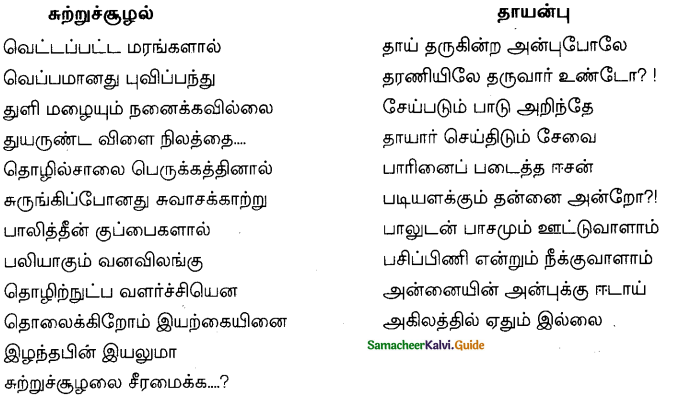
பின்வரும் தலைப்புகளில் ஏதேனும் ஒன்றில் 8 வரிகளில் கவிதை புனைக. சுற்றுச்சூழல் (அல்லது) தாயன்பு சுற்றுச்சூழல்
தாயன்பு
Answer:
Tamil Nadu 12th Tamil Model Question Paper 1 - 1

பகுதி – IV

பின்வரும் வினாக்களுக்கு இரு பக்கங்களுக்கு மிகாமல் விடை தருக. [3 × 6 = 18]

Question 44.
(அ) தமிழின் சீரிளமைத் திறம் வியந்து கவிஞர் சிற்பி பாலசுப்பிரமணியம் கூறுவனவற்றைத் தொகுத்து எழுதுக.
Answer:
தமிழின் சீரிளமைத் திறத்தை வியந்த கவிஞர் சிற்பி பின்வருமாறு கூறுகிறார்.

  • செம்மை மிகுந்த சூரியன் மாலையில் மலை முகட்டில் மறையும் பொழுது வானம் செந்நிறப்பூக்காடாய் காட்சி தருகிறது.
  • தொழிலாளர்களின் கைகள் சிவந்து திரண்ட தோள்களில் வியர்வைத் துளிகள் முத்து முத்தாக காணப்படும்.
  • இக்காட்சிகளை எல்லாம் நான் வியந்து பாடி அன்னைத் தமிழே உன் துணை வேண்டும்.
  • பெருகி வரும் கவிதைகளுக்கு உணவாக இருக்கும் தமிழே.
  • பாரி முதல் வள்ளல்களை இவ்வுலகிற்குத் தந்த தாயோ !
  • உன் பழமையான நலன்களை எல்லாம் புதுப்பித்து, தமிழ்க்குயிலே நீ மெய்சிலிர்க்கக் கூவி வா.
  • கூண்டினை உடைத்தெறிந்த சிங்கம் போல வா!
  • குளிர் பொதிகையில் தோன்றிய தென் தமிழே சீறி வா.
    இவ்வாறே தமிழின் சீரிளமைத்திறம் வியந்து கவிஞர் சிற்பி பாலசுப்பிரமணியம் கூறுகின்றார்.

(அல்லது)

Question 44.
ஆ) எளிய மக்களின் வலிகளை நாட்டுப்புற இலக்கிய வடிவங்களே முழுமையாகப் பிரதிபலிக்கின்றன – நிறுவுக.
Answer:
மனிதன் என்று தோன்றினானோ மொழி என்று பிறந்ததோ அன்றே நாட்டுப்புறப் பாடல்கள் தோன்றிவிட்டன எனலாம். நாட்டுப்புறப் பாடல்கள் பெரும்பாலும் பாமரமக்கள் பாடியவையாகவே உள்ளன. எளிய மக்கள் பாடல்கள் என்பதால் அதில் வறுமை, சோகம் என வலிகளைப் பிரதிபலிப்பதாய் காணப்படுகின்றாள். வறுமையில் வாழும் ஒருவன் மனிதர்களைப் பற்றிய பாடல் ஒன்றை எழுதுகிறாள்.

வாழும் நேரத்தில் வருகின்றாள்
வறுமை வந்தால் பிரிகுறா
பேய் போல பணத்த காக்குறா
பெரியவர் தம்மை பழிக்குறா

மனிதன் பணம் வரும் போது மாறிவிடுகிறான் என்பதை வெளிப்படுத்துகிறது. வறுமையினால் வேலைப்பார்க்கும் பெண்களைப் பற்றிய பாடலில்,

வேகாத வெயிலுக்குள்ளே
விறகொடிக்கப் போறபெண்ணே
காலுனக்குப் பொசுக்கலையோ
கற்றாழைமுள்ளுக் குத்தலையோ
காலக் கொடுமையாலே
கஷ்டப்பட காலமாச்சு

என பெண் வெயிலிலும், காலணி இன்றி வேலைப்பார்த்து, தன் குடும்பத்தைக் காப்பாற்றுவதாக கூறப்பட்டுள்ளது.

காட்டுக்குள்ளே விறகொடித்து
சாமி வீட்டுகதைச் சுமந்துவந்து
கால் ரூபாய்க்கு விறகுவிற்று
கஞ்சி கண்டு குடிக்கணும்

ஒரு வேலை உணவிற்காக நாள் முழுக்க வேலைப்பார்க்கும் பெண்ணின் வலியை வெளிப்படுத்தும் விதமாக அமைந்துள்ளது.

வெள்ளாம நமக்கு வேணாம்
வெவசாயம் ஒண்ணு வேணாம்
வௌச்சலும் ஒன்றுமில்ல
விட்டுப்புட்டு போயிடலாம்
வேற வேல பாத்துக்கலாம்
வெளிநாடுபோயி அங்க வேலகீல
பாப்போம்
வெள்ளக் காரங்க போல நாம
வசதியாக இருப்போம்

விவசாயம் பொய்த்து போய் வெளிநாட்டிற்குச் சென்று கூலி வேலை பார்த்துப் பிழைத்துக் கொள்ளும் பாமர மக்களின் வலியை வெளிப்படுமாறு இப்பாடல் அமைந்துள்ளது. நாட்டுப்புற இலக்கியங்களைப் பாமர இலக்கியம் எனலாம். பாமர மக்களின் வலியைப் பிரதிபலிப்பதால் அவ்வாறு அழைக்கப்படும்.

Question 45.
(அ) திரைப்படத்துறை என்பது ஆயிரம் பேரைக் காப்பாற்றும் தொழிலா? அல்லது கலைகளின் சங்கமமா? உங்கள் பார்வையைக் கட்டுரையாக்குக.
Answer:
கலை நம் வாழ்வின் உயிர்நாடி. கலையில்லையோல் வாழ்வில் சுவையிருக்காது. திரைப்படம் ஓர் அற்புதமான கலை. உலகில் பல்வேறு மொழிகள் இருப்பினும் மக்கள் அனைவரும் எளிதில் புரிந்து கொள்ளும் உலக மொழி திரைப்படம். மக்களைத் தன் வயப்படுத்தும் ஆற்றல் திரைப்படத்திற்கு உண்டு. இத்துறையின் வளர்ச்சி திரை பின்னால் எத்தனைத் துறைகளின் வாழ்வு அடங்கியுள்ளது.

ஊமைப்படங்களைப் பேசும்படங்களாக மாற்றுவதற்குப்பல்வேறு அறிவியல் அறிஞர்கள் அயராது உழைத்தார்கள். அதனால் திரைப்படத்துறை மாபெரும் வளர்ச்சியை எட்டியது. திரைப்படத்திற்குக் கதை, கதைமாந்தர் தேர்வு, உரையாடல், பாடல், ஆடை, அணிகலன். உடைவடிவமைப்பாளர், நடிகர், நடிகையர், தோழர், தோழியர், பணியாளர் எனப் பலர் தேர்வு செய்யப்படுகின்றனர்.

கலைஞர்கள் அனைவரையும் ஒன்றிணைத்து இத்துறை மாபெரும் வெற்றி பெற்றதாக மாறியுள்ளது. ஒரு திரைப்படம் எடுக்க பல கோடிகள் செலவீனங்கள் ஆகின்றன. இப்பாடங்கள் பலவிதங்களில் எடுக்கப்படுகின்றன. அரசியல், குடும்பப்படங்கள், பக்திப்படம், திகில் படங்கள் என பல பிரிவுகள் உள்ளன.

திரைப்படத்துறையில் முழு ஈடுபாடு உள்ளவர்களால் மட்டுமே இதில் வெற்றிபெற இயலும். திரைப்படத்துறையை ஒரு பல்கலைக்கழகம், பலகலைகளின் சங்கமம் என்றே கூறலாம். திரைத்துறைச் சார்ந்த பல பட்டப்படிப்புகள் தற்போது உருவாகி உள்ளன.

இதில் பல கலைகள் வளர்ந்து வருகின்றன என்பதும் மறுக்க முடியாத உண்மை . நடிப்புக்கலை, நாடகக்கலை, ஓவியக்கலை, அழகியல் கலை, கட்டடக்கலை போன்ற பல கலைகளை வளர்த்து வருகின்றன. ஒரு திரைப்படம் என்பது கேளிக்கை மட்டுமே அல்ல. பல குடும்பங்களின் வாழ்வியல் ஆதாரம் எனலாம். ஆயிரக்கணக்கான குடும்பங்கள் இதை நம்பியே உள்ளன எனலாம்.

மக்களைத் தம்பால் ஈர்த்துக்கட்டிப் போடும் ஆற்றல் கொண்டது திரை உலகம். “கல்லார்க்கும் கற்றோர்க்கும் களிப்பருளும் களிப்பே” என்னும் வரிகள் திரைப்படத்திற்கும் பொருந்தும். இத்திரைப்படம் கலைகளின் சங்கமமாகவும் பல குடும்பங்களை வாழ வைக்கும் இடமாகவும் விளங்குகிறது எனலாம்.

(அல்லது)

(ஆ) குடும்பம் என்னும் சிறிய அமைப்பிலிருந்தே மனித சமூகம் என்னும் பரந்த அமைப்பு
கட்டமைக்கப்படுகிறது – எவ்வாறு? விளக்குக.
Answer:

  • குடும்பம் எனும் சிறிய அமைப்பிலிருந்தே மனித சமூகம் எனும் பரந்த அமைப்பு கட்டமைக்கப்படுகிறது. குடும்பம் தொடங்கிக் குலம், கூட்டம், பெருங்குழு, சமூகம் என்ற அமைப்புவரை விரிவு பெறுகிறது.
  • குடும்பமே மனித சமூகத்தின் அடிப்படை அலகாக உள்ளது. வாழுங்காலம் முழுவதும் தொடர்ந்து வேறு எந்த நிறுவனமும் இந்த அளவுக்கு மனிதனைச் சமூகவயப்படுத்தும் பணியைச் செய்ததில்லை.

குடும்பம்:
குடும்பம் எனும் அமைப்பு ஏற்படுவதற்கு அடிப்படை திருமணமே, குடும்பம், திருமணம் இரண்டும் ஒன்றையொன்று சார்ந்தே செயல்படுகின்றன – நாணயத்தின் இரண்டு பக்கங்களைப் போல, இன்று நாம் வழங்கும் ‘திருமணம்’, குடும்பம் ஆகிய இரண்டு சொற்களும் தொல்காப்பியத்திலும் சங்க இலக்கியங்களிலும் எங்கும் இடம்பெறவில்லை. குடும்பம் எனும் சொல் முதன்முதலில் திருக்குறளில்தான் (1029) வருகிறது.

வாழிடம்:
மருதத்திணைப் பாடல் ஒன்றில் மகளிர் தம்மனை’, ‘நும்மனை’ என மனைவியின் இல்லத்தையும் கணவனின் இல்லத்தையும் பிரித்துப் பேசும் போக்கினைக் காண முடிகிறது. இன்னும் சில இடங்களில் தற்காலிகத் தங்குமிடம் புக்கில் எனவும், திருமணத்திற்குப்பின் கணவனும் மனைவியும் பெற்றோரிடமிருந்து பிரிந்து, தனியாக வாழுமிடம் ‘தன்மனை’ எனவும் வழங்கப்பெற்றுள்ளன.

மணந்தகம்:
குடும்பமும் உயிரிகளைப் போன்றே தோன்றுகிறது; வளர்கிறது, பல கட்டங்களைக் கடக்கிறது. அதன் வாழ்க்கைச் சுழற்சியில் பல வடிவங்களில் நிலைமாற்றம் பெறுகிறது. இத்தகைய நீண்ட பாதையில் குடும்பத்தின் தொடக்கம் திருமணமே. மணம்புரிந்த கணவனும் மனைவியும் சேர்ந்து இல்லற வாழ்வில் ஈடுபடக்கூடிய தொடக்கக் கட்டமே ‘மணந்தகம்’ எனப்படுகிறது. முதல் குழந்தை பிறக்கும் வரை உள்ள காலகட்டத்தை இந்நிலை குறிக்கிறது. தனிக்குடும்ப உருவாக்கத்தின் தொடக்க நிலையாக இது அமைகிறது.

தாய்வழிக் குடும்பம்:
சங்ககாலத்தில் கண சமூகத்துக்குத் தாயே தலைமை ஏற்றிருந்தாள். தாய்வழியாகவே குலத்தொடர்ச்சி குறிக்கப்பட்டது. பதிற்றுப்பத்து கூறும் சேரநாட்டு மருமக்கள் தாய முறை இதற்குச் சிறந்த எடுத்துக்காட்டாகும்.

சிறுவர்தாயே பேரிற் பெண்டே
செம்முது பெண்டின் காதலஞ்சிறா அன்
வானரைக் கூந்தல் முதியோள் சிறுவன்
முளரிமருங்கின் முதியோள் சிறுவன்
என்மகள் ஒருத்தியும் பிறன்மகன் ஒருவனும்

முதலான தொடர்களில் ‘இவளது மகன்’ என்றே கூறப்பட்டது. இவனது மகன் எனக் கூறப்படவில்லை என்பது நோக்கத்தக்கது. இவை அனைத்தும் சங்ககாலத்தில் காணப்பட்ட தாய்வழிச் சமூகத்தின் நிலையைக் காட்டுகின்றன.

சங்ககாலத்தில் பெண் திருமணம் செய்த பின்னரும் தன் இல்லத்திலேயே தொடர்ந்து வாழ்க்கை நடத்தும் தாய முறை இருந்துள்ளது. திருமணத்திற்குப்பின் மனைவியின் இல்லத்துக்குச் சென்று கணவன் வாழ்வதே நடைமுறையாக இருந்துள்ளது.

தந்தைவழிக் குடும்பம்:
மனித குலத்தில் ஆதியில் தோன்றி வளர்ந்த தாய்வழி முறையானது தமிழர்களிடம் இருந்ததைச் சங்க இலக்கியங்களின் வழி அறிய முடிந்தாலும், சங்க காலத்திலேயே ஆண் மையச் சமூக முறை வலுவாக வேர் ஊன்றிப் பரவலாகி விட்டதையும் காணமுடிகிறது.

ஆண் மையச் சமூகத்தில் பெண் திருமணத்திற்குப்பின் தன் கணவனுடைய தந்தையகத்தில் வாழ வேண்டும். மணமானபின் தலைவன் தலைவியை அவனுடைய இல்லத்திற்கு அழைத்து வந்தபோது அவனுடைய தாய் அவளுக்குச் சிலம்புகழி நோன்பு செய்திருக்கிறாள்.

தனிக்குடும்பம்:
தனிக்குடும்பம் தோன்றுவதற்கான தொடக்கநிலைக் குடும்பங்கள் பற்றிச் சங்க இலக்கியங்கள் மிகுதியாகப் பேசியிருக்கின்றன. இளமகவுநிலைக் குடும்பங்களின் காட்சிகளை ஐங்குறுநூறு தெளிவுபடுத்துகிறது. “மறியிடைப் படுத்த மான்பிணை போல்” மகனை நடுவணாகக்கொண்டு தலைவனும் தலைவியும் வாழ்ந்திருக்கின்றனர். தாய், தந்தை, குழந்தை மூவருமுள்ள தனிக்குடும்பம் மிகவும் நெருக்கமானது என்பதால் இது தொடக்கநிலை / எளிய நெருக்கமான குடும்பம் எனப்படும்.

விரிந்த குடும்பம்:
சங்க காலத்தில் தனிக்குடும்ப அமைப்பு விரிவுபெற்று இவர்களுடன் பெற்றோர் ஒருவரின் தந்தையும் உடன் வாழும் “விரிந்த குடும்ப முறையையும் காண முடிகிறது. கணவன், மனைவி, மகன் ஆகியோருடன் தந்தை சேர்த்து வாழ்ந்த நேர்வழி விரிந்த குடும்ப முறையை ஒக்கூர் மாசாத்தியாரின் புறநானூற்றுப் பாடல் கூறுகிறது. இவ்வாறு குடும்பம் என்னும் சிறிய அமைப்பு மனித சமூகம் என்னும் பரந்த அமைப்பாக கட்டமைக்கப்படுகிறது.

Question 46.
(அ) ‘உரிமைத்தாகம்’ கதையில் சகோதரர்கள் இருவரும் ஒன்றிணையாமல் இருந்திருந்தால்….. கதையைத் தொடர்ந்து எழுதி முடிக்க.
Answer:

  • மேலூர் பங்காருசாமியிடம் தன் நிலப்பத்திரத்தைக் கொடுத்துப் பணம் பெற்ற வெள்ளைச்சாமி அதை அவனால் மீட்டுக்கொள்ள முடியவில்லை. தேவையான பணத்தைத் தயார் செய்ய முடியவில்லை. மேலும் வட்டியும் அதிகமாகிக் கொண்டே போனது.
  • இதை எப்படியோ தெரிந்து கொண்ட வெள்ளைச்சாமியின் அண்ணன் முத்தையா
    பங்காருசாமியிடம் சென்று பத்திரத்தை மீட்பதற்காகப் பேசினான்.
  • ஆனால் அவன் தம்பி என் சொந்த பிரச்சனைகளில் தலையிட வேண்டாம் என்று சொல்லித் திட்டி அனுப்பிவிட்டான்.
  • காலம் கடத்து கொண்டே இருந்தது வெள்ளைச்சாமிக்குப் போதிய பணம் கிடைக்கவே இல்லை. வட்டியும் கொடுக்கவில்லை.
  • பிறகு இறுதியாக வெள்ளைச்சாமியின் புஞ்சை நிலம் ஏலத்திற்கு விடப்பட்டது. ஏலத்தில் அவனுடைய நிலம் கைமாறிப்போனது.
  • வாங்கிய கடனைத் திருப்பிக் கொடுக்க முடியாமல் நிலத்தையும், தன் உறவுகளையும் பறிகொடுத்துவிட்டோம் என எண்ணி வெள்ளைச்சாமி மனநிம்மதியில்லாமல் இருந்தான்.
  • தன்னுடைய நிலத்தைப் பார்க்கும் போதெல்லாம் மனவேதனையில் துடித்தான்.
  • நாட்கள் பல கடந்தது. மழைக்காலம் தொடங்கியது. மழைபெய்யோ பெய்யென பெய்தது. அதற்கு அடுத்த நாள் காட்டுமேட்டுப் பகுதியில் வெள்ளைச்சாமி செல்லும்போது அவனுடைய புஞ்சை நிலத்தினால் அவனுடைய அண்ணன் முத்தையா ஏர் உழுதுகொண்டு இருந்தான்.

அதைப் பார்த்த பிறகுதான் விசாரித்தான், யார் அந்த நிலத்தை ஏலத்தில் வாங்கியது என்று, அப்பொழுது தான் அவனுக்குத் தெரிந்தது தன்னுடைய அண்ணன் நிலத்தை வாங்கியுள்ளான் என தன்கையிலிருந்து சென்றாலும் என் அண்ணன் கையில் என் நிலம் உள்ளது என்ற சந்தோசத்தில் சென்றான் வெள்ளைச்சாமி. தான் ஆடாவிட்டாலும் தன் தசை ஆடுகிறது என்று சொல்லியதெல்லாம் உண்மைதான்.

(அல்லது)

Tamil Nadu 12th Tamil Model Question Paper 1

Question 46.
(ஆ) ‘கிராமங்கள் தங்கள் முகவரியை இழந்து வருகின்றன’ – தலைக்குளம் கதையின்றி
உங்கள் கருத்தை விவரிக்க.
Answer:
குளத்துக்கரை விநாயகரும், அரசமரமும், சுத்தமான காற்றும், காதிற்கினிய குயில் ஓசையும் கோடிக்கணக்கான பணம் கொடுத்தாலும் கிடைக்காத சந்தோசம் தரும் இடமாக கிராமங்கள் திகழ்கின்றன.

எந்தத் தொழில் முறை மாறினாலும் அழிந்தாலும் உலகம் இயங்குவது பாதிக்காது. ஆனால் உயிர் கொடுக்கும் உழவுத்தொழில் அழிந்தால் உலகம் இருக்கும். ஆனால் உயிர்கள் இருக்காது. அப்படிப்பட்ட உழவுத்தொழில் செய்யும் கிராமங்கள் நகரை நோக்கி திரும்பிச் செல்வது காலத்தின் கட்டாயம் என்றாலும், கஷ்டகாலம் நம்மை நோக்கி வருகிறது என்பதும் நம் அறிய வேண்டியதும் கட்டாயம். நம் கிராமங்கள் அழிந்து வருவதை நாம் கண்கூடாக பார்த்து வருகின்றோம்.

நகரத்திற்கு வரும் கிராமத்தினர் பட்டியலில் இந்திய அளவில் தமிழகம் 3 வது இடத்தில் உள்ள மொத்த மக்கள் தொகையில் 14.5% பேர் கிராமங்களை காலி செய்துவிட்டு நகருக்குள் வந்துவிட்டனர். மொத்தமுள்ள மக்களின் 48.40% பேர் நகரங்களில் வசிப்பது உணவு உற்பத்திக்கு விடப்பட்ட அபாய எச்சரிக்கை. ஏற்கனவே கேரளா, கர்நாடகா, ஆந்திராவிடம் தண்ணீருக்காக போராடிவரும் நாம், இனிவரும் காலங்களில் உணவுக்கு அண்டை மாநிலத்தை நம்பி இருக்க வேண்டிய காலம் வெகு தொலைவில் இல்லை.

கிராமங்களுக்கு என சில அடையாளங்கள் உண்டு. வயல்வெளி, திண்ணைவீடுகள், மரத்தடி, கோயில், குளம் இவற்றுடன் மண் மணக்கும் விளையாட்டுகள் – கபடி தமிழக கிராமங்களுக்கே உரிய அடையாளம். ஒரு காலத்தில் ஊருக்கு ஊர் கேட்ட சடு ….. குடு சப்தங்களை இப்போது கேட்க முடியவில்லை. எங்கே செல்கிறோம் நாம் என்றே புரியவில்லை.

“ஆற்றங்கரை ஓரம் அமைந்த வீடுகள்
பச்சை கம்பளம் விரித்தாற் போல
பசுமை நிறைந்த வயல் வெளிகள்
குடும்பத்தோடு அகம் மகிழும்
திண்ணை அமர்வு”

என அனைத்தையும் தொலைத்துவிட்டு ஆன்ராய்ட் அலை பேசியின் தொடு திரையில் அழகிய படங்களைத் தேடுதலால் மட்டுமே தொலைந்த நம் கிராமத்தைத் திருப்பி விட முடியாது. இயன்ற வரை இயற்கையைப் போற்றி வாழ்வோம்.
கிராமத்தை அழிவிலிருந்து மீட்போம்!

பகுதி – V

அடிமாறாமல் செய்யுள் வடிவில் எழுதுக.

Question 47.
அ) குழல்வழி’ என்று துவங்கும் சிலப்பதிகாரப் பாடலை எழுது.[1 ×4 = 4]
இசைக்கருவிகள் ஒலித்த முறை
Answer:
குழல்வழி நின்றது யாழே, யாழ்வழித்
தண்ணுமை நின்றது தகவே, தண்ணுமைப்
பின்வழி நின்றது முழவே, முழவொடு
கூடி நின்று இசைத்தது ஆமந்திரிகை (- இளங்கோவடிகள்)

(ஆ) ‘அது’ என முடியும் குறளை எழுதுக.[1 × 2 = 2]
Answer:
அன்பும் அறனும் உடைத்தாயின் இல்வாழ்க்கை
பண்பும் பயனும் அது. (- திருவள்ளுவர்)

Tamil Nadu 12th Commerce Model Question Paper 4 English Medium

Students can Download Tamil Nadu 12th Commerce Model Question Paper 4 English Medium Pdf, Tamil Nadu 12th Commerce Model Question Papers helps you to revise the complete Tamilnadu State Board New Syllabus, helps students complete homework assignments and to score high marks in board exams.

TN State Board 12th Commerce Model Question Paper 4 English Medium

Instructions:

  1. The question paper comprises of four parts.
  2. You are to attempt all the parts. An internal choice of questions is provided wherever applicable.
  3. All questions of Part I, II. III and IV are to be attempted separately.
  4. Question numbers 1 to 20 in Part I are Multiple Choice Questions of one mark each. These are to be answered by choosing the most suitable answer from the given four alternatives and writing the option code and the corresponding answer.
  5. Question numbers 21 to 30 in Part II are two-mark questions. These are to be answered in about 50 words.
  6. Question numbers 31 to 40 in Part III are three-mark questions. These are to be answered in about 150 words.
  7. Question numbers 41 to 47 in Part IV are five-mark questions. These are to be answered in about 250 words. Draw diagrams wherever necessary.

Time: 3 Hours
Max Marks: 90

Part -I

Choose the correct answer. Answer all the questions: [20 x 1 = 20]

Question 1.
Drucker stresses jobs of management.
(a) three
(b) two
(c) four
(d) Six
Answer:
(a) three

Question 2.
Choose the odd one out?
(a) Directing
(b) Motivating
(c) Innovation
(d) Controlling
Answer:
(c) Innovation

Tamil Nadu 12th Commerce Model Question Paper 4 English Medium

Question 3.
…………… harmonises the goal of an individual with the organisation’s goal.
(a) MBO
(b) MBE
(c) MBA
(d) MBM
Answer:
(a) MBO

Question 4.
Indian organised financial system consist of sectors.
(a) Two
(b) Four
(c) Three
(d) Six
Answer:
(b) Four

Question 5.
Capital market otherwise called as …………..
(a) Securities market
(b) Share market
(c) Debenture market
(d) Money market
Answer:
(a) Securities market

Question 6.
……………………. deals with the financial assets and securities whose maturity period does not exceed one year.
(a) Money market
(b) Capital market
(c) Stock exchange
(d) Government bonds
Answer:
(a) Money market

Tamil Nadu 12th Commerce Model Question Paper 4 English Medium

Question 7.
The consumer is to be protected against any ……………..
(a) unfair practices of trade
(b) family functions
(c) profit making firm
(d) loss in business
Answer:
(a) unfair practices of trade

Question 8.
The National Commission should have members.
(a) 3
(b) 4
(c) 5
(d) 6
Answer:
(d) 6

Question 9.
………………. is the latest outcome of liberalization.
(a) Privatisation
(b) Globalisation
(c) Foreign collaboration
(d) None of these
Answer:
(c) Foreign collaboration

Question 10.
A bill of exchange drawn on a specified banker is ……………
(a) promissory note
(b) cheque
(c) hundi
(d) share
Answer:
(b) cheque

Question 11.
The entrepreneurs classified on the basis of types of business are …………….
(i) Industrial entrepreneur
(ii) Technical entrepreneur
(iii) Professional entrepreneur
(iv) Business entrepreneur
(a) (i) and (iii)
(b) (i) and (iv)
(c) (ii) and (iii)
(d) (ii) and (iv)
Answer:
(b) (i) and (iv)

Tamil Nadu 12th Commerce Model Question Paper 4 English Medium

Question 12.
Board meetings to be conducted minimum times in a year.
(a) 2
(b) 3
(c) 4
(d) 5
Answer:
(c) 4

Question 13.
A public company shall have a minimum of ……………. directors.
(a) Twelve
(b) Seven
(c) Three
(d) Two
Answer:
(c) Three

Question 14.
Which of the following types of shares are issued by a company to rains capital from the existing shareholders?
(a) Equity shares
(b) Rights shares
(c) Preference shares
(d) Bonus shares
Answer:
(b) Rights shares

Question 15
should cover aspects like sources of finance, technical know-how, source of labours and raw material, market potential and profitability.
(a) Technical Report
(b) Finance Report
(c) Project Report
(d) Progress Report
Answer:
(c) Project Report

Question 16.
Find the odd one out is context of Trading Entrepreneur.
(a) Selling
(b) Commission
(c) Buying
(d) Manufacturing
Answer:
(d) Manufacturing

Question 17.
Which of the below is not classified into managerial function.
(a) Planning
(b) Marketing
(c) Organising
(d) Controlling
Answer:
(c) Organising

Tamil Nadu 12th Commerce Model Question Paper 4 English Medium

Question 18.
Section 6 of Negotiable Instruments Act 1881 deals with ……………
(a) Promissory Note
(b) Bills of exchange
(c) Cheque
(d) None of the above
Answer:
(c) Cheque

Question 19.
……………… results from the removal of barriers between national economics to encourage the flow of goods, services, capital and labour.
(a) privatisation
(b) Liberalisation
(c) Globalisation
(d) Foreign Trade
Answer:
(c) Globalisation

Question 20.
The state commission can entertain complaints where the value of the goods or services and the compensation, if any claimed exceed.
(a) ₹ 2 lakhs but does not exceed ₹ 5 lakhs
(b) ₹ 20 lakhs but does not exceed ₹ 1 crore
(c) ₹3 lakhs but does not exceed ₹ 5 lakhs
(d) ₹ 4 lakhs but does not exceed ₹ 20 lakhs
Answer:
(d) ₹ 4 lakhs but does not exceed ₹ 20 lakhs

PART – II

Answer any seven in which Question No.30 is compulsory. [7 x 2 = 14]

Question 21.
State the meaning of Authority.
Answer:
Authority means the right of a superior to give the order to his subordinates. This is the issue of commands followed responsibility for their consequences.

Question 22.
How is price decided in a secondary market?
Answer:
Financial markets allow for the determination of the price of the traded financial asset through the interaction of buyers and sellers. They provide a signal for the allocation of funds in the economy, based on the demand and supply, through the mechanism called price discovery processes.

Question 23.
What is meant by Remiser?
Answer:
Remiser is an agent of a member of a stock exchange. He obtains business for his principal i.e. the member.

Tamil Nadu 12th Commerce Model Question Paper 4 English Medium

Question 24.
What is Human Resource Management ?
Answer:
Human Resource Management is a function of management concerned with hiring, motivating and maintaining people in an organisation. It focuses on people in an organisation.

Question 25.
Define Marketer.
Answer:
“A person whose duties include the identification of the goods and services desired by a set of consumers, as well as the marketing of those goods and services on behalf of a company”.

Question 26.
What is Caveat Emptor?
Answer:
‘Caveat emptor’ is a Latin term that means “let the buyer beware.” Similar to the phrase “sold as is,” this term means that the buyer assumes the risk that a product fails to meet expectations or have defects.

Question 27.
Expand VUCA.
Answer:
VUCA – volatility, uncertainty, complexity and ambiguity.

Question 28.
What is meant by goods?
Answer:
The term goods mean every kind of movable property other than actionable claim and money.

Question 29.
List down the managerial functions of entrepreneurs.
Answer:

  • Planning
  • Organising
  • Directing
  • Controlling
  • Coordination

Question 30.
What do you mean by Equity Share?
Answer:
The share of a company which do not have any preferential rights with regard to dividend and repayment of share capital at the time of liquidation of a company, is called as equity share or ordinary share.

Part – III

Answer any seven in which question No. 40 is compulsory. [7 x 3 = 21]

Question 31.
What are the principles of Taylor?
Answer:
Principles of scientific management propounded by Taylor are:

  • Science, Not Rule of Thumb
  • Harmony, Not Discord
  • Mental Revolution
  • Cooperation, Not individualism
  • Development of each and every person to his or her greatest efficiency and prosperity.

Question 32.
Write a note on Secondary Market.
Answer:
Secondary Market is the market for securities that are already issued. Stock Exchange is an important institution in the secondary market.

Question 33.
Explain National Stock Market System. (NSMS)
Answer:
National stock market system was advocated by the High Powered Group. It is headed by Shri. Pherwani (popularly known as Pherwani Committee). At present the National Stock Market comprises the following:

  • National Stock Exchange of India Limited (NSE)
  • Stock Holding Corporation of India Limited (SHCIL)
  • Securities Trading Corporation of India (STCI)

Question 34.
Marketer is an innovator? Do you agree?
Answer:
Marketer seeks to distinguish his products/services by adding additional features or functionalities to the existing product, modifying the pricing structure, introducing new delivery pattern, creating new business models, introducing change in production process and so on.

Tamil Nadu 12th Commerce Model Question Paper 4 English Medium

Question 35.
What is meant by artificial scarcity?
Answer:
There are certain situations where the shop-keepers put up the board ‘No Stock” in front of their shops, even though there is plenty of stock in the store. In such situations consumers who are desperate to buy such goods have to pay hefty price to buy those goods and thus earning more profit unconscientiously.

Question 36.
State the framework of Corporate Governance in India.
Answer:
The Indian Corporate Governance framework requires listed companies

  • To have independent directors on the board; At least one third of the directors have to be independent directors.
  • To have at least one independent woman director,
  • To disclose all deals and payments to related parties.
  • To disclose details of managerial compensation.

Question 37.
Discuss the implied conditions and warranties in sale of goods contract.
Answer:
In every contract of sale, there are certain expressed and implied conditions and warranties. The term implied conditions means conditions which can be inferred from or guessed from the context of the contract.Following are the implied conditions:

  • Conditions as to Title
  • Conditions as to Description
  • Sale by Sample
  • Conditions as to Quality or Fitness
  • Conditions as to Merchantability
  • Condition as to Wholesomeness
  • Condition Implied by Trade Usage Following are the implied warranties:
  • Quiet Possession
  • Free from Any Encumbrances
  • Warranty in the case of Dangerous Goods

Question 38.
List the commercial functions of Entrepreneur and explain them shortly.
Answer:
Commercial Functions of Entrepreneur:
Production or Manufacturing: Under production function, entrepreneur has to take decision relating to selection of factory site, design and layout, type of products to be manufactured, research and development, product design, etc.

Marketing: Entrepreneur has to carry out following functions pertaining to marketing aspect namely consumer research, product planning and development, standardisation, packaging, pricing, warehousing, distribution, promotion etc.

Accounting: Entrepreneur has to arrange to prepare trading and profit and loss account in order to know the profit or loss incurred out of operation of the business and prepare balance sheet to know the financial status of business at a particular day.

Finance: In the sphere of financial function, an entrepreneur has to take decisions like choosing the right type of financing, framipg the best dividend policy, acquiring of funds, efficiently managing fixed and current assets, maximising shareholders wealth and investing of funds efficiently and effectively.

Human Resource Management: Entrepreneur has to estimate the manpower needs of the enterprise and accordingly decide the size of manpower required for various slots of organisational structure.

Question 39.
What is issue of shares at discount? What conditions should be fulfilled?
Answer:
When the shares are issued at a price below the face value they are said to be issued at a discount. For example, a share having the face value of Rs 10 is issued at Rs 8. The companies act 2013, prohibits the issue of shares at discount (Section 53), except sweat Equity share.

Tamil Nadu 12th Commerce Model Question Paper 4 English Medium

Question 40.
What do you understand by ‘Poll’?
Answer:
Poll means tendering or offering vote by ballot to a specially appointed officer, called the polling officer. Under the Companies Act, poll means exercising voting right in proportion to shareholder’s contribution to the paid-up capital of a limited company having a share capital.

Part – IV

Answer all the following questions. [7 x 5 = 35]

Question 41.
(a) Discuss the implications of span of management.
Answer:
The Span of Management has two implications:
(i) Influences the complexities of the individual manager’s job.
(ii) Determine the shape or configuration of the Organisation.
The span of management is related to the horizontal levels of the organisation structure. There is a wide and a narrow span of management. With the wider, span, there will be less hierarchical levels, and thus, the organisational structure would be flatter. Whereas, with the narrow span, the hierarchical levels increases, hence the organisational structure would be tall.

  • Both these organisational structures have their advantages and the disadvantages. But however the tall organisational structure imposes more challenges.
  • Since the span is narrow, which means less number of subordinates under one superior, requires more managers to be employed in the organisation. Thus, it would be very expensive in terms of the salaries to be paid to each senior.
  • With more levels in the hierarchy, the communication suffers drastically. It takes a lot of time to reach the appropriate points, and hence the actions get delayed.
  • Lack of coordination and control because the operating staff is far away from the top management.

[OR]

(b) What are the functions of Financial Markets?
Answer:
Intermediary Functions
(i) Transfer of Resources: Financial markets facilitate the transfer of real economic resource from lenders to ultimate borrowers.

(ii) Enhancing Income: Financial markets allow lenders earn interest/dividend on their surplus
investible funds and thus contributing to the enhancement of the individual and the national income.

(iiI) Productive Usage: Financial markets allow for the productive use of the funds borrowed and thus enhancing the income and the gross national production.

(iv) Capital Formation: Financial markets provide a channel through which new savings flow to aid capital formation of a country.

(v) Price Determination: Financial markets allow for the determination of the price of the traded financial asset through the interaction of buyers and sellers.

(vi) Sale Mechanism: Financial market provides a mechanism for selling of a financial
asset by an investor so as to offer the benefits of marketability and liquidity of such assets.

(vii) Information: The activities of the participants in the financial market result in the generation and the consequent dissemination of information to the various segments of the markets, so as to reduce the cost of transaction of financial assets.

Financial Functions

  • Providing the borrowers with funds so as to enable them to carry out their investment plans.
  • Providing the lenders with earning assets so as to enable them to earn wealth by deploying the assets in productive ventures.
  • Providing liquidity in the market so as to facilitate trading of funds

Tamil Nadu 12th Commerce Model Question Paper 4 English Medium

Question 42.
(a) Explain the various types of New Financial Institutions.
Answer:
(i) Venture Fund Institutions: Venture capital financing is a form of equity financing designed especially for funding new and innovative project ideas. Venture capital funds bring into force the hi-technology projects which are converted into commercial  production.

(ii) Mutual Funds: Financial institutions that provide facilities for channeling savings of small investors into avenues of productive investments are called ‘Mutual Funds’.

(iii) Factoring Institutions: “Factoring” is an arrangement whereby a financial institution provides financial accommodation on the basis of assignment/sale of account receivables.

(iv) Over the Counter Exchange of India (OTCEI): The OTCEI was set up by a premier
financial institution to allow the trading of securities across the electronic counters throughout the country.

(v) National Stock Exchange of India Limited (NSEI): NSEI was established in 1992 to function as a model stock exchange. The Exchange aims at providing the advantage of nation-wide electronic screen based “scripless” and “floorless” trading system in securities.

(vi) National Clearance and Depository System (NCDS): Under the scripless trading system, settlement of transactions relating to securities takes place through a book entry.

(vii) National Securities Depositories Limited: The NSDL was set up in the year 1996 for achieving a time bound dematerialization as well as rematerialization of shares.

(viii) Stock Holding Corporation of India Limited (SHCIL): Stock Holding Corporation of India Limited (SHCIL) aims at serving as a central securities depository in respect of transactions on stock exchanges. The Corporation also takes up the administration of clearing functions at a national level.

[OR]

(b) What are the features of Government Securities?
Answer:
(i) Agencies: Government securities are issued by agencies such as Central Government, State Governments, semi-government authorities like local Government authorities.
(ii) RBI Special Role: RBI takes a special and an active role in the purchase and sale of these securities as part of its monetary management exercise.
(iii) Nature of Securities: Securities offer a safe avenue of investment through guaranteed payment of interest and repayment of principal by the Government.
(iv) Liquidity Profile: The liquidity profile of gilt-edged securities varies. Accordingly liquidity profile of securities issued by Central Government is high.
(v) Tax Rebate: A striking feature of these securities is that they offer wide-range of tax incentives to investors.

Tamil Nadu 12th Commerce Model Question Paper 4 English Medium

(vi) Market: As each sale and purchase has to be negotiated separately, the Gilt-Edged Market is an Over-The-Counter Market.
(vii) Forms: The securities of Central and State Government take such forms as inscribed stock or stock certificate, promissory note and bearer bond.
(viii) Participants: The participants in Government securities market include the Government sector comprising Central and State Governments
(ix) Trading: Small and less active, banks and corporate holders who purchase and sell Government securities on the stock exchanges participate in trading.
(x) Issue Mechanism: The Public Debt Office (PDO) of the RBI undertakes to issue government securities.
(xi) Issue opening: A notification for the issue of the securities is made a few days before the public subscription is open.
(xii) Grooming Gradual: It is the acquisition of securities nearing maturity through the stock exchanges by the RBI.
(xiii) Switching: It is the purchase of one security against the sale of another security carried out by the RBI in the secondary market as part of its open market operations.
(xiv) Auctioning: A method of trading whereby merchants bid against one another and where the securities are sold to the highest bidder.

Question 43.
(a) Distinguish between Stock Exchange and Commodity Exchange.
Differences between Stock Exchange and Commodity Exchange.

Stock ExchangeCommodity Exchange
(0Meaning: Stock Exchange is an organised market for purchase and sale of industrial and financial securities.A commodity exchange is an exchange where commodities are purchased and sold. E.g.: Gold, Silver, Rice, Wheat
(ii)Function: Providing easy marketability.Offering hedging or price insurance services.
(Hi)Object: It is facilitating capital formation.It will facilitate goods flow through risk reduction.
(iv)Participants: Investors and Speculators are participating in stock exchange.Producers, dealers, traders are involved in the commodity exchange.
(v)Articles traded: Industrial securities such as stocks and bonds and government securities.Only durable and graded goods are traded in this.

[OR]

(b) Differentiate HR from HRM.

S.No.Human Resource (HR)Human Resource Management (HRM)
1.Meaning: Human resource, i.e., the employees create other sources.Managing the human resource is known as human resource management.
2.Human resource exhibits innovation and creativity.Human resource management has universal relevance.
3.Human resource alone can think, act and analyse.The accomplishment of organisational goal is made possible through human resource in an organisation.
4.Human resources are movable.Human resource management is intangible function.
5.Human resource can work as team.Human resource management focuses on the development of manpower through training . and development programmes.

Question 44.
(a) Explain the important methods of interview.
Answer:
Interview means a face to face interaction between the interviewer and interviewee.
Interview may be of various types:-

  • Preliminary Interview: It is conducted to know the general suitability of the candidates who have applied for the job.
  • Structured Interview: In this method, a series of questions is to be asked by the interviewer. The questions may be pre-prepared.
  • In depth Interview: This interview is conducted to test the level of knowledge of the interviewee in a particular field.
  • Panel Interview: Where a group of people interview the candidate. The panel usually comprises the chair person, subject expert, psychological experts and so on.
  • Stress Interview: This type of interview is conducted to test the temperament and emotional balance of the candidate.
  • Online Interview: Due to tremendous growth in information and communication technology, interviews are conducted by means of internet via Skype, Google duo, Whatsapp.

[OR]

Tamil Nadu 12th Commerce Model Question Paper 4 English Medium

(b) What is your contribution to promote the market in the modern society?
Answer:
Market is a place where buyers and sellers gather for purchase and sale.
Market may be of Local market, national market and international or Global market.
To develop and promote the market the following are needed:

  • Eligible and satisfied and customer is needed.
  • Quality and durable goods are to be marketed.
  • Recent trends like E-marketing, online marketing are to be encouraged.
  • After sales service are to be provided to durable goods.
  • Customers are to be financed for buying costly articles.
  • New Innovations and marketing research are to be introduced to develop the market.

Question 45.
(a) Discuss any two new methods of marketing with its advantages.
Answer:
Rural Marketing: Rural marketing is a process of developing pricing, promoting and distributing rural specific goods and serv ices leading to exchange with rural customers.There is inflow of goods into rural markets for production and consumption and there is also outflow of products to urban areas.
The rural to urban flow consists of agricultural products like rice, wheat and sugar etc.

Service Marketing: Service marketing is a special branch of marketing. It denotes the processing of selling service goods like telecommunication, banking, insurance, healthcare, tourism and professional services. The service products are mostly intangible. The unique feature of services marketing warrant different strategies compared with the marketing of physical goods.

[OR]

(b) Write about five important consumer legislations.
Answer:
To protect the consumers from the unfair traders, the government passed various legislative Acts – They are follows:

  • The Indian Contract Act, 1982 was passed to bind the people on the promise made in the contract.
  •  The Essential Commodities Act, 1955 protects the consumers against artificial shortages created by the sellers by hoarding the goods.
  • The Prevention of Food Adulteration Act, 1954 checks the adulteration of food articles and ensures purity of goods supplied.
  •  Weights and Measures Act, 1958 protects the consumer against malpractices of underweight dr under measurement.

Question 46.
(a) Explain the term District Forum and explain the functions of District Forum.
Answer:
As per the Consumer Protection Act 1986, a district forum is established in each and every district to solve the problems in the concerned district. Present or Retired district judge is the president of District forum

Functions:

  • The complaints relating to the district can be solved by district forum.
  • Compensation that can be claimed is less than Rs. 20 lakhs.
  • Sometimes the district forum also may pass orders against traders.

[OR]

(b) Distinguish between Condition and Warranty.

Basis for DifferenceConditionWarranty
1. MeaningIt is a stipulation which is essential to the main purpose of the contract of sale.It is a stipulation which is collateral to the main purpose of contract.
2. SignificanceCondition is necessary to the contract that the breaking of which cancels out the contract.The violation of warranty will not revoke the contract.
3. Transfer of OwnershipOwnership on goods cannot be transferred without fulfilling the conditions.Ownership on goods can be transferred on the buyer without fulfilling the warranty.
4. RemedyIn case of breach of contract, the affected party can cancel the contract and claim damages.In the case of breach of warranty, the affected party cannot cancel the contract but can claim damages only.
5. TreatmentBreach of condition may be treated as breach of warranty.Breach of warranty cannot be treated as breach of condition.

Tamil Nadu 12th Commerce Model Question Paper 4 English Medium

Question 47.
(a) Explain the different kinds of endorsements.
Answer:
When the person signs on the back of the instrument to transfer his interest, it is known as endorsement. The endorsement are of various types:

(i) Blank or general endorsement : When the endorser puts his mere signature on the back of an instrument without mentioning the name of the person to whom the endorsement is made, it is called Blank Endorsement

(ii) Endorsement in full or special endorsement: If the endorser, in addition to his signature, mentions the name of the person to whom it is endorsed, is known as endorsement in full or special endorsement.

(iii) Conditional endorsement: When the endorser of a negotiable instrument makes his liability dependent upon the happening of an event which may or may not happen, it is called conditional endorsement.

(iv) Restrictive endorsement : When an endorsement restricts or prohibits further negotiability of the instrument, it is, called Restrictive Endorsement.

(v) Partial Endorsement :Where the endorsement seeks to transfer only a part of the amount payable under the instrument, the endorsement is called Partial Endorsement.

[OR]

Tamil Nadu 12th Commerce Model Question Paper 4 English Medium

(b) Write the difference between Share Certificate and Share Warrant.
Answer:

S.No.Share CertificateShare Warrant
1.A share certificate is an instrument in writing for the legal proof of the ownership.A share warrant is a negotiable instrument, issued against fully paid up shares.
2.Every company must issue share certificate to its shareholders.There is no compulsion of the issue of share warrants by the company.
3.Normally, the holder of the share certificate is to be the member of the company.Generally, the holder of the share warrant is not the member of the company.
4.The share certificate is issued by the company within three months of the allotment of shares.Shares warrant can be issued only when the shares are fully paid up.
5.No need to authorized in the Articles of Association to issue share certificate.The issue of a share warrant must be authorized in the Articles of Association of the company.


Tamil Nadu 12th Tamil Model Question Paper 3

Students can Download Tamil Nadu 12th Tamil Model Question Paper 3 Pdf, Tamil Nadu 12th Tamil Model Question Papers helps you to revise the complete Tamilnadu State Board New Syllabus, helps students complete homework assignments and to score high marks in board exams.

TN State Board 12th Tamil Model Question Paper 3

நேரம்: 2.30 மணி 
மதிப்பெண்கள் : 90

குறிப்புகள்:

  • இவ்வினாத்தாள் ஐந்து பகுதிகளைக் கொண்டது. அனைத்து பகுதிகளுக்கும் விடையளிக்க வேண்டும். தேவையான இடங்களில் உள் தேர்வு வினாக்கள் கொடுக்கப்பட்டுள்ளது.
  • பகுதி I, II, III, IV மற்றும் Vல் உள்ள அனைத்து வினாக்களுக்கும் தனித்தனியே விடையளிக்க வேண்டும்.
  • வினா எண் 1 முதல் 14 வரை பகுதி-1ல் தேர்வு செய்யும் வினாக்கள் தரப்பட்டுள்ளன.
    ஒவ்வொரு வினாவிற்கும் ஒரு மதிப்பெண். சரியான விடையைத் தேர்ந்தெடுத்துக் குறியீட்டுடன் விடையினையும் சேர்த்து எழுதவும்.
  • வினா எண் 15 முதல் 30 வரை பகுதி-பால் இரண்டு மதிப்பெண் வினாக்கள் தரப்பட்டுள்ளன.
  • வினா எண் 31 முதல் 43 வரை பகுதி-IIIல் நான்கு மதிப்பெண் வினாக்கள் தரப்பட்டுள்ளன.
  • வினா எண் 44 முதல் 46 வரை பகுதி-IVல் ஆறு மதிப்பெண் வினாக்கள் தரப்பட்டுள்ளன.அனைத்து வினாவிற்கும் விடையளிக்கவும்.
  • வினா எண் 47-ல் பகுதி-Vல் மனப்பாடப்பகுதி தரப்பட்டுள்ளன.

பகுதி – I

அனைத்து வினாக்களுக்கும் விடை தருக. [14 × 1 = 14]

(விடைகள் தடித்த எழுத்தில் தரப்பட்டுள்ளன)

Question 1.
‘காவியதர்சம்’ என்ற இலக்கண நூல்……………………மொழியில் எழுதப்பட்டது.
(அ) தமிழ்
(ஆ) வடமொழி
(இ) கிரந்தம்
(ஈ) ஷிப்ரூ
Answer:
(ஆ) வடமொழி

Question 2.
கடந்த 30 ஆண்டுகளில் 4 லட்சம் சதுர மைல்கள் உருகிய பகுதி…………………….
(அ) ஆர்டிக்
(ஆ) அண்டார்டிக்
(இ) பசுபிக்
(ஈ) அட்லாண்டிக்
Answer:
(அ) ஆர்டிக்

Question 3.
‘குடும்பு’ என்னும் சொல்லின் பொருள் யாது?
(அ) பிரிந்து வாழ்தல்
(ஆ) சமுதாயம்
(இ) தம்மனை
(ஈ) கூடிவாழ்தல்
Answer:
(ஈ) கூடிவாழ்தல்

Tamil Nadu 12th Tamil Model Question Paper 3

Question 4.
வானரத் தலைவன்……………………
(அ) அனுமன்
(ஆ) சுக்ரீவன்
(இ) சவரி
(ஈ) சடாயு
Answer:
(ஆ) சுக்ரீவன்

Question 5.
தமிழக அரசு 133 அடி உயரமுள்ள வள்ளுவர் சிலையை நிறுவிய இடம்……………………
(அ) நெல்லை
(ஆ) கன்னியாகுமரி
(இ) கோவை
(ஈ) தில்லை
Answer:
(ஆ) கன்னியாகுமரி

Question 6.
வாதம் புரிதலை கொடிகட்டியிருப்பரென்று கூறிய நூல்……………………
(அ) மதுரைக்காஞ்சி
(ஆ) நெடுநல்வாடை
(இ) முதுமொழிக்காஞ்சி
(ஈ) பட்டினப்பாலை
Answer:
(அ) மதுரைக்காஞ்சி

Question 7.
தஞ்சைத் தமிழ்ப் பல்கலைக்கழகத்திடமிருந்து உவமைக் கவிஞர் சுரதா பெற்ற விருது…………………………….
(அ) கலைமணி
(ஆ) கலைமாமணி
(இ) இராசராசன்
(ஈ) பாரதி
Answer:
(இ) இராசராசன்

Question 8.
சொல்லுதலை அடிப்படையாகக் கொண்டு உருவான பாவகை…………………………… ஆகும்.
(அ) வெண்பா
(ஆ) அகவற்பா
(இ) வஞ்சிப்பா
(ஈ) கலிப்பா
Answer:
(அ) வெண்பா

Question 9.
வள்ளல் பச்சையப்பர் எழுதிய கவிதைத் தொகுப்பு நூல்………… ஆகும்.
(ஆ) மல்லியர்பா
(ஆ) மவுனியர்பா
(இ) கொற்கைப்பா
(ஈ) மாவலிபுரச்செலவு
Answer:
(ஈ) மாவலிபுரச்செலவு

Question 10.
கூற்று : இந்தியாவின் பல பகுதிகளிலிருந்தும் நெசவாளர்கள் சென்னை நோக்கி வந்தனர்.
கூற்று : கிழக்கிந்திய நிறுவனத்தின் வணிகம், துணி சார்ந்தே இருந்தது.
(அ) கூற்று சரி, காரணம் தவறு
(ஆ) கூற்று தவறு, காரணம் சரி
(இ) கூற்று தவறு, காரணம் தவறு
(ஈ) கூற்று சரி, காரணம் சரி
Answer:
(ஈ) கூற்று சரி, காரணம் சரி

Question 11.
ஆங்கிலேயர் ஆட்சியின்போது சென்னை மாகாண அரசின் முதல் தலைவர்…………………… ஆவார்.
(அ) தலாமி
(ஆ) இராஜாஜி
(இ) எலியேல்
(ஈ) ஹிட்லர்
Answer:
(இ) எலியேல்

Tamil Nadu 12th Tamil Model Question Paper 3

Question 12.
குறிஞ்சித் திணை பாடிப்புகழ் பெற்றவர்………… ஆவார்.
(அ) கபிலர்
(ஆ) பரணர்
(இ) பேயனார்
(ஈ) அம்மூவனார்
Answer:
(அ) கபிலர்

Question 13.
மாதவி தனது நாட்டியத் திறமைக்காகப் பெற்ற பட்டம்………………………
(அ) ஆடலரிசி
(ஆ) தலைக்கோல்
(இ) நாட்டியப்பேரொளி
(ஈ) நாட்டியச் செங்கோல்
Answer:
(ஆ) தலைக்கோல்

Question 14.
உவகை என்பதன் பொருள் …………………………..
(அ) சினம்
(ஆ) பொறாமை
(இ) சூது
(ஈ) மகிழ்ச்சி
Answer:
(ஈ) மகிழ்ச்சி

பகுதி – II

இரண்டு அல்லது மூன்று வரிகளில் விடை தருக.[12 x 2 = 24]

பிரிவு – 1

எவையேனும் மூன்றனுக்கு விடை தருக.

Question 15.
பெருங்கடல் வேட்டத்துச் சிறுகுடிப் பரதவர்’ – தொடரில் உள்ள முரண் நயத்தைக் குறிப்பிடுக.
Answer:

  • முரண் என்பது பாடலில் அமைந்துள்ள எதிர்ச் சொற்களைக் குறிக்கின்றது.
  • பெருங்கடல், சிறுகுடி இவையே, இப்பாடலில் அமைந்துள்ள முரண் நயம் ஆகும்.
  • பெரிய கடல், சிறிய குடி என்பதால் பெரிய X சிறிய என்பது முரண் ஆகும்.

Question 16.
அரசரோடு நட்புப் பாராட்டினாலும் செய்யத்தகாதன யாவை?
Answer:
தான் அரசர்க்குப் பழமையான நட்புடையவராய் உள்ளோம் எனக் கருதி தகுதி அல்லாதவற்றைச் செய்தால் அந்த உரிமை கேட்டினைத் தரும்.

Question 17.
மஸ்னவி என்றால் என்ன?
Answer:
ஜலாலுத்தீன் ரூமியின் சூஃபி தத்துவப் படைப்பு நூலே ‘மஸ்னவி’ ஆகும். இந்த மஸ்னவி படைப்பில் 25,600 பாடல்களைக் கொண்டதாகச் சொல்லப்படுகிறது. மஸ்னவி என்பது ஆழமான ஆன்மீகக் கருத்துகள் நிரம்பிய இசைக்கவிதைகளின் தொகுப்பு ஆகும்.

Question 18.
எச். ஏ. கிருட்டிணனார் எழுதிய பிற நூல்கள் யாவை?
Answer:

  • இரட்சணிய யாத்திரிகம்
  • போற்றித் திரு அகவல்
  • இரட்சணிய மனோகரம்

பிரிவு – 2

எவையேனும் ஏழனுக்கு விடை தருக.

Question 19.
‘விரிபெரு தமிழர் மேன்மை
ஓங்கிடச் செய்வ தொன்றே
உயிர்ப்பணியாகக் கொண்டோன்’ – யார், யாரைப் பற்றி, எதற்காகக் கூறுகிறார்?
Answer:

  • பாவேந்தர் பாரதிதாசன் வேங்கடசாமியைப் பற்றி கூறுகிறார்.
  • தமிழ் கெட நேர்ந்த போது தமிழ்ப் பணியை உயிர்ப்பணியாகக் கொண்டு தமிழரின் மேன்மையை ஓங்கிடச் செய்தல் வேண்டும் எனக் கூறுகிறார்.

Question 20.
வரியெழுத்தின் உறுப்புகள் யாவை?
Answer:

  • புள்ளி
  • கால் .
  • கொம்பு .
  • விலங்கு

முதலியவை வரியெழுத்தின் உறுப்புகள் ஆகும்.

Question 21.
நடை என்னும் சொல்லை தொல்காப்பியம் எவ்வாறு கையாண்டுள்ளது?
Answer:
‘நடைபெற்றியலும்’ என்றும் ‘நடைநவின்றொழுகும்’ என்றும் சில சொற்றொடர்களைத் தொல்காப்பியம் கையாண்டிருக்கிறது. மேலும்,

ஆசிரிய நடைத்தே வஞ்சி; ஏனை
வெண்பா நடைத்தே கலி

என்றும் சொல்லுகிறது; நடை என்ற சொல், தெளிவான பார்வையோடு இங்கு இடம்பெறுகின்றது.

Tamil Nadu 12th Tamil Model Question Paper 3

பிரிவு – 3

எவையேனும் ஏழனுக்கு விடை தருக.

Question 22.
ஏதேனும் ஒன்றனுக்கு மட்டும் பகுபத உறுப்பிலக்கணம் தருக.
(அ) ஓடுமின்
(ஆ) அணிகின்றேன்
Answer:
(அ) ஓடுமின் = ஓடு + மின்
ஓடு – பகுதி
மின் – ஏவல் பன்மை வினைமுற்று விகுதி
(ஆ) அணிகின்றேன் = அணி + கின்று + ஏன்
அணி – பகுதி கின்று – நிகழ்கால இடைநிலை
ஏன் – தன்மை ஒருமை வினைமுற்று விகுதி

Question 23.
ஏதேனும் ஒன்றனுக்கு இலக்கணக் குறிப்பு தருக.
(அ) உழாஅது
(ஆ) உலகு
Answer:
(அ) உழாஅது – செய்யுளிசை அளபெடை
(ஆ) உலகு – இடவாகுபெயர்

Question 24.
ஏதேனும் ஒன்றனுக்குப் பிரித்துப் புணர்ச்சி விதி தருக.
(அ) வானமெல்லாம்
(ஆ) செந்தமிழே
Answer:
(அ) வானம் + எல்லாம் – வானமெல்லாம்
விதி : உடல்மேல் உயிர்வந்து ஒன்றுவது இயல்பே
(ஆ) செம்மை + தமிழே – செந்தமிழே
செம் + தமிழே – செந்தமிழே
விதி : (1) ஈறுபோதல் (2) முன்னின்ற மெய் திரிதல்

Tamil Nadu 12th Tamil Model Question Paper 3

Question 25.
ICON என்ற கலைச்சொல்லின் தமிழ் வடிவம் என்ன?
Answer:
உரு

Question 26.
கொச்சை சொற்களை தமிழில் எழுதுக.
Answer:
மெய்யாலுமே நான் கிரஹபிரவேச விழாவுக்குப் போய்கினு இருக்கேன். உண்மையாகவே நான் புதுமனை புகுவிழா நிகழ்விற்குச் சென்று கொண்டு இருக்கிறேன்.

Question 27.
மரபுத் தொடரைச் சொந்த வாக்கியத்தில் அமைத்து எழுதுக.
Answer:
கூழைக்கும்பிடு
கூழைக்கும்பிடு – போலி மரியாதை
தொடர் : இந்த உலகில் பிடிக்காவிட்டாலும் கூட உயர் அதிகாரிகளைக் கண்டவுடன் சிலர் கூழைக்கும்பிடு போடுவர்.

Question 28.
மரபுப்பிழை திருத்துக.
சிங்கத்தின் பிளிறல் கேட்டு நரி குரைத்திட ஆந்தை ஓலமிட்டது.
Answer:
சிங்கத்தின் முழக்கம் கேட்டு நரி ஊளையிட ஆந்தை அலறியது.

Question 29.
விடைக்கேற்ற வினா எழுதுக.
மாண்புமிகு கல்வி அமைச்சர் செங்கோட்டையன் அவர்கள் காலத்தில் தமிழகக் கல்வித்துறை பல மாற்றங்களைக் கண்டது.
Answer:
யார் கல்வி அமைச்சராக இருந்தபோது தமிழகக் கல்வித்துறை பல மாற்றங்களைக் கண்டது?

Question 30.
பொருள் வேற்றுமை தோன்றும்படியாக ஒரே தொடரில் அமை.
வால் – வாள்
Answer:
குறும்பு செய்த குரங்கின் வாலை, வாள் கொண்டு வெட்டினான்.

பகுதி – III

ஐந்து அல்லது ஆறு வரிகளில் விடை தருக. [7 x 4 = 28)

பிரிவு – 1

எவையேனும் இரண்டனுக்கு மட்டும் விடை தருக.

Question 31.
வாடைக் காலத்தில் கோவலர்கள் எவ்வாறு பாதுகாப்பைத் தேடினர்?
Answer:

  • கொடுங்கோல் கோவலர் வளைந்த கோலினை உடைய கோவலர் தான் தங்கியிருந்த மலையை வலப்பக்கமாகச் சூழ்ந்து எழுந்த மேகமானது உலகம் குளிருமாறு புதிய மழையைப் பொழிந்தது.
  • தாழ்வான பகுதிகளில் பெருகிய வெள்ளத்தை வெறுத்த, வளைந்த கோலையுடைய ஆயர் எருமை, பசு, ஆடு ஆகிய நிரைகளை வேறு மேடான நிலங்களில் மேய விட்டனர்.
  • தாம் பழகிய நிலத்தை விட்டுப் பெயரும் நிலையால் வருத்தம் அடைந்தனர்.
  • அவர்கள் தலையில் சூடியிருந்த நீண்ட இதழ்களையுடைய காந்தள் மாலை கசங்கியது.
  • பலருடன் சேர்ந்து கொள்ளி நெருப்பினால் கைகளுக்குச் சூடேற்றிய போதிலும் அவர்களது
    பற்கள் நடுங்கின.
  • விலங்குகள் குளிர்மிகுதியால் மேய்ச்சலை மறந்தன. குரங்குகள் நடுங்கின. மரங்களில் தங்கியிருந்த பறவைகள் நிலத்தில் வீழ்ந்தன.
  • பசுக்கள் பாலுண்ண வந்த கன்றுகளைத் தவிர்த்தன. மலையையே குளிரச் செய்வது போன்றிருந்தது அக்குளிர்கால நள்ளிரவு.

Question 32.
அகநானூறு குறிப்பு வரைக.
Answer:

  • அகம் + நான்கு + நூறு = அகநானூறு
  • அகத்தைப் பற்றிய நானூறு பாடல்களைக் கொண்ட நூல்.
  • பாடல்வைப்பு முறையில் பாடல் எண்ணிற்கு ஏற்பத் திணைகள் வரிசையாக வைத்துத்
    தொகுக்கப்பட்ட நூல் அகநானூறு.
  • இது எட்டுத்தொகை நூல்களுள் ஒன்று. இந்நூல் மூன்று பிரிவுகளை உடையது.
  • களிற்றியானைநிரையில் 120 பாடல்களும், மணிமிடை பவளத்தில் 180, பாடல்களும் நித்திலக்கோவையில் 100 பாடல்களும் உள்ளன. அகப்பாடல்கள் மட்டுமே பாடியவர்களுள் ஒருவர் அம்மூவனார்.
  • நெய்தல் திணை பாடல்களைப் பாடுவதில் வல்லவர்.
  • இவரது பாடல்கள் எட்டுத்தொகையில் நற்றிணை, குறுந்தொகை, அகநானூறு, ஐங்குறுநூறு ஆகியவற்றில் தொகுக்கப்பெற்றுள்ளன.

Question 33.
‘ஈசன்மகன் நின்றனர் ஓர் ஏழையென ஓர்மின்’ – இடஞ்சுட்டிப் பொருள் விளக்குக.
Answer:
இடம்: எச். ஏ. கிருட்டிணனார் பாடி ‘இரட்சணிய யாத்திரிகம்’ பாடலில் இடம் பெற்றுள்ளது.
பொருள்:
இயேசு பெருமான் அன்பு என்னும் உறுதியான கட்டிலிருந்து விடுபட முடியாமல் தான், எந்த உதவியும் பெற இயலாத ஓர் ஏழையைப் போல அமைதியுடன் நின்றார்.

விளக்கம்:
இறைமகன் தன்னைப் பிறர் கயிற்றால் கட்டும் போது அதற்கு உடன்பட்டு நின்றார். அச்செயலானது, இயல்பாக மனிதர்களிடம் காணப்படுகிற சாதாரண அன்புச்செயல் என்று கருத வேண்டியதில்லை. தம்மீது பகை கொண்டு தனக்கு இழிவான செயல்களைச் செய்த இம்மனிதர்கள் தாங்கள் வாழும் காலம் முழுவதும் துன்பத்தில் இருப்பார்களோ என்று எண்ணி அவர்களுக்காக இரக்கப்படுகிற தன்மையே காரணம். அந்த அன்பு என்னும் உறுதியான கட்டிலிருந்து விடுபட முடியாமல்தான், எந்த உதவியும் பெற இயலாத ஓர் ஏழையைப் போல அமைதியுடன் நின்றார்.

Tamil Nadu 12th Tamil Model Question Paper 3

Question 34.
எவற்றையெல்லாம் விட நன்றி உயர்ந்தது? – குறள் வழி விளக்குக.
Answer:

  • தான் எந்த உதவியும் செய்யாமலிருந்த போதிலும் தனக்கு ஒருவர் செய்யும் உதவிக்கு இந்த மண்ணுலகமும், விண்ணுலகமும் ஈடாகாத அளவிற்கு உயர்ந்தது.
  • உரியகாலத்தில் செய்த உதவி சிறியதாக இருந்தாலும், அது உலகத்தின் அளவைவிட பெரியதாகும்.
  • இதனால் நமக்கு பயன்கிடைக்குமா என்று ஆராயாமல் ஒருவர் நமக்கு செய்யும் உதவி, நன்மை கடலைவிட பெரியதாகும்.
  • ஒருவர் தினையளவை உதவி செய்திருந்தாலும் அதன் பயன் தெரிந்தவர்கள், அதை பனையளவாகக் கொண்டு போற்றுவர். இந்த செயல்களையெல்லாம் விட நன்றி உயர்ந்தது என்று ‘வள்ளுவர் கூறுகிறார்.

பிரிவு – 2

எவையேனும் இரண்டனுக்கு மட்டும் விடை தருக.

Question 35.
நேர மேலாண்மை குறித்து எழுதுக.
Answer:

  • மனிதனுடைய மேலாண்மைப் பண்பு, அவன் ஓய்வு நேரத்தை உருவாக்கத் தொடங்கிய போது உருவானது.
  • வரலாற்றுக் காலத்திற்கு முந்தைய மனிதனுக்கு ஓய்வு என்பது கனவு.
  • அவனது பொழுது, உணவு தேடுவதிலேயே கழிந்தது.
  • விரைவாக வேலை செய்யக்கூடிய, பணியை எளிதாக்கக் கூடிய கருவிகளைச் செய்தபோது அவனால் ஓய்வு நேரத்தை உருவாக்க முடிந்தது.
  • அவனுடைய ஓய்வுநேரம், சிந்திக்கவும் இன்னும் வளமான வாழ்க்கைக் கூறுகளை உண்டாக்கிக் கொள்ளவும் வாய்ப்பாக அமைந்தது.
  • இன்று கூட அதிக நேரத்தை உருவாக்க முடிந்தவர்களே வரலாறு படைப்பவர்களாக வாழ்ந்து கொண்டிருக்கிறார்கள்.
  • திட்டமிடுவதை ஒவ்வொரு நாளும் செய்ய வேண்டும். அன்றைய பணிகளை மன அடுக்குகளில் வகித்துக்கொள்ள வேண்டும்.
  • சிறந்த நிருவாகியாக இருந்தால் கூட உரிய நேரத்தைத் தேர்ந்தெடுக்கவில்லையென்றால் வெற்றி கிடைக்காமல் போய்விடுகிறது.
  • பல நேரங்களில் போர்களில் குறைவான படைவீரர்களுடன் வெற்றி பெற்றிருக்கிறார்கள்.

ஞாலம் கருதினும் கைகூடும் காலம்
கருதி இடத்தால் செயின்  :
இதனைத் திருவள்ளுவர், ஏற்ற காலத்தை அறிந்து ஏற்ற இடத்தையும் தெரிந்து ஒரு செயலை மேற்கொண்டால் உலகத்தையே அடைய நினைத்தாலும் அதுவும் கைகூடும் என்று அழகாகத் தெளிவுப்படுத்துகிறார்.

Question 36.
சென்னை நீர் நிலைகளை குறிப்பிடுக.
Answer:
சென்னை நீர் நிலைகளாவன:

  • இலண்டன் நகர் என்றால் தேம்ஸ் நதி.
  • வாஷிங்டன் நகர் என்றால் போடமாக் நதி.
  • சென்னை, வட சென்னைக்குக் கொற்றலையாறு. மத்திய சென்னைக்குக் கூவம். தென்சென்னைக்கு அடையாறு, அதற்கும் கீழே பாலாறு, இந்த நான்கு ஆறுகளையும் இணைக்கக்கூடிய பக்கிங்காம் கால்வாய்.
  • காட்டன் கால்வாய், விருகம்பாக்கம் கால்வாய், ஓட்டேரி நல்லா என 18 பெரிய ஓடைகள், 540 க்கும் மேற்பட்ட சிறிய ஓடைகள் என இயற்கையாய் அக்காலத்தில் வடிகால்களைப் பெற்றிருந்தது.
  • மழைநீர், சிறிய ஓடைகள் வழியாகப் பெரிய ஓடைகளைச் சென்றடையும்.
  • பெரிய ஓடைகள் ஆறுகளைச் சென்றடையும் ஆறுகள் கடலில் சென்று சேரும்.

Question 37.
நம் தமிழ் பரம்பரையின் உறவுப்பெயர்களை எழுதுக.
Answer:
தமிழர் பரம்பரை:

பரன் – பறை
சேயோன் – சேயோள்
ஒட்டன் – ஒட்டி
பூட்டன் – பூட்டி
பாட்டன் – பாட்டி
தந்தை – தாய்

நாம் :

மகன் – மகள்
பெயரன் – பெயர்த்தி
கொள்ளுப் பெயரன் – கொள்ளுப் பெயர்த்தி
எள்ளுப் பெயரன் – எள்ளுப் பெயர்த்தி

Question 38.
ஒரு நாட்டினுடைய வரலாற்றின் முக்கியத்துவத்தைக் கூறுக.
Answer:

  • • நாட்டின் வரலாறு என்பது அந்நாட்டை ஆண்ட அரசர்களுடைய வரலாறு மட்டுமன்று; அந்நாட்டில் வாழ்ந்த மக்களின் வாழ்க்கை வரலாறும் சேர்ந்ததே. ஒவ்வொரு நாட்டுக்கும் அந்தந்த நாட்டின் வரலாறு முதன்மையானதாகும்.
  • ஆனால் வரலாற்றை ஆவணப்படுத்தும் வழக்கம் நமது நாட்டில் மிக அரிதாகவே இருந்தது. எனவேதான், நமக்குப் பழைய வரலாறுகள் இன்றும் குறைவாகவே கிடைக்கின்றன.
  • பெரிதும் கவனம் குவிக்கப்படாத இத்தகு துறைகளில் வெளிச்சம் பாய்ச்சிய ஆளுமைகள் போற்றத்தக்கவர்கள். சான்றுகளை ஆய்வு நோக்கில் தந்து வரலாற்றையும் பண்பாட்டையும் செழுமைப்படுத்தும் சான்றோர்களின் ஆய்வு ஆளுமை அறியத்தக்கது.

பிரிவு – 3

எவையேனும் மூன்றனுக்கு விடை தருக

Question 39.
நெய்தல் திணை அல்லது இயன்மொழித்துறையை விளக்குக.
Answer:
முதற்பொருள்
நிலம் – கடலும், கடல் சார்ந்த இடமும்
பொழுது – சிறுபொழுது – எற்பாடு
பெரும்பொழுது – முன்பனி, பின்பனி, இளவேனில், முதுவேனில். கூதிர்

கருப்பொருள்
தெய்வம் – வருணன்
மக்கள் – பரதவர், பரத்தியர், நுளையர்
பறவை – நீர்க்காக்கை
விலங்கு – சுறா
ஊர் – பட்டினம், பாக்கம்
நீர் – உவர்நீர்க்கேணி, உவர்க்கழி
உணவு – மீனும், உப்பும் விற்றால் பெறும் பொருள்
தொழில் – மீன் பிடித்தல், உப்பு விற்றல்

உரிப்பொருள்
‘இரங்கலும், இரங்கல் நிமித்தமும்’

சான்று:
இறவுப்புறத் தன்ன பிணர்படு தடவுமுதற்
சுறவுக்கோட் டன்ன முள்ளிலைத் தாழை

என்ற நற்றிணைப் பாடல் நெய்தல் திணைக்குச் சான்றாகும்.

துறை:
இது புணர்ந்து நீங்கிய தலைவனைத் தோழி வரைவு கடாயது

விளக்கம்:
பகற்குறியில் தலைவன் தலைவியைச் சந்தித்துச் செல்கின்றான். அப்பொழுது தோழி தலைவனை நோக்கி “இவ்வாறு செல்வாயானால் மீண்டும் நீ வருவதற்குள் தலைவி இறந்து விடுவாள். ஆதலால் அதற்கு ஏற்றது செய்”, என வரைவு (மணஞ்செய்து கொள்வது) தோன்றக் கூறுவது வரைவு கடாதலாகும்.

(அல்லது)

இயன்மொழித் துறை
Answer:
துறை விளக்கம்:
ஒரு வேந்தனெதிர் சென்று அவன் தன்மையைக் கூறிப் புகழ்வது இயன்மொழி வாழ்த்து என்னும் துறையாகும். ஒருவனின் இயல்பைப் புகழ்ந்துக் கூறி வாழ்த்துவது இத்துறையின் உயிர்ப்பாகும்.

(சான்று) வரையா மரபின் மாரி போலக்
கடாஅ யானைக் கழற்கால் பேகன்

துறை பொருத்தம்:
வரையறையின்றி மழை பல்வேறு இடங்களிலும் பொழிவது போல இரவலர்க்கு ஆராய்ந்து பாராமல் மழை போல் வாரி வழங்குவான் என்று பரணர் பேகனின் இயல்பைப் பாடலில் புகழ்வதால் இப்பாடல் இயன்மொழி வாழ்த்து என்னும் துறையாகும்.

குறிப்பு:
பேகனின் வள்ளல் தன்மையின் இயல்பைப் பாடப்பட்டது குதிரைகளுக்கு மிகுந்த புல்லினை ஊட்டி பெருந்தேரினைச் விரைவாகச் செலுத்துவாயாக என்று கூறினான்.

Question 40.
நிரல்நிறையணி (அல்லது) தற்குறிப்பேற்ற அணியை விளக்குக.
அணி விளக்கம்:
சில சொற்களை வரிசைப்படுத்தி, அச்சொற்களுடன் தொடர்புள்ளவற்றையும் முறையாக வரிசைப்படுத்தி அதன்படி பொருள் கொள்ள வைப்பதே ‘நிரல்நிறையணி’யாகும்.
(எ.கா.) அன்பும் அறனும் உடைத்தாயின் இல்வாழ்க்கை
பண்பும் பயனும் அது.
Answer:
விளக்கம்:
மேற்காணும் குறளில், அன்பும், அறனும், முதலடியில் அமைந்துள்ளன. அச்சொற்களுக்கு முறையாகப் பொருந்தும்படி, பண்பும், பயனும், இரண்டாவது அடியில் வரிசையாக வைக்கப்பட்டுள்ளன.

இதன் மூலம் அன்பே பண்பாகவும், அறனே பயனாகவும் இல்லறம் அமைய வேண்டும் என்பது உணர்த்தப்படுகிறது. இங்ஙனம் அன்பிற்குப் பண்பும், அறத்திற்குப் பயனும் என வரிசைப்படுத்தப்பட்டுள்ளது.
(நிரல் – வரிசை ; நிறை – நிறுத்துதல், நிரல் நிறை வரிசையாக நிறுத்துதல்)

(அல்லது)

தற்குறிப்பேற்ற அணி:
Answer:
அணி விளக்கம்:
இயல்பாக நிகழும் நிகழ்ச்சியில் கவிஞர் தம் கற்பனைக் கருத்தை ஏற்றிக் கூறுதல் ‘தற்குறிப்பேற்ற அணி’யாகும். (தன்+ குறிப்பு + ஏற்றம் – தற்குறிப்பேற்றம்)

(எ.கா.) மையறு மலரின் நீங்கியான் செய்மா தவத்தின் வந்து
செய்யவளிருந்தாள் என்று செருமணிக் கொடிகள்
என்னும் கைகளை நீட்டி அந்தக் கடிநகர் கமலச் செங்கண்
ஐயனை ஒல்லை வாவென் றழைப்பது போன்றதம்மா

விளக்கம்:
மிதிலை நகரம் தன்னிடம் திருமகள் வளர்ந்து வருவதைக் குறிப்பாகச் சொல்ல, அவளைத் திருமணம் செய்துகொள்ள இராமனை விரைந்து வருக’ என்று அழைப்பது போல தன் கொடிகளாகிய கைகளை நீட்டி அழைத்தது என்பது மேற்காணும் பாடலின் பொருளாகும்.

இயல்பாகக் கொடி அசைவதை – இராமனை அழைக்கவே அவ்வாறு அசைந்தது என்று தன் குறிப்பை கொடியின் மீது ஏற்றிக் கூறியதால், இது ‘தற்குறிப்பேற்ற அணி’யாகும்.

Question 41.
பின்வரும் பழமொழியை வாழ்க்கை நிகழ்வில் அமைத்து எழுதுக.
Answer:
ஆழம் தெரியாமல் காலை விடாதே அல்லது மின்னுவதெல்லாம் பொன்னல்ல பழமொழி விளக்கம்:
எந்தச்செயலைச் செய்வதற்கு முன்பும் அதன் விளைவை அறிந்து செயலைச் செய்ய வேண்டும்.

வாழ்க்கை நிகழ்வு :
ஒரு சிறிய கிராமத்தில் இரண்டு நண்பர்கள் இருந்தனர். அவர்கள் எப்போதும் ஒன்றாக தான் இருப்பார்கள். ஒருவரை விட்டு ஒருவர் பிரியமாட்டார்கள். ஆனால் அதில் ஒருவன் மட்டும் எந்தச் செயலை எடுத்தாலும் அதை உடனே செய்து விடுவான். அதனால் என்ன விளைவு வரும் என்பதை யோசிக்காமல் செய்து விடுவான். அவன் நண்பன் அதில் இருந்து காப்பதுமே வேலையாக இருக்கும். எப்போதும் அவன் நண்பன் கூறுவான் நாம் எந்த செயலை எடுத்தாலும் அதன் ஆழம் தெரிந்து செயலைத் தொடங்க வேண்டும் என்று கூறுவான்.

(அல்லது)

மின்னுவதெல்லாம் பொன்னல்ல
Answer:
பழமொழி விளக்கம்:
வெளிப்புறத் தோற்றம் கண்டு எதையும் உண்மை என நினைத்தல் கூடாது.

வாழ்க்கை நிகழ்வு:
என் நண்பர் ஒருவர் இரண்டு மாதங்களுக்கு முன் சென்னையிலிருந்து மும்பைக்குப் பயணம் செய்தார். அப்போது தாம்பரத்தில் ஒரு நபர் ஏறி என் நண்பரின் அருகில் அமர்ந்தார். அவர் பார்ப்பதற்கு மிகவும் நல்லவராய்த் தெரிந்தார். பேண்ட், சர்ட் என மிகவும் மிடுக்காகத் தோற்றமளித்தார். கையில் மிகப்பெரிய பெட்டியும் வைத்திருந்தார். அவர் என் நண்பரிடம் மிக மெதுவாகப் பேச ஆரம்பித்தார். என் நண்பரும் பேசினார், பின் இருவரும் இரவு உணவு உண்டனர்.

பின் சென்னையைத் தாண்டிய பிறகு, என் நண்பருக்கு அவர் பிஸ்கட் தந்தார். என் நண்பர் அது மயக்க பிஸ்கட்டாக இருக்கும் என மறுத்தார். பின் அந்த நபர் சிறிது நேரத்தில் ஒரு நபரிடம் செல்போனில் தொடர்பு கொண்டு ஏதோ பேசினார்.

பின் அடுத்த இரயில் நிலையம் வந்தது. அப்போது வேறு ஒரு நபர் காபி விற்றார். உடனே அந்த நபர் என் நண்பரிடம் காபி குடிக்கலாமே எனக் கூறினார். பின் இருவரும் காபி குடித்தனர். பின் நண்பர் மயங்கினார். காலையில் விழித்துப் பார்த்தபோது அவரின் பணப்பையைக் காணவில்லை. உடனே காவலரிடம் புகார் செய்தார். காவலர் அந்த நபரை சந்தேகத்தின் அடிப்படையில் பிடித்து வைத்திருந்தனர். அப்போதுதான் என் நண்பருக்கு அந்த காபி விற்றவரும் இவரின் கூட்டாளி எனத் தெரிந்தது. பின் காவலரிடம் தன் பணத்தைப் பெற்றார்.

Tamil Nadu 12th Tamil Model Question Paper 3

Question 42.
தமிழாக்கம் தருக.
1. A young calf knows not fear.
2. Forgive and forget.
3. Slow and steady win the race.
4. All his geese are swans.
Answer:

  1. இளங்கன்று பயமறியாது.
  2. மறப்போம், மன்னிப்போம்.
  3. நிதானம் பிரதானம்.
  4. காக்கைக்கும் தன் குஞ்சு பொன் குஞ்சு.

Question 43.
பின்வரும் தலைப்புகளில் ஏதேனும் ஒன்றில் 8 வரிகளில் கவிதை புனைக.
Answer:
மனித நேயம் (அல்லது) தமிழர் திருநாள்
Tamil Nadu 12th Tamil Model Question Paper 3 - 1

பகுதி – IV

பின்வரும் வினாக்களுக்கு இரு பக்கங்களுக்கு மிகாமல் விடை தருக.[3 x 6 = 18]

Question 44.
(அ) நெடுநல்வாடையில் நக்கீரர் காட்டும் மழைக்கால வருணனையைச் சொல்லில் வடிக்க.
Answer:

  • “ஐப்பசி அடை மழை! கார்த்திகை கனமழை!” என்பது சொலவடை, ஓராண்டை ஆறு பருவங்களாக வகைப்படுத்திய பழந்தமிழர் ஜப்பசி, கார்த்திகை மாதங்களைக் கூதிர்ப்பருவம் என்று அழைத்தனர்.
  • பருவ மாற்றங்களால் உயிரனங்களின் இயல்பு வாழ்க்கை , மாற்றம் பெறுகிறது.
  • முல்லை நில மக்கள், பறவைகள், விலங்குகள் இவற்றின் வாழ்வில் மழையும் குளிரும் ஏற்படுத்தும் மாற்றத்தை சங்க இலக்கியம் பதிவு செய்துள்ளது. தான் தங்கியிருந்த மலையை வலப்பக்கமாகச் சூழ்ந்து எழுந்த மேகமானது உலகம் குளிருமாறு புதிய மழையைப் பொழிந்தது.
  • தாழ்வான பகுதிகளில் பெருகிய வெள்ளத்தை வெறுத்த, வளைந்த கோலையுடைய ஆயர் எருமை, பசு, ஆடு ஆகிய நிரைகளை வேறு மேடான நிலங்களில் மேய விட்டனர்.
  • தாம் பழகிய நிலத்தை விட்டுப் பெயரும் நிலையால் வருத்தம் அடைந்தனர்.
  • அவர்கள் தலையில் சூடியிருந்த நீண்ட இதழ்களையுடைய காந்தள் மாலை கசங்கியது.
  • பலருடன் சேர்ந்து கொள்ளி நெருப்பினால் கைகளுக்குச் சூடேற்றிய போதிலும் அவர்களது பற்கள் நடுங்கின. விலங்குகள் குளிர்மிகுதியால் மேய்ச்சலை மறந்தன. குரங்குகள் நடுங்கின.
  • மரங்களில் தங்கியிருந்த பறவைகள் நிலத்தில் வீழ்ந்தன.
  • பசுக்கள் பாலுண்ண வந்த கன்றுகளைத் தவிர்த்தன. மலையையே குளிரச் செய்வது போன்றிருந்தது அக்குளிர்கால நள்ளிரவு என்று நெடுநல்வாடையில் நக்கீரர் வருணனை செய்கிறார்.

(அல்லது)

(ஆ) நகை, அழுகை, இளிவரல், பெருமிதம் முதலான மெய்ப்பாடுகளைச் சான்றுடன்
விளக்குக.
Answer:
நகை :
(பாடிய பாணனின் குரலை எள்ளி நகையாடிய தலைவியின் கூற்று இது)
ஈட்டுபுகழ் நந்தி பாணநீ ! எங்கையர்தம்
வீட்டிருந்து பாட விடிவளவும் – காட்டிலழும்
பேயென்றாள் அன்னை, பிறர் நரியென்றார். தோழி
நாயென்றாள், நீ என்றேன் நான்!

பாடலின் பொருள் :
“புகழ்மிக்க தலைவனின் புகழ்பாடுவோனே! நீ எங்கள் வீட்டின் முன் இரவு முழுவதும் பாடினாய். அதைக்கேட்டு என் தாய், விடியவிடியக் காட்டில் அழும் பேய் என்றாள்; பிறர், நரி ஊளையிட்டது என்றனர்; தோழியோ, நாய் குரைத்தது என்றாள்; இல்லை நீ என்றேன் நான்”.

அழுகை:)
(தலைவன் காட்டில் புலியுடன் போராடி இறந்துபட, தலைவி துயரில் கூறுவது)
ஐயோ எனின் யான் புலி அஞ்சுவலே
அணைத்தனன் கொளினே அகன்மார்பு
எடுக்கவல்லேன் என்போல் பெருவிதிர்ப்பு உறுக, நின்னை
இன்னாது உற்ற அறனில் கூற்றே!

பாடலின் பொருள்:
போரில் இறந்துபட்ட தலைவனின் உடலைப் பார்த்து தலைவி, ஐயோ எனக் கதறினால், காட்டில் உள்ள புலி வந்துவிடுமோ என அஞ்சுகின்றேன். தூக்கி எடுத்துச் செல்லலாம் என்றால் அகன்ற மார்பு கொண்ட உன்னைத் தூக்கவும் இயலாது. இவ்வாறு துன்புறும் வண்ணம் செய்ததே கூற்றம். அக்கூற்றம் என்னைப்போல் துன்புறட்டும்.

இளிவரல் :
(சேரன் கணைக்காலிரும்பொறை சிறையில் தண்ணீர் கேட்டு, காலம் தாழ்த்திக் கொடுத்ததால் அதை அருந்தாமல் தவிர்த்துத் தனக்கேற்பட்ட சிறுமையை எண்ணிப் பாடியது)

தொடர்ப்படு ஞமலியின் இடர்ப்படுத்து இரீஇய
கேளல் கேளிர் வேளாண் சிறுபதம்,
மதுகை இன்றி, வயிற்றுத்தீத் தணியத்
தாம் இரந்து உண்ணும் அளவை
ஈன்ம ரோ, இவ் உலகத் தானே

பாடலின் பொருள்:
”நாயைக் கட்டுவது போலச் சங்கிலியினால் கட்டிவைத்து, என்னைத் துன்புறுத்திச் சிறையிலிட்டனர். அப்படிச் சிறையிலிட்டவரின் உதவியினால் வந்த தண்ணீரை மனவலிமையின்றி இரந்து உண்ணுபவரை இவ்வுலகில் அரசர் எனப் போற்றுவார்களா?”

பெருமிதம்:
(பெருவீரன் ஒருவன் தனியாகப் பெரும்படையை எதிர்க்கும் பெருமிதத்தைக் குறிப்பிடுதல்)

உறுசுடர் வாளோடு ஒருகால் விலங்கின்
சிறுசுடர் முற்பேர் இருளாங் கண்டாய் –
எறிசுடர்வேல்
தேங்குலாம் பூந்தெரியல் தேர்வேந்தே
நின்னோடு
பாங்கலா மன்னர் படை

பாடலின் பொருள்:
எறிதற்குரிய ஒளிமிக்க வேலினையும் தேன்நிறைந்த பூமாலையினையும் உடைய தேர்வேந்தனே! வாளுடன் பகையரசனின் பெரும்படையை நான் தடுப்பேன். என்முன் அப்பெரும்படை சிறுவிளக்கின் முன் இருள் ஓடுவதுபோல ஓடும்.

Tamil Nadu 12th Tamil Model Question Paper 3

Question 45.
(அ) குடும்பம் என்னும் சிறிய அமைப்பிலிருந்தே மனித சமூகம் என்னும் பரந்த அமைப்பு
கட்டமைக்கப்படுகிறது – எவ்வாறு? விளக்குக.
Amswer:

  • குடும்பம் எனும் சிறிய அமைப்பிலிருந்தே மனித சமூகம் எனும் பரந்த அமைப்பு கட்டமைக்கப்படுகிறது. குடும்பம் தொடங்கிக் குலம், கூட்டம், பெருங்குழு, சமூகம் என்ற
    அமைப்புவரை விரிவு பெறுகிறது.
  • குடும்பமே மனித சமூகத்தின் அடிப்படை அலகாக உள்ளது. வாழுங்காலம் முழுவதும் தொடர்ந்து வேறு எந்த நிறுவனமும் இந்த அளவுக்கு மனிதனைச் சமூகவயப்படுத்தும் பணியைச்
    செய்ததில்லை.

குடும்பம்:
குடும்பம் எனும் அமைப்பு ஏற்படுவதற்கு அடிப்படை திருமணமே, குடும்பம், திருமணம் இரண்டும் ஒன்றையொன்று சார்ந்தே செயல்படுகின்றன – நாணயத்தின் இரண்டு பக்கங்களைப் போல, இன்று நாம் வழங்கும் ‘திருமணம்’, குடும்பம் ஆகிய இரண்டு சொற்களும் தொல்காப்பியத்திலும் சங்க இலக்கியங்களிலும் எங்கும் இடம்பெறவில்லை. குடும்பம் எனும் சொல் முதன்முதலில் திருக்குறளில்தான் (1029) வருகிறது.

வாழிடம் :
மருதத்திணைப் பாடல் ஒன்றில் மகளிர் ‘தம்மனை’, ‘நும்மனை’ என மனைவியின் இல்லத்தையும் கணவனின் இல்லத்தையும் பிரித்துப் பேசும் போக்கினைக் காண முடிகிறது. இன்னும் சில இடங்களில் தற்காலிகத் தங்குமிடம் புக்கில் எனவும், திருமணத்திற்குப்பின் கணவனும் மனைவியும் பெற்றோரிடமிருந்து பிரிந்து, தனியாக வாழுமிடம் தன்மனை எனவும் வழங்கப்பெற்றுள்ளன.

மணந்தகம் :
குடும்பமும் உயிரிகளைப் போன்றே தோன்றுகிறது; வளர்கிறது, பல கட்டங்களைக் கடக்கிறது. அதன் வாழ்க்கைச் சுழற்சியில் பல வடிவங்களில் நிலைமாற்றம் பெறுகிறது. இத்தகைய நீண்ட பாதையில் குடும்பத்தின் தொடக்கம் திருமணமே. மணம்புரிந்த கணவனும் மனைவியும் சேர்ந்து இல்லற வாழ்வில் ஈடுபடக்கூடிய தொடக்கக் கட்டமே ‘மணந்தகம்’ எனப்படுகிறது. முதல் குழந்தை பிறக்கும் வரை உள்ள காலகட்டத்தை இந்நிலை குறிக்கிறது. தனிக்குடும்ப உருவாக்கத்தின் தொடக்க நிலையாக இது அமைகிறது.

தாய்வழிக் குடும்பம் :
சங்ககாலத்தில் கண சமூகத்துக்குத் தாயே தலைமை ஏற்றிருந்தாள். தாய்வழியாகவே குலத்தொடர்ச்சி குறிக்கப்பட்டது. பதிற்றுப்பத்து கூறும் சேரநாட்டு மருமக்கள் தாய முறை இதற்குச் சிறந்த எடுத்துக்காட்டாகும்.

சிறுவர்தாயே பேரிற் பெண்டே
செம்முது பெண்டின் காதலஞ்சிறா அன்
வானரைக் கூந்தல் முதியோள் சிறுவன்
முளரிமருங்கின் முதியோள் சிறுவன்
என்மகள் ஒருத்தியும் பிறள்மகன் ஒருவனும்

முதலான தொடர்களில் “இவளது மகன்’ என்றே கூறப்பட்டது. இவனது மகன் எனக் கூறப்படவில்லை என்பது நோக்கத்தக்கது. இவை அனைத்தும் சங்ககாலத்தில் காணப்பட்ட தாய்வழிச் சமூகத்தின் நிலையைக் காட்டுகின்றன.

சங்ககாலத்தில் பெண் திருமணம் செய்த பின்னரும் தன் இல்லத்திலேயே தொடர்ந்து வாழ்க்கை நடத்தும் தாய முறை இருந்துள்ளது. திருமணத்திற்குப்பின் மனைவியின் இல்லத்துக்குச் சென்று கணவன் வாழ்வதே நடைமுறையாக இருந்துள்ளது.

தந்தைவழிக் குடும்பம்:
மனித குலத்தில் ஆதியில் தோன்றி வளர்ந்த தாய்வழி முறையானது தமிழர்களிடம் இருந்ததைச் சங்க இலக்கியங்களின் வழி அறிய முடிந்தாலும், சங்க காலத்திலேயே ஆண் மையச் சமூக முறை வலுவாக வேர் ஊன்றிப் பரவலாகி விட்டதையும் காணமுடிகிறது.

ஆண் மையச் சமூகத்தில் பெண் திருமணத்திற்குப்பின் தன் கணவனுடைய தந்தையகத்தில் வாழ வேண்டும். மணமானபின் தலைவன் தலைவியை அவனுடைய இல்லத்திற்கு அழைத்து வந்தபோது அவனுடைய தாய் அவளுக்குச் சிலம்புகழி நோன்பு செய்திருக்கிறாள்.

தனிக்குடும்பம்:
தனிக்குடும்பம் தோன்றுவதற்கான தொடக்கநிலைக் குடும்பங்கள் பற்றிச் சங்க இலக்கியங்கள் மிகுதியாகப் பேசியிருக்கின்றன. இளமகவுநிலைக் குடும்பங்களின் காட்சிகளை ஐங்குறுநூறு தெளிவுபடுத்துகிறது. “மறியிடைப் படுத்த மான்பிணை போல் ” மகனை நடுவணாகக் கொண்டு தலைவனும் தலைவியும் வாழ்ந்திருக்கின்றனர். தாய், தந்தை, குழந்தை மூவருமுள்ள தனிக்குடும்பம் மிகவும் நெருக்கமானது என்பதால் இது தொடக்கநிலை / எளிய நெருக்கமான குடும்பம் எனப்படும்.

விரிந்த குடும்பம்:
சங்க காலத்தில் தனிக்குடும்ப அமைப்பு விரிவுபெற்று இவர்களுடன் பெற்றோர் ஒருவரின் தந்தையும் உடன் வாழும் “விரிந்த குடும்ப முறையையும் காண முடிகிறது. கணவன், மனைவி, மகன் ஆகியோருடன் தந்தை சேர்த்து வாழ்ந்த நேர்வழி விரிந்த குடும்ப முறையை ஒக்கூர் மாசாத்தியாரின் புறநானூற்றுப் பாடல் கூறுகிறது.

இவ்வாறு குடும்பம் என்னும் சிறிய அமைப்பு மனித சமூகம் என்னும் பரந்த அமைப்பாகக் கட்டமைக்கப்படுகிறது.

(அல்லது)

(ஆ) நிருவாக மேலாண்மை குறித்து வெ. இறையன்பு கூறும் கருத்துகளைத் தொகுத்து எழுதுக.
Answer:

  • உயர் பதவிகளில் இருப்பவர்கள் எல்லாவற்றிலும் நிபுணத்துவம் பெற்றவர்களாக இருப்பது சாத்தியமில்லை.
  • ஆனால் யார் திறமைசாலிகள் என்று அறிந்து அவர்களை அருகில் வைத்துக் கொண்டால் போதும்.
  • தெரிந்திருப்பது ஒருவகை அறிவு என்றால். யாருக்குத் தெரியும் எனத் தெரிந்திருப்பது மற்றோர் அறிவு.
  • நாலடியார் அதையே பக்குவமாகச் சொல்கிறது.

“கல்லாரே யாயினும் கற்றாரைச் சேர்ந்தொழுகின்
நல்லறிவு நாளுந் தலைப்படுவர் – தொல்சிறப்பின்
ஒண்ணிறப் பாதிரிப்பூச் சேர்ந்தலாற் புத்தோடு
தண்ணீர்க்குத் தான்பயந் தாங்கு”

  • நிருவாகத்தில் வரவே செலவைத் தீர்மானிக்க வேண்டும். வரவைத் தாண்டி நிறையச் செலவு
    செய்பவன். அடுத்தவரிடம் கையேந்த வேண்டிய அவல நிலைக்குத் தள்ளப்படுவான்.
  • டைமன் என்பவன் ஏதென்ஸ் நகரில் இருந்தான்.
  • அவன் வரவு குறைந்தாலும் செலவு நீடித்தது. அவனது உதவியாளர் நிதி நிலைமையைப் பற்றிப் பேசவருகிற பொழுதெல்லாம் கேட்க மறுத்தான்.
  • ஒரு கட்டத்தில் கடன் கொடுத்தவர்கள் கழுத்தை நெரிக்கிறார்கள். ஆனால் அப்போதும் அவன்
    வருந்தவில்லை .
  • தான் அளித்த விருந்தை உண்டவர்கள், உதவுவார்கள் என்று பொய்க்கணக்குப் போடுகிறான்.
  • அவனுடைய சேவகர்கள் நான்கு திசைகளுக்கும் சென்று வெறும் கையோடும். வெளிறிய முகத்தோடும் திரும்புகிறார்கள்.
  • அவன் ஊருக்கு ஒதுக்குப்புறமாகச் செல்கிறான். மனித இனத்தையே வெறுக்கிறான்.
  • ‘டைமன்’ பற்றிய ஷேக்ஸ்பியரின் நாடகம் நிதி மேலாண்மை பற்றிய மிகச் சிறந்த வாழ்வியல் விளக்கம், ஔவையார் நல்வழியில்

“ஆன முதலில் அதிகம் செலவானால்
மானம் அழிந்து மதிகெட்டுப் – போனதிசை
எல்லார்க்கும் கள்ளனாய் ஏழ்பிறப்பும் தீயனாய்
நல்லார்க்கும் பொல்லானாம் நாடு”

என்று நிதியைக் கண்டபடி கையாள்பவர்களுக்கு அறிவுறுத்துகிறார்.

Tamil Nadu 12th Tamil Model Question Paper 3

Question 46.
(அ) கோடைமழை கதை வாயிலாக விளக்கப்படும் மனித நேயப் பண்புகளை விளக்குக.
Answer:

  • மருத்துவமனையின் உள்ளிருந்து வெளியே வந்தாள் ஒரு பெண்.
  • தாயின் தோளில் கோழிக்குஞ்சாய் ஒரு பிஞ்சு ஒடுங்கி இருக்க அவள் கை அதைச் சுற்றிப்
    படர்ந்து இருந்தது பார்க்கவும் நினைக்கவும் மிகவும் பாந்தமாக இருந்தது.
  • நெடுமூச்சு தவிர வேறு ஏதும் இல்லாத குழந்தை மீதான தன் கையை அழுத்தி இருத்திக் கொண்டார். இந்த அரவணைப்பு இதற்கு இன்னும் எத்தனை நாட்களுக்கு…? தனக்குப் பிறகு……?
  • பிள்ளையைப் பரிசோதித்த டாக்டர் நெஞ்சில் சளி கட்டி இருப்பதால் காய்ச்சல்…… பயப்படத் தேவையில்லை, பக்குவமாய்ப் பார்த்துக்கொண்டால் இரு தினங்களில் தணிந்துவிடும் என மருந்து எழுதிக் கொடுத்தார்.
  • உங்க கை இப்படி நடுங்குது பெரியவரே…. வீட்ல வேற யாரும் இல்லையா? ஊசி போட்ட வலியால் வீறிட்ட குழந்தையை லாவகமாய் அணைத்துச் சமாதானப்படுத்தி அவ்வாறு கேட்ட வெள்ளையுடை தேவதைக்கு நன்றிச் சிரிப்பை மட்டுமே பதிலாக விட்டு வெளியே வந்தார்.
  • தவித்த தொண்டையைத் தேநீரால் ஆசுவாசப்படுத்திக் கொண்டு வழக்கமாய் வாங்கும் மருந்துக் கடை நோக்கிப் பயணப்பட்டார். “வாங்கய்யா உட்காருங்க. புள்ளைக்கு உடம்பு சரியில்லையா? இப்படிக் கொடுங்க….” கைச்சுமை மட்டும் இடம் மாறியது.
  • ” மூணு நாளா சிரமப்படுது பாவம். டாக்டர் ஊசி போட்டு மருந்து எழுதிக் குடுத்திருக்கார். சரியாயிடும். இப்போ உன்கிட்ட மருந்து வாங்க மட்டும் வரல பாபு” …. சீட்டை நீட்டியபடி அமைதியாய்ச் சொன்னவரை யோசனையுடன் பார்த்தான் பாபு.
  • “ரொம்ப நாளாகவே சொல்லிக்கிட்டு இருக்கே, இப்ப எனக்கும் சரியாய்த்தான் படறது. இதுக்காக இன்னும் நிறைய நாள் உசிரோட இருக்கணும்னு எனக்கும் ஆசைதான்.
  • நெஞ்சில் உரம் இருந்தாலும் உடம்பு கேட்கணுமே? சாவோட மல்லுக்கு நிக்கிற வயசா? அப்ப இதனோட கதி? சரி… நாளைக்கு அவர்களைக் கூட்டிட்டு வந்துடறயா பாபு.” ”ஐயா’………
  • “ஆமாம்பா நெசமாத்தான் சொல்றேன். அம்மா என்கிற பாசமே தெரியாமல் இருக்க இது மட்டும் என்ன பாவம் செய்தது? பெண்ணோட பரிவும் பாசமும் ஒரு குழந்தைக்கு எவ்வளவு முக்கியம்னு இப்பதான் நல்லாப் புரிஞ்சது பாபு.
  • இதைப் பிரிஞ்சிருக்க முடியாதே என்கிற என்னோட சுயநலத்துக்காக இதை அனாதையா விட்டுட்டுப் போறது எவ்வளவு பெரிய பாதகம்…? அதான். அதுவும் இல்லாம அவங்க உனக்கு நல்லாத் தெரிஞ்சவங்க அதனால பத்திரமான இடத்துக்குத் தான் போய்ச் சேருறது புள்ளையன்னு நிம்மதி. அவங்கள உடனே வரச் சொல்லிடு. ஆக வேண்டியதைப் பார்க்கலாம்.”
  • வினாடி தாமதித்தாலும் மனம் மாறிவிடுமோ என்பது போல் மருத்தும் குழந்தையுமாக விடுவிடுவென நடந்தார்.
  • இரவெல்லாம் உறக்கமின்றிப் புரண்டு……… எல்லாம் இதோட நல்லதுக்குதானே எனத் திரும்பத் திரும்ப நினைத்துச் சமாதானப்படுத்திக் கொண்டார்.
  • பாபுவுடன் வந்த அவர்களைப் பார்த்த போது……… பிள்ளைப் பாக்கியம், ஏக்கம்…… தவிப்…….. எதிர்பார்ப்பு அத்தனையும் அம்முகங்களில் உணர்ந்த போது பிள்ளையின் பாதுகாப்புக் குறித்த நம்பிக்கை வலுத்தது.
  • நெடுநாள் தயக்கத்துக்குப் பின்னான தன் முடிவு குறித்து இனி இரண்டாவது கருத்துக்கு இடமில்லை என்ற அளவில் உறுதி கூடியது.
  • அந்நேரத்திற்கு நெருடல் எல்லாம் பிள்ளையைப் பிரிந்து இருக்க வேண்டுமே எனும் உதிரத்தை உறைய வைக்கும் உறுத்தல் மட்டுமே. விழி நீரைப் பிடிவாதமாய் வந்த வழி அனுப்பி வைத்தார்.
  • “உங்களுக்குக் கவலையே வேணாம் ஐயா. இப்படிச் சொல்றது கூட சரியில்லைதான். நல்லாப் பார்த்துக்கிறோம்னு பெத்தவங்க யாராவது உறுதிமொழி அளிக்கிறார்களா என்……..” அப்பா’ என அழைக்கப்பட இருப்பவன் ஓரிரு கணம் போல் தயங்கிப் பிறகு தொடர்ந்தான்.
  • “ஐயா, ரொம்ப பெரிய மனசோட எங்க வாழ்க்கைக்கு ஒரு நம்பிக்கை கொடுத்து இருக்கிறீங்க. நன்றி சொல்றதுக்குப் பதிலா உங்களிடமே இன்னுமொரு உதவி கேட்கின்றோம். குழந்தையைப் பிரிந்து சிரமப்படாமல் நீங்களும் எங்களோடு வந்துடுங்கய்யா.
  • எங்க மூணு பேருக்குமே ஒரு பெரிய துணையா பலமா இருக்கும். நீங்க எதுக்கும் தயாங்காதீங்க. நாம ஒருத்தருக்கு ஒருத்தர் முடிந்த அளவில் உதவியாய் இருப்போம். சரின்னு சொல்லுங்க ஐயா”.
  • இறைஞ்சும் தன்மையில் கேட்கப்பட… அதிர்ந்து போனார் ஆறுமுகம். யாருக்கு யார் உதவி? எவ்வளவு பெரிய விஷயம்? இவ்வளவு எளிமையாய் ….. தனக்கு எந்தச் சங்கடமும் கூடாதென மிகவும் பக்குவமாய் இவன்……. மலைபோன்ற அத்தனை பிரச்சனைகளும் எப்படி இப்படி ஒரே நாளில் தீர்வு கண்டு குழந்தையுடன் ……….. தன்னையும் சுவீகரித்து ………..
  • ”பாபு……. இப்போதைக்கு எனக்குச் சாவு வராதுனு தோணுதுப்பா……..” கண்ணீரை இப்போது சுதந்திரமாய் வெளியனுப்பியபடி கைகூப்பினார் முதியவர்.

(அல்லது)

(ஆ) பாதுகாப்பாய் ஒரு பயணம் விழிப்புணர்வு எழுத்தோவியத்தை நாடக வடிவில் தருக.

காட்சி – 1

களம் : அரசுப் பேருந்து
பங்கேற்போர் : ஓட்டுநர், நடத்துநர், பயணி 1, பயணி 2, மக்களில் ஒருவர்
(திங்கட்கிழமை காலை 8 மணி – மாணவர்களும், பணிக்கு செல்வோரும் 8 மணிப் பேருந்தை கண்டவுடன் முண்டியடித்தபடி பேருந்தில் ஏறுகின்றனர். பல மாணவர்கள் படிக்கட்டில் நின்றபடி பயணம் செய்கின்றனர்)

ஓட்டுநர்: யாருப்பா அது? ஸ்கூல் பசங்களா? படிக்கட்டிலேயே நிக்காம, பஸ்ஸீக்கு உள்ளே வாங்க தம்பி ஏறி உள்ளே வாங்க….. இல்லேன்னா பஸ்ஸை நிறுத்திடுவே.

நடத்துநர்: தம்பி …. உள்ளே வாங்கப்பா. படியில் பயணம் – நொடியில் மரணம் … என்று நீங்க படிச்சதில்லையா? படியை விட்டு மேலே ஏறுங்க தம்பி.

பயணி 1: தம்பி… உங்க நல்லதுக்குத்தான் சொல்றாங்க. உள்ளே வாங்க தம்பி. விபத்தை விலை குடுத்து வாங்காதீங்க படியைவிட்டு மேல ஏறி பஸ்ஸுக்குள்ள வாங்க. (படிக்கட்டில் பயணித்தவர்கள் உள்ளே வந்தனர்… 15 நிமிடப் பயணத்திற்குப்பின் வண்டி நின்றது. அந்த பிரதான சாலையில், போக்குவரத்து திடீரென முடங்கியது. எதிர்த்திசையிலிருந்து பலர் பதட்டமாக வந்து கொண்டிருந்தனர்)

பயணி 1: (எதிர்த்திசையிலிருந்து வந்தவரிடம்) என்னாச்சு? தீடீர்னு போக்குவரத்து முடக்கம்? உங்களுக்குத் தெரிஞ்சா தயவு செய்து சொல்லுங்க.

எதிரே வந்தவர்: பள்ளிக் கூடத்துப் பசங்க 3 பேரு ஒரே இருசக்கர வாகனத்துல வேகமா வந்து எதிரே வந்த லாரி மேல மோதிட்டாங்க. கடும் விபத்து – கடுமையான காயம் – இப்போதான் ஆம்புன்சுல அள்ளிட்டுப் போறாங்க.

நடத்துநர்: அடிக்கடி இப்படித்தாங்க நடக்குது.

பயணி 1 : சின்னப் பசங்க …. வண்டி ஓட்டுறதே தப்பு. அதிலயும் மூணு பேரா?
பயணி 2 : 18 வயசுக்குக் கீழே உள்ளவங்க ஓட்டுநர் உரிமம் பெற்றிருக்க முடியாது. உரிமம் இல்லாம வண்டி ஓட்டுறது சட்டப்படிக் குற்றம்னு பசங்களுக்குத் தெரியாம இருக்கலாம். ஆனா அவங்க பெற்றோர்க்கு கட்டாயம் தெரிஞ்சிருக்கணும். \
பயணி 3 : அப்படி போற பசங்க சாதாரணமாவா போறாங்க… அடுத்தவங்க பார்க்கணும்னே வேகமா வண்டி ஓட்டுறாங்க. (காவல் துறையினர் போக்குவரத்தைச் சீர்செய்கின்றனர். மீண்டும் வாகனங்கள் நகரத் தொடங்கின)

காட்சி – 2

(1 மணி நேர கால தாமதத்திற்குப் பின் 15 மாணவர்கள் பள்ளிக்குள் நுழைந்தனர். தாமதமாக வந்ததால் அனுமதி பெற்றிட தலைமையாசிரியை அலுவலகத்திற்குள் நுழைந்தனர்)

மாணவர்கள் : அம்மா, வணக்கம்…. நாங்கள் உள்ளே வரலாமா?
தலைமையாசிரியை : வாருங்கள் மாணவர்களே…. ஏன் காலதாமதம்? பள்ளிக்குத் தாமதமாக வருவது தவறு என்று உங்களுக்குத் தோணவில்லையா?
மாணவர்கள் : அம்மா… மன்னியுங்கள். வரும் வழியில் மெயின் ரோட்டில் சாலை விபத்து 3 மாணவர்கள் டூவீலரில் வந்து லாரி மீது மோதிவிட்டனர். படுகாயம் அடைந்துள்ளனர். ஆம்புலன்சு வந்து அவர்களை ஏற்றிச் சென்றுவிட்டது.

தலைமையாசிரியை : சரி சாமி … நீங்கள் வகுப்புகளுக்குச் செல்லலாம். நமது மாணவர்களுக்கு சாலைப் பாதுகாப்பு பற்றிய விழிப்புணர்வு அவசியம். விரைந்து விழிப்புணர்வுக் கூட்டத்திற்கு ஏற்பாடு செய்வேன் (என்று தனக்கு பேசிக் கொண்டார்)

காட்சி – 3
சாலைப்பாதுகாப்பு விழிப்புணர்வுக் கூட்டம்

களம்: பள்ளி கலையரங்கம்.
(வட்டார போக்குவரத்து அலுவலர் பள்ளிக்கு வருகிறார். பள்ளித் தலைமையாசிரியர் வரவேற்கிறார் சாலைப்பாதுகாப்பு பணி…. அவர் திறந்து வைக்கிறார். தமிழ்த்தாய் வாழ்த்துடன் விழா தொடங்குகிறது.)

தலைமையாசிரியர் வரவேற்றுப் பேசுக்கிறார். வட்டாரப் போக்குவரத்து அலுவலர் சிறப்புரை ஆற்ற வருகிறார்.

வட்டாரப் போக்குவரத்து அலுவலர் : அனைவருக்கும் வணக்கம். குறிப்பாக சாலைப்பாதுகாப்பு தொடர்பான விழிப்புணர்வை ஏற்படுத்த எம்மை அழைத்த பள்ளி நிர்வாகத்திற்கு நன்றி அன்பு மாணவச் செல்வங்களே. தீதும் நன்றும் பிறர் வருவதில்லை என்பதை பார்த்திருப்பீர்கள். சாலை விதிகளைக் கடைப்பிடிக்கத் தவறுவதால் தான் விபத்துகள் ஏற்படுகின்றன. இந்தியாவில் 55 இலட்சம் கிலோ மீட்டர் சாலைகள் உள்ளன 21 கோடிக்கும் மேலான வாகனப் போக்குவரத்து உள்ளன. ஆண்டிற்கு 5 லட்சம் விபத்துகளில் 11/2 லட்சம் பேர் உயிரை இழக்கின்றனர். பல லட்சம் பேர் உடல் உறுப்புகளை இழக்கின்றனர். தமிழ் நாட்டில் இரு சக்கர வாகன விபத்துக்கள் அதிகம் நிகழ்கின்றன. 18 வயது நிரப்பியவர்கள் ஓட்டுநர் உரிமம் பெற்றிருந்தால்தான் மோட்டார் சைக்கிள் ஓட்டமுடியும். பள்ளி மாணவர்கள் மோட்டார் வண்டிகளை ஓட்டுவது சட்டப்படிக் குற்றமாகும். அவ்வாறு குழந்தைகள் தவறு செய்தால், அதனை அனுமதித்த பெற்றோர்க்கு தண்டனை கொடுக்க சட்டத்தில் இடம் உள்ளது. இதை மாணவர்கள் புரிந்து கொள்ள வேண்டும். சாலைகளில் விளையாடுவது, திடீரென சாலையைக் கடப்பது, வாகனம் ஓட்டுவது ஓடும் பேருந்தில் ஏறுவது, பேருந்து நிற்பதற்கு முன்பே கீழே குதிப்பது, படிக்கட்டில் பயணம் செல்வது போன்ற செயல்களை மாணவர்கள் தவிர்க்க வேண்டும். விலை மதிப்பில்லா உயிருக்கு முதன்மை தந்து மாணவர்கள் தங்களைக் காப்பாற்றிக் கொள்ள வேண்டும். மாணவர்கள் சாலை விதிகளை அறிய வேண்டும். சாலை விதிகளைக் கடைப்பிடிக்க வேண்டும். அதற்கான உறுதி மொழிகளை மேற்கொண்டால். நன்றாக இருக்கும். விபத்து இல்லாத தமிழகம் உருவாக மாணவ மாணவி ஒத்துழைக்க வேண்டும். நன்றி.

மாணவர்கள் : சாலை விதிகளை மதிப்போம். சாலைப் பாதுகாப்பைக் கடைப்பிடிப்போம். உரிமம் பெறும் வரை வாகனங்களை ஓட்டமாட்டோம். பெரியவர்கள் சாலையைக் கடக்க உதவுவோம். விபத்தில்லா தமிழகம் உருவாக்கப் பாடுபாடுவோம். (என்று உறுதி கூறினர்)
நாட்டுப்பண்ணுடன் விழா இனிதே நிறை வேறியது

Tamil Nadu 12th Tamil Model Question Paper 3

பகுதி – V

அடிமாறாமல் செய்யுள் வடிவில் எழுதுக. [1 x 4 = 4]

Question 47.
(அ) ‘காய்நெல்’ என்று துவங்கும் பிசிராந்தையாரின் புறநானூற்றுப் பாடலை எழுதுக.
Answer:
காய்நெல் அறுத்துக் கவளம் கொளினே;
மாநிறைவு இல்லதும், பல்நாட்கு ஆகும்;
நூறுசெறு ஆயினும், தமித்துப்புக்கு உணினே,
வாய்புகுவதனினும் கால் பெரிது கெடுக்கும்; (- பிசிராந்தையார் )

(ஆ) ‘தலை’ என்று முடியும் குறளை எழுது.[1 x 2 = 2]
கடன் அறிந்து காலம் கருதி இடன் அறிந்து
எண்ணி உரைப்பான் தலை. ( – திருவள்ளுவர்)

Tamil Nadu 12th Physics Model Question Paper 1 English Medium

Students can Download Tamil Nadu 12th Physics Model Question Paper 1 English Medium Pdf, Tamil Nadu 12th Physics Model Question Papers helps you to revise the complete Tamilnadu State Board New Syllabus, helps students complete homework assignments and to score high marks in board exams.

TN State Board 12th Physics Model Question Paper 1 English Medium

General Instructions:

  • The question paper comprises of four parts.
  • You are to attempt all the parts. An internal choice of questions is provided wherever applicable.
  • All questions of Part I, II, III, and IV are to be attempted separately.
  • Question numbers 1 to 15 in Part I are Multiple Choice Questions of one mark each.
    These are to be answered by choosing the most suitable answer from the given four
    alternatives and writing the option code and the corresponding answer
  • Question numbers 16 to 24 in Part II are two-mark questions. These are to be answered
    in about one or two sentences.
  • Question numbers 25 to 33 in Part III are three-mark questions. These are to be answered
    in about three to five short sentences.
  • Question numbers 34 to 38 in Part IV are five-mark questions. These are to be answered
    in detaiL Draw diagrams wherever necessary.

Time: 3 Hours
Max Marks: 70

Part – I

Answer all the questions. Choose the correct answer. [15 x 1 = 15]

Question 1.
Two points A and B are maintained at a potential of 7 V and -4 V respectively. The work done in moving 50 electrons from A to B is …………….
(a) 80 x 10-17 J
(b) -8.80 x 10⁻¹⁷ J
(c) 4.40 x 10⁻¹⁷ J
(d) 5.80 x 10⁻¹⁷ J
Answer:
(a) 80 x 10-17 J

Question 2.
The following graph shows current versus voltage values of some unknown conductor. What is the resistance of this conductor?
Tamil Nadu 12th Physics Model Question Paper 1 English Medium 1
(a) 2 ohm
(b) 4 ohm
(c) 8 ohm
(d) 1 ohm
Answer:
(a) 2 ohm

Question 3.
Two identical coils, each with N turns and radius R are placed coaxially at a distance R as shown in the figure. If I is the current passing through the loops in the same direction, then the magnetic field at a point P which is at exactly at  R/2 distance between two coils is …………..
Tamil Nadu 12th Physics Model Question Paper 1 English Medium 2
Answer:
Tamil Nadu 12th Physics Model Question Paper 1 English Medium 3

Tamil Nadu 12th Physics Model Question Paper 1 English Medium

Question 4.
An electron moves on a straight line path XY as shown in the figure. The coil abed is adjacent to the path of the electron. What will be the direction of current, if any, induced in the coil?
Tamil Nadu 12th Physics Model Question Paper 1 English Medium 4
(a) The current will reverse its direction as the electron goes past the coil
(b) No current will be induced
(c) abcd
(d) adcb
Answer:
(a) The current will reverse its direction as the electron goes past the coil

Question 5.
The resistance of an ideal ammeter is ……………
(a) zero
(b) small
(c) high
(d) infinite
Answer:
(a) zero

Question 6.
In a step-down transformer the input voltage is 22 kV and the output voltage is 550 V. The ratio of the number of turns in the secondary to that in the primary is ……………
(a) 1 : 20
(b) 20 : 1
(c) 1 : 40
(d) 40 : 1
Answer:
(c) 1 : 40

Tamil Nadu 12th Physics Model Question Paper 1 English Medium

Question 7.
If the magnetic monopole exists, then which of the Maxwell’s equation to be modified?
Tamil Nadu 12th Physics Model Question Paper 1 English Medium 5
Answer
\(\oint \overrightarrow { { E } } \cdot d\overrightarrow { { A } } =0\)

Question 8.
An air bubble in glass slab of refractive index 1.5 (near normal incidence) is 5 cm deep when viewed from one surface and 3 cm deep when viewed from the opposite face. The thickness of the slab is,
(a) 8 cm
(b) 10 cm
(c) 12 cm
(d) 16 cm
Answer:
(c) 12 cm
Hint. Let d1 = 5 cm and d2 = 3 cm ; n = 1.5
Actual width is the sum of real depth from 2 sides
Thickness of slab = d1n + d2n
= (5 x 1.5) +(3 x 1.5)= 12 cm

Question 9.
When a ray of light enters a glass slab from air
(a) its wavelength decreases
(b) its wavelength increases
(c) its frequency increases
(d) neither its wavelength nor its frequency changes
Answer:
(a) its wavelength decreases
Hint: \(Wavelength,\lambda =\frac { { Velocity } }{ { Frequency } } =\frac { u }{ v } \)
When light travels from air to glass, frequency ν remains unchanged, velocity u decreases and hence wave length λ also decreses

Tamil Nadu 12th Physics Model Question Paper 1 English Medium

Question 10.
A particle of mass 3 x 10⁻⁶ g has the same wavelength as an electron moving with a velocity
6 x 10⁶ m s-1. The velocity of the particle is…………………………………………
(a) 1.82 x 10⁻¹⁸ ms-1
(b) 9 x 10⁻² ms-1
(c) 3 x 10-31 ms-1
(d) 1.82 x 10¹⁵ ms-1
Answer:
(d) 1.82 x 10¹⁵ ms-1
Hint: de – Broglie wavelength of electron
Tamil Nadu 12th Physics Model Question Paper 1 English Medium 6

Question 11.
If the nuclear radius of 27A1 is 3.6 fermi, the approximate unclear radius of 64Cu is
(a) 2.4
(b) 1.2
(c) 4.8
(d) 3.6
Answer:
(c) 4.8
Hint :
Tamil Nadu 12th Physics Model Question Paper 1 English Medium 7

Question 12.
Energy of characteristic X-ray is a consequence of ………….
(a) energy of projectile electron
(b) thermal energy of target
(c) transition in target atoms
(d) none of the above
Answer:
(c) transition in target atoms

Question 13.
The specific characteristic of a common emitter amplifier is ……………
(a) High input resistance
(b) Low power gain
(c) Signal phase reversal
(d) Low current gain
Answer:
(c) Signal phase reversal

Question 14.
The variation of frequency of carrier wave with respect to the amplitude of the modulating signal is called ………………
(a) Amplitude modulation
(b) Frequency modulation
(c) Phase modulation
(d) Pulse width modulation
Answer:
(b) Frequency modulation

Tamil Nadu 12th Physics Model Question Paper 1 English Medium

Question 15.
The particle size of ZnO material is 30 nm. Based on the dimension it is classified as ……………..
(a) Bulk material
(b) Nanomaterial
(c) Soft material
(d) Magnetic material
Answer:
(b) Nanomaterial

Part – II

Answer any six questions in which Q. No 17 is compulsory. [6 x 2 = 12]

Question 16.
Write a short note on the superposition principle.
Answer:
According to this superposition principle, the total force acting on a given charge is equal to the vector sum of forces exerted on it by all the other charges.
\(\overrightarrow{\mathrm{F}}_{1}^{\mathrm{tot}}=\overrightarrow{\mathrm{F}}_{12}+\overrightarrow{\mathrm{F}}_{13}+\overrightarrow{\mathrm{F}}_{14}+\cdots+\overrightarrow{\mathrm{F}}_{1 n}\)

Question 17.
If an electric field of magnitude 570 N C-1, is applied in the copper wire, find the acceleration experienced by the electron.
Answer:
Tamil Nadu 12th Physics Model Question Paper 1 English Medium 8

Question 18.
State Ampere’s circuital law.
Answer:
The line integral of magnetic field over a closed loop is p0 times net current enclosed by the loop.
\(\oint_{C} \overrightarrow{\mathrm{B}} \cdot \overrightarrow{d l}=\mu_{0} \mathrm{I}_{\text {enclosed }}\)

Question 19.
Write down the equation for a sinusoidal voltage of §0 Hz and its peak value is 20 V. Draw the corresponding voltage versus time graph.
Answer:
Tamil Nadu 12th Physics Model Question Paper 1 English Medium 9

Question 20.
What is displacement current?
Answer:
The displacement current can be defined as the current which comes into play in the region in which the electric field and the electric flux are changing with time.

Tamil Nadu 12th Physics Model Question Paper 1 English Medium

Question 21.
Why do clouds appear white?
Answer:
Clouds have large particles like dust and water droplets which scatter light of all colours almost equally. Hence clouds generally appear white.

Question 22.
How many photons per second emanate from a 50 mW laser of 640 nm?
Answer:
Tamil Nadu 12th Physics Model Question Paper 1 English Medium 10

Question 23.
An ideal diode and a 5 Ω resistor are connected in series with a 15 V power supply as shown in figure below. Calculate the current that flows through the diode.
Answer:
The diode is forward biased and it is an ideal one. Hence, it acts like a closed switch with no barrier voltage.Therefore, current that flows through the diode can be calculated using Ohm’s law.
Tamil Nadu 12th Physics Model Question Paper 1 English Medium 11
V = IR
\(I=\frac{V}{R}=\frac{15}{5}=3 \mathrm{A}\)

Question 24.
What do you mean by Internet of Things?
Answer:
Internet of Things (IoT), it is made possible to control various devices from a single device. Example: home automation using a mobile phone.

Part – III

Answer any six questions in which Q.No. 26 is compulsory. [6 x 3 = 18]

Question 25.
Define electrostatic potential energy?
Answer:
The potential energy of a system of point charges may be defined as the amount of work done in assembling the charges at their locations by bringing them in from infinity.

Question 26.
If the resistance of coil is 3 Ω at 20°C and a = 0.004/°C then determine its resistance at 100°C.
Answer:
R0 =3Ω = 100°C, T0 = 20°C
α = 0.004/°C, RT = ?
Rr= R0(1+∝ (T-T0))
R100 = 3(1 + 0.004 x 80)
⇒ R100 = 3(1 + 0.32)
R100= 3(1.32)
⇒ R100 = 3.96 Ω

Tamil Nadu 12th Physics Model Question Paper 1 English Medium

Question 27.
State ‘Tangent Law’.
Answer:
When a magnetic needle or magnet is freely suspended in two mutually perpendicular uniform magnetic fields, it will come to rest in the direction of the resultant of the two fields.

Question 28.
What are step-up and step-down transformers?
Answer:
If the transformer converts an alternating current with low voltage into an alternating current with high voltage, it is called step-up transformer. On the contrary, if the transformer converts alternating current with high voltage into an alternating current with low voltage, then it is called step-down transformer.

Question 29.
One type of transparent glass has refractive index 1.5. What is the speed of light through this glass?
Answer:
Tamil Nadu 12th Physics Model Question Paper 1 English Medium 12

Question 30.
What is a photo cell? Mention the different types of photocells.
Answer:
Photocells: Photo electric cell or photo cell is a device which converts light energy into electrical energy. It works on the principle of photo electric effect.
Types:

  • Photo emissive cell
  • Photo voltaic cell
  • Photo conductive cell

Question 31.
Half lives of two radioactive elements A and B are 20 minutes and 40 minutes respectively. Initially, the samples have equal number of nuclei. Calculate the ratio of decayed numbers of A and B nuclei after 80 minutes.
Answer:
80 minutes = 4 half lives of A = 2 half live of B
Let the initial number of nuclei in each sample be N.
Tamil Nadu 12th Physics Model Question Paper 1 English Medium 13 (2)

Question 32.
Distinguish between intrinsic and extrinsic semiconductors.
Answer:

IntrinsicExtrinsic
These are pure semiconducting tetravalent crystals.These are semiconducting tetravalent crystals doped with impurity atoms group III (or) V
Their electrical conductivity is low.Their electrical conductivity is high.
There is no permitted energy state between valence and conduction band.There is no permitted energy state of the impurity atom between valence and conduction band.
Their electrical conductivity depends on temperature.Their electrical conductivity depends on temperature as well as dopant concentration.

Question 33.
Distinguish between Nanoscience and Nanotechnology.
Answer:

NanoscienceNanotechnology
Nanoscience is the science of objects with typical sizes of 1-100 nm. Nano means one- billionth of a metre that is 10-9 m.

If matter is divided into such small objects the mechanical, electrical, optical, magnetic and other properties change.

Nanotechnology is a technology involv­ing the design, production, characteriza­tion, and applications of nano structured materials.

Part – IV

Answer all the questions. [5 x 5 = 25]

Question 34.
(a) Obtain the expression for electric field due to an uniformly charged spherical shell. Electric field due to a uniformly charged
Answer:
spherical shell: Consider a uniformly charged spherical shell of radius R and total charge Q. The electric field at points outside and inside the sphere is found using Gauss law.

Case (a) At a point outside the shell (r > R): Let us choose a point P outside the shell at a distance r from the center as shown in figure (a). The charge is uniformly distributed on the surface of the sphere (spherical symmetry). Hence the electric field must point radially
outward if Q > 0 and point radially inward if Q < 0. So we choose a spherical Gaussian surface of radius r and the total charge enclosed by this Gaussian surface is Q. Applying Gauss law,
Tamil Nadu 12th Physics Model Question Paper 1 English Medium 13

The electric field \(\overrightarrow { { E } } { and }\quad d\overrightarrow { { A } } \) point in the same direction (outward normal) at all the points on the Gaussian surface. The magnitude of \(\overrightarrow { { E } } \) is also the same at all points due to the spherical symmetry of the charge distribution.
Tamil Nadu 12th Physics Model Question Paper 1 English Medium 14
But Tamil Nadu 12th Physics Model Question Paper 1 English Medium 15= total area of Gaussian surface  = 4πr2 Substituting this value in equation (2)
Tamil Nadu 12th Physics Model Question Paper 1 English Medium 16


The electric field is radially outward if Q > 0 and radially inward if Q < 0. From equation (3), we infer that the electric field at a point outside the shell will be same as if the entire charge Q is concentrated at the center of the spherical shell. (A similar result is observed in gravitation, for gravitational force due to a spherical shell with mass M)

Tamil Nadu 12th Physics Model Question Paper 1 English Medium

Case (b): At a point on the surface of the spherical shell (r = R): The electrical field at points on the spherical shell (r = R) is given by
\(\overrightarrow{\mathrm{E}}=\frac{Q}{4 \pi \varepsilon_{0} R^{2}} \hat{r}\) ………. (4)

Case (c) At a point inside the spherical shell (r < R): Consider a point P inside the shell at a distance r from the center. A Gaussian sphere of radius r is constructed as shown in the figure (b). Applying Gauss law.
Tamil Nadu 12th Physics Model Question Paper 1 English Medium 17
Since Gaussian surface encloses no charge, So Q = 0. The equation (5) becomes
E = 0    (r < R)  ………….. (6)
The electric field due to the uniformly charged spherical shell is zero at all points inside the shell.

[OR]

(b) Obtain the condition for bridge balance in Wheatstone’s bridge.
Answer:
Tamil Nadu 12th Physics Model Question Paper 1 English Medium 18
An important application of Kirchhoff’s rules is the Wheatstone’s bridge. It is used to compare resistances and also helps in determining the unknown resistance in electrical network. The bridge consists of four resistances P, Q, R and S connected. A galvanometer G is connected between the points B and D. The battery is connected between the points A and C. The current through the galvanometer is IG and its resistance is G.
Applying Kirchhoff’s current rule to junction B.
I1 – IG – I3 = 0   ………….. (1)
Applying Kirchhoff’s current rule to junction D.
I2 + IG – I4 = 0   ………….. (2)
Applying Kirchhoff’s voltage rule to loop ABDA,
I1P + IGG – I2R = 0  ………….. (3)
Applying Kirchhoff’s voltage rule to loop ABCDA,
I1P + I3Q – I4S – I2R = 0  ………….. (4)
When the points B and D are at the same potential, the bridge is said to be balanced. As there is no potential difference between B through galvanometer (IQ = 0). Substituting IG = 0 in equation, (1), (2) and (3), we get
I1 = I………………….. (5)
I1 = I4 ……………………. (6)
I1P =I2R ……………….(7)
Substituting the equation (5) and (6) in equation (4)
I1P + I1Q – I1S – I1R = 0
I1( P + Q) = I2( P + S) …………………(8)
Dividing equation (7)
Tamil Nadu 12th Physics Model Question Paper 1 English Medium 19

This is the bridge balance condition. Only under this condition, galvanometer shows null deflection. Suppose we know the values of two adjacent resistances, the other two resistances can be compared. If three of the resistances are known, the value of unknown resistance  (fourth one) can be determined.

Question 35.
(a) Obtain the magnetic induction at a point on the equatorial line of a bar magnet. Magnetic field at a point along the equatorial line due to a magnetic dipole (bar magnet)
Answer:
Consider a bar magnet NS. Let N be the north pole and S be the south pole of the bar magnet, each with pole strength qm and separated by a distance of 21. The magnetic field at a point C (lies along the equatorial line) at a distance r from the geometrical center O of the bar magnet can be computed by keeping unit north pole (qmC = 1 A m) at C. The force experienced by the unit north pole at C due to pole strength N-S can be computed using Coulomb’s law of magnetism as follows:
Tamil Nadu 12th Physics Model Question Paper 1 English Medium 20
The force of repulsion between North Pole of the bar magnet and unit north pole at point C (in free space) is
\(\overrightarrow{\mathrm{F}}_{\mathrm{N}}=-\mathrm{F}_{\mathrm{N}} \cos \theta \hat{i}+\mathrm{F}_{\mathrm{N}} \sin \theta \hat{j}\) ……………. (1)
Where \(\overrightarrow{\mathrm{F}}_{\mathrm{S}}=\frac{\mu_{0}}{4 \pi} \frac{q_{m}}{r^{\prime 2}}\) . The force of attraction (in free space) between south pole of the bar magnet and unit north pole at point C is
Tamil Nadu 12th Physics Model Question Paper 1 English Medium 21
From equation (1) and equation (2), the net force at point C is \(\overrightarrow{\mathrm{F}}=\overrightarrow{\mathrm{F}}_{\mathrm{N}}+\mathrm{F}_{\mathrm{S}}\). This net force is equal to the magnetic field at the point C.
Tamil Nadu 12th Physics Model Question Paper 1 English Medium 22
If the distance between two poles in a bar magnet are small (looks like short magnet) when compared to the distance between geometrical center O of bar magnet and the location of point C i.e., r>> l, then,
Tamil Nadu 12th Physics Model Question Paper 1 English Medium 23
Therefore , using equation (7) in equation (6) ,we get
\(\overrightarrow{\mathrm{B}}_{\text {equatorial }}=-\frac{\mu_{0}}{4 \pi} \frac{p_{m}}{r^{3}} \hat{i}\)
Since in genaral , the magnetic filed at equatorial points is given by
Tamil Nadu 12th Physics Model Question Paper 1 English Medium 24
Note that magnitude of Baxial is twice that of magnitude of Bequatoral and the direction of Baxial and Bequatoral are opposite.

Tamil Nadu 12th Physics Model Question Paper 1 English Medium

[OR]

Question 35.
(b) Give the advantage of AC in long distance power transmission with an example.
Answer:
Advantages of AC in long distance power transmission: Electric power is produced in a large scale at electric power stations with the help of AC generators. These power stations are classified based on the type of fuel used as thermal, hydro electric and nuclear power stations. Most of these stations are located at remote places. Hence the electric power generated is transmitted over long distances through transmission lines to reach towns or cities where it is actually consumed. This process is called power transmission.

But there is a difficulty during power transmission. A sizable fraction of electric power is lost due to Joule heating (i2R) in the transmission lines which are hundreds of kilometer long. This power loss can be tackled either by reducing current I or by reducing resistance R of the transmission lines. The resistance R can be reduced with thick wires of copper or aluminium. But this increases die cost of production of transmission lines and other related expenses. So this way of reducing power loss is not economically viable.
Tamil Nadu 12th Physics Model Question Paper 1 English Medium 25

Since power produced is alternating in nature, there is a way out. The most important property of alternating voltage is that it can be stepped up and stepped down by using transformers could be exploited in reducing current and thereby reducing power losses to a greater extent. At the transmitting point, the voltage is increased and the corresponding current is decreased by using step-up transformer.

Then it is transmitted through transmission lines. This reduced current at high voltage reaches the destination without any appreciable loss. At the receiving point, the voltage is decreased and the current is increased to appropriate values by using step-down transformer and then it is given to consumers. Thus power transmission is done efficiently and economically.

Illustration: An electric power of 2 MW is transmitted to a place through transmission lines of total resistance, say R = 40 Ω, at two different voltages. One is lower voltage (10 kV) and the other is higher (100 kV). Let us now calculate and compare power losses in these two cases.

Case (i) : P = 2 MW; R = 40 Ω; V = 10 kV
Power, P= VI
Power loss = Heat produced = I2R = (200)2 x 40 = 1.6 x 10⁶ W
% of power loss = \(\frac{1.6 \times 10^{6}}{2 \times 10^{6}} \times 100 \%\) = 0.8 x 100% = 80%

Tamil Nadu 12th Physics Model Question Paper 1 English Medium

Case (ii): P = 2 MW; R = 40 Ω; V = 100 kV
∴ Current, \(I=\frac{P}{V}=\frac{2 \times 10^{6}}{100 \times 10^{3}}=20 \mathrm{A}\)
Power loss = Heat produced = I2R = (20)2 x 40 = 0.016 x 106 W
% of power loss = \(\frac{0.016 \times 10^{6}}{2 \times 10^{6}} \times 100 \%=\) = 0.008 x 100% = 0.8%

Question 36.
(a) What is emission spectra? Give their types.
Answer:
Emission spectra: When the spectrum of self luminous source is taken, we get emission spectrum. Each source has its own characteristic emission spectrum. The emission spectrum can be divided into three types:

(i) Continuous emission spectra (or continuous spectra): If the light from incandescent lamp (filament bulb) is allowed to pass through prism (simplest spectroscope), it splits into seven colours. Thus, it consists of wavelengths containing all the visible colours ranging from violet to red. Examples: spectrum obtained from carbon arc, incandescent solids, liquids gives continuous spectra.
Tamil Nadu 12th Physics Model Question Paper 1 English Medium 26

(ii) Line emission spectrum (or line spectrum): Suppose light from hot gas is allowed to pass through prism, line spectrum is observed. Line spectra are also known as discontinuous spectra. The line spectra are sharp lines of definite wavelengths or frequencies. Such spectra arise due to excited atoms of elements. These lines are the characteristics of the element which means it is different for different elements. Examples: spectra of atomic hydrogen, helium, etc
Tamil Nadu 12th Physics Model Question Paper 1 English Medium 27

(iii) Band emission spectrum (or band spectrum): Band spectrum consists of several number of very closely spaced spectral lines which overlapped together forming specific bands which are separated by dark spaces, known as band spectra. This spectrum has a sharp edge at one end and fades out at the other end. Such spectra arise when the molecules are excited. Band spectrum is the characteristic of the molecule hence, the structure of the molecules can be studied using their band spectra. Examples, spectra of hydrogen gas, ammonia gas in the discharge tube etc.

[OR]

(b) Obtain the equation for radius of illumination (or) Snell’s window.
Answer:
The radius of Snell’s window can be deduced with the illustration as shown in figure. Light is seen from a point A at a depth d. The Snell’s law in product form, equation n2 sin i = n2 sin r for the refraction happening at the point B on the boundary between the two media is,
n1 sin ic = n2 sin 90° ………………. (1)
n1 sin ic = n2
∵ sin 90° = 1
sin ic = \(\frac{n_{2}}{n_{1}}\) ………………….(2)
From the right angle triangle ΔABC,
Tamil Nadu 12th Physics Model Question Paper 1 English Medium 28
Tamil Nadu 12th Physics Model Question Paper 1 English Medium 30

Question 37.
(a) Explain why photoelectric effect cannot be explained on the basis of wave nature of light.
Failures of classical wave theory:
Answer:
From Maxwell’s theory, light is an electromagnetic wave consisting of coupled electric and magnetic oscillations that move with the speed of light and exhibit typical wave behaviour. Let us try to explain the experimental observations of photoelectric effect using wave picture of light.

When light is incident on the target, there is a continuous supply of energy to the electrons. According to wave theory, light of greater intensity should impart greater kinetic energy to the liberated electrons (Here, Intensity of light is the energy delivered per unit area per unit time). But this does not happen. The experiments show that maximum kinetic energy of the photoelectrons does not depend on the intensity of the incident light.

Tamil Nadu 12th Physics Model Question Paper 1 English Medium

According to wave theory, if a sufficiently intense beam of light is incident on the surface, electrons will be liberated from the surface of the target, however low the frequency of the radiation is. From the experiments, we know that photoelectric emission is not possible below a certain minimum frequency. Therefore, the wave theory fails to explain the existence of threshold frequency.

Since the energy of light is spread across the wavefront, the electrons which receive energy from it are large in number. Each electron needs considerable amount of time (a few hours) to get energy sufficient to overcome the work function and to get liberated from the surface. But experiments show that photoelectric emission is almost instantaneous process (the time lag is less than 10-9 s after the surface is illuminated) which could not be explained by wave theory.

[or]

(b) Obtain the law of radioactivity.
Answer:
Law of radioactive decay:
At any instant t, the number of decays per unit time, called rate of decay \(\left(\frac{d \mathrm{N}}{d t}\right) \) to the number of nuclei at the same instant.
\(\frac{d \mathrm{N}}{d t} \propto \mathrm{N}\)

By introducing a proportionality constant, the relation can be written as
\(\frac{d \mathrm{N}}{d t}=-\lambda \mathrm{N}\) ……………………. (1)

Here proportionality constant X is called decay constant which is different for different radioactive sample and the negative sign in the equation implies that the N is decreasing with time. By rewriting the equation (1), we get
dN = -XNdt …………… (2)

Here dN represents the number of nuclei decaying in the time interval dt. Let us assume that at time t = 0 s, the number of nuclei present in the radioactive sample is No. By integrating the equation (2), we can calculate the number of undecayed nuclei N at any time t.
From equation (2), we get
Tamil Nadu 12th Physics Model Question Paper 1 English Medium 31
N = No e-λt …………… (4)
[Note: elnx = ey ⇒ x = ey ]
Equation (4) is called the law of radioactive decay. Here N denotes the number of undecayed nuelei present at any time t and N0 denotes the number of nuclei at initial time t = 0. Note that the number of atoms is decreasing exponentially over the time. This implies that the time taken for all the radioactive nuclei to decay will be infinite. Equation (4) is plotted.

We can also define another useful quantity called activity (R) or decay rate which is the number of nuclei decayed per second and it is denoted as R = \(R=\left| \frac { dN }{ dt } \right| \)

Note : That activity R is a positive quantity. From equation (4), we get.
Tamil Nadu 12th Physics Model Question Paper 1 English Medium 32

The equation (6) is also equivalent to radioactive law of decay. Here R0 is the activity of the sample at t = 0 and R is the activity of the sample at any time t. From equation (6), activity also shows exponential decay behavior. The activity R also can be expressed in terms of number of undecayed atoms present at any time t. From equation (6), since N = N0 e -λt we write
R = λN    ………………… (7)
Equation (4) implies that the activity at any time t is equal to the product of decay constant and number of undecayed nuclei at the same time t. Since N decreases over time, R also decreases.

Tamil Nadu 12th Physics Model Question Paper 1 English Medium

Question 38.
(a) Explain the construction and working of a full wave rectifier.
Answer:
Full wave rectifier:
The positive and negative half cycles of the AC input signal pass through the full wave rectifier circuit and hence it is called the full wave rectifier. It consists of two p-n junction diodes, a center tapped transformer, and a load resistor (RL). The centre is usually taken as the ground or zero voltage reference point. Due to the centre tap transformer, the output voltage rectified by each diode is only one half of the total secondary voltage.
Tamil Nadu 12th Physics Model Question Paper 1 English Medium 33

During positive half cycle:
When the positive half cycle of the ac input signal passes through the circuit, terminal M is positive, G is at zero potential and N is at negative potential. This forward biases diode D1 and reverse biases diode D2. Hence, being forward biased, diode D1 conducts and current flows along the path MD1 AGC As a result, positive half cycle of the voltage appears across RL in the direction G to C.

During negative half cycle:
When the negative half cycle of the ac input signal passes through the circuit, terminal N is positive, G is at zero potential and M is at negative potential. This forward biases diode D, and reverse biases diode Dr Hence, being forward biased, diode D2 conducts and current flows along the path ND2 BGC. As a result, negative half cycle of the voltage appears across RL in the same direction from G to C

Hence in a full wave rectifier both positive and negative half cycles of the input signal pass through the circuit in the same direction as shown in figure Though both positive and negative half cycles of ac input are rectified, the output is still pulsating in nature. The efficiency (r|) of full wave rectifier is twice that of a half wave rectifier and is found to be 81.2 %. It is because both the positive and negative half cycles of the ac input source are rectified.

Tamil Nadu 12th Physics Model Question Paper 1 English Medium

[OR]

(b) Explain the three modes of propagation of electromagnetic waves through space. Propagation of electromagnetic waves:
Answer:
The electromagnetic wave transmitted by the transmitter travels in three different modes to reach the receiver-according to its frequency range:
(i) Ground wave propagation (or) surface wave propagation (nearly 2 kHz to 2 MHz)
(ii) Sky wave propagation (or) ionospheric propagation (nearly 3 MHz to 30 MHz)
(iii) Space wave propagation (nearly 30 MHz to 400 GHz)

(i) Ground wave propagation
If the electromagnetic waves transmitted by the transmitter glide over the surface of the earth to reach the receiver, then the propagation is called ground wave propagation. The corresponding waves are called ground waves or surface waves.
Tamil Nadu 12th Physics Model Question Paper 1 English Medium 34


Increasing distance: The attenuation of the signal depends on

  • power of the transmitter
  • frequency of the transmitter, and
  • condition of the earth surface.

Absorption of energy by the Earth: When the transmitted signal in the form of EM wave is in contact with the Earth, it induces charges in the Earth and constitutes a current. Due to this, the earth behaves like a leaky capacitor which leads to the attenuation of the wave.

Tilting of the wave: As the wave progresses, the wavefront starts gradually tilting according to the curvature of the Earth. This increase in the tilt decreases the electric field strength of the wave. Finally, at some distance, the surface wave dies out due to energy loss.

The frequency of the ground waves is mostly less than 2 MHz as high frequency waves undergo more absorption of energy at the earth’s atmosphere. The medium wave signals received during the day time use surface wave propagation.

It is mainly used in local broadcasting, radio navigation, for ship-to-ship, ship-to-shore communication and mobile communication.

(ii) Sky Wave Propagation:
The mode of propagation in which the electromagnetic waves radiated from an antenna, directed upwards at large angles gets reflected by the ionosphere back to earth is called sky wave propagation or ionospheric propagation. The corresponding waves are called sky waves.
Tamil Nadu 12th Physics Model Question Paper 1 English Medium 35

The frequency range of EM waves in this mode of propagation is 3 to 30 MHz. EM waves of frequency more than 30 MHz can easily penetrate through the ionosphere and does not undergo reflection. It is used for short wave broadcast services. Medium and high frequencies are for long-distance radio communication. Extremely long distance communication, is also possible as the radio waves can undergo multiple reflections between the earth and the ionosphere. A single reflection helps the radio waves to travel a distance of approximately 4000 km.

Ionosphere acts as a reflecting surface. It is at a distance of approximately 50 km and spreads up to 400 km above the Earth surface. Due to the absorption of ultraviolet rays, cosmic ray, and other high energy radiations like a, (3 rays from sun, the air molecules in the ionosphere get ionized. This produces charged ions and these ions provide a reflecting medium for the reflection of radio waves or communication waves back to earth within the permitted frequency range. The phenomenon of bending the radio waves back to earth is nothing but the total internal reflection.

Tamil Nadu 12th Physics Model Question Paper 1 English Medium

(iii) Space wave propagation:
The process of seeding and receiving information signal through space is called space wave communication. The electromagnetic waves of very high frequencies above 30 MHz are called as space waves. These waves travel in a straight line from the transmitter to the receiver. Hence, it is used for a line of sight communication (LOS).
Tamil Nadu 12th Physics Model Question Paper 1 English Medium 36

For high frequencies, the transmission towers must be high enough so that the transmitted and received signals (direct waves) will not encounter the curvature of the earth and hence travel with less attenuation and loss of signal strength. Certain waves reach the receiver after getting reflected from the ground.

Tamil Nadu 12th Biology Model Question Paper 3 English Medium

Students can Download Tamil Nadu 12th Biology Model Question Paper 3 English Medium Pdf, Tamil Nadu 12th Biology Model Question Papers helps you to revise the complete Tamilnadu State Board New Syllabus, helps students complete homework assignments and to score high marks in board exams.

TN State Board 12th Biology Model Question Paper 3 English Medium

General Instructions:

    1. The question paper comprises of four parts. Questions for Botany and Zoology are asked separately.
    2. You are to attempt all the parts. An internal choice of questions is provided wherever applicable.
    3. All questions of Part I, II, III and IV are to be attempted separately.
    4. Question numbers 1 to 8 in Part I are Multiple Choice Questions of one mark each. These are to be answered by choosing the most suitable answer from the given four alternatives and writing the option code and the corresponding answer.
    5. Question numbers 9 to 14 in Part II are two-marks questions. These are to be answered in about one or two sentences.
    6. Question numbers 15 to 19 in Part III are three-marks questions. These are to be answered in about three to five short sentences.
    7. Question numbers 20 and 21 in Part IV are five-marks questions. These are to be answered in detail. Draw diagrams wherever necessary.

Time: 2.30 Hours
Maximum Marks: 70

Bio-Botany [Maximum Marks: 35]

Part – I

Choose the correct answer. [8 × 1 = 8]

Question 1.
Identity the mismatched pair regarding the anther walls.
(a) Epidermal layer – Protective in function
(b) Endothecium layer – Helps in dehiscence of anther
(c) Middle layer – Persistent layer
(d) Tapetum – Nutritive in function
Answer:
(c) Middle layer – Persistent layer

Question 2.
Extra nuclear inheritance is a consequence of presence of genes in _______.
(a) Mitochondria and chloroplasts
(b) Endoplasmic reticulum and mitochondria
(c) Ribosomes and chloroplast
(d) Lysosomes and ribosomes
Answer:
(b) Endoplasmic reticulum and mitochondria

Question 3.
How many map units separate two alleles A and B, if the recombination frequency is 0.09?
(a) 900 cM
(b) 90 cM
(c) 9 cM
(d) 0.9 cM
Answer:
(c) 9 cM

Tamil Nadu 12th Biology Model Question Paper 3 English Medium

Question 4.
Plasmids are _______.
(a) circular protein molecules
(b) required by bacteria
(c) tiny bacteria
(d) confer resistance to antibiotics
Answer:
(d) confer resistance to antibiotics

Question 5.
Solar energy used by green plants for photosynthesis is only ________.
(a) 2 – 8%
(b) 2 – 10%
(c) 3 – 10%
(d) 2- 9%
Answer:
(b) 2 – 10%

Question 6.
One of the chief reasons among the following for the depletion in the number of species making endangered is _____.
(a) over hunting and poaching
(b) green house effect
(c) competition and predation
(d) habitat destruction
Answer:
(d) habitat destruction

Question 7.
Assertion (A): Genetic variation provides the raw material for selection.
Reason (R): Genetic variations are differences in genotypes of the individuals.
(a) (A) is right and (R) is wrong
(b) (A) is wrong and (R) is right
(c) Both (A) and (R) are right
(d) Both (A) and (R) are wrong
Answer:
(c) Both (A) and (R) are right

Tamil Nadu 12th Biology Model Question Paper 3 English Medium

Question 8.
Groundnut is native of ______.
(a) Philippines
(b) India
(c) North America
(d) Brazil
Answer:
(d) Brazil

Part – II

Answer any four of the following questions. [4 × 2 = 8]

Question 9.
Give the phenotypic ratio of
(a) Dihybrid cross
(b) Dihybrid test cross
Answer:
(a) Dihybrid cross ratio = 9 : 3 : 3 : 1 ,
(b) Dihybrid test cross ratio = 1 : 1 : 1 : 1

Question 10.
What are the materials used to grow microorganism like Spirulina.
Answer:
Spirulina can be grown easily on materials like waste water from potato processing plants (containing starch), straw, molasses, animal manure and even sewage, to produce large quantities.

Tamil Nadu 12th Biology Model Question Paper 3 English Medium

Question 11.
Compare Redifferentiation with Dedifferentiation.
Answer:
Redifferentiation:
A process by which an already differentiated cell undergo further differentiation to form another type of cell.

Dedifferentiation:
A process of reversion of cells (differentiated cells) to meristematic cells leading to formation of callus.

Question 12.
Loamy soil is ideal for crop cultivation – Justify.
Answer:
Loamy soil is ideal soil for cultivation, since it consists of 70% sand and 30% clay or silt or both. It ensures good retention and proper drainage of water. The porosity of soil provides adequate aeration and allows the penetration of roots.

Question 13.
Mention any four environmental benefits of Rain Water Harvesting.
Answer:

  • Promotes adequacy of underground water and water conservation.
  • Mitigates the effect of drought.
  • Improves groundwater quality and water table / decreases salinity.
  • Reduces soil erosion as surface run-off water is reduced.

Tamil Nadu 12th Biology Model Question Paper 3 English Medium

Question 14.
If a person drinks a cup of coffee daily it will help him for his health. Is this correct? If it is correct, list out the benefits.
Answer:
Yes, drinking coffee in moderation enhances the health of a person. Caffeine enhances release of acetylcholine in brain, which in turn enhances efficiency. It can lower the incidence of fatty liver diseases, cirrhosis and cancer. It may reduce the risk of type 2 diabetes.

Part – III

Answer any three questions in which question number 19 is compulsory. [3 × 3 = 9]

Question 15.
How the flowers of salvia are adopted for mellitophily?
Answer:
Pollination in Salvia (Lever mechanism): The flower of Salvia is adapted for Bee pollination. The flower is protandrous and the corolla is bilabiate with 2 stamens. A lever mechanism helps in pollination. Each anther has an upper fertile lobe and lower sterile lobe which is separated by a long connective which helps the anthers to swing freely. When a bee visits a flower, it sits on the lower lip which acts as a platform.

It enters the flower to suck the nectar by pushing its head into the corolla. During the entry of the bee into the flower the body strikes against the sterile end of the connective. This makes the fertile part of the stamen to descend and strike at the back of the bee. The pollen gets deposited on the back of the bee. When it visits another flower, the pollen gets rubbed against the stigma and completes the act of pollination in Salvia.

Tamil Nadu 12th Biology Model Question Paper 3 English Medium

Question 16.
What is the difference between mis-sense mutation and non-sense mutation?
Answer:
Mis-sense Mutation:
The mutation where the codon for one amino acid is changed into a codon for another amino acid is called Missense or non-synonymous mutations.

Non-sense Mutation:
The mutations where codon for one amino acid is changed into a termination or stop codon is called Nonsense mutation.

Question 17.
Give an account on germplasm conservation. .
Answer:
Germplasm conservation refers to the conservation of living genetic resources like pollen, seeds or tissue of plant material maintained for the purpose of selective plant breeding, preservation in live condition and used for many research works.

Germplasm conservation resources is a part of collection of seeds and pollen that are stored in seed or pollen banks, so as to maintain their viability and fertility for any later use such as hybridization and crop improvement. Germplasm conservation may also involve a gene bank and DNA bank of elite breeding lines of plant resources for the maintenance of biological diversity and also for food security.

Question 18.
How are microbial innoculants used to increase the soil fertility?
Answer:
Biofertilizers or microbial innoculants are defined as preparations containing living cells or latent cells of efficient strains of microorganisms that help crop plants uptake of nutrients by their interactions in the rhizosphere when applied through seed or soil. They are efficient in fixing nitrogen, solubilising phosphate and decomposing cellulose.

They are designed to improve the soil fertility, plant growth, and also the number and biological activity of beneficial microorganisms in the soil. They are ecofriendly organic agro inputs and are more efficient and cost effective than chemical fertilizers. .

Tamil Nadu 12th Biology Model Question Paper 3 English Medium

Question 19.
Shape of pyramid in a particular ecosystem is always different in shape. Explain with example.
Answer:
In a forest ecosystem the pyramid of number is spindle in shape, it is because the base (T1) of the pyramid occupies large sized trees (Producer) which are lesser in number. Herbivores (T2) (Fruit eating birds, elephant and deer) occupying second trophic level, are more in number than the producers. In final trophic level (T4), tertiary consumers (lion) are lesser in number than the secondary consumer (T3) (fox and snake).

Part – IV

Answer all the questions. [2 × 5 = 10]

Question 20.
(a) Find out the molecular explanation for the wrinkled pea seeds used by Mendel.
Answer:
The protein called starch branching enzyme (SBEI) is encoded by the wild-type allele of the gene (RR) which is dominant. When the seed matures, this enzyme SBEI catalyzes the formation of highly branched starch molecules. Normal gene (R) has become interrupted by the insertion of extra piece of DNA (0.8 kb) into the gene, resulting in r allele. In the homozygous mutant form of the gene (rr) which is recessive, the activity of the enzyme SBEI is lost resulting in wrinkled peas. The wrinkled seed accumulates more sucrose and high water content.

Hence the osmotic pressure inside the seed rises. As a result, the seed absorbs more water and when it matures it loses water as it dries. So it becomes wrinkled at maturation. When the seed has at least one copy of normal dominant gene heterozygous, the dominant allele helps to synthesize starch, amylopectin an insoluble carbohydrate, with the osmotic balance which minimises the loss of water resulting in smooth structured round seed.
Tamil Nadu 12th Biology Model Question Paper 3 English Medium 1

[OR]

(b) Write in detail about Remote sensing and its uses.
Answer:
Remote Sensing is the process of detecting and monitoring the physical characteristics of an area by measuring its reflected and emitted radiation at a distance from the targeted area. It is an tool used in conservation practices by giving exact picture and data on identification of even a single tree to large area of vegetation and wild life for classification of land use patterns and studies, identification of biodiversity rich or less areas for futuristic works on conservation and maintenance of various species including commercial crop, medicinal plants and threatened plants. .

Specific uses:

  • Helps predicting favourable climate, for the study of spreading of disease and controlling it.
  • Mapping of forest fire and species distribution.
  • Tracking the patterns of urban area development and the changes in Farmland or forests over several years.
  • Mapping ocean bottom and its resources.

Tamil Nadu 12th Biology Model Question Paper 3 English Medium

Question 21.
(a) Explain various edaphic factors that affect vegetation.
Answer:
The important edaphic factors which affect vegetation are as follows:

  1. Soil moisture: Plants absorbs rain water and moisture directly from the air.
  2. Soil water: Soil water is more important than any other ecological factors affecting the distribution of plants. Rain is the main source of soil water. Capillary water held between pore spaces of soil particles and angles between them is the most important form of water available to the plants.
  3. Soil reactions: Soil may be acidic or alkaline or neutral in their reaction. pH value of the soil solution determines the availability of plant nutrients. The best pH range of the soil for cultivation of crop plants is 5.5 to 6.8.
  4. Soil nutrients: Soil fertility and productivity is the ability of soil to provide all essential plant nutrients such as minerals and organic nutrients in the form of ions.
  5. Soil temperature: Soil temperature of an area plays an important role in determining the geographical distribution of plants. Low temperature reduces use of water and solute absorption by roots.
  6. Soil atmosphere: The spaces left between soil particles are called pore spaces which contains oxygen and carbon-di-oxide.
  7. Soil organisms: Many organisms existing in the soil like bacteria, fungi, algae, protozoans, nematodes, insects and earthworms, etc., are called soil organisms.

[OR]

(b) Describe the procedure involved in Blue-White colony selection methods.
Answer:
Blue- White Colony Selection Method is a powerful method used for screening of recombinant plasmid. In this method, a reporter gene lacZ is inserted in the vector. The lacZ encodes the enzyme β-galactosidase and contains several recognition sites for restriction enzyme.

β-galactosidase breaks a synthetic substrates called X-gal (5-bromo-4-chloroindolyl- β-D- galacto-pyranoside) into an insoluble blue coloured product. If a foreign gene is inserted into lacZ, this gene will be inactivated. Therefore, no-blue colour will develop (white) because p-galactosidase is not synthesized due to inactivation of lacZ.

Therefore, the host cell containing r-DNA form white coloured colonies on the medium contain X-gal, whereas the other cells containing non-recombinant DNA will develop the blue coloured colonies. On the basis of colony colour, the recombinants can be selected.

Bio-Zoology [Maximum Marks: 35]

Part – I

Choose the correct answer. [8 × 1 = 8]

Question 1.
Identify the proper sequence.
(a) juvenile phase, senescent phase, vegetative phase
(b) juvenile phase, maturity phase, senescent phase
(c) vegetative phase, maturity phase, juvenile phase
(d) senescent phase, juvenile phase, vegetative phase
Answer:
(b) juvenile phase, maturity phase, senescent phase

Question 2.
Which of the following symbol is used in pedigree analysis to represent unspecified sex?
Tamil Nadu 12th Biology Model Question Paper 3 English Medium 2
Answer:
Tamil Nadu 12th Biology Model Question Paper 3 English Medium 3

Tamil Nadu 12th Biology Model Question Paper 3 English Medium

Question 3.
Darwin’s finches are an excellent example of _______.
(a) connecting links
(b) seasonal migration
(c) adaptive radiation
(d) geographical isolation
Answer:
(c) adaptive radiation

Question 4.
A 30 year old woman has bleedy diarrhoea for the past 14 hours, which one of the following organisms is likely to cause this illness?
(a) Streptococcus pyogenes
(b) Clostridium difficile
(c) Shigella dysenteriae
(d) Salmonella enteritidis
Answer:
(c) Shigella dysenteriae

Question 5.
Which of the following microorganism is used for the production of citric acid in industries?
(a) Lactobacillus bulgaris
(b) Penicillium citrinum
(c) Aspergillus niger
(d) Rhizopus nigricans
Answer:
(c) Aspergillus niger

Question 6.
The interaction in nature, where one gets benefit on the expense of other is __________.
(a) Predation
(b) Mutualism
(c) Amensalism
(d) Commensalism
Answer:
(d) Commensalism

Tamil Nadu 12th Biology Model Question Paper 3 English Medium

Question 7.
Which of the following region has maximum bio-diversity?
(a) Taiga
(b) Tropical forest
(c) Temperate rain forest
(d) Mangroves
Answer:
(b) Tropical forest

Question 8.
The thickness of stratospheric ozone layer is measured in ____________.
(a) Sieverts units
(b) Melson units
(c) Dobson units
(d) Beaufort Scale
Answer:
(c) Dobson units

Part – II

Answer any four of the following questions. [4 × 2 = 8]

Question 9.
What is parthenogenesis? Give two examples from animals.
Answer:
Development of an egg into a complete individual without fertilization is known as parthenogenesis. It was first discovered by Charles Bonnet in 1745.
E.g. Honey bees, Aphis.

Tamil Nadu 12th Biology Model Question Paper 3 English Medium

Question 10.
Mention the production site and action site of following hormones.
(a) GnRH (b) Relaxin
Answer:

HormoneProduction SiteAction Site
GnRHHypothalamusPituitary gland
RelaxinPlacentaPelvic joints and cervix

Question 11.
Differentiate foeticide and infanticide.
Answer:
Female foeticide refers to ‘aborting the female in the mother’s womb’.
Female infanticide is ‘killing the female child after her birth’.

Question 12.
State Van’t Hoff’s rule.
Answer:
Van’t Hoff’s rule states that with the increase of every 10°C, the rate of metabolic activity is doubled or the reaction rate is halved with the decrease of 10°C.

Question 13.
Name the active chemical found in the medicinal plant Rauwolfia vomitoria. What type of diversity does it belongs to?
Answer:
Rauwolfia vomitoria can be cited as an example for genetic diversity. Reserpine is an active chemical extracted from Rauwolfia vomitoria.

Tamil Nadu 12th Biology Model Question Paper 3 English Medium

Question 14.
List any four adverse effect of noise.
Answer:

  1. High blood pressure
  2. Stress related ailments
  3. Sleep disruption
  4. Hearing impairment

Part – III

Answer any three questions in which question number 19 is compulsory. [3 × 3 = 9]

Question 15.
State Lyon’s hypothesis.
Answer:
Lyon’s hypothesis states that in mammals the necessary dosage compensation is accomplished by the inactivation of one of the X chromosome in females so that both males and females have only one functional X chromosome per cell.

Mary Lyon suggested that Barr bodies represented an inactive chromosome, which in females becomes tightly coiled into a heterochromatin, a condensed and visible form of chromatin Lyon’s hypothesis). The number of Barr bodies observed in cell was one less than the number of X-Chromosome. XO females have no Barr body, whereas XXY males have one Ban- body.

Question 16.
Distinguish between structural gene, regulatory gene and operator gene.
Answer:
Structure of the operon: Each operon is a unit of gene expression and regulation and consists of one or more structural genes and an adjacent operator gene that controls transcriptional activity of the structural gene.

  • The structural gene codes for proteins, rRNA and tRNA required by the cell.
  • Promoters are the signal sequences in DNA that initiate RNA synthesis. RNA polymerase binds to the promoter prior to the initiation of transcription.
  • The operators are present between the promoters and structural genes. The repressor protein binds to the operator region of the operon.

Tamil Nadu 12th Biology Model Question Paper 3 English Medium

Question 17.
Explain the principles of Lamarckian theory.
Answer:

  • The theory of use and disuse – Organs that are used often will increase in size and those that are not used will degenerate. Neck in giraffe is an example of use and absence of limbs in snakes is an example for disuse theory.
  • The theory of inheritance of acquired characters – Characters that are developed during the life time of an organism are called acquired characters and these are then inherited.

Question 18.
List the causative agent, mode of transmission and symptoms for Diphtheria and Typhoid.
Answer:
Tamil Nadu 12th Biology Model Question Paper 3 English Medium 4

Question 19.
ELISA is a technique based on the principles of antigen-antibody reactions. Can this technique be used in the molecular diagnosis of a genetic disorder such as Phenylketonuria?
Answer:
Yes, ELISA test can be done to diagnose phenylketonuria. The affected person does not produce the enzyme phenylalanine hydroxylase. If specific antibodies are developed against the enzyme and ELISA is performed, the unaffected person will show positive result due to antigen and antibody reaction, whereas the affected individual produces negative result.

[Note: phenylketonuria is an inherited metabolic disorder that causes the accumulation of Phenylalanine (an amino acid) in body cells due to defect in the synthesizing of an enzyme phenylalanine hydroxylase]

Part – IV

Answer all the questions. [2 × 5 = 10]

Question 20.
(a) The following is the illustration of the sequence of ovarian events (a-i) in a human female.
Tamil Nadu 12th Biology Model Question Paper 3 English Medium 5
(a) Identify the figure that illustrates ovulation and mention the stage of oogenesis it represents.
(b) Name the ovarian hormone and the pituitary hormone that have caused the above- mentioned events.
(c) Explain the changes that occurs in the uterus simultaneously in anticipation.
(d) Write the difference between C and H.
Answer:
(a) A- Primordial follicle; B- Primary follicle; C- Secondary follicle; D-Tertiary follicle; E- Mature graafian follicle; F- Ovulation (release of egg); G- Empty Graafian follicle; H- Corpus luteum; I – Corpus albicans.

(b) Pituitary hormones: Follicle Stimulating Hormones (FSH) and Lutenizing Hormone (LH). Ovarian hormones: Estrogen and Progesterone.

(c) At the start of menstrual cycle, the endometrium of uterus starts regenerating through proliferation of cells induced by FSH and CH. After ovulation, the progesterone secreted by corpus luteum prepares the endometrium (uterine wall) to receive the egg if it is fertilized.

(d) C- Secondary follicle
H – Corpus luteum
During development of ovum, the primary follicle gets surrounded by many layers of granular cells and forms a new layer called secondary follicle.

Corpus luteum is the empty graafian follicle that remains after ovulation. It acts as a transitory endocrine gland secreting progesterone to maintain pregnancy.

[OR]

(b) Write short notes on the following.
(i) Brewer’s yeast
(ii) Ideonella sakaiensis
(iii) Microbial fuel cells
Answer:
(i) Brewer’s yeast – Saccharomyces cerevisiae is a widely used fungal species in preparation and softening of bakery products like dough.

(ii) Ideonella sakaiensis is a bacterium is used to recycle PET plastics. The enzyme PETase and MHETase in the bacterium breakdown the PET plastics into terephthalic acid and ethylene glycol.

(iii) A microbial fuel cell is a bio-electrochemical system that drives an electric current by using bacteria and mimicking bacterial interaction found in nature. Microbial fuel cells work by allowing bacteria to oxidize and reduce organic molecules. Bacterial respiration is basically one big redox reaction in which electrons are being moved around.

A MFC consists of an anode and a cathode separated by a proton exchange membrane. Microbes at the anode oxidize the organic fuel generating protons which pass through the membrane to the cathode and the electrons pass through the anode to the external circuit to generate current.
Tamil Nadu 12th Biology Model Question Paper 3 English Medium 6

Tamil Nadu 12th Biology Model Question Paper 3 English Medium

Question 21.
(a) Write the salient features of Human Genome Project.
Answer:

  • Although human genome contains 3 billion nucleotide bases, the DNA sequences that encode proteins make up only about 5% of the genome.
  • An average gene consists of3000 bases, the largest known human gene being dystrophin with 2.4 million bases.
  • The function of 50% of the genome is derived from transposable elements such as LINE and ALU sequence.
  • Genes are distributed over 24 chromosomes. Chromosome 19 has the highest gene density. Chromosome 13 and Y chromosome have lowest gene densities.
  • The chromosomal organization of human genes shows diversity. .
  • There may be 35000-40000 genes in the genome and almost 99.9 nucleotide bases are exactly the same in all people.
  • Functions for over 50 percent of the discovered genes are unknown.
  • Less than 2 percent of the genome codes for proteins.
  • Repeated sequences make up very large portion of the human genome. Repetitive sequences have no direct coding functions but they shed light on chromosome structure, dynamics and evolution (genetic diversity).
  • Chromosome 1 has 2968 genes, whereas chromosome ‘Y’ has 231 genes.
  • Scientists have identified about 1.4 million locations, where single base DNA differences (SNPs – Single nucleotide polymorphism – pronounce as ‘snips’) occur in humans. Identification of ‘SNIPS’ is helpful in finding chromosomal locations for disease associated sequences and tracing human history.

[OR]

(b) Tropical regions are rich in biodiversity. Why?
Answer:
The reasons for the richness of biodiversity in the Tropics are:

  • Warm tropical regions between the tropic of Cancer and Capricorn on either side of equator possess congenial habitats for living organisms.
  • Environmental conditions of the tropics are favourable not only for speciation but also for supporting both variety and number of organisms.
  • The temperatures vary between 25°C to 35°C, a range in which most metabolic activities of living organisms occur with ease and efficiency.
  • The average rainfall is often more than 200 mm per year.
  • Climate, seasons, temperature, humidity, photo periods are more or less stable and
    encourage both variety and numbers. .
  • Rich resource and nutrient availability.

Tamil Nadu 12th Biology Model Question Paper 2 English Medium

Students can Download Tamil Nadu 12th Biology Model Question Paper 2 English Medium Pdf, Tamil Nadu 12th Biology Model Question Papers helps you to revise the complete Tamilnadu State Board New Syllabus, helps students complete homework assignments and to score high marks in board exams.

TN State Board 12th Biology Model Question Paper 2 English Medium

General Instructions:

    1. The question paper comprises of four parts. Questions for Botany and Zoology are asked separately.
    2. You are to attempt all the parts. An internal choice of questions is provided wherever applicable.
    3. All questions of Part I, II, III and IV are to be attempted separately.
    4. Question numbers 1 to 8 in Part I are Multiple Choice Questions of one mark each. These are to be answered by choosing the most suitable answer from the given four alternatives and writing the option code and the corresponding answer.
    5. Question numbers 9 to 14 in Part II are two-marks questions. These are to be answered in about one or two sentences.
    6. Question numbers 15 to 19 in Part III are three-marks questions. These are to be answered in about three to five short sentences.
    7. Question numbers 20 and 21 in Part IV are five-marks questions. These are to be answered in detail. Draw diagrams wherever necessary.

Time: 2.30 Hours
Maximum Marks: 70

Bio-Botany [Maximum Marks: 35]

Part – I

Choose the correct answer. [8 × 1 = 8]

Question 1.
How many different kinds of gametes will be produced by a plant having the genotype AABbCC?
(a) Three
(b) Four
(c) Nine
(d) Two
Answer:
(d) Two

Question 2.
pBR 322, BR stands for ________.
(a) Plasmid Bacterial Recombination
(b) Plasmid Bacterial Replication
(c) Plasmid Boliver and Rodriguez
(d) Plasmid Baltimore and Rodriguez
Answer:
(c) Plasmid Boliver and Rodriguez

Question 3.
Which of the given plant produces cardiac glycosides?
(a) Calotropis
(b) Acacia
(c) Nepenthes
(d) Utricularia
Answer:
(a) Calotropis

Question 4.
Methane is _______ times as effective as CO2 at trapping heat.
(a) 5
(b) 10
(c) 20
(d) 100
Answer:
(c) 20

Tamil Nadu 12th Biology Model Question Paper 2 English Medium

Question 5.
Statement 1: Arachis hypogea belongs to Fabaceae
Statement 2: It is a native of Brazil.
(a) Statement 1 is correct and Statement 2 is incorrect
(b) Statement 1 is incorrect and Statement 2 is correct
(c) Both the Statements are correct
(d) Both the Statements are incorrect
Answer:
(c) Both the Statements are correct

Question 6.
Which of the following scientist developed world’s first cotton hybrid?
(a) Dr. B.P. Pal
(b) C.T. Patel
(c) Dr. K. Ramiah
(d) N.G.P. Rao
Answer:
(b) C.T. Patel

Question 7.
Ecosystem is the structural and functional unit of ecology. This statement was given by _______.
(a) Tansley
(b) Odum
(c) Charles Elton
(d) Edwin
Answer:
(b) Odum

Tamil Nadu 12th Biology Model Question Paper 2 English Medium

Question 8.
Name the scientist(s) who rediscovered the Mendelian work? .
(i) Hugo de Vries (ii) Carl Correns (iii) Tschermak (iv) T.H. Morgan
(a) (i), (ii)and (iv) (b) (i), (ii)and (iii) (iii) ii, iii, iv (d) i, iii and iv
Answer:
(b) (i), (ii)and (iii)

Part – II

Answer any four of the following questions. [4 × 2 = 8]

Question 9.
Detached leaf of Bryophyllum produces new plants. How?
Answer:
In Bryophyllum, the leaf is succulent and notched on its margin. Adventious buds develop at these notches and are called epiphyllous buds. They develop into new plants forming a root system and become independent plants when the leaf gets decayed.

Question 10.
Crossing over occurs only in germinal cells. Yes or No? Support your answer.
Answer:
No. Though crossing over is a common process in germinal cells rarely it also occurs in somatic cells during mitosis. Such crossing over is called mitotic crossing over or somatic crossing over.

Tamil Nadu 12th Biology Model Question Paper 2 English Medium

Question 11.
Why do we use cryoprotectants in conservation process? Name any two cryoprotectant.
Answer:
Cryoprotectants are the protective agents that are used to protect the cells or tissues from the stress of freezing temperature. E.g: Sucrose, dimethyl sulphoxide.

Question 12.
What is Eltonian pyramid?
Answer:
Eltonian pyramid or Ecological pyramid is a graphic representation of the trophic structure and function at successive trophic levels of an ecosystem.

Question 13.
What do you understand by the term good ozone and bad ozone?
Answer:
The ozone layer of troposphere is called bad ozone.
The ozone layer of stratosphere is called good ozone because the layer acts as an shield for absorbing UV rays coming from sun which is harmful for living organisms causing ONA damage.

Tamil Nadu 12th Biology Model Question Paper 2 English Medium

Question 14.
A person got irritation while applying chemical dye. What would be your suggestion for alternative?
Answer:
If a grey haired person is allergic on using chemical dyes then he can go for natural dyes like Henna. Henna is an organic dye obtained from leaves and young shoots of Lawsonia inermis. The principal colouring matter is Tacosone’ which is harmless and causes no irritation on skin.

Part – III

Answer any three questions in which question number 19 is compulsory. [3 × 3 = 9]

Question 15.
Differentiate between incomplete dominance and codominance.
Answer:
Incomplete Dominance:

  • In incomplete dominance, neither of the allele is not completely dominant to another allele rather combine and produce new trait.
  • New phenotype is formed due to character blending (not alleles)
  • Example : Pink flowers of Mirabilis Jalapa

Co-dominance:

  • In co-dominance, both the alleles in heterozygote are dominant and the traits are equally expressed (joint expression)
  • No formation of new phenotype rather both dominant traits are expressed, conjointly.
  • Example : Red and white flowers of camellia.

Question 16.
What are the features that a vector must possess to facilitate cloning?
Answer:
The following are the features that are required to facilitate cloning into a vector.

  • Origin of replication (ori): This is a sequence from where replication starts and piece of DNA when linked to this sequence can be made to replicate within the host cells.
  • Selectable marker: In addition to ori the vector requires a selectable marker, which helps in identifying and eliminating non-transformants and selectively permitting the growth of the transformants.
  • Cloning sites: In order to link the alien DNA, the vector needs to have very few, preferably single, recognition sites for the commonly used restriction enzymes.

Question 17.
Define somatic embryogenesis? Give any two of its applications.
Answer:
Somatic embryogenesis is the formation of embryos from the callus tissue directly and these embryos are called Embryoids.

Applications:

  • Somatic embryogenesis provides potential plantlets which after hardening period can establish into plants.
  • Somatic embryoids can be used for the production of synthetic seeds.

Question 18.
What is TSM? How it is classified and what does it focuses on?
Answer:
TSM stands for Traditional Systems of Medicines India has a rich medicinal heritage. A number of Traditional Systems of Medicine (TSM) are practiced in India some of which come from outside India. TSM in India can be broadly classified into institutionalized or documented and non-institutionalized or oral traditions. Institutionalized Indian systems include Siddha and Ayurveda which are practiced for about two thousand years.

These systems have prescribed texts in which the symptoms, disease diagnosis, drugs to cure, preparation of drugs, dosage and diet regimes, daily and seasonal regimens. Non-institutional systems, whereas, do not have such records and or practiced by rural and tribal peoples across India. The knowledge is mostly held in oral form. The TSM focus on healthy lifestyle and healthy diet for maintaining good health and disease reversal

Tamil Nadu 12th Biology Model Question Paper 2 English Medium

Question 19.
How do sacred groves help in the conservation of biodiversity?
Answer:
These are the patches or grove of cultivated trees which are community protected and are based on strong religious belief systems which usually have a significant religious connotation for protecting community. Each grove is an abode of a deity mostly village God Or Goddesses like Aiyanar or Amman. 448 grooves were documented throughout Tamil Nadu, of which 6 groves (Banagudi shola, Thirukurungudi and Udaiyankudikadu, Sittannnavasal, Puthupet and Devadanam) were taken up for detailed floristic and faunistic studies.

These groves provide a number of ecosystem services to the neighbourhood like protecting watershed, fodder, medicinal plants and micro climate control.

Part – IV

Answer all the questions. [2 × 5 = 10]

Question 20.
(a) Draw a flow chart depicting the various types of ploidy.
Answer:
Tamil Nadu 12th Biology Model Question Paper 2 English Medium 1

[OR]

(b) Mention the application of biotechnology.
Answer:

  • Biotechnology is one of the most important applied interdisciplinary sciences of the 21st century. It is the trusted area that enables us to find the beneficial way of life.
  • Biotechnology has wide applications in various sectors like agriculture, medicine, environment and commercial industries.
  • This science has an invaluable outcome like transgenic varieties of plants e.g. transgenic cotton (Bt-cotton), rice, tomato, tobacco, cauliflower, potato and banana.
  • The development of transgenics as pesticide resistant, stress resistant and disease resistant varieties of agricultural crops is the immense outcome of biotechnology.
  • The synthesis of human insulin and blood protein in E.coli and utilized for insulin deficiency disorder in human is a breakthrough in biotech industries in medicine.
  • The synthesis of vaccines, enzymes, antibiotics, dairy products and beverages are the products of biotech industries.
  • Biochip based biological computer is one of the successes of biotechnology.
  • Genetic engineering involves genetic manipulation, tissue culture involves aseptic cultivation of totipotent plant cell into plant clones under controlled atmospheric conditions.
  • Single cell protein from Spirulina is utilized in food industries.
  • Production of secondary metabolites, biofertilizers, biopesticides and enzymes.
  • Biomass energy, biofuel, bioremediation and phytoremediation for environmental biotechnology.

Tamil Nadu 12th Biology Model Question Paper 2 English Medium

Question 21.
(a) Differentiate Primary succession and Secondary succession.
Answer:
Primary succession:

  • Developing in an barren area.
  • Initiated due to a biological or any other external factors.
  • No soil, while primary succession starts
  • Pioneer species come from outside environment.
  • It takes more time to complete.

Secondary succession:

  • Developing in disturbed area.
  • Starts due to external factors only.
  • It starts where soil covers is already present.
  • Pioneer species develop from existing environment.
  • It takes comparatively less time to complete.

(b) Enumerate the characters of anemophilous flowers
Answer:
Anemophilous plants have the following characteristic features:

  • The flowers are produced in pendulous, catkin-like or spike inflorescence.
  • The axis of inflorescence elongates so that the flowers are brought well above the leaves.
  • The perianth is absent or highly reduced.
  • The flowers are small, inconspicuous, colourless, not scented, do not secrete nectar.
  • The stamens are numerous, filaments are long, exerted and versatile.
  • Anthers produce enormous quantities of pollen grains compared to number of ovules available for pollination. They are minute, light and dry so that they can be carried to long distances by wind.
  • In some plants anthers burst violently and release the pollen into the air. Example: Urtica.
  • Stigmas are comparatively large, protruding, sometimes branched and feathery, adapted to catch the pollen grains. Generally single ovule is present.
  • Plant produces flowers before the new leaves appear, so the pollen can be carried without hindrance of leaves.

Bio-Zoology [Maximum Marks: 35]

Part – I

Choose the correct answer. [8 × 1 = 8]

Question 1.
Which one of the following groups includes sexually transmitted diseases caused by bacteria only?
(a) Syphilis, gonorrhoea and candidiasis
(b) Syphilis, chlamydiasis and gonorrhoea
(c) Syphilis, gonorrhoea and trichomoniasis
(d) Syphilis, trichomoniasis and pediculosis
Answer:
(b) Syphilis, chlamydiasis and gonorrhoea

Question 2.
ABO blood group in man is controlled by __________.
(a) Multiple alleles
(b) Lethal genes
(c) Sex linked genes
(d) Y-linked genes
Answer:
(a) Multiple alleles

Question 3.
Hershey and Chase experiment with bacteriophage showed that ____________.
(a) Protein gets into the bacterial cells
(b) DNA is the genetic material
(c) DNA contains radioactive sulphur
(d) Viruses undergo transformation
Answer:
(b) DNA is the genetic material

Tamil Nadu 12th Biology Model Question Paper 2 English Medium

Question 4.
Modern man belongs to which period?
(a) Quaternary
(b) Cretaceous
(c) Silurian
(d) Cambrian
Answer:
(a) Quaternary

Question 5.
Allergy involves _______.
(a) IgE
(b) IgG
(c) IgA
(d) IgM
Answer:
(a) IgE

Question 6.
Recombinant Factor VIII is produced in the ______ of the Chinese Hamster.
(a) Liver cells
(b) blood cells
(c) ovarian cells
(d) brain cells
Answer:
(c) ovarian cells

Question 7.
Match with correct pair
Tamil Nadu 12th Biology Model Question Paper 2 English Medium 2
(a) A – ii, B – iv, C – i, D – iii
(b) A – ii, B – iii, C – i, D – iv
(d) A – iii, B – i, C – iv, D – ii
(d) A – iv, B – ii, C – i, D – iii
Answer:
(b) A – ii, B – iii, C – i, D – iv

Question 8.
Assertion (A): Snake is a stenotherm.
Reason (R): Organism can tolerate narrow temperature fluctuations.
(a) Both A and R are correct R explain A
(b) A is correct R is incorrect
(c) A and R are correct, R doesn’t explains A
(d) Both A and R are incorrect
Answer:
(a) Both A and R are correct R explain A

PART – II

Answer any four of the following questions. [4 × 2 = 8]

Question 9.
Mention the differences between spermiogenesis and spermatogenesis.
Answer:
Spermiogenesis:
Transformation of spermatids into mature sperm.

Spermatogenesis:
Spermatogenesis is the sequence of events in the seminiferous tubules of testes that produces male gametes, the sperms.

Tamil Nadu 12th Biology Model Question Paper 2 English Medium

Question 10.
Draw and label a gemmule of sponge.
Answer:
Tamil Nadu 12th Biology Model Question Paper 2 English Medium 3

Question 11.
State Wiener’s Hypothesis on Rh-factor.
Answer:
Wiener proposed the existence of eight alleles (R1, R2, R0, RZ, r, r1, r11, ry) at a single Rh locus. All genotypes carrying a dominant ‘R allele’ (R1, R2, R0, Rz) will produce ‘Rh-positive’ phenotype and double recessive genotypes (rr, rr1, rr11, rry) will give rise to Rh-negative phenotype.

Question 12.
Why t-RNA is called an adapter molecule?
Answer:
The transfer RNA (t-RNA) molecule of a cell acts as a vehicle that picks up the amino acids scattered through the cytoplasm and also reads specific codes of mRNA molecules. Hence it is called as adapter molecule. This term was postulated by Francis Crick.

Question 13.
Why Red list is prepared periodically?
Answer:
The purpose of preparation of Red List are:

  • To create awareness on the degree of threat to biodiversity
  • Identification and documentation of species at high risk of extinction
  • Provide global index on declining biodiversity .
  • Preparing conservation priorities and help in conservation of action
  • Information on international agreements on conservation of biological diversity

Tamil Nadu 12th Biology Model Question Paper 2 English Medium

Question 14.
Write notes on (a) Eutrophication (b) Algal Bloom
Answer:
Eutrophication refers to the nutrient enrichment in water bodies leading to lack of oxygen and will end up in the death of aquatic organisms.
Algal Bloom is an excess growth of algae due to abundant excess nutrients imparting distinct color to water.

Part – III

Answer any three questions in which question number 19 is compulsory. [3 × 3 = 9]

Question 15.
Explain Foetal-ejection reflex.
Answer:
As the pregnancy progresses, increase in the oestrogen concentration promotes uterine contractions. These uterine contractions facilitate moulding of the foetus and downward movement of the foetus. The descent of the foetus causes dilation of cervix of the uterus and vaginal canal resulting in a neurohumoral reflex called Foetal ejection reflex or Ferguson reflex.

This initiates the secretion of oxytocin from the neurohypophysis which in turn brings about the powerful contraction of the uterine muscles and leads to the expulsion of the baby through the birth canal.

Question 16.
Role of Y- chromosome is crucial for maleness – Justify.
Answer:
Current analysis of Y chromosomes has revealed numerous genes and regions with potential genetic function; some genes with or without homologous counterparts are seen on the X. Present at both ends of the Y chromosome are the pseudoautosomal regions (PARs) that are similar with regions on the X chromosome which synapse and recombine during meiosis. The remaining 95% of the Y chromosome is referred as the Non-combining Region of the Y (NRY).

The NRY is divided equally into functional genes (euchromatic) and non-functional genes (heterochromatic). Within the euchromatin regions, is a gene called Sex determining region Y (SRY). In humans, absence of Y chromosome inevitably leads to female development and this SRY gene is absent in X chromosome. The gene product of SRY is the testes determining factor (TDF) present in the adult male testis.

Tamil Nadu 12th Biology Model Question Paper 2 English Medium

Question 17.
State immunological surveillance theory.
Answer:
The concept of immunological surveillance postulates that the primary function of the immune system is to “seek and destroy” malignant cells that arise by somatic mutation. The efficiency of the surveillance mechanism reduces either as a result of ageing or due to congenital or acquired immuno deficiencies, leads to increased incidence of cancer. Thus, if immunological surveillance is effective, cancer should not occur. The development of tumour represents a lapse in surveillance.

Question 18.
Write a short note on Pathaneer.
Answer:
In some parts of South India, a traditional drink called pathaneer is obtained from fermenting sap of palms and coconut trees. A common source is tapping of unopened spadices of coconut. It is a refreshing drink, which on boiling produces jaggery or palm sugar. When pathaneer is left undisturbed for few hours it gets fermented to form toddy with the help of naturally occurring yeast, to form a beverage that contains 4 percent alcohol. After 24 hours toddy becomes unpalatable and is used for the production of vinegar.

Question 19.
Elucidate the methodology of ELISA test.
Answer:
During diagnosis the sample suspected to contain the antigen is immobilized on the surface of an ELISA plate. The antibody specific to this antigen is added and allowed to react with the immobilized antigen. The anti-antibody is linked to an appropriate enzyme like peroxidase.

The unreacted anti-antibody is washed away and the substrate of the enzyme (hydrogen peroxidase) is added with certain reagents such as 4-chloronaphthol. The activity of the enzyme yields a coloured product indicating the presence of the antigen.

Part – IV

Answer all the questions. [2 × 5 = 10]

Question 20.
(a) What are IUD’s? Explain its way of functioning. Also describe their types.
Answer:
Intrauterine Devices (IUDs) are inserted by medical experts in the uterus through the vagina. These devices are available as copper releasing IUDs, hormone releasing IUDs and nonmedicated IUDs. IUDs increase phagocytosis of sperm within the uterus. IUDs are the ideal contraceptives for females who want to delay pregnancy. It is one of the popular methods of contraception in India and has a success rate of 95 to 99%.

Copper releasing IUDs differ from each other by the amount of copper. Copper IUDs such as Cu T-380 A, Nova T, Cu 7, Cu T 380 Ag, Multiload 375, etc. release free copper and copper salts into the uterus and suppress sperm motility. They can remain in the uterus for five to ten years.

Hormone-releasing IUDs such as Progestasert and LNG – 20 are often called as intrauterine systems (IUS). They increase the viscosity of the cervical mucus and thereby prevent sperms from entering the cervix.

Non-medicated IUDs are made of plastic or stainless steel. Lippes loop is a double S-shaped plastic device.

[OR]

(b) Explain how Urey – Miller’s experiment supports the origin of life?
Answer:
Tamil Nadu 12th Biology Model Question Paper 2 English Medium 4
Urey and Miller (1953), paved way for understanding the possible synthesis of organic compounds that led to the appearance of living organisms is depicted in the Figure In their experiment, a mixture of gases was allowed to circulate over electric discharge from an tungsten electrode.

A small flask was kept boiling and the steam emanating from it was made to mix with the mixture of gases (ammonia, methane and hydrogen) in the large chamber that was connected to the boiling water. The steam condensed to form water which ran down the ‘U’ Diagrammatic representation of Urey-Miller’s experiment tube. Experiment was conducted continuously for a week and the liquid was analysed. Glycine, alanine, beta alanine and aspartic acid were identified.

Thus Miller’s experiments had an insight as to the possibility of abiogenetic synthesis of large amount of variety of organic compounds in nature from a mixture of sample gases in which the only source of carbon was methane. Later in similar experiments, formation of all types of amino acids, and nitrogen bases were noticed.

Tamil Nadu 12th Biology Model Question Paper 2 English Medium

Question 21.
(a) Discuss any two Allosomal abnormalities in human beings.
Answer:
Allosomal abnormalities in human beings:
Mitotic or meiotic non-disjunction of sex chromosomes causes allosomal abnormalities.
Several sex chromosomal abnormalities have been detected. E.g. Klinefelter’s syndrome and
Turner’s syndrome.

1. Klinefelter’s Syndrome (XXY Males):
This genetic disorder is due to the presence of an additional copy of the X chromosome resulting in a karyotype of 47, XXY. Persons with this syndrome have 47 chromosomes (44AA+XXY). They are usually sterile males, tall, obese, with long limbs, high pitched voice, under developed genetalia and have feeble breast (gynaecomastia) development.

2. Turner’s Syndrome (XO Females):
This genetic disorder is due to the loss of a X chromosome resulting in a karyotype of 45 ,X. Persons with this syndrome have 45 chromosomes (44 autosomes and one X chromosome) (44AA+XO) and are sterile females. Low stature, webbed neck, under developed breast, rudimentary gonads lack of menstrual cycle during puberty, are the main symptoms of this syndrome:

[OR]

(b) Explain in detail about various types of extinctions.
Answer:
There are three types of Extinctions
1. Natural extinction: It is a slow process of replacement of existing species with better adapted species due to changes in environmental conditions, evolutionary changes, predators and diseases. A small population can get extinct sooner than the large population due to inbreeding depression (less adaptivity and variation)

2. Mass extinction: The Earth has experienced quite a few mass extinctions due to environmental catastrophes. A mass extinction occurred about 225 million years ago during the Permian, where 90% of shallow water marine invertebrates disappeared.

3. Anthropogenic extinctions: These are abetted by human activities like hunting, habitat destruction, over exploitation, urbanization and industrialization. Some examples of extinctions are Dodo of Mauritius and Steller’s sea cow of Russia. Amphibians seem to be at higher risk of extinction because of habitat destruction.

The most serious aspect of the loss of biodiversity is the extinction of species. The unique information contained in its genetic material (DNA) and the niche it possesses are lost forever.

Tamil Nadu 12th Tamil Model Question Paper 4

Students can Download Tamil Nadu 12th Tamil Model Question Paper 4 Pdf, Tamil Nadu 12th Tamil Model Question Papers helps you to revise the complete Tamilnadu State Board New Syllabus, helps students complete homework assignments and to score high marks in board exams.

TN State Board 12th Tamil Model Question Paper 4

நேரம்: 2.30 மணி 
மதிப்பெண்கள் : 90

குறிப்புகள்:

  • இவ்வினாத்தாள் ஐந்து பகுதிகளைக் கொண்டது. அனைத்து பகுதிகளுக்கும் விடையளிக்க வேண்டும். தேவையான இடங்களில் உள் தேர்வு வினாக்கள் கொடுக்கப்பட்டுள்ளது.
  • பகுதி I, II, III, IV மற்றும் Vல் உள்ள அனைத்து வினாக்களுக்கும் தனித்தனியே விடையளிக்க வேண்டும்.
  • வினா எண் 1 முதல் 14 வரை பகுதி-1ல் தேர்வு செய்யும் வினாக்கள் தரப்பட்டுள்ளன.
    ஒவ்வொரு வினாவிற்கும் ஒரு மதிப்பெண். சரியான விடையைத் தேர்ந்தெடுத்துக் குறியீட்டுடன் விடையினையும் சேர்த்து எழுதவும்.
  • வினா எண் 15 முதல் 30 வரை பகுதி-பால் இரண்டு மதிப்பெண் வினாக்கள் தரப்பட்டுள்ளன.
  • வினா எண் 31 முதல் 43 வரை பகுதி-IIIல் நான்கு மதிப்பெண் வினாக்கள் தரப்பட்டுள்ளன.
  • வினா எண் 44 முதல் 46 வரை பகுதி-IVல் ஆறு மதிப்பெண் வினாக்கள் தரப்பட்டுள்ளன.அனைத்து வினாவிற்கும் விடையளிக்கவும்.
  • வினா எண் 47-ல் பகுதி-Vல் மனப்பாடப்பகுதி தரப்பட்டுள்ளன.

பகுதி – I

அனைத்து வினாக்களுக்கும் விடை தருக. [14 × 1 = 14]

(விடைகள் தடித்த எழுத்தில் தரப்பட்டுள்ளன)

Question 1.
சாபவிமோசனம், அகலிகை கதைகளில் தொன்மங்களைப் பயன்படுத்திய எழுத்தாளர்…………………
(அ) டாக்டர் உதயமூர்த்தி
(ஆ) கல்கி
(இ) புதுமைப்பித்தன்
(ஈ) புலமைப்பித்தன்
Answer:
(இ) புதுமைப்பித்தன்

Question 2.
‘முருகு உறழ் முன்பொடு’ என்ற தொன்மம் விளக்கும் பாடல் …………… நூலில் இடம் பெற்றுள்ளது. (அ) நற்றிணை
(ஆ) நல்ல குறுந்தொகை
(இ) நன்னூல்
(ஈ) தண்டியலங்காரம்
Answer:
(அ) நற்றிணை

Tamil Nadu 12th Tamil Model Question Paper 4

Question 3.
பல சிற்றுறுப்புகளின் தொகுதியாக உள்ள பேருறுப்பைக் குறிப்பது ………………….
(அ) காதை
(ஆ) சருக்கம்
(இ) காண்டம்
(ஈ) படலம்
Answer:
(இ) காண்டம்

Question 4.
வள்ளலார் சமரச சன்மார்க்க சபையை நிறுவிய இடம். ………….
(அ) வண்டலூர்
(ஆ) வடக்கூர்
(இ) வண்டியூர்
(ஈ) வடலூர்
Answer:
(ஈ) வடலூர்

Question 5.
…………… ஆண்டின் மக்கள் தொகைக் கணக்கெடுப்பின் படி சென்னை நகரின் மக்கட்தொகை 1900
ஆகும்.
(அ) 1646
(ஆ) 1746
(இ) 1846
(ஈ) 1846
Answer:
(அ) 1646

Question 6.
ஓதற்பிரிவிற்கு உரிய காலம் ………… ஆண்டுகள்.
(அ) இரண்டு
(ஆ) மூன்று
(இ) நான்கு
(ஈ) ஐந்து
Answer:
(ஆ) மூன்று

Question 7.
கவிஞர் நகுலனின் இயற்பெயர் ……….
(அ) பாலசந்திரன்
(ஆ) இந்திரன்
(இ) சாமிக்கண்ணு
(ஈ) துரைச்சாமி
Answer:
(ஈ) துரைச்சாமி

Tamil Nadu 12th Tamil Model Question Paper 4

Question 8.
………….. நூலுக்கு இளம்பூரணர்தான் முழுமையான உரை தந்துள்ளார்.
(அ) தொல்காப்பியம்
(ஆ) நன்னூல்
(இ) மாறனலங்காரம்
(ஈ) தண்டியலங்காரம்
Answer:
(அ) தொல்காப்பியம்

Question 9.
தமிழ்ச் சமூகம், பண்பாடு சார்ந்த மானிடவியல் ஆய்வுகளை முன்னெடுத்து………………… வருபவர் ….
(அ) தாராபாரதி
(ஆ) பக்தவத்சல பாரதி
(இ) பாரதி சண்முகம்
(ஈ) சுத்தானந்த பாரதி
Answer:
(ஆ) பக்தவத்சல பாரதி

Question 10.
‘கூடி வாழ்தல்’ என்ற பொருளில் வருவது……………………
(அ) குடும்பு
ஆ) கடும்பு
(இ) குடம்பை
(ஈ) கடம்பை
Answer:
(அ) குடும்பு

Question 11.
தேடலை விரிவாக்குவது என்பர்…………………
(அ) புகழ்
(ஆ) செல்வம்
(இ) கல்வி
(ஈ) உறவு
Answer:
(இ) கல்வி

Question 12.
அகநானூற்றின் களிற்றியானை நிரையில் உள்ள பாடலின் எண்ணிக்கை ………….. ஆகும்.
(அ) 100
(ஆ) 120
(இ) 180
(ஈ) 110
Answer:
(ஆ) 120

Question 13.
புனவன் என்பது……………………….. ஐக் குறித்தது.
(அ) மீனவன்
(ஆ) பாடகன்
(இ) நூலகன்
(ஈ) கானவன்
Answer:
(ஈ) கானவன்

Question 14.
ஓட்டுநர் உரிமம் இன்றி ஊர்தியை இயக்கினால் சிறைத்தண்டனையோ அல்லது……… அபராதமோ
விதிக்கப்படும்.
(அ) ரூ. 2000
(ஆ) ரூ. 3000
(இ) ரூ. 40000
(ஈ) ரூ. 5000
Answer:
(ஈ) ரூ. 5000

பகுதி – II

இரண்டு அல்லது மூன்று வரிகளில் விடை தருக.[12 x 2 = 24]

பிரிவு – 1

எவையேனும் மூன்றனுக்கு விடை தருக.

Question 15.
வாகைத் திணை என்றால் என்ன?
Answer:
வெற்றி பெற்ற அரசனும் அவனது வீரர்களும் வெற்றியின் அடையாளமாக வாகைப்பூவைச் சூடி
வெற்றியைக் கொண்டாடுவது வாகைத் திணையாகும்.

Question 16.
நும் பாடப்பகுதியில் கொடுக்கப்பட்டுள்ள அகநானூற்று பாடலில் உள்ளுறைப் பொருளை எழுதுக.
Answer:

  • வண்டியை இழுக்கும் எருதுகளின் துன்பத்தைத் தந்தை போக்கியது.
  • தலைவியைக் கண்டதனால் எனக்கேற்பட்ட துன்பத்தை நீ போக்குதற்கு உரியவன் என்று தலைவன் பாங்கனிடம் உள்ளுறுத்துக் கூறினான்.
  • எருதைத் தலைவனுக்கும் தந்தையைப் பாங்கனுக்கும் உப்பின் எடையால் எருது வருந்தும் நிலையைக் காதல் வருத்தத்திற்கும் உள்ளுறையாக வைத்துப் பாடல் புனையப்பட்டுள்ளது.

Question 17.
முகம் முகவரியற்றுப் போனதற்கு, சுகந்தி சுப்ரமணியன் கூறும் காரணத்தை எழுதுக.
Answer:
பல முகங்களோடு முகம் காணும் போது எனது முகம் காணவில்லை. எனக்குள்ளே என்னைத் தொலைத்த பின் எனது முகம் முகவரியற்றுப் போனது இன்னும் என்னைத் தேடிக்
கொண்டிருக்கிறேன்.

Question 18.
மொழியின் இயல்பு வழக்குகளை கலையின் வழக்குகளாக மாற்றுபவை எவை?
Answer:
மொழியின் இயல்பு வழக்குகளைக் கலையியல் வழக்குகளாக மாற்றுபவை.

  • உவமம்
  • உருவகம்
  • எச்சம்
  • குறிப்பு
  • உள்ளுறை
  • இறைச்சி

பிரிவு – 2

எவையேனும் இரண்டனுக்கு விடை தருக

Question 19.
வரியெழுத்தின் உறுப்புகள் யாவை?
Answer:

  • புள்ளி
  • கால்
  • கொம்பு
  • விலங்கு

முதலியவை வரியெழுத்தின் உறுப்புகள் ஆகும்.

Tamil Nadu 12th Tamil Model Question Paper 4

Question 20.
“வெள்ளையர் நகரம்” “கருப்பர் நகரம்”- விளக்குக.
Answer:

  • செயின்ட் ஜார்ஜ் கோட்டைக்கு உள்ளே வீடுகள் இருந்த பகுதி ‘வெள்ளையர் நகரம்’ என்று அழைக்கப்பட்டது.
  • கோட்டைக்குள் இருப்பவர்களின் தேவைகளை நிறைவேற்றும் பணியாளர்கள் வணிகர்கள் போன்றோருக்காக வெளியே அமைத்த குடியிருப்புகள் உள்ள பகுதி ‘கருப்பர் நகரம்’ என அழைக்கப்பட்டது.

Question 21.
முப்பரிமாணக் கலை என்றால் என்ன?
Answer:

  • திரைப்படத்தில், நடிப்பவரை முன் பின் மேல் என்று பல கோணங்களில் படப்பிடிப்புக் கருவியால் இடம் மாற்றி மாற்றிப் படம் பிடித்துத் திரையில் காட்ட முடியும்.
  • திரைப்படத்தை முப்பரிமாணக் கலை என வகைப்படுத்துகிறோம்.
  • ஒருவன் ஓடிவருவதைக் காட்டிவிட்டு அதைப் பார்ப்பவன் ஏன் இப்படி ஓடி வருகிறீர்கள் என்று
    கேட்கவேண்டியதில்லை. என்னாச்சு? என்று கேட்டால் போதும்.
  • இது காட்சிமொழியின் தன்மை. உணர்ச்சிகளைக் காண்பிக்க முகத்தை மட்டுமே காண்பித்தால் போதும்.

பிரிவு – 3

எவையேனும் ஏழனுக்கு விடை தருக.

Question 22.
ஏதேனும் ஒன்றனுக்கு மட்டும் பகுபத உறுப்பிலக்கணம் தருக.
(அ) களைந்து (ஆ) வந்தனர்
Answer:
(அ) களைந்து = களை + த் (ந்) + த் + உ
களை – பகுதி
த் – சந்தி ; ந் – விகாரம்
த் – இறந்தகால இடைநிலை
உ – வினையெச்ச விகுதி

(ஆ) வந்தனர் = வா (வந்) + த் + அன் + அர்
வா – பகுதி ; (வந்) – விகாரம்
த் – இறந்தகால இடைநிலை
அன் – சாரியை
அர் – பல்பால் வினைமுற்று விகுதி

Question 23.
ஏதேனும் ஒன்றனுக்கு மட்டும் இலக்கணக்குறிப்பு தருக.
(அ) கருந்தடம்
(ஆ) உன்ன லிர்
Answer:
(அ) பண்புத்தொகை
(ஆ) முன்னிலைப் பன்மை வினைமுற்று

Question 24.
மரபுப்பிழை நீக்குக.
வண்டுகள் பாட குயில்கள் கத்த மயில்கள் கூவின.
Answer:
வண்டுகள் முரல் குயில்கள் கூவிட மயில்கள் அகவின.

Question 25.
ஏதேனும் ஒன்றனுக்குப் பிரித்துப் புணர்ச்சி விதி தருக.
அ) நன்மொழி
(ஆ) பத்துப்பாட்டு
Answer:
(அ) நன்மொழி = நன்மை + மொழி
விதி : ஈறுபோதல்

(ஆ) பத்துப்பாட்டு = பத்து + பாட்டு
விதி : இயல்பினும் விதியினும் நின்ற உயிர்முன் கசதப மிகும்.

Question 26.
தனித்தமிழில் எழுதுக.
விவாகத்திற்கு பந்து மித்திரர்களுடன் வருக.
Answer:
திருமணத்திற்கு உறவினர்களுடனும், நண்பர்களுடனும் வருக.

Question 27.
மயங்கொலிப் பிழையின்றி பொருள் வேறுபட ஒரே தொடரில் விடையளி.
உன் — உண்
Answer:
உணவு இடைவேளையில் காலம் தாழ்த்தாமல் உன் சாப்பாட்டைத் தவறாமல் உண்.

Question 28.
கொச்சை நீக்கிச் சரியாக எழுது.
இன்னக்கி சாயுங்காலம் தங்கச்சி வரும்.
Answer:
இன்று மாலை தங்கை வருவாள்.

Question 29.
தனித்தமிழில் எழுதுக.
போலீஸ் ஸ்டேஷன் போய் கம்ளைண்ட் கொடு.
Answer:
காவல் நிலையம் சென்று புகார் கொடு.

Question 30.
விடைக்கேற்ற வினா எழுதுக.
பொதுத்தேர்வுக்கான வினாக்கள் பாடப்பகுதியின் உட்பகுதியிலிருந்துதான் வருகின்றன.
Answer:
பொதுத்தேர்வுக்கான வினாக்கள் பாடப்பகுதியின் எப்பகுதியிலிருந்து வருகின்றன?

பகுதி – III

ஐந்து அல்லது ஆறு வரிகளில் விடை தருக. [7 x 4 = 28]

பிரிவு – 1

எவையேனும் இரண்டனுக்கு மட்டும் விடை தருக.

Question 31.
‘செம்பரிதி மலைமேட்டில் தலையைச் சாய்ப்பான் செந்நிறத்துப் பூக்காடாம் வான மெல்லாம்’ தொடர் வெளிப்படுத்தும் காட்சி நயத்தை விளக்குக.
Answer:

  • செம்பரிதி மலைமேட்டில் தலையைச் சாய்ப்பான் – செம்மையான சூரியன் அதாவது மாலைப் பொழுதில் தோன்றும் சிவப்பு நிற சூரியன் மலைகளின் மேடு அதாவது மலையின் உச்சியில் சென்று மறைந்து போவான்.
  • செந்நிறத்துப் பூக்காடாம் வானமெல்லாம் – செம்மையான நிறம் கொண்ட பூக்கள் போல அத்தருணத்தில் வானம் எல்லாம் சிவப்பு வண்ணமாய் அந்த மாலைப் பொழுதில் நிறம் மாறி நிற்கும்.

Question 32.
சுரதா குறிப்பு வரைக.
Answer:

  • உவமைக் கவிஞர் என்று சிறப்பிக்கப்படும் சுரதாவின் இயற்பெயர் இராசகோபாலன்.
  • அப்பெயரைப் பாரதிதாசன்மீது கொண்ட பற்றுதலால் சுப்புரத்தினதாசன் என்று மாற்றி, அதன் சுருக்கமான சுரதா என்னும் பெயரில் மரபுக் கவிதைகள் எழுதினார்.
  • முழுக்க முழுக்கக் கவிதைகளையே கொண்ட காவியம் என்ற இதழை நடத்தியதோடு இலக்கியம், விண்மீன், ஊர்வலம் போன்ற இலக்கிய ஏடுகளையும் நடத்தியுள்ளார்.
  • தேன்மழை, துறைமுகம், மங்கையர்க்கரசி, அமுதும் தேனும் உள்ளிட்ட பல நூல்களைப் படைத்துள்ளார்.
  • இவர் தமிழக அரசின் கலைமாமணி விருது, பாரதிதாசன் விருது, தஞ்சைத் தமிழ்ப் பல்கலைக்கழக்தின் இராசராசன் விருது உள்ளிட்ட பல விருதுகளைப் பெற்றவர்.

Question 33.
சூதும் கள்ளும் கேடு தரும் – திருக்குறள் வழி விவரிக்க.
Answer:
“களித்தானைக் காரணம் காட்டுதல் கீழ்நீர்க்
குளித்தானைத் தீத்துரீஇ யற்று”

கள்ளுண்டு மயங்கியவனிடம் நல்லன சொல்லித் திருத்த முயல்வது, நீரில் மூழ்கிய ஒருவரைத் தீப்பந்தம் கொண்டு தேடுவது போன்றது.

“சிறுமை பலசெய்து சீர்அழிக்கும் சூதின்
வறுமை தருவது ஒன்று இல்”

ஒருவருக்குத் துன்பம் பலவற்றையும் உண்டாக்கி அவருடைய புகழையும் கெடுக்கின்ற சூதைப்போல் வறுமை தருவது வேறொன்றும் இல்லை.

Tamil Nadu 12th Tamil Model Question Paper 4

Question 34.
தலைக்கோல் என்றால் என்ன? அவற்றின் சிறப்பு யாது?
Answer:

  • அரங்கேற்றத்தை வெற்றிகரமாக முடிக்கும் ஆடல் மகளுக்குத் தலைக்கோல் அளித்துச் சிறப்பிப்பர்.
  • தலைக்கோல் என்பது, பெரும்புகழ் கொண்ட பகை மன்னனுடன் நிகழ்த்திய போரில், தோற்றுப் புறங்காட்டிய அவனிடமிருந்து பறிக்கப்பட்ட அழகுமிக்க வெண்கொற்றக் குடையின் காம்பில் செய்யப்படுவது.
  • அக்காம்பின் கணுக்கள் முழுவதும் நவமணிகளை இழைத்து அக்கணுக்களுக்கு இடைப்பட்ட பகுதிகளில் சாம்பூந்தம் எனும் பொன் தகட்டை வலம்புரியாகவும், இடம்புரியாகவும் சுற்றிக்கட்டி அதனை ஒரு கோலாக்குவர்.
  • வெண்கொற்றக் குடையுடன் உலகாளும் மன்னனின் அரண்மனையில் அதனை வைத்து இந்திரன் மகன் சயந்தன் என அக்கோலை நினைத்து மந்திர விதியாலே வழிபாடு செய்வர்.
  • அத்தலைக்கோலைப் புண்ணிய நதிகளிலிருந்து பொற்குடங்களில் முகந்து வந்த நன்னீரால் நீராட்டுவர்.
  • மாலைகளை அணிவித்துப் பொருத்தமான ஒரு நல்ல நாளிலே பொன்னாலான பூணினையும் முகப்படாத்தையும் கொண்டிருக்கிற பட்டத்து யானையின் கையில் வாழ்த்தித் தருவர்.
  • முரசுகள் முழங்கப் பல்வேறு வாத்தியங்கள் ஒலிக்க அரசரும் அவரின் ஐம்பெருங்குழுவினரும் சூழ்ந்து வரப்பட்டத்து யானை, தேரை வலம் வந்து அதன் மேல் உள்ள கவிஞனிடம் அத்தலைக்கோலைக் கொடுக்கும்.
  • அனைவரும் ஊர்வலமாக அரங்கிற்கு வந்தபின், அத்தலைக்கோலைக் கவிஞன் ஆடலரங்கில்
    வைப்பான்.
  • மாதவியின் ஆடலரங்கில் தலைக்கோல் வைக்கப்பட்டது.

பிரிவு – 2

எவையேனும் இரண்டனுக்கு மட்டும் விடை தருக.

Question 35.
மயிலை சீனி. வேங்கடசாமியின் படைப்புகள் குறித்து எழுதுக.
Answer:

  • ஆசிரியர் பயிற்சி பெற்றுத் தொடக்கப் பள்ளியில் 25 ஆண்டுகள் ஆசிரியராகப் பணியாற்றினார். பாடம் கற்பிக்கும் நேரத்தைத் தவிர மற்ற நேரங்களில் அவர் வளாகம் சாராத ஆய்வாளராகத் தம்மை உருவாக்கிக் கொண்டார்.
  • கட்டுரையோ, நூலோ எழுதும் முன் தரவுகளைச் சேகரித்துத் தமது ஆய்வுக்கு ஏற்றதை ஒப்பிட்டு ஐயமிருப்பின் மற்றவர்களைக் கேட்டுத் தெளிந்த பிறகே வெளியிடுவார்.
  • மயிலை சீனி. ஒரு தமிழ்த் தேனீ. அறிவின் வாயில்களை நோக்கியே அவர் கால்கள் நடந்தன. நூலகங்களே அவரது தாயகங்களாயின. அறிவை விரிவு செய்து அல்லும் பகலும் ஆய்வில் மூழ்கிக் கருத்து முத்துகளைத் தமிழ்நாட்டிற்கு வழங்கினார்.
  • புதிய செய்தி தருதல், புது விளக்கமளித்தல், இருண்ட பக்கங்களுக்கு ஒளியூட்டுதல், தவறுகளை மறுத்து உண்மையை எடுத்துரைத்தல் என்பவற்றை ஆய்வு அணுகு முறைகளாகக் கொண்டார்.

மயிலை சீனி. வேங்கடசாமியின் படைப்புகள்:

  • விபுலானந்த அடிகள்…. இதழ்களில் வெளியாகின.
  • பௌத்தமும் தமிழும், சமணமும் தமிழும்
  • களப்பிரர் ஆட்சியில் தமிழகம்
  • தமிழர் வளர்த்த அழகுக் கலைகள்
  • தமிழ்நாட்டு வரலாறு
  • சாசனச் செய்யுள் மஞ்சரி
  • மறைந்து போன தமிழ் நூல்கள்

Question 36.
பெருங்காப்பியத்தில் இடம் பெற வேண்டிய சிறப்புகள் யாவை?
Answer:

  • வாழ்த்துதல், தெய்வத்தை வணங்குதல், வருபொருள் உரைத்தல் என்ற மூன்றில் ஒன்றினைத் தொடக்கத்தில் பெற்று வரும். அவற்றுள் இரண்டோ மூன்றோ வரலாம்.
  • அறம், பொருள், இன்பம், வீடு ஆகிய நான்கும் பெருங்காப்பியத்தின் திரண்ட பொருளாக அமைந்திருக்க வேண்டும். எனினும் இவற்றுள் பாவிகத்திற்கு ஏற்றவண்ணம் ஒன்றும் பலவும் சிறப்பாக அமைந்திருக்க வேண்டும்.
  • தன்னிகர் இல்லாத் தன்மை உடையவனைக் காப்பியத் தலைவனாகக் கொண்டிருத்தல் வேண்டும்.
  • மலை (1), கடல் (2), நாடு (3), நகர் (4), சிறுபொழுது (5-10), பெரும்பொழுது (11-16), கதிரவன் தோற்றம் (17), சந்திரனின் தோற்றம் (18) ஆகிய பதினெட்டு உறுப்புகளும் இயற்கை வருணனைகளாக அமைதல் வேண்டும்.
  • திருமணம் புரிதல், மக்களைப் பெற்றெடுத்தல், முடிசூடல் முதலான நிகழ்வுகளைக் கொண்டிருக்க வேண்டும்.
  • அமைச்சர்களுடன் கலந்துரையாடல், தூது செல்லல், போர்ப் புரிய படைகள் அணிவகுத்தல், போர்நிகழ்ச்சி, வெற்றி பெறுதல் போன்ற நிகழ்வுகளும் இடம் பெறுதல் வேண்டும்.
  • சந்தி எனப்படும் கதைப்போக்கு (தொடக்கம், வளர்ச்சி, விளைவு, முடிவு என்பவை) வரிசைப்படி அமைந்திருக்க வேண்டும்.
  • அமைப்பு முறையில் பெருங்காப்பிய உட்பிரிவுகளுள், சருக்கம், இலம்பகம், பரிச்சேதம் என்ற பெயர்களில் ஒன்றைப் பெற்றிருத்தல் வேண்டும்.
  • எண்வகைச் சுவையும் மெய்ப்பாட்டுக் குறிப்புகளும் கேட்போர் விரும்பும் வண்ணம் அமைக்கப்பட்டிருக்க வேண்டும்.

Question 37.
மாணக்கர் அக்காலத்தில் சுவடிகளை எவ்வாறு அமைத்தனர்?
Answer:

  • இளம்பிள்ளைகளுக்கு உபாத்தியாயர் ஓலையை வாரி ஒழுங்காக நறுக்கித் துளையிட்டுக் கயிறு கோர்த்துத் தருவார்.
  • ஒரு துளையிடுவதும் இரண்டு துளையிடுவதும் உண்டு. மற்ற பிள்ளைகள் தாங்களே செய்து
    கொள்ளுவார்கள். பனையேடு, சீதாள பத்திரம் முதலியவற்றில் எழுதுவது வழக்கம்.
  • மேலே சட்டமாகப் பனைமட்டையின் காம்பை நறுக்கிக் கோர்ப்பார்கள். மரச்சட்டங்களையும் அமைப்பார்கள்.
  • செப்புத் தகட்டாலும் சட்டஞ் செய்து கோர்ப்பார்கள். அந்தச் சட்டங்களின் மேல் வர்ண மையினாற் பல வகையான சித்திரங்கள் எழுதுவதுண்டு.
  • இரட்டைத் துளையுள்ள ஏடுகளில் ஒரு துளையில் செப்புக் கம்பி அல்லது மூங்கிற் குச்சியைச் – செருகிக் கட்டுவார்கள். அதற்கு நாராசம் என்று பெயர்.
  • சுவடியைக் கோக்கும் கயிற்றின் ஒரு தலைப்பில் டையாக, பனையோலையை ஈர்க்கோடு கிளிமூக்குப் போலக் கத்தரித்து அமைப்பார்கள். அதற்குக் கிளிமூக்கென்று பெயர்.
  • இப்போது அச்சுப் புத்தகங்களின் அளவில் எவ்வளவு வேறுபாடுகள் உண்டோ அவ்வளவு பனையோலைச் சுவடிகளிலும் உண்டு.

Question 38.
தென்னிந்திய சினிமாத் தொழில் வளர காரணமானவர் யாவர்?
Answer:

  • படங்காட்டுதல் மூலம்தான் முதன்முதலாகத் தென்னிந்திய சினிமாத் தொழில் தோன்றியது.
  • மனைவியின் வைரமாலையை விற்று சாமிக்கண்ணு வின்சென்ட், பிரெஞ்சுக்கார் டுபான் என்பவரிடமிருந்து 2500 ரூபாய்க்கு ஒரு புரொஜக்டரையும் சில துண்டுப்படங்களையும் வாங்கினார். • திருச்சியில் ஒரு கூடாரத்தில் படங்காட்ட ஆரம்பித்த அவர், பின்னர் திருவனந்தபுரம், மதுரை
    நகர்களில் முகாமிட்டு, மதராசுக்கு வந்து காட்சிகள் நடத்தினார்.
  • அங்கிருந்து வடக்கே சென்று பெஷாவர், லாகூர் பின்னர் லக்னோ நகரங்களில் படக்காட்சிகள் நடத்திவிட்டு 1909 இல் மதராஸ் திரும்பினார்.
  • அங்கே எஸ்பிளனேட்டில் (இன்றைய பாரிஸ் அருகே) கூடாரம் போட்டுச் சலனப்படங்களைத் திரையிட்டார்.
  • சென்னையிலிருக்கும் போது சினிமாத்தொழிலை இங்கு நிறுவ ஒரு முக்கியமான அடியெடுத்து வைத்தார்.
  • புரொஜக்டர்களை இறக்குமதி செய்து விற்க ஆரம்பித்தார். இதனால் புதிய திரையரங்குகள் வர ஏதுவாயிற்று.

பிரிவு – 3

எவையேனும் மூன்றனுக்கு விடை தருக

Question 39.
குறிஞ்சித்திணை அல்லது நெய்தல்திணையை விவரி.
Answer:
குறிஞ்சித்திணை :
அகத்திணைகள் ஐந்து, அவற்றுள் ஒன்று குறிஞ்சித்திணை.

முதற்பொருள் :
நீலம் – மலையும் மலை சார்ந்த இடமும்
பொழுது – சிறுபொழுது – யாமம்
பெரும்பொழுது – கூதிர், முன்பனி

கருப்பொருள்:
தெய்வம் – முருகன்
மக்கள் – சிலம்பன், வெற்பன், பொருப்பன், கொடிச்சி, குறத்தி, குறவர், குறத்தியர் கானவர்
பறவை – கிளி, மயில்
விலங்கு – புலி, கரடி, யானை, சிங்கம்
பூ – காந்தள், குறிஞ்சி, வேங்கை
தொழில் – தேனெடுத்தல், கிழங்கு அகழ்தல், வெறியாடல், தினைகாத்தல்
உணவு – தினை, மலைநெல், மூங்கிலரிசி
ஊர் – சிறுகுடி

உரிப்பொருள்:
புணர்தலும் புணர்தல் நிமித்தமும்

சான்று:
ஒழுகுநீ ராரல் பார்க்கும்
குருகு முண்டுதான் மணந்த ஞான்றே

விளக்கம்:
தலைவன் நெடுங்காலம் தலைவியைத் திருமணம் செய்து கொள்ளாமல் காலந்தாழ்த்த அதனால் வருந்திய தலைவி “தலைவர் கருணைகொண்டு என்னைத் திருமணம் செய்து கொண்டாலன்றி எனக்கு உதவியாகச் சான்று கூறுவார் வேறு ஒருவரும் இலர்” என்று தோழியிடம் கூறியது.

(அல்லது)

நெய்தல் திணை:
Answer:
முதற்பொருள்
நிலம் – கடலும், கடல் சார்ந்த இடமும்.
பொழுது – சிறுபொழுது – எற்பாடு
பெரும்பொழுது – முன்பனி, பின்பனி, இளவேனில், முதுவேனில். கூதிர்

கருப்பொருள்
தெய்வம் – வருணன்
மக்கள் – பரதவர், பரத்தியர், நுளையர்
பறவை – நீர்க்காக்கை
விலங்கு – சுறா
ஊர் – பட்டினம், பாக்கம்
நீர் – உவர்நீர்க்கேணி, உவர்க்கழி
உணவு – மீனும், உப்பும் விற்றால் பெறும் பொருள்
தொழில் – மீன் பிடித்தல், உப்பு விற்றல்

உரிப்பொருள்
‘இரங்கலும், இரங்கல் நிமித்தமும்’

சான்று:
இறவுப்புறத் தன்ன பிணர்படு தடவுமுதற்
சுறவுக்கோட் டன்ன முள்ளிலைத் தாழை

என்ற நற்றிணைப் பாடல் நெய்தல் திணைக்குச் சான்றாகும்.

துறை:
இது புணர்ந்து நீங்கிய தலைவனைத் தோழி வரைவு கடாயது.

விளக்கம்:
பகற்குறியில் தலைவன் தலைவியைச் சந்தித்துச் செல்கின்றான். அப்பொழுது தோழி தலைவனை நோக்கி “இவ்வாறு செல்வாயானால் மீண்டும் நீ வருவதற்குள் தலைவி இறந்து விடுவாள். ஆதலால் அதற்கு ஏற்றது செய்”, என வரைவு (மணஞ்செய்து கொள்வது) தோன்றக்
கூறுவது வரைவு கடாதலாகும்.

Tamil Nadu 12th Tamil Model Question Paper 4

Question 40.
உருவக அணி அல்லது பிறிது மொழிதல் அணியை சான்றுடன் விவரி.
Answer:
உருவக அணி:
அணி விளக்கம்:
உவமானமும், உவமேயமும் வேறு வேறு பொருள் எனத் தோன்றாமல் ஒன்றுபோல் காட்டி, உவமானத்தின் தன்மை முழுவதும் உவமேயத்தில் மறைந்து நிற்கும்படிக் கூறுவது ‘உருவக அணி’ எனப்படும்.

(எ.கா.) முகத்தாமரை

விளக்கம்
முகமானது தாமரையாக உருவகப்படுத்தப்பட்டுள்ளது. நாம் கூறும் பொருள் ‘உவமேயம்’ எனப்படும். ஒப்புமையாகக் காட்டும் பொருள் ‘உவமை’ எனப்படும்.

(அல்லது)

பிறிது மொழிதல் அணி:
Answer:
அணி விளக்கம் :
புலவர் தாம் கூறக் கருதியதை வெளிப்படையாகக் கூறாமல், அதனோடு தொடர்புடைய வேறொன்றின் மீது ஏற்றிக் கூறி, அதன்மூலம் தாம் கருதியதைப் பெற வைத்தல் ‘பிறிது மொழிதல் அணி’யாகும்.

(எ.கா.) பீலிபெய் சாகாடும் அச்சிறும் அப்பண்டம்
சால மிகுத்துப் பெயின்.

விளக்கம்:
மயிலிறகு மென்மையானது என்றாலும், அதனையே அளவுக்கு மேல் வண்டியில் ஏற்றினால், வண்டியானது பளு தாங்காமல் அச்சு முறிந்துவிடும் என்பது இக்குறளின் பொருள். ஆனால், வள்ளுவர் இக்கருத்தை உணர்த்த இந்தக் குறளைக் கூறவில்லை.

எதிரிகள் வலிமையற்றவர்களாக இருந்தாலும், அவர்கள் எண்ணிக்கையில் அதிகமாக இருந்து, வலிமையுடைய வனைத் தாக்கினால் அவன் நிலைகுலைந்து போவான். இக்கருத்தை வலியுறுத்தவே வள்ளுவர் இக்குறளை எழுதியுள்ளார். எனவே, இது ‘பிறிது மொழிதல் அணி’ ஆகும். (பிறிது – வேறொன்று; மொழிதல் – கூறுதல்))

Question 41.
கீழ்க்காணும் பாடலைப் படித்தறிந்து ஏதேனும் 5 நயங்களை மட்டும் எழுதுக.
Answer:
தாயென அன்பு செய்து
தந்தைபோல் பரிந்து, சொந்தச்
சேயென அணைத்துப் பேசி
செவ்விய அறிவு கூறி
தூயநன் னடத்தை கற்கத்
துணையென நடந்து காட்டும்
ஆயநற் குணமுள் ளோனே
ஆசானென் றழைக்கத் தக்கோன். (- நாமக்கல் கவிஞர்)

ஆசிரியர் குறிப்பு:

இயற்பெயர் : வெ. இராமலிங்கம்
பிறப்பு : 29 அக்டோபர், 1888
ஊர் : மோகனூர் – நாமக்கல் மாவட்டம்
சிறப்பு பெயர் : காந்தியக் கவிஞர்
படைப்பு : மலைக்கள்ளன், நாமக்கல் கவிஞர் பாடல்கள்
இறப்பு : 24 ஆகஸ்டு 1972)

திரண்ட கருத்து:
ஒரு நல்ல ஆசிரியன் என்பவன் தாயைப் போல அன்பு செய்தும், தந்தையைப் போல பரிவுடனும், பெற்ற குழந்தையைப் போல அணைத்து பேசியும் நல்ல அறிவுரைகளை கூறுதல் வேண்டும். தூய நன்னடத்தைகளைக் கற்க துணையைப் போல நடந்துகாட்ட வேண்டும். இவ்வகையான தூய்மையான நல்ல குணங்கள் உள்ளவனே நல்ல ஆசான் ஆவார்.

மையக் கருத்து:
ஒரு நல்ல ஆசான் தாய், தந்தை, குழந்தை, துணையை போல இருக்க வேண்டும் என கூறுகிறார்.

மோனை:
மோனை – சீர்தோறும் முதல் எழுத்து ஒன்றி வருவது
அன்பு – அறிவு
ஆயநற்குணம் – ஆசானெள்

எதுகை:
அடிதோறும் இரண்டாவது எழுத்து ஒன்றி வருவது அடி எதுகை.
தாயென – சேசெயன
தூயறள் – ஆயநள்

அணி:
உவமையணி

Tamil Nadu 12th Tamil Model Question Paper 4

Question 42.
தமிழாக்கம் தருக.
1. Walls have ears.
2. Wealth is best known by want.
3. While in rome, be a roman.
4. Think every – body alike.
Answer:
1. பகலில் பக்கம் பார்த்துப் பேசு.
2. நிழலின் அருமை வெயிலில் தெரியும்.
3. ஊருடன் ஒத்துவாழ்.
4 தன்னைப்போலப் பிறரை நினை.

Question 43.
பின்வரும் தலைப்புகளில் ஏதேனும் ஒன்றில் 8 வரிகளில் கவிதை புனைக.
Answer:
Tamil Nadu 12th Tamil Model Question Paper 4 - 1

வான்மழை :

வரவேற்பேன் வரவேற்பேன்
வான்மழையே நீ வந்துவிடு
உன்னை அழைக்கத்தான்
உவந்துநான் மரம் வளர்த்தேன்
மாமயில்கள் அகவி ஆடுவதும்
மாமழை உன்னை வரவேற்கத்தான்
வாடிடும் பயிர்கள் காக்க
வாஞ்சையுடன் நீ வருவாயே!

பகுதி – IV

பின்வரும் வினாக்களுக்கு இரு பக்கங்களுக்கு மிகாமல் விடை தருக.[3 x 6 = 18]

Question 44.
(அ) நெடுநல்வாடையில் நக்கீரர் காட்டும் மழைக்கால வருணனையைச் சொல்லில் வடிக்க.
Answer:

  • “ஐப்பசி அடை மழை! கார்த்திகை கனமழை!” என்பது சொலவடை, ஓராண்டை ஆறு பருவங்களாக வகைப்படுத்திய பழந்தமிழர் ஜப்பசி, கார்த்திகை மாதங்களைக் கூதிர்ப்பருவம் என்று அழைத்தனர்.
  • பருவ மாற்றங்களால் உயிரனங்களின் இயல்பு வாழ்க்கை , மாற்றம் பெறுகிறது.
  • முல்லை நில மக்கள், பறவைகள், விலங்குகள் இவற்றின் வாழ்வில் மழையும் குளிரும் ஏற்படுத்தும் மாற்றத்தைச் சங்க இலக்கியம் பதிவு செய்துள்ளது.
  • தான் தங்கியிருந்த மலையை வலப்பக்கமாகச் சூழ்ந்து எழுந்த மேகமானது உலகம் குளிருமாறு புதிய மழையைப் பொழிந்தது.
  • தாழ்வான பகுதிகளில் பெருகிய வெள்ளத்தை வெறுத்த, வளைந்த கோலையுடைய ஆயர் எருமை, பசு, ஆடு ஆகிய நிரைகளை வேறு மேடான நிலங்களில் மேய விட்டனர்.
  • தாம் பழகிய நிலத்தை விட்டுப் பெயரும் நிலையால் வருத்தம் அடைந்தனர்.
  • அவர்கள் தலையில் சூடியிருந்த நீண்ட இதழ்களையுடைய காந்தள் மாலை கசங்கியது.
  • பலருடன் சேர்ந்து கொள்ளி நெருப்பினால் கைகளுக்குச் சூடேற்றிய போதிலும் அவர்களது பற்கள் நடுங்கின.
  • விலங்குகள் குளிர்மிகுதியால் மேய்ச்சலை மறந்தன. குரங்குகள் நடுங்கின.
  • மரங்களில் தங்கியிருந்த பறவைகள் நிலத்தில் வீழ்ந்தன.
  • பசுக்கள் பாலுண்ண வந்த கன்றுகளைத் தவிர்த்தன. மலையையே குளிரச் செய்வது போன்றிருந்தது அக்குளிர்கால நள்ளிரவு என மழைக்காலத்தை வருணிக்கிறார் நக்கீரர்.

(அல்லது)

(ஆ) நாட்டியக் கலைஞருக்குத் தமிழர் உரிய சிறப்பு அளித்தனர் என்பதைச் சிலப்பதிகாரப் பாடற்பகுதி கொண்டு நிறுவுக.
Answer:
முன்னுரை:
சிலப்பதிகாரத்திலுள்ள அரங்கேற்று காதையின் ஒருபகுதி பாடமாக வைக்கப்பட்டுள்ளது. தமிழரின் கலை, நாகரிகம், பண்பாடு முதலானவற்றை உள்ளடக்கிய கருவூலமாகச் சிலப்பதிகாரம் திகழ்கிறது. அரசகுடி அல்லாதவர்களைக் காப்பியத்தின் தலைமக்களாக வைத்துப் பாடியதால் இது ‘குடிமக்கள் காப்பியம்’ எனப்படுகிறது. புகார், மதுரை, வஞ்சிக் காண்டங்கள் முறையே சோழ, பாண்டிய, சேர மன்னர்களைப் பற்றியவை என்பதால் ‘மூவேந்தர் காப்பியம்’ எனவும் அழைக்கப்படுகிறது.

மாதவியின் நாட்டியப் பயிற்சி:
மாதவி, அழகிய தோள்களை உடையவள்; தேனும் தாதுவும் நிறைந்த பூக்களை அணிந்த சுருண்ட கூந்தலை உடையவள். ஆடல், பாடல், அழகு என்னும் இம்மூன்றில் ஒன்றும் குறைபடாமல் (ஐந்தாண்டில் ஆடல் கற்பதற்கான சடங்குகளைச் செய்து) ஏழு ஆண்டுவரை ஆடல் கலையைப் பயின்றாள். அவள் தனது பன்னிரண்டாவது வயதில் ஆடலை அரங்கேற்ற விரும்பினாள், (வீரக் கழல் பூண்ட சோழ மன்னனது அரசவைக்கு வந்தாள் அவளுடன் ஆடல், ஆசான், இசை ஆசான், கவிஞன், தண்ணுமை ஆசான், குழல் ஆசான், யாழ் ஆசான் ஆகியோரும் வந்திருந்தனர்.)

நாட்டிய அரங்கின் அமைப்பு:
திறம்படக் கற்றுணர்ந்த சிற்ப நூலாசிரியரால் சொல்லப்பட்ட இயல்புகளிலிருந்து மாறுபடாத நன்னிலத்தை, ஆடல் அரங்கிற்காகத் தேர்ந்தெடுத்தனர். பொதிகை மலை போன்ற மலைகளிலே நீண்டு வளர்ந்த மூங்கில்களிலே, ஒன்றுக்கொன்று இடையே ஒரு சாண் அளவு கணுக்களைக் கொண்ட மூங்கிலைக் கொண்டு வந்தனர். நூல்களில் கூறப்பட்ட முறையாலே அரங்கம் அமைந்தனர். தம் கைப்பெருவிரலில் இருபத்து நான்கு அளவினைக் கொண்டதாக அம்மூங்கிலை வெட்டினர். அதை அரங்கம் அமைக்கும் கோலாகக் கொண்டு அதில் ஏழுகோல் அகலமும் எட்டுக்கோல் நீளமும் ஒரு கோல் உயரமும் உடையதாக நாட்டிய அரங்கத்தை அமைத்தனர்.

தலைக்கோல் :
அரங்கேற்றத்தை வெற்றிகரமாக முடிக்கும் ஆடல்மகளுக்குத் தலைக்கோல் அளித்துச் சிறப்பிப்பர். தலைக்கோல் என்பது. பெரும்புகழ் கொண்ட பகை மன்னனுடன் நிகழ்த்திய போரில், தோற்றுப் புறங்காட்டிய அவனிடமிருந்து பறிக்கப்பட்ட அழகுமிக்க வெண்கொற்றக் குடையின் காம்பில் செய்யப்படுவது. அக்காம்பின் கணுக்கள் முழுவதும் நவமணிகளை இழைத்து அக்கணுக்களுக்கு இடைப்பட்ட பகுதிகளில் சாம்பூந்தம் எனும் பொன் தகட்டை வலம்புரியாகவும், இடம்புரியாகவும் சுற்றிக்கட்டி அதனை ஒரு கோலாக்குவர். வெண்கொற்றக் குடையுடன் உலகாளும் மன்னனின் அரண்மனையில் அதனை வைத்து இந்திரன் மகன் சயந்தன் என அக்கோலை நினைத்து மந்திர விதியாலே வழிபாடு செய்வர். அத்தலைக்கோலைப் புண்ணிய நதிகளிலிருந்து பொற்குடங்களில் முகந்து வந்த நன்னீரால் நீராட்டுவர்.

மாலைகளை அணிவித்துப் பொருத்தமான ஒரு நல்ல நாளிலே பொன்னாலான பூணினையும் முகபடாத்தையும் கொண்டிருக்கிற பட்டத்து யானையின் கையில் வாழ்த்தித் தருவர். முரசுகள் முழங்கப் பல்வேறு வாத்தியங்கள் ஒலிக்க அரசரும் அவரின் ஐம்பெருங்குழுவினரும் சூழ்ந்து வரப்பட்டத்து யானை, தேரை வலம் வந்து அதன் மேல் உள்ள கவிஞனிடம் அத்தலைக்கோலைக் கொடுக்கும். அனைவரும் ஊர்வலமாக அரங்கிற்கு வந்தபின், அத்தலைக்கோலைக் கவிஞன் ஆடலரங்கில் வைப்பான். மாதவியின் ஆடலரங்கில் தலைக்கோல் வைக்கப்பட்டது.

மாதவி மன்னனிடம் பரிசு பெறுதல்:
பொன்னால் செய்யப்பட்ட ஒரு பூங்கொடி வந்து நடனமாடியது போல மாதவி அரங்கில் தோன்றி நாட்டிய நூலில் சொல்லப்பட்ட முறைமை தவறாது பாவம், அபிநயம் இவற்றைச் சரியாகக் கடைப்பிடித்து அனைவரும் கண்டுகளிக்கும்படி அழகுற ஆடினாள். மாதவி கூத்துக்கு உரிய இயல்பினிலிருந்து சற்றும் வழுவாது ஆடினாள். ஆடலைக் கண்டு அகமகிழ்ந்த மன்னனிடமிருந்து ‘தலைக்கோலி’ என்னும் பட்டமும் பெற்றாள். அரங்கேற்றம் செய்யும் நாடகக் கணிகையர்க்குப் ‘பரிசு இவ்வளவு ‘ என நூல் விதித்த முறைப்படி ‘ஆயிரத்தெட்டுக் கழஞ்சுப் பொன் மாலையை’ மன்னனிடமிருந்து பரிசாகப் பெற்றாள்.

மாதவியின் நாட்டியம்:
அரசன் முதலானோர் யாவரும் தத்தம் தகுதிக்கு ஏற்ப அமைக்கப்பட்ட இருக்கையில் அமர்ந்தனர். அதனருகே இசைக் கருவிகளை வாசிப்போர், நிற்க வேண்டிய முறைப்படி அவரவர்க்கு உரிய இடத்தில் நின்றனர். அரங்கேற்றம் செய்ய வேண்டிய நாடகக் கணிகையாகிய மாதவி அரங்கில் வலக்காலை முன்வைத்து ஏறி, பொருமுக எழினிக்கு நிலையிடனான வலத்தூண் அருகே போய் நிற்க வேண்டியது மரபு என்பதால் அங்குப் போய் நின்றாள். ஆடலில் தேர்ச்சிபெற்று அரங்கேறிய தோரியமகளிரும் தொன்றுதொட்டு வரும் முறைப்படி ஒருமுக எழினிக்கு நிலையிடனான இடப்பக்கத்தூணின் அருகே போய் நின்றனர்.

முடிவுரை:
தமிழர்கள் வீரத்திற்கு முக்கியத்துவம் கொடுத்து தன் வெற்றியை போற்றி தலைக்கோலை பாதுகாத்தனர். அத்தகைய தலைக்கோலையே நாட்டியத்திற்காக பரிசு வழங்குகையில் அவர்கள்
நாட்டியக் கலைக்கு எத்தகைய முக்கியத்துவம் அளித்தனர் என்பதனை உணர்ந்து கொள்ள முடிகிறது.

Tamil Nadu 12th Tamil Model Question Paper 4

Question 45.
(அ) மயிலையார் ஓர் “ஆராய்ச்சிப் பேரறிஞர்” என்னும் கூற்றினைச் சான்றுகளுடன்
கட்டுரைக்க.
Answer:
முன்னுரை:

  • ஒவ்வொரு தேசிய இனமும் தன்னுடைய கடந்தகால வரலாற்றை அறிந்திருந்தால் மட்டுமே ‘ எதிர்கால இலக்குகளை அடைய முடியும்.
  • அத்தகைய இன வரலாற்றை இலக்கியம், தொல்லியல், கல்வெட்டு, பண்பாடு ஆகியவற்றின் அடிப்படையில் தரவுகளைத் தேடி எழுதிய ஆளுமைகளில் முக்கியமானவர் மயிலை சீனி. வேங்கடசாமி.
  • இதழ் ஆசிரியராக வாழ்க்கையைத் தொடங்கிய அவர், பள்ளி ஆசிரியராகப் பணியாற்றியபடியே எழுதி முடித்த புத்தகங்களே, தமிழர் தம் பழம்பெருமையை உணர, உதவும் புதையலாக விளங்குகிறது.

தொடக்ககால ஆய்வுகள்:

  • 1934 இல் தெ. பொ. மீனாட்சி சுந்தரனார் சிந்தாதிரிப்பேட்டை உயர்நிலைப் பள்ளியில் நடத்திய தமிழ் ஆராய்ச்சி மாநாட்டில் ச.த. சற்குணர், கிறித்துவமும் தமிழும் என்ற பொருள் குறித்து உரையாற்றினார்.
  • அவ்வுரையைக் கேட்டுப் பெற்ற ஆர்வத்தினால் ‘கிறித்துவமும் தமிழும்’ என்னும் நூலை மயிலையார் எழுதினார். இதுவே அவருடைய முதல் நூலாகும்.
  • தமிழின் தொல் இலக்கியம், தொல் கலை, தொல்லெழுத்து ஆகியவற்றில் கொண்ட ஈடுபாடு
    காரணமாக, ‘பௌத்தமும் தமிழும்’, ‘சமணமும் தமிழும்’ ஆகிய நூல்களை அவர் இயற்றினார்.
  • சமயம், மானுடவியல், தமிழக வரலாறு, தொல்பொருள் ஆய்வு, கலை வரலாறு, மொழியாய்வு முதலான பல துறைகளிலும் இவர் கவனம் செலுத்தினார்.
  • குறிப்பாக, கல்வெட்டு ஆய்வில் இவருக்குப் பயிற்சி அதிகம். தமிழ் எழுத்தியலின் வளர்ச்சியை நன்குணர்ந்தவர். வட்டெழுத்து, கோலெழுத்து. தமிழ் பிராமி ஆகியவற்றில் புலமை பெற்றிருந்த காரணத்தால் சாசனங்களை அவரால் எளிதாக வாசிக்க முடிந்தது.
  • வரலாறு, இலக்கியம், கலையியல், சமயம் எனப் பல துறைகளிலும் நூல்களை எழுதியிருப்பது வேங்கடசாமியின் பன்முக அறிவை விளக்குகிறது.

வரலாற்று ஆய்வு :

  • மகேந்திரவர்மன், நரசிம்மவர்மன் ஆகியோர் குறித்த நூல்களைத் தொடர்ந்து மூன்றாம்
    நந்திவர்மன் என்னும் பல்லவ மன்னனைப் பற்றியும் அவர் எழுதினார்.
  • தமிழில் அம்மன்னனைப் பற்றி எழுதப்பட்ட முதல் நூல் என்னும் பெருமையைப் பெற்றது.
  • சங்க கால மூவேந்தர்கள், கொங்குநாட்டு மன்னர்கள், துளு நாட்டு மன்னர்கள், களப்பிரர் மற்றும் இலங்கை குறித்த வரலாறு ஆகியவற்றையும் எழுதியுள்ளார்.
  • சங்க காலத்துக்குப் பிற்பட்ட காலத்தில் தமிழகத்தைக் களப்பிரர்கள் என்ற மன்னர்கள் ஆட்சி புரிந்தனர். இக்காலம் தமிழர்களின் வரலாற்றில் இருண்ட காலம் என்று மரபுவழிப்பட்ட வரலாற்று ஆசிரியர்கள் குறித்தனர்.
  • இம்மன்னர்கள் குறித்த ஆய்வை வேங்கடசாமி விரிவாக ஆராய்ந்து களப்பிரர் குறித்த புதிய கண்ணோட்டத்தைக் ‘களப்பிரர் ஆட்சியில் தமிழகம்’ என்னும் நூல் மூலம் வெளிப்படுத்தினார்.

கலையியல் ஆய்வு:

  • கலையியல் சார்ந்து தமிழில் வெளியான பல நூல்களுக்கும் வேங்கடசாமியே வழிகாட்டியாக விளங்கினார்.
  • தமிழரது கலைத்திறனை எடுத்தோதும் ‘தமிழர் வளர்த்த அழகுக்கலைகள்’ என்னும் நூல், கவின் கலைகள் குறித்துத் தமிழில் வெளிவந்த முழுமையான முதல் நூல் ஆகும்.
  • இந்நூல் தமிழக அரசின் முதற்பரிசைப் பெற்றது. இறைவன் ஆடிய எழுவகைத் தாண்டவம். நுண்கலைகள், இசைவாணர் கதைகள் ஆகியவை கலை பற்றிய இவருடைய பிற நூல்கள் ஆகும். • தமது நூல்களின் படங்களைத் தானே வரைந்து வெளியிட்டது இவரது கலைத்திறனுக்குச் சான்றாகும்.

கல்வெட்டு ஆய்வுகள்:

  • சங்ககாலத் தமிழக வரலாற்றில் சில செய்திகள், பழங்காலத் தமிழர் வணிகம், களப்பிரர் ஆட்சியில் தமிழகம், கொங்கு நாட்டு வரலாறு, தமிழ்நாட்டு வரலாறு – சங்க காலம் (அரசியல்) ஆகிய நூல்களையும் எழுதினார்.
  • ஆய்வுலகில் மயிலை சீனி. வேங்கடசாமியின் குறிப்பிடத்தக்க பங்களிப்பைக் கூற வேண்டுமானால் தமிழக வரலாற்றினைப் பல கோணங்களில் மீட்டுருவாக்கம் செய்ததைக் குறிப்பிடலாம். தமிழ்நாட்டு வரலாறு என்னும் நூல் இவருடைய மீட்டுருவாக்க முயற்சிக்குச் சரியான சான்றாகும்.
  • தமிழியலுக்குத் தேவையான பல்வேறு ஆவணங்களையும் தொகுத்து ஆய்வு செய்யும் பணியை இவர் மேற்கொண்டார். இப்பணியின் விளைவாக, சாசனச் செய்யுள் மஞ்சரி, மறைந்துபோன தமிழ்நூல்கள் ஆகிய நூல்களை எழுதினார்.

பன்மொழிப் புலமை:

  • தமிழ் ஆய்வு மரபில், சொல் ஆய்வுகளை மேற்கொள்ளாத ஆய்வாளர் இல்லை. நீண்ட வரலாறு கொண்ட மொழியின் சொற்களில் இவ்வகையான ஆய்வுக்குரிய ஏதுக்கள் மிகுதியாகும். வேங்கடசாமி தொடர்ச்சியாக இத்தகைய சொல்லாய்வுப் பணியை மேற்கொண்டு வந்துள்ளார். ‘செந்தமிழ்ச் செல்வி’ என்னும் இதழில் அவர் எழுதிய சொல்லாய்வுக் கட்டுரைகள் ‘அஞ்சிறைத் தும்பி’ என்ற தொகுப்பாக வெளியிடப்பட்டது.
  • மகேந்திரவர்மன் இயற்றிய ‘மத்த விலாசம்’ என்ற நாடக நூலை ஆங்கிலம் வழியாகத் தமிழாக்கியுள்ளார்.
  • தமிழ்ப் பண்பாட்டிலும் தமிழர் வரலாற்றிலும் ஆழ்ந்த அக்கறை கொண்ட மயிலை சீனி. அவர்கள் தமிழர் பண்பாட்டின் தனித்தன்மையை நிறுவுவதில் உறுதியான பார்வை கொண்டவர்.

ஆராய்ச்சிப் பேரறிஞர்:

  • மயிலை சீனியாரால் பல ஆய்வுகள் தமிழுலகுக்கு முதன்முதலாக வழங்கப்பட்டவை. இவரது ஆய்வுகள் அறிஞருக்கு மட்டுமன்றிப் பொதுமக்களுக்கும் அறிவு விருந்தோம்பியவை.
  • பல ஆய்வுகள் கிளைவிடுவதற்கு அடிமரமாக இருந்தவை. இவரது ஆய்வுகள், வேண்டாத நூலிது என்றோ நூலில் வேண்டாத பகுதி என்றோ ஒதுக்க முடியாத வகையில் இவரது எழுத்தாளுமை திகழ்ந்தது.

முடிவுரை:

  • தமிழக வரலாற்றுக் கழகத்திலும் தமிழகப் புலவர் குழுவிலும் உறுப்பினராக இருந்து பெருந்தொண்டாற்றிய வேங்கடசாமிக்கு 1962இல் தமிழ் எழுத்தாளர் சங்கம் பாராட்டிக் கேடயம் வழங்கியது.
  • மதுரைக் காமராசர் பல்கலைக்கழகம் தமிழ்ப் பேரவைச் செம்மல்’ என்ற விருதினை அளித்தது.
  • தமது ஓயாத தேடலினாலும் கடுமையான உழைப்பாலும் அரிய ஆய்வு முடிவுகளைக் கொணர்ந்த இம்மாமனிதருக்கு அறிஞர்கள் கூடிச் சென்னை கோகலே மண்டபத்தில் மணிவிழா எடுத்து ஆராய்ச்சிப் பேரறிஞர்’ என்ற பட்டத்தை வழங்கினார்.

(அல்லது)

(ஆ) குடும்பம் என்னும் சிறிய அமைப்பிலிருந்தே மனித சமூகம் என்னும் பரந்த அமைப்பு
கட்டமைக்கப்படுகிறது – எவ்வாறு? விளக்குக.
Answer:

  • குடும்பம் எனும் சிறிய அமைப்பிலிருந்தே மனித சமூகம் எனும் பரந்த அமைப்பு கட்டமைக்கப்படுகிறது. குடும்பம் தொடங்கிக் குலம், கூட்டம், பெருங்குழு, சமூகம் என்ற அமைப்புவரை விரிவு பெறுகிறது.
  • குடும்பமே மனித சமூகத்தின் அடிப்படை அலகாக உள்ளது. வாழுங்காலம் முழுவதும் தொடர்ந்து வேறு எந்த நிறுவனமும் இந்த அளவுக்கு மனிதனைச் சமூகவயப்படுத்தும் பணியைச் செய்ததில்லை.

குடும்பம்:
குடும்பம் எனும் அமைப்பு ஏற்படுவதற்கு அடிப்படை திருமணமே, குடும்பம், திருமணம் இரண்டும் ஒன்றையொன்று சார்ந்தே செயல்படுகின்றன – நாணயத்தின் இரண்டு பக்கங்களைப் போல, இன்று நாம் வழங்கும் ‘திருமணம்’, குடும்பம் ஆகிய இரண்டு சொற்களும் தொல்காப்பியத்திலும் சங்க இலக்கியங்களிலும் எங்கும் இடம்பெறவில்லை . குடும்பம் எனும் சொல் முதன் முதலில் திருக்குறளில்தான் (1029) வருகிறது.

வாழிடம்:
மருதத்திணைப் பாடல் ஒன்றில் மகளிர் ‘தம்மனை’, ‘நும்மனை’ என மனைவியின் இல்லத்தையும் கணவனின் இல்லத்தையும் பிரித்துப் பேசும் போக்கினைக் காண முடிகிறது. இன்னும் சில இடங்களில் தற்காலிகத் தங்குமிடம் புக்கில் எனவும், திருமணத்திற்குப்பின் கணவனும் மனைவியும் பெற்றோரிடமிருந்து பிரிந்து, தனியாக வாழுமிடம் ‘தன்மனை’ எனவும் வழங்கப்பெற்றுள்ளன.

மணந்தகம்:
குடும்பமும் உயிரிகளைப் போன்றே தோன்றுகிறது; வளர்கிறது, பல கட்டங்களைக் கடக்கிறது. அதன் வாழ்க்கைச் சுழற்சியில் பல வடிவங்களில் நிலைமாற்றம் பெறுகிறது. இத்தகைய நீண்ட பாதையில் குடும்பத்தின் தொடக்கம் திருமணமே. மணம்புரிந்த கணவனும் மனைவியும் சேர்ந்து இல்லற வாழ்வில் ஈடுபடக்கூடிய தொடக்கக் கட்டமே ‘மணந்தகம்’ எனப்படுகிறது. முதல் குழந்தை பிறக்கும்வரை உள்ள காலகட்டத்தை இந்நிலை குறிக்கிறது. தனிக்குடும்ப உருவாக்கத்தின் தொடக்க நிலையாக இது அமைகிறது.

தாய்வழிக் குடும்பம்:
சங்ககாலத்தில் கண சமூகத்துக்குத் தாயே தலைமை ஏற்றிருந்தாள். தாய்வழியாகவே குலத்தொடர்ச்சி குறிக்கப்பட்டது. பதிற்றுப்பத்து கூறும் சேரநாட்டு மருமக்கள் தாய முறை இதற்குச் சிறந்த எடுத்துக்காட்டாகும்.

சிறுவர்தாயே பேரிற் பெண்டே
செம்முது பெண்டின் காதலஞ்சிறா அன்
வானரைக் கூந்தல் முதியோள் சிறுவன்
முளரிமருங்கின் முதியோள் சிறுவன்
என்மகள் ஒருத்தியும் பிறள்மகன் ஒருவனும்

முதலான தொடர்களில் ‘ இவளது மகன்’ என்றே கூறப்பட்டது. இவனது மகன் எனக் கூறப்படவில்லை என்பது நோக்கத்தக்கது. இவை அனைத்தும் சங்ககாலத்தில் காணப்பட்ட தாய்வழிச் சமூகத்தின் நிலையைக் காட்டுகின்றன.

சங்ககாலத்தில் பெண் திருமணம் செய்த பின்னரும் தன் இல்லத்திலேயே தொடர்ந்து வாழ்க்கை நடத்தும் தாய முறை இருந்துள்ளது. திருமணத்திற்குப்பின் மனைவியின் இல்லத்துக்குச் சென்று கணவன் வாழ்வதே நடைமுறையாக இருந்துள்ளது.

தந்தைவழிக் குடும்பம்:
மனித குலத்தில் ஆதியில் தோன்றி வளர்ந்த தாய்வழி முறையானது தமிழர்களிடம் இருந்ததைச் சங்க இலக்கியங்களின் வழி அறிய முடிந்தாலும், சங்க காலத்திலேயே ஆண் மையச் சமூக முறை வலுவாக வேர் ஊன்றிப் பரவலாகி விட்டதையும் காணமுடிகிறது.

ஆண் மையச் சமூகத்தில் பெண் திருமணத்திற்குப்பின் தன் கணவனுடைய தந்தையகத்தில் வாழ வேண்டும். மணமானபின் தலைவன் தலைவியை அவனுடைய இல்லத்திற்கு அழைத்து வந்தபோது அவனுடைய தாய் அவளுக்குச் சிலம்புகழி நோன்பு செய்திருக்கிறாள்.

தனிக்குடும்பம் :
தனிக்குடும்பம் தோன்றுவதற்கான தொடக்கநிலைக் குடும்பங்கள் பற்றிச் சங்க இலக்கியங்கள் மிகுதியாகப் பேசியிருக்கின்றன. இளமகவுநிலைக் குடும்பங்களின் காட்சிகளை ஐங்குறுநூறு தெளிவுபடுத்துகிறது. “மறியிடைப் படுத்த மான்பிணை போல்” மகனை நடுவணாகக்கொண்டு தலைவனும் தலைவியும் வாழ்ந்திருக்கின்றனர். தாய், தந்தை, குழந்தை மூவருமுள்ள தனிக்குடும்பம் மிகவும் நெருக்கமானது என்பதால் இது தொடக்கநிலை / எளிய நெருக்கமான குடும்பம் எனப்படும்.

விரிந்த குடும்பம்:
சங்க காலத்தில் தனிக்குடும்ப அமைப்பு விரிவுபெற்று இவர்களுடன் பெற்றோர் ஒருவரின் தந்தையும் உடன் வாழும் “விரிந்த குடும்ப முறையையும் காண முடிகிறது. கணவன், மனைவி, மகன் ஆகியோருடன் தந்தை சேர்த்து வாழ்ந்த நேர்வழி விரிந்த குடும்ப முறையை ஒக்கூர் மாசாத்தியாரின் புறநானூற்றுப் பாடல் கூறுகிறது.

இவ்வாறு குடும்பம் என்னும் சிறிய அமைப்பு மனித சமூகம் என்னும் பரந்த அமைப்பாக கட்டமைக்கப்படுகிறது.

Tamil Nadu 12th Tamil Model Question Paper 4

Question 46.
(அ) பொறுப்புணர்ச்சியின்றி இருந்த ஊரைத் தன் பொறுப்புணர்வால் மாற்றிய மருதனின்
பண்பு நலத்தை விவரிக்க.
Answer:
மருதன் கண்ட காட்சி:
“ஐப்பசி மாதம் அடைமழை காலம்” கண்ணுக்கெட்டிய தூரம் வரை பச்சைப் பசேல் என்று விரிந்து கிடந்த வயல்வெளிகள். வயல்வெளியெங்கும் நடவு முடிந்து ஒரு வாரம் பத்து நாளான பச்சை பிடிக்கத் தொடங்கியிருந்த இளம்பயிர். நான்கு நாள் அடைமழையில் எல்லா வாய்க்கால்களும் பொங்கி வழிந்து வரப்பு எது, வயல் எது என்று அடையாளம் தெரியாமல் இப்பொழுதோ சற்றுப் பொறுத்தோ நீருக்குள் மூழ்கிவிடும் ஆபத்தில் இருந்தது.

மருதனின் சிந்தனைகள்:
எந்த மழையின் உதவியில் நட்டார்களோ, அதே மழையின் ‘அபரிமித அன்பினால்’ இப்போது பயிர் தெப்பலாடுகிறது. ஒரு நாள் மூழ்கினால் போதும். முழுவதும் அழுகிவிடும். மறுபடி புதிதாக நாற்றுவிட்டு…. புதிய சாகுபடிதான். அதற்கு யாரால் முடியும்…? இதற்கே அங்கே வாங்கி, இங்கே பிடுங்கி என்று ஏகப்பட்ட அல்லாடல்கள். மறுபடியும் என்றால் …. தரிசுதான். சோற்றுக்கு லாட்டரிதான். வேறு என்ன செய்ய? என்ன செய்யலாம் என்று மருதனுக்கும் ஆயிரம் யோசனைகள்.

மருதனுக்கு தோன்றிய யோசனை:
கரைவழியே நடந்தான். உபரித் தண்ணீர் வடிய வேண்டிய வடிகால் மதகை எட்டிப் பார்த்தான். மதகின் கீழ்க்குமிழி மட்டுமல்ல. ஊரைச்சுற்றி வளைந்து ஓடிவரும் மூன்றுமைல் நீள வடிவாய்க்கால் முழுவதுமே சுவர் வைத்துத் தடுத்ததைப் போல் காடாய் மண்டிக் கிடந்த நெய்வேலி காட்டாமணக்குச் செடிகளின் அசுரத்தனமான ஆக்கிரமிப்பு. பயிர்கள் மூழ்காமல் மொத்தத் கிராமமும் தப்பித்துக்கொள்ள வழி கண்டுபிடித்து விட்ட சந்தோஷம் மருதனுக்கு. இந்த பேய்ச் செடிகளைப் பிடுங்கி எறிந்தால் போதும். ஒரே நாளில் உபரி நீர் முழுவதும் வடிந்துவிடும்.

மருதனுக்கு ஏற்பட்ட சந்தேகம்:
சரி இவ்வளவு நீளம் மண்டிக்கிடக்கும் செடிகளை அரித்து எறிவது லேசான காரியமா? இந்த மலைப்பிற்கும் ஒரு சில நிமிட யோசனைக்குப் பிறகு வழி தெரிந்தது. உற்சாகமாக நடக்கத் தொடங்கினான்.

மருதன் மாரியப்பனிடம் கூறினான்:
மருதனைக் கண்ட மாரியப்பன் ஊர்க்காரங்க எல்லோரும் ஒண்ணு சேந்தோம்னு வச்சுக்க. ஆளுக்கொரு செடின்னாகூட ஒரே நாள்லே வாய்க்காலும் சுத்தமாயிடும். தண்ணியும் கடகடன்னு வடிஞ்சிடும். இப்படிச் சொன்ன மருதனை ஏற இறங்கப் பார்த்தான். பார்த்ததோடு சரி. காதில் கேட்காதவாறு மாரி அவன் வேலையைச் செய்ய ஆரம்பித்தான் பொறுமையிழந்த மருதன் “ஏண்டா மாரி, நான் சொன்னது உங்கிட்டதான். நீ சாஞ்சுகிட்டிருந்த பனைமரத்துக்கிட்டேயில்லை.” “தெரியுது … ஏதாவது நடக்கிற காரியமா இருந்தா பதில் சொல்லலாம். நீயோ போகாத ஊருக்கு வழி கேக்கிற …. நானென்ன சொல்ல முடியும்?” “ச்சே… நீயெல்லாம் ஒரு மனுஷன் ….. முதமுத உங்கட்ட வந்து கேட்டேன் பாரு… என்னைச் சொல்லணும்..” கோபம் மாறாமல் கீழே இறங்கினான் மருதன்.

மருதன் காளியப்பனின் உதவியை நாடினான்:
வடக்கேயிருக்கும் எட்டூரு தண்ணியும் நம்மூரு வழியாத்தானே வடிஞ்சாகனும். மேற்கொண்டு மழை பேயணும் கூட அவசியமில்லை…… ராத்திரிக்குள்ளே எல்லாத் தண்ணியும் இங்கே வந்திறங்கிடுச்சின்னா…. அவ்வளவுதான் … இப்பவே எல்லாப் பயிரும் தோகையாடுது. எல்லாமே அப்புறம் தண்ணிக்குள்ளதான். ராத்திரி நம்ம ஊர்க்காரர்களை ஒண்ணு கூட்டி ஒரு வார்த்தை சொன்னீங்கன்னா போதும். கிழவரின் புருவம் ஏறி இறங்கியது. ஏன்டா மருதா … உனக்கு விவரம் தெரிஞ்சு நம்ப ஊரு பயலுவ எந்த நல்ல காரியத்துக்காகவாவது ஒண்ணு கூடியிருக்கானுவளா? மூலைக்கு ஒருத்தனா முறுக்கிக்கிட்டுல்லே போவானுங்க.

சொல்ற விதத்திலே சொன்னா எல்லாருமே கேப்பாங்க …. அதிலும் உங்க சொல்லுக்க மதிப்பு ஜாஸ்தி. யோசிக்காதீங்க பெரியப்பா …. ஒருநாள் தாமதிச்சாலும் ஊரே பாழாப் போயிடும்…… மருதனின் கவலையும், பதைப்பும் கிழவரை என்னவோ செய்தது. இருந்தாலும் கண்மூடி யோசித்தார். நாளைக்குக் காலையிலேயே பலபலன்னு விடியறப்ப வானமா தேவியிலே கட்டிக் கொடுத்திருக்கிற எம்மக வீட்லே இருந்தாகணும். குடும்பத்தோட வில் வண்டியிலே போறோம். அங்கே பேத்திக்குத் தலை சுத்துறாங்க திரும்ப வர மூணு நாளாகும். கிழவரின் சாதுரியம் மருதனுக்குப் புரிந்துவிட்டது.

மருதன் பட்டதாரி பிரேம்குமாரை சந்தித்தல் :
பிரேம்குமார் கிராமத்தின் முதல் பட்டதாரி. “நாகூர்பிச்சை” என்று அப்பா, அம்மா வைத்த பெயரை ”பிரேம்குமார்” என்று மாற்றி வைத்துக்கொண்டு “மன்றம் ” அது இது வென்று என்னவென்னவோ சதா சர்வகாலமும் செய்து கொண்டிருப்பவன். நாம நினைக்கிற காரியத்துக்கு இவன்தான் பொருத்தமானவன். முகம் மலர பிரேம்குமாரை வழி மறித்தான். “என்னண்ணே …” சிரித்தபடி பிரேம்குமார். கடகடவென்று எல்லாவற்றையும் சொல்லி முடித்தான் மருதன். ஆனால் அவன் எதிர்பார்த்தபடி, பிரேமிடமிருந்து சட்டென்று எந்தப் பதிலும் வரவில்லை. சிறிது நேர யோசிப்புக்குப் பிறகு மருதனை ஏறிட்டான்.

மருதண்ணே… நீங்க சொல்ற வேலையைச் செய்றதுக்குன்னே பிடபின்யூ டின்னு கவர்மெண்ட்லே ஒரு டிபார்ட்மெண்ட் இருக்கு. நாளைக் காலையிலே அவங்களைப் பார்த்து ஒரு ‘பெட்டிஷன்’ கொடுத்தீங்கன்னா செஞ்சுட்டுப் போறாங்க என்று கூறிவிட்டு மருதனின் பதிலை எதிர்பார்க்காமல் அவ்ன் போய்க்கொண்டே இருந்தான்.

மருதனின் புலம்பல்:
மருதனால் சும்மா இருக்க முடியவில்லை. ஒருத்தர் பாக்கி இல்லாமல் ஊர்க்காரர்களிடம் சொல்லிச் சொல்லிப் புலம்பினான். அத்தனை பேரும் அவன் சொன்னதை ஒப்புக்கொண்டார்கள். ஆனால் அதென்ன அதிசயமோ தெரியவில்லை. ஒவ்வொருவருக்கும் ஒவ்வொரு வேலை இருந்தது. அதுவும் தள்ளிப்போட முடியாத அவசர வேலை.

மருதன் தன் மனைவி அல்லியிடம் கூறுதல்.
தன் மனைவி அல்லியிடம் மருதன் நடந்ததைக் கூறினான். அதனைக் கேட்ட அல்லி இந்த ஊர்ல இருக்கிற மொத்தம் அறுபது வேலி நிலத்திலே நமக்குன்னு ஒரு “சக்கரைக்குழி” நிலம் கூட இல்லே. எந்த நிலம் எப்படிப்போனா நமக்கென்ன… நமக்குன்னு சொந்தம் கொண்டாட இருக்கிறது நம்ம கையும் காலும்தான். இந்த ஊரு இல்லேன்னா … இன்னொரு ஊரு …. வேலையைப் பாப்பியா ….. ஆவேசமாய்க் கொட்டி முழக்கிவிட்டு உள்ளே போனாள்.

மருதனின் முயற்சி:
தளும்புகின்ற வடி வாய்க்காலில் ஜில்லென்ற இடுப்பளவு தண்ணீரில் தன்னந்தனியே நின்றபடி மண்டிக்கிடந்த காட்டாமணக்குச் செடிகளை “சரக் சரக்” கென்று அறுத்து மேலே எறிந்து கொண்டிருந்தான் மருதன். அப்படியே திகைத்துப் போய் நின்றுவிட்டாள் அல்லி. அவளையறியாமலேயே புடவையை வரிந்து கட்டிக்கொண்டு வாய்க்காலுக்குள் இறங்கிவிட்டாள். “நீ சொல்றது” நிஜம்தான் மாமா. ஊரு நல்லா இருந்தாதான் நாமளும் நல்லாயிருக்கலாம். அதுக்காக இவ்ளோ நீளமான வாய்க்காலை நீயும் நானும் மட்டுமே சுத்தம் பண்ணிட முடியுமா? ஆற்றாமையுடன் கேட்டவளைத் திரும்பிப் பார்க்காமலே பதில் தந்தான். “முதல்லே நம்மாலே முடிஞ்சதை நாம செய்வோம்…”!

மருதன் முயற்சியால் ஏற்பட்ட மாற்றம்:
மருதன் மற்றும் அல்லி செய்து கொண்டிருந்த வேலையைக் கண்டு மாரியும் வேலையில் ஈடுபட்டான். இவர்கள் மூவரையும் கண்ட காளியப்பன் வண்டியில் இருந்து இறங்கி அவரும் செய்தார். இதனை வண்டிக்காரர் மூலம் அறிந்த ஊர்மக்கள் ஒவ்வொருவரும் வந்து செய்ய ஆரம்பித்தனர். “ஊர் கூடித் தேர் இழுக்கும் போதும்“ வேர்வடத்தைப் பிடிக்கும் முதல் கரமாக இருந்தது மருதனின் கரம்.

முடிவுரை:
“ஆக்கமும் அழிவும் நம்மாலே” என்னும் பழமொழிக்கு இணங்க மருதனின் பொறுப்புணர்வால் அவனுக்கும் ஊருதிடும் நன்மை ஏற்பட்டது. மருதனின் பண்பு பாராட்டிற்கு உரியது.

(அல்லது)

(ஆ) ‘கிராமங்கள் தங்கள் முகவரியை இழந்து வருகின்றன’ – தலைக்குளம் கதையின்றி உங்கள் கருத்தை விவரிக்க.
Answer:
குளத்துக்கரை விநாயகரும், அரசமரமும், சுத்தமான காற்றும், காதிற்கினிய குயில் ஓசையும் கோடிக்கணக்கான பணம் கொடுத்தாலும் கிடைக்காத சந்தோசம் தரும் இடமாக கிராமங்கள் திகழ்கின்றன.

எந்தத் தொழில் முறை மாறினாலும் அழிந்தாலும் உலகம் இயங்குவது பாதிக்காது. ஆனால் உயிர் கொடுக்கும் உழவுத்தொழில் அழிந்தால் உலகம் இருக்கும். ஆனால் உயிர்கள் இருக்காது. அப்படிப்பட்ட உழவுத்தொழில் செய்யும் கிராமங்கள் நகரை நோக்கித் திரும்பிச் செல்வது காலத்தின் கட்டாயம் என்றாலும், கஷ்டகாலம் நம்மை நோக்கி வருகிறது என்பதும் நம் அறிய வேண்டியதும் கட்டாயம். நம் கிராமங்கள் அழிந்து வருவதை நாம் கண்கூடாகப் பார்த்து வருகின்றோம்.

நகரத்திற்கு வரும் கிராமத்தினர் பட்டியலில் இந்திய அளவில் தமிழகம் 3 வது இடத்தில் உள்ள மொத்த மக்கள் தொகையில் 14.5% பேர் கிராமங்களை காலி செய்துவிட்டு நகருக்குள் வந்துவிட்டனர். மொத்தமுள்ள மக்களின் 48.40% பேர் நகரங்களில் வசிப்பது உணவு உற்பத்திக்கு விடப்பட்ட அபாய எச்சரிக்கை. ஏற்கனவே கேரளா, கர்நாடகா, ஆந்திராவிடம் தண்ணீருக்காகப் போராடிவரும் நாம், இனிவரும் காலங்களில் உணவுக்கு அண்டை மாநிலத்தை நம்பி இருக்க வேண்டிய காலம் வெகு தொலைவில் இல்லை.

கிராமங்களுக்கு என சில அடையாளங்கள் உண்டு. வயல்வெளி, திண்ணைவீடுகள், மரத்தடி கோயில், குளம் இவற்றுடன் மண் மணக்கும் விளையாட்டுகள் – கபடி தமிழகக் கிராமங்களுக்கே உரிய அடையாளம். ஒரு காலத்தில் ஊருக்கு ஊர் கேட்ட சடு … குடு சப்தங்களை இப்போது கேட்க முடியவில்லை. எங்கே செல்கிறோம் நாம் என்றே புரியவில்லை.

“ஆற்றங்கரை ஓரம் அமைந்த வீடுகள்
பச்சை கம்பளம் விரித்தாற் போல
பசுமை நிறைந்த வயல் வெளிகள்
குடும்பத்தோடு அகம் மகிழும்
திண்ணை அமர்வு”

என அனைத்தையும் தொலைத்துவிட்டு ஆன்ராய்ட் அலைபேசியின் தொடு திரையில் அழகிய படங்களைத் தேடுதலால் மட்டுமே தொலைந்த நம் கிராமத்தைத் திருப்பி விட முடியாது. இயன்ற வரை இயற்கையைப் போற்றி வாழ்வோம்.
கிராமத்தை அழிவிலிருந்து மீட்போம் !

Tamil Nadu 12th Tamil Model Question Paper 4

பகுதி – V

அடிமாறாமல் செய்யுள் வடிவில் எழுதுக.

Question 47.
(அ) சுரதாவின் விண்வேறு என்று துவங்கும் பாடலை எழுதுக.[1 x 4 = 4]
Answer:
விண்வேறு; விண்வெளியில் இயங்கு கின்ற
வெண்மதியும் செங்கதிரும் முகிலும் வேறு;
மண்வேறு; மண்ணோடு கலந்தி ருக்கும்
மணல்வேறு; பனித்துளியும் மழையும் வேறு;
புண்வேறு; வீரர்களின் விழுப்புண் வேறு;
புகழ்வேறு; செல்வாக்கு வேறு;
காணும் கண்வேறு; கல்விக்கண் வேறு; கற்றார்
கவிநடையும் உரைநடையும் வேறு வேறு. (சுரதா)

(ஆ) ‘சினம்’ என முடியும் குறள் வெண்பாவை எழுதுக.[1 x 2 = 2]
Answer:
தன்னைத்தான் காக்கின் சினம்காக்க; காவாக்கால்
தன்னையே கொல்லும் சினம்.( – திருவள்ளுவர்)

Tamil Nadu 12th Maths Model Question Papers 2020-2021 English Tamil Medium

Subject Matter Experts at SamacheerKalvi.Guide have created Samacheer Kalvi Tamil Nadu State Board Syllabus New Paper Pattern 12th Maths Model Question Papers 2020-2021 with Answers Pdf Free Download in English Medium and Tamil Medium of TN 12th Standard Maths Public Exam Question Papers Answer Key, New Paper Pattern of HSC 12th Class Maths Previous Year Question Papers, Plus Two +2 Maths Model Sample Papers are part of Tamil Nadu 12th Model Question Papers.

Let us look at these Government of Tamil Nadu State Board 12th Maths Model Question Papers Tamil Medium with Answers 2020-21 Pdf. Students can view or download the Class 12th Maths New Model Question Papers 2021 Tamil Nadu English Medium Pdf for their upcoming Tamil Nadu HSC Board Exams. Students can also read Tamilnadu Samcheer Kalvi 12th Maths Guide.

TN State Board 12th Maths Model Question Papers 2020 2021 English Tamil Medium

Tamil Nadu 12th Maths Model Question Papers English Medium 2020-2021

Tamil Nadu 12th Maths Model Question Papers Tamil Medium 2020-2021

  • Tamil Nadu 12th Maths Model Question Paper 1 Tamil Medium
  • Tamil Nadu 12th Maths Model Question Paper 2 Tamil Medium
  • Tamil Nadu 12th Maths Model Question Paper 3 Tamil Medium
  • Tamil Nadu 12th Maths Model Question Paper 4 Tamil Medium
  • Tamil Nadu 12th Maths Model Question Paper 5 Tamil Medium

12th Maths Model Question Paper Design 2020-2021 Tamil Nadu

Types of QuestionsMarksNo. of Questions to be AnsweredTotal Marks
Part-I Objective Type12020
Part-II Very Short Answers
(Totally 10 questions will be given. Answer any Seven. Any one question should be answered compulsorily)
2714
Part-Ill Short Answers
(Totally 10 questions will be given. Answer any Seven. Any one question should be answered compulsorily)
3727
Part-IV Essay Type5735
Total90
Internal Assesment10
Total Marks100

Tamil Nadu 12th Maths Model Question Paper Weightage of Marks

PurposeWeightage
1. Knowledge30%
2. Understanding40%
3. Application20%
4. Skill/Creativity10%

It is necessary that students will understand the new pattern and style of Model Question Papers of 12th Standard Maths Tamilnadu State Board Syllabus according to the latest exam pattern. These Tamil Nadu Plus Two 12th Maths Model Question Papers State Board Tamil Medium and English Medium are useful to understand the pattern of questions asked in the board exam. Know about the important concepts to be prepared for TN HSLC Board Exams and Score More marks.

We hope the given Samacheer Kalvi Tamil Nadu State Board Syllabus New Paper Pattern Class 12th Maths Model Question Papers 2020 2021 with Answers Pdf Free Download in English Medium and Tamil Medium will help you get through your subjective questions in the exam.

Let us know if you have any concerns regarding the Tamil Nadu Government 12th Maths State Board Model Question Papers with Answers 2020 21, TN 12th Std Maths Public Exam Question Papers with Answer Key, New Paper Pattern of HSC Class 12th Maths Previous Year Question Papers, Plus Two +2 Maths Model Sample Papers, drop a comment below and we will get back to you as soon as possible.

Tamil Nadu 12th Commerce Model Question Paper 1 English Medium

Students can Download Tamil Nadu 12th Commerce Model Question Paper 1 English Medium Pdf, Tamil Nadu 12th Commerce Model Question Papers helps you to revise the complete Tamilnadu State Board New Syllabus, helps students complete homework assignments and to score high marks in board exams.

TN State Board 12th Commerce Model Question Paper 1 English Medium

Instructions:

  1. The question paper comprises of four parts.
  2. You are to attempt all the parts. An internal choice of questions is provided wherever applicable.
  3. All questions of Part I, II. III and IV are to be attempted separately.
  4. Question numbers 1 to 20 in Part I are Multiple Choice Questions of one mark each. These are to be answered by choosing the most suitable answer from the given four alternatives and writing the option code and the corresponding answer.
  5. Question numbers 21 to 30 in Part II are two-mark questions. These are to be answered in about 50 words.
  6. Question numbers 31 to 40 in Part III are three-mark questions. These are to be answered in about 150 words.
  7. Question numbers 41 to 47 in Part IV are five-mark questions. These are to be answered in about 250 words. Draw diagrams wherever necessary.

Time: 3 Hours
Max Marks: 90

Part -I

Choose the correct answer. Answer all the questions: [20 x 1 = 20]

Question 1.
A marketable document of title to a time deposit for a specified period may be referred to as a ……………
(a) Treasury Bill
(b) Certificate of Deposit
(c) Commercial Bill
(d) Government Securities
Answer:
(b) Certificate of Deposit

Question 2.
The rules and regulations of Stock exchange is framed by………….. guidelines.
(a) RBI
(b) Central Government
(c) SEBI
(d) BSE
Answer:
(c) SEBI

Tamil Nadu 12th Commerce Model Question Paper 1 English Medium

Question 3.
……….. was the first company to trade its shares in Demat form.
(a) Tata Industries
(b) Reliance Industries
(c) Infosys
(d) Birla Industries
Answer:
(b) Reliance Industries

Question 4.
The purpose of an application blank is to gather information about the
(a) Company
(b) Candidate
(c) Questionnaire or Interview Schedule
(d) Competitors
Answer:
(a) Company

Question 5.
Training methods can be classified into training.
(a) Job rotation and Job enrichment
(b) On the Job and Off the Job
(c) Job analysis and Job design
(d) Physical and mental
Answer:
(b) On the Job and Off the Job

Tamil Nadu 12th Commerce Model Question Paper 1 English Medium

Question 6.
Green Shelter concept was introduced by group:
(a) ACME
(b) Tata
(c) Reliance
(d) ICI
Answer:
(a) ACME

Question 7.
Any person who buys any goods or avails services for personal use, for consideration is called as …………..
(a) Customer
(b) Consumer
(c) Buyer
(d) User
Answer:
(b) Consumer

Question 8.
It is the responsibility of a consumer that he must obtain …………. as a proof for the purchase of goods.
(a) Cash receipt
(b) Warranty card
(c) Invoice
(d) All of these
Answer:
(c) Invoice

Question 9.
The International Organisation of Consumers Unions (IOCU) was first established in …………..
(a) 1960
(b) 1965
(c) 1967
(d) 1987
Answer:
(a) 1960

Tamil Nadu 12th Commerce Model Question Paper 1 English Medium

Question 10.
Unpaid seller can exercise his right of lien over the goods, where he is in possession of the goods as ……………
(a) Owner of goods
(b) Agent of buyer
(c) Bailee for buyer
(d) All of these
Answer:
(d) All of these

Question 11.
Which endorsement relieves the endorser from incurring liability in the event of dishonour?
(a) Restrictive
(b) Facultative
(c) Sans recourse
(d) Conditional
Answer:
(b) Facultative

Question 12
…………….. Entrepreneur Supply Services Unlike.
(a) Hoteliers
(b) Banking
(c) Airlines
(d) Livestock
Answer:
(d) Livestock

Tamil Nadu 12th Commerce Model Question Paper 1 English Medium

Question 13.
Who can issue stock? ‘
(a) Public
(b) Private
(c) One Person
(d) Small
Answer:
(a) Public

Question 14.
A Public Company having a paid up Share Capital of ₹ ……… or more may have a Director, elected by such small shareholders.
(a) One
(b) Three
(c) Five
(d) Seven
Answer:
(c) Five

Question 15.
Who is not entitled to speak at the annual general meeting of the company?
(a) Auditor
(b) Shareholder
(c) Proxy
(d) Directors
Answer:
(c) Proxy

Question 16.
Treasury Bills commands ………………
(a) High Liquidity
(b) Low Liquidity
(c) Medium Liquidity
(d) Limited Liquidity
Answer:
(a) High Liquidity

Tamil Nadu 12th Commerce Model Question Paper 1 English Medium

Question 17
………….. enables small investors to participate in the investment on share capital of large companies.
(a) Mutual Funds
(b) Shares
(c) Debentures
(d) Fixed deposits
Answer:
(a) Mutual Funds

Question 18.
……………… e-recruitment is possible only through facility.
(a) Computer
(b) internet
(c) Broadband
(d) 4G
Answer:
(b) internet

Question 19.
Identify the test that acts as an instrument to discover the inherent ability of a candidate.
(a) Aptitude Test
(b) Attitude Test
(c) Proficiency Test
(d) Physical Test
Answer:
(a) Aptitude Test

Tamil Nadu 12th Commerce Model Question Paper 1 English Medium

Question 20.
Case study method is type of trainee.
(a) Only theoretical training
(b) Both theory and practical training
(c) Hands on training
(d) Observation Training
Answer:
(b) Both theory and practical training

Part – II

Answer any seven questions. Question No. 30 is compulsory. [7 x 2 = 14]

Question 21.
What is meant by innovation?
Answer:
Innovation refers to the preparation of personnel and organisation to face the changes made in the business world. Continuous changes are being made in the business. Innovation includes developing new material, new products, new techniques in production, new package, new design of a product and cost reduction.

Question 22.
Bring out the meaning of MBE.
Answer:
Management By Exception is an important principle of managerial control suggested by the classical writers on management. It is based on the belief that an attempt to control everything results in controlling nothing. Management by exception is a style of business management that focuses on identifying and handling cases that deviate from the norm.

Tamil Nadu 12th Commerce Model Question Paper 1 English Medium

Question 23.
Who are the participants in a Capital Market?
Answer:
There are many players in the capital market. The participants of the capital market include individuals, corporate sectors, Govt., banks and other financial institutions.

Question 24.
Explain the two oldest money markets.
Answer:

  • Treasury Bills- These are very popular and enjoy a higher degree of liquidity since they
    are issued by the Government.
  • Commercial Bills- It is an instrument drawn by a seller of goods on a buyer of goods.

Question 25.
What is meant by Commodity Exchange?
Answer:
A commodity exchange is an exchange where commodities are purchased and sold. Commodities are listed here: Metals (e.g. gold, silver, copper); Energy (e.g. crude oil, natural gas); Agricultural (e.g. rice, wheat, cocoa); Livestock and meat.

Question 26.
What are the various ID proofs?
Answer:
Proof of identity: PAN card, voter’s ID, passport, driver’s license, bank attestation, IT returns, electricity bill, telephone bill, ID cards with applicant’s photo issued by the central or state government are the ID proofs.

Tamil Nadu 12th Commerce Model Question Paper 1 English Medium

Question 27.
State two features of HRM.
Answer:
Features of Human Resource Management:

  • Universally relevant: Human Resource Management has universal relevance.
  • Goal oriented: The accomplishment of organisational goals is made possible through best utilisation of human resource in an organisation.

Question 28.
What is promotion?
Answer:
Based on seniority and merits of the employees they are given opportunity to move up in the organisational hierarchy. This is called promotion.

Question 29.
What do you mean by test?
Answer:
Several tests are conducted in the selection process to ensure whether the candidate possesses the necessary qualification to fit into various positions in the organization.

Question 30.
State e-learning method.
Answer:
E-leaming is the use of technological process to access of a traditional classroom or office. It is also often referred to as online learning or web based training.

Part – III

Answer any seven questions. Question No. 40 is compulsory. [7 x 3 = 21]

Question 31.
Explain the types of market on the basis of time.
Answer:

  • Very Short Period Market: Markets which deal in perishable goods like, fruits, milk, vegetables, etc., are called as very short period market. There is no change in the supply of goods.
  • Short Period Market: In certain goods, supply is adjusted to meet the demand. The demand is greater than supply. Such markets are known as Short Period Market.
  • Long Period Market: This type of market deals in durable goods, where the goods and services are dealt for longer period usages.

Question 32.
What are the factors affecting Price of Product?
Answer:
Factors affecting Price of product/service:
(a) Internal Factors:

  • Marketing Objectives
  • Marketing Mix Strategy
  • Organizational considerations
  • Costs
  • Organization Objectives

Tamil Nadu 12th Commerce Model Question Paper 1 English Medium

(b) External Factors:

  • The market and demand
  • Competition
  • Customers
  • Suppliers
  • Legal factors
  • Regulatory factors.

Question 33.
Elucidate how E-Commerce differs from E-Business.
Answer:
E-commerce simply refers to the buying and selling of products and services through online but E-business goes away beyond the simple buying and selling, of goods and service and much wider range of business processes, such as supply chain management, electronic order processing and customer relationship management.

Question 34.
Define “Consumer Rights”
Answer:
Consumer Right is interpreted as “the right to have information about the quality, potency, quantity, purity, price, and standard of goods or services”.

Question 35.
What is the Pecuniary Jurisdiction of the State Commission?
Answer:
The Jurisdiction of the State Commission is as follows:

  • The State Commission can entertain complaints within the territory of entire state and the compensation, if any claimed exceed Rs. 20 lakhs and below Rupees One Crore.
  • The State Commission also has the jurisdiction to entertain appeals against the orders of any District Forum within the State.

Question 36.
Write a note on future environment of business.
Answer:

  • The future environment of business in this age of rapid technological advancement has been captured aptly.
  • It is now important for every business to meet the challenges posed by the environment in order to remain competitive.
  • The presence of complex variables impacting business should be understood and alternative measures for solving the issues should be developed.

Question 37.
State any three impacts of Globalization.
Answer:
Impacts of Globalization:

  • Corporations got a competitive advantage from lower operating costs, and access to new raw materials and additional markets.
  • Multinational corporations (MNCs) can manufacture, buy and sell goods worldwide.
  • Globalization has led to a boom in consumer products market.

Tamil Nadu 12th Commerce Model Question Paper 1 English Medium

Question 38.
Discuss in detail the rights of an unpaid seller against the buyer personally.
Answer:
Where the Property in the Goods does not pass to the Buyer. Right of an Unpaid Seller against the Buyer Personally:

  • Suit for price
  • Suit for Damages for Non-acceptance .
  • Suit for Cancellation of the Contract before the Due Date- Where the buyer cancels the contract before the date of delivery, the seller may either treat the contract as continuing or wait till the due date.
  • Suit for Interest

Question 39.
Explain the commercial functions of entrepreneur.
Answer:
(i) Production or Manufacturing: Under production function, entrepreneur has to take decision relating to selection of factory site, design and layout, type of products to be manufactured, research and development, product design, etc.

(ii) Marketing: Entrepreneur has to carry out following functions pertaining to marketing
aspect namely consumer research, product planning and development, standardisation, packaging, pricing, warehousing, distribution, promotion, etc.

(iii) Accounting: Entrepreneur has to arrange to prepare trading and profit and loss account in order to know the profit or loss incurred out of operation of the business and prepare balance sheet to know the financial status of business at a particular day. Besides, cash flow and fund flow statements are prepared to ensure the adequacy of funds and cash for meeting various working capital needs of the business.

(iv) Finance: An entrepreneur has to take decisions like choosing the right type of financing, framing the best dividend policy, acquiring of funds, efficiently managing fixed and current assets, maximising shareholders wealth and investing of funds efficiently and effectively.

(v) Human Resource Management: Entrepreneur has to estimate the manpower needs of the enterprise and accordingly organise for recruitment procedure, selecting manpower, induction and training, determining compensation structure and incentives, designing motivation programmes, structuring wellbeing measures for employees, putting in place safety mechanism at workplace, performance evaluation and career advancement and structuring social security programmes.

Tamil Nadu 12th Commerce Model Question Paper 1 English Medium

Question 40.
Explain about the agricultural entrepreneur.
Answer:
Agricultural entrepreneurs are those entrepreneurs who raise farm products and market them. They use the various inputs like labour, fertilizer, insecticide, water technology, etc., to raise the products and market their products either directly or through co-operative entities or through brokers or through tie up with large retailers.

Part – IV

Answer all the following questions. [7 x 5 = 35]

Question 41(a).
What are the duties of a director?
Answer:
Directors act as agents of the shareholders and act as trustees of shareholders. The following are the duties of directors:
Collective Duties of Directors: Directors as a part of Board perform certain duties collectively. The duties are as follows:

  • Approval of annual accounts and authentication of annual accounts
  • Appointment of First Auditors
  • Passing of resolutions at board meetings
  • Directors report to shareholders highlighting the performance of the company.

General duties of Directors:

  • Delegating power to any committee
  • Issuing instructions to employees for implementation of policy
  • Appointing their subordinates like Managing director, Manager, Secretary and other employees
  • Act in Good faith in order to promote the objectives of the company

[OR]

(b) How market information is helpful to invention of new product in the market?
Answer:
According to Clark and Clark, market information means “all the facts, estimates, opinions and other information used in marketing of goods”.
From the above definition the details about the market may be obtained from conducting market research and other inventory methods. Market research is solely concerned with the collection of information about the market.
The following information may be collected:

  • Goods needed by the customers.
  • Time and want of the goods
  • Quality wanted
  • Size of the market
  • Means of transport

Tamil Nadu 12th Commerce Model Question Paper 1 English Medium

Use to Invent New product: Adequate and accurate information help in the formulation of policies. Based on the taste and preferences, demand and supply of the products, the company can introduce new product. Also the company has to increase the quality and number of products depending upon the information available.

Question 42.
(a) State the powers of the directors.
Answer:
Powers of Directors: The directors must have powers to carry on objectives of the company.
The powers may be of four types:

  • Statutory Powers of Directors
  • Managerial Powers of Directors
  • Powers only with a resolution
  • Other Powers

Statutory Powers: The following powers must be used in the Board meeting:

  • Power to make calls on shareholders in respect of money unpaid on their shares
  • Power to issue debentures
  • Power to borrow money other than on debentures
  • Power to invest the funds of the company
  • Power to approve financial statement and Board report

Managerial Powers:

  • Power to allot, forfeit or transfer shares of company
  • Power to decide the terms and conditions to issue debentures
  • Power to appoint Managing Director, Manager and Secretary of the company.

Powers only with a resolution:

  • To sell or lease any asset of the company
  • To issue bonus shares
  • To allow time to the director for repayment of the loan

Other Powers:

  • Power to fill casual vacancy
  • Power to appoint the first auditor of the company
  • Power to appoint alternative directors, additional directors
  • Power to remove key managerial personnel

[OR]

(b) Write about the contribution of Drucker to management.
Answer:
“Management is a multipurpose organ that manages a business and manages manager, and manages worker and work.”— Peter F. Drucker: The Practice of Management.
Drucker stresses three jobs of management:

  • Managing a business;
  • Managing manager; and
  • Managing workers and work.

Even if one is omitted, It would not have management anymore and it also would’not have a business enterprise or an industrial society. According to P. Drucker, the manager has to balance and integrate three major jobs of a business enterprise as mentioned above. Hence, a manager is a dynamic and life-giving element in every business. Without efficient management it cannot be possible to secure the best allocation and utilisation of human, material and financial resources.

Question 43.
(a) Distinguish between new issue market and secondary market.
Answer:

Basis For ComparisonNew Issue MarketSecondary Market
MeaningThe market place for new shares is called primary market.

(Initial Issues Market)

The place where formerly issued securities are traded is known as Secondary Market. (Resale Market)
BuyingDirectIndirect
FinancingIt supplies funds to budding enterprises and also to existing companies for expansion and diversification.It does not provide funding to companies.
How can securities be sold?Only onceMultiple times
Buying and Selling betweenCompany and InvestorsInvestors
Gained personCompanyInvestors
IntermediaryUnderwritersBrokers
PriceFixed price                               “Fluctuates, depends on the demand and supply force.
Organizational

difference

Not rooted to any specific spot or geographical location.      .It has physical existence.

Tamil Nadu 12th Commerce Model Question Paper 1 English Medium

[OR]

(b) Explain the functions of Stock Exchange. (Any 5)
Answer:

  • Ready and Continuous Market: Stock exchange helps the investors to sell his securities easily. And also he can convert his cash into securities.
  • Correct Evaluation of Securities: The prices at which securities are bought and sold are recorded and informed to the public. These prices are called “market quotations”.
  • Protection to Investors: All dealings in a stock exchange are in accordance with well-defined rules and regulations. Any malpractice will be severely punished.
  • Proper Channelisation of Capital: People like to invest in the shares of companies which yield good profits. Also people invest in the companies which are giving good dividends.
  • Facilities for Speculation: Speculation is an integral part of stock exchange operations. As a result of speculation, demand for and supply of securities are equalized.

Question 44.
(a) Explain the different methods of recruitment.
Answer:
Recruitment means selecting the right person for the right job. There are basically two ways by which an organisation can recruit its employees – Internal and External sources. External sources can further be classified into Direct and Indirect sources.

Internal Sources:
Transfer, Upgrading, Promotion, Demotion, Recommendation by existing Employees, Job rotation, Retired employees, Dependants, Previous applicants, Acquisitions and Mergers.

External Sources:

  • Direct – Advertisements, Unsolicited applicants, Walk-ins, Campus Recruitment, Recruitment at Factory gate, Rival firms, e-Recruitment.
  • Indirect – Employee referral, Govemment/Public Employment Exchanges, Employment Agencies, Employment Consultancies, Professional Associations, Deputation, Word of mouth, Labour Contractors, Job Portals, Outsourcing, Poaching.

[OR]

(b) State the advantages of warehousing.
Answer:

  • Goods produced may be stored till the time of demand. Hence the goods are stored in warehouses.
  • Also the goods are stored till the goods have good quality.
  • Warehouses create time utility by storing the goods throughout the year and release them as and when they are needed.

Several types of warehouses are used for storing of goods.
They are as follows:

  • Public warehouse
  • Private warehouse
  • Bonded warehouse

Question 45.
(a) Explain the duties of consumers.
Answer:
Apart from rights, there are certain duties imposed on the consumer. The following are the
duties of consumers:

  • Buying Quality Products at Reasonable Price: It is the duty of a consumer to purchase a product after gaining a thorough knowledge of its price, quality and other terms and conditions.
  • Ensure the Weights and Measurement before Purchase: The consumer should ensure that he/she is getting the product of exact weight and measure.
  • Reading the Label Carefully: It is the duty of the consumer to read the label of the product thoroughly.
  • Beware of False and Attractive Advertisements: It is the prime duty of the consumer about the genuineness of the advertisement, before purchasing the product.
  • Ensuring the Receipt of Cash Bill: It is a legitimate duty of consumers to get the cash receipt and warranty card supplied along with the bill.

Tamil Nadu 12th Commerce Model Question Paper 1 English Medium

[OR]

(b) Discuss the role of macro environment of business.
Answer:
This is the general or overall environment in which the business operates. The success of a business is dependent on its ability to adapt to the macro environment.

Role of Macro-environment:

  • The business is an integral part of the economic system prevalent in a nation.
  • Business is a part of the society. Social environment refers to the sum total of factors of the society in which the business is located.
  • The success of a business lies in its ability to adapt and sustain to political and legal changes. The legislative, executive and judiciary are the three political institutions which directs and influences a business.
  • The natural, geographical and ecological factors have a bearing on the business.

Question 46.
(a) Distinguish between sale and agreement to sell.
Answer:

Basis for ComparisonSaleAgreement to Sell
1. OwnershipThe property (ownership or title) in the goods passes from the seller to the buyer immediately.The property (ownership or title) in the goods has to pass at a future time or after the fulfilment of certain conditions.
2. Risk of LossWhere the goods sold under the contract of sale are destroyed, the loss falls fully on the buyer as the ownership has already passed.Where the goods under the agreement to sell are destroyed, the loss falls fully on the seller as the ownership is still vested with seller.
3. Consequences of violating the contractWhere the buyer fails to pay the price, the seller cannot seize the goods.Where the buyer violates the contract, the seller can repossess the goods from the former.
4. Nature of contractIt is an executed contract.It is an executory contract, i.e., contract yet to be performed.
5. Insolvency of the BuyerIn a sale, if a buyer becomes insolvent before he pays for the goods even though the goods sold are under the possession of the seller, the latter has to return them to the Official Receiver..If the buyer becomes insolvent before the payment of the price, the seller can retain the goods if they are under his possession.

[OR]

(b) Explain the different kinds of endorsements.
Answer:
When the person signs on the back of the instrument to transfer his interest, it is known as endorsement. The endorsements are of various types:

  • Blank or general endorsement : When the endorser puts his mere signature on the back of an instrument without mentioning the name of the person to whom the endorsement is made, it is called Blank Endorsement
  • Endorsement in full or special endorsement : If the endorser, in addition to his signature, mentions the name of the person to whom it is endorsed, is known as endorsement in full or special endorsement.
  • Conditional endorsement : When the endorser of a negotiable instrument makes his liability dependent upon the happening of an event which may or may not happen, it is called conditional endorsement.
  • Restrictive endorsement : When an endorsement restricts or prohibits further negotiability of the instrument, it is called Restrictive Endorsement.
  • Partial Endorsement : Where the endorsement seeks to transfer only a part of the amount payable under the instrument, the endorsement is called Partial Endorsement.

Tamil Nadu 12th Commerce Model Question Paper 1 English Medium

Question 47.
(a) How do you classify entrepreneurs?
Answer:
Entrepreneurs are now broadly classified into three groups namely risk bearer, organiser and innovator.
(i) Entrepreneur as a risk bearer: Entrepreneurs acts as an agent combining all factors of production to produce a product or service in order to sell at uncertain price in future.

(ii) Entrepreneur as an organiser: Entrepreneur is one who brings together various factors of production and creates an entity to produce product or service and supervise and coordinates several functions in the process.

(iii) Entrepreneur as an innovator: According to Joseph A. Schumpeter in the year 1934 used innovation as a criterion to define an individual as entrepreneui.
According to him, entrepreneur is one who-

  • Introduces a brand new product in the market.
  • Institutes new technology to produce a new product.
  • Discovers new course of supply of raw materials.

[OR]

(b) Discuss the nature of functional entrepreneurs.
Answer:
Nature of functional entrepreneurs:

  • Innovative Entrepreneur: He is a person who introduces new project. They observe the environment regarding information to the new venture.
  • Imitative Entrepreneur: He refers to the person who simply imitates existing knowledge or technology already in advance countries. Redesigning of products suited to the local conditions.
  • Fabian Entrepreneur: These are said to be conservatives and sceptical about any changes in their organisation. They are of risk-averse.
  • Drone Entrepreneur: Drone entrepreneurs are those who are totally opposed to changes in the environment. They used to operate in the niche market.