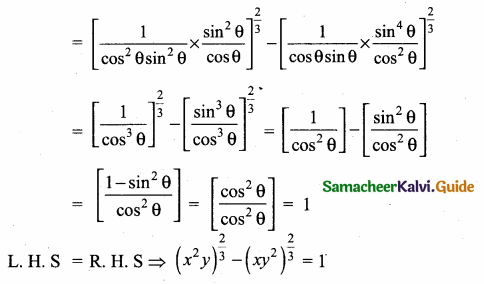
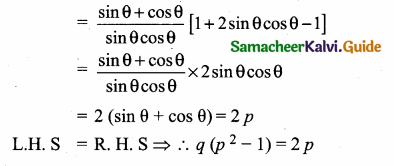
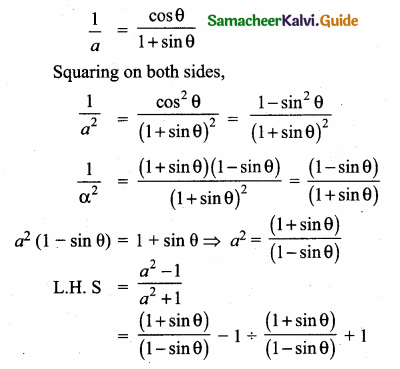
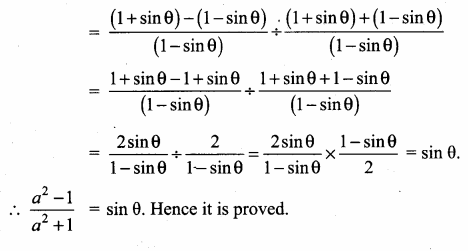
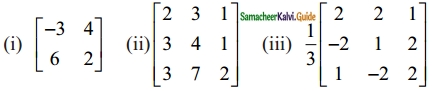
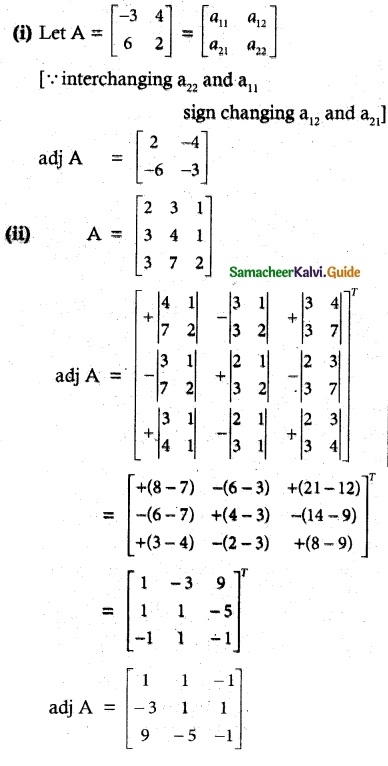
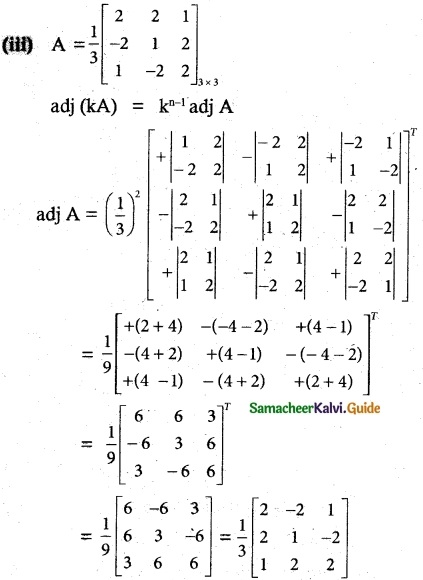
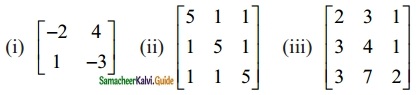
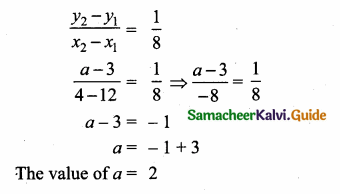
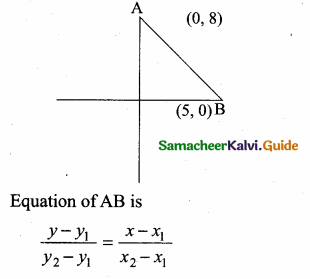
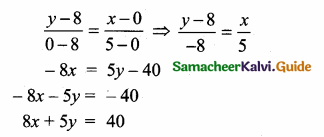
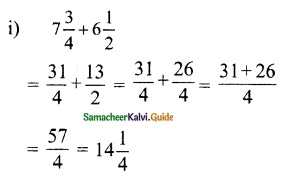
Samacheer Kalvi 10th Maths Guide Chapter 5 Coordinate Geometry Ex 5.1

Students can download Maths Chapter 5 Coordinate Geometry Ex 5.1 Questions and Answers, Notes, Samacheer Kalvi 10th Maths Guide Pdf helps you to revise the complete Tamilnadu State Board New Syllabus, helps students complete homework assignments and to score high marks in board exams.

Tamilnadu Samacheer Kalvi 10th Maths Solutions Chapter 5 Coordinate Geometry Ex 5.1

Question 1.
Find the area of the triangle formed by the points
(i) (1,-1), (-4, 6) and (-3, -5)
(ii) (-10, -4), (-8, -1) and (-3, -5)
Solution:
(i) Let the vertices A (1, -1), B (-4, 6) and C (-3, -5)
Samacheer Kalvi 10th Maths Guide Chapter 5 Coordinate Geometry Ex 5.1 1
Samacheer Kalvi 10th Maths Guide Chapter 5 Coordinate Geometry Ex 5.1 2
= \(\frac { 1 }{ 2 } \) [(6 + 20 + 3) – (4 – 18 – 5)] = \(\frac { 1 }{ 2 } \) [29 – (-19)] = \(\frac { 1 }{ 2 } \) [29 + 19]
= \(\frac { 1 }{ 2 } \) × 48 = 24 sq. units.
Area of ∆ABC = 24 sq. units

Samacheer Kalvi 10th Maths Guide Chapter 5 Coordinate Geometry Ex 5.1

(ii) Let the vertices be A(-10, -4), B(-8 -1) and C(-3, -5)
Samacheer Kalvi 10th Maths Guide Chapter 5 Coordinate Geometry Ex 5.1 4
Area of ∆ABC = \(\frac { 1 }{ 2 } \)[(x1y2 + x2y3 + x3y1) – (x2y1 + x3y2 + x1y3)]
= \(\frac { 1 }{ 2 } \) [(50 + 3 + 32) – (12 + 40 + 10)]
Samacheer Kalvi 10th Maths Guide Chapter 5 Coordinate Geometry Ex 5.1 5
= \(\frac { 1 }{ 2 } \) [85 – (62)] = \(\frac { 1 }{ 2 } \) [23] = 11.5
Area of ∆ACB = 11.5 sq.units

Samacheer Kalvi 10th Maths Guide Chapter 5 Coordinate Geometry Ex 5.1

Question 2.
Determine whether the sets of points are collinear?
(i) (-\(\frac { 1 }{ 2 } \),3)
(ii) (a,b + c), (b,c + a) and (c,a + b)
Solution:
(i) Let the points be A (-\(\frac { 1 }{ 2 } \),3), B (-5, 6) and C(-8, 8)
Area of ∆ABC = \(\frac { 1 }{ 2 } \) [(x1y2 + x2y3 + x3y1) – (x2y1 + x3y3 + x1y3)]
= \(\frac { 1 }{ 2 } \) [(- 3 – 40 – 24) – (-15 – 48 – 4)]
Samacheer Kalvi 10th Maths Guide Chapter 5 Coordinate Geometry Ex 5.1 6
= \(\frac { 1 }{ 2 } \) [-67 + 67] = \(\frac { 1 }{ 2 } \) × 0 = 0
Area of a ∆ is 0.
∴ The three points are collinear.

(ii) Let the points be A (a, b + c), B (b, c + a) and C (c, a + b)
Area of the triangle = \(\frac { 1 }{ 2 } \) [(x1y2 + x2y3 + x3y1) – (x2y1 + x3y2 + x1y3)]
Samacheer Kalvi 10th Maths Guide Chapter 5 Coordinate Geometry Ex 5.1 7
Since the area of a triangle is 0.
∴ The given points are collinear.

Samacheer Kalvi 10th Maths Guide Chapter 5 Coordinate Geometry Ex 5.1

Question 3.
Vertices of given triangles are taken in order and their areas are provided aside. In each case, find the value of ‘p’
Samacheer Kalvi 10th Maths Guide Chapter 5 Coordinate Geometry Ex 5.1 8
Solution:
(i) Let the vertices be A (0,0) B (p, 8), c (6, 2)
Area of a triangle = 20 sq. units
\(\frac { 1 }{ 2 } \) [(x1y2 + x2y3 + x3y1) – (x2y1 + x3y2 + x1y3)] = 20
Samacheer Kalvi 10th Maths Guide Chapter 5 Coordinate Geometry Ex 5.1 9
\(\frac { 1 }{ 2 } \) [(0 + 2p + 0) – (0 + 48 + 0)] = 20
\(\frac { 1 }{ 2 } \) [2p – 48] = 20
2p – 48 = 40 ⇒ 2p = 40 + 48
p = \(\frac { 88 }{ 2 } \) = 44
The value of p = 44

(ii) Let the vertices be A (p, p), B (5, 6) and C (5, -2)
Area of a triangle = 32 sq. units
\(\frac { 1 }{ 2 } \) [(x1y2 + x2y3 + x3y1) – (x2y1 + x3y2 + x1y3)] = 32
Samacheer Kalvi 10th Maths Guide Chapter 5 Coordinate Geometry Ex 5.1 10
\(\frac { 1 }{ 2 } \) [6p – 10 + 5p) – (5p + 30 – 2p)] = 32
\(\frac { 1 }{ 2 } \) [11 p – 10 – 3p – 30] = 32
11p – 10 – 3p – 30 = 64
8p – 40 = 64
8p = 64 + 40 ⇒ 8p = 104
p = \(\frac { 104 }{ 8 } \) = 13
The value of p = 13

Samacheer Kalvi 10th Maths Guide Chapter 5 Coordinate Geometry Ex 5.1

Question 4.
In each of the following, find the value of ‘a’ for which the given points are collinear.
(i) (2,3), (4, a) and (6, -3)
(ii) (a, 2 – 2a), (-a + 1, 2a) and (-4 -a, 6 – 2a).
Solution:
(i) Let the points be A (2, 3), B(4, a) and C(6, -3).
Since the given points are collinear.
Area of a triangle = 0
\(\frac { 1 }{ 2 } \) [(x1y2 + x2y3 + x3y1) – (x2y1 + x3y2 + x1y3)] = 0)
Samacheer Kalvi 10th Maths Guide Chapter 5 Coordinate Geometry Ex 5.1 11
\(\frac { 1 }{ 2 } \) [(2a – 12 + 18) – (12 + 6a – 6)] = 0
2a + 6 – (6 + 6a) = 0
2a + 6 – 6 – 6a = 0
-4a = 0 ⇒ a = \(\frac { 0 }{ 4 } \) = 0
The value of a = 0

(ii) Let the points be A (a, 2 – 2a), B (-a + 1, 2a) C (-4 -a, 6 – 2a).
Since the given points are collinear.
Area of a ∆ = 0
Samacheer Kalvi 10th Maths Guide Chapter 5 Coordinate Geometry Ex 5.1 12
6a2 – 2a – 2 – (-2a2 – 6a + 2) = 0
6a2 – 2a – 2 + 2a2 + 6a – 2 = 0
8a2 + 4a – 4 = 0 (Divided by 4)
2a2 + a – 1 = 0
2a2 + 2a – a – 1 = 0
2a (a + 1) – 1 (a + 1) = 0
Samacheer Kalvi 10th Maths Guide Chapter 5 Coordinate Geometry Ex 5.1 43
(a + 1) (2a – 1) = 0
a + 1 = 0 (or) 2a – 1 = 0
a = -1 (or) 2a = 1 ⇒ a = \(\frac { 1 }{ 2 } \)
The value of a = -1 (or) \(\frac { 1 }{ 2 } \)

Samacheer Kalvi 10th Maths Guide Chapter 5 Coordinate Geometry Ex 5.1

Question 5.
Find the area of the quadrilateral whose vertices are at
(i) (-9, -2), (-8, -4), (2, 2) and (1, -3)
(ii) (-9, 0), (-8,6), (-1, -2) and (-6, -3)
Solution:
(i) Let the vertices A (-9, -2), B(-8, -4), C(2, 2) and D(1, -3).
Plot the vertices in a graph.
Samacheer Kalvi 10th Maths Guide Chapter 5 Coordinate Geometry Ex 5.1 13
[Note: Consider the points in counter clock wise order]
Samacheer Kalvi 10th Maths Guide Chapter 5 Coordinate Geometry Ex 5.1 14
Area of the Quadrilateral ABDC = \(\frac { 1 }{ 2 } \) [36 + 24 + 2 – 4 – (16 – 4 – 6 – 18)]
= \(\frac { 1 }{ 2 } \) [58 – (-12)] – \(\frac { 1 }{ 2 } \)[58 + 12]
= \(\frac { 1 }{ 2 } \) × 70 = 35 sq. units 2
Area of the Quadrilateral = 35 sq. units

Samacheer Kalvi 10th Maths Guide Chapter 5 Coordinate Geometry Ex 5.1

(ii) Let the vertices A(-9, 0), B(-8, 6), C(-1, -2) and D(-6, -3)
Plot the vertices in a graph and take them in counter – clock wise order.
Area of the Quadrilateral DCB
Samacheer Kalvi 10th Maths Guide Chapter 5 Coordinate Geometry Ex 5.1 15
= \(\frac { 1 }{ 2 } \) [33 + 35] = \(\frac { 1 }{ 2 } \) × 68 = 34 sq. units
Area of the Quadrilateral = 34 sq. units
Samacheer Kalvi 10th Maths Guide Chapter 5 Coordinate Geometry Ex 5.1 16

Samacheer Kalvi 10th Maths Guide Chapter 5 Coordinate Geometry Ex 5.1

Question 6.
Find the value of k, if the area of a quadrilateral is 28 sq. units, whose vertices are (-4, -2), (-3, k), (3, -2) and (2, 3)
Solution:
Let the vertices A (-A, -2), B (-3, k), C (3, -2) and D (2, 3)
Area of the Quadrilateral = 28 sq. units
\(\frac { 1 }{ 2 } \) [(x1y2 + x2y3 + x3y4 + x4y1) – (x2y1 + x3y2 + x4y3 + x1y4)] = 28
Samacheer Kalvi 10th Maths Guide Chapter 5 Coordinate Geometry Ex 5.1 17
-7k + 21 = 56
-7k = 56 – 21
-7k = 35 ⇒ 7k = – 35
k = – \(\frac { 35 }{ 7 } \) = -5
The value of k = -5

Samacheer Kalvi 10th Maths Guide Chapter 5 Coordinate Geometry Ex 5.1

Question 7.
If the points A(-3, 9), B(a, b) and C(4, -5) are collinear and if a + b = 1, then find a and b.
Solution:
Since the three points are collinear
Area of a ∆ = 0
Samacheer Kalvi 10th Maths Guide Chapter 5 Coordinate Geometry Ex 5.1 18
-3b – 5a + 36 – 9a – 4b – 15 = 0
-7b – 14a + 21 = 0
(÷ by 7) – b – 2a + 3 = 0
2a + b – 3 = 0
Samacheer Kalvi 10th Maths Guide Chapter 5 Coordinate Geometry Ex 5.1 19
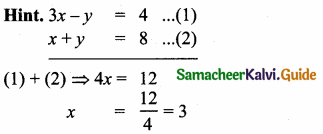
Substitute the value of a = 2 in (2) ⇒ 2 + b = 1
b = 1 – 2 = -1
The value of a = 2 and b = -1

Samacheer Kalvi 10th Maths Guide Chapter 5 Coordinate Geometry Ex 5.1

Question 8.
Let P(11, 7), Q(13.5, 4) and R(9.5, 4) be the midpoints of the sides AB, BC and AC respectively of ∆ABC . Find the coordinates of the vertices A, B and C. Hence find the area of ∆ABC and compare this with area of ∆PQR.
Solution:
Let the vertices of the ∆ABC be A(x1,y1), B(x2,y2), C(x3,y3)
Samacheer Kalvi 10th Maths Guide Chapter 5 Coordinate Geometry Ex 5.1 20
Samacheer Kalvi 10th Maths Guide Chapter 5 Coordinate Geometry Ex 5.1 21
Samacheer Kalvi 10th Maths Guide Chapter 5 Coordinate Geometry Ex 5.1 22
Samacheer Kalvi 10th Maths Guide Chapter 5 Coordinate Geometry Ex 5.1 23
Samacheer Kalvi 10th Maths Guide Chapter 5 Coordinate Geometry Ex 5.1 24
Samacheer Kalvi 10th Maths Guide Chapter 5 Coordinate Geometry Ex 5.1 25
Samacheer Kalvi 10th Maths Guide Chapter 5 Coordinate Geometry Ex 5.1 26
Samacheer Kalvi 10th Maths Guide Chapter 5 Coordinate Geometry Ex 5.1 27
Samacheer Kalvi 10th Maths Guide Chapter 5 Coordinate Geometry Ex 5.1 28

Samacheer Kalvi 10th Maths Guide Chapter 5 Coordinate Geometry Ex 5.1

Question 9.
In the figure, the quadrilateral swimming pool shown is surrounded by concrete patio. Find the area of the patio.
Samacheer Kalvi 10th Maths Guide Chapter 5 Coordinate Geometry Ex 5.1 44
Solution:
Samacheer Kalvi 10th Maths Guide Chapter 5 Coordinate Geometry Ex 5.1 33
= \(\frac { 1 }{ 2 } \) [(x1y2 + x2y3 + x3y4 + x4y1) – (x2y1 + x3y2 + x4y3 + x1y4)]
= \(\frac { 1 }{ 2 } \) [(16 + 80 + 36 + 80) – (-64 – 24 – 100 – 24)]
= \(\frac { 1 }{ 2 } \) [212 – (-212)]
Samacheer Kalvi 10th Maths Guide Chapter 5 Coordinate Geometry Ex 5.1 34
= \(\frac { 1 }{ 2 } \) [212 + 212] = \(\frac { 1 }{ 2 } \) [424] = 212 sq. units
Samacheer Kalvi 10th Maths Guide Chapter 5 Coordinate Geometry Ex 5.1 35
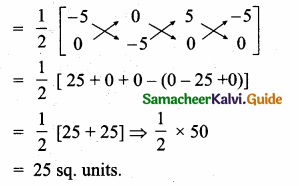
= \(\frac { 1 }{ 2 } \) [90 – (-90)]
Samacheer Kalvi 10th Maths Guide Chapter 5 Coordinate Geometry Ex 5.1 36
= \(\frac { 1 }{ 2 } \) [90 + 90]
= \(\frac { 1 }{ 2 } \) × 180 = 90 sq. units
Area of the patio = Area of the Quadrilateral ABCD – Area of the Quadrilateral EFGH
= (212 – 90) sq. units
Area of the patio = 122 sq. units

Samacheer Kalvi 10th Maths Guide Chapter 5 Coordinate Geometry Ex 5.1

Question 10.
A triangular shaped glass with vertices at A(-5, -4), B(l, 6) and C(7, -4) has to be painted. If one bucket of paint covers 6 square feet, how many buckets of paint will be required to paint the whole glass, if only one coat of paint is applied.
Solution:
Given the vertices of the triangular glass is A (-5, -4), B (1, 6), and C (7, -4)
Samacheer Kalvi 10th Maths Guide Chapter 5 Coordinate Geometry Ex 5.1 37
Samacheer Kalvi 10th Maths Guide Chapter 5 Coordinate Geometry Ex 5.1 38
= \(\frac { 1 }{ 2 } \) [(20 + 42 – 4) – (-28 – 4 – 30)]
= \(\frac { 1 }{ 2 } \) [58 – (-62)]
= \(\frac { 1 }{ 2 } \) [58 + 62]
= \(\frac { 1 }{ 2 } \) × 120 = 60 sq. feet
Number of cans to paint 6 square feet = 1
∴ Number of cans = \(\frac { 60 }{ 6 } \) = 10 ⇒ Number of cans = 10

Samacheer Kalvi 10th Maths Guide Chapter 5 Coordinate Geometry Ex 5.1

Question 11.
In the figure, find the area of
(i) triangle AGF
(ii) triangle FED
(iii) quadrilateral BCEG.
Samacheer Kalvi 10th Maths Guide Chapter 5 Coordinate Geometry Ex 5.1 45
Solution:
Area of a triangle = \(\frac { 1 }{ 2 } \) [(x1y2 + x2y3 + x3y1) – (x2y1 + x3y2 + x1y3)]
(i) Area of ∆AGF = \(\frac { 1 }{ 2 } \) [(-2.5 – 13.5 – 6) – (-13.5 – 1 – 15)]
= \(\frac { 1 }{ 2 } \) [-22 – (-29.5)]
Samacheer Kalvi 10th Maths Guide Chapter 5 Coordinate Geometry Ex 5.1 40
= \(\frac { 1 }{ 2 } \) [-22 + 29.5]
= \(\frac { 1 }{ 2 } \) × 7.5 = 3.75 sq.units

(ii) Area of ∆FED = \(\frac { 1 }{ 2 } \) [(-2 + 4.5 + 3) – (4.5 + 1 – 6)]
= \(\frac { 1 }{ 2 } \) [5.5 – (-0.5)]
Samacheer Kalvi 10th Maths Guide Chapter 5 Coordinate Geometry Ex 5.1 41
= \(\frac { 1 }{ 2 } \) [5.5 + 0.5] = \(\frac { 1 }{ 2 } \) × 6 = 3 sq.units

(iii)
Samacheer Kalvi 10th Maths Guide Chapter 5 Coordinate Geometry Ex 5.1 42
= \(\frac { 1 }{ 2 } \) [(4 + 2 + 0.75 + 9) – (-4 -1.5 – 4.5 -2)]
= \(\frac { 1 }{ 2 } \) [15.75 + 12]
= \(\frac { 1 }{ 2 } \) [27.75] = 13.875
= 13.88 sq. units

Samacheer Kalvi 6th Maths Guide Term 1 Chapter 6 Information Processing Ex 6.3

Students can download Maths Chapter 6 Information Processing Ex 6.3 Questions and Answers, Notes, Samacheer Kalvi 6th Maths Guide Pdf helps you to revise the complete Tamilnadu State Board New Syllabus, helps students complete homework assignments and to score high marks in board exams.

Tamilnadu Samacheer Kalvi 6th Maths Solutions Term 1 Chapter 6 Information Processing Ex 6.3

Question 1.
How many Triangles are there in each of the following figures?
Samacheer Kalvi 6th Maths Guide Term 1 Chapter 6 Information Processing Ex 6.3 1
Solution:
(i) 12 triangles
(ii) 16 triangles
(iii) 32 triangles
(iv) 35 triangles

Samacheer Kalvi 6th Maths Guide Term 1 Chapter 6 Information Processing Ex 6.3

Question 2.
Find the number of dots in the tenth figure of the following patterns.
Samacheer Kalvi 6th Maths Guide Term 1 Chapter 6 Information Processing Ex 6.3 2
Solution:
(i) 55
(ii) 100

Samacheer Kalvi 6th Maths Guide Term 1 Chapter 6 Information Processing Ex 6.3

Question 3.
Samacheer Kalvi 6th Maths Guide Term 1 Chapter 6 Information Processing Ex 6.3 3
(i) Draw the next pattern.
(ii) Prepare a table for the number of dots used for each pattern.
(iii) Explain the pattern.
(iv) Find the number of dots in the 25th pattern.
Solution:
Samacheer Kalvi 6th Maths Guide Term 1 Chapter 6 Information Processing Ex 6.3 4
(iv) 350

Samacheer Kalvi 6th Maths Guide Term 1 Chapter 6 Information Processing Ex 6.3

Question 4.
Samacheer Kalvi 6th Maths Guide Term 1 Chapter 6 Information Processing Ex 6.3 5
Solution:
(i) 20 squares
(ii) 10 squares

Samacheer Kalvi 6th Maths Guide Term 1 Chapter 6 Information Processing Ex 6.3

Question 5.
How many circles are there in the following figure?
Samacheer Kalvi 6th Maths Guide Term 1 Chapter 6 Information Processing Ex 6.3 6
Solution:
7 circles

Samacheer Kalvi 6th Maths Guide Term 1 Chapter 6 Information Processing Ex 6.3

Question 6.
Find the minimum number of straight lines used in forming the following figures.
Samacheer Kalvi 6th Maths Guide Term 1 Chapter 6 Information Processing Ex 6.3 7
Solution:
(i) 10
(ii) 12

Samacheer Kalvi 6th Maths Guide Term 1 Chapter 6 Information Processing Ex 6.2

Students can download Maths Chapter 6 Information Processing Ex 6.2 Questions and Answers, Notes, Samacheer Kalvi 6th Maths Guide Pdf helps you to revise the complete Tamilnadu State Board New Syllabus, helps students complete homework assignments and to score high marks in board exams.

Tamilnadu Samacheer Kalvi 6th Maths Solutions Term 1 Chapter 6 Information Processing Ex 6.2

Question 1.
In the following magic triangle, arrange the numbers from 1 to 6, so that you get the same sum on all its sides.
Samacheer Kalvi 6th Maths Guide Term 1 Chapter 6 Information Processing Ex 6.2 1
Solution:
One of the answers is.
Samacheer Kalvi 6th Maths Guide Term 1 Chapter 6 Information Processing Ex 6.2 2

Samacheer Kalvi 6th Maths Guide Term 1 Chapter 6 Information Processing Ex 6.2

Question 2.
Using the numbers from 1 to 9
(i) Can you form a magic triangle?
(ii) How many magic triangles can be formed?
(iii) What are the sums of the sides of the magic triangle?
Samacheer Kalvi 6th Maths Guide Term 1 Chapter 6 Information Processing Ex 6.2 3
Solution:
(i) Yes
(ii) 5
(iii) 17, 19, 20, 21, 23

Samacheer Kalvi 6th Maths Guide Term 1 Chapter 6 Information Processing Ex 6.2

Question 3.
Arrange the odd numbers from 1 to 17 without repetition to get a sum of 30 on each side of the magic triangle.
Samacheer Kalvi 6th Maths Guide Term 1 Chapter 6 Information Processing Ex 6.2 4
Solution:
Samacheer Kalvi 6th Maths Guide Term 1 Chapter 6 Information Processing Ex 6.2 5

Samacheer Kalvi 6th Maths Guide Term 1 Chapter 6 Information Processing Ex 6.2

Question 4.
Put the numbers 1, 2, 3, 4, 5, 6 & 7 in the circles so that each straight line of three numbers add up to the same total.
Samacheer Kalvi 6th Maths Guide Term 1 Chapter 6 Information Processing Ex 6.2 6
Solution:
Samacheer Kalvi 6th Maths Guide Term 1 Chapter 6 Information Processing Ex 6.2 7

Samacheer Kalvi 6th Maths Guide Term 1 Chapter 6 Information Processing Ex 6.2

Question 5.
Place the number 1 to 12 in the 12 circles so that the sum of the numbers in each of the six lines of the star is 26. Use each number from 1 to 12 exactly once. Find more possible ways?
Samacheer Kalvi 6th Maths Guide Term 1 Chapter 6 Information Processing Ex 6.2 8
Solution:
Samacheer Kalvi 6th Maths Guide Term 1 Chapter 6 Information Processing Ex 6.2 9

Samacheer Kalvi 6th Maths Guide Term 1 Chapter 6 Information Processing Ex 6.2

Samacheer Kalvi 6th Maths Guide Term 1 Chapter 6 Information Processing Ex 6.1

Students can download Maths Chapter 6 Information Processing Ex 6.1 Questions and Answers, Notes, Samacheer Kalvi 6th Maths Guide Pdf helps you to revise the complete Tamilnadu State Board New Syllabus, helps students complete homework assignments and to score high marks in board exams.

Tamilnadu Samacheer Kalvi 6th Maths Solutions Term 1 Chapter 6 Information Processing Ex 6.1

Question 1.
Suppose, you have two pairs of shorts, one is black and the other one is blue; three shirts which are white, blue and red. You again wish to make different combinations, but you always want to make sure that the shorts and shirt that you wear are of different colours. List and check how many combinations are possible now.
Solution:
6 combinations are possible
Black-White
Black-Blue
Black-Red
Blue-White
Blue-Blue
Blue-Red

Samacheer Kalvi 6th Maths Guide Term 1 Chapter 6 Information Processing Ex 6.1

Question 2.
You have two red and two blue blocks. How many different towers can you build that are four blocks high using these blocks? List all the possibilities.
Solution:
6 Possibilities,
R – B – R – B
R – R – B – B
B – R – R – B
B – R – B – R
B – B – R – R
R – B – B – R

Samacheer Kalvi 6th Maths Guide Term 1 Chapter 6 Information Processing Ex 6.1

Samacheer Kalvi 10th Maths Guide Chapter 1 Relations and Functions Ex 1.4

Students can download Maths Chapter 1 Relations and Functions Ex 1.4 Questions and Answers, Notes, Samacheer Kalvi 10th Maths Guide Pdf helps you to revise the complete Tamilnadu State Board New Syllabus, helps students complete homework assignments and to score high marks in board exams.

Tamilnadu Samacheer Kalvi 10th Maths Solutions Chapter 1 Relations and Functions Ex 1.4

Question 1.
Determine whether the graph given below represent functions. Give reason for your answers concerning each graph.
Samacheer Kalvi 10th Maths Guide Chapter 1 Relations and Functions Ex 1.4 1
Samacheer Kalvi 10th Maths Guide Chapter 1 Relations and Functions Ex 1.4 2
Samacheer Kalvi 10th Maths Guide Chapter 1 Relations and Functions Ex 1.4 3
Samacheer Kalvi 10th Maths Guide Chapter 1 Relations and Functions Ex 1.4 4
Answer:
Samacheer Kalvi 10th Maths Guide Chapter 1 Relations and Functions Ex 1.4 5
The vertical line cuts the graph at A and B. The given graph does not represent a function.
Samacheer Kalvi 10th Maths Guide Chapter 1 Relations and Functions Ex 1.4 6

Samacheer Kalvi 10th Maths Guide Chapter 1 Relations and Functions Ex 1.4
The vertical line cuts the graph at most one point P. The given graph represent a function.
Samacheer Kalvi 10th Maths Guide Chapter 1 Relations and Functions Ex 1.4 7
The vertical line cuts the graph at three points S,T and U. The given graph does not represent a function.
Samacheer Kalvi 10th Maths Guide Chapter 1 Relations and Functions Ex 1.4 8
The vertical line cuts the graph at most one point D. The given graph represents a function.

Question 2.
Let f: A → B be a function defined by
f(x) = \(\frac { x }{ 2 } \) – 1, where A = {2, 4,6,10,12},
B = {0,1,2,4,5,9}. Represent f by
(i) set of ordered pairs
(ii) a table
(iii) an arrow diagram
(iv) a graph
Answer:
A = {2,4,6, 10, 12}
B = {0,1, 2, 4, 5, 9}
f(x) = \(\frac { x }{ 2 } \) – 1
f(2) = \(\frac { 2 }{ 2 } \) – 1 = 1 – 1 = 0
f(4) = \(\frac { 4 }{ 2 } \) – 1 = 2 – 1 = 1
f(6) = \(\frac { 6 }{ 2 } \) – 1 = 3 – 1 = 2
f(10) = \(\frac { 10 }{ 2 } \) – 1 = 5 – 1 = 4
f(12) = \(\frac { 12 }{ 2 } \) – 1 = 6 – 1 = 5

Samacheer Kalvi 10th Maths Guide Chapter 1 Relations and Functions Ex 1.4

(i) Set of ordered pairs
f = {(2, 0) (4, 1) (6, 2) (10, 4) (12, 5}

(ii) Table

X 2 4 6 10 12
f(x) 0 1 2 4 5

(iii) Arrow diagram
Samacheer Kalvi 10th Maths Guide Chapter 1 Relations and Functions Ex 1.4 9

(iv) Graph
Samacheer Kalvi 10th Maths Guide Chapter 1 Relations and Functions Ex 1.4 10

Samacheer Kalvi 10th Maths Guide Chapter 1 Relations and Functions Ex 1.4

Question 3.
Represent the function f = {(1,2), (2,2), (3,2), (4,3),(5,4)} through (i) an arrow diagram (it) a table form (iii) a graph.
Answer:
f = {(1, 2) (2, 2) (3, 2) (4, 3) (5,4)}
Let A = {1,2, 3, 4, 5}
B = {2, 3, 4}

(i) Arrow diagram
Samacheer Kalvi 10th Maths Guide Chapter 1 Relations and Functions Ex 1.4 11
(ii) Table form

X 1 2 3 4 5
f(x) 2 2 2 3 4

(iii) Graph
Samacheer Kalvi 10th Maths Guide Chapter 1 Relations and Functions Ex 1.4 12

Samacheer Kalvi 10th Maths Guide Chapter 1 Relations and Functions Ex 1.4

Question 4.
Show that the function f : N → N defined by f(x) = 2x – 1 is one-one but not onto.
Answer:
f: N → N
N = {1,2,3,4,5,… }
f(x) = 2x – 1
f(1) = 2(1) – 1 = 2 – 1 = 1
f(2) = 2(2) – 1 = 4 – 1 = 3
f(3) = 2(3) – 1 = 6 – 1 = 5
f(4) = 2(4) – 1 = 8 – 1 = 7
f(5) = 2(5) – 1 = 10 – 1 = 9
f = {(1,1) (2, 3) (3, 5) (4, 7) (5,9) …..}
Samacheer Kalvi 10th Maths Guide Chapter 1 Relations and Functions Ex 1.4 13

(i) Different elements has different images. This function is one to one function.
(ii) Here Range is not equal to co-domain. This function not an onto function.
∴ The given function is one-one but not an onto.

Samacheer Kalvi 10th Maths Guide Chapter 1 Relations and Functions Ex 1.4

Question 5.
Show that the function f: N ⇒ N defined by f(m) = m2 + m + 3 is one-one function.
Answer:
N = {1,2,3, 4,5, ….. }
f(m) = m2 + m + 3
f(1) = 12 + 1 + 3 = 5
f(2) = 22 + 2 + 3 = 9
f(3) = 32 + 3 + 3 = 15
f(4) = 42 + 4 + 3 = 23
f = {(1,5) (2, 9) (3, 15) (4, 23)}
Samacheer Kalvi 10th Maths Guide Chapter 1 Relations and Functions Ex 1.4 14
From the diagram we can understand different elements in (N) in the domain, there are different images in (N) co-domain.
∴ The function is a one-one function.

Question 6.
Let A = {1, 2, 3, 4) and B = N. Letf: A → B be
defined by f(x) = x3 then,
(i) find the range off
(ii) identify the tpe of function
Solution:
A = {1, 2, 3, 4}
B = N
f: A → B,f(x) = x3
(i) f(1) = 13 = 1
f(2) = 23 = 8
f(3) = 33 = 27
f(4) = 43 = 64
(ii) Therange of f = {1, 8, 27, 64 )
(iii) It is one-one and into function.

Samacheer Kalvi 10th Maths Guide Chapter 1 Relations and Functions Ex 1.4

Question 7.
In each of the following cases state whether the function is bijective or not. Justify your answer.
(i) f: R → R defined by f (x) = 2x + 1
(ii) f: R → R defined by f(x) = 3 – 4x2
Answer:
(i) f(x) = 2x + 1
f(0) = 2(0) + 1 = 0 + 1 = 1
f(1) = 2(1) + 1 = 2 + 1 = 3
f(2) = 2(2) + 1 = 4 + 1 = 5
f(3) = 2(3) + 1 = 6 + 1 = 7
Different elements has different images
∴ It is an one-one function.
It is also an onto function. The function is one-one and onto function.
∴ It is a bijective function.

(ii) f(x) = 3 – 4x2
f(1) = 3 – 4(1)2
= 3 – 4 = -1
f(2) = 3 – 4(2)2 = 3 – 16 = – 13
f(3) = 3 – 4(3)2 = 3 – 36 = – 33
f(4) = 3 – 4(42) = 3 – 64 = – 61
It is not a bijective function. The positive numbers “R” do not have negative pre – image in X in R.

Samacheer Kalvi 10th Maths Guide Chapter 1 Relations and Functions Ex 1.4

Question 8.
Let A= {-1,1}and B = {0,2}.
If the function f: A → B defined by
f(x) = ax + b is an onto function? Find a and b.
Answer:
A = {-1, 1}; B = {0,2}
f(x) = ax + b
f(-1) = a(-1) + b
0 = -a + b
a – b = 0 ….(1)
f(1) = a(1) + b
2 = a + b
a + b = 2 ….(2)
Solving (1) and (2) we get
Samacheer Kalvi 10th Maths Guide Chapter 1 Relations and Functions Ex 1.4 15
Substitute a = 1 in (1)
The value of a = 1 and b = 1

Question 9.
If the function f is defined by
Samacheer Kalvi 10th Maths Guide Chapter 1 Relations and Functions Ex 1.4 16
find the value of
(i) f(3)
(ii) f(0)
(iii) f(1. 5)
(iv) f(2) + f(-2)
Answer:
f(x) = x + 2 when x = {2,3,4,……}
f(x) = 2
f(x) = x – 1 when x = {-2}
(i) f(x) = x + 2
f(3) = 3 + 2 = 5

(ii) f(x) = 2
f(0) = 2

(iii) f(x) = x – 1
f(-1.5) = -1.5 – 1 = -2.5

(iv) f(x) = x + 2
f(2) = 2 + 2 = 4
f(x) = x – 1
f(-2) = – 2 – 1 = – 3
f(2) + f(-2) = 4 – 3
= 1

Samacheer Kalvi 10th Maths Guide Chapter 1 Relations and Functions Ex 1.4

Question 10.
A function f: [-5, 9] → R is defined as follows:
Samacheer Kalvi 10th Maths Guide Chapter 1 Relations and Functions Ex 1.4 17
Answer:
f(x) = 6x + 1 ; x = {-5,-4,-3,-2,-1,0,1}
f(x) = 5x2 – 1 ; x = {2, 3, 4, 5}
f(x) = 3x – 4 ; x = {6, 7, 8, 9}

(i) f(-3) + f(2)
f(x) = 6x + 1
f(-3) = 6(-3) + 1 = -18 + 1 = -17
f(x) = 5x2 – 1
f(2) = 5(2)2 – 1 = 20 – 1 = + 19
f(-3) + f(2) = – 17 + 19
= 2

(ii) f(7) – f(1)
f(x) = 3x – 4
f(7) = 3(7) – 4 = 21 – 4 = 17
f(x) = 6x + 1
f(1) = 6(1) + 1 = 6 + 1 = 7
f(7) – f(1) = 17 – 7
= 10

(iii) 2f(4) + f(8)
f(x) = 5x2 – 1
f(4) = 5(4)2 – 1 = 5(16) – 1
= 80 – 1 = 79
f(x) = 3x – 4
f(8) = 3(8) – 4 = 24 – 4 = 20
2f(4) + f(8) = 2(79) + 20
= 158 + 20
= 178

Samacheer Kalvi 10th Maths Guide Chapter 1 Relations and Functions Ex 1.4

Samacheer Kalvi 10th Maths Guide Chapter 1 Relations and Functions Ex 1.4 18
f(x) = 6x + 1
f(-2) = 6(-2) + 1 = -12 + 1 = -11
f(x) = 3x – 4
f(6) = 3(6) – 4 = 18 – 4 = 14
f(x) = 5x2 – 1
f(4) = 5(4)2 – 1 = 5(16) – 1
= 80 – 1 = 79
f(x) = 6x + 1
f(-2) = 6(-2) + 1 = -12 + 1 = -11
Samacheer Kalvi 10th Maths Guide Chapter 1 Relations and Functions Ex 1.4 19

Question 11.
The distance S an object travels under the influence of gravity in time t seconds is given by S(t) = \(\frac{1}{2}\) gt2 + at + b where, (g is the acceleration due to gravity), a, b are constants. Check if the function S (t)is one-one.
Solution:
S(t) = \(\frac{1}{2}\) gt2 + at + b
Let t be 1, 2, 3, ………, seconds
S(1) = \(\frac{1}{2}\) g(12) + a(1) + b = \(\frac{1}{2}\) g + a + b
S(2) = \(\frac{1}{2}\) g(22) + a(2) + b = 2g + 2a + b
Yes, for every different values of t, there will be different values as images. And there will be different preimages for the different values of the range. Therefore it is one-one function.

Samacheer Kalvi 10th Maths Guide Chapter 1 Relations and Functions Ex 1.4

Question 12.
The function ‘t’ which maps temperature in Celsius (C) into temperature in Fahrenheit (F) is defined by
t(C) = F where F = \(\frac { 9 }{ 5 } \) C + 32. Find,
(i) t(0)
(ii) t(28)
(iii) t(-10)
(iv) the value of C when t(C) = 212
(v) the temperature when the Celsius value is equal to the Fahrenheit value.
Answer:
Given t(C) = \(\frac { 9C }{ 5 } \) + 32

(i) t(0) = \(\frac { 9(0) }{ 5 } \) + 32
= 32° F

(ii) t(28) = \(\frac { 9(28) }{ 5 } \) + 32
= \(\frac { 252 }{ 5 } \) + 32
= 50.4 + 32
= 82.4° F

(iii) t(-10) = \(\frac { 9(-10) }{ 5 } \) + 32
= -18 + 32
= 14° F

(iv) t(C) = 212
\(\frac { 9C }{ 5 } \) + 32 = 212
\(\frac { 9C }{ 5 } \) = 212 – 32
= 180
9C = 180 × 5
C = \(\frac{180 \times 5}{9}\)
= 100° C

(v) consider the value of C be “x”
t(C) = \(\frac { 9C }{ 5 } \) + 32
x = \(\frac { 9x }{ 5 } \) + 32
5x = 9x + 160
-160 = 9x – 5x
-160 = 4x
x = \(\frac { -160 }{ 4 } \) = -40
The temperature when the Celsius value is equal to the fahrenheit value is -40°

Samacheer Kalvi 10th Maths Guide Chapter 1 Relations and Functions Ex 1.4

Composition of two Functions

Let f: A → B and g: B → C be two functions. Then the composition of f and g denoted by gof is defined as the function gof (x) = g[f(x)] for all x ∈ A.
Samacheer Kalvi 10th Maths Guide Chapter 1 Relations and Functions Ex 1.4 20
Composition of three Functions

Let A, B, C, D be four sets and let f: A → B; g : B → C and h : C → D be three functions, using composite functions fog and goh, we get two new functions like (fog) oh and fo (goh).
Note: Composition of three function is always associative.
Samacheer Kalvi 10th Maths Guide Chapter 1 Relations and Functions Ex 1.4 21

Samacheer Kalvi 10th Maths Guide Chapter 5 Coordinate Geometry Ex 5.2

Students can download Maths Chapter 5 Coordinate Geometry Ex 5.2 Questions and Answers, Notes, Samacheer Kalvi 10th Maths Guide Pdf helps you to revise the complete Tamilnadu State Board New Syllabus, helps students complete homework assignments and to score high marks in board exams.

Tamilnadu Samacheer Kalvi 10th Maths Solutions Chapter 5 Coordinate Geometry Ex 5.2

Question 1.
What is the slope of a line whose inclination with positive direction of x -axis is
(i) 90°
(ii) 0°
Solution:
Here θ = 90°
Slope (m) = tan θ
Slope = tan 90°
= undefined.

(ii) Here θ = 0°
Slope (m) = tan θ
Slope = tan 0°
= 0

Samacheer Kalvi 10th Maths Guide Chapter 5 Coordinate Geometry Ex 5.2

Question 2.
What is the inclination of a line whose slope is
(i) 0
(ii) 1
Solution:
(i) m = 0
tan θ = 0 ⇒ θ = 0°
(ii) m = 1 ⇒ tan θ = tan 45° ⇒ 0 = 45°

Question 3.
Find the slope of a line joining the points
(i) (5,\(\sqrt { 5 }\)) with the origin
(ii) (sin θ, -cos θ) and (-sin θ, cos θ)
Solution:
(i) The given points is (5,\(\sqrt { 5 }\)) and (0, 0)
Slope of a line = \(\frac{y_{2}-y_{1}}{x_{2}-x_{1}}\) = \(\frac{0-\sqrt{5}}{0-5}\)
= \(\frac{\sqrt{5}}{5}=\frac{1}{\sqrt{5}}\)

(ii) The given points is (sin θ, -cos θ) and (-sin θ, cos θ)
Slope of a line = \(\frac{y_{2}-y_{1}}{x_{2}-x_{1}}=\frac{\cos \theta+\cos \theta}{-\sin \theta-\sin \theta}\)
= \(\frac{2 \cos \theta}{-2 \sin \theta}\) = – cot θ

Question 4.
What is the slope of a line perpendicular to the line joining A(5,1) and P where P is the mid-point of the segment joining (4,2) and (-6,4).
Solution:
Mid point of XY = \(\left(\frac{x_{1}+x_{2}}{2}, \frac{y_{1}+y_{2}}{2}\right)\) = (\(\frac { 4-6 }{ 2 } \),\(\frac { 2+4 }{ 2 } \))
= (\(\frac { -2 }{ 2 } \),\(\frac { 6 }{ 2 } \)) = (-1, 3)
Samacheer Kalvi 10th Maths Guide Chapter 5 Coordinate Geometry Ex 5.2 1
Slope of a line = \(\frac{y_{2}-y_{1}}{x_{2}-x_{1}}\) = (\(\frac { 3-1 }{ -1-5 } \))
= \(\frac { 2 }{ -6 } \) = – \(\frac { 1 }{ 3 } \)

Samacheer Kalvi 10th Maths Guide Chapter 5 Coordinate Geometry Ex 5.2

Question 5.
Show that the given points are collinear: (-3, -4), (7,2) and (12, 5)
Solution:
The vertices are A(-3, -4), B(7, 2) and C(12, 5)
Slope of a line = \(\frac{y_{2}-y_{1}}{x_{2}-x_{1}}\)
Slope of AB = \(\frac { 2+4 }{ 7+3 } \) = \(\frac { 6 }{ 10 } \) = \(\frac { 3 }{ 5 } \)
Slope of BC = \(\frac { 5-2 }{ 12-7 } \) = \(\frac { 3 }{ 5 } \)
Slope of AB = Slope of BC = \(\frac { 3 }{ 5 } \)
∴ The three points A,B,C are collinear.

Question 6.
If the three points (3, -1), (a, 3) and (1, -3) are collinear, find the value of a.
Solution:
The vertices are A(3, -1), B(a, 3) and C(1, -3)
Slope of a line = \(\frac{y_{2}-y_{1}}{x_{2}-x_{1}}\)
Slope of AB = \(\frac { 3+1 }{ a-3 } \) = \(\frac { 4 }{ a-3 } \)
Slope of BC = \(\frac { 3+3 }{ a-1 } \) = \(\frac { 6 }{ a-1 } \)
Since the three points are collinear.
Slope of AB = Slope BC
\(\frac { 4 }{ a-3 } \) = \(\frac { 6 }{ a-1 } \)
6 (a – 3) = 4 (a – 1)
6a – 18 = 4a – 4
6a – 4a = -4 + 18
2a = 14 ⇒ a = \(\frac { 14 }{ 2 } \) = 7
The value of a = 7

Samacheer Kalvi 10th Maths Guide Chapter 5 Coordinate Geometry Ex 5.2

Question 7.
The line through the points (-2, a) and (9,3) has slope –\(\frac { 1 }{ 2 } \) Find the value of a.
Solution:
The given points are (-2, a) and (9, 3)
Slope of a line = \(\frac{y_{2}-y_{1}}{x_{2}-x_{1}}\)
– \(\frac { 1 }{ 2 } \) = \(\frac { 3-a }{ 9+2 } \) ⇒ – \(\frac { 1 }{ 2 } \) = \(\frac { 3-a }{ 11 } \)
2(3 – a) = -11 ⇒ 6 – 2a = -11
-2a = -11 – 6 ⇒ -2a = -17 ⇒ a = – \(\frac { 17 }{ 2 } \)
∴ The value of a = \(\frac { 17 }{ 2 } \)

Question 8.
The line through the points (-2, 6) and (4, 8) is perpendicular to the line through the points (8,12) and (x, 24). Find the value of x.
Solution:
Find the slope of the line joining the point (-2, 6) and (4, 8)
Slope of line (m1) = \(\frac{y_{2}-y_{1}}{x_{2}-x_{1}}\)
= \(\frac { 8-6 }{ 4+2 } \) = \(\frac { 2 }{ 6 } \) = \(\frac { 1 }{ 3 } \)
Find the slope of the line joining the points (8, 12) and (x, 24)
Slope of a line (m2) = \(\frac { 24-12 }{ x-8 } \) = \(\frac { 12 }{ x-8 } \)
Since the two lines are perpendicular.
m1 × m2 = -1
\(\frac { 1 }{ 3 } \) × \(\frac { 12 }{ x-8 } \) = -1 ⇒ \(\frac{12}{3(x-8)}=-1\)
-1 × 3 (x – 8) = 12
-3x + 24 = 12 ⇒ – 3x = 12 -24
-3x = -12 ⇒ x = \(\frac { 12 }{ 3 } \) = 4
∴ The value of x = 4

Samacheer Kalvi 10th Maths Guide Chapter 5 Coordinate Geometry Ex 5.2

Question 9.
Show that the given points form a right angled triangle and check whether they satisfies Pythagoras theorem.
(i) A(1, -4) , B(2, -3) and C(4, -7)
(ii) L(0, 5), M(9,12) and N(3,14)
Solution:
(i) The vertices are A(1, -4), B(2, -3) and C(4, -7)
Slope of a line = \(\frac{y_{2}-y_{1}}{x_{2}-x_{1}}\)
Slope of AB = \(\frac { -3+4 }{ 2-1 } \) = \(\frac { 1 }{ 1 } \) = 1
Slope of BC = \(\frac { -7+3 }{ 4-2 } \) = \(\frac { -4 }{ 2 } \) = -2
Slope of AC = \(\frac { -7+4 }{ 4-1 } \) = – \(\frac { 3 }{ 3 } \) = -1
Slope of AB × Slope of AC = 1 × -1 = -1
Samacheer Kalvi 10th Maths Guide Chapter 5 Coordinate Geometry Ex 5.2 2
∴ AB is ⊥r to AC
∠A = 90°
∴ ABC is a right angle triangle
Verification:
Samacheer Kalvi 10th Maths Guide Chapter 5 Coordinate Geometry Ex 5.2 3
20 = 2 + 18
20 = 20 ⇒ Pythagoras theorem verified

Samacheer Kalvi 10th Maths Guide Chapter 5 Coordinate Geometry Ex 5.2

(ii) The vertices are L(0, 5), M(9, 12) and N(3, 14)
Slope of a line = \(\frac{y_{2}-y_{1}}{x_{2}-x_{1}}\)
Slope of LM = \(\frac { 12-5 }{ 9-0 } \) = \(\frac { 7 }{ 9 } \)
Samacheer Kalvi 10th Maths Guide Chapter 5 Coordinate Geometry Ex 5.2 4
Slope of MN = \(\frac { 14-12 }{ 3-9 } \) = \(\frac { 2 }{ -6 } \) = – \(\frac { 1 }{ 3 } \)
Slope of LN = \(\frac { 14-5 }{ 3-0 } \) = \(\frac { 9 }{ 3 } \) = 3
Slope of MN × Slope of LN = – \(\frac { 1 }{ 3 } \) × 3 = -1
∴ MN ⊥ LN
∠N = 90°
∴ LMN is a right angle triangle
Verification:
Samacheer Kalvi 10th Maths Guide Chapter 5 Coordinate Geometry Ex 5.2 5
Samacheer Kalvi 10th Maths Guide Chapter 5 Coordinate Geometry Ex 5.2 6
130 = 90 + 40
130 = 130 ⇒ Pythagoras theorem is verified

Samacheer Kalvi 10th Maths Guide Chapter 5 Coordinate Geometry Ex 5.2

Question 10.
Show that the given points form a parallelogram:
A (2.5,3.5), B(10, -4), C(2.5, -2.5) and D(-5, 5).
Solution:
Let A(2.5, 3.5), B(10, -4), C(2.5, -2.5) and D(-5, 5) are the vertices of a parallelogram.
Samacheer Kalvi 10th Maths Guide Chapter 5 Coordinate Geometry Ex 5.2 7
Samacheer Kalvi 10th Maths Guide Chapter 5 Coordinate Geometry Ex 5.2 8
Slope of AB = Slope of CD = -1
∴ AB is Parallel to CD ……(1)
Samacheer Kalvi 10th Maths Guide Chapter 5 Coordinate Geometry Ex 5.2 9
Slope of BC = Slope of AD
∴ BC is parallel to AD
From (1) and (2) we get ABCD is a parallelogram.

Samacheer Kalvi 10th Maths Guide Chapter 5 Coordinate Geometry Ex 5.2

Question 11.
If the points A(2, 2), B(-2, -3), C(1, -3) and D(x, y) form a parallelogram then find the value of x and y.
Solution:
Let A(2, 2), B(-2, -3), C(1, -3) and D(x, y) are the vertices of a parallelogram.
Samacheer Kalvi 10th Maths Guide Chapter 5 Coordinate Geometry Ex 5.2 10
Slope of a line = \(\frac{y_{2}-y_{1}}{x_{2}-x_{1}}\)
Slope of AB = \(\frac { -3-2 }{ -2-2 } \) = \(\frac { -5 }{ -4 } \) = \(\frac { 5 }{ 4 } \)
Slope of BC = \(\frac { -3+3 }{ -2-1 } \) = \(\frac { 0 }{ -3 } \) = 0
Slope of CD = \(\frac { y+3 }{ x-1 } \)
Slope of AD = \(\frac { y-2 }{ x-2 } \)
Since ABCD is a parallelogram
Slope of AB = Slope of CD
\(\frac { 5 }{ 4 } \) = \(\frac { y+3 }{ x-1 } \)
5(x – 1) = 4 (y + 3)
5x – 5 = 4y + 12
5x – 4y = 12 + 5
5x – 4y = 17 ……(1)
Slope of BC = Slope of AD
0 = \(\frac { y-2 }{ x-2 } \)
y – 2 = 0
y = 2
Substitute the value of y = 2 in (1)
5x – 4(2) = 17
5x -8 = 17 ⇒ 5x = 17 + 18
5x = 25 ⇒ x = \(\frac { 25 }{ 5 } \) = 5
The value of x = 5 and y = 2.

Samacheer Kalvi 10th Maths Guide Chapter 5 Coordinate Geometry Ex 5.2

Question 12.
Let A(3, -4), B(9, -4) , C(5, -7) and D(7, -7). Show that ABCD is a trapezium.
Solution:
Let A(3, -4), B(9, -4), C(5, -7) and D(7, -7) are the vertices of a quadrilateral.
Samacheer Kalvi 10th Maths Guide Chapter 5 Coordinate Geometry Ex 5.2 11
Slope of a line = \(\frac{y_{2}-y_{1}}{x_{2}-x_{1}}\)
Slope of AB = \(\frac { -4+4 }{ 9-3 } \) = \(\frac { 0 }{ 6 } \) = 0
Slope of BC = \(\frac { -7+4 }{ 5-9 } \) = \(\frac { -3 }{ -4 } \) = \(\frac { 3 }{ 4 } \)
Slope of CD = \(\frac { -7+7 }{ 7-5 } \) = \(\frac { 0 }{ 2 } \) = 0
Slope of AD = \(\frac { -7+4 }{ 7-3 } \) = \(\frac { -3 }{ 4 } \) = – \(\frac { 3 }{ 4 } \)
The slope of AB and CD are equal.
∴ AB is parallel to CD. Similarly the slope of AD and BC are not equal.
∴ AD and BC are not parallel.
∴ The Quadrilateral ABCD is a trapezium.

Question 13.
A quadrilateral has vertices at A(-4, -2), B(5, -1) , C(6, 5) and D(-7, 6). Show that the mid-points of its sides form a parallelogram.
Solution:
Let A(-4, -2), B(5, -1), C(6, 5) and D(-7, 6) are the vertices of a quadrilateral.
Samacheer Kalvi 10th Maths Guide Chapter 5 Coordinate Geometry Ex 5.2 12
Samacheer Kalvi 10th Maths Guide Chapter 5 Coordinate Geometry Ex 5.2 13
Samacheer Kalvi 10th Maths Guide Chapter 5 Coordinate Geometry Ex 5.2 14
Samacheer Kalvi 10th Maths Guide Chapter 5 Coordinate Geometry Ex 5.2 15
Samacheer Kalvi 10th Maths Guide Chapter 5 Coordinate Geometry Ex 5.2 16
Slope of EF = Slope of GH = \(\frac { 7 }{ 10 } \)
∴ EF || GH …….(1)
Slope of FG= Slope of EH = – \(\frac { 7 }{ 12 } \)
∴ FG || EH ……(2)
From (1) and (2) we get EFGH is a parallelogram.
The mid point of the sides of the Quadrilateral ABCD is a Parallelogram.

Samacheer Kalvi 10th Maths Guide Chapter 5 Coordinate Geometry Ex 5.2

Question 14.
PQRS is a rhombus. Its diagonals PR and QS intersect at the point M and satisfy QS = 2PR. If the coordinates of S and M are (1, 1) and (2, -1) respectively, find the coordinates of P.
Solution:
Slope of a line = \(\frac{y_{2}-y_{1}}{x_{2}-x_{1}}\)
Slope of SM = \(\frac { 1+1 }{ 1-2 } \) = \(\frac { 2 }{ -1 } \) = -2
Slope of PM = \(\frac { 1 }{ 2 } \) (Since SM and PM are ⊥r)
Let the point p be (a,b)
Slope of PM = \(\frac { 1 }{ 2 } \)
\(\frac { b+1 }{ a-2 } \) = \(\frac { 1 }{ 2 } \) ⇒ a – 2 = 2b + 2
Samacheer Kalvi 10th Maths Guide Chapter 5 Coordinate Geometry Ex 5.2 17
a – 2b = 4
a = 4 + 2b ……(1)
Given QS = 2PR
\(\frac { QS }{ 2 } \) = PR
∴ SM = PR
SM = 2PM (PR = 2PM)
Samacheer Kalvi 10th Maths Guide Chapter 5 Coordinate Geometry Ex 5.2 18
Squaring on both sides
Samacheer Kalvi 10th Maths Guide Chapter 5 Coordinate Geometry Ex 5.2 19
∴ (b + 1)2 = \(\frac { 1 }{ 4 } \) ⇒ b + 1 = ± \(\frac { 1 }{ 2 } \)
b = \(\frac { 1 }{ 2 } \) – 1 (or) b = – \(\frac { 1 }{ 2 } \) – 1
= – \(\frac { 1 }{ 2 } \) – 1 (or) b = –\(\frac { 1 }{ 2 } \) – 1
= – \(\frac { 1 }{ 2 } \) (or) – \(\frac { 3 }{ 2 } \)
a = 4 + 2b
a = 4 + 2 (\(\frac { -1 }{ 2 } \))
a = 3
a = 4 + 2 (\(\frac { -3 }{ 2 } \))
a = 4 – 3
a = 1
The point of p is (3,\(\frac { -1 }{ 2 } \)) (or) (1,\(\frac { -3 }{ 2 } \))

Samacheer Kalvi 6th Maths Guide Term 1 Chapter 4 Geometry Ex 4.3

Students can download Maths Chapter 4 Geometry Ex 4.3 Questions and Answers, Notes, Samacheer Kalvi 6th Maths Guide Pdf helps you to revise the complete Tamilnadu State Board New Syllabus, helps students complete homework assignments and to score high marks in board exams.

Tamilnadu Samacheer Kalvi 6th Maths Solutions Term 1 Chapter 4 Geometry Ex 4.3

Question 1.
Observe the diagram and fill in the blanks.
Samacheer Kalvi 6th Maths Guide Term 1 Chapter 4 Geometry Ex 4.3 1
(i) ‘A’, ‘O’ and ‘B’ are ……… points.
(ii) ‘A’, ‘O’ and ‘C’ are ……….. points.
(iii) ‘A’,‘B’ and ‘C’are ……… points.
(iv) ……… is the point of concurrency.
Solution:
(i) collinear points
Hint: Points on a line.
(ii) non-collinear points
Hint: Points not on a line
(iii) endpoints/non-collinear points
(iv) O is the point of concurrency.
Hint: A points where lines meet

Samacheer Kalvi 6th Maths Guide Term 1 Chapter 4 Geometry Ex 4.3

Question 2.
Draw any line and mark any 3 points that are collinear.
Solution:
Samacheer Kalvi 6th Maths Guide Term 1 Chapter 4 Geometry Ex 4.3 2

Question 3.
Draw any line and mark any 4 points that are not collinear.
Solution:
Samacheer Kalvi 6th Maths Guide Term 1 Chapter 4 Geometry Ex 4.3 3

Samacheer Kalvi 6th Maths Guide Term 1 Chapter 4 Geometry Ex 4.3

Question 4.
Draw any 3 lines to have a point of concurrency.
Solution:
Samacheer Kalvi 6th Maths Guide Term 1 Chapter 4 Geometry Ex 4.3 4

Samacheer Kalvi 6th Maths Guide Term 1 Chapter 4 Geometry Ex 4.3

Question 5.
Draw any 3 lines that are not concurrent. Find the number of points of intersection.
Solution:
Samacheer Kalvi 6th Maths Guide Term 1 Chapter 4 Geometry Ex 4.3 5
Number of points of intersection = 3

Samacheer Kalvi 6th Maths Guide Term 1 Chapter 4 Geometry Ex 4.3

Objective Type Questions

Observe the Diagram and give answers
Samacheer Kalvi 6th Maths Guide Term 1 Chapter 4 Geometry Ex 4.3 6
Question 6.
A set of collinear points in the figure are
(a) A, B, C
(b) A, F, C
(c) B, C, D
(d) A, C, D
Solution:
(b) A, F, C
Hint: Collinear points are points on a line.

Samacheer Kalvi 6th Maths Guide Term 1 Chapter 4 Geometry Ex 4.3

Question 7.
A set of non-collinear points in the figure are ……….
(a) A, F, C
(b) B, F, D
(c) E, F, G
(d)A,D,C
Solution:
(d) A, D, C

Question 8.
A point of concurrency in the figure is ______
(a) E
(b) F
(c) G
(d) H
Solution:
(b) F

Samacheer Kalvi 6th Maths Guide Term 1 Chapter 4 Geometry Ex 4.3

Samacheer Kalvi 6th Maths Guide Term 1 Chapter 4 Geometry Ex 4.2

Students can download Maths Chapter 4 Geometry Ex 4.2 Questions and Answers, Notes, Samacheer Kalvi 6th Maths Guide Pdf helps you to revise the complete Tamilnadu State Board New Syllabus, helps students complete homework assignments and to score high marks in board exams.

Tamilnadu Samacheer Kalvi 6th Maths Solutions Term 1 Chapter 4 Geometry Ex 4.2

Question 1.
Use any number of the given dots to make different angles.
(i) An Accute angle
Samacheer Kalvi 6th Maths Guide Term 1 Chapter 4 Geometry Ex 4.2 1
(ii) An Obtuse Angle
Samacheer Kalvi 6th Maths Guide Term 1 Chapter 4 Geometry Ex 4.2 2
(iii) A Right Angle
Samacheer Kalvi 6th Maths Guide Term 1 Chapter 4 Geometry Ex 4.2 3
(iv) A Straight Angle
Samacheer Kalvi 6th Maths Guide Term 1 Chapter 4 Geometry Ex 4.2 4
Solution:
(i) An Accute angle
Samacheer Kalvi 6th Maths Guide Term 1 Chapter 4 Geometry Ex 4.2 5

Samacheer Kalvi 6th Maths Guide Term 1 Chapter 4 Geometry Ex 4.2

(ii) An Obtuse Angle
Samacheer Kalvi 6th Maths Guide Term 1 Chapter 4 Geometry Ex 4.2 6

(iii) A Right Angle
Samacheer Kalvi 6th Maths Guide Term 1 Chapter 4 Geometry Ex 4.2 7

(iv) A Straight Angle
Samacheer Kalvi 6th Maths Guide Term 1 Chapter 4 Geometry Ex 4.2 8

Samacheer Kalvi 6th Maths Guide Term 1 Chapter 4 Geometry Ex 4.2

Question 2.
Name the vertex and sides that form each angle.
Samacheer Kalvi 6th Maths Guide Term 1 Chapter 4 Geometry Ex 4.2 9
Solution:
(i) D, DE and DF
(ii) D, DE and DC
(iii) P, PQ and PR
(iv) S, SV and ST

Samacheer Kalvi 6th Maths Guide Term 1 Chapter 4 Geometry Ex 4.2

Question 3.
Pick out the Right angles from the given figures.
Samacheer Kalvi 6th Maths Guide Term 1 Chapter 4 Geometry Ex 4.2 10
Solution:
(i), (iii), (v)

Question 4.
Pick out the Accute angles from the given figures.
Samacheer Kalvi 6th Maths Guide Term 1 Chapter 4 Geometry Ex 4.2 11
Solution:
(i), (iii), (iv) are the Acute Angles.

Samacheer Kalvi 6th Maths Guide Term 1 Chapter 4 Geometry Ex 4.2

Question 5.
Pick out the Obtuse angles from the given figures.
Samacheer Kalvi 6th Maths Guide Term 1 Chapter 4 Geometry Ex 4.2 12
Solution:
(i) and (ii) are the Obtuse Angles.

Samacheer Kalvi 6th Maths Guide Term 1 Chapter 4 Geometry Ex 4.2

Question 6.
Name the angle in each figure given below in all the possible ways.
Samacheer Kalvi 6th Maths Guide Term 1 Chapter 4 Geometry Ex 4.2 13
Solution:
(i) ∠M or ∠LMN or ∠NML
(ii) ∠Q or ∠PQR or ∠RQP
(iii) ∠N or ∠MNO or ∠ONM
(iv) ∠A or ∠TAS or ∠SAT
(v) ∠Y or ∠XYZ or ∠ZYX
(vi) There are 3 angles in (vi)

  • ∠ADC or ∠CDA
  • ∠ CDB or ∠BDC
  • ∠D or ∠ADB or ∠BDA

Samacheer Kalvi 6th Maths Guide Term 1 Chapter 4 Geometry Ex 4.2

Question 7.
Say True or False.
(i) 20° and 70° are complementary.
(ii) 88° and 12° are complementary.
(iii) 80° and 180° are supplementary.
(iv) 0° and 180° are supplementary.
Solution:
(i) True
Hint: 20°+ 70° = 90°
(ii) False
Hint: 88° + 180° = 260° ≠ 1
(iii) False
Hint: 80° + 180° = 260° ≠ 1
(iv) True
Hint: 0° + 180° = 180°

Question 8.
Draw and label each of the angles.
(i) ∠NAS = 90°n
(ii) ∠BIG = 35°
(iii) ∠SMC = 145°
Solution:
Samacheer Kalvi 6th Maths Guide Term 1 Chapter 4 Geometry Ex 4.2 14

Samacheer Kalvi 6th Maths Guide Term 1 Chapter 4 Geometry Ex 4.2

Question 9.
Identify the types of angles shown by the hands of the given clock.
Samacheer Kalvi 6th Maths Guide Term 1 Chapter 4 Geometry Ex 4.2 15
Solution:
(i) Obtuse angle
(ii) Zero angle
(iii) Straight angle
(iv) Acute angle
(v) Right angle

Question 10.
Find the supplementary/complementary angles in each case.
Samacheer Kalvi 6th Maths Guide Term 1 Chapter 4 Geometry Ex 4.2 16
Solution:
Samacheer Kalvi 6th Maths Guide Term 1 Chapter 4 Geometry Ex 4.2 17

Samacheer Kalvi 6th Maths Guide Term 1 Chapter 4 Geometry Ex 4.2

Objective Type Questions

Question 11.
In this figure, which is not the correct way of naming an angle?
Samacheer Kalvi 6th Maths Guide Term 1 Chapter 4 Geometry Ex 4.2 18
(a) ∠Y
(b) ∠ZXY
(c) ∠ZYX
(d) ∠XYZ
Solution:
(b) ∠ZXY

Samacheer Kalvi 6th Maths Guide Term 1 Chapter 4 Geometry Ex 4.2

Question 12.
In this figure, ∠AYZ = 45. If point ‘A’ is shifted to point ‘B’ along the ray, then the measure of ∠BYZ is
Samacheer Kalvi 6th Maths Guide Term 1 Chapter 4 Geometry Ex 4.2 19
(a) more than 45°
(b) 45°
(c) less than 45°
(d) 90°
Solution:
(b) 45°

Samacheer Kalvi 6th Maths Guide Term 1 Chapter 4 Geometry Ex 4.1

Students can download Maths Chapter 4 Geometry Ex 4.1 Questions and Answers, Notes, Samacheer Kalvi 6th Maths Guide Pdf helps you to revise the complete Tamilnadu State Board New Syllabus, helps students complete homework assignments and to score high marks in board exams.

Tamilnadu Samacheer Kalvi 6th Maths Solutions Term 1 Chapter 4 Geometry Ex 4.1

Question 1.
Fill in the blanks.
(i) A line through two endpoints ‘A’ and ‘B’ is denoted by ______
(ii) Aline segment from point ‘B’ to point ‘A’ is denoted by ______
(iii) A ray has ______ endpoint(s).
Solution:
(i) \(\overleftrightarrow { AB }\)
(ii) \(\bar { BA } \)
(iii) one

Samacheer Kalvi 6th Maths Guide Term 1 Chapter 4 Geometry Ex 4.1

Question 2.
How many line segments are there in the given line? Name them.
Samacheer Kalvi 6th Maths Guide Term 1 Chapter 4 Geometry Ex 4.1 1
Solution:
10, \(\overline { PQ } \), \(\overline { PA } \), \(\overline { PB } \), \(\overline { PC } \), \(\overline { AB } \), \(\overline { BC } \), \(\overline {CQ} \), \(\overline { AQ } \), \(\overline { BQ } \), \(\overline { AC } \).

Samacheer Kalvi 6th Maths Guide Term 1 Chapter 4 Geometry Ex 4.1

Question 3.
Measure the following line segments.
Samacheer Kalvi 6th Maths Guide Term 1 Chapter 4 Geometry Ex 4.1 2
Solution:
\(\overline { XY } \) = 2.4 cm, \(\overline { AB } \) = 3.4 cm, \(\overline { EF } \) = 4 cm, \(\overline { PQ } \) = 3 cm.

Samacheer Kalvi 6th Maths Guide Term 1 Chapter 4 Geometry Ex 4.1

Question 4.
Construct a line segment using a ruler and compass.
(1) \(\overline { AB } \) = 7.5 cm
(2) \(\overline { CD } \) = 3.6 cm
(3) \(\overline { QR } \) = 10 cm
Solution:
(1) Samacheer Kalvi 6th Maths Guide Term 1 Chapter 4 Geometry Ex 4.1 3
(i) Draw line 1 and mark a point A on it.
(ii) Measure 7.5 cm using a compass, placing the pointer at ‘O’ and the pencil pointer at 7.5 cm.
(iii) Place the pointer of the compass at A then draw a small arc on the line 1 with the pencil pointer. It cuts line 1 at a point and name that point as B.
(iv) Now \(\overline { AB } \) is the required line segment of length 7.5 cm.

Samacheer Kalvi 6th Maths Guide Term 1 Chapter 4 Geometry Ex 4.1

(2) Samacheer Kalvi 6th Maths Guide Term 1 Chapter 4 Geometry Ex 4.1 4
(i) Draw a line 1 and mark a point C on it.
(ii) Measure 3.6 cm using a compass, placing the pointer at O and the pencil pointer at 3.6 cm.
(iii) Place the pointer of the compass at C then draw a small arc on the line 1 with the pencil pointer. It cuts line 1 at a point and names the point as D.
(iv) Now \(\overline { CD } \) is the required line segment of length 3.6 cm.

(3) Samacheer Kalvi 6th Maths Guide Term 1 Chapter 4 Geometry Ex 4.1 5
(i) Draw a line 1 and mark a point Q on it.
(ii) Measure 10 cm using compass placing the pointer at O and the pencil pointer at 10 cm.
(iii) Place the pointer of the compass at Q then draw a small arc on the line 1 with the pencil pointer. It cuts the line 1 at a point and name that point as R.
(iv) Now \(\overline { QR }\) is the required line segment of length 10 cm.

Samacheer Kalvi 6th Maths Guide Term 1 Chapter 4 Geometry Ex 4.1

Question 5.
From the given figure
(i) identify the parallel lines
(ii) identify the intersecting lines
(iii) name the points of intersection.
Samacheer Kalvi 6th Maths Guide Term 1 Chapter 4 Geometry Ex 4.1 6
Solution:
(i) Parallel lines:
(a) \(\overrightarrow{\mathrm{CD}} \text { and } \overrightarrow{\mathrm{AB}}\)
(b) \(\overrightarrow{\mathrm{EF}} \text { and } \overrightarrow{\mathrm{GH}}\)
(ii) Intersecting lines:
(a) \(\overrightarrow{\mathrm{CD}} \text { and } \overrightarrow{\mathrm{EF}}\)
(b) \(\overrightarrow{\mathrm{CD}} \text { and } \overrightarrow{\mathrm{GH}}\)
(c) \(\overrightarrow{\mathrm{AB}} \text { and } \overrightarrow{\mathrm{EF}}\)
(d) \(\overrightarrow{\mathrm{AB}} \text { and } \overrightarrow{\mathrm{GH}}\)
(iii) Point of Intersection:
P, Q, R and S are the points of Intersection.
(iii) P, Q, R and S

Samacheer Kalvi 6th Maths Guide Term 1 Chapter 4 Geometry Ex 4.1

Question 6.
From the given figure, name the
(i) parallel lines
(ii) intersecting lines
(iii) points of intersection.
Samacheer Kalvi 6th Maths Guide Term 1 Chapter 4 Geometry Ex 4.1 7
Solution:
(i) \(\overleftrightarrow { CD } \) and \(\overleftrightarrow { EF } \), \(\overleftrightarrow { CD } \) and \(\overleftrightarrow { IJ } \), \(\overleftrightarrow { EF } \) and \(\overleftrightarrow { IJ } \)
(ii) \(\overleftrightarrow { AB } \) and \(\overleftrightarrow { CD } \), \(\overleftrightarrow { AB } \) and \(\overleftrightarrow { EF } \), \(\overleftrightarrow { AB } \) and \(\overleftrightarrow { IJ } \), \(\overleftrightarrow { GH } \) and \(\overleftrightarrow { IJ } \), \(\overleftrightarrow { AB } \) and \(\overleftrightarrow { GH } \)
(iii) P, Q and R

Samacheer Kalvi 6th Maths Guide Term 1 Chapter 4 Geometry Ex 4.1

Question 7.
From the given figure, name
(i) all pairs of parallel lines.
(ii) all pairs of intersecting lines.
(iii) pair of lines whose point of intersection is ‘V’.
(iv) point of intersection of the lines ‘l2‘ and ‘l3‘.
(v) point of intersection of the lines ‘l1‘, and ‘l5
Samacheer Kalvi 6th Maths Guide Term 1 Chapter 4 Geometry Ex 4.1 8
Solution:
(i) Pairs of parallel lines:

  • l3 and l4
  • l4 and l5
  • l3 and l5

(ii) Pairs of intersecting lines:

  • l1 and l2
  • l1 and l3
  • l1 and l4
  • l1 and l5
  • l2 and l3
  • l2 and l4
  • l2 and l5

(iii) l1 and l2 intersect at ‘V’
(iv) point of intersection of the lines ‘l2‘ and; l5‘ is ‘Q’
(v) point of intersection of the lines ‘l1‘ and ‘l5‘ is ‘U’

Samacheer Kalvi 6th Maths Guide Term 1 Chapter 4 Geometry Ex 4.1

Objective Type Questions

Question 8.
The number of line segments in Samacheer Kalvi 6th Maths Guide Term 1 Chapter 4 Geometry Ex 4.1 9
(a) 1
(b) 2
(c) 3
(d) 4
Solution:
(c) 3

Question 9.
A line is denoted as __________
(a) AB
(b) \(\overrightarrow{AB}\)
(c) \(\overleftrightarrow {AB} \)
(d) \(\overline { AB }\)
Solution:
(c) \(\overleftrightarrow {AB} \)

Samacheer Kalvi 6th Maths Guide Term 1 Chapter 4 Geometry Ex 4.1

Samacheer Kalvi 6th Maths Guide Term 2 Chapter 1 Numbers Ex 1.3

Students can download Maths Chapter 1 Numbers Ex 1.3 Questions and Answers, Notes, Samacheer Kalvi 6th Maths Guide Pdf helps you to revise the complete Tamilnadu State Board New Syllabus, helps students complete homework assignments and to score high marks in board exams.

Tamilnadu Samacheer Kalvi 6th Maths Solutions Term 2 Chapter 1 Numbers Ex 1.3

Miscellaneous Practice Problems

Question 1.
Every even number greater than 2 can be expressed as the sum of two prime numbers. Verify this statement for every even number upto 16.
Solution:
Even numbers greater then 2 upto 16 are 4, 6, 8, 10, 12, 14 and 16
4 = 2 + 2
6 = 3 + 3
8 = 3 + 5
10 = 3 + 7 (or) 5 + 5
12 = 5 + 7
14 = 7 + 7 (or) 3 + 11
16 = 5 + 11 (or) 3 + 13

Samacheer Kalvi 6th Maths Guide Term 2 Chapter 1 Numbers Ex 1.3

Question 2.
Is 173 a prime? Why?
Solution:
Yes, 173 is a prime. Because it has only 1 and itself as factors.

Question 3.
For which of the numbers, from n = 2 to 8.
Is 2n – 1 a prime?
Solution:
n = 2 ⇒ 2n – 1 = 2 × 2 – 1
= 4 – 1
= 3 (prime)
n = 3 ⇒ 2n – 1 = 2 × 3 – 1
= 6 – 1
= 5 (prime)
n = 4 ⇒ 2n – 1 = 2 × 4 – 1
= 8 – 1
= 7 (prime)
n = 5 ⇒ 2n – 1 = 2 × 5 – 1
= 10 – 1
= 9 (Not prime)
n = 6 ⇒ 2n – 1 = 2 × 6 – 1
= 12 – 1
= 11 (prime)
n = 7 ⇒ 2n – 1 = 2 × 7 – 1
= 14 – 1
= 13
n = 8 ⇒ 2n – 1 = 2 × 8 – 1
= 16 – 1
= 15 (Not prime)

Samacheer Kalvi 6th Maths Guide Term 2 Chapter 1 Numbers Ex 1.3

Question 4.
Explain your answer with the reason for the following statements.
(a) A number is divisible by 9 if it is divisible by 3.
(b) A number is divisible by 6 if it is divisible by 12.
Solution:
(i) False, 42 is divisible by 3 but it is not divisible by 9
(ii) True, 36 is divisible by 12. Also divisible by 6.

Question 5.
Find A as required
(i) The greatest 2 digit number 9 A is divisible by 2.
(ii) The least number 567A is divisible by 3.
(iii) The greatest 3 digit number 9A6 is divisible by 6.
(iv) The number A08 is divisible by 4 and 9.
(v) The number 225A85 is divisible by 11.
Solution:
(i) 98 A = 8
(ii) 5670 A = 0
(iii) 996 A = 9
(iv) 108 A = 1
(v) 225885 A = 8

Samacheer Kalvi 6th Maths Guide Term 2 Chapter 1 Numbers Ex 1.3

Question 6.
Numbers divisible by 4 and 6 are divisible by 24. Verify this statement and support your answer with an example.
Solution:
False 12 is divisible by both 4 and 6. But not divisible by 24

Question 7.
The sum of any two successive odd numbers is always divisible by 4. Justify this statement with an example.
Solution:
True 3 + 5 = 8 is divisible by 4.

Question 8.
Find the length of the longest rope that can be used to measure exactly the ropes of length 1 m 20cm, 3m 60 cm and 4 m.
Solution:
1 m 20 cm = 120 cm
3 m 60 cm = 360 cm
4 m = 400 cm
This is a HCF related problem. So, we need to find the HCF of 120,360 and 400.
Samacheer Kalvi 6th Maths Guide Term 2 Chapter 1 Numbers Ex 1.3 1
120 = 2 × 2 × 2 × 3 × 5
360 = 2 × 2 × 2 × 3 × 3 × 5
400 = 2 × 2 × 2 × 2 × 5 × 5
HCF = 2 × 2 × 2 × 5 = 40
The length of the longest rope = 40 cm

Samacheer Kalvi 6th Maths Guide Term 2 Chapter 1 Numbers Ex 1.3

Challenge Problems

Question 9.
The sum of three prime numbers is 80. The difference between the two of them is 4. Find the numbers.
Solution:
Given the sum of three prime numbers is 80
The numbers will be one or two-digit prime numbers. Also one of them is 2
Sum of the remaining 2 numbers = 78 [∵ one number must be even]
Also their difference = 4 (given) [Otherwise sum of three odd numbers is odd]
The numbers will be 37 and 41
The required numbers are 2, 37, 41

Question 10.
Find the sum of all the prime numbers between 10 and 20 and check whether that sum is divisible by all the single-digit numbers.
Solution:
Prime numbers between 10 and 20 are 11, 13, 17 and 19
Sum = 11 + 13 + 17 + 19 = 60
60 is divisible by 1, 2, 3, 4, 5 and 6.

Question 11.
Find the smallest number which is exactly divisible by all the numbers from 1 to 9.
Solution:
2520

Samacheer Kalvi 6th Maths Guide Term 2 Chapter 1 Numbers Ex 1.3

Question 12.
The product of any three consecutive numbers is always divisible by 6. Justify this statement with an example.
Solution:
Yes. Because one of every two consecutive integers is even and so the product of three consecutive integers is even and divisible by 2.
Also one of every 3 consecutive integers is divisible by 3.
Product of any three consecutive integers is divisible by 6.
Example: 5 × 6 × 7

Question 13.
Malarvizhi, Karthiga, and Anjali are friends and natives of the same village. They work in different places. Malarvizhi comes to her home once in 5 days. Similarly, Karthiga and Anjali come to their homes once in 6 days and 10 days respectively, Assuming that they met each other on the 1st of October, when will all the three meet again?
Solution:
This is an LCM related problem. So, we need to find the LCM of 5, 6, and 10.
Samacheer Kalvi 6th Maths Guide Term 2 Chapter 1 Numbers Ex 1.3 2
LCM = 5 × 2 × 1 × 3 × 1
= 30
All the three will meet again once in 30 days.

Question 14.
In an apartment consisting of 108 floors, two lifts A & B starting from the ground floor, stop at every 3rd and 5th floors respectively. On which floors, will both of them stop together?
Solution:
LCM of 3 and 5 = 3 × 5 = 15
The lifts stop together at floors 15, 30, 45, 60, 75, 90, and 105.

Samacheer Kalvi 6th Maths Guide Term 2 Chapter 1 Numbers Ex 1.3

Question 15.
The product of 2 two-digit numbers is 300 and their HCF is 5. What are the numbers?
Solution:
15 × 20 = 300
HCF of 15 and 20 is 5
The numbers are 15 and 20

Question 16.
Find whether the number 564872 is divisible by 88. (use of the test of divisibility rule for 8 and 11 will help)
Solution:
564872 Divisibility by 8
564872 It is divisible by 8
Divisibility by 11
5 + 4 + 7 = 16
6 + 8 + 2 = 16
16 – 16 = 0
It is divisible by both 8 and 11 and hence divisible by 88.

Samacheer Kalvi 6th Maths Guide Term 2 Chapter 1 Numbers Ex 1.3

Question 17.
Wilson, Mathan, and Guna can complete one round of a circular track in 10, 15, and 20 minutes respectively. If they start together from at the starting point of 7 am, at what time will they meet together again at the same starting point?
Solution:
This is an LCM related problem. So, we need to find the LCM of 10, 15, and 20.
Samacheer Kalvi 6th Maths Guide Term 2 Chapter 1 Numbers Ex 1.3 3
LCM = 5 × 2 × 1 × 3 × 2 = 60 min
They will meet together again after 60 minutes.
ie. 7.am + 60 minutes = 8 am.