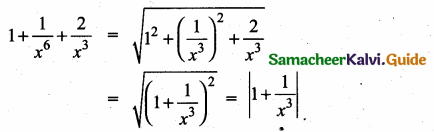
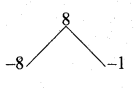
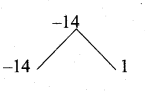
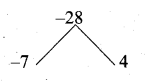
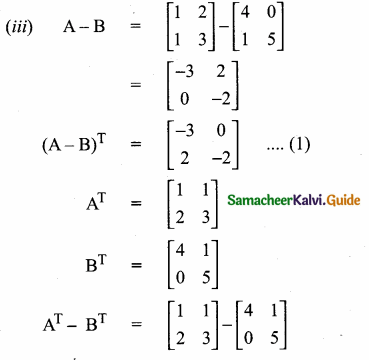
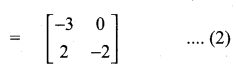
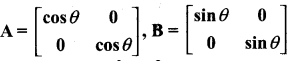
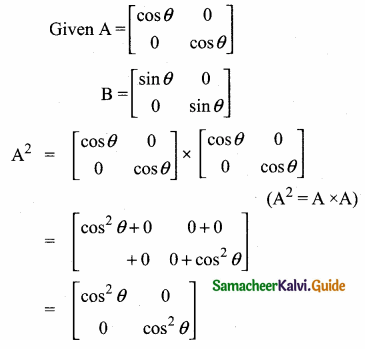
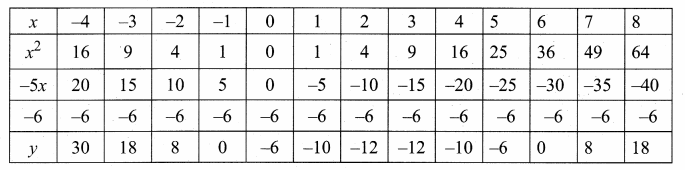
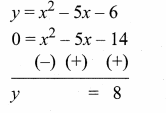
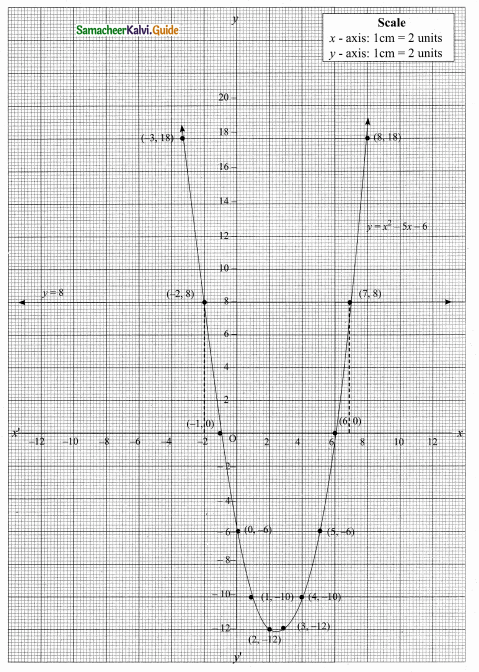
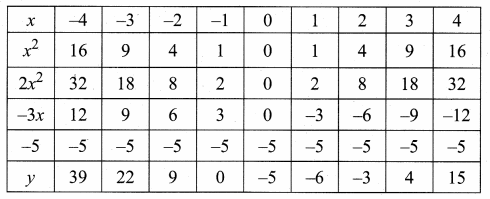
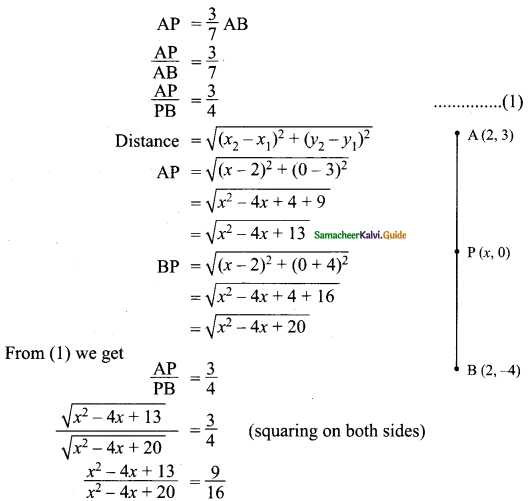
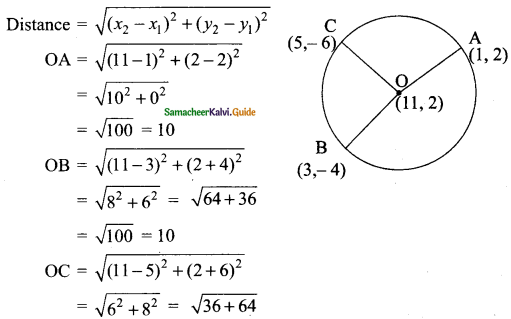
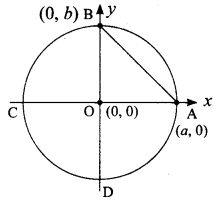
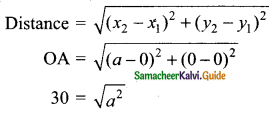
Samacheer Kalvi 9th Maths Guide Chapter 2 Real Numbers Ex 2.2

Students can download Maths Chapter 2 Real Numbers Ex 2.2 Questions and Answers, Notes, Samacheer Kalvi 9th Maths Guide Pdf helps you to revise the complete Tamilnadu State Board New Syllabus, helps students complete homework assignments and to score high marks in board exams.

Tamilnadu Samacheer Kalvi 9th Maths Solutions Chapter 2 Real Numbers Ex 2.2

Question 1.
Express the following rational numbers into decimal and state the kind of decimal expression.
(i) \(\frac{2}{7}\)
(ii) -5\(\frac{3}{11}\)
(iii) \(\frac{22}{3}\)
(iv) \(\frac{327}{200}\)
Solution:
Samacheer Kalvi 9th Maths Guide Chapter 2 Real Numbers Ex 2.2 1
(i) \(\frac{2}{7}\) = 0.2857142….
= 0.\(\overline {285714}\)
Non-terminating and recurring decimal expansion.

Samacheer Kalvi 9th Maths Guide Chapter 2 Real Numbers Ex 2.2

(ii) -5\(\frac{3}{11}\) = -5 + 0.272 = -5.272……..
Samacheer Kalvi 9th Maths Guide Chapter 2 Real Numbers Ex 2.2 2
= -5.\(\overline {27}\)
Non-terminating and recurring decimal expansion.

(iii) \(\frac{22}{3}\) = 7.333……..
Samacheer Kalvi 9th Maths Guide Chapter 2 Real Numbers Ex 2.2 3
= 7.\(\overline {3}\)
Non-terminating and recurring decimal expansion.

(iv) \(\frac{327}{200}\) = \(\frac{327}{2×100}\)
Samacheer Kalvi 9th Maths Guide Chapter 2 Real Numbers Ex 2.2 4
= \(\frac{3.27}{2}\)
= 1.635
Terminating decimal expansion.

Samacheer Kalvi 9th Maths Guide Chapter 2 Real Numbers Ex 2.2

Question 2.
Express \(\frac{1}{13}\) in decimal form. Find the length of the period of decimals.
Solution:
Samacheer Kalvi 9th Maths Guide Chapter 2 Real Numbers Ex 2.2 5
\(\frac{1}{13}\) = 0.07692307
= 0.\(\overline {076923}\)
Length of the period of decimal is 6.

Question 3.
Express the rational number \(\frac{1}{33}\) in recurring decimal form by using the recurring decimal expansion of \(\frac{1}{11}\). Hence write \(\frac{71}{33}\) in recurring decimal form.
Solution:
Samacheer Kalvi 9th Maths Guide Chapter 2 Real Numbers Ex 2.2 6
\(\frac{1}{11}\) = 0.0909……… = 0.\(\overline {09}\)
∴ \(\frac{1}{33}\) = \(\frac{1}{3}\) × \(\frac{1}{11}\)
= \(\frac{1}{3}\) × 0.0909 ……..
= 0.0303 …… = 0.\(\overline {03}\)
\(\frac{71}{33}\) = 2\(\frac{5}{33}\) = 2 + \(\frac{5}{33}\) = 2 + 5 × \(\frac{1}{33}\)
= 2 + 5 × 0.\(\overline {03}\)
2 + (5 × 0.030303 ……..)
2 + 0.151515 ………
2+ 0.\(\overline {15}\)
2.\(\overline {15}\)

Samacheer Kalvi 9th Maths Guide Chapter 2 Real Numbers Ex 2.2

Question 4.
Express the following decimal expression into rational numbers.
(i) 0.24
Solution:
Let x = 0.242424 ………. →(1)
100 x = 24.2424 ……… →(2)
(2) – (1) ⇒ 100 x – x = 24.2424 ……….. (-)
 0.2424 ……..
99 x = 24.0000
x = \(\frac{24}{99}\)
(or)
\(\frac{8}{33}\)

(ii) 2.327
Solution:
Let x = 2.327327327 ………. →(1)
1000 x = 2327.327327 ……… →(2)
(2) – (1) ⇒ 1000 x – x = 2327.327327 ……….. (-)
  2.327327 ……..
999 x = 2325.000
x = \(\frac{2325}{999}\)
(or)
\(\frac{775}{333}\)

Samacheer Kalvi 9th Maths Guide Chapter 2 Real Numbers Ex 2.2

(iii) – 5.132
Solution:
– 5.132 = -5 + \(\frac{1}{10}\) + \(\frac{3}{100}\) + \(\frac{2}{1000}\)
= \(\frac{-5000 + 100 +30 + 2}{1000}\) = \(\frac{-4868}{1000}\)
(or)
\(\frac{-1217}{250}\)

(iv) 3.17
Solution:
Let x = 3.1777 ………. →(1)
10 x = 31.777 ……… →(2)
100 x = 317.77 …….. →(3)
(3) – (2) ⇒ 100 x – 10 x = 317.77 ……….. (-)
 31.777 ……..
90 x = 286.000
x = \(\frac{286}{90}\)
(or)
\(\frac{143}{45}\)

(v) 17.215
Solution:
Let x = 17.2151515 ………. →(1)
10 x = 172.151515 ……… →(2)
100 x = 17215.1515 …….. →(3)
(3) – (2) ⇒ 1000 x – 10 x = 17215.1515 ……….. (-)
 17215.1515 ……..
990 x = 17043
x = \(\frac{17043}{990}\)
(or)
\(\frac{5681}{330}\)

Samacheer Kalvi 9th Maths Guide Chapter 2 Real Numbers Ex 2.2

(vi) -21.2137
Solution:
Let x = -21.213777 ………. →(1)
1000 x = -21213.777 ……… →(2)
100 x = -212137.77 …….. →(3)
(3) – (2) ⇒ 10000 x – 1000 x = -21213.777 ……….. (-)
-21213.777 ……..
9000 x = -190924
x = \(\frac{-190924}{9000}\)
(or)
\(\frac{-47731}{2250}\)

Question 5.
Without actual division, find which of the following rational numbers have terminating decimal expression.
(i) \(\frac{7}{128}\)
Solution:
Samacheer Kalvi 9th Maths Guide Chapter 2 Real Numbers Ex 2.2 7
\(\frac{7}{128}\) = \(\frac{7}{2^{7}}\)
∴ \(\frac{7}{128}\) has terminating decimal expression.

Samacheer Kalvi 9th Maths Guide Chapter 2 Real Numbers Ex 2.2

(ii) \(\frac{21}{15}\)
Solution:
\(\frac{21}{15}\) = \(\frac{7}{5}\) = \(\frac{7}{5^1}\)
\(\frac{21}{15}\) has terminating decimal expression.

(iii) 4\(\frac{9}{35}\)
Solution:
4\(\frac{9}{35}\) = \(\frac{149}{35}\)
4\(\frac{149}{5×7}\) (It is not in the form of \(\frac{P}{2^{m} × 5^{n}}\)
∴ 4\(\frac{9}{35}\) has non-terminating recurring decimal expression.

(iv) \(\frac{219}{2200}\)
Solution:
Samacheer Kalvi 9th Maths Guide Chapter 2 Real Numbers Ex 2.2 8
\(\frac{219}{2200}\) = \(\frac{219}{2^{3} × 5^{2} × 11}\) (It is not in the form of \(\frac{P}{2^{m} × 5^{n}}\)
∴ \(\frac{219}{2200}\) has non-terminating recurring decimal expression.

Samacheer Kalvi 10th Maths Guide Chapter 2 Numbers and Sequences Ex 2.2

Students can download Maths Chapter 2 Numbers and Sequences Ex 2.2 Questions and Answers, Notes, Samacheer Kalvi 10th Maths Guide Pdf helps you to revise the complete Tamilnadu State Board New Syllabus, helps students complete homework assignments and to score high marks in board exams.

Tamilnadu Samacheer Kalvi 10th Maths Solutions Chapter 2 Numbers and Sequences Ex 2.2

Question 1.
For what values of natural number n, 4th can end with the digit 6?
Answer:
4n = (22)n = 22n
= 2n × 2n
2 is a factor of 4n
∴ 4n is always even.

Samacheer Kalvi 10th Maths Guide Chapter 2 Numbers and Sequences Ex 2.2

Question 2.
If m, n are natural numbers, for what values of m, does 2n × 5n ends in 5?
Solution:
2n × 5m
2n is always even for all values of n.
5m is always odd and ends with 5 for all values of m.
But 2n × 5m is always even and ends in 0.
∴ 2n × 5m cannot end with the digit 5 for any values of m. No value of m will satisfy 2n × 5m ends in 5.

Question 3.
Find the H.C.F. of 252525 and 363636.
Answer:
To find the HCF of 252525 and 363636 by using Euclid’s Division algorithm.
363636 = 252525 × 1 + 111111
The remainder 111111 ≠ 0
By division of Euclid’s algorithm
252525 = 111111 × 2 + 30303
The remainder 30303 ≠ 0
Again by division of Euclid’s algorithm
111111 = 30303 × 3 + 20202
The remainder 20202 ≠ 0
Again by division of Euclid’s algorithm.
30303 = 20202 + 10101
The remainder 10101 ≠ 0
Again by division of Euclid’s algorithm.
20202 = 10101 × 2 + 0
The remainder is 0
∴ The H.C.F. is 10101

Samacheer Kalvi 10th Maths Guide Chapter 2 Numbers and Sequences Ex 2.2

Question 4.
If 13824 = 2a × 3b then find a and b?
Answer:
Using factor tree method factorise 13824
Samacheer Kalvi 10th Maths Guide Chapter 2 Numbers and Sequences Ex 2.2 2
Samacheer Kalvi 10th Maths Guide Chapter 2 Numbers and Sequences Ex 2.2 1
13824 = 29 × 33
Given 13824 = 2a × 3b
Compare we get a = 9 and b = 3

Samacheer Kalvi 10th Maths Guide Chapter 2 Numbers and Sequences Ex 2.2

Aliter:
13824 = 29 × 33
Compare with
13824 = 2a × 3b
The value of a = 9 b = 3

Question 5.
If p1x1 × p2x2 × p3x3 × p4x4 = 113400 where p1 p2, p3, p4 are primes in ascending order and x1, x2, x3, x4, are integers, find the value of p1,p2,p3,p4 and x1,x2,x3,x4.
Answer:
Given 113400 = p1x1 × p2x2 × p3x3 × p4x4
Using tree method factorize 113400
Samacheer Kalvi 10th Maths Guide Chapter 2 Numbers and Sequences Ex 2.2 3
113400 = 23 × 34 × 52 × 7
compare with
113400 = p1x1 × p2x2 × p3x3 × p4x4
P1 = 2, x1 = 3
P2 = 3, x2 = 4
P3 = 5, x3 = 2
P4 = 7, x4 = 1

Samacheer Kalvi 10th Maths Guide Chapter 2 Numbers and Sequences Ex 2.2

Question 6.
Find the L.C.M. and H.C.F. of 408 and 170 by applying the fundamental theorem of Arithmetic.
Answer:
Factorise 408 and 170 by factor tree method
Samacheer Kalvi 10th Maths Guide Chapter 2 Numbers and Sequences Ex 2.2 4
Samacheer Kalvi 10th Maths Guide Chapter 2 Numbers and Sequences Ex 2.2 5
408 = 23 × 3 × 17
170 = 2 × 5 × 17
To find L.C.M. list all prime factors of 408 and 170 of their greatest exponents.
L.C.M. = 23 × 3 × 5 × 17
= 2040
To find the H.C.F. list all common factors of 408 and 170.
H.C.F. = 2 × 17 = 34
L.C.M. = 2040 ; HCF = 34

Samacheer Kalvi 10th Maths Guide Chapter 2 Numbers and Sequences Ex 2.2

Question 7.
Find the greatest number consisting of 6 digits which is exactly divisible by 24,15,36?
Answer:
The greatest number of 6 digits is 999999.
The greatest number must be divisible by L.C.M. of 24, 15 and 36
Samacheer Kalvi 10th Maths Guide Chapter 2 Numbers and Sequences Ex 2.2 6
24 = 23 × 3
15 = 3 × 5
36 = 22 × 32
L.C.M = 23 × 32 × 5
= 360
To find the greatest number 999999 must be subtracted by the remainder when 999999 is divided by 360
The greatest number in 6 digits = 999999 – 279
= 999720
Samacheer Kalvi 10th Maths Guide Chapter 2 Numbers and Sequences Ex 2.2 7

Question 8.
What is the smallest number that when divided by three numbers such as 35, 56 and 91 leaves remainder 7 in each case?
Solution:
35 = 5 × 7
56 = 2 × 2 × 2 × 7
91 = 7 × 13
LCM of 35, 56, 91 = 5 × 7 × 2 × 2 × 2 × 13 = 3640
∴ Required number = 3647 which leaves remainder 7 in each case.

Samacheer Kalvi 10th Maths Guide Chapter 2 Numbers and Sequences Ex 2.2

Question 9.
Find the least number that is divisible by the first ten natural numbers?
Answer:
Find the L.C.M of first 10 natural numbers
Samacheer Kalvi 10th Maths Guide Chapter 2 Numbers and Sequences Ex 2.2 8
The least number is 2520

Modular Arithmetic
Two integers “a” and “b” are congruence modulo n if they differ by an integer multiple of n. That b – a = kn for some integer k. This can be written as a = b (mod n).

Euclid’s Division Lemma and Modular Arithmetic

Let m and n be integers, where m is positive. By Euclid’s division Lemma we can write n = mq + r where 0 < r < m and q is an integer.
This n = r (mod m)

Samacheer Kalvi 9th Maths Guide Chapter 1 Set Language Ex 1.5

Students can download Maths Chapter 1 Set Language Ex 1.5 Questions and Answers, Notes, Samacheer Kalvi 9th Maths Guide Pdf helps you to revise the complete Tamilnadu State Board New Syllabus, helps students complete homework assignments and to score high marks in board exams.

Tamilnadu Samacheer Kalvi 9th Maths Solutions Chapter 1 Set Language Ex 1.5

Question 1.
Using the adjacent Venn diagram, find the following sets:
Samacheer Kalvi 9th Maths Guide Chapter 1 Set Language Ex 1.5 1
(i) A – B
(ii) B – C
(iii) A’∪B’
(iv) A’∩B’
(v) (B∪C)’
(vi) A – (B∪C)
(vii) A – (B∩C)
Solution:
From the diagram we get
U = {-3, -2, -1, 0, 1, 2, 3, 4, 5, 6, 7, 8},
A= {-2,-1, 3, 4, 6}, B = {-2,-1, 5, 7, 8}
C = {-3, -2, 0, 3, 8}
A’ = U – A = {-3, -2, -1, 0, 1, 2, 3, 4, 5, 6, 7, 8} – {-2, -1, 3, 4, 6}
= {-3, 0, 1, 2, 5, 7, 8}
B’ = U – B = {-3, -2, -1, 0, 1, 2, 3, 4, 5, 6, 7, 8} – {-2, -1, 5, 7, 8}
= {-3, 0, 1, 2, 3, 4, 6}
B∪C = {-2, -1, 5, 7, 8} ∪ {-3, -2, 0, 3, 8} = {-3, -2, -1, 0, 3, 5, 7, 8}
B∩C = {-2, -1, 5, 7, 8} ∩ {-3, -2, 0, 3, 8} = {-2, 8}

(i) A – B = {3, 4, 6}
(ii) B – C = {-1, 5, 7}
(iii) A’∪B’= {-3, 0, 1, 2, 5, 7, 8} ∪ {-3, 0, 1, 2, 3, 4, 6}
= {-3, 0, 1, 2, 3, 4, 5, 6, 7, 8}
(iv) A’∩B’ = {-3, 0, 1, 2, 5, 7, 8} ∩ {-3, 0, 1, 2, 3, 4, 6}
= {-3, 0, 1, 2}
(v) (B∪C)’ = U – (B∪C)= {-3,-2,-1,0, 1,2, 3,4, 5, 6, 7, 8} – {-3, -2, -1, 0, 3, 5, 7, 8}
= {1, 2, 4, 6}
(vi) A – (B∪C) = {-2, -1, 3, 4, 6} – {-3, -2, -1, 0, 3, 5, 7, 8} = {4, 6}
(vii) A – (B∩C) = {-2,-1, 3, 4, 6} – {-2, 8} = {-1, 3, 4, 6}

Samacheer Kalvi 9th Maths Guide Chapter 1 Set Language Ex 1.5

Question 2.
If K = {a, b, d, e, f}, L = {b, c, d, g} and M = {a, b, c, d, h} then find the following:
(i) K∪(L∩M)
(ii) K∩(L∪M)
(iii) (K∪L) ∩ (K∪M)
(iv) (K∩L) ∪ (K∩M)
and verify distributive laws.
Solution:
K = {a, b, d, e, f}, L = {b, c, d, g} and M = {a, b, c, d, h}
(i) K∪(L∩M)
(L∩M) = {b, c, d, g} ∩ [a, b, c, d, h}
= {b, c, d}
K∪(L∩M) = {a, b, d, e, f} ∪ {b, c, d}
= {a, b, c, d, e, f}

(ii) K∩(L∪M)
(L∪M) = {b, c, d, g} ∪ {a, b, c, d, h}
= {a, b, c, d, g, h}
K∩(L∪M) = {a, b, d, e, f} ∩ {a, b, c, d, g, h}
= {a, b, d }

(iii) (K∪L) ∩ (K∪M)
(K∪L) = {a, b, d, e, f} ∪ {b, c, d, g}
= {a, b, c, d, e, f, g}
(K∪M) = {a, b, d, e, f} ∪ {a, b, c, d, h}
= {a, b, c, d, e, f, h}
(K∪L) ∩ (K∪M) = {a, b, c, d, e, f, g} ∩ {a, b, c, d, e, f, h}
= {a, b, c, d, e, f}

(iv) (K∩L) ∪ (K∩M)
(K∩L) = {a, b, d, e, f) ∩ {b, c, d, g}
= {b, d}
(K∩M) = {a, b, d, e, f} ∩ {a, b, c, d, h}
= {a, b, d}
(K∩L) ∪ (K∩M) = {b, d} ∪ [a, b, d}
= {a, b, d}
From (ii) & (iv) we get, K∩(L∪M) = (K∩L) ∪ (K∩M)
From (i) & (iii) we get, K∪(L∩M) = (K∪L) ∩ (K∪M)

Samacheer Kalvi 9th Maths Guide Chapter 1 Set Language Ex 1.5

Question 3.
For A = {x : x ∈ Z, -2 < x ≤ 4}, B = {x : x ∈ W, x ≤ 5}, C = {-4, -1, 0, 2, 3, 4}
verify A∪(B∩C) = (A∪B) ∩ (A∪C).
Solution:
A = {-1, 0, 1, 2, 3, 4}, B = {0, 1, 2, 3, 4, 5} and C = {-4, -1, 0, 2, 3, 4}
B∩C = {0, 1, 2, 3, 4, 5} ∩ {-4, -1, 0, 2, 3, 4}
= {0, 2, 3, 4}
A∪(B∩C) = {-1, 0, 1, 2, 3, 4} ∪ {0, 2, 3, 4}
= {-1, 0, 1, 2, 3, 4} ……..(1)
A∪B = {-1, 0, 1, 2, 3, 4} ∪ {0, 1, 2, 3, 4, 5}
= {-1, 0, 1, 2, 3, 4, 5}
A∪C = {-1, 0, 1, 2, 3, 4} ∪ {-4, -1, 0, 2, 3, 4}
= {-4, -1, 0, 1, 2, 3, 4}
(A∪B) ∩ (A∪C) = {-1, 0, 1, 2, 3, 4, 5} ∩ {-4, -1, 0, 1, 2, 3, 4}
= {-1, 0, 1, 2, 3, 4} ……..(2)
From (1) and (2) we get A∪(B∩C) = (A∪B) ∩ (A∪C).

Question 4.
Verify A∪(B∩C) = (A∪B) ∩ (A∪C) using Venn diagrams.
Solution:
Samacheer Kalvi 9th Maths Guide Chapter 1 Set Language Ex 1.5 2
From (ii) and (v) we get A∪(B∩C) = (A∪B) ∩ (A∪C).

Samacheer Kalvi 9th Maths Guide Chapter 1 Set Language Ex 1.5

Question 5.
If A = {b, c, e, g, h}, B = {a, c, d, g, f}, and C = {a, d, e, g, h}, then show that A – (B∩C) = (A – B) ∪ (A – C).
Solution:
A = {b, c, e, g, h} ; B = {a, c, d, g, f}; C = {a, d, e, g, h}
B∩C = {a, c, d, g, i} ∩ {a, d, e, g, h}
= {a, d, g}
A – (B∩C) = {b, c, e, g, h} – {a, d, g}
= {b, c, e, h}…….(1)
A – B = {b, c, e, g, h} – {a, c, d, g, i}
= {b, e, h}
A – C = {b, c, e, g, h} – {a, d, e, g, h}
= {b, c}
(A – B) ∪ (A – C) = {b, e, h} ∪ {b, c}
= {b, c, e, h)……..(2)
From (1) and (2) we get A – (B∩C) = (A – B) ∪ (A – C)

Samacheer Kalvi 9th Maths Guide Chapter 1 Set Language Ex 1.5

Question 6.
If A= {x : x = 6n, n∈W and n < 6}, B = {x : x = 2n, n∈N and 2 < n ≤ 9} and
C = {x : x = 3n, n∈N and 4 ≤ n < 10}, then show that A – (B∩C) = (A – B) ∪ (A – C)
Solution:
A = {0, 6, 12, 18, 24, 30}; B = {6, 8, 10, 12, 14, 16, 18}; C = {12, 15, 18, 21, 24, 27}
B∩C = {6, 8, 10, 12, 14, 16, 18} ∩ {12, 15, 18, 21, 24, 27}
= {12, 18}
A – (B∩C) = {0, 6, 12, 18, 24, 30} – {12, 18}
= {0, 6, 24, 30}………(1)
A – B = {0, 6, 12, 18, 24, 30} – {6, 8, 10, 12, 14, 16, 18}
= {0, 24, 30}
A – C = {0, 6, 12, 18, 24, 30} – {12, 15, 18, 21, 24, 27}
= {0, 6, 30}
(A – B) ∪ (A – C) = {0, 24, 30} ∪ {0, 6, 30}
= {0, 6, 24, 30}……..(2)
From (1) and (2) we get A – (B∩C) = (A – B) ∪ (A – C).

Question 7.
If A = {-2, 0, 1, 3, 5}, B = {-1, 0, 2, 5, 6} and C = {-1, 2, 5, 6, 7}, then show that
A – (B∪C) = (A – B) ∩ (A – C).
Solution:
A= {-2, 0, 1, 3, 5}, B = {-1, 0, 2, 5, 6}, C = {-1, 2, 5, 6, 7}
B∪C = {-1, 0, 2, 5, 6} ∪ {-1, 2, 5, 6, 7}
= {-1, 0, 2, 5, 6, 7}
A – (B∪C) = {-2, 0, 1, 3, 5} – {-1, 0, 2, 5, 6, 7}
= {-2, 1, 3} ………(1)
A – B = {-2, 0, 1, 3, 5} – {-1, 0, 2, 5, 6}
= {-2, 1, 3}
A – C = {-2, 0, 1, 3, 5}- {-1, 2, 5, 6, 7}
= {-2, 0, 1, 3}
(A- B) ∩ (A- C) = {-2, 1, 3} ∩ {-2, 0, 1, 3}
= {-2, 1, 3} ….(2)
From (1) and (2) we get A – (B∪C) = (A – B) ∩ (A – C).

Samacheer Kalvi 9th Maths Guide Chapter 1 Set Language Ex 1.5

Question 8.
IF A = {y : y = \(\frac{a + 1}{2}\), a ∈ W and a ≤ 5}, B = {y : y = \(\frac{2n – 1}{2}\), n ∈ W and n < 5} and C = {-1, \(-\frac{1}{2}\), 1, \(\frac{3}{2}\), 2} then show that A – (B∪C) = (A – B) ∩ (A – C).
Solution:
Samacheer Kalvi 9th Maths Guide Chapter 1 Set Language Ex 1.5 3
From (1) and (2) we get A – (B∪C) = (A – B) ∩ (A – C).

Question 9.
Verify A- (B∩C) = (A – B) ∪ (A – C) using Venn diagrams.
Solution:
Samacheer Kalvi 9th Maths Guide Chapter 1 Set Language Ex 1.5 4
Samacheer Kalvi 9th Maths Guide Chapter 1 Set Language Ex 1.5 5
From (ii) and (v) we get A- (B∩C) = (A – B) ∪ (A – C).

Samacheer Kalvi 9th Maths Guide Chapter 1 Set Language Ex 1.5

Question 10.
If U = {4, 7, 8, 10, 11, 12, 15, 16} , A = {7, 8, 11, 12} and B = {4, 8, 12, 15}, then verify De Morgan’s Laws for complementation.
U= {4, 7, 8, 10, 11, 12, 15, 16} , A = {7, 8, 11, 12} and B = {4, 8, 12, 15}
(i) (A∪B)’ = A’∩B’
(ii) (A∩B)’ = A’∪B’
Solution:
(i) A∪B = {7, 8, 11, 12} ∪ {4, 8, 12, 15}
= {4, 7, 8, 11, 12, 15}
(A∪B)’ = {4, 7, 8, 10, 11, 12, 15, 16} – {4, 7, 8, 11, 12, 15}
= {10,16} ………(1)
A’ = {4, 7, 8, 10, 11, 12, 15, 16} – {7, 8, 11, 12}
= {4, 10, 15, 16}
B’ = {4, 7, 8, 10, 11, 12, 15, 16} – {4, 8, 12, 15}
= {7, 10, 11, 16}
A’∩B’ = {4, 10, 15, 16} ∩ {7, 10, 11, 16}
= {10,16} ………(2)
From (1) and (2) we get (A∪B)’ = A’∩B’

(ii) A∩B = {7, 8, 11, 12} ∩ {4, 8, 12, 15}
= {8, 12}
(A∩B)’ = {4, 7, 8, 10, 11, 12, 15, 16} – {8, 12}
= {4, 7, 10, 11, 15, 16} ………(1)
A’ = {4, 10, 15, 16}
B’ = {7, 10, 11, 16}
A’∪B’ = {4, 10, 15, 16} ∪ {7, 10, 11, 16}
= {4, 7, 10, 11, 15, 16} ………(2)
From (1) and (2) we get (A∩B)’ = A’∪B’

Samacheer Kalvi 9th Maths Guide Chapter 1 Set Language Ex 1.5

Question 11.
Verify (A∩B)’ = A∪B’ using Venn diagrams.
Solution:
Samacheer Kalvi 9th Maths Guide Chapter 1 Set Language Ex 1.5 6
From (ii) and (i) we get (A∩B)’ = A’∪B’

Samacheer Kalvi 10th Maths Guide Chapter 1 Relations and Functions Unit Exercise 1

Students can download Maths Chapter 1 Relations and Functions Unit Exercise 1 Questions and Answers, Notes, Samacheer Kalvi 10th Maths Guide Pdf helps you to revise the complete Tamilnadu State Board New Syllabus, helps students complete homework assignments and to score high marks in board exams.

Tamilnadu Samacheer Kalvi 10th Maths Solutions Chapter 1 Relations and Functions Unit Exercise 1

Question 1.
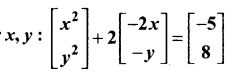
If the ordered pairs (x2 – 3x, y2 + 4y) and (-2, 5) are equal, then find x and y.
Answer:
(x2 – 3x, y2 + 4y) = (-2, 5)
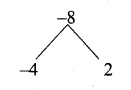
x2 – 3x = -2
x2 – 3x + 2 = 0
(x – 2) (x – 1) = 0
x – 2 = 0 or x – 1 = 0
x = 2 or 1
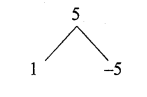
Samacheer Kalvi 10th Maths Guide Chapter 1 Relations and Functions Unit Exercise 1 1
y2 + 4y = 5
y2 + 4y – 5 = 0
(y + 5) (y – 1) = 0
y + 5 = 0 or y – 1 = 0
y = -5 or y = 1
The value of x = 2, 1
and 7 = -5, 1
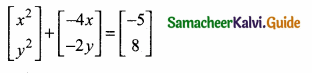
Samacheer Kalvi 10th Maths Guide Chapter 1 Relations and Functions Unit Exercise 1 2

Samacheer Kalvi 10th Maths Guide Chapter 1 Relations and Functions Unit Exercise 1

Question 2.
The Cartesian product A × A has 9 elements among which (-1, 0) and (0, 1) are found. Find the set A and the remaining elements of A × A.
Solution:
A = {-1, 0, 1}, B = {1, 0, -1}
A × B = {(-1, 1), (-1, 0), (-1, -1), (0, 1), (0, 0), (0, -1), (1, 1), (1, 0), (1, -1)}

Samacheer Kalvi 10th Maths Guide Chapter 1 Relations and Functions Unit Exercise 1

Question 3.
Given that f(x) = \(\left\{\begin{array}{rl}
{\sqrt{x-1}} & {x \geq 1} \\
{4} & {x<1}
\end{array}\right.\).
Find
(i) f(0) (ii)f (3) (iii) f(a + 1) in terms of a.(Given that a > 0)
Answer:
f(x) = \(\sqrt { x-1 }\) ; f(x) = 4
(i) f(0) = 4
(ii) f(3) = \(\sqrt { 3-1 }\) = \(\sqrt { 2 }\)
(iii) f(a + 1) = \(\sqrt { a+1-1 }\) = \(\sqrt { a }\)

Question 4.
Let A = {9, 10, 11, 12, 13, 14, 15, 16, 17} and let f: A → N be defined by f(n) = the highest prime factor of n ∈ A. Write f as a set of ordered pairs and find the range of f.
Solution:
A = {9, 10, 11, 12, 13, 14, 15, 16, 17}
f: A → N
f(n) = the highest prime factor of n ∈ A
f = {(9, 3), (10, 5), (11, 11), (12, 3), (13, 13), (14, 7), (15, 5), (16, 2), (17, 17)}
Range = {3, 5, 11, 13, 7, 2, 17}
= {2, 3, 5, 7, 11, 13, 17}

Samacheer Kalvi 10th Maths Guide Chapter 1 Relations and Functions Unit Exercise 1

Question 5.
Find the domain of the function
Samacheer Kalvi 10th Maths Guide Chapter 1 Relations and Functions Unit Exercise 1 3
Answer:
Samacheer Kalvi 10th Maths Guide Chapter 1 Relations and Functions Unit Exercise 1 4
Domain of f(x) = {-1, 0, 1}

Question 6.
If f(x)= x2, g(x) = 3x and h(x) = x – 2 Prove that (fog)oh = fo(goh).
Solution:
f(x) = x2
g(x) = 3x
h(x) = x – 2
(fog)oh = x – 2
LHS = fo(goh)
fog = f(g(x)) = f(3x) = (3x)2 = 9x2
(fog)oh = (fog) h(x) = (fog) (x – 2)
= 9(x – 2)2 = 9(x2 – 4x + 4)
= 9x2 – 36x + 36 ……………. (1)
RHS = fo(goh)
(goh) = g(h(x)) = g(x – 2)
= 3(x – 2) = 3x – 6
fo(goh) = f(3x – 6) = (3x – 6)2
= 9x2 – 36x + 36 ………….. (2)
(1) = (2)
LHS = RHS
(fog)oh = fo(goh) is proved.

Samacheer Kalvi 10th Maths Guide Chapter 1 Relations and Functions Unit Exercise 1

Question 7.
Let A= {1,2} and B = {1,2,3,4}, C = {5,6} and D = {5,6,7,8}. Verify whether A × C is a subset of B × D?
Answer:
Given A = {1, 2}
B = {1, 2, 3, 4}
C = {5,6}
D = {5,6, 7,8}
A × C = {1,2} × {5,6}
= {(1,5) (1,6) (2, 5) (2, 6)}
B × D = {1,2, 3, 4} × {5, 6, 7, 8}
= {(1,5) (1,6) (1,7) (1,8)
(2, 5) (2, 6) (2,7) (2, 8)
(3, 5) (3, 6) (3, 7) (3, 8)
(4, 5) (4, 6) (4, 7) (4, 8)}
∴ A × C ⊂ B × D
Hence it is verified

Question 8.
If f(x) = \(\frac{x-1}{x+1}, x \neq 1\) Show that
f(f(x)) = – \(\frac { 1 }{ x } \), Provided x ≠ 0.
Answer:
Samacheer Kalvi 10th Maths Guide Chapter 1 Relations and Functions Unit Exercise 1 5
Samacheer Kalvi 10th Maths Guide Chapter 1 Relations and Functions Unit Exercise 1 6

Samacheer Kalvi 10th Maths Guide Chapter 1 Relations and Functions Unit Exercise 1

Question 9.
The functions f and g are defined by f{x) = 6x + 8; g(x) = \(\frac { x-2 }{ 3 } \)
(i) Calculate the value of gg [latex]\frac { 1 }{ 2 } [/latex]
(a) Write an expression for gf (x) in its simplest form.
Answer:
f(x) = 6x + 8 ; g(x) = \(\frac { x-2 }{ 3 } \)
Samacheer Kalvi 10th Maths Guide Chapter 1 Relations and Functions Unit Exercise 1 7
Samacheer Kalvi 10th Maths Guide Chapter 1 Relations and Functions Unit Exercise 1 8
Samacheer Kalvi 10th Maths Guide Chapter 1 Relations and Functions Unit Exercise 1 88

Samacheer Kalvi 10th Maths Guide Chapter 1 Relations and Functions Unit Exercise 1

Question 10.
Write the domain of the following real functions
Samacheer Kalvi 10th Maths Guide Chapter 1 Relations and Functions Unit Exercise 1 9
Answer:
(i) f (x) = \(\frac { 2x+1 }{ x-9 } \)
If the denominator vanishes when x = 9
So f(x) is not defined at x = 9
∴ Domain is x ∈ [R – {9}]

(ii) if p(x) = \(=\frac{-5}{4 x^{2}+1}\)
p(x) is defined for all values of x. So domain is x ∈ R.

(iii) g(x) = \(\sqrt { x-2 }\)
When x < 2 g(x) becomes complex. But given “g” is real valued function.
So x > 2
Domain x ∈ (2, α)

(iv) h (x) = x + 6
For all values of x, h(x) is defined. Hence domain is x ∈ R.

Samacheer Kalvi 10th Maths Guide Chapter 1 Relations and Functions Ex 1.6

Students can download Maths Chapter 1 Relations and Functions Ex 1.6 Questions and Answers, Notes, Samacheer Kalvi 10th Maths Guide Pdf helps you to revise the complete Tamilnadu State Board New Syllabus, helps students complete homework assignments and to score high marks in board exams.

Tamilnadu Samacheer Kalvi 10th Maths Solutions Chapter 1 Relations and Functions Ex 1.6

Multiple Choice Questions

Question 1.
If n(A × B) = 6 and A= {1, 3} then n (B) is ………….
(1) 1
(2) 2
(3) 3
(4) 6
Answer:
(3) 3
Hint: n(A × B) = 6
n(A) = 2
n(A × B) = n(A) × n(B)
6 = 2 × n(B)
n(B) = \(\frac { 6 }{ 2 } \) = 3

Samacheer Kalvi 10th Maths Guide Chapter 1 Relations and Functions Ex 1.6

Question 2.
A = {a, b, p}, B = {2, 3}, C = {p, q, r, s} then n[(A ∪ C) × B] is
(1) 8
(2) 20
(3) 12
(4) 16
Answer:
(3) 12
Hint:
A = {a, b, p}, B = {2, 3}, C = {p, q, r, s}
n (A ∪ C) × B
A ∪ C = {a, b, p, q, r, s}
(A ∪ C) × B = {{a, 2), (a, 3), (b, 2), (b, 3), (p, 2), (p, 3), (q, 2), (q, 3), (r, 2), (r, 3), (s, 2), (s, 3)
n [(A ∪ C) × B] = 12

Question 3.
If A = {1,2}, B = {1,2, 3, 4}, C = {5,6} and D = {5, 6, 7, 8} then state which of the following statement is true ……………….
(1) (A × C) ⊂ (B × D)
(2) (B × D) ⊂ (A × C)
(3) (A × B) ⊂ (A × D)
(4) (D × A) ⊂ (B × A)
Answer:
(1) (A × C) ⊂ (B × D)
Hint: n(A × B) = 2 × 4 = 8
(A × C) = 2 × 2 = 4
n(B × C) = 4 × 2 = 8
n(C × D) = 2 × 4 = 8
n(A × C) = 2 × 2 = 4
n(A × D) = 2 × 4 = 8
n(B × D) = 4 × 4 = 16
∴ (A × C) ⊂ (B × D)
Samacheer Kalvi 10th Maths Guide Chapter 1 Relations and Functions Ex 1.6

Question 4.
If there are 1024 relations from a set A = {1, 2, 3, 4, 5} to a set B, then the number of elements in B is
(1) 3
(2) 2
(3) 4
(4) 6
Answer:
(2) 2
Hint:
n(A) = 5
n(B) = x
n(A × B) = 1024 = 210
25x = 210
⇒ 5x = 10
⇒ x =2

Question 5.
The range of the relation R = {(x, x2) a prime number less than 13} is ……………………
(1) {2, 3, 5, 7}
(2) {2, 3, 5, 7, 11}
(3) {4, 9, 25, 49, 121}
(4) {1, 4, 9, 25, 49, 121}
Answer:
(3) {4, 9, 25, 49, 121}
Hint:
Prime number less than 13 = {2, 3, 5, 7, 11}
Range (R) = {(x, x2)}
Range = {4, 9, 25, 49, 121} (square of x)

Samacheer Kalvi 10th Maths Guide Chapter 1 Relations and Functions Ex 1.6

Question 6.
If the ordered pairs (a + 2, 4) and (5, 2a + b)are equal then (a, b) is
(1) (2, -2)
(2) (5, 1)
(3) (2, 3)
(4) (3, -2)
Answer:
(4) (3, -2)
Hint:
(a + 2, 4), (5, 2a + b)
a + 2 = 5
a = 3
2a + b = 4
6 + b = 4
b = -2

Question 7.
Let n(A) = m and n(B) = n then the total number of non-empty relations that can be defined from A to B is ……………..
(1) mn
(2) nm
(3) 2mn – 1
(4) 2mn
Answer:
(4) 2mn

Question 8.
If {(a, 8),(6, b)}represents an identity function, then the value of a and b are respectively
(1) (8, 6)
(2) (8, 8)
(3) (6, 8)
(4) (6, 6)
Answer:
(1) (8, 6)
Hint:
{{a, 8), (6, b)}
a = 8
b = 6

Samacheer Kalvi 10th Maths Guide Chapter 1 Relations and Functions Ex 1.6

Question 9.
Let A = {1, 2, 3, 4} and B = {4, 8, 9, 10}.
A function f: A → B given by f = {(1, 4), (2, 8),(3,9),(4,10)} is a ……………
(1) Many-one function
(2) Identity function
(3) One-to-one function
(4) Into function
Answer:
(3) One-to-one function
Hint:
Samacheer Kalvi 10th Maths Guide Chapter 1 Relations and Functions Ex 1.6 2
Different elements of A has different images in B.
∴ It is one-to-one function.

Question 10.
If f (x) = 2x2 and g(x) = \(\frac { 1 }{ 3x } \), then fog is …………..
(1) \(\frac{3}{2 x^{2}}\)
(2) \(\frac{2}{3 x^{2}}\)
(3) \(\frac{2}{9 x^{2}}\)
(4) \(\frac{1}{6 x^{2}}\)
Answer:
(3) \(\frac{2}{9 x^{2}}\)
Hint:
Samacheer Kalvi 10th Maths Guide Chapter 1 Relations and Functions Ex 1.6 3

Samacheer Kalvi 10th Maths Guide Chapter 1 Relations and Functions Ex 1.6

Question 11.
If f: A → B is a bijective function and if n(B) = 7, then n(A) is equal to
(1) 7
(2) 49
(3) 1
(4) 14
Answer:
(1) 7
Hint:
In a bijective function, n(A) = n(B)
⇒ n(A) = 7

Question 12.
Let f and g be two functions given by
f = {(0,1),(2, 0),(3-4),(4,2),(5,7)}
g = {(0,2),(1,0),(2, 4),(-4,2),(7,0)}
then the range of f o g is …………………
(1) {0,2,3,4,5}
(2) {-4,1,0,2,7}
(3) {1,2,3,4,5}
(4) {0,1,2}
Answer:
(4) {0,1,2}
Hint: f = {(0, 1)(2, 0)(3, -4) (4, 2) (5, 7)}
g = {(0,2)(l,0)(2,4)(-4,2)(7,0)}
Samacheer Kalvi 10th Maths Guide Chapter 1 Relations and Functions Ex 1.6 4
fog = f[g(x)]
f [g(0)] = f(2) = 0
f [g(1)] = f(0) = 1
f [g(2)] = f(4) = 2
f[g(-4)] = f(2) = 0
f[g(7)] = f(0) = 1
Range of fog = {0,1,2}

Samacheer Kalvi 10th Maths Guide Chapter 1 Relations and Functions Ex 1.6

Question 13.
Let f(x) = \(\sqrt{1+x^{2}}\) then
(1) f(xy) = f(x),f(y)
(2) f(xy) ≥ f(x),f(y)
(3) f(xy) ≤ f(x).f(y)
(4) None of these
Answer:
(3) f(xy) ≤ f(x).f(y)
Hint:
\(\sqrt{1+x^{2} y^{2}} \leq \sqrt{\left(1+x^{2}\right)} \sqrt{\left(1+y^{2}\right)}\)
⇒ f(xy) ≤ f(x) . f(y)

Question 14.
If g= {(1,1),(2,3),(3,5),(4,7)} is a function given by g(x) = αx + β then the values of α and β are
(1) (-1,2)
(2) (2,-1)
(3) (-1,-2)
(4) (1,2)
Answer:
(2) (2, -1)
Hint: g (x) = αx + β
g(1) = α(1) + β
1 = α + β ….(1)
g (2) = α (2) + β
3 = 2α + β ….(2)
Solve the two equations we get
α = 2, β = -1

Samacheer Kalvi 10th Maths Guide Chapter 1 Relations and Functions Ex 1.6

Question 15.
f(x) = (x + 1)3 – (x – 1)3 represents a function which is
(1) linear
(2) cubic
(3) reciprocal
(4) quadratic
Answer:
(4) quadratic
Hint:
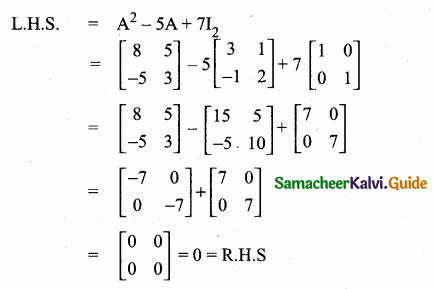
f(x) = (x + 1)3 – (x – 1)3
= x3 + 3x2 + 3x + 1 -[x3 – 3x2 + 3x – 1]
= x3 + 3x2 + 3x + 1 – x3 + 3x2 – 3x + 1 = 6x2 + 2
It is a quadratic function.

Samacheer Kalvi 10th Maths Guide Chapter 2 Numbers and Sequences Ex 2.3

Students can download Maths Chapter 2 Numbers and Sequences Ex 2.3 Questions and Answers, Notes, Samacheer Kalvi 10th Maths Guide Pdf helps you to revise the complete Tamilnadu State Board New Syllabus, helps students complete homework assignments and to score high marks in board exams.

Tamilnadu Samacheer Kalvi 10th Maths Solutions Chapter 2 Numbers and Sequences Ex 2.3

Question 1.
Find the least positive value of x such that

(i) 71 = x (mod 8)
Answer:
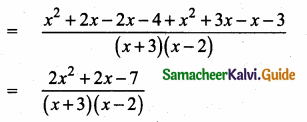
71 = 7 (mod 8)
∴ The value of x = 7
Samacheer Kalvi 10th Maths Guide Chapter 2 Numbers and Sequences Ex 2.3 1

(ii) 78 + x = 3 (mod 5)
78 + x – 3 = 5n (n is any integer)
75 + x = 5n
(Let us take x = 5)
75 + 5 = 80 (80 is a multiple of 5)
∴ The least value of x is 5

Samacheer Kalvi 10th Maths Guide Chapter 2 Numbers and Sequences Ex 2.3

(iii) 89 = (x + 3) (mod 4)
89 – (x + 3) = 4n
(n may be any integer)
89 – x – 3 = 4n
89 – x = 4n
86 – x is a multiple of 4
(84 is a multiple of 4)
86 – 2 = 4n
84 = 4n
The value of x is 2

(iv) 96 = \(\frac { x }{ 7 } \) (mod 5)
96 – \(\frac { x }{ 7 } \) = 5n (n may be any integer)
672 – x = 35n (multiple of 35 is 665)
672 – 7 = 665
∴ The value of x = 7

(v) 5x = 4 (mod 6)
5x – 4 = 6n (n may be any integer)
5x = 6n + 4
x = \(\frac { 6n+4 }{ 5 } \)
Substitute the value of n as 1, 6, 11, 16 …. as n values in x = \(\frac { 6n+4 }{ 5 } \) which is divisible by 5.
2, 8, 14, 20,…………
The least positive value is 2.

Question 2.
If x is congruent to 13 modulo 17 then 7x -3 is congruent to which number modulo 17?
Solution:
x ≡ 13 (mod 17)
Let p be the required number …………. (1)
7x – 3 ≡ p (mod 17) ………….. (2)
From (1),
x – 13 = 17n for some integer M.
x – 13 is a multiple of 17.
x must be 30.
∴ 30 – 13 = 17
which is a multiple of 17.
From (2),
7 × 30 – 3 ≡ p (mod 17)
210 – 3 ≡ p (mod 17)
207 ≡ p (mod 17)
207 ≡ 3 (mod 17)
∴ P ≡ 3

Samacheer Kalvi 10th Maths Guide Chapter 2 Numbers and Sequences Ex 2.3

Question 3.
Solve 5x ≡ 4 (mod 6)
5x – 4 = 6n (n may be any integer)
5x = 6n + 4
x = \(\frac{6 n+4}{5}\)
The value of n 1, 6, 11, 16 ……..
∴ The value of x is 2, 8, 14, 20 …………..

Question 4.
Solve 3x – 2 = 0 (mod 11)
Answer:
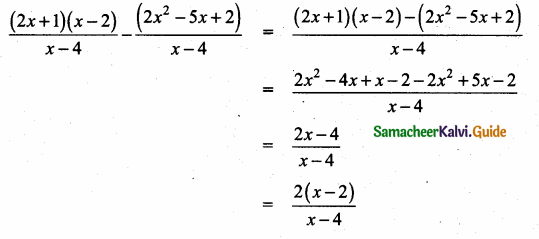
Given 3x – 2 = 0(mod 11)
3x – 2 = 11n (n may be any integer)
3x = 2 + 11n
x = \(\frac { 11n+2 }{ 3 } \)
Substitute the value of n = 2, 5, 8, 11 ….
When n ≡ 2 ⇒ x = \(\frac { 22+2 }{ 3 } \) = \(\frac { 24 }{ 3 } \) = 8
When n = 5 ⇒ x = \(\frac { 55+2 }{ 3 } \) = \(\frac { 57 }{ 3 } \) = 19
When n = 8 ⇒ x = \(\frac { 88+2 }{ 3 } \) = \(\frac { 90 }{ 3 } \) = 30
When n = 11 ⇒ x = \(\frac { 121+2 }{ 3 } \) = \(\frac { 123 }{ 3 } \) = 41
∴ The value of x is 8, 19, 30,41

Question 5.
What is the time 100 hours after 7 a.m.?
Answer:
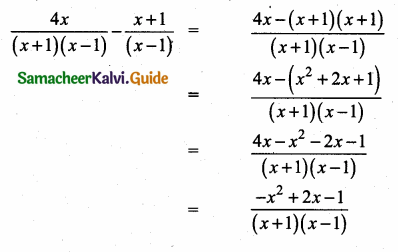
100 ≡ x (mod 12) Note: In a clock every 12 hours
100 ≡ 4 (mod 12) the numbers repeats.
Samacheer Kalvi 10th Maths Guide Chapter 2 Numbers and Sequences Ex 2.3 11
The time repeat after 7 am is 7 + 4 = 11 o’ clock (or) 11 am.

Samacheer Kalvi 10th Maths Guide Chapter 2 Numbers and Sequences Ex 2.3

Question 6.
What is time 15 hours before 11 p.m.?
Solution:
15 ≡ x (mod 12)
15 – x = 12n
15 – x is a multiple of 12 x must be 3.
Samacheer Kalvi 10th Maths Guide Chapter 2 Numbers and Sequences Ex 2.3 33
∴ The time 15 hrs before 11 O’clock is 11 – 3 = 8 O’ clock i.e. 8 p.m

Question 7.
Today is Tuesday. My uncle will come after 45 days. In which day my uncle will be coming?
Answer:
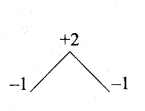
Number of days in a week = 7
45 ≡ x (mod 7)
45 ≡ 3 (mod 7)
Samacheer Kalvi 10th Maths Guide Chapter 2 Numbers and Sequences Ex 2.3 3
The value of x must be 3.
Three days after tuesday is friday uncle will come on friday.

Samacheer Kalvi 10th Maths Guide Chapter 2 Numbers and Sequences Ex 2.3

Question 8.
Prove that 2n + 6 × 9n is always divisible by 7 for any positive integer n.
Solution:
21 + 6 × 91 = 2 + 54 = 56 is divisible by 7
When n = k,
2k + 6 × 9k = 7 m [where m is a scalar]
⇒ 6 × 9k = 7 m – 2k …………. (1)
Let us prove for n = k + 1
Consider 2k+1 + 6 × 9k+1 = 2k+1 + 6 × 9k × 9
= 2k+1 + (7m – 2k)9 (using (1))
= 2k+1 + 63m – 9.2k = 63m + 2k.21 – 9.2k
= 63m – 2k (9 – 2) = 63m – 7.2k
= 7 (9m – 2k) which is divisible by 7
∴ 2n + 6 × 9n is divisible by 7 for any positive integer n

Question 9.
Find the remainder when 281 is divided by 17?
Answer:
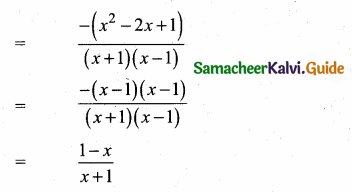
281 ≡ x(mod 17)
240 × 240 × 21 ≡ x(mod 17)
(24)10 × (24)10 × 21 ≡ x(mod 17)
(16)10 × (16)10 × 21 ≡ x(mod 17)
(162)5 × (162)5 × 21 ≡ x(mod 17)
= 1 × 1 × 2 (mod 17)
[(16)2 = 256 = 1 (mod 17)]
= 2 (mod 17)
281 = 2(mod 17)
∴ x = 2
The remainder is 2

Samacheer Kalvi 10th Maths Guide Chapter 2 Numbers and Sequences Ex 2.3

Question 10.
The duration of flight travel from Chennai to London through British Airlines is approximately 11 hours. The airplane begins its journey on Sunday at 23:30 hours. If the time at Chennai is four and half hours ahead to that of London’s time, then find the time at London, when will the flight lands at London Airport?
Answer:
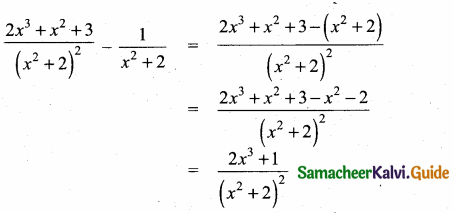
Duration of the flight time = 11 hours
(Chennai to London)
Starting time on Sunday = 23 : 30 hour
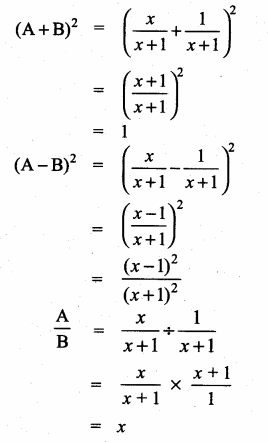
Samacheer Kalvi 10th Maths Guide Chapter 2 Numbers and Sequences Ex 2.3 4
Time difference is 4 \(\frac { 1 }{ 2 } \) horns ahead to london
The time to reach London airport = (10.30 – 4.30)
= 6 am
The first reach the london airport next day (monday) at 6 am

Samacheer Kalvi 9th Maths Guide Chapter 2 Real Numbers Ex 2.5

Students can download Maths Chapter 2 Real Numbers Ex 2.5 Questions and Answers, Notes, Samacheer Kalvi 9th Maths Guide Pdf helps you to revise the complete Tamilnadu State Board New Syllabus, helps students complete homework assignments and to score high marks in board exams.

Tamilnadu Samacheer Kalvi 9th Maths Solutions Chapter 2 Real Numbers Ex 2.5

Question 1.
Write the following in the form of \(5^n\):
(i) 625
(ii) \(\frac{1}{5}\)
(iii) \(\sqrt{5}\)
(iv) \(\sqrt{125}\)
Solution:
(i) 625 = 54
Samacheer Kalvi 9th Maths Guide Chapter 2 Real Numbers Ex 2.5 1
(ii) \(\frac{1}{5}\) = 5-1
(iii) \(\sqrt{5}\) = \(5^\frac{1}{2}\)
(iv) \(\sqrt{125}\) = \(\sqrt{5^3}\) = \((5^3)^\frac{1}{2} = 5^\frac{3}{2}\)

Samacheer Kalvi 9th Maths Guide Chapter 2 Real Numbers Ex 2.5

Question 2.
Write the following in the form of \(4^n\):
(i) 16
(ii) 8
(iii) 32
Solution:
(i) 16
= 4 × 4
= 4²

(ii) 8
= 4 × 2
= 4 × \(\left(2^{2}\right)^{\frac{1}{2}} \)
= 4 \(\times 4^{\frac{1}{2}} \)
= 4\(^{1+\frac{1}{2}} \)
= 4\(^{\frac{2+1}{2}} \)
= 4\(^{3 / 2}\)

(iii) 32
= 4 × 4 × 2
= 4² × \(\left(2^{2}\right)^{\frac{1}{2}} \)
= 4\(^{2} \times 4^{\frac{1}{2}} \)
= 4\(^{2+\frac{1}{2}} \)
= 4\(^{\frac{4+1}{2}} \)
= 4\(^{\frac{5}{2}} \)

Samacheer Kalvi 9th Maths Guide Chapter 2 Real Numbers Ex 2.5

Question 3.
Find the value of
(i) (49)\(^\frac{1}{2}\)
(ii) (243)\(^\frac{2}{5}\)
(iii) (9)\(^\frac{-3}{2}\)
(iv) \((\frac{64}{125})^\frac{-2}{3}\)
Solution:
(i) 49\(^\frac{1}{2}\) = \((7^2)^\frac{1}{2}\) = 7\(^{2 × \frac{1}{2}}\) = 7
(ii) (243)\(^\frac{2}{5}\) = \((3^5)^\frac{2}{5}\) = 3\(^{5 × \frac{2}{5}}\) = 3² = 9
Samacheer Kalvi 9th Maths Guide Chapter 2 Real Numbers Ex 2.5 2
(iii) \(9^{\frac{-3}{2}}=\left(3^{2}\right)^{\frac{-3}{2}}=3^{2 \times \frac{-3}{2}}=3^{-3}=\frac{1}{3^{3}}=\frac{1}{27}\)
(iv) \(\left(\frac{64}{125}\right)^{\frac{-2}{3}}=\left(\frac{4^{3}}{5^{3}}\right)^{\frac{-2}{3}}=\left[\left(\frac{4}{5}\right)^{3}\right]^{\frac{-2}{3}}=\left(\frac{4}{5}\right)^{3 \times \frac{-2}{3}}=\left(\frac{4}{5}\right)^{-2}=\frac{4^{-2}}{5^{-2}}=\frac{5^{2}}{4^{2}}=\frac{25}{16} \)

Samacheer Kalvi 9th Maths Guide Chapter 2 Real Numbers Ex 2.5

Question 4.
Use a fractional index to write:
(i) \(\sqrt{5}\)
(ii) \(\sqrt[2]{7}\)
(iii) (\(\sqrt[3]{49})^{5}\)
(iv) \((\frac{1}{\sqrt[3]{100}})^{7}\)
Solution:
(i) \(\sqrt{5}\) = (5)\(^\frac{1}{2}\)
(ii) \(\sqrt[2]{7}\) = 7\(^\frac{1}{2}\)
(iii) \((\sqrt[3]{49})^{5}=\left[(49)^{\frac{1}{3}}\right]^{5}=\left[\left(7^{2}\right)^{\frac{1}{3}}\right]^{5}=\left(7^{\frac{2}{3}}\right)^{5}=7^{\frac{2}{3} \times 5}=7^{\frac{10}{3}}\)
(iv) \(\left(\frac{1}{\sqrt[3]{100}}\right)^{7}=\left[\frac{1}{\sqrt[3]{10^{2}}}\right]^{7}=\left[\frac{1}{\left(10^{2}\right)^{1 / 3}}\right]^{7}=\left[\frac{1}{10^{2 / 3}}\right]^{7}=\left(10^{\frac{-2}{3}}\right)^{7}=10^{\frac{-2}{3} \times 7}=10^{\frac{-14}{3}}\)

Samacheer Kalvi 9th Maths Guide Chapter 2 Real Numbers Ex 2.5

Question 5.
Find the 5th root of:
(i) 32
(ii) 243
(iii) 100000
(iv) \(\frac{1024}{3125}\)
Solution:
(i) \(\sqrt[5]{32}=(32)^{\frac{1}{5}}=\left(2^{5}\right)^{\frac{1}{5}}=2^{5 \times \frac{1}{5}} \) = 2
Samacheer Kalvi 9th Maths Guide Chapter 2 Real Numbers Ex 2.5 3
(ii) \(\sqrt[5]{243}=(243)^{\frac{1}{5}}=\left(3^{5}\right)^{\frac{1}{5}}=3^{5 \times \frac{1}{5}}\) = 3
Samacheer Kalvi 9th Maths Guide Chapter 2 Real Numbers Ex 2.5 4
(iii) \(\sqrt[5]{100000}=(100000)^{\frac{1}{5}}=\left(10^{5}\right)^{\frac{1}{5}}\)
= \(10^{5}\times{\frac{1}{5}}\)
Samacheer Kalvi 9th Maths Guide Chapter 2 Real Numbers Ex 2.5 5

Samacheer Kalvi 9th Maths Guide Chapter 2 Real Numbers Ex 2.5

Samacheer Kalvi 9th Maths Guide Chapter 2 Real Numbers Ex 2.4

Students can download Maths Chapter 2 Real Numbers Ex 2.4 Questions and Answers, Notes, Samacheer Kalvi 9th Maths Guide Pdf helps you to revise the complete Tamilnadu State Board New Syllabus, helps students complete homework assignments and to score high marks in board exams.

Tamilnadu Samacheer Kalvi 9th Maths Solutions Chapter 2 Real Numbers Ex 2.4

Question 1.
Represent the following numbers on the number line.
(i) 5.348
Solution:
5.348 lies between 5 and 6.
Samacheer Kalvi 9th Maths Guide Chapter 2 Real Numbers Ex 2.4 1
Steps of construction:
1. Divide the distance between 5 and 6 into 10 equal intervals.
2. Mark the point 5.3 which is the sixth from the left of 6 and 3 from the right of 5.
3. 5.34 lies between 5.3 and 5.4. Divide the distance into 10 equal intervals.
4. Mark the point 5.34 which is sixth from the left of 5.40
5. 5.348 lies between 5.34 and 5.35. Divide the distance into 10 equal intervals.
6. Mark a point 5.348 which is second from the left of 5.350 and seventh form the right of 5.340

Samacheer Kalvi 9th Maths Guide Chapter 2 Real Numbers Ex 2.4

(ii) 6.\(\overline {4}\) upto 3 decimal places.
Solution:
6.\(\overline {4}\) = 6.4444
6.\(\overline {4}\) = 6.444 (correct to 3 decimal places)
The number lies between 6 and 7.
Samacheer Kalvi 9th Maths Guide Chapter 2 Real Numbers Ex 2.4 2
Steps of construction:
1. Divide the distance between 6 and 7 into 10 equal intervals.
2. Mark the point 6.4 which is the sixth from the left of 7 and fourth from the right of 6.
3. 6.44 lies between 6.44 and 6.45. Divide the distance into 10 equal intervals.
4. Mark the point 6.44 which is sixth from the left of 6.5 and fourth from the right of 6.40.
5. Mark the point 6.444 which is sixth from the left of 6.450 and fourth from the right of 6.440.

Samacheer Kalvi 9th Maths Guide Chapter 2 Real Numbers Ex 2.4

(ii) 4.\(\overline {73}\) upto 4 decimal places.
Solution:
4.\(\overline {73}\) = 4.737373……..
= 4.737374 (correct to 4 decimal places 4.7374 lies between 4 and 5)
Samacheer Kalvi 9th Maths Guide Chapter 2 Real Numbers Ex 2.4 3
Steps of construction:
1. Divide the distance between 4 and 5 into 10 equal parts.
2. Mark the point 4.7 which is third from the left of 5 and seventh from the right of 4.
3. 4.73 lies between 4.7 and 4.8. Divide the distance into 10 equal intervals.
4. Mark the point 4.73 which is seventh from the left of 4.80 and third from the left of 4.70.
5. 4.737 lies between 4.73 and 4.74. Divide the distance into 10 equal intervals.
6. Mark the point 4.737 which is third from the left of 4.740 and seventh from the right of 4.730.
7. 4.7374 lies between 4.737 and 4.738. Divide the distance into 10 equal intervals.
8. Mark the point 4.7374 which is sixth from the left of 4.7380 and fourth from the right of 4.7370.

Samacheer Kalvi 9th Maths Guide Chapter 2 Real Numbers Ex 2.4

Samacheer Kalvi 9th Maths Guide Chapter 1 Set Language Additional Questions

Students can download Maths Chapter 1 Set Language Additional Questions and Answers, Notes, Samacheer Kalvi 9th Maths Guide Pdf helps you to revise the complete Tamilnadu State Board New Syllabus, helps students complete homework assignments and to score high marks in board exams.

Tamilnadu Samacheer Kalvi 9th Maths Solutions Chapter 1 Set Language Additional Questions

Choose the correct answer

Question 1.
A = {set of odd natural numbers}, B = {set of even natural numbers}, then A and B are……….
(a) equal set
(b) equivalent sets
(c) overlapping sets
(d) disjoint sets
Solution:
(d) disjoint sets

Question 2.
Number of subsets in set A = {1, 2, 3} is
(a) 3
(b) 6
(c) 8
(d) 9
Solution:
(c) 8

Samacheer Kalvi 9th Maths Guide Chapter 1 Set Language Additional Questions

Question 3.
The set does not have a proper subset is
(a) Finite set
(b) Infinite set
(c) Null set
(d) Singleton set
Solution:
(c) Null set

Question 4.
Sets having the same number of elements are called
(a) overlapping sets
(b) disjoints sets
(c) equivalent sets
(d) equal sets
Solution:
(c) equivalent sets

Question 5.
The set (A – B) ∪ (B – A) is
(a) AΔB
(b) A∪B
(c) A∩B
(d) A’∪B’
Solution:
(a) AΔB

Samacheer Kalvi 9th Maths Guide Chapter 1 Set Language Additional Questions

Question 6.
The set of (A∪B) – (A∩B) is
(a) (A∪B)’
(b) AΔB
(c) (A∩B)’
(d) A’∪B’
Solution:
(b) AΔB

Question 7.
The set {x : x ∈ A, x ∈ B, x ∉ A∩B} is
(a) A∩B
(b) A∪B
(c) A – B
(d) AΔB
Solution:
(d) AΔB

Question 8.
The number of elements of the set {x : x ∈ Z , x² = 1} is
(a) 0
(b) 1
(c) 2
(d) 3
Solution:
(c) 2

Samacheer Kalvi 9th Maths Guide Chapter 1 Set Language Additional Questions

Question 9.
If A is a proper subset of B, then A∩B =…………..
(a) A
(b) B
(c) 0
(d)A∪B
Solution:
(a) A

Question 10.
The shade region with adjoint diagram represents ……….
Samacheer Kalvi 9th Maths Guide Chapter 1 Set Language Additional Questions 1
(a) A – B
(b) B – A
(c) A’
(d) B’
Solution:
(c) A’

Question 11.
From the given venn diagram (A∪B)’ is ………..
Samacheer Kalvi 9th Maths Guide Chapter 1 Set Language Additional Questions 2
(a) {5, 6}
(b) {1, 2, 3, 4, 7}
(c) {1, 2, 3, 4, 5, 6, 7}
(d) {8, 9}
Solution:
(d) {8, 9}

Samacheer Kalvi 9th Maths Guide Chapter 1 Set Language Additional Questions

Question 12.
If n(A∪B∪C) = 73, n(A) = 2x, n(B) = 3x, n(C) = 5x, n(A∩B) = 10, n(B∩C) = 15, n(A∩C) = 5 and n(A∩B∩C) = 3, then the value of x is ………
(a) 9
(b) 10
(c) 5
(d) 18
Solution:
(b) 10

Question 13.
For any three sets, n(A∪B∪C) = 60, n(A) = 25, n(B) = 20, n(C) = 15, n(A∩B) = 10, n(B∩C) = 7, n(A∩C) = 3, then n(A∩B∩C) is……….
(a) 10
(b) 15
(c) 20
(d) 25
Solution:
(c) 20

Question 14.
If n(U) = 70, n(A) = 25, n(B) = 30, n(A∩B) = 5, then n(A∪B)’ is……….
(a) 5
(b) 10
(c) 15
(d) 20
Solution:
(d) 20

Samacheer Kalvi 9th Maths Guide Chapter 1 Set Language Additional Questions

Question 15.
Which of the following is not correct?
(a) A – (B∪C) = (A – B) ∩ (A – C)
(b) A – (B∩C) = (A – B) ∪ (A – C)
(c) (A∪B)’ = A’∩B’
(d) A’∪B’ = (A – B)’
Solution:
(d) A’∪B’ = (A – B)’

Answer the following questions.

Question 1.
Write the following in “Roster” form?
(a) A = set of the months having 31 days.
(b) B = {x : x is a natural number of 2 digits divisible by 13}
(c) C = {set of vowels in the word “father”}
(d) D = {x : 5 < x ≤ 10; x ∈ N}
(e) E = {x : x is a square natural number less than 16}
Solution:
(a) A = {Jan, March, May, July, Aug, Oct, Dec}
(b) B = {13, 26, 39, 52, 65, 78, 91}
(c) C = {a, e}
(d) D = {6, 7, 8, 9, 10}
(e) E = {1, 4, 9}

Samacheer Kalvi 9th Maths Guide Chapter 1 Set Language Additional Questions

Question 2.
Given that A = {1, 3, 5, 7} B = {1, 2, 4, 6, 8}. Find
(i) AΔB and
(ii) BΔA
Solution:
(i) A = {1, 3, 5, 7}; B = {1, 2, 4, 6, 8}
A – B = {1, 3, 5, 7} – {1, 2, 4, 6, 8}
= {3, 5, 7}
B – A = {1, 2, 4, 6, 8} – {1, 3, 5, 7}
= {2, 4, 6, 8}
AΔB = (A – B) ∪ (B – A)
= {3, 5, 7} ∪ {2, 4, 6, 8}
= {2, 3, 4, 5, 6, 7, 8}
(ii) BΔA = (B – A) ∪ (A – B)
= {2, 4, 6, 8} ∪ {3, 5, 7}
= {2, 3, 4, 5, 6, 7, 8}

Question 3.
From the venn-diagram, list the following:
Samacheer Kalvi 9th Maths Guide Chapter 1 Set Language Additional Questions 3
(i) A
(ii) B
(iii) A∩B
(iv)A∪B
(v) A – B
(vi) B – A
(vii) (A – B) ∩ (B – A)
Solution:
(i) A = {1, 2, 5, 6, 7}
(ii) B = {3, 4, 5, 6}
(iii) A∩B = {5, 6}
(iv) A∪B = {1, 2, 3, 4, 5, 6, 7}
(v) A – B = {1, 2, 7}
(vi) B – A = {3, 4}
(vii) (A – B) ∩ (B – A) = { }

Samacheer Kalvi 9th Maths Guide Chapter 1 Set Language Additional Questions

Question 4.
In a class there are 40 students. 26 have opted for Mathematics and 24 have opted for Science. How many student have opted for Mathematics and Science.
Solution:
Let M be the set of students opting for Mathematics.
Let S be the set of students opting for Science.
n (M∪S) = 40, n (M) = 26, n(S) = 24
n(M∪S) = n (M) + n (S)- n(M∩S)
40 = 26 + 24 – n(M∩S)
n (M∩S) = 26 + 24 – 40 = 50 – 40 = 10
∴ Number of students opted for Mathematics and Science = 10.
Another Method:
Let “x” be the number of students opted for Mathematics and Science.
Let M and S represent students opting Mathematics and Science.
n(M∪S) = 40, n(M) = 26, n(S) = 24
Samacheer Kalvi 9th Maths Guide Chapter 1 Set Language Additional Questions 4
By venn-diagram, number of students in a class = 26 – x + x + 24 – x
40 = 50 – x
x = 50 – 40 = 10
x = 10
∴ Number of students opted for Mathematics and Science = 10.

Samacheer Kalvi 9th Maths Guide Chapter 1 Set Language Additional Questions

Question 5.
If U = {1, 2, 3, 4, 5, 6, 7, 8, 9}, A = {4, 5, 7, 9}, B = {1, 3, 5, 7, 8}, Verify De Morgan’s Laws for complementation.
De Morgan’s Laws (i) (A∪B)’ = A’∩B’ (ii) (A∩B)’ = A’∪B’
Solution:
(i) A∪B = {4, 5, 7, 9} ∪ {1, 3, 5, 7, 8}
= {1, 3, 4, 5, 7, 8, 9}
(A∪B)’ = {1, 2, 3, 4, 5, 6, 7, 8, 9} – {1, 3, 4, 5, 7, 8, 9}
= {2, 6}……….(1)
A’= {1, 2, 3, 4, 5, 6, 7, 8, 9} – {4, 5, 7, 9}
= {1, 2, 3, 6, 8}
B’ = {1, 2, 3, 4, 5, 6, 7, 8, 9} – {1, 3, 5, 7, 8}
= {2, 4, 6, 9}
A’∩B’ = {1, 2, 3, 6, 8} ∩ {2, 4, 6, 9}
= {2, 6}………(2)
From (1) and (2) we get (A∪B)’ = A’∩B’.

(ii) A∩B = {4, 5, 7, 9} ∩ {1, 3, 5, 7, 8}
= {5, 7}
(A∩B)’= {1, 2, 3, 4, 5, 6, 7, 8, 9} – {5, 7}
= {1, 2, 3, 4, 6, 8, 9}………(1)
A’ = {1, 2, 3, 6, 8}
B’ = {2, 4, 6, 9}
A’∪B’ = {1, 2, 3, 6, 8} ∪ {2, 4, 6, 9}
= {1, 2, 3, 4, 6, 8, 9}………(2)
From (1) and (2) we get (A∩B)’ = A’∪B’.

Samacheer Kalvi 9th Maths Guide Chapter 1 Set Language Ex 1.3

Students can download Maths Chapter 1 Set Language Ex 1.3 Questions and Answers, Notes, Samacheer Kalvi 9th Maths Guide Pdf helps you to revise the complete Tamilnadu State Board New Syllabus, helps students complete homework assignments and to score high marks in board exams.

Tamilnadu Samacheer Kalvi 9th Maths Solutions Chapter 1 Set Language Ex 1.3

Question 1.
Using the given venn diagram, write the elements of
Samacheer Kalvi 9th Maths Guide Chapter 1 Set Language Ex 1.3 1
(i) A
(ii) B
(iii) A∪B
(iv) A∩B
(v) A – B
(vi) B – A
(vii) A’
(viii) B’
(ix) U
Solution:
(i) A = {2, 4, 7, 8, 10}
(ii) B = {3, 4, 6, 7, 9, 11}
(iii) A∪B = {2, 3, 4, 6, 7, 8, 9, 10, 11}
(iv) A∩B = {4, 7}
(v) A – B = {2, 8, 10}
(vi) B – A = {3, 6, 9, 11}
(vii) A’ = {1, 3, 6, 9, 11, 12}
(viii) B’ = {1,2, 8, 10, 12}
(ix) U = {1, 2, 3, 4, 6, 7, 8, 9, 10, 11, 12}

Samacheer Kalvi 9th Maths Guide Chapter 1 Set Language Ex 1.3

Question 2.
Find A∪B, A∩B, A – B and B – A for the following sets
(i) A = {2, 6, 10, 14} and B = {2, 5, 14, 16}
Solution:
A∪B = {2, 6, 10, 14} ∪ {2, 5, 14, 16}
= {2, 5, 6, 10, 14, 16}
A∩B = {2, 6, 10, 14} ∩ {2, 5, 14, 16}
= {2, 14}
A – B = {2, 6, 10, 14} – {2, 5, 14, 16}
= {6, 10}
B – A = {2, 5, 14, 16} – {2, 6, 10, 14}
= {5, 16}

(ii) A = {a, b, c, e, u} and B = {a, e, i, o, u}
Solution:
A∪B = {a, b, c, e, u} ∪ {a, e, i, o, u}
= {a, b, c, e, i, o, u}
A∩B = {a, b, c, e, u} ∩ {a, e, i, o, u}
= {a, e, u}
A – B = {a, b, c, e, u} – {a, e, i, o, u}
= {b, c}
B – A = {a, e, i, o, u} – {a, b, c, e, u}
= {i, o}

(iii) A = {x : x ∈ N, x ≤ 10} and B = {x : x ∈ W, x < 6}
Solution:
A = {1, 2, 3, 4, 5, 6,7, 8, 9, 10} and B = {0, 1, 2, 3, 4, 5}
A∪B = {1, 2, 3, 4, 5, 6, 7, 8, 9, 10} ∪ {0, 1, 2, 3, 4, 5}
= {0, 1, 2, 3, 4, 5, 6, 7, 8, 9, 10}
A∩B = {1, 2, 3, 4, 5, 6, 7, 8, 9, 10} ∩ {0, 1, 2, 3, 4, 5}
= {1, 2, 3, 4, 5}
A – B = {1, 2, 3, 4, 5, 6, 7, 8, 9, 10} – {0, 1, 2, 3, 4, 5}
= {6, 7, 8, 9, 10}
B – A = {0, 1, 2, 3, 4, 5} – {1, 2, 3, 4, 5, 6, 7, 8, 9, 10}
= {0}

(iv) A = Set of all letters in the word “mathematics” and B = Set of all letters in the word “geometry”
Solution:
A = {m, a, t, h, e, i, c, s}
B = {g, e, o, m, t, r, y}
A∪B = {m, a, t, h, e, i, c, s} ∪ {g, e, o, m, t, r, y}
= {a, c, e, g, h, i, m, o, r, s, t, y}
A∩B= {m, a, t, h, e, i, c, s} ∩ {g, e, o, m, t, r, y}
= {e, m, t}
A – B = {m, a, t, h, e, i, c, 5} – {g, e, o, m, t, r, y}
= {a, c, h, i, s}
B -A = {g, e, o, m, t, r, y} – {m, a, t, h, e, i, c, s}
= {g, o, r, y}

Samacheer Kalvi 9th Maths Guide Chapter 1 Set Language Ex 1.3

Question 3.
If U = {a, b, c, d, e, f, g, h), A = {b, d, f, h} and B = {a, d, e, h}, find the following sets.
(i) A’
Solution:
A’ = U – A
= {a, b, c, d, e, f, g, h} – {b, d, f, h)
= {a, c, e, g}

(ii) B’
Solution:
B’ = U – B
= {a, b, c, d, e, f, g, h} – {a, d, e, h}
= {b, c, f, g}

(iii) A’∪B’
Solution:
A’∪B’ = {a, c, e, g} ∪ {b, c,f, g}
= {a, b, c, e, f, g}

(iv) A’∩B’
Solution:
A’∩B’ = {a, c, e, g} ∩ {b, c, f, g}
= {c, g}

(v) (A∪B)’
Solution:
A∪B = {b, d, f, h} ∪ {a, d, e, h}
= {a, b, d, e, f, h}
(A∪B)’ = U – (A∪B)
= {a, b, c, d, e, f, g, h} – {a, b, d, e, f, h}
= {c, g}

(vi) (A∩B)’
Solution:
(A∩B) = {b, d, f, h) ∩ {a, d, e, h)
= {d, h}
(A∩B)’ = U – (A∩B)
= {a, b, c, d, e, f, g, h} – {d, h}
= {a, b, c, e, f, g}

(vii) (A’)’
Solution:
A’ = {a, c, e, g}
(A’)’ = U – A’
= {a, b, c, d, e, f, g, h} – {a, c, e, g}
= {b, d, f, h}

(viii) (B’)’
Solution:
B’ = {b, c, f, g}
(B’)’ = U – B’
= {a, b, c, d, e, f, g, h) – {b, c, f, g)
= {a, d, e, h}

Samacheer Kalvi 9th Maths Guide Chapter 1 Set Language Ex 1.3

Question 4.
Let U = {0, 1, 2, 3, 4, 5, 6, 7} A = {1, 3, 5, 7} and B = {0, 2, 3, 5, 7}, find the following sets.
(i) A’
Solution:
A’ = U – A
= {0, 1, 2, 3, 4, 5, 6, 7} – {1, 3, 5, 7}
= {0, 2, 4, 6}

(ii) B’ = U – B
Solution:
= {0, 1, 2, 3, 4, 5, 6, 7} – {0, 2, 3, 5, 7}
= {1, 4, 6}

(iii) A’∪B’
Solution:
A’∪B’ = {0, 2, 4, 6,}∪{1, 4, 6}
{0, 1, 2, 4, 6}

(iv) A’∩B’
Solution:
A’∩B’ = {0, 2, 4, 6,}∩{1, 4, 6}
{4, 6}

(v) (A∪B)’
Solution:
A∪B = {1, 3, 5, 7}∪{0, 2, 3, 5, 7}
= {0, 1, 2, 3, 5, 7}
(A∪B)’ = U – (A∪B)
{0, 1, 2, 3, 4, 5, 6, 7} – {0, 1, 2, 3, 5, 7}
{4, 6}

(vi) (A∩B)’
Solution:
(A∩B)= {1, 3, 5, 7}∩{0, 2, 3, 5, 7}
= {3, 5, 7}
(A∩B)’ = U – (A∩B)
= {0, 1, 2, 3, 4, 5, 6, 7} – {3, 5, 7}
= {0, 1, 2, 4, 6}

(vii) (A’)’
A’ = {0, 2, 4, 6}
(A’)’ = U – A’
= {0, 1, 2, 3, 4, 5, 6, 7} – {0, 2, 4, 6}
= {1, 3, 5, 7}

(viii) (B’)’
B’ = {1, 4, 6}
(B’)’ = {0, 1, 2, 3, 4, 5, 6, 7} – {1, 4, 6}
= {0, 2, 3, 5, 7}

Samacheer Kalvi 9th Maths Guide Chapter 1 Set Language Ex 1.3

Question 5.
Find the symmetric difference between the following sets.
(i) P = {2, 3, 5, 7, 11} and Q = {1, 3, 5, 11}
Solution:
Use anyone of the formula to find A & B
AΔB = (A – B)∪(B – A) or AΔB = (A∪B) – (A∩B)
P∪Q = {2, 3, 5, 7, 11} ∪ {1,3,5, 11}
= {1, 2, 3, 5, 7, 11}
P∩Q = {2, 3, 5, 7, 11}∩{1, 3, 5,11}
= {3, 5, 11}
PΔQ = (P∪Q) – (P∩Q)
= {1, 2, 3, 5, 7, 11} – {3, 5, 11}
= {1, 2, 7}
(OR)
P – Q = {2, 3, 5, 7, 11} – {1, 3, 5, 11}
= {2,7}
Q – P = {1, 3, 5, 11} – {2, 3, 5, 7, 11}
= {1}
PΔQ = (P – Q)∪(Q – P)
= {2, 7} ∪ {1}
= {1, 2, 7}

(ii) R = {l, m, n, o, p} and S = {j, l, n, q}
Solution:
R- S = {l, m, n, o, p} – {j, l, n, q}
= {m, o, p}
S – R = {j, l, n, q} – {l, m, n, o, p}
= {j, q}
RΔS = (R – S)∪(S – R)
= {m, o, p} – {j, q} = {j, m, o, p, q)
(OR)
R∪S = {l, m, n, o, p} ∪ {j,l,n,q}
= {l, m, n, o, p, j, q}
R∩S = {l, m, n, o,p} ∩ {j, l, n, q}
= {l, n}
RΔS = (R∪S) – (R∩S)
= {l, m, n, o, p, j, q} – { l, n}
= {m, o, p, j, q}

(iii) X = {5, 6, 7} and Y = {5, 7, 9, 10}
Solution:
X∪Y = {5, 6, 7} ∪ {5, 7, 9, 10}
= {5 ,6, 7, 9, 10}
X∩Y = {5, 6, 7} ∩ {5, 7, 9, 10}
= {5, 7}
XΔY = (X∪Y) – (X∩Y)
= {5, 6, 7, 9, 10} – {5, 7}
= {6, 9, 10}
OR
X – Y = {5, 6, 7} – {5, 7, 9, 10} = {6}
Y – X = {5, 7, 9, 10} – {5, 6, 7} = {9, 10}
XΔY = (X – Y) ∪ (Y – X)
= {6}∪{9, 10}
= {6, 9, 10}

Samacheer Kalvi 9th Maths Guide Chapter 1 Set Language Ex 1.3

Question 6.
Using the set symbols, write down the expressions for the shaded region in the following
Samacheer Kalvi 9th Maths Guide Chapter 1 Set Language Ex 1.3 2
Solution:
Samacheer Kalvi 9th Maths Guide Chapter 1 Set Language Ex 1.3 3

Question 7.
Let A and B be two overlapping sets and the universal set U. Draw appropriate Venn diagram for each of the following,
(i) A∪B
(ii) A∩B
(iii) (A∩B)’
(iv) (B – A)’
(v) A’∪B’
(Vi) A’∩B’
(vii) What do you observe from the Venn diagram (iii) and (v)?
Solution:
(i) A∪B
Samacheer Kalvi 9th Maths Guide Chapter 1 Set Language Ex 1.3 4

(ii) A∩B
Samacheer Kalvi 9th Maths Guide Chapter 1 Set Language Ex 1.3 5

(iii) (A∩B)’
Samacheer Kalvi 9th Maths Guide Chapter 1 Set Language Ex 1.3 6

(iv) (B – A)’
Samacheer Kalvi 9th Maths Guide Chapter 1 Set Language Ex 1.3 7

(v) A’∪B’
Samacheer Kalvi 9th Maths Guide Chapter 1 Set Language Ex 1.3 8

(Vi) A’∩B’
Samacheer Kalvi 9th Maths Guide Chapter 1 Set Language Ex 1.3 9

Samacheer Kalvi 9th Maths Guide Chapter 1 Set Language Ex 1.3

(vii) What do you observe from the diagram (iii) and (v)?
From the diagram (iii) and (v) we get (A∩B)’ = A’∪B’
Samacheer Kalvi 9th Maths Guide Chapter 1 Set Language Ex 1.3 10