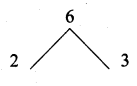
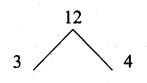
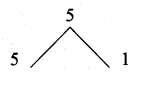
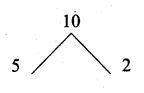
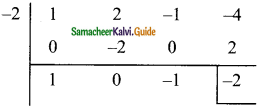
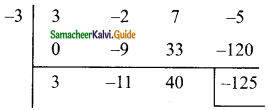
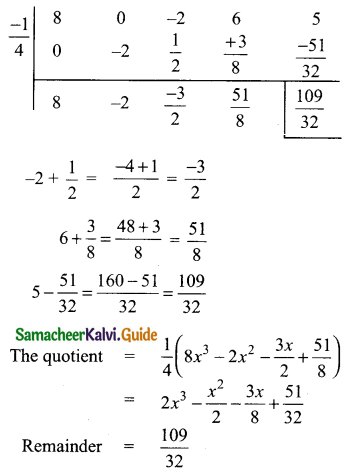
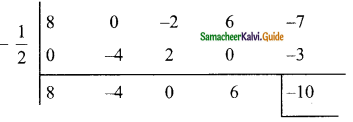
Samacheer Kalvi 9th Maths Guide Chapter 1 Set Language Ex 1.7

Students can download Maths Chapter 1 Set Language Ex 1.7 Questions and Answers, Notes, Samacheer Kalvi 9th Maths Guide Pdf helps you to revise the complete Tamilnadu State Board New Syllabus, helps students complete homework assignments and to score high marks in board exams.

Tamilnadu Samacheer Kalvi 9th Maths Solutions Chapter 1 Set Language Ex 1.7

I. Multiple Choice Questions.

Question 1.
Which of the following is correct?
(a) {7} ∈ {1, 2, 3, 4, 5, 6, 7, 8, 9, 10}
(b) 1 ∈ {1, 2, 3, 4, 5, 6, 7, 8, 9, 10}
(c) 7 ∉ {1, 2, 3, 4, 5, 6, 7, 8, 9, 10}
(d) {7} {1, 2, 3, 4, 5, 6, 7, 8, 9, 10}
Solution:
(b) 1 ∈ {1, 2, 3, 4, 5, 6, 7, 8, 9, 10}

Question 2.
The set P = {x | x ∈ Z, -1 < x < 1} is a ……….
(a) Singleton set
(b) Power set
(c) Null set
(d) Subset
Solution:
(a) Singleton set
Hint: P = {0}

Samacheer Kalvi 9th Maths Guide Chapter 1 Set Language Ex 1.7

Question 3.
If U = {x | x ∈ N, x < 10} and A = {x | x ∈ N, 2 ≤ x < 6} then (A’)’ is………..
{a) {1, 6, 7, 8, 9}
(b) {1, 2, 3, 4}
(c) {2, 3, 4, 5}
(d) { }
Solution:
(c) {2, 3, 4, 5}
Hint:
U = {1, 2, 3, 4, 5, 6, 7, 8, 9}
A= {2, 3, 4, 5}; A’ = {1, 6, 7, 8, 9}
(A’)’ = U – A
(A’)’ = {2, 3, 4, 5}

Question 4.
If B⊆A then n(A∩B) is………..
(a) n(A – B)
(b) n(B)
(c) n(B – A)
(d) n(A)
Solution:
(b) n(B)

Samacheer Kalvi 9th Maths Guide Chapter 1 Set Language Ex 1.7

Question 5.
If A = {x, y, z} then the number of non- empty subsets of A is…………..
(a) 8
(b) 5
(c) 6
(d) 7
Solution:
(d) 7
Hint:
n(A) = 3; P(A) = 2m = 23 = 8
Non-empty subsets of A = 8 – 1 = 7

Question 6.
Which of the following is correct?
(a) Ø ⊆ {a, b}
(b) Ø ∈ {a, b}
(c) {a} ∈ {a, b}
(d) a ⊆ {a, b}
Solution:
(a) Ø ⊆ {a, b}
Hint:
‘Q’ is a subset of every set.

Samacheer Kalvi 9th Maths Guide Chapter 1 Set Language Ex 1.7

Question 7.
If A∪B = A∩B then ……………
(a) A ≠ B
(b) A = B
(c) A ⊂ B
(d) B ⊂ A
Solution:
(b) A = B

Question 8.
If B – A is B, then A∩B is………….
(a) A
(b) B
(c) U
(d) Ø
Solution:
(d) Ø

Samacheer Kalvi 9th Maths Guide Chapter 1 Set Language Ex 1.7

Question 9.
From the adjacent diagram n[P(AΔB)] is………….
Samacheer Kalvi 9th Maths Guide Chapter 1 Set Language Ex 1.7 1
(a) 8
(b) 16
(c) 32
(d) 64
Solution:
(c) 32
Hint:
A – B = {60, 85, 75}
B – A = {90, 70}
AΔB = (A – B) ∪ (B – A)
= {60, 70, 75, 85, 90}
n[P(AΔB)] = 25 = 32

Question 10.
If n(A) = 10 and n(B) = 15 then the minimum and maximum number of elements in A∩B is …………
(a) (10, 15)
(b) (15, 10)
(c) (10, 0)
(d) (0, 10)
Solution:
(d) (0, 10)

Samacheer Kalvi 9th Maths Guide Chapter 1 Set Language Ex 1.7

Question 11.
Let A = {Ø} and B = P(A) then A∩B is………..
(a) {Ø, {Ø}}
(b) {Ø}
(c) Ø
{d) {0}
Solution:
(b) {Ø}
Hint:
A = {Ø}, B = {{ }, {Ø}}
A∩B = {Ø}

Question 12.
In a class of 50 boys, 35 boys play carrom and 20 boys play chess then the number of boys play both games is……..
(a) 5
(b) 30
(c) 15
(d) 10
Solution:
(a) 5
Hint:
n(A∪B) = 50, n(A) = 35, n(B) = 20
n(A∩B) = n(A) + n(B) – n(A∪B)
= 35 + 20 – 50 = 5

Question 13.
If U = {x : x ∈ N and x < 10}, A = {1, 2, 3, 5, 8} and B = (2, 5, 6, 7, 9}, then n [(A∪B)’] is
(a) 1
(b) 2
(c) 4
(d) 8
Solution:
(a) 1
Hint:
U = {1, 2, 3, 4, 5, 6, 7, 8, 9}
A∪B ={1, 2, 3, 5, 8} ∪ {2, 5, 6, 7, 9}
= {1, 2, 3, 5, 6, 7, 8, 9}
(A∪B)’ = {1, 2, 3, 4, 5, 6, 7, 8, 9} – {1, 2, 3, 5, 6, 7, 8, 9}
= {4}
n(A∪B)’ = 1

Samacheer Kalvi 9th Maths Guide Chapter 1 Set Language Ex 1.7

Question 14.
For any three sets P, Q and R, P – (Q∩R) is ………
(a) P – (Q∪R)
(i)(P∩Q) – R
(c) (P – Q) ∪ (P – R)
(d) (P – Q) ∩ (P – R)
Solution:
(c)(P – Q) ∪ (P – R)

Question 15.
Which of the following is true?
(a) A – B = A∩B
(b) A – B = B – A
(c) (A∪B)’ = A’∪B’
(d) (A∩B)’ = A’∪B’
Solution:
(d) (A∩B)’ = A’∪B’

Samacheer Kalvi 9th Maths Guide Chapter 1 Set Language Ex 1.7

Question 16.
If n(A∪B∪C) = 100, n(A) = 4x, n(B) = 6x, n(C) = 5x, n(A∩B) = 20, n(B∩C) = 15 and n(A∩C) = 25, then n(A∩B∩C) = 10, then the value of x is……….
(a) 10
(b) 15
(c) 25
(d) 30
Solution:
(b) 15
Hint:
n(A∪B∪C) = n( A) + n(B) + n(C) – n(A∩B) – n(B∩C) – n(A∩C) + n(A∩B∩C)
100 = 4x + 6x + 5x – 20 – 15 – 25 + 10
100 = 15x – 50 ⇒ 150 = 15x ⇒ x = \(\frac{150}{15}\) = 10

Question 17.
For any three sets A, B and C, (A – B) ∩ (B – C) is equal to
(a) A only
(b) B only
(c) C only
(d) \(\phi \)
Solution:
(d) \(\phi \)
Samacheer Kalvi 9th Maths Guide Chapter 1 Set Language Ex 1.7 2

Samacheer Kalvi 9th Maths Guide Chapter 1 Set Language Ex 1.7

Question 18.
If J = Set of three sided shapes, K = Set of shapes with two equal sides and L = Set of shapes with right angle, then J∩K∩L is………
(a) Set of isosceles triangles
(b) Set of equilateral triangles
(c) Set of isosceles right triangles
(d) Set of right angled triangles
Solution:
(c) Set of isosceles right triangles
J = Set of three sided shapes; It is a triangle
K = Set of shapes with two equal sides (Isosceles triangle)
L = Set of shapes with right angle (One angle is right angle)
∴ J∩K∩L = Set of isosceles right triangles

Question 19.
The shaded region in the Venn diagram is
Samacheer Kalvi 9th Maths Guide Chapter 1 Set Language Ex 1.7 3
(a) Z – (X∪Y)
(b) (X∪Y) ∩ Z
(c) Z – (X∩Y)
(d) Z ∪ (X∩Y)
Solution:
(c) Z – (X∩Y)

Samacheer Kalvi 9th Maths Guide Chapter 1 Set Language Ex 1.7

Question 20.
In a city, 40% people like only one fruit, 35% people like only two fruits, 20% people like all the three fruits. How many percentage of people do not like any one of the above three fruits?
(a) 5
(b) 8
(c) 10
(d) 15
Solution:
(a) 5

Samacheer Kalvi 10th Maths Guide Chapter 1 Relations and Functions Ex 1.1

Students can download Maths Chapter 1 Relations and Functions Ex 1.1 Questions and Answers, Notes, Samacheer Kalvi 10th Maths Guide Pdf helps you to revise the complete Tamilnadu State Board New Syllabus, helps students complete homework assignments and to score high marks in board exams.

Tamilnadu Samacheer Kalvi 10th Maths Solutions Chapter 1 Relations and Functions Ex 1.1

1. Find A × B, A × A and B × A
(i) A = {2, -2, 3} and B = {1, -4}
(ii) A = B = {p, q}
(iii) A – {m, n} ; B = Φ
Answer:
(i) A = {2, -2, 3} and B = {1, -4}
A × B = {2,-2, 3} × {1,-4}
= {(2, 1), (2, -4)(-2, 1) (-2, -4) (3, 1) (3,-4)}
A × A = {2,-2, 3} × {2,-2, 3}
= {(2, 2)(2, -2)(2, 3)(-2, 2)
(-2, -2)(-2, 3X3,2) (3,-2) (3,3)}
B × A = {1,-4} × {2,-2, 3}
= {(1, 2)(1, -2)( 1, 3)(-4, 2) (-4,-2)(-4, 3)}

Samacheer Kalvi 10th Maths Guide Chapter 1 Relations and Functions Ex 1.1

(ii) A = B = {p, q}
A × B = {p, q) × {p, q}
= {(p,p),(p,q)(q,p)(q,q)}
A × A = {p,q) × (p,q)
= {(p,p)(p,q)(q,p)(q,q)
B × A = {p,q} × {p,q}
= {(p,p)(p,q)(q,p)(q,q)

(iii) A = {m, n} × B = Φ
Note: B = Φ or {}
A × B = {m, n) × { }
= { )
A × A = {m, n) × (m, n)}
= {(m, m)(w, w)(n, m)(n, n)}
B × A = { } × {w, n}
= { }

Question 2.
Let A = {1, 2, 3} and B = {x | x is a prime number less than 10}. Find A × B and B × A.
Solution:
A = {1, 2, 3}, B = {2, 3, 5, 7}
A × B = {(1, 2), (1, 3), (1, 5), (1, 7), (2, 2), (2, 3) , (2, 5), (2, 7), (3, 2), (3, 3), (3, 5), (3, 7)}
B × A = {(2, 1), (2, 2), (2, 3), (3, 1), (3, 2), (3, 3) , (5, 1), (5, 2), (5, 3), (7, 1), (7, 2) , (7, 3)}

Samacheer Kalvi 10th Maths Guide Chapter 1 Relations and Functions Ex 1.1

Question 3.
If B × A = {(-2, 3),(-2, 4),(0, 3),(0, 4), (3,3) ,(3, 4)} find A and B.
Answer:
B × A = {(-2, 3)(-2, 4) (0, 3) (0, 4) (3, 3) (3,4)}
A = {3,4}
B = {-2,0,3}

Question 4.
If A ={5, 6}, B = {4, 5, 6} , C = {5, 6, 7}, Show that A × A = (B × B) ∩ (C × C).
Solution:
A = {5,6}, B = {4, 5, 6},C = {5, 6, 7}
A × A = {(5, 5), (5, 6), (6, 5), (6, 6)} ……….. (1)
B × B = {(4, 4), (4, 5), (4, 6), (5, 4),
(5, 5), (5, 6), (6, 4), (6, 5), (6, 6)} …(2)
C × C = {(5, 5), (5, 6), (5, 7), (6, 5), (6, 6),
(6, 7), (7, 5), (7, 6), (7, 7)} …(3)
(B × B) ∩ (C × C) = {(5, 5), (5,6), (6, 5), (6,6)} …(4)
(1) = (4)
A × A = (B × B) ∩ (C × C)
It is proved.

Samacheer Kalvi 10th Maths Guide Chapter 1 Relations and Functions Ex 1.1

Question 5.
Given A = {1,2,3}, B = {2,3,5}, C = {3,4} and D = {1,3,5}, check if
(A ∩ C) × (B ∩ D) = (A × B) ∩ (C × D) is true?
Answer:
A = {1,2, 3}, B = {2, 3, 5}, C = {3,4} D = {1,3,5}
A ∩ c = {1,2,3} ∩ {3,4}
= (3}
B ∩ D = {2,3, 5} ∩ {1,3,5}
= {3,5}
(A ∩ C) × (B ∩ D) = {3} × {3,5}
= {(3, 3)(3, 5)} ….(1)
A × B = {1,2,3} × {2,3,5}
= {(1,2) (1,3) (1,5) (2, 2) (2, 3) (2, 5) (3, 2) (3, 3) (3, 5)}
C × D = {3,4} × {1,3,5}
= {(3,1) (3, 3) (3, 5) (4,1) (4, 3) (4, 5)}
(A × B) ∩ (C × D) = {(3, 3) (3, 5)} ….(2)
From (1) and (2) we get
(A ∩ C) × (B ∩ D) = (A × B) ∩ (C × D)
This is true.

Samacheer Kalvi 10th Maths Guide Chapter 1 Relations and Functions Ex 1.1

Question 6.
Let A = {x ∈ W | x < 2}, B = {x ∈ N |1 < x < 4} and C = {3, 5}. Verify that
(i) A × (B ∪ C) = (A × B) ∪ (A × C)
(ii) A × (B ∩ C) = (A × B) ∩ (A × C)
(iii) (A ∪ B) × C = (A × C) ∪ (B × C)
(iv) A × (B ∪ C) = (A × B) ∪ (A × C)
Solution:
A = {x ∈ W|x < 2} = {0,1}
B = {x ∈ N |1 < x < 4} = {2,3,4}
C = {3,5}
LHS =A × (B ∪ C)
B ∪ C = {2, 3, 4} ∪ {3, 5}
= {2, 3, 4, 5}
A × (B ∪ C) = {(0, 2), (0, 3), (0,4), (0, 5), (1, 2) , (1, 3), (1, 4),(1, 5)} ………. (1)
RHS = (A × B) ∪ (A × C)
(A × B) = {(0, 2), (0, 3), (0, 4), (1, 2), (1, 3), (1, 4)}
(A × C) = {(0, 3), (0, 5), (1, 3), (1, 5)}
(A × B) ∪ (A × C)= {(0, 2), (0, 3), (0,4), (1, 2), (1, 3), (1, 4), (0, 5), (1, 5)} ….(2)
(1) = (2), LHS = RHS
Hence it is proved.

Samacheer Kalvi 10th Maths Guide Chapter 1 Relations and Functions Ex 1.1

(ii) A × (B ∩ C) = (A × B) ∩ (A × C)
LHS = A × (B ∩ C)
(B ∩ C) = {3}
A × (B ∩ C) = {(0, 3), (1, 3)} …(1)
RHS = (A × B) ∩ (A × C)
(A × B) = {(0, 2), (0, 3), (0, 4), (1, 2), (1, 3), (1, 4)}
(A × C) = {(0, 3), (0, 5), (1, 3), (1, 5)}
(A × B) ∩ (A × C) = {(0, 3), (1, 3)} ……….. (2)
(1) = (2) ⇒ LHS = RHS.
Hence it is verified.

(iii) (A ∪ B) × C = (A × C) ∪ (B × C)
LHS = (A ∪ B) × C
A ∪ B = {0, 1, 2, 3, 4}
(A ∪ B) × C = {(0, 3), (0, 5), (1, 3), (1, 5), (2, 3), (2, 5), (3, 3), (3, 5), (4, 3), (4, 5)} …………. (1)
RHS = (A × C) ∪ (B × C)
(A × C) = {(0, 3), (0, 5), (1, 3), (1, 5)}
(B × C) = {(2, 3), (2, 5), (3, 3), (3, 5), (4, 3), (4, 5)}
(A × C) ∪ (B × C) = {(0, 3), (0, 5), (1, 3), (1, 5), (2, 3), (2, 5), (3, 3), (3, 5), (4, 3), (4, 5)} ………… (2)
(1) = (2)
∴ LHS = RHS. Hence it is verified.

Samacheer Kalvi 10th Maths Guide Chapter 1 Relations and Functions Ex 1.1

Question 7.
Let A = The set of all natural numbers less than 8, B = The set of all prime numbers less than 8, C = The set of even prime number. Verify that
(i) (A ∩ B) × C = (A × c) ∩ (B × C)
(ii) A × (B – C) = (A × B) – (A × C)
Answer:
A = {1,2, 3, 4, 5,6, 7}
B = {2, 3, 5,7}
C = {2}

(i) (A ∩ B) × C = (A × C) ∩ (B × C)
A ∩ B = {1, 2, 3, 4, 5, 6, 7} ∩ {2, 3, 5, 7}
= {2, 3, 5, 7}
(A ∩ B) × C = {2, 3, 5, 7} × {2}
= {(2, 2) (3, 2) (5, 2) (7, 2)} ….(1)
A × C = {1,2, 3, 4, 5, 6, 7} × {2}
= {(1,2) (2, 2) (3, 2) (4, 2)
(5.2) (6, 2) (7, 2)}
B × C = {2, 3, 5, 7} × {2}
= {(2, 2) (3, 2) (5, 2) (7, 2)}
(A × C) ∩ (B × C) = {(2, 2) (3, 2) (5, 2) (7, 2)} ….(2)
From (1) and (2) we get
(A ∩ B) × C = (A × C) ∩ (B × C)

Samacheer Kalvi 10th Maths Guide Chapter 1 Relations and Functions Ex 1.1

(ii) A × (B – C) = (A × B) – (A × C)
B – C = {2, 3, 5, 7} – {2}
= {3,5,7}
A × (B – C) = {1,2, 3, 4, 5, 6,7} × {3,5,7}
= {(1, 3) (1, 5) (1, 7) (2, 3) (2, 5)
(2, 7) (3, 3) (3, 5) (3, 7) (4, 3)
(4, 5) (4, 7) (5, 3) (5, 5) (5, 7)
(6, 3) (6, 5) (6, 7) (7, 3) (7, 5) (7, 7)} ………….(1)
A × B = {1,2, 3, 4, 5, 6, 7} × {2, 3, 5,7}
= {(1, 2) (1, 3) (1, 5) (1, 7) (2, 2) (2, 3)
(2, 5) (2, 7) (3, 2) (3, 3) (3, 5) (3, 7)
(4, 2) (4, 3) (4, 5) (4, 7) (5, 2) (5, 3) (5, 5)
(5, 7) (6, 2) (6, 3) (6, 5) (6, 7)
(7, 2) (7, 3) (7, 5) (7, 7)}
A × C = {1,2, 3,4, 5, 6, 7} × {2}
= {(1, 2) (2, 2) (3, 2) (4, 2) (5, 2) (6.2) (7,2)}
(A × B) – (A × C) = {(1, 3) (1, 5) (1, 7)
(2, 3) (2, 5) (2, 7) (3, 3) (3, 5)
(3, 7) (4, 3) (4, 5) (4, 7) (5, 3) (5, 5)
(5, 7) (6, 3) (6, 5) (6, 7) (7, 3) (7, 5) (7, 7)} ….(2)
From (1) and (2) we get
A × (B – C) = (A × B) – (A × C)

Samacheer Kalvi 10th Maths Guide Chapter 1 Relations and Functions Ex 1.1

Relations
Let A and B be any two non-empty sets. A “relation” R from A to B is a subset of A × B satisfying some specified conditions.

Note:

  1. The domain of the relations R = {x ∈ A/xRy, for some y ∈ B}
  2. The co-domain of the relation R is B
  3. The range of the ralation

R = (y ∈ B/xRy for some x ∈ A}

Samacheer Kalvi 9th Maths Guide Chapter 2 Real Numbers Ex 2.1

Students can download Maths Chapter 2 Real Numbers Ex 2.1 Questions and Answers, Notes, Samacheer Kalvi 9th Maths Guide Pdf helps you to revise the complete Tamilnadu State Board New Syllabus, helps students complete homework assignments and to score high marks in board exams.

Tamilnadu Samacheer Kalvi 9th Maths Solutions Chapter 2 Real Numbers Ex 2.1

Question 1.
Which arrow best shows the position of \(\frac{11}{3}\) on the number line?
Samacheer Kalvi 9th Maths Guide Chapter 2 Real Numbers Ex 2.1 1
Solution:
D represent \(\frac{11}{3}\) on the number line.

Samacheer Kalvi 9th Maths Guide Chapter 2 Real Numbers Ex 2.1

Question 2.
Find any three rational numbers between \(\frac{-7}{11}\) and \(\frac{2}{11}\)
Solution:
Three rational numbers between \(\frac{-7}{11}\) and \(\frac{2}{11}\)
\(\frac{-6}{11}\), \(\frac{-5}{11}\), \(\frac{-4}{11}\), ……… \(\frac{1}{11}\)

Samacheer Kalvi 9th Maths Guide Chapter 2 Real Numbers Ex 2.1

Question 3.
Find any five rational numbers between
(i) \(\frac{1}{4}\) and \(\frac{1}{5}\)
Solution:
Converting the given rational numbers with the same denominators.
\(\frac{1}{4}\) = \(\frac{1×30}{4×30}\) = \(\frac{30}{120}\)
\(\frac{1}{5}\) = \(\frac{1×24}{5×24}\) = \(\frac{24}{120}\)
Five rational numbers between \(\frac{30}{120}\) and \(\frac{24}{120}\) are \(\frac{25}{120}\), \(\frac{26}{120}\), \(\frac{27}{120}\), \(\frac{28}{120}\) and \(\frac{29}{120}\)
Five rational numbers between \(\frac{1}{4}\) and \(\frac{1}{5}\) are \(\frac{25}{120}\), \(\frac{26}{120}\), \(\frac{27}{120}\), \(\frac{28}{120}\) and \(\frac{29}{120}\)
Other Method:
A rational numbers between \(\frac{1}{4}\) and \(\frac{1}{5}\) = \(\frac{1}{2}\)(\(\frac{1}{4}\)+\(\frac{1}{5}\)) = \(\frac{1}{2}\)(\(\frac{5+4}{20}\)) = \(\frac{1}{2}\) × \(\frac{9}{20}\) = \(\frac{9}{40}\)
A rational numbers between \(\frac{1}{4}\) and \(\frac{9}{40}\) = \(\frac{1}{2}\)(\(\frac{1}{4}\)+\(\frac{9}{40}\)) = \(\frac{1}{2}\)(\(\frac{10+9}{40}\)) = \(\frac{19}{80}\)
A rational numbers between \(\frac{1}{4}\) and \(\frac{19}{80}\) = \(\frac{1}{2}\)(\(\frac{1}{4}\)+\(\frac{19}{20}\)) = \(\frac{1}{2}\)(\(\frac{20+19}{80}\)) = \(\frac{39}{160}\)
A rational numbers between \(\frac{1}{4}\) and \(\frac{39}{160}\) = \(\frac{1}{2}\)(\(\frac{1}{4}\)+\(\frac{39}{160}\)) = \(\frac{1}{2}\)(\(\frac{40+39}{160}\)) = \(\frac{79}{320}\)
A rational numbers between \(\frac{1}{4}\) and \(\frac{79}{320}\) = \(\frac{1}{2}\)(\(\frac{1}{4}\)+\(\frac{79}{320}\)) = \(\frac{1}{2}\)(\(\frac{80+79}{320}\)) = \(\frac{159}{640}\)
∴ Five rational numbers are between \(\frac{9}{40}\), \(\frac{19}{80}\), \(\frac{39}{160}\), \(\frac{79}{320}\) and \(\frac{159}{640}\)

Samacheer Kalvi 9th Maths Guide Chapter 2 Real Numbers Ex 2.1

(ii) 0.1 and 0.11
Solution:
\(\frac{1×100}{10×100}\) = \(\frac{100}{1000}\)
\(\frac{11×10}{100×10}\) = \(\frac{110}{1000}\)
The five rational numbers are \(\frac{101}{1000}\), \(\frac{102}{1000}\), \(\frac{103}{1000}\), \(\frac{104}{1000}\), \(\frac{105}{1000}\), …….. (or)
The five rational numbers are 0.101, 0.102, 0.103, 0.104 and 0.105.

Samacheer Kalvi 9th Maths Guide Chapter 2 Real Numbers Ex 2.1

(iii) -1 and -2
Solution:
Converting to rational numbers, – 1 = \(-\frac{10}{11}\) and – 2 = \(-\frac{20}{10}\)
So five rational numbers between -2 and -1 are \(-\frac{11}{10}\), \(-\frac{12}{10}\), \(-\frac{13}{10}\), \(-\frac{14}{10}\), \(-\frac{15}{10}\).
Other Method:
A rational number between -1 and -2 = \(\frac{1}{2}\)[-1-2] = \(\frac{1}{2}\)[-3] = \(-\frac{3}{2}\)
A rational number between -1 and \(-\frac{3}{2}\) = \(\frac{1}{2}\)[-1 – \(\frac{3}{2}\)] = \(\frac{1}{2}\)(\(\frac{-2-3}{2}\)) = \(-\frac{5}{4}\)
A rational number between -1 and \(-\frac{5}{4}\) = \(\frac{1}{2}\)[-1 – \(\frac{5}{4}\)] = \(\frac{1}{2}\)(\(\frac{-4-5}{4}\)) = \(-\frac{9}{8}\)
A rational number between -1 and \(-\frac{9}{8}\) = \(\frac{1}{2}\)[-1 – \(\frac{9}{8}\)] = \(\frac{1}{2}\)(\(\frac{-8-9}{8}\)) = \(-\frac{17}{16}\)
A rational number between -1 and \(-\frac{17}{16}\) = \(\frac{1}{2}\)[1 – \(\frac{17}{16}\)] = \(\frac{1}{2}\)(\(\frac{-16-17}{16}\)) = \(\frac{1}{2}\) (\(\frac{-33}{16}\)) = \(\frac{-33}{32}\)
The five rational numbers are \(-\frac{3}{2}\), \(-\frac{5}{4}\), \(-\frac{9}{8}\), \(-\frac{17}{16}\), and \(\frac{-33}{32}\)

Samacheer Kalvi 9th Maths Guide Chapter 2 Real Numbers Ex 2.1

Samacheer Kalvi 10th Maths Guide Chapter 2 Numbers and Sequences Ex 2.1

Students can download Maths Chapter 2 Numbers and Sequences Ex 2.1 Questions and Answers, Notes, Samacheer Kalvi 10th Maths Guide Pdf helps you to revise the complete Tamilnadu State Board New Syllabus, helps students complete homework assignments and to score high marks in board exams.

Tamilnadu Samacheer Kalvi 10th Maths Solutions Chapter 2 Numbers and Sequences Ex 2.1

Question 1.
Find all positive integers which when divided by 3 leaves remainder 2.
Answer:
All the positive integers when divided by 3 leaves remainder 2
By Euclid’s division lemma
a = bq + r, 0 < r < b
a = 3q + r where 0 < q < 3
a leaves remainder 2 when divided by 3
∴ The positive integers are 2, 5, 8, 11,…

Samacheer Kalvi 10th Maths Guide Chapter 2 Numbers and Sequences Ex 2.1

Question 2.
A man has 532 flower pots. He wants to arrange them in rows such that each row contains 21 flower pots. Find the number of completed rows and how many flower pots are left over.
Solution:
Using Euclid’s division algorithm,
a = 21q + r, we get 532 = 21 × 25 + 7.
The remainder is 7.
No. of completed rows = 25, left over flower pots = 7 pots.

Question 3.
Prove that the product of two consecutive positive integers is divisible by 2.
Answer:
Let n – 1 and n be two consecutive positive integers, then the product is n (n – 1)
n(n – 1) = n2 – n
We know that any positive integer is of the form 2q or 2q + 1 for same integer q

Samacheer Kalvi 10th Maths Guide Chapter 2 Numbers and Sequences Ex 2.1

Case 1:
when n = 2 q
n2 – n = (2q)2 – 2q
= 4q2 – 2q
= 2q (2q – 1)
= 2 [q (2q – 1)]
n2 – n = 2 r
r = q(2q – 1)
Hence n2 – n. divisible by 2 for every positive integer.

Case 2:
when n = 2q + 1
n2 – n = (2q + 1 )2 – (2q + 1 )
= (2q + 1) [2q + 1 – 1]
= 2q (2q + 1)
n2 – n = 2r
r = q (2q + 1)
n2 – n divisible by 2 for every positive integer.

Question 4.
When the positive integers be a, b and c are divided by 13, the respective remainders are 9, 7 and 10. Show that a + b + c is divisible by 13.
Solution:
Let the positive integers be a, b, and c.
a = 13 q + 9
b = 13q + 1
c = 13 q + 10
a + b + c = 13q + 9 + 13q + 7 + 13q + 10
= 39q + 26
= 13 (3q + 2)
which is divisible by 13.

Samacheer Kalvi 10th Maths Guide Chapter 2 Numbers and Sequences Ex 2.1

Question 5.
Prove that square of any integer leaves the remainder either 0 or 1 when divided by 4.
Answer:
Let the integer be ” x ”
The square of its integer is “x2
Let x be an even integer
x = 2q + 0
x2 = 4q2
When x is an odd integer
x = 2k + 1
x2 = (2k + 1)2
= 4k2 + 4k + 1
= 4k (k + 1) + 1
= 4q + 1 [q = k(k + 1)]
It is divisible by 4
Hence it is proved

Question 6.
Use Euclid’s Division Algorithm to find the Highest Common Factor (H.C.F) of
(i) 340 and 412
(ii) 867 and 255
(iii) 10224 and 9648
(iv) 84, 90 and 120
Solution:
To find the H.C.F. of 340 and 412. Using Euclid’s division algorithm.
We get 412 = 340 × 1 + 72
The remainder 72 ≠ 0
Again applying Euclid’s division algorithm
340 = 72 × 4 + 52
The remainder 52 ≠ 0.
Again applying Euclid’s division algorithm
72 = 52 × 1 + 20
The remainder 20 ≠ 0.
Again applying Euclid’s division algorithm,
52 = 20 × 2 + 12
The remainder 12 ≠ 0.
Again applying Euclid’s division algorithm.
20 = 12 × 1 + 8
The remainder 8 ≠ 0.
Again applying Euclid’s division algorithm
12 = 8 × 1 + 4
The remainder 4 ≠ 0.
Again applying Euclid’s division algorithm
8 = 4 × 2 + 0
The remainder is zero.
Therefore H.C.F. of 340 and 412 is 4.

Samacheer Kalvi 10th Maths Guide Chapter 2 Numbers and Sequences Ex 2.1

(ii) To find the H.C.F. of 867 and 255, using Euclid’s division algorithm.
867 = 255 × 3 + 102
The remainder 102 ≠ 0.
Again using Euclid’s division algorithm
255 = 102 × 2 + 51
The remainder 51 ≠ 0.
Again using Euclid’s division algorithm
102 = 51 × 2 + 0
The remainder is zero.
Therefore the H.C.F. of 867 and 255 is 51.

(iii) To find H.C.F. 10224 and 9648. Using Euclid’s division algorithm.
10224 = 9648 × 1 + 576
The remainder 576 ≠ 0.
Again using Euclid’s division algorithm
9648 = 576 × 16 + 432
Remainder 432 ≠ 0.
Again applying Euclid’s division algorithm
576 = 432 × 1 + 144
Remainder 144 ≠ 0.
Again using Euclid’s division algorithm
432 = 144 × 3 + 0
The remainder is zero.
There H.C.F. of 10224 and 9648 is 144.

(iv) To find H.C.F. of 84, 90 and 120.
Using Euclid’s division algorithm
90 = 84 × 1 + 6
The remainder 6 ≠ 0.
Again using Euclid’s division algorithm
84 = 6 × 14 + 0
The remainder is zero.
∴ The H.C.F. of 84 and 90 is 6. To find the H.C.F. of 6 and 120 using Euclid’s division algorithm.
120 = 6 × 20 + 0
The remainder is zero.
Therefore H.C.F. of 120 and 6 is 6
∴ H.C.F. of 84, 90 and 120 is 6.

Samacheer Kalvi 10th Maths Guide Chapter 2 Numbers and Sequences Ex 2.1

Question 7.
Find the largest number which divides 1230 and 1926 leaving remainder 12 in each case.
Answer:
Find the HCF of ( 1230 – 12) and (1926- 12)
i.e HCF of 1218 and 1914
By Euclid’s division algorithm
1914 = 1218 × 1 + 696
The remainder 696 ≠ 0
By Euclid’s division algorithm
1218 = 696 × 1 + 522
The remainder 522 ≠ 0
Again by Euclid’s division algorithm
696 = 522 × 1 + 174
The remainder 174 ≠ 0 Again by Euclid’s division algorithm
522 = 174 × 3 + 0
The remainder is zero
∴ HCF of 1218 and 1914 is 174
The largest value is 174

Samacheer Kalvi 10th Maths Guide Chapter 2 Numbers and Sequences Ex 2.1

Question 8.
If d is the Highest Common Factor of 32 and 60, find x and y satisfying d = 32x + 60y.
Solution:
Applying Euclid’s divison lemma to 32 and 60, we get
60 = 32 × 1 + 28 ……………. (i)
The remainder is 28 ≠ 0.
Again applying division lemma
32 = 28 × 1 + 4 ……………. (ii)
The remainder 4 ≠ 0.
Again applying division lemma
28 = 4 × 7 + 0 ………….. (iii)
The remainder zero.
∴ H.C.F. of 32 and 60 is 4.
From (ii), we get
32 = 28 × 1 + 4
⇒ 4 = 32 – 28 × 1
⇒ 4 = 32 – (60 – 32 × 1) × 1
⇒ 4 = 32 – 60 + 32
⇒ 4 = 32 × 2+(-1) × 60
∴ x = 2 and y = -1

Question 9.
A positive integer, when divided by 88, gives the remainder 61. What will be the remainder when the same number is divided by 11?
Answer:
Let the positive integer be “x”
x = 88 × y + 61 (a = pq + r)
since 88 is a multiple of 11
61 = 11 × 5 + 6
∴ The remainder is 6

Samacheer Kalvi 10th Maths Guide Chapter 2 Numbers and Sequences Ex 2.1

Question 10.
Prove that two consecutive positive integers are always coprime.
Solution:
Let the numbers be I, I + 1:
They are co-prime if only +ve integer that divides both is 1.
I is given to be +ve integer.
So I = 1, 2, 3, ….
∴ One is odd and the other one is even. Hence H.C.F. of the two consecutive numbers is 1. Hence the result.

Samacheer Kalvi 9th Maths Guide Chapter 1 Set Language Ex 1.6

Students can download Maths Chapter 1 Set Language Ex 1.6 Questions and Answers, Notes, Samacheer Kalvi 9th Maths Guide Pdf helps you to revise the complete Tamilnadu State Board New Syllabus, helps students complete homework assignments and to score high marks in board exams.

Tamilnadu Samacheer Kalvi 9th Maths Solutions Chapter 1 Set Language Ex 1.6

Question 1.
(i) If n(A) = 25, n(B) – 40, n(A∪B) = 50 and n(B’) = 25, find n(A∩B) and n(U).
Solution:
Given, n(A) = 25, n(B) = 40, n(A∪B) = 50 and n(B’) = 25 n(A∩B) = n(A) + n(B) – n(A∪B)
n(A∩B) = n(A) + n(B) – n(A∪B)
n(A∩B) = 25 + 40 – 50
= 65 – 50
= 15
n(U) = n(B) + n(B)’
= 40 + 25
= 65
∴ n(A∩B) = 15 and n(U) = 65

(ii) If n(A) = 300, n(A∪B) = 500, n(A∩B) = 50 and n(B’) = 350, find n(B) and n(U).
Solution:
Given, n(A) = 300, n(A∪B) = 500, n(A∩B) = 50 and n(B’) = 350
n(A∪B) = n(A) + n(B) – n(A∩B)
500 = 300 + n(B) – 50
500 = 250 + n(B)
500 – 250 = n(B)
250 = n(B)
∴ n(B) = 250
n(U) = n(B) + n(B)’
250 + 350 = 600
∴ n(B) = 250 and n(U) = 600

Samacheer Kalvi 9th Maths Guide Chapter 1 Set Language Ex 1.6

Question 2.
If U = {x : x ∈ N, x ≤ 10}, A = { 2, 3, 4, 8, 10} and B = {1, 2, 5, 8, 10}, then verify that n(A∪B) = n(A) + n(B) – n(A∩B)
Solution:
U= {1, 2, 3, 4, 5, 6, 7, 8, 9, 10}
A = {2, 3, 4, 8, 10}; B = {1, 2, 5, 8, 10}
n(U) = 10, n(A) = 5, n(B) = 5
(A∪B) = {2, 3, 4, 8, 10} ∪ {1, 2, 5, 8, 10}
= {1, 2, 3, 4, 5, 8, 10}
∴ n(A∪B) = 7 ……..(1)
(A∩B) = {2, 3, 4, 8, 10} ∩ {1, 2, 5, 8, 10}
= {2, 8, 10}
n(A∩B) = 3
n(A) + n(B) – n(A∩B) = 5 + 5 – 3
= 10 – 3
= 7 ……(2)
From (1) and (2) we get,
n(A∪B) = n(A) + n(B) – n(A∩B)

Samacheer Kalvi 9th Maths Guide Chapter 1 Set Language Ex 1.6

Question 3.
Verify n(A∪B∪C) = n(A) + n(B) + n(C) – n(A∩B) – n(B∩C) – n(A∩C) + n(A∩B∩C) for the following sets.
(i) A = {a, c, e, f, h}, B = {c, d, e, f} and C = {a, b, c, f}
Solution:
A∩B = {a, c, e, f, h} ∩ {c, d, e, f}
= {c, e, f}
B∩C = {c, d, e, f} ∩ {a, b, c, f}
= {c, f}
A∩C = {a, c, e, f, h} ∩ {a, b, c, f}
= {c, f}
(A∩B∩C) = {a, c, e, f, h} ∩ {c, d, e, f} ∩ {a, b, c, f}
= {c, f}
(A∪B∪C) = {a, c, e, f, h} ∪ {c, d, e, f} ∪ {a, b, c, f}
= {a, b, c, d, e, f, h}
n(A∩B) = 3, n(B∩C) = 2, n(A∩C) = 3, n(A∩B∩C) = 2
n(A∪B∪C) = 7……….(1)
n(A) + n(B) + n(C) – n(A∩B) – n(B∩C) – n( A∩C) + n(A∩B∩C)
= 5 + 4 + 4 – 3 – 2 – 3 + 2 = 15 – 8
= 7 ……….(2)
From (1) and (2) we get
n(A∪B∪C) = n(A) + n(B) + n(C) – n(A∩B) – n(B∩C) – n(A∩C) + n(A∩B∩C)

(ii) A= {1, 3, 5}, B = {2, 3, 5, 6}, C = {1, 5, 6, 7}
A∩B = {1, 3, 5} ∩ {2, 3, 5, 6}
= {3, 5}
B∩C = {2, 3, 5, 6} ∩ {1, 5, 6, 7}
= {5, 6}
A∩C = {1, 3, 5} ∩ {1, 5, 6, 7}
= {1, 5}
A∩B∩C = {1, 3, 5} ∩ {2, 3, 5, 6} ∩ {1, 5, 6, 7}
= {5}
A∪B∪C = {1, 3, 5} ∪ {2, 3, 5, 6} ∪ {1, 5, 6, 7}
= {1, 2, 3, 5, 6, 7}
n(A) = 3, n(B) = 4, n(C) = 4
n(A∩B) = 2, n(B∩C) = 2, n(A∩C) = 2
n(A∩B∩C) = 1
n(A∪B∪C) = 6……….(1)
n(A) + n(B) + n(C) – n(A∩B) – n(B∩C) – n(A∩C) + n(A∩B∩C) = 3 + 4 + 4 – 2 – 2 – 2 + 1
= 12 – 6
= 6………(2)
From (1) and (2) we get
n(A∪B∪C) = n(A) + n(B) + n(C) – n(A∩B) – n(B∩C) – n(A∩C) + n(A∩B∩C)

Samacheer Kalvi 9th Maths Guide Chapter 1 Set Language Ex 1.6

Question 4.
In a class, all students take part in either music or drama or both. 25 students take part in music, 30 students take part in drama and 8 students take part in both music and drama. Find
(i) The number of students who take part in only music.
(ii) The number of students who take part in only drama.
(iii) The total number of students in the class.
Solution:
Samacheer Kalvi 9th Maths Guide Chapter 1 Set Language Ex 1.6 1
Let M be the set of all students take part in music.
Let D be the set of all students take part in drama.
n( M) = 25, n(D) = 30 and n(M∩D) = 8
By using venn-diagram
From the venn – diagram we get.
(i) Number of students take part in only music = 17
(ii) Number of students take part in only drama = 22
(iii) Total number of students in the class = 17 + 8 + 22 = 47

Question 5.
In a party of 45 people, each one likes Tea or Coffee or both. 35 people like tea and 20 people like coffee. Find the number of people who
(i) like both Tea and Coffee.
(ii) do not like Tea.
(iii) do not like Coffee.
Solution:
Samacheer Kalvi 9th Maths Guide Chapter 1 Set Language Ex 1.6 2
Let’T’ be the set of people likes Tea
Let ‘C’ be the set of people likes Coffee
n(T∩C) = 45, n(T) = 35 and n(C) = 20
Let X be the number of people likes both Tea and Coffee.
By using venn diagram
From the venn – diagram we get.
35 – x + x + 20 – x = 45
55 – x = 45
55 – 45 = x
10 = x
(i) People like both tea and coffee = 10
(ii) People do not like tea = 20 – x
= 20 – 10 = 10
(iii) People do not like coffee = 35 – x
= 35 – 10 = 25

Samacheer Kalvi 9th Maths Guide Chapter 1 Set Language Ex 1.6

Question 6.
In an examination 50% of the students passed in mathematics and 70% of students passed in science while 10% students failed in both subjects. 300 students passed in both the subjects. Find the total number of students who appeared in the examination, if they took examination in only two subjects.
Solution:
Let M and S represent the student failed in Mathematics and Science.
Given: Number of students passed in Mathematics is 50%
Samacheer Kalvi 9th Maths Guide Chapter 1 Set Language Ex 1.6 3
∴ Number of students failed in Mathematics = 100 – 50% = 50%
n(M) = 50%
Number of students passed in Science is 70%
∴ Number of students failed in Science = 100 – 70% = 30%
n(S) = 30%
Number of students failed in both the subjects is 10%
n(M∩S) = 10%
n(M∪S)= n(M) + n(S) – n(M∩S)
= 50 + 30 – 10 = 80 – 10 = 70
Given: 70% of the students failed in atleast any one of the subject
∴ 30% of the students passed in atleast any one of the subjects.
30 students passed mean, the total number of students is 100.
∴ 300 students passed means, the total number of students = \(\frac{100 × 300}{30}\)
Total number of students appeared in the examination = 1000

Question 7.
A and B are two sets such that n(A – B) = 32 + x, n(B – A) = 5x and n(A∩B) = x. Illustrate the information by means of a venn diagram. Given that n(A) = n(B). Calculate the value of x.
Solution:
n(A – B) = 32 + x, n(B – A) = 5x
n(A∩B) = x
From the Venn diagram:
Samacheer Kalvi 9th Maths Guide Chapter 1 Set Language Ex 1.6 4
Given n( A) = n(B)
32 + x + x = x + 5x
32 + 2x = 6x
32 = 6x – 2x
32 = 4x
x = \(\frac{32}{4}\) = 8
The value of x = 8

Samacheer Kalvi 9th Maths Guide Chapter 1 Set Language Ex 1.6

Question 8.
Out of 500 car owners investigated, 400 owned car A and 200 owned car B, 50 owned both A and B cars. Is this data correct?
Solution:
Let A be the set of people owned car A
Let B be the set of people owned car B
n( A) = 400, n(B) = 200, n(A∩B) = 50
n(A∪B) = 500………..(1)
n(A) + n(B) – n(A∩B) = 400 + 200 – 50
= 600 – 50
= 550………(2)
From (1) and (2) we get
n(A∪B) ≠ n(A) + n(B) – n(A∩B)
∴ The given data is not correct.

Question 9.
In a colony, 275 families buy Tamil newspaper, 150 families buy English newspaper, 45 families buy Hindi newspaper, 125 families buy Tamil and English newspapers, 17 families buy English and Hindi newspapers, 5 families buy Tamil and Hindi newspapers and 3 families buy all the three newspapers. If each family buy atleast one of these newspapers then find
(i) Number of families buy only one newspaper
(ii) Number of families buy atleast two newspapers
(iii) Total number of families in the colony.
Solution:
Let T, E and H represent families buying Tamil newspaper, English newspaper and Hindi newspaper respectively.
n(T) = 275, n(E) = 150, n(H) = 45
n(T∩E) = 125, n(E∩H) = 17, n(T∩H) = 5
n(T∩E∩H) = 3
Let us represent the given data in Venn diagrams.
Samacheer Kalvi 9th Maths Guide Chapter 1 Set Language Ex 1.6 5
(i) Number of families buy only one news paper = 148 + 11 + 26
= 185
(ii) Number of families buy atleast two news paper = 122 + 2 + 14 + 3
= 141
(iii) Total number of families in the colony = 148 + 122 + 11 + 14 + 3 + 2 + 26
= 326

Samacheer Kalvi 9th Maths Guide Chapter 1 Set Language Ex 1.6

Question 10.
A survey of 1000 farmers found that 600 grew paddy, 350 grew ragi, 280 grew corn, 120 grew paddy and ragi, 100 grew ragi and corn, 80 grew paddy and corn. If each farmer grew atleast any one of the above three, then find the number of farmers who grew all the three.
Solution:
Let P, R and C represent sets of farmers grew paddy, ragi and com respectively.
n(P∪R∪C) = 1000, n(P) = 600, n(R) = 350, n(C) = 280
n(P∩R) = 120, n(R∩C) = 100, w(P∩C) = 80 Let the number of farmers who grew all the three be “x”
n(P∪R∪C ) = n(P) + n( R) + n( C) – n(P∩R) – n(R∩C) – n(P∩C) + n(P∩R∩C )
1000 = 600 + 350 + 280 – 120 – 100 – 80 + x = 1230 – 300 + x.
1000 = 930 + x
1000 – 930 = x
70 = x
Number of farmers who grew all the three = 70.

Question 11.
In the adjacent diagram, if n(U) = 125, y is two times of x and z is 10 more than x, then find the value of x, y and z.
Samacheer Kalvi 9th Maths Guide Chapter 1 Set Language Ex 1.6 6
Solution:
n(U) = 125
y = 2x and z = x + 10
n(U) = x + 4 + y + 17 + 3 + 6 + z + 5
125 = x + 4 + 2x + 17 + 3 + 6 + x + 10 + 5
125 = 4x + 45
125 – 45 = 4x
80 = 4x
x = 80/4 = 20
y = 2x = 2 × 20 = 40
z = x + 10 = 20 + 10 = 30
∴ The value of x = 20, y = 40 and z = 30.

Samacheer Kalvi 9th Maths Guide Chapter 1 Set Language Ex 1.6

Question 12.
Each student in a class of 35 plays atleast one game among chess, carrom and table tennis. 22 play chess, 21 play carrom, 15 play table tennis, 10 play chess and table tennis, 8 play carrom and table tennis and 6 play all the three games. Find the number of students who play (i) chess and carrom but not table tennis (ii) only chess (iii) only carrom (Hint: Use Venn diagram)
Solution:
Let A, B and C represent students play chess, carrom and table tennis.
n(A) = 22, n(B) = 21 , n(C) = 15
n(A∩C) = 10 , n(B∩C) = 8 , n(A∩B∩C) = 6
Let “x” represent student play chess and carrom but not table tennis.
Let us represent the data in Venn diagram.
Samacheer Kalvi 9th Maths Guide Chapter 1 Set Language Ex 1.6 7
From the Venn diagram we get,
Number of students play atleast one game = 35
12 – x + x + 13 – x + 2 + 6 + 4 + 3 = 35
40 – 35 = x
5 = x
(i) Number of students who play chess and carrom but not table tennis = 5
(ii) Number of students who play only chess = 12 – x
= 12 – 5 = 7
(iii) Number of students who play only carrom = 13 – x
= 13 – 5 = 8

Question 13.
In a class of 50 students, each one come to school by bus or by bicycle or on foot. 25 by bus, 20 by bicycle, 30 on foot and 10 students by all the three. Now how many students come to school exactly by two modes of transport?
Solution:
Let B, C and D represent students come to school by bus, bicycle and foot respectively.
n(B∪C∪D) = 50 , n(B) = 25 , n(C) = 20 , n(D) = 30, n(B∩C∩D) = 10
Let x, y and z represent the students come to school exactly by two modes of transport.
Let us represent the given data in Venn diagrams.
<Samacheer Kalvi 9th Maths Guide Chapter 1 Set Language Ex 1.6 8
Total number of students in the class = 50
15 – x – z + x + 10 – x – y + y + 10 + z + 20 – z – y = 50
55 – x – y – z = 50
55 – 50 = x + y + z
5 = x + y + z
Number of students come to school exactly by two modes of transport = 5

Samacheer Kalvi 9th Maths Guide Chapter 1 Set Language Ex 1.6

Samacheer Kalvi 10th Maths Guide Chapter 1 Relations and Functions Additional Questions

Students can download Maths Chapter 1 Relations and Functions Additional Questions and Answers, Notes, Samacheer Kalvi 10th Maths Guide Pdf helps you to revise the complete Tamilnadu State Board New Syllabus, helps students complete homework assignments and to score high marks in board exams.

Tamilnadu Samacheer Kalvi 10th Maths Solutions Chapter 1 Relations and Functions Additional Questions

I. Multiple Choice Questions.

Question 1.
If n(A × B) = 15 and B = {1, 3, 7} then n(A) is ……………
(1) 3
(2) 5
(3) 1
(4) 15
Answer:
(2) 5
Hint: B(A × B) = 15
n(A) × n(B) = 15
n(A) × 3 = 15
n(A) = \(\frac { 15 }{ 3 } \) = 5

Samacheer Kalvi 10th Maths Guide Chapter 1 Relations and Functions Additional Questions

Question 2.
If A = {a, b,c) B = {b, d, e}
C = {a, e, i, o, u} then n [A ∩ C] × B] is
(1) 18
(2) 36
(3) 9
(4) 3
Answer:
(4) 3
Hint:
A ∩ C = {a,b,c} ∩ {a, e, i, o, u}
= {a}
n(A ∩ C) = 1
n[(A ∩ C) × B] = n(A ∩ C) × n(B)
= 1 × 3
= 3

Question 3.
If there are 28 relation from a set A = {2,4, 6, 8} to a set B, then the number of elements in B is ………………
(1) 7
(2) 14
(3) 5
(4) 4
Answer:
(1) 7
Hint: n(A) = 4
n(A × B) = 28
n(A) × n(B) = 28
4 × n(B) = 28
n(B) = \(\frac { 28 }{ 4 } \) = 7

Samacheer Kalvi 10th Maths Guide Chapter 1 Relations and Functions Additional Questions

Question 4.
The ordered pairs (a + 1, 4) (3, 4a + b) are equal then (a, b) is ………………..
(1) (4, 20)
(2) (20, 4)
(3) (-4, 20)
(4) (20, -4)
Answer:
(3) (-4, 20)
Hint: (a + 7, 4) = (3, 4a + b)
a + 7 = 3
a = 3 – 7
= – 4
4a + b = 4
4(-4) + b = 4
-16 + b = 4
b = 4 + 16 = 20
The pair (a, 6) is (-4, 20)

Question 5.
The range of the relation R = {(x, x3) / x} is a prime number less than 13} is …………………
(1) (2,3,5,7,11)
(2) (4,9,25,49,121)
(3) (8,27, 125,343, 1331)
(4) (1,8,27, 125,343, 1331)
Answer:
(3) (8, 27, 125,343, 1331)
Hint: x = {2, 3, 5, 7, 11}
Range (x3) = {8, 27, 125, 343, 1331}

Samacheer Kalvi 10th Maths Guide Chapter 1 Relations and Functions Additional Questions

Question 6.
If {( x, 2), (4, y) } represents an identity function, then (x, y) is
(1) (2, 4)
(2) (4, 2)
(3) (2, 2)
(4) (4, 4)
Answer:
(1) (2, 4)
Hint: In an identity function each element is associated with itself.

Question 7.
If {(7, 11), (5, a)} represents a constant
function, then the value of ‘a’ is
(1) 7
(2) 11
(3) 5
(4) 9
Answer:
(2) 11
Hint: All the images are same in a constant function.

Question 8.
Given f(x) = (- 1)x is a function from N to Z. Then the range of f is
(1) {1}
(2) N
(3) { 1,- 1 }
(4) Z
Answer:
(3) {1, – 1}
Hint: f(x) = (- 1)x = ± 1

Question 9.
If f = { (6, 3), (8, 9), (5, 3), (-1, 6) }, then the pre-images of 3 are
(1) 5 and-1
(2) 6 and 8
(3) 8 and-1
(4) 6 and 5
Answer:
(4) 6 and 5.
Hint: The Pre images of 3 are 6 and 5

Samacheer Kalvi 10th Maths Guide Chapter 1 Relations and Functions Additional Questions

Question 10.
Let A= { 1, 3, 4, 7, 11 }, B = {-1, 1, 2, 5, 7, 9 } and f : A → B be given by
f = {(1, -1), (3,2), (4, 1), (7, 5), (11, 9)}.
Then f is ………………….
(1) one-one
(2) onto
(3) bijective
(4) not a function
Answer:
(1) one – one
Hint:
Samacheer Kalvi 10th Maths Guide Chapter 1 Relations and Functions Additional Questions 1

Question 11.
The given diagram represents
(1) an onto function
(2) a constant function
(3) an one-one function
(4) not a function
Samacheer Kalvi 10th Maths Guide Chapter 1 Relations and Functions Additional Questions 2
Answer:
(4) not a function
Hint: 2 has two images 4 and 2.
It is not a function.

Samacheer Kalvi 10th Maths Guide Chapter 1 Relations and Functions Additional Questions

Question 12.
If A = { 5, 6, 7 }, B = { 1, 2, 3, 4, 5 }and f: A → B is defined by f(x) = x – 2, then the range of f is …………….
(1) {1,4, 5}
(2) {1,2, 3, 4, 5}
(3) { 2, 3, 4 }
(4) { 3, 4, 5 }
Answer:
(4) {3, 4, 5}
Hint: f(x) = x – 2
f(5) = 5 – 2 = 3
f(6) = 6 – 2 = 4
f(7) = 7 – 2 = 5
Range of f = {3, 4, 5}

Question 13.
If f(x) = x2 + 5, then f(-4) = ………
(1) 26
(2) 21
(3) 20
(4) – 20
Answer:
(2) 21
Hint: f(x) = x2 + 5
f(- 4) = (-4)2 + 5 = 16 + 5 = 21

Question 14.
If the range of a function is a singleton set, then it is ……………..
(1) a constant function
(2) an identity function
(3) a bijective function
(4) an one-one function
Answer:
(1) a constant function
Hint: Every element of the first set has same image in the second set.

Samacheer Kalvi 10th Maths Guide Chapter 1 Relations and Functions Additional Questions

Question 15.
If f : A → B is a bijective function and if n(A) = 5 , then n(B) is equal to ………………
(1) 10
(2) 4
(3) 5
(4) 25
Answer:
(3) 5
Hint: If A and B are Bijective (one-one and onto) function then n (A) = n (B)

Question 16.
If f: R → R defined by f(x) = 3x – 6 and g : R → R defined by g(x) = 3x + k if fog – gof then the value of k is …………………..
(1) – 5
(2) 5
(3) 6
(4) -6
Answer:
(4) – 6
Hint: f(x) = 3x – 6 ;g(x) = 3x + k
fog = f[g(x)]
= f(3x + k)
= 3 (3x + k) – 6
= 9x + 3k – 6
g o f = g[f(x)]
= g(3x – 6)
= 3(3x – 6 ) + k
= 9x – 18 + k
But fog = gof
9x + 3k – 6 = 9x – 18 + k
3k – k = -18 + 6
2k = -12
k = \(\frac { -12 }{ 2 } \) = -6

Samacheer Kalvi 10th Maths Guide Chapter 1 Relations and Functions Additional Questions

Question 17.
If f(x) = x2 – x then f (x – 1) – f(x + 1) is ……………….
(1) 4x
(2) 4x + 2
(3) 2 – 4x
(4) 4x – 2
Answer:
(3) 2 – 4x
Hint: f(x – 1) = (x – 1)2 – (x – 1)
= x2 – 2x + 1 – x + 1
= x2 – 3x + 2
f(x + 1) = (x + 1)2 – (x + 1)
= x2 + 2x + 1 – x – 1
= x2 + x
f(x – 1) – f(x + 1) = x2 – 3x + 2 – (x2 + x)
= x2 – 3x + 2 – x2 – x
= -4x + 2 = 2 – 4x

Question 18.
If K(x) = 3x – 9 then L (x) = 7x – 10 then LOK is ……………..
(1) 21x + 73
(2) – 21x + 73
(3) 21x – 73
(4) 22x – 73
Answer:
(3) 21x – 73
Hint: K (x) = 3x – 9 ; L(x) = 7x – 10
LOK = L[K(x)]
= L (3x – 9)
= 7(3x – 9) – 10
= 21x – 63 – 10
= 21x – 73

Question 19.
Composition of function is ……………..
(1) commutative
(2) associative
(3) commutative and associative
(4) not associative
Answer:
(2) associative

Samacheer Kalvi 10th Maths Guide Chapter 1 Relations and Functions Additional Questions

Question 20.
A comet is heading for Jupiter with acceleration a = 50 kms-2. The velocity of the comet at time ”t” is given by f(t) = at2 – at + 1. Then the velocity at time t = 5 seconds is …………..
(1) 900kms-1
(2) 1001 kms-1
(3) 2001 kms-1
(4) 50 kms-1
Answer:
(2) 1001 kms-1
Hint: f(t) = at2 – at + 1
m = 50(5)2 – 50(5) + 1
= 1250 – 250 + 1
= 1001 kms-1

II. Answer the following questions.

Question 1.
f(x) = (1 + x)
f(x) = (2x – 1)
Show that fo(g(x)) = gof(x)
Solution:
f(x) = 1 + x
g(x) = (2x – 1)
fog(x) = f(g(x)) = f(2x – 1)
= 1 + 2x – 1 = 2x ………….. (1)
gof(x) = g(f(x)) = g(1 + x) = 2(1 + x) = 1
= 2 + 2x – 1
= 2x + 1 ……………. (2)
(1) ≠ (2)
∴ fog(x) + gof(x) It is verified.

Question 2.
If A × B = {(a, x) (a, y) (b, x) (b, y) (c, x) (c, y)} then find A and B
Answer:
A × B = {(a, x) (a, y) (b, x) (b, y) (c, x) (c, y)}
A = {a, b, c}
B = {x,y}

Samacheer Kalvi 10th Maths Guide Chapter 1 Relations and Functions Additional Questions

Question 3.
Let A = {x ∈ w/3 < x < 7},
B = {x ∈ N/0 < x < 3}, C = {x ∈ w/x < 2}
verify A × (B ∩ C) = (A × B) ∩ (A × C)
Answer:
A = {4,5,6} ; B = {1,2} C = {0, 1}
B ∩ C = {1,2} ∩ {0, 1}
= {1}
A × (B ∩ C) = {4,5,6} × {1}
= {(4, 1) (5, 1) (6, 1)} …. (1)
A × B = {4,5,6} × {1,2}
= {(4, 1) (4, 2) (5, 1) (5, 2) (6, 1) (6, 2)}
A × C = {4,5,6} x {0, 1}
= {(4,0) (4,1) (5,0)
(5, 1) (6, 0) (6, 1)}
(A × B) ∩ (A × C) = {(4, 1) (5, 1) (6, 1)}…. (2)
From (1) and (2) we get
A × (B ∩ C) = (A × B) ∩ (A × C)

Question 4.
Let A = {10, 11, 12, 13, 14}; B = {0, 1, 2, 3, 5} and fi: A → B, i = 1, 2, 3. State the type of function for the following (give reason):
(i) f1 = {(10,1), (11,2), (12,3), (13,5), (14,3)}
Answer:
The element 12 and 14 in A have same image 3 in B.
Samacheer Kalvi 10th Maths Guide Chapter 1 Relations and Functions Additional Questions 4
∴ It is not one-one function.
The element ‘0’ in B has no preimage in A
∴ It is not onto function
So the given function is neither one – one nor onto function.

Samacheer Kalvi 10th Maths Guide Chapter 1 Relations and Functions Additional Questions

(ii) f2 = {(10,1), (11,1), (12,1), (13,1), (14,1)}
Answer:
f2 is a constant function
Samacheer Kalvi 10th Maths Guide Chapter 1 Relations and Functions Additional Questions 3
(iii) f3 = {(10,0), (11,1), (12,2), (13,3), (14,5)}
Answer:
f3 is one-one and onto function (or) bijective function.
Samacheer Kalvi 10th Maths Guide Chapter 1 Relations and Functions Additional Questions 44

Question 5.
If X = {1, 2, 3, 4, 5}, Y = {1, 3, 5, 7, 9} determine which of the following relations from X to Y are functions? Give reason for your answer. If it is a function, state its type.
(i) R1 = {(x,y)| y = x + 2,x ∈ X,y ∈ Y}
Answer:
Given y = x + 2
When x = 1 ; y = 1 + 2 = 3
When x = 2 ; y = 2 + 2 = 4
When x = 3 ; y = 3 + 2 = 5
When x = 4 ; y = 4 + 2 = 6
When x = 5 ; y = 5 + 2 = 7
Samacheer Kalvi 10th Maths Guide Chapter 1 Relations and Functions Additional Questions 5
R1 = {1,3), (2,4), (3, 5), (4, 6), (5,7)}
R1 is not a function ; 2 and 4 has no image in Y.

Samacheer Kalvi 10th Maths Guide Chapter 1 Relations and Functions Additional Questions

(ii) R2 = {(1,1), (2,1), (3,3), (4,3), (5,5)}
Answer:
R2 is a function.
Every element of X has unique image in Y.
1 and 2 have same image 1
3 and 4 have same image 3
It is not one – one function …. (1)
7 and 9 has no pre image in X
It is not an onto function …. (2)
Samacheer Kalvi 10th Maths Guide Chapter 1 Relations and Functions Additional Questions 6
From (1) and (2) we know that, it is
neither one – one nor onto function.

(iii) R3 = {(1,1), (1,3), (3,5), (3,7), (5,7)}
Answer:
R3 is not a function.
1 has two images 1 and 3
3 has two images 5 and 7
Samacheer Kalvi 10th Maths Guide Chapter 1 Relations and Functions Additional Questions 7

(iv) R4 = {(1,3), (2,5), (4,7), (5,9), (3,1)}
Answer:
Every element of X has unique image in
Y. Range = Co-domain
R4 is a function.
Samacheer Kalvi 10th Maths Guide Chapter 1 Relations and Functions Additional Questions 8
It is an one-one and onto function (or) bijective function

Samacheer Kalvi 10th Maths Guide Chapter 1 Relations and Functions Additional Questions

Question 6.
A= {-2,-1, 1, 2} and f = {(x,\(\frac { 1 }{ x } \)) ; x ∈ A}
Write down the range of f. Is f a function from A to A?
Answer:
Given, f = (x,\(\frac { 1 }{ x } \)) ; So f(x) = \(\frac { 1 }{ x } \)
f (-2) = \(\frac { 1 }{ -2 } \) = – \(\frac { 1 }{ 2 } \) ; f(-1) = \(\frac { 1 }{ -1 } \) = -1
f(1) = \(\frac { 1 }{ 1 } \) = 1 ; f(2) = \(\frac { 1 }{ 2 } \) = \(\frac { 1 }{ 2 } \)
Range of f = {\(\frac { -1 }{ 2 } \), -1, 1, \(\frac { 1 }{ 2 } \)}
It is not a function from A to A since – \(\frac { 1 }{ 2 } \) ,\(\frac { 1 }{ 2 } \) ∈ A

Question 7.
Let A = {1, 2, 3, 4, 5}, B = N and f: A → B be defined by f(x) = x2. Find the range of f. Identify the type of function.
Solution:
A = {1, 2, 3, 4, 5}
B = {1, 2, 3, 4 ….}
f: A → B, f(x) = x2
∴ f(1) = 12 = 1
f(2) = 22 = 4
f(3) = 32 = 9
f(4) = 42 = 16
f(5) = 52 = 25
∴ Range of f = {1, 4, 9, 16, 25)
Elements in A have been different elements in B. Therefore it is one-one function. But not all the elements in B have preimages in A. Therefore it is not on-to function.

Samacheer Kalvi 10th Maths Guide Chapter 1 Relations and Functions Additional Questions

Question 8.
Let A = { 1, 2, 3, 4, 5 }, B = N and f: A → B be defined by f(x) = x2.
Find the range of f. Identify the type of function.
Answer:
Now, A = { 1, 2, 3, 4, 5 };
B = { 1, 2, 3, 4, … }
Given f: A → B and f(x) = x2
f(1) = 12 = 1;
f(2) = 4;
f(3) = 9;
f(4) = 16;
f(5) = 25.
Range of f = {1, 4, 9, 16, 25}
Since distinct elements are mapped into distinct images, it is a one-one function.
However, the function is not onto, since 3 ∈ B but there is no x ∈ A
such that
f(x) = x2 = 3.

Question 9.
Identify the type of function.
Samacheer Kalvi 10th Maths Guide Chapter 1 Relations and Functions Additional Questions 9
Samacheer Kalvi 10th Maths Guide Chapter 1 Relations and Functions Additional Questions 10
Answer:
(i) Many – one into
(ii) One – one onto
(iii) Constant function
(iv) One – one into

Samacheer Kalvi 10th Maths Guide Chapter 1 Relations and Functions Additional Questions

Question 10.
Find the domain and range of the following
(i) f = {(1, 2), (2, 3), (3, 4), (4, 5) (5, 6)}
(ii) R = {(-2, 4), (-1,1), (2,4), (1,1) (-3, 9)}
Answer:
(i) f = {( 1,2), (2, 3), (3, 4), (4, 5) (5, 6)}
Domain = {1,2, 3,4, 5}
Range = {2, 3, 4, 5, 6}

(ii) R = {(-2,4), (-1, 1),(2,4), (1,1) (-3,9)}
Domain = {-2, -1,2, 1,-3} (or)
= {-3,-2,-1, 1,2}
Range = {4, 1, 9} (or) {1, 4, 9}

Question 11.
Given P ={-2,-1, 0,1}
Q = {1,-2, 6,-3}
R = {x,y/y = x2 – 3 x ∈ P,y ∈ Q}
(i) List the elements of R
(ii) Is the relation a function? If so identity the function
Answer:
P = {-2, -1, 0, 1}; Q = {1, -2,6, -3}
y = x2- 3 x ∈ P, y ∈ Q
When x = -2 ⇒ y = (-2)2 – 3 = 4 – 3 = 1
When x = -1 ⇒ y = (-1 )2 – 3 = 1 – 3 = -2
When x = 0 ⇒ y = (0)2 – 3 = 0 -3 = -3
When x = 1 ⇒ y = 12 – 3 = 1 – 3 = -2
(i) R = {(-2,1), (-1,-2), (0,-3), (1,-2)}
(ii) Yes the relation is a function many – one into function.

Samacheer Kalvi 10th Maths Guide Chapter 1 Relations and Functions Additional Questions

Question 12.
Given f(x) = 3x – 2; g(x) = 2x2 find
(i) fog and
(ii) gof what do you find
Answer:
f(x) = 3x – 2 ; g(x) = 2x2
(i) f o g = f[g(x)]
= f(2x2)
= 3(2x2) – 2
= 6x2 – 2

(ii) g o f = g [f(x)]
= g (3x – 2)
= 2(3x – 2)2
= 2(9x2 + 4 – 12x)
= 18x2 – 24x + 8
we find that fog ≠ gof
Composition of function is not commutative.

Question 13.
If f: R → R is defined by f(x) = ax + 3 and g: R → R is defined by g (x) = 4x – 3 find a so that fog = gof
Answer:
f(x) = ax + 3 ; g(x) = 4x -3
fog = f[g(x)]
= f(4x – 3)
= a (4x – 3) + 3
= 4ax – 3a + 3
gof = g [f(x)]
= g (ax + 3)
= 4 (ax + 3) – 3
= 4 ax + 12 – 3
= 4ax + 9
But fog = gof
4ax – 3a + 3 = 4ax + 9
-3a + 3 = 9
– 3a = 6
a = – 2
The value of a = – 2

Samacheer Kalvi 10th Maths Guide Chapter 1 Relations and Functions Additional Questions

Question 14.
Given f(x) = 3 + x ; g(x) = x2 ;
h(x) = \(\frac { 1 }{ x } \) find fo (goh)
Answer:
f(x) = 3 + x ; g (x) = x2, h(x) = \(\frac { 1 }{ x } \)
goh = g[h(x)]
= g (\(\frac { 1 }{ x } \))
= (\(\frac { 1 }{ x } \))2
goh = \(\frac{1}{x^{2}}\)
fo(goh) = f (\(\frac{1}{x^{2}}\))
= 3 + \(\frac{1}{x^{2}}\)

Question 15.
If f(x) = x + 3 where A = {4, 6, 8,10} B = {7, 9,11,13} and f: A → B
(i) Draw the arrow diagram
(ii) Why type of function is f.
Answer:
A= {4, 6, 8, 10}
f(x) = x + 3
f(4) = 4 + 3 = 7
f(6) = 6 + 3 = 9
f(8) = 8 + 3 = 11
f(10) = 10 + 3 = 13
Samacheer Kalvi 10th Maths Guide Chapter 1 Relations and Functions Additional Questions 11
(ii) one – one onto function

III. Answer the following Questions

Question 1.
Given A = {2,3, 5}, B = {1,2,3}
C = {2, 5}, D = {2,3, 5} check if
(A ∩ C) × (B ∩ D) = (A × B) ∩ (C × D)
Answer:
A ∩ C = {2, 3, 5} ∩ (2, 5}
= (2,5}
B ∩ D = {1,2,3} ∩ {2,3,5}
= {2,3}
(A ∩ C) × (B ∩ D) = {2, 5} × {2, 3}
= {(2, 2) (2, 3) (5, 2) (5, 3)} …. (1)
A × B = {2,3,5} × {1,2,3}
= {(2,1) (2, 2) (2, 3)
(3, 1) (3, 2) (3, 3)
(5, 1) (5, 2) (5, 3)}
C × D = {2, 5} × {2, 3, 5}
= {(2, 2) (2, 3) (2, 5) (5, 2) (5, 3) (5, 5)}
(A × B) ∩ (C × D) = {(2,2) (2, 3) (5, 2) (5, 3)} …. (2)
From (1) and (2) we get
(A ∩ C) × (B ∩ D) = (A × B) ∩ (C × D)

Samacheer Kalvi 10th Maths Guide Chapter 1 Relations and Functions Additional Questions

Question 2.
Study the relation given below an set- builder form. Represent each of them by
(a) an arrow diagram
(b) a graph
(c) a set in roster.
If {{x,y}/y = 2x + 1; x < 10 and y < 12 x ∈ N, y ∈ N}
Answer:
y = 2x + 1
when x = 1 ⇒ y = 2(1) + 1 = 2 + 1 = 3
when x = 2 ⇒ y = 2(2) + 1 = 4 + 1 = 5
when x = 3 ⇒ y = 2(3) + 1 = 6 + 1 = 7
when x = 4 ⇒ y = 2(4) + 1 = 8 + 1 = 9
when x = 5 ⇒ y = 2(5) + 1 = 10 + 1 = 11
f = {(1,3) (2, 5) (3, 7) (4, 9) (5, 11)}

(a) Arrow diagram
Samacheer Kalvi 10th Maths Guide Chapter 1 Relations and Functions Additional Questions 12
(b) A graph
Samacheer Kalvi 10th Maths Guide Chapter 1 Relations and Functions Additional Questions 13
(c) Roster form: R = {(1,3) (2,5) (3,7) (4,9) (5,11)}

Question 3.
State whether the following graphs represents a function. Give reason for your answer.
Samacheer Kalvi 10th Maths Guide Chapter 1 Relations and Functions Additional Questions 14
Samacheer Kalvi 10th Maths Guide Chapter 1 Relations and Functions Additional Questions 15
Samacheer Kalvi 10th Maths Guide Chapter 1 Relations and Functions Additional Questions 16
Samacheer Kalvi 10th Maths Guide Chapter 1 Relations and Functions Additional Questions 17
Samacheer Kalvi 10th Maths Guide Chapter 1 Relations and Functions Additional Questions 18
Answer:
(i) The given graph represents a function. The vertical line cuts the graph at most one point R
Samacheer Kalvi 10th Maths Guide Chapter 1 Relations and Functions Additional Questions 19
(ii) The vertical line cuts the graph at most one point Q. The given graph represents a function.
Samacheer Kalvi 10th Maths Guide Chapter 1 Relations and Functions Additional Questions 20
(iii) The vertical line cuts the graph at A and B. The given graph does not represents a function.
Samacheer Kalvi 10th Maths Guide Chapter 1 Relations and Functions Additional Questions 21
(iv) The vertical line cuts the graph at A and B. The given graph does not represents a function.
Samacheer Kalvi 10th Maths Guide Chapter 1 Relations and Functions Additional Questions 22
(v) The vertical line cuts the graph at most one point R. The given graph represents a function.
Samacheer Kalvi 10th Maths Guide Chapter 1 Relations and Functions Additional Questions 23

Samacheer Kalvi 10th Maths Guide Chapter 1 Relations and Functions Additional Questions

Question 4.
Let A = {6, 9,15,18, 21}; B = {1, 2, 4, 5, 6} and f: A → B be defined by f(x) = \(\frac { x-3 }{ 3 } \) Represent f by, (i) an arrow diagram, (ii) a set of ordered pairs, (iii) a table, (iv) a graph.
Given, A = {6, 9, 15, 18, 21}, B = {1, 2, 4, 5, 6}
f(x) = \(\frac { x-3 }{ 3 } \)
f(6) = \(\frac { 6-3 }{ 3 } \) = \(\frac { 3 }{ 3 } \) = 1
f(9) = \(\frac { 9-3 }{ 3 } \) = \(\frac { 6 }{ 3 } \) = 2
f(15) = \(\frac { 15-3 }{ 3 } \) = \(\frac { 12 }{ 3 } \) = 4
f(18) = \(\frac { 18-3 }{ 3 } \) = \(\frac { 12 }{ 3 } \) = 4
f(18) = \(\frac { 18-3 }{ 3 } \) = \(\frac { 15 }{ 3 } \) = 5
f(21) = \(\frac { 21-3 }{ 3 } \) = \(\frac { 18 }{ 3 } \) = 6

(i) an arrow diagram
Samacheer Kalvi 10th Maths Guide Chapter 1 Relations and Functions Additional Questions 24
(ii) a set of ordered pairs
f = {(6,1), (9, 2), (15, 4), (18, 5), (21,6)}

(iii) a table
Samacheer Kalvi 10th Maths Guide Chapter 1 Relations and Functions Additional Questions 25

(iv) a graph
Samacheer Kalvi 10th Maths Guide Chapter 1 Relations and Functions Additional Questions 26

Samacheer Kalvi 10th Maths Guide Chapter 1 Relations and Functions Additional Questions

Question 5.
Let A = {4,6,8,10} and B = {3,4,5,6,7}. If f: A → B is defined by f(x) = \(\frac { 1 }{ 2 } \) x + 1 then represent f by (i) an arrow diagram, (ii) a set of ordered pairs and, (iii) a table.
Answer:
Given, A = {4, 6, 8, 10}
B = {3, 4, 5, 6, 7}
f(x) = \(\frac { x }{ 2 } \) + 1
f(4) = \(\frac { 4 }{ 2 } \) + 1 = 2 + 1 = 3
f(6) = \(\frac { 6 }{ 2 } \) + 1 = 3 + 1 = 4
f(8) = \(\frac { 8 }{ 2 } \) + 1 = 4 + 1 = 5
f(10) = \(\frac { 10 }{ 2 } \) + 1 = 5 + 1 = 6

(i) an arrow diagram
Samacheer Kalvi 10th Maths Guide Chapter 1 Relations and Functions Additional Questions 27
(ii) a set of ordered pairs
f = {(4, 3), (6, 4), (8, 5), (10, 6)}

(iii) a table
Samacheer Kalvi 10th Maths Guide Chapter 1 Relations and Functions Additional Questions 28

Question 6.
A function f[- 3, 7 ) → R is defined as follows f(x) =
Samacheer Kalvi 10th Maths Guide Chapter 1 Relations and Functions Additional Questions 29
Find (i) f(5) + f(6)
(ii) f(1) – f(-3)
(iii) f(-2) – f(4)
(iv) \(\frac{f(3)+f(-1)}{2 f(6)-f(1)}\)
Answer:
Given, f(x) = 4x2 – 1; x = {-3, -2, -1, 0, 1}
f(x) = 3x – 2; x = {2,3,4}
f(x) = 2x – 3; x = {5,6}
(i) f(5) + f(6)
f(x) = 2x – 3
f(5) = 2(5) – 3 = 10 – 3 = 7
f(6) = 2(6) – 3 = 12 – 3 = 9
∴ f(5) + f(6) = 7 + 9 = 16

(ii) f(1) – f(-3)
f(x) = 4x2 – 1
f(1) = 4(1)2 – 1 = 4 – 1 = 3
f(-3) = [4(-3)2 – 1]
= 4 (9) – 1
= 36 – 1 = 35
∴ f(1) – f(-3) = 3 – (35) = -32

(iii) f(-2) – f(4)
f(x) = 4x2 – 1
f(-2) = 4(-2)2 – 1 = 4(4) – 1 = 16 – 1 = 15
f(x) = 3x – 2
f(4) = [3(4) – 2] = 12 – 2 = 10
∴ f(-2) – f(4) = 15 – 10 = 5

Samacheer Kalvi 10th Maths Guide Chapter 1 Relations and Functions Additional Questions 30

Samacheer Kalvi 10th Maths Guide Chapter 1 Relations and Functions Additional Questions

Question 7.
A function f : [- 7, 6) → R is defined as follows
Samacheer Kalvi 10th Maths Guide Chapter 1 Relations and Functions Additional Questions 31
Samacheer Kalvi 10th Maths Guide Chapter 1 Relations and Functions Additional Questions 32
Answer:
Given, f(x) = x2 + 2x + 1 ; x = {-7, -6}
f(x) = x + 5 ; x = {-5, -4, -3, -2, -1, 0, 1, 2}
f(x) = x – 1; x{3, 4, 5}

(i) 2f(- 4) + 3f(2)
f(x) = x + 5
f(-4) = -4 + 5 = 1
f(2) = 2 + 5 = 7
∴ 2f(-4) + 3 f(2) = 2(1) + 3(7) = 2 + 21 = 23

(ii) f(-7) – f(-3)
f(x) = x2 + 2x + 1
f(-7) = (-7)2 + 2(-7) + 1 = 49 – 14 + 1 = 36
f(x) = x + 5
f(-3) = -3 + 5 = 2
∴ f(-7) – f(-3) = 36 – 2 = 34

(iii) \(\frac{4 f(-3)+2 f(4)}{f(-6)-3 f(1)}\)
f(x) = x + 5
f(-3) = -3 + 5 = 2
f(x) = x – 1
f(4) = 4 – 1 = 3
f(x) = x2 + 2x + 1
f(-6) = (-6)2 + 2(-6) + 1 = 36 – 12 + 1 = 25
f(x) = x + 5
f(1) = 1 + 5 = 6
Samacheer Kalvi 10th Maths Guide Chapter 1 Relations and Functions Additional Questions 33

Question 8.
Let A= { 0,1, 2, 3 } and B = {1, 3, 5, 7, 9 } be two sets. Let f: A → B be a function given by f (x) = 2x + 1. Represent this function as
(i) a set of ordered pairs
(ii) a table
(iii) an arrow diagram and
(iv) a graph.
Answer:
A = {0, 1, 2, 3}, B = { 1, 3, 5, 7, 9 },f(x) = 2x + 1
f(0) = 2(0) + 1 = 1, f(1) = 2(1) + 1 = 3 ,f(2) = 2(2) + 1 = 5, f(3) = 2(3) + 1 = 7

(i) Set of ordered pairs
The given function/can be represented as a set of ordered pairs as
f = {(0, 1), (1, 3), (2, 5), (3,7)}

(ii) Table form
Let us represent f using a table as shown below.
Samacheer Kalvi 10th Maths Guide Chapter 1 Relations and Functions Additional Questions 34

(iii) Arrow Diagram
Let us represent f by an arrow diagram.
We draw two closed curves to represent the sets A and B. Here each element of A and its unique image element in B are related with an arrow.
Samacheer Kalvi 10th Maths Guide Chapter 1 Relations and Functions Additional Questions 35

Samacheer Kalvi 10th Maths Guide Chapter 1 Relations and Functions Additional Questions

(iv) Graph
We are given that
f = {(x,f(x)) | x ∈ A} = {(0,1), (1, 3), (2, 5), (3, 7)}. Now, the points (0, 1), (1, 3), (2, 5) and (3, 7) are plotted on the plane as shown below.
The totality of all points represent the graph of the function.
Samacheer Kalvi 10th Maths Guide Chapter 1 Relations and Functions Additional Questions 36

Question 9.
A. function f: [1, 6) → R is defined as follows
Samacheer Kalvi 10th Maths Guide Chapter 1 Relations and Functions Additional Questions 37
(Here, [1, 6) = {x ∈ R : 1 ≤ x < 6})
Find the value of
(i) f(5)
(ii) f(3)
(iii) f(1)
(iv) f(2) – f(4)
(v) 2f(5) – 3f(1).
Answer:
(i) Let us find f(5). Since 5 lies between 4 and 6, we have to use f(x) = 3x2 – 10.
Thus, f(5) = 3(52) – 10 = 65.

(ii) To find f(3), note that 3 lies between 2 and 4.
So, we use f(x) = 2x – 1 to calculate f(3).
Thus, f(3) = 2(3) – 1 = 5.

(iii) Let us find f(1).
Now, 1 is in the interval 1 < x < 2
Thus, we have to use f(x) = 1 + x to obtain f(1) = 1 + 1 = 2.

(iv) f (2) – f(4)
Now, 2 is in the interval 2 < x < 4 and so, we use f(x) = 2x – 1.
Thus, f(2) = 2(2) -1 = 3.
Also, 4 is in the interval 4 < x < 6. Thus, we use f(x) = 3x2 – 10
Therefore, f(4) = 3(42) – 10 = 3(16) – 10 = 48 – 10 = 38.
Hence, f(2) – f(4) = 3 – 38 = -35.

(v) To calculate 2 f (5) – 3f (1), we shall make use of the values that we have already calculated in (i) and (iii). Thus, 2f(5) – 3f(1) = 2(65) – 3(2) = 130 – 6 – 124.

Samacheer Kalvi 10th Maths Guide Chapter 1 Relations and Functions Additional Questions

Question 10.
Given f(x) = 5x + 2; g(x) = 2x – 3;
h(x) = 3x + 1. Verify fo (goh) = (fog) oh
Answer:
f(x) = 5x + 2 ; g(x) = 2x – 3; h(x) = 3x + 1
L.H.S. = fo (goh)
goh = g[h(x)]
= g(3x + 1)
= 2(3x + 1) – 3
= 6x – 1
fo (goh) = f[goh (x)]
= f(6x – 1)
= 5 (6x – 1) + 2
= 30 x – 5 + 2
fo (goh) = 30x – 3 ….(1)
R.H.S. = (fog) oh
fog = f[g(x)]
= f(2x – 3)
= 5(2x – 3) + 2
= 30x – 5 + 2
fo (goh) = 30x – 3 …..(1)
R.H.S. = (fog) oh
fog = f[g(x)]
= f(2x – 3)
= 5 (2x – 3)
= 5 (2x – 3) + 2
= 10x – 15 + 2
= 10x – 13
(fog) oh = fog [h(x)]
= fog (3x + 1)
= 10 (3x + 1) – 13
= 30x + 10 – 13
= 30x – 3 ….(2)
From (1) and (2) we get L.H.S. = R.H.S.
fo(goh) = (fog) oh

Question 11.
Given f(x) = x2 + 4; g(x) = 3x – 2;
h(x) = x – 5. Show that the composition of functions is associative.
Answer:
f(x) = x2 + 4 ; g(x) – 3x – 2; h(x) = x – 5
To prove fo (goh) = (fog) oh
L.H.S. fo (goh)
goh = g[h(x)]
= g(x – 5)
= 3(x – 5) – 2
= 3x – 15 – 2
goh = 3x – 17
fo (goh) = f [goh (x)]
= f(3x – 17)
= (3x – 17)2 + 4
= 9x2 + 289 – 102 x + 4
= 9x2 – 102x + 293 ….(1)
R.H.S. = (fog) oh
fog – f[g(x)]
= f(3x-2)
= (3x – 2)2 + 4
= 9×2 + 4 – 12x + 4
= 9×2 – 12x + 8
(fog) oh = fog [h(x)]
= fog (x – 5)
= 9(x – 5)2 – 12 (x – 5) + 8
= 9(x2 + 25 – 10x) – 12x + 60 + 8
= 9x2 + 225 – 90x – 12x + 60 + 8
= 9x2 – 102x + 293 ….(2)
From (1) and (2) we get fo (goh) = (fog) oh.
Composition of function is associative

Samacheer Kalvi 10th Maths Guide Chapter 1 Relations and Functions Additional Questions

Question 12.
Given f(x) = x – 2; g(x) = 3x + 5; h(x) = 2x – 3. Verify that (goh) of = go (hof)
Answer:
f(x) = x – 2 ; g(x) = 3x + 5; h(x) = 2x – 3
L.H.S. (goh) of
goh = g[h(x)]
= g(2x – 3)
= 3(2x – 3) + 5
= 6x – 9 + 5
= 6x – 4
(goh) of = goh [f(x)]
= goh (x – 2)
= 6(x – 2) – 4
= 6x – 12 – 4
= 6x – 16 ….(1)

R.H.S. go(hof)
hof = h[f(x)]
= h(x- 2)
= 2(x – 2) – 3
= 2x – 4 – 3
= 2x – 7
go(hof) = g [hof (x)]
= g (2x – 7)
= 3(2x – 7) + 5
= 6x – 21 + 5
= 6x – 16 ….(2)
From (1) and (2) we get (goh) of = go(hof)

Samacheer Kalvi 9th Maths Guide Chapter 1 Set Language Ex 1.2

Students can download Maths Chapter 1 Set Language Ex 1.2 Questions and Answers, Notes, Samacheer Kalvi 9th Maths Guide Pdf helps you to revise the complete Tamilnadu State Board New Syllabus, helps students complete homework assignments and to score high marks in board exams.

Tamilnadu Samacheer Kalvi 9th Maths Solutions Chapter 1 Set Language Ex 1.2

Question 1.
Find the cardinal number of the following sets.
(i) M = {p, q, r, s, t, u}
(ii) P = {x : x = 3n + 2, n ∈ W and x < 15}
(iii) Q = {y : y = \(\frac{4}{3n}\), n ∈ N and 2 < n ≤ 5}
(iv) R = {x : x is an integer, x ∈ Z and – 5 ≤ x < 5}
(v) S = The set of all leap years between 1882 and 1906.
Solution:
(i) n (M) = 6
(ii) n (P) = 5 [n = {0, 1, 2, 3 . . . . 14}]
(iii) Since n = {3, 4, 5} ; n (Q) = 3
(iv) X = {-5, -4, -3, -2, -1, 0, 1, 2, 3, 4} ∴ n (R) = 10
(v) S = {1884, 1888, 1892, 1896, 1904}; n (S) = 5

Samacheer Kalvi 9th Maths Guide Chapter 1 Set Language Ex 1.2

Question 2.
Identify the following sets as finite or infinite.
(i) X = The set of all districts in Tamilnadu.
(ii) Y = The set of all straight lines passing through a point.
(iii) A = {x : x ∈ Z and x < 5}
(iv) B = {x : x² – 5x + 6 = 0, x ∈ N}
Solution:
(i) Finite
(ii) Infinite set (many lines can be drawn from a point)
(iii) Infinite set {A = ……. -2, -1, 0, 1, 2, 3, 4}
(iv) Finite set [x² – 5x + 6 = 0 ⇒ (x – 3) (x – 2) = 0; x = 3 and 2]

Question 3.
Which of the following sets are equivalent or unequal or equal sets?
(i) A = The set of vowels in the English alphabets.
B = The set of all letters in the word “VOWEL”
(ii) C = {2, 3, 4, 5}
D = {x : x ∈ W, 1 < x < 5}
(iii) X = {x : x is a letter in the word “LIFE”}
Y = {F, I, L, E}
(iv) G = {x : x is a prime number and 3 < x < 23}
H = {x : x is a divisor of 18}
Solution:
(i) Equivalent set [n(A) = n(B) = 5] ∴ A ≈ B
(ii) Unequal sets [C = {2, 3, 4, 5}; D = {2, 3, 4}]
(iii) Equal sets [X = {L, I, F, E}; Y = {F, I, L, E} [n(X) = 4 = n(Y)] ∴ X ≈ Y
(iv) Equivalent sets [G = {5, 7, 11, 13, 17, 19}; H = {1, 2, 3, 6, 9, 18}]
[n(G) = n(H) = 6 ∴ G ≈ H)]

Samacheer Kalvi 9th Maths Guide Chapter 1 Set Language Ex 1.2

Question 4.
Identify the following sets as null set or singleton set.
(i) A = {x : x ∈ N, 1 < x < 2}
(ii) B = The set of all even natural numbers which are not divisible by 2
(iii) C = {0}.
(iv) D = The set of all triangles having four sides.
Solution:
(i) Null set [No natural numbers is in between 1 and 2]
(ii) Null set [All the even natural numbers are not divisible by 2]
(Hi) Singleton set [n (C) = 1]
(iv) Null set [All the triangles has 3 sides]

Question 5.
State which pairs of sets are disjoint or overlapping?
(i) A = {f, i, a, s} and B = {a, n, f, h, s}
A = {f, i, a, s} and B = {a, n, f, h, s}
A and B are overlapping sets

(ii) C = {x : x is a prime number, x > 2} and D = {x : x is an even prime number}
C= {3, 5, 7…….}
D = {2}
C and D are disjoint sets

(iii) E = {x : x is a factor of 24} and F = {x : x is a multiple of 3, x < 30}
E = {1, 2, 3, 4, 6, 8, 12, 24}
F = {3, 6, 9, 12, 15, 18, 21, 24, 27} [Hint: E ∩ F = {3, 6, 24, …….}]
E and F are overlapping sets

Samacheer Kalvi 9th Maths Guide Chapter 1 Set Language Ex 1.2

Question 6.
If S = {square, rectangle, circle, rhombus, triangle}. List the elements of the following subset of S.
(i) The set of shapes which have 4 equal sides.
(ii) The set of shapes which have radius.
(iii) The set of shapes in which the sum of all interior angles is 180°.
(iv) The set of shapes which have 5 sides.
Solution:
(i) Subset of S = {square, rhombus}
(ii) Subset of S = {circle}
(iii) Subset of S = {triangle}
(iv) Subset of S = { }

Question 7.
If A = {a,{a, b}}, write all the subsets of A.
Solution:
A = {a, {a, b}}
Subset of A are Ø, {a}, {a, b}, {a, {a, b}} (or) { }, {a}, {a,b, {a,{a,b}}
P(A) = {Ø, {a}, {a, b}, {a {a, b}} (or) {{ }, {a}, {a,b, {a,{a,b}}

Samacheer Kalvi 9th Maths Guide Chapter 1 Set Language Ex 1.2

Question 8.
Write down the power set of the following sets.
(i) A = {a, b}
(ii) B = {1, 2, 3}
(iii) D = {p, q, r, s}
(iv) E = Ø
Solution:
(i) A = {a, b)
P(A) = {{},{a},{b}, {a, b}}

(ii) B = {1, 2, 3}
P(B) = {{}, {1}, {2}, {3}, {1,2}, {2, 3}, {1,3}, {1,2,3}}

(iii) D = {p, q, r, s}
P(D) = {{},{p},{q},{r},{s},{p, q} {p, r} {p, s}
{q, r}, {q, s}, {r, s}, {p, q, r} {q, r, s}
{p, r, s} {p, q, s} {p, q, r, s}}

(iv) E = Ø
P(E) = {{}}
Note: (empty set is the subset of all the sets)

Samacheer Kalvi 9th Maths Guide Chapter 1 Set Language Ex 1.2

Question 9.
Find the number of subsets and the number of proper subsets of the following sets.
(i) W = {red, blue, yellow}
(ii) X = {x² : x ∈ N, x² ≤ 100}
Solution:
(i) W = {red, blue, yellow}
n (W) = 3
The number of subsets of W = n [P(W)] = 2m
= 23 = 8
Number of proper subsets of W = n[P(W)] – 1
= 8 – 1
= 7 (or)
Number of proper subsets of W = 2m – 1
= 23 – 1 = 8 – 1 = 7

(ii) X = {x2 : x ∈ N, x2 ≤ 100}.
X= {1,2, 3, 4, …. 10}
n(X) = 10
The number of subsets of X = n[P(X)]
= 2m
= 210 = 1024
Number of proper subsets of X = 2m – 1
= 1024 – 1
= 1023

Samacheer Kalvi 9th Maths Guide Chapter 1 Set Language Ex 1.2

Question 10.
(i) If n(A) = 4, find n[P(A)]
(ii) If n(A) = 0, find n[P(A)]
(Hi) If n[P(A)] = 256, find n(A)
Solution:
(i) n (A) = 4
n [P(A)] = 2m = 24
= 16

(ii) n (A) = 0
n [P(A)] = 2m = 2° = 1

(iii) n [P(A)] = 256
Samacheer Kalvi 9th Maths Guide Chapter 1 Set Language Ex 1.2 1
2m = 28
∴ n (A) = 8

Samacheer Kalvi 9th Maths Guide Chapter 1 Set Language Ex 1.1

Students can download Maths Chapter 1 Set Language Ex 1.1 Questions and Answers, Notes, Samacheer Kalvi 9th Maths Guide Pdf helps you to revise the complete Tamilnadu State Board New Syllabus, helps students complete homework assignments and to score high marks in board exams.

Tamilnadu Samacheer Kalvi 9th Maths Solutions Chapter 1 Set Language Ex 1.1

Question 1.
Which of the following are sets?
(i) The collection of prime numbers upto 100
(ii) The collection of rich people in India
(iii) The collection of all rivers in India
(iv) The collection of good hockey players
Solution:
(i) It is a set
(ii) It is not a set (The word “rich” is not well defined)
(iii) It is a set
(iv) It is not a set (The word “good” is not well defined)

Samacheer Kalvi 9th Maths Guide Chapter 1 Set Language Ex 1.1

Question 2.
List the set of letters of the following words in Roster form.
(i) INDIA
(ii) PARALLELOGRAM
(iii) MISSISSIPPI
(iv) CZECHOSLOVAKIA
Solution:
(i) A = {I, N, D, A}
(ii) B = {P, A, R, L , E, O, G, M}
(iii) C = {M, I, S, P}
(iv) D = {C, Z, E, H, O, S, L, V, A, K, I}

Samacheer Kalvi 9th Maths Guide Chapter 1 Set Language Ex 1.1

Question 3.
Consider the following sets A = {0, 3, 5, 8}, B = {2, 4, 6, 10} and C = {12, 14, 18, 20}.
(a) State whether True or False:
(i) 18 ∈ C
(if) 6 ∉ A
(iii) 14 ∉ C
(iv) 10 ∈ B
(v) 5 ∈ B
(vi) 0 ∈ B
Solution:
(i) True
(ii) True
(iii) False
(iv) True
(v) False
(vi) False

(b) Fill in the blanks:
(i) 3 ∈ …………
(ii) 14 ∈…………
(iii) 18 ……….. B
(iv) 4 ………. B
Solution:
(i) A
(ii) C
(iii) ∉
(iv) ∈

Samacheer Kalvi 9th Maths Guide Chapter 1 Set Language Ex 1.1

Question 4.
Represent the following sets in Roster form.
(i) A = The set of all even natural numbers less than 20.
(ii) B = {y : y = \(\frac{1}{2n}\), n∈N, n ≤ 5}
(iii) C = {x : x is perfect cube, 27 < x < 216}
(iv) D = {x : x ∈Z, – 5 < x ≤ 2}
Solution:
(i) A= {2, 4, 6, 8, 10, 12, 14, 16, 18}
(ii) B = {\(\frac{1}{2}\), \(\frac{1}{4}\), \(\frac{1}{6}\), \(\frac{1}{8}\), \(\frac{1}{10}\)}
(iii) C = {64, 125}
(iv) D = {-4, -3, -2, -1, 0, 1, 2}

Samacheer Kalvi 9th Maths Guide Chapter 1 Set Language Ex 1.1

Question 5.
Represent the following sets in set builder form.
(i) B = The set of all cricket players in India who scored double centuries in one day internationals.
(ii) C = {\(\frac{1}{2}\), \(\frac{2}{3}\), \(\frac{3}{4}\), …….}
(iii) D = The set of all Tamil months in a year.
(iv) E = The set of odd Whole numbers less than 9.
Solution:
(i) B = {x : x is a set of all cricket players in India who scored double centuries in one day internationals}
(ii) C = {x : n ∈ N, x = \(\frac{n}{n + 1}\) }
(iii) D = {x : x ∈ set of all Tamil months in a year}
(iv) E = {x : x is an odd whole number and x < 9}

Samacheer Kalvi 9th Maths Guide Chapter 1 Set Language Ex 1.1

Question 6.
Represent the following sets in descriptive form.
(i) P = { January, June, July}
(ii) Q = {7, 11, 13, 17, 19, 23, 29}
(iii) R = {x : x∈N, x < 5}
(iv) S = {x : x is a consonant in English alphabets}
Solution:
(i) P = The set of all months beginning with the letter “J”
(ii) Q = The set of all prime numbers between 5 and 31
(iii) R = The set of natural numbers less than 5
(iv) S = The set of consonants in English alphabets

Samacheer Kalvi 11th Accountancy Guide Chapter 4 Ledger

Tamilnadu State Board New Syllabus Samacheer Kalvi 11th Accountancy Guide Pdf Chapter 4 Ledger Text Book Back Questions and Answers, Notes.

Tamilnadu Samacheer Kalvi 11th Accountancy Solutions Chapter 4 Ledger

11th Accountancy Guide Ledger Text Book Back Questions and Answers

I. Choose the correct answer.

Question 1.
Main objective of preparing ledger account is to ………………..
(a) Ascertain the financial position
(b) Ascertain the profit or loss
(c) Ascertain the profit or loss and the financial position
(d) Know the balance of each ledger account
Answer:
(d) Know the balance of each ledger account

Question 2.
The process of transferring the debit and credit items from journal to ledger accounts is called ………….
(a) Casting
(b) Posting
(c) Journalising
(d) Balancing
Answer:
(b) Posting

Samacheer Kalvi 11th Accountancy Guide Chapter 4 Ledger

Question 3.
J.F means
(a) Ledger page number
(b) Journal page number
(c) Voucher number
(d) Order number
Answer:
(b) Journal page number

Question 4.
The process of finding the net amount from the totals of debit and credit columns in a ledger is known as ……………
(a) Casting
(b) Posting
(c) Journalising
(d) Balancing
Answer:
(d) Balancing

Question 5.
If the total of the debit side of an account exceeds the total of its credit side, it means
(a) Credit balance
(b) Debit balance
(c) Nil balance
(d) Debit and credit balance
Answer:
(b) Debit balance

Question 6.
The amount brought into the business by the proprietor should be credited to
(a) Cash account
(b) Drawings account
(c) Capital account
(d) Suspense account
Answer:
(c) Capital account

II. Very Short Answer Type Questions

Question 1.
What is a ledger?
Answer:
Ledger account is a summary statement of all the transactions relating to a person, asset, liability, expense or income which has taken place during a given period of time and it shows their net effect From the transactions recorded in the journal, the ledger account is prepared. Ledger is known as principal book of accounts. It is a book which contains all sets of accounts, namely, personal, real and nominal accounts. Account wise balance can be determined from the ledger. The ledger accounts are prepared based on journal entries passed.

Question 2.
What is meant by posting?
Answer:
The process of transferring the debit and credit items from the journal to the ledger accounts is called posting.

Question 3.
What is debit balance?
Answer:
If the total on the debit side of an account is higher, the balancing figure is debit balance.

Question 4.
What is credit balance?
Answer:
If the credit side of an account has higher total, the balancing figure is credit balance.

Question 5.
What is balancing of an account?
Answer:
Balancing means that the debit side and credit side amounts are totalled and the difference between the total of the two sides is placed in the amount column as ‘Balance c/d’ on the side having lesser total, so that the total of both debit and credit columns are equal.

When the total of the debit side is more than the total of credit side the difference is debit balance and is placed on the credit side as ‘By Balance c/d’. If the credit side total is more than the total of debit side, the difference is credit balance and is placed on the debit side as ‘To Balance c/d’.

III. Short Answer Questions

Question 1.
Distinguish between journal and ledger.
Answer:
Samacheer Kalvi 11th Accountancy Guide Chapter 4 Ledger 1a

Samacheer Kalvi 11th Accountancy Guide Chapter 4 Ledger

Question 2.
What is ledger? Explain its utilities.
Answer:
1. Ledger account is a summary statement of all the transactions relating to a person, asset, liability, expense or income which has taken place during a given period of time and it shows their net effect.
2. It is a book which contains all sets of accounts, namely, personal, real and nominal accounts.
3. Account wise balance can be determined from the ledger.
4. The ledger accounts are prepared based on journal entries passed.

Quick information about a particular account:
Ledger account helps to get all information about a particular account like sales, purchases, machinery, etc., at a glance.

For example, where there are several transactions with a debtor, the net amount due from a debtor can be known from the ledger account.

Control over business transactions:
From the ledger balances extracted, a thorough analysis of account balances can be made which helps to have control over the business transactions.

Trial balance can be prepared:
With the balances of ledger accounts, trial balance can be prepared to check the arithmetical accuracy of entries made in the journal and ledger.

Helps to prepare financial statements:
From the ledger balances extracted, financial statements can be prepared for ascertaining net profit or loss and the financial position.

Question 3.
How is posting made from, the journal to the ledger?
Answer:
The process of transferring the debit and credit items from the journal to the ledger accounts is called posting. The procedure of posting from journal to ledger is as follows:
1. Locate the ledger account that is debited in the journal entry. Open the respective account in the ledger, if already not opened. Write the name of the account in the top middle. If already opened, locate the account from the ledger index. Now entries are to be made on the debit side of the account.

2. Record the date of the transaction in the date column on the debit side of that account.

3. Record the name of the account credited in the journal with the prefix ‘To’ in particulars column.

4. Record the amount of the debit in the ‘amount column’.

5. Locate the ledger account that is credited in the journal entry. Open the respective account in the ledger, if already not opened. Write the name of the account in the top middle. If already opened, locate the account from the ledger index. Now entries are to be made on the credit side of the account. Record the date of the transaction in the date column. Record the name of the account debited in the journal entry in the particulars column with the prefix ‘By’ and write the amount in the amount column.

Question 4.
Explain the procedure for balancing a ledger account.
Answer:
1. The debit and credit columns of an account are to be totalled separately.

2. The difference between the two totals is to be ascertained.

3. The difference is to be placed in the amount column of the side having lesser total. ‘Balance c/d’ is to be entered in the particulars column against the difference and in the date column the last day of the accounting period is entered.

4. Now both the debit and credit columns are to be totalled and the totals will be equal. The totals of both sides are to be recorded in the same line horizontally. The total is to be distinguished from other figures by drawing lines above and below the amount.

5. The difference has to be brought down to the opposite side below the total. ‘Balance b/d’ is to be entered in the particulars column against the difference brought down and in the date column, the first day of the next accounting period is entered.

6. If the total on the debit side of an account is higher, the balancing figure is debit balance and if the credit side of an account has higher total, the balancing figure is credit balance. If the two sides are equal, that account will show nil balance.

IV. Exercises

Question 1.
Journalise the following transactions and post them to ledger.
2016 Jan.1 Started business with cash – 10,000
5 Paid into bank – 5,000
7 Purchased goods from Ram for cash – 1,000
Answer:
Journal of Mr. X
Samacheer Kalvi 11th Accountancy Guide Chapter 4 Ledger 1
Ledger Account
Cash Account
Samacheer Kalvi 11th Accountancy Guide Chapter 4 Ledger 2
Bank Account
Samacheer Kalvi 11th Accountancy Guide Chapter 4 Ledger 3

Question 2.
Give journal entries for the following transactions and post them to ledger.
2015, March 1 Goods sold to Somu on credit – 5,000
7 Furniture purchased for cash – 300
15 Interest received – 1,800
Answer:
Journal of Mr.Y
Samacheer Kalvi 11th Accountancy Guide Chapter 4 Ledger 4
Ledger Account
Samu Account
Samacheer Kalvi 11th Accountancy Guide Chapter 4 Ledger 5
Furniture Account
Samacheer Kalvi 11th Accountancy Guide Chapter 4 Ledger 6

Samacheer Kalvi 11th Accountancy Guide Chapter 4 Ledger

Question 3.
Pass journal entries for the following transactions and post them to ledger.
2017 Aug 1 Dharma started business with cash – 70,000
6 Cash received from Ganesan – 10,000
10 Rent paid – 3000
20 Received commission from Anand – 5000
Answer:
Journal of Mr. Dharma
Samacheer Kalvi 11th Accountancy Guide Chapter 4 Ledger 7
Dharma Capital Account
Samacheer Kalvi 11th Accountancy Guide Chapter 4 Ledger 8
Rent Account
Samacheer Kalvi 11th Accountancy Guide Chapter 4 Ledger 9

Question 4.
Record the following transactions in the journal of Banu and post them to the ledger.
2018, Sep 1 Commenced business with cash – 90,000
5 Rent received – 4,000
12 Purchased 6 tables from Gobu & Co. for cash – 6,000
Answer:
Journal of Mr. Banu
Samacheer Kalvi 11th Accountancy Guide Chapter 4 Ledger 10
Samacheer Kalvi 11th Accountancy Guide Chapter 4 Ledger 11

Question 5.
The following balances appeared in the books of Vinoth on Jan 1, 2018.
Assets: Cash Rs 40,000; Stock Rs 50,000; Amount due from Ram Rs 20,000
Machinery Rs 40,000 Liabilities: Amount due to Vijay Rs 10,000
Pass the opening journal entry and post them to Vinoth’s Capital account,
Answer:
Opening Entry
Samacheer Kalvi 11th Accountancy Guide Chapter 4 Ledger 12

Question 6.
Prepare Furniture A/c from the following transactions
2016, Jan 1 Furniture in hand – 2,000
1 Purchased furniture for cash – 4,000
30 Sold furniture – 400
Answer:
Furniture Account
Samacheer Kalvi 11th Accountancy Guide Chapter 4 Ledger 13

Question 7.
The following balances appeared in the books of Kumaran on April 1, 2017.
Assets: Cash Rs 1,00,000; Stock Rs 40,000; Amount due from Rohit Rs 10,000;
Furniture Rs 10,000;
Liabilities: Amount due to Anusha Rs 40,000;
Kumaran’s capital Rs 1,20,000
Find the capital and show the ledger posting for the above opening balances.
Answer:
Opening Entry
Samacheer Kalvi 11th Accountancy Guide Chapter 4 Ledger 14
Stock Account
Samacheer Kalvi 11th Accountancy Guide Chapter 4 Ledger 15
Furniture Account
Samacheer Kalvi 11th Accountancy Guide Chapter 4 Ledger 16
Kumaran Account
Samacheer Kalvi 11th Accountancy Guide Chapter 4 Ledger 17

Question 8.
Give journal entries and post them to cash account.
2016, June 1 Commenced business with cash – 1,10,000
10 Introduced additional capital – 50,000
28 Withdrawn for personal use – 20,000
Answer:
Journal Entry
Samacheer Kalvi 11th Accountancy Guide Chapter 4 Ledger 18

Question 9.
Give journal entries from the following transactions of Mohit, dealing in Textiles and post them to ledger.
2014 Aug 1 Commenced business with cash – 1,10,000
7 Opened bank account with SBI – 50,000
3 Purchased furniture for cash – 20,000
Answer:
Journal of Mohit
Samacheer Kalvi 11th Accountancy Guide Chapter 4 Ledger 19
Samacheer Kalvi 11th Accountancy Guide Chapter 4 Ledger 20
Samacheer Kalvi 11th Accountancy Guide Chapter 4 Ledger 21

Question 10.
Give journal entries for the following transactions and post them to ledger.
2016, sep 1 Commenced business with cash – 80,000
7 Bought goods for cash from Roopan – 10,000
10 Purchased goods from Hema on credit – 42,000
22 Goods returned to Hema – 2,000
23 Cash paid to Hema – 10,000
Answer:
Journal of Entry Mr. Y
Samacheer Kalvi 11th Accountancy Guide Chapter 4 Ledger 22
Ledger Account
Cash Account
Samacheer Kalvi 11th Accountancy Guide Chapter 4 Ledger 23
Purchases Account
Samacheer Kalvi 11th Accountancy Guide Chapter 4 Ledger 24

Samacheer Kalvi 11th Accountancy Guide Chapter 4 Ledger

Question 11.
Give Journal entries for the following transactions and post them to Cash A/c and
Sales A/c.
2017, Aug 10 Sold goods and cheque received but not deposited – 30,000
14 Sold goods on credit to Gopi – 12,000
20 Received cash from Gopi – 12,000
Answer:
Journal of Entry Mr. Y
Samacheer Kalvi 11th Accountancy Guide Chapter 4 Ledger 25
Cash Account
Samacheer Kalvi 11th Accountancy Guide Chapter 4 Ledger 26

Question 12.
Journalise the transactions given below and post them to ledger.
2017 Oct. 18 Paid trade expenses – 1,000
25 Bought postage stamps – 100
30 Commission received – 6,000
30 Rent paid – 4,000
Answer:
Journal of Entries
Samacheer Kalvi 11th Accountancy Guide Chapter 4 Ledger 27
Cash Account
Samacheer Kalvi 11th Accountancy Guide Chapter 4 Ledger 28
Commission Received Account
Samacheer Kalvi 11th Accountancy Guide Chapter 4 Ledger 29

Question 13.
Journalise the following transactions and prepare ledger accounts.
2015, Feb 1 Sold goods for cash – 5,000
2 Purchased goods from Kumar on credit – 4,000
5 Sold goods to Prabu on credit – 8,000
12 Received cash from Prabu – 1,200
20 Paid to Kumar – 2,000
25 Paid salary – 3,000
Answer:
Journal Entry
Samacheer Kalvi 11th Accountancy Guide Chapter 4 Ledger 30
Sales Account
Samacheer Kalvi 11th Accountancy Guide Chapter 4 Ledger 31
Prabhu Account
Samacheer Kalvi 11th Accountancy Guide Chapter 4 Ledger 32
Samacheer Kalvi 11th Accountancy Guide Chapter 4 Ledger 33

Question 14.
Enter the following transactions in the books of Ganesan and post them into ledger.
2017, Oct 1 Started business with cash – 25,000
5 Deposited into bank – 12,500
10 Purchased furniture and payment by cheque – 2,000
15 Goods purchased for cash – 5,000
19 Sold goods to Vasu on credit – 4,000
22 Goods worth Rs 500 taken for personal use
Answer:
Journal of Ganesan
Samacheer Kalvi 11th Accountancy Guide Chapter 4 Ledger 34
Ledger Account
Samacheer Kalvi 11th Accountancy Guide Chapter 4 Ledger 35
Bank Account
Samacheer Kalvi 11th Accountancy Guide Chapter 4 Ledger 36
Vasu Account
Samacheer Kalvi 11th Accountancy Guide Chapter 4 Ledger 37

Question 15.
Journalise the following transactions in the books of Arun and post them to ledger accounts
accounts.
2017, Dec 1 Arun started his business with cash – 10,000
3 Bought goods for cash – 1,500
8 Sold goods to Krishna on credit – 4,000
14 Purchased goods from Govind on credit – 2,000
25 Received cash from Krishna – 3,000
28 Cash paid to Govind – 1,000
Answer:
Samacheer Kalvi 11th Accountancy Guide Chapter 4 Ledger 38
Ledger Account
Cash Account
Samacheer Kalvi 11th Accountancy Guide Chapter 4 Ledger 39
Purchases Account
Samacheer Kalvi 11th Accountancy Guide Chapter 4 Ledger 40
Sales Account
Samacheer Kalvi 11th Accountancy Guide Chapter 4 Ledger 41

Question 16.
Journalise the following transactions and post them to ledger in the books of Raja.
2018, Mar 1 Sold goods to Senthil for cash – 9,000
5 Sold goods to Murali on credit – ,500
9 Cash sales – 6,000
18 Bought goods from Mani on credit – 3,200
23 Received Rs 4,000 from Murali in full settlement of his account
Answer:
Journal of Raja
Samacheer Kalvi 11th Accountancy Guide Chapter 4 Ledger 42
Sales Account
Samacheer Kalvi 11th Accountancy Guide Chapter 4 Ledger 43
Purchases Account
Samacheer Kalvi 11th Accountancy Guide Chapter 4 Ledger 44

Samacheer Kalvi 11th Accountancy Guide Chapter 4 Ledger

Question 17.
Journalise the following transactions and post them to the ledger.
2017, July 1 Cash in hand – 50,000
5 Goods purchased by cash – 30,000
7 Insurance paid – 2,500
10 Machinery purchased for cash – 9,000
15 Interest received – 2,000
18 Goods sold for cash – 7,000
Answer:
Journal of Entry of Mr. Y
Samacheer Kalvi 11th Accountancy Guide Chapter 4 Ledger 45
Purchases Account
Samacheer Kalvi 11th Accountancy Guide Chapter 4 Ledger 46
Machinary Account
Samacheer Kalvi 11th Accountancy Guide Chapter 4 Ledger 47

Question 18.
Journalise the following transactions in the books of Vasu and post them to ledger accounts.
2017, Nov 1 Cash in hand Rs 1,00,000; Cash at bank: Rs 30,000
2 Vasu sold goods to Jothi for Rs 25,000 against a cheque and deposited the same in the bank
4 Received as commission Rs 5,000
8 Bank paid Rs 15,000 directly for insurance premium of Vasu.
15 Cash deposited into bank Rs 30,000
20 Cash withdrawn from bank for personal use Rs 45,000.
Answer:
Journal of Mr. Vasu
Samacheer Kalvi 11th Accountancy Guide Chapter 4 Ledger 48
Ledger Account
Cash Account
Samacheer Kalvi 11th Accountancy Guide Chapter 4 Ledger 49
Bank Account
Samacheer Kalvi 11th Accountancy Guide Chapter 4 Ledger 50
Commission Received Account
Samacheer Kalvi 11th Accountancy Guide Chapter 4 Ledger 51

Question 19.
Prepare Anand’s account from the following details.
2017, July 1 Credit balance of Anand’s A/c – 4,000
15 Amount paid to Anand – 2,000
18 Goods purchased from Anand on credit – 8,000
20 Paid to Anand – 3,960
Discount allowed by him – 40
25 Goods purchased from Anand – 5,000
Answer:
Ledger Account
Dr. Anand’s Account
Samacheer Kalvi 11th Accountancy Guide Chapter 4 Ledger 52

Question 20.
Prepare a Sales account from the following transactions.
2018, Jan 1 Sold goods to Sam – 4,000
4 Sold goods to Suresh – 2,500
11 Sold goods to Joy – 8,000
17 Sold goods to Rajan – 3,000
Answer:
Ledger Account
Sales Account
Samacheer Kalvi 11th Accountancy Guide Chapter 4 Ledger 53

Samacheer Kalvi 11th Accountancy Guide Chapter 4 Ledger

Question 21.
Show the direct ledger postings for the following transactions:
2017, June 1 Raja commenced business with cash Rs 50,000,
6 Sold goods for cash Rs 8,000
8 Sold goods to Devi on credit Rs 9,000
15 Goods purchased for cash Rs 4,000
20 Goods purchased from Shanthi on credit Rs 5,000
Answer:
Ledger Account
Cash Account
Samacheer Kalvi 11th Accountancy Guide Chapter 4 Ledger 54
Sales Account
Samacheer Kalvi 11th Accountancy Guide Chapter 4 Ledger 55
Purchases Account
Samacheer Kalvi 11th Accountancy Guide Chapter 4 Ledger 56

Question 22.
Show the direct ledger postings for the following transactions:
2017, July 1 Shankar commenced business with a cash of Rs 1,00,000
5 Sold goods for cash Rs 10,000
9 Wages paid Rs 6,000
19 Salaries paid Rs 8,000
20 Advertisement expenses paid Rs 4,000
Answer:
Ledger Account
Cash Account
Samacheer Kalvi 11th Accountancy Guide Chapter 4 Ledger 57
Shankar Capital Account
Samacheer Kalvi 11th Accountancy Guide Chapter 4 Ledger 58
wages Account
Samacheer Kalvi 11th Accountancy Guide Chapter 4 Ledger 59

11th Accountancy Guide Ledger Additional Important Questions and Answers

I. Choose the correct answer.

Question 1.
Ledger is a book of:
(a) original entry
(b) final entry
(c) ail cash transactions
(d) contra entry
Answer:
(b) final entry

Question 2.
Personal and real accounts are:
(a) closed
(b) Balanced
(c) closed and transferred
(d) opening
Answer:
(b) Balanced

Samacheer Kalvi 11th Accountancy Guide Chapter 4 Ledger

Question 3.
The column of ledger which links the entry with journal is
(a) L.F column
(b) J.F column
(c) Date column
(d) Particulars column
Answer:
(b) J.F column

Question 4.
Posting on the credit side of an account is written as
(a) To
(b) By
(c) Being
(d) Both (a) and (b)
Answer:
(b) By

Question 5.
Posting on the Debit side of an account is written as
(a) To
(b) By
(c) Being
(d) Both (a) and (b)
Answer:
(a) To

Question 6.
Nominal account having credit balance represents
(a) income / gain
(b) expenses / losses
(c) assets
(d) liabilities
Answer:
(a) income / gain

Question 7.
Nominal account having debit balance represents
(a) income / gain
(b) expenses / losses
(c) liability
(d) assets
Answer:
(b) expenses / losses

Question 8.
Real accounts always show
(a) debit balances
(b) credit balances
(c) nill balance
(d) Both (a) and (b)
Answer:
(a) debit balances

Question 9.
Account having credit balance is closed by writing
(a) To Balance b/d
(b) By Balance c/d
(c) To Balance c/d
(d) By Balance b/d
Answer:
(c) To Balance c/d

Question 10.
When the total of debits and credits are equal, it represents
(a) debit balance
(b) credit balance
(c) nil balance
(d) opening balance
Answer:
(c) nil balance

Question 11.
The balances of personal and real accounts are shown in the
(a) profit and loss account
(b) balance sheet
(c) trading account
(d) both (a) and (b)
Answer:
(b) balance sheet

Samacheer Kalvi 11th Accountancy Guide Chapter 4 Ledger

Question 12.
If the total of the credit side of an account exceeds the total of its debit side, it means
(a) Credit balance
(b) Debit balance
(c) Nil balance
(d) Debit and credit balance
Answer:
(a) Credit balance

Question 13.
The closing balance is the next year’s
(a) debit balance
(b) credit balance
(c) nil balance
(d) opening balance
Answer:
(d) opening balance

Question 14.
The ledger account is prepared in format.
(a) T
(b) D
(c) C
(d) U
Answer:
(a) T

Question 15.
The process of recording business transactions in a chronological order is called ……………
(a) Recording
(b) Posting
(c) Journalizing
(d) Classifying
Answer:
(c) Journalizing

Question 16.
Which one of the following is known as the king of all books of accounts?
(a) Recording
(b) Posting
(c) Journalizing
(d) Classifying
Answer:
(c) Journalizing

Question 17.
A decrease in the provision for doubtful debts would result in
(a) Increase in liability
(b) Decrease in liability
(c) Decrease in the net profit
(d) Increase in the net profit
Answer:
(d) Increase in the net profit

Question 18.
The discount which is calculated on the list price of the goods is called .
(a) Cash discount
(b) Rebate
(c) Trade discount
(d) Discount
Answer:
(c) Trade discount

Question 19.
Merchandise stolen by someone should be debited to …………..
(a) Sales account
(b) Purchases account
(c) Loss by theft account
(d) None of the above
Answer:
(c) Loss by theft account

Question 20.
The owner of the business takes Rs.100 cash and goods costing Rs.200 for his family. The proper journal entry for this transaction is called ……………..
(a) drawing > debit; Cash > Credit; Purchases > Credit
(b) Drawing > debit; Cash > Credit; merchandise > credit
(c) Drawing > debit; Cash > credit; Sales > credit
(d) cash > debit; Purchases > debit; drawings > credit
Answer:
(a) drawing > debit; Cash > Credit; Purchases > Credit

II. Very Short Answer Type Questions

Question 1.
What is Nil balance?
Answer:
If the two sides are equal, that account will show nil balance.

Question 2.
What are the steps involved in posting the opening entry?
Answer:
Step 1:
The items debited in the opening entry are entered on the debit side of respective accounts. The words ‘To Balance b/d’ are written in the particulars column with respective amounts in the amount column, date being the first day of the accounting period.

Step 2:
The items credited in the opening entry are entered on the credit side of respective accounts. The words ‘By Balance b/d’ are written in the particulars column with respective amounts in the amount column, date being the first day of the accounting period.

Samacheer Kalvi 11th Accountancy Guide Chapter 4 Ledger

Question 3.
Indicate the nature of normal balance in the following accounts.
Answer:
a. Cash – Debit balance
b. Creditors – Credit balance
c. Sales – Credit balance
d. Furniture – Debit balance
e. Commission received – Credit balance
f. Debtors – Debit balance
g. Purchases – Debit balance
h. Capital – Credit balance
i. Discount earned – Credit balance
j. Computer – Debit balance

Question 4.
Define ledger.
Answer:
According to L.C. Cropper, ‘the book which contains a classified and permanent record of all the transactions of a business is called the Ledger’.

Question 5.
What is compound journal entry?
Answer:
When a journal entry has more than one debit or more than one credit or both, it is called a compound entry.

III. Additional Sums

Question 1.
Prepare cash account A/c from the following transactions.
2018 Jan. 1 Commenced business with cash Rs 62,000
2 Good purchased for cash Rs 12,000
10 Cash sales Rs 10,000
12 Wages paid Rs 4,000
25 Furniture purchased for cash Rs 6,000
Answer:
Ledger Account
Cash Account
Samacheer Kalvi 11th Accountancy Guide Chapter 4 Ledger 60

Question 2.
Prepare a sales A/c from the following transaction.
2018 Feb. 1 Cash sales – 5,000
4 Sold goods to Suresh – 4,000
8 Sold goods to Mohan – 8,000
12 Sold goods for cash – 3,000
Answer:
Ledger Account
Sales Account
Samacheer Kalvi 11th Accountancy Guide Chapter 4 Ledger 61

Samacheer Kalvi 11th Accountancy Guide Chapter 4 Ledger

Question 3.
Prepare Rangasamy A/c for the following transaction.
2017 Aug. 17 Goods purchased from Rangasamy Rs. 20,000
19 Goods returned to Rangasamy Rs. 5,000
31 Settles Rangasamy’s account
Answer:
Ledger Account
Rangasamy Account
Samacheer Kalvi 11th Accountancy Guide Chapter 4 Ledger 62

Question 4.
Prepare Chitra account from the following transaction.
2018 March. 18 Sold goods to Chitra Rs. 1,26,000
24 Chitra returned goods Rs. 6,000
28 Chitra settled her account
Answer:
Chitra Account
Samacheer Kalvi 11th Accountancy Guide Chapter 4 Ledger 63

Question 5.
Journalise the following transaction and post them to ledger in the book of Mr. Raja.
2018, Jan. 1 Started business with cash Rs 3,00,00
2 Opening bank account by deposition Rs 2,00,000
5 Purchased goods for cash Rs 10,000
15 Cash sales Rs 5,000
22 Purchased goods from X and Co. for Rs 15,000 and the payment is made through net banking
25 Sold goods for Y and Co. for Rs 30,000 and the payment is received thought NEET
Answer:
Journal of Mr. Raja
Samacheer Kalvi 11th Accountancy Guide Chapter 4 Ledger 64
Ledger Account
Cash Account
Samacheer Kalvi 11th Accountancy Guide Chapter 4 Ledger 65
Raja Capital Account
Samacheer Kalvi 11th Accountancy Guide Chapter 4 Ledger 66
Purchases Account
Samacheer Kalvi 11th Accountancy Guide Chapter 4 Ledger 67

Question 6.
Post the following Journal into Ledger of Thiru. Gowri Shankar.
Samacheer Kalvi 11th Accountancy Guide Chapter 4 Ledger 68
Answer:
Ledger Account
Cash Account
Samacheer Kalvi 11th Accountancy Guide Chapter 4 Ledger 69
Sayeed Account
Samacheer Kalvi 11th Accountancy Guide Chapter 4 Ledger 70
David Account
Samacheer Kalvi 11th Accountancy Guide Chapter 4 Ledger 71

Samacheer Kalvi 11th Accountancy Guide Chapter 4 Ledger

Question 7.
Show the sivect ledger positions for the following transaction.
2018, May. 1 Commenced business with cash Rs 1,50,000
2 Sold goods for cash Rs 50,000
5 Purchases goods for cash Rs 25,000
25 Salaries paid Rs 15,000
30 Wages paid Rs 10,000
Answer:
Ledger Account
Cash Account
Samacheer Kalvi 11th Accountancy Guide Chapter 4 Ledger 72
Capital Account
Samacheer Kalvi 11th Accountancy Guide Chapter 4 Ledger 73

Samacheer Kalvi 11th Accountancy Guide Chapter 4 Ledger

Samacheer Kalvi 11th Computer Science Guide Chapter 14 Classes and Objects

Tamilnadu State Board New Syllabus Samacheer Kalvi 11th Computer Science Guide Pdf Chapter 14 Classes and Objects Text Book Back Questions and Answers, Notes.

Tamilnadu Samacheer Kalvi 11th Computer Science Solutions Chapter 14 Classes and Objects

11th Computer Science Guide Classes and Objects Text Book Questions and Answers

Book Evaluation

Part I

Choose The Correct Answer
Question 1.
The variables declared inside the class are known as data members and the functions are known as
a) data functions
b) inline functions
c) member functions
d) attributes
Answer:
c) member functions

Question 2.
Which of the following statements about member functions are True or False?
i) A member function can call another member function directly with using the dot operator.
ii) Member function can access the private data of the class.
a) i-True, ii-True
b) i-False, ii-True
c) i-True, ii-False
d) i-False, ii-False
Answer:
b) i-False, ii-True

Samacheer Kalvi 11th Computer Science Guide Chapter 14 Classes and Objects

Question 3.
A member function can call another member function directly, without using the dot operator called as
a) sub function
b) sub member
c) nesting of member function
d) sibling of member function
Answer:
c) nesting of member function

Question 4.
The member function defined within the class behave like
a) inline functions
b) Non inline function
c) Outline function
d) Data function
Answer:
a) inline functions

Question 5.
Which of the following access specifier protects data from inadvertent modifications?
a) Private
b) Protected
c) Public
d) Global
Answer:
a) Private

Samacheer Kalvi 11th Computer Science Guide Chapter 14 Classes and Objects

Question 6.
class x
{
inty;
public:
x(int z)
{
y=z;
}
} x1[4];
intmain( )
{
x x2(10);
return 0;
}
How many objects are created for the above program?
a) 10
b) 14
c) 5
d) 2
Answer:
c) 5

Question 7.
State whether the following statements about the constructor are True or False.
i) constructors should be declared in the private section.
ii) constructors are invoked automatically when the objects are created.
a) True, True
b) True, False
c) False, True
d) False, False
Answer:
c) False, True

Samacheer Kalvi 11th Computer Science Guide Chapter 14 Classes and Objects

Question 8.
Which of the following constructor is executed for the following prototype ?
add display (add &); // add is a class name
a) Default constructor
b) Parameterized constructor
c) Copy constructor
d) Non Parameterized constructor
Answer:
c) Copy constructor

Question 9.
What happens when a class with parameterized constructors and having no default constructor is used in a program and we create an object that needs a zero- argument constructor?
a) Compile-time error
b) Domain error
c) Runtime error
d) Runtime exception
Answer:
a) Compile-time error

Question 10.
Which of the following create a temporary instance?
a) Implicit call to the constructor
b) Explicit call to the constructor
c) Implicit call to the destructor
d) Explicit call to the destructor
Answer:
b) Explicit call to the constructor

Samacheer Kalvi 11th Computer Science Guide Chapter 14 Classes and Objects

Part – II

Very Short Answers

Question 1.
What are called members?
Answer:
The class comprises members. Members are classified as Data Members and Member functions. Data members are the data variables that represent the features or properties of a class. Member functions are the functions that perform specific tasks in a class.

Question 2.
Differentiate structure and class though both are user-defined data types.
Answer:
The only difference between structure and class is the members of the structure are by default public whereas it is private in class.

Question 3.
What is the difference between the class and object in terms of oop?
Answer:
Object:

  • Object is an instance of a class.
  • Object is a real-world entity such as pen, laptop, mobile, chair, etc.
  • Object allocates memory when it is created.

Class:

  • Class is a blueprint or template from which objects are created.
  • Class is a group of similar objects.
  • Class doesn’t allocate memory when it is created.

Question 4.
Why it is considered a good practice to define a constructor though a compiler can automatically generate a constructor?
Answer:
A user-defined constructor is the best method of initialise array of objects and normal objects.

Samacheer Kalvi 11th Computer Science Guide Chapter 14 Classes and Objects

Question 5.
Write down the importance of the destructor.
Answer:
The purpose of the destructor is to free the resources that the object may have acquired during its lifetime. A destructor function removes the memory of an object which was allocated by the constructor at the time of creating an object.

Part – III

Short Answers

Question 1.
Rewrite the following program after removing the syntax errors if any and underline the errors:
#include<iostream>
#include<stdio.h>
classmystud
{ intstudid =1001;
char name[20];
public
mystud( )
{ }
void register ( ) {cin>>stdid;gets(name);
}
void display ( )
{ cout<<studid<<“: “<<name<<endl;}
}
int main( )
{ mystud MS;
register.MS( );
MS.display( );
}
Answer:
MODIFIED PROGRAM:
#include<iostream>
#include<stdio.h>
class mystud
{
int studid;
char name[20];
public:
mystud( )
{
studid=1001;
}
void register ( )
{
cin>>stdid;
gets(name);
}
void display ( )
{
cout<<studid<<“: “<<name<<endl;
}
};
int main( )
{
mystud MS;
MS.reqister( );
MS.display( );
}

Samacheer Kalvi 11th Computer Science Guide Chapter 14 Classes and Objects

Question 2.
Write with an example of how will you dynamically initialize objects?
Answer:
Dynamic initialization of Objects:
When the initial values are provided during runtime then it is called dynamic initialization.
Program to illustrate dynamic initialization
#include
using namespace std;
class X
{
int n;
float avg;
public:
X(int p,float q)
{
n=p;
avg=q;
}
void disp( )
{
cout<<“\n Roll numbe:-” <<n;
cout<<“\nAverage :-“<<avg;
}
};
int main( )
{
int a ; float b;
cout<<“\nEnter the Roll Number”;
cin>>a; .
cout<<“\nEnter the Average”;
cin>>b;
X x(a,b); // dynamic initialization
x.disp( );
return 0;
}
Output
Enter the Roll Number 1201
Enter the Average 98.6
Roll number:- 1201
Average :- 98.6

Samacheer Kalvi 11th Computer Science Guide Chapter 14 Classes and Objects

Question 3.
What are advantages of declaring constructors and destructor under public access ability?
Answer:

When constructor and destructor are declared under public:

  1. we can initialize the object while declaring it.
  2. we can explicitly call the constructor.
  3. we can overload constructors and therefore use multiple constructors to initialize objects automatically.
  4. we can destroy the objects at the end of class scope automatically (free unused memory).

However, some C++ compiler and Dev C++ do not allow to declare constructor and destructor under private section. So it is better to declare constructor and destructor under public section only.

Question 4.
Given the following C++ code, answer the questions (i) & (ii).
Answer:
class TestMeOut
{
public:
~TestMeOut( ) //Function 1
{
cout<<“Leaving the examination hall”<<endl;
}
TestMeOut( ) //Function 2
{
cout<<“Appearing for examination'<<endl;
}
void MyWork( ) //Function 3
{
cout<<“Attempting Questions//<<endl;
}
};
i) In Object-Oriented Programming, what is Function 1 referred to as and when does it get invoked/called?
Function 1 is called a destructor. It will be automatically invoked when the object goes out of scope (ie. at the end of a program).

ii) In Object-Oriented Programming, what is Function 2 referred to as, and when does it get invoked/called?
Function2 is called a constructor. It will be automatically invoked when an object comes into scope.(ie. at the time of object creation).

Samacheer Kalvi 11th Computer Science Guide Chapter 14 Classes and Objects

Question 5.
Write the output of the following C++ program code:
Answer:
#include<iostream>
using namespace std;
class Calci
{
char Grade; .
int Bonus;
public:
Calci( )
{
Grade=’E’;
Bonus=0;
}//ascii value of A=65
void Down(int G)
{
Grade-=G;
}
void Up(int G)
{
Grade+=G;
Bonus++;
}
void Show( )
{
cout<<Grade<<“#”<<Bonus<<endl;
}
};
int main( )
{
Calci c;
c.Down(3);
c.Show( );
c.Up(7);
c.Show( );
c.Down(2);
c.Show( );
return 0;
}
Output
Samacheer Kalvi 11th Computer Science Guide Chapter 14 Classes and Objects 1

Samacheer Kalvi 11th Computer Science Guide Chapter 14 Classes and Objects

Part – IV

Explain In Detail

Question 1.
Explain nested class with example.
Answer:
When one class becomes a member of another class then it is called Nested class and the relationship is called containership. When a class is declared within another class, the inner class is called a Nested class (i.e. the inner class) and the outer class is known as the Enclosing class. The nested class can be defined in private as well as in the public section of the Enclosing class.

Classes can be nested in two ways:

  1. By defining a class within another class
  2. By declaring an object of a class as a member to another class
  3. By defining a class within another class

C++ program to illustrate the nested class
#include<iostream>
using namespace std;
class enclose
{
private:
int x;
class nest
{
private :
int y;
public:
int z;
void prn( )
{
y=3;z=2;
cout<<“\n The product of”
< <y< <‘*'< <z<<“= “< <y*z< <“\n”;
}
}; //inner class definition over
nest m1;
public:
nest n2;
void square( )
{
n2.prn( ); //inner class member function is called by its object
x=2;
n2.z=4;
cout<<“\n The product of” <<n2.z<<‘*'<<n2.z<<“=”n2.z*n2.z<<“/n”;
cout<<“\n The product of” <<x<<‘*'<<x<<“= “<<x*x;
}
}; //outer class definition over
int main( )
{
enclose e;
e.square( ); //outer class member function is called
}
Output
The product of 3*2=6
The product of 4*4=16
The product of 2*2=4

In the above program the inner class nest is defined inside the outer class enclose, nest is accessed by enclose by creating an object of nest

Samacheer Kalvi 11th Computer Science Guide Chapter 14 Classes and Objects

Question 2.
Mention the differences between constructor and destructor.
Answer:

CONSTRUCTOR

DESTRUCTOR

The name of the constructor must be same as that of the class. The destructor has the same name as that of the class prefixed by the tilde character
A constructor can have parameter list. The destructor cannot have arguments.
The constructor function can be overloaded. Destructors cannot be overloaded i.e., there can be only one destructor in a class.
Constructor cannot be inherited but a derived class can call the base class constructor. Destructor cannot be inherited.
The constructor is executed automatically when the object is created. The destructor is executed automatically when the control reaches the end of class.
Allocated memory space for the object. Destroy the object.

Question 3.
Define a class RESORT with the following description in C++ :
Answer:
Private members:
Rno // Data member to storeroom number
Name //Data member to store user name
Charges //Data member to store per day charge
Days //Data member to store the number of days
Compute ( ) // A function to calculate total amount as Days * Charges and if the
//total amount exceeds 11000 then total amount is 1.02 * Days *Charges

Public member:
getinfo( ) // Function to Read the information like name , room no, charges and days
dispinfo ( ) // Function to display all entered details and total amount calculated
//using COMPUTE function
PROGRAM
using namespace std;
#include<iostream>
class RESORT
{
private:
int Rno,Days,Charges;
char Rname[20];
int compute( )
{
if (Days * Charges >11000)
return (Days * Charges * 1.02);
else
return(Days * Charges);
}
public:
getinfo( )
{
cout<<“\nEnter customer name : “;
cin>>Rname;
cout<<‘nEnter charges per day : “;
cin>>Charges;
cout< <‘nEnter Number of days : “;
cin>>Days;
cout<<‘n Enter Room Number : “;
cin>>Rno;
}
dispinfo( )
{
cout<<‘nRoom Number :
“<<Rno;
cout<<‘nCustomer name :
“<<Rname;
cout<<‘nCharges per day :
“<<Charges;
cout<<‘nNumber of days :
“<<Days;
cout<<‘nTotal Amount :
“<<compute( );
}
int main( )
{
RESORT Obj;
Obj,getinfo( );
Obj.dispinfo( );
Output
Samacheer Kalvi 11th Computer Science Guide Chapter 14 Classes and Objects 2

Samacheer Kalvi 11th Computer Science Guide Chapter 14 Classes and Objects

Question 4.
WrIte the output of the following:
Answer:
#include<iostream>
#indude<stdio.h>
using namespace std;
class sub
{
int day, subno;
public :
sub(int,int); // prototype
void printsub( )
{
cout<<” subject number: “<<subno;
cout<<” Days : ” <<day;
}
};
sub::sub(int d=150,int sn=12)
{
cout<<endl<<“Constructing the object
“<<endl;
day=d;
sub no=sn;
}
class stud ‘
{
int rno;
float marks; public:
stud( )
{
cout<< “Constructing the object of
students “<<endl;
rno=0;
marks=0.0;
}
void getval( )
{
cout<<“Enter the roll number and the marks secured”; cin>>rno>>marks;
}
void printdet( )
{
cout<<“Roll no : “<<rno<<“Marks : “<<marks<<endl; .
}
};
class admission
{
sub obj;
stud objone;
float fees; ,
public :
admission ( )
{
cout<< “Constructing the object of admission “<<endl;
fees=0.0;
}
void printdet( )
{
objone.printdet( );
obj.printsub();
cout<<“fees : “<<fees<<endl;
}
};
int main( )
{
system (“cls”);
admission adm;
cout<<endl<< ?’Back in main ()”;
return 0;
}
Output
Samacheer Kalvi 11th Computer Science Guide Chapter 14 Classes and Objects 3

Samacheer Kalvi 11th Computer Science Guide Chapter 14 Classes and Objects

Question 5.
Write the output of the following.
Answer:
#indude<iostream>
#include<stdio,h>
using namespace std;
class P
{
public:
P( )
{
cout<< “\nConstructor of class P }
~P( )
{
cout< < “\nDestructor of class P
}
};
class Q
{
public:
Q( )
{
cout< <“\nConstructor of class Q “;}
~ Q( )
{
cout<< “\nDestructor of class Q
}
};
class R
{
P obj1, obj2;
Q obj3;
public:
R( )
{
cout<< “\nConstructor of class R “;}
~R( )
{
cout<< “\nDestructor of class R
}
};
int main ( )
{
R oR; :
Q oq;
Pop;
return 0;
Output
Samacheer Kalvi 11th Computer Science Guide Chapter 14 Classes and Objects 4

Samacheer Kalvi 11th Computer Science Guide Chapter 14 Classes and Objects

11th Computer Science Guide Classes and Objects Additional Questions and Answers

Choose The Correct Answer (1 Mark)

Question 1.
The most important feature of C++ is ………………..
(a) object
(b) class
(c) public
(d) All the above
Answer:
(b) class

Question 2.
How many features are commonly present in OOP languages?
a) 3
b) 2
c) 4
d) 5
Answer:
c) 4

Question 3.
Calling a member function of an object is also known as ……………….. to object.
(a) call function
(b) call by value
(c) call by reference
(d) sending message
Answer:
(d) sending message

Samacheer Kalvi 11th Computer Science Guide Chapter 14 Classes and Objects

Question 4.
……………… is a way to bind the data and its associated functions together,
a) Class
b) Array
c) Structure
d) All the above
Answer:
a) Class

Question 5.
When one class become a member of another class, the relationship is called ………………..
(a) containership
(b) partnership
(c) friendship
(d) all the above
Answer:
(a) containership

Question 6.
The body of the class is defined inside the ………………. brackets.
a) Angle < >
b) Square [ ]
c) Curly { }
d) None of these
Answer:
c) Curly { }

Samacheer Kalvi 11th Computer Science Guide Chapter 14 Classes and Objects

Question 7.
……………….. can be defined either in private or in the public section of a class.
(a) Object
(b) Data type
(c) Memory
(d) constructor
Answer:
(d) constructor

Question 8.
The members of the structure are by default ………………..
a) Private
b) Public
c) Protected
d) None of these
Answer:
b) Public

Question 9.
There are ……………….. ways to create an object using the parameterized constructor.
(a) 3
(b) 2
(c) 1
(d) 4
Answer:
(c) 1

Question 10.
The class body contains ………………….
a) Data members
b) Member functions
c) Both A and B
d) None of these
Answer:
c) Both A and B

Samacheer Kalvi 11th Computer Science Guide Chapter 14 Classes and Objects

Question 11.
The class body has………………… access specifiers.
a) Three
b) Four
c) Two
d) Five
Answer:
a) Three

Question 12.
The class body has…………….. access specifiers.
a) Private
b) Public
c) Protected
d) All the above
Answer:
d) All the above

Question 13.
…………………. is a visibility label.
a) Private
b) Public
c) Protected
d) All the above
Answer:
d) All the above

Question 14.
……………….. allows preventing the functions of a program to access directly the internal representation of a class type.
a) Data Hiding
b) Data Capturing
c) Data Processing
d) None of these
Answer:
a) Data Hiding

Samacheer Kalvi 11th Computer Science Guide Chapter 14 Classes and Objects

Question 15.
The access restriction to the class members is specified by ……………. section within the class
body.
a) Private
b) Public
c) Protected
d) All the above
Answer:
d) All the above

Question 16.
A …………………. member is accessible from where outside the class but within a program.
a) Private
b) Public
c) Protected
d) All the above
Answer:
b) Public

Question 17.
We can set and get the value of public data members using ………………… function.
a) Member
b) Nonmember
c) Either A or B
d) None of these
Answer:
c) Either A or B

Samacheer Kalvi 11th Computer Science Guide Chapter 14 Classes and Objects

Question 18.
A …………….. member cannot be accessed from outside the class.
a) Private
b) Public
c) Protected
d) All the above
Answer:
a) Private

Question 19.
Only the class member functions can access ……………… members.
a) Private
b) Public
c) Protected
d) All the above
Answer:
a) Private

Question 20.
……………….. members can be accessed in child classes.
a) Private
b) Public
c) Protected
d) All the above
Answer:
c) Protected

Samacheer Kalvi 11th Computer Science Guide Chapter 14 Classes and Objects

Question 21.
If all members of the class are defined as …………….. then the class become frozen.
a) Private
b) Public
c) Protected
d) All the above
Answer:
a) Private

Question 22.
If all members of the class are defined as ………………….. then the object of the class can not access anything from the class,
a) Private
b) Public
c) Protected
d) All the above
Answer:
a) Private

Question 23.
………………. are the data variables that represent the features or properties of a class.
a) Data members
b) Member functions
c) Both A and B
d) None of these
Answer:
a) Data members

Question 24.
………………… are the functions that perform specific tasks in a class.
a) Data members
b) Member functions
c) Both A and B
d) None of these
Answer:
b) Member functions

Samacheer Kalvi 11th Computer Science Guide Chapter 14 Classes and Objects

Question 25.
Member functions are called as …………………..
a) Methods
b) Attributes
c) Properties
d) None of these
Answer:
a) Methods

Question 26.
Data members are also called as ……………….
a) Methods
b) Attributes
c) Properties
d) None of these
Answer:
b) Attributes

Question 27.
Classes contain a special member function called as ……………………
a) Constructors
b) Destructors
c) Both A and B
d) None of these
Answer:
c) Both A and B

Samacheer Kalvi 11th Computer Science Guide Chapter 14 Classes and Objects

Question 28.
The member functions of a class can be defined in ……………….. ways.
a) Two
b) Three
c) Four
d) Five
Answer:
a) Two

Question 29.
The member functions of a class can be defined in ………………. way.
a) Inside the class definition
b) Outside the class definition
c) Either A or B
d) None of these
Answer:
c) Either A or B

Question 30.
When a member function is defined Inside a class, it behaves like ………………. functions.
a) Inline
b) General
c) Local
d) None of these
Answer:
a) Inline

Samacheer Kalvi 11th Computer Science Guide Chapter 14 Classes and Objects

Question 31.
If a function is inline, the compiler places a copy of the code of that function at each point where the function is called at ………………….
a) Run Time
b) Compile time
c) Both A and B
d) None of these
Answer:
b) Compile time

Question 32.
When Member function defined outside the class, and then it is be called as ………………….
member function.
a) Outline
b) Non-inline
c) Either A or B
d) None of these
Answer:
c) Either A or B

Question 33.
When Member function defined outside the class using …………….. operator.
a) Scope resolution
b) Membership
c) Reference
d) Conditional
Answer:
a) Scope resolution

Samacheer Kalvi 11th Computer Science Guide Chapter 14 Classes and Objects

Question 34.
The class variables are called ………………….
a) Object
b) Attributes
c) Procedures
d) None of these
Answer:
a) Object

Question 35.
Objects are also called as …………………. of class.
a) Instant
b) Instance
c) Attributes
d) None of these
Answer:
b) Instance

Question 36.
Objects can be created in ………………… methods.
a) Three
b) Four
c) Two
d) Five
Answer:
c) Two

Samacheer Kalvi 11th Computer Science Guide Chapter 14 Classes and Objects

Question 37.
Objects can be created as ……………….
a) Global object
b) Local object
c) Either A or B
d) None of these
Answer:
c) Either A or B

Question 38.
…………….. objects can be used by any function in the program.
a) Global object
b) Local object
c) Either A or B
d) None of these
Answer:
a) Global object

Question 39.
If an object is declared outside all the function bodies or by placing their names immediately after the closing brace of the class declaration then it is called as ……………….
a) Global object
b) Local object
c) Either A or B
d) None of these
Answer:
a) Global object

Samacheer Kalvi 11th Computer Science Guide Chapter 14 Classes and Objects

Question 40.
If an object is declared within a function then it is called ……………….
a) Global object
b) Local object
c) Either A or B
d) None of these
Answer:
b) Local object

Question 41.
……………….. object can not be accessed from outside the function.
a) Global
b) Local
c) Either A or B
d) None of these
Answer:
b) Local

Question 42.
No separate space is allocated for …………………. when the objects are created.
a) Member functions
b) Data members
c) Both A and B
d) None of these
Answer:
a) Member functions

Samacheer Kalvi 11th Computer Science Guide Chapter 14 Classes and Objects

Question 43.
Memory space required for the ……………….
a) Member functions
b) Data members
c) Both A and B
d) None of these
Answer:
b) Data members

Question 44.
The members of a class are referenced (accessed) by using the object of the class followed by the ………………. operator.
a) Scope resolution
b) Conditional
c) Dot (membership)
d) None of these
Answer:
c) Dot (membership)

Question 45.
Calling a member function of an object is also known as ……………….
a) Sending a message to object
b) Communication with the object
c) Either A or B
d) None of these
Answer:
c) Either A or B

Samacheer Kalvi 11th Computer Science Guide Chapter 14 Classes and Objects

Question 46.
An array which contains the class type of element is called …………………
a) Array of objects
b) Structure Objects
c) Block of objects
d) None of these
Answer:
a) Array of objects

Question 47.
The ………………… of the outline member function given in a class specification, instructs the compiler about its visibility mode.
a) Name
b) Prototype
C) Data type
d) None of these
Answer:
b) Prototype

Question 48.
A member function can call another member function of the same class directly without using the dot operator is called ………………………
a) Nesting of the member function
b) Invariant Members
c) Variant Members
d) None of these
Answer:
a) Nesting of the member function

Samacheer Kalvi 11th Computer Science Guide Chapter 14 Classes and Objects

Question 49.
A member function can call another member function of the same class for that you do not
need a(n) …………………..
a) Member function
b) Data Member
c) Object
d) None of these
Answer:
c) Object

Question 50.
A member function can access ………………. functions.
a) Public
b) Private
c) Both A and B
d) None of these
Answer:
c) Both A and B

Question 51.
…………………. operator will reveal the hidden file scope(global) variable.
a) Membership
b) Conditional
c) Scope resolution
d) All the above
Answer:
c) Scope resolution

Samacheer Kalvi 11th Computer Science Guide Chapter 14 Classes and Objects

Question 52.
When an object is passed by ……………… the function creates its own copy of the object and works on it.
a) Value
b) Reference
c) Either A or B
d) None of these
Answer:
a) Value

Question 53.
When an object is passed by …………….. changes made to the object inside the function do not affect the original object.
a) Value
b) Reference
c) Either A or B
d) None of these
Answer:
a) Value

Question 54.
When an object is passed by ……………….. its memory address is passed to the function so the called function works directly on the original object used in the function call.
a) Value
b) Reference
c) Either A or B
d) None of these
Answer:
b) Reference

Samacheer Kalvi 11th Computer Science Guide Chapter 14 Classes and Objects

Question 55.
When an object is passed by ………………………. any changes made to the object inside the function definition are reflected in the original object.
a) Value
b) Reference
c) Either A or B
d) None of these
Answer:
b) Reference

Question 56.
Member Functions can ………………….
a) Receive object as an argument
b) Return an object
c) Both A and B
d) None of these
Answer:
c) Both A and B

Question 57.
When one class become a member of another class then it is called ……………. class.
a) Nested
b) Inline
c) External
d) Global
Answer:
a) Nested

Samacheer Kalvi 11th Computer Science Guide Chapter 14 Classes and Objects

Question 58.
When one class becomes a member of another class then the relationship is called ………………….
a) Containership
b) Nesting
c) Parent-Child
d) None of these
Answer:
a) Containership

Question 59.
Classes can be nested in ……………….. ways.
a) Three
b) Two
c) Four
d) Five
Answer:
b) Two
Question 60.
Classes can be nested in ………………..way.
a) By defining a class within another class
b) By declaring an object of a class as a member to another class
c) Either A or B
d) None of these
Answer:
c) Either A or B

Samacheer Kalvi 11th Computer Science Guide Chapter 14 Classes and Objects

Question 61.
When a class is declared within another class, the inner class is called a Nested class (ie the inner class) and the outer class is known as …………………… class.
a) Enclosing
b) Abstract
c) Transit
d) None of these
Answer:
a) Enclosing

Question 62.
The nested class can be defined in ………………….. section of the Enclosing class.
a) Private
b) Public
c) Either Private or Public
d) None of these
Answer:
c) Either Private or Public

Question 63.
Whenever an object of a class is declared as a member of another class it is known as a _____ class.
a) Abstract
b) Container
c) Literal
d) None of these
Answer:
b) Container

Samacheer Kalvi 11th Computer Science Guide Chapter 14 Classes and Objects

Question 64.
Instantiating object is done using ……………….
a) Constructor
b) Destructor
c) Data abstraction
d) Data hiding
Answer:
a) Constructor

Question 65.
A(n) ………………..in C++ can be initialized during the time of their declaration.
a) Array
b) Structure
c) Array or Structure
d) None of these
Answer:
c) Array or Structure

Question 66.
Member function of a class can access all the members irrespective of their associated …………………..
a) Access specifier
b) Data type
c) Return type
d) Argument
Answer:
a) Access specifier

Samacheer Kalvi 11th Computer Science Guide Chapter 14 Classes and Objects

Question 67.
When an instance of a class comes into scope, a special function called the ……………. gets executed.
a) Constructor
b) Destructor
c) Data abstraction
d) Data hiding
Answer:
a) Constructor

Question 68.
The constructor function name has the same name as the …………….. name.
a) Object
b) Class
c) Data member
d) None of these
Answer:
b) Class

Question 69.
The constructors return ………………
a) int
b) char
c) float
d) nothing
Answer:
d) nothing

Samacheer Kalvi 11th Computer Science Guide Chapter 14 Classes and Objects

Question 70.
…………………. are not associated with any data type
a) Constructor
b) Data member
c) Data abstraction
d) Member functions
Answer:
a) Constructor

Question 71.
……………… can be defined either inside class definition or outside the Class definition.
a) Constructor
b) Destructor
c) Data abstraction
d) Member functions
Answer:
a) Constructor

Question 72.
A constructor can be defined in ……………… section of a class.
a) Private
b) Public
c) Either Private or Public
d) None of these
Answer:
c) Either Private or Public

Samacheer Kalvi 11th Computer Science Guide Chapter 14 Classes and Objects

Question 73.
If a constructor is defined in ………………… section of a class, then only its object Can be created in any function.
a) Private
b) Public
c) Either Private or Public
d) None of these
Answer:
b) Public

Question 74.
The main function of the constructor is ……………………….
a) To allocate memory space to the object
b) To initialize the data member of the class object
c) Either A or B
d) None of these
Answer:
c) Either A or B

Question 75.
A constructor that accepts no parameter is called …………………… constructor.
a) Null
b) Default
c) Empty
d) None of these
Answer:
b) Default

Samacheer Kalvi 11th Computer Science Guide Chapter 14 Classes and Objects

Question 76.
Identify the correct statement from following with respect to constructor.
a) If a class does not contain an explicit constructor (user defined constructor) the compiler automatically generate a default constructor implicitly as an inline public member.
b) In the absence of user defined constructor the compiler automatically provides the default constructor. It simply allocates memory for the object.
c) Parameterized constructor is achieved by passing parameters to the function.
d) All the above
Answer:
d) All the above

Question 77.
A constructor which can take arguments is called ……………….. constructor.
a) Parmeterized
b) Default
c) Empty
d) None of these
Answer:
a) Parmeterized

Question 78.
……………….. type of constructor helps to create objects with different initial values.
a) Parmeterized
b) Default
c) Empty
d) None of these
Answer:
a) Parmeterized

Samacheer Kalvi 11th Computer Science Guide Chapter 14 Classes and Objects

Question 79.
Declaring a constructor with arguments hides the ……………………
a) Data members
b) Compiler generated constructor
c) Member functions
d) None of these
Answer:
b) Compiler generated constructor

Question 80.
………………… Constructor is used to creating an array of objects.
a) Default
b) Parameterized
b) Overloaded
d) None of these
Answer:
a) Default

Question 81.
There are ………………. ways to create an object using the parameterized constructor.
a) Three
b) Two
c) Four
d) Five
Answer:
b) Two

Samacheer Kalvi 11th Computer Science Guide Chapter 14 Classes and Objects

Question 82.
……………… is a way to create an object using the parameterized constructor,
a) Implicit call
b) Explicit call
c) Either A or B
d) None of these
Answer:
c) Either A or B

Question 83.
In …………….. method, the parameterized constructor is invoked automatically
whenever an object is created.
a) Implicit call
b) Explicit call
c) Either A or B
d) None of these
Answer:
a) Implicit call

Question 84.
In the………………….. method, the name of the constructor is explicitly given to invoking the parameterized constructor.
a) Implicit call
b) Explicit call
c) Either A or B
d) None of these
Answer:
b) Explicit call

Samacheer Kalvi 11th Computer Science Guide Chapter 14 Classes and Objects

Question 85.
………………… method is the most suitable method as it creates a temporary object
a) Implicit call
b) Explicit call
c) Either A or B
d) None of these
Answer:
b) Explicit call

Question 86.
The chance of data loss will not arise in ………………….. method.
a) Implicit call
b) Explicit call
c) Either A or B
d) None of these
Answer:
b) Explicit call

Question 87.
A ……………….. object lives in memory as long as it is being used in an expression.
a) Temporary
b) Nested
c) Inline
d) None of these
Answer:
a) Temporary

Samacheer Kalvi 11th Computer Science Guide Chapter 14 Classes and Objects

Question 88.
A constructor having a reference to an already existing object of its own class is called ………………….. constructor.
a) Reference
b) Value
c) Copy
d) Move
Answer:
c) Copy

Question 89.
A copy constructor is called ……………..
a) When an object is passed as a parameter to any of the member functions
b) When a member function returns an object
c) When an object is passed by reference to an instance of its own class
d) All the above
Answer:
d) All the above

Question 90.
The constructors are executed in the …………………. of the object declared.
a) Order
b) Reverse order
c) Either A or B
d) None of these
Answer:
a) Order

Samacheer Kalvi 11th Computer Science Guide Chapter 14 Classes and Objects

Question 91.
When the initial values are provided during runtime then it is called ………………….. initialization.
a) Static
b) Dynamic
c) Run time
d) None of these
Answer:
b) Dynamic

Question 92.
…………………. constructor can have parameter list.
a) Constructor
b) Destructor
c) Both A and B
d) None of these
Answer:
a) Constructor

Question 93.
No return type can be specified for ………………….
a) Constructor
b) Destructor
c) Both A and B
d) None of these
Answer:
c) Both A and B

Samacheer Kalvi 11th Computer Science Guide Chapter 14 Classes and Objects

Question 94.
The ……………….. function can be overloaded.
a) Constructor
b) Destructor
c) Both A and B
d) None of these
Answer:
a) Constructor

Question 95.
The compiler generates a ………………… in the absence of a user-defined.
a) Constructor
b) Destructor
c) Both A and B
d) None of these
Answer:
a) Constructor

Question 96.
Compiler generated constructor is ………………….. member function.
a) private
b) protected
c) public
d) None of these
Answer:
c) public

Samacheer Kalvi 11th Computer Science Guide Chapter 14 Classes and Objects

Question 97.
The ………………. is executed automatically,
a) Constructor
b) Destructor
c) Both A and B
d) None of these
Answer:
c) Both A and B

Question 98.
The ……………. is executed automatically when the object is created.
a) Constructor
b) Destructor
c) Both A and B
d) None of these
Answer:
a) Constructor

Question 99.
When a class object goes out of scope, a special function called the ………………. gets executed.
a) Constructor
b) Destructor
c) Both A and B
d) None of these
Answer:
b) Destructor

Samacheer Kalvi 11th Computer Science Guide Chapter 14 Classes and Objects

Question 100.
The destructor has the same name as the class tag but prefixed with a …………………
a) ~ (tilde)
b) #
c) @
d) None of these
Answer:
a) ~ (tilde)

Question 101.
A …………………… is a special member function that is called when the lifetime of an object ends.
a) Constructor
b) Destructor
c) Both A and B
d) None of these
Answer:
b) Destructor

Question 102.
The ………………… cannot have arguments,
a) Constructor
b) Destructor
c) Both A and B
d) None of these
Answer:
b) Destructor

Samacheer Kalvi 11th Computer Science Guide Chapter 14 Classes and Objects

Question 103.
There can be ……………… destructor in a class.
a) Two
b) Three
c) Only one
d) Four
Answer:
c) Only one

Question 104.
_____ cannot be inherited.
a) Constructor
b) Destructor
c) Both A and B
d) None of these
Answer:
c) Both A and B

Very Short Answer (2 Marks)

Question 1.
Define methods of a class and write its types.
Answer:
The class comprises members. Member functions are called methods. The member functions of a class can be defined in two ways.

  1. Inside the class definition
  2. Outside the class definition

Question 2.
Why classes are needed?
Answer:
Classes are needed to represent real-world entities that not only have data type properties but also have associated operations. It is used to create user-defined data types.

Samacheer Kalvi 11th Computer Science Guide Chapter 14 Classes and Objects

Question 3.
What is called as nesting of member functions?
Answer:
Only the public members of a class can be accessed by the object of that class, using the dot operator. However, a member function can call another member function of the same class directly without using the dot operator. This is called as nesting of member functions.

Question 4.
What are the visibility labels of a class body?
Answer:
The class body has three visibility labels viz., private, public, and protected. The Visibility labels are also called as access specifiers.

Question 5.
What is a parameterized constructor?
Answer:
A constructor which can take arguments is called a parameterized constructor. This type of constructor helps to create objects with different initial values. This is achieved by passing parameters to the function.

Question 6.
What happened if all the members of a class are defined as private?
Answer:
If all members of the class are defined as private, then the class becomes frozen.
The object of the class can not access anything from the class.

Samacheer Kalvi 11th Computer Science Guide Chapter 14 Classes and Objects

Question 7.
Write about objects.
Answer:
A class specification just defines the properties of a class. To make use of a class specified, the variables of that class type have to be declared. The class variables are called objects. Objects are also called an instance of the class.

For example:
student s;
In the above statement ‘s’ is an instance of the class student.

Question 8.
How many ways objects can be created for a class? Give its types.
Answer:
Objects can be created in two methods:

  1. Global object
  2. Local object

Question 9.
What do you mean by an array of objects?
Answer:
An array which contains the class type of element is called an array of objects. It is declared and defined in the same way as any other type of array.

Example:
class stock
{
int itemno;
float price; public:
}s[5];
Here s[5] is an array of objects.

Samacheer Kalvi 11th Computer Science Guide Chapter 14 Classes and Objects

Question 10.
What is a nested member function?
Answer:
A member function can cal! another member function of the same class directly without using the dot operator. This is called as nesting of member functions.

Question 11.
How many ways objects can be passed to function argument?
Answer:
Objects can also be passed in both ways

  • Pass By Value
  • Pass By Reference

Question 12.
What is a container class?
Answer:
Whenever an object of a class is declared as a member of another class it is known as a container class. In the container-ship, the object of one class is declared in another class.

Question 13.
What is the need for a constructor in a class?
Answer:
Instantiating object is done using constructor. An array or a structure in C++ can be initialized during the time of their declaration using constructor. The constructor function initializes the class object.

Samacheer Kalvi 11th Computer Science Guide Chapter 14 Classes and Objects

Question 14.
What are the functions of a constructor?
Answer:
The main functions of the constructor are:

  • To allocate memory space to the object and
  • To initialize the data member of the class object.

Question 15.
What is a default constructor?
Answer:
Default constructor:
A constructor that accepts no parameter is called the default constructor.
For example in the class Data program Data::Data( ) is the default constructor.
Using this constructor objects are created similar to the way the variables of other data types are created.

Example:
int num; //ordinary variable declaration
Data d1; // object declaration
If a class does not contain an explicit constructor the compiler automatically generates a default constructor implicitly as an inline public member.

Question 16.
What is the significance of default constructor?
Answer:
Default constructors are very useful to crate objects without having specific initial value. It is also used to create array of objects.

Question 17.
How many ways a constructor can be invoked?
Answer:
There are two ways to create an object using parameterized constructor:

  1. Implicit call
  2. Explicit call

Samacheer Kalvi 11th Computer Science Guide Chapter 14 Classes and Objects

Question 18.
What is copy constructor?
Answer:
A constructor having a reference to an already existing object of its own class is called copy constructor.
In other words Copy Constructor is a type of constructor which is used to create a copy of an already existing object of a class type.

Question 19.
What is the order of constructor invocation?
Answer:
The constructors are executed in the order of the object declared. (If it is in same statement left to right)

For example:
Test t1;
Test t2; // the order of constructor execution is first for t1 and then for t2.
Consider the following example
Sample s1,s2,s3 ; //The order of construction is s1 then s2 and finally s3

Question 20.
What do you mean by dynamic initialization of Object?
Answer:
When the initial values are provided during runtime then it is called dynamic initialization.

Question 21.
Write a note on the destructor.
Answer:

  • When a class object goes out of scope, a special function called the destructor gets executed.
  • The destructor has the same name as the class tag but prefixed with a ~(tilde).
  • The destructor function also returns nothing and it does not associate with any data type

Samacheer Kalvi 11th Computer Science Guide Chapter 14 Classes and Objects

Question 22.
What is the need for a destructor in a class?
Answer:
The purpose of the destructor is to free the resources that the object may have acquired during its lifetime. A destructor function removes the memory of an object which was allocated by the constructor at the time of creating an object

Question 23.
Define destructor.
Answer:
A destructor is a special member function that is called when the lifetime of an object ends and destroys the object constructed by the constructor. Normally it is declared under the public visibility of a class.

Short Answers (3 Marks)

Question 1.
Explain the local object with an example.
Answer:
If an object is declared within a function then it is called a local object.
It cannot be accessed from outside the function.
# include
# include
using namespace std
class add  //Global class
{
int a,b; public:
int sum; void
getdata()
{
a = 5; b = 10; sum
= a + b;
}
} a1;
add a2;
int main()
{
add a3;
a1.getdata();  //global object
a2.getdata();  //global object
a3.getdata();
cout << a1 .sum;  //Local object for a global class
cout << a2.sum;
cout << a3.sum;
return 0;   //public data member accessed from outside the class
}
Output:
151515

Samacheer Kalvi 11th Computer Science Guide Chapter 14 Classes and Objects

Question 2.
Write about private, protected, and public members of a class.
Answer:
The Public Members:
A public member is accessible from anywhere outside the class but within a program.

The Private Members:
A private member cannot be accessed from outside the class. Only the class member functions can access private members. By default, all the members of a class would be private.

The Protected Members:
A protected member is very similar to a private member but they can be accessed in child classes which are called derived classes (inherited classes).

Question 3.
What is a constructor?
Answer:
The definition of a class only creates a new user-defined data type. The instances of the class type should be instantiated (created and initialized). Instantiating objects is done using the constructor. An array or a structure in C++ can be initialized during the time of their declaration.

The initialization of a class type object at the time of declaration similar to a structure or an array is not possible because the class members have their associated access specifiers (private or protected or public). Therefore Classes include special member functions called constructors. The constructor function initializes the class object.

Samacheer Kalvi 11th Computer Science Guide Chapter 14 Classes and Objects

Question 4.
Explain memory allocation of objects.
Answer:
Memory allocation of objects:
All the objects belonging to that class use the same member function, no separate space is allocated for member functions when the objects are created.
Memory space required for the member variables are only allocated separately for each object because the member variables will hold different data values for different objects.
Memory for Objects for p1 and p2 is illustrated:
Samacheer Kalvi 11th Computer Science Guide Chapter 14 Classes and Objects 5

Question 5.
Explain the default constructor with an example.
Answer:
A constructor that accepts no parameter is called the default constructor. For example in the class data program Data::Data() is the default constructor. Using this constructor objects are created similar to the way the variables of other data types are created.

Example:
int num; //ordinary variable declaration
Data d1; // object declaration

Samacheer Kalvi 11th Computer Science Guide Chapter 14 Classes and Objects

Question 6.
How will you refer members of the class? Give its syntax and an example.
Answer:
The members of a class are referenced (accessed) by using the object of the class followed by the dot (membership) operator and the name of the member.

The general syntax for calling the member function is:
Object_name.function_name (actual parameter); For example consider the following illustration:
Samacheer Kalvi 11th Computer Science Guide Chapter 14 Classes and Objects 6

Question 7.
Explain the different methods of passing an object to the function argument.
Answer:
Pass By Value:
When an object is passed by value the function creates its own copy of the object and works on it. Therefore any changes made to the object inside the function do not affect the original object.

Pass By Reference:
When an object is passed by reference, its memory address is passed to the function so the called function works directly on the original object used in the function call. So any changes made to the object inside the function definition are reflected in the original object.

Question 8.
Write about constructor.
Answer:
When an instance of a class comes into scope, a special function called the constructor gets executed. The constructor function name has the same name as the class name. The constructors return nothing. They are not associated with any data type. It can be defined either inside class definition or outside the class definition.

Samacheer Kalvi 11th Computer Science Guide Chapter 14 Classes and Objects

Question 9.
What is a parameterized constructor?
Answer:
Parameterized Constructors:
A constructor which can take arguments is called a parameterized constructor. This type of constructor helps to create objects with different initial values. This is achieved by passing parameters to the function.

Example:
class simple
{
private:
int a,b;
public:
simple(int m, int n)
{
a= m ;
b= n;
cout< < “\n Parameterized Constructor of class-simple
}
};

Question 10.
What do you mean by the implicit and explicit call of a constructor?
Answer:
Implicit call:
In this method, the parameterized constructor is invoked automatically whenever an object is created.
For example, simple s1(10,20); in this for creating the object si parameterized constructor is automatically invoked

Explicit call:
In this method, the name of the constructor is explicitly given to invoking the parameterized constructor so that the object can be created and initialized.

For example:
simple s1=simple(10,20); //explicit call

Samacheer Kalvi 11th Computer Science Guide Chapter 14 Classes and Objects

Question 11.
When copy constructor Is executed? Give examples.
Answer:
A copy constructor is called

  • When an object is passed as a parameter to any of the member functions
    Example: void simple: :putdata(simple x);
  • When a member function returns an object
    Example: simple get data( ) { }
  • When an object is passed by reference to an instance of its own class
    For example: simple1, s2(s1); // s2(s1) calls copy constructor

Explain in Detail (5 Marks)

Question 1.
Explain how to define class members?
Answer:
Definition of class members:
Class comprises of members. Members are classified as Data Members and Member functions.

  • Data members are the data variables that represent the features or properties of a class.
  • Member functions are the functions that perform specific tasks in a class.
  • Member functions are called methods, and data members are also called attributes.

Example:

Samacheer Kalvi 11th Computer Science Guide Chapter 14 Classes and Objects 7
Defining methods of a class:
Without defining the methods (functions), class definition will become incomplete. The member functions of a class can be defined in two ways.

  • Inside the class definition
  • Outside the class definition

Inside the class definition:
When a member function is defined inside a class, it behaves like inline functions. These are called Inline member functions.

Outside the class definition:
When Member function defined outside the class just like normal function definition (Function definitions you are familiar with) then it is being called as an outline member function or non-inline member function. Scope resolution operator (::) is used for this purpose.

The syntax for defining the outline member function is:
return_type class_name :: function name (parameter list)
{
function definition
Samacheer Kalvi 11th Computer Science Guide Chapter 14 Classes and Objects 8

Class using Inline and Outline member function:
# include<iostream>
using namespace std;
class Box
{
// no access specifier mentioned
double width;
public:
double length;
//inline member function definition
void printWidth( )
{
cout<<“\n The width of the box is…”<<width;
}
//prototype of the function
void setWidth(double w);
};
// outline member function definition
void Box :: setWidth(double w)
{
width=w;
}
int main( )
{
// object for class Box
Box b;
// Use member function to set the width.
b.setWidth(10.0);
//Use member function to print the width.
b.printWidth( );
return 0;
Output
The width of the box is… 10

Samacheer Kalvi 11th Computer Science Guide Chapter 14 Classes and Objects

Question 2.
What are the ways to create an object using the parameterized constructor with an example?
Answer:
There are two ways to create an object using the parameterized constructor:
1. Implicit call: In this method, the parameterized constructor is invoked automatically whenever an object is created. For example, simple s1( 10,20); in this, for creating the object s1 parameterized constructor is automatically invoked.

2. Explicit call: In this method, the name of the constructor is explicitly given to invoking the parameterized constructor so that the object can be created and initialized.

#include
using namespace std;
class simple
{
private:
int a, b;
public:
simple(int m,int n)
{
a = m;
b = n;
cout << “\n Constructor of class – simple invoked for implicit and explicit call” << endl;
}
void putdata()
{
cout << “\n The two integers are…” << a << ‘\t’ << b << endl;
cout << “\n The sum of the variables” << a << “+” << b << “=” << a + b;
}
};
int main()
{
simple s1(10,20); //implicit call
simple s2 = simple(30,45); //explicit call
cout << “\n\t\tObject 1\n”;
s1.putdata();
s2.putdata();
return 0;
}
Output:
Constructor of class – simple invoked for the implicit and explicit call
Constructor of class-simple invoked for the implicit and explicit call

Object 1
The two integers are… 10 20
The sum of the variables 10 + 20 = 30

Object 2
The two integers are… 30 45.
The sum of the variables 30 + 45 = 75

Question 3.
What are the characteristics of a destructor?
Answer:
Characteristics of destructors:

  • The destructor has the same name as that of the class prefixed by the tilde character
  • The destructor cannot have arguments.
  • It has no return type.
  • Destructors cannot be overloaded i.e., there can be only one destructor in a class.
  • In the absence of a user-defined destructor, it is generated by the compiler.
  • The destructor is executed automatically when the control reaches the end of the class scope to destroy the object.
  • They cannot be inherited.

Samacheer Kalvi 11th Computer Science Guide Chapter 14 Classes and Objects

Evaluate Yourself

Question 1.
Define a class in general and in C++’s context.
Answer:
Classes represent real-world entities that not only have data type properties but also have associated operations.
In C++ class is a way to bind the data and its associated functions together. It is a user-defined data type.

Question 2.
What is the purpose of a class specifier?
Answer:
Data hiding is one of the important features of Object Oriented Programming which allows preventing the functions of a program to access directly the internal representation of a class type.
The access restriction to the class members is specified by class specifies like public, private, and protected sections within the class body.

Question 3.
Compare a structure and a class in C++ context.
Answer:
The only difference between structure and class is the members of structure are by default public where as it is private in class.

Question 4.
Compare private and public access specifier.
Answer:
Public members:
A public member is accessible from anywhere outside the class but within a program. We can set and get the value of public data members even without using any member function.

Private members:
A private member cannot be accessed from outside the class. Only the class member functions can access private members. By default all the members of a class would be private.

Samacheer Kalvi 11th Computer Science Guide Chapter 14 Classes and Objects

Question 5.
What is a non-inline member function? Write its syntax.
Answer:
When Member function defined outside the class just like normal function definition (Function definitions you are familiar with) then it is being called as an outline member function or non-inline member function. Scope resolution operator (::) is used for this purpose.
The syntax for defining the outline member function is:
Syntax:
return_type class_name :: function_name (parameter list)
{
function definition
}
Samacheer Kalvi 11th Computer Science Guide Chapter 14 Classes and Objects 9

Activity – 1
State the reason for the invalidity of the following code fragment.

(i)

(ii)

class count
{
int first
int second;
public:
int first
};
class item
{
int prd;
};
int prdno;

Answer:

  • Data member first is duplicated and it is defined with two scopes( both private and public). It is invalid.
  • Object name prefix with the only class name. No data type allowed in between class name and object name.

Samacheer Kalvi 11th Computer Science Guide Chapter 14 Classes and Objects

Activity – 2
class area
{
int s;
public:
void calc( );
};
Write an outline function definition for calc( ); which finds the area of a square
Answer:
int area :: calc( ) .
{
return(s * s);
}

Activity – 3
Identify the error in the following code fragment
class A
{
float x;
void init( )
{
Aa1;
X1.5=1; .
}
};
void main( )
{
A1.init( );
}
Answer:
Error:
Local object can not be accessed from outside the function. Al is the local object, so it can not be accessed in main( );

Samacheer Kalvi 11th Computer Science Guide Chapter 14 Classes and Objects

Activity – 4
What is the size of the objects s1, s2?
class sum
{
int n1,n2;
public:
void add( )
{
int n3=10;n1=n2=10;
}
} s1,s2;
Answer:
The size of the object SI and S2 is 8 bytes each in Dev C++, In Turbo C++ 4 bytes each.
Program to test the memory requirement:
class sum
{
int n1,n2;
public:
void add( )
{
int n3-10;
n1=n2=10;
}
} s1,s2;
using namespace std;
#include<iostream>
int main( )
{
cout<<sizeof(s1)<< “”<<sizeof(s2);
}
Output
Samacheer Kalvi 11th Computer Science Guide Chapter 14 Classes and Objects 10

Samacheer Kalvi 11th Computer Science Guide Chapter 14 Classes and Objects

Activity – 5
i) Write member function called display with no return.
class objects.
ii) Try the output of the above coding with the necessary modifications.
PROGRAM
#indude<iostream>
using namespace std;
class compute
{
int n1, n2;
public :
void init (int a, int b)
{
n1 = a;
n2 = b;
}
int n;
int add ( )
return (n1+n2);;
{
int prd ( )
{
return (n1*n2);
}
};
compute c1, c2;
void display(compute &objl,compute &obj2)
{
c1.init(12,15);
c2.init(8,4);
objlm = obj1.add( );
obj2.n = obj2.add( );
cout<<“\n Sum of object-1 “<<obj1.n;
cout<<“\n Sum of object-2 “<<obj2.n;
cout<<“\n Sum of the two objects are”<<obj1.
n+obj2.n;
c1.init(5,4);
c2.init(2,5);
obj1.n = obj1.prd( );
obj2.n = obj2.prd( );
cout<<“\n Product of object-1 “<<objl.n;
cout<<“\n Product of object-2 “<<obj2.n;
cout<<“\n Product of the two objects are “<<objl.n*obj2.n;
}
int main( )
{
display(c1,c2);
return 0;
}
output
Samacheer Kalvi 11th Computer Science Guide Chapter 14 Classes and Objects 11

Samacheer Kalvi 11th Computer Science Guide Chapter 14 Classes and Objects

Activity – 6
#include<iostream>
using namespace std;
class Sample
{
int i,j;
public :
int k;
Sample( )
{
i=j=k=0;//constructor defined inside the class
}
};
int main( )
{
Sample s1;
return 0;
}
Output
In the above program justify your reason for no output.
Answer:
Constructor alone is defined without output statement. When the above program is executed, the constructor executed. But no output on the screen because of missing cout

Samacheer Kalvi 11th Computer Science Guide Chapter 14 Classes and Objects

Hands-On Practice

Question 1.
Define a class employee with the following specification.
Answer:
private members of class Employee
empno- integer
ename – 20 characters
basic-float
netpay, hra, da, – float
calculate ( ) – A function to find the basic+hra+da with float return type

public member functions of class employee
havedata( ) – A function to accept values for empno, ename, basic, hra,
da and call calculate( ) to compute netpay
dispdata( ) – A function to display all the data members on the screen
PROGRAM
using namespace std;
#include<iostream>
#include<iomanip>
class Employee
{
private :
int empno;
char ename[20];
float basic,hra,da,netpay;
float calculate( )
{
return (basic+hra+da);
}
public:
void have data( )
{
cout<<setw(35)<<“Enter Employee number :”;
cin>>empno;
cout<<setw(35)<<“Enter Employee name :”;
cin>>ename;
cout<<setw(35)<<“Enter Basic pay :”;
cin>>basic; ,
cout<<setw(35)<<“Enter House Rent Allowance (HRA):”;
cin>>hra; .
cout<<setw(35)<<“Enter Dearness Allowance (DA):”;
cin>>da;
netpay = calculate( );
}
void dispdata( )
{
cout<<“\nEMPLOYEE DETAILS\n\n”;
cout<<setw(35)<<“Employee number :”<<empno<<endl;
cout<<setw(35)<<“Employee name :”<<ename<<endl;
cout<<setw(35)<<“Basic pay :”<<basic<<endl;
cout<<setw(35)<<“House Rent Allowance (HRA) :”<<hra<<endl; cout<<setw(35)<<“Dearness Allowance (DA) :”<<da<<endl;
cout<<setw(35)< <“Netpay :”<<netpay<<endl;
}
};
int main( )
{
Employee e;
e.havedata( );
e.dispdata( );
}
Output
Samacheer Kalvi 11th Computer Science Guide Chapter 14 Classes and Objects 12

Samacheer Kalvi 11th Computer Science Guide Chapter 14 Classes and Objects

Question 2.
Define a class MATH with the following specifications.
Answer:
private members:
num1, num2, result – float
init( ) function to initialize num1, num2 and result to zero .

protected members:
add( ) function to add num1 and num2 and store the sum in result
diff( ) function to subtract num1 from num2 and store the difference in the result

public members:
getdata( ) function to accept values for num1 and num2
menu( ) function to display menu
1. Add…
2. Subtract…
invoke add() when the choice is 1 and invoke prod when the choice is 2 and also display the result.
PROGRAM
using namespace std;
#include<iostream>
#include<iomanip>
class MATH
{
private:
float num1,num2,result;
init( )
{
num1=0;
num2=0;
result=0;
}
protected: void add( )
{
result = num1+num2;
}
void diff( )
{
result = num1 – num2;
}
public:
getdata( )
{
cout<<“\nEntertwo numbers “;
cin>>num1>>num2;
} ‘ menu( )
{
int choice;
cout<<“\n1.Add …”;
cout<<“\n2.Subtract …….”;
cout<<“\nEnter your choice :”; cin>>choice;
switch(choice)
{
case 1: getdata( );
add( );
cout<<“\nAdded value is”<<result;
break;
case 2: getdata( );
diff( );
cout<<“\nSubtracted value is “<<result;
break;
default: cout<<“\End”;
}
}
};
int main( )
{
MATH m;
m. menu( );
}
Output
Samacheer Kalvi 11th Computer Science Guide Chapter 14 Classes and Objects 13

Samacheer Kalvi 11th Computer Science Guide Chapter 14 Classes and Objects

Question 3.
Create a class called Item with the following specifications.
Answer:
private members:
code, quantity- Integer data type
price – Float data type
getdata( )-function to accept values for all , data members with no return

public members:
taxt – float
dispdata( ) member function to display code,quantity,price and tax .The tax is calculated as if the quantity is more than 100 tax is 2500 otherwise 1000.
PROGRAM
using namespace std;
#include<iostream>
#include<iomanip>
class Item
{
private:
int code,quantity;
float price;
void getdata( )
{
cout<<“\nEnter product code “; cin>>code;
cout<<“\nEnter quantity “; cin>>quantity;
cout<<“\nEnter price “; cin>> price;
}
public:
float tax;
void display( )
{
getdata( );
if(quantity>100)
tax = 2500;
else
tax = 1000;
cout<<endl<<setw(25)<< “Product code : “<<code<<endl<<endl;
cout<<setw(25)<<“Quantity : ” <<quantity<<endl<<endl;
cout<<setw(25)<<“Unit price :” <<price<<endl<<endl;
cout<<setw(25)<<“Total Amount: ” < cout<<setw(25)<<“Net Bill amount : ”
<<quantity* price+tax<<endl<<endl;
}
};
int main( )
{
Item i; i.display( );
}
Output
Samacheer Kalvi 11th Computer Science Guide Chapter 14 Classes and Objects 14

Samacheer Kalvi 11th Computer Science Guide Chapter 14 Classes and Objects

Question 4.
Write the definition of a class FRAME in C++ with the following description.
Answer:
Private members:
FramelD – Integer data type
Height, Width, Amount – Float data type
SetAmount( ) -Member function to calculate and assign amount as 10*Height*Width

Public members:
GetDetail( ) Afunction to allow user to entervalues of FramelD, Height, Width. This function should also call SetAmount() to calculate the amount.
ShowDetail( ) A function to display the values of all data members.
PROGRAM
using namespace std;
#include<iostream>
#include<iomanip>
class FRAME
{
private:
int FrameId;
float Height, Width, Amount;
void SetAmount()
{
Amount = 10 * Height * Width;
}
public:
void Getdetails( )
{
cout<<“\nEnter Frame Id : “; cin>> FrameId;
cout<<“\nEnter Frame Height: cin>> Height;
cout<<“\nEnter Frame Width : “; cin>>Width;
SetAmount( );
}
void ShowDetaiis( )
{
cout<<endl<setw(25)<<“Frame Id :” <<FrameId<<endl<<endl; cout<<setw(25)<<“Frame Height:” <<Height<<endl<endl;
cout<<setw(25)<<“Frame Width :”<<Width<<endk<endl;
cout<<setw(25)<<“Total Amount:”
<<Amount< <endl< <endl;
}
int main( )
{
FRAME F;
F.Getdetails( );
F.ShowDetails( );
}
Output
Samacheer Kalvi 11th Computer Science Guide Chapter 14 Classes and Objects 15

Samacheer Kalvi 11th Computer Science Guide Chapter 14 Classes and Objects

Question 5.
Define a class RESORT in C++ with the following description:
Answer:
Private Members:
Rno //Data member to store Room No
RName //Data member to store customer name
Charges //Data member to store per day charges Days //Data member to store a number of days of stay
COMPUTE( ) //A function to calculate and return Amount as
//Days*Chagres and if the value of Days*Charges is more than 5000 then as 1.02*Days*Charges

Public Members:
Getinfo( ) //A function to enter the content Rno, Name, Charges //and Days Displayinfo( ) //A function to display Rno, RName, Charges, Days and
// Amount (Amount to displayed by calling function COMPUTE())
PROGRAM
using namespace std;
#include<iostream>
class RESORT
{
private:
int Rno,Days,Charges;
char Rname[20];
int compute( )
{
if (Days * Charges >5000)
return (Days * Charges * 1.02);
else
return(Days * Charges);
}
public:
getinfo( )
{
cout<<“\nEnter customer name :”;
cin>>Rname;
cout<<“\nEnter charges per day :”;
cin>>Charges;
cout<<“\nEnter Number of days :”;
cin>>Days;
cout<<“\nEnter Room Number :”;
cin>>Rno;
}
dispinfo( )
{
cout<<“\nRoom Number : “<<Rno;
cout<<“\nCustomer name :
“<<Rname;
cout«”\nCharges per day :
“<<Charges;
cout<<“\nNumber of days :
“<<Days;
cout<<“\nTotal Amount :
“<<compute( );
}
};
int main( )
{
RESORT Obj;
Obj.getinfo( );
Obj.dispinfo( );
}
Output
Samacheer Kalvi 11th Computer Science Guide Chapter 14 Classes and Objects 16

Samacheer Kalvi 11th Computer Science Guide Chapter 14 Classes and Objects

Question 7.
Answer:
struct pno
{
int pin;
float balance;
}
Create a BankAccount class with the following specifications

protected members
pno_obj //array of 10 elements
init(pin) // to accept the pin number and initialize it and initialize
// the balance amount is 0

public members
deposit(pin, amount):
Increment the account balance by accepting the amount and pin. Check the pin number for matching. If it matches increment the balance and display the balance else display an appropriate message withdraw(self, pin, amount):
Decrement the account balance by accepting the amount and pin. Check the pin number for matching and balance is greater than 1000 and amount is less than the balance. If it matches withdraw the amount and display the balance else display an appropriate message
PROGRAM
using namespace std;
#include<iostream>
#include<iomanip>
struct pno
{
int pin;
float balance;
};
class BankAccount
{
public:
pno pno_obj[10];
void deposit(int pn,float amt)
{
for(int i=0;i<10;i++)
if(pno_obj[i].pin == pn)
{
pno_obj[i].balance = pno_obj[i].balance + amt;
cout<<“\nTransaction successful!
cout<<“\nBalance amount in your account is”<< pno_obj[i].balance; break;
}
void withdraw(int self,int pn,float amt)
{
for(int i=0;i<10;i++)
{
if(pno_obj[i].pin== pn)
{
if (pno_obj[i].balance>1000 && amt < pno_obj[i].balance)
{
pno_obj[i].balance=pno_obj[i]. balance- amt;
cout<<“\nTransaction successful”;
cout<<“\nBalance amount in your account is “<< pno_obj[i].balance; break;
}
} }
}
};
int main( )
{
int pin_no, tamt;
BankAccount b;
// initialization of objects with pin and balance amount as 0
for(int i=0;i<10;i++)
{
b.pno_obj[i].pin=i+l;
}
int choice;
while(choice !=3)
{
cout <<“\n1. Deposit”;
cout <<“\n2.Withdrawal”;
cout<<“\n3.Exit”;
cout<<“\nEnter your choice “; cin >>choice;
switch(choice)
{
case 1:
cout<<“\nEnter PIN
cin>>pin_no;
cout<<“\nEnter Deposit amount”;
cin>>tamt;
b.deposit(pin_no,tamt); break;

case 2:
cout<<“\nEnter PIN cin>>pin_no;
cout<<“\nEnter Withdrawal amount”;
cin>>tamt;
cout<<“\nEnter 1 for Self 2 for Others :”;
int type;
cin>>type;
b.withdraw(type,pin_no,tamt); break;
default: cout<<“\nTransaction completed”;
}
}
}
Output
Samacheer Kalvi 11th Computer Science Guide Chapter 14 Classes and Objects 17

Samacheer Kalvi 11th Computer Science Guide Chapter 14 Classes and Objects

Question 8.
Define a class Hotel in C++ with the following description:
Answer:
Private Members:
Rno //Data member to store Room No
Name //Data member t store customer name
Charges //Data member to store per day charges
Days //Data member to store number of days of stay
Calculate() //A function to calculate and return Amount as
//Days*Chagres and if the value of Days*Charges is more than 12000 then as 1.2*Days*Charges

Public Members:
Hotel( ) //to initialize the class members
Getinfo( ) //A function to enter the content Rno, Name, Charges //and Days
Showinfo( ) //A function to display Rno, RName, Charges, Days and
//Amount (Amount to displayed by calling function CALCULATE( ))
PROGRAM
using namespace std;
#include<iostream>
#include<string.h>
class Hotel
private:
int Rno,Days,Charges;
char Name[20];
1 int Calculate( )
{
if (Days * Charges >12000)
return (Days * Charges * 1.02);
else
return(Days * Charges);
}
public:
Hotel( )
{
Rno=0;
Days=0;
Charges=0;
strcpy(Name,””);
}
void Getinfo( )
{
cout<<“nEnter customer name :”;
cin>>Name;
cout<<“nEnter charges per day : “;
cin>>Charges;
cout<<“\nEnter Number of days :”;
cin>>Days;
cout<<“\nEnter Room Number :”;
cin>>Rno;
}
void Showinfo( )
{
cout<<“\nRoom Number: “<<Rno;
cout<<“\nCustomer name : “<<Name;
cout<<“\nCharges per day : “<<Charges;
cout<<“\nNumber of days : “<<Days;
cout<<“\nTota! Amount: “<<Calculate( );
}
};
int main( )
{
Hotel obj;
obj.Getinfo( );
obj.Showinfo( )
}
Output
Samacheer Kalvi 11th Computer Science Guide Chapter 14 Classes and Objects 18

Samacheer Kalvi 11th Computer Science Guide Chapter 14 Classes and Objects

Question 9.
Define a class Exam in C++ with the following description:
Answer:
Private Members:
Rollno – Integer data type
Cname – 25 characters
Mark – Integer data type

public:
Exam(int,char[],int) //to initialize the object ~Exam() // display message “Result will be intimated shortly”
void Display( ) // to display all the details if the mark is above 60 other wise display “Result Withheld”
PROGRAM
using namespace std;
#include<iostream>
#include<string.h>
class Exam
{
private:
int Rollno,Mark;
char Cname[25];
public:
Exam(int r,char n[25],int m)
{
Rollno = r;
Mark = m;
strcpy(Cname,n);
}
~Exam( )
{
cout<<“\n\nResult will be intimated shortly”;
}
void Display( )
{
if (Mark>60)
{
cout<<“\n\nRoll Number : “<<Rollno;
cout<<“\nCandidate name : “<<Cname;
cout<<“\nMark :”<<Mark;
}
else
{
cout<<“\n\nRoll Number : “<<Rollno;
cout<<“\nCandidate name : “<<Cname;
cout<<“\nResult Withheld”;
}
}
};
int main( )
{
Exam obj 1(1011,”SURYA”,78),obj2( 1012,”JOHN”,44);
objl.Display( );
obj2. Display( );
}
Output
Samacheer Kalvi 11th Computer Science Guide Chapter 14 Classes and Objects 19

Samacheer Kalvi 11th Computer Science Guide Chapter 14 Classes and Objects

Question 10.
Define a class Student in C++ with the following specification:
Answer:
Private Members:
A data member Rno(Registration Number) type long
A data member Cname of type string A data member Agg_marks (Aggregate Marks) of type float
A data member Grade of type char
A member function setGrade () to find the grade as per the aggregate marks obtained by the student. Equivalent aggregate marks range and the respective grade as shown below.
Aggregate Marks -Grade
>=90 – A
Less than 90 and >=75 – B
Less than 75 and >=50 – C
Less than 50 – D
Public members:
A constructor to assign default values to data members:
A copy constructor to store the value in another object
Rno=0, Cname=”N.A” Agg_marks=0,0
A function Getdata ( ) to allow users to enter values for Rno.Cname, Aggjnarks and call functionsetGrade ( ) to find the grade.
A function dispResult( ) to allow user to view the content of all the data members.
A destructor to display the message “END”
PROGRAM .
using namespace std;
#include<iostream>
#include<string.h>
#include<iomanip>
class Student
{
private:
long Rno;
char Cname[25],Grade;
float Agg_marks;
void Setgrade()
{
if (Ag g_ma rks >=90)
Grade = ‘A’;
else if(Agg_marks>=75)
Grade = ‘B’;
else if(Agg_marks>=50)
Grade = ‘C’;.
else
Grade = ‘D’;
}
public:
Student( )
{
Rno = 0;
Agg_marks = 0;
strcpy(Cname,””);
Grade=”;
}
Student(Student &s) .
{
Rno = s.Rno;
Agg_marks = s.Agg_marks;
strcpy(Cname,s.Cname);
Grade=s.Grade;

~Student( )
{
cout<<“\nEND”; >
void Getdata( )
{
cout<<“\nEnter Register Number”;
cin>>Rno;
cout<<“\nEnter Candidate Name
cin>>Cname;
cout<<“\nEnter Aggrigate Mark”;
cin>>Agg_marks;
Setgrade( );
}
void dispResult( )
{
cout<<setw(30)<<“Candidate Register Number
“<<Rno<<endl<<endl;
cout< <setw(30)<< “Candidate Name : “<<Cname<<endk<endI;
cout<<setw(30)<<“Aggrigate Mark : “<<Agg_marks«endk<endl;
cout<<setw(30)<<“Grade :
“<<Grade<<endk<endl;
}
};
int main( )
{
Student s1;
s1.Getdata( );
Student s2(s1);
COut<<“\nFIRST CANDIDATE DETAIL \n\n”; s1.dispResult( );
cout<<“\nSECOND CANDIDATE DETAIL \n\n”;
s2.dispResult( );
}
Output
Samacheer Kalvi 11th Computer Science Guide Chapter 14 Classes and Objects 20

Samacheer Kalvi 11th Computer Science Guide Chapter 14 Classes and Objects