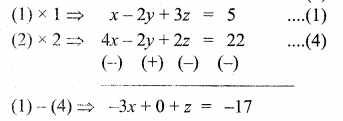
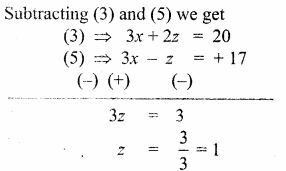
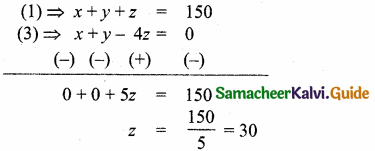
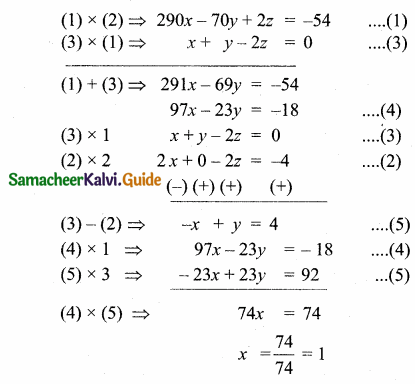
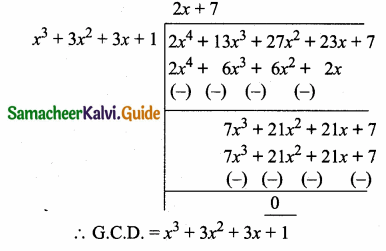
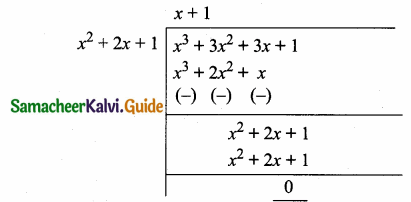
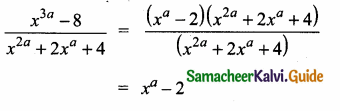
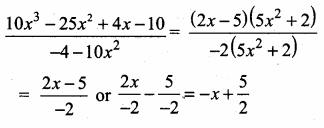
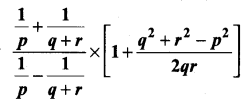
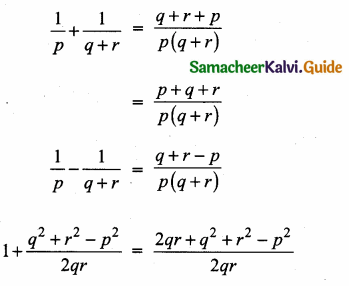
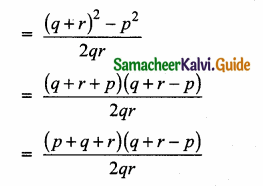
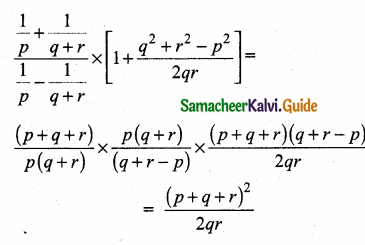
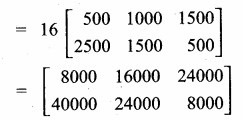
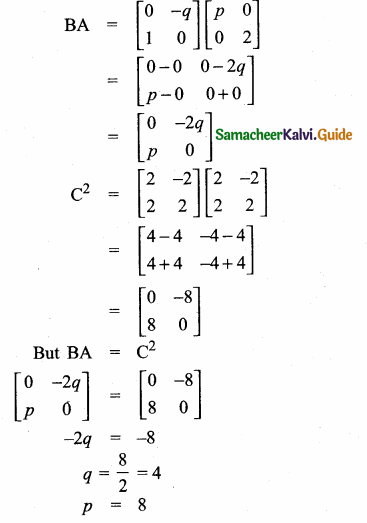
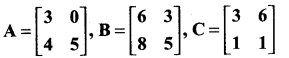
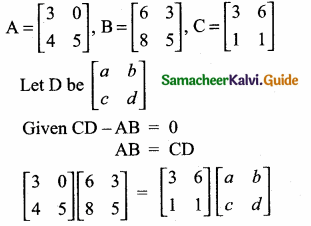
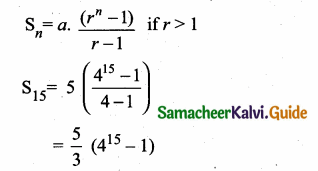
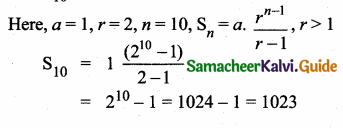
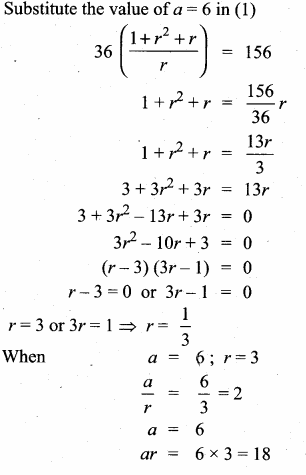
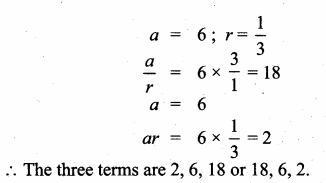
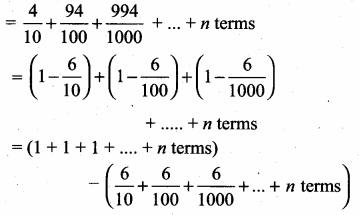
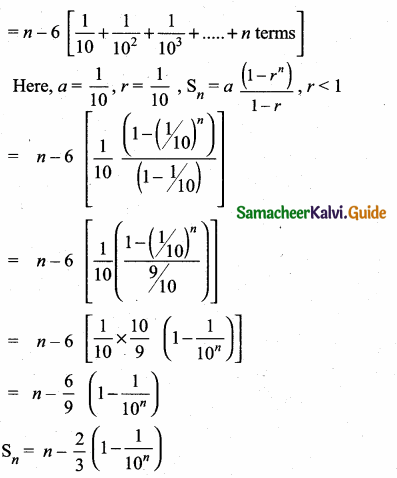
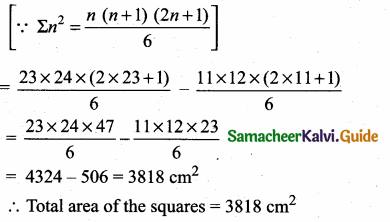
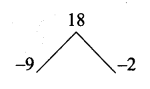
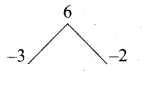
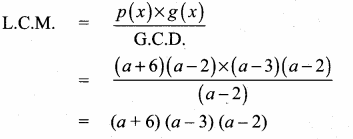
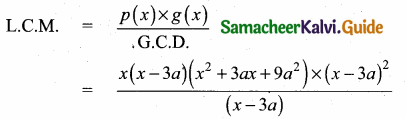
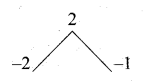
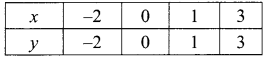
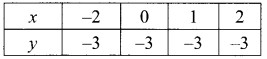
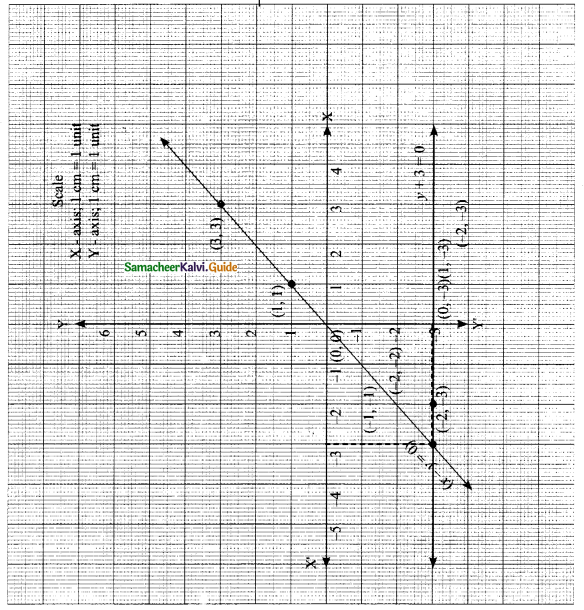
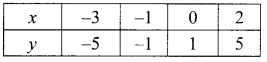
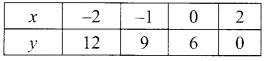
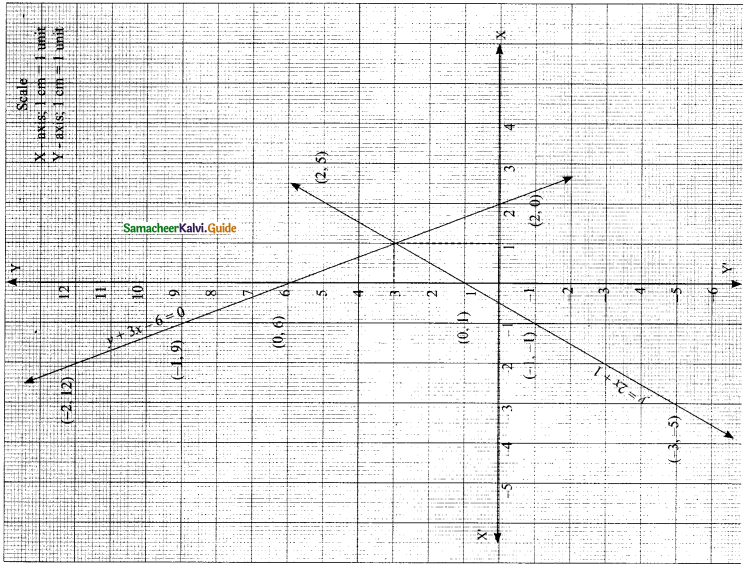
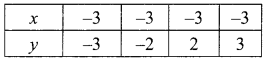
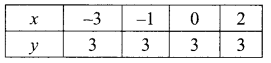
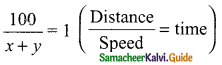
Samacheer Kalvi 10th Maths Guide Chapter 3 Algebra Ex 3.8

Students can download Maths Chapter 3 Algebra Ex 3.8 Questions and Answers, Notes, Samacheer Kalvi 10th Maths Guide Pdf helps you to revise the complete Tamilnadu State Board New Syllabus, helps students complete homework assignments and to score high marks in board exams.

Tamilnadu Samacheer Kalvi 10th Maths Solutions Chapter 3 Algebra Ex 3.8

Question 1.
Find the square root of the following polynomials by division method
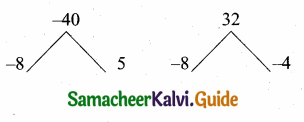
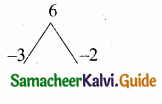
(i) x4 – 12x3 + 42x2 – 36x + 9
Answer:
Samacheer Kalvi 10th Maths Guide Chapter 3 Algebra Ex 3.8 1
Samacheer Kalvi 10th Maths Guide Chapter 3 Algebra Ex 3.8

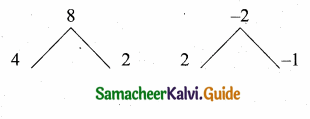
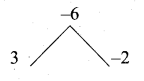
(ii) 31 x2 – 28x3 + 4x4 + 42x + 9
Answer:
Rearrange the order we get
4x4 – 28x3 + 37x2 + 42x + 9
Samacheer Kalvi 10th Maths Guide Chapter 3 Algebra Ex 3.8 3
Samacheer Kalvi 10th Maths Guide Chapter 3 Algebra Ex 3.8

(iii) 16x4 + 8x2 + 1
Answer:
Samacheer Kalvi 10th Maths Guide Chapter 3 Algebra Ex 3.8 5
Samacheer Kalvi 10th Maths Guide Chapter 3 Algebra Ex 3.8 6

(iv) 121 x4 – 198x3 – 183x2 + 216x + 144
Answer:
Samacheer Kalvi 10th Maths Guide Chapter 3 Algebra Ex 3.8 7
Samacheer Kalvi 10th Maths Guide Chapter 3 Algebra Ex 3.8 8

Question 2.
Find the square root of the expression
\(\frac{x^{2}}{y^{2}}\) – \(\frac { 10x }{ y } \) + 27 – \(\frac { 10y }{ x } \) + \(\frac{y^{2}}{x^{2}}\)
Answer:
Samacheer Kalvi 10th Maths Guide Chapter 3 Algebra Ex 3.8 11
Samacheer Kalvi 10th Maths Guide Chapter 3 Algebra Ex 3.8

Question 3.
Find the values of a and b if the following polynomials are perfect squares.
(i) 4x4 – 12x3 + 37x2 + bx + a
Answer:
Samacheer Kalvi 10th Maths Guide Chapter 3 Algebra Ex 3.8 112
Since it is a perfect square
b + 42 = 0
b = – 42
a – 49 = 0
a = 49
∴ The value of a = 49 and b = – 42

(ii) ax4 + bx3 + 361x2 + 220x + 100
Answer:
Re-arrange the order we get
100 + 220x + 361x2 + bx3 + ax4
Samacheer Kalvi 10th Maths Guide Chapter 3 Algebra Ex 3.8 12
Since it is a perfect square
b – 264 = 0
b = 264
a – 144 = 0
a = 144
∴ The value of a = 144 and b = 264

Samacheer Kalvi 10th Maths Guide Chapter 3 Algebra Ex 3.8

Question 4.
Find the values of m and n if the following expressions are perfect sqaures.
(i) \(\frac{1}{x^{4}}\) – \(\frac{6}{x^{3}}\) + \(\frac{13}{x^{2}}\) + \(\frac { m }{ x } \) + n
Answer:
Samacheer Kalvi 10th Maths Guide Chapter 3 Algebra Ex 3.8 13
Since it is a perfect square
\(\frac { 1 }{ x } \) (m + 12) = 0
m + 12 = 0
m = -12
n – 4 = 0
n = 4
∴ The value of m = -12 and n = 4

Samacheer Kalvi 10th Maths Guide Chapter 3 Algebra Ex 3.8

(ii) x4 – 8x3 + mx2 + nx + 16
Answer:
Samacheer Kalvi 10th Maths Guide Chapter 3 Algebra Ex 3.8 14
Since it is a perfect square
m – 16 – 8 = 0
m – 24 = 0
m = 24
n + 32 = 0
n = -32
∴ The value of m = 24 and n = -32

Samacheer Kalvi 10th Maths Guide Chapter 3 Algebra Ex 3.16

Students can download Maths Chapter 3 Algebra Ex 3.16 Questions and Answers, Notes, Samacheer Kalvi 10th Maths Guide Pdf helps you to revise the complete Tamilnadu State Board New Syllabus, helps students complete homework assignments and to score high marks in board exams.

Tamilnadu Samacheer Kalvi 10th Maths Solutions Chapter 3 Algebra Ex 3.16

1. In the
Samacheer Kalvi 10th Maths Guide Chapter 3 Algebra Ex 3.16 1
write (i) The number of elements
(ii) The order of the matrix
(iii) Write the elements a22, a23, a24, a34, a43, a44.
Answer:
(i) The number of elements is 16
(ii) The order of the matrix is 4 × 4
(iii) Elements corresponds to
Samacheer Kalvi 10th Maths Guide Chapter 3 Algebra Ex 3.16 2

Samacheer Kalvi 10th Maths Guide Chapter 3 Algebra Ex 3.16

Question 2.
If a matrix has 18 elements, what are the possible orders it can have? What if it has 6 elements?
Answer:
The possible orders of the matrix having 18 elements are
Samacheer Kalvi 10th Maths Guide Chapter 3 Algebra Ex 3.16 3
The possible orders of the matrix having 6 elements are
Samacheer Kalvi 10th Maths Guide Chapter 3 Algebra Ex 3.16 4

Question 3.
Construct a 3 × 3 matrix whose elements are given by
(i) aij = |i – 2j|
Answer:
aij = |i – 2j|
The general 3 × 3 matrices is
Samacheer Kalvi 10th Maths Guide Chapter 3 Algebra Ex 3.16 5
a11 = |1 – 2(1)| = |1 – 2| = | – 1| = 1
a12 = |1 – 2(2)| = |1 – 4| = | – 3| = 3
a13 = |1 – 2(3)| = |1 – 6| = | – 5| = 5
a21 = |2 – 2(1)| = |2 – 2| = 0 = 0
a22 = |2 – 2(2)| = |2 – 4| = | – 2| = 2
a23 = |2 – 2(3)| = |2 – 6| = | – 4| = 4
a31 = |3 – 2(1)| = |3 – 2| = | 1 | = 1
a32 = |3 – 2(2)| = |3 – 4| = | – 1 | = 1
a33 = |3 – 2(3)| = |3 – 6| = | – 3 | = 3
The required matrix
Samacheer Kalvi 10th Maths Guide Chapter 3 Algebra Ex 3.16 6

Samacheer Kalvi 10th Maths Guide Chapter 3 Algebra Ex 3.16

(ii) aij = \(\frac{(i+j)^{3}}{3}\)
Answer:
a11 = \(\frac{(1+1)^{3}}{3}\) = \(\frac{2^{3}}{3}\) = \(\frac { 8 }{ 3 } \)
a12 = \(\frac{(1+2)^{3}}{3}\) = \(\frac { 27 }{ 3 } \) = 9
a13 = \(\frac{(1+3)^{3}}{3}\) = \(\frac { 64 }{ 3 } \) = \(\frac { 64 }{ 3 } \)
a21 = \(\frac{(2+1)^{3}}{3}\) = \(\frac { 27 }{ 3 } \) = 9
a22 = \(\frac{(2+2)^{3}}{3}\) = \(\frac { 64 }{ 3 } \) = \(\frac { 64 }{ 3 } \)
a23 = \(\frac{(2+3)^{3}}{3}\) = \(\frac { 125 }{ 3 } \) = \(\frac { 125 }{ 3 } \)
a31 = \(\frac{(3+1)^{3}}{3}\) = \(\frac { 64 }{ 3 } \) = \(\frac { 64 }{ 3 } \)
a32 = \(\frac{(3+2)^{3}}{3}\) = \(\frac { 125 }{ 3 } \) = \(\frac { 125 }{ 3 } \)
a33 = \(\frac{(3+3)^{3}}{3}\) = \(\frac { 216 }{ 3 } \) = 72
The required matrix
Samacheer Kalvi 10th Maths Guide Chapter 3 Algebra Ex 3.16 7

Samacheer Kalvi 10th Maths Guide Chapter 3 Algebra Ex 3.16

Question 4.
If  Samacheer Kalvi 10th Maths Guide Chapter 3 Algebra Ex 3.16 8then find the tranpose of A.
Answer:
Samacheer Kalvi 10th Maths Guide Chapter 3 Algebra Ex 3.16 8
transpose of A = (AT)
Samacheer Kalvi 10th Maths Guide Chapter 3 Algebra Ex 3.16 10

Question 5.
If Samacheer Kalvi 10th Maths Guide Chapter 3 Algebra Ex 3.16 11 then find the tranpose of – A
Answer:
Samacheer Kalvi 10th Maths Guide Chapter 3 Algebra Ex 3.16 12
Transpose of – A = (-AT) = Samacheer Kalvi 10th Maths Guide Chapter 3 Algebra Ex 3.16 13

Samacheer Kalvi 10th Maths Guide Chapter 3 Algebra Ex 3.16

Question 6.
If A = Samacheer Kalvi 10th Maths Guide Chapter 3 Algebra Ex 3.16 14 then verify (AT)T = A
Answer:
Samacheer Kalvi 10th Maths Guide Chapter 3 Algebra Ex 3.16 15
Hence it is verified

Question 7.
Find the values of x, y and z from the following equations
(i)
Samacheer Kalvi 10th Maths Guide Chapter 3 Algebra Ex 3.16 16
Answer:
Since the given matrices are equal then all the corresponding elements are equal.
y = 12, z = 3, x = 3
The value of x = 3, y = 12 and z = 3

Samacheer Kalvi 10th Maths Guide Chapter 3 Algebra Ex 3.16

(ii)
Samacheer Kalvi 10th Maths Guide Chapter 3 Algebra Ex 3.16 17
Answer:
x + y = 6 ……(1)
5 + z = 5
z = 5 – 5 = 0
xy = 8
y = \(\frac { 8 }{ x } \)
Substitute the value of y = \(\frac { 8 }{ x } \) in (1)
x + \(\frac { 8 }{ x } \) = 6
x2 + 8 = 6x
x2 – 6x + 8 = 0
(x – 4) (x – 2) = 0
∴ x – 4 = 0 or x – 2 = 0
x = 4 or x = 2
y = \(\frac { 8 }{ 4 } \) = 2 or y = \(\frac { 8 }{ 2 } \) = 4
Samacheer Kalvi 10th Maths Guide Chapter 3 Algebra Ex 3.16 18
∴ The value of x, y and z are 4, 2, 0 (or) 2, 4, 0

Samacheer Kalvi 10th Maths Guide Chapter 3 Algebra Ex 3.16

(iii)
Samacheer Kalvi 10th Maths Guide Chapter 3 Algebra Ex 3.16 19
Solution:
x + y + z = 9 ……….(1)
x + z = 5 ……….(2)
y + z = 7 ……….(3)
Samacheer Kalvi 10th Maths Guide Chapter 3 Algebra Ex 3.16 20
Substitute the value of y = 4 in (3)
y + z = 7
4 + z = 7
z = 7 – 4
= 3
Substitute the value of z = 3 in (2)
x + 3 = 5
x = 5 – 3
= 2
∴ The value of x = 2 , y = 4 and z = 3

Samacheer Kalvi 9th Maths Guide Chapter 4 Geometry Ex 4.1

Students can download Maths Chapter 4 Geometry Ex 4.1 Questions and Answers, Notes, Samacheer Kalvi 9th Maths Guide Pdf helps you to revise the complete Tamilnadu State Board New Syllabus, helps students complete homework assignments and to score high marks in board exams.

Tamilnadu Samacheer Kalvi 9th Maths Solutions Chapter 4 Geometry Ex 4.1

Question 1.
In the figure, AB is parallel to CD, find x.
Samacheer Kalvi 9th Maths Guide Chapter 4 Geometry Ex 4.1 1
Solution:
(i) Through T draw TE || AB.
Samacheer Kalvi 9th Maths Guide Chapter 4 Geometry Ex 4.1 2
∴ ∠BAT + ∠ATE = 180° (AB || TE)
140° + ∠ATE = 180°
∠ATE = 180°- 140° = 40°
Similarly ∠ETC + ∠TCD = 180° (TE || CD)
∠ETC+150° = 180°
∠ETC = 180°- 150° = 30°
x = ∠ATE + ∠ETC
= 40°+ 30° = 70°
x = 70°

Samacheer Kalvi 9th Maths Guide Chapter 4 Geometry Ex 4.1

(ii) Draw TE || AB.
Samacheer Kalvi 9th Maths Guide Chapter 4 Geometry Ex 4.1 3
∠ABT + ∠ETB = 180° (AB || TE)
48° + ∠ETB = 180°
∠ETB = 180° – 48° = 132°
Similarly ∠CDT + ∠DTE = 180°
24° + ∠DTE = 180°
∴ ∠DTE = 180° – 24°
= 156°
∴ ∠BTE + ∠ETD = 132° + 156°
= 288°
x = 288°

Samacheer Kalvi 9th Maths Guide Chapter 4 Geometry Ex 4.1

(iii) In the given figure AB || CD, AD is the transversal.
∠CDA = ∠BAD
= 53° (alternate angles are equal)
In ΔECD, ∠D = ∠A = 53° (Alternate angles are equal)
∠E + ∠C + ∠D = 180° (sum of the angles of a triangle)
x° + 38° + 53° = 180°
x° = 180°- 91°
= 89°
x = 89°

Question 2.
The angles of a triangle are in the ratio 1 : 2 : 3, find the measure of each angle of the triangle.
Solution:
The ratio of the angles of a triangle = 1 : 2 : 3.
Let the angles of a triangle be x, 2x and 3x.
x + 2x + 3x = 180° (Total angle of a triangle is 180°)
6x = 180°
x = \(\frac{180°}{6}\)
= 30°
x = 30°; 2x = 2 × 30° = 60°; 3x = 3 × 30° = 90°
Measures of the angles of a triangle = 30°, 60° and 90°.

Samacheer Kalvi 9th Maths Guide Chapter 4 Geometry Ex 4.1

Question 3.
Consider the given pairs of triangles and say whether each pair is that of congruent triangles. If the triangles are congruent, say ‘how’; if they are not congruent say ‘why’ and also say if a small modification would make them congruent:
Samacheer Kalvi 9th Maths Guide Chapter 4 Geometry Ex 4.1 4
(i) In ΔPQR and ΔABC
PQ = AB (Given)
RQ = BC (Given)
ΔABC is not congruent to ΔPQR.
If PR = AC then ΔABC ≅ ΔPQR

(ii) In ΔABD and ΔCDB
AB = CD (Given)
AD = BC (Given)
BD is common
By SSS congruency
ΔABD ≅ ΔCDB

Samacheer Kalvi 9th Maths Guide Chapter 4 Geometry Ex 4.1

(iii) In ΔPXY and ΔPXZ
PX is common.
XY = XZ (Given)
PY = PZ (Given)
By SSS congruency
ΔPXY ≅ ΔPXZ

(iv) In the given figure BD bisect AC
In ΔAOB and ΔOCD
OA = OC (Given)
∠AOB = ∠DOC (vertically opposite angles)
∠B = ∠D (Given)
By ASA congruency ΔAOB ≅ ΔOCD

(v) In the given figure AC and BD bisect each other at O.
∴ OA = OC (Given); OB = OD (Given)
∠AOB = ∠COD (vertically opposite angles)
By SAS congruency
ΔAOB ≅ ΔOCD

Samacheer Kalvi 9th Maths Guide Chapter 4 Geometry Ex 4.1

(vi) In the given figure
AB = AC (Given)
BM = MC (AM is the median of the ΔABC)
AM is common (By SSS congruency)
∴ ΔABM ≅ ΔACM

Question 4.
ΔABC and ΔDEF are two triangles in which AB = DF, ∠ACB = 70°, ∠ABC = 60°; ∠DEF = 70° and ∠EDF = 60°. Prove that the triangles are congruent.
Solution:
Samacheer Kalvi 9th Maths Guide Chapter 4 Geometry Ex 4.1 5
In ΔABC ∠B = 60° and ∠C = 70°
∴ ∠A = 180° – (60° + 70°)
= 180° – 130°
= 50°
In ΔDEF ∠E = 70° and ∠D = 60°
∠F = 180° – (70° + 60°)
= 180° – 130°
= 50°
∠A = ∠F = 50°
∠B = ∠D = 60°
∠C = ∠E = 70°
By AAA congruency
ΔABC ≅ ΔFDE
(or)
∠B = ∠D = 60°
∠C = ∠E = 70°
AB = FE
By ASA congruency
ΔABC ≅ ΔFDE

Samacheer Kalvi 9th Maths Guide Chapter 4 Geometry Ex 4.1

Question 5.
Find all the three angles of the ΔABC.
Samacheer Kalvi 9th Maths Guide Chapter 4 Geometry Ex 4.1 6
Solution:
∠A + ∠B = ∠ACD (An exterior angle of a triangle is sum of its interior opposite angles)
x + 35 + 2x – 5 = 4x – 15
3x + 30 = 4x – 15
30 + 15 = 4x – 3x
45° = x
∠A = x + 35°
= 45° + 35°
= 80°
∠B = 2x – 5
= 2(45°) – 5°
= 90° – 5°
= 85°
∠ACD = 4x – 15
= 4 (45°) – 15°
= 180° – 15°
= 165°
∠ACB = 180° – ∠ACD
= 180° – 165°
= 15°
∠A = 80°, ∠B = 85° and ∠C = 15°.

Samacheer Kalvi 9th Maths Guide Chapter 4 Geometry Ex 4.1

Samacheer Kalvi 9th Maths Guide Chapter 5 Coordinate Geometry Ex 5.3

Students can download Maths Chapter 5 Coordinate Geometry Ex 5.3 Questions and Answers, Notes, Samacheer Kalvi 9th Maths Guide Pdf helps you to revise the complete Tamilnadu State Board New Syllabus, helps students complete homework assignments and to score high marks in board exams.

Tamilnadu Samacheer Kalvi 9th Maths Solutions Chapter 5 Coordinate Geometry Ex 5.3

Question 1.
Find the mid-points of the line segment joining the points.
(i) (-2, 3) and (-6, -5)
(ii) (8, -2) and (-8, 0)
(iii) (a, b) and (a + 2b, 2a – b)
(iv) (\(\frac{1}{2},\frac{-3}{7}\)) and (\(\frac{3}{2},\frac{-11}{7}\))
Solution:
Samacheer Kalvi 9th Maths Guide Chapter 5 Coordinate Geometry Ex 5.3 1

Samacheer Kalvi 9th Maths Guide Chapter 5 Coordinate Geometry Ex 5.3

Question 2.
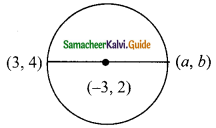
The centre of a circle is (-4, 2). If one end of the diameter of the circle is (-3, 7) then find the other end.
Solution:
Let the other end of the diameter B be (a, b)
Samacheer Kalvi 9th Maths Guide Chapter 5 Coordinate Geometry Ex 5.3 2
∴ \(\frac{-3+a}{2}\) = -4
-3 + a = -8
a = -8 + 3
a = -5
\(\frac{7+b}{2}\)
7 + b = 4
b = 4 – 7 ⇒ b = -3
The other end of the diameter is (-5, -3).

Samacheer Kalvi 9th Maths Guide Chapter 5 Coordinate Geometry Ex 5.3

Question 3.
If the mid-point (x, y) of the line joining (3, 4) and (p, 7) lies on 2x + 2y + 1 = 0, then what will be the value of p?
Solution:
Samacheer Kalvi 9th Maths Guide Chapter 5 Coordinate Geometry Ex 5.3 3
3 + p + 11 + 1 = 0 ⇒ p + 15 = 0 ⇒ p = -15
The value of p is -15.

Samacheer Kalvi 9th Maths Guide Chapter 5 Coordinate Geometry Ex 5.3

Question 4.
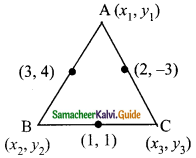
The mid-point of the sides of a triangle are (2, 4), (-2, 3) and (5, 2). Find the coordinates of the vertices of the triangle.
Solution:
Let the vertices of the ΔABC be A (x1 y1), B (x2, y2) and C (x3, y3)
Samacheer Kalvi 9th Maths Guide Chapter 5 Coordinate Geometry Ex 5.3 4
\(\frac{x_{2}+x_{3}}{2}\) = -2 ⇒ x2 + x3 = -4 → (3)
\(\frac{y_{2}+y_{3}}{2}\) = 3 ⇒ y2 + y3 = 6 → (4)
Samacheer Kalvi 9th Maths Guide Chapter 5 Coordinate Geometry Ex 5.3 5
\(\frac{x_{1}+x_{3}}{2}\) = 5 ⇒ x1 + x3 = 10 → (5)
\(\frac{y_{1}+y_{3}}{2}\) = 2 ⇒ y1 + y3 = 4 → (6)
By adding (1) + (3) + (5) we get
2x1 + 2x2 + 2x3 = 4 – 4 + 10
2(x1 + x2 + x3) = 10 ⇒ x1 + x2 + x3 = 5
From (1) x1 + x2 = 4 ⇒ 4 + x3 = 5
x3 = 5 – 4 = 1
∴ The vertices of the ΔABC are
A (9, 3)
B (-5, 5), C (1, 1)
From (3) x2 + x3 = -4 ⇒ x1 + (-4) = 5
x1 = 5 + 4 = 9
From (5) ⇒ x1 + x3 = 8
x2 + 10 = 5
x2 = 5 – 10 = -5
∴ x1 = 9, x2 = -5, x3 = 1
By adding (2) + (4) + (6) we get
2y3 + 2y2 + 2y3 = 8 + 6 + 4
2(y1 +y2 + y3) = 18 ⇒ y1 + y2 + y3 = 9
From (2) ⇒ y1 + y2 = 8
8 + y3 = 9 ⇒ y3 = 9 – 8 = 1
From (4)
y2 + y3 = 6 ⇒ y1 + 6 = 9
y1 = 9 – 6 = 3
From (6)
y1 + y3 = 4 ⇒ y2 + 4 = 9
y2 = 9 – 4 = 5
∴ y1 = 3, y2 = 5, y3 = 1

Samacheer Kalvi 9th Maths Guide Chapter 5 Coordinate Geometry Ex 5.3

Question 5.
O (0, 0) is the centre of a circle whose one chord is AB, where the points A and B (8, 6) and (10, 0) respectively. OD is the perpendicular from the centre to the chord AB. Find the coordinates of the mid-point of OD.
Solution:
Note: Since OD is perpendicular to AB, OD bisect the chord
D is the mid-point of AB
Samacheer Kalvi 9th Maths Guide Chapter 5 Coordinate Geometry Ex 5.3 6

Question 6.
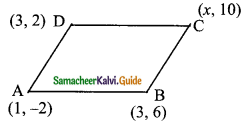
The points A(-5, 4) , B(-1, -2) and C(5, 2) are the vertices of an isosceles right-angled triangle where the right angle is at B. Find the coordinates of D so that ABCD is a square.
Solution:
Since ABCD is a square
Mid-point of AC = mid-point of BD
Let the point D be (a, b)
Samacheer Kalvi 9th Maths Guide Chapter 5 Coordinate Geometry Ex 5.3 7
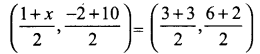
But mid-point of BD = Mid-point of AC
(\(\frac{-1+a}{2}, \frac{-2+b}{2}\)) = (0, 3)
\(\frac{-1+a}{2}\) = 0
-1 + a = 0
a = 1
(\(\frac{-2+b}{2}\))
-2 + b = 6
b = 6 + 2 = 8
∴ The vertices D is (1, 8).

Samacheer Kalvi 9th Maths Guide Chapter 5 Coordinate Geometry Ex 5.3

Question 7.
The points A (-3, 6), B (0, 7) and C (1, 9) are the mid points of the sides DE, EF and FD of a triangle DEF. Show that the quadrilateral ABCD is a parallellogram.
Solution:
Let D be (x1 y1), E (x2, y2) and F (x3, y3)
Samacheer Kalvi 9th Maths Guide Chapter 5 Coordinate Geometry Ex 5.3 8
Samacheer Kalvi 9th Maths Guide Chapter 5 Coordinate Geometry Ex 5.3 9
x1 + x2 = -6 → (1)
y1 + y2 = 12 → (2)
Samacheer Kalvi 9th Maths Guide Chapter 5 Coordinate Geometry Ex 5.3 10
x1 + x3 = 2 → (5)
y1 + y3 = 18 → (6)
Add (1) + (3) + (5)
2x1 + 2x2 + 2x3 = -6 + 0 + 2
2 (x1 + x2 + x3) = -4
x1 + x2 + x3 = -2
From (1) x1 + x2 = -6
x3 = -2 + 6 = 4
From (3) x2 + x3 = 0
x1 = -2 + 0
x1 = -2
From (5) x1 + x3 = 2
x2 + 2 = -2
x2 = -2 -2 = -4
∴ x1 = -2, x2 = -4, x3= 4
Add (2) + (4) + 6
2y1 + 2y2 + 2y3 = 12 + 14 + 18
2(y1 + y2 + y3) = 44
y1 + y2+ y3 = 44/2 = 22
From (2) y1 + y2 = 12
12 + y3 = 22 ⇒ y3 = 22 – 12 = 11
From (4) y2 + y3 = 14
y1 + 14 = 22 ⇒ y1 = 22 – 14
y1 = 8
From (6)
y1 +y3 = 18
y2 + 18 = 22 ⇒ = 22 – 18
= 4
∴ y1 = 8, y2 = 4, y3 = 11
The vertices D is (-2, 8)
Samacheer Kalvi 9th Maths Guide Chapter 5 Coordinate Geometry Ex 5.3 11
Mid-point of diagonal AC = Mid-point of diagonal BD
The quadrilateral ABCD is a parallelogram

Samacheer Kalvi 9th Maths Guide Chapter 5 Coordinate Geometry Ex 5.3

Question 8.
A(-3, 2) , B(3, 2) and C(-3, -2) are the vertices of the right triangle, right angled at A. Show that the mid point of the hypotenuse is equidistant from the vertices.
Solution:
Samacheer Kalvi 9th Maths Guide Chapter 5 Coordinate Geometry Ex 5.3 12
AD = CD = BD = \(\sqrt{13}\)
Mid-point of BC is equidistance from the centre.

Samacheer Kalvi 9th Maths Guide Chapter 5 Coordinate Geometry Ex 5.3

Samacheer Kalvi 10th Maths Guide Chapter 3 Algebra Ex 3.7

Students can download Maths Chapter 3 Algebra Ex 3.7 Questions and Answers, Notes, Samacheer Kalvi 10th Maths Guide Pdf helps you to revise the complete Tamilnadu State Board New Syllabus, helps students complete homework assignments and to score high marks in board exams.

Tamilnadu Samacheer Kalvi 10th Maths Solutions Chapter 3 Algebra Ex 3.7

Question 1.
Find the square root of the following.
(i) \(\frac{400 x^{4} y^{12} z^{16}}{100 x^{8} y^{4} z^{4}}\)
Answer:
Samacheer Kalvi 10th Maths Guide Chapter 3 Algebra Ex 3.7 1

Samacheer Kalvi 10th Maths Guide Chapter 3 Algebra Ex 3.7

(ii) \(\frac{7 x^{2}+2 \sqrt{14} x+2}{x^{2}-\frac{1}{2} x+\frac{1}{16}}\)
Answer:
Samacheer Kalvi 10th Maths Guide Chapter 3 Algebra Ex 3.7 2

(iii) \(\frac{121(a+b)^{8}(x+y)^{8}(b-c)^{8}}{81(b-c)^{4}(a-b)^{12}(b-c)^{4}}\)
Answer:
Samacheer Kalvi 10th Maths Guide Chapter 3 Algebra Ex 3.7 3

Samacheer Kalvi 10th Maths Guide Chapter 3 Algebra Ex 3.7

Question 2.
Find the square root of the following
(i) 4x2 + 20x + 25
Answer:
Samacheer Kalvi 10th Maths Guide Chapter 3 Algebra Ex 3.7 4

(ii) 9x2 – 24xy + 30xz – 40yz + 25z2 + 16y2
Answer:
Samacheer Kalvi 10th Maths Guide Chapter 3 Algebra Ex 3.7 5

(iii) \(1+\frac{1}{x^{6}}+\frac{2}{x^{3}}\)
Answer:
Samacheer Kalvi 10th Maths Guide Chapter 3 Algebra Ex 3.7 6

(iv) (4x2 – 9x + 2)(7x2 – 13x – 2)(28x2 – 3x – 1)
Answer:
4x2 – 9x +2 = 4x2 – 8x – x + 2
= 4x(x – 2)-1 (x – 2)
= (x – 2)(4x – 1)
Samacheer Kalvi 10th Maths Guide Chapter 3 Algebra Ex 3.7 7
7x2 – 13x – 2 = 7x2 – 14x + x – 2
= 7x (x – 2) + 1 (x – 2)
= (x – 2) (7x + 1)
Samacheer Kalvi 10th Maths Guide Chapter 3 Algebra Ex 3.7 8
28x2 – 3x – 1 = 28x2 – 7x + 4x – 1
= 7x (4x – 1) + 1 (4x – 1)
= (4x – 1) (7x + 1)
Samacheer Kalvi 10th Maths Guide Chapter 3 Algebra Ex 3.7 9

Samacheer Kalvi 10th Maths Guide Chapter 3 Algebra Ex 3.7

(v) (2x2 + \(\frac { 17 }{ 6 } \)x + 1) (\(\frac { 3 }{ 2 } \) x2 + 4x + 2) (\(\frac { 4 }{ 3 } \) x2 + \(\frac { 11 }{ 3 } \) x + 2)
Answer:
Samacheer Kalvi 10th Maths Guide Chapter 3 Algebra Ex 3.7 10
Samacheer Kalvi 10th Maths Guide Chapter 3 Algebra Ex 3.7 12
Samacheer Kalvi 10th Maths Guide Chapter 3 Algebra Ex 3.7 13

Samacheer Kalvi 10th Maths Guide Chapter 3 Algebra Ex 3.7
Samacheer Kalvi 10th Maths Guide Chapter 3 Algebra Ex 3.7 134
Samacheer Kalvi 10th Maths Guide Chapter 3 Algebra Ex 3.7 14

Samacheer Kalvi 10th Maths Guide Chapter 3 Algebra Ex 3.18

Students can download Maths Chapter 3 Algebra Ex 3.18 Questions and Answers, Notes, Samacheer Kalvi 10th Maths Guide Pdf helps you to revise the complete Tamilnadu State Board New Syllabus, helps students complete homework assignments and to score high marks in board exams.

Tamilnadu Samacheer Kalvi 10th Maths Solutions Chapter 3 Algebra Ex 3.18

Question 1.
Find the order of the product matrix AB if
Samacheer Kalvi 10th Maths Guide Chapter 3 Algebra Ex 3.18 1
Answer:
Given A = [aij]p×q and B = [aij]q×r
Order of product of AB = p × r
Order of product of BA is not defined. Number columns in r is not equal to the number of rows in P.
∴ Product BA is not defined.

Samacheer Kalvi 10th Maths Guide Chapter 3 Algebra Ex 3.18

Question 2.
A has ‘a’ rows and ‘a + 3 ’ columns. B has ‘6’ rows and ‘17 – b’ columns, and if both products AB and BA exist, find a, b?
Solution:
A has a rows, a + 3 columns.
B has b rows, 17 – b columns
If AB exists a × a + 3
b × 17 – b
a + 3 = 6 ⇒ a – 6 = -3 ………… (1)
If BA exists 6 × 17-6
a × a + 3
17 – 6 = a ⇒ a + 6 = 17 …………. (2)
(1) + (2) ⇒ 2a = 14 ⇒ a = 7
Substitute a = 7 in (1) ⇒ 7 – b = -3 ⇒ b = 10
a = 7, b = 10

Samacheer Kalvi 10th Maths Guide Chapter 3 Algebra Ex 3.18

Question 3.
A has ‘a’ rows and ‘a + 3 ’ columns. B has rows and ‘b’ columns, and if both products AB and BA exist, find a,b?
Answer:

  1. Order of matrix AB = 3 × 3
  2. Order of matrix AB = 4 × 2
  3. Order of matrix AB = 4 × 2
  4. Order of matrix AB = 4 × 1
  5. Order of matrix AB = 1 × 3

Question 4.
Samacheer Kalvi 10th Maths Guide Chapter 3 Algebra Ex 3.18 2
find AB, BA and check if AB = BA?
Answer:
Samacheer Kalvi 10th Maths Guide Chapter 3 Algebra Ex 3.18 3

Question 5.
Given that
Samacheer Kalvi 10th Maths Guide Chapter 3 Algebra Ex 3.18 4
Samacheer Kalvi 10th Maths Guide Chapter 3 Algebra Ex 3.18 5
verify that A(B + C) = AB + AC
Answer:
Samacheer Kalvi 10th Maths Guide Chapter 3 Algebra Ex 3.18 6

Samacheer Kalvi 10th Maths Guide Chapter 3 Algebra Ex 3.18 7
Samacheer Kalvi 10th Maths Guide Chapter 3 Algebra Ex 3.18 8
Samacheer Kalvi 10th Maths Guide Chapter 3 Algebra Ex 3.18 9
From (1) and (2) we get
A (B + C) = AB + AC

Samacheer Kalvi 10th Maths Guide Chapter 3 Algebra Ex 3.18

Question 6.
Show that the matrices
Samacheer Kalvi 10th Maths Guide Chapter 3 Algebra Ex 3.18 99Samacheer Kalvi 10th Maths Guide Chapter 3 Algebra Ex 3.18 10
satisfy commutative property AB = BA
Answer:
Samacheer Kalvi 10th Maths Guide Chapter 3 Algebra Ex 3.18 11
From (1) and (2) we get
AB = BA. It satisfy the commutative property.

Question 7.
Samacheer Kalvi 10th Maths Guide Chapter 3 Algebra Ex 3.18 12
Show that (i) A(BC) = (AB)C
(ii) (A-B)C = AC – BC
(iii) (A-B)T = AT – BT
Answer:
Samacheer Kalvi 10th Maths Guide Chapter 3 Algebra Ex 3.18 13
Samacheer Kalvi 10th Maths Guide Chapter 3 Algebra Ex 3.18 14
Samacheer Kalvi 10th Maths Guide Chapter 3 Algebra Ex 3.18 15
From (1) and (2) we get
A(BC) = (AB)C

Samacheer Kalvi 10th Maths Guide Chapter 3 Algebra Ex 3.18
Samacheer Kalvi 10th Maths Guide Chapter 3 Algebra Ex 3.18 16

Samacheer Kalvi 10th Maths Guide Chapter 3 Algebra Ex 3.18 17

From (1) and (2) we get
(A – B) C = AC – BC
Samacheer Kalvi 10th Maths Guide Chapter 3 Algebra Ex 3.18 18
Samacheer Kalvi 10th Maths Guide Chapter 3 Algebra Ex 3.18 19
From (1) and (2) we get
(A-B)T = AT – BT

Samacheer Kalvi 10th Maths Guide Chapter 3 Algebra Ex 3.18

Question 8.
Samacheer Kalvi 10th Maths Guide Chapter 3 Algebra Ex 3.18 20
then snow that A2 + B2 = I.
Answer:
Samacheer Kalvi 10th Maths Guide Chapter 3 Algebra Ex 3.18 21

Question 9.
Samacheer Kalvi 10th Maths Guide Chapter 3 Algebra Ex 3.18 22
prove that AAT = I.
Answer:
Samacheer Kalvi 10th Maths Guide Chapter 3 Algebra Ex 3.18 23
AAT = I
∴ L.H.S. = R.H.S.

Samacheer Kalvi 10th Maths Guide Chapter 3 Algebra Ex 3.18

Question 10.
Verify that A2 = I when
Samacheer Kalvi 10th Maths Guide Chapter 3 Algebra Ex 3.18 24
Answer:
Samacheer Kalvi 10th Maths Guide Chapter 3 Algebra Ex 3.18 25
∴ L.H.S. = R.H.S.

Question 11.
Samacheer Kalvi 10th Maths Guide Chapter 3 Algebra Ex 3.18 26
show that A2 – (a + d)A = (bc – ad)I2.
Answer:
Samacheer Kalvi 10th Maths Guide Chapter 3 Algebra Ex 3.18 27
L.H.S. = R.H.S.
A2 – (a + d) A = (bc – ad)I2

Samacheer Kalvi 10th Maths Guide Chapter 3 Algebra Ex 3.18

Question 12.
Samacheer Kalvi 10th Maths Guide Chapter 3 Algebra Ex 3.18 28
verify that (AB)T = BT AT
Answer:
Samacheer Kalvi 10th Maths Guide Chapter 3 Algebra Ex 3.18 29
Samacheer Kalvi 10th Maths Guide Chapter 3 Algebra Ex 3.18 30
From (1) and (2) we get, (AB)T = BT AT

Samacheer Kalvi 10th Maths Guide Chapter 3 Algebra Ex 3.18

Question 13.
Samacheer Kalvi 10th Maths Guide Chapter 3 Algebra Ex 3.18 31
show that A2 – 5A + 7I2 = 0
Answer:
Samacheer Kalvi 10th Maths Guide Chapter 3 Algebra Ex 3.18 32
Samacheer Kalvi 10th Maths Guide Chapter 3 Algebra Ex 3.18 33
L.H.S. = R.H.S.
∴ A2 – 5A + 7I2 = 0

Samacheer Kalvi 9th Maths Guide Chapter 3 Algebra Additional Questions

Students can download Maths Chapter 3 Algebra Additional Questions and Answers, Notes, Samacheer Kalvi 9th Maths Guide Pdf helps you to revise the complete Tamilnadu State Board New Syllabus, helps students complete homework assignments and to score high marks in board exams.

Tamilnadu Samacheer Kalvi 9th Maths Solutions Chapter 3 Algebra Additional Questions

I. Multiple choice questions

Question 1.
Which of the following is a monomial?
(a) 4x²
(b) a + b
(c) a + b + c
(d) a + b + c + d
Solution:
(a) 4x²

Question 2.
Which of the following is trinomial?
(a) -7z
(b) z² – 4y²
(c) x²y – xy² + y
(d) 12a – 9ab + 5b – 3
Solution:
(c) x²y – xy² + y

Samacheer Kalvi 9th Maths Guide Chapter 3 Algebra Additional Questions

Question 3.
The sum of 5x²; -7x²; 8x²; 11x² and -9x² is ………
(a) 2x²
(b) 4x²
(c) 6x²
(d) 8x²
Solution:
(d) 8x²

Question 4.
The area of a rectangle with length 2l²m and breadth 3lm² is ………
(a) 6l³m³
(b) l³m³
(c) 2l³m³
(d) 4l³m³
Solution:
(a) 6l³m³

Question 5.
The coefficient of x² and x in 2x³ – 5x² + 6x – 3 are respectively ………
(a) 2, -5
(b) 2, 6
(c) – 5, 6
(d) -5, -3
Solution:
(c) – 5, 6

Samacheer Kalvi 9th Maths Guide Chapter 3 Algebra Additional Questions

Question 6.
In the system 6x -2y = 3; kx – y = 2 has a unique solution then ………
(a) k = 3
(b) k ≠ 3
(c) k = 4
(d) k ≠ 4
Solution:
(b) k ≠ 3

Question 7.
A system of two linear equation in two variables is inconsistent. If their graphs ………
(a) coincide
(b) intersect only at a point
(c) do not intersect at any point
(d) cut the x-axis
Solution:
(c) do not intersect at any point

Question 8.
The system of equation x – 4y = 8; 3x – 12y = 24 ……….
(a) has infinitely many solution
(b) has no solution
(c) has a unique solution
(d) may or may not have a solution
Solution:
(a) has infinitely many solution

Samacheer Kalvi 9th Maths Guide Chapter 3 Algebra Additional Questions

Question 9.
The solution set of x – ay = 4 and x + y = 0 is (1, -1) the value of a is ………
(a) -1
(b) 1
(c) -3
(d) 3
Solution:
(d) 3

Question 10.
The solution set of x + y = 7; x – y = 3 is ………
(a) (-5, -2)
(b) (-5, 2)
(c) (5, 2)
(d) (2, 5)
Solution:
(c) (5, 2)

Samacheer Kalvi 9th Maths Guide Chapter 3 Algebra Additional Questions

II. Answer following Questions

Question 1.
What must be added to x4 – 3x2 + 2x + 6 to get x4 – 2x3 – x + 8?
Solution:
Let A be the required number to be added.
(x4 – 3x2 + 2x + 6) + A = x4 – 2x3 – x + 8
A = x4 – 2x3 – x + 8 – (x4 – 3x2 + 2x + 6)
= x4 – 2x3 – x + 8 – x4 + 3x2 – 2x – 6
= -2x3 + 3x2 – 3x + 2
Hence -2x3 + 3x2 – 3x + 2 must be added.

Question 2.
What must be subtracted to y4 + 2y3 – 3y + 8 to get y4 – 2y3 + 6?
Solution:
Let A be the required number to be subtracted.
(y4 + 2y3 – 3y2 + 8) – A = y4 – 2y3 + 6
y4 + 2y3 – 3y2 + 8 – (y4 – 2y3 + 6) = A
y4 + 2y3 – 3y2 + 8 – y4 + 2y3 – 6 = A
4y3 – 3y2 + 2 = A
Hence 4y3 – 3y2 + 2 must be subtracted.

Samacheer Kalvi 9th Maths Guide Chapter 3 Algebra Additional Questions

Question 3.
The area of a rectangle is x4 + 9x2 + 20 sq.units and its length is x2 + 4 units. Find its breadth in term of x.
Solution:
Let the breadth of a rectangle be “b”
Length of the rectangle = x2 + 4
Area of the rectangle = x4 + 9x2 + 20
Length × Breadth = x4 + 9x2 + 20
(x2 + 4) × b = x4 + 9x2 + 20
b = \(\frac{x^{4}+9x^{2}+20}{x^{2}+4}\)
= x2 + 5
breadth of a rectangle = x2 + 5
Samacheer Kalvi 9th Maths Guide Chapter 3 Algebra Additional Questions 1

Question 4.
Solve 3x + 4y = 24; 20x – 11y = 47 using cross multiplication method.
Solution:
3x + 4y – 24 = 0 → (1)
20x – 11y – 47 = 0 → (2)
Samacheer Kalvi 9th Maths Guide Chapter 3 Algebra Additional Questions 2
\(\frac{x}{-452}\) = \(\frac{1}{-113}\)
-113 = -452
x = \(\frac{452}{113}\)
= 4
But \(\frac{y}{-339}\) = \(\frac{1}{-113}\)
-113y = -339
y = \(\frac{339}{113}\)
= 3
∴ The solution set is (4, 3)

Samacheer Kalvi 9th Maths Guide Chapter 3 Algebra Additional Questions

Question 5.
A fraction such that if the numerator is multiplied by 3 and the denominator is reduced by 3, we get \(\frac{18}{11}\), but if the numerator is increased by 8 and the denominator is doubled, we get \(\frac{2}{5}\). Find the fraction.
Solution:
Let the numerator be x and the denominator be y
∴ The fraction is \(\frac{x}{y}\)
According to the given condition
\(\frac{3x}{y-3}\) = \(\frac{18}{11}\)
33x = 18(y – 3)
33x = 18y – 54
33x – 18y – 54 = 0
11x – 6y – 18 = 0 ……. (1)
According to the second condition
\(\frac{x+8}{2y}\) = \(\frac{2}{5}\)
5x + 40 = 4y
5x – 4y + 40 = 0 ……..(2)
Samacheer Kalvi 9th Maths Guide Chapter 3 Algebra Additional Questions 3
∴ The fraction is = \(\frac{12}{25}\)

Samacheer Kalvi 9th Maths Guide Chapter 3 Algebra Additional Questions

Question 6.
One number is greater than the thrice the other number by 2. If 4 times the smaller number exceeds the greater by 5, find the number.
Solution:
Let the greater number be x and the smaller number be “y” By the given first condition
x = 3y + 2
x – 3y = 2 ……(1)
Again by the given second condition
4y = x + 5
-x + 4y = 5 …….(2)
Add (1), (2) ⇒ y = 7
Substitute the value of y = 7 in (1)
x – 3(7) = 2
x = 2 + 21
= 23
The greater number is 23 and the smaller number is 7.

Samacheer Kalvi 9th Maths Guide Chapter 3 Algebra Additional Questions

Question 7.
The cost of 11 pencils and 3 erasers is Rs 50 and the cost of 8 pencils and 3 erasers is Rs 38. Find the cost of 5 pencils and 5 erasers.
Solution:
Let the cost of a pencil be Rs x and the cost of an eraser be Rs y. According to the first condition.
11x + 3y = 50 …….(1)
According to the second condition
8x + 3y = 38 ……..(2)
(1) – (2) ⇒ 3x = 12
x = \(\frac{12}{3}\)
= 4
Substitute the value of x = 4 in (1)
11 (4) + 3y = 50
3y = 50 – 44
3y = 6
y = \(\frac{6}{3}\)
= 2
Cost of 5 pencils + 5 erasers = 5(4) + 5(2)
= 20 + 10
= 30
The required cost is Rs 30

Samacheer Kalvi 10th Maths Guide Chapter 3 Algebra Ex 3.15

Students can download Maths Chapter 3 Algebra Ex 3.15 Questions and Answers, Notes, Samacheer Kalvi 10th Maths Guide Pdf helps you to revise the complete Tamilnadu State Board New Syllabus, helps students complete homework assignments and to score high marks in board exams.

Tamilnadu Samacheer Kalvi 10th Maths Solutions Chapter 3 Algebra Ex 3.15

Question 1.
Graph the following quadratic equations and state their nature of solutions.
(i) x2 – 9x + 20 = 0
(ii) x2 – 4x + 4 = 0
(iii) x2 + x + 7 = 0
(iv) x2 – 9 = 0
(v) x2 – 6x + 9 = 0
(vi) (2x – 3) (x + 2) = 0

(i) x2 – 9x + 20 = 0
Answer:
Let y = x2 – 9x + 20
(i) Prepare the table of values for y = x2 – 9x + 20
Samacheer Kalvi 10th Maths Guide Chapter 3 Algebra Ex 3.15 1
(ii) Plot the points (-1, 30) (0,20) (1, 12) (2, 6) (3,2), (4, 0), (5, 0), (6,2) (omit the high value)
(iii) Join the points by a free hand smooth curve.
(iv) The roots of the equation are the X-coordinates of the intersecting points of the curve with X-axis (4, 0) and (5, 0)
There are two points of intersection with the X-axis at 4 and 5. The solution set is 4 and 5. The quadratic equation has real and unequal roots.
(v) Since there is two point of intersection with X-axis (different solution)
∴ The equation x2 – 9x + 20 = 0 has real and unequal roots.
Samacheer Kalvi 10th Maths Guide Chapter 3 Algebra Ex 3.15 2

Samacheer Kalvi 10th Maths Guide Chapter 3 Algebra Ex 3.15

(ii) x2 – 4x + 4 = 0
Answer:
Let y = x2 – 4x + 4
(i) Prepare the table of values for y = x2 – 4x + 4
Samacheer Kalvi 10th Maths Guide Chapter 3 Algebra Ex 3.15 3
(ii) Plot the points (-3,25) (-2,16) (-1, 9) (0,4) (1,-1) (2, 0), (3,1) and (4, 4)
(iii) Join the points by a free hand smooth curve.
(iv) The roots of the equation are the X-coordinates of the intersecting points of the curve with X-axis (2, 0) which is 2.
(v) Since there is only one point of intersection with X-axis (2, 0).
∴ The solution set is 2.
The Quadratic equation x2 – Ax + 4 = 0 has real and equal roots.
Samacheer Kalvi 10th Maths Guide Chapter 3 Algebra Ex 3.15 4

(iii) x2 + x + 7 = 0
Answer:
Let y = x2 + x + 7
(i) Prepare the table of values for y = x2 + x + 7
Samacheer Kalvi 10th Maths Guide Chapter 3 Algebra Ex 3.15 5
(ii) Plot the points (-4,19) (-3,13) (-2, 9) (-1, 7) (0, 7) (1, 9), (2,13) (3,19) and (4,27)
(iii) Join the points by a free hand smooth curve.
(iv) The solution of the given quadratic equation are the X-coordinates of the intersecting points of the parabola with the X-axis.
(v) The curve does not intersecting the X-axis. There is no solution set.
The equation x2 + x + 7 = 0 has no real roots.
Samacheer Kalvi 10th Maths Guide Chapter 3 Algebra Ex 3.15 6

Samacheer Kalvi 10th Maths Guide Chapter 3 Algebra Ex 3.15

(iv) x2 – 9 = 0
Answer:
Let y = x2 – 9
(i) Prepare the table of values for y = x2 – 9
Samacheer Kalvi 10th Maths Guide Chapter 3 Algebra Ex 3.15 7
(ii) Plot the points (-4, 7) (-3, 0) (-2, -5) (-1, -8) (0, -9) (1, -8), (2, -5) (3, 0) (4, 7)
(iii) Join the points by a free hand smooth curve.
(iv) The curve intersect the X-axis at -3 and 3.
The solution is (-3, 3).
(v) Since there are two points of intersection -3 and 3 with the X-axis the quadratic equation has real and unequal roots.
Samacheer Kalvi 10th Maths Guide Chapter 3 Algebra Ex 3.15 8

Samacheer Kalvi 10th Maths Guide Chapter 3 Algebra Ex 3.15

(v) x2 – 6x + 9 = 0
Answer:
Let y = x2 – 6x + 9
(i) Prepare a table of values for y = x2 – 6x + 9
Samacheer Kalvi 10th Maths Guide Chapter 3 Algebra Ex 3.15 9
(ii) Plot the points (-2,25) (-1,16) (0,9) (1,4) (2,1) (3,0), (4,1) and (5,4) on the graph using suitable scale (omit the points (-4, 49) and (-3, 36)
(iii) Join the points by a free hand smooth curve.
(iv) The X – coordinates of the point of intersection of the curve with X-axis are the roots of the , given equation, provided they intersect.
The solution is 3.
(v) Since there is only one point of intersection with X-axis the quadratic equation x2 – 6x + 9 = 0 has real and equal roots.
Samacheer Kalvi 10th Maths Guide Chapter 3 Algebra Ex 3.15 10

Samacheer Kalvi 10th Maths Guide Chapter 3 Algebra Ex 3.15

(vi) (2x – 3) (x + 2) = 0
Answer:
y = (2x – 3) (x + 2)
= 2x2 + 4x – 3x – 6
= 2x2 + x – 6

(i) Prepare a table of values for y from x – 4 to 4
Samacheer Kalvi 10th Maths Guide Chapter 3 Algebra Ex 3.15 11
(ii) Plot the points (-4, 22) (-3, 9) (-2, 0) (-1, -5) (0, -6) (1, -3), (2, 4), (3, 15) and (4, 30).
(iii) Join the points by a free hand smooth curve.
(iv) The curve intersect the X – axis at (-2, 0) and (1\(\frac { 1 }{ 2 } \), 0)
∴ The solution set is (-2,1\(\frac { 1 }{ 2 } \))
(v) Since there are two points of intersection with X – axis, the quadratic equation has real and un – equal roots.
Samacheer Kalvi 10th Maths Guide Chapter 3 Algebra Ex 3.15 12

Samacheer Kalvi 10th Maths Guide Chapter 3 Algebra Ex 3.15

Question 2.
Draw the graph of y = x2 – 4 and hence solve x2 – x – 12 = 0
Answer:
(i) Draw the graph of y = x2 – 4 by preparing the table of values as below.
Samacheer Kalvi 10th Maths Guide Chapter 3 Algebra Ex 3.15 13
(ii) Plot the points for the ordered pairs (-4, 12) (-3, 5) (-2, 0) (-1, -3) (0, -4) (1, -3), (2, 0), (3, 5) and (4, 12). Draw the curve with the suitable scale.
(iii) To solve x2 – x – 12 = 0 subtract x2 – x – 12 from y = x2 – 4
Samacheer Kalvi 10th Maths Guide Chapter 3 Algebra Ex 3.15 14
The equation y = x + 8 represents a straight line. Prepare a table for y = x + 8
Samacheer Kalvi 10th Maths Guide Chapter 3 Algebra Ex 3.15 16
(iv) Mark the point of intersection of the curve and the straight line is (-3, 5) and 4, 12)
∴ The solution set is (-3, 4) for x2 – x – 12 = 0.
Samacheer Kalvi 10th Maths Guide Chapter 3 Algebra Ex 3.15 40

Samacheer Kalvi 10th Maths Guide Chapter 3 Algebra Ex 3.15

Question 3.
Draw the graph of y = x2 + x and hence solve x2 + 1 = 0
Answer:
Let y = x2 + x
(i) Draw the graph of y = x2 + x by preparing the table.
Samacheer Kalvi 10th Maths Guide Chapter 3 Algebra Ex 3.15 18
(ii) Plot the points (-4, 12), (-3, 6), (-2, 2), (-1, 0), (0, 0), (1, 2), (2, 6), (3, 12) and (4, 20).
(iii) Join the points by a free hand to get smooth curve.
(iv) To solve x2 + 1 = 0, subtract x2 + 1 = 0 from x2 + x we get.
Samacheer Kalvi 10th Maths Guide Chapter 3 Algebra Ex 3.15 51
The equation represent a straight line. Draw a line y = x – 1
Samacheer Kalvi 10th Maths Guide Chapter 3 Algebra Ex 3.15 19
Observe the graph of y = x2 + 1 does not interset the parabola y = x2 + x.
This x2 + 1 has no real roots.
Samacheer Kalvi 10th Maths Guide Chapter 3 Algebra Ex 3.15 20

Samacheer Kalvi 10th Maths Guide Chapter 3 Algebra Ex 3.15

Question 4.
Draw the graph of y = x2 + 3x + 2 and use it to solve x2 + 2x + 1 = 0.
(i) Draw the graph of y = x2 + 3x + 2 preparing the table of values as below.
Samacheer Kalvi 10th Maths Guide Chapter 3 Algebra Ex 3.15 21
(ii) Plot the points (-4, 6), (-3, 2), (-2, 0), (-1, 0), (0, 2), (1, 6), (2, 12), (3, 20) (4, 30).
(iii) To solve x2 + 2x + 1 = 0 subtract x2 + 2x + 1 = 0 from y = x2 + 3x + 2
Samacheer Kalvi 10th Maths Guide Chapter 3 Algebra Ex 3.15 22
(iv) Draw the graph of y = x + 1 from the table
Samacheer Kalvi 10th Maths Guide Chapter 3 Algebra Ex 3.15 23
The equation y = x + 1 represent a straight line.
This line intersect the curve at only one point (-1, 0). The solution set is (-1).
Samacheer Kalvi 10th Maths Guide Chapter 3 Algebra Ex 3.15 24

Samacheer Kalvi 10th Maths Guide Chapter 3 Algebra Ex 3.15

Question 5.
Draw the graph of y = x2 + 3x – 4 and hence use it to solve x2 + 3x – 4 = 0
Answer:
Let y = x2 + 3x – 4
(i) Draw the graph of y = x2 + 3x – 4
Samacheer Kalvi 10th Maths Guide Chapter 3 Algebra Ex 3.15 25
(ii) Plot the points (-5, 6), (-4, 0), (-3, -4), (-2, -6), (-1, -6), (0, -4), (1, 0), (2, 6), (3, 14) on the graph using suitable scale.
(iii) Join the points by a free hand smooth curve.
The smooth curve is the graph of y = x2 – 4x + 4
(iv) To solve x + 3x – 4 = 0, subtract x2 + 3x – 4 = 0 from y = x2 + 3x – 4.
y = 0
∴ The point of intersection with the x – axis is the solution set.
The solution set is -4 and 1.
Samacheer Kalvi 10th Maths Guide Chapter 3 Algebra Ex 3.15 38

Question 6.
Draw the graph of y = x2 – 5x – 6 and hence solve x2, – 5x – 14 = 0
Answer:
Let y = x2 – 5x – 6
(i) Draw the graph of y = x2 – 5x – 6 by preparing the table of values as below.
Samacheer Kalvi 10th Maths Guide Chapter 3 Algebra Ex 3.15 27
(ii) Plot the points (-3, 18), (-2, 8), (-1, 0), (0, -6), (1, -10), (2, -12), (3, -12), (4, -10), (5,-6), (6, 0) and (7, 8).
(iii) Join the points by a free hand to get smooth curve.
(iv) To solve x2 – 5x – 14 = 0, subtract x2 – 5x – 14 = 0 from y = x2 – 5x – 6.
Samacheer Kalvi 10th Maths Guide Chapter 3 Algebra Ex 3.15 28
The equation y = 8 represent a straight line draw a straight line through y = 8 intersect the curve at two places. From the two points draw perpendicular line to the X – axis it will intersect at -2 and 7.
The solution is -2 and 7
Samacheer Kalvi 10th Maths Guide Chapter 3 Algebra Ex 3.15 29

Samacheer Kalvi 10th Maths Guide Chapter 3 Algebra Ex 3.15

Question 7.
Draw the graph of y = 2x2 – 3x – 5 and hence solve 2x2 – 4x – 6 = 0
Answer:
(i) Draw the graph of y = 2x2 – 3x – 5 by preparing the table of values given below.
Samacheer Kalvi 10th Maths Guide Chapter 3 Algebra Ex 3.15 39
(ii) Plot the points (-3, 22), (-2, 9), (-1, 0), (0, -5), (1,-6), (2, -3), (3, 4), (4, 15) on the graph sheet using suitable scale.
(iii) To solve 2x2 – 4x – 6 = 0 subtract 2x2 – 4x – 6 = 0 from y = 2x2 – 3x – 5
Samacheer Kalvi 10th Maths Guide Chapter 3 Algebra Ex 3.15 31
(iv) y = x + 1 represent a straight line.
Samacheer Kalvi 10th Maths Guide Chapter 3 Algebra Ex 3.15 32
The straight line intersect the curve at (-1, 0) and (3, 4). From the two point draw perpendicular lines to the X – axis it will intersect at -1 and 3.
The solution set is (-1, 3)
Samacheer Kalvi 10th Maths Guide Chapter 3 Algebra Ex 3.15 33

Samacheer Kalvi 10th Maths Guide Chapter 3 Algebra Ex 3.15

Question 8.
Draw the graph of y = (x – 1) (x + 3) and hence solve x2 – x – 6 = 0
Answer:
y = (x – 1) (x + 3)
y = x2 + 2x – 3
(i) Draw the graph of y = x2 + 2x – 3 by preparing the table of values given below
Samacheer Kalvi 10th Maths Guide Chapter 3 Algebra Ex 3.15 34
(ii) Plot the points (-4, 5), (-3, 0), (-2, -3), (-1, -4), (0, -3), (1, 0), (2, 5), (3, 12) and (4, 21) on the graph sheet using suitable scale.
(iii) To solve x2 – x – 6 = 0 subtract x2 – x – 6 = 0 from y = x2 + 2x – 3
(iv) Draw the graph of y = 3x + 3 by preparing the table.
Samacheer Kalvi 10th Maths Guide Chapter 3 Algebra Ex 3.15 35
(v) The straight line cuts the curve at (-2, -3) and (3, 12). Draw perpendicular lines from the point to X – axis.
The line cut the X – axis at -2 and 3.
The solution set is (-2, 3)

Samacheer Kalvi 9th Maths Guide Chapter 3 Algebra Ex 3.15

Students can download Maths Chapter 3 Algebra Ex 3.15 Questions and Answers, Notes, Samacheer Kalvi 9th Maths Guide Pdf helps you to revise the complete Tamilnadu State Board New Syllabus, helps students complete homework assignments and to score high marks in board exams.

Tamilnadu Samacheer Kalvi 9th Maths Solutions Chapter 3 Algebra Ex 3.15

Multiple Choice Questions.

Question 1.
If x3 + 6x2 + kx + 6 is exactly divisible by x + 2, then k = 2
(a) 6
(b) -7
(c) -8
(d) 11
Solution:
(d) 11
Hint:
p(x) = x3 + 6x2 + kx + 6
Given p(-2) = 0
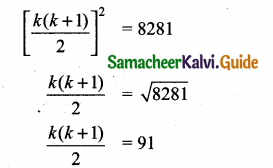
(-2)3 + 6(-2)2 + k(-2) + 6 = 0
-8 + 24 – 2k + 6 = 0
22 – 2k = 0
k = \(\frac{22}{2}\)
= 11

Question 2.
The root of the polynomial equation 2x + 3 = 0 is…….
(a) \(\frac{1}{3}\)
(b) –\(\frac{1}{3}\)
(c) –\(\frac{3}{2}\)
(d) –\(\frac{2}{3}\)
Solution:
(c) –\(\frac{3}{2}\)
Hint:
2x + 3 = 0
2x = – 3 ⇒ x = –\(\frac{3}{2}\)

Samacheer Kalvi 9th Maths Guide Chapter 3 Algebra Ex 3.15

Question 3.
The type of the polynomial 4 – 3x3 is ……..
(a) constant polynomial
(b) linear polynomial
(c) quadratic polynomial
(d) cubic polynomial
Solution:
(d) cubic polynomial

Question 4.
If x51 + 51 is divided by x + 1, then the remainder is …….
(a) 0
(b) 1
(c) 49
(d) 50
Solution:
(d) 50
Hint:
p(x) = x51 + 51
p(-1)= (-1)51 + 51
= -1 + 51
= 50

Question 5.
The zero of the polynomial 2x + 5 is ……..
(a) \(\frac{5}{2}\)
(b) –\(\frac{5}{2}\)
(c) \(\frac{2}{5}\)
(d) –\(\frac{2}{5}\)
Solution:
(b) –\(\frac{5}{2}\)
Hint:
2x + 5 = 0 ⇒ 2x = -5 ⇒ x = –\(\frac{5}{2}\)

Samacheer Kalvi 9th Maths Guide Chapter 3 Algebra Ex 3.15

Question 6.
The sum of the polynomials p(x) = x3 – x2 – 2, q(x) = x2 – 3x + 1
(a) x3 – 3x – 1
(b) x3 + 2x2 – 1
(c) x3 – 2x2 – 3x
(d) x3 – 2x2 + 3x – 1
Solution:
(a) x3 – 3x – 1
Hint:
p(x) + q(x) = (x3 – x2 – 2) + (x2 – 3x + 1) = x3 – x2 – 2 + x² – 3x + 1
= x³ – 3x – 1

Question 7.
Degree of the polynomial (y³ – 2) (y³ + 1) is
(a) 9
(b) 2
(c) 3
(d) 6
Solution:
(d) 6
(y³ – 2) (y³ + 1) = y6 + y³ – 2y³ – 2
= y6 – y³ – 2

Question 8.
Let the polynomials be
(A) -13q5 + 4q² + 12q
(B) (x² + 4)(x² + 9)
(C) 4q8 – q6 + q²
(D) –\(\frac{5}{7}\) y12 + y³ + y5.
Then ascending order of their degree is
(a) A, B, D, C
(b) A, B, C, D
(c) B, C, D, A
(d) B, A, C, D
Solution:
(d) B, A, C, D

Samacheer Kalvi 9th Maths Guide Chapter 3 Algebra Ex 3.15

Question 9.
If p(a) = 0 then (x – a) is a …….. of p(x)
(a) divisor
(b) quotient
(c) remainder
(d) factor
Solution:
(d) factor

Question 10.
Zeros of (2 – 3x) is ……..
(a) 3
(b) 2
(c) \(\frac{2}{3}\)
(d) \(\frac{3}{2}\)
Solution:
(c) \(\frac{2}{3}\)

Question 11.
Which of the following has x -1 as a factor?
(a) 2x – 1
(b) 3x – 3
(c) 4x – 3
(d) 3x – 4
Solution:
(b) 3x – 3

Samacheer Kalvi 9th Maths Guide Chapter 3 Algebra Ex 3.15

Question 12.
If x – 3 is a factor of p(x), then the remainder is ……..
(a) 3
(b) -3
(c) p(3)
(d) p(-3)
Solution:
(c) p(3)

Question 13.
(x +y)(x² – xy + y²) is equal to ……..
(a) (x + y)³
(b) (x – y)³
(c) x³ + y³
(d) x³ – y³
Solution:
(c) x³ + y³

Question 14.
(a + b – c)² is equal to ……..
(a) (a – b + c)²
(b) (-a – b + c)²
(c) (a + b + c)²
(d) (a – b – c)²
Solution:
(b) (-a – b + c)²
Hint:
(a + b – c)² = a² + b² + c² + 2ab – 2bc – 2ac
(- a – b + c)² = a² + b² + c² + 2ab – 2bc – 2ac
(OR)
(- a – b + c)² = (-1)² (a + b + c)² (taking – 1 as common)
= (a + b – c)²

Samacheer Kalvi 9th Maths Guide Chapter 3 Algebra Ex 3.15

Question 15.
In an expression ax² + bx + c the sum and product of the factors respectively ……..
(a) a, bc
(b) b, ac
(c) ac, b
(d) bc, a
Solution:
(b) b, ac

Question 16.
If (x + 5) and (x – 3) are the factors of ax² + bx + c, then values of a, b and c are ………
(a) 1, 2, 3
(b) 1, 2, 15
(c) 1, 2, -15
(d) 1, -2, 15
Solution:
(c) 1, 2, -15
Hint:
(x + 5) (x – 3) = x² + (5 – 3) x + (5) (-3)
= x² + 2x – 15
compare with ax² + bx + c
a = 1, b = 2 and c = -15

Question 17.
Cubic polynomial may have maximum of ……… linear factors.
(a) 1
(b) 2
(c) 3
(d) 4
Solution:
(c) 3

Samacheer Kalvi 9th Maths Guide Chapter 3 Algebra Ex 3.15

Question 18.
Degree of the constant polynomial is ……..
(a) 3
(b) 2
(c) 1
(d) 0
Solution:
(d) 0

Question 19.
Find the value of m from the equation 2x + 3y = m. If its one solution is x = 2 and y = -2.
(a) 2
(b) -2
(c) 10
(d) 0
Solution:
(b) – 2
Hint:
The equation is 2x + 3y = m
Substitute x – 2 and y = -2 we get
2(2) + 3(-2) = m ⇒ 4 – 6 = m ⇒ -2 = m

Question 20.
Which of the following is a linear equation?
(a) x + \(\frac{1}{2}\) = 2
(b) x (x – 1) = 2
(c) 3x + 5 = \(\frac{2}{3}\)
(d) x³ – x = 5
Solution:
(c) 3x + 5 = \(\frac{2}{3}\)

Samacheer Kalvi 9th Maths Guide Chapter 3 Algebra Ex 3.15

Question 21.
Which of the following is a solution of the equation 2x – y = 6?
(a) (2, 4)
(b) (4, 2)
(c) (3, -1)
(d) (0, 6)
Solution:
(b) (4, 2)
Hint:
2x – y = 6
Substitute x – 4 and y = 2 we get
2(4) – 2 = 6 ⇒ 8 – 2 = 6 ⇒ 6 = 6
∴ (4, 2) is the solution

Question 22.
If (2, 3) is a solution of linear equation 2x + 3y = k then, the value of k is ……..
(a) 12
(b) 6
(c) 0
(d) 13
Solution:
(d) 13
Hint:
The equation is 2x + 3y = k
Substitute x = 2 and y = 3 we get,
2(2) + 3(3) = k ⇒ 4 + 9 = k ⇒ 13 = k

Question 23.
Which condition does not satisfy the linear equation ax + by + c = 0 ……..
(a) a ≠ 0, b = 0
(b) a = 0, b ≠ 0
(c) a = 0, b = 0, c ≠ 0
(d) a ≠ 0, b ≠ 0
Solution:
(c) a = 0, b = 0, c ≠ 0

Samacheer Kalvi 9th Maths Guide Chapter 3 Algebra Ex 3.15

Question 24.
Which of the following is not a linear equation in two variable?
(a) ax + by + c = 0
(b) 0x + 0y + c = 0
(c) 0x + by + c = 0
(d) ax + 0y + c = 0
Solution:
(b) 0x + 0y + c = 0
Hint:
0x + 0y + c = 0
0 + 0 + c = 0 ⇒ c = 0
There is no variable.
∴ It is not a linear equation

Question 25.
The value of k for which the pair of linear equations 4x + 6y – 1 = 0 and 2x + ky – 1 = 0 represents parallel lines is ……..
(a) k = 3
(b) k = 2
(c) k = 4
(d) k = -3
Solution:
(a) k = 3
Hint:
Slope of 4x + 6y – 1 = 0 is
6y = -4x + 1 ⇒ y = \(\frac{-4}{6}\) x + \(\frac{1}{6}\)
Slope = \(\frac{-4}{6}\) = \(\frac{-2}{3}\)
Slope of 2x + ky – 7 = 0
ky = -2x + 7
y = \(\frac{-2}{k}\)x + \(\frac{7}{k}\)
Slope of a line = \(\frac{-2}{k}\)
Since the lines are parallel
\(\frac{-2}{3}\) = \(\frac{-2}{k}\)
-2k = – 6
k = \(\frac{6}{2}\)
= 3

Samacheer Kalvi 9th Maths Guide Chapter 3 Algebra Ex 3.15

Question 26.
A pair of linear equations has no solution then the graphical representation is ……..
Samacheer Kalvi 9th Maths Guide Chapter 3 Algebra Ex 3.15 1
Solution:
Samacheer Kalvi 9th Maths Guide Chapter 3 Algebra Ex 3.15 2
Hint:
Since there is no solution the two lines are parallel. (l11m)

Question 27.
If \(\frac{a_1}{a_2}\) ≠ \(\frac{b_1}{b_2}\) where a1x + b1y + c1 = 0 and a2x + b2y + c2 = 0 then the given pair of linear equation has …….. solution(s).
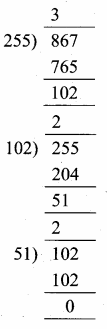
(a) no solution
(b) two solutions
(c) unique
(d) infinite
Solution:
(c) unique
Hint:
Since it has unique solution
\(\frac{a_1}{a_2}\) ≠ \(\frac{b_1}{b_2}\)

Samacheer Kalvi 9th Maths Guide Chapter 3 Algebra Ex 3.15

Question 28.
\(\frac{a_1}{a_2}\) = \(\frac{b_1}{b_2}\) ≠ \(\frac{c_1}{c_2}\) where a1x + b1y + c1 = 0 and a2x + b2y + c2 = 0 then the given pair of linear equation has …….. solution(s).
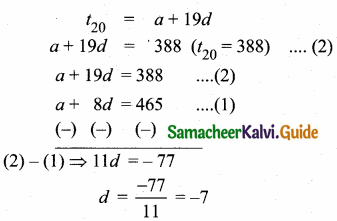
(a) no solution
(b) two solutions
(c) infinite
(d) unique
Solution:
(a) no solution
Hint:
\(\frac{a_1}{a_2}\) = \(\frac{b_1}{b_2}\) ≠ \(\frac{c_1}{c_2}\) the linear equation has no solution.

Question 29.
GCD of any two prime numbers is …….
(a) -1
(b) 0
(c) 1
(d) 2
Solution:
(c) 1

Samacheer Kalvi 9th Maths Guide Chapter 3 Algebra Ex 3.15

Question 30.
The GCD of x4 – y4 and x² – y² is ……..
(a) x4 – y4
(b) x² – y²
(c) (x + y)²
(d) (x + y)4
Solution:
(b) x² – y²
Hint:
x4 – y4 = (x²)² – (y²)²
= (x² + y²)(x² – y²)
x² – y² = (x² – y²)
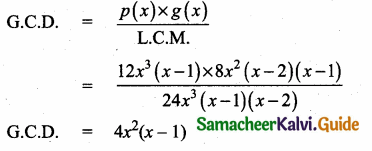
G.C.D. = x² – y²

Samacheer Kalvi 9th Maths Guide Chapter 5 Coordinate Geometry Ex 5.4

Students can download Maths Chapter 5 Coordinate Geometry Ex 5.4 Questions and Answers, Notes, Samacheer Kalvi 9th Maths Guide Pdf helps you to revise the complete Tamilnadu State Board New Syllabus, helps students complete homework assignments and to score high marks in board exams.

Tamilnadu Samacheer Kalvi 9th Maths Solutions Chapter 5 Coordinate Geometry Ex 5.4

Question 1.
Find the coordinates of the point which divides the line segment joining the points A (4,-3) and B (9,7) in the ratio 3 : 2.
Solution:
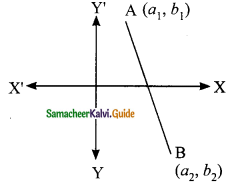
A line divides internally in the ratio m : n
Samacheer Kalvi 9th Maths Guide Chapter 5 Coordinate Geometry Ex 5.4 1

Samacheer Kalvi 9th Maths Guide Chapter 5 Coordinate Geometry Ex 5.4

Question 2.
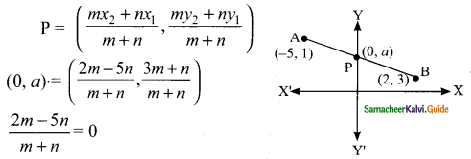
In what ratio does the point P(2, -5) divide the line segment joining A(-3, 5) and B(4, -9).
Solution:
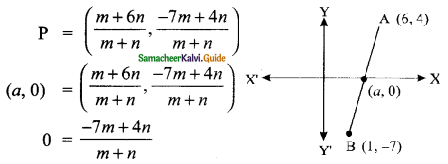
A line divides internally in the ratio m : n
Samacheer Kalvi 9th Maths Guide Chapter 5 Coordinate Geometry Ex 5.4 2
\(\frac{4m-3n}{m+n}\)
= 2
4m – 3n = 2m + 2n
4m – 2m = 3n + 2n
2m = 5n
\(\frac{m}{n}\) = \(\frac{5}{2}\)
m : n = 5 : 2
The ratio is 5 : 2.
and
\(\frac{-9m+5n}{m+n}\)
= -5
-9m + 5 n = -5(m + n)
-9m + 5 n = -5m – 5n
-9m + 5 m = -5n – 5n
-4m = -10
\(\frac{m}{n}\) = \(\frac{10}{4}\) ⇒ \(\frac{m}{n}\) = \(\frac{5}{2}\)
m : n = 5 : 2

Samacheer Kalvi 9th Maths Guide Chapter 5 Coordinate Geometry Ex 5.4

Question 3.
Find the coordinates of a point P on the line segment joining A(1, 2) and B(6, 7) in such a way that AP = \(\frac{2}{5}\) AB.
Solution:
Let the point A (1, 2) and B (6, 7)
AP = \(\frac{2}{5}\) AB
\(\frac{AP}{PB}\) = \(\frac{2}{5}\)
∴ AP = 2; PB = 5 – 2 = 3
A line divides internally in the ratio m : n
Samacheer Kalvi 9th Maths Guide Chapter 5 Coordinate Geometry Ex 5.4 3

Samacheer Kalvi 9th Maths Guide Chapter 5 Coordinate Geometry Ex 5.4

Question 4.
Find the coordinates of the points of trisection of the line segment joining the points A (-5, 6) and B (4, -3).
Solution:
Let P and Q be the point of trisection
so that AP = PB = QB
Samacheer Kalvi 9th Maths Guide Chapter 5 Coordinate Geometry Ex 5.4 4
(\(\frac{3}{3}\), \(\frac{0}{3}\)) = (1, 0)
The Point P is (-2, 3), The Point Q is (1, 0)

Samacheer Kalvi 9th Maths Guide Chapter 5 Coordinate Geometry Ex 5.4

Question 5.
The line segment joining A(6, 3) and B(-1, -4) is doubled in length by adding half of AB to each end. Find the coordinates of the new end points.
Solution:
Samacheer Kalvi 9th Maths Guide Chapter 5 Coordinate Geometry Ex 5.4 5
m : n = 3 : 1
A line divides externally in the ratio m : n
Samacheer Kalvi 9th Maths Guide Chapter 5 Coordinate Geometry Ex 5.4 6
∴ BA’ divides in the ratio 2 : 1
A line divides internally in the ratio m : n the point is \(\frac{mx_{2}+nx_{1}}{m+n}, \frac{my_{2}+ny_{1}}{m+n}\)
Let the point A’ be (a, b)
Samacheer Kalvi 9th Maths Guide Chapter 5 Coordinate Geometry Ex 5.4 7
\(\frac{2a-1}{3}\) = 6
2a – 1 = 18
2a = 19
a = \(\frac{19}{2}\)
and
\(\frac{2b-4}{3}\) = 3
2b – 4 = 9
2b = 13
b = \(\frac{13}{2}\)
Samacheer Kalvi 9th Maths Guide Chapter 5 Coordinate Geometry Ex 5.4 8
The point A’ is (\(\frac{19}{2}\), \(\frac{13}{2}\))
To find B’
Let B’ be (a, b)
AB = 7√2
BB’ = \(\frac{1}{2}\) × 7√2 = \(\frac{7√2}{2}\)
\(\frac{AB}{BB’}\) = 7√2 ÷ \(\frac{7√2}{2}\) = \(\frac{7√2×2}{7√2}\) = 2
AB’ divides in the ratio 2 : 1
(-1, -4) = \(\frac{2a+6}{3}\), \(\frac{2b+3}{3}\)
\(\frac{2a+6}{3}\) = -1
2a + 6 = -3
2a = -3 – 6
2a = -9
a = –\(\frac{9}{2}\)
and
\(\frac{2b+3}{3}\) = -4
2b + 3 = -12
2b = -12 – 3
2b = -15
b = –\(\frac{15}{2}\) = -1
The point B’ is (-\(\frac{9}{2}\), –\(\frac{15}{2}\))

Samacheer Kalvi 9th Maths Guide Chapter 5 Coordinate Geometry Ex 5.4

Question 6.
Using section formula, show that the points A (7, -5), B (9, -3) and C (13, 1) are collinear.
Solution:
If three points are collinear, then one of the points divide the line segment joining the other points in the ratio r : 1. If P is between A and B and \(\frac{AP}{PB}\) = r
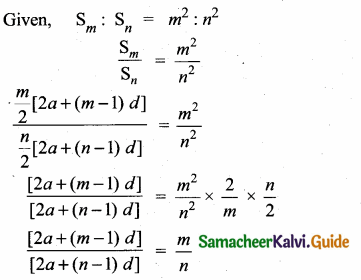
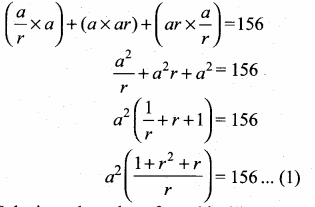
Samacheer Kalvi 9th Maths Guide Chapter 5 Coordinate Geometry Ex 5.4 9
The line divides in the ratio 1 : 2
A line divides internally in the ratio m : n
The point P = (\(\frac{mx_{2}+nx_{1}}{m+n}\), \(\frac{my_{2}+ny_{1}}{m+n}\))
m = 1, n = 2, x1 = 7, x2 = 13, y1 = – 5, y2 = 1
By the given equation,
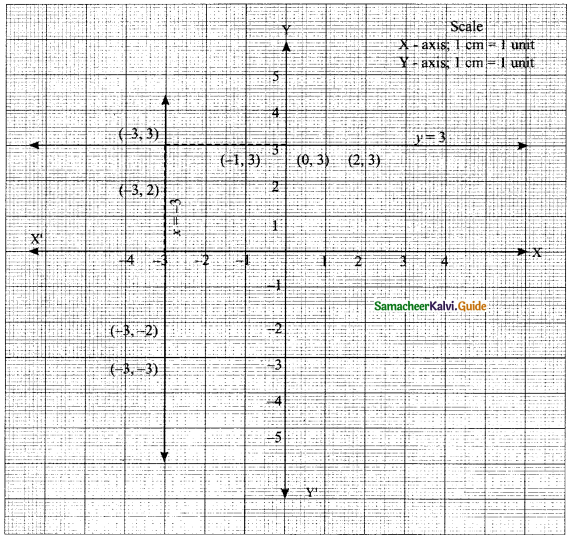
The Point B = (\(\frac{13+14}{3}\), \(\frac{1-10}{3}\))
= (\(\frac{27}{3}\), \(\frac{-9}{3}\))
= (9, -3)
∴ The three points A, B and C are collinear.

Samacheer Kalvi 9th Maths Guide Chapter 5 Coordinate Geometry Ex 5.4

Question 7.
A line segment AB is increased along its length by 25% by producing it to C on the side of B. If A and B have the coordinates (-2, -3) and (2, 1) respectively, then find the coordinates of C.
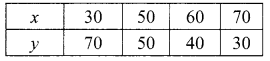
Solution:
Let the point C be (a, b)
Samacheer Kalvi 9th Maths Guide Chapter 5 Coordinate Geometry Ex 5.4 10
The ratio is 4 : 1 (m : n)
A line divides internally in the ratio m : n
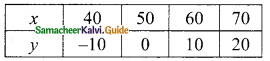
Samacheer Kalvi 9th Maths Guide Chapter 5 Coordinate Geometry Ex 5.4 11
\(\frac{4a-2}{5}\) = 2
4a – 2 = 10
4a = 12
a = \(\frac{12}{4}\) = 3
and
\(\frac{4b-3}{5}\) = 1
4b – 3 = 5
4b = 8
b = \(\frac{8}{4}\) = 2
The co-ordinate of C is (3, 2)

Samacheer Kalvi 9th Maths Guide Chapter 5 Coordinate Geometry Ex 5.4