Samacheer Kalvi 9th Maths Guide Chapter 3 Algebra Ex 3.7

Students can download Maths Chapter 3 Algebra Ex 3.7 Questions and Answers, Notes, Samacheer Kalvi 9th Maths Guide Pdf helps you to revise the complete Tamilnadu State Board New Syllabus, helps students complete homework assignments and to score high marks in board exams.

Tamilnadu Samacheer Kalvi 9th Maths Solutions Chapter 3 Algebra Ex 3.7

Question 1.
Find the quotient and remainder of the following.
(i) 4x3 + 6x2 – 23x + 18) ÷ (x + 3)
Solution:
Samacheer Kalvi 9th Maths Guide Chapter 3 Algebra Ex 3.7 1
∴ The quotient = 4x2 – 6x – 5
The remainder = 33

(ii) (8y3 – 16y2 + 16y – 15) ÷ (2y – 1)
Solution:
Samacheer Kalvi 9th Maths Guide Chapter 3 Algebra Ex 3.7 2
∴ The quotient = 4y2 – 6y + 5
The remainder = -10

Samacheer Kalvi 9th Maths Guide Chapter 3 Algebra Ex 3.7

(iii) (8x3 – 1) ÷ (2x – 1)
Solution:
Samacheer Kalvi 9th Maths Guide Chapter 3 Algebra Ex 3.7 3
∴ The quotient = 4x2 + 2x + 1
The remainder = 0

(iv) (-18z + 14z2 + 24z3 + 18) ÷ (3z + 4)
Solution:
Samacheer Kalvi 9th Maths Guide Chapter 3 Algebra Ex 3.7 4
∴The quotient = 8z2 – 6z + 2
The remainder = 10

Samacheer Kalvi 9th Maths Guide Chapter 3 Algebra Ex 3.7

Question 2.
The area of a rectangle is x2 + 7x + 12. If its breadth is (x + 3) then find its length.
Solution:
Let the length of the rectangle be “l”
The breadth of the rectangle = x + 3
Area of the rectangle = length × breadth
x2 + 7x + 12 = l(x + 3)
Samacheer Kalvi 9th Maths Guide Chapter 3 Algebra Ex 3.7 5
Length of the rectangle = x + 4
Samacheer Kalvi 9th Maths Guide Chapter 3 Algebra Ex 3.7 6

Samacheer Kalvi 9th Maths Guide Chapter 3 Algebra Ex 3.7

Question 3.
The base of a parallelogram is (5x + 4). Find its height if the area is 25x2 – 16.
Solution:
Let the height of the parallelogram be “h”.
Base of the parallelogram = 5x + 4
Area of a parallelogram = 25x2 – 16
∴ Base x Height = 25x2 – 16
(5x + 4) × h = 25x2– 16
Samacheer Kalvi 9th Maths Guide Chapter 3 Algebra Ex 3.7 7
Height of the parallelogram = 5x – 4
Samacheer Kalvi 9th Maths Guide Chapter 3 Algebra Ex 3.7 8

Samacheer Kalvi 9th Maths Guide Chapter 3 Algebra Ex 3.7

Question 4.
The sum of (x + 5) observations is (x3 + 125). Find the mean of the observations.
Solution:
Sum of the observation = x3 + 125
Number of observation = x + 5
Samacheer Kalvi 9th Maths Guide Chapter 3 Algebra Ex 3.7 9
Mean = x2 – 5x + 25
Samacheer Kalvi 9th Maths Guide Chapter 3 Algebra Ex 3.7 10

Question 5.
Find the quotient and remainder for the following using synthetic division:
(i) (x3 + x2 – 7x – 3) ÷ (x – 3)
Solution:
p(x) = x3 + x2 – 7x – 3
d(x) = x – 3 [p(x) = d(x) × q(x) + r]
Samacheer Kalvi 9th Maths Guide Chapter 3 Algebra Ex 3.7 11
x – 3 = 0
x = 3
Hence the quotient = x2 + 4x + 5
Remainder = 12

Samacheer Kalvi 9th Maths Guide Chapter 3 Algebra Ex 3.7

(ii) (x3 + 2x2 – x – 4) ÷ (x + 2)
Solution:
p(x) = x3 + 2x2 -x – 4
d(x) = x + 2
Samacheer Kalvi 9th Maths Guide Chapter 3 Algebra Ex 3.7 12
x + 2 = 0
x = -2
The quotient = x2 – 1
Remainder = -2

(iii) (3x3 – 2x2 + 7x – 5) ÷ (x + 3)
Solution:
p(x) = 3x3 – 2x2 + 7x – 5
d(x) = x + 3
Samacheer Kalvi 9th Maths Guide Chapter 3 Algebra Ex 3.7 13
x + 3 = 0
x = -3
The quotient = 3x2 – 11x + 40
Remainder = -125

(iv) (8x4 – 2x2 + 6x + 5) ÷ (4x + 1)
Solution:
p(x) = 8x4 – 2x2 + 6x + 5
d(x) = 4x + 1
Samacheer Kalvi 9th Maths Guide Chapter 3 Algebra Ex 3.7 14

Samacheer Kalvi 9th Maths Guide Chapter 3 Algebra Ex 3.7

Question 6.
If the quotient obtained on dividing (8x4 – 2x2 + 6x – 7) by (2x + 1) is (4x3 + px2 -qx + 3), then find p, q and also the remainder.
Solution:
p(x) = 8x4 – 2x2 + 6x – 7
d(x) = 2x + 1
Samacheer Kalvi 9th Maths Guide Chapter 3 Algebra Ex 3.7 15
2x + 1 = 0
2x = -1
x = –\(\frac{1}{2}\)
The quotient = \(\frac{1}{2}\) [8x3 – 4x2 + 6]
= 4x3 – 2x2 + 3
= 4x3 – 2x2 + 0x + 3
The given quotient is = 4x3 + px2 – qx + 3
(compared with the given quotient)
The value of p = -2 and q = 0
Remainder = -10

Samacheer Kalvi 9th Maths Guide Chapter 3 Algebra Ex 3.7

Question 7.
If the quotient obtained on dividing 3x3 + 11x2 + 34x + 106 by x – 3 is 3x2 + ax + b, then find a, b and also the remainder.
Solution:
p(x) = 3x3 + 11x2 + 34x + 106
d(x) = x – 3
Samacheer Kalvi 9th Maths Guide Chapter 3 Algebra Ex 3.7 16
x – 3 = 0
x = 3
The quotient is = 3x2 + 20x + 94
The given quotient is = 3x2 + ax + b
Compared with the given quotient
The value of a = 20 and b = 94
The remainder = 388

Samacheer Kalvi 10th Maths Guide Chapter 2 Numbers and Sequences Ex 2.10

Students can download Maths Chapter 2 Numbers and Sequences Ex 2.10 Questions and Answers, Notes, Samacheer Kalvi 10th Maths Guide Pdf helps you to revise the complete Tamilnadu State Board New Syllabus, helps students complete homework assignments and to score high marks in board exams.

Tamilnadu Samacheer Kalvi 10th Maths Solutions Chapter 2 Numbers and Sequences Ex 2.10

Multiple choice questions:

Question 1.
Euclid’s division lemma states that for positive integers a and b, there exist unique integers q and r such that a = bq + r, where r must satisfy ………………….
(1) 1 < r < b
(2) 0 < r < b
(3) 0 < r < 6
(4) 0 < r < b
Ans.
(3) 0 < r < b

Samacheer Kalvi 10th Maths Guide Chapter 2 Numbers and Sequences Ex 2.10

Question 2.
Using Euclid’s division lemma, if the cube of any positive integer is divided by 9 then the possible remainders are ………………….
(1) 0, 1, 8
(2) 1, 4, 8
(3) 0, 1, 3
(4) 1, 3, 5
Answer:
(1) 0, 1, 8
Hint: Let the +ve integer be 1, 2, 3, 4 …………
13 = 1 when it is divided by 9 the remainder is 1.
23 = 8 when it is divided by 9 the remainder is 8.
33 = 27 when it is divided by 9 the remainder is 0.
43 = 64 when it is divided by 9 the remainder is 1.
53 = 125 when it is divided by 9 the remainder is 8.
The remainder 0, 1, 8 is repeated.

Question 3.
If the H.C.F of 65 and 117 is expressible in the form of 65m – 117 , then the value of m is
(1) 4
(2) 2
(3) 1
(4) 3
Answer:
(2) 2
Hint:
H.C.F. of 65 and 117
117 = 65 × 1 + 52
65 = 52 × 1 + 13
52 = 13 × 4 + 0
∴ 13 is the H.C.F. of 65 and 117.
65m – 117 = 65 × 2 – 117
130 – 117 = 13
∴ m = 2

Samacheer Kalvi 10th Maths Guide Chapter 2 Numbers and Sequences Ex 2.10

Question 4.
The sum of the exponents of the prime factors in the prime factorization of 1729 is …………………….
(1) 1
(2) 2
(3) 3
(4) 4
Answer:
(3) 3
Hint: 1729 = 7 × 13 × 19
Sum of the exponents = 1 + 1 + 1
= 3

Question 5.
The least number that is divisible by all the numbers from 1 to 10 (both inclusive) is
(1) 2025
(2) 5220
(3) 5025
(4) 2520
Answer:
(4) 2520
Hint:
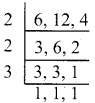
Samacheer Kalvi 10th Maths Guide Chapter 2 Numbers and Sequences Ex 2.10 1
L.C.M. = 23 × 32 × 5 × 7
= 8 × 9 × 5 × 7
= 2520

Samacheer Kalvi 10th Maths Guide Chapter 2 Numbers and Sequences Ex 2.10

Question 6.
74k ≡ ______ (mod 100)
(1) 1
(2) 2
(3) 3
(4) 4
Answer:
(1) 1
Hint:
74k ≡______ (mod 100)
y4k ≡ y4 × 1 = 1 (mod 100)

Question 7.
Given F1 = 1 , F2 = 3 and Fn = Fn-1 + Fn-2 then F5 is ………….
(1) 3
(2) 5
(3) 8
(4) 11
Answer:
(4) 11
Hint:
Fn = Fn-1 + Fn-2
F3 = F2 + F1 = 3 + 1 = 4
F4 = F3 + F2 = 4 + 3 = 7
F5 = F4 + F3 = 7 + 4 = 11

Samacheer Kalvi 10th Maths Guide Chapter 2 Numbers and Sequences Ex 2.10

Question 8.
The first term of an arithmetic progression is unity and the common difference is 4. Which of the following will be a term of this A.P
(1) 4551
(2) 10091
(3) 7881
(4) 13531
Answer:
(3) 7881
Hint:
t1 = 1
d = 4
tn = a + (n – 1)d
= 1 + 4n – 4
4n – 3 = 4551
4n = 4554
n = will be a fraction
It is not possible.
4n – 3 = 10091
4n = 10091 + 3 = 10094
n = a fraction
4n – 3 = 7881
4n = 7881 + 3 = 7884
n = \(\frac{7884}{4}\), n is a whole number.
4n – 3 = 13531
4n = 13531 – 3 = 13534
n is a fraction.
∴ 7881 will be 1971st term of A.P.

Samacheer Kalvi 10th Maths Guide Chapter 2 Numbers and Sequences Ex 2.10

Question 9.
If 6 times of 6th term of an A.P is equal to 7 times the 7th term, then the 13th term of the A.P. is ………..
(1) 0
(2) 6
(3) 7
(4) 13
Answer:
(1) 0
Hint:
6 t6 = 7 t7
6(a + 5d) = 7 (a + 6d) ⇒ 6a + 30d = 7a + 42d
30 d – 42 d = 7a – 6a ⇒ -12d = a
t13 = a + 12d (12d = -a)
= a – a = 0

Question 10.
An A.P consists of 31 terms. If its 16th term is m, then the sum of all the terms of this A.P. is
(1) 16 m
(2) 62 m
(3) 31 m
(4) \(\frac { 31 }{ 2 } \) m
Answer:
(3) 31 m
Hint:
t16 = m
S31 = \(\frac { 31 }{ 2 } \) (2a + 30d)
= \(\frac { 31 }{ 2 } \) (2(a + 15d))
(∵ t16 = a + 15d)
= 31(t16) = 31m

Samacheer Kalvi 10th Maths Guide Chapter 2 Numbers and Sequences Ex 2.10

Question 11.
In an A.P., the first term is 1 and the common difference is 4. How many terms of the A.P must be taken for their sum to be equal to 120?
(1) 6
(2) 7
(3) 8
(4) 9
Answer:
(3) 8
Here a = 1, d = 4, Sn = 120
Sn = \(\frac { n }{ 2 } \)[2a + (n – 1)d]
120 = \(\frac { n }{ 2 } \) [2 + (n – 1)4] = \(\frac { n }{ 2 } \) [2 + 4n – 4)]
= \(\frac { n }{ 2 } \) [4n – 2)] = \(\frac { n }{ 2 } \) × 2 (2n – 1)
120 = 2n2 – n
∴ 2n2 – n – 120 = 0 ⇒ 2n2 – 16n + 15n – 120 = 0
2n(n – 8) + 15 (n – 8) = 0 ⇒ (n – 8) (2n + 15) = 0
n = 8 or n = \(\frac { -15 }{ 2 } \) (omitted)
∴ n = 8

Question 12.
A = 265 and B = 264 + 263 + 262 …. + 20 which of the following is true?
(1) B is 264 more than A
(2) A and B are equal
(3) B is larger than A by 1
(4) A is larger than B by 1
Answer:
(4) A is larger than B by
A = 265
B = 264+63 + 262 + …….. + 20
= 2
= 1 + 22 + 22 + ……. + 264
a = 1, r = 2, n = 65 it is in G.P.
S65 = 1 (265 – 1) = 265 – 1
A = 265 is larger than B

Samacheer Kalvi 10th Maths Guide Chapter 2 Numbers and Sequences Ex 2.10

Question 13.
The next term of the sequence \(\frac { 3 }{ 16 } \),\(\frac { 1 }{ 8 } \),\(\frac { 1 }{ 12 } \),\(\frac { 1 }{ 18 } \) is ………..
(1) \(\frac { 1 }{ 24 } \)
(2) \(\frac { 1 }{ 27 } \)
(3) \(\frac { 2 }{ 3 } \)
(4) \(\frac { 1 }{ 81 } \)
Answer:
(2) \(\frac { 1 }{ 27 } \)
Hint:
\(\frac { 3 }{ 16 } \),\(\frac { 1 }{ 8 } \),\(\frac { 1 }{ 12 } \),\(\frac { 1 }{ 18 } \)
a = \(\frac { 3 }{ 16 } \), r = \(\frac { 1 }{ 8 } \) ÷ \(\frac { 3 }{ 16 } \) = \(\frac { 1 }{ 8 } \) × \(\frac { 16 }{ 3 } \) = \(\frac { 2 }{ 3 } \)
The next term is = \(\frac { 1 }{ 18 } \) × \(\frac { 2 }{ 3 } \) = \(\frac { 1 }{ 27 } \)

Question 14.
If the sequence t1,t2,t3 … are in A.P. then the sequence t6,t12,t18 … is
(1) a Geometric Progression
(2) an Arithmetic Progression
(3) neither an Arithmetic Progression nor a Geometric Progression
(4) a constant sequence
Answer:
(2) an Arithmetic Progression
Hint:
If t1, t2, t3, … is 1, 2, 3, …
If t6 = 6, t12 = 12, t18 = 18 then 6, 12, 18 … is an arithmetic progression

Samacheer Kalvi 10th Maths Guide Chapter 2 Numbers and Sequences Ex 2.10

Question 15.
The value of (13 + 23 + 33 + ……. + 153) – (1 + 2 + 3 + …….. + 15) is …………….
(1) 14400
(2) 14200
(3) 14280
(4) 14520
Answer:
(3) 14280
Hint:
Samacheer Kalvi 10th Maths Guide Chapter 2 Numbers and Sequences Ex 2.10 2
1202 – 120 = 120(120 – 1)
120 × 119 = 14280

Samacheer Kalvi 9th Maths Guide Chapter 3 Algebra Ex 3.3

Students can download Maths Chapter 3 Algebra Ex 3.3 Questions and Answers, Notes, Samacheer Kalvi 9th Maths Guide Pdf helps you to revise the complete Tamilnadu State Board New Syllabus, helps students complete homework assignments and to score high marks in board exams.

Tamilnadu Samacheer Kalvi 9th Maths Solutions Chapter 3 Algebra Ex 3.3

Question 1.
Check whether p(x) is a multiple of g(x) or not.
(i) p(x) = x3 – 5x2 + 4x – 3; g(x) = x – 2
Solution:
p(x) = x3 – 5x2 + 4x – 3
P(2) = (2)3 – 5(2)2 + 4(2) – 3
= 8 – 5(4) + 8 – 3
= 8 – 20 + 8 – 3
= 16 – 23
= -7
p{2) ≠ 0
∴ p(x) is not a multiple of g(x)

Samacheer Kalvi 9th Maths Guide Chapter 3 Algebra Ex 3.3

Question 2.
By remainder theorem, find the remainder when p(x) is divided by g(x) where,
(i) p(x) = x3 – 2x2 – 4x – 1; g(x) = x + 1
Solution:
p(x) = x3 – 2x2 – 4x – 1
p(-1) = (-1)3 – 2(-1)2 – 4(-1) – 1
= 1 – 2 + 4 – 1
= 4 – 4 = 0
∴ The remainder = 0

(ii) p(x) = 4x3 – 12x2 + 14x – 3; g(x) = 2x – 1
Solution:
p(x) = 4x3 – 12x2 + 14x – 3
Samacheer Kalvi 9th Maths Guide Chapter 3 Algebra Ex 3.3 1
= 4 × \(\frac{1}{8}\) – 12 × \(\frac{1}{4}\) + 14 × \(\frac{1}{2}\) – 3
= \(\frac{1}{2}\) – 3 + 7 – 3
= \(\frac{1}{2}\) – 6 + 7
= \(\frac{1}{2}\) + 1
= \(\frac{3}{2}\)
∴ The reminder is \(\frac{3}{2}\)

(iii) p(x) = x3 – 3x2 + 4x + 50; g(x) = x – 3
Solution:
p(x) = x3 – 3x2 + 4x + 50
p(3) = 33 – 3(3)2 + 4(3) + 50
= 27 – 27 + 12 + 50
= 62
The remainder is 62.

Samacheer Kalvi 9th Maths Guide Chapter 3 Algebra Ex 3.3

Question 3.
Find the remainder when 3x3 – 4x2 + 7x – 5 is divided by (x + 3)
Solution:
p(x) = 3x3 – 4x2 + 7x – 5
When it is divided by x +3,
p(-3) = 3(-3)3 – 4(-3)2 + 7(-3) – 5
= 3(-27) – 4(9) – 21 – 5
= -81 – 36 – 21 – 5
= -143
The remainder is -143.

Samacheer Kalvi 9th Maths Guide Chapter 3 Algebra Ex 3.3

Question 4.
What is the remainder when x2018 + 2018 is divided by x – 1.
Solution:
p(x) = x2018 + 2018
When it is divided by x – 1,
p(1) = 12018 + 2018
= 1 + 2018
= 2019
The remainder is 2019.

Question 5.
For what value of k is the polynomial
p(x) = 2x3 – kx2 + 3x + 10 exactly divisible by x – 2
Solution:
p(x) = 2x3 – kx2 + 3x + 10
When it is exactly divided by x – 2,
P(2) = 0
2(2)3 – k(2)2 + 3(2) + 10 = 0
2(8) – k(4) + 6 + 10 = 0
16 – k(4) + 6 + 10 = 0
16 – 4k + 6 + 10 = 0
32 – 4k = 0
32 = 4k
∴ k = \(\frac{32}{4}\)
= 8
The value of k = 8

Samacheer Kalvi 9th Maths Guide Chapter 3 Algebra Ex 3.3

Question 6.
If two polynomials 2x3 + ax2 + 4x – 12 and x3 + x2 – 2x + a leave the same remainder when divided by (x – 3), find the value of a and also find the remainder.
Solution:
p(x1) = 2x3 + ax2 + 4x – 12
When it is divided by x – 3,
p(3) = 2(3)3 + a(3)2 + 4(3) – 12
= 54 + 9a + 12 – 12
= 54 + 9a ……….(R1)
p(x2) = x3 + x2 – 2x + a
When it is divided by x – 3,
p(3) = 33 + 32 – 2(3) + a
= 27 + 9 – 6 + a
= 30 + a ………(R2)
The given remainders are same (R1 = R2)
∴ 54 + 9a = 30 + a
9a – a = 30 – 54
8a = -24
∴ a = -24/8
= -3
Consider R2,
Remainder = 30 – 3
= 27

Samacheer Kalvi 9th Maths Guide Chapter 3 Algebra Ex 3.3

Question 7.
Determine whether (x – 1) is a factor of the following polynomials:
(i) x3 + 5x2 – 10x + 4
Solution:
p(x) = x3 + 5x2 – 10x + 4
p(1) = 13 + 5(1) – 10(1) + 4
= 1 + 5 – 10 + 4
= 10 – 10
= 0
∴ x – 1 is a factor of p(x)

(ii) x4 + 5x2 – 5x + 1
Solution:
p(1) = 14 + 5(1)2 – 5(1) + 1
= 1 + 5 – 5 + 1
= 7 – 5
= 2
= 0
∴ x – 1 is not a factor of p(x)

Samacheer Kalvi 9th Maths Guide Chapter 3 Algebra Ex 3.3

Question 8.
Using factor theorem, show that (x – 5) is a factor of the polynomial
2x3 – 5x2 – 28x + 15
Solution:
p(x) = 2x3 – 5x2 – 28x + 15
x – 5 is a factor
p(5) = 2(5)3 – 5(5)2 – 28(5) + 15
= 250 – 125 – 140 + 15
= 265 – 265
= 0
∴ x – 5 is a factor of p(x)

Samacheer Kalvi 9th Maths Guide Chapter 3 Algebra Ex 3.3

Question 9.
Determine the value of m, if (x + 3) is a factor of x3 – 3x2 – mx + 24.
Solution:
p(x) = x3 – 3x2 – mx + 24
when x + 3 is a factor
P(-3) = 0
(-3)3 – 3(-3)2 – m(-3) + 24 = 0
-27 – 27 + 3m + 24 = 0
-54 + 24 + 3m = 0
-30 + 3m = 0
3m = 30
m = \(\frac{30}{3}\)
= 10
The value of m = 10

Samacheer Kalvi 9th Maths Guide Chapter 3 Algebra Ex 3.3

Question 10.
If both (x-2) and (x – \(\frac{1}{2}\)) are the factors of ax2 + 5x + b, then show that a = b.
Solution:
p(x) = ax2 + 5x + b
when (x-2) is a factor
P(2) = 0
a(2)2 + 5(2) + b = 0
4a + 10 + b = 0
4a + b = -10 …….(1)
when (x – \(\frac{1}{2}\)) is a factor
p(\(\frac{1}{2}\)) = 0
a\((\frac{1}{2})^2\) + 5(\(\frac{1}{2}\)) + b = 0
Multiply by 4
a + 10 + 4b = 0
a + 46 = -10 …….(2)
From (1) and (2) we get
4a + b = a + 4b
4a – a = 4b – b
3a = 3b
a = b
Hence it is proved.

Samacheer Kalvi 9th Maths Guide Chapter 3 Algebra Ex 3.3

Question 11.
If (x – 1) divides the polynomial kx3 – 2x2 + 25x – 26 without remainder, then find the value of k.
Solution:
p(x) = kx3 – 2x2 + 25x – 26
When it is divided by x – 1
P(1) = 0
k(1)3 – 2(1)2 + 25(1) – 26 = 0
k – 2 + 25 – 26 = 0
k + 25 – 28 = 0
k – 3 = 0
k = 3
The value of k = 3

Samacheer Kalvi 9th Maths Guide Chapter 3 Algebra Ex 3.3

Question 12.
Check if (x + 2) and (x – 4) are the sides of a rectangle whose area is x2 – 2x – 8 by using factor theorem.
Solution:
Let the area of a rectangle be p(x)
p(x) = x2 – 2x – 8
When x + 2 is the side of the rectangle
p(-2) = (-2)2 – 2(-2) – 8
= 4 + 4 – 8
= 8 – 8
= 0
When x – 4 is the side of the rectangle.
P(4) = (4)2 – 2(4) – 8
= 16 – 8 – 8
= 16 – 16
= 0
(x + 2) and (x – 4) are the sides of a rectangle

Samacheer Kalvi 9th Maths Guide Chapter 3 Algebra Ex 3.6

Students can download Maths Chapter 3 Algebra Ex 3.6 Questions and Answers, Notes, Samacheer Kalvi 9th Maths Guide Pdf helps you to revise the complete Tamilnadu State Board New Syllabus, helps students complete homework assignments and to score high marks in board exams.

Tamilnadu Samacheer Kalvi 9th Maths Solutions Chapter 3 Algebra Ex 3.6

Question 1.
Factorise the following.
(i) x² + 10x + 24
Solution:
Product = 24, sum = 10
Samacheer Kalvi 9th Maths Guide Chapter 3 Algebra Ex 3.6 1
Split the middle term as 6x and 4x
x² + 10x + 24 = x² + 6x + 4x + 24
= x(x + 6) + 4 (x + 6)
= (x + 6) (x + 4)

(ii) z² + 4z – 12
Solution:
Product = -12, sum = 4
Samacheer Kalvi 9th Maths Guide Chapter 3 Algebra Ex 3.6 2
Split the middle term as 6z and -2z
z² + 4z – 12 = z² + 6z – 2z – 12
= z(z + 6) – 2 (z + 6)
= (z + 6) (z – 2)

Samacheer Kalvi 9th Maths Guide Chapter 3 Algebra Ex 3.6

(iii) p² – 6p – 16
Solution:
Product = -16, sum = -6
Samacheer Kalvi 9th Maths Guide Chapter 3 Algebra Ex 3.6 3
Split the middle term as – 8p and 2p
p² – 6p – 16 = p² – 8p + 2p – 16
= p(p – 8) + 2 (p – 8)
= (p – 8) (p + 2)

(iv) t² + 72 – 17t
Solution:
Product = +72, sum = -17
Samacheer Kalvi 9th Maths Guide Chapter 3 Algebra Ex 3.6 4
Split the middle term as -9t and -8t
t² – 17t + 72 = t² – 91 – 8t + 72
= t(t – 9) – 8 (l – 9)
= (t – 9) (t – 8)

(v) y² – 16y – 80
Solution:
Product = -80, sum = -16
Samacheer Kalvi 9th Maths Guide Chapter 3 Algebra Ex 3.6 5
Split the middle term as -20y and 4y
y² – 16y – 80 = y² – 20y + Ay – 80
= y(y – 20) + 4 (y – 20)
= (y – 20) (y + 4)

(vi) a² + 10a – 600
Solution:
Product = -600, sum =10
Samacheer Kalvi 9th Maths Guide Chapter 3 Algebra Ex 3.6 6
Split the middle term as 30a and -20a
a² + 10a – 600 = a² + 30a – 20a – 600
= a(a + 30) – 20 (a + 30)
= (a + 30) (a – 20)

Samacheer Kalvi 9th Maths Guide Chapter 3 Algebra Ex 3.6

Question 2.
Factorise the following.
(i) 2a² + 9a + 10
Solution:
Product = 2 × 10 = 20, sum = 9
Samacheer Kalvi 9th Maths Guide Chapter 3 Algebra Ex 3.6 7
Split the middle term as 5a and 4a
2a² + 9a + 10 = 2a² + 5a + 4a + 10
= a(2a + 5) + 2 (2a + 5)
= (2a+ 5) (a+ 2)

(ii) 5x² – 29xy – 42y²
Solution:
Product = 5 × -42 = -210, sum = -29
Samacheer Kalvi 9th Maths Guide Chapter 3 Algebra Ex 3.6 8
Split the middle term as -35x and 6x
5x² – 29xy – 42y² = 5x² – 35xy + 6xy – 42y²
= 5x (x – 7y) + 6y (x – 7y)
= (x – 7y) (5x + 6y)

(iii) 9 – 18x + 8x²
Solution:
Product = 9 × 8 = 72, sum = -18
Samacheer Kalvi 9th Maths Guide Chapter 3 Algebra Ex 3.6 9
Split the middle term as -12x and -6x
9 – 18x + 8x² = 8x² – 18x + 9
= 8x² – 12x – 6x + 9
= 4x (2x – 3) – 3 (2x – 3)
= (2x – 3) (4x – 3)

Samacheer Kalvi 9th Maths Guide Chapter 3 Algebra Ex 3.6

(iv) 6x² + 16xy + 8y²
Solution:
Product = 6 × 8 = 48, sum = 16
Samacheer Kalvi 9th Maths Guide Chapter 3 Algebra Ex 3.6 10
Split the middle term as 4xy and 12xy
6x² + 16xy + 8y² = 6x² + 12xy + 4xy + 8y²
= 6x (x + 2y) + 4y(x + 2y)
= (x + 2y) (6x + 4y)
= 2(x + 2y) (3x + 2y)

(v) 12x² + 36x²y + 27y²x²
Solution:
3x²2 [4 + 12y + 9y²]
= 3x² [9y² + 12y + 4]
Product = 9 x 4 = 36, sum =12
Samacheer Kalvi 9th Maths Guide Chapter 3 Algebra Ex 3.6 11
Split the middle term as 6y and 6y
12x² + 36x²y + 21y²x² = 3x² [9y² + 12y + 4]
= 3x² [9y² + 6y + 6y + 4]
= 3x² [3y(3y + 2) + 2(3y + 2)]
= 3x² (3y + 2) (3y + 2)
= 3x² (3y + 2)2

(vi) (a + b)² + 9 (a + b) + 18
Solution:
Let (a + b) = x
x² + 9x + 18
Product =18, sum = 9
Split the middle term as 6x and 3x
x² + 9x + 18 = x² + 6x + 3x + 18
= x (x + 6) + 3 (x + 6)
= (x + 6) (x + 3)
But x = a + b
(a + b)² + 9(a + b) + 18 = (a + b + 6) (a + b + 3)

Samacheer Kalvi 9th Maths Guide Chapter 3 Algebra Ex 3.6

Question 3.
Factorise the following.
(i) (p – q)² – 6(p – q) – 16
Solution:
Let (p – q) = x
(p – q)² – 6 (p – q) – 16 = x² – 6x – 16
Product = -16, sum = -6
Samacheer Kalvi 9th Maths Guide Chapter 3 Algebra Ex 3.6 12
Split the middle term as -8x and 2x
x² – 6x – 16 = x² – 8x + 2x – 16
= x(x – 8) + 2(x – 8)
= (x – 8) (x + 2)
(But x = p – q)
= (p – q – 8) (p – q + 2)

(ii) m² + 2mn – 24n²
Solution:
Product = -24, sum = 2
Samacheer Kalvi 9th Maths Guide Chapter 3 Algebra Ex 3.6 13
Split the middle term as 6mn and -4mn
m² + 2mn – 24m² = m² + 6mn – 4mn – 24n²
= m(m + 6n) – 4n (m + 6n)
= (m + 6n) (m – 4n)

Samacheer Kalvi 9th Maths Guide Chapter 3 Algebra Ex 3.6

(iii) √5 a² + 2a – 3√5?
Solution:
Product = √5 × – 3√5 = -15, sum = 2
Samacheer Kalvi 9th Maths Guide Chapter 3 Algebra Ex 3.6 14
Split the middle term as 5x and -3x
√5 a² + 2a – 3√5 = √5a² + 5a – 3a – 3√5
= √5 a(a + √5) – 3(a + √5)
= (a + √5) (√5a – 3)

(iv) a4 – 3a² + 2
Solution:
Let a² = x
a4 – 3a² + 2 = (a²)² – 3a² + 2
= x² – 3x + 2
Product = 2 and sum = -3
Samacheer Kalvi 9th Maths Guide Chapter 3 Algebra Ex 3.6 15
Split the middle term as -x and -2x
x² – 3x + 2 = x² – x – 2x + 2
= x(x – 1) – 2(x – 1)
= (x – 1) (x – 2)
a4 – 3a² + 2 = (a2 – 1)(a2 – 2) [But a2 = x]
= (a + 1) (a – 1) (a2 – 2)

Samacheer Kalvi 9th Maths Guide Chapter 3 Algebra Ex 3.6

(v) 8m3 – 2m2n – 15mn2
Solution:
8m3 – 2m2n – 15mn2 = m(8m2 – 2mn – 15n2)
Product = 8(-15) = -120 and sum = -2
Samacheer Kalvi 9th Maths Guide Chapter 3 Algebra Ex 3.6 16
Split the middle term as -12mn and 10mn
8m3 – 2m2n – 15mn2 = m[8m2 – 2mn – 15n2]
= m[8m2– 12mn + 10mn- 15n2]
= m[4m (2m – 3n) + 5n(2m – 3n)]
= m(2m – 3n) (4m + 5n)

(vi) \(\frac{1}{x^{2}}+\frac{1}{y^{2}}+\frac{2}{x y}\)
Solution:
Samacheer Kalvi 9th Maths Guide Chapter 3 Algebra Ex 3.6 17

Samacheer Kalvi 10th Maths Guide Chapter 2 Numbers and Sequences Ex 2.9

Students can download Maths Chapter 2 Numbers and Sequences Ex 2.9 Questions and Answers, Notes, Samacheer Kalvi 10th Maths Guide Pdf helps you to revise the complete Tamilnadu State Board New Syllabus, helps students complete homework assignments and to score high marks in board exams.

Tamilnadu Samacheer Kalvi 10th Maths Solutions Chapter 2 Numbers and Sequences Ex 2.9

Question 1.
Find the sum of the following series
(i) 1 + 2 + 3 + …….. + 60
(ii) 3 + 6 + 9 + …….. +96
(iii) 51 + 52 + 53 + …….. + 92
(iv) 1 + 4 + 9 + 16 + …….. + 225
(v) 62 + 72 + 82 + …….. + 212
(vi) 103 + 113 + 123 + …….. + 203
(vii) 1 + 3 + 5 + …… + 71
Solution:
(i) 1 + 2 + 3 + …….. + 60 = \(\frac{60 \times 61}{2}\)
[Using \(\frac{n(n+1)}{2}\) formula]
= 1830

(ii) 3 + 6 + 9 + …….. + 96 = 3(1 + 2 + 3 + ……… + 32)
= \(\frac{3 \times 32 \times 33}{2}\)
= 1584

(iii) 51 + 52 + 53 + …….. + 92 = (1 + 2 + 3 + ……. + 92) – (1 + 2 + 3 + …… + 50)
Samacheer Kalvi 10th Maths Guide Chapter 2 Numbers and Sequences Ex 2.9
= 4278 – 1275
= 3003

(iv) 1 + 4 + 9 + 16 + …….. + 225 = 12 + 22 + 32 + 42 + ………… + 152
\(\frac{15 \times 16 \times 31}{6}\)
[using \(\frac{n(n+1)(2 n+1)}{6}\)] formula
= 1240

(v) 62 + 72 + 82 + …….. + 212 = 1 + 22 + 32 + 42 + ………… + 212 – (1 + 22 + ………… + 52)
= \(\frac{21 \times 22 \times 43}{6}\) – \(\frac{5 \times 6 \times 11}{6}\)
= 3311 – 55
= 3256

(vi) 103 = 113 + 123 + …….. + 203 = 13 + 23+ 33 + ………… + 203 – (13 + 23 + 33 + …………. + 93)
Samacheer Kalvi 10th Maths Guide Chapter 2 Numbers and Sequences Ex 2.9
[Using (\(\frac{n(n+1)}{2}\))2 formula]
= 2102 – 452 = 44100 – 2025
= 42075

(vii) 1 + 3 + 5+ … + 71
Here a = 1; d = 3 – 1 = 2; l = 71
Samacheer Kalvi 10th Maths Guide Chapter 2 Numbers and Sequences Ex 2.9 1
Samacheer Kalvi 10th Maths Guide Chapter 2 Numbers and Sequences Ex 2.9

Question 2.
If 1 + 2 + 3 + …. + k = 325 , then find 13 + 23 + 33 + …………. + k3
Answer:
1 + 2 + 3 + …. + k = 325
\(\frac{k(k+1)}{2}\) = 325 ……(1)
Samacheer Kalvi 10th Maths Guide Chapter 2 Numbers and Sequences Ex 2.9
= 3252 (From 1)
= 105625

Question 3.
If 13 + 23 + 33 + ………… + K3 = 44100 then find 1 + 2 + 3 + ……. + k
Answer:
13 + 23 + 33 + ………….. + k3 = 44100
Samacheer Kalvi 10th Maths Guide Chapter 2 Numbers and Sequences Ex 2.9
\(\frac{k(k+1)}{2}\) = \(\sqrt { 44100 }\) = 210
1 + 2 + 3 + …… + k = \(\frac{k(k+1)}{2}\)
= 210

Question 4.
How many terms of the series 13 + 23 + 33 + …………… should be taken to get the sum 14400?
Answer:
13 + 23 + 33 + ……. + n3 = 14400
Samacheer Kalvi 10th Maths Guide Chapter 2 Numbers and Sequences Ex 2.9
\(\frac{n(n+1)}{2}\) = \(\sqrt { 14400 }\)
\(\frac{n(n+1)}{2}\) = 120 ⇒ n2 + n = 240
Samacheer Kalvi 10th Maths Guide Chapter 2 Numbers and Sequences Ex 2.9 25
n2 + n – 240 = 0
(n + 16) (n – 15) = 0
(n + 16) = 0 or (n – 15) = 0
n = -16 or n = 15 (Negative will be omitted)
∴ The number of terms taken is 15

Samacheer Kalvi 10th Maths Guide Chapter 2 Numbers and Sequences Ex 2.9

Question 5.
The sum of the squares of the first n natural numbers is 285, while the sum of their cubes is 2025. Find the value of n.
Answer:
12 + 22 + 32 + …. + n2 = 285
Samacheer Kalvi 10th Maths Guide Chapter 2 Numbers and Sequences Ex 2.9 35

Question 6.
Rekha has 15 square colour papers of sizes 10 cm, 11 cm, 12 cm, …, 24 cm. How much area can be decorated with these colour papers?
Answer:
Area of 15 square colour papers
= 102 + 112 + 122 + …. + 242
= (12 + 22 + 32 + …. + 242) – (12 + 22 + 92)
= \(\frac{24 \times 25 \times 49}{6}-\frac{9 \times 10 \times 19}{6}\)
= 4 × 25 × 49 – 3 × 5 × 19
= 4900 – 285
= 4615
Area can be decorated is 4615 cm2

Samacheer Kalvi 10th Maths Guide Chapter 2 Numbers and Sequences Ex 2.9

Question 7.
Find the sum of the series (23 – 1)+(43 – 33) + (63 – 153) + …….. to
(i) n terms
(ii) 8 terms
Answer:
Sum of the series = (23 – 1) + (43 – 33) + (63 – 153) + …. n terms
= 23 + 43 + 63 + …. n terms – (13 + 33 + 53 + …. n terms) …….(1)
23 + 43 + 63 + …. n = ∑(23 + 43 + 63 + ….(2n)3]
∑ 23 (13 + 23 + 33 + …. n3)
= 8 (\(\frac{n(n+1)}{2}\))2
= 2[n (n + 1)]2
13 + 33 + 53 + ……….(2n – 1)3 [sum of first 2n cubes – sum of first n even cubes]
Samacheer Kalvi 10th Maths Guide Chapter 2 Numbers and Sequences Ex 2.9 45
Substituting (2) and (3) in (1)
Sum of the series = 2n2 (n + 1)2 – n2 (2n + 1)2 + 2n2(n + 1)2
= 4n2 (n + 1)2 – n2 (2n + 1)2
= n2 [(4(n + 1)2 – (2n + 1)2]
= n2 [4n2 + 4 + 8n – 4n2 – 1 – 4n]
= n2 [4n + 3]
= 4n3 + 3n2

(ii) when n = 8 = 4(8)3 + 3(8)2
= 4(512) + 3(64)
= 2240

Samacheer Kalvi 9th Maths Guide Chapter 3 Algebra Ex 3.2

Students can download Maths Chapter 3 Algebra Ex 3.2 Questions and Answers, Notes, Samacheer Kalvi 9th Maths Guide Pdf helps you to revise the complete Tamilnadu State Board New Syllabus, helps students complete homework assignments and to score high marks in board exams.

Tamilnadu Samacheer Kalvi 9th Maths Solutions Chapter 3 Algebra Ex 3.2

Question 1.
Find the value of the polynomial f(y) = 6y – 3y2 + 3 at
(i) y = 1
(ii) y = -1
(iii) y = 0
Solution:
(i) When y = 1
f(y) = 6y – 3y2 + 3
f(1) = 6(1) – 3(1)2 + 3
= 6 – 3 + 3 = 6

(ii) When y = – 1
f(y) = 6y – 3y2 + 3
f(-1) = 6(-1) – 3(-1)2 + 3
= – 6 – 3 + 3
= – 6

(iii) When y = 0
f(y) = 6y – 3y2 + 3
f(0) = 6(0) – 3(0)2 + 3
= 0 – 0 + 3
= 3

Samacheer Kalvi 9th Maths Guide Chapter 3 Algebra Ex 3.2

Question 2.
If p(x) = x2 – 2√2x + 1, find p(2√2).
Solution:
p(x) = x2 – 2√2x + 1
p(2√2) = (2√2)2 – 2√2 (2√2) + 1
= 8 – 8 + 1
= 0 + 1
= 1

Question 3.
Find the zeros of the polynomial in each of the following.
(i) P(x) = x – 3
Solution:
p( 3) = 3 – 3
= 0
p(3) is the zero of p(x)

(ii) p(x) = 2x + 5
Solution:
Samacheer Kalvi 9th Maths Guide Chapter 3 Algebra Ex 3.2 1
= -5 + 5
= 2(0)
= 0
Hence –\(\frac{5}{2}\) is the zero of p(x).

Samacheer Kalvi 9th Maths Guide Chapter 3 Algebra Ex 3.2

(iii) q(y) = 2y – 3
Solution:
Samacheer Kalvi 9th Maths Guide Chapter 3 Algebra Ex 3.2 2
= 2 × 0
= 0
Hence \(\frac{3}{2}\) is the zero of q(y).

(iv) f(z) = 8z
Solution:
f(0) = 8 × 0
= 0
Hence 0 is the zero of f(z)

(v) p(x) = ax when a ≠ 0
Solution:
p(0) = a(0)
= 0
Hence, 0 is the zero of p(x)

(vi) h(x) = ax + b, a ≠ 0, a, b∈R
Solution:
Samacheer Kalvi 9th Maths Guide Chapter 3 Algebra Ex 3.2 3
Hence –\(\frac{b}{a}\) is the zero of h(x).

Samacheer Kalvi 9th Maths Guide Chapter 3 Algebra Ex 3.2

Question 4.
Find the roots of the polynomial equations.
(i) 5x – 6 = 0
Solution:
5x = 6
x = \(\frac{6}{5}\)
\(\frac{6}{5}\) is the root of the polynomial.

(ii) x + 3 = 0
Solution:
x = -3
-3 is the root of the polynomial.

Samacheer Kalvi 9th Maths Guide Chapter 3 Algebra Ex 3.2

(iii) 10x + 9 = 0
Solution:
10x = -9
x = –\(\frac{9}{10}\)
–\(\frac{9}{10}\) is the root of the polynomial.

(iv) 9x – 4 = 0
Solution:
9x = 4
x = \(\frac{4}{9}\)
\(\frac{4}{9}\) is the root of the polynomial.

Samacheer Kalvi 9th Maths Guide Chapter 3 Algebra Ex 3.2

Question 5.
Verify whether the following are zeros of the polynomial, indicated against them,or not.
(i) p(x) = 2x – 1, x = \(\frac{1}{2}\)
Solution:
p (\(\frac{1}{2}\)) = 2(\(\frac{1}{2}\)) – 1
= 1 – 1
= 0
∴ \(\frac{1}{2}\) is the zero of the polynomial.

(ii) p(x) = x3 – 1, x = 1
Solution:
p(1) = 13 – 1
= 1 – 1
= 0
∴ 1 is the zero of the polynomial

Samacheer Kalvi 9th Maths Guide Chapter 3 Algebra Ex 3.2

(iii) p(x) = ax + b, x = \(\frac{-b}{a}\)
Solution:
p(\(\frac{-b}{a}\)) = a(\(\frac{-b}{a}\)) + b
= -b + b
= 0
∴ \(\frac{-b}{a}\) is the zero of the polynomial. a

(iv) p(x) = (x + 3) (x – 4); x = -3, x = 4
Solution:
P(-3) = (-3 + 3) (-3 – 4)
= (0) (-7)
= 0
P( 4) = (4 + 3) (4 – 4)
= (7) (0)
= 0
∴ -3 and 4 are the zeros of the polynomial.

Samacheer Kalvi 9th Maths Guide Chapter 3 Algebra Ex 3.2

Question 6.
Find the number of zeros of the following polynomials represented by their graphs.
Samacheer Kalvi 9th Maths Guide Chapter 3 Algebra Ex 3.2 4
Solution:
(i) Number of zeros = 2 (The curve is intersecting the x-axis at 2 points)
(ii) Number of zeros = 3 (The curve is intersecting the x-axis at 3 points)
(iii) Number of zeros = 0 (The curve is not intersecting the x-axis)
(iv) Number of zeros = 1 (The curve is intersecting at the origin)
(v) Number of zeros = 1 (The curve is intersecting the x-axis at one point)

Samacheer Kalvi 9th Maths Guide Chapter 3 Algebra Ex 3.1

Students can download Maths Chapter 3 Algebra Ex 3.1 Questions and Answers, Notes, Samacheer Kalvi 9th Maths Guide Pdf helps you to revise the complete Tamilnadu State Board New Syllabus, helps students complete homework assignments and to score high marks in board exams.

Tamilnadu Samacheer Kalvi 9th Maths Solutions Chapter 3 Algebra Ex 3.1

Question 1.
Which of the following expressions are polynomials. If not give reason:
(i) \(\frac{1}{x^2}\) + 3x – 4
Solution:
(i) \(\frac{1}{x^2}\) + 3x – 4 is not a polynomial. Since the exponent of x2 is not a whole number, but it is (\(\frac{1}{x^2}\) = x-2) negative number.

(ii) x2 (x – 1)
Solution:
x2 (x – 1) is a polynomial.

(iii) \(\frac{1}{x}\) (x + 5)
Solution:
\(\frac{1}{x}\) (x + 5) is not a polynomial. Since the exponent of x is not a whole number, but it is (\(\frac{1}{x}\) = x-1) negative number.

(iv) \(\frac{1}{x^{-2}}\) + \(\frac{1}{x^{-1}}\) + 7
Solution:
\(\frac{1}{x^{-2}}\) + \(\frac{1}{x^{-1}}\) + 7 is a polynomial. (\(\frac{1}{x^{-2}}\) = x2 and \(\frac{1}{x^{-1}}\) = x)

(v) √5x2 + √3x + √2
Solution:
√5x2 + √3x + √2 is a polynomial.

(vi) m2 – \(\sqrt[3]{m}\) + 7m – 10
m2 –\(\sqrt[3]{m}\) + 7m – 10 is not a polynomial. Since the exponent of m is not a whole number.
(\(\sqrt[3]{m}\) = m1/3)

Samacheer Kalvi 9th Maths Guide Chapter 3 Algebra Ex 3.1

Question 2.
Write the coefficient of x2 and x in each of the following polynomials.
(i) 4 + \(\frac{2}{5}\) x2 – 3x
Solution:
Coefficient of x2 is \(\frac{2}{5}\) and coefficient of x is -3.

(ii) 6 – 2x2 + 3x3 – √7x
Solution:
Coefficient of x2 is -2 and coefficient of x is -√7

(iii) π x2 – x + 2
Solution:
Coefficient of x2 is π and coefficient of x is -1.

(iv) √3x2 + √2x + 0.5
Solution:
Coefficient of x2 is √3 and coefficient of x is √2

(v) x2 – \(\frac{7}{2}\) x + 8
Solution:
Coefficient of x2 is 1 and coefficient of x is –\(\frac{7}{2}\)

Samacheer Kalvi 9th Maths Guide Chapter 3 Algebra Ex 3.1

Question 3.
Find the degree of the following polynomials.
(i) 1 – √2 y2 + y7
(ii) \(\frac{x^{3}-x^{4}+6 x^{6}}{x^{2}}\)
(iii) x3 (x2 + x)
(iv) 3x4 + 9x2 + 27x6
(v) 2√5p4 \(-\frac{8 p^{3}}{\sqrt{3}}+\frac{2 p^{2}}{7}\)
Solution:
(i) 1 – √2 y2 + y7
The degree of the polynomial is 7.

(ii) Samacheer Kalvi 9th Maths Guide Chapter 3 Algebra Ex 3.1 1
= x – x2 + 6x4
The degree of the polynomial is 4.

(iii) x3 (x2 + x) = x5 + x4
The degree of the polynomial is 5.

(iv) 3x4 + 9x2 + 27x6
The degree of the polynomial is 6.

(v) 2√5p4 \(-\frac{8 p^{3}}{\sqrt{3}}+\frac{2 p^{2}}{7}\)
The degree of the polynomial is 4.

Samacheer Kalvi 9th Maths Guide Chapter 3 Algebra Ex 3.1

Question 4.
Rewrite the following polynomial in standard form.
(i) x – 9 + √7x3 + 6x2
Solution:
The standard form is √7x3 + 6x2 – x – 9
(or) – 9 + x + 6x2 + √7x3

(ii) √2x2 – \(\frac{7}{2}\) x4 + x – 5x3
Solution:
The standard form is – \(\frac{7}{2}\) x4 – 5x3 + √2x2 + x
(or) x + √2x2 – 5x3 – \(\frac{7}{2}\) x4

(iii) 7x3 – \(\frac{6}{5}\) x2 + 4x – 1
Solution:
The given polynomial is in standard form (or) – 1 + 4x – \(\frac{6}{5}\) x2 + 7x3

(iv) y2 + √5y3 – 11 – \(\frac{7}{3}\) y + 9y4
Solution:
The standard form is 9y4 + √5y3 + y2 – \(\frac{7}{3}\) y – 11
(or) – 11 – \(\frac{7}{3}\) y + y2 + √5y3 + 9y4

Samacheer Kalvi 9th Maths Guide Chapter 3 Algebra Ex 3.1

Question 5.
Add the following polynomials and find the degree of the resultant polynomial
(i) p(x) = 6x2 – 7x + 2; q(x) = 6x3 – 7x + 15
Solution:
p(x) + q(x) = 6x2 – 7x + 2 + 6x3 – 7x + 15
= 6x3 + 6x2 – 7x – 7x + 2 + 15
= 6x3 + 6x2 – 14x + 17
The degree of the polynomial is 3.

(ii) h(x) = 7x3 – 6x + 1; f(x) = 7x2 + 17x – 9
Solution:
h(x) + f(x) = 7x3 – 6x + 1 + 7x2 + 17x – 9
= 7x3 + 7x2 + 11x – 8
The degree of the polynomial is 3.

(iii) f(x) = 16x4 – 5x2 + 9; g(x) = -6x3 + 7x – 15
Solution:
f(x) + g(x) = 16x4 – 5x2 + 9 – 6x3 + 7x – 15
= 16x4 – 6x3 – 5x2 + 7x + 9 – 15
= 16x4 – 6x3 – 5x2 + 7x – 6
The degree of the polynomial is 4.

Samacheer Kalvi 9th Maths Guide Chapter 3 Algebra Ex 3.1

Question 6.
Subtract the second polynomial from the first polynomial and find the degree of the resultant polynomial.
(i) p(x) = 7x2 + 6x – 1; q(x) = 6x – 9
Solution:
p(x) – q(x) = 7x2 + 6x – 1 – (6x – 9)
= 7x2 + 6x – 1 – 6x + 9
= 7x2 + 6x – 6x – 1 + 9
= 7x2 + 8
The degree of the polynomial is 2.

(ii) f(y) = 6y2 – 7y + 2; g(y) = 7y + y3
Solution:
f(y) – g(y) = 6y2 – 7y + 2 – (7y + y3)
= 6y2 – 7y + 2 – 7y – y3
= -y3 + 6y2 – 7y – 7y + 2
= -y3 + 6y2 – 14y + 2
The degree of the polynomial is 3.

(iii) h(z) = z5 – 6z4 + z; f(z) = 6z2 + 10z – 7
Solution:
h(z) – f(z) = z5 – 6z4 + z – (6z2 + 10z – 7)
= z5 – 6z4 + z – 6z2 – 10z + 7
= z5 – 6z4 – 6z2 + z – 10z + 7
= z5 – 6z4 – 6z2 – 9z + 7
The degree of the polynomial is 5.

Samacheer Kalvi 9th Maths Guide Chapter 3 Algebra Ex 3.1

Question 7.
What should be added to 2x3 + 6x2 – 5x + 8 to get 3x3 – 2x2 + 6x + 15?
Solution:
3x³ – 2x2 + 6x + 15 – (2x³ + 6x2 – 5x + 8)
= 3x³ – 2x2 + 6x + 15 – 2x³ – 6x2 + 5x – 8
= 3x³ – 2x³- 2x2 – 6x2 + 6x + 5x + 15 – 8
= x³ – 8x2 + 11x + 7
x³ – 8x2 + 11x + 7 must be added to get 3x³ – 2x2 + 6x + 15.

Question 8.
What must be subtracted from 2x4 + 4x2 – 3x + 7 to get 3x3 – x2 + 2x + 1?
Solution:
2x4 + 4x2 – 3x + 7 – (3x3 – x2 + 2x + 1)
= 2x4 + 4x2 – 3x + 7 – 3x3 + x2 – 2x – 1
= 2x4 – 3x3 + 4x2 + x2 – 3x – 2x + 7 – 1
= 2x4 – 3x3 + 5x2 – 5x + 6
2x4 – 3x3 + 5x2 – 5x + 6 must be subtracted to get 3x3 – x2 + 2x + 1.

Samacheer Kalvi 9th Maths Guide Chapter 3 Algebra Ex 3.1

Question 9.
Multiply the following polynomials and find the degree of the resultant polynomial:
(i) p(x) = x2 – 9, q(x) = 6x2 + 7x – 2
Solution:
p(x) × q(x) = (x2 – 9) (6x2 + 7x – 2)
= 6x4 + 7x3 – 2x2 – 54x2 – 63x + 18
= 6x4 + 7x3 – 56x2 – 63x + 18
The degree of the polynomial is 4.

(ii) f(x) = 7x + 2, g(x) = 15x – 9
Solution:
f(x) × g(x) = (7x + 2) (15x – 9)
= 105x2 – 63x + 30x – 18
= 105x2 – 33x – 18
The degree of the polynomial is 2.

(iii) h(x) = 6x2 – 7x + 1, f(x) = 5x – 7
Solution:
h(x) × f(x) = (6x2 – 7x + 1) (5x – 7)
= 30x3 – 42x2 – 35x2 + 49x + 5x – 7
= 30x3 – 77x2 + 54x – 7
The degree of the polynomial is 3.

Samacheer Kalvi 9th Maths Guide Chapter 3 Algebra Ex 3.1

Question 10.
The cost of a chocolate is Rs. (x + y) and Amir bought (x + y) chocolates. Find the total amount paid by him in terms of x and y. If x = 10, y = 5 find the amount paid by him.
Solution:
The cost of a chocolate = (x + y)
Number of chocolates bought by Amir = x + y
Total amount paid by him = (x + y) (x + y)
= x2 + xy + xy + y2
= x2 + 2xy + y2
When x = 10 and y = 5
The total amount paid by him = (10)2 + 2(10)(5) + (5)2
= 100 + 100 + 25 = 225

Samacheer Kalvi 9th Maths Guide Chapter 3 Algebra Ex 3.1

Question 11.
The length of a rectangle is (3x + 2) units and it’s breadth is (3x – 2) units. Find its area in terms of x. What will be the area if x = 20 units.
Solution:
Length of the rectangle = 3x + 2 units
Breadth of the rectangle = 3x – 2 units
Area of the rectangle = (3x + 2) (3x – 2)
= 9x2 – 6x + 6x – 4
= 9x2 – 4
When x = 20
Area of the rectangle = 9(20)2 – 4
= 9(400) – 4
= 3600 – 4
= 3596 sq.units.

Samacheer Kalvi 9th Maths Guide Chapter 3 Algebra Ex 3.1

Question 12.
p(x) is a polynomial of degree 1 and q(x) is a polynomial of degree 2. What kind of the polynomial is p(x) × q(x)?
Solution:
Degree of the polynomial p(x) = 1
Degree of the polynomial q(x) = 2
Degree of p(x) × q(x) = 3
The polynomial is a cubic polynomial (or) Polynomial of degree 3.

Samacheer Kalvi 9th Maths Guide Chapter 3 Algebra Ex 3.4

Students can download Maths Chapter 3 Algebra Ex 3.4 Questions and Answers, Notes, Samacheer Kalvi 9th Maths Guide Pdf helps you to revise the complete Tamilnadu State Board New Syllabus, helps students complete homework assignments and to score high marks in board exams.

Tamilnadu Samacheer Kalvi 9th Maths Solutions Chapter 3 Algebra Ex 3.4

Question 1.
Expand the following:
(i) (2x + 3y + 4z)2
(ii) (-p + 2q + 3r)2
(iii) (2p + 3) (2p – 4) (2p – 5)
(iv) (3a + 1) (3a – 2) (3a + 4)
Solution:
We know that (a + b + c)2 = a2 + b2 + c2 + 2ab + 2bc + 2ac
(i) (2x + 3y + 4z)2 = (2x)2 + (3y)2 + (4z)2 + 2(2x) (3y) + 2(3y) (4z) + 2(4z) (2x)
= 4x2 + 9y2 + 16z2 + 12xy + 24yz + 16xz

(ii) (-p + 2q + 3r)2 = (-p)2 + (2q)2 + (3r)2 + 2(-p) (2q) + 2(2q)(3r) + 2(3r) (- p)
= p2+ 4q2 + 9r2 – 4pq + 12qr – 6pr

Samacheer Kalvi 9th Maths Guide Chapter 3 Algebra Ex 3.4

(iii) (2p + 3) (2p – 4) (2p – 5)
[Here x = 2p, a = 3, b = -4 and c = -5]
= (2p)3 + (3 – 4 – 5) (2p)2 + [(3)(-4) + (-4)(-5) + (3) (-5)] 2p + (3) (-4) (-5)
= 8p3 + (-6)(4p2) + (-12 + 20 – 15) 2p + 60
= 8p3 – 24p2 – 14p + 60

(iv) (3a + 1) (3a – 2) (3a + 4)
[Here x = 3a, a = 1, b = -2 and c = 4]
= (3a)3 + (1 – 2 + 4) (3a)2 + [(1)(-2) + (-2) (4) + (4) (1)] (3a) + (1) (-2) (4)
= 27a3 + 3(9a2) + (-2 – 8 + 4) (3a) – 8
= 27a3 + 27a2 – 18a – 8

Samacheer Kalvi 9th Maths Guide Chapter 3 Algebra Ex 3.4

Question 2.
Using algebraic identity, find the coefficients of x2, x and constant term without actual expansion.
(i) (x + 5)(x + 6)(x + 7)
Solution:
[Here x = x, a = 5, b = 6, c = 7]
(x + a) (x + b) (x + c) = x3 + (a + b + c)x2 + (ab + bc + ac)x + abc
coefficient of x2 = 5 + 6 + 7
= 18
coefficient of x = 30 + 42 + 35
= 107
constant term = (5) (6) (7)
= 210

Samacheer Kalvi 9th Maths Guide Chapter 3 Algebra Ex 3.4

(ii) (2x + 3)(2x – 5) (2x – 6)
Solution:
[Here x = 2x, a = 3, b = -5, c = -6]
(x + a) (x + b) (x + c) = x3 + (a + b + c)x2 + (ab + bc + ac)x + abc
coefficient of x2 = (3 – 5 – 6)4 [(2x)2 = 4x2]
= (-8) (4)
= -32
coefficient of x = [(3)(-5) + (-5)(-6) + (-6)(3)](2)
= (-15 + 30-18) (2)
= (-3) (2)
= -6
constant term = (3) (-5) (-6)
= 90

Samacheer Kalvi 9th Maths Guide Chapter 3 Algebra Ex 3.4

Question 3.
If (x + a)(x + b)(x + c) = x3 + 14x2 + 59x + 70, find the value of
(i) a + b + c
(ii) \(\frac{1}{a} + \frac{1}{b} + \frac{1}{c}\)
(iii) a2 + b2 + c2
(iv) \(\frac{a}{bc} + \frac{b}{ac} + \frac{c}{ab}\)
Solution:
(x + a) (x + b) (x + c) = x3 + 14x2 + 59x + 70
x3 + (a + b + c)x2 + (ab + bc + ac)x + abc = x3 + 14x2 + 59x + 70
a + b + c = 14, ab + bc + ac = 59, abc = 70
(i) a + b + c = 14

(ii) \(\frac{1}{a} + \frac{1}{b} + \frac{1}{c}\) = \(\frac{bc+ac+ab}{abc}\)
= \(\frac{59}{70}\)

(iii) a2 + b2 + c2 = (a + b + c)2 – 2 (ab + bc + ac)
= (14)2 – 2(59)
= 196 – 118
= 78

Samacheer Kalvi 9th Maths Guide Chapter 3 Algebra Ex 3.4 1

Samacheer Kalvi 9th Maths Guide Chapter 3 Algebra Ex 3.4

Question 4.
Expand:
(i) (3a – 4b)3
Solution:
(a – b)3 = a3 – b3 – 3ab (a – b)
(3a – 4b)3 = (3a)3 – (4b)3 – 3(3a)(4b)(3a – 4b)
= 27a3 – 64b3 – 36ab (3a – 4b)
= 27a3 – 64b3 – 108a2b + 144ab2

(ii) [x + \(\frac{1}{y}]^{3}\)
Solution:
(a + b)3 = a3 + b3 + 3ab (a + b)
Samacheer Kalvi 9th Maths Guide Chapter 3 Algebra Ex 3.4 2

Question 5.
Evaluate the following by using identities:
(i) 983
Solution:
983 = (100 – 2)3 [(a – b)3 = a3 – b3 – 3ab (a – b)]
= 1003 – (2)3 – 3(100) (2) (100 – 2)
= 1000000 – 8 – 600(98)
= 1000000 – 8 – 58800
= 1000000 – 58808
= 941192

(ii) 10013
Solution:
(1001)3 = (1000 + 1)3
[(a + b)3 = a3 + b3 + 3ab (a + b)]
= (1000)3 + 13 + 3(1000) (1) (1000 + 1)
= 1000000000 + 1 + 3000 (1001)
= 1000000001 + 3003000
= 1003003001

Samacheer Kalvi 9th Maths Guide Chapter 3 Algebra Ex 3.4

Question 6.
If (x + y + z) = 9 and (xy + yz + zx) = 26, then find the value of x2 + y2 + z2.
Solution:
x + y + z = 9; xy + yz + zx = 26
x2 + y2 + z2 = (x + y + z)2 – 2xy – 2yz – 2xz
= (x + y + z)2 – 2 (xy + yz + zx)
= 92 – 2(26)
= 81 – 52
= 29

Question 7.
Find 27a3 + 64b3, If 3a + 4b = 10 and ab = 2
Solution:
3a + Ab = 10, ab = 2
27a3 + 64b3 = (3a)3 + (4b)3
[a3 + b3 = (a + b)3 – 3 ab (a + b)]
= (3a + 4b)3 – 3 × 3a × 4b (3a + 4b)
= 103 – 36ab (10)
= 1000 – 36(2)(10)
= 1000 – 720
= 280

Samacheer Kalvi 9th Maths Guide Chapter 3 Algebra Ex 3.4

Question 8.
Find x3 – y3, if x – y = 5 and xy = 14.
Solution:
x – y = 5, xy = 14
x3 – y= (x – y)3 + 3xy (x – y)
= 53 + 3(14) (5)
= 125 + 210
= 335

Question 9.
If a + \(\frac{1}{a}\) = 6, then find the value of a3 +\(\frac{1}{a^3}\)
Solution:
a + \(\frac{1}{a}\) = 6 [a3 + b3 = (a + b)3 – 3ab (a + b)]
Samacheer Kalvi 9th Maths Guide Chapter 3 Algebra Ex 3.4 3
= 63 – 3(6)
= 216 – 18
= 198

Samacheer Kalvi 9th Maths Guide Chapter 3 Algebra Ex 3.4

Question 10.
If x2 + \(\frac{1}{x^2}\) = 23, then find the value of x + \(\frac{1}{x}\) and x3 + \(\frac{1}{x^3}\)
Solution:
Samacheer Kalvi 9th Maths Guide Chapter 3 Algebra Ex 3.4 4
When x = 5 [a3 + b3 = (a + b)3 – 3ab (a + b)]
= (5)3 – 3(5)
= 125 – 15
= 110
when x = -5
x3 + \(\frac{1}{x^3}\) = (-5)3 – 3(-5)
= -125 + 15
= -110
∴ x3 + \(\frac{1}{x^3}\) = ±110

Question 11.
If (y – \(\frac{1}{y})^{3}\) = 27 then find the value of y3 – \(\frac{1}{y^3}\)
Solution:
Samacheer Kalvi 9th Maths Guide Chapter 3 Algebra Ex 3.4 5
= 33 + 3(3)
= 27 + 9
= 36

Samacheer Kalvi 9th Maths Guide Chapter 3 Algebra Ex 3.4

Question 12.
Simplify:
(i) (2a + 3b + 4c) (4a2 + 9b2 + 16c2 – 6ab – 12bc – 8ca)
(ii) (x – 2y + 3z) (x2 + 4y2 + 9z2 + 2xy + 6yz – 3xz)
Solution:
x3 + y3 + z3 – 3xyz ≡ (x + y + z) (x2 + y2 + z2 – xy – yz – zx)
(i) (2a + 3b + 4c) (4a2 + 9b2 + 16c2 – 6ab – 12bc – 8ea)
= (2a)3 + (3b)3 + (4c)3 – 3 (2a) (3b) (4c)
= 8a3 + 27b3 + 64c3 – 72abc

(ii) (x – 2y + 3z) (x2 + 4y2 + 9z2 + 2xy + 6yz – 3xz)
= x3 + (-2y)3 + (3z)3 – 3(x) (-2y) (3z)
= x3 – 8y3 + 27z3 + 18xyz

Question 13.
By using identity evaluate the following:
(i) 73 – 103 + 33
Solution:
x3 + y3 + z3 – 3xyz = (x + y + z) (x2 + y2 + z2 – xy – yz – zx)
We know that a + b + c = 0 then a3 + b3 + c3 = 3ab
a + b + c = 7 + (-10) + 3
= 10 – 10
= 0
∴ 73 – 103 + 33 = 3(7) (-10) (3)
= -630

(ii) 1 + \(\frac{1}{8}\) – \(\frac{27}{8}\)
Solution:
We know that a3 + b3 + c3 = 0 then a + b + c = 3abc
Samacheer Kalvi 9th Maths Guide Chapter 3 Algebra Ex 3.4 6

Samacheer Kalvi 9th Maths Guide Chapter 3 Algebra Ex 3.4

Question 14.
If 2x -3y – 4z = 0, then find 8x3 – 27y3 – 64z3.
Solution:
We know x3 +y3 + z3 – 3xyz = (x + y + z) (x2 + y2 + z2 – xy – yz – zx)
x3 + y3 + z3 = (x + y + z) (x2 +y2 + z2 – xy – yz – zx) + 3xyz
8x3 – 27y3 – 64z3 = (2x)3 + (-3y)3 + (-4z)3
= (2x – 3y- 4z) [(2x)2 + (-3y)2 + (-4z)2 – (2x)(-3y) – (-3y) (-4z) -(-4z)(2x)] + 3(2x)(-3y)(-4z)
= 0 (4x2 + 9y2 + 16z2 + 6xy – 12yz + 8xz) + 72xyz
= 72xyz
8x3 – 27y3 – 64z3 = 72xyz

Samacheer Kalvi 10th Maths Guide Chapter 1 Relations and Functions Ex 1.5

Students can download Maths Chapter 1 Relations and Functions Ex 1.5 Questions and Answers, Notes, Samacheer Kalvi 10th Maths Guide Pdf helps you to revise the complete Tamilnadu State Board New Syllabus, helps students complete homework assignments and to score high marks in board exams.

Tamilnadu Samacheer Kalvi 10th Maths Solutions Chapter 1 Relations and Functions Ex 1.5

Question 1.
Using the functions f and g given below, find fog and gof Check whether fog = gof.

(i) f(x) = x – 6, g(x) = x2
Answer:
f(x) = x – 6, g(x) = x2
fog = fog (x)
= f(g(x))
fog = f(x)2
= x2 – 6
gof = go f(x)
= g(x – 6)
= (x – 6)2
= x2 – 12x + 36
fog ≠ gof

Samacheer Kalvi 10th Maths Guide Chapter 1 Relations and Functions Ex 1.5

(ii) f(x) = \(\frac { 2 }{ x } \), g(x) = 2x2 – 1
Answer:
f(x) – \(\frac { 2 }{ x } \); g(x) = 2x2 – 1
fag = f[g (x)]
= f(2x2 – 1)
= \(\frac{2}{2 x^{2}-1}\)
gof = g [f(x)]
= g (\(\frac { 2 }{ x } \))
= 2 (\(\frac { 2 }{ x } \))2 – 1
\(=2 \times \frac{4}{x^{2}}-1\)
\(=\frac{8}{x^{2}}-1\)
fog ≠ gof

(iii) f(x) = \(\frac { x+6 }{ 3 } \), g(x) = 3 – x
Answer:
f(x) = \(\frac { x+6 }{ x } \), g(x) = 3 – x
fog = f[g(x)]
= f(3 – x)
Samacheer Kalvi 10th Maths Guide Chapter 1 Relations and Functions Ex 1.5 1

Samacheer Kalvi 10th Maths Guide Chapter 1 Relations and Functions Ex 1.5

(iv) f(x) = 3 + x, g(x) = x – 4
Answer:
f(x) = 3 + x ;g(x) = x – 4
fog = f[g(x)]
= f(x – 4)
= 3 + x – 4
= x – 1
gof = g[f(x)]
= g(3 + x)
= 3 + x – 4
= x – 1
fog = gof

(v) f(x) = 4x2 – 1,g(x) = 1 + x
Answer:
f(x) = 4x2 – 1 ; g(x) = 1 + x
fog = f[g(x)]
= 4(1 + x)
= 4(1 + x)2 – 1
= 4[1 + x2 + 2x] – 1
= 4 + 4x2 + 8x – 1
= 4x2 + 8x + 3
gof = g [f(x)]
= g (4x2 – 1)
= 1 + 4x2 – 1
= 4x2
fog ≠ gof

Question 2.
Find the value of k, such that fog = gof
(i) f(x) = 3x + 2, g(x) = 6x – k
(ii) f(x) = 2x – k, g(x) = 4x + 5
Solution:
(i) f(x) = 3x + 2, g(x) = 6x – k
fog(x) = f(g(x)) = f(6x – k) = 3(6x – k) + 2
= 18x – 3k + 2 …………… (1)
gof(x) = g(f(x)) = g(3x + 2) = 6(3x + 2) – k
= 18x + 12 – k ……………. (2)
(1) = (2)
⇒ 18x – 3k + 2 = 18x + 12 – k
2k = -10
k = -5

(ii) f(x) = 2x – k, g(x) = 4x + 5
fog(x) = f(g(x)) = f(4x + 5) = 2(4x + 5) – k
= 8x + 10 – k ……………… (1)
gof(x) = g(f(x)) = g(2x – k) = 4(2x – k) + 5
= 8x – 4k + 5 ……………. (2)
(1) = (2)
⇒ 8x + 10 – k = 8x – 4k + 5
3k = -5
k = \(\frac{-5}{3}\)

Question 3.
If f(x) = 2x – 1, g(x) = \(\frac { x+1 }{ 2 } \), show that f o g = g o f = x
Answer:
f(x) = 2x – 1 ; g(x) = \(\frac { x+1 }{ 2 } \)
fog = f[g(x)]
Samacheer Kalvi 10th Maths Guide Chapter 1 Relations and Functions Ex 1.5 2
∴ fog = gof = x
Hence it is proved.

Samacheer Kalvi 10th Maths Guide Chapter 1 Relations and Functions Ex 1.5

Question 4.
(i) If f (x) = x2 – 1, g(x) = x – 2 find a, if gof(a) = 1.
(ii) Find k, if f(k) = 2k – 1 and fof (k) = 5.
Solution:
(i) f(x) = x2 – 1, g(x) = x – 2
Given gof(a) = 1
gof(x) = g(f(x)
= g(x2 – 1) = x2 – 1 – 2
= x2 – 3
gof(a) ⇒ a2 – 3 = 1 =+ a2 = 4
a = ± 2
(ii) f(k) = 2k – 1
fo f(k) = 5
f(f(k)m = f(2k – 1) = 5
⇒ 2(2k – 1) – 1 = 5
4 k – 2 – 1 = 5 ⇒ 4k = 8
k = 2

Samacheer Kalvi 10th Maths Guide Chapter 1 Relations and Functions Ex 1.5
Question 5.
Let A,B,C N and a function f: A → B be defined by f(x) = 2x + 1 and g: B → C be defined by g(x) = x2 . Find the range of fog and gof.
Answer:
f(x) = 2x + 1 ; g(x) = x2
fog = f[g(x)]
= f(x2)
= 2x2 + 1
2x2 + 1 ∈ N
g o f = g [f(x)]
= g (2x + 1)
g o f = (2x + 1)2
(2x + 1)2 ∈ N
Range = {y/y = 2x2 + 1, x ∈ N};
{y/y = (2x + 1)2, x ∈ N)

Question 6.
If f(x) = x2 – 1. Find (i)f(x) = x2 – 1, (ii)fofof
Solution:
(i) f(x) = x2 – 1
fof(x) = f(fx)) = f(x2 – 1)
= (x2 – 1 )2 – 1;
= x4 – 2x2 + 1 – 1
= x4 – 2x2
(ii) fofof = f o f(f(x))
= f o f (x4 – 2x2)
= f(f(x4 – 2x2))
= (x4 – 2x2)2 – 1
= x8 – 4x6 + 4x4 – 1

Samacheer Kalvi 10th Maths Guide Chapter 1 Relations and Functions Ex 1.5

Question 7.
If f : R → R and g : R → R are defined by f(x) = x5 and g(x) = x4 then check if f, g are one – one and fog is one – one?
Answer:
f(x) = x5 – It is one – one function
g(x) = x4 – It is one – one function
fog = f[g(x)]
= f(x4)
= (x4)5
fag = x20
It is also one-one function.

Question 8.
Consider the functions f(x), g(x), h(x) as given below. Show that (fog)oh = fo(goh) in each case.
(i) f(x) = x – 1, g(x) = 3x + 1 and h(x) = x2
(ii) f(x) = x2, g(x) = 2x and h(x) = x + 4
(iii) f(x) = x – 4, g(x) = x2 and h(x) = 3x – 5
Solution:
(i) f(x) = x – 1, g(x) = 3x + 1 and h(x) = x2
f(x) = x – 1
g(x) = 3x + 1
f(x) = x2
(fog)oh = fo(goh)
LHS = (fog)oh
fog = f(g(x)) = f(3x + 1) = 3x + 1 – 1 = 3x
(fog)oh = (fog)(h(x)) = (fog)(x) = 3 ……………. (1)
RHS = fo(goh)
goh = g(h(x)) = g(x2) = 3x2 + 1
fo(goh) = f(3x2 + 1) = 3x2 + 1 – 1= 3x………… (2)
LHS = RHS Hence it is verified.

Samacheer Kalvi 10th Maths Guide Chapter 1 Relations and Functions Ex 1.5

(ii) f(x) = x2, g(x) = 2x, h(x) = x + 4
(fog)oh = fo(goh)
LHS = (fog)oh
fog = f(g(x)) = f(2x) = (2x)2 = 4x2
(fog)oh = (fog) h(x) = (fog) (x + 4)
= 4(x + 4)2 = 4(x2 + 8x+16)
= 4x2 + 32x + 64 ………….. (1)
RHS = fo(goh) goh = g(h(x)) = g(x + 4)
= 2(x + 4) = (2x + 8)
fo(goh) = f(goh) = f(2x + 8) = (2x + 8)2
= 4x2 + 32x + 64 ……………… (2)
(1) = (2)
LHS = RHS
∴ (fog)oh = fo(goh) It is proved.

(iii) f(x) = x – 4, g(x) = x2, h(x) = 3x – 5
(fog)oh = fo(goh)
LHS = (fog)oh
fog = f(g(x)) = f(x2) = x2 – 4
(fog)oh = (fog)(3x – 5) = (3x – 5)2 – 4
= 9x2 – 30x + 25 -4
= 9x2 – 30x + 21 ………….. (1)
∴ RHS = fo(goh)
(goh) = g(h(x)) = g(3x – 5) = (3x – 5)2
= 9x2 – 30x + 25
fo(goh) = f(9x2 – 30 x + 25)
= 9x2 – 30x + 25 – 4
= 9x2 – 30x + 21 …………… (2)
(1) = (2)
LHS = RHS
∴ (fog)oh = fo(goh)
It is proved.

Samacheer Kalvi 10th Maths Guide Chapter 1 Relations and Functions Ex 1.5

Question 9.
Let f = {(-1, 3), (0, -1), (2, -9)} be a linear function from Z into Z. Find f(x).
Answer:
The linear equation is f(x) = ax + b
f(-1) = 3
a(-1) + b = 3
-a + b = 3 ….(1)
f(0) = -1
a(0) + b = -1
0 + b = -1
b = -1
Substitute the value of b = -1 in (1)
-a – 1 = 3
-a = 3 + 1
-a = 4
a = -4
∴ The linear equation is -4(x) -1 = -4x – 1 (or) – (4x + 1)

Samacheer Kalvi 10th Maths Guide Chapter 1 Relations and Functions Ex 1.5

Question 10.
In electrical circuit theory, a circuit C(t) is called a linear circuit if it satisfies the superposition principle given by C(at1 + bt2) = aC(t1) + bC(t2), where a,b are constants. Show that the circuit C(t) = 31 is linear.
Solution:
Given C(t) = 3t. To prove that the function is linear
C(at1) = 3a(t1)
C(bt2) = 3 b(t2)
C(at1 + bt2) = 3 [at1 + bt2] = 3at1 + 3bt2
= a(3t1) + b(3t2) = a[C(t1) + b(Ct2)]
∴ Superposition principle is satisfied.
Hence C(t) = 3t is linear function.

Samacheer Kalvi 9th Maths Guide Chapter 2 Real Numbers Ex 2.3

Students can download Maths Chapter 2 Real Numbers Ex 2.3 Questions and Answers, Notes, Samacheer Kalvi 9th Maths Guide Pdf helps you to revise the complete Tamilnadu State Board New Syllabus, helps students complete homework assignments and to score high marks in board exams.

Tamilnadu Samacheer Kalvi 9th Maths Solutions Chapter 2 Real Numbers Ex 2.3

Question 1.
Represent the following irrational numbers on the number line.
(i) \(\sqrt{3}\)
Solution:
Samacheer Kalvi 9th Maths Guide Chapter 2 Real Numbers Ex 2.3 1
Steps of construction:
1. Draw a line and mark a point A and B such that AB = 3 cm.
2. Mark a point C on this line such that BC = 1 cm.
3. Find the mid point of AC by drawing perpendicular bisector of AC and let it be “O”.
4. With O as centre and OC = OA as radius draw a semicircle.
5. Draw a line BD, which is perpendicular to AB at B.
6. Now BD = \(\sqrt{3}\) which can be marked in the number line as the value of BE = BD = \(\sqrt{3}\)

Samacheer Kalvi 9th Maths Guide Chapter 2 Real Numbers Ex 2.3

(ii) Represent \(\sqrt{4.7}\) on a number line.
Solution:
Samacheer Kalvi 9th Maths Guide Chapter 2 Real Numbers Ex 2.3 2
Steps of construction:
1. Draw a line and mark a point A and B such that AB = 4.7 cm.
2. Mark a point C on this line such that A BC = 1 cm.
3. Find the mid point of AC by drawing perpendicular bisector of AC and let it be “O”.
4. With O as centre and OC = OA as radius draw a semicircle.
5. Draw a line BD, which is perpendicular to AB at B.
6. Now BD = \(\sqrt{4.7}\), which can be marked in the number line as the value of BE = BD = \(\sqrt{4.7}\).

Samacheer Kalvi 9th Maths Guide Chapter 2 Real Numbers Ex 2.3

(iii) Represent \(\sqrt{6.5}\) on a number line.
Solution:
Samacheer Kalvi 9th Maths Guide Chapter 2 Real Numbers Ex 2.3 3
Steps of construction:
1. Draw a line and mark a point A and B such that AB = 6.5 cm.
2. Mark a point C on this line such that BC = 1 cm.
3. Find the mid point of AC by drawing perpendicular bisector of AC and let it be “O”.
4. With O as centre and OC = OA as radius draw a semicircle.
5. Draw a line BD, which is perpendicular to AB at B.
6. Now BD = \(\sqrt{6.5}\), which can be marked in the number line as the value of BE = BD = \(\sqrt{6.5}\)

Samacheer Kalvi 9th Maths Guide Chapter 2 Real Numbers Ex 2.3

Question 2.
Find any two irrational numbers between
(i) 0.3010011000111…. and 0.3020020002….
Solution:
Two irrational numbers between the given two rational numbers are 0.301202200222……. and 0.301303300333……..

(ii) \(\frac{6}{7}\) and \(\frac{12}{13}\)
Solution:
\(\frac{6}{7}\) = 0.\(\overline {857142}\)
\(\frac{12}{13}\) = 0.\(\overline {923076}\)
The two irrational numbers are 0.8616611666111…….. and 0.8717711777111………

Samacheer Kalvi 9th Maths Guide Chapter 2 Real Numbers Ex 2.3

(iii) \(\sqrt{2}\) and \(\sqrt{3}\)
Solution:
Samacheer Kalvi 9th Maths Guide Chapter 2 Real Numbers Ex 2.3 4
\(\sqrt{2}\) = 1.414
\(\sqrt{3}\) = 1.732
The two irrational numbers between \(\sqrt{2}\) and \(\sqrt{3}\) are 1.515511555……. and 1.616611666………..

Samacheer Kalvi 9th Maths Guide Chapter 2 Real Numbers Ex 2.3

Question 3.
Find any two rational numbers between 2.2360679……… and 2.236505500……….
Solution:
The two rational numbers are 2.2362 and 2.2363 (It has many answers)