Tamil Nadu 11th Commerce Model Question Paper 3 English Medium

Students can Download Tamil Nadu 11th Commerce Model Question Paper 3 English Medium Pdf, Tamil Nadu 11th Commerce Model Question Papers helps you to revise the complete Tamilnadu State Board New Syllabus, helps students complete homework assignments and to score high marks in board exams.

TN State Board 11th Commerce Model Question Paper 3 English Medium

General Instructions:

  1. The question paper comprises of four parts.
  2. You are to attempt all the parts. An internal choice of questions is provided wherever applicable.
  3. All questions of Part I, II, III and IV are to be attempted separately.
  4. Question numbers 1 to 20 in Part I are Multiple Choice Questions of one mark each.
    These are to be answered by choosing the most suitable answer from the given four alternatives and writing the option code and the corresponding answer
  5. Question numbers 21 to 30 in Part II are two-mark questions. These are to be answered in about one or two sentences.
  6. Question numbers 31 to 40 in Part III are three-mark questions. These are to be answered in above three to five short sentences.
  7. Question numbers 41 to 47 in Part IV are five-mark questions. These are to be answered in detail Draw diagrams wherever necessary.

Time: 2:30 Hours
Maximum Marks: 90

PART – I

Choose the correct answer. Answer all the questions. [20 × 1 = 20]

Question 1.
Which bank has the power to issue bank notes?
(a) Central bank
(b) Commercial bank
(c) Co – operative banks
(d) Foreign banks
Answer:
(a) Central bank

Question 2.
Which one is not land transport?
(a) Pack animals
(b) Bullock cart
(c) Tramways
(d) Liner
Answer:
(d) Liner

Tamil Nadu 11th Commerce Model Question Paper 3 English Medium

Question 3.
Occupation of a Doctor is called …………………..
(a) Employment
(b) Business
(c) Profession
(d) Sole proprietor
Answer:
(c) Profession

Question 4.
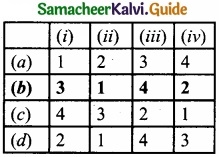
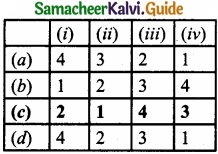
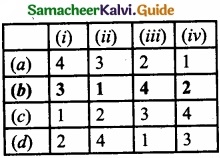
Match List – I with List – II and select the correct answer using the codes given below:

List – I

List – II

(i) Wholesaler1. Mercantile agent
(ii) Retailer2. Particular line of products
(iii) Single line stores3. Small qunatities
(iv) Broker4. First middlemen

Answer:
Codes:

Tamil Nadu 11th Commerce Model Question Paper 3 English Medium img 1

Question 5.
Primary industries may be divided as follows:
(I) Extractive industries
(II) Manufacturing industries
(III) Genetic industries
(IV) Construction industries
(a) (I) and (II)
(b) (II) and (III)
(c) (I) and (III)
(d) (I) and (IV)
Answer:
(c) (I) and (III)

Tamil Nadu 11th Commerce Model Question Paper 3 English Medium

Question 6.
Centralised control in MNCs implies control exercised by ………………………
(a) Branches
(b) Subsidiaries
(c) Headquarters
(d) Parliament
Answer:
(c) Headquarters

Question 7.
Large scale fixed retailers include ………………………..
(a) Super markets
(b) Speciality stores
(c) General stores
(d) Second shops
Answer:
(a) Super markets

Question 8.
Exim Bank was set up in the year ……………………..
(a) 1949
(b) 1972
(c) 1935
(d) 1982
Answer:
(d) 1982

Tamil Nadu 11th Commerce Model Question Paper 3 English Medium

Question 9.
Social responsibility towards employees represents the following except ………………………
(a) Reasonable remuneration
(b) Proper facilities
(c) Social security
(d) Exploitation
Answer:
(d) Exploitation

Question 10.
Which one of the following is not correctly matched?
(a) Imperial bank – Mumbai
(b) RBI – 2013
(c) RTGS – Commercial bank
(d) Development banks – SBI
Answer:
(d) Development banks – SBI

Question 11.
Enterprises operating in several countries but managed from one country is termed as ………………………
(a) Government company
(b) Multinational company
(c) Private company
(d) Joint venture
Answer:
(b) Multinational company

Tamil Nadu 11th Commerce Model Question Paper 3 English Medium

Question 12.
The money can be withdrawn from the PPF, after …………………….. years.
(a) 14
(b) 13
(c) 15
(d) 12
Answer:
(c) 15

Question 13.
The exporters appoint a ……………………. to fulfill the customs formalities.
(a) Clearing agent
(b) Forwarding agent
(c) Commission agent
(d) Factor
Answer:
(b) Forwarding agent

Question 14.
The compensation given for breach of contract is ………………………..
(a) Damage
(b) Remuneration
(c) Money
(d) Cheque
Answer:
(a) Damage

Tamil Nadu 11th Commerce Model Question Paper 3 English Medium

Question 15.
Ethics is important for ………………………
(a) Top management
(b) Middle level managers
(c) Non – managerial employees
(d) All of them
Answer:
(d) All of them

Question 16.
World Bank is located at ……………………..
(a) Washington DC
(b) Newyork
(c) Tokyo
(d) Hongkong
Answer:
(a) Washington DC

Question 17.
Which of the following is not a function of a central bank?
(a) Guiding and regulating the banking system of country
(b) Deal with the general public
(c) Acts as government banker
(d) Maintains deposit accounts of all other bank
Answer:
(b) Deal with the general public

Tamil Nadu 11th Commerce Model Question Paper 3 English Medium

Question 18.
Dispersal of decision making power to branches/affiliates/subsidiaries is by the head officer represents ………………………..
(a) Centralisation
(b) Decentralisation
(c) Power
(d) Integration
Answer:
(b) Decentralisation

Question 19.
The document which authorises to deliver the goods either in part or full is called ………………………….
(a) Warehouse warrant
(b) Dock receipt
(c) Dock warrant
(d) None of these
Answer:
(c) Dock warrant

Tamil Nadu 11th Commerce Model Question Paper 3 English Medium

Question 20.
Which of the following holder is given voting rights?
(a) Debentures
(b) Preference shares
(c) Equity shares
(d) Bonds
Answer:
(c) Equity shares

PART – II

Answer any seven questions in which question No. 30 is compulsory. [7 × 2 = 14]

Question 21.
Warehouses mean the places to store the goods for future purpose. It renders invaluable services to the society by performing the various functions. Give any three functions of warehouses?
Answer:

  1. Storage
  2. Price stabilization
  3. Equalization of demand and supply

Question 22.
Murugan is the famous auditor in Madurai. Identify the type of economic activity highlighted in the case. Write the meaning of it?
Answer:
The economic activity highlighted in this case is profession. Profession means something which is more than a job. For the profession a special qualification is necessary. The income from the profession is professional fee. It may be different from one profession to another profession.

Tamil Nadu 11th Commerce Model Question Paper 3 English Medium

Question 23.
Define commerce?
Answer:
According to Evelyn Thomas, “Commercial operations deal with the buying and selling of goods, the exchange of commodities and the contribution of finished products”.

Question 24.
Insurance covers different types of risks. It can be broadly classified into

  1. Life insurance
  2. Non – life insurance. What is the other name for Non – life insurance? How it is classified?

Answer:
The other name for Non – life insurance is called as General insurance. It can be further classified into:

  1. Fire insurance
  2. Marine insurance
  3. Health insurance
  4. Miscellaneous insurance

Tamil Nadu 11th Commerce Model Question Paper 3 English Medium

Question 25.
Write any two differences between warehouse warrant and warehouse receipt?
Answer:

Warehouse Warrant

Warehouse Receipt

1. It is a document of title of goods.1. It is not a document of title of goods.
2. It is not only an acknowledgement for the receipt of goods but also gives an authority to get delivery of goods by the owner or by third party.2. It is only an acknowledgement for the receipt of goods.

Question 26.
Briefly explain the need for Debit card?
Answer:
ATM card is also called debit card. This card is more useful in purchase of goods and services anywhere in India if the shop maintains a swiping machine facility.

Question 27.
What is a Statutory Company?
Answer:
Companies are established by a Special Act passed in Parliament or State Assembly. Rules relating to day – to – day management of statutory companies are specified in the Articles of Association (AOA). Examples: LIC, RBI, Railways, etc.

Tamil Nadu 11th Commerce Model Question Paper 3 English Medium

Question 28.
Write any two advantages of MNC?
Answer:
1. Low Cost Labour:
MNC set up their facilities in low cost countries and produce goods/services at lower cost.

2. Quality Products:
The resource, experience and expertise of MNCs in the sphere of research and development enables the host country to establish its research and development system which helps it in producing quality goods and services at least possible cost.

Question 29.
How the RBI is acting as banker to the government?
Answer:
RBI is acting as a banker to the government. It is one of the traditional functions of RBI. It accepts money into central and state government’s accounts and make payments on their behalf. It manages the governments debts. It advises the government and the terms of new loans.

Tamil Nadu 11th Commerce Model Question Paper 3 English Medium

Question 30.
Write short note on debentures?
Answer:
Debentures are an important instrument for raising long term debt capital. A company can raise funds through issue of debentures which bear a fixed rate of interest.

PART – III

Answer any seven questions in which question No. 40 is compulsory. [7 × 3 = 21]

Question 31.
At first the co – operative movement was started by Robert Owen in the year 1844. Who are Rochdale pioneers?
Answer:
At first, the cooperative movement was started by Robert Owen, in the year 1844. He formed a consumer’s cooperative society in England with 28 workers as members, called “Rochdale Society of Equitable Pioneers”.

Tamil Nadu 11th Commerce Model Question Paper 3 English Medium

Question 32.
List the steps in factoring process?
Answer:
Factoring is derived from a Latin term “facere” which means ‘to make or do’. Factoring is an arrangement wherein the trade debts of a company are sold to a financial institution at a discount.

Factoring Process:

  1. The firm enters into a factoring arrangement with a factor, which is generally a financial institution.
  2. Whenever goods are sold on credit basis, an invoice is prepared and a copy of the same is sent to the factor.
  3. The debt amount due to the firm is transferred to the factor through assignment.
  4. On the due date, the amount is collected by the factor from the customer.
  5. After retaining the service fees, the remaining amount is sent to the firm by the factor.

Question 33.
List out the products produced by MSME in Tamil Nadu?
Answer:
In Tamil Nadu, MSMEs sector produces a wide variety of products in almost all fields. The prominent among them are the textile, electronic products, engineering products, auto ancillaries, leather products, chemicals, plastics, garments, jewellery etc.

Tamil Nadu 11th Commerce Model Question Paper 3 English Medium

Question 34.
What do you understand by Burglary Insurance?
Answer:
Burglary Insurance: This policy comes under the category of insurance of property. Any loss of damage due to theft, larceny, burglary, house breaking and acts of nature are covered by this policy. Compensation of actual loss is done.

Question 35.
It is the oldest form of organisation. It is administrated by a separate department. What is the form of organisation? Describe any three features of this organisation?
Answer:
1. Formation:
A departmental undertaking is established either as a separate full-fledged ministry or as a sub-division of a ministry (i.e. department) of the Government.

2. No Separate Entity:
A departmental undertaking does not have an independent entity distinct from the Government.

3. Accounting and Audit:
The departmental undertaking is subject to the normal budgeting, accounting and audit procedures, which are applicable to all Government departments.

Tamil Nadu 11th Commerce Model Question Paper 3 English Medium

Question 36.
Mention any three rights of partners?
Answer:
Rights of Partners;

  1. Right to take part in business: Every partner has a right to take part in the management of the business.
  2. Right to consult: Every partner has the right to consult in all the matters concerning the firm.
  3. Right to share profit: Every partner is entitled to share the profits in the agreed ratio. If no ratio is specified in the deed, the profit must be shared equally.

Question 37.
Explain the features of general stores?
Answer:
General Stores sell a wide variety of products under one roof, most commonly found in a local market and residential areas to satisfy the day – to – day needs of the customers residing in nearby localities. They remain open for long hours at convenient timings and often provide credit facilities to their regular customers.

Question 38.
It is a policy taken as a safeguard against the medical costs. It is a contract between an insurer and an individual or a group. What is the name of the policy? Mention a few points about this?
Answer:
In mid 80’s, most of the hospitals in India were government owned and treatment was free of cost. With the advent of Private Medical Care, the need for Health Insurance was felt and various Insurance Companies introduced Health Insurance as a Product. Presently the health insurance exists primarily in the form of ‘Mediclaim policy’.

Tamil Nadu 11th Commerce Model Question Paper 3 English Medium

Question 39.
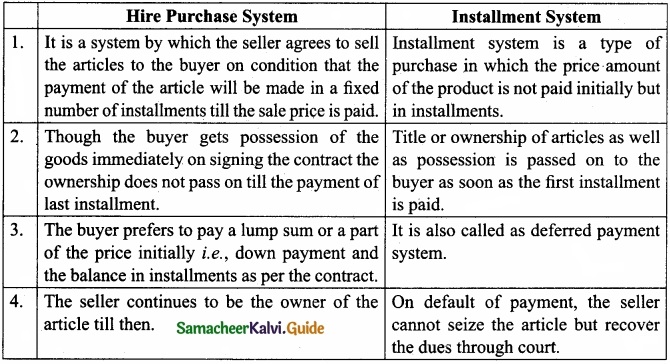
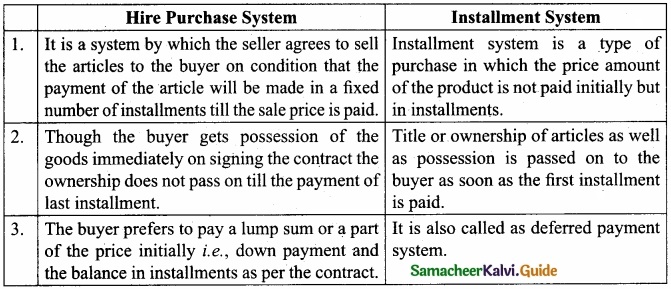
Without money customers can purchase costly articles with this method. It is useful to Middle – class people. There are two methods- hire purchase and installment system. Mention any three differences between hire purchase and installment system?
Answer:
Tamil Nadu 11th Commerce Model Question Paper 3 English Medium

Question 40.
What is meant by government company?
Answer:
A “Government company” is defined under Section 2(45) of the Companies Act, 2013 as “any company in which not less than 51% of the paid – up share capital, is held by the Central Government, or by any State Government or Governments, or partly by the Central Government and partly by one or more State Governments, and includes a company which is a subsidiary company of such a Government company”.

PART – IV

Answer all the questions. [7 × 5 = 35]

Question 41 (a).
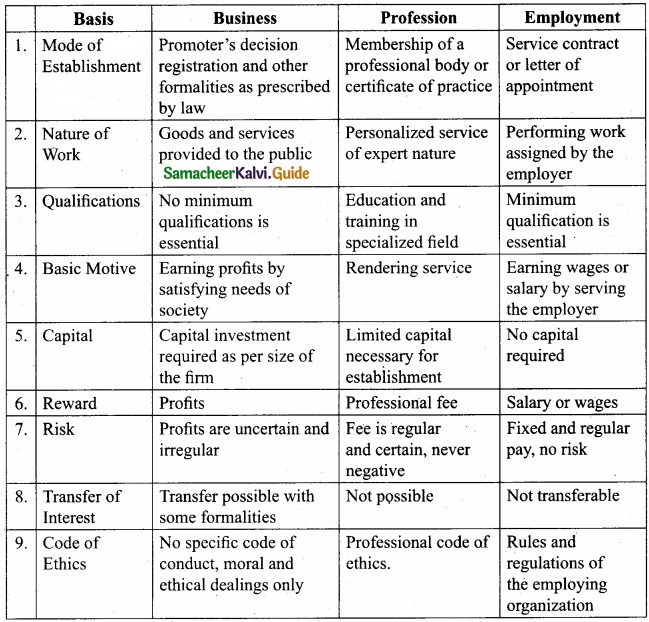
Compare business with profession and employment?
Answer:

Tamil Nadu 11th Commerce Model Question Paper 3 English Medium

[OR]

(b) Explain the different types of warehouses on the basis of ownership?
Answer:

  • Private Warehouses: Private warehouses are built and owned by private business enterprises in order to store the products produced by them.
  • Government Warehouses: They are created and operated by the Government to implement the programmes of the Government.
  • Public Warehouse: It is open for public at large. Most of the business organisations, especially small and medium scale units cannot afford to have their own warehouses.
  • Co-operative Warehouses: There are warehouses owned and managed by the marketing co-operative societies or agricultural co-operative societies. They are setup to provide warehousing facilities to their members.
  • Bonded Warehouses: Bonded warehouses are those warehouses, which are licensed
    by the government to accept storage of imported goods which are not cleared due to non-payment of customs duty by the importer.

Tamil Nadu 11th Commerce Model Question Paper 3 English Medium

Question 42 (a).
Discuss the advantages of transport?
Answer:
(A) Advantages of railway transport:

  1. Railways are well suited for carrying heavy and bulky goods over long distances.
  2. It can provide long distance travel throughout the day and night with unbroken services.

(B) Advantages of inland waterways:

  1. It is considered as the cheapest mode of transport among the other modes of transport.
  2. It is most suitable for heavy loads.

(C) Advantages of air transport:

  1. It provides a regular, convenient, efficient and quick service.
  2. Perishable goods like fruits, vegetables, egg, meat, etc., can be transported quickly.

[OR]

(b) Explain the principles of insurance?
Answer:
1. Utmost Good Faith:
According to this principle, both insurer and insured should enter into contract in good faith. Insured should provide all the information that impacts the subject matter. Insurer should provide all the details’regarding insurance contract.

2. Insurable Interest:
The insured must have an insurable interest in the subject matter of insurance. Insurable interest means some pecuniary interest in the subject matter of the insurance contract.

3. Indemnity:
Indemnity means security or compensation against loss or damages. In insurance, the insured would be compensated with the amount equivalent to the actual loss and not the amount exceeding the loss. This principle ensures that the insured does not make any profit out of the insurance. This principle of indemnity is applicable to property insurance alone.

4. Causa Proxima:
The word ‘Causa proxima’ means ‘nearest qause’. According to this principle, when the loss is the result of two or more cause, the proximate cause, i.e. the direct. The direct, the most dominant and most effective cause of loss should be taken into consideration. The insurance company is not liable for the remote cause.

5. Contribution:
The same subject matter may be insured with more than one insurer then it is known as ‘Double Insurance’. In such a case, the insurance claim to be paid to the insured must be shared on contributed by all insurers in proportion to the sum assured by each one of them.

6. Subrogation:
Subrogation means ‘stepping the shoes on others’. According to this principle, once the claim of the insured has been settled, the ownership right of the subject matter of insurance passes on to the insurer.

7. Mitigation:
In case of a mishap, the insured must take off all possible steps to reduce or mitigate the loss or damage to the subject matter of insurance.

Tamil Nadu 11th Commerce Model Question Paper 3 English Medium

Question 43 (a).
Business owned by a single person is known as sole trading business. He contributes the required capital. Explain the characteristics of sole trading business?
Answer:

  1. Ownership by one man: This is owned by single person. The sole trader contributes the required capital. He is not only the owner of the business but also manages the entire affairs.
  2. Freedom of work and Quick Decisions: Since an individual is himself as a owner, he need not consult anybody else. Hence he can take quick decisions.
  3. Unlimited Liability: When his business assets are not sufficient to pay off the business debts he has to pay from his personal property.
  4. Enjoying Entire Profit: He strives tirelessly for the improvement and expansion of his business and enjoys all the benefits of his hard work.
  5. Absence of Government Regulation: A sole proprietor concern is free from Government regulations. No legal formalities are to be observed in its formation, management or in its closure.
  6. No Separate Entity: The sole trading concern comes to an end with death, disability, insanity and insolvency of the individual.
  7. Maintenance of Secrecy: Since he/she manages all the affairs of the business, the secrecy can be maintained easily.

[OR]

(b) What are the rights of a partner?
Answer:

  1. Right to take part in business: Every partner has a right to take part in the management of the business.
  2. Right to be consultant: Every partner has the right to be consulted in all the matters concerning the firm. The decision of the majority will prevail in all the routine matters.
  3. Right of access to books, record and document: Every partner has the right of access to all records and books of accounts, and to examine and copy them.
  4. Right to share profit: Every partner is entitled to share the profits in the agreed ratio. If no profit – sharing ratio is specified in the deed, they must be shared equally.
  5. Right to receive interest: A partner has the right to receive interest on loans advanced by him to the firm at the agreed rate, and where no rate is stipulated, interest @ 6% p.a. allowed.

Tamil Nadu 11th Commerce Model Question Paper 3 English Medium

Question 44 (a).
Briefly explain the auxiliaries to trade?
Answer:
1. Commerce includes not only trade but also services such as transport, warehousing, packaging, insurance, banking and sales promotion which are incidental or auxiliaries to trade.

2. Trade: The term trade is used to denote buying and selling. Therefore who buys and sells is a trader. A trader is a middleman between the producer and the consumer.

3. Transportation: Goods produced are to be sent to different places where they are demanded. It is done by transporting.

4. Banking: To start the business or to run it smoothly, we need money. Banks supply money in the form of loan. Business activities cannot be undertaken unless funds are available. The funds can be obtained from the bank.

5. Insurance: Business involves many types of risks. Factory building, machinery, furniture must be protected against fire, theft and other risks. Employees are also protected against the risk of accident. Insurance provides protection in all such cases.

6. Warehousing: Usually goods are not sold or consumed immediately after the production. They are to be kept in stock to make them available as and when required. Warehousing helps the firms to overcome the problem of storage and stores the goods for future usage.

[OR]

(b) A Joint stock company is a distinct form of business organisation. It is useful to overcome the limitations of sole trader and partnership. There are so many features of company. What are the characteristics of Joint stock company?
Answer:
Characteristics of a Joint stock Company:
1. Separate legal entity:
Under Incorporation a company becomes a separate legal entity as compared to its members. The company is distinct and different from its members.

2. Limited Liability:
The liability of the members of the company is limited to contribution to the assets of the company upto the face value of shares held by him. A member is liable, to pay only the uncalled money due on shares held by him.

3. Transferability of shares:
Shares in a company can be freely transferable. When a member transfers his shares to another person, the transferee becomes the shareholder of the company.

4. Common Seal:
A company is an artificial person and does not have a physical presence. So the common seal is necessary because the company cannot sign the documents. It is the official signature of the company.

5. One Share – One Vote:
The principle of voting in a company is one share – one vote. If a person has 10 shares, he has 10 votes in the company. So in a company, money is given more importance than a man.

Tamil Nadu 11th Commerce Model Question Paper 3 English Medium

Question 45 (a).
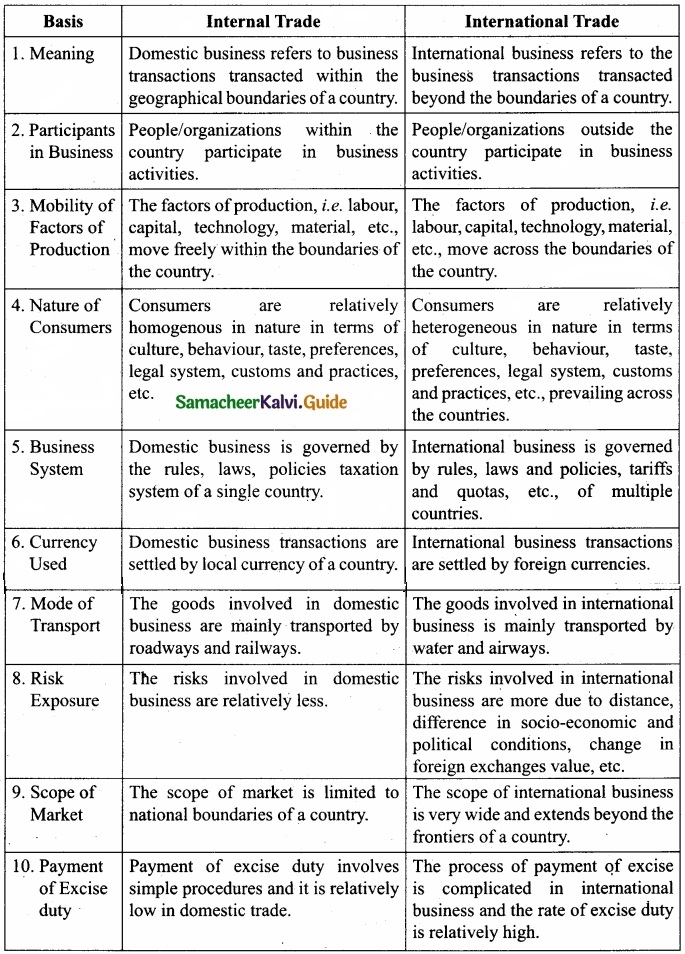
List out the advantages of international trade?
Answer:

  1. Geographical Specialization: Countries across the world differ significantly in terms of natural resources, capital equipment, manpower, technology and land and so on.
  2. Optimum use of Natural Resources: International business operates on a simple principle that a country which can produce more efficiently and trade the surplus production with other countries has to procure what it cannot produce more efficiently.
  3. Economic Development: International business helps the developing countries greatly in achieving rapid economic development by importing machinery, equipment, technology, talent, and so on.
  4. Generation of Employment: International business generates employment opportunities by assisting the expansion and growth of agricultural and industrial activities.
  5. Higher Standard of Living: On account of international business, the citizens of the country can buy more varieties of goods and services which cannot be produced cost effectively within the home country.
  6. Price Equilisation: International business helps to stabilize the prices of various commodities which are fluctuating on a daily basis in the world market.
  7. Prospects for Higher Profit: International business helps the firms which produce goods in excess to sell them at relatively higher price to various countries in the international market.
  8. Capacity Utilisation: International business enables the firms across the country to sell their goods and services on a large scale in the international market.
  9. International Peace: International business makes countries across the world become inter-dependent while these countries are independent in their functioning.

[OR]

(b) Write down the structure of capital account?
Answer:
Capital account consists of three components:

  1. Private Capital
  2. Banking Capital
  3. Official Capital

1. Private Capital:
Private capital consists of foreign investments, long term loan and foreign currency deposits.

2. Banking Capital:
Banking capital includes movement into external financial asset and liabilities commercial and co-operative banks authorized to dealing in foreign exchange.

3. Official Capital:
It includes RBI’s holdings of foreign currency and special drawing rights (SDR) held by the Government.

Tamil Nadu 11th Commerce Model Question Paper 3 English Medium

Question 46 (a).
What are the advantages of sole trading business?
Answer:
1. Easy Formation:
No legal formalities are required to initiate a sole trading concern. Any person capable of entering into a contract can start it, provided he has the necessary resources for it.

2. Incentive to Work hard:
There is a direct relationship between effort and reward. The fact that the entire profit can be taken by himself without sharing with anybody else induces him to work ceaselessly.

3. Small Capital:
Small capital is an important as well as specific advantage of sole proprietorship. Sole proprietor can start business with small capital.

4. Credit Standing:
Since his private properties are held liable for satisfying business debts, he can get more financial assistance from others.

5. Personal Contact with the Customers:
Since sole proprietor knows each and every customer individually he can supply goods according to their taste and preferences. Thus he can cultivate personal relationship with the customers.

6. Flexibility:
The sole trader can easily adjust himself to the changing requirements of his business.

[OR]

(b) What are the factors influencing a channel of distribution? Explain any five?
Answer:
The factors affecting a channel of distribution are as follows:

1. Product Characteristics:
Seasonal products are distributed through less layer of middlemen. Non standardized products that are made according to customer specifications may be delivered directly.

2. Market Characteristics:
The size of the market for the goods is a major factor while selecting the route for distribution of products.

3. Number of Consumers:
Large purchases made by few consumers require centralised distribution.

4. Middlemen factor:
Middlemen who are experienced and have produced more sales are wanted by all producers. Long channel naturally increases the cost and price of the product.

5. Capacity of the Manufacturer:
A financially strong producer may select a high technology oriented channel which will reduce cost in the long run.

Tamil Nadu 11th Commerce Model Question Paper 3 English Medium

Question 47 (a).
Explain the features of a government company?
Answer:
The features of a government company:

1. Registration Under the Companies Act:
A Government company is formed through registration under the Companies Act, 1956; and is subject to the provisions of this Act, like any other company.

However, the Central Government may direct that any of the provisions of the Companies Act shall not apply to a Government company or shall apply with certain modifications. .

2. Executive Decision of Government:
A Government company is created by an executive decision of the Government, without seeking the approval of the Parliament or the State Legislature.

3. Separate Legal Entity:
A Government company is a legal entity separate from the Government. It can acquire property; can make contracts and can file suits, in its own name.

4. Whole or Majority Capital Provided by Government:
The whole or majority (at least 51%) of the capital of a Government company is provided by the Government; but the revenues of the company are not deposited into the treasury.

5. Majority of Government Directors:
Being in possession of a majority of share capital, the Government has authority to appoint majority of directors, on the Board of Directors of a government company.

[OR]

(b) What are the advantages of co-operatives? Explain any five?
Answer:
Advantages of co – operatives:

1. Voluntary organisation:
The membership of a cooperative society is open to all. Any person with common interest can become a member. The membership fee is kept low so that everyone would be able to join and benefit from cooperative societies.

2. Easy formation:
Cooperatives can be formed much easily when compared to a company. Any 10 members who have attained majority can join together for forming a cooperative society by observing simple legal formalities.

3. Democracy:
A co – operative society is run on the principle of ‘one man one vote’. It implies that all members have equal rights in managing the affairs of the enterprises.

4. Equal distribution of surplus:
The surplus generated by the cooperative societies is distributed in an equitable manner among members. Therefore all the members of the cooperative society are benefited.

5. Limited liability:
The liability of the members in a cooperative society is limited to the extent of their capital contribution. They cannot be personally held liable for the debts of the society.

Tamil Nadu 11th Commerce Model Question Paper 2 English Medium

Students can Download Tamil Nadu 11th Commerce Model Question Paper 2 English Medium Pdf, Tamil Nadu 11th Commerce Model Question Papers helps you to revise the complete Tamilnadu State Board New Syllabus, helps students complete homework assignments and to score high marks in board exams.

TN State Board 11th Commerce Model Question Paper 2 English Medium

General Instructions:

  1. The question paper comprises of four parts.
  2. You are to attempt all the parts. An internal choice of questions is provided wherever applicable.
  3. All questions of Part I, II, III and IV are to be attempted separately.
  4. Question numbers 1 to 20 in Part I are Multiple Choice Questions of one mark each.
    These are to be answered by choosing the most suitable answer from the given four alternatives and writing the option code and the corresponding answer
  5. Question numbers 21 to 30 in Part II are two-mark questions. These are to be answered in about one or two sentences.
  6. Question numbers 31 to 40 in Part III are three-mark questions. These are to be answered in above three to five short sentences.
  7. Question numbers 41 to 47 in Part IV are five-mark questions. These are to be answered in detail Draw diagrams wherever necessary.

Time: 2:30 Hours
Maximum Marks: 90

PART – 1

Choose the correct answer. Answer all the questions. [20 × 1 = 20]

Question 1.
Wholesalers buy in ………………………… quantity of goods.
(a) Small
(b) Large
(c) Medium
(d) Limited
Answer:
(b) Large

Tamil Nadu 11th Commerce Model Question Paper 2 English Medium

Question 2.
Small scale fixed retailers include ……………………..
(a) General stores
(b) Pedlars
(c) Cheap jacks
(d) Hawkers
Answer:
(a) General stores

Question 3.
In India, GST became effective from ………………………
(a) 1st April 2017
(b) 1st January 2017
(c) 1st July 2017
(d) 1st March 2017
Answer:
(a) 1st April 2017

Tamil Nadu 11th Commerce Model Question Paper 2 English Medium

Question 4.
‘One share – one vote’ principle is followed in kind of organization.
(a) Co – operatives
(b) Partnership
(c) Company
(d) None of these
Answer:
(c) Company

Question 5.
……………………. is not a type of general insurance.
(a) Marine insurance
(b) Life insurance
(c) Fidelity insurance
(d) Fire insurance
Answer:
(b) Life insurance

Question 6.
Self – help groups convert the sayings into a common find known as ……………………..
(a) Common fund
(b) Group corpus fund
(c) Group fund
(d) None of the above
Answer:
(b) Group corpus fund

Tamil Nadu 11th Commerce Model Question Paper 2 English Medium

Question 7.
A major disadvantage of sole proprietorship is ……………………….
(a) Limited liability
(b) Unlimited liability
(c) Easy formation
(d) Quick decision
Answer:
(b) Unlimited liability

Question 8.
Which one of the following is not correctly matched?
(a) Mercantile agents – Functional middleman
(b) Merchant middleman – Wholesalers
(c) Retailer – Small quantities
(d) Wholesaler – Last middleman in the distribution
Answer:
(d) Wholesaler – Last middleman in the distribution

Question 9.
From which of the following deposit holders can get overdraft facilities?
(a) Savings deposits
(b) Current deposits
(c) Recurring deposits
(d) Fixed deposits
Answer:
(b) Current deposits

Tamil Nadu 11th Commerce Model Question Paper 2 English Medium

Question 10.
The role of government in logistics management is through ……………………….
(a) Legislations
(b) Governance
(c) Transport
(d) Distribution
Answer:
(d) Distribution

Question 11.
The local area banks are promoting ………………………
(a) Rural savings
(b) Business savings
(c) Industrial development
(d) Agricultural development
Answer:
(a) Rural savings

Question 12.
Way bill is a document issued by ………………………
(a) Railway transport
(b) Air transport
(c) Road transport
(d) Water transport
Answer:
(c) Road transport

Tamil Nadu 11th Commerce Model Question Paper 2 English Medium

Question 13.
The types of development banks are ……………………….
(I) IFCI
(II) State Bank of India
(III) MUDRA Bank
(IV) Karur Vysya Bank
(a) (I) and (II)
(b) (II) and (IV)
(c) (I) and (III)
(d) (II) and (IV)
Answer:
(c) (I) and (III)

Question 14.
Auxiliaries to trade is also called as ……………………..
(a) Trade
(b) Advertisement
(c) Warehousing
(d) Aids to trade
Answer:
(d) Aids to trade

Question 15.
Consumers co-operation was first successful in …………………………
(a) England
(b) USA
(c) Swiss
(d) India
Answer:
(a) England

Tamil Nadu 11th Commerce Model Question Paper 2 English Medium

Question 16.
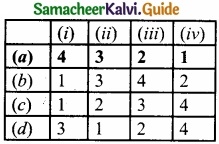
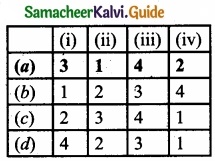
Match List – I with List – II and select the correct answer using the codes given below:

List – 1

List – 2

(i) Overdraft1. Debit card
(ii) ATM card2. Short term credit instrument
(iii) Time deposit3. Current deposits
(iv) Discounting of bills4. Fixed deposits

Answer:
Codes:

Tamil Nadu 11th Commerce Model Question Paper 2 English Medium img 1

Question 17.
Who is the first middleman in the channel of distribution?
(a) Wholesaler
(b) Producer
(c) Retailer
(d) Customer
Answer:
(a) Wholesaler

Question 18.
Find out which is not advantage of partnership from the following:
(a) Easy formation
(b) Division of work
(c) Limited liability
(d) Easy dissolution
Answer:
(c) Limited liability

Question 19.
Presently IRDAI headquarters is in ……………………….
(a) Hyderabad
(b) Chennai
(c) Mumbai
(d) Delhi
Answer:
(a) Hyderabad

Tamil Nadu 11th Commerce Model Question Paper 2 English Medium

Question 20.
The aggregate income under fine heads is termed as ……………………….
(a) Gross total income
(b) Total income
(c) Salary income
(d) None of the above
Answer:
(b) Total income

PART – II

Answer any seven questions in which question No. 30 is compulsory: [7 × 2 = 14]

Question 21.
Who are middlemen?
Answer:
The term ‘middlemen’ refers to all those who are in the link between the primary producer and the ultimate consumer in the exchange of goods or service.

Question 22.
Mention any four examples of MNC?
Answer:
A multinational company is one which is incorporated in one country, but it may be operated in many countries. Examples: Coca – Cola, International Business Machine (IBM), Sony Corporation and Microsoft Corporation.

Question 23.
There are various hindrances in business. The manufacturers and consumers do not know each other. But the goods are purchased and sold by these two persons. What kind of hindrance is this? How is it removed?
Answer:
This is ‘hindrance of a person’. Manufacturers do not know the consumer, who is using the products, produced by him. This difficulty or hindrance is removed by the traders.

Tamil Nadu 11th Commerce Model Question Paper 2 English Medium

Question 24.
Give any three functions of warehouses?
Answer:

  1. Storage
  2. Price stabilization
  3. Equalization of demand and supply

Question 25.
What is meant by private company?
Answer:
Private limited company is a type of company which is formed with minimum two shareholders and two directors, the minimum requirement with respect to authorised or paid up capital of Rs. 1,00,000 has been omitted by the Companies (Amendment) Act, 2015 w.e.f. 29th of May, 2015.

Another crucial condition of a private limited company is that it by its articles of association restricts the right to transfer its shares and also prohibits any invitation to the public to subscribe for any securities of the company.

Question 26.
Is low taxes possible in co – operative society?
Answer:
Yes, Low taxes are possible in co – operative society because it is a non-profit enterprise, and government provides various exemptions and tax concessions.

Question 27.
Write any two advantages of water transport?
Answer:

  1. It is considered as the cheapest mode of transport among the other modes of transport.
  2. It is most suitable for heavy loads.

Tamil Nadu 11th Commerce Model Question Paper 2 English Medium

Question 28.
What are the non-corporate enterprises?
Answer:

  1. Sole trading concern
  2. Partnership firm
  3. Joint Hindu family business

Question 29.
Mention any three differences between warehouse warrant and warehouse receipt?
Answer:

Warehouse Warrant

Warehouse Receipt

1. It is a document of title of goods.1. It is not a document of title of goods.
2. It is not only an acknowledgement for the receipt of goods but also gives an authority to get delivery of goods.2. It is only an acknowledgement  the receipt of goods.
3. It can be given as a collateral security for getting loan.3. Ita cannot be given as collateral security

Question 30.
Mention any four kinds of partners?
Answer:

  1. Active partner
  2. Sleeping partner
  3. Nominal partner
  4. Partner in profits only

PART – III

Answer any seven questions in which question No. 40 is compulsory: [7 × 3 = 21]

Question 31.
List the five heads of income?
Answer:
The five heads of income are:

  1. Income from‘Salaries’ [Sections 15 – 17];
  2. Income from ‘House Property’ [Sections 22 – 27];
  3. Income from ‘Profits and Gains of Business or Profession’ [Sections 28 – 44];
  4. Income from ‘Capital Gains’ [Sections 45 – 55]; and
  5. Income from ‘Other Sources’ [Sections 56 – 59].

Tamil Nadu 11th Commerce Model Question Paper 2 English Medium

Question 32.
Explain the concept of business?
Answer:
Business refers to any human activity undertaken on a regular basis with the object to earn profit through production, distribution, sale or purchase of goods and services.

Business activities are connected with raising, producing or processing of goods. Industry creates form utility to goods by bringing materials into the form which is useful for intermediate consumption or final consumption by consumers.

Question 33.
Explain any three features of Self – Help Group?
Answer:

  1. The motto of every group members should be “saving first – credit latter”.
  2. Self Help Group is homogeneous in terms of economic status.
  3. The ideal size of a Self Help Group ranges between 10 and 20 members.

Question 34.
Explain the features of general stores?
Answer:
General Stores sell a wide variety of products under one roof, most commonly found in a local market and residential areas to satisfy the day – to – day needs of the customers residing in nearby localities. They remain open for long hours at convenient timings and often provide credit facilities to their regular customers.

Question 35.
How is it possible to maintain secrecy in sole proprietorship?
Answer:
In sole proprietorship, the trader is the sole owner of the business. Since he/she manages all the affairs of the business, the secrecy can be maintained easily.

Tamil Nadu 11th Commerce Model Question Paper 2 English Medium

Question 36.
What is the importance of bonded warehouses?
Answer:
Bonded warehouses are those warehouses which are licensed by government. It is used to accept the storage of imported goods which are cleared for non – payment of customs duty by the importer. Strict supervision and control is imposed by customs authorities on their functioning.

Question 37.
Describe any three advantages of international trade?
Answer:
Advantages of international trade:

  1. Optimum use of natural resources: International trade operates on a simple principle that a country can produce more efficiently and trade the surplus production.
  2. Economic development: International trade helps the developing countries in achieving rapid economic development by importing machinery, technology and talent.
  3. Generation of employment: International business generates employment opportunities by assisting the expansion and growth of agricultural and industrial activities.

Tamil Nadu 11th Commerce Model Question Paper 2 English Medium

Question 38.
What are the advantages of MNC?
Answer:
1. Low Cost Labour:
MNC set up their facilities in low cost countries and produce goods/services at lower cost.

2. Quality Products:
The resource, experience and expertise of MNCs in the sphere of research and development enables the host country to establish its research and development system which helps it in producing quality goods and services at least possible cost.

Question 39.
India is an agricultural country. It has so many villages. Agriculture is inevitable to our country. What kind of insurance is needed to safeguard agriculture?
Answer:
Crop insurance is taken for safeguarding the agriculture. This policy is to provide financial support to farmers in case of a crop failure due to drought or flood. It generally covers all risks of loss or damages relating to production of rice, wheat, millets, oil seeds and pulses.

Question 40.
Why is balance of payment prepared?
Answer:
Balance of payments help in framing monetary, fiscal and trade policies of country. Government keenly observes balance of payment position of its important trade partners in making policy decisions. It reveals whether a country produces enough economic output to pay for its growth.

PART – IV

Answer all the questions: [7 × 5 = 35]

Question 41 (a).
Memorandum of Association is a legal document prepared to form and register a joint stock company. It reveals the powers and activities, the company is permitted to undertake. What are the contents of memorandum of Association? Explain?
Answer:
1. Name Clause:
The name clause requires you to state the legal and recognized name of the company. You are allowed to register a company name only if it does not bear any similarities with the name of an existing company.

2. Situation Clause:
The registered office clause requires you to show the physical location of the registered office of the company. You are required to keep all the company registers in this office in addition to using the office in handling all the outgoing and incoming communication correspondence.

3. Objective Clause:
The objective clause requires you to summarize the main objectives for establishing the company with reference to the requirements for shareholding and use of financial resources.

You also need to state ancillary objectives; that is, those objectives that are required to facilitate the achievement of the main objectives.

4. Liability Clause:
The liability clause requires you to state the extent to which shareholders of the company are liable to the debt obligations of the company in the event of the company dissolving.

You should show that shareholders are liable only their shareholding and/or to their commitment to contribute to the dissolution costs upon liquidation of a company limited by guarantee.

5. Capital Clause:
The capital clause requires you to state the company’s authorized share capital, the ’ different categories of shares and the nominal value (the minimum value per share) of the shares. You are also required to list the company’s assets under this clause.

6. Association Clause:
The association clause confirms that shareholders bound by the MOA are willingly associating and forming a company. You require seven members to sign an MOA for a public company and not less than two people for a MOA of a private company. You must conduct the signing in the presence of witness who must also append his signature.

[OR]

(b) Explain any five rights of partners?
Answer:

  1. Right to take part in business: Every partner has a right to take part in the management of the business.
  2. Right to be consultant: Every partner has the right to be consulted in all the matters concerning the firm. The decision of the majority will prevail in all the routine matters.
  3. Right of access to books, record and document: Every partner has the right of access to all records and books of accounts, and to examine and copy them.
  4. Right to share profit: Every partner is entitled to share the profits in the agreed ratio. If no profit-sharing ratio is specified in the deed, they must be shared equally.
  5. Right to receive interest: A partner’ has the right to receive interest on loans advanced by him to the firm at the agreed rate, and where no rate is stipulated, interest @ 6% p.a. allowed.

Tamil Nadu 11th Commerce Model Question Paper 2 English Medium

Question 42 (a).
Explain the contents of prospectus?
Answer:
Prospectus means a document inviting the public to buy its shares or debentures. It also applies to advertisements inviting deposits from the public.

Contents:

  1. The prospectus contains the main objectives of the company.
  2. The name and address of the signatories of the Memorandum of Association.
  3. The name, address and occupation of directors and managing directors.
  4. The number and classes of shares and debentures.
  5. The qualification share of directors.
  6. The name and address of the vendors of any property acquired by the company.
  7. Particulars about the directors, secretaries and the treasures and their remuneration.
  8. The amount for the minimum subscription.
  9. The estimated amount of preliminary expenses.
  10. Name and address of the auditors, bankers and solicitors of the company,
  11. Time and place where copies of balance sheets, profits and loss account and the auditor’s report may be inspected.

[OR]

(b) Write a note on Consumer Co – operative Society?
Answer:
A Consumer Co – operative Society is organized by consumers. It sells quality goods at better prices to the consumers.

Features:

  1. It can sell the goods at a lesser price rather than the traditional retail stores.
  2. They also supply essential goods through Public Distribution System (PDS).
  3. Nationally, the most widely used co – operative form is the credit union.
  4. Credit unions are essentially co – operatives of people that use banking services.
  5. It purchases goods directly from the manufacturers, which helps to fix the lower price. – Example – Students Co – operative Stores, Supermarkets, etc.

Tamil Nadu 11th Commerce Model Question Paper 2 English Medium

Question 43 (a).
Goods were exchanged for goods prior to invention of money. Each party must have surplus goods for exchange. What does it mean? What are the constraints of that system?
Answer:
The system in which the goods were exchanged for goods was called ‘barter system’. The barter system has many constraints. They are:

  1. Lack of double coincidence of Wants: Unless two persons who have surplus have the demand for the goods possessed by each other, barter could not materialize. If this “coincidence of wants” does not exist, Barter cannot take place.
  2. Non – existence of common measure of value: Barter system could not determine the value of commodities to be exchanged as they lacked commonly acceptable measures to evaluate each and every commodity.
  3. Lack of direct contact between producer and consumers: It was not possible for buyers and sellers to meet face to face in many contexts for exchanging the commodities for commodities.
  4. Lack of surplus stock: Absence of surplus stock was one of the impediments in barter system. If the buyers and sellers do not have surplus then no barter was possible.

[OR]

(b) Describe any five objectives of business?
Answer:
1. Economic Objectives:
Economic objectives of business refer to the objective of earning profit and also other objectives that are necessary to be pursued to achieve the profit objective, which includes creation of customers, regular innovations and best possible use of available resources.

2. Social Objectives:
Social objective are those objectives of business, which are desired to be achieved for the benefit of the society. Since business operates in a society by utilizing its scarce resources, the society expects something in return for its welfare.

3. Organizational Objectives:
The organizational objectives denote those objectives an organization intends to accomplish during the course of its existence in the economy like expansion and modernization, supply of quality goods to consumers, customers’ satisfaction, etc.

4. Human Objectives:
Human objectives refer to the objectives aimed at the well – being as well as fulfillment of expectations of employees as also of people who are disabled, handicapped and deprived of proper education and training.

The human objectives of business may thus include economic well – being of the employees, social and psychological satisfaction of employees and development of human resources.

5. National Objectives:
Being an important part of the country, every business must have the objective of fulfilling national goals and aspirations.

Tamil Nadu 11th Commerce Model Question Paper 2 English Medium

Question 44 (a).
Banks can be classified as follows:

  1. Based on the functions of banks
  2. Based on the status given by RBI
  3. Based on the ownership pattern

What are the banks based on functions or organization? Explain any five kinds of banks.
Answer:
1. Commercial banks:
Banks which accept deposits from the public and grant loans to traders, individuals, agriculture, industries, transport, etc. in order to earn profit. Their lending is in comparatively small amounts and mostly for short and medium period. e.g., State Bank of India.

2. Development Banks:
Huge finance required for investment, expansion and modernisation of big industries and others are granted by a separate type of banks called development Banks. They are also called industrial banks, e.g., IFCI, SIDBI.

3. Co – operative Banks:
All Co – operative banks in India are owned by its customers or members who are farmers, small traders and others. Co – operative banks in India are either urban based or rural based. e.g.,NAFED, Tamil Nadu State Apex Co-operative Bank – Head Office, Chennai.

4. Foreign Banks:
Banks which have registered office in a foreign country and branches in Ipdia are called foreign banks, e.g., Bank of America – USA.

5. Regional Rural Banks (RRBs):
The RRBs were formed under the Regional Rural Bank Act 1976, jointly by the Central Government, State Government, and a sponsor bank. e.g., Pandian Grama Bank.

[OR]

(b) In India Joint Hindu Family Business is a distinct form of organisation. A person can become member by his birth. What are the features of Joint Hindu Family Business? Explain any five features?
Answer:
Features of Joint Hindu Family Business are:

  1. Governed by Hindu Law
  2. Management
  3. Membership by birth
  4. Liability
  5. Permanent existence
  6. Implied authority of Karta
  7. Minor as a co – parcener
  8. Dissolution

Explanation:

  1. Governed by Hindu law: The business of the Joint Hindu Family is controlled and managed by the hindu law.
  2. Membership by birth: The membership of the family can be acquired only by birth. As soon as a male child is bom in the family, the child becomes a member.
  3. Liability: Except the Kartha, the liability of all other members is limited to their shares in the business.
  4. Minor also as a co-parcener: In a Joint Hindu Family firm even a new bom baby can be a co-parcener.
  5. Dissolution: It can be dissolved only at the will of the members of the family.

Tamil Nadu 11th Commerce Model Question Paper 2 English Medium

Question 45 (a).
Explain any five types of Cooperative societies?
Answer:
Types of Co – operative societies:

1. Consumers Co – operative:
Consumer Co – operatives are organized by consumers that want to achieve better prices or quality in the goods or services they purchase. In contrast to traditional retail stores or service providers, a consumer co – operative exists to deliver goods or services rather than to maximize profit from selling those goods or services.

2. Producers Co – operative:
Producer co – operatives are created by producers and owned and operated by producers. Producers can decide to work together or as separate entities to help increase marketing possibilities and production efficiency.

3. Marketing Co – operative:
Co – operative marketing societies are associations of small producers formed for the purpose of marketing their produce. The marketing co-operatives perform certain marketing functions such as grading, warehousing, advertising etc.

4. Credit Co – operative:
Cooperative credit societies are societies formed for providing short-term financial help to their members. Agriculturists, artisans, industrial workers, salaried employees, etc., form these credit societies.

5. Housing Co – operative:
These co – operative housing societies are meant to provide residential accommodation to their members on ownership basis or on rent.

People who intend to build houses of their own join together and form housing societies. These societies advance loans to members, repayable over a period of 15 to 20 years.

[OR]

(b) Partnership is formed by an agreement. It may be oral or written. The agreement is called partnership deed. Explain the contents of partnership deed.
Answer:
The contents of partnership deed include:

  1. Name: Name of the Firm.
  2. Nature of Business: Nature of the proposed business to be carried on by the partners.
  3. Duration of Partnership: Duration of the partnership business whether it is to be run for a fixed period of time or whether it is to be dissolved after completing a particular venture.
  4. Capital Contribution: The capital is to be contributed by the partners. It must be remembered that capital contribution is not necessary to become a partner for, one can contribute his organising power, business acumen, managerial skill, etc., instead of capital.
  5. Withdrawal from the Firm: The amount that can be withdrawn from the firm by each partner.
  6. Profit/Loss Sharing: The ratio in which the profits or losses are to be shared. If the profit sharing ratio is not specified in the deed, all the partners must share the profits and bear the losses equally.
  7. Interest on Capital: Whether any interest is to be allowed on capital and if so, the rate of interest.
  8. Rate of Interest on Drawing: Rate of interest on drawings, if any.
  9. Loan from Partners: Whether loans can be accepted from the partners and if so the rate of interest payable thereon.
  10. Account Keeping: Maintenance of accounts and audit.
  11. Salary and Commission to Partners: Amount of salary or commission payable to partners for their services. (Unless this is specifically provided, no partner is entitled to any salary).
  12. Retirement: Matters relating to retirement of a partner. The arrangement to be made for paying out the amount due to a retired or deceased partner must also be stated.
  13. Goodwill Valuation: Method of valuing goodwill on the admission, death or retirement of a partner.
  14. Distribution of Responsibility: Distribution of managerial responsibilities. The work that is entrusted to each partner is better stated in the deed itself.
  15. Dissolution Procedure: Procedure for dissolution of the firm and the mode of settlement of accounts thereafter.
  16. Arbitration of Dispute: Arbitration in case of disputes among partners. The deed should provide the method for settling disputes or difference of opinion. This clause will avoid costly litigations.

Tamil Nadu 11th Commerce Model Question Paper 2 English Medium

Question 46 (a).
Explain the various primary functions of commercial banks?
Answer:
The primary functions of a commercial bank are of three types. They are:

(I) Accepting Deposits – The basic deposit accounts offered by commercial banks are listed below:

1. Demand Deposits: These deposits are repayable on demand on any day. These consist of –

  • Savings Deposits: General public deposit their savings into this account. This account can be opened in one individual’s name or more than one name.
  • Current Deposits: This account is suitable for business institutions. Individuals too . can open this account. A higher minimum balance should be kept in this account.

2. Time Deposits: These are repayable after a period. These include –

  • Fixed Deposits (FD): Certain amount is deposited for a fixed period for a fixed rate of interest.
  • Recurring Deposits (RD): Certain sum is deposited into the account every month for one year or five years or the agreed period. Interest rate is more than savings deposits and almost equal to fixed deposits.

(II) Granting Loans and Advances: Commercial banks lend money in order to earn interest.

1. Advances

  • Overdraft: It is a credit facility extended mostly to current account holding business community customers.
  • Cash Credit: It is a secured credit facility given mostly to business institutions. Stock in hand, raw materials, other tangible assets, etc., are provided as collateral.
  • Discounting of Bills: Business customers approach banks to discount the commercial bills of exchanges and provide money.

2. Loans – Short term and medium term loans are provided by commercial banks against eligible collaterals to business concerns. Examples – housing loan, consumer loan, vehicle loan, educational loan, jewel loan, etc.

3. Creation of Credit – Apart from the currency money issued by the RBI, the credit money in circulation created by commercial banks influence economic activities of a country to a large extent. Credit money of commercial banks is far greater in volume than the currency money.

[OR]

(b) What are the advantages of warehousing?
Answer:

  1. It safeguards the stock for the merchants who do not have storage place.
  2. Warehouses reduce the distribution cost of the traders by storing the goods in bulk and allow the trader to take the goods in small lots to his shop.
  3. It helps in selection of channel of distribution. The producer will prefer whether to appoint a wholesaler or retailer.
  4. It assists in maintaining the continuous sale and avoid the possibilities of “Out of Stock”.
  5. It creates employment opportunities for both skilled and unskilled workers to improve their standard of living.

Tamil Nadu 11th Commerce Model Question Paper 2 English Medium

Question 47 (a).
Explain the features of a government company?
Answer:
The features of a government company are:
1. Registration Under the Companies Act:
A Government company is formed through registration under the Companies Act, 1956; and is subject to the provisions of this Act, like any other company.

However, the Central Government may direct that any of the provisions of the Companies Act shall not apply to a Government company or shall apply with certain modifications.

2. Executive Decision of Government:
A Government, company is created by an executive decision of the Government, without seeking the approval of the Parliament or the State Legislature.

3. Separate Legal Entity:
A Government company is a legal entity separate from the Government. It can acquire property; can make contracts and can file suits, in its own name.

4. Whole or Majority Capital Provided by Government:
The whole or majority (at least 51%) of the capital of a Government company is provided by the Government; but the revenues of the company are not deposited into the treasury.

5. Majority of Government Directors:
Being in possession of a majority of share capital, the Government has authority to appoint majority of directors, on the Board of Directors of a government company.

[OR]

(b) What are the advantages of co – operatives? Explain any five?
Answer:
Advantages of co – operatives:
1. Voluntary organisation:
The membership of a co – operative society is open to all. Any person with common interest can become a member. The membership fee is kept low so that everyone would be able to join and benefit from co – operative societies.

2. Easy formation:
Co – operatives can be formed much easily when compared to a company. Any 10 members who have attained majority can join together for forming a co – operative spciety by observing simple legal formalities.

3. Democracy:
A co – operative society is run on the principle of ‘one man one vote’. It implies that all members have equal rights in managing the affairs of the enterprises.

4. Equal distribution of surplus:
The surplus generated by the co – operative societies is distributed in an equitable manner among members. Therefore all the members of the co – operative society are benefitted.

5. Limited liability:
The liability of the members in a co – operative spciety is limited to the extent of their capital contribution. They cannot be personally held liable for the debts of the society.

Tamil Nadu 11th Commerce Model Question Paper 1 English Medium

Students can Download Tamil Nadu 11th Commerce Model Question Paper 1 English Medium Pdf, Tamil Nadu 11th Commerce Model Question Papers helps you to revise the complete Tamilnadu State Board New Syllabus, helps students complete homework assignments and to score high marks in board exams.

TN State Board 11th Commerce Model Question Paper 1 English Medium

General Instructions:

  1. The question paper comprises of four parts.
  2. You are to attempt all the parts. An internal choice of questions is provided wherever applicable.
  3. All questions of Part I, II, III and IV are to be attempted separately.
  4. Question numbers 1 to 20 in Part I are Multiple Choice Questions of one mark each.
    These are to be answered by choosing the most suitable answer from the given four alternatives and writing the option code and the corresponding answer
  5. Question numbers 21 to 30 in Part II are two-mark questions. These are to be answered in about one or two sentences.
  6. Question numbers 31 to 40 in Part III are three-mark questions. These are to be answered in above three to five short sentences.
  7. Question numbers 41 to 47 in Part IV are five-mark questions. These are to be answered in detail Draw diagrams wherever necessary.

Time: 2:30 Hours
Maximum Marks: 90

PART – I

Choose the correct answer. Answer all the questions. [20 × 1 = 20]

Question 1.
………………….. is considered as an artificial person.
(a) Sole trader
(b) Joint Hindu family business
(c) Joint Stock company
(d) Co – operative societies
Answer:
(c) Joint Stock company

Tamil Nadu 11th Commerce Model Question Paper 1 English Medium

Question 2.
A contract with or by a minor is a ……………………
(a) Valid contract
(b) Void contract
(c) Voidable contract
(d) Voidable at the option of either party
Answer:
(b) Void contract

Question 3.
The largest commercial bank of India is ……………………….
(a) ICICI
(b) SBI
(c) PNB
(d) RBI
Answer:
(b) SBI

Tamil Nadu 11th Commerce Model Question Paper 1 English Medium

Question 4.
Which one of the following is correctly matched?
(a) Overdraft – More than one person
(b) RBI – Lender of last resort
(c) Partnership – Motor transport
(d) Life Insurance – Current Account
Answer:
(b) RBI – Lender of last resort

Question 5.
Hindrance of risk is removed by ……………………..
(a) Transport
(b) Warehouse
(c) Insurance
(d) None of these
Answer:
(c) Insurance

Question 6.
A mador disadvantage of a sole proprietorship is ……………………..
(a) Limited liability
(b) Unlimited liability
(c) Easy formation
(d) Quick decision
Answer:
(b) Unlimited liability

Tamil Nadu 11th Commerce Model Question Paper 1 English Medium

Question 7.
Match the List – I with List – II and select the correct answer using the codes given below:

List – I

List – II

(i) PWD1. Public corporation
(ii) ONGC2. Joint enterprise
(iii) Ramesh Brothers3. Departmental undertaking
(iv) Maruthi Suzuki4. Partnership firm

Answer:
Codes:

Tamil Nadu 11th Commerce Model Question Paper 1 English Medium img 1

Question 8.
Trade and Commerce was common to ……………………. dynasty.
(a) Pallava
(b) Chola
(c) Pandiya
(d) Chera
Answer:
(c) Pandiya

Tamil Nadu 11th Commerce Model Question Paper 1 English Medium

Question 9.
The external source of funds are ……………………
(I) Shares and debentures
(II) Retained earnings
(III) Collection from receivables
(IV) Borrowings from banks
(a) (I) and (II)
(b) (II) and (III)
(c) (I) and (IV)
(d) (I) and (III)
Answer:
(c) (I) and (IV)

Question 10.
What kind of tax is the GST?
(a) Direct tax
(b) Indirect tax
(c) On the type of goods and services
(d) None of these
Answer:
(b) Indirect tax

Tamil Nadu 11th Commerce Model Question Paper 1 English Medium

Question 11.
In 1969, there were …………………….. private banks which were nationalised.
(a) 19
(b) 14
(c) 20
(d) 15
Answer:
(b) 14

Question 12.
Wholesalers deal in quantity of goods.
(a) Small
(b) Large
(c) Medium
(d) Limited
Answer:
(b) Large

Question 13.
The persons who enter into partnership are collectively called as …………………..
(a) Partners
(b) Shareholders
(c) Owners
(d) Firm
Answer:
(d) Firm

Tamil Nadu 11th Commerce Model Question Paper 1 English Medium

Question 14.
Producers co – operatives are established and operated by …………………….
(a) Producers
(b) Consumers
(c) Traders
(d) Wholesalers
Answer:
(a) Producers

Question 15.
ONGC is a public enterprise. Identify the form of organisation.
(a) Public corporations
(b) Departmental undertaking
(c) Multinational corporations
(d) Government company
Answer:
(a) Public corporations

Question 16.
…………………….. is a document acknowledging the receipt of goods by a carrier.
(a) Waybill
(b) Consignment note
(c) Charter party
(d) Bill of lading
Answer:
(a) Waybill

Tamil Nadu 11th Commerce Model Question Paper 1 English Medium

Question 17.
Which company has minimum paid up capital of Rs 5,00,000?
(a) Government company
(b) Public company
(c) Private company
(d) Foreign company
Answer:
(c) Private company

Question 18.
From the following which is not a direct tax?
(a) Income tax
(b) Wealth tax
(c) GST
(d) Capital gains tax
Answer:
(c) GST

Question 19.
Business units can reduce expenditure by outsourcing front office work like ………………………
(a) Paperwork
(b) File work
(c) Billing
(d) Manufacturing
Answer:
(b) File work

Tamil Nadu 11th Commerce Model Question Paper 1 English Medium

Question 20.
The year in which income earned is known as …………………………
(a) Assessment year
(b) Previous year
(c) Light year
(d) Calendar year
Answer:
(b) Previous year

PART – II

Answer any seven questions in which question No. 30 is compulsory: [7 × 2 = 14]

Question 21.
Define commerce?
Answer:
According to Evelyn Thomas, “Commercial operations deal with the buying and selling of goods, the exchange of commodities and the contribution of finished products”.

Question 22.
What is unlimited liability?
Answer:
Unlimited liability is a feature of sole trading business. When the sole trader’s business assets are not sufficient to pay off the business debts, he has to pay from his personal property.

Tamil Nadu 11th Commerce Model Question Paper 1 English Medium

Question 23.
Franchising is the practice of the right to use a firm’s business model and brand for a prescribed period of time. Who are the parties involved in franchising?
Answer:
There are two parties to a franchising agreement. They are:

  1. Franchisor – The owner of a business who provides the franchise.
  2. Franchisee – The individual who gets the right to operate the business or use the trademark.

Question 24.
Give any three functions of warehouses?
Answer:

  1. Storage
  2. Price stabilization
  3. Equalization of demand and supply

Tamil Nadu 11th Commerce Model Question Paper 1 English Medium

Question 25.
A company is a large scale organization. Compared to sole trader and partnership organization, more profit can be received from the company. Mention any two advantages of a company?
Answer:
1. Large Capital:
A company can secure large capital compared to a sole trader or partnership. Large amount of capital is necessary for conducting business on a large scale.

2. Limited Liability:
The liability of a shareholder is limited. The risk of loss is limited to the unpaid amount on the face value of shares held. In the case of a company limited by shares, the liability of a shareholder is restricted to the unpaid amount on the shares held by him.

Tamil Nadu 11th Commerce Model Question Paper 1 English Medium

Question 26.
Give any two advantages of MNC?
Answer:
1. Low Cost Labour:
MNC set up their facilities in low cost countries and produce goods/services at lower cost.

2. Quality Products:
The resource, experience and expertise of MNCs in the sphere of research and development enables the host country to establish its research and development . system which helps it in producing quality goods and services at least possible cost.

Question 27.
List out any four types of indirect taxes levied in India?
Answer:

  1. CGST
  2. SGST
  3. UGST
  4. IGST

Tamil Nadu 11th Commerce Model Question Paper 1 English Medium

Question 28.
It was launched by the RBI in 2013. The transactions are settled on real time basis. What does it mean? Write a short note about this?
Answer:
Real Time Gross Settlement Systems (RTGS) was launched by the RBI in 2013. The transactions are settled on real time basis. Gross settlement means the transaction is settled between one bank and another bank without adding any other transactions.

Question 29.
State the different types of Public Sector Enterprises?
Answer:

  1. Coal India Ltd
  2. Gas Authority of India Ltd
  3. Tamil Nadu State Transport Corporation
  4. Steel Authority of India Ltd

Tamil Nadu 11th Commerce Model Question Paper 1 English Medium

Question 30.
Who is a sleeping partner?
Answer:
A sleeping partner is the one who contributes capital and shares in the profits or losses of the firm but does not take part in the management of the business.

PART – III

Answer any seven questions in which question No. 40 is compulsory: [7 × 3 = 21]

Question 31.
Explain the features of general stores?
Answer:
General Stores sell a wide variety of products under one roof, most commonly found in a local market and residential areas to satisfy the day – to – day needs of the customers residing in nearby localities.

They remain open for long hours at convenient timings and often provide credit facilities to their regular customers.

Tamil Nadu 11th Commerce Model Question Paper 1 English Medium

Question 32.
Explain the characteristics of business?
Answer:
The essential characteristics of business are as follows:

  1. Production or Procurement of Goods: Goods must be produced or procured in order to satisfy human wants.
  2. Sale, Transfer or Exchange: There must be sale or exchange of goods or services.
  3. Profit Motive: An important feature of business is profit motive. Business is an economic activity by which human beings make their living.
  4. Dealing in Goods and Services: Goods produced or procured may be consumer goods like cloth, pen, brush, bag, etc., or producer-goods like plant and machinery.

Question 33.
All the affairs of a Joint Hindu Family are controlled by the manager. The other members are co-parceners. What is the other name of the manager in Joint Hindu Family? How does he control the business?
Answer:
The other name of the manager in the Joint Hindu family is ‘Karta’. The Karta is the senior most male member of the family. He controls and manages the business of the Joint Hindu family.

Tamil Nadu 11th Commerce Model Question Paper 1 English Medium

Question 34.
Income tax provides the method to compare the total income of an assessee. It is divided into five heads. What are the five heads of incomp under total income?
Answer:
The five heads of income are:

  1. Income from ‘Salaries’ [Sections 15 – 17];
  2. Income from ‘House Property’ [Sections 22 – 27];
  3. Income from ‘Profits and Gains of Business or Profession’ [Sections 28 – 44];
  4. Income from ‘Capital Gains’ [Sections 45 – 55]; and
  5. Income from ‘Other Sources’ [Sections 56 – 59]

Question 35.
Generally, the liability of the partners in a firm is unlimited. But in service sector, the liability is limited. What is the name of the partnership? Write a short note about this?
Answer:
The name of the partnership is Limited Liability Partnership. It is popular in service sector and in the small scale enterprises. Limited liability partnership means for paying the debts of the firm, only the assets of the business will be utilised. Example – cost accountants firm, lawyers, engineers, etc.

Tamil Nadu 11th Commerce Model Question Paper 1 English Medium

Question 36.
Mention any three features of government company?
Answer:
Features of government company: .

  1. Registrations under the companies Act: A government company is formed under the Companies Act 1956.
  2. Own staff: A government company has its own staff except government officials who are sent to it on deputation.
  3. Majority of the capital provided by the government: The whole or majority (at least 51%) of the capital of a government company is provided by the government.

Question 37.
What is bill of lading?
Answer:
Bill of Lading is a document containing the terms and conditions of the contract of carriage. It is issued by the shipping company and signed by the captain of the ship.

It acknowledges the receipt of the goods described in it on board the ship. It also serves as an official receipt of goods. It is a document of title of goods.

Question 38.
What do you mean by the concept of business ethics?
Answer:
Business exists to supply goods and services to the people from social point of view but from individual point of view, the primary objective of any business unit is to make profit.

The individual objective should not be in conflict with societal objective. These two objectives normally contradict each other, as one business enterprise may be good in individual objective and bad at social objective and vice versa.

Tamil Nadu 11th Commerce Model Question Paper 1 English Medium

Question 39.
Define Retailer?
Answer:
According to S. Evelyn Thomas “the retailer is the last of the many links in the economic chain whereby the consumer’s wants are satisfied smoothly and efficiently by retailers”.

Question 40.
Write any three differences between Direct taxes and Indirect taxes?
Answer:

Tamil Nadu 11th Commerce Model Question Paper 1 English Medium img 2

PART – IV

Answer all the questions: [7 × 5 = 35]

Question 41 (a).
What are the features of public corporation? Explain any five?
Answer:
1. Special Statute:
A public corporation is created by a special Act of the Parliament or the State Legislature. The Act defines its powers, objectives, functions and relations with the ministry and the Parliament (or State Legislature).

2. Separate Legal Entity:
A public corporation is a separate legal entity with perpetual succession and common seal. It has an existence, independent of the Government. It can own property; can make contracts and file suits, in its own name.

3. Capital Provided by the Government:
The capital of a public corporation is provided by – the Government or by agencies controlled by the government. However, many public corporations have also begun to raise money from the capital market.

4. Financial Autonomy:
A public corporation enjoys financial autonomy. It prepares its own budget; and has authority to retain and utilize its earnings for its business.

5. Management by Board of Directors:
Its management is vested in a Board of Directors, appointed or nominated by the Government. But there is no Governmental interference in the day – to – day working of the corporation.

[OR]

(b) Explain the organizational structure of RBI?
Answer:
The head office of the RBI is situated in Mumbai. This central office has 33 departments in 2017. It has four zonal offices in Mumbai, Delhi, Calcutta and Chennai functioning under local boards with deputy governors as their heads. It also has 19 regional offices and 11 sub – offices (2017).

The RBI is governed by a central board of directors. The 21 member board is appointed by the Qovemment of India. It consists of:

  1. One Governor and four deputy governors appointed for a period of four years.
  2. Ten Directors from various fields.
  3. Two Government officials.
  4. Four Directors – one each from local boards.

Tamil Nadu 11th Commerce Model Question Paper 1 English Medium

Question 42 (a).
Sole proprietorship is a form of business organization in which an individual introduces his own capital, uses his own skill and intelligence in the management of the business. Explain the characteristics of a sole trader?
Answer:
Business owned and controlled by a single person is known as sole trading business.
The following are the characteristics of a sole trader:

  1. Ownership by one man: This is owned by single person. The sole trader contributes the required capital.
  2. Freedom of work and Quick decisions: The sole trader is the owner, so he need not consult with others. Hence he can take quick decision.
  3. Unlimited liability: When his business assets are not sufficient to pay off the business debts he has to pay from his personal property.
  4. Enjoying Entire Profit: All the benefits earned by the sole trader is enjoyed by him alone.
  5. Absence of Government Regulation: A sole trading concern is free from Government regulations. No legal formalities are to be observed in its formation and management,
  6. Maintenance of Secrecy: Since the trader manages all the affairs of the business, the secrecy can be maintained easily.

[OR]

(b) Partnership is the relation between persons who have agreed to share the profits of a business carried on by all. It is the result of an agreement. Closing of business is also by an agreement. It is called Dissolution of Partnership. Explain the dissolution of partnership firm without the order of the court?
Answer:
Dissolution of a partnership firm takes place in two ways:

  1. Without the order of the court and
  2. By the order of the court A.

Without the order of the court:

1. By agreement or mutual consent:
A firm may be dissolved when all the partners agree to close the affairs of the firm.

2. By insolvency of all the partners but one:
If any one of the partners is adjudged as insolvent, it is necessary to dissolve the firm.

3. When the objective becomes illegal:
When the business carried on by the partnership becomes illegal, the partnership firm is automatically dissolved.

4. By notice of dissolution:
In the case of partnership at will, if any partner gives in writing to close the firm, the firm will be dissolved.

5. On certain contingencies:

  • On the expiry of the period of the firm.
  • On the completion of a business.
  • On the death of a partner.
  • On the retirement of a partner.
  • On the insolvency of a partner.

Tamil Nadu 11th Commerce Model Question Paper 1 English Medium

Question 43 (a).
Explain the various types of warehouses?
Answer:
1. Private Warehouses:
Private warehouses are built and owned by private business enterprises in order to store the products produced by them.

2. Government Warehouses:
They are created and operated by the Government to implement the programmes of the Government.

3. Public Warehouse:
It is open for public at large. Most of the business organisations, especially small and medium scale units cannot afford to have their own warehouses.

4. Co – operative Warehouses:
There are warehouses owned and managed by the marketing co – operative societies or agricultural co-operative societies. They are setup to provide warehousing facilities to their members.

5. Bonded Warehouses:
Bonded warehouses are those warehouses, which are licensed by the government to accept storage of imported goods which are not cleared due to non¬payment of customs duty by the importer.

[OR]

(b) Insurance is a contract between the insurer and the insured under which the insurer undertakes to compensate-the insured for the loss arising from the risk insured. Explain the principles of insurance?
Answer:
1. Utmost Good Faith:
According to this principle, both insurer and insured should enter into contract in good faith. Insured should provide all the information that impacts the subject matter. Insurer should provide all the details regarding insurance contract.

2. Insurable Interest:
The insured must have an insurable interest in the subject matter of insurance. Insurable interest means some pecuniary interest in the subject matter of the insurance contract.

3. Indemnity:
Indemnity means security or compensation against loss or damages. In insurance, the insured would be compensated with the amount equivalent to the actual loss and not the amount exceeding the loss. This principle ensures that the insured does not make any profit out of the insurance. This principle of indemnity is applicable to property insurance alone.

4. Causa Proxima:
The word ‘Causa proxima’ means ‘nearest cause’. According to this principle, when the loss is the result of two or more cause, the proximate cause, i.e. the direct. The direct, the most dominant and most effective cause of loss should be taken into consideration. The insurance company is not liable for the remote cause.

5. Contribution:
The same subject matter may be insured with more than one insurer then it is known as ‘Double Insurance’. In such a case, the insurance claim to be paid to the insured must be shared on contributed by all insurers in proportion to the sum assured by each one of them.

6. Subrogation:
Subrogation means ‘stepping the shoes on others’. According to this principle, once the claim of the insured has been settled, the ownership right of the subject matter of insurance passes on to the insurer.

7. Mitigation:
In case of a mishap, the insured must take off all possible steps to reduce or mitigate the loss or damage to the subject matter of insurance.

Tamil Nadu 11th Commerce Model Question Paper 1 English Medium

Question 44 (a).
Write short notes on:

  1. Owner’s funds
  2. Borrowed funds

Answer:
1. Owner’s Funds:
Owner’s funds mean funds which are provided by the owner of the enteiprises who may be an individual, or partners or shareholders of a company.

The profits reinvested in the business (ploughing back of profit or retained earnings) come under owner’s funds. These funds are not required to be refunded during the life time of business enterprise. It provides the owner the right to control the management of the enterprise.

2. Borrowed Funds:
The term ‘borrowed funds’ denotes the funds raised through loans or borrowings. For example, debentures, loans from banks and financial institutions, public deposits, trade credit, lease financing, commercial papers, factoring, etc., represent borrowed funds.

  • These borrowed sources of funds provide specific period before which the fund is to be returned.
  • Borrower is under legal obligation to pay interest at given rate at regular intervals to the lender.
  • Generally borrowed funds are obtained on the security of certain assets like bonds, land, building, stock, vehicles, machinery, documents of title to the goods, and the like.

[OR]

(b) What is meant by consumers co-operative store? Explain its merits in brief?
Answer:
A consumers co-operative store is a retail organisation owned, managed and controlled by the
consumers themselves to obtain products of daily use at reasonable low prices. Its objective is to eliminate profits to middlemen by establishing a direct contact with the manufacturers.

People belonging to middle and low income groups, at least 25 persons have to come together to form a voluntary association and get it registered under the Cooperative Societies Act.

The capital of a co-operative store is raised by issuing shares to members. The management of the store is democratic and entrusted to an elected managing committee, where “one man one vote” is the rule.

The co – operative stores are very famous in Tamil Nadu. For example, Kamadhenu and Chinthamani co-operative supermarkets in Chennai, Karpagam in Vellore, etc. .

Tamil Nadu 11th Commerce Model Question Paper 1 English Medium

Question 45 (a).
Describe the agency functions of commercial banks?
Answer:
Banks act as agents of customers and provide certain services:

1. Transfer of Funds:
Banks issue demand drafts, bankers’ cheques, travelers’ cheques, etc. and help in transfer of funds from one place to another.

2. Periodic Payment of Premiums, Rent, etc:
After instruction from the customers, banks undertake the monthly payment of insurance premium, rent, telephone bills, etc., from the accounts of customers.

3. Collection and Payment of Cheques:
On behalf of customers, bank collect the cheques deposited into the accounts of customers from other banks and deposit cash in the customers’ accounts.

4. Acting as Executors, Trustees and Attorneys:
Banks act as executors of will of the customers and implement their will after their death.

5. Conduct Share Market transactions:
A Demat account should be opened with Depository Participant and that demat account should be linked with savings bank account by the customer.

6. Preparation of Income Tax Return:
Banks prepare the annual income tax return on behalf of the customers and provide income tax related advice to them.

7. Dealing in Foreign Exchange:
Banks buy and sell foreign currencies on behalf of customers.

8. Acting as Correspondent:
Banks act as correspondent of customers and receive travel, ticket, passport, etc.

[OR]

(b) Explain the services rendered by retailers to consumers?
Answer:
1. Regular Supply of Goods:
Retailers maintain a ready stock of various products of different manufacturers for sale to consumers.

2. New Products Information:
The retailers provide important information about the new arrival of products through their personal.

3. Credit Facilities:
Sometimes retailers provide credit facilities to their customers and enable them to increase their level of consumption.

4. Wide Selection:
Retailers generally keep stock of a variety of products of different manufacturers.

5. Miscellaneous Services:

  • Retailers provide free door delivery services to the customers.
  • They provide after sale service to customers.
  • They allow cash discounts on their sales.

Tamil Nadu 11th Commerce Model Question Paper 1 English Medium

Question 46 (a).
Write a note on e-commerce models?
Answer:
1. Business to customers (B2C):
This is fastest growing segment in e-commerce space. Under this model, business concern sells directly to consumers.

2. Business to Business (B2B):
Under the model, business concerns transact with one another through internet. For instance, Snapdeal, Flipkart, Alibaba, Indiamart, Trade India.com etc.

3. Consumer to consumer (C2C):
Under this model, customers sell directly to other customers through online classified advertisement or through auction or through mobile or through market places.

Example, Indian ventures in C2C are Kraftly App (buying and selling anythings) which deals in handmade products of a wide range. Onceagainstore. com is a website that buys pre-owned women’s fashion products. Other players are Quikr, OLX, ebay, etc.

4. Customer to Business (C2B):
This model is reverse to auction model. Products like • automobile, electronic items, furniture and similar product are traded by customer through websites. Naukri.com and Monster.com are examples of Indian companies operating in this domain.

5. Business to Government (B2G):
This model envisages selling products and services by business consumer to Government organization. For instance TCS operates the passport application process for the Government of India as part off-line process.

[OR]

(b) Explain any four personal investment avenues?
Answer:
1. Public Provident Fund (PPF):
It is the safest long – term investment option for the investors in India. It is totally tax- free. PPF account can be opened in bank or post office. The money deposited cannot be withdrawn before 15 years and an investor can earn compound interest from this account.

However the investor can extend the time frame for the next five years if the investor does not opt to withdraw the amount matured for payment at maturity date. PPF investor can take loan against PPF account when he/she experiences financial difficulties.

2. Mutual Funds:
An individual investor who wants to invest in equities and bond With a balance of risk and return generally can invest in mutual funds. Nowadays people invest in stock markets through a mutual fund. Systematic investment plan is one of the best investment options in India.

3. Direct Equity or Share Purchase:
An individual can opt for investment in shares. But he has to analyse the market price of various shares traded in stock exchange, reputation of the company, consistency in the payment of dividend, the nature of the project undertaken by the company, growth prospects of industry in which a company is operating, before investing in shares. If the investment is made for a long time, it may yield good return.

4. Real Estate Investment:
Real estate is one of the fastest growing sectors in India. Buying a flat or plot is supposed to be the best decision amongst the investment options. The value of the real asset may increase substantially depending upon the area of location and other support facilities available therein.

Tamil Nadu 11th Commerce Model Question Paper 1 English Medium

Question 47 (a).
What are the functions of wholesalers?
Answer:
Following are the functions of wholesalers:

  1. Collection of Goods: Wholesaler collects the goods from manufacturers or producers in bulk.
  2. Storage of Goods: Wholesaler collects and stores them safely in warehouses, till they are sold out.
  3. Distribution: Wholesaler sells goods to different retailers. Thus he performs the function of distribution.
  4. Financing: Wholesalers provide financial support to producers and manufacturers by providing money in advance to them.
  5. Risk Taking: Wholesaler buys finished goods from the producer and keeps them in the warehouses till the time they are sold and assumes the risk arising from price, spoilage of goods, and changes in demand.
  6. Grading, Packing and Packaging: Wholesaler classifies the goods into different categories.
  7. Providing Information: Wholesalers provide valuable information to retailers and producers.
  8. Transportation: A wholesaler arranges for the transport of goods from producers to his warehouse and from the warehouse to retailer.

[OR]

(b) Explain the characteristics of a supermarket?
Answer:

  1. Supermarkets are generally situated at the main shopping centres.
  2. The goods kept on racks with clearly labelled price and quality tags in such stores.
  3. The customers move into the store to pickup goods of their requirements, bring them to the cash counter, make payment and take home delivery.
  4. The goods are sold on cash basis only. No credit facilities are made available.
  5. Supermarkets are organized on departmerftal basis.
  6. It requires huge investment.

Tamil Nadu 11th Economics Model Question Paper 5 English Medium

Students can Download Tamil Nadu 11th Economics Model Question Paper 5 English Medium Pdf, Tamil Nadu 11th Economics Model Question Papers helps you to revise the complete Tamilnadu State Board New Syllabus, helps students complete homework assignments and to score high marks in board exams.

TN State Board 11th Economics Model Question Paper 5 English Medium

General Instructions:

  1. The question paper comprises of four parts.
  2. You are to attempt all the parts. An internal choice of questions is provided wherever applicable.
  3. All questions of Part I, II, III and IV are to be attempted separately.
  4. Question numbers 1 to 20 in Part I are Multiple Choice Questions of one mark each.
    These are to be answered by choosing the most suitable answer from the given four alternatives and writing the option code and the corresponding answer
  5. Question numbers 21 to 30 in Part II are two-mark questions. These are to be answered in about one or two sentences.
  6. Question numbers 31 to 40 in Part III are three-mark questions. These are to be answered in above three to five short sentences.
  7. Question numbers 41 to 47 in Part IV are five-mark questions. These are to be answered in detail Draw diagrams wherever necessary.

Time: 3:00 Hours
Maximum Marks: 90

PART – I

Choose the correct answer. Answer all the questions: [20 × 1 = 20]

Question 1.
Marginal revenue is the addition made to the …………………….
(a) Total sales
(b) Total revenue
(c) Total production
(d) Total cost
Answer:
(b) Total revenue

Tamil Nadu 11th Economics Model Question Paper 5 English Medium

Question 2.
Function with single independent variable is known as ………………………
(a) Multivariate Function
(b) Bivariate Function
(c) Univariate Function
(d) Polynomial Function
Answer:
(c) Univariate Function

Question 3.
There is no opportunity cost in ……………………..
(a) Floating cost
(b) Prime cost
(c) Sunk cost
(d) social cost
Answer:
(c) Sunk cost

Tamil Nadu 11th Economics Model Question Paper 5 English Medium

Question 4.
Density of population is rural areas are ……………………..
(a) Very high
(b) Very low
(c) Moderate
(d) Constant
Answer:
(b) Very low

Question 5.
Amartya Kumara Sen received the Nobel prize in Economics in the year ……………………..
(a) 1998
(b) 2000
(c) 2008
(d) 2010
Answer:
(a) 1998

Question 6.
The transfer of ownership from public sector to private sector is known as ……………………..
(a) Globalization
(b) Liberalization
(c) Privatization
(d) Nationalization
Answer:
(c) Privatization

Tamil Nadu 11th Economics Model Question Paper 5 English Medium

Question 7.
The gateway of privatization ………………………..
(a) Denationalization
(b) Disinvestment
(c) Both (a) and (b)
(d) None of these
Answer:
(c) Both (a) and (b)

Question 8.
Equilibrium condition of a firm is …………………….
(a) MC = MR
(b) MC > MR
(c) MC < MR
(d) MR = price
Answer:
(a) MC = MR

Question 9.
The reward given for the use of capital ………………………..
(a) Rent
(b) Wage
(c) Interest
(d) Profit
Answer:
(c) Interest

Tamil Nadu 11th Economics Model Question Paper 5 English Medium

Question 10.
SPIC is located in ……………………
(a) Chennai
(b) Madurai
(c) Tuticorin
(d) Pudukkottai
Answer:
(c) Tuticorin

Question 11.
The advocate of democratic socialism was ……………………..
(a) Jawaharlal Nehru
(b) P.C. Mahalanobis
(c) Dr. Rajendra prasad
(d) Indira Gandhi
Answer:
(a) Jawaharlal Nehru

Question 12.
Which is considered as the basic unit for rural areas?
(a) Panchayat
(b) Village
(c) Town
(d) Municipality
Answer:
(b) Village

Tamil Nadu 11th Economics Model Question Paper 5 English Medium

Question 13.
The objective of the Industrial policy 1956 was ……………………
(a) Develop heavy Industries
(b) Develop agricultural sector only
(c) Develop private sector only
(d) Develop cottage Industries only
Answer:
(a) Develop heavy Industries

Question 14.
The long – run production function is explained by ………………………
(a) Law of demand
(b) Law of supply
(c) Return to scale
(d) Law of variable proportions
Answer:
(c) Return to scale

Tamil Nadu 11th Economics Model Question Paper 5 English Medium

Question 15.
How many commercial banks were nationalised in 1969?
(a) 10
(b) 12
(c) 14
(d) 16
Answer:
(c) 14

Question 16.
Expansion of FDI ……………………
(a) Foreign Private Investment
(b) Foreign Portfolio
(c) Foreign Direct Investment
(d) Forex Private Investment
Answer:
(c) Foreign Direct Investment

Question 17.
Thiruvalluvar Economic ideas mainly dealt with ………………………..
(a) Wealth
(b) Poverty is the curse in the society
(c) Agriculture
(d) All the above
Answer:
(d) All the above

Tamil Nadu 11th Economics Model Question Paper 5 English Medium

Question 18.
State of rest is a point termed as ………………………….
(a) Equilibrium
(b) Non – Equilibrium
(c) Minimum Point
(d) Maximum Point
Answer:
(a) Equilibrium

Question 19.
An incremental change independent variable with respect to change independent variable is known as ………………………….
(a) Slope
(b) Intercept
(c) Variant
(d) Constant
Answer:
(a) Slope

Tamil Nadu 11th Economics Model Question Paper 5 English Medium

Question 20.
In sex ratio, Tamil Nadu ranks ……………………..
(a) First
(b) Second
(c) Third
(d) Fourth
Answer:
(c) Third

PART – II

Answer any seven question in which Question No. 30 is compulsory. [7 × 2 = 14]

Question 21.
Define Micro industry?
Answer:

  1. Micro, small and medium Enterprises are MSMEs produce a wide variety of products in almost all sectors.
  2. The prominent among them are the engineering, electrical, chemicals, plastics, steel, paper, matches, textiles, hosiery and garments sector.

Tamil Nadu 11th Economics Model Question Paper 5 English Medium

Question 22.
Find the average cost function where TC = 60 + 10x + 15x2
Answer:

  1. Formula = \(\frac{TC}{x}\)
  2. Average cost function = \(\frac{60}{x}\) + \(\frac{10x}{x}\) + \(\frac { 15x^{ 2 } }{ x } \)
  3. Average cost = \(\frac{60}{x}\) + 10 + 15x

Question 23.
What is the formula for elasticity of supply if you know the supply function?
Answer:
Elasticity of supply = \(\frac{dq}{dp}\)

Tamil Nadu 11th Economics Model Question Paper 5 English Medium img 1

Tamil Nadu 11th Economics Model Question Paper 5 English Medium

Question 24.
Define Marginal product of a factor?
Answer:
It is the addition or the increment made to the total product when one more unit of the variable input is employed . In other words, it is the ratio of the change in the total product to the change in the units of the input. It is expressed as
Where, MP = ∆TP/∆N
Where, MP = Marginal Product
∆TP = Change in total product
∆N = Change in units of input
It is also expressed as
MP = TP[n] – TP [n – 1]
MP = Marginal product
TP [n] = Total product of employing nth unit of a factor.
TP [n – 1] = Total product of employing the previous unit of a factor, that is, [n – 1]th unit of a factor.

Question 25.
Define Rural economy?
Answer:

  1. Rural Economics deals with the application of economic principles in understanding and developing rural areas.
  2. Rural areas are geographical areas located outside towns and cities.
  3. Rural Economy refers to villages and rural community refers to people living in villages.

Tamil Nadu 11th Economics Model Question Paper 5 English Medium

Question 26.
What are goods?
Answer:
Goods are also called:

  1. Products
  2. Commodities
  3. Things
  4. In Economics, the term ‘goods’ implies the term ‘services’.

Question 27.
Mention the types of distribution?
Answer:
Personal Distribution:
Personal Distribution is the distribution of national income among the individuals.

Functional Distribution:
Functional Distribution means the distribution of income among the four factors of production namely land, labour, capital and organization for their services in production process.

Tamil Nadu 11th Economics Model Question Paper 5 English Medium

Question 28.
State the features that distinguish a land tenure system from other system?
Answer:
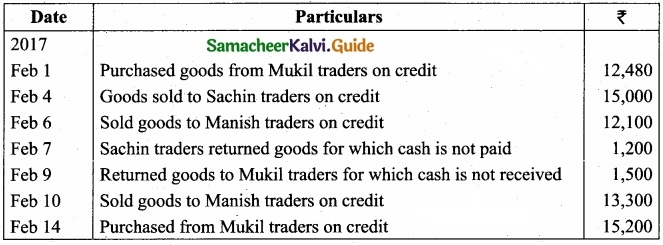
(I) Land Tenure refers to the system of land ownership and management.

(II) The features that distinguish a land tenure system from the others relate to the following:

  • Who owns the land;
  • Who cultivate the land;
  • Who is responsible for paying the land revenue to the government.

(III) Based on these questions, three different types of land tenure existed in India before Independence.

Question 29.
What is meant by Sunk cost?
Answer:
A cost incurred in the past and cannot be recovered in future is called as Sunk Cost. This is historical but irrelevant for future business decisions. It is called as sunk because; they are unalterable, unrecoverable and if once invested it should be treated as drowned or disappeared.

Tamil Nadu 11th Economics Model Question Paper 5 English Medium

Question 30.
Point out the essential features of pure competition?
Answer:

  1. Large number of Buyers and sellers.
  2. Homogeneous Product and Uniform price.
  3. Free Entry and exit.
  4. Absence of Transport cost.
  5. Perfect mobility of factors of production.
  6. Perfect knowledge of the market.
  7. No Government Intervention.

PART – III

Answer any seven question in which Question No. 40 is compulsory. [7 × 3 = 21]

Question 31.
Compare productivity of any two food crops between Tamil Nadu and India?
Answer:
Productivity position of Tamil Nadu and India:

  1. The Government of Tamil Nadu lays emphasis on agricultural production and productivity.
  2. Tamil Nadu tops in productivity, in food crops as well as non – food crops among the states in India.

Productivity position of Tamil Nadu in India

  1. Tamil Nadu ranks first in maize, cumbu, groundnut, oil seeds and cotton.
  2. Tamil Nadu ranks second in rice and coconut.
  3. Tamil Nadu ranks third in sugarcane, sunflower and Jowar.

Tamil Nadu 11th Economics Model Question Paper 5 English Medium

Question 32.
How do you justify the merits of privatization?
Answer:

  1. Privatisation is transfer of ownership and management of enterprises from public sector to private sector.
  2. Denationalization, disinvestment and opening exclusive public sector enterprises to private sector are the gateways to privatization.

Question 33.
State and explain the elasticity of supply?
Answer:

  1. Elasticity of supply may be defined as the degree of responsiveness of change in supply to change in price on the part of sellers.
  2. It is Mathematically expressed as,

Elasticity of supply = Proportionate change in supply/Proportionate change in price
es = \(\frac { \Delta Q_{ S } }{ Q_{ S } } \)/\(\frac { \Delta P }{ P } \)
es = \(\frac { \Delta Q_{ S } }{ \Delta P } \) × \(\frac{P}{Qs}\)
Where Qs represents the supply, P presents price, ∆ denotes a change.

Tamil Nadu 11th Economics Model Question Paper 5 English Medium

Question 34.
What are the functions of Entrepreneur?
Answer:
Functions of an Entrepreneur:
1. Initiation:
An organizer is the initiator of the business, by considering the situation and availability of resources and planning the entire process of business of production.

2. Innovation:
A successful entrepreneur is always an innovator. He introduces new methods in the production process.

3. Co – ordination:
An organizer applies a particular combination of the factor of production, to start and run the business or production.

4. Control, Direction and Supervision:
An organiser controls so that nothing prevents the organisation from achieving its goal. He directs the factors to get better results and supeiVises for the efficient functioning of all the factors involved in the process of production.

5. Risk – taking and uncertainty – bearing:
There are risk – taking and uncertainty-bearing obstacles. Risks may be insured but uncertainties cannot be insured. They reduce the profit.

Tamil Nadu 11th Economics Model Question Paper 5 English Medium

Question 35.
List out the kinds of wages?
Answer:
Wages are divided into four types.

1. Nominal Wages or Money Wages:
Nominal wages are referred to the wages paid in terms of money.

2. Real Wages:
Real wages are the wages paid in terms of goods and services. Hence, real wages are the purchasing power of money wages.

3. Piece Wages:
Wages that are paid on the basis of quantum of work done.

4. Time Wages:
Wages that are paid on the basis of the amount of time that the worker works.

Tamil Nadu 11th Economics Model Question Paper 5 English Medium

Question 36.
Give short note on Cold Storage?

  1. India is the largest producer of fruits and second largest producer of vegetables in the world.
  2. Inspite of that per capita availability of fruits and vegetables is quite low because of post – harvest losses which account for about 25% to 30% of production.
  3. Besides, quality of a sizable quantity of produce also deteriorates by the time it reaches the consumer.
  4. Most of the problems relating to the marketing of fruits and vegetables can be traced to their perishability.
  5. Perishability is responsible for high marketing costs, market gluts, price fluctuations and other similar problems.
  6. In order to overcome this constraint, the Government of India and the Ministry of Agriculture promulgated an order known as “cold storage order, 1964” under section 3 of the Essential Commodities Act., 1955.

Question 37.
Compare positive economics and normative economics?
Answer:

Positive Economics

Normative Economics

1. An increase in money supply implies a price – rise is an economy.1. Inflation is better than deflation.
2. As the irrigation facilities and application of chemical fertilizers expand, the production of food grains increases.2. More production of luxury goods is not good for a less developed country.
3. An increase in the birth rate and a decrease in the death rate reflect the rate of growth of population.Inequalities in the distribution of wealth and incomes should be reduced.

Tamil Nadu 11th Economics Model Question Paper 5 English Medium

Question 38.
Describe the development of textile Industry in Tamil Nadu?
Answer:

  1. Tamil Nadu is the largest textile hub of India.
  2. Tamil Nadu is known as the “Yam Bowl” of the country accounting for 41% of India’s cotton yam production.
  3. The textile industry plays a significant role in the Indian economy by providing direct employment to an estimated 35 million people, and thereby contributing 4% of GDP and 35% of gross export earnings.
  4. The textile sector contributes to 14% of the manufacturing sector.
  5. From spinning to garment manufacturing, entire textile production chain facilities are in Tamil Nadu.
  6. About half of India’s total spinning mill capacity is in Tamil Nadu.
  7. The western part of Tamil Nadu comprising Coimbatore, Tirupur, Erode, Dindigul and Karur has the majority of spinning mills manufacturing cotton, polyester, blended yam and silk yam used by garment units in Tamil Nadu, Maharastra etc.,
  8. Yam is also exported to China, Bangladesh, etc.,
  9. Tirupur known as “knitting city” is the exporter of garments worth USD (United States Dollar) 3 billion.
  10. Karur is the major home for textile manufacturing (curtain cloth, bed linens, kitchen linens, toilet linens, table linens, wall hangings etc.,) and export hub in India.
  11. Erode is the main cloth market in South India for both retail and wholesale ready – mades.

Tamil Nadu 11th Economics Model Question Paper 5 English Medium

Question 39.
What are the important features of utility?
Answer:
The important features of utility are:

  1. Utility is psychological. It depends on the consumer’s mental attitude. For example, a vegetarian derives no utility from mutton.
  2. Utility is not equivalent to usefulness. For example, a smoker derives utility from a cigarette; but, his health gets affected.
  3. Utility is not the same a pleasure. A sick person derives utility from taking a medicine, but definitely it is not providing pleasure.
  4. Utility is personal and relative. An individual obtains varied utility from one and the same good in different situations and places.
  5. Utility is the function of the intensity of human want. An individual consumer faces a tendency of diminishing utility.
  6. Utility cannot be measured objectively. It is a subjective concept and it cannot be measured numerically.
  7. Utility has no ethical or moral significance. For example, a cook derives utility from a knife using which he cuts some vegetables, and a killer wants to stab his enemy by that knife. In economics, a commodity has utility if it satisfies a human want.

Tamil Nadu 11th Economics Model Question Paper 5 English Medium

Question 40.
Mention the features of SHGs?
Answer:
Major features of SHGs [Self Help Groups]

  1. SHG is generally an economically homogeneous group formed through a process of self – selection based upon the affinity of its members.
  2. Most SHGs are women’s groups with membership ranging between 10 and 20.
  3. SHGs have well – defined rules and by – laws, hold regular meetings and maintain records and savings and credit discipline.
  4. SHGs are self managed institutions characterized by participatory and collective decision making.

PART- IV

Answer all the questions. [7 × 5 = 35]

Question 41 (a).
A firm has the revenue function R = 600q – 0.03q2 and the cost function is
C = 150q + 60,000, where q is the number of units produced. Find AR, AC, MR and MC?
Answer:
(I) Average Revenue = \(\frac{R}{q}\)
\(\frac { 600q-0.03q^{ 2 } }{ q } \) = \(\frac{600q}{q}\) – \(\frac { 0.03q^{ 2 } }{ q } \)
AR = 600 – 0.03q

(II) Average Cost = \(\frac{C}{q}\)
= \(\frac{150q+60000}{q}\)
= \(\frac{150q}{q}\) + \(\frac{60000}{q}\)
AC = 150 + \(\frac{60000}{q}\)

(III) Marginal Revenue = \(\frac{dR}{dq}\)
R = 600q – 0.03q2
\(\frac{dR}{dq}\) = 600 – (0.03)q2
\(\frac{dR}{dq}\) = 600 – (0.03)(2q)
MR = 600 – 0.06q

(IV) Marginal Cost = \(\frac{dC}{dq}\)
C = 150q + 60000
MC = 50

[OR]

(b) What are the steps involved in executing a MS Excel sheet?
Answer:

  1. MS – excel is used in data analysis bý using formula.
  2. A spread sheet is a large sheet of paper which contains rows and columns.
  3. The intersection of rows and columns is termed as cell.
  4. MS – Excel 2007 version supports upto I million rows and 16 thousand columns per work sheet.

MS Excel Start From Various Options:

  1. Click Start → Program → Micro Soft Excel
  2. Double click the MS Excel Icon from thè Desktop

Worksheet:
MS – Excel work sheet is a table like document containing rows and columns with data and formula.

There are four kinds of calculation operators. They are:

  1. Arithmetic
  2. Comparison
  3. Text Concatenation [link together]
  4. Reference

MS – Excel helps to do data analysis and data presentation in the form of graphs, diagrams, area chart, line chart etc.

Tamil Nadu 11th Economics Model Question Paper 5 English Medium

Question 42 (a).
Illustrate the concept of producer’s equilibrium?
Answer:
Producer equilibrium implies the situation where producer maximizes his output. It is also known as optimum combination of the factors of production. In short, the producer manufactures a given amount of output with ‘least cost combination of factors’, with his given budget.

Optimum Combination of Factors implies either:
There is output maximisation for given inputs or there is cost minimisation for the given output.

Conditions for Producer Equilibrium:
The two conditions that are to be fulfilled for the attainment of producer equilibrium are:
The iso – cost line must be tangent to iso – quant curve. At point of tangency, the iso-quant curve must be convex to the origin or MRTSLk must be declining.

[OR]

(b) State the relationship between AC and MC?
Answer:
There is a unique relationship between the AC and MC curves as shown in diagram.

  1. When AC is falling, MC lies below AC.
  2. When AC becomes constant, MC also becomes equal to it.
  3. When AC starts increasing, MC lies above the AC.
  4. MC curve always cuts AC at its minimum point from below.

Tamil Nadu 11th Economics Model Question Paper 5 English Medium img 2

Tamil Nadu 11th Economics Model Question Paper 5 English Medium

Question 43 (a).
Explain various divisions of Economics?
Answer:
Economics sub divisions are:

(I) Consumption:

  • Human wants coming under consumption is the starting point of economic activity.
  • In this section the characteristics of human wants based on the behaviour of the consumer, the diminishing marginal utility and consumer’s surplus are dealt with.

(II) Production:

  • Production is the process of transformation of inputs into output.
  • This division covers the characteristics and role of the factors of production namely land, labour, capital and organization.

(III) Exchange:

  • Exchange is concerned with price determination in different market forms.
  • This division covers trade and commerce.
  • Consumption is possible only if the produced commodity is placed in the hands of the consumer.

(IV) Distribution:

  • Production is the result of the coordination of factors of production.
  • Since a commodity is produced with the efforts of land, labour, capital and organization, the produced wealth has to be distributed among the cooperating factors.
  • The reward for factors of production is studied in this division under rent, wages, interest and profit.
  • Distribution studies about the pricing of factors of production.

[OR]

(b) Explain the law of demand and its exceptions?
Answer:
Definitions:
The Law of Demand says as “the quantity demanded increases with a fall in price and diminishes with a rise in price”. – Marshall
“The Law of Demand states that people will buy more at lower price and buy less at ‘ higher prices, other things remaining the same”. – Samuelson

Assumptions of Law of Demand:

  1. The income of the consumer remains constant.
  2. The taste, habit and preference of the consumer remain the same.
  3. The prices of other related goods should not change.
  4. There should be no substitutes for the commodity in study.
  5. The demand for the commodity must be continuous.
  6. There should not be any change in the quality of the commodity.

Given these assumptions, the law of demand operates. If there is change even in one of these assumptions, the law will not operate.

Explanation:
The law of demand explains the relationship between the price of a commodity and the quantity demanded of it. This law states that quantity demanded of a commodity expands with a fall in price and contracts with a rise in price.

In other words, a rise in price of a commodity is followed by a contraction demand and a fall in price is followed by extension in demand. Therefore, the law of demand states that there is an inverse relationship between the price and the quantity demanded of a commodity.

Tamil Nadu 11th Economics Model Question Paper 5 English Medium img 3

Exceptions to the law of demand:
Normally, the demand curve slopes downwards from left to right. But there are some unusual demand curves which do not obey the law and the reverse occurs. A fall in price brings about a contraction of demand and a rise in price results in an extension of demand. Therefore the demand curve slopes upwards from left to right.

Tamil Nadu 11th Economics Model Question Paper 5 English Medium img 4

It is known as exceptional demand curve. In the above diagram, DD is the demand curve which slopes upwards from left to right. It shows that when price is OP1, OQ1, is the demand and when the price rises to OP2, demand also extends to OQ2.

Tamil Nadu 11th Economics Model Question Paper 5 English Medium

Question 44 (a).
How price and output are determined under the perfect competition?
Answer:
Perfect Competition: Firm’s Equilibrium in the Short Run

In the short run, at least a few factors of production are fixed. The firms under Perfect Competition take the price (10) from the industry and start adjusting their quantities produced. For example Qd = 100 – 5P and Qs = 5P.

At equilibrium Qd = Qs
Therefore 100 – 5P = 5P
100 = 10P; 100/10 = P; Qd = demand
P = 10; P = Price
Qd = 100 – 5(10); Qs = Supply
100 – 50 = 50
Qs = 5 (10) = 50
Therefore 50 = 50

Tamil Nadu 11th Economics Model Question Paper 5 English Medium img 5

This diagram consists of three panels. The equilibrium of an industry is explained in the first panel. The demand and supply forces of all the firms interact and the price is fixed as 10. The equilibrium of an industry is obtained at 50 units of output.

In the second part of the diagram, AC curve is lower than the price line. The equilibrium condition is achieved where MC = MR. Its equilibrium quantity sold is 50. With the prevailing price, ₹ 10 it experiences super normal profit. AC = ₹ 8, AR = ₹ 10.

Its total revenue is 50 × 10 = 500. Its total cost is 50 × 8 = 400. Therefore, its total profit is 500 – 400 = 100.

In the third part of the diagram, firm’s cost curve is above the price line. The equilibrium condition is achieved at point where MR = MC. Its quantity sold is 50. With the prevailing price, it experiences loss. (AC > AR). Its total revenue is 50 × 10 = 500. Its total cost is 50 × 12 = 600. Therefore, its total loss is 600 – 500 = 100.

As profit prevails in the market, new firms will enter the industry, thus increasing the supply of the product. This means a decline in the price of the product and increase the cost of production. Thus, the abnormal profit will be wiped out; loss will be incurved. When loss prevails in the market, the existing loss making firms will exit the industry, thus decreasing the supply of the product.

This means a rise in the price of the product and reduction in the cost of production. So the loss will vanish; Profit will emerge. Consequent upon the entry and exit of new firms into the industry, firms always earn ‘normal profit’ in the long run as shown in diagram.

[OR]

(b) Elucidate the Loanable funds Theory of Interest?
Answer:

  1. The Loanable Funds Theory, also known as the “Neo – Classical Theory,” was developed by Swedish economists like Wicksell, Bertil, Ohlin, Viner, Gunnar Myrdal and others.
  2. According to this theory, interest is the price paid for the use of loanable funds.
  3. The rate of interest is determined by the equilibrium between demand for and supply of ‘ loanable funds in the credit market.

Demand for loanable funds
The demand for loanable funds depends upon the following:

(I) Demand for Investment [I]

  • The most important factor responsible for the loanable funds is the demand for investment.
  • Bulk of the demand for loanable funds comes from business firms which borrow money for purchasing capital goods.

(II) Demand for consumption [C]
The demand for loanable funds comes from individuals who borrow money for consumption purposes also.

(III) Demand for Hoarding [H]

  • The next demand for loanable funds comes from hoarders. Demand for hoarding money arises because of people’s preference for liquidity, idle cash balances and so on.
  • The demand for C, I and H varies inversely with interest rate.

Supply of Loanable funds:
The supply of loanable funds depends upon the following four sources:

1. Savings [S]:
Loanable funds comes from savings. According to this theory, savings may be of two types, namely,

  • Savings planned by individuals are called “ex-ante-savings ”.
  • The unplanned savings are called ‘ex-post savings”.

2. Bank Credit [BC]:
The bank credit is another source of loanable funds. Commercial banks create credit and supply loanable funds to the investors.

3. Dishoarding [DH]:
Dishoarding means bringing out the hoarded money into use and thus it constitutes a source of supply of loanable funds.

4. Disinvestment: [DI]:
Disinvestment is the opposite of investment. Disinvestment means not providing sufficient funds for depreciation of equipment.

It gives rise to the supply of loanable funds. All the four sources of supply of loanable funds vary directly with the interest rate.

Tamil Nadu 11th Economics Model Question Paper 5 English Medium

Question 45 (a).
The features of Rural Economy are peculiar’Argue?
Answer:
Features of Rural Economy:

(I) Village is an Institution:
The village is a Primary Institution and it satisfies almost all the needs of the rural community. The rural people have a feeling of belongingness and a sense of unity towards each other.

Dependence on Agriculture:
The rural economy depends much on nature and agricultural activities. Agriculture and allied activities are the main occupation in rural areas.

Life of Rural people:
Lifestyles in villages are very simple. Public services like education, housing, health and sanitation, transport and communication, banking, roads and markets are limited and unavailable.

The standards of living of majority of rural people are poor and pitiable. In terms of methods of production, social organization and political mobilization, rural sector is extremely backward and weak.

Population Density:
Population density, measured by number of persons living per sq.km is very low and houses are scattered in the entire villages.

Employment:
There exists unemployment, seasonal unemployment and under employment in rural areas.

Poverty:
Poverty is a condition where the basic needs of the people like food, clothing and shelter are not being met.

Indebtedness:
People in rural areas are highly indebted owing to poverty and underemployment, lack of farm and non – farm employment opportunities, low wage employment, seasonality in production, poor marketing network etc.

Rural Income:
The Income of the rural people is constrained as the rural economy is not sufficiently vibrant to provide them.

Dependency:
Rural households are largely dependent on social grants and remittances from family members working in urban areas and cities.

Dualism:
Dualism means the co-existence of two extremely different features like developed and under developed. These characteristics are very common in rural areas. Inequality: The distributions of income, wealth and assets are highly skewed among rural people. Land, livestock and other assets are owned by a few people.

Migration:
Rural people are forced to migrate from villages to urban areas in order to seek gainful employment for their livelihood.

[OR]

(b) Explain the various sources of energy in Tamil Nadu?
Answer:
Tamil Nadu tops in power generation among the Southern States as seen in the table. Tamil Nadu 26,865 MW in 1st Rank in the energy level. Tamil Nadu is in the forefront of all other Indian States in installed capacity.

Tamil Nadu 11th Economics Model Question Paper 5 English Medium img 6

Muppandal wind farm is a renewable energy source, supplying the villagers with electricity for work. Wind farms were built in Nagercoil and Tuticorin apart from already existing ones around Coimbatore, Pollachi, Dharapuram and Udumalaipettai. These areas generate about half of India’s 2,000 megawatts of wind energy or two percent of the total power output of India.

Nuclear Energy:
The Kalpakkam Nuclear Power Plant and the Koodankulam Nuclear Power Plant are the major nuclear energy plants for the energy grid.

Tamil Nadu 11th Economics Model Question Paper 5 English Medium img 7

Thermal power:

  1. In Tamil Nadu the share of thermal power in total energy sources is very high and the thermal power plants are at Athippattu (North Chennai) Ennore, Mettur, Neyveli and Thoothukudi.
  2. The generation of power under various sources is given here.

Tamil Nadu 11th Economics Model Question Paper 5 English Medium img 8

Hydel Energy:

  1. There are about 20 hydro-electric units in Tamil Nadu.
  2. The prominent units are Hundah, Mettur, Periyar, Maravakandy, Parson Valley etc.,

Solar Energy:

  1. Tamil Nadu tops in solar power generation in India as seen in the table here:
  2. Southern Tamil Nadu is considered as pne of the most suitable regions in the country for developing solar power projects.

Wind Energy:

  1. Tamil Nadu has the highest installed wind energy capacity in India.
  2. The State has very high quality of offshore wind energy potential off the Tirunelveli coast and southern Thoothukudi and Rameswaram coast.

Tamil Nadu 11th Economics Model Question Paper 5 English Medium img 9

Tamil Nadu 11th Economics Model Question Paper 5 English Medium

Question 46 (a).
What are the methods of measuring Elasticity of demand?
Answer:
There are three methods of measuring price elasticity of demand.

1. The Percentage method:
ep = \(\frac { \Delta Q }{ \Delta P } \), \(\frac{P}{Q}\)
It is also known as ratio method, when we measure the ratio as:
ep = \(\frac { %\Delta Q }{ %\Delta P } \) where,
% ∆Q = Percentage change in demand
% ∆P = Percentage change in price

2. Total Outlay Method:
Marshall suggested that the simplest way to decide whether demand is elastic or inelastic is to examine the change in total outlay of the consumer or total revenue of the firm Total Revenue = (Price × Quantity Sold)
TR = ( P × Q)

Tamil Nadu 11th Economics Model Question Paper 5 English Medium img 10

Where there is inverse relation between Price and Total Outlay, demand is elastic. Direct relation means inelastic. Elasticity is unity when Total Outlay is constant.

3. Point or Geometrical Elasticity:
When the demand curve is a straight line, it is said to be linear. Graphically, the point elasticity of a linear demand curve is shown by the ratio of the segments of the line to the right and to the left of the particular point.
Lower segment of the demand curve
Point Elasticity = Tamil Nadu 11th Economics Model Question Paper 5 English Medium img 11

Tamil Nadu 11th Economics Model Question Paper 5 English Medium img 12

ep = \(\frac{L}{U}\)
Where ‘ep’ stands for point elasticity, ‘L’ stands for the lower segment and ‘U’ for the upper segment.

[OR]

(b) Explain the VKRV Rao’s National Income Methodology and Industrialization?
Answer:
(a) Rao’s National Income Methodology:

  1. Rao’s name is remembered for his pioneering work on the enumeration of national income of India.
  2. He attempted
    • To develop the national income concepts suited to India and developing countries.
    • To analyze the concepts of investment, saving and the multipliers is an underdeveloped economy.
    • To study the compatibility of the national incomes of Industrialized and underdeveloped countries.
  3. Rao’s paper on “Full Employment and Economic Development” was one of the earliest contributions in the field of development towards employment.

(b) Rao’s views on Industrialization:
Rao gave the following reasons for low per capita income and low levels of per capita nutrition in India.

  1. Uneconomic holdings with sub-divisions and fragmentation.
  2. Low levels of water availability for crops.
  3. Excess population pressure on agriculture due to the absence of a large industrial sector.
  4. Absence of capital.
  5. Absence of autonomy in currency policy, and in general in monetary matters encouraging holding of gold.

Tamil Nadu 11th Economics Model Question Paper 5 English Medium

Question 47 (a).
Compare and contrast various definitions of economics?
Answer:
1. Adam Smith’s wealth definition:

  • Adam Smith [1723 – 1790] in his book “An Inquiry into Nature and Cause of Wealth of Nations” [1776] defines “Economics as the science of wealth”
  • He explains how a nation’s wealth is created and increased.
  • He considers that the individual in the society wants to promote his own gain and in this process, he is guided and led by an “invisible hand”
  • Adam Smith favours the introduction of “division of labour” to increase the quantum of output.
  • Severe competition in factories and society helps in bettering the product.
  • Supply force is very active and a commodity is made available to the consumers at the lowest price.

2. Alfred Marshall welfare definition: .

  • Alfred Marshall [1842-1924] in his book “Principles of Economics” [1890] defines economics thus “Political Economy” or Economics is a study of mankind in the ordinary business of life.
  • It examines that part of individual and social action which is most closely connected with the attainment and with the use of the material requisites of well being.
  • Thus , it is on one side a study of wealth and on the other and more important side, a part of the study of man”.

The important features of Marshall’s definition are:

  • Economics does not treat wealth as’the be-all and end-all of economic activities.
  • Man promotes primarily welfare and not wealth.
  • The science of economics contains the concerns of ordinary people who are moved by love and not merely guided or directed by the desire to get maximum monetary benefit.
  • Economics is a social science. It studies people in the society who influence one another.

3. Lionel Robbins – Scarcity definition:

  • Lionel Robbins published a book “An Essay on the Nature and Significance of Economic Science” in 1932.
  • According to him, “Economics is a science which studies human behaviour as a relationship between ends and scarce means which have alternative uses”.

The major features of Robbins’ definition:

  • Ends refer to human wants, human beings have unlimited number of wants.
  • On the other hand, resources or means that go to satisfy the unlimited human wants are limited or scarce in supply.
  • The scarce means are capable of having alternative uses.
  • An individual grades his wants and satisfies first his most urgent want.
  • Economics, according to Robbins, is a science of choice. •

4. Samuelson’s – growth definition:

  • Paul Samuelson defines economics as “the study of how men and society choose, with or without the use of money, to employ scarce productive resources which could have alternative uses to produce various. commodities over time, and distribute them for consumption, now and in the future among various people and groups of society”.
    The major implications of this definition are as follows:
  • Samuelson’s makes his definition dynamic by including the element of time in it.
  • Samuelson’s definition is applicable also in a barter economy.
  • His definition covers various aspects like production, distribution and consumption.
  • Samuelson treats economics as a social science.
  • Samuelson appears to be the most satisfactory.

[OR]

(b) Explain the law of Equi – marginal utility?
Answer:
The law of the Equi-marginal utility:

  1. The law of diminishing marginal utility is applicable only to the want of a single commodity.
  2. The law of equi – marginal utility explains the behavior of a consumer when he consumer more than one commodity.
  3. Wants are unlimited but the income which is available are limited.
  4. This law explains how the consumer spends his limited income on various commodities to get maximum satisfaction.
  5. Law of Equi-Marginal Utility is also known as the law of substitution.
  6. “The law of consumer’s equilibrium ”
  7. “Gossen’s second law ” and “ The law of maximum satisfaction”.

Definition:
Marshall states the law as, “If a person has a thing which he can put to several uses, he will distribute it among these uses in such a way that it has the same marginal utility in all. For, if it had a greater marginal utility in one use than another he would gain by taking away some of it from the second use and applying it to first”.

Assumption:

  1. The consumer is rational in the sense that he wants to get maximum satisfaction.
  2. The utility of each commodity is measurable in cardinal numbers.
  3. The marginal utility of money remains constant.
  4. The income of the consumer is given. ‘
  5. There is perfect competition in the market.
  6. The prices of the commodities are given.
  7. The law of diminishing marginal utility operates.

Illustration:
This law can be illustrated with the help of table. Let us assume that the consumer has a given income of ₹ 11. He wants to spend this entire income [i.e. ₹ 11] on Apple and Orange. The price of an Apple and the price of an orange is ₹ 1 each.

Tamil Nadu 11th Economics Model Question Paper 5 English Medium img 13

Tamil Nadu 11th Economics Model Question Paper 5 English Medium img 14

If the consumer wants to attain maximum utility, he should buy 6 units of apples and 5 units of oranges, so that she can get [92 + 58] = 150 units. No other combination of Apple and Orange can give higher than 150 utilities.

Diagrammatic Illustration:
In the diagram, X – axis represents the amount of money spent and Y axis represents the marginal utilities of Apple and Orange respectively.

If the consumer spends ₹ 6 on Apple and ₹ 5 on Orange, the marginal utilities of both are equal, i.e. AA1 = BB1 [4 = 4], Hence, he gets maximum utility.

Criticisms:

  1. In practice, utility cannot be measured, only be felt.
  2. This law cannot be applied to durable goods.

Tamil Nadu 11th Economics Model Question Paper 4 English Medium

Students can Download Tamil Nadu 11th Economics Model Question Paper 4 English Medium Pdf, Tamil Nadu 11th Economics Model Question Papers helps you to revise the complete Tamilnadu State Board New Syllabus, helps students complete homework assignments and to score high marks in board exams.

TN State Board 11th Economics Model Question Paper 4 English Medium

General Instructions:

  1. The question paper comprises of four parts.
  2. You are to attempt all the parts. An internal choice of questions is provided wherever applicable.
  3. All questions of Part I, II, III and IV are to be attempted separately.
  4. Question numbers 1 to 20 in Part I are Multiple Choice Questions of one mark each.
    These are to be answered by choosing the most suitable answer from the given four alternatives and writing the option code and the corresponding answer
  5. Question numbers 21 to 30 in Part II are two-mark questions. These are to be answered in about one or two sentences.
  6. Question numbers 31 to 40 in Part III are three-mark questions. These are to be answered in above three to five short sentences.
  7. Question numbers 41 to 47 in Part IV are five-mark questions. These are to be answered in detail Draw diagrams wherever necessary.

Time: 3:00 Hours
Maximum Marks: 90

PART – I

Choose the correct answer. Answer all the questions: [20 × 1 = 20]

Question 1.
The cost incurred by producing one more unit of output is ……………………. cost.
(a) Variable
(b) Fixed
(c) Marginal
(d) Total
Answer:
(c) Marginal

Tamil Nadu 11th Economics Model Question Paper 4 English Medium

Question 2.
Ordinal utility can be measured by ……………………
(a) Ranking
(b) Numbering
(c) Wording
(d) None of these
Answer:
(a) Ranking

Question 3.
A production function measures the relation between ……………………..
(a) Input prices and output prices
(b) Input prices and the quantity of output
(c) The quantity of inputs and the quantity of output
(d) The quantity of inputs and input prices
Answer:
(c) The quantity of inputs and the quantity of output

Question 4.
If average product is decreasing, then marginal product ……………………
(a) Must be greater than average product
(b) Must be less than average product
(c) Must be increasing
(d) Both (a) & (c)
Answer:
(b) Must be less than average product

Tamil Nadu 11th Economics Model Question Paper 4 English Medium

Question 5.
Price discrimination will always lead to ………………………
(a) Increase in output
(b) Increase in profit
(c) Different prices
(d) (b) and (c)
Answer:
(d) (b) and (c)

Question 6.
Which of the following is a micro – economics statement?
(a) The real domestic output increased by 2.5 percent last year.
(b) Unemployment was 9.8 percent of the labour force last year.
(c) The price of wheat determines its demand
(d) The general price level increased by 4 percent last year.
Answer:
(c) The price of wheat determines its demand

Tamil Nadu 11th Economics Model Question Paper 4 English Medium

Question 7.
The marginal productivity theory was developed by ……………………
(a) Clark
(b) Wickseed
(c) Walras
(d) All
Answer:
(c) Walras

Question 8.
The chief exponent of the cardinal utility approach was …………………..
(a) J.R. Hicks
(b) R.G. D. Allen
(c) Marshall
(d) Stigler
Answer:
(c) Marshall

Tamil Nadu 11th Economics Model Question Paper 4 English Medium

Question 9.
Keynesian Theory of interest is popularly known as ……………………
(a) Abstinence theory
(b) Liquidity preference theory
(c) Loanable funds theory
(d) Agio theory
Answer:
(b) Liquidity preference theory

Question 10.
Total revenue is equal to total output sold multiplied by ………………….
(a) Price
(b) Total cost
(c) Marginal revenue
(d) Marginal cost
Answer:
(a) Price

Tamil Nadu 11th Economics Model Question Paper 4 English Medium

Question 11.
In which of the following is not a type of market structure price will be very high?
(a) Perfect competition
(b) Monopoly
(c) Duopoly
(d) Oligopoly
Answer:
(b) Monopoly

Question 12.
The Father of Green Revolution in India was ……………………..
(a) M.S. Swaminathan
(b) Gandhi
(c) Visweswaraiah
(d) N.R. Viswanathan
Answer:
(a) M.S. Swaminathan

Question 13.
A Statement of equality between two quantities is called ……………………
(a) Inequality
(b) Equality
(c) Equations
(d) Functions
Answer:
(c) Equations

Tamil Nadu 11th Economics Model Question Paper 4 English Medium

Question 14.
Product obtained from additional factors of production is terms as ………………….
(a) Marginal product
(b) Total product
(c) Average product
(d) Annual product
Answer:
(a) Marginal product

Question 15.
Rent is the reward for the use of ……………………..
(a) Capital
(b) Labour
(c) Land
(d) Organization
Answer:
(c) Land

Question 16.
Revenue received from the sale of additional unit is termed as …………………….. revenue.
(a) Profit
(b) Average
(c) Marginal
(d) Total
Answer:
(c) Marginal

Tamil Nadu 11th Economics Model Question Paper 4 English Medium

Question 17.
Tamil Nadu is rich in ……………………
(a) Forest resource
(b) Human resource
(c) Mineral resource
(d) All the above
Answer:
(d) All the above

Question 18.
The New foreign trade policy was announced in the year ……………………….
(a) 2000
(b) 2002
(c) 2010
(d) 2015
Answer:
(a) 2000

Tamil Nadu 11th Economics Model Question Paper 4 English Medium

Question 19.
The PQLI was developed by ……………………..
(a) Planning Commission
(b) Nehru
(c) Morris
(d) Morrisd.Biswajeet
Answer:
(c) Morris

Question 20.
In India’s total cement production, Tamil Nadu ranks ……………………….
(a) Third
(b) Fourth
(c) First
(d) Second
Answer:
(a) Third

PART – II

Answer any seven question in which Question No. 30 is compulsory. [7 × 2 = 14]

Question 21.
State the meaning of privatization?
Answer:
Privatization means transfer of ownership and management of enterprises from public sector to private sector.

Tamil Nadu 11th Economics Model Question Paper 4 English Medium

Question 22.
What are the reasons for upward sloping supply curve?
Answer:

  1. A supply curve represents the data given in the supply schedule. As the price of the commodity increases, the quantum supplied of the commodity also increases. Thus the supply curve has a positive slope from left to right.
  2. The quantum supplied of commodity x is represented on X axis. And the price of the commodity is represented on the Y axis. The points such as e, d, c, b and a on the supply curve SS’, represent various quantities at different prices.

Question 23.
Give a short note on Sen’s “choice of Technique”?
Answer:
Sen’s “Choice of Technique” was a research work where he argued that in a labour surplus economy; generation of employment cannot be increased at the initial stage by the adaptation of capital – intensive technique.

Tamil Nadu 11th Economics Model Question Paper 4 English Medium

Question 24.
What are major ports in Tamil Nadu?
Answer:

  1. Tamil Nadu has three major ports; one each at Chennai, Ennore, and Thoothukudi as well as one intermediate port in Nagpattinam, and 23 minor ports.
  2. All the minor ports are managed by the Tamil Nadu Maritime Board, Chennai Port.
  3. Ennore port was recently converted from an intermediate port to a major port and handles all the coal and ore traffic in Tamil Nadu.

Tamil Nadu 11th Economics Model Question Paper 4 English Medium

Question 25.
Define cost function?
Answer:
The function relationship between cost and output is expressed as ‘Cost Function’.
A Cost Function may be written as
C = f(Q)
Eg. TC = Q3 – 18Q2 + 91Q + 12
Where, C = Cost and Q = Quantity of output. Cost functions are derived functions because they are derived from Production Functions.

Question 26.
What are the main menus of MS word?
Answer:

Tamil Nadu 11th Economics Model Question Paper 4 English Medium img 1

Where, C = Cost and Q = Quantity of output. Cost functions are derived functions because they are derived from Production Functions.

Tamil Nadu 11th Economics Model Question Paper 4 English Medium

Question 27.
If 62 = 34 + 4 x what is x?
Answer:
62 – 34 = 4x ⇒ 28 = 4x
28 ÷ 5 – 4 = 1x
∴ x = 7

Question 28.
Define‘Rent’?
Answer:
Rent is the price or reward given for the use of land or house or a machine to the owner. But, in Economics, “Rent” or “Economic Rent” refers to that part of payment made by a tenant to his land lords for the use of land only.

Tamil Nadu 11th Economics Model Question Paper 4 English Medium

Question 29.
What are conditions for producer’s equilibrium?
Answer:

  1. Producer equilibrium implies the situation where producer maximizes his output.
  2. It is also known as optimum combination of the factors of production.
  3. In short, the producer manufactures a given amount of output with ‘least cost combination of factors’, with his given budget.

Question 30.
Write three policy initiative introduced in 1991 – 92 to correct the fiscal imbalance?
Answer:
The important policy initiatives introduced in the budget for the year 1991 – 92 for correcting the fiscal imbalance were:

  1. Reduction in fertilizer subsidy.
  2. Abolition of subsidy on sugar.
  3. Disinvestment of a part of the government’s equity holdings in select public sector undertakings.

PART – III

Answer any seven question in which Question No. 40 is compulsory. [7 × 3 = 21]

Question 31.
Describe the performance of Tamil Nadu economy in health?
Answer:

  1. Tamil Nadu has a three – tier health infrastructure comprising hospitals, primary health centres, health units, community health centres and sub – centres.
  2. As of March 2015, the State had 34 district hospitals, 229 sub – divisional hospitals, 1,254 primary health centres, 7,555 sub – centres and 313 community health centres.

Tamil Nadu 11th Economics Model Question Paper 4 English Medium

Question 32.
Explain the difference between internal and external economies?
Answer:

Internal Economies of Scale

External Economies of Scale

1. Expansion of the firm itself.1. Expansion of the industry.
2. Lower long run average cost.2. Benefits most all firms.
3. Efficiencies from larger scale production.3. Agglomeration economies are important.
4. Range of economies (e.g.,) Technical and Financial.4. Helps to explain the rapid growth of many cities.

Question 33.
State and explain the elasticity of supply?
Answer:

  1. Elasticity of supply may be defined as the degree of responsiveness of change in supply to change in price on the part of sellers.
  2. It is Mathematically expressed as,

Elasticity of supply = Proportionate change in supply / Proportionate change in price
es = \(\frac { \Delta Q_{ S } }{ Qs } \)/\(\frac { \Delta P }{ P } \)
es = \(\frac { \Delta Q_{ S } }{ \Delta P } \) × \(\frac { P }{ Q_{ S } } \)
Where Qs represents the supply, P represents price, ∆ denotes a change.

Tamil Nadu 11th Economics Model Question Paper 4 English Medium

Question 34.
Write a note on mineral resources in TamilNadu?
Answer:
Mineral Resources in Tamil Nadu:

  1. Tamil Nadu has a few mining projects based on Titanium, Lignite, Magnesite, Graphite, Limestone, Granite and Bauxite.
  2. The first one is the Neyveli Lignite Corporation that has led development of large industrial complex around Neyveli in Cuddalore district with Thermal Power Plants, Fertilizer and Carbonisation plants.
  3. Magnesite mining is at Salem from which mining of Bauxite ores are carried out at Yercaud, and this region is also rich in iron ore at Kanjamalai.
  4. Molybdenum is found in Dharmapuri, and is the only source in the country.

Question 35.
What are the motives of demand for money?
Answer:
Motives of Demand for Money:
According to Keynes, there are three motives for liquidity preference. They are:

1. The Transaction Motive :

  • The transaction motive relates to the desire of the people to hold cash for the current transactions.
  • The amount saved under this motive depends on the level of income. Mt = f(y)

2. The Precautionary Motive:

  • The precautionary motive relates to the desire of the people to hold cash to meet unexpected or unforeseen expenditures such as sickness, accidents, fire and theft.
  • The amount saved for this motive also depends on the level of income. Mp – f(r)

3. The Speculative Motive:
The speculative motive relates to the desire of the people to hold cash in order to take advantage of market movements regarding the future changes in the price of bonds and securities in the capital market. The amount saved for this motive depends on the rate of interest.

MS = f(i). There is inverse relation between liquidity preference and rate of interest.

Tamil Nadu 11th Economics Model Question Paper 4 English Medium

Question 36.
State Ambedkar’s Economic Ideas on agricultural economics?
Answer:
In the 1918, Ambedkar published a paper “Small Holding in India and their Remedies”. Citing Adam Smith’s “Wealth of Nations”, he made a fine distinction between “Consolidation of Holdings” and Enlargement of Holdings”.

Question 37.
What are the functions of Entrepreneur?
Answer:
Functions of an Entrepreneur:

  1. Initiation: An organizer is the initiator of the business, by considering the situation and availability of resources and planning the entire process of business of production.
  2. Innovation: A successful entrepreneur is always an innovator. He introduces new methods in the production process.
  3. Co – ordination: An organizer applies a particular combination of the factor of production to start and run the business or production.
  4. Control, Direction and Supervision: An organiser controls so that nothing prevents the organisation from achieving its goal. He directs the factors to get better results and supervises for the efficient functioning of all the factors involved in the process of production.
  5. Risk – taking and uncertainty – bearing: There are risk – taking and uncertainty-bearing obstacles. Risks may be insured but uncertainties cannot be insured. They reduce the profit.

Tamil Nadu 11th Economics Model Question Paper 4 English Medium

Question 38.
Explain GSDP in Tamil Nadu?
Answer:

  1. The Gross State Domestic Product (GSDP) refers to the total money value of all the goods and services produced annually in the state.
  2. Tamil nadu is the second largest economy in India with a GSDP of $ 207.8 billion in 2016 – 2017 according to the Directorate of Economics and Statistics, Tamil Nadu.
  3. The GSDP of Tamil Nadu is equal to the GDP of Kuwait on nominal term and GDP of UAE on PPP terms. Per capita GSDP would be better for intercountry or interstate comparisons.
  4. Tamil Nadu GSDP = $207.8 billion in 2016 – 17.

Question 39.
Briefly explain the concept of consumer’s equilibrium?
Answer:
The consumer reaches equilibrium at the point where the budget line is tangent on the indifference curve. T is the point of equilibrium as budget line AB is tangent on indifference curve IC3 the upper IC which implies maximum possible level of satisfaction.

At equilibrium point, the slope of IC refers to MRSXY and the slope of BL (Budget Line) refers to ratio of price of X to price of Y i.e. Px / Py . Therefore MRSx,y = Px / Py.

Tamil Nadu 11th Economics Model Question Paper 4 English Medium

Question 40.
List out the kinds of wages:
Answer:
Wages are divided into four types.

  1. Nominal Wages or Money Wages: Nominal wages are referred to the wages paid in terms of money.
  2. Real Wages: Real wages are the wages paid in terms of goods and services. Hence, real wages are the purchasing power of money wages.
  3. Piece Wages: Wages that are paid on the basis of quantum of work done.
  4. Time Wages: Wages that are paid on the basis of the amount of time that the worker works.

PART – IV

Answer all the questions. [7 × 5 = 35]

Question 41 (a).
Write a brief note on the Gandhian economic ideas?
Answer:
Gandhian Economics is based on ethical foundations. Gandhi wrote “ Economics that hurts the moral well-being of an individual or a nation is immoral, and therefore , Sinful”. Gandhi repeated the same belief “ that economy is untrue which ignores or disregards moral values”.

Salient features of Gandhian Economic Thought:

(I) Village Republics:

  • India lives in villages.
  • He was interested in developing the villages as self – sufficient units.
  • He opposed extensive use of machinery, urbanization and industrialization.

(II) On Machinery:

  • Gandhi described machinery as ‘Great sin’. He said that “Books could be written to demonstrate its evils”.
  • It is necessary to realize that machinery is bad.
  • Instead of welcoming machinery as a boon, we should look upon it as an evil.
  • It would ultimately cease.

(III) Industrialism:

  • Gandhi considered industrialism as a curse on mankind.
  • He thought industrialism depended entirely on a country’s capacity to exploit.

(IV) Decentralization:
Gandhi advocated a decentralized economy i. e., production at a large number of places on a small scale or production in the people’s homes.

(V) Village Sarvodaya:

  • According to Gandhi, “ Real India was to be found in villages and not in towns or cities”.
  • He suggested, self – dependent villages.

(VI) Bread Labour:

  • Gandhi realized the dignity of human labour.
  • He believed that God created man to eat his bread by the sweat of his brow.
  • Bread labour or body labour was the expression that Gandhi used to mean manual labour.

(VII) The Doctrine of Trusteeship:
Trusteeship provides a means of transforming the present capitalist order of society into an egalitarian one.

(VIII) On the Food Problem:

  • Gandhi was against any sort of food controls.
  • Once India was begging for food grain, but now India tops the world with very large production of food grains, fruits, vegetables, milk, egg, meat etc.

(IX) On Population:

  • Gandhi opposed the method of population control through contraceptives.
  • He was, however, in favour of birth control through Brahmacharya or self – control.
  • He considered self – control as a sovereign remedy to the problem of Over population.

(X) On Prohibition:

  • Gandhi regarded the use of liquor as a disease rather than a vice.
  • He felt that it was better for India to be poor than to have thousands of drunkards.
  • Many states depend on revenue from liquor sales.

[OR]

(b) Analyse the causes for Rural Indebtedness?
Answer:
The Causes for Rural Indebtedness:

(I) Poverty of Farmers:

  • The vicious circle of poverty forces the farmers to borrow for consumption and cultivation.
  • Thus poverty, debt and high rates of interest hold the farmer in the grip of money lenders.

(II) Failure of Monsoon:

  • Frequent failure of monsoon is a curse to the farmers and they have to suffer due to the failure of nature.
  • Farmers find it difficult to identify good years to repay their debts.

(III) Litigation:

  • Due to land disputes litigation in the court compels them to borrow heavily.
  • Being uneducated and ignorant they are caught in the litigation process and dry away their savings and resources.

(IV) Money Lenders and High Rate of Interest:
The rate of interest charged by the local money lenders is very high and the compounding of interest leads to perpetuate indebtedness of the farmer.

Tamil Nadu 11th Economics Model Question Paper 4 English Medium

Question 42 (a).
Explain various divisions of Economics?
Answer:
Economics sub divisions are:

(I) Consumption:

  • Human wants coming under consumption is the starting point of economic activity.
  • In this section the characteristics of human wants based on the behaviour of the consumer, the diminishing marginal utility and consumer’s surplus are dealt with.

(II) Production:

  • Production is the process of transformation of inputs into output.
  • This division covers the characteristics and role of the factors of production namely land, labour, capital and organization.

(III) Exchange:

  • Exchange is concerned with price determination in different market forms.
  • This division covers trade and commerce.
  • Consumption is possible only if the produced commodity is placed in the hands of the consumer.

(IV) Distribution:

  • Production is the result of the coordination of factors of production.
  • Since a commodity is produced with the efforts of land, labour, capital and organization, the produced wealth has to be distributed among the cooperating factors.
  • The reward for factors of production is studied in this division under rent, wages, interest and profit.
  • Distribution studies about the pricing of factors of production.

[OR]

(b) Explain the law of demand and its exceptions?
Answer:
Definitions:
The Law of Demand says as “the quantity demanded increases with a fall in price and diminishes with a rise in price”. – Marshall
“The Law of Demand states that people will buy more at lower price and buy less at higher prices, other things remaining the same”. – Samuelson Assumptions of Law of Demand:

  1. The income of the consumer remains constant.
  2. The taste, habit and preference of the consumer remain the same.
  3. The prices of other related goods should not change.
  4. There should be no substitutes for the commodity in study.
  5. The demand for the commodity must be continuous.
  6. There should not be any change in the quality of the commodity.

Given these assumptions, the law of demand operates. If there is change even in one of these assumptions, the law will not operate.

Explanation:
The law of demand explains the relationship between the price of a commodity and the quantity demanded of it. This law states that quantity demanded of a commodity expands with a fall in price and contracts with a rise in price.

In other words, a rise in price of a commodity is followed by a contraction demand and a fall in price is followed by extension in demand. Therefore, the law of demand states that there is an inverse relationship between the price and the quantity demanded of a commodity.

Tamil Nadu 11th Economics Model Question Paper 4 English Medium img 2

Exceptions to the law of demand:
Normally, the demand curve slopes downwards from left to right. But there are some unusual demand curves which do not obey the law and the reverse occurs.

A fall in price brings about a contraction of demand and a rise in price results in an extension of demand. Therefore the demand curve slopes upwards from left to right. It is known as exceptional demand curve.

In the above diagram, DD is the demand curve which slopes upwards from left to right. It shows that when price is OP1,, OQ1, is the demand and when the price rises to OP2, demand also extends to OQ2.

Tamil Nadu 11th Economics Model Question Paper 4 English Medium img 3

Tamil Nadu 11th Economics Model Question Paper 4 English Medium

Question 43 (a).
Describe the degree of price discrimination?
Answer:
Degrees of Price Discrimination:
Price discrimination has become widespread in almost all monopoly markets. According to A.C.Pigou, there are three degrees of price discrimination.

(I) First degree price discrimination:
A monopolist charges the maximum price that a buyer is willing to pay. This is called as perfect price discrimination. This price wipes out the entire consumer’s surplus. This is maximum exploitation of consumers. Joan Robinson named it as “Perfect Discriminating Monopoly”.

(II) Second degree price discrimination:
Under this degree, buyers are charged prices in such a way that a part of their consumer’s surplus is taken away by the sellers. This is called as imperfect price discrimination. Joan Robinson named it as “Imperfect Discriminating Monopoly”.

Under this degree, buyers are divided into different groups and a different price is charged for each group. For example, in cinema theatres, prices are charged for same film show from viewers of different classes. In a theatre the difference between the first row of first class and the last row in the second class is smaller as compared to the differences in charges.

(III) Third degree price discrimination:
The monopolist splits the entire market into a few sub – market and charges different price in each sub – market. The groups are divided on the basis of age, sex and location. For example, railways charge lower fares from senior citizens. Students get discounts in museums, and exhibitions.

[OR]

(b) Write a short note on Total Revenue?
Answer:
Total revenue is the amount of income received by the firm from the sale of its products. It is obtained by multiplying the price of the commodity by the number of units sold.

Tamil Nadu 11th Economics Model Question Paper 4 English Medium img 4

Tamil Nadu 11th Economics Model Question Paper 4 English Medium img 5

where, TR denotes Total Revenue, P denotes Price and Q denotes Quantity sold.
For example, a cell – phone company sold 100 cell – phones at the price of ₹500 each.
TR is ₹50,000. (TR = 500 × 100 = 50,000).

When price is constant, the behaviour of TR is shown in the above table and diagram, assuming P = 5. When P = 5; TR = PQ

When price is declining with increase in quantity sold. (Eg. Imperfect Competition on the goods market) the behaviour of TR is shown in the following table and diagram. TR can be obtained from Demand fuction: If Q = 11 – P,
When P = 1, Q = 10

Tamil Nadu 11th Economics Model Question Paper 4 English Medium img 6

Tamil Nadu 11th Economics Model Question Paper 4 English Medium img 7

TR = PQ = 1 × 10 = 10
When P = 3, Q = 8, TR = 24
When P = 0, Q = 1, TR = 10

Tamil Nadu 11th Economics Model Question Paper 4 English Medium

Question 44 (a).
Discuss the problems of Rural Economy?
Answer:
Rural areas are facing number of problems relating to,

  1. People
  2. Agriculture
  3. Infrastructure
  4. Economy
  5. Society and Culture
  6. Leadership and
  7. Administration.

(I) People Related Problems:
The problems related to individuals and their standard of living consist of illiteracy, lack of technical know how, low level of confidence, dependence on sentiments and beliefs etc.

(II) Agriculture Related Problems:
The problems related to agriculture include as follows,

  • Lack of expected awareness, knowledge, skill and attitude.
  • Unavailability of inputs.
  • Poor marketing facility.

(III) Infrastructural Related problems:
Poor infrastructure facilities like, water, electricity, transport, educational institutions, communication, health, employment, storage facility, banking and insurance are found in rural areas.

(IV) Economics related problems:
The economic problems related to rural areas are,

  • Inability to adopt high cost technology
  • High cost of inputs
  • Under privileged rural industries.
  • Low income
  • Indebtedness
  • Existence of inequality in land holdings and assets

(V) Leadership Related Problems:
The Specific leadership related problems found in rural areas are:

  • Leadership among the hands of inactive and incompetent people
  • Self – interest of leaders
  • Biased political will
  • Less bargaining power
  • Negation skills and dominance of political leaders

(VI) Administrative Problems:
The rural administrative problems are,

  • Political interference
  • Lack of motivation and interest
  • Low wages in villages
  • Improper utilization of budget
  • Absence of monitoring
  • Implementation of rural development programme.

[OR]

(b) Mention the causes for Rural poverty?
Answer:
Causes for Rural Poverty:
1. Unequal distribution of Land:
The distribution of land is highly skewed in rural areas. Therefore, majority of rural people work as hired labour to support their families.

2. Lack of Non – Farm Employment:
Non – farm employment opportunities do not match the increasing labour force. The excess supply of labour in rural areas reduces the wages and increases the incidence of poverty.

3. Lack of public sector Investment:
The root cause of rural poverty in our country is lack of public sector investment on human resource development.

4. Inflation:
Steady increase in prices affects the purchasing power of the rural poor leading to rural poverty.

5. Low productivity:
Low productivity of rural labour and farm activities is a cause as well as the effect of poverty.

6. Unequal Benefit of Growth:
Major gains of economic development are enjoyed by the urban rich people leading to concentration of wealth. Due to defective economic structure and policies, gains of growth are not reaching the poor and the contributions of poor people are not accounted properly.

7. Low Rate of Economic Growth:
The rate of growth of India is always below the target and it has benefited the rich. The poor are always denied of the benefits of the achieved growth and development of the country.

8. More Emphasis on Large Industries:
Huge investment in large industries catering to the needs of middle and upper classes in urban areas are made in India. Such industries are capital-intensive and do not generate more employment opportunities. Therefore, poor are not in a position to get employed and to come out from the poverty in villages.

9. Social evils:
Social evils prevalent in the society like custom, beliefs, etc., increase unproductive expenditure.

Tamil Nadu 11th Economics Model Question Paper 4 English Medium

Question 45 (a).
Bring out the relationship between TR, AR, MR and Elasticity of demand?
Answer:
Relationship among TR, AR and MR Curves:
When marginal revenue is positive, total revenue rises, when MR is zero the total revenue becomes maximum. When marginal revenue becomes negative total revenue starts falling. When AR and MR both are falling, then MR falls at a faster rate than AR.

TR, AR, MR and Elasticity of demand:

  1. The relationship among AR, MR and elasticity of demand (e) is stated as follows.
    MR = AR (e – 1/e)
  2. The relationship between The AR curve and MR curve depends upon the elasticity of AR curve [AR = DD = Price]

Tamil Nadu 11th Economics Model Question Paper 4 English Medium img 8

  • When price elasticity of demand is greater than one, MR is positive and TR is increasing.
  • When price elasticity of demand is less than one, MR is negative and TR is decreasing.
  • When price elasticity of demand is equal to one, MR is equal to Zero and TR is maximum and constant.

It is to be noted that, the output range of 1 to 5 units, the price elasticity of demand is greater than one according to total outlay method. Hence, TR is increasing and MR is positive.
TR, AR, MR & Elasticity

Tamil Nadu 11th Economics Model Question Paper 4 English Medium img 9

At the output range of 5 to 6 units, the price elasticity of demand is equal to one. Hence, TR is maximum and MR is equals to zero. At the output range of 6 units to 10 units, the price elasticity of demand is less than unity. Hence, TR is decreasing and MR is negative.

[OR]

(b) Explain the monetary and financial sector reforms?
Answer:
Monetary reforms aimed at doing away with interest rate distortions and rationalizing the structure of lending rates. The new policy tried in many ways to make the banking system more efficient. Some of the measures undertaken were:

(I) Reserve Requirements:

  • Reduction in Statutory liquidity ratio [SLR] and the cash reserve ratio [CRR] were the recommendations by the Narasimham Committee Report, 1991.
  • It was proposed to cut down the SLR from 38.5 percent to 25 percent within a time span of three years.

(II) Interest Rate Liberalisation:
RBI controlled:

  • The interest rates payable on deposits. The interest rate which could be charged for bank loans.
  • Greater competition among public sector, private sector and foreign banks and elimination of administrative constraints.
  • Liberalisation of bank branch licensing policy in order to rationalize the existing branch network.
  • Banks were given freedom to relocate branches and open specialized branches.
  • Guidelines for opening new private sector banks.
  • New accounting norms regarding classification of. assets and provisions of bad debt were introduced in tune with the Narasimham Committee Report.

Tamil Nadu 11th Economics Model Question Paper 4 English Medium

Question 46 (a).
Examine the law of variable proportions with the help of a diagram?
Answer:
The law states that if all other factors are fixed and one input is varied in the short run, the total output will increase at an increasing rate at first instance^ be constant at a point and then eventually decrease. Marginal product will become negative at last.

According to G.Stigler, “As equal increments of one input are added, the inputs of other productive services being held constant, beyond a certain point, the resulting increments of product will decrease, i.e., the marginal product will diminish”.

Assumptions:
The Law of Variable Proportions is based on the following assumptions.

  • Only one factor is variable while others are held constant.
  • All units of the variable factor are homogeneous.
  • The product is measured in physical units.
  • There is no change in the state of technology.
  • There is no change in the price of the product.

Total Product (TP)
Total product refers to the total amount of commodity produced by the combination of all inputs in a given period of time.

Summation of marginal products, i.e.
TP = ΣMP
where, TP = Total Product,
MP = Marginal Product

Average Product (AP)
Average Product is the result of the total product divided by the total units of the input employed. In other words, it refers to the output per unit of the input.
Mathematically, AP = TP/N
Where, AP = Average Product
TP = Total Product
N = Total units of inputs employed

Marginal Product (MP)
Marginal Product is the addition or the increment made to the total product when one more unit of the variable input is employed. In other words, it is the ratio of the change in the total product to the change in the units of the input. It is expressed as
MP = ∆TP/∆N

where,
MP = Marginal Product
∆TP = Change in total product
∆N = Change in units of input It is also expressed as
MP = TP(n) – TP (n – 1)
Where, MP = Marginal Product
TP(n) = Total product of employing nth unit of a factor.
TP(n – 1) = Total product of employing the previous unit of a factor, that is, (n – 1)th unit of a factor.
The Law of Variable Proportions is explained with the help of the following schedule and diagram:

Tamil Nadu 11th Economics Model Question Paper 4 English Medium img 10

Tamil Nadu 11th Economics Model Question Paper 4 English Medium img 11

In above table, units of variable factor (labour) are employed along with other fixed factors of production. The table illustrates that there are three stages of production. Though total product increases steadily at first instant, constant at the maximum point and then diminishes, it is always positive forever.

While total product increases, marginal product increases up to a point and then decreases. Total product increases up to the point where the marginal product is zero. When total product tends to diminish marginal product becomes negative.

In diagram, the number of workers is measured on X axis while TPL, APL and MPL are denoted on Y axis. The diagram explains the three stages of production as given in the above table.

Stage I:
In the first stage MPL increases up to third labourer and it is higher than the average product, so that total product is increasing at an increasing rate. The tendency of total product to increase at an increasing rate stops at the point A and it begins to increase at a decreasing rate. This point is known as ‘Point of Inflexion’.

Stage II:
In the second stage, MPL decreases up to sixth unit of labour where MPL curve intersects the X – axis. At fourth unit of labor MPL = APL. After this, MPL curve is lower than the APL. TPL increases at a decreasing rate.

Stage III:
Third stage of production shows that the sixth unit of labour is marked by negative MPL, the APL continues to fall but remains positive. After the sixth unit, TPL declines with the employment of more units of variable factor, labour.

[OR]

(b) What are the types of elasticity of supply?
Answer:
There are five types of elasticity of supply

1. Relatively Elastic Supply:
The co – efficient of elastic supply is greater than 1 [ES > 1], One percent change in the price of a commodity causes more than one percent change in the quantity supplied of the commodity.

Tamil Nadu 11th Economics Model Question Paper 4 English Medium img 12

2. Unitary Elastic Supply:
The co – efficient of elastic supply is equal to 1 [Eg = 1]. One percent change in the price of a commodity causes an equal [one percent ] change in the quantity supplied of the commodity.

Tamil Nadu 11th Economics Model Question Paper 4 English Medium img 13

3. Relatively Inelastic Supply:
The co-efficient of elasticity is less than one [ES < 1]. One percent change in the price of a commodity causes and less than one percent change in the quantity supply supplied of the commodity.

Tamil Nadu 11th Economics Model Question Paper 4 English Medium img 14

4. Perfectly Inelastic Supply:
The co – efficient of elasticity is equal to zero [ES = 0], One percent change in the price of a commodity causes no change in the quantity supplied of the commodity.

Tamil Nadu 11th Economics Model Question Paper 4 English Medium img 15

5. Perfectly Elastic Supply:
The co – efficient of elasticity of supply is infinity [ES = 3]. One percent change in the price of a commodity causes an infinite change in the quantity supplied of the commodity.

Tamil Nadu 11th Economics Model Question Paper 4 English Medium img 16

Tamil Nadu 11th Economics Model Question Paper 4 English Medium

Question 47 (a).
Analyse the causes for Rural Indebtedness?
Answer:
The Causes for Rural Indebtedness:
(I) Poverty of Farmers:

  • The vicious circle of poverty forces the farmers to borrow for consumption and cultivation.
  • Thus poverty, debt and high rates of interest hold the farmer in the grip of money lenders.

(II) Failure of Monsoon:

  • Frequent failure of monsoon is a curse to the farmers and they have to suffer due to the failure of nature.
  • Farmers find it difficult to identify good years to repay their debts.

(III) Litigation:

  • Due to land disputes litigation in the court compels them to borrow heavily.
  • Being uneducated and ignorant they are caught in the litigation process and dry away their savings and resources.

(IV) Money Lenders and High Rate of Interest:
The rate of interest charged by the local money lenders is very high and the compounding of interest leads to perpetuate indebtedness of the farmer.

[OR]

(b) Explain the public transport system in Tamil Nadu?
Answer:
Transport:
Tamil Nadu has a well established transportation system that connects all parts of the State. This is partly responsible for the investment in the State.

Tamil Nadu is served by an extensive road network in terms of its spread and quality, providing links between urban centres, agricultural market-places and rural habitations in the countryside. However, there is scope for improvement.

Road Transport:

  1. There are 28 national highways in the State covering a total distance of 5,036 km.
  2. The State has a total road length of 167,000 km, of which 60,628 km are maintained by Highways Department.

Rail Transport:

  1. Tamil Nadu has a well-developed rail network as part of Southern Railway, Head quartered at Chennai.
  2. Tamil Nadu has a total railway track length of 6,693 km and there are 690 railway stations in the State.
  3. Main rail junctions in the State include Chennai, Coimbatore, Erode, Madurai, Salem, Tiruchirapalli and Tirunelveli.
  4. Chennai has a well – established suburban Railway network, a Mass Rapid Transport system and is currently developing a Metro System, with its first underground stretch operational since May 2017.

Air Transport:

  1. Tamil Nadu has four major international airports.
  2. Chennai International Airport is currently the third largest airport in India.
  3. Other international Airports in Tamil Nadu include Coimbatore International Airports, Madurai International Airport and Tiruchirapalli International Airport.
  4. It also has domestic airports at Tuticorin, Salem, and Madurai.
  5. Increased industrial activity has given rise to an increase in passenger traffic as well as freight movement which has been growing at over 18% per year.

Ports:

  1. Tamil Nadu has three major ports; one each at Chennai, Ennore and Tuticorin, as well as one intermediate port in Nagapattinam, and 23 minor ports.
  2. The ports are currently capable of handling over 73 million metric tonnes of cargo annually (24 % share of India).
  3. All the minor ports are managed by the Tamil Nadu Maritime Board, Chennai Port.
  4. This is an artificial harbour and the second principal port in the country for handling containers.
  5. It is currently being upgraded to have a dedicated terminal for cars capable of handling 4,00,000 vehicles.
  6. Ennore port was recently converted from an intermediate port to a major port and handles all the coal and ore traffic in Tamil Nadu.

Tamil Nadu 11th Economics Model Question Paper 3 English Medium

Students can Download Tamil Nadu 11th Economics Model Question Paper 3 English Medium Pdf, Tamil Nadu 11th Economics Model Question Papers helps you to revise the complete Tamilnadu State Board New Syllabus, helps students complete homework assignments and to score high marks in board exams.

TN State Board 11th Economics Model Question Paper 3 English Medium

General Instructions:

  1. The question paper comprises of four parts.
  2. You are to attempt all the parts. An internal choice of questions is provided wherever applicable.
  3. All questions of Part I, II, III and IV are to be attempted separately.
  4. Question numbers 1 to 20 in Part I are Multiple Choice Questions of one mark each.
    These are to be answered by choosing the most suitable answer from the given four alternatives and writing the option code and the corresponding answer
  5. Question numbers 21 to 30 in Part II are two-mark questions. These are to be answered in about one or two sentences.
  6. Question numbers 31 to 40 in Part III are three-mark questions. These are to be answered in above three to five short sentences.
  7. Question numbers 41 to 47 in Part IV are five-mark questions. These are to be answered in detail Draw diagrams wherever necessary.

Time: 3:00 Hours
Maximum Marks: 90

PART – I

Choose the correct answer. Answer all the questions: [20 × 1 = 20]

Question 1.
Knitted garment production is concentrated in …………………..
(a) Coimbatore
(b) Tiruppur
(c) Erode
(d) Karur
Answer:
(b) Tiruppur

Question 2.
The recommendation of Narashimham Committee Report was admitted in the year ………………….
(a) 1990
(b) 1991
(c) 1995
(d) 2000
Answer:
(b) 1991

Tamil Nadu 11th Economics Model Question Paper 3 English Medium

Question 3.
In literacy rate, TN ranks …………………
(a) Second
(b) Fourth
(c) Sixth
(d) Eighth
Answer:
(d) Eighth

Question 4.
The average revenue curve under monopolistic competition will be ………………….
(a) Perfectly inelastic
(b) Perfectly elastic
(c) Relatively
(d) Unitary elastic
Answer:
(c) Relatively

Question 5.
The main theme of the Twelfth Five Year Plan …………………..
(a) Faster and more inclusive growth
(b) Growth with social Justice
(c) Socialistic pattern of society
(d) Faster, more inclusive and sustainable growth
Answer:
(d) Faster, more inclusive and sustainable growth

Question 6.
The Oldest large scale industry in India …………………
(a) Cotton
(b) Jute
(c) Steel
(d) Cement
Answer:
(a) Cotton

Tamil Nadu 11th Economics Model Question Paper 3 English Medium

Question 7.
The main gold mine region in kamataka is ………………..
(a) Kolar
(b) Ramgiri
(c) Anantpur
(d) Cochin
Answer:
(a) Kolar

Question 8.
The command Ctrl + M is applied for …………………..
(a) Saving
(b) Copying
(c) Getting new slide
(d) Deleting a slide
Answer:
(c) Getting new slide

Tamil Nadu 11th Economics Model Question Paper 3 English Medium

Question 9.
Theory of distribution is popularly known as ………………………
(a) Theory of product pricing
(b) Theory of factor pricing
(c) Theory of wages
(d) Theory of Interest
Answer:
(b) Theory of factor pricing

Question 10.
Identify the formuld of estimating average cost ………………………
(a) AVC/Q
(b) TC/Q
(c) TVC/Q
(d) AFC/Q
Answer:
(b) TC/Q

Tamil Nadu 11th Economics Model Question Paper 3 English Medium

Question 11.
The cost per unit of output is denoted by …………………. cost.
(a) Average
(b) Marginal
(c) Variable
(d) Total
Answer:
(a) Average

Question 12.
Revenue received from the sale of additional unit is turned as …………………. revenue.
(a) Profit
(b) Average
(c) Marginal
(d) Total
Answer:
(c) Marginal

Tamil Nadu 11th Economics Model Question Paper 3 English Medium

Question 13.
The Headquarters of Southern Railway is at ……………………
(a) Tiruchirappalli
(b) Chennai
(c) Madurai
(d) Coimbatore
Answer:
(b) Chennai

Question 14.
Financial sector reforms mainly related to …………………….
(a) Insurance sector
(b) Banking sector
(c) Both (a) & (b)
(d) Transport sector
Answer:
(c) Both (a) & (b)

Tamil Nadu 11th Economics Model Question Paper 3 English Medium

Question 15.
Identify the cause for rural indebtedness in India.
(a) Poverty
(b) High population
(c) High productivity
(d) Full employment
Answer:
(a) Poverty

Question 16.
Differentiation of constant term gives …………………..
(a) One
(b) Zero
(c) Infinity
(d) Non – infinity
Answer:
(b) Zero

Tamil Nadu 11th Economics Model Question Paper 3 English Medium

Question 17.
The recommended nutritional intake per person in rural areas …………………
(a) 2100 calories
(b) 2200 calories
(c) 2300 calories
(d) 2400 calories
Answer:
(d) 2400 calories

Question 18.
Perfect competition assumes …………………….
(a) Luxury goods
(b) Producer goods
(c) Differentiated goods
(d) Homogeneous goods
Answer:
(d) Homogeneous goods

Tamil Nadu 11th Economics Model Question Paper 3 English Medium

Question 19.
The concept of ‘Quasi – Rent’ is associated with ……………………
(a) Ricardo
(b) J.M. Keynes
(c) Walker
(d) Marshall
Answer:
(d) Marshall

Question 20.
In Economics, distribution of income is among the ………………….
(a) Factors of production
(b) Individual
(c) Firms
(d) Traders
Answer:
(a) Factors of production

PART – II

Answer any seven question in which Question No. 30 is compulsory. [7 × 2 = 14]

Question 21.
State the meaning of liquidity preference?
Answer:

  1. Liquidity preference means the preference of the people to hold wealth in the form of liquid cash rather than in other non – liquid assets like bonds, securities, bills of exchange, land, building, gold etc.
  2. “Liquidity Preference is the preference to have an equal amount of cash rather than of claims against other”.

Tamil Nadu 11th Economics Model Question Paper 3 English Medium

Question 22.
State the various components of central sector schemes under post – harvest measures?
Answer:

  1. Mega food parks, Integrated cold chain, Value Addition Preservation, Infrastructure and modernization of slaughter house.
  2. Scheme for quality Assurance, Codex Standards, Research and Development and other promotional activities.

Question 23.
What are the nuclear power plants in Tamil Nadu?
Answer:
The Kalpakkam Nuclear Power Plant and the Koodankulam Nuclear Power plant are the major nuclear energy plants for the energy grid.

Question 24.
Give the meaning of deductive method?
Answer:

  1. Deductive method is also named as analytical or abstract method.
  2. It consists in deriving conclusions from general truths,
  3. It takes few general principles and applies them to draw conclusions.
  4. The classical and neo – classical school of economists notably, Ricardo, JS Mill, Malthus Marshall, Pigou applied the deductive method in their economic investigations.

Question 25.
Give a short note on Sen’s ‘Choice of Technique’?
Answer:
Sen’s ‘Choice of Technique’ was a research work where he argued that in a labour surplus economy, generation of employment cannot be increased at the initial stage by the adaptation of capital – intensive technique.

Tamil Nadu 11th Economics Model Question Paper 3 English Medium

Question 26.
Give the meaning of non – renewable energy?
Answer:
Non – renewable energy sources:

  1. The sources of energy which cannot be renewed or re – used are called non – renewable energy sources.
  2. Basically these are the energy sources which will get exhausted over a period of time.
  3. Some of the examples of this kind of resources are coal, oil, gas etc.

Question 27.
Distinguish goods from services?
Answer:

Goods

Services

1. Free and Economic goods. Ex: air and sunshine1. Intangible

Ex: brand image 1 pen drive

2. Consumer goods. Ex: TV, Furniture, Automobile, etc.2. Heterogeneous

Ex: Music, Consulting physicians etc.

3. Capital goods also called producer goods. Ex: Machines3. Inseparable from their makers Ex: Labour and Labourer
4. Perishable goods Ex: Fish, Fruits, Flower.4. Perishable. Ex: A ticket for a cricket match once the match is over.
5. Durable Goods Ex: table, chair.5.           –

Tamil Nadu 11th Economics Model Question Paper 3 English Medium

Question 28.
Write the meaning of Economic Growth?
Answer:

  1. Economic growth is usually measured by National Income, indicated by cross domestic product. [GDP].
  2. The GDP is the total monetary value of the goods and services produced by that country over a specific period of time, usually one year.
  3. On the basis of the level of economic development, nations are classified as developed and developing economies.

Question 29.
Name the basic approaches to consumer behaviour?
Answer:
There are two basic approaches, namely:

1. Utility approach

  1. The utility approach involves the use of measurable (cardinal) utility to study consumer behaviour.
  2. Marshall is the chief exponent of the utility approach to the theory of demand. It is known cardinal utility analysis or marginal utility analysis or marshallian utility analysis.

2. Indifference curve approach
The indifference curve approach was the idea of comparable utility [ordinal utility] J.R. Hicks and R.G.D. Allen introduced the indifference curve approach.

Tamil Nadu 11th Economics Model Question Paper 3 English Medium

Question 30.
What do you mean by fixed cost?
Answer:

  1. Fixed Cost does not change with the change in the quality of output.
  2. Fixed Cost is also called as “Supplementary Cost “or Overhead Cost”.
  3. All payments for the fixed factors of production are known as Total Fixed Cost.

PART – III

Answer any seven question in which Question No. 40 is compulsory. [7 × 3 = 21]

Question 31.
Write the formula of consumers surplus?
Answer:
Consumer’s Surplus = Total utility [Actual price × Units of commodity]
= TU – [P × Q]
20 – [2 × 5] = 20 – 10 =10
Total utility = 20
Actual price = 2
Quantity = 5

Tamil Nadu 11th Economics Model Question Paper 3 English Medium

Question 32.
Mention any two type of price discrimination?
Answer:

  1. Personal: Different prices are charged for different individuals. For example, the railways give tickets at concessional rate to the ‘Senior citizens’ for the same journey.
  2. Geographical: Different prices are charged at different places for the same product. For example, a book sold within India at a price is sold in a foreign countiy at lower price.

Question 33.
Explain different types of economic activities?
Answer:
The seven types of economic activities are:

1. Micro Economics: Micro Economics is the study of the economic actions of individuals say households, firms or industries.
Micro economics covers:-

  1. Value theory [product pricing and factor pricing]
  2. Theory of economic welfare.

2. Macro – Economics:

  1. Macro economics is the obverse of micro economics.
  2. The general theory of employment, Interest and money published by Keynes is the basis of modem macro economics.

3. International Economics:

  1. In the modem world, no country can grow in isolation.
  2. Every country is having links with the other countries through foreign capital, investment [foreign direct investment] and international trade.

4. Public Economics:

  1. Public finance is concerned with the income or revenue raising and expenditure incurring activities.
  2. The scope of public finance covers public expenditure, public revenue, public debt and financial administration.

5. Developmental Economics:
The development economics, deals with features of developed nations, obstacles for development, .economic and non- economic factors influencing development, various growth models and strategies.

6. Health Economics:

  1. Health economics is an area of applied economics.
  2. It covers health indicators , preventive and curative measures medical research and education, rural health mission, drug price control, neo – natal care, maternity and child health, budgetary allocation for health.

7. Environmental Economics:

  1. Depletion of natural resources stock and pollution result from rapid economic development.
  2. Environmental economics is a study of inter disciplinary tools for the problems of ecology, economy and environment.

Tamil Nadu 11th Economics Model Question Paper 3 English Medium

Question 34.
Write a note on Risk – bearing theory of profit?
Answer:

  1. Risk bearing theory of profit was propounded by the American economist F.B. Hawley in 1907.
  2. According to him, profit is the reward of risk taking in business.
  3. Risk taking is an essential function of the entrepreneur and is the basis of profits.
  4. It is a well know fact that every business involves some risks.
  5. Since the entrepreneur undertakes the risks, he receives profit.
  6. If the entrepreneur does not receive the reward, he will not be prepared to undertake the risks.
  7. Every entrepreneur products goods in anticipation of demand.
  8. It is the profit that induces the entrepreneurs to undertake such risks.

Question 35.
Distinguish between Fixed cost and Variable cost?
Answer:

Fixed Cost

Variable Cost

1. Fixed cost does not change with the change in the quantity of output.1. Variable cost vary with the level of output.
2. Fixed cost is also called as “Supplementary Cost” or “over head cost”.2. Variable cost is also called as “ Prime cost”, “Special cost” or Direct cost.
3. For example: Watchman’s wages, Permanent worker’s Salary, machines Insurance Premium deposite for power Licence fee, etc.3. For example: Temporary workers, cost of raw materials, fuel cost, electricity charges, etc.

Tamil Nadu 11th Economics Model Question Paper 3 English Medium

Question 36.
What are the characteristics of land?
Answer:

  1. Land is a primary factor of production
  2. Land is a passive factor of production
  3. Land is the free gift of nature
  4. Land has no cost of production
  5. Land is fixed in supply. It is inelastic in supply
  6. Land is permanent
  7. Land is immovable
  8. Land is heterogeneous as it differs in fertility
  9. Land has alternative uses
  10. Land is subject to Law of Diminishing Returns.

Question 37.
What are the factors governing elasticity of supply?
Answer:
1. Nature of the commodity:
Durable goods can be stored for a long time. So, the producers can wait until they get a high price. Once they get higher price, larger supply is possible. The elasticity of supply of durable goods is high. But perishables are to be sold immediately. So perishables have low elasticity of supply.

2. Cost of production:
When production is subject to either constant or increasing returns, additional production and therefore increased supply is possible. So elasticity of supply is greater. Under diminishing returns, increase in output leads to high cost. So elasticity of supply is less.

3. Technical condition:
In large scale production with huge capital investment, supply cannot be adjusted easily. So elasticity of supply is lesser. Where capital equipment is less and technology simple, the supply is more elastic.

4. Time factor:
During very short period when supply cannot be adjusted, elasticity of demand is very low. In short period, variable factors can be added and so supply can be adjusted to some extent. So elasticity of supply is more. In long period, even the fixed factors can be added and hence supply is highly elastic.

Tamil Nadu 11th Economics Model Question Paper 3 English Medium

Question 38.
Mention the similarities between perfect competition and monopolistic competition?
Answer:

Perfect Competition

Monopolistic Competition

1. Large number of buyers and sellers1. Large number of buyers and many sellers
2. Homogeneous product & uniform price2. Close substitute commodity
3. Free Entry and exit3. Free Entry and exit
4. Very small size of market for each firm4. Small size of market
5. It has no monopoly power5. Limited power
6. Uniform power (or) low price6. Moderate power
7. Price policy price taker7. Low control elasticity of demand
8. Price elasticity – infinite8. Some control over price depending on consumers brand loyalty

Question 39.
Write any three objectives of Industrial Policy 1991?
Answer:

  1. Economic development of a country particularly depends on the process of Industrialisation.
  2. At the time of Independence, India inherited a weak and shallow Industrial base.
  3. Therefore dining the post-Independence period, the Government of India took special emphasis on the development of a solid Industrial base.

Tamil Nadu 11th Economics Model Question Paper 3 English Medium

Question 40.
Enumerate the remedial measures to rural poverty?
Answer:
Remedial measures:

  1. Since rural unemployment and rural poverty are interrelated, creation of employment opportunities would support elimination of poverty.
  2. Poverty alleviation schemes and programmes have been implemented, modified, consolidated, expanded and improved over time.
  3. However, unemployment, begging, rag-picking and slumming continues.
  4. Unless employment is given to all the people poverty cannot be eliminated.

PART – IV

Answer all the questions. [7 × 5 = 35]

Question 41 (a).
Explain the objectives of nationalization of commercial banks?
Answer:
The Government of India nationalized the commercial banks to achieve the following objectives:

  1. The main objective of nationalization was to attain Social Welfare. Sectors such as agriculture, small and village industries were in need of funds for their expansion and further economic development.
  2. Nationalisation of banks helped to curb private monopolies in order to ensure a smooth supply of credit to socially desirable sections.
  3. In India, nearly 70% of population lived in rural areas. Therefore it was needed to encourage the banking habit among the rural population.
  4. Nationalisation of banks was required to reduce the regional imbalances where the banking facilities were not available.
  5. Before Independence, the numbers of banks were certainly inadequate. After nationalization, new bank branches were opened in both rural and urban areas.
  6. Banks created credit facilities mainly to the agriculture sector and its allied activities after nationalization.
    After New Economic Policy 1991, the Indian banking Industry has been facing the new horizons of competitions, efficiency and productivity.

[OR]

(b) Describe the Salient features of EXIM policy [2015 – 2020]?
Answer:
The new EXIM policy has been formulated focusing on increasing in exports Scenario, boosting production and supporting the concepts like Make in India and Digital India.
Salient Features:

  1. Reduce export obligations by 25% and give boost to domestic manufacturing supporting the “Make in India” concept.
  2. As a step to Digital India concept, online procedure to upload digitally signed document by CA /CS / Cost Accountant are developed and further mobile app for filing tax, stamp duty has been developed.
  3. Repeated submission of physical copies of documents available on Exporter Importer Profile is not required.
  4. Export obligation period for export items related to defence, military store, aerospace and nuclear energy to be 24 months.
  5. EXIM policy 2015 – 2020 is expected to double the share of India in World Trade from present level of 3% by the year 2020. This appears to be too ambitions.

Tamil Nadu 11th Economics Model Question Paper 3 English Medium

Question 42 (a).
Describe the wastes of monopolistic competition?
Answer:
Wastes of Monopolistic Competition:
Generally there are five kinds of wastages under monopolistic competition.

(I) Idle capacity:

  1. Un – utilized capacity is the difference between the optimum output that can be produced and the actual output produced by the firm.
  2. In the long run, a monopolistic firm produces delibourately output which is less than the optimum output that is the output corresponding to the minimum average cost.
  3. This leads to excess capacity which is actually as waste in monopolistic competition.

(II) Unemployment:

  1. Under monopolistic competition, the firms produce less than optimum output.
  2. As a result, the productive capacity is not used to the fullest extent.
  3. This will lead to unemployment of human resources also.

(III) Advertisement:

  1. There is a lot of waste in competitive advertisements under monopolistic competition.
  2. The wasteful and competitive advertisements lead to high cost to consumers.

(IV) Too many varieties of Goods:

  • The goods differ in size, shape, style and colour. A reasonable number of varieties would be sufficient.

(v) Inefficient firms:
Under monopolistic competition, inefficient firms charge prices higher than their marginal cost. Efficient firms cannot drive out the inefficient firms.

[OR]

(b) Illustrate the Ricardian Theory of Rent?
Answer:

  1. The Classical theory of Rent is called “ Ricardian Theory of Rent.”
  2. “ Rent is that portion of the produce of the earth which is paid to the landlord for the use of the original and indestructible powers of the soil” – David Ricardo

Ricardian theory of rent assumes the following:

  1. Land differs in fertility.
  2. The law of diminishing returns operates in agriculture.
  3. Rent depends upon fertility and location of land.
  4. Theory assumes perfect competition.
  5. It is based on the assumption of long period.
  6. There is existence of marginal land or no – rent land.
  7. Land has certain “Original and indestructible powers”.
  8. Land is used for cultivation only.
  9. Most fertile lands are cultivated first.

Tamil Nadu 11th Economics Model Question Paper 3 English Medium

Question 43 (a).
State the differences between money cost and real cost?
Answer:

Money cost

Real cost

1. Production cost expressed in money terms is called as money cost.1. Real cost refers to the payment made to compensate the efforts and sacrifices of all factor owners for their services in production.
2. Money cost includes the expenditures such as cost of raw materials, payment of wages and salaries, payment of rent, Interest on capital, expenses on fuel and power, expenses on transportation and other types of production related costs.2. Real cost includes the efforts and sacrifices of landlords in the use of. land, capitalists to save and invest, and workers, in foregoing leisure.
3. Money costs are considered as out of pocket expenses.3. Real cost are considered pains and sacrifices of labour as real cost of production.

[OR]

(b) Explain the Keynesian Theory of Interest?
Answer:

  1. Keynes Liquidity Preference Theory of Interest or The monetary Theory of Interest
  2. Keynes propounded the Liquidity Preference Theory of Interest in his famous book,
    “ The General Theory of Employment, Interest and Money “ in 1936.
  3. According to Keynes, interest is purely a monetary phenomenon because the rate of interest is calculated in terms of money.
  4. “Interest is the reward for parting with liquidity for a specified period of time”.

Meaning of Liquidity Preference:

  1. Liquidity preference means the preference of the people to hold wealth in the form of liquid cash rather than in other non – liquid assets like bonds, securities, bills of exchange, land, building, gold etc.
  2. “ Liquidity Preference is the preference to have an amount of cash rather than of claims against others” – Meyer.

Motives of Demand for Money:
According to Keynes, there are three motives for liquidity preferences. They are:

1. The Transaction Motive:
The transaction motive relates to the desire of the people to hold cash for the current transactions [ or-day-to-day expenses ] M( = f(y)

2. The Precautionary Motive:

  1. The precautionary motive relates to the desire of the people to hold cash to meet unexpected or unforeseen expenditures such as sickness, accidents, fire and theft.
  2. The amount saved for this motive also depends on the level of Income Mp = f(y)..

3. The Speculative Motive:

  1. The speculative motive relates to the desire of the people to hold cash in order to take
    advantage of market movements regarding the future changes in the price of bonds and securities in the capital market. M – f(i)
  2. There is inverse relation between liquidity preference and rate of interest.

Tamil Nadu 11th Economics Model Question Paper 3 English Medium img 1

Tamil Nadu 11th Economics Model Question Paper 3 English Medium

Question 44 (a).
Illustrate price and output determination under monopoly?
Answer:
Price & output Determination under Monopoly:
A monopoly is a one firm – industry. Therefore, a firm under monopoly faces a downward sloping demand curve (or AR curve). Since, under monopoly AR falls, as more units of output are sold, the MR lies below the AR curve (MR < AR). The monopolist will continue to sell his product as long as his MR > MC. He attains equilibrium at the level of output when its MC is equal to MR. Beyond this point, the producer will experience loss and hence will stop selling. Let us take the following hypothetical example of Total Revenue Function and Total cost function.

TR = 100Q – 4Q2 and
TC = Q3 – 18Q2 + 91Q + 12
Therefore AR = 100 – 4Q;
MR = 100 – XQ;
AC = Q2 – 18Q + 91 + 12/Q;
MC = 3Q2 – 36Q + 91;
When Q = 3,
AR = 100 – 4(3) = 88,
AC = 32 – 8(3) + 91 + 12/3
9 – 54 + 91 + 4 = 50;
MR = 100 – 8(3) = 76;
MC = 3(3)2 – 36(3) + 91
= 27 – 108 + 91 = 10

Tamil Nadu 11th Economics Model Question Paper 3 English Medium img 2

From this diagram, till he sells 3 units output, MR is greater than MC, and when he exceeds this output level, MR is less than MC. The monopoly firm will be in equilibrium at the level of output where MR is equal to MC. The price is 88.

To checkup how much profit the monopolist is making at the equilibrium output, the average revenue curves and the average cost curves are used. At equilibrium level of output is 3; the average revenue is 88 and the average cost is 50. Therefore (88 – 50 = 38) is the profit per unit.
Total profit = (Average Revenue – Average Cost) Total output = (88 – 50) × 3
= 38 × 3 = 114

[OR]

(b) Write a note on Risk – bearing theory of profit?
Answer:

  1. Risk bearing theory of profit was propounded by the American economist F.B. Hawley in 1907.
  2. According to him, profit is the reward of risk taking in business.
  3. Risk taking is an essential function of the entrepreneur and is the basis of profits.
  4. It is a well know fact that every business involves some risks.
  5. Since the entrepreneur undertakes the risks, he receives profit.
  6. If the entrepreneur does not receive the reward, he will not be prepared to undertake the risks.
  7. Every entrepreneur products goods in anticipation of demand.
  8. It is the profit that induces the entrepreneurs to undertake such risks.

Tamil Nadu 11th Economics Model Question Paper 3 English Medium

Question 45 (a).
What are the ideas of information and communication technology used in economics? Introduction: Information and communication Technology [ICT] is the infrastructure that enables computing faster and accurate?
Answer:
The following table gives an idea of range of technologies that fall under the category of ICT

Information

Technologies

1. CreationPersonal computers, Digital Camera, Scanner, Smart Phone
2. ProcessingCalculator, PC – Personal Computer, Smart Phone
3. StorageCD, DVD, Pen Drive, Microchip, Cloud
4. DisplayPC – Personal computer, TV – Television, Projector, Smart Phone
5. TransmissionInternet, Teleconference, Video, Conferencing, Mobile, Technology, Radio
6. ExchangeE – mail, Cell Phone

The evaluation of ICT has five phases:
They are evaluation in:

  1. Computer
  2. PC – Personal Computer
  3. Micro Processor
  4. Internet
  5. Wireless links

In Economics, the uses of mathematical and statistical tools need the support of ICT for:

  1. Data Compiling
  2. Editing
  3. Manipulating
  4. Presenting the results

[OR]

(b) Raja purchased 6 pens and 5 pencils spending ?49, Rani purchased 3 pens and 4 pencils spending ₹42. What is the price of a pen and pencil?
Answer:
\(\begin{bmatrix} 6 & 5 \\ 3 & 4 \end{bmatrix}\) \([\begin{matrix} x_{ 1 } \\ x_{ 2 } \end{matrix}]\) = \([\begin{matrix} 49 \\ 32 \end{matrix}]\) = \(\begin{vmatrix} 6 & 5 \\ 3 & 4 \end{vmatrix}\)
= 24 – 15 = 9
x = \(\begin{vmatrix} 49 & 5 \\ 32 & 4 \end{vmatrix}\) = 196 – 160 = 36
y = \(\begin{vmatrix} 6 & 49 \\ 3 & 32 \end{vmatrix}\) = 192 – 47 = 45
x = \(\frac{36}{9}\) = 4
y = \(\frac{45}{9}\) = 5
The cost of pen = ₹4
The cost of pencil = ₹5

Tamil Nadu 11th Economics Model Question Paper 3 English Medium

Question 46 (a).
Explain the weakness of Indian Economy?
Answer:
(I) Large Population:

  1. India stands second in terms of size of population next to China and our country is likely to overtake China in near future.
  2. Population growth rate of India is very high and this is always a hurdle to growth rate.

(II) Inequality and poverty:

  1. There exists a huge economic disparity in the Indian economy.
  2. The proportion of income and assets owned by top 10% of Indians goes on increasing.
  3. Increase in the poverty level in the society and still Below Poverty Line [BPL] a higher percentage of individuals are living.
  4. As a result of unequal distribution of the rich becomes richer and poor becomes poorer.

(III) Increasing Prices of Essential Goods:

  1. Even though there has been a constant growth in the GDP and growth opportunities in the Indian economy, there have been steady increase in the prices of essential goods.
  2. The continuous rise in prices erodes the purchasing power and adversely affects the poor people, whose income is not protected.

(IV) Weak Infrastructure:

  1. A gradual improvement in the infrastructural development.
  2. There is still a scarcity of the basic infrastructure like power, transport, storage etc.

(V) Inadequate Employment generation:

  1. Growing youth population, there is a huge need of the employment opportunities.
  2. The growth in production is not accompanied by creation of job.
  3. The Indian economy is characterized by “ Jobless growth”.

(VI) Outdated technology:
The level of technology in agriculture and small scale Industries is still outdated and obsolete.

[OR]

(b) Discuss the problems of Rural Economy?
Answer:
Rural areas are facing number of problems relating to,

  1. People
  2. Agriculture
  3. Infrastructure
  4. Economy
  5. Society and Culture
  6. Leadership and
  7. Administration.

(I) People Related Problems:
The problems related to individuals and their standard of living consist of illiteracy, lack of technical know how, low level of confidence, dependence on sentiments and beliefs etc.

(II) Agriculture Related Problems:
The problems related to agriculture include as follows,

  1. Lack of expected awareness, knowledge, skill and attitude.
  2. Unavailability of inputs.
  3. Poor marketing facility.

(III) Infrastructural Related problems:
Poor infrastructure facilities like, water, electricity, transport, educational institutions, communication, health, employment, storage facility, banking and insurance are found in rural areas.

(IV) Economics related problems:
The economic problems related to rural areas are,

  1. Inability to adopt high cost technology.
  2. High cost of inputs.
  3. Under privileged rural industries.
  4. Low income
  5. Indebtedness
  6. Existence of inequality in land holdings and assets.

(V) Leadership Related Problems:
The Specific leadership related problems found in rural areas are,

  1. Leadership among the hands of inactive and incompetent people
  2. Self – interest of leaders
  3. Biased political will
  4. Less bargaining power
  5. Negation skills and dominance of political leaders

(VI) Administrative Problems:
The rural administrative problems are,

  1. Political interference
  2. Lack of motivation and interest
  3. Low wages in villages
  4. Improper utilization of budget
  5. Absence of monitoring
  6. Implementation of rural development programme.

Tamil Nadu 11th Economics Model Question Paper 3 English Medium

Question 47 (a).
Explain the role of SSIs in Economic development?
Answer:
1. Provide Employment

  1. SSIs use labour intensive techniques. Hence, they provide employment opportunities to a large number of people. Thus, they reduce the unemployment problem to a great extent.
  2. SSIs provide employment to artisans, technically qualified persons and professionals, people engaged in traditional arts, people in villages and unorganized sectors.
  3. The employment-capital ratio is high for the SSIs.

2. Bring Balanced Regional Development

  1. SSIs promote decentralized development of industries as most of the SSIs are set up in backward and rural areas.
  2. They remove regional disparities by industrializing rural and backward areas and bring balanced regional development.
  3. They help to reduce the problems of congestion, slums, sanitation and pollution in cities. They are mostly found in outside city limits.
  4. They help in improving the standard of living of people residing in suburban and rural areas in India.
  5. The entrepreneurial talent is tapped in different regions and the income is also distributed instead of being concentrated in the hands of a few individuals or business families.

[OR]

(b) Explain the objectives and characteristics of SEZs?
Answer:

  1. The Special Economic Zones [SEZs] Policy was announced in April 2000.
  2. The Special Economic Zones Act of 2005, the government has so far notified about 400 such zones in the country.

Major objectives of SEZs:

  1. To enhance foreign investment, especially to attract foreign direct investment [FDI] and thereby increasing GDP.
  2. To increase shares in Global Export. (International Business)
  3. To generate additional economic activity.
  4. To create employment opportunities.
  5. To develop infrastructure facilities.
  6. To exchange technology in the global market.

Main Characteristics of SEZ:

  1. Geographically demarked area with physical security.
  2. Administrated by single body authority.
  3. Streamlined procedures.
  4. Having separate custom area.
  5. Governed by more liberal economic laws.
  6. Greater freedom to the firms located in SEZs.

Tamil Nadu 11th Economics Model Question Paper 2 English Medium

Students can Download Tamil Nadu 11th Economics Model Question Paper 2 English Medium Pdf, Tamil Nadu 11th Economics Model Question Papers helps you to revise the complete Tamilnadu State Board New Syllabus, helps students complete homework assignments and to score high marks in board exams.

TN State Board 11th Economics Model Question Paper 2 English Medium

General Instructions:

  1. The question paper comprises of four parts.
  2. You are to attempt all the parts. An internal choice of questions is provided wherever applicable.
  3. All questions of Part I, II, III and IV are to be attempted separately.
  4. Question numbers 1 to 20 in Part I are Multiple Choice Questions of one mark each.
    These are to be answered by choosing the most suitable answer from the given four alternatives and writing the option code and the corresponding answer
  5. Question numbers 21 to 30 in Part II are two-mark questions. These are to be answered in about one or two sentences.
  6. Question numbers 31 to 40 in Part III are three-mark questions. These are to be answered in above three to five short sentences.
  7. Question numbers 41 to 47 in Part IV are five-mark questions. These are to be answered in detail Draw diagrams wherever necessary.

Time: 3:00 Hours
Maximum Marks: 90

PART – I

Choose the correct answer. Answer all the questions: [20 × 1 = 20]

Question 1.
In the first five year plan, the top priority was given to ………………. sector?
(a) Service
(b) Industrial
(c) Agriculture
(d) Bank
Answer:
(b) Industrial

Tamil Nadu 11th Economics Model Question Paper 2 English Medium

Question 2.
Which union Territory has the highest sex ratio?
(a) Chandigarh
(b) Pondicherry
(c) Lakshadweep
(d) Andaman & Nicobar
Answer:
(b) Pondicherry

Question 3.
Data processing is done by ………………..
(a) PC alone
(b) Calculator alone
(c) Both PC and Calculator
(d) Pen drive
Answer:
(c) Both PC and Calculator

Tamil Nadu 11th Economics Model Question Paper 2 English Medium

Question 4.
In India’s total cement production, Tamil Nadu ranks …………………
(a) Third
(b) Fourth
(c) First
(d) Second
Answer:
(a) Third

Question 5.
Wage is an example for …………. cost of the production.
(a) Fixed
(b) Variable
(c) Marginal
(d) Opportunity
Answer:
(b) Variable

Question 6.
Innovation Theory of profit was given by ………………
(a) Hawley
(b) Schumpeter
(c) Keynes
(d) Knight
Answer:
(b) Schumpeter

Tamil Nadu 11th Economics Model Question Paper 2 English Medium

Question 7.
Which of the following is wrongly matched?
(a) Gateway of Tamil Nadu – Thoothukudi
(b) Home textile city – Erode
(c) Steel city – Salem
(d) Pump city – Coimbatore
Answer:
(b) Home textile city – Erode

Question 8.
VKRV Rao was a student of ……………
(a) JM Keynes
(b) Colin Clark
(c) Adam Smith
(d) Alfred Marshal
Answer:
(a) JM Keynes

Question 9.
Group equilibrium is analysed in ………………….
(a) Monopolistic competition
(b) Monopoly
(c) Duopoly
(d) Pure competition
Answer:
(a) Monopolistic competition

Tamil Nadu 11th Economics Model Question Paper 2 English Medium

Question 10.
………………… have exchange value and their ownership rights can be established and exchanged.
(a) Goods
(b) Services
(c) Markets
(d) Revenue
Answer:
(a) Goods

Question 11.
Which feature is identified with mral areas?
(a) Low population density
(b) High population density
(c) Low natural resources
(d) Low human resources
Answer:
(a) Low population density

Question 12.
The number of births per thousand population is called as ………….
(a) Crude death rate
(b) Mortality rate
(c) Morbidity rate
(d) Crude Birth Rate
Answer:
(d) Crude Birth Rate

Tamil Nadu 11th Economics Model Question Paper 2 English Medium

Question 13.
“Wages as a sum of money are paid under contract by an employer to a worker for services rendered.” Who said this?
(a) Benham
(b) Marshall
(c) Walker
(d) J. S. Mill
Answer:
(a) Benham

Question 14.
Identify the formula of estimating average variable cost ……………
(a) TC/Q
(b) TVC/Q
(c) TFC/Q
(d) TAC/Q
Answer:
(b) TVC/Q

Tamil Nadu 11th Economics Model Question Paper 2 English Medium

Question 15.
Data processing is done by …………..
(a) Pc alone
(b) Calculator alone
(c) Both pc and calculator
(d) Penen drive
Answer:
(c) Both pc and calculator

Question 16.
HDI was constructed based on …………..
(a) Life expectancy index
(b) Education index
(c) GDP per capita
(d) All the above
Answer:
(d) All the above

Question 17.
The command Ctrl + M is applied for ……………….
(a) Saving
(b) Copying
(c) Getting new slide
(d) Deleting a slide
Answer:
(c) Getting new slide

Tamil Nadu 11th Economics Model Question Paper 2 English Medium

Question 18.
Ryotwari System was initially introduced in ……………….
(a) Kerala
(b) Bengal
(c) Tamil Nadu
(d) Maharashtra
Answer:
(c) Tamil Nadu

Question 19.
Loanable funds theory of interest is called ………….
(a) Classical theory
(b) Modern theory
(c) Traditional theory
(d) Neo – classical theory
Answer:
(d) Neo – classical theory

Tamil Nadu 11th Economics Model Question Paper 2 English Medium

Question 20.
The main theme of the Twelth Five year plan ………………..
(a) Faster and more inclusive, growth
(b) Growth with social justice
(c) Socialistic pattern of society
(d) Faster, more inclusive and sustainable growth
Answer:
(d) Faster, more inclusive and sustainable growth

PART – II

Answer any seven question in which Question No. 30 is compulsory. [7 × 2 = 14]

Question 21.
Define disinvestment?
Answer:
Disinvestment means selling of government securities of Public Sector Undertakings [PSUs] to other PSUs or Private Sectors or banks. This process has not been fully implemented.

Tamil Nadu 11th Economics Model Question Paper 2 English Medium

Question 22.
Give the definition for “Real cost”?
Answer:
Real Cost refers to the payment made to compensate the efforts and sacrifices of all factor owners for their services in production. Real Cost includes the efforts and sacrifices of landlords in the use of land, capitalists to save and invest, and workers in foregoing leisure. Real cost are considered pains and sacrifices of labour as real cost of production.

Tamil Nadu 11th Economics Model Question Paper 2 English Medium

Question 23.
Define Labour?
Answer:

  1. Labour is the active factor of production.
  2. In common parlance, labour means manual labour or unskilled work. But in Economics the term ‘labour’ has a wider meaning.
  3. It refers to any work undertaken for securing an income or reward. Such work may be manual or intellectual. For example, the work done by an agricultural worker or a cook dr rickshaw puller or a mason is manual.
  4. The work of a doctor or teacher or an engineer is intellectual.
  5. In short, labour in economics refers to any type of work performed by a labourer for earning an income.

Tamil Nadu 11th Economics Model Question Paper 2 English Medium

Question 24.
What is the difference between HDI and PQLI?
Answer:

HDI

 PQLI

1. The Inclusion of Income.1. The exclusion of Income.
2. Both Physical and financial attributes of development2. Only the physical aspects of life.

Question 25.
Classify the factors of production?
Answer:

  1. Land
  2. Labour
  3. Capital and
  4. Organisation

1. Land:
In Economics, land means all gifts of Nature owned and controlled by human beings which yield an income.

2. Labour:
Labour means manual labour or unskilled work.

3. Capital:
“Capital consists of all kinds of wealth other than free gifts of nature, which yield income”. Bohm – Bawerk defines it as ‘a produced means of production’.

4. Organisation:
The man behind organizing the business is called as ‘Organizer’ or ‘Entrepreneur’.

Tamil Nadu 11th Economics Model Question Paper 2 English Medium

Question 26.
State the meaning of Indifference curves?
Answer:

  1. The Consumer is rational and his aim is to derive maximum satisfaction.
  2. Utility cannot be cardinally measured, but can be ranked or compared or ordered by ordinal number. Such as I, II, III and so on.
  3. Indifference curve approach is based on the concept “Diminishing Marginal Rate of Substitution”.
  4. The consumer is consistent this assumption is called as the assumption of transitivity.

Question 27.
Define micro economics?
Answer:

  1. Micro economics is the study of the economic actions of individual units say households, firms or industries.
  2. It studies how business firms operate under different market conditions.
  3. The combined actions of buyers and sellers determine prices.
  4. Micro economics covers:
    • Value theory [product pricing and factor pricing]
    • Theory of economic welfare.

Tamil Nadu 11th Economics Model Question Paper 2 English Medium

Question 28.
Define Rent?
Answer:
Rent is the price or reward given for the use of land or house or a machine to the owner. But, in Economics, “Rent” or “Economic Rent” refers to that part of payment made by a tenant to his land lords for the use of land only.

Question 29.
What are the characteristics of land?
Answer:

  1. Land is a primary factor of production
  2. Land is a passive factor of production
  3. Land is the free gift of nature
  4. Land has no cost of production
  5. Land is fixed in supply. It is inelastic in supply
  6. Land is permanent
  7. Land is immovable
  8. Land is heterogeneous as it differs in fertility
  9. Land has alternative uses
  10. Land is subject to Law of Diminishing Returns.

Tamil Nadu 11th Economics Model Question Paper 2 English Medium

Question 30.
Give the meaning of deductive method?
Answer:

  1. Deductive method is also named as analytical or abstract method.
  2. It consists in deriving conclusions from general truths.
  3. It takes few general principles and applies them to draw conclusions.
  4. The classical and neo – classical school of economists notably, Ricardo, JS Mill, Malthus Marshall, Pigou applied the deductive method in their economic investigations

PART – III

Answer any seven question in which Question No. 40 is compulsory. [7 × 3 = 21]

Question 31.
What are the features of a market?
Answer:
A market has the following characteristic features:

  1. Buyers and sellers of a commodity or a service.
  2. A commodity to be bought and sold.
  3. Price agreeable to buyer and seller.
  4. Direct or indirect exchange.

Tamil Nadu 11th Economics Model Question Paper 2 English Medium

Question 32.
Write a note on Mineral resources in Tamil Nadu?
Answer:
Mineral Resources in Tamil Nadu:

  1. Tamil Nadu has a few mining projects based on Titanium, Lignite, Magnesite, Graphite, Limestone, Granite and Bauxite.
  2. The first one is the Neyveli Lignite Corporation that has led development of large industrial complex around Neyveli in Cuddalore district with Thermal Power Plants, Fertilizer and Carbonisation plants.
  3. Magnesite mining is at Salem from which mining of Bauxite ores are carried out at Yercaud, and this region is also rich in iron ore at Kanjamalai.
  4. Molybdenum is found in Dharmapuri, and is the only source in the country.

Tamil Nadu 11th Economics Model Question Paper 2 English Medium

Question 33.
State the features of duopoly?
Answer:

  1. Each seller is fully aware of his rival’s motive and actions.
  2. Both sellers may collude, (they agree on all matters regarding the sale of the commodity).
  3. They may enter into cut – throat competition.
  4. There is no perfect differentiation.
  5. They fix the price for their product with a view to maximising their profit.

Question 34.
Mention the relationship between marginal utility and total utility?
Answer:

Marginal utility

Total utility

1. Marginal utility goes on diminishing.1. Total utility goes on Increasing.
2. Marginal utility becomes zero’2. Total utility maximum.
3. Marginal utility becomes negative.3. Total utility diminishes.

Tamil Nadu 11th Economics Model Question Paper 2 English Medium

Question 35.
Explain different types of economic activities?
Answer:
The seven types of economic activities are:

1. Micro Economics:
Micro Economics is the study of the economic actions of individuals . say households, firms or industries.

Micro economics covers:

  1. Value theory [product pricing and factor pricing]
  2. Theory of economic welfare.

2. Macro – Economics:

  1. Macro economics is the obverse of micro economics.
  2. The general theory of employment, Interest and money published by Keynes is the basis of modem macro economics.

3. International Economics:

  1. In the modem world, no country can grow in isolation.
  2. Every country is having links with the other countries through foreign capital, investment [foreign direct investment] and international trade.

4. Public Economics:

  1. Public finance is concerned with the income or revenue raising and expenditure incurring activities.
  2. The scope of public finance covers public expenditure, public revenue, public debt and financial administration.

5. Developmental Economics:
The development economics deals with features of developed nations, obstacles for development, economic and non- economic factors influencing development, various growth models and strategies.

6. Health Economics:

  1. Health economics is an area of applied economics.
  2. It covers health indicators , preventive and curative measures, medical research and education, rural health mission, drug price control, neo -natal care, maternity and child health, budgetary allocation for health.

7. Environmental Economics:

  1. Depletion of natural resources stock and pollution result from rapid economic development.
  2. Environmental economics is a study of inter disciplinary tools for the problems of ecology, economy and environment.

Tamil Nadu 11th Economics Model Question Paper 2 English Medium

Question 36.
Discuss the long run cost curves with suitable diagram?
Answer:
1. In the long run all factors of production become variable. The existing size of the firm can be increased in the case of long run. There are neither fixed inputs nor fixed costs in the long run.

2. LAC is given in diagram.

3. Long run average cost (LAC) is equal to long run total costs divided by the level of output.
LAC = LTC/Q

4. where, LAC denotes Long – Run Average Cost, LTC denotes Long – run Total Cost and Q denotes the quantity of output. The LAC curve is derived from short – run average cost curves. It is the locus of points denoting the least cost curve of producing the corresponding output. The LAC curve is called as ‘Plant Curve’ or ‘Boat shape Curve’ or ‘Planning Curve’ or ‘Envelop Curve’.

Tamil Nadu 11th Economics Model Question Paper 2 English Medium img 1

Tamil Nadu 11th Economics Model Question Paper 2 English Medium

Question 37.
Elucidate different features of services?
Answer:
Along with goods, services, are produced and consumed. They are generally, possess the following:

(I) Intangible:

  1. Intangible things are not physical obj ects but exist in connection to other things for example, brand image, good will etc.
  2. The intangible things are converted and stored into tangible items such as recording a music piece into a pen – drive.

(II) Heterogeneous:

  1. Services vary across regions or cultural backgrounds.
  2. A single type service yields multiple experiences, e.g., music, consulting physicians etc.

(III) Inseparable from their makers:
Services are inextricably connected to their makes. For example, labour and labourers are inseparable.

(IV) Perishable:

  1. Services cannot be stored as inventories like assets.
  2. For example it is useless to possess a ticket for a cricket match once the match is over.
  3. It cannot be stored and it has no value in exchange.

Tamil Nadu 11th Economics Model Question Paper 2 English Medium

Question 38.
State the Dynamic Theory of Profit?
Answer:
Dynamic Theory of Profit:

  1. This theory was propounded by the American economist J.B.Clark in 1900.
  2. Profit is the reward for dynamic changes in society.
  3. Static society is one where everything is stationary or stagnant and there is no change at all.
  4. There is no role for an entrepreneur in a static society.
  5. According to Clark, the following five main changes are taking place in a dynamic society.
    • Population is increasing
    •  Volume of Capital is increasing
    • Methods of production are improving
    • Forms of industrial organization are changing
    • The wants of consumer are multiplying

Question 39.
State the reasons for nationalization of commercial banks?
Answer:

  1. After Independence, the Government of India adopted planned economic development.
  2. Five year plans came into existence since 1951.
  3. The main objective of the economic planning aimed at social welfare.
  4. Before Independence commercial banks were in the private sector.
  5. These commercial banks failed in helping the Government to achieve social objectives of planning.
  6. Therefore, the government decided to nationalize 14 major commercial banks on 19 July 1969.
  7. In 1980, again the government took over another 6 commercial banks.

Tamil Nadu 11th Economics Model Question Paper 2 English Medium

Question 40.
Write a short note on Welfare Economics given by Amartya Sen?
Answer:

  1. Amartya Kumar Sen. has included the concept of entitlement items like nutrition, food, medical and health care, employment, security of food supply in times of famine etc.
  2. He considered famine as arising out of the failure of establishing a system of entitlements.

PART – IV

Answer all the questions. [7 × 5 = 35]

Question 41 (a).
Briefly explain the subsistence theory of wages?
Answer:
The subsistence theory of wages:

  1. Subsistence theory of wages is one of the oldest theories of wages.
  2. According to this theory, wage must be equal to the subsistence level of the labourer and his family.
  3. Subsistence means the minimum amount of food, clothing and shelter which workers and their family require for existence.
  4. If workers are paid higher wages than the subsistence level, the workers would be better off and they will have large families.
  5. Hence, the population would increase.
  6. When the population increases, the supply of labourer would increase and therefore, wages will come down.
  7. If wages are lower than the subsistence level, there would be a reduction in population and thereby the supply of labour falls and wages increase to the subsistence level.

[OR]

(b) Elucidate the loanable funds theory of Interest?
Answer:

  1. The Loanable Funds Theory, also known as the “Neo – Classical Theory,” was developed by Swedish economists like Wicksell, Bertil, Ohlin,.Viner, Gunnar Myrdal and others.
  2. According to this theory, interest is the price paid for the use of loanable funds.
  3. The rate of interest is determined by the equilibrium between demand for and supply of loanable funds in the credit market.

Demand for loanable funds:
The demand for loanable funds depends upon the following:

(I) Demand for Investment [I]

  1. The most important factor responsible for the loanable funds is the demand for investment.
  2. Bulk of the demand for loanable funds comes from business firms which borrow money for purchasing capital goods.

(II) Demand for consumption [C]
The demand for loanable funds comes from individuals who borrow money for consumption purposes also.

(III) Demand for Hoarding [H]

  1. The next demand for loanable funds comes from hoarders. Demand for hoarding money arises because of people’s preference for liquidity, idle cash balances and so on.
  2. The demand for C, I and H varies inversely with interest rate.

Supply of Loanable funds:
The supply of loanable funds depends upon the following four sources:

1. Savings [S]:
Loanable funds comes from savings. According to this theory, savings may be of two types, namely,

  1. Savings planned by individuals are called “ex – ante – savings
  2. The unplanned savings are called ‘ex-post savings”.

2. Bank Credit [BC]:
The bank credit is another source of loanable funds. Commercial banks create credit and supply loanable funds to the investors.

3. Dishoarding [DH]:
Dishoarding means bringing out the hoarded money into use and thus it constitutes a source of supply of loanable funds.

4. Disinvestment [DI]:
Disinvestment is the opposite of investment. Disinvestment means not providing sufficient funds for depreciation of equipment.

It gives rise to the supply of loanable funds. All the four sources of supply of loanable funds vary directly with the interest rate.

Tamil Nadu 11th Economics Model Question Paper 2 English Medium

Question 42 (a).
Illustrate the uncertainty Bearing Theory of profit?
Answer:
Uncertainty theory was propounded by the American economist Frank H.Knight. Profit is the reward for “ uncertainty bearing”. He distinguishes between “ Insurable” and “non – insurable” risks.

Insurable Risks:

  1. Certain risks are measurable or calculable.
  2. Some of the examples of these risks are the risk of fire, theft and natural disasters.
  3. Such risks are compensated by the Insurance companies.

Non – Insurable Risks:

  1. There are some risks which are immeasurable or incalculable.
  2. The examples of these risks are competition, market condition, technology change and public policy.
  3. No Insurance Company can undertake these risks.
  4. The term “risks” covers the first type of events (measurable – insurable)
  5. The term “uncertainty” covers the second type of events (unforeseeable or incalculable or not measurable or non-insurable).
  6. According to Knight, profit does not arise.
  7. On account of risk-taking, because the entrepreneur can guard himself against a risk by taking a suitable insurance policy.
  8. Uncertain events cannot be guarded against in that way.
  9. An entrepreneur takes himself the burden of facing an uncertain event, he secures remuneration.
  10. That remuneration is “profit”.

[OR]

(b) Write a brief note on the Gandhian economic ideas?
Answer:
Gandhian Economics is based on ethical foundations. Gandhi wrote “ Economics that hurts the moral well-being of an individual or a nation is immoral, and therefore , Sinful”. Gandhi repeated the same belief “ that economy is untrue which ignores or disregards moral values”.

Salient features of Gandhian Economic Thought:

(I) Village Republics:

  1. India lives in villages.
  2. He was interested in developing the villages as self – sufficient units.
  3. He opposed extensive use of machinery, urbanization and industrialization.

(II) On Machinery:

  1. Gandhi described machinery as ‘Great sin’. He said that “Books could be written to demonstrate its evils”.
  2. It is necessary to realize that machinery is bad.
  3. Instead of welcoming machinery as a boon, we should look upon it as an evil.
  4. It would ultimately cease.

(III) Industrialism:

  1. Gandhi considered industrialism as a curse on mankind.
  2. He thought industrialism depended entirely on a country’s capacity to exploit.

(IV) Decentralization:
Gandhi advocated a decentralized economy i.e., production at a large number of places on a small scale or production in the people’s homes.

(V) Village Sarvodaya:

  1. According to Gandhi, “Real India was to be found in villages and not in towns or cities”.
  2. He suggested, self – dependent villages.

(VI) Bread Labour:

  1. Gandhi realized the dignity of human labour.
  2. He believed that God created man to eat his bread by the sweat of his brow.
  3. Bread labour or body labour was the expression that Gandhi used to mean manual labour.

(VII) The Doctrine of Trusteeship:
Trusteeship provides a means of transforming the present capitalist order of society into an egalitarian one.

(VIII) On the Food Problem:

  1. Gandhi was against any sort of food controls.
  2. Once India was begging for food grain, but now India tops the world with very large production of food grains, fruits, vegetables, milk, egg, meat etc.

(IX) On Population:

  1. Gandhi opposed the method of population control through contraceptives.
  2. He was, however, in favour of birth control through Brahmacharya or self – control.
  3. He considered self – control as a sovereign remedy to the problem of over population,

(X) On Prohibition:

  1. Gandhi regarded the use of liquor as a disease rather than a vice.
  2. He felt that it was better for India to be poor than to have thousands of drunkards.
  3. Many states depend on revenue from liquor sales.

Tamil Nadu 11th Economics Model Question Paper 2 English Medium

Question 43 (a).
Explain the various sources of energy in Tamil Nadu?
Answer:
Tamil Nadu tops in power generation among the Southern States as seen in the table.

Tamil Nadu 11th Economics Model Question Paper 2 English Medium img 2

Tamil Nadu 26,865 MW in 1st Rank in the energy level. Tamil Nadu is in the forefront of all other Indian States in installed capacity. Muppandal wind farm is a renewable energy source, supplying the villagers with electricity for work.

Wind farms were built in Nagercoil and Tuticorin apart from already existing ones around Coimbatore, Pollachi, Dharapuram and Udumalaipettai. These areas generate about half of India’s 2,000 megawatts of wind energy or two percent of the total power output of India.

Nuclear Energy:
The Kalpakkam Nuclear Power Plant and the Koodankulam Nuclear Power Plant are the major nuclear energy plants for the energy grid.

Tamil Nadu 11th Economics Model Question Paper 2 English Medium img 3

Thermal power:

  1. In Tamil Nadu the share of thermal power in total energy sources is very high and the thermal power plants are at Athippattu (North Chennai) Ennore, Mettur, Neyveli and Thoothukudi.
  2. The generation of power under various sources is given below.

Tamil Nadu 11th Economics Model Question Paper 2 English Medium img 4

Hydel Energy:

  1. There are about 20 hydro – electric units in Tamil Nadu.
  2. The prominent units are Hundah, Mettur, Periyar, Maravakaiidy, Parson Valley etc.

Solar Energy:

  1. Tamil Nadu tops in solar power generation in India as’seen in following table
  2. Southern Tamil Nadu is considered as one of the most suitable regions in the country for developing solar power projects.

Tamil Nadu 11th Economics Model Question Paper 2 English Medium img 5

Wind Energy:

  1. Tamil Nadu has the highest installed wind energy capacity in India.
  2. The State has very high quality of offshore wind energy potential off the Tirunelveli coast and southern Thoothukudi and Rameswaram coast.

[OR]

(b) A firm has the revenue function. R = 600 q – 0.03 q2 and the cost function is C = 150 q + 60,000, where q is the number of units produced, find AR, AC, MR and MC?
Answer:
(I) Average Revenue = \(\frac{R}{q}\)
\(\frac { 600q-0.03{ q }^{ 2 } }{ q } \) = \(\frac{600q}{q}\) – \(\frac { 0.03{ q }^{ 2 } }{ q } \)
AR = 600 – 0.03q

(II) Average cost = \(\frac{C}{q}\)
= \(\frac{150q+60000}{q}\)
= \(\frac{150q}{q}\) + \(\frac{60000}{q}\)
AC = 150 + \(\frac{60000}{q}\)

(III) Marginal Revenue = \(\frac{dR}{dq}\)
R = 600q – 0.03q2
\(\frac{dR}{dq}\) = 600 – (0.03)(2q)
MR = 600 – 0.06q

(IV) Marginal Cost = \(\frac{dC}{dq}\)
C = 150q + 60000
MC = 150

Tamil Nadu 11th Economics Model Question Paper 2 English Medium

Question 44 (a).
Explain the causes for Rural Backwardness?
Answer:

  1. The evils of brain – drain and rural – urban migration can be reduced if rural areas are developed.
  2. In order to better utilise the unused and under – utilised resources there is a need to develop the rural economy.
  3. Rural Development should minimise the gap between rural and. urban areas in terms of the provision of infrastructural facilities. It was called as PURA by former President Abdul Kalam.
  4. In order to improve the nation’s status in the global arena in terms of the economic indicators like,
    • Human Development Index [HDI]
    • Woman Empowerment Index [WEI]
    • Gender Disparity Index [GDI]
    • Physical Quality of Life Index [PQLI] and
    • Gross National Happiness Index [GNHI] should be given due attention.

[OR]

(b) The features of Rural Economy are peculiar. Argue?
Answer:
Features of Rural Economy:

(I) Village is an Institution:
The village is a Primary Institution and it satisfies almost all the needs of the rural community. The rural people have a feeling of belongingness and a sense of unity towards each other.

(II) Dependence on Agriculture:
The rural economy depends much on nature and agricultural activities. Agriculture and allied activities are the main occupation in rural areas.

(III) Life of Rural people:
Lifestyles in villages are very simple. Public services like education, housing, health and sanitation, transport and communication, banking, roads and markets are limited and unavailable. The standards of living of majority of rural people are poor and pitiable. In terms of methods of production, social organization and political mobilization, rural sector is extremely backward and weak.

(IV) Population Density:
Population density, measured by number of persons living per sq.km is very low and houses are scattered in the entire villages.

(V) Employment:
There exists unemployment, seasonal unemployment and under employment in rural areas.

(VI) Poverty:
Poverty is a condition where the basic needs of the people like food, clothing and shelter are not being met.

(VII) Indebtedness:
People in rural areas are highly indebted owing to poverty and underemployment, lack of farm and non – farm employment opportunities, low wage employment, seasonality in production, poor marketing network etc.

(VIII) Rural Income:
The Income of the rural people is constrained as the rural economy is not sufficiently vibrant to provide them.

(IX) Dependency:
Rural households are largely dependent on social grants and remittances from family members working in urban areas and cities.

(X) Dualism:
Dualism means the co – existence of two extremely different features like developed and under developed. These characteristics are very common in rural areas.

(XI) Inequality:
The distributions of income, wealth and assets are highly skewed among rural people. Land, livestock and other assets are owned by a few people.

(XII) Migration:
Rural people are forced to migrate from villages to urban areas in order to seek gainful employment for their livelihood.

Tamil Nadu 11th Economics Model Question Paper 2 English Medium

Question 45 (a).
Compare productivity of any two food crops between Tamil Nadu and India?
Answer:
Productivity position of Tamil Nadu and India

  1. The Government of Tamil Nadu lays emphasis on agricultural production and productivity.
  2. Tamil Nadu tops in productivity, in food crops as well as non-food crops among the states in India.

Productivity position of Tamil Nadu in India

  1. Tamil Nadu ranks first in maize, cumbu, groundnut, oil seeds and cotton.
  2. Tamil Nadu ranks second in rice and coconut.
  3. Tamil Nadu ranks third in sugarcane, sunflower and Jowar.

Tamil Nadu 11th Economics Model Question Paper 2 English Medium img 6

[OR]

(b) Describe the “MSMES”?
Answer:

  • The Micro, Small and Medium Enterprises are defined under the MSMED Act 2006.
  • The enterprises are classified as Manufacturing and Service enterprises based on the investment in plant and machinery and equipment (excluding land and building).
  • Tamil Nadu accounts of 15.07% Micro, Small and Medium Enterprises (MSMEs) in the country (the highest among all States) with 6.89 lakhs registered MSMEs.
  • Producing over 8000 varieties of product for a total investment of more than ₹32,008 crore.
  • MSMEs produce a wide variety of products in almost all sectors.
  • The prominent among them are the engineering, electrical, chemicals, plastics, steel paper, matches, textiles, hosiery and garments sector.
  • Around 15.61 lakh entrepreneurs have registered, providing employment opportunities to about 99.7 lakhs persons with total investment of Rs. 1,68,331 crore.

Tamil Nadu 11th Economics Model Question Paper 2 English Medium

Question 46 (a).
Write a short note on Marginal Revenue?
Answer:

  1. Marginal Revenue [MR] is the addition to the total revenue by the sale of an additional unit of a commodity.
  2. MR can be found out by dividing change in total revenue by the change in quantity sold out.
  3. MR = ∆TR/AQ where MR denotes Marginal Revenue, ∆TR denotes change in Total Revenue and ∆Q denotes change in total quantity.
  4. The other method of estimating MR is:

MR = TRn – TRn – 1 (or) TRn+1 – TRn
Where, MR denotes Marginal Revenue,
TR denotes total revenue of nth item,
TRn-1 denotes Total Revenue of n – 1th item and
TRn+1 denotes Total Revenue of n + 1th item.
If TR = PQ , MR = dTR/dQ = P, which is equal to AR.

[OR]

(b) Describe the degrees of price discrimination?
Answer:
Degrees of Price Discrimination:
Price discrimination has become widespread in almost all monopoly markets. According to A.C.Pigou, there are three degrees of price discrimination.

(I) First degree price discrimination:
A monopolist charges the maximum price that a buyer is willing to pay. This is called as perfect price discrimination. This price wipes out the entire consumer’s surplus. This is maximum exploitation of consumers. Joan Robinson named it as “Perfect Discriminating Monopoly”.

(II) Second degree price discrimination:
Under this degree, buyers are charged prices in such a way that a part of their consumer’s surplus is taken away by the sellers. This is called as imperfect price discrimination. Joan Robinson named it as “Imperfect Discriminating Monopoly”.

Under this degree, buyers are divided into different groups and a different price is charged for each group. For example, in cinema theatres, prices are charged for same film show from viewers of different classes. In a theatre the difference between the first row of first class and the last row in the second class is smaller as compared to the differences in charges..

(III) Third degree price discrimination:
The monopolist splits the entire market into a few sub – market and charges different price in each sub – market. The groups are divided on the basis of age, sex and location. For example, railways charge lower fares from senior citizens. Students get discounts in museums, and exhibitions.

Tamil Nadu 11th Economics Model Question Paper 2 English Medium

Question 47 (a).
Elaborate the nature and scope of Economics?
Answer:
Economics nature:

  1. The nature of a subject refers to its contents and how and why they find a place in the subject.
  2. This nature is understood by studying the various definitions given by the notable economists.
  3. The existence of multiplicity of the definitions makes some scholars comment that a search for a clear definition of economics is an exercise in futility.
  4. “Political economy is said to have strangled itself with definitions.”
  5. Their presence makes studying a subject interesting, exciting, enjoyable or worthwhile.
  6. In fact their presence in a social science subject is a clear sign of the growth of the science.
  7. It indicates that there exists freedom for people associated with such as science to formulate fresh definitions.

Scope of economics:

  1. The scope of the subject of economics refers to on the subject matter of economics.
  2. It throws light on whether it is an art or science and if science, whether it is a positive science or a normative science.

Economics subject matter:

  1. Economics focuses on the behaviour and interactions among economic agents, individuals and group belonging to an economic system.
  2. Economics studies the ways in which people use the available resources to satisfy their multiplicity of wants.
  3. The activities of rational or normal human beings are the subject-matter of economics.

[OR]

(b) Explain the Internal and external economics of scale?
Answer:
Internal Economics of Scale:

  1. Internal Economies of scale refers to the advantages enjoyed by the production unit which causes a reduction in the cost of production of the commodity.
  2. For example, a firm enjoying the advantage of an application of most modem machinery, generation of internal capital, an improvement in managerial skill etc. are sure to reduce the cost of production. They are of various types:

(a) Technical Economies:

  1. When the size of the firm is large, large amount of capital can be used.
  2. There is a possibility to introduce up – to – date technologies this improves productivity of the firm.
  3. Research and development strategies can be applied easily.

(b) Financial Economies:
Big firms can float shares in the market for capital expansion, while small firms cannot easily float shares in the market.

(c) Managerial Economies:
Large scale production facilitates specialization and delegation.

(d) Labour Economies:

  1. Large scale production implies greater and minute division of labour.
  2. This leads to specialization which enhances the quality.
  3. This increases the productivity of the firm.

(e) Marketing Economies:

  1. In the context of large scale production, the producers can both buy raw-materials in bulk at cheaper cost and can take the products to distant markets.
  2. They enjoy a huge bargaining power.

(f) Economies of survival:

  1. Product diversification is possible when there is large scale production.
  2. This reduces the risk in production.
  3. Even if the market for one product collapses, market for other commodities offsets it.

External Economies of Scale:

  1. External Economies of Scale refer to changes in any factor outside the firm causing an improvement in the production process.
  2. This can take place in the case of industry also.
  3. These are the advantages enjoyed by all the firms in industry due to the structural growth.
  4. Important external economies of scale are listed below :
    • Increased transport facilities
    • Banking facilities
    • Development of townships
    • Development of information and communication.

Tamil Nadu 11th Economics Model Question Paper 1 English Medium

Students can Download Tamil Nadu 11th Economics Model Question Paper 1 English Medium Pdf, Tamil Nadu 11th Economics Model Question Papers helps you to revise the complete Tamilnadu State Board New Syllabus, helps students complete homework assignments and to score high marks in board exams.

TN State Board 11th Economics Model Question Paper 1 English Medium

General Instructions:

  1. The question paper comprises of four parts.
  2. You are to attempt all the parts. An internal choice of questions is provided wherever applicable.
  3. All questions of Part I, II, III and IV are to be attempted separately.
  4. Question numbers 1 to 20 in Part I are Multiple Choice Questions of one mark each.
    These are to be answered by choosing the most suitable answer from the given four alternatives and writing the option code and the corresponding answer
  5. Question numbers 21 to 30 in Part II are two-mark questions. These are to be answered in about one or two sentences.
  6. Question numbers 31 to 40 in Part III are three-mark questions. These are to be answered in above three to five short sentences.
  7. Question numbers 41 to 47 in Part IV are five-mark questions. These are to be answered in detail Draw diagrams wherever necessary.

Time: 3:00 Hours
Maximum Marks: 90

PART – I

Choose the correct answer: [20 × 1 = 20]

Question 1.
The construction of demand line or supply line is the result of using ………………………
(a) Matrices
(b) Calculus
(c) Algebra
(d) Analytical geometry
Answer:
(d) Analytical geometry

Tamil Nadu 11th Economics Model Question Paper 1 English Medium

Question 2.
“Economics is the study of mankind in the ordinary business of life”. It is the statement of ………………………….
(a) Adam Smith
(b) Lionel Robbins
(c) Alfred Marshall
(d) Samuelson
Answer:
(c) Alfred Marshall

Question 3.
The Industry which was de – reserved in 1993?
(a) Railways
(b) Mining of copper and zinc
(c) Atomic energy
(d) Atomic minerals
Answer:
(b) Mining of copper and zinc

Tamil Nadu 11th Economics Model Question Paper 1 English Medium

Question 4.
A production function measures the relation between ……………………….
(a) Input prices and output prices
(b) Input prices and the quantity of output
(c) The quantity of inputs and the quantity of output
(d) The quantity of inputs and input prices
Answer:
(c) The quantity of inputs and the quantity of output

Question 5.
Mathematical Economics is the integration of ………………………..
(a) Mathematics and Economics
(b) Economics and Statistics
(c) Economics and Equations
(d) Graphs and Economics
Answer:
(a) Mathematics and Economics

Tamil Nadu 11th Economics Model Question Paper 1 English Medium

Question 6.
Mixed economy means ……………………………..
(a) Private sectors and banks
(b) Co – existence of public and private sectors
(c) Public sectors and banks
(d) Public sectors only
Answer:
(b) Co-existence of public and private sectors

Question 7.
Who is the Father of Economics?
(a) Max Muller
(b) Adam Smith
(c) Karl Marx
(d) Paul A Samuelson
Answer:
(b) Adam Smith

Tamil Nadu 11th Economics Model Question Paper 1 English Medium

Question 8.
Annual plans formed in the year ………………………….
(a) 1989 – 1991
(b) 1990 – 1992
(c) 2000 – 2001
(d) 1981 – 1983
Answer:
(b) 1990 – 1992

Question 9.
In investment proposals filed by MSMEs, TN ranks ………………………..
(a) I
(b) II
(c) III
(d) IV
Answer:
(b) II

Tamil Nadu 11th Economics Model Question Paper 1 English Medium

Question 10.
Which of the following is the way of Privatisation?
(a) Disinvestment
(b) Denationalization
(c) Franchising
(d) All the above
Answer:
(a) Disinvestment

Question 11.
Cost refer to ………………………..
(a) Price
(b) Value
(c) Fixed cost
(d) Cost of production
Answer:
(d) Cost of production

Tamil Nadu 11th Economics Model Question Paper 1 English Medium

Question 12.
Petrol and gold is the example of ………………………. market.
(a) Local
(b) Provincial
(c) National
(d) International
Answer:
(d) International

Question 13.
Money cost is also known as …………………………. cost.
(a) Explicit
(b) Implicit
(c) Social
(d) Real
Answer:
(a) Explicit

Tamil Nadu 11th Economics Model Question Paper 1 English Medium

Question 14.
Which of the following involves maximum exploitation of consumers?
(a) Perfect competition
(b) Monopoly
(c) Monopolistic competition
(d) Oligopoly
Answer:
(b) Monopoly

Question 15.
How do you term people employed in excess over and above the requirements?
(a) Unemployment
(b) Under employment (or) Disguised unemployment
(c) Full employment
(d) Self employment
Answer:
(b) Under employment (or) Disguised unemployment

Question 16.
The main objective of nationalisation of banks was ……………………….
(a) Private Social welfare
(b) Social Welfare
(c) To earn
(d) Industries monopoly
Answer:
(b) Social Welfare

Tamil Nadu 11th Economics Model Question Paper 1 English Medium

Question 17.
Which of the following is not a characteristic of land?
(a) Its limited supply
(b) It is mobile
(c) Heterogeneous
(d) Gift of Nature
Answer:
(b) It is mobile

Question 18.
Quasi – rent arises in ………………………..
(a) Man – made appliances
(b) Home made items
(c) Imported items
(d) None of these
Answer:
(a) Man – made appliances

Question 19.
The recommended nutritiofaal intake per person in rural areas.
(a) 2100 calories
(b) 2200 calories
(c) 2300 calories
(d) 2400 calories
Answer:
(d) 2400 calories

Tamil Nadu 11th Economics Model Question Paper 1 English Medium

Question 20.
The highest rate of tax under GST is ……………………….. (as on July 1,2017).
(a) 18%
(b) 24%
(c) 28%
(d) 32%
Answer:
(c) 28%

PART – II

Answer any seven question in which Question No. 30 is compulsory. [7 × 2 = 14]

Question 21.
What is meant by distribution?
Answer:
Distribution means division of income among the four factors of production in terms of rent to landlords, wage to labourer, interest to capital and profit to entrepreneurs. The theory of functional distribution deals with how the relative prices of these factors of production are determined. The theory of factor prices is popularly known as the theory of distribution.

Tamil Nadu 11th Economics Model Question Paper 1 English Medium

Question 22.
State the reasons for implementing LPG?
Answer:
Liberalization:

  1. Liberalization refers to removal of relaxation of governmental restrictions in all stages of industry.
  2. De-licensing, decontrol, deregulation, subsidies (incentives) and greater role for financial institutions are the various facets of liberalization.

Privatization:

  1. Privatization means transfer of ownership and management of enterprises from public sector to private sector.
  2. Denationalization, disinvestment and opening exclusive public sector enterprises to private sector are the gateways to privatization.

Globalization:
Globalization refers to the integration of the domestic (Indian) economy with the rest of the world. Import liberalization through reduction of tariff and non – tariffbarriers, opening the doors to Foreign Direct Investment (FDI) and Foreign Portfolio Investment (FPI) are some of the measures towards globalization.

Tamil Nadu 11th Economics Model Question Paper 1 English Medium

Question 23.
Why was structural reform implemented in Indian Economy?
Answer:

  1. Indian Economy responded to the crisis by introducing a set of policies known as Structural Reforms.
  2. These policies were aimed at correcting the weaknesses and rigidities in the various sectors of the economy such as industry, trade, fiscal and agriculture.

Question 24.
What is selling costs?
Answer:

  1. Selling Cost is the discussion of “ Product differentiation”.
  2. We can infer that the producer under monopolistic competition has to incur expenses to popularize his brand.
  3. This involved in selling the product is called selling cost.
  4. According to Prof. Chamberlin, selling cost is “ The cost incurred in order to alter the position or shape of the demand curve for a product”.

Question 25.
What are major ports in Tamil Nadu?
Answer:

  1. Tamil Nadu has three major ports; one each at Chennai, Ennore, and Thoothkudi as well as one intermediate port in Nagpattinam, and 23 minor ports.
  2. All the minor portsare managed by the Tamil Nadu Maritime Board, Chennai Port.
  3. Ennore port was recently converted from an intermediate port to a major port and handles all the coal and ore traffic in Tamil Nadu.

Tamil Nadu 11th Economics Model Question Paper 1 English Medium

Question 26.
Mention any four food crops which are favourable to Tamil Nadu?
Answer:

  1. Rice: Tamil Nadu is the India’s second biggest producer of rice.
  2. Banana and Coconut: Tamil Nadu ranks first in production of Banana and coconut.
  3. Cashewnut: Tamil Nadu ranks second in production of cashewnut.
  4. Pepper: Tamil Nadu ranks third in production of pepper.
  5. Sugarcane: Tamil Nadu ranks fourth in production of Sugarcane.

Question 27.
What is Selling cost?
Answer:

  1. Selling Cost is the discussion of “ Product differentiation”.
  2. We can infer that the producer under monopolistic competition has to incur expenses to popularize his brand.
  3. This involved in selling the product is called selling cost.
  4. According to Prof. Chamberlin, selling cost is “The cost incurred in order to alter the position or shape of the demand curve for a product”.

Tamil Nadu 11th Economics Model Question Paper 1 English Medium

Question 28.
What do you mean by Rural Development?
Answer:

  1. Rural Development is defined as an overall improvement in the economies and social well being of villagers and the institutional and physical environments in which they live.
  2. According to the World Bank “Rural Development is a strategy designed to improve the economic and social life of a specific group of people – rural poor.
  3. Rural Development is a process of improving the rural areas, rural people and rural living.

Question 29.
Define Rural economy?
Answer:

  1. Rural areas are geographical areas located outside towns and cities.
  2. Rural Economy refers to villages and rural community refers to people living in villages.

Tamil Nadu 11th Economics Model Question Paper 1 English Medium

Question 30.
Give the definition for ‘Real Cost’ ?
Answer:
Real Cost refers to the payment made to compensate the efforts and sacrifices of all factor owners for their services in production. Real Cost includes the efforts and sacrifices of landlords in the use of land, capitalists to save and invest, and workers in foregoing, leisure. Real cost are considered pains and sacrifices of labour as real cost of production.

PART – III

Answer any seven question in which Question No. 40 is compulsory. [7 × 3 = 21]

Question 31.
Enumerate the remedial measures to Rural poverty?
Answer:
Remedial measures:

  1. Since rural unemployment and rural poverty are interrelated, creation of employment opportunities would support elimination of poverty.
  2. Poverty alleviation schemes and programmes have been implemented, modified, consolidated, expanded and improved over time.
  3. However, unemployment, begging, rag-picking and slumming continues.
  4. Unless employment is given to all the people poverty cannot be eliminated.

Tamil Nadu 11th Economics Model Question Paper 1 English Medium

Question 32.
Write a short note on Marginal Revenue?
Answer:
1. Marginal Revenue [MR] is the addition to the total revenue by the sale of an additional unit of a commodity.

2. MR can be found out by dividing change in total revenue by the change in quantity sold out.

3. MR = ∆TR/∆Q where MR denotes Marginal Revenue, ∆TR denotes change in Total Revenue and ∆Q denotes change in total quantity.

4. The other method of estimating MR is:

MR = TRn – TRn-1 (or) TRn+1 – TRn
Where, MR denotes Marginal Revenue,
TRn denotes total revenue of nth item,
TRn-1, denotes Total Revenue of n – 1th item and
TRn+1 denotes Total Revenue of n + 1th item.
If TR = PQ , MR = dTR/dQ = P, which is equal to AR.

Tamil Nadu 11th Economics Model Question Paper 1 English Medium

Question 33.
Define opportunity cost and provide an example?
Answer:

  1. Opportunity cost refers to the cost of next best alternative use. In other words, it is the value of the next best alternative foregone.
  2. For example, a farmer can cultivate both paddy and sugarcane in a farm land.
  3. If he cultivates paddy, the opportunity cost of paddy output is the amount of sugarcane output given up.
  4. Opportunity Cost is also called as “Alternative Cost” or Transfer cost.

Question 34.
Explain the theory of “consumer’s surplus”?
Answer:
Alfred Marshall defines consumer’s surplus as “the excess of price which a person would be willing to pay a thing rather than go without the thing, over that which he actually does pay is the economic measure of this surplus satisfaction. This may be called consumers surplus”.

Tamil Nadu 11th Economics Model Question Paper 1 English Medium

Question 35.
List out the objectives of MUDRA Bank?
Answer:

  1. Regulate the lender and the borrower of microfinance and bring stability to the microfinance system.
  2. Extend finance and credit support to Micro Finance Institutions [MFI] and agencies that lend money to small businesses, retailers, self-help groups and individuals.
  3. Register all MFIs and introduce a system of performance rating and accreditation for the first time.
  4. Offer a Credit Guarantee scheme for providing guarantees to loans being offered to micro businesses.
  5. Introduce appropriate technologies to assist in the process of efficient lending, borrowing and monitoring of distributed capital.

Tamil Nadu 11th Economics Model Question Paper 1 English Medium

Question 36.
Explain about the period of Merchant capital?
Answer:
Period of Merchant Capital:

  1. The period of merchant capital was from 1757 to 1813.
  2. The only aim of the East India Company was to earn profit by establishing monopoly trade in the goods with India and the East India’s.
  3. During this period, India had been considered as the best hunting ground for capital by the East Indian company to develop industrial capitalism is Britain.
  4. When Bengal and South India came under political shake of the East India company in 1750s and 1760s, the objective of monopoly trade was fulfilled.
  5. The company administration succeeded in generating huge surpluses which were repatriated . to England, and the Indian leaders linked this problem of land revenue with that of the drain.
  6. Above all, the officers of the company were unscrupulous and corrupt.

Question 37.
Distinguish between rent and quasi – rent?
Answer:

Rent

Quasi – Rent

1. Rent accrues to land.1. Quasi – rent accrues to man – made appliance.
2. The supply of land is fixed forever.2. The supply of man made appliances is fixed for a short period only.
3. It enters into price.3. It does not enter into price.

Tamil Nadu 11th Economics Model Question Paper 1 English Medium

Question 38.
Explain the causes for Rural backwardness?

  1. The evils of brain-drain and rural-urban migration can be reduced if rural areas are developed.
  2. In order to better utilise the unused and under – utilised resources there is a need to develop the rural economy.
  3. Rural Development should minimise the gap between rural and urban areas in terms of the provision of infrastructural facilities. It was called as PURA by former President Abdul Kalam.
  4. In order to improve the nation’s status in the global arena in terms of the economic indicators like,
    • Human Development Index [HDI]
    • Woman Empowerment Index [WEI]
    • Gender Disparity Index [GDI]
    • Physical Quality of Life Index [PQLI] and
    • Gross National Happiness Index [GNHI] should be given due attention.

Question 39.
Discuss the long run cost curves with suitable diagram?
Answer:

1. In the long run all factors of production become variable. The existing size of the firm can be increased in the case of long run. There are neither fixed inputs nor fixed costs in the long run.

2. LAG is given in diagram.

3. Long run average cost (LAC) is equal to long run total costs divided by the level of output.

LAC = LTC/Q

4. where, LAC denotes Long-Run Average Cost, LTC denotes Long-run Total Cost and Q denotes the quantity of output. The LAC curve is derived from short-run average cost curves. It is the locus of points denoting the least cost curve of producing the corresponding output. The LAC curve is called as ‘Plant Curve’ or ‘Boat shape Curve’ or ‘Planning Curve’ or ‘Envelop Curve’.

Tamil Nadu 11th Economics Model Question Paper 1 English Medium img 1

Tamil Nadu 11th Economics Model Question Paper 1 English Medium

Question 40.
State the importance of Rural Development?
Answer:
1. A major share of population lives in rural areas, and their development and contributions are very much supportive for the nation building activities. India cannot be developed by retaining rural as backward.

2. The rural economy Supports the urban sectors by way of supplying drinking water, milk, food and raw materials. Hence, the backwardness of the rural sector would be a major impediment to the overall progress of the economy.

3. Improvements in education, health and sanitation in villages can help avoid many urban problems namely, begging, rag-picking and road side slumming.

4. Development of agriculture and allied activities are necessary for providing gainful employment in rural areas and improving overall food production.

PART – IV

Answer all the questions. [7 × 5 = 35]

Question 41 (a).
Bring out Jawaharlal Nehru’s contribution to the idea of economic development?
Answer:

  1. Jawaharlal Nehru, one of the chief builders of Modem India, was the first Prime Minister of Independent India.
  2. He was a great patriot, thinker and statesman.

(I) Democracy and Secularism:

  1. Jawaharlal Nehru was a firm believer in democracy.
  2. He believed in free speech civil liberty, adult franchise and the Rule of Law and Parliamentary democracy.
  3. Secularism, is another signal contribution of Nehru to India.

(II) Planning:

  1. Jawaharlal Nehru was responsible for the introduction of planning in our country.
  2. Jawaharlal Nehru, the Plan was essentially an integrated approach for development.
  3. Nehru Spoke on the theme of planning.
  4. He said “the essence of planning is to find the best way to utilize all resources of manpower, of money and so on”.
  5. “Planning for Nehru was essentially linked up with Industrialization and eventual self¬reliance for the country’s economic growth on an self – accelerating growth.
  6. Nehru carried through this basis strategy of planned development.
  7. Nehru’s contribution to the advancement of science, research, technology and industrial development cannot be forgotten.
  8. It was dining is period, many IITs and Research Institutions were established.
  9. Nehru always in insited on “ scientific temper”.

[OR]

(b) Describe the Salient features of EXIM policy [2015 – 2020]
Answer:
The new EXIM policy has been formulated focusing on increasing in exports Scenario, boosting production and supporting the concepts like Make in India and Digital India.

Salient Features:

  1. Reduce export obligations by 25% and give boost to domestic manufacturing supporting the “Make in India” concept.
  2. As a step to Digital India concept, online procedure to upload digitally signed document by CA /CS / Cost Accountant are developed and further mobile app for filing tax, stamp duty has been developed.
  3. Repeated submission of physical copies of documents available on Exporter Importer Profile is not required.
  4. Export obligation period for export items related to defence, military store, aerospace and nuclear energy to be 24 months.
  5. EXIM policy 2015 – 2020 is expected to double the share of India in World Trade from present level of 3% by the year 2020. This appears to be too ambitions.

Tamil Nadu 11th Economics Model Question Paper 1 English Medium

Question 42 (a).
Explain basic problems of the economy with the help of production possibility curve?
Answer:
1. The problem of choice between relatively scarce commodities due to limited productive resources with the society can be illustrated with the help of a geometric device, is known as production possibility curve.

Production possibility curve shows the menu of choice along which a society can choose to substitute one good for another, assuming a given , state of technology and given total resources.

2. The explanation and analysis of production possibility curve is based upon certain assumptions, some of them are following:

  1. The time period does not change. It remains the same throughout the curve.
  2. Techniques of production are fixed.
  3. There is full employment in the economy.
  4. Only two goods can be produced from the given resources.
  5. Resources of production are fully mobile.
  6. The factors of production are given in quantity and quality.
  7. The low of diminishing returns operates in production.
  8. Every production possibility curve is based upon these assumptions. If some of these assumptions changes or negelected, then it affects the nature of production possibility curve.
  9. To draw this curve we take the help of production possibilities schedule, as shown below.

Production possibilities schedule:
1. The schedule suggests that if all resources are thrown into the production of food, a maximum of 500 tons of food can be produced, given the existing technology. If on the other hand, all resources are instead used for producing cars, 25 cars can be produced. In between these two extreme possibilities exist. If we are willing to give up some food, we can have some cars.

2. We can obtain a production possibility curve by drawing production possibilities schedule graphically. The quantity of food is shown on x – axis and the number of cars is shown on y – axis, the different six production possibilities are. being shown as point P1 P2 P3 P4 P5 & P6.

Tamil Nadu 11th Economics Model Question Paper 1 English Medium img 2

Problems of the economy:

1. The problem of choice:
The problem of choice arise because of the given limited resources and unlimited wants, may relate to the allocation of resources between the goods for the higher income group and the lower income group and the goods for the defense and the civilians. Since PPC is the locus of the combination of the goods the problem of choice will not arises when we choose any point on PPC.

2. Solution of central problems:
The central problems of an economy can be explained with the help of PPC. The solution of problem of what to produce involves the decision regarding the choice of location on the production possibility carves. A production combination represented by any point inside the PPC indicates that the economy is using inefficient methods of production and inefficient combination of resources.

[OR]

(b) Elucidate the law of diminishing marginal utility with diagram?
Answer:
Introduction:
H.H.Gossen, an Austrian Economist was the first to formulate this law in Economics in 1854. Therefore Jevons called this law as “ Gossen’s First Law of Consumption”. But credit goes to Marshall, because he perfected this law on the basis of Cardinal Analysis. This law is based on the characteristics of human wants, i.e. wants are satiable.

Definition:
Marshall states the law as “ the additional benefit which a person derives from a given increase of his stock of a thing, diminishes with every increase in the stock that he already has”.

Assumptions:

  1. Utility can be measured by cardinal numbers such as 1, 2, 3 and so on.
  2. The marginal utility of money of the consumer remains constant.
  3. The consumer should be a rational consumer and his aim is to attain maximum satisfaction with minimum expenditure.
  4. The units of the commodity consumed must be reasonable in size.
  5. The commodity consumed should be homogeneous or uniform in charcter like weight, quality, taste, colour etc.
  6. The consumption of goods must take place continuously at a given period of time.
  7. There should be no change in the taste, habits preferences, fashions, income and character of the consumer during the process of consumption.

Explanation:
The Law of Diminishing Marginal utility states that if a consumer continues to consume more and more units of the same commodity, its marginal utility diminishes. This means that the more we have of a thing, the less is the satisfaction or utility that we derive from the additional unit of it.

The Law of Diminishing Marginal utility:

Tamil Nadu 11th Economics Model Question Paper 1 English Medium img 3

  1. In this table, we find that the total utility goes on increasing but at a diminishing rate.
  2. The law can be explained with a simple illustration.
  3. Consumer wants to consume 7 apples one after another.
  4. The utility from the first apple is 20.
  5. But the utility from the second apple will be less than that of the first [say 15].
  6. The third less than that of the second [say 10] and so on.
  7. Finally, the utility from the fifth apple becomes zero and the utilities from sixth and seventh apples are negative for disutility or disliking.
  8. This tendency is called the “ The Law of Diminishing Marginal Utility”.
  9. In this table we find on the other hand, marginal utility goes on diminishing.
  10. When marginal utility becomes zero, the total utility is maximum and when marginal utility becomes negative, the total utility diminishes.

Tamil Nadu 11th Economics Model Question Paper 1 English Medium img 4

X – axis represents number of apples consumed
Y – axis represents total utility and marginal utility
TU – represents total utility
MU- represents marginal utility

Criticisms:

  1. Utility cannot be measured numerically, because utility is subjective.
  2. This law is based on the unrealistic assumptions.
  3. This law is not applicable to indivisible commodities.

Tamil Nadu 11th Economics Model Question Paper 1 English Medium

Question 43 (a).
Explain the objectives of nationalization of commercial bank?
Answer:
The Government of India nationalized the commercial banks to achieve the following objectives:

  1. The main objective of nationalization was to attain Social Welfare. Sectors such as agriculture, small and village industries were in need of funds for their expansion and further economic development.
  2. Nationalisation of banks helped to curb private monopolies in order to ensure a smooth supply of credit to socially desirable sections.
  3. In India, nearly 70% of population lived in rural areas. Therefore it was needed to encourage the banking habit among the rural population.
  4. Nationalisation of banks was required to reduce the regional imbalances where the banking facilities were not available.
  5. Before Independence, the numbers of banks were certainly inadequate. After nationalization, new bank branches were opened in both rural and urban areas.
  6. Banks created credit facilities mainly to the agriculture sector and its allied activities after nationalization.
    After New Economic Policy 1991, the Indian banking Industry has been facing the new horizons of competitions, efficiency and productivity.

[OR]

(b) Explain the Agrarian crisis after reforms?
Answer:
(I) High input costs:

  1. The biggest input for farmers is seeds.
  2. Before liberalisation, farmers across the country had access to seeds from state government institutions.
  3. The institutions produced own seeds and were responsible for their quality and price.
  4. India’s seed market was opened up to global agri-businesses.
  5. The deregulation of many state government institutions were closed down in 2003.
  6. Seed prices shot up and fake seeds made an appearance in a big way.

(II) Cutback in agricultural subsidies:

  1. Farmers were encouraged to shift from growing a mixture of traditional crops to export oriented “cash crops” like chilli, cotton and tobacco.
  2. Liberalisation policies reduced the subsides on pesticide and fertilizer and elasticity.
  3. As a result prices have increased by 300%.

(III) Reduction of import duties:

  1. With a view to open India’s markets, the liberalization reforms also withdrew tariffs and duties on imports.
  2. By 2001, India completely removed restrictions on imports of almost 1500 items including food.

(IV) Paucity of credit facilities:

  1. The lending pattern of commercial banks, including nationalised bank, drastically changed. As a result, loan was not easily adequate.
  2. This has forced the farmers to. rely on moneylenders who charge exorbitant rate of interest.

Tamil Nadu 11th Economics Model Question Paper 1 English Medium

Question 44 (a).
Explain strong features of Indian economy?
Answer:
Strengths of Indian Economy:

1. India has a mixed economy:

  1. Indian economy is a typical example of mixed economy.
  2. This means both private and public sectors co-exist and function smoothly.
  3. The fundamental and heavy industrial units are being operated under the public sector.
  4. The liberalization of the economy, the private sector has gained importance.
  5. This makes it a perfect model for public – private partnership.

2. Agriculture plays the key role:

  1. Agriculture being the maximum pursued occupation in India.
  2. It plays an important role in its economy as well.
  3. Around 60% of the people in India depend upon agriculture for their livelihood.
  4. In fact, about 17% of our GDP today is contributed by the agriculture sector.
  5. Green revolution, ever green revolution and inventions is bio technology have made agriculture self sufficient and also surplus production.
  6. The export of agriculture products such as fruits, vegetables, spices, vegetable oils, tobacco, animal skin, etc. also add to forex earning through international trading.

3. An emerging market:

  1. Indian has emerged as vibrant economy sustaining stable GDP growth rate even in the midst of global downtrend.
  2. This has attracted significant foreign capital through FDI and FII.
  3. India has a high potential for prospective growth.
  4. This also makes it an emerging market for the world.

4. Emerging Economy:

  1. Emerging as a top economic giant among the world economy.
  2. India bags the seventh position in terms of nominal Gross Domestic Product [GDP] and third in terms of Purchasing Power Parity [PPP].
  3. As a result of rapid economic growth,. Indian economy has a place among the G20 countries.

5. Fat Growing Economy:

  1. Indias economy is well known for high and sustained growth.
  2. The world’s fastest growing economy in the year 2016-17 with the growth rate of 7.1% in GDP.

6. Fast Growing Service Sector:

  1. The service sector, contributes a lion’s share of the GDP in India.
  2. There has been a high rise growth in the technical sectors like information technology.

7. Large Domestic Consumption:

  1. With the faster growth rate in the economy the standard of living has improved a lot.
  2. The standard of living has considerably improved and life style has changed.

8. Rapid Growth of Urban Areas:

  1. Urbanization is a key ingredient of the growth of any economy.
  2. Improved connectivity is transport and communication, education and health have speeded up the pace of urbanization.

9. Stable Macro Economy:

  1. The Indian economy has been projected and considered as one of the most stable economies of the world.
  2. The current year’s Economic survey represents the Indian economy to be a “heaven of macroeconomic stability, resilience and optimism”.

10. Demographic dividend:

  1. This means that India is a pride owner of the maximum percentage of youth.
  2. The young population is not only motivated but skilled and trained enough to maximize the growth.
  3. Thus human capital plays a key role in maximizing the growth prospects is the country.
  4. This has invited foreign investments to the country and outsourcing opportunities too.

[OR]

(b) Explain the role of SSIs in economic development?
Answer:
1. Provide Employment:

  1. SSI’s use labour intensive techniques. Hence, they provide employment opportunities to a large number of people. Thus, they reduce the unemployment problem to a great extent.
  2. SSI’s provide employment to artisans, technically qualified persons and professionals, people engaged in traditional arts, people in villages and unorganized sectors.
  3. The employment-capital ratio is high for the SSI’s.

2. Bring Balanced Regional Development:

  1. SSI’s promote decentralized development of industries as most of the SSI’s are set up in backward and rural areas.
  2. They remove regional disparities by industrializing rural and backward areas and bring balanced regional development.
  3. They help to reduce the problems of congestion, slums, sanitation and pollution in cities. They are mostly found in outside city limits.
  4. They help in improving the standard of living of people residing in suburban and rural areas in India.
  5. The entrepreneurial talent is tapped in different regions and the income is also distributed instead of being concentrated in the hands of a few individuals or business families.

3. Help in Mobilization of Local Resources:

  1. SSI’s help to mobilize and utilize local resources like small savings, entrepreneurial talent etc., of the entrepreneurs, which might otherwise remain idle and unutilized.
  2. They pave way for promoting traditional family skills and handicrafts. There is a great demand for handicraft goods in developed countries.
  3. They help to improve the growth of local entrepreneurs and self-employed professionals in small towns and villages in India

4. Pave for Optimisation of Capital:

  1. SSI’s require less capital per unit of output. They provide quick return on investment due to shorter gestation period. The payback period is quite short in SSI’s.
  2. SSI’s function as a stabilizing force by providing high output – capital ratio as well as high employment – capital ratio.
  3. They encourage the people living in rural areas and small towns to mobilize savings and channelize them into industrial activities.

5. Promote Exports:

1. SSIs do not require sophisticated machinery. Hence, import the machines from abroad is not necessary. On the other hand, there is a great demand for goods produced by SSIs. Thus they reduce the pressure on the country’s balance of payments. However, with recent past large scale industries are able to borrow large funds with low interest rate and spend large sums on advertisements. Hence SSSs are gradually vanishing.

2. SSI’s earn valuable foreign exchange through exports from India.

6. Complement Large Scale Industries:

  1. SSI’s play a complementary role to large scale sector and support the large scale industries.
  2. SSI’s provide parts, components, accessories to large scale industries and meet the requirements of large scale industries through setting up units near the large scale units.
  3. SSI’s serve as ancillaries to large scale units.

7. Meet Consumer Demands:

  1. SSI’s produce wide range of products required by consumers in India.
  2. Hence, they serves as an anti-inflationary force by providing goods of daily use.

8. Develop Entrepreneurship:

  1. SSI’s help to develop a class of entrepreneurs in the society. They help the job seekers to become job givers.
  2. They promote self-employment and spirit of self-reliance in the society.
  3. SSI’s help to increase the per capita income of India in various ways.
  4. They facilitate development of backward areas and weaker sections of the society.
  5. SSI’s are adept in distributing national income in more efficient and equitable manner among the various participants of the society.

Tamil Nadu 11th Economics Model Question Paper 1 English Medium

Question 45 (a).
Elucidate the Laws of Returns to scale. Illustrate?
Answer:
Laws of Returns To Scale:
In the long – run, there is no fixed factor; all factors are variable. The laws of returns to scale explain the relationship between output and the scale of inputs in the long – run when all the inputs are increased in the same proportion.

Assumptions:
Laws of Returns to Scale are based on the following assumptions.

  1. All the factors of production, [such as land, labour and capital] are variable but organization is fixed.
  2. There is no change in technology.
  3. There is perfect competition in the market.
  4. Outputs or returns are measured in physical quantities.

Three Phases of Returns to Scale:

  1. Increasing Returns to Scale: In this case if all inputs are increased by one percent, output increase by more than one percent.
  2. Constant Returns to Scale: In this case if all inputs are increased by one percent, output increases exactly by one percent.
  3. Diminishing Returns to Scale: In this case if all inputs are increased by one percent, output increases by less than one percent.

The three laws of returns to scale can be explained with the help of the diagram below.

Diagramatic Illustration:

Tamil Nadu 11th Economics Model Question Paper 1 English Medium img 4

In the figure, the movement from point a to point b represents increasing returns to scale. Because, between these two points output has doubled, but output has tripled. The law of constant returns to scale is implied by the movement from the point b to point c.

Because, between these two points inputs have doubled and output also has doubled. Decreasing returns to scale are denoted by the movement from the point c to point d since doubling the factors from 4 units to 8 units product less than the increase in inputs, that is by 33.33%.

[OR]

(b) Explain the internal and external economies of scale?
Answer:
Internal Economics of Scale:

  1. Internal Economies of scale refers to the advantages enjoyed by the production unit which causes a reduction in the cost of production of the commodity.
  2. For example, a firm enjoying the advantage of an application of most modem machinery, generation of internal capital, an improvement in managerial skill etc. are sure to reduce the cost of production. They are of various types:

(a) Technical Economies:

  1. When the size of the firm is large, large amount of capital can be used.
  2. There is a possibility to introduce up – to – date technologies; this improves productivity of the firm.
  3. Research and development strategies can be applied easily.

(b) Financial Economies:
Big firms can float shares in the market for capital expansion, while small firms cannot easily float shares in the market.

(c) Managerial Economies:
Large scale production facilitates specialization and delegation.

(d) Labour Economies:

  1. Large scale production implies greater and minute division of labour.
  2. This leads to specialization which enhances the quality.
  3. This increases the productivity of the firm.

(e) Marketing Economies:

  1. In the context of large scale production, the producers can both buy raw – materials in bulk at cheaper cost and can take the products to distant markets.
  2. They enjoy a huge bargaining power.

(f) Economies of survival:

  1. Product diversification is possible when there is large scale production.
  2. This reduces the risk in production.
  3. Even if the market for one product collapses, market for other commodities offsets it.

External Economies of Scale:

  1. External Economies of Scale refer to changes in any factor outside the firm causing an improvement in the production process.
  2. This can take place in the case of industry also.
  3. These are the advantages enjoyed by all the firms in industry due to the structural growth.
  4. Important external economies of scale are listed below :
    • Increased transport facilities
    • Banking facilities
    • Development of townships
    • Development of information and communication.

Tamil Nadu 11th Economics Model Question Paper 1 English Medium

Question 46 (a).
Explain the Rail Transport System in Tamil Nadu?
Answer:

  1. Tamil Nadu has a well – developed rail network as part of Southern Railway, Headquartered at Chennai.
  2. The present Southern Railway network extends over a large area of India’s Southern Peninsula, covering the States of Tamil Nadu, Kerala, Puducherry, minor portions of Karnataka and Andhra Pradesh.
  3. Tamil Nadu has a total railway track length of 6,693 km and there are 690 railway stations in the State. The system connects it with most major cities in India.
  4. Main rail junctions in the State include Chennai, Coimbatore, Erode, Madurai, Salem, Tiruchirapalli and Tirunelveli.
  5. Chennai has a well – established Suburban Railway network, a Mass Rapid Transport System and is currently developing a Metro system, with its first underground stretch operational since May 2017.

[OR]

(b) Illustrate the uses of Mathematical Methods in Economics?
Answer:
Uses of Mathematical Methods in Economics:

  1. Mathematical Methods help to present the economic problems in a more precise form.
  2. Mathematical Methods help to explain economic concepts.
  3. Mathematical Methods help to use a largl number of variables in economic analyses.
  4. Mathematical Methods help to quantity the impact or effect of any economic activity implemented by Government or anybody. There are of course many other uses.

Tamil Nadu 11th Economics Model Question Paper 1 English Medium

Question 47 (a).
If TC = 2.5q3 – 13q2 + 50q + 12 derive the MC function and AC function?

\(\frac{dc}{dq}\) = MC
AC = \(\frac{TC}{q}\)
\(\frac{dc}{dq}\) = 2.5(3)q2 – [13 × 2]q + 50
MC = 7.5 q2 – 26q + 50
AC = \(\frac { 2.5q^{ 3 }-13q^{ 2 }+50q+12 }{ q } \)
∴ AC = 2.5q3 – 13q + 50 + \(\frac{12}{q}\)

[OR]

(b) What are the ideas of information and communication technology used in Economics?
Answer:
Information and communication Technology [ICT] is the infrastructure that enables computing faster and accurate.
The following table gives an idea of range of technologies that fall under the category of ICT

Tamil Nadu 11th Economics Model Question Paper 1 English Medium img 6

The evaluation of ICT has five phases:
They are evaluation in:

  1. Computer
  2. PC – Personal Computer
  3. Micro Processor
  4. Internet
  5. Wireless links

In Economics, the uses of mathematical and statistical tools need the support of ICT for:

    1. Data Compiling
    2. Editing
    3. Manipulating
    4. Presenting the results

Tamil Nadu 11th Economics Model Question Paper 1 English Medium

Question 48 (a).
Discuss the important initiatives taken by the Government of India towards Industrial Policy?
Answer:
Important initiatives by the Government towards Industrial Policy:
The policy has brought changes in the following aspects of industrial regulation.

  1. Industrial de – licensing.
  2. De – reservation of the Industrial Sector.
  3. Public sector policy, (de – reservation and reform of PSES)
  4. Abolition of MRTP Act.
  5. Foreign Investment policy and foreign technology policy.

Industrial delicensing policy:

  1. The most important part of the new Industrial policy of 1991 was the end of the Industrial licensing or the license raj or red tapism.
  2. The Industrial licensing policies, private sector firms had to secure licenses to start an Industry.

De – reservation of the Industrial Sector:

  1. The public sector was given reservation especially in the capital goods and key Industries.
  2. Industrial deregulation, most of the Industrial Sectors were opened to the private sector as well.
  3. The new Industrial policy, only three sectors atomic energy, mining and railways will continue as reserved for public sector.

Reforms related to the Public Sector enterprises:

  1. Reforms in the public sector were aimed at enhancing efficiency and competitiveness of the sector.
  2. The government identified strategic and priority areas for the public sector concentrate.

Abolition of MRTP Act:

  1. The New Industrial Policy of 1991 has abolished the Monopoly and Restrictive Trade Practices Act 1969.
  2. In 2010, the Competition Commission has emerged as the watch dog in monitoring competitive practices in the economy.

Eoreign Investment Policy:

  1. Foreign investment including FDI and FPI were allowed.
  2. In 1991, the government announced a specified list of high technology and high investment priority Industries.
  3. Foreign direct investment upto 51 percent foreign equity.
  4. Foreign Investment Promotion Board has been set up to negotiate with International firms and approve direct Foreign Investment.

[OR]

(b) Analyse the causes for Rural Indebtedness?
Answer:
The Causes for Rural Indebtedness:

(I) Poverty of Farmers:

  1. The vicious circle of poverty forces the farmers to borrow for consumption and cultivation.
  2. Thus poverty, debt and high rates of interest hold the farmer in the grip of money lenders.

(II) Failure of Monsoon:

  1. Frequent failure of monsoon is a curse to the farmers and they have to suffer due to the failure of nature.
  2. Farmers find it difficult to identify good years to repay their debts.

(III) Litigation:

  1. Due to land disputes litigation in the court compels them to borrow heavily.
  2. Being uneducated and ignorant they are caught in the litigation process and dry away . their savings and resources.

(IV) Money Lenders and High Rate of Interest:
The rate of interest charged by the local money lenders is very high and the compounding of interest leads to perpetuate indebtedness of the farmer.

Tamil Nadu 11th Biology Model Question Paper 5 English Medium

Students can Download Tamil Nadu 11th Biology Model Question Paper 5 English Medium Pdf, Tamil Nadu 11th Biology Model Question Papers helps you to revise the complete Tamilnadu State Board New Syllabus, helps students complete homework assignments and to score high marks in board exams.

TN State Board 11th Biology Model Question Paper 5 English Medium

General Instructions:

    1. The question paper comprises of four parts. Questions for Botany and Zoology are asked separately.
    2. You are to attempt all the parts. An internal choice of questions is provided wherever applicable.
    3. All questions of Part I, II, III and IV are to be attempted separately.
    4. Question numbers 1 to 8 in Part I are Multiple Choice Questions of one mark each. These are to be answered by choosing the most suitable answer from the given four alternatives and writing the option code and the corresponding answer.
    5. Question numbers 9 to 14 in Part II are two-marks questions. These are to be answered in about one or two sentences.
    6. Question numbers 15 to 19 in Part III are three-marks questions. These are to be answered in about three to five short sentences.
    7. Question numbers 20 and 21 in Part IV are five-marks questions. These are to be answered in detail. Draw diagrams wherever necessary.

Time: 3:00 Hours
Maximum Marks: 70

Bio – Botany [Maximum Marks: 35]

PART – I

Answer all the questions. Choose the correct answer. [8 × 1 = 8]

Question 1.
The term bacterium was coined by ………………………
(a) Stanley
(b) Ehrenberg
(c) Gram
(d) Koch
Answer:
(b) Ehrenberg

Tamil Nadu 11th Biology Model Question Paper 5 English Medium

Question 2.
Which of the following components provides sticky character to the bacterial cell?
(a) Cell wall
(b) Nuclear membrane
(c) Plasma membrane
(d) Glycocalyx
Answer:
(d) Glycocalyx

Question 3.
Number of floral parts per whorl is called ……………………
(a) Curosity
(b) Atrocity
(c) Merosity
(d) Porosity
Answer:
(c) Merosity

Tamil Nadu 11th Biology Model Question Paper 5 English Medium

Question 4.
“The evolution and classification of flowering plants” – book was written by ………………..
(a) Engler & Prantl
(b) Bentham & Hooker
(c) Cronquist
(d) Theophrasthus
Answer:
(c) Cronquist

Question 5.
Lainpbrush chromosomes occur at ………………….. stage of meiotic Prophase I.
(a) Leptotene
(b) Diplotene
(c) Zygotene
(d) Pachytene
Answer:
(b) Diplotene

Question 6.
Who is called as father of plant physiology?
(a) J.C. Bose
(b) Stephen Hales
(c) Dixon
(d) Unger
Answer:
(b) Stephen Hales

Question 7.
Pitcher plant is the common name for ……………………..
(a) Drosera
(b) Nepenthes
(c) Utricularia
(d) Dionaea
Answer:
(b) Nepenthes

Tamil Nadu 11th Biology Model Question Paper 5 English Medium

Question 8.
Chemiosmotic theory was proposed by ………………………
(a) Mitchell
(b) Hatch & Slack
(c) Calvin
(d) Priestley
Answer:
(a) Mitchell

PART – II

Answer any four of the following questions. [4 × 2 = 8]

Question 9.
What is mycorrhiza?
Answer:
The symbiotic association between fungal mycelium and roots of plants is called as mycorrhiza.

Tamil Nadu 11th Biology Model Question Paper 5 English Medium

Question 10.
Why do roots modify their structure? Name the types of root modification?
Answer:
Roots modify their structure to perform secondary functions. The two types of root modification are tap root modification and fibrous root modification.

Question 11.
Name any 4 sub classes of Liliopsida?
Answer:

  1. Alismatidae
  2. Arecidae
  3. Commelinidae
  4. Zingiberidae

Question 12.
How vacuoles helps to maintain the structure of a plant cell?
Answer:
The major function of plant vacuole is to maintain water pressure known as turgor pressure, which maintains the plant structure.

Tamil Nadu 11th Biology Model Question Paper 5 English Medium

Question 13.
Compare Active transport with Passive transport?
Answer:
Tamil Nadu 11th Biology Model Question Paper 5 image 1

Question 14.
How will you define Quantasomes?
Answer:
Quantasomes are the morphological expression of physiological photosynthetic units, located on the inner membrane of thylakoid lamellae.

PART – III

Answer any three questions in which question number 19 is compulsory. [3 × 3 = 9]

Question 15.
Classify lichens based on morphology?
Answer:

  1. Leprose – Absence of distinct fungal layer
  2. Crustose – Crust – like
  3. Foliose – Leaf – like
  4. Fruticose – Branched pendulous shrub – like

Tamil Nadu 11th Biology Model Question Paper 5 English Medium

Question 16.
“Roots perform photosynthesis”-Justify with example?
Answer:
Roots of some climbing or epiphytic plants develop chlorophyll and turn green which help in photosynthesis. These roots are called as photosynthetic roots, e.g,,Tinospora.

Question 17.
Differentiate Apocarpous and Syncarpous ovary?
Answer:

  1. Apocarpous: A pistil contains two or more distinct carpels. Example: Annona
  2. Syncarpous: A pistil contains two or more carpels which are connate. Example: Citrus and Tomato

Tamil Nadu 11th Biology Model Question Paper 5 English Medium

Question 18.
Draw & label the ground plan of T.S. of Dicot root?
Answer:

Tamil Nadu 11th Biology Model Question Paper 5 image 2

Question 19.
What do you mean by Respiratory substrate? Give example?
Answer:
Respiration is a biological process in which oxidation of various food substances like carbohydrates, proteins and fats take place and as a result of this, energy is produced where O2 is taken in and CO2 is liberated. The organic substances which are oxidised during respiration are called respiratory substrates.

PART – IV

Answer all the questions. [2 × 5 = 10]

Question 20.
Define phyllotaxy. Explain its type?
Answer:
The mode of arrangement of leaves on the stem is known as phyllotaxy (Greek. Phyllon = leaf; taxis = arrangement). Phyllotaxy is to avoid over crowding of leaves and expose the leaves maximum to the sunlight for photosynthesis. The four main types of phyllotaxy are:

  1. Alternate
  2. Opposite
  3. Temate and
  4. Whorled.

1. Alternate phyllotaxy:
In this type there is only one leaf per node and the leaves on the successive nodes are arranged alternate to each other. Spiral arrangement of leaves show vertical rows are called orthostichies. They are two types:

  • Alternate spiral: In which the leaves are arranged alternatively in a spiral manner. e.g., Hibiscus and Ficus.
  • Alternate distichous or Bifarious: In which the leaves are organized alternatively in two rows on either side of the stem, e.g., Monoon longifolium (.Polyalthia longifolia).

2. Opposite phyllotaxy:
In this type each node possess two leaves opposite to each other. They are organized in two different types:

(I) Opposite superposed:
The pair of leaves arranged in succession are in the same direction, that is two opposite leaves at a node lie exactly above those at the lower node, e.g., Psidium (Guava), Eugenia jambolana (Jamun) and Quisqualis (Rangoon creeper).

(II) Opposite decussate:
In this type of phyllotaxy one pair of leaves is placed at right angles to the next upper or lower pair of leaves, e.g., Calotropis, Zinnia and Ocimum

3. Ternate phyllotaxy:
In this type there are three leaves attached at each node, e.g., Nerium.

4. Whorled (verticillate) type of phyllotaxy:
In this type more than three leaves are present in a whorl at each node forming a circle or whorl, e.g., Allamanda and Alstonia scholaris.

[OR]

Distinguish between prokaryotes and eukaryotes?
Answer:

Tamil Nadu 11th Biology Model Question Paper 5 image 3

Tamil Nadu 11th Biology Model Question Paper 5 English Medium

Question 21.
Explain the insectivorous mode of nutrition in angiosperms?
Answer:
Insectivorous mode of nutrition:
Plants which are growing in nitrogen deficient areas develop insectivorous habit to resolve nitrogen deficiency.

1. Nepenthes (Pitcher plant):
Pitcher is a modified leaf and contains digestive enzymes. Rim of the pitcher is provided with nectar glands and acts as an attractive lid. When insect is trapped, proteolytic enzymes will digest the insect.

2. Drosera (Sundew):
It consists of long club shaped tentacles which secrete sticky digestive fluid which looks like a sundew.

3. Utricularia (Bladder wort):
Submerged plant in which leaf is modified into a bladder to collect insect in water.

4. Dionaea (Venus fly trap):
Leaf of this plant modified into a colourful trap. Two folds of lamina consist of sensitive trigger hairs and when insects touch the hairs it will close.

[OR]

List out the physiological effects of Abscissic acid?
Answer:

  1. It helps in reducing transpiration rate by closing stomata. It inhibits K+ uptake by guard cells and promotes the leakage of malic acid. It results in closure of stomata.
  2. It spoils chlorophylls, proteins and nucleic acids of leaves making them yellow.
  3. Inhibition of cell division and cell elongation.
  4. ABA is a powerful growth inhibitor. It causes 50% inhibition of growth in Oat coleoptile.
  5. It induces bud and seed dormancy.
  6. It promotes the abscission of leaves, flowers and fruits by forming abscission layers.
  7. ABA plays an important role in plants during water stress and during drought conditions. It results in loss of turgor and closure of stomata.
  8. It has anti – auxin and anti – gibberellin property.
  9. Abscisic acid promotes senescence in leaves by causing loss of chlorophyll pigment decreasing the rate of photosynthesis and changing the rate of proteins and nucleic acid synthesis.

Bio – Zoology [Maximum Marks: 35]

PART – I

Answer all the questions. Choose the correct answer. [8 × 1 = 8]

Question 1.
Cladogram consists the following characters …………………….
(a) Physiological and Biochemical
(b) Evolutionary and Phylogenetic
(c) Taxonomic and systematic
(d) None of the above
Answer:
(b) Evolutionary and Phylogenetic

Tamil Nadu 11th Biology Model Question Paper 5 English Medium

Question 2.
The limbless amphibian is ………………………
(a) Hyla
(b) Rana
(c) Icthyophis
(d) Salamander
Answer:
(c) Icthyophis

Question 3.
ECG stands for …………………….
(a) Electro Cardiogram
(b) Electro Caplaris gram
(c) Electro Carrying gram
(d) Electro ensephalo gram
Answer:
(a) Electro Cardiogram

Tamil Nadu 11th Biology Model Question Paper 5 English Medium

Question 4.
Match the List – I and List – II

List – I

List – II

1. Tidal Volume(i) 1100 to 1200 ml
2. Residual Volume(ii) 500 ml
3. Expiratory reserve Volume(iii) 2500 to 3000 ml
4. Inspiratory reserve Volume(iv) 1000 to 1100 ml

(a) 1 – (i), 2 – (ii), 3 – (iii), 4 – (iv)
(b) 1 – (ii), 2 – (i), 3 – (iv), 4 – (iii)
(c) 1 – (ii), 2 – (iv), 3 – (i), 4 – (iii)
(d) 1 – (iv), 2 – (iii), 3 – (i), 4 – (ii)
Answer:
(b) 1 – (ii), 2 – (i), 3 – (iv), 4 – (iii)

Question 5.
Which of the following is correct statement?
(a) All the reptiles have a three chambered heart.
(b) All mammals are viviparous.
(c) All cyclostomes do not posses jaws and paired fin.
(d) All pisces have gills covered by a operculum.
Answer:
(c) All cyclostomes do not posses jaws and paired fin.

Tamil Nadu 11th Biology Model Question Paper 5 English Medium

Question 6.
Which of the following is incorrect statement with regard to peripheral neural system ?
(a) Its pathways innervate skeletal muscles.
(b) Its pathways are usually voluntary.
(c) Its pathways always involve four neurons.
(d) Some of its pathways are referred to as reflex arcs.
Answer:
(c) Its pathways always involve four neurons.

Question 7.
Centers for sense of smell are located …………………..
(a) Cerebellum
(b) Midbrain
(c) Olfactory lobes
(d) Cerebrum
Answer:
(c) Olfactory lobes

Tamil Nadu 11th Biology Model Question Paper 5 English Medium

Question 8.
Excess secretion of cortisol leads to ………………………
(a) Addison’s disease
(b) Grave’s disease
(c) Cushing’s syndrome
(d) Gull’s disease
Answer:
(c) Cushing’s syndrome

PART – II

Answer any four of the following questions. [4 × 2 = 8]

Question 9.
Write about the classification of Lampito maurittii?
Answer:
Classification:

  1. Phylum: Annelida
  2. Class: Oligochaeta
  3. Order: Haplotaxida
  4. Genus: Lampito
  5. Species: mauritii

Tamil Nadu 11th Biology Model Question Paper 5 English Medium

Question 10.
Define indigestion?
Answer:
Indigestion is the digestive disorder in which the food is not properly digested leading to a feeling of fullness of stomach.

Question 11.
Write about muscle fatigue?
Answer:
Muscle fatigue is the inability of a muscle to contract after repeated muscle contractions. This is due to lack of ATP ancl accumulation of lactic acid by anaerobic breakdown of glucose.

Tamil Nadu 11th Biology Model Question Paper 5 English Medium

Question 12.
Difference between neutrophils and esinophils?
Answer:

Neutrophils

Eosinophils

1. Neutrophils are polymorphonuclear cells with 3-4 lobes of nucleus connected with delicate threads.1. Eosinophils have distinctly bilobed nucleus and the lobes are joined by thin strands.
2. Neutrophils constitute about 60%-65% of the total WBCs.2. Eosinophils constitute about 2-3% of the total WBCs.

Tamil Nadu 11th Biology Model Question Paper 5 English Medium

Question 13.
Draw and label the parts of LS of kidney?
Answer:

Tamil Nadu 11th Biology Model Question Paper 5 image 4

Question 14.
What are the functions of glucagon?
Answer:
Glucagon is a polypeptide hormone. It is a potent hyperglycaemic hormone that acts on the liver and promotes the breakdown of glycogen to glucose (Glycogenolysis), synthesis of glucose from lactic acid and from non-carbohydrate molecules (gluconeogenesis).

Releases glucose from the liver cells, increasing the blood glucose levels. Since glucagon reduces the cellular uptake and utilisation of glucose it is called a hyperglycemic hormone. Prolonged hyperglycemia leads to the disorder called diabetes mellitus.

PART – III

Answer any three questions in which question number 19 is compulsory. [3 × 3 = 9]

Question 15.
Bioluminence is advantageous to ctenophores?
Answer:
Ctenophores are exclusively marine. They emit light. It helps the animals in finding food, mate and excape from the predators.

Tamil Nadu 11th Biology Model Question Paper 5 English Medium

Question 16.
How do earthworms breathe?
Answer:
In earthworms, respiration takes place through the body wall by the moist skin diffusion, oxygen diffuses through the skin into the blood while carbon dioxide from the blood diffuse out.

Tamil Nadu 11th Biology Model Question Paper 5 English Medium

Question 17.
What is Vermicompost?
Answer:
Vermicompost is the compost produced by the action of earthworms in association with all other organisms in the compost unit.

Question 18.
Differentiate between elastic fibres and elastic connective tissue?
Answer:

S.No

Elastic fibres

Elastic connective tissue

1.It contains elastin and other proteins and glycoproteins.It contains high proportion of elastic fibres.
2.It attaches muscles and bones and one bone to another bone.It is found in the walls of large arteries, ligaments associated with vertebral column and within the walls of the bronchial tubes.
3.It withstands tensile stress when pulling force is applied in one direction or in many direction.It allows recoil of tissues after stretching.

Tamil Nadu 11th Biology Model Question Paper 5 English Medium

Question 19.
Draw the graph of a normal ECG?
Answer:

Tamil Nadu 11th Biology Model Question Paper 5 image 5

PART – IV

Answer all the questions. [2 × 5 = 10]

Question 20.
Distinguish between chordates and non – chordates?
Answer:

Chordates

Non – chordates

1. Notochord is present1. Absence of notochord
2. Dorsal, hollow and single nerve cord2. Double ventral solid nerve cord
3. Pharynx perforated by gill slits3. Gill slits absent
4. Heart is ventrally placed .4. Heart is dorsal or laterally placed or absent
5. A post anal tail is present5. Post anal tail is absent
6. Alimentary canal placed ventral to the nerve cord6. Alimentary canal is placed dorsal to the nerve cord

[OR]

Write an essay on digestion of food and role of digestive enzymes?
Answer:
The process of digestion converts the solid food into absorbable and assimilable forms. This is accomplished by mechanical and chemical processes.

Digestion in the buccal cavity:
The smell, sight and taste as well as the mechanical stimulation of food in the mouth, triggers a reflex action which results in the secretion of saliva. The mecnanical digestion starts in the mouth by grinding and chewing of food.

It is called mastication. The saliva contain water, electrolytes (Na+, K+, Cl , HCO2), salivary amylase (ptyalin), antibacterial agent lysozyme and a lubricating agent mucus (a glycoprotein).

The mucus in saliva prepares the food for swallowing by moistening, softening, lubricating and adhering the masticated food into a bolus. About 30 percent of polysaccharide, starch is hydrolyzed by the salivary amylase enzyme into disaccharides (maltose).

The bolus is then passed into the pharynx and then into the oesophagus by swallowing or deglutition. The bolus further passes down through the oesophagus to the stomach by successive Waves of muscular contraction called peristalsis. The gastro oesphageal sphincter controls the passage of food into the stomach.

Digestion in the stomach:
Food remains in the stomach for 4 to 5 hours, the rhythmic peristaltic movement churns and mixes the food with gastric juice and make it into a creamy liquid called chyme. The gastric secretion is partly controlled by autonomic reflexes. The secretion of gastric juice begins when the food is in the mouth.

The gastric juice contains HCl and proefizymes. The proenzyme pepsinogen, on exposure to HCl gets converted into the active enzyme pepsin which converts proteins into proteoses and peptones (peptides). The HCl provides an acidic medium (pH 1.8) which is optimum for pepsin, kills bacteria and other harmful organisms and avoids putrifaction.

The mucus and bicarbonates present in the gastric juice play an important role in lubrication and protection of the mucosal epithelium from the eroding nature of the highly acidic HCl. Another proteolytic enzyme found in gastric juice of infants is rennin helps in the digestion of milk protein, caseinogen to casein in the presence of calcium ions.

This enzyme secretion gradually reduces with aging. Digestion in the small intestine: The bile, pancreatic juice and intestinal juice are the secretions released into the small intestine. Movements generated by the muscularis layer of the small intestine helps in the thorough mixing of the food with various secretions in the intestine and thereby facilitate digestion.

The pancreatic juice contains enzymes such as trypsinogen, chymotrypsinogen, carboxypeptidases, pancreatic amalyses, pancreatic lipases and nucleases. Trypsinogen is activated by an enzyme, enterokinase, secreted by the intestinal mucosa into active trypsin, which in turn activates the enzyme chymotrypsinogen in the pancreatic juice.

The hile contains bile pigments (bilirubin and biliverdin) as the break down products of hemoglobin of dead RBCs, bile salts, cholesterol and phospholipids but has no enzymes. Bile helps in emulsification of fats. Bile salts reduce the surface tension of fat droplets and break them into small globules. Bile also activates lipases to digest lipids.

Proteins and partially digested proteins in the chyme on reaching the intestine are acted upon by the proteolytic enzymes of pancreatic juice. Trypsin hydrolyses proteins into polypeptides and peptones, while chymotrypsin hydrolyses peptide bonds associated with specific amino acids.

The pancreatic amylase converts glycogen and starch into maltose. Lipase acts on emulsified fat (triglycerides) and hydrolyses them into free fatty acid and monoglycerides. Monoglycerides are further hydrolysed to fatty acid and glycerol. Nucleases in the pancreatic juice break the nucleic acid into nucleotides and nucleosides.

The secretions of the Brunner’s gland along with the secretions of the intestinal glands constitute the intestinal juice or succus entericus. The enzymes in the intestinal juice such as maltase, lactase, sucrase (invertase), dipeptidases, lipases, nucleosidases act on the breakdown products of bile and pancreatic digestion.

Tamil Nadu 11th Biology Model Question Paper 5 image 6

The mucus along with the bicarbonate ions from the pancreas provides an alkaline medium (pH 7.8) for the enzymatic action. As a result of digestion, all macromolecules of food are converted into their corresponding monomeric units.

  • Carbohydrates → monosaccharides
    (glucose, fructose, galactose)
  • Proteins → amino acids
  • Lipids → fatty acids and glycerol

The simple substances thus formed are absorbed in the jejunum and ileum region of the small intestine. The undigested and unabsorbed substances are propelled into the large intestine.

The activities of the gastro – intestinal tract are carried out by the neural and hormonal control for proper coordination of different parts. Gastric and intestinal secretions are stimulated by neural signals. Hormonal control of the secretion of digestive juices is carried out by local hormones produced by the gastric and intestinal mucosa.

Tamil Nadu 11th Biology Model Question Paper 5 English Medium

Question 21.
Explain the types of movement?
Answer:
The different types of movements that occur in the cells of our body are amoeboid, ciliary, flagellar and muscular movement.

Amoeboid movement:
Cells such as macrophages exhibit amoeboid movement for engulfing pathogens by pseudopodia formed by the streaming movement of the cytoplasm. Ciliary movement – This type of movement occurs in the respiratory passages and genital tracts which are lined by ciliated epithelial cells.

Flagellar movement:
This type of movement occurs in the cells which are having flagella or whip – like motile organelle. The sperm cells show flagellar movement.

Muscular movement:
The movement of hands, legs, jaws, tongue are caused by the contraction and relaxation of the muscle which is termed as the muscular movement.

[OR]

What are the major hypothalamic hormones and also explain their functions?
Answer:
Tamil Nadu 11th Biology Model Question Paper 5 image 8

Tamil Nadu 11th Biology Model Question Paper 4 English Medium

Students can Download Tamil Nadu 11th Biology Model Question Paper 4 English Medium Pdf, Tamil Nadu 11th Biology Model Question Papers helps you to revise the complete Tamilnadu State Board New Syllabus, helps students complete homework assignments and to score high marks in board exams.

TN State Board 11th Biology Model Question Paper 4 English Medium

General Instructions:

    1. The question paper comprises of four parts. Questions for Botany and Zoology are asked separately.
    2. You are to attempt all the parts. An internal choice of questions is provided wherever applicable.
    3. All questions of Part I, II, III and IV are to be attempted separately.
    4. Question numbers 1 to 8 in Part I are Multiple Choice Questions of one mark each. These are to be answered by choosing the most suitable answer from the given four alternatives and writing the option code and the corresponding answer.
    5. Question numbers 9 to 14 in Part II are two-marks questions. These are to be answered in about one or two sentences.
    6. Question numbers 15 to 19 in Part III are three-marks questions. These are to be answered in about three to five short sentences.
    7. Question numbers 20 and 21 in Part IV are five-marks questions. These are to be answered in detail. Draw diagrams wherever necessary.

Time: 3:00 Hours
Maximum Marks: 70

Bio – Botany [Maximum Marks: 35]

PART – I

Answer all the questions. Choose the correct answer. [8 × 1 = 8]

Question 1.
Number of domains of life are there according to Carl Woese
(a) 3
(b) 2
(c) 4
(d) 5
Answer:
(a) 3

Tamil Nadu 11th Biology Model Question Paper 4 English Medium

Question 2.
Which of the following shows coiled RNA strand and capsomeres?
(a) Polio virus
(b) Tobacco mosaic virus
(c) Measles virus
(d) Retrovirus
Answer:
(b) Tobacco mosaic virus

Question 3.
Talipot palm, Bamboo and Agave are examples of …………………….
(a) Polycarpic geophytes
(b) Therophytes
(c) Monocarpic geophytes
(d) Biennial
Answer:
(c) Monocarpic geophytes

Tamil Nadu 11th Biology Model Question Paper 4 English Medium

Question 4.
The type of inflorescence seen in Caesalpinia is ………………………
(a) Corymb
(b) Compound corymb
(c) Capitulum
(d) Umbel
Answer:
(a) Corymb

Question 5.
Which one of the following organism is correctly matched with its three characteristics?
(a) Pea: C3 pathway, Endospermic seed,Vexillary aestivation
(b) Tomato: Twisted aestivation, Axile placentation, Berry
(c) Onion: Bulb, Imbricate aestivation, Axile placentation
(d) Maize: C3 pathway, Closed vascular bundles, scutellum
Answer:
(c) Onion: Bulb, Imbricate aestivation, Axile placentation

Question 6.
Protoplasm is made of ……………………. water.
(a) 80 – 90%
(b) 85 – 90%
(c) 60 – 80%
(d) 75 – 85%
Answer:
(c) 60 – 80%

Question 7.
The term soilless culture refers to …………………….
(a) Aeroponics
(b) Aqua culture
(c) Hydroponics
(d) Drip irrigation
Answer:
(c) Hydroponics

Tamil Nadu 11th Biology Model Question Paper 4 English Medium

Question 8.
Which of the following statement is NOT true regarding cyclic photophosphorylation?
(a) The primary electron acceptor is FRS
(b) It produces only ATP molecules
(c) It produces only NADPH + H+ molecules
(d) Electrons ejected from PSI again cycled back to PSI
Answer:
(c) It produces only NADPH + H+ molecules

PART – II

Answer any four of the following questions. [4 × 2 = 8]

Question 9.
Name few plant disease caused by mycoplasma?
Answer:
Little leaf of brinjal, witches broom of legumes, phyllody of cloves and sandal spike are some plant diseases caused by mycoplasma.

Tamil Nadu 11th Biology Model Question Paper 4 English Medium

Question 10.
Which leaf part acts a bridge between leaf & stem? Define?
Answer:
Petiole is the bridge between leaf and stem. Petiole or leaf stalk is a cylindrical or subcylindrical or flattened structure of a leaf which joins the lamina with the stem.

Question 11.
Mention any two morphological differences between Dicot & Monocots?
Answer:

S.No

Dicot

Monocots

1.Leaves show reticulate venationLeaves show parallel venation
2.Flowers are tetramerous or pentamerousFlowers are trimerous

Tamil Nadu 11th Biology Model Question Paper 4 English Medium

Question 12.
What is the cell wall composition of the following organism?

  1. Fungi
  2. Bacteria
  3. Algae

Answer:

  1. Fungi – Chitin and fungal cellulose
  2. Bacteria – Peptidoglycan
  3. Algae – Cellulose, mannan and galactan

Question 13.
How imbibition is important for plants?
Significance of imbibition:
Answer:

  1. During germination of seeds, imbibition increases the volume of seed enormously and leads to bursting of the seed coat.
  2. It helps in the absorption of water by roots at the initial level.

Tamil Nadu 11th Biology Model Question Paper 4 English Medium

Question 14.
How does nitrogen fixation occurs non – biologically?
Non – Biological nitrogen fixation:
Answer:

  1. Nitrogen fixation by chemical process in industry.
  2. Natural electrical discharge during lightening fixes atmospheric nitrogen.

PART – III

Answer any three questions in which question number 19 is compulsory. [3 × 3 = 9]

Question 15.
Name few fungal diseases in Humans?
Answer:

Tamil Nadu 11th Biology Model Question Paper 4 image 1

Question 16.
List out any 3 significances of seed?
Answer:

  1. The seed encloses and protects the embryo for next generation.
  2. Seeds of various plants are used as food, both for animals and human.
  3. Seeds are the products of sexual reproduction so they provide genetic variations and recombination in a plant.

Tamil Nadu 11th Biology Model Question Paper 4 English Medium

Question 17.
Write a note on endosymbiont theory?
Answer:
Two eukaryotic organelles believed to be the descendants of the endosymbiotic prokaryotes. The ancestors of the eukaryotic cell engulfed a bacterium and the bacteria continued to function inside the host cell.

Question 18.
What are sieve tubes? Explain?
Answer:
Sieve Elements:
Sieve elements are the conducting elements of the phloem. They are of two types, namely sieve cells and sieve tubes.

Sieve Cells:
These are primitive type of conducting elements found in Pteridophytes and Gymnosperms. Sieve cdlls have sieve areas on their lateral walls only. They are not associated with companion cells.

Sieve Tubes:
Sieve tubes are long tube like conducting elements in the phloem. These are formed from a series of cells called sieve tube elements. The sieve tube elements are arranged one above the other and form vertical sieve tube.

The end wall contains a number of pores and it looks like a sieve. So it is called as sieve plate. The sieve elements show nacreous thickenings on their lateral walls.

They may possess simple or compound sieve plates. The function of sieve tubes are believed to be controlled by campanion cells. In mature sieve tube, Nucleus is absent. It contains a lining layer of cytoplasm.

A special protein (P. Protein = Phloem Protein) called slime body is seen in it. In mature sieve tubes, the pores in the sieve plate arc blocked by a substance called callosc (callose plug).

The conduction of food material takes place Different types of phloem elements through cytoplasmic strands. Sieve tubes occur only in Angiosperms.

Tamil Nadu 11th Biology Model Question Paper 4 image 2

Tamil Nadu 11th Biology Model Question Paper 4 English Medium

Question 19.
Draw and label the structure of lentical?
Answer:
Tamil Nadu 11th Biology Model Question Paper 4 image 3

PART – IV

Answer all the questions. [2 × 5 = 10]

Question 20.
List out the salient features of cyanobacteria?
Answer:

  • The members of this group are prokaryotes and lack motile reproductive structures.
  • The thallus is unicellular in Chroococcus, colonial in Gloeocapsa and filamentous trichome in Nostoc.
  • Gliding movement is noticed in some species (Oscillatorid).
  • The protoplasm is differentiated into central region called centroplasm and peripheral region bearing chromatophore called chromoplasm.
  • The photosynthetic pigments include c – phydcyanin and c – phycoerythrin along with myxoxanthin and myxoxanthophyll.
  • The reserve food material is cyanophycean starch.
  • In some forms a large colourless cell is found in the terminal or intercalary position called heterocysts. They are involved in nitrogen fixation.
  • They reproduce only through vegetative methods and produce akinetes (thick wall dormant cell formed from vegetative cell), hormogonia (a portion of filament get detached and reproduce by cell division), fission and endospores.
  • The presence of mucilage around the thallus is characteristic feature of this group. Therefore, this group is also called Myxophyceae.
  • Sexual reproduction is absent.
  • Microcystis aeruginosa and Anabaena flos – aquae cause water blooms and release toxins and affect the aquatic organism. Most of them fix atmospheric nitrogen and are used as biofertilizers (Example: Nostoc and Anabaena). Spirulina is rich in protein hence it is used as single cell protein.

[OR]

Differentiate between Mitosis and Meiosis?
Answer:

Mitosis

Meiosis

1. One division1. Two divisions
2. Number of chromosomes remains the same2. Number of chromosomes is halved
3. Homologous chromosomes line up separately on the metaphase plate3. Homologous chromosomes line up in pairs at the metaphase plate
4. Homologous chromosome do not pair up4. Homologous chromosome pairup to form bivalent
5. Chiasmata do not form and crossing over never occurs5. Chiasmata form and crossingover occurs
6. Daughter cells are genetically identical6. Daughter cells are genetically different from the parent cells
7. Two daughter cells are formed7. Four daughter cells are formed

Tamil Nadu 11th Biology Model Question Paper 4 English Medium

Question 21.
Write in detail about Passive Absorption of minerals salts?
Answer:
Ion-Exchange:
Ions of external soil solution were exchanged with same charged (anion for anion or cation for cation) ions of the root cells. There are two theories explaining this process of ion exchange namely:

  1. Contact exchange and
  2. Carbonic acid exchange.

1. Contact Exchange Theory:
According to this theory, the ions adsorbed on the surface of root cells and clay particles (or clay micelles) are not held tightly but oscillate within a small volume of space called oscillation volume. Due to small space, both ions overlap each other’s oscillation volume and exchange takes place.

2. Carbonic Acid Exchange Theory:
According to this theory, soil solution plays an important role by acting as a medium for ion exchange. The CO2 released during respiration of root cells combines with water to form carbonic acid (H2CO3).

Carbonic acid dissociates into H+ and HCO32 in the soil solution. These H+ ions exchange with cations adsorbed on clay particles and the catipns from micelles get released into soil solution and gets adsorbed on root cells.

Tamil Nadu 11th Biology Model Question Paper 4 image 4

Tamil Nadu 11th Biology Model Question Paper 4 image 5

[OR]

Give an detail account on different types of senescence?
Answer:
1. Overall senescence:
This kind of senescence occurs in annual plants when entire plant gets affected and dies.
Example: Wheat and Soybean. It also occurs in few perennials also. Example: Agave and Bamboo.

2. Top senescence:
It occurs in aerial parts of plants. It is common in perennials, underground and root system remains viable.
Example: Banana and Gladiolus.

3. Deciduous senescence:
It is common in deciduous plants and occurs only in leaves of plants, bulk of the stem and root system remains alive.
Example: Elm and Maple.

4. Progressive senescence:
This kind of senescence is gradual. First it occurs in old leaves followed by new leaves then stem and finally root system. It is common in annuals.

Bio – Zoology [Maximum Marks: 35]

PART – I

Answer all the questions. Choose the correct answer. [8 × 1 = 8]

Question 1.
True species are …………………….
(a) Inter breeding
(b) Sharing the same niche
(c) Reproductively isolated
(d) Feeding on the same food
Answer:
(c) Reproductively isolated

Tamil Nadu 11th Biology Model Question Paper 4 English Medium

Question 2.
Collar cells are found in ……………………
(a) Aschelminthes
(b) Sponges
(c) Cnidaria
(d) Arthropoda
Answer:
(b) Sponges

Question 3.
Match the List – I and List – II.

List –  I

List – II

1. Adenohypopysis(i) Epinephrine
2. Adrenal medulla(ii) Somatotropin
3. Parathyroid gland(iii) Thymosin
4. Thymus gland(iv) Calcitonin

Answer:
(a) 1 – (i), 2 – (ii), 3 – (iii), 4 – (iv)
(b) 1 – (ii), 2 – (i), 3 – (iv), 4 – (iii)
(c) 1 – (iii), 2 – (i), 3 – (iv), 4 – (ii)
(d) 1 – (iv), 2 – (iii), 3 – (ii), 4 – (i)

Tamil Nadu 11th Biology Model Question Paper 4 English Medium

Question 4.
BMR stands for ……………………….
(a) Body matabolic rate
(b) Basal matabolic rate
(c) Body mass rate
(d) Basal mass rate
Answer:
(b) Basal matabolic rate

Question 5.
Which of the following statement is correct ………………………….
(a) Testosterone is produced by leyding cells under the influence Luteinizing hormone.
(b) Progesterorie is secreted by corpus luteum.
(c) Oestrogen is secreted by Sertolic cells.
(d) Progesterone produced by Corpus Luteum is biologically different from the one produced by placenta.
Answer:
(a) Testosterone is produced by leyding cells under the influence Luteinizing hormone.

Tamil Nadu 11th Biology Model Question Paper 4 English Medium

Question 6.
Which of the following pair statement is incorrect?
(a) Humans – ureotelic
(b) Birds – uricotelic
(c) Lizards – uricotelic
(d) Whale – Ammonotelic
Answer:
(d) Whale – Ammonotelic

Question 7.
Inflammation of joints due to accumulation of uric acid crystals is called as ………………………..
(a) Myasthenia gravis
(b) Gout
(c) Osteoporosis
(d) Osteomalacia
Answer:
(b) Gout

Tamil Nadu 11th Biology Model Question Paper 4 English Medium

Question 8.
The olfactory umpulses are transmitted to the ………………………. lobe of brain.
(a) Parietal
(b) Temporal
(c) Occipital
(d) Frontal
Answer:
(d) Frontal

PART – II

Answer any four of the following questions. [4 × 2 = 8]

Question 9.
What is Regeneration?
Answer:
The ability to regrow the lost parts is called regeneration eg. planaria.

Question 10.
What are the functions of Tapetum lucidum?
Answer:
A reflective layer of tissue called tapetum lucidum, enhances night time vision in most of the animals like cat.

Tamil Nadu 11th Biology Model Question Paper 4 English Medium

Question 11.
Give an example for longest species of earthworm?
Answer:
Microchaetus rappi is an African giant earthworm, can reach a length of 6.7 meter (22 feet). Drawida nilamburansis is a south Indian (Kerala) species of earthworm and can reach a maximum length up to f meter (3 feet).

Question 12.
Differences between frog and toad?
Answer:

Tamil Nadu 11th Biology Model Question Paper 4 image 6

Question 13.
Brief notes on spinal nerves?
Answer:
Spinal nerves:
31 pairs of spinal nerves emerge out from the spinal cord through spaces called the intervertebral foramina found between the adjacent vertebrae. The spinal nerves are named according to the region of vertebral column from which they originate

  1. Cervical nerves (8 pairs)
  2. Thoracic nerves (12 pairs)
  3. Lumbar nerves (5 pairs)
  4. Sacral nerves (5 pairs)
  5. Coccygeal nerves (1 pair)

Each spinal nerve is a mixed nerve containing both afferent (sensory) and efferent (motor) fibres. It originates as two roots:

  1. A posterior dorsal root with a ganglion outside the spinal cord and
  2. An anterior ventral root with no external ganglion.

Tamil Nadu 11th Biology Model Question Paper 4 English Medium

Question 14.
Draw the structure of Nephron?
Answer:

Tamil Nadu 11th Biology Model Question Paper 4 image 7

PART – III

Answer any three questions in which question number 19 is compulsory. [3 × 3 = 9]

Question 15.
What is phylogenetic classification or cladistics?
Answer:
The classification of organisms based on evolutionary and genetic relationship among them is known as phylogenetic classification.

Tamil Nadu 11th Biology Model Question Paper 4 English Medium

Question 16.
Compare Schizocoelom with Enterocoelom?
Answer:

Schizocoelom

Enterocoelom

1. The coelom which is formed by splitting of mesoderm is called Schizocoelom.1. The coelom which is formed from the mesodermal pouches of archenteron is called entercoelom.
2. It is found in lower vertebrates like annelids, arthopods, molluscs.2. It is found in echinodermis, hemichordates and chordates.

Question 17.
Head of cockroach is called hypognathous. why?
Answer:
The mouth parts of cockroach are directed downwards. The head is small, triangular lies at right angle to the longitudinal body axis. Hence it is called hypognatus.

Question 18.
Draw the diagram and label the parts of micro villi?
Answer:

Tamil Nadu 11th Biology Model Question Paper 4 image 8

Tamil Nadu 11th Biology Model Question Paper 4 English Medium

Question 19.
What are the advantages of artificial insemination?
Answer:

  1. It increases the rate of conception
  2. It avoids genital diseases
  3. Semen can be collected from injured bulls which have desirable traits
  4. Superior animals located apart can be bred successfully

PART – IV

Answer all the questions. [2 × 5 = 10]

Question 20.
Write brief notes on Diploblastic and Triploblastic organisation with example?
Answer:
During embryonic development, the tissues and organs of animals originate from two or three embryonic germ layers. On the basis of the origin and development, animals are classified into two categories: Diploblastic and Triploblastic.

Animals in which the cells are arranged in two embryonic layers, the external ectoderm, and internal endoderm are called diploblastic animals. In these animals the ectoderm gives rise to the epidermis (the outer layer of the body wall) and endoderm gives rise to gastrodermis (tissue lining the gut cavity). An undifferentiated layer present between the ectoderm and endoderm is the mesoglea. (Corals, Jellyfish, Sea anemone)

Animals in which the developing embryo has three germinal layers are called triploblastic animals and consists of outer ectoderm (skin, hair, neuron, nail, teeth, etc), inner endoderm (gut, lung, liver) and middle mesoderm (muscle, bone, heart). Most of the triploblastic animals show organ system level of organisation (Flat worms to Chordates).

[OR]

Explain the reproductive system of frog?
Answer:
Reproductive system:
The male frog has a pair of testes which are attached to the kidney and the dorsal body wall by folds of peritonium called mesorchium. Vasa efferentia arise from each testis. They enter the kidneys on both side and open into the bladder canal. Finally, it communicates with the urinogenital duct that comes out of kidneys and opens into the cloaca.

Female reproductive system consists of paired ovaries, attached to the kidneys, and dorsal body wall by folds of peritoneum called mesovarium. There is a pair of coiled oviducts lying on the sides of the kidney. Each oviduct opens into the body-cavity at the anterior end by a funnel like opening called ostia.

Unlike the male frog, the female frog has separate genital ducts distinct from ureters. Posteriorly the oviducts dilated to form ovisacs before they open into cloaca. Ovisacs store the eggs temporarily before they are sent out through the cloaca. Fertilization is external.

Within few days of fertilization, the eggs hatch into tadpoles. A newly hatched tadpole lives off the yolk stored in its body. It gradually grows larger and develops three pairs of gills.

The tadpole grows and metamorphosis into an air – breathing carnivorous adult frog. Legs grow from the body, and the tail and gills disappear. The mouth broadens, developing teeth and jaws, and the lungs become functional.

Tamil Nadu 11th Biology Model Question Paper 4 English Medium

Question 21.
What are the disorders related to the excretory system?
Answer:
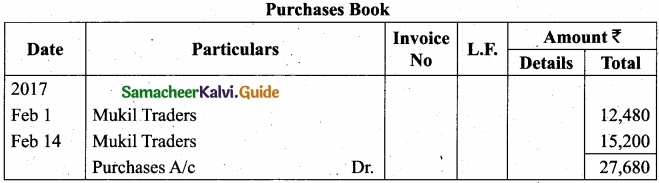
Urinary tract infection:
Female’s urethra is very short and its external opening is close to the anal opening, hence improper toilet habits can easily carry faecal bacteria into the urethra. The urethral mucosa is continuous with the urinary tract and the inflammation of the urethra (urethritis) can ascend the tract to cause bladder inflammation (cystitis) or even renal inflammation (pyelitis or pyelonephritis).

Symptoms include dysuria (painful urination), urinary urgency, fever and sometimes cloudy or blood tinged urine. When the kidneys are inflammed, back pain and severe headache often occur. Most urinary tract infections can be treated by antibiotics.

Renal Failure (Kidney Failure):
Failure of the kidneys to excrete wastes may lead to accumulation of urea with marked reduction in the urine output. Renal failure are of two types, Acute and chronic renal failure.

In acute renal failure the kidney stops its function abruptly, but there are chances for recovery of kidney functions. In chronic renal failure there is a progressive loss of function of the nephrons which gradually decreases the function of kidneys.

Uremia:
Uremia is characterized by increase in urea and other non – protein nitrogenous substances like uric acid and creatinine in blood. Normal urea level in human blood is about 17 – 30mg/100mL of blood. The urea concentration rises as 10 times of normal levels during chronic renal failure.

Renal calculi:
Renal calculi, also called renal stone or kidney stone or nephrolithiasis, is the formation of hard stone like masses in the renal tubules of renal pelvis.

It is mainly due to the accumulation of soluble crystals of salts of sodium oxalates and certain phosphates. This result in severe pain called “renal colic pain” and can cause scars in the kidneys. Renal stones can be removed by techniques like pyleothotomy or lithotripsy.

Glomerulonephritis:
It is also called Bright’s disease and is characterized by inflammation of the glomeruli of both kidneys and is usually due to post-streptococcal infection that occurs in children. Symptoms are haematuria, proteinuria, salt and water retention, oligouria, hypertension and pulmonary oedema.

[OR]

Describe the life cycle of Bombyx mori?
Answer:
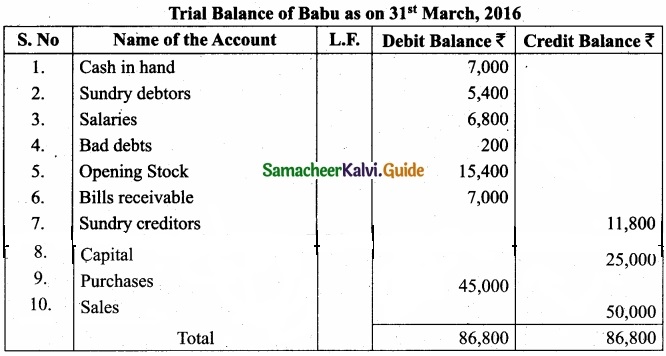
Life cycle of Bombyx mori:
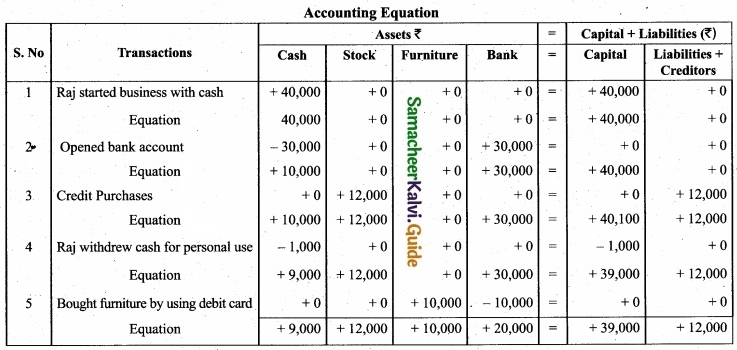
The adult of Bombyx mori is about 2.5 cm in length and pale creamy white in colour. Due to heavy body and feeble wings, flight is not possible by the female moth.

This moth is unisexual in nature and does not feed during its very short life period of 2 – 3 days. Just after emergence, male moth copulates with female for about 2 – 3 hours and if not separated, they may die after few hours of copulating with female.

Just after copulation, female starts egg laying which is completed in 1-24 hours. A single female moth lays 400 to 500 eggs depending upon the climatic conditions.

Two types of eggs are generally found namely diapause type and non-diapause type. The diapause type is laid by silkworms inhabiting the temperate regions, whereas silkworms belonging to subtropical regions like India lay non – diapause type of eggs.

The eggs after ten days of incubation hatch into larva called as caterpillar. The newly hatched caterpillar is about 3 mm in length and is pale, yellowish-white in colour. The caterpillars are provided with well developed mandibulate type of mouth-parts adapted to feed easily on the mulberry leaves.

After 1st, 22nd, 3rd and 4th moultings caterpillars get transformed into 2nd, 3rd, 4th and 5th instars respectively. It takes about 21 to 25 days after hatching. The fully grown caterpillar is 7.5 cm in length. It develops salivary glands, stops feeding and undergoes pupation.

The caterpillars stop feeding and move towards the comer among the leaves and secretes a sticky fluid through their silk gland. The secreted fluid comes out through spinneret (a narrow pore situated on the hypopharynx) and takes the form of long fine thread of silk which hardens on exposure to air and is wrapped around the body of caterpillar in the forms of a covering called as cocoon.

It is the white coloured bed of the pupa whose outer threads are irregular while the inner threads are regular. The length of continuous thread secreted by a caterpillar for the formation of cocoon is about 1000 – 1200 metres which requires 3 days to complete. The pupal period lasts for 10 to 12 days and the pupae cut through the cocoon and emerge into adult moth.